Delhi Police Traffic Advisory: कॉकरोच जनता पार्टी के प्रदर्शन और दिल्ली में कानून व्यवस्था को बनाए रखने के लिए दिल्ली पुलिस ने बड़ा कदम उठाया है। दिल्ली में 12 अक्टूबर को कई प्रमुख सड़कों पर ट्रैफिक व्यवस्था प्रभावित रह सकती है। ट्रैफिक पुलिस ने 12 अक्टूबर के लिए एक अहम ट्रैफिक एडवाइजरी जारी की है। कानून-व्यवस्था की स्थिति को देखते हुए ट्रैफिक पुलिस ने कई जगहों पर डायवर्जन की तैयारी की है, जो जरूरत के अनुसार सुबह 6 बजे से लागू होगें। ऐसे में एयरपोर्ट, रेलवे स्टेशन या ISBT जाने वाले लोगों को घर से निकलने से पहले ट्रैफिक अपडेट जरूर देख लेना चाहिए।
सुबह 6 बजे से होगा डायवर्जन
दिल्ली ट्रैफिक पुलिस के अनुसार, जरूरत पड़ने पर सुबह 6 बजे से कई रास्तों पर ट्रैफिक डायवर्ट किया जाएगा। पुलिस ने लोगों से अपील की है कि वे अगर जरूरी ना हो तो यात्रा से बचें और अगर रेलवे स्टेशन, ISBT या एयरपोर्ट जाना जरूरी है तो घर से थोड़ा जल्दी निकलें। खासकर नई दिल्ली और सेंट्रल दिल्ली से होकर जाने वाले लोगों को एक्स्ट्रा टाइम लेकर चलने की सलाह दी गई है। ऐसे में अगर आज आप ऑफिस, कॉलेज या बच्चों को स्कूल छोड़ने जा रहे हैं तो सबसे पहले ट्रैफिक एडवाजरी का अपडेट जरूर जान लें।
इन रास्तों पर होगा डावर्जन
ट्रैफिक प्रभावित होने वाले प्रमुख स्थानों में शंकर रोड-वंदे मातरम टी-पॉइंट, धौला कुआं फ्लाईओवर, झंडेवालान, पंचकुइयां, मंडी हाउस, डॉ. दिनेश नंदिनी डालमिया चौक, राम चरण अग्रवाल चौक, मिंटो रोड-डीडीयू मार्ग, गुरु नानक चौक, चेम्सफोर्ड रोड, कनॉट प्लेस, लोधी रोड फ्लाईओवर, नीला गुम्बद, मदरसा टी-पॉइंट, सम्राट होटल, सरदार पटेल मार्ग-पंचशील मार्ग, भीकाजी कामा प्लेस, मोती बाग फ्लाईओवर, रिंग रोड-सैन मार्टिन मार्ग, अशोका रोड-जंतर मंतर रोड, विंडसर पैलेस, टॉल्स्टॉय-जनपथ क्रॉसिंग, रेल भवन, जय सिंह रोड-संसद मार्ग, बाराखंबा रोड, गोल डाकखाना, पटेल चौक और आरएमएल अस्पताल के आसपास के रास्ते शामिल हैं।
पुलिस ने बताया कि ट्रैफिक की स्थिति के अनुसार इन डायवर्जन और प्रतिबंधों में बदलाव किया जा सकता है। इसलिए लोगों को सलाह दी गई है कि वे घर से निकलने से पहले ट्रैफिक का ताजा अपडेट जरूर देखें और जरूरत पड़ने पर दूसरे रास्ते का इस्तेमाल करें।
DELHI TRAFFIC POLICE ADVISORY
In view of the law and order situation, traffic may be impacted on following stretches in Delhi on 12.10.2026.
1. Diversions
Diversions will be enforced starting from 06:00 AM on 12.10.2026 depending upon prevailing situation. General public is informed that movement at following points and surrounding stretches might remain affected:-
1.Round About Shankar Road-Vande Matram ‘T’ Point towards New Delhi
2.Dhaula Kuan Flyover
3.Round About Jhandewalan
4.Round About Panchkuian
5.Round About Mandi House
6.Dr Dinesh Nandini Dalmia Chowk (W-Point)
7.Ram Charan Aggarwal Chowk (A-Point)
8.Minto Road/Deen Dayal Upadhyay Marg
https://t.co/hLq6pNQgBG Nanak Chowk
10.Chemsford Road – Outer Circle Connaught Place T-Point
11.Bharion Road- MGM (Ring Road) T-Point
12.Lodhi Road Flyover
13.Round About Neela Gumbad
14.Madarsa T- Point
15.Round About Samrat Hotel
16.Sardar Patel Marg- Panchsheel Marg Crossing
17.Under Bhikaji Kama Place
18.Under Moti Bagh Flyover
19.Ring Road-San Martin Marg T-Point
20.Round About Ashoka Road – Jantar Mantar Road
21.Round About Windsor Palace
22.Tolstoy-Janpath Crossing
23.Round About Rail Bhawan
24.Jai Singh Road – Sansad Marg Crossing
25.Outer Circle Connaught Place -Barakhamba Road T-Point
26.Round About Gol Dak Khana
27.Round About Patel Chowk
28.Jai Singh Road – Ashoka Road T-Point
29.Round About RML Hospital
30.Outer Circle Connaught Place – Sansad Marg T-Point
2.Commuters’ Advisory & Recommendations
•Plan in Advance: Please keep extra travel time in hand if heading towards railway stations, ISBTs, or the airport via New Delhi and Central Delhi.
•Avoid Non-Essential Travel: Commuters are requested not to undertake non essential travel.
•Dynamic Restrictions: Traffic management measures are dynamic and will be relaxed or regulated based on real-time ground assessment.
3.Stay Updated (Real-Time Information)
For live updates, alternate routes, and continuous traffic alerts, please keep referring to official Delhi Traffic Police platforms:
CJP ने जंतर-मंतर पर शांतिपूर्ण प्रदर्शन करने की तैयारी शुरू कर दी है। पार्टी के नेता आशुतोष रंका ने बताया कि सोमवार सुबह 10 बजे वह सौरव दास और संगठन के अन्य सदस्यों के साथ पार्लियामेंट स्ट्रीट पुलिस स्टेशन जाएंगे। वहां दिल्ली पुलिस से प्रदर्शन के लिए तारीख और अनुमति देने का अनुरोध किया जाएगा। रंका के मुताबिक, अगर पुलिस 24 घंटे के अंदर प्रदर्शन की तारीख नहीं देती है, तो संगठन अपने स्तर पर प्रदर्शन की घोषणा करेगा।
Mumbai Airport Big Announcement: मुंबई के छत्रपति शिवाजी महाराज इंटरनेशनल एयरपोर्ट के टर्मिनल 1 से 25 अक्टूबर से फ्लाईट नहीं ले सकेंगे। मुंबई इंटरनेशनल एयरपोर्ट लिमिटेड (MIAL) ने इसका ऐलान किया है। इसे इसलिए बंद किया जा रहा है, क्योंकि यहां बड़े पैमाने पर फिर से डेवलपमेंट किया जाना है, जो जन जनवरी 2027 से शुरू होगा। यह रीडेवलपमेंट AAI (एयरपोर्ट अथॉरिटी ऑफ इंडिया) के निर्देशों पर हो रहा है।
द न्यू इंडियन एक्सप्रेस की रिपोर्ट के मुताबिक यह टर्मिनल 2029-30 तक बंद रह सकता है यानी 25 अक्टूबर से लगभग चार साल तक मुंबई एयरपोर्ट के टर्मिनल 1 से कोई फ्लाइट नहीं मिलेगी। यहां से जो भी उड़ाने होंगी, वह या तो नवी मुंबई इंटरनेशनल एयरपोर्ट (NMIA) से हो सकती हैं या एयरलाइन कंपनियां कुछ समय के लिए अपनी सर्विसेज बंद कर सकती हैं।
मुंबई एयरपोर्ट से अभी हर दिन लगभग 950 फ्लाइट्स ऑपरेट हो रही हैं। इसके दोनों टर्मिनलों से 53 अंतरराष्ट्रीय और 7 घरेलू एयरलाइंस उड़ानें ऑपरेट करती हैं। वित्त वर्ष 2025-26 में टर्मिनल 1 से लगभग 1.5 करोड़ यात्रियों ने यात्रा की, जबकि टर्मिनल 2 से करीब 4 करोड़ यात्री गुजरे।
84 साल पुराना है Mumbai Airport का Terminal 1
एयरपोर्ट के टैरिफ और सर्विस चार्जेज को रेगुलेट करने वाली AERA (एयरपोर्ट्स इकनॉमिक रेगुलेटरी अथॉरिटी ऑफ इंडिया) ने 84 साल पुराने टर्मिनल 1 को गिराने का निर्देश दिया था। इसके रीडेवलपमेंट का काम मूल रूप से पिछले साल 2025 के मध्य में शुरू होना था लेकिन ऐसा हो नहीं पाया क्योंकि MIAL के प्रवक्ता के मुताबिक फ्लाइट्स को ट्रांसफर करने के लिए कोई और एयरपोर्ट फैसिलिटी नहीं थी। अब नवी मुंबई इंटरनेशनल एयरपोर्ट चालू हो चुकी है तो मुंबई मेट्रोपॉलिटन रीजन (MMR) में एक विकल्प मिल चुका है।
यात्रियों पर फैसले से क्या असर
कुछ घरेलू उड़ानों को टर्मिनल 2 पर शिफ्ट किए जाने के आसार दिख रहे हैं, जबकि T2 से अभी चल रही कुछ इंटरनेशनल सर्विस नवी मुंबई एयरपोर्ट पर शिफ्ट हो सकती हैं। अकासा एयर ने अपने कुछ ऑपरेशन्स को शिफ्ट करना शुरू भी कर दिया है और दूसरी एयरलाइंस के साथ बातचीत चल रही है।
Greater Noida News: दिल्ली से सटे उत्तर प्रदेश के ग्रेटर नोएडा में पर्यावरणीय नियमों का उल्लंघन कर किए जा रहे कथित अवैध व्यावसायिक निर्माण के मामलों में नेशनल ग्रीन ट्रिब्यूनल (NGT) ने सख्त रुख अपनाया है। ट्रिब्यूनल ने ग्रेटर नोएडा औद्योगिक विकास प्राधिकरण (GNIDA) को ऐसे सभी अवैध व्यावसायिक निर्माणों की पूरी लिस्ट और उनसे संबंधित कार्रवाई का डिटेल्स 10 दिनों के भीतर रिकॉर्ड पर रखने का निर्देश दिया है। यह आदेश पूर्व गाजियाबाद पार्षद राजेंद्र त्यागी की ओर से दायर याचिका पर सुनवाई के दौरान आया। मामले की सुनवाई 24 सितंबर को NGT की प्रिंसिपल बेंच के चेयरपर्सन जस्टिस प्रकाश श्रीवास्तव और एक्सपर्ट मेंबर अफरोज अहमद ने की।
GNIDA को नोटिस और कोर्ट के आदेशों का देना होगा ब्योरा
टाइम्स ऑफ इंडिया (TOI) के मुताबिक, सुनवाई के दौरान ट्रिब्यूनल ने कहा कि GNIDA को अपनी कार्रवाई से जुड़े पूरे डिटेल्स के साथ उन उल्लंघनकर्ताओं को जारी किए गए नोटिस और अदालतों द्वारा पारित आदेशों की जानकारी भी उपलब्ध करानी होगी। NGT ने मामले की अगली सुनवाई के लिए 10 दिसंबर की तारीख तय की है।
मामले में GNIDA की ओर से पेश वरिष्ठ वकील ने जुलाई में जवाब दाखिल करने के लिए और समय मांगा था। अब ट्रिब्यूनल ने ग्रेटर नोएडा प्राधिकरण को 10 दिनों के भीतर आवश्यक जानकारी रिकॉर्ड पर रखने का निर्देश दिया है।
पर्यावरणीय नियमों के उल्लंघन का आरोप
याचिका में ग्रेटर नोएडा में पर्यावरणीय मानकों का उल्लंघन करते हुए निर्माण परियोजनाएं चलाए जाने का आरोप लगाया गया है।
इसमें पर्यावरणीय प्रभाव आकलन (Environmental Impact Assessment) संबंधी अधिसूचना के प्रावधानों का पालन नहीं करने तथा उत्तर प्रदेश प्रदूषण नियंत्रण बोर्ड (UPPCB) से आवश्यक सहमति प्राप्त किए बिना संचालन करने जैसे आरोप शामिल हैं।
मामले में NGT ने पहले जुलाई में UPPCB को ग्रेटर नोएडा में पर्यावरणीय नियमों के उल्लंघन में शुरू की गई कथित अवैध निर्माण परियोजनाओं के आरोपों की जांच और सत्यापन करने का निर्देश दिया था।
UPPCB ने कहा- GNIDA ने नहीं दी परियोजनाओं की जानकारी
23 सितंबर को UPPCB की ओर से दाखिल रिपोर्ट में NGT को बताया गया कि GNIDA ने संबंधित परियोजनाओं का विवरण साझा नहीं किया।
बोर्ड के मुताबिक, इस संबंध में GNIDA को 17 अगस्त और 16 सितंबर को पत्र भेजे गए थे। लेकिन इसके बावजूद परियोजनाओं की जानकारी उपलब्ध नहीं कराई गई।
इसके बाद NGT ने GNIDA से कहा कि वह कथित अवैध निर्माणों से संबंधित पूरी जानकारी उपलब्ध कराए।
इसमें प्राधिकरण की ओर से अब तक जारी किए गए नोटिस, उल्लंघनकर्ताओं के खिलाफ की गई कार्रवाई और संबंधित अदालतों के आदेशों का विवरण भी शामिल होगा।
10 दिसंबर को होगी अगली सुनवाई
NGT के इस आदेश के बाद GNIDA को निर्धारित समयसीमा में कथित अवैध व्यावसायिक निर्माणों की सूची और उनसे जुड़ी कार्रवाई का रिकॉर्ड पेश करना होगा। इस मामले की अगली सुनवाई अब 10 दिसंबर को तय की गई है।
Mercedes-Benz’s 140 Years, 140 Places odyssey is a celebration of the carmaker’s origins in 1886. Spanning six continents, covering over 60,000 kilometres, it is as massive in significance as it is in scale. The tour kicked off at the Mercedes-Benz Museum in Stuttgart on the 29th of January, the same day Carl Benz received the patent for his first car 140 years ago! The cars then went to the Daimler house in Bad Cannstatt, they tracked the original route of Bertha Benz’s historic 1888 drive and drove the iconic Spa-Francorchamps racetrack in Belgium in wheel tracks of the W109 ‘Red Pig’ that made such a splash in 1971. The cars then went to the US, visiting the first plant in the US started by William Steinway (of Steinway & Sons, the famous German Piano makers), South America, Australia, Japan, Korea and Japan.
Legacy and history
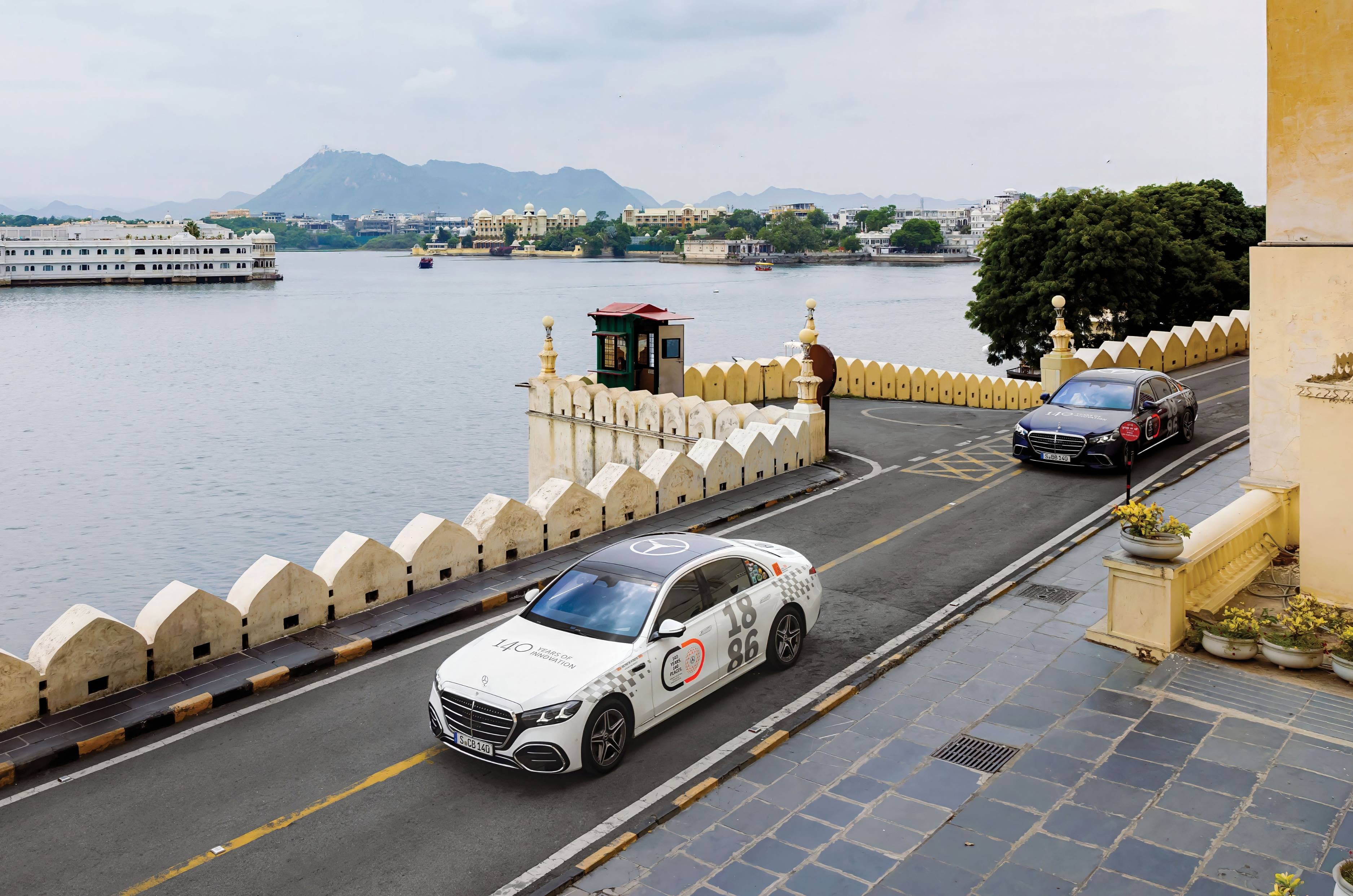
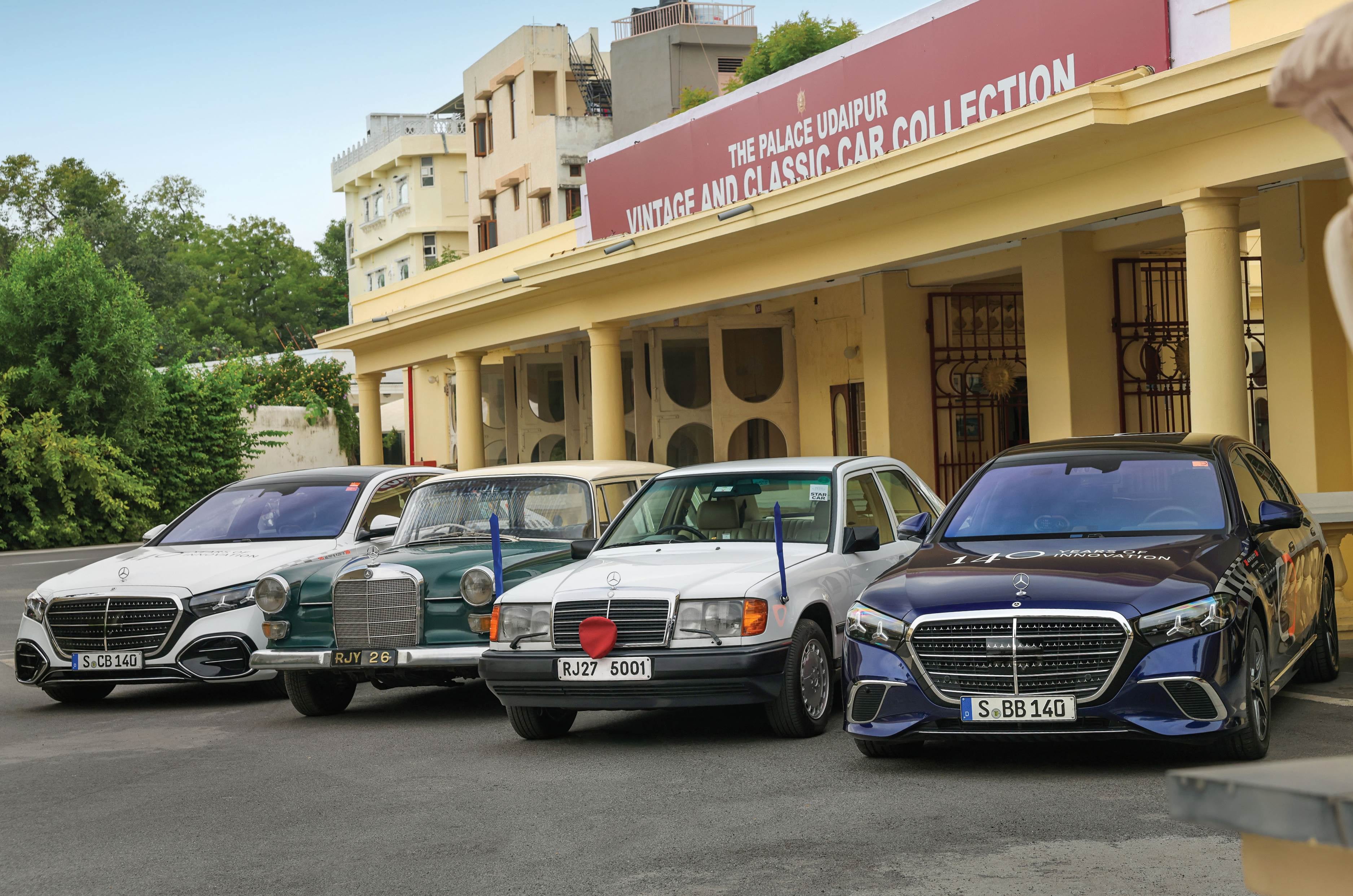
With their royal and regal air, the S-Classes feel right at home in Udaipur.
Part of the 140 Years, 140 Places expedition, Udaipur is one of the more stunning locations the Mercedes drive will visit on this India leg, and what’s incredible is that we have been chosen to be a part of it. What a privilege. The lake city of Udaipur also has tremendous historical significance. Home to one of the longest-serving dynasties, one that spans 1,500 years, this leg sees a coming together of the world’s oldest carmaker and one of the oldest dynasties. And while this trans-continental excursion is called 140 Years, 140 Places, it could also easily have been called 140 Years of Automotive Technology. With these S-Class pre-production cars dripping with both mechanical and electronic tech, what we are also celebrating is the journey of the car from a three-wheeler with a single-cylinder engine to this technological marvel. The company that invented the motorcar is still widely regarded as the one that makes ‘the best car in the world’.
Luxe Supreme
Everything is perfectly still. Not a gauge in the car is moving, and there’s no real sensation of speed. I must have dozed off. Blame it on the incredibly comfortable back seats and the sensory isolation. This car just shuts you off from the rest of the world. Then I discover we are cruising at 100kph, and not just 30 or 40. Up ahead is the lake city of Udaipur. Ahh.
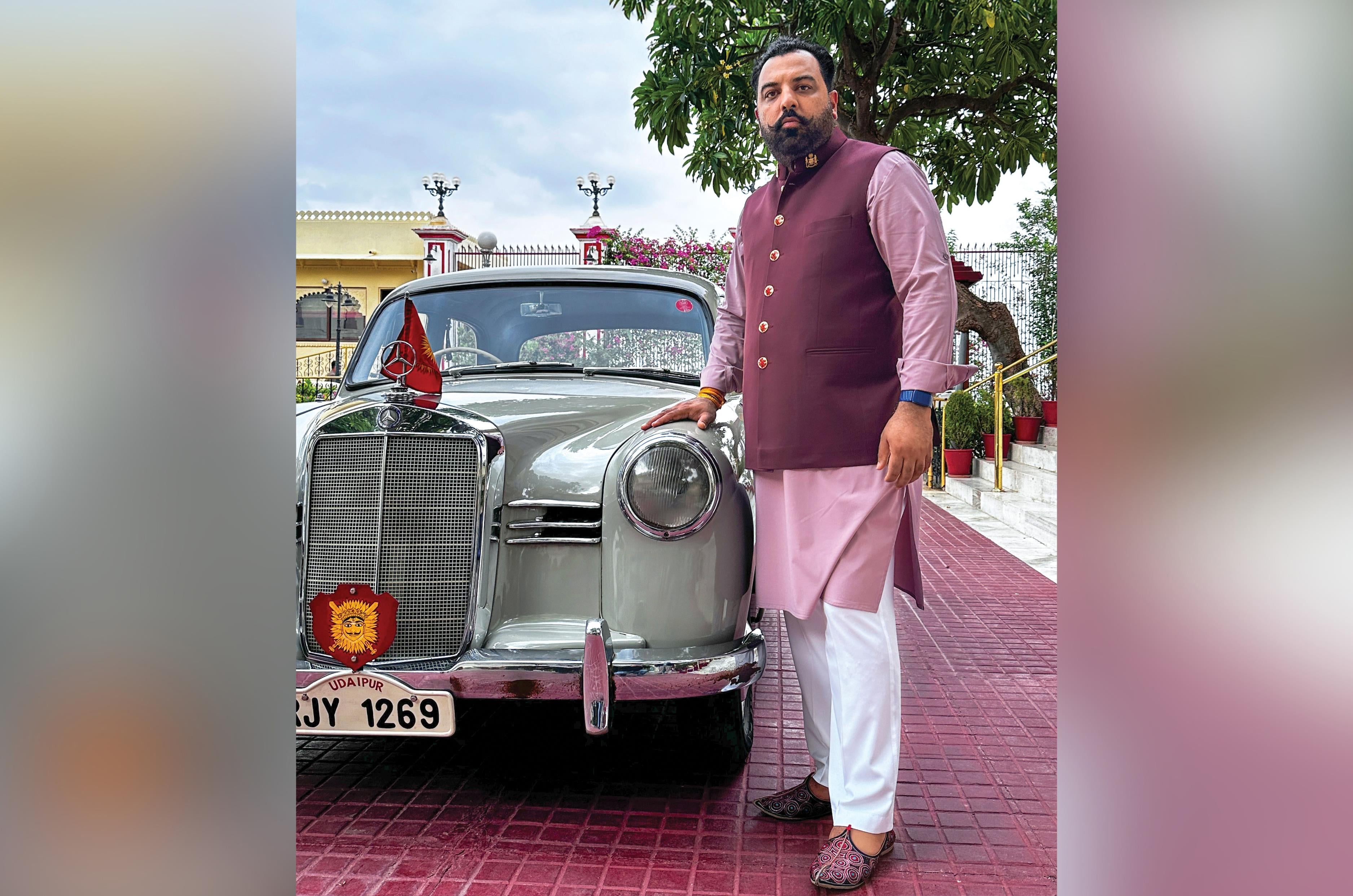
The Maharana of Udaipur with a car that has been in his family for three generations.
We start our journey on this leg from a very significant place, the palace situated on the lakeside at Udaipur. And not only does Lakhsyaraj, the 77th Custodian of the House of Mewar (formally Shriji Huzoor Dr Lakshyaraj Singh of Udaipur), play the perfect host, but he also parks an olive-green 180D in the foyer, a car that has been used by three generations of his family. The symbolism is rich; two legacies converging in a place that embodies the spirit of grandeur and continuity.
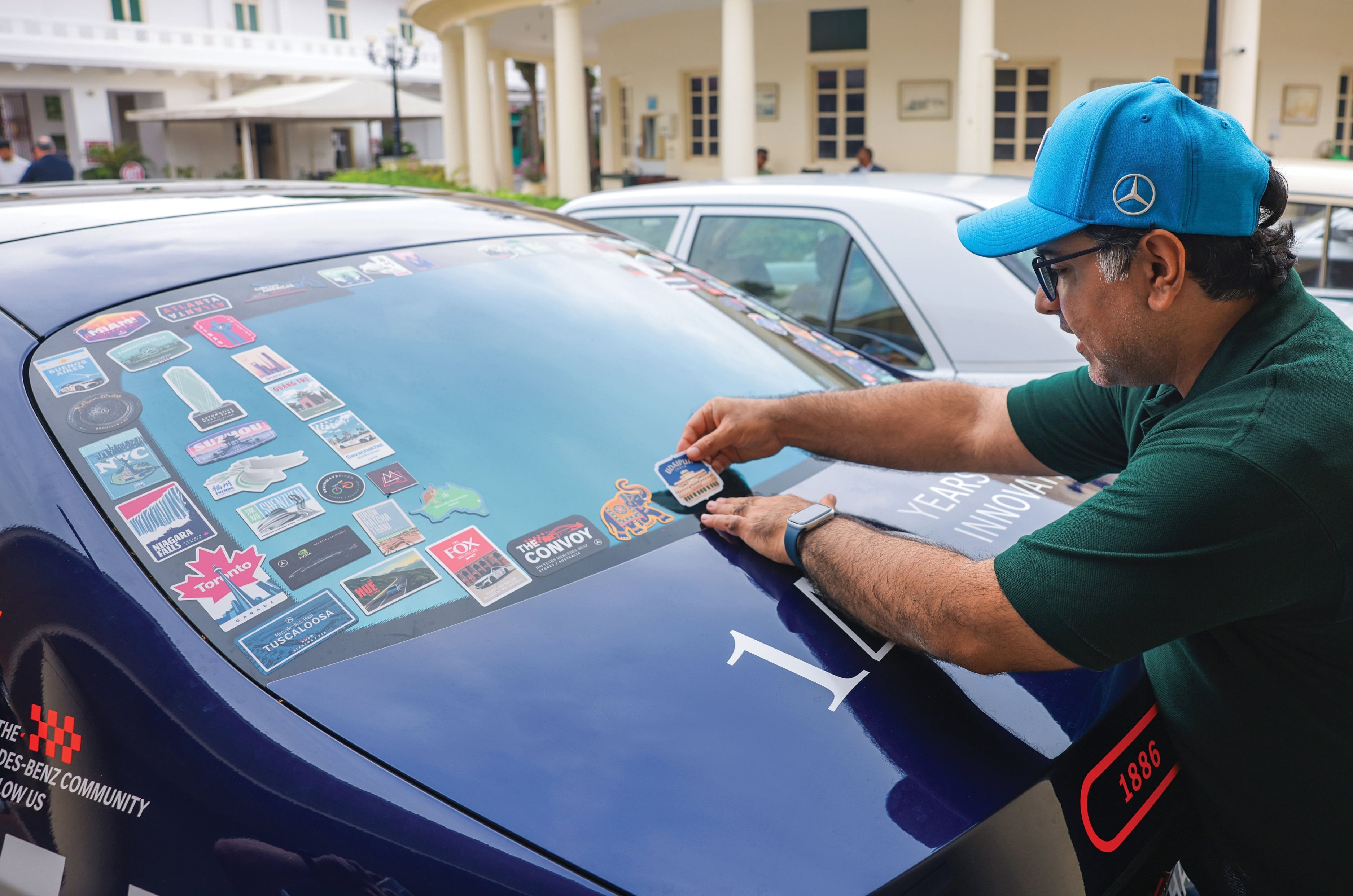
Perseus places the sticker on ‘Bertha’ in Udaipur.
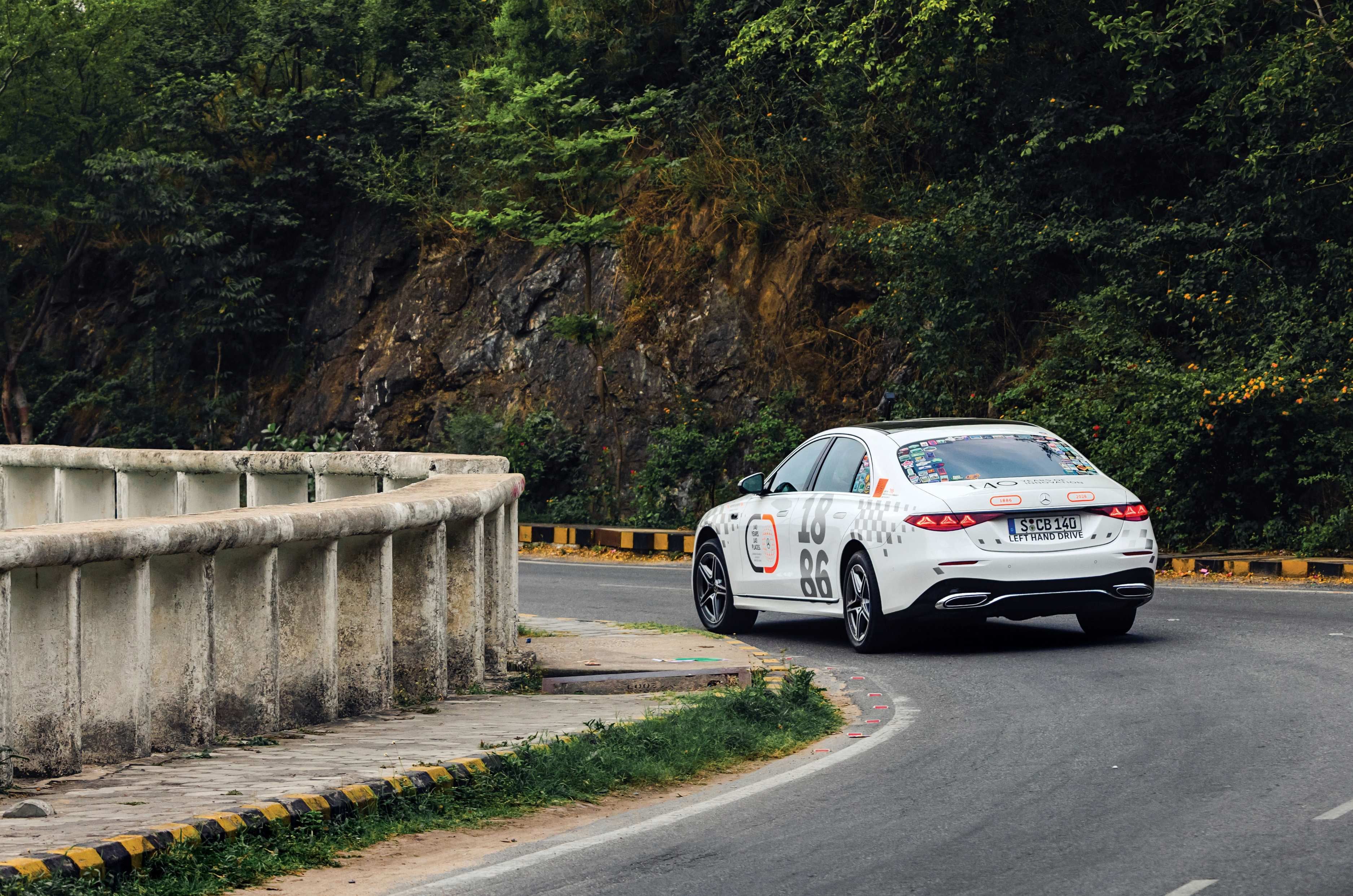
Since Udaipur is one of the 140 iconic destinations on the drive, Mercedes asks him to place an Udaipur sticker on the rear of the car; fitting. These cars, all three (the third is on another leg elsewhere in India), will eventually be housed in the Mercedes museum in Stuttgart, and what’s cool is that you can trace their journey via the stickers. Lakshyaraj then takes one of the cars for a brief drive. He wants to see just how much better this new version, with all its 2,700 new bits, is over his pre-facelifted car. And yes, he loves driving. I’d bumped into him earlier in the day at the airport, where his S-Class had come to pick him up, flags flying and uniformed driver and assistant in tow. But instead of climbing into the rear, he’d gotten straight behind the wheel. Tells you a lot.
Still at the top
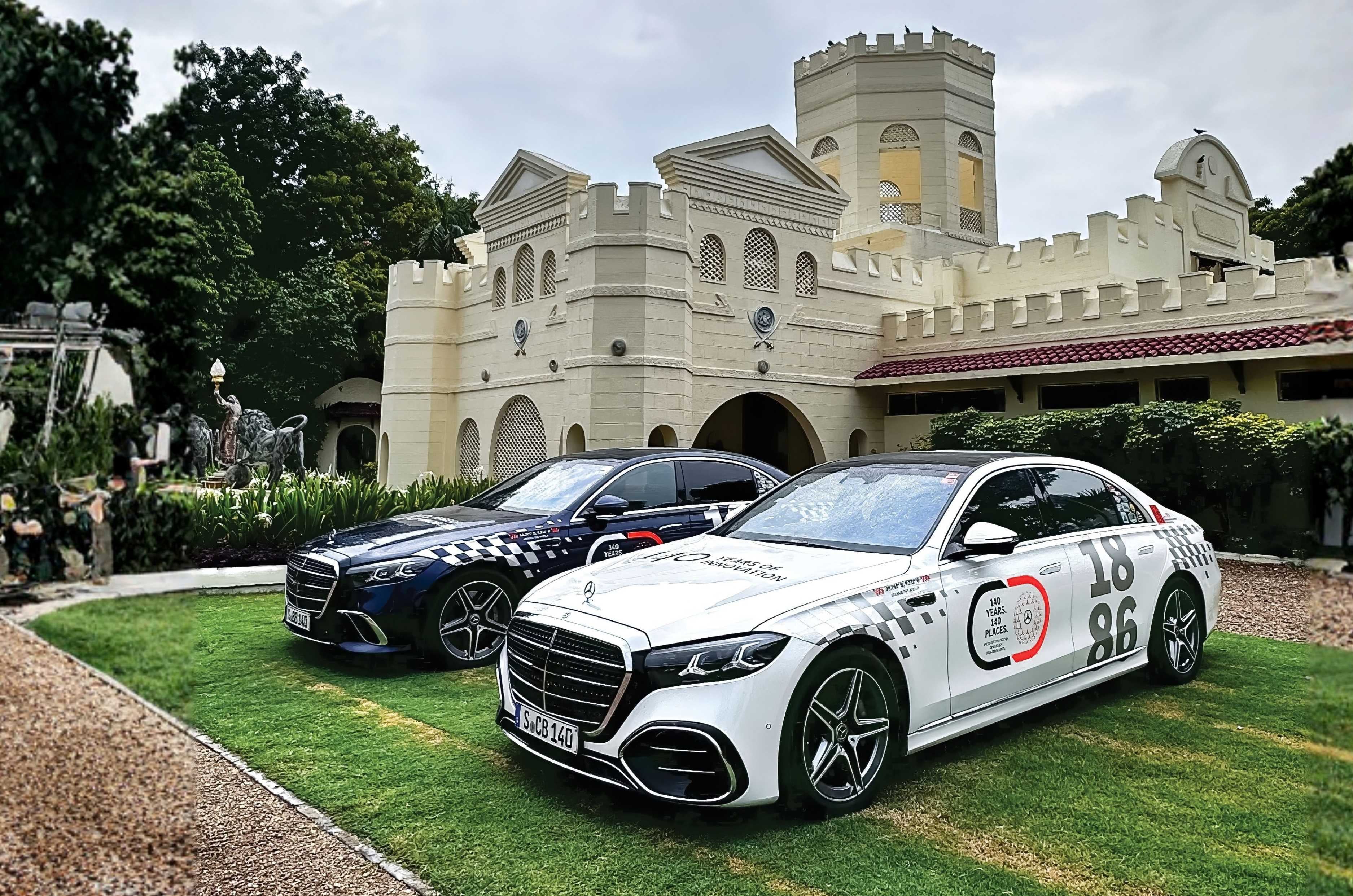
Late prototypes of the New S-Class made the journey.
Later in the day, I get another demonstration of why the S-Class is so special. We decide to drive around the lake for the cameras, the orange glow of the setting sun adding to the drama of this once James Bond film set. Sitting in the back feels almost magical, as the S-Class slips forward effortlessly, the sun glistening off the lake. It skips over cratered roads, glides silently through noisy bazaars and intersections and then, as the road around the lake opens out, I barely hear it even though Mercedes’ test driver is pulling the torque-y straight-six hard. This car is named Bertha, after Carl Benz’s wife, the one who undertook the world’s first long-distance drive; quite a story that. And the other, the white one, is Carl; BB and CB, both on Stuttgart number plates.
Hello Grandpa
The S-Classes, along with the fin-tail and the 300D.
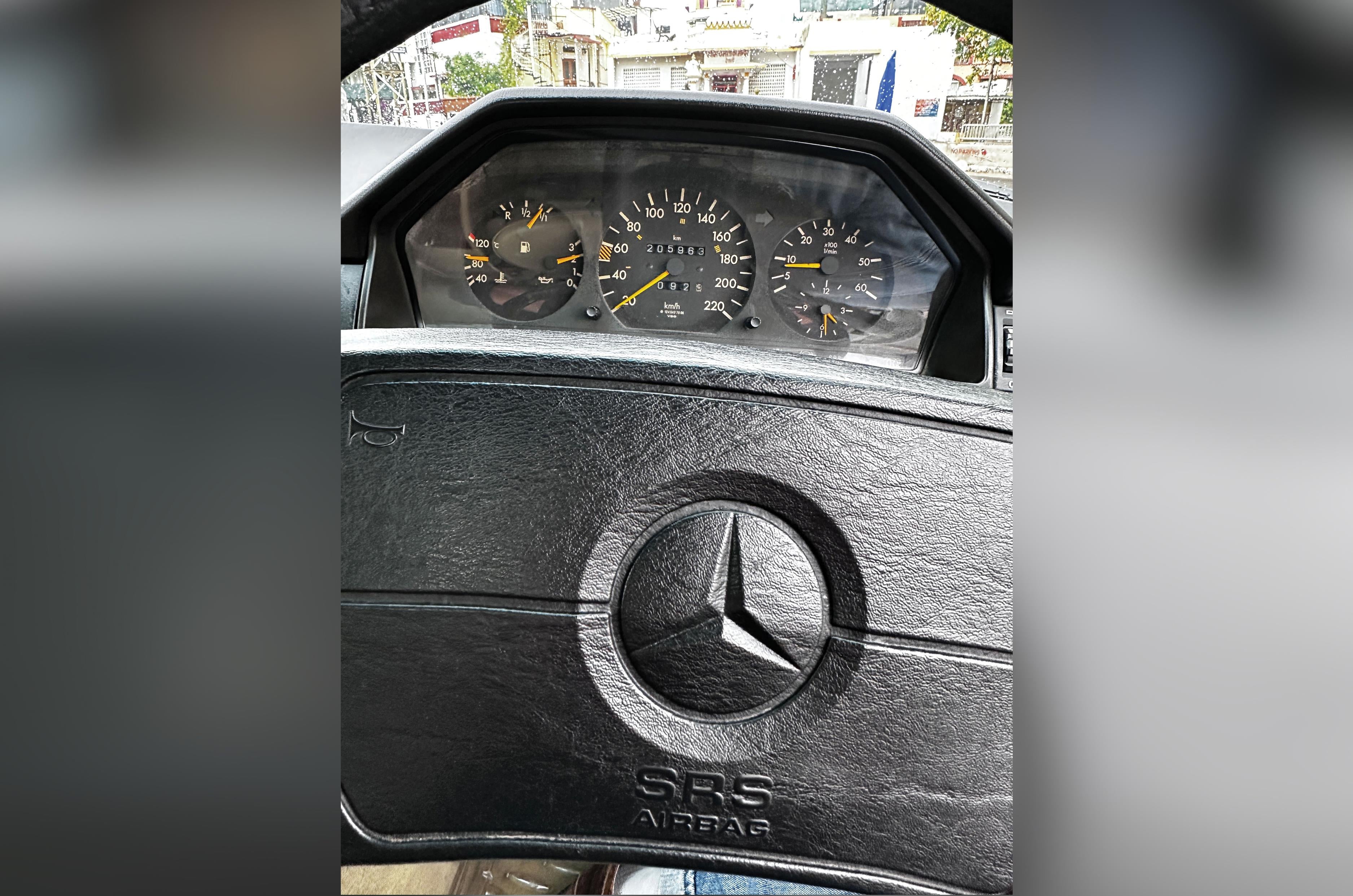
The next day, we set off to see the Udaipur Royal Garage, where we are met by other Mercedes cars. There’s a fin-tail that was used to pick up and drop off guests of the Royal family from neighbouring ‘states’ and a very special W124 300D. The latter, an import rather than a locally assembled W124, stands out from Indian-assembled cars with its black bumpers, headlamp wipers and amber indicators. This six-cylinder diesel with more than 2,00,000km on the clock was used by Shri Arvind Singh Mewar, the earlier Maharana, to cover long distances like Ahmedabad or Jodhpur. Recently restored, it was presented at the Mercedes-Benz Classic Car Rally in Mumbai. The 300D is in such fine nick, I can’t resist a quick spin around another of Udaipur’s stunning lakes, Fateh Sagar.
Why the 300D is such a legend
The W124 300D is an import.
On the outside, the 300D looks sort of underwhelming. Starting up the straight-six diesel is relatively straightforward, although I have to wait for the glow plug to heat up (remember those?). While the roughly 110hp engine doesn’t feel responsive, it feels smooth and refined for a diesel, especially after 2,500rpm. And though it is slow by today’s standards, it doesn’t feel like you’re dragging anchor either. The chunky 300D also feels as tough as a Godrej safe.
It has 2,00,000km on the odo, but hardly feels like it.
Then I catch a glimpse of the odometer; it reads in excess of 2,00,000 kilometres! Surely my eyes are playing tricks on me. Yes, this car has been recently refurbished, and the suspension has been tightened up, but this thing feels like it has just rolled out of the showroom only recently. It tracks straight, the steering is well weighted and, when I plonk my foot down, it even generates a reasonable amount of torque. This ‘OM603’ straight-six uses indirect injection and a pre-chamber, and has a simple two-valve-per-cylinder setup. Legend has it, it can do a million miles with only basic care. And what of turbo lag, you ask? It doesn’t have one.
Performance tech
The next morning, I get straight behind the wheel of CB or Carl Benz. I’m particularly excited because Carl has a V8 under the hood. What makes this V8 different is that it has some unique tech. This new S-Class is fitted with the ‘M177 Evo’ V8 engine that uses a flat-plane crankshaft! Made popular by Ferrari, a flat-plane crank is used on sportscars to help bunch up the firing order of the cylinders, so you get more of a kick from overlapping strokes. These engines, however, are not as smooth. So why has Mercedes used it in the S-Class, an out-and-out luxury car? Simple: it delivers better efficiency and lower emissions, as the crankshaft is lighter and there’s less reciprocating mass. And what of the vibrations? Mercedes says it has thrown tech at the problem.
V8-equipped S-Class feels effortlessly quick.
Initially, the going is slow as we exit the city. But once we get onto the wide highway, a small tap on the throttle releases a swell of torque just off 2,000rpm. And with 537hp propelling the limousine forward, it just shrinks the long straights on the highway. What’s cool is that the engine never feels brutish or AMG-like; the V8 soundtrack and rumble are superbly muted. The tech works. The new engine, in fact, is so well behaved that I have to check if it is indeed the one with the flat plane crank. At the next stop, I turn around and ask Mario Schneider, head of development for all Mercedes-Benz sedans, who just happens to be in the rear seat.
Also along for the drive is Perseus Bandrawalla, Autocar India’s curator of classic and modern classic events. Five minutes behind the wheel and he is waxing lyrical about the Mercedes V8 engines of days gone past – the M100, the M119 that powered the SL and others. It brings into perspective just how many great V8s Mercedes has had over the years, the 6.3 AMG V8, of course, included.
Cruise control
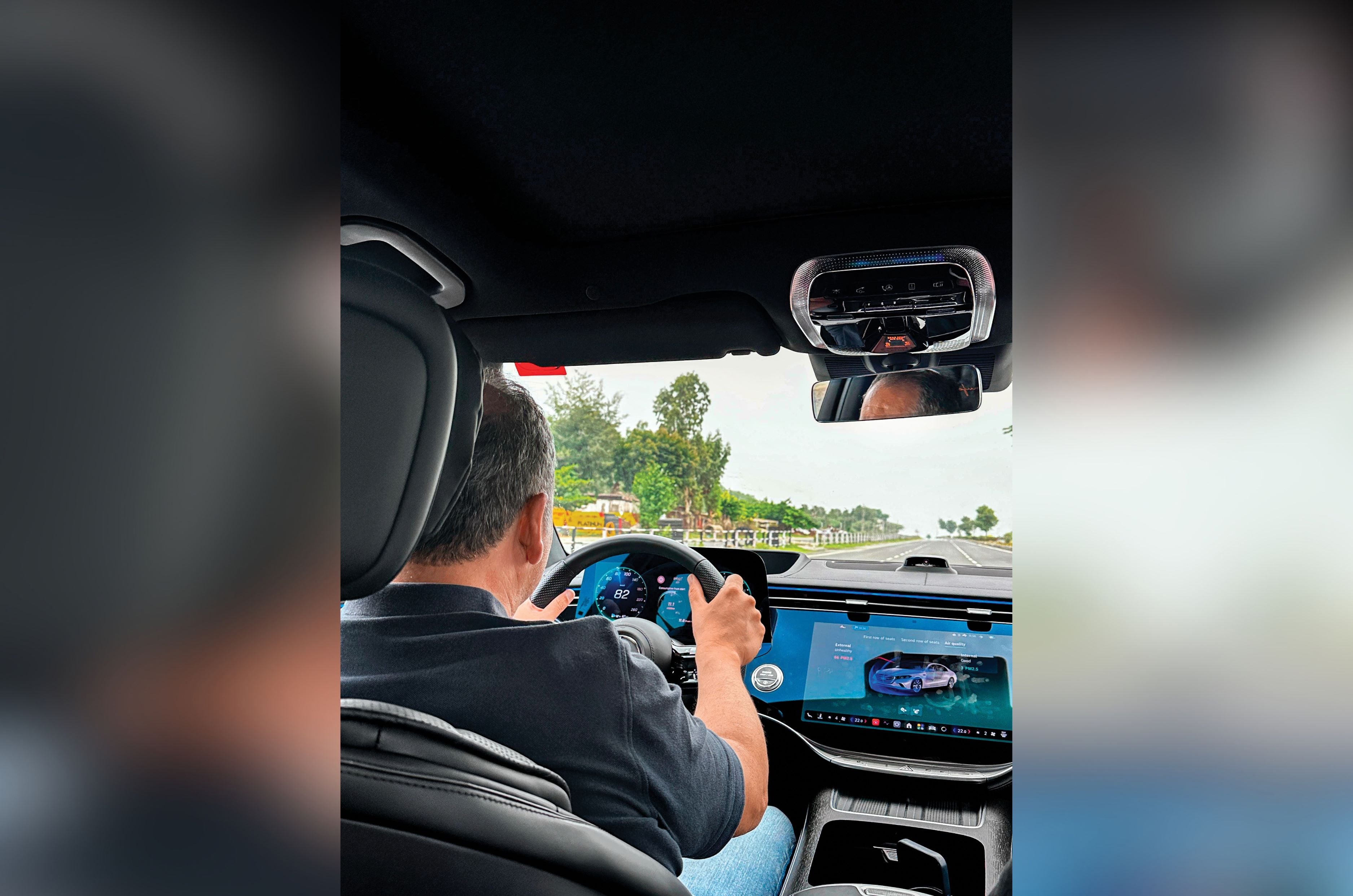
The three screens and updated cabin created a futuristic setup in a traditional environment.
Further up, we get to a ghat section. Not only does the ride on this updated air suspension and adaptive dampers feel a bit more supple, it also feels at home on the winding road, the rear-wheel steering helps it into corners neatly. Even cooler, despite all the tech, it retains a natural fluidity and a sense of mechanical harmony, which make long drives feel just effortless. Are city-bound S-Class owners missing what’s best about this car? Absolutely! Talking about tech, this car also gets Level 3 autonomous driving (in places where it’s allowed), where the driver can be hands off, and even eyes off, with Mercedes Drive Pilot taking responsibility for safety. It is only one of two cars to get this globally.
As we get into traffic, what I notice is that the updated cabin, with its three screens and ambient lighting, creates an environment that is both futuristic and traditional. The seats, with massage and cooling functions, are thrones in their own right. And it’s not just the size, specifications and features it has; it’s how well everything is executed, from the solid build of the cabin to the new phone-like remote controls in the rear.
Collector’s edition
Streamlined Maybach SW38 four door could do 160kph
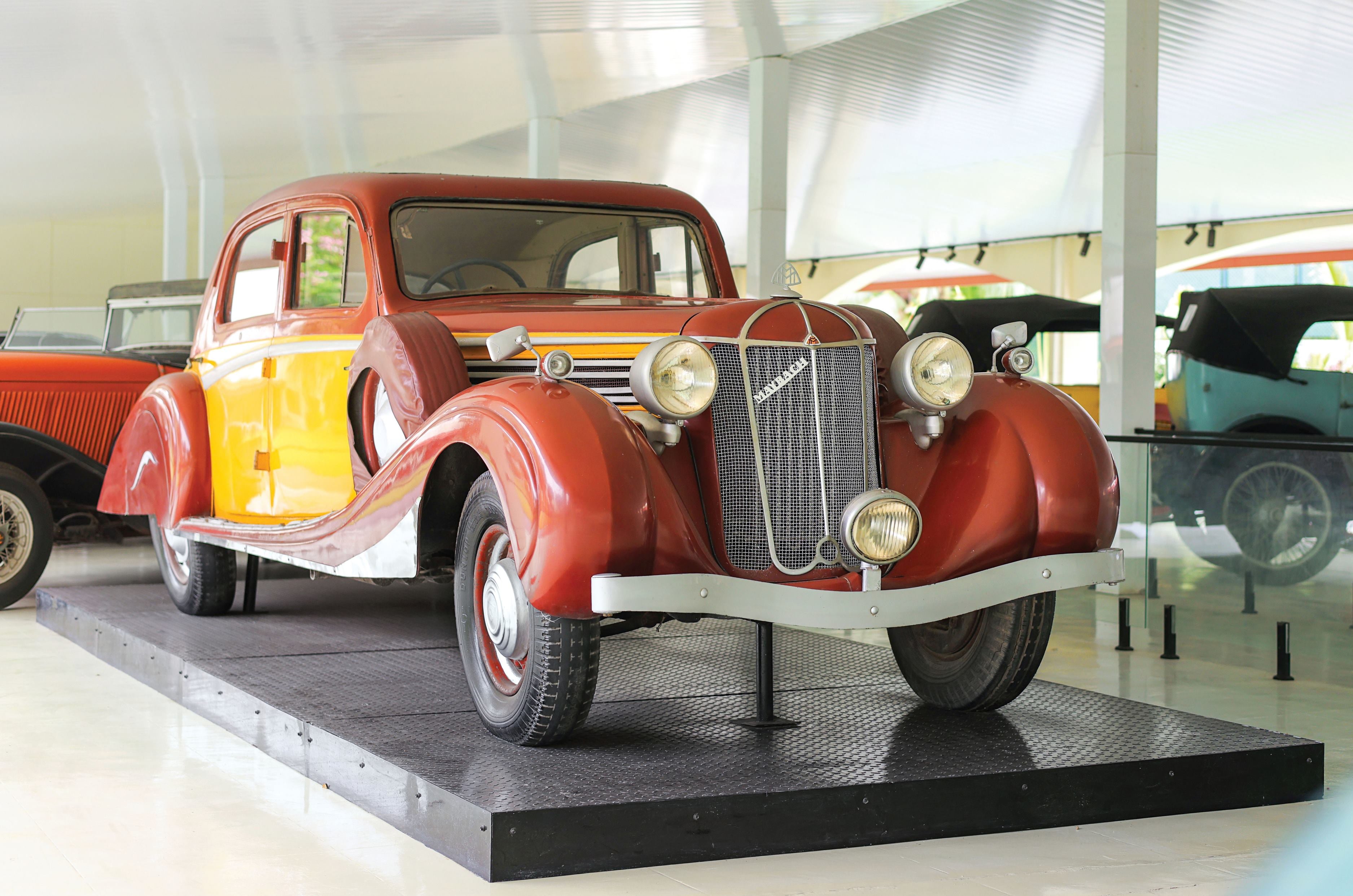
As we get to Ahmedabad, we turn into another historical location, Dastan Auto World – collector extraordinaire Pranlal Bhogilal’s collection, where the modern S-Classes met some more of their ancestors. A Maybach SW38, ordered by Maharaja Umaid Singh of Kota, draws admiring stares from the German members of the Mercedes crew, especially its aerodynamic profile. Capable of nearly 160kph, it was one of the fastest four-doors of its time. Equally captivating are Mercedes’ post-war comeback cars – the 300S ‘Adenauers’. Named after Germany’s first Chancellor, who famously rode in one with his hat on, this limousine is what eventually evolved into the S-Class.
Heritage and high tech
You can trace the journey via the stickers on the cars.
The 140 Years, 140 Places drive captured the duality of Mercedes perfectly; the brand embodies both heritage and innovation in equal measure, both streams converging seamlessly. As the convoy continues its odyssey, what’s clear is that this is a celebration not only of Mercedes’ past, but also the brand’s ability to connect eras, cultures and people through the universal language of the automobile.
Our long-term Alcazar has done all sorts of jobs since it joined the fleet. City runs, airport pickups, the odd weekend getaway. But nothing quite like what it was asked to do recently. It had to play support car for our camera crew shooting a feature on the Delhi-Mumbai Expressway, and that meant a 2,700km round trip between Mumbai and Delhi with barely a day’s rest in between.
I wasn’t driving the entire way myself, and the Alcazar was only handed over to me in Delhi by one of our drivers. His enthusiasm to ask me if we needed him to drive it back to Mumbai was a testament of how impressed he really was with the Alcazar.
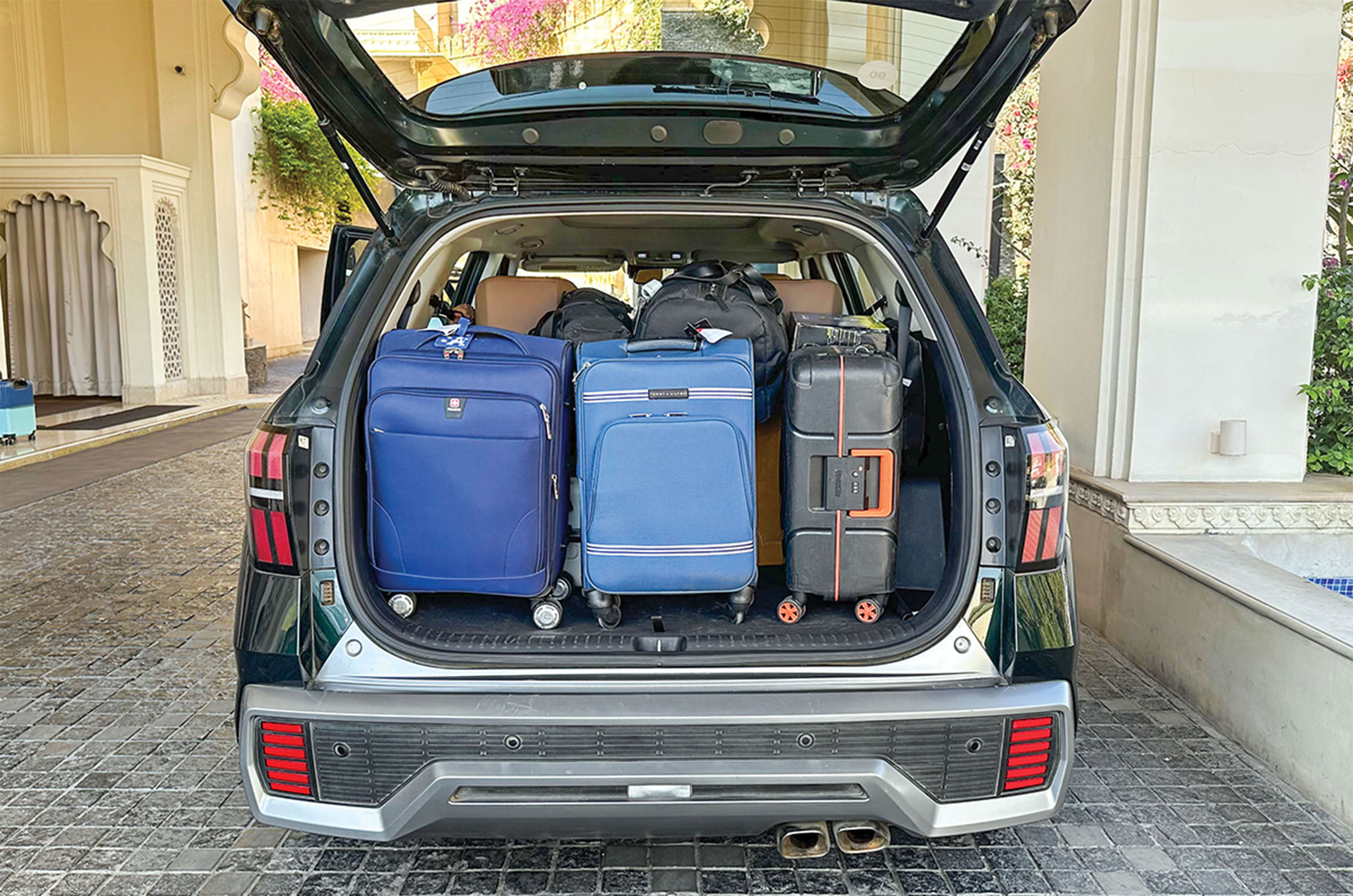
Folded third row frees up a lot of space for luggage.
The brief was simple. The Alcazar had to carry three crew members and all their camera gear along with all our luggage. This is exactly the kind of job our Alcazar has proven good at before, and it didn’t disappoint this time either. With the third row folded flat, the boot swallowed almost everything.
The captain seats in the second row turned out to be a real boon, especially for the camera crew – super comfy during a long day of shooting. The foldable tray table was handy for the laptop to copy and work on footage, and the fact that it was steady enough says a lot about the good build quality.
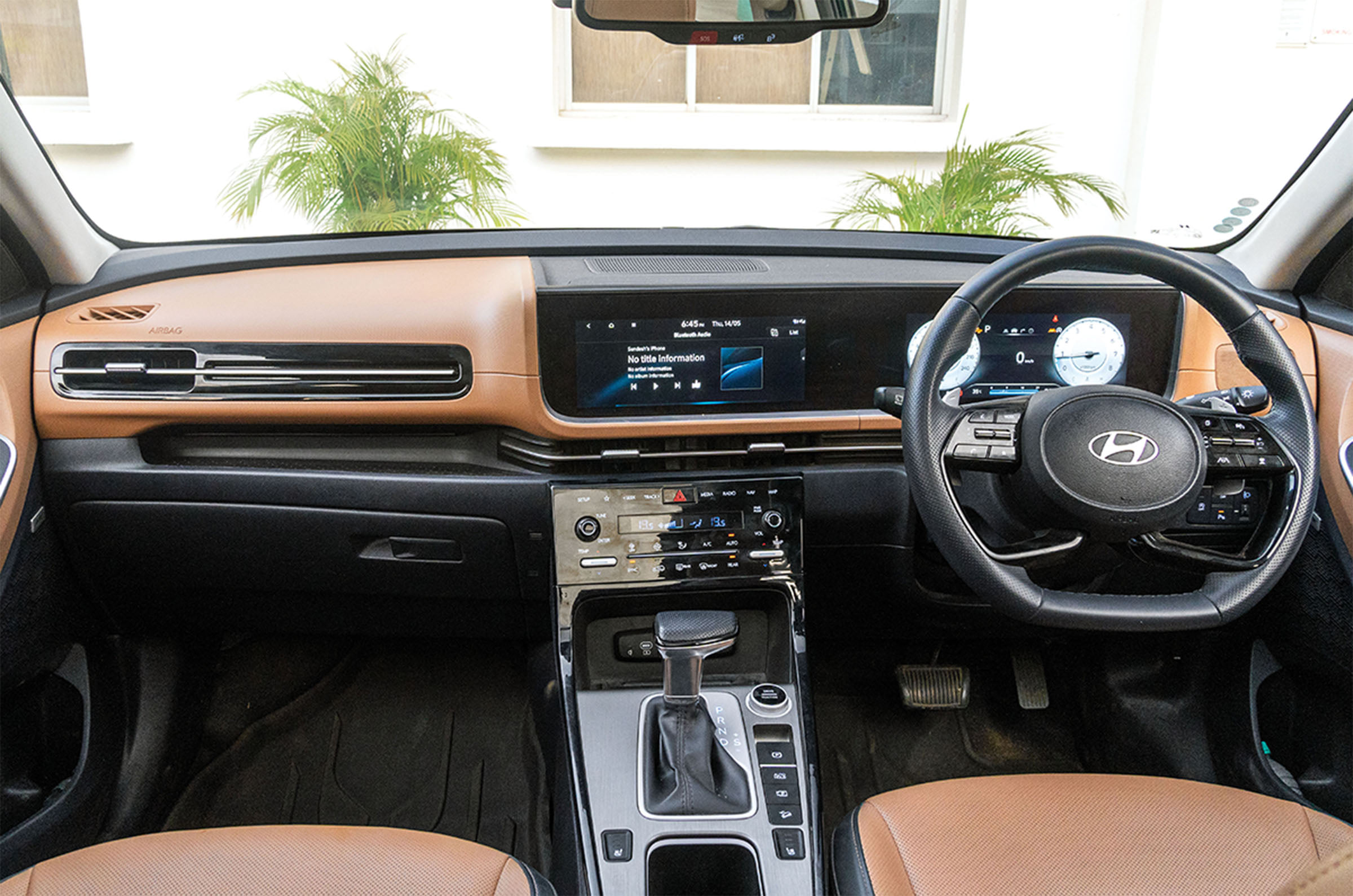
Design is simple yet ergonomic. Dark-coloured interiors help it look clean.
The Delhi-Mumbai Expressway is where this car was always going to shine, and it did. Long, arrow-straight sections let the 1.5-litre turbo-petrol settle into an easy cruise. At 100kph in top gear, the engine barely feels stressed, and wind noise is well contained for a car this size. We clocked long hours driving in a single day on the way back, stopping only for fuel and food, and nobody complained of fatigue by the end of it.
The DCT, which I’ve spoken of before, is jerky in bumper-to-bumper traffic, but was not an issue here. Once you’re past 40kph and holding a steady throttle, it’s smooth and quick to respond. It’s really only the crawl through Mumbai and Delhi outskirts where its low-speed hesitation showed up.
Large 18-inch wheels look stylish, but they don’t help the Alcazar’s ride quality.
The return leg we took had some patchy sections in Maharashtra, where the NE4 Expressway ends and connects to the old Golden Quadrilateral section of the highway. The Alcazar’s ride, tuned more for comfort on good surfaces, felt busy over broken patches. Nothing alarming, but the ride did feel slightly firmer than I expected from a car this size.
This stretch also penalised fuel efficiency. Loaded up with gear, four adults, and running the air conditioning at full blast through most of the drive, the trip computer settled at 12.8kmpl. That’s respectable for a heavy petrol SUV doing this kind of duty, but it’s definitely not the frugal numbers our diesel Alcazar managed, doing the same duty on the Kashmir-to-Kanyakumari run a few years back.
Ventilated driver and passenger seats are a boon on a hot, sunny afternoon.
A few other bits we did appreciate. The ventilated seats made the long hours of driving through the heat a lot more comfortable. The adaptive cruise control also was genuinely useful on the Expressway stretch, taking a lot of the fatigue out of long, straight sections. The absence of wireless Android Auto or Apple CarPlay was an irritant, as it meant connecting to the Infotainment using the cable and having a fully charged phone constantly plugged in for a long period of time.
Another observation on this trip: the plasticky bits on the dashboard picked up a fair bit of dust, especially with four people living out of the car for five days. To be honest, though, the camera crew kept the windows rolled down for a fair amount of time shooting. Thankfully, nothing a wipe down couldn’t fix.
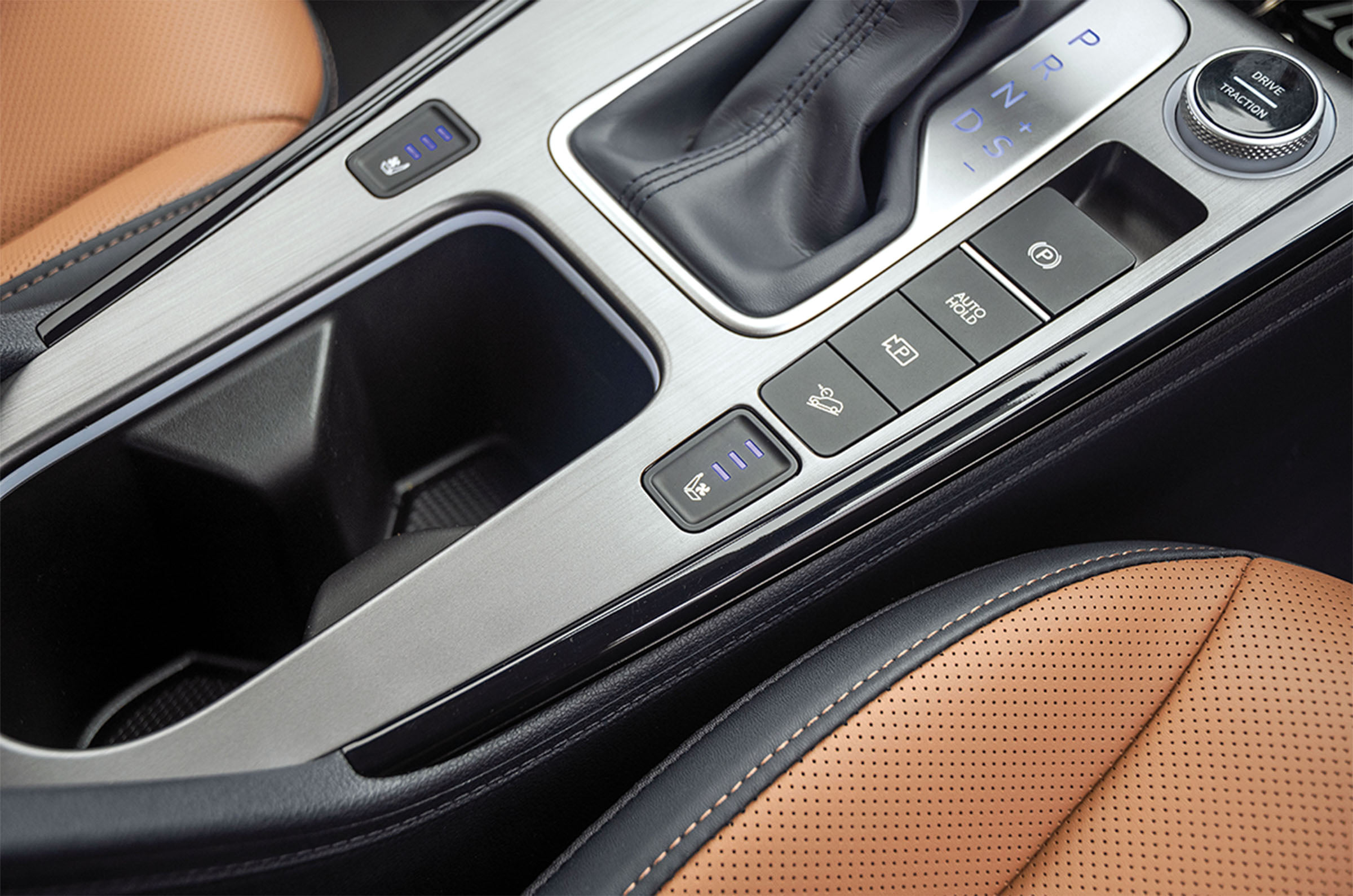
Type-A USB for smartphone interface needed. Type-C only works for charging.
At the end of it all, the Alcazar clocked close to 2,750km in five days absolutely fuss-free. No warning lights, no rattles that weren’t there before. It’s exactly the kind of trip that reminds you why a car like this earns its place in our long-term fleet. Not glamorous, not the fastest thing on the road, but dependable when you need it most. As it happens, this Mumbai-Delhi-Mumbai run turned out to be its last big assignment with us. With this report, our time with the Alcazar comes to a close, and it’s headed back to Hyundai. It leaves the fleet the same way it arrived, quietly capable, and it’s fitting that its final outing was spent doing what it always did best, hauling people and gear over long distances without a fuss.
Hyundai Alcazar Petrol DCT Signature 6-seater test data
The Mahindra Thar OG was launched in September 2026 and marks the second update to the 3-door SUV in just over a year. Along with the new ‘OG’ suffix, it gets a host of changes to the design, interior and under the skin, along with several new features. If you are considering adding the Thar OG to your garage, here are three reasons to buy it and two reasons why it may not be for you.
Pros
Off-roading capability
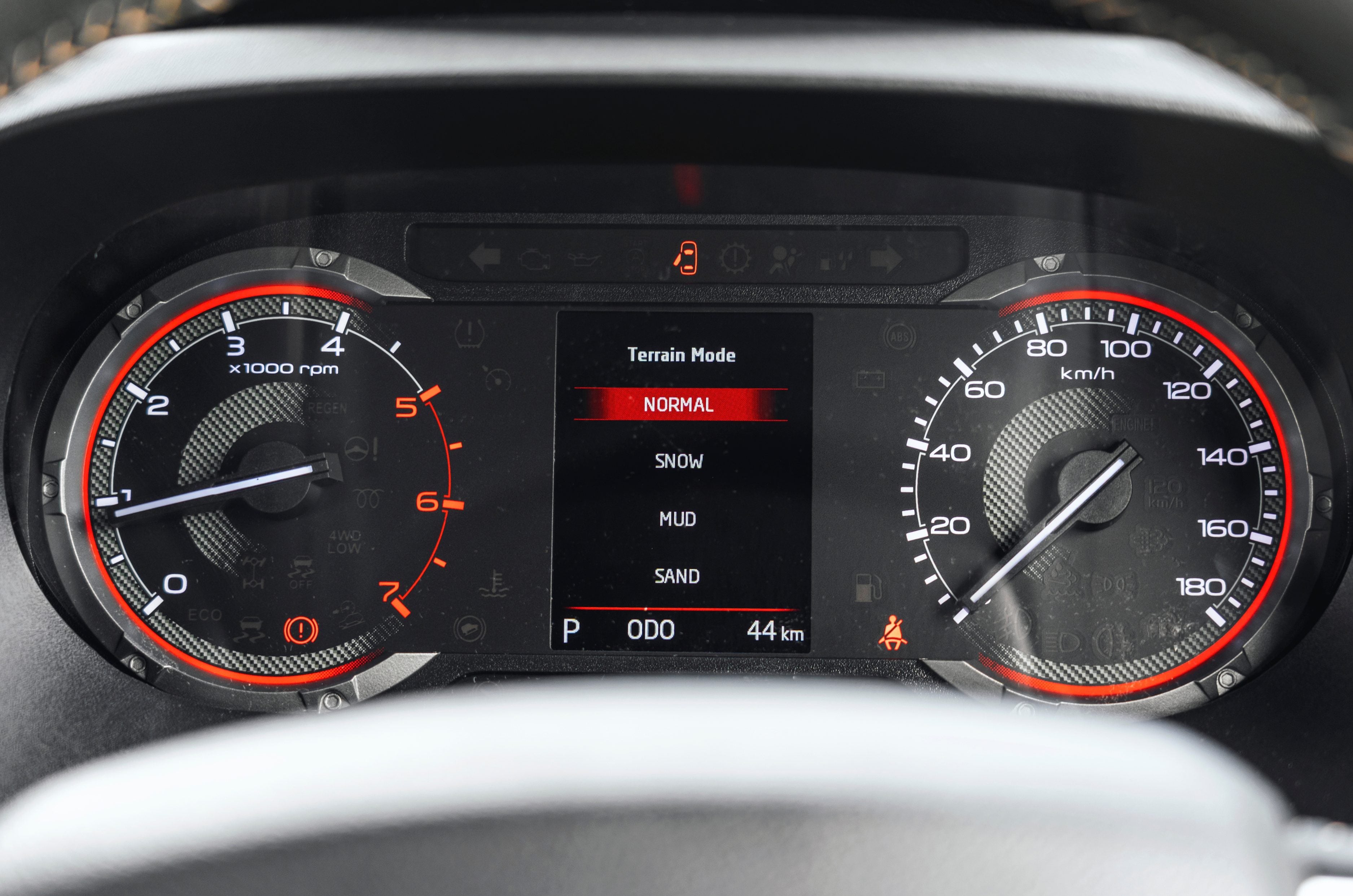
The Thar OG remains a hardcore body-on-frame SUV, and its off-roading ability has been further enhanced with new Snow, Sand and Mud terrain modes. These work with ESP, throttle control and steering input for maximum assistance while off-roading. The electronic locking differential is also more convenient to use. For someone who enjoys off-roading, there is nothing like the Thar OG under Rs 65 lakh.
Light steering
The Thar OG gets electric power steering (EPS) instead of the previously-on-offer hydraulically assisted unit, and as a result, much less effort is needed to steer and turn the Thar. Below 20kph, it’s light enough to turn with just one finger. As the speed increases, it gains heft so it does not feel uncomfortably light. As a result, you no longer need to wrangle with the steering to make a three-point turn.
Improved stability
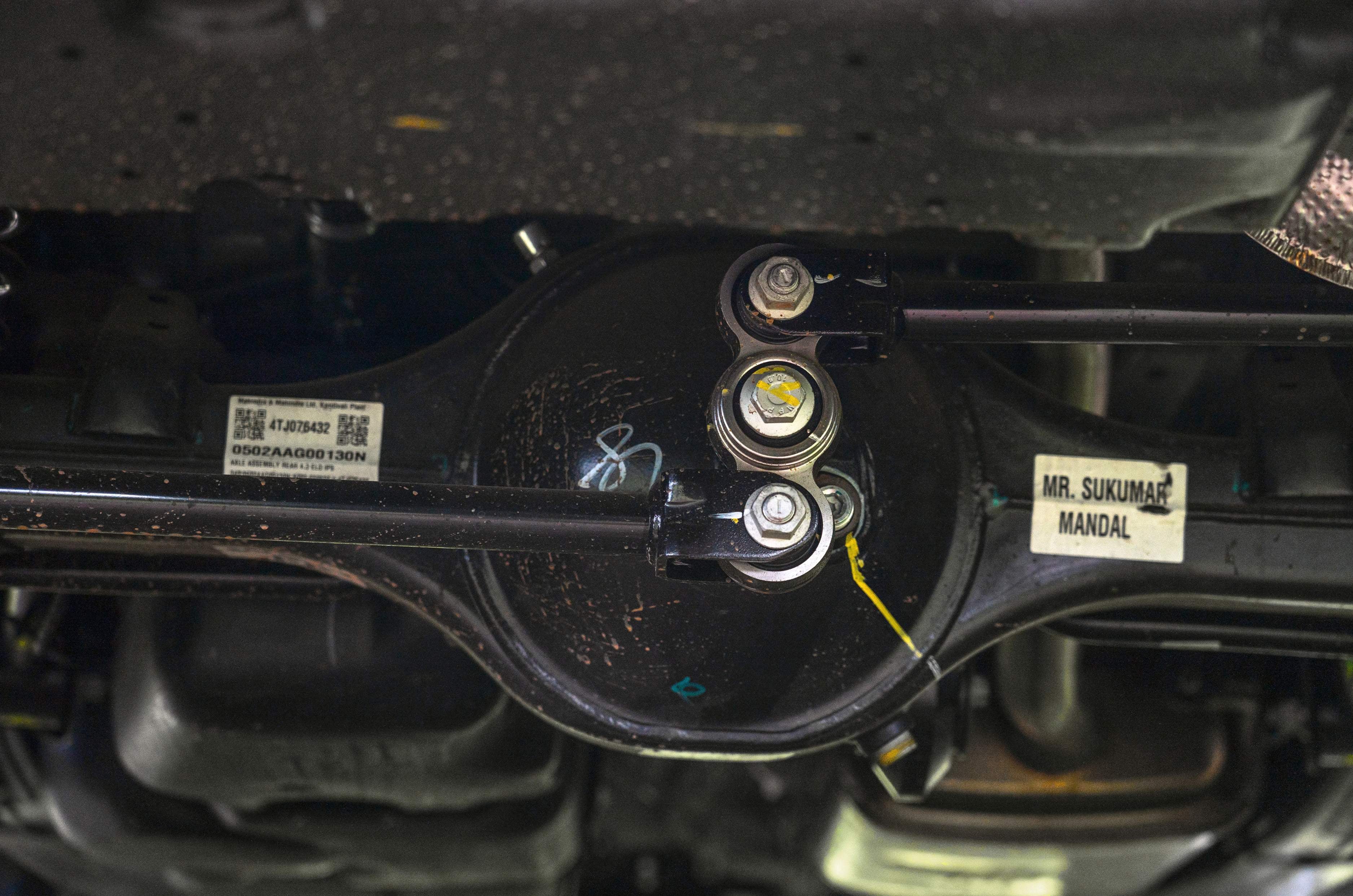
The Watts linkage at the rear adds stability by keeping the axle centred as it moves up and down. This means there is less bouncing over uneven highways and bad patches. The track has also been widened, which further improves stability, even at highway speeds.
Then there is the DaVinci damping setup. Sharp, low-speed bumps no longer send harsh thuds into the cabin. To improve comfort with the larger 19-inch wheels, the ZXT trim also gets frequency-dependent dampers alongside the DaVinci setup.
Cons
Lack of space
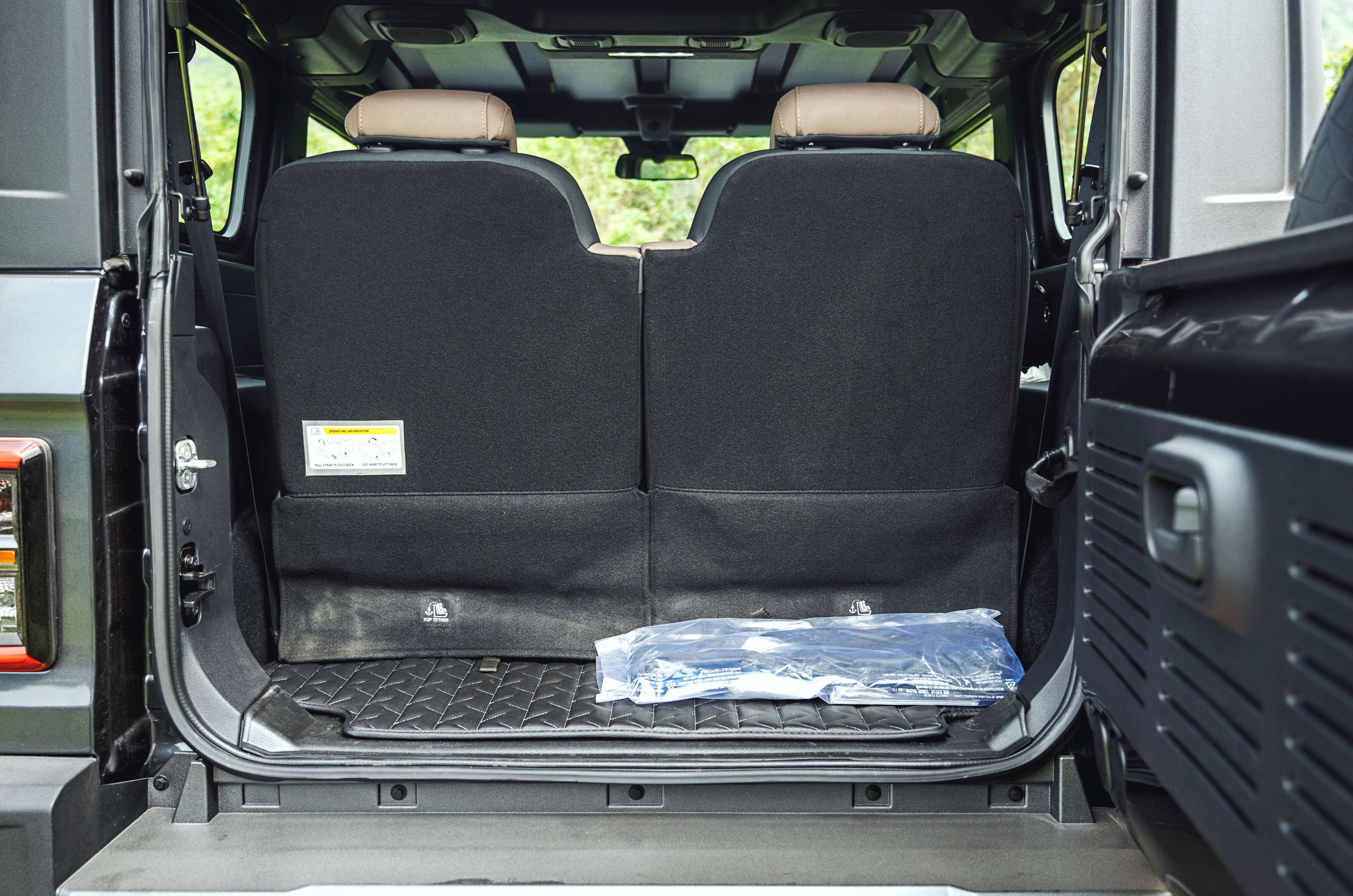
The Thar’s cabin remains short on space, especially at the rear. It continues to be a strict two-seater at the back. Accessing the rear seats could also be difficult for older adults. Boot space is a weak point as well, with barely enough room for an airport run. Carrying large suitcases will require folding down the rear seats.
Interior plastic quality
Unlike the soft-touch materials used in the Thar Roxx’s cabin which give it a more premium feel, the Thar OG’s hard plastics feel low rent. This becomes more noticeable when compared with rivals in the same price bracket. At the time of writing, the Thar OG is priced between Rs 10.32 lakh and Rs 17.75 lakh, ex-showroom.
Not too long after a significant update, Mahindra has given the Thar yet another shot in the arm. The Thar OG now gets a whole new set of upgrades to the design, interior and, mainly, under the skin. A new suspension, new steering and added features are all part of the aim to make it more liveable and urban-friendly while retaining the Thar’s butch and bullyish character. Have they succeeded?
Mahindra Thar OG exterior design and engineering – 9/10
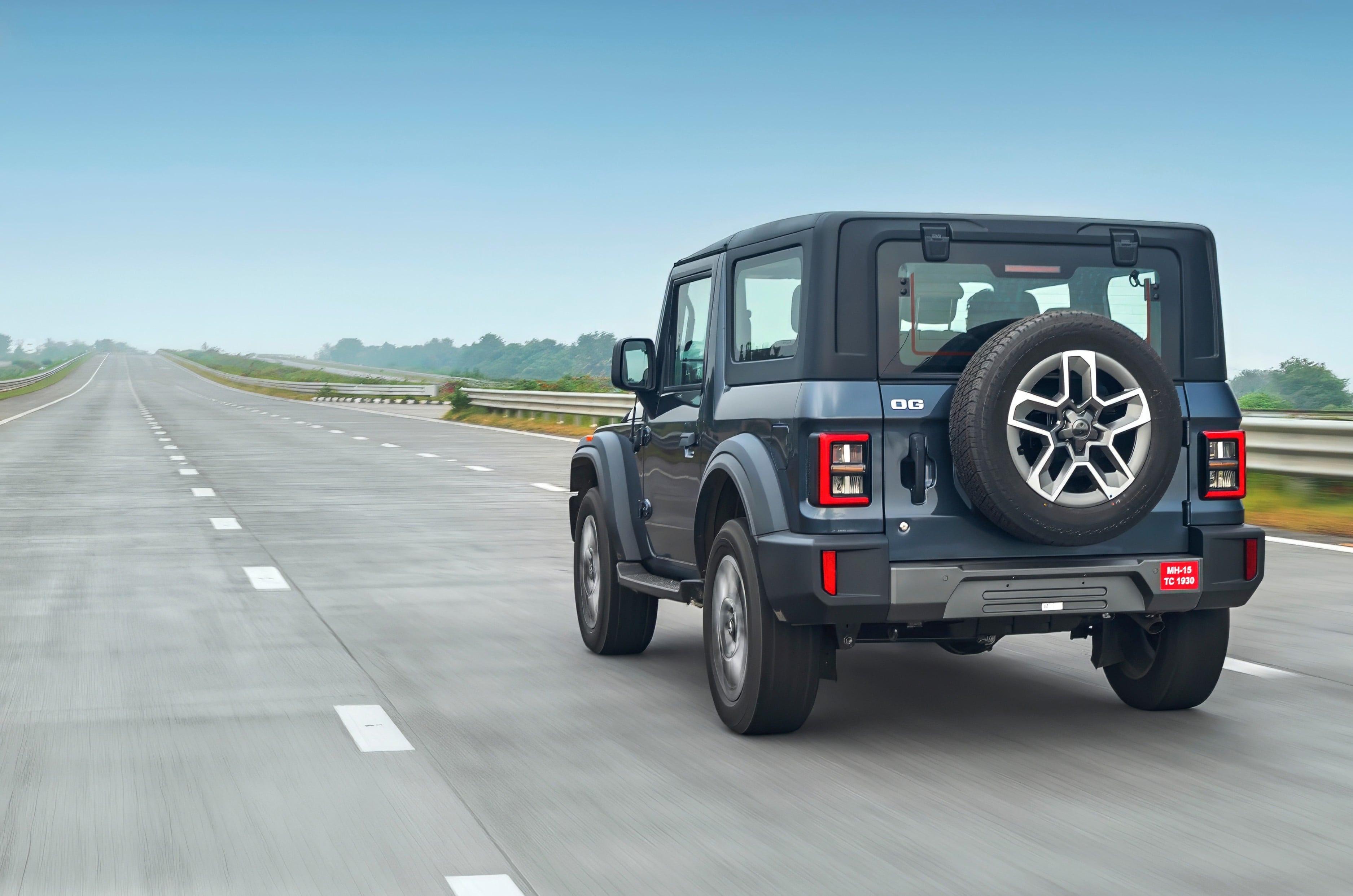
Design updates have retained the classic Thar look and road presence.
The design is why the Thar stands out, so Mahindra has not done much to change its character. However, it now gets some modern touches. At the front, the halogens are replaced with LED headlamps with C-shaped LED DRLs, along with LED fog lamps. The grille has been redesigned, with the Thar logo forged into it, and so has the front bumper. Look closer, and you will also see front parking sensors now, while the track has been widened for more stability.
19-inch alloy wheels with AT tyres add to the toughness.
What you don’t see is the new platform the Thar sits on. The OG is now based on the Gen 4 chassis, dubbed M-Glyde, which also serves the Roxx. The side profile flaunts new 19-inch wheels with AT tyres, the Thar OG badge and a new design for the cladding.
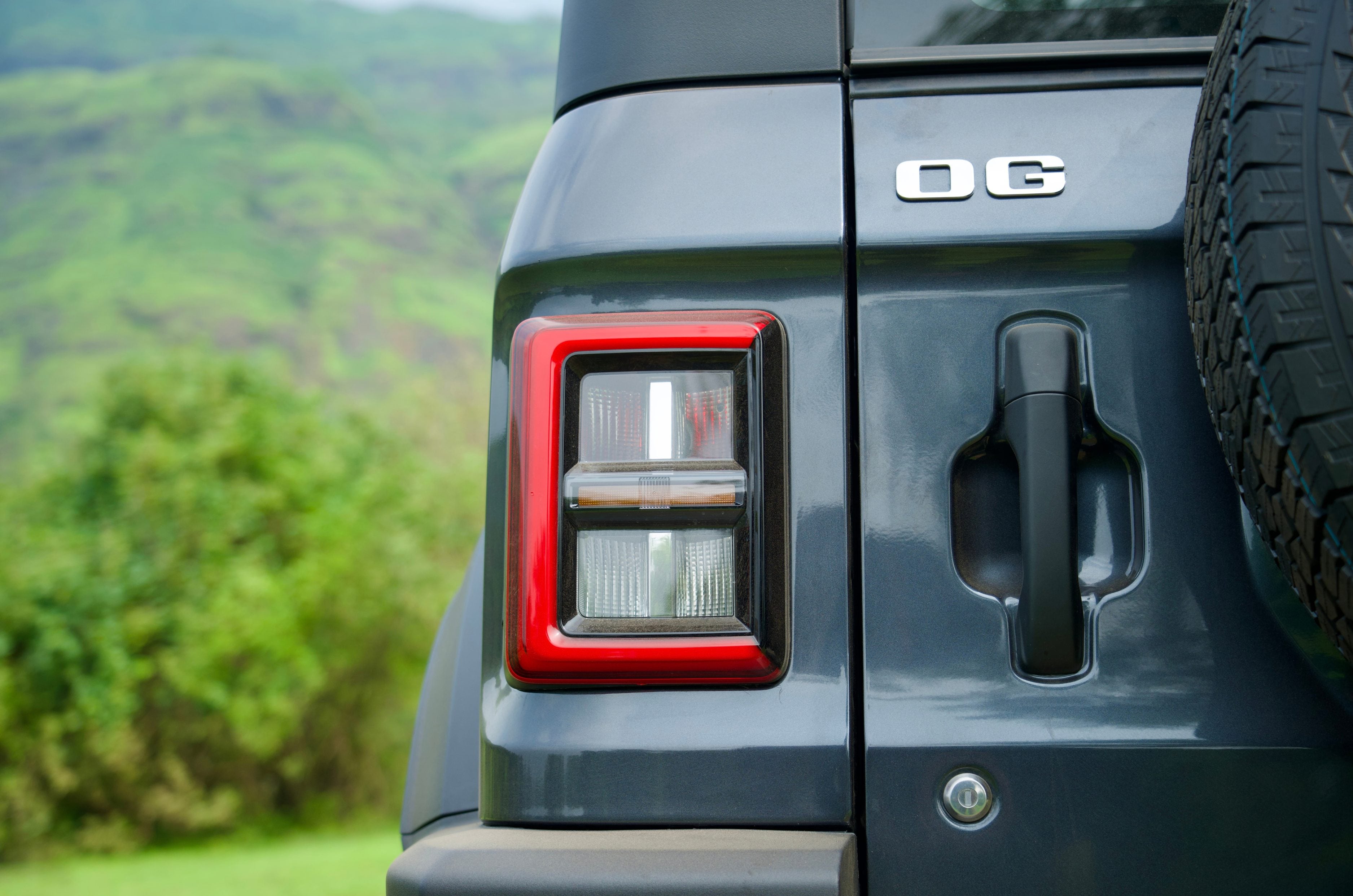
LED taillamps are similar to the Thar Roxx.
The rear continues with the LED treatment, with C-shaped taillamps, a new bumper and another OG logo. A closer look reveals a rear camera in the centre of the spare wheel.
The reversing camera is tucked in the centre of the spare wheel.
Overall, the imposing, butch design remains, with new modern touches.
Mahindra Thar OG interior space and comfort – 6/10
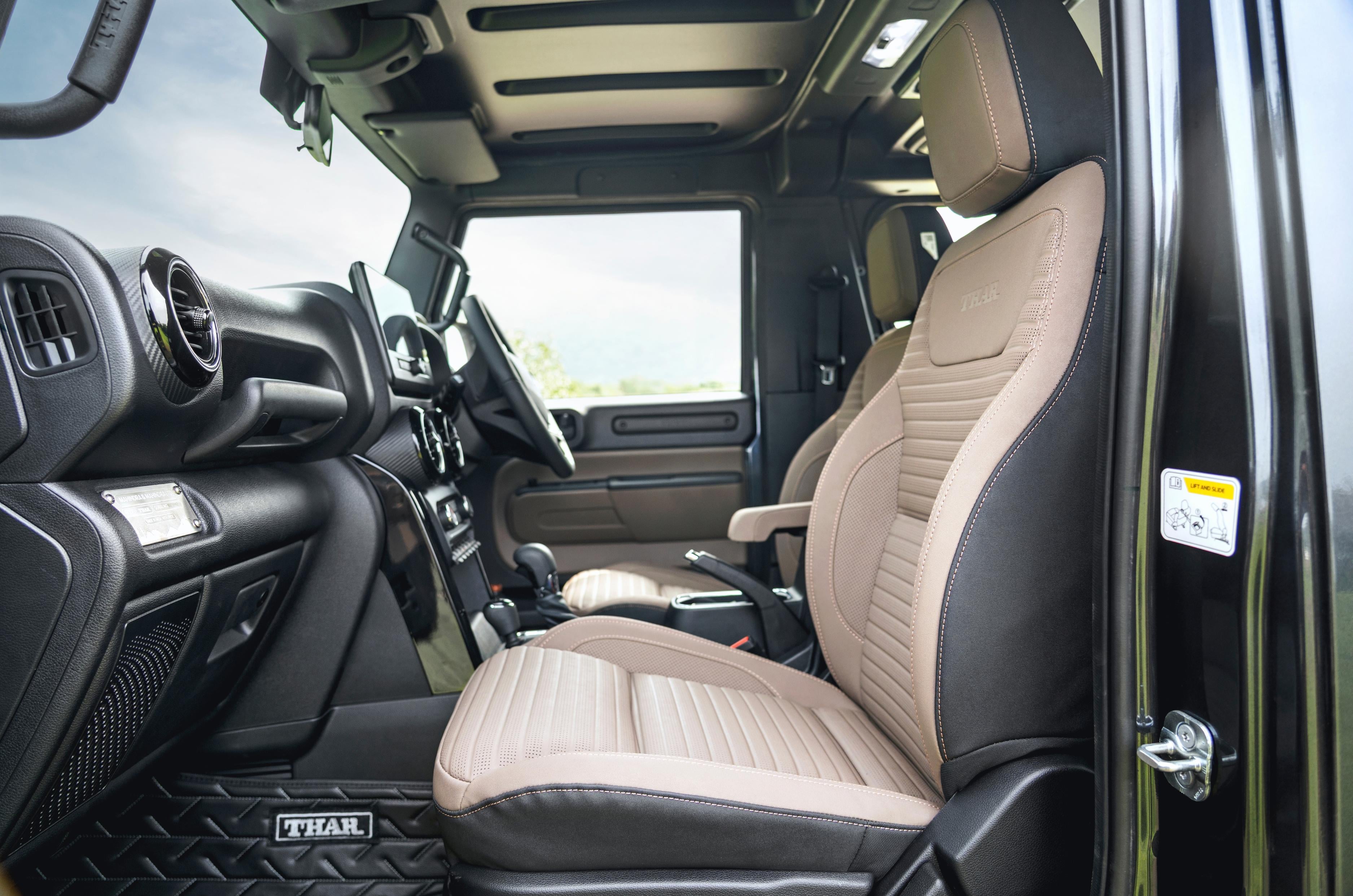
Top-spec ZXT trim gets leatherette upholstery in a new shade.
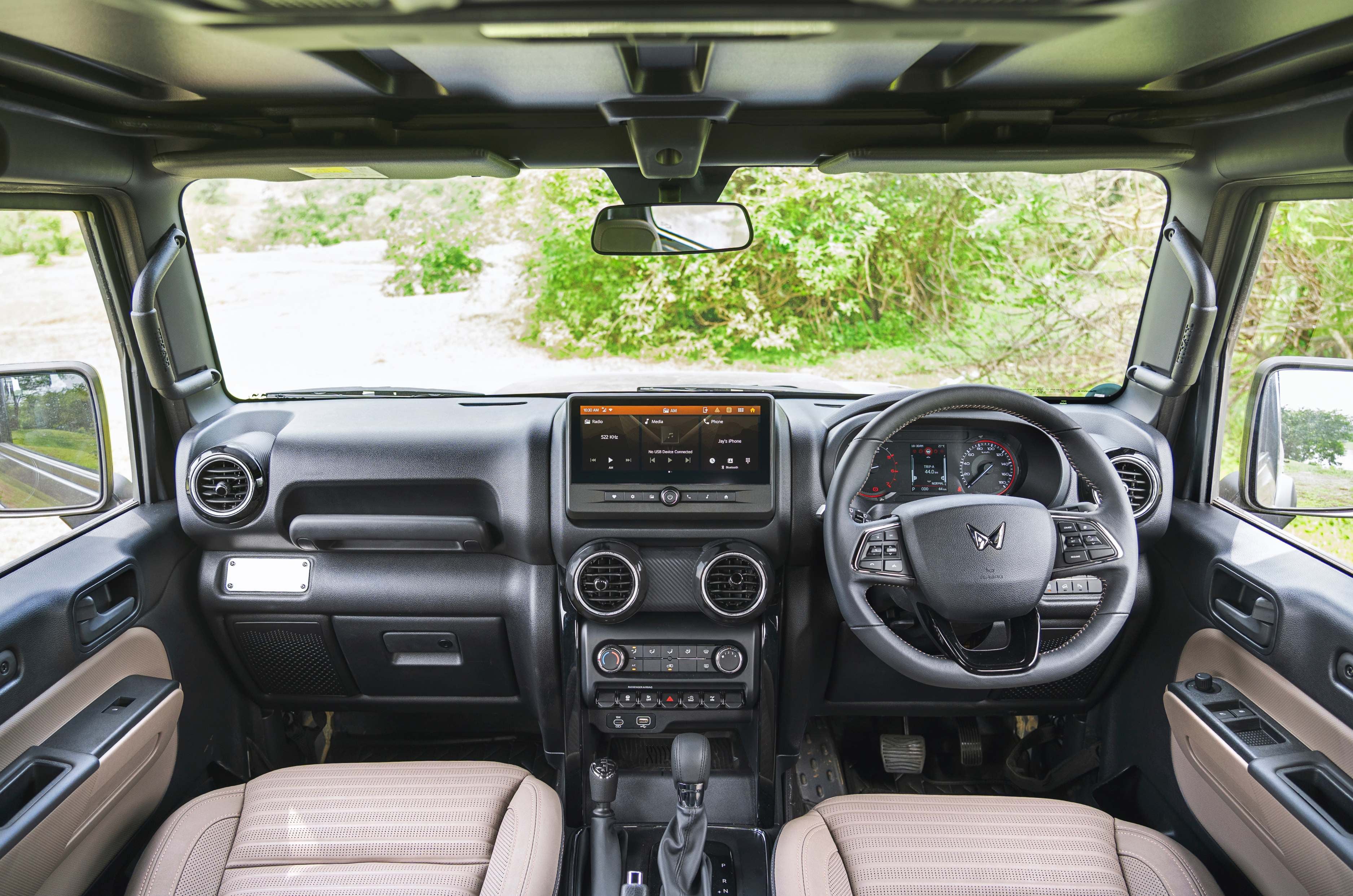
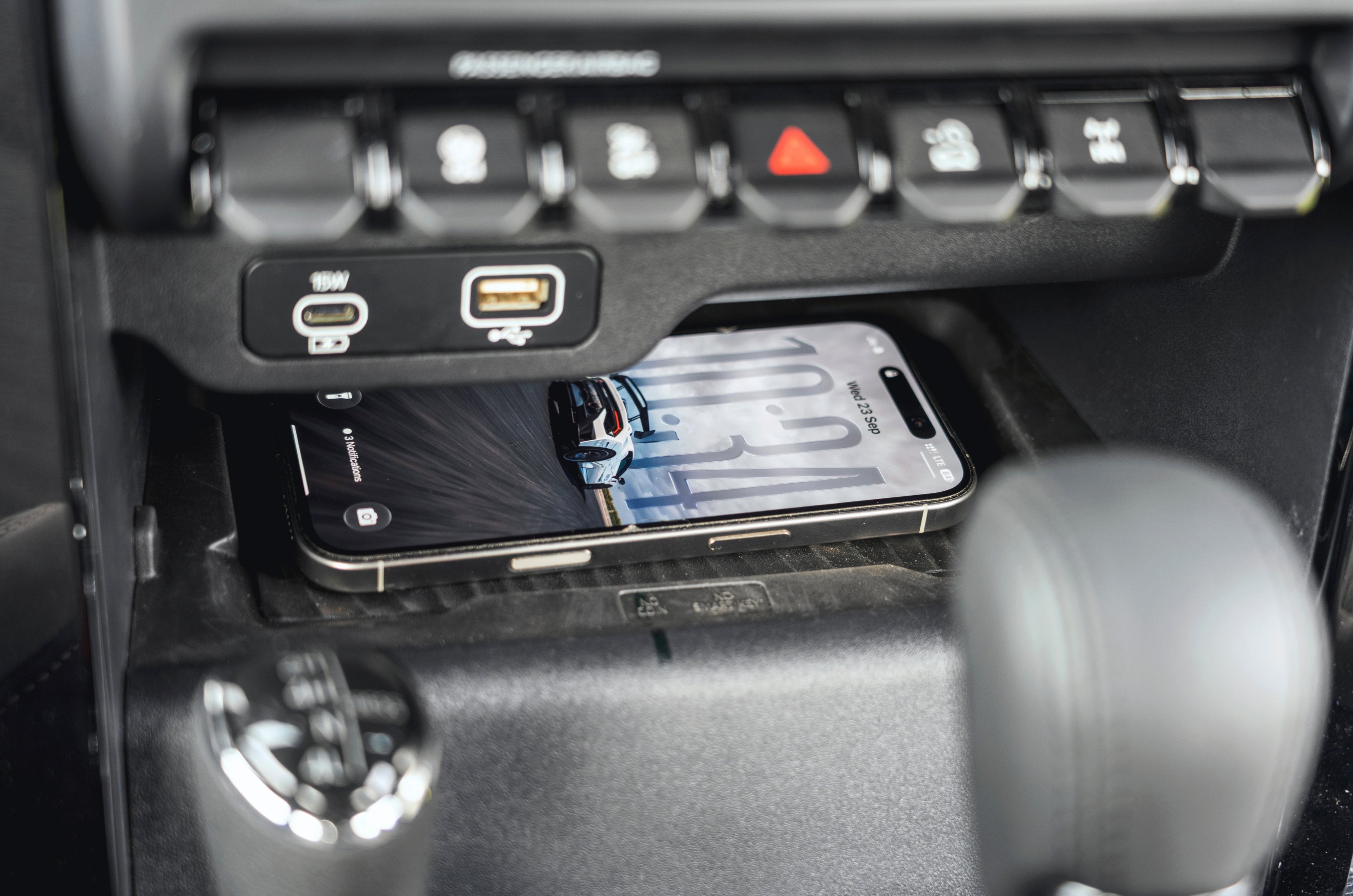
Compared to the exterior, the changes on the inside are a lot more subtle. The new top-spec ZXT trim gets leatherette upholstery finished in a shade of brown, which looks premium with the exposed stitching. There is a new wireless charger and two new switches on the centre console: one for the terrain modes and the other to engage the electronic locking differential.
Gets a new wireless phone charger and different switchgear.
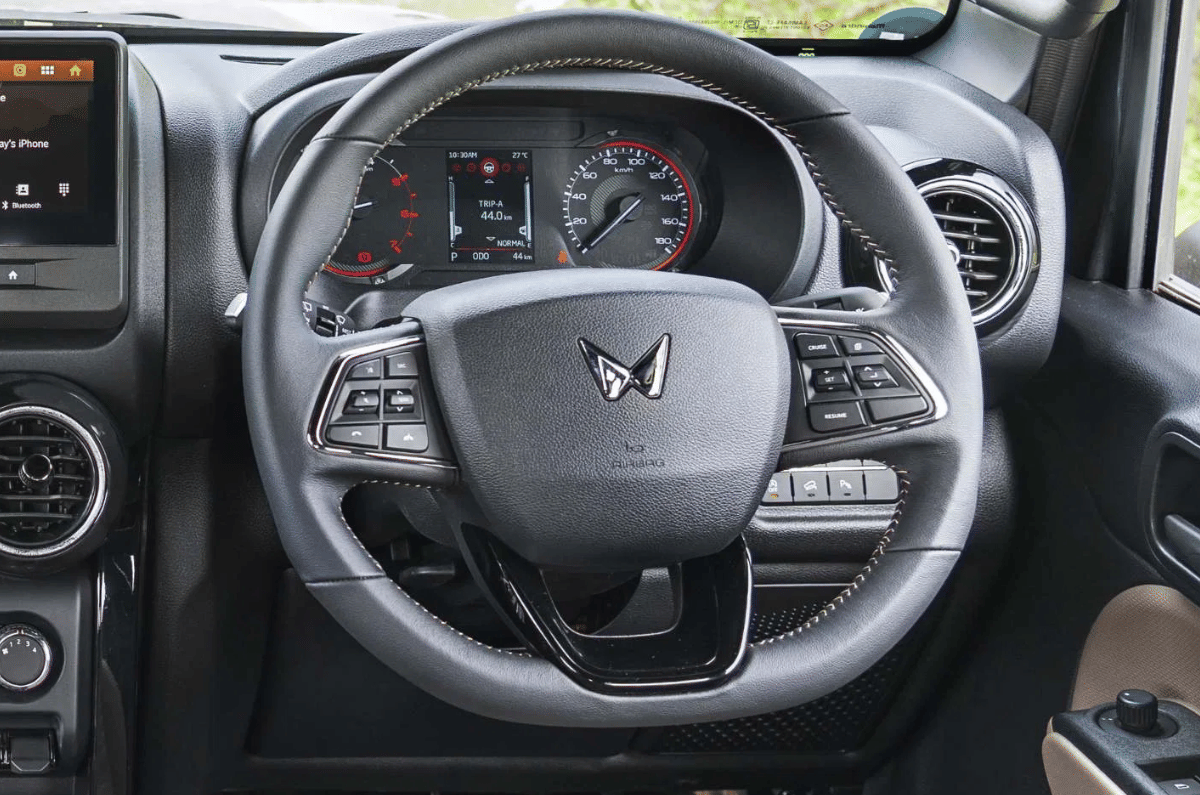
The Thar received a facelift around a year ago, when the cabin was brought up to date with a new steering wheel, touchscreen and dashboard, and these features have been carried over to the OG. The seats are broad and comfy but miss out on ventilation. The two dummy buttons on the centre console will hopefully be used for this feature soon.
Dashboard design is unchanged from the 2025 facelift.
The steering wheel is also the same as before, as is the analogue instrument cluster with an MID in the centre. The plastics, however, feel low-rent, especially when you consider the rivals in the same price bracket.
Just enough room in the rear seat; gets AC vents now.
At the rear, space remains as it was, and it is exclusively a two-seater. However, the addition of AC vents, a USB-C port and soft-plastic armrests with cupholders has enhanced comfort. The backrest can recline, and short drives should be easy once you settle in.
Boot space is still not adequate for long trips or airport runs without folding the second row.
The boot space remains a weak point too, with barely any room for an airport run. Large suitcases will require folding down the second row.
Mahindra Thar OG features and safety – 7/10
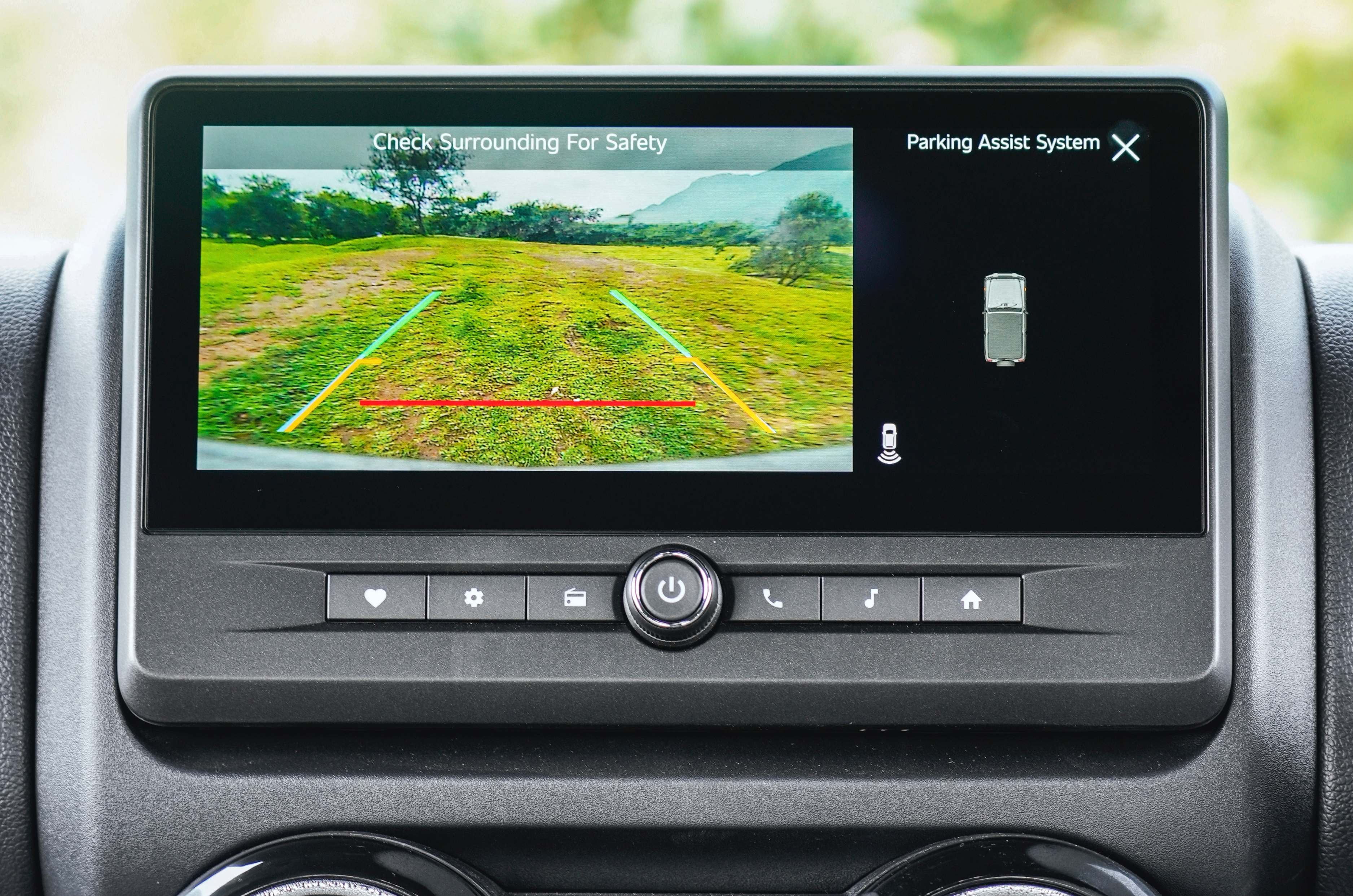
Not the best clarity and misses a 360-degree view, which is essential for off-roading.
The Thar OG isn’t on par with rival mid-size SUVs but does get the essentials this time around. There are grab handles, manual AC controls, a USB-A port for Apple CarPlay since it isn’t wireless, and a USB-C port for charging. Android Auto gets wireless connectivity.
Crucially, the ZXT trim gets six airbags now, with the launch of the new HPTS airbags, which stand for Head, Pelvis, Thorax and Shoulder. There are front parking sensors with a reversing camera now, although, given the Thar’s off-road bias, a 360-degree camera would have been a lot more useful. The ESP also gets a retune for better response, and then there are the big mechanical updates under the skin.
Mahindra Thar OG performance and refinement – 8/10
The bump in power and torque makes it better at highway cruising.
Powering the Thar OG is the same powertrain lineup as before, but with a bump in power and torque for the turbo-petrol engine and the bigger diesel. We had the 2.2-litre diesel engine on test with the six-speed automatic gearbox. The engine now produces 152hp and 330Nm, which is 18hp and 30Nm more than the outgoing unit.
To be honest, the jump in performance is not evident initially, as Mahindra engines have always had a good off-the-line response. Where the power comes in is in the second half of the rev band. Highway cruising at triple-digit speeds is a bit more effortless now, but you wouldn’t enjoy rushing the Thar. Sedate cruising is what it does best.
Highway stability is better now, but over an uneven stretch it still tosses you around.
What Mahindra has also improved is NVH, and the cabin is a bit more muted now. You still hear the diesel drone past 2,500rpm, but overall sound damping has been improved.
The gearbox, too, likes to pace itself, and quick overtakes come at the cost of engine noise. The shifts are smooth but relaxed, and even in manual mode, you don’t get much better response. Enthusiastic driving is not something the Thar enjoys, contrary to the infamous videos circulating online.
Mahindra Thar OG ride comfort and handling – 7/10
Rear pentalink suspension with Watts linkage for added stability and comfort.
The biggest advances to the Thar OG have taken place under the body. The stiffer Gen 4 chassis is paired with a new Pentalink suspension at the rear, with a Watts linkage and DAVINCI dampers. Frequency-dependent damping, however, is only available on the top-spec trim. But has that improved the Thar on the road? The simple answer is yes.
The Watts linkage is responsible for adding stability at the rear. Imagine you’re pushing a shopping trolley. If one wheel suddenly moves sideways while you hit a bump, the trolley gets wobbly. The Watts linkage basically tells the axle: “You can go up and down, but please stay in the middle.” The effect is less bouncing over uneven highways and bad patches.
The electronic locking differential is now convenient to use, making the Thar just as capable as before.
Then there is the DAVINCI damping that was seen on the XUV 7XO. The thuds coming from sharp, low-speed bumps are now not as harsh and, while it will still toss you around, if you hit a bad bump, it won’t unsettle the car. To add even more comfort with the bigger 19-inch wheels, the ZXT trim also gets frequency-dependent dampers along with the DAVINCI setup. Over a rough patch, you can tell they are working full-time to keep the cabin unfazed.
New gen 4 platform seen on the Roxx now underpins the 3-door Thar.
Now, as sophisticated as all of this is, the Thar OG is still a hardcore body-on-frame SUV at the end of the day. The new tech has certainly improved its on-road manners, but if you want a plush, supple ride, the Thar won’t cut it. A long drive will now be more comfortable, but you will still get knocked awake from your snooze.
Terrain modes work with ESP, throttle control and steering input for maximum assistance while off-roading.
The new EPS, however, has made a huge difference. The amount of effort needed to steer and turn the Thar is no longer a game of might. Under 20kph, the steering is light enough to twirl with just one finger, but as the speed rises, it gains heft so as not to feel uncomfortably light at speed. So, there is no need to wrangle with the steering to make a three-point turn anymore.
Also new and exclusive to the ZXT trim are rear disc brakes, which have added to the stopping power. The bite is stronger, and the Thar feels a lot more confident when slowing down now.
Mahindra Thar OG price and verdict – 8/10
The Thar OG is improved in all areas without sacrificing its character.
With a starting price of Rs 10.32 lakh, the Thar OG is rather tempting. However, for most of the new bells and whistles, you will have to opt for the top-spec ZXT trim, which starts at Rs 13.99 lakh for the 1.5-litre engine with RWD. The diesel-AT version we drove will set you back Rs 18.99 lakh, so you need to be sure of what you want. The Thar OG is mighty capable, has a lot of character and is a lot better in every area than before. But as an everyday car, you’d still want some more practicality, creature comforts and refinement. However, if you are someone who likes to off-road or even just take the long way home with little regard for plushness, there is nothing like the Thar OG under Rs 65 lakh.
पश्चिम बंगाल में चल रहे मदरसों को लेकर राज्य सरकार ने बड़ा फैसला किया है। मुख्यमंत्री सुवेंदु अधिकारी की अध्यक्षता में हुई कैबिनेट बैठक में सरकारी से मान्यता प्राप्त 250 प्राइवेट मदरसों को धीरे-धीरे बंद करने का फैसला किया गया है।
मामले से जुड़े एक अधिकारी ने बताया कि इनमें से ज्यादातर में पढ़ने वाले छात्रों की संख्या बहुत कम या नामात्र की है और बुनियादी ढांचा भी पर्याप्त नहीं है। बताया जा रहा है कि इन मदरसों में वर्तमान में जो छात्र एनरोल हैं, उनके लिए दिसंबर तक कक्षाएं जारी रहेंगी। इसके बाद इन्हें बंद कर दिया जाएगा।
1.51 लाख भर्ती प्रस्ताव को मिली मंजूरी
बुधवार को कैबिनेट बैठक में अलग-अलग सरकारी विभागों में लगभग 1.51 लाख लोगों की भर्ती के प्रस्ताव को भी मंजूरी दे दी गई। इसमें पश्चिम बंगाल पुलिस के लिए 12,000 और कोलकाता पुलिस के लिए 4,000 लोग शामिल हैं।
दुर्गा पूजा से से पहले रिपोर्ट मिलने की उम्मीद
अधिकारी ने कहा, “कैबिनेट ने 250 प्राइवेट मदरसों को बंद करने का फैसला किया, जिनमें सही इंफ्रास्ट्रक्चर की कमी है और छात्रों की संख्या बहुत कम है। उन्हें दिसंबर तक काम करने दिया जाएगा।” अधिकारी ने कहा कि इन संस्थानों से रिपोर्ट दुर्गा पूजा उत्सव से पहले मिलने की उम्मीद है। इसके बाद जरूरी प्रशासनिक कार्यवाही की जाएगी।
सरकार पहले बंद कर चुकी है 252 बिना इजाजत वाले मदरसे
यह कदम राज्य सरकार के 252 बिना इजाजत वाले मदरसों को बंद करने और करीब 100 दूसरे मदरसों को कारण बताओ नोटिस भेजने के कुछ दिनों बाद आया है। राज्य भर में हुए एक सर्वे में पाया गया था कि ऐसे कई संस्थानों के पास जरूरी मंजूरी और बुनियादी ढांचा की कमी थी।
अलग-अलग चरणों में बंद हो सकते हैं 2500 मदरसे
अधिकारी ने कहा कि अलग-अलग चरण में राज्य भर में बिना सरकारी पंजीकरण के चल रहे करीब 2,500 मदरसे भी बंद हो सकते हैं। उन्होंने कहा कि कैबिनेट ने कथित गड़बड़ियों को लेकर 100 दूसरे मदरसों को कारण बताओ नोटिस जारी करने की भी मंजूरी दे दी है।
सभी विभागों में भर्ती में तेजी लाना चाहती है सरकार
राज्य में मंजूर की गई भर्तियों पर वरिष्ठ अधिकारी ने कहा, “सरकार सभी विभागों में भर्ती में तेजी लाना चाहती है और खाली जगहों को भरना चाहती है ताकि सार्वजनिक सेवा पर असर न पड़े। संबंधित विभागों को भर्ती प्रक्रिया में रुकावट डालने वाले मुद्दों को सुलझाने के लिए कहा गया है।”
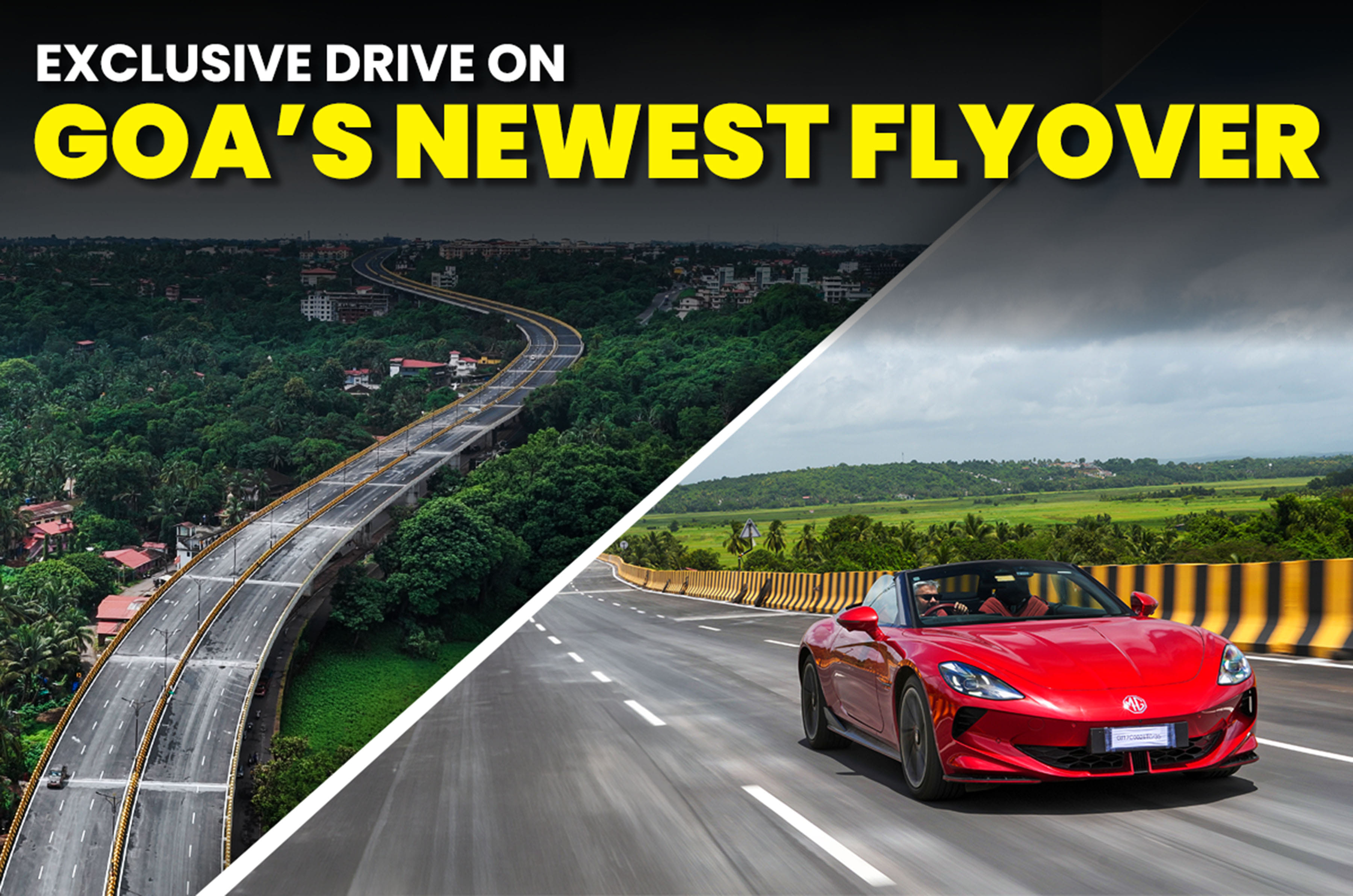
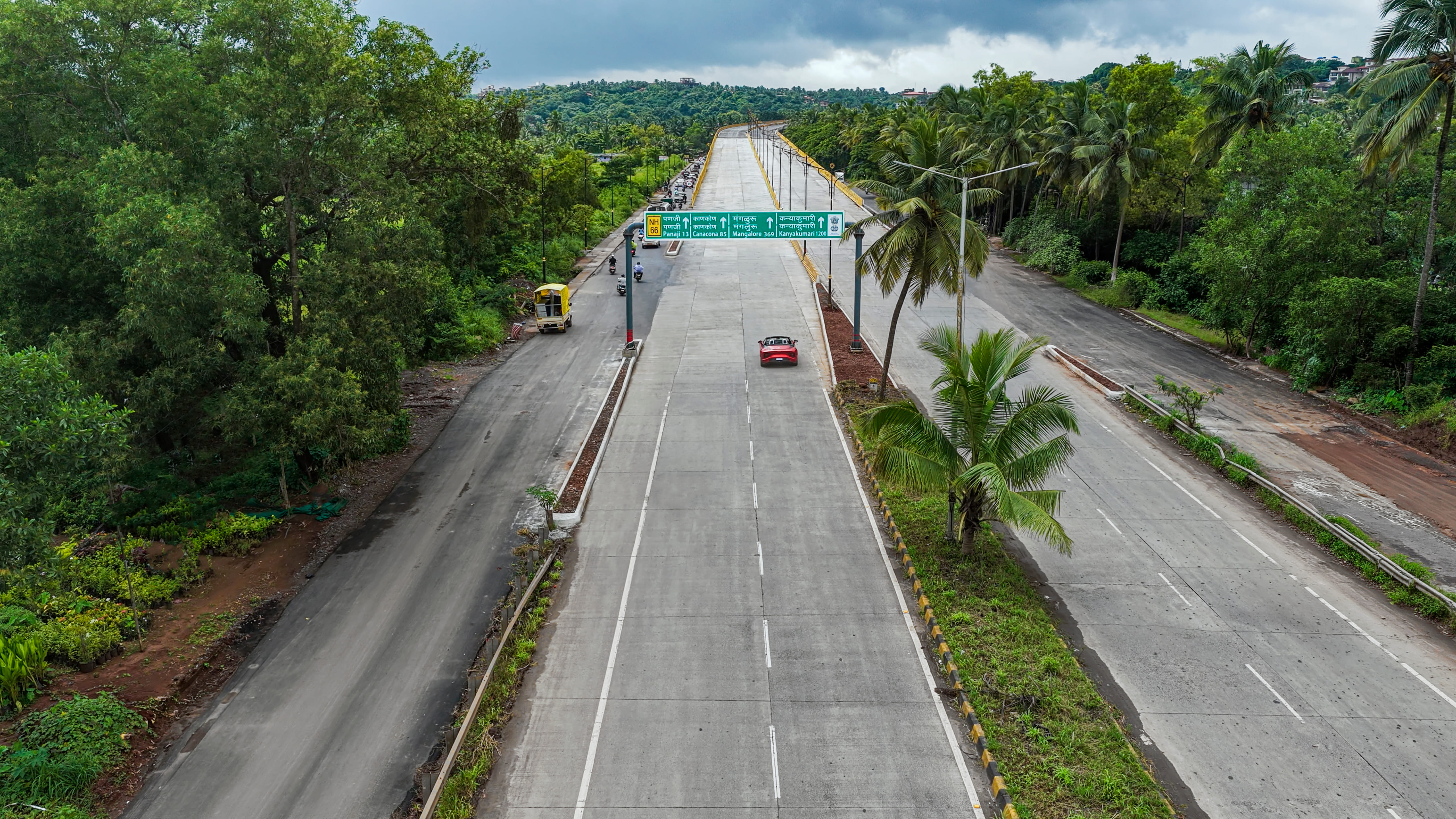
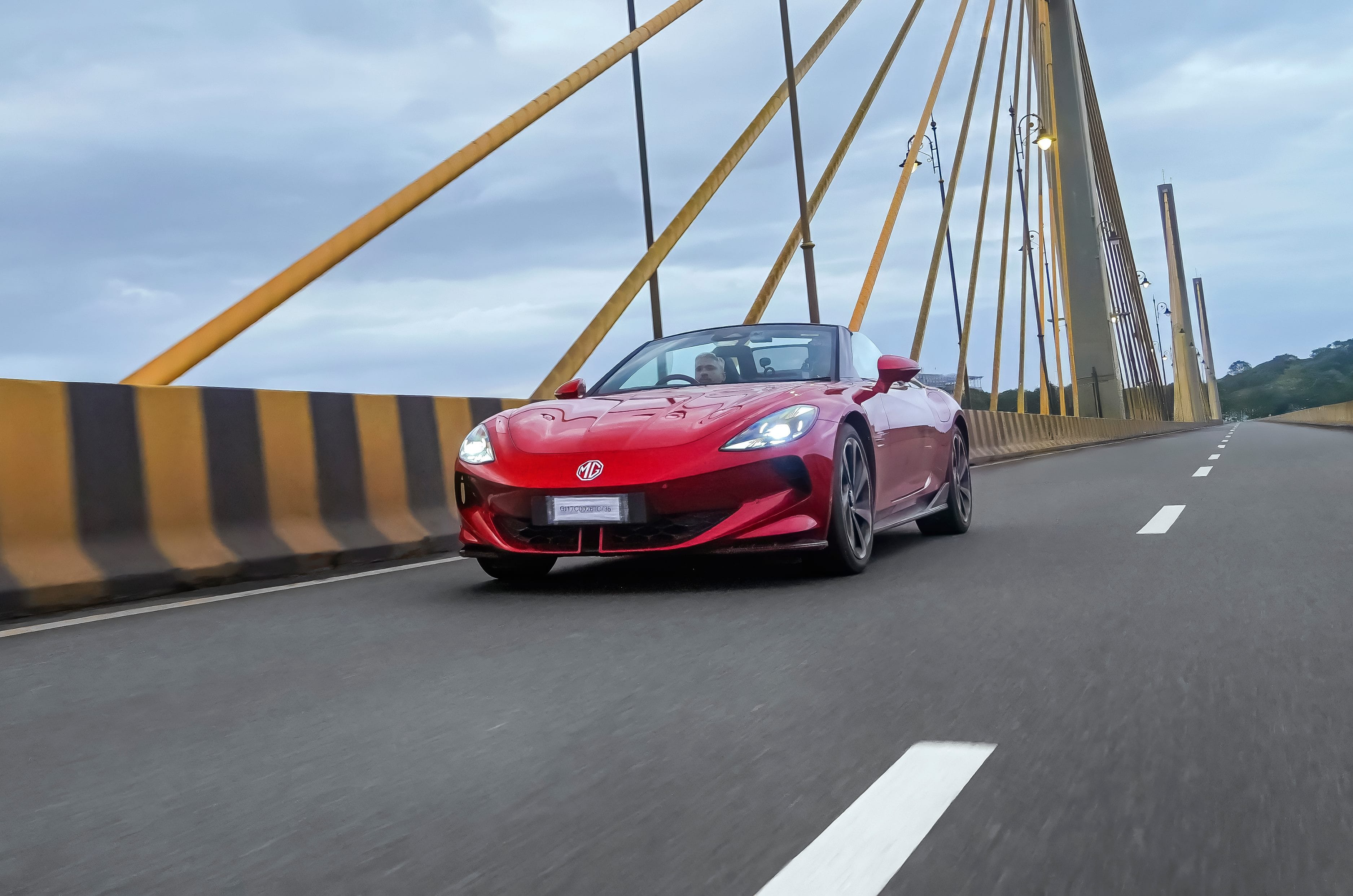
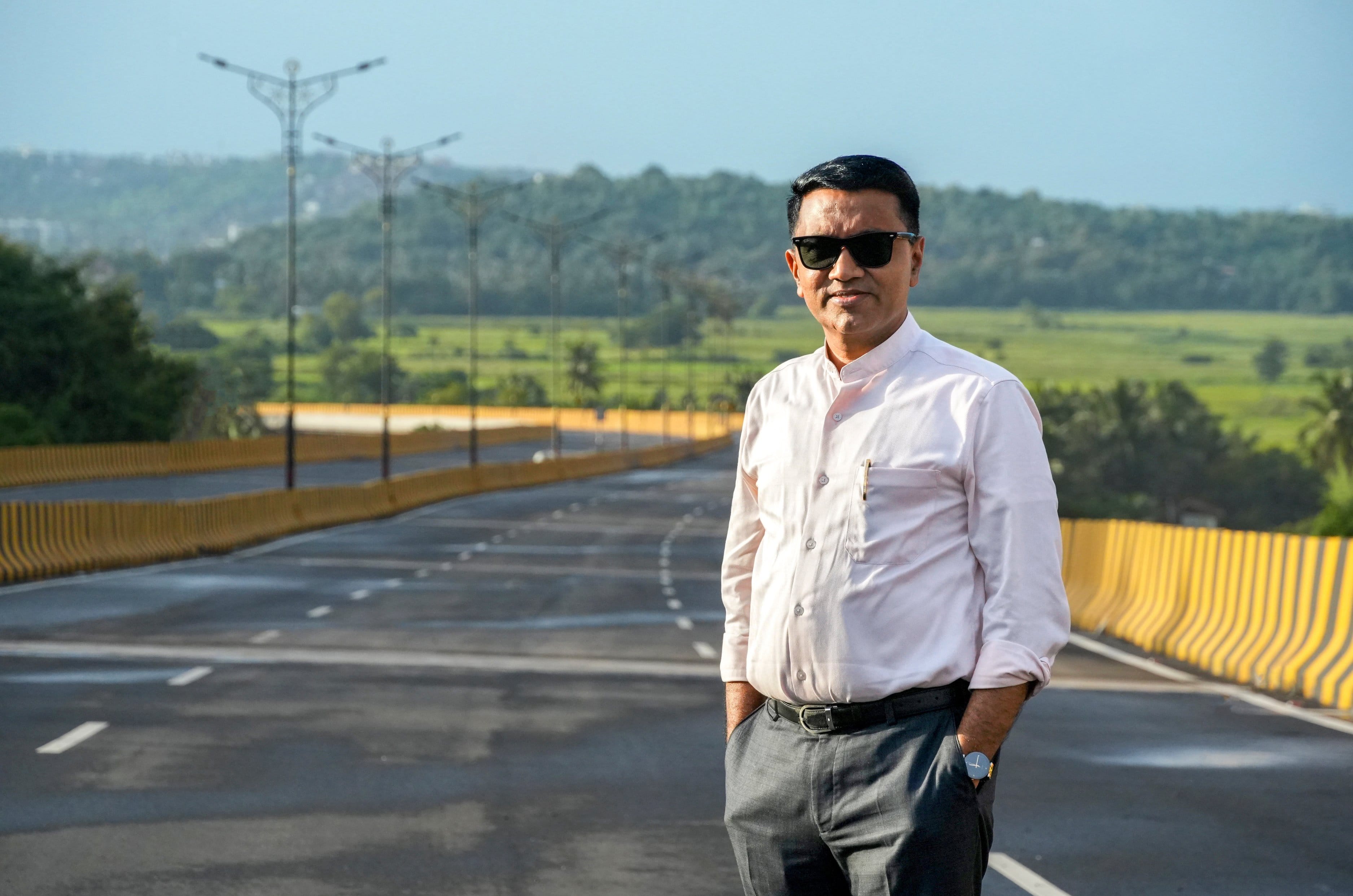
If a holiday in Goa is a fixture on your calendar, you will have noticed that the state has changed a fair bit in the last few years. There is a new airport to fly into, new bridges replacing the old, not to mention the wider highways. The latest upgrade to the state’s road network is the Porvorim Elevated Corridor, targeting a major bottleneck on NH66. We were given an exclusive opportunity to experience it for ourselves before the official inauguration on Sep 9, and we brought along a very ‘Goa’ car for the occasion – the MG Cyberster.
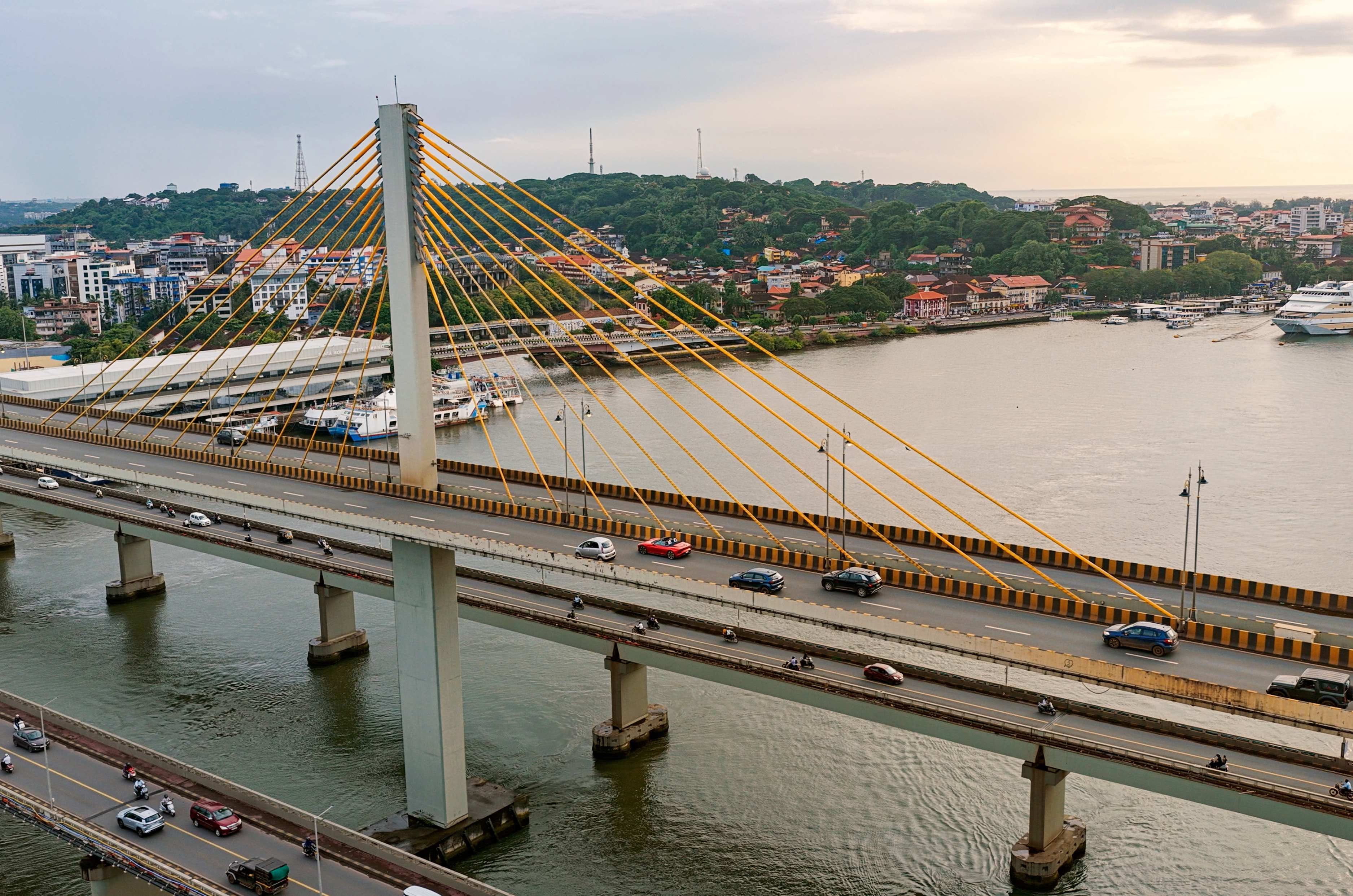
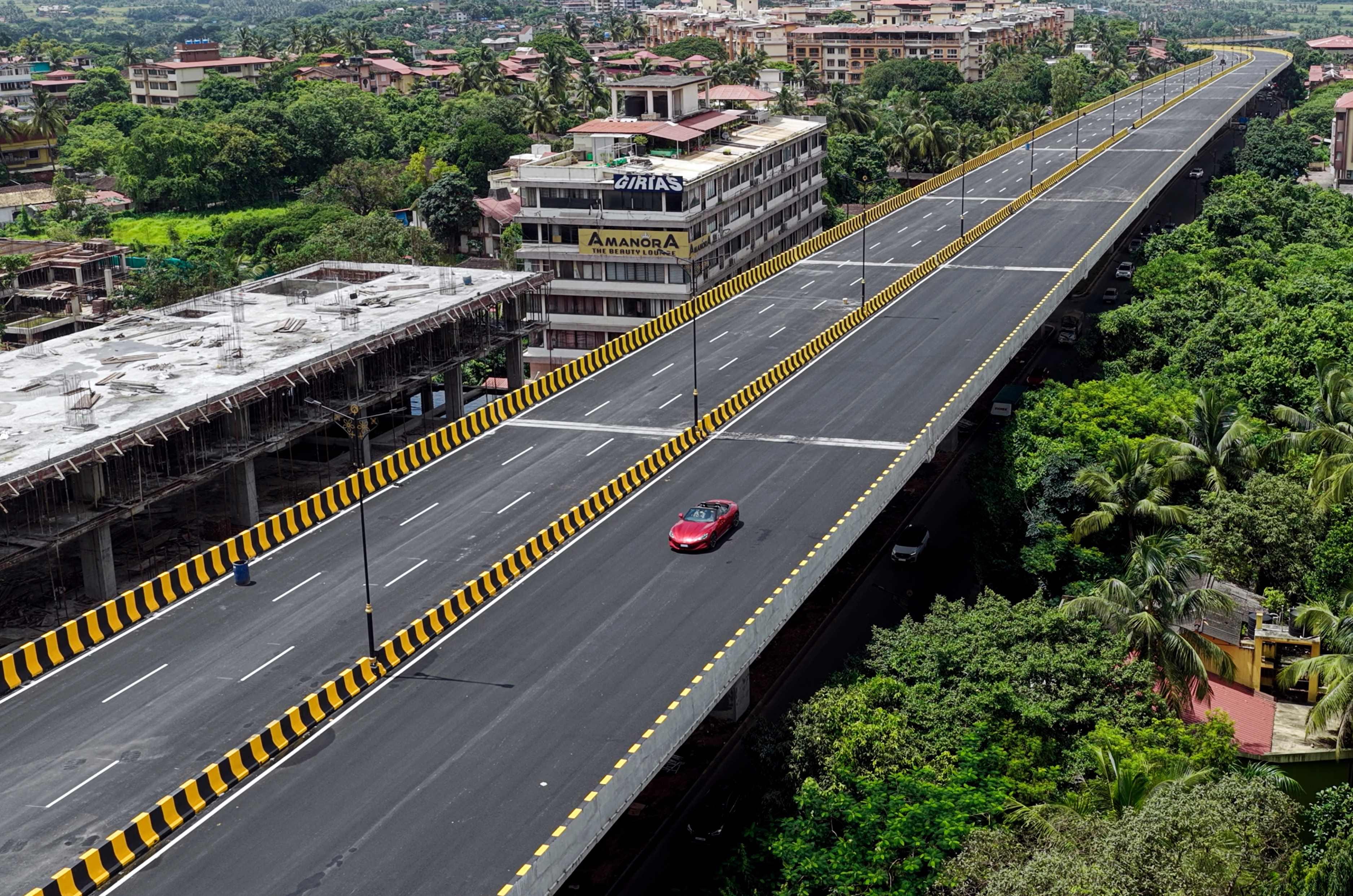
First, a bit of quick history and geography. National Highway 66 is a 1,640km arterial highway running from Panvel in Maharashtra to Kanyakumari in Tamil Nadu. 124km of NH66 is in Goa and, for years, Porvorim has been its most notorious bottleneck. The new 5.15km Porvorim Elevated Corridor lets traffic sail clean over all that congestion below, connecting directly to the Atal Setu bridge that crosses the Mandovi River. It promises to cut travel time between Mapusa in the north and the capital Panaji by up to 30 minutes – a claim we set out to test.
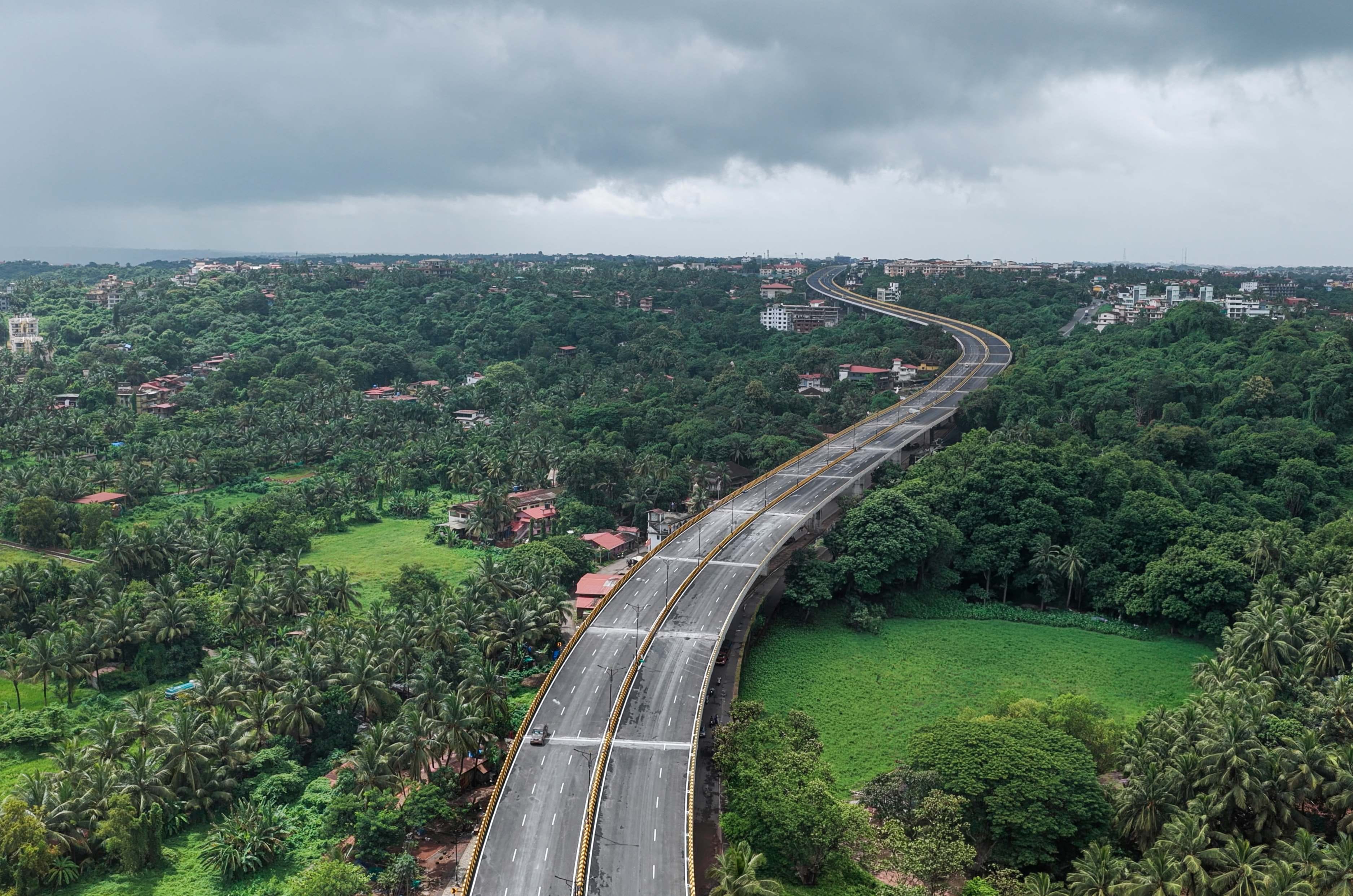
Six-laned Porvorim Elevated Corridor brings North Goa and Panaji closer than ever.
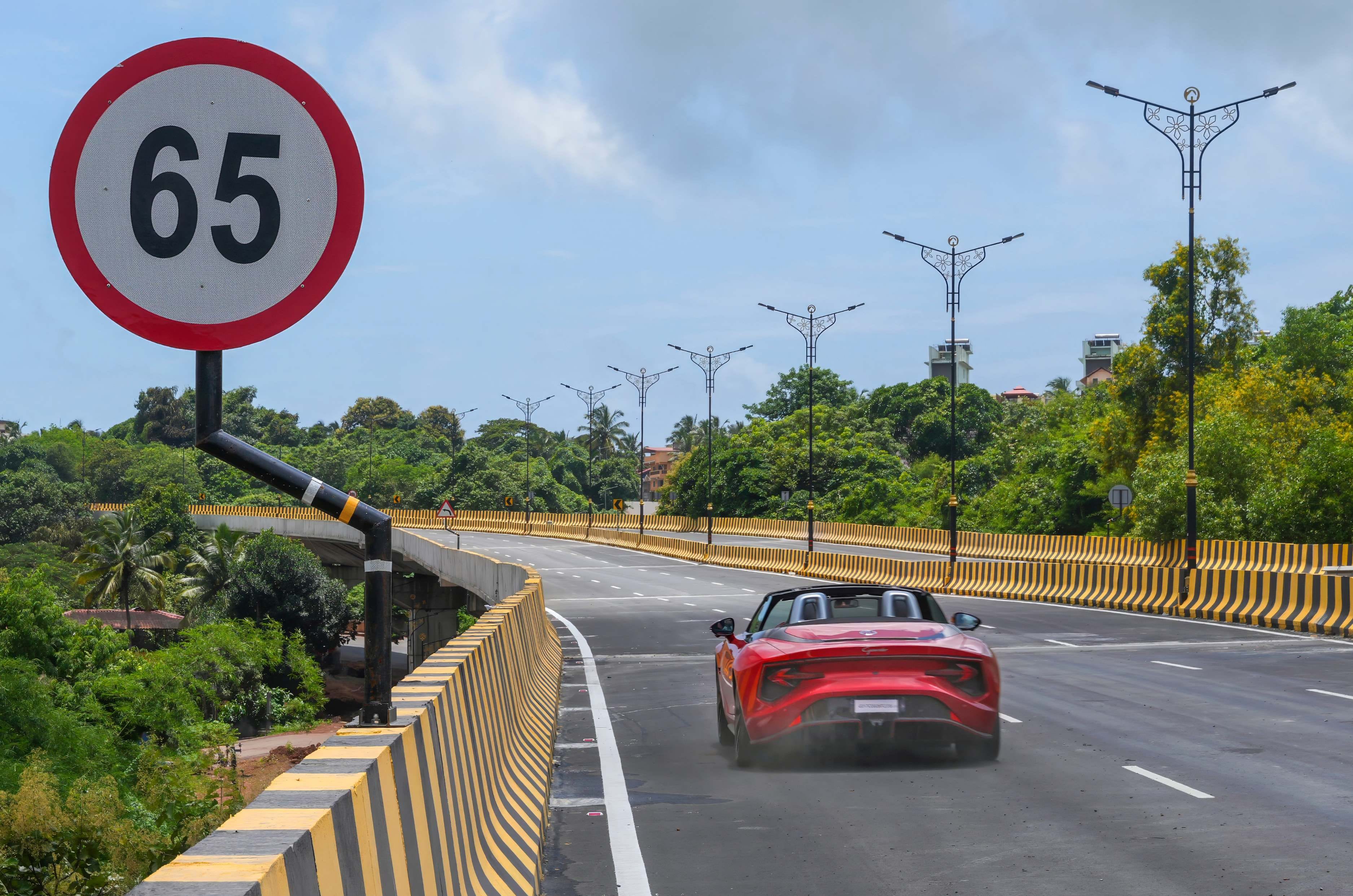
Our starting point was the north end of the corridor, a couple of kilometres away from Guirim village near Mapusa. We started our stopwatch on the concrete ramp leading up the PEC – one we would only stop once we crossed over the Atal Setu Bridge and entered Panaji. And even with 510hp and 725Nm on tap and the road all to ourselves, we would be sticking to the 65kph speed limit.
From the concrete on-ramp, it’s only a few metres until you drive onto the actual viaduct section, which is paved tarmac broken up only by expansion joints. It is not completely straight either – the north end has some lovely sweeping curves. In a car like the Cyberster, it is quite tempting to push through the bends but, exercising restraint, we instead indulged in the joys of open-top motoring. The Cyberster drops its top in 10 seconds at speeds up to 50kph, giving us superb views all around. Importantly, it also raises the top just as quickly, which comes in handy during sudden showers.
No more jams! 5.15km flyover sails over congestion at Porvorim junction.
From the driver’s seat, the panoramic view of Porvorim’s greenery was quite stunning – something you would never notice stuck in traffic below. Drive on, and the road becomes arrow-straight, and you start to notice how close some of the buildings are to the corridor. This proximity to adjoining structures, along with the fact that NH66 had to stay operational below, were among the biggest challenges the engineers faced.
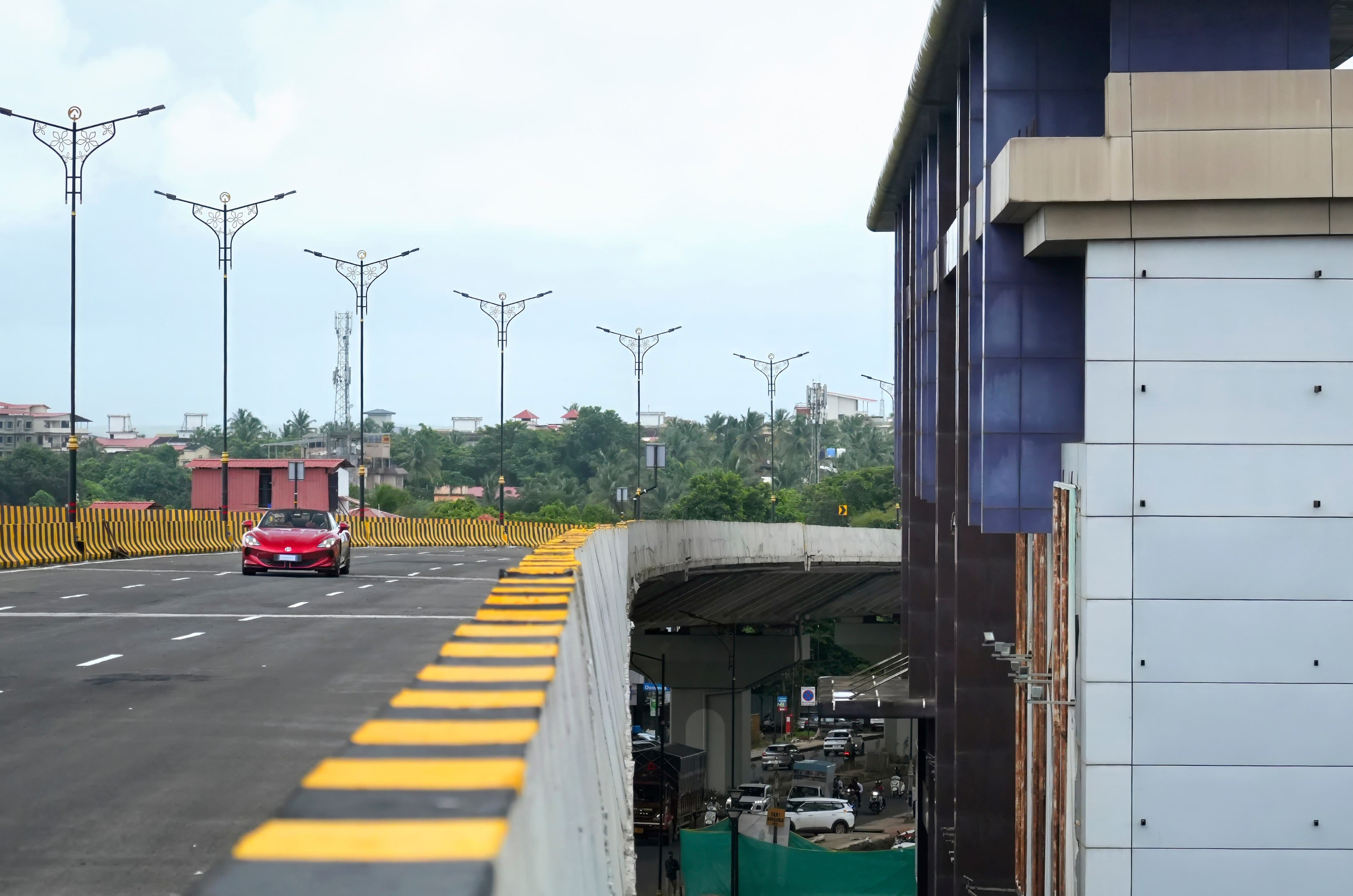
Some buildings were a little too close for comfort making construction quite challenging.
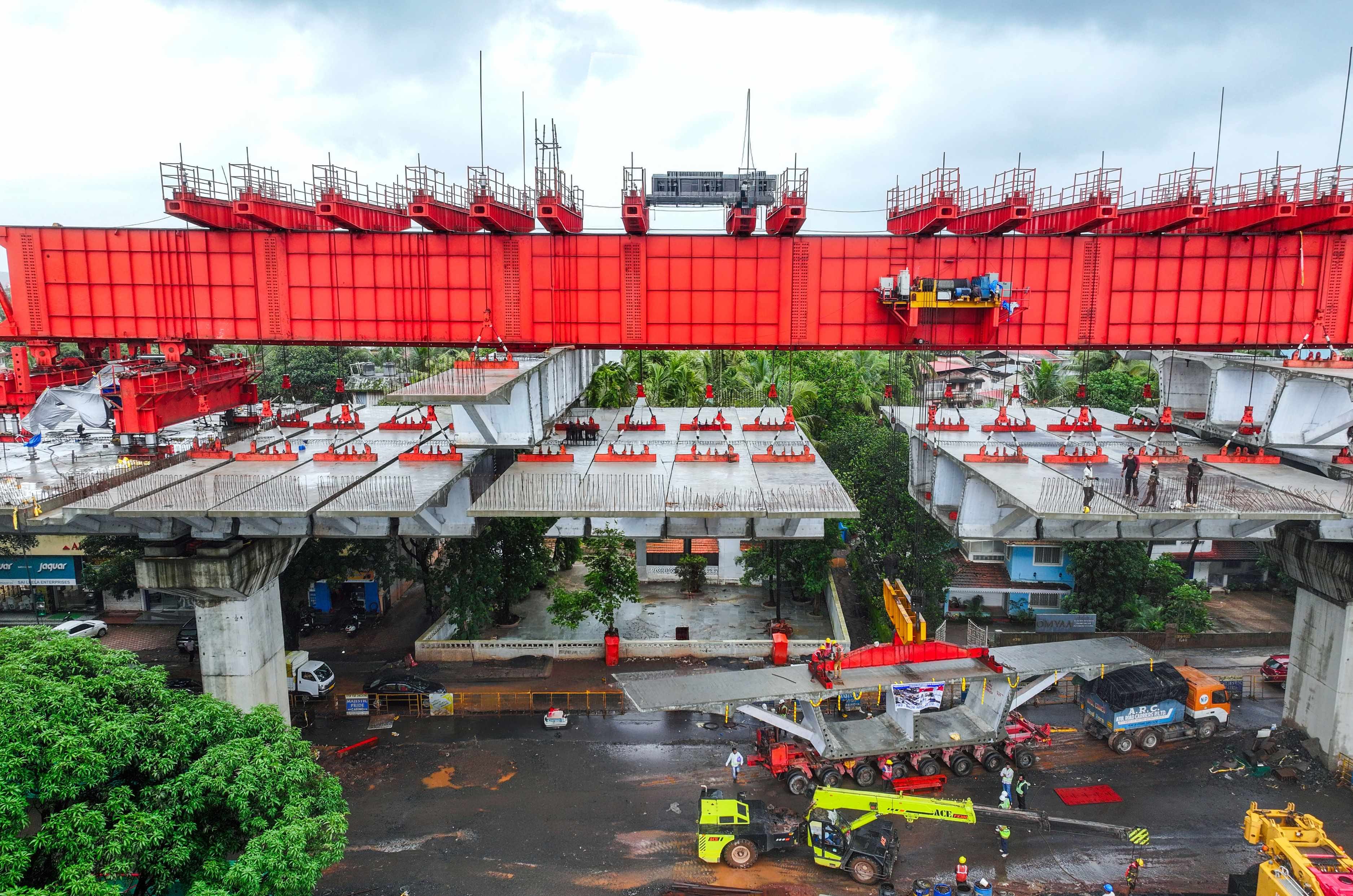
The 4.19km viaduct section is supported by 87 pillars. Each span running between two pillars requires between 13 and 17 individual pre-cast concrete sections. These sections are about 24 metres wide and weigh a whopping 120 tonnes each. They were cast in a yard down the road, trucked to the site, hoisted 11 metres high and installed in place – all in a narrow space between buildings with absolutely no room for error, while ensuring minimal traffic disruptions below.
Considering the challenges, it is quite remarkable that the Porvorim Elevated Corridor was completed in just two years and five months. Below the main structure, 10.30 kilometres of service roads and 28 minor junctions keep local traffic moving, while the corridor sails above it all. Also featured are eight box culverts and a rainwater harvesting system, so the monsoon doesn’t slow traffic down. A modern lighting setup with 515 streetlights has already been installed, while two high-mast lights and ten overhead gantries with cameras are to be put up soon. All constructed at a cost of Rs 641.46 crore.
New flyover part of NH 66 open to cars, two-wheelers and CVs. Speed limit 65kph.
Before long, we were passing the Mall de Goa – close enough to see the expressions on the faces of people in the food court, as they watched the bright red Cyberster whizz past their window. As we made our way down the off-ramp, the stopwatch showed that it had been just over four and a half minutes. Heading towards the Atal Setu, we merged with the dozens coming from the diversion and became part of regular traffic.
And just like that, we were climbing the Atal Setu bridge, which would take us across the Mandovi River and into Panaji. To the right, stunning views of Panaji city and Miramar beach in the distance, and to the left, Old Goa with its historic churches, while above me, through the open roof of the Cyberster, panoramic views of the bridge’s iconic pylons and yellow cable stays.
Drop top MG Cyberster a great match for Goa’s vibe
Coming down the Atal Setu into Panaji, our stopwatch read just under 10 minutes. Even if you factor in a couple of extra minutes for traffic once the PEC opens, it equates to a real-world saving of about 30 minutes in peak hours, which is quite significant. In fact, the PEC is said to have a capacity of 70,000 PCU, or passenger car units, per day, so traffic flow is expected to be quite swift. Simultaneously, it will reduce the burden on the service and other connecting roads below the corridor, improving flow for local traffic too.
Connects directly to (yet another) Atal Setu bridge and brings you closer to Goa’s historic sites.
The Porvorim Elevated Corridor, along with other recent infra projects such as the Atal Setu, the New Zuari Bridge and the widening of NH66, is expected to boost the economy by improving intra-state connectivity to Goa’s industrial hubs, as well as flow between the airports and ports. It should also make commutes easier for residents and change the way tourists experience Goa – less time spent travelling, more time to explore the beaches, the culture and everything Goa has to offer.
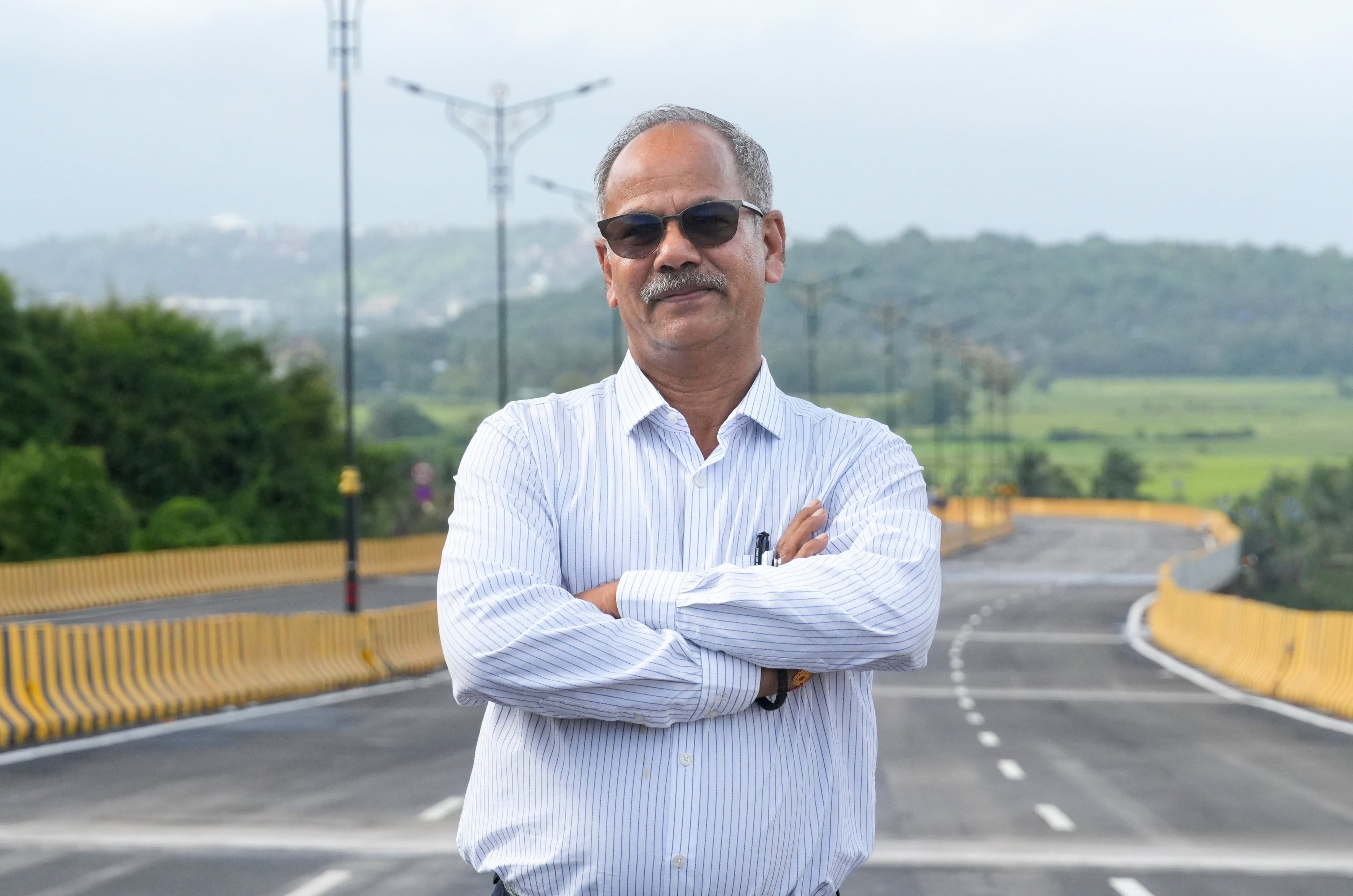
In conversation with Sandip Prabhu Chodnekar, Principal Chief Engineer, Goa Public Works Department (PWD)
On the challenges faced during construction
This bridge is about 24 metres wide, but the right of way is only 25 metres. Constructing such a wide structure when both sides are already fully developed was very challenging. One of the biggest challenges was lifting the segments. Each segment is nearly 24 metres wide and weighs around 120 tonnes. We could not divert the traffic, so we had to carry out most of the work at night. During the daytime, we stopped heavy traffic so that the segments could be lifted safely and normal traffic could resume quickly.
Lifting 25 metre wide sections that weigh 120 tonnes called for nerves of steel.
On other highlights of the project
We tried to harvest the rainwater to recharge the groundwater and increase the water table. There is a median between the service roads below, where we are also planting trees. The corridor’s rainwater harvesting system collects the water and directs it into this median. From there, the water flows into pits that we have dug and filled with aggregates and strainers, allowing the rainwater to percolate into the ground. This helps harvest the rainwater and increase the water table on the plateau during the monsoon.
On traffic and usage
Below the corridor, things will be quite different. Once around 50,000 PCUs of traffic are taken off the existing four-lane road, there could be a tendency for people to park on these lanes. So, we will have to manage parking as well. We have streamlined the junctions and completely reworked the at-grade traffic flow. Motorcycles are also allowed on the Porvorim Elevated Corridor.
In conversation with Dr. Pramod Sawant, Chief Minister, Goa
On the importance of the project
The Porvorim Elevated Corridor is actually important not only for Goa but also for Maharashtra, Karnataka and Kerala. Porvorim had become a problem because it is a congested and newly developed city, with development on both sides of the road. Even after the road was widened, it was very difficult to manage, and it had become an accident-prone zone. That is why the Porvorim flyover was required, to ensure smooth traffic on NH-66.
Greater connectivity a boon for residents, tourists and businesses.
On the project’s wider connectivity benefits
With the opening of Manohar International Airport in North Goa, there was a need to improve connectivity towards South Goa. People arriving at Manohar International Airport and travelling towards South Goa were facing a lot of congestion. Now, that congestion will be reduced and this will definitely help tourism and vehicle movement in the state.
Furthermore, there will be better connectivity between the airports and ports, which will havea positive economic impact. It is also a very important project for the people of Goa. Especially those travelling between North Goa and the capital; they will save time and money, and their daily commute will become much easier.
On Goa’s future infrastructure plans
Almost all the projects on the National Highway network in Goa have been completed. One of the remaining projects is the Borim Bridge, which will connect the Ponda side. The tendering process for it will happen in the next few days.
We are planning to improve connectivity across rural Goa, from one end of Maharashtra towards Karnataka. We are considering a ring road for Goa, because traffic currently comes into the interior areas and cities. In the future, we want traffic to be able to move around the interior villages and across the state without having to enter the cities.
Houthi Strikes in Saudi Arabia: मिडिल ईस्ट में तनाव एक बार फिर चरम पर पहुंच गया है। यमन के हूती विद्रोहियों ने सऊदी अरब के दक्षिणी इलाके पर सिलसिलेवार बड़ा हमला किया है। इस हमले में सऊदी अरब की तेल दिग्गज कंपनी अरामको के ठिकानों, अंतरराष्ट्रीय एयरपोर्ट और मिलिट्री एयरबेस को निशाना बनाया गया है।
सऊदी अधिकारियों के मुताबिक, इन हमलों के कारण कई जगहों पर भीषण आग लग गई और 73 लोग घायल हो गए हैं। हूती विद्रोहियों ने धमकी दी है कि वे आने वाले दिनों में सऊदी अरब के अंदर और भी बड़े ऑपरेशन को अंजाम देंगे।
7 प्वाइंट्स में समझिए सऊदी अरब में क्या हुआ, हूती विद्रोहियों ने हमला क्यों किया और इसका दुनिया पर क्या असर पड़ेगा।
1. क्या हुआ सऊदी अरब में?
हूती विद्रोहियों ने मंगलवार तड़के सऊदी अरब के दक्षिणी हिस्से में एक साथ कई ऊर्जा, सैन्य और नागरिक ठिकानों पर ड्रोन और मिसाइल से हमले किए। हमले के बाद कई तेल प्रतिष्ठानों में आग लग गई, जिससे वहां कामकाज अस्थायी रूप से प्रभावित हुआ। सऊदी जॉइंट फोर्सेज कमान ने पुष्टि की है कि इन हमलों में 73 नागरिक घायल हुए हैं।
2. कौन-कौन से बड़े ठिकाने बने निशाना?
हूतियों ने रणनीतिक रूप से बेहद अहम ठिकानों को चुना:
अभा इंटरनेशनल एयरपोर्ट (Abha International Airport)
किंग खालिद एयरबेस (King Khalid Air Base)
अरामको के तेल ठिकाने (Abha & Jazan Aramco Facilities)
सैन्य और ऊर्जा प्रतिष्ठानों को एक साथ निशाना बनाकर हूतियों ने सऊदी अरब की सुरक्षा और अर्थव्यवस्था दोनों पर चोट करने की कोशिश की है।
3. अरामको के तेल ठिकानों में लगी आग
सऊदी अरब की सरकारी तेल कंपनी ‘अरामको’ के ठिकानों पर हमले के बाद कई जगह आग की लपटें दिखाई दीं। सऊदी ऊर्जा मंत्रालय ने बताया कि आग पर काबू पाने, नुकसान का आकलन करने और कर्मचारियों की सुरक्षा सुनिश्चित करते हुए कामकाज को दोबारा बहाल करने के लिए इमरजेंसी टीमें तैनात कर दी गई हैं।
4. जाजान रिफाइनरी पहले से थी ठप
जाजान स्थित अरामको की रिफाइनरी की क्षमता रोजाना 4,00,000 बैरल तेल प्रोसेस करने की है। लेकिन यह रिफाइनरी जुलाई में हुए पिछले हूती हमले के बाद से ही बंद पड़ी है। हूतियों ने पिछले महीने भी इस कॉम्प्लेक्स पर दो बार हमले का दावा किया था, जिसमें रिफाइनरी में आग लग गई थी।
5. हमले में कितने लोग घायल हुए?
सऊदी अधिकारियों के अनुसार, अब तक 73 नागरिकों के घायल होने की खबर है। सऊदी नीत सैन्य गठबंधन ने इन हमलों को गैर-जिम्मेदाराना करार देते हुए कहा कि वे इसका मुंहतोड़ जवाब देंगे।
6. क्यों हमला कर रहे हैं हूती विद्रोही?
हूती विद्रोहियों का दावा है कि यह हमला उन्होंने सऊदी अरब की ओर से यमन में की गई एयरस्ट्राइक के जवाब में किया है।
जेल पर एयरस्ट्राइक का आरोप: हूतियों ने आरोप लगाया था कि सऊदी अरब ने उत्तरी यमन के अल-जौफ प्रांत में एक जेल पर बमबारी की, जिसमें कई लोग मारे गए।
सैन्य प्रवक्ता की चेतावनी: हूती सैन्य प्रवक्ता यह्या सरी (Yahya Saree) ने कहा कि सऊदी अरब का हमला तनाव बढ़ाने वाला था और अब वे सऊदी अरब के अंदर “बड़ा ऑपरेशन” चलाकर इसका जवाब देंगे।
7. बाब अल-मंडेब जलडमरूमध्य क्यों है इतना अहम?
यह पूरा तनाव यमन में फिर से शुरू हुई जंग के बीच बढ़ रहा है, जहां हूती विद्रोही रणनीतिक रूप से महत्वपूर्ण बाब अल-मंडेब स्ट्रैट (जलडमरूमध्य) पर अपना दबदबा बढ़ाना चाहते हैं।
यह समुद्री रास्ता अदन की खाड़ी को लाल सागर से जोड़ता है और दुनिया के सबसे महत्वपूर्ण व्यापारिक रास्तों में से एक है।
अमेरिका-ईरान तनाव के कारण होर्मुज जलडमरूमध्य से शिपिंग पहले से ही प्रभावित है, ऐसे में बाब अल-मंडेब का रास्ता सऊदी अरब और वैश्विक तेल सप्लाई के लिए बेहद संवेदनशील हो गया है।