Aprilia SXR GT 175 vs Rivals: Price and specifications compared

Aprilia SXR GT 175 vs Rivals: Price and specifications compared
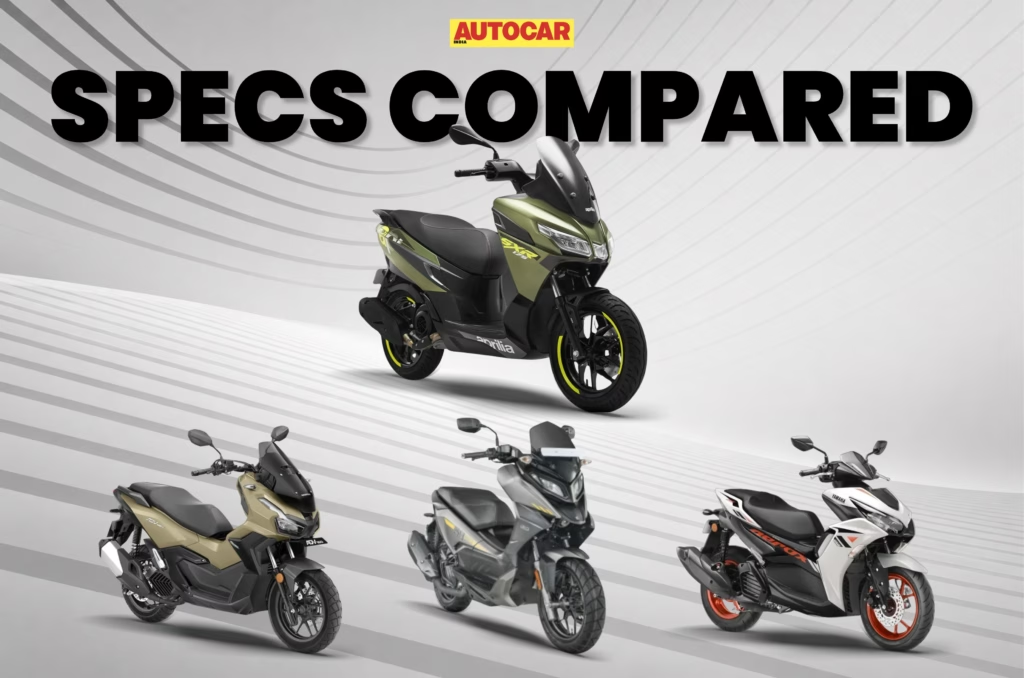
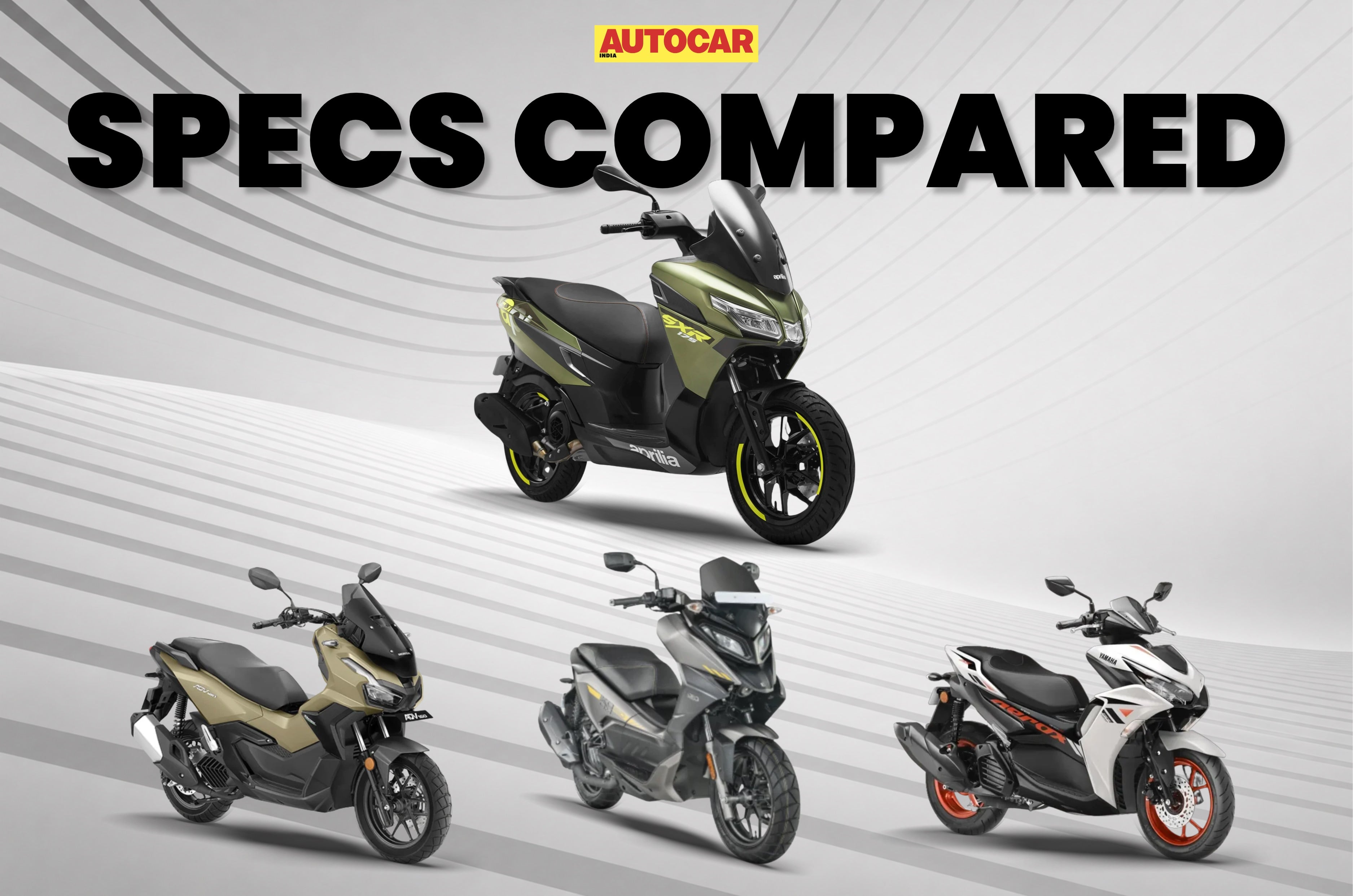
Aprilia SXR GT 175, Yamaha Aerox 155 S, Hero Xoom 160 and Honda ADV160 in clockwise direction.

Maxi scooters have technically been around in our market since 2006, thanks to the Kinetic Blaze but the idea was first popularised by the Suzuki Burgman and later the Yamaha Aerox added to it. “Popularised” being the operating word because Aprilia also had a player in there from 2020, which has just been updated. So, what’s the maxi scooter scene like today and which one should you go get a test ride of? Let’s see.

Aprilia SXR GT 175 hp-e vs Rivals: Engine and output

Smaller rivals all make more power


Aprilia SXR GT 175 hp-e

Honda ADV160

Hero Xoom 160

Yamaha Aerox 155

Engine

174.7cc, single-cylinder, air-cooled

156.9cc, single-cylinder, liquid-cooled

156cc, single-cylinder, liquid-cooled

155cc, single-cylinder, liquid-cooled

Power

13.3hp at 7,200rpm

16.3hp at 8,750rpm

14.8hp at 8,000rpm

15hp at 8,000rpm

Torque

14.14Nm at 6,000rpm

14.9Nm at 6,500rpm

14Nm at 6,250rpm

13.9Nm at 6,500rpm

Transmission

CVT

CVT

CVT

CVT

Power-to-weight ratio

100.76hp/tonne

118.98hp/tonne

104.23hp/tonne

119.05hp/tonne

Don’t let the bigger displacement number mislead you into thinking the Aprilia SXR GT 175 is the most powerful of these scooters, because that’s not the case. The SXR has the only air-cooled mill in this class, possibly contributing to its lower output figures. Combine that with the weight and the Aprilia’s case only becomes weaker. For what it’s worth the Italian scooter delivers its peak torque faster than the others so that should be an advantage while plying within the city.

The Yamaha has the lowest kerb weight on this list, which contributes  to  the highest power-to-weight ratio, very closely followed by the Honda.

Aprilia SXR GT 175 hp-e vs Rivals: Dimensions and weight

Hero is the heaviest, Yamaha is the lightest


Aprilia SXR GT 175 hp-e

Honda ADV160

Hero Xoom 160

Yamaha Aerox 155

Fuel tank capacity

7 litres

8.1 litres

7 litres

5.5 litres

Ground clearance

170mm

175mm

155mm

145mm

Seat height

800mm

NA

787mm

790mm

Kerb weight

132kg

137kg

142kg

126kg

Wheelbase

1362mm

1333mm

1348mm

1350mm

Aprilia gains some ground, or rather gets away from ground with its second highest ground clearance figures. However, it also has the tallest seat height of this bunch. While Yamaha’s ground clearance numbers seem the lowest, do note that the website specifies it to be minimum, which means that it’s measured under laden conditions. So, it’s actually the Hero that has the lowest ground clearance.

As for seat height, Honda doesn’t specify that for the ADV160, but it shouldn’t be too tall for it to be a concern for most Indians. On the other hand, the Xoom 160 is the heaviest of these four, which could prove to be tricky to some at low speed rides and reversing out of parking lots. Aprilia and Hero have neglected mentioning the under seat storage but none of these is likely to impress you in that specific aspect. For what it’s worth, the Honda ADV160 has the highest number of the lot, 27 litres followed by the Yamaha Aerox at 24.5 litres.

Aprilia SXR GT 175 hp-e vs Rivals: Tyres, brakes and suspension

Honda strikes the best balance in equipment


Aprilia SXR GT 175 hp-e

Honda ADV160

Hero Xoom 160

Yamaha Aerox 155

Tyres (F, R)

120/70-14, 120/70-14

110/80-14, 130/70-13

120/70R14, 140/60R14

110/80-14, 140/70-14

Brakes (F, R)

220mm disc, 140mm drum; single-channel ABS

Disc, disc; single-channel ABS

240mm disc, drum; single-channel ABS

230mm disc, 130mm drum; single-channel ABS

Suspension (F, R)

Telescopic fork, Monoshock

Telescopic fork, twin-shock

Telescopic fork, twin-shock

Telescopic fork, twin-shock

Aprilia has given the SXR GT 175 the widest front tyre, but the rear tyre too is the exact same size which makes it the narrowest rear tyre in this list. Honda appears to have struck the best balance, with respect to the equipment on offer. Though that could change depending on the odd 14-13 front-rear wheel size’s real world implications on the ADV160’s handling.

Aprilia SXR GT 175 hp-e vs Rivals: Features

Honda has an unbeatable ‘feature’

A keyless system is present on all scooters but the Aprilia although Yamaha requires you to pony up for the Aerox S variant to get it. Of the four, Hero and Yamaha’s cockpit views are going to feel the oldest, simply because of their LCD screens. Both companies have packed it with features (call and SMS alerts, metrics on the app and turn-by-turn navigation, to name a few) but apples to apples, the SXR and ADV160 have more modern-looking TFT displays and they also match the former two in features. This will make a difference only if you clearly prefer one over the other, for otherwise there isn’t anything to fault with the Hero and the Yamaha’s displays.

Elsewhere, all offer some type of USB port for charging your devices, front cubby storage and LED lighting. On the convenience front, Hero, Honda and Yamaha offer an integrated starter-motor-generator which gives their scooters features like auto stop/start and a silent start. Honda and Yamaha offer traction control as standard.

A big advantage that only the Honda ADV160 can boast at the moment though, is its E85 compatibility. While Hero and Yamaha do offer other vehicles in their line-up with flex fuel compatibility, the Xoom and the Aerox respectively, do not have that and in these uncertain times, that’s certainly an unmissable advantage of the Honda.

Aprilia SXR GT 175 hp-e vs Rivals: Price

Honda’s advantages have a price to pay


Aprilia SXR GT 175 hp-e

Honda ADV160

Hero Xoom 160

Yamaha Aerox 155

Price (ex-showroom)

Rs 1.30 lakh

Rs 1.70 lakh

Rs 1.45 lakh

Rs 1.46-1.50 lakh

The Aprilia’s an unbeatable bargain at this price with its nearest rival being the Xoom 160, closely followed by the Yamaha for its non-S version. Honda appears to offer the best balance of everything along with a currently significant E85 compatibility, but also costs Rs 40,000 over the Aprilia. While it’s easy to get confused over what is the right scooter for you, all of these – thankfully – make it unmistakably clear what they intend to offer. Hence, if you’re confused, figuring out your priorities and taking test rides (hopefully back-to-back) should help you pick the right one for you. If that happens to be the ADV160, you now know what you’re paying for.
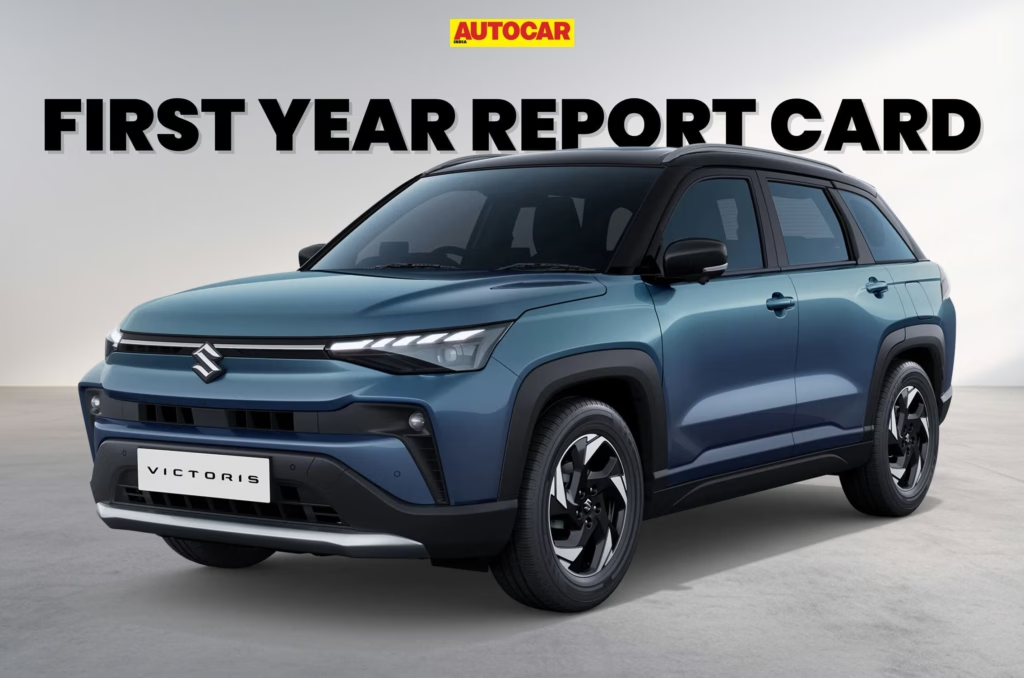
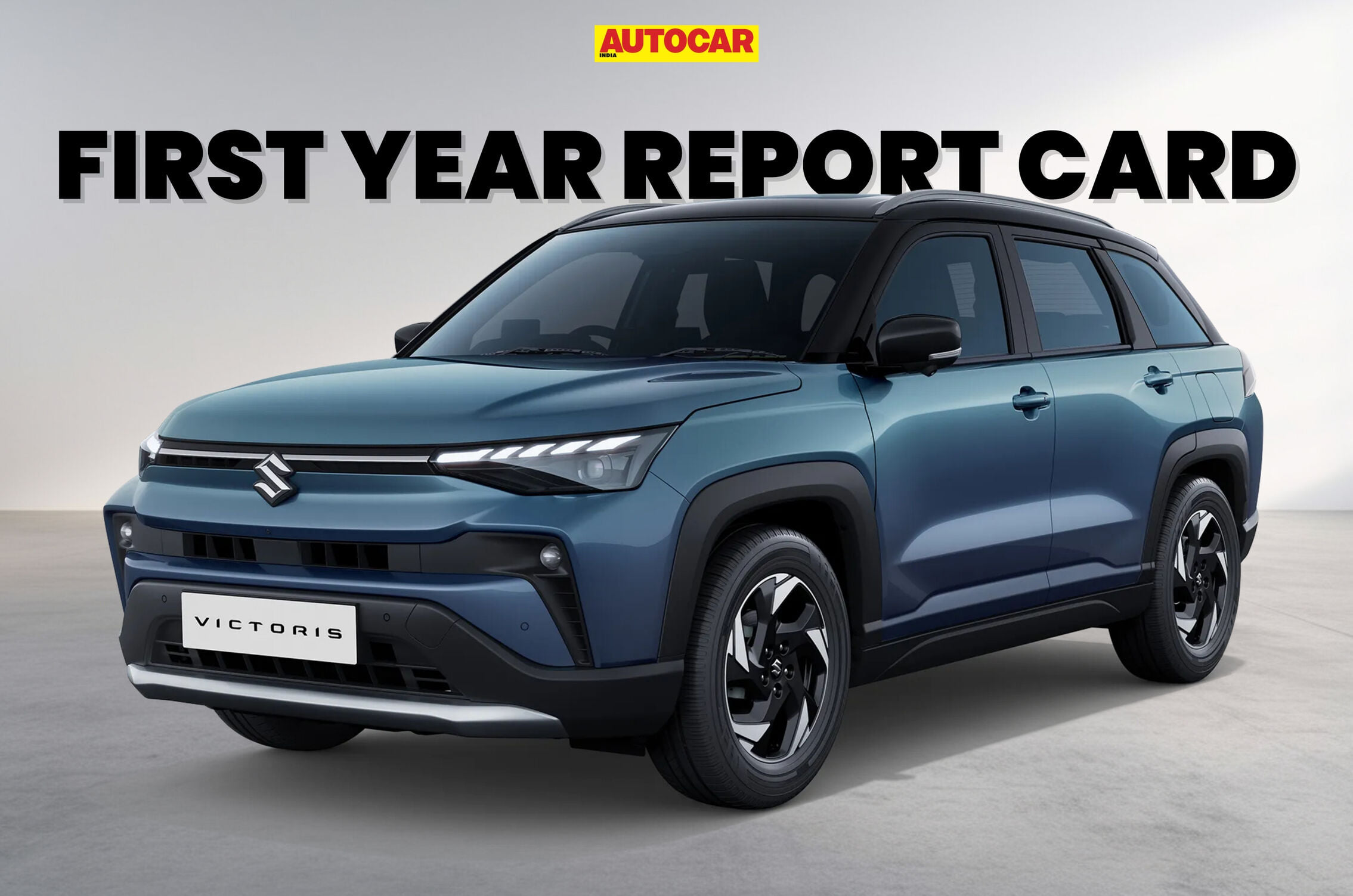
Report Card: Maruti Victoris’ 1-Year Innings

Report Card: Maruti Victoris’ 1-Year Innings
Maruti Victoris one year report card

Maruti Suzuki introduced the Victoris SUV on September 15, 2026, as its second mid-size SUV. With the Victoris, Maruti aimed to capture a larger share of the mid-size SUV segment by retailing it through its widespread Arena dealership network, in contrast to its Nexa-sold stablemate, the Grand Vitara. The Victoris shares its platform and engines with the Grand Vitara but sports a distinct exterior design. Additionally, it introduced features such as an underbody-mounted CNG tank and became the first Maruti model to feature a Level 2 ADAS suite.

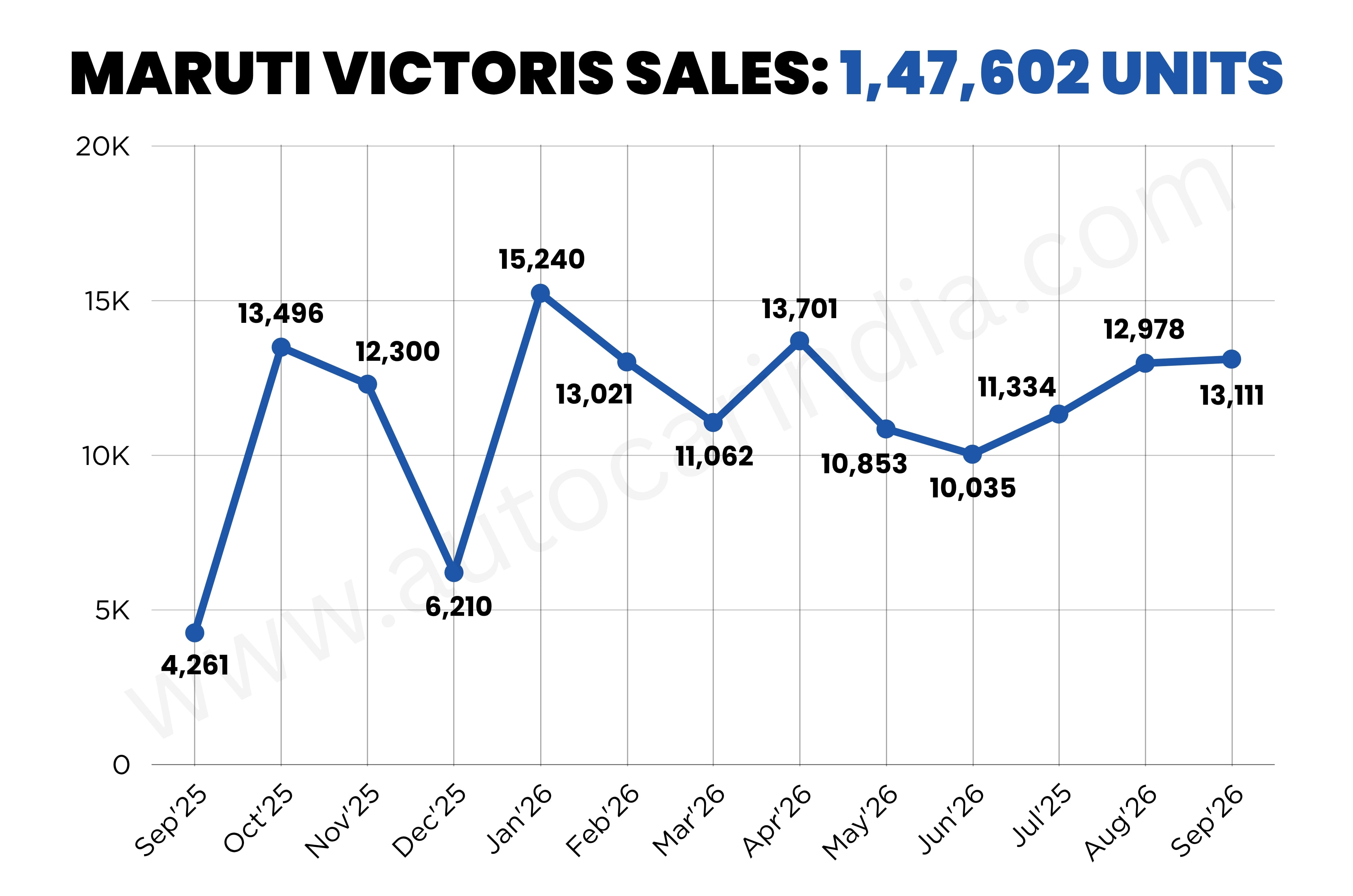
  1. Victoris records 1,47,602 units in total sales in its first year.
  2. Prices have increased/decreased for select variants; still range between Rs 10.5 lakh and Rs 19.99 lakh.
  3. No variant rejigs took place in its first year.

Maruti Victoris sales 

In its first year since launch, the Maruti Suzuki Victoris recorded sales of 1,47,602 units, averaging roughly 12,300 units per month. Monthly volumes began at 4,261 units in September 2025 and rose quickly to 13,496 units in October 2025. Following a minor dip to 12,300 units in November 2025, sales dropped by nearly half in December 2025. Peak sales were recorded in January 2026 at 15,240 units, after which the SUV maintained steady monthly volumes ranging between 10,000 and 13,000 units.

Despite launching after the Grand Vitara, the Victoris achieves higher monthly sales figures, largely supported by Maruti Suzuki’s wider Arena dealership network. Notably, the SUV crossed the 1-lakh sales milestone within eight months of launch—outpacing the Grand Vitara to reach this mark. 

Maruti Victoris variant -wise price 

Variant

Price now (Rs lakh)

Price at launch (Rs lakh)

1.5 LXi

10.50

10.50

1.5 LXi CNG

11.55

11.50

1.5 VXi

11.85

11.80

1.5 VXi AT

13.41

13.36

1.5 VXi CNG

12.90

12.80

1.5 VXi strong hybrid eCVT

16.43

16.38

1.5 ZXi  

13.62

13.57

1.5 ZXi AT

15.18

15.13

1.5 ZXi CNG

14.66

14.57

1.5 ZXi strong hybrid eCVT

18.00

17.80

1.5 ZXi(O)  

13.69

14.08

1.5 ZXi(O) AT 

15.25

15.64

1.5 ZXi(O) strong hybrid

18.43

18.39

1.5 ZXi+  

15.39

15.24

1.5 ZXi+ AT

17.34

17.19

1.5 ZXi+ AT AWD

18.69

18.64

1.5 ZXi+ strong hybrid eCVT

19.52

19.47

1.5 ZXi+(O) 

15.48

15.82

1.5 ZXi+(O)  AT

17.43

17.77

1.5 ZXi+(O) AT AWD

19.27

19.22

1.5 ZXi+(O) strong hybrid eCVT

19.99

19.99

The Victoris is priced between Rs 10.50 lakh and Rs 19.99 lakh, and is offered in several variants. Depending on the variant, prices have increased by up to Rs 20,000 because of hikes by the carmaker due to a rise in input costs. However, select variants of the Victoris saw a price cut of up to Rs 39,000 in July 2026.

Maruti Victoris milestones

Within its first year in the market, Maruti hasn’t introduced or discontinued any of its variants. Additionally, the SUV has not been subject to any recalls.

Maruti Victoris specifications

The Victoris is offered with petrol, CNG, and strong-hybrid powertrains. The petrol and CNG versions use a 1.5-litre naturally aspirated engine: the former produces 103hp and 139Nm, while the latter outputs 88hp and 122Nm. Petrol variants feature a 5-speed manual or a 6-speed automatic transmission, with the automatic also available in an all-wheel-drive (AWD) configuration. CNG versions come exclusively with a 5-speed manual.

The strong-hybrid variant is powered by a 1.5-litre naturally aspirated Atkinson-cycle petrol engine producing 92hp and 122Nm, paired with an e-CVT. The system incorporates a 0.76 kWh battery and an electric motor generating 80hp and 141Nm, delivering a combined peak power output of 116 hp.

In terms of fuel efficiency, the claimed figures for the petrol manual, petrol automatic, and petrol AWD variants are 21.18kpl, 21.06kpl, and 19.07kpl, respectively. The strong-hybrid model leads with a claimed efficiency of 28.65kpl, while the CNG version delivers 27.02km/kg.

All prices are ex-showroom, India

Stock Market Holiday: आज, 20 अक्टूबर को विजयादशमी पर शेयर बाजार बंद; MCX पर भी नहीं होगी ट्रेडिंग

आज, 20 अक्टूबर को देश विजयादशमी (दशहरा) का त्योहार मना रहा है। अधर्म पर धर्म की जीत के इस पर्व पर देश में बैंक, स्कूल, सरकारी ऑफिस समेत कई अन्य संस्थान बंद हैं। शेयर बाजारों में भी छुट्टी है, यानि कि BSE और NSE पर ट्रेडिंग नहीं होगी। शेयर बाजार और MCX हर शनिवार और रविवार को बंद रहते हैं। लेकिन कुछ दूसरे खास मौकों और सार्वजनिक अवकाशों पर भी इनमें छुट्टी रहती है। 20 अक्टूबर को कमोडिटीज में ट्रेडिंग के प्लेटफॉर्म MCX (Multi Commodity Exchange) में दशहरा पर सुबह के सेशन में छुट्टी है। लेकिन शाम को 5 बजे से 11:30/11:55 बजे तक का सेशन ओपन है।

BSE में इक्विटी सेगमेंट, इक्विटी डेरिवेटिव सेगमेंट, करेंसी डेरिवेटिव्स सेगमेंट्स, ट्राई पार्टी रेपो सेगमेंट्स, NDS-RST में ट्रेडिंग हॉलिडे है। लेकिन कमोडिटी डेरिवेटिव्स सेगमेंट और इलेक्ट्रॉनिक गोल्ड रिसीप्ट्स (EGR) सेगमेंट में शाम का सेशन (शाम 5 बजे से 11:30/11:55 बजे तक) ओपन है।

इसी तरह NSE में भी इक्विटीज, इक्विटी डेरिवेटिव्स, करेंसी डेरिवेटिव्स, इंट्रेस्ट रेट डेरिवेटिव्स, निगोशिएटेड ट्रेड रिपोर्टिंग प्लेटफॉर्म, म्यूचुअल फंड्स, सिक्योरिटी लेंडिंग एंड बॉरोइंग स्कीम्स, कॉरपोरेट बॉन्ड्स, न्यू डेट सेगमेंट्स, इलेक्ट्रॉनिक गोल्ड रिसीप्ट्स, सेगमेंट्स में मंगलवार को छुट्टी है। कमोडिटी डेरिवेटिव्स में सुबह के सेशन में छुट्टी है लेकिन शाम का सेशन (शाम 5 बजे से 11:30/11:55 बजे तक) ओपन है।

बाकी बचे साल में शनिवार-रविवार के अलावा और कब बाजार बंद

10 नवंबर: दिवाली-बलिप्रतिपदा

24 नवंबर: प्रकाश पर्व श्री गुरु नानक देव

25 दिसंबर: क्रिसमस

Muhurat Trading: दिवाली पर मुहूर्त ट्रेडिंग की टाइमिंग का हुआ ऐलान, दोपहर 2:20 बजे से खुलेगा बाजार

शनिवार/रविवार को पड़ रहे त्योहार

8 नवंबर: दिवाली लक्ष्मी पूजन

दिवाली के मौके पर मुहूर्त ट्रेडिंग रविवार, 8 नवंबर 2026 को होगी। मुहूर्त ट्रेडिंग का समय बाद में घोषित किया जाएगा।

Disclaimer: यहां मुहैया जानकारी सिर्फ सूचना के लिए दी जा रही है। यहां बताना जरूरी है कि मार्केट में निवेश बाजार जोखिमों के अधीन है। निवेशक के तौर पर पैसा लगाने से पहले हमेशा एक्सपर्ट से सलाह लें। मनीकंट्रोल की तरफ से किसी को भी पैसा लगाने की यहां कभी भी सलाह नहीं दी जाती है।

2027 Kawasaki KLE500 SE SmartRide revealed

2027 Kawasaki KLE500 SE SmartRide revealed
KLE500 SE press image

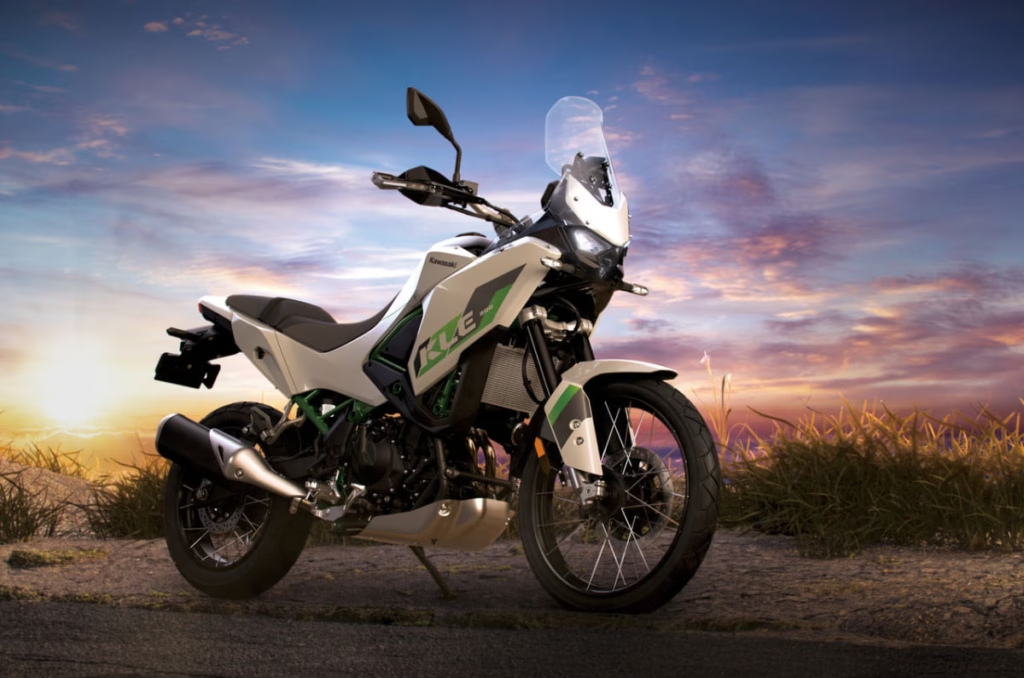
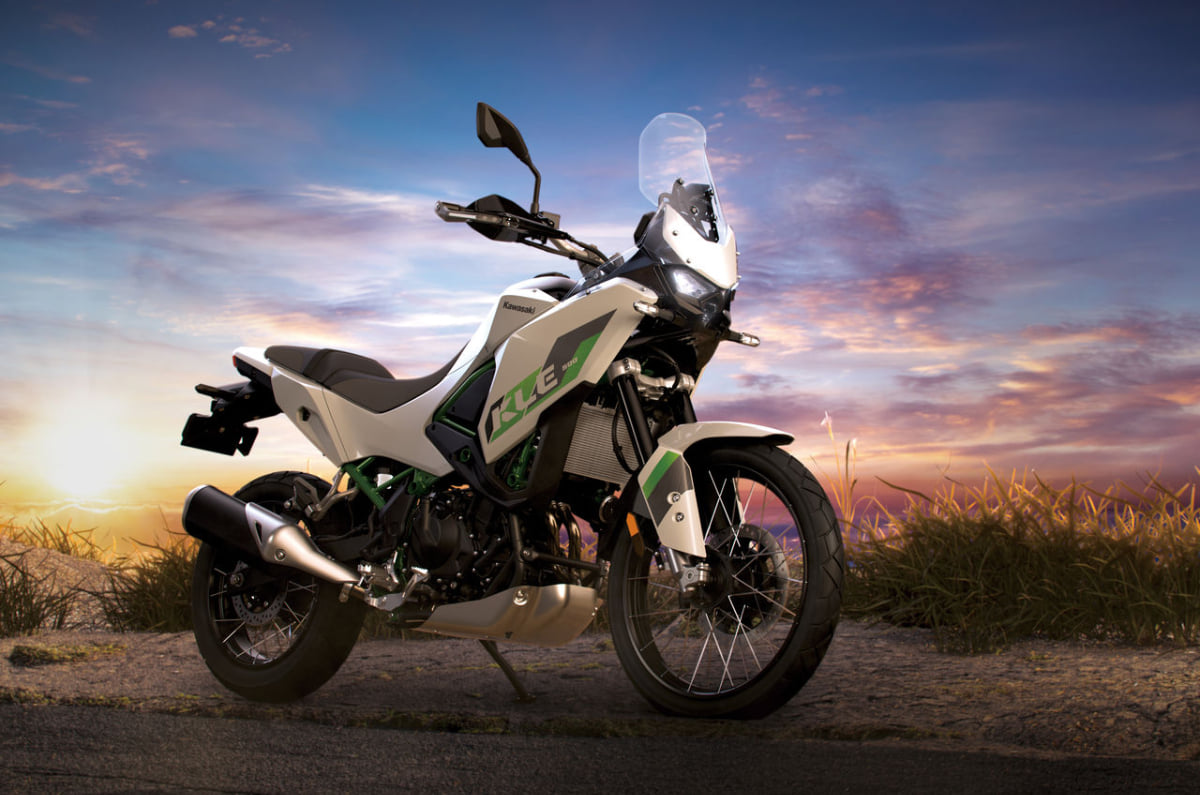
Kawasaki has expanded its 2027 KLE500 range with a new SE SmartRide variant, which adds a mechanical centrifugal clutch to the parallel-twin adventure motorcycle. The system allows riders to pull away and come to a stop without operating the clutch lever, while gear changes on the move still use the lever and pedal as normal.

  1. KLE500 now has three variants
  2. 451cc parallel-twin engine produces 45hp and 42.6Nm

Kawasaki KLE500 SE SmartRide details

No other mechanical changes over the KLE500 SE, which debuted last year

The KLE500 lineup now comprises three variants – the base KLE500, the KLE500 SE and the new KLE500 SE SmartRide. At first, the SmartRide system may sound similar to Honda’s E-Clutch technology, but the two work quite differently. While both aim to simplify clutch operation, Honda uses an electromechanical actuator to automate clutch movement, whereas SmartRide relies on a purely mechanical centrifugal clutch.

Aside from the addition of the clutch technology, the SmartRide variant also gets tubeless tyres, replacing the tube-type setup on the standard SE. Otherwise, the two variants share the same hardware, including the 451cc parallel-twin engine producing 45hp at 9,000rpm and 42.6Nm at 6,000rpm.

The SE SmartRide is available in a single colour, Pearl Blizzard White. Following its international debut last year, we’d reported that Kawasaki India has the KLE500 in the pipeline for a launch here, which we expect to happen over the next few months.

When it goes on sale, the KLE500 will join a growing list of sub-500cc adventure bikes in our market. Given its potential CBU (Completely Built-Up) import route and the premium pricing that would entail, it will also see competition from upcoming India-made motorcycles such as the Royal Enfield Himalayan 750 and the Norton Atlas.

Sugar Stocks: शुगर स्टॉक्स में भारी गिरावट, गन्ने-चीनी से एथेनॉल बनाने पर सरकारी रोक का दिखा असर

Sugar Stocks: चीनी कंपनियों के शेयरों में 19 अक्टूबर को भारी बिकवाली दिखी। कई शेयर 7% तक टूट गए। इसकी वजह एथेनॉल की खरीद से जुड़ा सरकार का फैसला है। समाचार एजेंसी रॉयटर्स की रिपोर्ट के मुताबिक, सरकार ने नए टेंडर से चीनी से बनने वाले एथेनॉल की खरीद को बाहर कर दिया है। इससे चीनी कंपनियों की कमाई पर असर पड़ सकता है।

इन शेयरों में सबसे ज्यादा गिरावट

Bajaj Hindusthan Sugar का शेयर 5.59% गिरकर ₹20.08 पर आ गया। Shree Renuka Sugars में 7% की गिरावट रही। वहीं, Balrampur Chini Mills का शेयर 3.33% और EID Parry का शेयर 3.22% टूट गया। Triveni Engineering and Industries में 1.54% की गिरावट रही। Dhampur Sugar का शेयर भी 4% से ज्यादा गिरा।

सरकार ने क्या फैसला लिया?

सरकारी तेल कंपनियों ने नवंबर 2026 से अक्टूबर 2027 तक के लिए एथेनॉल खरीद का नया टेंडर जारी किया है। BPCL ने 16 अक्टूबर को यह टेंडर निकाला था। इसमें गन्ने के रस, चीनी के सिरप और बी-हैवी मोलासेस से बने एथेनॉल की खरीद शामिल नहीं है।

इसके अलावा, मक्का से बनने वाले एथेनॉल की खरीद कीमत भी घटा दी गई है। इसे ₹71.86 से कम करके ₹68.86 प्रति लीटर कर दिया गया है। टेंडर में करीब 1,100 करोड़ लीटर एथेनॉल खरीदने के लिए बोलियां मांगी गई हैं।

चीनी कंपनियों को क्यों होगा नुकसान?

चीनी कंपनियां गन्ने से चीनी के साथ एथेनॉल भी बनाती हैं। इससे उन्हें कमाई का एक और रास्ता मिलता है। कई कंपनियों ने एथेनॉल बनाने की क्षमता बढ़ाने में पैसा भी लगाया है।

अब चीनी से बनने वाले एथेनॉल की सरकारी खरीद टेंडर में शामिल नहीं होने से कंपनियों की मुश्किल बढ़ सकती है। उनकी उत्पादन क्षमता का पूरा इस्तेमाल करना चुनौती बन सकता है। इससे मुनाफे पर भी दबाव पड़ने की आशंका है।

सरकार ने यह फैसला क्यों लिया?

सरकार चाहती है कि घरेलू बाजार में चीनी की कमी न हो और कीमतें काबू में रहें। त्योहारी सीजन में चीनी की कीमतें 10% से ज्यादा बढ़ चुकी हैं। वहीं, प्रमुख चीनी उत्पादक राज्यों में कमजोर बारिश से उत्पादन घटने की आशंका है।

भारत पेट्रोल में 20% एथेनॉल मिलाने का लक्ष्य रखता है। अब इस जरूरत को पूरा करने के लिए मक्का और दूसरे अनाज से बनने वाले एथेनॉल की भूमिका बढ़ सकती है।

एथेनॉल ब्लेंडिंग पर क्या असर होगा?

ऑल इंडिया शुगर ट्रेड एसोसिएशन (AISTA) के चेयरमैन प्रफुल्ल विठलानी का कहना है कि सरकार ने पेट्रोल में 20% एथेनॉल मिलाने का लक्ष्य रखा है। लेकिन इस सीजन इसे पूरा करना मुश्किल हो सकता है। चीनी से बनने वाले एथेनॉल का उत्पादन घटने के साथ मक्के की कमी भी इसकी बड़ी वजह है।

प्रफुल्ल विठलानी के मुताबिक, पिछले सीजन में एथेनॉल सप्लाई में चीनी की हिस्सेदारी 25% थी। अब यह घटकर सिर्फ 2% के आसपास रह सकती है।

क्या चीनी की कीमतें बढ़ेंगी?

उत्पादन को लेकर चिंता के बावजूद फिलहाल चीनी की कीमतों में बड़ी हलचल की उम्मीद नहीं है। विठलानी के मुताबिक, सरकार ने कोटा जारी करके बाजार में सप्लाई को संभाला है। त्योहारों की मांग पूरी करने के लिए भी पर्याप्त स्टॉक मौजूद है।

ज्यादातर चीनी मिलों में नवंबर की शुरुआत तक पेराई शुरू होने की उम्मीद है। सरकार के सप्लाई प्रबंधन से अगले दो महीने तक कीमतें स्थिर रह सकती हैं। इसके बाद बाजार की चाल इस बात पर निर्भर करेगी कि चीनी का असल उत्पादन कितना रहता है और फसल की स्थिति कैसी रहती है।

Market Outlook : बाजार की तेजी को लगा ब्रेक, जानिए 21 अक्टूबर को कैसी रह सकती है सेंसेक्स-निफ्टी की चाल

Disclaimer: मनीकंट्रोल.कॉम पर दिए गए सलाह या विचार एक्सपर्ट/ब्रोकरेज फर्म के अपने निजी विचार होते हैं। वेबसाइट या मैनेजमेंट इसके लिए उत्तरदायी नहीं है। यूजर्स को मनीकंट्रोल की सलाह है कि कोई भी निवेश निर्णय लेने से पहले हमेशा सर्टिफाइड एक्सपर्ट की सलाह लें।

Dollar Vs Rupee : अमेरिकी डॉलर के मुकाबले रुपया 3 पैसे गिरकर 94.92 पर हुआ बंद, जानिए आगे कैसी रह सकती है रुपए की चाल

Dollar Vs Rupee : सोमवार, 19 अक्टूबर को अमेरिकी डॉलर के मुकाबले रुपया अपनी शुरुआती बढ़त गंवाते हुए 3 पैसे की गिरावट के साथ 94.92 के स्तर पर बंद हुआ। घरेलू शेयर बाजारों में भारी गिरावट और कच्चे तेल की कीमतों में तेजी के कारण रुपये पर दबाव पड़ा। विदेशी संस्थागत निवेशकों (FII) की निकासी और कच्चे तेल की ऊंची कीमतों के लगातार बने दबाव के बीच, रुपये की लगातार 6 सेशन की तेजी का सिलसिला टूट गया और यह गिरावट के साथ बंद हुआ।

इंटरबैंक विदेशी मुद्रा बाजार में, अमेरिकी डॉलर के मुकाबले रुपया 94.90 पर खुला। दिन के कारोबार के दौरान, यह 94.75 के हाई और 94.97 के निचले स्तर तक गया। अमेरिकी डॉलर के मुकाबले रुपया आज 94.92 पर बंद हुआ जो पिछले बंद भाव से 3 पैसे कम है।

शुक्रवार को, भारतीय रिजर्व बैंक (RBI) द्वारा डॉलर की हाजिर मांग को नियंत्रित करने के उपायों के चलते, रुपया लगातार छठे सत्र में मजबूत हुआ था और अमेरिकी डॉलर के मुकाबले 10 पैसे की बढ़त के साथ 94.89 पर बंद हुआ।

16 अक्टूबर को खत्म हुए हफ्ते के दौरान, डॉलर की मांग को नियंत्रित करने के लिए RBI द्वारा उठाए गए कदमों की मदद से भारतीय रुपये में लगभग 2 प्रतिशत की मजबूती आई थी।

लेमन (Lemonn) के रिसर्च हेड, गौरव गर्ग ने कहा कि RBI के कदम शॉर्ट टर्म में करेंसी के उतार-चढ़ाव को नियंत्रित करने में मदद कर सकते हैं, लेकिन इसमें कोई टिकाऊ सुधार तेल की कीमतों में नरमी, विदेशी पूंजी की निकासी रुकने और बाहरी दबावों में कमी पर आने पर निर्भर करेगा।

गर्ग ने आगे कहा कि हालांकि रुपये में सुधार उत्साहजनक है, लेकिन यह इस बात पर निर्भर करेगा कि क्या RBI के सपोर्ट के साथ-साथ ग्लोबल और घरेलू बुनियादी हालात (फंडामेंटल्स) भी बेहतर होते हैं।

इस बीच छह बड़ी मुद्राओं के एक बॉस्केट के मुकाबले डॉलर की मजबूती को मापने वाला डॉलर इंडेक्स 0.09 प्रतिशत की बढ़त के साथ 101.93 पर कारोबार कर रहा है। ग्लोबल ऑयल बेंचमार्क, ब्रेंट क्रूड, वायदा कारोबार (फ्यूचर्स ट्रेड) में 1.17 प्रतिशत की गिरावट के साथ 108.58 अमेरिकी डॉलर प्रति बैरल पर कारोबार कर रहा है।

मिरे एसेट शेरखान के रिसर्च एनालिस्ट अनुज चौधरी का कहना है कि डॉलर में कमजोरी और अमेरिकी ट्रेजरी यील्ड में नरमी के चलते उम्मीद है कि रुपया पॉजिटिव रुख के साथ कारोबार करेगा। हालांकि, कच्चे तेल की ऊंची कीमतें और FII की निकासी इसमें बड़ी तेजी को सीमित कर सकती हैं।

HDFC सिक्योरिटीज में रिसर्च एनालिस्ट, दिलीप परमार का कहना है कि भारतीय रुपया लगातार सातवें सत्र में भी मजबूत हुआ। हालांकि, दिन के दौरान हुई अधिकांश बढ़त गंवाने के बाद, यह मामूली तेजी के साथ बंद हुआ। कच्चे तेल की कीमतों में सुधार और मंगलवार को बाजार में छुट्टी होने से पहले घरेलू शेयरों में मुनाफावसूली (प्रॉफिट बुकिंग) के कारण, रुपये की तेजी सीमित रही। वहीं, RBI के दखल और अमेरिकी डॉलर के स्थिर रहने से रुपये को सहारा मिला। तकनीकी रूप से देखें तो स्पॉट USDINR के लिए 94.70 के स्तर पर सपोर्ट मिलने की उम्मीद है, जबकि 95.50 के स्तर पर रेजिस्टेंस है।

घरेलू इक्विटी बाजार में, सेंसेक्स 876.37 अंक गिरकर 73,852.90 पर बंद हुआ, जबकि निफ्टी 257.20 अंक गिरकर 22,888.95 पर आ गया। एक्सचेंज के आंकड़ों के अनुसार, शुक्रवार को विदेशी संस्थागत निवेशक (FIIs) खरीदार बन गए और उन्होंने कुल 1,165.92 करोड़ रुपये के शेयर खरीदे। इस बीच, शुक्रवार को जारी RBI के आंकड़ों के अनुसार, 9 अक्टूबर को समाप्त सप्ताह के दौरान भारत का विदेशी मुद्रा भंडार 8.578 अरब डॉलर घटकर 7.26 अरब डॉलर रह गया।

ब्रिकवर्क रेटिंग्स के हेड ऑफ रिसर्च, राजीव शरण का कहना है कि सोमवार को रुपया लगातार सातवें सत्र में मजबूत हुआ। शुरुआती कारोबार में यह 94.8 के स्तर को छू गया और डॉलर के मुकाबले 94.95 के आसपास बना रहा। इस तरह, महीने की शुरुआत में 97 के स्तर से आई इसकी जोरदार रिकवरी कायम रही। शुक्रवार को जारी RBI के आंकड़ों से पता चलता है कि इसकी कीमत भी चुकानी पड़ी है। 9 अक्टूबर को खत्म हुए हफ्ते में विदेशी मुद्रा भंडार 8.6 अरब डॉलर घटकर 7.26 अरब डॉलर रह गया। इस तरह, सितंबर की शुरुआत से अब तक कुल 60 अरब डॉलर की कमी आई है। यह एक अहम आंकड़ा है क्योंकि केंद्रीय बैंक ने केवल करेंसी सट्टेबाजों को चेतावनी ही नहीं दी, बल्कि अपने नियमों को सख्त करने से पहले एक ‘कृत्रिम आधार’ (artificial floor) बनाने के लिए भारी रकम भी खर्च की।

हालांकि शुक्रवार को विदेशी निवेशकों ने 1,166 करोड़ रुपये की खरीदारी की, लेकिन ब्रेंट क्रूड का 110 डॉलर प्रति बैरल की ओर बढ़ना यह बताता है कि RBI हमेशा के लिए बाजार में शांति नहीं बनाए रख सकता। अब बाजार के बुनियादी कारकों (market fundamentals) को ही स्थिति संभालनी होगी।


Market Outlook : बाजार की तेजी को लगा ब्रेक, जानिए 21 अक्टूबर को कैसी रह सकती है सेंसेक्स-निफ्टी की चाल

डिस्क्लेमर: मनीकंट्रोल.कॉम पर दिए गए विचार एक्सपर्ट के अपने निजी विचार होते हैं। वेबसाइट या मैनेजमेंट इसके लिए उत्तरदाई नहीं है। यूजर्स को मनी कंट्रोल की सलाह है कि कोई भी निवेश निर्णय लेने से पहले सर्टिफाइड एक्सपर्ट की सलाह लें।

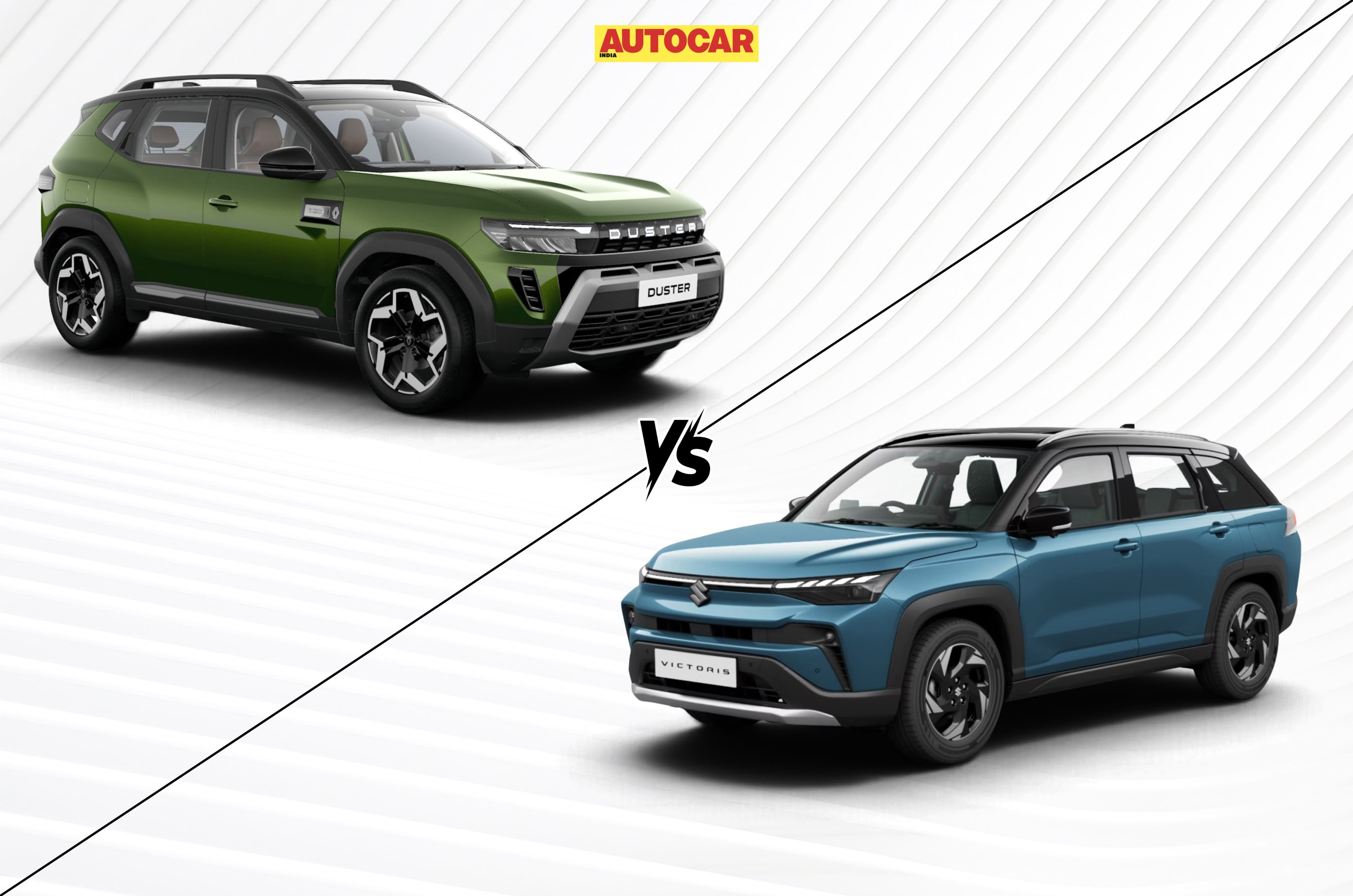
Renault Duster vs Maruti Victoris: Top-spec strong-hybrid SUVs compared

Renault Duster vs Maruti Victoris: Top-spec strong-hybrid SUVs compared
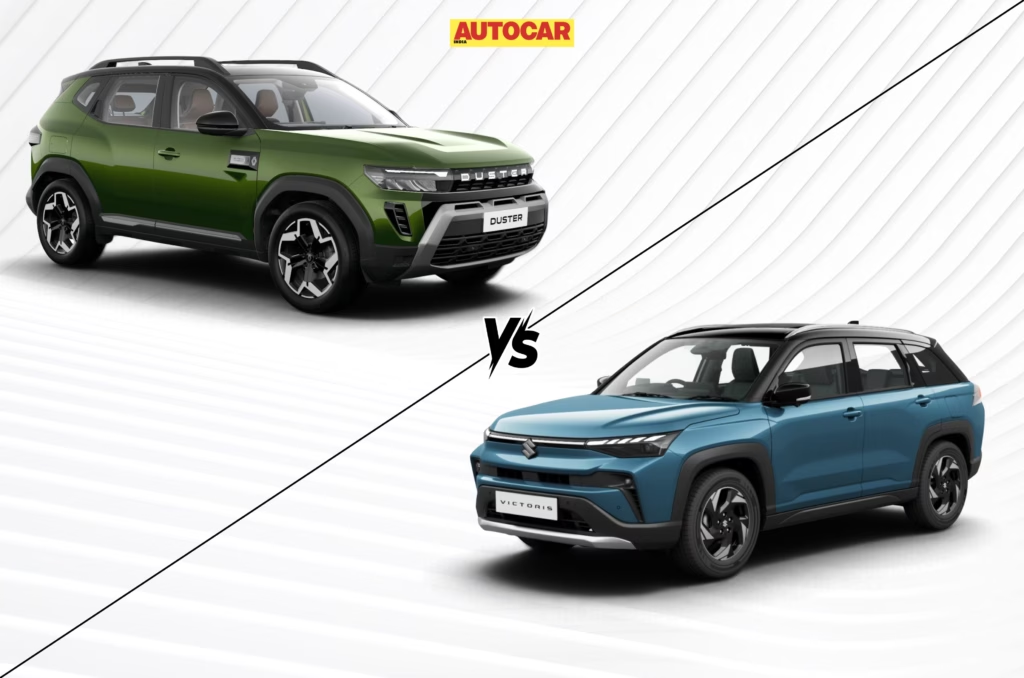
Renault Duster vs Maruti Victoris

With the Duster strong-hybrid E-Tech 160, Renault is the latest brand to jump on the strong-hybrid bandwagon. The Duster strong-hybrid is positioned as an economical alternative powertrain and adds to its existing turbo-petrol options. On the other hand, the Maruti Victoris has been in the market for a year, offering a strong-hybrid powertrain since launch. But which strong-hybrid mid–size SUV in top-spec guise offers more bang for buck? We compare their respective on-paper specifications to find out. For this comparison, we’ve chosen the top-spec Emotion and ZXi+ (O) versions of the strong-hybrid Renault Duster and Maruti Victoris, respectively.

Renault Duster vs Maruti Victoris: Dimensions

Renault Duster vs Maruti Victoris: Dimensions


Renault Duster

Maruti Victoris

Difference

Length (mm)

4,346

4,360

-14

Width (mm)

1,815

1,795

+20

Height (mm)

1,694

1,655

+39

Wheelbase (mm)

2,657

2,600

+57

Ground clearance (mm)

212

210

+2

Boot space (litres)

372

Under 300 (est.)

–

Est. – Estimated

Apart from length, the Duster outranks the Victoris in every other dimension. It is 20mm wider, 39mm taller, has a 57mm longer wheelbase, and rides 2mm higher off the ground. 

Renault Duster vs Maruti Victoris: Powertrain specifications

Renault Duster vs Maruti Victoris: Powertrain specifications


Renault Duster

Maruti Victoris

Engine 

Naturally aspirated petrol, Atkinson cycle

Naturally aspirated petrol, Atkinson cycle

Displacement (cc)

1,789

1,490

Power (hp)

110

92

Torque (Nm)

175

122

Transmission

multi-mode automatic gearbox with 2 electric gears & 4 petrol gears

e-CVT

Battery capacity (kWh)

1.4

0.76

E-motor power (hp)

50

80

E-motor torque (Nm)

208

141

Maximum power output (hp)

160

116

Maximum torque output (Nm)

NA

NA

Claimed efficiency (kpl)

29

28.65

In strong-hybrid guise, both SUVs utilise a naturally aspirated petrol engine running on the more efficient Atkinson cycle. However, the Duster’s larger unit delivers more power and torque figures. The Duster also uses a larger battery pack.  Both SUVs also use e-motors, wherein the one on the Maruti produces more power, but the Duster’s e-motor outputs more torque. With a combined power output of 160hp, the Duster strong-hybrid is much more powerful than the Victoris strong-hybrid. 

Both SUVs also differ in the gearboxes utilised here. The Duster uses a multi-mode automatic gearbox with 2 electric and 4 petrol gears, whereas the Victoris uses an e-CVT. Renault says that the Duster drives 80 percent on EV power in the city, which likely contributes to its higher claimed mileage. But real-world tests are awaited for the Renault.

Renault Duster vs Maruti Victoris: Exterior features

Renault Duster vs Maruti Victoris: Exterior features


Renault Duster

Maruti Victoris

Headlamps

LED

LED projector

LED DRLs

Yes

Connected

Puddle lamps

Yes

No

Tail lamps

Connected LED

Connected LED

Fog lamps

Optional

Yes

Welcome/goodbye animation

Yes

No

Wheel sizes

18-inch

17-inch

Rear spoiler

Yes

Yes

Electric adjust/fold ORVMs

Yes

Yes

Sharkfin antenna

Yes

Yes

Roof rails

Yes

Yes

Powered tailgate

Yes

Yes

Colour

Monotone and dual-tone

Monotone and dual-tone 

On the outside, LED light setups, DRLs, roof rails, a shark fin antenna, and a powered tailgate are found on both SUVs.  However, larger 18-inch alloy wheels, puddle lamps, and welcome/goodbye animations for the light setups are unique to the Duster.

Renault Duster vs Maruti Victoris: Interior features

Renault Duster vs Maruti Victoris: Interior features


Renault Duster

Maruti Victoris

Ventilated seats

Yes

Yes

Sunroof

Panoramic

Panoramic

Infotainment screen size

10.1-inch

10.1-inch

Digital driver’s display

10.25-inch

10.25-inch

Head-up display

Optional

Yes

Wireless Apple CarPlay, Android Auto

Yes

Yes

On-board navigation

No

Yes

Powered driver seat

6-way

8-way

Powered co-driver seat

6-way

No

Reclining rear seats

No

No

Air Purifier

Optional

Yes

Auto AC

Dual-zone

Single zone

Rear AC vents

Yes

Yes

Seat upholstery

Leatherette

Leatherette

Wireless phone charger

Yes

Yes

Audio system

6-speaker Arkamys

8-speaker Infinity

60:40 split rear seat folding

Yes

Yes

USB Type-C ports 

2x front, 2x rear

2x front, 2x rear

Rear armrest

No

Yes

Connected car tech

Yes

Yes

Rear window sunshade

No

No

Ambient lighting

Optional

Yes

Leatherette inserts on the dashboard

Yes

Yes

Push-button start

Yes

Yes

Keyless entry

Yes

Yes

Steering adjust

Tilt and Telescopic

Tilt and Telescopic

The Renault offers features such as a powered co-driver seat and dual-zone automatic climate control that the Maruti lacks. In contrast, the latter gets further adjustment for the driver seat, two additional speakers, and on-board navigation, while features like a head-up display and ambient lighting are factory-fitted on the former.

Renault Duster vs Maruti Victoris: Driving features 

Renault Duster vs Maruti Victoris: Driving features 


Renault Duster

Maruti Victoris

Drive modes

No

Eco, Normal, Sport

Cruise control

Regular

Regular

As far as driving features are concerned, both models come with regular cruise control, but drive modes are found only on the Victoris.

Renault Duster vs Maruti Victoris: Safety features 

Renault Duster vs Maruti Victoris: Safety features 

Safety features

Renault Duster

Maruti Victoris

Airbags

Six

Sx

Parking sensors

Rear

Front and rear 

Camera setup

Rear view

360-degree

Dash cam

Optional

Optional

Electronic parking brake with auto hold

Yes

Yes

ADAS

No

No

TPMS

Yes

Yes

Hill start assist

Yes

Yes

Disc brakes (Front/Rear)

Yes

Yes

ESC

Yes

Yes

Auto-dimming IRVM

Yes

Yes

On the safety front, both SUVs are well-equipped with features such as 6 airbags, rear parking sensors, auto-dimming IRVM, electronic parking brake with auto-hold, all-wheel disc brakes, and TPMS. However, the Victoris pips the Duster here by offering a 360-degree camera and front parking sensors. Notably, both miss out on a Level 2 ADAS suite.

Renault Duster vs Maruti Victoris: Prices and verdict 

Renault Duster vs Maruti Victoris: Prices (Rs lakh)


Renault Duster

Maruti Victoris

Price 

19.49

19.98

Comparing top-spec versions side by side, the Duster strong-hybrid is more affordable by Rs 41,000. Between the two, it’s the Duster we’d recommend. Apart from being the more affordable option, it offers slightly more kit and delivers more power without sacrificing much in terms of efficiency.

Scooter sales hit record high in first half of FY2027

Scooter sales hit record high in first half of FY2027
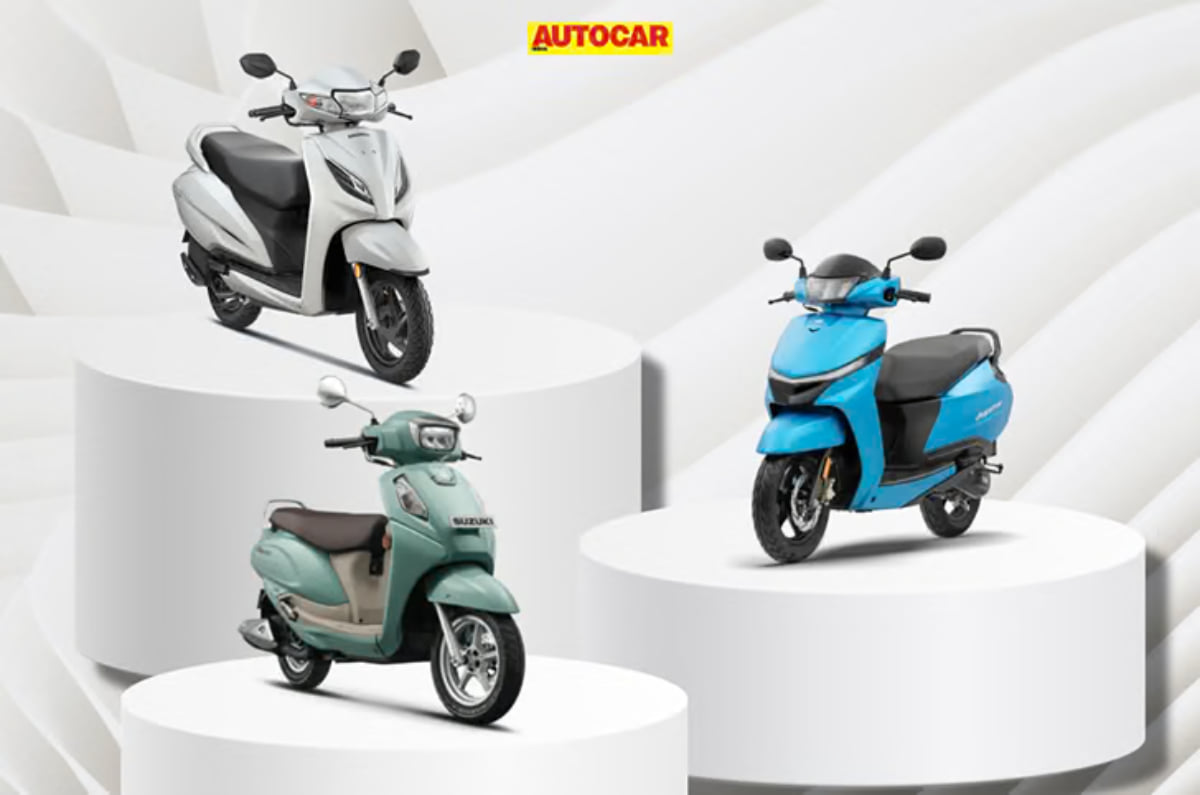
Graphic with Activa, Jupiter, and Access on a podium

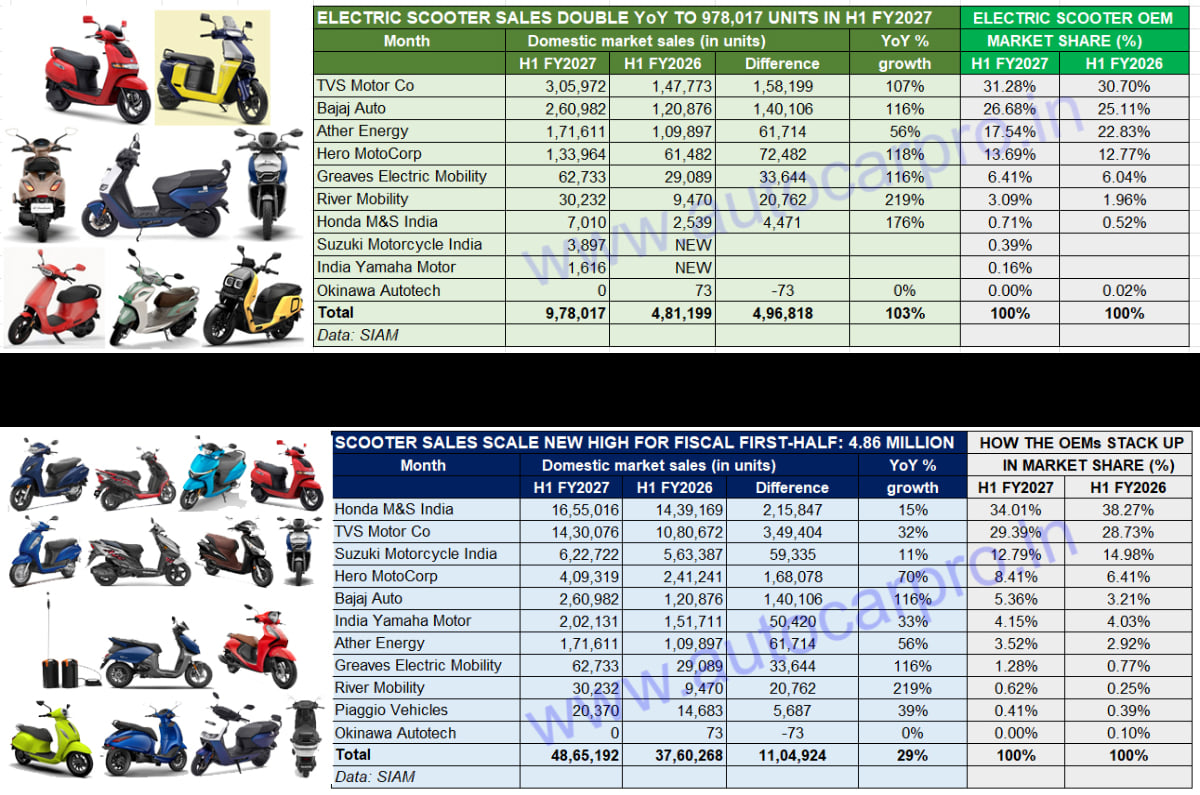
Two-wheeler manufacturers have dispatched a record 48,65,192 scooters in the domestic market in the first half (H1) of FY2027. That’s an additional 10.8 lakh units over the same period last year, representing a 29 percent increase. The six-month period included two monthly records: April 2026 opened as the best-ever April, with 6,91,993 units, while September registered 9,95,576 units – the highest monthly total ever for the category and just 4,424 units short of the million-unit (10 lakh) milestone.

Zooming out, the scale of the growth becomes clearer. Scooter sales have more than doubled over 12 years. In H1 FY2016, the total was 2.4 million units, whereas FY2027’s first half has already reached about 60 percent of FY2026’s full-year record of 8.11 million units.

Electric scooters double, claim a 20 percent share

Honda leads overall, TVS grows faster

The fastest-growing part of the segment is electric. E-scooter wholesales hit 9,78,017 units in H1 FY2027, up 103 percent year-on-year from 4,81,199 units in H1 FY2026. This surge has pushed EVs’ share of total scooter sales from 13 percent to 20 percent in a single year.

TVS Motor Company leads the e-scooter market, with 3,05,972 iQube and Orbiter units dispatched, up 107 percent year-on-year, giving it a 31 percent share. Bajaj Auto is second, with 2,60,982 Chetak and Yulu units – a 116 percent jump – and a 27 percent share. Together, the two account for 58 percent of all e-scooters sold in the first half. Ather Energy, with 1,71,611 units and 56 percent growth, held third place, though its share dipped from 23 percent to 18 percent as the market expanded. Hero MotoCorp’s Vida dispatched 1,33,964 units, up 118 percent, for a 14 percent share.

The three Japanese players – Honda, Suzuki and Yamaha – collectively sold 12,523 e-scooters, accounting for a combined 1 percent share. Honda led the group with 7,010 units, up 176 percent.

Across ICE and EV models combined, Honda Motorcycle & Scooter India remains the category leader with 1.65 million units, up 15 percent, although its market share has dipped from 38 percent to 34 percent. TVS Motor Company is in second place with 1.43 million units and 32 percent growth, adding 3,49,404 units year-on-year. Nearly half of that incremental volume came from its electric lineup.

Suzuki, with 6,22,722 units and 11 percent growth, and Hero MotoCorp, with 4,09,319 units and 70 percent growth, hold third and fourth place, respectively. Bajaj Auto has climbed to fifth with 2,60,982 units and 116 percent growth, displacing Yamaha, which recorded 2,02,131 units, up 33 percent. Ather Energy is seventh with 1,71,611 units, while River Mobility has entered the top 10, overtaking Piaggio with 30,232 units of the Indie scooter.

With the festive season now underway, the industry will be looking to convert the strong H1 momentum into retail sales. Whether Q3 and Q4 can sustain the near-30 percent growth rate needed to push scooter sales past 10 million units for the first time remains to be seen, but the trajectory points firmly in that direction.


Stock Market Fall: महानवमी पर बाजार में गिरावट, सेंसेक्स 538 अंक तक फिसला; निवेशकों ने गंवाए ₹3.23 लाख करोड़

लगातार 2 कारोबारी सत्रों में बढ़त देखने के बाद भारतीय शेयर बाजारों में 19 अक्टूबर को महानवमी के मौके पर गिरावट है। सेंसेक्स बढ़त में खुला लेकिन फिर चंद पलों में पिछली क्लोजिंग से 538 अंक टूटकर 74,191.21 के लो तक गया। इस बीच BSE पर लिस्टेड कंपनियों का मार्केट कैप 3.23 लाख करोड़ रुपये घट गया। इसी तरह निफ्टी भी बढ़त में खुलने के बाद पिछली क्लोजिंग से 175 अंक से ज्यादा टूटकर 22,970.50 के लो तक गया।

शुक्रवार को शेयर मार्केट बंद होने पर BSE पर लिस्टेड कंपनियों का मार्केट कैप 4,73,46,932.132 करोड़ रुपये रहा था। सोमवार को मार्केट खुलने के कुछ ही देर में यह 4,70,22,982.02 करोड़ रुपये हो गया। यानि कि 3,23,950.112 करोड़ रुपये की कमी।

शुक्रवार को कैसी रही थी चाल

आईटी कंपनियों के शेयरों में तगड़ी खरीदारी और वैश्विक बाजारों से मिले सकारात्मक संकेतों से शुक्रवार, 16 अक्टूबर को शेयर बाजारों में लगातार दूसरे कारोबारी सत्र में बढ़त देखी गई थी। सेंसेक्स 413.66 अंक या 0.56 प्रतिशत बढ़कर 74,729.27 पर बंद हुआ था। निफ्टी 148.80 अंक या 0.65 प्रतिशत बढ़कर 23,146.15 पर बंद हुआ था। बीते सप्ताह सेंसेक्स में 2,256.94 अंक या 3.11 प्रतिशत और निफ्टी में 625.7 अंक या 2.77 प्रतिशत की बढ़त दर्ज की गई।

Stocks to Watch: 19 अक्टूबर को Axis Bank, Yes Bank, HDFC Bank, RailTel, Zen Tech समेत इन शेयरों पर नजर, दिख सकती है बड़ी उठापटक

Disclaimer: यहां मुहैया जानकारी सिर्फ सूचना के लिए दी जा रही है। यहां बताना जरूरी है कि मार्केट में निवेश बाजार जोखिमों के अधीन है। निवेशक के तौर पर पैसा लगाने से पहले हमेशा एक्सपर्ट से सलाह लें। मनीकंट्रोल की तरफ से किसी को भी पैसा लगाने की यहां कभी भी सलाह नहीं दी जाती है।

Exclusive: New 450cc class single-cylinder Norton to debut at EICMA 2026

Exclusive: New 450cc class single-cylinder Norton to debut at EICMA 2026
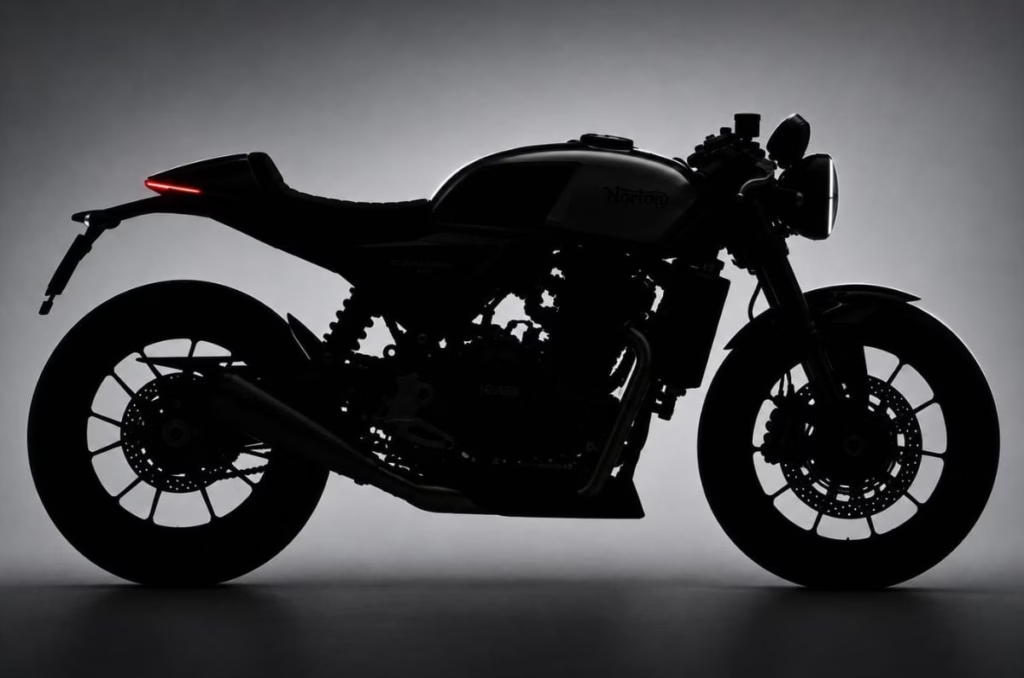
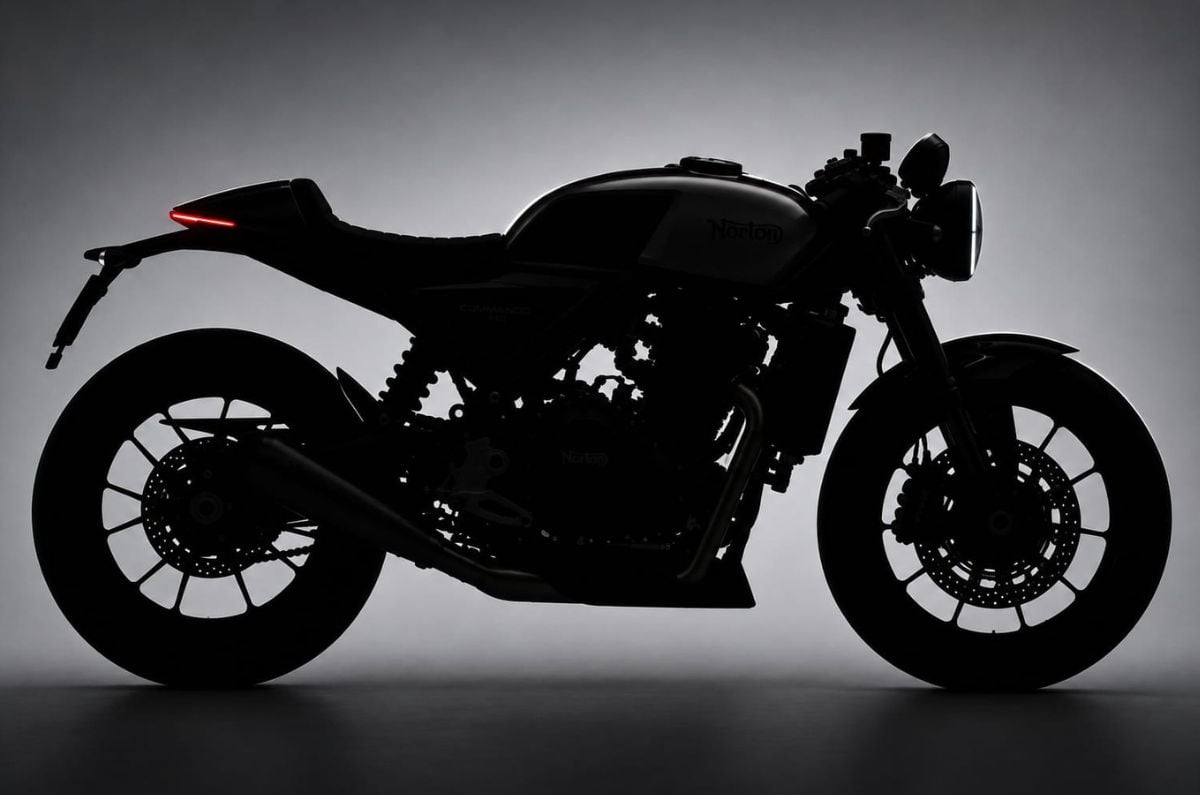
A silhouette of the soon-to-debut single-cylinder Norton

Norton Motorcycles will premiere its much-awaited 450cc-class single-cylinder roadster at EICMA 2026 in Milan, expanding its range with a motorcycle aimed at higher volumes in India and overseas. Autocar Professional expects the motorcycle to produce around 40-45hp and 40-45Nm. The engine is likely to be liquid-cooled and is expected to come with a 6-speed gearbox. The roadster will be the first model on a new platform understood to be called the H-series, with other body styles to follow. It will sit below the TVS Motor-owned British marque’s twin-cylinder Atlas range and V4-powered Manx family.

  1. Norton Atlas is expected to first launch in India, in Q1 2027
  2. New Norton single-cylinder motorcycle will launch overseas and in India simultaneously
  3. Will also be manufactured at TVS’ Hosur plant

New Norton single-cylinder platform at EICMA 2026

Expected to launch in India and overseas in 2027

Autocar Professional understands that TVS plans to begin Norton’s India rollout in the January-March 2027 quarter, if not sooner, starting with the Atlas, followed by the Manx. The H-series roadster is expected to launch simultaneously in India and global markets in the second half of 2027. Responding to queries from Autocar Professional, a Norton spokesperson said the brand’s India introduction would follow its appearance at this year’s Milan show. “Norton is set to launch in India soon following the brand’s presence at EICMA this year, when the next key stage of the resurgence will be revealed,” the spokesperson said. The company has not officially confirmed the roadster’s platform name, engine capacity, output, pricing or sales timeline.

Norton has recently trademarked three names in India – Roven, Inter and Avalon and the first single cylinder bike may bear one of them. In 2025, the company also trademarked the Norton Electra name here, and this followed on the trademarking of the Norton Combat name in 2023.

Reimagined Norton under TVS

Design and ease of use is at the new Norton’s core

Differentiated design is central to TVS’s effort to give Norton a contemporary identity while retaining its British heritage. Simon Skinner, Head of Design, Norton Motorcycles, is leading the development of a design language connecting the brand’s products across capacities and categories. The roadster will extend that approach to a motorcycle intended to sell in larger numbers.

As we have seen with the thoroughly modern designs on the Atlas and V4, it is safe to anticipate modern, pared-back styling, with selected mechanical components exposed and others concealed. This could help distinguish the roadster in a segment where several competitors draw heavily on retro styling. According to Norton, the Manx R received the “Best of the Best” distinction at the 2026 Red Dot Award: Design Concept. Norton Design was also recognised at the 2026 International Design Excellence Awards in the United States.

The roadster is expected to prioritise manageable weight and ease of use, particularly in city riding. It could feature 17-inch wheels and equipment drawn from Norton’s larger motorcycles, potentially including an eight-inch TFT touchscreen, riding aids and multiple riding modes. Final specifications remain unconfirmed.

Taking on Royal Enfield

How does Norton plan to combat the 350cc onslaught?

The platform represents a significant bet on the global mid-size motorcycle market. The opportunity spans roughly the 350cc-750cc categories, with annual volumes estimated at around 15 lakh-20 lakh units. This broad classification includes motorcycles marketed as 350cc models whose actual displacement is slightly lower.

It will bring Norton into closer competition with Royal Enfield and Triumph in India and overseas. However, the new single-cylinder Nortons will face a specific challenge in India. That is the fact that they will not come under the 350cc segment, unlike the massively popular RE 350 range and the recently re-engineered 349cc Triumph line in India. The result is that they will attract the much higher 40 percent GST rate instead of 18 percent. Norton is likely to position these bikes at a premium that will be justified by higher levels of technology and a heavy focus on design, quality and detail.

Royal Enfield’s dominance in India demonstrates the demand for motorcycles used for daily travel, touring and leisure riding. Its extensive dealer network, broad product range and established riding community also present a substantial challenge for Norton. Overseas, Royal Enfield has expanded into many of the markets the TVS-owned British marque is targeting. For TVS, the single-cylinder Norton offers a way to participate more widely in this market. Additional body styles on the same platform would help spread development costs and reach buyers with different riding preferences.

The India distribution plan

TVS is yet to confirm showroom rollout schedule for India

Norton’s design and heritage will form part of its appeal, but pricing, service coverage and parts availability will be important to building sustained sales, particularly in India. TVS had said in June that the Norton Atlas would be introduced in India later in the year. It had also scheduled the launch of TVS Paddock, its premium retail channel for both Norton and select premium TVS products, for the second quarter of FY27. The latest official response did not provide an updated Paddock rollout schedule.

Current preparations are understood to point to around three Paddock outlets by December, although a larger network is being sought. The number of outlets that will be operational when motorcycle sales begin has yet to be finalised. The company said it now has more than 50 retailers across 10 markets, including the UK, Italy, France, Germany and Spain. Preparations for a United States launch are continuing, subject to the final stages of vehicle certification.

Norton said its European test-ride programme had introduced the new motorcycles to thousands of riders. Foster + Partners has designed its showroom environments. TVS acquired Norton in April 2020. Its FY2025-26 annual report records investments exceeding GBP 250 million in rebuilding the business and identifies the marque as an important part of its premium-isation strategy, particularly in developed markets.

India already supports that expansion through manufacturing. The first Atlas motorcycles rolled off TVS’s Hosur production line in June, combining Norton’s UK design and engineering with its parent’s manufacturing operations. Production for the new single-cylinder range will also be out of Hosur.

With inputs from Anurag Chaturvedi and Rishaad Mody.