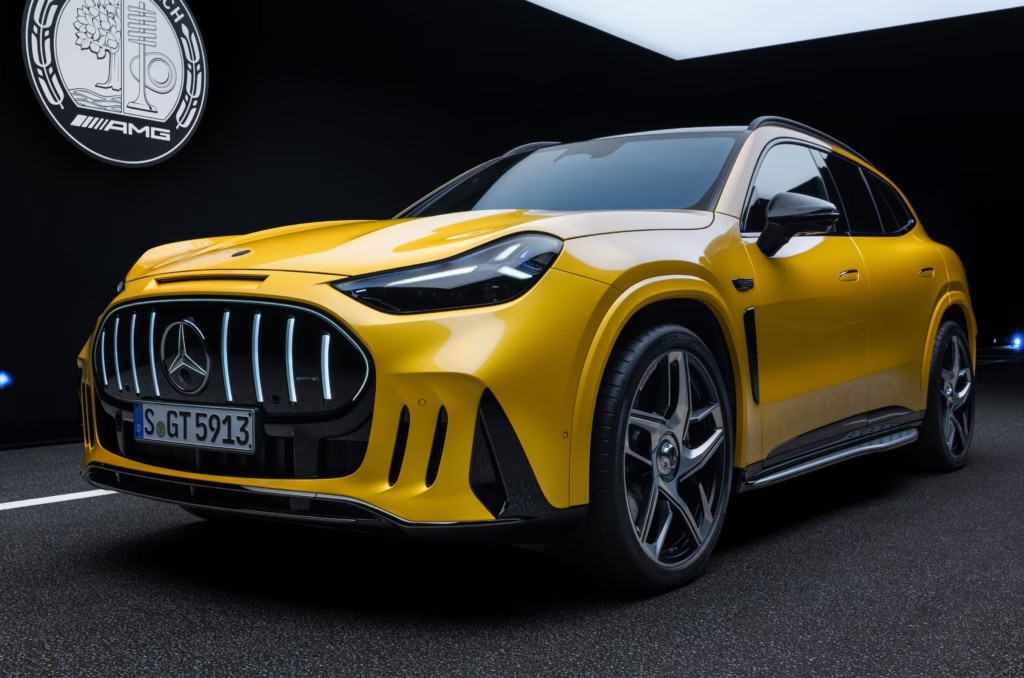
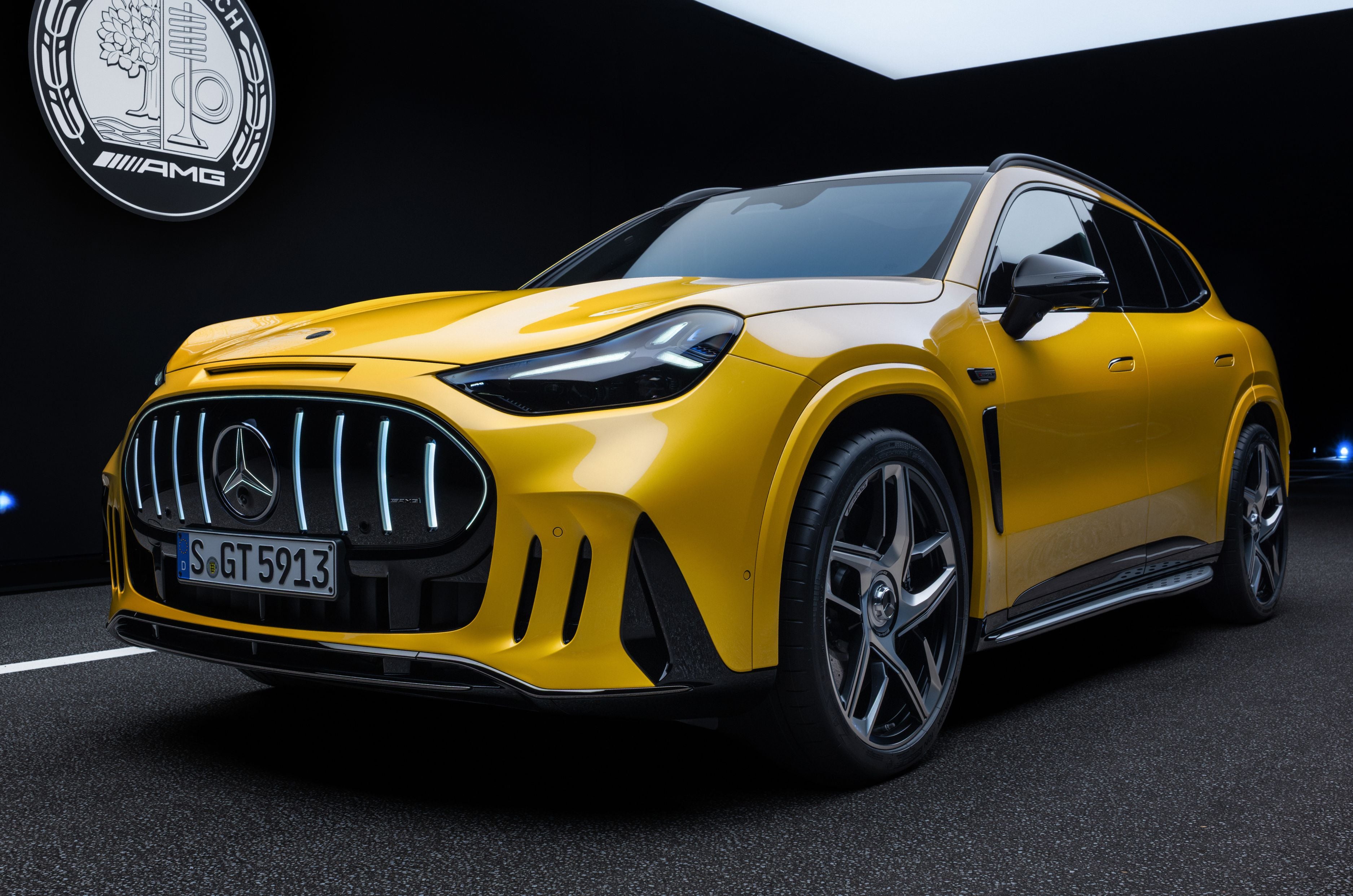
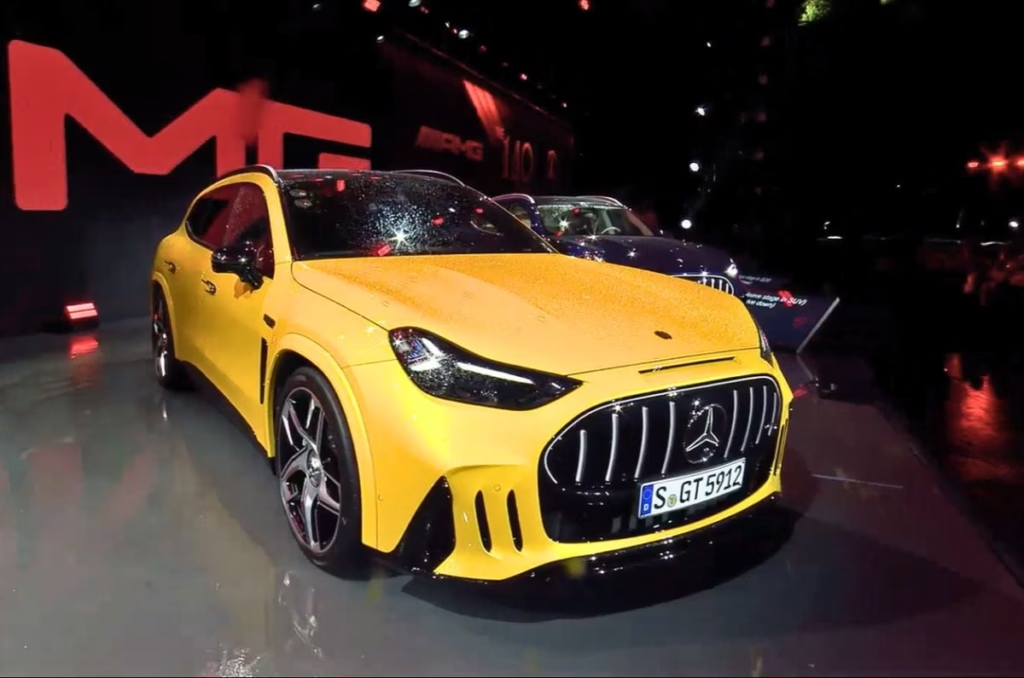
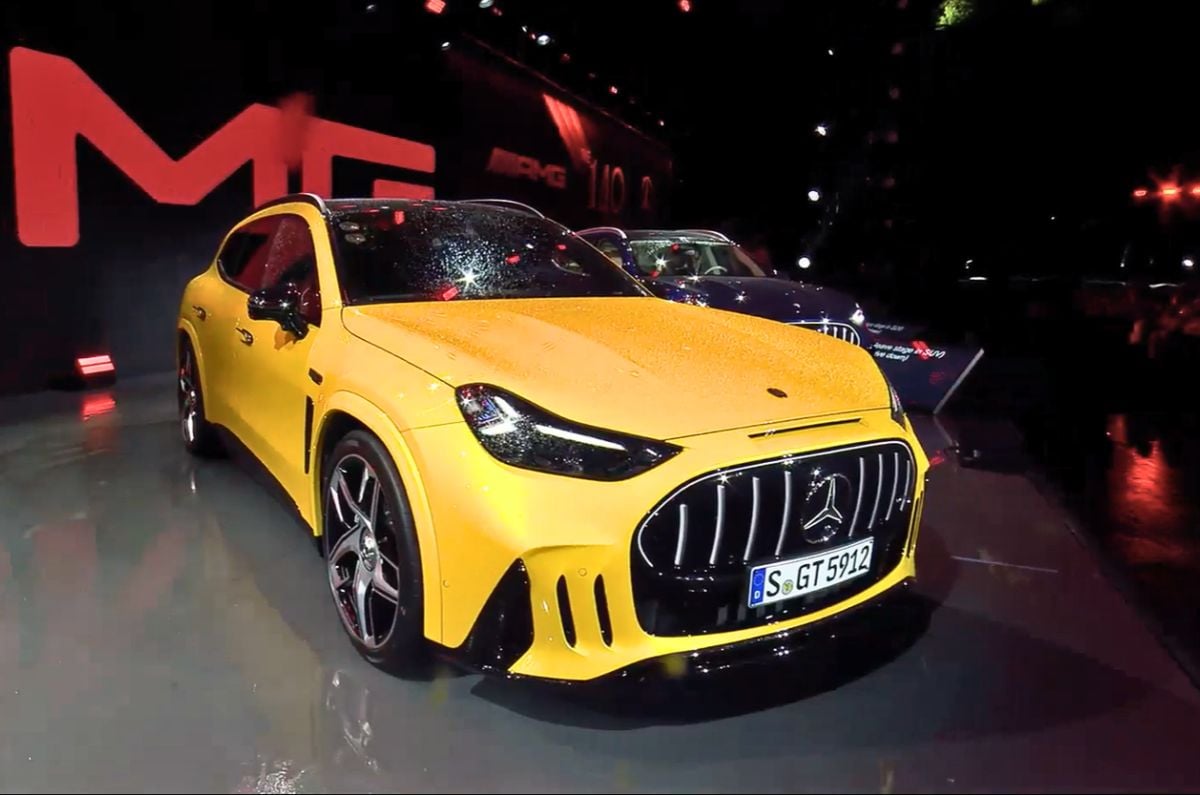
Mercedes-AMG has revealed the GT SUV, which the brand says is its first full-size SUV developed entirely in-house. The electric five-seater is built on the same underpinnings as the GT 4-Door Coupe. It will be offered in GT 53, GT 55 and GT 63 variants. The entry-level GT 53 will go on sale globally first, with the other two following in spring 2027. Mercedes-AMG claims a WLTP range of up to 700km and DC fast charging of up to 710kW. The brand is yet to reveal its India plans for the GT SUV.
Mercedes has taken the wraps off the AMG GT SUV which, according to the German marque, is the first full-size SUV it has developed completely in-house. The five-seat performance EV shares its underpinnings with the fully electric GT 4-Door Coupe, and will be available in GT 53, GT 55 and GT 63 guises, the last of which makes up to 1,169hp. The GT 53 will be the first to go on sale, with the more powerful variants joining the line-up in spring 2027.
Star-shaped DRLs, illuminated badging, active aero and more.
Personalisation options from the Manufaktur programme.
Three digital displays, built-in AI assistants, AMG-specific apps and more.
Claimed WLTP range of up to 700km, with DC fast charging of up to 710kW.
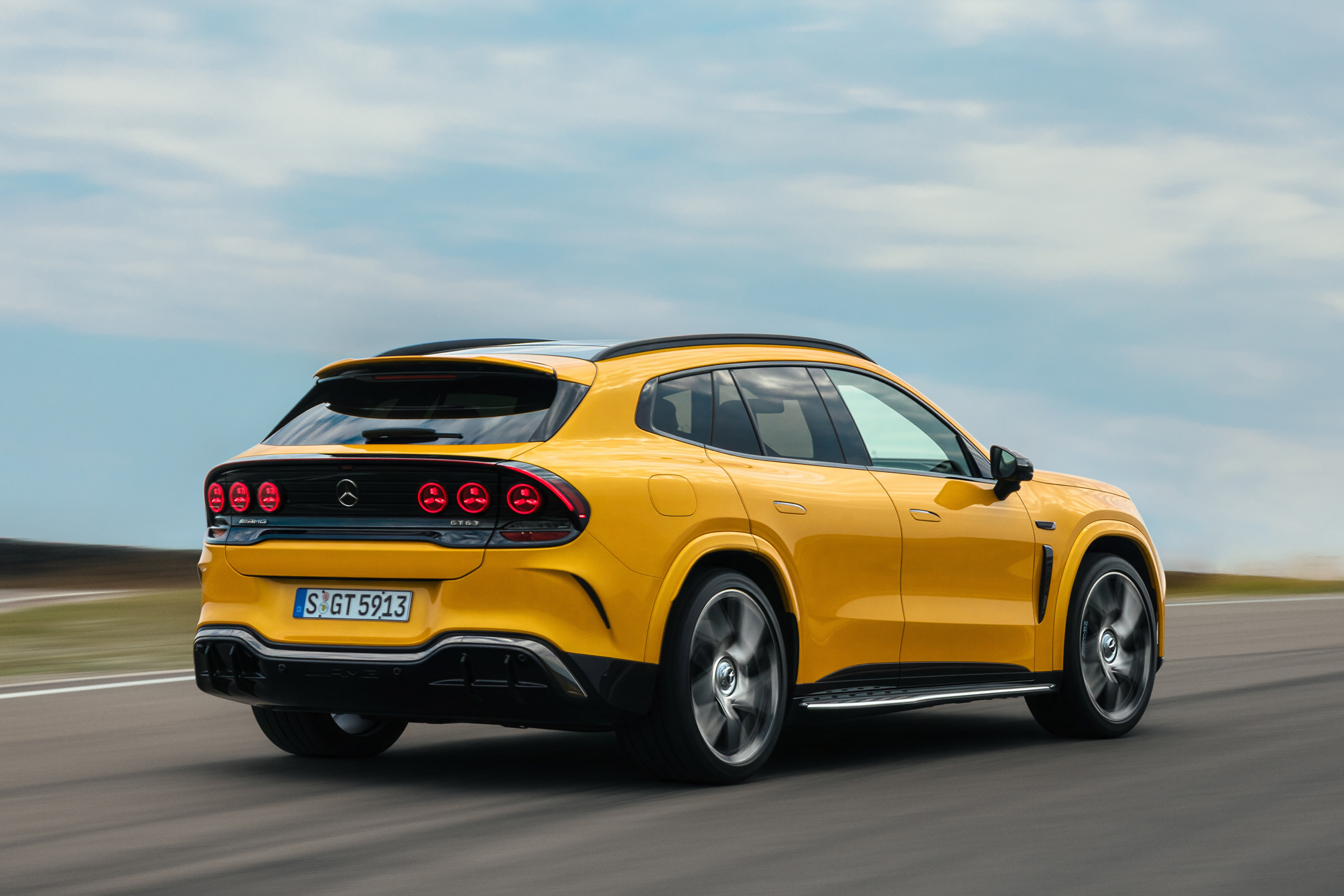
Mercedes-AMG GT SUV exterior
Illuminated badging, sloping roofline, active aerodynamics, Manufaktur paint options and more
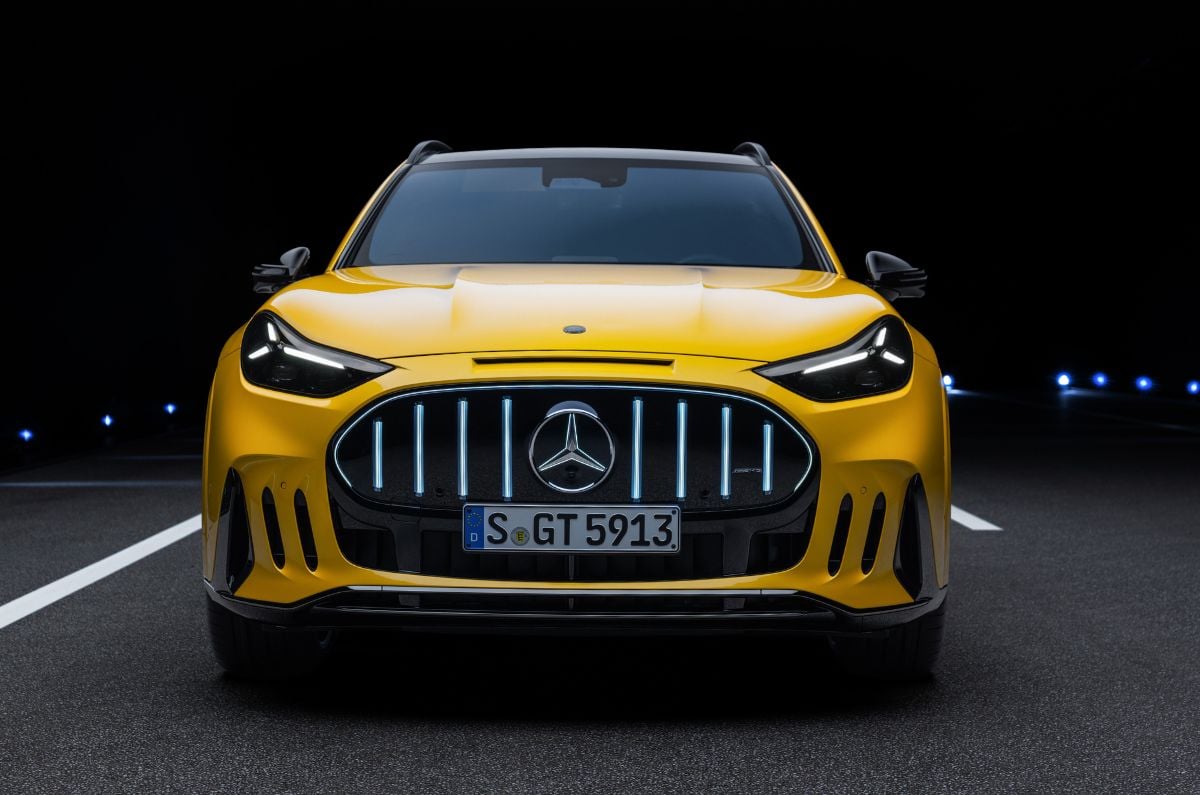
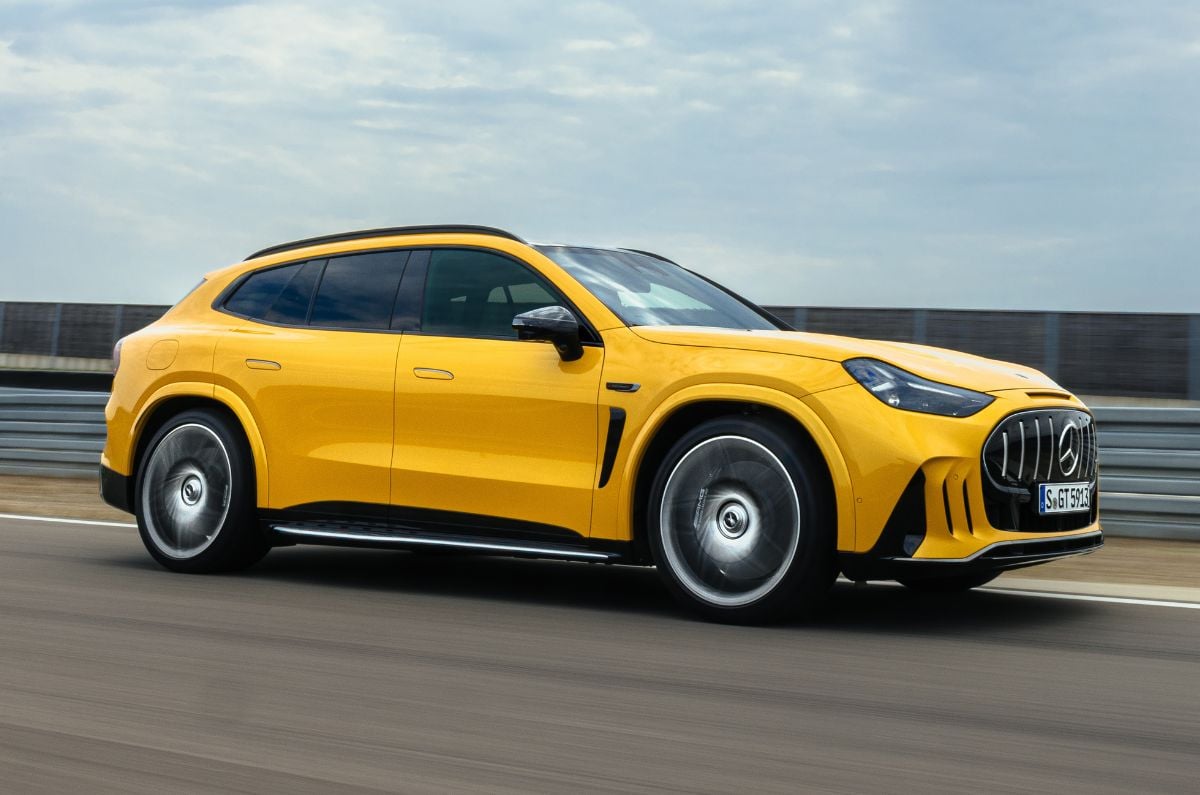
The Mercedes-AMG GT SUV comes in at 5,084mm long, 2,001mm wide and 1,656mm tall, and it has a wheelbase of 3,040mm. The front fascia sports AMG’s vertical-slat grille and Mercedes star, both of which can be optionally illuminated, flanking which are LED headlamps with star-shaped DRLs (daytime running lights). The front bumper features active slats, which only open when components need extra cooling.
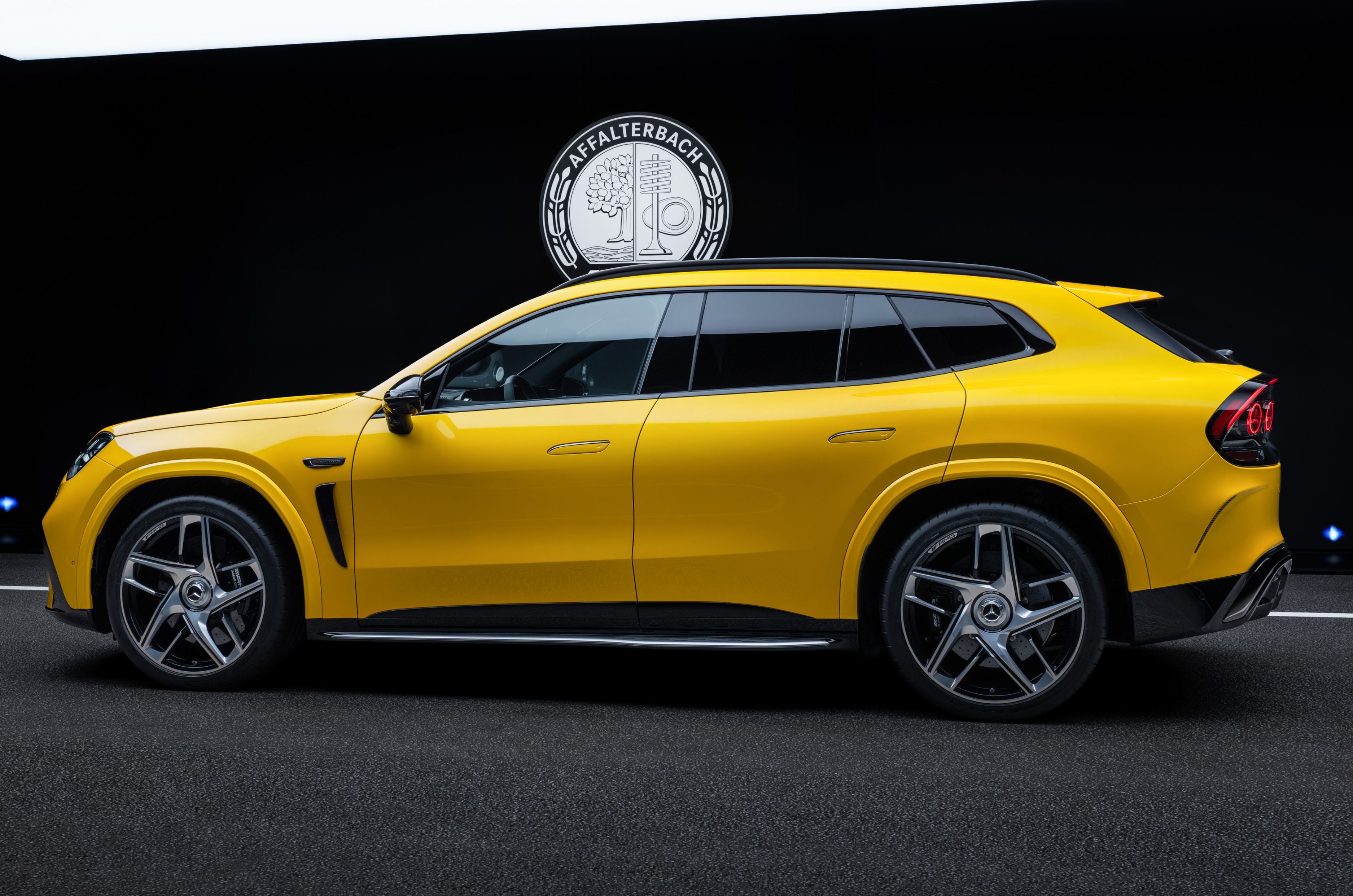
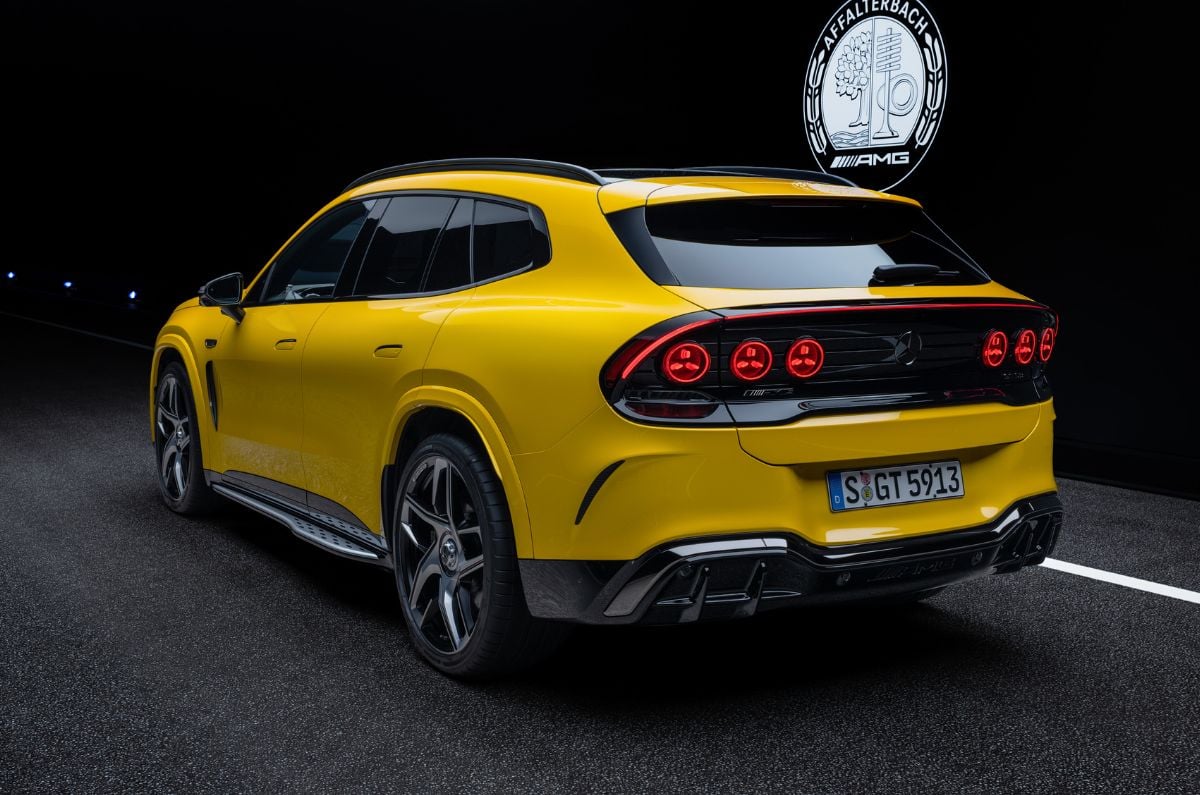
The profile showcases a low-slung roofline that slopes towards the rear along with pronounced wheel arches. Other details here include frameless side windows and compact wing mirrors. Moving to the rear of the AMG GT SUV reveals six circular tail-lamps as seen on the GT 4-Door Coupe, and customers can also opt for a full-width light strip.
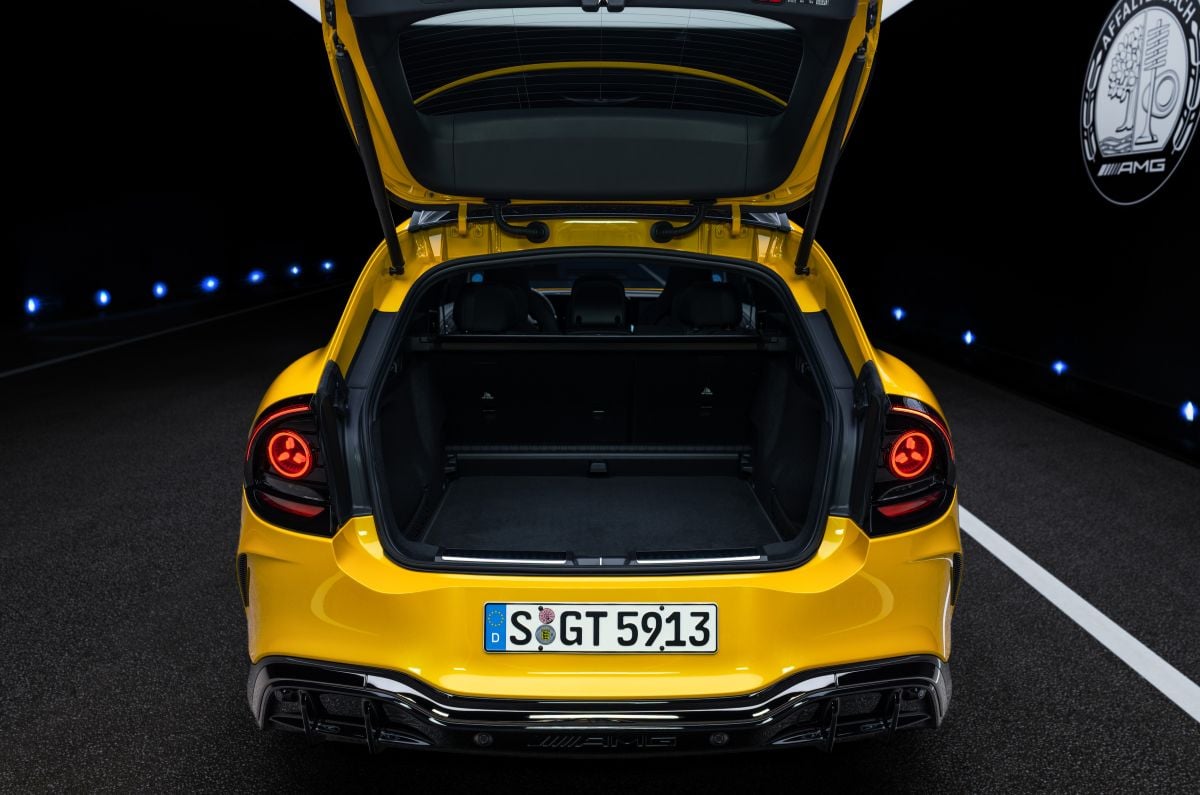
Stepping up to the GT 55 and GT 63 means an active rear spoiler that remains flush with the roof until 150kph, changing its angle depending on the driving scenario. Mercedes-AMG also claims a drag coefficient of 0.28 for the GT 53, while the other two are rated at 0.27. The main boot has a claimed capacity of 607 litres, with the frunk capable of accommodating 78 litres worth of luggage.
Buyers can personalise the GT SUV through the brand’s Manufaktur programme, which presents over 60 paint options. Customers can also opt for AMG’s forged wheels in colour accents, which includes Matt Vanadium Silver and Matt Copper, Matt Black with a rim flange in Angel Blue, Sunny Lime, or Orange Flame.
Mercedes-AMG GT SUV interior and features
Stand-out tech includes dual 14-inch screens, AI assistants and AMG-specific apps
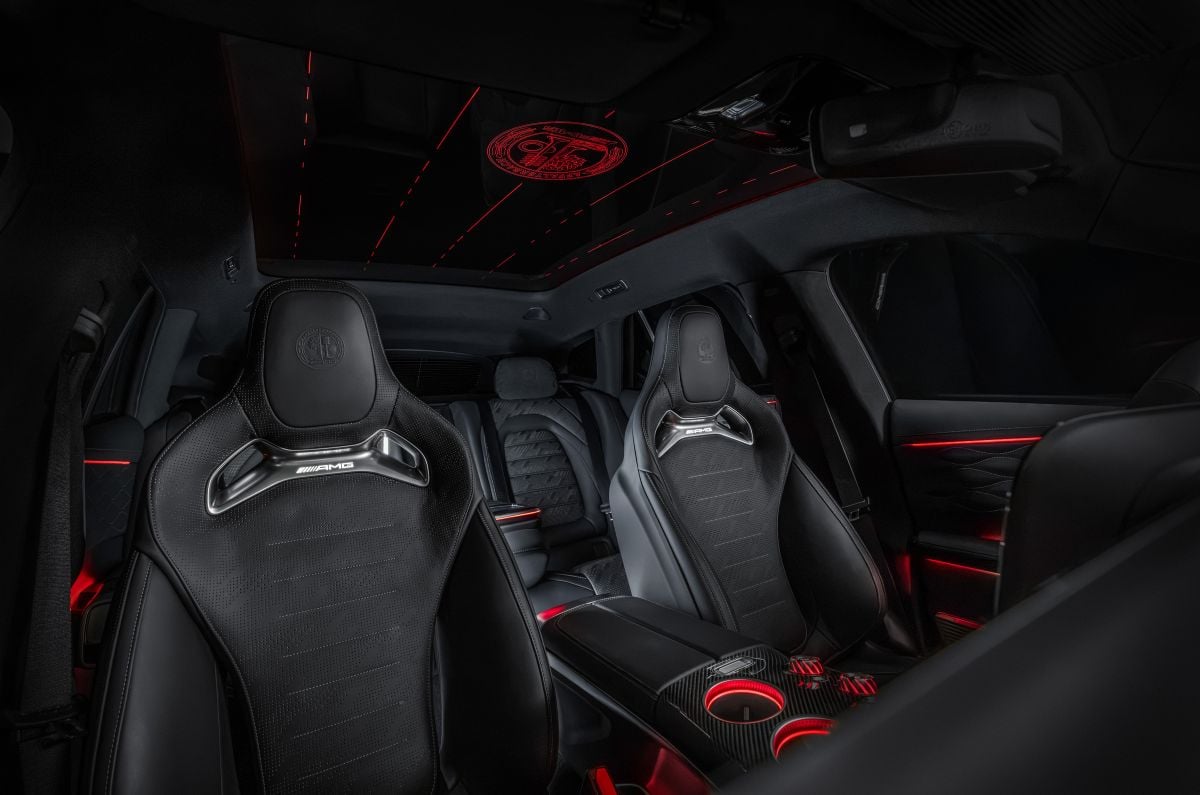
Just like the exterior, the interior of the Mercedes-AMG GT SUV can be personalised using the Manufaktur catalogue. Some of the options that will be offered to customers include accent colours and seatbelts trimmed in Fjord Blue, Green Hell or Orange Flame. The automaker claims that the seating position here is akin to that of a sports car rather than an SUV. Providing comfort up front are multi-way power-adjustable seats, while the three-seat rear bench gets power-folding headrests.
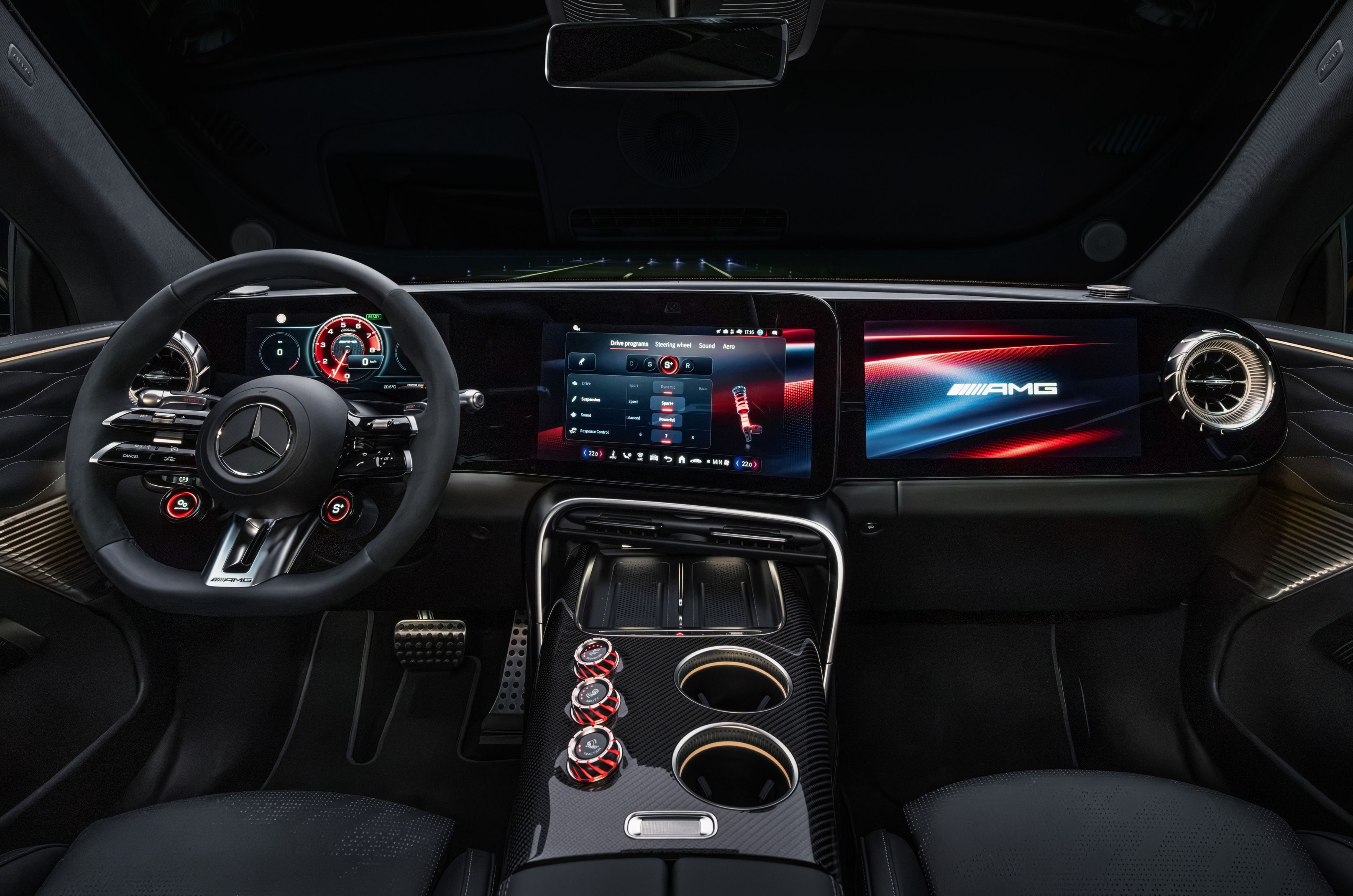
The dashboard pairs a 10.2-inch digital instrument cluster with a 14-inch touchscreen that’s angled towards the driver, while a 14-inch screen is optional for the front occupant. The AMG Performance steering wheel is equipped with paddles to adjust brake-regen levels, while adding to the design are door panels with floating armrests and diamond-pattern stitching. There’s also multi-colour ambient lighting whose colours can be matched to the bevy of displays and controls.
The infotainment system features the German brand’s latest MBUX software, which is based on the MB.OS (Mercedes-Benz Operating System). It integrates AI agents such as ChatGPT, Microsoft Bing and Google Gemini. This luxury SUV also comes with three AMG-specific apps. Firstly, there’s ‘AMG Performance Menu’, which displays real-time data on power, tyre temperatures and active aero status.
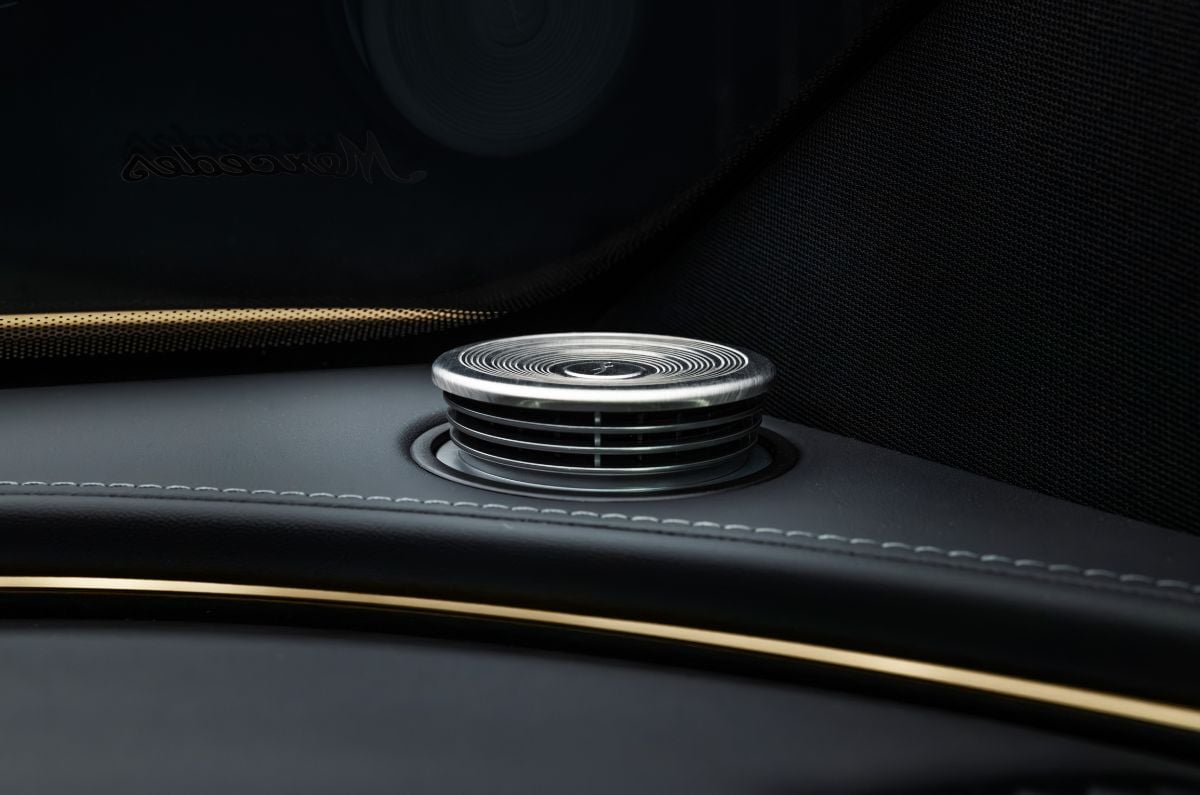
Second is ‘AMG Set-up’ – this lets the driver customise the buttons on the steering wheel as well as aero settings. Finally, there’s ‘AMG Track Pace’, which records lap times and telemetry. Drivers can also use it to show optimal braking points and the ideal racing line in the head-up display. Meanwhile, the optional dashcam allows laps to be recorded with data overlays. The AMG GT SUV is also available with an electrically dimming panoramic glass roof, AMG lighting effects, AMG Performance seats and a Burmester 4D audio system, among many optional features.
Mercedes-AMG GT SUV powertrain and performance
The EV gets up to three electric motors and a WLTP range of up to 700km
The entry-level GT 53 variant of the Mercedes-AMG GT SUV uses two synchronous motors – one on each axle – with a two-speed gearbox located at the rear. Its output is rated at 544hp and 800Nm, with Mercedes-AMG claiming a 0-100kph time of 4.2 seconds and a top speed of 250kph. Then there are the mid-spec GT 55 and the top-spec GT 63. These come with two axial flux motors at the rear and one at the front, the latter disengaging when not needed to save energy.
The tri-motor setup of the GT 55 outputs 816hp and 1,860Nm, allowing for a claimed 0-100kph time of 3.1 seconds. Sitting at the top of the Mercedes-AMG GT SUV line-up is the GT 63, which is rated at 1,169hp and 2,000Nm and does 0-100kph in 2.7 seconds. Regardless, the all-wheel-drive GT 55 and GT 63 have a claimed top speed of 270kph with the optional Driver’s Package.
The GT 53’s 106kWh battery pack offers a claimed WLTP range of up to 668km, while the 128kWh battery of the GT 55 and GT 63 is rated at up to 700km. These 800V packs offer DC fast charging of 600kW and 710kW, respectively. Mercedes-AMG claims that charging these batteries from 10-80 percent takes 11-12 minutes, though it also says that these figures are preliminary.
The GT SUV gets rear-wheel steering as standard while also debuting AMG’s new ‘Active Ride Control+’ suspension. The latter, which is standard on the top-spec GT 63, replaces traditional anti-roll bars with hydraulic units that, according to the automaker, curb body roll and pitch. The top-spec variant also gets carbon-ceramic brakes as standard.
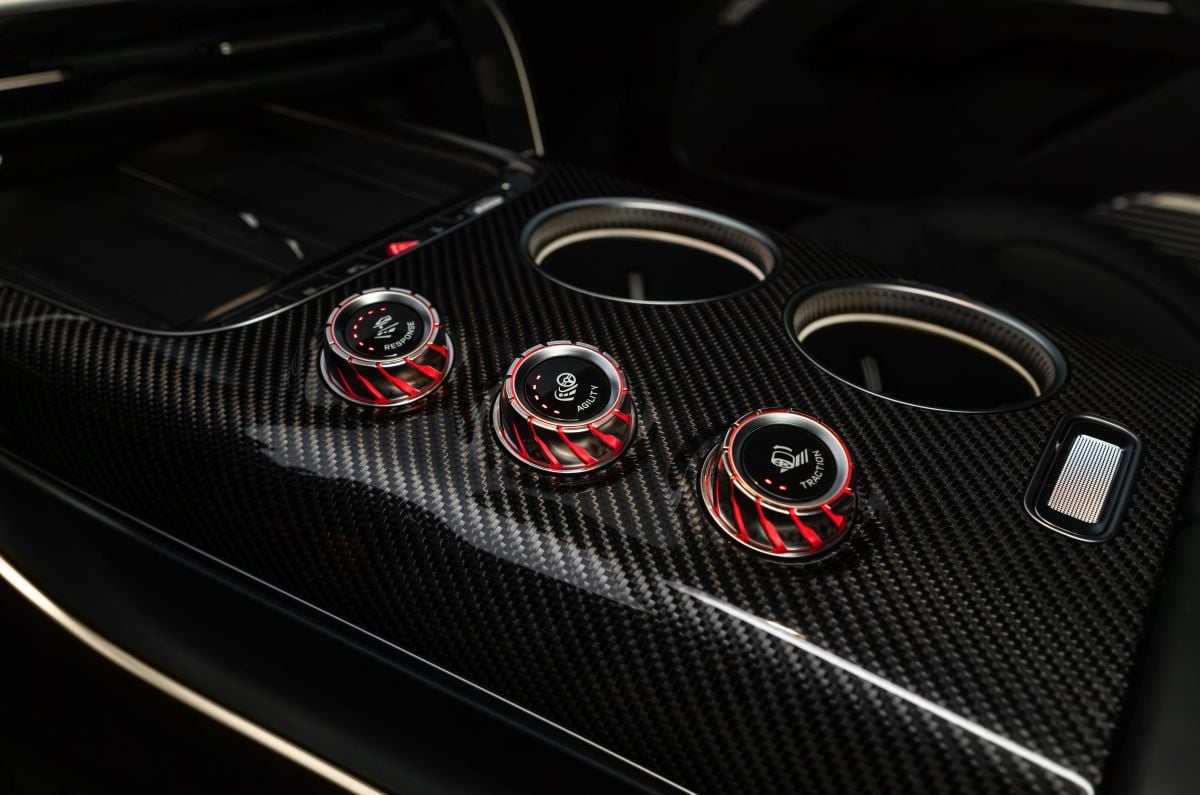
In the tri-motor variants, drivers can adjust the throttle response, cornering behaviour and traction control using dials on the centre console. Mercedes-AMG also said that the ‘AMGForce Sport+’ mode recreates the sound of an AMG V8 (or a six-cylinder in the GT 53) along with simulated gearshifts. As for India, the German marque is yet to reveal its plans for the AMG GT SUV.
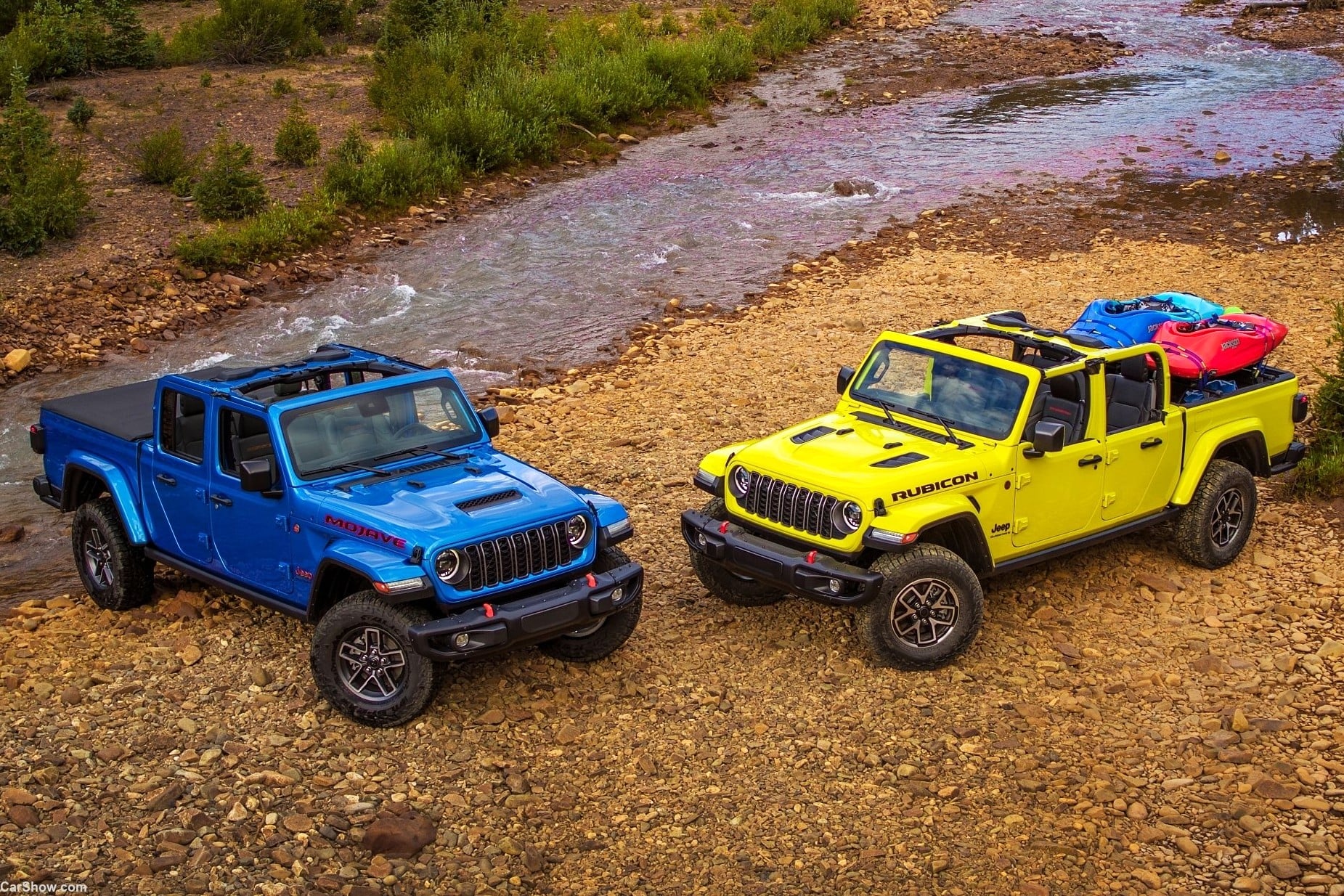
Stellantis India recently announced a new and much-needed product onslaught comprising seven Citroen and five Jeep models, all due within the next four years. While the conglomerate did not specify what these models would be, it did confirm there would be a premium pickup, which we understand would be the Jeep Gladiator.
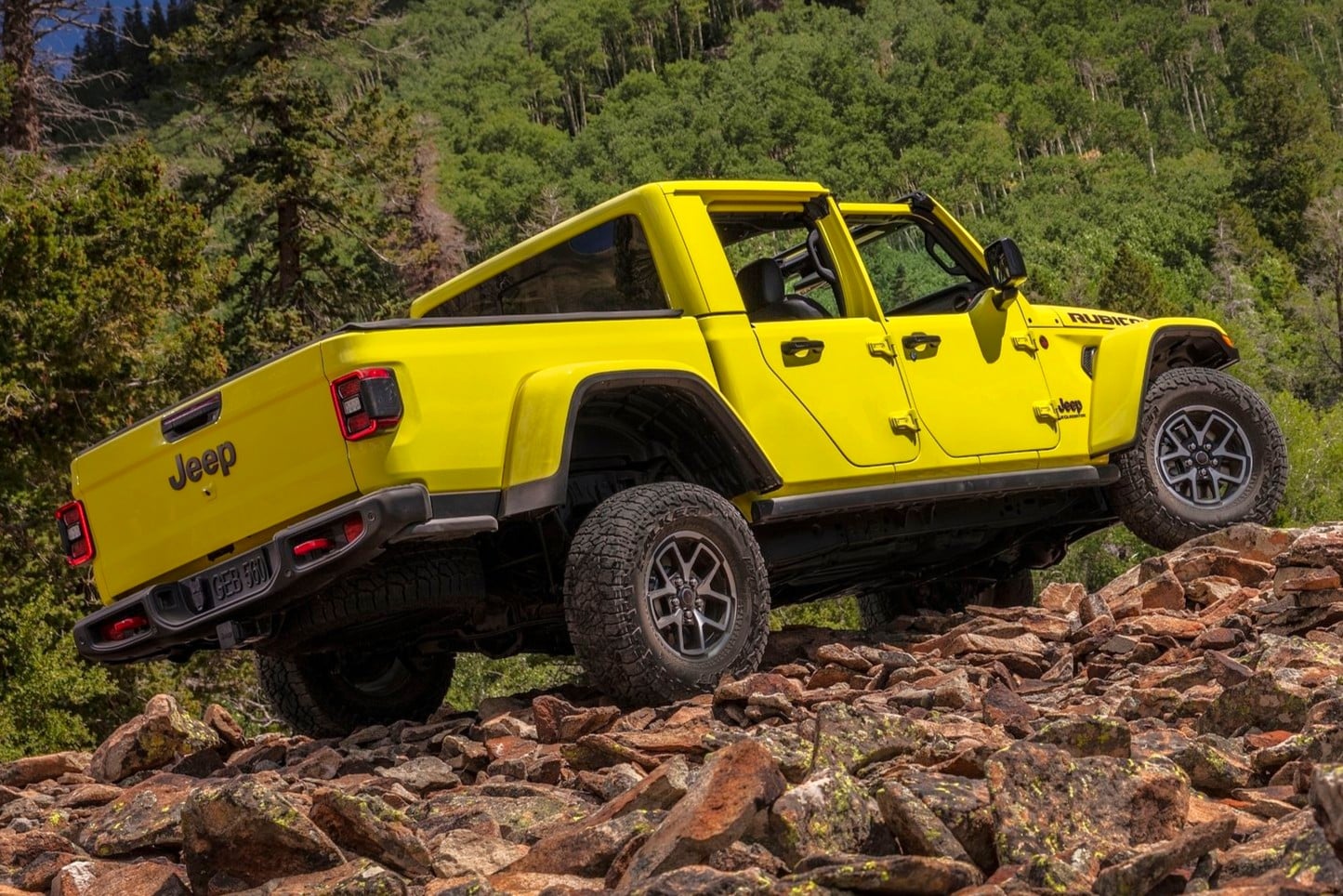
The pickup would be one of the earlier arrivals, and the company is likely to bring it in as a CKD, just as it currently does with the Grand Cherokee and the Wrangler – with which the Gladiator shares its platform (JL).
Gladiator may mark Jeep India’s entry into the premium pickup segment
Currently the American pickup offers a single 3.6 litre V6 petrol and that could be the engine of choice for India too, and as is intrinsic to the brand, a 4×4 powertrain would also likely be offered. Alternatively, given that the Gladiator and Wrangler share a platform, Jeep India could consider utilizing the Wrangler’s 2.0-litre direct-injection four-cylinder turbo-petrol engine under the hood of the Gladiator in India.
In Jeep’s home market, the USA, the Gladiator and the four-door Wrangler are similarly priced, thus expect the Gladiator to be priced at around the Rs 70 lakh mark in India. This would be considerably higher than the Toyota Hilux. However, the Gladiator is larger than the Hilux; at over 5.5 meters in length, the Gladiator stretches the tape past the Hilux, which measures just over 5.3 meters.
The lifestyle pickup segment remains a niche market in India, although interest is gathering, with the new Toyota Hilux recently launched, the Isuzu D-Max V-Cross continuing to be sold here, and Mahindra announcing its Scorpio Lifestyler. Given the higher segment that the Gladiator would occupy however, expect modest sales numbers. Besides, the American auto giant also needs to upgrade its sales and service network, a process it says is already underway. The company says its Stellantis Brand House format would support its expansion into Tier 2 as well as Tier 3/4 markets, where it sees potential.
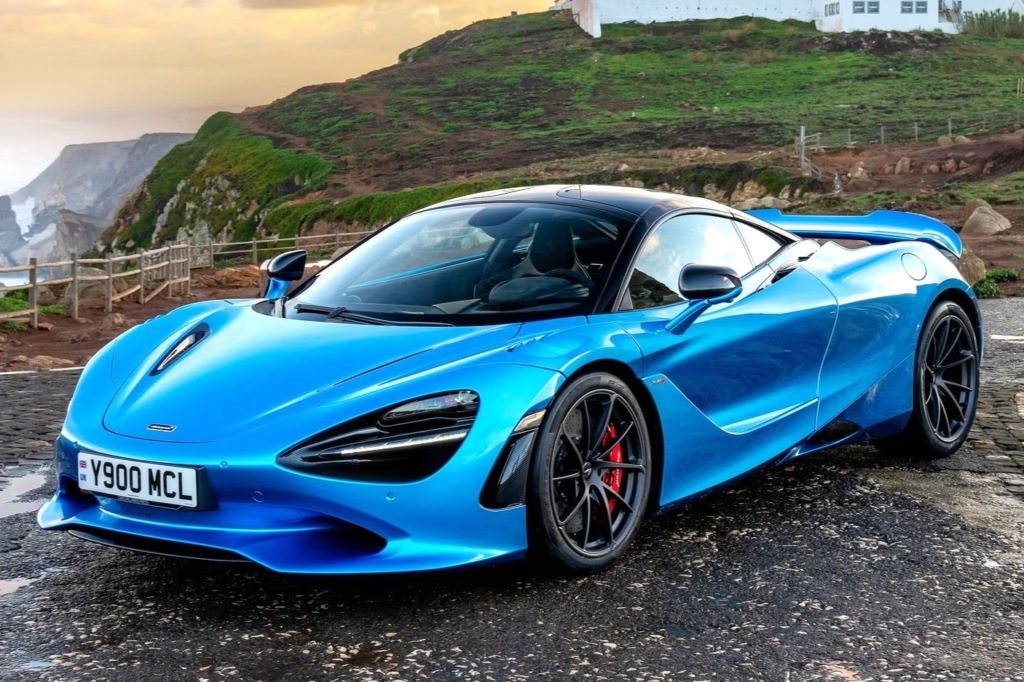
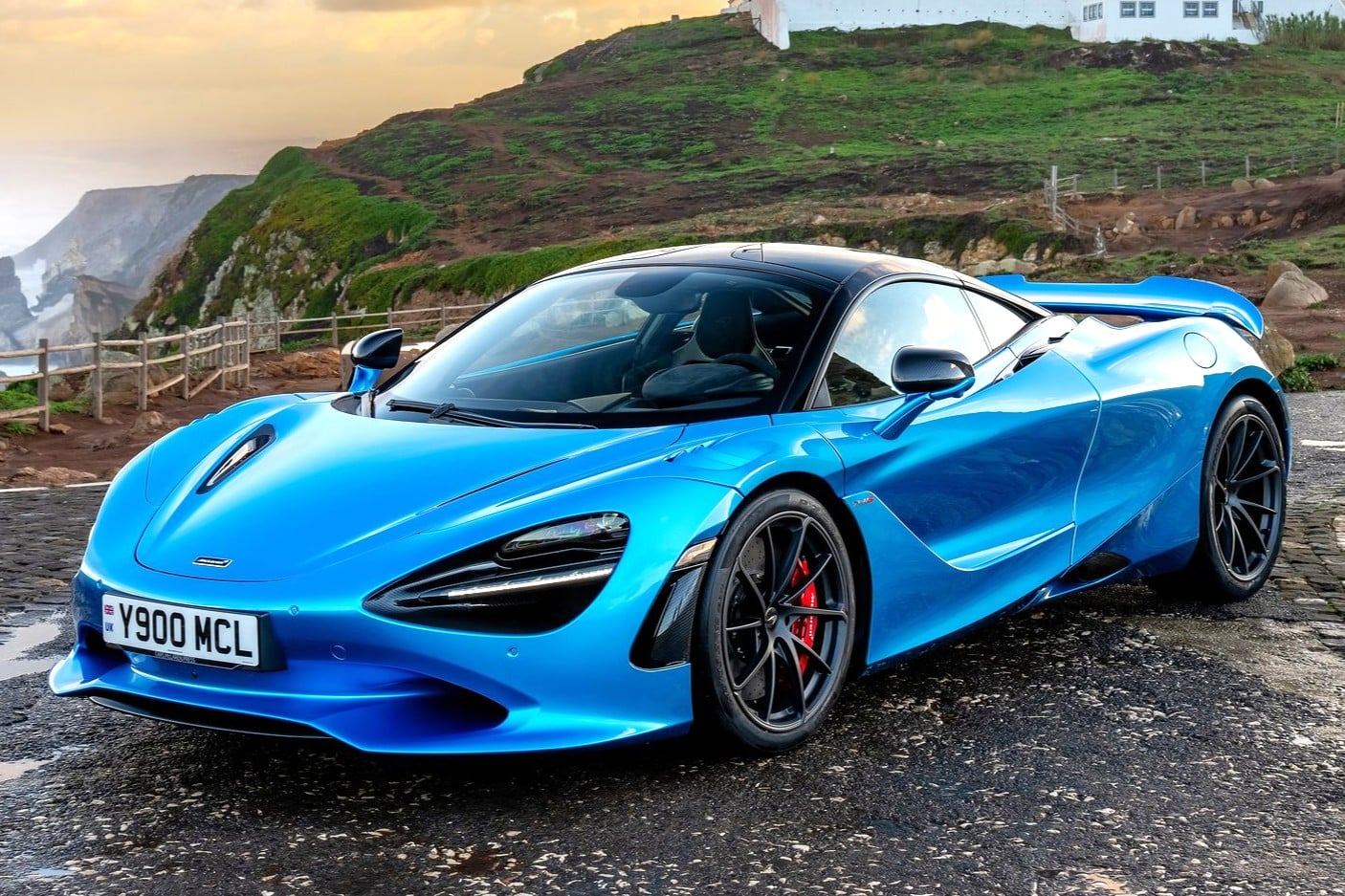
The sun will soon set on the McLaren 750S, as the British marque has confirmed that it will end production of the mid-engined V8 supercar in 2027. Final orders are therefore being accepted for the 750S, with McLaren gearing up to overhaul its model range and expand into new segments from next year. The 750S is available in India in both Coupe and Spider body styles, priced at Rs 4.94 crore and Rs 5.46 crore (before options), respectively.
Launched in 2023 as a heavily updated version of the 720S, the 750S is McLaren’s flagship series-production offering. It is powered by a 4.0-litre twin-turbo V8 that belts out 750hp and 800Nm, paired with a 7-speed dual-clutch automatic sending power to the rear wheels. The 750S Coupe also has a relatively light kerb weight of 1,389kg (Spider is 49kg heavier), which means its power-to-weight ratio is an impressive 540hp/tonne. 0-100kph comes up in a brisk 2.8 seconds (claimed), and the top speed is 332kph.
McLaren prepares for a fresh model line-up
The 750S’s retirement is part of a wider shake-up for McLaren. Recently, McLaren revealed a new logo (pictured) and confirmed the development of its first SUV, which is expected to rival the likes of the Lamborghini Urus SE, Aston Martin DBX and Ferrari Purosangue. The SUV will use a hybrid powertrain and arrive as the first front-engined McLaren road car. McLaren will also build new engines and gearboxes in-house for the first time, and to support these development efforts, the carmaker is setting up a new factory in the UK.
Additionally, McLaren is planning to discontinue the Artura and GTS by 2028. Since the 750S, Artura and GTS are the only series-produced McLaren models currently on offer, the carmaker will likely have a completely new line-up by the end of this decade.
आज के दौर में लोग पैसे देकर सिर्फ सुविधाएं नहीं, बल्कि अपना कीमती समय भी बचाना चाहते हैं। बेंगलुरु की एक महिला की पोस्ट ने इसी बदलती सोच को सामने ला दिया है। उन्होंने बताया कि दो लोगों के लिए घर पर खाना बनाने वाला कुक रखने का खर्च हर महीने 7 से 8 हजार रुपये तक पहुंच जाता है। इसके बावजूद खाने का स्वाद हमेशा लाजवाब नहीं होता। फिर भी लोग यह खर्च उठाने को तैयार हैं।
आखिर जब खाने की क्वालिटी पर सवाल है, तो कुक रखने के लिए हर महीने इतनी बड़ी रकम क्यों दी जा रही है? महिला की बात ने शहरों में रहने वाले नौकरीपेशा लोगों की जिंदगी और उनकी प्राथमिकताओं पर दिलचस्प चर्चा छेड़ दी है।
दो लोगों के लिए कुक की फीस 8 हजार रुपये तक
बेंगलुरु में रहने वाली मेघा ने सोशल मीडिया प्लेटफॉर्म X पर बताया कि दो लोगों के घर में खाना बनाने वाले कुक की फीस लगभग 7,000 से 8,000 रुपये प्रति माह हो सकती है। कुक आमतौर पर दिन में दो बार घर आता है, सब्जियां काटता है, दो तरह के व्यंजन बनाता है और फिर दूसरे घर में काम करने निकल जाता है। रविवार को उसकी छुट्टी रहती है।
मेघा के मुताबिक, यह व्यवस्था शहर में रहने वाले उन लोगों के लिए आम है, जो नौकरी और दूसरी जिम्मेदारियों के कारण रोजाना खाना बनाने के लिए पर्याप्त समय नहीं निकाल पाते।
प्रेशर कुकर में बनता है सबकुछ, स्वाद को लेकर भी शिकायत
मेघा ने अपनी पोस्ट में खाना बनाने के तरीके पर भी टिप्पणी की। उनके मुताबिक, दाल, आलू, सोया और यहां तक कि चिकन बनाने में भी प्रेशर कुकर का खूब इस्तेमाल होता है। ऐसे में खाने का स्वाद कई बार औसत रह जाता है।
उन्होंने यह भी कहा कि मनपसंद स्वाद पाने के लिए कुक को बार-बार अपनी पसंद समझानी पड़ सकती है। वहीं, स्वाद बढ़ाने के लिए ज्यादा तेल और मसालों का इस्तेमाल भी परेशानी बन सकता है।
हालांकि, मेघा की यह टिप्पणी उनके निजी अनुभव पर आधारित है। हर कुक का खाना बनाने का तरीका और स्वाद अलग हो सकता है।
जब खाना औसत है, तो लोग आखिर पैसे क्यों दे रहे हैं?
मेघा की पोस्ट का सबसे दिलचस्प पहलू यही है। उन्होंने महसूस किया कि लोग हर महीने हजारों रुपये सिर्फ स्वादिष्ट खाने के लिए नहीं देते, बल्कि दिन में दो बार खाना बनाने की चिंता से छुटकारा पाने के लिए भी खर्च करते हैं।
हर दिन क्या बनाना है, सब्जियां कब काटनी हैं, खाना कब तैयार करना है और रसोई की जिम्मेदारी कैसे संभालनी है इन सवालों से बचने के लिए लोग कुक पर निर्भर रहते हैं। यानी कई लोगों के लिए यह खर्च स्वाद से ज्यादा समय और सुविधा खरीदने जैसा है।
Bengaluru cook economics are crazy actually.
For 2 people, around ₹7–8k/month, 2 visits a day, Sunday off.
They come in, chop vegetables , make 2 dishes quickly and move on to the next house.
Pressure cooker is basically their Astra , dal, aloo, soya, chicken… everything somehow ends up in it!
Taste is usually average unless you keep explaining how you want it. Otherwise more oil + more masala seems to be the shortcut.
And yet we continue.
Because I realised we’re not really paying ₹8k for amazing food.
We’re paying ₹8k to not have to think about cooking twice every single day.
सोशल मीडिया पर छिड़ी चर्चा, लोगों ने भी रखी अपनी राय
मेघा की पोस्ट सामने आने के बाद सोशल मीडिया पर लोगों ने अलग-अलग प्रतिक्रियाएं दीं। कुछ यूजर्स ने माना कि घरेलू मदद की कीमत चुकाना आसान नहीं, लेकिन कई बार परिस्थितियों के चलते ऐसा करना जरूरी हो जाता है।
एक यूजर ने कहा कि लोग रोजाना रसोई से जुड़े फैसलों से आजादी पाने के लिए पैसे खर्च करते हैं। वहीं, एक अन्य यूजर ने तर्क दिया कि घर का बना खाना स्वाद में भले ही हमेशा बेहतरीन न हो, लेकिन कई बार डिलीवरी ऐप से मंगाए गए खाने के मुकाबले बेहतर विकल्प हो सकता है।
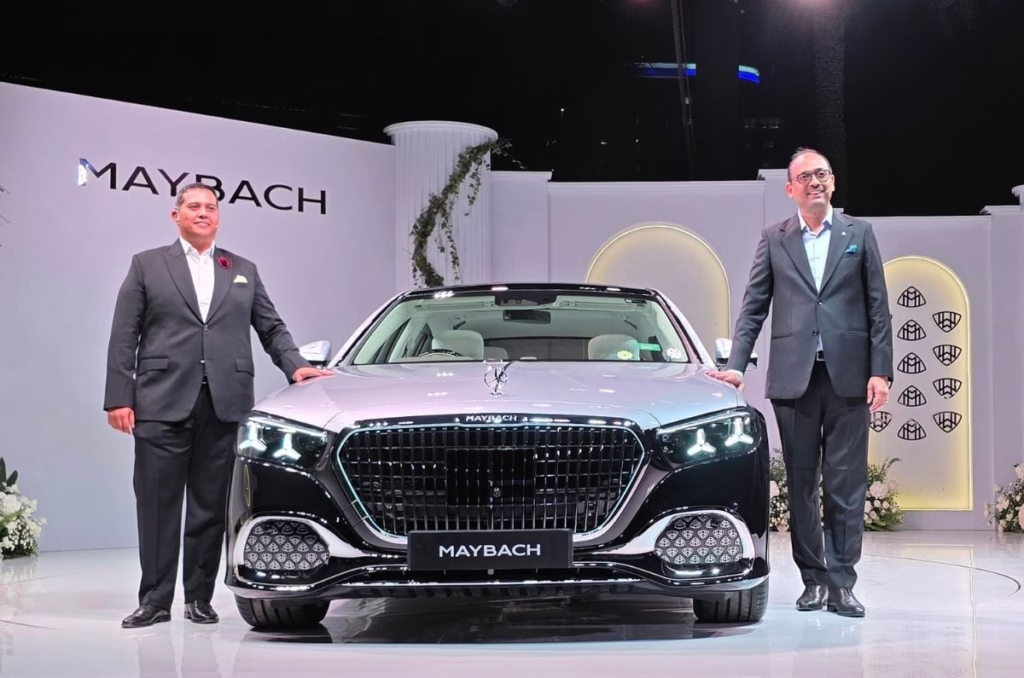
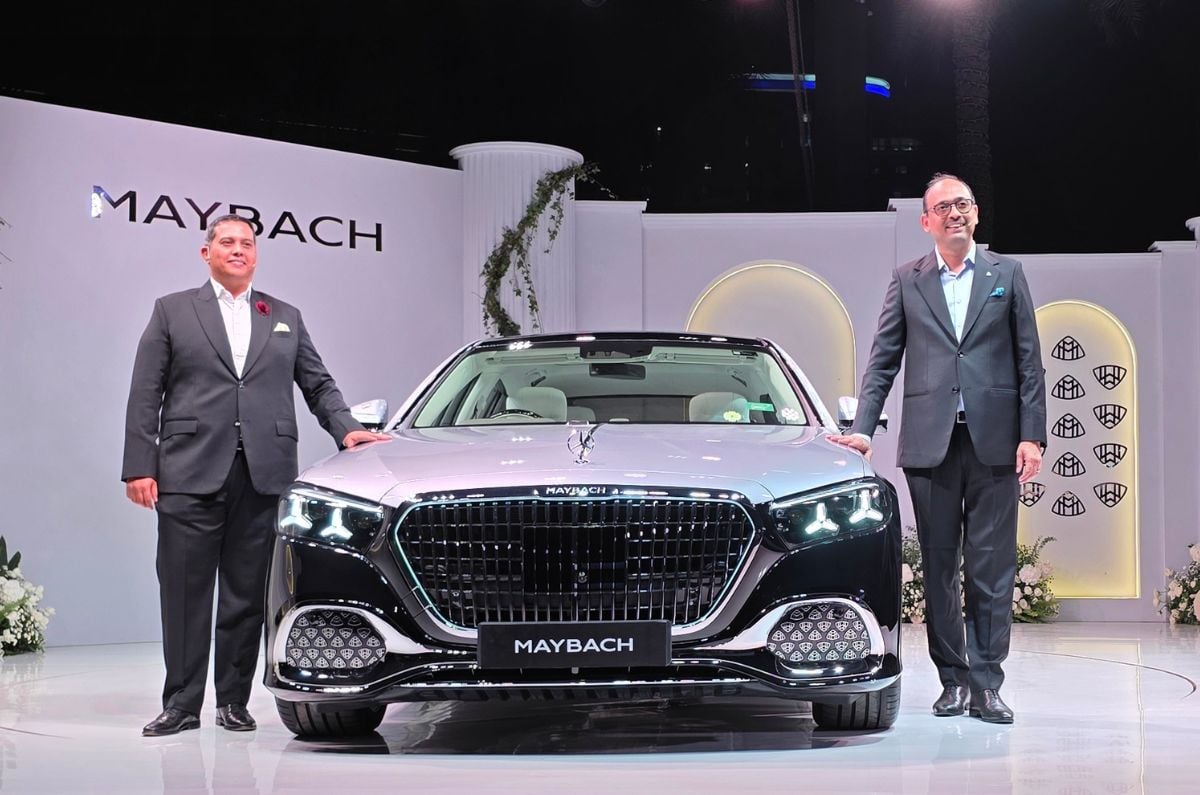
Mercedes-Benz has launched the Maybach S-Class facelift at Rs 3.35 crore (ex-showroom). It has been brought to India in S 580e guise, making it the first Maybach in India to be offered with a plug-in hybrid powertrain. Only 30 units have been allocated in the first batch, costing Rs 97 lakh more than the ‘regular’ S-Class Manufaktur Edition AMG Line that was launched just a couple of months ago. This is also Mercedes’s third PHEV in India, following the updated S-Class and AMG E 53 Hybrid. Mercedes says around 50 percent of its S-Class sales in India are of the Maybach variant.
Maybach S-Class comes to India in S 580e guise with 3.0-litre PHEV powertrain
Gets executive rear seats with full-length business console as standard
Offers 98km electric-only range thanks to a 22kWh battery
Mercedes-Maybach S 580e powertrain and specs
The new PHEV powertrain is one of the biggest updates to the Maybach S-Class, as the outgoing model was offered with a 4.0-litre V8. The S 580e uses a 443hp/560Nm 3.0-litre inline-six petrol engine paired with a 160hp/480Nm electric motor and a 22kWh battery. Total system output is 585hp and 750Nm, and it comes with all-wheel drive as standard. Mercedes claims the car can travel up to 98km and reach a top speed of 140kph on electric power alone. It also has a WLTP-certified fuel efficiency of 34.48kpl, although it’s likely not to be of much interest to a Maybach owner.
The S 580e offers three drive modes – Maybach, Electric and Battery Hold – along with adjustable energy recuperation, including one-pedal driving. As for charging, Mercedes will offer an 11kW AC on-board charger, and the car is also compatible with up to 60kW DC fast charging. The S 580e gets air suspension and rear-axle steering as standard.
Mercedes-Maybach S 580e interior and features
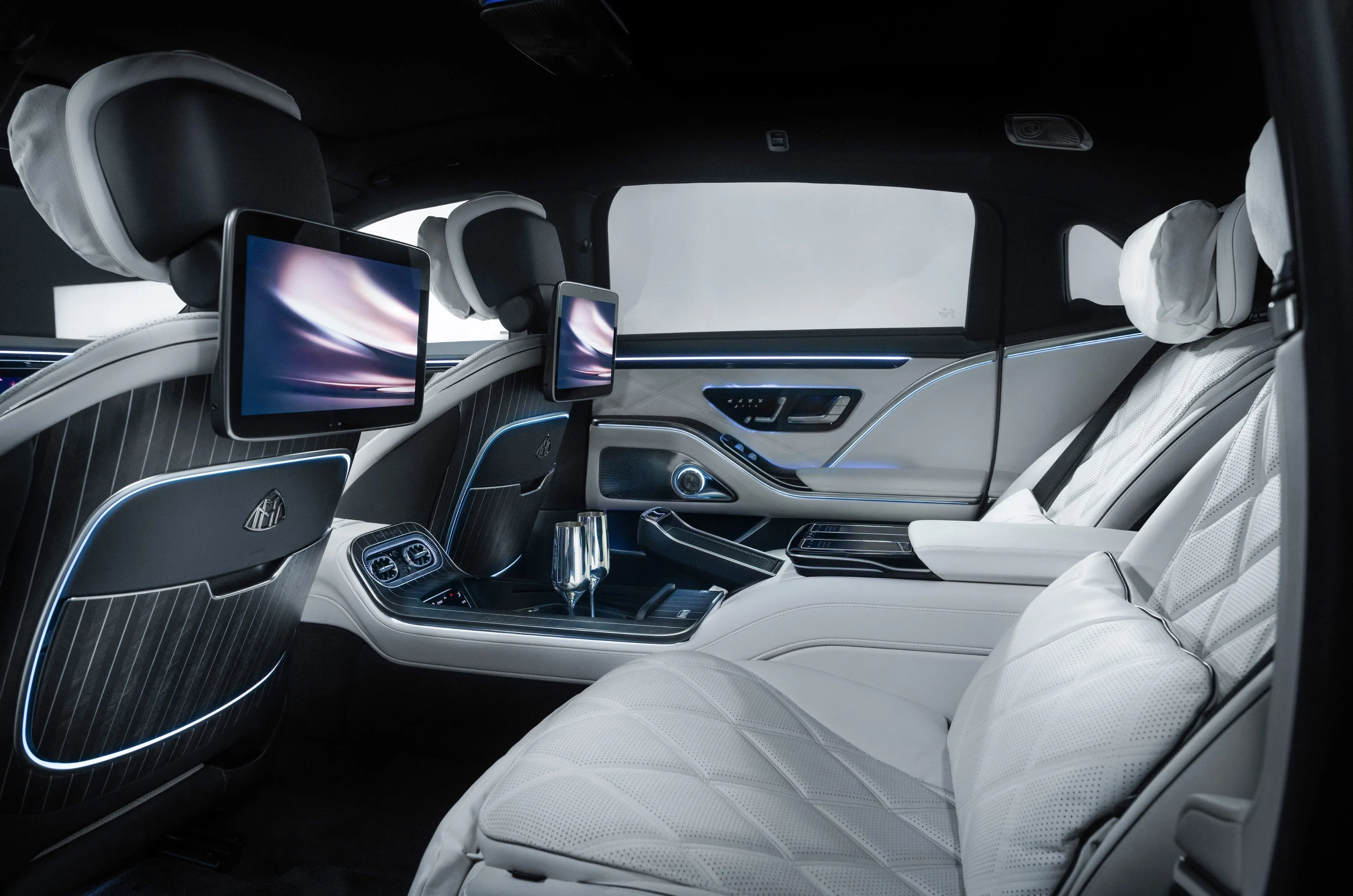
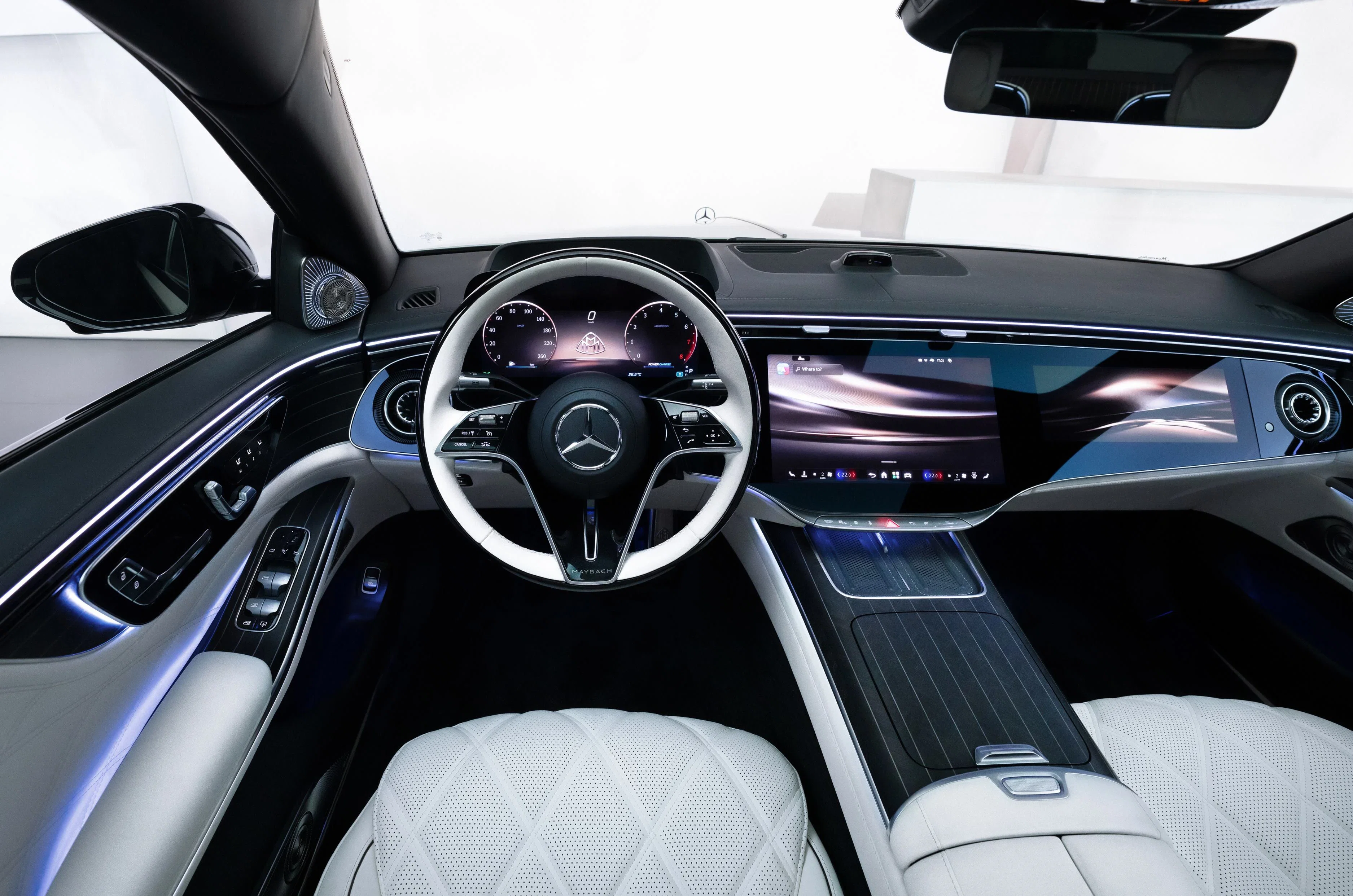
The focus of any Maybach is, of course, the back seat, and in that regard, Mercedes is offering the S 580e in a four-seat layout with executive seats with a full-length business console. Rear Comfort Package Plus is standard, offering fold-out tray tables, wireless charging pads, rear-compartment ambient lighting and even temperature-controlled cup holders. The seats recline to 43 degrees (compared to the regular S-Class’s 38 degrees) and are heated, ventilated and massaging. You also get two individual ‘smartphone’ remotes to operate everything instead of the tablet controller from before.
Up front, the dashboard remains largely unchanged from the regular S-Class. The MBUX Superscreen spans the front of the cabin, combining the central display with a front passenger display carrying a privacy function, while the driver gets a free-standing 3D display. The difference here is that you get a unique Maybach graphical theme for all screens, along with signature rose gold accents. Some of the equipment highlights include an augmented reality head-up display and navigation, a 31-speaker Burmester 4D surround sound system and two rear entertainment screens with wireless headsets.
The cabin is trimmed in Maybach-exclusive Nappa in crystal white and silver grey pearl, with Manufaktur piano lacquer trim, a Manufaktur roof liner in crystal white Nappa leather and Manufaktur seat backrest trim.
Mercedes-Maybach S 580eexterior design
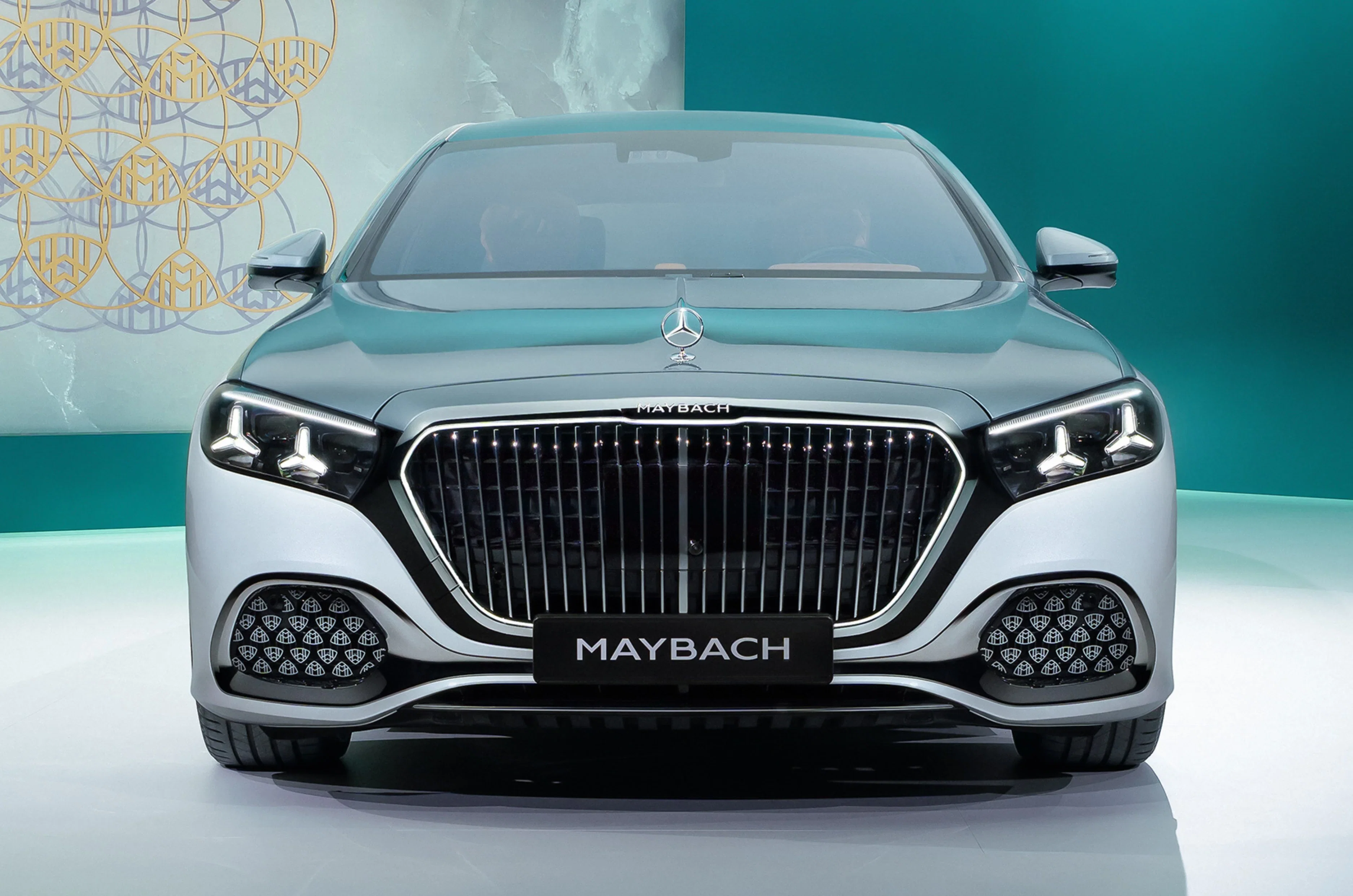
Changes to the exterior are similar to those on the regular S-Class facelift, albeit with a few Maybach-specific twists. For instance, here too the grille is 20 percent larger and framed by LED illumination, with an illuminated Mercedes star on the bonnet above. The difference is that the grille uses the Maybach signature vertical slats, and there’s an illuminated ‘Maybach’ wordmark above them.
The headlamps are the new, larger units with the latest version of Mercedes’s Digital Light ambient lighting and three-pointed star daytime running lamps (DRLs), but rather than the techie blue accents, there are rose gold embellishments with the Maybach logo on them.
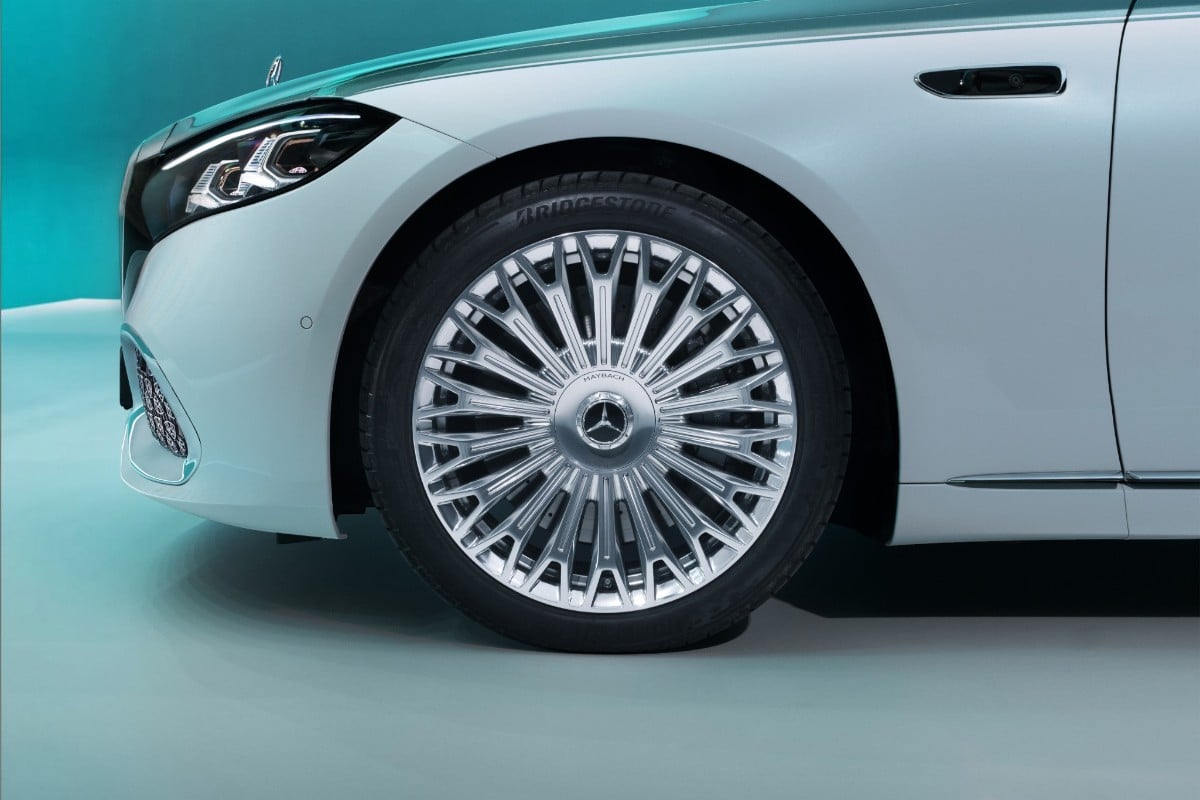
As before, the Maybach is 180mm longer than the long-wheelbase S, and that’s plain to see in profile. The India-spec model rides on 20-inch forged Maybach wheels, which also house a counterweighted Mercedes logo that always stays upright as the wheels turn. The Maybach logo on the D-pillar is illuminated as well, and the tail-lamps also get the triple-three-pointed star LED signature, like in the standard S-Class.
Bengaluru-based House of Machines (HOM) – the official re-seller for KYT Helmets and Alpinestars in India – has brought another Italian brand to India. Ohvale motorcycles is a brand that specialises in building race bikes, meant for circuit riding and practicing. With the aforementioned partnership, HOM has brought three Ohvale motorcycles to India, with a starting price of Rs 7.30 lakh. The motorcycles are for track-riding only, and are not street-legal.
Ohvale has brought three motorcycles in four variants, topping out at Rs 12.75 lakh
The performance and feature-set is track- and racing-focused
Ohvale GP Motorcycles: Who are they for?
Racing-focused motorcycles built with budding talent in mind
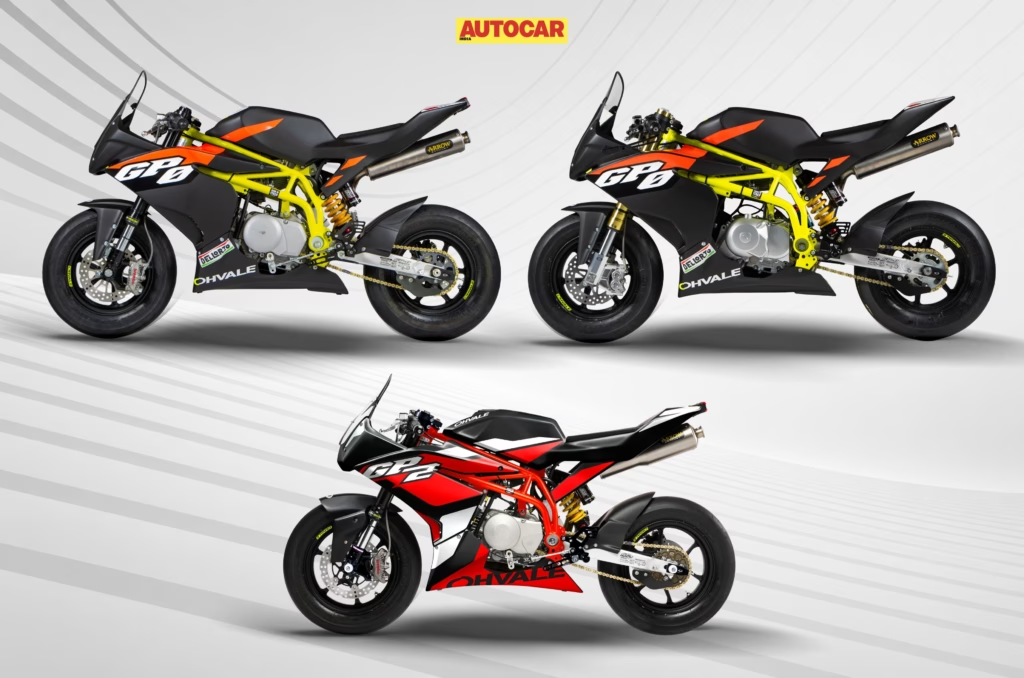
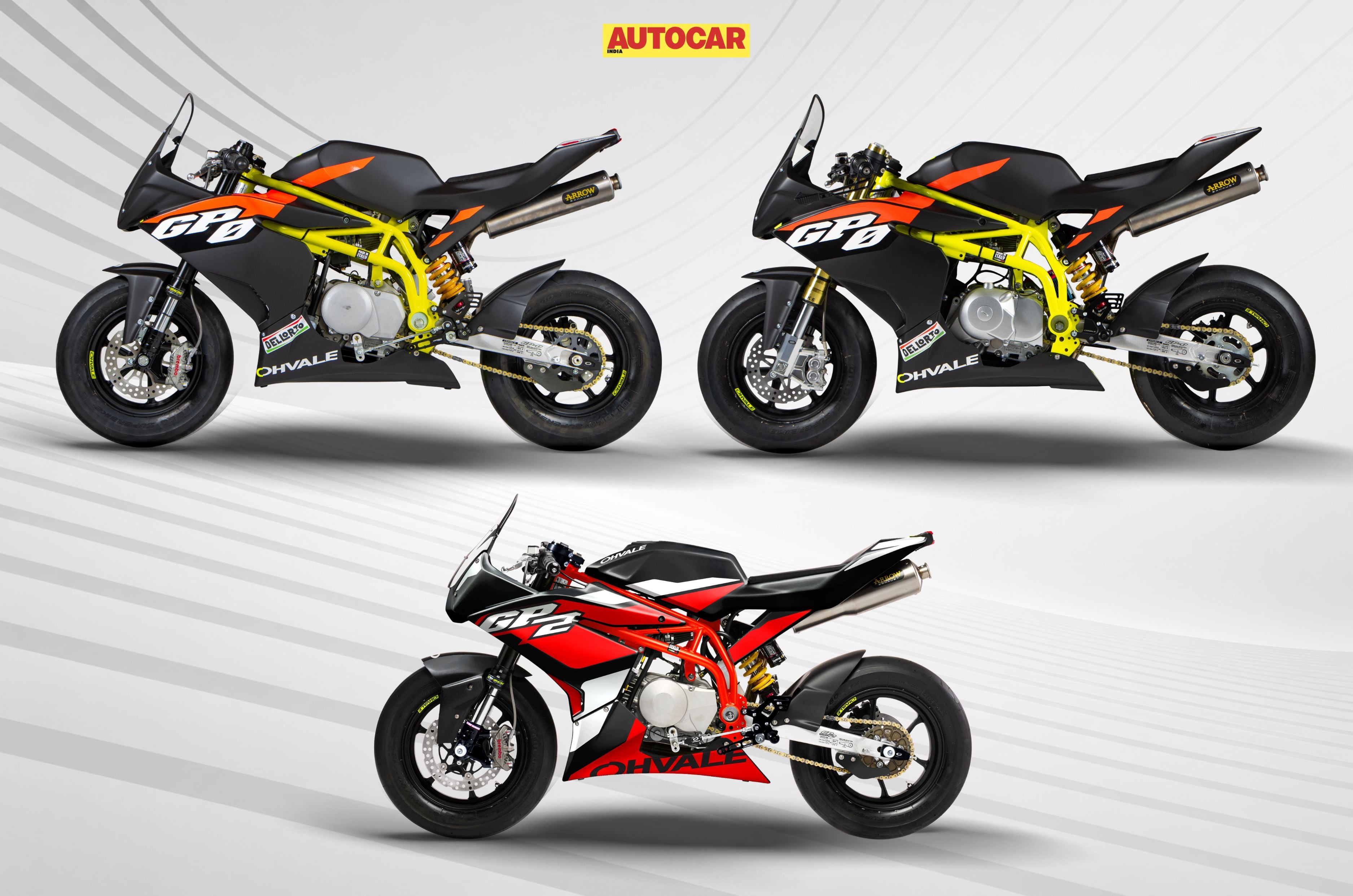
Internationally, Ohvale Motorcycle has a four-vehicle portfolio: GP-0, GP-2, GP-5, and GP-7. Of which, the company has brought the GP-0 and GP-2 to India with three engine sizes. The GP-0 is the entry-level version with each successive version stepping up capabilities and rider’s presumed skills from there. Currently, the GP-7 forms the summit of the Ohvale line-up and the Indian website lists this motorcycle with a 250cc, single-cylinder, liquid-cooled engine but it does not have a price just yet.
We got prices and full specification lists for the GP-0 110 Automatic, GP-0 160 4-Speed, and GP-2 190 4-Speed motorcycles. First off, all three motorcycles have 4-stroke, single-cylinder, air-cooled engines; but despite having modern architectures otherwise, all three motorcycles have carburettor-aided fueling and not fuel injection. The GP-0 110 Automatic has a 106.7cc engine, the GP-0 160 has a 155.5cc engine, and the GP-2 190 has a 187.18cc engine. As the name implies the GP-0 110 has an automatic 4-speed gearbox, with the other two motorcycles driven by manual 4-speed gearboxes.
Except for the GP-2, the other two motorcycles run on 10-inch front and rear rims with Pirelli Diablo slicks as default. However, all three share a steel trellis frame, aluminium swingarm and an Arrow under-seat exhaust system. The standard variants get full adjustability for the rear suspension, with the race variants extending full adjustability to the 35mm USD fork as well. All three bikes also get front and rear disc brakes, with the race variants upgrading the calipers to Brembo and a 10mm larger rotor on the GP-2 190. The GP-2 190 gets a larger 180mm rear disc, with the others getting a 155mm rear disc. The headlining spec for all three motorcycles is their unbelievably low dry weight numbers. The GP-0 110 weighs 67kg, GP-0 160 weighs 65kg, and GP-2 190 weighs 71kg. Ohvale has achieved this with liberal use of fibreglass for the fairings, and a 3.5-litre fuel tank. The GP-2 190’s Race variant exclusively gets a slipper clutch and a quickshifter besides the other differences mentioned above.
The GP-0 110 Automatic Standard costs Rs 7.30 lakh. The GP-0 160 Race steps up to Rs 9.50 lakh. Up next is the GP-2 190 Standard at Rs 9.90 lakh, with the top of the line GP-190 Race coming in at Rs 12.75 lakh. Once again, none of these motorcycles is street-legal so this should be the final price you pay the dealership to bring one of these home. HOM aims to bolster the Indian motorsport scene with these tailor-made race motorcycles for children, enabling them to learn, practice, and enter competitons quicker.
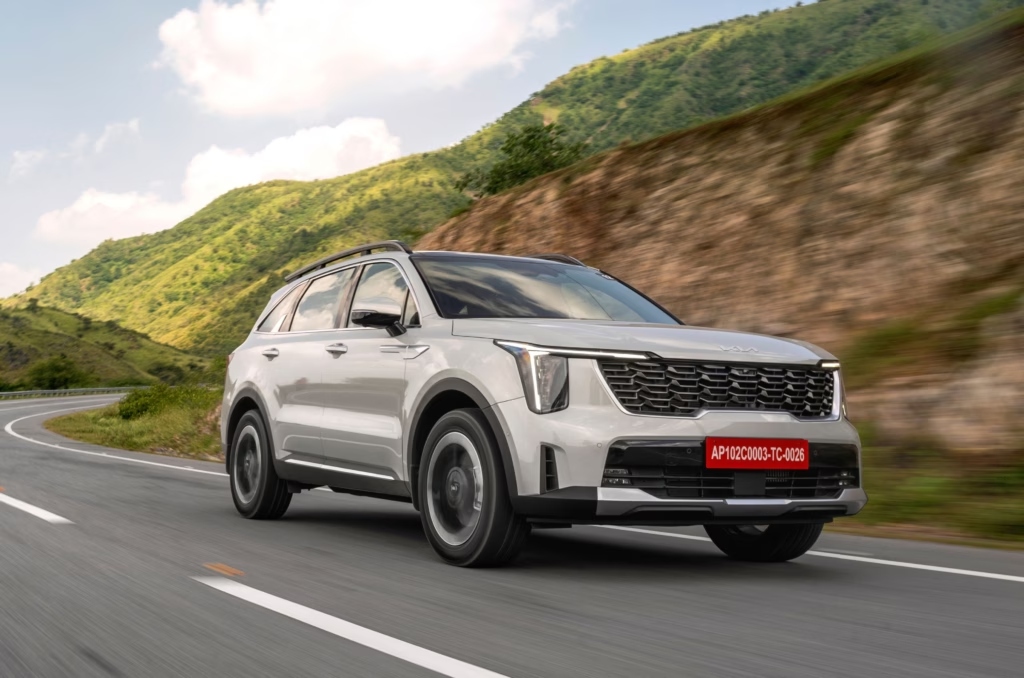
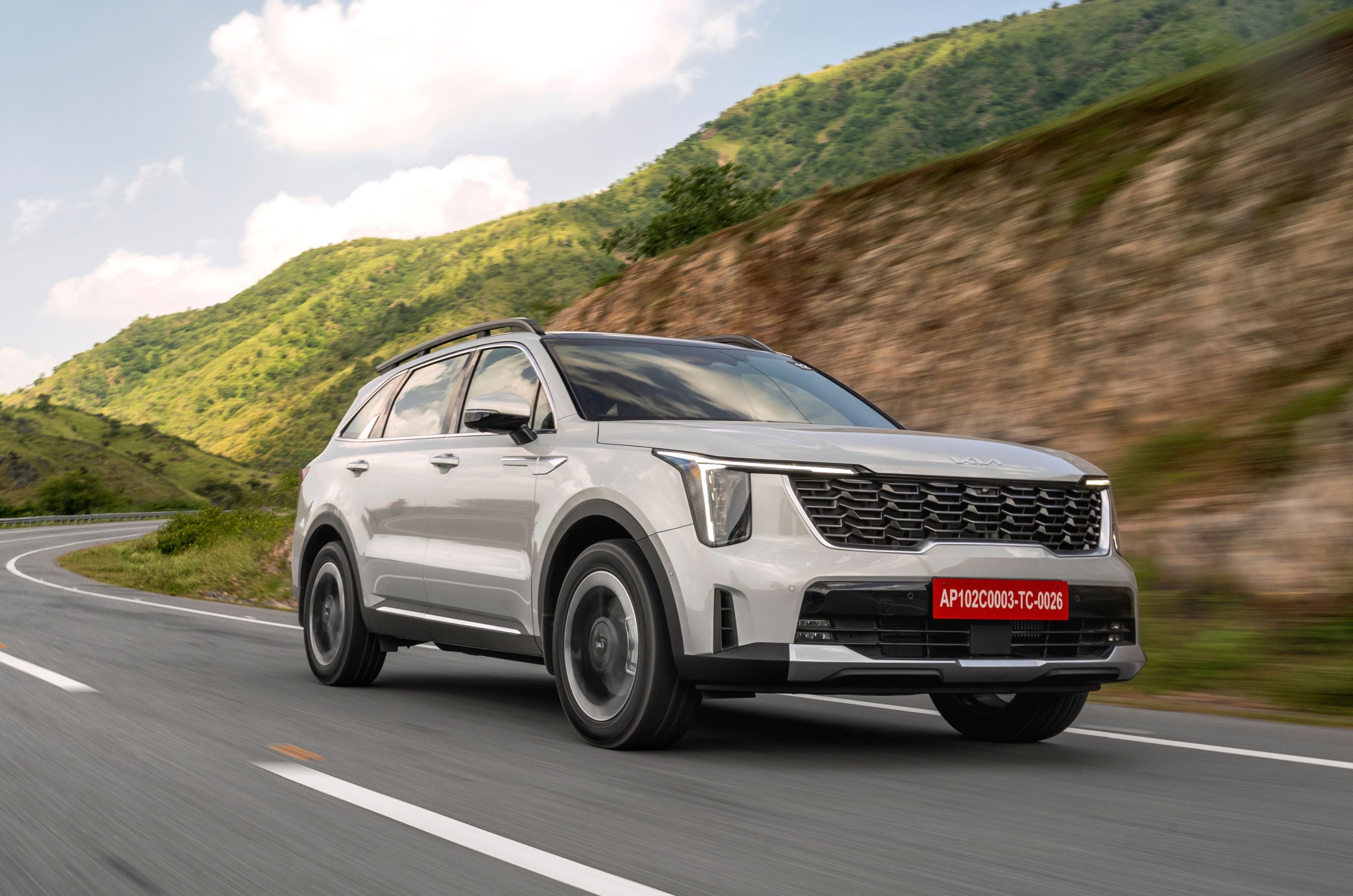
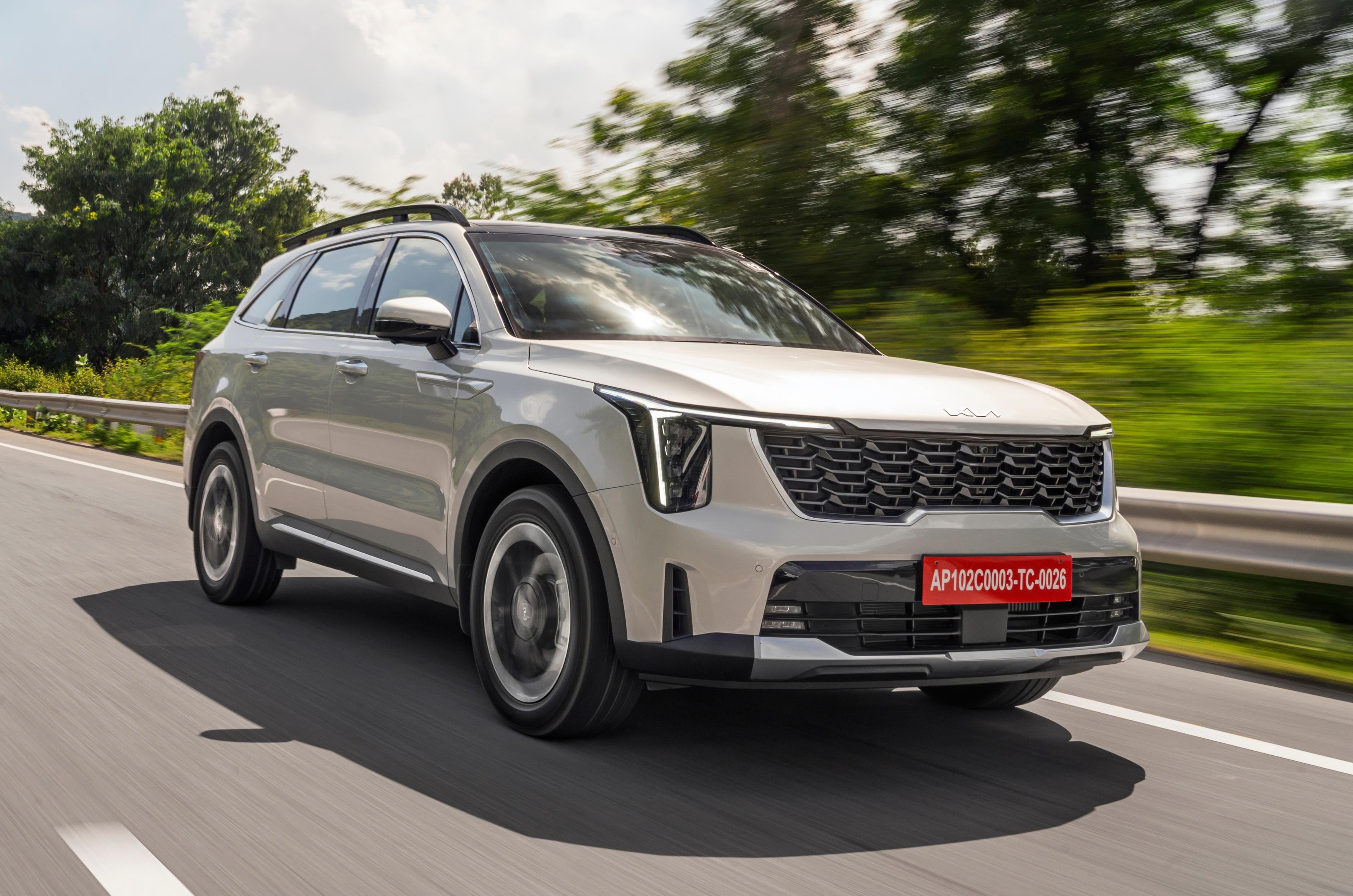
The Sorento is a big bet for Kia India, and you can tell. Six trims, two powertrains, front- and all-wheel drive, six or seven seats and 32 versions in all. This is not a toe in the water exercise but a full-blooded dive into the deep end of the executive SUV pool. More than that, it is a case study in how to launch a product in India, because Kia has got the basics right before it has even started talking about features.
Start with the powertrains, which for this class of SUV could hardly be better judged. There is a strong 2.2-litre diesel for diesel die-hards and there are still plenty of those. And then there is a 1.6-litre turbo-petrol strong hybrid whose timing couldn’t be more perfect. Petrol prices are climbing, E20 has quietly eaten into real-world efficiency, and buyers want diesel-like running costs from a smooth, quiet powertrain without lying awake worrying about diesel’s long-term future. The Sorento hybrid is pitched squarely at that anxiety.
The strategy behind the car is just as interesting. This fourth-generation (MQ4) Sorento arrives in India towards the end of its global life cycle. It is still a current product, but one due to be replaced internationally next year, while India will carry on with this one. That is actually a very smart move. A car this late in its life has its development costs largely amortised, and Kia India can bring some of the tooling here, which slashes the investment.
And this is a properly localised car, not a screwdriver job. The body is stamped and welded at Kia’s Anantapur plant, and the dashboard and seats are made here too. That is what makes the Rs 27.99 lakh starting price possible. The catch is that localisation on this scale only pays off with volume, and Kia wants to sell around 40,000 Sorentos a year. That is a big number for a Rs 30-40 lakh SUV. Can it get there?
Kia Sorento exterior design and engineering
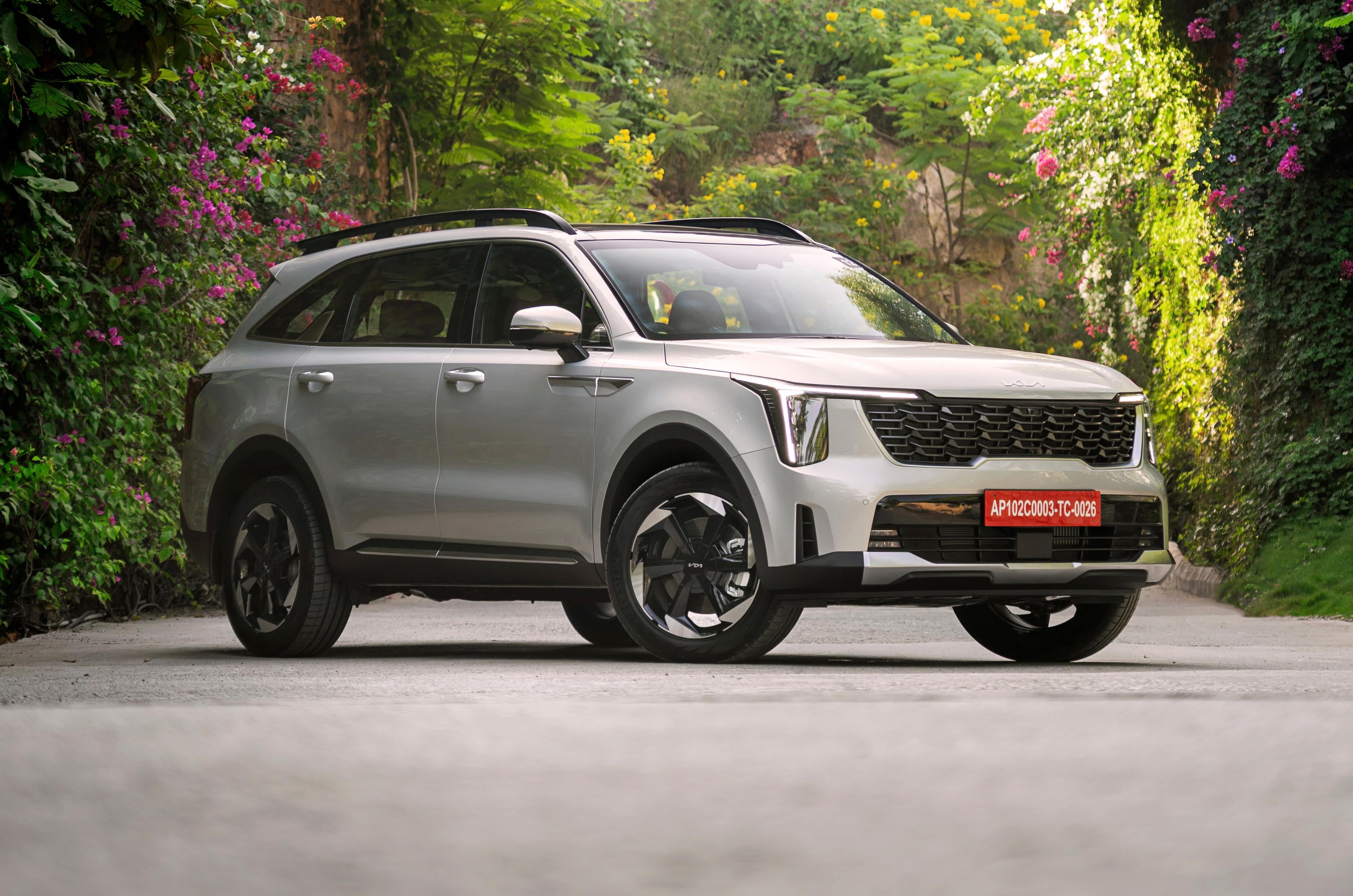
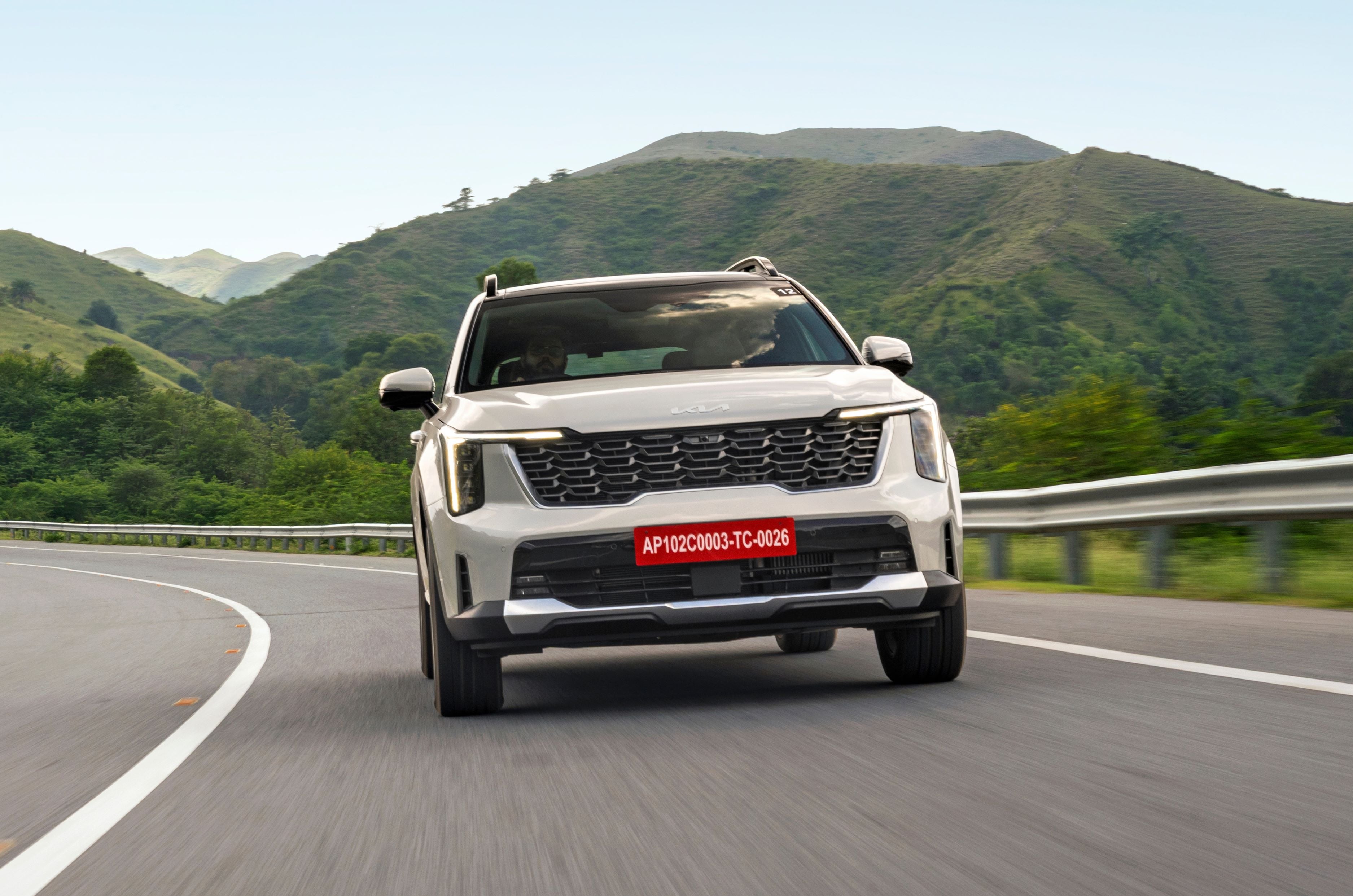
Based on the gen 4 Sorento, it carries over the older and more palatable design language.
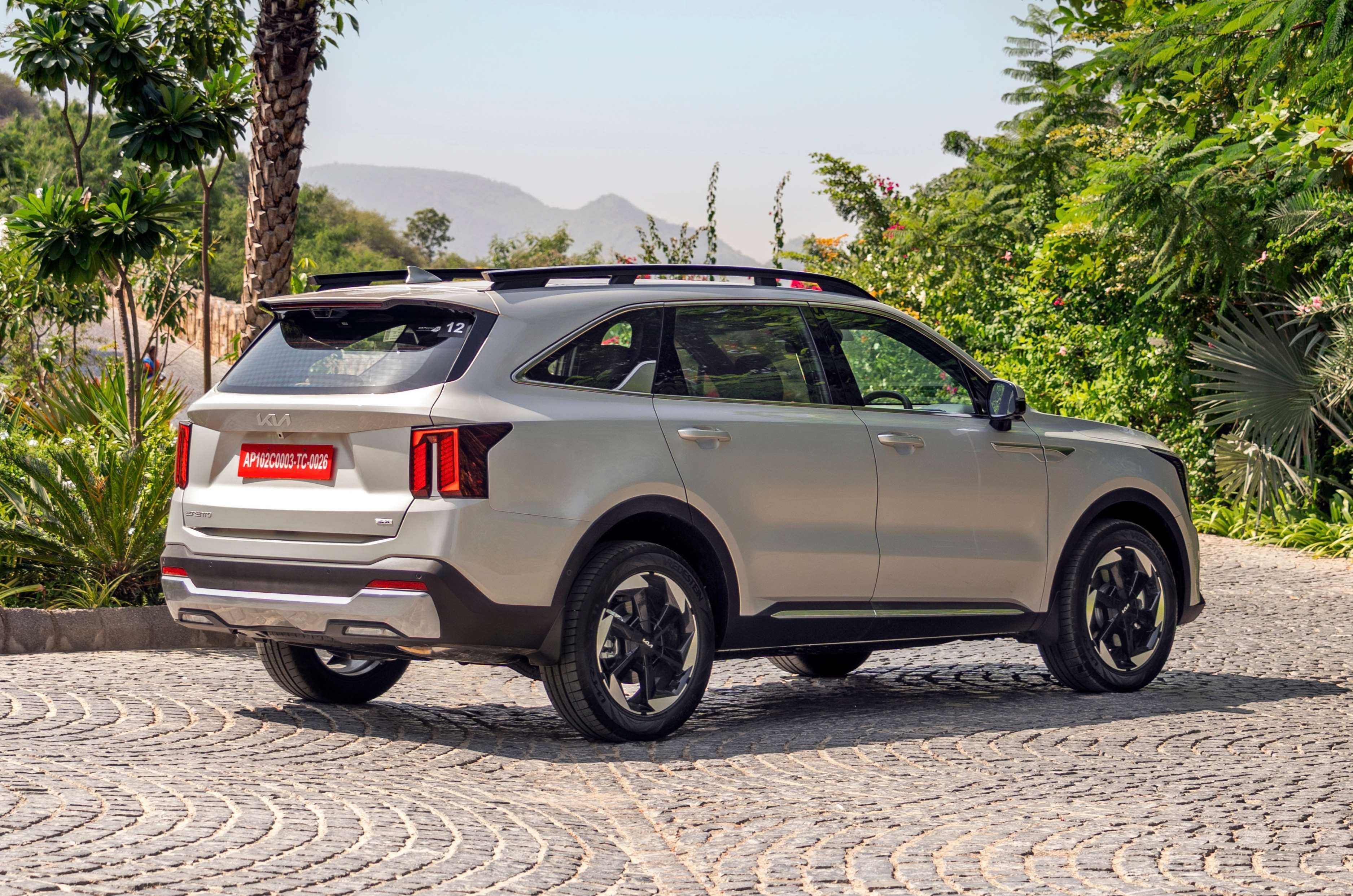
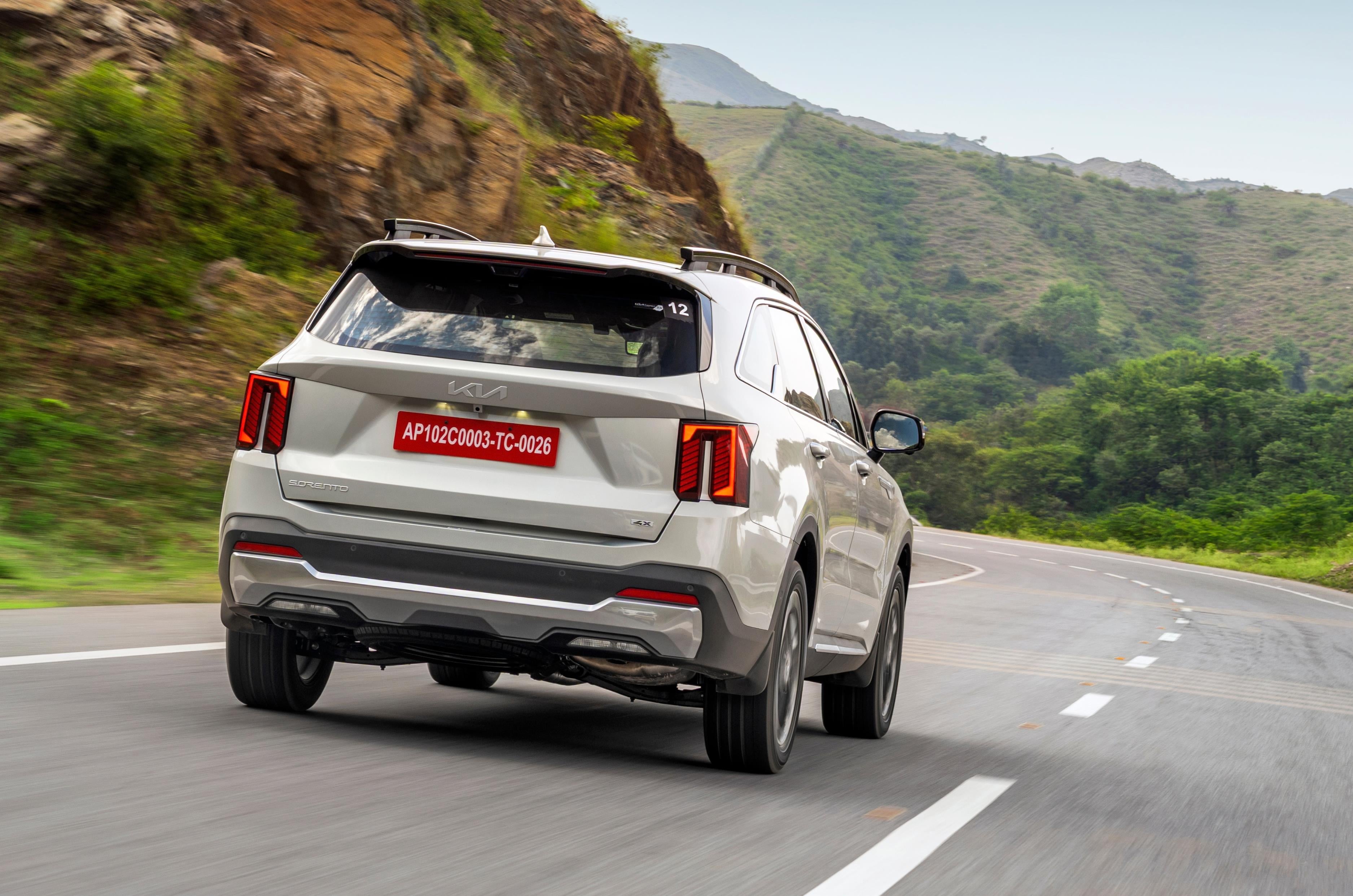
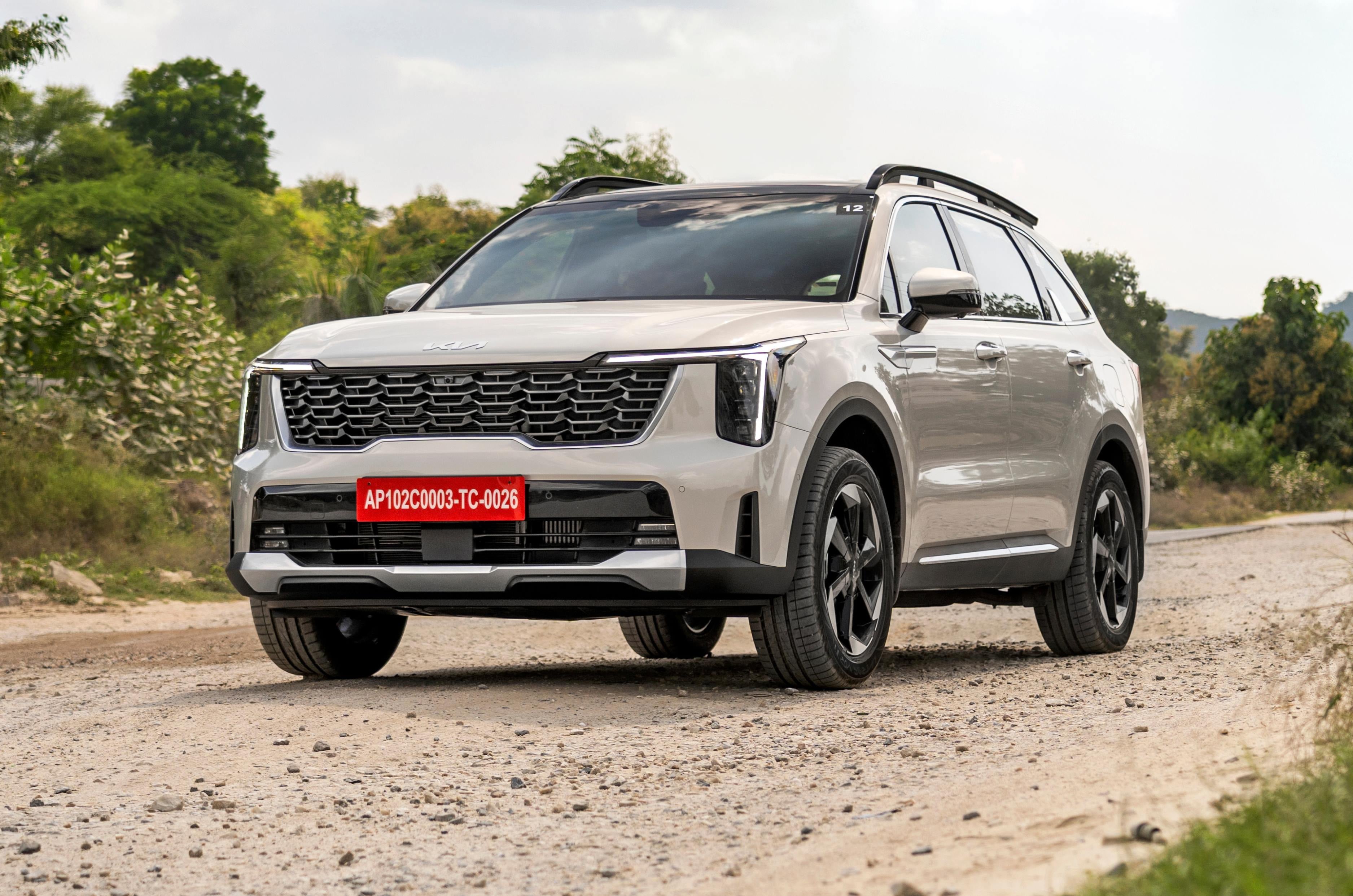
The Sorento sits on Hyundai-Kia’s MQ4 platform, the freshest architecture in its class, and it has already had a mid-life update to keep it looking current. The 2024 facelift brought the nose in line with the design language Kia kicked off with the EV9, so you get vertically stacked LED headlights, Y-shaped daytime running lamps and an aggressive looking bumper with wide intakes. At the back are L-shaped wraparound tail-lamps, and thankfully no light bar stretched across the tailgate.
Beats the rivals in length, width, and wheelbase.
Kia’s stated aim was a more technical, precise look, one meant to signal tight build quality and engineering sophistication. It is a trick the German premium brands have used for years, and Kia has clearly taken a leaf out of their book. The Sorento looks crisp and expensive rather than flashy, and is likely to age well too.
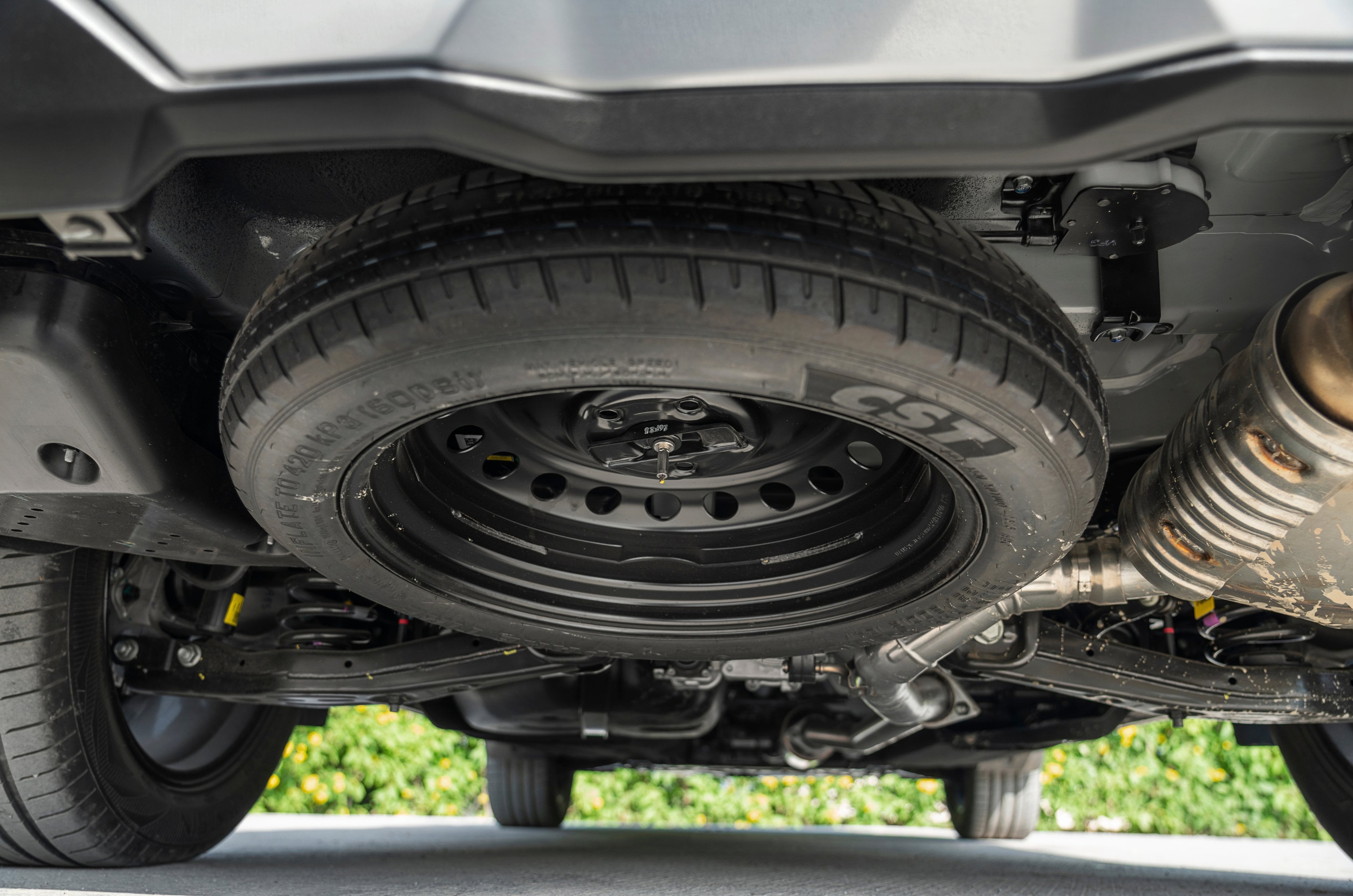
Spare wheel mounted under the floor frees up room in the boot.
What it does not have is brute presence. Despite being the longest, widest and tallest SUV in its segment, at 4,815mm long, 1,900mm wide and 1,785mm tall on a 2,815mm wheelbase, it does not loom in your mirrors the way a Fortuner does. The sloping roofline at the rear softens the silhouette and lends it a hint of crossover, and some will see it as a big Seltos rather than a junior Land Cruiser. Clearly this is not an SUV that looks like it can bully its way through traffic.
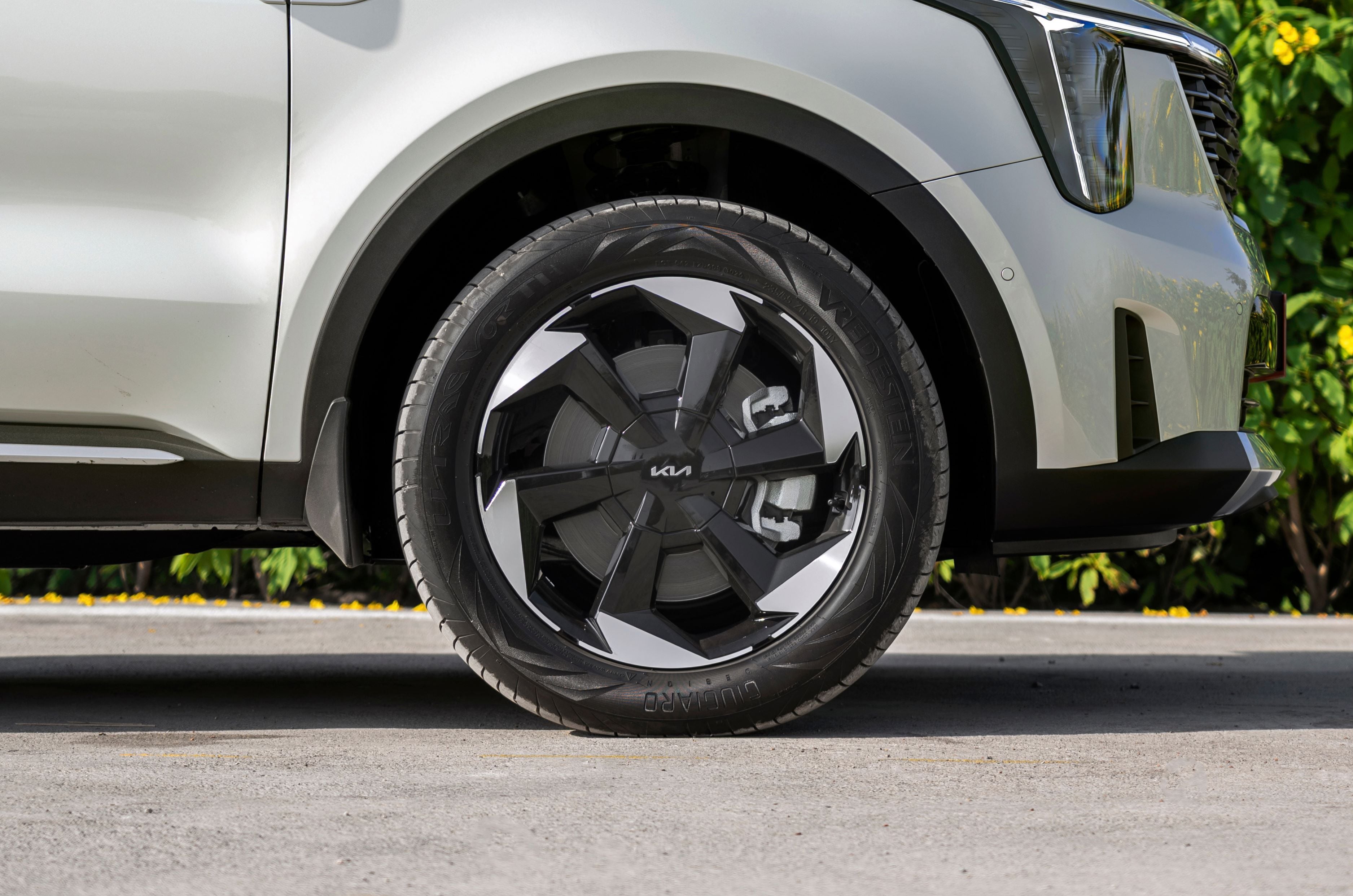
A more unique design could’ve been used for the 19-inch alloys.
The 19-inch dual-tone alloys could have been more distinctive, too an effect exaggerated by the chunky 235/55 R19 tyres. Those tall sidewalls, though, are not a styling misstep so much as an engineering choice, and they play a big part in how this car rides. More on that later.
Kia Sorento interior space and comfort
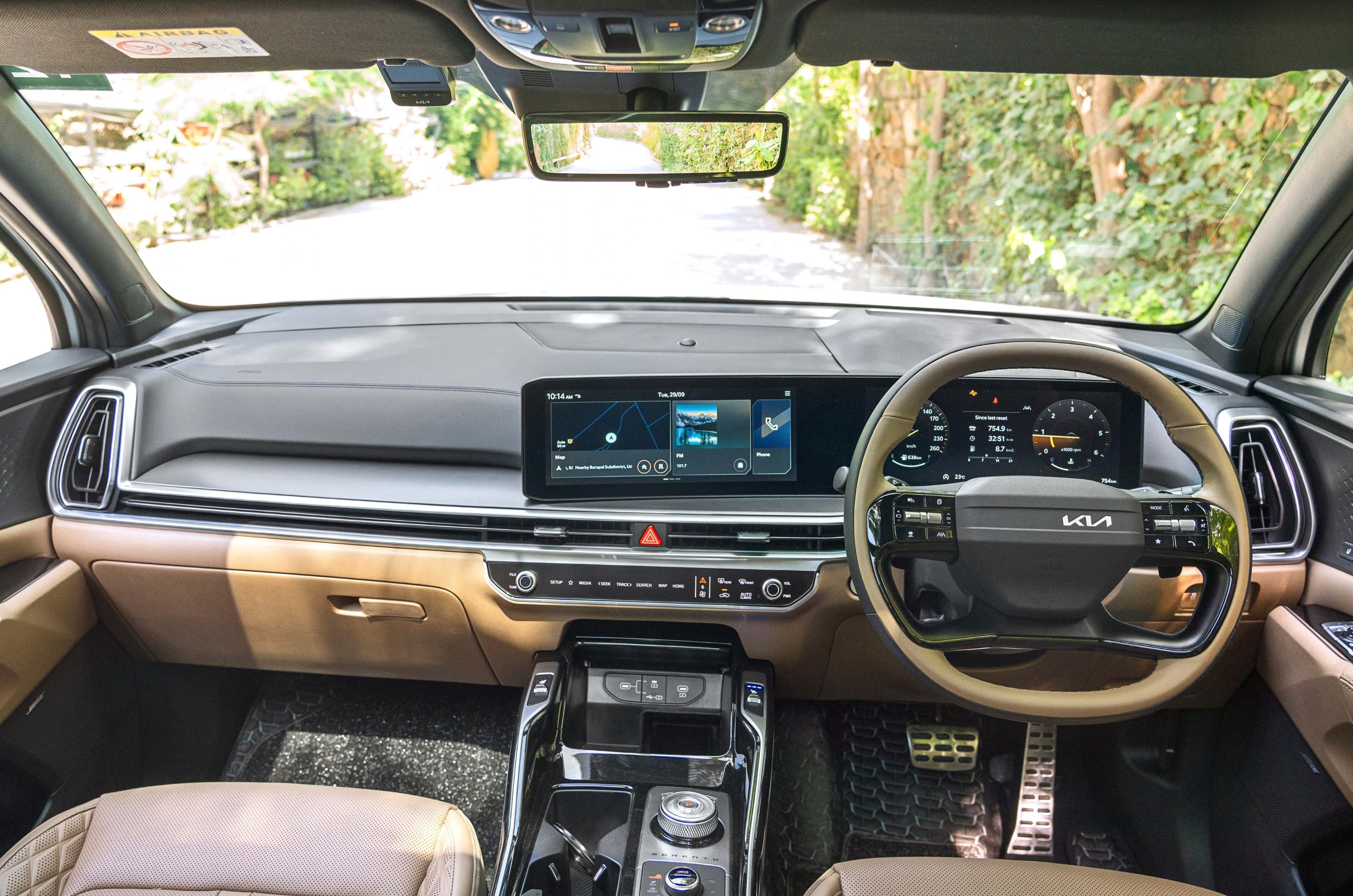
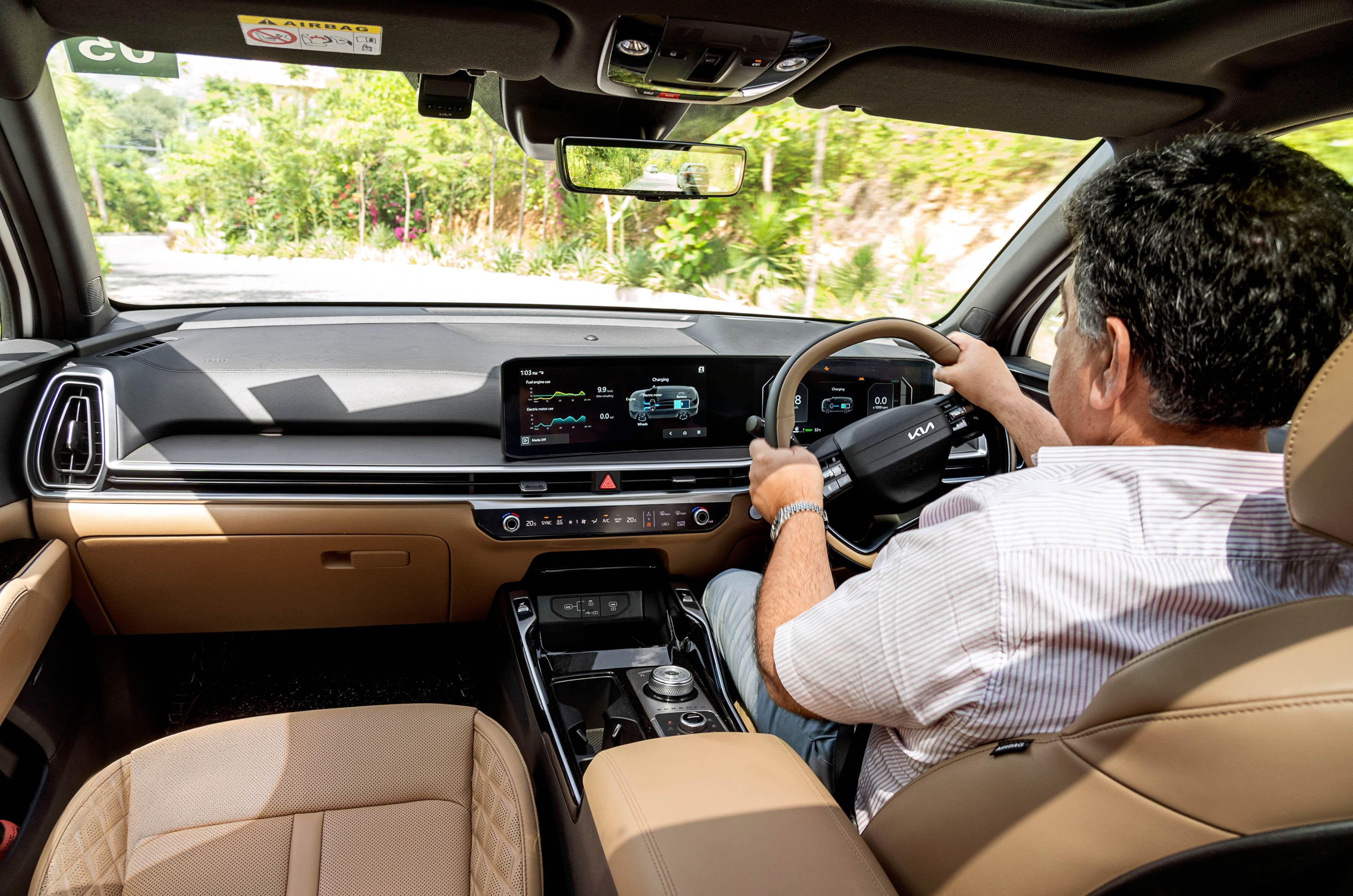
Clutter-free dashboard with solid build and plush feel.
If the exterior is quietly effective, the cabin is where Kia has truly aced it. The Sorento offers a mix of quality, equipment and ergonomics that nothing at this price can match. Soft-touch materials cover everything you are likely to touch, including the spots where your knee rests against the centre console. There is a healthy count of physical buttons, and they click with a precision that feels engineered rather than sourced. The knurled finish on the rotary drive selector and the switchgear adds a tactile richness you normally pay German money for.
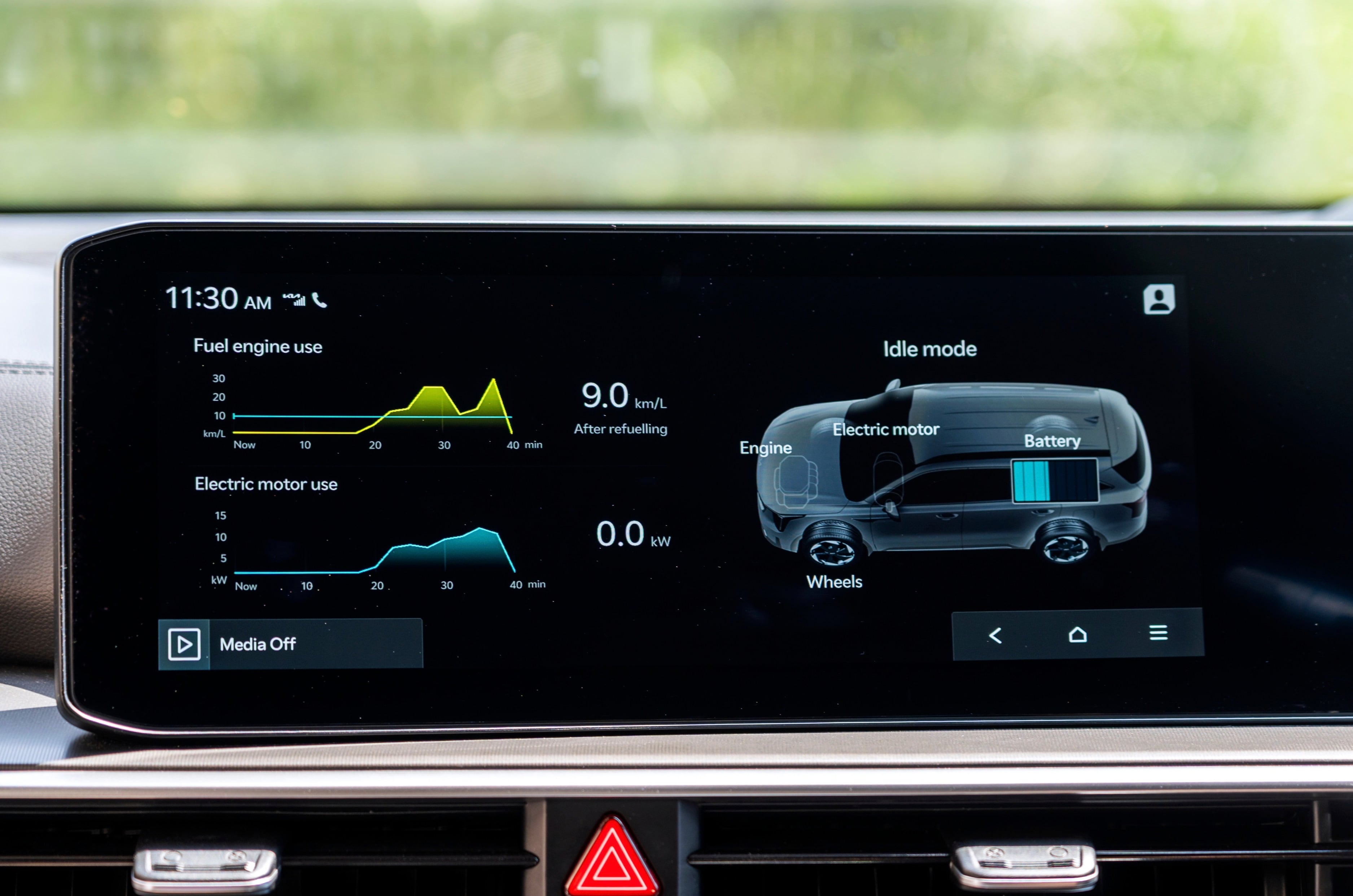
Hybrid variant gets exclusive data for power flow and efficiency.
As with its Hyundai cousins, the real ace is the software. The 12.3-inch infotainment system is logically laid out, menus are where you expect them to be, and getting to a feature takes a tap or two rather than a treasure hunt. Kia has also kept the climate controls off the main screen. They live on a touch-sensitive bar below it, with scrollers and a button that toggles the bar between air-con and infotainment shortcuts. It is a clever, space-saving solution, though you will occasionally find it in the wrong mode just when you need it.
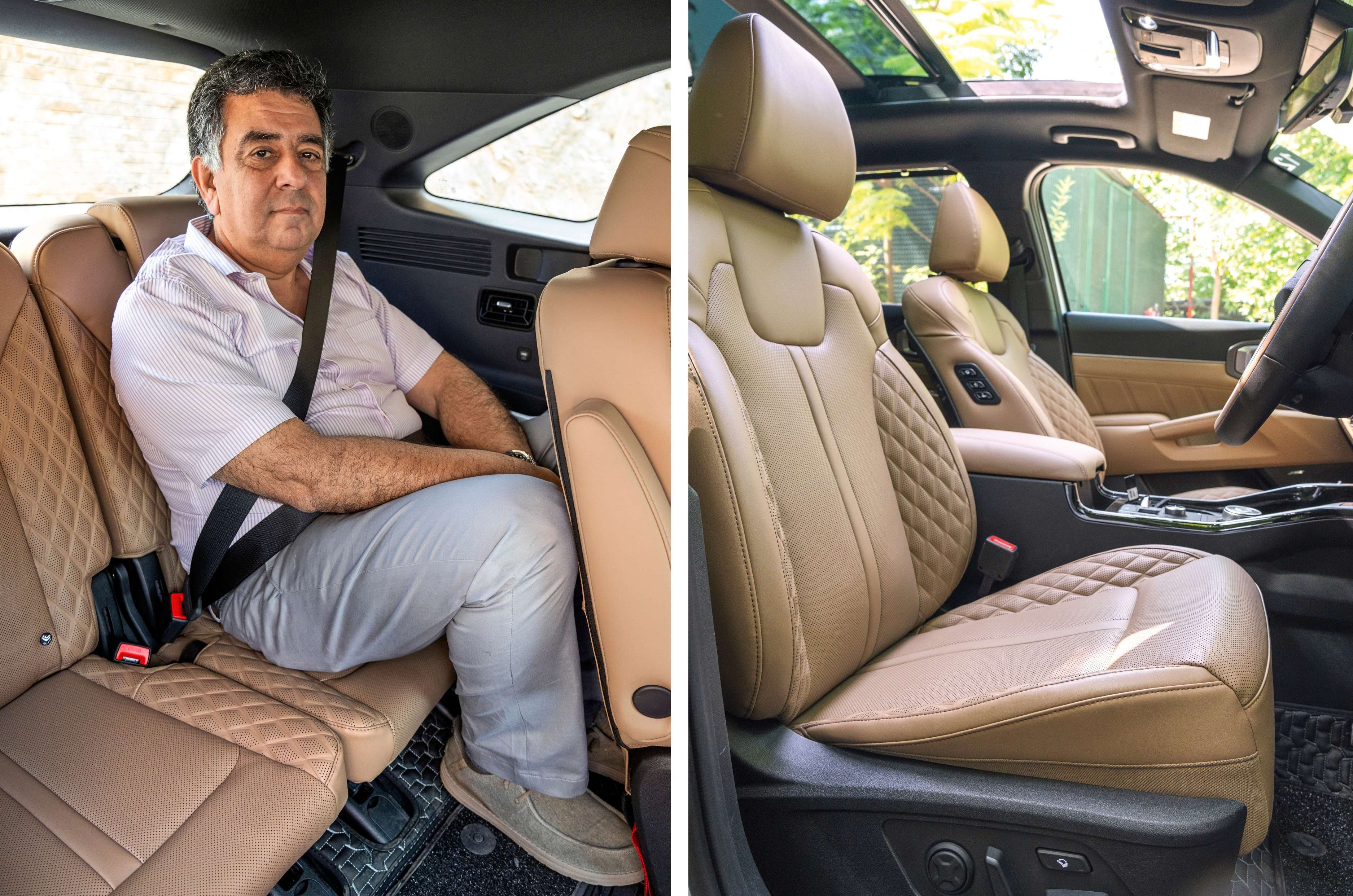
L: Third row seat placed on floor results in knees-up seating; best for children. R: Broad, supportive and well-cushioned front seats are electric and also get ventilation.
The front seats are fully powered, with 10-way adjustment, lumbar support and ventilation, and the passenger seat gets a boss mode so whoever sits behind can push it forward. Coming to the third row, access is easy. You can either walk through the gap between the captain chairs or press a button on the seat, which electrically slides and tilts it forward. Once there, the news is mixed. Legroom is better than you expect, but the seat base is mounted almost flat on the floor, so there is no under-thigh support and your knees point at the roof. Treat it as a space for children or short hops. At least the third row gets its own blower controls and USB ports.
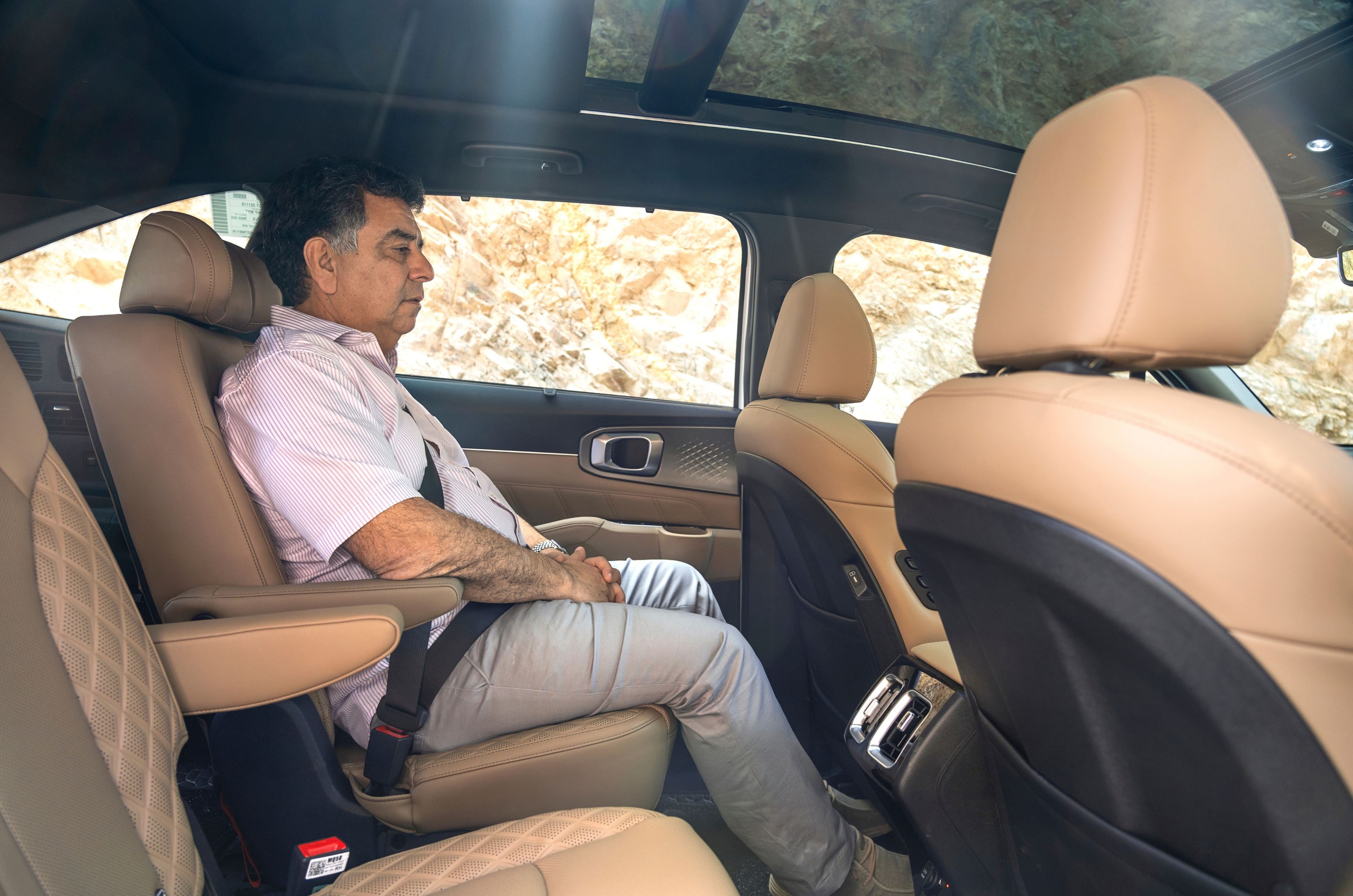
Spacious middle-row with ventilated and adjustable captain chairs; bench seat version also available.
One of the Sorento’s highlights, however, is the second-row experience. Our test car was the top HTX with six seats, and its second-row captain chairs are ventilated too, a rarity in this class. They are the best seats in the house. There is lots of legroom, a commanding view out and good under-thigh support, comparable to the Innova Hycross’s middle-row captain chairs, though the Toyota seats you a touch higher. A neat detail is the cupholder moulded into the door, up near the handle, where it is actually easy to reach.
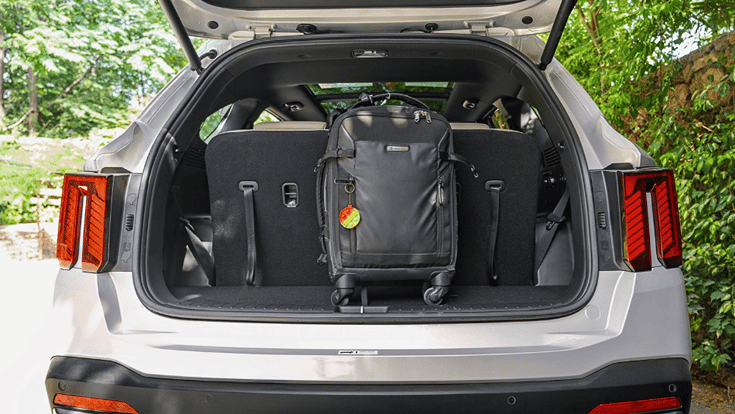
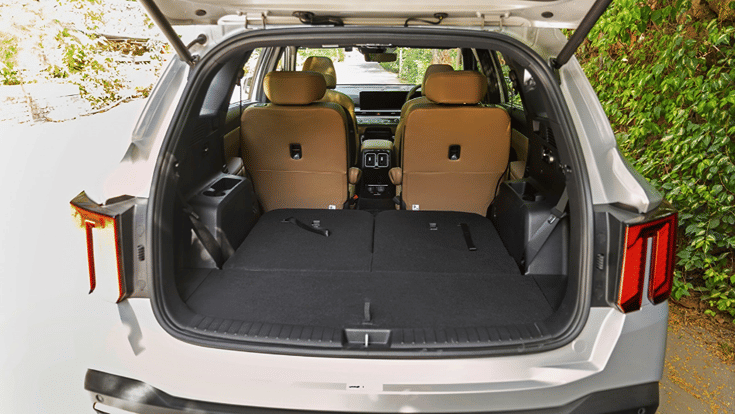
With all three rows up, the boot is a modest 179 litres; fold the third row and that grows to 813 litres. A full-size spare is welcome, but it is slung under the body, which is not the most convenient place to reach. Overhead, the massive panoramic roof floods the cabin with light and adds to the sense of space.
Kia Sorento features and technology
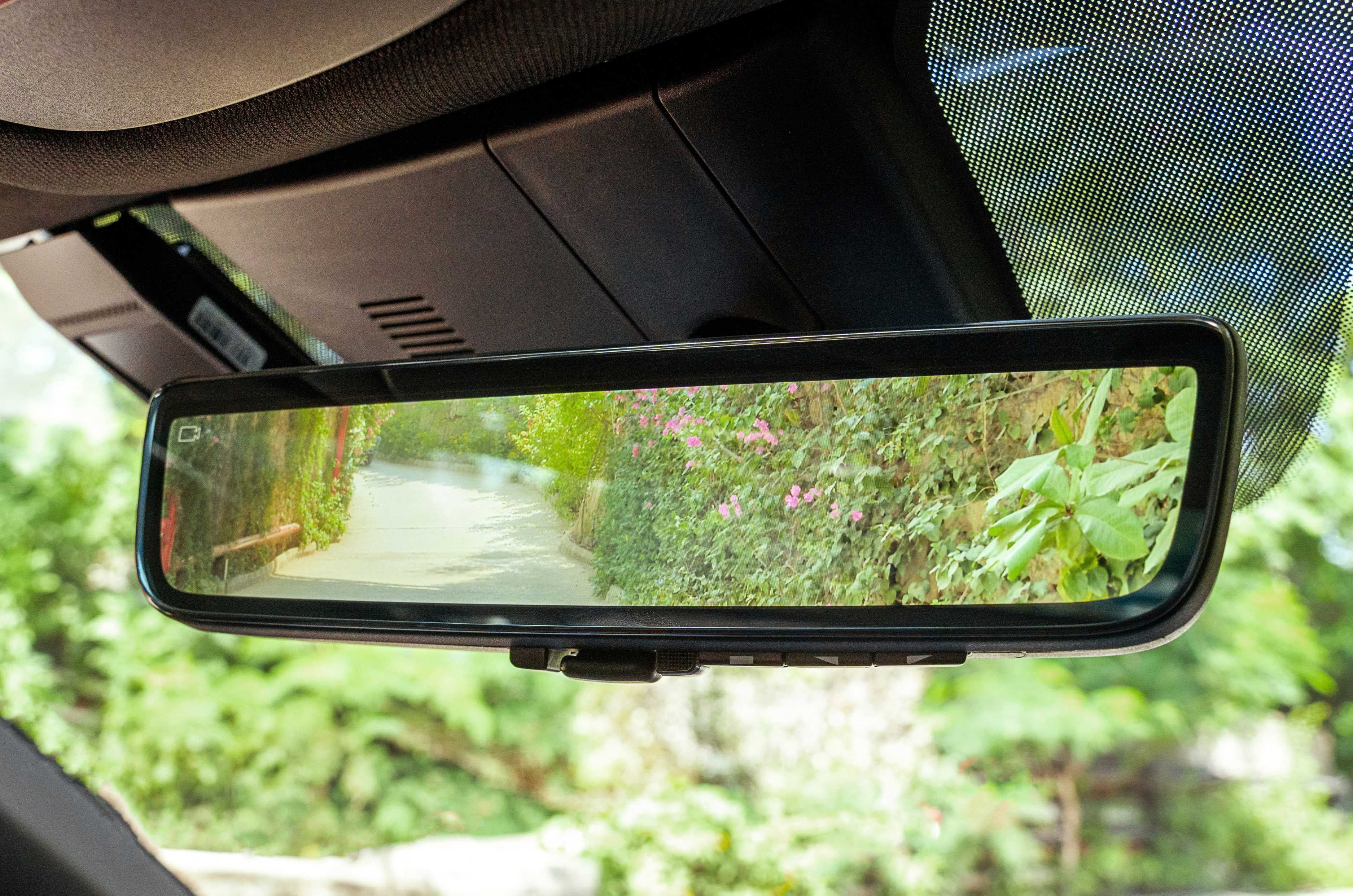
Digital IRVM offers excellent resolution and can be adjusted for level and brightness.
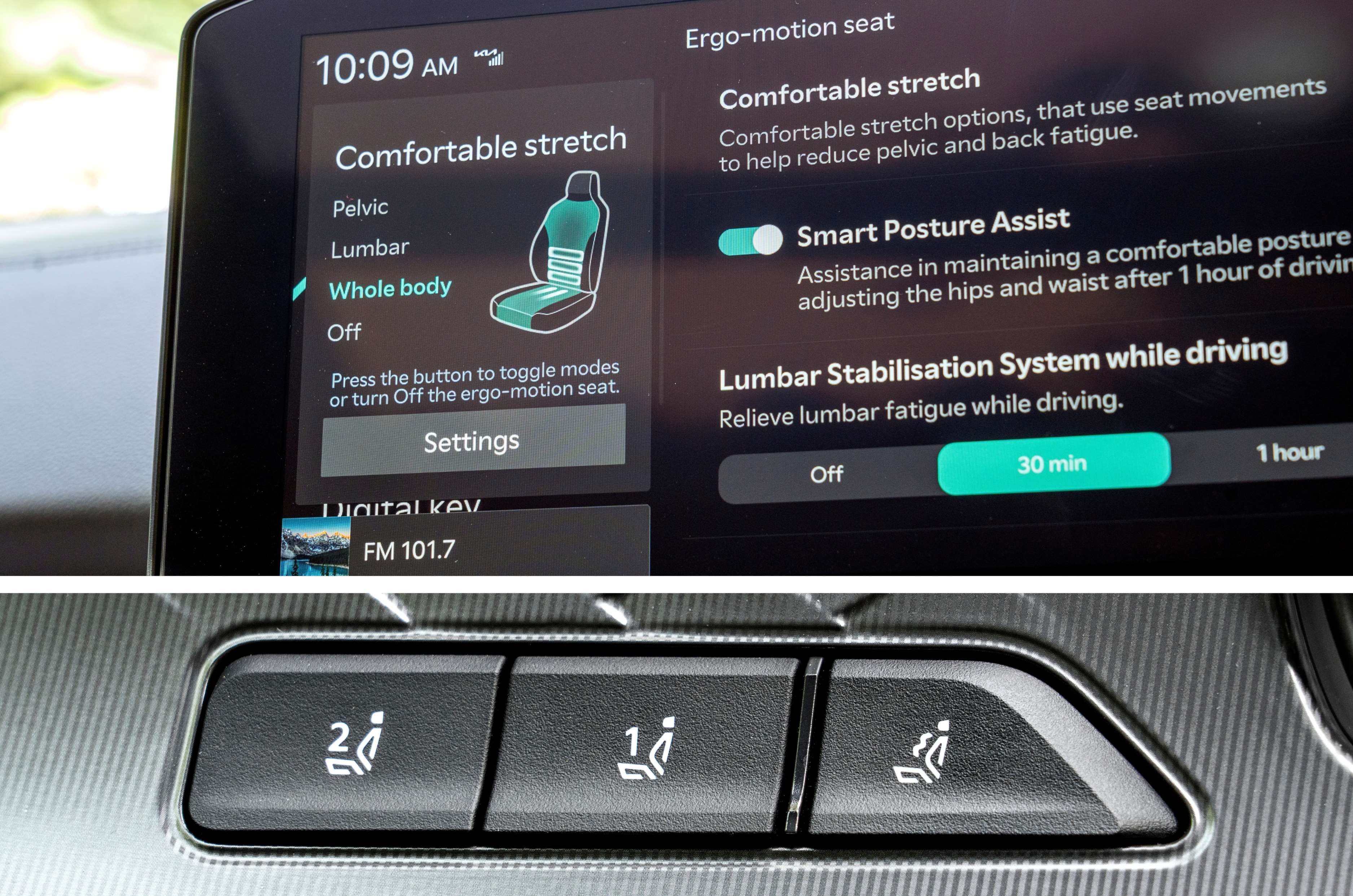
The equipment list is huge. In addition to the aforementioned 12.3-inch touchscreen, powered front seats, ventilated captain’s chairs, and panoramic sunroof, the Sorento comes packed with a 12.3-inch digital driver’s display, a head-up display, a 12-speaker Bose system, dual-zone climate control, a powered tailgate, rear-window sunshades, 64-colour ambient lighting and a digital rear-view mirror that flips back to a conventional one at the turn of a knob. The driver’s seat even gets an ‘ergo-motion’ mode that simulates a massage function by shifting the contours around.
Ergo mode for driver seat acts like a massage by moving the contours to avoid a stiff back on a long trip.
Safety is just as thorough, with 10 airbags, a 360-degree camera, front and rear dashcams, remote parking assist, TPMS and Level 2+ ADAS on the (A) trims. There is even real-time generative AI, a first for any Sorento globally.
Kia Sorento performance and refinement
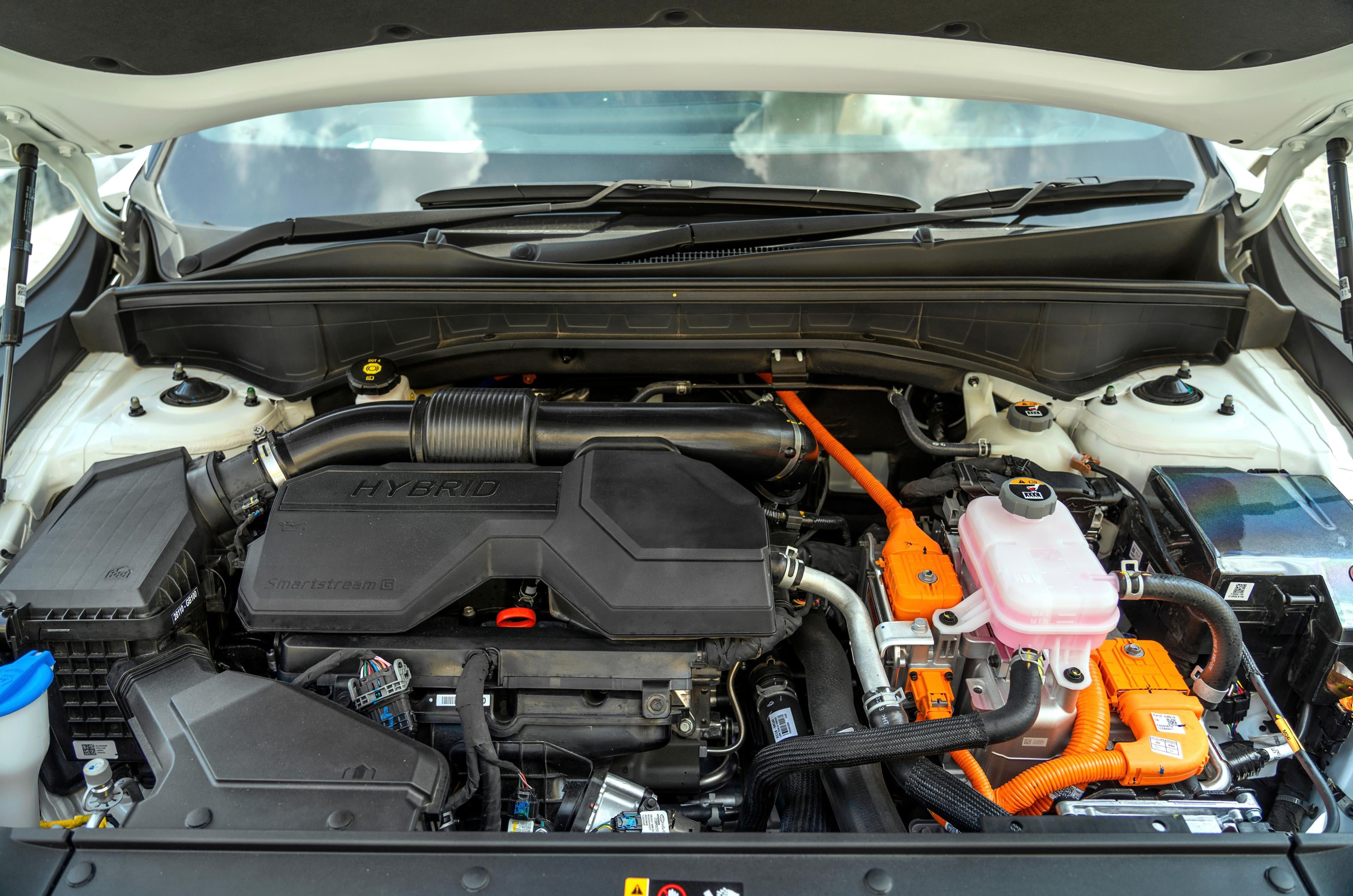
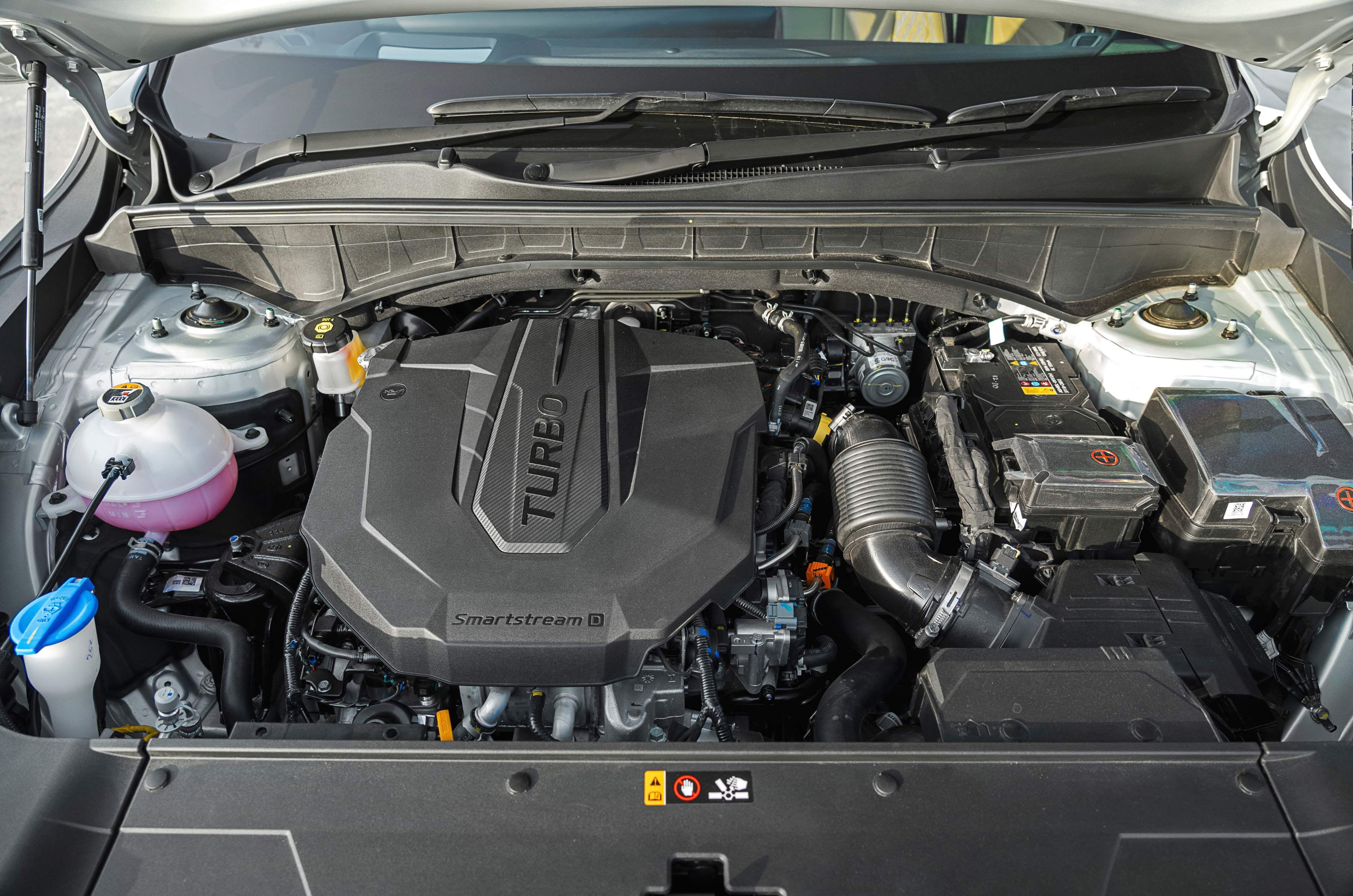
1.6-litre turbo-petrol engine paired with an electric motor and 6-speed torque converter automatic.
First up, the hybrid. Its 1.6-litre turbo-petrol makes 180hp and 265Nm, and the electric motor adds 65hp and 264Nm. The combined figure rating is 230hp and 380Nm of torque You can tell this the hybrid is the one for the city the moment you pull away, because the response is instant. It is well mated to the 6-speed torque-converter automatic, and the handover from electric to petrol power is close to seamless.
Hybrid variant is smooth in the city but gets noisy on the highway especially during overtakes.
The 1.49kWh battery lets it run in EV mode for a decent stretch at crawling speeds, and in stop-go traffic the hybrid makes eminent sense. Power delivery is refined, seamless and relaxing, and efficiency should be strong; The limitation is the motor itself. With only 65hp to shift a car weighing over two tonnes, it cannot do the heavy lifting on its own, so when you want to make quick progress the engine kicks in early. Push hard on the highway and the four-cylinder gets noisy and starts to run out of steam.
2.2-litre diesel engine makes 193hp mated to an 8-speed DCT and is the same unit seen on the Carnival.
Which is where the diesel comes in. The 2.2-litre is familiar from the Carnival, but it feels a lot sprightlier in the lighter Sorento. Its 193hp and 442Nm arrive in a strong, linear surge, and this is a fantastic, long-legged cruiser. Settle into eighth gear on an open highway and it simply lopes along, the engine barely working. It is also more tractable at low speeds than you might expect, pulling cleanly at part throttle from very low revs, so it can double as a city car, although its low-end response does not come close to the hybrid’s. It’s only when you floor it to dart through traffic that you experience a bit of hesitation, and its hear that you can use the paddle shifts to be in the right gear at the right time of the 8-speed DCT which comes as a pleasant surprise.
The diesel‘s strong torque and effortless cruising makes it perfect for long trips.
Rather than the snappy, slightly jerky shifts typical of dual-clutch boxes, this DCT slurs its changes almost like a torque converter, which adds to the smoothness of the whole package. The reason is that it is a wet-clutch unit, which also bodes well for durability in Indian traffic. The diesel is quite refined for the most part and its only when pushed hard that it gets audible and takes on a gruff note.
Both get drive modes; You can play with the Eco, Normal, Sport and Smart (or auto) modes in the diesel which alters the power delivery. In Sport, the throttle response is sharper and the default mode we liked whilst in Eco you can feel the response a bit dulled down. The Sorento Hybrid gets just Eco, Sport and Smart modes and in Eco mode EV running is prioritised. In addition, the AWD versions get Snow, Sand and Mud terrain modes which we didn’t a get chance to fully experience.
Kia Sorento mileage
In terms of fuel efficiency, the hybrid is rated at a highly frugal 19.60kpl with front-wheel drive and 17.70kpl with AWD, while the diesel returns 17.66kpl and 15.79kpl respectively on the Indian test cycle. In real-world city driving the gap between the hybrid and diesel could be bigger, depending on traffic. On long cross-country runs, though, with extended stints of cruising in high gears, the diesel could well be the more frugal of the two.
Kia Sorento ride and handling
The Sorento’s ride comfort is simply outstanding, and it comes as a pleasant surprise. That’s because Kias have traditionally been stiffer sprung than their Hyundai cousins, but here Kia has clearly prioritised comfort over sportiness, and the suspension is on the soft side. The way it smothers bad roads at speed is remarkable. Around Udaipur, where several stretches are properly broken, we never once had to lift off for a bad patch. The car just soaked it up and kept going.
Ride quality is segment best and it is unfazed over broken roads.
The isolation it gives its passengers is shockingly good, and those tall-sidewall tyres deserve part of the credit. They do a fine job of rounding off sharp jolts and filtering out the high-frequency shocks that a suspension alone cannot fully absorb. At highway speeds there is a bit of body movement on the undulating bits but its not disconcerting and both versions feel stable and planted at high speeds, which matters in a car this tall.
Our HTX test cars came with AWD as standard. We did not get a chance to test its off-road ability properly, but on dirt roads it felt sure-footed and secure. A proper off-road test will reveal how capable the all-wheel-drive system, though we doubt owners will really want to test the Sorento’s off-road capability.
Steering is light but lacks consistency and sharpness of European rivals.
The steering is less impressive. There is a dead zone around the straight-ahead position, and it does not feel as fluid or progressive as its European rivals’. The Volkswagen Tayron and Skoda Kodiaq are both dynamically sharper. One reason is because the Sorento rides taller too, as ground clearance has been raised from the global car’s 176mm to 208mm, and there is a touch of body roll when you push hard through corners.
But that misses the point. On balance, the Sorento’s ride and handling are superbly judged for the people who will buy it. Kia has done a fine job of understanding what a premium SUV buyer in India wants, and it has tailored the car accordingly.
Kia Sorento price and verdict
As a package, the Sorento hits it out of the park; rivals have a lot of catching up to do.
If the product does not win you over, the pricing certainly will. A starting price of Rs 27.99 lakh has set the cat amongst the pigeons, putting the Sorento within striking distance of the Mahindra XUV 7XO. And with its size, features and overall polish, the Sorento will not just nibble at the top end of the 7XO’s pie but with the Hybrid could also tempt a few Innova Hycross buyers. As for the Volkswagen Tayron and Skoda Kodiaq, the Sorento makes them look overpriced and underequipped.
The lower and mid variants are exceptional value. The top-end HTX, at Rs 37.49-40.19 lakh depending on fuel and seating, is pricey by comparison, around Rs 5 lakh more than an equivalent HTK, because it comes with AWD as standard. Here Kia has missed a trick. An HTX with two-wheel drive, a few lakh cheaper, would have been a far easier sell to the many buyers who want all the features and ventilated rear seats but will never leave the tarmac. That however is a small quibble that Kia can easily correct.
The lasting impression is that the Sorento feels premium, bordering on luxury. It is fantastically equipped, it rides beautifully, and it offers a choice of two powertrains that are each right for a distinct type of buyer. Most of all, it fits what the Indian SUV buyer actually wants with uncanny precision. Will Kia hit its target of 40,000 sales a year? That could be a tall order. But what there is no doubt about is that Kia has built another winner.
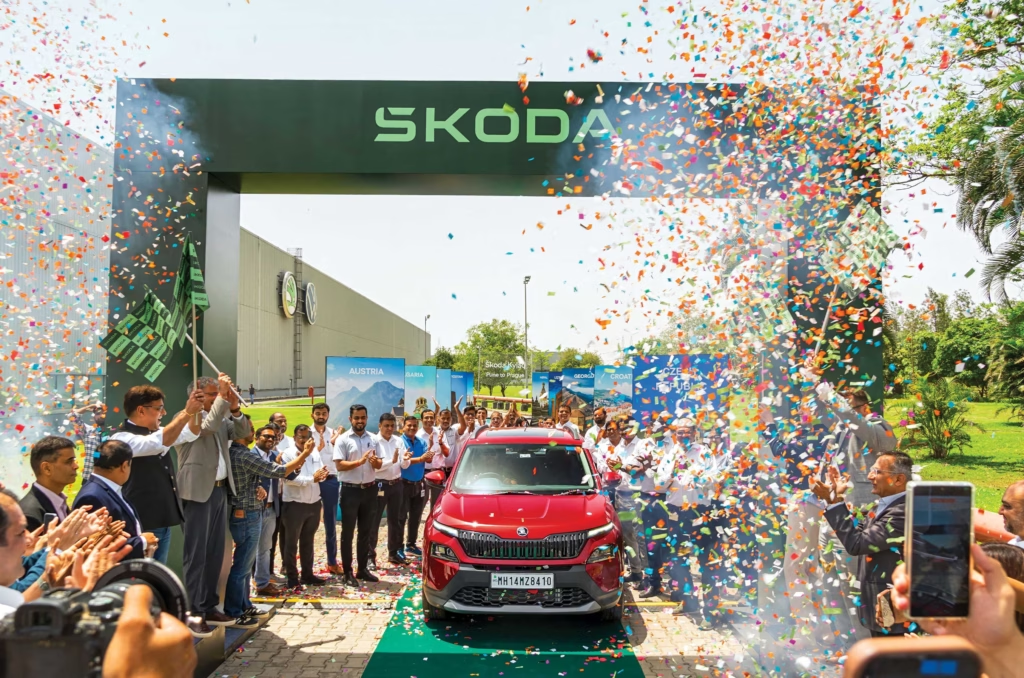
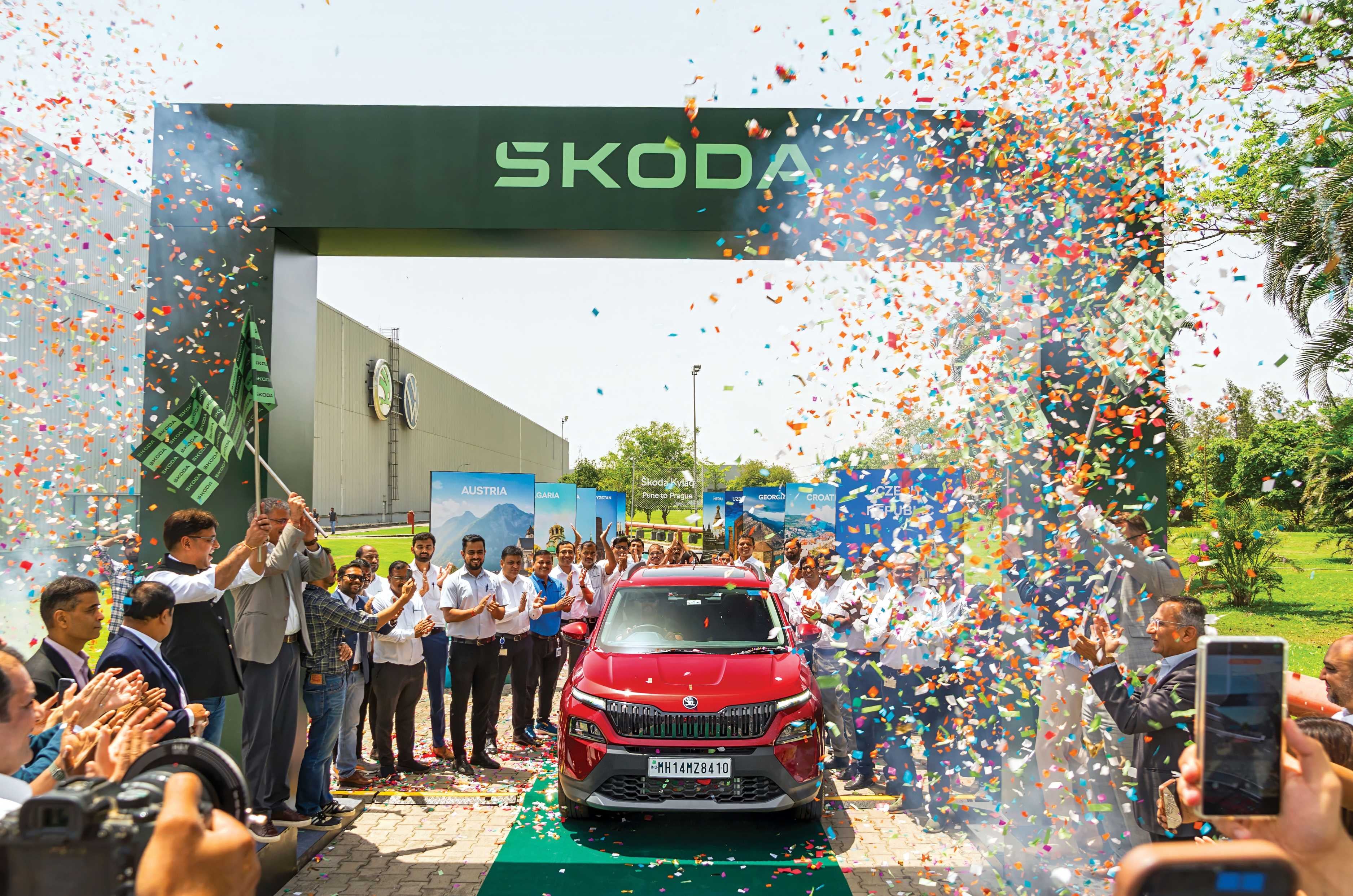
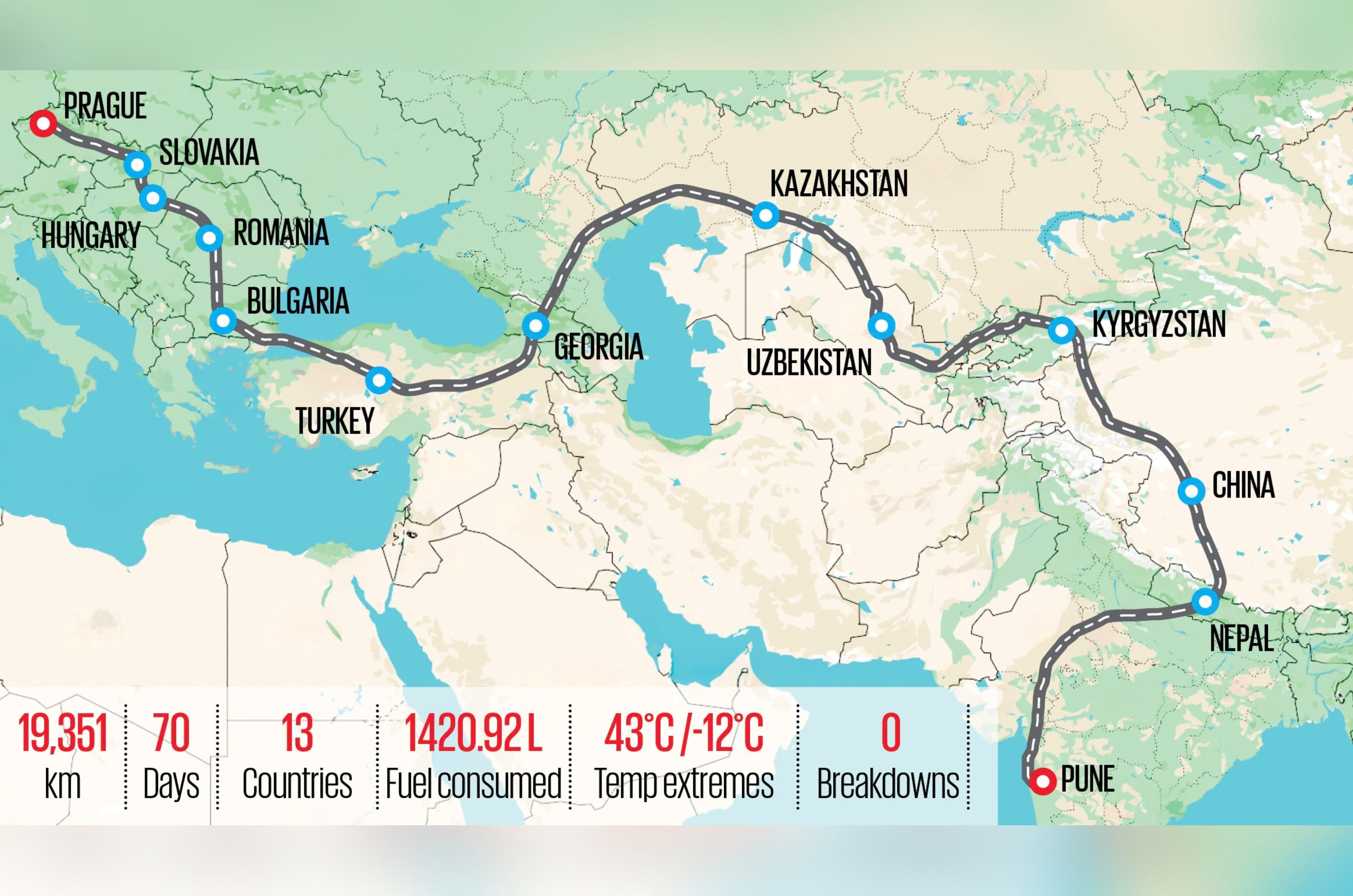
There are road trips, there are overland expeditions, and then there are journeys that become conversations with continents. This one starts in the industrial heart of Maharashtra, inside Skoda India’s sprawling Chakan facility. The end point lies nearly 20,000 kilometres away at Skoda Auto’s headquarters near Prague in Mladá Boleslav, Czech Republic, where bicycles evolved into automobiles and a 130-year-old story continues to be written.
Between these two factories lie thirteen countries, four major mountain ranges, countless cuisines, dozens of languages and enough history to fill libraries.
Our companion? Not a flagship SUV or a luxury grand tourer, but Skoda’s smallest SUV – the Kylaq, which recently celebrated its one-year anniversary. Driving it from Pune to Prague is a tall order, but surviving one year in India and being accepted with flying colours is enough cred one needs to take on the world.
India – Home Turf
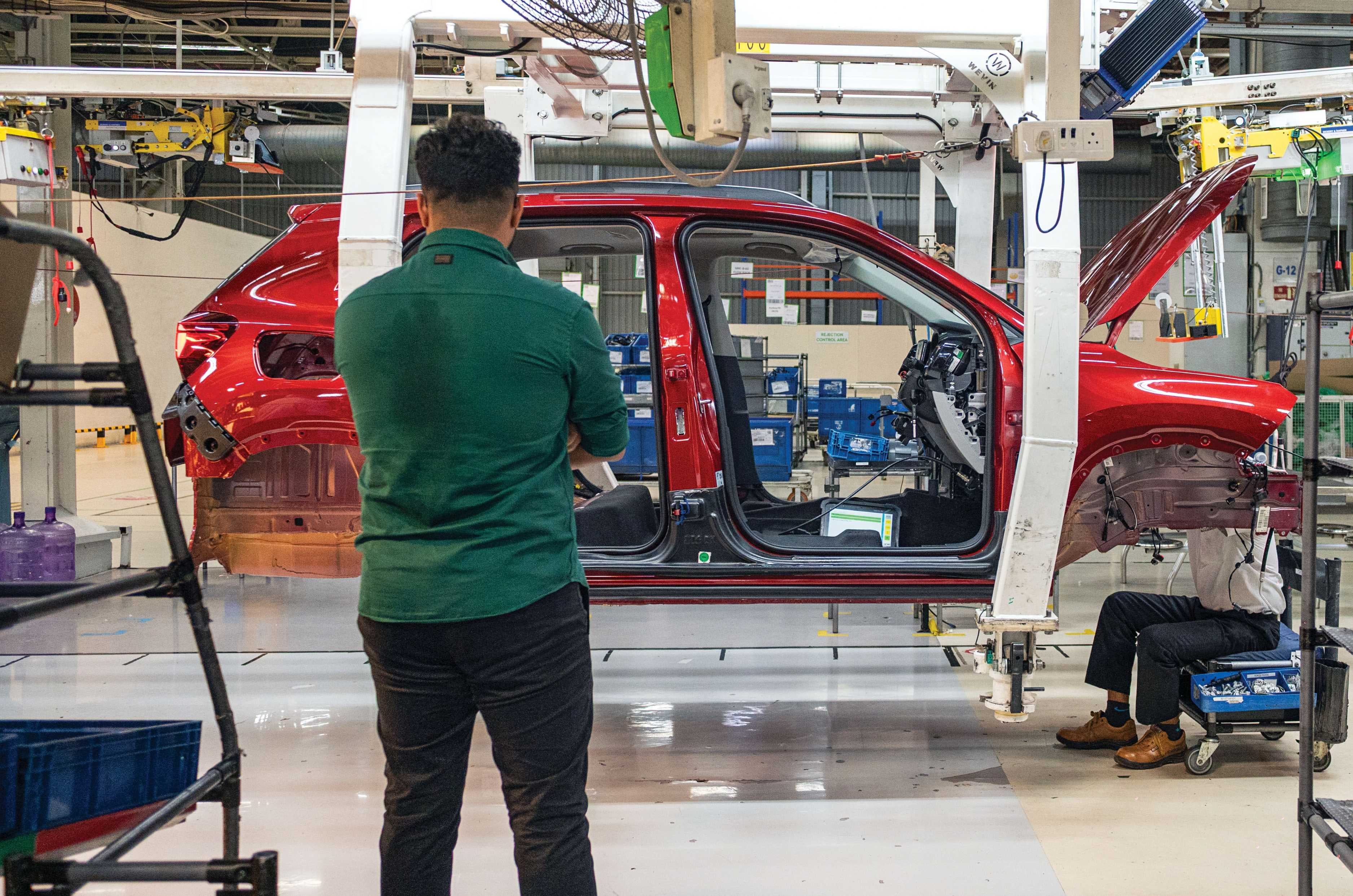
Witnessing the Kylaq’s birth added more responsibility.
On a cross-country road trip, you’d imagine the home country would be the easiest leg. With India, it was the opposite. To some, it’s organised chaos, but honestly, it’s anything but organised. Erratic traffic, erratic egos, and road conditions fit only for a Mars rover – India was the biggest challenge on the drive from Pune to Prague. As the odometer ticked over its first kilometre, right outside the gate of Skoda’s Chakan plant, a blood-red PMPML bus was ready to trade paint with the cherry-red Kylaq. A dinged-up Kylaq parked on the streets of Prague wouldn’t be a good look, so it was imperative that I babysit this compact SUV like a million-dollar supercar. Having watched the car being assembled on the factory floor, from bare bones to the finished package, only added to the emotion – driving it in traffic felt like walking a toddler across a football field. Eyes wide open, ready to block any attack.
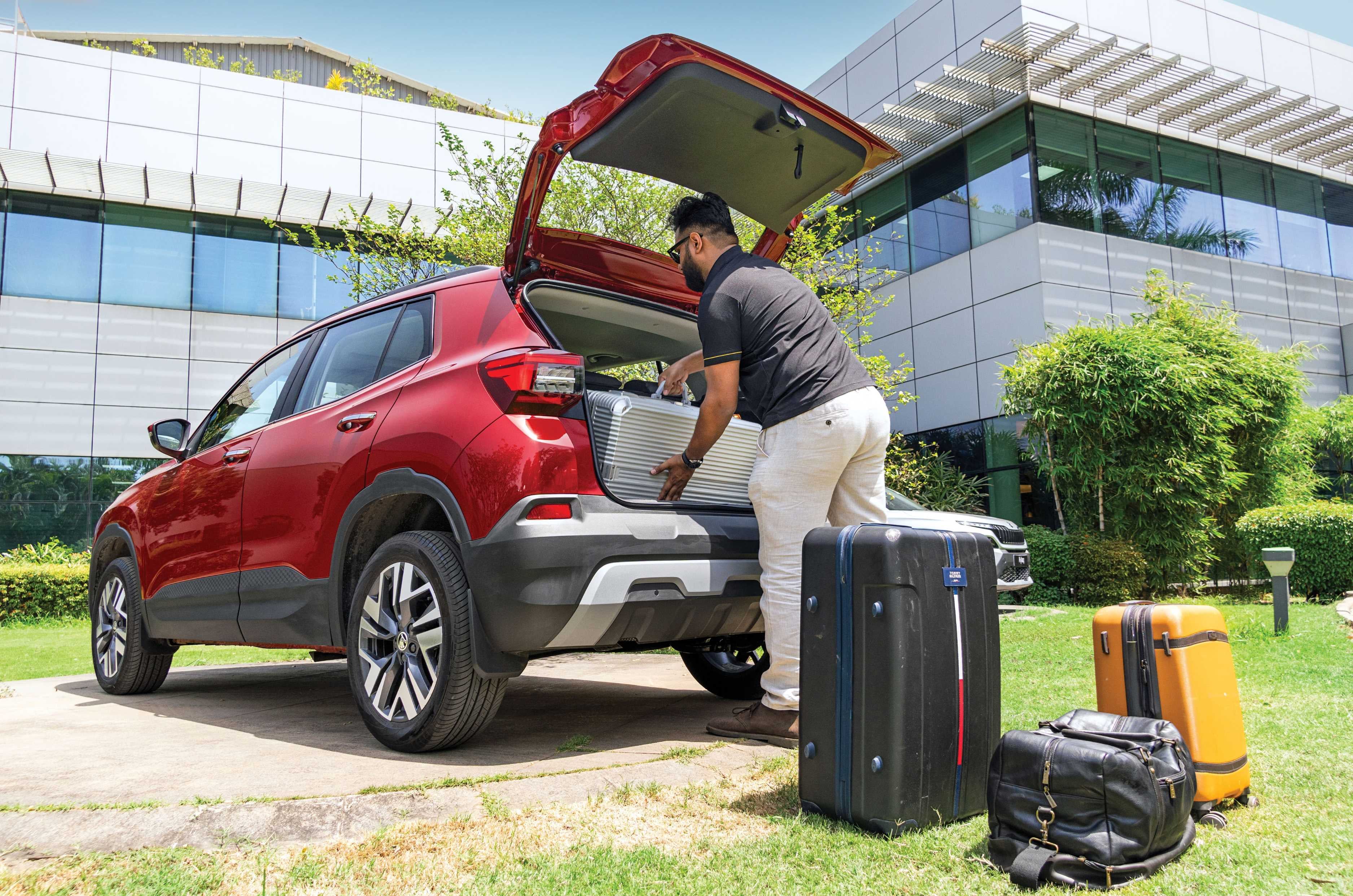
446-litre boot packed to the brim for 70 days on the road.
We got onto the Pune expressway and then crossed the Atal Setu in Mumbai, the longest sea bridge on the entire journey. Mumbai was home, both to me and to the Autocar India office, so after a few greetings from co-workers and the obligatory photos, we headed towards our first state crossing. The infamous Western Express Highway that leads out of Mumbai lived up to its reputation, but with a little anxiety, panic and a few expletives, we made it onto the national highway.
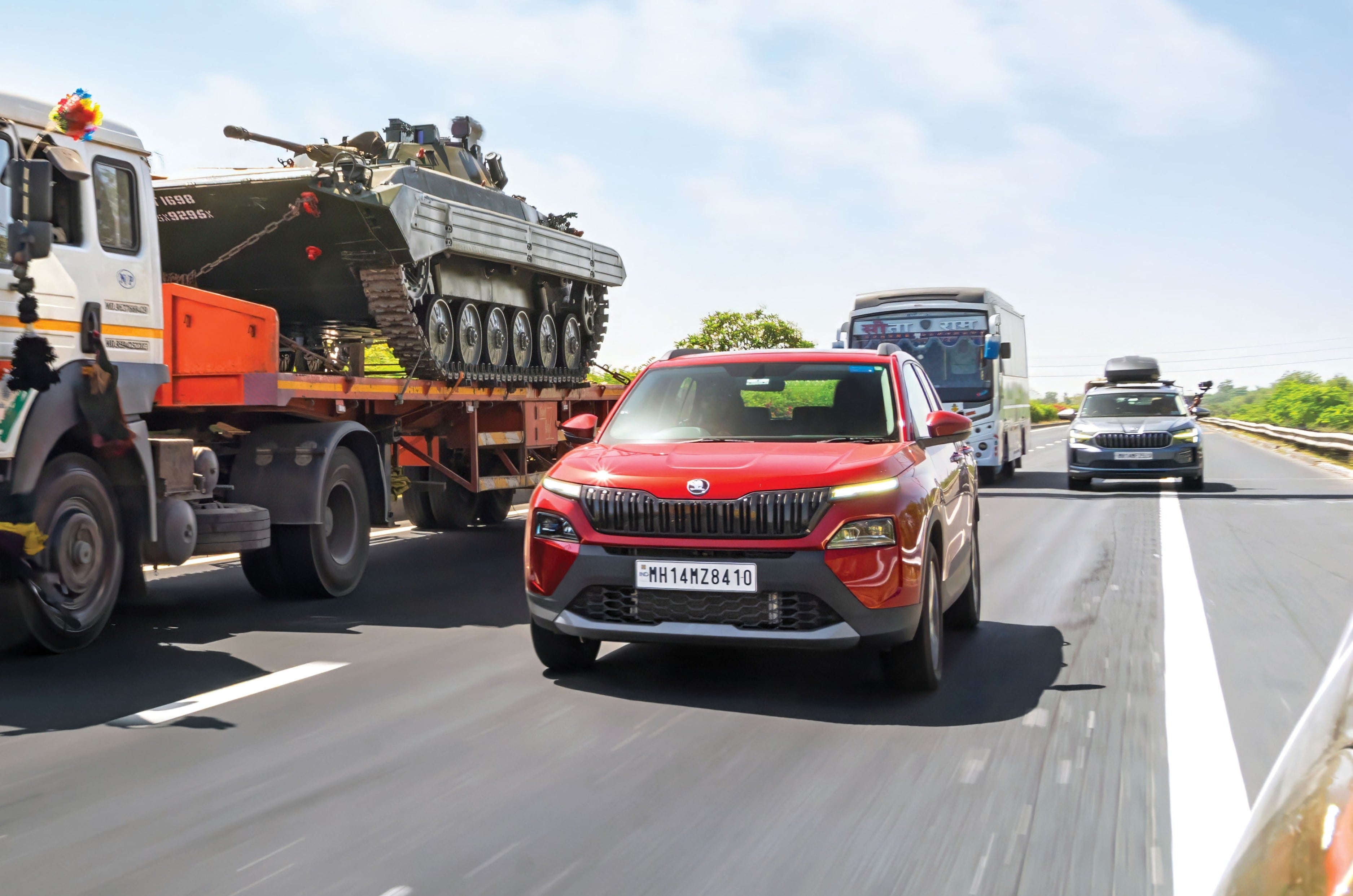
No telling what you’d spot on Indian highways.
The first of countless food stops was Hotel Ahura, renowned for its akuri and kheema. Needless to say, we carb-loaded to the max and made a beeline for Vadodara.
Pune-Birgunj in numbers
Distance covered
2,487km
Fuel consumed
234.46 litres
Average fuel economy
10.62kpl
Approximate fuel cost
Rs 23,629
Average per-litre fuel cost
Rs 100.87
Total time driven
55hrs 20min
Average speed
44.95kph
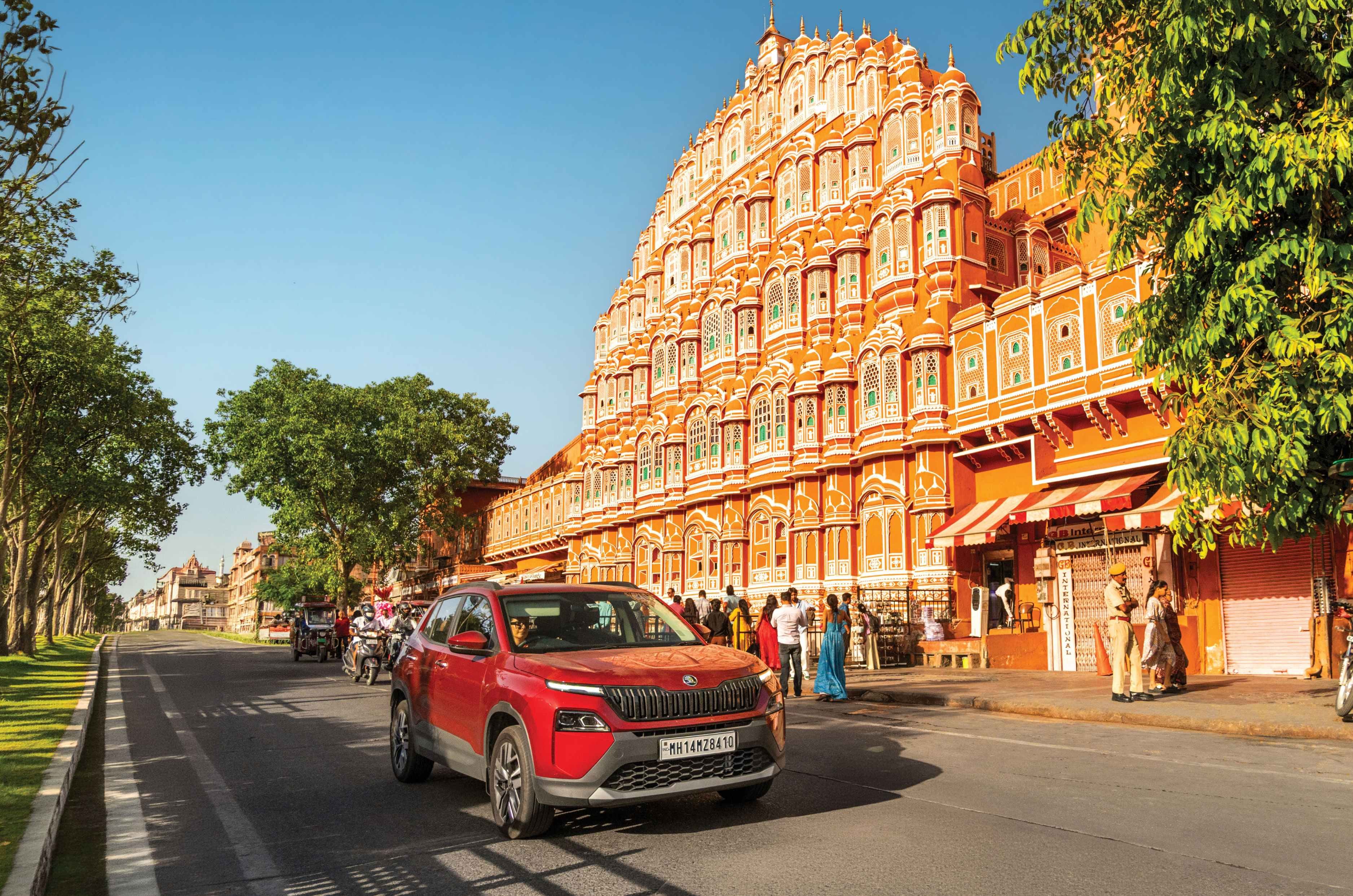
Crossing into Gujarat, the Kylaq could finally stretch its legs and spool up that turbo on the state’s spotless highways. The stability and effortless cruising were a welcome relief, since the bulk of the kilometres on this drive would be covered on long, open highways. Gujarat was a short stint – we made only an overnight halt in Vadodara before slipping out ahead of the morning traffic. The drive into Rajasthan was seamless, and Udaipur greeted us with a mix of heat and traffic. The City of Lakes is worth taking the time to explore, but a late arrival and early morning departure left us with just enough time to grab a traditional meal. All that driving had built up an appetite, so we put it to a vote between a massive vegetarian thali and laal maas – the latter won by a landslide. From the City of Lakes, we headed to Jaipur, the Pink City: just as picturesque as Udaipur, and just as colourful and chaotic. The sun setting over the beautiful Amer Fort made for a cracking backdrop, and a few glimpses of the Jal Mahal on the way back were a treat too. The iconic Hawa Mahal, with its 953 windows, never fails to amuse, but getting a photo of the five-storey icon without a chorus of honks is next to impossible. The next morning, after threading through Jaipur’s narrow lanes, we made it back onto the highway, heading for Agra.
Iconic Hawa Mahal ought to be seen first-hand.
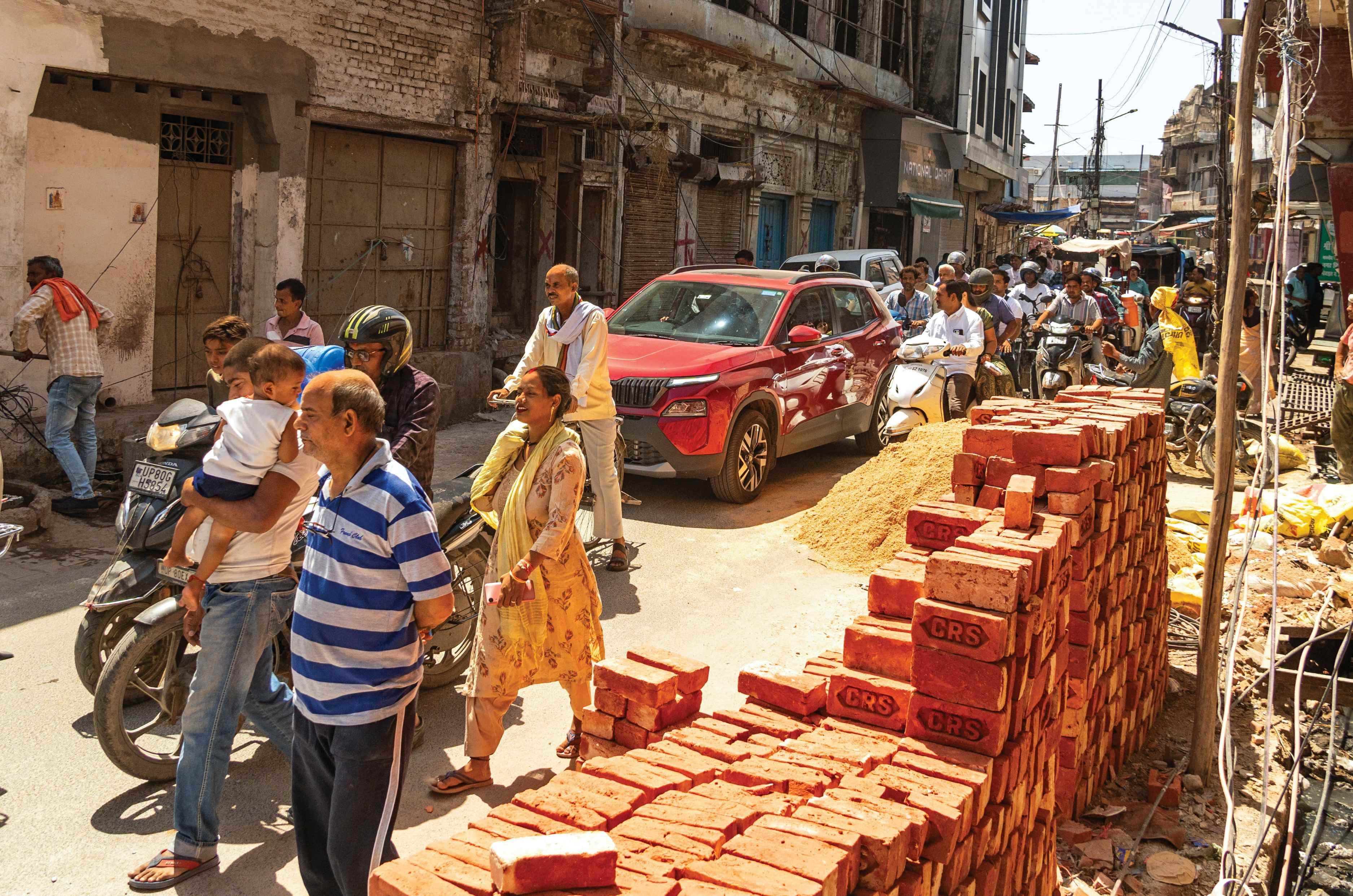
Agra is synonymous with the Taj Mahal, but the Agra Fort – from which you can see the Taj in the distance – is just as mesmerising. The detailing and architecture are second to none, and you could spend hours walking through its courtyards and passages, taking endless pictures. We, of course, also made it to the Taj itself, amid the hordes of tourists, if only to avoid the guilt of visiting Agra without a shot of the world-famous white dome. Tourism done, it was time for some petha – though the lanes near the petha shops seemed to be the exact width of the Kylaq, and that’s where peak anxiety set in. We got out of the mess, walked around the car to check for scratches and scribbles, and sighed in relief. India was adding to the tension, and we were barely halfway through it.
Agra’s narrow lanes were a nightmare to drive through.
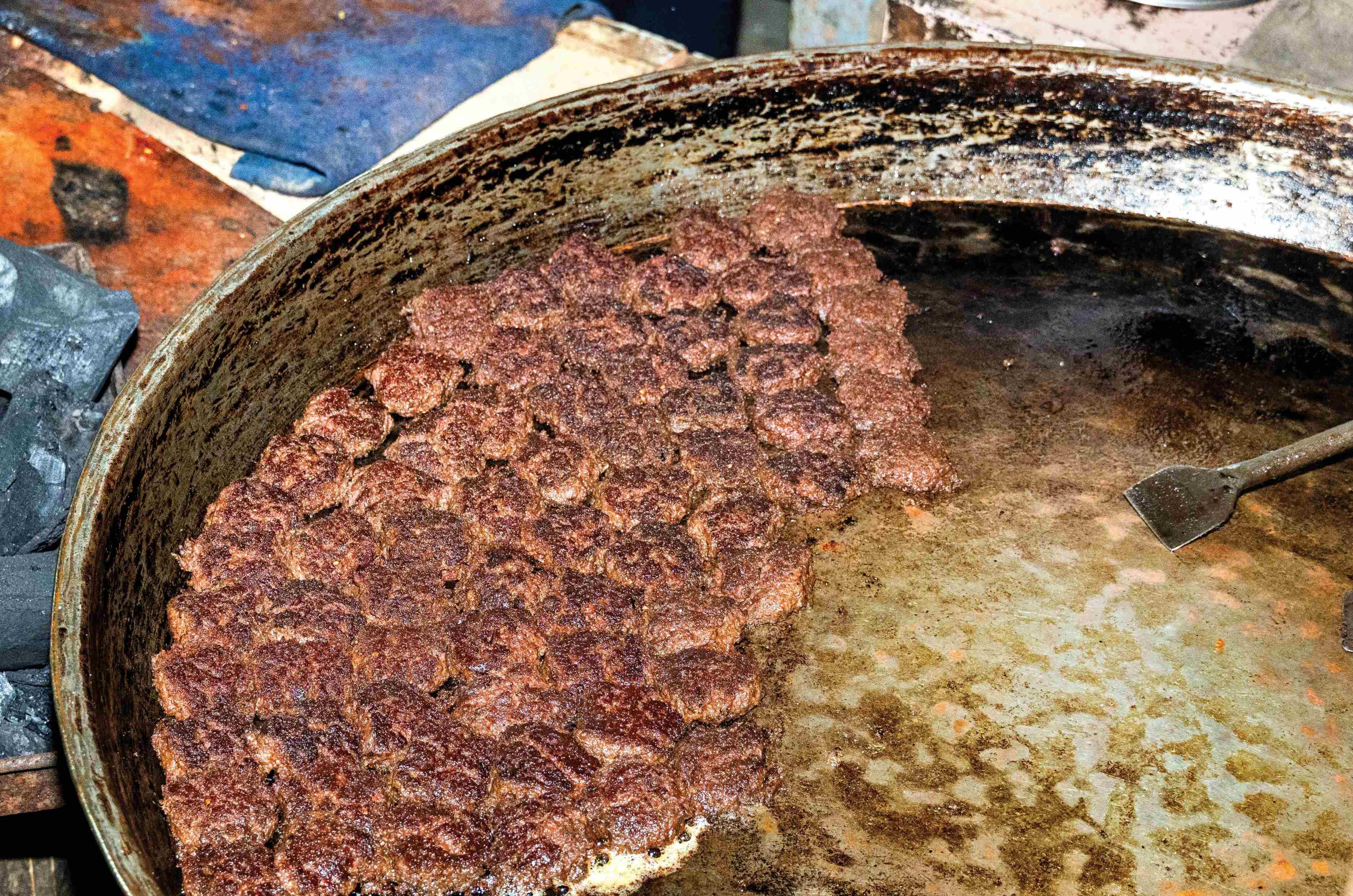
Our next stop from Agra was foodie heaven – Lucknow. The biryanis, kebabs, and tandoors were exactly what we expected, and exactly what Lucknow delivered. Finding your way here is easy – you could do it blindfolded, following the smoke and sizzle to wherever you need to be. Tunday Kababi is a must, and after a heap of biryani laced with kebabs, a long walk through the countless chikankari shops helps burn off some of the calories.
Lucknow’s Tunday Kababi still has us drooling over Galouti kebabs.
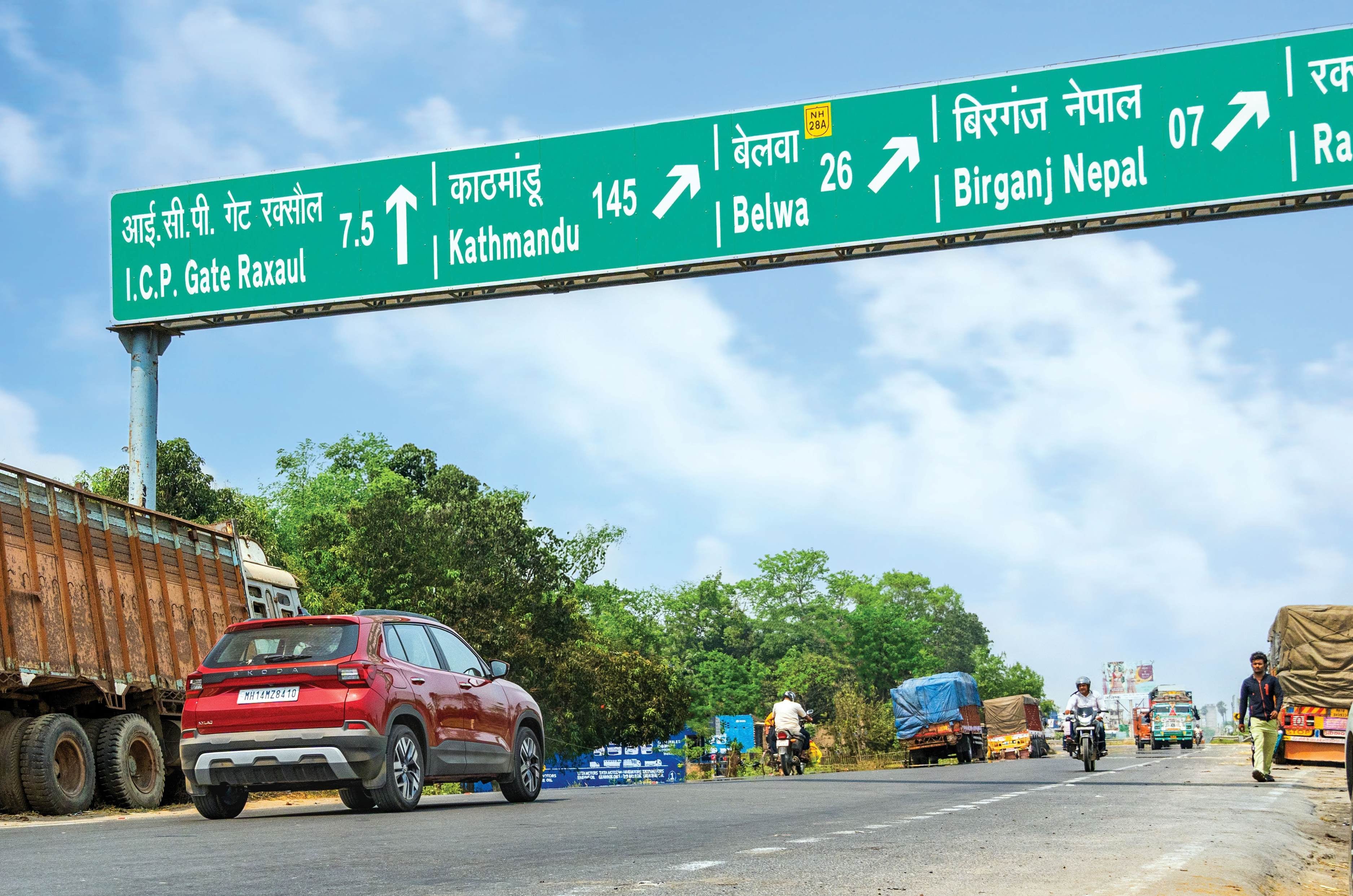
We were closing in on the end of the India leg, with one last stop in Gorakhpur before the Nepal border. To celebrate, a group of Skoda owners, officially known as the ‘Fans of Skoda’ joined us for a celebratory convoy as we drove out – everything from Octavia RS models to Kodiaqs and Kushaqs turned up as a send-off before we went international. The loud, chaotic border towns past Gorakhpur delivered one final challenge as we exited through Raxaul.
Final stretch before the Kylaq left India for the first time.
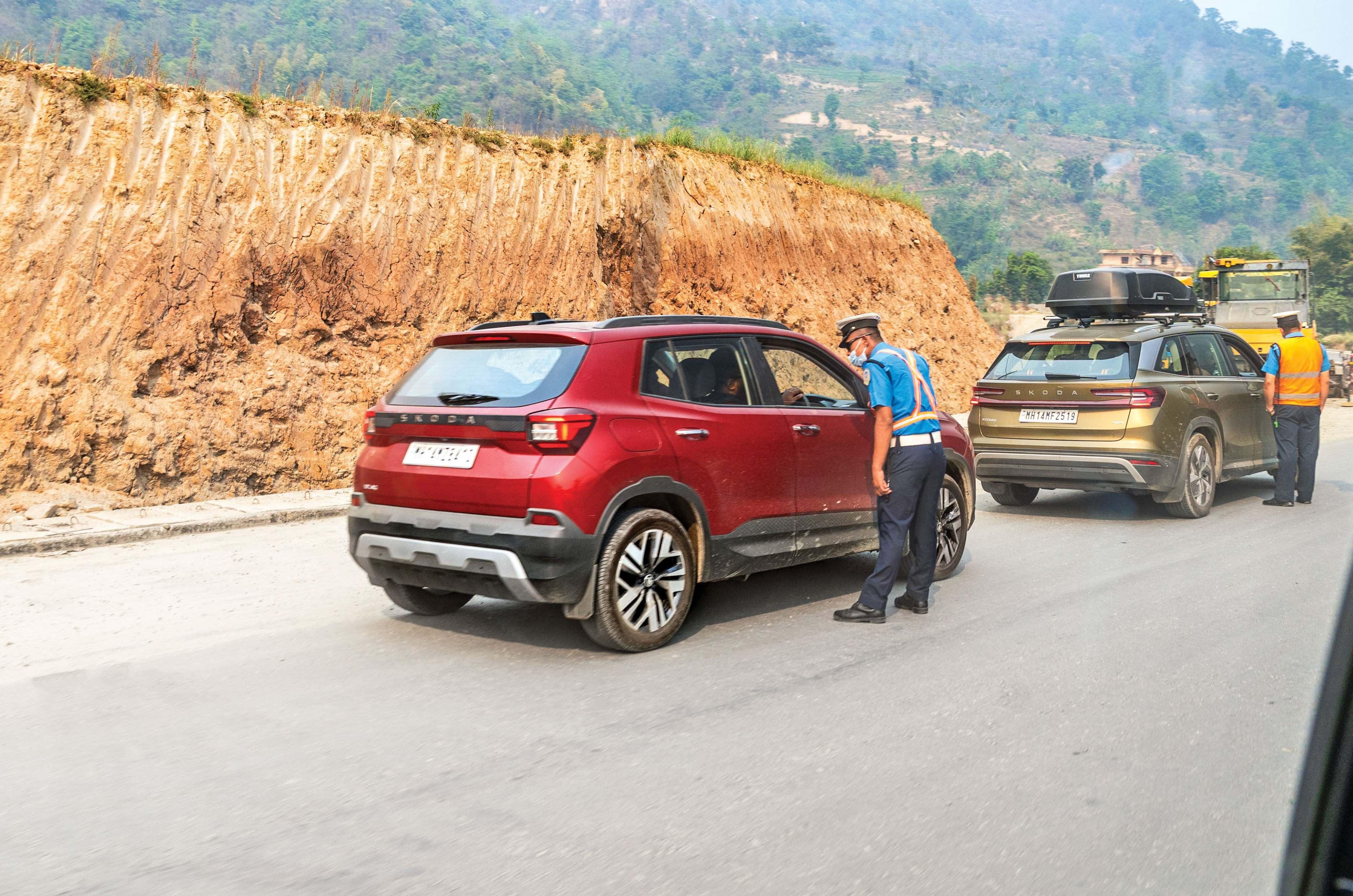
The India-Nepal border is still raw and basic, with none of the high-tech systems you might expect. A drive of this scale comes with a mountain of paperwork – visas, carnets, insurance, and more – and sifting through all of it manually takes a while. After a gruelling five hours, the Kylaq crossed out of India for the very first time.
Nepal – Old World Charm
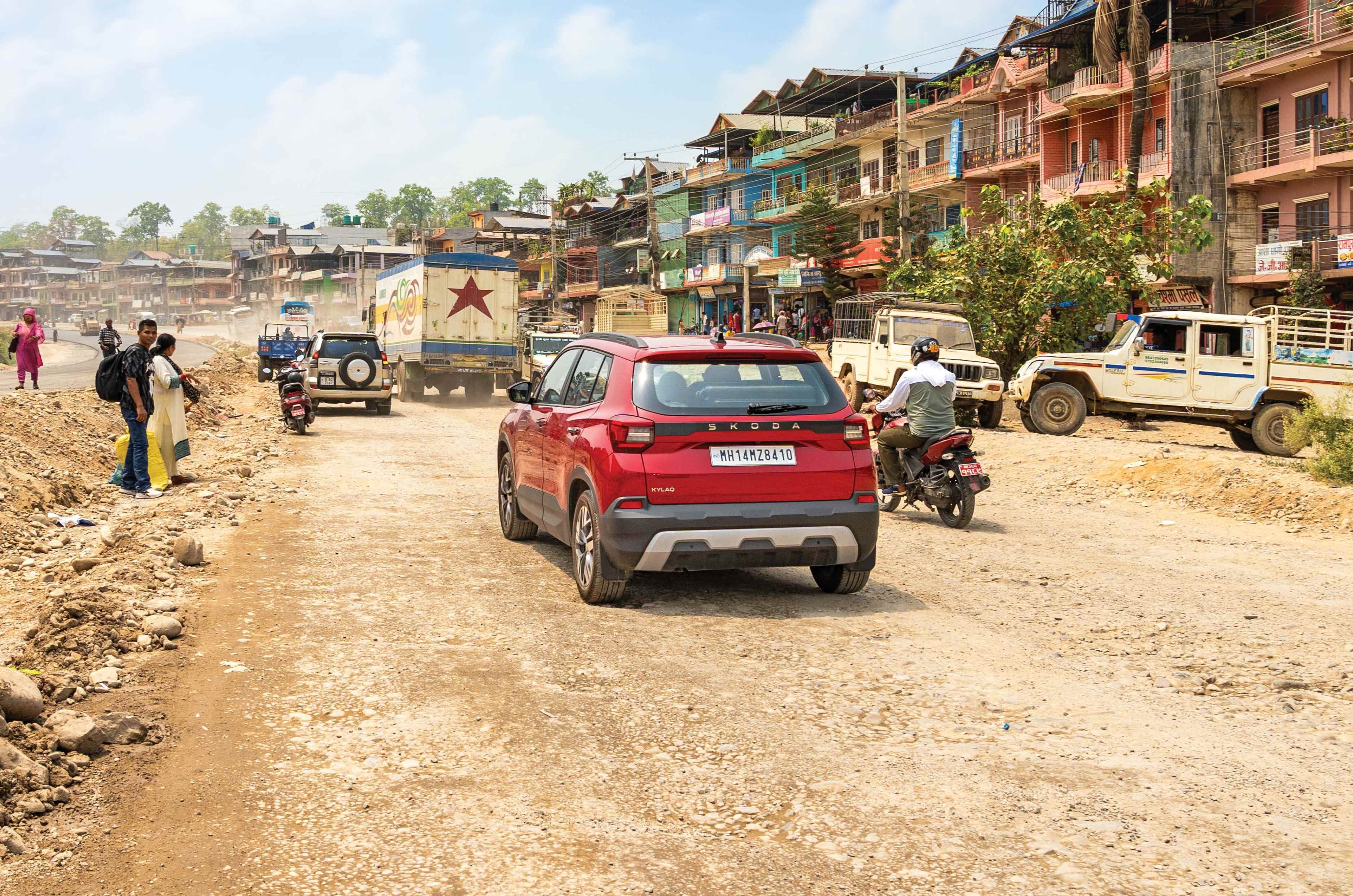
Nepal’s state highways give Indian roads a run for their money.
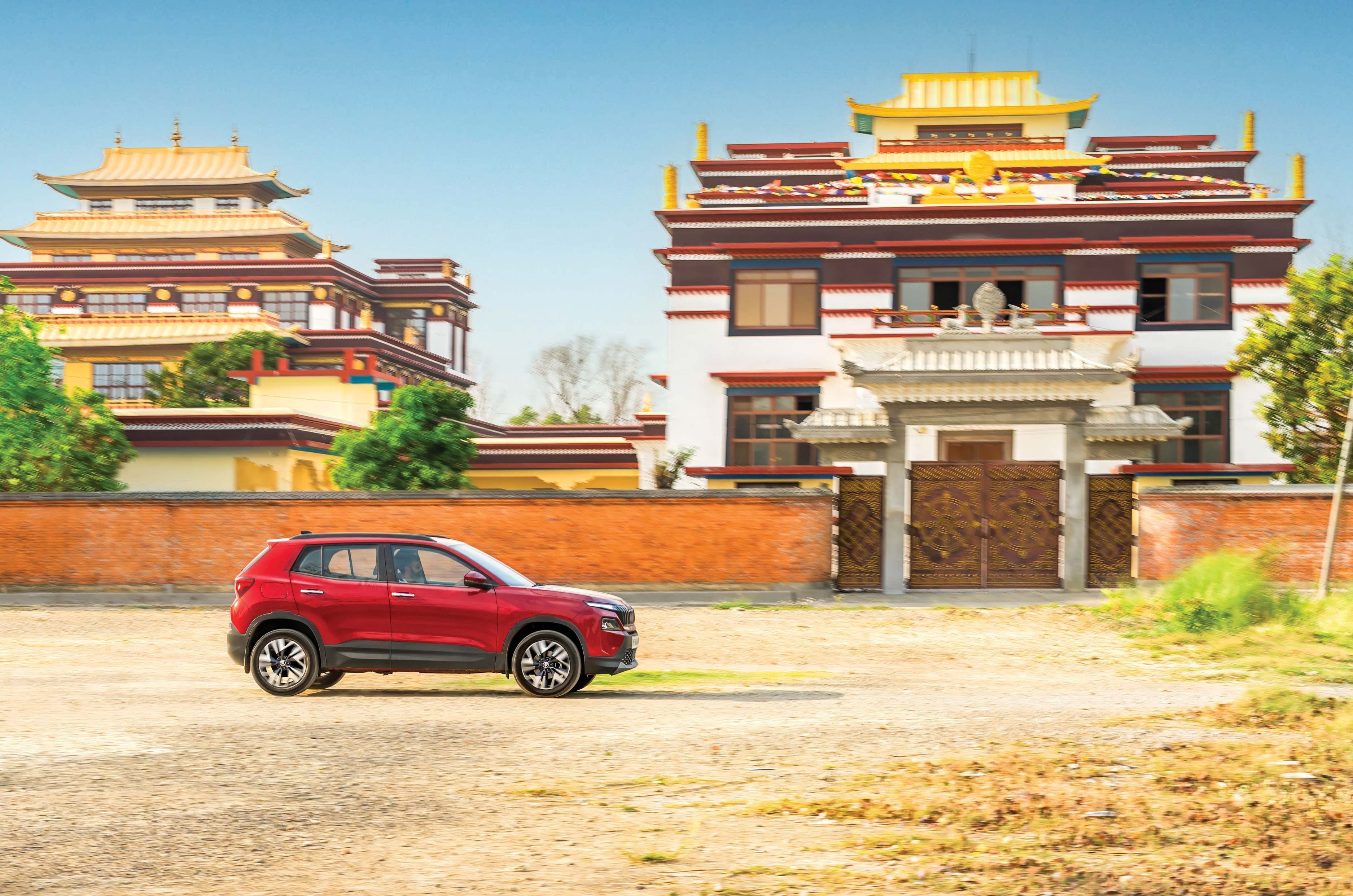
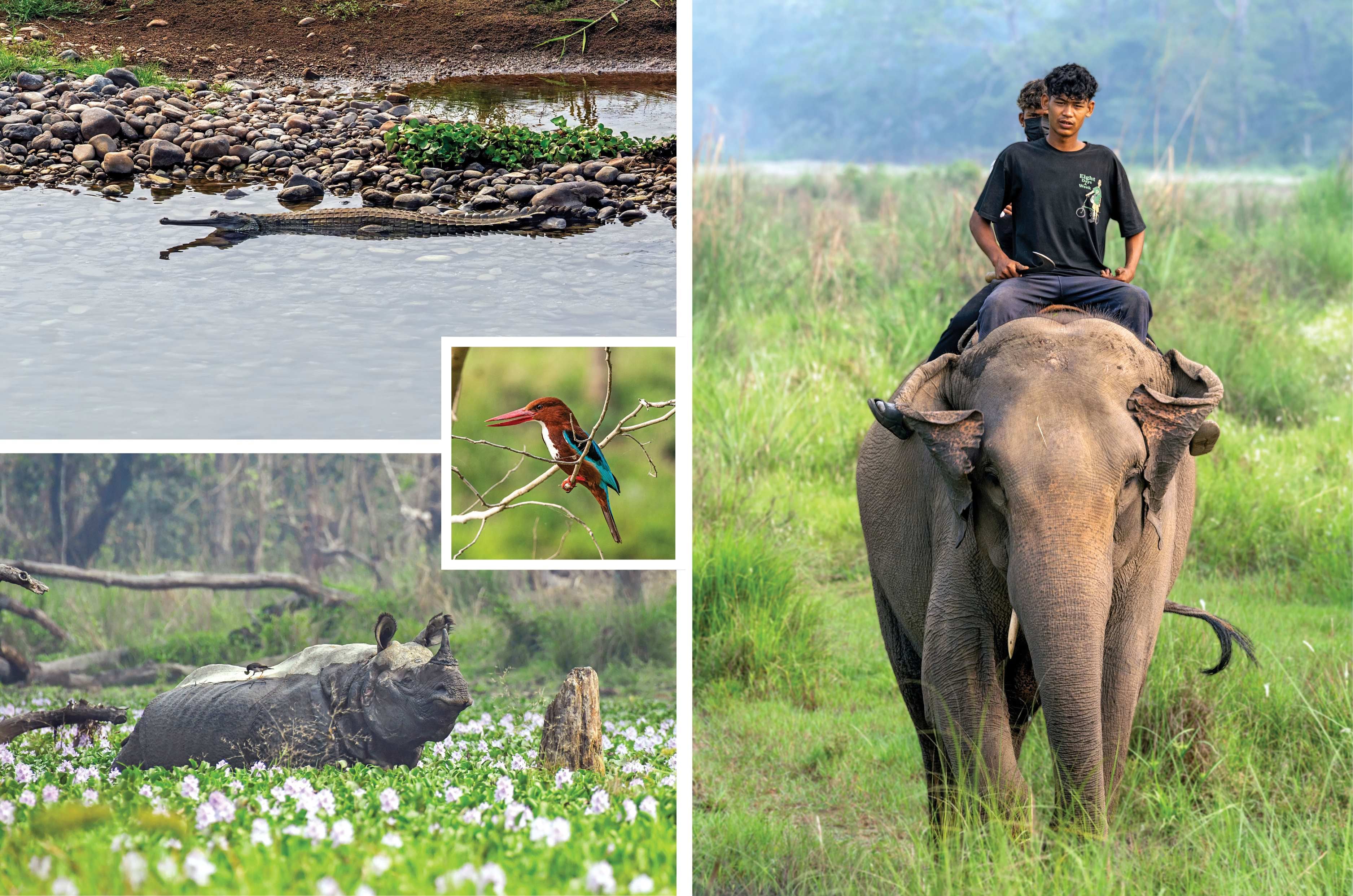
If the Indian side of the border was old-school, Nepal’s immigration post is almost antique. Drive past it, and you’d likely miss it altogether – the only tell-tale sign is a simple gate with ‘Immigration Office’ hand-painted on it. This humble-looking house is, in fact, the immigration office, where, just like on the Indian side, every check is done manually. Fine print, identity proofs, and everything in between were checked meticulously before we were welcomed into Birgunj. Our main draw in Nepal was the bustling capital, Kathmandu, but there were magnificent stops along the way, starting with Chitwan National Park. Home to nearly 700 one-horned rhinos, the park also shelters elephants, Bengal tigers, cobras, the elusive gharial, and abundant flora. The Kylaq would have been fun to explore it in, but we opted for the park’s safari vehicle to relax and take in the surroundings. Paddling a beaten-up wooden kayak past crocodiles and snakes adds a rush, but it’s nothing compared to a rhino staring you down in all its magnificence. The park gave us a welcome break from long hours behind the wheel.
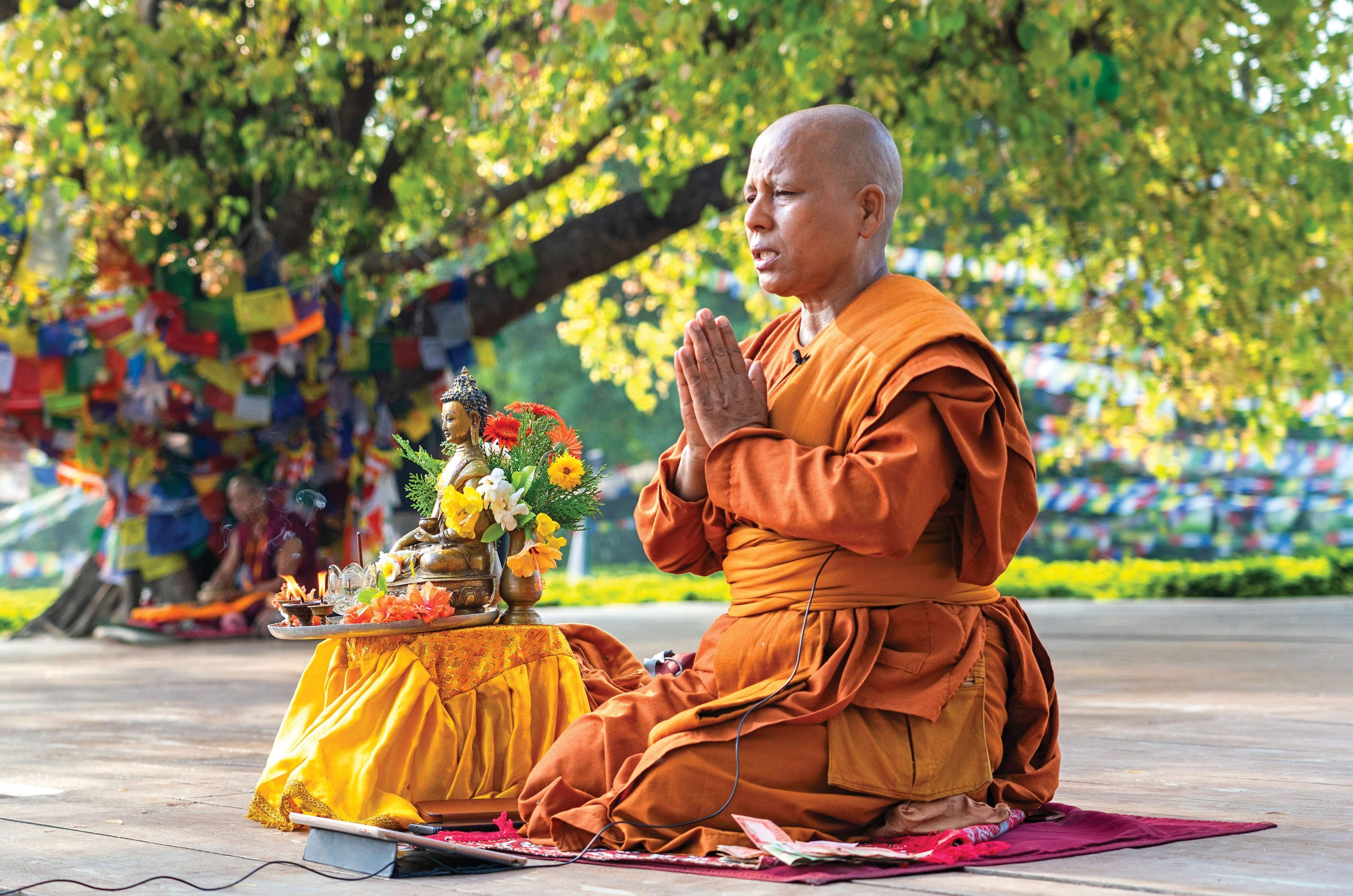
Lumbini is home to 32 unique styles of monasteries.
Next was Lumbini, a spiritual haven and, more importantly, the birthplace of Siddhartha Gautama (Lord Buddha) around 563 BC. Its fascinating monastic zone showcases monasteries built by Buddhist nations from around the world, each reflecting its own culture through design and architecture – a remarkable collection of temples spanning diverse traditions. The feeling of peace there was unlike anything I’d experienced, but it was soon disrupted by the road to Pokhara.
Lumbini provided a moment of calm through the chaos.
Mountain passes are notorious for destroying Google’s ETAs – landslides, breakdowns, and deteriorating roads mean a stretch that should take an hour could take five, depending on your luck. We braced for traffic and drove straight into a landslide clearing. A two-hour wait meant the sun was setting as we rolled into the quaint town of Pokhara. Bustling with cafés and pop culture, it felt like a mini Kathmandu, but with the stunning Phewa Lake turning orange at sunset. The calm that began in Chitwan came full circle on the shores of Phewa Lake.
Chitwan is home to the gharial and over 700 one-horned rhinos.
Kathmandu, though, was a different animal entirely – every bit a capital city, and a world away from the slow pace of Chitwan or Lumbini. The music is loud, the traffic is hectic, and the city is anything but quiet. Ironically, the only quiet things on the road are the cars – China’s dominance in Nepal is stark, with three in five cars on the road being Chinese EVs. Geely, BYD, and GWM rule the market, with only a handful of Hyundais and Kias as competition.
Authorities were always curious thanks to Indian number plates.
The party scene rules Kathmandu too. At night, the city comes alive as a hub for tourists from around the world. Hiking gear and North Face apparel go for a fraction of the price – and, often, a fraction of the quality – alongside quirky masks and fridge magnets at every tourist stop. Spend a little more time, though, and you’ll find excellent coffee shops and the famous Thakali thali: thick buckwheat porridge with salads, meat, and plenty of flavour. Good thing too, since walking through Durbar Square works up quite an appetite. Partly destroyed by the devastating 2015 earthquakes, the temples have since been restored to their former glory, though you can still spot the scars in a few bent pillars and roofs. It’s a culture and tradition worth preserving, and Nepal deserves credit for doing exactly that.
Birgunj-Sino-Nepal Border in numbers
Distance covered
922km
Fuel consumed
115.96 litres
Average fuel economy
7.13kpl
Approximate fuel cost
Rs 15,846
Average per-litre fuel cost
Rs 136.65
Total time driven
34hrs 25min
Average speed
27kph
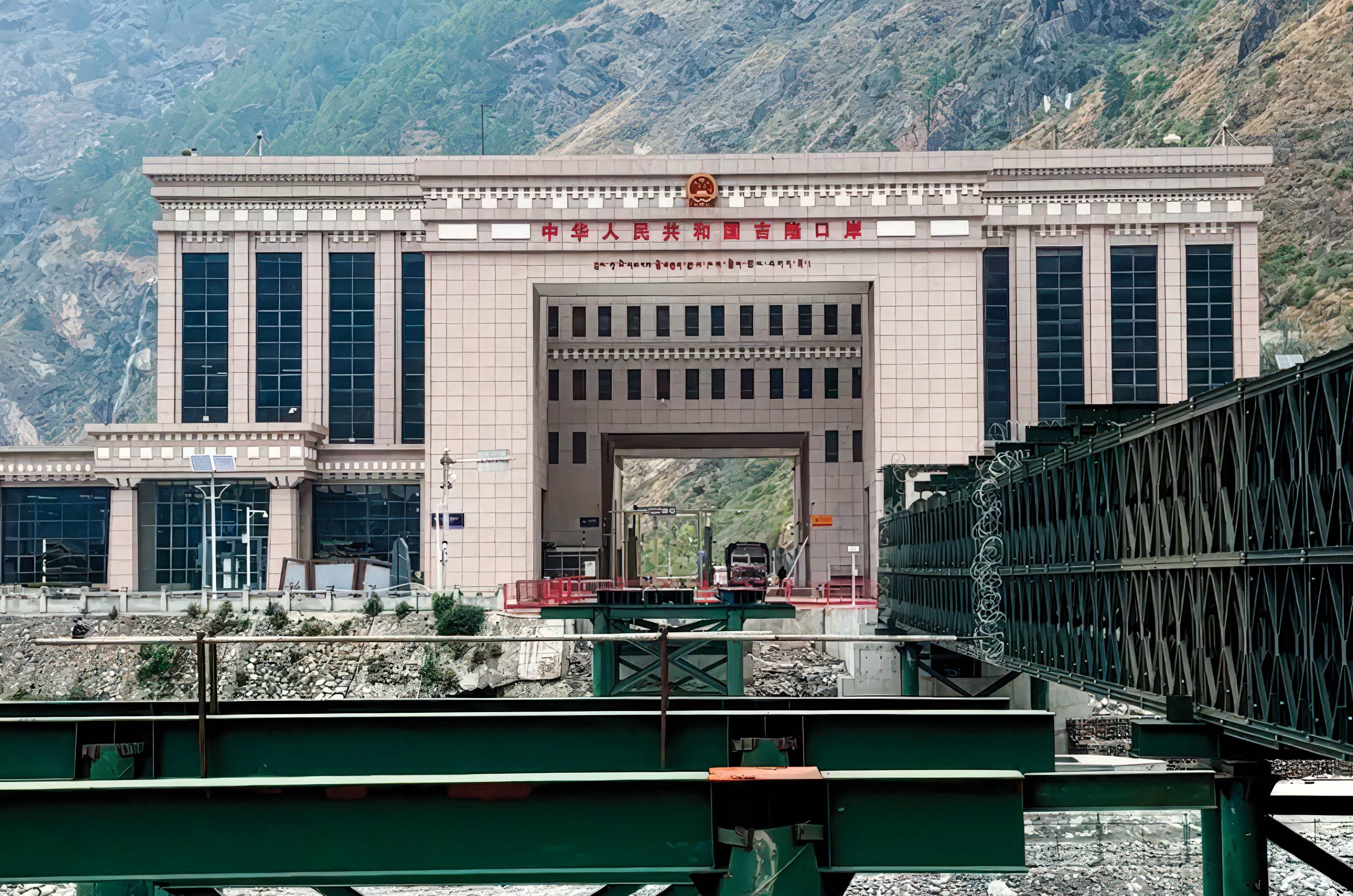
With Kathmandu explored, we headed towards our second border crossing – and this one was far more intense. Once we left Kathmandu, we left the tarmac behind too. Muddy back roads, still wet from the previous night’s rain, meant slush and a constant need for 4WD. Even so, though packed to the brim with luggage, the Kylaq stayed light enough and had enough clearance to pick its way around the mud on the approach to the Rasuwa Bridge. From there, you can see the Chinese immigration building towering over everything around it. With the Kylaq thrumming with excitement, we crossed into Tibet – the roof of the world.
Tibet/China – Roof of the World
China’s border crossing is as imposing as it gets.
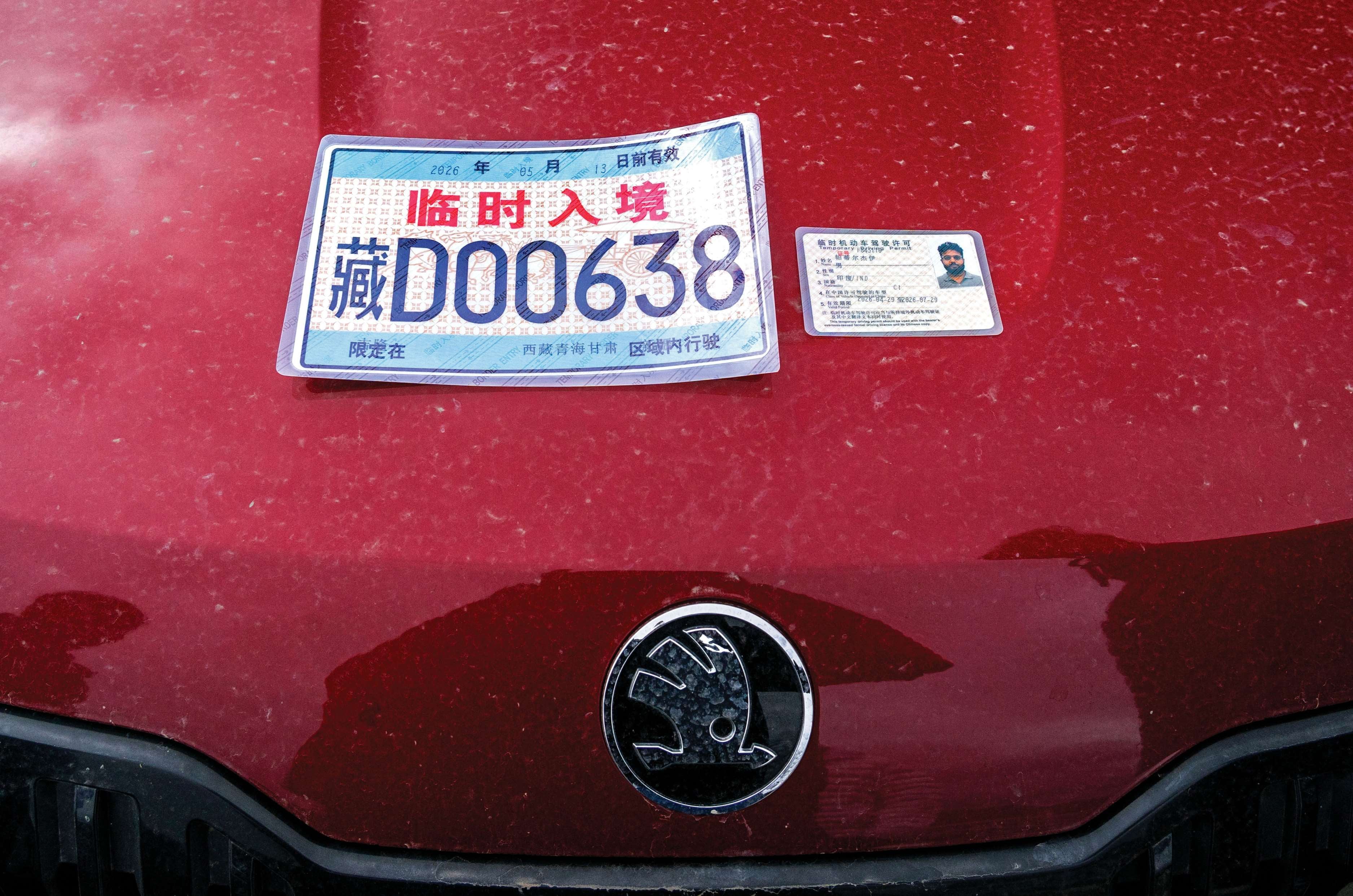
Crossing into Tibet felt like crossing into the future. For a region tucked deep into the mountains, it’s exceptionally developed – the roads are smooth and well-signed from the moment you cross the bridge, barely a hundred metres before the immigration office. In China, we weren’t taking any chances, knowing any misstep here could jeopardise the rest of the journey. After answering the customs officers honestly – and impressing them with the scale of the Kylaq’s challenge – we entered the lovely town of Gyirong. Old Chinese architecture, plenty of red, and signboards we couldn’t quite read were early signs that we really were in a different world now. Nepal had shared plenty with India – the cars, the food, the roads – but China felt entirely its own. We thought we’d seen our share of speed cameras, but China put us to shame – they appear every 50 metres or so, complete with flashes. There’s simply no room for error, and you’re monitored everywhere you go – aneerie feeling that takes some getting used to. Another non-negotiable is to obtain a special driving licence for every person that will be driving and a China-specific number plate, which you have to place on your dashboard so the cameras can pick up any infringements. A regular India-style RTO office with long queues and a lack of urgency got us homesick for a bit.
Local license and registration are non-negotiables in China.
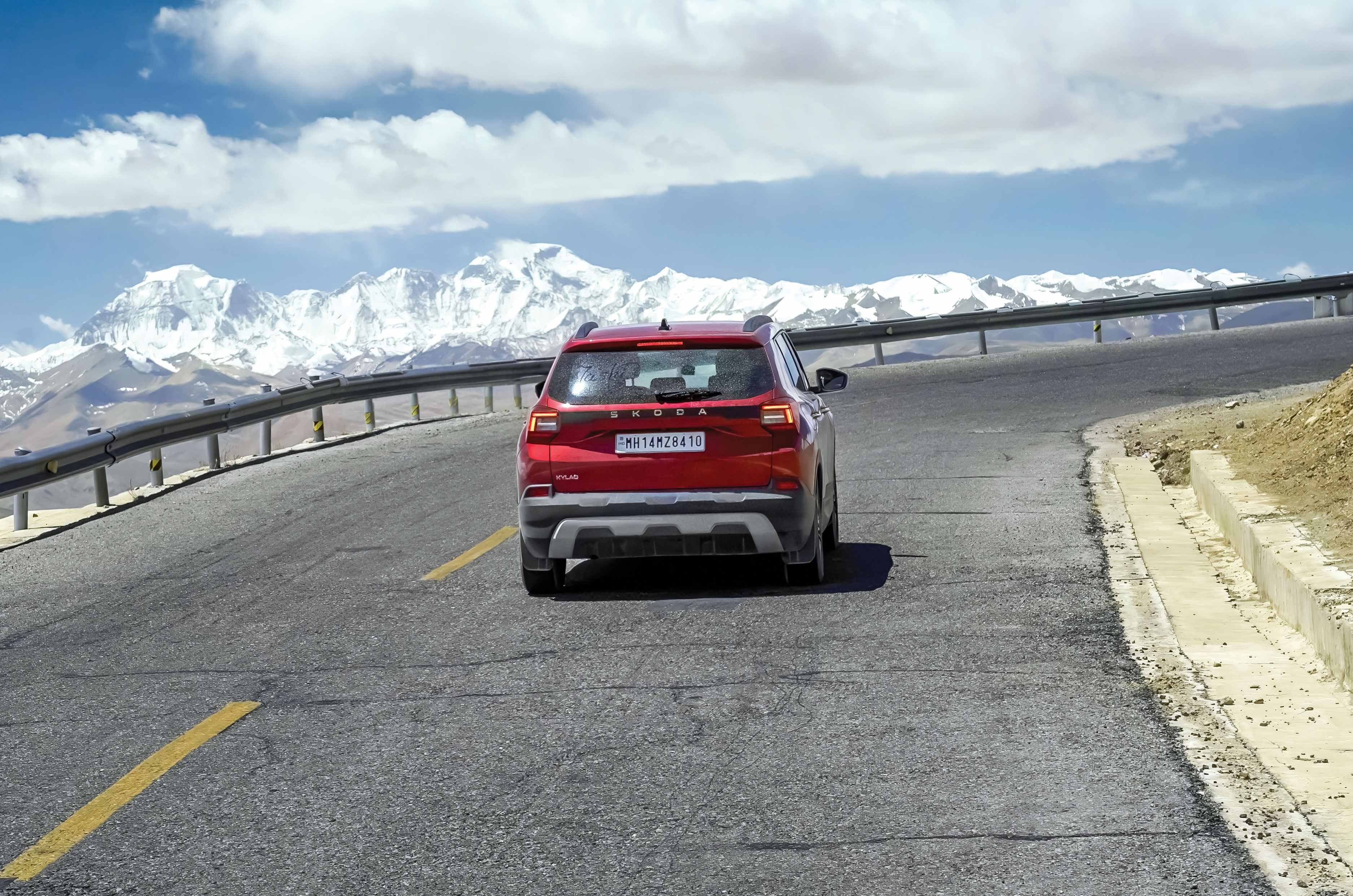
A few mugs of hot ginger-lemon tea eased us into the chill, and we set off for Mount Everest Base Camp. High altitudes are usually punishing for small-capacity engines, but thanks to its turbocharged engine, the Kylaq barely broke a sweat, buzzing through the passes. Its 6-speed automatic had been a great convenience through the chaos of India and Nepal, but the winding mountain roads and immaculate tarmac meant I could switch to manual and take control via the paddle shifters. Paddle-shift response is often sluggish, but not here – the shifts were quick, and the taut suspension held its ground even through tight hairpins.
Everest hove into view long before we made it to base camp.
It made for a great drive and great footage, right up until we spotted the peak in the distance. Even from afar, Everest is breathtaking, and mercifully the clouds stayed clear as we got closer. You can’t take a car near base camp itself – a one-hour bus ride covers that final stretch. It’s strange how you lose your breath as you approach Everest – partly the thin air and altitude, but you’d lose it all the same just from the view. Words don’t do it justice, and don’t be surprised if you shed a tear or two – it’s overwhelming.
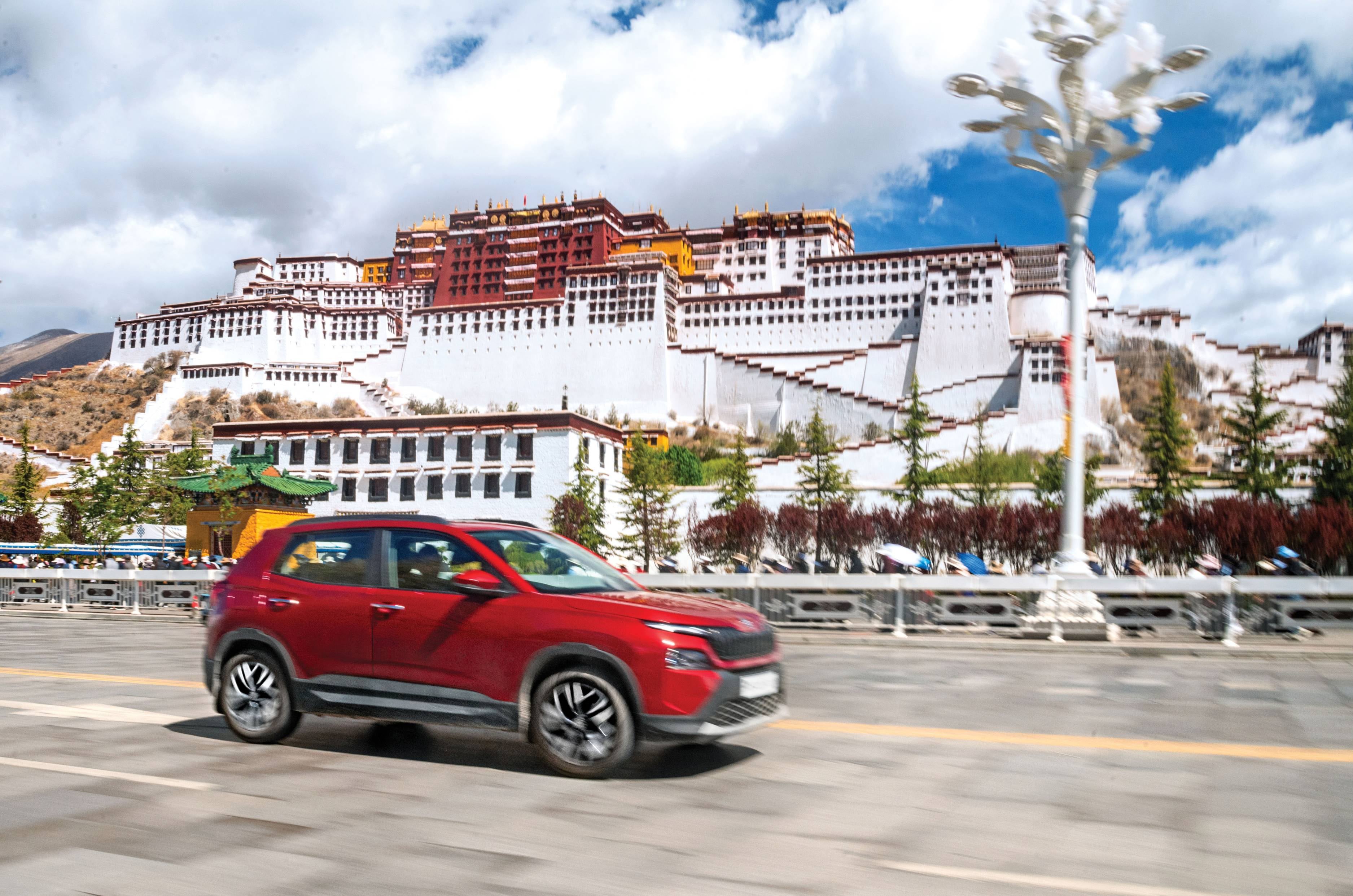
Stunning Potala Palace; once home to the Dalai Lamas.
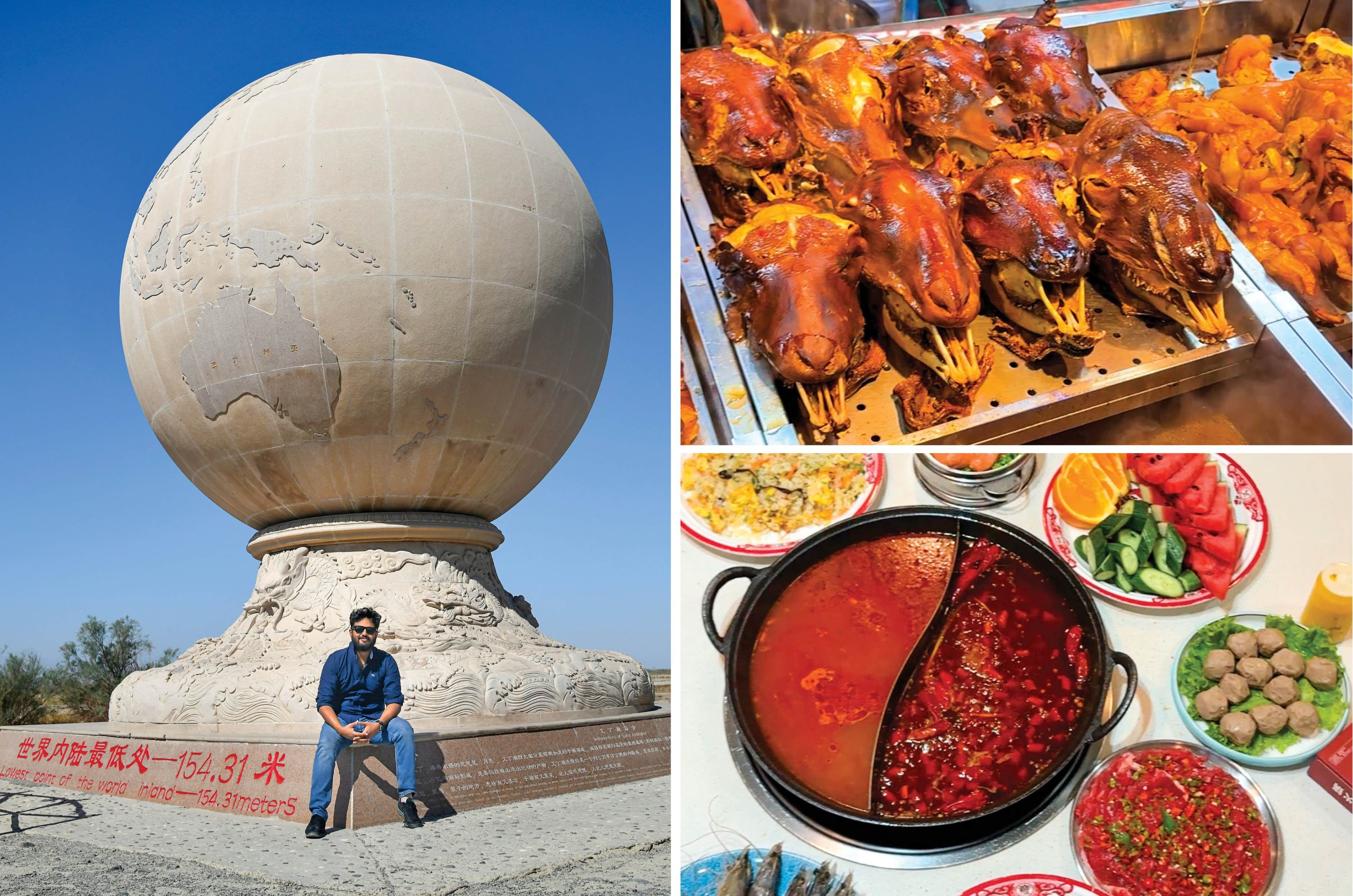
With Everest ticked off, it was time to take on China’s vastness. We headed to Lhasa, the spiritual capital of Tibet, home to the grand Potala Palace. Once home to monks and lamas, this stunning palace holds incredible history and artefacts – spiritual or not, its significance to the country’s history is unmistakable. The drive kept revealing itself through unique food, dialects, faces, and even geography. One day we were freezing thousands of feet above sea level; days later, in Turpan, we were below sea level in blistering heat. From boiling hotpots to grocery-store instant noodles, China pushed us well outside our comfort zone, and the Kylaq wasn’t spared either.
L: From EBC’s high to Turpan Depression’s low – Jay was at 154m below sea level here. R: Street food in China not for the faint-hearted.
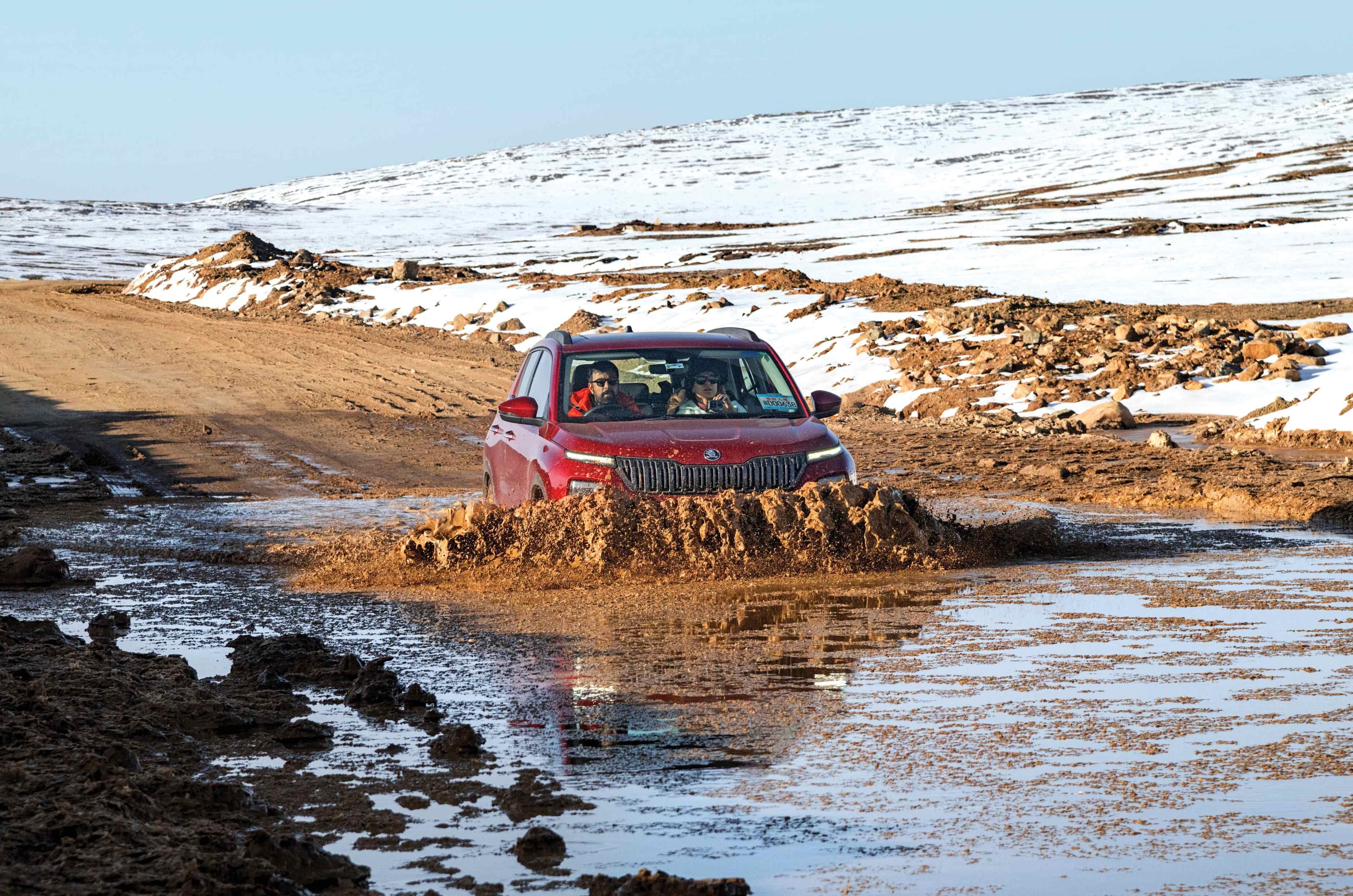
Two full days on the way to Golmud were entirely off-road, taking over 13 hours of driving, with our average speed dropping to 18kph as the Kylaq waded through water up to its bonnet and emerged without complaint.
In China, you get perfect roads or, simply, no roads.
A stretch that would have broken most cars left the Kylaq unscathed. China hit hard, but the Kylaq hit back harder. From day one, it had faced challenge after challenge, and from day one, it had come out on top. Three countries in, it still carried the same zeal it started with – and while we were rattled, it stood strong each night, ready for the next day.
शेयर बाजार में जल्दी पैसा कमाने का सपना कई लोगों को ट्रेडिंग की ओर खींचता है। शुरुआत में अगर कुछ मुनाफा मिल जाए, तो बाजार से कमाई का भरोसा और बढ़ जाता है। लेकिन कई बार यही उत्साह धीरे-धीरे ऐसी आदत में बदल जाता है, जिससे बाहर निकलना मुश्किल हो जाता है। सोशल मीडिया यूजर Hemdharpan ने अपने 35 वर्षीय दोस्त की ऐसी ही कहानी साझा की है।
2 लाख की सैलरी और 14 लाख की बचत
Hemdharpan के मुताबिक, उनका दोस्त एक IT प्रोफेशनल था और करीब 2 लाख रुपये महीने कमाता था। उसके पास 14 लाख रुपये की बचत थी। शादीशुदा होने के साथ उसका एक बच्चा भी था। यानी नौकरी, कमाई और सेविंग के मामले में उसकी जिंदगी काफी स्थिर थी।
करीब दो साल पहले एक सहकर्मी ने उसे शेयर बाजार में ट्रेडिंग के बारे में बताया। यहीं से उसकी जिंदगी का एक नया दौर शुरू हुआ।
45 मिनट में 12 हजार का मुनाफा
कहानी के मुताबिक, सहकर्मी ने लंच के दौरान अपना Zerodha अकाउंट दिखाया। उसने Nifty options की इंट्राडे ट्रेडिंग से करीब 45 मिनट में 12 हजार रुपये कमाए थे। यह देखकर टेकie को भी लगा कि बाजार में कम समय देकर अच्छी कमाई की जा सकती है।
शुरुआत में उसे सफलता भी मिली। उसने करीब दो घंटे में 18 हजार रुपये कमाए। इस कमाई ने उसका उत्साह और बढ़ा दिया।
फिर शुरू हुआ नुकसान का सिलसिला
दूसरे महीने बाजार ने उसे बड़ा झटका दिया। उसने कुछ ही मिनटों में करीब 50 हजार रुपये गंवा दिए। पोस्ट के मुताबिक, उसने समय पर stop-loss नहीं लगाया और नुकसान को स्वीकार करने के बजाय उसे वापस पाने की कोशिश शुरू कर दी।
उसने परिवार की बचत से 1 लाख रुपये बाजार में लगा दिए। इसके बाद वह नुकसान की भरपाई के लिए लगातार ट्रेड करने लगा। बताया गया कि वह एक दिन में 30-40 ट्रेड तक करने लगा था।
बचत खत्म हुई तो लिया कर्ज
2024 में शुरू हुई ट्रेडिंग का असर 2025 के मध्य तक दिखने लगा। उसकी करीब 14 लाख रुपये की बचत खत्म हो गई, लेकिन ट्रेडिंग नहीं रुकी। पोस्ट के अनुसार, वह परिवार से ट्रेडिंग छिपाने लगा और काम के बीच भी बाजार पर नजर रखता था।
बचत खत्म होने के बाद उसने तीन बैंकों से पर्सनल लोन लिया। कथित तौर पर उसने इन पैसों के लिए घर की मरम्मत का कारण बताया। बाद में इंस्टेंट लोन ऐप्स से भी पैसे लिए।
My friend H is 35, married, and a father. Two years ago, he had ₹14 Lakhs in FDs & MFs,a stable IT job paying ₹2 Lakhs a month, and complete peace of mind.
Today,he is down ₹38 Lakhs, his salary is garnished by debt recovery, & his wife is staying at her parents’ house. 1/n
2025 के आखिर में जब रिकवरी एजेंट घर पहुंचने लगे, तब परिवार को पूरी स्थिति का पता चला। पोस्ट के मुताबिक, 14 लाख रुपये की बचत खत्म होने के अलावा उस पर करीब 24 लाख रुपये का कर्ज भी था। यानी कुल नुकसान करीब 38 लाख रुपये बताया गया।
इसका असर परिवार पर भी पड़ा। बच्चे की स्कूल फीस बाउंस होने की बात सामने आई और उसकी पत्नी बच्चे को लेकर मायके चली गई।
अब कर्ज से निकलने की कोशिश
Hemdharpan के अनुसार, अब वह अपनी आर्थिक स्थिति सुधारने में जुटा है। उसने कार बेच दी है और लोन को संभालने के लिए restructuring plan अपनाया है। यह कहानी सोशल मीडिया पर साझा किए गए एक व्यक्ति के अनुभव पर आधारित है। इससे यह जरूर सामने आता है कि ट्रेडिंग में लगातार नुकसान की भरपाई करने की कोशिश आर्थिक जोखिम को तेजी से बढ़ा सकती है।