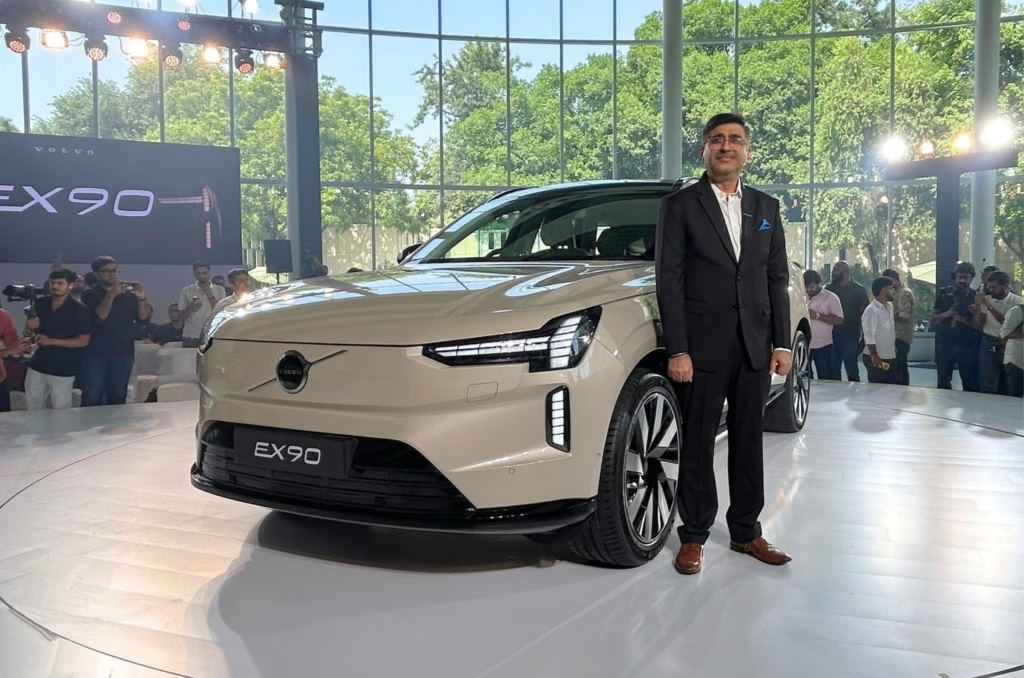
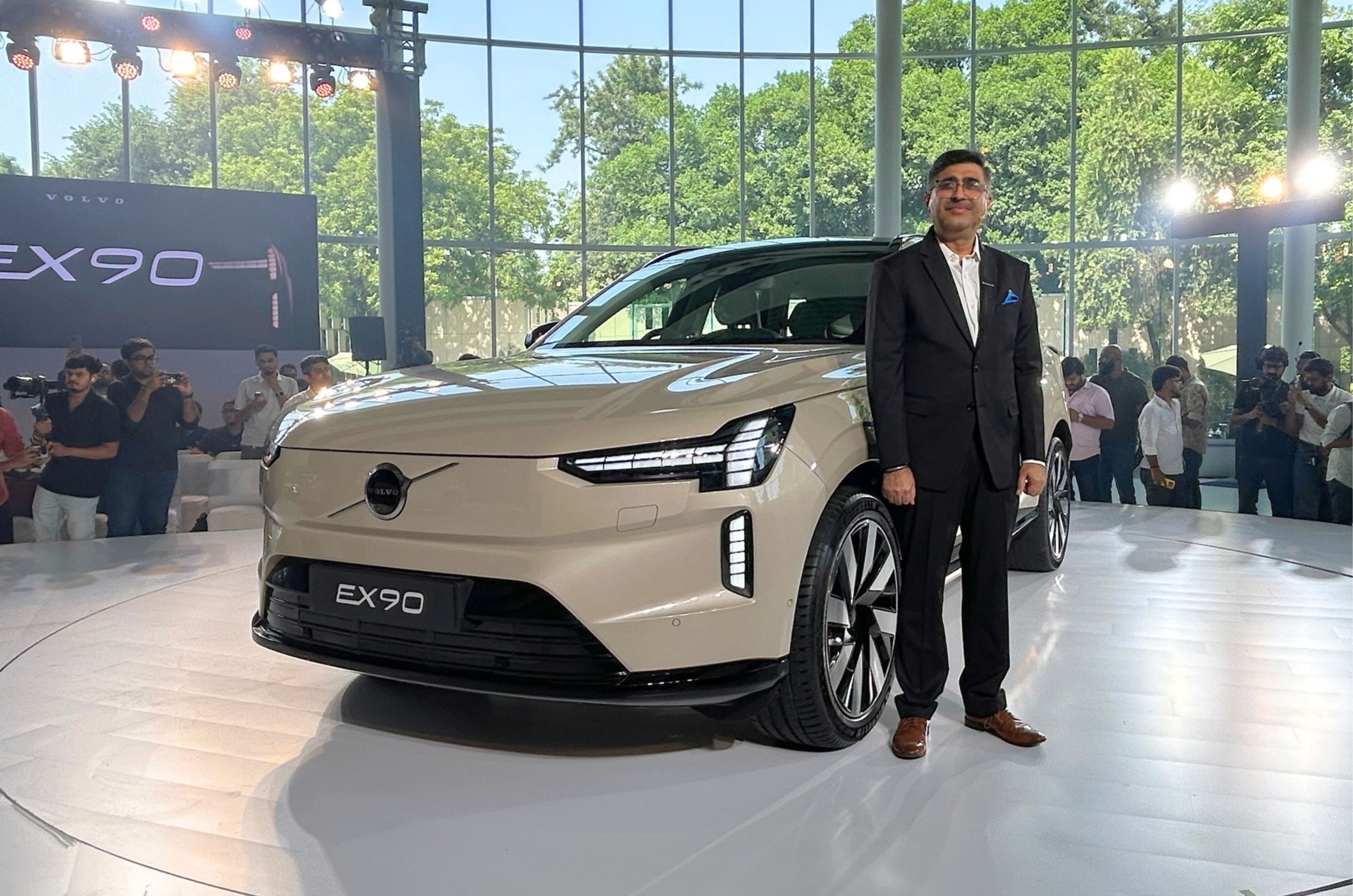
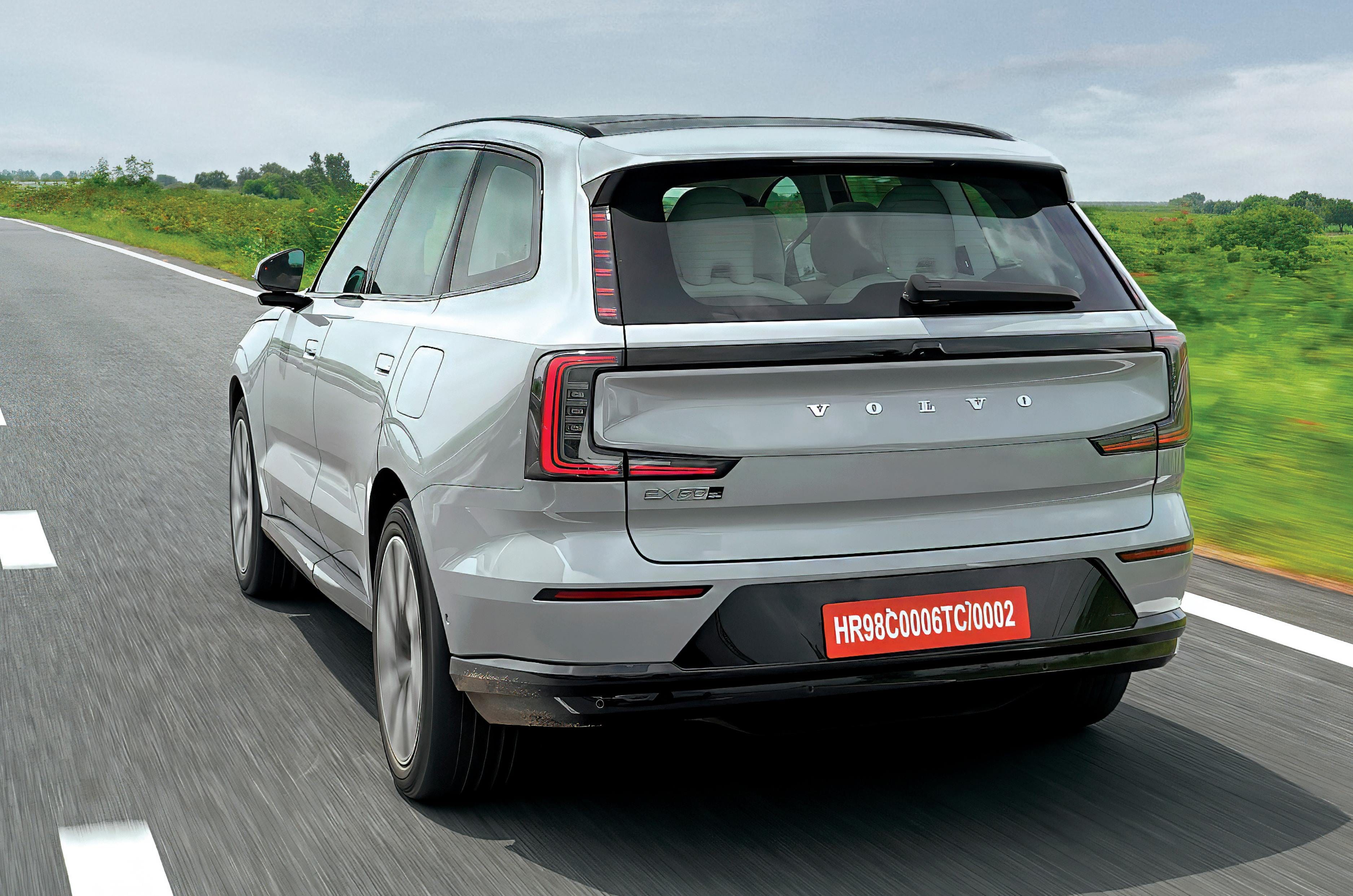
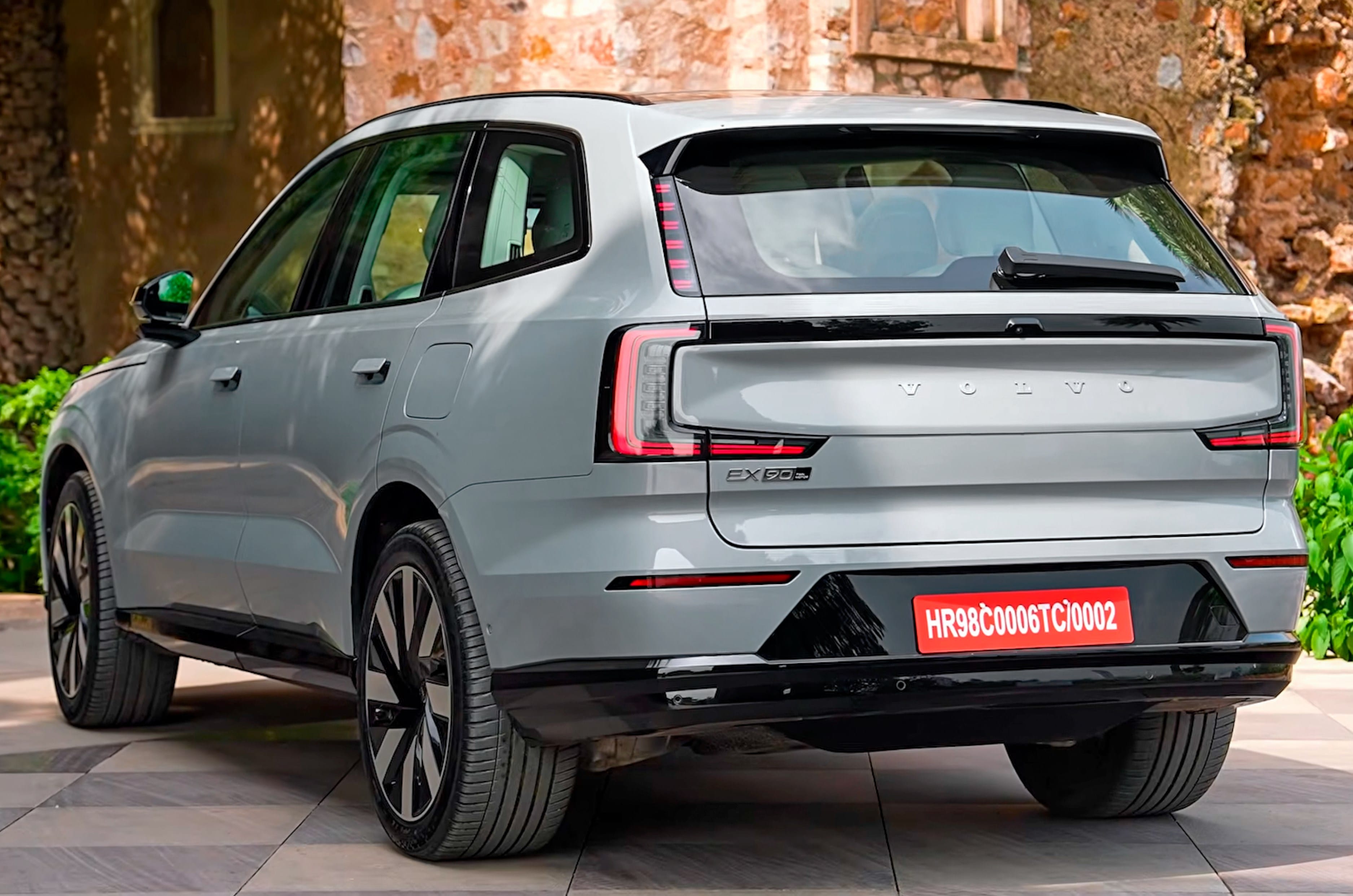
Volvo India has launched the EX90 electric SUV at Rs 1.26 crore as the Swedish carmaker’s new range-topper. The EX90 is Rs 27.2 lakh more expensive than its combustion-powered equivalent, the XC90. However, that’s on account of the EX90 being much more modern and tech-loaded than the XC90, the current generation of which has been around for more than a decade.
As part of an introductory offer for bookings placed before 31 December, 2026, Volvo will bundle an 11kW home charger, a 3-year service package, and assured buyback scheme (65 percent / 3 years) for every EX90 buyer.
Volvo EX90 battery and range
The EX90 is available with a sole 106kWh battery pack powering a dual-motor all-wheel drive setup. Combined output is 456hp and 670Nm, which is good for a claimed 0-100kph time of 5.5 seconds and a top speed of 180kph. The WLTP-rated range is 625km, and in our EX90 review, the SUV returned an efficiency of roughly 5.5km/kWh, which translates to a real-world range of around 580km.
As for charging, an 11kW AC wallbox takes approximately 11 hours for a full charge. Thanks to its 800-volt SPA2 architecture, the EX90 can also charge at up to 350kW from a DC source, at which speed a 10 to 80 percent top-up takes just 22 minutes.
Volvo EX90 exterior design
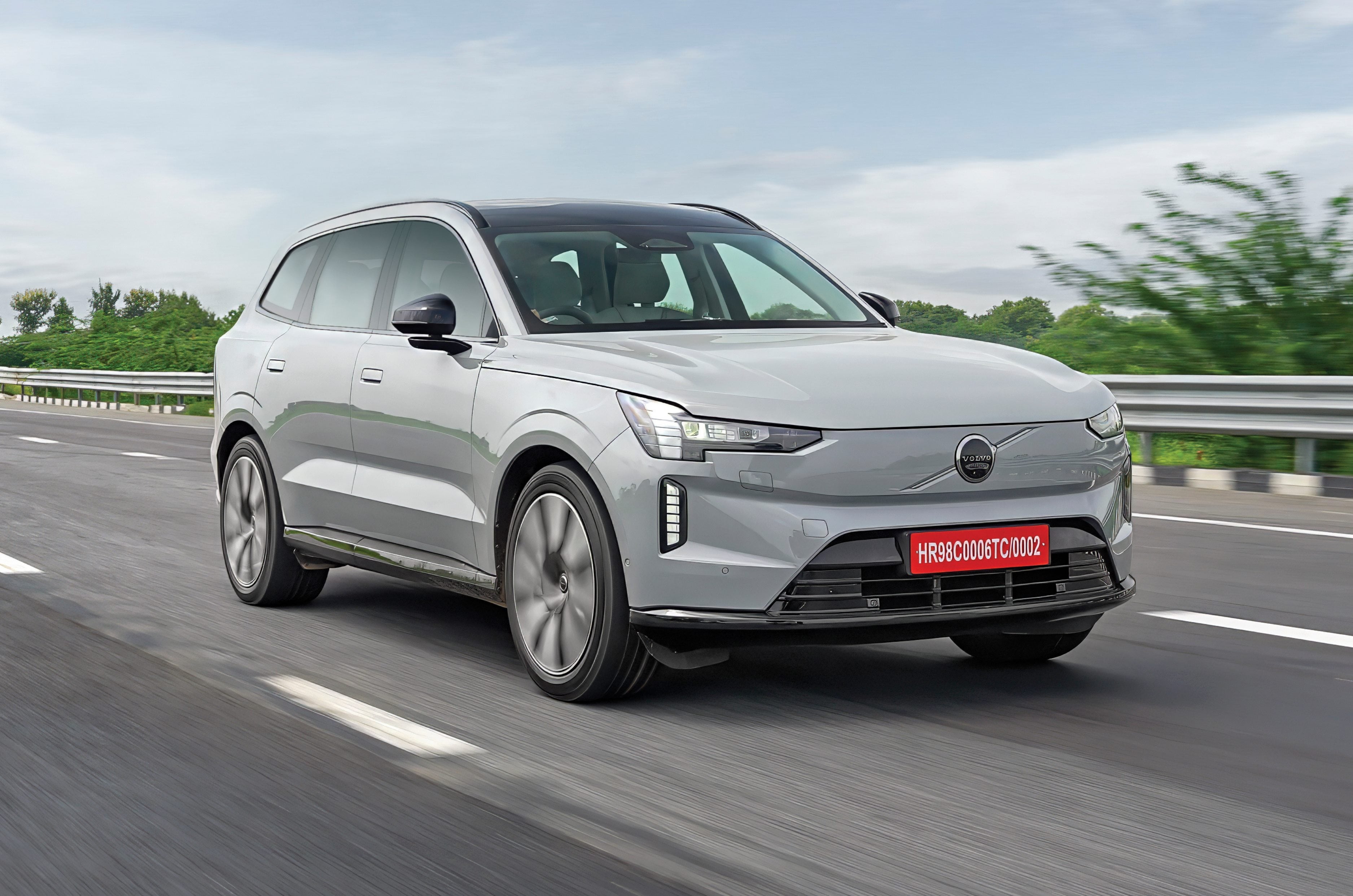
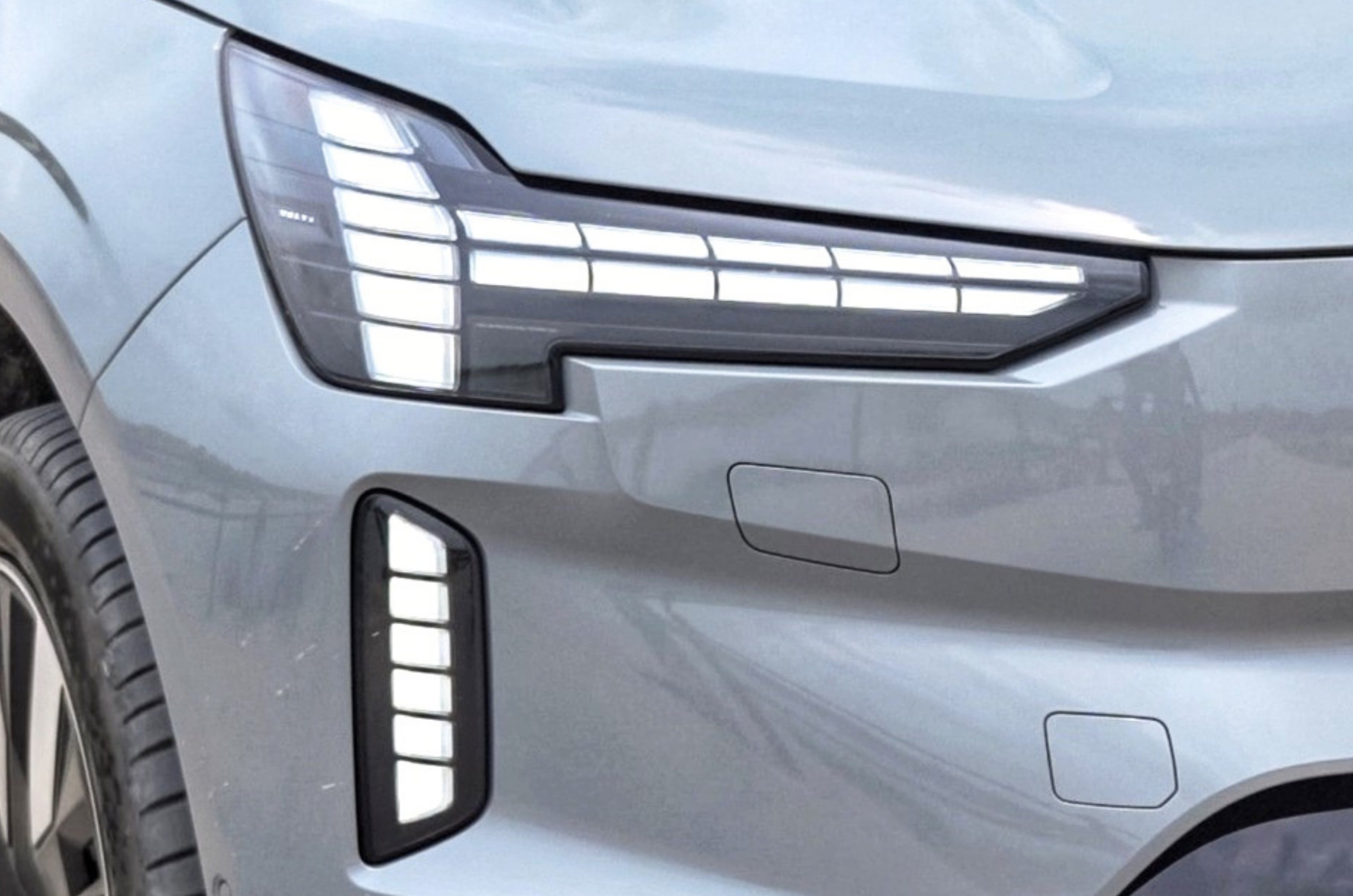
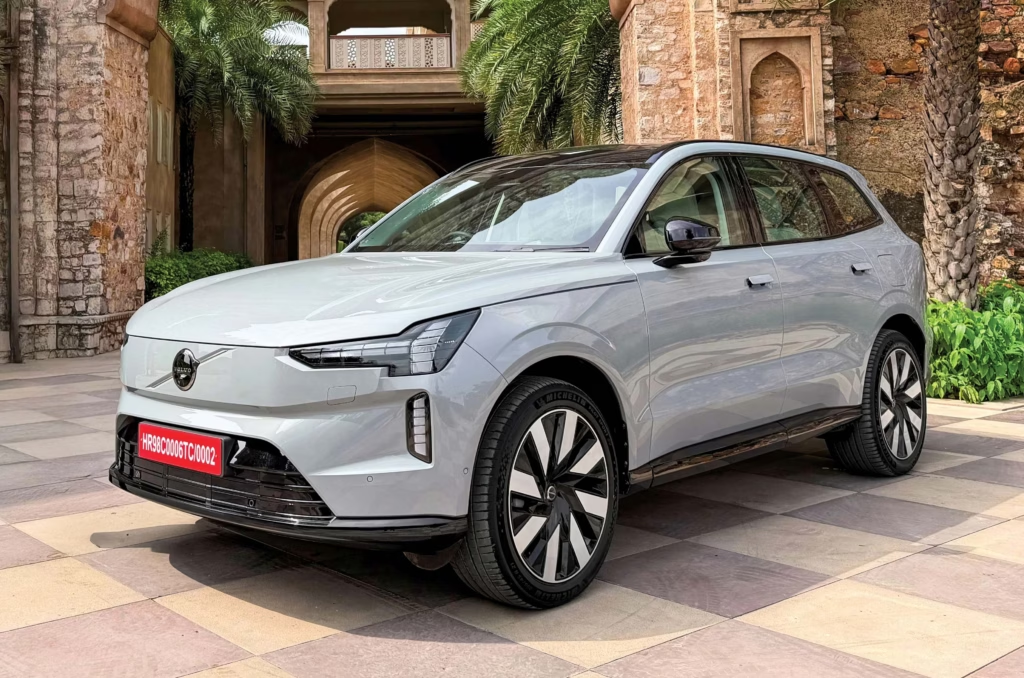
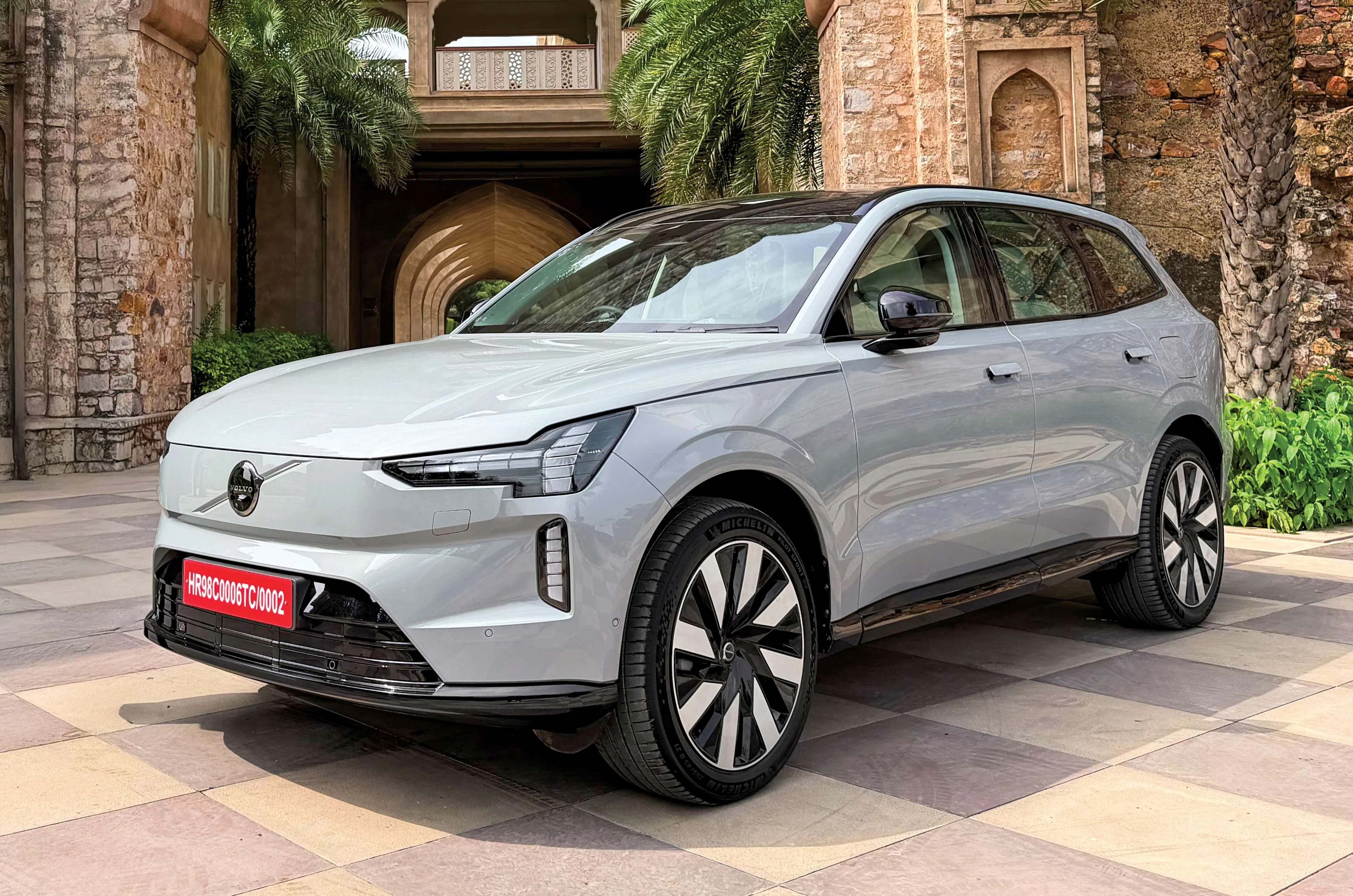
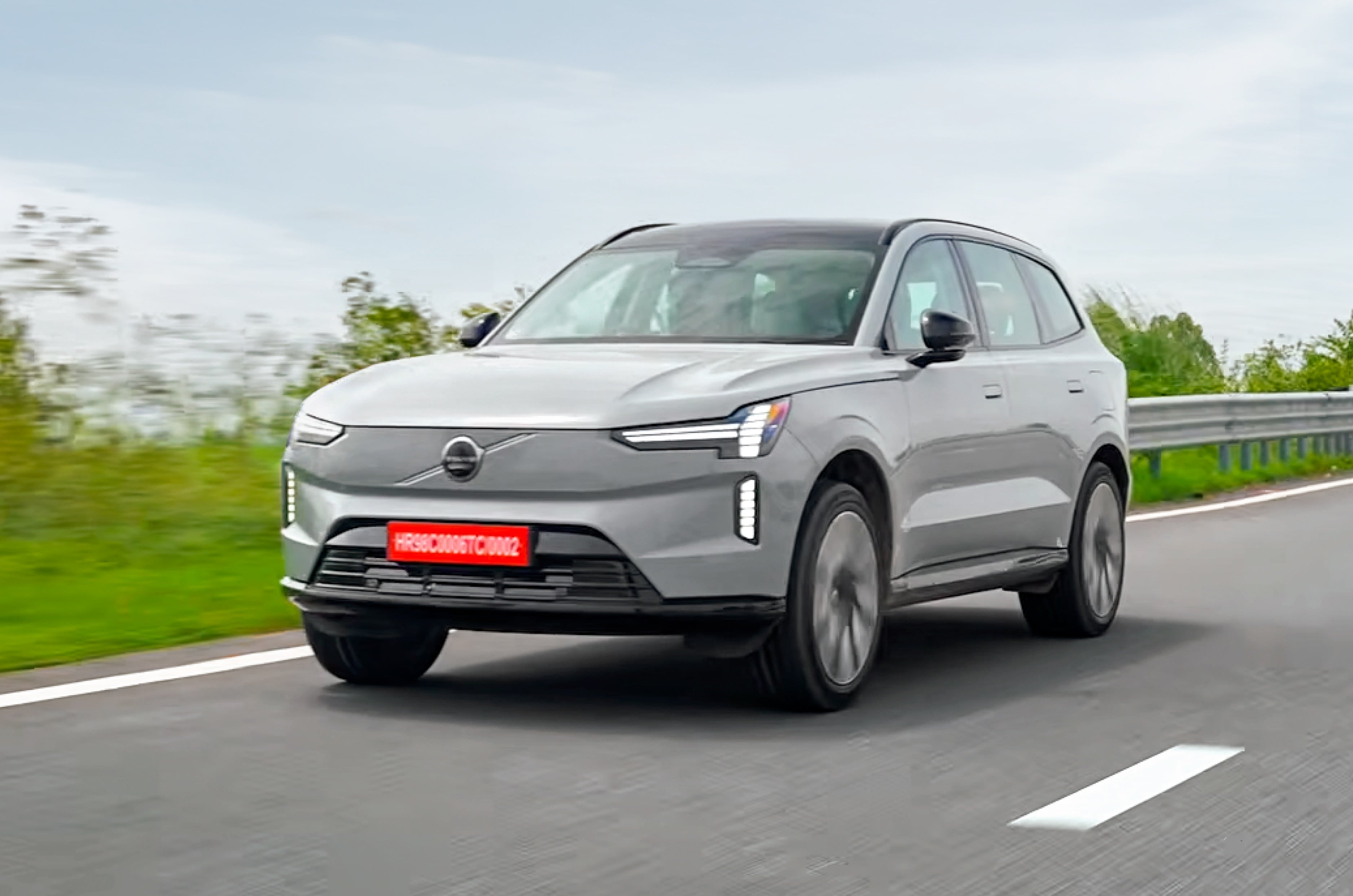
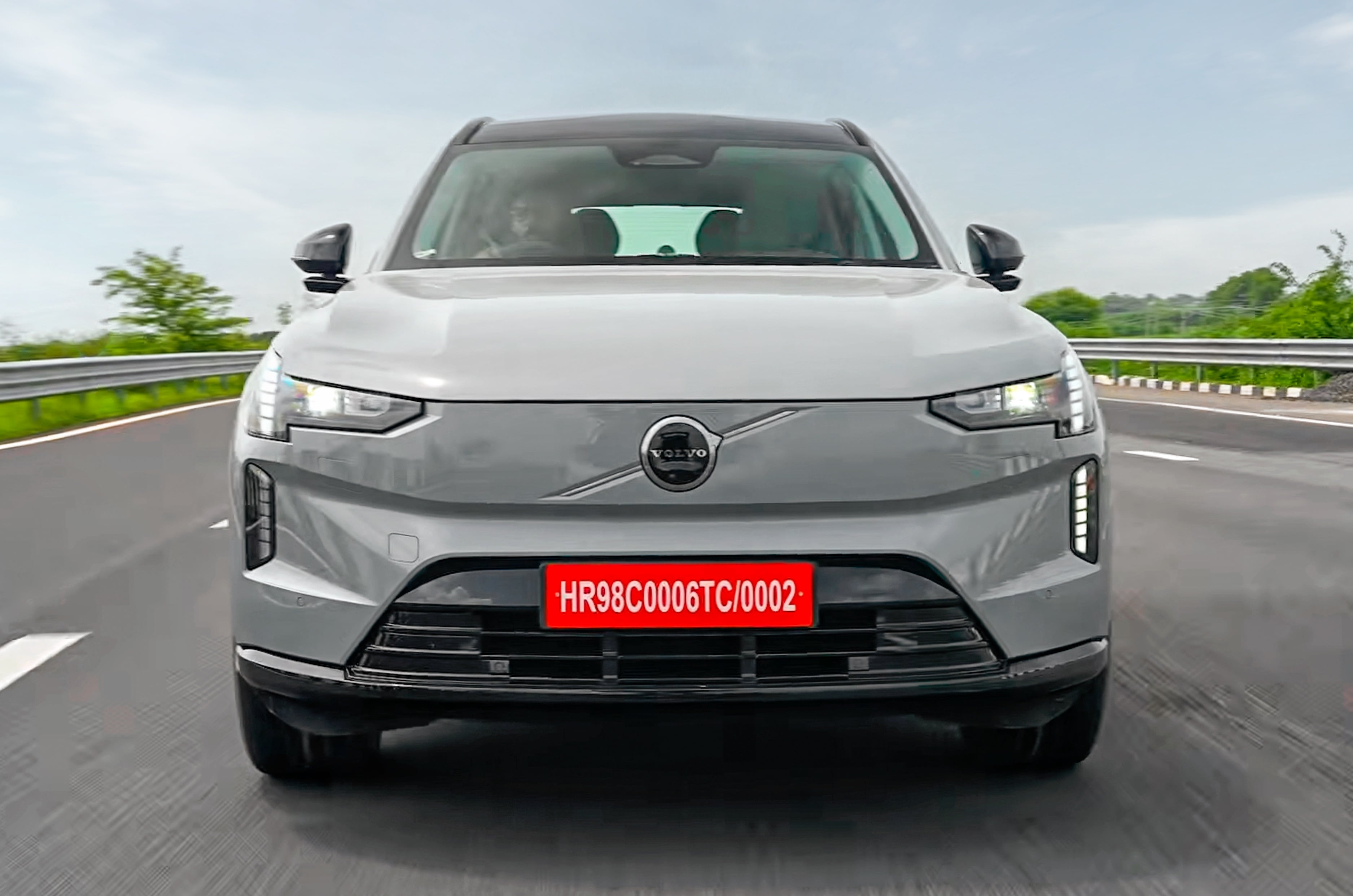
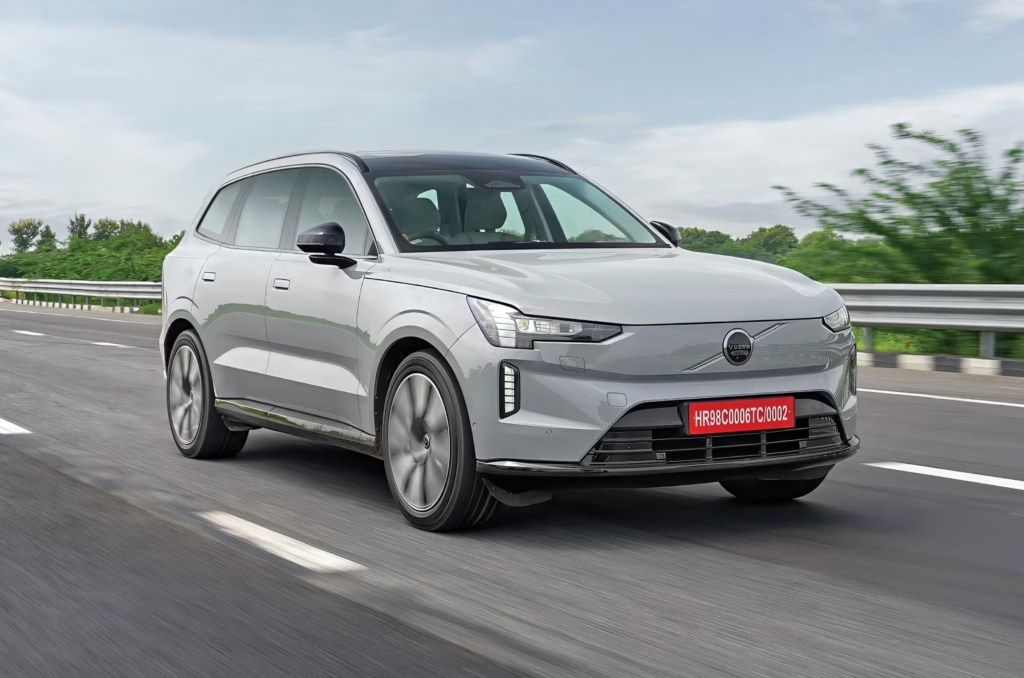
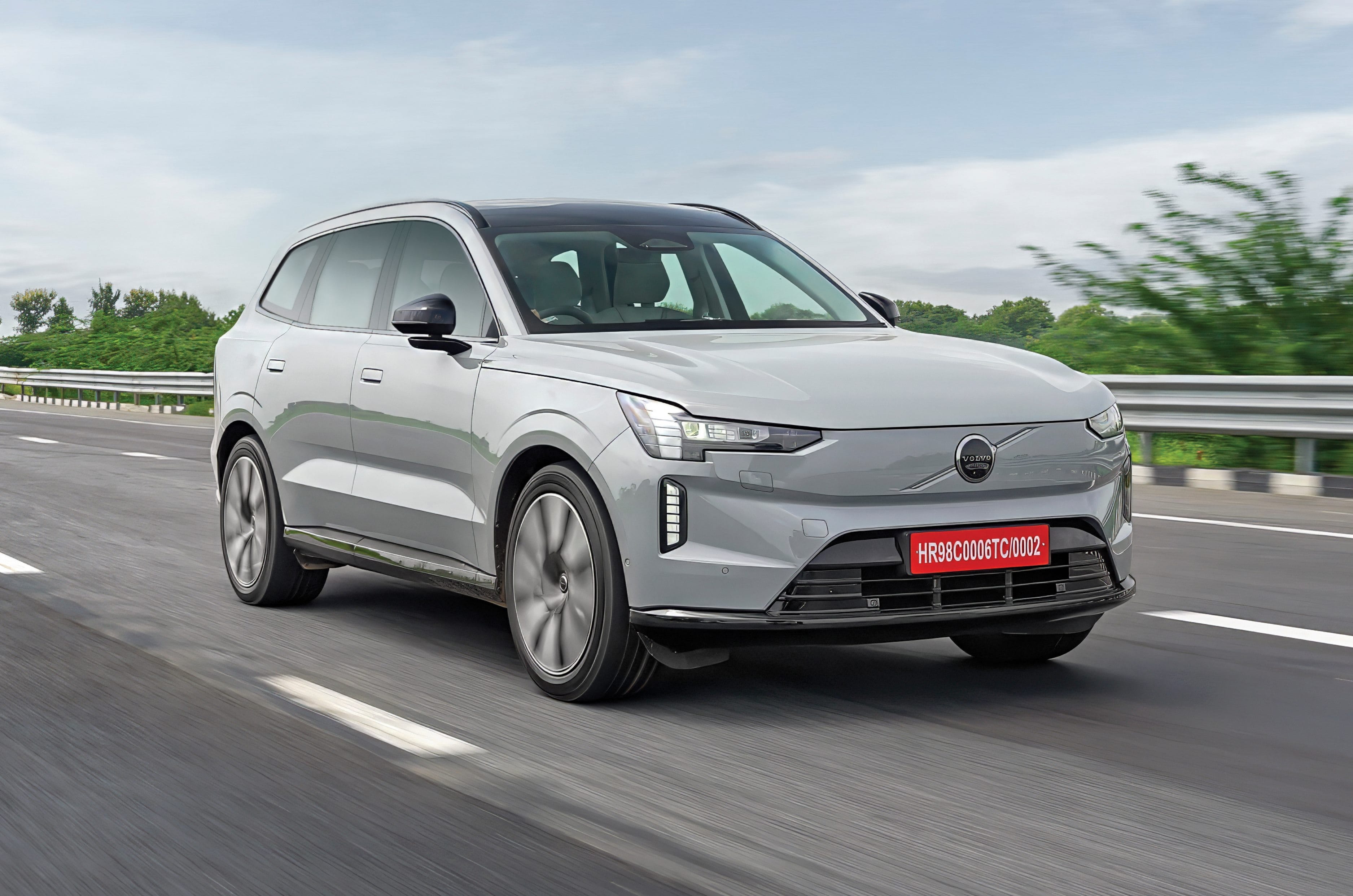
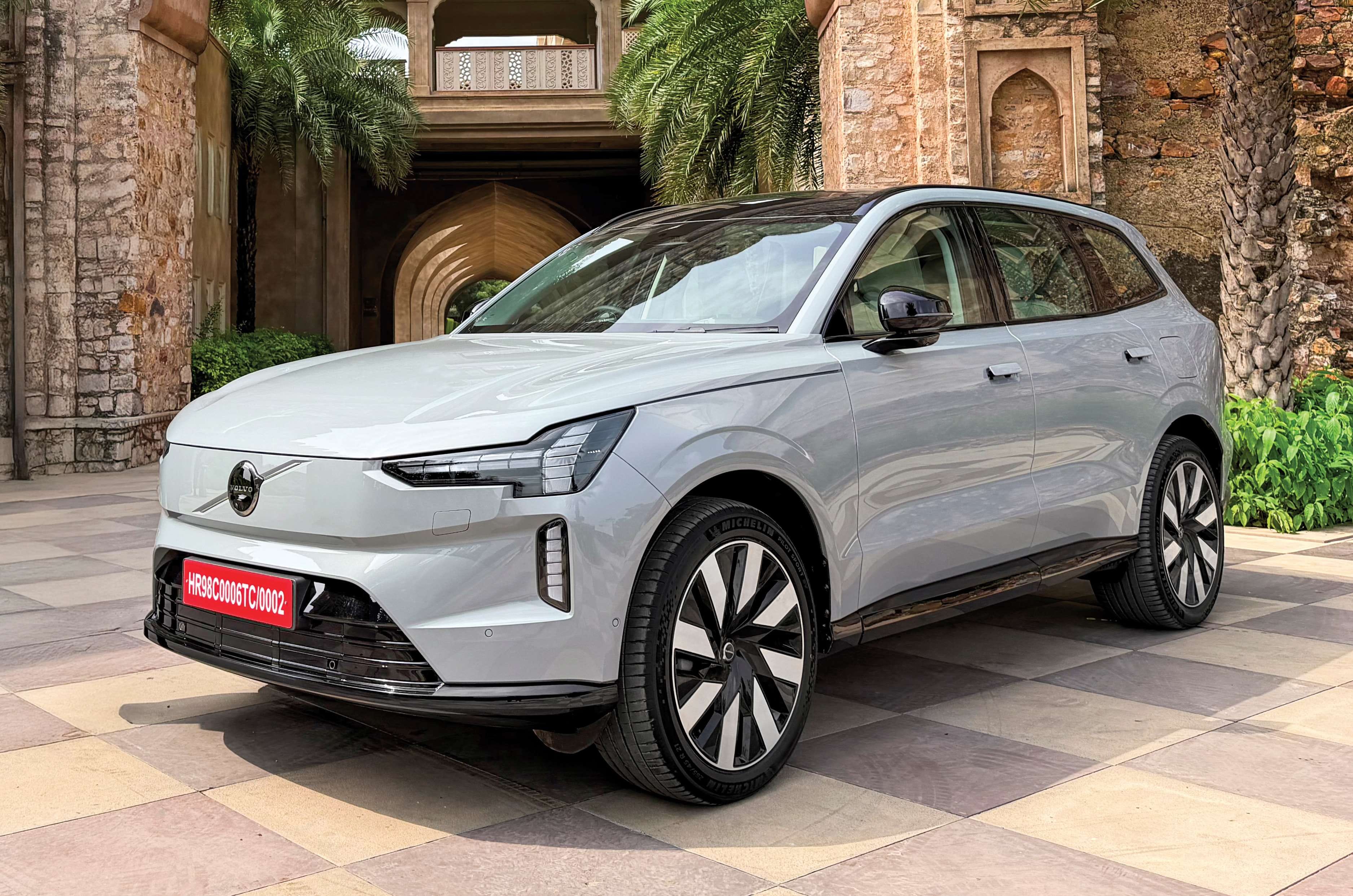
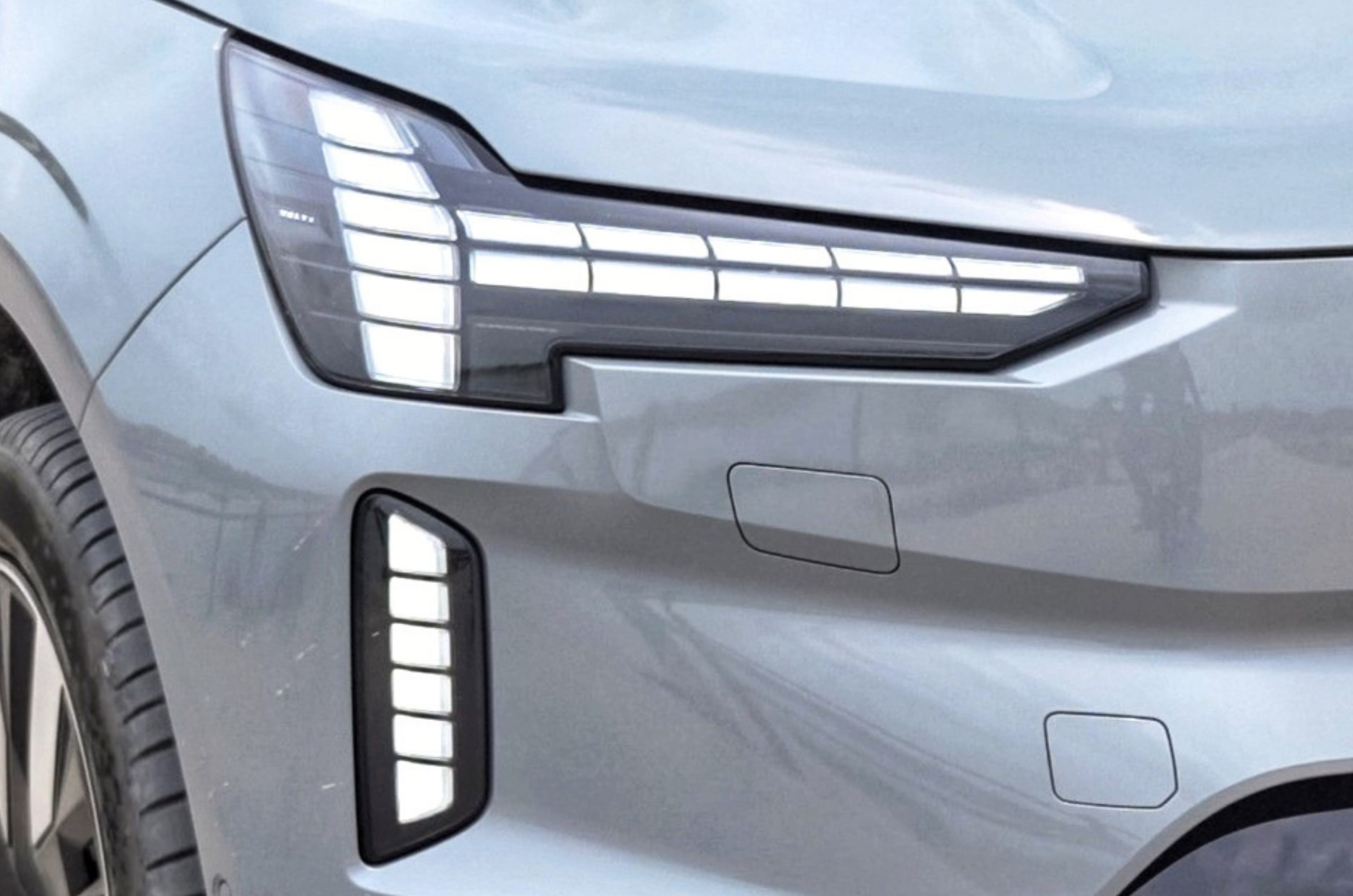
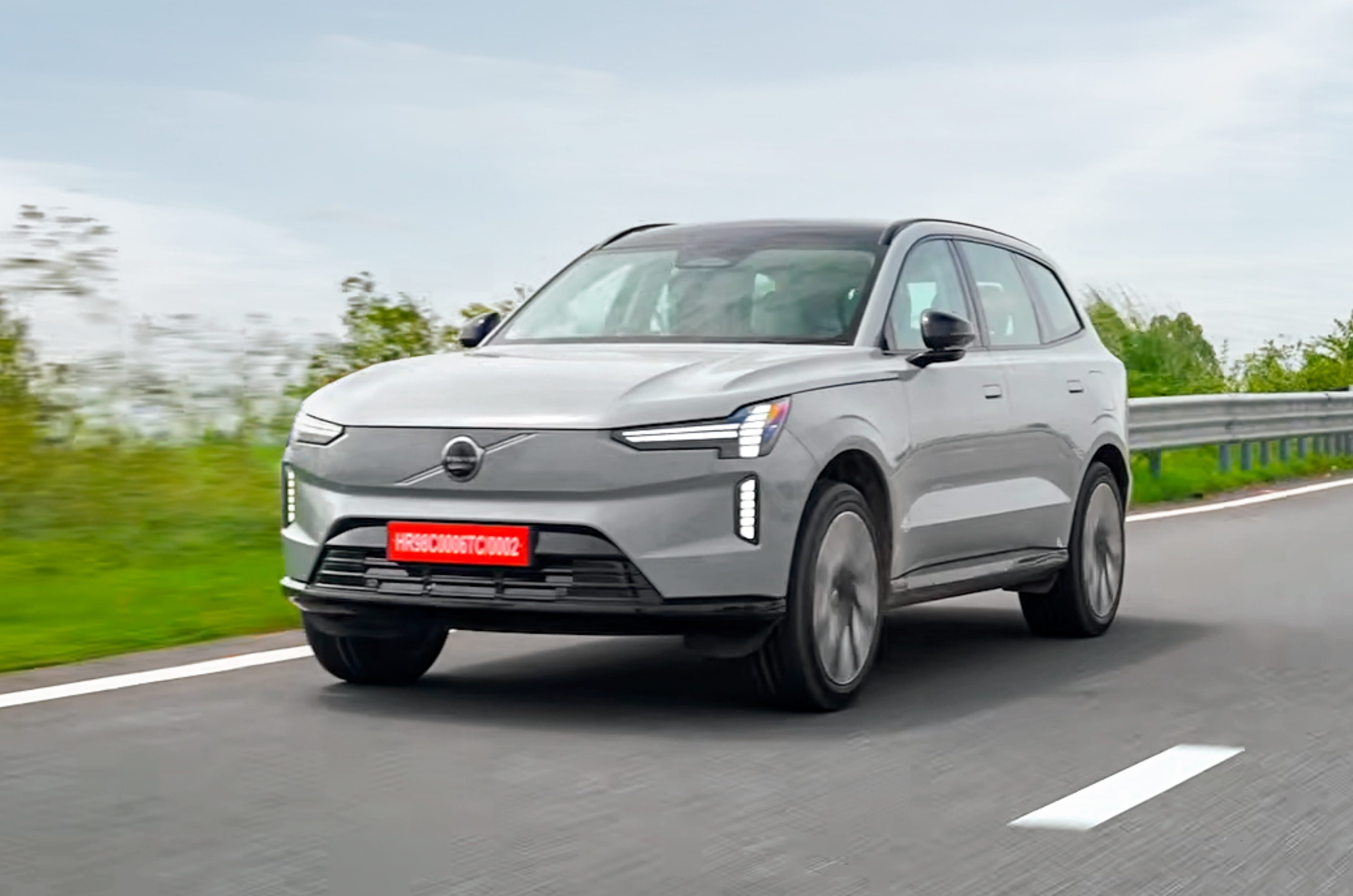
On the outside, the EX90 carries forward Volvo’s hallmark minimalistic styling, but with some new-age touches. The front end gets T-shaped LED headlamps with pixel-like DRL signatures, below which sit slim, vertically oriented fog lamps. There’s no grille on the fascia, only the Volvo emblem in the centre and a trapezoidal air dam lower down.
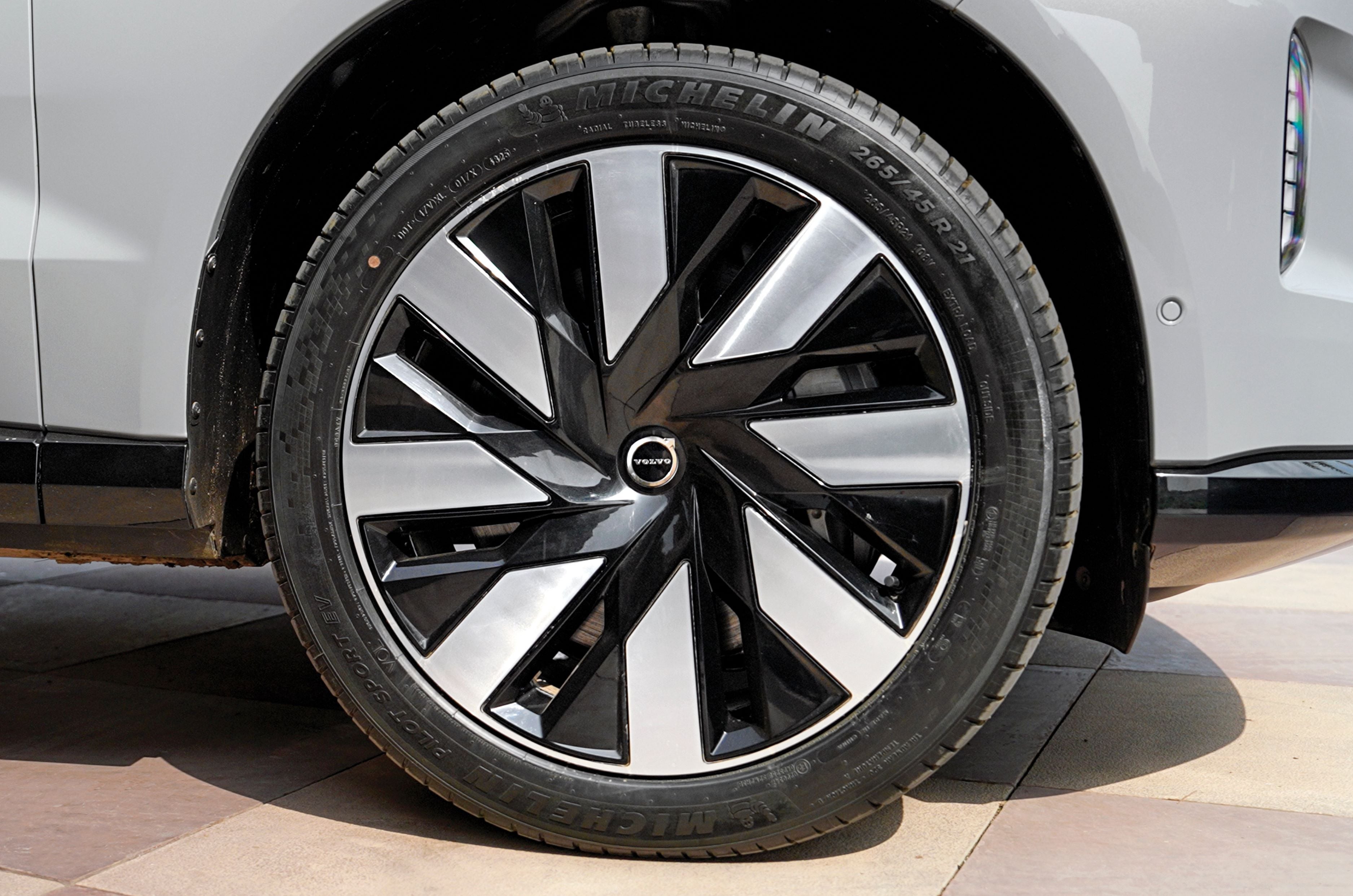
The side profile is clean and upright, with a 2,985mm wheelbase, 21-inch alloy wheels as standard, and a 210mm ground clearance. Air suspension is standard fit on the EX90 too, allowing you to raise the ground clearance to a maximum of 250mm.
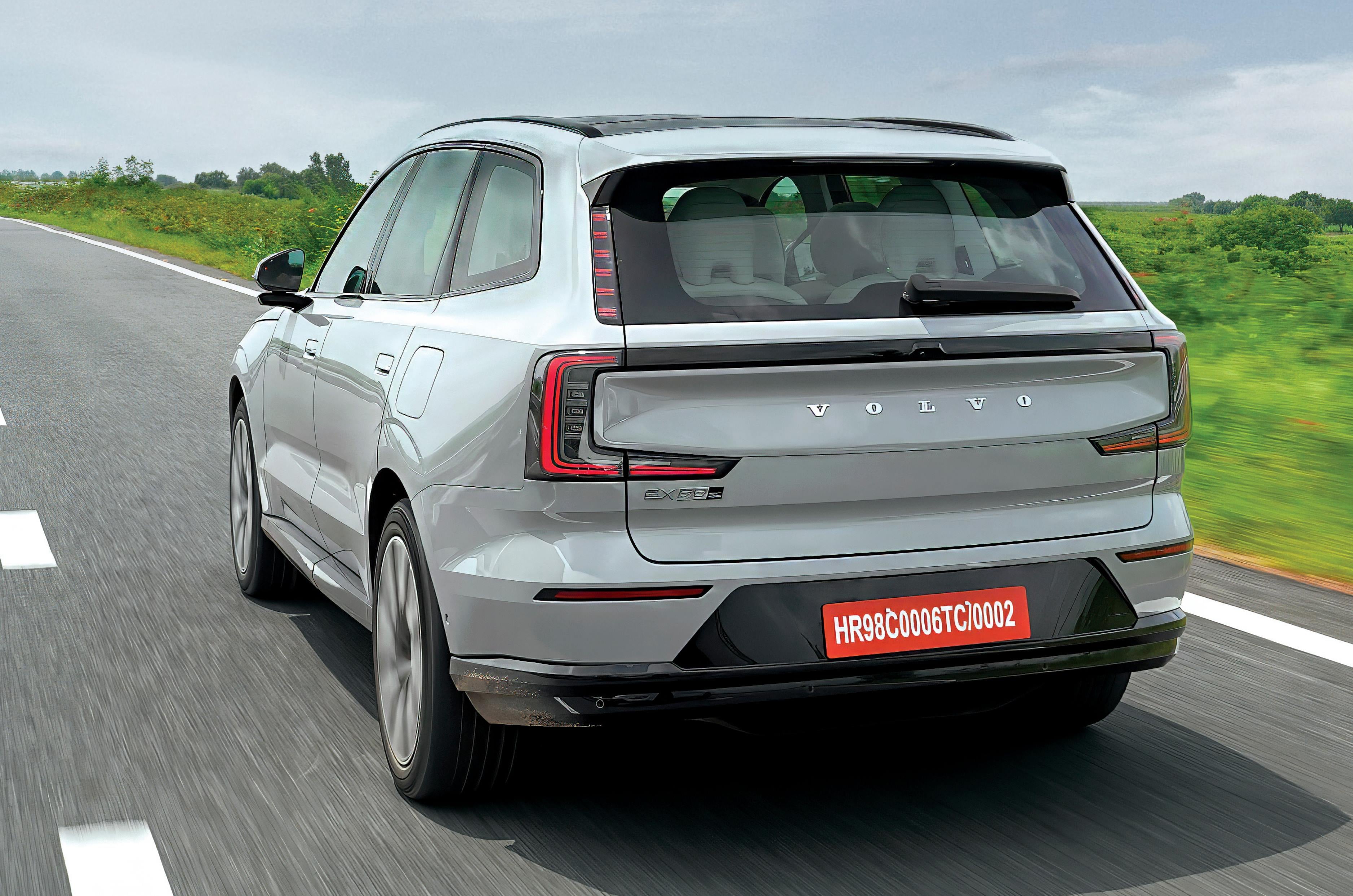
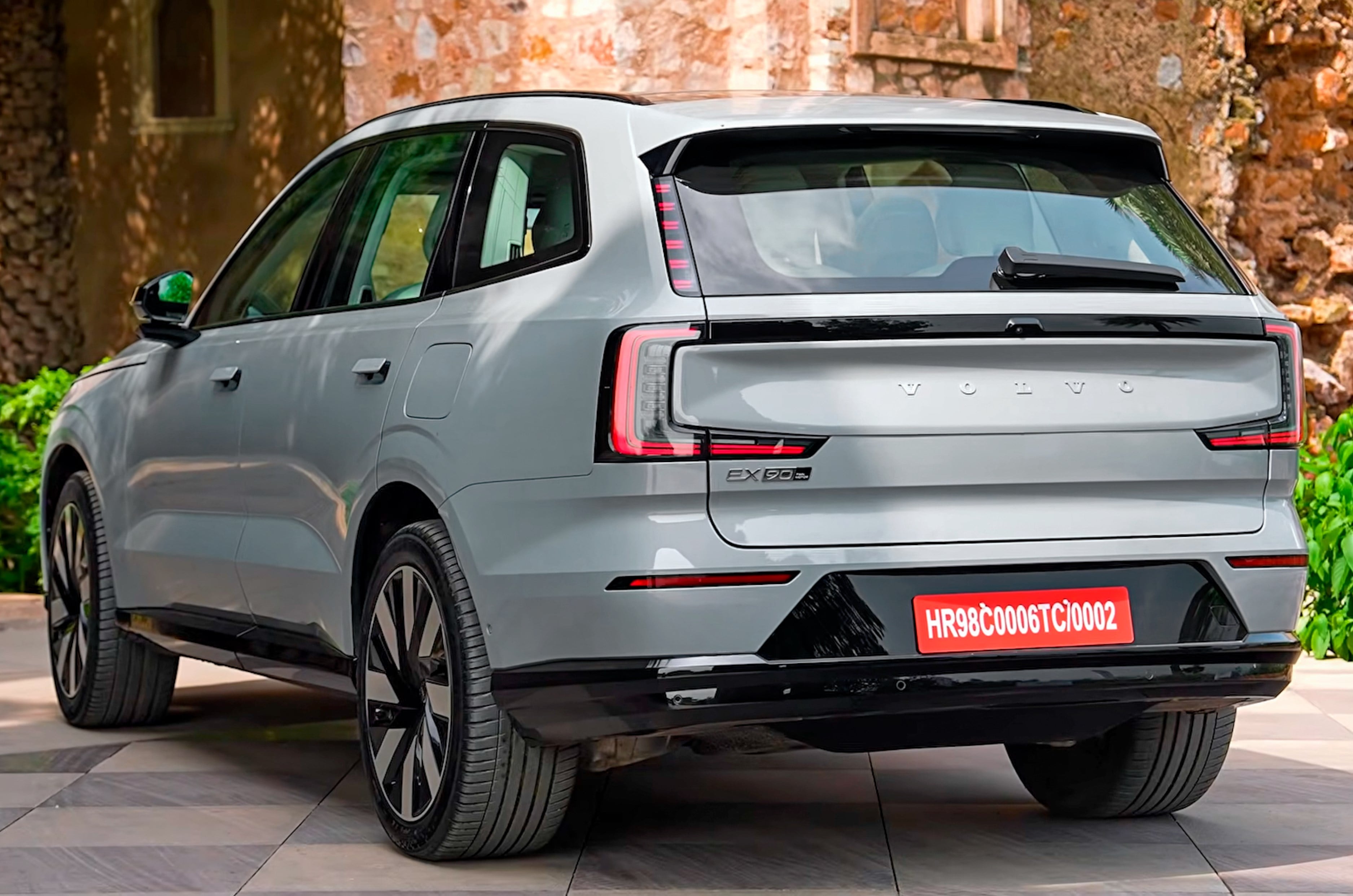
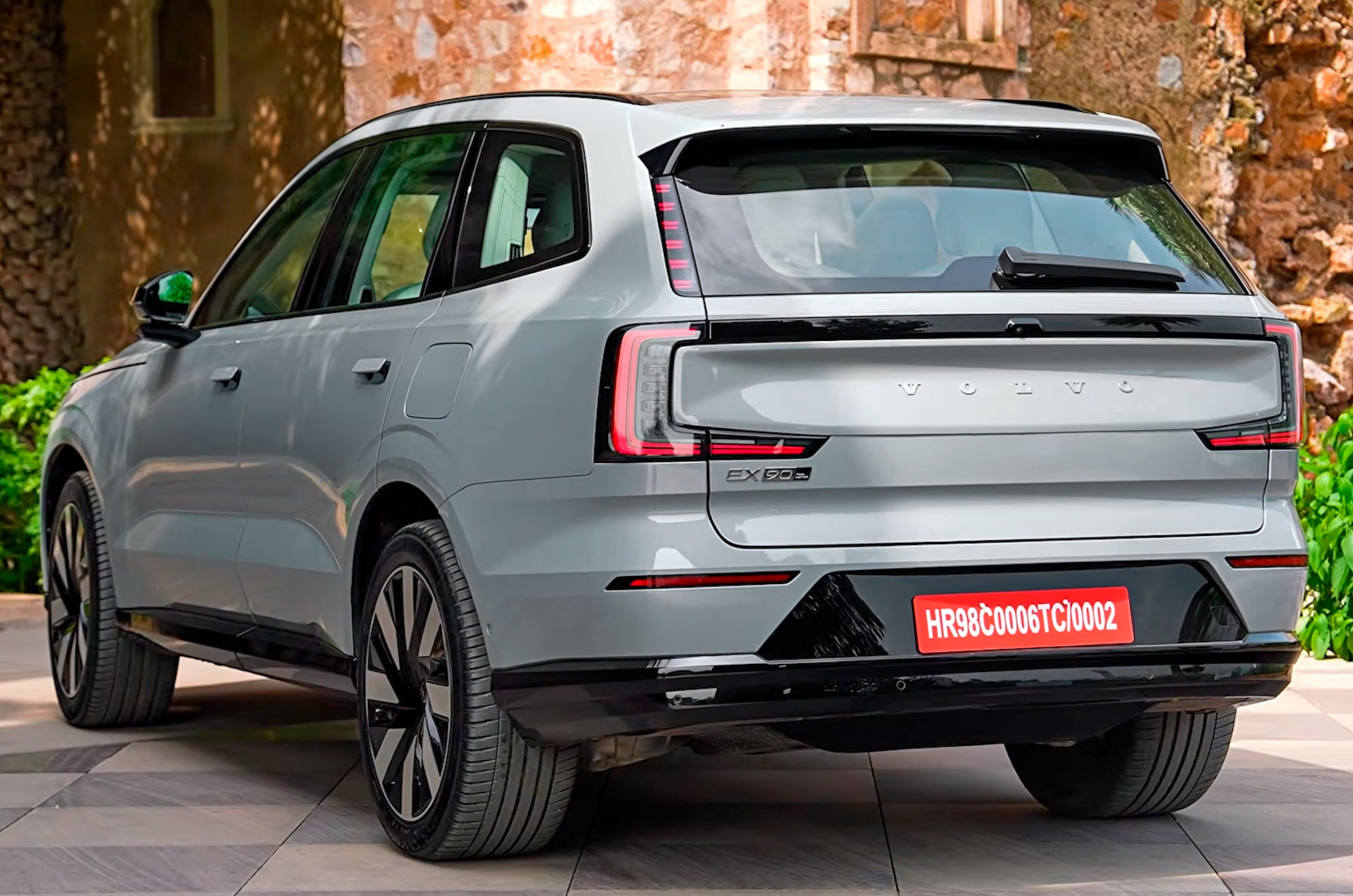
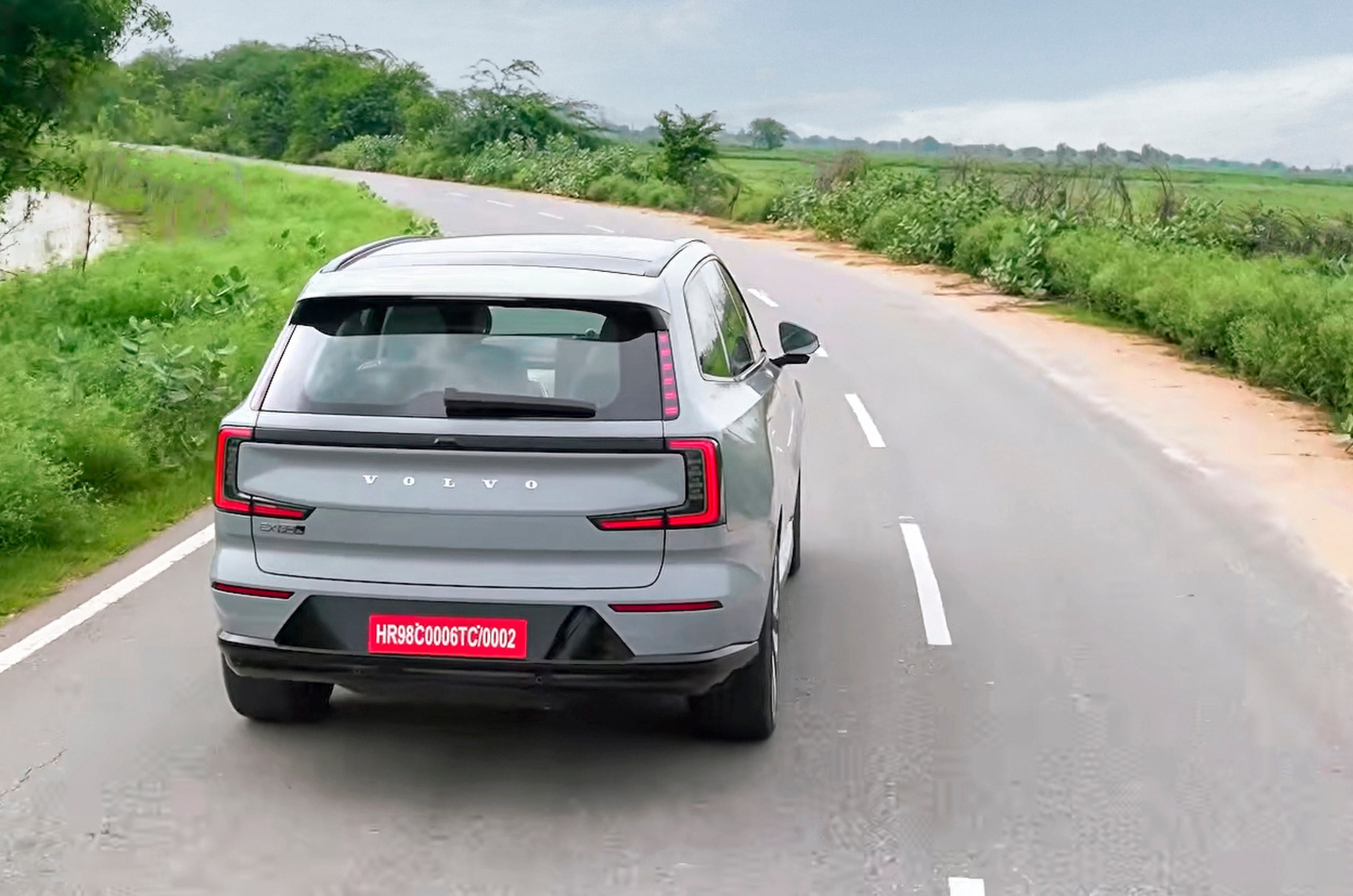
At the back, the EX90 features C-shaped LED tail-lamps connected by a black strip, along with LED arrays flanking the rear windscreen. A Volvo wordmark sits proud in the centre of the bootlid, and the bumper has a neat and discreet design. Colour options for the EX90 comprise Crystal White, Denim Blue, Mulberry Red, Onyx Black, Sand Dune, and Vapour Grey.
Volvo EX90 interior and features
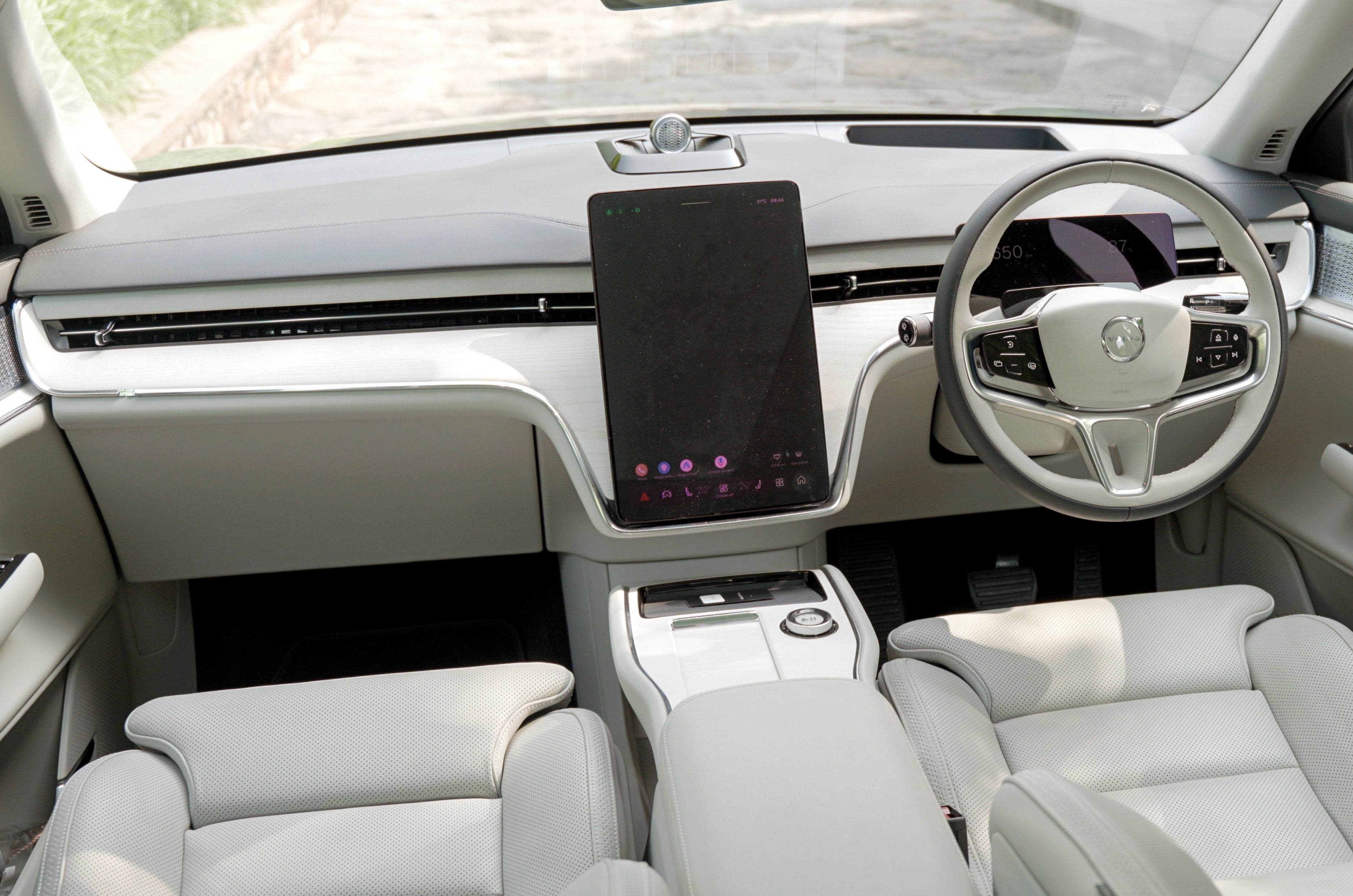
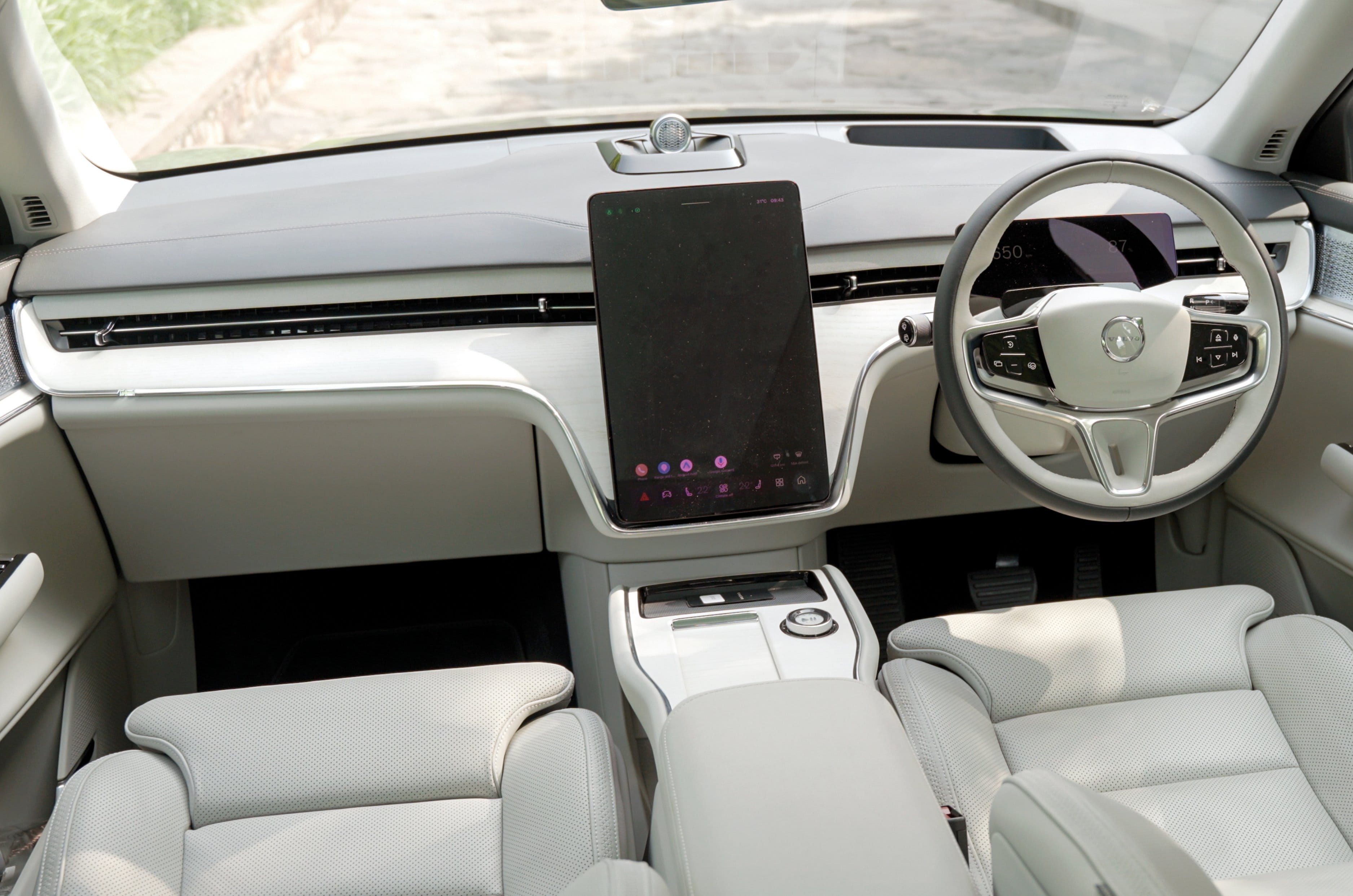
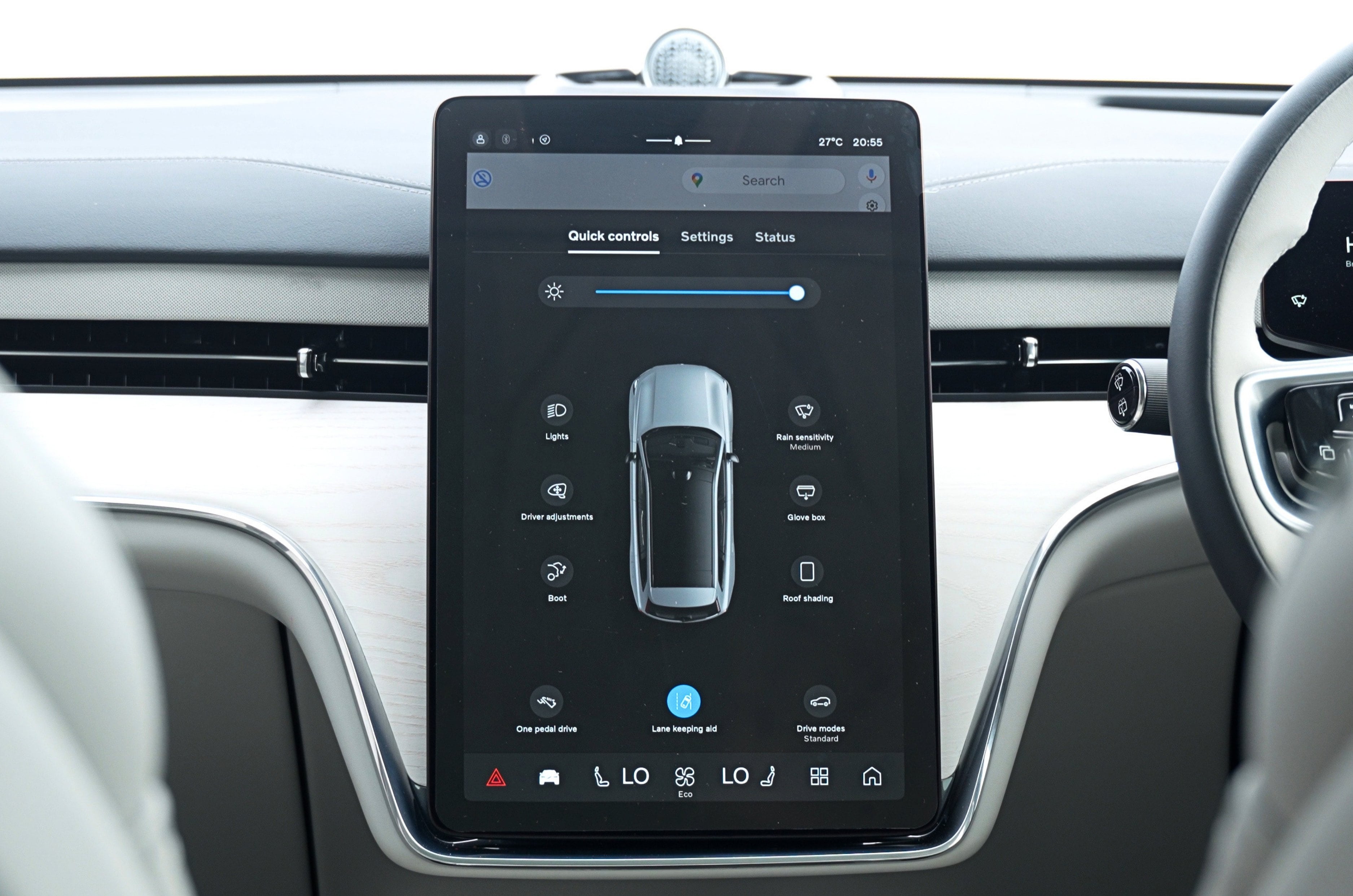
Volvo’s minimalist design philosophy extends to the EX90’s cabin, with a clean dashboard layout that incorporates rich two-tone Nappa leather upholstery, a three-spoke steering wheel, brushed aluminium trim pieces, a huge 14.5-inch vertically oriented infotainment touchscreen, and a slimmer 9-inch driver’s display. Physical controls are a rare sight in the cabin, as most of the in-car functions have been folded into the central touchscreen.
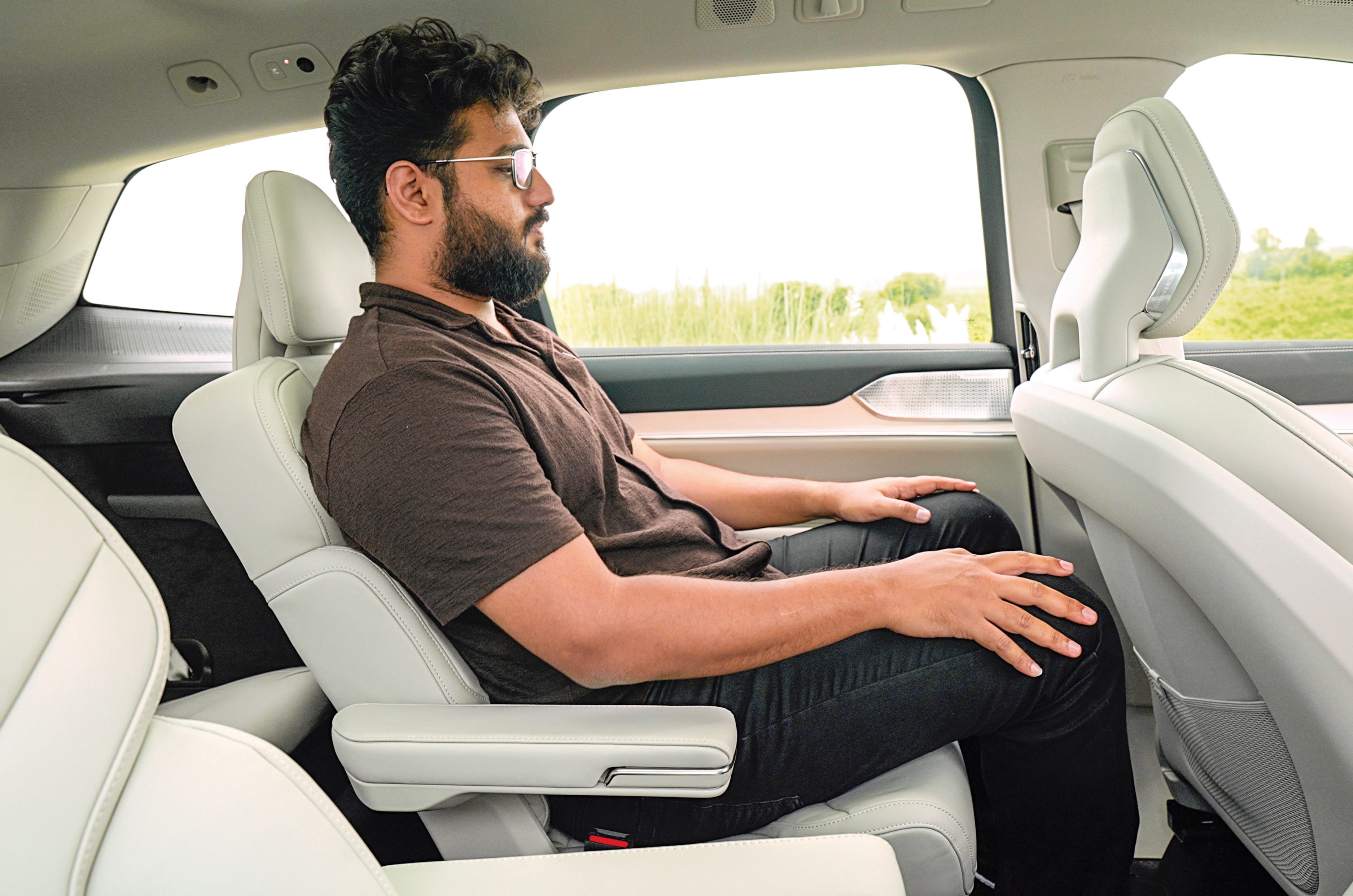
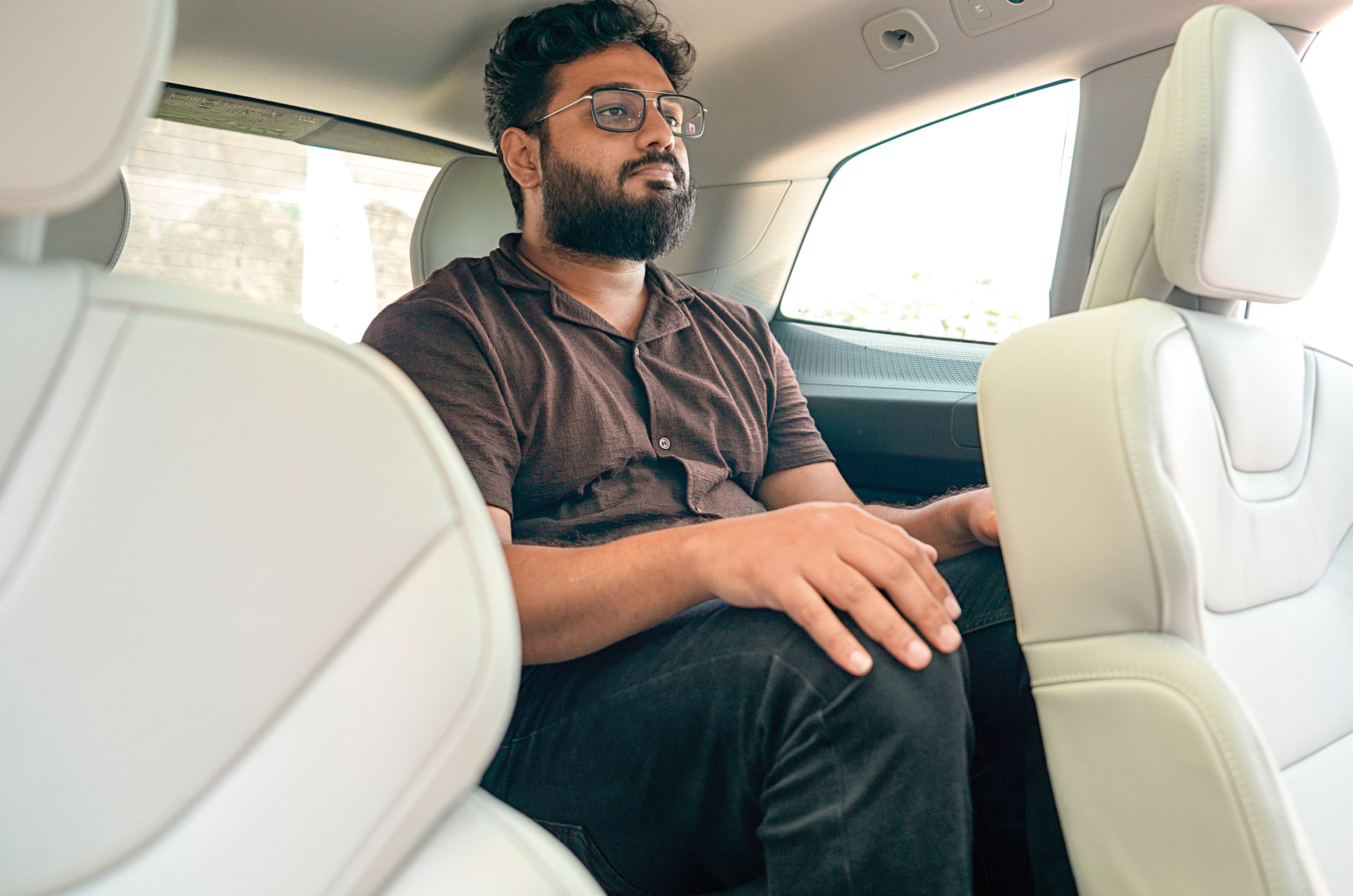
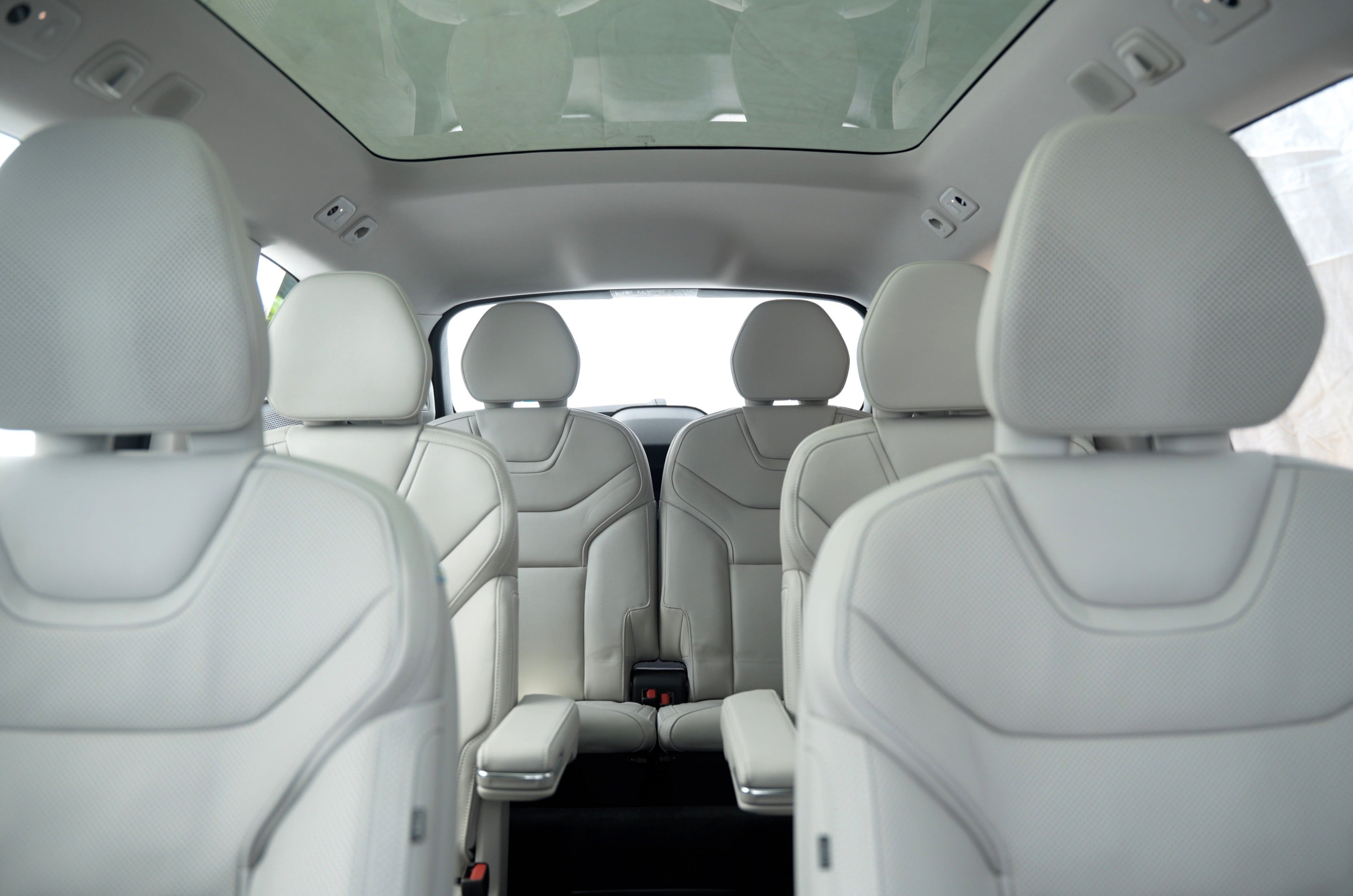
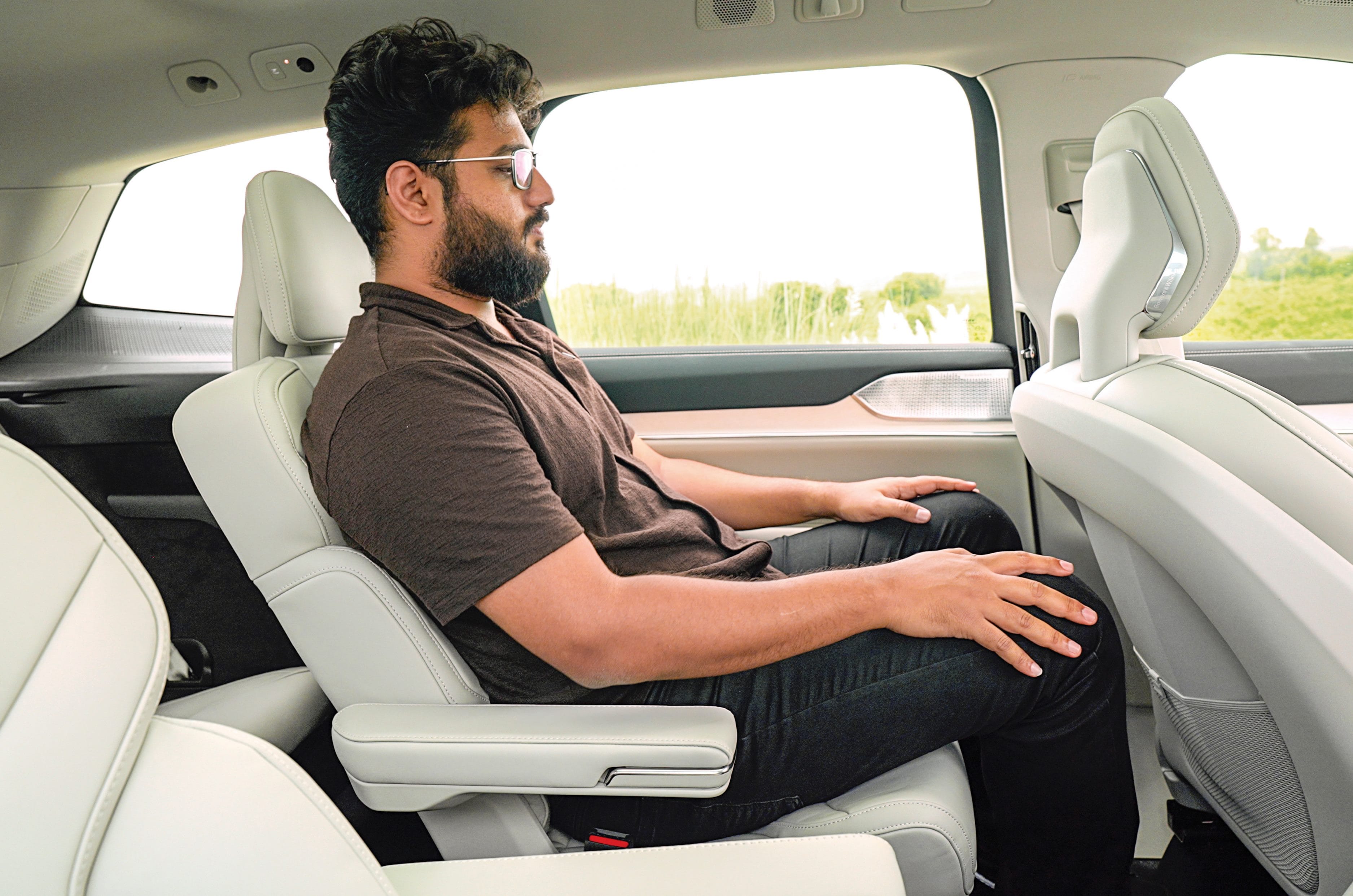
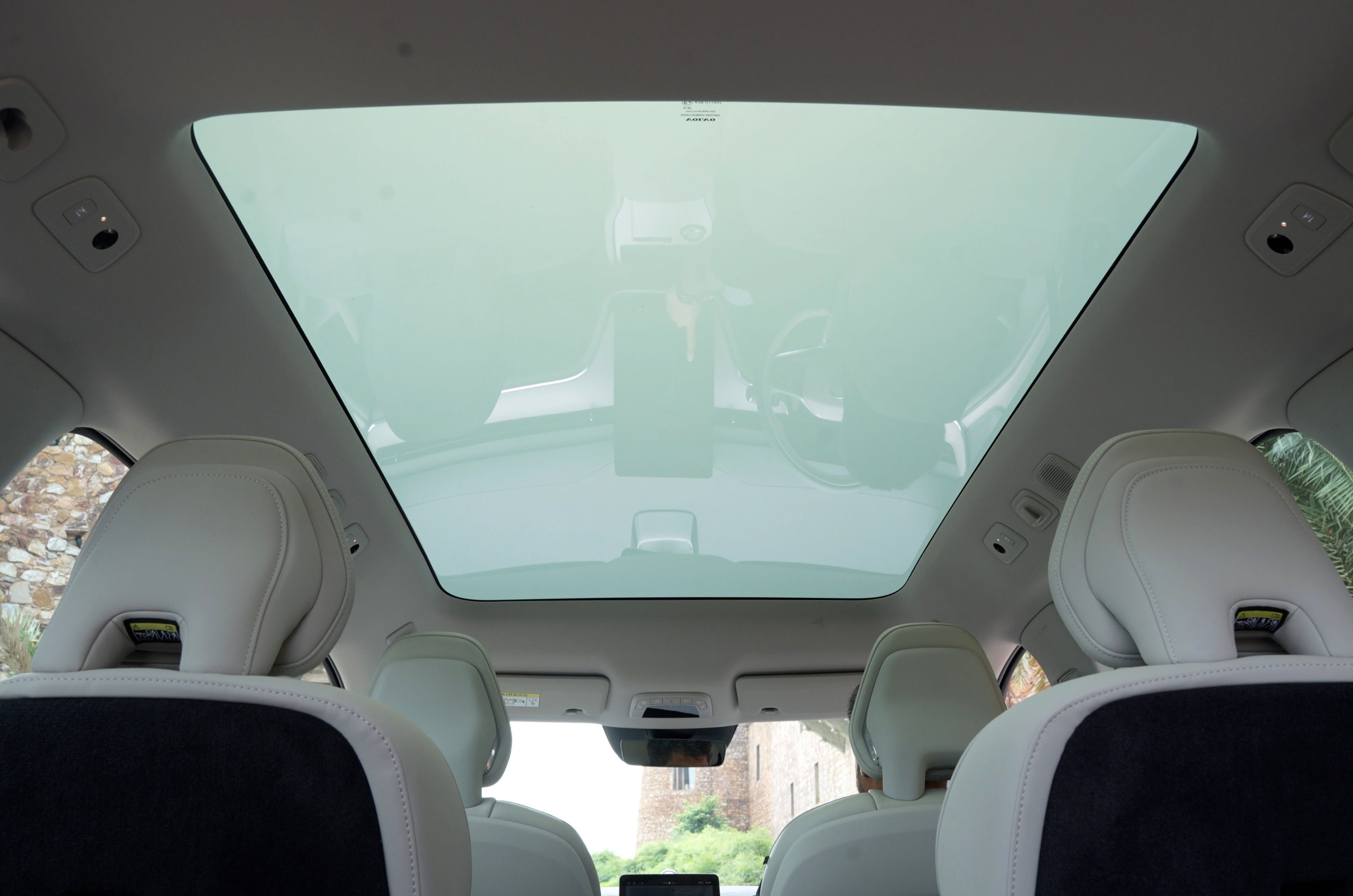
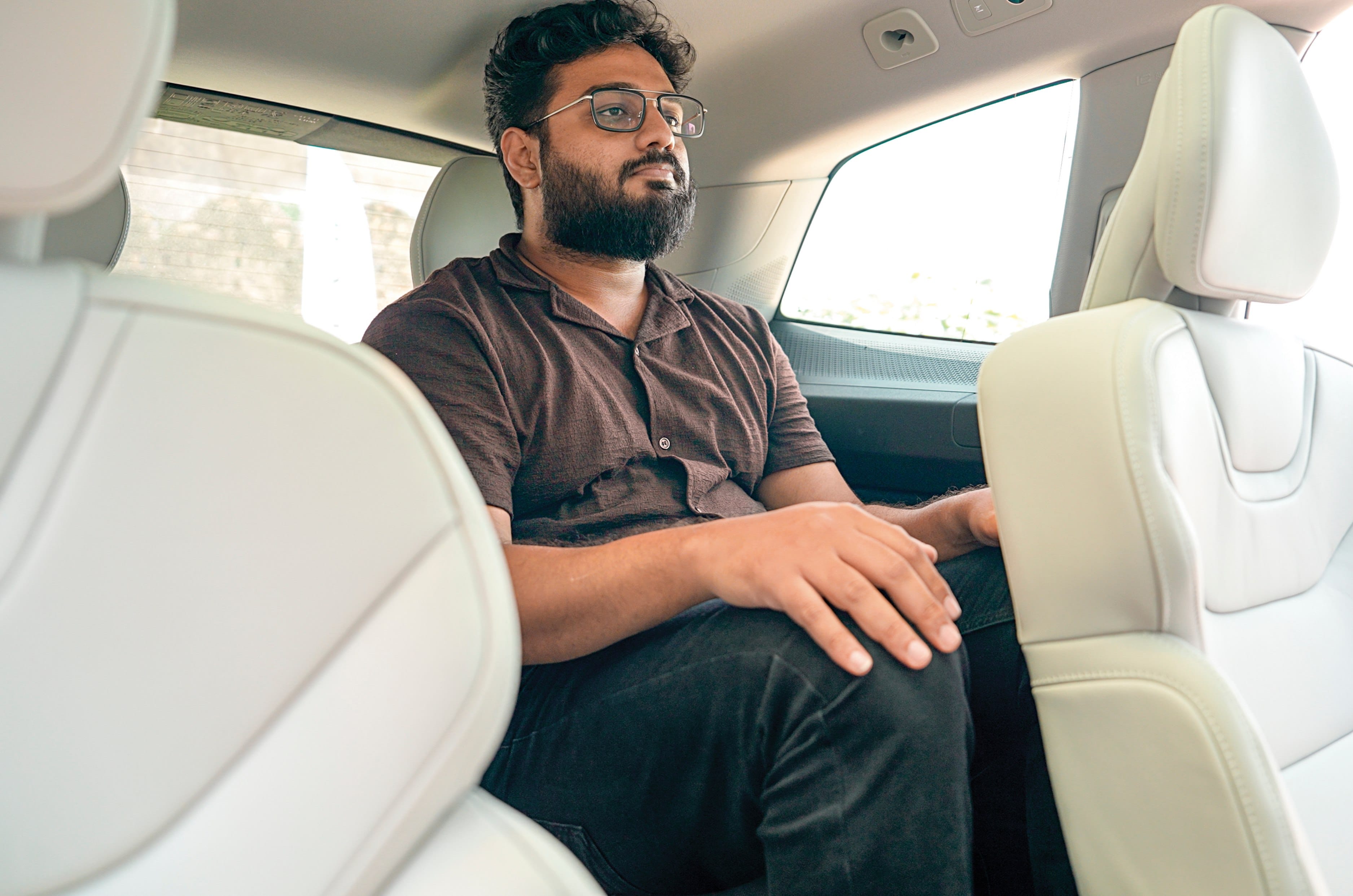
As noted previously, the India-spec EX90 is offered solely as a 6-seater with second-row captain’s chairs that slide and recline. There’s good space and comfort for second-row occupants, but these captain’s chairs don’t get the electrical adjustment, ventilation, heating, and massage functions that the front seats do. There are no sunshades for the rear windows, either, but you do get a large panoramic sunroof with switchable transparency.
Coming to the third row, access is easy by way of the space between the captain’s chairs (they don’t fold down, though). Once you’re there, however, the space on offer is best-suited to kids, or adults on short drives. Boot space is rated at 324 litres with the third row up, and if you fold that down, the capacity increases to 690 litres. You get a 46-litre frunk as well.
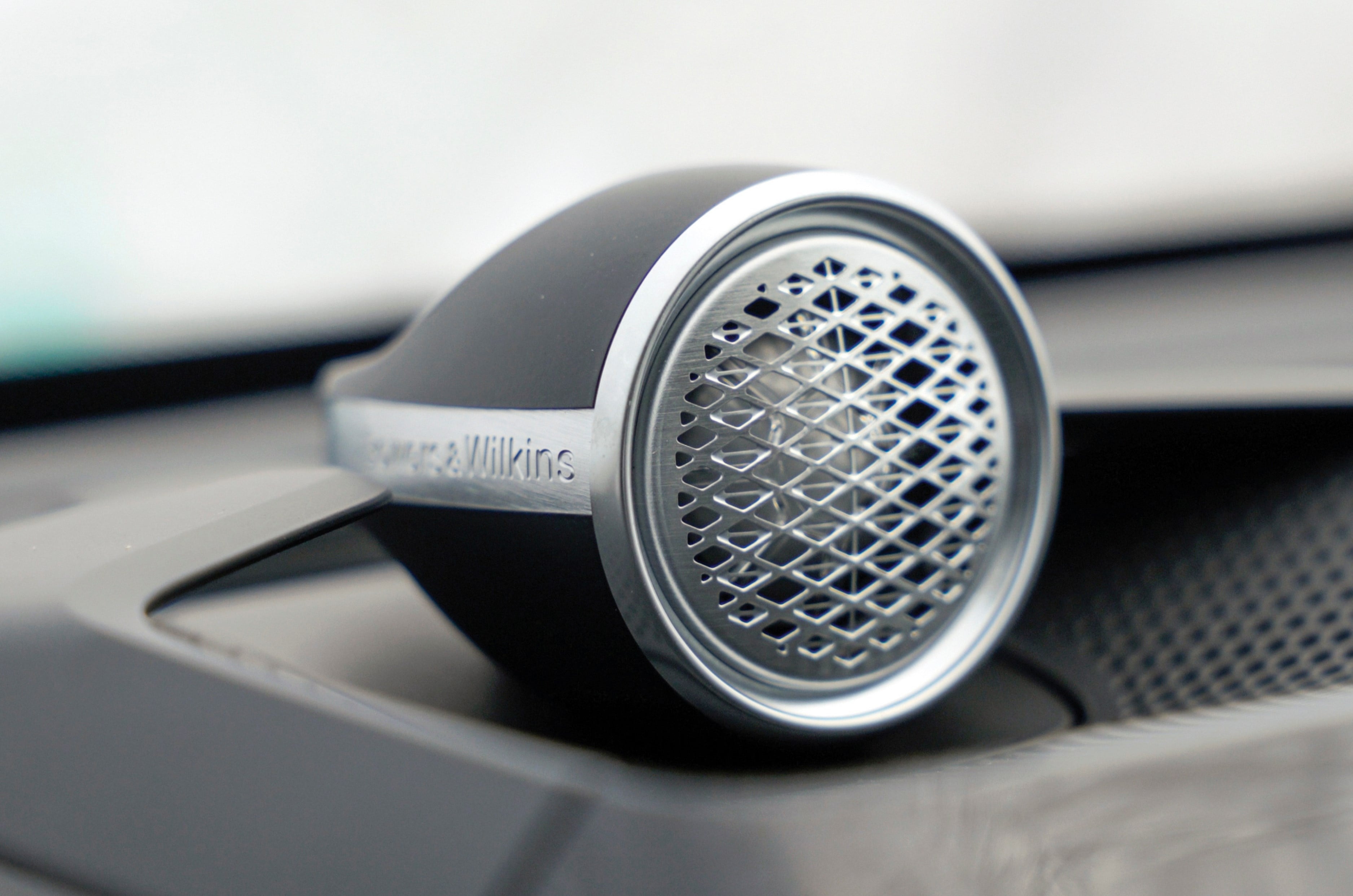
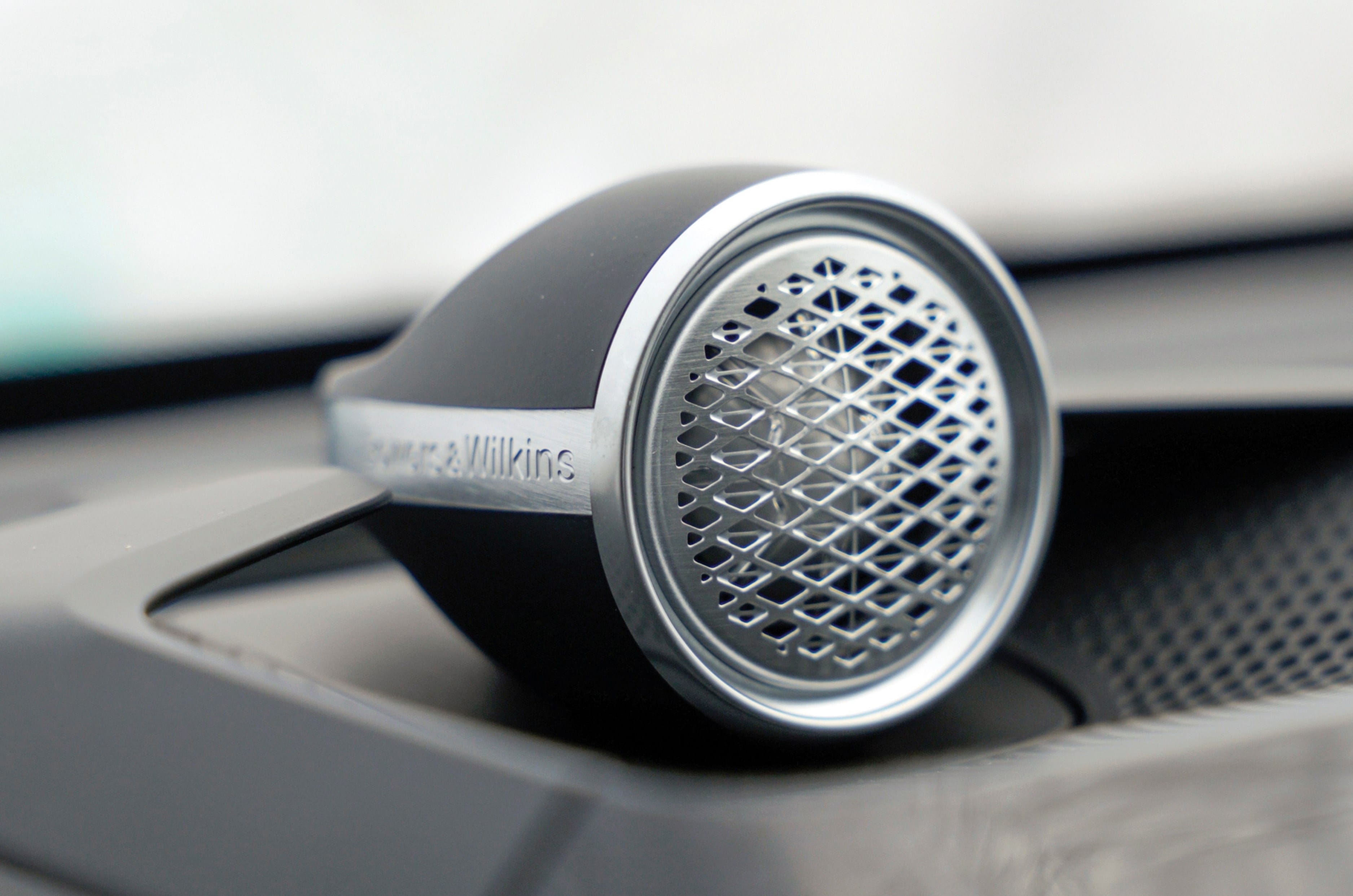
In addition to the features mentioned above, the EX90 comes packed with four-zone climate control, a 25-speaker Bowers & Wilkins sound system, configurable ambient lighting, 9 airbags, an ADAS suite, wireless Apple CarPlay and Android Auto, a 360-degree camera, auto park assist, a digital key, a wireless charging pad, a cabin air purifier, and more.
The Volvo EX90 rivals electric luxury SUVs like the Mercedes-Benz EQS SUV 580 and Kia EV9, which are priced at Rs 1.49 crore and Rs 1.30 crore, respectively. With its Rs 1.26 crore price tag, the EX90 undercuts both of its chief rivals.
Volvo India will launch its flagship electric EX90 SUV on October 12, 2026. It will launch alongside the ES90 flagship sedan, and both are underpinned by Volvo’s EV-dedicated SPA2 architecture. In Volvo India’s portfolio, it will sit above the brands other electric SUVs like the EX30 and EC40. The EX90 will be positioned as an all-electric alternative to the already existing ICE-powered XC90. Ahead of its launch, here’s everything you need to know about the Volvo EX90.
What is the expected price and rivals of the Volvo EX90?
The Volvo EX90 is expected to be priced in the ballpark of Rs 1.4 crore to Rs 1.5 crore, ex-showroom. The Volvo EX90 will lock horns with the Mercedes-Benz EQS and the Kia EV9.
What powertrains will the Volvo EX90 get?
The EX90 will come in one fully-loaded variant to India. It will be powered by a 106kWh battery pack paired with a dual-motor setup enabling AWD. The combined power output is 456hp and 670Nm with a claimed 0-100kph time of 5.5 seconds. Volvo claims a WLTP-certified range of 625km and, during our time with it, it delivered a respectable 530km range. As for charging, it supports 11kW AC charging speeds, taking 11 hours to top up from 0-100 percent. On DC charging, it supports up to 350kW thanks to its 800V system.
What will the Volvo EX90 look like?
In typical Volvo fashion, the EX90 gets an understated exterior appearance, and it looks quite different from its ICE-powered XC90. At the front, there are LED DRLs with ‘Thor’s Hammer’ signatures that split open to reveal the main headlamp units. The grille gets a blanked-off finish with the Volvo badge in the centre, DRL strips on the sides of the bumper, and a trapezoidal air intake lower down.
In profile, it gets a smooth finish for the doors, flush door handles, a rising window line, gloss black cladding for the sills, and 21-inch dual-tone alloy wheels. The rear gets a split design for the LED tail-lamps with C-shaped LEDs below and vertically stacked LED strips on the D-pillar. Like the front, there’s minimal cladding at the back with a gloss black finish lower down the bumper. Boot space is 324 litres with the third row up and 690 litres when folded
What will the Volvo EX90 interior look like?
Inside, the Volvo EX90 gets a minimalistic cabin with a two-tone grey and white theme. There aren’t many physical buttons here, but a large vertically oriented infotainment screen is placed at the centre of the dashboard.
Across the interior, there’s open-pore wood and brushed aluminium trims, while the seats are wrapped in Nappa leather upholstery. Below the infotainment screen is a centre console comprising a wireless phone charger and a rotary knob for media controls. The Volvo EX90 is a 6-seat SUV in a 2+2+2 configuration with captain chairs for the middle row.
What features will the Volvo EX90 get?
The Volvo EX90’s equipment list includes a 14.5-inch infotainment screen powered by Google, 9-inch digital driver’s display. Wireless phone charger, 25-speaker Bowers & Wilkins sound system, powered, ventilated, and massaging front seats, an electrochromic panoramic glass roof, and 4-zone climate control. Safety features include 9 airbags, an ADAS suite, a 360-degree camera, and automatic parking.
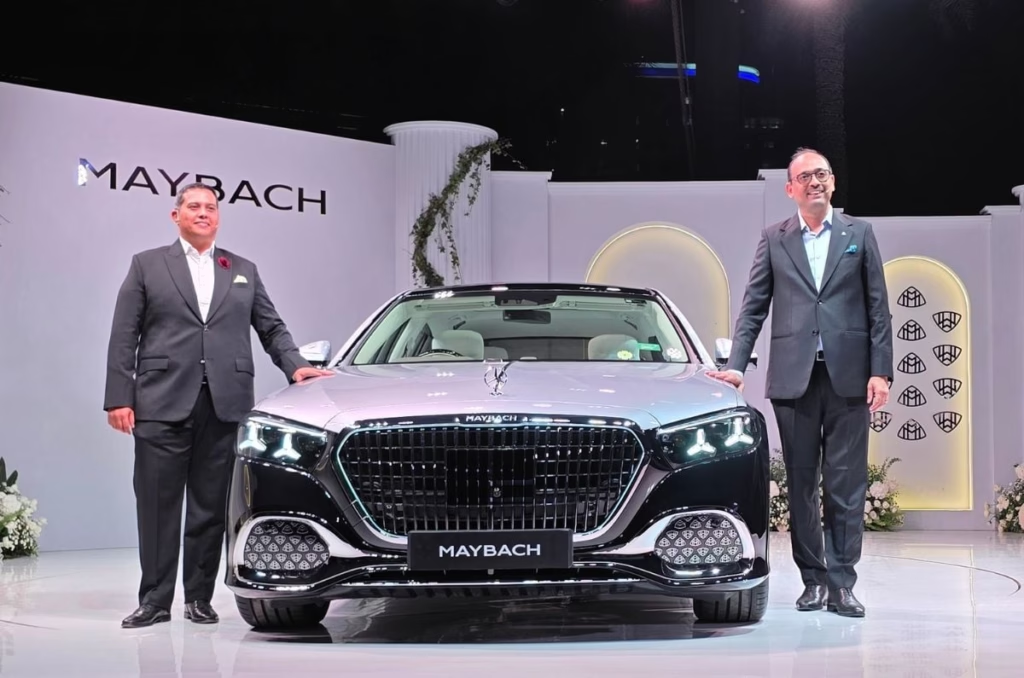
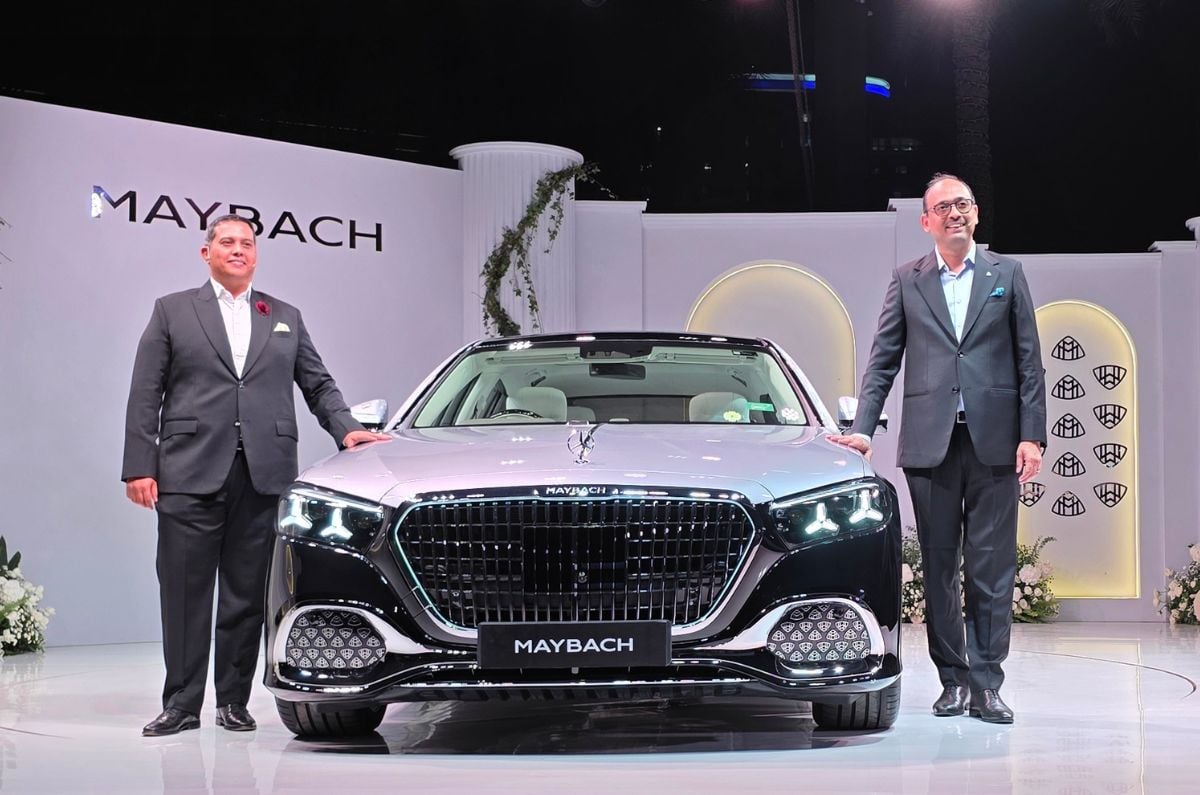
Mercedes-Benz has launched the Maybach S-Class facelift at Rs 3.35 crore (ex-showroom). It has been brought to India in S 580e guise, making it the first Maybach in India to be offered with a plug-in hybrid powertrain. Only 30 units have been allocated in the first batch, costing Rs 97 lakh more than the ‘regular’ S-Class Manufaktur Edition AMG Line that was launched just a couple of months ago. This is also Mercedes’s third PHEV in India, following the updated S-Class and AMG E 53 Hybrid. Mercedes says around 50 percent of its S-Class sales in India are of the Maybach variant.
Maybach S-Class comes to India in S 580e guise with 3.0-litre PHEV powertrain
Gets executive rear seats with full-length business console as standard
Offers 98km electric-only range thanks to a 22kWh battery
Mercedes-Maybach S 580e powertrain and specs
The new PHEV powertrain is one of the biggest updates to the Maybach S-Class, as the outgoing model was offered with a 4.0-litre V8. The S 580e uses a 443hp/560Nm 3.0-litre inline-six petrol engine paired with a 160hp/480Nm electric motor and a 22kWh battery. Total system output is 585hp and 750Nm, and it comes with all-wheel drive as standard. Mercedes claims the car can travel up to 98km and reach a top speed of 140kph on electric power alone. It also has a WLTP-certified fuel efficiency of 34.48kpl, although it’s likely not to be of much interest to a Maybach owner.
The S 580e offers three drive modes – Maybach, Electric and Battery Hold – along with adjustable energy recuperation, including one-pedal driving. As for charging, Mercedes will offer an 11kW AC on-board charger, and the car is also compatible with up to 60kW DC fast charging. The S 580e gets air suspension and rear-axle steering as standard.
Mercedes-Maybach S 580e interior and features
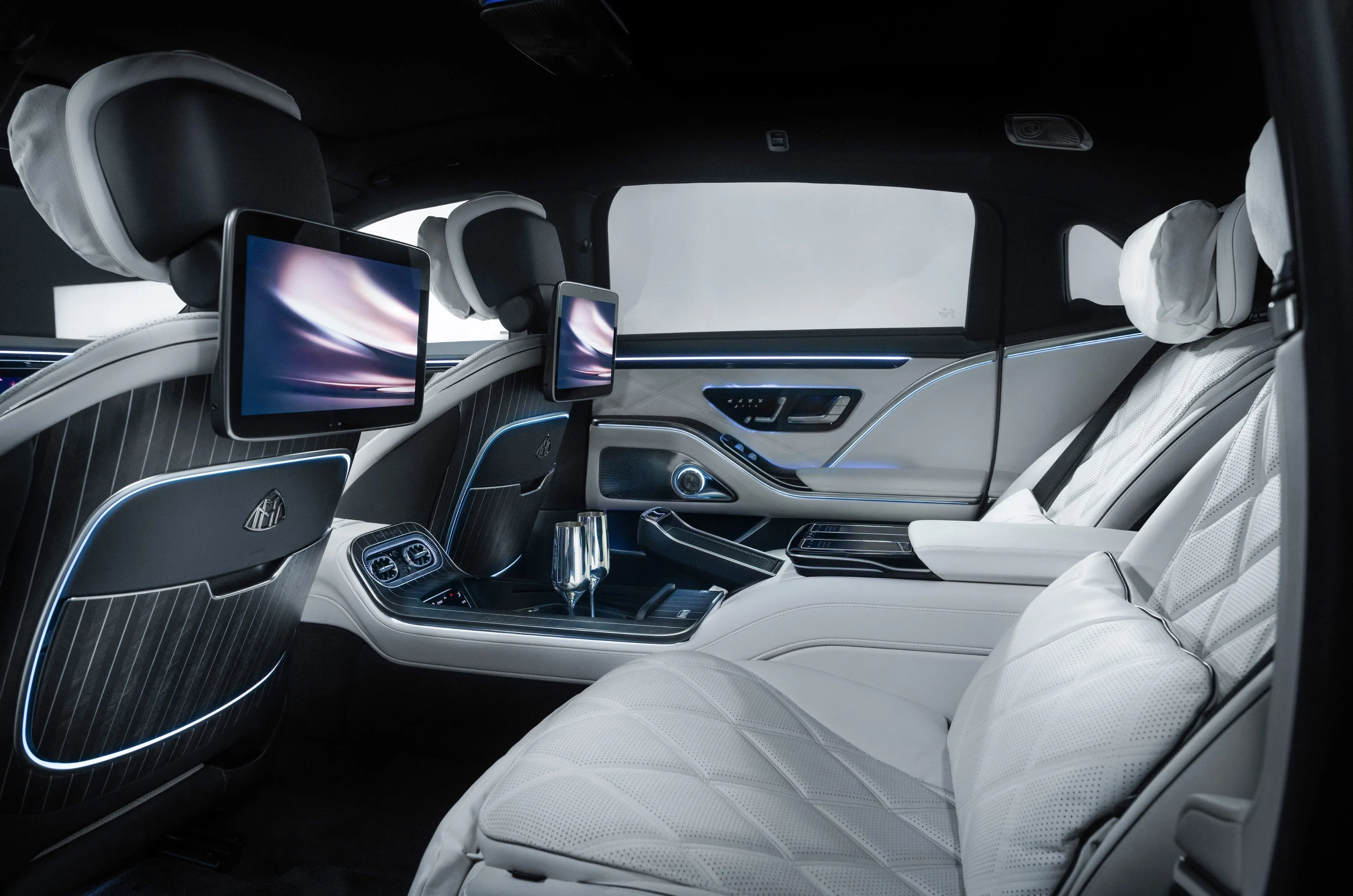
The focus of any Maybach is, of course, the back seat, and in that regard, Mercedes is offering the S 580e in a four-seat layout with executive seats with a full-length business console. Rear Comfort Package Plus is standard, offering fold-out tray tables, wireless charging pads, rear-compartment ambient lighting and even temperature-controlled cup holders. The seats recline to 43 degrees (compared to the regular S-Class’s 38 degrees) and are heated, ventilated and massaging. You also get two individual ‘smartphone’ remotes to operate everything instead of the tablet controller from before.
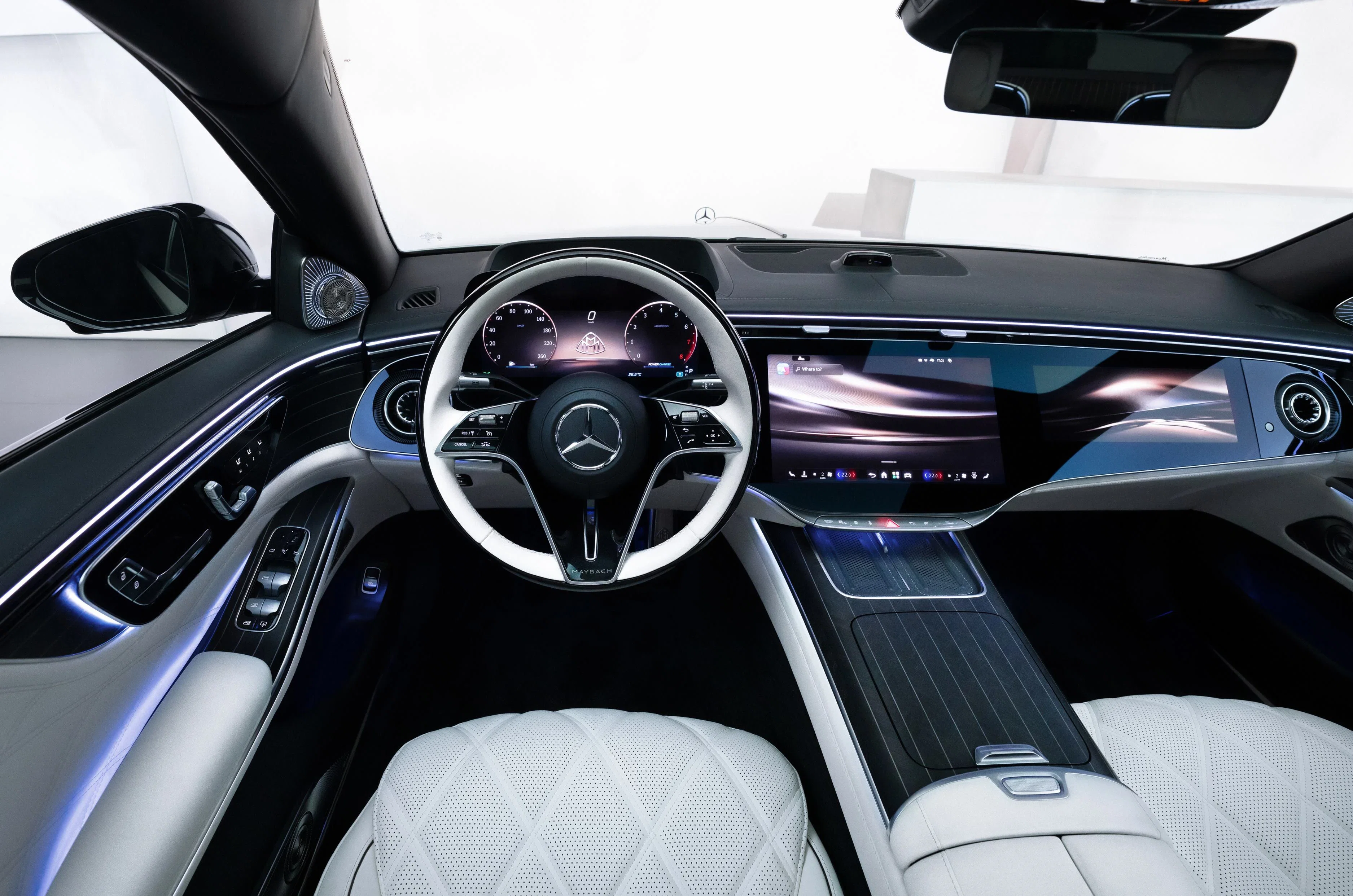
Up front, the dashboard remains largely unchanged from the regular S-Class. The MBUX Superscreen spans the front of the cabin, combining the central display with a front passenger display carrying a privacy function, while the driver gets a free-standing 3D display. The difference here is that you get a unique Maybach graphical theme for all screens, along with signature rose gold accents. Some of the equipment highlights include an augmented reality head-up display and navigation, a 31-speaker Burmester 4D surround sound system and two rear entertainment screens with wireless headsets.
The cabin is trimmed in Maybach-exclusive Nappa in crystal white and silver grey pearl, with Manufaktur piano lacquer trim, a Manufaktur roof liner in crystal white Nappa leather and Manufaktur seat backrest trim.
Mercedes-Maybach S 580eexterior design
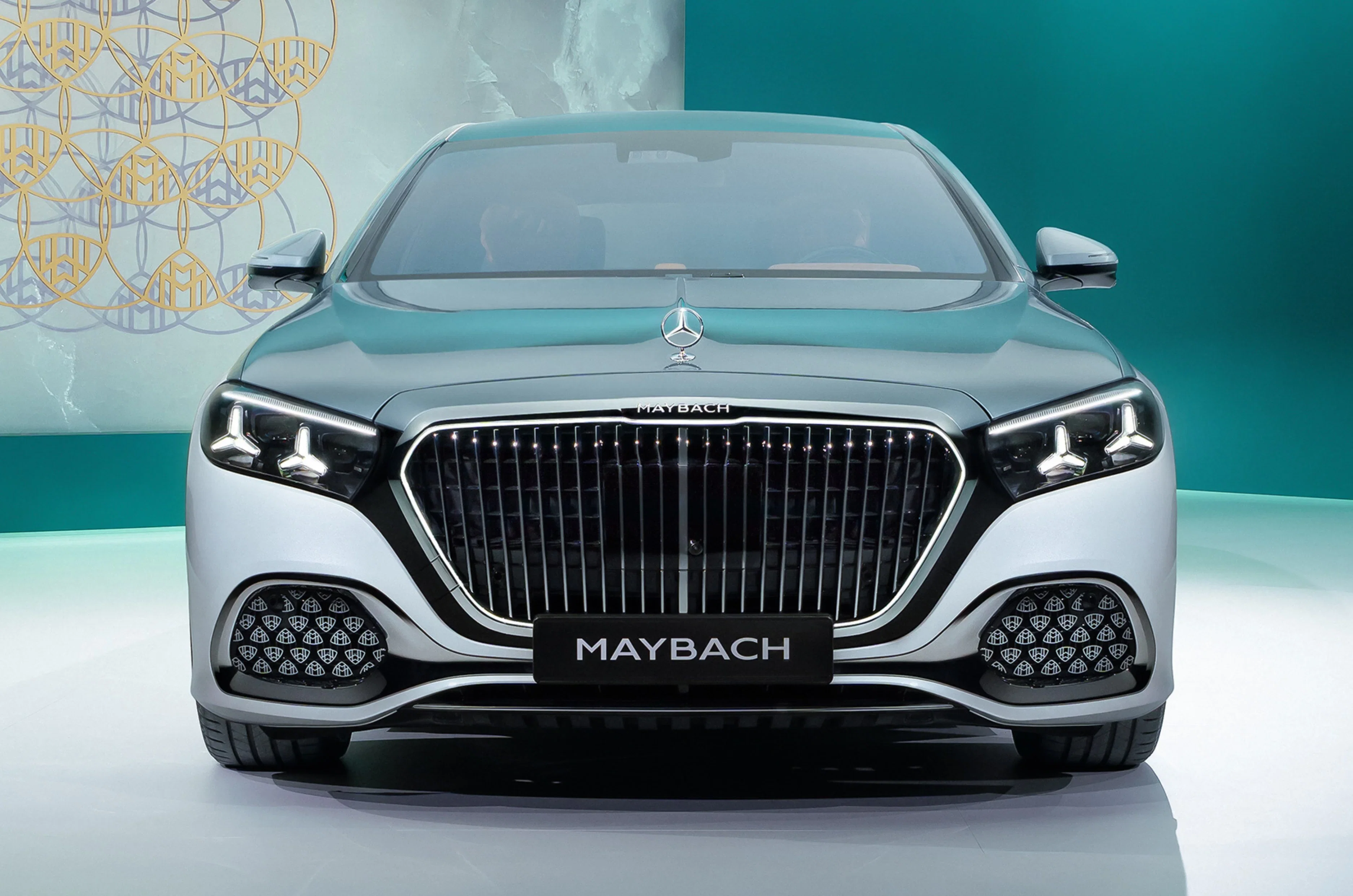
Changes to the exterior are similar to those on the regular S-Class facelift, albeit with a few Maybach-specific twists. For instance, here too the grille is 20 percent larger and framed by LED illumination, with an illuminated Mercedes star on the bonnet above. The difference is that the grille uses the Maybach signature vertical slats, and there’s an illuminated ‘Maybach’ wordmark above them.
The headlamps are the new, larger units with the latest version of Mercedes’s Digital Light ambient lighting and three-pointed star daytime running lamps (DRLs), but rather than the techie blue accents, there are rose gold embellishments with the Maybach logo on them.
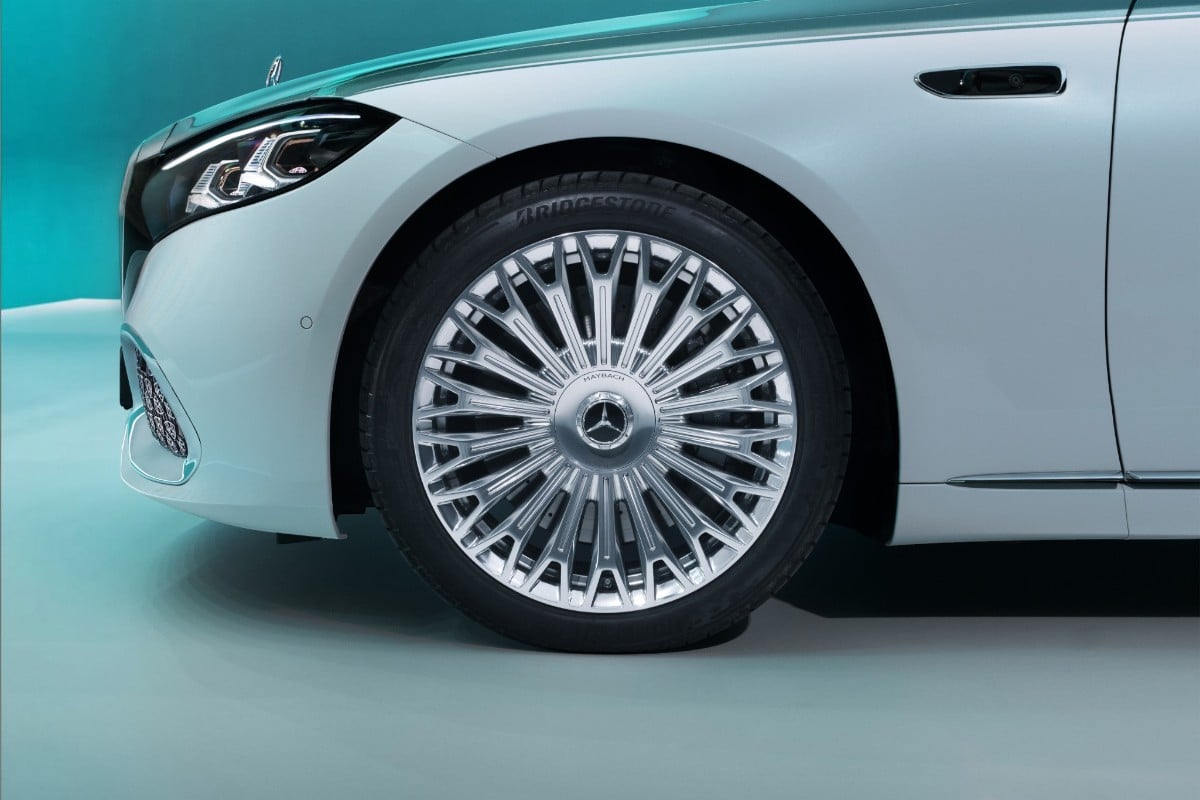
As before, the Maybach is 180mm longer than the long-wheelbase S, and that’s plain to see in profile. The India-spec model rides on 20-inch forged Maybach wheels, which also house a counterweighted Mercedes logo that always stays upright as the wheels turn. The Maybach logo on the D-pillar is illuminated as well, and the tail-lamps also get the triple-three-pointed star LED signature, like in the standard S-Class.
The EX90 is Volvo’s latest offering in India and also its most premium one. The EX30 and EC40 compete in the entry-level luxury EV segment, but the EX90 is the brand’s flagship electric SUV. It comes in a single, fully loaded variant with all the bells and whistles, along with a dual-motor setup and a claimed range of over 600km. Can it bring in a new audience or convert some XC90 customers? It certainly has the traits to do both.
EX90 Exterior Design and Engineering – 9/10
Built on Volvo’s SPA2 dedicated EV platform that has hints of the XC90.
Based on the new SPA2 architecture, which has its roots in the previous SPA platform but is built specifically for EVs, the EX90 does share some resemblance to the XC90 in its shape and form factor. However, the details are different. As expected, the overall design is simple and far from outlandish or attention-seeking. This is in keeping with the brand’s image, and the restraint actually works. The flat, closed-off front end dismisses any chances of a blingy chrome grille, and what adds drama instead are the LED lights that split open to reveal the main headlamps behind. These, too, have an impressive party trick; with over a million pixels, they can individually light up or switch off and constantly shape a light beam to avoid dazzling oncoming traffic. Further down, you get some more DRL strips, one on each side, and a rather simple, fuss-free bumper.
DRLs that spilt open to reveal headlamps add drama.
Over to the side, the EX90 is slightly longer than the XC90, while the rest of its dimensions see a marginal bump. 21-inch wheels are standard, and the 210mm of ground clearance at its lowest setting is plenty. The air suspension also allows you to raise the car up to 250mm for off-road use. The door handles are pop-up, flip-up-style units, and you no longer get a key. Instead, you get a card that you need to tap at the right spot, with the Volvo logo facing the right way, for the handle to pop up. Alternatively, you can simply link your phone to the car and use it as a key. It seems convenient on paper, but the card system needs to be a lot more seamless to be hassle-free.
At the rear, it gets a split setup for the LED tail-lamps, with C-shaped LEDs on the lower half and vertically stacked LEDs in the D-pillar. There isn’t a single strip of chrome, and even the cladding is minimal. Subtlety is what Volvo aims for with its design, and the EX90 offers just that.
EX90 Interior Space and Comfort – 8/10
Two-tone upholstery looks rich and materials feel plush.
Inside, the minimalist approach continues and even takes precedence. The dashboard is devoid of any buttons whatsoever, and the majority of the real estate is taken up by the 14.5-inch touchscreen. However, the bright seats and upholstery, along with the bright open-pore wood, lift the cabin ambience significantly. There is generous use of brushed aluminium as well, and the Nappa leather is fantastic to the touch. The centre console also features wireless charging and a rotary knob for media control.
There is plenty in the front seats to pamper you. They offer excellent support, and feature heating, ventilation and a whole host of massage options. Plenty of electric adjustment also means finding an accurate driving position is easy, and all-round visibility is very good.
Exclusively a six-seater with good space and comfort.
The EX90 is only available as a six-seater, so in the middle row you get captain’s chairs, but these would feel snug for some, and for a luxury car that would be chauffeur-driven, you don’t get the same level of pampering as in the front seats. There is no electric adjustment, heating, ventilation or massage either. There aren’t any sunblinds for the windows too, and even though the huge panoramic sunroof is electrochromic, at the tap of a button you get a bit of tint in the glass, on a hot day with the sun overhead, you will need more.
Massive panoramic glassroof gets electrochromic shade. Physical sunshade is an accessory.
The accessories list has a proper roof shade to protect you from that, and it is an extra we recommend you select. On the plus side, space is good, and the seats can be adjusted for legroom and recline too. You get four-zone climate control, with AC vents in the pillars that are a lot more effective, and cupholders stowed within the armrests. Also, being a modified platform, the floor is raised, and you notice this while getting in and out of the car.
Access to the third row is easy from between the captain’s chairs, thanks to the flat floor, but there is no tumble feature for the seats. Instead, they only slide forward, opening a cavity to get in. Room in the last row is at a premium for tall adults, but kids or shorter adults will do just fine with a little adjustment to the middle row.
Third row best suited for kids or short adults over quick drives.
With all three rows up, boot space stands at a healthy 324 litres, and with the third row folded away, it is a sufficient 690 litres. There is a 46-litre frunk too for stowing charging cables. Impressively, there is a full-size spare wheel as standard, which will eat up some boot space but is a huge relief given the low-profile tyres and our roads.
EX90 Features and Safety – 8/10
Annoyingly every control is within the 14.5-inch Google-powered screen.
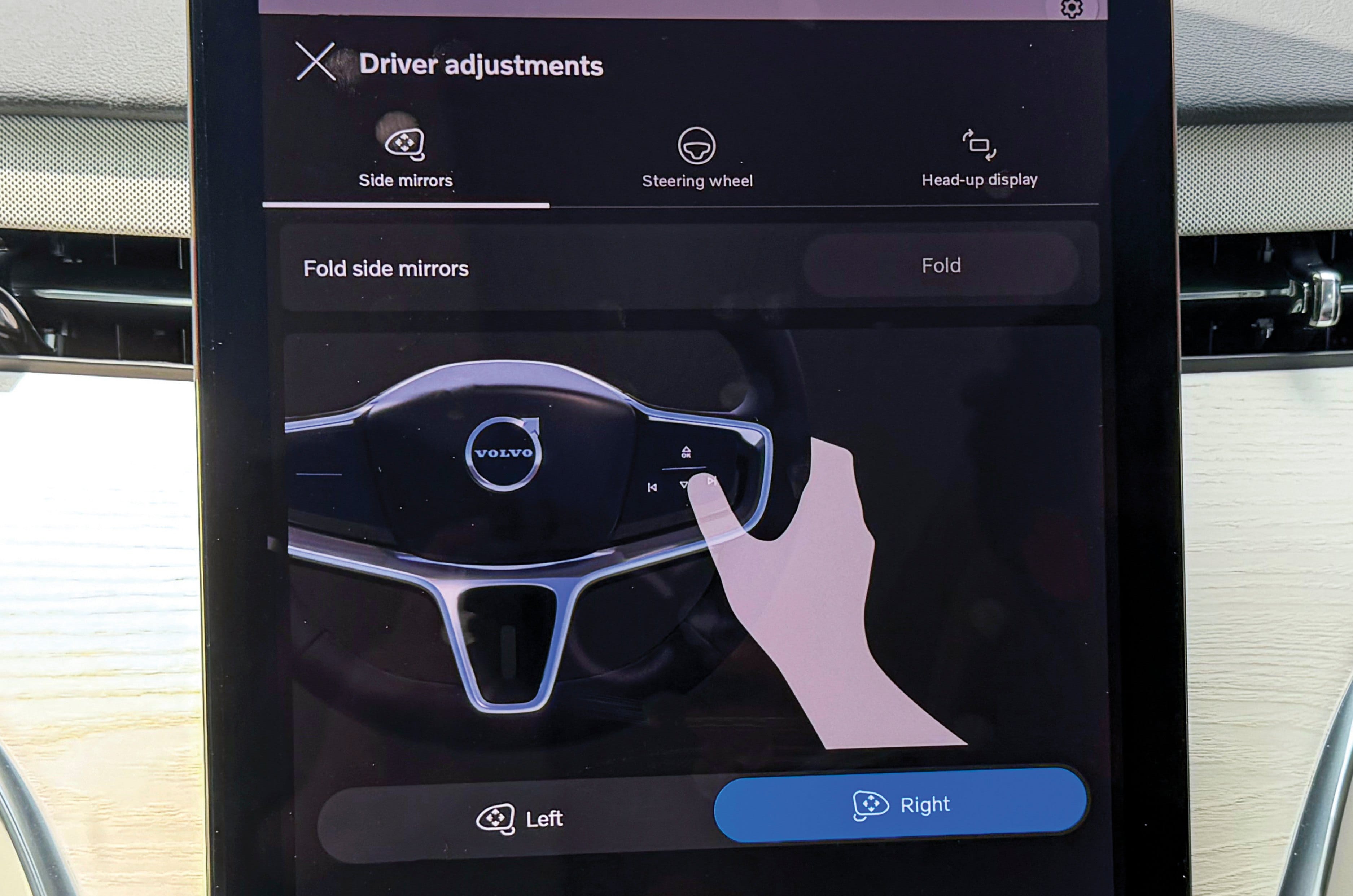
Most of the EX90’s features are accessed through the massive, vertically oriented touchscreen. Being Google-powered, it runs a smooth OS, but simple tasks like adjusting the ORVMs require multiple inputs and navigation through the menus, which isn’t easy while on the move. There are some hard-coded functions at the bottom of the touchscreen, such as climate control, but you still need to focus on the screen and cannot operate them easily while driving. There is also a 9-inch driver display with nothing but the absolute necessary figures, such as range, speed and battery percentage. You can also load up the maps there, and it displays the traffic around you too. However, don’t expect multiple dials and a loaded, fighter-jet-like cockpit experience, the instrumentation is all minimal but feels sparse too.
Bowers & Wilkins Hi-Fi audio system is epic.
What is excellent, however, is the music system: a 1,610W, 25-speaker Bowers & Wilkins Hi-Fi audio system with custom presets and modes that truly transform the cabin. If you enjoy your music, there are few cars in the world that offer something at this level or better. Safety is where Volvo excels, and the EX90, being the flagship, has all the bells and whistles – active and passive. Nine airbags, five cameras, five radars and 12 ultrasonic sensors, powering a full ADAS suite including door-opening alert and post-impact braking, make it exceptionally well equipped. Essentials like a 360-degree camera and auto-parking further make it easy to live with.
EX90 Performance and Refinement – 9/10
It is just as nice to drive as it is to be chauffeured in.
The EX90 comes in a single variant in India, with a dual-motor setup and a 106kWh battery pack. It develops 456hp and 670Nm, making it quick off the line. 0-100kph takes just 5.5sec, which, given its size and type, is pretty impressive. However, from behind the wheel, the experience aligns with its laid back character. You can alter the dynamics using the four drive modes. ‘Range’ prioritises efficiency, and power and torque are heavily restrained, although in bumper-to-bumper traffic, you will not notice the dip. There is a creep function too for peak-hour jams. ‘Standard’ is a balance that suits the car well for the most part, while ‘Performance’ is for that rare time when you want to add some enthusiasm.
Despite its strong power figures, performance feels more like an airliner than a fighter jet.
Don’t expect fighter-jet levels of reactions, though. Even in ‘Performance’ and with a heavy right foot, the EX90 builds pace gradually. It is almost like taking off in an aeroplane, where the speed rises in a strong and linear manner. This mode zaps power swiftly, so it is best to use the ‘Standard’ mode and get the best of all worlds. If you end up venturing off the tarmac, the ‘Off-road’ mode allows for more ground clearance (250mm), and it alters traction control and ESP settings to allow for more traction on loose surfaces.
Once on the move, what is extremely impressive is cabin refinement. With no engine sound to distract you, EV cabins amplify ambient sounds like wind and road noise, especially with large tyres, but the EX90 is a different story. Cabin insulation is top-notch, and it is near-silent on the inside. It also has a neat trick, microphones all around the car can relay conversations via the speakers clearly no matter where you are seated. You only have to talk in your natural tone for your voice to clearly go through the microphone and speakers. So passengers sitting at the first and third row can have a conversation without having to speak loudly.
EX90 Mileage / Range and Efficiency – 9/10
The 106kWh battery can eke out 625km according to the WLTP cycle. In our short test drive, we saw an efficiency of 5km/kWh in mixed driving conditions, resulting in a range of 530km. That is rather respectable, and considering a majority of our drive was on the highway, this number should only get better in the city.
The EX90 also has regenerative braking, and you can go from having it completely off to low or high, or just leave it in Auto, where it does all the thinking for you. Feel, though, leaves a lot to be desired, the pedal never feels consistent in its bite point. You get an 11kW AC charger for your home or office, which takes 11 hours for 0-100 percent. But being an 800V system, it can charge at up to 350kW on a DC charger, taking just 23 minutes for 10-80 percent. The car will also pre-condition the battery, meaning it gets the battery up to its optimum temperature to charge as quickly as possible.
EX90 Ride Comfort and Handling – 8/10
The EX90 rides on air suspension, which, over broken roads at medium or high speeds, is excellent. The car adjusts within microseconds, and you barely feel bumps inside. You can firm it up for the highway, so there is none of the wallowy feel associated with a softly sprung setup. Three modes to choose from give you flexibility depending on the road surface. ‘Standard’ offers the best balance, as it has the softness without feeling overly soft in the corners, while ‘Firm’ adds a layer of stability at speed and on fast bends. ‘Soft’ is a bit too soft, and the car ends up diving or rolling a tad more than necessary. In the city, there is none of the harshness over low-speed bumps, and the composed nature of the suspension is its highlight.
EX90 Value for Money – 8/10
The EX90 offers just about everything you need in a luxury EV
Prices for the EX90 will be out in October, and it will be the brand’s flagship SUV, sitting above the XC90. If you are looking for a chauffeur-driven luxury EV, it will tick the right boxes. That said, sunblinds would have been nice, and as a driver, it will frustrate you with an over-reliance on the touchscreen and a fiddly key card. On the whole, though, it does a lot to impress and allows you to forgive these shortcomings. You get everything you expect from a luxury EV, the cabin is plush and comfortable, the materials and feel are excellent, the design is subtle but svelte, and the ride comfort is truly impressive. It rivals the Mercedes-Benz EQS and BMW iX, and while it may not be as feature-loaded in the rear seat as the EQS or as powerful and fun to drive as the iX, it does find a very nice middle ground and would be top of the list for those looking for minimalist class and luxury.
कार खरीदते समय ज्यादातर लोग इंजन, माइलेज, कीमत और फीचर्स को सबसे पहले देखते हैं। वहीं कार का इंटीरियर भी गाड़ी के अनुभव को काफी बदल देता है। सीटों से लेकर स्टीयरिंग, डैशबोर्ड और गियर एरिया तक इस्तेमाल होने वाला मटेरियल कार को प्रीमियम लुक देता है। खासतौर पर लेदर सीटों को आराम और लग्जरी से जोड़कर देखा जाता है। लेकिन क्या आपने कभी सोचा है कि कार के अंदर नजर आने वाला यह चमड़ा आखिर तैयार कैसे होता है और इसका स्रोत क्या है? कई लोगों को लगता है कि हर कार में एक जैसा लेदर इस्तेमाल होता है, जबकि ऐसा नहीं है।
कार की कीमत, कंपनी और मॉडल के आधार पर इंटीरियर में अलग-अलग तरह के प्राकृतिक या सिंथेटिक मटेरियल लगाए जा सकते हैं। कुछ लेदर जानवरों की खाल से तैयार किए जाते हैं, तो कुछ आधुनिक विकल्प बिना प्राकृतिक चमड़े के बनाए जाते हैं। ऐसे में कार की चमड़े वाली सीटों के पीछे की कहानी काफी दिलचस्प है।
गाय-बैल की खाल से तैयार होता है कारों का लेदर
कारों में इस्तेमाल होने वाला प्राकृतिक लेदर आमतौर पर गाय और बैल की खाल से बनाया जाता है। यह खाल अक्सर मीट इंडस्ट्री से मिलने वाला बाय-प्रोडक्ट होती है। मांस अलग करने के बाद खाल को टैनिंग की प्रक्रिया से गुजारा जाता है, जिससे वह मजबूत और टिकाऊ लेदर में बदल जाती है। इसके बाद जरूरत के मुताबिक इसे काटकर सीट, डैशबोर्ड, स्टीयरिंग और गियर एरिया में इस्तेमाल किया जाता है।
कार वाला लेदर आम चमड़े से क्यों अलग होता है?
ऑटोमोबाइल में इस्तेमाल होने वाले लेदर को खास तरीके से तैयार किया जाता है। इसे लगातार इस्तेमाल, सफाई, धूप और गर्मी को झेलने लायक बनाया जाता है। इसमें ऐसी ट्रीटमेंट प्रक्रिया अपनाई जाती है, जिससे दाग कम लगें और लंबे समय तक धूप व अल्ट्रावायलेट किरणों के कारण इसकी चमक और गुणवत्ता खराब न हो।
गाय की खाल ही क्यों पसंद की जाती है?
कई कार निर्माता कैटल हाइड को उसकी मजबूती और मोटाई के कारण पसंद करते हैं। ठंडे और उत्तरी इलाकों में पाले गए मवेशियों की खाल कुछ मामलों में ज्यादा मोटी हो सकती है। दिलचस्प बात यह है कि खाल की बाहरी सतह पर छोटे-मोटे निशान होने के बावजूद उसका अंदरूनी हिस्सा अच्छी क्वालिटी के लेदर के लिए इस्तेमाल किया जा सकता है।
सिर्फ गाय-बैल ही नहीं, इन जानवरों की खाल भी होती है इस्तेमाल
कार इंटीरियर में लेदर के लिए सिर्फ कैटल हाइड पर निर्भरता नहीं होती। कुछ मामलों में भेड़ और बकरी की खाल भी इस्तेमाल की जाती है। भेड़ का लेदर नरम और लचीला माना जाता है, इसलिए इसे कुछ प्रीमियम हिस्सों में जगह मिल सकती है। वहीं, भैंस का लेदर अपेक्षाकृत किफायती विकल्प हो सकता है और कम कीमत वाली कारों में इस्तेमाल किया जा सकता है।
अब तेजी से बढ़ रहा सिंथेटिक लेदर का चलन
आजकल कारों में जानवरों से मिलने वाले लेदर के विकल्प के तौर पर सिंथेटिक लेदर का इस्तेमाल भी बढ़ रहा है। PU और PVC जैसे पदार्थों से बनाए गए इन मटेरियल को असली चमड़े जैसा लुक और टेक्सचर दिया जा सकता है। कम कीमत और आसान रखरखाव के कारण यह विकल्प कई कारों में लोकप्रिय हो रहा है।
लग्जरी कारों में मिलता है खास किस्म का लेदर
महंगी और लग्जरी कारों में लेदर की क्वालिटी पर खास ध्यान दिया जाता है। Full-grain और Nubuck जैसे लेदर कुछ प्रीमियम इंटीरियर में इस्तेमाल किए जाते हैं।
इनकी प्राकृतिक बनावट, टेक्सचर और फिनिश के कारण इनकी कीमत सामान्य लेदर से काफी ज्यादा हो सकती है। सीट, स्टीयरिंग और डैशबोर्ड जैसे बार-बार छुए जाने वाले हिस्सों में प्रीमियम लेदर का इस्तेमाल देखने को मिलता है।
Bovine Nappa भी है लग्जरी इंटीरियर का हिस्सा
Bovine Nappa leather भी कैटल हाइड से तैयार होने वाला उच्च गुणवत्ता का लेदर है। इसकी सॉफ्ट फिनिश और प्रीमियम एहसास के कारण इसे लग्जरी कारों के इंटीरियर में इस्तेमाल किया जाता है।
हर कार में लेदर एक जैसा नहीं होता
इसलिए अगली बार कार की चमड़े वाली सीट देखकर यह मान लेना सही नहीं होगा कि हर कार में एक ही तरह का लेदर इस्तेमाल किया गया है। कार के मॉडल, निर्माता और कीमत के हिसाब से इंटीरियर में अलग-अलग जानवरों की खाल से बना लेदर या फिर सिंथेटिक मटेरियल इस्तेमाल किया जा सकता है।