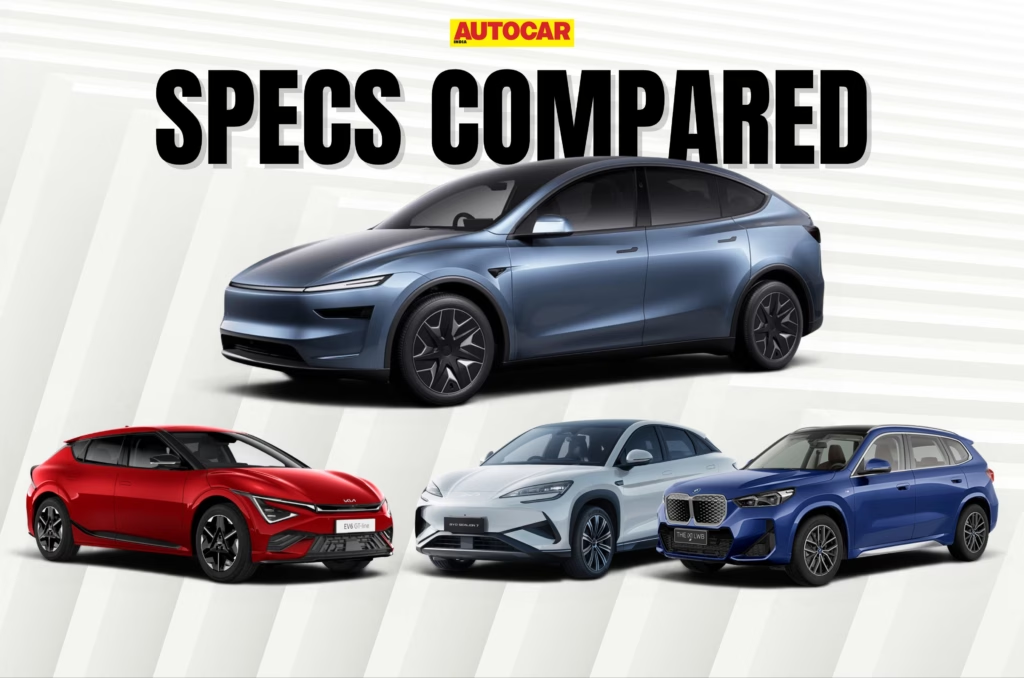
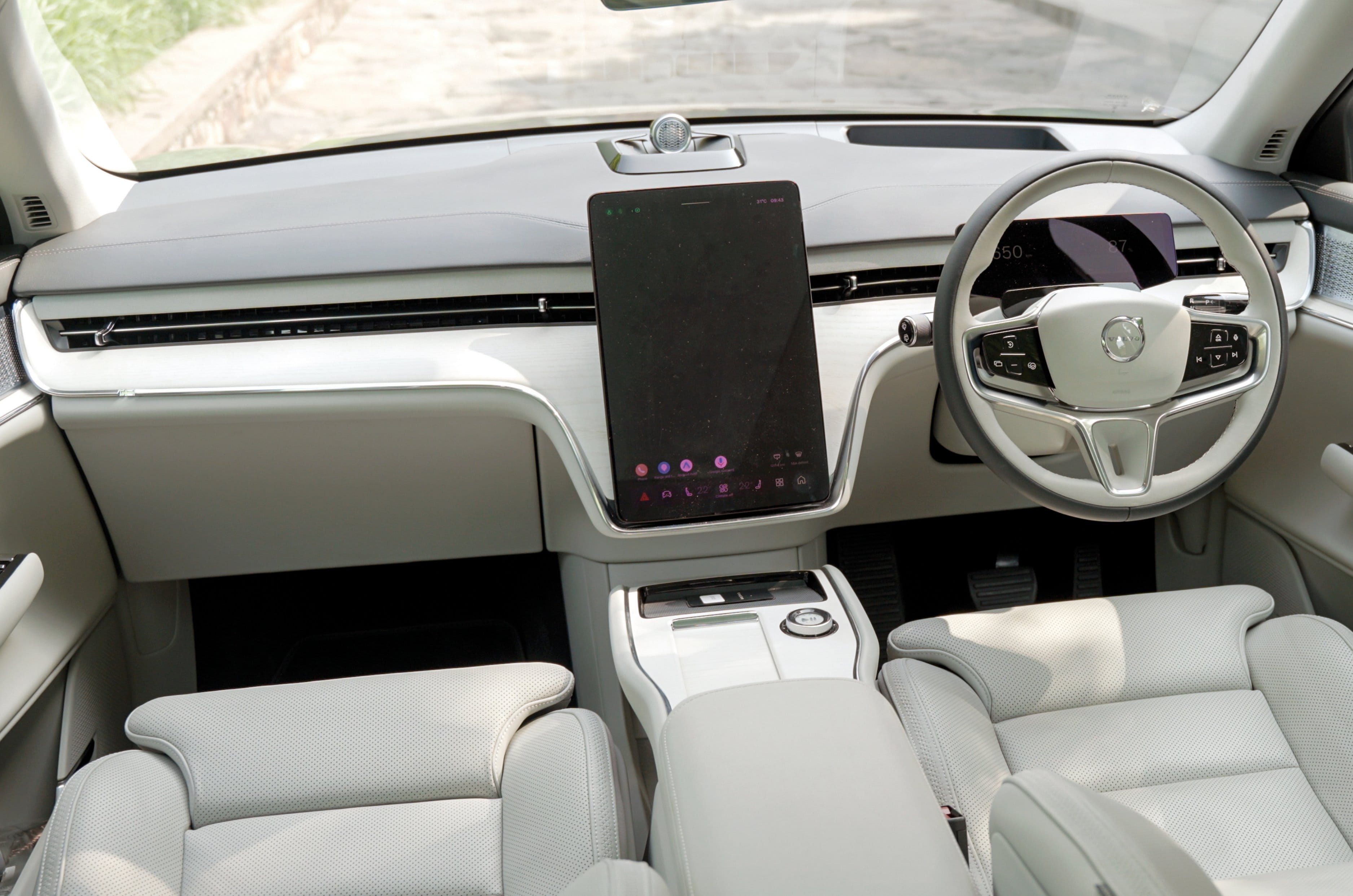
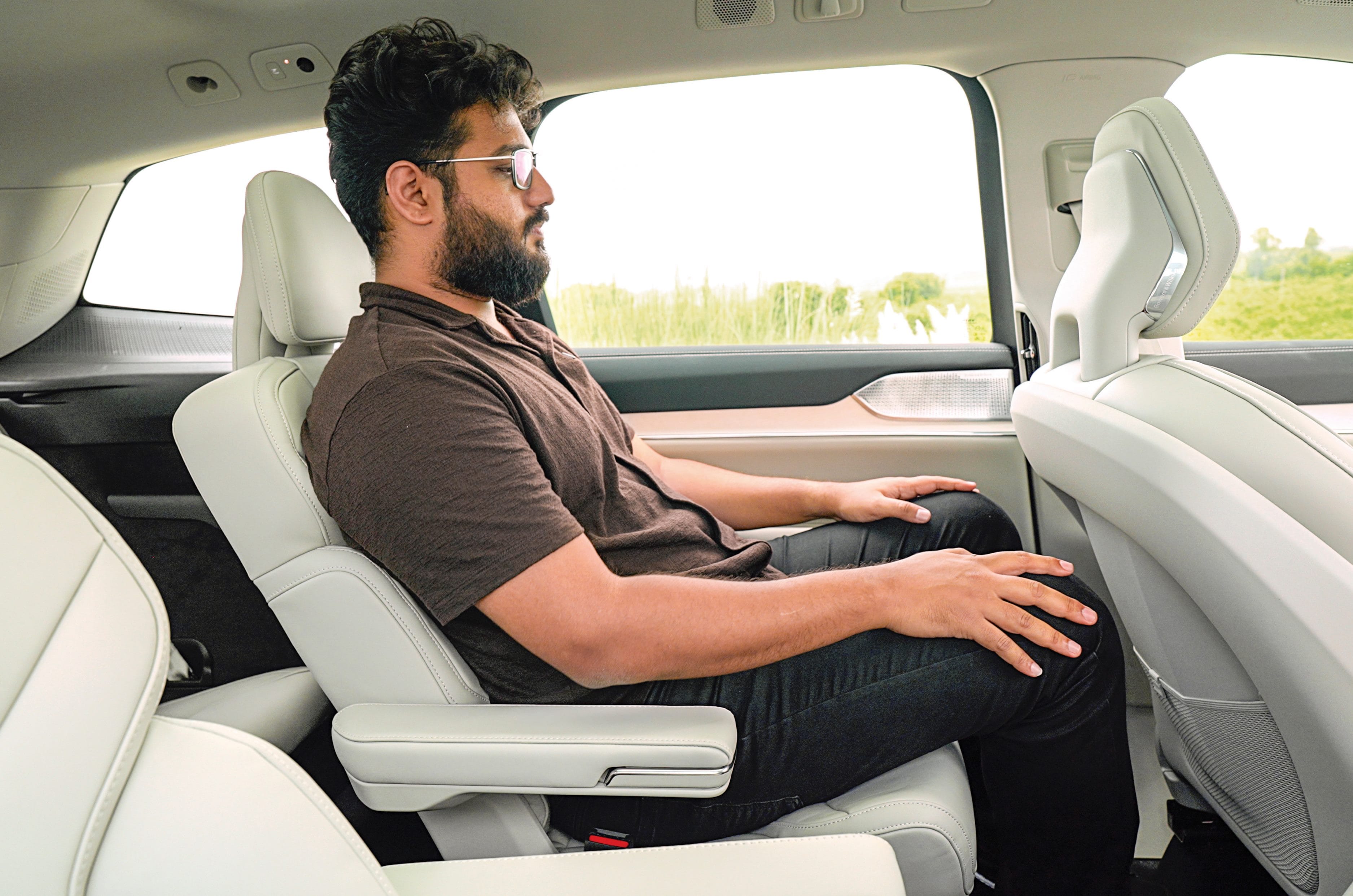
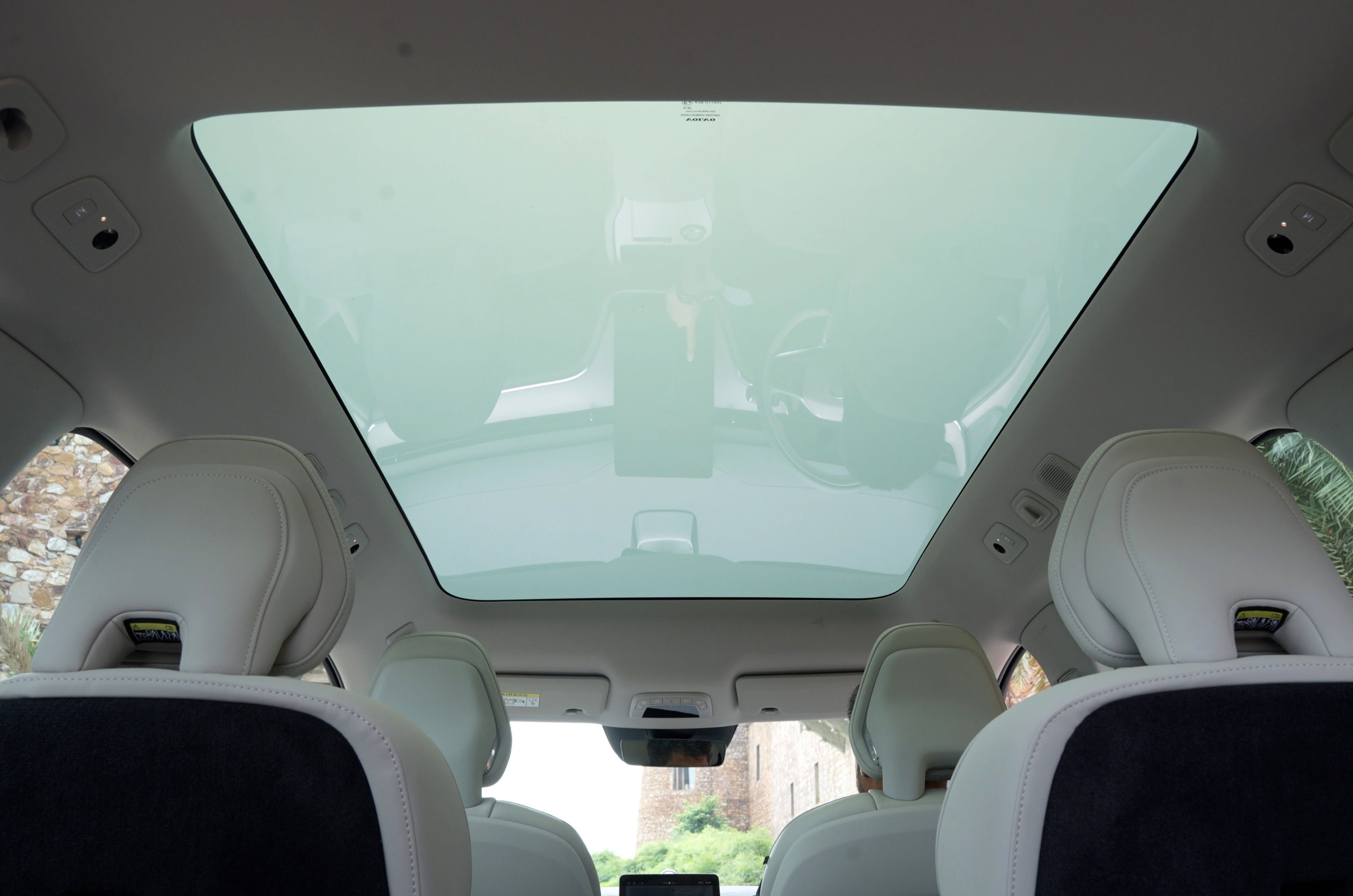
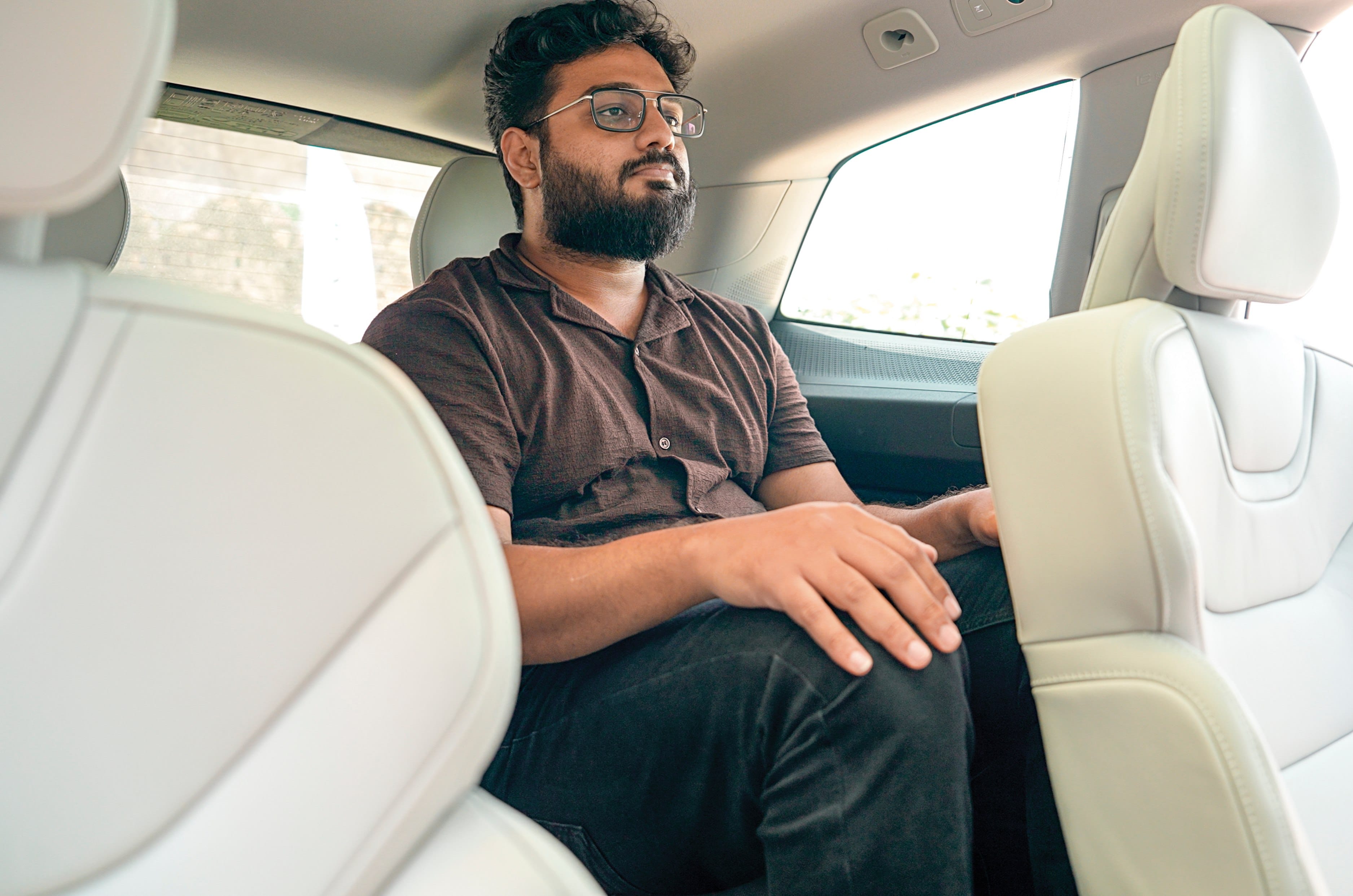
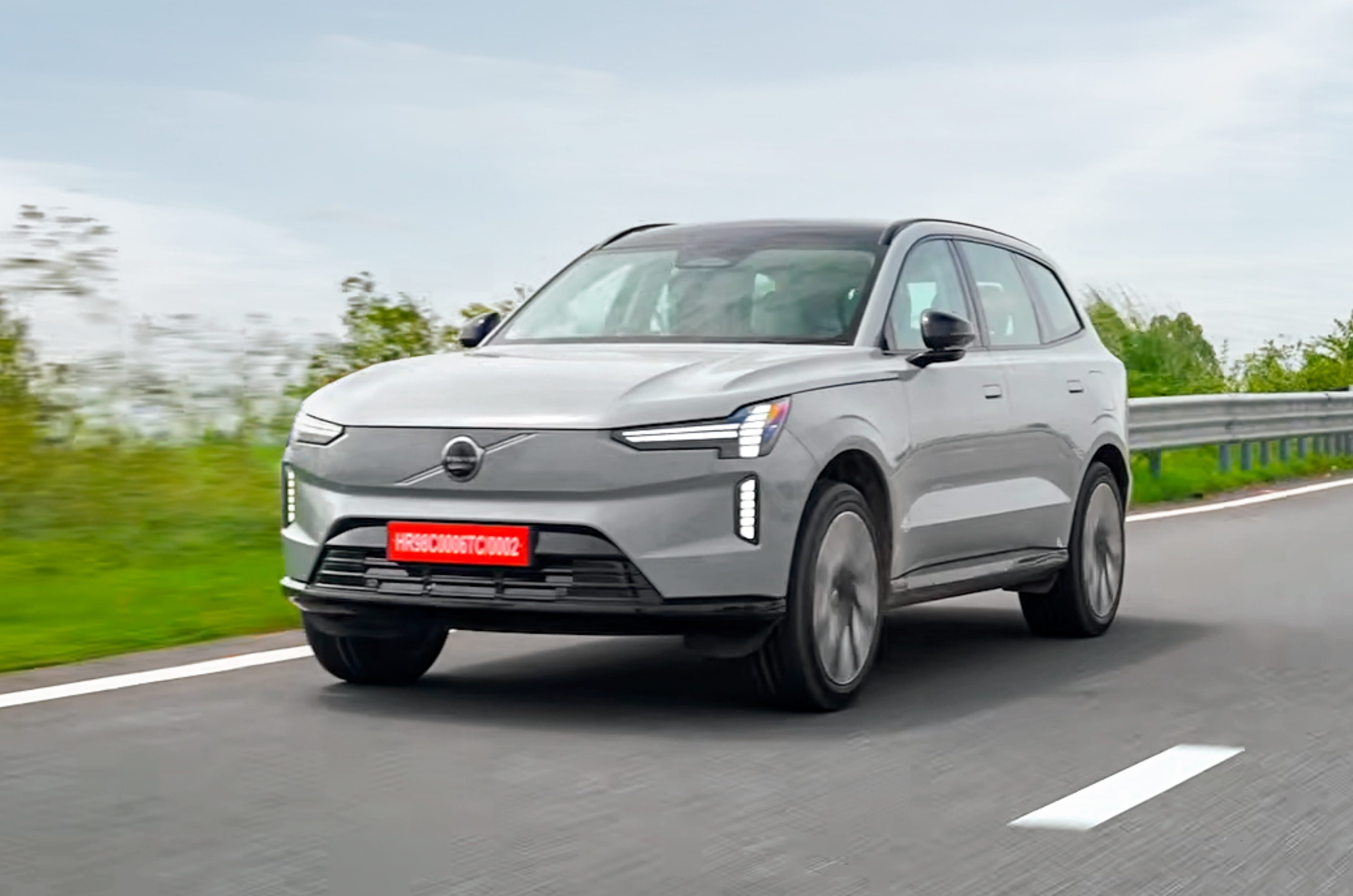
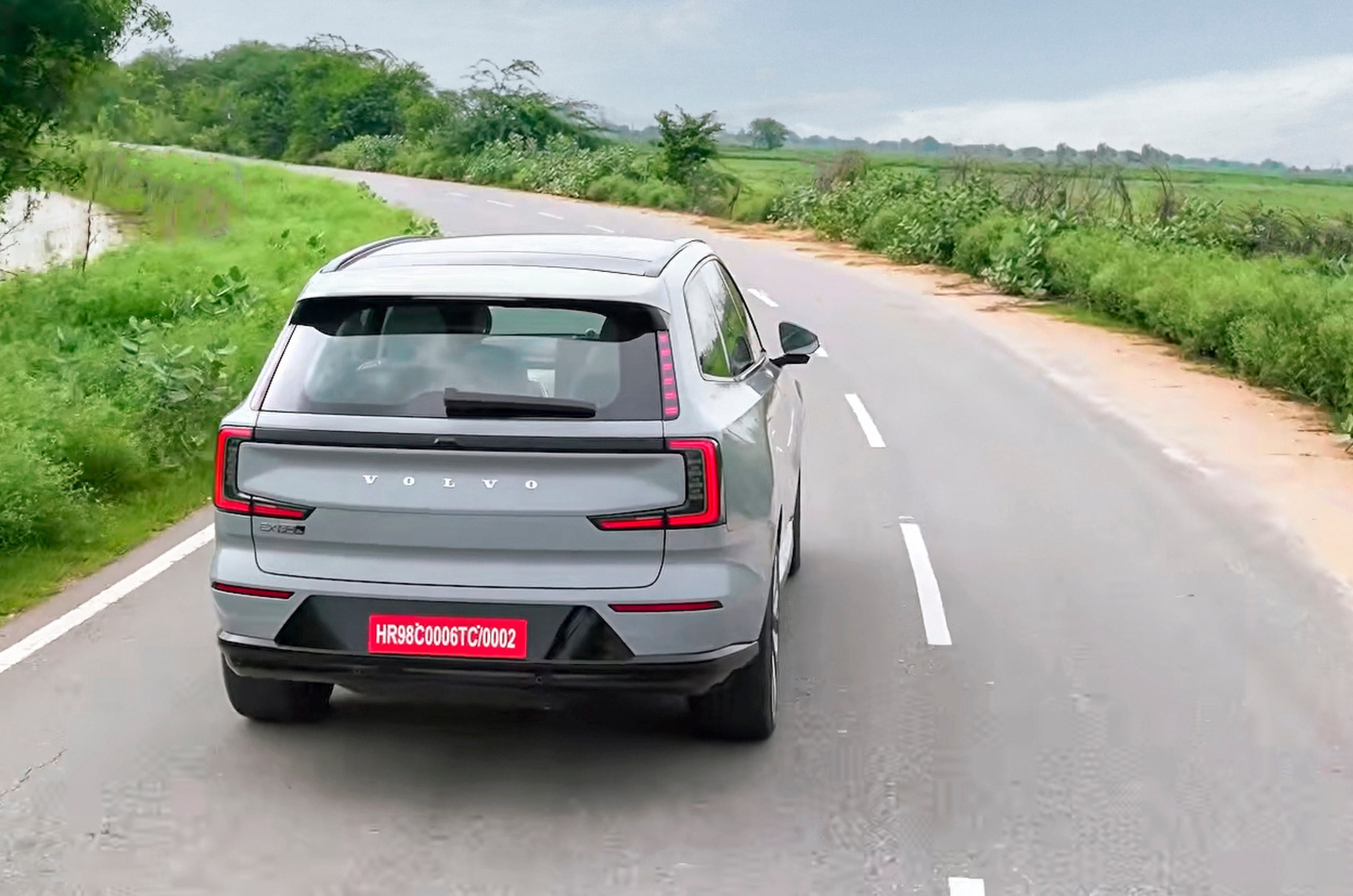
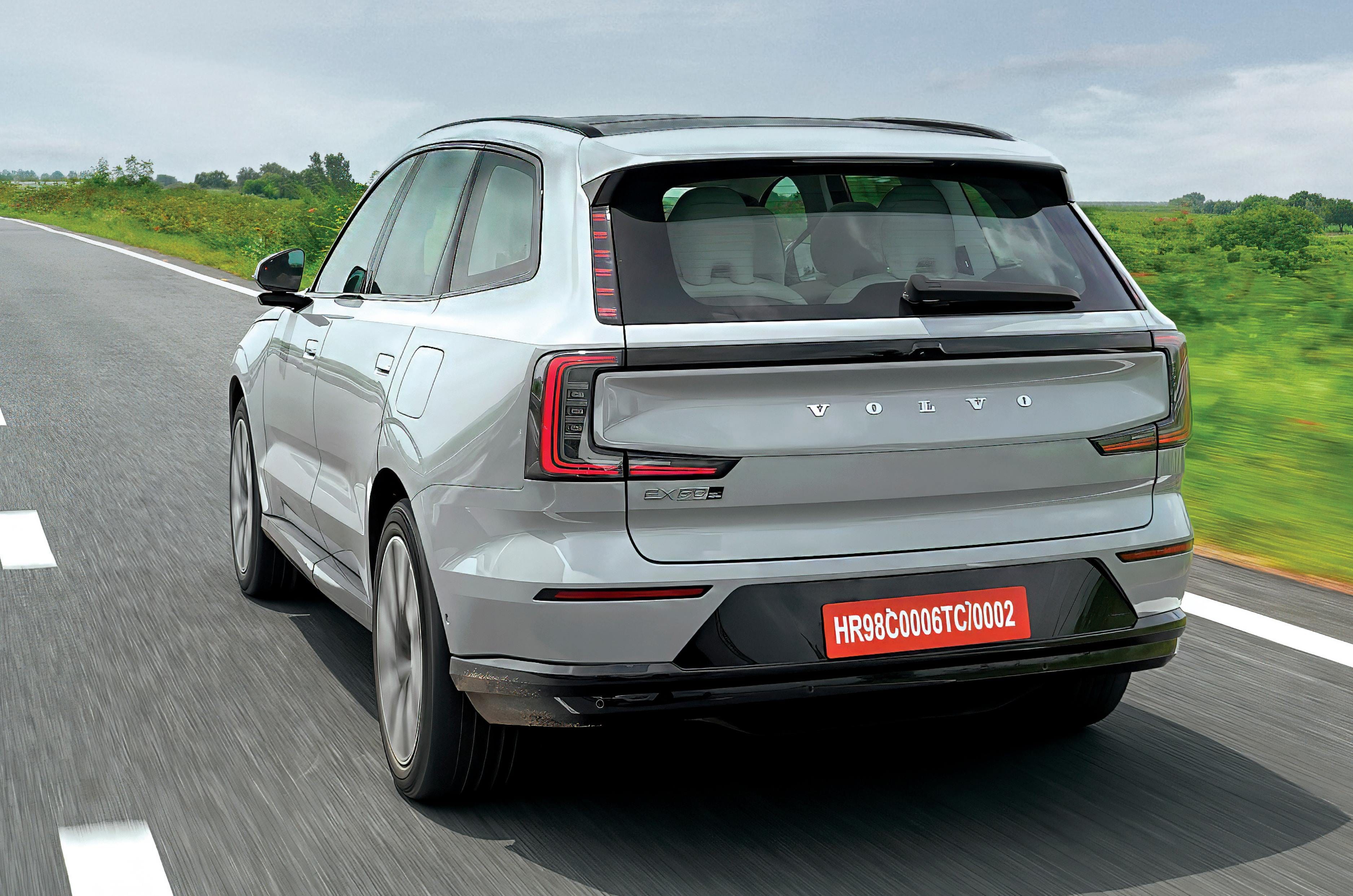
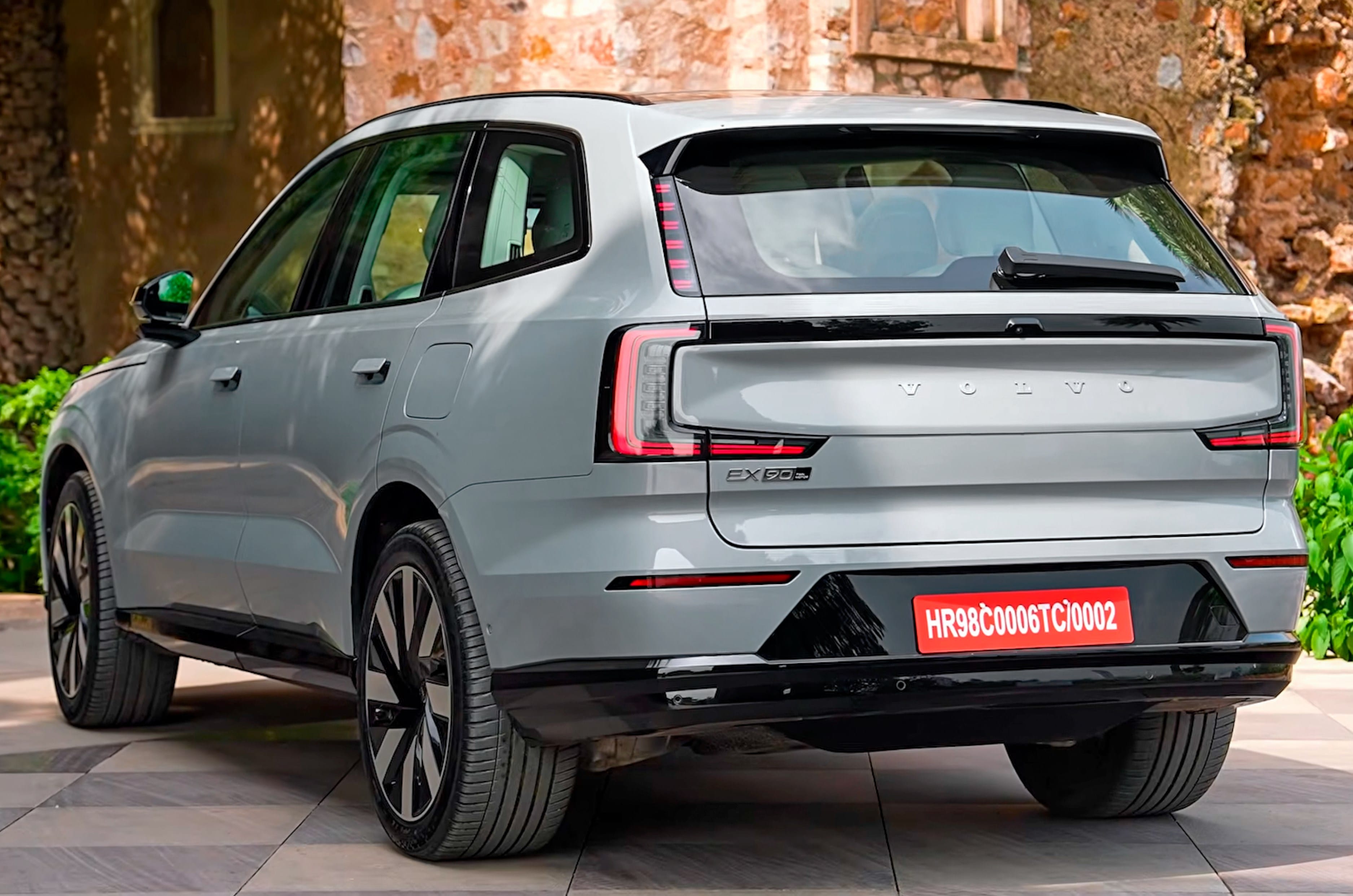
Tesla has launched a three-row long-wheelbase variant of the Model Y electric crossover in India. Christened the Model Y L, this new variant notably offers seating for up to six occupants, captain seats in the middle row and a stronger powertrain with a higher claimed range. Below, we lay out how the new Tesla Model Y L fares against its entry-level luxury EV rivals, namely the BYD Sealion 7, Kia EV6, BMW iX1 LWB, Volvo EC40 and Mini Countryman Electric on paper.
Tesla Model Y L vs rivals: Dimensions
Larger than rivals in every sense
Tesla Model Y L vs rivals: Dimensions compared
L / W / H (mm)
Wheelbase (mm)
Ground clearance (mm)
Frunk / Boot (litres)
Wheel size (inches)
Model Y L
4,976 / 1,982 / 1,668
3,040
169
116 / 420 (all seats up)
19
Sealion 7
4,830 / 1,925 / 1,620
2,930
170
58 / 500
19 / 20
iX1 LWB
4,616 / 1,845 / 1,627
2,800
190 (estimated)
– / 490
18
Countryman Electric
4,445 / 1,843 / 1,635
2,692
165
– / 460
19
EC40
4,440 / 1,873 / 1,591
2,702
171
31 / 404
19
EV6
4,695 / 1,890 / 1,570
2,900
–
20 / 490
19
The Model Y L beats its rivals in every dimension, and the Sealion 7 emerges as the second-biggest EV here overall. Tesla has slightly increased the Model Y L’s ground clearance vis-a-vis the standard wheelbase (SWB) version, though the iX1 LWB still rides the highest in this company. While the alloy wheel size remains unchanged for the Model Y L, it is mostly at par with rivals on this front.
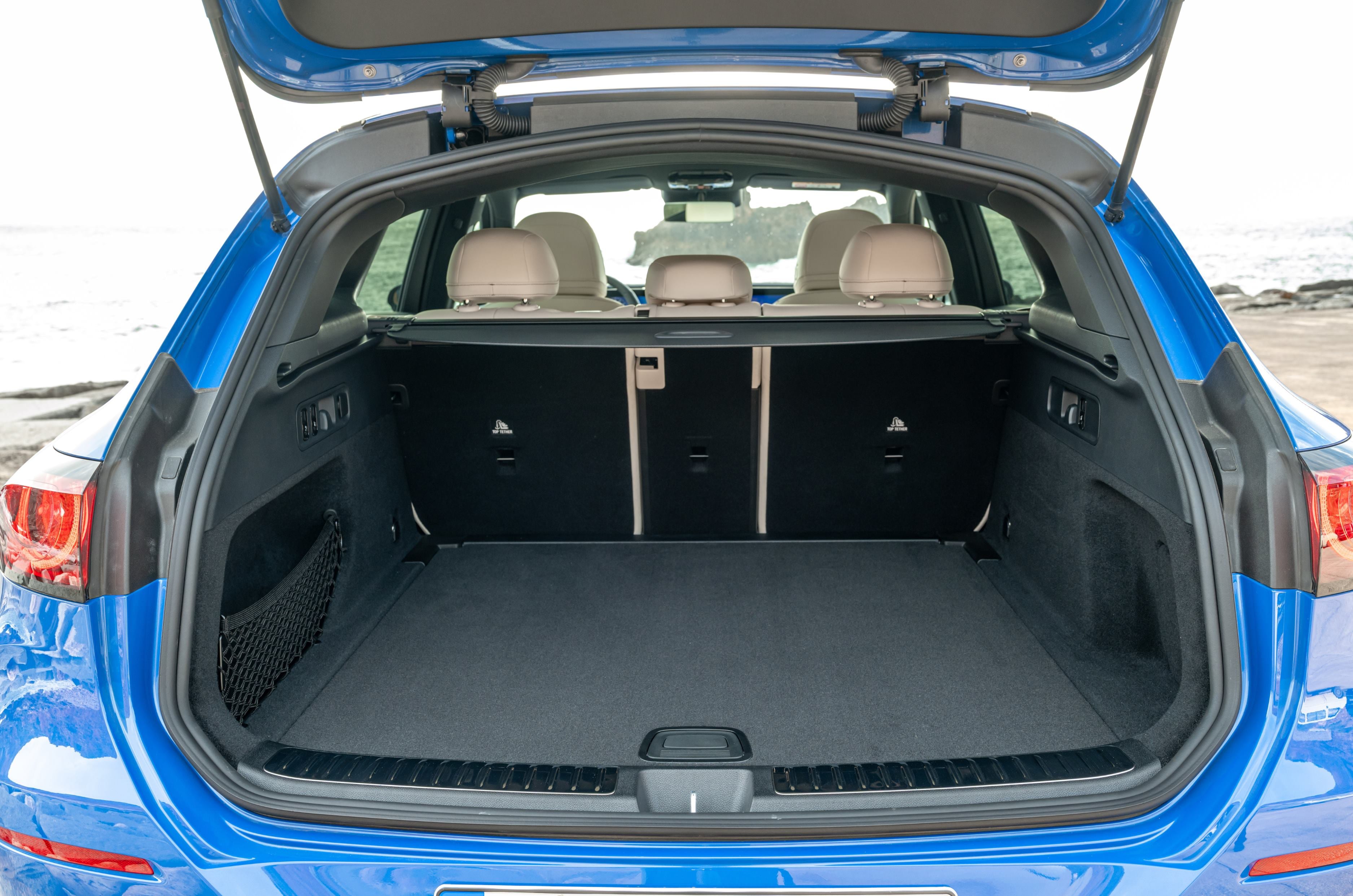
Coming to boot space, Tesla claims a cavernous 2,539-litre cargo capacity for the Model Y L with the second and third rows folded. With all three rows of seating up, the Model Y L has an estimated boot space of 420 litres, which grows to around 1,076 litres with the third row folded, and there’s a 116-litre frunk too. All told, the Model Y L offers significantly higher total cargo capacity than the 5-seater EVs it rivals.
Tesla Model Y L vs rivals: Powertrain and performance
Sealion 7 AWD is the strongest and quickest to 100kph
Tesla Model Y L vs rivals: Battery, power, performance compared
Model
Battery capacity (kWh)
Motor setup
Power (hp)
Drive layout
0-100kph (seconds)
Model Y L
88.2*
Dual
514*
AWD
4.5
Sealion 7
82.56
Single / Dual
313 / 530
RWD / AWD
6.7 / 4.5
iX1 LWB
66.5
Single
204
FWD
8.6
Countryman Electric
66.5
Single
204
FWD
8.6
EC40
78
Dual
408
AWD
4.7
EV6
84
Dual
325
AWD
5.3
*Estimated figures
In addition to the longer body, Tesla has fitted the Model Y L with an 88.2kWh battery pack (85kWh net), which is larger than that of the standard model. It also gets a more powerful dual-motor powertrain, making the Model Y L the first Tesla car to offer AWD in India. While the Model Y L has the biggest battery pack among its rivals, its power output falls a bit short of that of the Sealion 7 AWD.
Regardless, the Model Y L is the second-most powerful EV here by a considerable margin. As for claimed 0-100kph times, the Model Y L matches the Sealion 7 AWD, ranking above the EC40, iX1 LWB, and Countryman Electric.
Tesla Model Y L vs rivals: Range and charging speeds
Model Y L features the highest WLTP-tested range
Tesla Model Y L vs rivals: Range and charging speeds compared
Model
Battery capacity (kWh)
Claimed range (km)
DC fast charging time^
Model Y L
88.2*
681 (WLTP)
288km in 15 min
Sealion 7
82.56
480 / 460 (WLTP)
45 min
iX1 LWB
66.5
531 (MIDC)
32 min
Countryman Electric
66.5
462 (WLTP)
29 min
EC40
78
530 (WLTP)
27 min
EV6
84
581 (WLTP)
18 min
^10-80 percent state of charge (SOC)
*Estimated
Thanks to its larger battery pack, the Model Y L widens the WLTP range lead that the standard model already holds over its rivals. The Model Y L’s range is 100km ahead of the EV6’s, which ranks second, and a whopping 221km more than that of the Sealion 7 AWD, which has the lowest WLTP range of 460km here.
Charging speeds are difficult to compare head-to-head, as Tesla has only confirmed that the Model Y L’s battery can be charged at up to 250kW DC and that it can add 288km of range in just 15 minutes. Keeping the Model Y L aside, the EV6 has the lowest 10-80 percent DC charging time, followed by the EC40, Countryman Electric, iX1 LWB and Sealion 7.
Tesla Model Y L vs rivals: Price
Model Y L is more affordable than the top-spec SWB version
Tesla Model Y L vs rivals: Prices compared
Price range (Rs lakh)
Model Y L
61.99
Sealion 7
49.40-54.90
iX1 LWB
51.40
Countryman Electric
55.65-60.70
EC40
59.00
EV6
65.96
Even though the Model Y L is larger, can accommodate more occupants and offers a stronger powertrain with a higher claimed range, it’s impressively priced at around Rs 6 lakh less than the top-spec Model Y Long Range RWD. That makes the Model Y L more affordable than the EV6, the priciest EV here, but costlier than the Sealion 7, Countryman Electric, iX1 LWB and EC40.
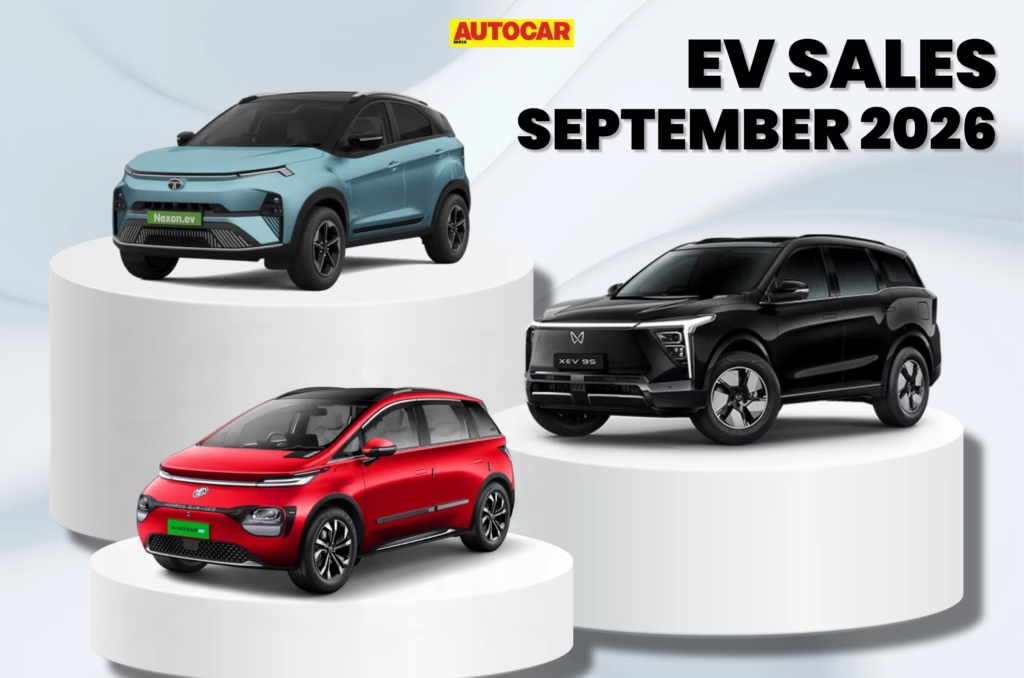
Retail sales of electric passenger vehicles reached a new monthly high of 35,995 units in September 2026, up 94 percent from the same month last year and marking the fourth consecutive month with sales above 30,000 units. Tata Motors retained the top spot with 14,769 units and a 41 percent market share, while Kia moved ahead of Maruti Suzuki to take fifth place. H1 FY2027 EV sales now stand at 1,90,946 units, up 88 percent year on year, putting the industry within 29,971 units of the full-year FY2026 tally.
September 2026 EV sales
Rank
OEM
Sep 2026
Sep 2025
YoY change
Market share
1
Tata Motors
14,769
7,353
101%
41.03%
2
Mahindra & Mahindra
7,779
3,972
96%
21.61%
3
JSW MG Motor India
5,242
4,800
9%
14.56%
4
Vinfast India
2,963
6
49,283%
8.23%
5
Kia India
1,263
598
111%
3.50%
6
Maruti Suzuki India
1,103
–
–
3.06%
7
BYD India
836
732
14%
2.32%
8
Hyundai Motor India
792
404
96%
2.20%
9
BMW India
502
369
36%
1.39%
10
Tesla
291
69
322%
0.80%
11
Toyota Kirloskar Motor
218
–
–
0.60%
12
Mercedes-Benz India
125
137
-9%
0.34%
13
Stellantis India
55
47
17%
0.15%
14
Volvo India
45
24
88%
0.12%
15
Porsche India
11
8
38%
0.03%
16
JLR India
1
0
–
0.00%
17
Audi India
0
0
–
0.00%
18
Lotus
0
0
–
0.00%
19
Rolls-Royce
0
1
-100%
0.00%
Total
35,995
18,520
94%
100%
Tata Motors
14,769 units, up 101 percent YoY
Tata Motors sold 14,769 electric passenger vehicles in September, up 101 percent from 7,353 units in the same month last year. This was the company’s highest monthly EV sales yet, surpassing the previous record of 14,388 units in July. September was also its fourth consecutive month with sales above 12,000 units.
Tata’s EV market share stood at 41.03 percent, up from 39.70 percent in September 2025. The Nexon EV remains its biggest volume driver, while the updated Tiago EV and Punch EV have also contributed to sales. During the month, Tata also extended its Battery-as-a-Service (BaaS) offering to the Nexon EV, Curvv EV, Sierra EV and Harrier EV.
Mahindra
7,779 units, up 96 percent YoY
Mahindra sold 7,779 EVs in September, up 96 percent from 3,972 units a year ago. The company retained second place in the electric PV market, although its sales remained below the monthly record of 8,131 units set in July. Mahindra’s EV market share increased to 21.61 percent from 21.44 percent in September 2025. The BE 6 and XEV 9e continue to make up its main EV offering, while the XEV 9S adds a three-row model to the line-up. Mahindra also recently extended its Battery-as-a-Service (BaaS) ownership programme to the XEV 9S and the XEV 9e.
JSW MG Motor
5,242 units, up 9 percent YoY
JSW MG Motor recorded 5,242 EV sales in September, up 9 percent from 4,800 units a year earlier and 6 percent from August. The company retained third place, although its market share fell to 14.56 percent from 25.91 percent in September 2025.
June remains MG’s best month so far, with 6,220 units. The Windsor EV continues to be its highest-selling model, while the recently launched Hector Tomahawk EV adds another model to its electric line-up. MG also has introduced a battery-as-a-service (BaaS) scheme for the Cyberster and M9 EVs.
Vinfast
2,963 units, up 49,283 percent YoY
Vinfast retained fourth place with 2,963 EVs sold in September, its highest monthly sales since entering India’s electric passenger vehicle market. Sales were up 32 percent from August, giving the company an 8.23 percent market share.
Vinfast currently has three models in its passenger vehicle portfolio: the VF6 and VF7 SUVs, and the VF MPV 7. Its cumulative H1 FY2027 sales stand at 10,826 units.
Kia
1,263 units, up 111 percent YoY
Kia moved ahead of Maruti Suzuki to take fifth place in September after recording 1,263 EV sales, up 111 percent from 598 units in September 2025. Sales also increased 48 percent from August’s 851 units. Kia’s EV market share increased to 3.50 percent, compared with 3.22 percent a year earlier. The increase follows the launch of the Syros EV in August. Kia also sells the Carens Clavis EV in India, while the EV6 and EV9 are sold as fully imported models.
Maruti Suzuki
1,103 units
Maruti Suzuki slipped to sixth place, with 1,103 e Vitara units sold in September. Sales declined 25 percent from August’s 1,472 units, although September marked the company’s sixth consecutive month with four-digit EV sales. The e Vitara has so far seen limited domestic availability as a larger share of production was allocated for exports. Maruti is expected to increase domestic production with the start of operations at its new manufacturing line at the Hansalpur plant in Gujarat.
BYD
836 units, up 14 percent YoY
BYD sold 836 EVs in September, up 14 percent from 732 units in the same month last year. Its market share stood at 2.32 percent, down from 3.95 percent a year earlier. June remains BYD India’s highest-selling month so far, with 938 units. Its current line-up includes the Atto 3, eMax 7, Seal and Sealion 7, while the company has confirmed plans to launch the Seal U later this year.
Hyundai
792 units, up 96 percent YoY
Hyundai sold 792 EVs in September, up 96 percent from 404 units a year ago. This was its second-highest monthly sales tally in FY2027, after 840 units in August. The company sold a total of 3,650 EVs in H1 FY2027, down 8 percent from the 3,951 units sold in H1 FY2026. Hyundai currently has the Creta Electric and Ioniq 5 in its EV line-up.
Toyota
218 units
Toyota recorded 218 units of the Urban Cruiser Ebella in September, its highest monthly sales of the electric SUV since launch. Sales were up 30 percent from the 168 units sold in August. The Ebella is Toyota’s version of the Maruti e Vitara and is positioned against models including the Mahindra BE 6, Vinfast VF6, MG ZS EV, Hyundai Creta Electric and Tata Nexon EV.
Luxury EV sales hit new high
Luxury electric passenger vehicle sales also reached a new monthly high of 975 units in September, up 60 percent from 608 units a year earlier. This surpassed the previous record of 853 units set in June. Luxury EVs accounted for 2.70 percent of total electric passenger vehicle sales in September.
BMW
502 units, up 36 percent YoY
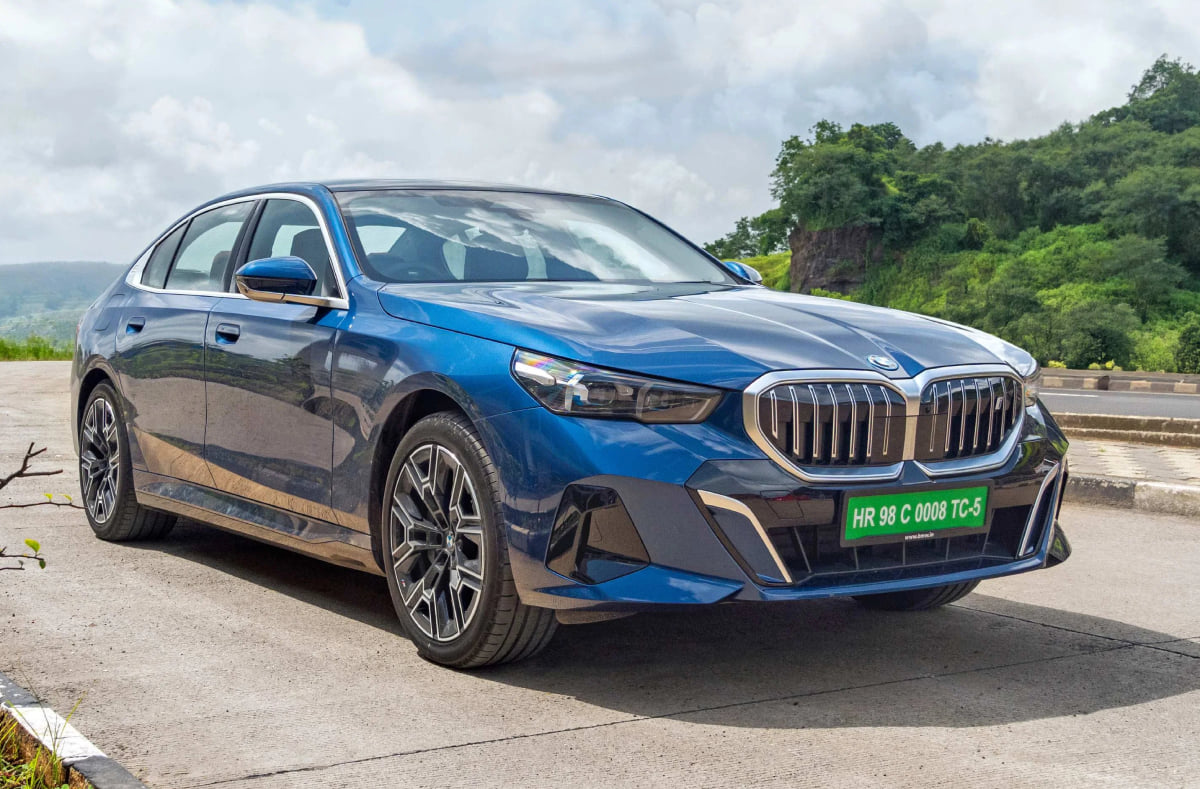
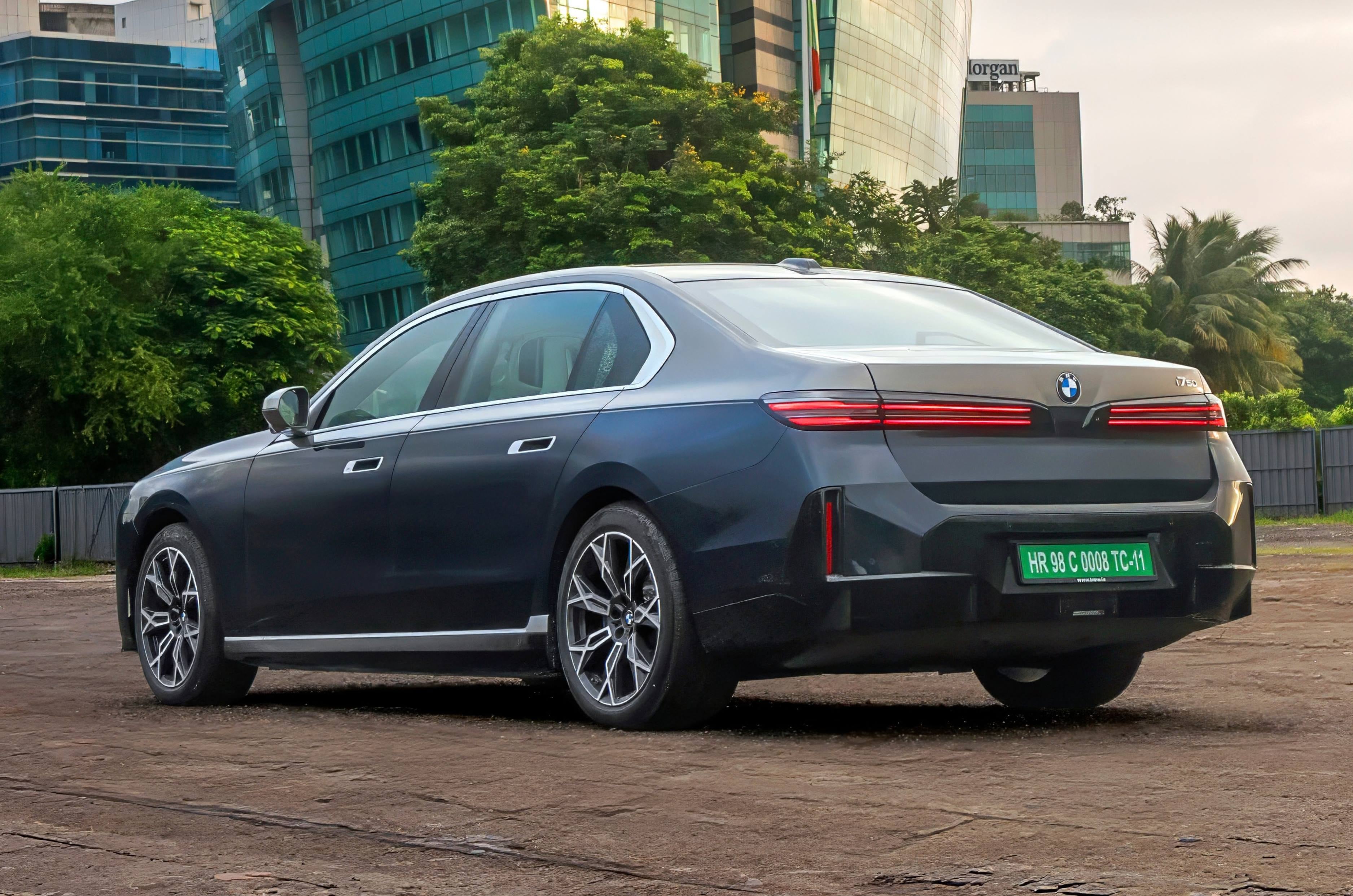
BMW remained the largest luxury EV seller in September with 502 units, up 36 percent from 369 units a year earlier. Its market share stood at 51.48 percent, down from 60.69 percent in September 2025. BMW recently expanded its electric line-up with the i5 Long Wheelbase, which was launched in India in September at Rs 79.6 lakh. It is the company’s first locally produced electric sedan in India. BMW has also recently updated the i7 range, with 50 xDrive M Sport trim and the top-spec M70 xDrive.
Tesla
291 units, up 322 percent YoY
Tesla recorded 291 units in September, its highest monthly sales in India, up 322 percent from 69 units a year earlier. The increase moved Tesla ahead of Mercedes-Benz and into second place in the luxury EV segment for the first time. Its segment share rose to 29.84 percent from 11.34 percent in September 2025.
Mercedes-Benz
125 units, down 9 percent YoY
Mercedes-Benz sold 125 EVs in September, down 9 percent from 137 units in the same month last year. Its share of the luxury EV segment fell to 12.82 percent, from 22.53 percent a year earlier. The company’s highest monthly EV sales this year came in June, when it recorded 245 units.
Volvo
45 units, up 88 percent YoY
Volvo recorded 45 EV sales in September, up 88 percent from 24 units a year earlier. Its market share increased to 4.61 percent, from 3.94 percent in September 2025.
Porsche
11 units, up 38 percent YoY
Porsche sold 11 EVs in September, up 38 percent from eight units in September 2025. It accounted for 1.12 percent of luxury EV sales during the month.
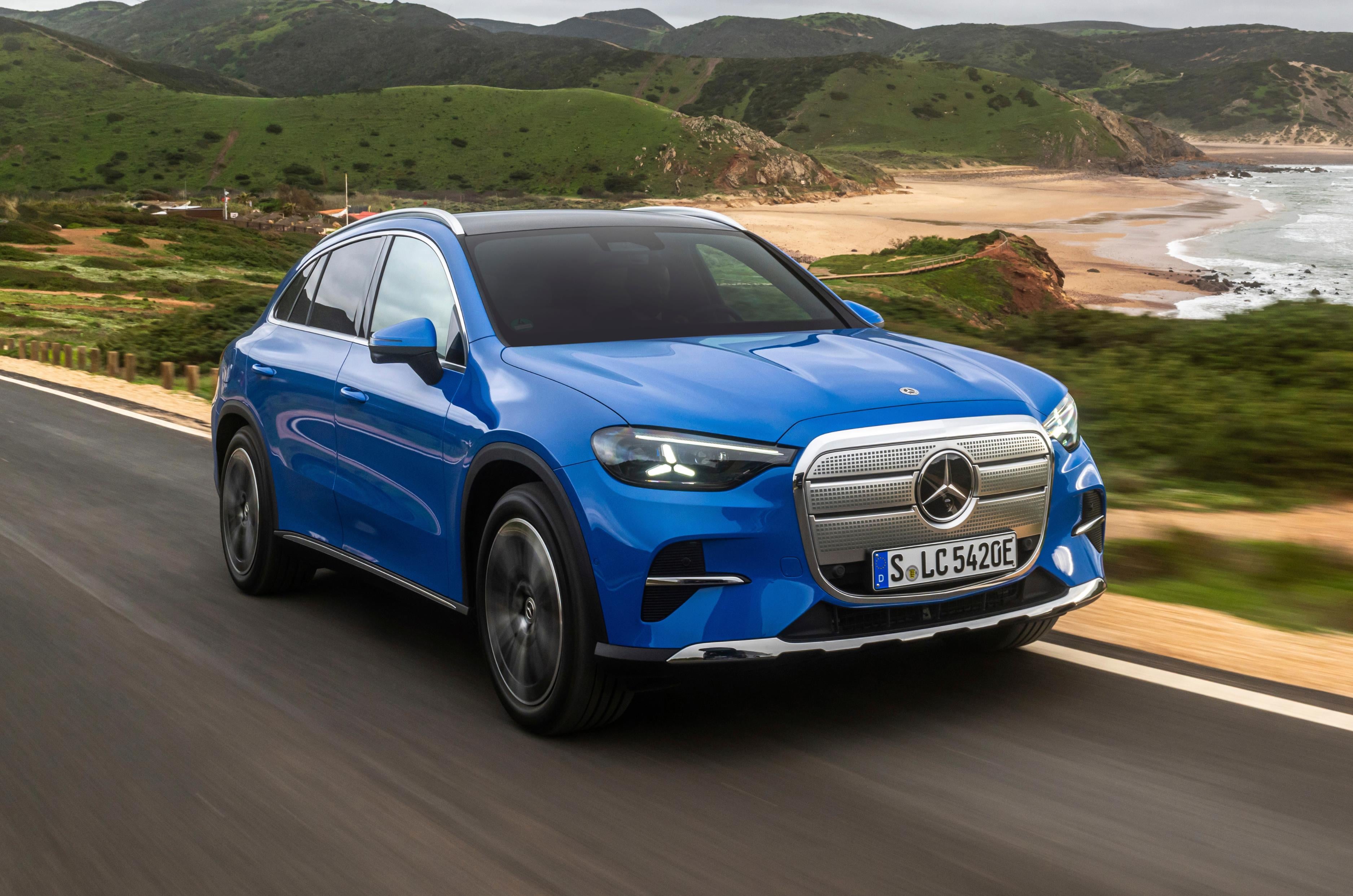
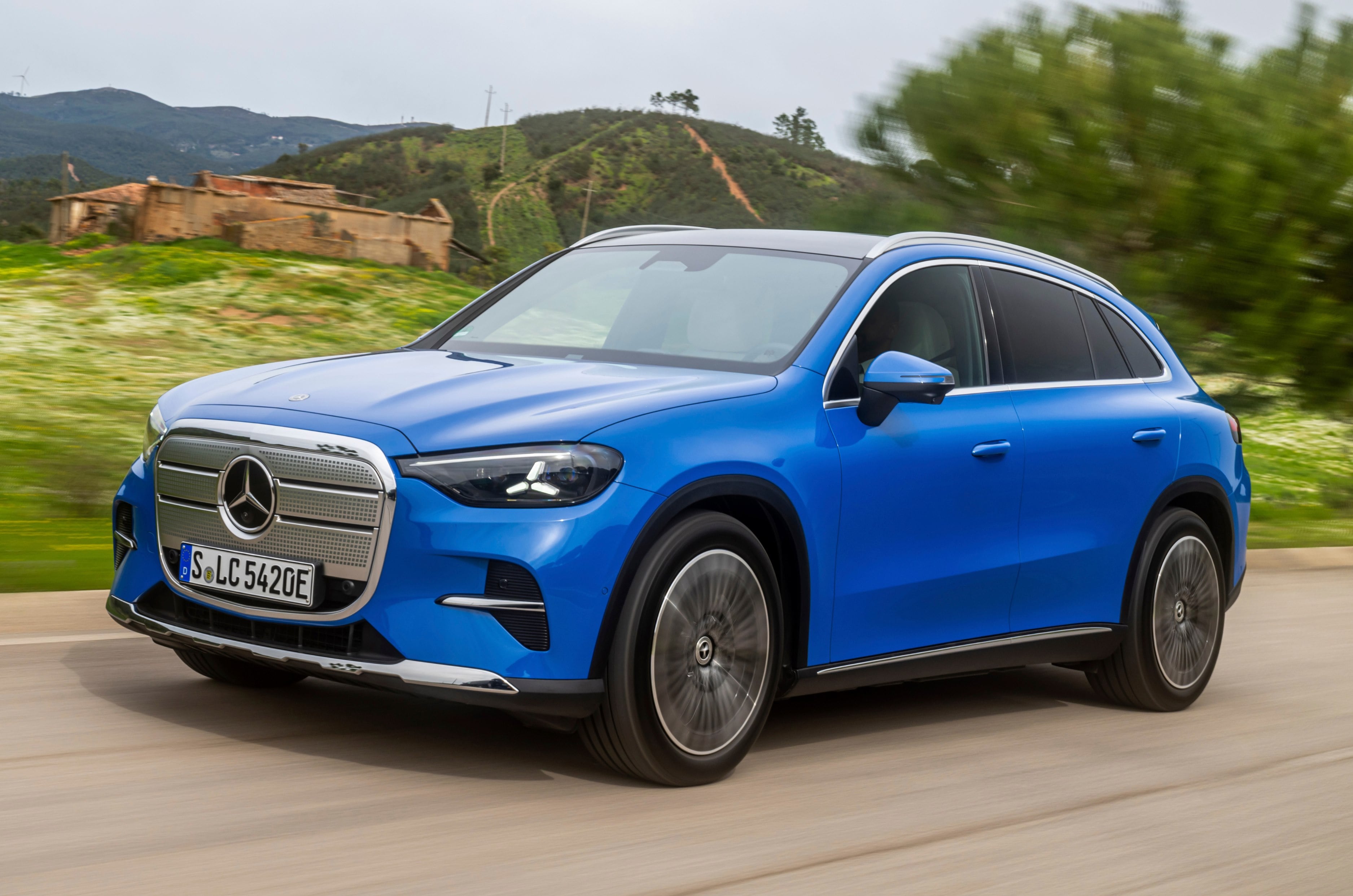
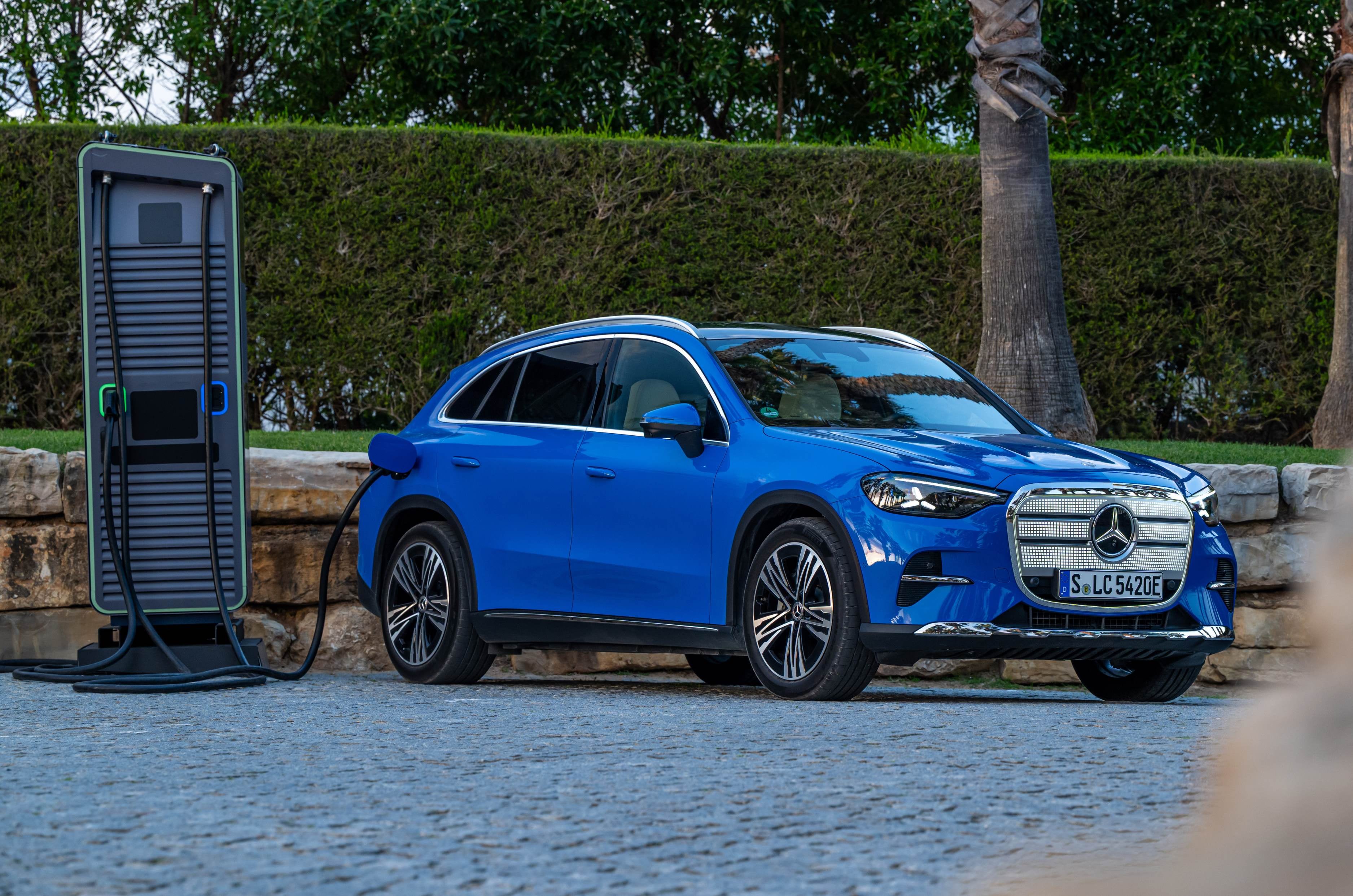
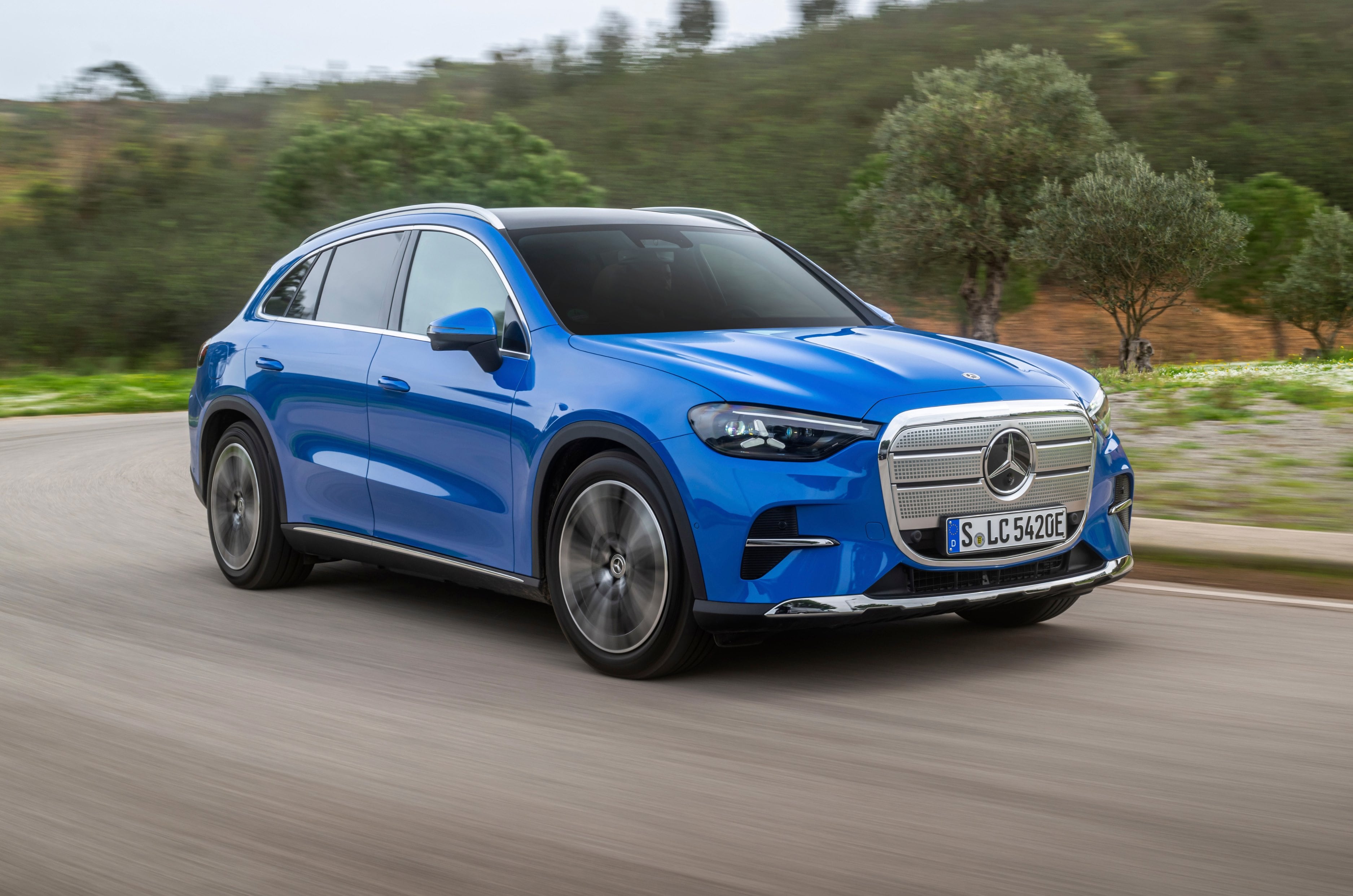
The Mercedes-Benz GLC EV you see here is not merely an electric derivative of the GLC you and I are familiar with. It’s built on an all-electric platform, and it’s longer, wider, and built on a slightly larger wheelbase than the GLC. And it also does 0-100kph in just 4.3 seconds.
The big news is that it’s coming to India by the end of the year. There’s lots to talk about, so let’s go one by one.
Mercedes-Benz GLC EV Exterior Design and Engineering – 8/10
Large new grille reminiscent of older Mercs
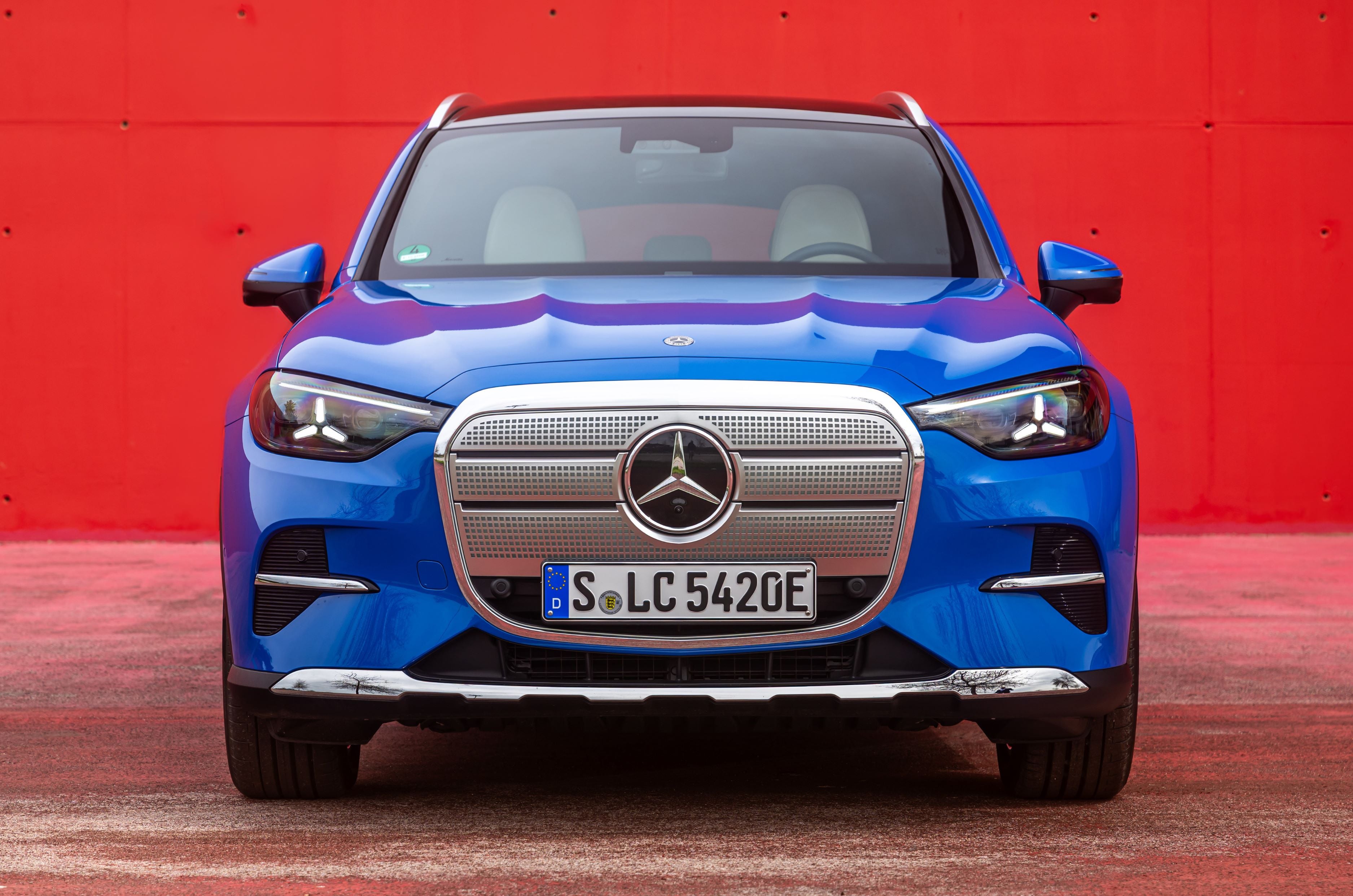
Let’s talk styling first, and what catches your attention up front is this large new grille. It’s very different from what we’ve seen of Mercs of late, but it actually has a link to Mercs of old. The upright grille is styled to look like the one on iconic models like the W112 S-Class, but there’s a lot of modernity built into it as well. There are 942 lighting elements in it! Talking of lighting, the three-pointed star on the nose glows and there’s a tri-star DRL pattern in the headlights too. And unlike other Merc EVs from the (recent) past, there is a functional frunk with a handy 129 litres of space.
Gets an 84mm longer wheelbase than the ICE version.
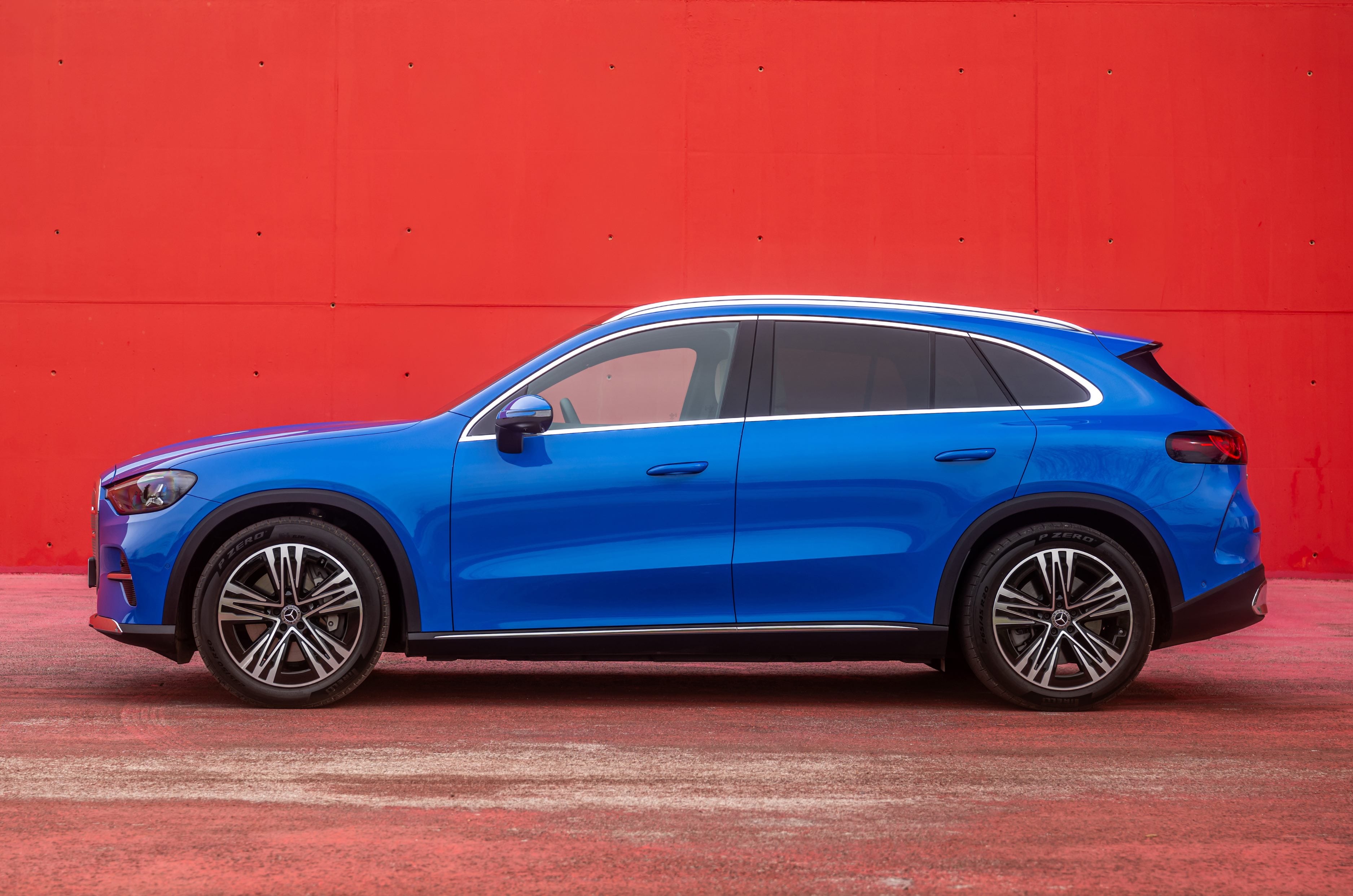
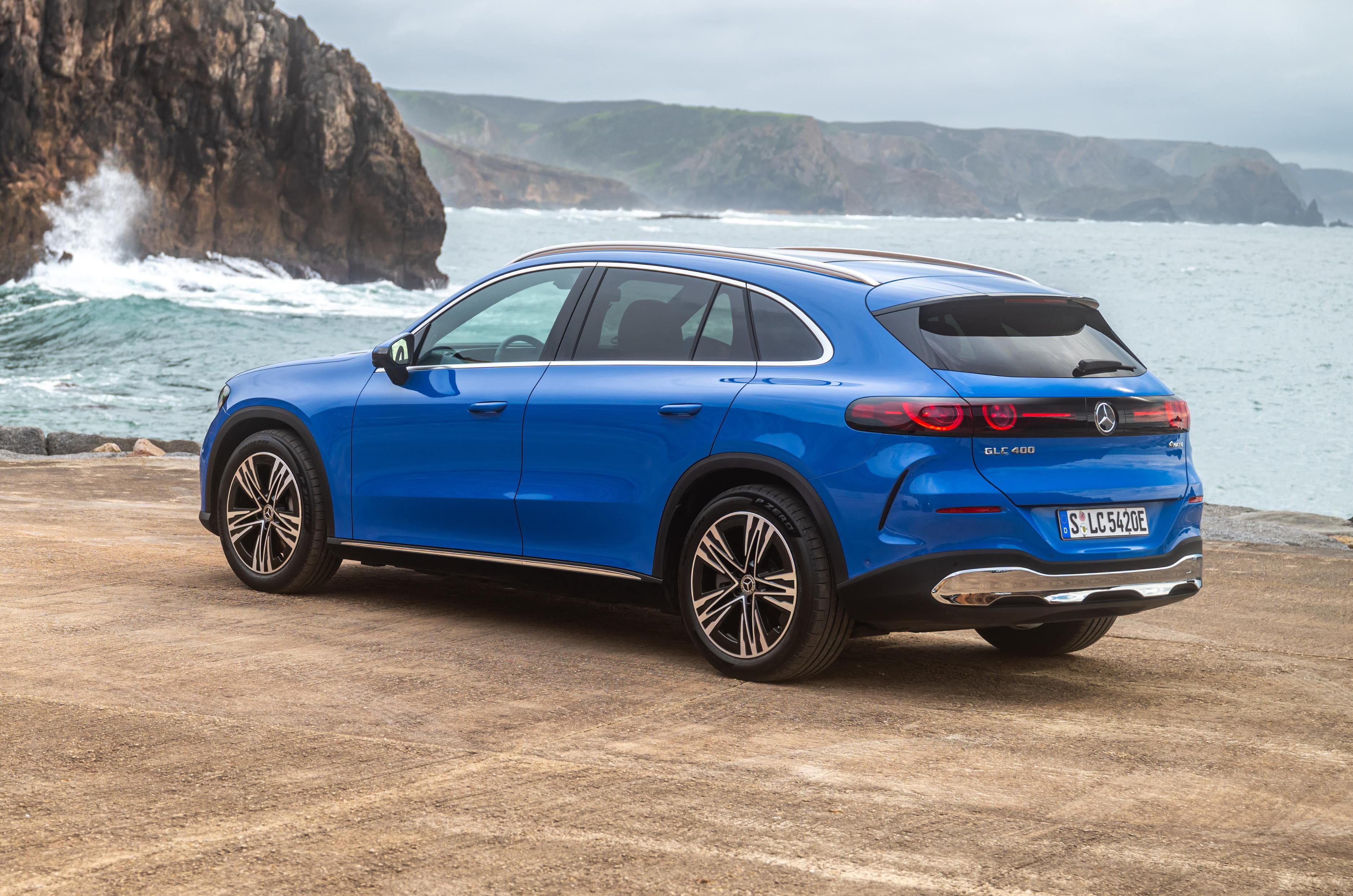
The GLC EV doesn’t look all too different to the ICE GLC in profile. Which is to say it is not an upright SUV but curvy, low-slung and aerodynamic. What is noticeably different is the wheelbase, which is a full 84mm longer. Mind you, this is the standard wheelbase GLC EV. There’s a long-wheelbase version sold in markets like China. India will get the GLC with 20-inch rims and flush-fitted door handles that pop out when the doors are unlocked.
570-litre boot is spacious, but a caveat is the absence of a spare wheel.
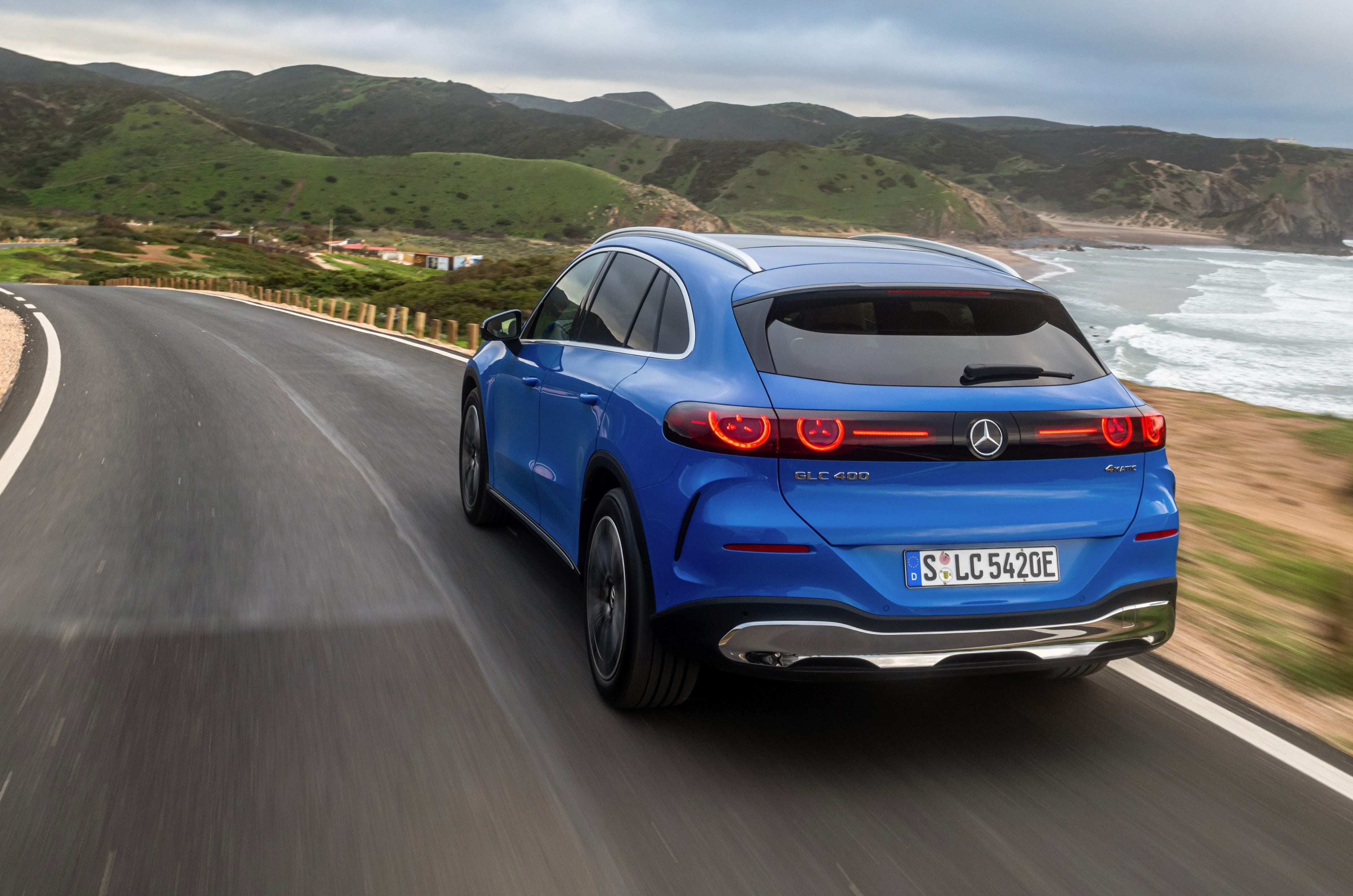
Styling at the back is quite distinct from the other lot of Mercedes SUVs, and that’s thanks to a band of black that runs the width of the tailgate. There’s full-LED lighting at the back replete with three-pointed star light signatures.
The powered tailgate opens up to a 570-litre luggage area, which is quite sizable. The only catch is that there’s no space for a spare tyre. Mercedes India will probably have to provide one to sit on the boot floor, which means not much space will be left for luggage.
Before we proceed, I have to admit, I didn’t like what I saw of the GLC EV in pictures. In reality, it is eye-catching, and in a very good way.
Mercedes-Benz GLC EV Interior Space and Comfort – 8/10
Interior quality is impressive, with open-pore wood trim while physical steering knobs and AC vents have a tactile feel
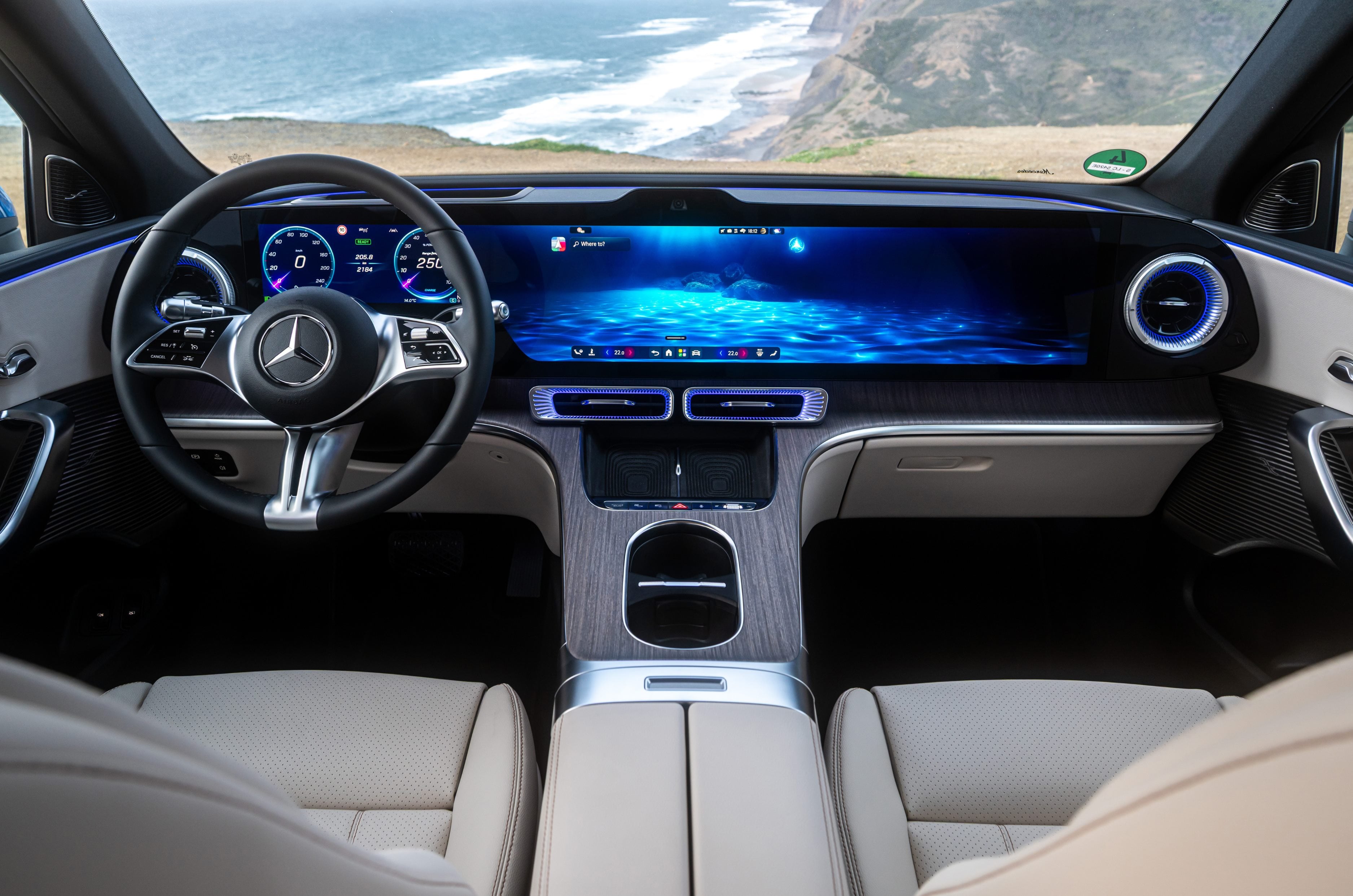
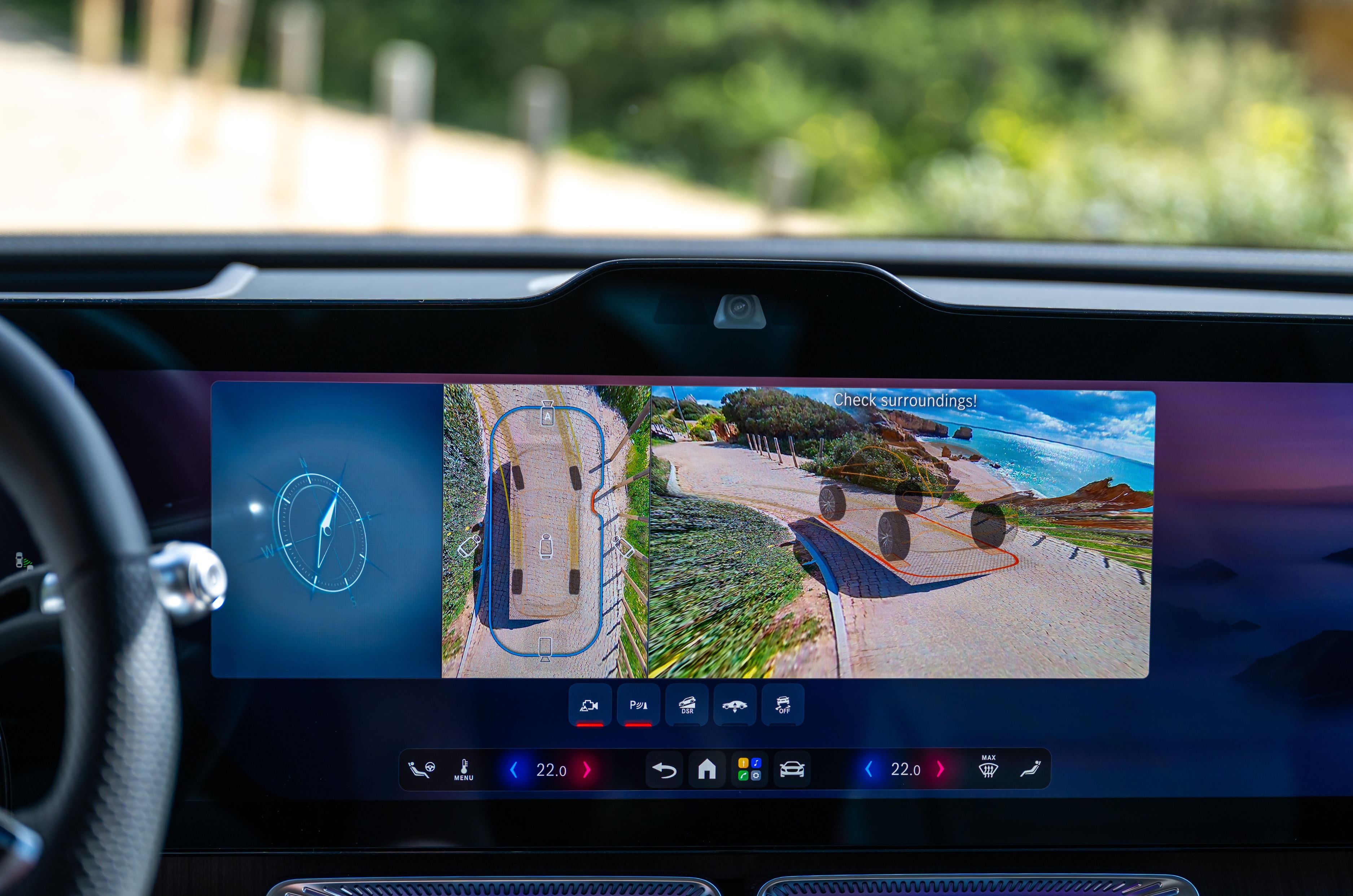
That new-age Mercedes vibe continues inside too, and that feeling is all thanks to a 39-inch Hyperscreen that extends nearly the entire width of the dash. There’s a seamless connection between the digital instrument cluster, the centre touchscreen and front passenger display, and it does look really impressive. That being said, the screens have taken away some of the warmth that you’d expect in a Merc.
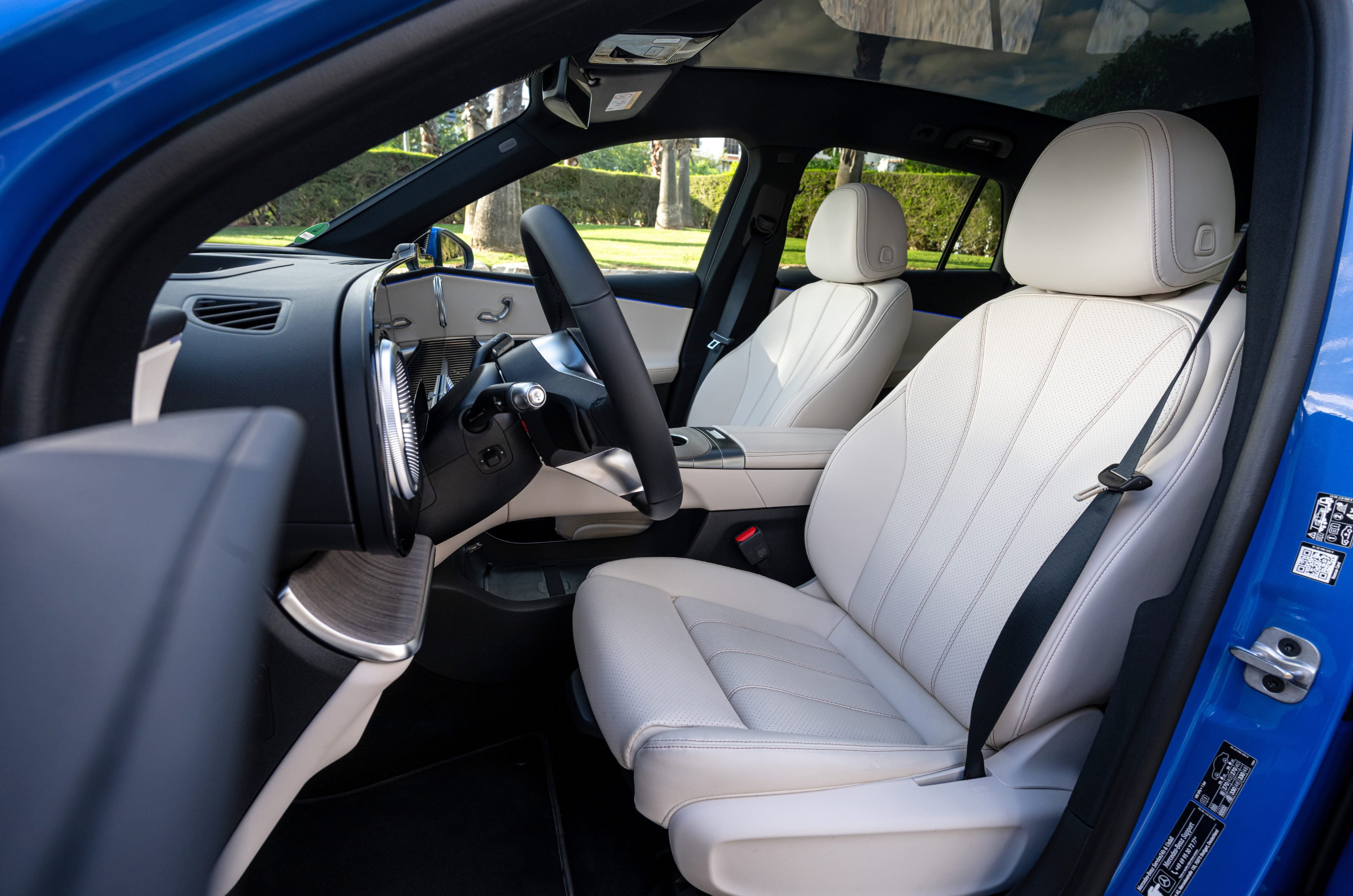
Comfy front seats come with various levels of adjustment, massage and heating. India-spec model expected to come with a cooling function.
In terms of quality, though, the GLC EV feels like an expensive Mercedes. There’s open-pore wood, the AC vents operate with very satisfying clicks and clacks, and physical rotary controllers make a welcome comeback to the steering wheel.
The front seats are as comfy as they look, with multi-way powered adjustment, massage and heating. We expect the model for India to pack in ventilation as well.
You get more space than the standard GLC, and unlike some EVs, you do get good foot room. However, it’s best suited for two.
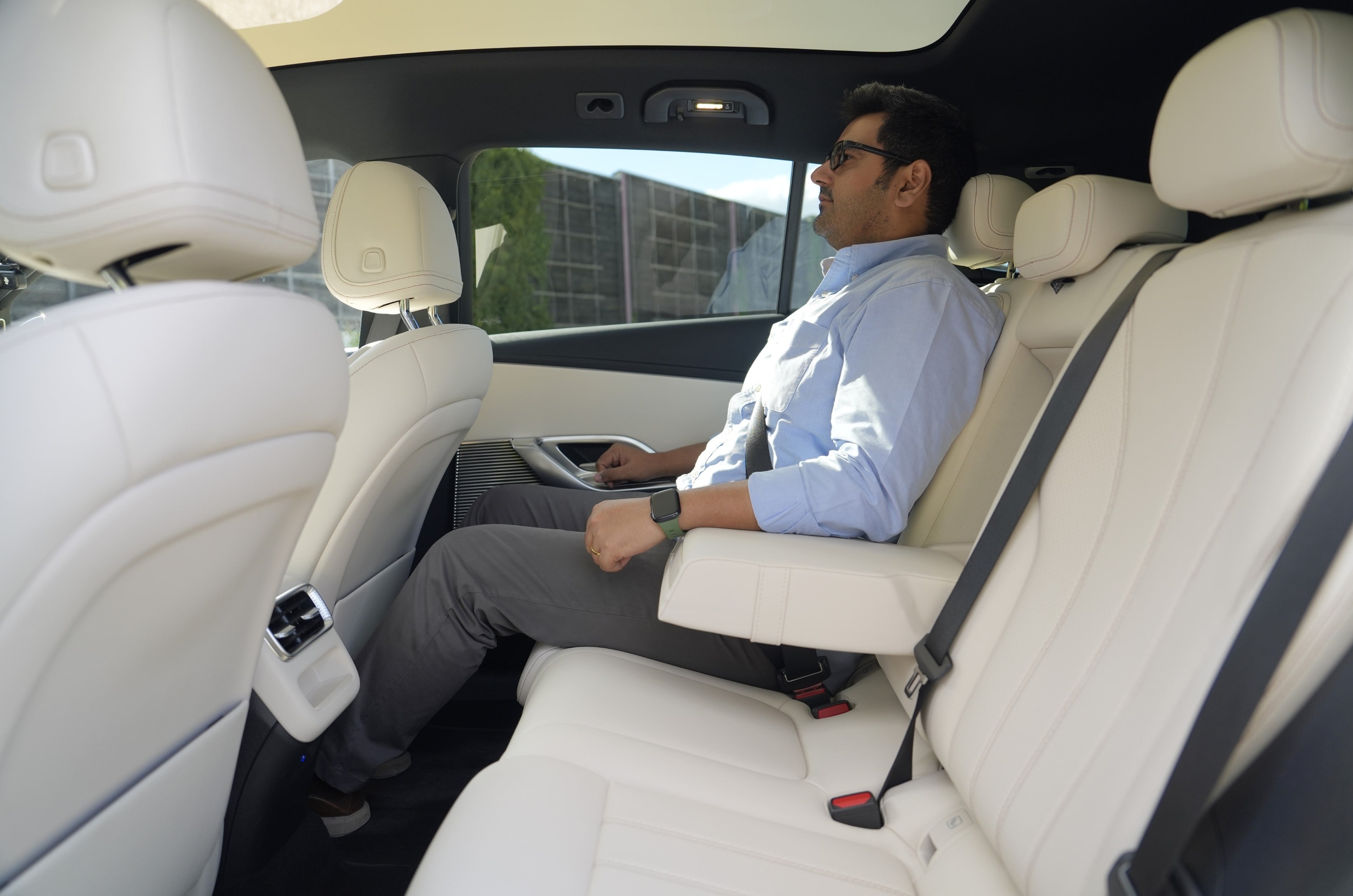
It’s at the back where things get really interesting for buyers confused between a GLC and a GLC EV. Rear seat space is a bit more generous than the standard GLC. There’s also good foot room under the front seats, which is not something you can say about all EVs, and even the seating position isn’t the typical knees-up that we’ve come to associate with EVs. A longer seat squab would have upped the experience. Also, the rear seat is best for two. A middle passenger will have to contend with a high centre tunnel.
Mercedes-Benz GLC EV Features and Safety – 9/10
The Hyperscreen is the focal point of the dash and delivers brilliant graphics across the entire display. The digital dials, centre touchscreen and passenger screen appear to be part of a seamless display and look terrific. There are themes for the screen too that also adjust other functions for the full effect. For instance, a bonfire on the screen will be accompanied by the seat heating coming on.
Massive 39-inch hyperscreen has a good UI and seamlessly integrates with other in-car displays but packs in too many functions.
The thing is, there’s just too much packed onto the centre touchscreen. The UI is good but more physical controls would just make life easier. The passenger display is slick in its own right but only blanks out if it detects the driver looking at it (a camera on the dash monitors the driver’s gaze). A privacy glass would have just been better.
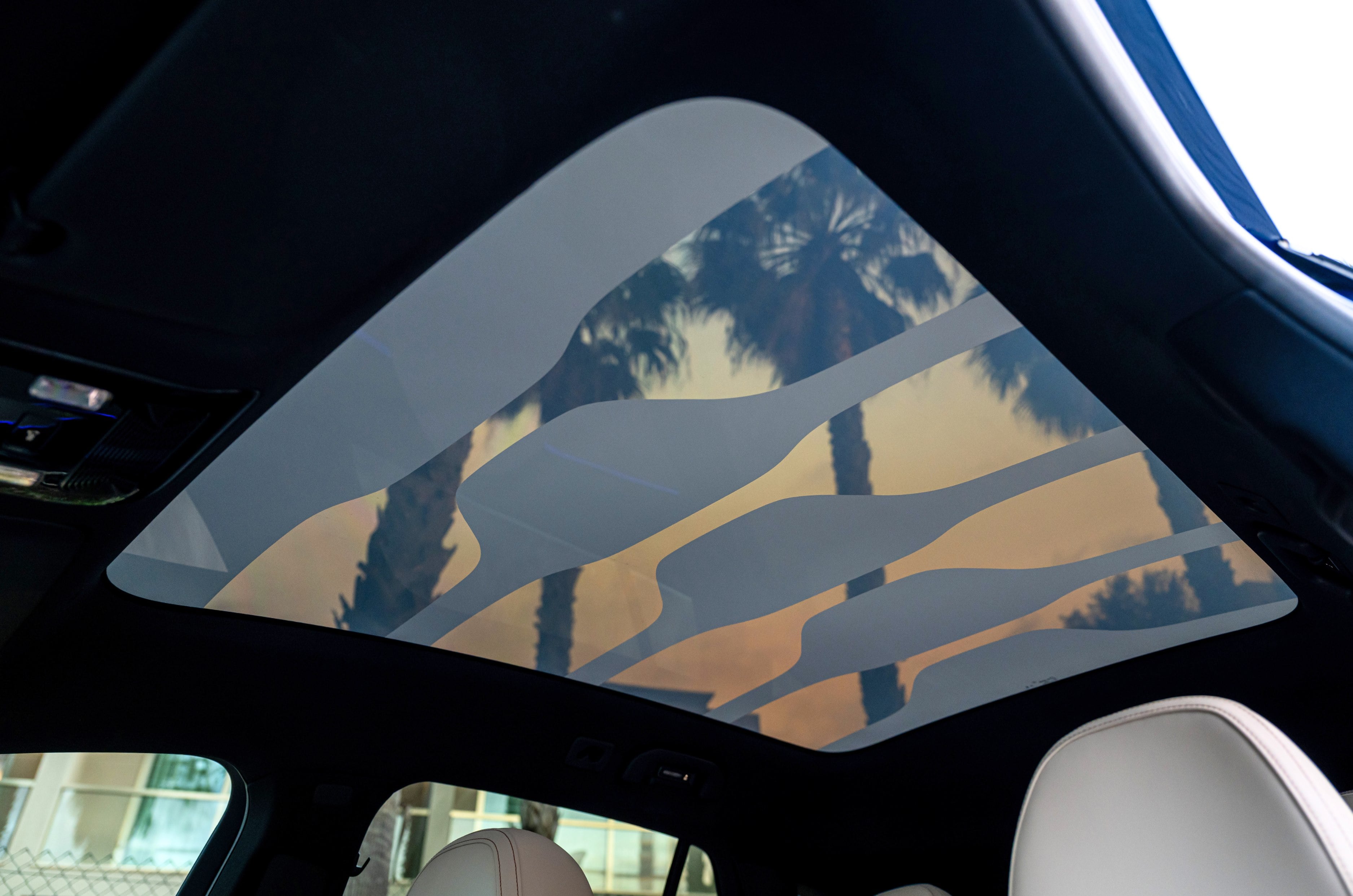
Among the other features, the panoramic glass roof is made up of nine segments which can be individually controlled for transparency. You can make them completely opaque, and they did a surprisingly good job of keeping the heat out. You could even have the glass roof specced with 162 stars that change colour with the ambient lighting.
Panoramic glass roof comprises nine individually configurable segments to control transparency.
Features-wise, aside from the screens and glass roof, the other highlight is the Burmester 4D sound system with exciters in the seat, so you can actually feel the bass. The head-up display and cameras are also top-class, while the AI integration doesn’t feel like a tick-mark item. You can actually converse with your car for restaurant recommendations or even abstract general knowledge.
The safety suite includes 9 airbags, ESC and a full suite of ADAS features.
Mercedes-Benz GLC EV Performance and Refinement – 9/10
Your friendly Mercedes salesperson will only be too happy to run you through the GLC 400’s big numbers: 489hp, 800Nm and a 4.3 sec 0-100kph time. The figures are made possible by front and rear permanently excited motors that draw power from a 94kWh battery pack.
489hp from its dual motors makes the GLC EV feel like an AMG compared to its ICE counterpart.
How does it all come together? The first thing that gets you is the silence. The drive experience is just what you’d expect in a plush Mercedes electric car. So it’s really quiet, and you don’t hear much of the world outside. There is a bit of wind noise if you really pay attention, but honestly, with some music piping out of the Burmester sound system, it’s not something that will catch your attention in the least.
What’s also clear is that the GLC EV is the strong and silent type. The performance makes the GLC EV feel like an AMG compared to the standard GLC petrol and diesel. A two-speed gearbox ensures quick getaways when needed, as well as the long legs for a more relaxed drive. Stomp down on the accelerator from a steady cruise, and you can feel the kickdown.
You won’t need to drive like a hoon to enjoy the GLC EV. Performance, no surprises, is very brisk when you put some weight on the accelerator pedal, with easy access to power. You can make the GLC EV feel a bit more urgent when you play around with the drive modes, but honestly, you won’t really need to because of how friendly the power feels and how ready the GLC EV feels at all times.
Power is easily accessible and is ready to push further when you put your foot down.
You’ll also take very naturally to the regen braking levels. One-pedal driving is included, and there’s the option of an intelligent mode too that reads the driving environment and optimises regen force.
The GLC EV also gets sound profiles, and we have to say they’re a bit unusual. They’re not trying to mimic the sound of a V8 or a V6 or any kind of ICE engine. The sounds are more on the sci-fi spectrum, so if you accelerate hard, you’d get the feeling of being in a UFO, which is disconcerting, if we can be honest. We’d rather enjoy the quiet inside.
Mercedes-Benz GLC EV Range and Efficiency – 8/10
Its large 94kWh battery can be charged from 10-80 percent in 22 minutes with a 330kW DC fast charger.
Now, on to the matter of range. Mercedes claims a 715-kilometre range on the WLTP cycle. Even if you account for real-world Indian conditions, you’re looking at a comfortable range of over 550 kilometres. Drive with a bit of care, and you could see that figure go past 600 kilometres. We really have come a long way in just a few years, haven’t we?
Of course, the go-to charging solution for most owners will be home charging. There’s up to 22kW AC support. The GLC can also be charged at up to 330kW using DC charging. Theoretically, at max speed, the GLC EV’s 94kWh battery can be juiced up from 10 to 80 percent in 22 minutes. A 10-minute charge alone can give you 300 kilometres of range.
Mercedes-Benz GLC EV Ride Comfort and Handling – 8/10
We can’t give a definitive verdict on cornering ability, as the bulk of our route was on the Autobahn outside Stuttgart, which has the gentlest of curves.
At Autobahn speeds, the GLC EV feels really planted and drives like a proper German car should. There’s pleasant weight at the steering wheel as well.
In terms of high-speed ride comfort, the GLC EV doesn’t come across as softly sprung as something like an EQS SUV, which really feels a bit roly-poly. There is still some vertical movement even when you switch to Sport mode, but it’s not to the point of being an irritant.
Feels planted out on the Autobahn and the steering is well-weighted
We’ll reserve judgement on the air suspension’s bump absorption till we drive the GLC EV on our roads, but on the sole patch of broken road on our route, the GLC EV didn’t feel entirely plush. Perhaps that’s something for Mercedes India to have on their list of things to do for the version headed our way.
A cool feature on the GLC’s suspension is its use of Google Maps to identify the vehicle’s environment and adjust ride height. For instance, the car automatically lowers on a highway. Also cutting-edge is how the suspension preps damping force in advance of a bump based on Car2X information from a Mercedes vehicle driving ahead. The systems better be up for the challenge of our roads.
Bundled in with air suspension is rear-axle steer, and the 4.5 degrees of movement does help greatly at parking speeds.
Mercedes-Benz GLC EV Should You Buy Now or Wait – 9/10
Bookings for the GLC EV open in early October, and the model will be launched in India within 2026.
It’s a big deal because the GLC EV comes to India within just six months of its European rollout. What makes the timeline even more impressive is the fact that the GLC EV won’t be an import, but will be assembled in India. Local assembly points at keen pricing.
The GLC EV will be locally assembled 6 months after its European version goes on sale.
We expect the model to be priced at about Rs 85-90 lakh (estimated, ex-showroom), which wouldn’t be all too far from the ICE GLC’s price. Factor in the registration benefits on EVs, and the price gets more tempting still.
As a product, the GLC EV does have lots going for it. It’s got the power, the refinement and the tech you’d expect on a luxury EV. Importantly, it doesn’t feel like your dad’s Mercedes, and that new-age cool is something many buyers will resonate with.
BMW’s iX3 Long Wheelbase and Audi’s Q6 e-tron are alternatives to watch out for in 2027, but in the near future, the GLC EV looks set for a clean run.
When we first drove the all-new, all-electric Mercedes-Benz CLA, we came away impressed with its smooth powertrain and its promise of a substantial real-world range. We’ve now subjected it to our real-world performance and efficiency tests to see if it delivers on that promise.
Mercedes CLA 250+ exterior design and engineering – 8/10
Polarising, aero-efficient design; based on new MMA platform.
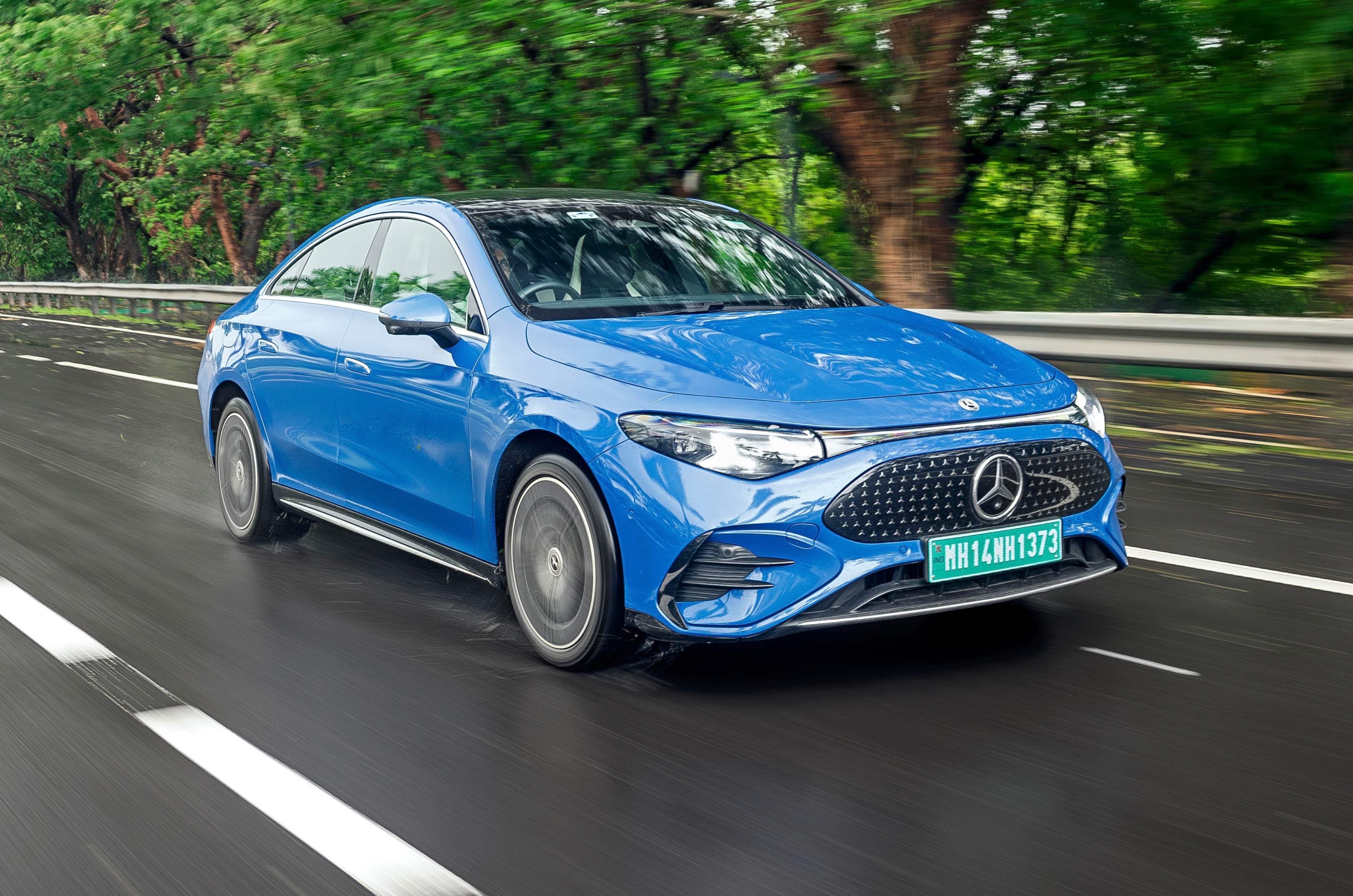
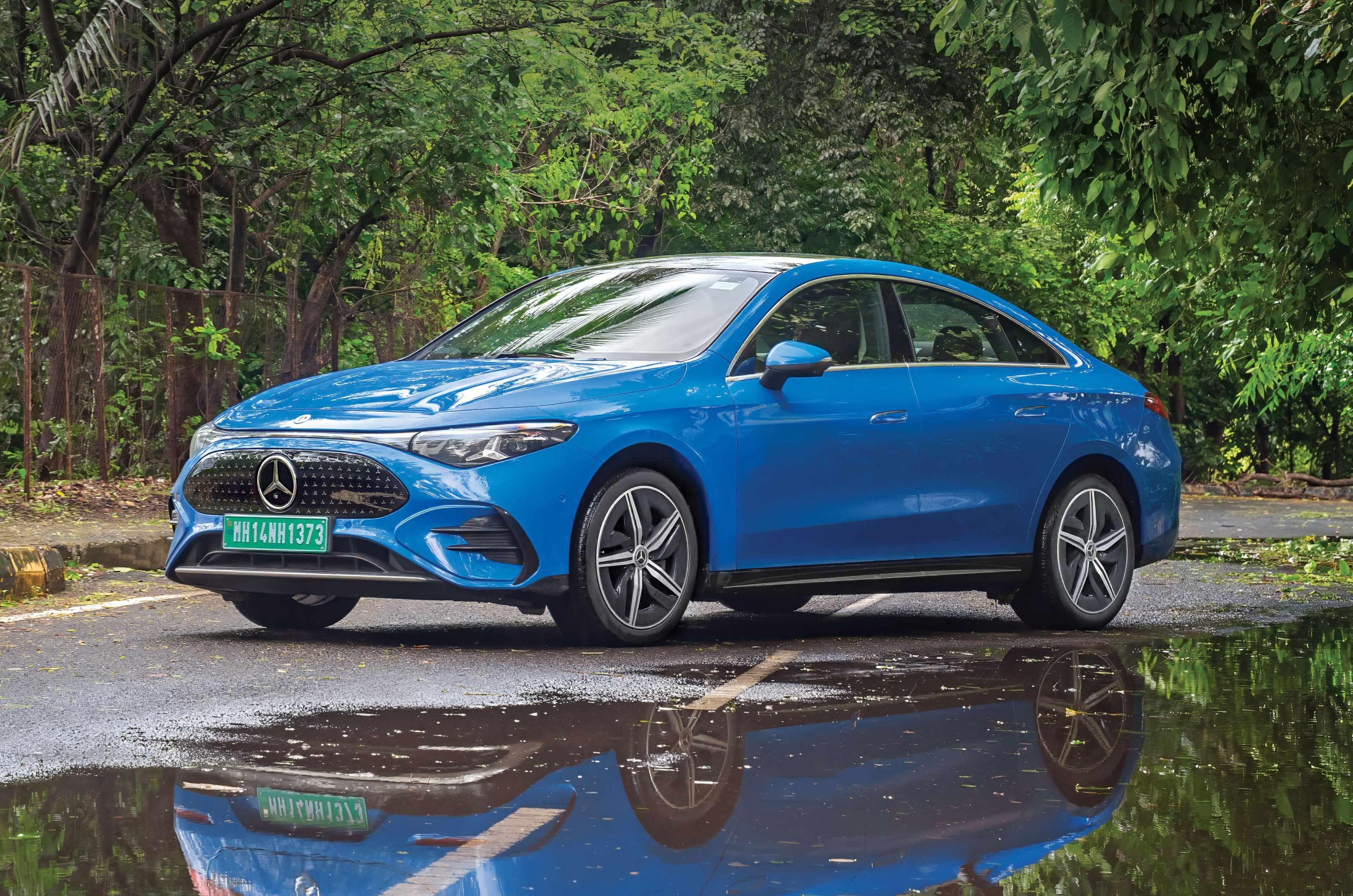
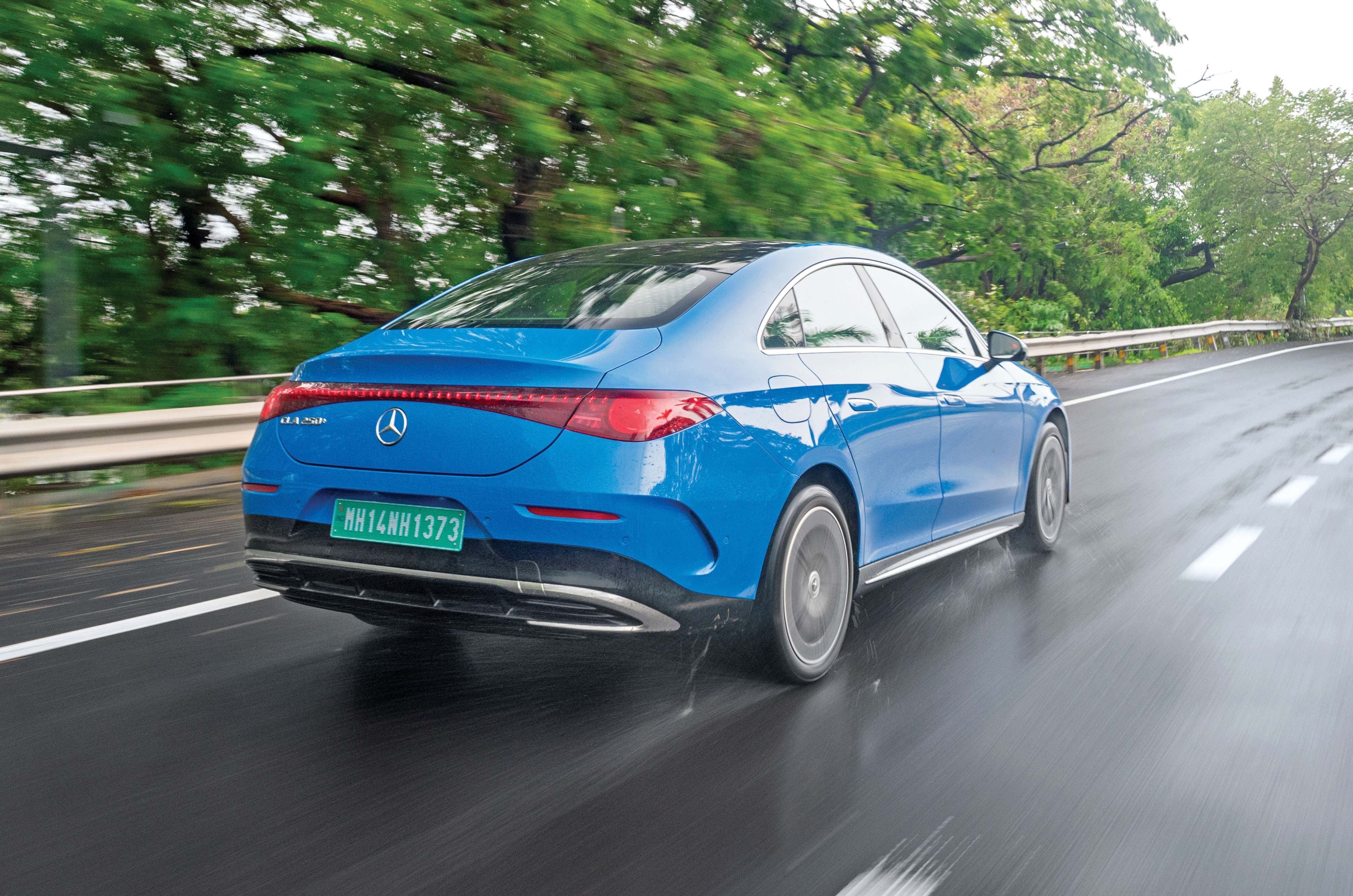
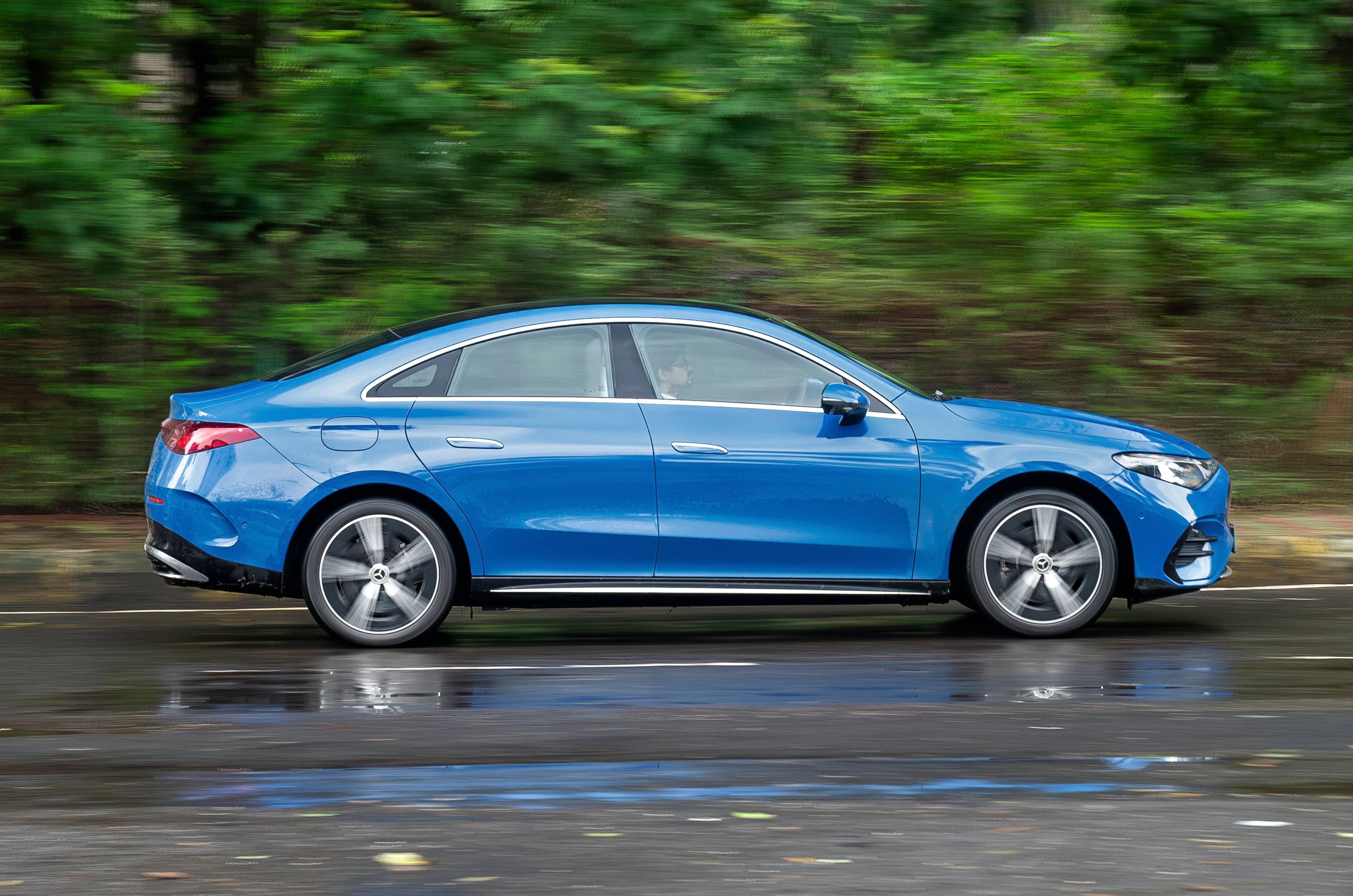
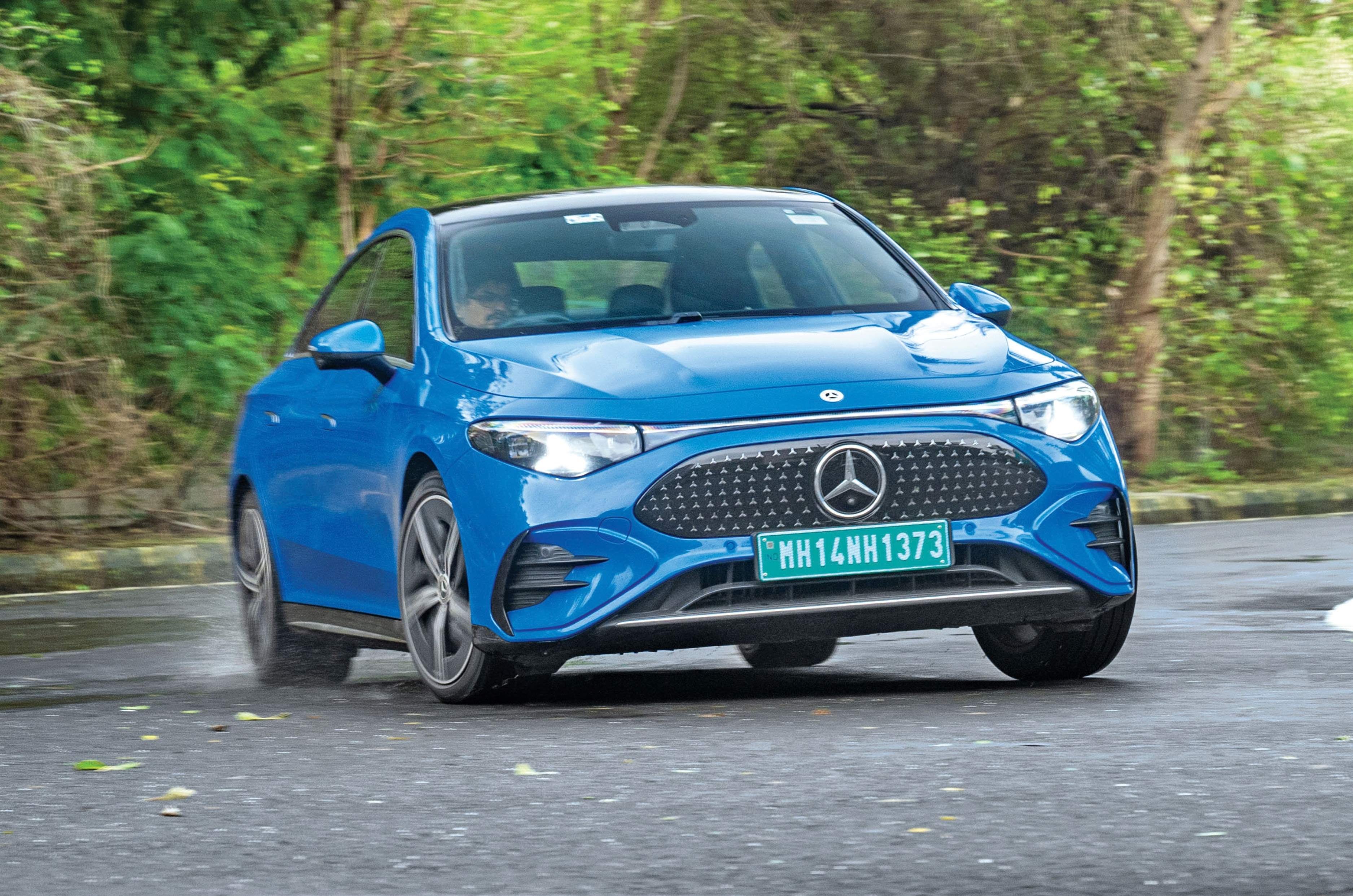
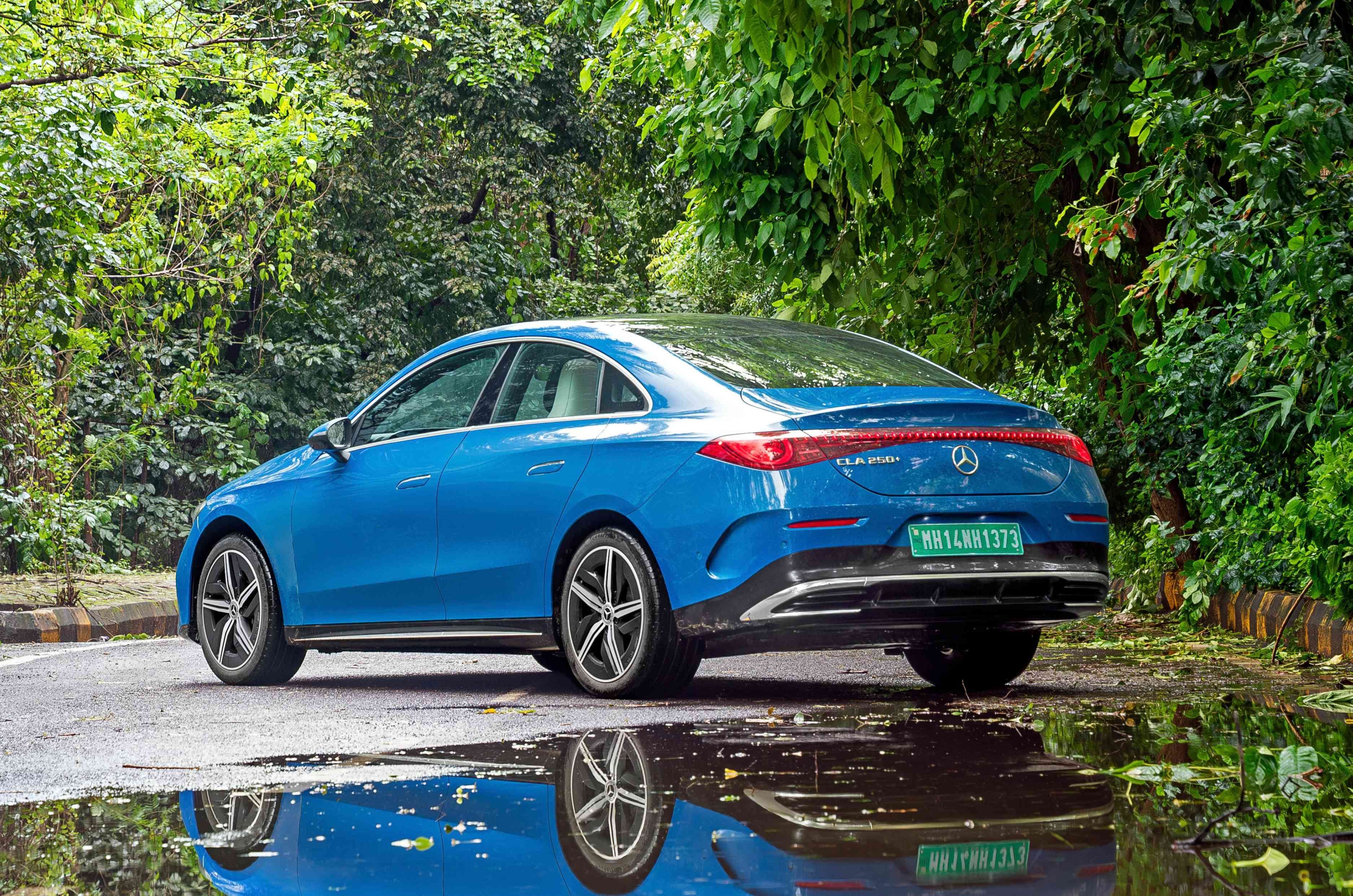
The new CLA has been designed with efficiency very much in mind, but Mercedes hasn’t completely abandoned the visual character that made the original car appealing. Its smooth, rounded silhouette is familiar from other Mercedes EVs, yet the low-slung, coupé-like roofline and frameless doors give it a distinct identity. Flush-fitting door handles, a sealed-off grille, aero-optimised 18-inch AMG alloys and a fully sealed underbody all contribute to an exceptionally slippery shape, with a drag coefficient of just 0.21Cd.
Mercedes’ three-pointed star features prominently across the CLA, appearing on the bonnet, grille, headlamps and tail-lamps. The grille itself gets 142 illuminated stars, which might sound excessive on paper, but they do give the CLA a distinctive look and, in person, seem to work rather well.
More significant, however, is what lies underneath. The CLA EV is the first Mercedes to use the new Modular Architecture (MMA) skateboard platform, which will also underpin future models. At over 4.7m long, more than 1.8m wide and over 1.4m tall, with a wheelbase approaching 2.8m, it is roughly the same size as a BYD Seal.
Mercedes CLA 250+ interior space and comfort – 7/10
Impresses with tech and quality; cramped rear with high floor.
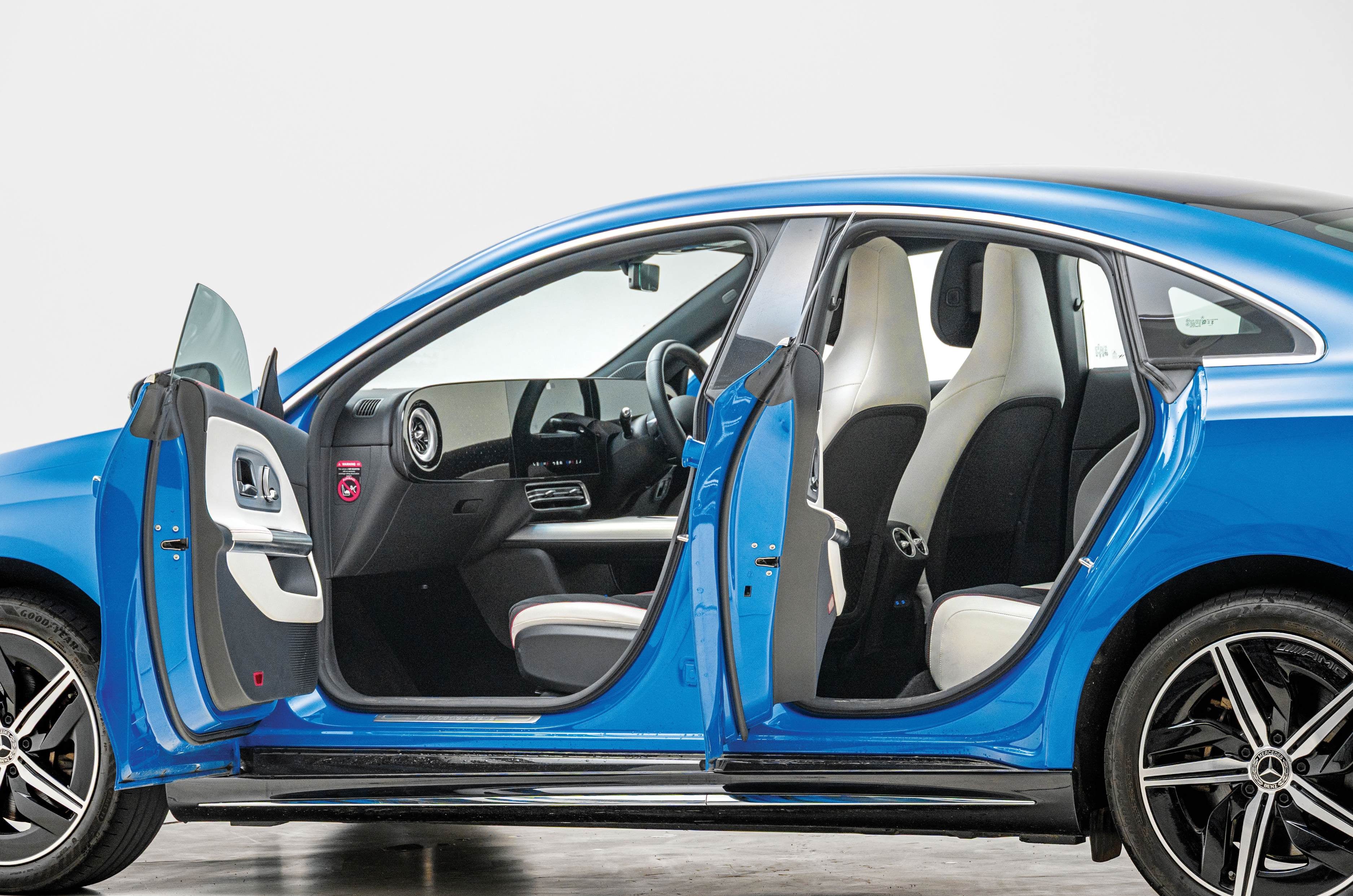
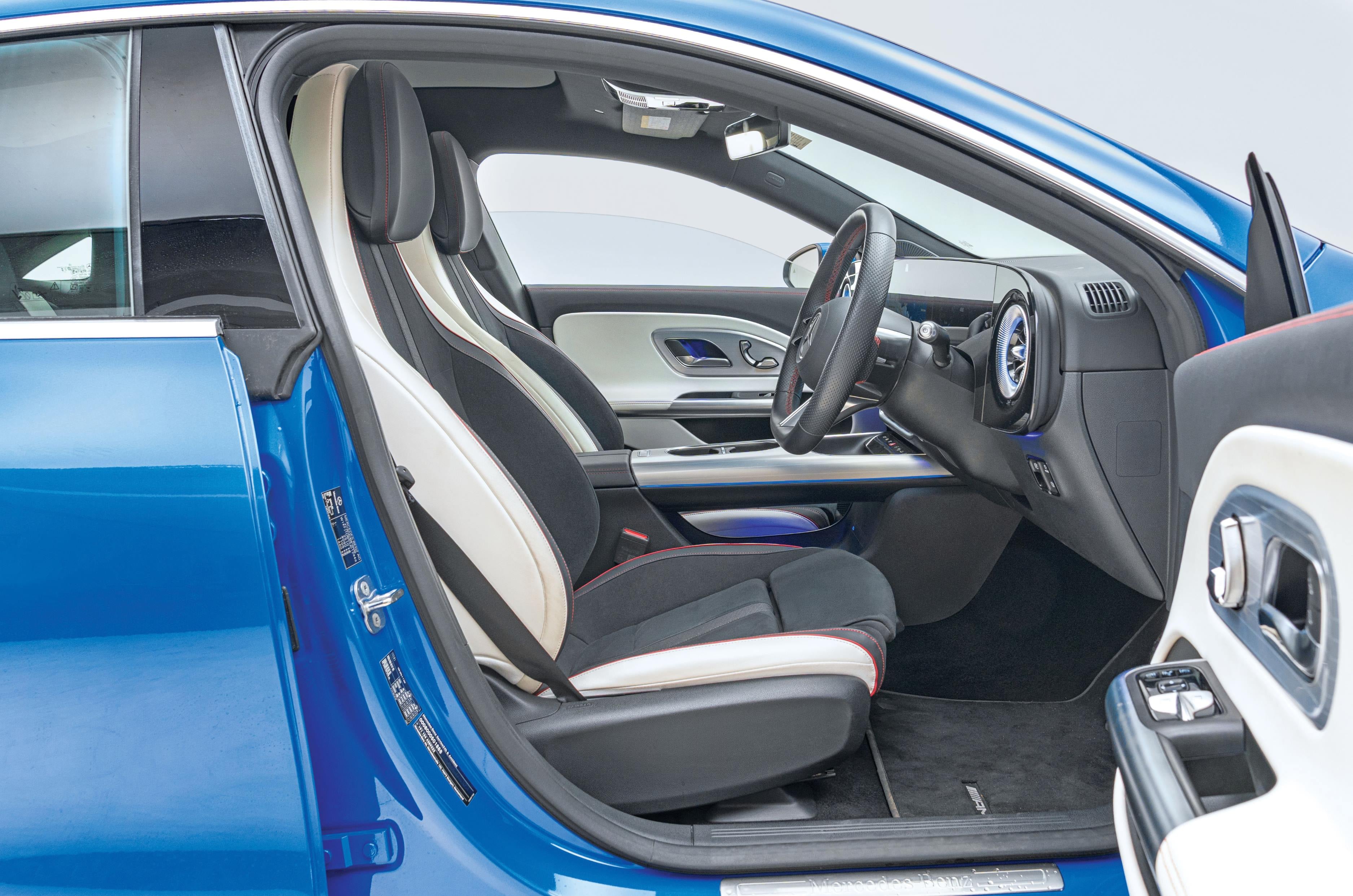
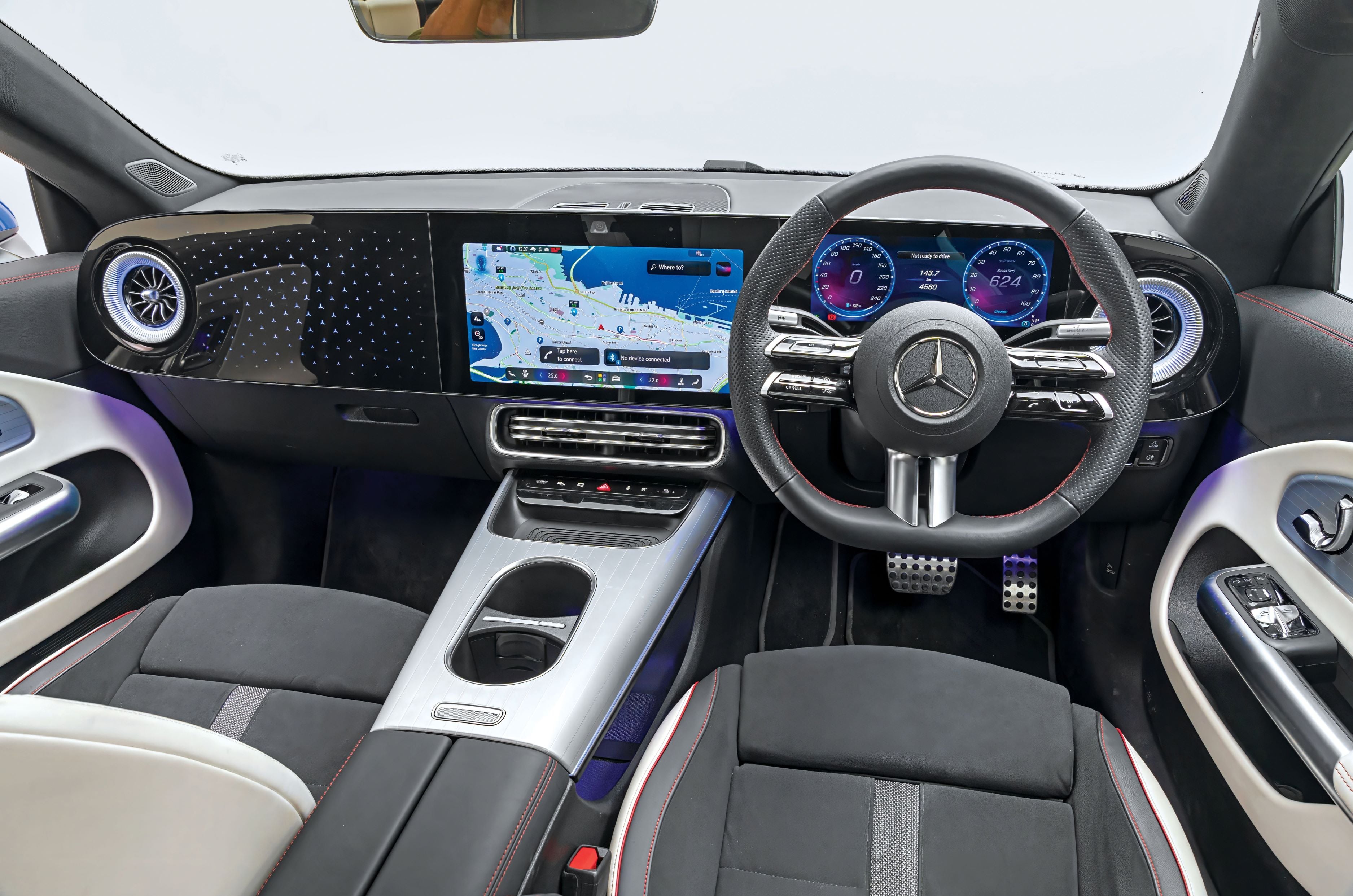
The CLA makes a good first impression inside. Its doors open wide for easy access, while the cabin combines smart design with good materials and build quality. The CLA 250+ is offered in AMG Line trim, so you get a flat-bottomed AMG steering wheel, sporty metal pedals and AMG-spec upholstery.
Doors open wide to aid access to the cabin; retains the stylish frameless doors.
The dashboard is dominated by a large gloss-black panel housing the digital displays. The graphics are sharp, the interface is clean, and the system is easy to navigate. What isn’t quite as convincing is the near-total absence of physical controls. Apart from a few capacitive shortcuts for functions such as volume and drive modes, most functions are accessed through the touchscreen, which isn’t ideal while on the move.
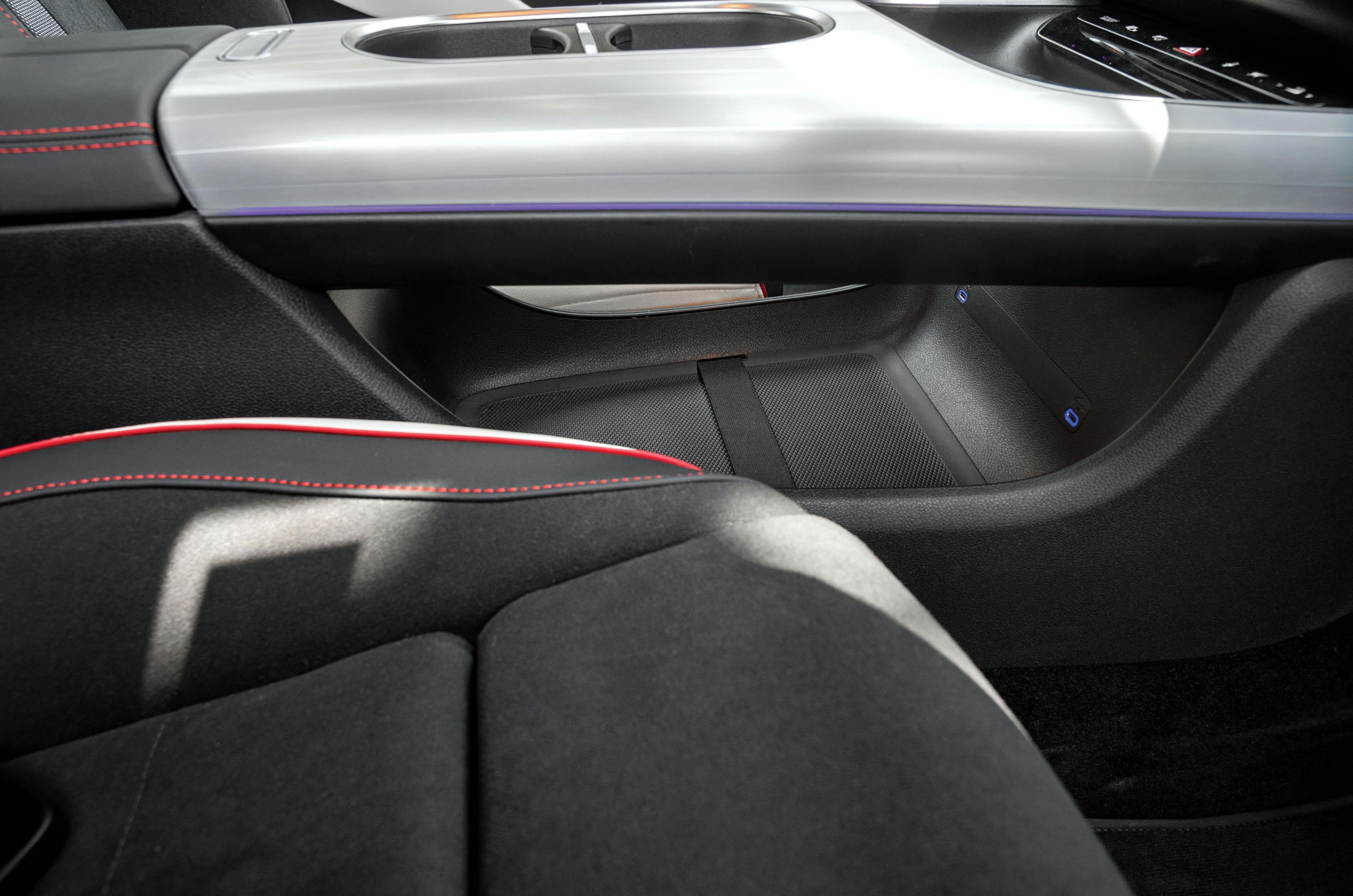
Centre console has two levels, with the top featuring cupholders and a wireless charger, and a large cubby space below.
The third passenger display offered in the 250+ Launch Edition has been omitted here, with its place taken by a gloss-black panel featuring illuminated Mercedes stars. The turbine-style air vents at either end of the dashboard are a nice touch, though, and are particularly satisfying to operate.
There is decent storage, too. You get a large glovebox, storage beneath the centre armrest, bottle holders in the doors and a floating centre console with cupholders and a wireless charger on top, along with a large storage area underneath.
AMG Line brings Alcantara and leather trim for the snug and supportive seats; relatively knees-up seating here too.
The front seats are supportive and well padded, although larger occupants might find them a little snug. More importantly, the relatively high floor means you sit with your knees raised even in the front. At the rear, this issue is more pronounced.
High floor results in knees-up seating, upright backrest and sloping roof further compromise rear seat’s comfort.
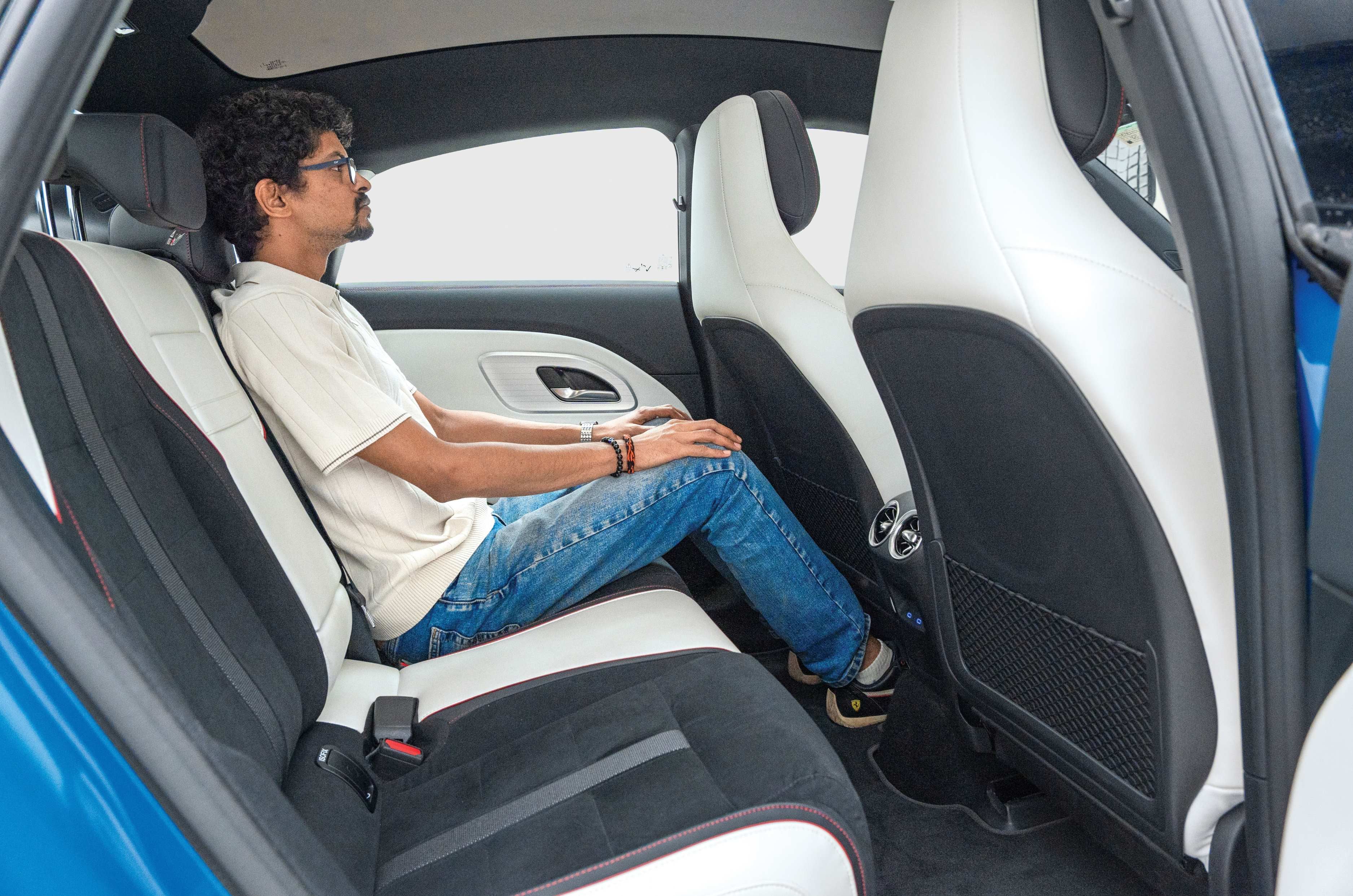
Although the CLA has a longer wheelbase than its predecessor, which improves knee room, the battery beneath the floor eats into under-thigh support and results in a knees-up seating position. The upright backrest and sloping roofline further compromise comfort, particularly for taller passengers. There is a centre armrest with cupholders and dedicated rear AC vents, but this still isn’t a car we’d recommend for regular chauffeur-driven use.
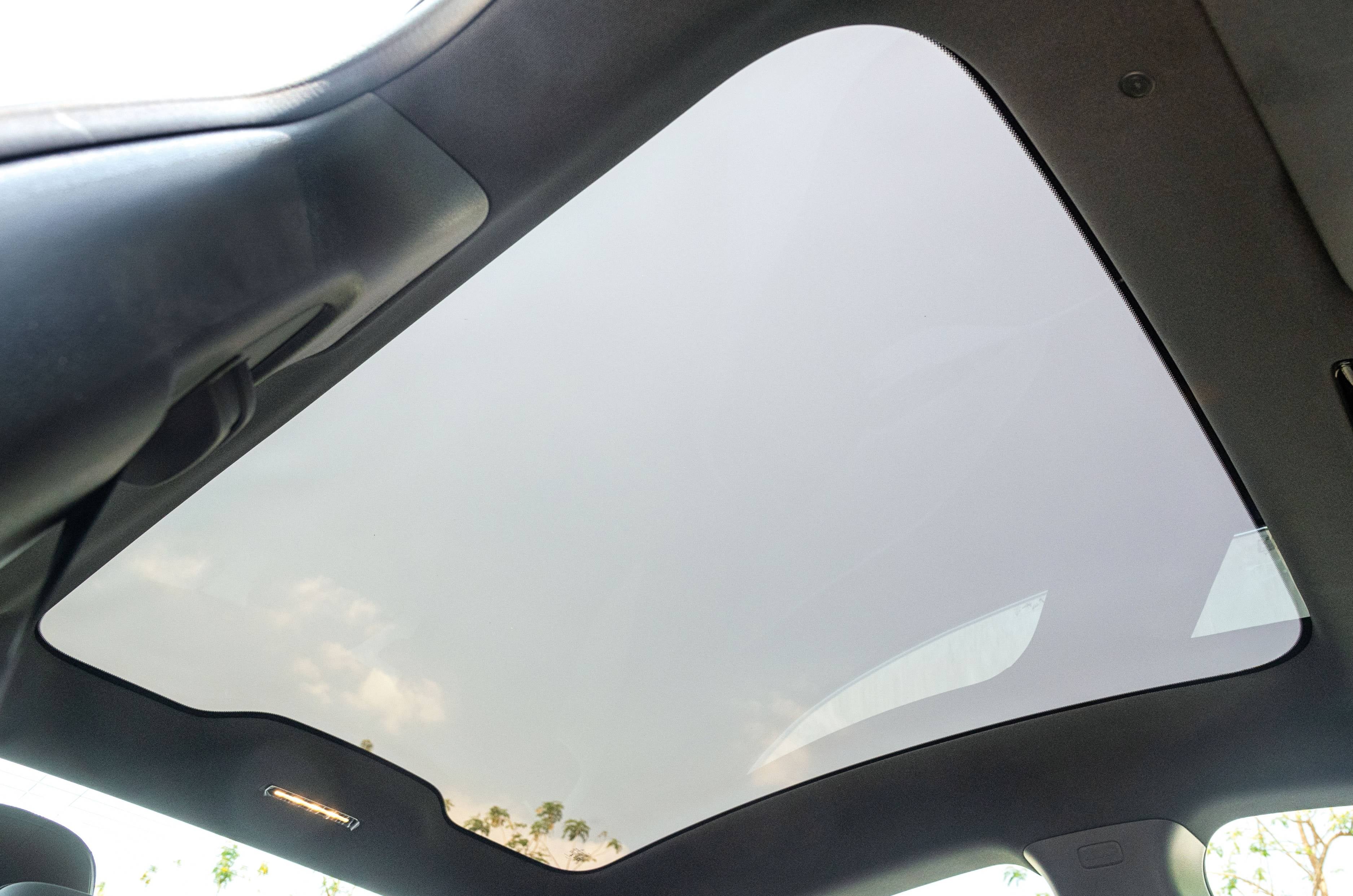
There is a large fixed panoramic glass roof that does make the cabin feel more spacious. Mercedes says the glass is heat-insulated, but a sunshade would have been welcome, particularly in our climate. It also misses sunblinds for the rear windows, meaning the rear AC has to work particularly hard to keep the back of the cabin cool.
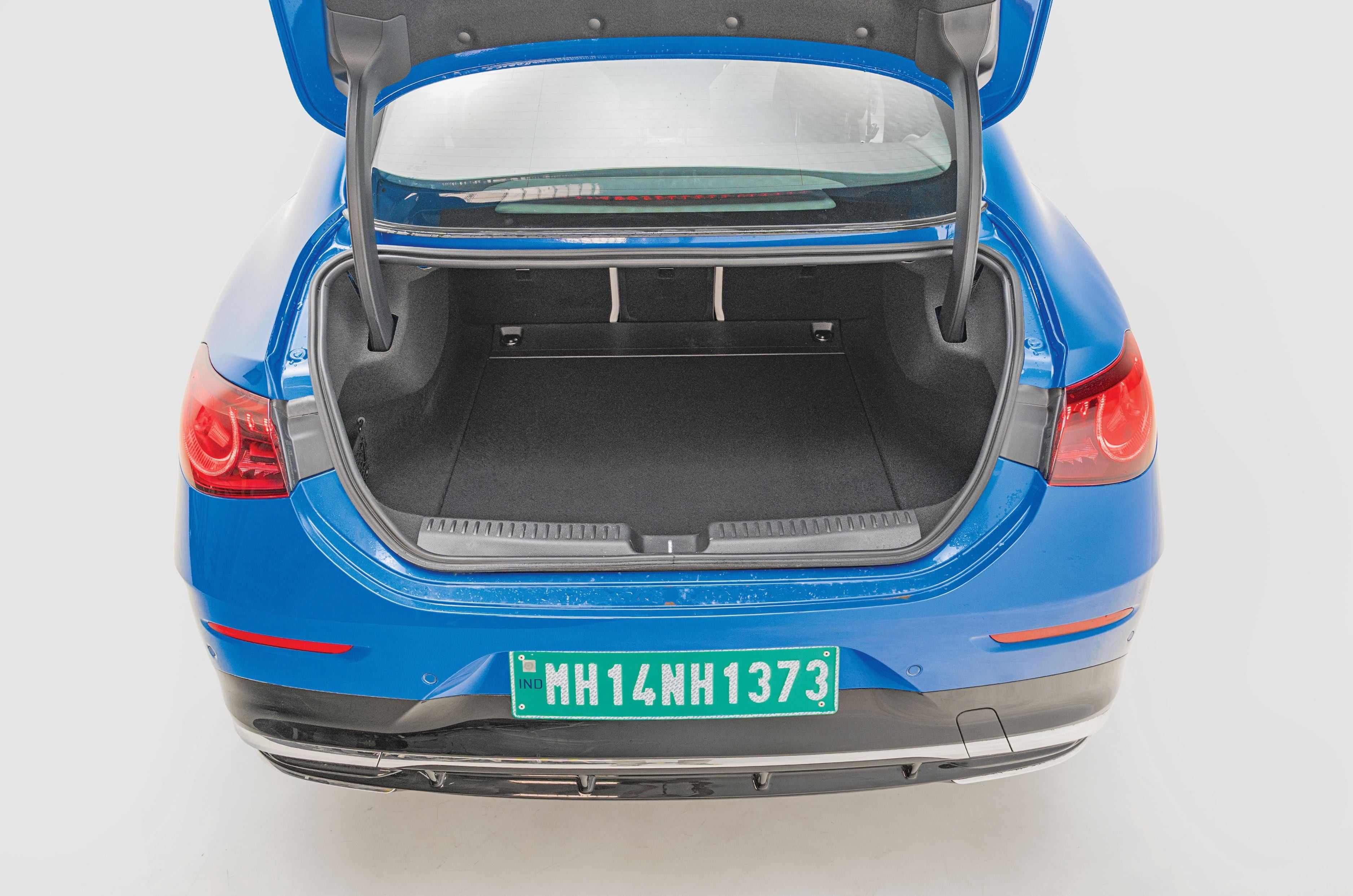
Cargo space is a useful 405 litres; boot opening isn’t large, though.
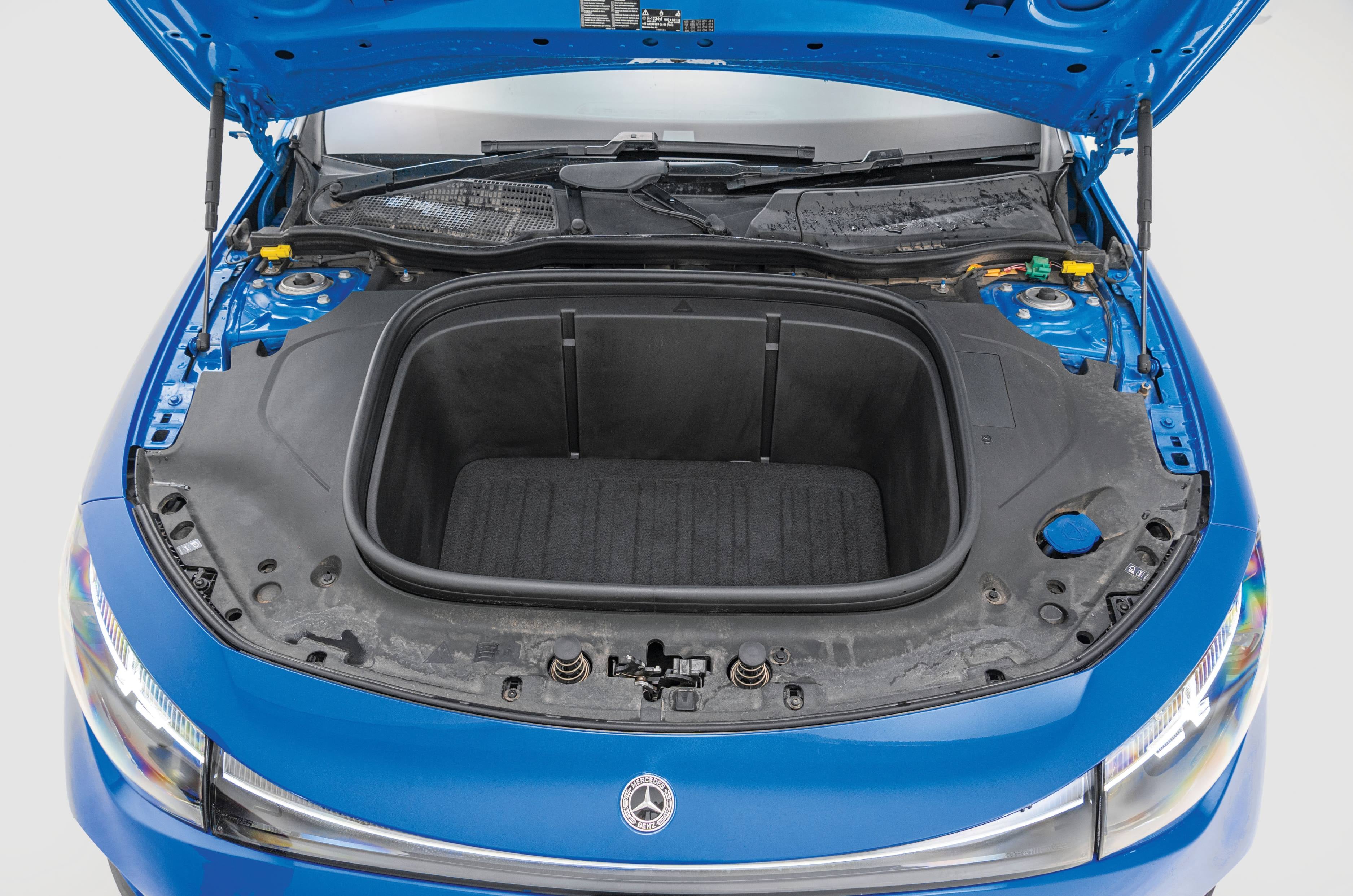
Boot space stands at a useful 405 litres. More interestingly, the CLA gets a 101-litre front trunk – the first time Mercedes has offered a frunk on one of its EVs.
In a first for Mercedes-Benz EVs, there’s a convenient 101-litre front trunk.
Mercedes CLA 250+ features and safety – 9/10
Packed with cutting-edge tech and features; no seat ventilation.
The CLA is a showcase for Mercedes’ latest technology. Four supercomputers provide the computing power, which Mercedes says is more than 200 times that of the previous CLA. It is also the first Mercedes to use the company’s new MB.OS infotainment operating system.
With the AMG Line styling package, the 250+ gets a flat-bottomed AMG steering, metal pedals and AMG seat upholstery; third passenger screen is reserved for the Launch Edition; cabin is practical with loads of storage, and overall fit/finish is good.
An Nvidia processor allows for quick responses, while over-the-air updates mean the system can be updated without a visit to the workshop. There’s also a new MBUX Virtual Assistant, which learns about the driver, including their language, accent and mood. It uses AI tools, including ChatGPT, Gemini and Bing, to further make your life easier, and you can ask them to do just about anything from setting navigation to changing the AC and so much more.
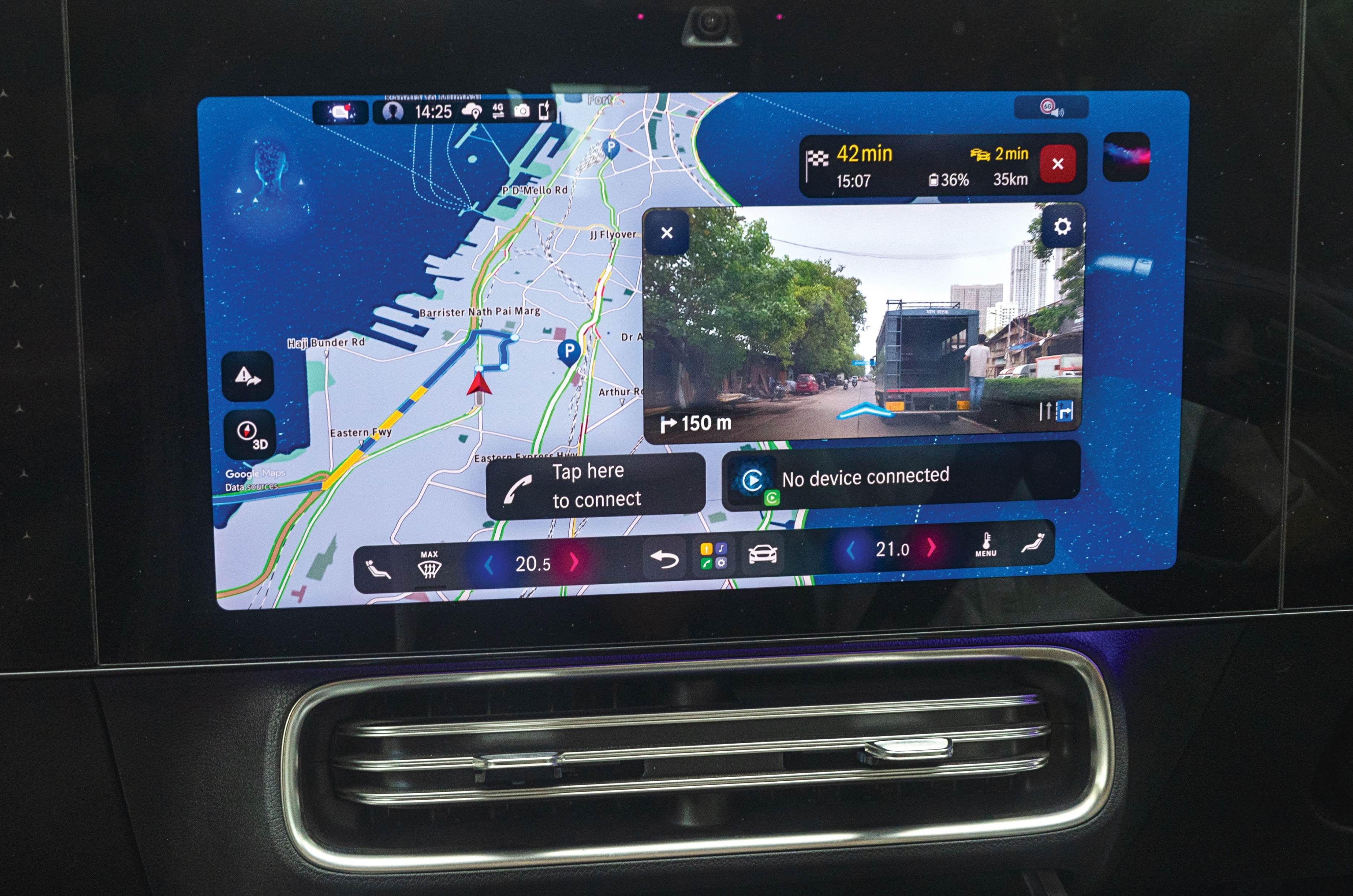
Screen is slick, has sharp graphics and native maps, which show directions in real-time using the camera feed.
The CLA also gets the new MB.Charge app, which brings charging providers together in one place. It can locate chargers, show their real-time availability, help plan a journey and even handle payment for a charging session.
The feature list is extensive. Highlights include a 14-inch central touchscreen, 10.25-inch digital driver’s display, powered, heated and massaging front seats, dual-zone climate control, configurable ambient lighting, a panoramic glass roof, Burmester 3D audio, wireless phone charging and auto parking. Ventilated front seats, however, aren’t offered.
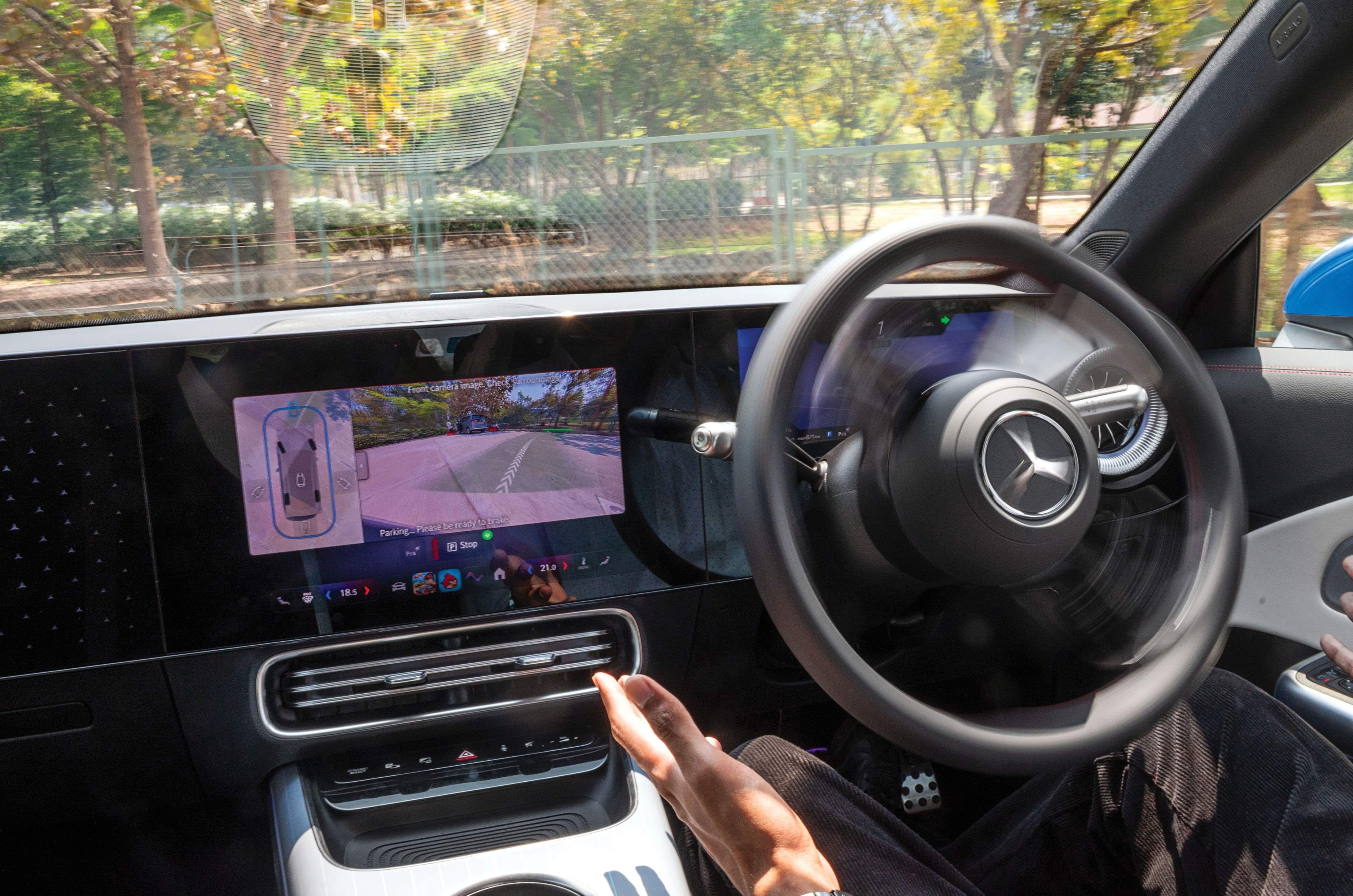
CLA 250+ packs in an auto park feature, which works very well in unmarked spaces too.
Safety equipment is comprehensive, with six airbags, a 360-degree camera and Level 2+ ADAS, which Mercedes calls MB.Drive. It includes adaptive cruise control, lane-keep assist, blind-spot monitoring, autonomous emergency braking and semi-autonomous driving functions. The system uses a combination of radar sensors and cameras and didn’t feel overly intrusive; better than previous Mercs, which feel trigger-happy with emergency braking. The CLA was also the safest car tested by Euro NCAP in 2025.
Mercedes CLA 250+ performance and refinement – 9/10
Smooth, progressive powertrain; refinement is impressive.
The CLA 250+ uses a rear-mounted electric motor producing 272hp and 335Nm. Performance is brisk, but what stands out more than outright acceleration is the way it delivers its performance.
Unlike some performance EVs that deliver power aggressively from the moment you bury the accelerator, the CLA builds speed in a smooth, progressive manner. The power delivery is linear, and there’s always enough performance on tap. Sport mode sharpens the response, while synthesised sounds played through the speakers add a little more theatre.
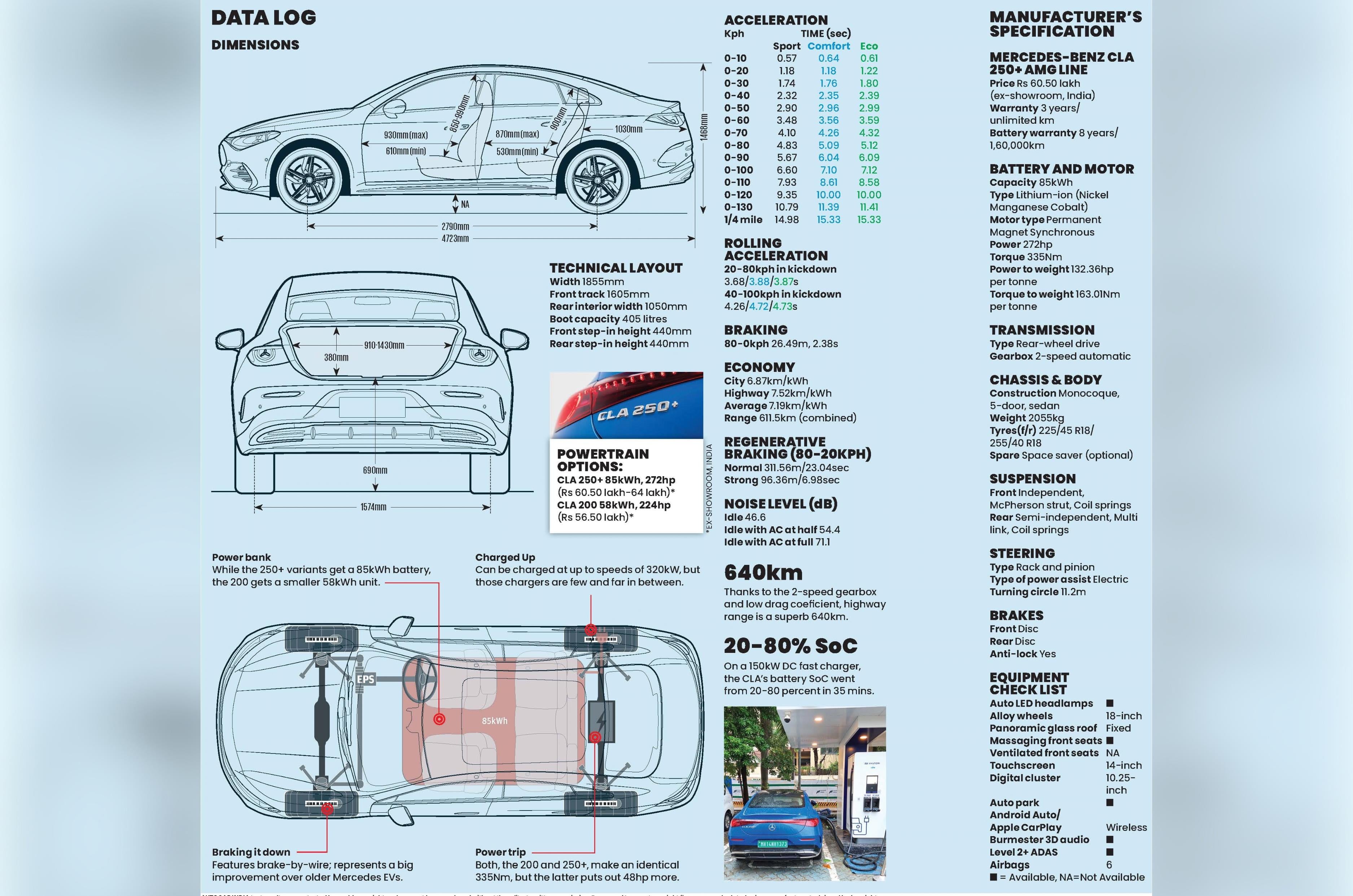
In our performance tests, it managed a 0-100kph time of 6.6sec in Sport mode, narrowly beating the claimed time of 6.7sec. Rolling acceleration is impressive too, with 20-80kph in Sport taking 3.68sec, and 40-100kph being dealt with in 4.26sec. Naturally, performance in the Comfort and Eco drive modes is more sedate than Sport, with the difference between the former two being almost negligible.
Mercedes has also opted for a two-speed gearbox, which is unusual for an EV, but makes sense here. The short 11:1 first gear helps with initial acceleration, while the taller 5:1 second gear is intended to improve efficiency at higher speeds. And from behind the wheel, you can feel when it shifts gears. Mercedes claims a drivetrain efficiency of 93 percent, and that plays an important role in the CLA’s impressive range.
The new brake-by-wire system is another area where the CLA makes a big improvement over older Mercedes EVs. Brake response is reassuring, with a good bite and a natural, consistent feel. In our braking test, the CLA came to a halt from 80kph in 26.49m despite it being on a damp surface.
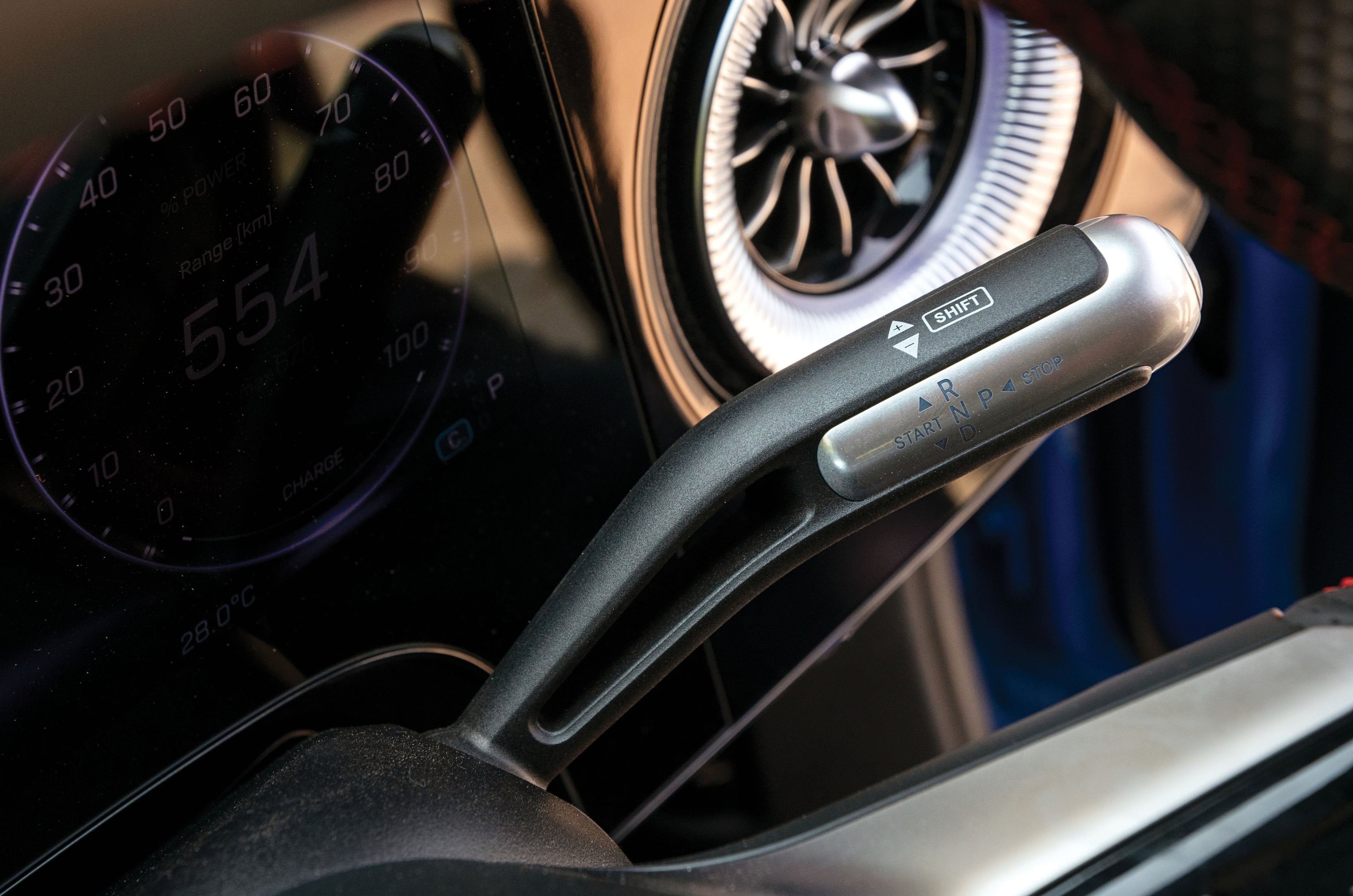
Control stalk now houses the start/stop button, the drive selector, and is also used to toggle between regen braking modes.
There are four levels of regenerative braking, including a one-pedal mode and an adaptive setting. They work well, with the Normal setting bringing it from 80-20kph in 311.56m, while the Strong setting takes 96.36m for the same. It’s worth noting, however, that Mercedes has moved the controls for the regen from the steering-mounted paddles used on some EVs to the gear selector stalk. You push or pull the stalk to change the regen level, and this isn’t quite as intuitive. The same stalk also incorporates the start/stop button.
Where the CLA really impresses is refinement. The absence of an engine obviously helps, but Mercedes has also done an excellent job of keeping wind and road noise out. At speed, the cabin remains remarkably quiet. A CLA 200 variant is also available in India, using the same rear-mounted motor layout but producing a lower 224hp and 335Nm. However, we’re yet to test this version.
Mercedes CLA 250+ tested acceleration times (sec)
Sport
Comfort
Eco
0-10kph
0.57
0.64
0.61
0-20kph
1.18
1.18
1.22
0-30kph
1.74
1.76
1.80
0-40kph
2.32
2.35
2.39
0-50kph
2.90
2.96
2.99
0-60kph
3.48
3.56
3.59
0-70kph
4.10
4.26
4.32
0-80kph
4.83
5.09
5.12
0-90kph
5.67
6.04
6.09
0-100kph
6.60
7.10
7.12
0-110kph
7.93
8.61
8.58
0-120kph
9.35
10
10
0-130kph
10.79
11.39
11.41
1/4 mile
14.98
15.33
15.33
20-80kph (rolling)
3.68
3.88
3.87
40-100kph (rolling)
4.26
4.72
4.73
Mercedes CLA 250+ range and efficiency – 9/10
Low drag, efficient powertrain mean superb real-world range.
Mercedes claims a WLTP range of 792km from the 85kWh (net) NMC battery, although, predictably, the real-world range is lower. In the city, with the regen set to the strongest mode, it delivered an efficiency of 6.87km/kWh that translates to a range of 584km. On the highway, with the regen set to ‘Normal’, it delivered an efficiency of 7.52km/kWh for a 640km range. With an average efficiency of 7.2km/kWh, you can expect a real-world range of 612km on a single charge, which is very impressive.
In the city, the strongest regen setting enabled it to recoup energy effectively, which helped boost efficiency, while the two-speed gearbox, with its taller 5:1 second gear, enabled greater efficiency at higher speeds and thus contributed to the EV’s highway efficiency. Combined with the low 0.21Cd drag coefficient and the normal regen mode that allows for more coasting, it proved even more efficient on the highway, which isn’t usually the case with EVs.
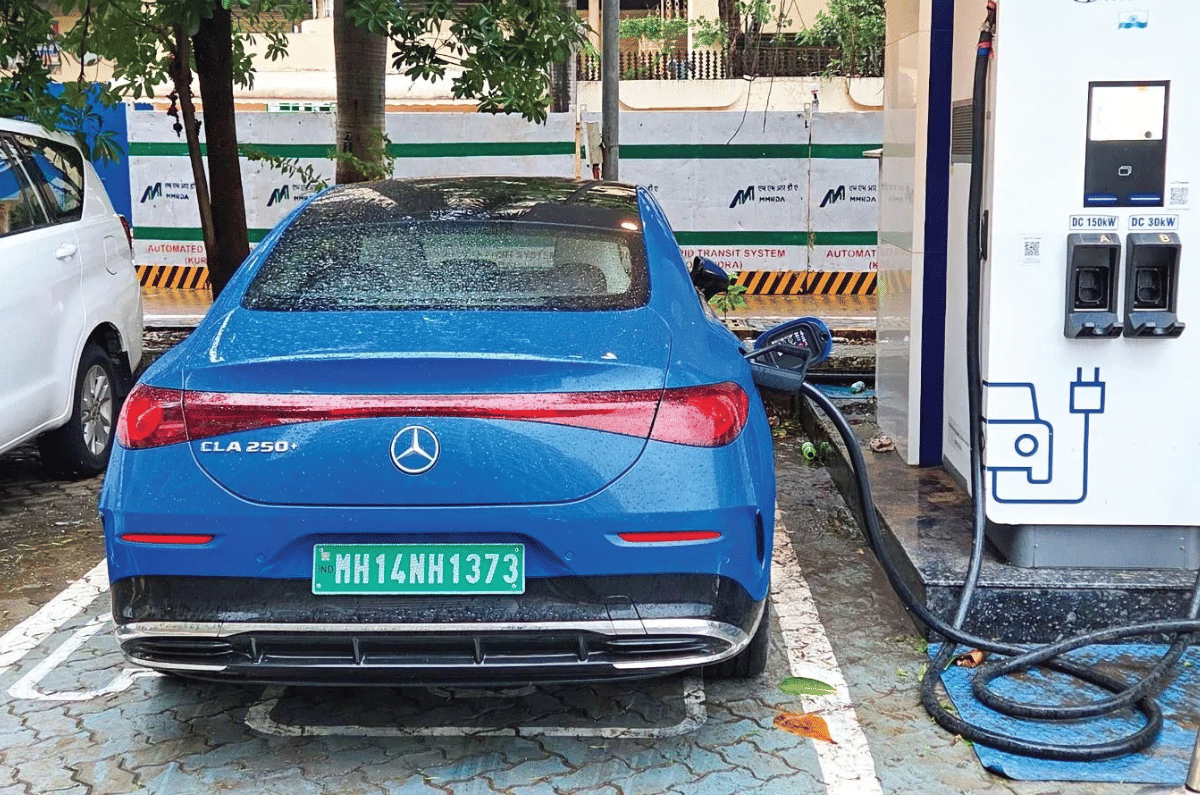
The CLA 250+ uses an 800V electrical architecture and supports charging at up to 320kW, but chargers capable of delivering that output remain few and far between in India. In our charging test using a 150kW DC fast charger, we saw an average charging speed of around 92kW with a peak charging speed of 125kW. To charge from 20-80 percent, it took 35 minutes and consumed 53.89kWh in total. This, combined with the efficiency and large real-world range, should make long-distance driving relatively stress-free.
Mercedes CLA 250+ tested range
City (km/kWh)
6.87
Highway (km/kWh)
7.52
Average (km/kWh)
7.19
Range (km)
611.5
Mercedes CLA 250+ ride comfort and handling – 8/10
Strikes a mature balance between ride and handling.
The CLA’s rear-wheel-drive layout gives it an enjoyable character on a winding road, and the steering is one of its stronger points. With no drive being sent through the front wheels, it feels precise, building up weight progressively with speed. It’s light enough at low speeds to make manoeuvring easy, yet gains enough weight as you go faster.
Thanks to the CLA’s rear-wheel-drive setup and precise steering, it feels agile and good fun around corners.
Mercedes has increased the Euro-spec CLA’s 107mm ground clearance for India and made suspension changes to better suit our roads, and both have worked. There’s enough clearance to deal with regular-sized speed breakers, while the additional height hasn’t really compromised the car’s handling or comfort. Around corners, the CLA remains agile, and body roll is well controlled. The ride does have a hint of firmness to it, but it deals with road imperfections without fuss and feels composed at both low and high speeds. Overall, it’s a mature combination of ride comfort, stability and handling.
Mercedes CLA 250+ value for money – 8/10
Refined and efficient powertrain, long range and sorted ride and handling make it Merc’s best EV yet.
Priced at Rs 60.50 lakh (ex-showroom), the CLA 250+ is a fairly compelling proposition, considering what it brings to the table. There are shortcomings, most notably the cramped rear seat, knees-up seating even at the front, and the absence of sunshades for the panoramic roof and rear windows. But if you’re going to drive yourself and want a luxury EV that’s distinctive, the CLA makes a strong case for itself.
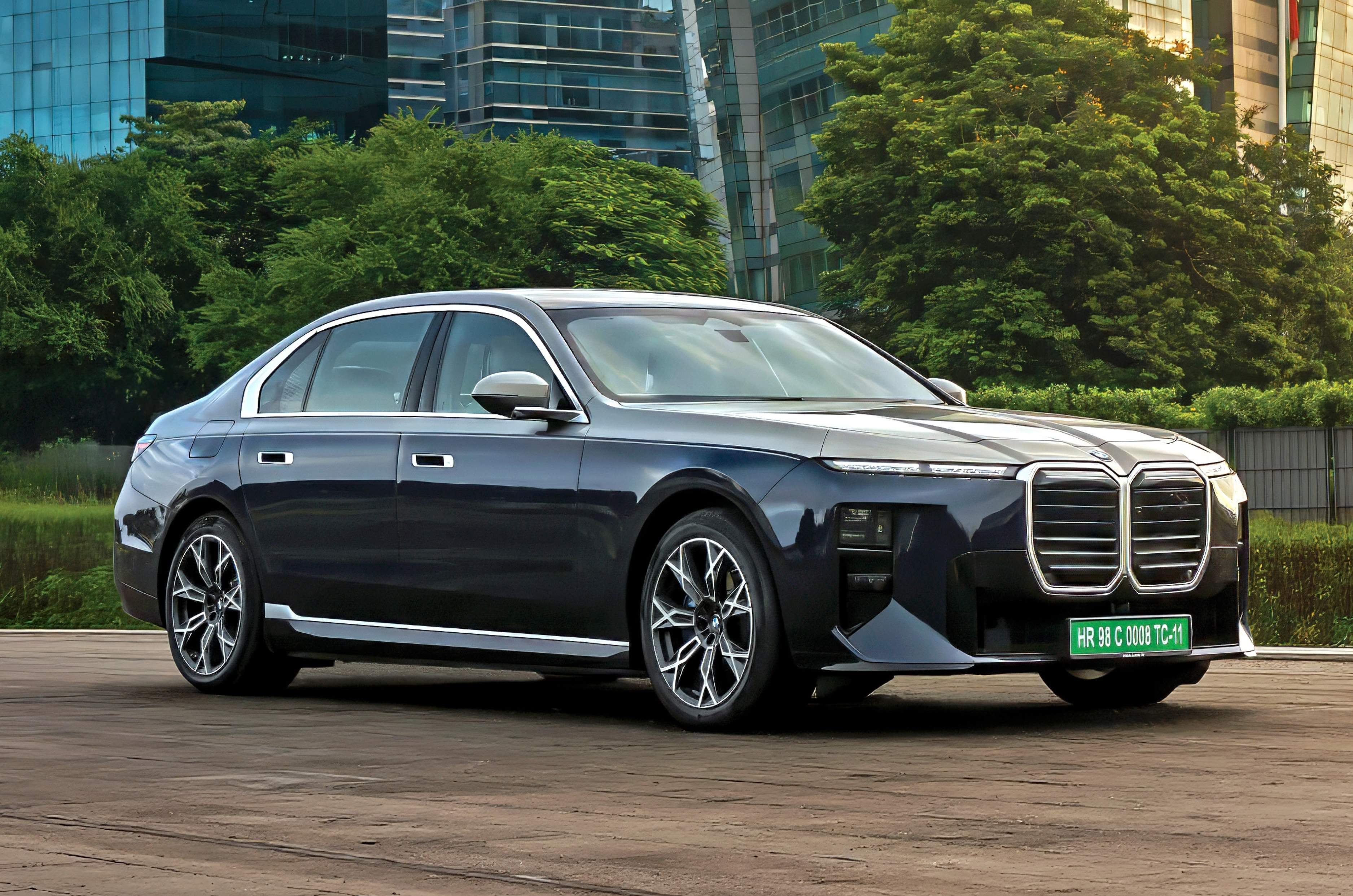
Its powertrain is smooth and refined, its efficiency is excellent, it has an impressive real-world range of over 600km, and it strikes a very good balance between ride comfort and handling. Add to that a cabin packed with cutting-edge tech, and the new CLA emerges as one of the company’s most accomplished EVs yet.
The BMW i7 has been embraced wholeheartedly by India’s ultra-high-net-worth buyers. Since its launch in 2023, it has dominated the high-end luxury sedan space, and interestingly, has consistently outsold its own petrol sibling. In fact, around 60 percent of 7 Series buyers have opted for the EV. With the 2026 i7 now being locally assembled in India and the i7 50 xDrive priced at Rs 1.95 crore, exactly at par with the petrol 740, BMW expects the scales to tilt even further in favour of the electric version.
BMW has also introduced the significantly more powerful i7 M70 xDrive. However, as a full import priced at Rs 2.65 crore, it commands a substantial Rs 70 lakh premium, which is likely to limit its appeal. For most buyers then, the locally assembled i7 50 xDrive is expected to remain the sweet spot of the range.
BMW i7 50 xDrive Exterior Design and Engineering – 8/10
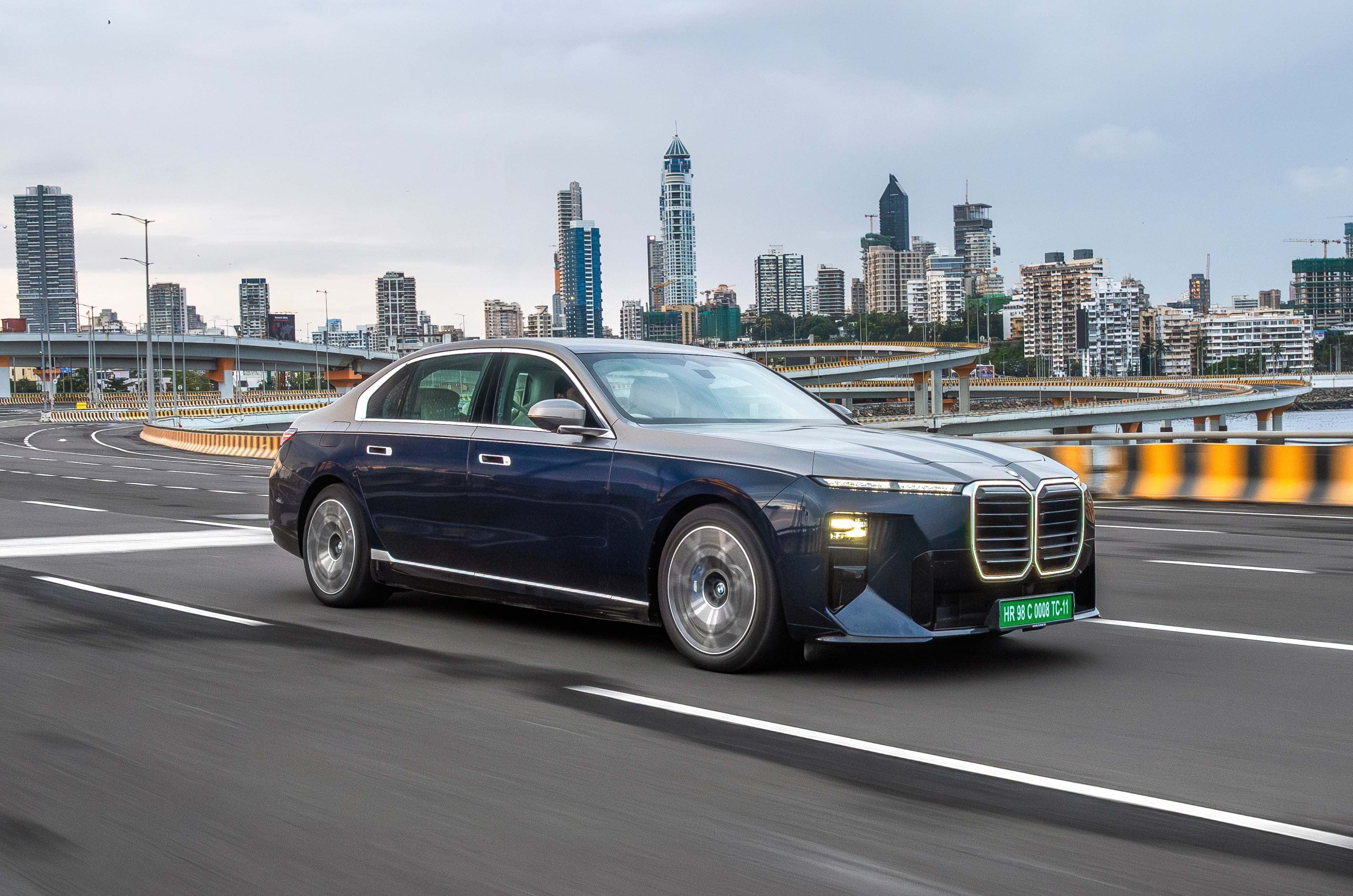
The cleaned-up styling looks significantly more palatable than its predecessor.
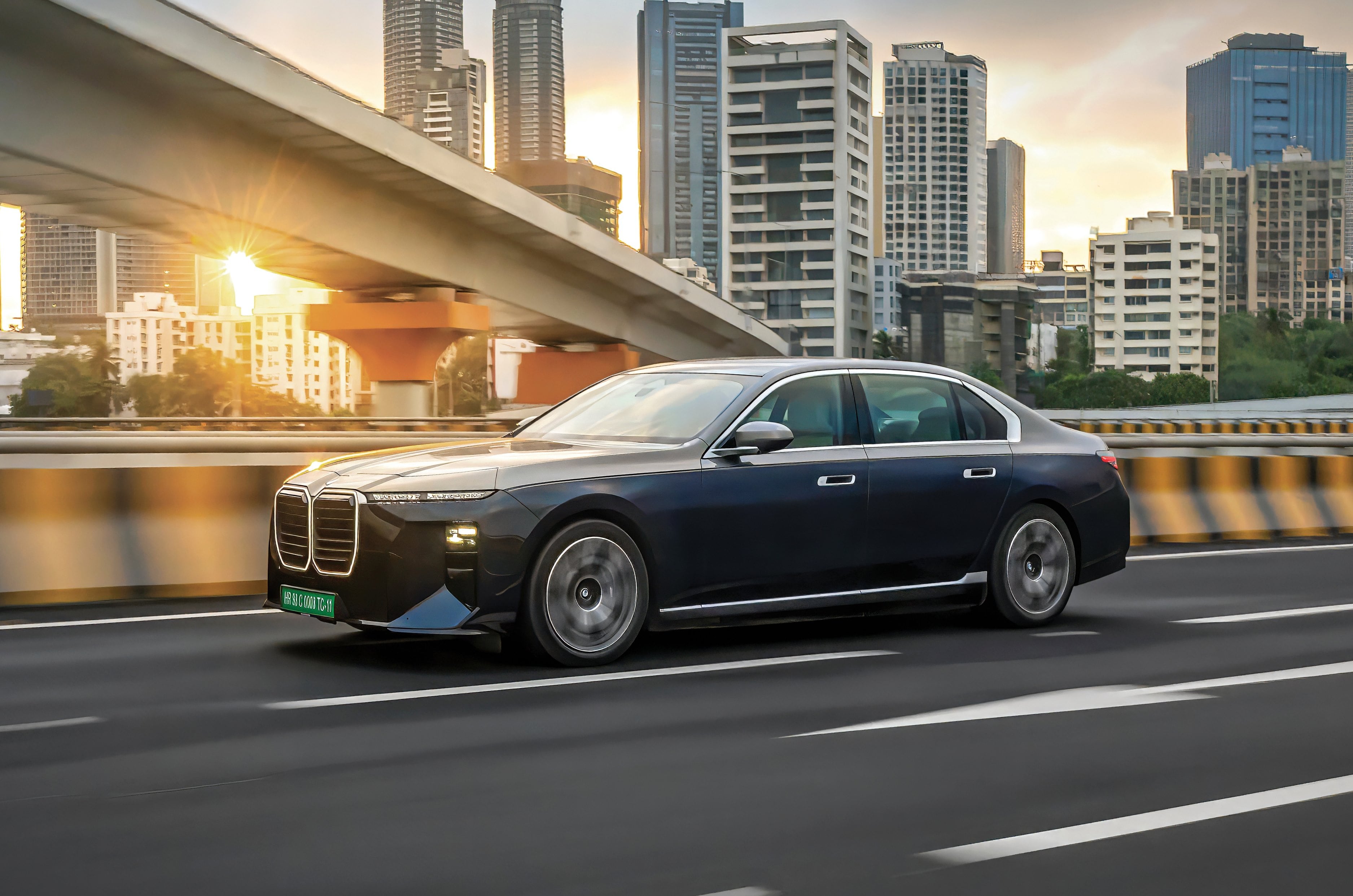
BMW has made substantial changes to the i7’s styling. The DRLs are now longer and slimmer, and feature a crystalline effect that looks absolutely stunning up close. The oversized kidney grille has also been redesigned and, like before, remains illuminated. The air dam adopts a more rectangular design, the headlamps are vertically oriented, and the excessive black treatment has been done away with completely.
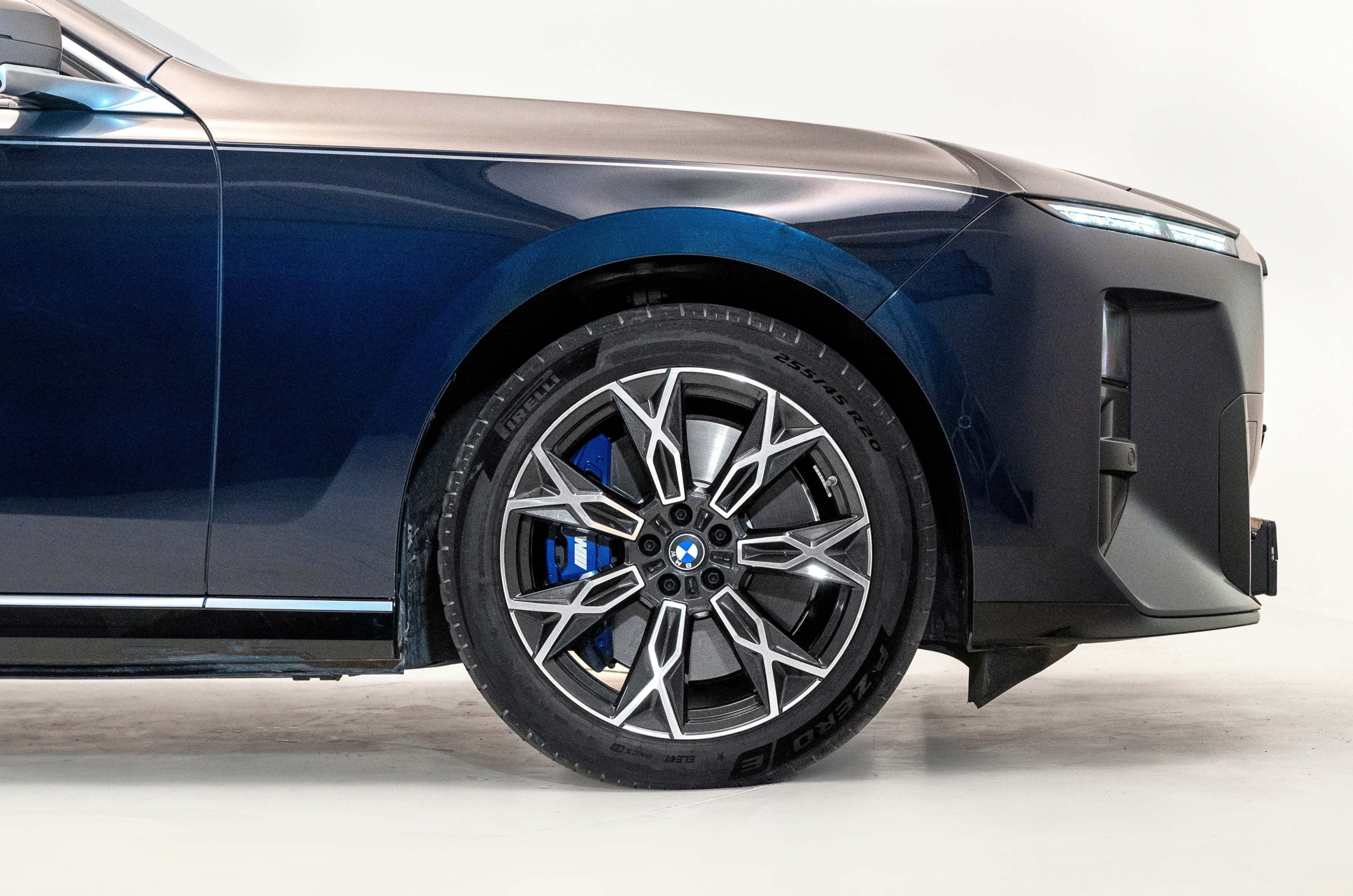
The tyres appear undersized but owners are unlikely to complain given the ride comfort benefits that come with the higher-profile tyres.
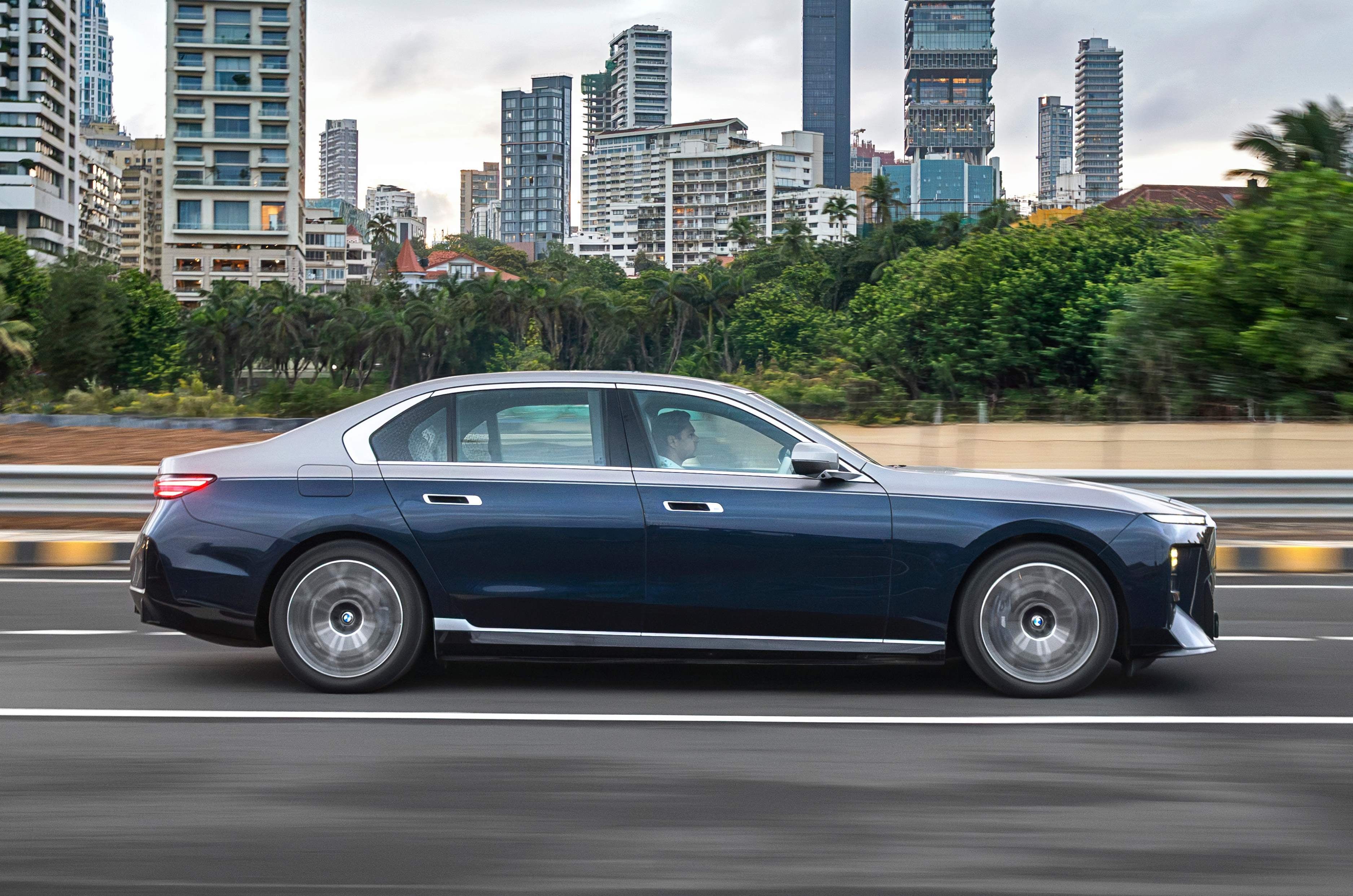
New 20-inch alloy wheels replace the outgoing version’s 21-inch units. While some might argue they appear slightly undersized, owners are unlikely to complain given the ride comfort benefits that come with the higher-profile tyres.
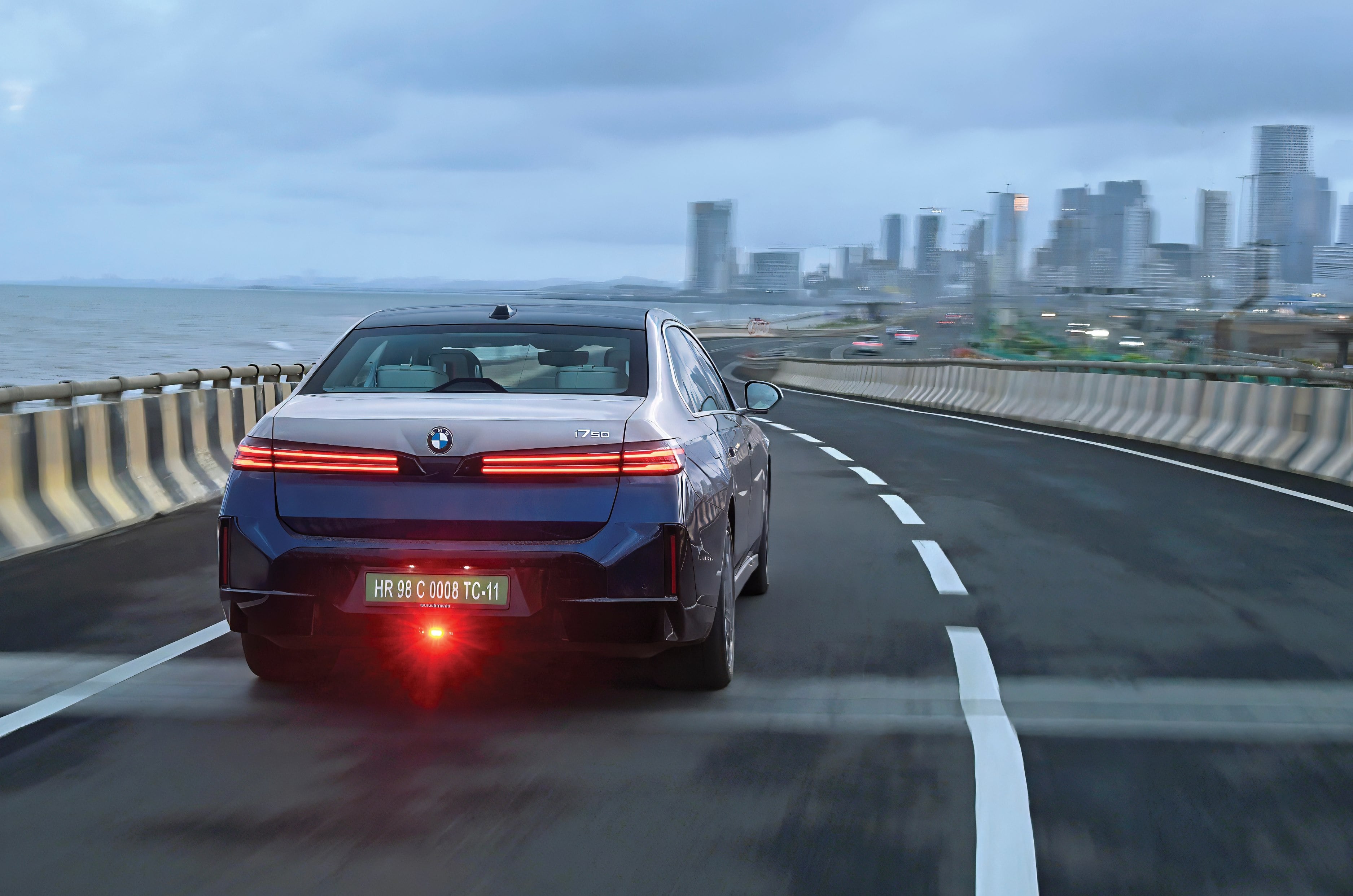
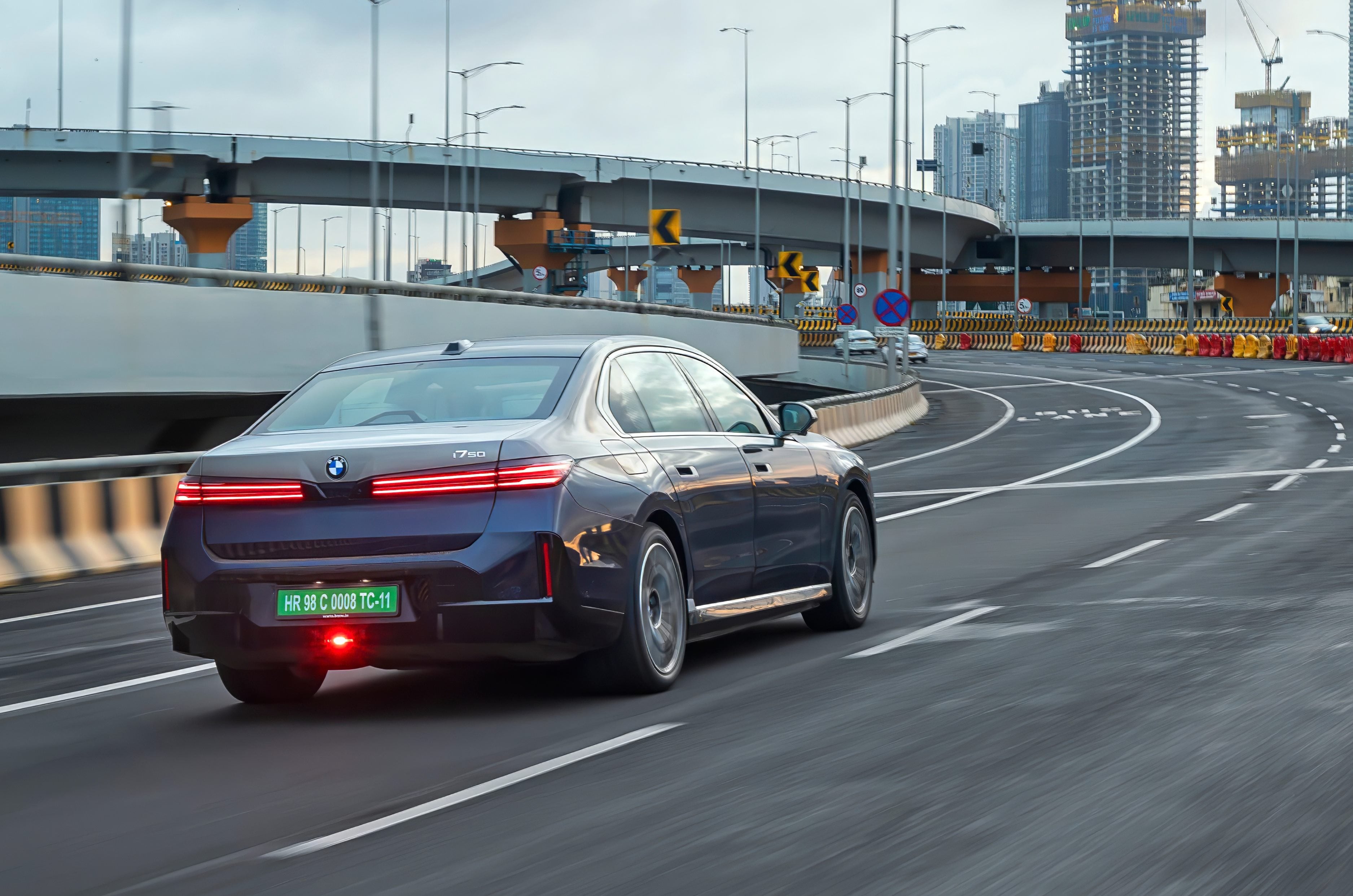
Like the front, the rear has also been cleaned up. There’s a new diffuser, broader tail-lamps, and a neater bumper design. Overall, this iteration looks significantly more palatable than its predecessor, and in the optional two-tone paint finish of our test car, road presence was immense.
BMW i7 50 xDrive Interior Space and Comfort – 9/10
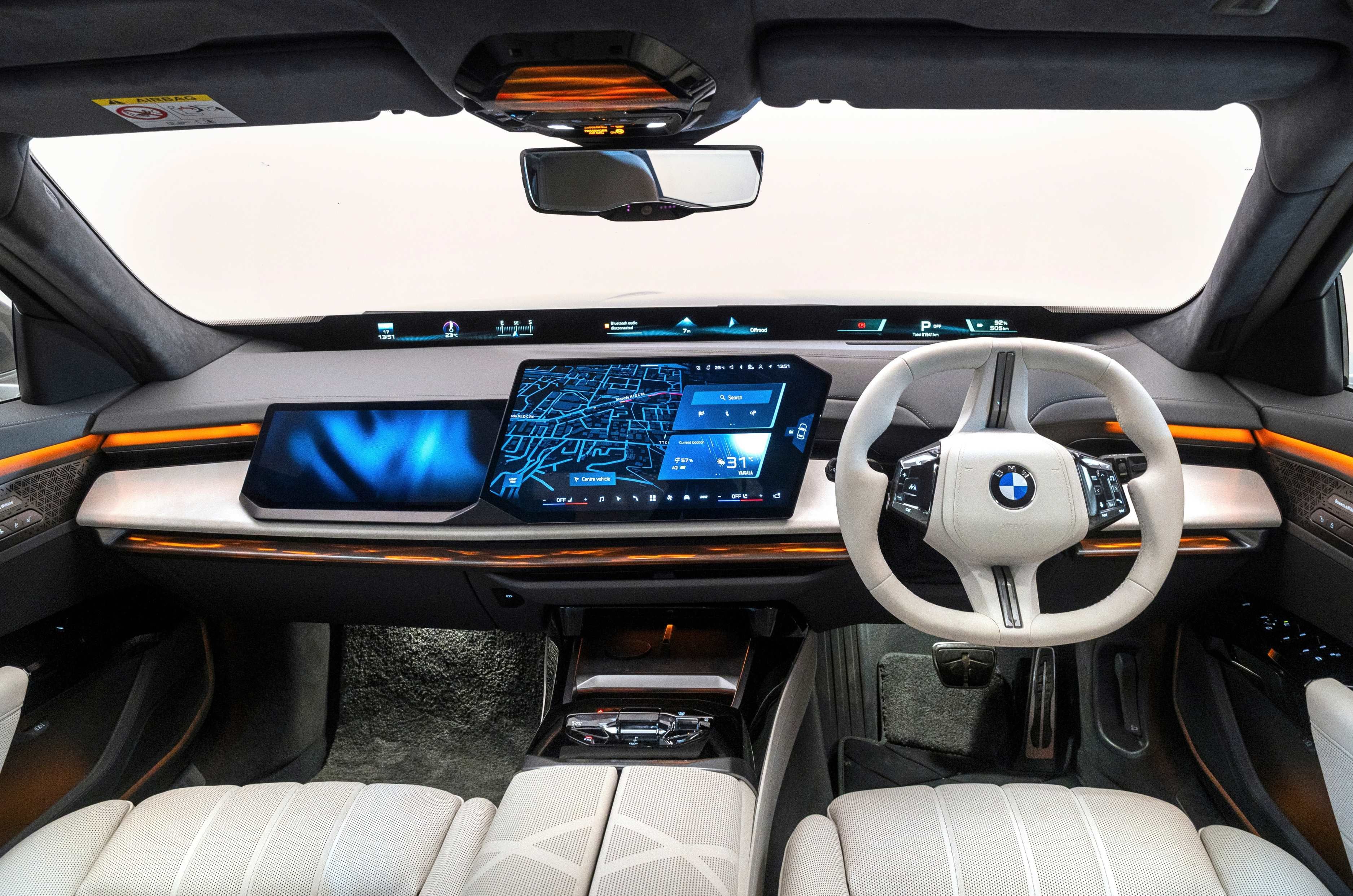
The redesigned dashboard adds freshness and previews the direction BMW’s future interiors are expected to take.
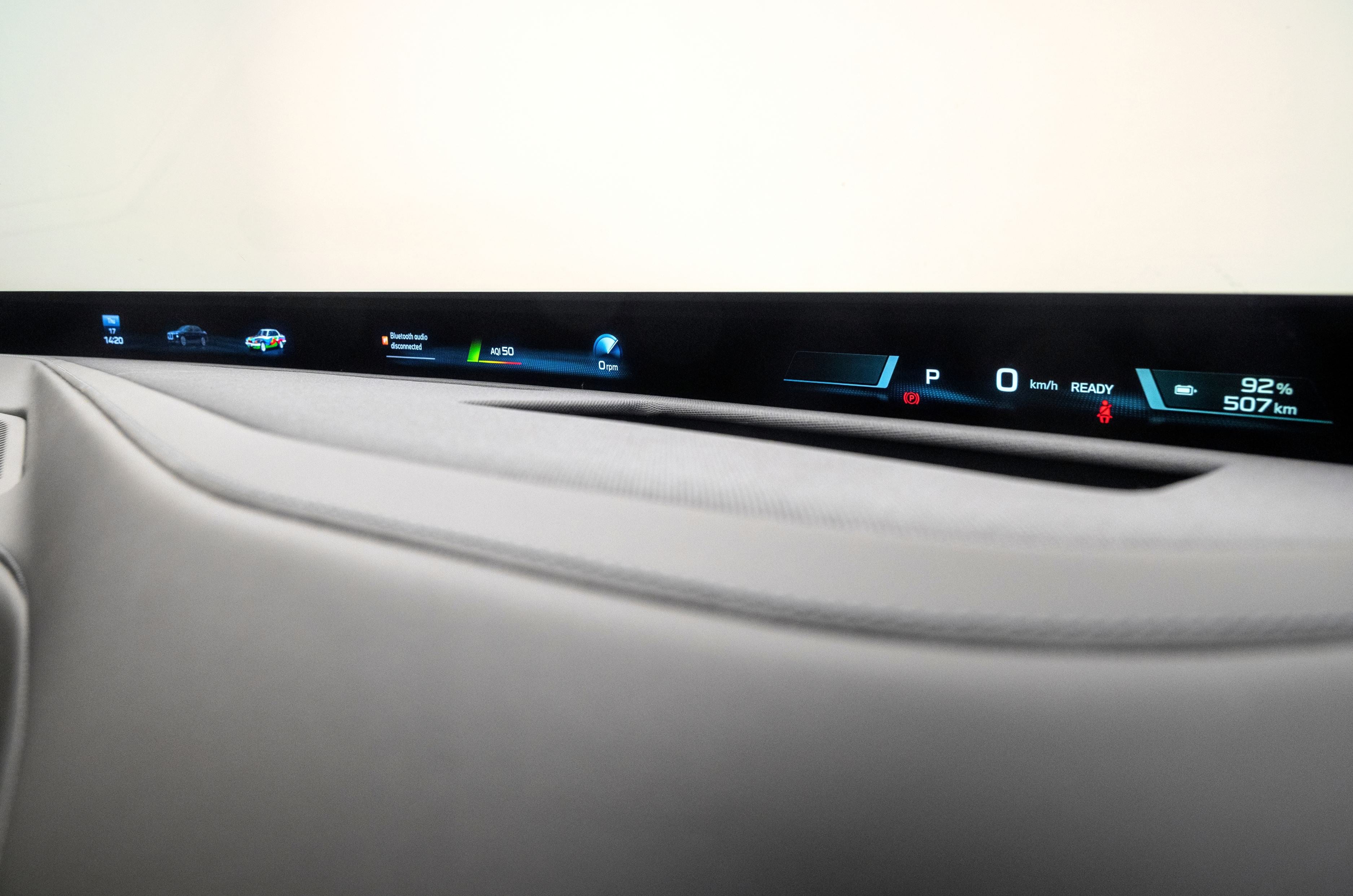
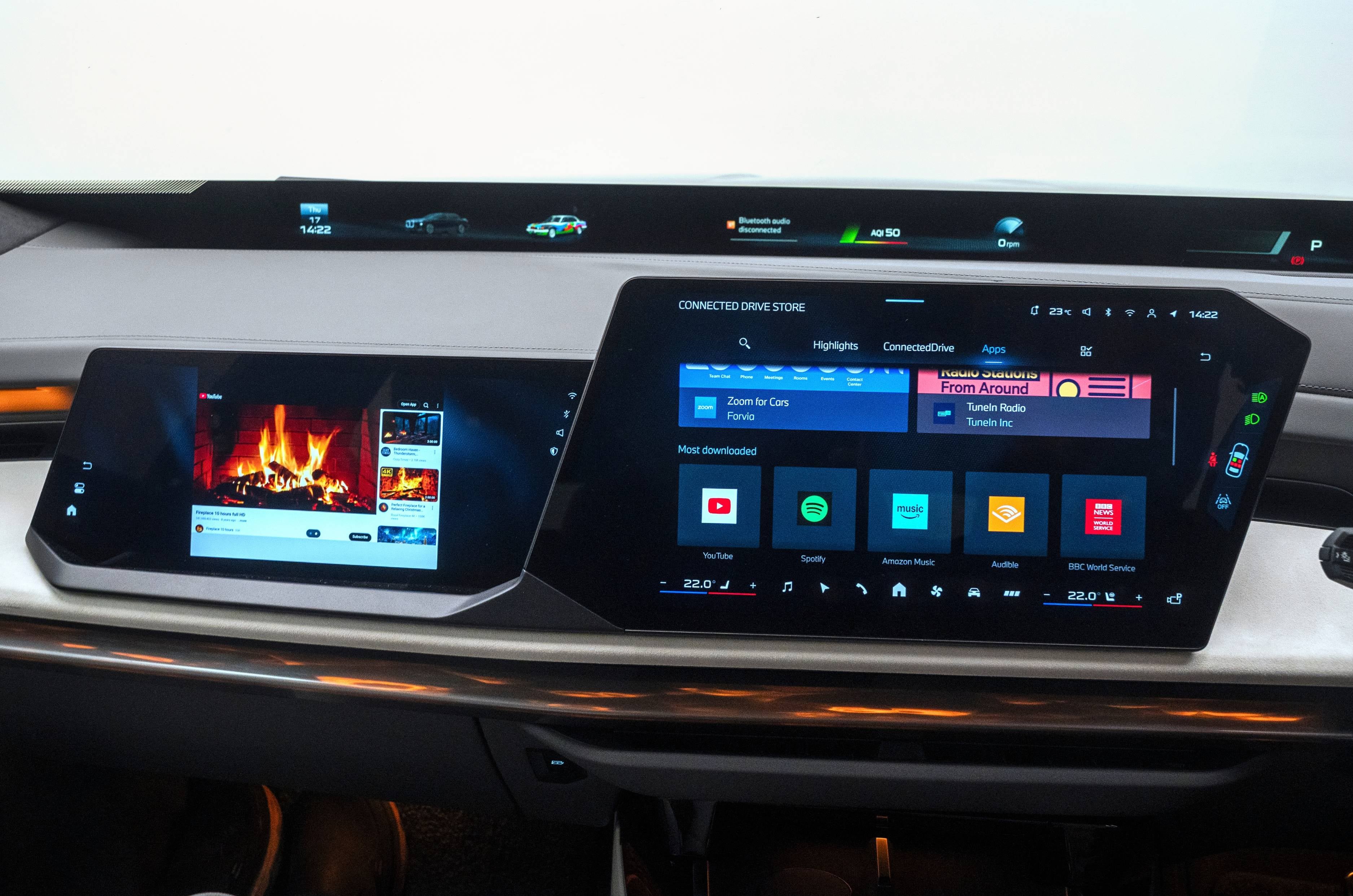
The i7’s dashboard has been completely redesigned, adding much-needed freshness while also previewing the direction BMW’s future interiors are expected to take. The biggest talking point is the deletion of the conventional instrument cluster. In its place sits a new panoramic head-up display positioned right at the base of the windscreen, projecting a wealth of information. It is highly customisable and, besides essentials like speed, charge status and warnings, can display motor speed, navigation, compass information, audio details, date and time, outside temperature, air quality, or even one of BMW’s Art Cars as a decorative element in the remaining six slots. The display is sharp, brilliantly executed, and sits naturally within your field of vision without becoming distracting.
A panoramic head-up display projects a wealth of information, it’s highly customisable and the display is sharp and brilliantly executed.
As for design, the new steering wheel is far more divisive. Its octagonal shape, combined with spokes extending from the horn boss at the 12 and 6 o’clock positions, makes it look unconventional. The light-coloured finish is also likely to be difficult to keep clean — you may even find yourself asking your chauffeur to wear gloves. On the plus side, it feels pleasant to hold, and the controls, though limited in number and not individual buttons, are satisfying to use.
There’s also a new 17.9-inch free-standing touchscreen along with a smaller passenger display, both adopting a parallelogram shape. Curiously, the top-right corner of the central screen appears as though it has been chipped off, although that isn’t actually the case. Generous ambient lighting, crystalline detailing for the drive selector, volume controller and start-stop button, silver speaker grilles, and an overall light-coloured cabin theme further elevate the sense of luxury.
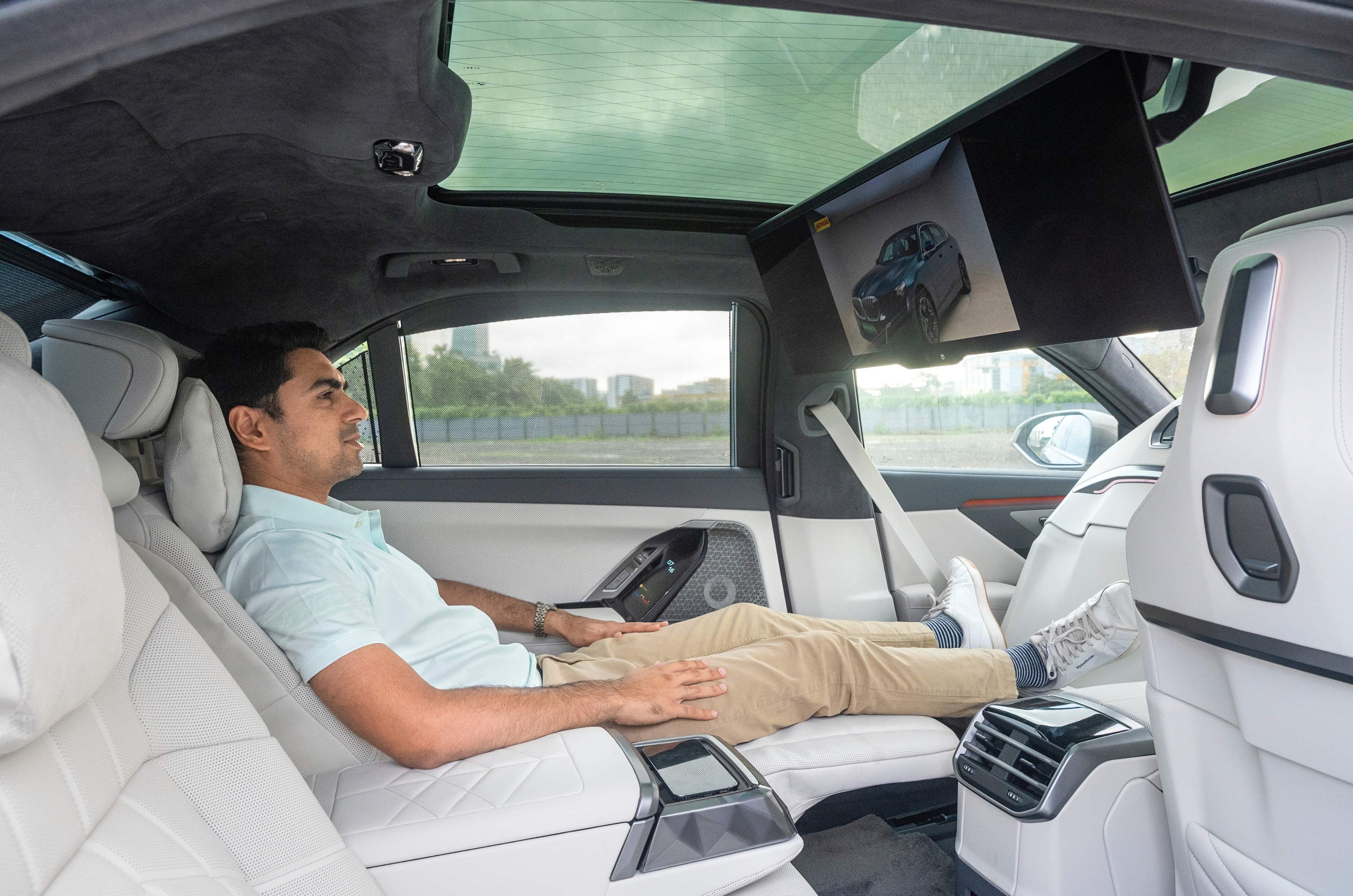
A one-touch relaxation mode transforms the rear seat into a lounge-like position. Updated 8K theatre screen is still part of the package.
Expectedly, the seats are supremely comfortable. All four seats get heating, ventilation and massage functions. Additionally, the rear-left seat features a one-touch relaxation mode that transforms it into a lounge-like position, complete with a raised ottoman, a fully-forward front passenger seat, and a fold-down footrest. Sadly, like the outgoing model, the spare wheel remains mounted on the boot floor, significantly compromising luggage capacity.
BMW i7 50 xDrive Features and Safety – 10/10
The i7 50 M Sport comes loaded with virtually every feature luxury sedan buyers could ask for. The new panoramic end-to-end head-up display replaces the conventional instrument cluster and is not only unique and highly customisable, but also exceptionally well executed. The 17.9-inch touchscreen is new too, and now benefits from additional shortcut keys in addition to permanently displayed climate-control functions, making it marginally easier to operate than before. However, the user interface still feels somewhat overwhelming, with an abundance of functions buried within multiple sub-menus.
The central screen is marginally easier to operate than before. The new front passenger entertainment display is likely to be of limited relevance to most owners.
Also new is a front passenger entertainment display, though we suspect it will be of limited relevance to most owners. The new 31.3-inch 8K rear theatre screen, on the other hand, is likely to see much greater use, particularly on longer journeys.
Carried over from the outgoing version and continuing to add a sense of occasion are the powered doors, which open and close at the touch of a button.
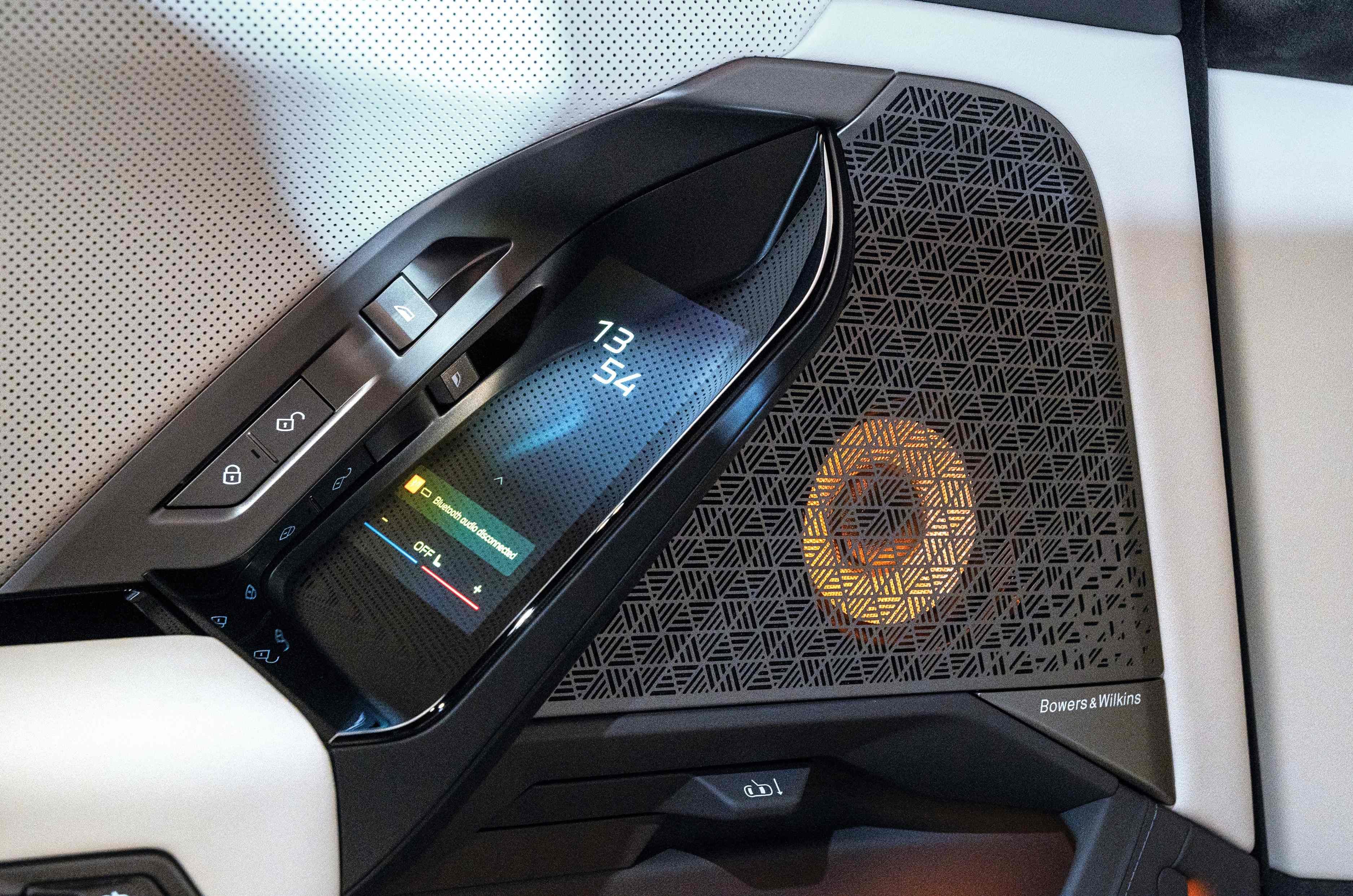
Its Bowers & Wilkins Diamond Surround Sound System with Dolby Atmos delivers an incredibly immersive audio experience.
The highlight, however, is the outstanding Bowers & Wilkins Diamond Surround Sound System with Dolby Atmos and a whopping 35 speakers. It even delivers a 4D experience, with a pronounced thump felt through all four seats. The result is an incredibly immersive audio experience that is sure to impress even the most discerning audiophile.
BMW i7 50 xDrive Performance and Refinement – 9/10
Its performance feels effortless and reassuring, while the accelerator calibration is smooth and progressive for everyday driving.
The i7 50 xDrive uses a dual-motor setup producing a combined 483hp and 660Nm, which is more than adequate for a luxury sedan of this nature. There’s rarely any need to switch out of Efficient mode because there is always a vast reserve of torque available. The effortless performance feels reassuring, while the accelerator calibration is smooth and progressive during everyday driving.
Press the accelerator beyond the halfway mark and the i7 takes off like a scalded cat. Acceleration is rapid, with this 2.8-tonne luxury sedan sprinting from 0-100kph in just 5.5 seconds and reaching 200kph in a shade under 19 seconds. Owners can also choose to activate synthetic motor sounds that play through the speakers, adding a dramatic, sci-fi soundtrack to acceleration. These can be switched off entirely for a completely silent experience.
There are multiple regenerative braking settings, including Adaptive, High, Mid and Low. Of these, Adaptive stands out for its excellent calibration, intelligently varying regeneration and coasting based on traffic and road conditions. There’s also a dedicated one-pedal ‘B’ mode selectable via the drive selector. It delivers regeneration similar to the High setting but, unlike it, can bring the car to a complete stop without any brake pedal input.
BMW i7 50 xDrive Range and Efficiency – 9/10
The i7 50 xDrive gets a larger 112.5kWh battery pack with NMC cell chemistry, replacing the outgoing version’s 101.7kWh unit. As a result, this version claims a WLTP range of up to 728km. Although we haven’t yet subjected it to our range tests, we expect it to comfortably deliver over 500km in real-world conditions, which is more than sufficient for most users. BMW claims the battery can charge from 10-80 percent in 28 minutes using a 250kW (or higher) DC fast charger. On a 22kW AC charger, a full charge takes approximately six hours.
BMW i7 50 xDrive Ride Comfort and Handling – 10/10
What’s truly impressive is the pillowy ride quality. It shrugs off badly broken roads with ease, and maintains excellent body control.
Piloting the i7 may initially seem intimidating given its considerable dimensions, but its light steering and rear-axle steering significantly aid manoeuvrability. The latter allows the rear wheels to turn either with or against the fronts by up to 3.5 degrees, helping the car feel remarkably agile for its size.
What’s truly impressive is the pillowy ride quality. The thick, high-profile tyres add another layer of cushioning, allowing the i7 to shrug off even badly broken roads with ease. It absorbs potholes effortlessly, keeps road shocks well isolated, and maintains excellent body control. Passengers are also spared the uncomfortable side-to-side movements over unusually rough patches.
Selecting Sport mode does firm things up slightly, but while the air suspension becomes tauter and body control improves further, ride comfort never suffers. Handling feels predictable and, thanks to xDrive all-wheel drive, the i7 feels exceptionally planted and offers impressive grip when tackling corners. Rear-wheel steering also does a remarkable job of disguising its size.
In short, the i7 can be driven surprisingly enthusiastically, and for a luxo-barge, it drives exceptionally well. We would, however, recommend leaving the steering in Comfort mode, as it feels unnecessarily heavy in Sport.
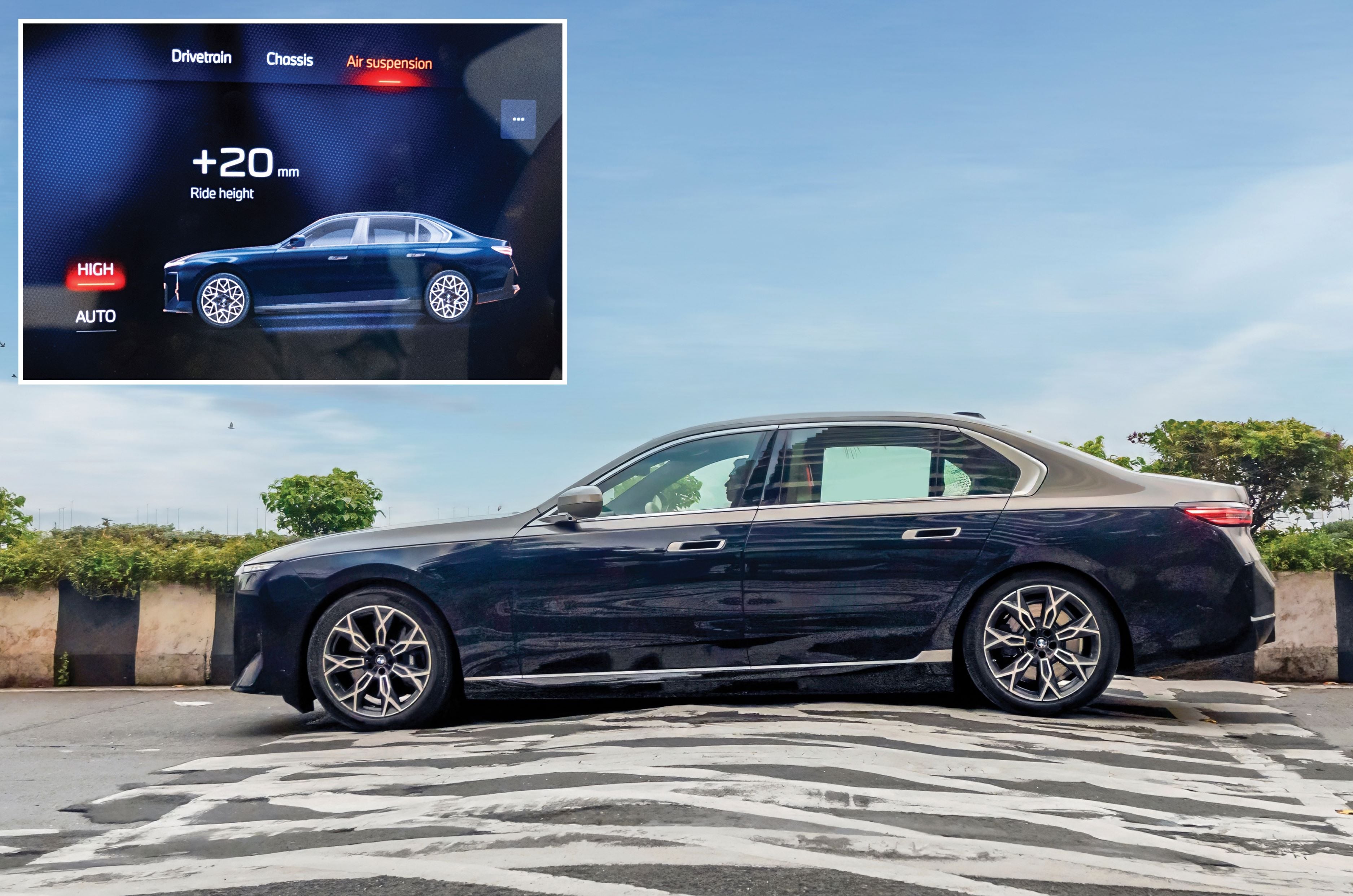
The suspension raises by 20mm over the 136mm standard setting, allowing it to clear all but the most poorly designed obstacles.
Sport mode also lowers the ride height by 10mm from the standard 136mm setting. While beneficial for dynamics, it makes the underbody vulnerable even on relatively small speed breakers. Thankfully, two taps on the touchscreen raise the suspension by 20mm over the standard setting, allowing it to clear all but the most poorly designed obstacles. Cabin insulation is outstanding too, keeping road, wind and ambient noise effectively isolated from occupants.
BMW i7 50 xDrive Price and Verdict – 9/10
At Rs 1.95 crore, the locally assembled i7 50 xDrive is priced exactly at par with the petrol-powered 740 and is even a few lakhs more affordable than its chief rival, the Mercedes-Benz S-Class. Yet pricing alone isn’t what makes the i7 such a compelling proposition.
What truly sets it apart is the sheer sense of occasion it delivers. Its styling is bold, the cabin feels genuinely special, ride comfort is exceptional, and the level of technology on offer significantly elevates its desirability. Add to that an extraordinary audio system and the effortless refinement that only a luxury EV can deliver, and the i7 feels every bit the flagship it is.
Yes, luggage space remains compromised by the spare wheel placement, and the touchscreen interface isn’t quite as intuitive as that of its chief rival. But in this segment, neither is likely to be a deal-breaker.
The bigger takeaway is that BMW has successfully made the electric version of its flagship sedan the more desirable one. For buyers seeking luxury, comfort and technology, the i7 50 xDrive isn’t merely an excellent EV, it’s quite simply all the luxury car you’ll ever need.
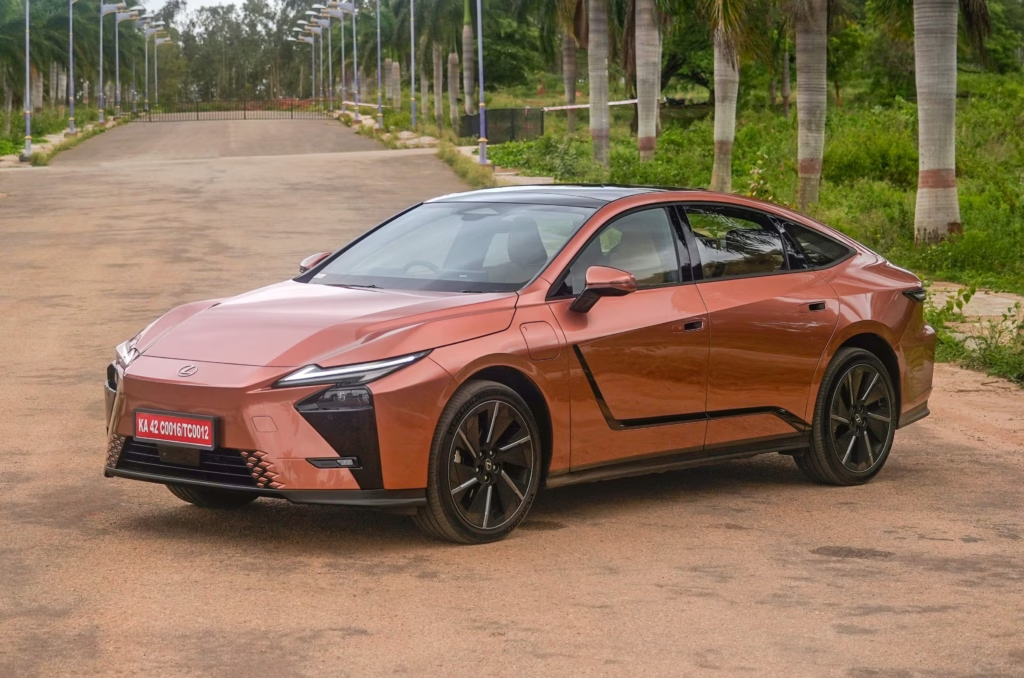
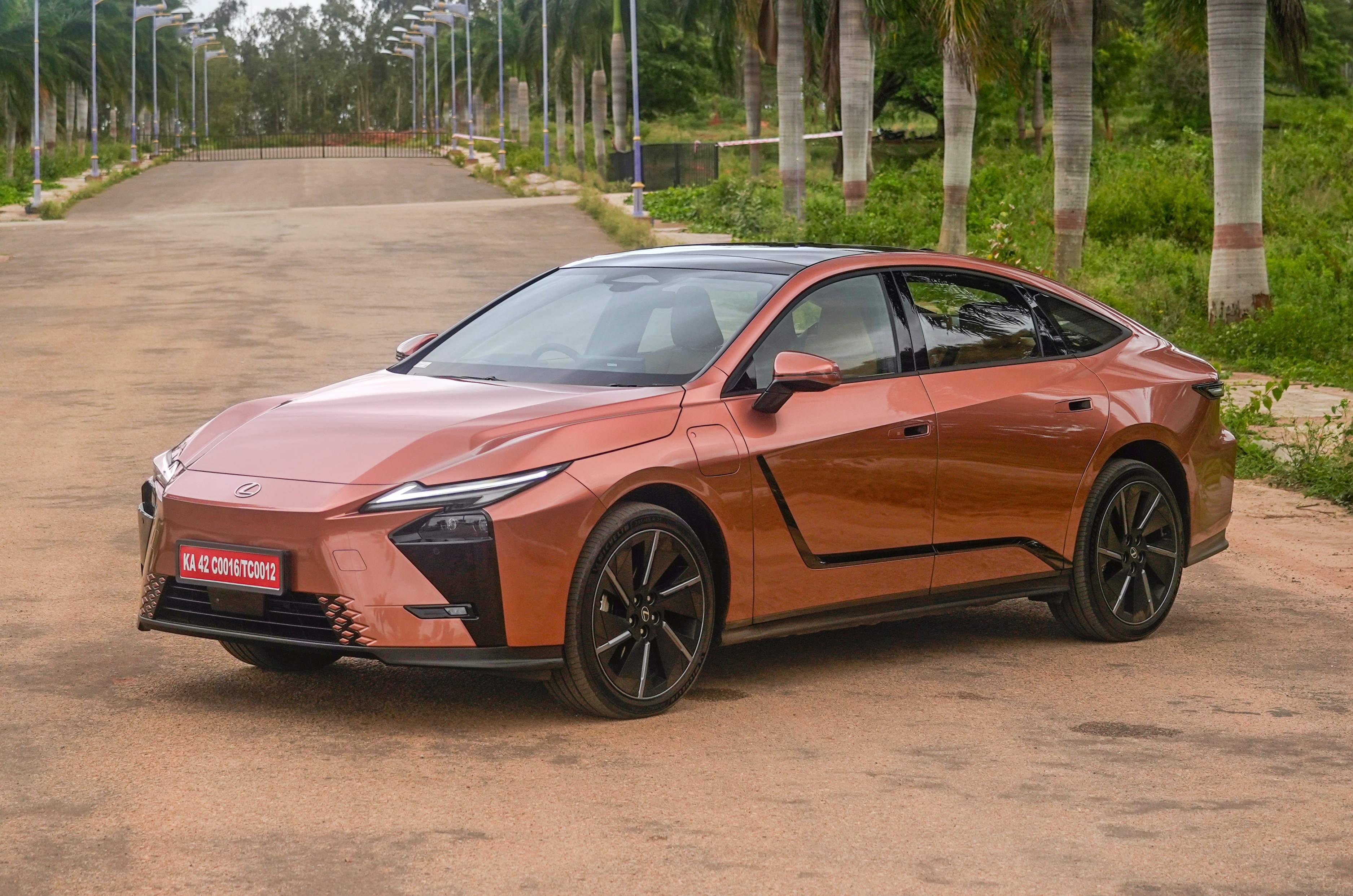
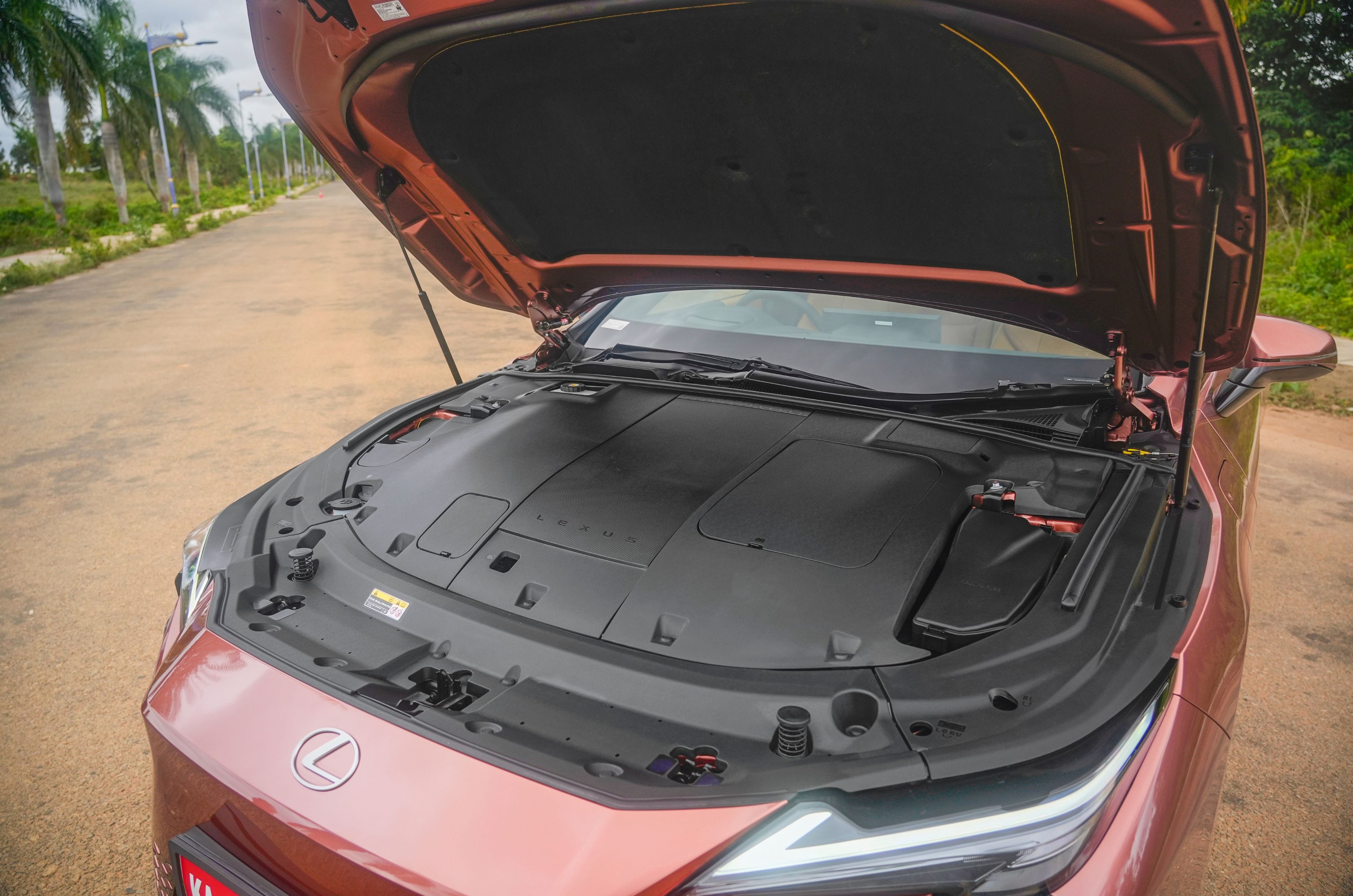
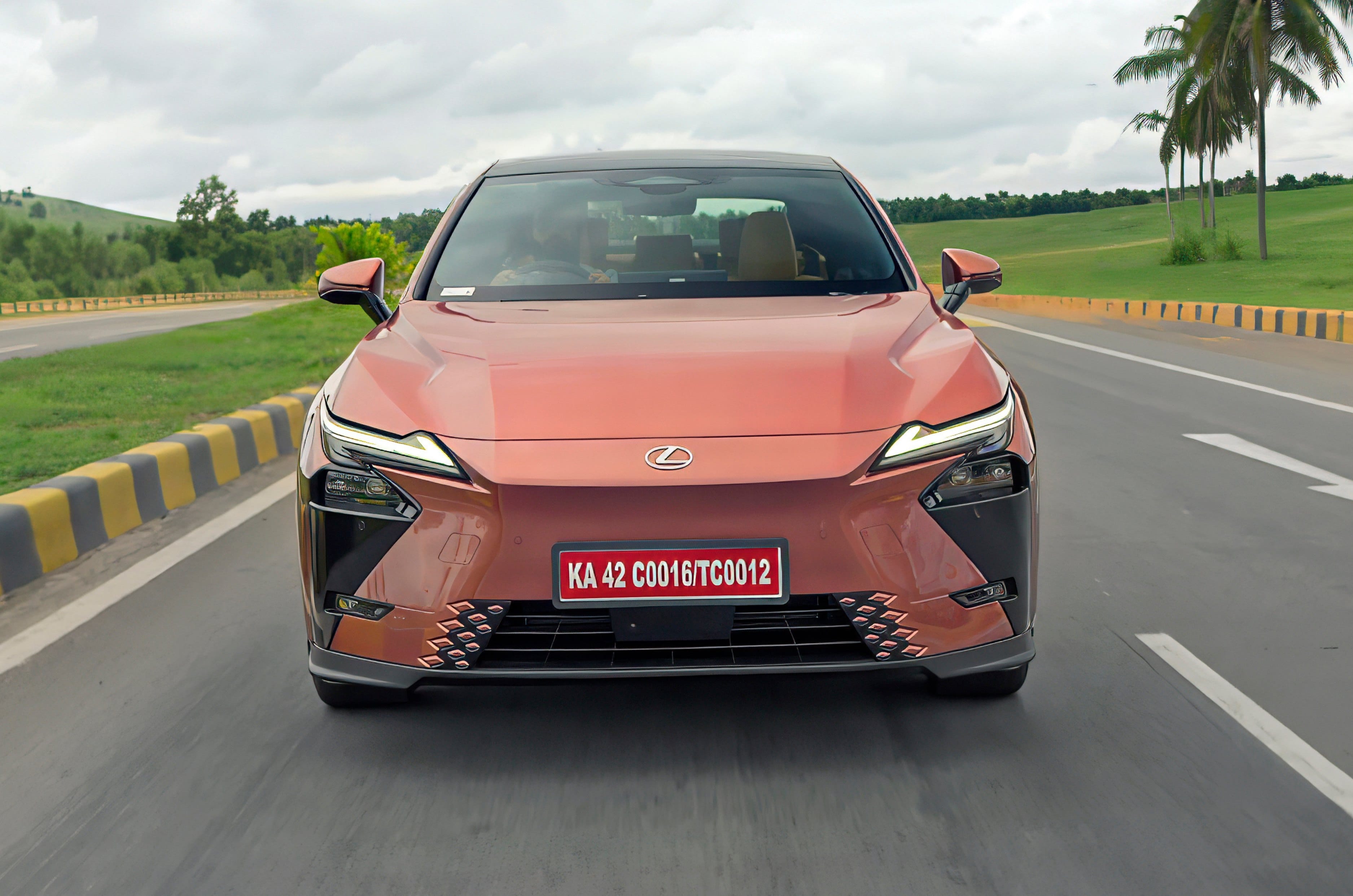
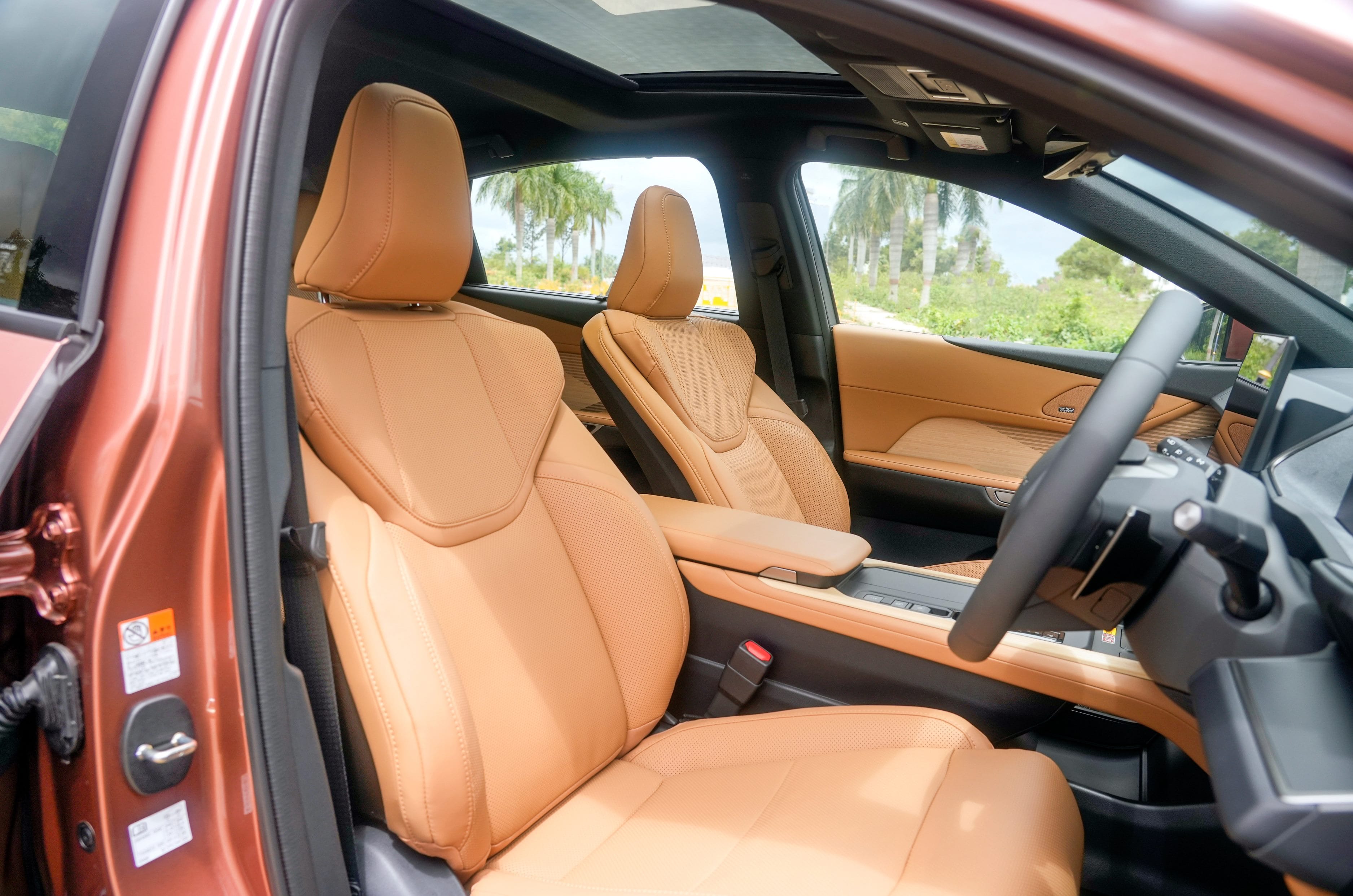
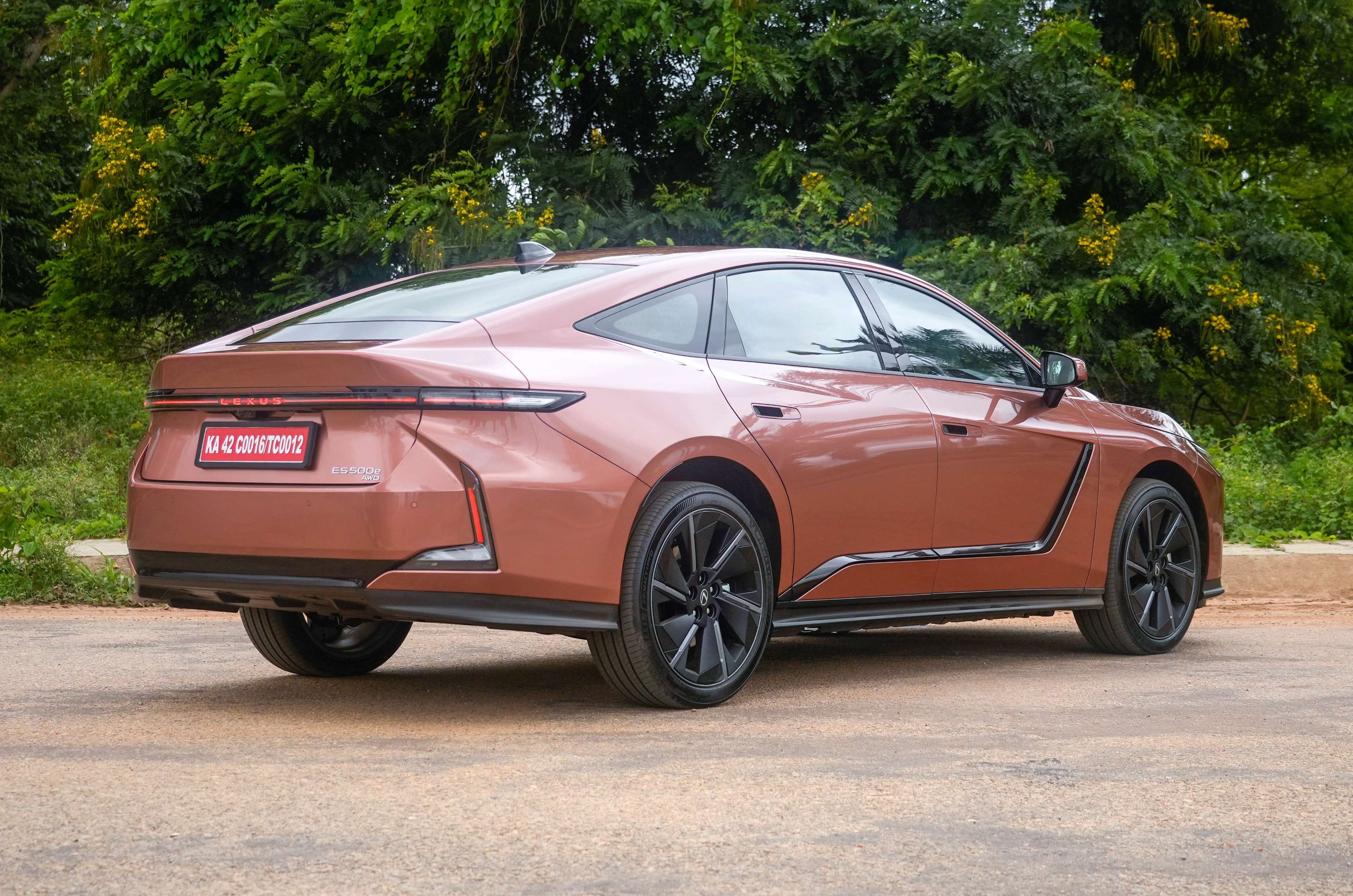
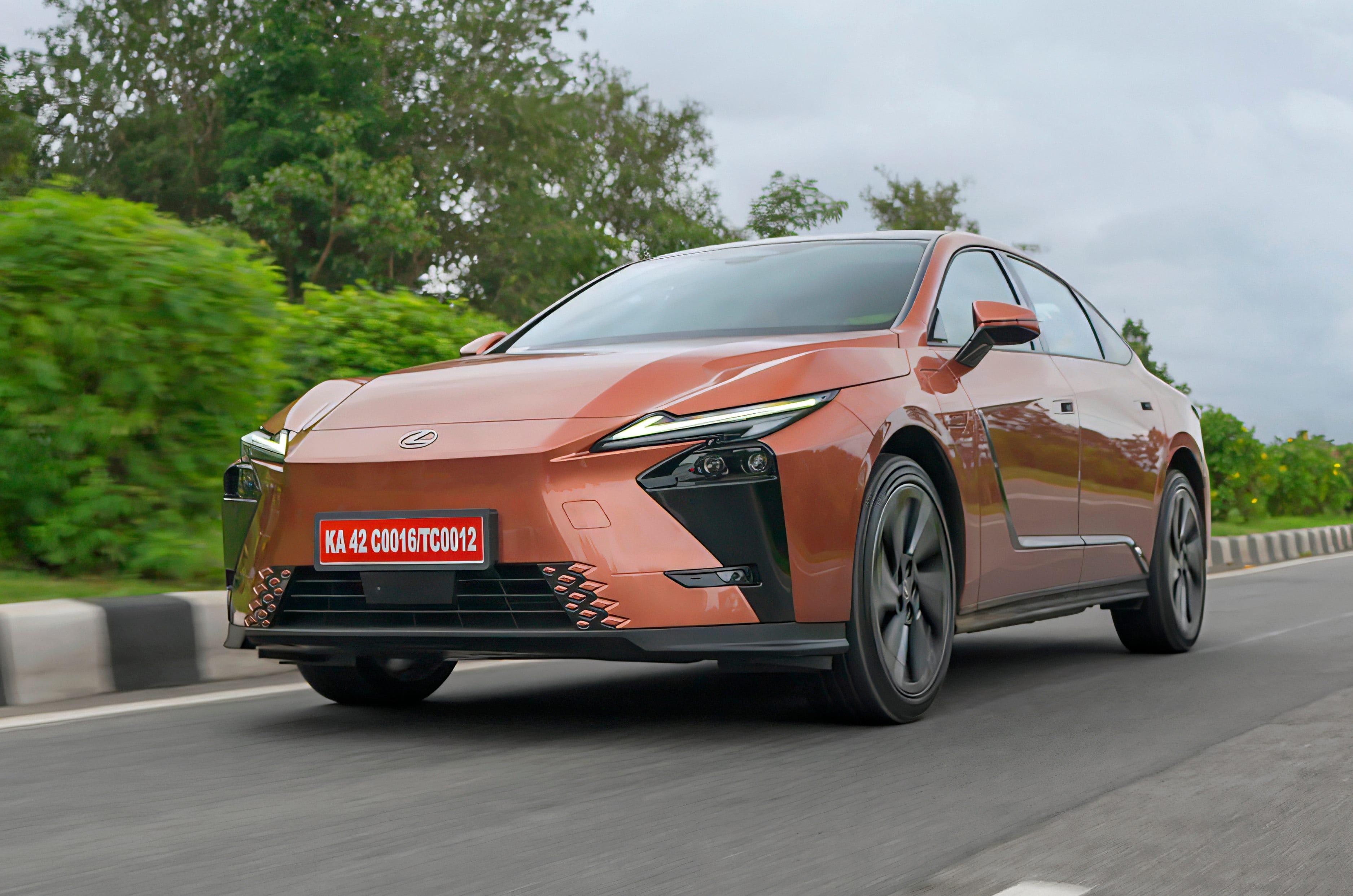
The Lexus ES 500e is the brand’s first all-electric model in India and is priced at Rs 91.20 lakh (ex-showroom). Its 74.68kWh battery powers two electric motors that produce a combined 343hp and 438Nm, with Lexus claiming a range of 580km. We’ve driven the ES 500e to see what works well and what doesn’t.
Pros
1. Smooth, linear power delivery
The ES 500e has 343hp and 438Nm from its dual-motor all-wheel-drive setup, but it doesn’t feel intimidating from behind the wheel. Power builds in one smooth, predictable surge, with a quick response that never feels abrupt. Even in Sport mode, the delivery remains easy to modulate, making the ES 500e feel more relaxed than its performance figures suggest.
2. Excellent refinement
This is one of the ES 500e’s strongest qualities. Lexus has done a good job of keeping wind, road and tyre noise out of the cabin, and even at highway speeds there is little more than a faint whoosh from the ORVMs. Combined with the quietness of the electric powertrain, it makes the ES 500e a particularly calm car to spend time in.
3. Spacious cabin
The ES 500e’s 5,145mm length and 2,950mm wheelbase translate into a roomy cabin, particularly for rear passengers. There is plenty of legroom and the seats themselves are well shaped and comfortable. The front seats also get heating and ventilation, adding to the car’s long-distance comfort.
Cons
1. Range
The 74.68kWh battery has a claimed WLTP range of 580km, but real-world numbers hover around the 380km mark. That is a sizeable gap and means long-distance journeys will need more planning, particularly when compared with what you might expect from a large luxury EV with this size of battery.
2. Ride quality
The ES 500e’s ride is firmer than the 350h, partly because of the changes made to handle the EV’s additional weight. The 21-inch wheels and relatively low-profile tyres compound the issue, with low-speed bumps and expansion joints making their presence felt in the cabin. It is more settled at highway speeds, but ride comfort is still not a strong point for a car of this size and price.
The EX90 is Volvo’s latest offering in India and also its most premium one. The EX30 and EC40 compete in the entry-level luxury EV segment, but the EX90 is the brand’s flagship electric SUV. It comes in a single, fully loaded variant with all the bells and whistles, along with a dual-motor setup and a claimed range of over 600km. Can it bring in a new audience or convert some XC90 customers? It certainly has the traits to do both.
EX90 Exterior Design and Engineering – 9/10
Built on Volvo’s SPA2 dedicated EV platform that has hints of the XC90.
Based on the new SPA2 architecture, which has its roots in the previous SPA platform but is built specifically for EVs, the EX90 does share some resemblance to the XC90 in its shape and form factor. However, the details are different. As expected, the overall design is simple and far from outlandish or attention-seeking. This is in keeping with the brand’s image, and the restraint actually works. The flat, closed-off front end dismisses any chances of a blingy chrome grille, and what adds drama instead are the LED lights that split open to reveal the main headlamps behind. These, too, have an impressive party trick; with over a million pixels, they can individually light up or switch off and constantly shape a light beam to avoid dazzling oncoming traffic. Further down, you get some more DRL strips, one on each side, and a rather simple, fuss-free bumper.
DRLs that spilt open to reveal headlamps add drama.
Over to the side, the EX90 is slightly longer than the XC90, while the rest of its dimensions see a marginal bump. 21-inch wheels are standard, and the 210mm of ground clearance at its lowest setting is plenty. The air suspension also allows you to raise the car up to 250mm for off-road use. The door handles are pop-up, flip-up-style units, and you no longer get a key. Instead, you get a card that you need to tap at the right spot, with the Volvo logo facing the right way, for the handle to pop up. Alternatively, you can simply link your phone to the car and use it as a key. It seems convenient on paper, but the card system needs to be a lot more seamless to be hassle-free.
At the rear, it gets a split setup for the LED tail-lamps, with C-shaped LEDs on the lower half and vertically stacked LEDs in the D-pillar. There isn’t a single strip of chrome, and even the cladding is minimal. Subtlety is what Volvo aims for with its design, and the EX90 offers just that.
EX90 Interior Space and Comfort – 8/10
Two-tone upholstery looks rich and materials feel plush.
Inside, the minimalist approach continues and even takes precedence. The dashboard is devoid of any buttons whatsoever, and the majority of the real estate is taken up by the 14.5-inch touchscreen. However, the bright seats and upholstery, along with the bright open-pore wood, lift the cabin ambience significantly. There is generous use of brushed aluminium as well, and the Nappa leather is fantastic to the touch. The centre console also features wireless charging and a rotary knob for media control.
There is plenty in the front seats to pamper you. They offer excellent support, and feature heating, ventilation and a whole host of massage options. Plenty of electric adjustment also means finding an accurate driving position is easy, and all-round visibility is very good.
Exclusively a six-seater with good space and comfort.
The EX90 is only available as a six-seater, so in the middle row you get captain’s chairs, but these would feel snug for some, and for a luxury car that would be chauffeur-driven, you don’t get the same level of pampering as in the front seats. There is no electric adjustment, heating, ventilation or massage either. There aren’t any sunblinds for the windows too, and even though the huge panoramic sunroof is electrochromic, at the tap of a button you get a bit of tint in the glass, on a hot day with the sun overhead, you will need more.
Massive panoramic glassroof gets electrochromic shade. Physical sunshade is an accessory.
The accessories list has a proper roof shade to protect you from that, and it is an extra we recommend you select. On the plus side, space is good, and the seats can be adjusted for legroom and recline too. You get four-zone climate control, with AC vents in the pillars that are a lot more effective, and cupholders stowed within the armrests. Also, being a modified platform, the floor is raised, and you notice this while getting in and out of the car.
Access to the third row is easy from between the captain’s chairs, thanks to the flat floor, but there is no tumble feature for the seats. Instead, they only slide forward, opening a cavity to get in. Room in the last row is at a premium for tall adults, but kids or shorter adults will do just fine with a little adjustment to the middle row.
Third row best suited for kids or short adults over quick drives.
With all three rows up, boot space stands at a healthy 324 litres, and with the third row folded away, it is a sufficient 690 litres. There is a 46-litre frunk too for stowing charging cables. Impressively, there is a full-size spare wheel as standard, which will eat up some boot space but is a huge relief given the low-profile tyres and our roads.
EX90 Features and Safety – 8/10
Annoyingly every control is within the 14.5-inch Google-powered screen.
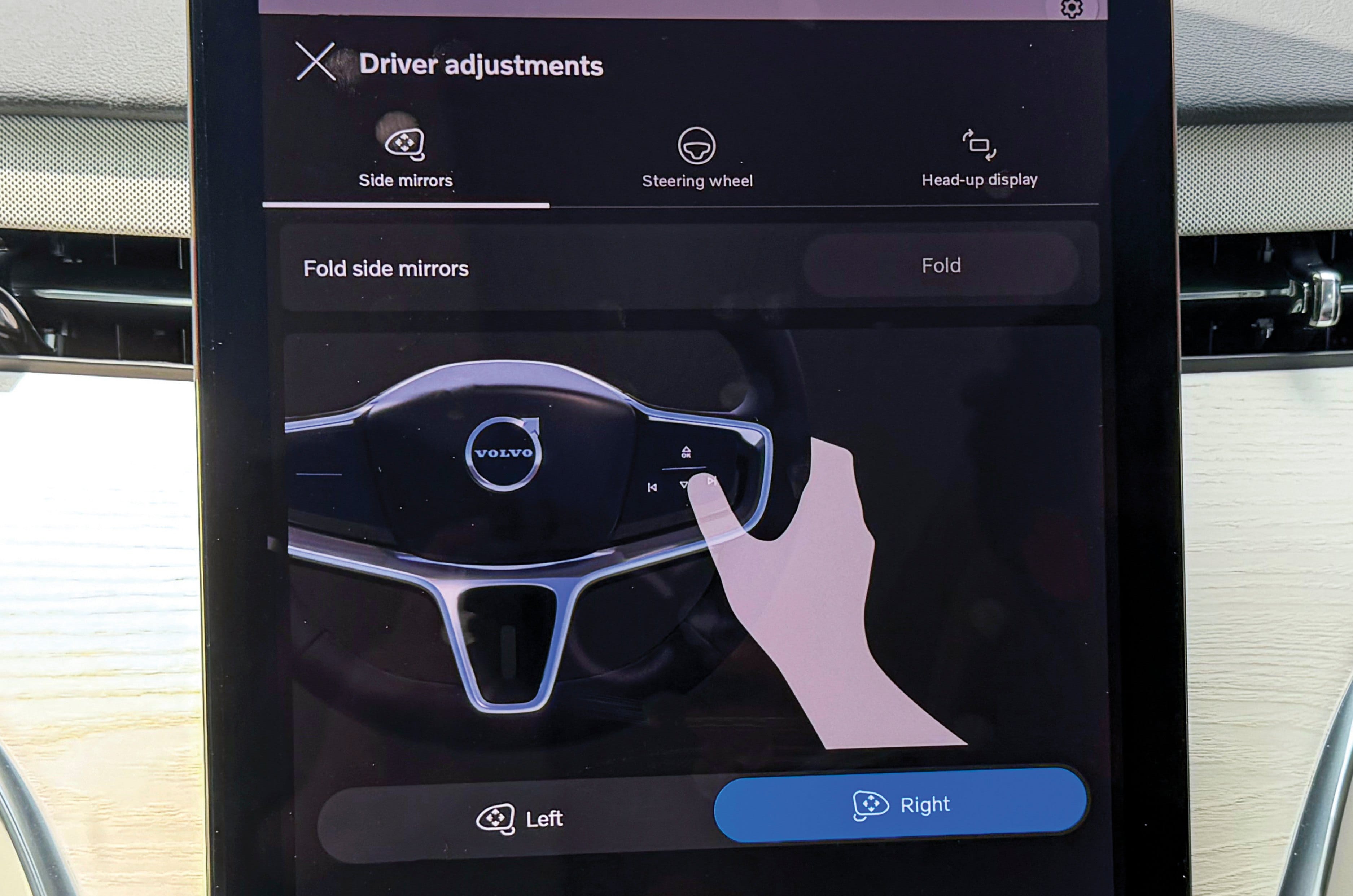
Most of the EX90’s features are accessed through the massive, vertically oriented touchscreen. Being Google-powered, it runs a smooth OS, but simple tasks like adjusting the ORVMs require multiple inputs and navigation through the menus, which isn’t easy while on the move. There are some hard-coded functions at the bottom of the touchscreen, such as climate control, but you still need to focus on the screen and cannot operate them easily while driving. There is also a 9-inch driver display with nothing but the absolute necessary figures, such as range, speed and battery percentage. You can also load up the maps there, and it displays the traffic around you too. However, don’t expect multiple dials and a loaded, fighter-jet-like cockpit experience, the instrumentation is all minimal but feels sparse too.
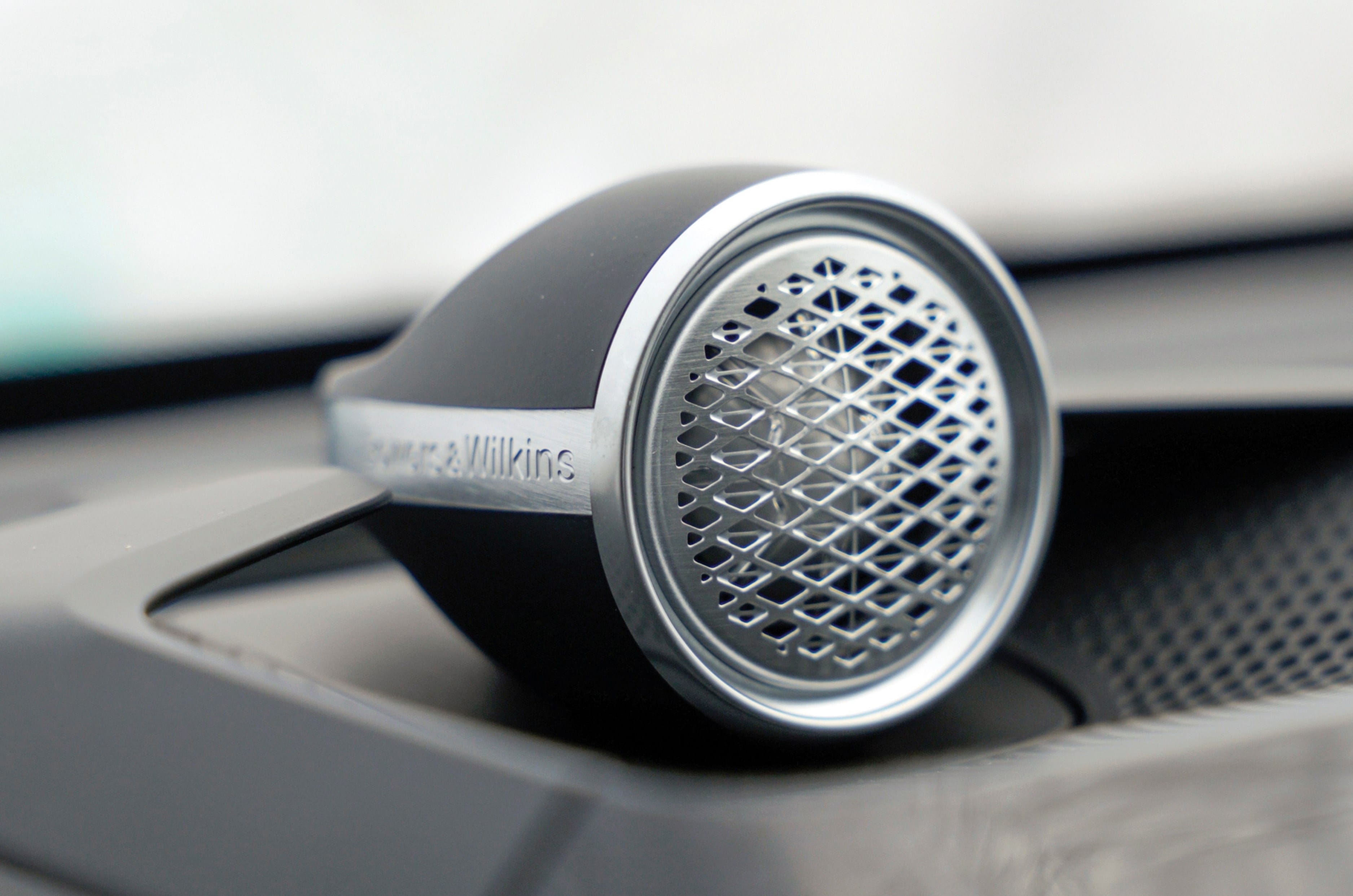
Bowers & Wilkins Hi-Fi audio system is epic.
What is excellent, however, is the music system: a 1,610W, 25-speaker Bowers & Wilkins Hi-Fi audio system with custom presets and modes that truly transform the cabin. If you enjoy your music, there are few cars in the world that offer something at this level or better. Safety is where Volvo excels, and the EX90, being the flagship, has all the bells and whistles – active and passive. Nine airbags, five cameras, five radars and 12 ultrasonic sensors, powering a full ADAS suite including door-opening alert and post-impact braking, make it exceptionally well equipped. Essentials like a 360-degree camera and auto-parking further make it easy to live with.
EX90 Performance and Refinement – 9/10
It is just as nice to drive as it is to be chauffeured in.
The EX90 comes in a single variant in India, with a dual-motor setup and a 106kWh battery pack. It develops 456hp and 670Nm, making it quick off the line. 0-100kph takes just 5.5sec, which, given its size and type, is pretty impressive. However, from behind the wheel, the experience aligns with its laid back character. You can alter the dynamics using the four drive modes. ‘Range’ prioritises efficiency, and power and torque are heavily restrained, although in bumper-to-bumper traffic, you will not notice the dip. There is a creep function too for peak-hour jams. ‘Standard’ is a balance that suits the car well for the most part, while ‘Performance’ is for that rare time when you want to add some enthusiasm.
Despite its strong power figures, performance feels more like an airliner than a fighter jet.
Don’t expect fighter-jet levels of reactions, though. Even in ‘Performance’ and with a heavy right foot, the EX90 builds pace gradually. It is almost like taking off in an aeroplane, where the speed rises in a strong and linear manner. This mode zaps power swiftly, so it is best to use the ‘Standard’ mode and get the best of all worlds. If you end up venturing off the tarmac, the ‘Off-road’ mode allows for more ground clearance (250mm), and it alters traction control and ESP settings to allow for more traction on loose surfaces.
Once on the move, what is extremely impressive is cabin refinement. With no engine sound to distract you, EV cabins amplify ambient sounds like wind and road noise, especially with large tyres, but the EX90 is a different story. Cabin insulation is top-notch, and it is near-silent on the inside. It also has a neat trick, microphones all around the car can relay conversations via the speakers clearly no matter where you are seated. You only have to talk in your natural tone for your voice to clearly go through the microphone and speakers. So passengers sitting at the first and third row can have a conversation without having to speak loudly.
EX90 Mileage / Range and Efficiency – 9/10
The 106kWh battery can eke out 625km according to the WLTP cycle. In our short test drive, we saw an efficiency of 5km/kWh in mixed driving conditions, resulting in a range of 530km. That is rather respectable, and considering a majority of our drive was on the highway, this number should only get better in the city.
The EX90 also has regenerative braking, and you can go from having it completely off to low or high, or just leave it in Auto, where it does all the thinking for you. Feel, though, leaves a lot to be desired, the pedal never feels consistent in its bite point. You get an 11kW AC charger for your home or office, which takes 11 hours for 0-100 percent. But being an 800V system, it can charge at up to 350kW on a DC charger, taking just 23 minutes for 10-80 percent. The car will also pre-condition the battery, meaning it gets the battery up to its optimum temperature to charge as quickly as possible.
EX90 Ride Comfort and Handling – 8/10
The EX90 rides on air suspension, which, over broken roads at medium or high speeds, is excellent. The car adjusts within microseconds, and you barely feel bumps inside. You can firm it up for the highway, so there is none of the wallowy feel associated with a softly sprung setup. Three modes to choose from give you flexibility depending on the road surface. ‘Standard’ offers the best balance, as it has the softness without feeling overly soft in the corners, while ‘Firm’ adds a layer of stability at speed and on fast bends. ‘Soft’ is a bit too soft, and the car ends up diving or rolling a tad more than necessary. In the city, there is none of the harshness over low-speed bumps, and the composed nature of the suspension is its highlight.
EX90 Value for Money – 8/10
The EX90 offers just about everything you need in a luxury EV
Prices for the EX90 will be out in October, and it will be the brand’s flagship SUV, sitting above the XC90. If you are looking for a chauffeur-driven luxury EV, it will tick the right boxes. That said, sunblinds would have been nice, and as a driver, it will frustrate you with an over-reliance on the touchscreen and a fiddly key card. On the whole, though, it does a lot to impress and allows you to forgive these shortcomings. You get everything you expect from a luxury EV, the cabin is plush and comfortable, the materials and feel are excellent, the design is subtle but svelte, and the ride comfort is truly impressive. It rivals the Mercedes-Benz EQS and BMW iX, and while it may not be as feature-loaded in the rear seat as the EQS or as powerful and fun to drive as the iX, it does find a very nice middle ground and would be top of the list for those looking for minimalist class and luxury.
भारत में महंगी कार खरीदने वाले अमीर ग्राहकों के बीच इलेक्ट्रिक कारों का चलन बाकी कार बाजार के मुकाबले काफी तेजी से बढ़ रहा है। 2026 के पहले छह महीनों में भारत में बिकने वाली हर चार BMW कारों में से एक इलेक्ट्रिक कार थी। इससे BMW की इलेक्ट्रिक कारों की बिक्री करीब 25% रही, जो पूरे पैसेंजर व्हीकल बाजार के मुकाबले लगभग तीन गुना है। इस दौरान देश में कुल कार बिक्री में इलेक्ट्रिक कारों की हिस्सेदारी करीब 8-9% रही।
यह बदलाव Mercedes-Benz में भी साफ तौर पर दिख रहा है, खासकर इसके सबसे अमीर ग्राहकों के बीच। इन्हीं छह महीनों के दौरान, कंपनी ने अपने ‘टॉप-एंड’ सेगमेंट – जिसमें 1.4 करोड़ रुपये से ज्यादा कीमत वाले मॉडल शामिल हैं – से लगभग हर तीन घंटे में एक बैटरी इलेक्ट्रिक गाड़ी (BEV) बेची। इसकी CLA BEV, जिसकी शुरुआती कीमत 57 लाख रुपये है, का 2026 का कोटा पहले ही खत्म हो चुका है, जिससे नए खरीदारों को डिलीवरी के लिए अगले साल तक इंतजार करना पड़ेगा
आम भारतीय कार खरीदारों को इलेक्ट्रिक कार खरीदने से जो दिक्कतें होती हैं, जैसे चार्जिंग की सुविधा, कार की रेंज को लेकर चिंता और ज्यादा कीमत, अमीर परिवारों के लिए ये समस्याएं काफी कम हो जाती हैं।
LVP फोरकास्टिंग मोबिलिटी ग्लोबल के एसोसिएट डायरेक्टर गौरव वंगाल ने कहा, “लग्जरी सेगमेंट में EV को अपनाने की दर ज्यादा है क्योंकि इसके रास्ते में कोई रुकावट नहीं है। इन खरीदारों के पास घर पर चार्जर के साथ कवर्ड पार्किंग होती है, इसलिए चार्जिंग कभी कोई समस्या नहीं बनती।”
उन्होंने आगे कहा, “EV शायद ही कभी उनकी एकमात्र कार होती है, इसलिए रेंज की चिंता कभी नहीं होती। और पेट्रोल या डीजल वाली लग्जरी कार की तुलना में इलेक्ट्रिक कार पर टैक्स बहुत कम लगता है, इसलिए कीमत का वह अंतर जो ज्यादातर खरीदारों को रोकता है, यहां मौजूद ही नहीं है।”
मालिक होने की स्थितियों में यह अंतर बिक्री के आंकड़ों में साफ तौर पर दिख रहा है। जहां पारंपरिक लग्जरी कारों की बिक्री में बढ़ोतरी धीमी हुई है, वहीं EV से BMW और मर्सिडीज-बेंज को तेजी से बढ़ते ग्राहक मिल रहे हैं।
2026 के पहले छह महीनों में, BEV को छोड़कर Mercedes-Benz की बिक्री में सिर्फ 2.3% की बढ़ोतरी हुई, जबकि BMW की नॉन-BEV बिक्री में 5% की बढ़ोतरी हुई। जब इलेक्ट्रिक कारों को भी शामिल किया जाता है, तो Mercedes की कुल बढ़ोतरी 9% और BMW की 17% हो जाती है।
इसलिए, इलेक्ट्रिक गाड़ियां अब लग्जरी मार्केट में सिर्फ एक अतिरिक्त पावरट्रेन नहीं रह गई हैं। वे अतिरिक्त बढ़ोतरी का एक अहम जरिया बन रही हैं।
BMW ग्रुप इंडिया के प्रेसिडेंट और CEO, हरदीप सिंह बरार ने कहा कि इसकी अपील सिर्फ पर्यावरण से जुड़ी बातों से कहीं ज्यादा है।
बरार ने कहा, “EVs न सिर्फ जीरो-एमिशन वाली गाड़ियां हैं, बल्कि ये परफॉर्मेंस से कोई समझौता किए बिना सस्टेनेबल मोबिलिटी भी देती हैं, और साथ ही इनकी रनिंग, मेंटेनेंस और टैक्स की लागत भी काफी कम होती है।”
यह बात उन कीमतों पर भी असरदार साबित हो रही है जहां ईंधन की बचत शायद ही यह तय करती हो कि कोई ग्राहक कार खरीदेगा या नहीं।
मर्सिडीज़-बेंज़ के टॉप-एंड इलेक्ट्रिक पोर्टफ़ोलियो – जिसमें लगभग 1.4 करोड़ रुपये की EQS SUV, 2.4 करोड़ रुपये की EQS मेबैक SUV और 3.1 करोड़ रुपये की G580 शामिल हैं – ने जून 2026 को खत्म हुए छह महीनों में साल-दर-साल 27 प्रतिशत की ग्रोथ दर्ज की।
लक्ज़री मार्केट के ज़्यादा किफायती सेगमेंट में, मर्सिडीज़ ने CLA BEV का अपना 2026 का पूरा कोटा पहले ही बेच दिया है।
Mercedes-Benz इंडिया के मैनेजिंग डायरेक्टर और CEO, संतोष अय्यर ने कहा, “CLA BEV का पूरी तरह बिक जाना, खासकर 61 लाख रुपये वाले टॉप-एंड 250+ वेरिएंट्स का, लक्जरी EV ग्राहकों की बढ़ती समझ को दिखाता है। ये ग्राहक अब सिर्फ कीमत नहीं, बल्कि टेक्नोलॉजी और वैल्यू-बेस्ड लक्जरी मोबिलिटी को ज्यादा पसंद कर रहे हैं।”
रुकावटें दूर हो रही हैं
लग्जरी कार खरीदने वालों की प्रोफाइल से यह समझने में मदद मिलती है कि EV को अपनाने की रफ्तार आम बाजार के मुकाबले इतनी तेज क्यों है।
जो परिवार अपनी इकलौती कार खरीद रहा है, उसके लिए इलेक्ट्रिक कार अपनाने में कई समझौते करने पड़ सकते हैं। अपार्टमेंट में रहने वाले खरीदार के पास शायद अपना पर्सनल चार्जर न हो, और लंबी यात्राओं के लिए चार्जिंग इंफ्रास्ट्रक्चर को ध्यान में रखकर योजना बनानी पड़ती है। EV की शुरुआती ज्यादा कीमत की तुलना कई सालों में होने वाली ईंधन की बचत से भी करनी पड़ती है।
कई अमीर परिवारों के लिए, ये हिसाब-किताब काफी अलग होते हैं।
इन परिवारों के पास आमतौर पर अपनी पार्किंग की जगह होती है, इसलिए घर पर चार्जर लगाना आसान होता है। वे रातभर अपनी कार चार्ज कर सकते हैं और उन्हें पब्लिक चार्जिंग स्टेशन पर ज्यादा निर्भर नहीं रहना पड़ता।
सबसे बड़ी बात यह है कि अमीर परिवारों में EV अक्सर इकलौती कार नहीं होती। उनके पास एक से ज्यादा गाड़ियां होती हैं।
इसका मतलब है कि EV को परिवार की हर तरह की यात्रा की जरूरत पूरी करने की जरूरत नहीं होती। इलेक्ट्रिक कार रोजाना शहर में आने-जाने के काम आ सकती है, जबकि लंबी दूरी की यात्रा के लिए परिवार के पास पेट्रोल या डीजल कार का विकल्प मौजूद रहता है।
भारत का टैक्स सिस्टम इस बात को और मज़बूत करता है।
इलेक्ट्रिक कारों पर 5% GST लगता है, जबकि बड़ी पेट्रोल और डीजल कारों पर 28% GST और साथ में कंपनसेशन सेस भी लगता है। लग्जरी कारों की कीमतों के मामले में, यह अंतर बैटरी टेक्नोलॉजी की ज्यादा लागत को काफी हद तक कम कर सकता है और इलेक्ट्रिक व इंटरनल-कंबशन मॉडल के बीच कीमत के अंतर को घटा सकता है।
EVs में अब ऐसी खूबियां भी तेज़ी से आ रही हैं जो लग्ज़री ड्राइविंग के लिए एकदम सही हैं। इलेक्ट्रिक मोटर तुरंत टॉर्क देती है, जिससे कार तेजी से पिकअप लेती है। वहीं, पेट्रोल या डीजल इंजन नहीं होने के कारण EV काफी शांत और स्मूद ड्राइविंग अनुभव देती है। प्रीमियम कार कंपनियां भी अपनी लग्जरी कारों में इसी तरह की शांति और आराम देने के लिए काफी पैसा खर्च करती हैं।
इसलिए, हाई-एंड मार्केट के खरीदारों के लिए, इलेक्ट्रिक गाड़ियां कम टैक्स और कम रनिंग कॉस्ट के साथ-साथ परफॉर्मेंस, टेक्नोलॉजी और नई खूबियों का बेहतरीन कॉम्बिनेशन हो सकती हैं।
विकल्प तेजी से बढ़ रहे हैं
एक और बड़ा बदलाव यह है कि अमीर भारतीय अब कई तरह की इलेक्ट्रिक कारें खरीद सकते हैं।
FY25 से, भारत के लग्जरी सेगमेंट में 13 नई BEV लॉन्च हुई हैं, जिनमें Porsche, Volvo, Rolls-Royce, Ferrari और Lexus के मॉडल शामिल हैं। इनकी सबसे ज्यादा कीमत लगभग 5 करोड़ रुपये तक है।
इस विस्तार से EV अपनाने में आने वाली एक और रुकावट धीरे-धीरे दूर हो रही है: विकल्पों की कमी।
शुरुआत में लग्जरी EV खरीदने वालों के पास इलेक्ट्रिक मॉडल्स के कुछ ही विकल्प होते थे, जबकि पेट्रोल और डीजल मार्केट में कई तरह की सेडान, SUV और परफॉर्मेंस कारें उपलब्ध थीं। अब ग्राहक अपनी पसंद की बॉडी स्टाइल, परफॉर्मेंस कैटेगरी या लग्जरी ब्रांड को छोड़े बिना आसानी से पावरट्रेन बदल सकते हैं।
इसका असर इंडस्ट्री के आंकड़ों में साफ दिखता है।
FY26 में भारत में बिकने वाली कुल पैसेंजर व्हीकल्स में लग्जरी कारों की हिस्सेदारी सिर्फ 1.1-1.2% रही। लेकिन देश में बिकने वाली कुल इलेक्ट्रिक कारों (BEV) में लग्जरी कारों की हिस्सेदारी करीब 2.5-2.7% रही। यानी पूरे पैसेंजर व्हीकल बाजार में लग्जरी कारों की हिस्सेदारी के मुकाबले इलेक्ट्रिक कारों की बिक्री में इनकी हिस्सेदारी दोगुने से भी ज्यादा है।
इस बदलाव का सबसे साफ उदाहरण BMW है। कंपनी ने जून 2026 को खत्म हुए छह महीनों में 2,359 EV बेचीं, जिससे भारत में उसकी कुल बिक्री में इलेक्ट्रिक गाड़ियों का हिस्सा लगभग एक-चौथाई हो गया। इसी दौरान Mercedes-Benz ने 859 BEV बेचीं।
फिर भी, Tesla का अनुभव बताता है कि इस तेजी का फायदा हर प्रीमियम EV बनाने वाली कंपनी को बिक्री के तौर पर नहीं मिलता।
इलेक्ट्रिक मोबिलिटी के क्षेत्र में ग्लोबल पहचान होने के बावजूद, भारत में अपने पहले साल (जो जून 2026 में खत्म हुआ) में Tesla ने सिर्फ 450 के आस-पास कारें बेचीं।
इसकी सीमित प्रोडक्ट रेंज एक रुकावट है। टेस्ला अभी भारत में सिर्फ ‘मॉडल Y’ बेचती है, जिससे यह कई ऐसे सेगमेंट में मौजूद नहीं है जहां पहले से मौजूद लग्जरी कार बनाने वाली कंपनियां ग्राहकों को सेडान, SUV और परफॉर्मेंस-ओरिएंटेड मॉडल ऑफर कर सकती हैं।
इसकी एक और चुनौती कीमत भी रही है। टेस्ला ने बेस ‘मॉडल Y’ को 59.89 लाख रुपये (एक्स-शोरूम) में लॉन्च किया था, और बाद में मई 2026 में इसकी कीमत घटाकर 50.89 लाख रुपये कर दी। कीमत कम करने के बाद भी, पूरी तरह से इम्पोर्ट किया गया यह मॉडल उन कंपनियों से मुकाबला करता है जिनके पास ज्यादा बड़े पोर्टफोलियो और पहले से स्थापित सेल्स और सर्विस नेटवर्क हैं। यह अंतर दिखाता है कि भारत का लग्जरी EV मार्केट किस तरह बदल रहा है।
आम कार खरीदारों के लिए EV खरीदने पर अभी भी चार्जिंग, ड्राइविंग रेंज, ज्यादा शुरुआती कीमत और सिर्फ एक कार पर निर्भर रहने जैसी कई परेशानियां हो सकती हैं। लेकिन अमीर परिवारों के लिए इनमें से कई दिक्कतों को आसानी से दूर किया जा सकता है। वे घर पर चार्जर लगवा सकते हैं, लंबी दूरी की यात्रा के लिए दूसरी कार का इस्तेमाल कर सकते हैं और EV पर कम टैक्स लगने से इलेक्ट्रिक कार खरीदना उनके लिए अपेक्षाकृत सस्ता पड़ता है।
इन वजहों से अमीर भारतीय परिवारों में इलेक्ट्रिक लग्जरी कार अब सिर्फ महंगा प्रयोग नहीं रह गई है। यह धीरे-धीरे उनकी गैराज में एक आम और पसंदीदा विकल्प बनती जा रही है।
BMW और Mercedes-Benz के लिए यह बदलाव एक कदम और आगे बढ़ चुका है। भारत में EV अब सिर्फ उनके भविष्य के प्रोडक्ट प्लान का हिस्सा नहीं हैं, बल्कि आज ही उनकी बिक्री और ग्रोथ को बढ़ाने में अहम भूमिका निभा रही हैं।