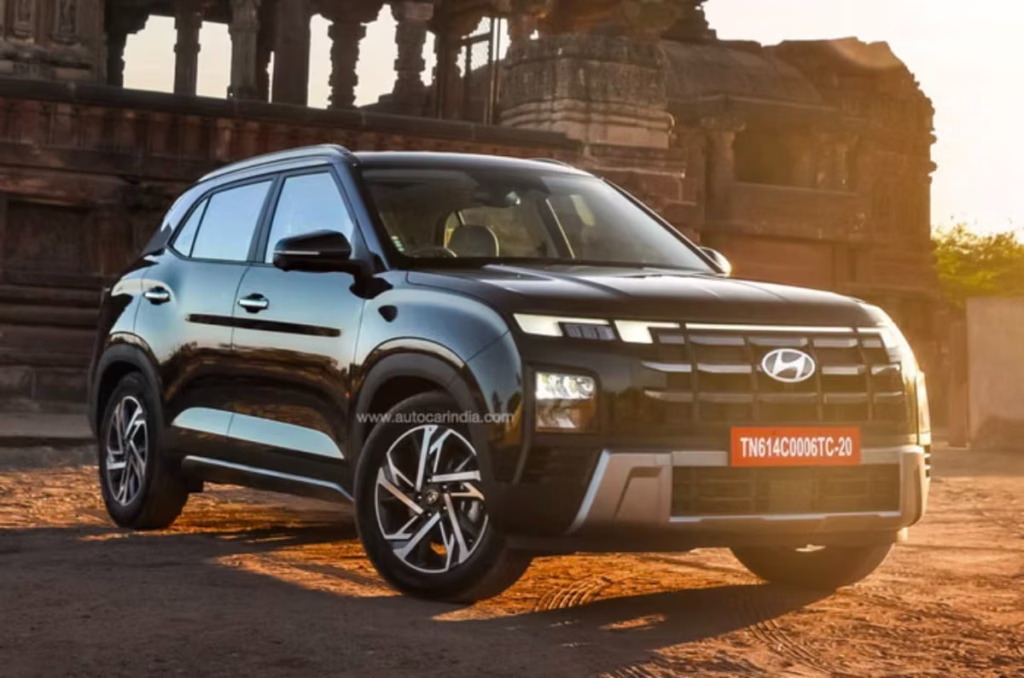
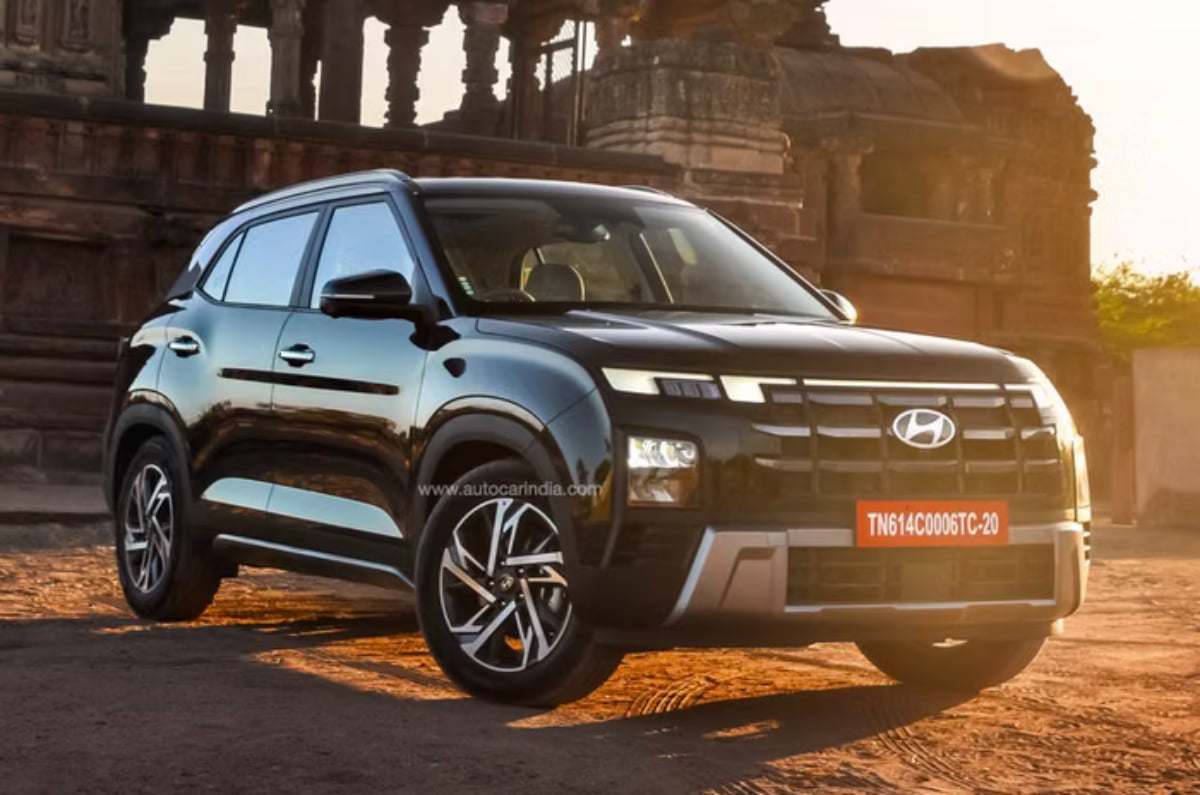
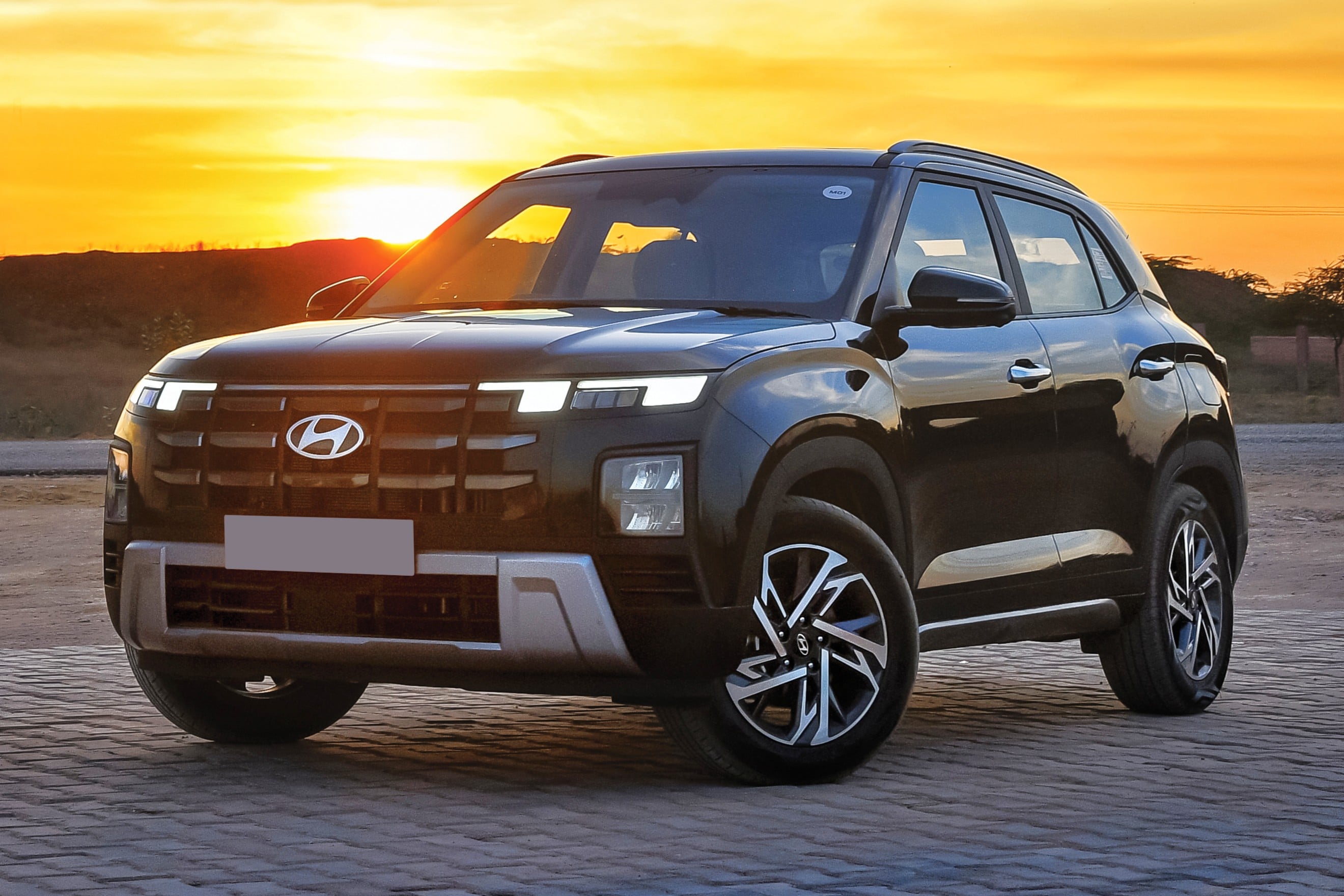
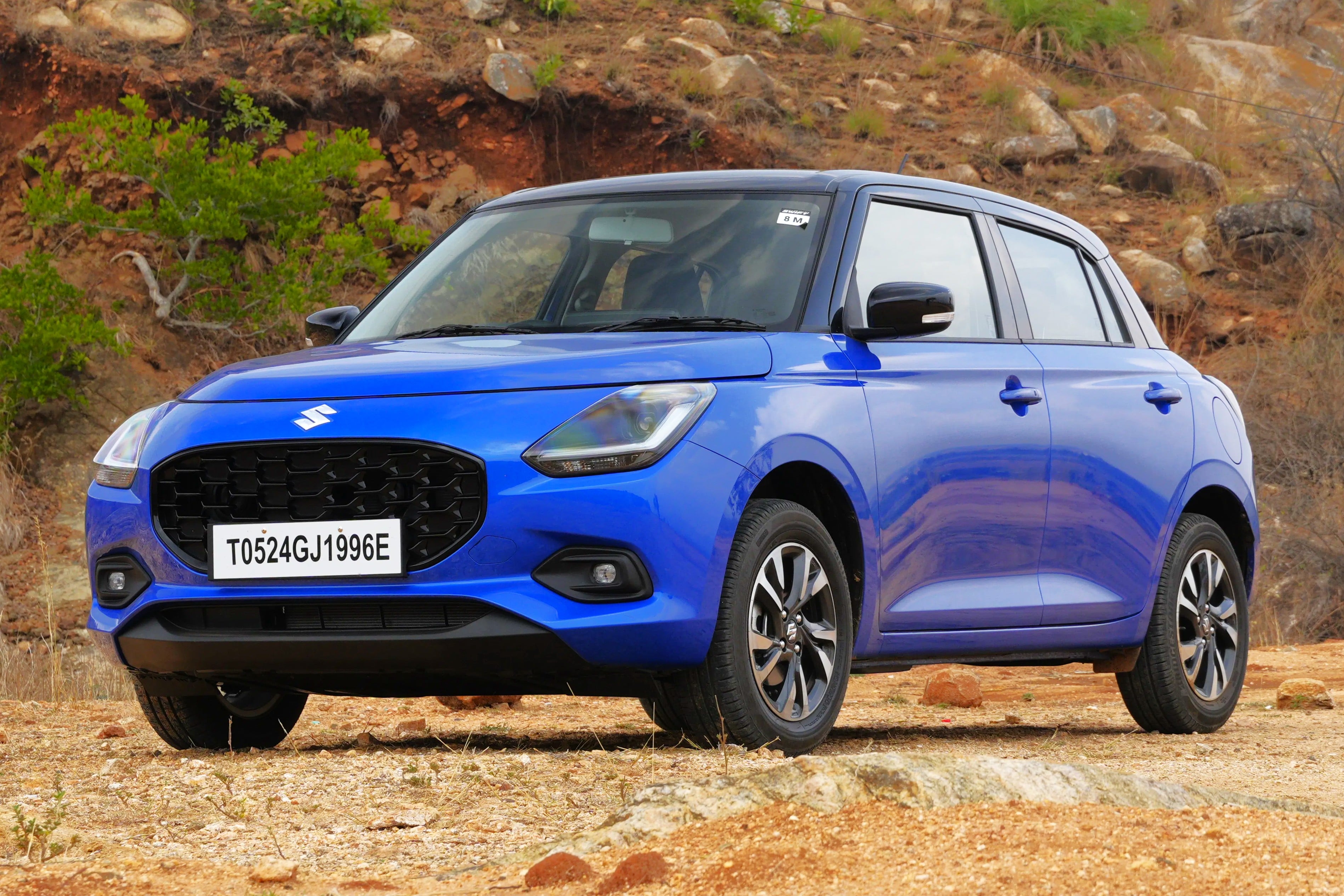
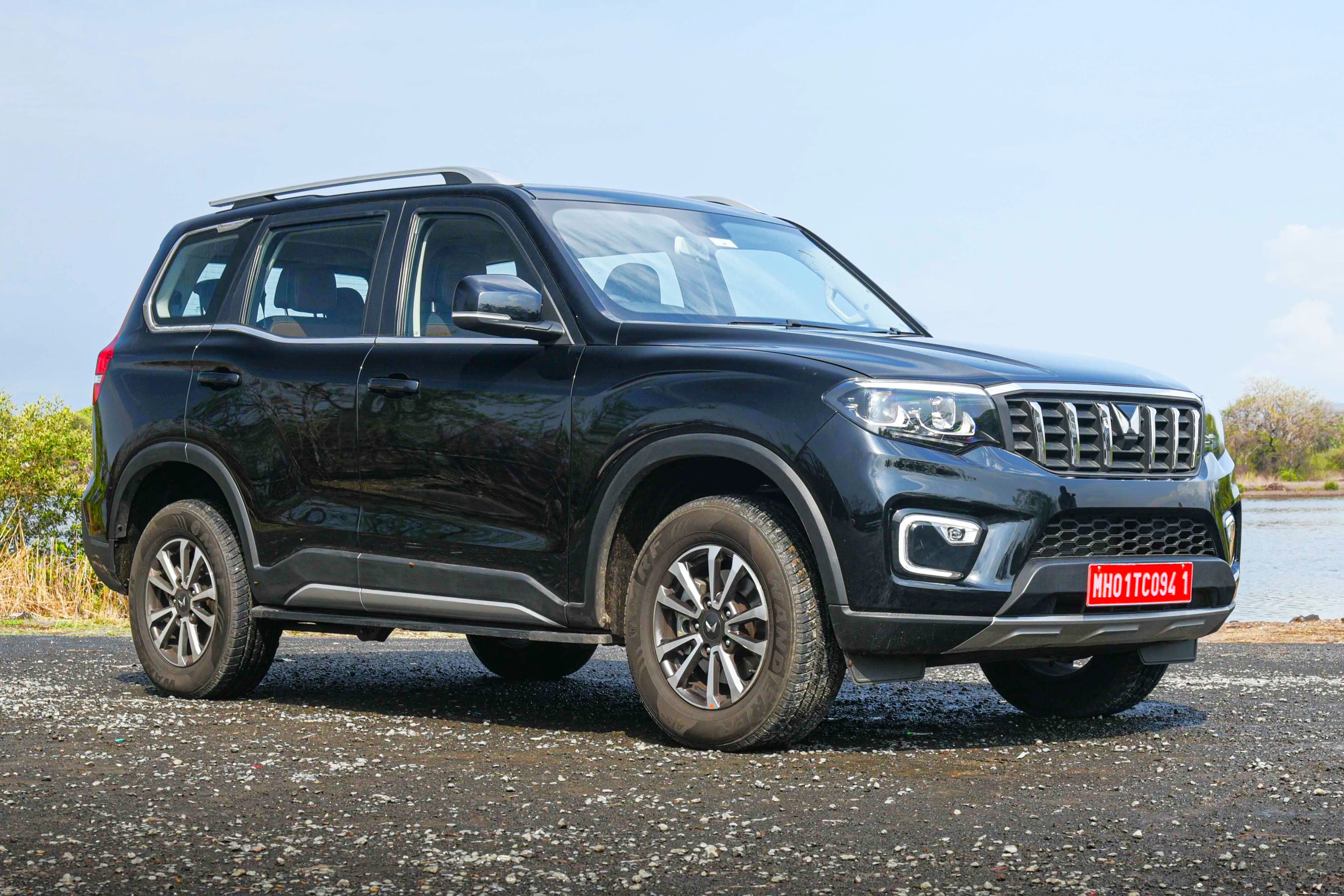
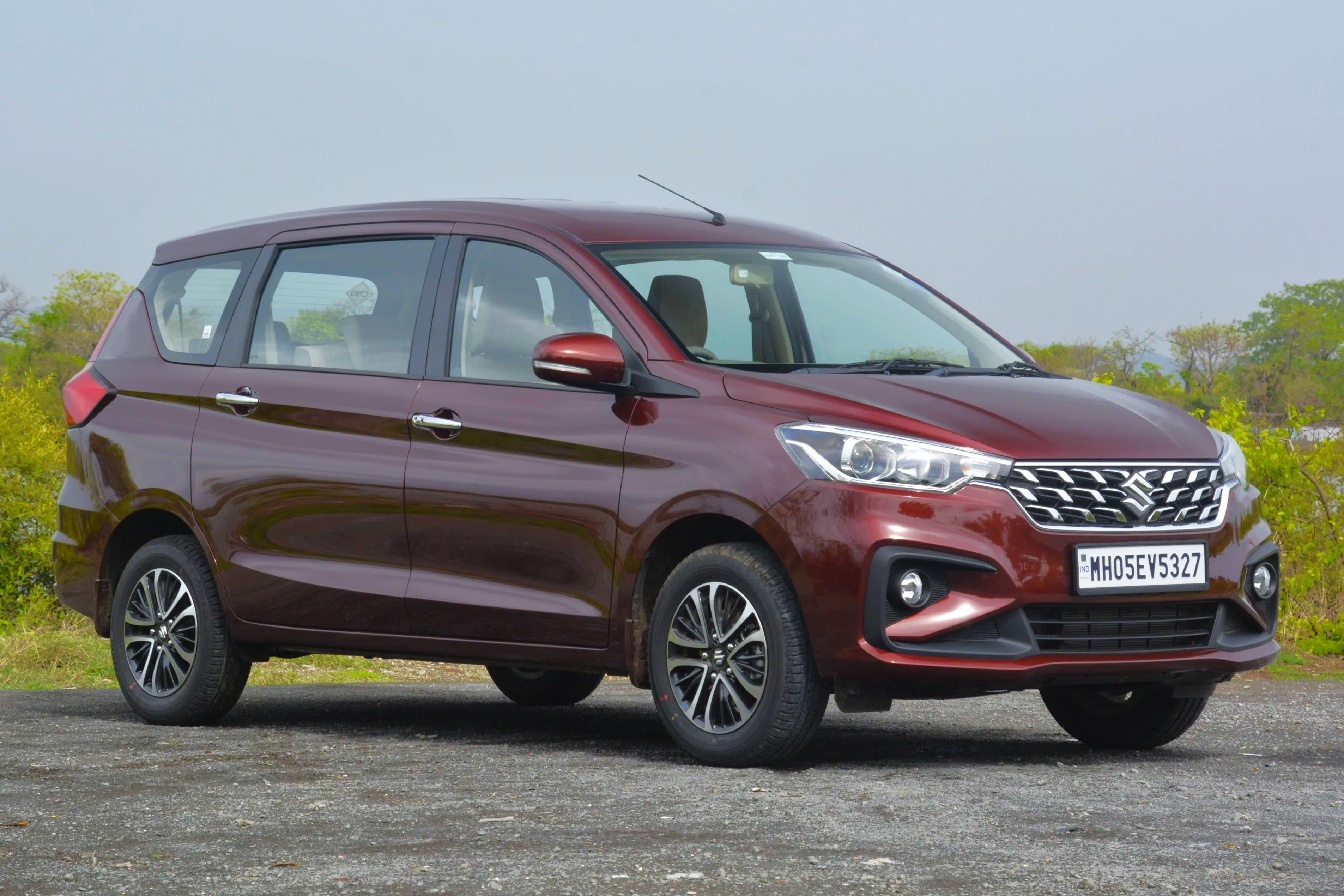
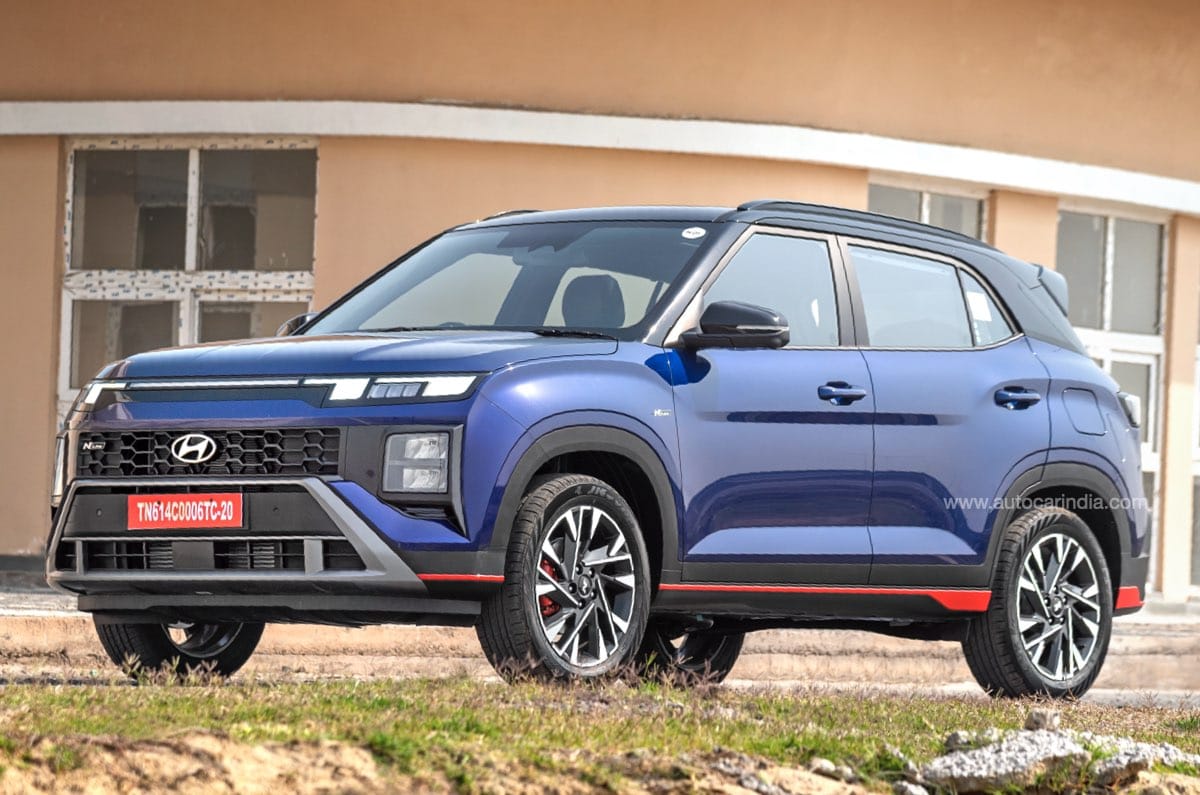
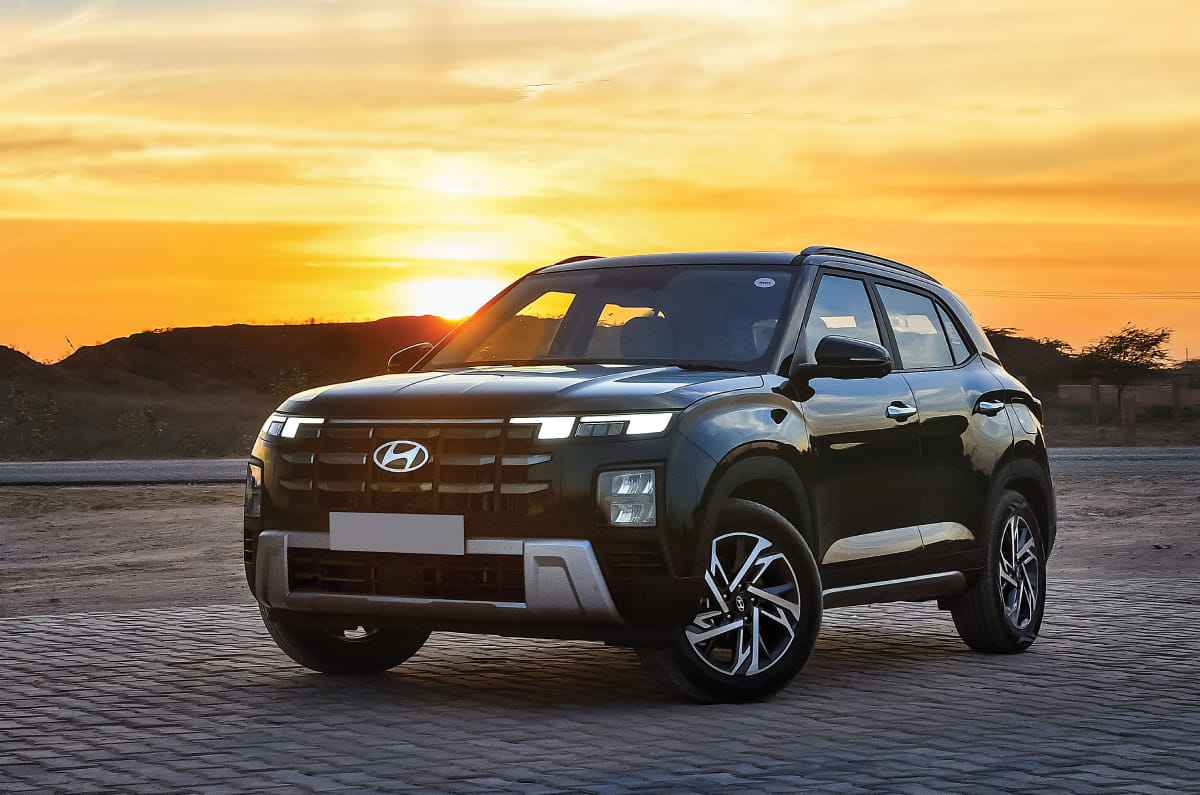
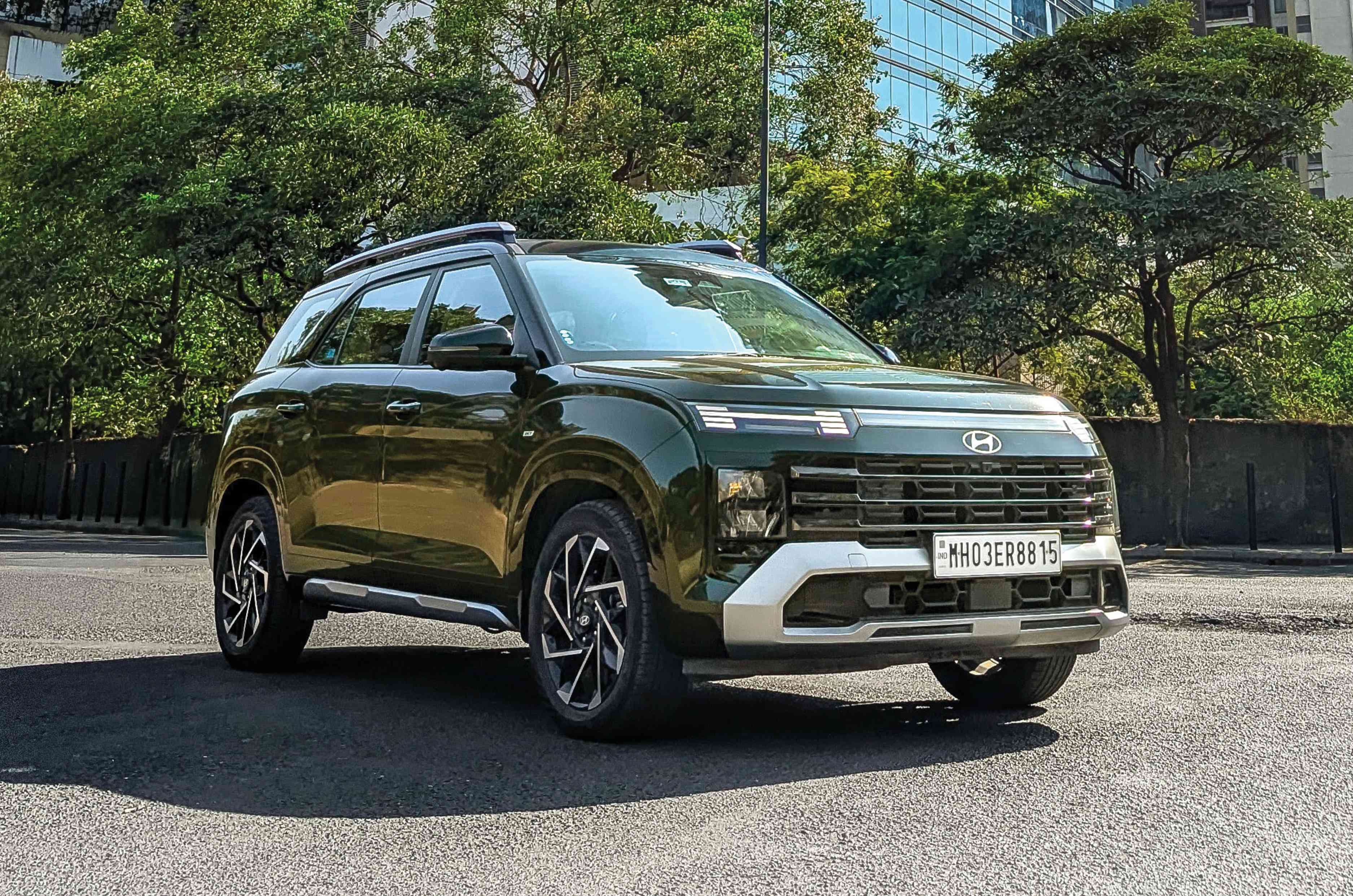
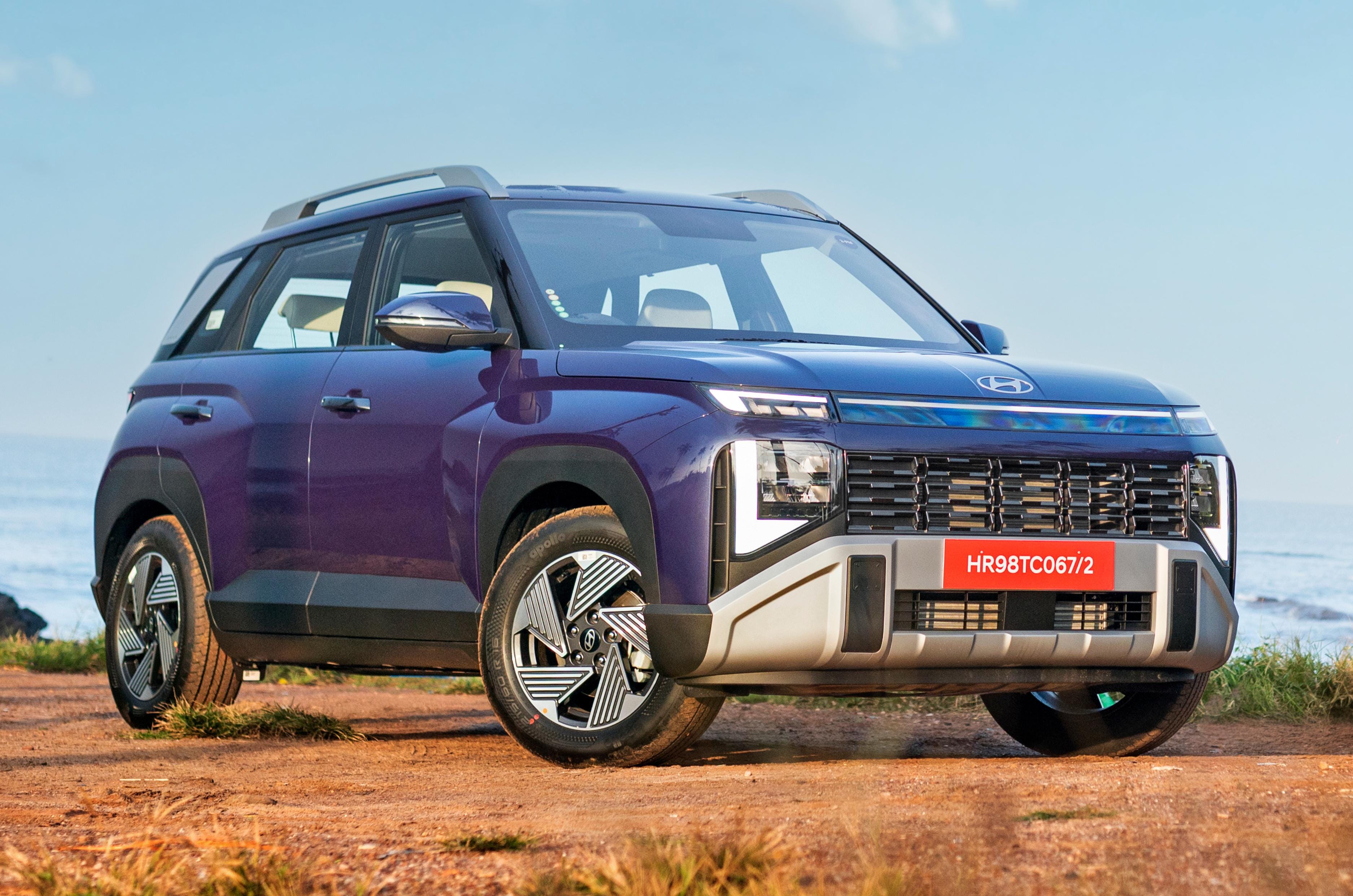
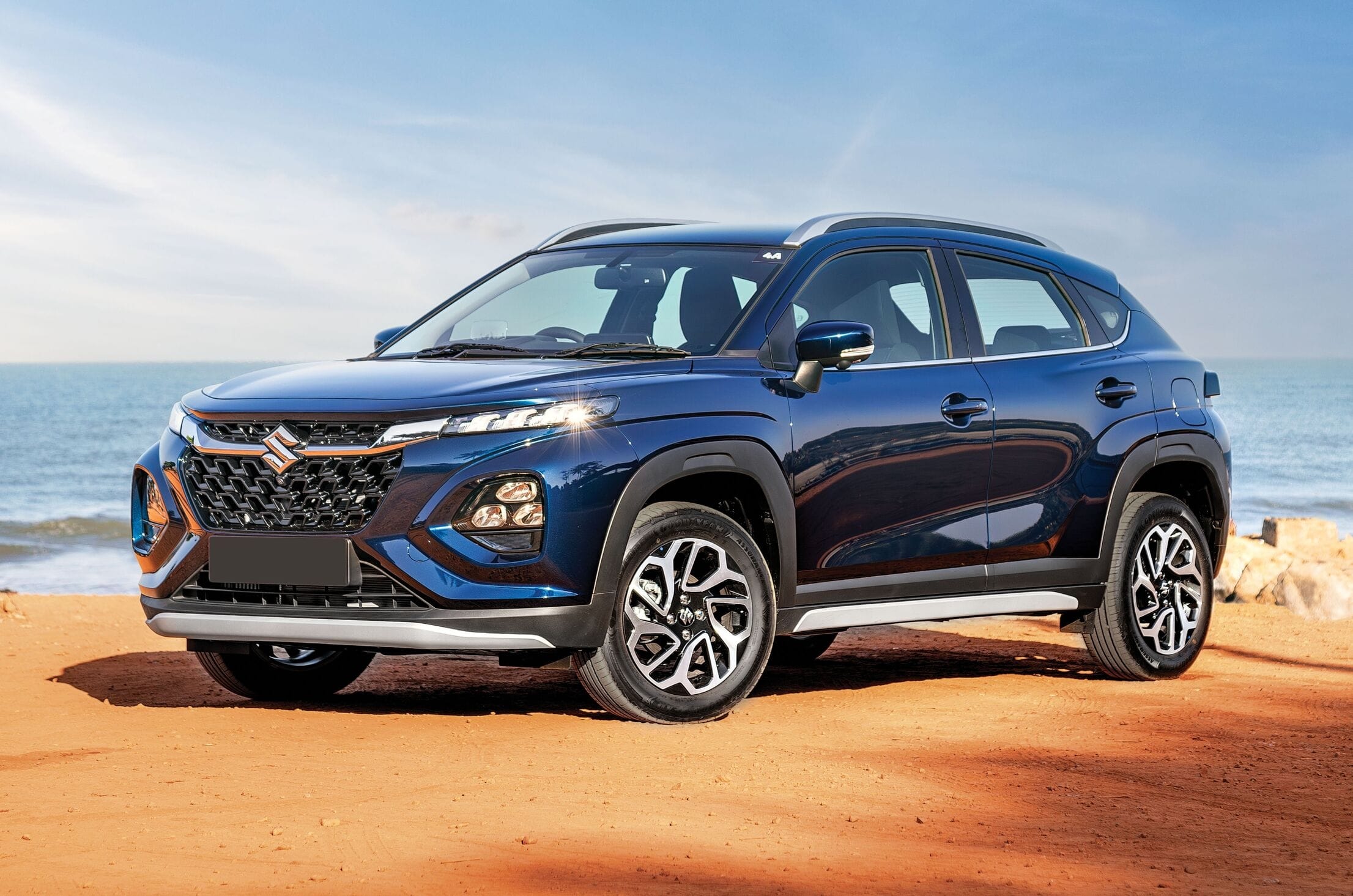
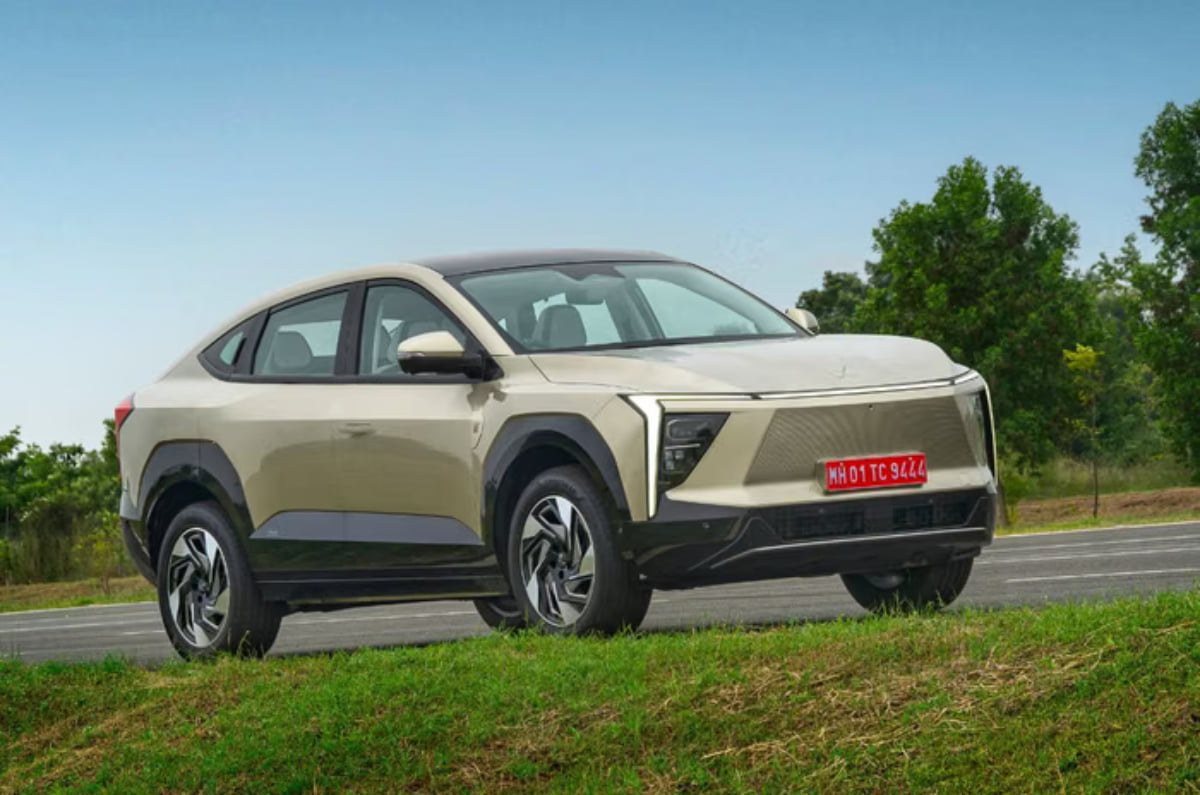
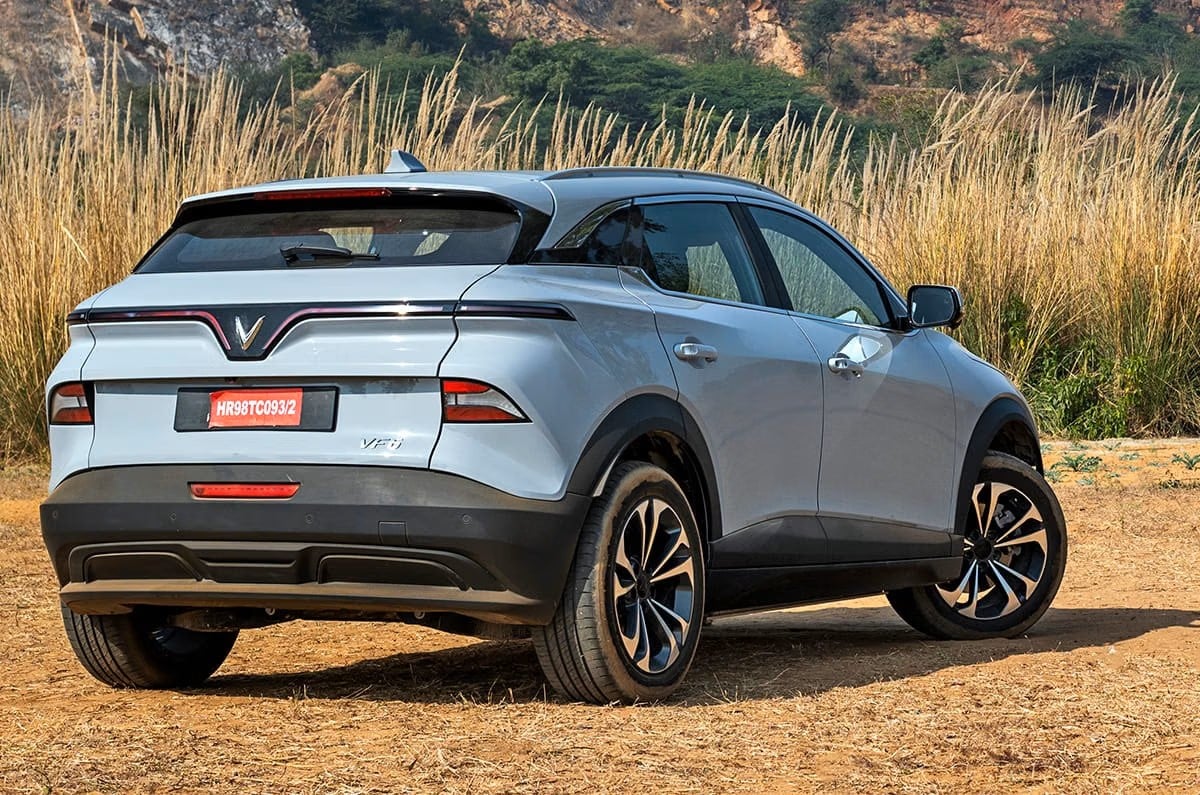
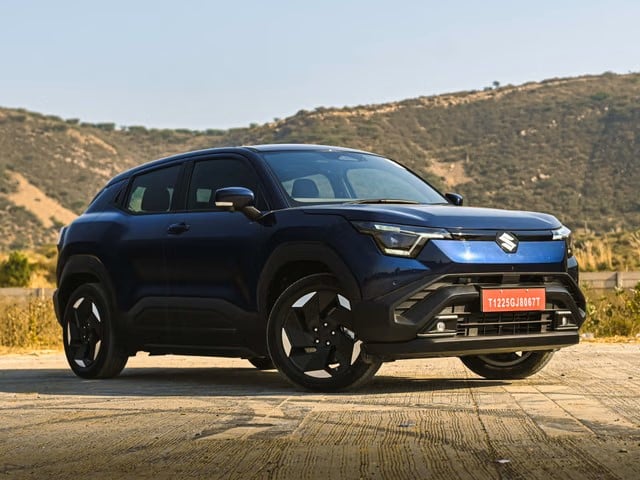
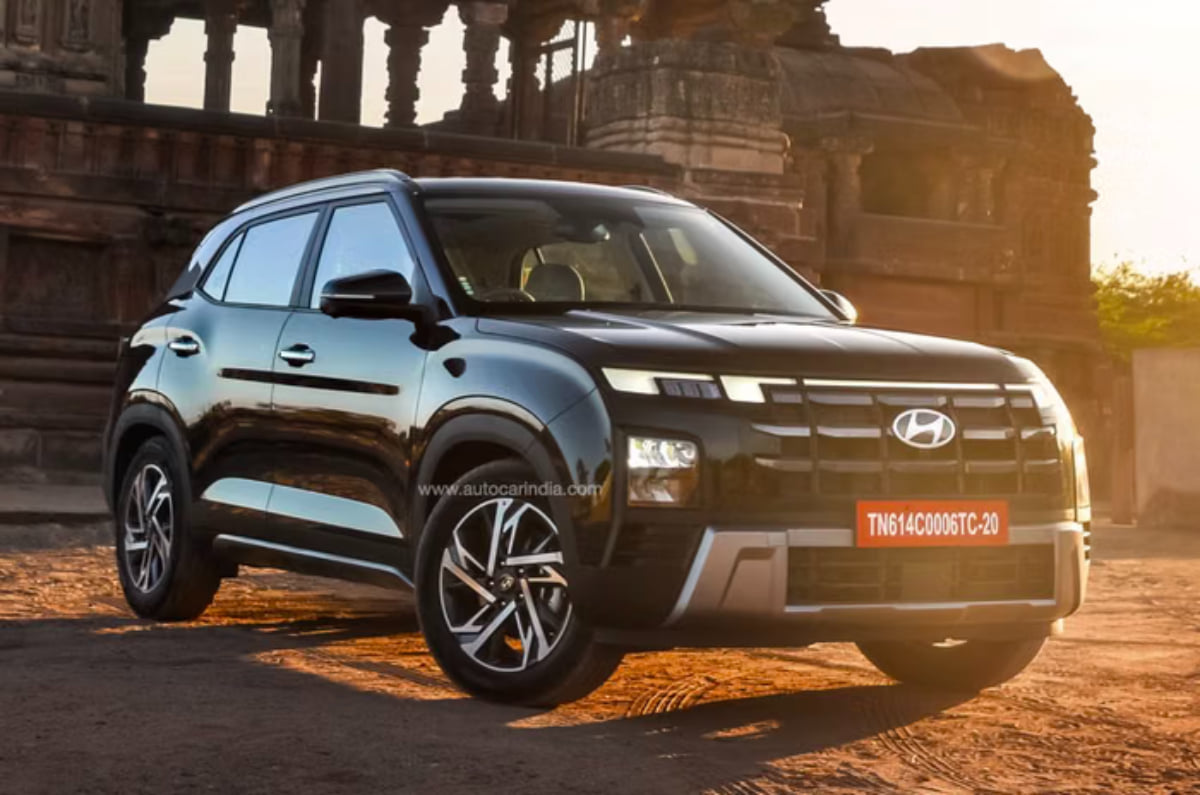
The Hyundai Creta crossed 15 lakh domestic wholesales by the end of September 2026, with cumulative dispatches reaching 15,12,036 units since its launch in July 2015. The SUV accounts for around 15 percent of Hyundai Motor India’s cumulative passenger vehicle sales since the company entered India, and 55 percent of its utility vehicle dispatches since the Creta’s launch. Creta exports reached 2,95,994 units through August 2026, putting the SUV close to the 3 lakh-unit mark.
Hyundai Creta domestic wholesales by fiscal year
Fiscal year
Units
YoY change
FY2016
63,836
–
FY2017
96,899
52%
FY2018
1,07,136
11%
FY2019
1,24,300
16%
FY2020
82,074
-34%
FY2021
1,20,035
46%
FY2022
1,18,092
-2%
FY2023
1,50,372
27%
FY2024
1,62,773
8%
FY2025
1,94,871
20%
FY2026
2,01,921
4%
FY2027*
89,727
-10%
Total
15,12,036
–
Hyundai Creta sales: FY2026 was its best year
The Creta recorded its highest annual wholesales in FY2026, at 2,01,921 units, up 4 percent year on year. Before that, wholesales stood at 1,94,871 units in FY2025, up 20 percent, and 1,62,773 units in FY2024, up 8 percent.
In the first half of FY2027, combined Creta and Creta electric wholesales stood at 89,727 units, down 10 percent from 99,345 units in the same period last year.
The updated Creta, launched in January 2024, and the Creta Electric, launched in January 2025, have together accounted for an estimated 5.3 lakh domestic units through September 2026.
Hyundai Creta exports near 3 lakh units
Creta exports totalled 2,95,994 units through August 2026. Annual exports peaked at 50,820 units in FY2018. They fell to 3,859 units in FY2024 before rising to 4,314 units in FY2025 and 6,496 units in FY2026. Exports in April-August 2026 stood at 2,338 units.
The internal-combustion Creta is available with three engine options: a 115hp 1.5-litre naturally aspirated petrol, a 160hp 1.5-litre direct injection turbo-petrol and a 116hp 1.5-litre diesel. It is offered with four gearbox options across 27 variants. All variants come with six airbags and ABS with electronic brakeforce distribution (EBD), according to the source report. The Creta has an ARAI-certified mileage of 17.4kpl to 21.8kpl across the range. Prices range from Rs 10.91 lakh to Rs 20.14 lakh, ex-showroom.
The next-generation Hyundai Creta is expected to launch in India sometime in 2027 and is likely to use the K3 platform that underpins the second-generation Kia Seltos.
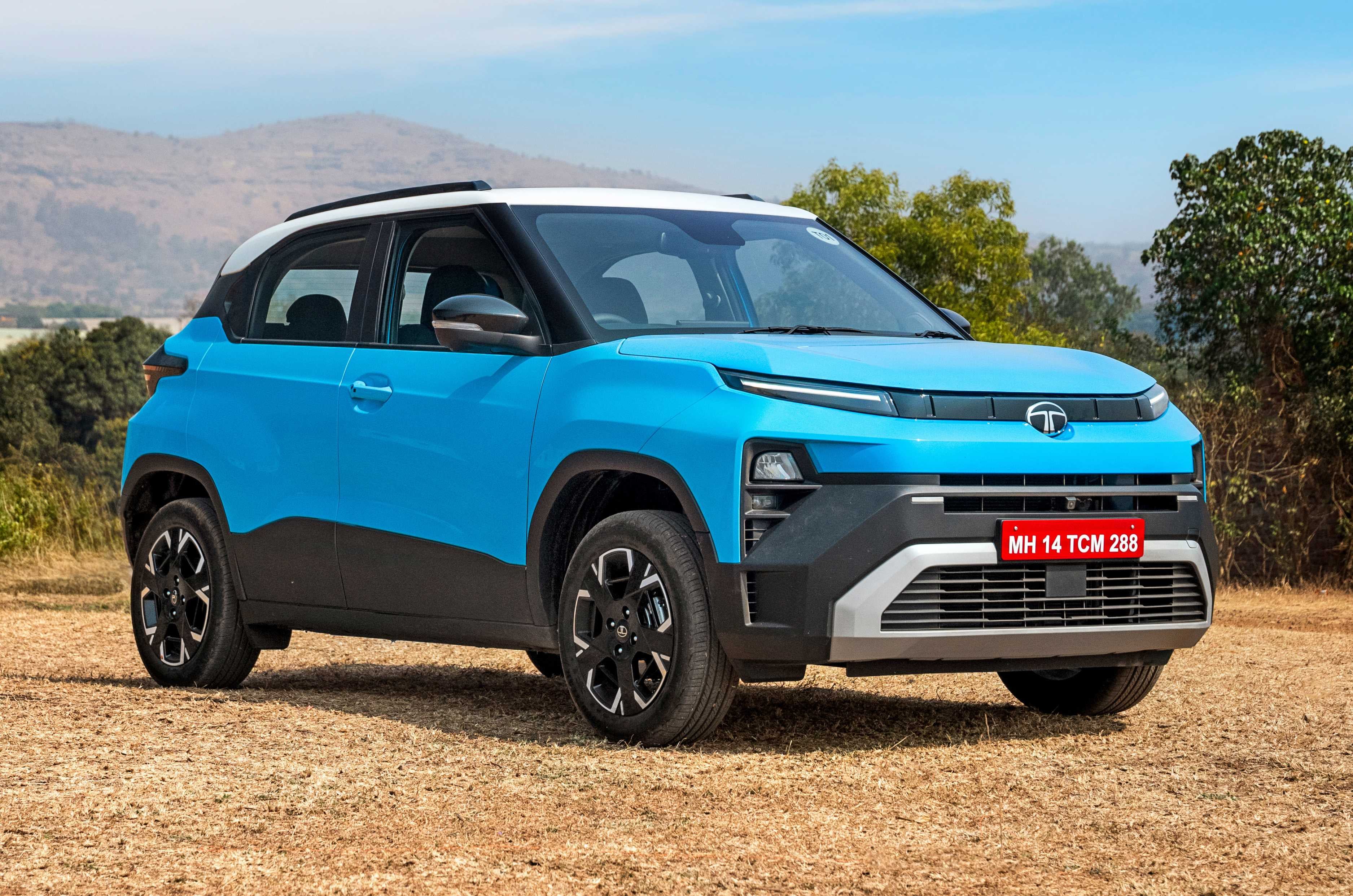
September 2026 saw the Maruti Suzuki Baleno top the best-selling cars list with 25,392 units dispatched, a 93 percent increase year on year. The Tata Nexon and Punch ranked second and third, respectively, with over 20,000 units each. Combined dispatches of the top 10 models rose 15.5 percent to 1,91,332 units. Maruti Suzuki had six models on the list, followed by Tata Motors with two, and Hyundai and Mahindra with one each.
Top 10 best-selling cars in September 2026
Rank
Model
Sep 2026 sales (units)
Aug 2026 sales (units)
Sep 2025 sales (units)
MoM change (%)
YoY change (%)
1
Maruti Baleno
25,392
15,376
13,173
+61
+93
2
Tata Nexon
20,456
18,431
22,573
+11
-9
3
Tata Punch
20,333
21,320
15,891
-5
+28
4
Maruti Fronx
19,282
18,730
13,767
+3
+40
5
Maruti Wagon R
18,835
20,180
15,388
-7
+22
6
Maruti Dzire
17,754
18,418
20,038
-4
-11
7
Hyundai Creta
17,657
16,288
18,861
+8
-6
8
Maruti Swift
17,399
19,832
15,547
-12
+12
9
Mahindra Scorpio
17,313
15,576
18,372
+11
-6
10
Maruti Ertiga
16,911
18,516
12,115
-9
+40
1. Maruti Suzuki Baleno
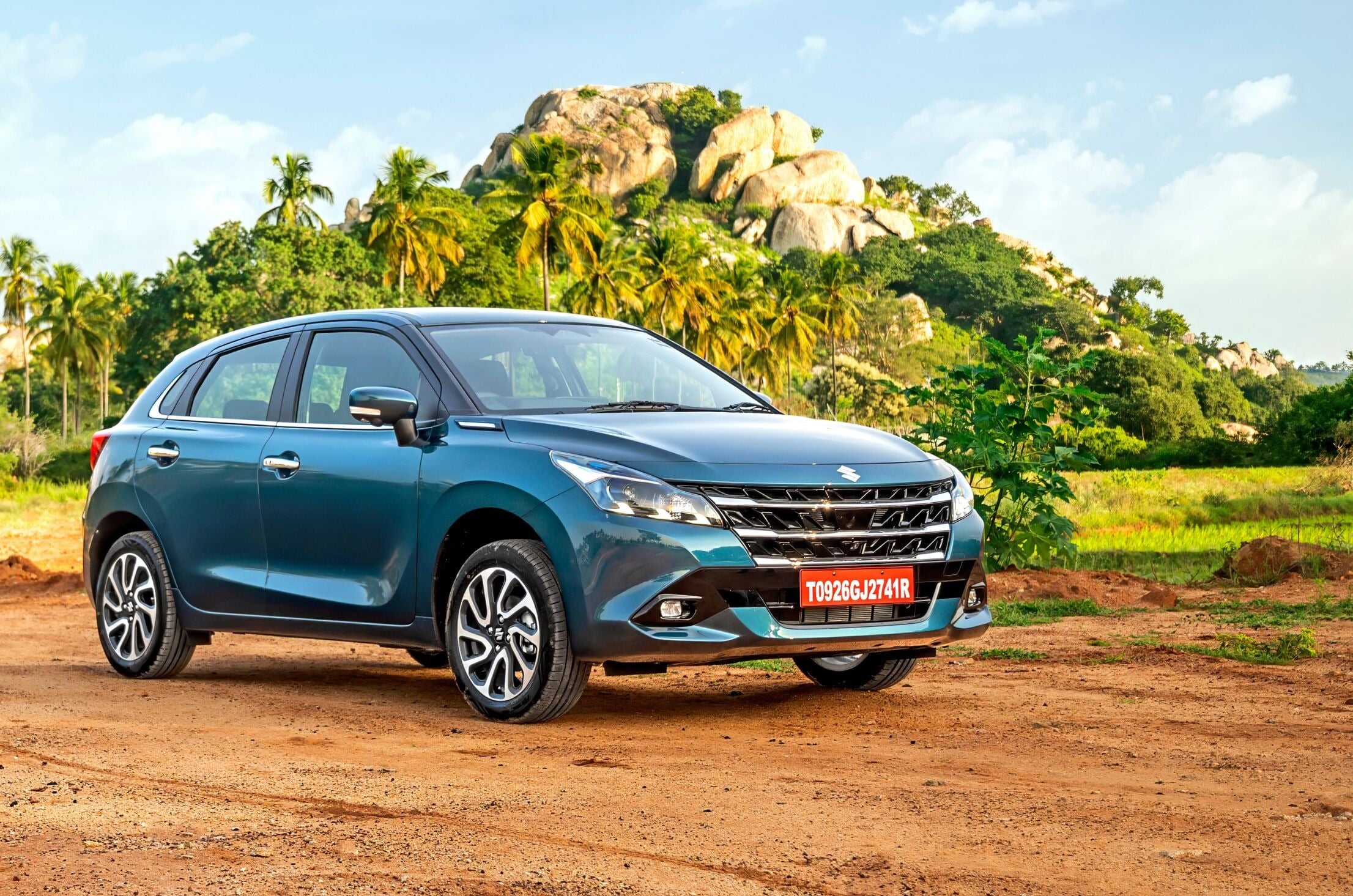
The Maruti Suzuki Baleno topped the September 2026 sales rankings with 25,392 units, compared with 13,173 units in September 2025. Its dispatches increased 93 percent year on year, the highest growth rate among the 10 models. The premium hatchback recently received a facelift and is sold through Maruti Suzuki’s Nexa dealership network. It rivals the Hyundai i20, Tata Altroz and Toyota Glanza. The Baleno is priced between Rs 5.99 lakh and Rs 9.99 lakh.
2. Tata Nexon
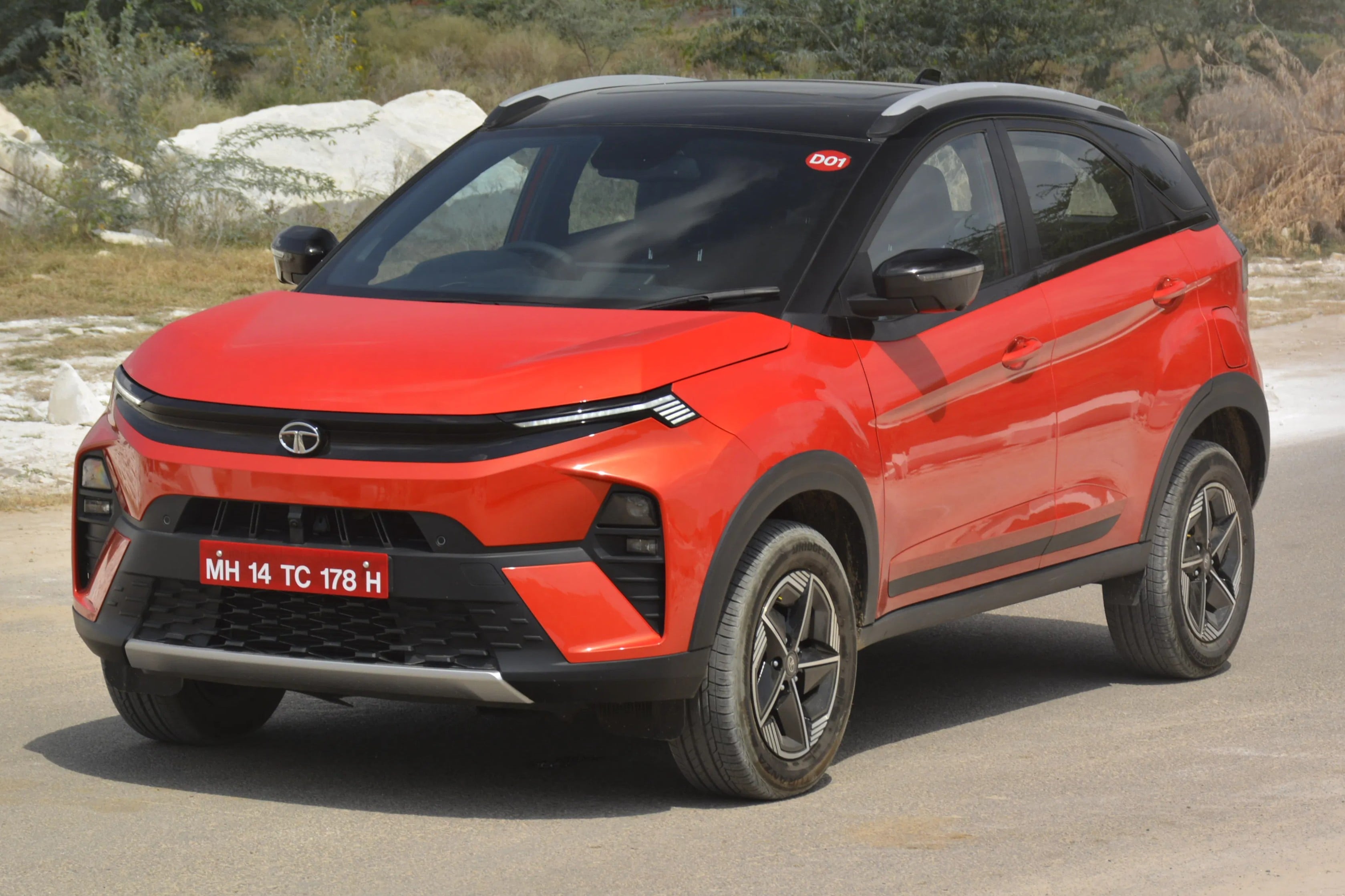
The Tata Nexon, including the Nexon EV, recorded 20,456 units in September 2026, down 9 percent from 22,573 units in the same month last year. It finished second, just 123 units ahead of the Punch. The Nexon is available with petrol, diesel, CNG and electric powertrains. It rivals the Maruti Suzuki Brezza, Hyundai Venue, Kia Sonet and Mahindra XUV 3XO and is priced from Rs 7.40 lakh to Rs 14.52 lakh for the ICE powered Nexon, while the Nexon EV starts at Rs 12.49 lakh and goes up to 17.89 lakh.
3. Tata Punch
The Tata Punch, including the Punch EV, recorded 20,333 units in September 2026, up 28 percent from 15,891 units a year earlier. It ranked third in the overall list, with the Nexon finishing narrowly ahead. Tata’s smallest SUV is offered with multiple powertrain options, while its compact dimensions and ride-and-handling balance remain key strengths. The Punch rivals the Hyundai Exter and Citroen C3 and is priced from Rs 5.75 lakh to Rs 10.77 lakh. The Punch EV meanwhile is priced from Rs 9.79 lakh to Rs 12.99 lakh.
4. Maruti Suzuki Fronx
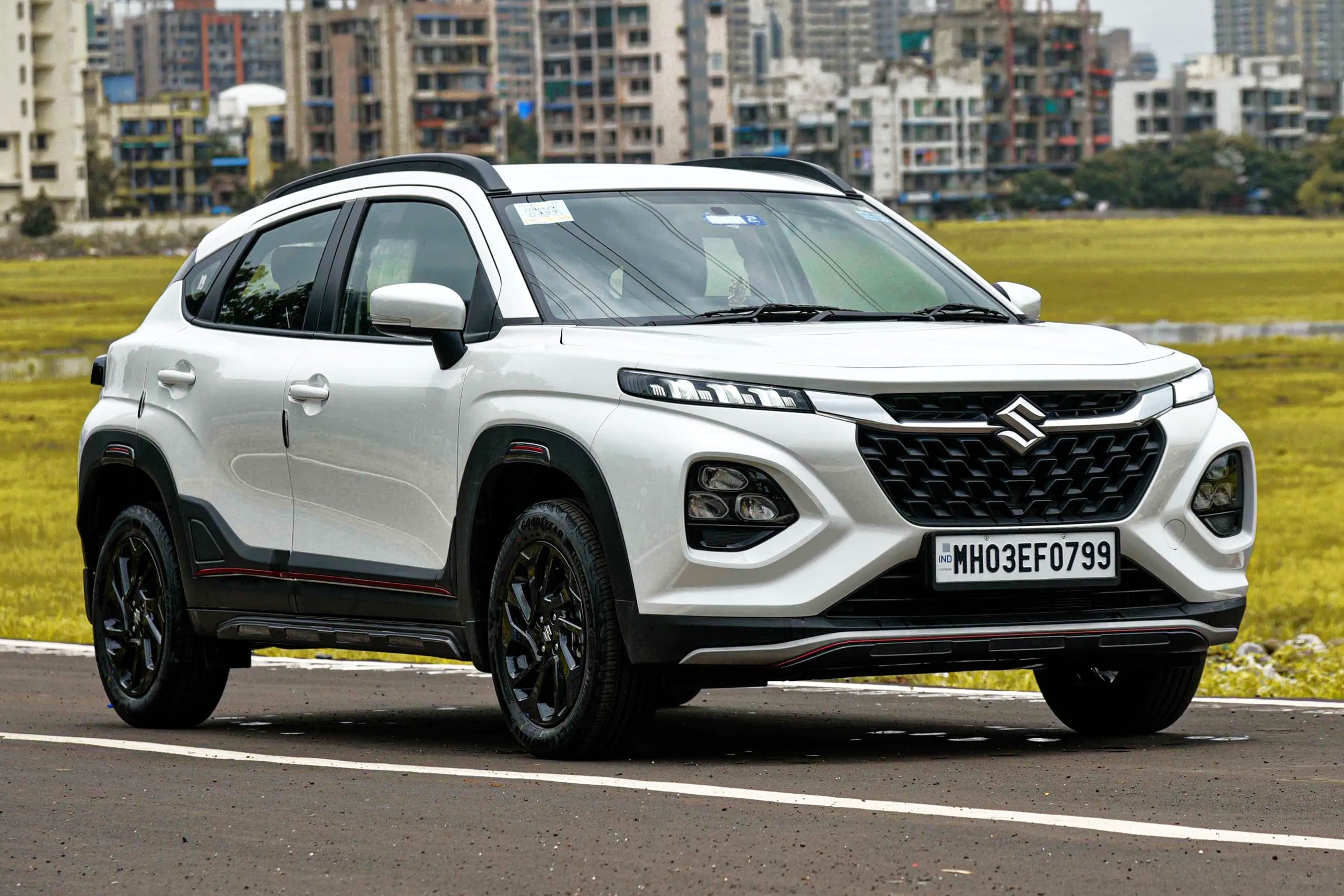
The Maruti Suzuki Fronx ranked fourth in September 2026 with 19,282 units, compared with 13,767 units in September 2025. Its dispatches increased 40 percent year on year. The Fronx’s crossover styling, comfortable cabin and fuel-efficient powertrains continue to support demand, although it lacks some popular features. It rivals the Nissan Magnite and Renault Kiger and is priced between Rs 6.85 lakh and Rs 11.84 lakh.
5. Maruti Suzuki Wagon R
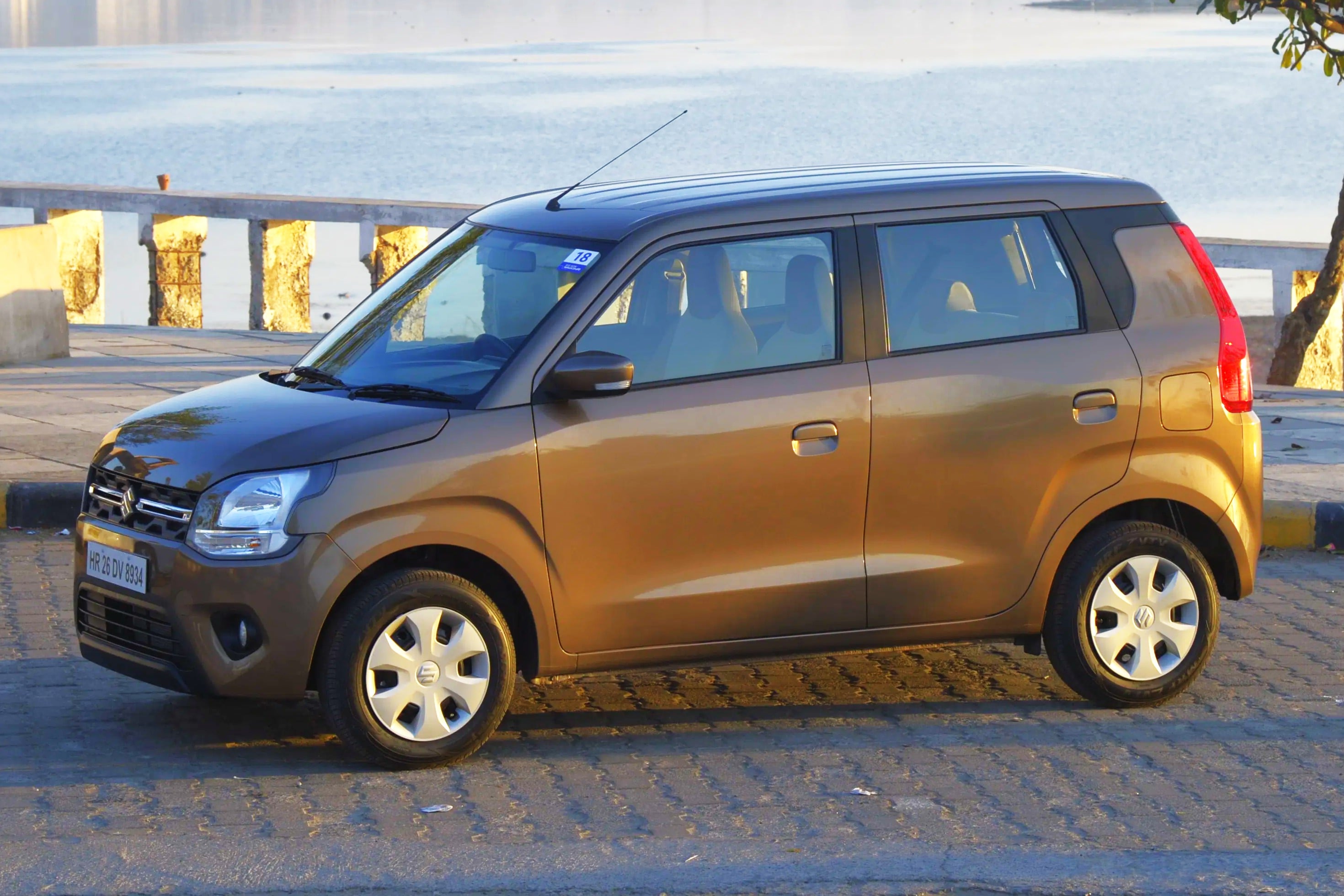
The Maruti Suzuki Wagon R recorded 18,835 units in September 2026, up 22 percent from 15,388 units in the same month last year. It finished fifth in the rankings. Its spacious cabin, ease of driving and low running costs remain key strengths, although its light build and limited highway ability are drawbacks. The Wagon R rivals the Tata Tiago and Citroen C3 and is priced between Rs 4.99 lakh and Rs 7.24 lakh.
6. Maruti Suzuki Dzire
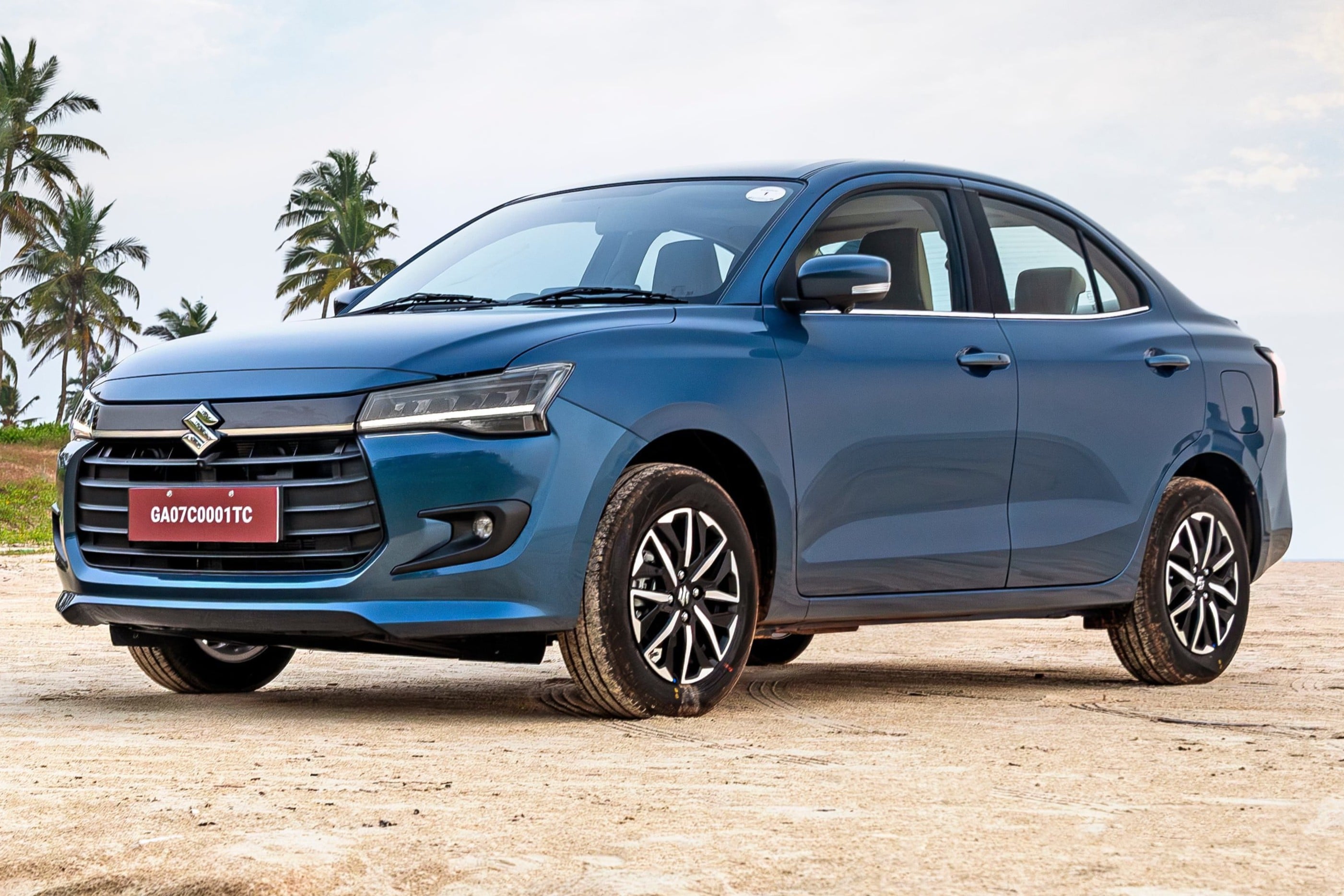
The Maruti Suzuki Dzire recorded 17,754 units in September 2026, down 11 percent from 20,038 units in September 2025. It ranked sixth and was the only sedan in the top 10. Strong fleet demand, fuel efficiency and a well-balanced ride and handling setup continue to support the compact sedan’s volumes. The Dzire rivals the Hyundai Aura, Honda Amaze and Tata Tigor and is priced between Rs 6.31 lakh and Rs 9.41 lakh.
7. Hyundai Creta
The Hyundai Creta, including the Creta Electric, recorded 17,657 units in September 2026, a 6 percent decline from 18,861 units in the year-ago month. It was the only Hyundai model in the top 10, finishing seventh. A roomy cabin, multiple powertrain options and a long feature list continue to attract buyers, although the top variants are expensive and some interior plastics could be better. The Creta rivals the Kia Seltos, Maruti Suzuki Grand Vitara, Toyota Urban Cruiser Hyryder, Honda Elevate and Tata Sierra. It is priced between Rs 10.91 lakh and Rs 20.14 lakh.
8. Maruti Suzuki Swift
The Maruti Suzuki Swift recorded 17,399 units in September 2026, up 12 percent from 15,547 units a year earlier. It finished eighth and was one of three Maruti Suzuki hatchbacks in the top 10. Its high fuel efficiency, light controls and easy-to-drive nature continue to support demand, although the top variants are priced close to the more premium Baleno. The Swift rivals the Hyundai Grand i10 Nios and Tata Tiago and is priced between Rs 5.84 lakh and Rs 8.74 lakh.
9. Mahindra Scorpio
The Mahindra Scorpio, combining the Scorpio N and Scorpio Classic, recorded 17,313 units in September 2026. This was down 6 percent from 18,372 units in September 2025, placing it ninth. The Scorpio nameplate remains popular for its strong engines, rugged character and off-road ability. However, the third-row seating is cramped and the luggage area is not particularly practical. The Scorpio N rivals the Tata Safari, Hyundai Alcazar and Mahindra XUV 7XO and is priced from Rs 13.69 lakh to Rs 25.49 lakh.
10. Maruti Suzuki Ertiga
The Maruti Suzuki Ertiga completed the top 10 with 16,911 units in September 2026, up 40 percent from 12,115 units in the same month last year. It was the sixth Maruti Suzuki model in the rankings. The Ertiga continues to hold the title of India’s highest-selling MPV. Its practical cabin, strong fuel efficiency and value-for-money positioning attract both private and fleet buyers, although it misses out on some features offered by rivals. It is priced from Rs 8.90 lakh to Rs 13.04 lakh and rivals the Kia Carens and Toyota Rumion.
Following the Elevate facelift, Honda’s next launch for India will be the all-new 0 Alpha electric SUV – the brand’s first all-electric vehicle for our market. Honda is expected to reveal the official name later this year and also perhaps showcase the production-spec model before it goes on sale by early 2027. Ahead of its launch, a heavily camouflaged prototype of 0 Alpha SUV has recently been spied testing on our roads.
India-built model planned for global markets, including Japan
To be manufactured at the Tapukara plant in Rajasthan
No technical details available as of yet
Honda 0 Alpha SUV spied: what to expect?
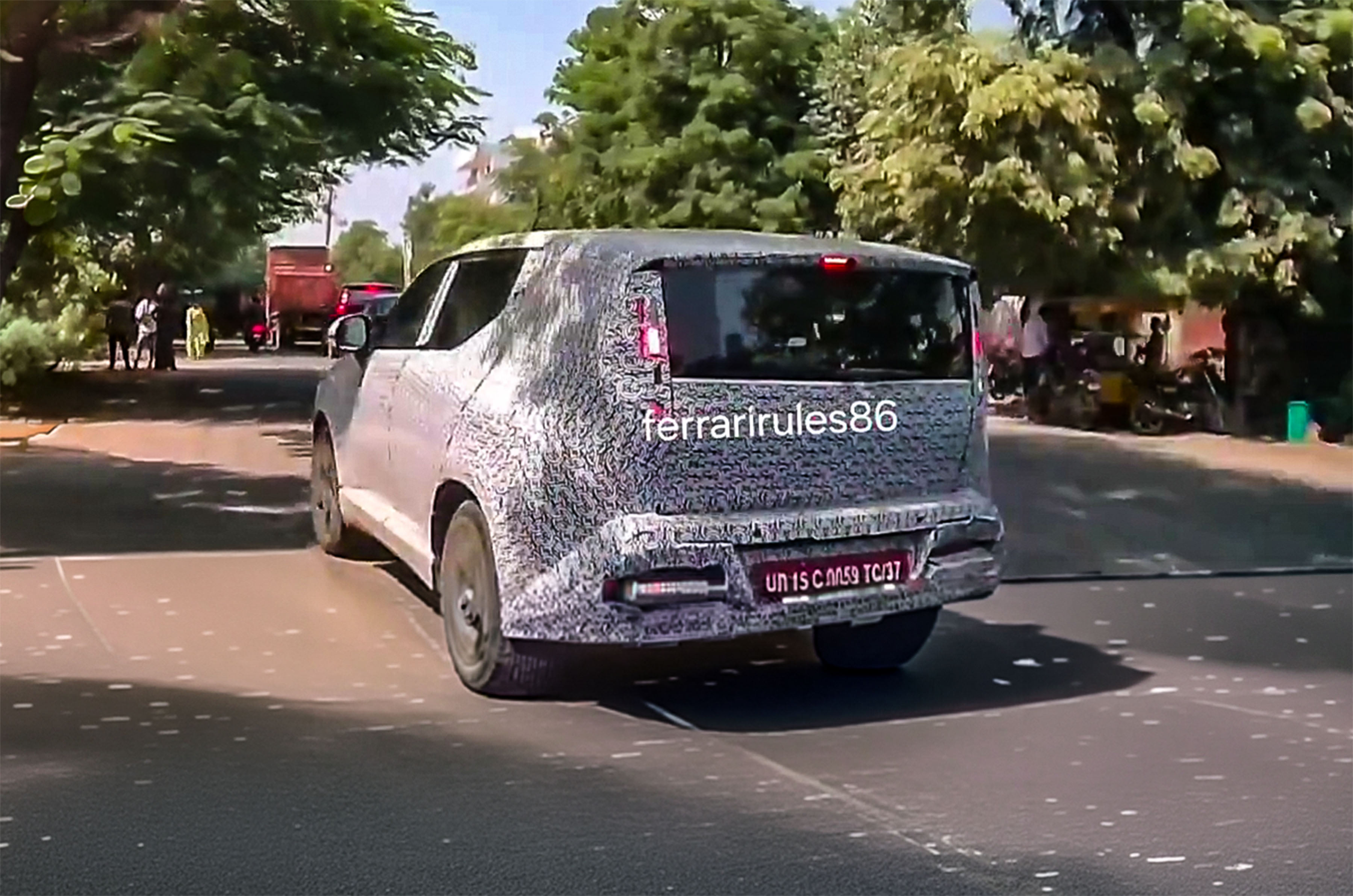
The Honda 0 Alpha was first preview by a concept about exactly a year ago at the Japan Mobility Show 2025. And looking at these camouflaged spy shots, the radical shape doesn’t seem to have changed at all. It looks nothing like any existing Honda, with the characteristic design element being the near-vertical rear end with a thick C-pillar area, almost reminiscent of an MPV. It gets a large rear windscreen that’ll likely be wrapped around by an LED light bar, while the lower section gets a protruding bumper and is expected to feature a diffuser like element.
Image Credit: Ferrarirules86 via X.
At the debut of the concept, Honda had said the design was already near production-ready, so much of the details, including the lighting signatures and the glass panels could be seen on the final model. The front ‘grille’ area is expected to sport an illuminated Honda logo and a charging port, framed on the side and above by the headlights.
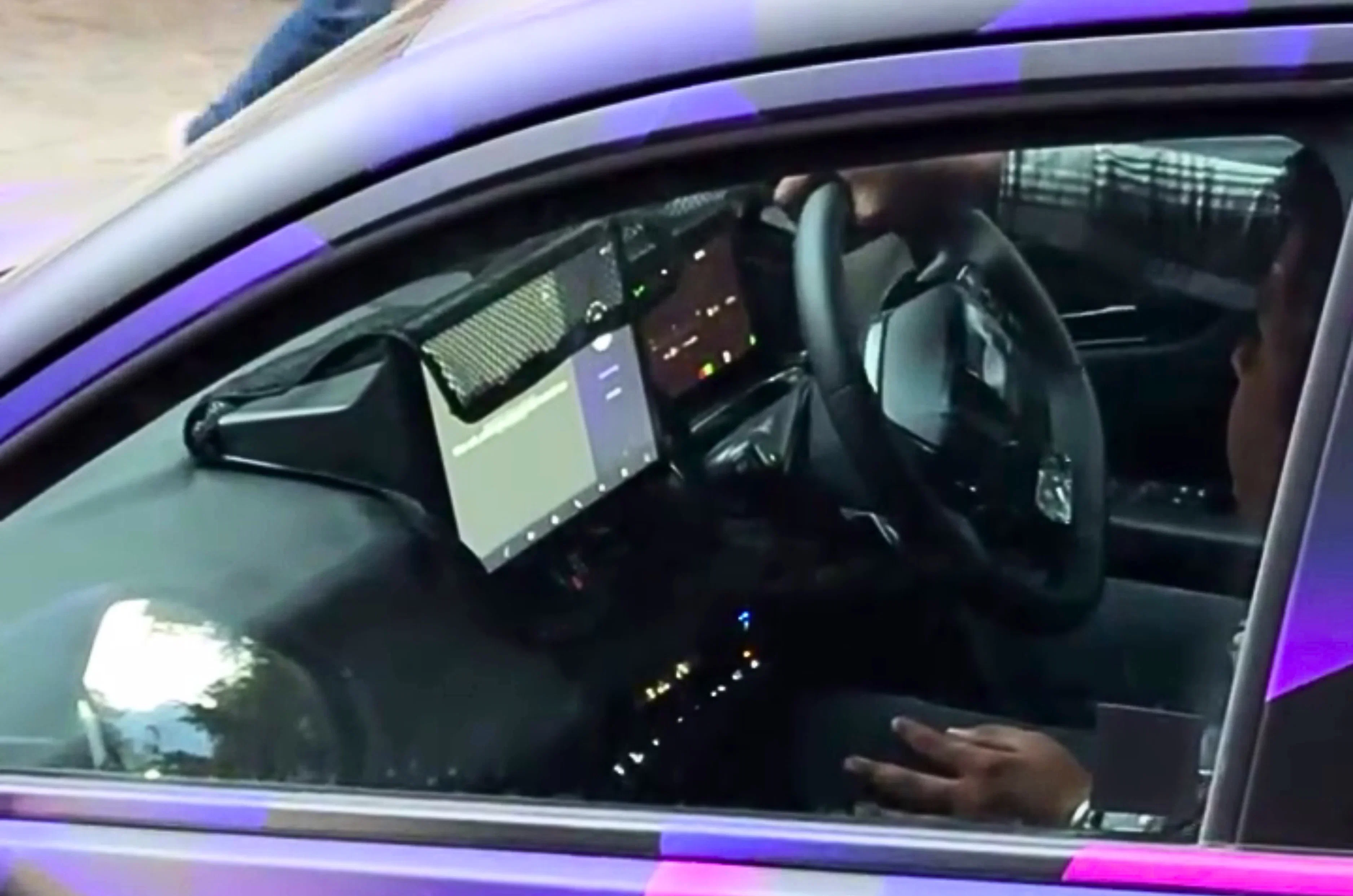
A previous sighting of a camouflaged test mule has also given us a look at the interior of the upcoming electric SUV. The most prominent element in the cabin is a massive central infotainment touchscreen mounted atop the dashboard. To its right sits a much smaller digital driver’s display, ahead of which there’s a three-spoke flat-bottomed steering wheel with paddleshifters for regeneration. The 0 Alpha’s interior incorporates an array of buttons on the centre console, seemingly for functions such as climate control and ventilated seats.
Image Credit: pxrtth.gpt via Instagram
The Honda 0 Alpha SUV is expected to have a wheelbase of about 2700-2800mm, with the priority being maximising interior space. The upright rear tailgate also hints at good luggage space and interior room.
Honda 0 Alpha technical details
Technical details on the 0 Alpha are quite scarce at the moment, but the brand has previously confirmed that it will be offered with two battery pack options. Both will be LFP batteries, likely ranging in the size of 65kWh-75kWh units. At launch, the Honda 0 Alpha SUV is expected to use a single-motor, front-wheel-drive layout.
The upcoming electric SUV will be manufactured in India, with Honda’s Tapukara plant in Rajasthan expected to serve as the production base. It’s expected to go on sale by early 2027, with India and Japan among the initial markets. The 0 Alpha will rival electric midsize SUVs such as the Mahindra BE 6, MG ZS EV, Hyundai Creta Electric, Tata Sierra EV, Maruti Suzuki e Vitara and Toyota Urban Cruiser Ebella.
Hyundai is offering almost its entire line-up in October 2026 with various benefits. With the festive season around the corner, the Korean automaker is also providing customers discounts for Navratri. That said, the offers listed here are only applicable for the period of October 1 to October 31, 2026.
Disclaimer: Offers/benefits may vary by city and are subject to stock availability. Buyers are advised to check with their local dealer for exact figures.
Hyundai Creta N Line offers in October 2026
Benefits up to Rs 1.25 lakh
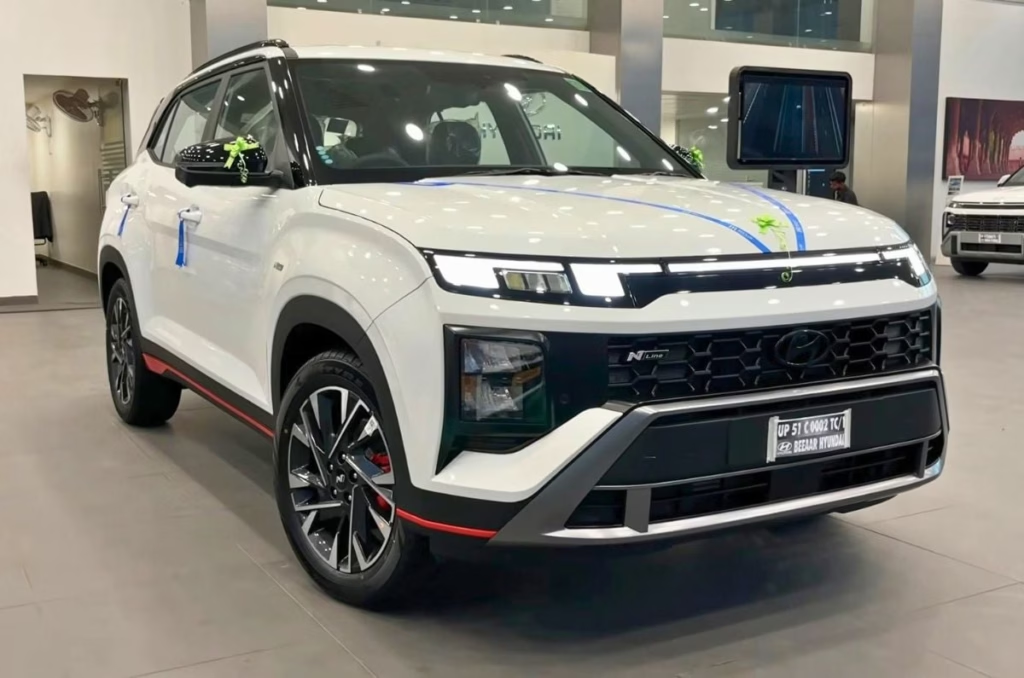
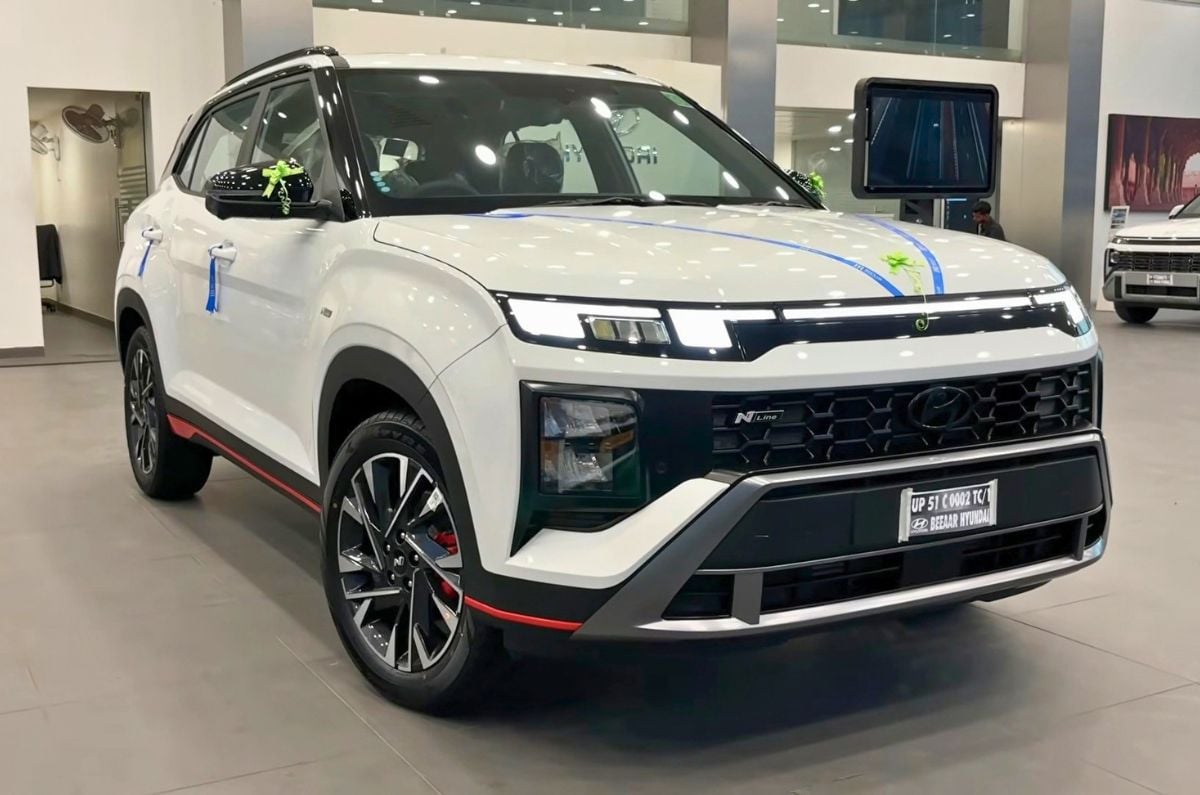
The Hyundai Creta N Line is available this month with a cash discount of Rs 20,000 and a Navratri bonus of Rs 25,000. There’s also scrappage benefits amounting to Rs 50,000 or an exchange offer of Rs 30,000, among a couple more customer-benefit schemes. Combined, one can expect to shave off up to Rs 1.25 lakh on a Creta N Line this month. The price of the Creta N Line ranges between Rs 19.03 lakh and Rs 19.95 lakh.
Hyundai Creta offers in October 2026
Benefits up to Rs 1.15 lakh
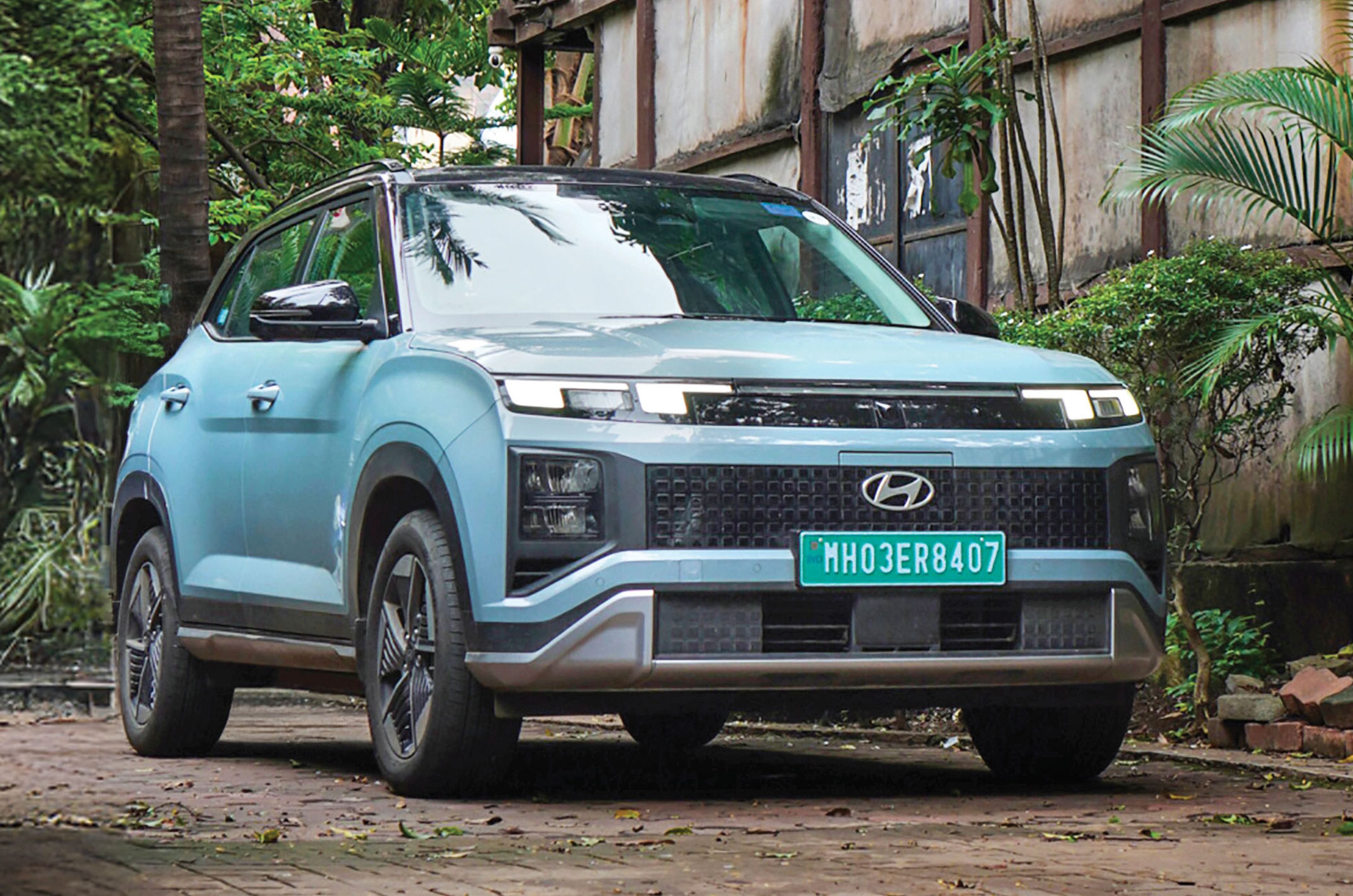
Select petrol variants of the Hyundai Creta have offers amounting to Rs 1.15 lakh. These are similar to what’s available with the Creta N Line, which means cash discounts, scrappage/exchange benefits, and a Navratri bonus. Hyundai is also providing benefits on diesel variants of the Creta, though these amount to just Rs 10,000. The Hyundai Creta range is priced from Rs 10.91 lakh to Rs 20.31 lakh.
Hyundai Verna offers in October 2026
Benefits up to Rs 1.05 lakh
Older stock of the Hyundai Verna is being offered this month with benefits totalling Rs 1.05 lakh. This includes a cash discount of Rs 35,000, an upgrade bonus of Rs 15,000 and a Navratri incentive of Rs 25,000. Scrappage benefits amount to Rs 20,000, while the exchange offer is Rs 15,000. Eligible customers will also be offered other benefits. New stock of the Verna also come with discounts of up to Rs 80,000, depending on the variant. The list price of the new Hyundai Verna is between Rs 10.99 lakh and Rs 18.31 lakh.
Hyundai Alcazar offers in October 2026
Benefits up to Rs 90,000
Petrol variants of the Hyundai Alcazar are available with a cash discount of Rs 30,000, scrappage or exchange benefits of up to Rs 25,000, and a Navratri incentive of Rs 25,000. Including other applicable offers, Alcazar petrol buyers can save up to Rs 90,000 – discounts on the Alcazar diesel are up to Rs 45,000. The Hyundai Alcazar line-up costs between Rs 14.51 lakh and Rs 21.81 lakh.
Hyundai Grand i10 Nios offers in October 2026
Benefits up to Rs 75,000
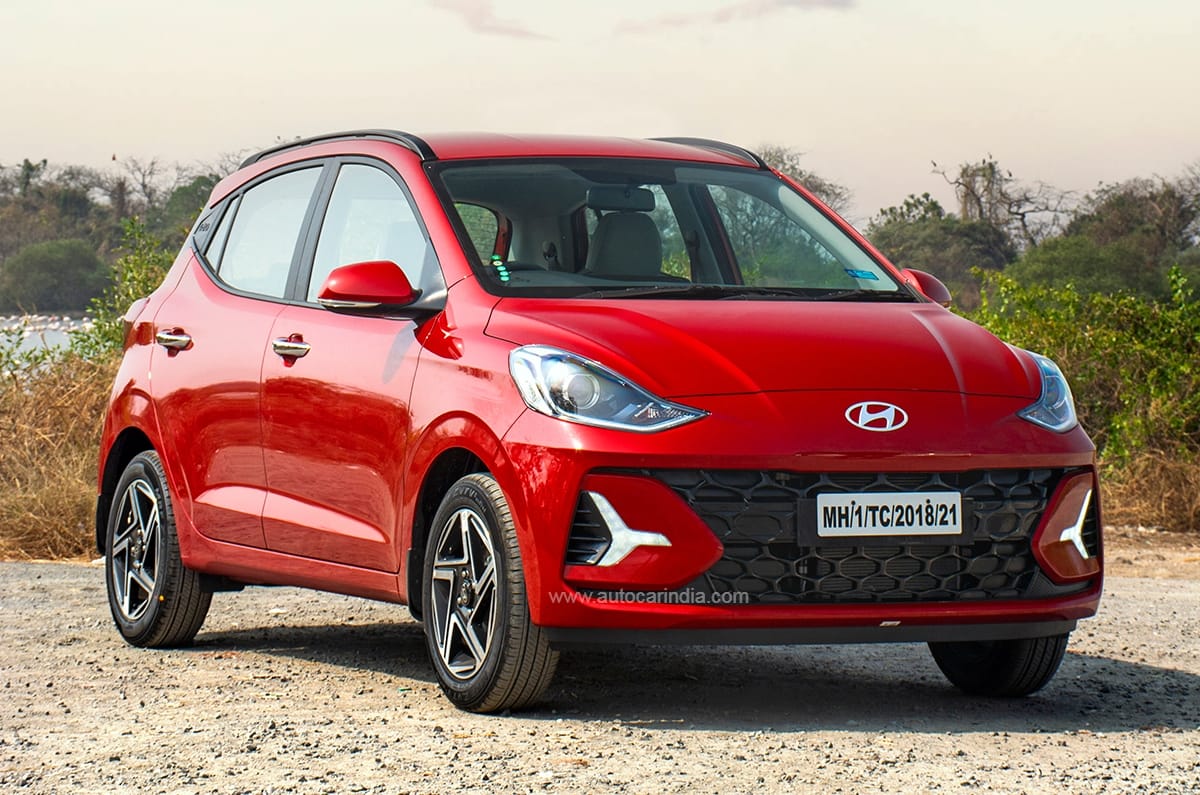
Select variants of the Hyundai Grand i10 Nios can be had with discounts amounting to Rs 75,000 this month. This involves a Navratri incentive of Rs 15,000, a cash discount of Rs 20,000, a scrappage/exchange bonus of up to Rs 20,000, and other benefits. The Grand i10 Nios CNG is available with benefits of up to Rs 70,000. In terms of its price, the Hyundai Grand i10 Nios is listed between Rs 5.60 lakh and Rs 8.09 lakh.
Hyundai Creta Electric offers in October 2026
Benefits up to Rs 65,000
The Hyundai Creta Electric is being offered with discounts amounting to Rs 65,000, though this is only applicable for select variants. The remaining variants get benefits of up to Rs 50,000. The price of the Hyundai Creta Electric ranges between Rs 18.03 lakh and Rs 25.07 lakh.
Hyundai i20 offers in October 2026
Benefits up to Rs 65,000
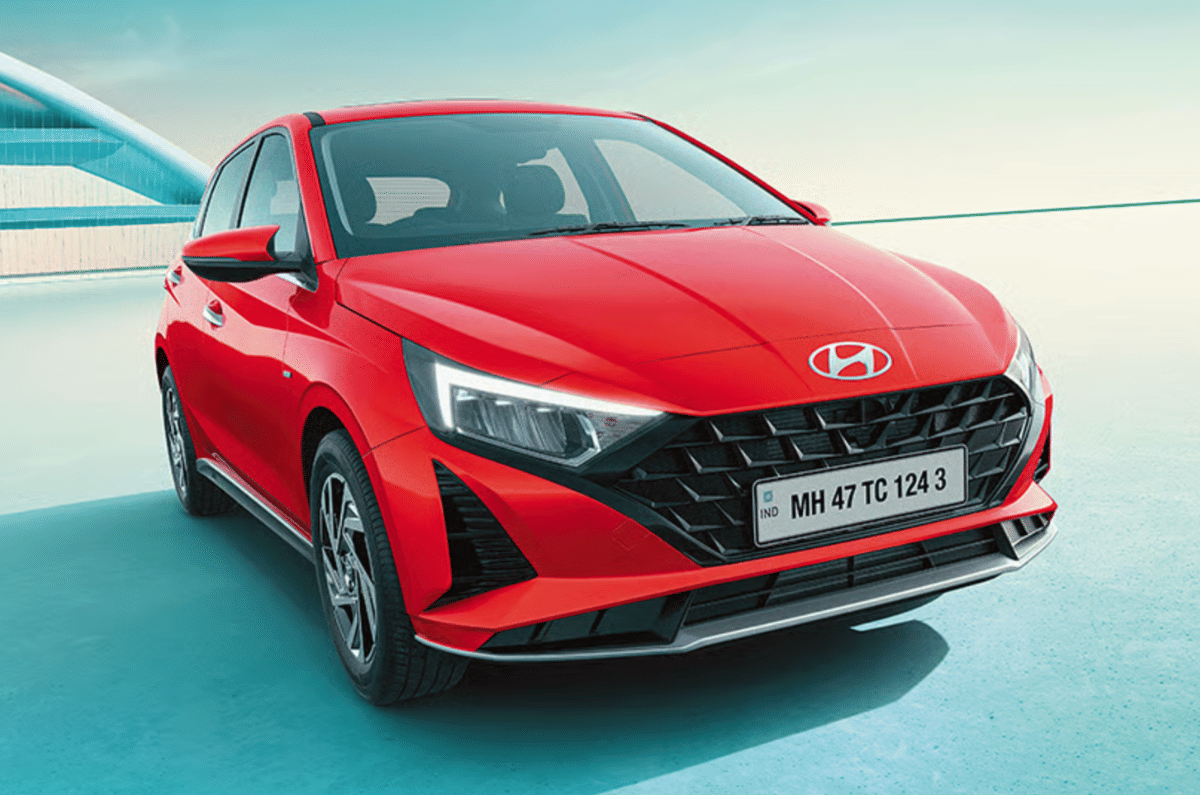
Select variants of the Hyundai i20 line-up (including the N Line) are being offered with a Navratri incentive of Rs 10,000, a cash discount of Rs 15,000 and scrappage/exchange benefits of up to Rs 20,000, among other schemes. In all, customers of the i20 can avail offers totalling up to Rs 65,000 this October. The Hyundai i20 is priced from Rs 6.00 lakh to Rs 10.44 lakh, while the i20 N Line costs between Rs 9.32 lakh and Rs 11.64 lakh.
Hyundai Exter offers in October 2026
Benefits up to Rs 55,000
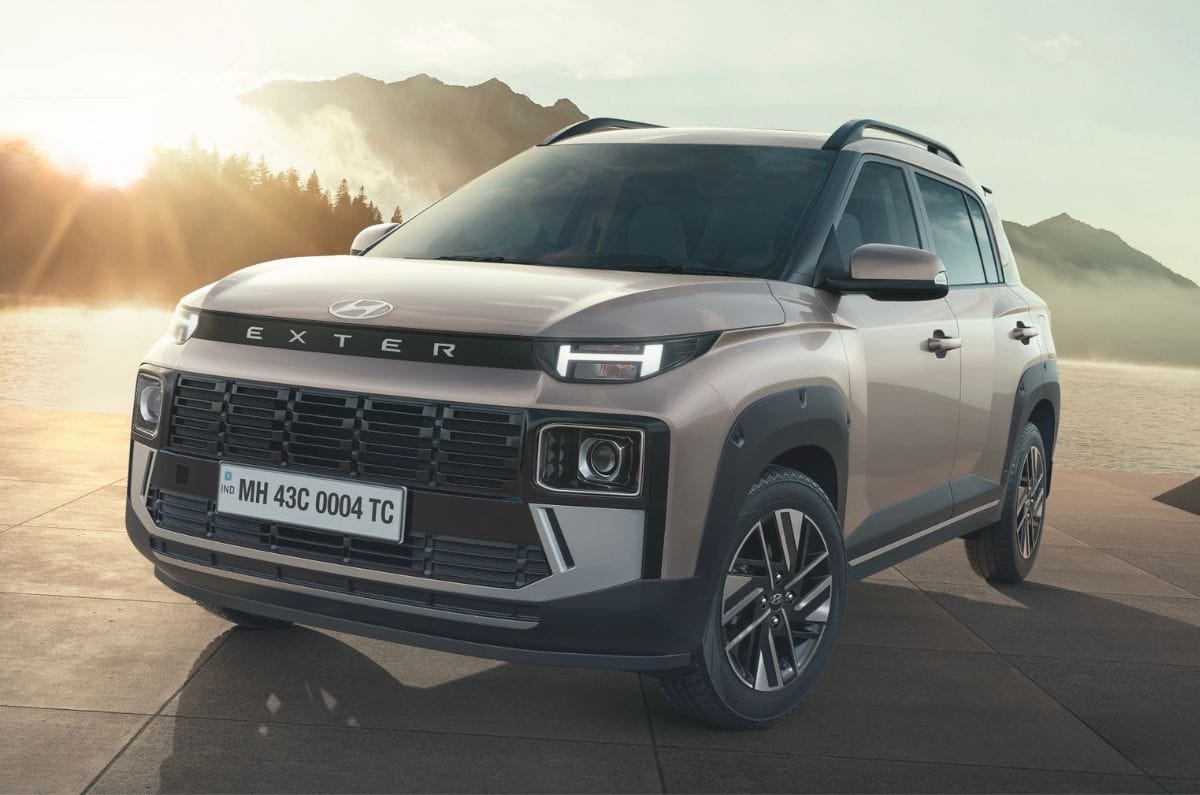
Older stock of the Hyundai Exter can be had this month with discounts that amount to Rs 55,000, while the new Exter is available with schemes that bring its price down by up to Rs 50,000. Note that these incentives are only applicable on select variants, regardless of the model year. The new Hyundai Exter is priced between Rs 5.81 lakh and Rs 9.50 lakh.
Hyundai Aura offers in October 2026
Benefits up to Rs 40,000
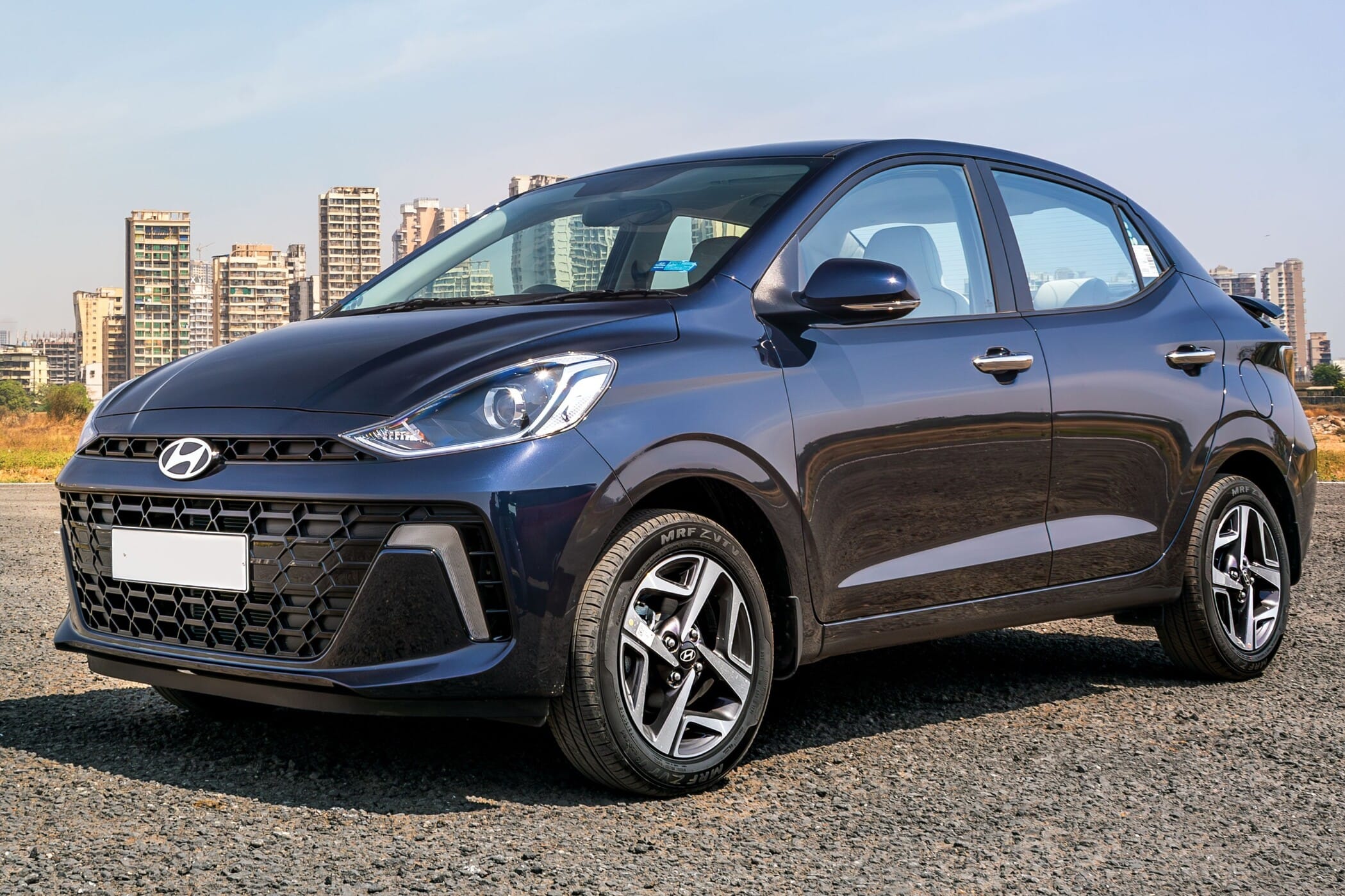
Customers buying select trims of the Hyundai Aura CNG in October 2026 can avail discounts of up to Rs 40,000. Meanwhile, select petrol variants of this Hyundai sedan is being offered with benefits of up to Rs 25,000. The Hyundai Aura range is priced from Rs 6.00 lakh to Rs 8.67 lakh.
Hyundai Venue offers in October 2026
Benefits up to Rs 5,000
The Hyundai Venue line-up (including the N Line) is available with the lowest discounts this month, amounting to just Rs 5,000. As for its price, the Hyundai Venue is listed at between Rs 8.00 lakh and Rs 15.65 lakh, while the Venue N Line costs from Rs 10.66 lakh to Rs 15.49 lakh.
Maruti Suzuki has revealed the offers applicable to its Nexa cars in October. The Grand Vitara receives the highest benefits of up to Rs 1.36 lakh, followed by the Invicto, XL6, Jimny, e Vitara and Fronx. However, there are no benefits on the recently launched Baleno facelift. Let us now take a closer look at these offers.
Note: Offers may vary by city, dealership and stock availability. Please check with your nearest Maruti Nexa dealership for the exact figures. The pre-Navratri booking offer is applicable from October 1 to 10. The exchange offer considered here is for cars up to 10 years old, while the additional exchange offer applies to cars up to 6 years old.
Maruti Grand Vitara October 2026 offers
Up to Rs 1.36 lakh
Pre-2025 Maruti Grand Vitara.
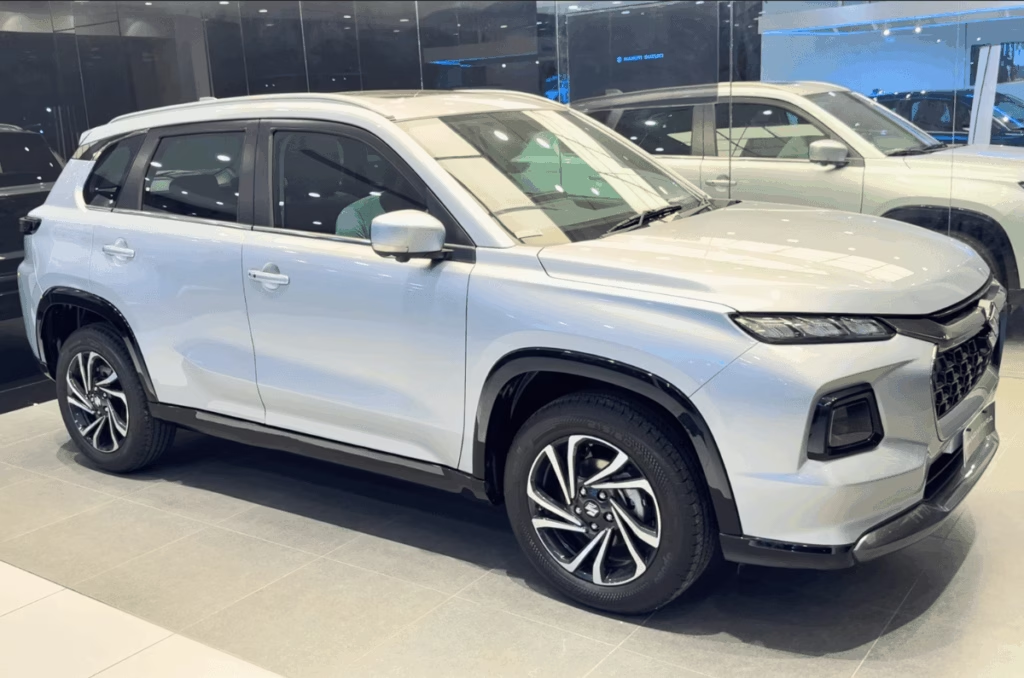
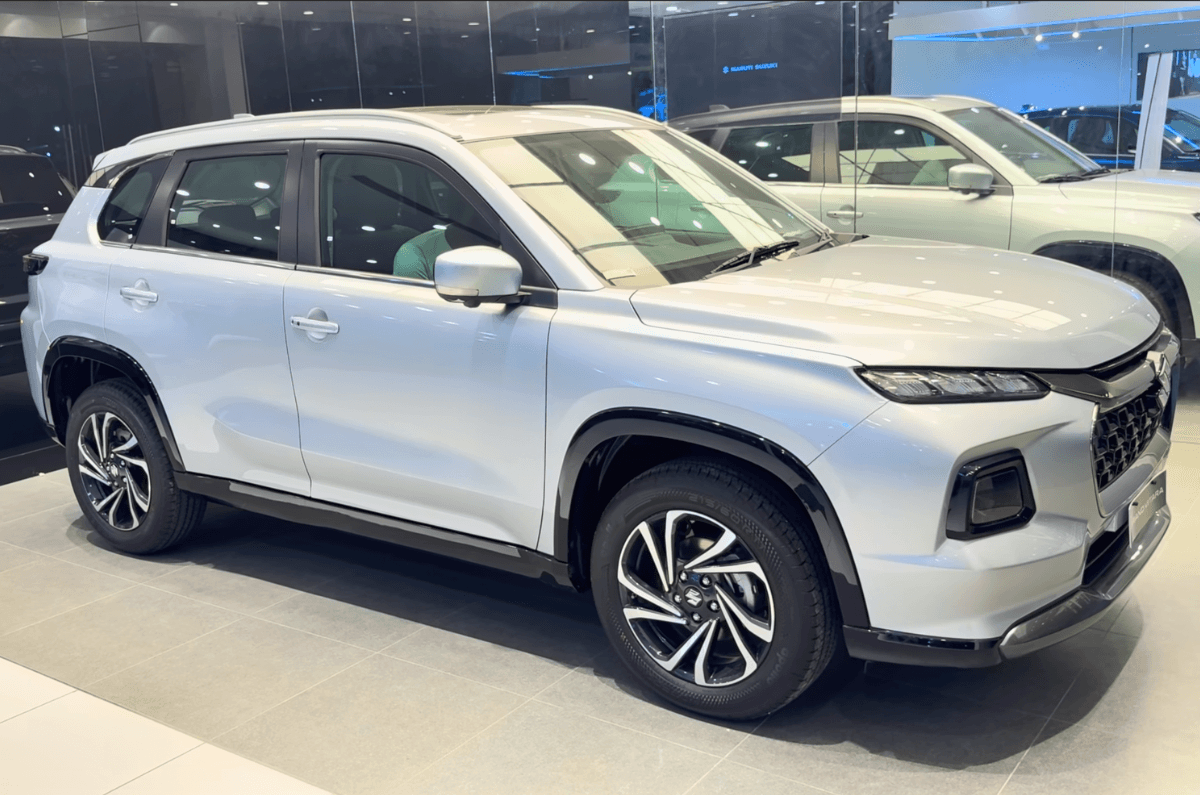
The Maruti Grand Vitara gets offers of up to Rs 1.36 lakh this month. Its Sigma petrol MT variant gets the highest total benefit of up to Rs 1.36 lakh, including a cash discount of Rs 35,000, a pre-Navratri booking offer of Rs 11,000, exchange benefit of Rs 30,000, an additional exchange bonus of Rs 25,000, a loyalty bonus of Rs 20,000 and corporate offer of Rs 15,000.
The Delta petrol MT and AT variants get offers of up to Rs 1.26 lakh, while the Zeta and Alpha petrol variants, along with the AWD variants, get benefits of Rs 1.15 lakh plus a five-year extended warranty. All strong-hybrid variants get benefits worth up to Rs 1.20 lakh, along with zero road tax of up to Rs 1.85 lakh and a five-year extended warranty. Lastly, the Delta CNG gets benefits of up to Rs 1 lakh, while the Zeta CNG gets up to Rs 90,000.
Maruti has priced the Grand Vitara from Rs 10.77 lakh to Rs 19.62 lakh, and it rivals midsize SUVs like the Hyundai Creta, Tata Sierra, Kia Seltos, Renault Duster and more.
Maruti Invicto October 2026 offers
Up to Rs 95,000
Next in line is the Maruti Invicto, with offers of up to Rs 95,000. These are available across all variants of the MPV, and include an exchange benefit of Rs 50,000, a loyalty bonus of Rs 30,000 and a corporate offer of Rs 15,000. However, there are no consumer offer, pre-Navratri booking offer and additional exchange bonus available on the Invicto.
The Maruti Invicto, priced from Rs 25.02 lakh to Rs 28.71 lakh, locks horns with the Toyota Innova Hycross.
Maruti XL6 October 2026 offers
Up to Rs 61,000
The Maruti XL6 gets offers of up to Rs 61,000. Petrol MT and AT variants get a cash discount of Rs 20,000, a pre-Navratri booking offer of Rs 11,000, an exchange benefit of Rs 20,000 and an additional exchange bonus of Rs 10,000. CNG variants get a maximum benefit of Rs 50,000, comprising a cash discount of Rs 20,000, an exchange benefit of Rs 20,000 and an additional exchange bonus of Rs 10,000.
Prices for the Maruti XL6 range from Rs 11.62 lakh to Rs 14.52 lakh, and the MPV rivals the Kia Carens Clavis and Toyota Rumion.
Maruti Jimny October 2026 offers
Up to Rs 35,000
Unlike the models so far which get multiple offers, the Maruti Jimny is available with just a cash discount of Rs 35,000 across all variants. No exchange, pre-Navratri booking, additional exchange bonus, loyalty and corporate offers are on offer this month with the SUV.
The Jimny’s prices range between Rs 12.59 lakh and Rs 14.52 lakh, and it competes with the Mahindra Thar OG and Force Gurkha 3-door.
Maruti e Vitara October 2026 offers
Up to Rs 30,000
The Maruti e Vitara, the carmaker’s sole EV offering, gets offers of up to Rs 30,000 this month, along with a free charger and its home installation. Available across all variants, the offer includes an exchange benefit of Rs 30,000. There are no consumer, pre-Navratri booking, additional exchange bonus, loyalty, scrappage or corporate offers this month.
The e Vitara is priced between Rs 16.19 lakh and Rs 19.99 lakh, and it rivals the likes of the Hyundai Creta Electric, Vinfast VF6, Mahindra BE 6 and more.
Maruti Fronx October 2026 offers
Up to Rs 27,100
Rounding off this list is the Maruti Fronx, with offers of up to Rs 27,100 in October 2026. The 1.0-litre turbo-petrol variants get the highest benefit, including a consumer offer of Rs 5,000, a pre-Navratri booking offer of Rs 7,100, an exchange benefit of Rs 10,000 and an additional exchange bonus of Rs 5,000.
The 1.2-litre petrol variants get up to Rs 22,100, comprising the pre-Navratri booking, exchange and additional exchange bonus benefits. The 1.2-litre petrol-CNG variants get the lowest benefit of Rs 15,000, through exchange and additional exchange bonus offers.
Prices for the Maruti Fronx range from Rs 6.9 lakh to Rs 11.89 lakh, and it serves as an alternative to compact SUVs like the Tata Nexon, Hyundai Venue, Kia Sonet, Mahindra XUV 3XO and more.
Ex-showroom prices mentioned above are as on October 7, 2026.
Retail sales of electric passenger vehicles reached a new monthly high of 35,995 units in September 2026, up 94 percent from the same month last year and marking the fourth consecutive month with sales above 30,000 units. Tata Motors retained the top spot with 14,769 units and a 41 percent market share, while Kia moved ahead of Maruti Suzuki to take fifth place. H1 FY2027 EV sales now stand at 1,90,946 units, up 88 percent year on year, putting the industry within 29,971 units of the full-year FY2026 tally.
September 2026 EV sales
Rank
OEM
Sep 2026
Sep 2025
YoY change
Market share
1
Tata Motors
14,769
7,353
101%
41.03%
2
Mahindra & Mahindra
7,779
3,972
96%
21.61%
3
JSW MG Motor India
5,242
4,800
9%
14.56%
4
Vinfast India
2,963
6
49,283%
8.23%
5
Kia India
1,263
598
111%
3.50%
6
Maruti Suzuki India
1,103
–
–
3.06%
7
BYD India
836
732
14%
2.32%
8
Hyundai Motor India
792
404
96%
2.20%
9
BMW India
502
369
36%
1.39%
10
Tesla
291
69
322%
0.80%
11
Toyota Kirloskar Motor
218
–
–
0.60%
12
Mercedes-Benz India
125
137
-9%
0.34%
13
Stellantis India
55
47
17%
0.15%
14
Volvo India
45
24
88%
0.12%
15
Porsche India
11
8
38%
0.03%
16
JLR India
1
0
–
0.00%
17
Audi India
0
0
–
0.00%
18
Lotus
0
0
–
0.00%
19
Rolls-Royce
0
1
-100%
0.00%
Total
35,995
18,520
94%
100%
Tata Motors
14,769 units, up 101 percent YoY
Tata Motors sold 14,769 electric passenger vehicles in September, up 101 percent from 7,353 units in the same month last year. This was the company’s highest monthly EV sales yet, surpassing the previous record of 14,388 units in July. September was also its fourth consecutive month with sales above 12,000 units.
Tata’s EV market share stood at 41.03 percent, up from 39.70 percent in September 2025. The Nexon EV remains its biggest volume driver, while the updated Tiago EV and Punch EV have also contributed to sales. During the month, Tata also extended its Battery-as-a-Service (BaaS) offering to the Nexon EV, Curvv EV, Sierra EV and Harrier EV.
Mahindra
7,779 units, up 96 percent YoY
Mahindra sold 7,779 EVs in September, up 96 percent from 3,972 units a year ago. The company retained second place in the electric PV market, although its sales remained below the monthly record of 8,131 units set in July. Mahindra’s EV market share increased to 21.61 percent from 21.44 percent in September 2025. The BE 6 and XEV 9e continue to make up its main EV offering, while the XEV 9S adds a three-row model to the line-up. Mahindra also recently extended its Battery-as-a-Service (BaaS) ownership programme to the XEV 9S and the XEV 9e.
JSW MG Motor
5,242 units, up 9 percent YoY
JSW MG Motor recorded 5,242 EV sales in September, up 9 percent from 4,800 units a year earlier and 6 percent from August. The company retained third place, although its market share fell to 14.56 percent from 25.91 percent in September 2025.
June remains MG’s best month so far, with 6,220 units. The Windsor EV continues to be its highest-selling model, while the recently launched Hector Tomahawk EV adds another model to its electric line-up. MG also has introduced a battery-as-a-service (BaaS) scheme for the Cyberster and M9 EVs.
Vinfast
2,963 units, up 49,283 percent YoY
Vinfast retained fourth place with 2,963 EVs sold in September, its highest monthly sales since entering India’s electric passenger vehicle market. Sales were up 32 percent from August, giving the company an 8.23 percent market share.
Vinfast currently has three models in its passenger vehicle portfolio: the VF6 and VF7 SUVs, and the VF MPV 7. Its cumulative H1 FY2027 sales stand at 10,826 units.
Kia
1,263 units, up 111 percent YoY
Kia moved ahead of Maruti Suzuki to take fifth place in September after recording 1,263 EV sales, up 111 percent from 598 units in September 2025. Sales also increased 48 percent from August’s 851 units. Kia’s EV market share increased to 3.50 percent, compared with 3.22 percent a year earlier. The increase follows the launch of the Syros EV in August. Kia also sells the Carens Clavis EV in India, while the EV6 and EV9 are sold as fully imported models.
Maruti Suzuki
1,103 units
Maruti Suzuki slipped to sixth place, with 1,103 e Vitara units sold in September. Sales declined 25 percent from August’s 1,472 units, although September marked the company’s sixth consecutive month with four-digit EV sales. The e Vitara has so far seen limited domestic availability as a larger share of production was allocated for exports. Maruti is expected to increase domestic production with the start of operations at its new manufacturing line at the Hansalpur plant in Gujarat.
BYD
836 units, up 14 percent YoY
BYD sold 836 EVs in September, up 14 percent from 732 units in the same month last year. Its market share stood at 2.32 percent, down from 3.95 percent a year earlier. June remains BYD India’s highest-selling month so far, with 938 units. Its current line-up includes the Atto 3, eMax 7, Seal and Sealion 7, while the company has confirmed plans to launch the Seal U later this year.
Hyundai
792 units, up 96 percent YoY
Hyundai sold 792 EVs in September, up 96 percent from 404 units a year ago. This was its second-highest monthly sales tally in FY2027, after 840 units in August. The company sold a total of 3,650 EVs in H1 FY2027, down 8 percent from the 3,951 units sold in H1 FY2026. Hyundai currently has the Creta Electric and Ioniq 5 in its EV line-up.
Toyota
218 units
Toyota recorded 218 units of the Urban Cruiser Ebella in September, its highest monthly sales of the electric SUV since launch. Sales were up 30 percent from the 168 units sold in August. The Ebella is Toyota’s version of the Maruti e Vitara and is positioned against models including the Mahindra BE 6, Vinfast VF6, MG ZS EV, Hyundai Creta Electric and Tata Nexon EV.
Luxury EV sales hit new high
Luxury electric passenger vehicle sales also reached a new monthly high of 975 units in September, up 60 percent from 608 units a year earlier. This surpassed the previous record of 853 units set in June. Luxury EVs accounted for 2.70 percent of total electric passenger vehicle sales in September.
BMW
502 units, up 36 percent YoY
BMW remained the largest luxury EV seller in September with 502 units, up 36 percent from 369 units a year earlier. Its market share stood at 51.48 percent, down from 60.69 percent in September 2025. BMW recently expanded its electric line-up with the i5 Long Wheelbase, which was launched in India in September at Rs 79.6 lakh. It is the company’s first locally produced electric sedan in India. BMW has also recently updated the i7 range, with 50 xDrive M Sport trim and the top-spec M70 xDrive.
Tesla
291 units, up 322 percent YoY
Tesla recorded 291 units in September, its highest monthly sales in India, up 322 percent from 69 units a year earlier. The increase moved Tesla ahead of Mercedes-Benz and into second place in the luxury EV segment for the first time. Its segment share rose to 29.84 percent from 11.34 percent in September 2025.
Mercedes-Benz
125 units, down 9 percent YoY
Mercedes-Benz sold 125 EVs in September, down 9 percent from 137 units in the same month last year. Its share of the luxury EV segment fell to 12.82 percent, from 22.53 percent a year earlier. The company’s highest monthly EV sales this year came in June, when it recorded 245 units.
Volvo
45 units, up 88 percent YoY
Volvo recorded 45 EV sales in September, up 88 percent from 24 units a year earlier. Its market share increased to 4.61 percent, from 3.94 percent in September 2025.
Porsche
11 units, up 38 percent YoY
Porsche sold 11 EVs in September, up 38 percent from eight units in September 2025. It accounted for 1.12 percent of luxury EV sales during the month.
India’s passenger vehicle wholesale volumes remained broadly flat at around 4 lakh units in September 2026. Maruti Suzuki retained the top spot, while Kia and Renault were the only two manufacturers to record month-on-month growth. Tata Motors and Mahindra were separated by just 227 units, with Tata taking second place.
September 2026 retail car sales
September 2026 carmaker-wise sales in India
Carmaker
Sep 2026 sales
Aug 2026 sales
Sep 2025 sales
MoM change
YoY change
Maruti Suzuki
1,68,744
1,76,971
1,32,820
-4.65%
+27.05%
Tata
56,972
65,253
59,667
-12.69%
-4.52%
Mahindra
56,745
59,257
56,233
-4.24%
+0.91%
Hyundai
49,998
54,396
51,547
-8.09%
-3.01%
Kia
32,017
29,042
22,700
+10.24%
+41.04%
Toyota
27,652
28,410
27,089
-2.67%
+2.08%
MG
5,226
7,508
6,728
-30.39%
-22.32%
Renault
3,399
2,842
4,265
+19.60%
-20.30%
Nissan
2,960
3,426
1,652
-13.60%
+79.18%
Maruti Suzuki
Sales: 1,68,744 units, Change: 27.05 YoY
Maruti Suzuki remained India’s largest carmaker in September, with 1,68,744 units, up 27.1 percent from 1,32,820 units in September 2025. Sales however declined 4.7 percent from August, when the company recorded 1,76,971 units. The company launched the Baleno facelift during the month, along with CNG AMT versions of the Swift and, Baleno and Dzire were also introduced.
SUV and MPV sales stood at 78,911 units, while the hatch and sedan segments segments together contributed 91,887 units. The Eeco added 11,040 units during the month.
Tata
Sales: 56,972 units, Change: -4.52 YoY
Tata Motors recorded domestic passenger vehicle sales of 56,972 units in September, down 4.5 percent from 59,667 units in the same month last year. Sales also declined 12.7 percent from August 2026. During the month, Tata launched the Aeris, deliveries of which will commence from October 11. It also launched the Sierra Dark and Sierra Legend Series, while extending its Battery-as-a-Service (BaaS) offering to the Nexon EV, Curvv EV, Sierra EV and Harrier EV.
Mahindra
Sales: 56,745 units, Change: 0.91 YoY
Mahindra recorded 56,745 units in September, down 4.2 percent from 59,257 units in August, while sales were up 0.9 percent from 56,233 units in September 2025. During the month, Mahindra launched the updated Thar OG, deliveries of which are set to begin from October 11. The SUV carmaker also expanded the XUV 3XO range with the RevX Edge variants. The XUV 7XO also received a five-star Bharat NCAP safety rating, scoring 30.76 out of 32 points for adult occupant protection and 44.97 out of 49 points for child occupant protection.
Hyundai
Sales: 49,998 units, Change: -3.01 YoY
Hyundai recorded 49,998 units in September, down 3.0 percent from 51,547 units in the same month last year and 8.1 percent from August. During the month, Hyundai teased the Bayon, which is slated to launch in October, while also introducing Lounge Editions of the Creta, Alcazar and Creta Electric.
Kia
Sales: 32,017 units, Change: 41.04 YoY
Kia was the only manufacturer to record both month-on-month and year-on-year growth in September. It recorded 32,017 units, up 10.2 percent from August and 41 percent from September 2025. During the month, Kia launched the Carens CNG and Carens Clavis CNG, extended automatic powertrain options to lower-spec Carens Clavis variants and launched the Sorento in India.
The Carens and Carens Clavis CNG versions now get a factory-fitted CNG kit, while the new lower-spec Clavis automatic variants get turbo-petrol DCT and diesel automatic powertrains.
Toyota
Sales: 27,652 units, Change: 2.08 YoY
Toyota recorded 27,652 units in September, up 2.1 percent from 27,089 units in the same month last year, while sales declined 2.7 percent from August. Toyota is also set to launch the updated Glanza on October 14. The company remains optimistic about demand during the upcoming festive season, with the Innova Hycross, Urban Cruiser Hyryder and Glanza continuing to drive sales.
MG
Sales: 5,226 units, Change: -22.32 YoY
JSW MG Motor recorded 5,226 units in September, down 22.3 percent from 6,728 units in the same month last year and 30.4 percent from August. During the month, MG introduced Battery-as-a-Service (BaaS) for the Cyberster and M9, reducing their upfront prices while adding a per-kilometre battery rental fee. In August, the company had launched the Hector Tomahawk in EV and PHEV versions, its first models based on the ADAPT platform.
Renault
Sales: 3,399 units, Change: -20.30 YoY
Renault was one of only two manufacturers to record month-on-month growth in September. It recorded 3,399 units, up 19.6 percent from August, but down 20.3 percent from September 2025. During the month, Renault launched the Triber Turbo at Rs 7.84 lakh, while its Duster hybrid is set to launch next month on October 17.
Nissan
Sales: 2,960 units, Change: 79.18 YoY
Nissan recorded 3,300 domestic wholesale units in September, up 99.8 percent from 1,652 units in September 2025, but down 3.7 percent from August. During the month, Nissan was also seen testing its upcoming seven-seater SUV based on the Tekton.
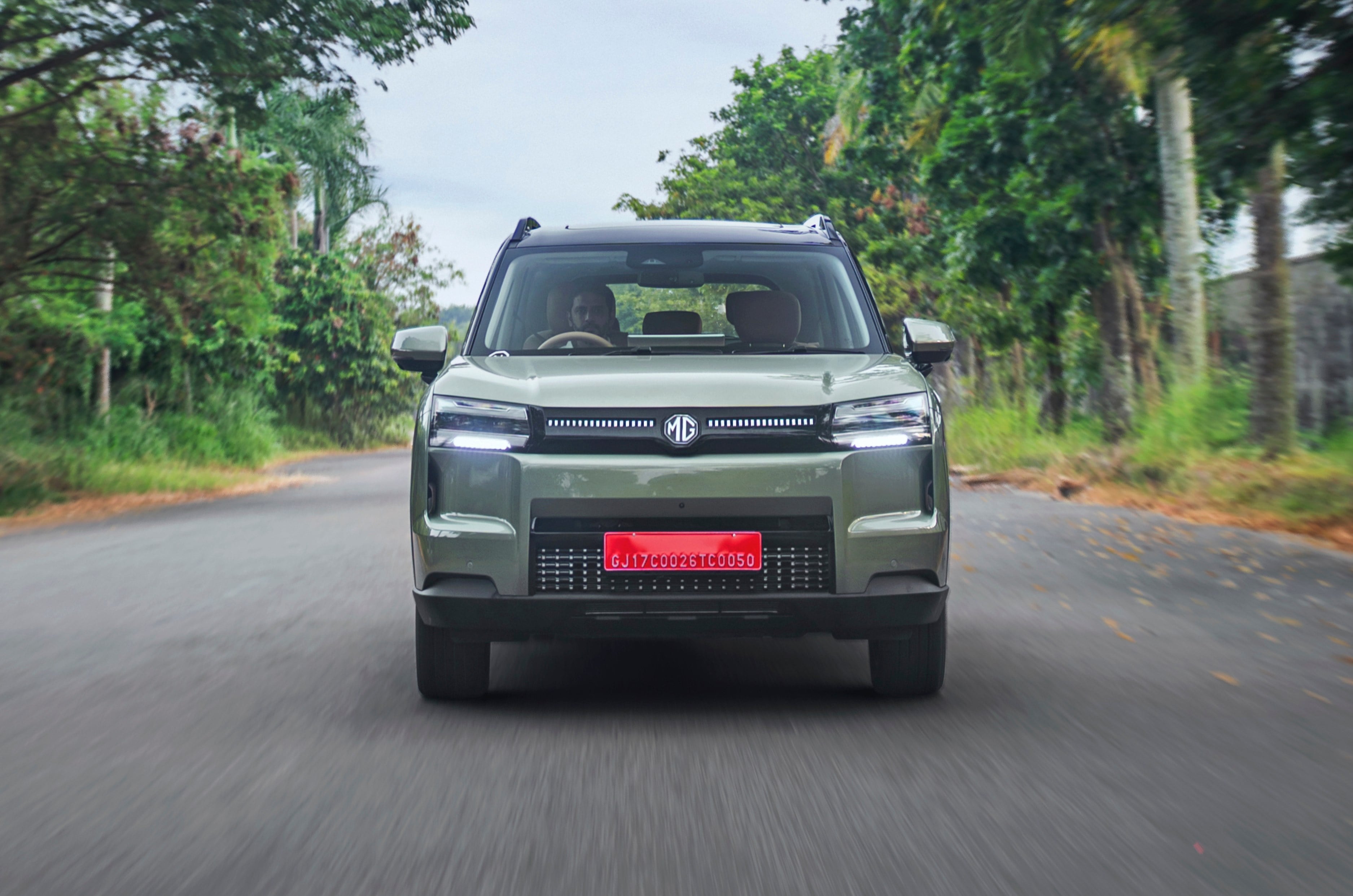
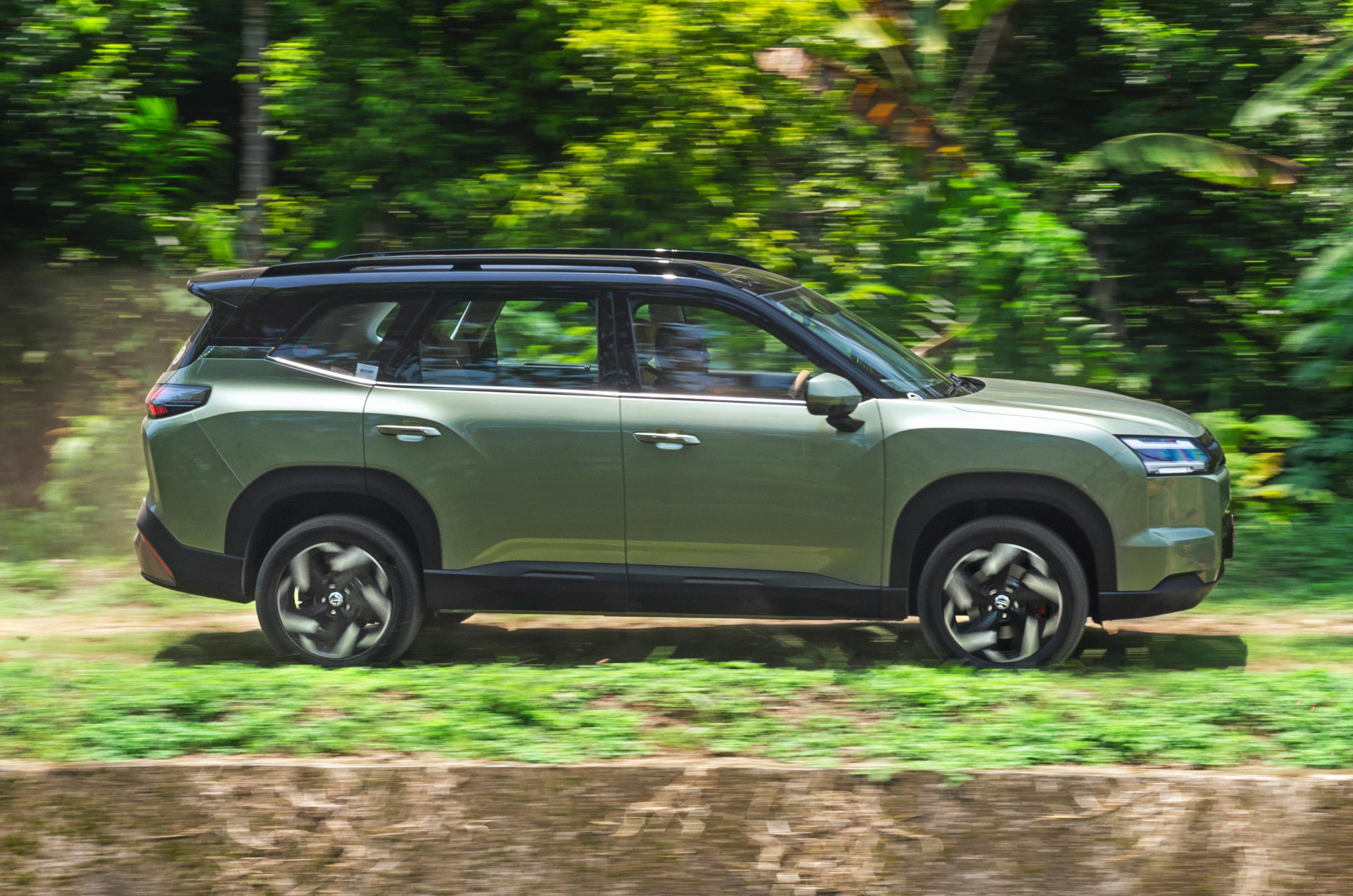
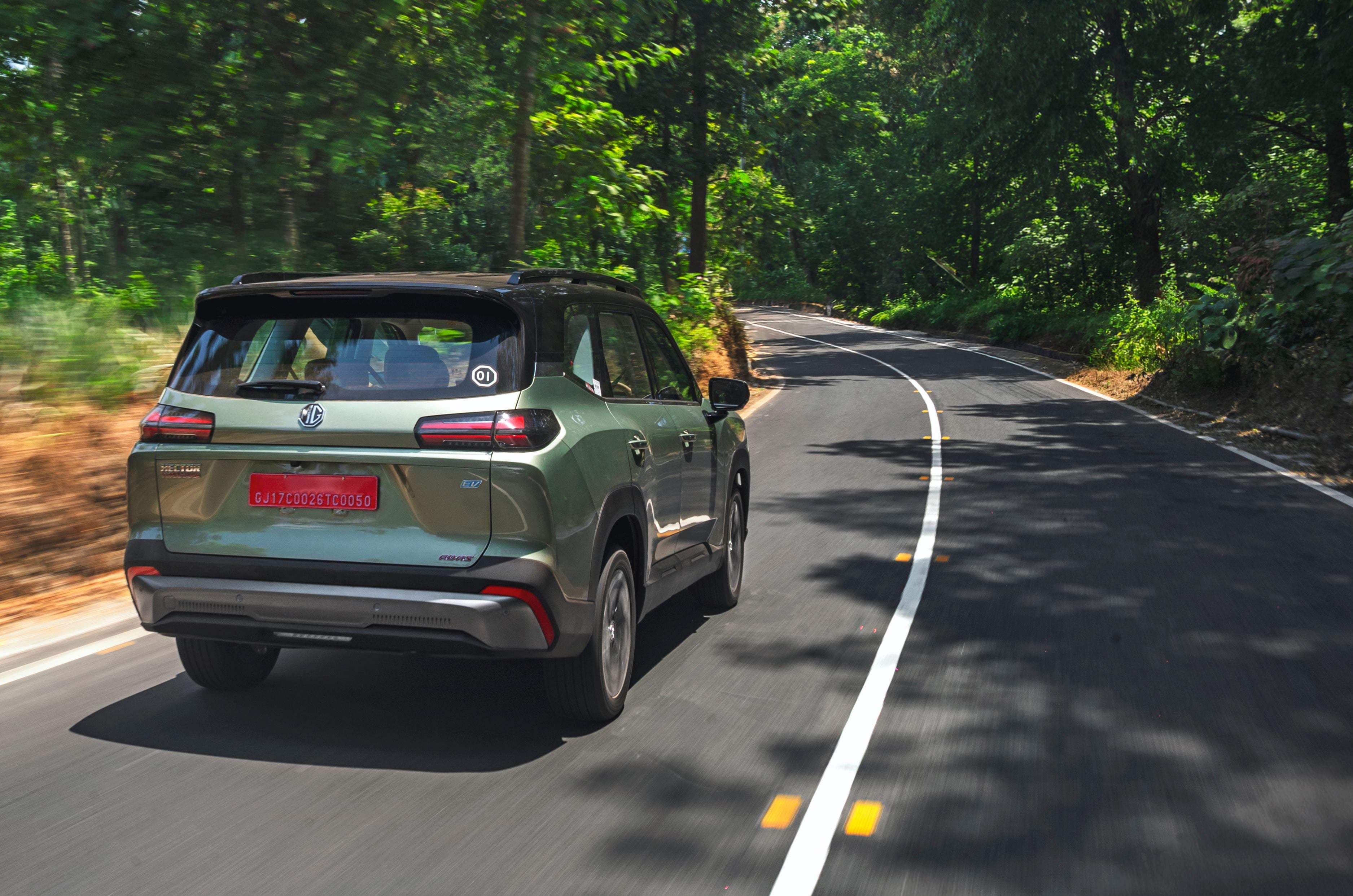
The Hector Tomahawk EV (alongside the PHEV) is the first MG model based on the brand’s new ADAPT platform, and costs from Rs 19.49 lakh to Rs 22.99 lakh (ex-showroom). The MG Hector Tomahawk EV is priced more competitively than the Hyundai Creta Electric while also seating up to seven occupants. There’s also the Kia Clavis EV, which costs about the same as the Tomahawk, but that’s an MPV. All that said, let’s start with the positives of this MG SUV first.
Reasons to buy the MG Hector Tomahawk EV
Spacious and premium interiors
Three rows of seats and an accommodating boot make this a practical family hauler
The cushioning of the wide front seats of the Hector Tomahawk EV feels comfortable even on long journeys. These seats are ventilated for added comfort, while the driver’s seat also gets a memory function for added convenience. In-cabin storage comes in the form of large door pockets and plenty of cubbies in the centre console. The Hector Tomahawk’s long wheelbase means there’s more than enough legroom for second-row passengers – these seats also recline for added comfort.
The inclusion of a centre armrest with cupholders, sunblinds, AC vents, USB ports and adjustable headrests make this a nice place to be. Accessing the third row from here is easy and fairly straightforward, courtesy of the sliding second row with its ‘one-touch tumble’ function and a large walk-through gap in the middle. While not the roomiest, last-minute jaunts won’t be an issue as there’s plenty of headroom on offer, and this third row is not devoid of AC vents or LED roof lights.
Even with the third row up, the Hector Tomahawk EV’s boot stands at 192 litres. This is enough to accommodate a couple of carry-on bags without much fuss. If you’re serious about carrying cargo, folding down those last seats will liberate 528 litres worth of space. The two-tone beige-and-black interior’s minimalistic design gets a generous splattering of soft-touch materials, and the good fit-and-finish further extends the premium appeal of this cabin.
Brimming with modern features
This MG SUV offers more than enough equipment to keep everyone on-board entertained
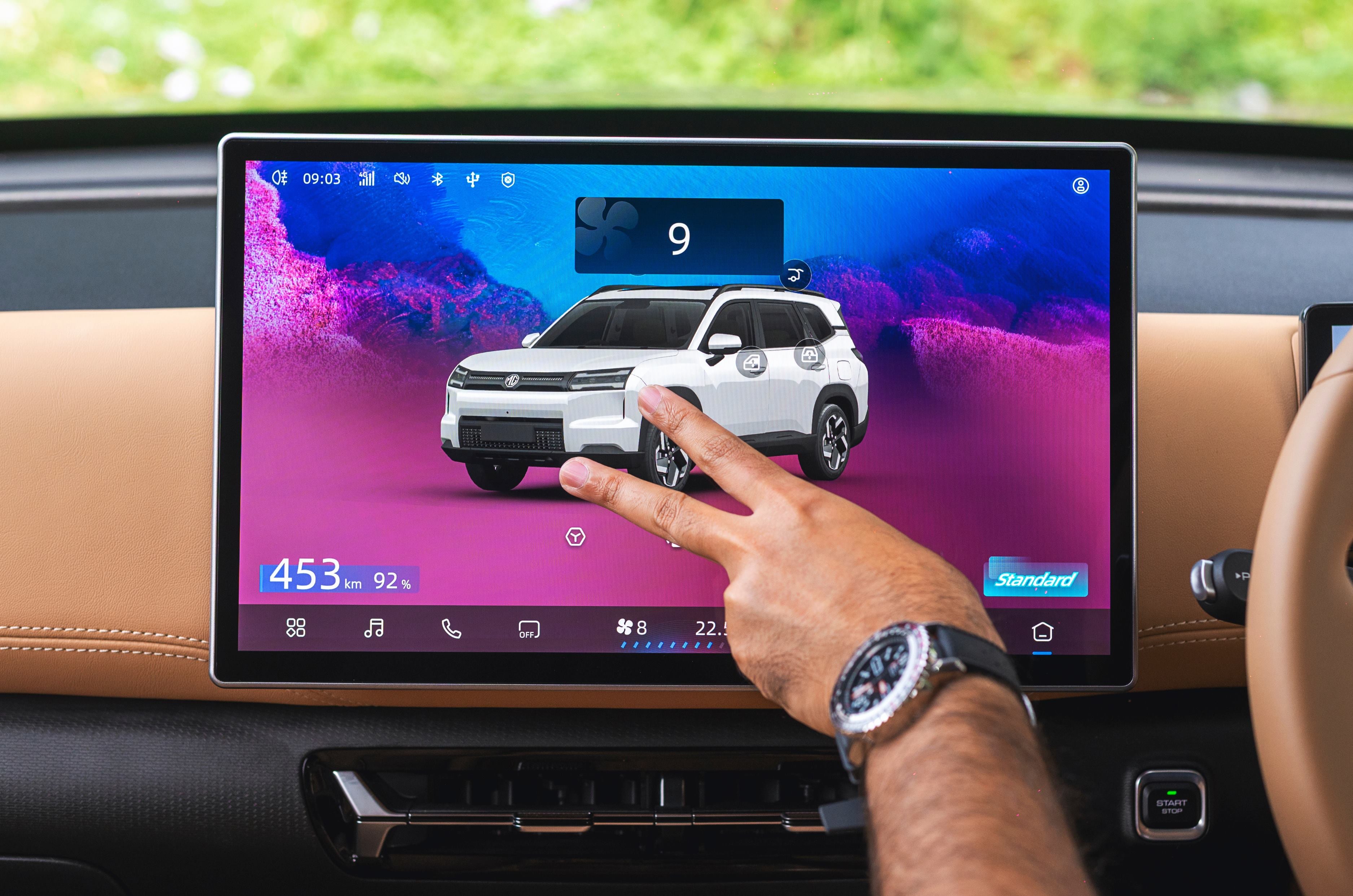
Taking centre stage on the dashboard is a 15.6-inch infotainment touchscreen, the user interface of which looks clean at first glance. The graphics are crisp and performance is snappy, too. MG has also added swipe-based gesture controls to make it easier to manipulate everyday functions such as adjusting the climate control system or the audio settings. The infotainment system comes with 6 mood-based ambient settings, wireless Apple CarPlay and Android Auto, AI-powered karaoke and multi-lingual voice commands.
Furthering the on-board experience is the well-integrated 256-colour ambient lighting system, a 10-speaker Infinity audio system (which sounds great), and crisp-looking 360-degree cameras. There’s also a ‘Custom’ mode for those who wish to tweak the power output and regen braking in 10-percent increments. The Level-2 ADAS suite of the MG Hector Tomahawk EV is comprehensive enough, while the regenerative braking system uses one of its sensors to automatically adjust regen levels in real-time based on traffic conditions.
Easy to drive
The large size of the Hector Tomahawk EV doesn’t make it a handful in the city
A commanding seating position, combined with the light steering and excellent all-around visibility, makes driving the MG Hector Tomahawk EV around town a manageable affair. Finding a suitable driving position is fairly easy too, thanks to the adjustable steering (for reach and rake) and the electrically adjustable driver’s seat. The Tomahawk EV also controls its body movements decently, feeling more mature than any MG EV before it. Finally, the brakes are good, too.
Reasons to not buy the MG Hector Tomahawk EV
Noisy suspension
The Tomahawk’s suspension can get audible over bad patches
While noises from the powertrain, tyres and wind are barely noticeable in this cabin, the same cannot be said about the Hector Tomahawk EV’s suspension. Going over bad roads, you will hear it working fairly easily, which takes away some of the premium feel of the cabin.
Non-linear power delivery
The Tomahawk EV’s powertrain lacks the linearity offered by rivals
The poor calibration of the electric powertrain of the MG Hector Tomahawk EV means that it may not be ideal for new drivers. ‘Standard’ drive mode dulls the response to prods from your right foot ever so slightly, with firmer throttle application resulting in torque steer due to a sudden surge in power reaching the front wheels. Trying to accelerate hard in ‘Sport’ mode will easily overwhelm the tyres up front – linearity in power delivery is missing.
Too much reliance on the touchscreen
Almost everything is routed through the massive infotainment screen
It might be sharp and responsive, but burying almost every major function and feature in the infotainment head unit gets distracting. The labyrinth of menus and sub-menus means that you will have to take your eyes off the road for using any of this SUV’s comprehensive feature set. Its sheer size also results in the touchscreen catching reflections, causing further distractions while driving.
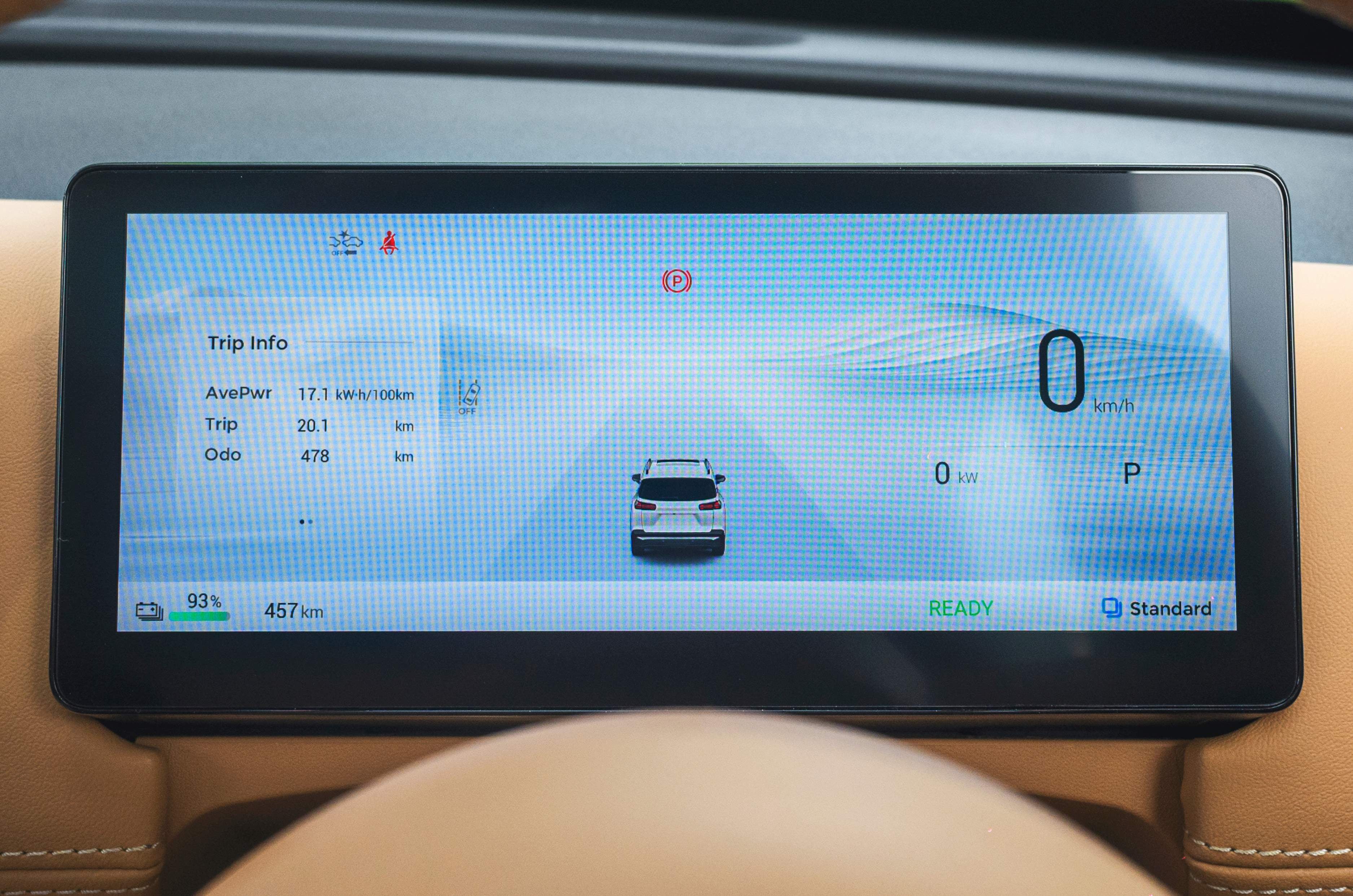
As for the 8.8-inch digital driver’s display, its real-estate could have been used better. While sharpness isn’t a problem, but that positive is overshadowed by the small fonts used for information read-outs. This can make reading most details on this display difficult.
MG’s newest SUV has been christened the Hector Tomahawk, but despite the name, it shares nothing with the ICE-powered Hector we’ve known since 2019. The Hector Tomahawk EV and PHEV are the first models on MG’s ADAPT architecture, which will eventually spawn strong hybrids and range-extender hybrids. We drove the Tomahawk EV in sunny Kochi to see how it stacks up in the ever-growing segment.
MG Hector Tomahawk EV Exterior Design and Engineering – 6/10
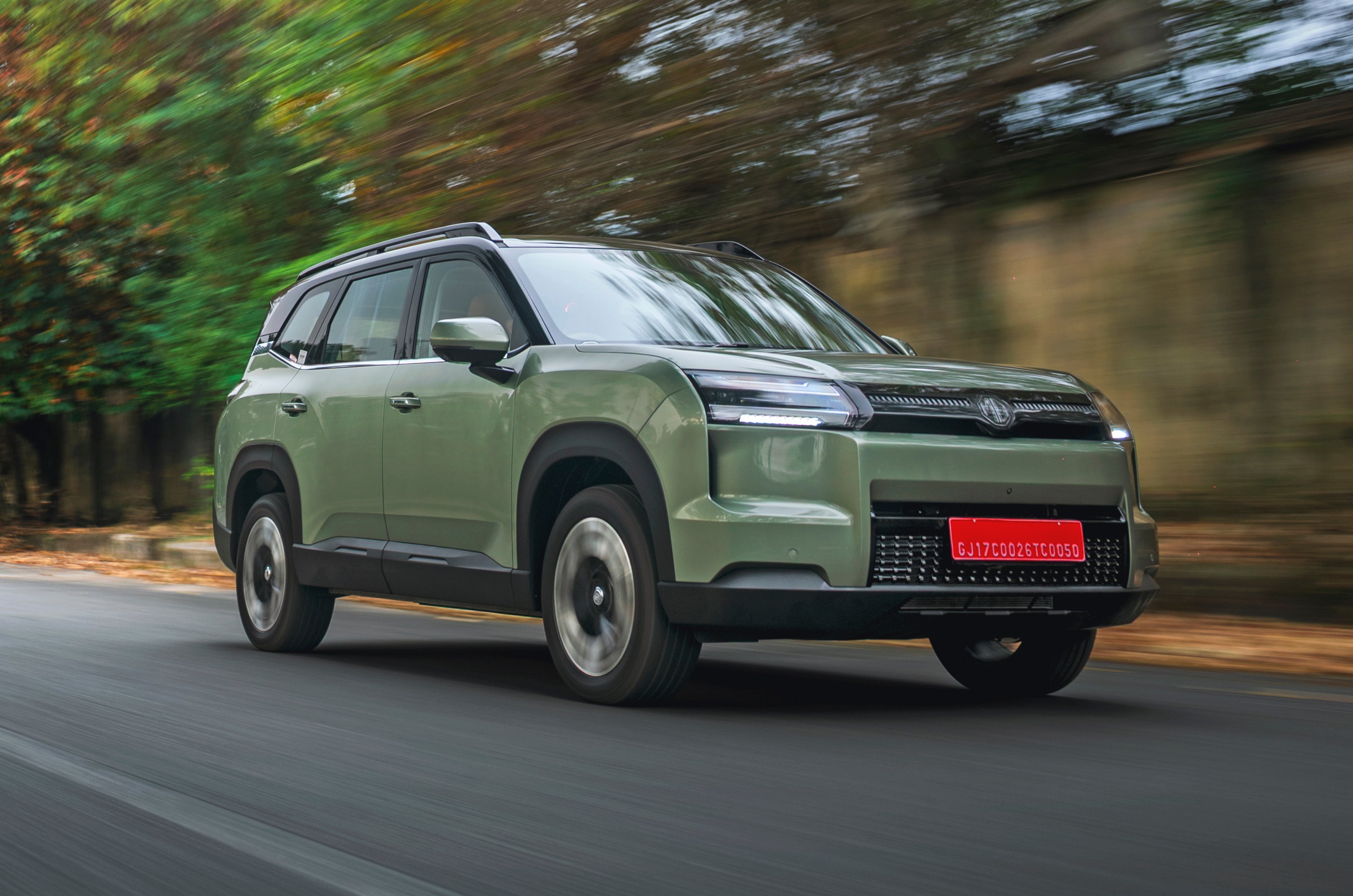
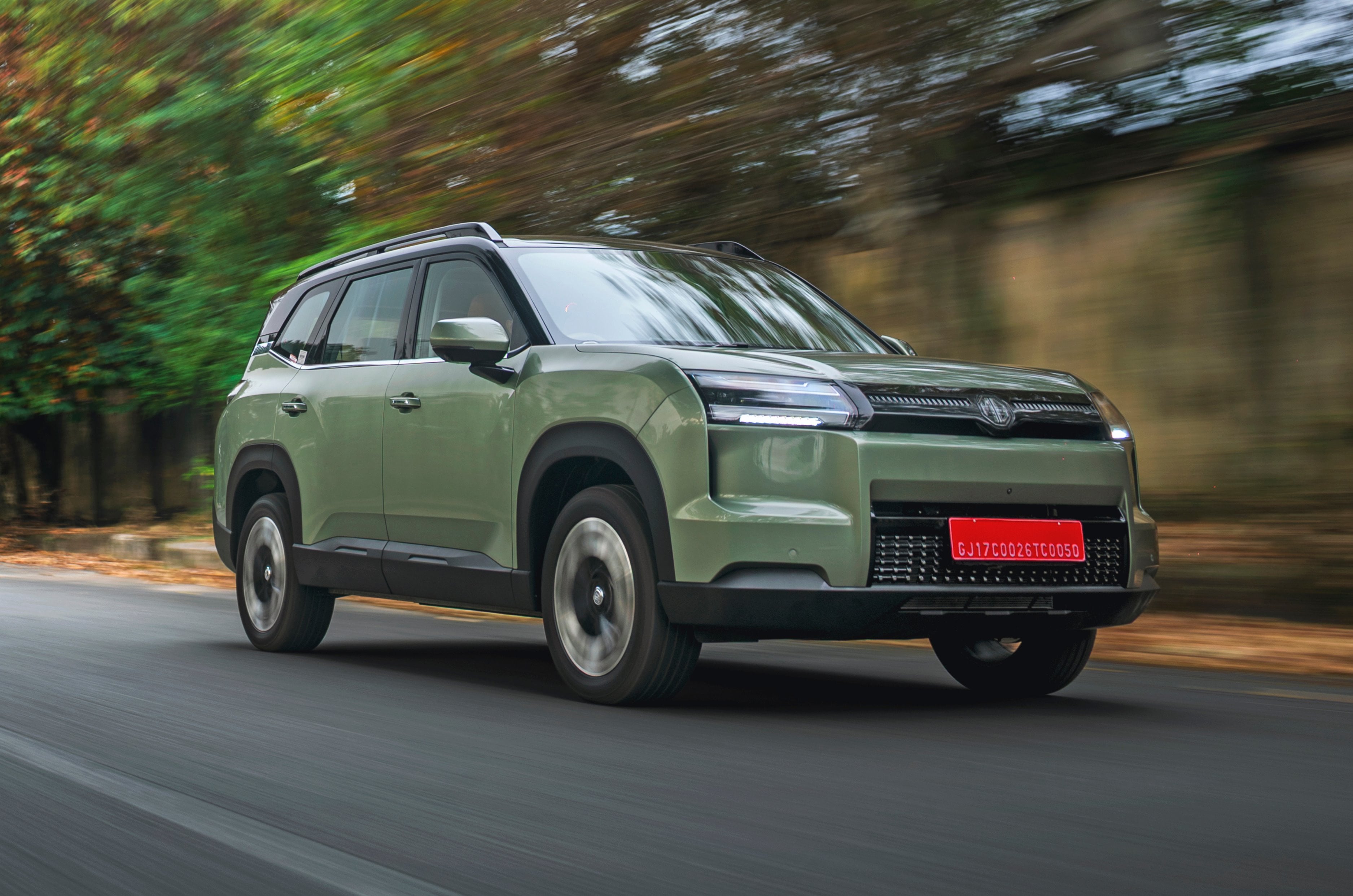
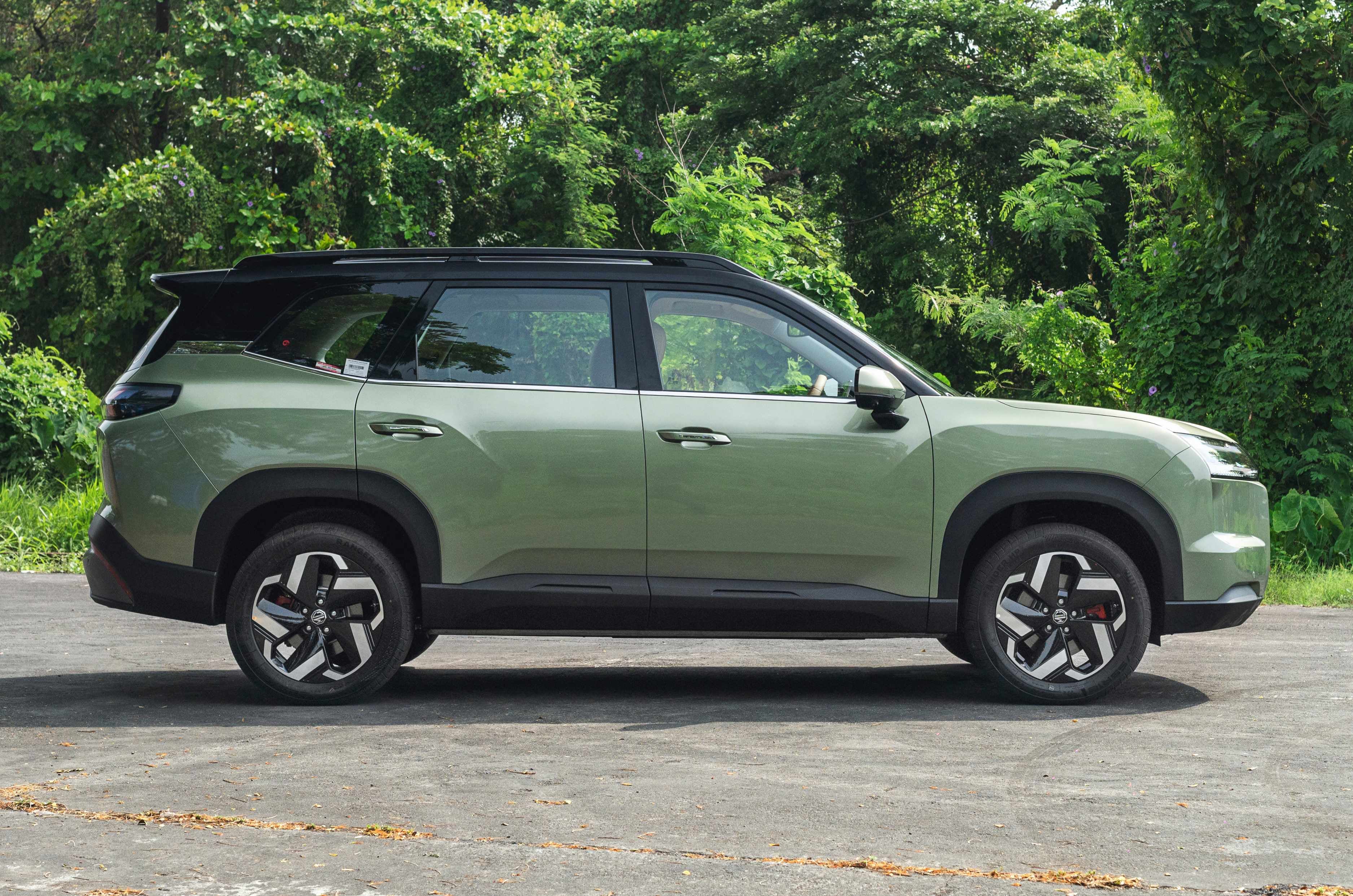
Let’s talk dimensions first. At 4,745mm long, 1,850mm wide, 1,770mm tall and with a 2,810mm wheelbase, the Tomahawk is larger than the Mahindra XEV 9S in all areas except width. Ground clearance, at 230mm (measured to battery), is also class-best. However, these numbers don’t translate to a particularly imposing stance. Instead, it straddles the line between an MPV and SUV.
Size doesn’t translate to an imposing stance; it straddles the line between an MPV and an SUV.
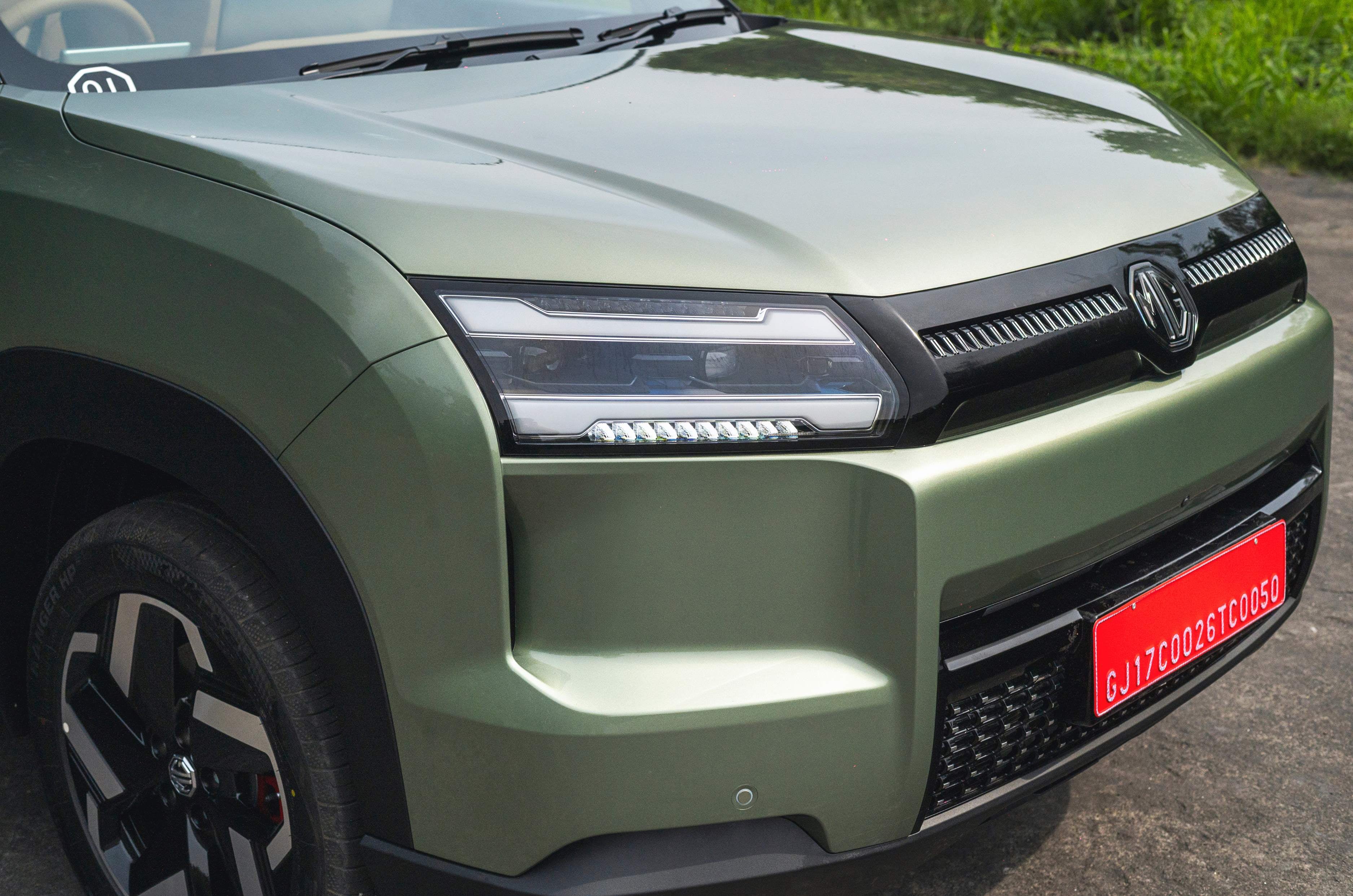
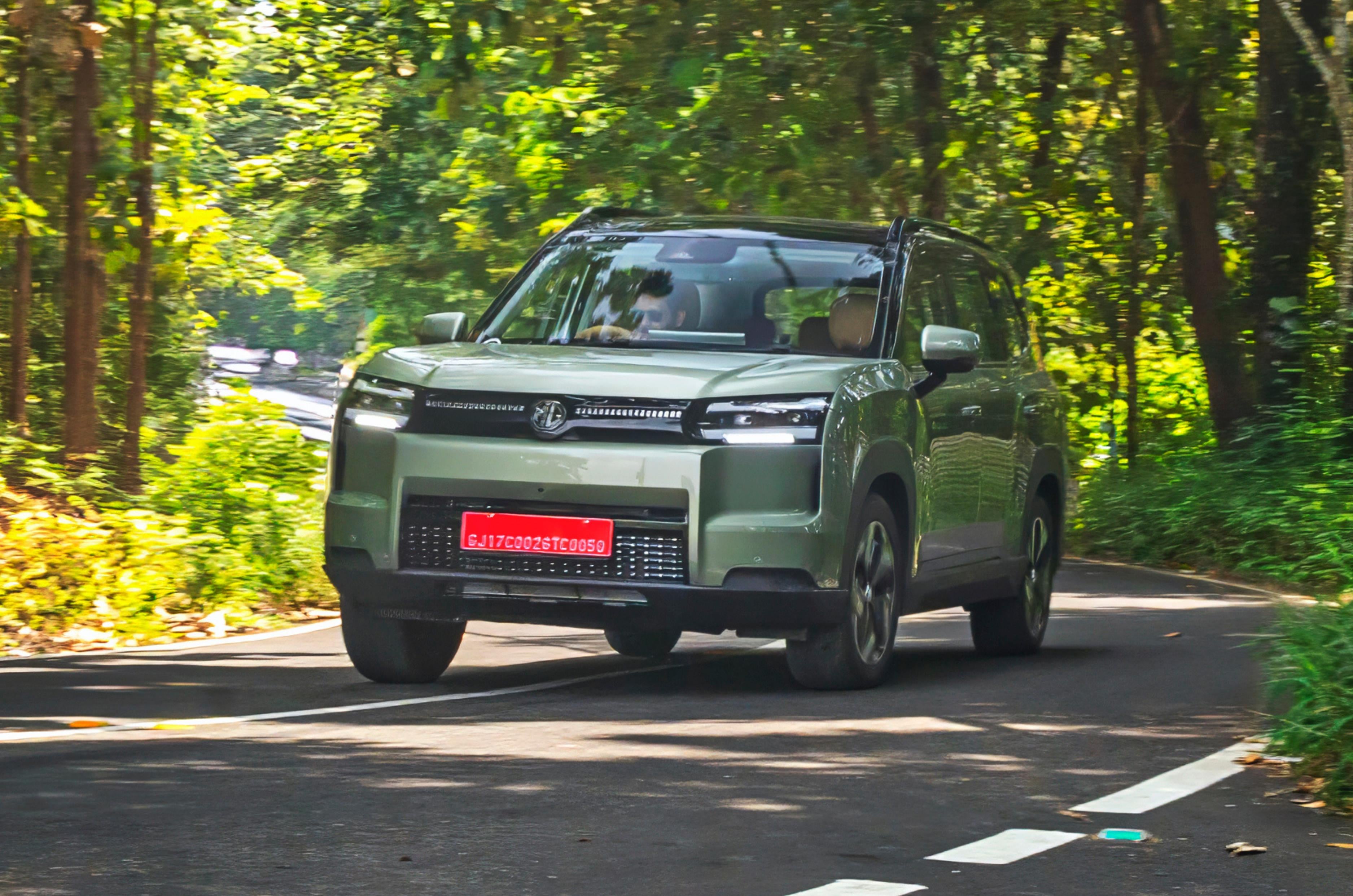
The design is clean and quite handsome, if a bit uninspiring. The front bumper is squared off with pass-through aero vents on the edges and chunky cladding lower down. Cooling requirements are met by slim slots in the centre section with some chrome detailing, while the conventional grille is blanked off and finished in gloss black. No light bar here, thankfully, but the MG logo does glow and is flanked by rectangular LED headlights with a subtle H-shaped light signature.
Large rectangular LED headlights have a subtle H in them; no light bar, but the MG logo glows.
In profile, it looks quite slab-sided, with sharp creases along the fenders and plastic wheel-arch cladding adding some definition. These, along with the chunky door cladding, attempt to give it a rugged appearance but are let down by 18-inch wheels that look a tad too small. No electric door handles here, just good old-fashioned pull types.
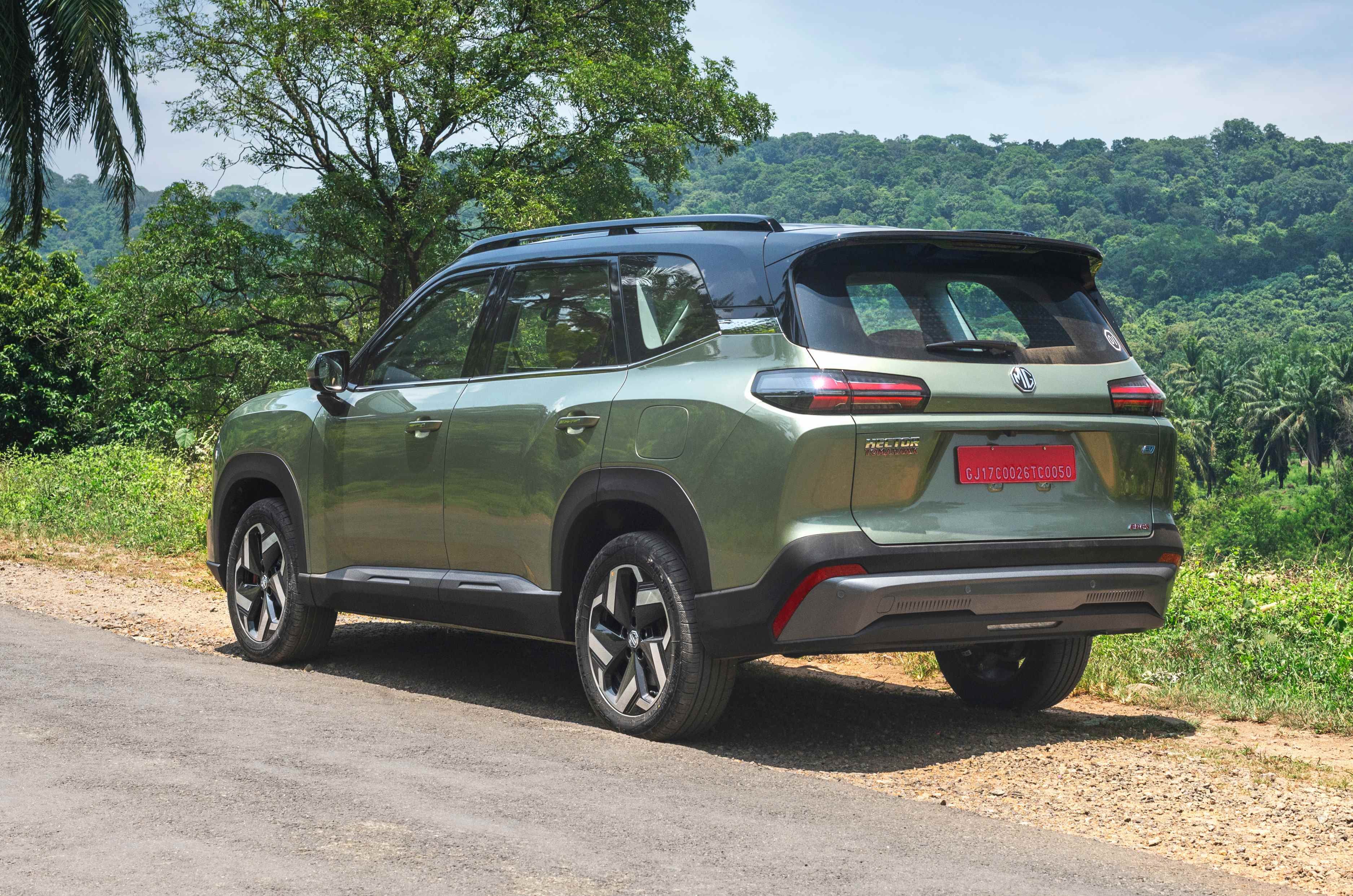
Further back are a set of intricate LED tail-lights that again resist the connected trend. MG’s love for badging is clear though, with four on the powered tailgate. Finishing things off nicely is a sculpted bumper with a grey trim piece and a centre-mounted reverse lamp. Overall, it’s a reasonably pleasing design, but it looks a tad dated and lacks the butch appeal of some rivals.
Overall styling is neatly done but somewhat uninspiring.
MG Hector Tomahawk EV Interior Space and Comfort – 8/10
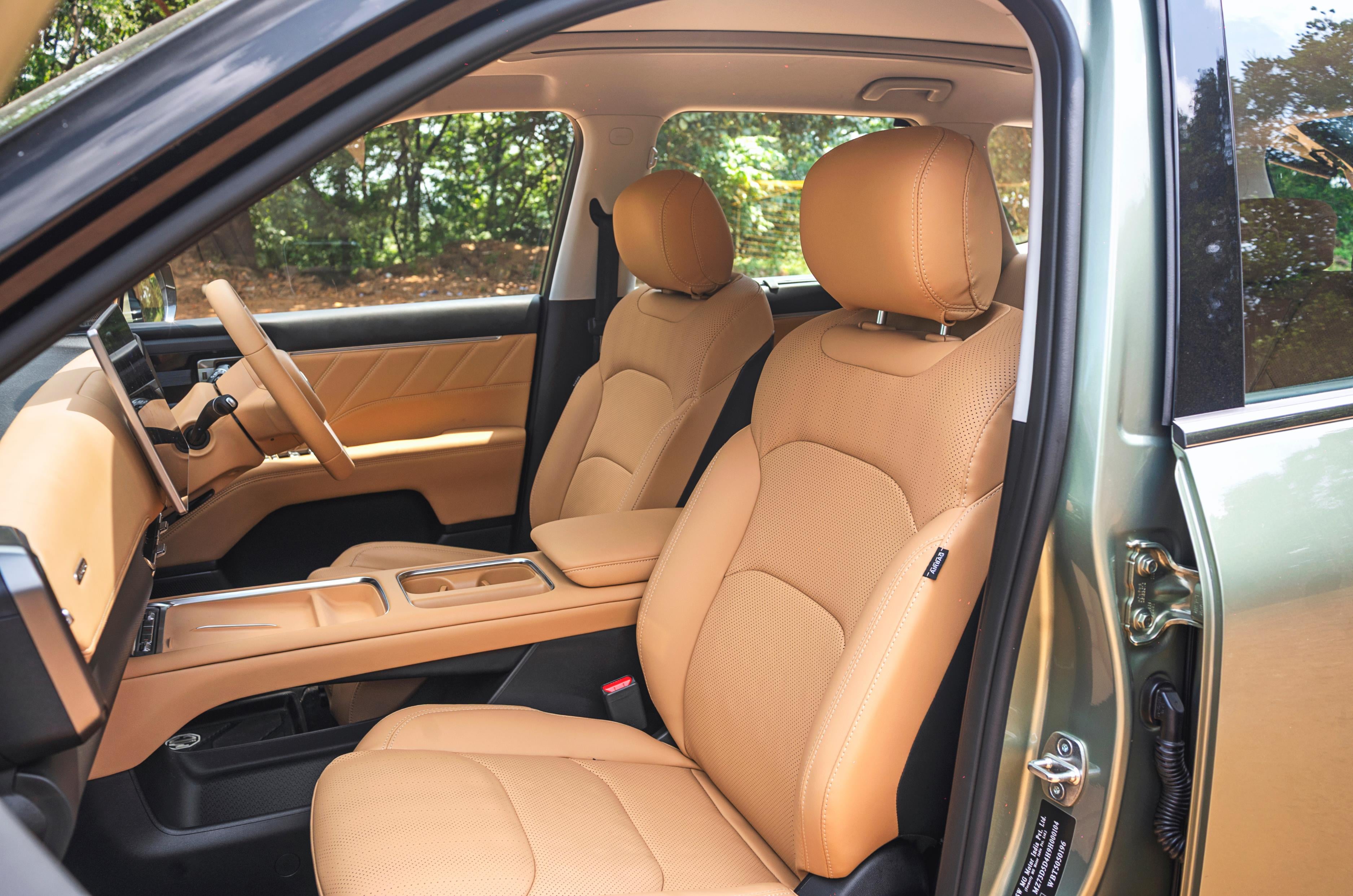
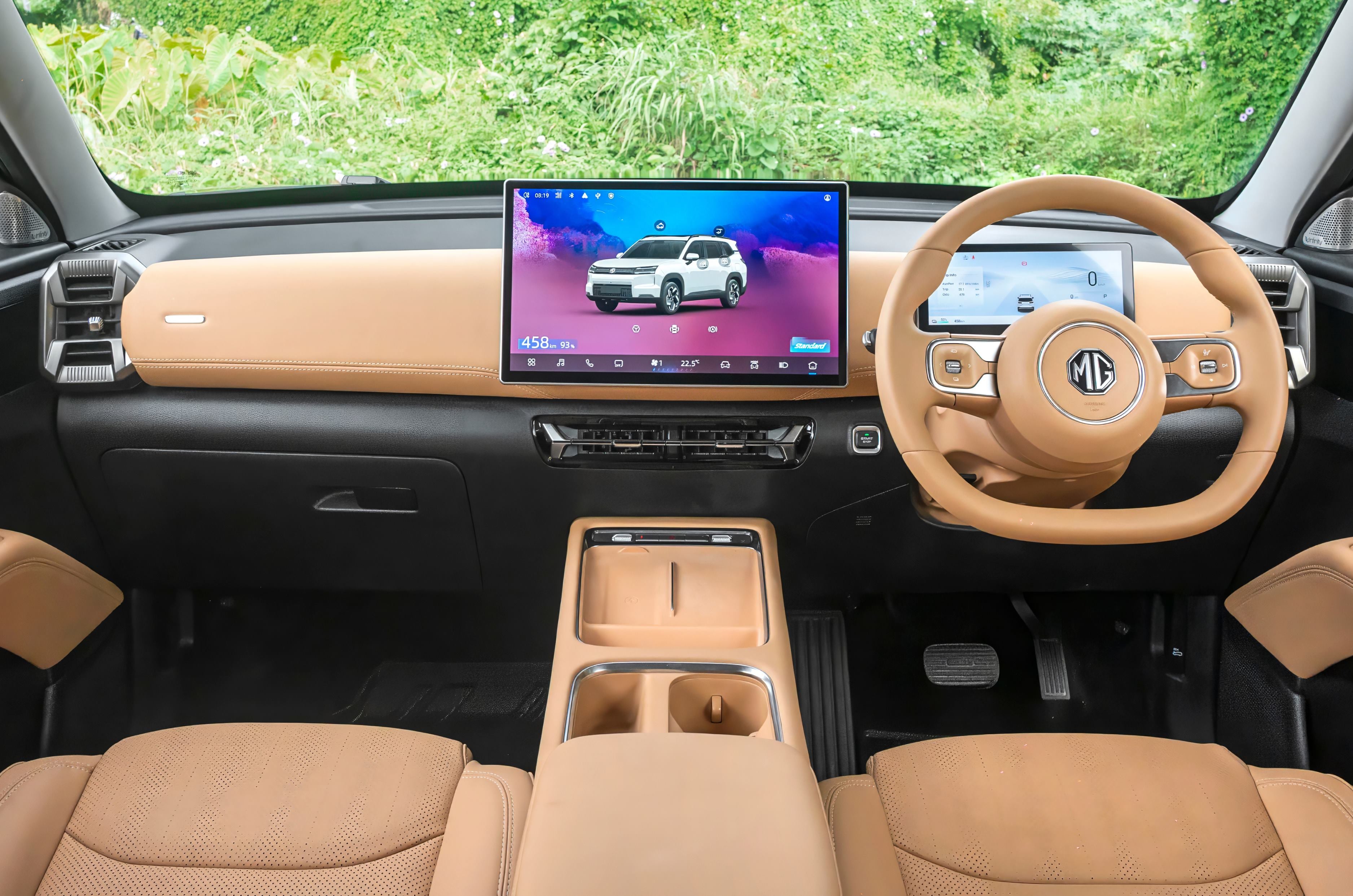
Inside, the dash features a familiar minimalistic layout with a large touchscreen front and centre. It looks premium and features soft-touch materials on the dash and doors, but lacks a certain wow factor, and the light tan colour palette might not be to all tastes. That said, the light tone and large windows do give it an airy ambience. Look hard, and you will find areas where fit and finish could be improved. The centre console in particular feels poorly textured and finished, which we were told is down to a supplier issue. Speaking of the centre console, the column-mounted drive selector frees up space here for a wireless charger, cupholders, multiple bins as well as a large pass-through cubby lower down, and the door bins are enormous too.
Minimalistic interior looks premium, but the light tan colour palette might not be to all tastes.
It’s easy to get into a comfortable and commanding driving position using the power-operated seats and reach-and-rake adjustment for the steering wheel. The seats themselves are wide, and despite the firm cushioning, they felt comfortable on our full day of driving. They are ventilated too, and the driver’s seat also gets a memory function.
Powered and ventilated front seats are wide and comfortable; driver’s seat gets a memory function.
The Tomahawk has the second-longest wheelbase in class (next only to the Vinfast MPV 7), and it shows in the second row. Legroom is excellent, and while you do sit slightly knees-up, thigh support is adequate too. The seatback reclines pretty far back and features an armrest and three adjustable headrests. Window sunshades, AC vents and Type-C USB ports add to the rear-seat comfort and convenience.
The chauffeur-driven are well taken care of, with a comfy reclining bench, plenty of room all around and sunblinds.
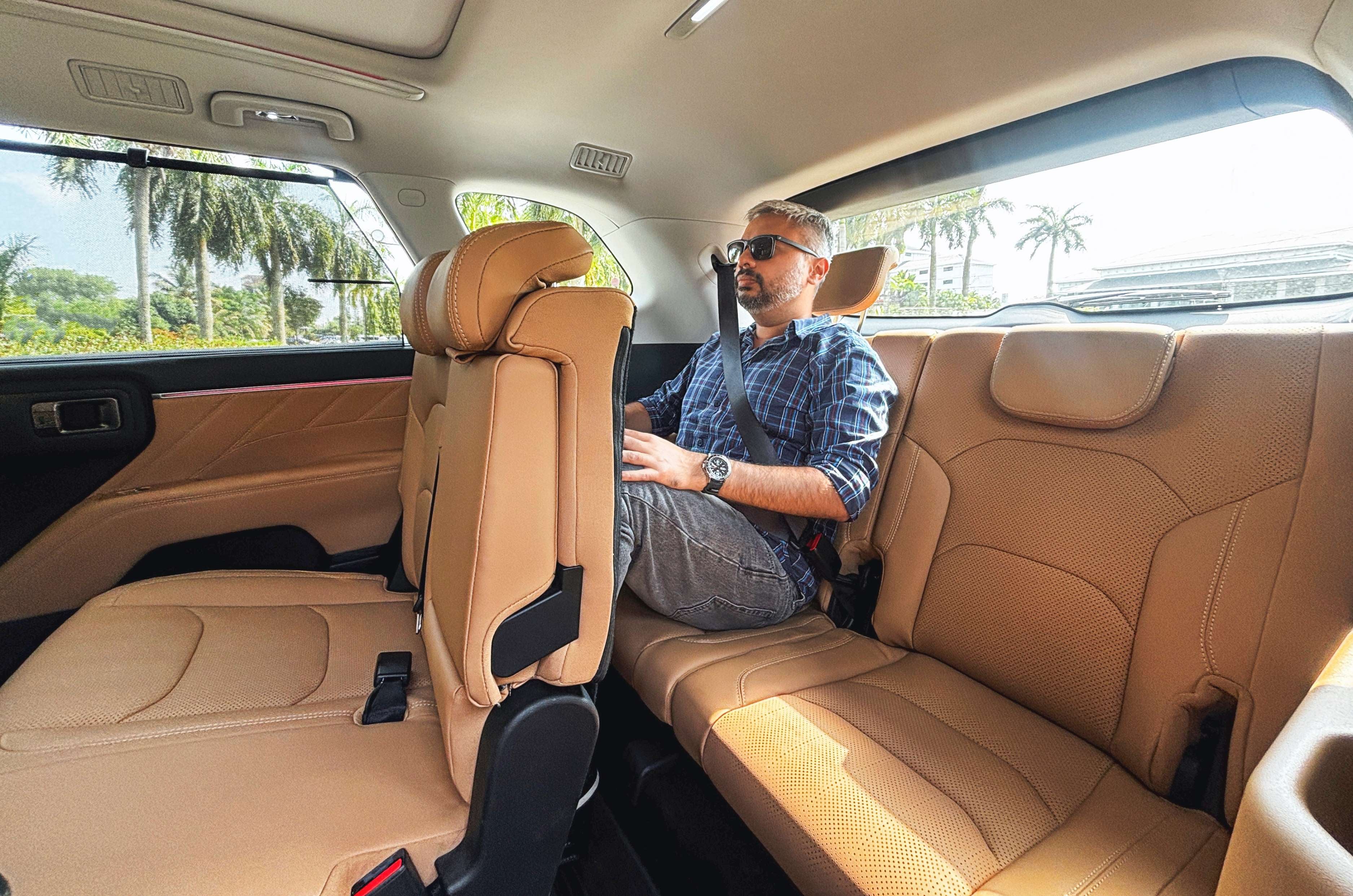
The Tomahawk EV is available in both 5- and 7-seater guises. The latter adds a sliding second row with one-touch tumble to access the third row, as well as more AC vents on the roof and a dedicated fan-speed control. Getting into the last row is surprisingly dignified thanks to a large aperture, but kneeroom depends largely on the middle-row passengers’ generosity, and the low seat means thigh support is non-existent. Headroom is good, though, and for short journeys, adults will be fine back there.
Third row will fit adults but with a slight compromise to the middle-row space.
With the third row up, boot space stands at 192 litres – enough for a couple of carry-on bags – expanding to a generous 528 litres with it stowed. Under the boot floor are a few more storage cubbies, which are handy since there is no frunk – a miss considering there appears to be enough space under the bonnet. A space-saver spare is mounted underneath the car.
MG Hector Tomahawk EV Features and Safety – 8/10
The minimalist interior layout means you reach for the 15.6-inch infotainment screen for most functions. While this can get distracting, physical and swipe-gesture controls together handle most basic HVAC and audio functions with surprising ease. Anything beyond basic, though, will require a deep dive into the screen. While the screen is sharp and snappy and the UI is clean, it can take a while to find your way through the maze of sub-menus. Wireless Android Auto and Apple CarPlay are also present, but using either hides the row of shortcuts at the bottom of the screen. Hardcoding these buttons to always stay on top would improve usability. The screen also often catches glare, which takes away from the otherwise sharp 360-degree camera.
Several functions are baked into the 15.6-inch touchscreen, but gesture controls for essential functions are quite intuitive.
Instrumentation is handled by an 8.8-inch display directly in front of the driver. The screen itself is sharp, but some smaller fonts might have you reaching for your reading glasses. Its real estate could also be better utilised by displaying the blind-view camera feed rather than the current pop-up on the centre screen. Other feature highlights include a sweet-sounding 10-speaker Infinity audio system, a panoramic sunroof that stretches over the second row, 256-colour ambient lighting, connected car tech, an AI assistant and more. It’s worth mentioning that the Tomahawk EV also gets a physical start/stop button, which is absent on the brand’s other EVs.
8.8-inch driver’s display is sharp, but some smaller fonts might have you reaching for your reading glasses.
A Level 2 ADAS suite is also available on the top Essence trim, with functions such as adaptive cruise control, lane keep assist and auto emergency braking. While there isn’t an official crash-test rating yet, the robust standard safety kit, including six airbags, ESP, all-wheel disc brakes and Isofix mounts, provides some confidence.
MG Hector Tomahawk EV Performance and Refinement – 7/10
The Tomahawk EV offers just one powertrain configuration – a 69.2kWh LFP battery pack powering a single motor on the front axle, producing 204hp and 310Nm, good for a claimed 0-100kph time of 8.2 seconds. Its front-wheel-drive layout puts it at a disadvantage against rivals from Tata and Mahindra, who offer either rear- or all-wheel drive and higher power outputs. The front-driven Hyundai Creta Electric or Kia Carens Clavis EV are closer matches, and the Tomahawk EV betters them on power and torque.
First EV on MG’s ADAPT architecture pairs a 69.2kWh battery with a front-mounted motor producing 204hp and 310Nm.
Initial throttle response is mild, making it quite easy to amble around town, but push harder, and you get a power spike resulting in torque steer. In Sport mode, you’ll hear the front tyres protest when made to put all that torque down on a less-than-perfect road. Standard mode dulls response slightly, but it can still catch new drivers off guard. With time, it is possible to drive around this, but the latest crop of rival EVs has mastered a more linear delivery. Eco mode feels a bit tepid and is best saved to counter range anxiety, while a Custom mode lets you customise power output and regen braking in increments of 10 percent. There are also three preset regen modes – Standard, Comfort and Strong – but no paddles to control them or one-pedal mode. Instead, you get an Intelligent setting that uses the ADAS sensors to adjust regen in real time based on the traffic in front of you.
Grip levels and body control are good, but FWD layout struggles to put power down.
Refinement is a bit of a mixed bag. While the motor is fairly muted and there is little wind or tyre noise coming through, you hear the suspension at work on rough patches.
MG Hector Tomahawk EV Range and Efficiency – 7/10
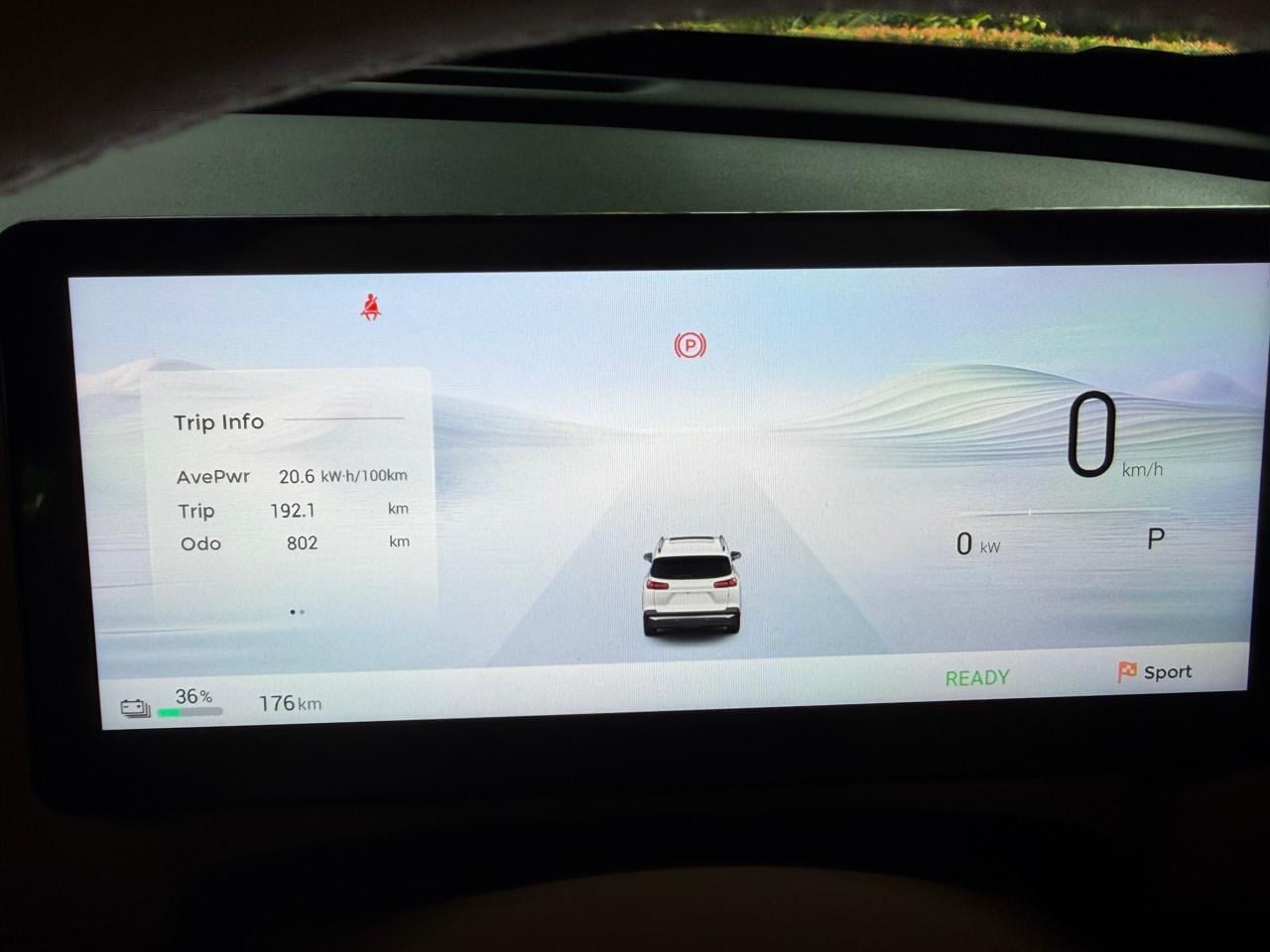
A spirited highway drive from Kochi to Kozhikode covering 192km, resulted in an overall efficiency of 4.85km/kWh.
While the Hector name is often associated with poor fuel efficiency, the new EV and PHEV hope to change that. MG claims an MIDC range of 517km from its 69.2kWh battery pack. On a spirited drive from Kochi to Kozhikode covering 192km, we recorded an overall efficiency of 4.85km/kWh, translating to a real-world range of 336km. This was on a fast highway run, where the Tomahawk’s tall shape won’t do its efficiency any favours. We’ll put it through our standard real-world efficiency test when we have the car for longer.
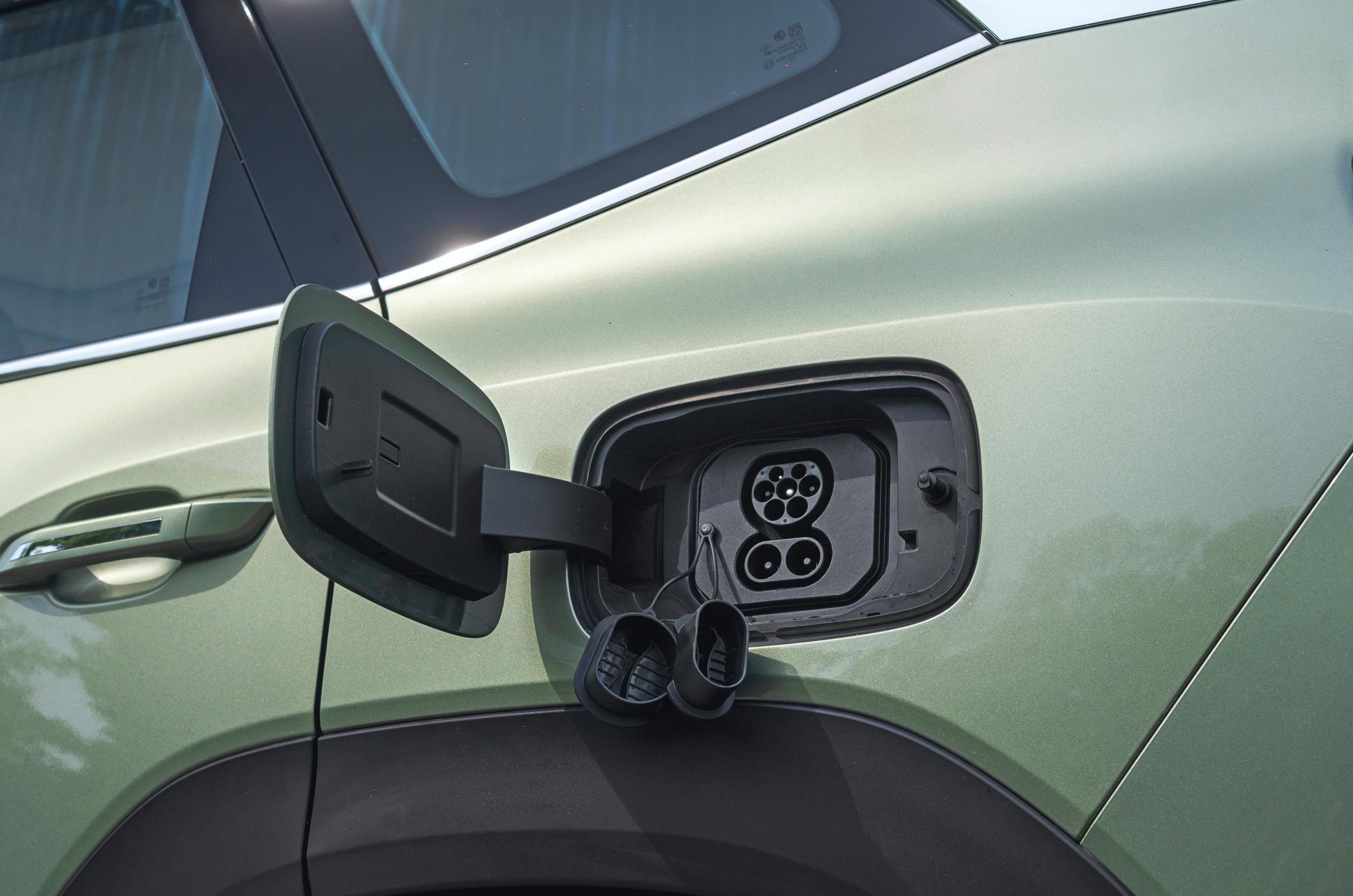
DC fast charges at 90kW – slower than rivals but enough for a 30 to 80 percent top-up in a claimed 35 minutes.
Topping up the battery from 10 to 100 percent using the 7.4kW charger is said to take around 12.5 hours. It can also DC fast charge at speeds of up to 90kW, which is lower than its immediate rivals but still enough to take the battery from 30 to 80 percent in about 35 minutes.
MG Hector Tomahawk EV Ride Comfort and Handling – 7/10
Rides with more maturity than previous MG EVs, but suspension can be heard working.
The Hector Tomahawk EV makes a big step up in ride and handling compared to the ICE Hector, but there is still some room for improvement. It rides with more maturity than previous MG EVs, comfortably absorbing most of what we threw at it. However, you do hear the suspension working. Sharper bumps reveal an underlying firmness that occasionally comes through to the cabin. Most roads around Kochi were relatively smooth, and we weren’t able to experience it on rippled concrete, so we will reserve full judgement until we have the car for longer.
A big positive is how easy the Tomahawk is to drive for something this large. Visibility all around is excellent, and you can see the bonnet’s edges from the driver’s seat. A light steering also helps, and overall, it feels less intimidating to drive through tight traffic than, say, the XEV 9S.
230mm claimed ground clearance is best in class; wheelbase second only to VF MPV 7.
The steering also weighs up as speeds rise and feels reasonably direct, though the sheer amount of torque going to just the front wheels corrupts the feel. At a quick pace through the twisties, you feel the wheel tugging at your hands as you apply power. Body control is good, and it stays composed through quick direction changes, but a sedate pace is more its element. Braking is strong, with four-wheel discs bringing the heavy SUV to a confident halt.
MGHector Tomahawk EV Value for Money – 7/10
Introductory pricing for the Hector Tomahawk EV starts at Rs 19.49 lakh and tops out at Rs 23.49 lakh. The Battery-as-a-Service (BaaS) scheme lowers the entry barrier to Rs 13.99 lakh, with battery rental set at Rs 4.90 per km. While all these prices are applicable to limited units only, this is quite aggressive pricing from MG.
Practical, comfortable and no-nonsense SUV will appeal to the chauffeur-driven but lacks the dynamic polish of its rivals.
When compared spec-for-spec, it undercuts the competition from Tata and Mahindra while offering a bigger battery and more performance than its Korean rivals. It has a spacious and comfortable cabin, a comprehensive feature set and is surprisingly easy to drive for its size. However, it lacks the dynamic polish of its rivals and therefore doesn’t feel like a latest-generation EV. As such, its Hector name starts to make more sense. It is a practical, comfortable, no-nonsense SUV that will appeal to the chauffeur-driven just like its forebear. Those looking to do the driving, though, are better off looking elsewhere.
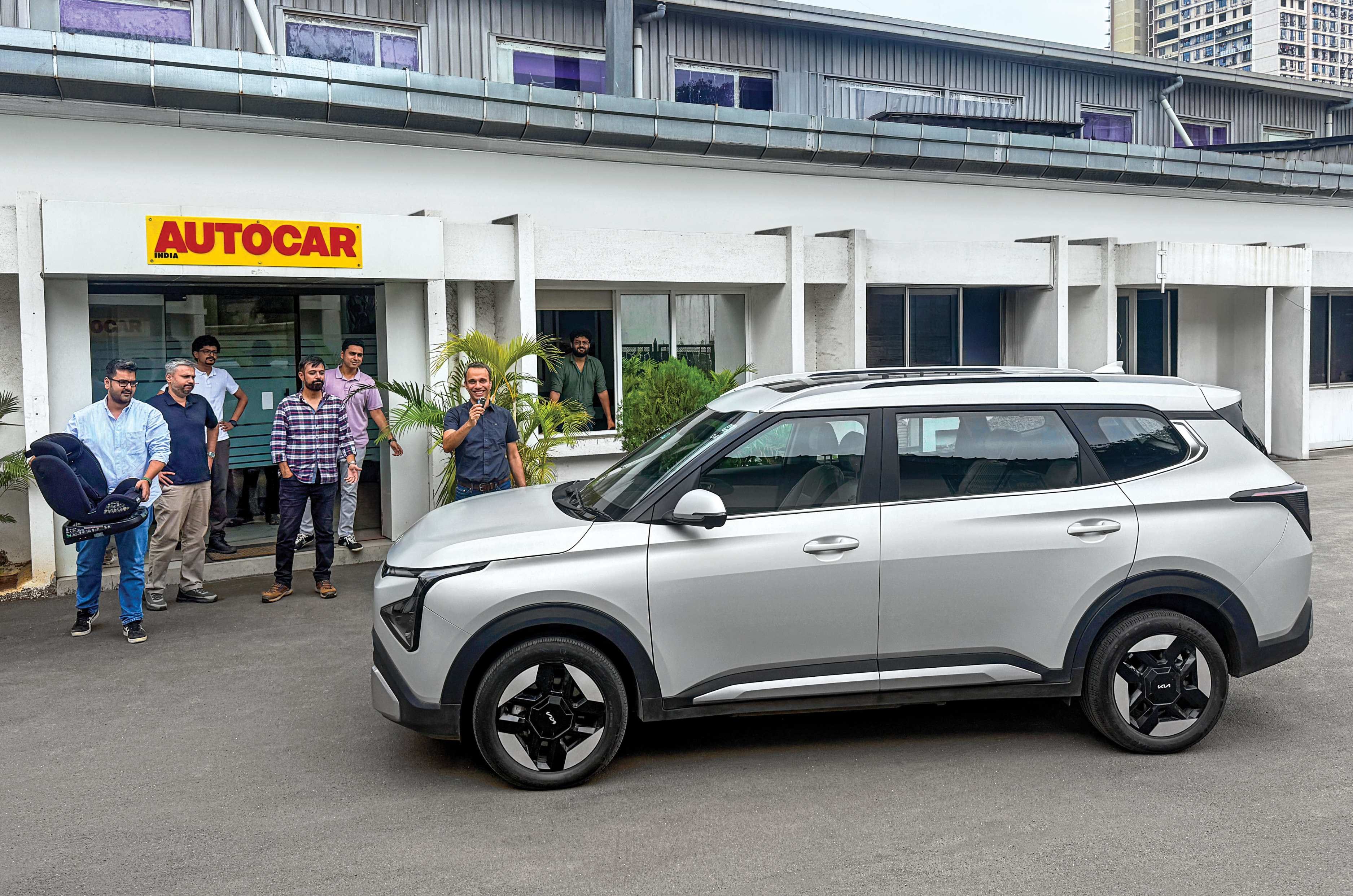
A lot of us on the Autocar India review team have been eagerly awaiting the arrival of the Clavis EV. Who knew a bunch of auto enthusiasts would be looking forward to an electric 7-seat MPV. The thing is, though, electric and MPV are two very congruous elements.
If you’re going to have a large people mover, an electric drivetrain does well by not penalising you on efficiency – like an internal-combustion engine does – and its smooth and silent running keeps everyone happy. And in an MPV, where it’s a relaxed frame of mind you’re often driving in, electric power again suits this character to a T.
So yes, this combination really does make sense, and the electric Clavis really brings out this harmonious pairing superbly.
The Clavis shares its powertrain with the Hyundai Creta Electric, and we have the larger 51.4kWh battery model, which drives a 171hp motor. Efficiency, while not bad, is lower than the Hyundai’s. So far, in the city, on my home-to-office run, the Clavis manages about 6.8km/kWh, which would equate to a range of 350km, while the Creta averaged 8.1km/kWh.
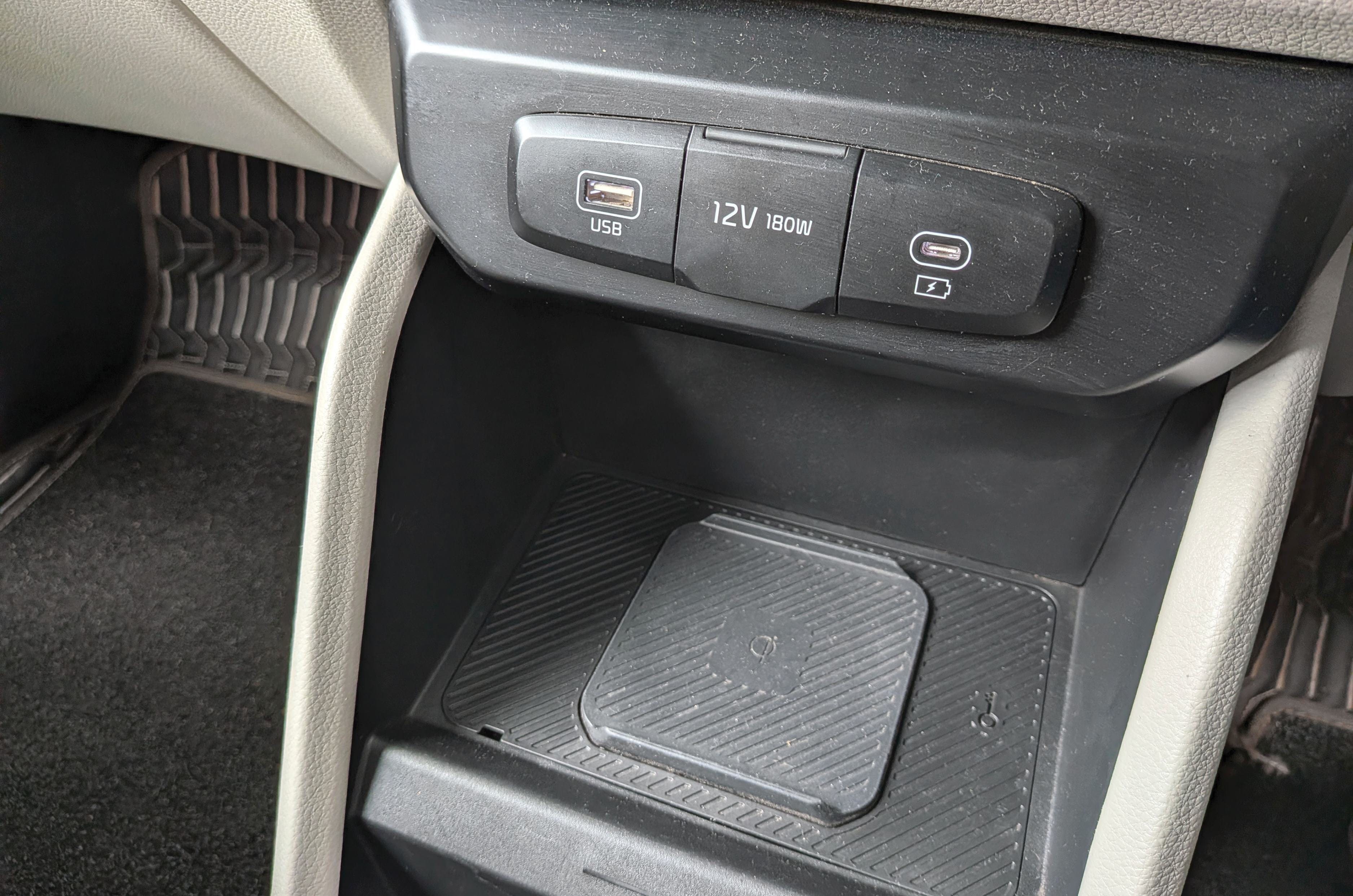
Wireless charger, 12V, Type-A and Type-C at the front and USB sockets in all three rows.
However, the power calibration is spot on for its intended purpose. There’s none of that instant power dump and a hair-trigger torque delivery, making it very easy to modulate if you’re simply out on a relaxed and laid-back drive – a.k.a. MPV mode. But don’t mistake that for a lack of performance. Press down a bit further on the accelerator, and there’s plenty of power for overtaking, even with a full load or on steep inclines. I’ve run it with six onboard, and it really made no difference. This is exactly how you’d want an MPV powertrain to be set up.
The ride is another bit that’s nice. To tackle the extra weight of the battery, Kia has retuned the suspension and, like in the case of the electric Creta, it does have a firm side. But this has also helped with removing some of that secondary motion after you come off a speed breaker or bump. So, the ride feels settled, and at highway speeds, it is stable and composed.
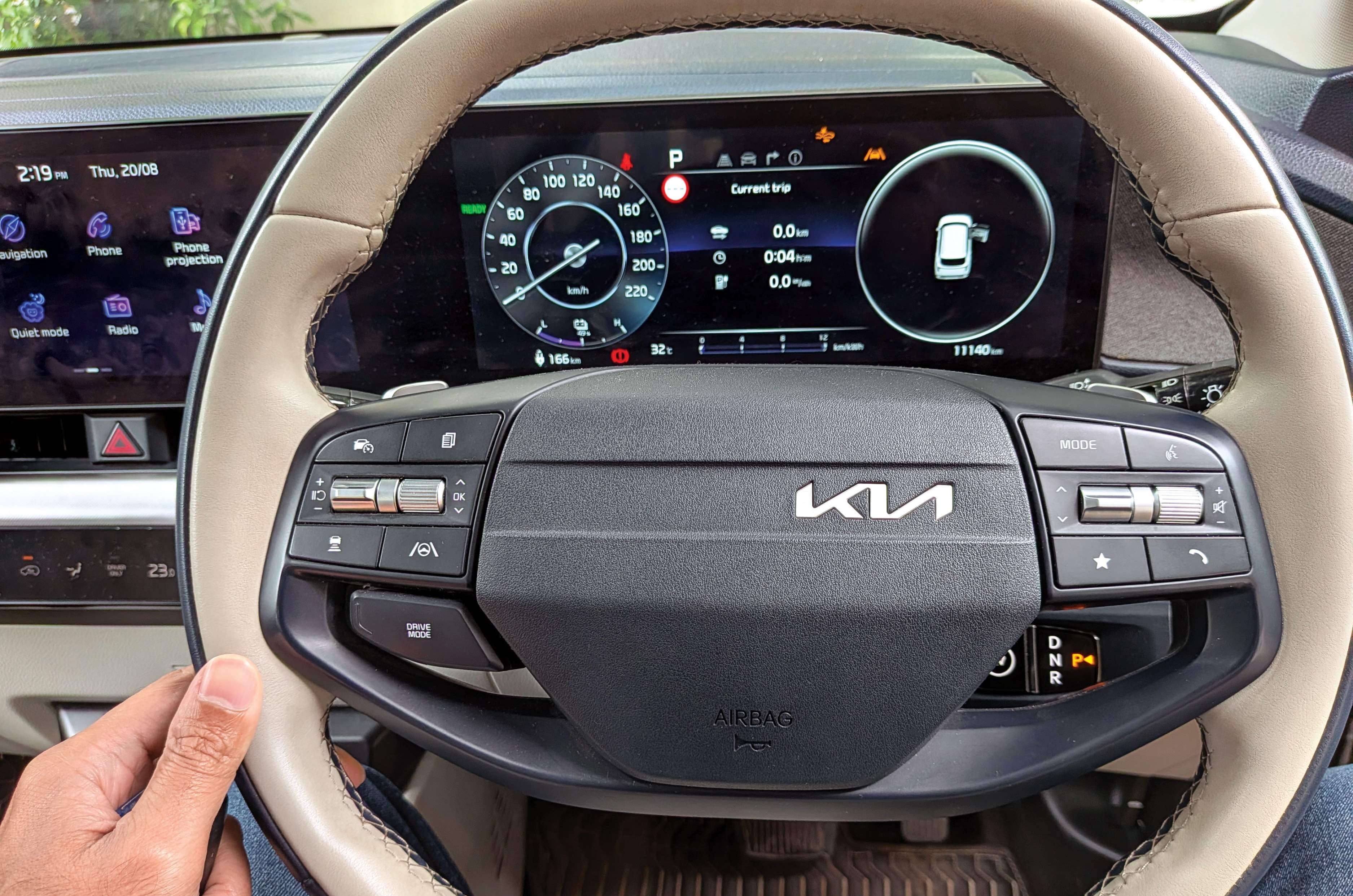
Quirky two-spoke, flat top and bottom steering wheel always looks upside down.
My wife drives it too, and she loves this easy-going nature, as well as the seating position. That is something I don’t really like, though. It feels like sitting at a dinner table, with your knees closer to a 90-degree angle. The seat base is also quite short, adding to that dinner-chair-like posture. It isn’t uncomfortable, though. The seat cushioning is fine, but it’s just the position that’s far from car- or SUV-like.
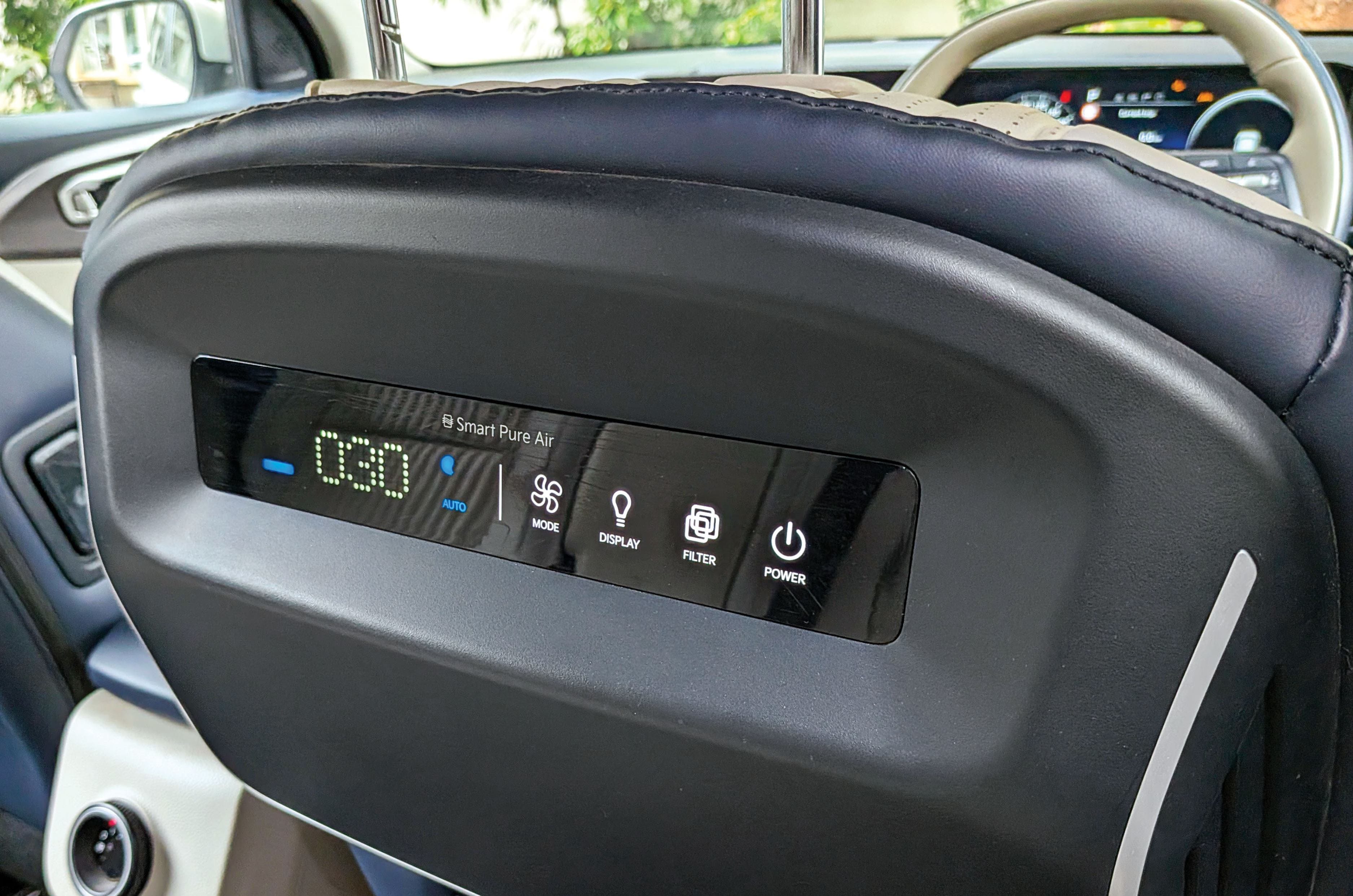
Besides that, there are only small bits I dislike, like the starter button, which is located on the drive selector stalk and hence hidden behind the steering wheel, only visible if the wheel is in the absolute straight-ahead position. The air purifier is also noisy, but that’s more due to its positioning behind the driver’s seat and thus close to your ear.
Air purifier located right behind the driver makes the air draft easily audible.
Beyond that, the Clavis EV has been remarkable. The kids love the electric seat fold that allows you to tumble the second-row seat at the push of a button, granting easy access to the third row. The space there drew no complaints either. It’s even good enough for average-sized adults and gets dedicated AC vents too. The window size, though, is a bit small, and while my daughter, who is prone to motion sickness, has so far not complained about it, I’m sure on a longer drive she will find this annoying. My son, who is taller than me, complained about this, saying he needs to look down through the glass. Headroom and overall space, though, were just about fine for him.
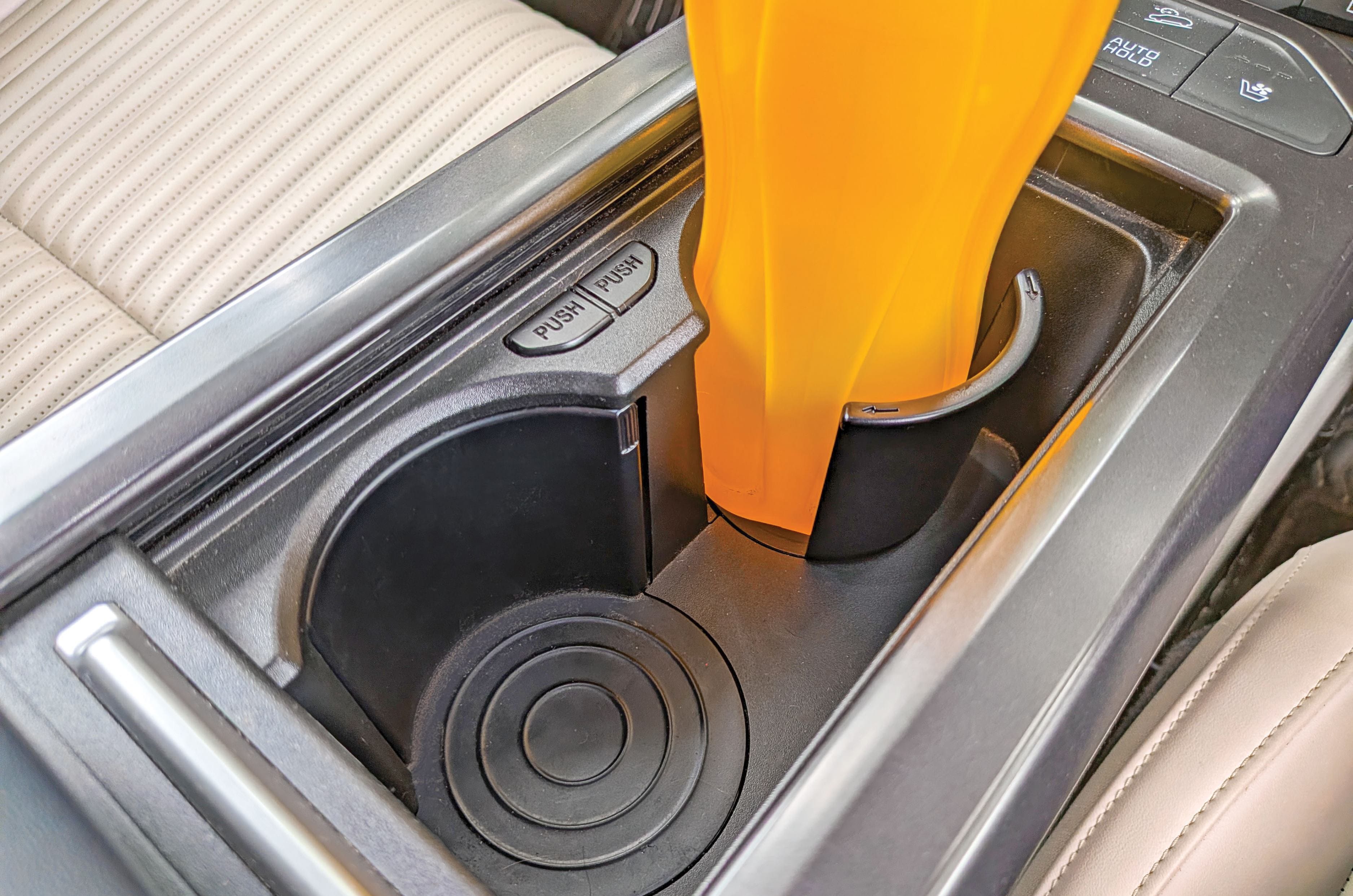
Speaking about space, the centre console drew a lot of praise from everyone who sat at the front. There’s plenty of storage, so no fighting to keep odds and ends. There are places for your phones, wallets, cups and bottles thanks to a cool resizeable tray, and the lower portion of the console can easily contain a medium-sized handbag. I’ve even managed fitting a tablet with its case in there. The premium-looking interior has also impressed everyone, the ambient lighting taking many by surprise. I guess not many expect this level of finish when they see an MPV.
Resizeable cup/bottle sleeves are handy and pop out at the touch of a button.
So, all in, like I said at the start, the electric Clavis is really a fine example of why electric power and MPVs are such a great mix. I’m sure our resident van man, Nikhil Bhatia, will be relieving me of the keys very soon. He’s already speaking of how his daughter loves to look up through sunroofs from her child seat. Rahul, too, will soon want it for its flexibility in some or the other tracking car duty.