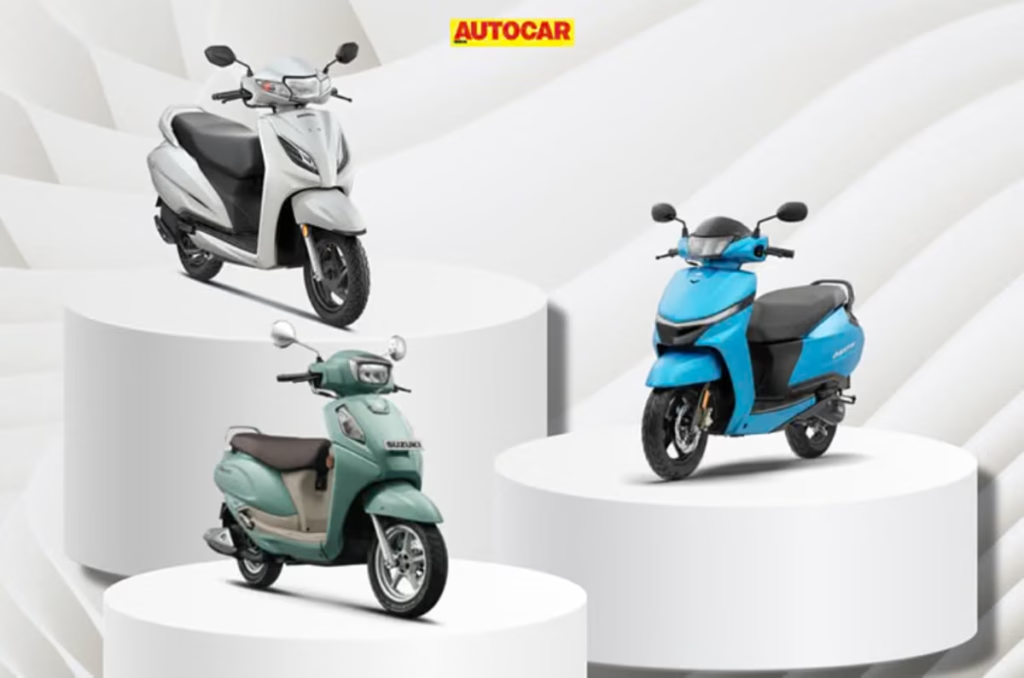
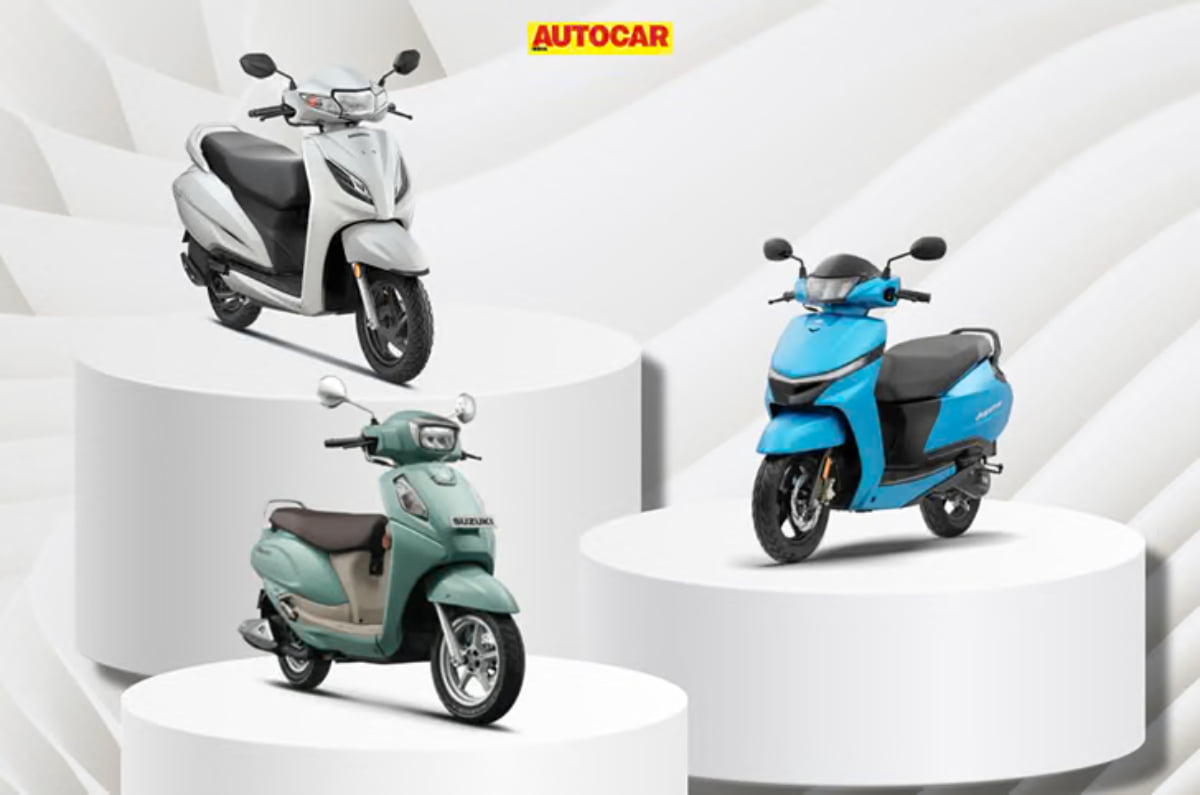
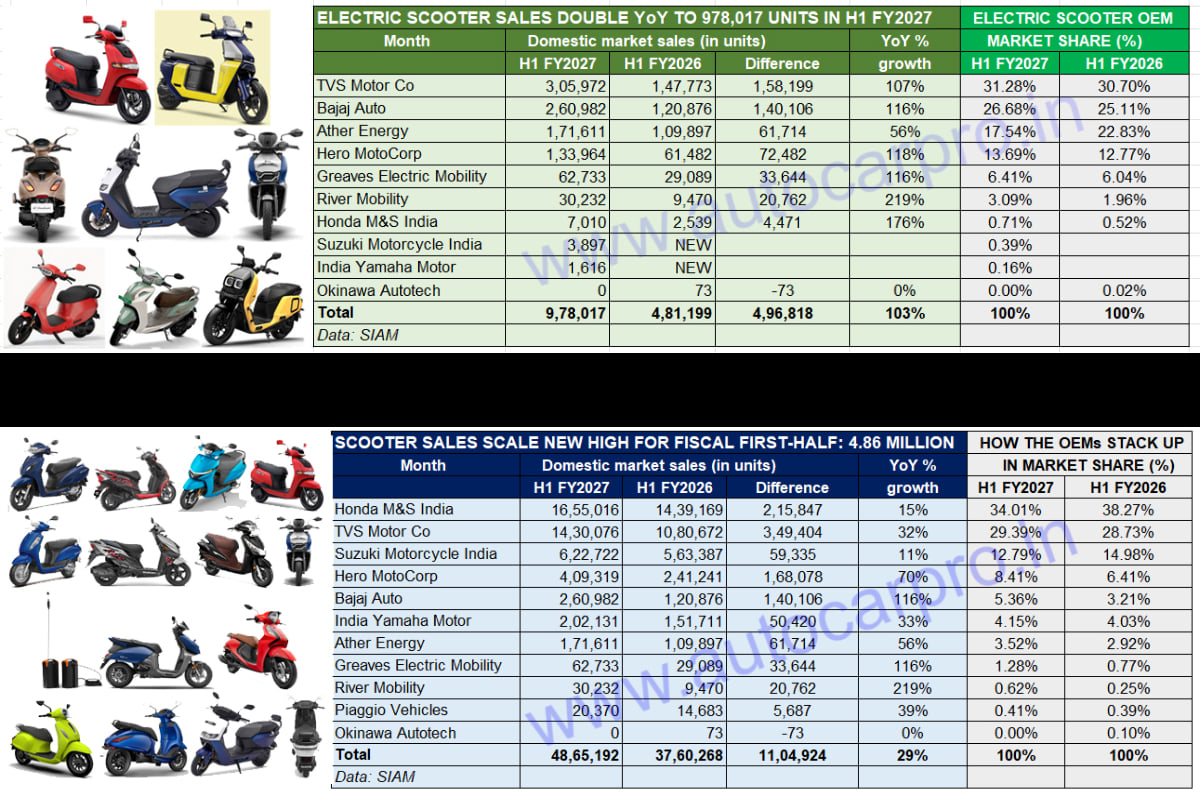
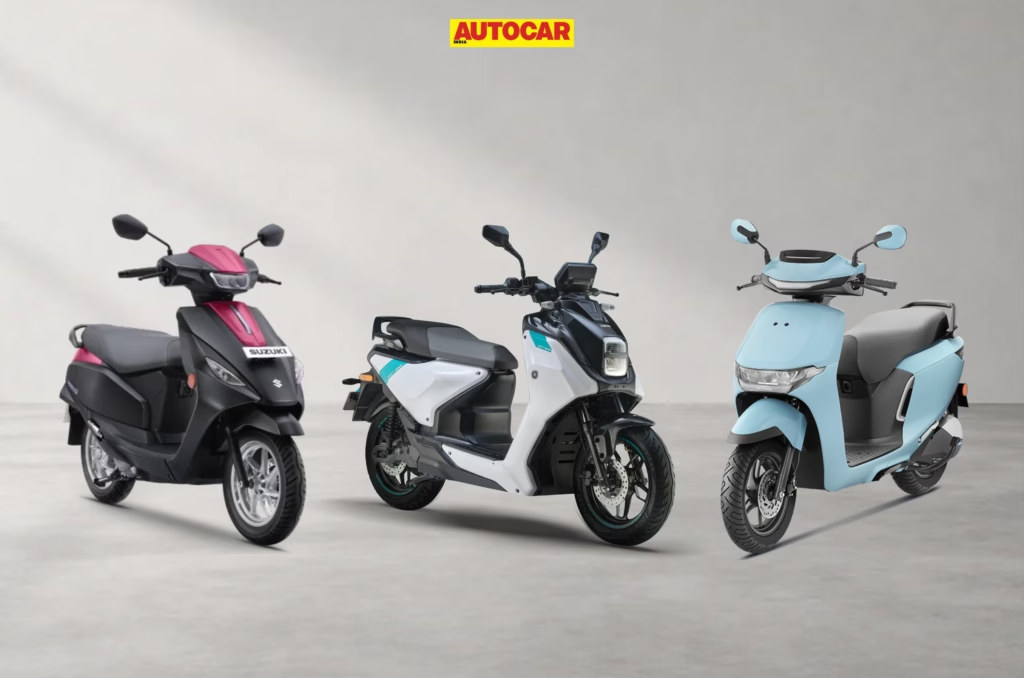
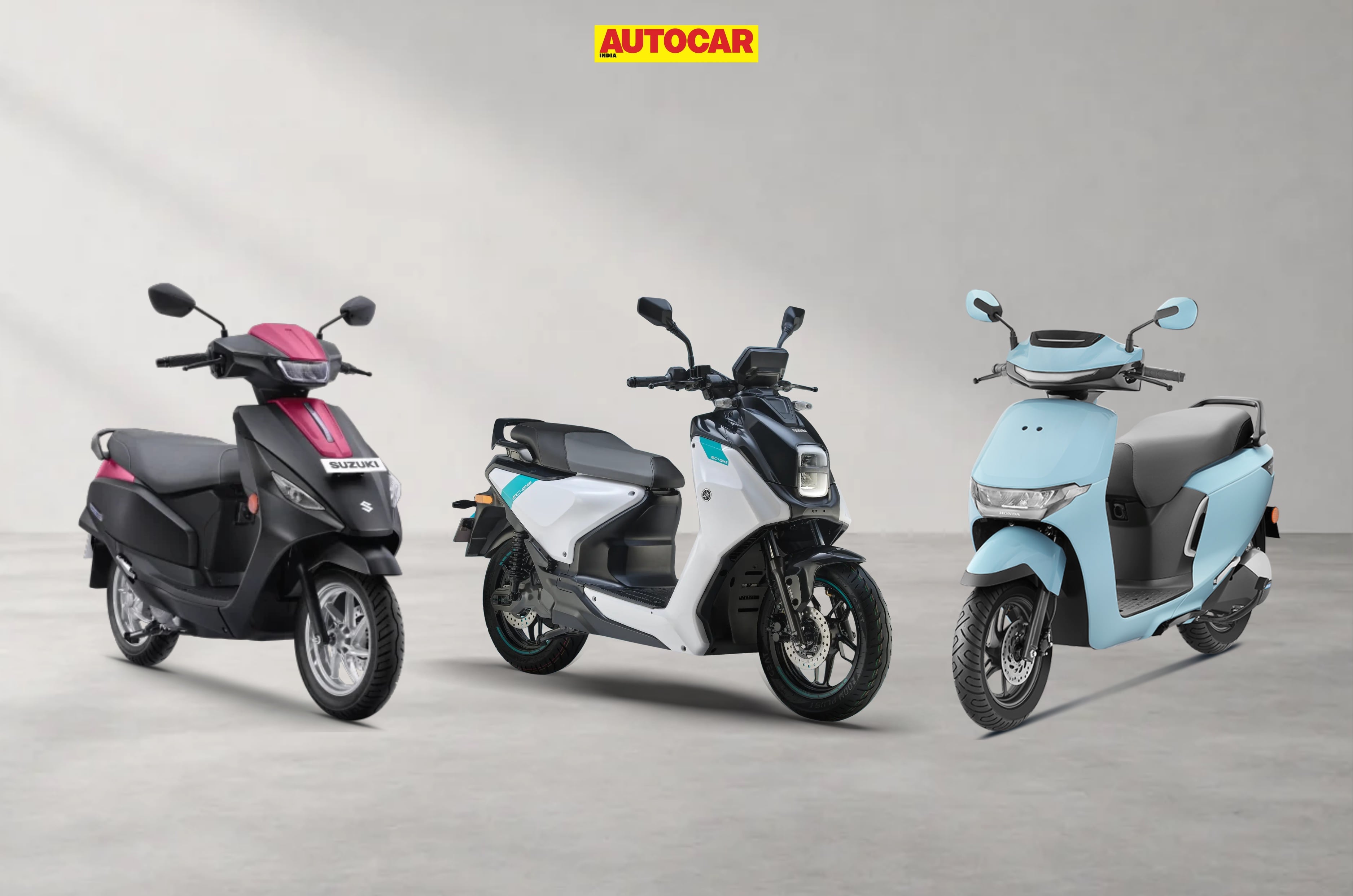
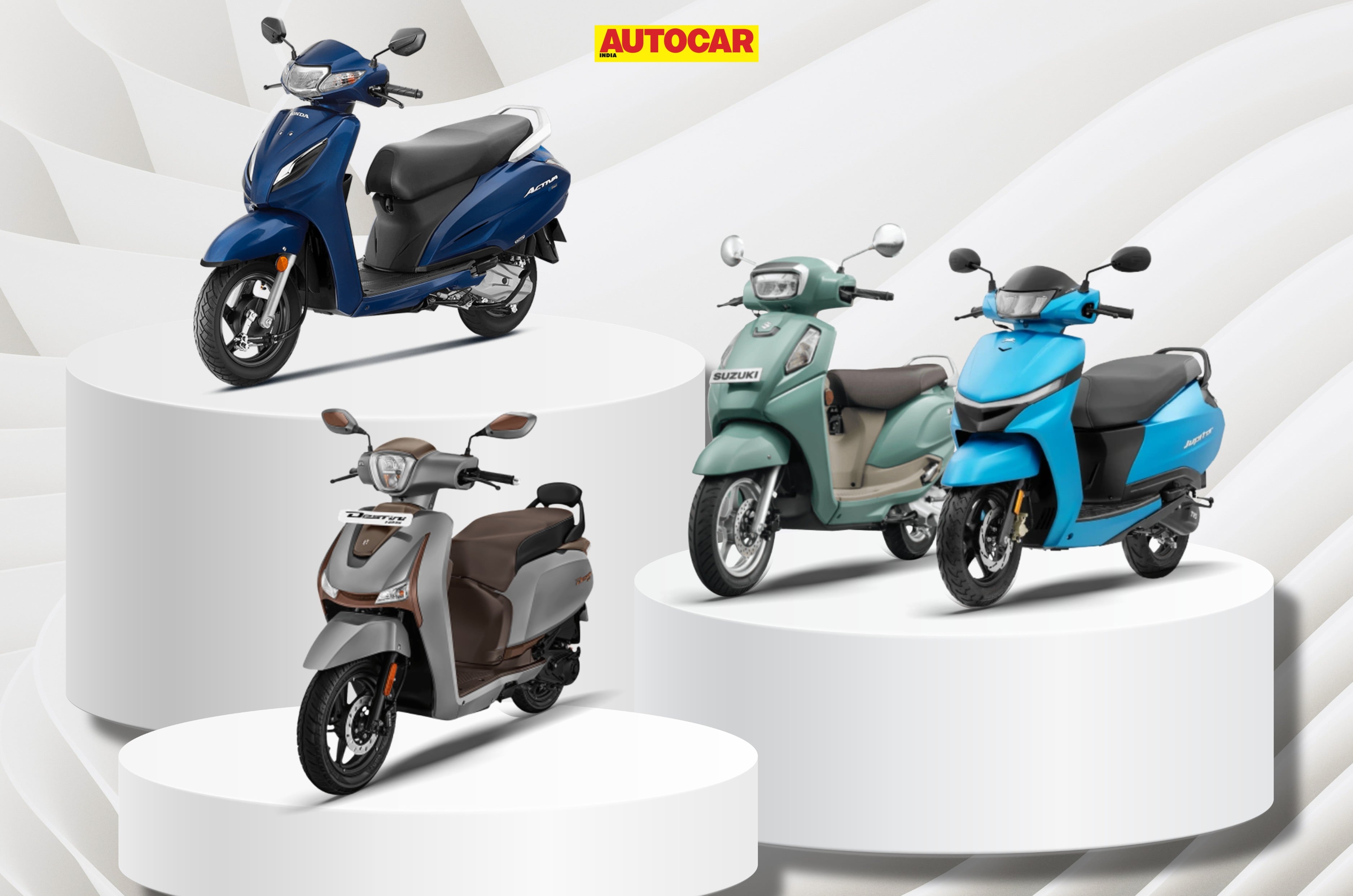
Two-wheeler manufacturers have dispatched a record 48,65,192 scooters in the domestic market in the first half (H1) of FY2027. That’s an additional 10.8 lakh units over the same period last year, representing a 29 percent increase. The six-month period included two monthly records: April 2026 opened as the best-ever April, with 6,91,993 units, while September registered 9,95,576 units – the highest monthly total ever for the category and just 4,424 units short of the million-unit (10 lakh) milestone.
Zooming out, the scale of the growth becomes clearer. Scooter sales have more than doubled over 12 years. In H1 FY2016, the total was 2.4 million units, whereas FY2027’s first half has already reached about 60 percent of FY2026’s full-year record of 8.11 million units.
Electric scooters double, claim a 20 percent share
Honda leads overall, TVS grows faster
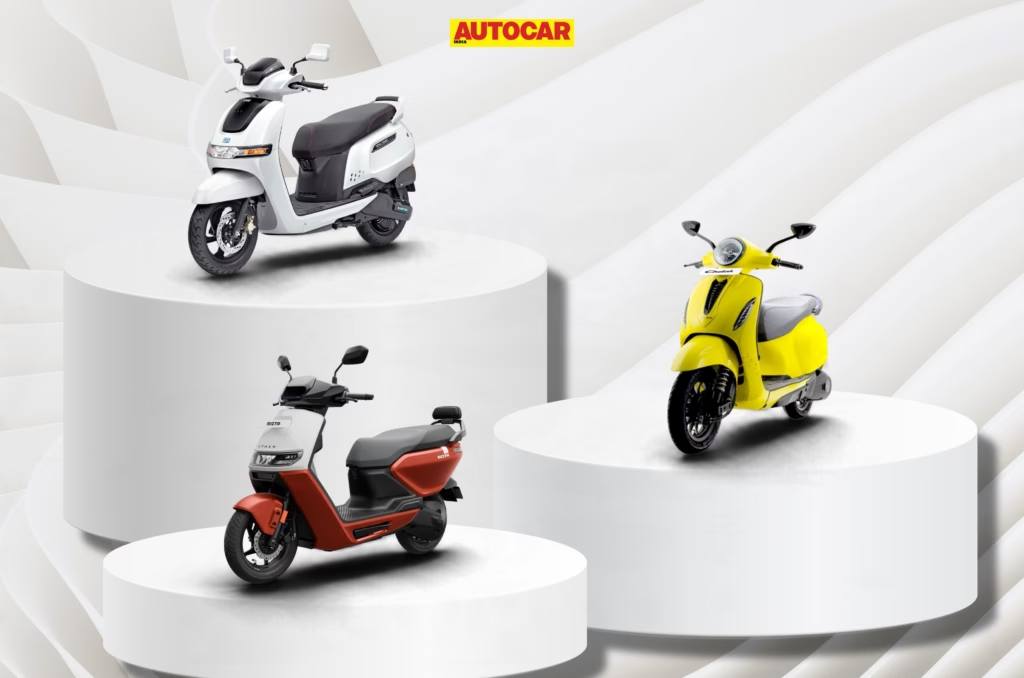
The fastest-growing part of the segment is electric. E-scooter wholesales hit 9,78,017 units in H1 FY2027, up 103 percent year-on-year from 4,81,199 units in H1 FY2026. This surge has pushed EVs’ share of total scooter sales from 13 percent to 20 percent in a single year.
TVS Motor Company leads the e-scooter market, with 3,05,972 iQube and Orbiter units dispatched, up 107 percent year-on-year, giving it a 31 percent share. Bajaj Auto is second, with 2,60,982 Chetak and Yulu units – a 116 percent jump – and a 27 percent share. Together, the two account for 58 percent of all e-scooters sold in the first half. Ather Energy, with 1,71,611 units and 56 percent growth, held third place, though its share dipped from 23 percent to 18 percent as the market expanded. Hero MotoCorp’s Vida dispatched 1,33,964 units, up 118 percent, for a 14 percent share.
The three Japanese players – Honda, Suzuki and Yamaha – collectively sold 12,523 e-scooters, accounting for a combined 1 percent share. Honda led the group with 7,010 units, up 176 percent.
Across ICE and EV models combined, Honda Motorcycle & Scooter India remains the category leader with 1.65 million units, up 15 percent, although its market share has dipped from 38 percent to 34 percent. TVS Motor Company is in second place with 1.43 million units and 32 percent growth, adding 3,49,404 units year-on-year. Nearly half of that incremental volume came from its electric lineup.
Suzuki, with 6,22,722 units and 11 percent growth, and Hero MotoCorp, with 4,09,319 units and 70 percent growth, hold third and fourth place, respectively. Bajaj Auto has climbed to fifth with 2,60,982 units and 116 percent growth, displacing Yamaha, which recorded 2,02,131 units, up 33 percent. Ather Energy is seventh with 1,71,611 units, while River Mobility has entered the top 10, overtaking Piaggio with 30,232 units of the Indie scooter.
With the festive season now underway, the industry will be looking to convert the strong H1 momentum into retail sales. Whether Q3 and Q4 can sustain the near-30 percent growth rate needed to push scooter sales past 10 million units for the first time remains to be seen, but the trajectory points firmly in that direction.
Tata’s passenger vehicle (PV) business grew by 35 percent in its first year after the demerger, which came into effect on October 1, 2025, and separated the commercial vehicle (CV) business from the PV division. Domestic sales between October 2025 and September 2026 stood at 7.44 lakh units, well ahead of the industry’s roughly 22 percent growth. According to the home-grown brand, its market share increased to 14.1 percent, making it India’s second-largest carmaker over this period.
Factors behind the Tata PV business growth
Two SUVs and a GST cut did much of the heavy lifting
One of the major factors behind Tata’s strong numbers is the revised GST rates, which took effect on September 22, 2025. This was shortly before the October 1 demerger, and it made cars more affordable across multiple segments. Despite this, Tata Managing Director Shailesh Chandra admitted to being surprised. “We had not expected 35 percent,” he said.
According to Chandra, monthly bookings topped one lakh more often than not, and more than seven in ten of these typically turned into retail sales. Tata crossed the 70,000-unit mark in a single month twice, and two of its quarters went past two lakh units.
With sales of 2.38 lakh units and 2.33 lakh units respectively, the Nexon and Punch accounted for around 63 percent of Tata’s domestic volumes over this period. Sales of the Sierra, meanwhile, crossed 60,000 units between January and September 2026. This is despite supply being constrained even as production was being scaled up.
Tata EV and CNG sales make up nearly half of volumes
Tata Motors claimed that EVs and CNG cars accounted for 44 percent of its annual volumes, rising to about 51 percent in the July-September quarter. Sales of fully electric models were up 84 percent (at 1.3 lakh units), with the brand claiming a 42 percent share of India’s EV market. Sales of CNG models grew by 31 percent, registering over 2.03 lakh units.
However, each powertrain faces a different set of rivals. “For EVs, my competitors are different,” said Chandra. Product development for all powertrain categories now falls under a single chief product officer, though each gets its own dedicated team.
Tata Motors targets 12 lakh annual sales by FY31
Six new nameplates are on the way
Tata is targeting over 12 lakh units per year by FY31 (financial year 2031), with a 20 percent share of the Indian passenger vehicle market. According to Tata, the plan involves over 20 product refreshes and the introduction of six new nameplates, including the Avinya.
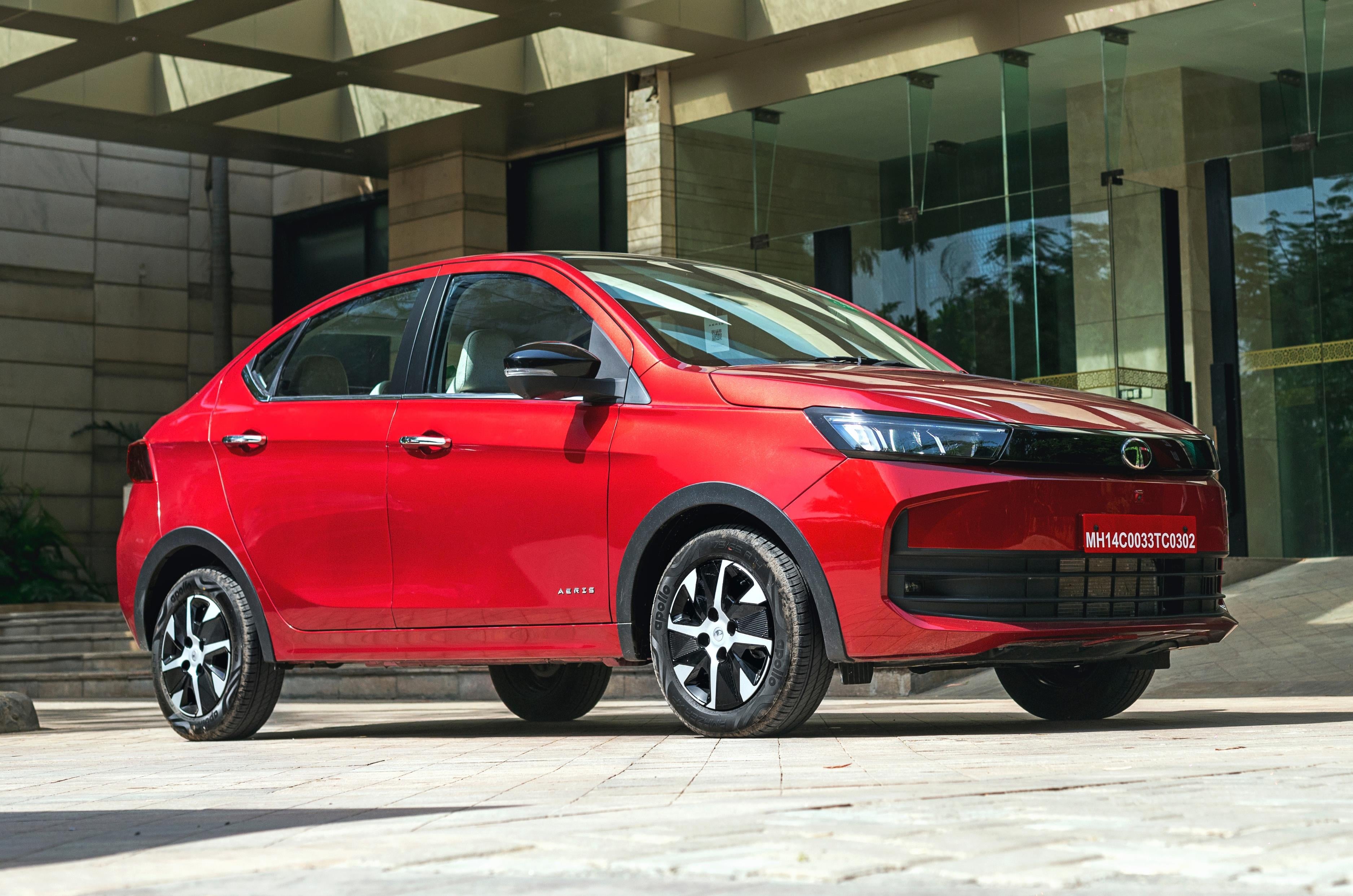
What the brand calls its “15 product interventions” over the past year included models such as the Sierra and Sierra.ev, the updated Punch, Punch.ev, Tiago and Tiago.ev, petrol versions of the Harrier and Safari, and the Aeris. The Indian automaker said that it’s also recalibrating launch timelines. This, it said, is to ensure that each new model gets proper marketing support and that dealers have enough time to sell them.
The recent surge in demand means production capacity has become an immediate priority for Tata Motors. The company stated that its plants and suppliers are stretched thin, particularly smaller tier-two and tier-three firms, and that it has had to work more closely with them to resolve shortages. More capacity will come online at Tata’s existing plants, with the Sanand facility playing a major role. Helped by Tata’s entry into South Africa, exports have nearly doubled, to around 12,000 units.
Tata Motors to triple service network and focus on quality
The brand said that its workshops will grow faster than its showrooms
Apart from focusing on growth, Tata Motors will also be paying attention to addressing the quality and after-sales perception. The quality department now reports directly to Chandra instead of to the manufacturing department, the Managing Director stated. Tata has also set up a central software integration team, which will eventually become a ‘centre of excellence’. Tata now also tests software and hardware together earlier in development. In fact, the Sierra is one of the first models developed this way, the company mentioned.
Another point of attention is the brand’s service network, with Chandra stating that Tata’s workshops now see about six lakh vehicles per month – this is up from around 1.5 lakh in 2021. “My showrooms will increase by two times. But my service centres will increase by three times,” Chandra said. The automaker has addressed 26 of the 30 locations that it flagged as service problem areas, with dealer incentives now placing more weight on customer experience.
Between April and June, the availability of spare parts was an issue. This, the company said, was due to labour constraints, when production was being prioritised. It’s providing existing customers first claim on spare parts even if that affects the production of new cars, with Chandra claiming fill rates are back at around 85-86 percent. Regardless, changes will take time. “The perception will only change after three-four years,” Chandra admitted. “After people really see the consistency of that.”
With inputs from Hormazd Sorabjee and Ketan Thakkar.
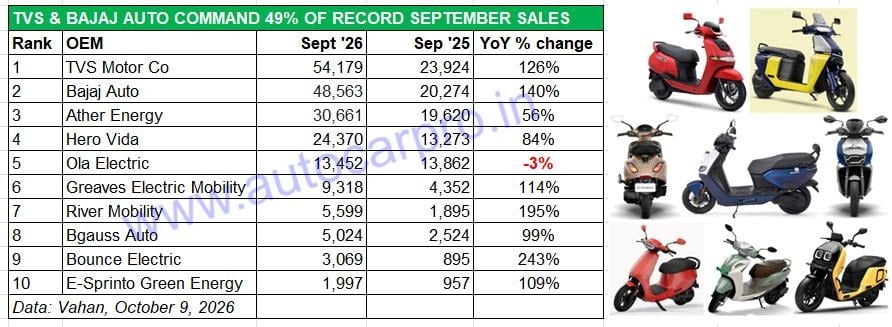
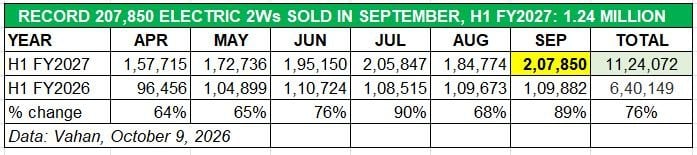
India’s electric two-wheeler market is on a roll and how. While January-September 2026 retail sales have already crossed 1.61 million units, e-2-wheeler customer deliveries in April-September 2026 increased 76 percent to 11.2 lakh units (versus 6.40 lakh units same time last year). The rapid pace of demand means that the industry is predicted to end the financial year with 22.6 lakh total sales. September 2026 was also the first time the industry sold 2.07 lakh units (highest yet), which is an 89 percent increase compared to 2025.
Besides the top-three, Bounce and River have improved the most
Ola has held on to fifth place, but lost 9 percent of its market share
September’s high sales numbers will likely be surpassed by the upcoming festive season
Indian e-2-wheeler industry sales: The trend so far
TVS and Bajaj continue to lead, with Vida steadily improving
TVS and Bajaj, which have been the top two brands since Ola moved out of the top spot in April 2025, continue to register handsome gains. In September, both companies registered triple-digit growth, which ensured that they make up a 49 percent share of the record monthly retails. This is the highest monthly sales for Bajaj, beating March 2026 (47,755 units). Ather, in the third position, sold 30,661 units and marked 56 percent YoY growth. March 2026 continues to be Ather’s best month, sales-wise (36,634 units) with the Konarc expected to contribute to that number substantially soon. Vida, backed by Hero, sold its highest ever 24,370 units in September, crossing July’s number (22,996).
Brand-wise performance and market share in H1 FY2027
Besides the top two, River and Bounce improved the most
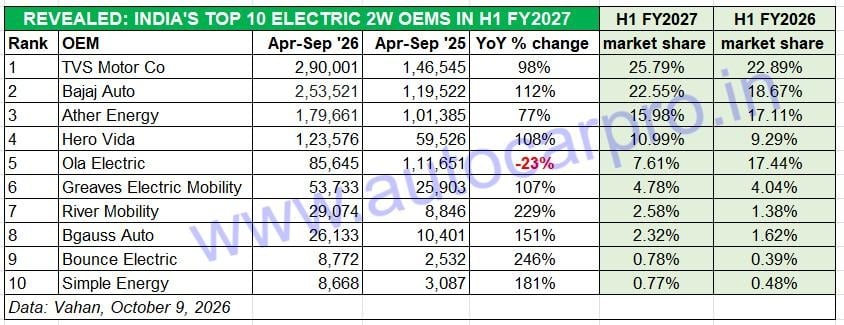
Electric 2W market leader TVS nearly doubled its first-half retail sales YoY to 2.90 lakh units, giving it a 26 percent market share. For TVS, EVs are now a key growth driver and every fifth scooter the company sells is now a zero-emission model. Bajaj, which sells multiple variants of the Chetak, has retailed 2.53 lakh units in the past six months. The strong performance gives it a current market share of 23 percent. Ather, in third position, has clocked retail sales of 1.79 lakh units in H1 FY2027. Ather crossed the 30,000 mark in three of the past six months, June, July and September. Its H1 FY2027 market share is 16 percent, one percentage less than H1 FY2026. A few days ago, cumulative Ather sales surpassed 8 lakh units, making it the fourth company after Ola, TVS and Bajaj to achieve that milestone.
Fourth-ranked Vida registered retail sales of 1.23 lakh units in first-half FY2027, up 107 percent YoY. Ola remains glued to the fifth rank with an 8 percent market share, considerably down from the 17 percent it had in H1 FY2026. Greaves Electric Mobility (GEM), manufacturer of Ampere e-scooters, has sold 53,733 units, comes in at sixth with a 107 percent YoY growth.
The Bengaluru-based River, which continues to impress month on month, has sold 29,074 units in H1 FY2027. The stellar performance sees River’s market share rise to 3 percent from 1 percent in H1 FY2026. The startup’s highest monthly sales came in July (6,044 units). In eighth place, the Mumbai-based BGauss has sold 26,133 units in H1 FY2027, registering a 107 percent growth compared to H1 FY2026. Bounce ranks ninth with 8,772 units, up 246 percent YoY. Simple, which has been a regular in the monthly top 10 e-2-wheeler sales listing since February 2026, has clocked cumulative six-month sales of 8,668 units, up 181 percent YoY. This momentum comes just as Simple launched its most affordable scooter yet, the Wave, starting at Rs 1.10 lakh.
India’s e-2-wheeler market with 200 players, is the largest contributor to India’s EV sales numbers with a 62 percent share of the total EVs sold in the April-September 2026 period. The market is currently led by TVS, Bajaj, Ather, Vida, Ola and GEM – who account for 88 percent share of the e-2-wheeler sales in H1 FY2027. Given its robust 76 percent growth so far, and the festive season having just begun, one can expect September’s record 2.07 lakh unit sales to be surpassed soon.
Cumulative retail sales of the three Japanese electric scooter manufacturers in India – Honda, Suzuki and Yamaha – have crossed the 10,000-units mark for the first time in a calendar year. As per the latest Vahan statistics, this triumvirate have delivered 10,735 units to their customers between January 1 and October 8 in 2026.
Last year, Honda, which was the sole e-2-wheeler OEM in India, had sold 7,730 units of the Activa-e and QC1, less of the former and more of the latter. While Suzuki entered the market in January 2026 with its e-Access, Yamaha plugged in two months later in March with its EC-O6. This makes 2026 the first year when all these three Japanese OEMs are part of the Indian electric scooter market.
A look at the OEMs’ monthly performance reveals that Honda Motorcycle & Scooter India has sold 5,536 units in this year to date, accounting for 51 percent of the total 10,735 Japanese e-scooters delivered. HMSI’s best monthly sales this year were in September (1,107 units), marking the first time the OEM has crossed 1,000 units. This number can only improve following the recent launch of its third e-scooter for India – the QC3.
The initial rollout of the QC3 will be limited to five cities across the country: Delhi, Agra, Cuttack, Surat and Kollam, with a nationwide rollout to follow in a phased manner..
Suzuki Motorcycle India, which entered the India e-2W market with its e-Access in January this year as an alternative to the popular petrol-engined Suzuki Access 125, has delivered 4,133 units till October 8. This gives the company a 39 percent share of the three Japanese OEM’s total e2W retail sales. The monthly sales chart reveals that monthly sales have crossed 600 units for three months running: July (606 units), August (674 units) and September (657 units). Rather creditable considering this is an expensive product, priced at Rs 1.88 lakh (ex-showroom) and the costliest amongst the Japanese EVs.
India Yamaha Motor, which plugged into the e-2W market this March, has retailed 1,066 units, which gives it a 10 percent share of the 10,735 units delivered by Honda, Suzuki and Yamaha. Yamaha’s vehicle of entry is the EC-06, its first electric scooter developed in collaboration with River Mobility. IYM’s highest monthly sales to date were in September (232 units)
Japanese OEMs have 0.66 percent share of e-2Ws sold in 2026 so far
As the monthly retail sales data table depicts, combined Honda-Suzuki-Yamaha sales were at their highest in September 2026 (1,996 units), which gives them a 1 percent share of the record 2,07,850 e-2Ws sold in India last month. Of the total 16,10,854 e-2Ws sold between January 1 and October 8, these three Japanese OEMs with 10,735 units have a meagre 0.66 percent share.
Among the reasons for their minimal presence in this booming segment of the Indian EV industry is that Honda, Suzuki and Yamaha entered the e-2W market late, as compared to their ICE legacy rivals TVS Motor Co (January 2020), Bajaj Auto (January 2020) or Hero MotoCorp Vida (November 2022).
While market leader TVS has sold 4,22,274 iQubes and Orbiters for a 26 percent market share of the e-2W sales in 2026 to date, Bajaj Auto has delivered 3,61,988 Chetaks (22 percent share), Ather Energy has sold 2,67,579 units (17 percent share) and Hero Vida 1,77,541 e-scooters (11 percent share).
There is also the issue of their stiff model pricing in a value-conscious market, which has a plethora of more affordable e-scooters which are also more tech-laden, as well as a limited sales network compared to the Indian legacy OEMs as well as a host of startups which are regulars in the monthly Top 10 e-2W OEM chart.
According to data released by the Federation of Automobile Dealers Association (FADA), the Indian passenger vehicle market experienced a strong year-on-year (YoY) sales growth of 32.1 percent in September 2026, with a total of 4,27,213 units sold. While the YoY uptick looks very impressive at face value, the reason behind it is a slowdown in demand during September 2025 due to anticipation of imminent price cuts as part of GST 2.0.
Note: Telangana RTO is not included in FADA sales data.
Top 10 best-selling carmakers in September 2026
Carmaker
Sep 2026 sales
MoM change (%)
YoY change (%)
Market share (%)
Maruti Suzuki
1,69,132
+2.38
+30.05
39.59
Mahindra
57,343
+14.13
+38.93
13.42
Tata
57,254
-1.02
+28.66
13.40
Hyundai
50,201
+6.84
+31.46
11.75
Toyota
28,050
+12.85
+21.56
6.57
Kia
26,663
+14.09
+45.91
6.24
Skoda Volkswagen Group
8,479
+13.52
+13.51
1.98
MG
6,475
+11.95
+13.74
1.52
Honda
5,283
+6.34
+42.51
1.24
Renault
3,410
+4.12
+33.10
0.80
1. Maruti Suzuki
1,69,132 units sold, up 30.05 percent YoY
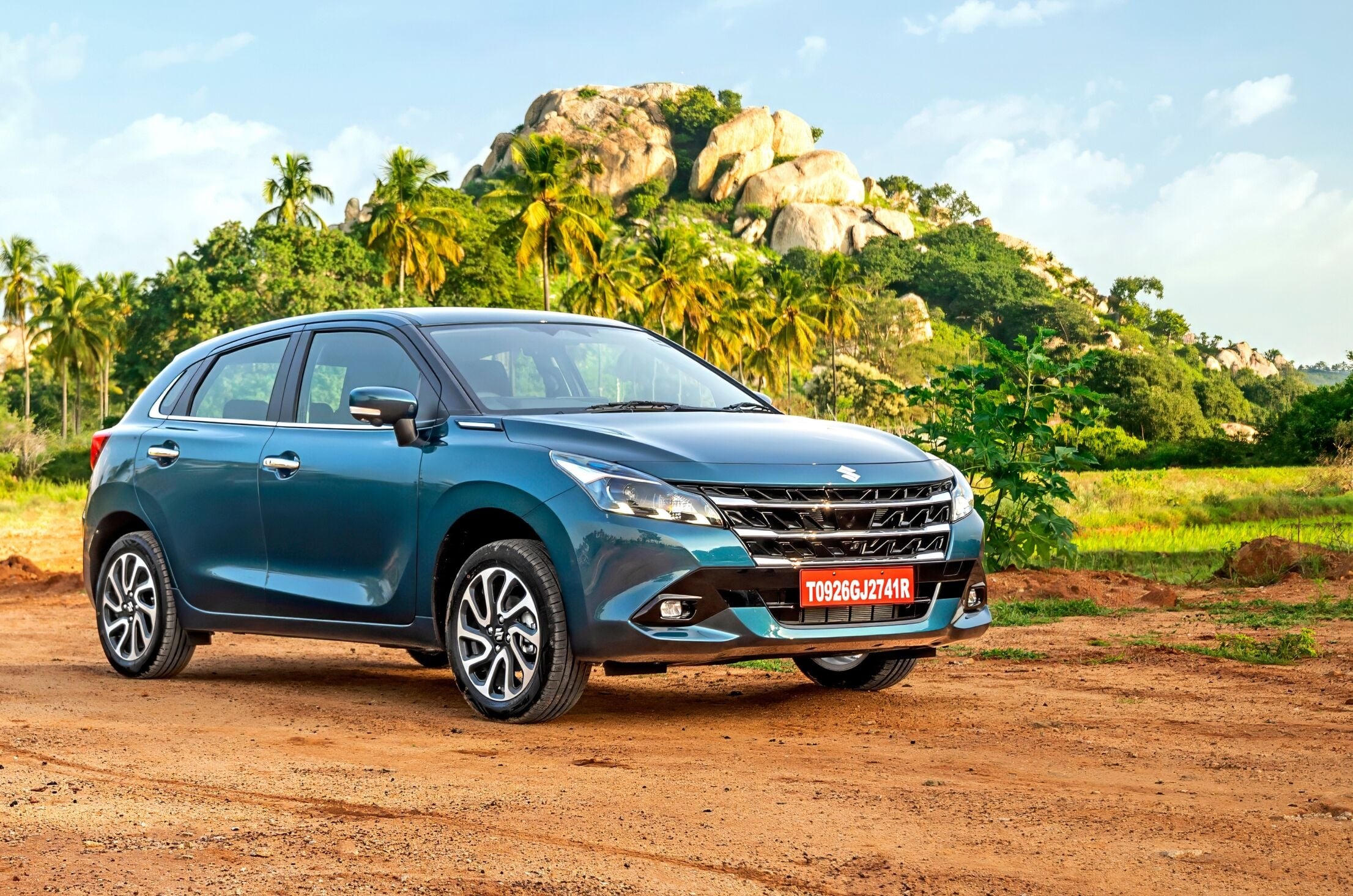
Kicking off the top 10 is market leader Maruti Suzuki, which held on to first place and saw YoY growth in September 2026, although its market share dipped from 40.21 percent in September 2025 to 39.59 percent last month. Still, in terms of overall volume, Maruti Suzuki outsold the next three carmakers combined. The 2.38-percent MoM sales increase is also impressive given the scale of Maruti Suzuki’s volumes. No new Maruti launches are currently known for October 2026, but the carmaker is fresh off the Baleno facelift’s launch.
2. Mahindra
57,343 units sold, up 38.93 percent YoY
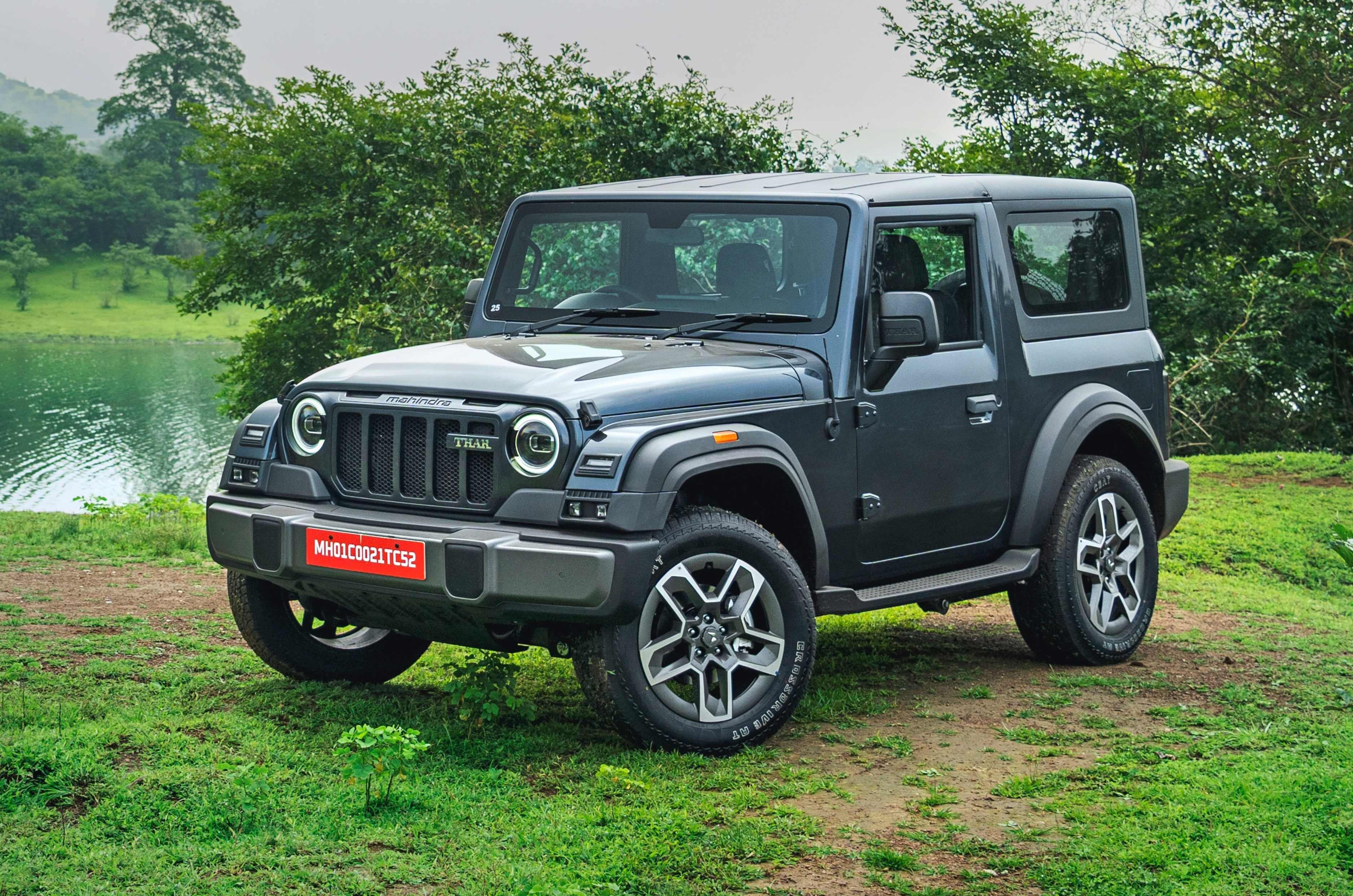
Compared to last month’s sales rankings, Mahindra was the only carmaker to experience a change of place on the September 2026 chart. Specifically, Mahindra beat Tata to second place by an ever-so-slight margin of 89 units. If that wasn’t impressive enough, Mahindra also recorded the highest MoM growth among the top 10, and the highest increase in market share – from 12.76 percent last September to 13.42 percent in September 2026. At the moment, Mahindra has not announced any new launches for October, but it did launch the Thar OG (3-door facelift) last month.
3. Tata
57,254 units sold, up 28.66 percent YoY
As mentioned above, Tata slipped from second place in August 2026 to third place in September, though its overall volumes were extremely close to Mahindra’s and YoY sales growth was healthy too. That said, Tata’s market share decreased by a little bit, specifically 13.76 percent in September 2025 to 13.40 percent last month, and it was the only carmaker to witness a MoM sales decline as well. Most recently, Tata launched the Aeris compact sedan, replacing the Tigor.
4. Hyundai
50,201 units sold, up 31.46 percent YoY
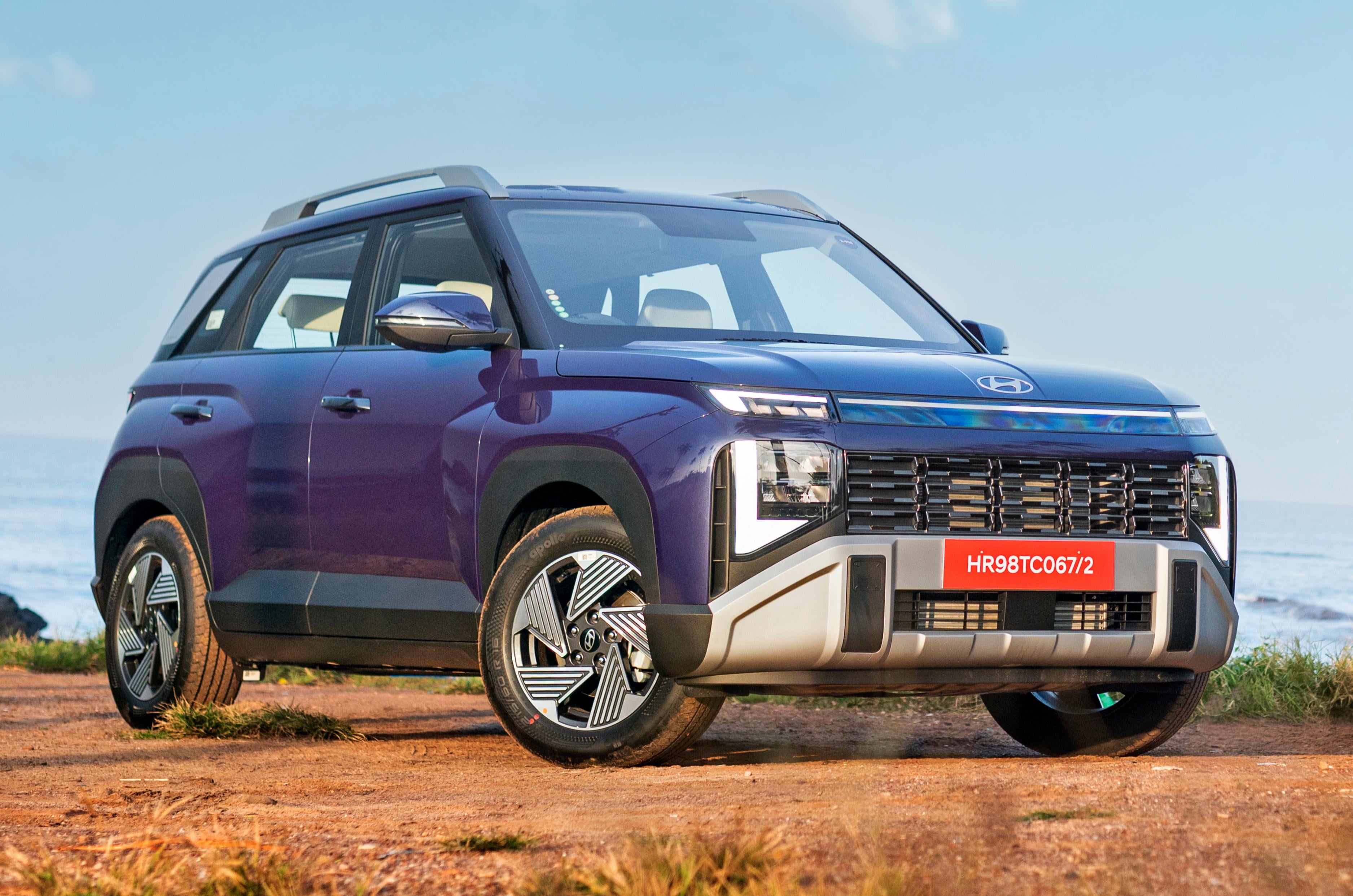
Hyundai remained in fourth place in the September 2026 sales rankings, experiencing healthy MoM and YoY upticks. Market share, however, did slide from 11.81 percent in September 2025 to 11.75 percent in September 2026. This month, Hyundai is likely to launch the Bayon midsize SUV, and its impact in the October 2026 sales charts should be interesting to see.
5. Toyota
28,050 units sold, up 21.56 percent YoY
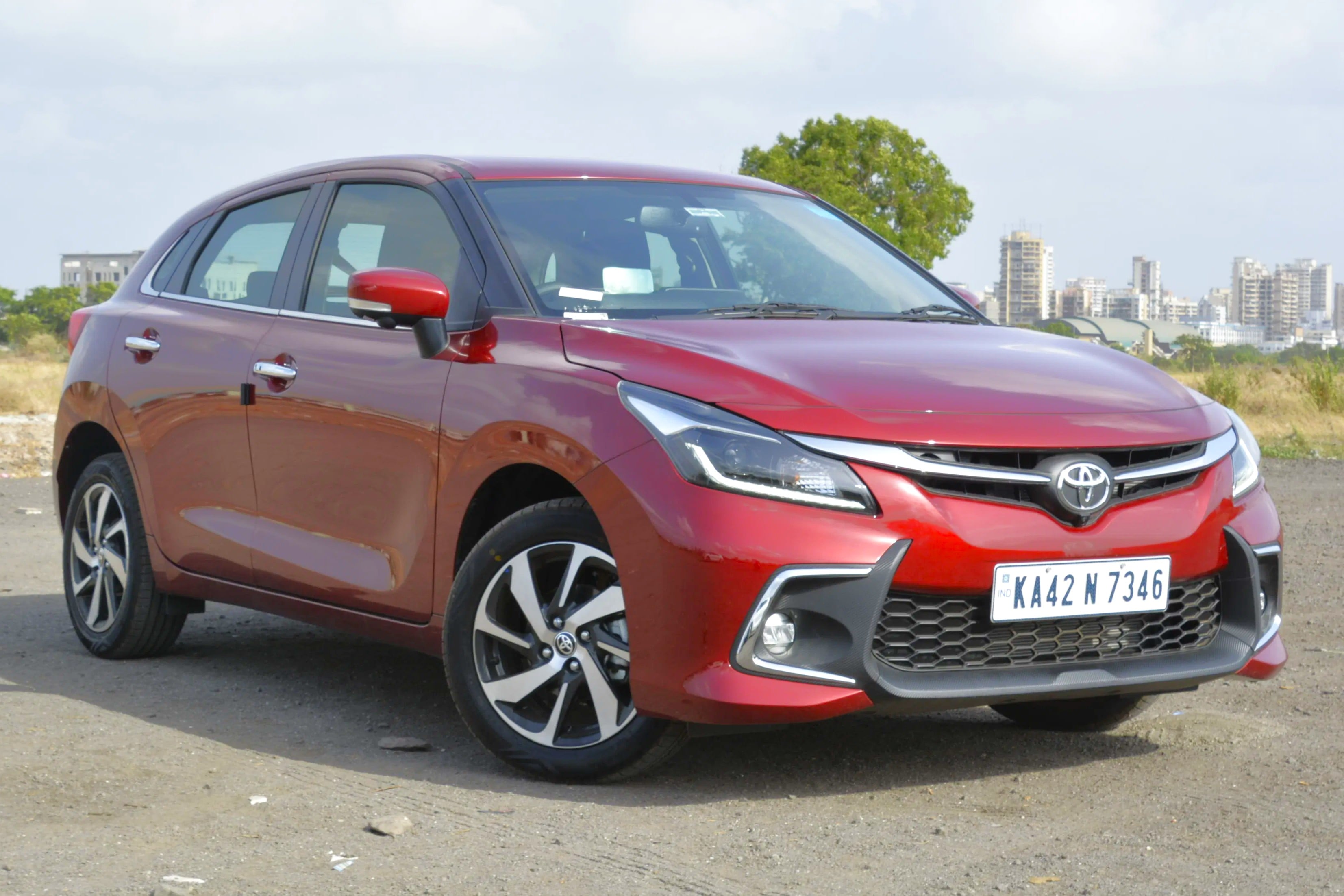
Like last month, Toyota was in fifth place on the September 2026 sales chart. Interestingly, Toyota experienced one of the highest MoM upticks among the carmakers listed here. At the same time, however, the Japanese carmaker’s market share dipped from 7.14 percent in September 2025 to 6.57 percent last month. In October, Toyota is expected to debut the facelifted Glanza, changes for which are likely to mirror those seen in the Maruti Baleno facelift.
6. Kia
26,663 units sold, up 45.91 percent YoY
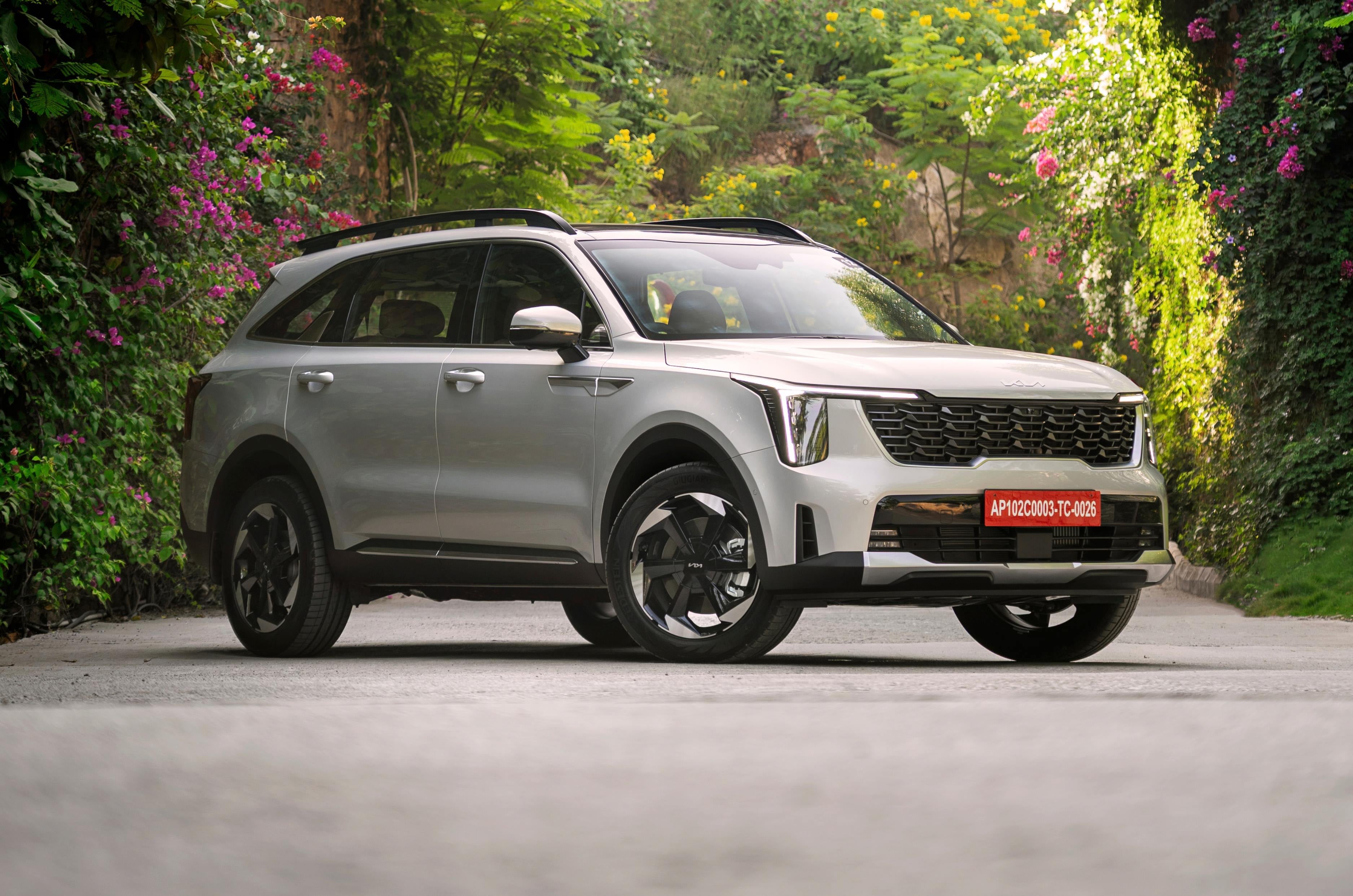
Thanks to the continued popularity of the second-gen Seltos, Kia recorded the highest YoY sales uptick among the top 10 carmakers in September 2026, while MoM growth was the second-highest – falling just shy of Mahindra. Kia’s market share also grew considerably, from 5.65 percent in September 2025 to 6.24 percent in September 2026. While Kia is fresh off a major launch – the Sorento – the Korean carmaker is likely to announce prices for the Carnival hybrid, though the luxury MPV is not expected to be a major volume driver.
7. Skoda Volkswagen Group
8,479 units sold, up 13.51 percent YoY
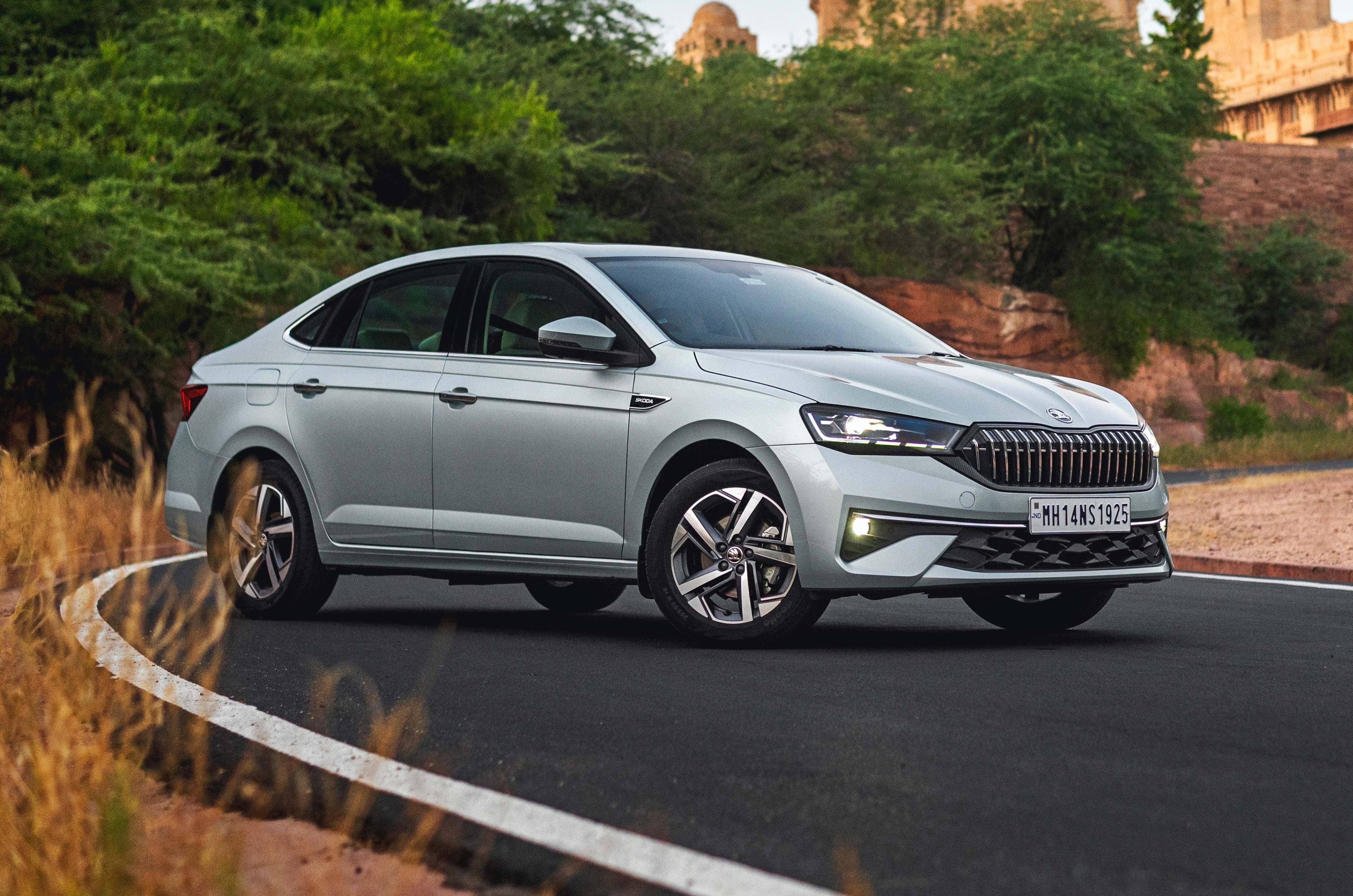
Skoda Auto Volkswagen India Private Limited (SAVWIPL) held on to seventh place in September 2026, and even saw a decent 13.52 percent MoM increase in sales. Notably, SAVWIPL’s YoY growth is nearly identical to the MoM one. In terms of market share, SAVWIPL declined from 2.29 percent last September to 1.98 percent in September 2026. As for launches in October, Skoda is fresh off the Slavia facelift’s price reveal, which could rejuvenate some interest in the midsize sedan space.
8. MG
6,475 units sold, up 13.74 percent YoY
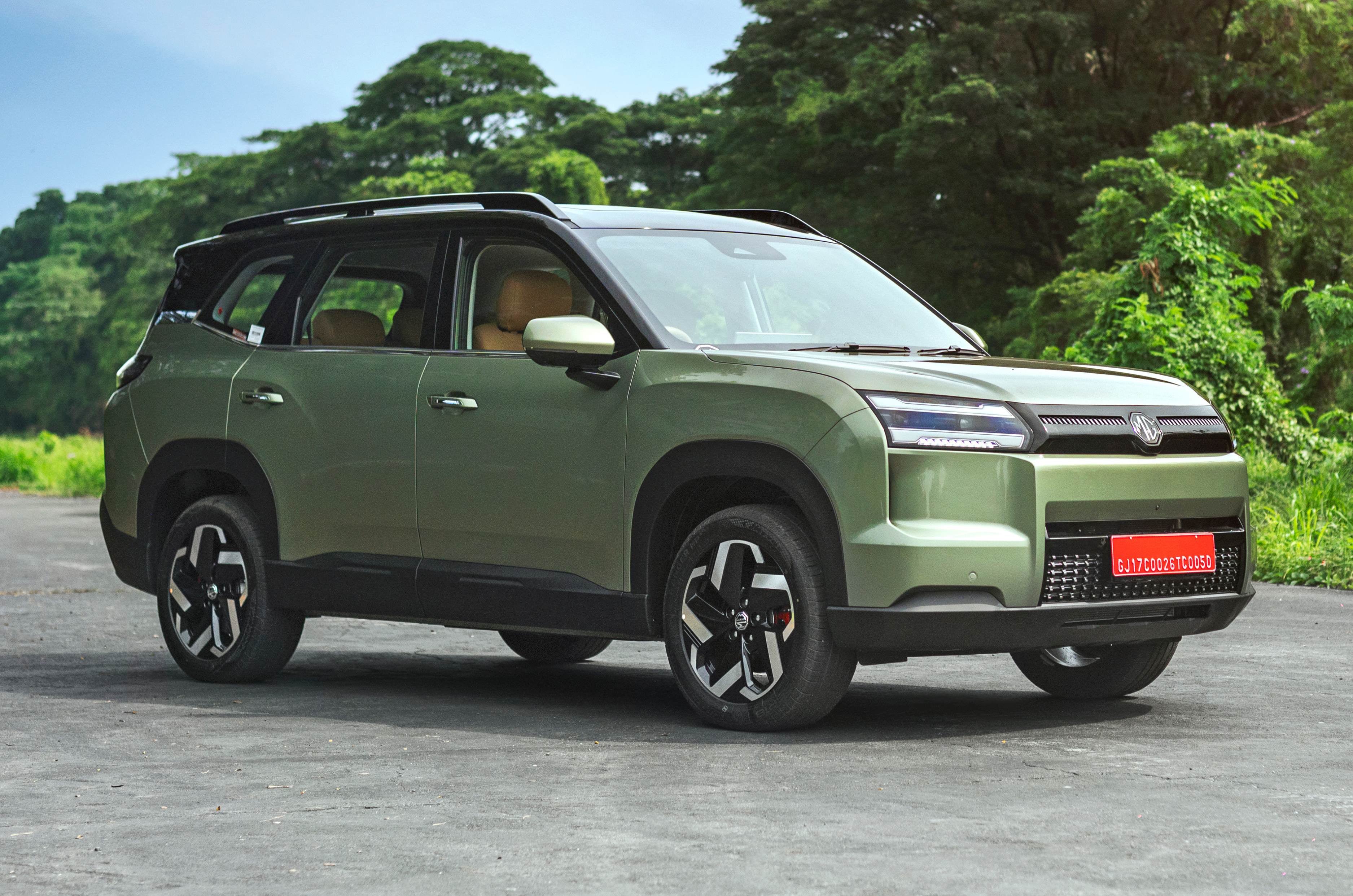
Remaining in eighth place, MG experienced relatively moderate levels of MoM and YoY sales growth in September 2026. However, MG’s market share slid from 1.76 percent in September 2025 to 1.52 percent last month. MG launched the Hector Tomahawk EV and PHEV in August, and doesn’t have any new launches lined up for October. That said, deliveries of the Tomahawk PHEV are slated to start from November.
9. Honda
5,283 units sold, up 42.51 percent YoY
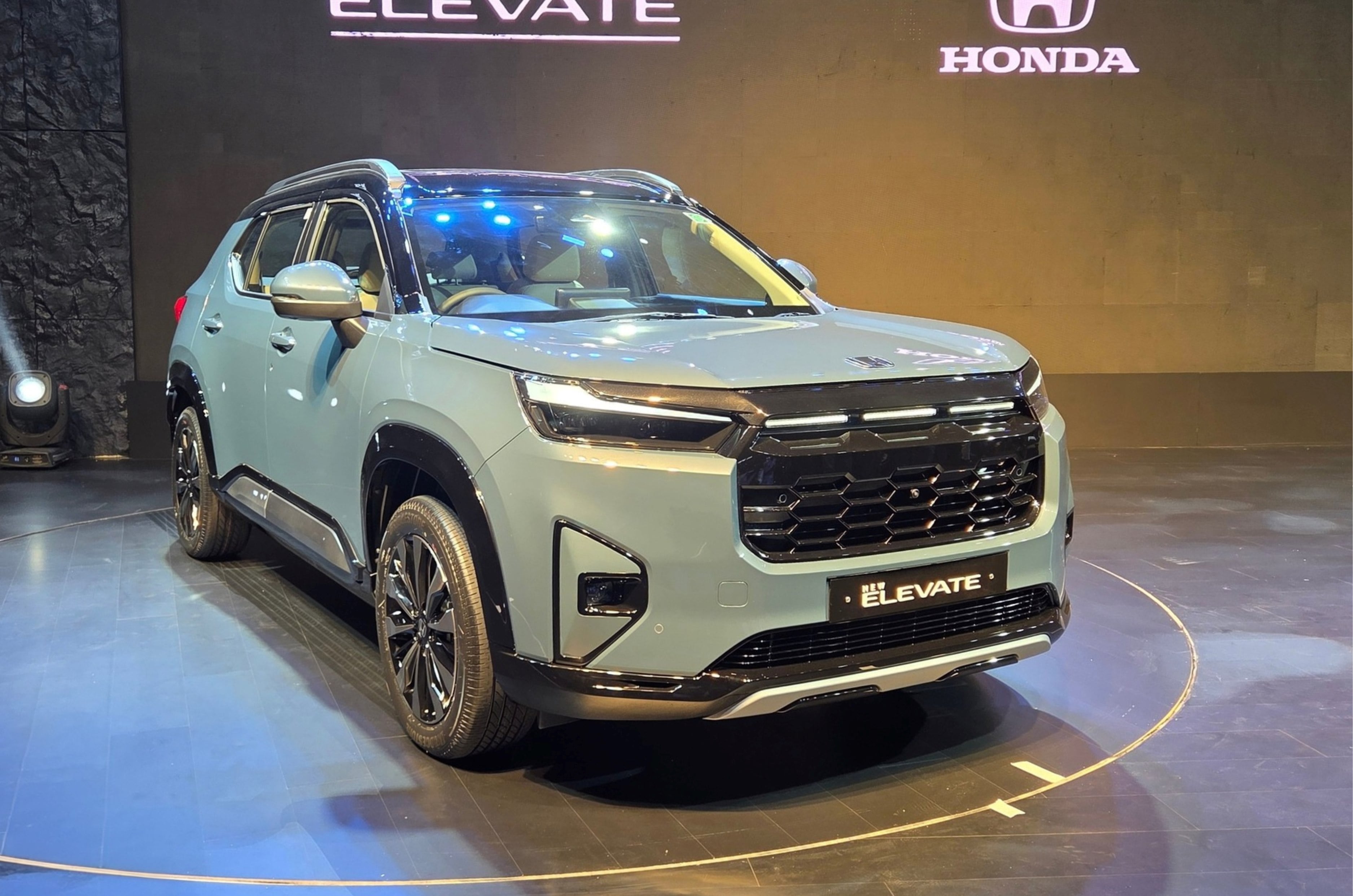
In the penultimate position comes Honda, which saw a mild 6.34 percent MoM increase in sales, but a whopping 42.51 YoY surge. The Japanese carmaker’s market share also grew from 1.15 percent in September 2025 to 1.24 percent in September 2026. Honda is fresh off the launch of the Elevate facelift, and is also expected to bring the Prelude coupe to India in the months to come.
10. Renault
3,410 units sold, up 33.10 percent YoY
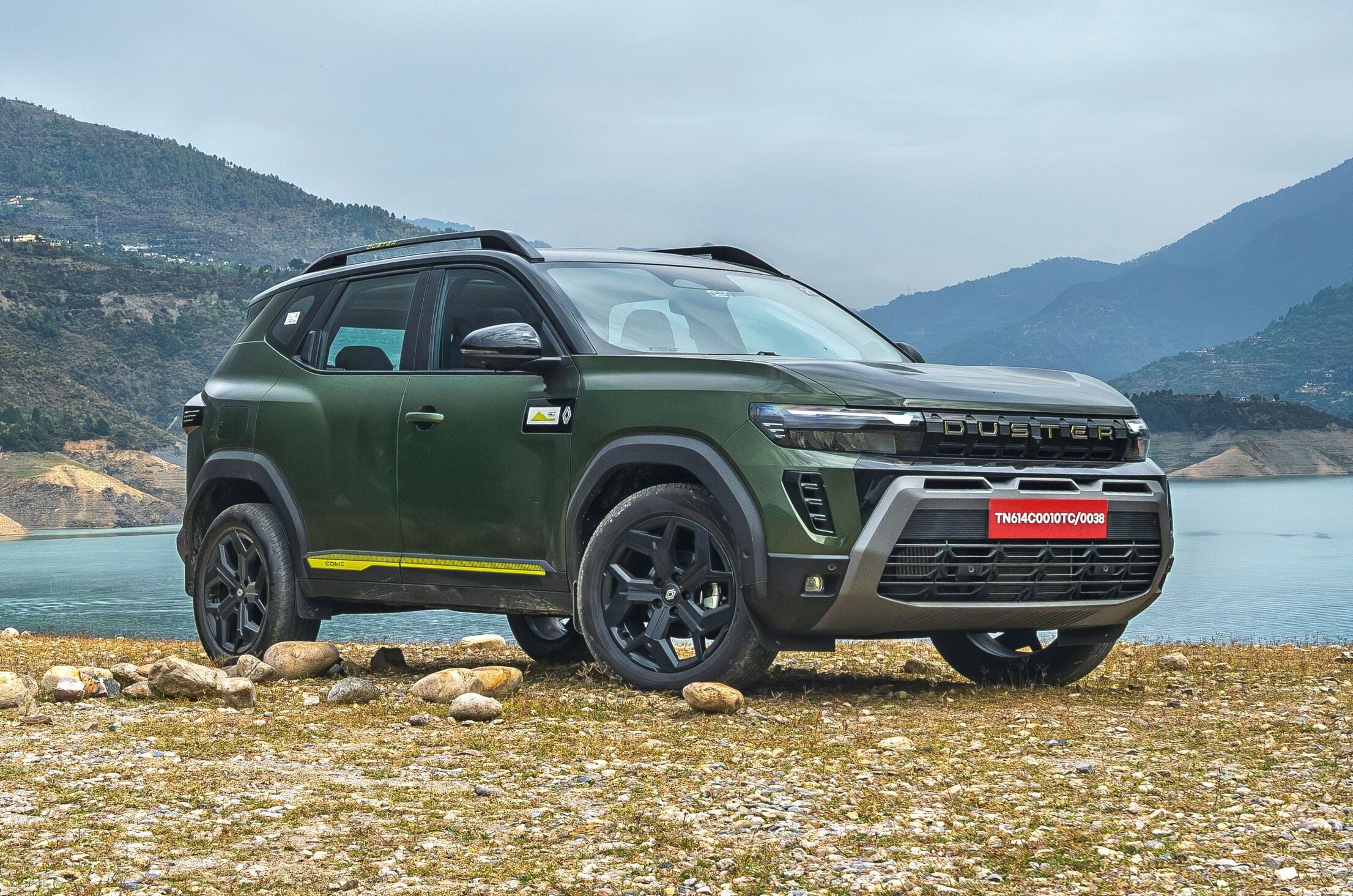
Rounding out the top 10 is Renault, which recorded the mildest MoM sales increase (4.12 percent) last month. However, its 33.1-percent YoY growth is quite impressive, and can largely be credited to the new Duster, which went on sale in March 2026. Renault’s market share also saw a very slight increase – from 0.79 percent in September 2025 to 0.8 percent in September 2026. Coming to new launches, Renault announced prices for the Triber turbo in late September, and will launch the Duster hybrid in October.
Petrol cars regain sales majority over alternative fuels, albeit slightly
Sep 2026 share (%)
Aug 2026 share (%)
Sep 2025 share (%)
Petrol/ethanol
41.27
40.85
47.18
Diesel
17.74
17.21
17.76
CNG/LPG
23.11
25.28
22.02
Hybrid
9.44
9.04
7.30
EV
8.45
7.63
5.74
A big talking point in FADA’s August 2026 sales data was alternative-fuel cars (CNG, hybrid, electric) collectively outselling petrol cars for the first time. However, the trend did not continue in September 2026, as the share of petrol cars climbed to 41.27 percent, while alternative-fuel cars stood at a combined 41 percent.
Shares for hybrids and EVs experienced MoM increases in September, but CNG cars saw a downturn on that front. Be that as it may, the difference between petrol and alternative-fuel cars is still very slight, and the buyer shares for the latter are still higher when compared to September 2025’s numbers.
October 2026 will tell the real story for Indian PV market, says FADA
Keeping in mind that September 2026’s YoY growth was driven by a favourable base effect, FADA president Sai Giridhar remarked, “One year on from GST 2.0, affordability remains the single engine of this cycle — and dealers now flag further price increases eroding that very affordability as their foremost risk for the quarter ahead. Protecting the GST gain is, to our mind, the key to converting the festive season into durable growth.”
Over 4,66,800 cars were sold in October 2025 thanks to GST 2.0 and festive demand, making it the best-ever October for the Indian PV market. With several price increases implemented by major carmakers since the introduction of GST 2.0, October 2026 is now shaping up to be the real test of the Indian PV market. It will also be the first month after the one-year anniversary of GST 2.0, thereby providing a clean slate to compare like-for-like YoY growth numbers.
According to FADA, 75.57 percent of dealers expect growth, 19.46 percent anticipate a flat market, and 4.98 percent are bracing for a downturn in sales during October 2026. The overall outlook among dealers is ‘Cautiously Optimistic’.
Retail sales of electric passenger vehicles reached a new monthly high of 35,995 units in September 2026, up 94 percent from the same month last year and marking the fourth consecutive month with sales above 30,000 units. Tata Motors retained the top spot with 14,769 units and a 41 percent market share, while Kia moved ahead of Maruti Suzuki to take fifth place. H1 FY2027 EV sales now stand at 1,90,946 units, up 88 percent year on year, putting the industry within 29,971 units of the full-year FY2026 tally.
September 2026 EV sales
Rank
OEM
Sep 2026
Sep 2025
YoY change
Market share
1
Tata Motors
14,769
7,353
101%
41.03%
2
Mahindra & Mahindra
7,779
3,972
96%
21.61%
3
JSW MG Motor India
5,242
4,800
9%
14.56%
4
Vinfast India
2,963
6
49,283%
8.23%
5
Kia India
1,263
598
111%
3.50%
6
Maruti Suzuki India
1,103
–
–
3.06%
7
BYD India
836
732
14%
2.32%
8
Hyundai Motor India
792
404
96%
2.20%
9
BMW India
502
369
36%
1.39%
10
Tesla
291
69
322%
0.80%
11
Toyota Kirloskar Motor
218
–
–
0.60%
12
Mercedes-Benz India
125
137
-9%
0.34%
13
Stellantis India
55
47
17%
0.15%
14
Volvo India
45
24
88%
0.12%
15
Porsche India
11
8
38%
0.03%
16
JLR India
1
0
–
0.00%
17
Audi India
0
0
–
0.00%
18
Lotus
0
0
–
0.00%
19
Rolls-Royce
0
1
-100%
0.00%
Total
35,995
18,520
94%
100%
Tata Motors
14,769 units, up 101 percent YoY
Tata Motors sold 14,769 electric passenger vehicles in September, up 101 percent from 7,353 units in the same month last year. This was the company’s highest monthly EV sales yet, surpassing the previous record of 14,388 units in July. September was also its fourth consecutive month with sales above 12,000 units.
Tata’s EV market share stood at 41.03 percent, up from 39.70 percent in September 2025. The Nexon EV remains its biggest volume driver, while the updated Tiago EV and Punch EV have also contributed to sales. During the month, Tata also extended its Battery-as-a-Service (BaaS) offering to the Nexon EV, Curvv EV, Sierra EV and Harrier EV.
Mahindra
7,779 units, up 96 percent YoY
Mahindra sold 7,779 EVs in September, up 96 percent from 3,972 units a year ago. The company retained second place in the electric PV market, although its sales remained below the monthly record of 8,131 units set in July. Mahindra’s EV market share increased to 21.61 percent from 21.44 percent in September 2025. The BE 6 and XEV 9e continue to make up its main EV offering, while the XEV 9S adds a three-row model to the line-up. Mahindra also recently extended its Battery-as-a-Service (BaaS) ownership programme to the XEV 9S and the XEV 9e.
JSW MG Motor
5,242 units, up 9 percent YoY
JSW MG Motor recorded 5,242 EV sales in September, up 9 percent from 4,800 units a year earlier and 6 percent from August. The company retained third place, although its market share fell to 14.56 percent from 25.91 percent in September 2025.
June remains MG’s best month so far, with 6,220 units. The Windsor EV continues to be its highest-selling model, while the recently launched Hector Tomahawk EV adds another model to its electric line-up. MG also has introduced a battery-as-a-service (BaaS) scheme for the Cyberster and M9 EVs.
Vinfast
2,963 units, up 49,283 percent YoY
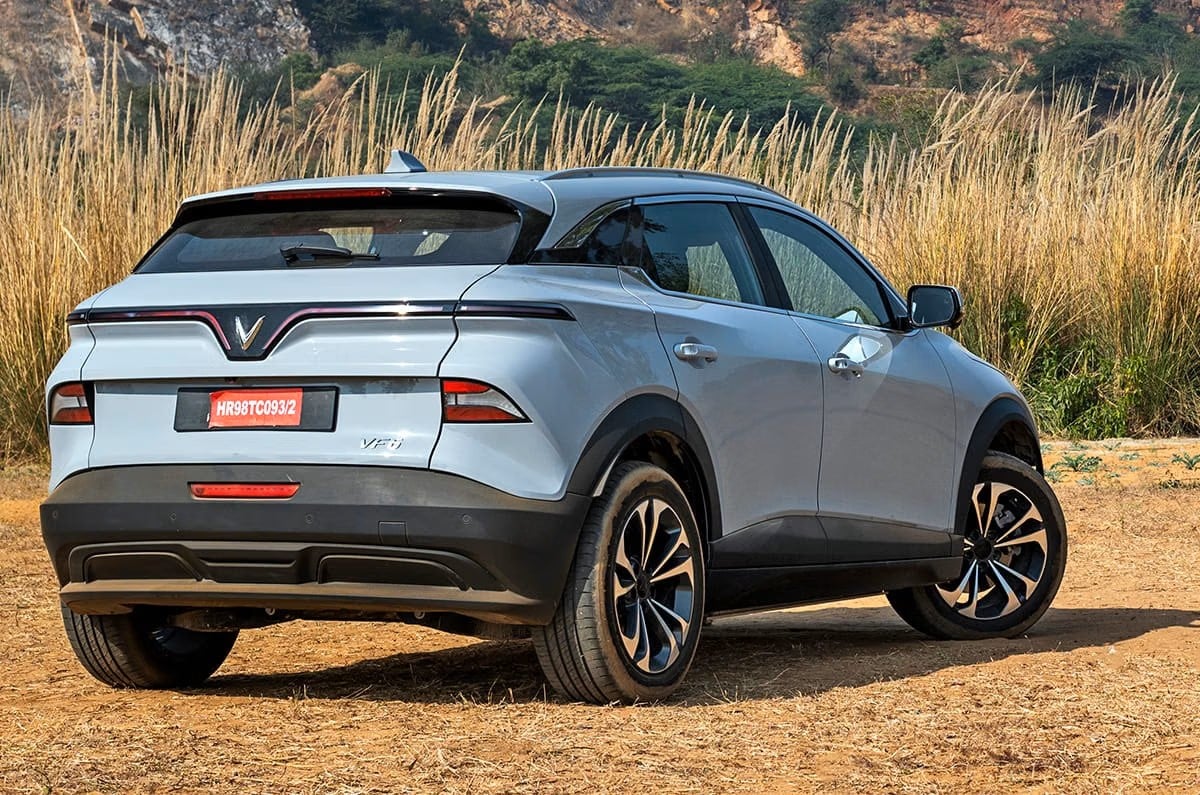
Vinfast retained fourth place with 2,963 EVs sold in September, its highest monthly sales since entering India’s electric passenger vehicle market. Sales were up 32 percent from August, giving the company an 8.23 percent market share.
Vinfast currently has three models in its passenger vehicle portfolio: the VF6 and VF7 SUVs, and the VF MPV 7. Its cumulative H1 FY2027 sales stand at 10,826 units.
Kia
1,263 units, up 111 percent YoY
Kia moved ahead of Maruti Suzuki to take fifth place in September after recording 1,263 EV sales, up 111 percent from 598 units in September 2025. Sales also increased 48 percent from August’s 851 units. Kia’s EV market share increased to 3.50 percent, compared with 3.22 percent a year earlier. The increase follows the launch of the Syros EV in August. Kia also sells the Carens Clavis EV in India, while the EV6 and EV9 are sold as fully imported models.
Maruti Suzuki
1,103 units
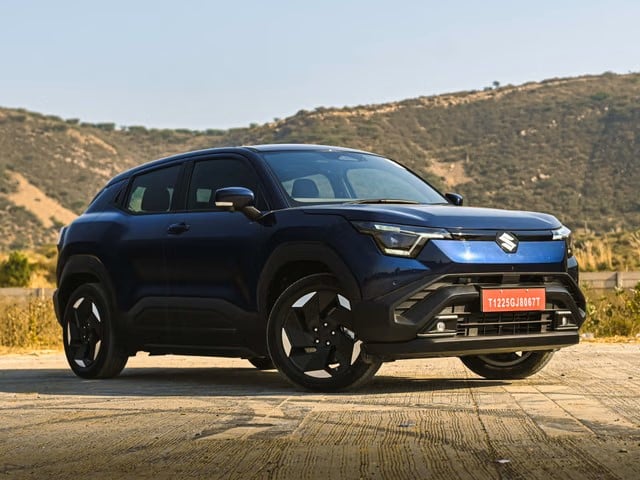
Maruti Suzuki slipped to sixth place, with 1,103 e Vitara units sold in September. Sales declined 25 percent from August’s 1,472 units, although September marked the company’s sixth consecutive month with four-digit EV sales. The e Vitara has so far seen limited domestic availability as a larger share of production was allocated for exports. Maruti is expected to increase domestic production with the start of operations at its new manufacturing line at the Hansalpur plant in Gujarat.
BYD
836 units, up 14 percent YoY
BYD sold 836 EVs in September, up 14 percent from 732 units in the same month last year. Its market share stood at 2.32 percent, down from 3.95 percent a year earlier. June remains BYD India’s highest-selling month so far, with 938 units. Its current line-up includes the Atto 3, eMax 7, Seal and Sealion 7, while the company has confirmed plans to launch the Seal U later this year.
Hyundai
792 units, up 96 percent YoY
Hyundai sold 792 EVs in September, up 96 percent from 404 units a year ago. This was its second-highest monthly sales tally in FY2027, after 840 units in August. The company sold a total of 3,650 EVs in H1 FY2027, down 8 percent from the 3,951 units sold in H1 FY2026. Hyundai currently has the Creta Electric and Ioniq 5 in its EV line-up.
Toyota
218 units
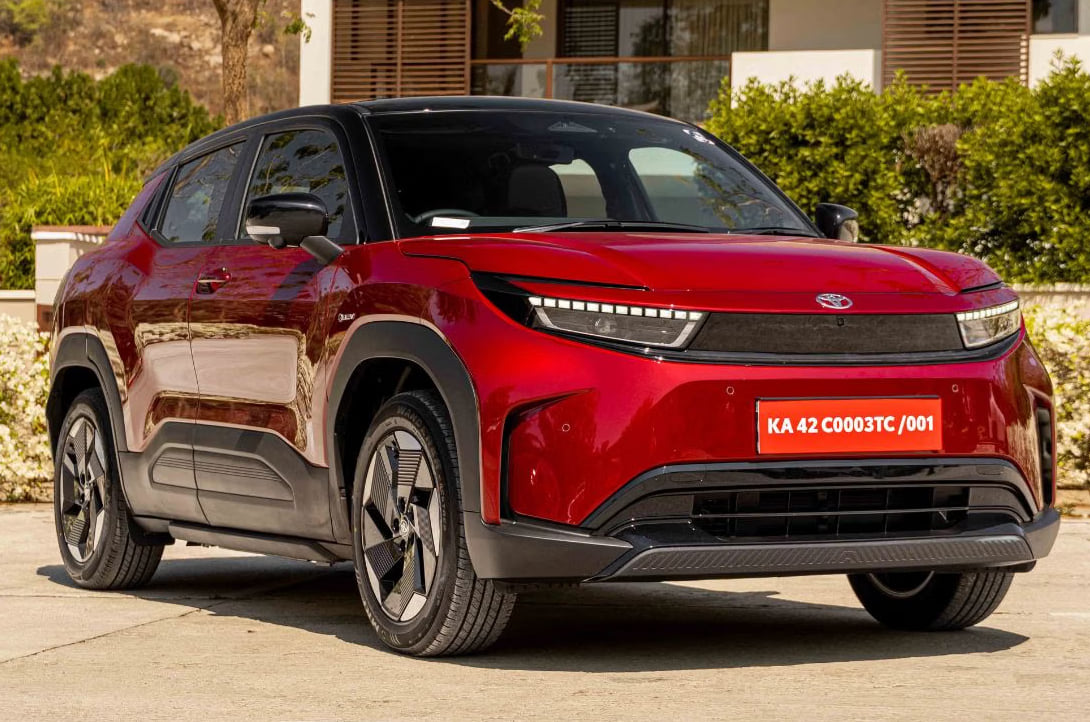
Toyota recorded 218 units of the Urban Cruiser Ebella in September, its highest monthly sales of the electric SUV since launch. Sales were up 30 percent from the 168 units sold in August. The Ebella is Toyota’s version of the Maruti e Vitara and is positioned against models including the Mahindra BE 6, Vinfast VF6, MG ZS EV, Hyundai Creta Electric and Tata Nexon EV.
Luxury EV sales hit new high
Luxury electric passenger vehicle sales also reached a new monthly high of 975 units in September, up 60 percent from 608 units a year earlier. This surpassed the previous record of 853 units set in June. Luxury EVs accounted for 2.70 percent of total electric passenger vehicle sales in September.
BMW
502 units, up 36 percent YoY
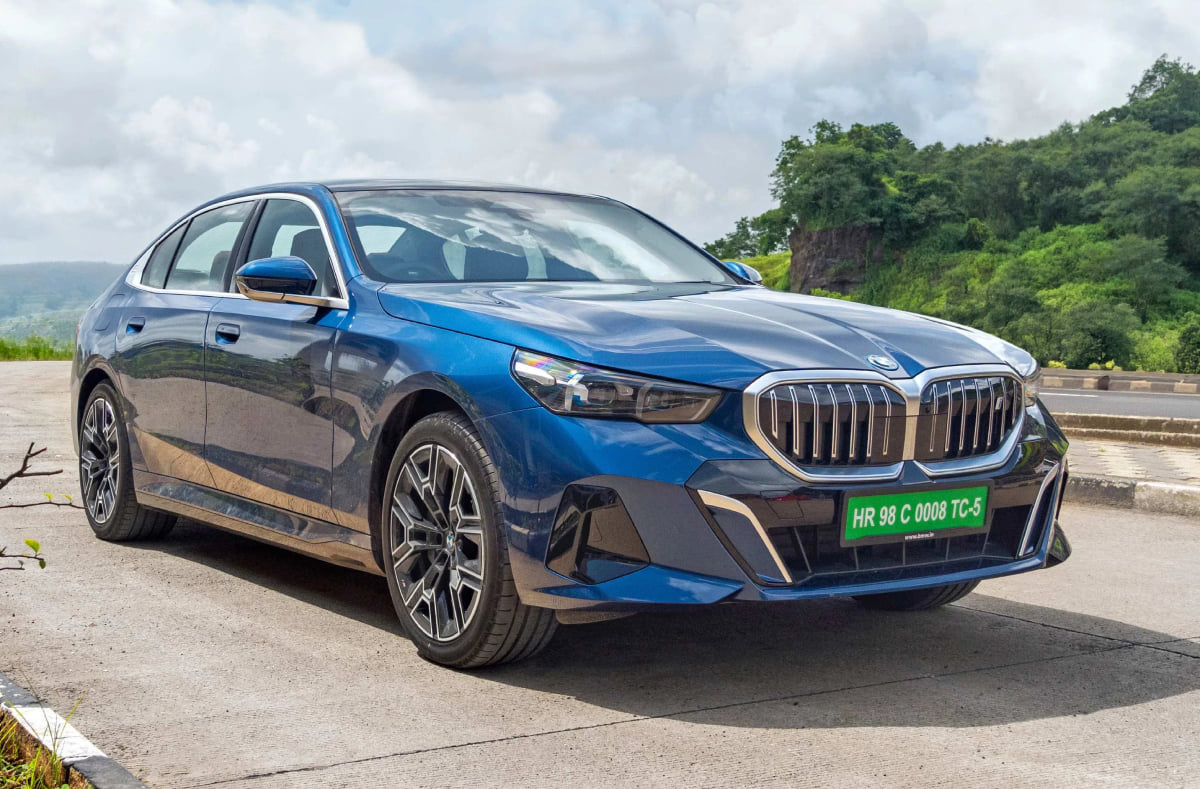
BMW remained the largest luxury EV seller in September with 502 units, up 36 percent from 369 units a year earlier. Its market share stood at 51.48 percent, down from 60.69 percent in September 2025. BMW recently expanded its electric line-up with the i5 Long Wheelbase, which was launched in India in September at Rs 79.6 lakh. It is the company’s first locally produced electric sedan in India. BMW has also recently updated the i7 range, with 50 xDrive M Sport trim and the top-spec M70 xDrive.
Tesla
291 units, up 322 percent YoY
Tesla recorded 291 units in September, its highest monthly sales in India, up 322 percent from 69 units a year earlier. The increase moved Tesla ahead of Mercedes-Benz and into second place in the luxury EV segment for the first time. Its segment share rose to 29.84 percent from 11.34 percent in September 2025.
Mercedes-Benz
125 units, down 9 percent YoY
Mercedes-Benz sold 125 EVs in September, down 9 percent from 137 units in the same month last year. Its share of the luxury EV segment fell to 12.82 percent, from 22.53 percent a year earlier. The company’s highest monthly EV sales this year came in June, when it recorded 245 units.
Volvo
45 units, up 88 percent YoY
Volvo recorded 45 EV sales in September, up 88 percent from 24 units a year earlier. Its market share increased to 4.61 percent, from 3.94 percent in September 2025.
Porsche
11 units, up 38 percent YoY
Porsche sold 11 EVs in September, up 38 percent from eight units in September 2025. It accounted for 1.12 percent of luxury EV sales during the month.
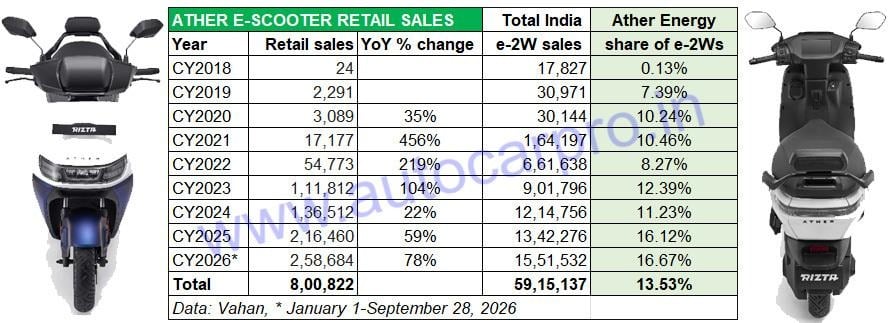
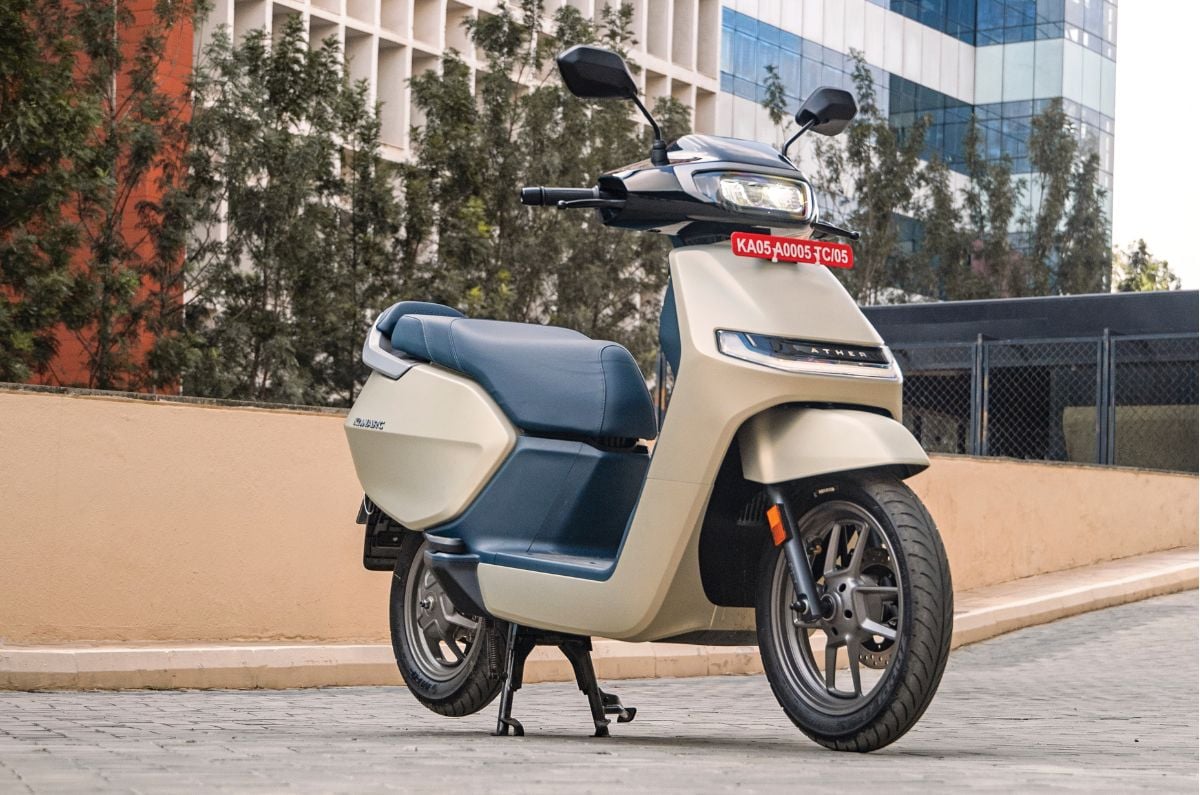
Ather has become the fourth Indian electric two-wheeler manufacturer to attain cumulative retail sales (customer deliveries) of over 8 lakh units. As per the data available on the Vahan portal, the Bengaluru-based company crossed the milestone on September 28, 2026.
Ather has delivered 4.75 lakh scooters since January 2025
217 units of the Konarc sold in its first month
Rizta currently leads Ather’s sales, but Konarc is expected to eat into it
Ather is the fourth Indian e2W maker to cross 8 lakh units in sales
59 percent of its sales came since 2025
Other EV manufacturers to sell over 8 lakh scooters are Ola, TVS and Bajaj via Chetak. While Ola crossed 10 lakh sales in March this year, TVS raced past Ola in August to become India’s second EV manufacturer to sell 10 lakh scooters. Bajaj crossed the 8 lakh sales milestone in June. Except Ola, the other three manufacturers mentioned above have maintained a steady pace of growth so far.
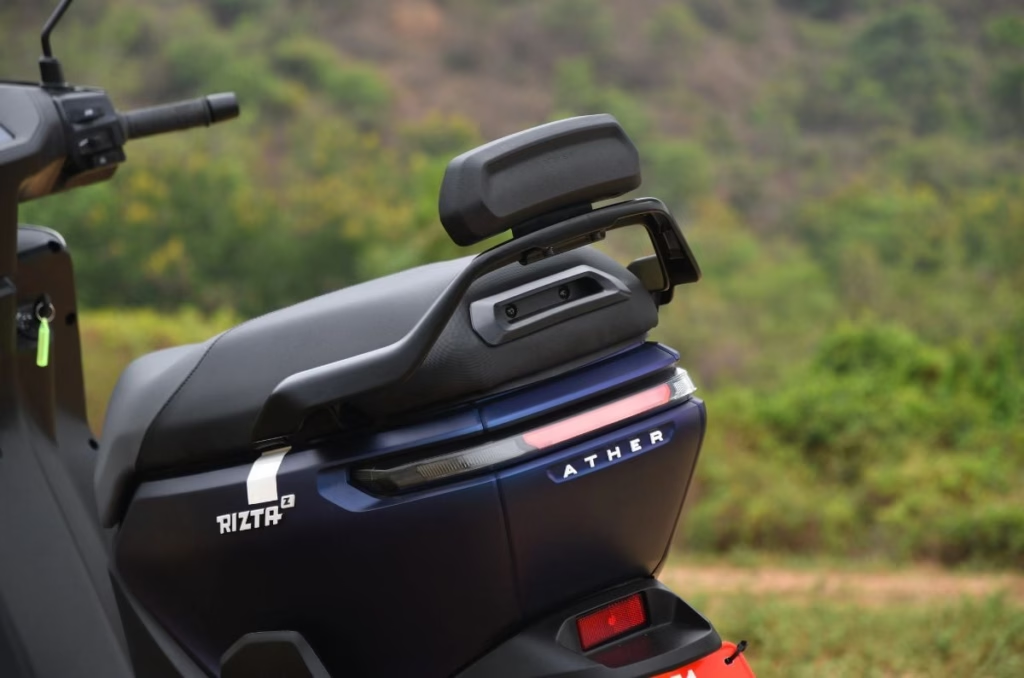
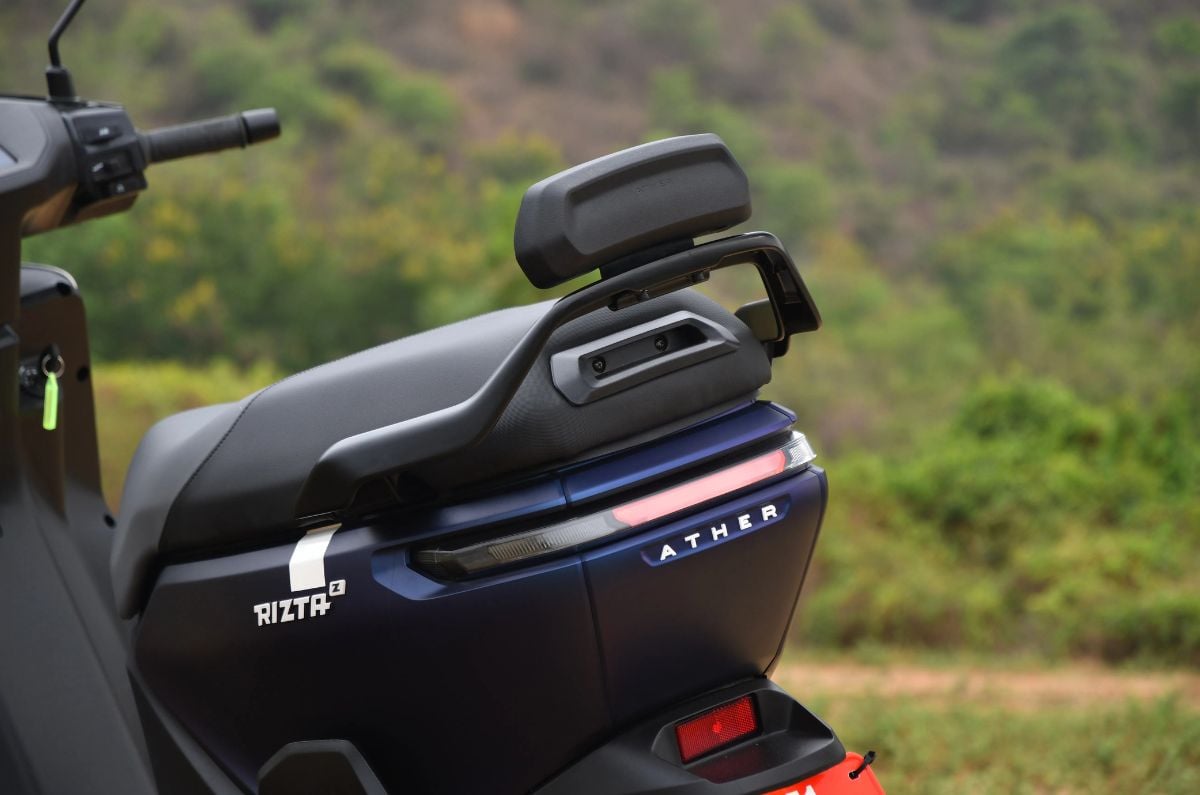
As the retail statistics reveal, Ather’s growth has taken off in the past four years, with sales accelerating since 2025. Between January 2025 and September 28, 2026, Ather delivered 4.75 lakh scooters, which means that 59 percent of the brand’s total sales have come in the past 21 months, led by its flagship, the Rizta family e-scooter. The company launched Konarc on August 29.
In 2023, when Ather’s retail sales crossed the 1 lakh mark, its market share jumped to 12 percent. In 2024, it clocked 1.36 lakh units and an 11 percent market share. Ather achieved its highest-ever monthly sales in March this year with 36,633 units. It also crossed the 30,000-unit sales mark four times in the past year (since October 2025).
In August, Ather dispatched 29,694 e-scooters to its dealers across India. This marked the third-highest monthly wholesales for the company after June and July, respectively. While the Rizta accounted for 76 percent of those sales and the 450 series 23 percent, the new Konarc sold 217 units in its first month.
The Konarc strategically targets the mainstream mass-market scooters like the TVS iQube, Orbiter, Bajaj Chetak, Hero Vida VX2, Simple Wave and the new Ola S1 Z. It will likely take some sales away from the Rizta. However, Ather appears to be fine with that since the Konarc gives it a higher margin than the Rizta, as per chief business officer Ravneet Phokela. Rather than competing with existing e-scooters, Ather will try to convince more ICE scooter owners to buy the Konarc instead, Phokela had added. With its momentum, Ather could end the year with total sales of 3.5 lakh units.
Bengaluru-based EV maker Ather expects its newly launched Konarc electric scooter to drive more than half of its sales over the next two years. The company is positioning Konarc as a key product in its attempt to take electric scooters mainstream, with the focus less on taking customers from rival EV makers and more on converting buyers who would otherwise remain with internal-combustion engine scooters.
Konarc has five variants, four of which are priced close to the Rizta
Manufacturing and availability set to ramp up after the festive season this year
Konarc is expected to make (Ather) EVs mainstream
Konarc has higher profit margins than Rizta despite a lower price
“The role of Konarc is to take EVs mainstream, which, by definition, means that we’re looking at weaning people away from ICE,” said Ather’s chief business officer Ravneet Phokela. “This is not about getting market share from somebody else. It’s really about getting share from the ICE world.” For these customers, he added, Ather first needs to address fundamental considerations around comfort, safety and battery life before features and technology become the differentiators.
Despite a lower starting price of Rs 99,999, the Konarc also has better margins than the Rizta, according to Phokela. It is currently available in five variants (three S and two Z), with four positioned around price points similar to the Rizta’s. Ather has moved from an aluminium chassis for the 450/Rizta to a tubular steel chassis on the Konarc and from a two-stage belt transmission to a gearbox. The charger and motor controller have also been combined into a single unit.
The EL platform has allowed Ather to incorporate learnings from the 450 platform that couldn’t be introduced into that architecture. Phokela described the 450 platform as appropriate for the performance-oriented 450 but “overkill” for the family-focused Rizta, which had to use the existing architecture to meet its development timeline. The EL platform, in contrast, was conceived from the outset as a simpler architecture with a fundamentally lower cost structure.
Konarc is currently being supplied only in parts of North India, with Ather yet to open bookings across central and southern markets. Ather expects this constraint to ease after its new manufacturing facility is commissioned in December, although Phokela said it would take a few months thereafter to ramp up production. More markets are expected to be added progressively as supplies improve. The supply situation has also led Ather to pause showroom expansions for now. It currently has around 750 outlets, with expansion expected to gather pace again after the festive period. Over the next 18-24 months, Phokela sees around 2,000 stores as a target while maintaining that expansion will be calibrated to ensure dealers remain viable and profitable.
With inputs from Mukul Yudhveer Singh and Stephen Raj Antony
In what’s set to be the largest and most ambitious product offensive in its 99-year history, Volvo announced that it’ll launch 13 new cars by the end of 2030. The line-up will consist of 7 models for Western markets and 6 models for China, spread across pure-electric (EV) and hybrid powertrains. Volvo is also aiming to make a few design changes while reducing the over-reliance on touchscreens, with Head of Design Thomas Ingenlath saying, “we have to aim for a better harmony, a better balance between the interactions we have with our digital device and the physical interaction.”
New models to include sedans and estates.
China-only cars will share platforms, tech and supply chain with Geely.
Western-market models will use existing SPA2 and SPA3 platforms.
Volvo also plans to rework the on-board user interface.
New Volvo models to include sedans and estates
Chinese models will be co-developed with Geely; US market to get a new electric SUV
Volvo’s new 13-car product offensive was revealed at the brand’s ‘Strategy Update’ event in Stockholm, where it was announced that there will be separate models to suit different market requirements. Cars bound for Western markets such as the EU, UK and US will be based on the existing SPA2 and SPA3 platforms, running the HuginCore computing architecture.
Volvo will be introducing new sedans and estates to its European portfolio, while a new full-size electric SUV is planned for the American market. The Swedish brand also said that it will be collaborating with parent company Geely for its China-specific models. The exercise will see the two automakers sharing platforms, a dedicated tech stack and a shared parts and supply-chain ecosystem.
Reworking design cues and the user interface
Upcoming models to integrate updated design elements and a more user-friendly interface
Coinciding with the Swedish brand’s 100th anniversary in 2027, Volvo is expected to introduce a new design language through a concept. While no details have been put forth, Ingenlath stated that the brand’s signature ‘Ironmark’ badge and diagonal grille slash will see a reiteration. Meanwhile, drawing parallels with Leica cameras, Ingenlath said that the aim is to strike a better balance between touchscreens and physical switchgear.
“The touchscreen is about flexibility and displaying what you don’t need to display all the time. So, use the touchscreen for what it’s good for and reintroduce a couple more buttons than what’s offered in today’s cars,” highlighted Ingenlath. “A function shouldn’t live permanently on a screen just because it can,” he continued. However, the design chief was quick to note that this approach could vary based on market preferences. Since digital interactions are more popular in China compared to most other markets, the models that will be sold there could sport a screen-heavy design.
Volvo’s regionalised approach to boost profitability
The brand aims to take advantage of increasing regionalisation to better match customer preferences
Volvo hasn’t disclosed model-wise details based on their target markets yet. However, it said that the plan is to double the brand’s market share in the pure-electric (BEV) segment while also offering the new third-generation hybrid powertrains for buyers who are reluctant to go fully electric. “Our showrooms will look very different in 2030. This is our strongest product pipeline ever, tailored to regional needs, and emphasises our ambition to be the leading premium car brand,” Volvo President and CEO Hakan Samuelsson said.
By developing regionally specific models through its ‘Strategy Update’ initiative, Volvo aims to tackle technology restrictions and trade tariffs alongside changing customer preferences. “The challenges for the car industry are immense, but our strategy gives a clear answer to how we adapt to these and our ambition is to be the leading premium car brand,” Samuelsson said.
Volvo expects to increase the commonality in parts shared with Geely to reach 30 percent, while the savings on material costs (apart from additional indirect savings) to hit 5 percent by 2030. Utilisation of existing SPA or shared hybrid platforms means lower investment per car when compared to the previous ‘first-car-on-platform’ launches such as the EX60. The company said that it will also be working on internal efficiency improvements to curb corporate overheads and increase productivity across the value chain. Combined, Volvo aims to push operating profit margins to go beyond 8 percent.
Long-standing scooter market leader Honda, who was outsold by TVS for the first time in July 2026, has bounced back into the lead in August. Honda dispatched 2.85 lakh units to showrooms across the country, posting 6 percent sales growth compared to August 2025. However, Honda’s market share has gone down by 6 percent compared to last year. The top 10 scooter manufacturers delivered a record 8.55 lakh units to their showrooms in August 2026, up by 24 percent compared to August 2025. This beats the previous best in October 2025 (8.24 lakh units), the only other time monthly scooter sales crossed 8 lakh.
One in every five TVS scooter sold is an e-scooter
River dispatched the highest number Indies so far in August 2026
Honda sold its highest number of e-scooters so far in August 2026
2026 cumulative sales so far have increased by 31 percent compared to 2025
Honda, TVS, Suzuki and Hero lead the charge
Month
CY2026
CY2025
Percentage change
January
7,50,580
5,48,201
37%
February
7,29,774
5,12,783
42%
March
7,61,422
5,86,485
30%
April
6,91,993
5,48,370
26%
May
7,39,669
5,80,696
27%
June
7,44,823
5,35,307
39%
July
7,98,190
6,45,022
24%
August
8,55,715
6,91,430
24%
Total
60,72,166
46,48,294
31%
Data: Society of Indian Automobile Manufacturers (SIAM)
That’s not the only news from August. At 60.7 lakh units, cumulative scooter sales for the first eight months of 2026 have registered a handsome 31 percent YoY growth (January-August 2025: 46.4 lakh units). TVS dispatched 2.56 lakh scooters last month, up by 24 percent compared to August 2025. This gives the Hosur-based manufacturer a 30 percent market share, unchanged from last year. TVS’ monthly sales continue to benefit from its two EVs – iQube and Orbiter – which added 57,523 units, up by 135 percent from last year.
Ranked third is Suzuki with 1.01 lakh scooters, up by 11 percent, and a 12 percent market share; the Access 125 remains its best-selling product. Suzuki sold 668 units of the eAccess in August 2026, its only EV at the moment.
Hero dispatched 72,150 scooters last month, up 49 percent from last year, giving it an 8 percent market share, up by one percent compared to August 2025. Like TVS, Hero is also benefiting from the sustained demand for its Vida EVs, which sold 25,558 units, up by 108 percent.
Bajaj, which produces the electric Chetak and Yulu models, sold 53,748 e-2Ws in August, up 279 percent YoY; the high growth is due to the company’s production and sales finally recovering from the supply chain issues it faced last year.
Yamaha registered 23 percent growth for a 4 percent market share. It was the last Japanese manufacturer to start selling EVs and dispatched 475 EC-06 e-scooter last month.
Manufacturer
Domestic market sales (in units)
Market share percentage
August 2026
August 2025
Percentage change
August 2026
August 2025
Honda
2,85,527
2,69,923
6%
33.36%
39.02%
TVS
2,56,442
2,06,598
24%
29.96%
29.87%
Suzuki
1,01,267
91,065
11%
11.83%
13.17%
Hero
72,150
48,304
49%
8.43%
6.98%
Bajaj
53,748
14,164
279%
6.28%
2.04%
Yamaha
34,279
27,944
23%
4.00%
4.04%
Ather
29,694
22,757
30%
3.47%
3.29%
Greaves Electric Mobility (GEM)
12,439
5,804
114%
1.45%
0.83%
River
6,567
2,229
195%
0.76%
0.32%
Piaggio (Aprilia and Vespa)
3,602
2,602
38%
0.42%
0.37%
Okinawa
0
40
-100%
0.00%
0.01%
Total
8,55,715
6,91,430
24%
100%
100%
Data: Society of Indian Automobile Manufacturers (SIAM)
Ather, which launched its mass-market family scooter Konarc on August 29, sold 29,694 units of the Rizta and 450 models in August, up 30 percent YoY, for a 3 percent overall scooter market share.
Greaves Electric Mobility – manufacturer of Ampere Electric scooters – is the newest SIAM member. The company has reported dispatches of 12,439 units last month, up 114 percent from August 2025. River, which currently only sells the Indie, dispatched a record 6,567 units in August, up 195 percent from last year and by 9 percent compared to July 2026. Piaggio, which markets the Aprilia and Vespa brands, wraps up the Top 10 scooter manufacturers list with wholesales of 3,602 units, up 38 percent compared to August 2025.
The stellar performance of the scooter segment last month ensured that overall 2W sales hit a new high for the month of August with 20 lakh units. With the festive season ahead, we can expect to see further increases in sales by the end of the year.