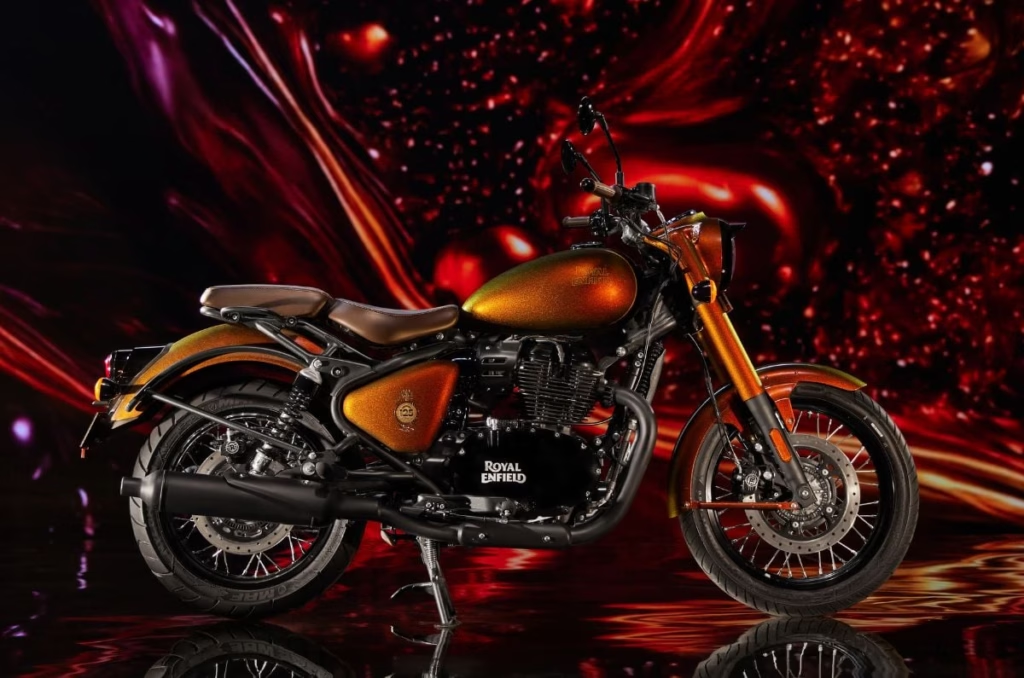
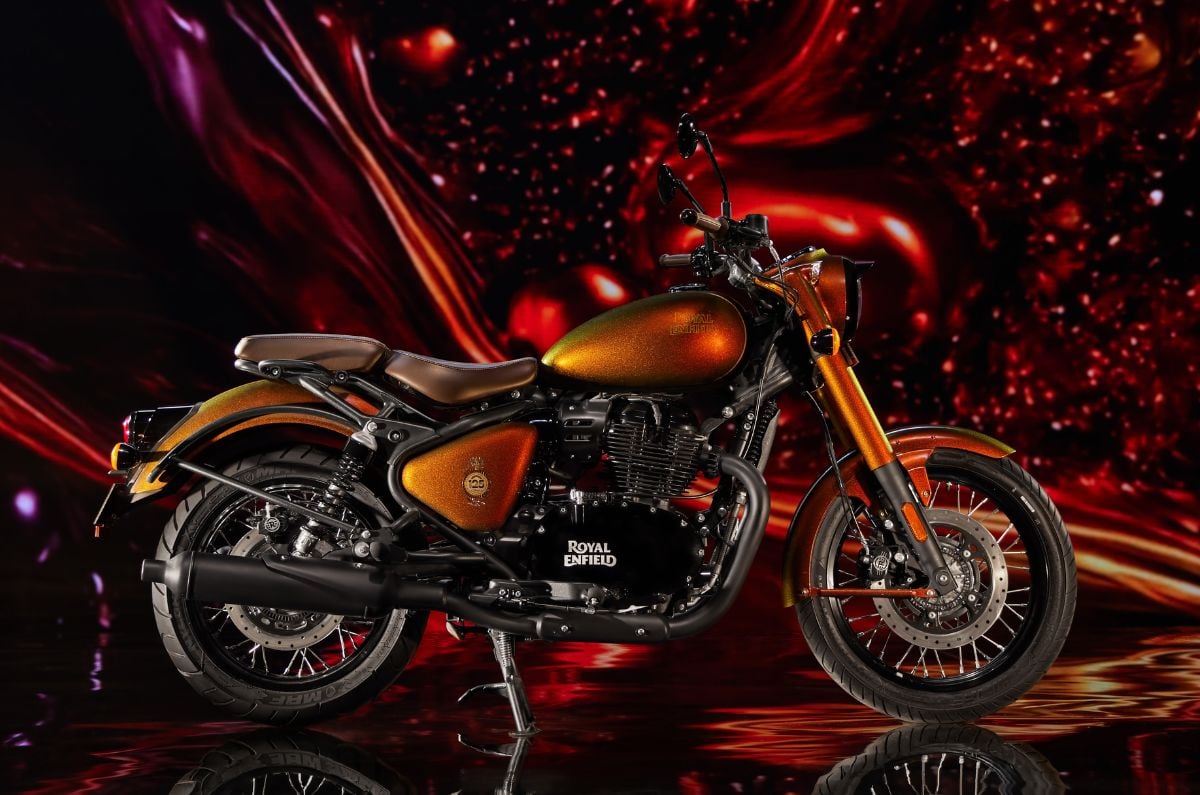
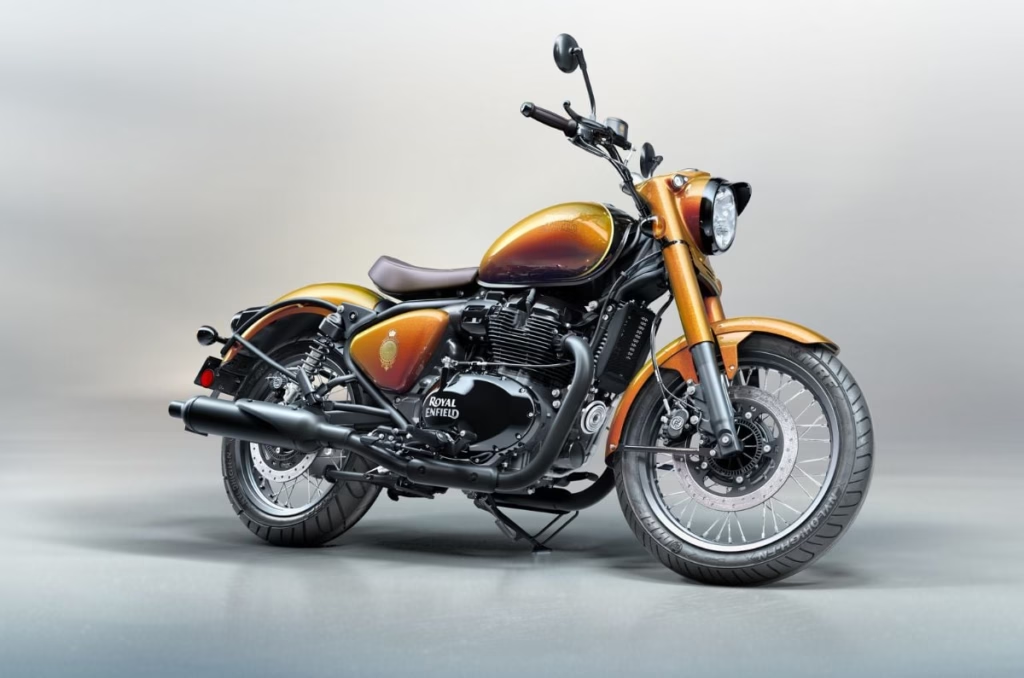
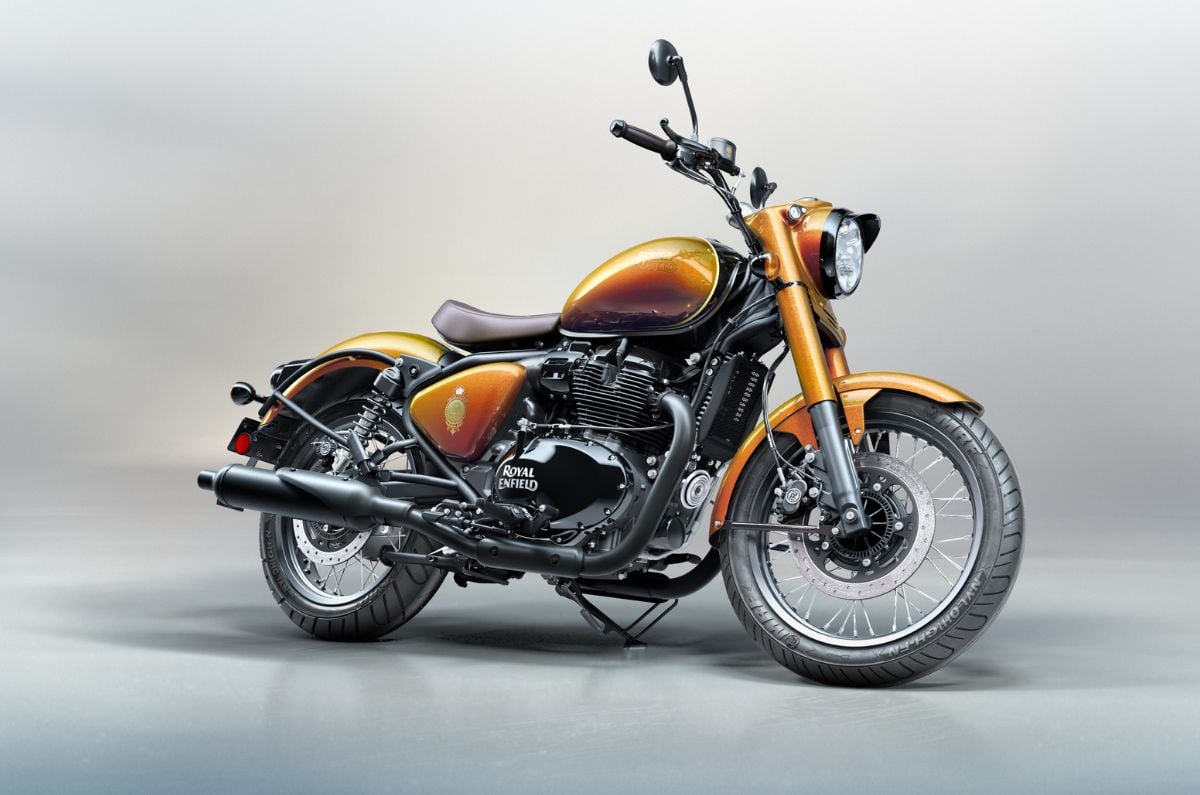
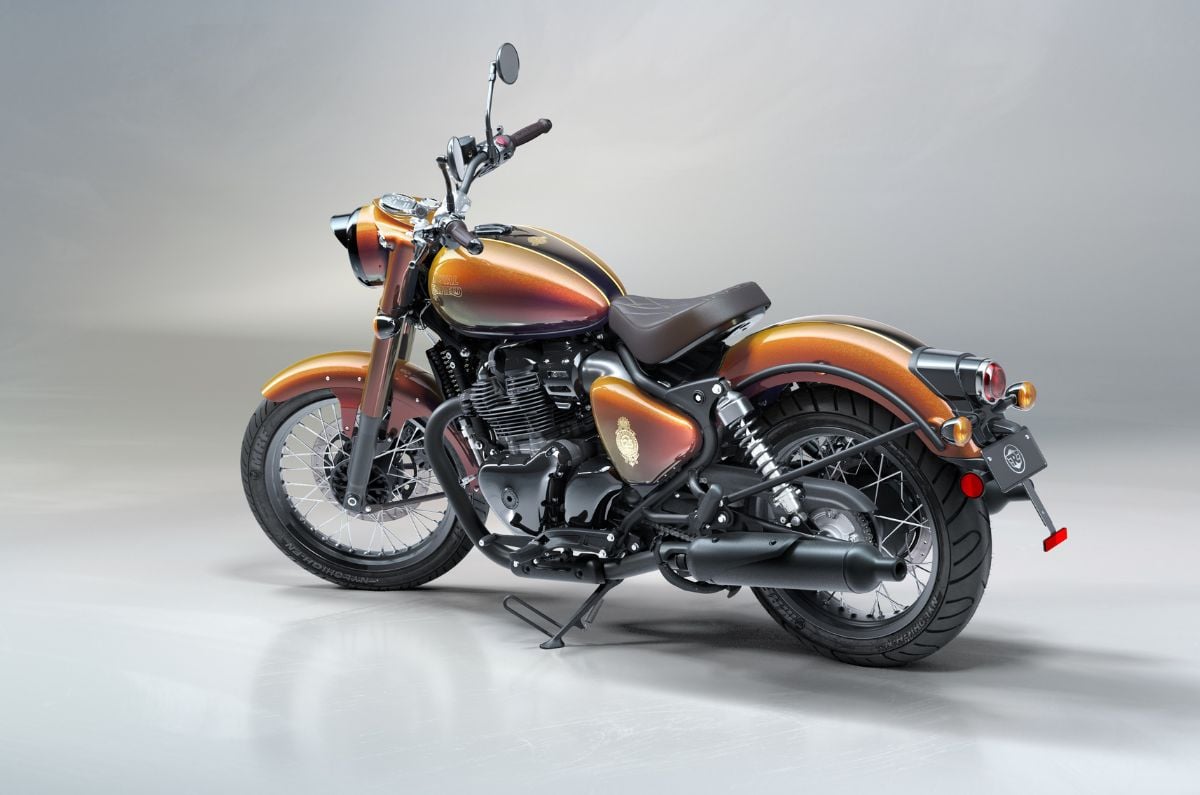
Royal Enfield has launched a special edition of the Classic 650, called the Hypershift, to commemorate the Chennai based manufacturer’s 125th anniversary. It is priced at Rs 4.26 lakh, and the company has clarified that it’s limited to 125 units in each of its key markets, including India. Hence, interested customers will need to register to buy one; registrations will be open until October 28, when sales will happen.
The Classic 650 Hypershift is mechanically identical to the production-spec Classic 650. There are no changes to the underlying design either. It has been priced at Rs 4.26 lakh, which is a Rs 58,000 premium over the base Vallam Red colour (Rs 3.68 lakh) and a Rs 43,500 premium over the top Black Chrome colour (Rs 3.82 lakh). For customers who are able to place an order for one of the 125 units on October 28, deliveries will begin in November.
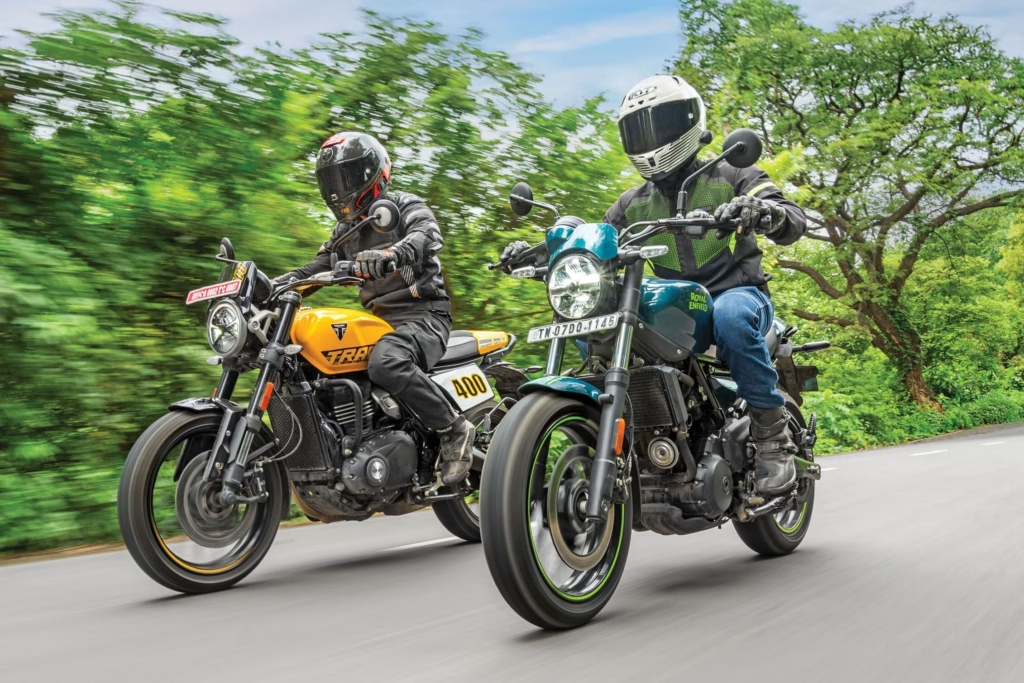
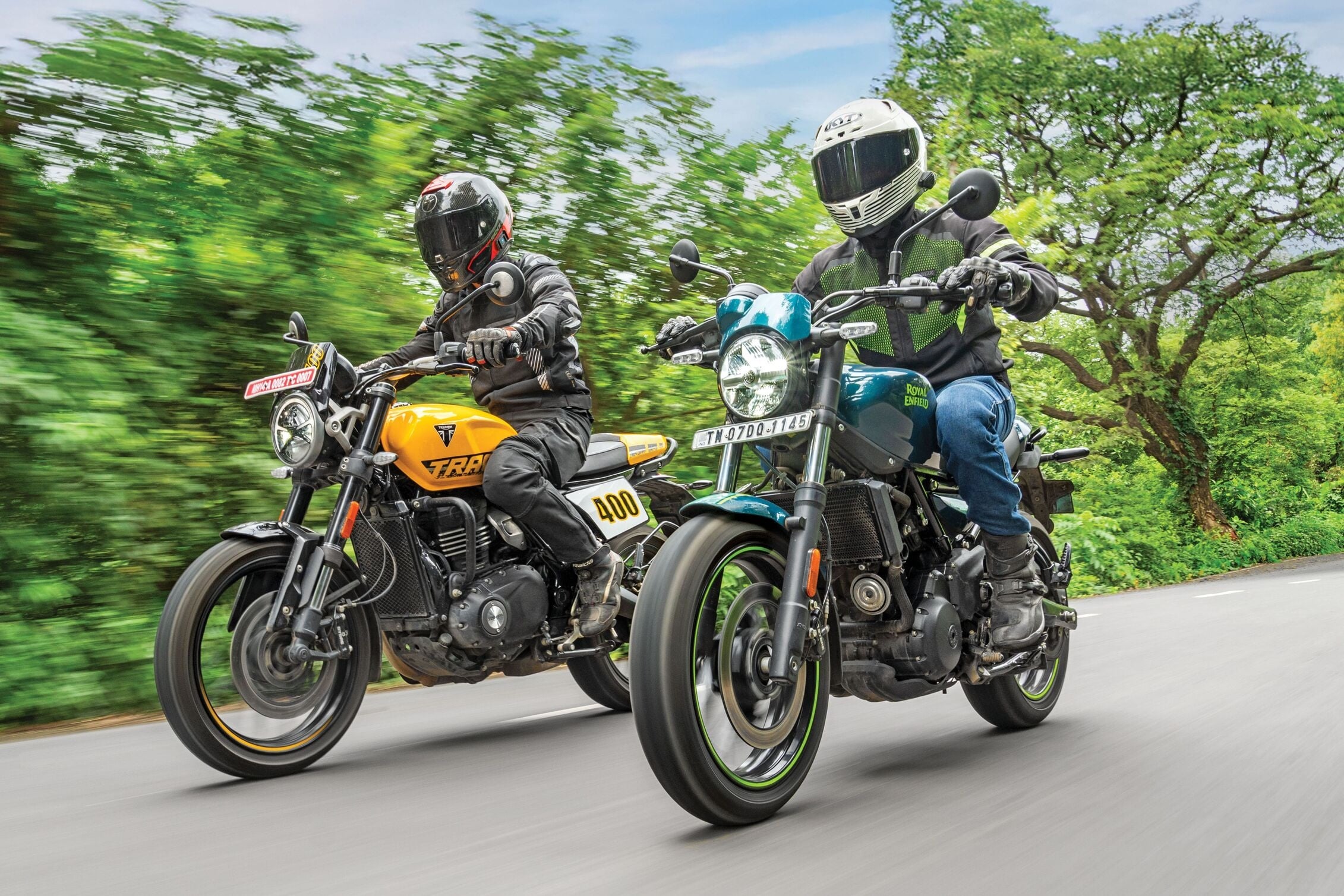
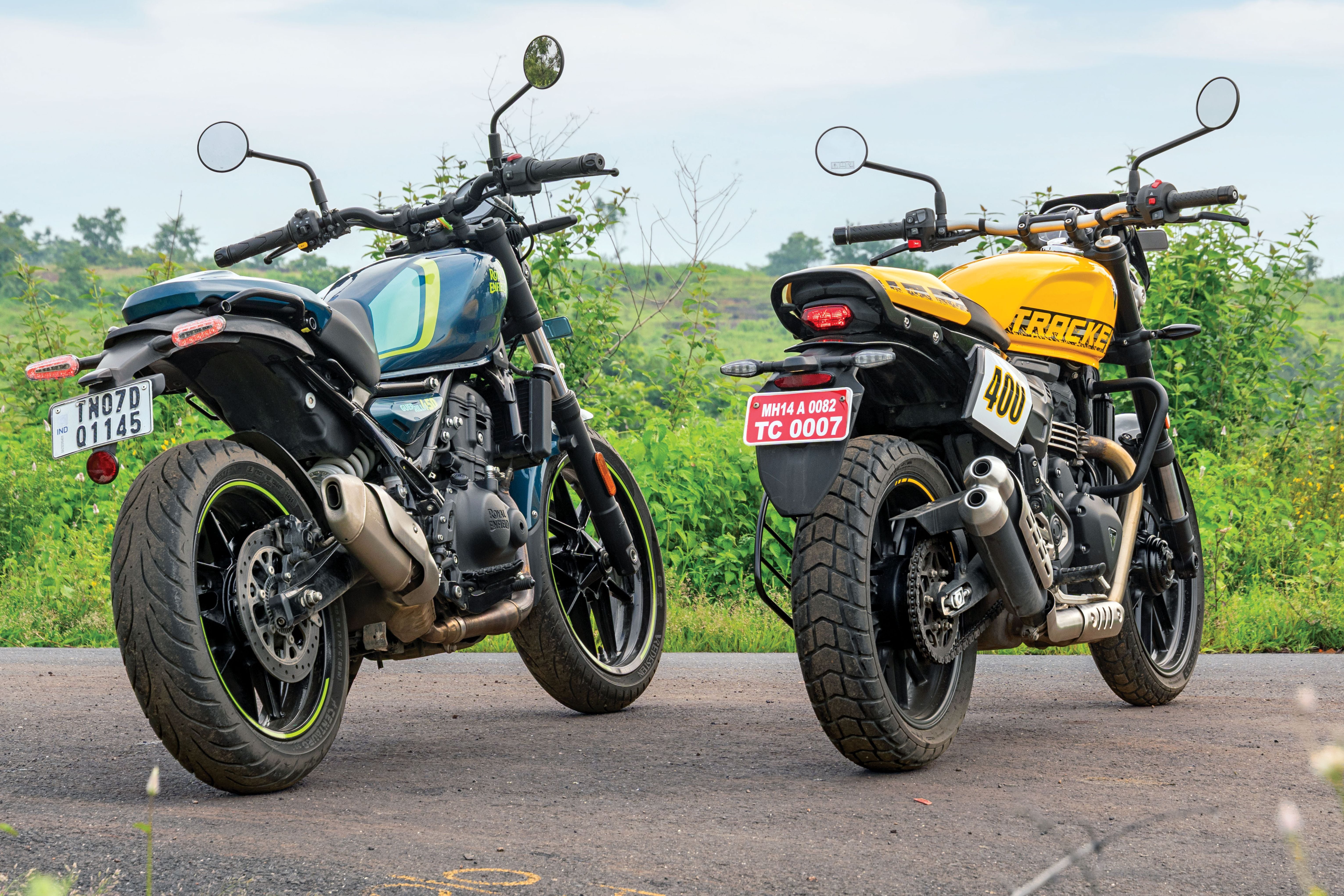
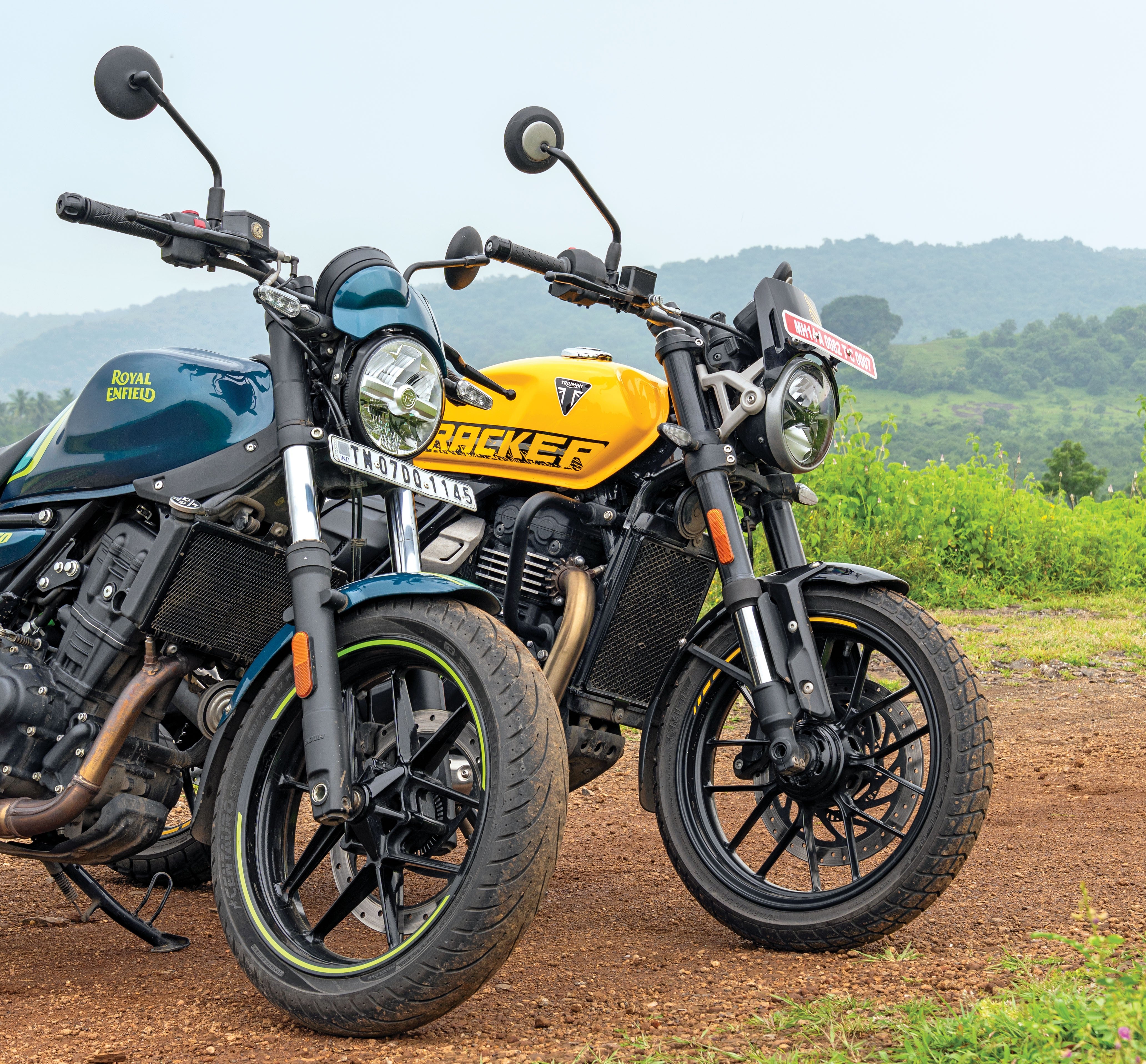
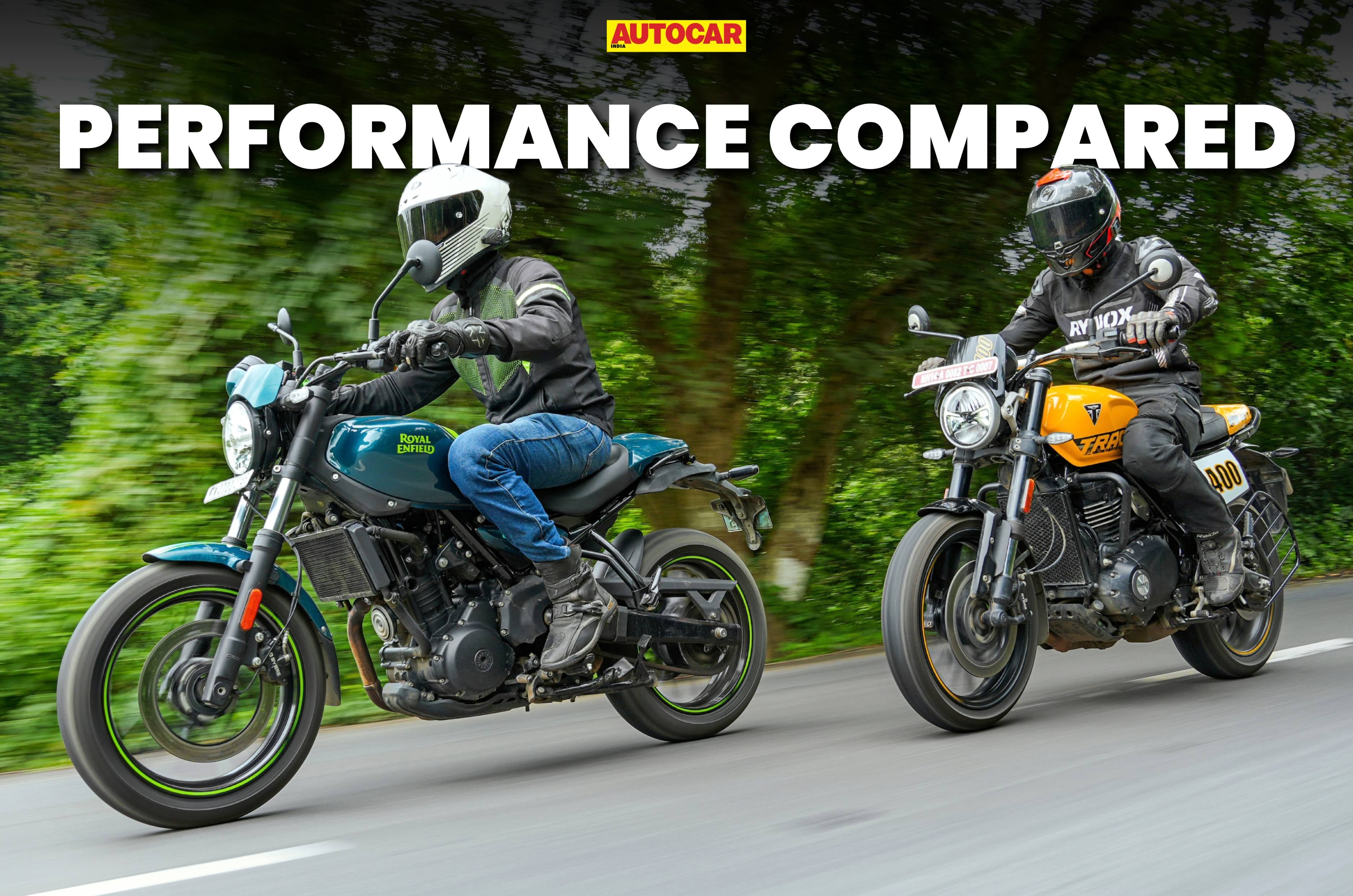
If you are considering either of these motorcycles, chances are you are also considering the other, especially since they both cost about the same. After the Triumph 400cc bikes were downsized, the Tracker 400 now uses a 349cc engine, while the Guerrilla 450 Apex is a sportier variant with more aggressive ergonomics and grippy, road-focused tyres, which I think suit the bike much better than those on the earlier variant.
On paper, the Tracker makes 40hp and 32Nm, while the Guerrilla produces 40.02hp and 40Nm. The Triumph is a lighter, more compact motorcycle, while the Royal Enfield has a larger engine with more torque and offers a stable, planted feel. So, which one makes more sense for someone looking for a sporty, entertaining roadster?
Design and Features
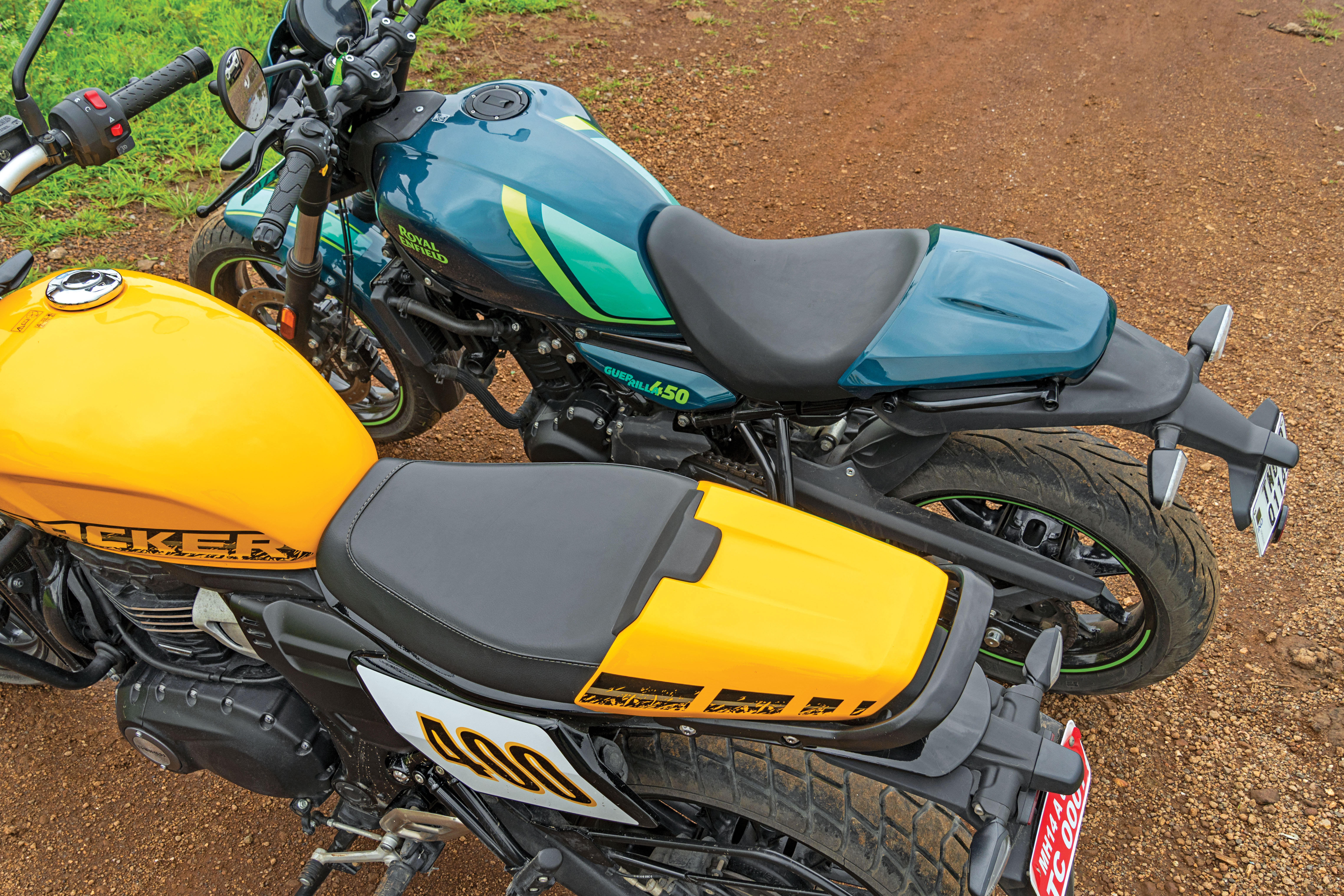
Both motorcycles have very different visual identities, and that is probably the first thing you’ll notice. The Tracker 400 is inspired by flat-track racers, with a flat seat, side number boards and a wide handlebar. But this isn’t really a dirt-track-focussed motorcycle underneath, as its ergonomics, chassis and suspension are properly road-oriented.
The Guerrilla 450 Apex, meanwhile, looks like a sporty and muscular roadster. Compared to the standard variant, it gets a small cowl over the headlight, a new aluminium handlebar, a removable rear-seat cowl and Vredestein Centauro ST+ tyres. The Apex also has a leaned-forward, more committed riding position compared with the standard Guerrilla.
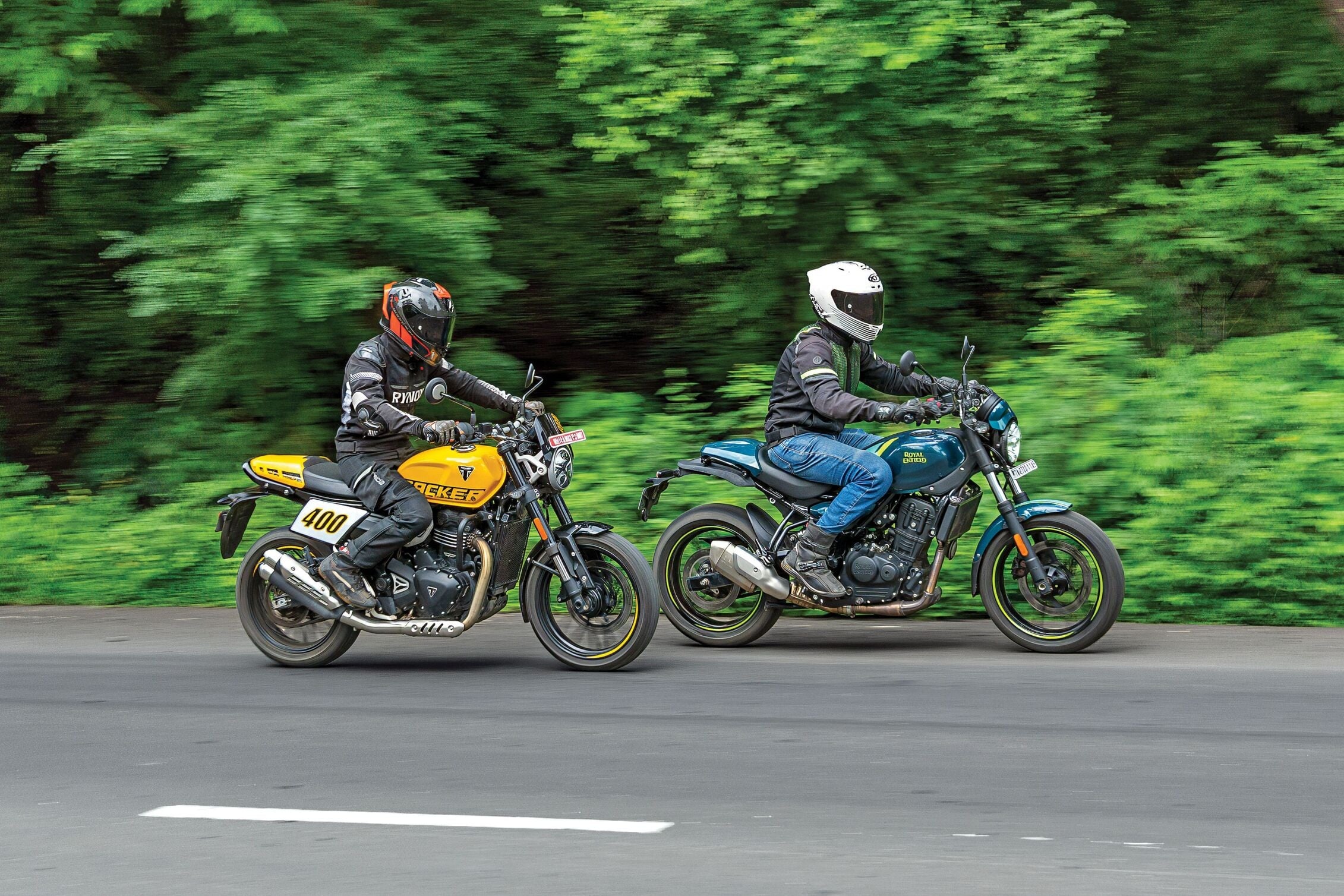
The Tracker is a relatively compact motorcycle, while the Guerrilla’s longer 1,440mm wheelbase and broad 160-section rear tyre give it a more substantial stance. The Triumph gets a larger 13-litre fuel tank compared with the Guerrilla’s 11-litre unit, which can be tedious when long-distance touring.
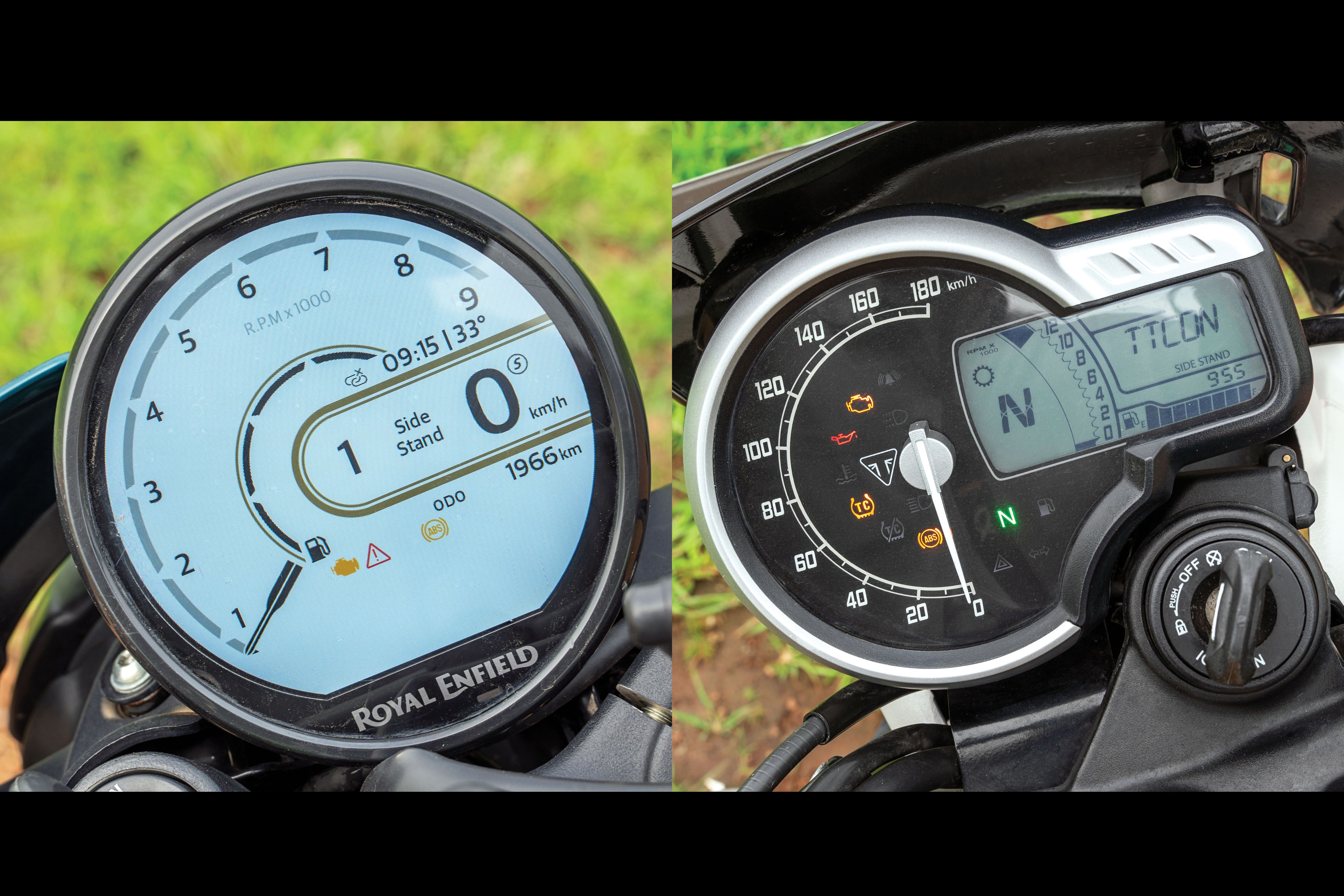
Both motorcycles are equally impressive when it comes to build quality and fit and finish. The Tracker features the same digi-analogue console we have seen on all the other Triumph 400 models, while the Guerrilla features the same TFT unit from the Himalayan. The Guerrilla gets two riding modes (Sport and Street), both of which feel quite similar. On the other hand, the Tracker gets a switchable traction control system that the Guerrilla misses out on. Neither has a quickshifter. In terms of convenience, the Guerrilla has a more accessible 780mm seat height and also gets a main stand, which aids in easier chain maintenance.
There is also a difference in ergonomics. The Tracker’s seat is flat and the riding position is relatively sporty, with rear-set footpegs that suit the character of the bike. The Guerrilla Apex has a lower and more accessible 780mm seat and roadster-like, neutral-set footpegs, along with a committed upper-body position. Between the two, you sit on top of the Tracker with its flat seat, while on the Guerrilla, you sit inside the curved seat, and it is also the more comfortable of the two.
Performance and Fuel Economy
This is where things get interesting because the Tracker 400’s 349cc engine is 103cc smaller than the Guerrilla’s 452cc unit, yet peak power is almost identical. The Triumph produces 40hp at 8,750rpm and 32Nm at 7,500rpm, while the Royal Enfield makes 40.02hp at 8,000rpm. Of course, the difference comes in torque, where the RE makes a much healthier 40Nm at 5,500rpm.
The difference in torque delivery is immediately noticeable. The Tracker’s engine likes to be revved out, but you still have to work it quite a bit. The Guerrilla’s Sherpa engine has a different personality. It doesn’t need to be worked as hard, and the additional 8Nm gives it much stronger roll-on performance. It feels more raw and powerful as soon as you open the throttle, and the surge in power after 6,000rpm makes it feel really exciting. After 7,000rpm, there are some vibrations, but nothing that really ruins the riding experience.
The Tracker’s shorter-stroke engine is very refined at moderate engine speeds, but once you start revving it harder, some buzz makes its way into the tank and footpegs at the top end of the rev range. It remains an entertaining engine, but considering I have ridden the older 398cc Thruxton 400, I feel like it misses out on that initial torque kick.
In our performance tests, the Guerrilla completed the 0-100kph sprint in 6.34 seconds, while the Tracker took 7.55 seconds for the same, marking a difference of 1.21 seconds. The real difference in performance was more visible in the roll-on acceleration tests where the Guerrilla 450 Apex was notably quicker.
Fuel efficiency was almost on par in our tests, where the Tracker delivered 24.1kpl in the city and 31.71kpl on the highway, while the Guerrilla gave us 25.23kpl in the city and 32.82kpl on the highway. The Triumph’s 13-litre tank will give it a better range despite the marginally lower highway efficiency.
Ride and Handling
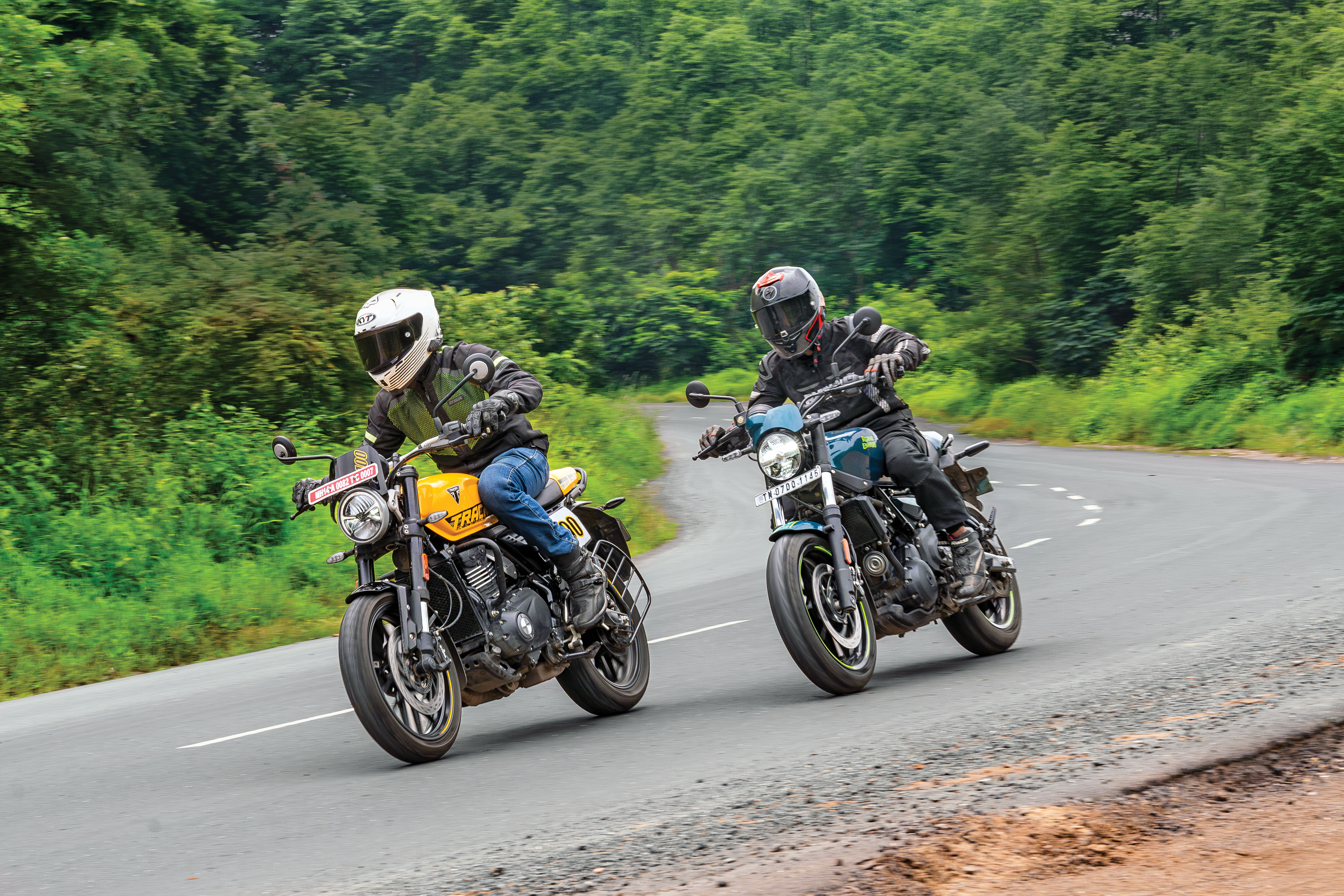
The biggest difference between these two motorcycles becomes apparent once the road starts to twist. The Guerrilla feels longer and heavier and needs a bit of muscling around, but once in a corner, it is extremely stable and planted. The grip offered by the Vredestein tyres is superb and inspires a lot of confidence. The Tracker, on the other hand, feels light, nimble and very easy to flick into corners, thanks to its shorter wheelbase and the leverage offered by the wide handlebars. Its blocky MRF tyres work well, but given how it rides more like a sporty roadster rather than a tracker, stickier tyres would have been a better choice.
While many might be disappointed about the Guerrilla 450 Apex not getting a USD fork, the suspension does work much better than the Tracker’s over bad roads and undulations. The setup feels plusher than the Tracker, which has a quicker rebound that can toss you up if you hit potholes at higher speeds.
Despite the Triumph being the more compact motorcycle, I felt like it was easier to filter through traffic on the Guerrilla, and that is because the Triumph has slightly wider handlebars and mirrors that jut out slightly more. I do remember my time spent with the Guerrilla on a go-kart track, and it was genuinely a lot of fun. The tyres kept up with the performance that the engine offers, and it was a blast to exploit the full capabilities of the bike. The only limitation was the footpegs, which kept scraping when the bike was leaned over. That said, this was never a problem out on the road.
Braking hardware is strong on both. The Tracker gets a 300mm front disc with a four-piston radial ByBre caliper, while the Guerrilla uses a 310mm front disc and 270mm rear disc. The Guerrilla stopped marginally quicker in our braking test from 60-0kph, but I did notice that the ABS intervention can be strong when emergency braking from higher speeds.
Price and Verdict
These two motorcycles are closer than their engine capacities suggest. The Tracker proves that you don’t need a large engine to make for a fun roadster. Its 349cc motor makes almost as much peak power as the Guerrilla, and its compact dimensions, wide handlebar and sporty chassis make it an engaging motorcycle on a twisty road.
The Royal Enfield Guerrilla 450 Apex, however, takes a more muscular approach. Its 452cc engine has substantially more torque, the Vredestein tyres give it a level of grip that suits its performance, and the longer wheelbase also gives it a reassuring planted character, particularly when you’re riding quickly.
They offer two distinct interpretations of the sporty modern roadster. The Tracker’s biggest strength is its agility. It feels smaller, lighter and more eager to change direction quickly. The Guerrilla’s strength is the breadth of its performance. There’s more torque, more road presence and a greater sense of stability when you’re pushing it. And that is ultimately what separates them. The Triumph is the more playful motorcycle, thanks to its nimble nature, while the Guerrilla Apex feels like a more serious attempt at turning the standard roadster into a proper performance-oriented, corner-carving machine.
While it is difficult to pick between these two motorcycles, considering that they do things in different ways, you can’t look past the value that the Guerrilla offers. Despite falling into the 40 percent GST bracket, its starting price is just Rs 10,000 more than that of the Tracker. To put things into perspective, the KTM 390 Duke R, which used to be the benchmark for affordable and accessible performance when its Gen 1 model was launched in India, is now priced at Rs 3.45 lakh (ex-showroom), taking its on-road price upwards of Rs 4 lakh. So the way I see it, the Guerrilla 450 Apex is now the new benchmark when it comes to affordable performance in India. Who’d have ever thought that the crown would one day be worn by a Royal Enfield.
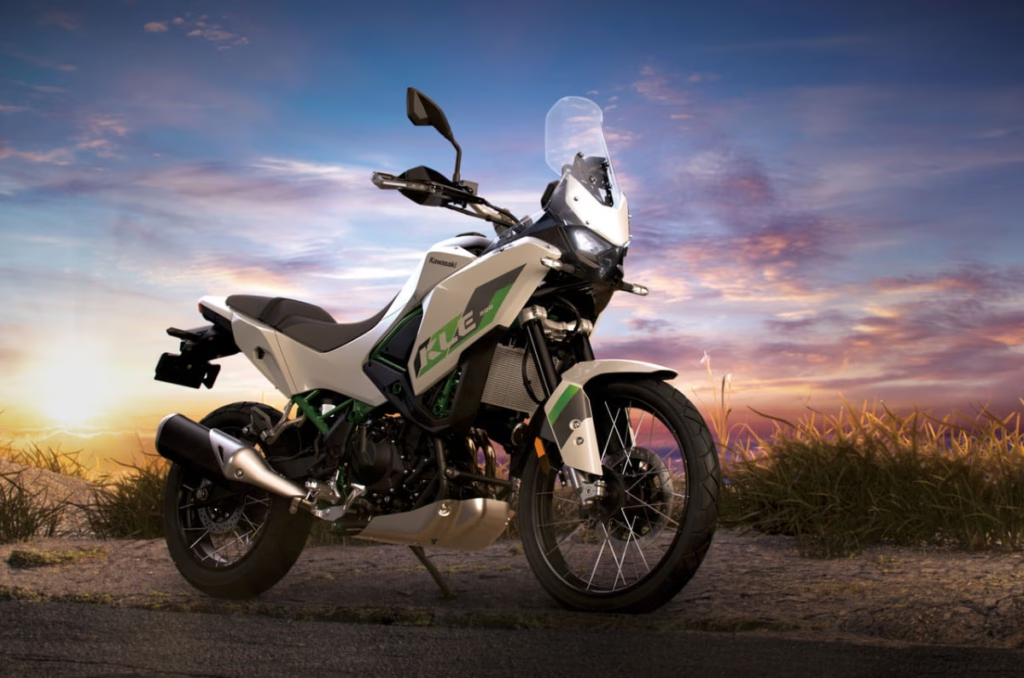
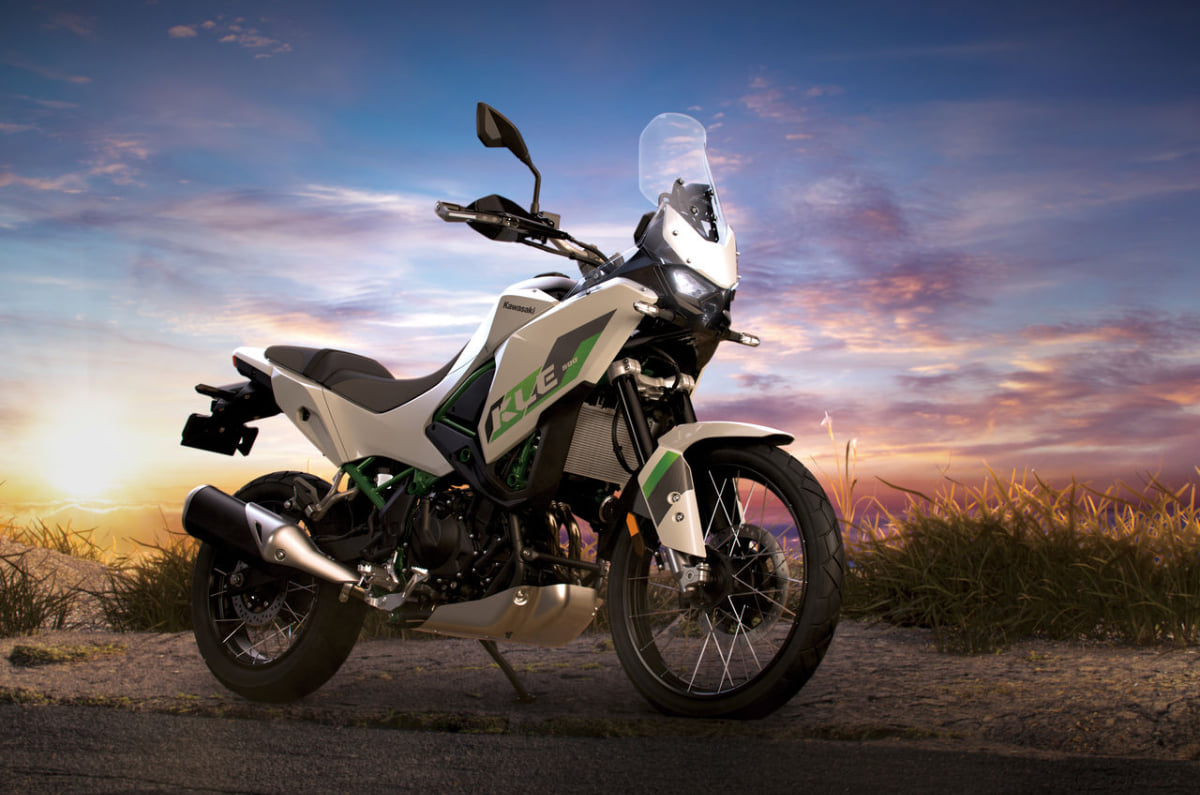
Kawasaki has expanded its 2027 KLE500 range with a new SE SmartRide variant, which adds a mechanical centrifugal clutch to the parallel-twin adventure motorcycle. The system allows riders to pull away and come to a stop without operating the clutch lever, while gear changes on the move still use the lever and pedal as normal.
KLE500 now has three variants
451cc parallel-twin engine produces 45hp and 42.6Nm
Kawasaki KLE500 SE SmartRide details
No other mechanical changes over the KLE500 SE, which debuted last year
The KLE500 lineup now comprises three variants – the base KLE500, the KLE500 SE and the new KLE500 SE SmartRide. At first, the SmartRide system may sound similar to Honda’s E-Clutch technology, but the two work quite differently. While both aim to simplify clutch operation, Honda uses an electromechanical actuator to automate clutch movement, whereas SmartRide relies on a purely mechanical centrifugal clutch.
Aside from the addition of the clutch technology, the SmartRide variant also gets tubeless tyres, replacing the tube-type setup on the standard SE. Otherwise, the two variants share the same hardware, including the 451cc parallel-twin engine producing 45hp at 9,000rpm and 42.6Nm at 6,000rpm.
The SE SmartRide is available in a single colour, Pearl Blizzard White. Following its international debut last year, we’d reported that Kawasaki India has the KLE500 in the pipeline for a launch here, which we expect to happen over the next few months.
When it goes on sale, the KLE500 will join a growing list of sub-500cc adventure bikes in our market. Given its potential CBU (Completely Built-Up) import route and the premium pricing that would entail, it will also see competition from upcoming India-made motorcycles such as the Royal Enfield Himalayan 750 and the Norton Atlas.
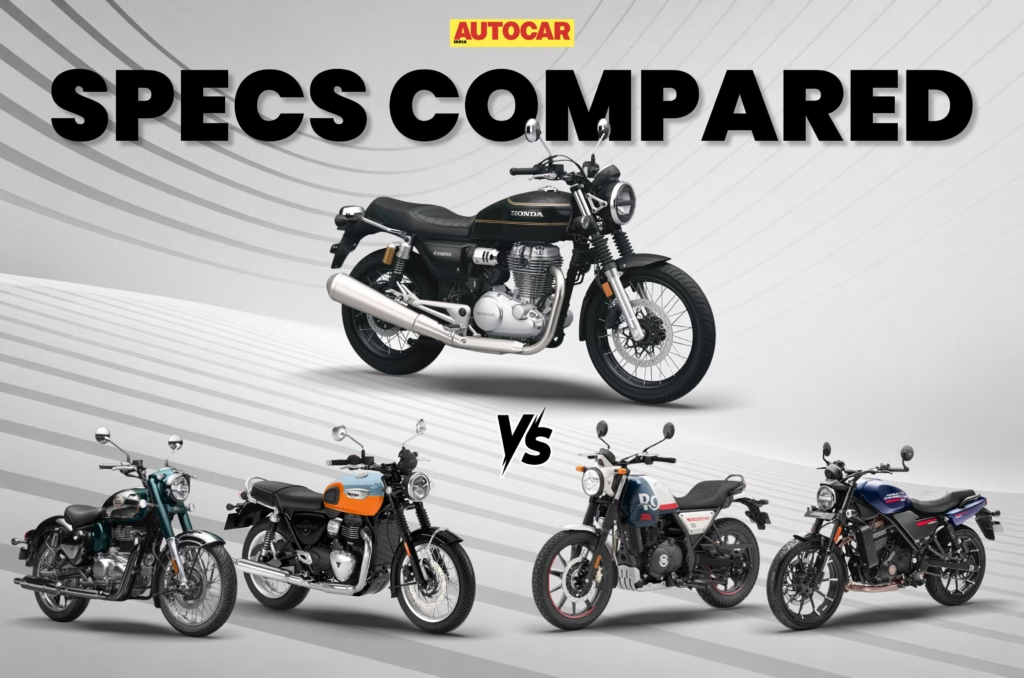
Honda has revealed the specifications for the CB500, so it’s only natural that we see how it stacks up against its main rivals such as the Harley-Davidson X440 T and Triumph Bonneville T40. For good measure, we’ve even thrown in other lower-priced and lower-spec but far more popular alternatives like the Royal Enfield Scram 440 and the king of this class, the Classic 350. Here is how these stack up against each other on paper.
Honda CB500 vs Rivals: Engine and output
The Honda CB500 shines with plenty of low-to-mid range torque
Honda CB500
Harley-Davidson X440 T
Triumph Bonneville T40
Royal Enfield Scram 440
Royal Enfield
Classic 350
Engine
501.7cc, single-cylinder, oil-cooled
440cc, single-cylinder, oil-cooled
350cc, single-cylinder, liquid-cooled
443cc, single-cylinder, oil-cooled
349cc, single-cylinder, liquid-cooled
Power
28.14hp at 5,250rpm
27hp at 6,000rpm
29hp at 9,000rpm
25.42hp at 6,250rpm
20.2hp at 6,100rpm
Torque
43.3Nm at 3,750rpm
38Nm at 4,000rpm
31.2Nm at 5,500rpm
34Nm at 4,000rpm
27Nm at 4,000rpm
Gearbox
5-speed
6-speed
6-speed
6-speed
5-speed
Power-to-weight ratio
148.88hp/tonne
140hp/tonne
148.71hp/tonne
129.69hp/tonne
103.59hp/tonne
With its large 501.7cc mill, the Honda offers more low-to-mid-range torque than the others, and it arrives the earliest too, at 3,750rpm. The torque outputs in this comparison are largely dictated by the engine’s displacement. In the modern retro segment where riders want an effortless riding experience, a healthy torque output delivered without too much effort is almost a necessity. The only anomaly here is the Bonneville T40, with its short stroke and liquid-cooled engine, making the most peak horsepower, although its torque output can’t match the larger bikes’ figures.
Honda CB500 vs Rivals: Dimension and weight
The CB 500 is the lightest in its segment
Honda CB500
Harley-Davidson X440 T
Triumph Bonneville T40
Royal Enfield Scram 440
Royal Enfield
Classic 350
Fuel tank capacity
15.2 litres
13.5 litres
14.5 litres
15 litres
13 litres
Ground Clearance
168mm
170mm
165mm
200mm
170mm
Kerb weight
189kg
192kg
195kg
196kg
195kg
Seat Height
NA
805mm
790mm
795
805mm
Wheelbase
1439mm
1418mm
1418mm
1460
1390mm
The Honda CB500 immediately stands out because of its kerb weight. It is the lightest motorcycle in this comparison, despite having the largest motor. Of all the bikes here, the T40 offers the most accessible saddle height, and you can further drop it down to 770mm with the accessory low seat. No bike here is a corner carver and all of them prioritize a laidback and stable demeanour on the side of their tyres. Given that we are yet to ride 2 of the most recent entrants yet, any comment on a comparison of their ride and handling will have to wait until a later date.
If you want your neo retro machine to be able to tackle bad roads, all of them should be up for the job but it’s the Scram that is the most apt for it with its Himalayan-derived suspension and chassis.
Honda CB500 vs Rivals: Tyres, brakes and suspension
The X440 T is the only motorcycle that features a USD fork
While the Harley-Davidson features a USD front fork, the other motorcycles rely on right way up telescopic forks and twin rear shocks with the exception of the Scram, which uses a link-type monoshock. Again, in keeping with their more relaxed nature, the simple spec on offer here is more than sufficient for these bikes’ intended roles. Of them all, the H-D X440 T is likely to be the most agile owing to its more sophisticated front suspension and smaller wheel sizes, which are almost akin to a traditional roadster.
More pertinent here is that the Classic 350 (except for the alloy wheel ‘Dark’ variant) and Bonneville T40 come only with tubed tyres. The Honda comes with tubeless tyres on all variants and save for the base one, the other two come with neat-looking side-laced rims permitting the aforementioned feature.
Honda CB500 vs Rivals: Features
Triumph takes the lead in the features department
The Bonneville T40 offers more features than any bike in the neo-retro segment (even more than its much more expensive twin-cylinder brethren!). Its electronic throttle body permits five ride modes (Eco, Road, Rain and customizable Rider A and B) as well as cruise control. A handsome full colour, 4-in TFT dash further brings in turn-by-turn navigation and cornering ABS as well as traction control complete its electronic arsenal.
The X440 T also has a TFT display, but it’s neither as sophisticated nor as pleasing to look at as the one on the ‘Bonnie’. It brings in 2 riding modes (Road and Rain) and has the safety net of switchable dual channel ABS and traction control. While the Honda has the same riding aids as the Harley, it displays information to the rider via a simple and easy-on-the-eyes digi-analogue display which has basic Bluetooth connectivity. The Scram and Classic -in true RE fashion – are simple, but not spartan machines. The Classic offers you a slip-and-assist clutch, type-C charger and dual-channel ABS, whereas the Scram misses out the slip-and-assist clutch and further offers you the ability to disable ABS at the rear.
Honda CB500 vs Rivals: Price
The CB500 is priced competitively
Honda CB500
Harley-Davidson X440 T
Triumph Bonneville T40
Royal Enfield Scram 440
Royal Enfield
Classic 350
Price (ex-showroom)
Rs 2.75-3.02 lakh
Rs 2.86 lakh
Rs 2.80 lakh
Rs 2.25-2.32 lakh
Rs 1.89-2.26 lakh
Honda has priced the CB500 rather well considering its capacity, what it brings to the table and despite the higher 40 percent GST working against it. In fact, its starting price undercuts both the smaller Harley and Triumph, and not by an unsubstantial amount.
However, in comparison to the slower and smaller REs, the Honda’s price is a segment higher and rightly so, because the CB500 is, for all intents and purposes, a machine from a segment above. Deliveries for the Alloy variants are expected later this year, and for the spoke and tubeless spoked variants in the first quarter of 2027.
Given what the latest offerings bring to the segment and their differing price strategies, the neo retro segment is now larger and more diverse than ever before with an option to suit just about every need. Choosing between these bikes is more than a simple comparison on paper and will need a more nuanced understanding of what they offer the rider.
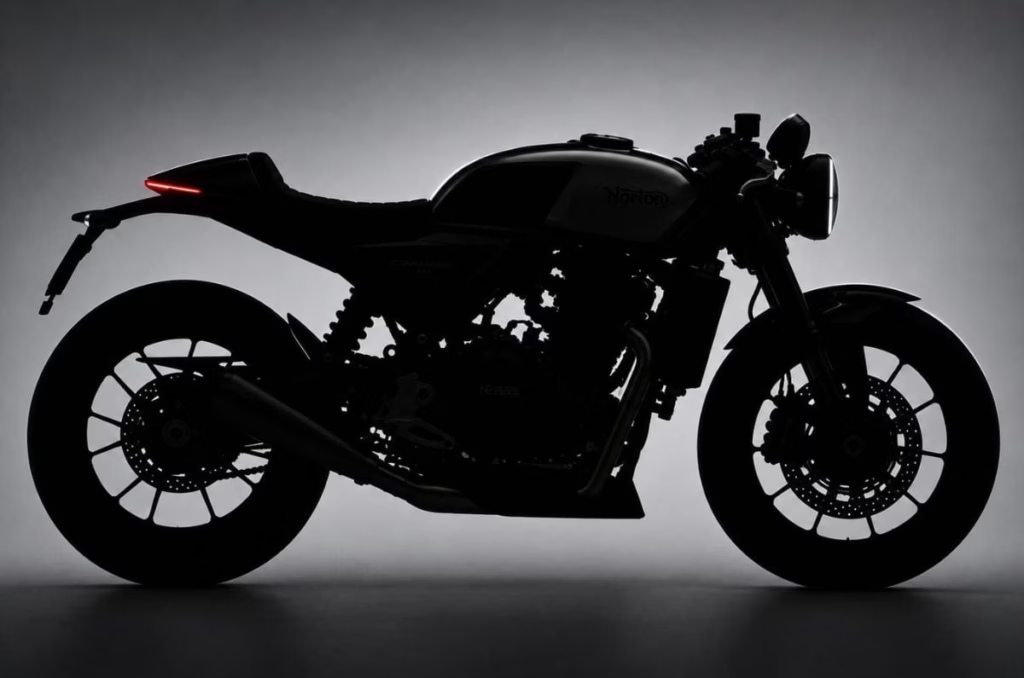
Norton Motorcycles will premiere its much-awaited 450cc-class single-cylinder roadster at EICMA 2026 in Milan, expanding its range with a motorcycle aimed at higher volumes in India and overseas. Autocar Professional expects the motorcycle to produce around 40-45hp and 40-45Nm. The engine is likely to be liquid-cooled and is expected to come with a 6-speed gearbox. The roadster will be the first model on a new platform understood to be called the H-series, with other body styles to follow. It will sit below the TVS Motor-owned British marque’s twin-cylinder Atlas range and V4-powered Manx family.
Norton Atlas is expected to first launch in India, in Q1 2027
New Norton single-cylinder motorcycle will launch overseas and in India simultaneously
Will also be manufactured at TVS’ Hosur plant
New Norton single-cylinder platform at EICMA 2026
Expected to launch in India and overseas in 2027
Autocar Professional understands that TVS plans to begin Norton’s India rollout in the January-March 2027 quarter, if not sooner, starting with the Atlas, followed by the Manx. The H-series roadster is expected to launch simultaneously in India and global markets in the second half of 2027. Responding to queries from Autocar Professional, a Norton spokesperson said the brand’s India introduction would follow its appearance at this year’s Milan show. “Norton is set to launch in India soon following the brand’s presence at EICMA this year, when the next key stage of the resurgence will be revealed,” the spokesperson said. The company has not officially confirmed the roadster’s platform name, engine capacity, output, pricing or sales timeline.
Norton has recently trademarked three names in India – Roven, Inter and Avalon and the first single cylinder bike may bear one of them. In 2025, the company also trademarked the Norton Electra name here, and this followed on the trademarking of the Norton Combat name in 2023.
Reimagined Norton under TVS
Design and ease of use is at the new Norton’s core
Differentiated design is central to TVS’s effort to give Norton a contemporary identity while retaining its British heritage. Simon Skinner, Head of Design, Norton Motorcycles, is leading the development of a design language connecting the brand’s products across capacities and categories. The roadster will extend that approach to a motorcycle intended to sell in larger numbers.
As we have seen with the thoroughly modern designs on the Atlas and V4, it is safe to anticipate modern, pared-back styling, with selected mechanical components exposed and others concealed. This could help distinguish the roadster in a segment where several competitors draw heavily on retro styling. According to Norton, the Manx R received the “Best of the Best” distinction at the 2026 Red Dot Award: Design Concept. Norton Design was also recognised at the 2026 International Design Excellence Awards in the United States.
The roadster is expected to prioritise manageable weight and ease of use, particularly in city riding. It could feature 17-inch wheels and equipment drawn from Norton’s larger motorcycles, potentially including an eight-inch TFT touchscreen, riding aids and multiple riding modes. Final specifications remain unconfirmed.
Taking on Royal Enfield
How does Norton plan to combat the 350cc onslaught?
The platform represents a significant bet on the global mid-size motorcycle market. The opportunity spans roughly the 350cc-750cc categories, with annual volumes estimated at around 15 lakh-20 lakh units. This broad classification includes motorcycles marketed as 350cc models whose actual displacement is slightly lower.
It will bring Norton into closer competition with Royal Enfield and Triumph in India and overseas. However, the new single-cylinder Nortons will face a specific challenge in India. That is the fact that they will not come under the 350cc segment, unlike the massively popular RE 350 range and the recently re-engineered 349cc Triumph line in India. The result is that they will attract the much higher 40 percent GST rate instead of 18 percent. Norton is likely to position these bikes at a premium that will be justified by higher levels of technology and a heavy focus on design, quality and detail.
Royal Enfield’s dominance in India demonstrates the demand for motorcycles used for daily travel, touring and leisure riding. Its extensive dealer network, broad product range and established riding community also present a substantial challenge for Norton. Overseas, Royal Enfield has expanded into many of the markets the TVS-owned British marque is targeting. For TVS, the single-cylinder Norton offers a way to participate more widely in this market. Additional body styles on the same platform would help spread development costs and reach buyers with different riding preferences.
The India distribution plan
TVS is yet to confirm showroom rollout schedule for India
Norton’s design and heritage will form part of its appeal, but pricing, service coverage and parts availability will be important to building sustained sales, particularly in India. TVS had said in June that the Norton Atlas would be introduced in India later in the year. It had also scheduled the launch of TVS Paddock, its premium retail channel for both Norton and select premium TVS products, for the second quarter of FY27. The latest official response did not provide an updated Paddock rollout schedule.
Current preparations are understood to point to around three Paddock outlets by December, although a larger network is being sought. The number of outlets that will be operational when motorcycle sales begin has yet to be finalised. The company said it now has more than 50 retailers across 10 markets, including the UK, Italy, France, Germany and Spain. Preparations for a United States launch are continuing, subject to the final stages of vehicle certification.
Norton said its European test-ride programme had introduced the new motorcycles to thousands of riders. Foster + Partners has designed its showroom environments. TVS acquired Norton in April 2020. Its FY2025-26 annual report records investments exceeding GBP 250 million in rebuilding the business and identifies the marque as an important part of its premium-isation strategy, particularly in developed markets.
India already supports that expansion through manufacturing. The first Atlas motorcycles rolled off TVS’s Hosur production line in June, combining Norton’s UK design and engineering with its parent’s manufacturing operations. Production for the new single-cylinder range will also be out of Hosur.
With inputs from Anurag Chaturvedi and Rishaad Mody.
Royal Enfield has launched a special edition for the Classic 650, called Hypershift, to commemorate the Chennai-UK based manufacturer’s 125th anniversary. While there is a price, Rs 4.26 lakh, the company has clarified that it’s limited to 125 units in each of its key units, including India. Hence, interested customers will need to register to buy one; registrations will be open from today (October 16) at 2pm, till October 28, when sales begin.
All prices mentioned are ex-showroom.
Mechanically identical to the production-spec Classic 650
Costs Rs 58,000 more than the base Classic 650; Rs 43,500 more than the top
Royal Enfield Classic 650 125th anniversary edition: What’s special?
Strictly cosmetic, with exclusive Hypershift detailing
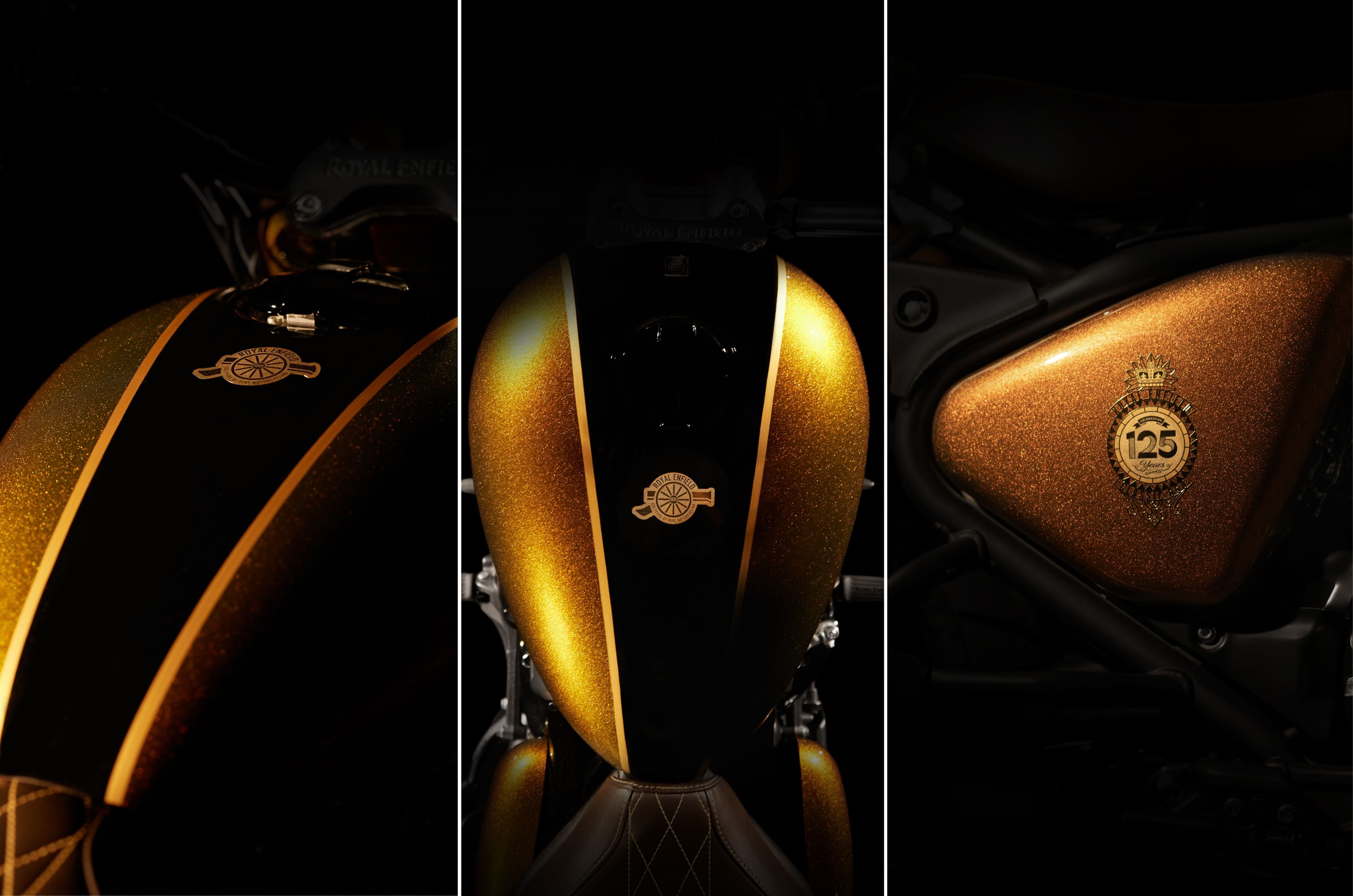
The Classic 650 Hypershift is mechanically identical to the production-spec Classic 650. There are no changes to the underlying design either. What sets it apart, primarily, is the bespoke Hypershift finish that transforms between shades of red, green and gold as light moves across the motorcycle. Complementing the finish are the additional 125-year crest on the teardrop tank, special badging on the sidepanels and of course, hand-painted pinstripes.
The Classic 650 was first launched in 2025, sharing the 648cc, air-cooled parallel twin with the Interceptor 650 and the likes, making 47hp and 52.3Nm. It has a chassis that’s derived from the Super Meteor 650, currently the most expensive Royal Enfield 650 at Rs 4.39 lakh. While the Super Meteor has a USD fork, the Classic swaps that for RSU (right side up) telescopic fork and reduces the twin-shock’s travel from 101mm to 90mm.
Classic 650 Hypershift
Classic 650 Black Chrome
Classic 650 Vallam Red/Bruntingthorpe Blue
Price (ex-showroom)
Rs 4.26 lakh
Rs 3.82 lakh
Rs 3.68 lakh
The Classic 650 Hypershift has been priced at Rs 4.26 lakh, which is a Rs 58,000 premium over the base Vallam Red colour (Rs 3.68 lakh) and a Rs 43,500 premium over the top Black Chrome colour (Rs 3.82 lakh). For customers who are able to place an order for one of the 125 units on October 28, deliveries will begin in November.
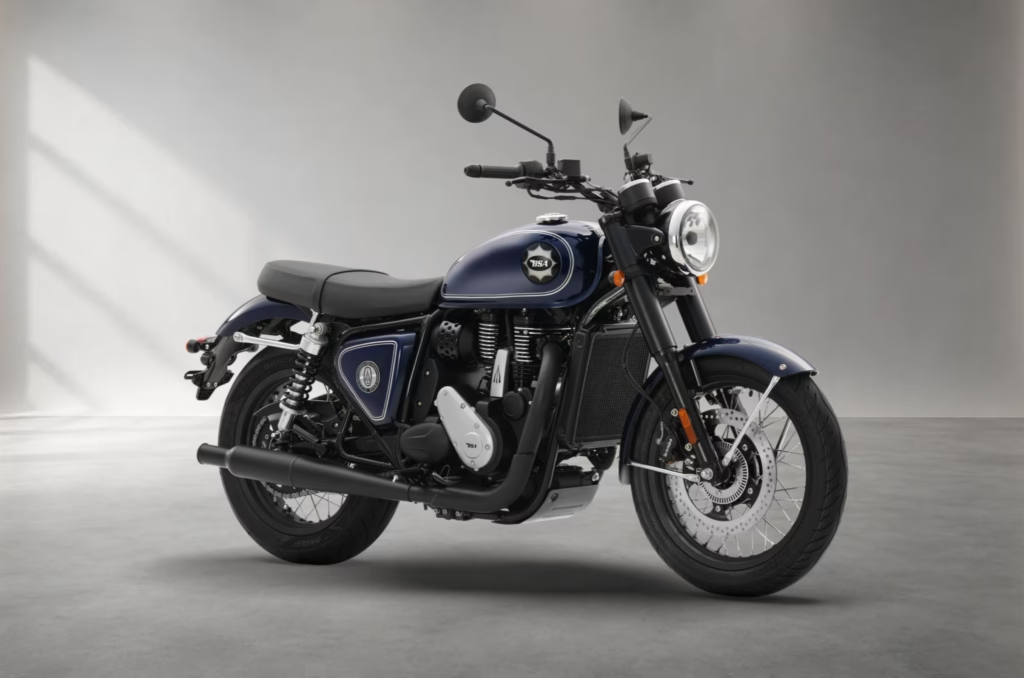
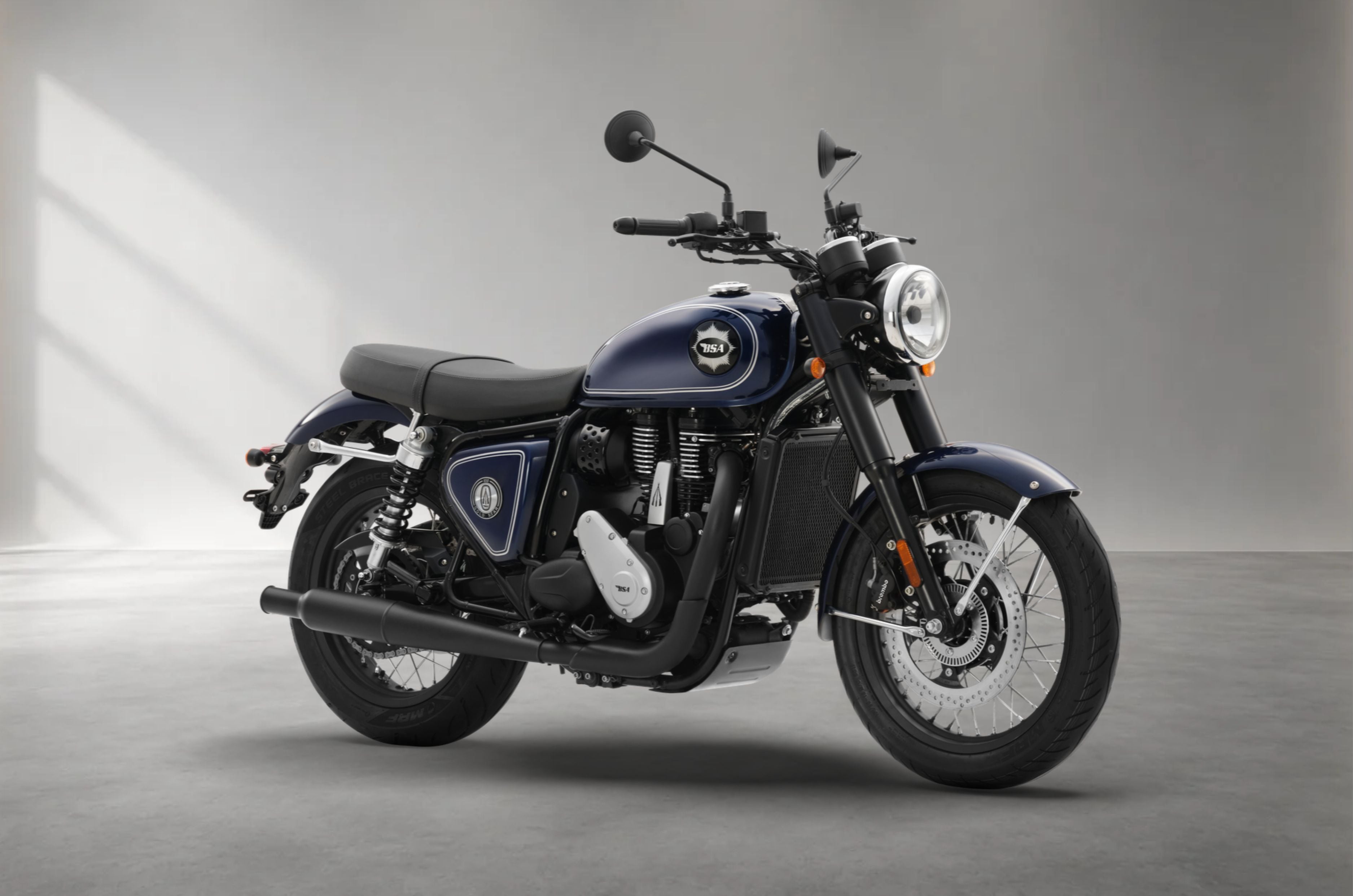
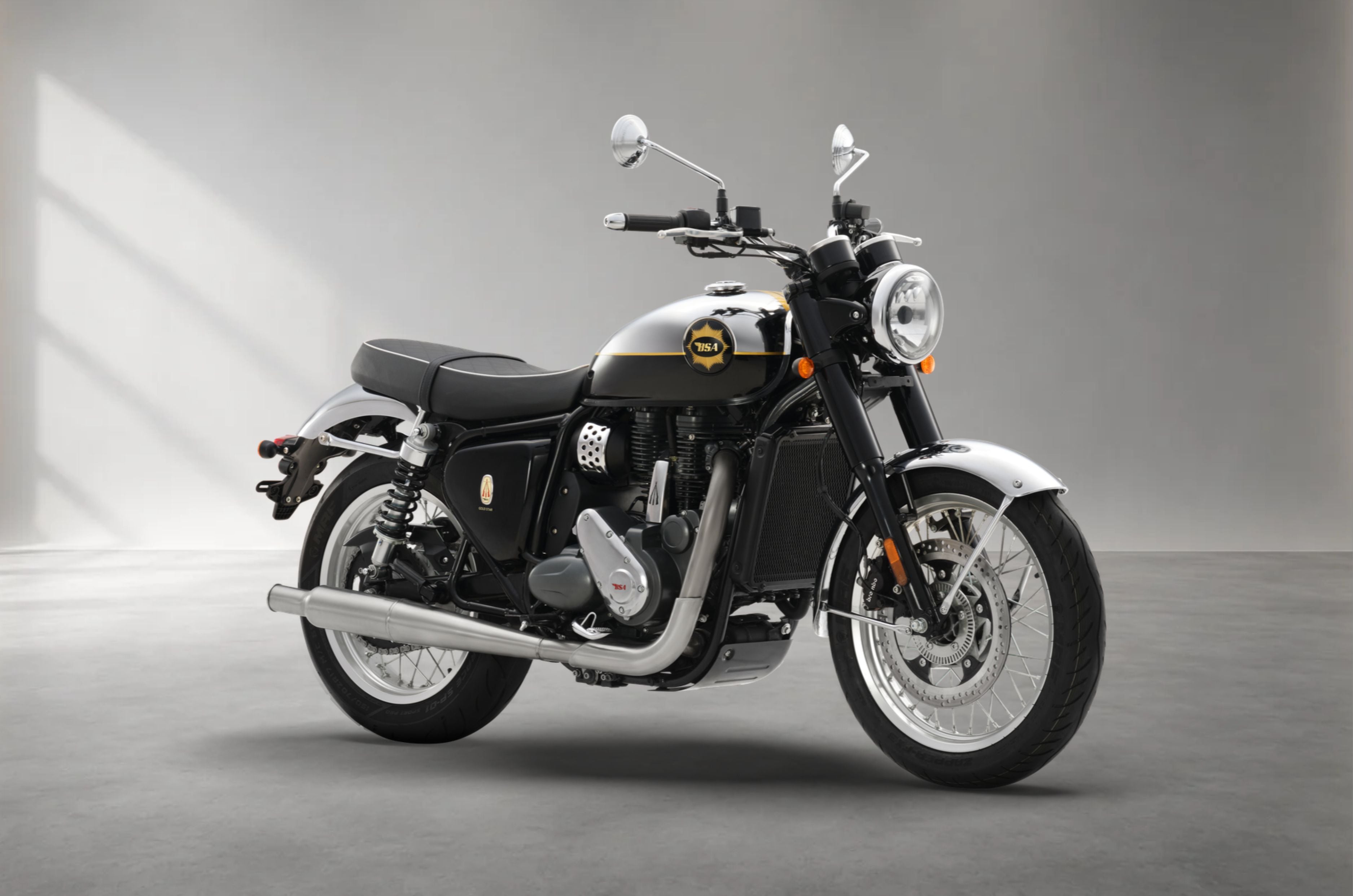
BSA Motorcycles has introduced two new colour schemes to the Gold Star 650 in India. Now the price of the motorcycle ranges from Rs 3.42 lakh for the Insignia Red to Rs 3.65 lakh (ex-showroom, Delhi) for the new range topping Brooklands Black Legacy Edition.
Two new colours: Birmingham Blue and Brooklands Black Legacy Edition
No mechanical changes
Powered by the 652cc liquid-cooled single-cylinder engine
BSA Gold Star 650 details
The large 652cc single makes 45hp and 55Nm of torque
The new Birmingham Blue is priced at Rs 3.56 lakh and the new Brooklands Black Legacy Edition at Rs 3.65 lakh. Other colour options along with this includes Insignia Red (Rs 3.42 lakh), Midnight Black (Rs 3.45 lakh) and Sheen Silver (Rs 3.60 lakh).
As aforementioned, the motorcycle remains mechanically the same as the outgoing model. It is still powered by the 652cc liquid-cooled single-cylinder engine, delivering 45hp and 55Nm of torque paired with a 5-speed gearbox. BSA also offers accessories like windshield, rear rack and knee pads for the Gold Star.
In the 650cc retro-roadster segment, the chief rival for the BSA Gold Star 650 is the Royal Enfield Interceptor 650 (Rs 3.38 lakh to Rs 3.69 lakh ex-showroom, Chennai). The core difference between them comes down to the engine architecture, a big-bore single-cylinder or a smooth torquey parallel-twin. The Interceptor brings in parallel-twin refinement for effortless highway riding, while the Gold Star appeals to riders seeking old-school big-single-thump with modern liquid-cooling.
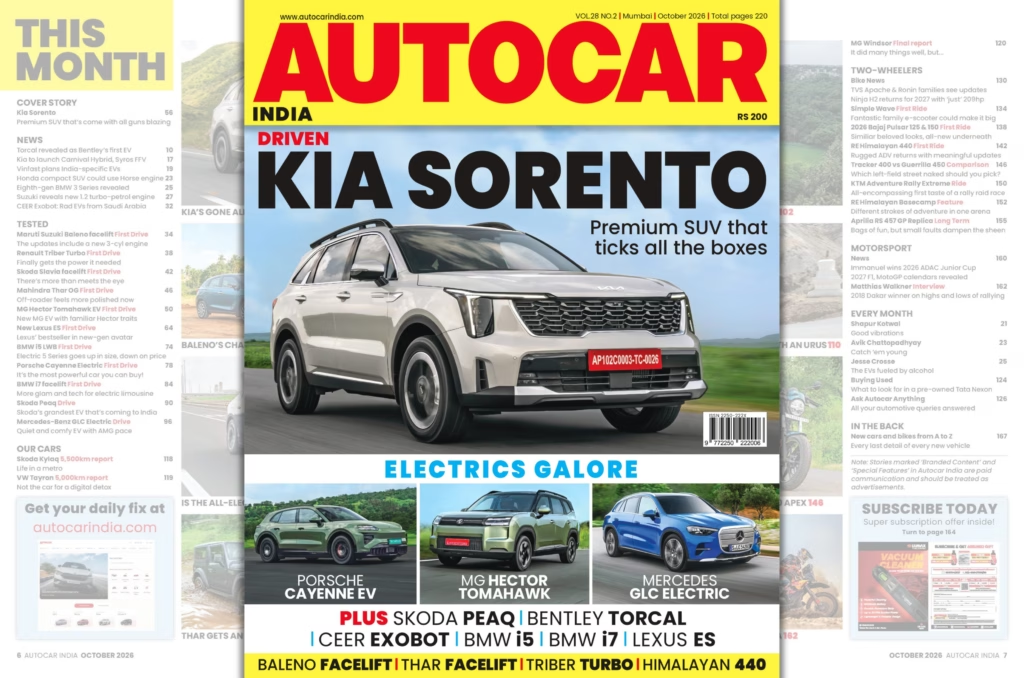
This month, we go big on power and even bigger on premium metal. The cover story is Kia’s biggest swing yet at the executive SUV segment, and then there’s a family SUV with more horsepower than a Lamborghini, and BMW’s electric onslaught continues with a new long-wheelbase sedan and a sharper flagship limousine.
Kia Sorento: Cover Story
Six trims, two powertrains, up to seven seats and 32 variants in all. Kia isn’t dipping a toe into the premium SUV pool; it’s diving straight in, locally assembling the Sorento from Rs 27.99 lakh to take on the Skoda Kodiaq and VW Tayron. Has Kia cracked the code, or has it bitten off more than it can chew?
Porsche Cayenne Electric: First Drive
Forget hypercars. The most powerful vehicle currently on sale in India is a family SUV, the Cayenne Electric, with more horsepower than your senses can fathom. We took it to an airstrip to see what that actually does to your stomach.
BMW i5 LWB & i7 Facelift: First Drives
BMW’s electric push continues, with a long-wheelbase i5 slotting in between the iX1 and flagship i7. Can BMW’s long-wheelbase playbook continue to work? And there’s also the i7 getting a sharper face and more tech to go with it, like it didn’t have enough already.
Mercedes-Benz GLC Electric: Drive
The first-gen electric GLC was far from ideal. The new one, however, is a completely new generation with an 800V architecture, 330kW charging and a claimed 715km range. We took all 489 of its horses to the Autobahn to see how much of an improvement it has been over its predecessor.
MG Hector Tomahawk EV: First Drive
Don’t let the familiar name fool you. The Hector Tomahawk EV rides on MG’s all-new ADAPT platform, bigger than the Mahindra XEV 9S in every dimension, with a PHEV sibling already waiting in the wings.
Maruti Suzuki Baleno, Renault Triber Turbo and Skoda Slavia: First Drives
India’s favourite premium hatch, the Baleno, gets a new engine and ADAS, the budget-friendly Triber finally gets the power it’s been begging for, and the Slavia’s facelift turns out to be more than skin-deep.
Mahindra Thar OG: First Drive
The original three-door Thar gets another round of updates, bringing changes to its engines, equipment and chassis. With the off-road icon continuing to evolve, we head out to discover what this latest iteration brings to the table.
Taking the High Road: Features
Goa’s new Porvorim Elevated Corridor opens on NH66, and we test it in two ways: solo against Google Maps’ ETA in an MG Cyberster, and then flanked by a dozen supercars, Ferraris, a McLaren 750S and a Lamborghini Huracan among them, for its proper initiation.
Rocket Ship to the Moon: Feature
A Lamborghini SUV is already an exercise in excess. Take it somewhere unexpected, add a little spectacle, and you have the ingredients for an automotive adventure that refuses to be ordinary.
Royal Enfield Himalayan 440
The original Himalayan is back with a bigger engine and a handful of meaningful changes. In a world where adventure bikes keep getting more complicated, there’s something rather appealing about going back to basics.
Tracker 400 vs Guerrilla 450: Comparison
Two left-field street nakeds, the Triumph Tracker 400 and Royal Enfield Guerrilla 450, go head-to-head. One takes its inspiration from flat-track racers, while the other fancies itself a sporty roadster. Both want your money, and neither is particularly interested in being sensible about it.
KTM Adventure Rally Extreme: Ride
Adventure riding is all well and good until the road disappears, the terrain turns hostile and you begin questioning your life choices. We get a taste of KTM’s rally raid experience, where the only shortcut is having the skill to take one.
This month, we go big on power and even bigger on premium metal. The cover story is Kia’s biggest swing yet at the executive SUV segment, and then there’s a family SUV with more horsepower than a Lamborghini, and BMW’s electric onslaught continues with a new long-wheelbase sedan and a sharper flagship limousine.
Kia Sorento: Cover Story
Six trims, two powertrains, up to seven seats and 32 variants in all. Kia isn’t dipping a toe into the premium SUV pool; it’s diving straight in, locally assembling the Sorento from Rs 27.99 lakh to take on the Skoda Kodiaq and VW Tayron. Has Kia cracked the code, or has it bitten off more than it can chew?
Porsche Cayenne Electric: First Drive
Forget hypercars. The most powerful vehicle currently on sale in India is a family SUV, the Cayenne Electric, with more horsepower than your senses can fathom. We took it to an airstrip to see what that actually does to your stomach.
BMW i5 LWB & i7 Facelift: First Drives
BMW’s electric push continues, with a long-wheelbase i5 slotting in between the iX1 and flagship i7. Can BMW’s long-wheelbase playbook continue to work? And there’s also the i7 getting a sharper face and more tech to go with it, like it didn’t have enough already.
Mercedes-Benz GLC Electric: Drive
The first-gen electric GLC was far from ideal. The new one, however, is a completely new generation with an 800V architecture, 330kW charging and a claimed 715km range. We took all 489 of its horses to the Autobahn to see how much of an improvement it has been over its predecessor.
MG Hector Tomahawk EV: First Drive
Don’t let the familiar name fool you. The Hector Tomahawk EV rides on MG’s all-new ADAPT platform, bigger than the Mahindra XEV 9S in every dimension, with a PHEV sibling already waiting in the wings.
Maruti Suzuki Baleno, Renault Triber Turbo and Skoda Slavia: First Drives
India’s favourite premium hatch, the Baleno, gets a new engine and ADAS, the budget-friendly Triber finally gets the power it’s been begging for, and the Slavia’s facelift turns out to be more than skin-deep.
Mahindra Thar OG: First Drive
The original three-door Thar gets another round of updates, bringing changes to its engines, equipment and chassis. With the off-road icon continuing to evolve, we head out to discover what this latest iteration brings to the table.
Taking the High Road: Features
Goa’s new Porvorim Elevated Corridor opens on NH66, and we test it in two ways: solo against Google Maps’ ETA in an MG Cyberster, and then flanked by a dozen supercars, Ferraris, a McLaren 750S and a Lamborghini Huracan among them, for its proper initiation.
Rocket Ship to the Moon: Feature
A Lamborghini SUV is already an exercise in excess. Take it somewhere unexpected, add a little spectacle, and you have the ingredients for an automotive adventure that refuses to be ordinary.
Royal Enfield Himalayan 440
The original Himalayan is back with a bigger engine and a handful of meaningful changes. In a world where adventure bikes keep getting more complicated, there’s something rather appealing about going back to basics.
Tracker 400 vs Guerrilla 450: Comparison
Two left-field street nakeds, the Triumph Tracker 400 and Royal Enfield Guerrilla 450, go head-to-head. One takes its inspiration from flat-track racers, while the other fancies itself a sporty roadster. Both want your money, and neither is particularly interested in being sensible about it.
KTM Adventure Rally Extreme: Ride
Adventure riding is all well and good until the road disappears, the terrain turns hostile and you begin questioning your life choices. We get a taste of KTM’s rally raid experience, where the only shortcut is having the skill to take one.
The Royal Enfield Guerrilla 450 and the Triumph Tracker 400 are closely matched on paper; both roadsters producing 40hp, near-identical kerb weights and a price gap separated by barely Rs 10,000. However, both are very different to ride in the real world as our VBox-verified numbers will reveal.
Royal Enfield Guerrilla 450 vs Triumph Tracker 400: Acceleration
Despite weighing more, the Guerrilla asserts lead at every benchmark
Royal Enfield Guerrilla 450
Triumph Tracker 400
0-60kph
2.85s
3.05s
0-80kph
4.36s
4.86s
0-100kph
6.24s
7.55s
Even though the Guerrilla (185kg) carries a slight 4kg more compared to the Tracker (181kg), it dominates in every measurable metric. It clocks 0-60kph in 2.85 seconds, two-tenths of a second ahead of the Tracker’s 3.05 seconds. As the speed climbs, this gap widens significantly close to half a second at the 0-80kph mark and to 1.3 seconds at 0-100kph. Here the additional displacement and wider torque curve gives the Guerrilla a clear advantage. At the same time the Tracker falls short because of its downsized 349cc engine, which only really comes alive after 6,000rpm, and below that, the power delivery is quite mellow.
Royal Enfield Guerrilla 450 vs Triumph Tracker 400: Roll-on acceleration
Higher torque figure at lower rpm widens the gap significantly
Royal Enfield Guerrilla 450
Triumph Tracker 400
20-50kph (2nd gear)
1.98s
2.44s
30-70kph (3rd gear)
2.78s
4.15s
50-80kph (4th gear)
3.38s
4.32s
While acceleration from standstill indicates the level of outright performance on offer, the roll-on acceleration reveals the real-world usability. Again, it is the Guerrilla which has the undisputed advantage over the Tracker, thanks to its far punchier low- and mid-range torque delivery. The 40Nm of torque helped the Guerrilla outperform the Tracker (32Nm of torque) in every situation.
Royal Enfield Guerrilla 450 vs Triumph Tracker 400: Braking
Bigger disc and stickier tyres became the decider
Royal Enfield Guerrilla 450
Triumph Tracker 400
60-0kph
15.73m
16.75m
To begin with, both bikes have very good braking hardware, but in our instrumented tests, it was the Guerrilla that came to a complete halt from 60kph earlier. The radially mounted four-piston caliper on the Tracker gave more feedback and confidence compared to the Guerrilla. However, the 310mm front disc and road-biased tyres gave the Guerrilla the upper hand in getting a shorter stopping distance compared to the Tracker (300mm front disc).