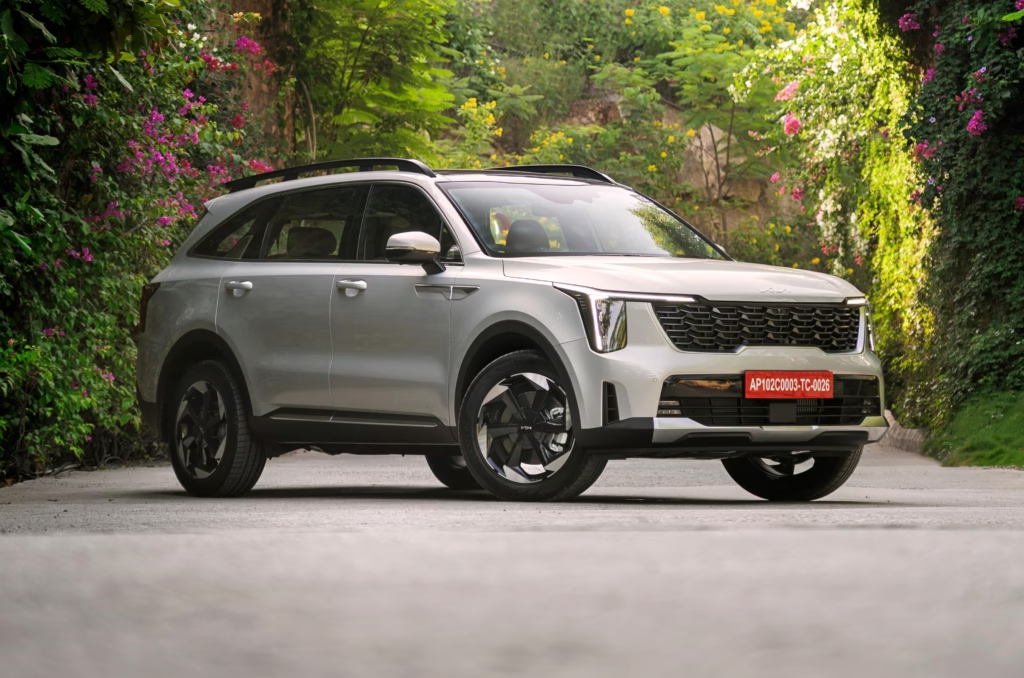
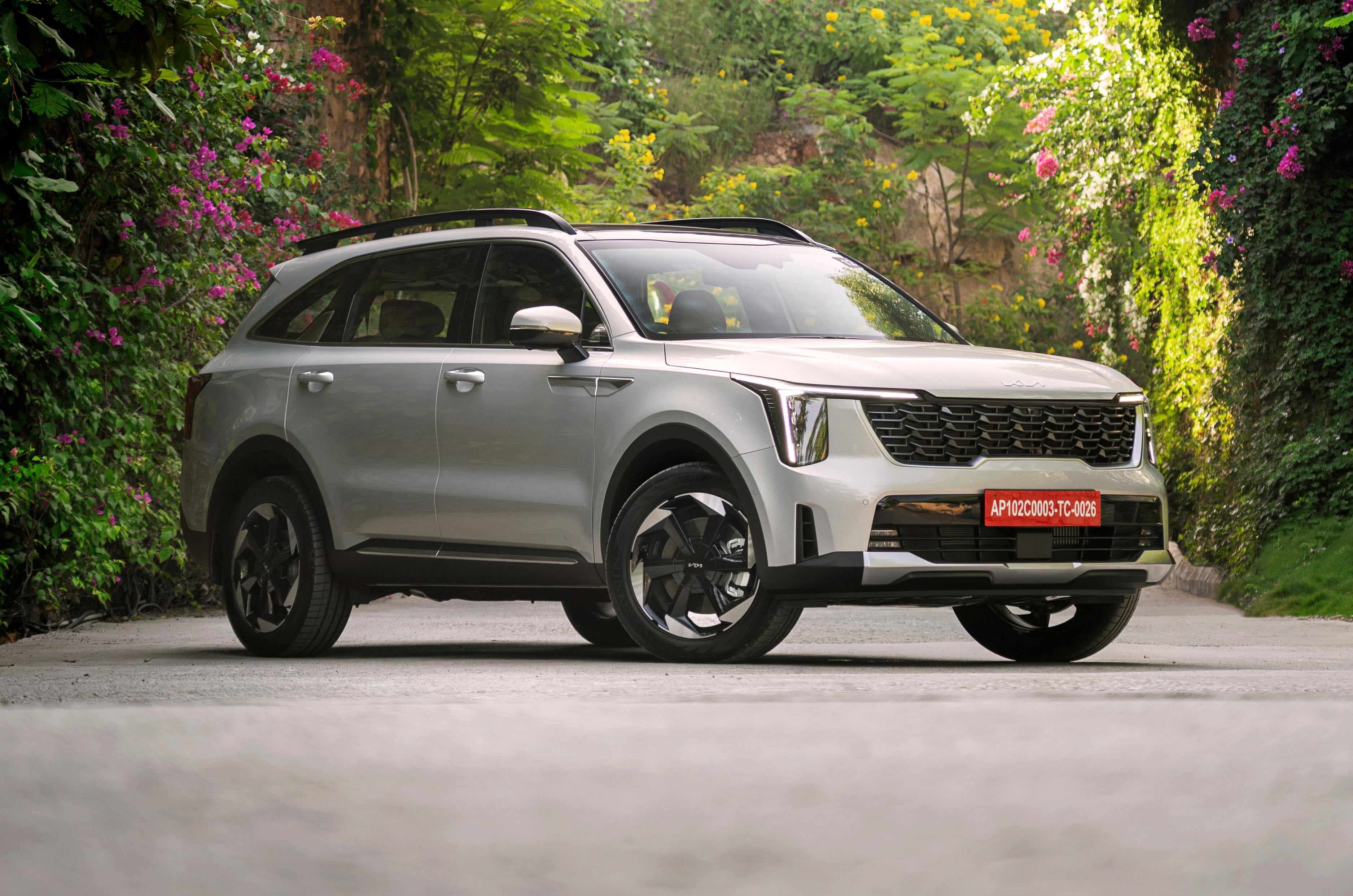
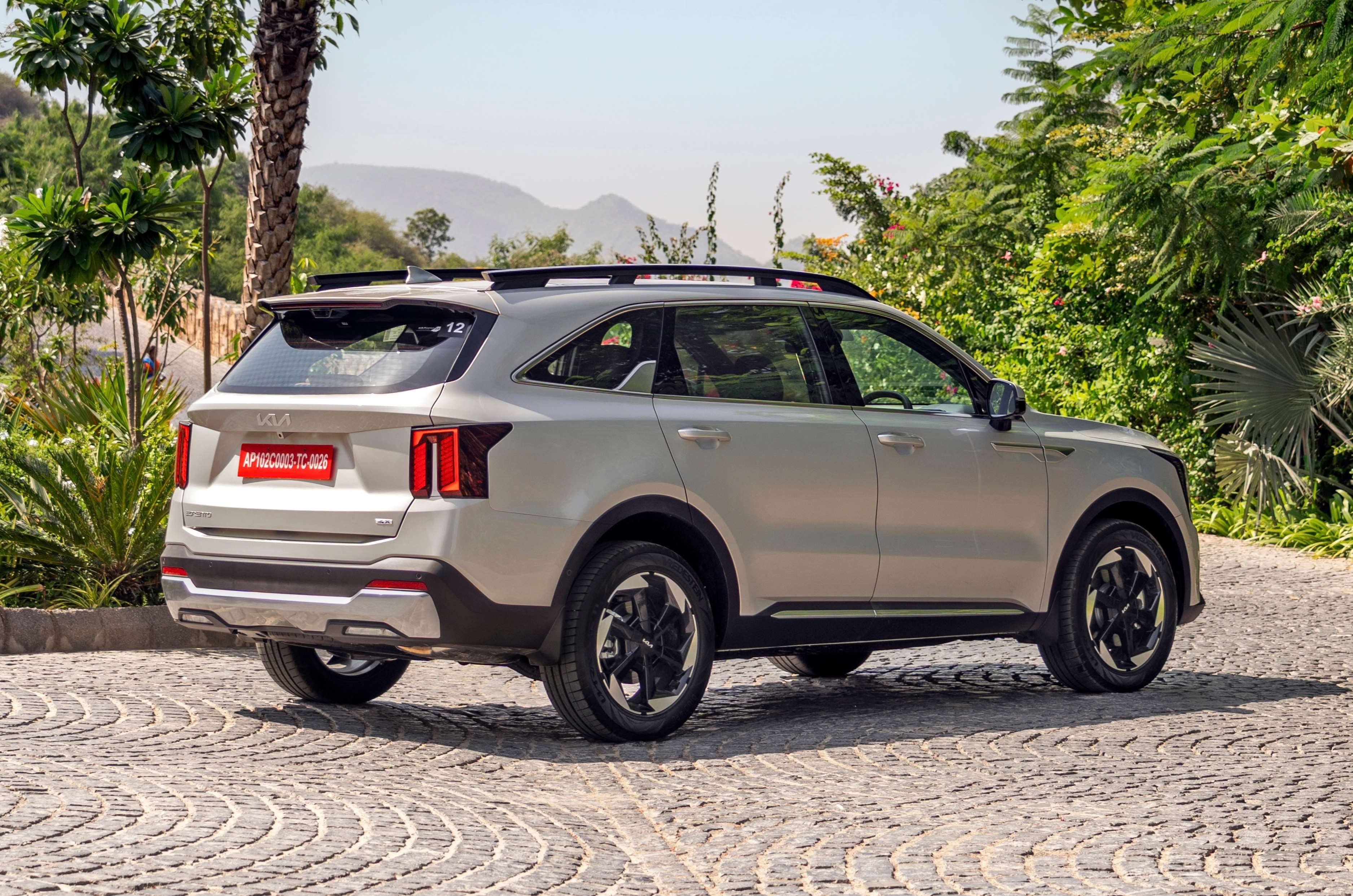
The Kia Sorento recorded 1,739 units in domestic wholesales in September 2026, its first month on sale after launching on September 4. It was Kia India’s fifth best-selling model that month. Including 365 units dispatched to dealers in August ahead of the launch, the Sorento’s total wholesales stood at 2,104 units.
Kia India recorded its highest-ever monthly wholesales of 32,017 units in September, up 41 percent year on year. This was the first time the company had crossed 30,000 units in a month, surpassing its previous record of 29,556 units in October 2025, which was the first month after the GST 2.0 rate cuts kicked in.
Kia Sorento: All you need to know
The Sorento is priced between Rs 27.99 lakh and Rs 40.39 lakh (ex-showroom). It is offered with a 1.6-litre turbo-petrol strong-hybrid powertrain or a 2.2-litre turbo-diesel engine. The hybrid setup pairs a 180hp, 265Nm petrol engine with a 65hp, 264Nm electric motor, while the diesel mill produces 193hp and 442Nm.
The SUV is available in six- and seven-seat configurations. Key features include dual 12.3-inch displays, a head-up display, ventilated front seats, a powered tailgate, a panoramic sunroof and second-row captain seats with ventilation. Safety equipment includes 10 airbags, a 360-degree camera, dual dashcams and Level 2+ ADAS.
The Kia Sorento rivals the Jeep Meridian, Skoda Kodiaq and Volkswagen Tayron.
Kia India sales up 29 percent in H1 FY2027
Kia India recorded wholesales of 1,68,683 units between April and September 2026, a 29 percent year-on-year increase. September wholesales stood at 32,017 units, up 41 percent year on year and the company’s highest monthly total since it entered India in 2019. In Q2 FY2027 (July-September 2026), sales grew 39 percent year on year to 89,259 units and were 12 percent higher than in Q1 FY2027.
The Seltos was Kia’s best-selling model in the first half of FY2027, with 67,667 units, up 99 percent year on year. It accounted for 40 percent of the company’s total wholesales during the period. The Sonet ranked second with 56,929 units, up 21 percent, contributing 34 percent of sales. The Carens range, including the Carens, Carens Clavis and Clavis EV, recorded 34,284 units, down 18 percent year on year.
Silver Price Today: देश में चांदी की कीमतों में दबाव जारी है। 20 अक्टूबर को विजयादशमी पर अलग-अलग शहरों में चांदी का भाव में नरमी आई है। दिल्ली के सर्राफा बाजार में चांदी 2.15 लाख रुपये प्रति किलो पर है। जबकि गुडरिटर्न्स के मुताबिक चांदी की कीमत 2,30,000 रुपये प्रति किलो पर है।
दशहरे के कारण घरेलू वायदा बाजार मल्टी कमोडिटी एक्सचेंज (MCX) और इंडियन बुलियन ज्वैलर्स एसोसिएशन (IBJA) में आज कारोबार बंद है। लेकिन इससे पहले तक मल्टी कमोडिटी एक्सचेंज (MCX) पर चांदी का वायदा घटकर 209825 रुपये प्रति किलो हो गया। जबकि पिछले कारोबारी सत्र में चांदी 2,09,828 रुपये प्रति किलो पर बंद हुई थी। बुलियंस के मुताबिक चांदी की कीमत 2,10,260 रुपये किलो हो गई। जबकि अंतरराष्ट्रीय बाजार में 57.30 डॉलर प्रति औंस हो गई।
कहां है निवेशकों की नजर
निवेशक अगले हफ्ते आने वाले अमेरिकी फेडरल रिजर्व के नीतिगत फैसले का इंतजार कर रहे हैं। फेडरल रिजर्व की मॉनेटरी पॉलिसी मीटिंग 27-28 अक्टूबर को है। सितंबर में अमेरिकी केंद्रीय बैंक ने अपनी बेंचमार्क ओवरनाइट ब्याज दरों में 25 बेसिस पॉइंट्स की बढ़ोतरी की थी, जिसके बाद ये 3.75%-4.00% की रेंज में आ गईं।
भारत में कीमतें अंतरराष्ट्रीय बुलियन (सोना-चांदी) के रुझानों, USD/INR मुद्रा की चाल, और त्योहारों के दौरान होने वाली भारी खरीदारी की उम्मीदों से तय होती हैं। आइए गुडरिटर्न के आंकड़ों के मुताबिक 20 अक्टूबर को भारत के प्रमुख शहरों में चांदी की ताजा कीमतों पर एक नजर डालते हैं
शहर
1 किलो चांदी का भाव
दिल्ली
₹ 2,30,000
मुंबई
₹ 2,30,000
कोलकाता
₹2,30,000
चेन्नई
₹2,40,000
लखनऊ
₹2,30,000
पटना
₹2,30,000
जयपुर
₹2,30,000
अहमदाबाद
₹2,30,000
पुणे
₹2,30,000
बेंगलुरु
₹ 2,30,000
हैदराबाद
₹2,30,000
भोपाल
₹2,30,000
चंडीगढ़
₹2,30,000
नोएडा
₹2,30,000
गुरुग्राम
₹2,30,000
बाजार जानकार का कहना है कि पिछले हफ्ते $55.40 के निचले स्तर पर सपोर्ट मिलने के बाद, चांदी (सिल्वर) एक अहम मोड़ पर है। अब आगे की चाल से यह तय होने की संभावना है कि क्या मंदी का रुझान (bearish trend) जारी रहेगा या फिर इसमें कोई रिकवरी (countertrend recovery) देखने को मिलेगी।
चांदी खरीदते समय इन बातों का रखें ध्यान
चांदी खरीदने से पहले उसकी शुद्धता, वजन और पक्का बिल जरूर जांचें। 999 शुद्धता वाली चांदी में 99.9 प्रतिशत चांदी होती है, जबकि 925 स्टर्लिंग सिल्वर में 92.5 प्रतिशत चांदी होती है। गहनों की कीमत में मेकिंग चार्ज और लागू GST भी जुड़ सकता है।
(डिस्क्लेमर: मनीकंट्रोल.कॉम पर दिए गए विचार एक्सपर्ट के अपने निजी विचार होते हैं। वेबसाइट या मैनेजमेंट इसके लिए उत्तरदाई नहीं है। यूजर्स को मनी कंट्रोल की सलाह है कि कोई भी निवेश निर्णय लेने से पहले सार्टिफाइड एक्सपर्ट की सलाह लें।
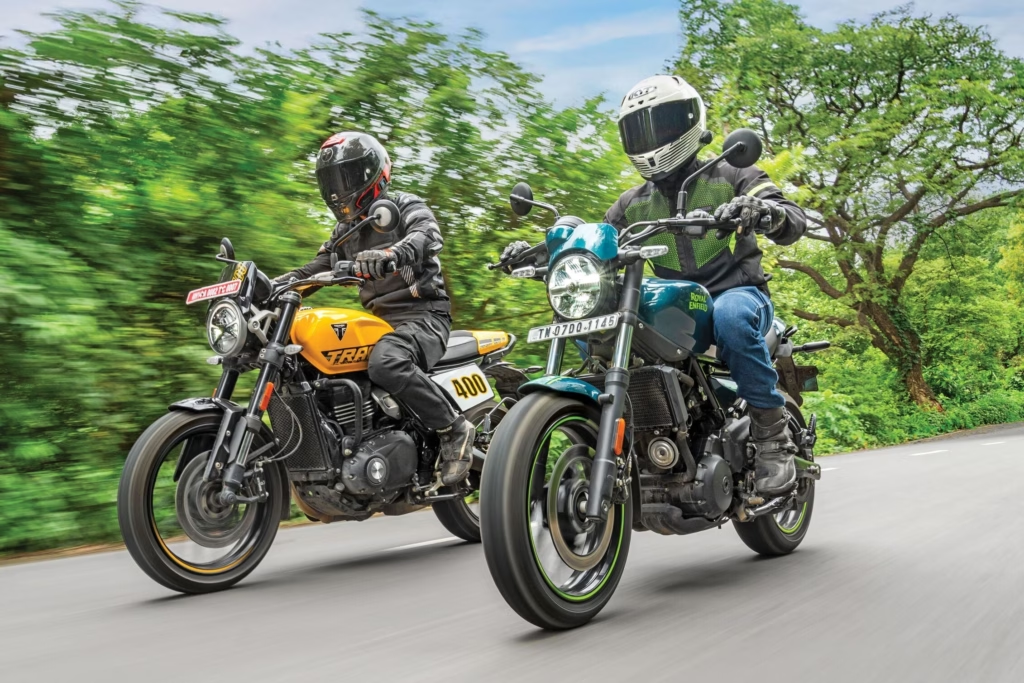
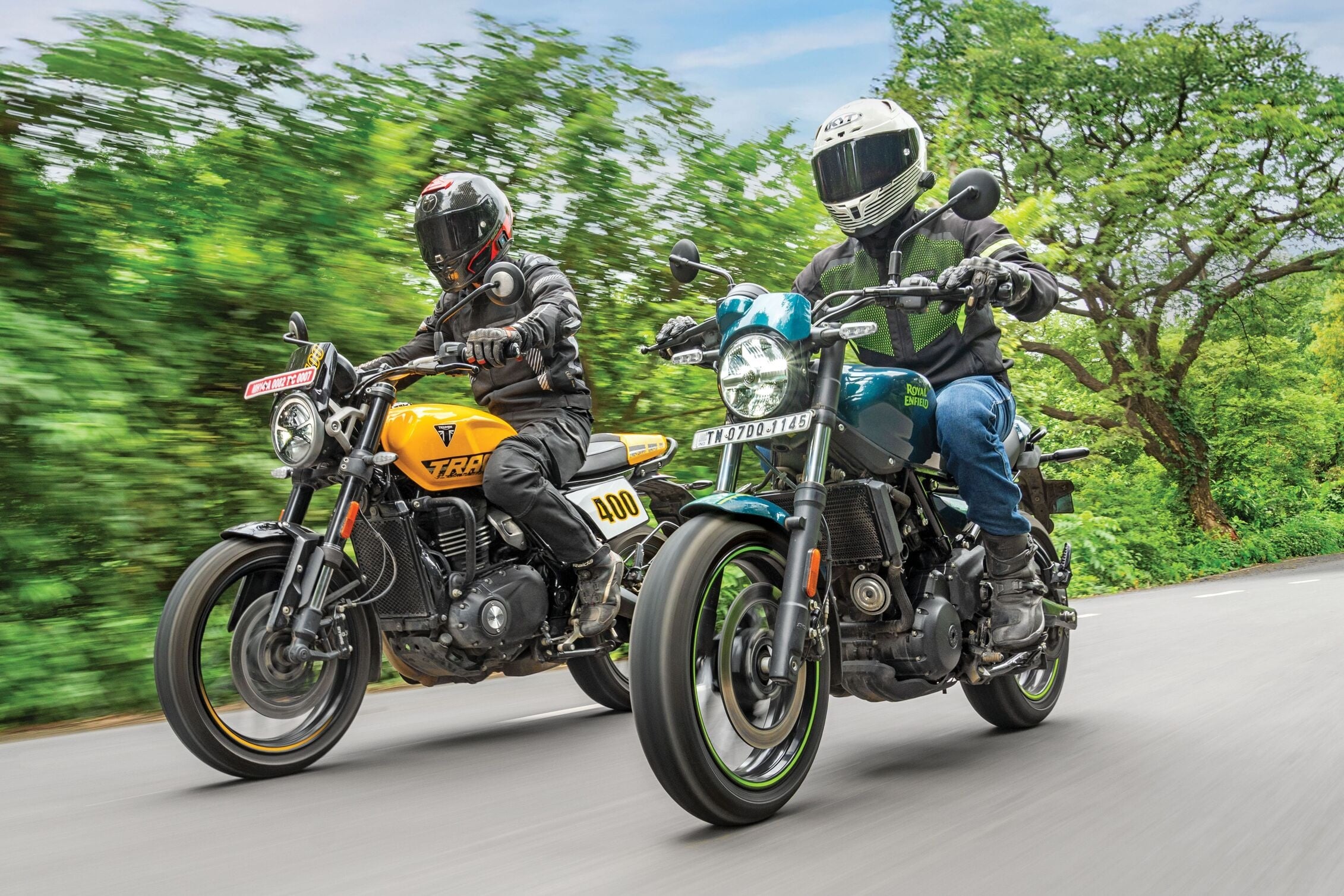
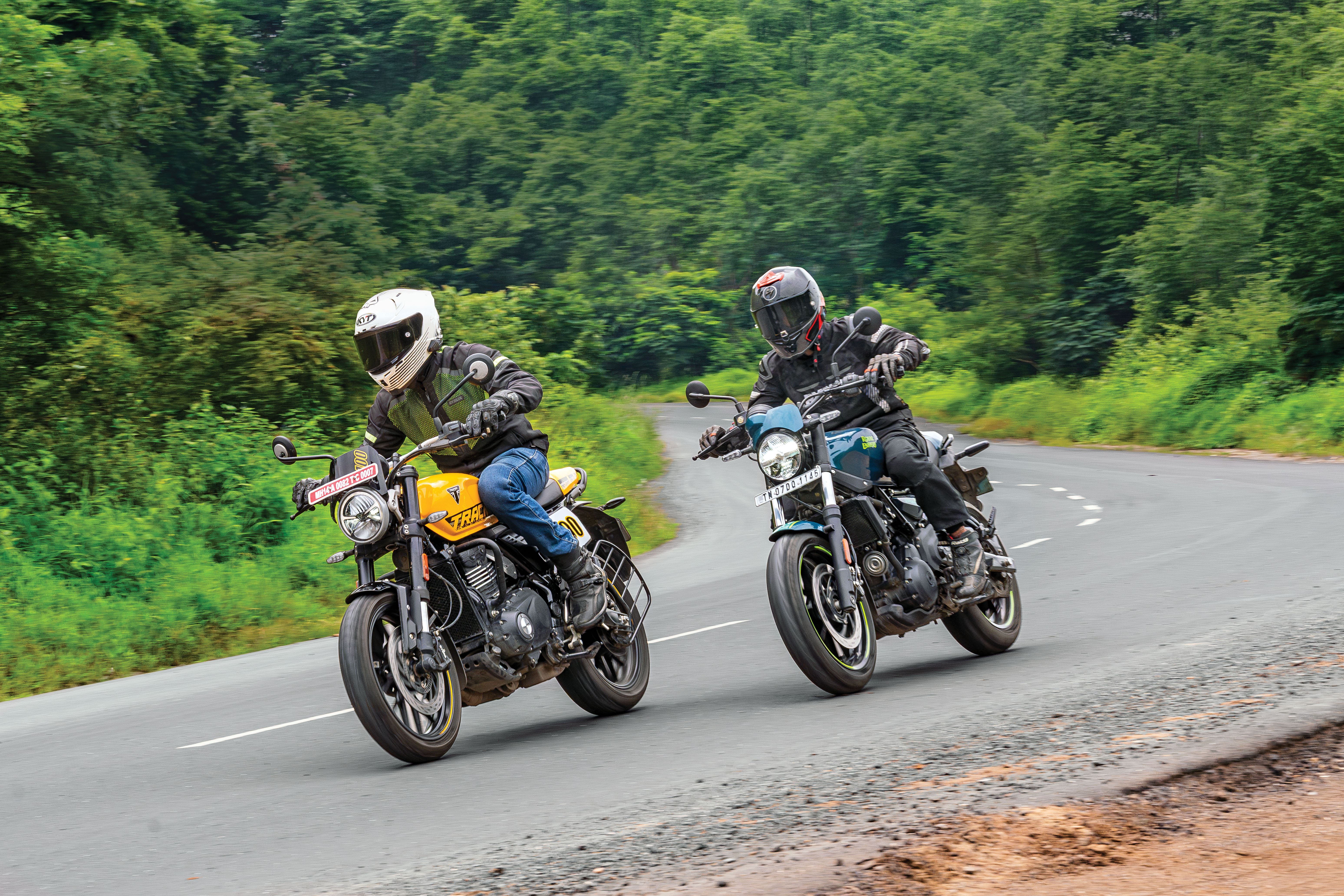
If you are considering either of these motorcycles, chances are you are also considering the other, especially since they both cost about the same. After the Triumph 400cc bikes were downsized, the Tracker 400 now uses a 349cc engine, while the Guerrilla 450 Apex is a sportier variant with more aggressive ergonomics and grippy, road-focused tyres, which I think suit the bike much better than those on the earlier variant.
On paper, the Tracker makes 40hp and 32Nm, while the Guerrilla produces 40.02hp and 40Nm. The Triumph is a lighter, more compact motorcycle, while the Royal Enfield has a larger engine with more torque and offers a stable, planted feel. So, which one makes more sense for someone looking for a sporty, entertaining roadster?
Design and Features
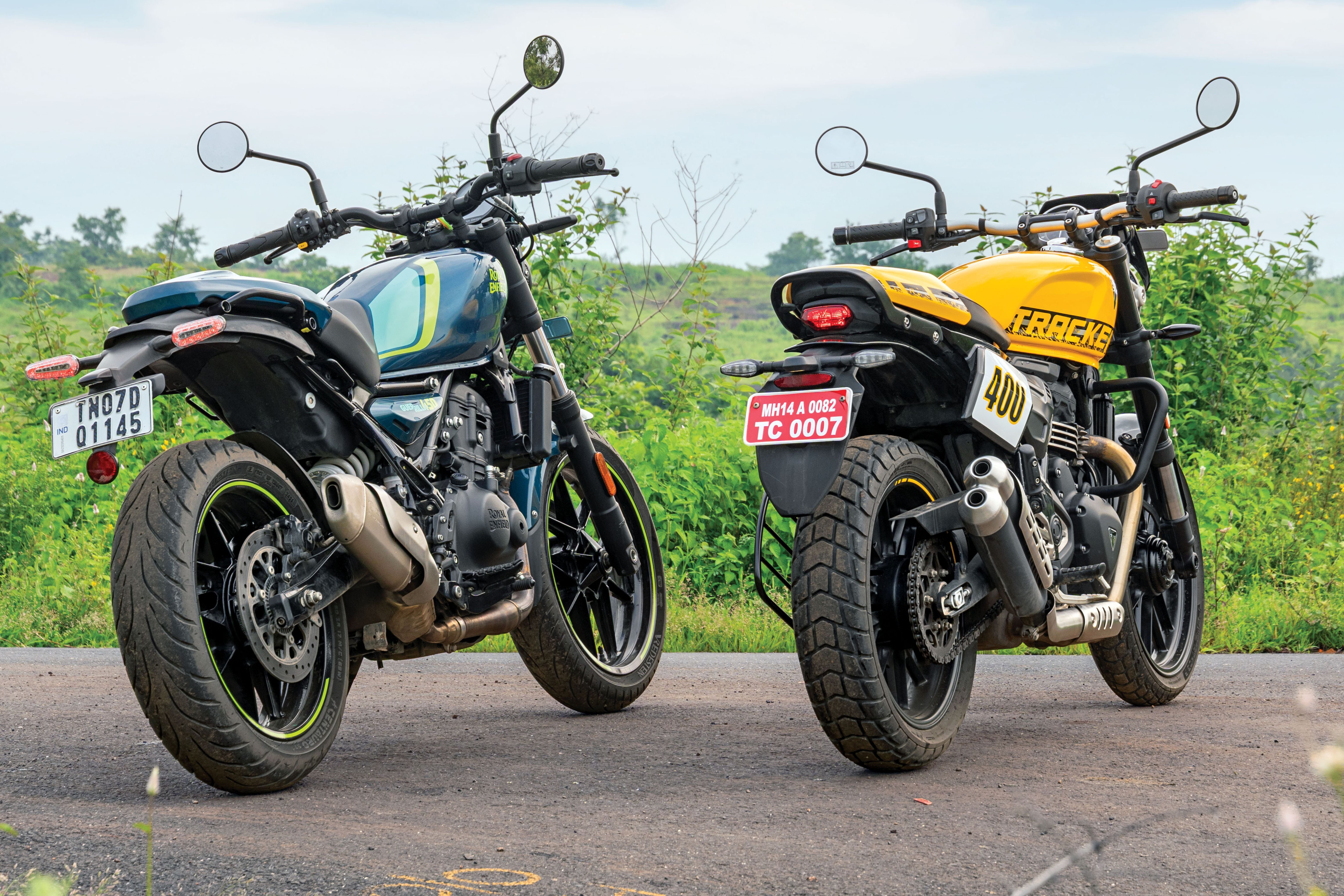
Both motorcycles have very different visual identities, and that is probably the first thing you’ll notice. The Tracker 400 is inspired by flat-track racers, with a flat seat, side number boards and a wide handlebar. But this isn’t really a dirt-track-focussed motorcycle underneath, as its ergonomics, chassis and suspension are properly road-oriented.
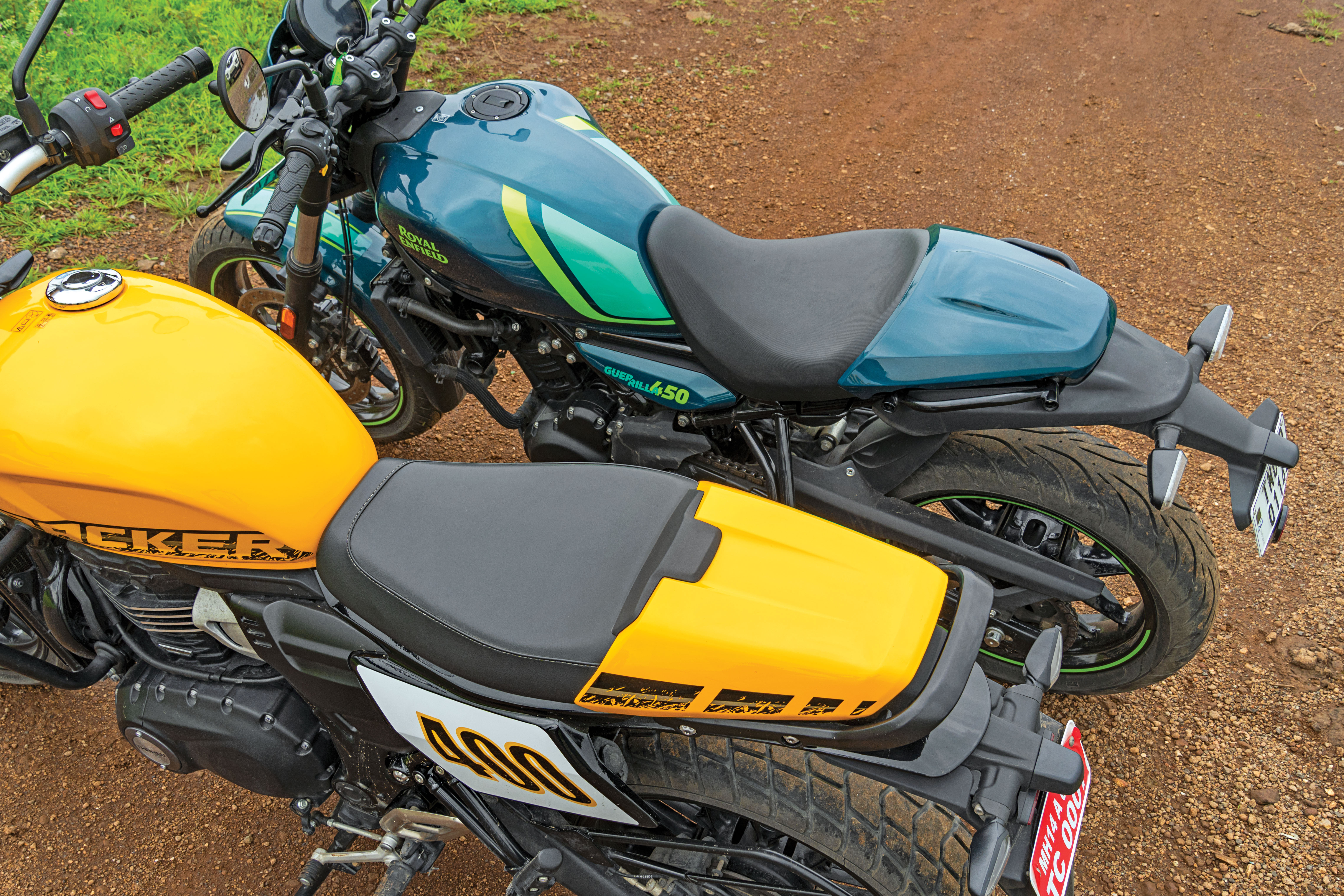
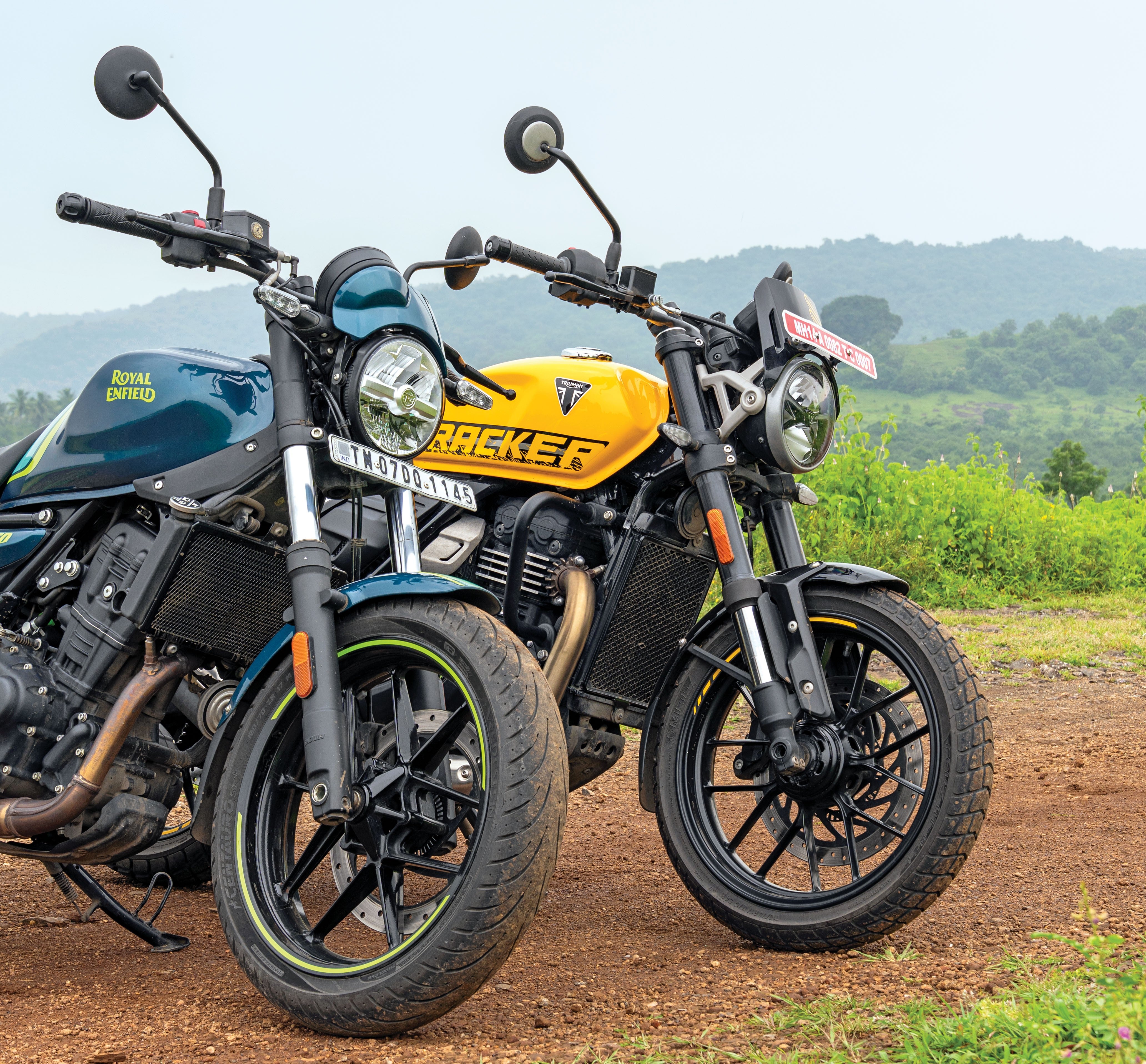
The Guerrilla 450 Apex, meanwhile, looks like a sporty and muscular roadster. Compared to the standard variant, it gets a small cowl over the headlight, a new aluminium handlebar, a removable rear-seat cowl and Vredestein Centauro ST+ tyres. The Apex also has a leaned-forward, more committed riding position compared with the standard Guerrilla.
The Tracker is a relatively compact motorcycle, while the Guerrilla’s longer 1,440mm wheelbase and broad 160-section rear tyre give it a more substantial stance. The Triumph gets a larger 13-litre fuel tank compared with the Guerrilla’s 11-litre unit, which can be tedious when long-distance touring.
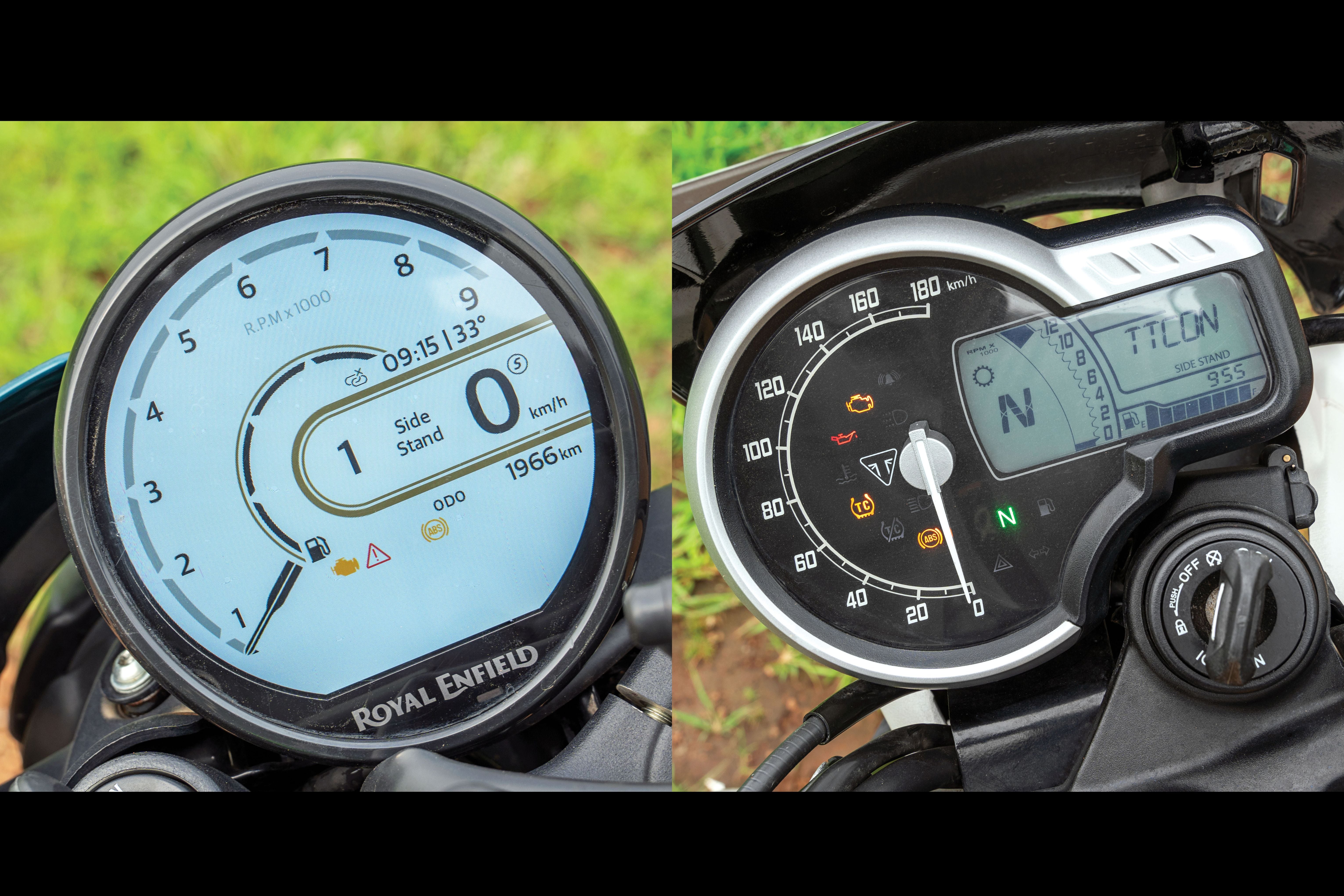
Both motorcycles are equally impressive when it comes to build quality and fit and finish. The Tracker features the same digi-analogue console we have seen on all the other Triumph 400 models, while the Guerrilla features the same TFT unit from the Himalayan. The Guerrilla gets two riding modes (Sport and Street), both of which feel quite similar. On the other hand, the Tracker gets a switchable traction control system that the Guerrilla misses out on. Neither has a quickshifter. In terms of convenience, the Guerrilla has a more accessible 780mm seat height and also gets a main stand, which aids in easier chain maintenance.
There is also a difference in ergonomics. The Tracker’s seat is flat and the riding position is relatively sporty, with rear-set footpegs that suit the character of the bike. The Guerrilla Apex has a lower and more accessible 780mm seat and roadster-like, neutral-set footpegs, along with a committed upper-body position. Between the two, you sit on top of the Tracker with its flat seat, while on the Guerrilla, you sit inside the curved seat, and it is also the more comfortable of the two.
Performance and Fuel Economy
This is where things get interesting because the Tracker 400’s 349cc engine is 103cc smaller than the Guerrilla’s 452cc unit, yet peak power is almost identical. The Triumph produces 40hp at 8,750rpm and 32Nm at 7,500rpm, while the Royal Enfield makes 40.02hp at 8,000rpm. Of course, the difference comes in torque, where the RE makes a much healthier 40Nm at 5,500rpm.
The difference in torque delivery is immediately noticeable. The Tracker’s engine likes to be revved out, but you still have to work it quite a bit. The Guerrilla’s Sherpa engine has a different personality. It doesn’t need to be worked as hard, and the additional 8Nm gives it much stronger roll-on performance. It feels more raw and powerful as soon as you open the throttle, and the surge in power after 6,000rpm makes it feel really exciting. After 7,000rpm, there are some vibrations, but nothing that really ruins the riding experience.
The Tracker’s shorter-stroke engine is very refined at moderate engine speeds, but once you start revving it harder, some buzz makes its way into the tank and footpegs at the top end of the rev range. It remains an entertaining engine, but considering I have ridden the older 398cc Thruxton 400, I feel like it misses out on that initial torque kick.
In our performance tests, the Guerrilla completed the 0-100kph sprint in 6.34 seconds, while the Tracker took 7.55 seconds for the same, marking a difference of 1.21 seconds. The real difference in performance was more visible in the roll-on acceleration tests where the Guerrilla 450 Apex was notably quicker.
Fuel efficiency was almost on par in our tests, where the Tracker delivered 24.1kpl in the city and 31.71kpl on the highway, while the Guerrilla gave us 25.23kpl in the city and 32.82kpl on the highway. The Triumph’s 13-litre tank will give it a better range despite the marginally lower highway efficiency.
Ride and Handling
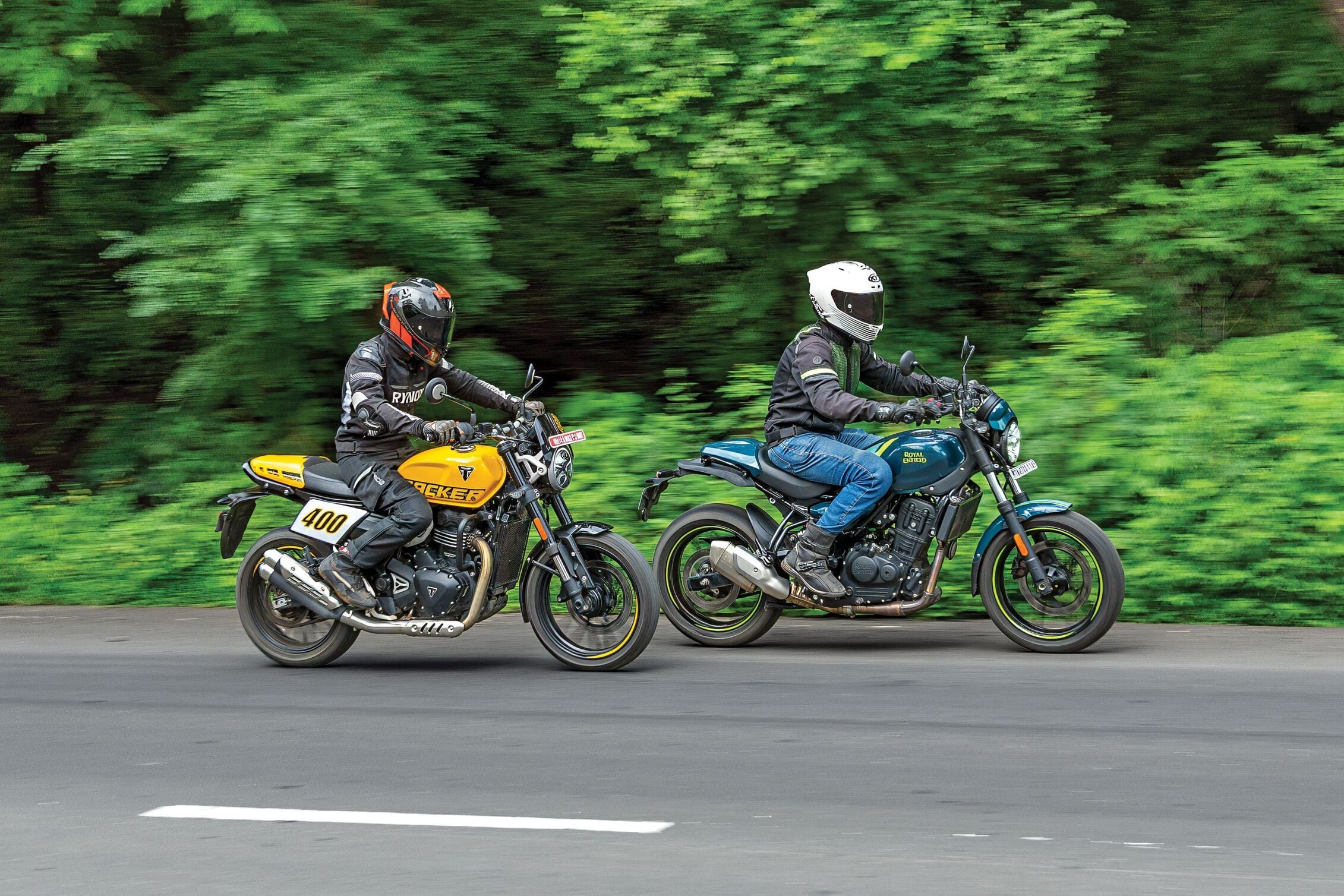
The biggest difference between these two motorcycles becomes apparent once the road starts to twist. The Guerrilla feels longer and heavier and needs a bit of muscling around, but once in a corner, it is extremely stable and planted. The grip offered by the Vredestein tyres is superb and inspires a lot of confidence. The Tracker, on the other hand, feels light, nimble and very easy to flick into corners, thanks to its shorter wheelbase and the leverage offered by the wide handlebars. Its blocky MRF tyres work well, but given how it rides more like a sporty roadster rather than a tracker, stickier tyres would have been a better choice.
While many might be disappointed about the Guerrilla 450 Apex not getting a USD fork, the suspension does work much better than the Tracker’s over bad roads and undulations. The setup feels plusher than the Tracker, which has a quicker rebound that can toss you up if you hit potholes at higher speeds.
Despite the Triumph being the more compact motorcycle, I felt like it was easier to filter through traffic on the Guerrilla, and that is because the Triumph has slightly wider handlebars and mirrors that jut out slightly more. I do remember my time spent with the Guerrilla on a go-kart track, and it was genuinely a lot of fun. The tyres kept up with the performance that the engine offers, and it was a blast to exploit the full capabilities of the bike. The only limitation was the footpegs, which kept scraping when the bike was leaned over. That said, this was never a problem out on the road.
Braking hardware is strong on both. The Tracker gets a 300mm front disc with a four-piston radial ByBre caliper, while the Guerrilla uses a 310mm front disc and 270mm rear disc. The Guerrilla stopped marginally quicker in our braking test from 60-0kph, but I did notice that the ABS intervention can be strong when emergency braking from higher speeds.
Price and Verdict
These two motorcycles are closer than their engine capacities suggest. The Tracker proves that you don’t need a large engine to make for a fun roadster. Its 349cc motor makes almost as much peak power as the Guerrilla, and its compact dimensions, wide handlebar and sporty chassis make it an engaging motorcycle on a twisty road.
The Royal Enfield Guerrilla 450 Apex, however, takes a more muscular approach. Its 452cc engine has substantially more torque, the Vredestein tyres give it a level of grip that suits its performance, and the longer wheelbase also gives it a reassuring planted character, particularly when you’re riding quickly.
They offer two distinct interpretations of the sporty modern roadster. The Tracker’s biggest strength is its agility. It feels smaller, lighter and more eager to change direction quickly. The Guerrilla’s strength is the breadth of its performance. There’s more torque, more road presence and a greater sense of stability when you’re pushing it. And that is ultimately what separates them. The Triumph is the more playful motorcycle, thanks to its nimble nature, while the Guerrilla Apex feels like a more serious attempt at turning the standard roadster into a proper performance-oriented, corner-carving machine.
While it is difficult to pick between these two motorcycles, considering that they do things in different ways, you can’t look past the value that the Guerrilla offers. Despite falling into the 40 percent GST bracket, its starting price is just Rs 10,000 more than that of the Tracker. To put things into perspective, the KTM 390 Duke R, which used to be the benchmark for affordable and accessible performance when its Gen 1 model was launched in India, is now priced at Rs 3.45 lakh (ex-showroom), taking its on-road price upwards of Rs 4 lakh. So the way I see it, the Guerrilla 450 Apex is now the new benchmark when it comes to affordable performance in India. Who’d have ever thought that the crown would one day be worn by a Royal Enfield.
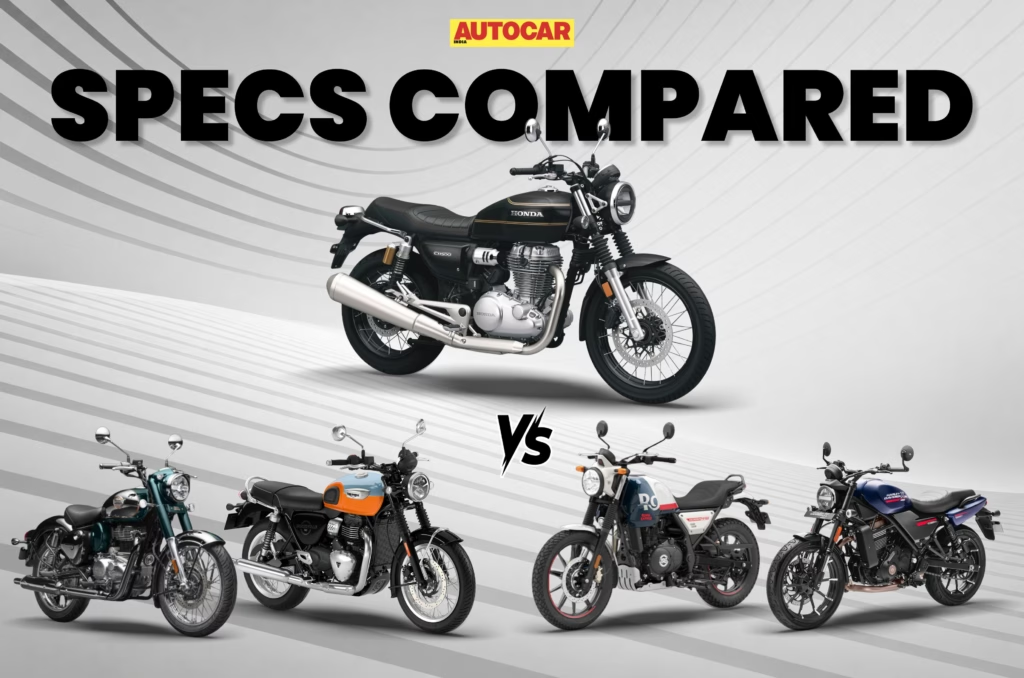
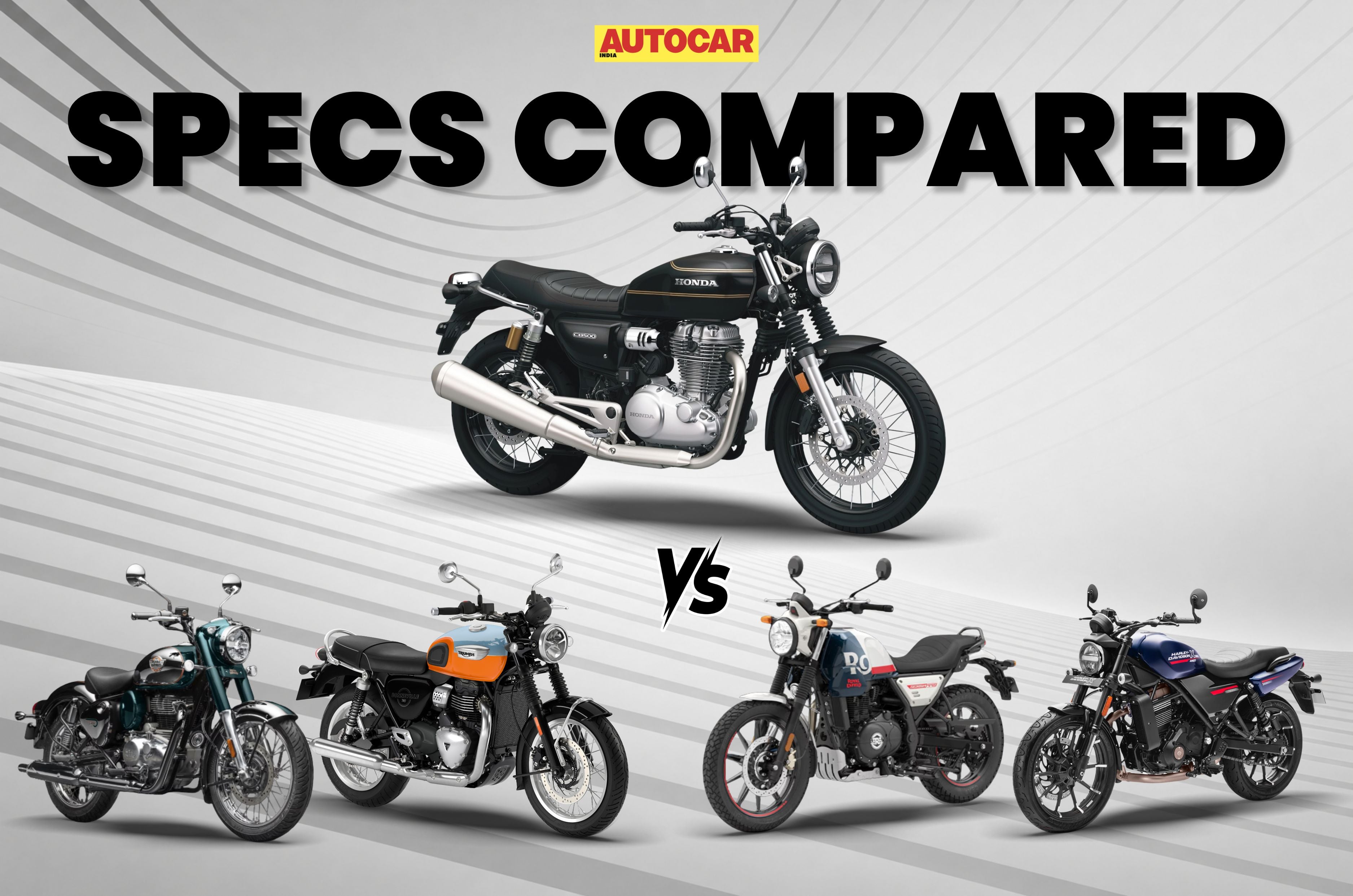
Honda has revealed the specifications for the CB500, so it’s only natural that we see how it stacks up against its main rivals such as the Harley-Davidson X440 T and Triumph Bonneville T40. For good measure, we’ve even thrown in other lower-priced and lower-spec but far more popular alternatives like the Royal Enfield Scram 440 and the king of this class, the Classic 350. Here is how these stack up against each other on paper.
Honda CB500 vs Rivals: Engine and output
The Honda CB500 shines with plenty of low-to-mid range torque
Honda CB500
Harley-Davidson X440 T
Triumph Bonneville T40
Royal Enfield Scram 440
Royal Enfield
Classic 350
Engine
501.7cc, single-cylinder, oil-cooled
440cc, single-cylinder, oil-cooled
350cc, single-cylinder, liquid-cooled
443cc, single-cylinder, oil-cooled
349cc, single-cylinder, liquid-cooled
Power
28.14hp at 5,250rpm
27hp at 6,000rpm
29hp at 9,000rpm
25.42hp at 6,250rpm
20.2hp at 6,100rpm
Torque
43.3Nm at 3,750rpm
38Nm at 4,000rpm
31.2Nm at 5,500rpm
34Nm at 4,000rpm
27Nm at 4,000rpm
Gearbox
5-speed
6-speed
6-speed
6-speed
5-speed
Power-to-weight ratio
148.88hp/tonne
140hp/tonne
148.71hp/tonne
129.69hp/tonne
103.59hp/tonne
With its large 501.7cc mill, the Honda offers more low-to-mid-range torque than the others, and it arrives the earliest too, at 3,750rpm. The torque outputs in this comparison are largely dictated by the engine’s displacement. In the modern retro segment where riders want an effortless riding experience, a healthy torque output delivered without too much effort is almost a necessity. The only anomaly here is the Bonneville T40, with its short stroke and liquid-cooled engine, making the most peak horsepower, although its torque output can’t match the larger bikes’ figures.
Honda CB500 vs Rivals: Dimension and weight
The CB 500 is the lightest in its segment
Honda CB500
Harley-Davidson X440 T
Triumph Bonneville T40
Royal Enfield Scram 440
Royal Enfield
Classic 350
Fuel tank capacity
15.2 litres
13.5 litres
14.5 litres
15 litres
13 litres
Ground Clearance
168mm
170mm
165mm
200mm
170mm
Kerb weight
189kg
192kg
195kg
196kg
195kg
Seat Height
NA
805mm
790mm
795
805mm
Wheelbase
1439mm
1418mm
1418mm
1460
1390mm
The Honda CB500 immediately stands out because of its kerb weight. It is the lightest motorcycle in this comparison, despite having the largest motor. Of all the bikes here, the T40 offers the most accessible saddle height, and you can further drop it down to 770mm with the accessory low seat. No bike here is a corner carver and all of them prioritize a laidback and stable demeanour on the side of their tyres. Given that we are yet to ride 2 of the most recent entrants yet, any comment on a comparison of their ride and handling will have to wait until a later date.
If you want your neo retro machine to be able to tackle bad roads, all of them should be up for the job but it’s the Scram that is the most apt for it with its Himalayan-derived suspension and chassis.
Honda CB500 vs Rivals: Tyres, brakes and suspension
The X440 T is the only motorcycle that features a USD fork
While the Harley-Davidson features a USD front fork, the other motorcycles rely on right way up telescopic forks and twin rear shocks with the exception of the Scram, which uses a link-type monoshock. Again, in keeping with their more relaxed nature, the simple spec on offer here is more than sufficient for these bikes’ intended roles. Of them all, the H-D X440 T is likely to be the most agile owing to its more sophisticated front suspension and smaller wheel sizes, which are almost akin to a traditional roadster.
More pertinent here is that the Classic 350 (except for the alloy wheel ‘Dark’ variant) and Bonneville T40 come only with tubed tyres. The Honda comes with tubeless tyres on all variants and save for the base one, the other two come with neat-looking side-laced rims permitting the aforementioned feature.
Honda CB500 vs Rivals: Features
Triumph takes the lead in the features department
The Bonneville T40 offers more features than any bike in the neo-retro segment (even more than its much more expensive twin-cylinder brethren!). Its electronic throttle body permits five ride modes (Eco, Road, Rain and customizable Rider A and B) as well as cruise control. A handsome full colour, 4-in TFT dash further brings in turn-by-turn navigation and cornering ABS as well as traction control complete its electronic arsenal.
The X440 T also has a TFT display, but it’s neither as sophisticated nor as pleasing to look at as the one on the ‘Bonnie’. It brings in 2 riding modes (Road and Rain) and has the safety net of switchable dual channel ABS and traction control. While the Honda has the same riding aids as the Harley, it displays information to the rider via a simple and easy-on-the-eyes digi-analogue display which has basic Bluetooth connectivity. The Scram and Classic -in true RE fashion – are simple, but not spartan machines. The Classic offers you a slip-and-assist clutch, type-C charger and dual-channel ABS, whereas the Scram misses out the slip-and-assist clutch and further offers you the ability to disable ABS at the rear.
Honda CB500 vs Rivals: Price
The CB500 is priced competitively
Honda CB500
Harley-Davidson X440 T
Triumph Bonneville T40
Royal Enfield Scram 440
Royal Enfield
Classic 350
Price (ex-showroom)
Rs 2.75-3.02 lakh
Rs 2.86 lakh
Rs 2.80 lakh
Rs 2.25-2.32 lakh
Rs 1.89-2.26 lakh
Honda has priced the CB500 rather well considering its capacity, what it brings to the table and despite the higher 40 percent GST working against it. In fact, its starting price undercuts both the smaller Harley and Triumph, and not by an unsubstantial amount.
However, in comparison to the slower and smaller REs, the Honda’s price is a segment higher and rightly so, because the CB500 is, for all intents and purposes, a machine from a segment above. Deliveries for the Alloy variants are expected later this year, and for the spoke and tubeless spoked variants in the first quarter of 2027.
Given what the latest offerings bring to the segment and their differing price strategies, the neo retro segment is now larger and more diverse than ever before with an option to suit just about every need. Choosing between these bikes is more than a simple comparison on paper and will need a more nuanced understanding of what they offer the rider.
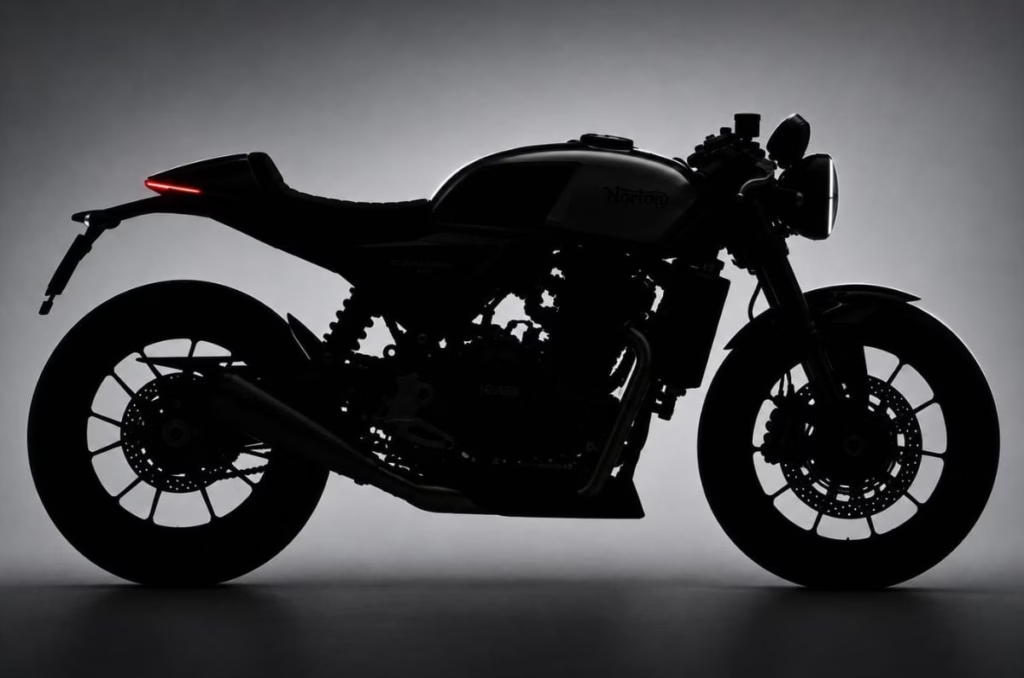
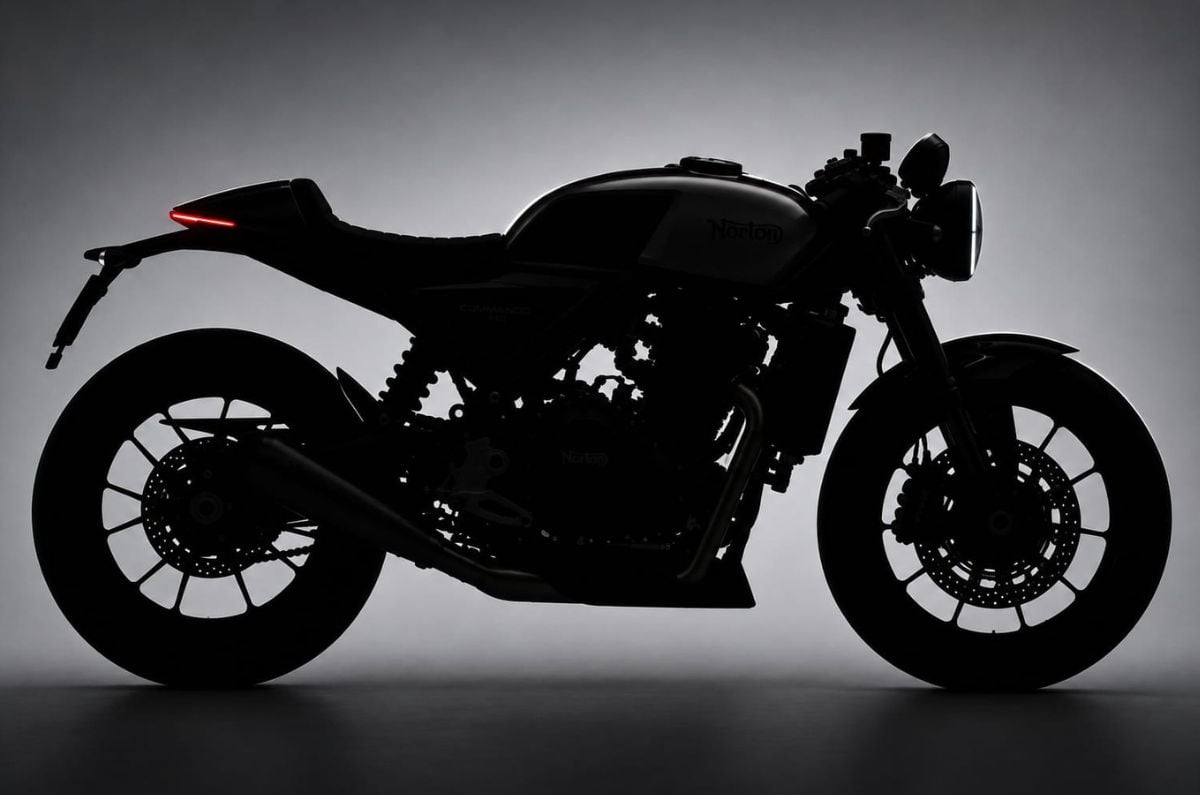
Norton Motorcycles will premiere its much-awaited 450cc-class single-cylinder roadster at EICMA 2026 in Milan, expanding its range with a motorcycle aimed at higher volumes in India and overseas. Autocar Professional expects the motorcycle to produce around 40-45hp and 40-45Nm. The engine is likely to be liquid-cooled and is expected to come with a 6-speed gearbox. The roadster will be the first model on a new platform understood to be called the H-series, with other body styles to follow. It will sit below the TVS Motor-owned British marque’s twin-cylinder Atlas range and V4-powered Manx family.
Norton Atlas is expected to first launch in India, in Q1 2027
New Norton single-cylinder motorcycle will launch overseas and in India simultaneously
Will also be manufactured at TVS’ Hosur plant
New Norton single-cylinder platform at EICMA 2026
Expected to launch in India and overseas in 2027
Autocar Professional understands that TVS plans to begin Norton’s India rollout in the January-March 2027 quarter, if not sooner, starting with the Atlas, followed by the Manx. The H-series roadster is expected to launch simultaneously in India and global markets in the second half of 2027. Responding to queries from Autocar Professional, a Norton spokesperson said the brand’s India introduction would follow its appearance at this year’s Milan show. “Norton is set to launch in India soon following the brand’s presence at EICMA this year, when the next key stage of the resurgence will be revealed,” the spokesperson said. The company has not officially confirmed the roadster’s platform name, engine capacity, output, pricing or sales timeline.
Norton has recently trademarked three names in India – Roven, Inter and Avalon and the first single cylinder bike may bear one of them. In 2025, the company also trademarked the Norton Electra name here, and this followed on the trademarking of the Norton Combat name in 2023.
Reimagined Norton under TVS
Design and ease of use is at the new Norton’s core
Differentiated design is central to TVS’s effort to give Norton a contemporary identity while retaining its British heritage. Simon Skinner, Head of Design, Norton Motorcycles, is leading the development of a design language connecting the brand’s products across capacities and categories. The roadster will extend that approach to a motorcycle intended to sell in larger numbers.
As we have seen with the thoroughly modern designs on the Atlas and V4, it is safe to anticipate modern, pared-back styling, with selected mechanical components exposed and others concealed. This could help distinguish the roadster in a segment where several competitors draw heavily on retro styling. According to Norton, the Manx R received the “Best of the Best” distinction at the 2026 Red Dot Award: Design Concept. Norton Design was also recognised at the 2026 International Design Excellence Awards in the United States.
The roadster is expected to prioritise manageable weight and ease of use, particularly in city riding. It could feature 17-inch wheels and equipment drawn from Norton’s larger motorcycles, potentially including an eight-inch TFT touchscreen, riding aids and multiple riding modes. Final specifications remain unconfirmed.
Taking on Royal Enfield
How does Norton plan to combat the 350cc onslaught?
The platform represents a significant bet on the global mid-size motorcycle market. The opportunity spans roughly the 350cc-750cc categories, with annual volumes estimated at around 15 lakh-20 lakh units. This broad classification includes motorcycles marketed as 350cc models whose actual displacement is slightly lower.
It will bring Norton into closer competition with Royal Enfield and Triumph in India and overseas. However, the new single-cylinder Nortons will face a specific challenge in India. That is the fact that they will not come under the 350cc segment, unlike the massively popular RE 350 range and the recently re-engineered 349cc Triumph line in India. The result is that they will attract the much higher 40 percent GST rate instead of 18 percent. Norton is likely to position these bikes at a premium that will be justified by higher levels of technology and a heavy focus on design, quality and detail.
Royal Enfield’s dominance in India demonstrates the demand for motorcycles used for daily travel, touring and leisure riding. Its extensive dealer network, broad product range and established riding community also present a substantial challenge for Norton. Overseas, Royal Enfield has expanded into many of the markets the TVS-owned British marque is targeting. For TVS, the single-cylinder Norton offers a way to participate more widely in this market. Additional body styles on the same platform would help spread development costs and reach buyers with different riding preferences.
The India distribution plan
TVS is yet to confirm showroom rollout schedule for India
Norton’s design and heritage will form part of its appeal, but pricing, service coverage and parts availability will be important to building sustained sales, particularly in India. TVS had said in June that the Norton Atlas would be introduced in India later in the year. It had also scheduled the launch of TVS Paddock, its premium retail channel for both Norton and select premium TVS products, for the second quarter of FY27. The latest official response did not provide an updated Paddock rollout schedule.
Current preparations are understood to point to around three Paddock outlets by December, although a larger network is being sought. The number of outlets that will be operational when motorcycle sales begin has yet to be finalised. The company said it now has more than 50 retailers across 10 markets, including the UK, Italy, France, Germany and Spain. Preparations for a United States launch are continuing, subject to the final stages of vehicle certification.
Norton said its European test-ride programme had introduced the new motorcycles to thousands of riders. Foster + Partners has designed its showroom environments. TVS acquired Norton in April 2020. Its FY2025-26 annual report records investments exceeding GBP 250 million in rebuilding the business and identifies the marque as an important part of its premium-isation strategy, particularly in developed markets.
India already supports that expansion through manufacturing. The first Atlas motorcycles rolled off TVS’s Hosur production line in June, combining Norton’s UK design and engineering with its parent’s manufacturing operations. Production for the new single-cylinder range will also be out of Hosur.
With inputs from Anurag Chaturvedi and Rishaad Mody.
Silver price Today: देश में चांदी की कीमत और नीचे आ गई है। 19 अक्टूबर की सुबह चांदी 229900 रुपये प्रति किलोग्राम पर है। बीते सप्ताह चांदी का भाव 13,500 रुपये नीचे आया। MCX पर चांदी का वायदा भाव 758 रुपये यानी 0.36 प्रतिशत बढ़कर 2,11,418 रुपये प्रति किलोग्राम हो गया, जबकि पिछले कारोबारी सत्र में यह 2,10,660 रुपये पर बंद हुआ था। बुलियंस के मुताबिक चांदी 2,11,840 रुपये प्रति किलो और अंतरराष्ट्रीय बाजार में 57.52 डॉलर प्रति औंस पर है।
हाई से अब इतनी सस्ती Silver
बीते पांच कारोबारी दिनों में चांदी की वायदा कीमत में आई गिरावट के बाद अब Silver अपने लाइफ टाइम हाई से और भी ज्यादा सस्ती हो गई है. बता दें जनवरी महीने में वायदा चांदी का भाव अपने सारे रिकॉर्ड तोड़ते हुए पहली बात 4 लाख रुपये के ऐतिहासिक स्तर के पार निकली थी और इसने 4,20,048 रुपये प्रति किलोग्राम का हाई लेवल छुआ था लेकिन इसके बाद चांदी की कीमत ज्यादातर दिनों क्रैश होती नजर आई और ताजा गिरावट के बाद तुलना करें, तो Silver Price अपने हाई लेवल से 2,08,630 रुपये किलो कम हो चुका है
आइए गुडरिटर्न के आंकड़ों के मुताबिक 16 अक्टूबर को भारत के प्रमुख शहरों में चांदी की ताजा कीमतों पर एक नजर डालते हैं
1 किलो चांदी का भाव
दिल्ली
₹ 2,29,900
मुंबई
₹ 2,29,900
कोलकाता
₹2,29,900
चेन्नई
₹2,39,900
लखनऊ
₹2,29,900
पटना
₹2,29,900
जयपुर
₹2,29,900
अहमदाबाद
₹2,29,900
पुणे
₹2,29,900
बेंगलुरु
₹ 2,29,900
हैदराबाद
₹2,29,900
भोपाल
₹2,29,900
चंडीगढ़
₹2,29,900
नोएडा
₹2,29,900
गुरुग्राम
₹2,29,900
कीमतों में दबाव क्यों
अमेरिकी मुद्रास्फीति (इन्फ्लेशन) में बढ़ोतरी के कारण फेड द्वारा ब्याज दरों में और वृद्धि की संभावना बनी हुई है, जिससे चांदी (XAG) पर दबाव कायम है। अमेरिकी डॉलर में हालिया गिरावट से चांदी की कीमतों में कुछ सुधार आ सकता है, लेकिन ऊर्जा की ऊंची लागत और ब्याज दरें और बढ़ने का जोखिम इस सुधार को सीमित कर सकता है।
बाजार जानकारों का कहना है कि चांदी के आउटलुक को मजबूत करने के लिए इसे $50-$55 के सपोर्ट ज़ोन पर टिके रहना होगा और $60 के स्तर को पार करना होगा।
चांदी खरीदते समय इन बातों का रखें ध्यान
चांदी खरीदने से पहले उसकी शुद्धता, वजन और पक्का बिल जरूर जांचें। 999 शुद्धता वाली चांदी में 99.9 प्रतिशत चांदी होती है, जबकि 925 स्टर्लिंग सिल्वर में 92.5 प्रतिशत चांदी होती है। गहनों की कीमत में मेकिंग चार्ज और लागू GST भी जुड़ सकता है।
(डिस्क्लेमर: मनीकंट्रोल.कॉम पर दिए गए विचार एक्सपर्ट के अपने निजी विचार होते हैं। वेबसाइट या मैनेजमेंट इसके लिए उत्तरदाई नहीं है। यूजर्स को मनी कंट्रोल की सलाह है कि कोई भी निवेश निर्णय लेने से पहले सार्टिफाइड एक्सपर्ट की सलाह लें।
Sugarcane Ethanol Ban: केंद्र सरकार ने एथेनॉल खरीदने के नियमों में बड़ा बदलाव किया है। अब सरकारी तेल कंपनियां गन्ने के रस, चीनी, शुगर सिरप और बी-हैवी शीरे से बने एथेनॉल की खरीद नहीं कर सकेंगी। सरकार ने एथेनॉल बनाने के लिए चीनी के इस्तेमाल को शून्य करने का निर्देश दिया है। यह नियम 1 नवंबर 2026 से शुरू होने वाले नए सप्लाई वर्ष में लागू होगा।
सरकार का मकसद देश में चीनी की उपलब्धता बनाए रखना है। साथ ही, चीनी की कीमतों पर दबाव कम करना भी इस फैसले की वजह है। इसके लिए सरकारी तेल कंपनियों ने करीब 1,100 करोड़ लीटर एथेनॉल खरीदने का टेंडर जारी किया है।
1,100 करोड़ लीटर एथेनॉल खरीदेंगी तेल कंपनियां
इंडियन ऑयल, भारत पेट्रोलियम, हिंदुस्तान पेट्रोलियम, मैंगलोर रिफाइनरी और नुमालीगढ़ रिफाइनरी ने मिलकर यह टेंडर जारी किया है। इसके तहत 1 नवंबर 2026 से 31 अक्टूबर 2027 तक एथेनॉल की सप्लाई होनी है।
नए नियमों के मुताबिक, कंपनियां गन्ने के रस, चीनी, शुगर सिरप और बी-हैवी शीरे से बने एथेनॉल के लिए बोली नहीं मांगेंगी। हालांकि, दूसरे कच्चे माल से बने एथेनॉल की खरीद जारी रहेगी।
मक्का और चावल से बने एथेनॉल की कीमत कितनी?
सरकार ने अलग-अलग कच्चे माल से बने एथेनॉल की बेस कीमत भी तय की है। मक्का से बने एथेनॉल की कीमत ₹66.07 प्रति लीटर रखी गई है। इसके अलावा ₹2.79 प्रति लीटर का अतिरिक्त प्रोत्साहन भी मिलेगा।
खराब खाद्यान्न से बने एथेनॉल की बेस कीमत ₹64 प्रति लीटर तय की गई है। भारतीय खाद्य निगम (FCI) से मिलने वाले अतिरिक्त चावल से बने एथेनॉल के लिए ₹60.32 प्रति लीटर की दर रखी गई है। वहीं, सी-हैवी शीरे से बने एथेनॉल की कीमत ₹57.97 प्रति लीटर होगी।
इन दरों में GST और परिवहन का खर्च शामिल नहीं है। ये खर्च अलग से देना होगा। राष्ट्रीय जैव ईंधन नीति के तहत मंजूर दूसरे कच्चे माल से बने एथेनॉल की खरीद टेंडर में लागू सबसे कम दर पर होगी।
चार चरणों में होगी एथेनॉल की सप्लाई
एथेनॉल की सप्लाई को चार हिस्सों में बांटा गया है। पहला चरण नवंबर 2026 से जनवरी 2027 तक होगा। दूसरा फरवरी से अप्रैल 2027, तीसरा मई से जुलाई 2027 और चौथा अगस्त से अक्टूबर 2027 तक चलेगा।
हालांकि, चौथे चरण में FCI से मिलने वाले अतिरिक्त चावल से बने एथेनॉल की सप्लाई के लिए दिए गए प्रस्ताव स्वीकार नहीं किए जाएंगे।
कोर्ट के फैसले के हिसाब से बदल सकता है आवंटन
टेंडर में एथेनॉल के आवंटन को लेकर एक शर्त भी रखी गई है। पहली तिमाही में होने वाला आवंटन कुछ लंबित कानूनी मामलों के फैसले पर निर्भर करेगा। ये मामले तेल कंपनियों के बीच एथेनॉल बांटने के तरीके से जुड़े हैं।
कंपनियों ने कहा है कि कोर्ट के आदेश के मुताबिक आवंटन में बदलाव किया जा सकता है। जरूरत पड़ने पर आवंटन घटाया जा सकता है या पूरी तरह रद्द भी किया जा सकता है। ऐसी स्थिति में कंपनियां सप्लायर को मुआवजा देने के लिए जिम्मेदार नहीं होंगी।
दूसरी कंपनी से खरीदकर एथेनॉल नहीं बेच सकेंगे सप्लायर
टेंडर में सप्लायर के लिए भी नियम तय किए गए हैं। उन्हें मंजूर कच्चे माल से एथेनॉल अपनी ही रजिस्टर्ड या स्वीकृत डिस्टिलरी में बनाना होगा।
कोई सप्लायर किसी तीसरे पक्ष से एथेनॉल खरीदकर सरकारी तेल कंपनियों को नहीं बेच सकेगा। ये सभी नियम 2026-27 के सप्लाई वर्ष के लिए जारी टेंडर पर लागू होंगे। नया सप्लाई वर्ष 1 नवंबर 2026 से शुरू होगा।
Saif Ali Khan: CRE Matrix द्वारा हासिल किए गए प्रॉपर्टी रजिस्ट्रेशन दस्तावेजों के अनुसार सैफ अली खान ने मुंबई के अंधेरी कुर्ला रोड पर 5,692 वर्ग फुट (RERA कारपेट एरिया) की दो कमर्शियल यूनिट्स को ₹22.76 लाख के मासिक किराए पर दिया है।
दस्तावेजो के मुताबिक ‘लीव एंड लाइसेंस’ समझौता 29 सितंबर 2026 को रजिस्टर किया गया था। यह समझौता 10 मई 2026 से 9 मई 2031 तक, यानी पांच साल की अवधि के लिए है। यह जगह ‘दुर्वा फिनटेक प्राइवेट लिमिटेड’ को लीज पर दी गई है, जिसका प्रतिनिधित्व कंपनी के डायरेक्टर विकास मोहन सचदेवा कर रहे हैं। वे ही ‘लाइसेंसी’ (लाइसेंस लेने वाले) हैं। वहीं खान ‘लाइसेंसर’ (लाइसेंस देने वाले) हैं, जो अपने अधिकृत प्रतिनिधि (अटॉर्नी) के जरिए यह समझौता कर रहे हैं।
प्रॉपर्टी रजिस्ट्रेशन दस्तावेजों के अनुसार लीज पर ली गई जगह अंधेरी ईस्ट के चकाला में स्थित ‘कनाकिया वॉल स्ट्रीट’ नामक इमारत की ऊपरी मंजिलों पर मौजूद कमर्शियल यूनिट्स हैं। समझौते के तहत कुल 5,692 वर्ग फुट जगह के लिए ₹22,76,800 का मासिक किराया तय किया गया है, जो RERA कारपेट एरिया के हिसाब से लगभग ₹400 प्रति वर्ग फुट प्रति माह बैठता है।
इस समझौते में ₹2.36 करोड़ की सिक्योरिटी डिपॉजिट शामिल है, जो शुरुआती मासिक किराए के 10 महीने से भी अधिक के बराबर है। किराएदार को 10 मई 2026 से 9 जुलाई 2026 तक, यानी दो महीने के लिए बिना किराए की अवधि दी गई है। ताकि वे 10 जुलाई 2026 (किराया शुरू होने की तारीख) से पहले अपनी जरूरत के हिसाब से जगह तैयार (फिट-आउट) कर सकें। पांच साल की लीज अवधि के दौरान, मासिक किराए में हर साल 5% की बढ़ोतरी होगी।
समझौते के अनुसार 60 महीने की अवधि में कुल किराया लगभग ₹14 करोड़ से अधिक होगा, जिसमें लागू वस्तु एवं सेवा कर (GST) शामिल नहीं है। पंजीकरण दस्तावेजों से यह भी पता चलता है कि खान ने नवंबर 2025 में ये दो कमर्शियल यूनिट्स खरीदीं। इंडेक्स-II के रिकॉर्ड बताते हैं कि एक यूनिट ₹30 करोड़ से अधिक में खरीदी गई थी, जिससे कुल खरीद मूल्य ₹30.75 करोड़ हो गया। CRE मैट्रिक्स के अनुसार, ये दोनों खरीद 18 नवंबर 2025 को ‘एपिकोर फार्मास्यूटिकल्स प्राइवेट लिमिटेड’ से पंजीकृत कराई गई थीं।
जिस इलाके में सैफ अली खान के ये ऑफिस यूनिट्स हैं, वहीं हाल ही में एलन मस्क के सैटेलाइट इंटरनेट वेंचर ‘स्टारलिंक सैटेलाइट कम्युनिकेशंस प्राइवेट लिमिटेड’ ने मुंबई के चांदीवली इलाके में 1,294 वर्ग फुट की ऑफिस जगह पांच साल के लिए लीज पर ली है, जिसका कुल किराया ₹2.33 करोड़ है।
सैफ अली खान का रियल एस्टेट पोर्टफोलियो
सैफ अली खान मुंबई के पॉश इलाके बांद्रा वेस्ट में एक आलीशान अपार्टमेंट में रहते हैं। लगभग एक दशक पहले ‘सतगुरु शरण’ बिल्डिंग में खरीदे गए 24 करोड़ रुपये के फ्लैट के अलावा उनके पास मुंबई में कुछ और प्रॉपर्टी भी हैं। इंडेक्सटैप.कॉम (IndexTap.com) द्वारा हासिल किए गए ‘प्रॉपर्टी इंडेक्स-2’ दस्तावेजों के अनुसार, खान का 6,500 वर्ग फुट से बड़ा यह अपार्टमेंट अप्रैल 2012 में रियल एस्टेट डेवलपर ‘सतगुरु बिल्डर्स’ से 23.50 करोड़ रुपये में खरीदा गया था।
इस अपार्टमेंट में जाने से पहले सैफ अली खान और करीना बांद्रा के ‘फॉर्च्यून हाइट्स’ अपार्टमेंट कॉम्प्लेक्स में रहते थे। रिपोर्ट्स के अनुसार 2013 में इस चार मंजिला प्रॉपर्टी की कीमत ₹48 करोड़ थी, जिसमें 3BHK यूनिट्स थीं। जैपकी.कॉम (Zapkey.com) द्वारा हासिल किए गए प्रॉपर्टी रजिस्ट्रेशन दस्तावेजों के मुताबिक अप्रैल 2016 में सैफ अली खान ने मुंबई के बांद्रा स्थित ‘फॉर्च्यून हाइट्स’ में 950 वर्ग फुट से बड़ा एक अपार्टमेंट ₹7 करोड़ में खरीदा था।
Tata’s passenger vehicle (PV) business grew by 35 percent in its first year after the demerger, which came into effect on October 1, 2025, and separated the commercial vehicle (CV) business from the PV division. Domestic sales between October 2025 and September 2026 stood at 7.44 lakh units, well ahead of the industry’s roughly 22 percent growth. According to the home-grown brand, its market share increased to 14.1 percent, making it India’s second-largest carmaker over this period.
Factors behind the Tata PV business growth
Two SUVs and a GST cut did much of the heavy lifting
One of the major factors behind Tata’s strong numbers is the revised GST rates, which took effect on September 22, 2025. This was shortly before the October 1 demerger, and it made cars more affordable across multiple segments. Despite this, Tata Managing Director Shailesh Chandra admitted to being surprised. “We had not expected 35 percent,” he said.
According to Chandra, monthly bookings topped one lakh more often than not, and more than seven in ten of these typically turned into retail sales. Tata crossed the 70,000-unit mark in a single month twice, and two of its quarters went past two lakh units.
With sales of 2.38 lakh units and 2.33 lakh units respectively, the Nexon and Punch accounted for around 63 percent of Tata’s domestic volumes over this period. Sales of the Sierra, meanwhile, crossed 60,000 units between January and September 2026. This is despite supply being constrained even as production was being scaled up.
Tata EV and CNG sales make up nearly half of volumes
Tata Motors claimed that EVs and CNG cars accounted for 44 percent of its annual volumes, rising to about 51 percent in the July-September quarter. Sales of fully electric models were up 84 percent (at 1.3 lakh units), with the brand claiming a 42 percent share of India’s EV market. Sales of CNG models grew by 31 percent, registering over 2.03 lakh units.
However, each powertrain faces a different set of rivals. “For EVs, my competitors are different,” said Chandra. Product development for all powertrain categories now falls under a single chief product officer, though each gets its own dedicated team.
Tata Motors targets 12 lakh annual sales by FY31
Six new nameplates are on the way
Tata is targeting over 12 lakh units per year by FY31 (financial year 2031), with a 20 percent share of the Indian passenger vehicle market. According to Tata, the plan involves over 20 product refreshes and the introduction of six new nameplates, including the Avinya.
What the brand calls its “15 product interventions” over the past year included models such as the Sierra and Sierra.ev, the updated Punch, Punch.ev, Tiago and Tiago.ev, petrol versions of the Harrier and Safari, and the Aeris. The Indian automaker said that it’s also recalibrating launch timelines. This, it said, is to ensure that each new model gets proper marketing support and that dealers have enough time to sell them.
The recent surge in demand means production capacity has become an immediate priority for Tata Motors. The company stated that its plants and suppliers are stretched thin, particularly smaller tier-two and tier-three firms, and that it has had to work more closely with them to resolve shortages. More capacity will come online at Tata’s existing plants, with the Sanand facility playing a major role. Helped by Tata’s entry into South Africa, exports have nearly doubled, to around 12,000 units.
Tata Motors to triple service network and focus on quality
The brand said that its workshops will grow faster than its showrooms
Apart from focusing on growth, Tata Motors will also be paying attention to addressing the quality and after-sales perception. The quality department now reports directly to Chandra instead of to the manufacturing department, the Managing Director stated. Tata has also set up a central software integration team, which will eventually become a ‘centre of excellence’. Tata now also tests software and hardware together earlier in development. In fact, the Sierra is one of the first models developed this way, the company mentioned.
Another point of attention is the brand’s service network, with Chandra stating that Tata’s workshops now see about six lakh vehicles per month – this is up from around 1.5 lakh in 2021. “My showrooms will increase by two times. But my service centres will increase by three times,” Chandra said. The automaker has addressed 26 of the 30 locations that it flagged as service problem areas, with dealer incentives now placing more weight on customer experience.
Between April and June, the availability of spare parts was an issue. This, the company said, was due to labour constraints, when production was being prioritised. It’s providing existing customers first claim on spare parts even if that affects the production of new cars, with Chandra claiming fill rates are back at around 85-86 percent. Regardless, changes will take time. “The perception will only change after three-four years,” Chandra admitted. “After people really see the consistency of that.”
With inputs from Hormazd Sorabjee and Ketan Thakkar.
अगर आप उत्तराखंड की खूबसूरत वादियों के बीच अपना घर खरीदने का सपना देख रहे हैं, तो देहरादून की MDDA आलयम हाउसिंग स्कीम आपके लिए एक अच्छा विकल्प हो सकती है। मसूरी देहरादून विकास प्राधिकरण (MDDA) की यह योजना सहस्त्रधारा रोड पर स्थित है। यहां छोटे परिवारों से लेकर बड़े परिवारों तक की जरूरतों को ध्यान में रखते हुए स्टूडियो अपार्टमेंट और 3 BHK फ्लैट जैसे विकल्प मिलते हैं। हालांकि, घर खरीदने का फैसला लेने से पहले योजना में फ्लैटों की उपलब्धता, कीमत और आवेदन से जुड़ी आधिकारिक शर्तों की जानकारी जरूर हासिल कर लें।
इस स्कीम में अलग-अलग बजट और परिवार की जरूरतों के हिसाब से फ्लैट के विकल्प दिए गए हैं। अगर आप छोटा घर तलाश रहे हैं, तो स्टूडियो अपार्टमेंट/EWS की कीमत 22.90 लाख से 32.29 लाख रुपये के बीच बताई गई है। वहीं, LIG कैटेगरी के 1 BHK फ्लैट 19.90 लाख से 27.90 लाख रुपये तक की कीमत में उपलब्ध हैं।
थोड़ा बड़ा घर खरीदने की योजना बना रहे हैं, तो MIG कैटेगरी के 2 BHK फ्लैट की कीमत करीब 45 लाख से 65.85 लाख रुपये है। वहीं, बड़े परिवारों के लिए HIG कैटेगरी के 3 BHK फ्लैट की कीमत लगभग 74.75 लाख से 75.64 लाख रुपये बताई गई है।
हालांकि, फ्लैट की कीमत के साथ उसके आकार को समझना भी जरूरी है। इसलिए बुकिंग से पहले कारपेट एरिया और सुपर बिल्ट-अप एरिया की जानकारी जरूर लें, ताकि आपको पता रहे कि घर के अंदर इस्तेमाल के लिए वास्तव में कितनी जगह मिलेगी।
पहले आओ, पहले पाओ के आधार पर मिलेगा फ्लैट
इस योजना में फ्लैट पाने के लिए आवंटन पहले आओ, पहले पाओ के आधार पर किया जाता है। यानी फ्लैट की उपलब्धता के हिसाब से जल्द आवेदन करना आपके लिए फायदेमंद हो सकता है। भुगतान की बात करें, तो बुकिंग के समय फ्लैट की मूल कीमत का 10% और लागू GST जमा करना होता है। इसके बाद भुगतान अलग-अलग चरणों में करना होगा।
आवंटन मिलने के 90 दिनों के भीतर 10%, छह महीने बाद 25% और 12 महीने बाद 25% राशि जमा करनी होगी। बची हुई 30% रकम फ्लैट का कब्जा मिलने के समय देनी होगी। इसके अलावा, रजिस्ट्री के लिए लागू शुल्क भी अलग से देना पड़ सकता है। इसलिए आवेदन करने से पहले भुगतान का पूरा शेड्यूल और अन्य शुल्कों की जानकारी जरूर जांच लें।
MDDA स्कीम में कैसे करें आवेदन? जानें जरूरी दस्तावेज और पात्रता
इस योजना में आवेदन करने के लिए भारतीय नागरिक होना और कम से कम 18 साल की उम्र पूरी करना जरूरी बताया गया है। आवेदन के दौरान पहचान पत्र, PAN कार्ड, बैंक खाते की जानकारी और पासपोर्ट साइज फोटो जैसे दस्तावेज मांगे जा सकते हैं। अगर आप इस स्कीम के तहत फ्लैट खरीदना चाहते हैं, तो MDDA की आधिकारिक वेबसाइट पर जाकर योजना का ब्रोशर और आवेदन फॉर्म देख सकते हैं। इसके अलावा, देहरादून स्थित प्राधिकरण कार्यालय से भी जानकारी ली जा सकती है।
बुकिंग करने से पहले कुछ जरूरी बातों का ध्यान रखना भी अहम है। फ्लैट की मौजूदा उपलब्धता, मेंटेनेंस चार्ज, रिफंड की शर्तें और भुगतान में देरी होने पर लगने वाले जुर्माने की जानकारी जरूर लें। इससे बाद में किसी तरह की परेशानी से बचने में मदद मिलेगी।