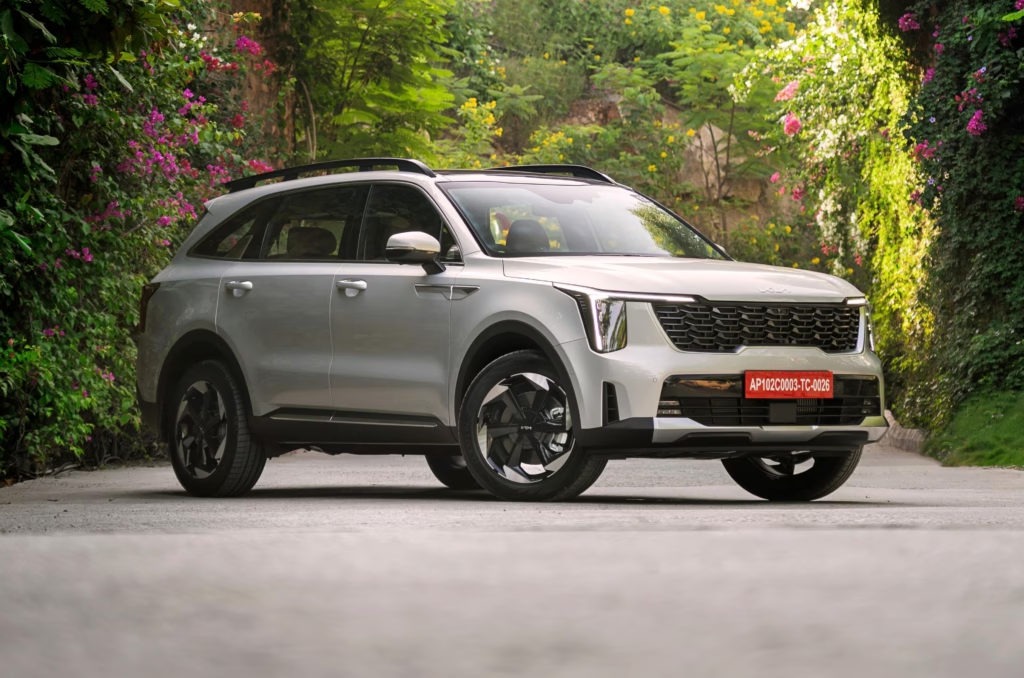
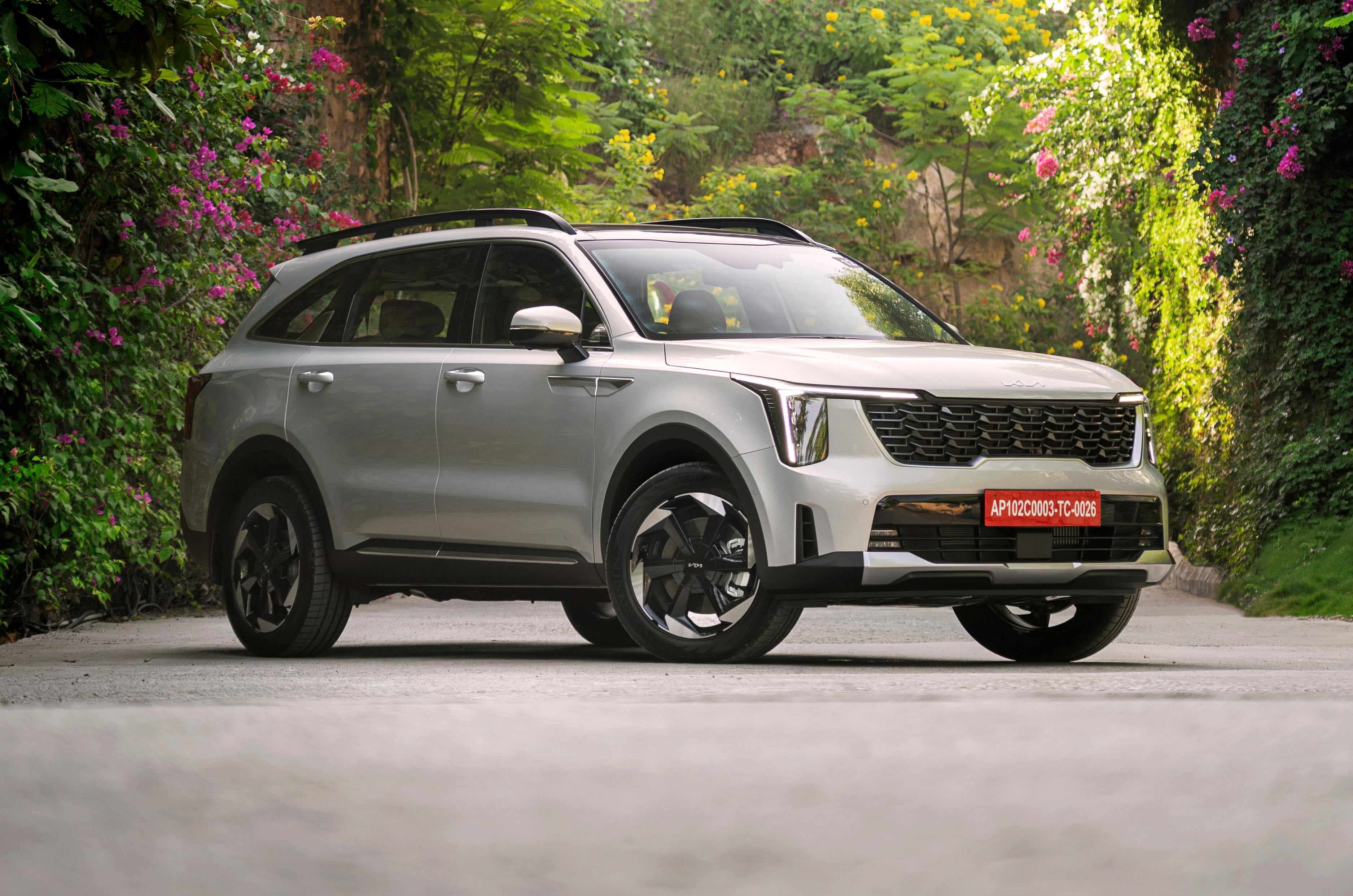
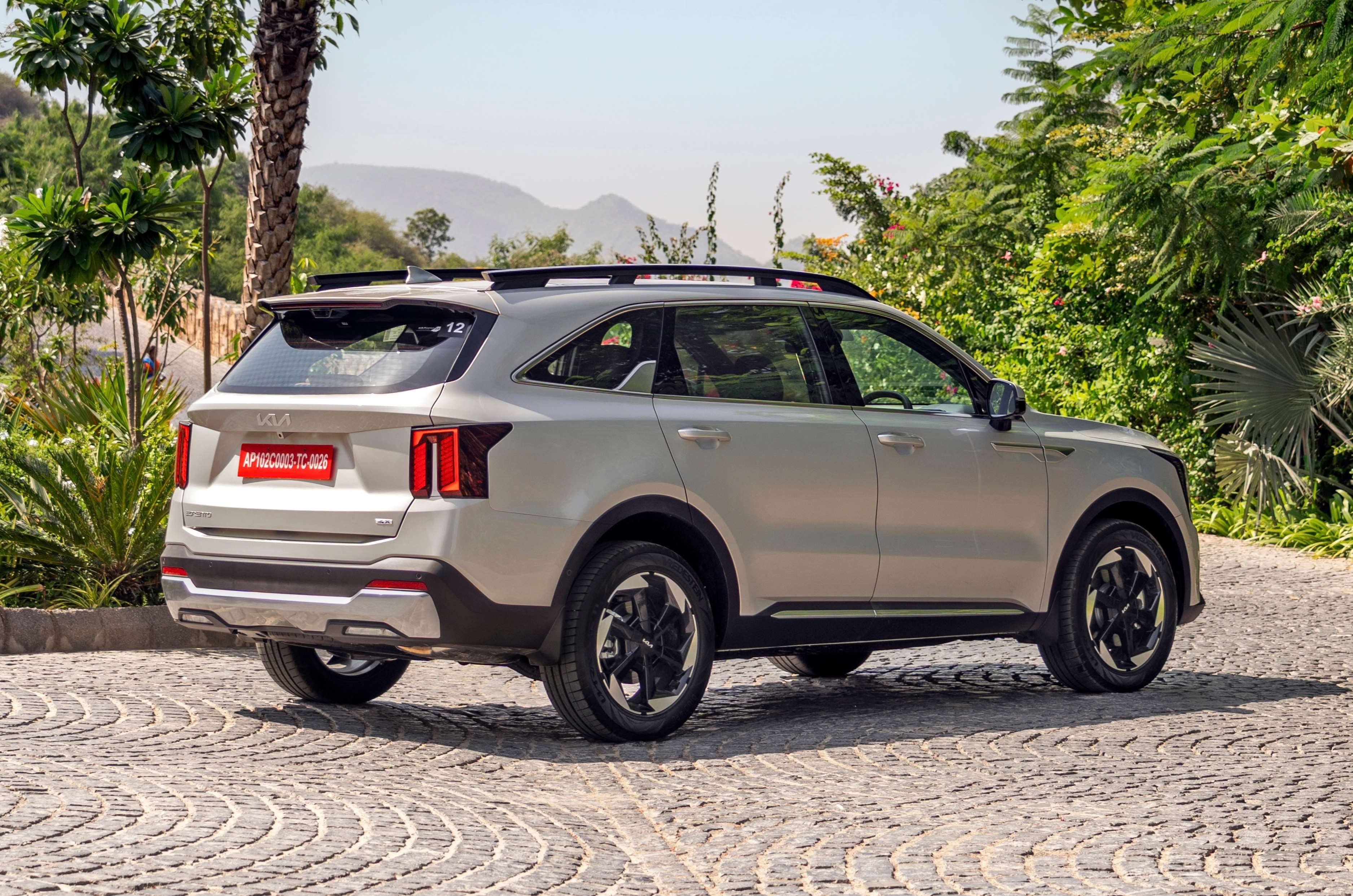
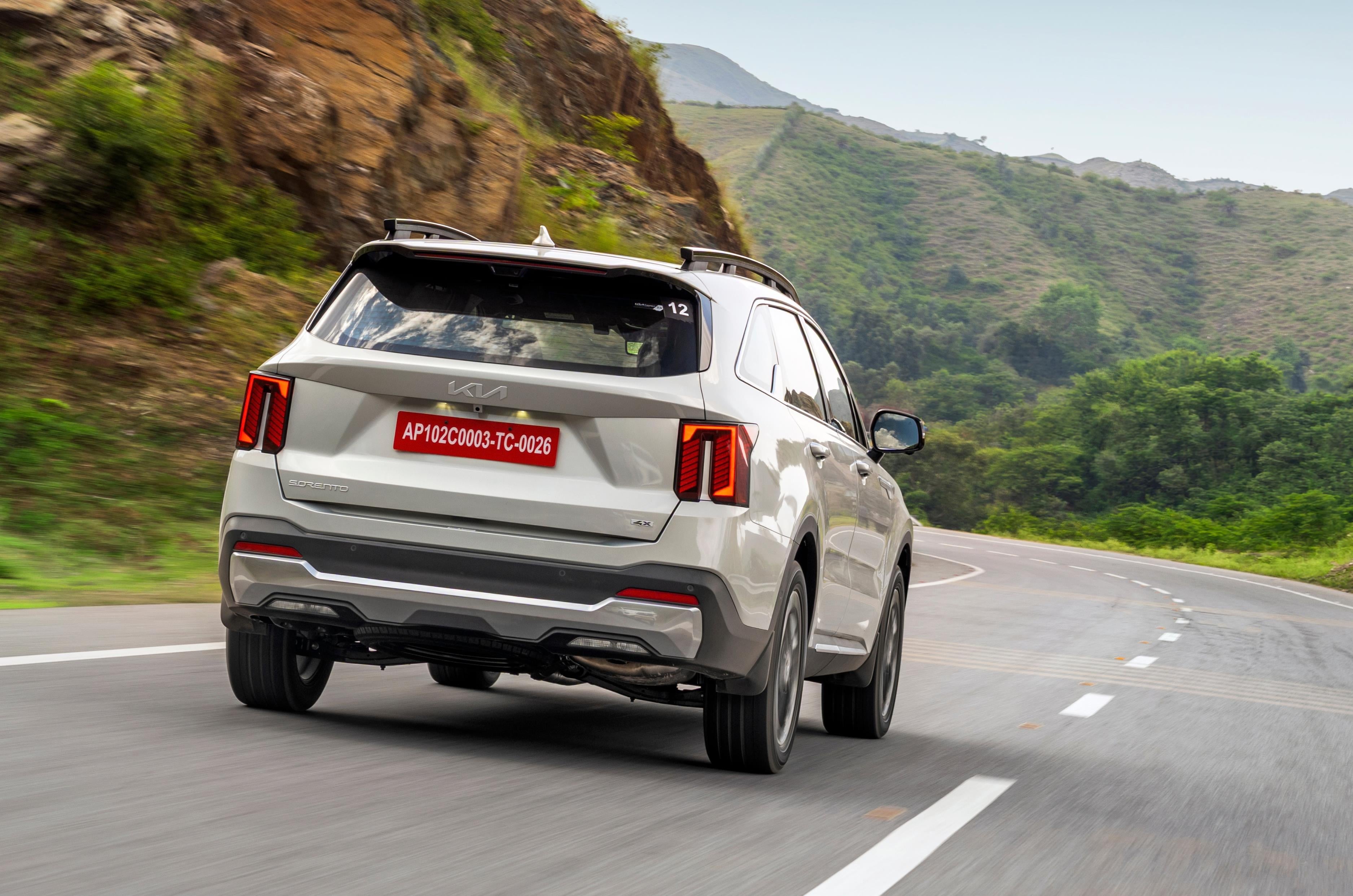
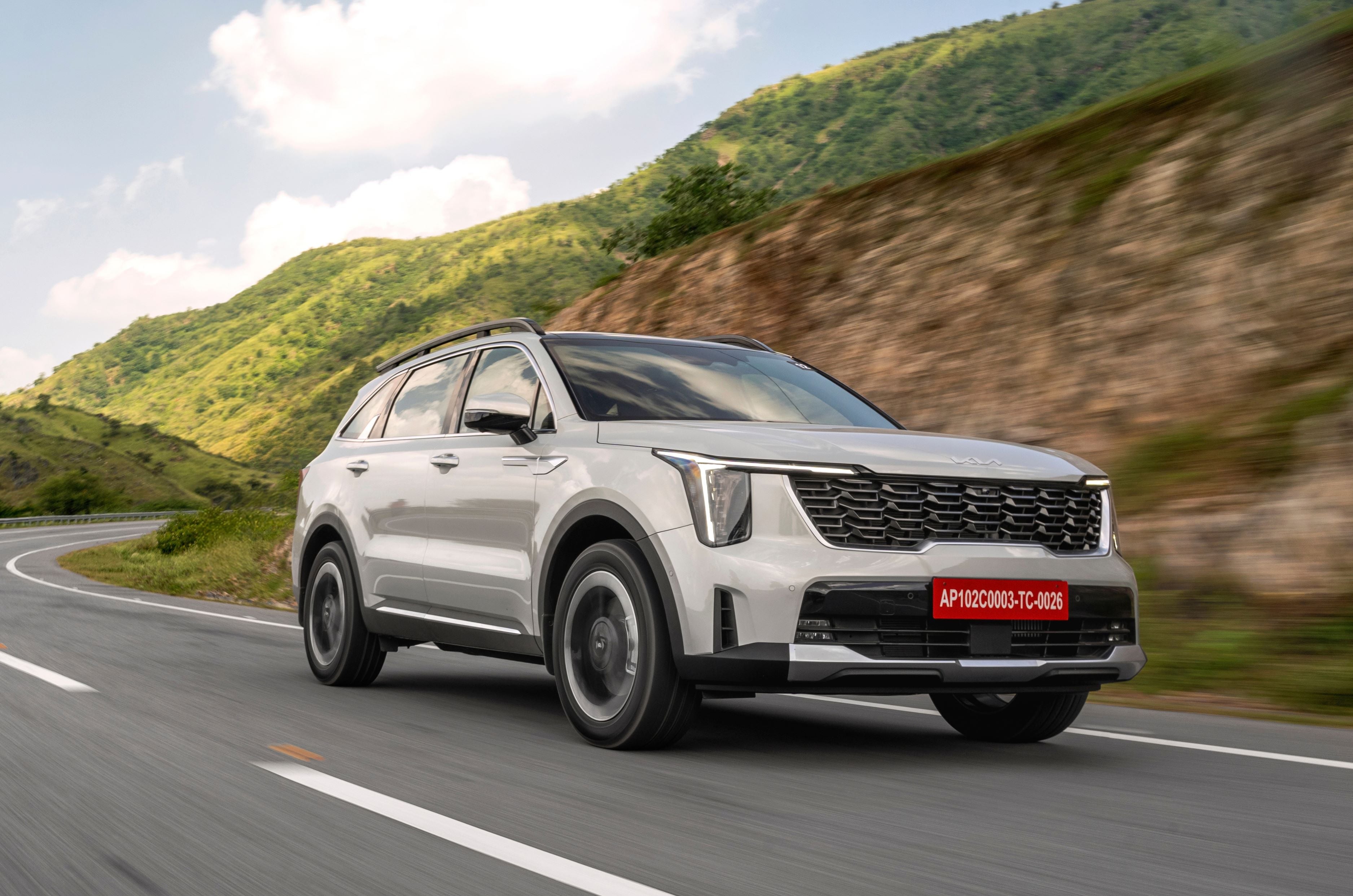
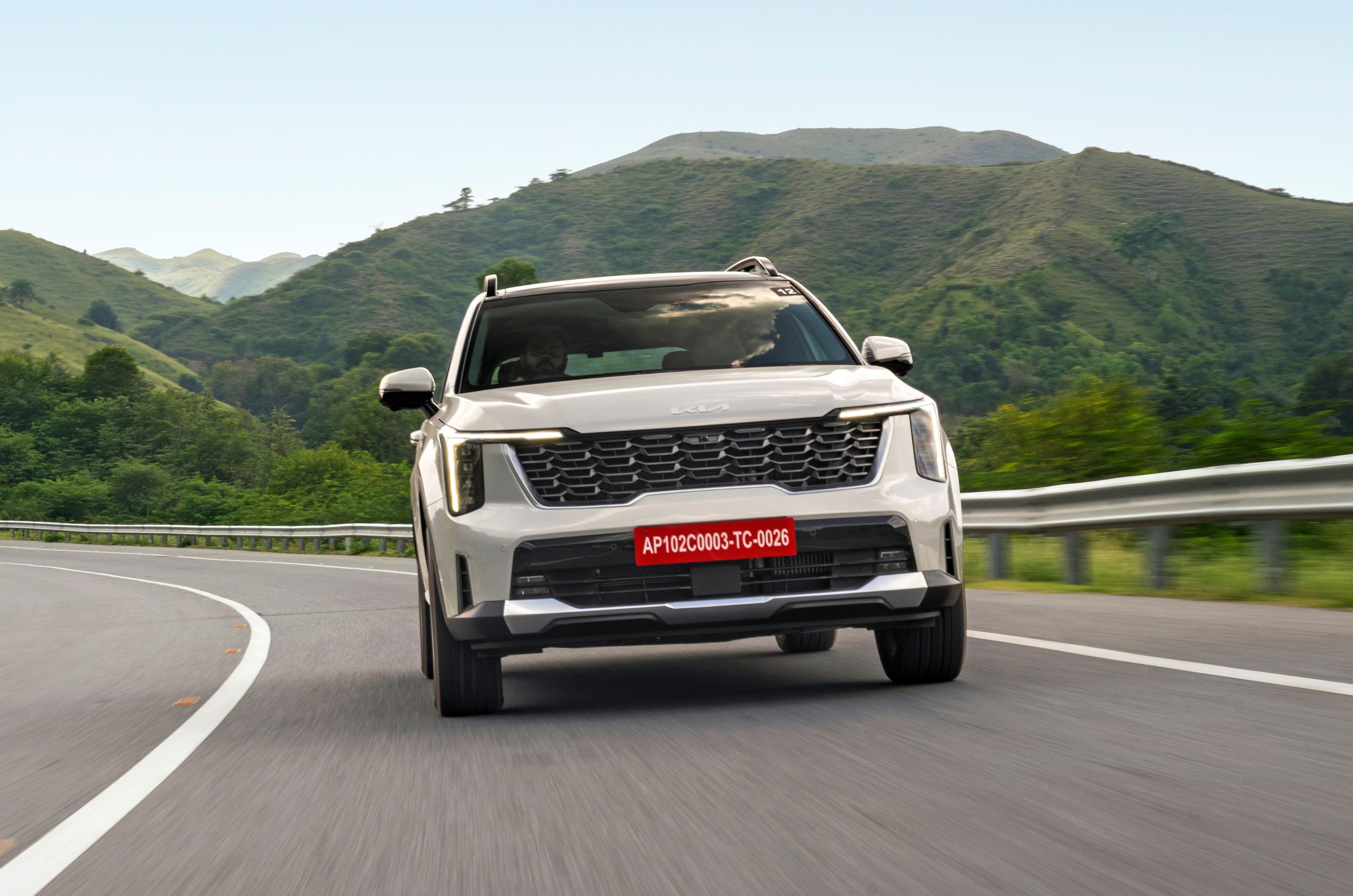
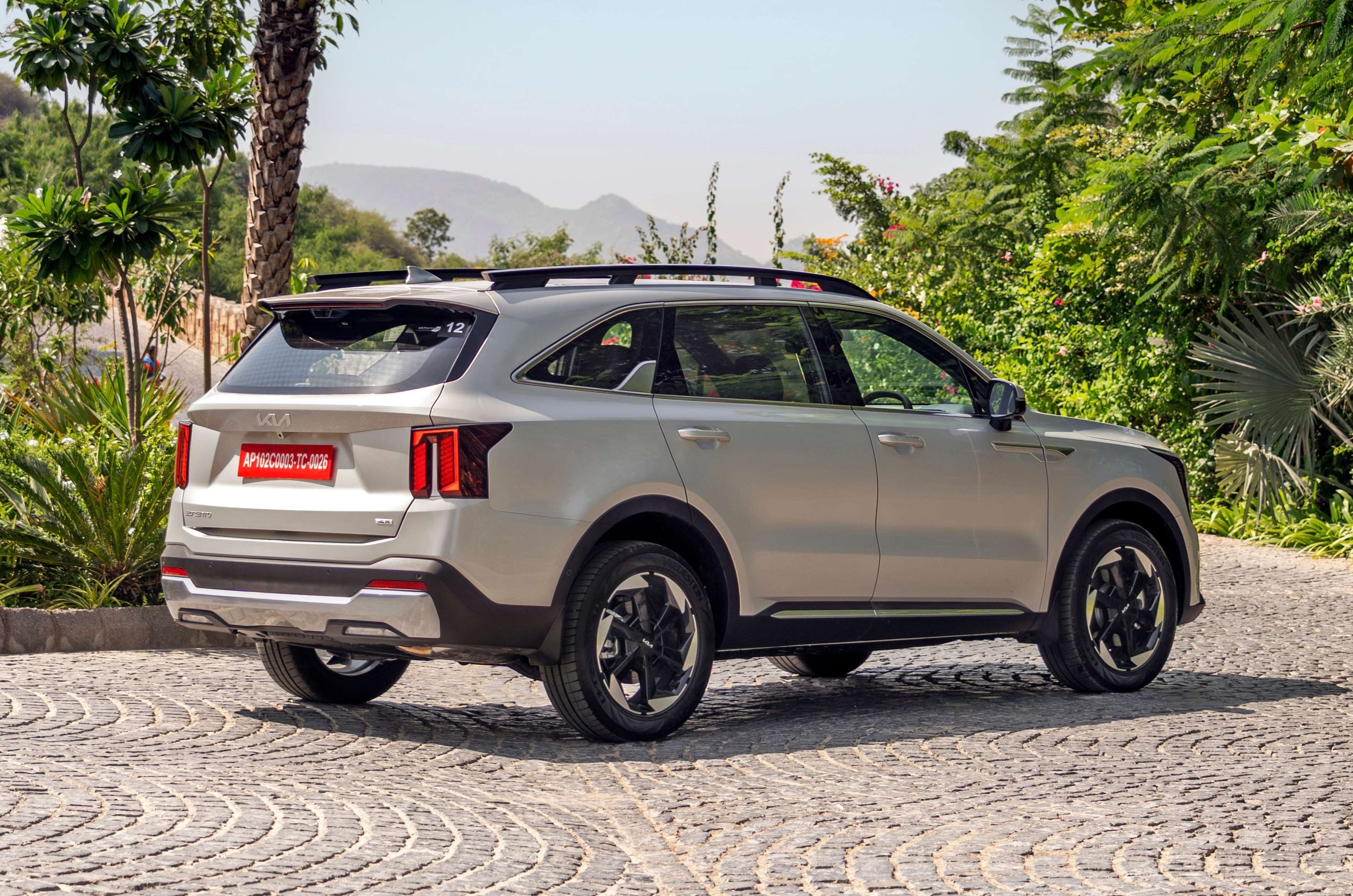
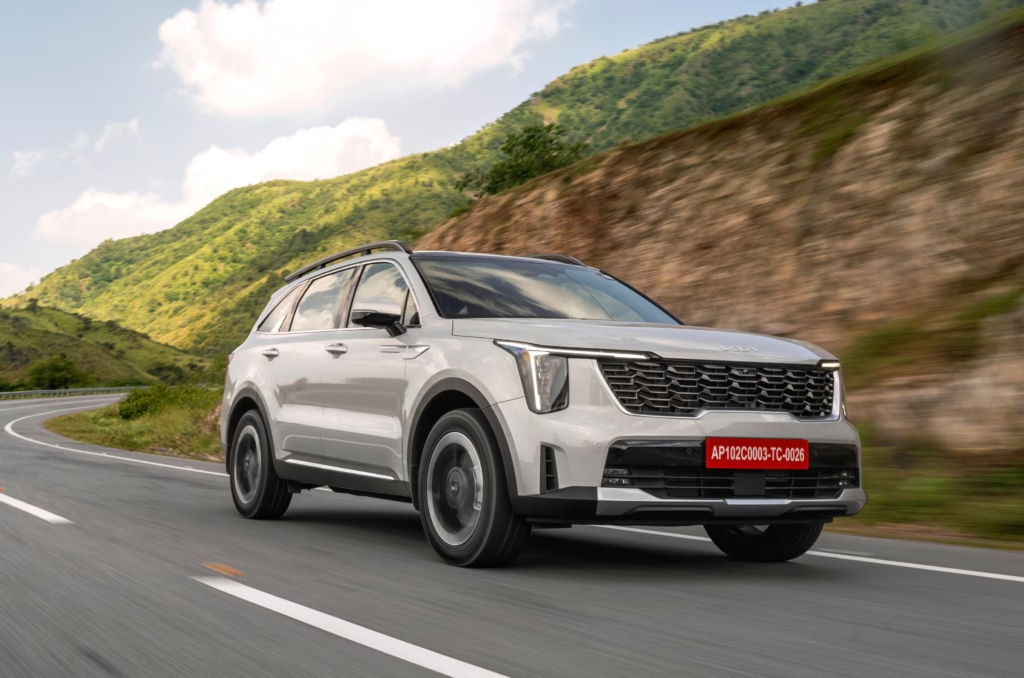
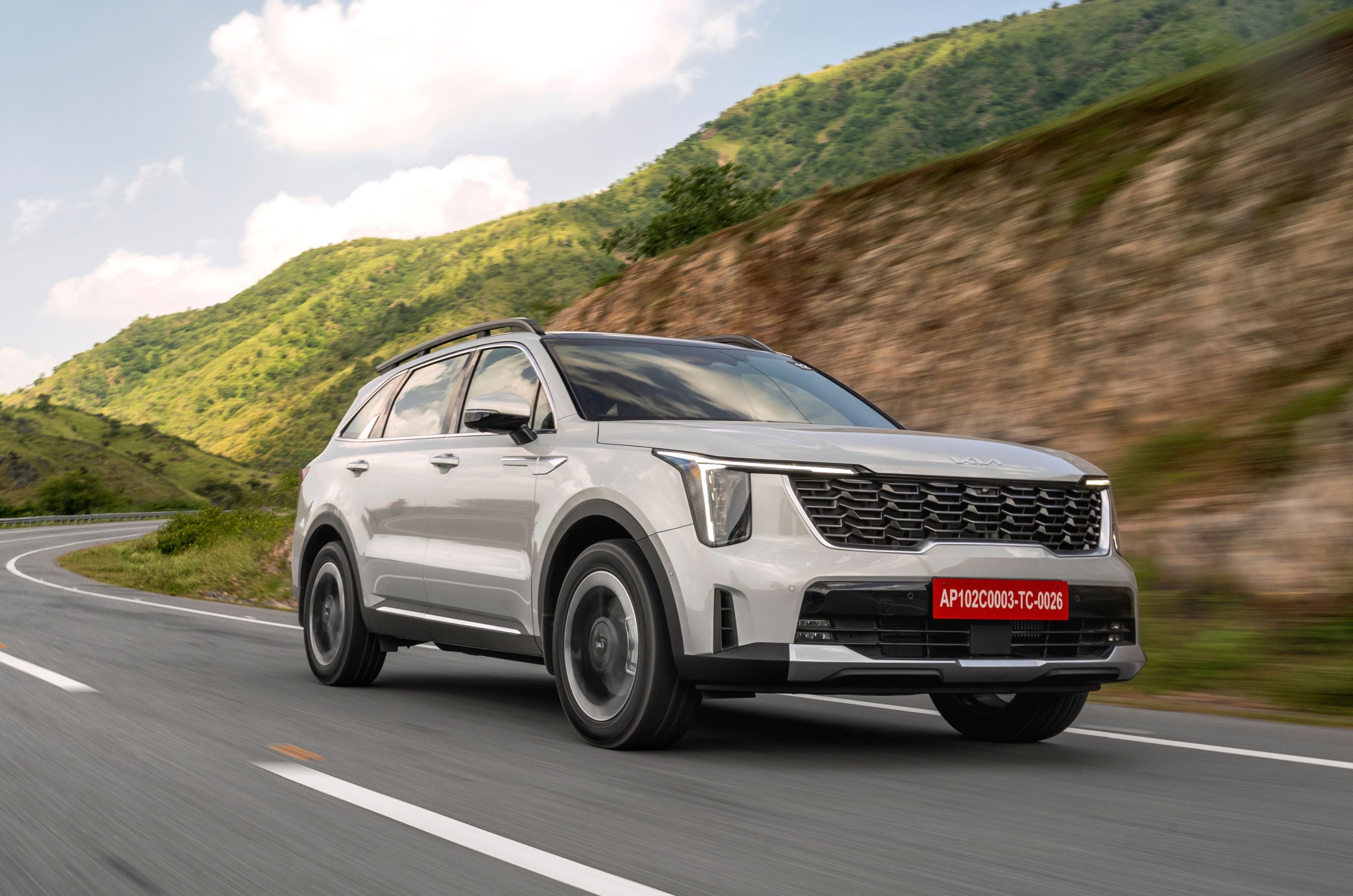
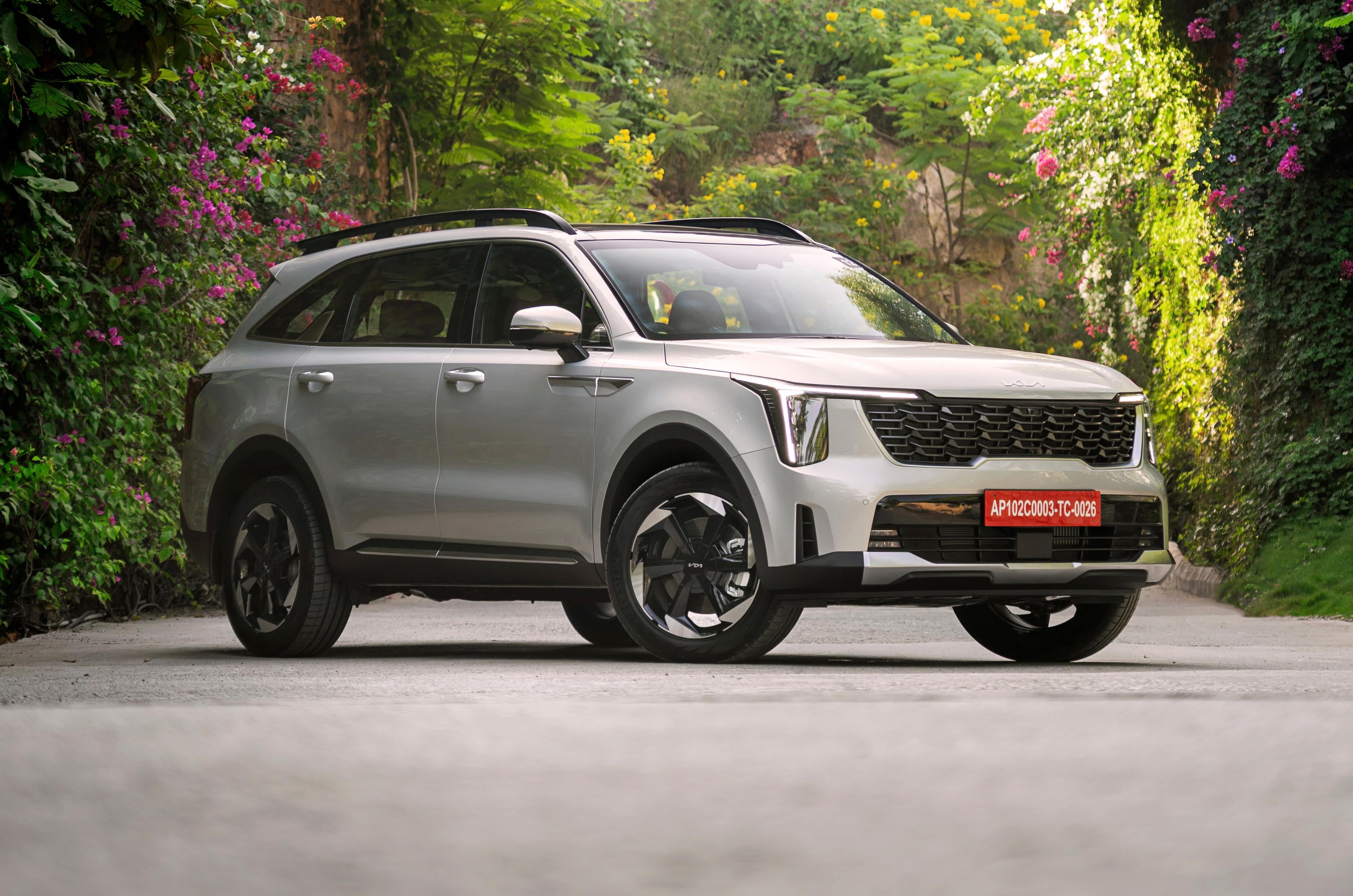
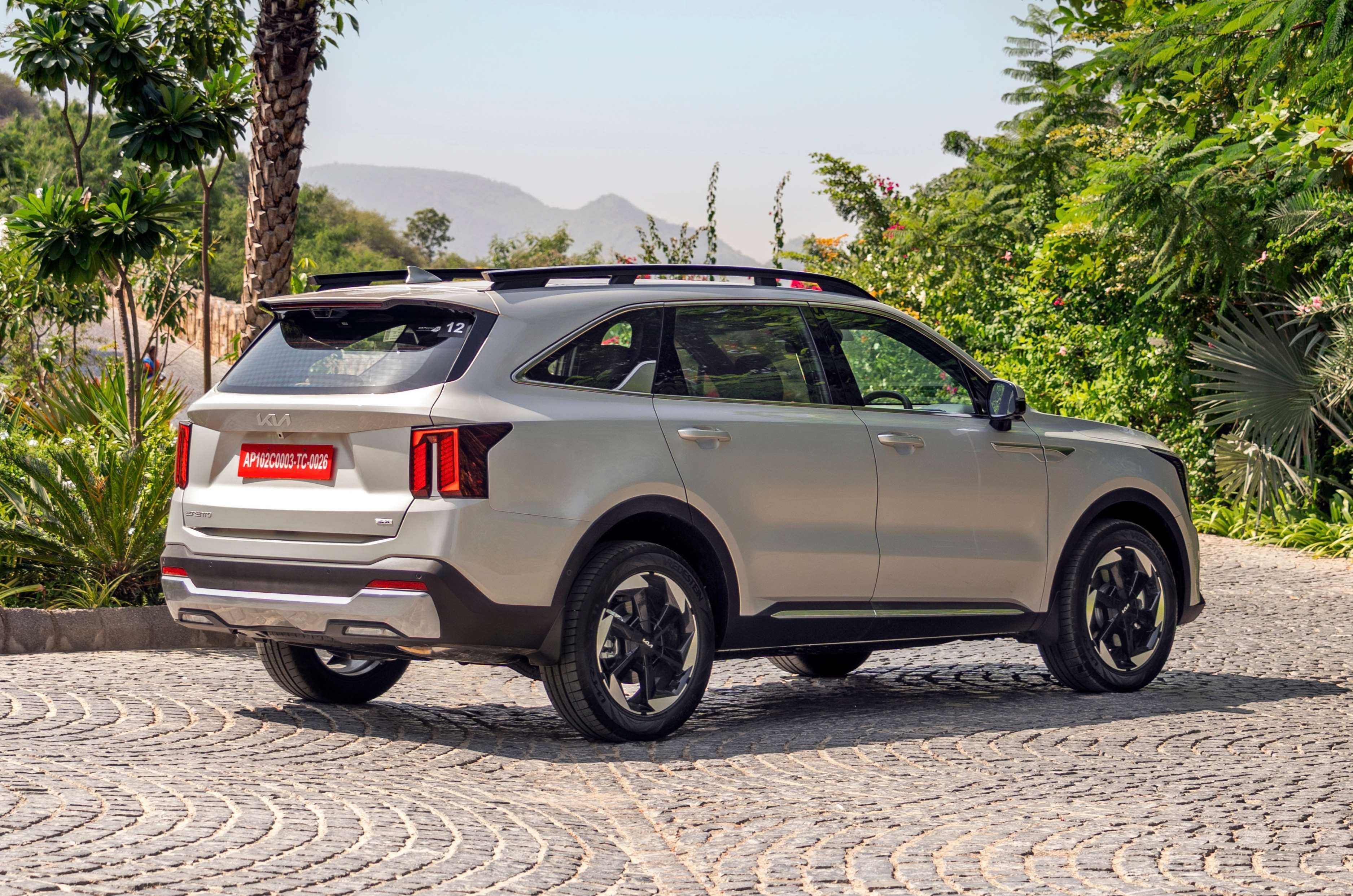
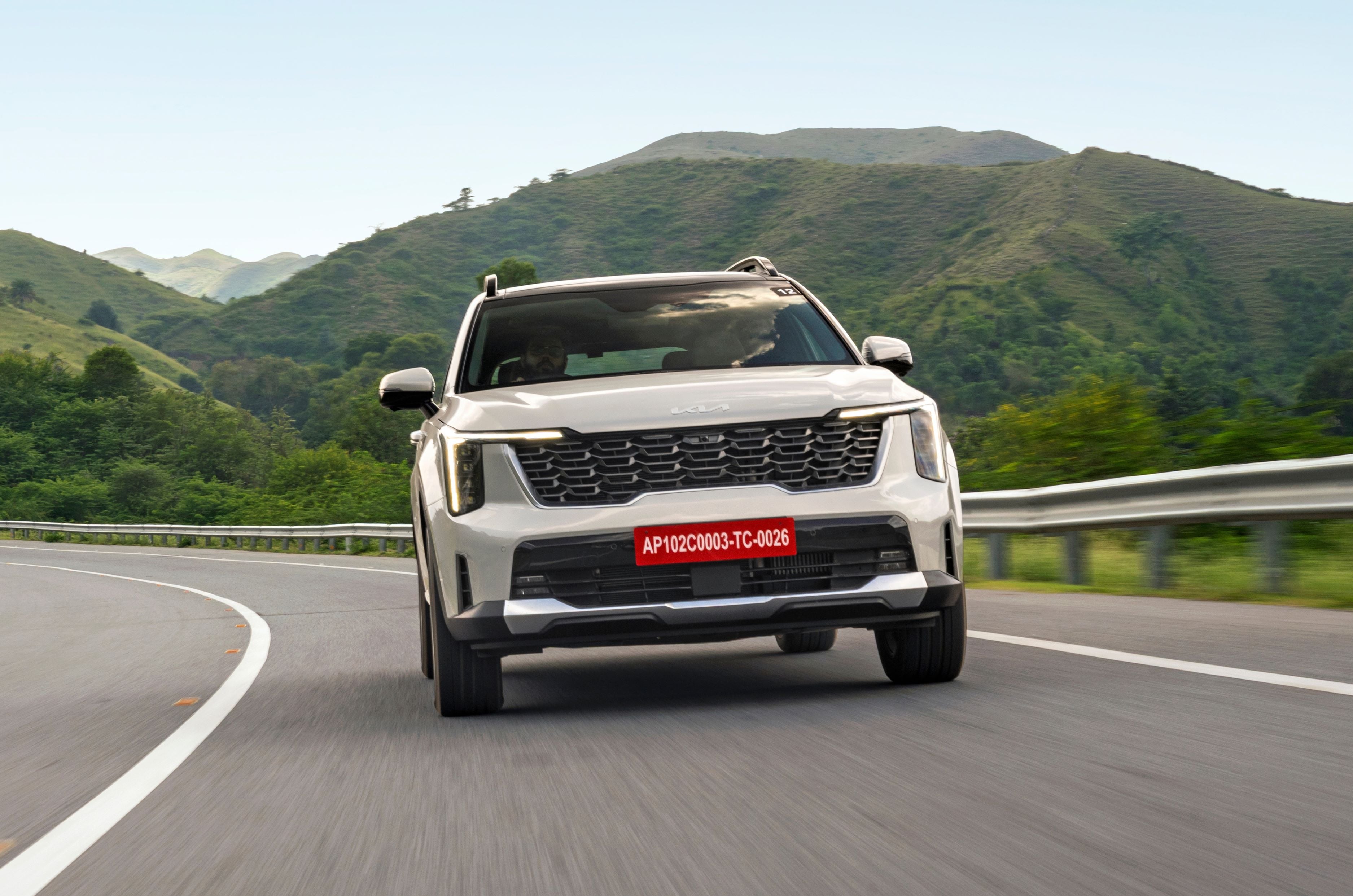
The Kia Sorento recorded 1,739 units in domestic wholesales in September 2026, its first month on sale after launching on September 4. It was Kia India’s fifth best-selling model that month. Including 365 units dispatched to dealers in August ahead of the launch, the Sorento’s total wholesales stood at 2,104 units.
Kia India recorded its highest-ever monthly wholesales of 32,017 units in September, up 41 percent year on year. This was the first time the company had crossed 30,000 units in a month, surpassing its previous record of 29,556 units in October 2025, which was the first month after the GST 2.0 rate cuts kicked in.
Kia Sorento: All you need to know
The Sorento is priced between Rs 27.99 lakh and Rs 40.39 lakh (ex-showroom). It is offered with a 1.6-litre turbo-petrol strong-hybrid powertrain or a 2.2-litre turbo-diesel engine. The hybrid setup pairs a 180hp, 265Nm petrol engine with a 65hp, 264Nm electric motor, while the diesel mill produces 193hp and 442Nm.
The SUV is available in six- and seven-seat configurations. Key features include dual 12.3-inch displays, a head-up display, ventilated front seats, a powered tailgate, a panoramic sunroof and second-row captain seats with ventilation. Safety equipment includes 10 airbags, a 360-degree camera, dual dashcams and Level 2+ ADAS.
The Kia Sorento rivals the Jeep Meridian, Skoda Kodiaq and Volkswagen Tayron.
Kia India sales up 29 percent in H1 FY2027
Kia India recorded wholesales of 1,68,683 units between April and September 2026, a 29 percent year-on-year increase. September wholesales stood at 32,017 units, up 41 percent year on year and the company’s highest monthly total since it entered India in 2019. In Q2 FY2027 (July-September 2026), sales grew 39 percent year on year to 89,259 units and were 12 percent higher than in Q1 FY2027.
The Seltos was Kia’s best-selling model in the first half of FY2027, with 67,667 units, up 99 percent year on year. It accounted for 40 percent of the company’s total wholesales during the period. The Sonet ranked second with 56,929 units, up 21 percent, contributing 34 percent of sales. The Carens range, including the Carens, Carens Clavis and Clavis EV, recorded 34,284 units, down 18 percent year on year.
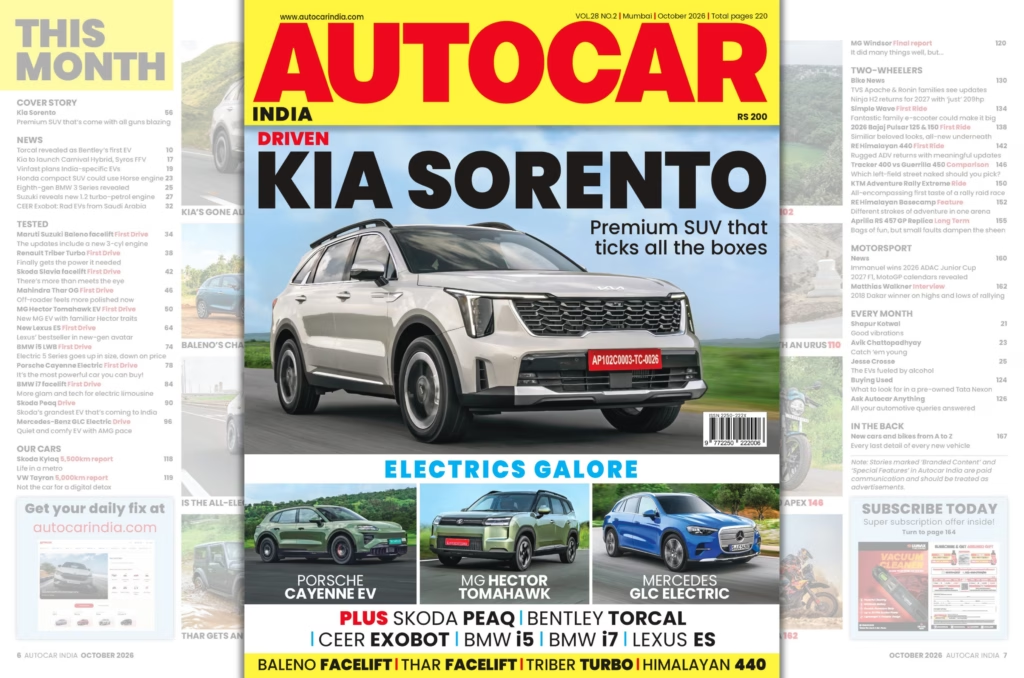
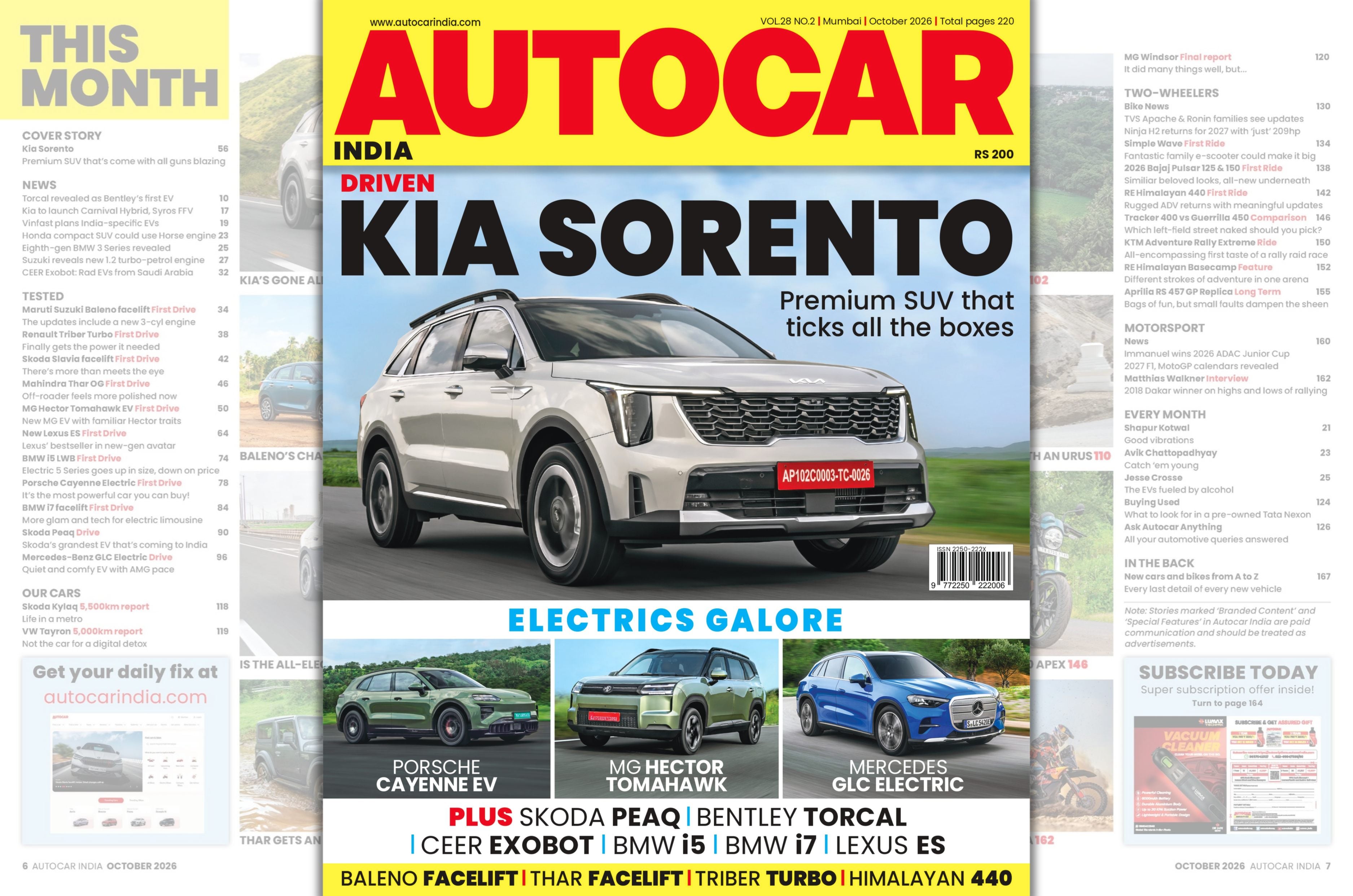
This month, we go big on power and even bigger on premium metal. The cover story is Kia’s biggest swing yet at the executive SUV segment, and then there’s a family SUV with more horsepower than a Lamborghini, and BMW’s electric onslaught continues with a new long-wheelbase sedan and a sharper flagship limousine.
Kia Sorento: Cover Story
Six trims, two powertrains, up to seven seats and 32 variants in all. Kia isn’t dipping a toe into the premium SUV pool; it’s diving straight in, locally assembling the Sorento from Rs 27.99 lakh to take on the Skoda Kodiaq and VW Tayron. Has Kia cracked the code, or has it bitten off more than it can chew?
Porsche Cayenne Electric: First Drive
Forget hypercars. The most powerful vehicle currently on sale in India is a family SUV, the Cayenne Electric, with more horsepower than your senses can fathom. We took it to an airstrip to see what that actually does to your stomach.
BMW i5 LWB & i7 Facelift: First Drives
BMW’s electric push continues, with a long-wheelbase i5 slotting in between the iX1 and flagship i7. Can BMW’s long-wheelbase playbook continue to work? And there’s also the i7 getting a sharper face and more tech to go with it, like it didn’t have enough already.
Mercedes-Benz GLC Electric: Drive
The first-gen electric GLC was far from ideal. The new one, however, is a completely new generation with an 800V architecture, 330kW charging and a claimed 715km range. We took all 489 of its horses to the Autobahn to see how much of an improvement it has been over its predecessor.
MG Hector Tomahawk EV: First Drive
Don’t let the familiar name fool you. The Hector Tomahawk EV rides on MG’s all-new ADAPT platform, bigger than the Mahindra XEV 9S in every dimension, with a PHEV sibling already waiting in the wings.
Maruti Suzuki Baleno, Renault Triber Turbo and Skoda Slavia: First Drives
India’s favourite premium hatch, the Baleno, gets a new engine and ADAS, the budget-friendly Triber finally gets the power it’s been begging for, and the Slavia’s facelift turns out to be more than skin-deep.
Mahindra Thar OG: First Drive
The original three-door Thar gets another round of updates, bringing changes to its engines, equipment and chassis. With the off-road icon continuing to evolve, we head out to discover what this latest iteration brings to the table.
Taking the High Road: Features
Goa’s new Porvorim Elevated Corridor opens on NH66, and we test it in two ways: solo against Google Maps’ ETA in an MG Cyberster, and then flanked by a dozen supercars, Ferraris, a McLaren 750S and a Lamborghini Huracan among them, for its proper initiation.
Rocket Ship to the Moon: Feature
A Lamborghini SUV is already an exercise in excess. Take it somewhere unexpected, add a little spectacle, and you have the ingredients for an automotive adventure that refuses to be ordinary.
Royal Enfield Himalayan 440
The original Himalayan is back with a bigger engine and a handful of meaningful changes. In a world where adventure bikes keep getting more complicated, there’s something rather appealing about going back to basics.
Tracker 400 vs Guerrilla 450: Comparison
Two left-field street nakeds, the Triumph Tracker 400 and Royal Enfield Guerrilla 450, go head-to-head. One takes its inspiration from flat-track racers, while the other fancies itself a sporty roadster. Both want your money, and neither is particularly interested in being sensible about it.
KTM Adventure Rally Extreme: Ride
Adventure riding is all well and good until the road disappears, the terrain turns hostile and you begin questioning your life choices. We get a taste of KTM’s rally raid experience, where the only shortcut is having the skill to take one.
The Sorento is Kia’s flagship combustion-powered SUV for the Indian market. It’s also Kia India’s first hybrid offering, but if that doesn’t strike your fancy, a diesel is also on offer. The Sorento contends in the premium three-row SUV segment, locking horns with the Volkswagen Tayron, Jeep Meridian, and Skoda Kodiaq. Now that we’ve reviewed the Kia Sorento, here are three reasons why you should bring one home, and three reasons why you may want to consider one of its rivals.
Pros
Well-judged powertrain offerings
The Sorento can be had with either a 1.6-litre direct-injection turbo-petrol strong hybrid powertrain (230hp, 380Nm) mated to a 6-speed torque converter, or a 2.2-litre diesel engine (193hp, 442Nm) coupled to an 8-speed dual-clutch automatic. Both are available with front-wheel drive and all-wheel drive too. Of these, the hybrid is our pick for city driving because it’s smooth, instantly responds to throttle inputs, and the 1.49kWh battery pack allows it to run in pure-electric mode for better fuel efficiency – speaking of which, the Sorento hybrid claims 19.6kpl with FWD and 17.7kpl with AWD. On the highway, though, the turbo-petrol gets vocal and starts to run out of breath if pushed hard.
Highway frequenters, then, should look towards the diesel-powered Sorento. The low-end response is good, but not as immediate as the hybrid’s, and torque is delivered in a strong, linear surge, making it an excellent highway cruiser. Another highlight is the wet-clutch DCT, which slurs its gear changes like a torque converter and adds to the smoothness of the driving experience. Refinement is also good for the most part, with the diesel engine emitting a gruff note only under hard acceleration.
Feature-packed cabin with a premium feel
Inside, the Sorento offers a blend of quality, technology, and ergonomics that majorly outclasses rivals. The dashboard is decked out in soft-touch materials, there’s a healthy amount of physical controls, and overall quality levels are fabulous for the price.
As for features, the Sorento is absolutely loaded, especially in higher variants. You get goodies like dual 12.3-inch screens, a heads-up display, a panoramic sunroof, powered and ventilated front seats, ventilated second-row captain’s chairs (6-seat), Level 2 ADAS, a 12-speaker Bose sound system, dual-zone climate control, 64-colour ambient lighting, a camera-based IRVM, rear-window sunshades, a powered tailgate, connected car tech, and more.
Outstanding ride quality
Kia has tuned the Sorento’s suspension exceptionally well, with a clear prioritisation of comfort over sportiness. It glides along bad roads at high speeds with ease, almost never needing you to lift off. Part of the credit here goes to the tall-sidewall tyres, which round off sharp jolts and filter high-frequency shocks. While there is a bit of body movement at highway speeds, the Sorento never feels unsettled or busy.
Cons
Knees-up seating in third row
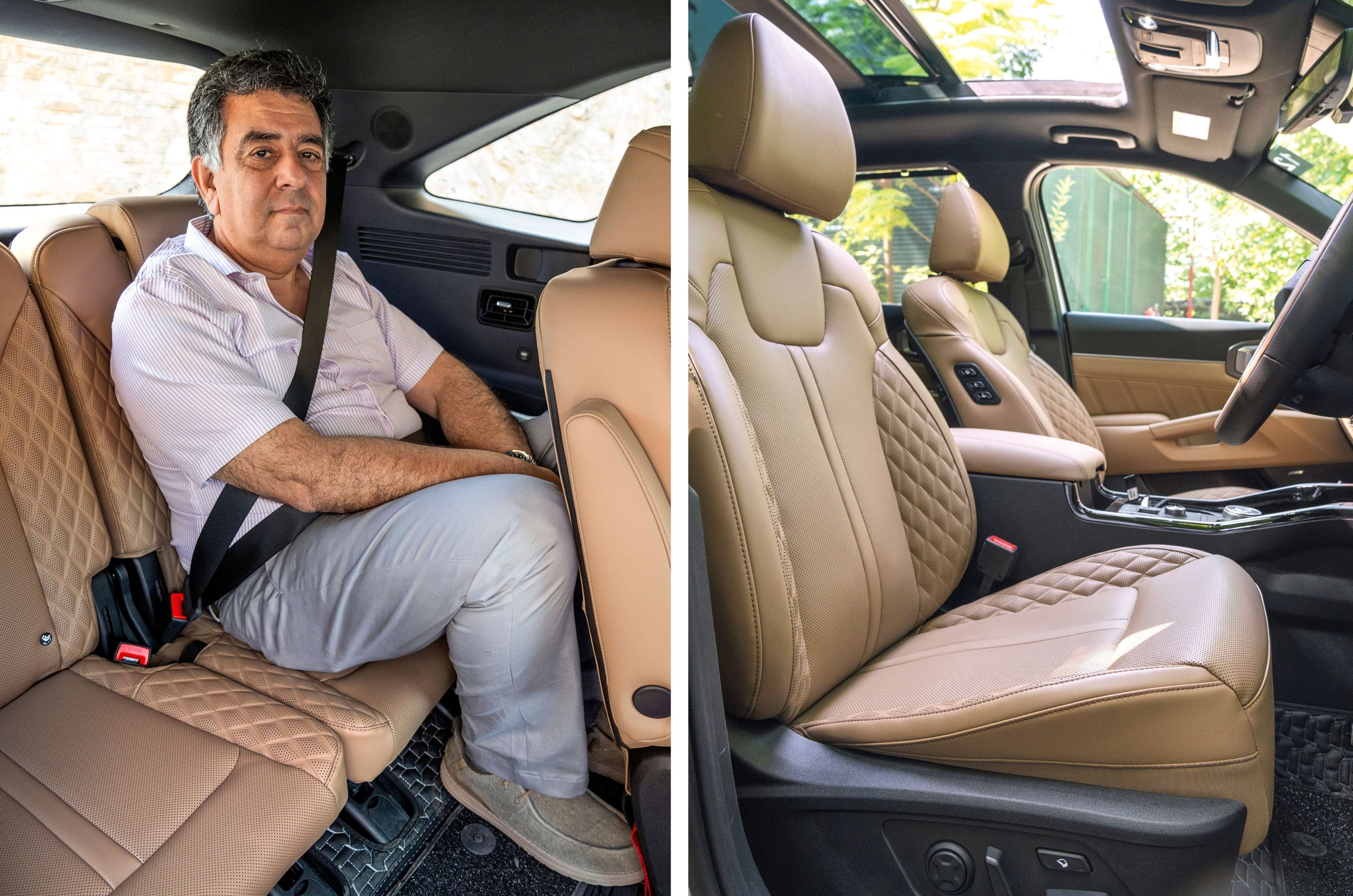
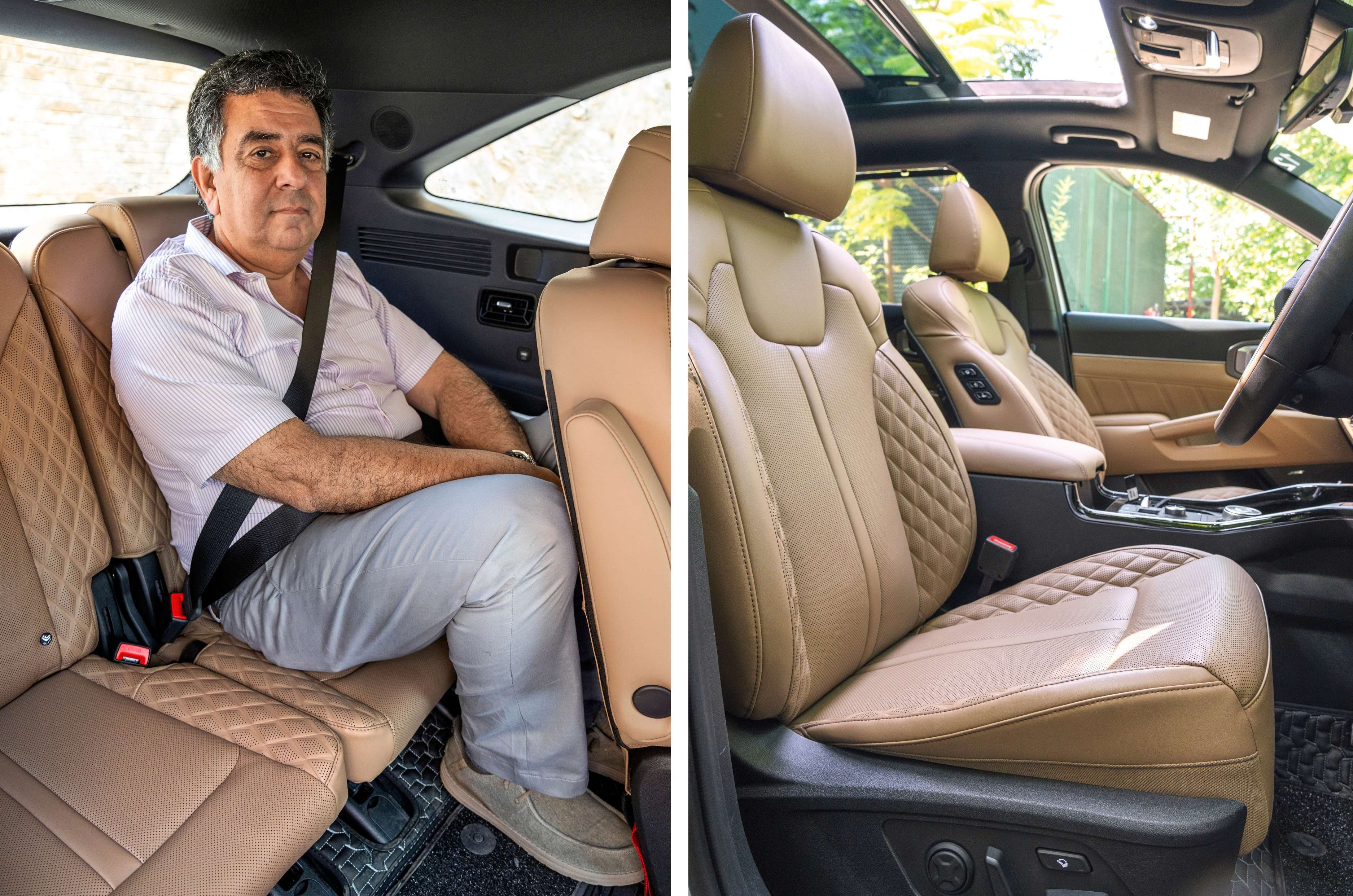
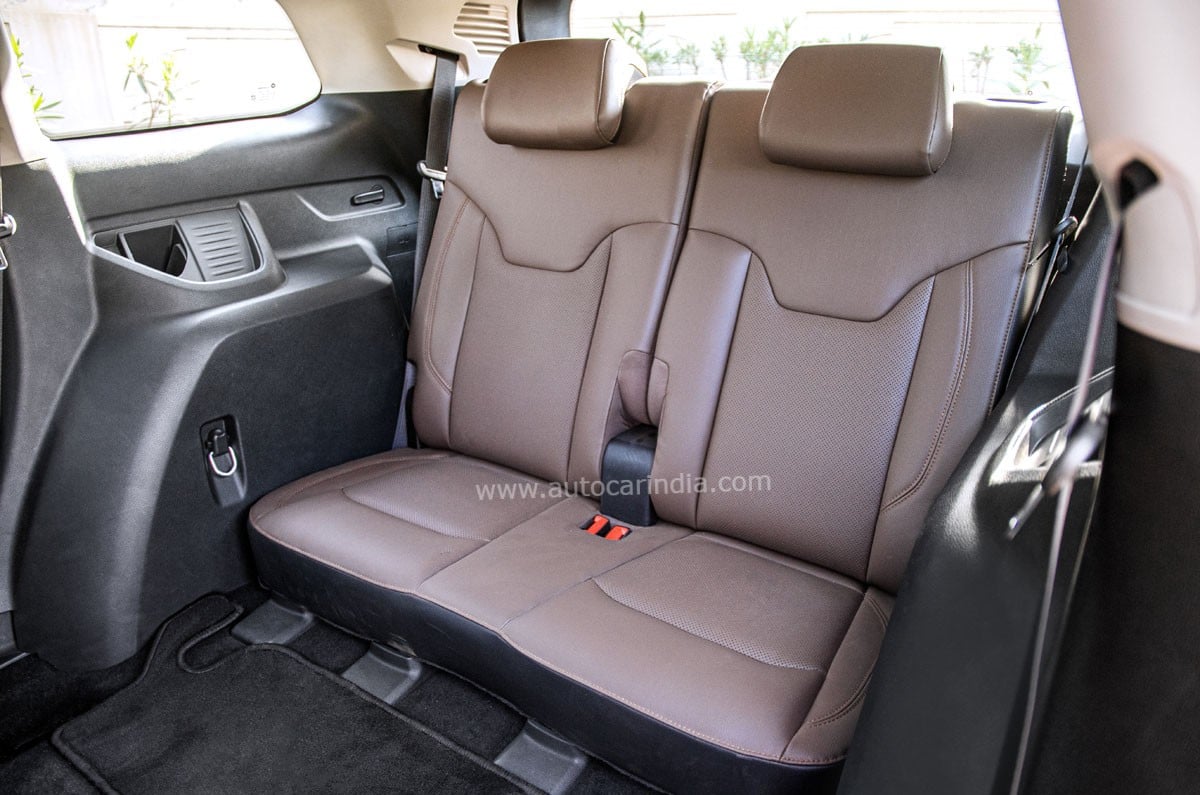
While the first and second rows of the Sorento are very spacious and comfortable, the outlook on the third row (left image) is mixed. Legroom is decent, but the seat base is mounted nearly flat on the floor, which means there’s no under-thigh support and you’re sat knees-up. The Sorento’s third row, then, is best-suited to small children.
Not as engaging to drive as European rivals
Since the Sorento is softly-sprung and has a higher 208mm ground clearance, it isn’t quite as dynamically sharp as the Tayron and Kodiaq – a bit of body roll rears its head during hard cornering. The steering feel is light, but not as fluid or progressive as those of the Sorento’s European rivals, and there’s a dead zone around the straight-ahead position too.
Top-end variants are expensive
Pricing for the Sorento is very broad and competitive, starting at Rs 27.99 lakh for the base-spec diesel-FWD variant. However, prices for the top-spec HTX and HTX(A) trims range from Rs 37.49 lakh to Rs 40.19 lakh, which is rather steep. It doesn’t help that these trims are offered solely with AWD – FWD versions could’ve helped bring the HTX’s price down.
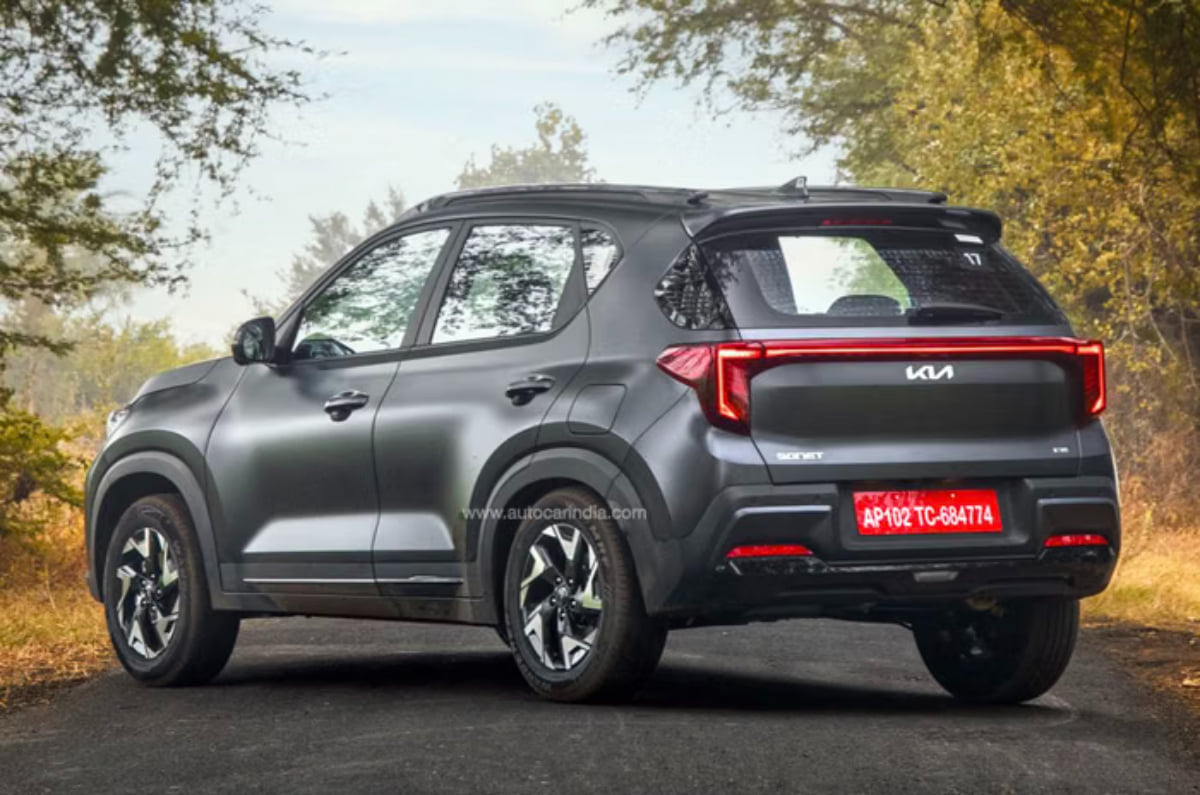
Kia has rolled out a range of benefits across its India line-up for October 2026, including cash discounts, exchange and scrappage offers, loyalty benefits and corporate discounts. The offers vary by model, variant and powertrain, with select cars also getting additional benefits such as an extended warranty. Here is a model-wise breakdown of Kia’s October offers.
Disclaimer: Offers/benefits may vary by city and are subject to stock availability. Buyers are advised to check with their local dealer for exact figures.
Kia Carnival discounts in October 2026
Up to Rs 1.70 lakh off
The Kia Carnival gets the highest benefits in Kia’s October 2026 offer programme, with savings of up to Rs 1.70 lakh. The package comprises a Rs 1 lakh exchange offer, Rs 20,000 scrappage benefit and corporate benefits of up to Rs 50,000.
Kia’s flagship MPV focuses on rear-seat comfort and space, making it a compelling choice among chauffeur-driven buyers. Priced from Rs 59.65 lakh, the Carnival does not have a direct rival, although the MG M9 is positioned in a similar price bracket.
Kia Carens Clavis discounts in October 2026
Up to Rs 95,000 off
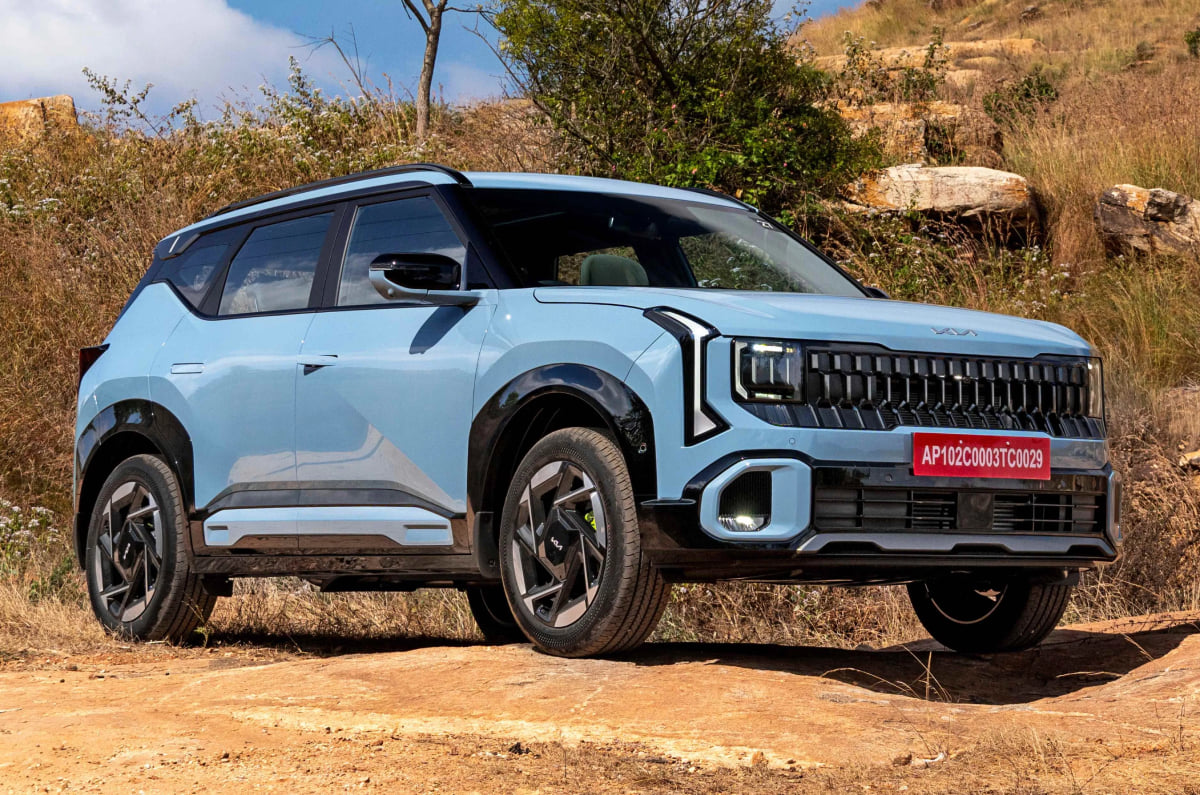
The Kia Carens Clavis gets benefits of up to Rs 95,000 on its ICE variants, excluding the CNG version. The offer comprises a Rs 10,000 cash discount, Rs 30,000 exchange benefit, Rs 20,000 loyalty benefit, Rs 20,000 scrappage benefit and corporate benefits of up to Rs 15,000.
The Clavis is available in six- and seven-seat configurations, with naturally aspirated petrol, turbo-petrol, CNG and diesel engine options. Prices range from Rs 11.39 lakh to Rs 21.79 lakh, ex-showroom. It is sold alongside the older Carens, which remains the lower-priced option in Kia’s MPV line-up. The Clavis rivals MPVs such as the Maruti Suzuki XL6 and Toyota Rumion, while its price also overlaps with larger three-row SUVs such as the Hyundai Alcazar and Tata Safari.
Kia Carens Clavis EV discounts in October 2026
Up to Rs 75,000 off
The Carens Clavis EV gets benefits of up to Rs 75,000 across its range. The offer includes a Rs 20,000 exchange benefit, Rs 20,000 loyalty benefit, Rs 20,000 scrappage benefit and corporate benefits of up to Rs 15,000. No cash is available for the Clavis EV this month.
The electric MPV offers a practical, well-finished cabin and strong performance even under load. However, it is significantly more expensive than the ICE-powered Clavis. The Clavis EV is priced between Rs 18.04 lakh and Rs 25 lakh, ex-showroom. It rivals the BYD eMax 7 and VinFast VF MPV 7.
Kia Sonet discounts in October 2026
Up to Rs 65,000 off
Benefits on the Kia Sonet vary by powertrain and variant. The naturally-aspirated petrol 1.2-litre HTK (O) gets the highest benefits of up to Rs 65,000, comprising a Rs 15,000 cash discount, Rs 20,000 exchange benefit, Rs 15,000 scrappage benefit and corporate benefits of up to Rs 15,000. The Sonet diesel , turbo-petrol and naturally-aspirated variants get benefits of up to Rs 50,000.
The compact SUV offers a long equipment list and multiple engine options. However, rear-seat space is limited and higher variants can get expensive. A rival to the Maruti Suzuki Brezza, Tata Nexon, Skoda Kylaq, Hyundai Venue and Mahindra XUV 3XO, the Sonet is priced between Rs 7.41 lakh and Rs 14.27 lakh.
Kia Syros discounts in October 2026
Up to Rs 55,000 off
The Kia Syros gets benefits of up to Rs 55,000 on its ICE variants. The offer includes a Rs 20,000 exchange benefit, Rs 20,000 scrappage benefit and corporate benefits of up to Rs 15,000. Kia is also offering a free extended warranty with the Syros.
The Syros stands out for its stylish cabin and spacious rear seats, although NVH levels in both petrol and diesel variants remain high. The Kia Syros’ rivals include the Tata Nexon, Mahindra XUV 3XO, Maruti Suzuki Brezza, Skoda Kylaq and Hyundai Venue. It is priced from Rs 8.42 lakh to Rs 15.82 lakh.
Kia Carens discounts in October 2026
Up to Rs 45,000 off
The Kia Carens, excluding CNG variants, gets benefits of up to Rs 45,000. These comprise a Rs 10,000 exchange benefit, Rs 20,000 scrappage benefit and corporate benefits of up to Rs 15,000. The Carens CNG gets a Rs 20,000 scrappage benefit.
The Carens offers a spacious cabin, good practicality and a generous feature list. However, diesel performance under full load is not particularly strong, and the petrol engine is not very fuel-efficient. The Carens is priced between Rs 11.02 lakh and Rs 12.88 lakh, ex-showroom, it rivals the Toyota Rumion and Maruti Suzuki Ertiga.
Kia Seltos discounts in October 2026
Up to Rs 40,000 off
The Kia Seltos gets benefits of up to Rs 40,000 across its range. These comprise a Rs 20,000 loyalty benefit and Rs 20,000 scrappage benefit. There is no cash discount or exchange benefit for the Seltos this month.
The midsize SUV combines a comfortable ride with good handling and a strong turbo-petrol engine option. However, some rivals offer a more comprehensive feature list, and the diesel engine lacks punch. The Seltos rivals the Hyundai Creta, Tata Sierra, Maruti Grand Vitara, Toyota Urban Cruiser Hyryder, Volkswagen Taigun, Skoda Kushaq, Renault Duster and MG Astor. Its prices range from Rs 11 lakh to Rs 21.82 lakh.
Kia Sorento discounts in October 2026
Up to Rs 40,000 off
The recently launched Kia Sorento gets benefits of up to Rs 40,000 across its range. The offer comprises a Rs 20,000 loyalty benefit and Rs 20,000 scrappage benefit.
The Sorento is Kia’s flagship three-row SUV in India and is offered with a 2.2-litre diesel engine or a 1.6-litre turbo-petrol strong-hybrid powertrain. Prices range from Rs 27.99 lakh to Rs 40.39 lakh. It competes with SUVs including the Jeep Meridian, Skoda Kodiaq and Volkswagen Tayron.
The Sorento is a big bet for Kia India, and you can tell. Six trims, two powertrains, front- and all-wheel drive, six or seven seats and 32 versions in all. This is not a toe in the water exercise but a full-blooded dive into the deep end of the executive SUV pool. More than that, it is a case study in how to launch a product in India, because Kia has got the basics right before it has even started talking about features.
Start with the powertrains, which for this class of SUV could hardly be better judged. There is a strong 2.2-litre diesel for diesel die-hards and there are still plenty of those. And then there is a 1.6-litre turbo-petrol strong hybrid whose timing couldn’t be more perfect. Petrol prices are climbing, E20 has quietly eaten into real-world efficiency, and buyers want diesel-like running costs from a smooth, quiet powertrain without lying awake worrying about diesel’s long-term future. The Sorento hybrid is pitched squarely at that anxiety.
The strategy behind the car is just as interesting. This fourth-generation (MQ4) Sorento arrives in India towards the end of its global life cycle. It is still a current product, but one due to be replaced internationally next year, while India will carry on with this one. That is actually a very smart move. A car this late in its life has its development costs largely amortised, and Kia India can bring some of the tooling here, which slashes the investment.
And this is a properly localised car, not a screwdriver job. The body is stamped and welded at Kia’s Anantapur plant, and the dashboard and seats are made here too. That is what makes the Rs 27.99 lakh starting price possible. The catch is that localisation on this scale only pays off with volume, and Kia wants to sell around 40,000 Sorentos a year. That is a big number for a Rs 30-40 lakh SUV. Can it get there?
Kia Sorento exterior design and engineering
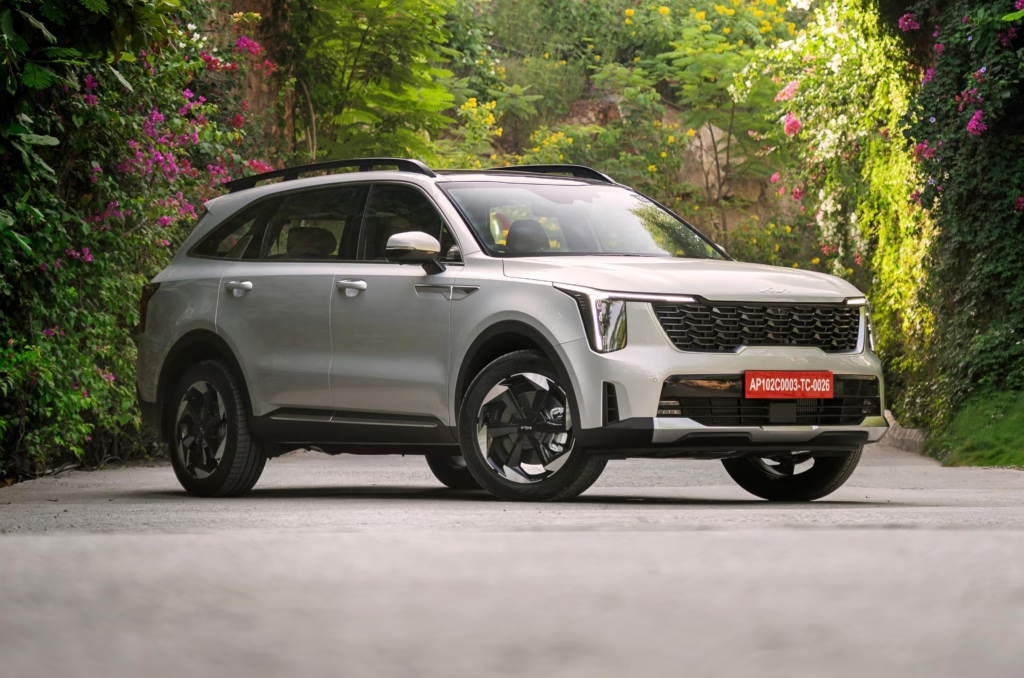
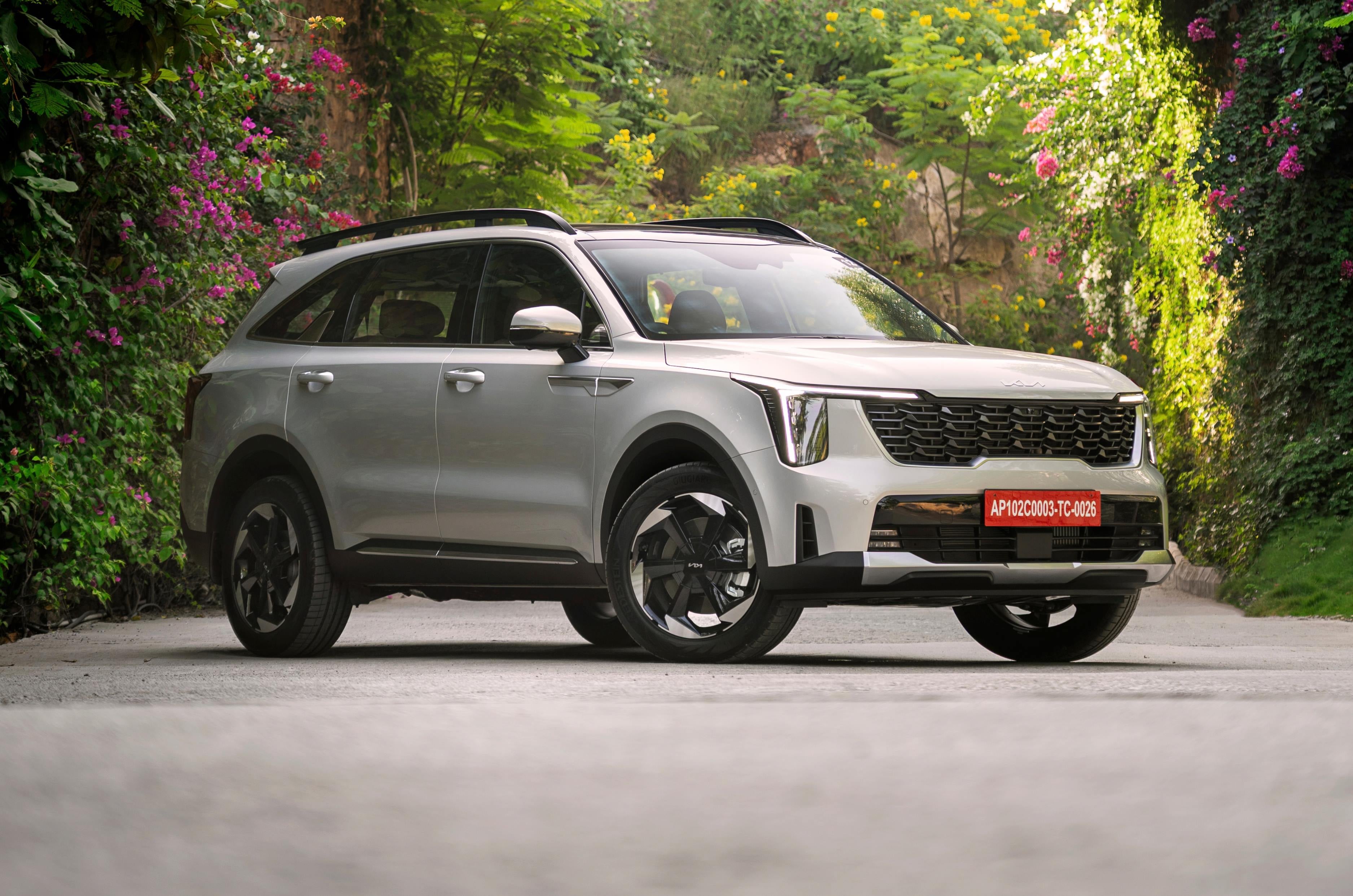
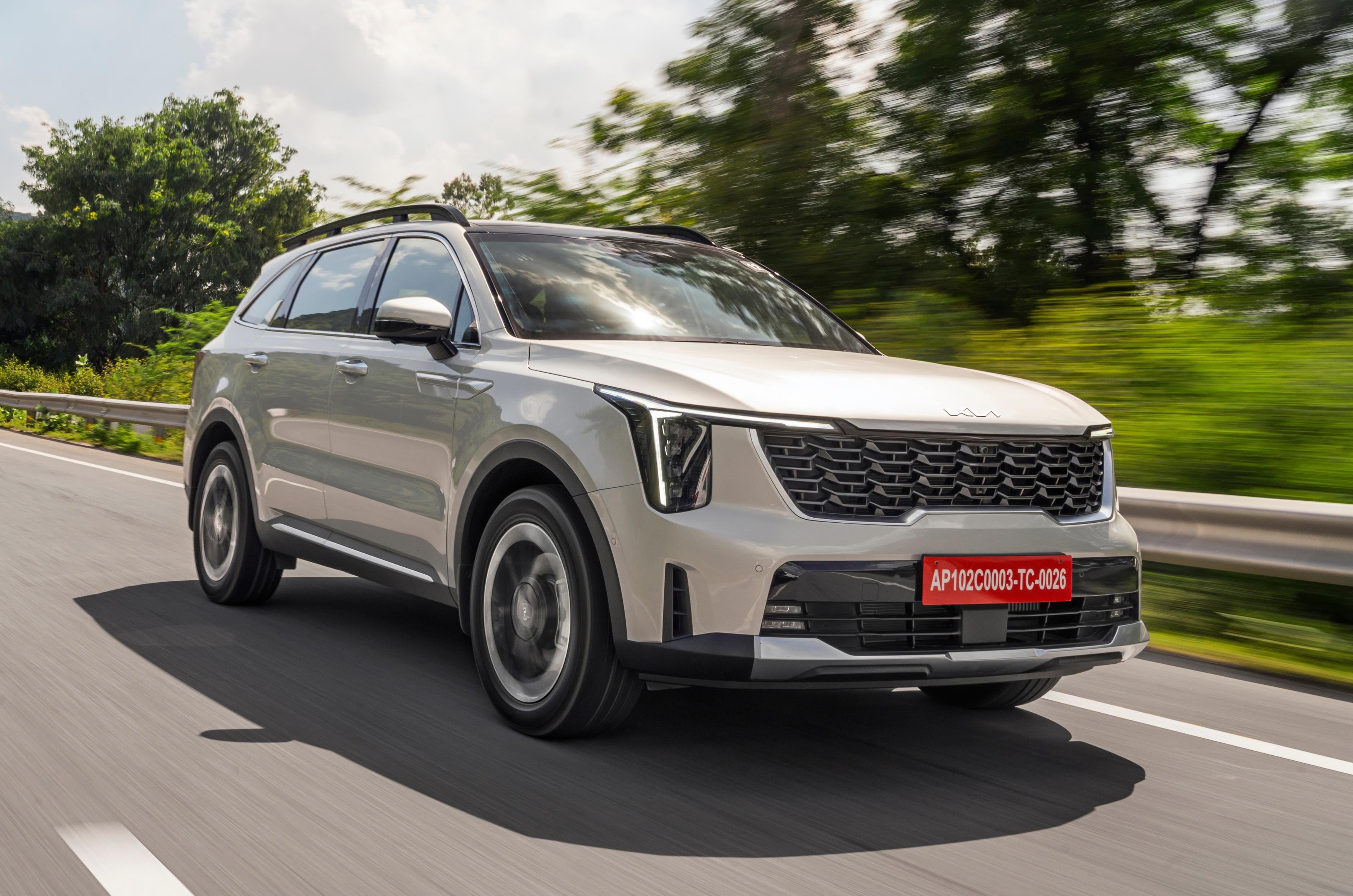
Based on the gen 4 Sorento, it carries over the older and more palatable design language.
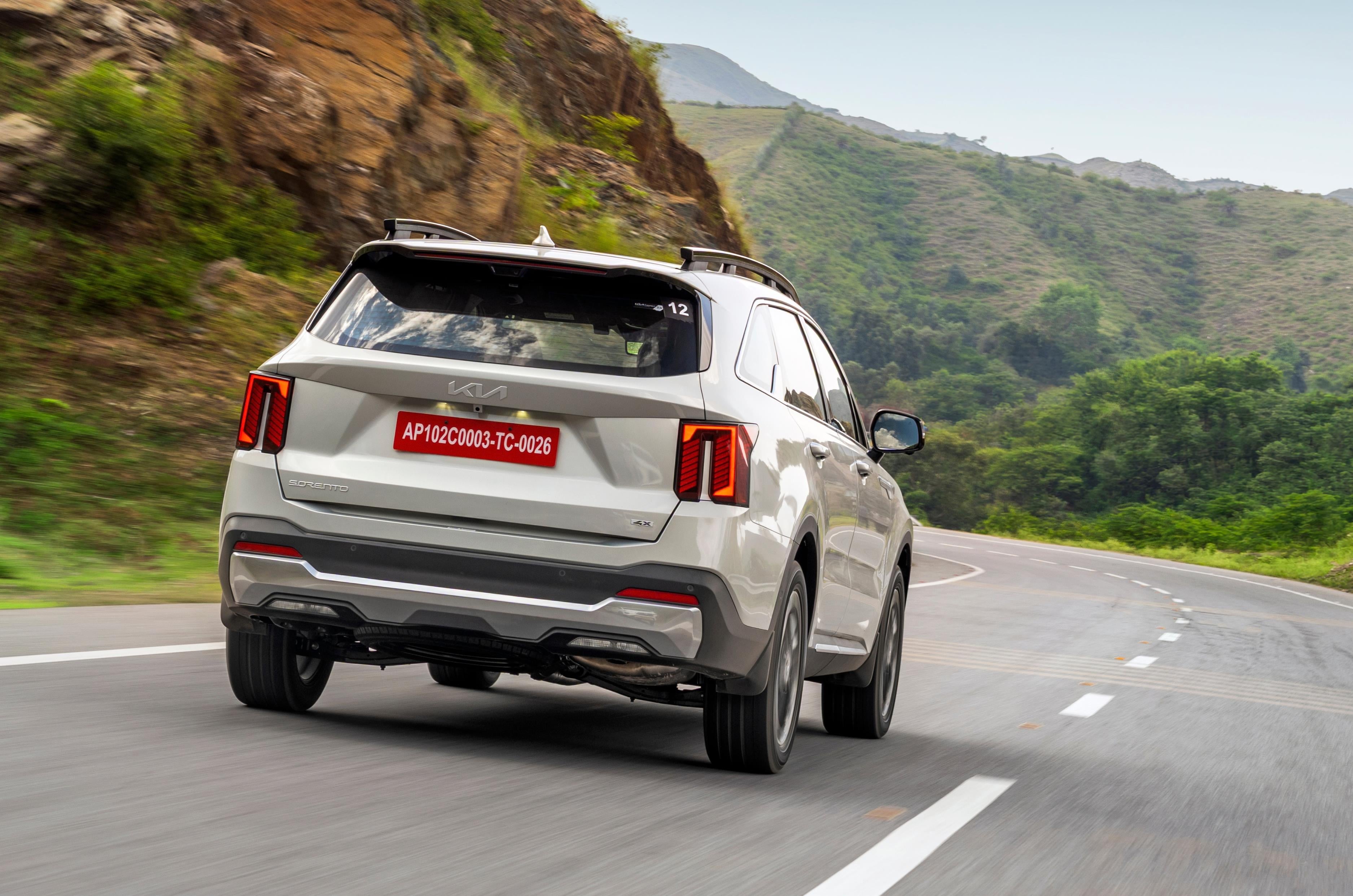
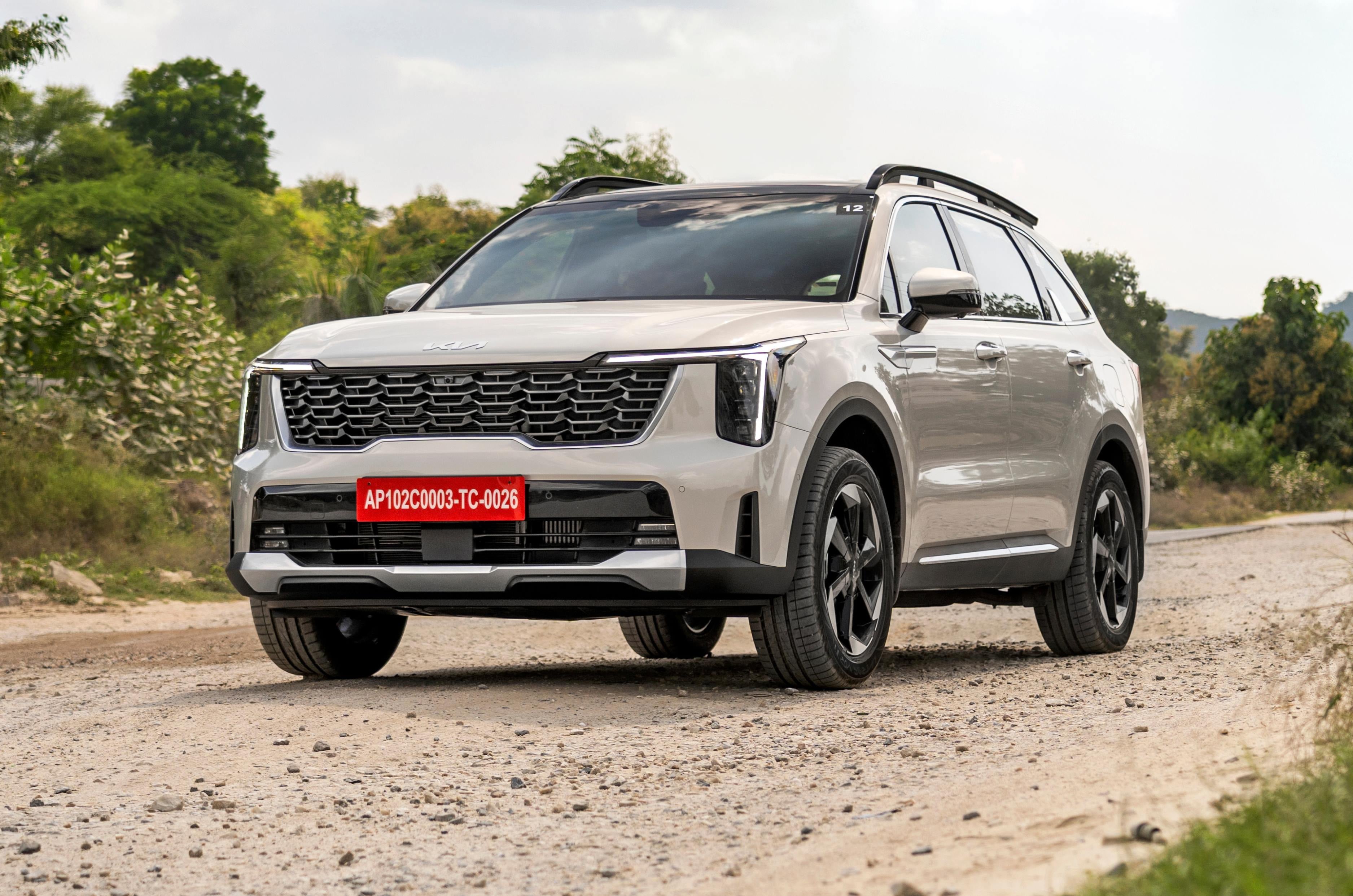
The Sorento sits on Hyundai-Kia’s MQ4 platform, the freshest architecture in its class, and it has already had a mid-life update to keep it looking current. The 2024 facelift brought the nose in line with the design language Kia kicked off with the EV9, so you get vertically stacked LED headlights, Y-shaped daytime running lamps and an aggressive looking bumper with wide intakes. At the back are L-shaped wraparound tail-lamps, and thankfully no light bar stretched across the tailgate.
Beats the rivals in length, width, and wheelbase.
Kia’s stated aim was a more technical, precise look, one meant to signal tight build quality and engineering sophistication. It is a trick the German premium brands have used for years, and Kia has clearly taken a leaf out of their book. The Sorento looks crisp and expensive rather than flashy, and is likely to age well too.
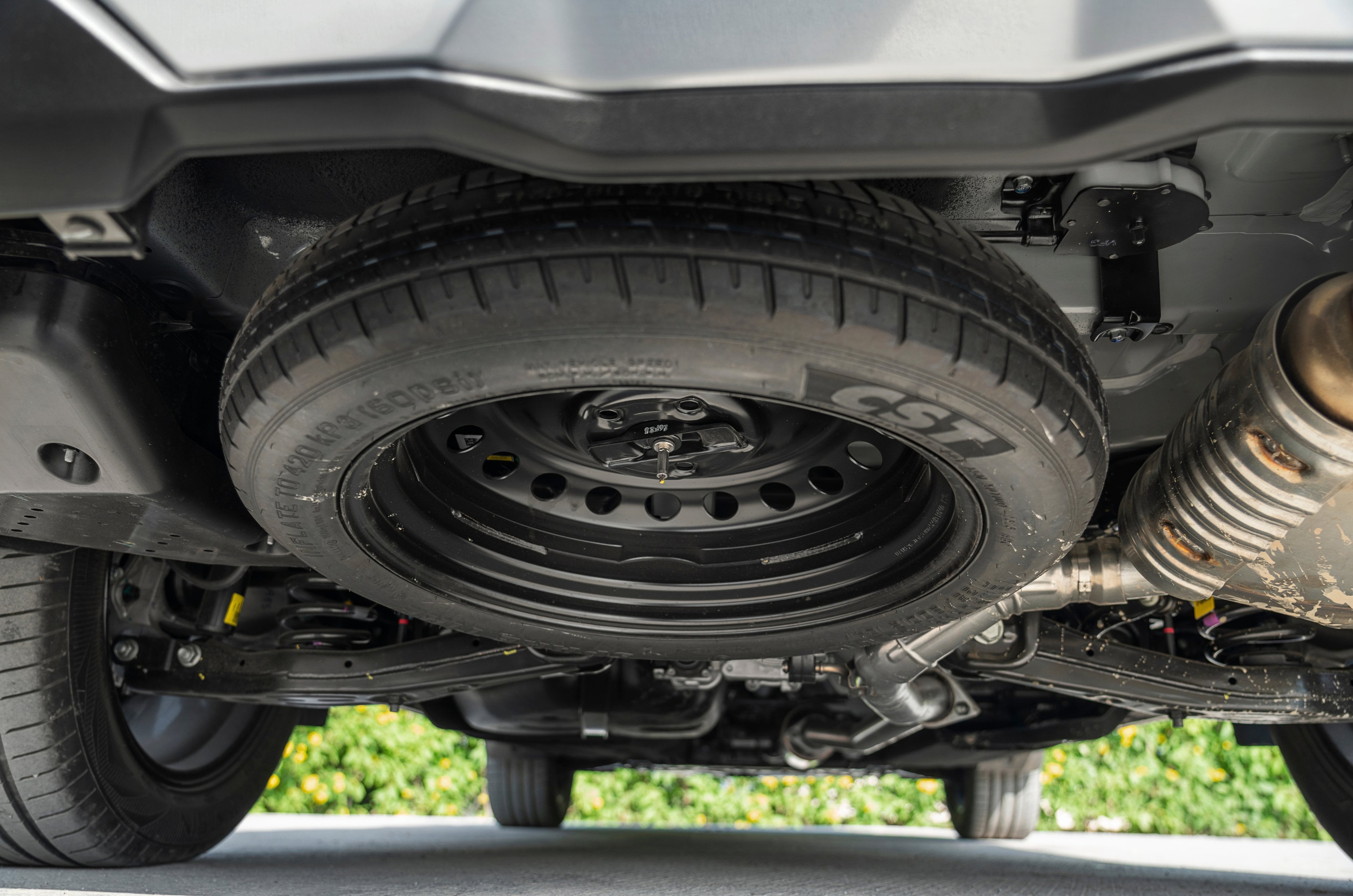
Spare wheel mounted under the floor frees up room in the boot.
What it does not have is brute presence. Despite being the longest, widest and tallest SUV in its segment, at 4,815mm long, 1,900mm wide and 1,785mm tall on a 2,815mm wheelbase, it does not loom in your mirrors the way a Fortuner does. The sloping roofline at the rear softens the silhouette and lends it a hint of crossover, and some will see it as a big Seltos rather than a junior Land Cruiser. Clearly this is not an SUV that looks like it can bully its way through traffic.
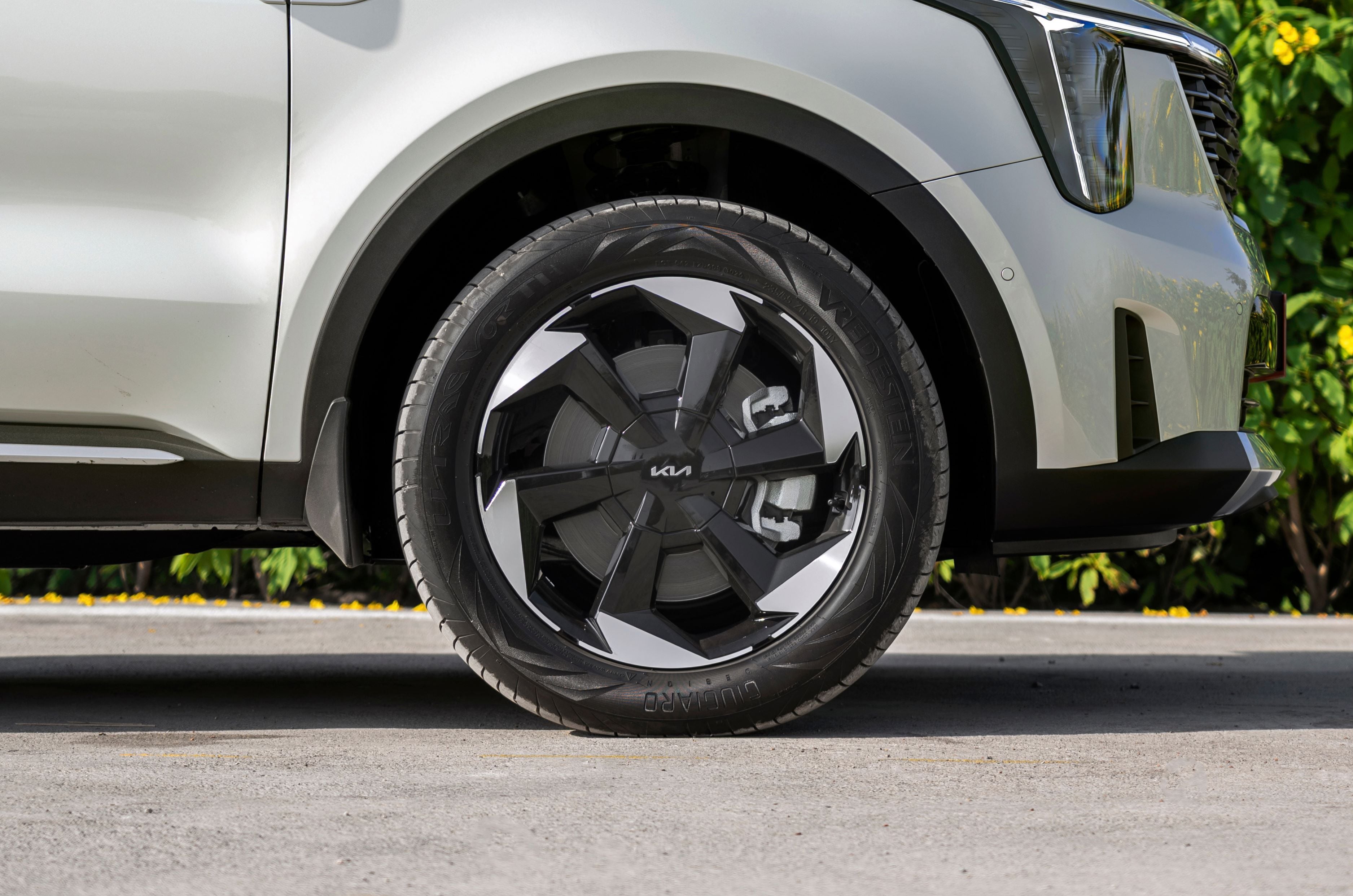
A more unique design could’ve been used for the 19-inch alloys.
The 19-inch dual-tone alloys could have been more distinctive, too an effect exaggerated by the chunky 235/55 R19 tyres. Those tall sidewalls, though, are not a styling misstep so much as an engineering choice, and they play a big part in how this car rides. More on that later.
Kia Sorento interior space and comfort
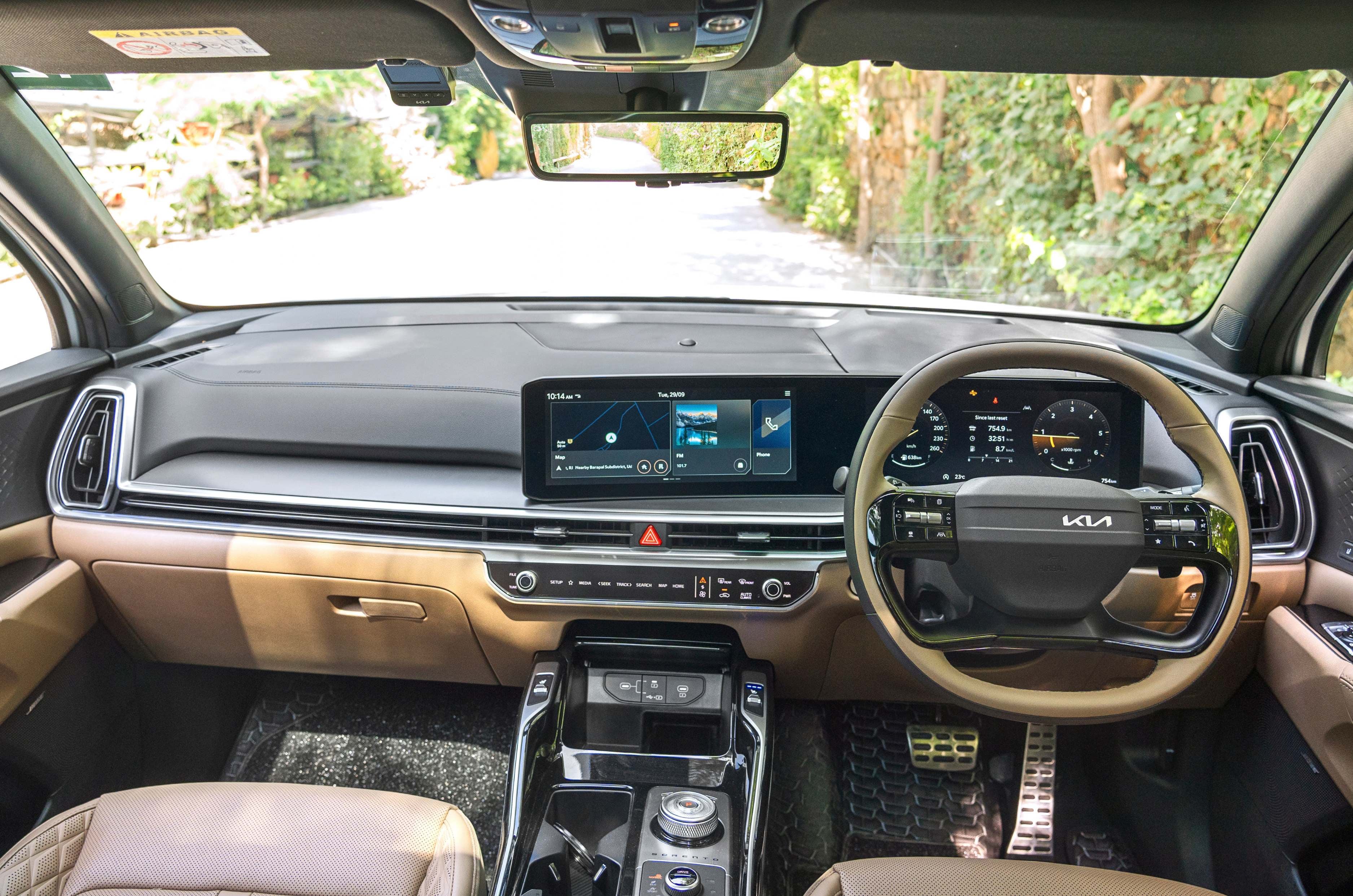
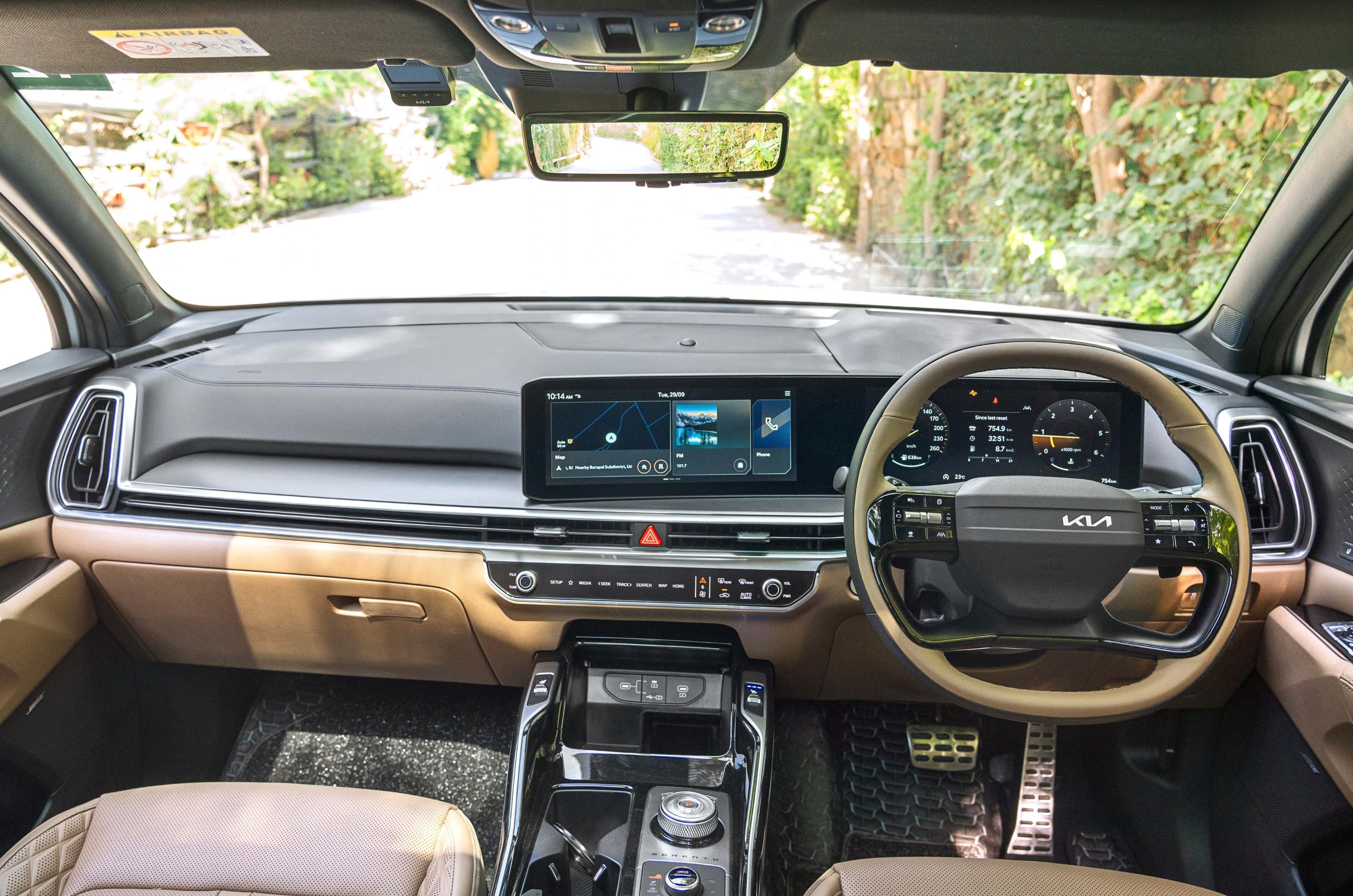
Clutter-free dashboard with solid build and plush feel.
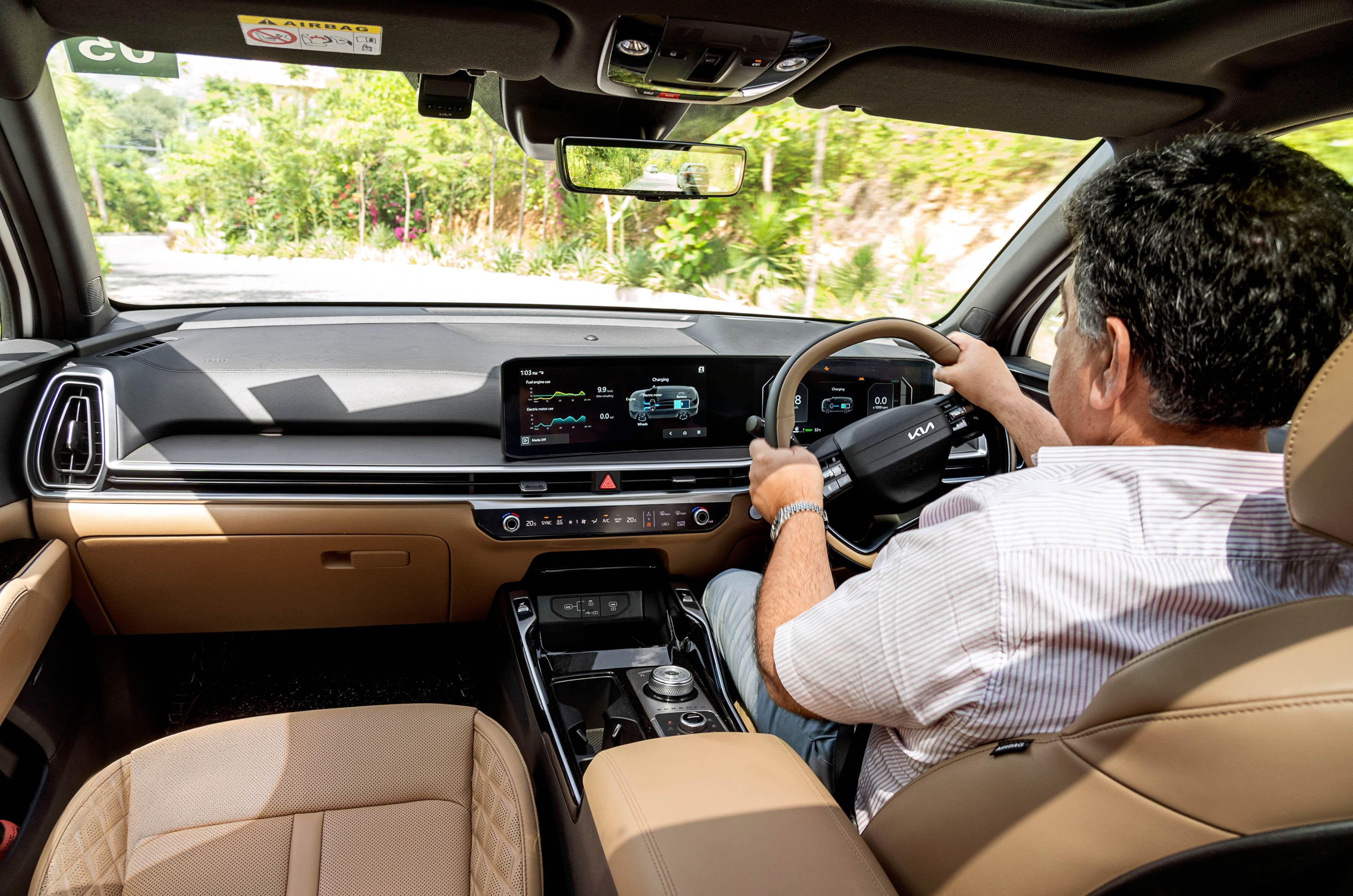
If the exterior is quietly effective, the cabin is where Kia has truly aced it. The Sorento offers a mix of quality, equipment and ergonomics that nothing at this price can match. Soft-touch materials cover everything you are likely to touch, including the spots where your knee rests against the centre console. There is a healthy count of physical buttons, and they click with a precision that feels engineered rather than sourced. The knurled finish on the rotary drive selector and the switchgear adds a tactile richness you normally pay German money for.
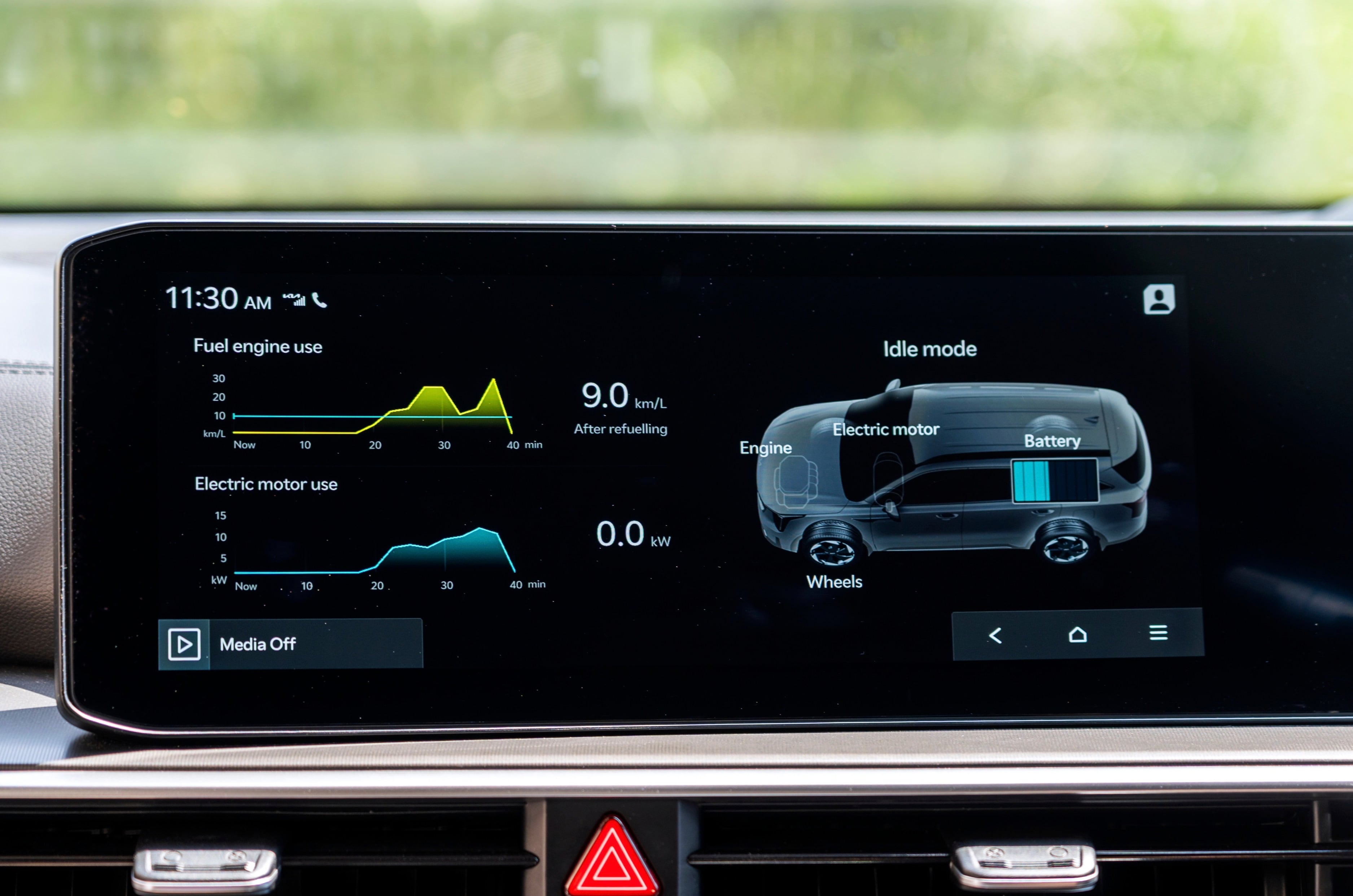
Hybrid variant gets exclusive data for power flow and efficiency.
As with its Hyundai cousins, the real ace is the software. The 12.3-inch infotainment system is logically laid out, menus are where you expect them to be, and getting to a feature takes a tap or two rather than a treasure hunt. Kia has also kept the climate controls off the main screen. They live on a touch-sensitive bar below it, with scrollers and a button that toggles the bar between air-con and infotainment shortcuts. It is a clever, space-saving solution, though you will occasionally find it in the wrong mode just when you need it.
L: Third row seat placed on floor results in knees-up seating; best for children. R: Broad, supportive and well-cushioned front seats are electric and also get ventilation.
The front seats are fully powered, with 10-way adjustment, lumbar support and ventilation, and the passenger seat gets a boss mode so whoever sits behind can push it forward. Coming to the third row, access is easy. You can either walk through the gap between the captain chairs or press a button on the seat, which electrically slides and tilts it forward. Once there, the news is mixed. Legroom is better than you expect, but the seat base is mounted almost flat on the floor, so there is no under-thigh support and your knees point at the roof. Treat it as a space for children or short hops. At least the third row gets its own blower controls and USB ports.
Spacious middle-row with ventilated and adjustable captain chairs; bench seat version also available.
One of the Sorento’s highlights, however, is the second-row experience. Our test car was the top HTX with six seats, and its second-row captain chairs are ventilated too, a rarity in this class. They are the best seats in the house. There is lots of legroom, a commanding view out and good under-thigh support, comparable to the Innova Hycross’s middle-row captain chairs, though the Toyota seats you a touch higher. A neat detail is the cupholder moulded into the door, up near the handle, where it is actually easy to reach.
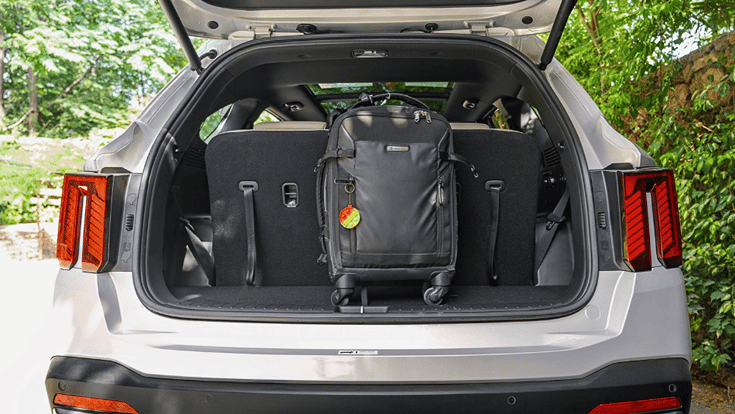
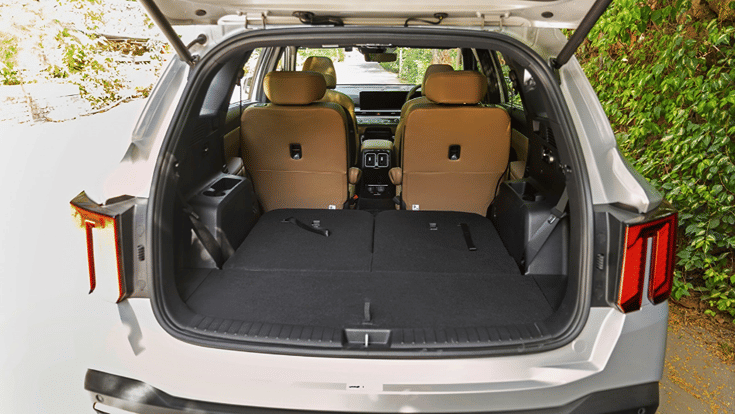
With all three rows up, the boot is a modest 179 litres; fold the third row and that grows to 813 litres. A full-size spare is welcome, but it is slung under the body, which is not the most convenient place to reach. Overhead, the massive panoramic roof floods the cabin with light and adds to the sense of space.
Kia Sorento features and technology
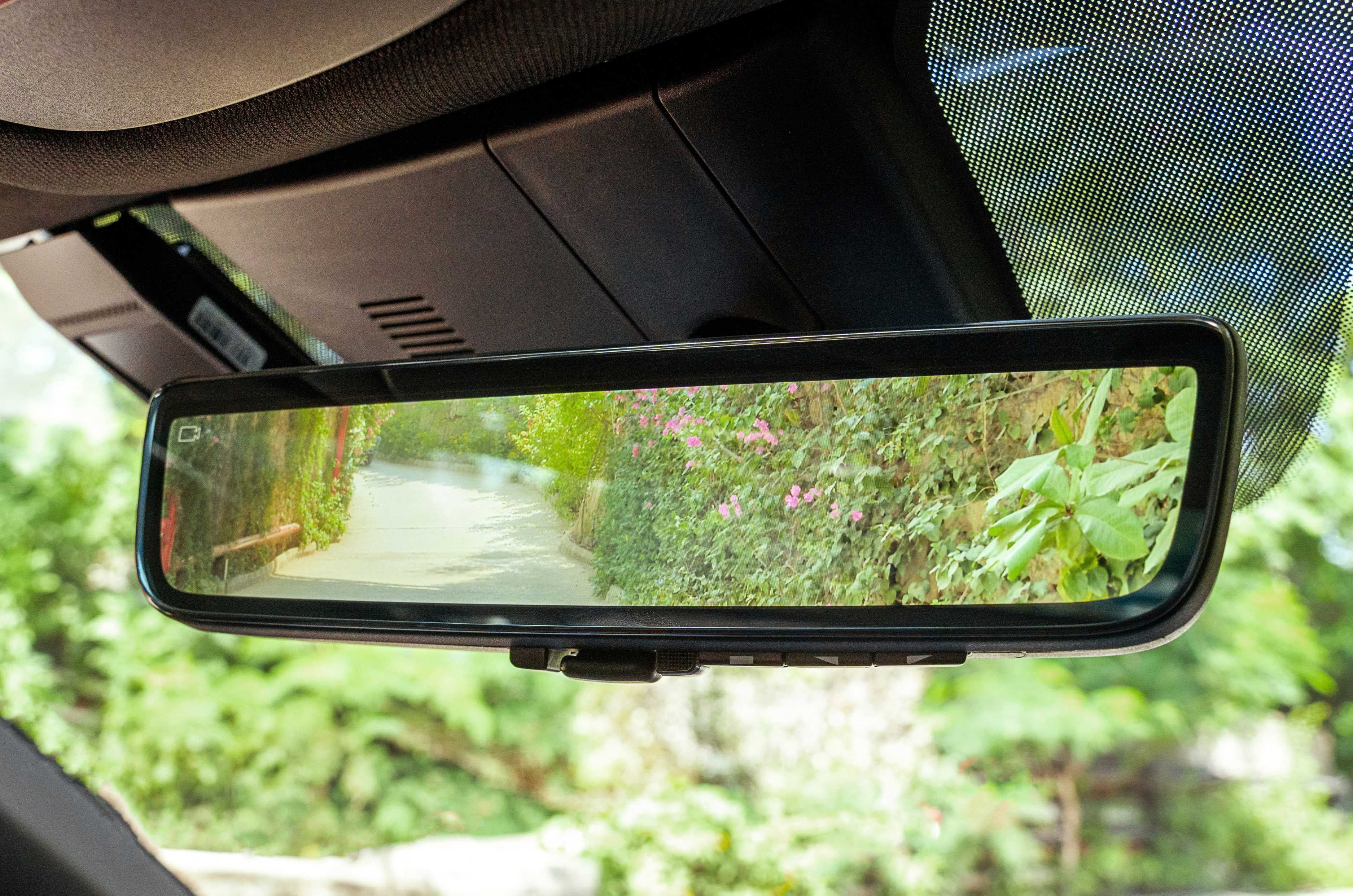
Digital IRVM offers excellent resolution and can be adjusted for level and brightness.
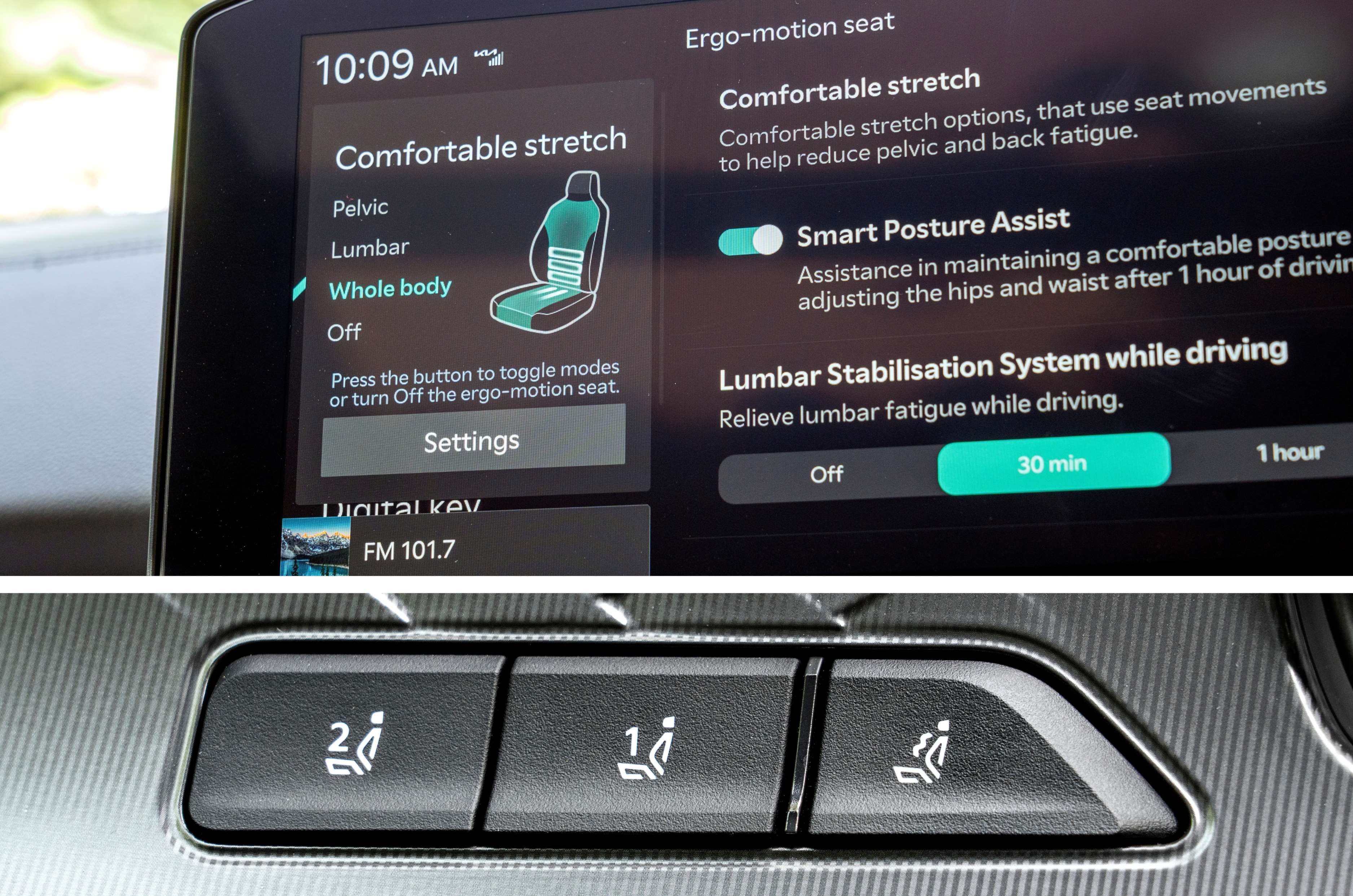
The equipment list is huge. In addition to the aforementioned 12.3-inch touchscreen, powered front seats, ventilated captain’s chairs, and panoramic sunroof, the Sorento comes packed with a 12.3-inch digital driver’s display, a head-up display, a 12-speaker Bose system, dual-zone climate control, a powered tailgate, rear-window sunshades, 64-colour ambient lighting and a digital rear-view mirror that flips back to a conventional one at the turn of a knob. The driver’s seat even gets an ‘ergo-motion’ mode that simulates a massage function by shifting the contours around.
Ergo mode for driver seat acts like a massage by moving the contours to avoid a stiff back on a long trip.
Safety is just as thorough, with 10 airbags, a 360-degree camera, front and rear dashcams, remote parking assist, TPMS and Level 2+ ADAS on the (A) trims. There is even real-time generative AI, a first for any Sorento globally.
Kia Sorento performance and refinement
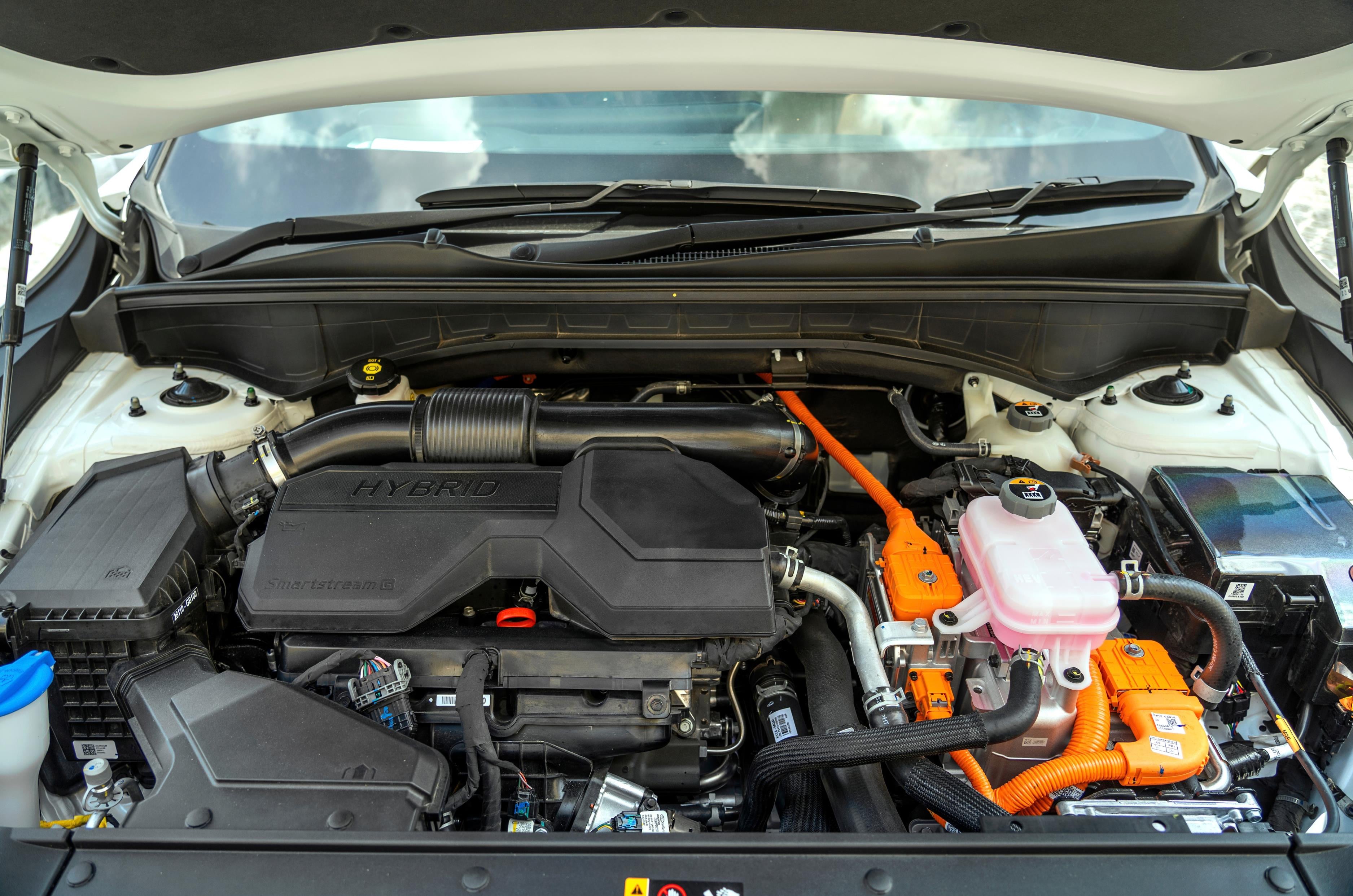
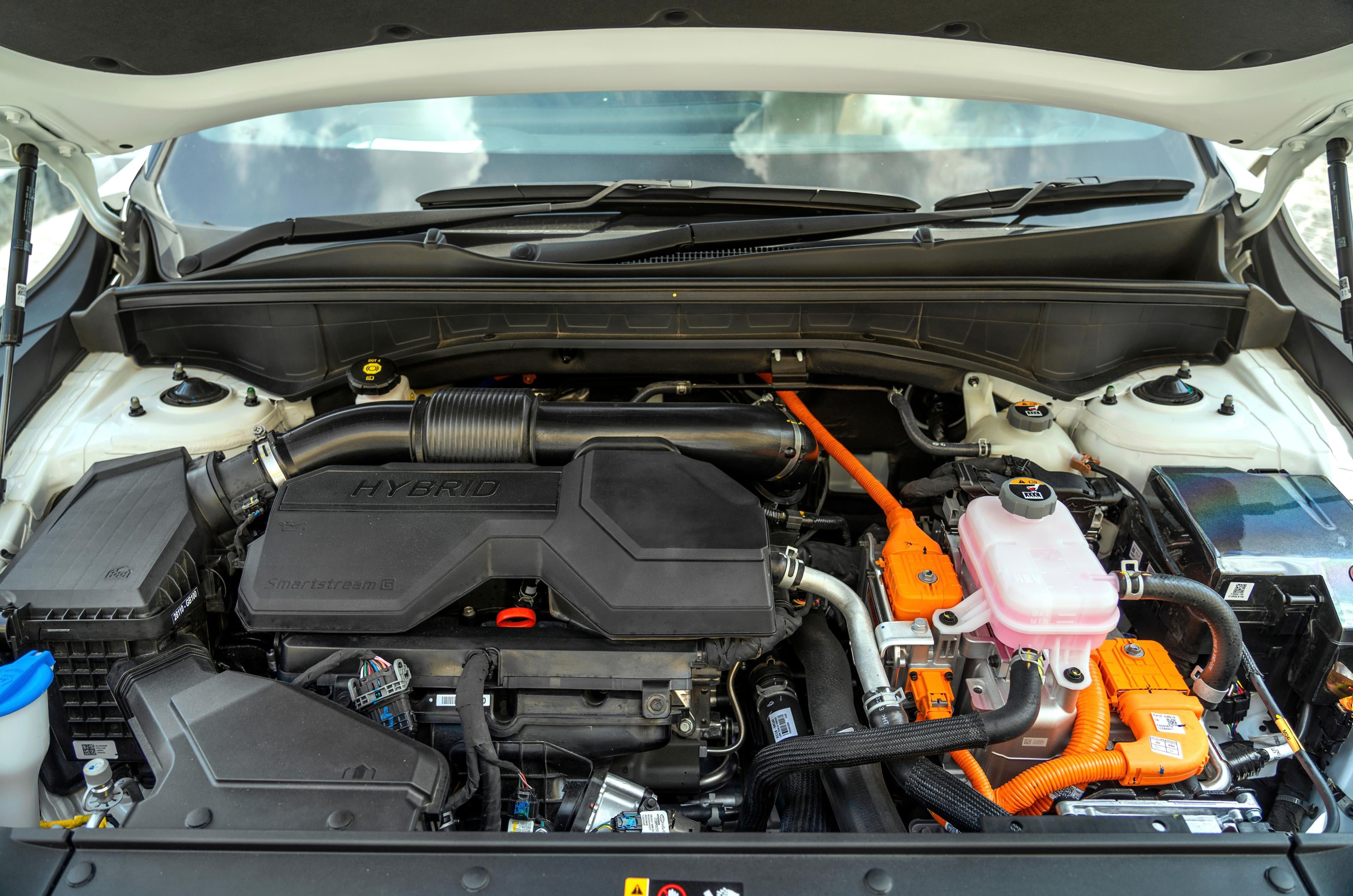
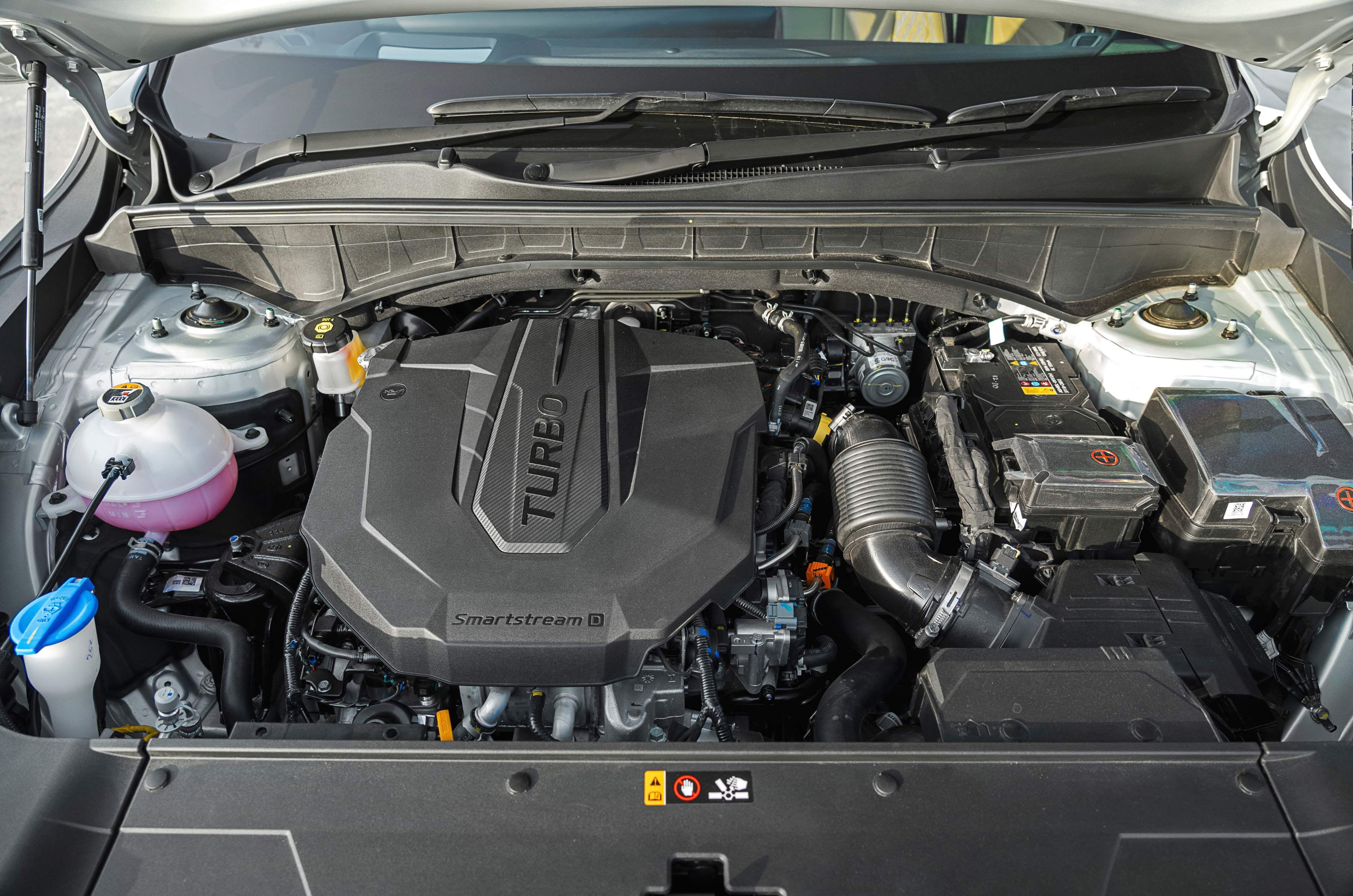
1.6-litre turbo-petrol engine paired with an electric motor and 6-speed torque converter automatic.
First up, the hybrid. Its 1.6-litre turbo-petrol makes 180hp and 265Nm, and the electric motor adds 65hp and 264Nm. The combined figure rating is 230hp and 380Nm of torque You can tell this the hybrid is the one for the city the moment you pull away, because the response is instant. It is well mated to the 6-speed torque-converter automatic, and the handover from electric to petrol power is close to seamless.
Hybrid variant is smooth in the city but gets noisy on the highway especially during overtakes.
The 1.49kWh battery lets it run in EV mode for a decent stretch at crawling speeds, and in stop-go traffic the hybrid makes eminent sense. Power delivery is refined, seamless and relaxing, and efficiency should be strong; The limitation is the motor itself. With only 65hp to shift a car weighing over two tonnes, it cannot do the heavy lifting on its own, so when you want to make quick progress the engine kicks in early. Push hard on the highway and the four-cylinder gets noisy and starts to run out of steam.
2.2-litre diesel engine makes 193hp mated to an 8-speed DCT and is the same unit seen on the Carnival.
Which is where the diesel comes in. The 2.2-litre is familiar from the Carnival, but it feels a lot sprightlier in the lighter Sorento. Its 193hp and 442Nm arrive in a strong, linear surge, and this is a fantastic, long-legged cruiser. Settle into eighth gear on an open highway and it simply lopes along, the engine barely working. It is also more tractable at low speeds than you might expect, pulling cleanly at part throttle from very low revs, so it can double as a city car, although its low-end response does not come close to the hybrid’s. It’s only when you floor it to dart through traffic that you experience a bit of hesitation, and its hear that you can use the paddle shifts to be in the right gear at the right time of the 8-speed DCT which comes as a pleasant surprise.
The diesel‘s strong torque and effortless cruising makes it perfect for long trips.
Rather than the snappy, slightly jerky shifts typical of dual-clutch boxes, this DCT slurs its changes almost like a torque converter, which adds to the smoothness of the whole package. The reason is that it is a wet-clutch unit, which also bodes well for durability in Indian traffic. The diesel is quite refined for the most part and its only when pushed hard that it gets audible and takes on a gruff note.
Both get drive modes; You can play with the Eco, Normal, Sport and Smart (or auto) modes in the diesel which alters the power delivery. In Sport, the throttle response is sharper and the default mode we liked whilst in Eco you can feel the response a bit dulled down. The Sorento Hybrid gets just Eco, Sport and Smart modes and in Eco mode EV running is prioritised. In addition, the AWD versions get Snow, Sand and Mud terrain modes which we didn’t a get chance to fully experience.
Kia Sorento mileage
In terms of fuel efficiency, the hybrid is rated at a highly frugal 19.60kpl with front-wheel drive and 17.70kpl with AWD, while the diesel returns 17.66kpl and 15.79kpl respectively on the Indian test cycle. In real-world city driving the gap between the hybrid and diesel could be bigger, depending on traffic. On long cross-country runs, though, with extended stints of cruising in high gears, the diesel could well be the more frugal of the two.
Kia Sorento ride and handling
The Sorento’s ride comfort is simply outstanding, and it comes as a pleasant surprise. That’s because Kias have traditionally been stiffer sprung than their Hyundai cousins, but here Kia has clearly prioritised comfort over sportiness, and the suspension is on the soft side. The way it smothers bad roads at speed is remarkable. Around Udaipur, where several stretches are properly broken, we never once had to lift off for a bad patch. The car just soaked it up and kept going.
Ride quality is segment best and it is unfazed over broken roads.
The isolation it gives its passengers is shockingly good, and those tall-sidewall tyres deserve part of the credit. They do a fine job of rounding off sharp jolts and filtering out the high-frequency shocks that a suspension alone cannot fully absorb. At highway speeds there is a bit of body movement on the undulating bits but its not disconcerting and both versions feel stable and planted at high speeds, which matters in a car this tall.
Our HTX test cars came with AWD as standard. We did not get a chance to test its off-road ability properly, but on dirt roads it felt sure-footed and secure. A proper off-road test will reveal how capable the all-wheel-drive system, though we doubt owners will really want to test the Sorento’s off-road capability.
Steering is light but lacks consistency and sharpness of European rivals.
The steering is less impressive. There is a dead zone around the straight-ahead position, and it does not feel as fluid or progressive as its European rivals’. The Volkswagen Tayron and Skoda Kodiaq are both dynamically sharper. One reason is because the Sorento rides taller too, as ground clearance has been raised from the global car’s 176mm to 208mm, and there is a touch of body roll when you push hard through corners.
But that misses the point. On balance, the Sorento’s ride and handling are superbly judged for the people who will buy it. Kia has done a fine job of understanding what a premium SUV buyer in India wants, and it has tailored the car accordingly.
Kia Sorento price and verdict
As a package, the Sorento hits it out of the park; rivals have a lot of catching up to do.
If the product does not win you over, the pricing certainly will. A starting price of Rs 27.99 lakh has set the cat amongst the pigeons, putting the Sorento within striking distance of the Mahindra XUV 7XO. And with its size, features and overall polish, the Sorento will not just nibble at the top end of the 7XO’s pie but with the Hybrid could also tempt a few Innova Hycross buyers. As for the Volkswagen Tayron and Skoda Kodiaq, the Sorento makes them look overpriced and underequipped.
The lower and mid variants are exceptional value. The top-end HTX, at Rs 37.49-40.19 lakh depending on fuel and seating, is pricey by comparison, around Rs 5 lakh more than an equivalent HTK, because it comes with AWD as standard. Here Kia has missed a trick. An HTX with two-wheel drive, a few lakh cheaper, would have been a far easier sell to the many buyers who want all the features and ventilated rear seats but will never leave the tarmac. That however is a small quibble that Kia can easily correct.
The lasting impression is that the Sorento feels premium, bordering on luxury. It is fantastically equipped, it rides beautifully, and it offers a choice of two powertrains that are each right for a distinct type of buyer. Most of all, it fits what the Indian SUV buyer actually wants with uncanny precision. Will Kia hit its target of 40,000 sales a year? That could be a tall order. But what there is no doubt about is that Kia has built another winner.
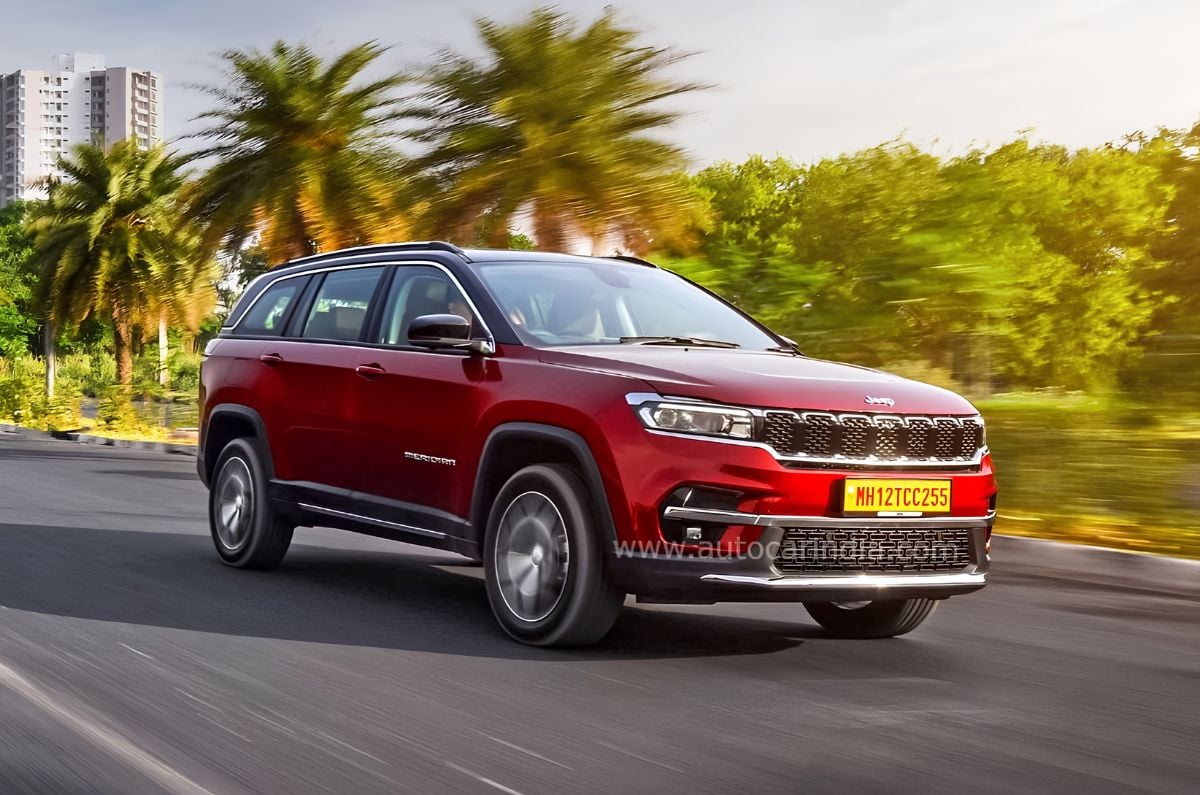
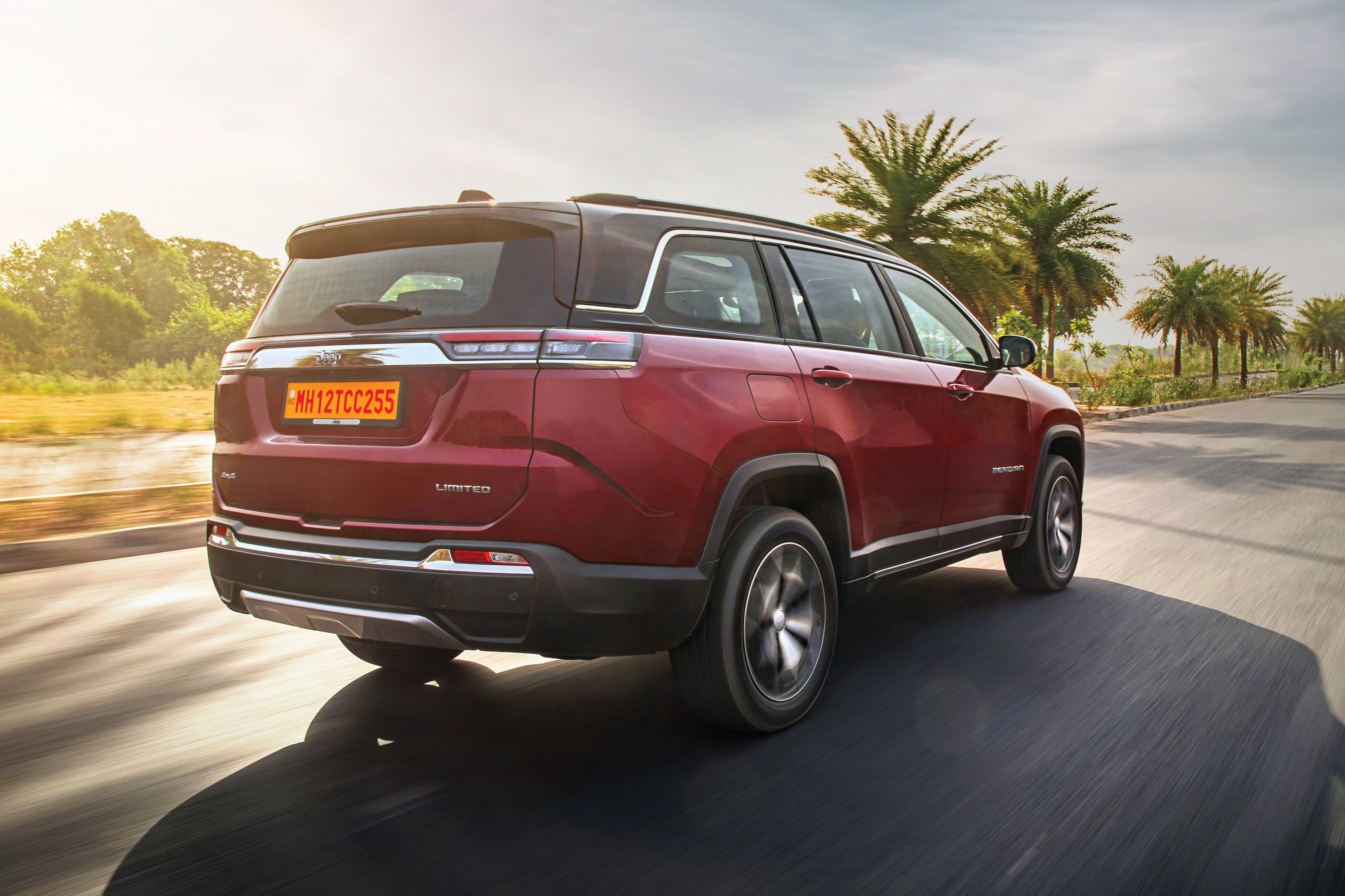
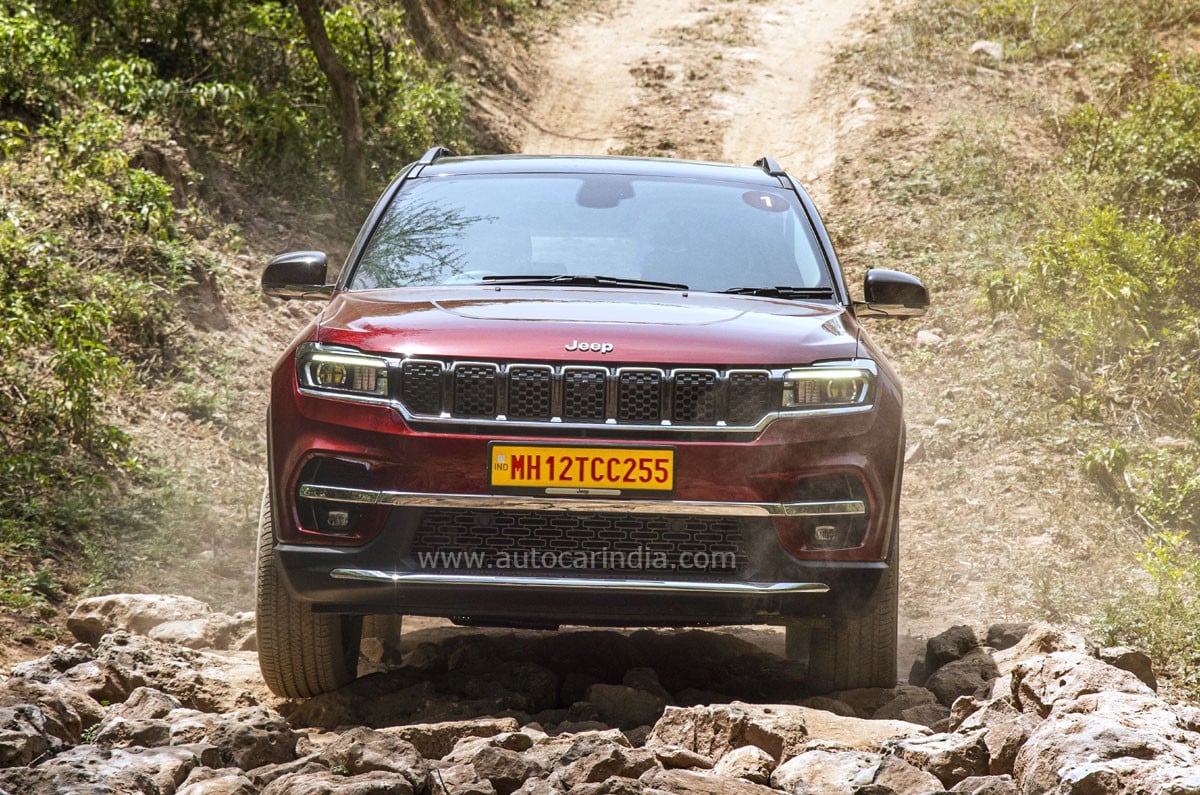
If you’re in the market for an executive three-row SUV, the Jeep Meridian comes across as a competent offering. Launched in 2022, the Meridian uses the same underpinnings as the Compass, but gets unique body panels and a longer wheelbase to accommodate an extra row of seats. Over the years, Jeep has ensured it keeps the Meridian up to speed with the competition through variant rejigs, feature additions, and special edition versions. If the Meridian is on your radar, we present reasons why it’s worth buying, along with reasons to look elsewhere.
Reasons to buy the Jeep Meridian
Outstanding ride and handling balance
Thanks to an independent suspension setup with Frequency Selective Damping (FSD) and Hydraulic Rebound Stoppers (HRS), the Meridian takes rough road surfaces in its stride. Ride quality on the Meridian is phenomenal, as it remains remarkably stable on any road surface it travels on. On the other hand, minimal body roll and accurate steering with good feedback help the Meridian shine when it comes to handling.
Impeccable highway manners
The Meridian’s 170hp/350Nm turbo-diesel mill delivers power linearly and is quite torquey. Combined with its supple ride quality from its beefy suspension and tall gearing from its 9-speed automatic gearbox, the Meridian makes for a brilliant highway car.
Excellent off-road capability
The Meridian’s outstanding driving dynamics aren’t just limited to the tarmac; it handles off-road equally well. Unlike its rivals that offer an AWD drive layout, the Meridian stands out with a proper 4×4 layout. Being a Jeep SUV, the off-road capabilities of the Meridian are exceptional, and it offers multiple off-road modes along with a low-range transfer case. We’ve extensively tested its off-road ability and came away impressed. Though owners may not use the Meridian’s 4×4 system often, it’s nice to know that its capabilities have your back if you do go off-road.
Reasons not to buy the Jeep Meridian
Lack of engine options
Powering the Meridian is the same 2.0-litre turbo-diesel engine that also does duty in the smaller Compass SUV. There’s no petrol engine on offer, which could likely deter a section of buyers who have moved on from diesels. Rivals like the Kia Sorento offer a turbo-petrol strong-hybrid engine in addition to a diesel.
Cramped third-row seat
Though the Meridian’s first and second rows offer a comfortable seating experience, the same can’t be said for its third row. Accessing the third row is easy thanks to the tumble function of the second-row seats, but the space on offer is disappointing compared to other 7-seat SUVs. The seat is placed low on the floor, leading to a ‘knees-up’ seating experience. Additionally, because lower variants lack a sliding function for the second-row seats, foot space also takes a hit. Overall, the third row of the Meridian is best reserved for kids or kept folded for more boot space.
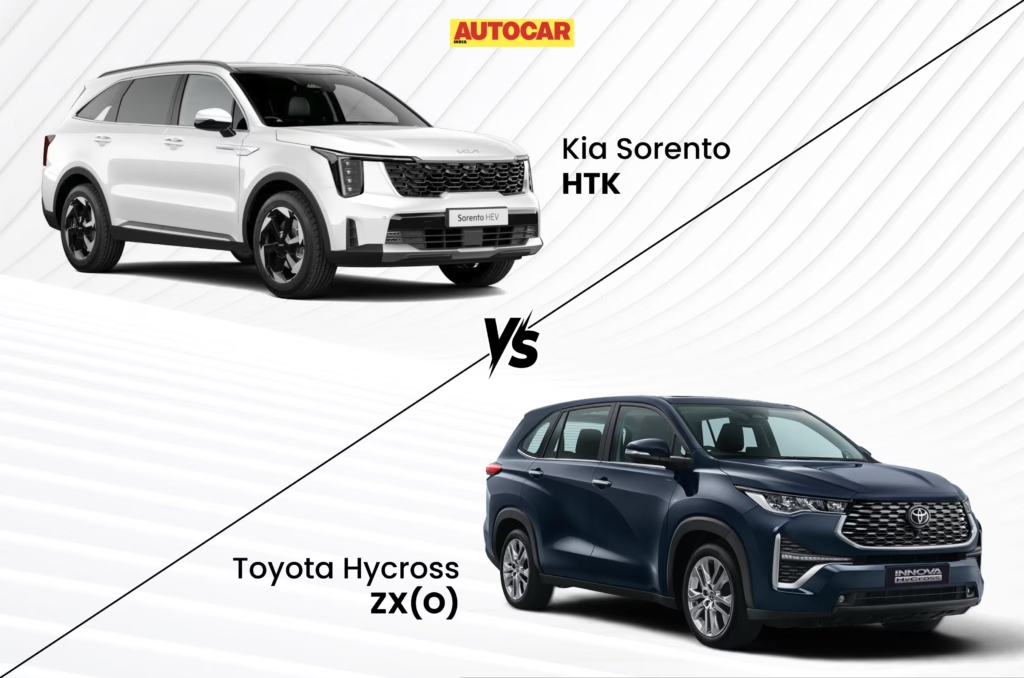
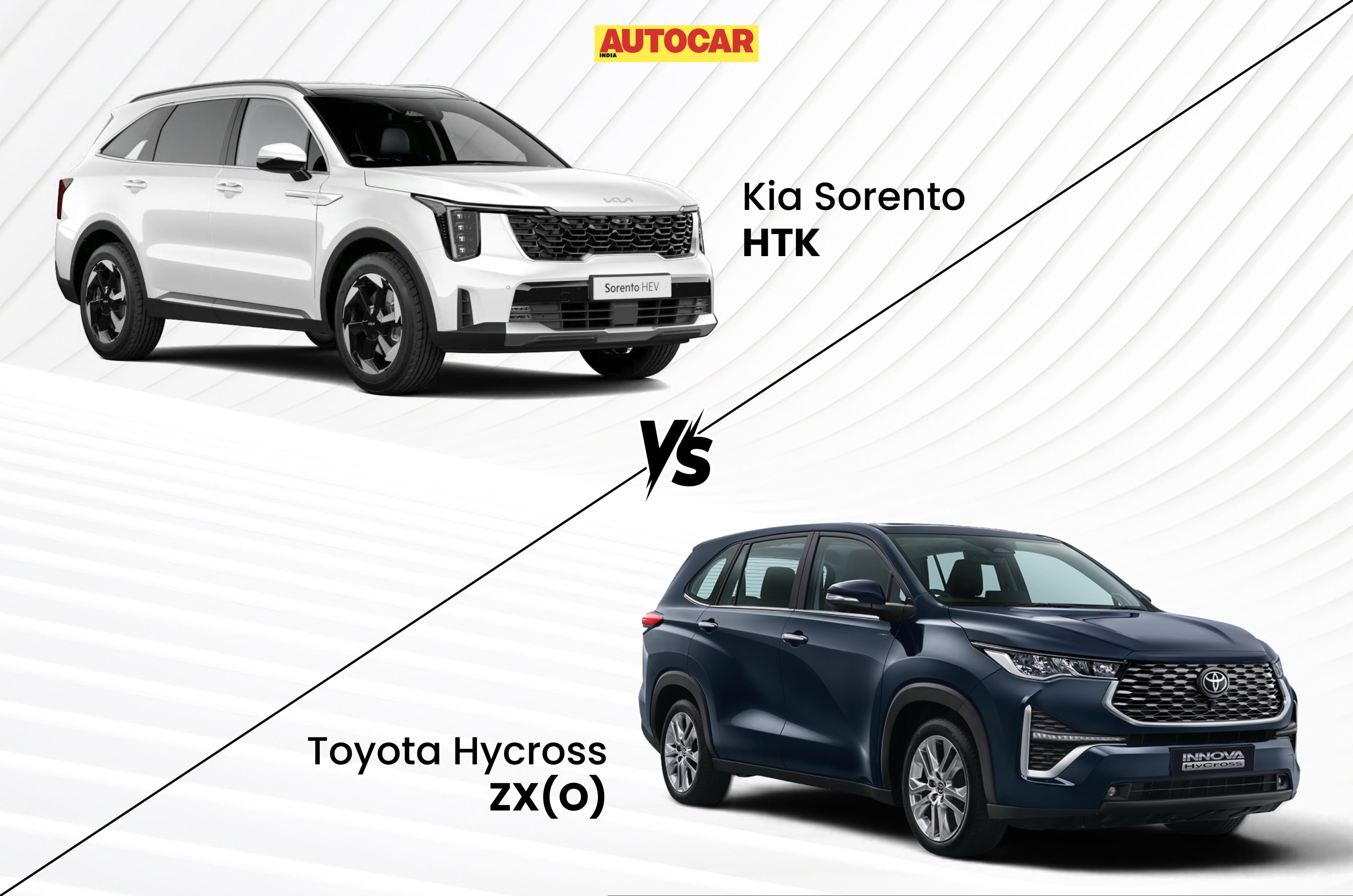
While the Kia Sorento is a direct rival to premium three-row SUVs such as the Volkswagen Tayron and Skoda Kodiaq, it can also be viewed as an indirect competitor to the Toyota Innova Hycross – both are three-row strong hybrids that somewhat overlap in price. Specifically, if you are looking to buy the top-spec Innova Hycross ZX(O) Hybrid, a relatively small budget extension will also put the mid-spec Sorento HTK Hybrid within your reach. Below, we’ve compared everything these Sorento and Innova Hycross variants offer to help you decide which one you should pull the trigger on.
Kia Sorento HTK vs Toyota Innova Hycross ZX(O): Dimensions
Sorento is longer overall and wider, Hycross offers longer wheelbase
Sorento HTK Hybrid
Innova Hycross ZX(O) Hybrid
Length (mm)
4,815
4,755
Width (mm)
1,900
1,850
Height (mm)
1,785
1,790
Wheelbase (mm)
2,815
2,850
Seating capacity
6/7
7
Wheel size (inches)
19
18
Among the key exterior distinctions between these two is that the Sorento is an SUV, and the Innova Hycross is an MPV. The Sorento is a good 60mm longer than the Innova Hycross overall, but the latter interestingly has a 35mm advantage on the wheelbase front. Height is also a narrow victory for the Innova Hycross, but the Sorento wins when it comes to width and alloy wheel size. The Kia SUV even offers a 6-seat layout but for a premium of Rs 20,000.
Kia Sorento HTK vs Toyota Innova Hycross ZX(O): Powertrains
Sorento has a smaller engine but makes much more torque
Sorento HTK Hybrid
Innova Hycross ZX(O) Hybrid
Engine
1.6-litre turbo-petrol
2.0-litre petrol
Cylinder count
4
4
Engine power (hp)
180
–
Engine torque (Nm)
265
191
Motor power (hp)
65
–
Motor torque (Nm)
264
206
Combined power (hp)
–
184
Gearbox
6-speed AT
e-CVT
Fuel tank capacity
67
52
As noted previously, both the Sorento and Innova Hycross are powered by strong hybrid setups. However, the Sorento gets a smaller direct-injection turbo-petrol engine, while the Innova Hycross gets a larger naturally aspirated mill. The Sorento’s torque figures are higher than those of the Innova Hycross, and the Toyota MPV’s combined power output is also not much higher than the Kia SUV’s engine output. Their gearboxes are quite different too, with the Sorento using a 6-speed torque converter, and the Innova Hycross an e-CVT. Lastly, the Sorento has a substantially larger fuel tank as well.
Kia Sorento HTK vs Toyota Innova Hycross ZX(O): Exterior features
Sorento gets sequential indicators and roof rails over Hycross
Sorento HTK Hybrid
Innova Hycross ZX(O) Hybrid
Auto LED headlamps
Yes
Yes
LED DRLs
Yes
Yes
Front fog lamps
Yes
Yes
LED tail-lamps
Yes
Yes
Sequential indicators
Yes
No
Roof rails
Yes
No
Powered ORVMs
Yes
Yes
Powered tailgate
Yes
Yes
Shark-fin antenna
Yes
Yes
Rear spoiler
Yes
Yes
Colour options
7, monotone
6, monotone
The Sorento and Innova Hycross are quite evenly matched in terms of functional features, with the Toyota missing out only on roof rails and sequential indicators. Exterior colours are again a win for the Sorento, as it offers one extra option over the Innova Hycross.
Kia Sorento HTK vs Toyota Innova Hycross ZX(O): Interior features
Sorento fares better on tech, but Hycross has a few aces up its sleeve
Sorento HTK Hybrid
Innova Hycross ZX(O) Hybrid
Infotainment screen
12.3-inch
10.1-inch
Instrument cluster
12.3-inch
Analogue with MID
Panoramic sunroof
Yes
Yes
Wireless charger
Yes
Yes
Powered front seats
Yes
Driver only
Ventilated front seats
Yes
Yes
Dual-zone climate control
Yes
Yes
Ambient lighting
64-colour
Blue only
Sound system
12-speaker Bose
9-speaker JBL
Apple CarPlay and Android Auto
Wireless
Wireless
Cabin air purifier
No
Yes
Connected car tech
Yes
Yes
Rear window sunshade
No
Yes
Rear centre armrest
Yes
Yes
Sliding, reclining rear seats
Yes
Yes
Rear-seat leg rests
No
Yes, powered
The Sorento is a step above the Innova Hycross when looking at nice-to-have features, such as a bigger touchscreen, a digital driver’s display, configurable ambient lighting, more speakers, a powered co-driver’s seat and more. However, the Innova Hycross holds its own on the comfort and convenience front, courtesy of goodies such as a rear window sunshade, a cabin air purifier, and powered leg rests for the second row.
Kia Sorento HTK vs Toyota Innova Hycross ZX(O): Driving features
Hycross offers adaptive cruise control
Sorento HTK Hybrid
Innova Hycross ZX(O) Hybrid
Drive modes
3
3
Acoustic vehicle alert system
Yes
Yes
Paddleshifters
Yes
Yes
Cruise control
Yes
Adaptive
Both hybrids are almost identical when it comes to driving features, but the Innova Hycross edges ahead thanks to adaptive cruise control, which can automatically adjust the car’s speed based on its proximity to the vehicle in front, making it superior to the Sorento’s standard cruise control system.
Kia Sorento HTK vs Toyota Innova Hycross ZX(O): Safety features
Sorento has 7 airbags and side sensors, while Hycross gets Level 2 ADAS
Sorento HTK Hybrid
Innova Hycross ZX(O) Hybrid
Level 2 ADAS
No
Yes
Airbags
7
6
ABS with EBD
Yes
Yes
ESC
Yes
Yes
Hill-hold control
Yes
Yes
TPMS
Yes
Yes
360-degree camera
Yes
Yes
Parking sensors
Front, rear, side
Front, rear
Electronic parking brake
Yes
Yes
Rain-sensing wipers
Yes
No
Rear wiper, defogger
Yes
Yes
Isofix child-seat anchors
Yes
Yes
Disc brakes
Front, rear
Front, rear
In its top-spec form, the Innova Hycross offers Level 2 ADAS, which the mid-spec Sorento lacks. ADAS can make highway cruising much easier, so buyers who frequently head out of the city will likely appreciate the Toyota more in this regard. The Sorento, on the other hand, offers a driver knee airbag and side parking sensors; the latter can make manoeuvrability much easier in the city.
Kia Sorento HTK vs Toyota Innova Hycross ZX(O): Prices
Hycross is Rs 2.15 lakh more affordable
Sorento HTK Hybrid 7S
Innova Hycross ZX(O) Hybrid 7S
Price (in Rs lakh)
33.99
31.84
The Sorento HTK Hybrid 7-seater commands a premium of Rs 2.15 lakh over the Innova Hycross ZX(O) Hybrid 7-seater. Some prospective buyers may find the price difference steep, but the Sorento makes it worthwhile if you want a more tech-laden and premium-looking cabin, as well as better performance. The Innova Hycross, on the other hand, packs a lot of comfort and convenience features that may interest buyers who are chauffeur-driven or frequently ferry around their families.
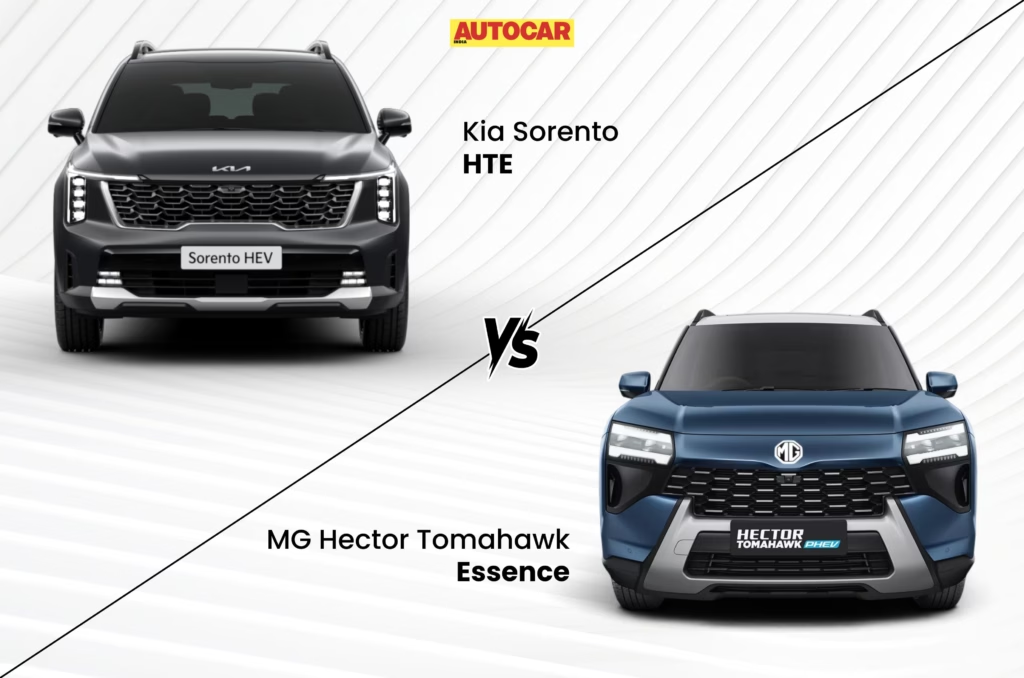
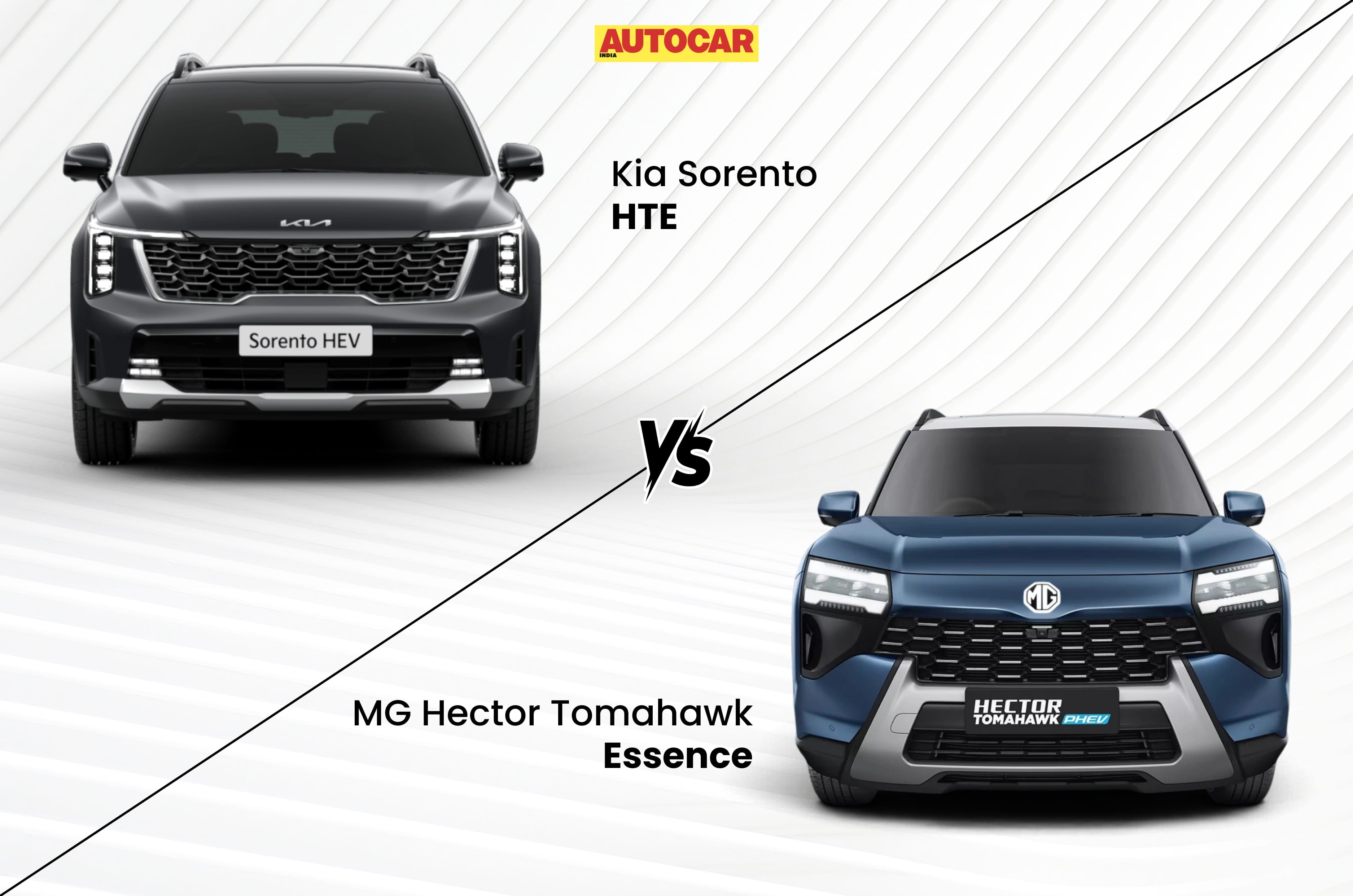
The Sorento is Kia’s first hybrid car to hit the Indian market. A few weeks prior, MG Motor India also launched its first hybrid car, the Hector Tomahawk PHEV. The Sorento is a strong hybrid, meaning it has a relatively small battery pack and isn’t designed for extended periods of pure-electric driving. On the other hand, the Hector Tomahawk PHEV is a plug-in hybrid, which means it gets a much larger battery that delivers a usable all-electric range.
If you’re looking to purchase a 7-seater hybrid SUV under the Rs 30 lakh price point (ex-showroom), the Sorento hybrid’s base variant (HTE) and the Hector Tomahawk PHEV’s top-spec variant are both within your reach. We examined their spec sheets closely to find out which of them is more value-for-money.
Kia Sorento hybrid base-spec vs MG Hector Tomahawk PHEV top-spec: Dimensions
Sorento is larger overall, while Hector Tomahawk PHEV has a bigger boot
Sorento Hybrid HTE
Hector Tomahawk PHEV Essence
Length (mm)
4,815
4,745
Width (mm)
1,900
1,850
Height (mm)
1,785
1,770
Wheelbase (mm)
2,815
2,810
Boot space*
179
192
Wheel size (inches)
18
18
*Measured with third row up.
While the Sorento is a good 70mm longer than the Hector Tomahawk PHEV, the difference between their wheelbases is just 5mm. The Kia SUV is 50mm wider and 15mm taller too, but the Hector Tomahawk PHEV has a slightly larger boot.
Kia Sorento hybrid base-spec vs MG Hector Tomahawk PHEV top-spec: Powertrains
Sorento has more powerful engine, while Hector Tomahawk PHEV offers more electric range
Sorento Hybrid HTE
Hector Tomahawk PHEV Essence
Engine
1.6-litre turbo-petrol
1.5-litre petrol
Cylinder count
4
4
Engine power (hp)
180
102
Engine torque (Nm)
265
125
Motor power (hp)
65
201
Motor torque (Nm)
264
237
Combined power (hp)
–
198
Combined torque (Nm)
–
230
Gearbox
6-speed AT
DHT
Battery capacity (kWh)
–
20.5
Claimed electric range (km)
–
115
Fuel tank capacity
67
52
3.3kW AC charging time
–
7.5 hrs (10-100%)
25kW DC charging time
–
35 mins (30-80%)
The Sorento is the first car in India to offer a turbo-petrol strong hybrid powertrain, while the Hector Tomahawk PHEV is the first plug-in hybrid to be available in the mass-market segment. In terms of pure combustion power, the Sorento’s direct-injection turbo-petrol engine is much stronger than the Hector Tomahawk PHEV’s naturally aspirated mill. The MG’s electric motor makes over three times more power than that of the Sorento, but less torque.
Kia has not yet disclosed the combined output of the India-spec Sorento hybrid, so it’s difficult to compare it with the Hector Tomahawk PHEV in this regard. The Hector Tomahawk PHEV gets a substantial 20.5kWh battery pack, which can supply a claimed all-electric range of 115km (overall driving range is rated at over 1,100km) and can be charged via AC or DC wallboxes. On the other hand, the Sorento’s self-charging hybrid system means the engine solely charges the battery. The increased dependence on the engine means the Sorento’s fuel tank is larger too.
Kia Sorento hybrid base-spec vs MG Hector Tomahawk PHEV top-spec: Exterior features
Hector Tomahawk PHEV offers LED tail-lamps, rear fog lamps, and powered tailgate
Sorento Hybrid HTE
Hector Tomahawk PHEV Essence
LED headlamps
Yes
Yes
Rear fog lamps
No
Yes
LED tail-lamps
No
Yes
Illuminated logo
No
Yes
Roof rails
Yes
Yes
Powered ORVMs
Yes
Yes
Powered tailgate
No
Yes
Rear spoiler
Yes
Yes
Colour options
7, monotone
8, monotone+dual-tone
The Hector Tomahawk PHEV easily takes the win here, offering equipment like LED tail-lamps, rear fog lamps, a powered tailgate, and an illuminated logo over the Sorento. The MG SUV also offers dual-tone exterior finishes, while the Sorento comes in monotone colours only.
Kia Sorento hybrid base-spec vs MG Hector Tomahawk PHEV top-spec: Interior features
Hector Tomahawk PHEV is packed with several more goodies than the Sorento
Sorento Hybrid HTE
Hector Tomahawk PHEV Essence
Infotainment screen
12.3-inch
15.6-inch
Instrument cluster
Analogue w/ MID
8.8-inch
Sunroof
No
Panoramic
Wireless charger
Yes
Yes
Powered front seats
Driver only
Yes
Ventilated front seats
No
Yes
Dual-zone climate control
Yes
No
Ambient lighting
No
Yes
Sound system
6-speaker
10-speaker Infinity
Apple CarPlay and Android Auto
Wireless
Wireless
Cabin air purifier
No
Yes
Connected car tech
No
Yes
Rear window sunshade
No
Yes
Rear centre armrest
Yes
Yes
Sliding, reclining rear seats
Yes
Yes
Expectedly, the Hector Tomahawk PHEV edges ahead of the Sorento on this front too. The MG has a larger screen, a digital driver’s display, ventilated and powered front seats, a panoramic sunroof, a superior sound system, ambient lighting, cabin air purifier, and more. The Sorento’s only point against the Hector Tomahawk PHEV is the inclusion of a dual-zone climate control system.
Kia Sorento hybrid base-spec vs MG Hector Tomahawk PHEV top-spec: Driving features
Sorento gets virtual engine sounds, while Hector Tomahawk PHEV offers adaptive cruise control
Sorento Hybrid HTE
Hector Tomahawk PHEV Essence
Drive modes
4
4
Virtual engine sounds
Yes
No
Paddle shifters
Yes
Yes
Cruise control
Yes
Adaptive
The Sorento holds its own in this department, matching the Hector Tomahawk PHEV in most aspects and even additionally offering virtual engine sounds. However, the Hector Tomahawk PHEV gets adaptive cruise control, which can automatically adjust the speed based on proximity to the vehicle in front, whereas the Sorento gets conventional cruise control with manual speed limit adjustment.
Kia Sorento hybrid base-spec vs MG Hector Tomahawk PHEV top-spec: Safety features
Sorento has 7 airbags, but Hector Tomahawk PHEV gets ADAS, 360-deg camera, and more
Sorento Hybrid HTE
Hector Tomahawk PHEV Essence
Level 2 ADAS
No
Yes
Airbags
7
6
ABS w/ EBD
Yes
Yes
ESC
Yes
Yes
Hill hold control
Yes
Yes
TPMS
Yes
Yes
Camera setup
Rear
360-degree
Parking sensors
Front, rear
Front, rear
Electronic parking brake
Yes
Yes
Rain-sensing wipers
Yes
Yes
Isofix child-seat anchors
Yes
Yes
Disc brakes
Front, rear
Front, rear
Both SUVs are pretty well-matched when it comes to safety features, but yet again, the Hector Tomahawk PHEV pulls ahead by way of offering Level 2 ADAS and a 360-degree camera. The Sorento, on the other hand, comes with an additional airbag.
Kia Sorento hybrid base-spec vs MG Hector Tomahawk PHEV top-spec: Prices
Hector Tomahawk PHEV is more affordable by Rs 1.69 lakh
Sorento Hybrid HTE
Hector Tomahawk PHEV Essence
Price (in Rs, lakh)
29.49
27.80
If all the extra bells and whistles weren’t enough, the top-spec Hector Tomahawk PHEV turns out to be the more affordable option too, undercutting the base Sorento hybrid by Rs 1.69 lakh. Therefore, if you want a sedate, refined SUV that offers EV efficiency for city commutes and ICE dependability during highway trips, the Hector Tomahawk PHEV is our pick. On the other hand, if you can forgo a lot of the Hector Tomahawk PHEV’s features in the pursuit of better performance, the Sorento hybrid is worth a look.