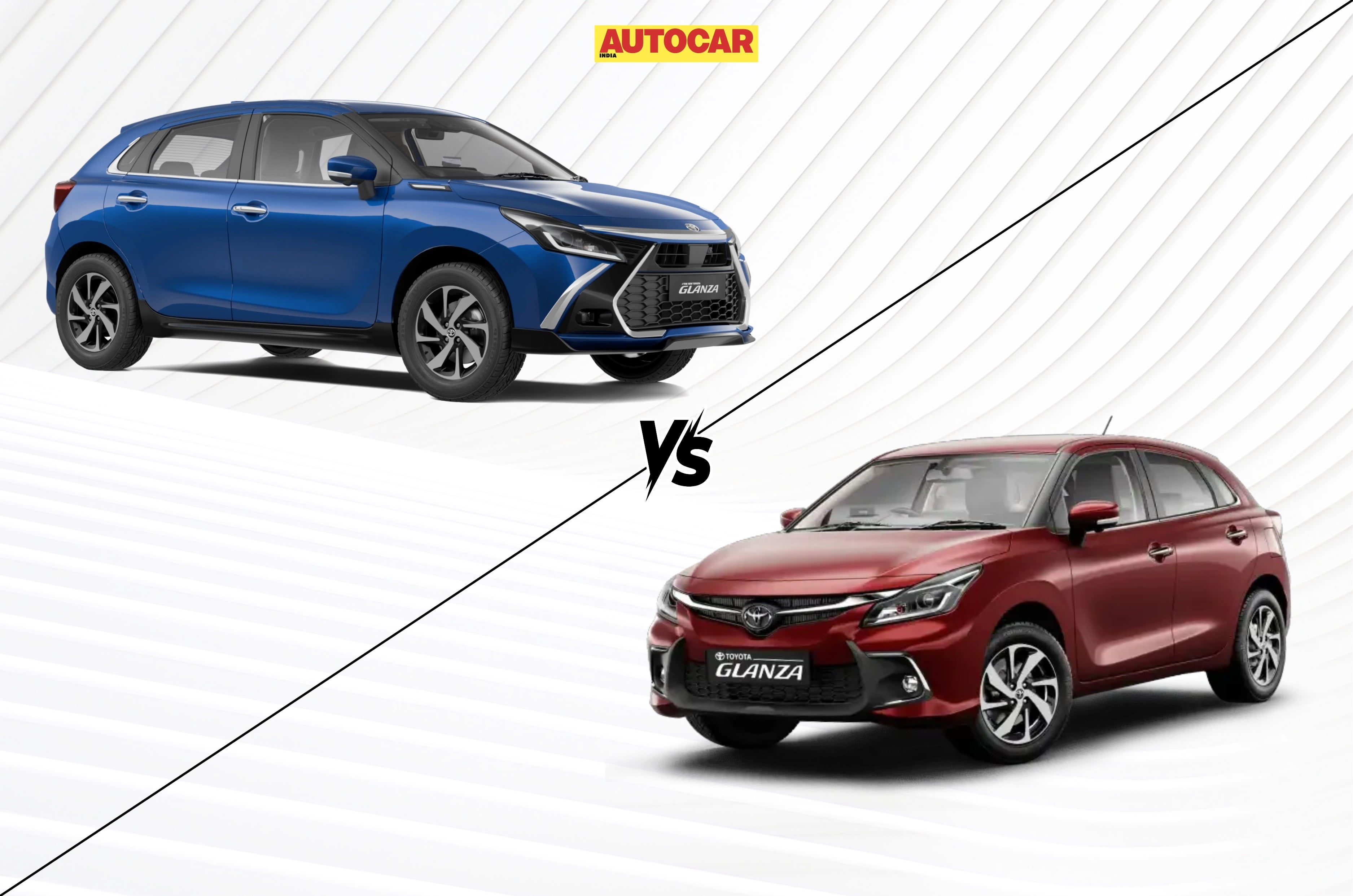
The Toyota Glanza has received a major update, following the same for the Maruti Baleno. This one brings some cosmetic revisions, an entirely different engine under the bonnet, a longer equipment list and a new top-spec trim level. Depending on the variant, prices now range between Rs 6.99 lakh and Rs 10.98 lakh (ex-showroom). That’s an increase of about Rs 26,000 to Rs 1 lakh over the old Glanza. Rivals include the Maruti Baleno, Hyundai i20 and Tata Altroz. Here’s a closer look at what’s changed and what’s been carried over.
Toyota Glanza new vs old: Exterior design
A new front fascia and a couple of different colour options do it for the exterior
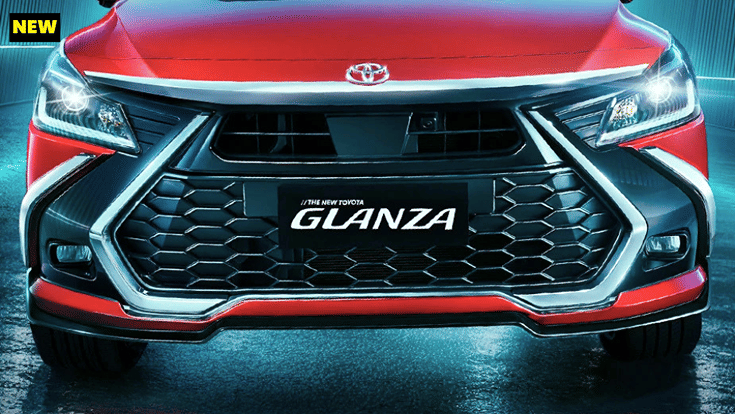
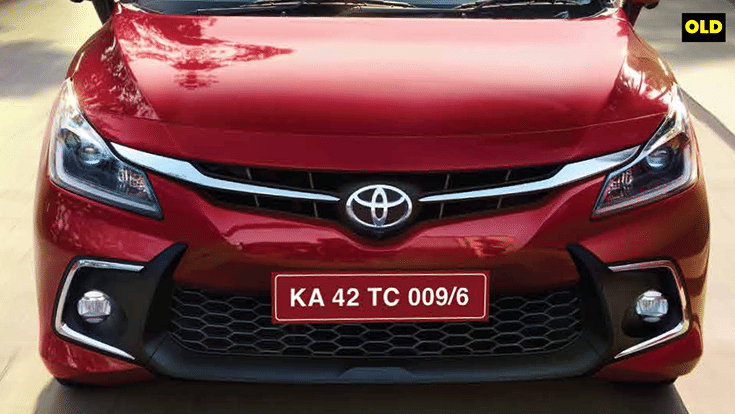
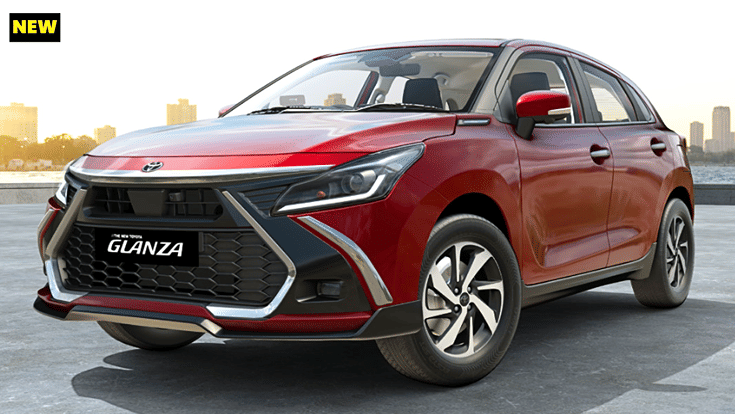
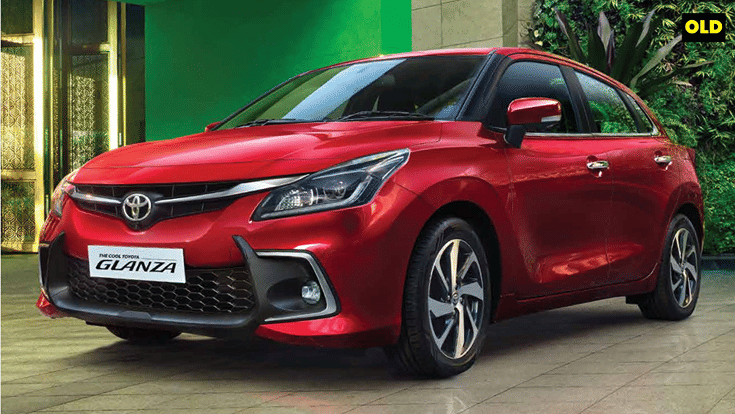
Most of the changes with this update are to be found at the front. The front fascia of the new Glanza looks more aggressive than the old model, with a taller middle section that integrates the upper grille and lower intake into a single-piece design. The intakes are larger and the Toyota logo now sits higher, just aft of the chrome strip connecting the headlamps.
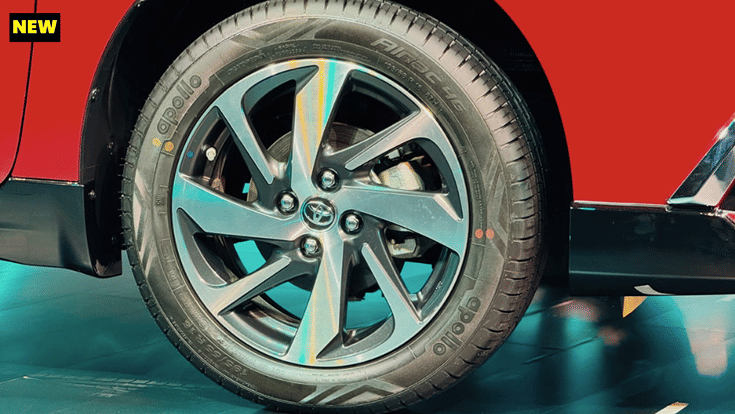
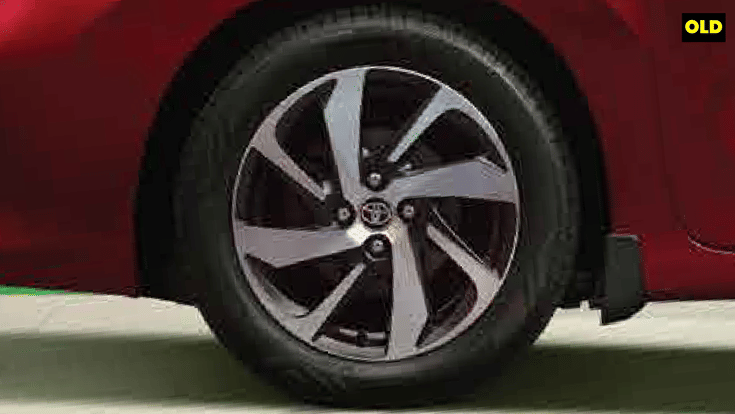
The headlamps have been carried over from the old Glanza, whilst the redesigned front bumper gets rectangular fog lamps in place of the old model’s circular units. The Glanza now gets side skirts and a sharkfin antenna, but the design of its 16-inch alloy wheels and the chrome strip beneath the windowline are carry-over from the old model.
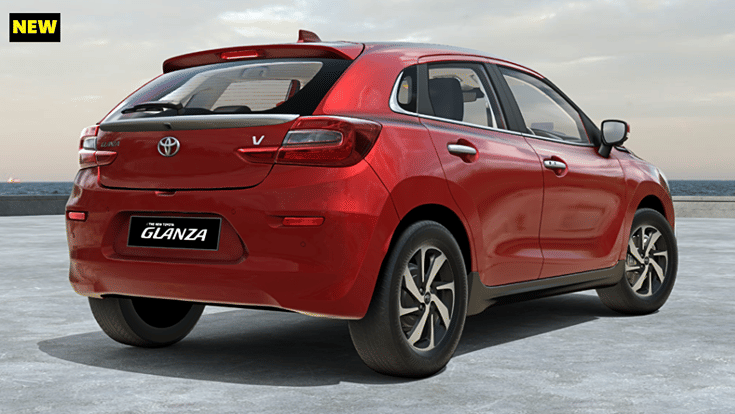
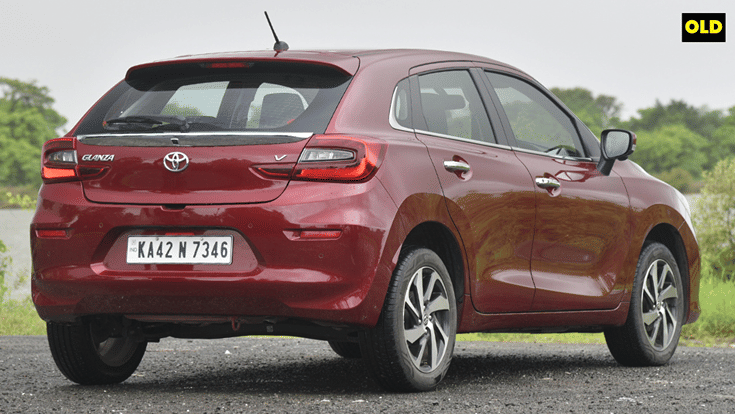
There are no changes made to the rear of the updated Glanza. This means that it retains the old model’s tail-lamps with their C-shaped elements, the roof spoiler and the wiper & washer setup. Along with the colours offered earlier, the Toyota Glanza facelift adds Digital Teal Green and Bluish Black to the list as well.
Toyota Glanza new vs old: Interior design and features
The 2026 update adds more features, but lower trims now lose out on auto AC
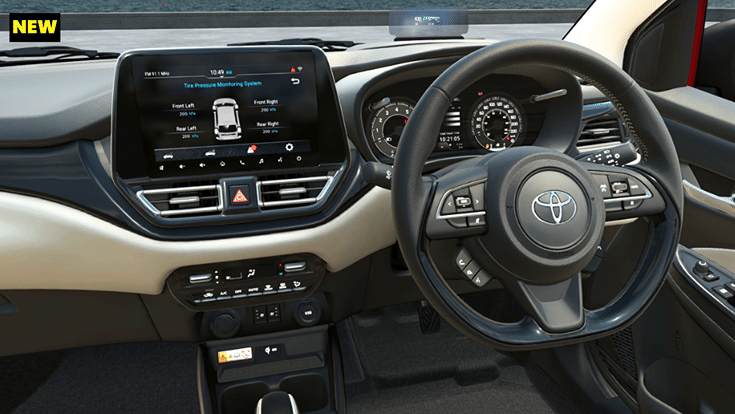
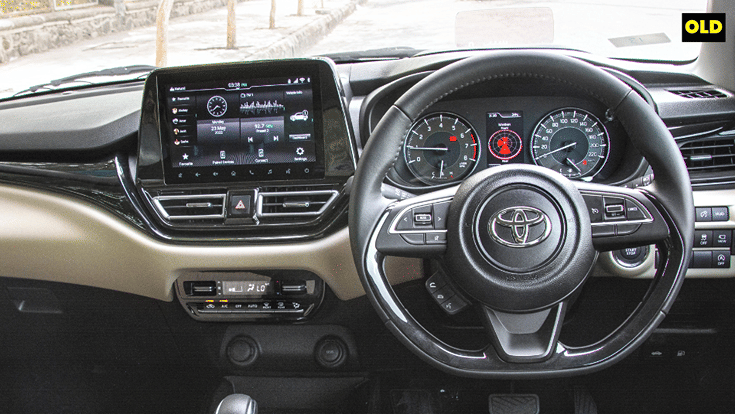
The overall design and layout of the cabin haven’t changed with this update, and the dual-tone dashboard and seats are carried over. However, the V and the new top-spec V (O) trims now get leatherette upholstery, with the front row featuring seat ventilation.
The two high-end trims also get a new premium audio system by Clarion, whilst the earlier Arkamys setup moves to the mid-spec G. The G also gets a 9-inch touchscreen in place of the old 7-inch screen, while the lower-spec S gets a 7-inch unit. The S also offers a sliding front armrest, rear AC vents, and Type-A and Type-C ports. However, the lower trims now lose out on automatic AC.
Other noteworthy additions include a wireless charger with active cooling (G trim and above) and a tyre-pressure monitoring system (TPMS) on all but the entry-level E. Standard kit includes 6 airbags, electronic stability control, hill-hold assist and ISOFIX anchors.
Level 2 ADAS (advanced driver assistance systems) is new, but is limited to the top-spec V (O). It brings adaptive cruise control, autonomous emergency braking, lane-keeping assist, lane-departure warning and high-beam assist. As with the old Glanza, the head-up display and 360-degree camera are reserved for the V trims.
Toyota Glanza new vs old: Engine and transmission
A three-cylinder engine replaces the old four-cylinder unit
The old Toyota Glanza was powered by a 1.2-litre four-cylinder K-series petrol engine that produced 90hp and 113Nm of torque. With this update, the Glanza switches to the 1.2-litre three-cylinder Z-series engine that also powers the updated Maruti Baleno. This new unit puts out 83hp and 112Nm of torque, representing a loss of 7hp and 1Nm over the old model. The 5-speed manual and 5-speed AMT (automated manual transmission) have been carried over.
The claimed mileage has gone up from 22.35kpl to 23.80kpl for the manual and 22.94kpl to 24.77kpl for the AMT. While the old Glanza had automatic engine stop-start as standard only with the petrol versions, the updated model gains the fuel-saving tech for the CNG versions too. The new AMT variant of the Glanza CNG is rated at 34.47km/kg, with the manual’s claimed mileage going up from 30.61km/kg to 33.61km/kg.
In terms of output, the updated Glanza CNG sees power dropping from 77hp to 70hp, though the torque figure has gone up from 98.5Nm to 102Nm. Finally, the 2026 Toyota Glanza weighs up to 30kg more than the old model it replaces.
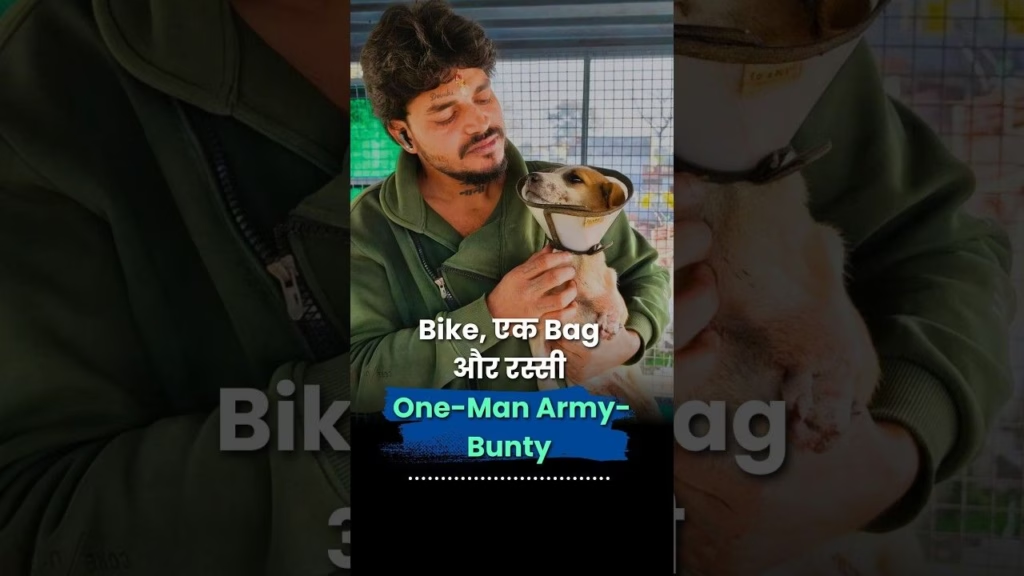
नाले में फंसा कोई कुत्ता या सड़क किनारे ज़िंदगी से लड़ रही कोई गाय… इनकी मदद के लिए कितने लोग आगे आते हैं? अगर बात उत्तराखंड, नैनीताल के हल्द्वानी शहर की हो तो ऐसी किसी भी परिस्थिति में बंटी ज़रूर आते हैं, चाहे दिन हो या आधी रात!
इन्हें One-man Army कहना गलत नहीं होगा, क्योंकि पशुओं को बचाने के लिए ये अकेले ही काम करते हैं। एक बाइक, एक फर्स्ट-ऐड बैग और एक रस्सी के दम पर करीब 2000 जानवरों की जान बचा चुके हैं।
इस काम की सीख उन्हें अपनी नानी से मिली थी, आज नानी दुनिया में नहीं, लेकिन बंटी ने इस काम को पूरी ज़िंदगी सौंप दी है।
अगर आप भी एक पशु-प्रेमी हैं, तो इनसे ज़रूर जुड़ें
[Animal Rescuer in Haldwani Uttarakhand, Man Who Rescued 2000 Animals in India, Stray Animal Rescue and Rehabilitation in India, Indian Animal Welfare Hero and Changemaker, Solo Animal Rescuer Saving Injured Street Animals]
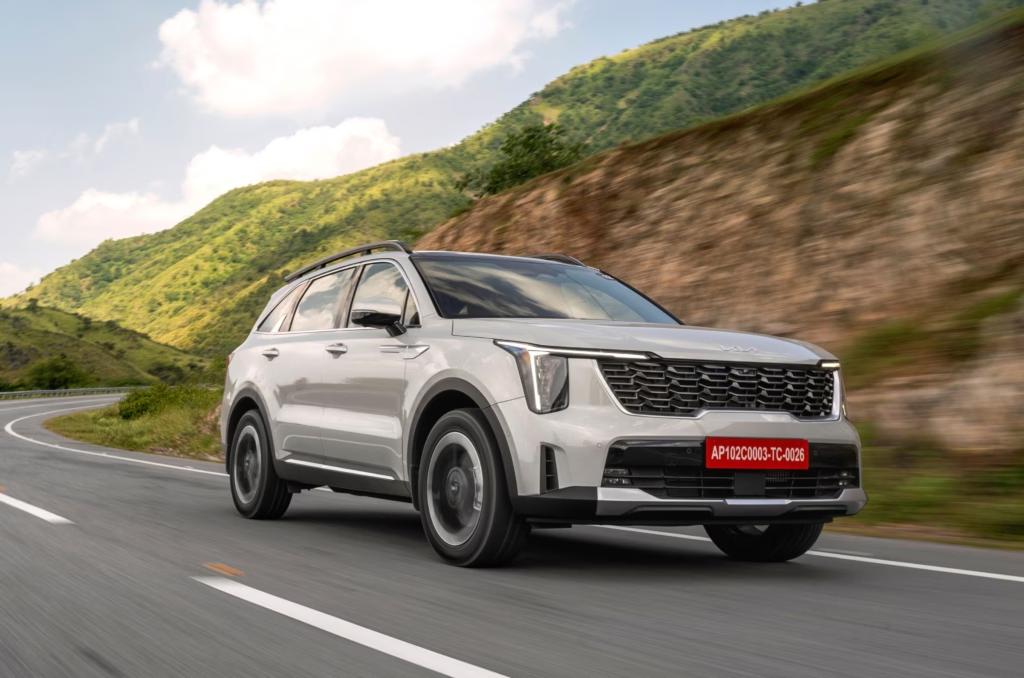
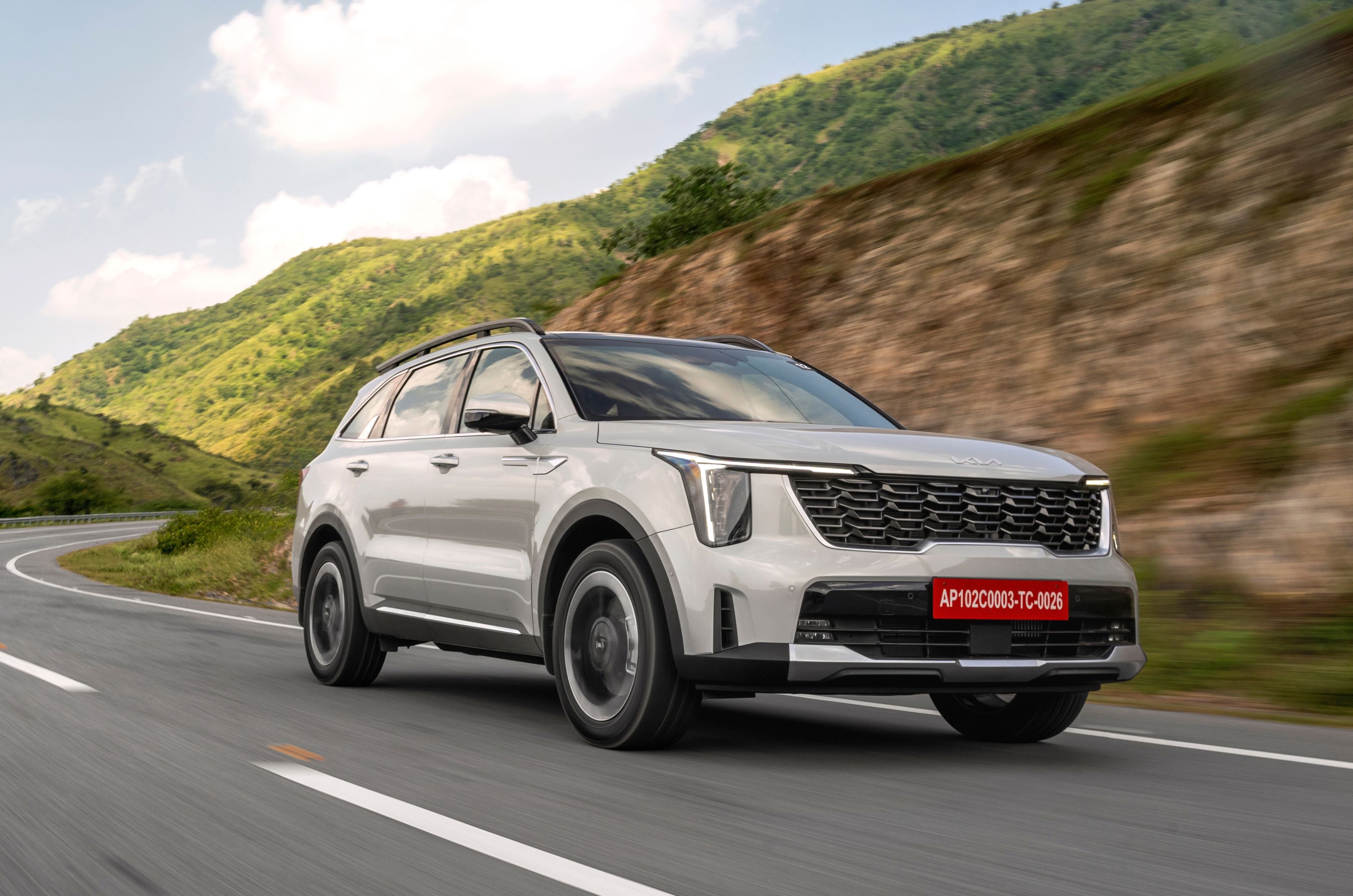
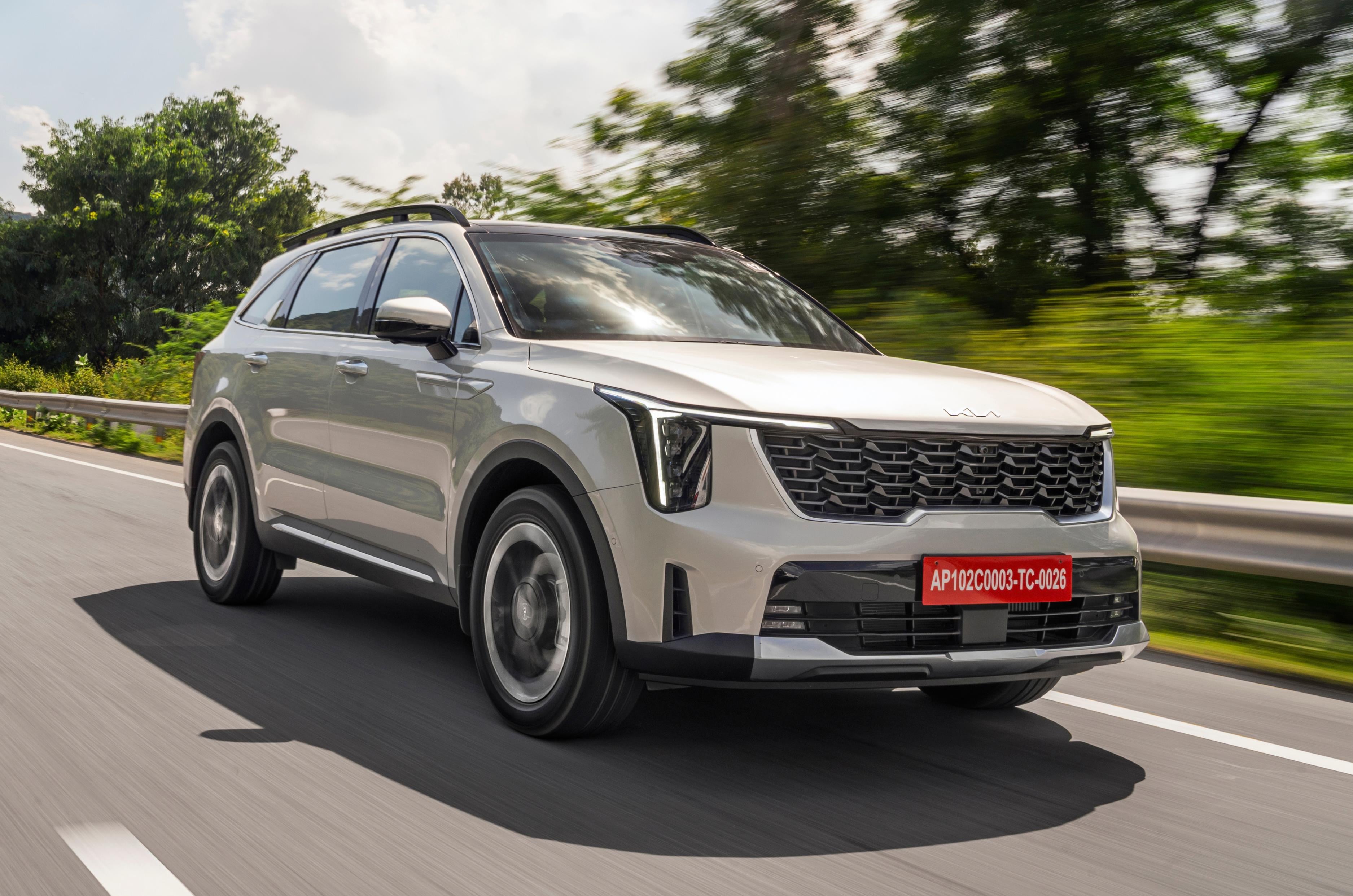
The Sorento is a big bet for Kia India, and you can tell. Six trims, two powertrains, front- and all-wheel drive, six or seven seats and 32 versions in all. This is not a toe in the water exercise but a full-blooded dive into the deep end of the executive SUV pool. More than that, it is a case study in how to launch a product in India, because Kia has got the basics right before it has even started talking about features.
Start with the powertrains, which for this class of SUV could hardly be better judged. There is a strong 2.2-litre diesel for diesel die-hards and there are still plenty of those. And then there is a 1.6-litre turbo-petrol strong hybrid whose timing couldn’t be more perfect. Petrol prices are climbing, E20 has quietly eaten into real-world efficiency, and buyers want diesel-like running costs from a smooth, quiet powertrain without lying awake worrying about diesel’s long-term future. The Sorento hybrid is pitched squarely at that anxiety.
The strategy behind the car is just as interesting. This fourth-generation (MQ4) Sorento arrives in India towards the end of its global life cycle. It is still a current product, but one due to be replaced internationally next year, while India will carry on with this one. That is actually a very smart move. A car this late in its life has its development costs largely amortised, and Kia India can bring some of the tooling here, which slashes the investment.
And this is a properly localised car, not a screwdriver job. The body is stamped and welded at Kia’s Anantapur plant, and the dashboard and seats are made here too. That is what makes the Rs 27.99 lakh starting price possible. The catch is that localisation on this scale only pays off with volume, and Kia wants to sell around 40,000 Sorentos a year. That is a big number for a Rs 30-40 lakh SUV. Can it get there?
Kia Sorento exterior design and engineering
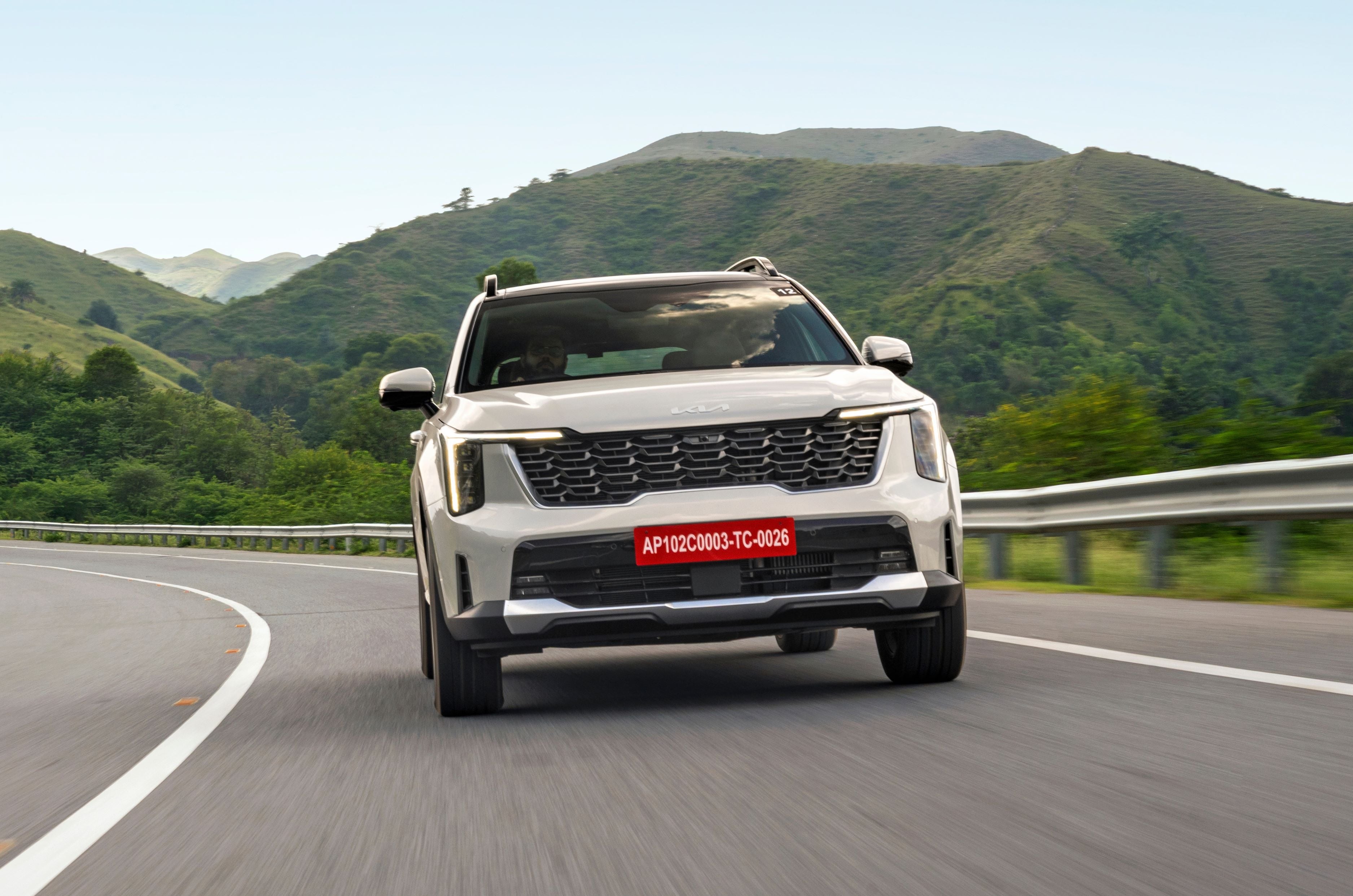
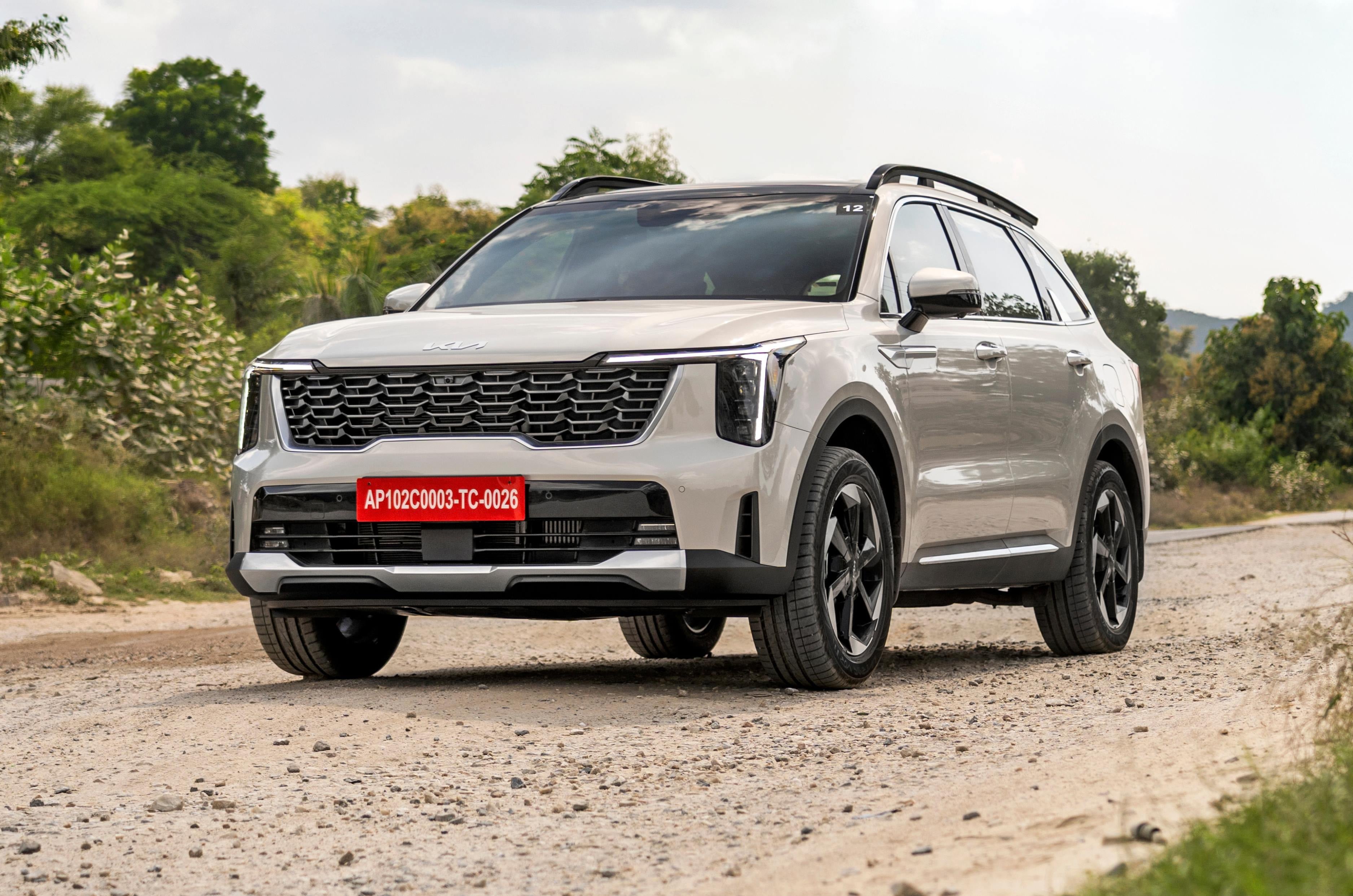
Based on the gen 4 Sorento, it carries over the older and more palatable design language.
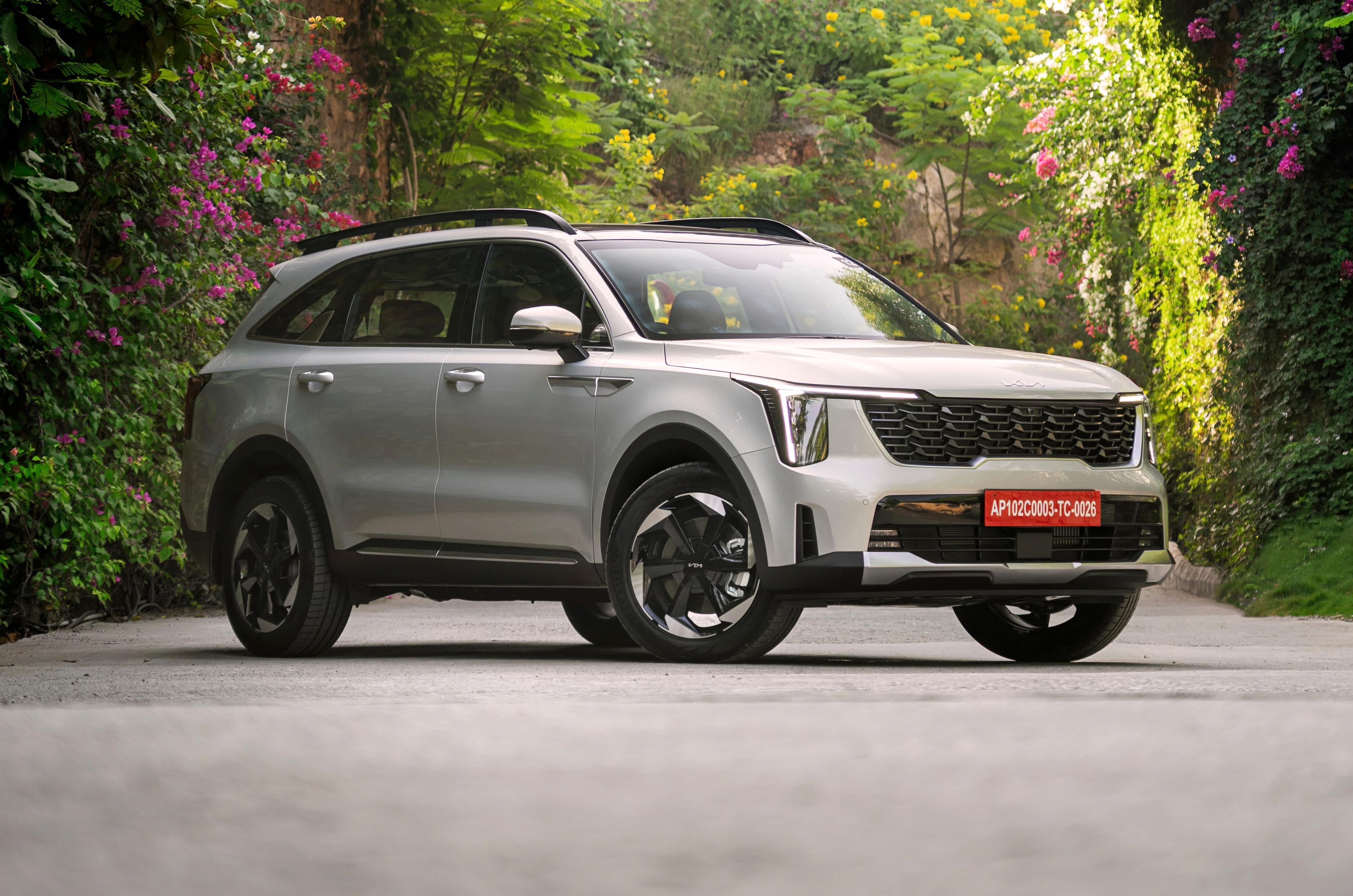
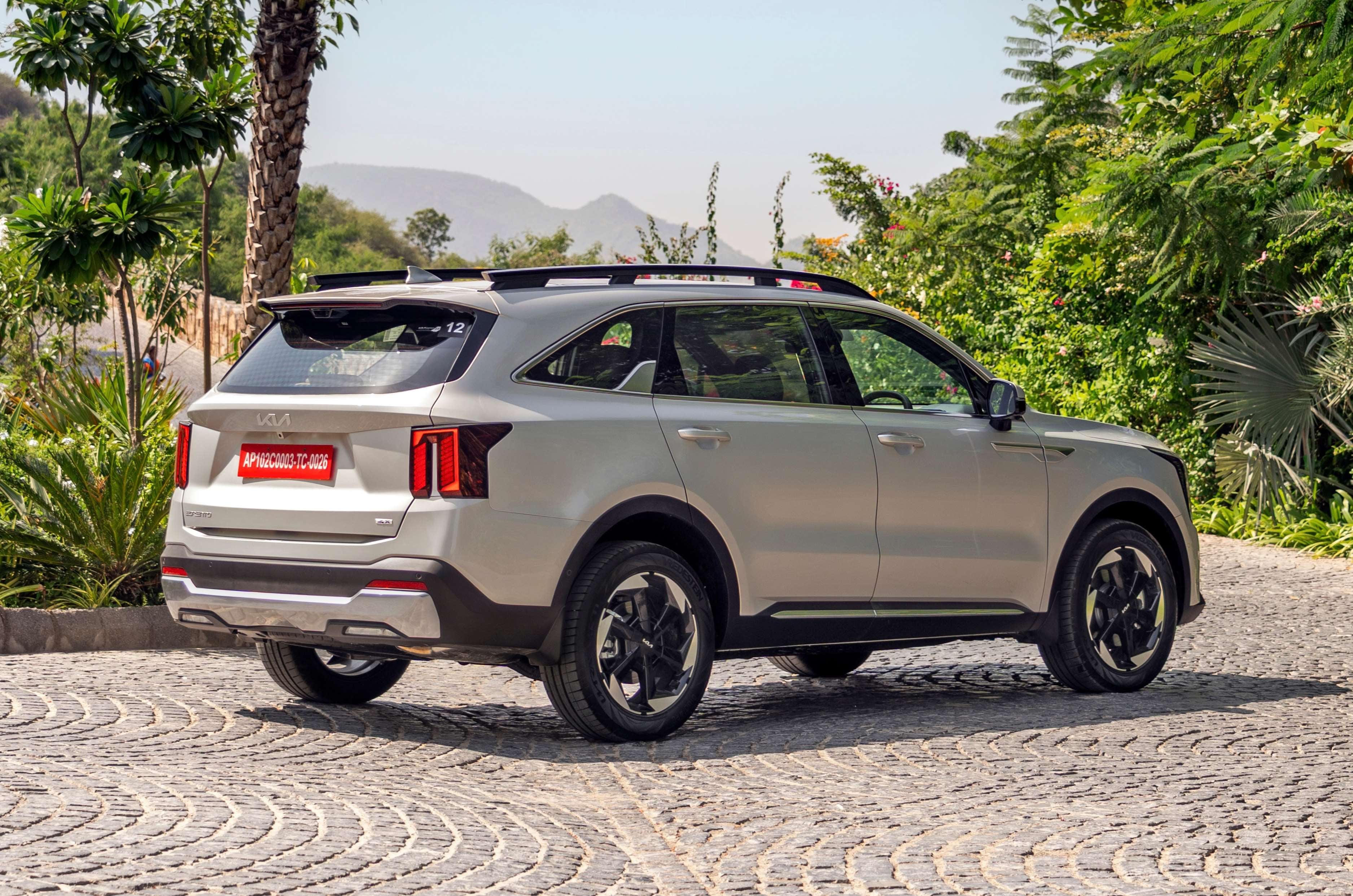
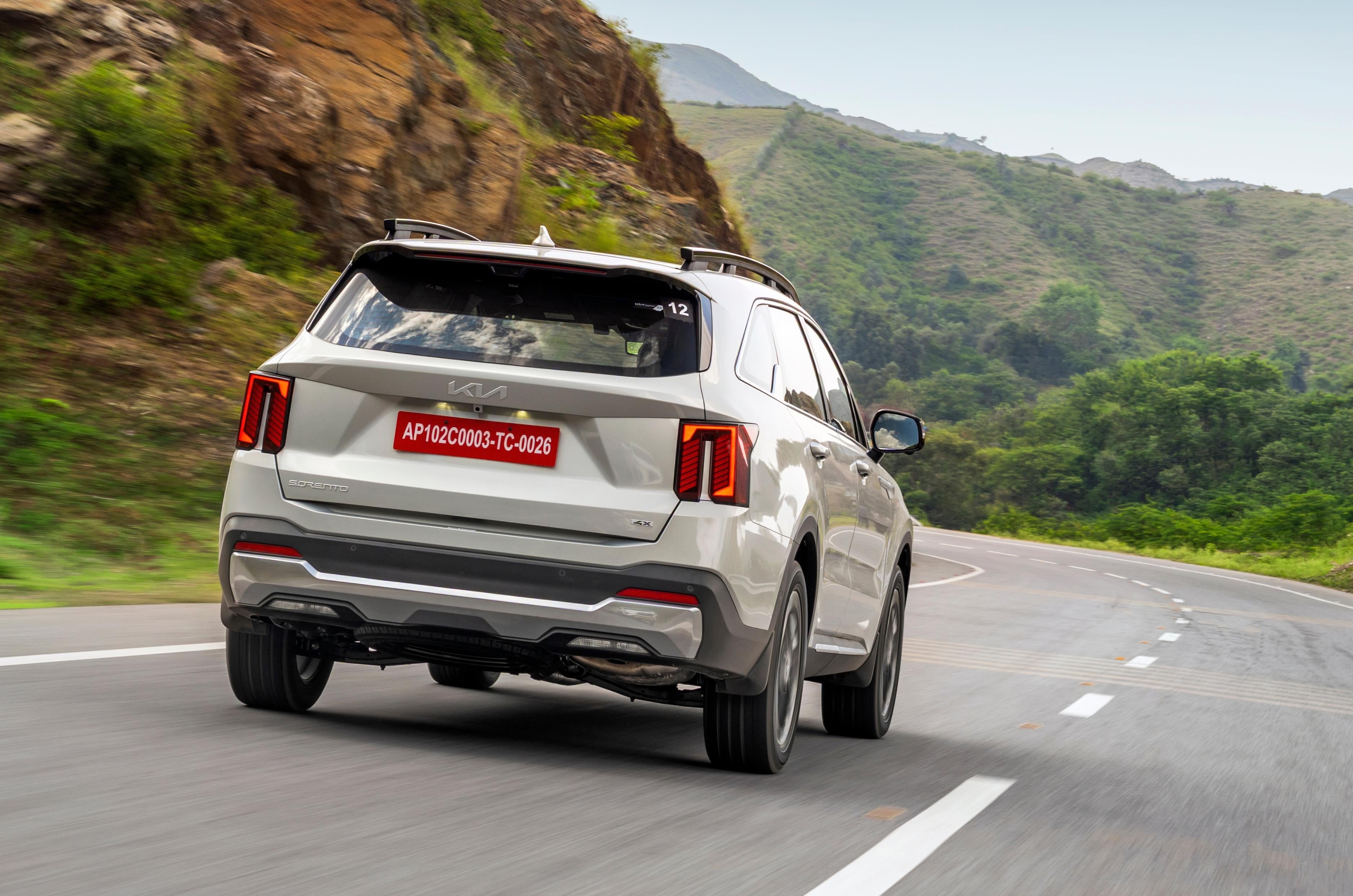
The Sorento sits on Hyundai-Kia’s MQ4 platform, the freshest architecture in its class, and it has already had a mid-life update to keep it looking current. The 2024 facelift brought the nose in line with the design language Kia kicked off with the EV9, so you get vertically stacked LED headlights, Y-shaped daytime running lamps and an aggressive looking bumper with wide intakes. At the back are L-shaped wraparound tail-lamps, and thankfully no light bar stretched across the tailgate.
Beats the rivals in length, width, and wheelbase.
Kia’s stated aim was a more technical, precise look, one meant to signal tight build quality and engineering sophistication. It is a trick the German premium brands have used for years, and Kia has clearly taken a leaf out of their book. The Sorento looks crisp and expensive rather than flashy, and is likely to age well too.
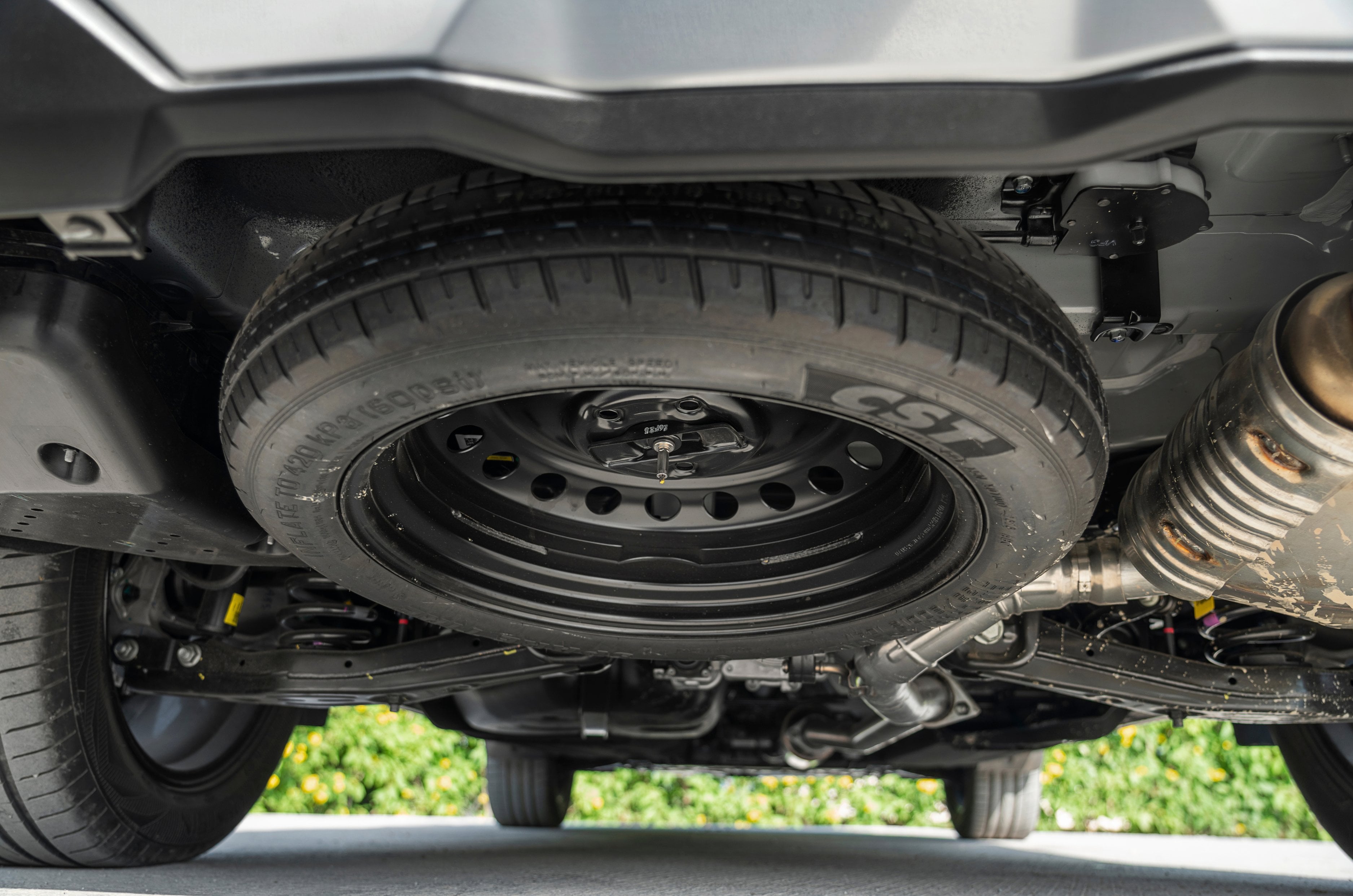
Spare wheel mounted under the floor frees up room in the boot.
What it does not have is brute presence. Despite being the longest, widest and tallest SUV in its segment, at 4,815mm long, 1,900mm wide and 1,785mm tall on a 2,815mm wheelbase, it does not loom in your mirrors the way a Fortuner does. The sloping roofline at the rear softens the silhouette and lends it a hint of crossover, and some will see it as a big Seltos rather than a junior Land Cruiser. Clearly this is not an SUV that looks like it can bully its way through traffic.
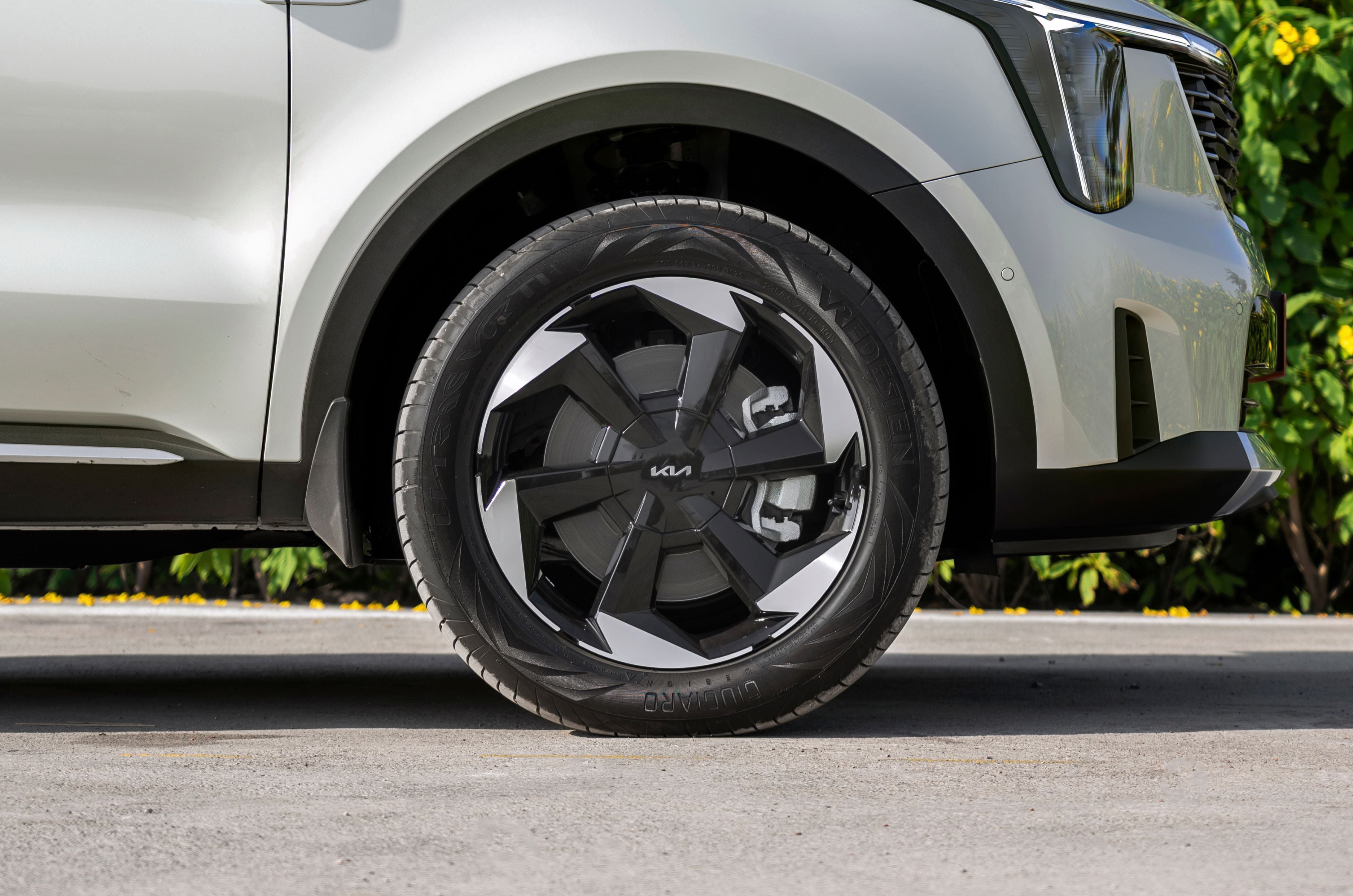
A more unique design could’ve been used for the 19-inch alloys.
The 19-inch dual-tone alloys could have been more distinctive, too an effect exaggerated by the chunky 235/55 R19 tyres. Those tall sidewalls, though, are not a styling misstep so much as an engineering choice, and they play a big part in how this car rides. More on that later.
Kia Sorento interior space and comfort
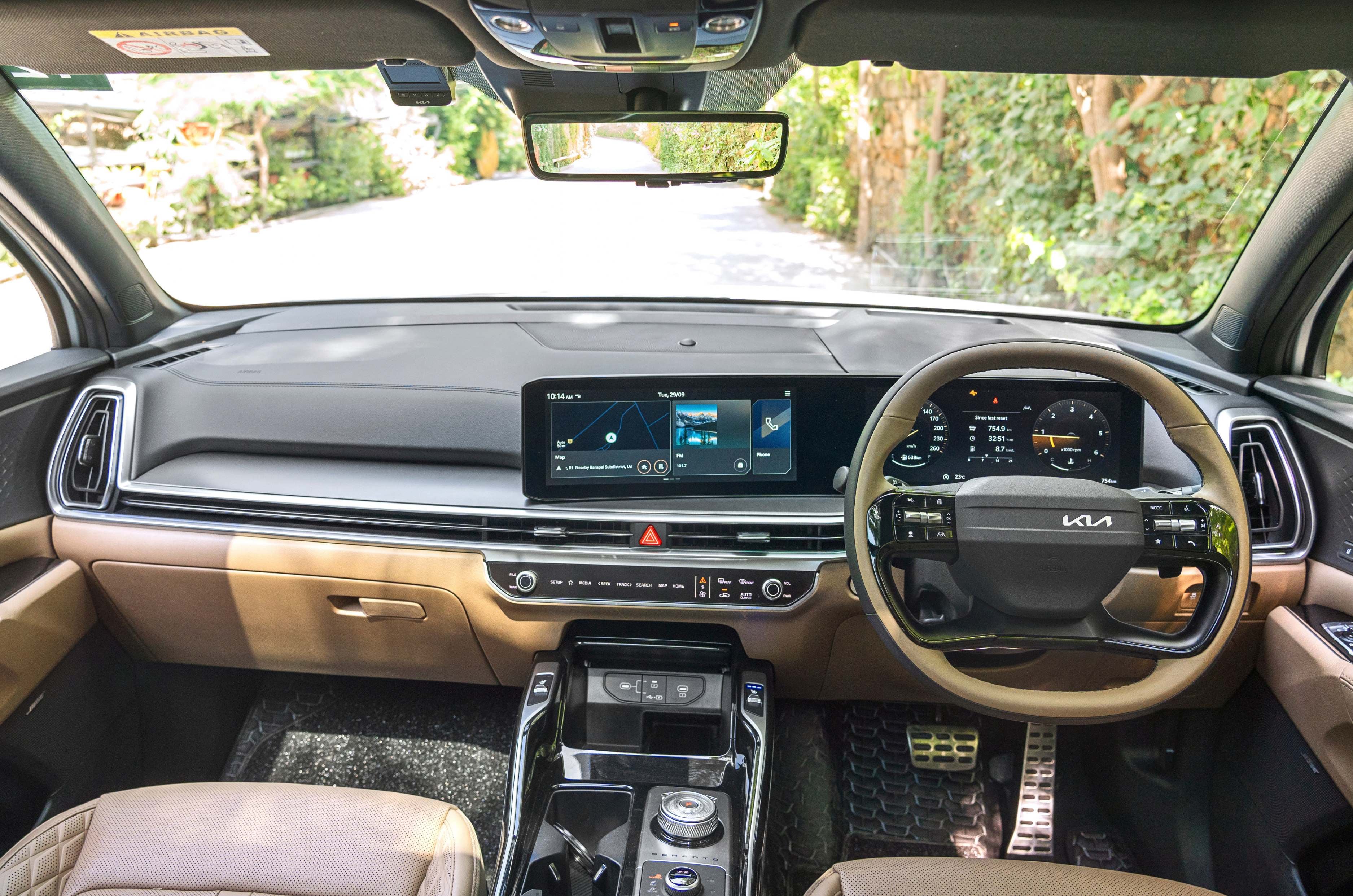
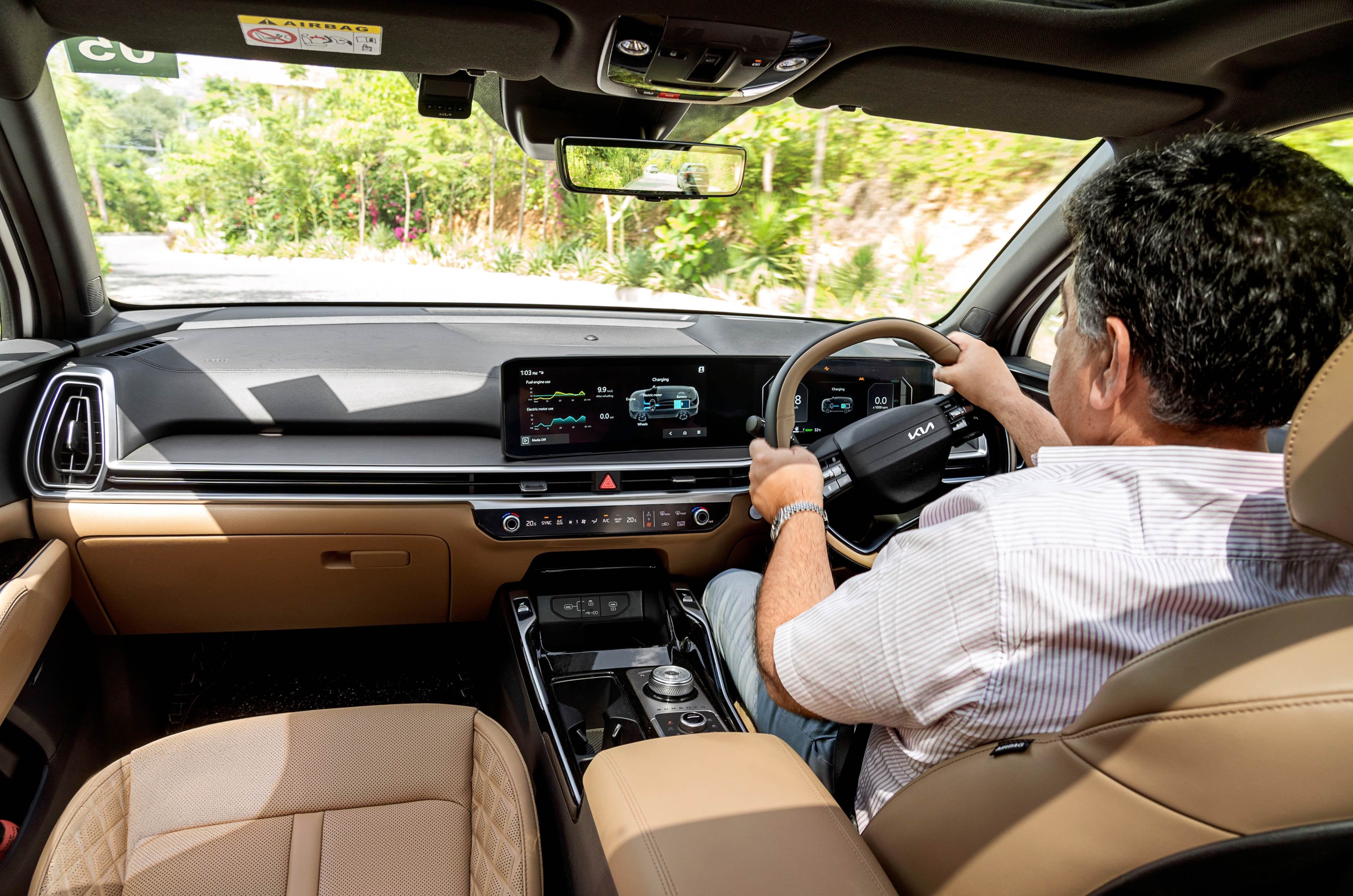
Clutter-free dashboard with solid build and plush feel.
If the exterior is quietly effective, the cabin is where Kia has truly aced it. The Sorento offers a mix of quality, equipment and ergonomics that nothing at this price can match. Soft-touch materials cover everything you are likely to touch, including the spots where your knee rests against the centre console. There is a healthy count of physical buttons, and they click with a precision that feels engineered rather than sourced. The knurled finish on the rotary drive selector and the switchgear adds a tactile richness you normally pay German money for.
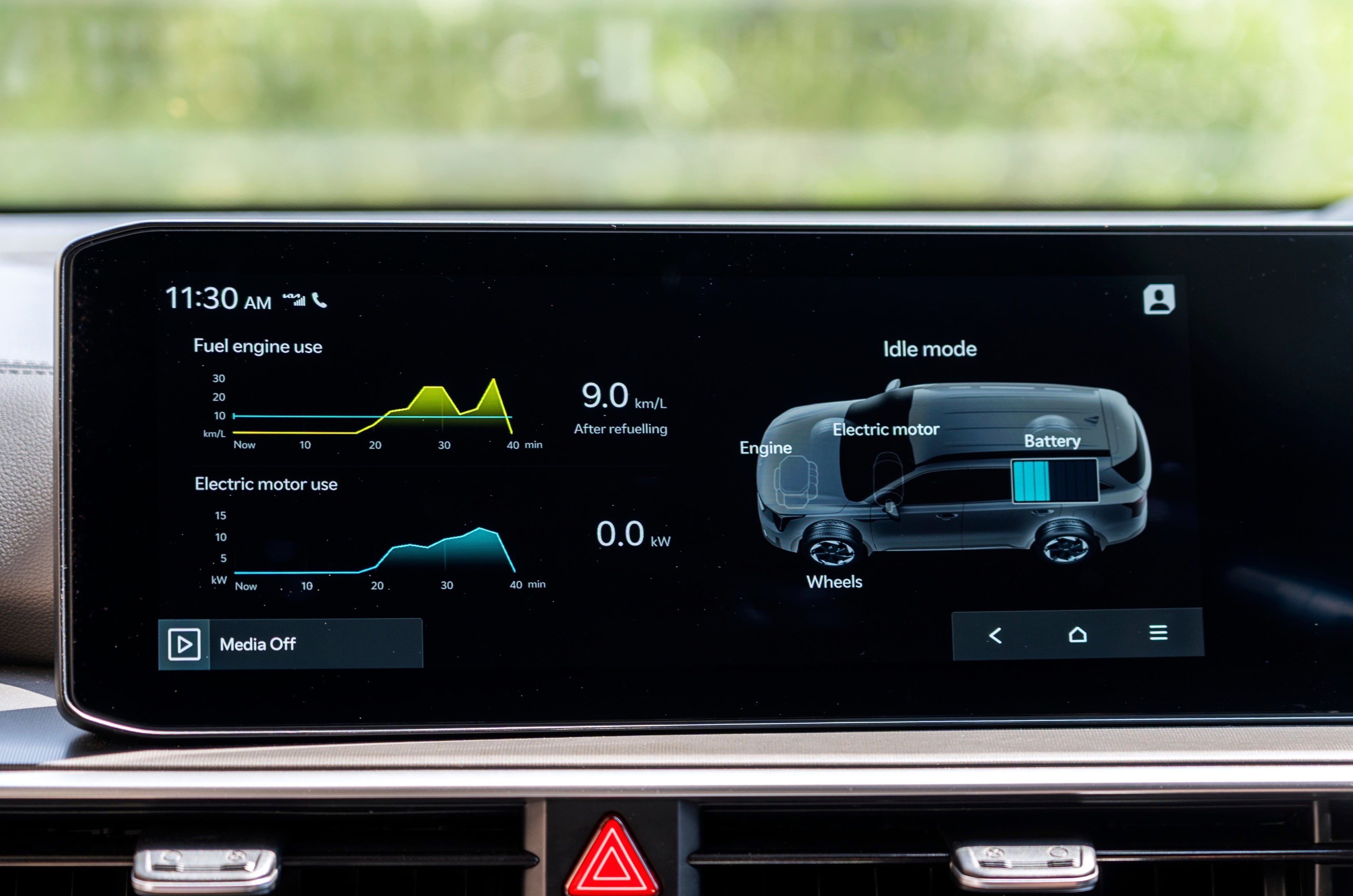
Hybrid variant gets exclusive data for power flow and efficiency.
As with its Hyundai cousins, the real ace is the software. The 12.3-inch infotainment system is logically laid out, menus are where you expect them to be, and getting to a feature takes a tap or two rather than a treasure hunt. Kia has also kept the climate controls off the main screen. They live on a touch-sensitive bar below it, with scrollers and a button that toggles the bar between air-con and infotainment shortcuts. It is a clever, space-saving solution, though you will occasionally find it in the wrong mode just when you need it.
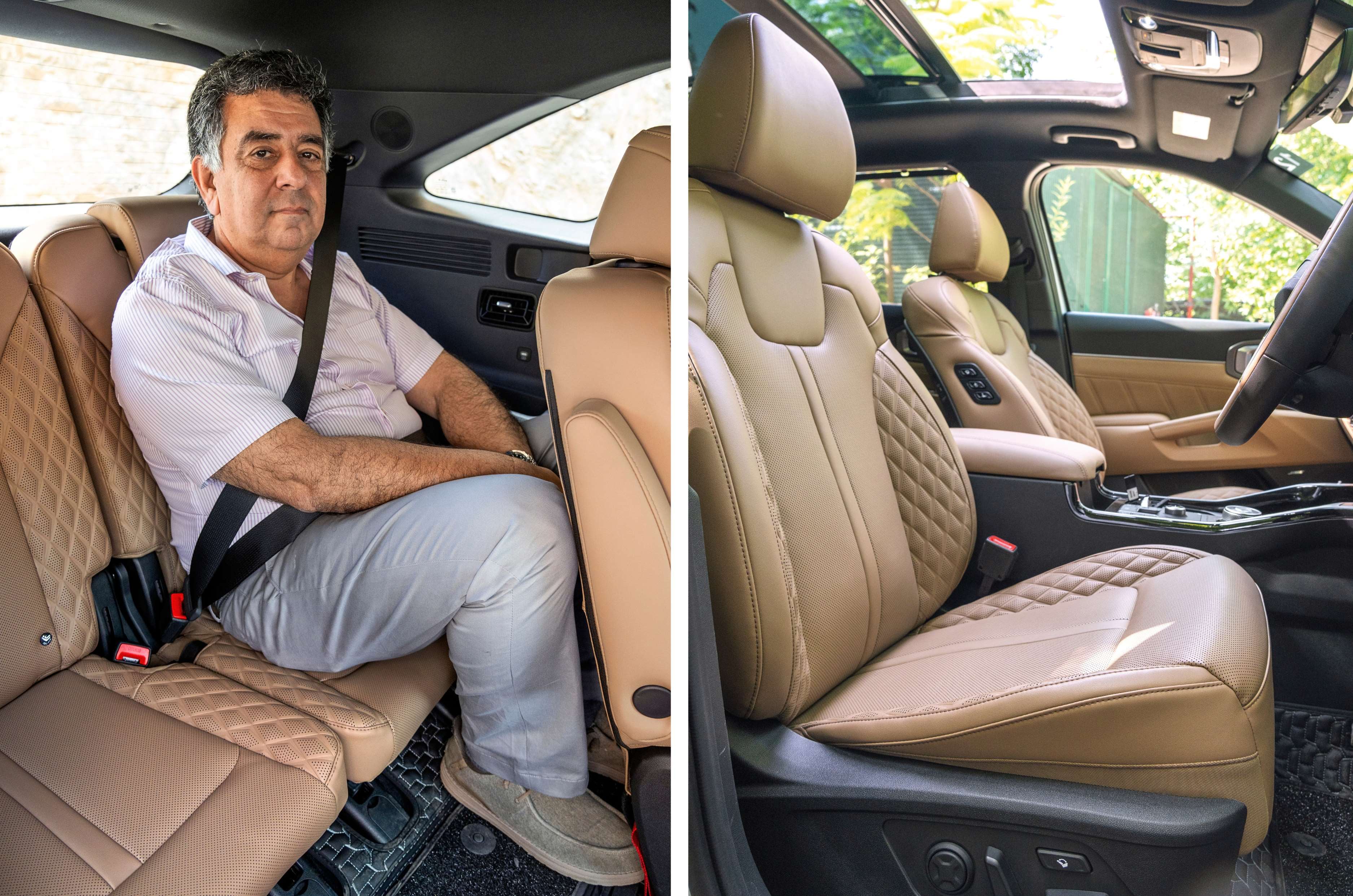
L: Third row seat placed on floor results in knees-up seating; best for children. R: Broad, supportive and well-cushioned front seats are electric and also get ventilation.
The front seats are fully powered, with 10-way adjustment, lumbar support and ventilation, and the passenger seat gets a boss mode so whoever sits behind can push it forward. Coming to the third row, access is easy. You can either walk through the gap between the captain chairs or press a button on the seat, which electrically slides and tilts it forward. Once there, the news is mixed. Legroom is better than you expect, but the seat base is mounted almost flat on the floor, so there is no under-thigh support and your knees point at the roof. Treat it as a space for children or short hops. At least the third row gets its own blower controls and USB ports.
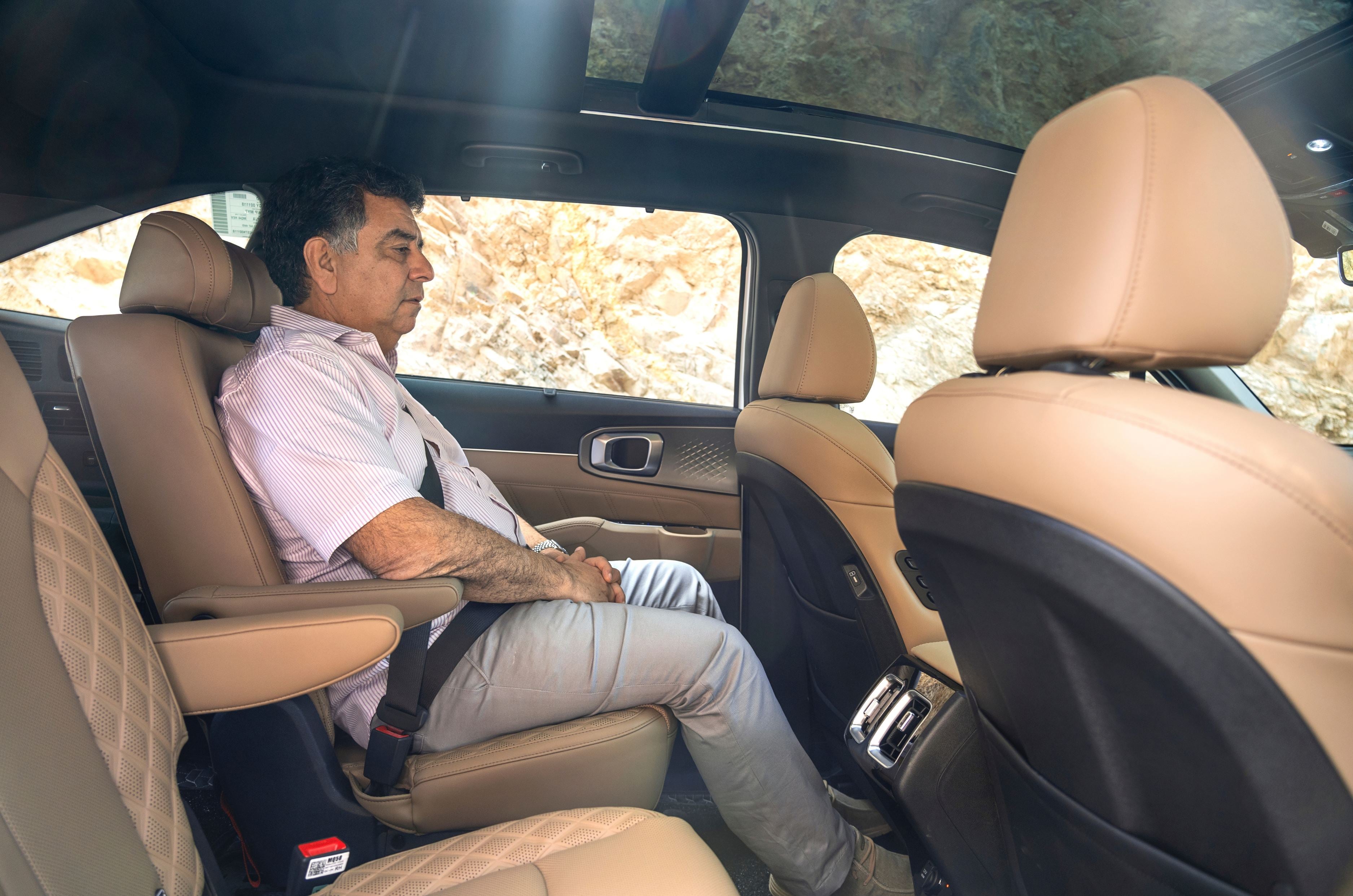
Spacious middle-row with ventilated and adjustable captain chairs; bench seat version also available.
One of the Sorento’s highlights, however, is the second-row experience. Our test car was the top HTX with six seats, and its second-row captain chairs are ventilated too, a rarity in this class. They are the best seats in the house. There is lots of legroom, a commanding view out and good under-thigh support, comparable to the Innova Hycross’s middle-row captain chairs, though the Toyota seats you a touch higher. A neat detail is the cupholder moulded into the door, up near the handle, where it is actually easy to reach.
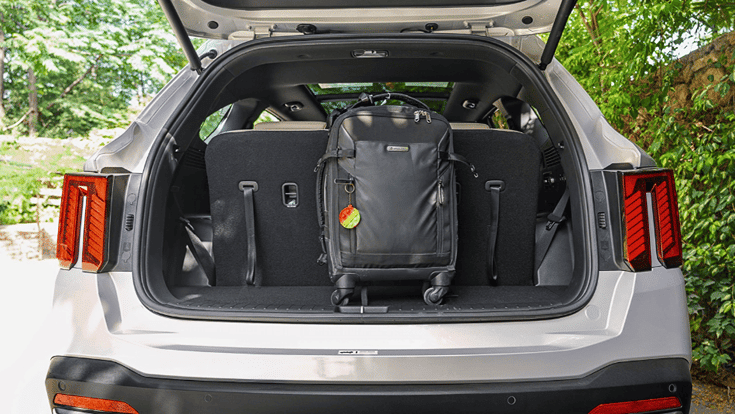
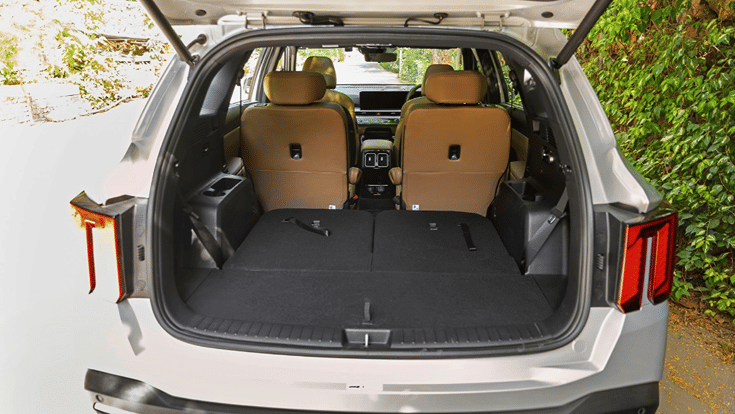
With all three rows up, the boot is a modest 179 litres; fold the third row and that grows to 813 litres. A full-size spare is welcome, but it is slung under the body, which is not the most convenient place to reach. Overhead, the massive panoramic roof floods the cabin with light and adds to the sense of space.
Kia Sorento features and technology
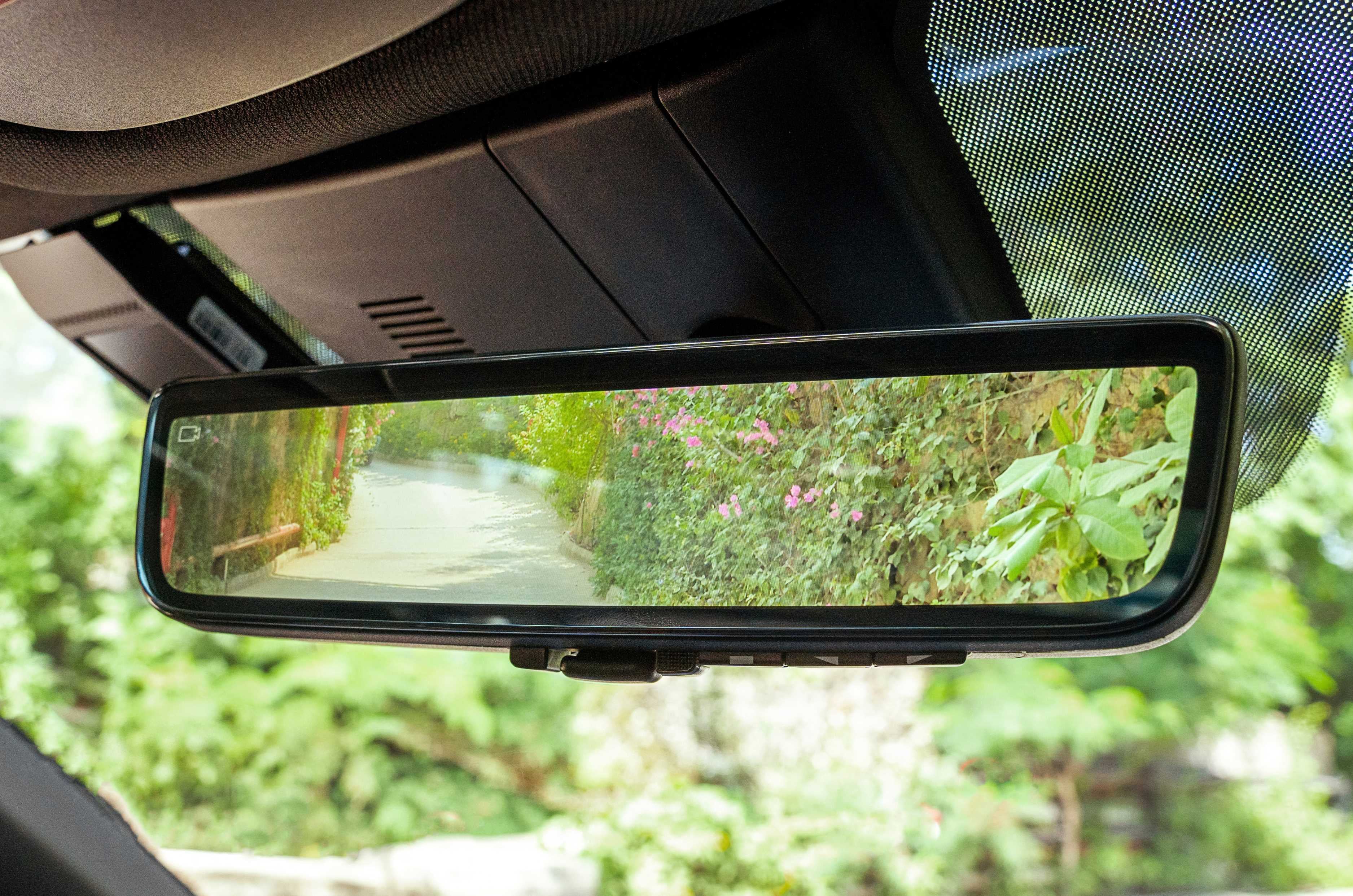
Digital IRVM offers excellent resolution and can be adjusted for level and brightness.
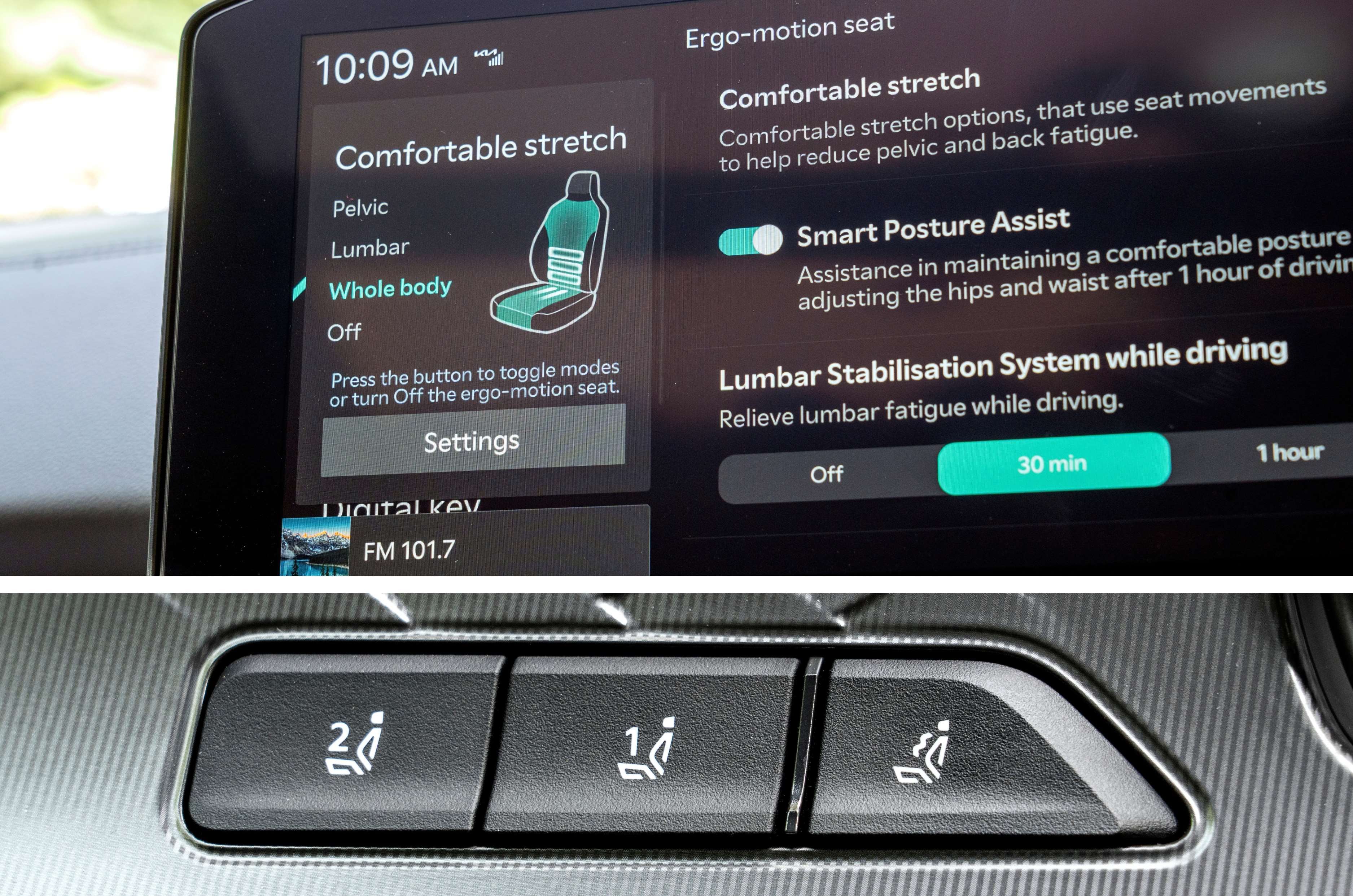
The equipment list is huge. In addition to the aforementioned 12.3-inch touchscreen, powered front seats, ventilated captain’s chairs, and panoramic sunroof, the Sorento comes packed with a 12.3-inch digital driver’s display, a head-up display, a 12-speaker Bose system, dual-zone climate control, a powered tailgate, rear-window sunshades, 64-colour ambient lighting and a digital rear-view mirror that flips back to a conventional one at the turn of a knob. The driver’s seat even gets an ‘ergo-motion’ mode that simulates a massage function by shifting the contours around.
Ergo mode for driver seat acts like a massage by moving the contours to avoid a stiff back on a long trip.
Safety is just as thorough, with 10 airbags, a 360-degree camera, front and rear dashcams, remote parking assist, TPMS and Level 2+ ADAS on the (A) trims. There is even real-time generative AI, a first for any Sorento globally.
Kia Sorento performance and refinement
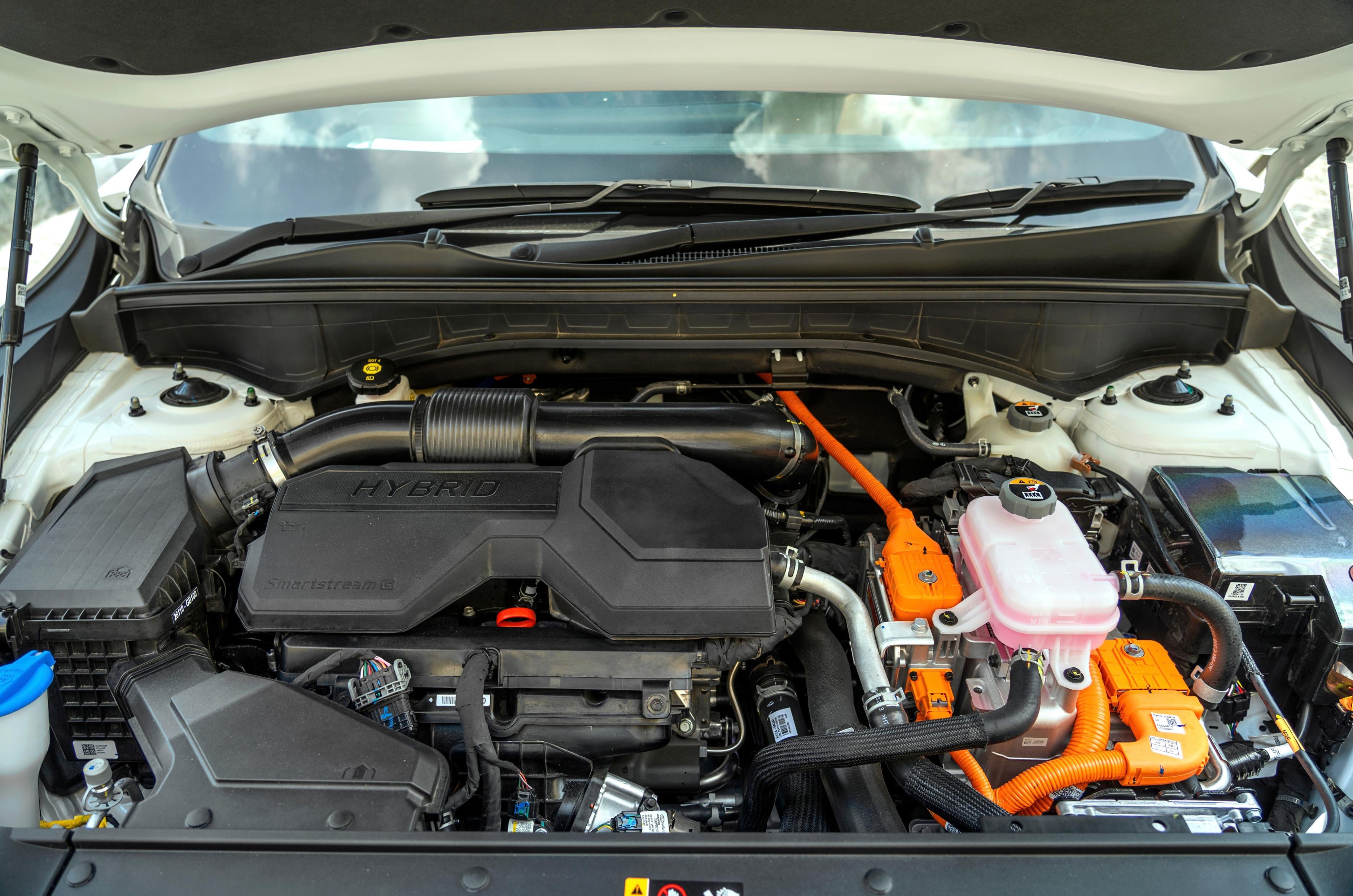
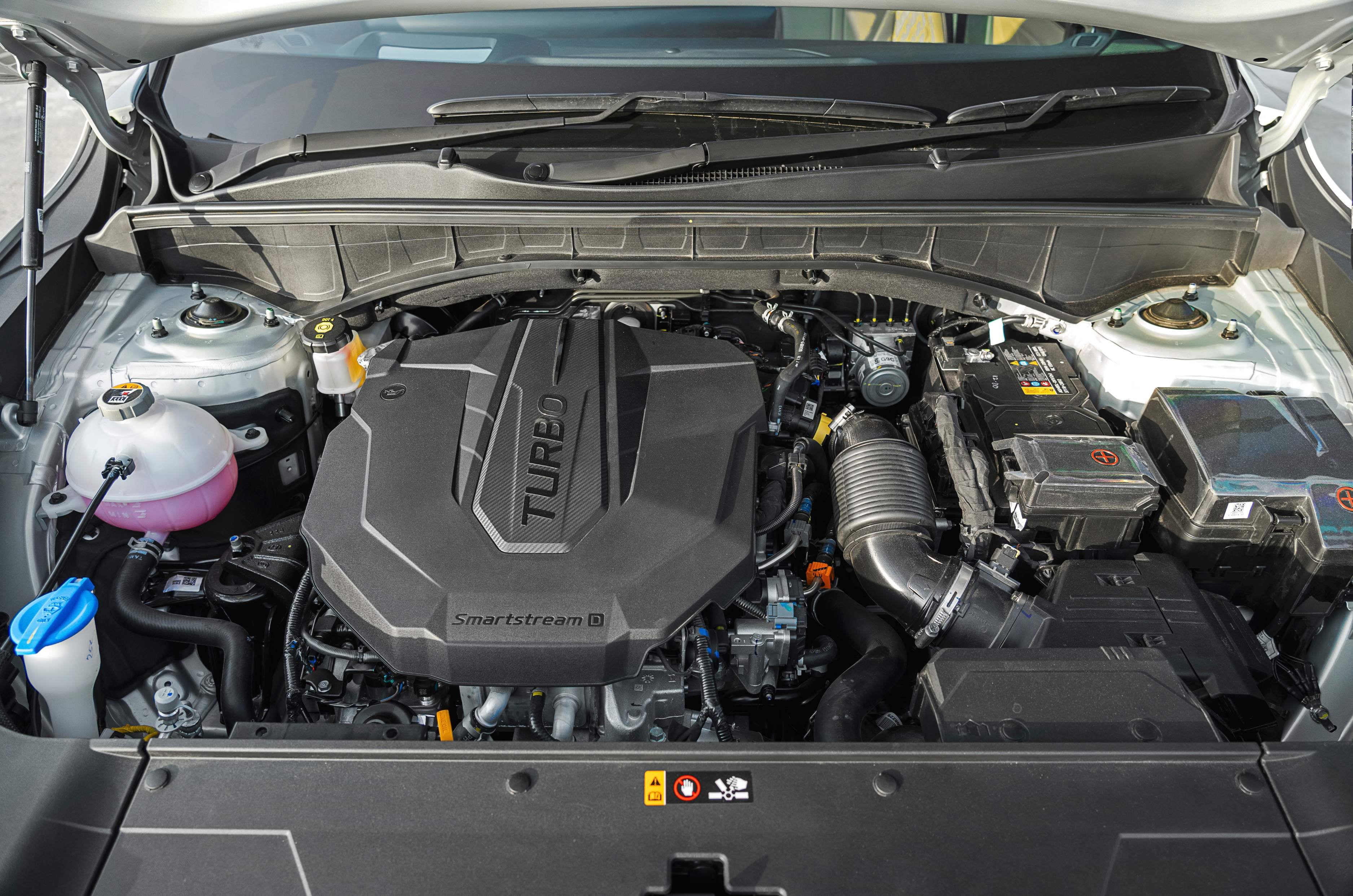
1.6-litre turbo-petrol engine paired with an electric motor and 6-speed torque converter automatic.
First up, the hybrid. Its 1.6-litre turbo-petrol makes 180hp and 265Nm, and the electric motor adds 65hp and 264Nm. The combined figure rating is 230hp and 380Nm of torque You can tell this the hybrid is the one for the city the moment you pull away, because the response is instant. It is well mated to the 6-speed torque-converter automatic, and the handover from electric to petrol power is close to seamless.
Hybrid variant is smooth in the city but gets noisy on the highway especially during overtakes.
The 1.49kWh battery lets it run in EV mode for a decent stretch at crawling speeds, and in stop-go traffic the hybrid makes eminent sense. Power delivery is refined, seamless and relaxing, and efficiency should be strong; The limitation is the motor itself. With only 65hp to shift a car weighing over two tonnes, it cannot do the heavy lifting on its own, so when you want to make quick progress the engine kicks in early. Push hard on the highway and the four-cylinder gets noisy and starts to run out of steam.
2.2-litre diesel engine makes 193hp mated to an 8-speed DCT and is the same unit seen on the Carnival.
Which is where the diesel comes in. The 2.2-litre is familiar from the Carnival, but it feels a lot sprightlier in the lighter Sorento. Its 193hp and 442Nm arrive in a strong, linear surge, and this is a fantastic, long-legged cruiser. Settle into eighth gear on an open highway and it simply lopes along, the engine barely working. It is also more tractable at low speeds than you might expect, pulling cleanly at part throttle from very low revs, so it can double as a city car, although its low-end response does not come close to the hybrid’s. It’s only when you floor it to dart through traffic that you experience a bit of hesitation, and its hear that you can use the paddle shifts to be in the right gear at the right time of the 8-speed DCT which comes as a pleasant surprise.
The diesel‘s strong torque and effortless cruising makes it perfect for long trips.
Rather than the snappy, slightly jerky shifts typical of dual-clutch boxes, this DCT slurs its changes almost like a torque converter, which adds to the smoothness of the whole package. The reason is that it is a wet-clutch unit, which also bodes well for durability in Indian traffic. The diesel is quite refined for the most part and its only when pushed hard that it gets audible and takes on a gruff note.
Both get drive modes; You can play with the Eco, Normal, Sport and Smart (or auto) modes in the diesel which alters the power delivery. In Sport, the throttle response is sharper and the default mode we liked whilst in Eco you can feel the response a bit dulled down. The Sorento Hybrid gets just Eco, Sport and Smart modes and in Eco mode EV running is prioritised. In addition, the AWD versions get Snow, Sand and Mud terrain modes which we didn’t a get chance to fully experience.
Kia Sorento mileage
In terms of fuel efficiency, the hybrid is rated at a highly frugal 19.60kpl with front-wheel drive and 17.70kpl with AWD, while the diesel returns 17.66kpl and 15.79kpl respectively on the Indian test cycle. In real-world city driving the gap between the hybrid and diesel could be bigger, depending on traffic. On long cross-country runs, though, with extended stints of cruising in high gears, the diesel could well be the more frugal of the two.
Kia Sorento ride and handling
The Sorento’s ride comfort is simply outstanding, and it comes as a pleasant surprise. That’s because Kias have traditionally been stiffer sprung than their Hyundai cousins, but here Kia has clearly prioritised comfort over sportiness, and the suspension is on the soft side. The way it smothers bad roads at speed is remarkable. Around Udaipur, where several stretches are properly broken, we never once had to lift off for a bad patch. The car just soaked it up and kept going.
Ride quality is segment best and it is unfazed over broken roads.
The isolation it gives its passengers is shockingly good, and those tall-sidewall tyres deserve part of the credit. They do a fine job of rounding off sharp jolts and filtering out the high-frequency shocks that a suspension alone cannot fully absorb. At highway speeds there is a bit of body movement on the undulating bits but its not disconcerting and both versions feel stable and planted at high speeds, which matters in a car this tall.
Our HTX test cars came with AWD as standard. We did not get a chance to test its off-road ability properly, but on dirt roads it felt sure-footed and secure. A proper off-road test will reveal how capable the all-wheel-drive system, though we doubt owners will really want to test the Sorento’s off-road capability.
Steering is light but lacks consistency and sharpness of European rivals.
The steering is less impressive. There is a dead zone around the straight-ahead position, and it does not feel as fluid or progressive as its European rivals’. The Volkswagen Tayron and Skoda Kodiaq are both dynamically sharper. One reason is because the Sorento rides taller too, as ground clearance has been raised from the global car’s 176mm to 208mm, and there is a touch of body roll when you push hard through corners.
But that misses the point. On balance, the Sorento’s ride and handling are superbly judged for the people who will buy it. Kia has done a fine job of understanding what a premium SUV buyer in India wants, and it has tailored the car accordingly.
Kia Sorento price and verdict
As a package, the Sorento hits it out of the park; rivals have a lot of catching up to do.
If the product does not win you over, the pricing certainly will. A starting price of Rs 27.99 lakh has set the cat amongst the pigeons, putting the Sorento within striking distance of the Mahindra XUV 7XO. And with its size, features and overall polish, the Sorento will not just nibble at the top end of the 7XO’s pie but with the Hybrid could also tempt a few Innova Hycross buyers. As for the Volkswagen Tayron and Skoda Kodiaq, the Sorento makes them look overpriced and underequipped.
The lower and mid variants are exceptional value. The top-end HTX, at Rs 37.49-40.19 lakh depending on fuel and seating, is pricey by comparison, around Rs 5 lakh more than an equivalent HTK, because it comes with AWD as standard. Here Kia has missed a trick. An HTX with two-wheel drive, a few lakh cheaper, would have been a far easier sell to the many buyers who want all the features and ventilated rear seats but will never leave the tarmac. That however is a small quibble that Kia can easily correct.
The lasting impression is that the Sorento feels premium, bordering on luxury. It is fantastically equipped, it rides beautifully, and it offers a choice of two powertrains that are each right for a distinct type of buyer. Most of all, it fits what the Indian SUV buyer actually wants with uncanny precision. Will Kia hit its target of 40,000 sales a year? That could be a tall order. But what there is no doubt about is that Kia has built another winner.
Instagram आज सबसे ज्यादा इस्तेमाल किए जाने वाले सोशल मीडिया प्लेटफॉर्म में से एक है। शुरुआत में इस पर सिर्फ फोटो पोस्ट करने का फीचर था, लेकिन समय के साथ इसमें कई नए फीचर्स जुड़ गए। अब यूजर्स Instagram पर रील्स के रूप में वीडियो और ऐसी फोटो-वीडियो भी शेयर कर सकते हैं, जो कुछ समय बाद अपने आप गायब हो जाती हैं।
वहीं, कई बार हम Instagram पर फोटो या वीडियो पोस्ट करने के बाद फोन की स्टोरेज खाली करने के लिए उन्हें डिलीट कर देते हैं। लेकिन क्या आप जानते हैं कि Instagram आपको अपनी फोटो और वीडियो को दोबारा फोन कैमरा रोल में डाउनलोड करने की सुविधा भी देता है? आप उन Instagram स्टोरीज को भी डाउनलोड कर सकते हैं, जिन्हें आपने पोस्ट किया है या करने वाले हैं।
फोन में Instagram पोस्ट की फोटो और वीडियो कैसे डाउनलोड करें
सबसे पहले अपने फोन में Instagram खोलें।
इसके बाद स्क्रीन के नीचे दाईं ओर दिखाई दे रही अपनी प्रोफाइल फोटो पर टैप करके अपनी प्रोफाइल पर जाएं।
अब जिस फोटो या वीडियो को डाउनलोड करना चाहते हैं, उसे चुनें और उस पर टैप करें।
इसके बाद Share बटन पर टैप करें।
यहां Download ऑप्शन ढूंढकर उस पर टैप करें।
इसके बाद फोटो या वीडियो अपने आप आपके फोन की गैलरी में सेव हो जाएगा।
अगर आप चाहते हैं कि Instagram पर पोस्ट की जाने वाली फोटो और वीडियो अपने आप फोन की गैलरी में सेव हों, तो अपनी प्रोफाइल पर ऊपर दाईं ओर दिए गए More Options मेन्यू पर टैप करें।
अब नीचे स्क्रॉल करके Your App and Media सेक्शन में जाएं।
यहां Archiving and downloading ऑप्शन पर टैप करें।
इसके बाद Saving to camera roll ऑप्शन को ऑन कर दें।
फोन में Instagram Story की फोटो और वीडियो कैसे डाउनलोड करें
सबसे पहले अपने फोन में Instagram खोलें।
Story सेक्शन में स्क्रीन के ऊपर बाईं ओर दिखाई दे रही अपनी प्रोफाइल फोटो पर टैप करें।
स्क्रीन पर तब तक टैप करते रहें, जब तक वह Story न आ जाए जिसे आप फोन की गैलरी में डाउनलोड करना चाहते हैं।
अब स्क्रीन के नीचे बाईं ओर दिए गए तीन डॉट वाले मेन्यू पर टैप करके More ऑप्शन खोलें।
इसके बाद Save बटन पर टैप करें।
आपकी Instagram Story फोन की गैलरी में सेव हो जाएगी।
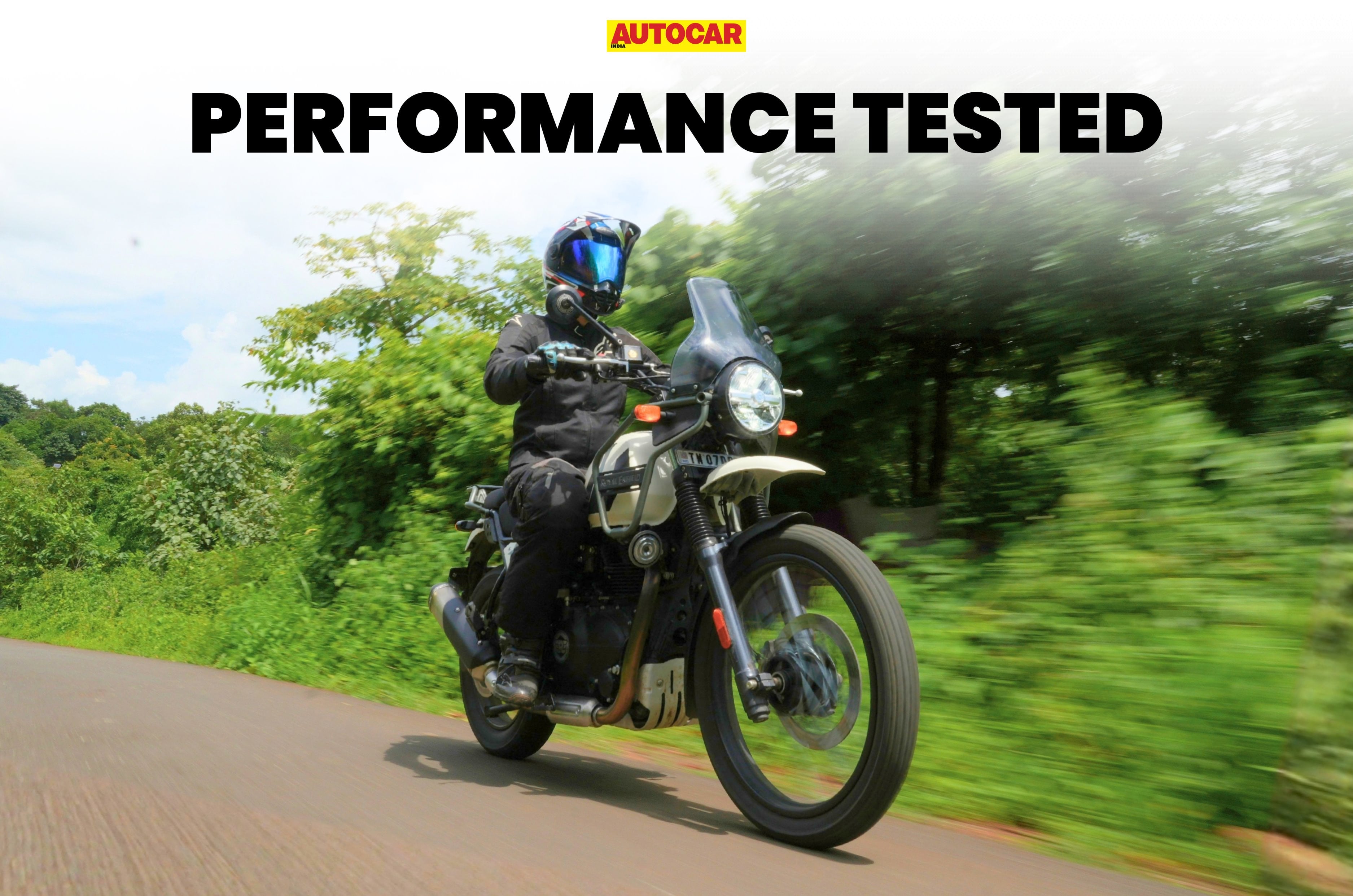
The Royal Enfield Himalayan 440 shares the 443cc air/oil-cooled single-cylinder engine with the Scram 440, on which it was first introduced in 2025. This engine is now paired with a 6-speed gear box. The major difference between the both is the front wheel size, the Himalayan gets a 21-incher whereas the Scram uses a 19-inch front wheel. Considering its adventure bike persona, it is only available in spoked wheels and has 10mm more suspension travel at the front. Here is what our performance tests revealed about the Himalayan 440.
Royal Enfield Himalayan 440: Acceleration
The Royal Enfield Himalayan 440 was tested on dry roads
Acceleration
Time (seconds)
0-60kph
3.99s
0-80kph
6.73s
0-100kph
11.04s
The engine is torquey in nature and pulls effortlessly from lower speeds in higher gears, as the 34Nm of peak torque is available from as low as 4,000rpm. In our test, it took 3.99 seconds to get to 60kph, 6.73 seconds to get to 80kph, and a leisurely 11.04 seconds to get to 100kph, which was to be expected from a bike that weighs 199kg and makes just 25.4hp. This is a bike that prefers being ridden at a calm pace and munching miles without any sweat, so this relaxed nature of the engine suits its purpose. The added 6th gear makes the bike feel more relaxed at 100-110kph, and this makes it a better tourer as well.
Royal Enfield Himalayan 440: Roll-on acceleration
The 443cc air/oil-cooled single-cylinder engine produces 25.4hp at 6,250rpm and 34Nm of peak torque at 4,000rpm
Roll-on acceleration
Time (seconds)
20-50kph (2nd gear)
2.81s
30-70kph (3rd gear)
5.07s
50-80kph (4th gear)
5.36s
The wide spread of torque helps the bike in being effortless in the city as well as the highways. With good low- and mid-range performance, the bike performed as well as you’d expect and while it was quicker than the erstwhile 411, newer 300-400cc ADVs will surely pack in significantly sprightlier performance.
Royal Enfield Himalayan 440: Braking
Decent brakes, get the job done
60-0kph Braking Test
Distance
60-0kph
18.15 metres
The Royal Enfield Himalayan 440 offered decent braking performance and in our tests,it took 18.15 metres to come to a full stop from 60kph.
Royal Enfield Himalayan 440: Specifications and price
The bike is priced at Rs 2.29 lakh (ex-showroom Chennai)
Engine
443cc, single-cyl, air/oil-cooled
Power
25hp at 6,250rpm
Torque
34Nm at 4,000rpm
Gearbox
6-speed
Fuel capacity
15 Litres
Kerb weight
199kg
Seat height
800mm
Brakes (F/R)
300mm disc / 240mm disc
Tyres (F/R)
90/90-21 / 120/90-17
The Royal Enfield Himalayan 440 is priced at Rs 2.29 lakh ex-showroom for all the three colour options Nelong White, Sela Black and Mustang Brown, which makes it Rs 3,371 more affordable than the top variant of the Scram 440 at Rs 2.32 lakh. The Himalayan 440 remains an accessible and less intimidating motorcycle than the Himalayan 450, thanks to its lower 800mm seat height, simpler feature set and significant price saving over the liquid-cooled Himalayan. It is likely to appeal to those who are looking for a bike with less frills and electronics, with an old school and purposeful mindset.
एक सेवारत सैनिक के 62 साल के पिता ने बेहद साहसिक फैसला किया। उन्होंने लिवर और एक किडनी दान कर मानवीय मूल्यों का सर्वोच्च प्रदर्शन किया। अंगदान के बाद इन महत्वपूर्ण अंगों को तय समयसीमा के भीतर जरूरतमंद मरीजों तक पहुंचाना बेहद जरूरी था। इस चुनौतीपूर्ण काम में भारतीय वायुसेना ने अहम भूमिका निभाई।
दिल्ली के अलग-अलग अस्पतालों में पहुंचाए गए अंग
भारतीय वायुसेना ने मेडिकल टीमों के साथ सहयोग करते हुए चंडीगढ़ से दिल्ली तक अंगों को एयरलिफ्ट किया। एयरलिफ्ट किए गए दोनों अंगों को दिल्ली के अलग-अलग अस्पतालों में पहुंचाया गया। लिवर को आर्मी हॉस्पिटल (रिसर्च एंड रेफरल) में ट्रांसप्लांट के लिए भेजा गया, जबकि किडनी को सफदरजंग अस्पताल पहुंचाया गया।
Indian Air Force (IAF) undertakes a life-saving mission. In an act of profound selflessness, the 62-year-old father of a serving soldier gave the gift of life by donating his liver and kidney. Responding swiftly to critical medical timelines, the IAF airlifted the gifted organs… pic.twitter.com/Qr9Zjvgp9Z
इस पूरे मिशन की खास बात यह रही कि अंगदान करने वाले 62 वर्षीय व्यक्ति ने अपने बेटे, जो भारतीय सेना में सेवारत है, के माध्यम से देशसेवा की भावना को एक अलग स्तर पर पहुंचाया। उन्होंने अपने अंग दान कर जरूरतमंद मरीजों को नया जीवन मिलने की उम्मीद जगाई। मिशन के दौरान समय की गंभीरता को देखते हुए पूरी प्रक्रिया तेजी से पूरी की गई, ताकि अंगों को सुरक्षित और जल्द से जल्द संबंधित अस्पतालों तक पहुंचाया जा सके।
पहले भी ऐसे मिशन का हिस्सा रही है वायुसेना
भारतीय वायुसेना पहले भी ऐसे मिशन का हिस्सा रह चुकी है। समय-समय पर आपात स्थितियों में मेडिकल इवैक्यूएशन और महत्वपूर्ण अंगों को समय पर पहुंचाने जैसे मिशनों में सहयोग करती रही है। इस मिशन में भी तेज प्रतिक्रिया और सटीक समन्वय के जरिए चंडीगढ़ से दिल्ली तक जीवन बचाने की इस महत्वपूर्ण कड़ी को पूरा किया गया।
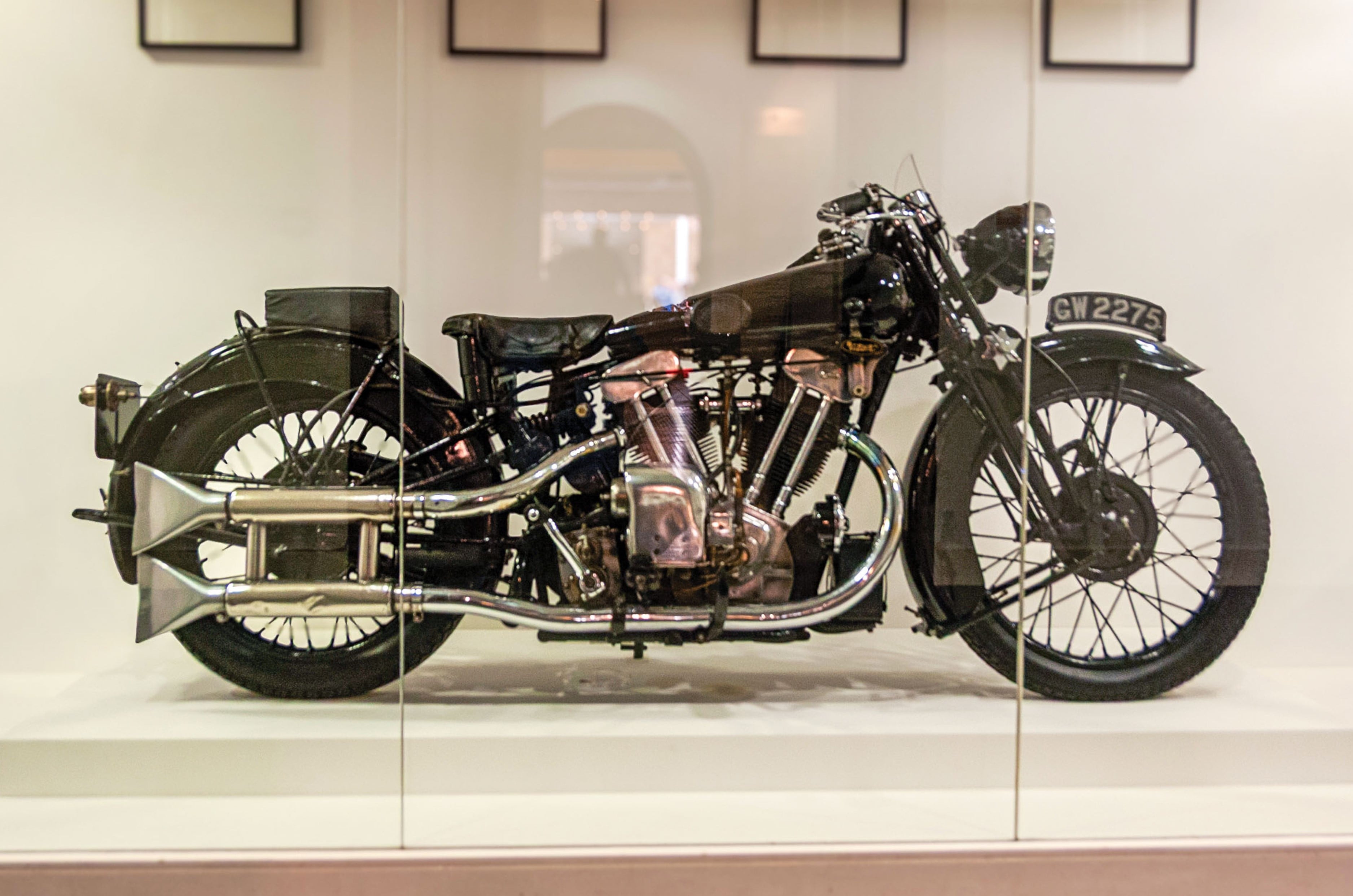
Seventeen years ago, in the Imperial War Museum on Lambeth Road in London, I stood mesmerised in front of a motorcycle with the number plate GW 2275, enclosed in a glass case. It was a beautiful, brooding machine, low and long, finished in deep black with just enough nickel and chrome to catch the museum lights: twin fishtail exhausts sweeping back in a graceful curve, the big JAP V-twin sitting exposed and unapologetic between the frame rails, cylinders splayed wide, cooling fins stacked like the pages of a book. Thin copper oil lines ran externally along the frame, feeding the total-loss lubrication system of the era, a solution that looked almost primitive next to a modern engine yet was efficient enough to survive being wrung out past 100mph on 1930s public roads.
A flamboyant form, every component left exposed, hinting at George Brough’s intention to let you see exactly what you were paying for. This was, in its day, the pinnacle of what was once the finest motorcycle industry in the world, the British motorcycle industry. Standing there, it was easy to understand why a certain kind of Englishman, restless, brilliant, and a little broken, would have fallen entirely in love with a machine like this.
The very Brough Superior SS100 Lawrence died on, photographed at the Imperial War Museum in 2008. Its last known owner, reclusive collector John Weekly, kept it in his lounge for over 45 years before his death in 2024. After which the Brough’s whereabouts are unknown.
It took me straight back to being a teenager watching Lawrence of Arabia for the first time. The film famously opens with this motorcycle: the frantic braking, the fatal swerve to avoid two boys on bicycles, before flashing back to how a restless desk officer became a legendary guerrilla leader in the Arab Revolt, and how that legend curdled into cynicism once Britain betrayed the cause he’d fought for. This was the actual Brough Superior SS100 that TE Lawrence was ripping home on from Bovington on May 13, 1935, when he went over the handlebars, struck his head, and died six days later without regaining consciousness.
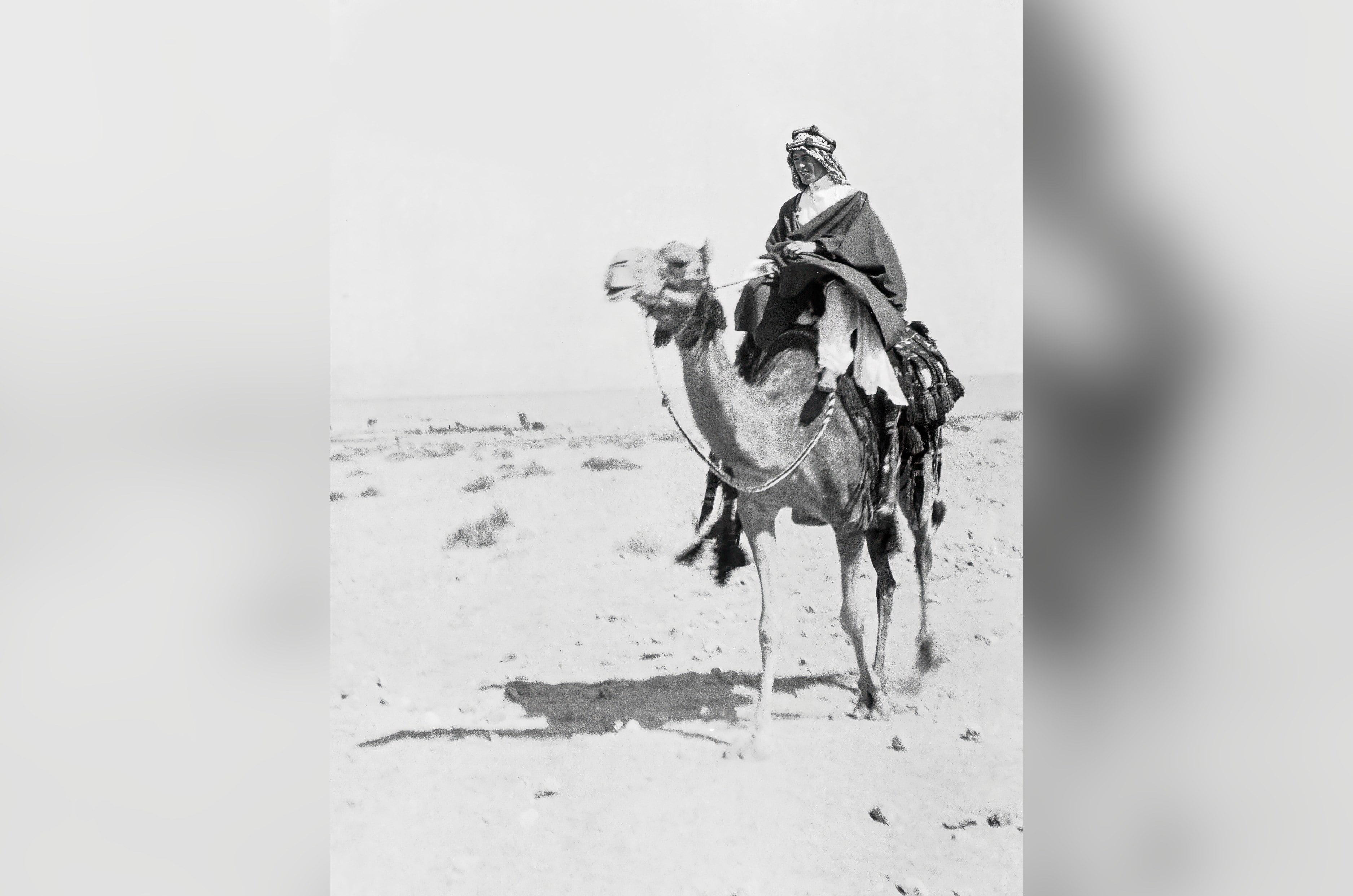
Motorcycle or camel, Lawrence rode with consummate ease.
I have always felt a pull towards places where history happened, where the past has left something tangible behind, and this anniversary issue gave me the excuse I needed to follow Lawrence’s last ride. For this quest, I got behind the wheel of the new Mini Countryman John Cooper Works. A slightly contradictory choice of car for a story about a restless man who spent his last years trying to shrink his own reputation by changing his name twice to get away from the legend he’d unwillingly become. Because the new Countryman is going through much the same thing but in reverse.
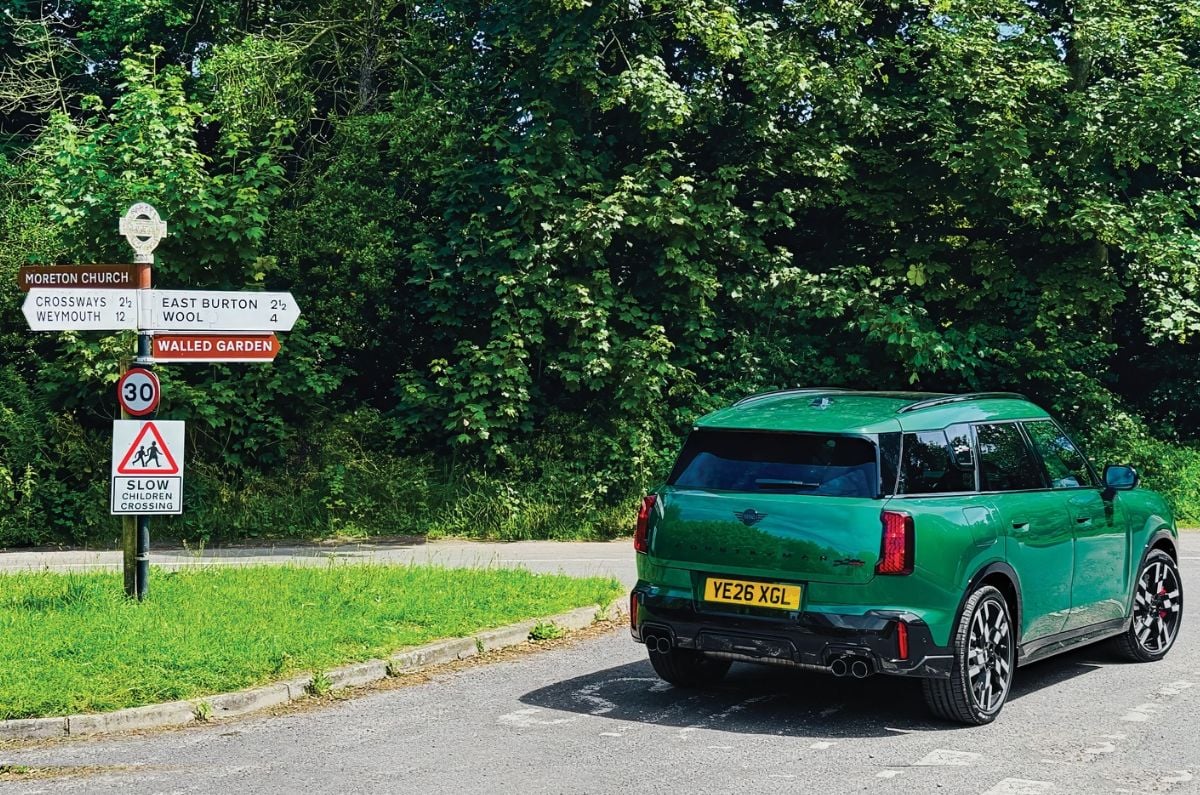
By the very virtue of its name, the Mini has a reputation of being a compact and cheeky car that seems to occupy hardly any road at all, but this Mini is large and an SUV, accentuated by beefy curves with all-wheel drive as standard and sporty vivid red disc calipers. Under the bonnet sits a potent 2.0-litre turbo four-cylinder engine with 300 horsepower of shove and 400Nm of tug.
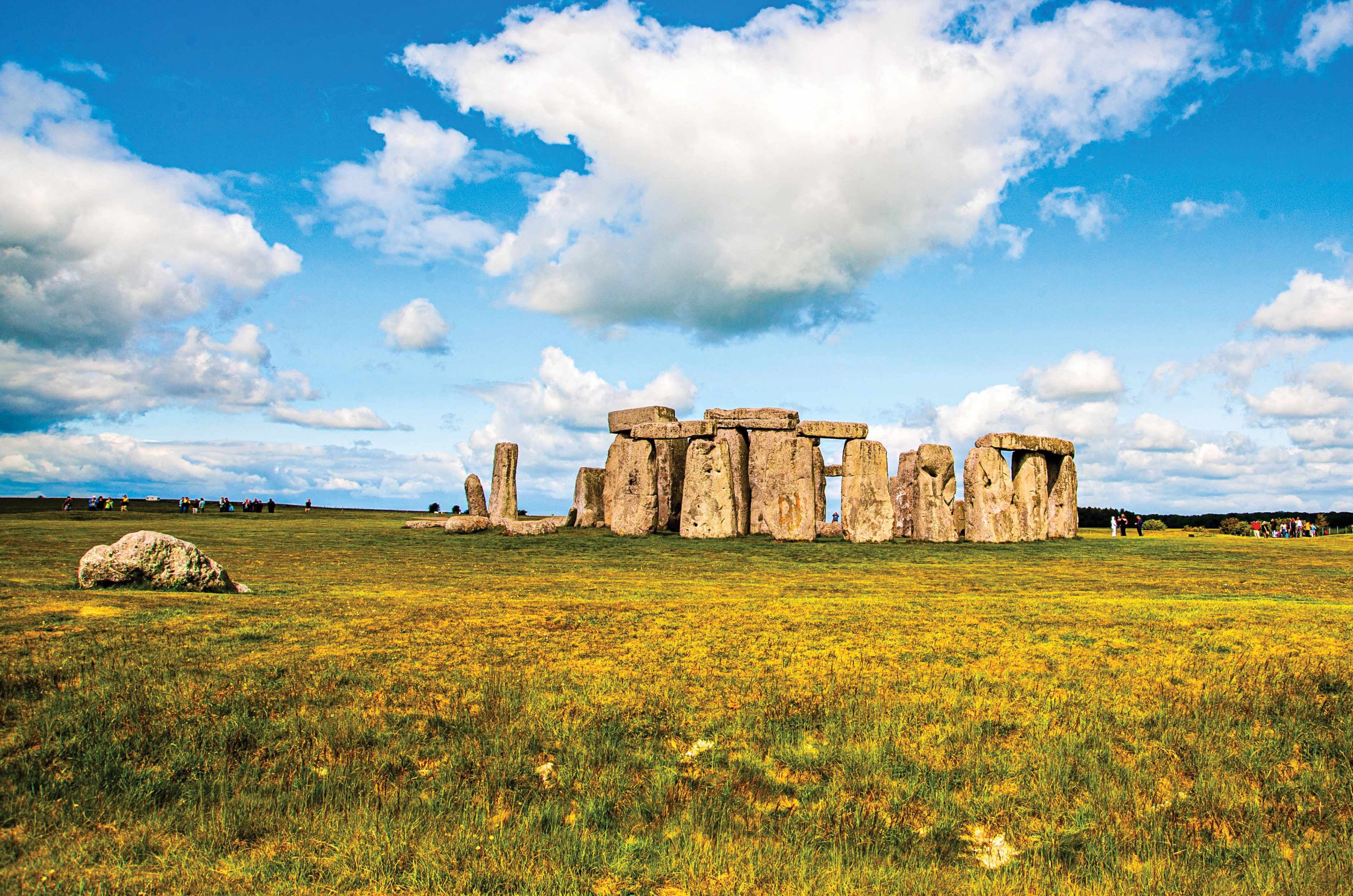
The irony was not lost on me: I was driving a car that had outgrown its own name, setting off to chase a man who’d spent his final years trying to shrink his. I pointed the car west out of London on the M3, then the A303, pulling over near Stonehenge for a quick photograph before pressing on toward another English icon further down the road.
The road to Clouds Hill
Stonehenge bursts into view without warning as the A303 tops a crest, the ancient stones suddenly filling the windscreen against the Salisbury Plain.
Beyond Stonehenge, the Countryman ate the tarmac in complete comfort, cabin hushed, adaptive cruise doing most of the thinking. The road eventually dropped south onto narrower country lanes for the final approach into Dorset, and it was here, as the hedgerows closed in, that the JCW visibly changed character. All-wheel drive dug in through the bends, the exhaust note sharpened, and for a few minutes on the approach to Clouds Hill, this bulked-up, grown-up Mini showed me that the nimbleness of its ancestors still lived somewhere in its genes.
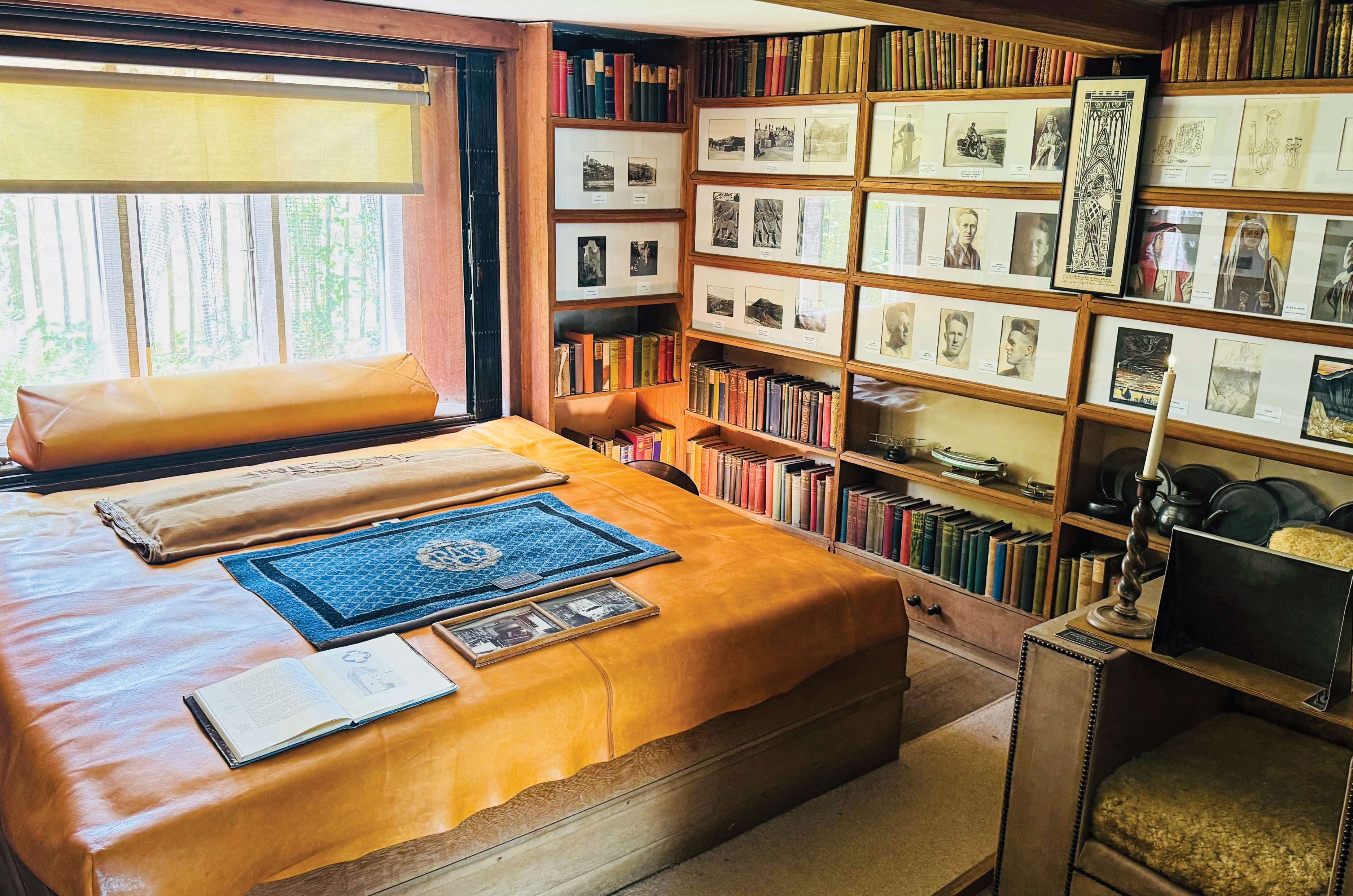
Inside Clouds Hill: Lawrence’s daybed and bookshelves, preserved almost as he left them.
Clouds Hill itself is almost comically modest for a man who became one of the most famous people in England. It’s a four-room labourer’s cottage with no electricity, which Lawrence first rented in 1923 while stationed at nearby Bovington, then painstakingly rebuilt with his own hands before buying it outright in 1929. Inside, the leather-topped daybed, bookshelves crammed with correspondence and photographs, and framed portraits of Bedouin faces and RAF colleagues remain much as he left them, preserved by the National Trust.
What hints at the pull of Lawrence’s personality is who came all the way here to visit him. George Bernard Shaw, EM Forster, Thomas Hardy and Robert Graves all found their way to this tiny, electricity-less retreat, which was slightly ironic, because Lawrence was doing his best to disappear. The world knew him as Lawrence of Arabia, the flamboyant soldier in Arab robes who’d become one of the most recognisable figures of the First World War, and he wanted none of the celebrity that came with it.
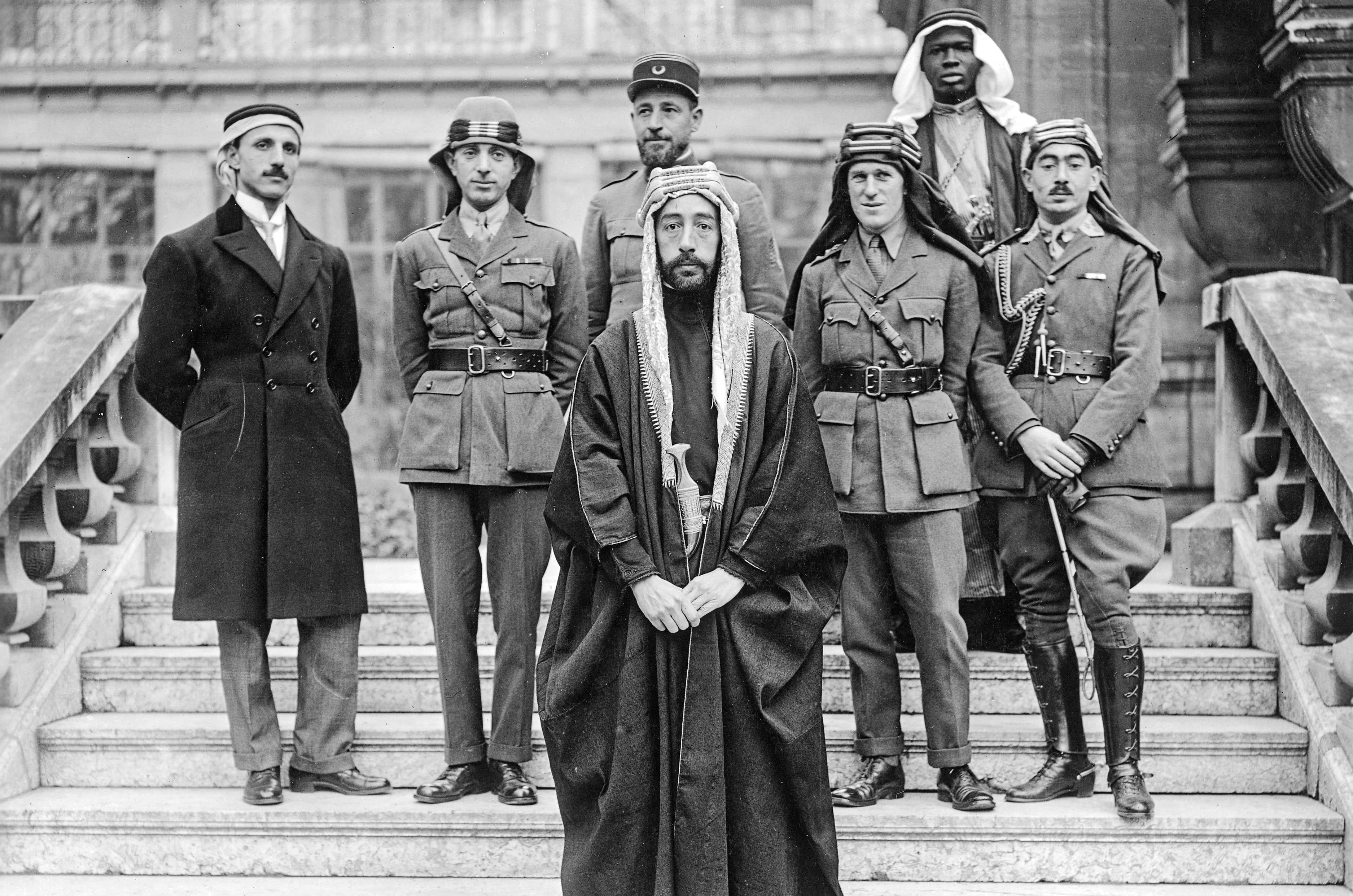
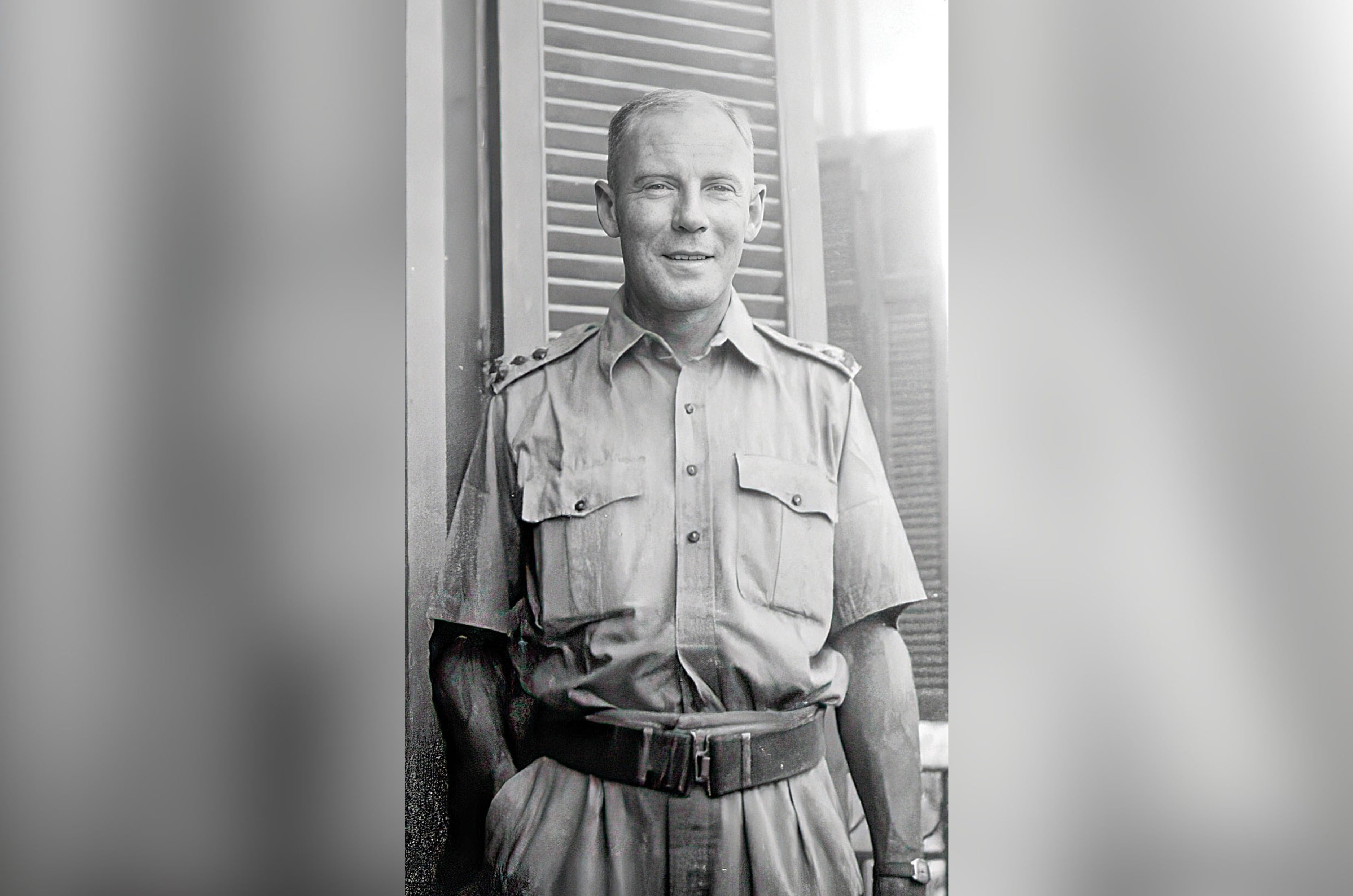
Prince Faisal’s delegation at the 1919 Paris Peace Conference. Lawrence (third from left) stood among men Britain would soon betray.
He’d already tried once: in 1922, he joined the RAF under the name John Hume Ross, but the press uncovered him within months. The following year, he joined the Tank Corps as TE Shaw, a name he kept for the rest of his life. Clouds Hill became his refuge, a place to read, write, listen to music, work on his boats and motorcycles, and retreat from a world determined to keep finding him.
He did make forays out. Winston Churchill was a genuine friend, and Lawrence would occasionally turn up unannounced at Chartwell, Churchill’s home about 130 miles away. He liked to boast that his long-distance visits to friends like Churchill and Lady Astor were made in “record time” thanks to the Brough’s speed, calling the machine “the silkiest thing I have ever ridden.”
Churchill’s daughter Mary remembered him arriving as “a short, nondescript, sandy-haired airman riding a motorcycle,” only to reappear at dinner transformed, “presenting himself in the flowing robes of a Prince of Arabia.” She also recalled the “pin-drop silence” that fell over the room whenever Lawrence spoke, a silence that apparently included her father, who himself considered Seven Pillars of Wisdom “unsurpassable” as a war narrative. It was an odd, quietly moving thing to stand in a room with no electricity and realise the man who once sat there could hold some of the loudest reputations in England spellbound.
The road that killed him
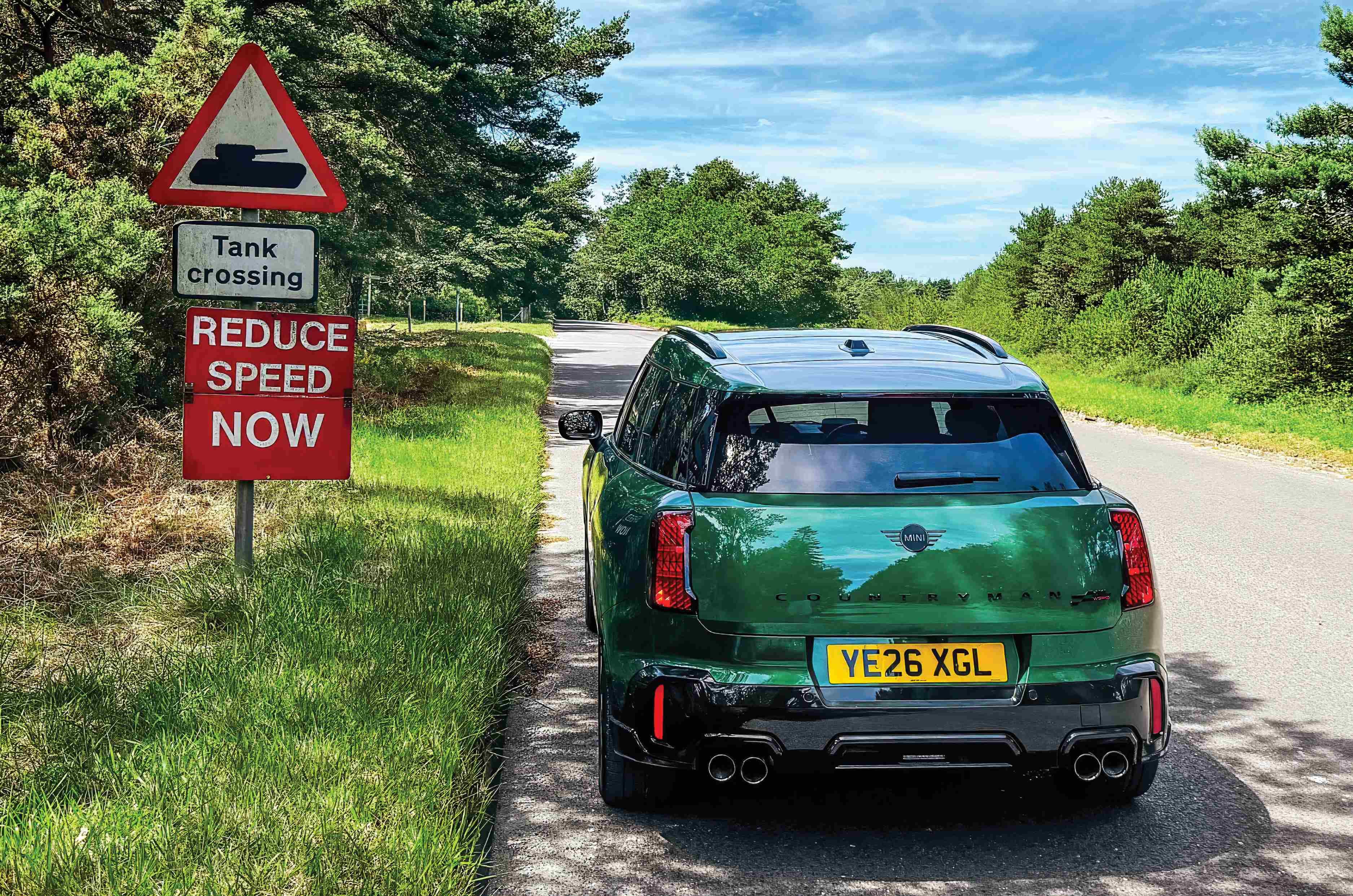
This road has widened over the decades, much like the Mini brand, which now includes an SUV.
From Clouds Hill, the road towards Bovington Camp is the one Lawrence rode almost daily, and it’s easy to see why he loved it: well cambered, with quick, confident curves that seem made for two wheels rather than four. The road has changed considerably since 1935, widened, realigned and smoothed out, the dips Lawrence knew long gone, but the bends remain, and the JCW flowed through them on silky modern tarmac with barely a shudder.
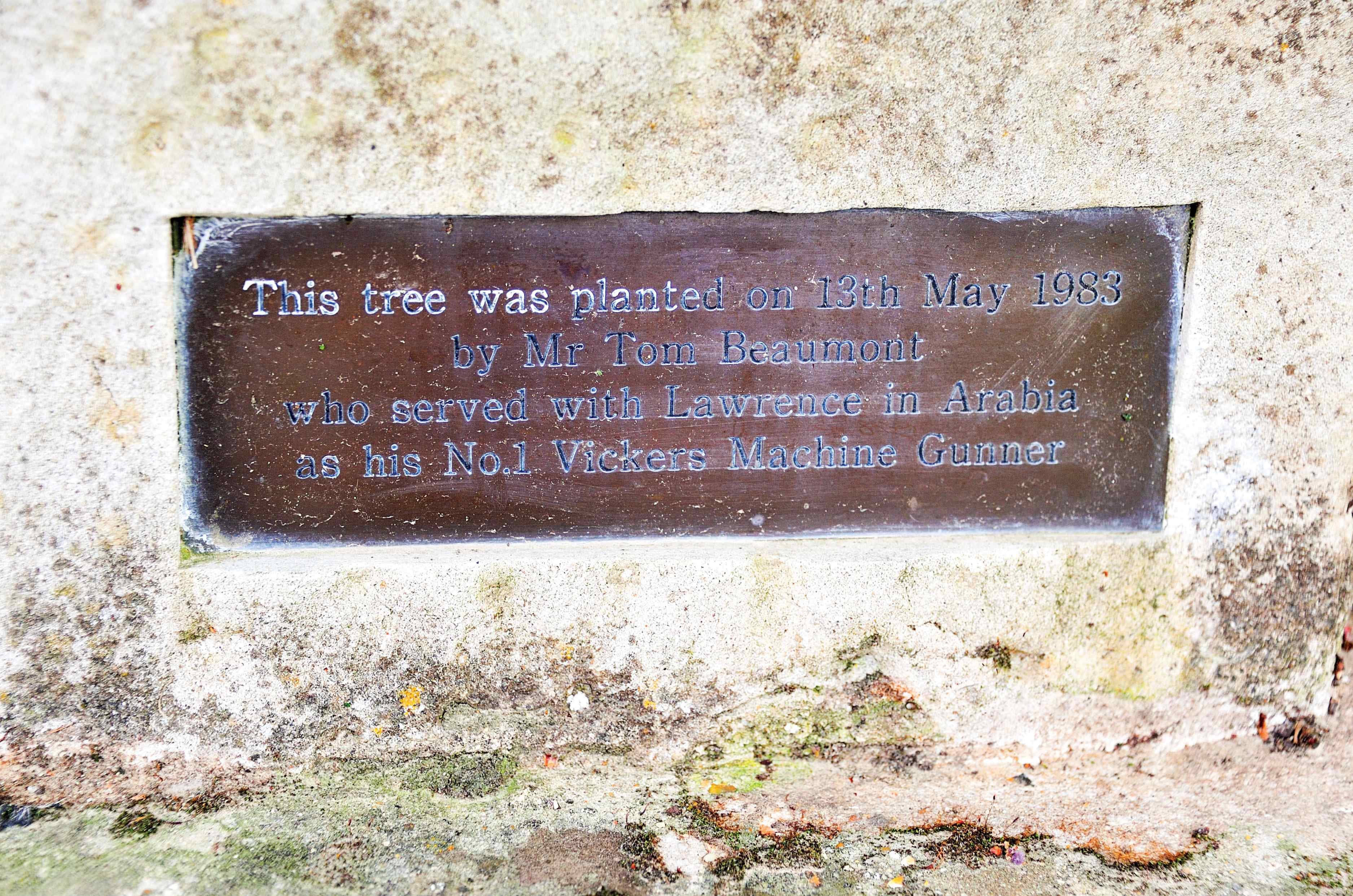
The plaque marking the tree planted by T.E. Lawrence’s former Vickers gunner, Tom Beaumont, in 1983.
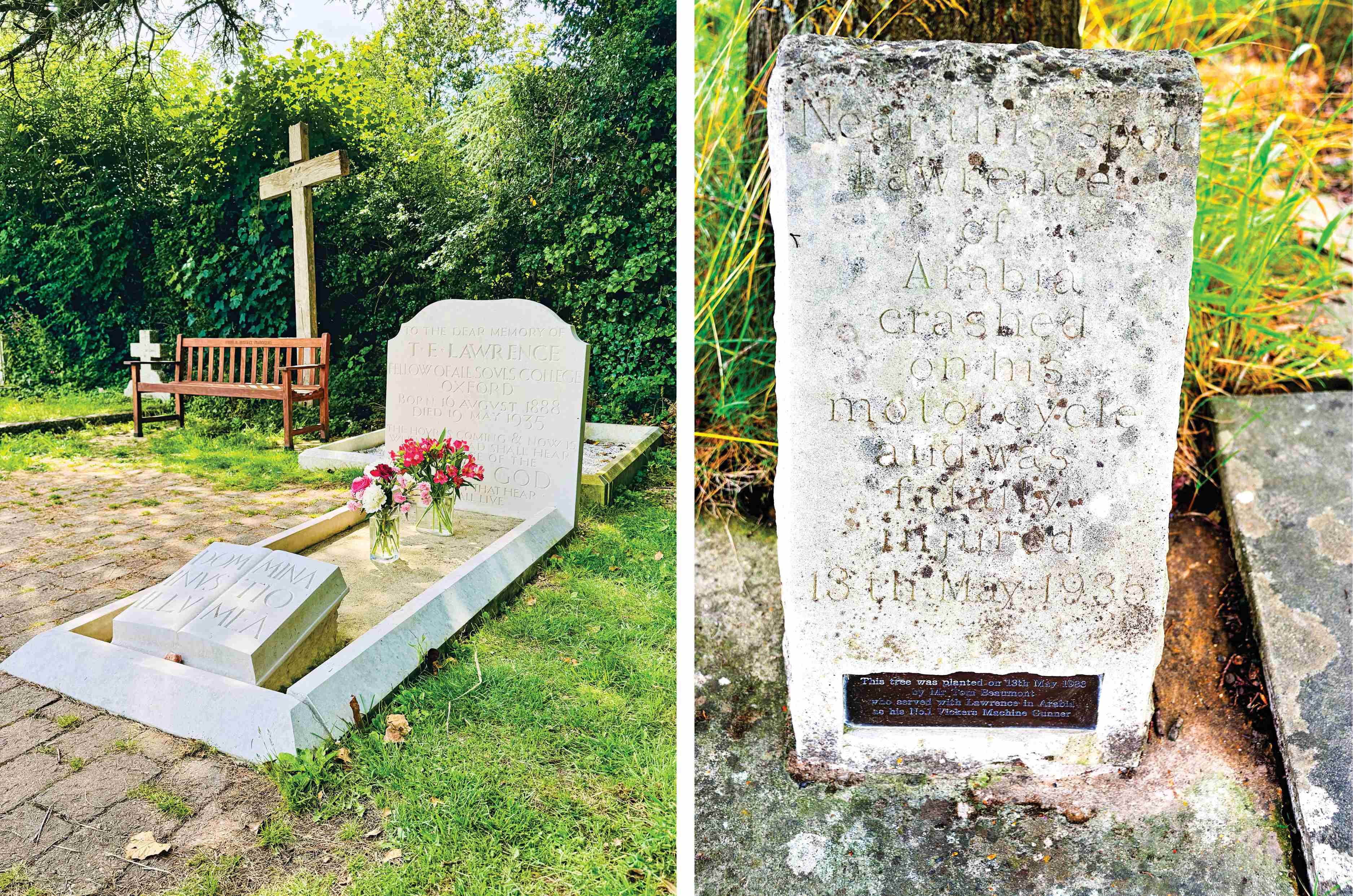
Lawrence was known to push his Brough to 100mph on roads like this despite the rougher surfaces and primitive brakes of the time. It takes a particular sort of nerve to do that. Sadly, this is also the road on which he died. A small, weathered stone marker stands by the roadside near the crash site, its inscription barely legible: Near this spot Lawrence of Arabia crashed on his motorcycle and was fatally injured, 13th May 1935.
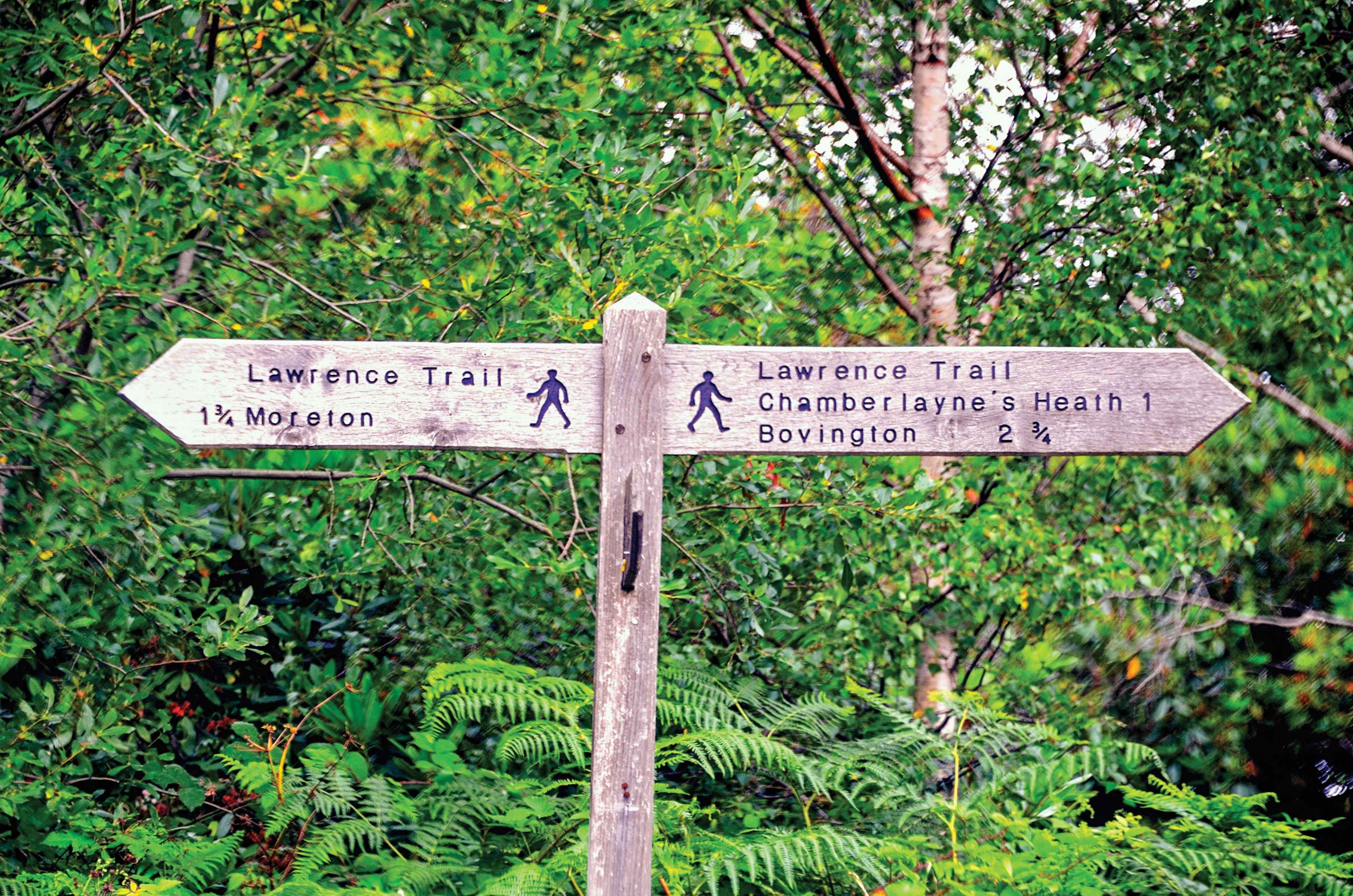
A signpost for the Lawrence of Arabia Trail.
Below it, a plaque records that the tree beside the marker was planted in 1983 by Tom Beaumont, who had served as Lawrence’s Vickers machine gunner in Arabia, one old comrade returning nearly half a century later to mark where another had died. It’s a small, unshowy memorial for a man who became the subject of an Oscar-winning film. Bovington Camp is also the start and finish point of the circular 10.8km Lawrence of Arabia Trail, which strings together the cottage, the crash site, and the church at Moreton in one walkable loop.
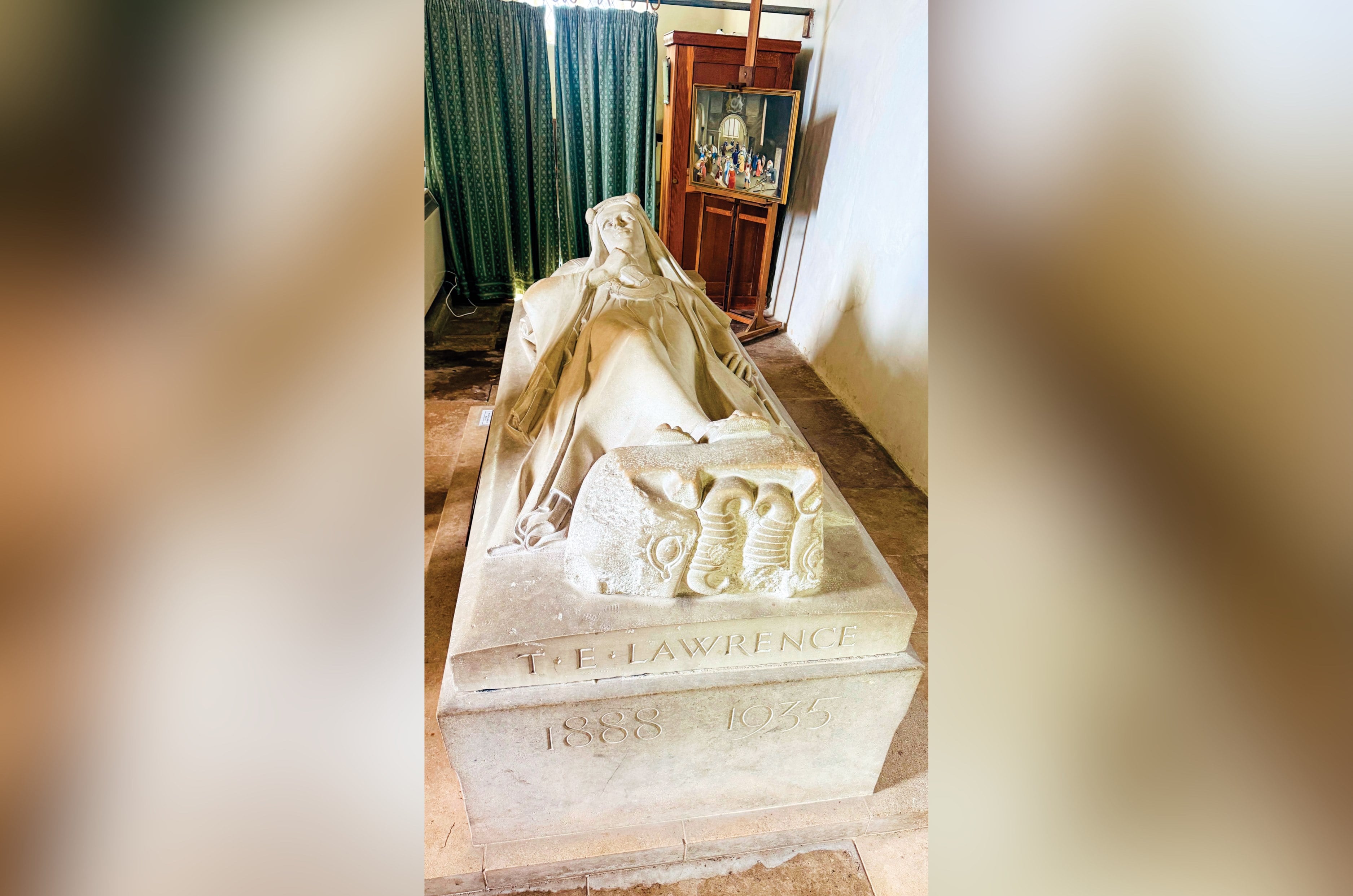
Lawrence’s effigy at St Martin’s Church, Wareham, carved by his friend Eric Kennington.
A short drive away in Wareham is one more stop worth making: the Saxon church of St Martin’s, home to a life-size effigy of Lawrence carved by his friend Eric Kennington, originally intended for St Paul’s Cathedral before being rejected there and finding its way to this small parish church instead.
Moreton and the memory of him
Moreton itself is a proper Dorset postcard, a signpost outside St Nicholas’ Church pointing the way to “Walled Garden” beside directions to Wool and Weymouth, as if history and horticulture share equal billing. Lawrence’s small and very private funeral and burial were held here on May 21, 1935, and the mourners included Churchill, Lady Astor, General Wavell (who flew in by autogiro), and author Henry Williamson.
Left: T.E. Lawrence’s grave at St Nicholas’ Church, Moreton. Simple white stone, flowers left fresh by visitors. Right: The weathered marker near Bovington, barely legible, recording the spot of Lawrence’s crash.
His grave sits a short walk from the church, simple white stone, flowers laid fresh by visitors, the inscription noting he was a Fellow of All Souls College, Oxford, and making no mention at all of Arabia.
The coast, and letting the car breathe
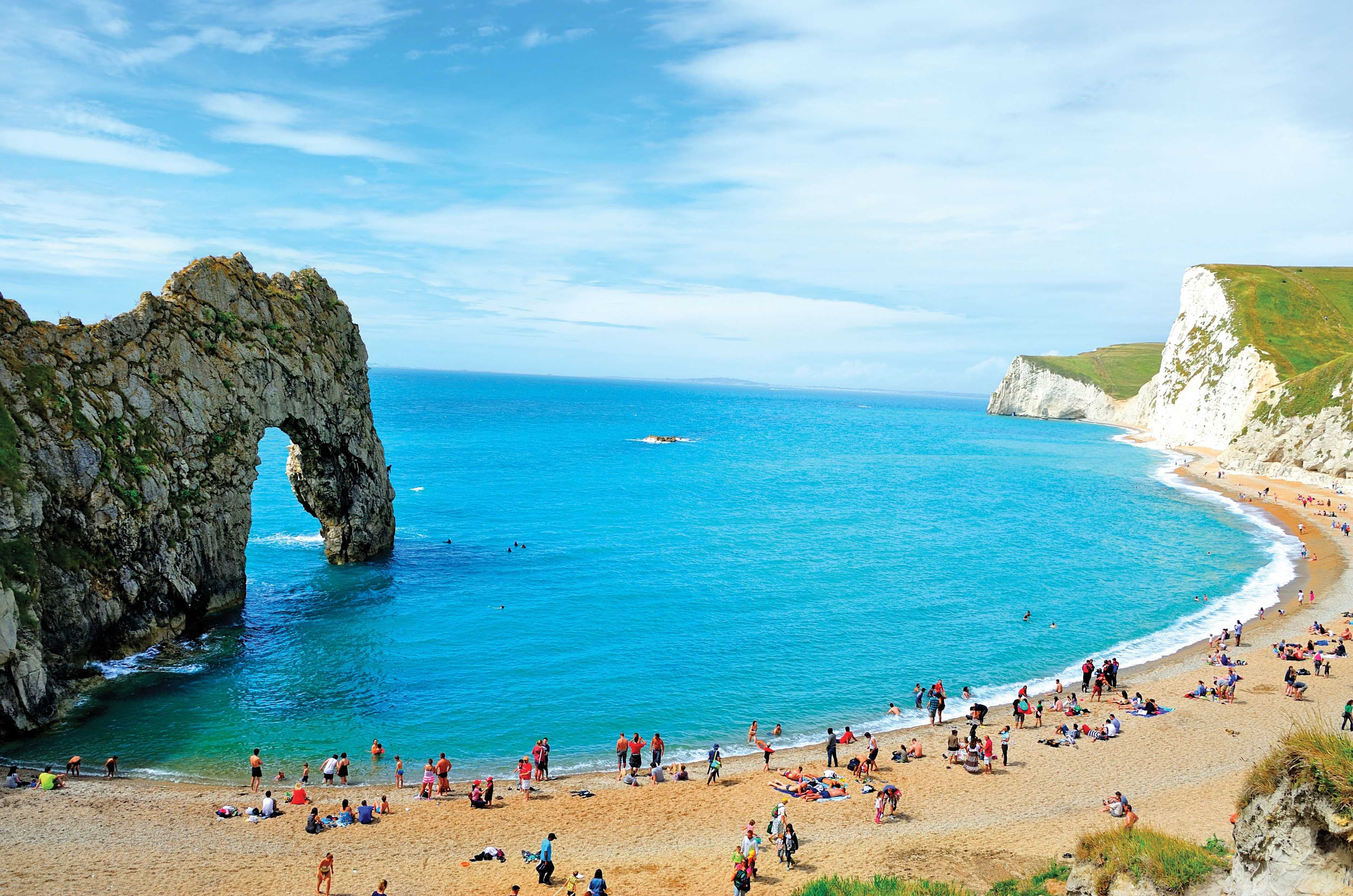
Durdle Door, the natural limestone arch that draws crowds to this stretch of coastline.
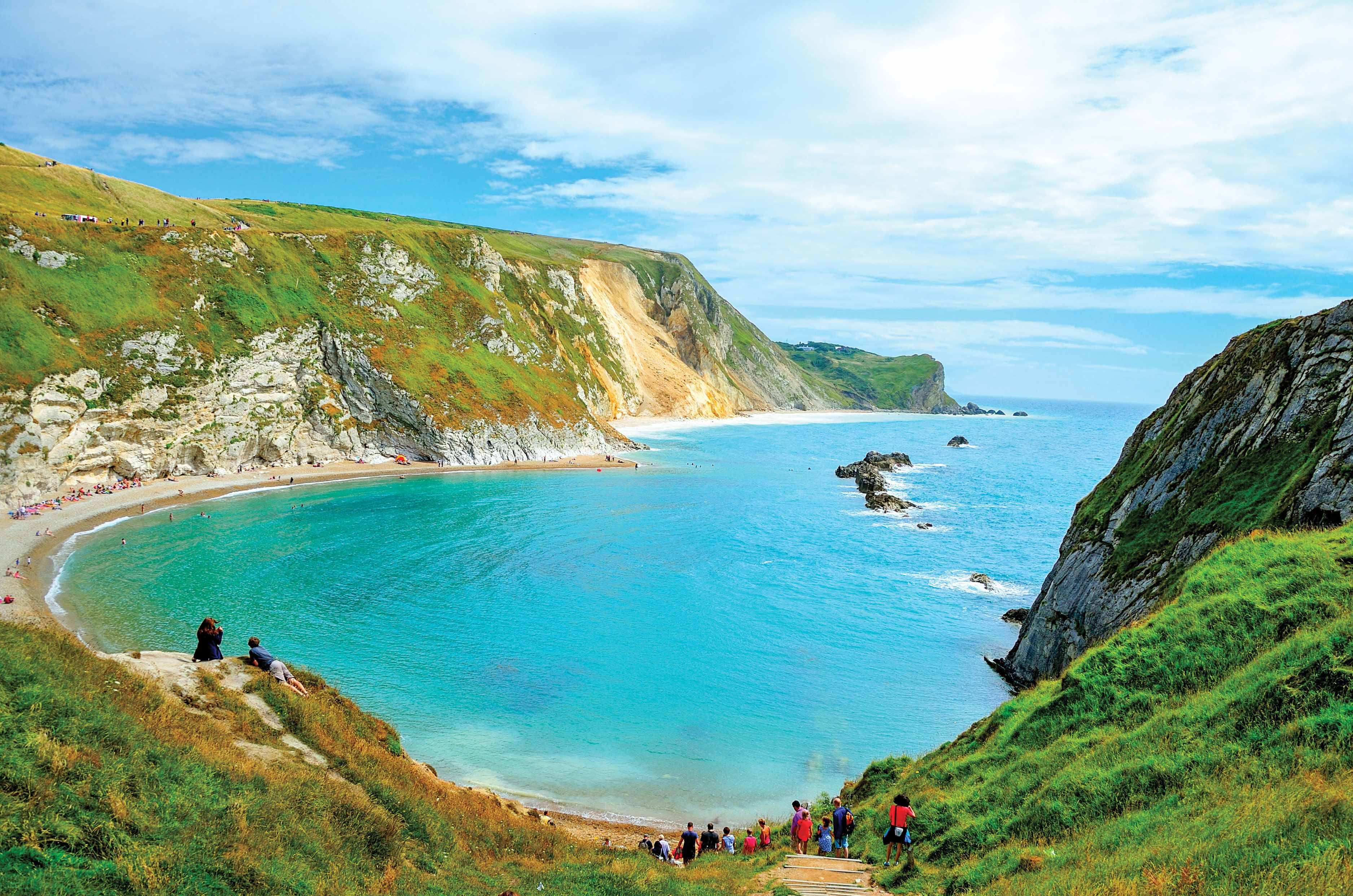
I couldn’t leave Dorset without giving the JCW a proper stretch, so I pushed south to the Jurassic Coast, Durdle Door and Lulworth Cove, a slight detour from Lawrence’s own story, but too good to leave out of a day like this. Every mile of the drive validated it being classed as an SUV. The properly deep boot held picnic mats, beach gear, including chairs and an umbrella, without the need of the rear seats being dropped.
Lulworth Cove’s chalk cliffs and turquoise water, a world away from Lawrence’s Dorset lanes.
The cabin felt roomy, and the ride height shrugged off potholed coastal car parks without a second thought. There’s real engine grunt for those urgent overtakes on narrow country lanes when stuck behind agonizingly slow motorhomes that make you feel like tearing your hair out.
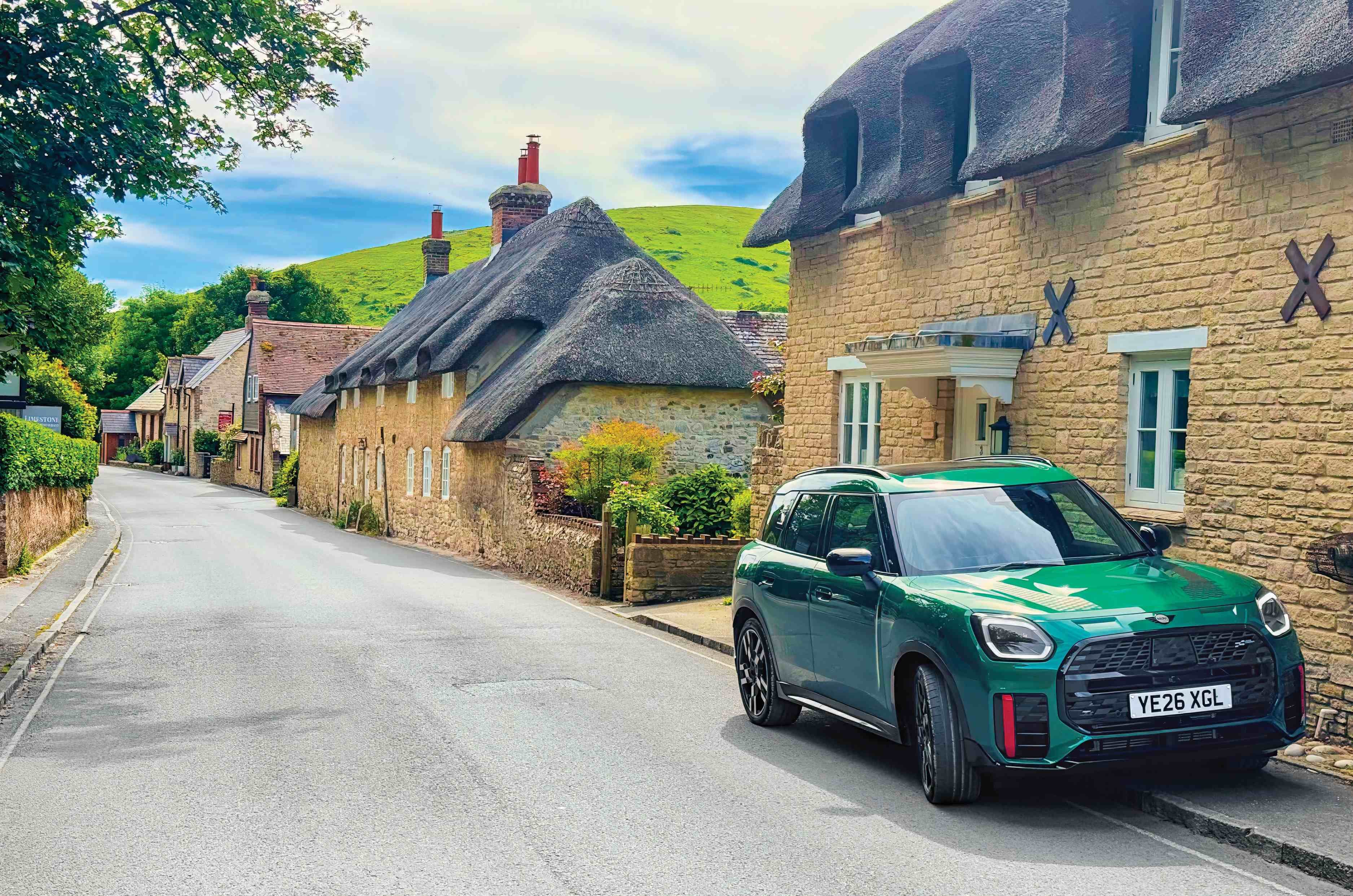
West Lulworth, all thatched roofs and honey-coloured stone, is about as quintessentially Dorset as a village gets.
The all-wheel-drive system quietly sorts out grip on the tighter, greasier lanes, especially with the left wheels on a shoulder slick with wet grass. Flick it into its sportiest mode, and the exhaust note gets a synthesised boost through the speakers. It may be all theatre, but it certainly made me grin, and that’s a win because sound plays such a large part in defining how a car makes me feel.
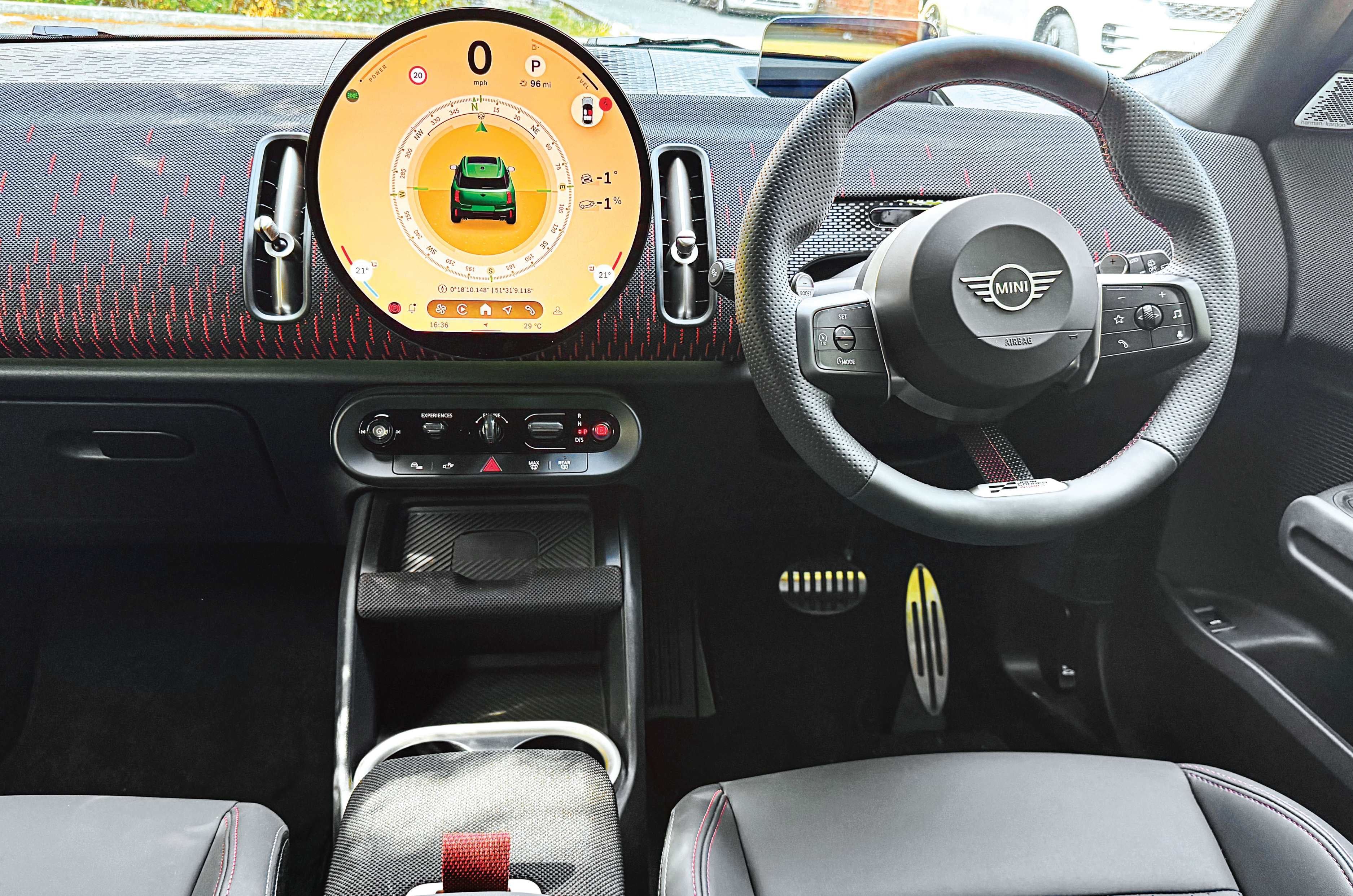
A compass and live pitch-and-roll readout flaunts SUV identity; instrumentation no traditional Mini has ever needed.
By the time I rolled back into London, it was quite clear to me that at the wheel of a Mini Countryman, what you get is a car that is actually larger and roomier than the Jeep Compass. It has the space, the grunt and the ground clearance, and from the smooth roads of Dorset to the Jeep-only trails of Zanskar, this Mini is genuinely man enough for whatever the country throws at it.
The Helmet He Never Wore
Lawrence’s fatal crash had one consequence far beyond Dorset. Among the doctors treating him at Bovington Camp Military Hospital was a young Australian neurosurgeon named Hugh Cairns, who had himself served in the Middle East during the First World War. Watching Lawrence die of head injuries that a helmet might have prevented left a deep impression on him, and he began studying motorcycle head trauma as a direct consequence.
Sir Hugh Cairns
Crash helmets already existed, invented back in 1914 for racing at Brooklands, but nobody wore them on the road. It took the Second World War, and Cairns’s appointment as a head injuries adviser to the Ministry of Health, for that to change. Researching fatalities among military despatch riders, he found that head injuries were the single biggest killer among motorcyclists and that, of the few riders wearing helmets when they crashed, not one had died.
His 1941 paper was damning enough that helmets became compulsory for all military motorcyclists within a month, and a 1946 follow-up showed the death rate had fallen sharply as a result. Cairns argued the same logic should extend to every civilian rider. It took another 27 years, and Cairns didn’t live to see it, for that to become UK law in 1973. But the chain runs in a straight, almost eerie line from one Dorset lane to millions of ordinary commutes: the man who died avoiding two boys on bicycles ended up, through the doctor who treated him, saving countless lives on two wheels after his own.
“The Rolls-Royce of Motorcycles”
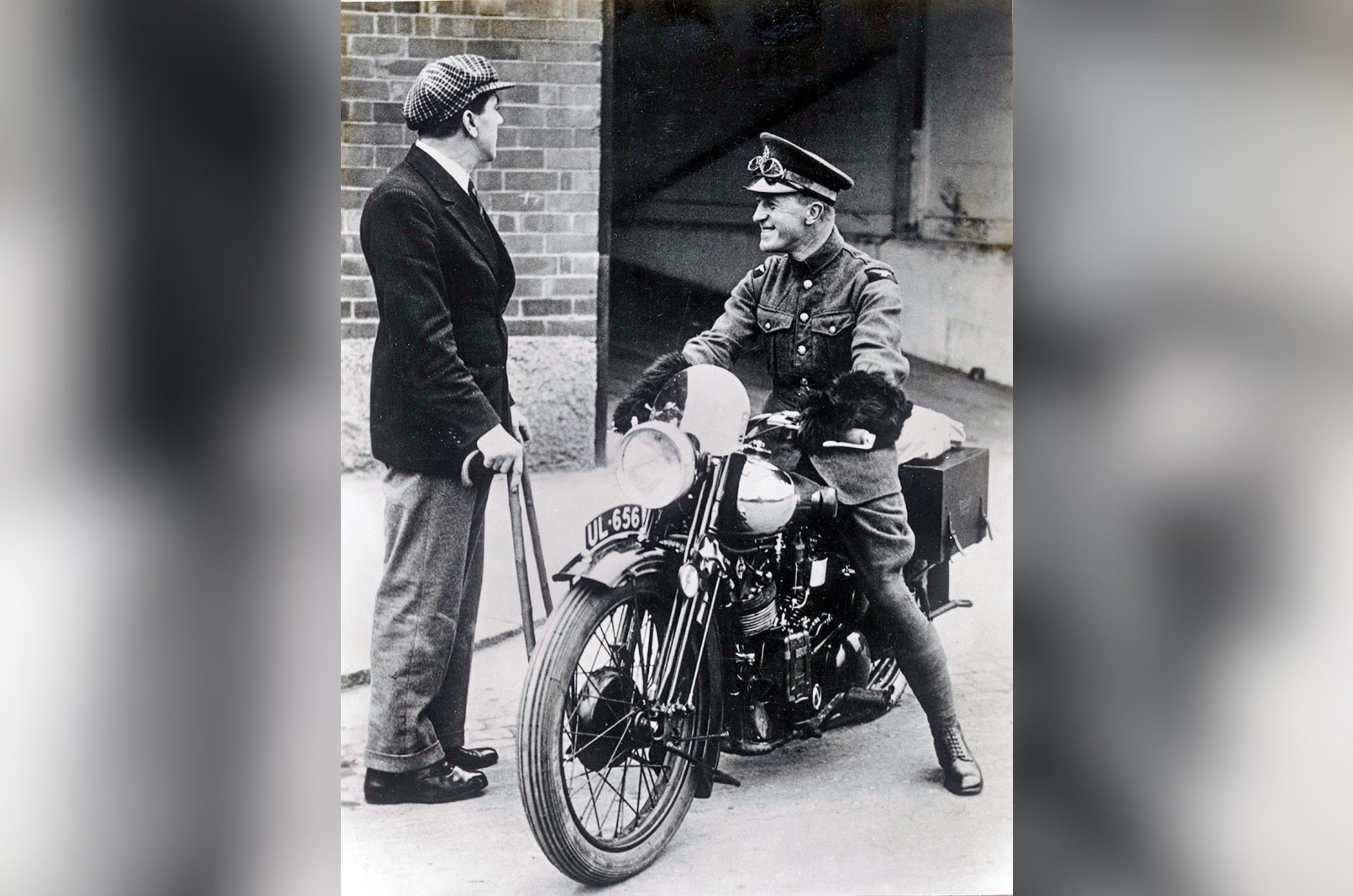
Every Brough Superior was hand-built at George Brough’s works on Haydn Road, Nottingham, and Brough himself was as singular as his machines. Rarely seen without his trademark tailored flat cap, he carried himself more like landed gentry than a factory owner, and his standards bordered on obsessive. Born to motorcycle pioneer William Edward Brough, George forged his own path in 1919 after a rift with his father over how grand and expensive motorcycles ought to be.
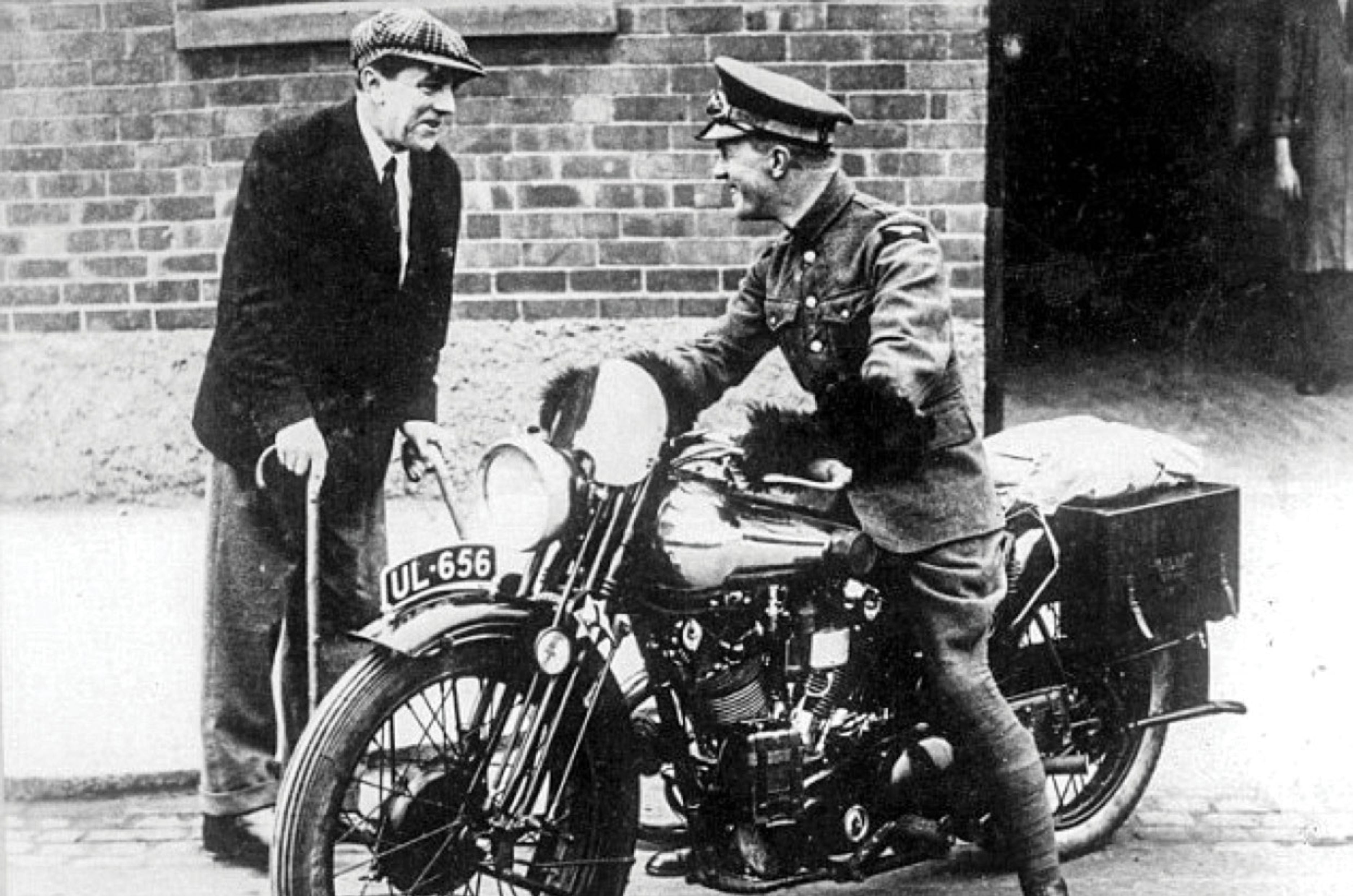
Left: George Brough, Right: T.E. Lawrence
A friend suggested adding “Superior” to the name, which Brough senior took as a personal insult. That pursuit of excellence defined the marque: each machine was assembled once to fit every component together, then stripped down for painting and plating, then reassembled for delivery. Brough tested every SS100 himself on public roads past 100mph, and each one left the factory with George Brough’s personal approval and a written certificate guaranteeing it had been timed at the ton over a flying quarter mile.
‘SS’ stood for Super Sports, ‘100’ for that guaranteed top speed of a 100mph, and Brough pushed the idea further still in 1928, setting a 130.6mph record at Arpajon in France. The “Rolls-Royce of Motorcycles” nickname was coined by journalist HD Teague of The Motor Cycle, and Brough liked it enough to use it in his own advertising, reportedly with the real Rolls-Royce’s blessing.
War ended civilian production in 1940, when the factory turned to munitions and aircraft parts, and the specialised J.A. Prestwich (JAP) 998cc, air-cooled, 50-degree OHV V-twin engines Brough relied on were never commercially viable again. Around 3,100 machines were made across 19 models in the marque’s 21-year run, and roughly a third survive today, making every survivor a priceless piece of automotive art.
Lawrence’s relationship with the marque ran deeper than most customers’. Writing to Brough in 1926, he said he’d ridden five Broughs and covered 1,00,000 miles in four years, calling them the greatest delight of his life, two of them possessing “a speed and reliability that reminded me of an express train.” Between 1922 and 1935, he owned eight. The first, bought in 1922, was nicknamed “Boa,” short for Boanerges, meaning “son of thunder.”
The seven that followed were named George I through George VII, with a ninth, George VIII, still being built when he died. At around £200 apiece, enough to buy a modest cottage, this was extraordinary indulgence for a man on an RAF aircraftman’s pay, though royalties from Seven Pillars of Wisdom helped fund it. The Brough he crashed on May 13, 1935, registration GW 2275, was George VII, his last completed machine.
The photographs here are of George Brough and Lawrence on the Brough nicknamed George VI. They were taken during one of Lawrence’s frequent, unassuming visits to the Haydn Road factory by Jack Hallsworth, a Nottingham Journal photographer who knew George Brough and had been tipped off to bring his camera one afternoon.
It’s a rare glimpse of a man famously camera-shy and almost never photographed candidly, hinting at the genuine warmth behind the machines: two very different Englishmen, one a self-effacing war hero trying to vanish into rural obscurity, the other a flamboyant engineer-showman happy to let Rolls-Royce’s name do some of his advertising for him, bound by a friendship that outlasted their differences.
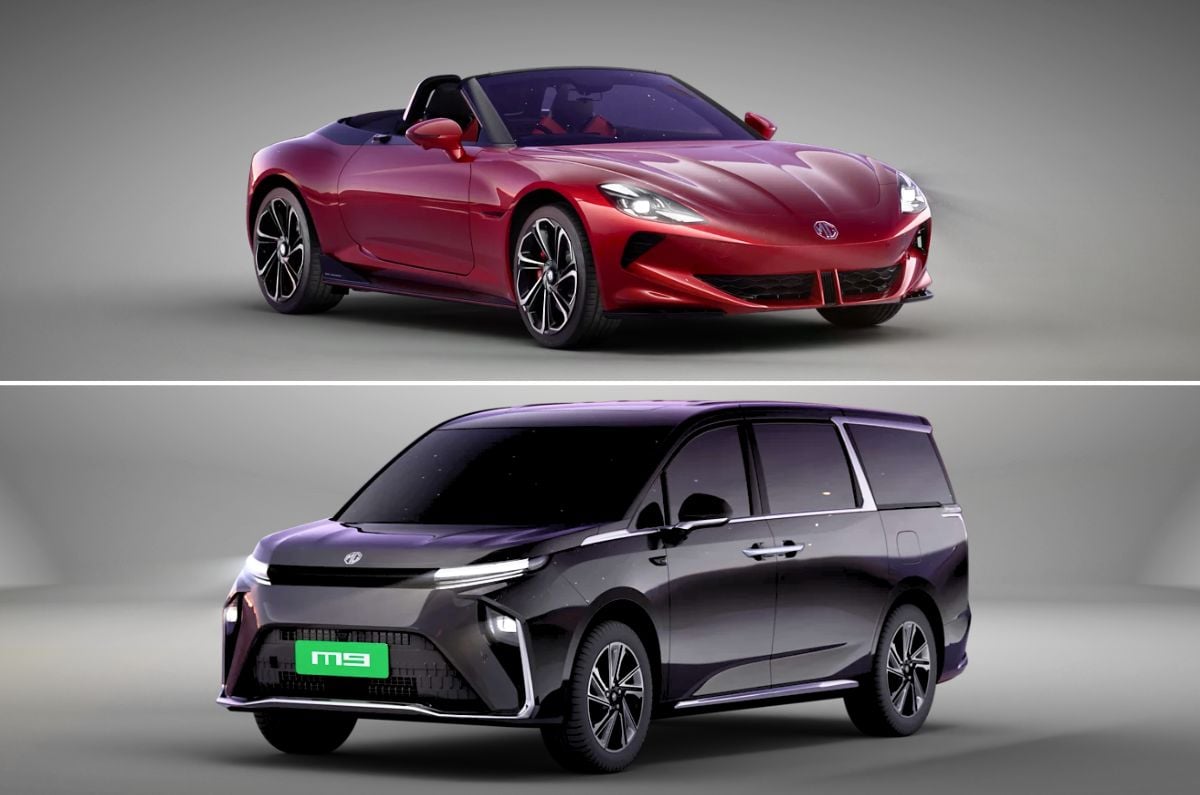
MG has introduced a battery-as-a-rental (BaaS) scheme for the Cyberster and M9 EVs, which are sold through the manufacturer’s more premium ‘Select’ outlets. With the BaaS scheme, MG has priced the Cyberster at Rs 72.49 lakh and the M9 at Rs 69.99 lakh, which is an upfront price reduction of up to Rs 10.01 lakh. However, a battery rental fee of Rs 8 per km is being charged if this scheme is opted for.
MG Cyberster and M9 BaaS prices
BaaS scheme results in an upfront saving of up to Rs 10.01 lakh
MG Cyberster, M9 BaaS vs non-BaaS prices
BaaS price
Non-BaaS price
Upfront cost savings
MG Cyberster
Rs 72.49 lakh + Rs 8 per km
Rs 82.50 lakh
Rs 10.01 lakh
MG M9
Rs 69.99 lakh + Rs 8 per km
Rs 79.95 lakh
Rs 9.96 lakh
No other changes have been made to the Cyberster or the M9, and they continue to be offered with a 77kWh and a 90kWh battery pack, respectively. The Cyberster is offered with a 580km claimed range and a dual-motor all-wheel-drive (AWD) setup that produces 510hp and 725Nm. The M9 offers a 548 km claimed range and a front-axle-mounted (FWD) electric motor that produces 245hp and 350Nm.
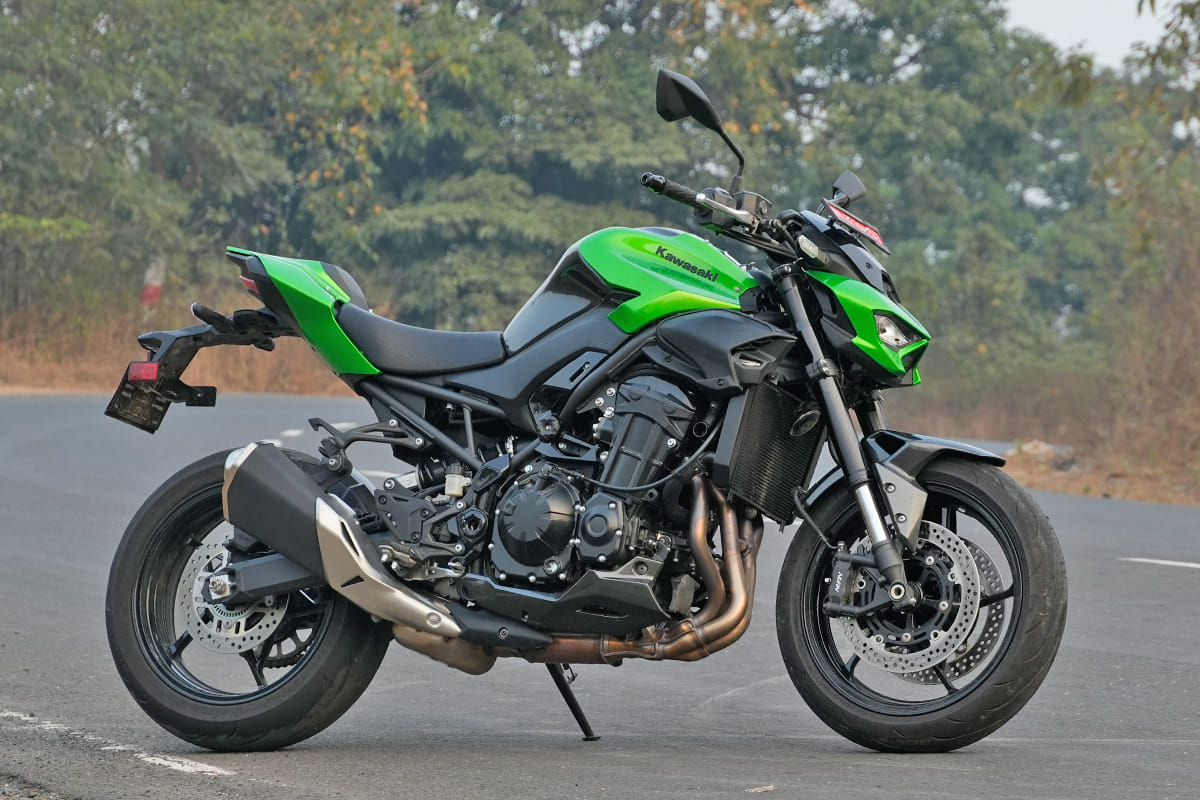
The Kawasaki Z900 is one of the most popular in-line four motorcycles in India. With the brand cache and a price that seems far more reasonable than its rivals, it’s no surprise that it’s been one of the bestsellers for the Japanese manufacturer.
The discount is through a zero percent interest scheme, for the three-year EMI tenure
Includes accessories like a frame slider, radiator guard, and fork slider worth Rs 25,000
Kawasaki Z900 available through a zero percent interest scheme
A bundle of cash discount and accessories
Anzen Kawasaki, the official dealer for Kawasaki in Mumbai and Goa, is currently offering a zero percent interest scheme for the Z900, with a down payment of Rs 5 lakh on its Rs 9.99 lakh ex-showroom price. The zero percent interest part applies exclusively to the 36 months EMI tenure. You will end up saving Rs 1 lakh in interest with the scheme, which Anzen is offering as an up front discount. This effectively brings down the Z900’s ex-showroom price to Rs 8.99 lakh. In addition to that, you get Rs 25,000 worth of accessories such as a frame slider, a radiator guard, and a fork slider at no extra cost.
If you’re unfamiliar with the Z900 until now, the sport-naked motorcycle last received a comprehensive list of upgrades to its design and gained some new features last year. It’s powered by a 948cc in-line-four-cylinder, liquid-cooled engine with 125hp and 98.6Nm of torque. In India, it’s available in two colours: lime green (a Kawasaki signature shade) and metallic spark black. It’s currently being imported as a completely built-up unit (CBU) and can only be had as a single seater.
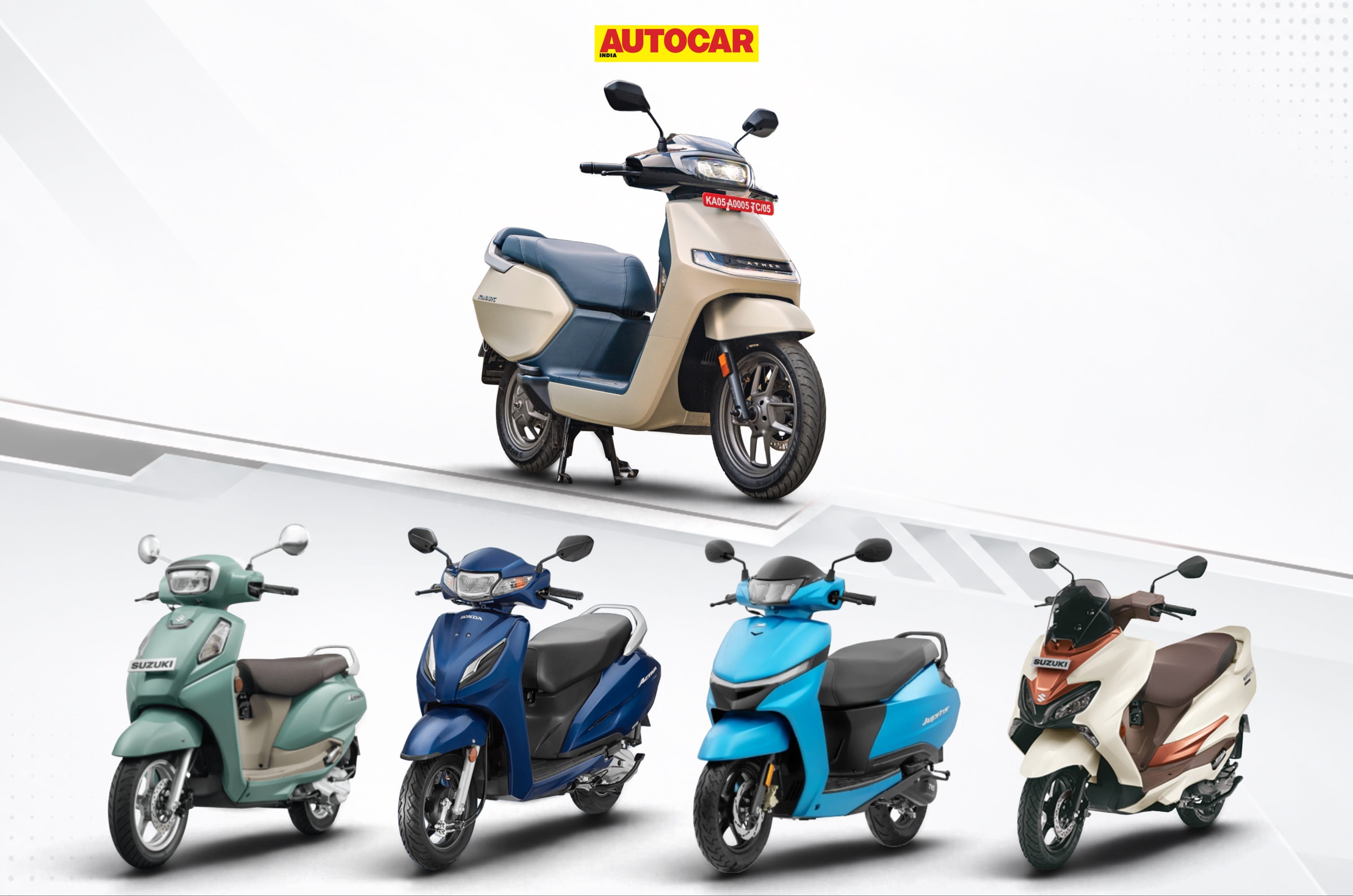
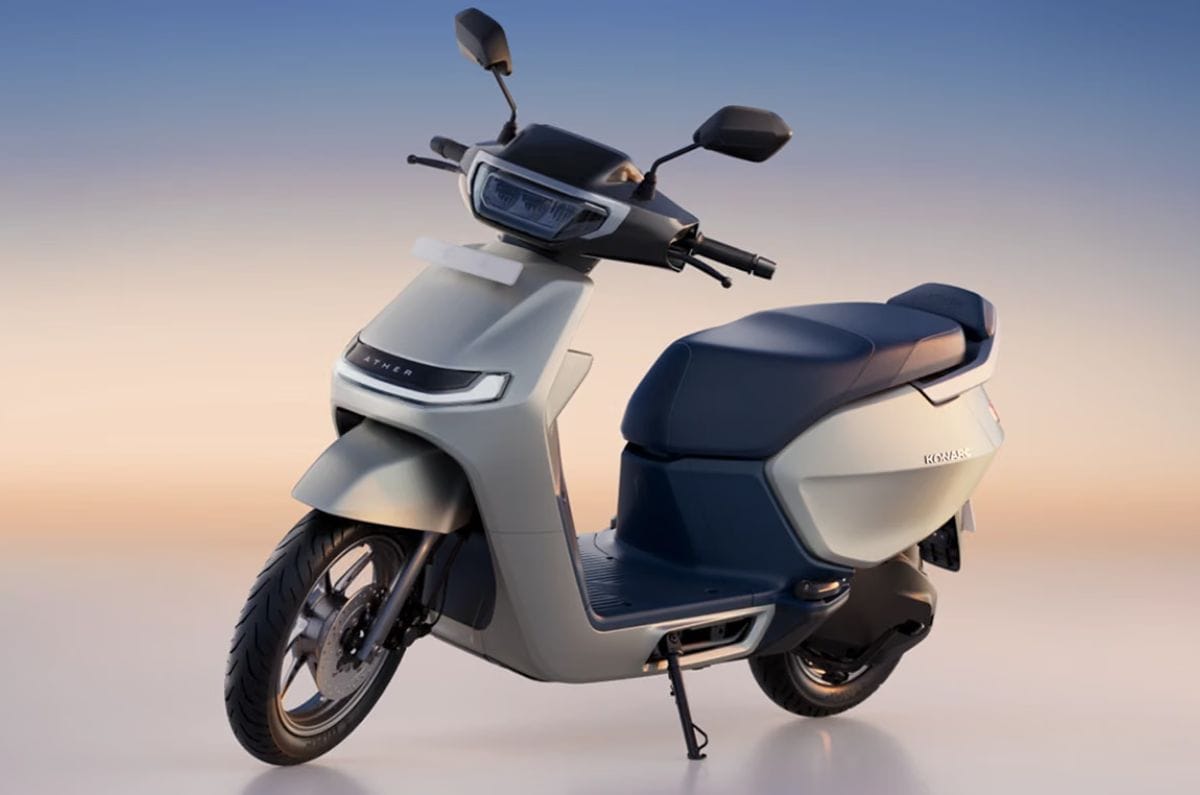
Family scooter. As soon as you read that, probably one specific scooter comes to your mind, summing up how the scooter industry has functioned the past two decades. However, over the past few years, EVs like the TVS iQube, River Indie, and the Ather Rizta have shown that they can go toe-to-toe with petrol scooters. The brand-new Ather Konarc is poised to add to that arsenal. However, if you aren’t quite convinced yet, here are some internal combustion engine (ICE) scooters you can look at instead.
All scooters are being compared to the Ather Konarc S 100, priced at Rs 99,999 (ex-showroom, Bengaluru). For Konarc, we haven’t considered features that require Ather StackPro subscription. All the other scooter prices mentioned are ex-showroom, Delhi.
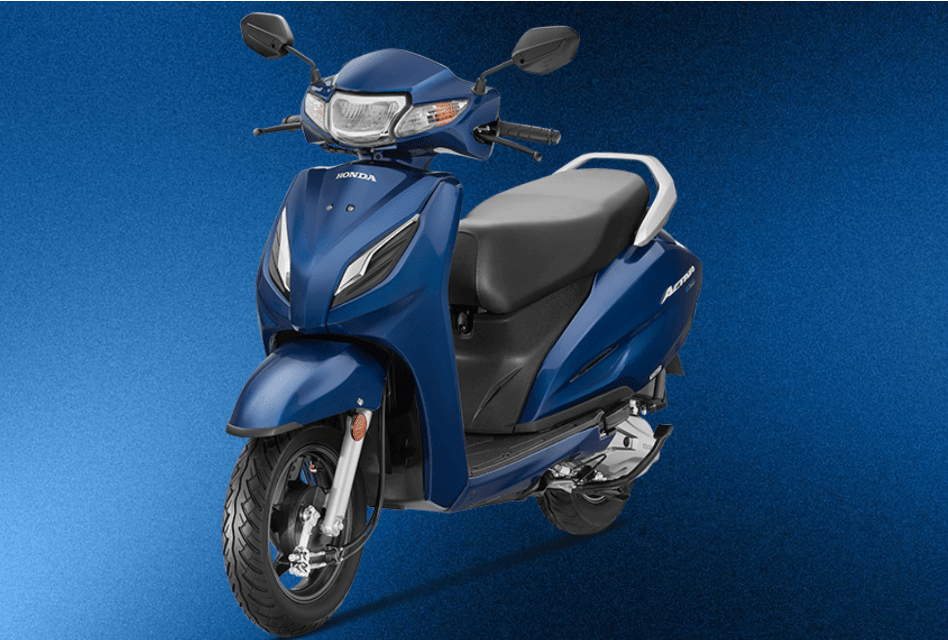
Honda Activa
Rs 76,083 onwards
The default family scooter and the one your mind reminded you of when you started reading this. You cannot go wrong with the Activa’s reliable 110cc engine and the trust the brand brings you. However, this and the 125 have a lean feature set compared to the other ICE scooters here. The Activa 110 gets a 4-inch TFT instrument cluster with turn-by-turn navigation, smartphone connectivity, a silent start and stop-start system via an Integrated Starter Generator (ISG), and a smart key on the top variant. With the Activa’s 54.4kpl fuel economy, you’re looking at a 270km range before coming to a standstill. The Activa’s prices tops out at Rs 91,082 which makes it close to the entry-level variants of the Ather Konarc and the Simple Wave.
By paying Rs 9,000 more for the Konarc, you’ll get 100km IDC range, 70kph top speed, two ride modes, bigger 14/12-inch front/rear wheels, a bigger 31L under seat storage.
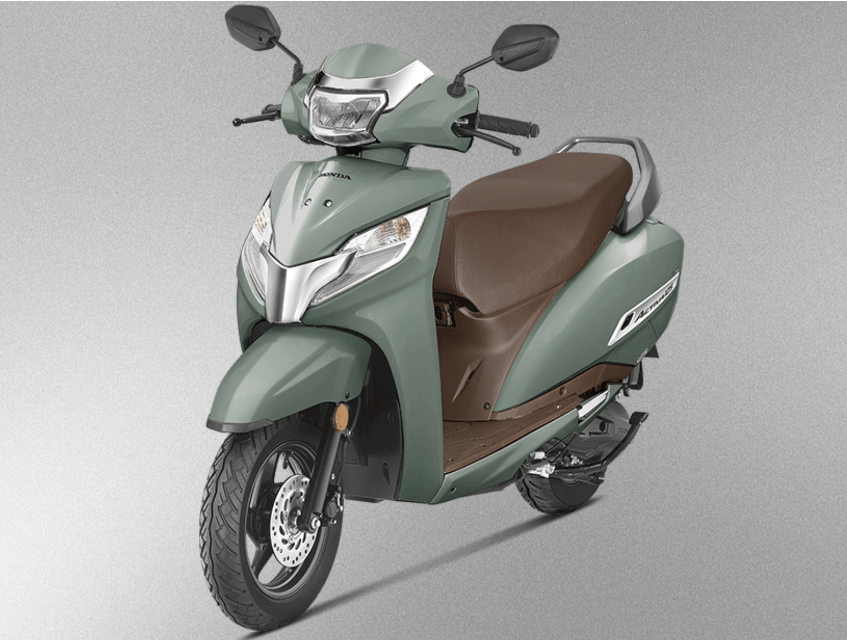
Honda Activa 125
Rs 91,178 onwards
The bigger Activa bumps up the cubic capacity to 124cc and increases the power by 0.4hp to 8.3hp and increases the torque by 1.4Nm to 10.5Nm compared to the 110, but is otherwise almost exactly the same as the 110. For that extra power and torque, the Activa 125 bumps up the prices and tops out at Rs 95,622. As such, the extra features you gain by switching to the Konarc also remain the same.
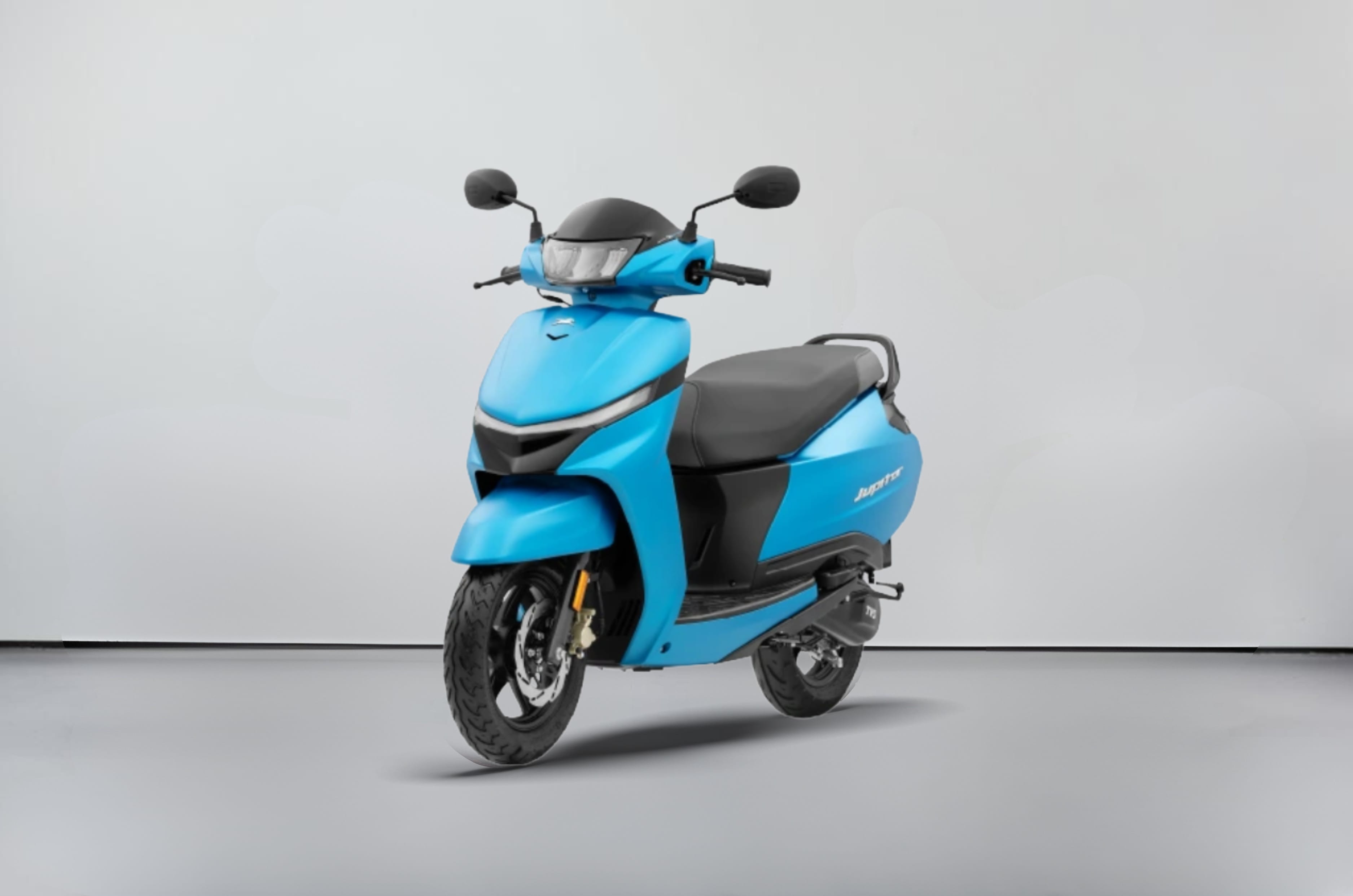
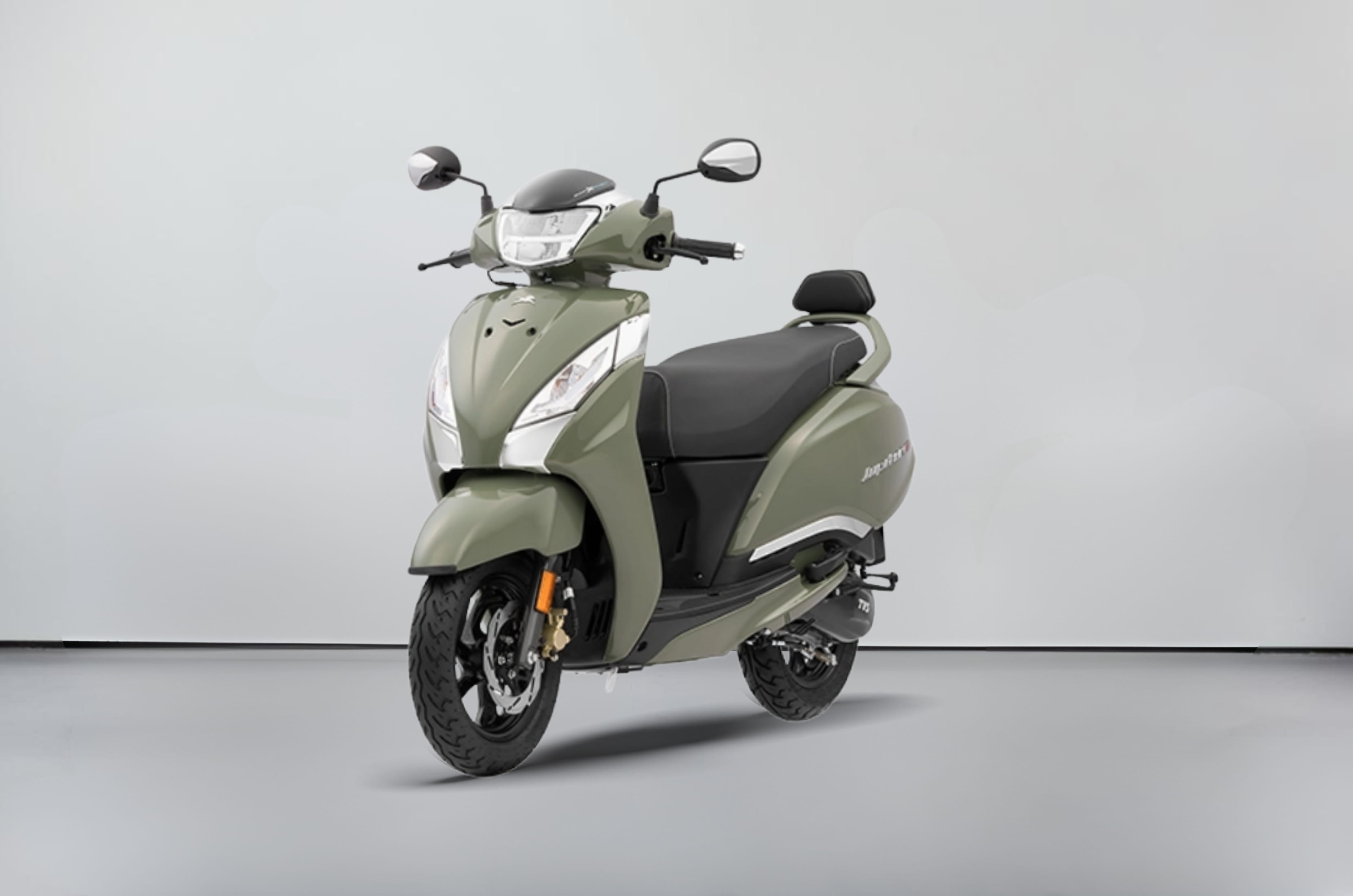
TVS Jupiter (110)
Rs 74,125 onwards
The Activa’s biggest competitor is the Jupiter which received a comprehensive upgrade in 2024. TVS gave it an all-new 113.3cc engine with 7.9hp and 9.8Nm of torque (with 0.6Nm from the ISG). It also received a much sleekier design over its predecessor. As things stand today, the Jupiter has perhaps the largest feature set of any ICE scooter. Thanks to sharing the platform with its bigger brother, the new Jupiter gets a front fuel tank, 33L under seat storage (that’s still the largest on an ICE scooter). It also gets a wide floorboard, more storage on the front apron storage, an ISG, smartphone connectivity, 12-inch wheels at both ends, a front disc brake on higher variants, and a design that’s much more modern than any of its peers. With its 57kpl fuel economy, the Jupiter also has the Activa beat with a higher 285km range. The Jupiter starts at Rs 74,125 and tops out at Rs 89,825 for the dual-tone variant.
By stepping up to the Konarc by paying an additional Rs 10,174 over the top-most variant, you gain a larger 14-inch front wheel.
TVS Jupiter 125
Rs 81,700 onwards
The bigger Jupiter unfortunately didn’t quite get the rejuvenation. It’s stuck to essentially the same design from its debut in 2021. With the larger 124.8cc engine, you get 0.5hp extra power and 1.3Nm extra torque over the 110, with the ISG’s assistance; without it, they become 0.1hp and 0.7Nm extra, respectively. Sharing the same platform means that the new 110 has caught up to most of the 125’s features. Though, you do get a TFT display on the 125’s cluster, but it isn’t adding any real value. The Jupiter 125 starts at Rs 81,700 and tops out at Rs 89,935.
By stepping up to the Konarc for approximately Rs 10,000 extra, you gain a larger front tyre.
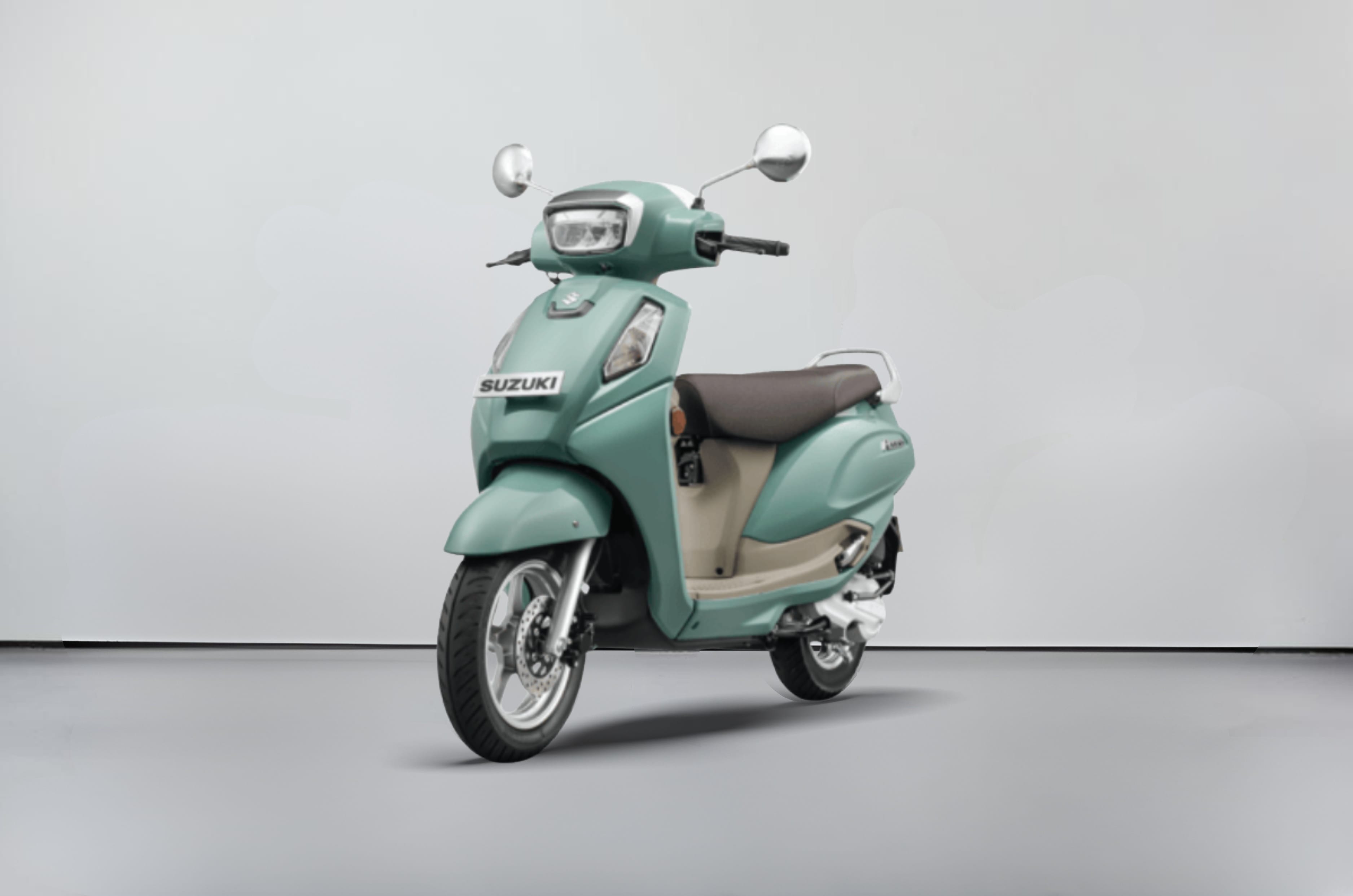
Suzuki Access (125)
Rs 82,185 onwards
The Suzuki Access has silently been one of the best-selling scooters in the family scooter segment and it received a comprehensive upgrade in early 2025. While there wasn’t a brand-new engine, Suzuki gave it a new frame and made scores of minute improvements to the engine that added up to make it a comprehensively better scooter. However, that also means there aren’t any new features to help the Access’ case. It sticks to a 12/10-inch front and rear wheel setup, a 24.4L under seat storage that now feels measly even for the ICE world. Suzuki did give it a TFT instrument cluster and single-channel ABS on the highest variant, but that’s about it. The Access starts at Rs 82,185 and will set you back by Rs 1.02 lakh for the TFT-ABS variant.
With the Ather Konarc, you will end up paying Rs 3,000 less and gain a larger 14/12-inch front and rear wheels, two ride modes, and a considerably larger 31L under seat storage but the Access is the only scooter here that offers the safety net of an ABS system.
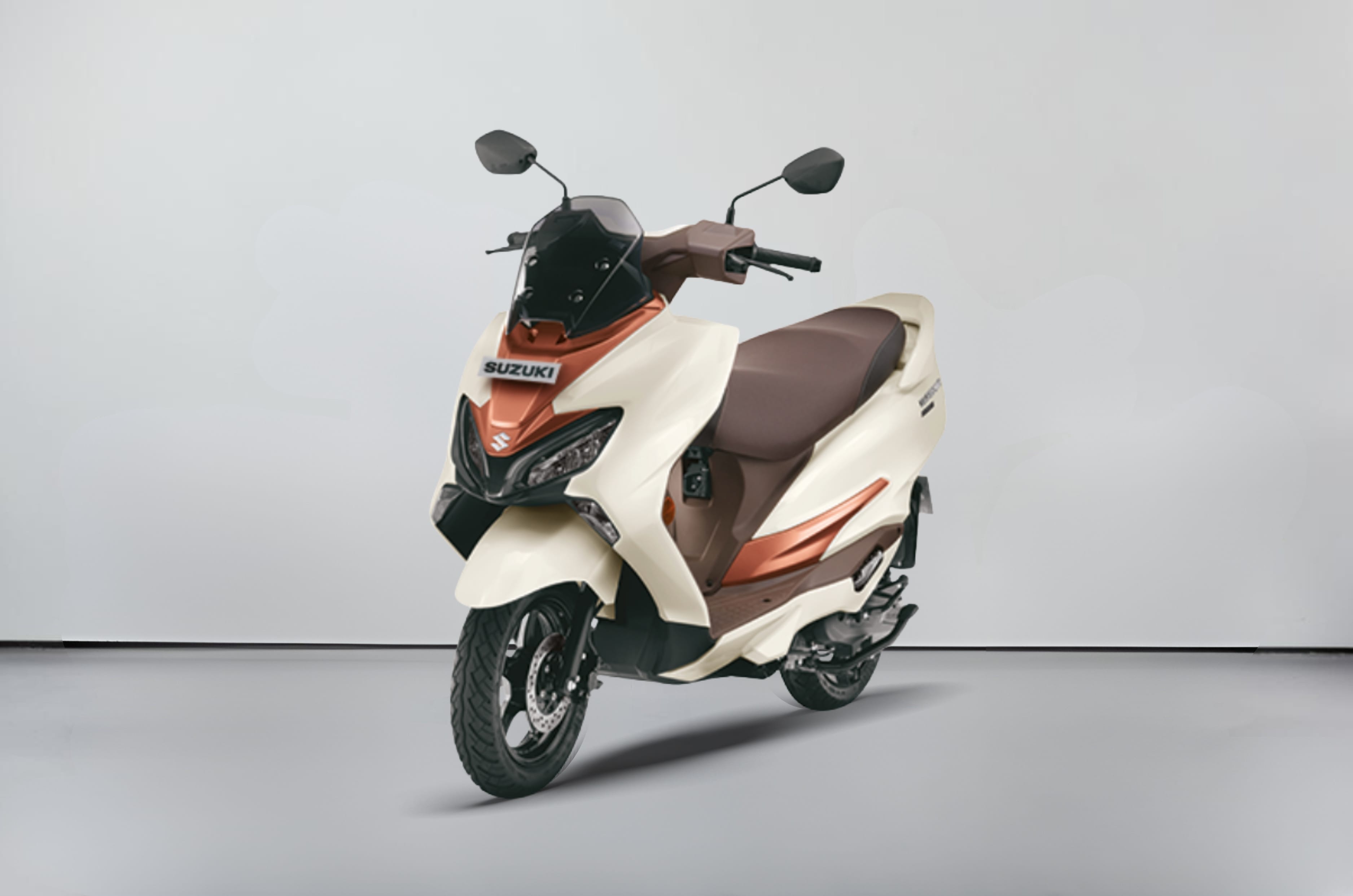
Suzuki Burgman Street
Rs 1.03 lakh onwards
The Burgman received most of the same upgrades as the Access in early 2026, with the maxi-scooter stance as its biggest differentiation. The Burgman Street exclusively gets a keyless system on the top-variant, but loses out on the single-channel ABS compared to the Access. On the dimensions front, it gets a 25mm longer wheelbase, 7kg additional weight, and 0.2 litres larger fuel tank compared to the Access. It’s also one of the two Suzuki scooters to have a 12/12-inch front and rear wheel setup in India; the older Burgman Street EX being the other one. Except for these differences and a different design, the Burgman Street shares its mechanicals and convenience features with the Access. The Burgman Street starts at Rs 1.03 lakh and the top TFT variant with the keyless system costs Rs 1.15 lakh.
By getting the Konarc instead, you end up saving about Rs 4,000 (Rs 12,000 compared to the top variant) and you gain a larger 14-inch front wheel, two ride modes, and of course, the larger 31L under seat storage.
Summary and conclusion
We understand that this article makes it seem like there’s no point in choosing the Ather Konarc in most cases; that’s not quite true. Getting an EV scooter might be the best decision for some people, especially ones with a fixed daily travel distance, living in either their own house, or a housing society that’s generous with setting up a home charger, and all the tech enthusiasts who would like to see how far EVs have come in the past few years. Just the novel riding experience of an EV might be enough to choose the Konarc for you. So, take a test ride of the Konarc S 100 when it becomes available. We’d like you to be aware of the closest ICE options, if you end up deciding the Konarc isn’t for you.
With Ather StackPro and Ather Connect subscription, the Konarc S can offer more smart features that none of the others here can hope to match, but there’s an additional price to be paid for them. Hence, if you’re after the most value for your money, there’s no question that ICE vehicles still offer more for their asking price.