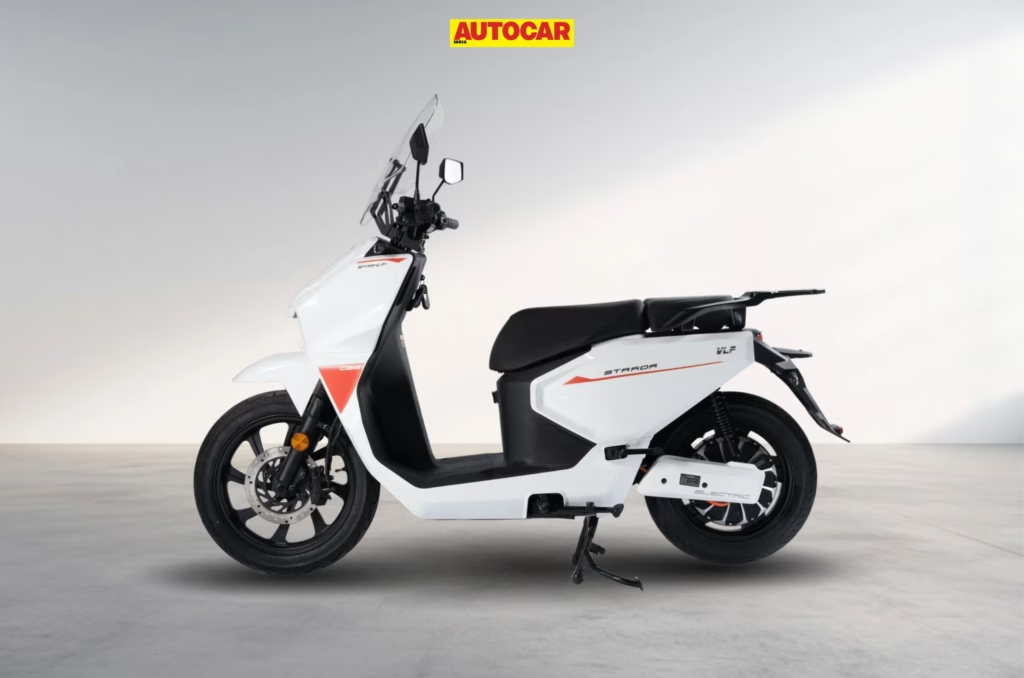
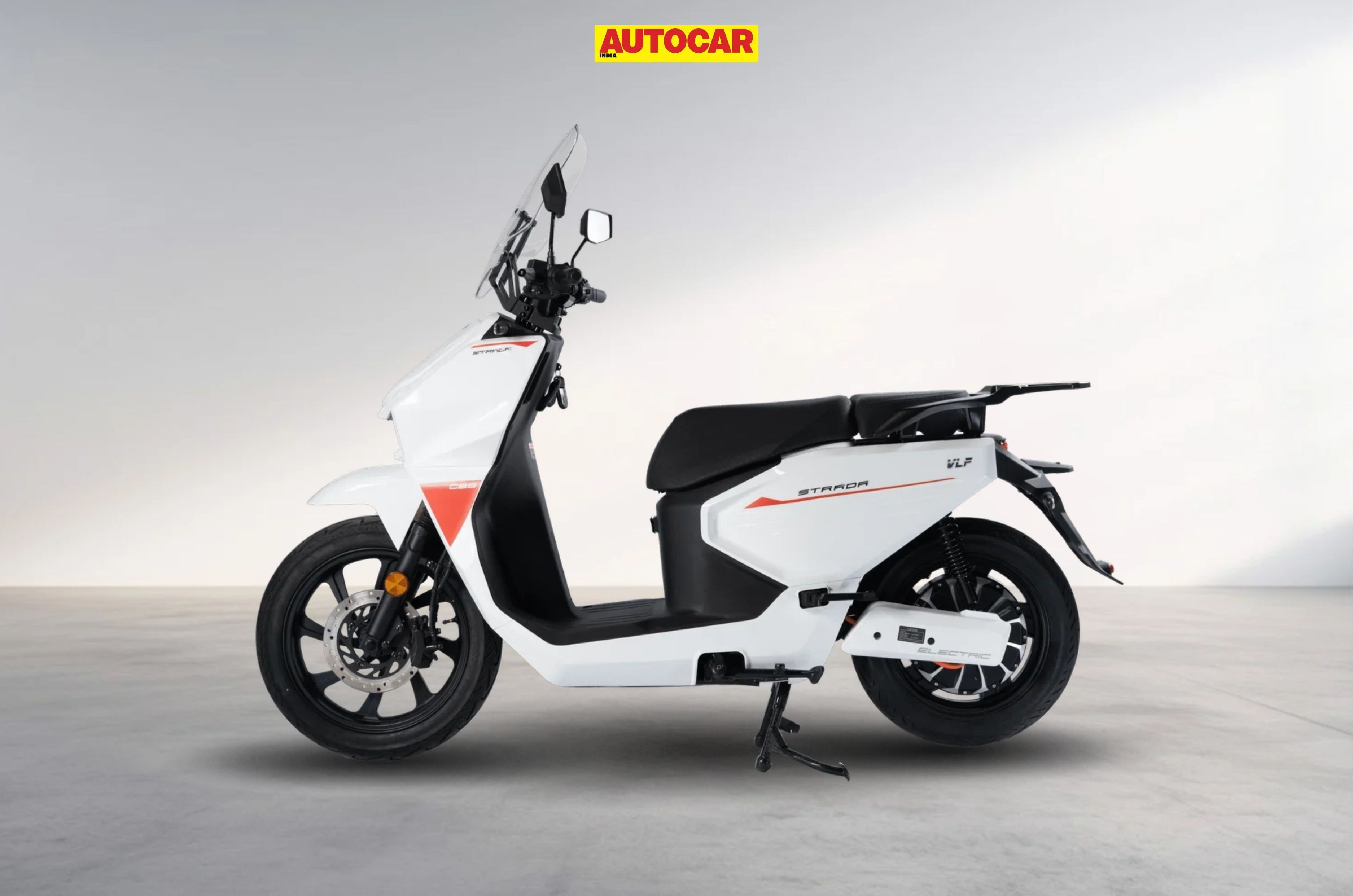
VLF (or Velocifero) is a brand with Italian heritage but manufactures its scooters in Zhejiang, China. Kolhapur-based Motohaus brought VLF to India in 2024 and manages sales and service in the country. The company has introduced a new electric scooter named Strada in two variants, priced at Rs 1.20 lakh and Rs 1.55 lakh, meant to replace the Tennis, its first launch in India.
City variant has a 2.16kWh removable battery
Max variant has two removable units with 4.32kWh total capacity
Rated top speed is 85kph in the top Sport ride mode
Bookings are open for Rs 999 for the City and for Rs 1,999 for the Max
VLF Strada details
Two variants and a shared 4.8kW BLDC motor
The Strada has two variants, City and Max, both of which share a BLDC, hub-mounted motor with 4.8kW peak power and 34Nm of peak torque; rated power is 3kW. The base City variant has a single 2.16kWh removable LFP battery, and the Max variant doubles that to two batteries with a total capacity of 4.32kWh. Both the motor and the battery units are rated for IP67 ingress protection. There are three ride modes on offer: Eco, City and Sport. Depending on the ride mode, the top speed varies as well. Eco tops out at 45kph, City at 65kph and Sport at 85kph.
The IDC range is 130km for City and 250km for Max. VLF claims the single battery system can charge from 20-100 percent in three hours, and the same takes six hours for both batteries. The company hasn’t specified the charging speed to achieve these times, nor has it mentioned the wattage of the bundled charger. We’re currently awaiting clarifications on the same.
VLF has designed the Strada with a sporty look, but the scooter’s dimensions should make it accessible to most people. It has a split-seat configuration with a seat height of 780mm without compromising on the ground clearance, which is a healthy 175mm. VLF has listed the kerb weight of the scooter at a surprisingly light 98kg, and this is likely for the City variant with the smaller battery pack. The Max variant should weigh notably more. Front and rear suspension units are par for the course, with a 31mm telescopic fork and a preload-adjustable twin shock.
Tyre size is an area where the Strada stands out, quite literally, with a 16-inch front wheel and a 14-inch rear. In the scooter segment, most options tend to stick to 10-14-inch tyres, and therefore this is certainly an interesting move from VLF. Larger tyre sizes are associated with more stable rides as well, so it remains to be seen how the Strada does on that front. Stopping the scooter are a 240mm front disc and a 220mm rear disc. There’s no ABS, but a combined braking system (CBS) is standard.
Features include a 5-inch TFT display, all-LED lighting with dual-projector headlights, an integrated windshield, a keyless ignition system and an integrated luggage rack. There are four colour options on offer: Carbonio Black, Luna White, Titanio Grey and Urbano Silver. VLF also showcases pictures of a pannier mounted on the rack, so it’s likely that an accessory line-up is on the cards.
Priced at Rs 1.20 lakh for the City variant and Rs 1.55 lakh for the Max variant, the VLF Strada is a rival to established models such as the TVS iQube 2.2 (Rs 1.16 lakh), TVS Orbiter V1 (Rs 1.01 lakh), Chetak C2501 (Rs 99,802), Ather Konarc (Rs 99,999) and Vida VX2 Go 2.2 (Rs 99,999). VLF Strada is already available on Motohaus’s Indian website, with bookings open for Rs 999 for City and Rs 1,999 for Max.
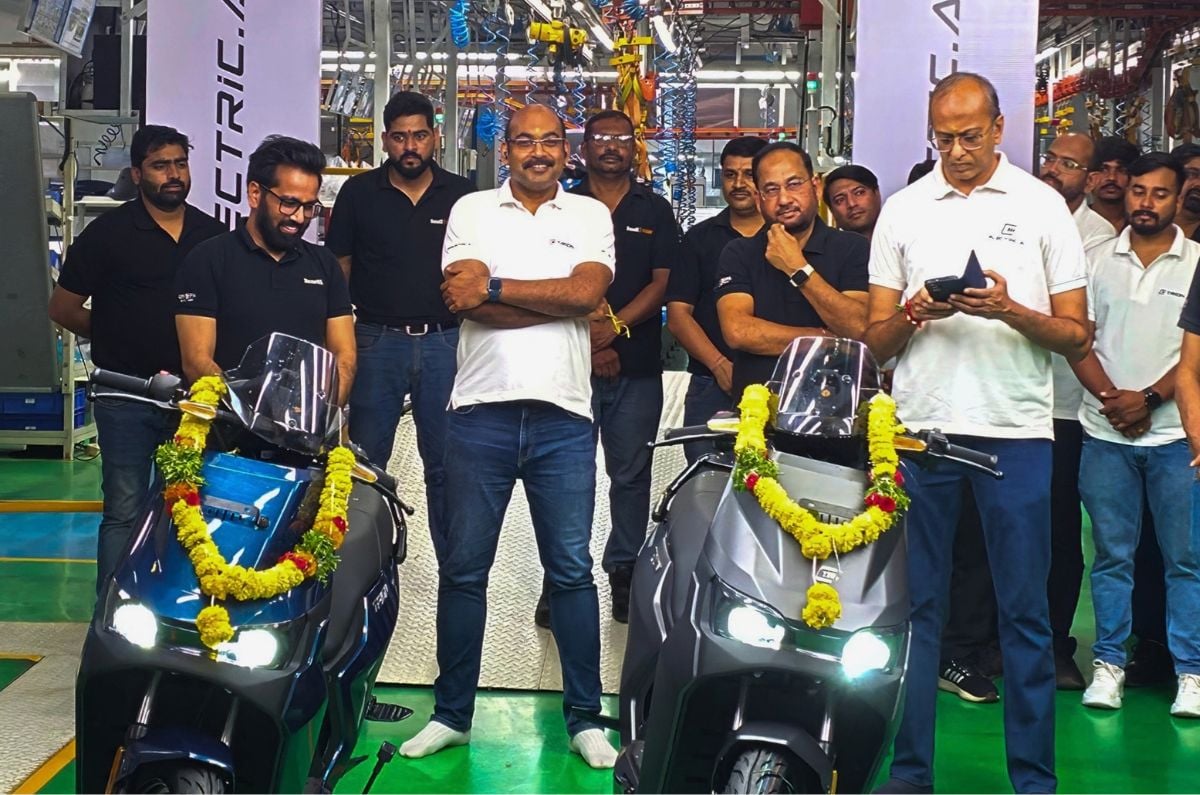
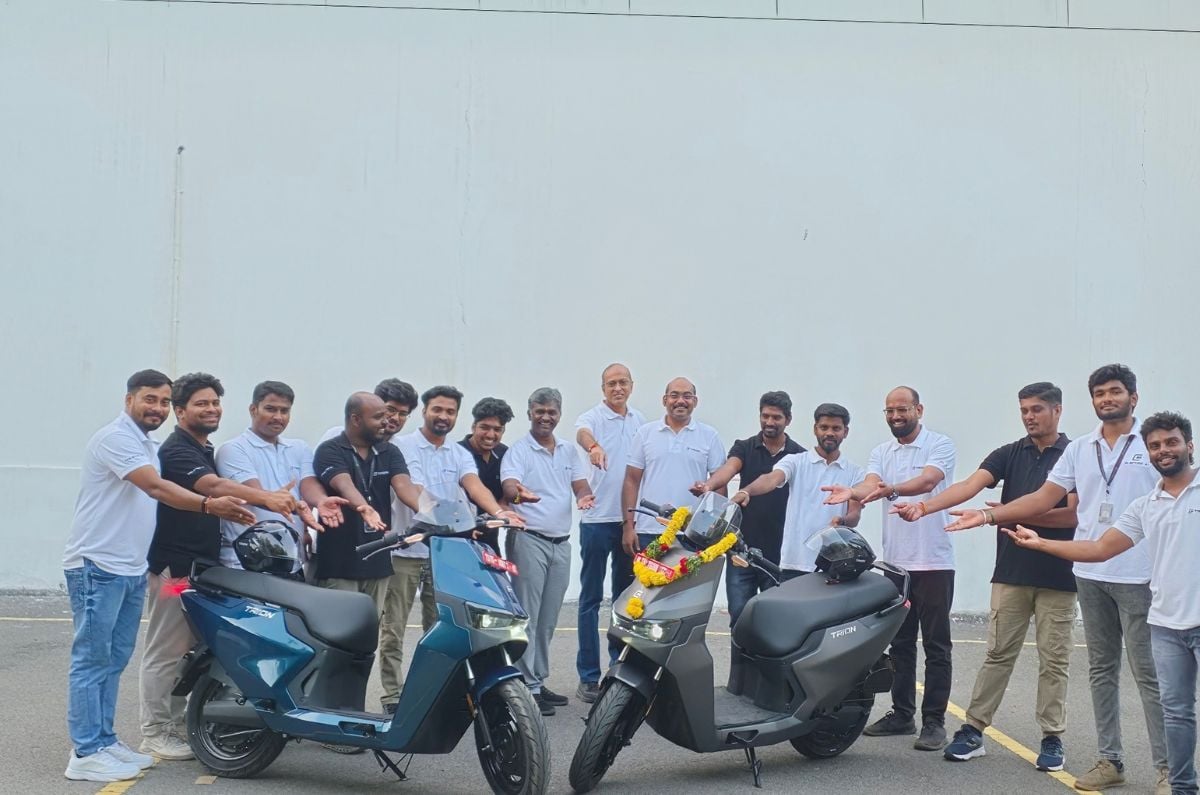
Bengaluru-based electric mobility startup E3 Electric.Ai has started production of the E3 Trion electric scooter at its Hyderabad manufacturing plant and it will begin deliveries from today onwards.
Available in two battery pack options across three variants
The first 100 customers will receive optional extended warranty at an additional cost
Prices start at Rs 1 lakh and go up to Rs 1.20 lakh (ex-showroom Bengaluru)
E3 Trion details
Offered in 2.3kWh and 3kWh battery packs, with up to 165km IDC range
The E3 Trion is offered in three variants: C1, C1X and C2 and deliveries for the variants will begin in a phased manner. Across the three variants, the scooter will be available in two battery pack options 2.3kWh and 3kWh. The base C1 is offered in the 2.3kWh battery pack which is removable, whereas the C1X and C2 will comprise the 3kWh fixed battery pack. The C1, C1X and C2 have a claimed IDC range of 108km, 165km and 128km respectively. The scooters will feature 14-inch wheels at both ends
The first 100 E3 Trion customers will receive an extended warranty covering the battery pack and specified key parts for eight years or 1 lakh kilometres, whichever comes first. They will also receive one year of E3 Wingman roadside assistance as well. The combined offering is valued at Rs 6,500 for the C1 with its 2.3kWh battery and Rs 8,500 for the C1X and C2, which uses a 3kWh battery.
With pricing starting at Rs 1 lakh for the base C1, Rs 1.10 lakh for the C1X, and Rs 1.20 lakh for the top-spec C2 variant, the E3 Trion goes head-to-head with established family scooters like the Bajaj Chetak, TVS Orbiter V2, TVS iQube 3.1kWh, Ampere Nexus EX+, and Ather Konarc.
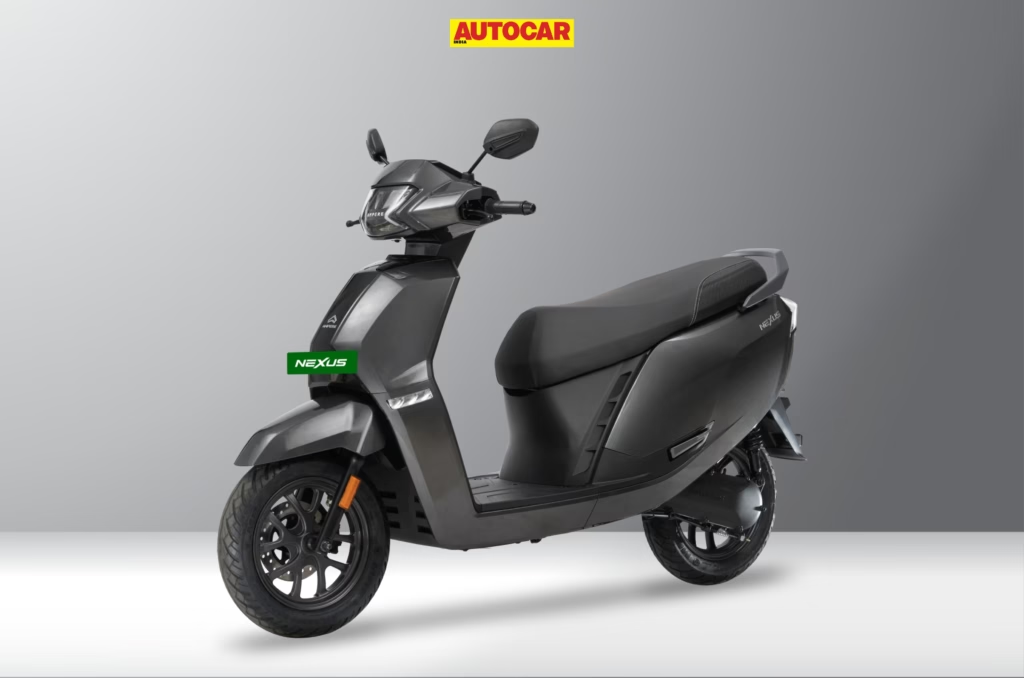
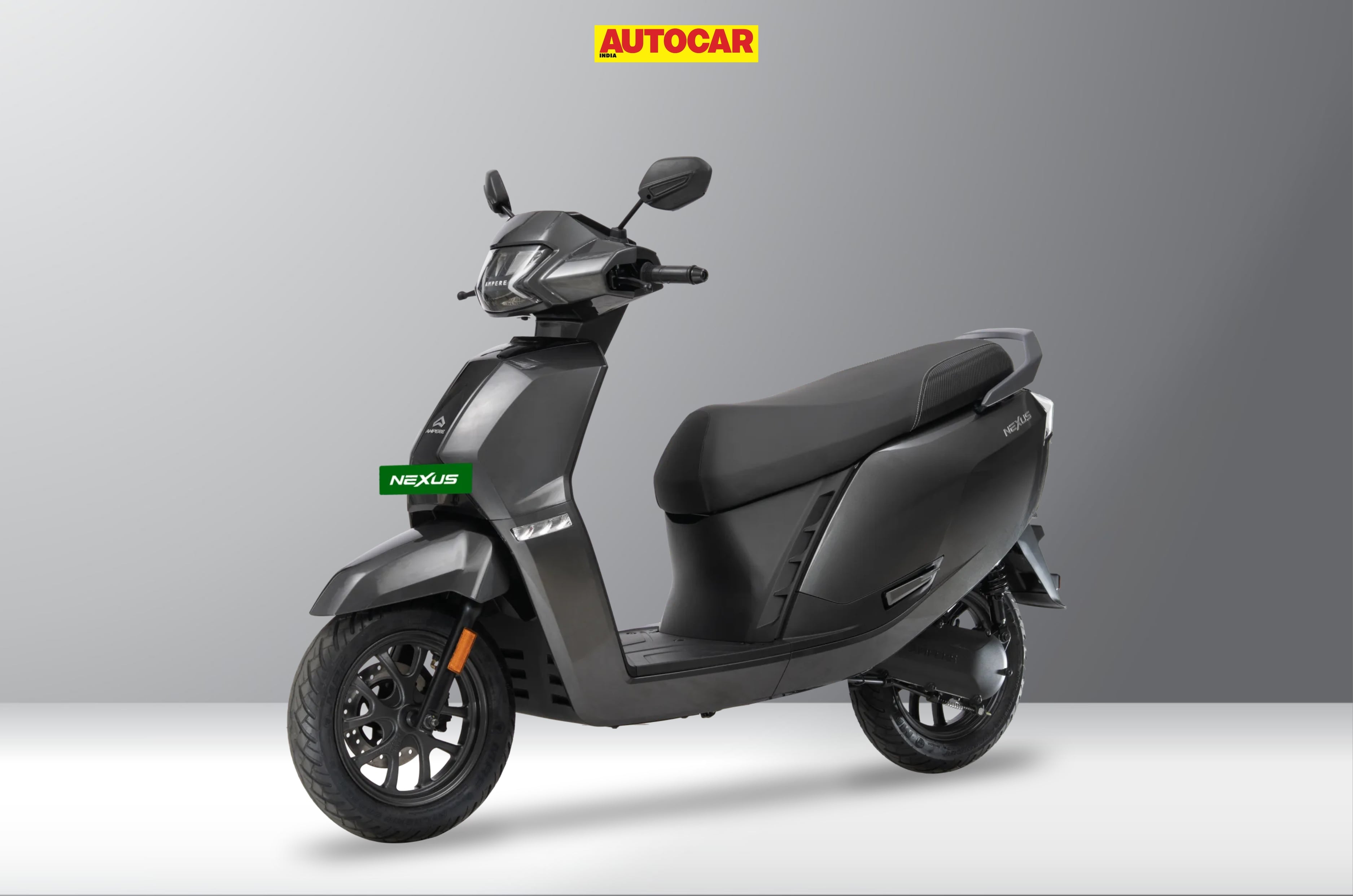
Ampere has launched the Nexus EX+ at Rs 1.30 lakh, the electric scooter’s updated version, featuring a more powerful 5kW motor and an IP65-rated water-resistant charger. The e-scooter is available in two variants, with the higher-spec variant adding Ampere’s Intellipack connected technology, which brings features such as turn-by-turn navigation, geofencing, call alerts and more.
EX+ gets a 5kW motor compared to the previous 4kW motor
Now comes with an IP65-rated 750W charger
Intellipack-equipped variant costs Rs 6,000 more
Ampere Nexus EX+: What’s new?
Now gets a powerful motor, IP65-rated charger and an optional Intellipack
The 5kW motor now produces 202Nm of peak torque at the wheel (bear in mind, the multiplication factor of the gearing on EVs always exaggerates torque numbers), which allows the scooter to accelerate from 0-40kph in 4.5 seconds (claimed). It is also claimed to improve the gradeability on steep climbs, flyovers and hilly roads. The scooter also gets an IP65-rated water-resistant 750W charger, which should give some peace of mind when charging out in open spaces or for those who don’t have shaded parking.
The Intellipack equipped version uses Ampere’s Connect App to provide more than 30 connected features. These include turn-by-turn navigation, geo fencing, call alerts, live location sharing, real-time charging status, find my scooter and many more. The standard Nexus EX+ is priced at Rs 1.30 lakh, while the Nexus EX+ with Intellipack costs Rs 1.36 lakh.
The scooter uses a 3kWh LFP battery with a claimed IDC range of 136km. The Nexus EX+ also gets a five-year/75,000km warranty for the battery and three-year/30,000km warranty for the rest of the scooter. The new Nexus EX+ and Nexus EX+ with Intellipack are available through Ampere dealerships across India.
Earlier, the Nexus was available in two variants EX and ST with their primary differences being the instrument clusters, connected features, and price points. Now, Ampere seems to have streamlined the portfolio and the two EX+ variants are the only way to buy a Nexus.
The Nexus EX+ is positioned in the mid-to-high segment of family electric scooters, where it competes with other major players like the TVS iQube 3.1kWh, Ather Konarc, Vida VX2 and the Chetak C3001, making it one of the compelling option for buyer prioritizing range and features.
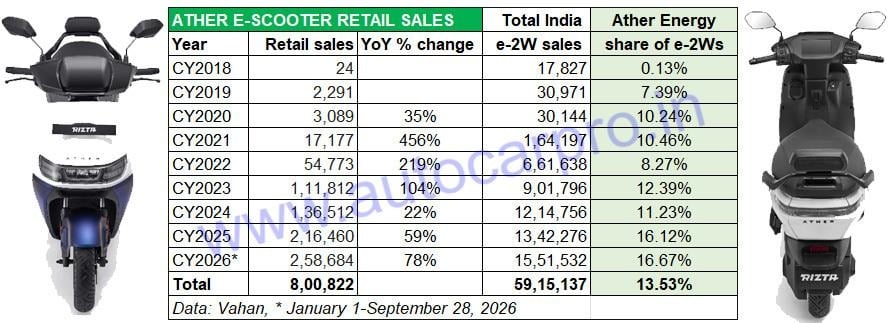
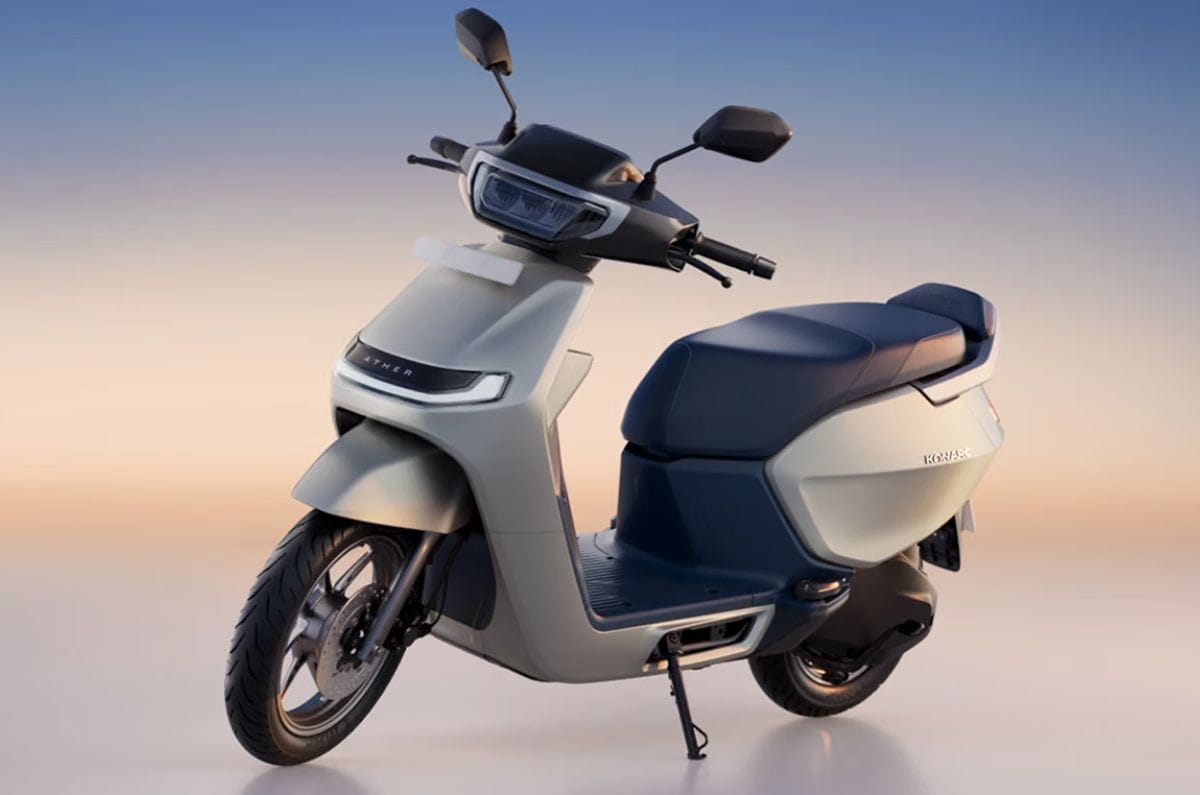
Ather has become the fourth Indian electric two-wheeler manufacturer to attain cumulative retail sales (customer deliveries) of over 8 lakh units. As per the data available on the Vahan portal, the Bengaluru-based company crossed the milestone on September 28, 2026.
Ather has delivered 4.75 lakh scooters since January 2025
217 units of the Konarc sold in its first month
Rizta currently leads Ather’s sales, but Konarc is expected to eat into it
Ather is the fourth Indian e2W maker to cross 8 lakh units in sales
59 percent of its sales came since 2025
Other EV manufacturers to sell over 8 lakh scooters are Ola, TVS and Bajaj via Chetak. While Ola crossed 10 lakh sales in March this year, TVS raced past Ola in August to become India’s second EV manufacturer to sell 10 lakh scooters. Bajaj crossed the 8 lakh sales milestone in June. Except Ola, the other three manufacturers mentioned above have maintained a steady pace of growth so far.
As the retail statistics reveal, Ather’s growth has taken off in the past four years, with sales accelerating since 2025. Between January 2025 and September 28, 2026, Ather delivered 4.75 lakh scooters, which means that 59 percent of the brand’s total sales have come in the past 21 months, led by its flagship, the Rizta family e-scooter. The company launched Konarc on August 29.
In 2023, when Ather’s retail sales crossed the 1 lakh mark, its market share jumped to 12 percent. In 2024, it clocked 1.36 lakh units and an 11 percent market share. Ather achieved its highest-ever monthly sales in March this year with 36,633 units. It also crossed the 30,000-unit sales mark four times in the past year (since October 2025).
In August, Ather dispatched 29,694 e-scooters to its dealers across India. This marked the third-highest monthly wholesales for the company after June and July, respectively. While the Rizta accounted for 76 percent of those sales and the 450 series 23 percent, the new Konarc sold 217 units in its first month.
The Konarc strategically targets the mainstream mass-market scooters like the TVS iQube, Orbiter, Bajaj Chetak, Hero Vida VX2, Simple Wave and the new Ola S1 Z. It will likely take some sales away from the Rizta. However, Ather appears to be fine with that since the Konarc gives it a higher margin than the Rizta, as per chief business officer Ravneet Phokela. Rather than competing with existing e-scooters, Ather will try to convince more ICE scooter owners to buy the Konarc instead, Phokela had added. With its momentum, Ather could end the year with total sales of 3.5 lakh units.
While the Indian manufacturers have been quick to capitalise on the EV boom, the Japanese have been rather more measured in their approach. Honda arrived in 2025 with not one but two in-house electric scooters, though both had unique limitations that prevented them from succeeding.
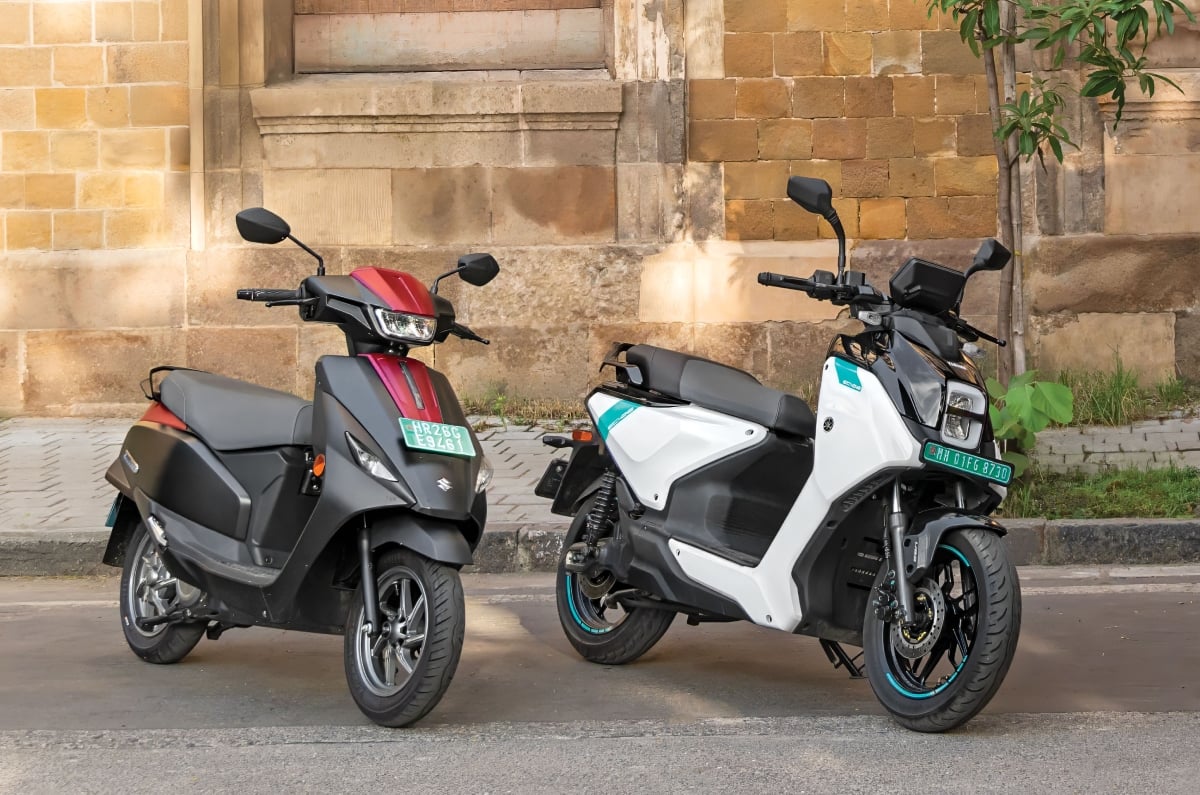
Suzuki, like Honda, chose to develop its own platform from scratch, but its e-Access appears expensive for what it offers. Yamaha, meanwhile, took a markedly different route for its more affordable offering and partnered with an Indian startup. The EC-06 is, in essence, a more expensive River Indie in sharper clothes.
So if you’ve been waiting for a Japanese e-scooter, you now have two choices, but like their very different inceptions, both also offer you two very different flavours of electric scooter. The question, then, is which one deserves your money – and whether either deserves it over the competition.
Not hiding in plain sight
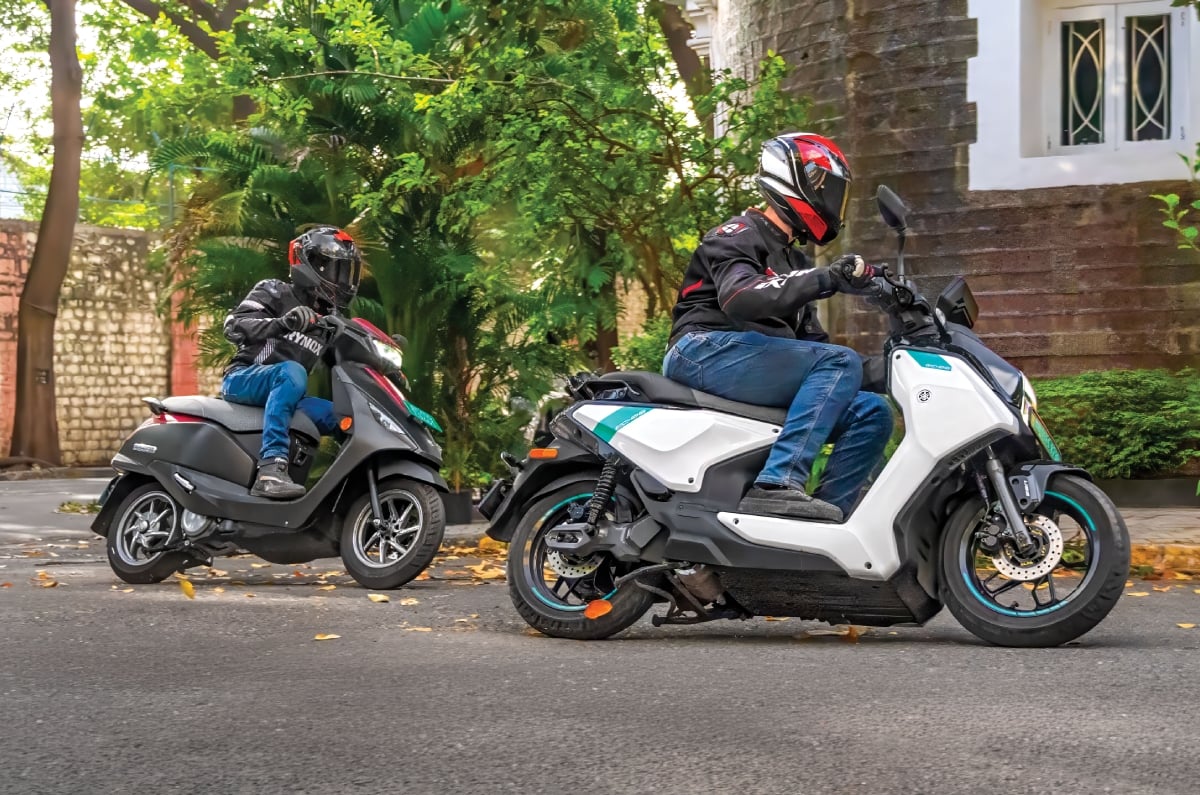
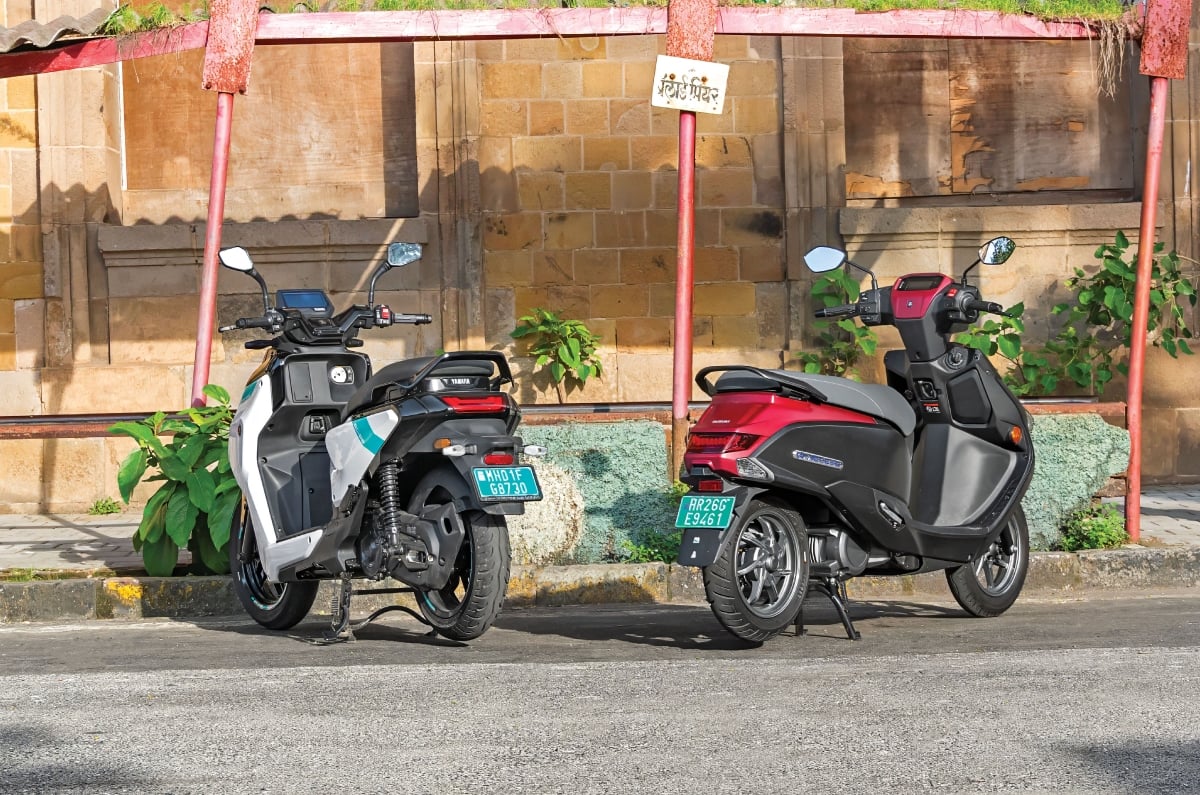
Subtle, these scooters are not. Both take distinctly left-field approaches to styling and will stand out from the crowd. Over the fortnight we spent with them, the EC-06 consistently drew more positive attention thanks to its chunky, squared-off proportions. The e-Access found its niche too, though its double duck-bill nose, flowing front panels with a contrastingly boxy tail make it more of an acquired taste.
Yamaha EC-06
Suzuki e-Access
Kerb weight
132kg
122kg
Seat height
770mm
765mm
Underseat storage
24.5 litres
17 litres
Ground clearance
145mm (laden)
160mm (unladen)
Climb aboard and their personalities diverge further still. The e-Access feels more like a conventional scooter. Despite its compact dimensions, it never feels cramped, even for taller riders, while its 765mm seat height makes it instantly approachable for shorter ones.
The EC-06, by comparison, feels a size larger. Its riding triangle is noticeably roomier, which taller riders will appreciate in a segment that seldom caters to them. Yet, with a friendly 770mm seat height, it remains fairly unintimidating for shorter riders. In fact, tall riders will want a higher seat.
Different strokes
The riding experience of both also reflects two very different engineering philosophies. The 122kg e-Access feels exceptionally light on its feet; whether wheeling it around a parking space or flicking it into a bend, it responds eagerly – actually, a bit too eagerly. Some of that can be attributed to Suzuki mounting the battery pack vertically beneath the seat, a decision that, as you will read further on, has implications elsewhere too.
Yamaha EC-06
Suzuki e-Access
Battery capacity / chemistry
4kWh / NMC
3.072kWh / LFP
Motor
Permanent Magnet Synchronous
Permanent Magnet Synchronous
Power
6.7kW
4.1kW
Torque
26Nm
15Nm
Like the latest Burgman, its ride also errs towards the firmer side rather than the plush feel of a TVS iQube. It isn’t uncomfortable by any means, but it is something worth paying attention to on a test ride. Taller riders will also discover the Suzuki’s compactness during full-lock U-turns, where their knees will foul the handlebar.
On the flip side, the EC-06 is relatively heavier and slower to steer, but it’s a small tradeoff. That’s because its larger 14-inch wheels lend it greater stability at faster speeds and also help it dismiss broken roads with admirable composure. Its absorptive suspension also factors in here, though particularly sharp impacts can provoke a slight judder in the fork.
E-Access has the more flighty, energetic demeanour, whereas the EC-06’s handling is more sure-footed.
The Yamaha’s seat, however, leaves quite some room for improvement. Its forward-sloping shape constantly makes you slide forward, necessitating frequent shuffling about. The padding is also too soft, and after just 30 minutes or so, you find yourself sinking into the seat pan. This results in a gradually more knees-up riding position, which might sound like a trifling problem at first but one that becomes increasingly apparent over longer journeys.
Neither one gets ABS, which feels like quite an egregious oversight considering their price points. Nevertheless, the Yamaha’s brakes inspire greater confidence because they are powerful without being overly aggressive, and its wider tyres also provide better traction. The Suzuki’s brakes, conversely, are almost too sharp. On Mumbai’s slippery concrete roads, they demand a more measured touch when coming to a halt quickly.
Not that you’ll often rely heavily on them. That’s partly down to the well-calibrated regenerative braking system and partly because the e-Access’ performance is quite unremarkable. Not only is it much slower than the EC-06, but it also feels noticeably less eager than the petrol-powered Access. It’s perfectly usable in the city, but on faster roads, overtakes require planning. Unsurprisingly, the Yamaha feels considerably livelier. It accelerates with genuine enthusiasm in its top Power mode, the regenerative braking is seamlessly calibrated in all 3 modes (Standard and Eco being the other two) and, despite using chain drive, its drivetrain is remarkably silent – akin to a hub-mounted motor.
Feel Good (?) Features
Build quality on both is reassuringly solid and exactly what one expects from the Japanese. At these prices, however, there are a few omissions that are difficult to overlook.
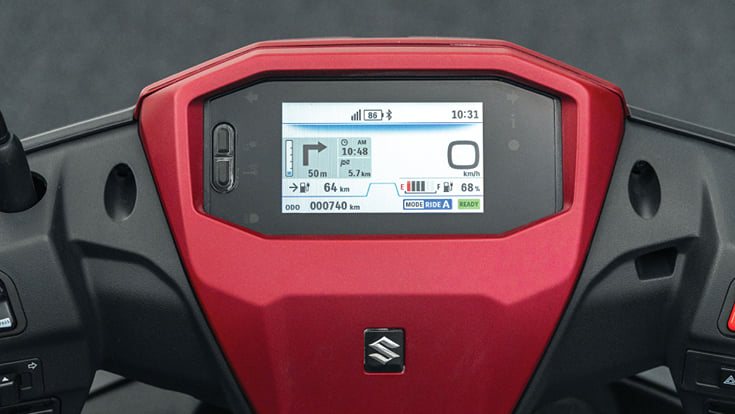
The e-Access employs the same TFT display found on the ICE Access 125 and Burgman, both of which cost substantially less. Yamaha, meanwhile, supplies only the slower 480W charger, despite the considerably more affordable River offering a faster 750W unit as a Rs 3,000 option.
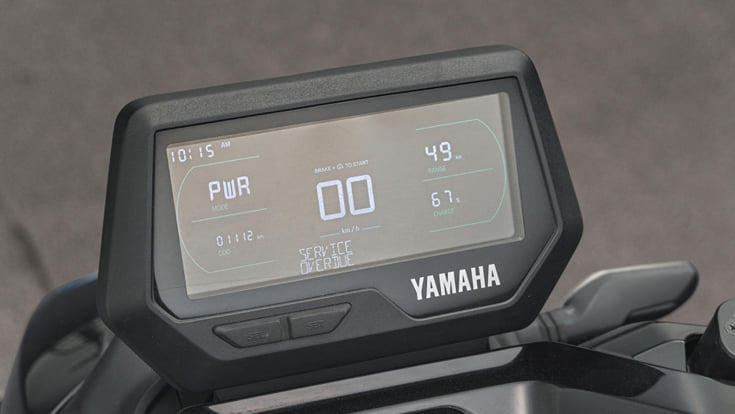
Same TFT as ICE Access; EC’s negative LCD is simpler but well laid out.
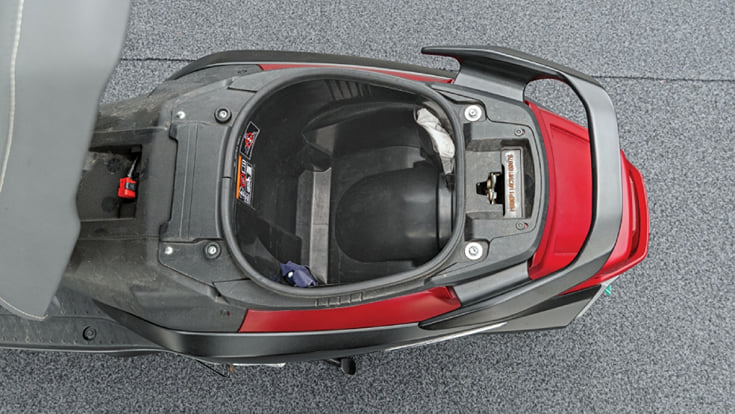
The EC-06 also sacrifices a lot of storage compared to the Indie. Its 24.5-litre under-seat boot is far short of the latter’s enormous 43-litre boot and trails established rivals such as the iQube, Rizta and Chetak. The River’s lockable 12-litre glovebox has been omitted too, though Yamaha has used this to reposition the charging port to a more convenient location.
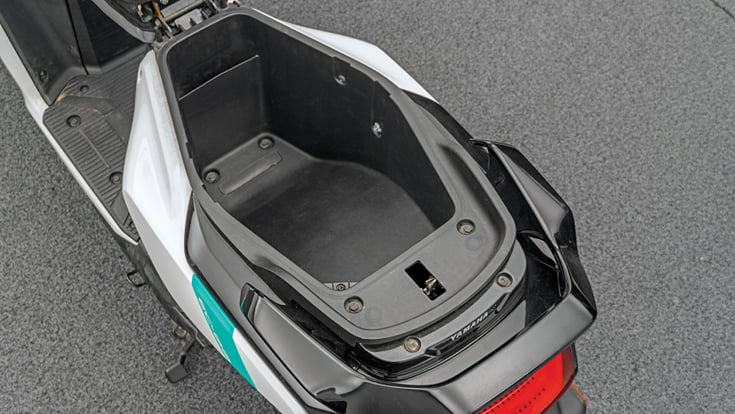
e-Access’ 17L boot far too small and oddly shaped; Yamaha’s 24.5L boot is more usable but not segment-leading.
If the Yamaha’s storage is merely average, the Suzuki’s is positively outclassed. The battery’s position beneath the seat results in just 17 litres of bootspace – roughly half what you’ll find on rivals like the Rizta and Chetak. In fact, even the ICE Access 125 offers you quite a bit more storage space. The e-Access’ boot is also shaped quite awkwardly, and unless the charger’s cables are folded with almost Victorian precision, it simply refuses to fit.
Range Rovers?
An electric scooter ultimately needs to deliver one thing above all else – promising range to reduce your running costs. In Ride A mode, which delivers full performance and max regen, the e-Access covered a little over 88km in our range test. Given its smaller 3kWh battery and its use of safer, but less energy-dense, LFP chemistry, the result is respectable in isolation; however, compared to the market’s front-runners, it falls far short.
Yamaha EC-06
Suzuki e-Access
0-40kph
3.46s
4.94s
0-60kph
6.82s
11.93s
Roll-on Acceleration
20-50kph
3.31s
5.46s
30-70kph
7.34s
17.01s
50-80kph
10.96s
–
Our test on the EC-06 was conducted in its middle Standard mode, which retains full performance but softens throttle response compared to Power mode. It covered 114km, comfortably exceeding the distance initially predicted. Both scooters deserve praise here, as their range indicators proved refreshingly honest, not indulging in optimistic guesswork.
Yamaha EC-06
Suzuki e-Access
60-0kph
22.87m
24.64m
Using Eco mode will naturally extend the range on both, though with reduced acceleration and lower top speeds. Thankfully, neither becomes painfully slow. Even in Eco, both climb flyovers and keep up with city traffic without reducing themselves to rolling roadblocks.
While the Yamaha’s range is undoubtedly more impressive, its charging time is a rather different story. The supplied 480W charger requires a glacial ten hours to replenish a flat battery. Meanwhile, the Suzuki’s 600W unit requires around six hours to do the same, although its battery pack is also smaller.
One thoughtful detail both manufacturers deserve credit for is the inclusion of a dedicated charger bag. It is a small touch, but one that should help protect the charger from spending years rattling around inside the boot.THE BIGGER PICTURE
Judged purely against each other, the result is straightforward – the EC-06 clearly wins. It offers superior performance, greater comfort, longer range and also costs much less than the e-Access.
Yamaha EC-06
Suzuki e-Access
Price (ex-showroom, Bengaluru)
Rs 1.71 lakh
Rs 1.92 lakh
However, if you zoom out and look at the broader market, the context changes. At Rs 1.71 lakh, the Yamaha is hardly inexpensive, and the Suzuki, which is knocking on the door of Rs 2 lakh, is even worse off. When proven alternatives from TVS, Ather, Bajaj, Vida and River offer similar or even superior alternatives for substantially less money, the Japanese appear more like fringe players and less like mainstream contenders.
There will undoubtedly be a small demographic of buyers for whom a Japanese badge carries enough cachet to justify this big premium. However, for the rest of us, the more keenly priced and proven homegrown contenders are the better bet.
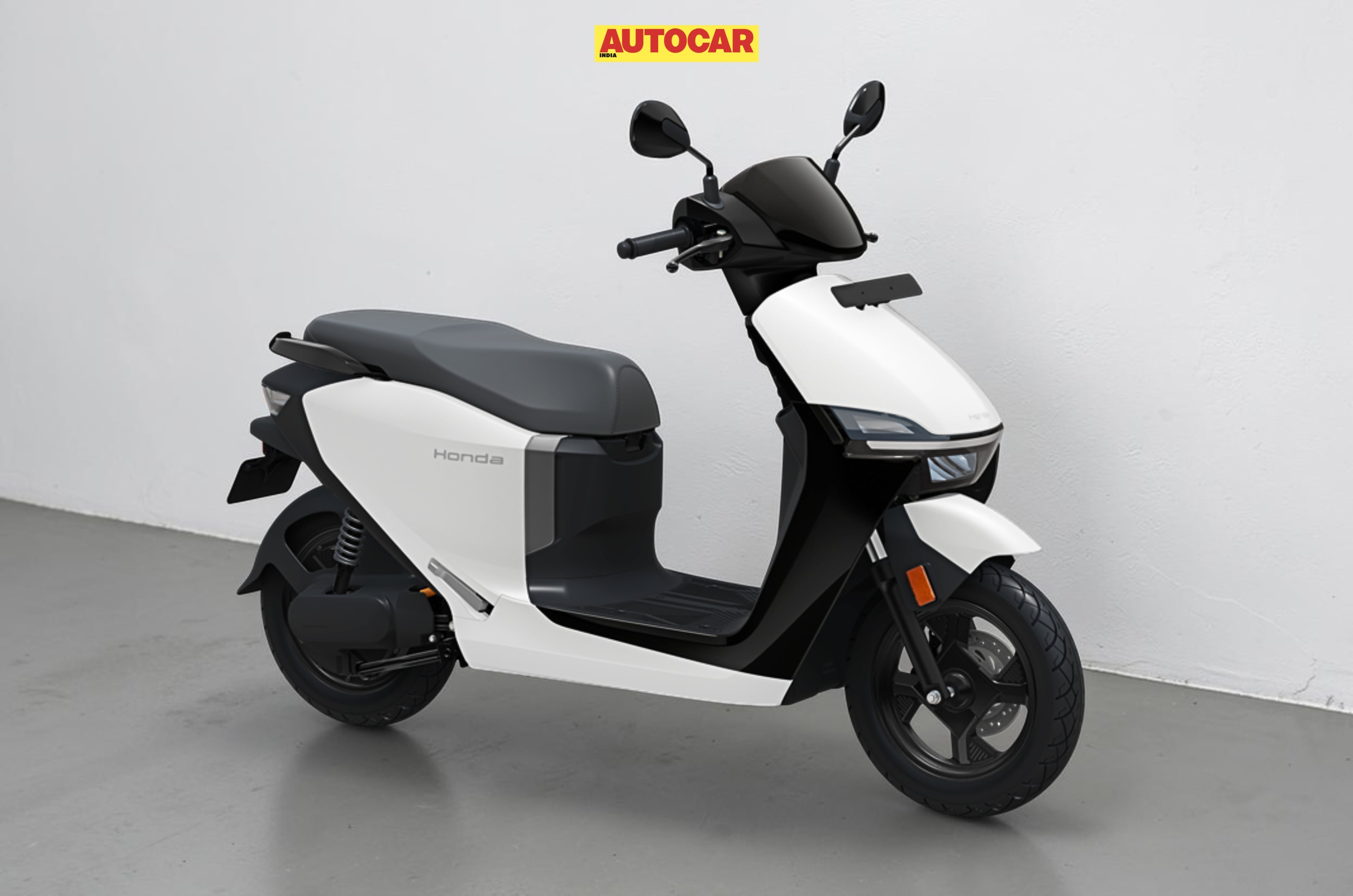
Honda QC3 Electric Scooter: Honda ने भारत में 1.35 लाख रुपये की कीमत पर QC3 इलेक्ट्रिक स्कूटर लॉन्च कर दिया है, जो उसकी बढ़ती EV रेंज में एक नया मॉडल है। QC3 में 3kWh की बैटरी और 145km की IDC रेंज के साथ-साथ सीट के नीचे 32-लीटर का स्टोरेज और 5-इंच का TFT डिस्प्ले दिया गया है। होंडा के लिए, यह नया स्कूटर ‘Activa e’ से अलग है क्योंकि इसमें स्वैपेबल सेटअप के बजाय फिक्स्ड बैटरी का इस्तेमाल किया गया है।
बता दें कि Honda QC3 को सबसे पहले पांच शहरों में पेश किया जा रहा है, इसलिए शुरुआत में इसकी उपलब्धता सीमित रहेगी। फिलहाल, QC3 की 5,000 रुपये में बुकिंग शुरू हो गई है, और कंपनी की योजना है कि इस स्कूटर की पहुंच को धीरे-धीरे बढ़ाया जाए।
Honda QC3 Electric Scooter: कीमत और उपलब्धता
Honda QC3 की कीमत 1.35 लाख रुपये (एक्स-शोरूम, नई दिल्ली) है। इसकी बुकिंग Honda की वेबसाइट और चुनिंदा RedWing डीलरशिप पर 5,000 रुपये में शुरू हो गई है। लॉन्च के समय, यह स्कूटर दिल्ली, आगरा, कटक, सूरत और कोल्लम में बेचा जाएगा। Honda ने कहा है कि इसे धीरे-धीरे और शहरों में भी उपलब्ध कराया जाएगा।
यानी QC3 को भले ही देश में लॉन्च कर दिया गया है, लेकिन इन पांच शहरों के बाहर रहने वाले ग्राहक फिलहाल Honda डीलरशिप पर जाकर इसे खरीद नहीं सकेंगे। शुरुआत में सीमित शहरों में उपलब्धता इस इलेक्ट्रिक स्कूटर की लॉन्चिंग का एक अहम हिस्सा है।
Honda QC3 Electric Scooter: 3kWh बैटरी, 145km रेंज
QC3 इलेक्ट्रिक स्कूटर में 3kWh का बैटरी पैक लगा है और इसकी IDC रेंज 145km बताई गई है। Honda का कहना है कि इसे 0 से 80% तक चार्ज होने में लगभग 2 घंटे 40 मिनट लगते हैं, जबकि पूरी तरह चार्ज होने में लगभग चार घंटे का समय लगता है।
Honda QC3 Electric Scooter: 32-लीटर स्टोरेज
QC3 की खासियतें काफी आसान और काम की हैं। इसमें सीट के नीचे 32 लीटर का स्टोरेज और स्मार्ट की (Smart Key) मिलती है। इसका इंस्ट्रूमेंट कंसोल 5-इंच का TFT यूनिट है, जिसमें Honda RoadSync कनेक्टिविटी और टर्न-बाय-टर्न नेविगेशन की सुविधा है। यह स्कूटर चार कलर ऑप्शन में उपलब्ध है। इनमें Matt Photon Gray Metallic, Pearl Precious White, Pearl Shallow Blue और Pearl Siren Blue शामिल हैं।
Honda QC3 Vs TVS iQube
Honda QC3 का मुकाबला शहरों में इस्तेमाल होने वाले इलेक्ट्रिक स्कूटर से होगा। इस सेगमेंट में TVS iQube के अलावा Bajaj Chetak और Ather Rizta जैसे मॉडल भी शामिल हैं। Honda QC3 की खास बातों में 1.35 लाख रुपये की कीमत, 3kWh बैटरी, 145 किलोमीटर की IDC रेंज और 32 लीटर का स्टोरेज शामिल है।
हालांकि, इलेक्ट्रिक स्कूटर खरीदते समय सिर्फ रेंज का आंकड़ा देखना काफी नहीं होता। चार्जिंग की सुविधा, रोजाना इस्तेमाल में मिलने वाली वास्तविक रेंज, स्टोरेज स्पेस, आपके शहर में उपलब्धता और ऑन-रोड कीमत जैसे कई दूसरे फैक्टर भी जरूरी होते हैं। इन्हीं चीजों के आधार पर ग्राहक Honda QC3 की तुलना TVS iQube और दूसरे इलेक्ट्रिक स्कूटरों से कर सकते हैं।
Honda has launched the QC3 at Rs 1.35 lakh, its third electric scooter for India after the QC1 and the Activa e:. The family EV scooter will have a 3kWh battery that can charge to full in approximately four hours, with a zero to 80 percent fill up taking 2 hours and 40 minutes. Honda has announced that the initial roll out of the QC3 will be limited to five cities across the country: Delhi, Agra, Cuttack, Surat, and Kollam with a nationwide rollout to follow in a phased manner.
Gets 32 litres of under seat storage
Has a hub-mounted motor, front disc brake
Honda QC3: What do we know so far?
QC3 will have the most range on any Honda e-scooter in India
Like we mentioned earlier, the QC3 will be Honda’s third EV product for India. Both the QC1 and the Activa e: were thought to be too under-equipped for their asking prices of Rs 90,408 and Rs 1.2 lakh, respectively. The QC3 aims to fix that with a bigger battery than the QC1’s 1.5kWh unit, and markedly more range than the Activa e:’s 102km (claimed, IDC).
Besides the charging times, we reported earlier that the QC3 will get a 5-inch TFT display capable of turn-by-turn navigation, via Honda Roadsync connectivity system. Honda has now revealed the under seat storage to be a respectable 32 litres, markedly higher than the QC1’s 26 litres. The Activa e:’s boot was almost completely occupied by its removable battery.
Thanks to local manufacturing, the QC3 is priced more competitively than Honda’s earlier EVs, at Rs 1.35 lakh, with four colours on offer: Matt Photon Gray Metallic, Pearl Precious White, Pearl Shallow Blue and Pearl Siren Blue. The price makes it a direct rival to the TVS iQube 3.1kWh at Rs 1.30 lakh, the Chetak C3502 at Rs 1.44 lakh, the Vida VX2 Plus 3.1 at Rs 1.03 lakh, and the newly launched Ather Konarc S 161 at Rs 1.45 lakh. All prices are ex-showroom, Delhi.
Honda hasn’t specified when deliveries will start at the time of writing. However, if you live in one of the five cities, bookings can be made at Honda’s website, or at your nearest RedWing dealership for Rs 5,000. With this, we now have prices for seven of the ten products Honda had announced in July, leaving the XR300L, XR300 Rally and the twin-cyl Rebel 500 as the only ones pending to be launched.
BGauss Auto has delivered over 10,000 electric scooters across July and August, with 5,560 units in July – its highest-ever monthly figure – followed by 5,045 units in August. Cumulative retail sales since its launch in August 2022 now stand at 91,373 units, with the 1 lakh milestone expected this year.
BGauss delivers 10,605 units in July and August combined
2026 already its best-ever year with 32,627 units
BGauss sales details
New flagship scooter, C12 MaxR, enters a competitive premium segment
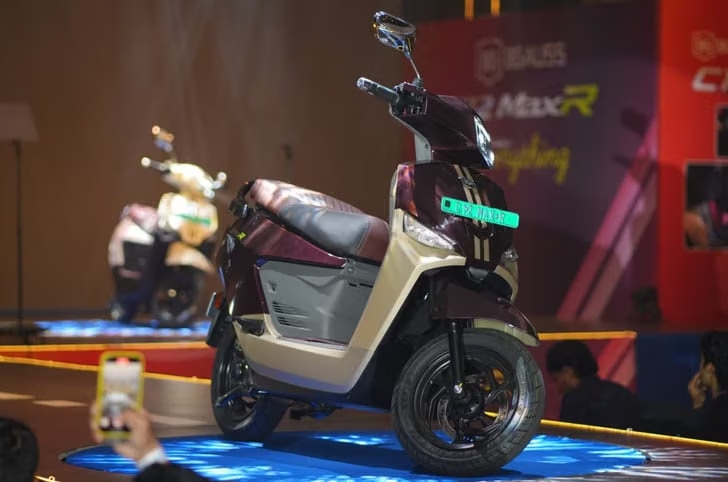
The recently launched C12 MaxR is BGauss’s most premium product to date, priced at Rs 1.60 lakh (ex-showroom). The scooter is powered by a hub-mounted motor that produces 4.2kW of peak power, enabling a claimed top speed of 75kph. It comes with three ride modes – Eco, Ride and Sport – along with a reverse mode and cruise control. Its 3.8kWh LFP battery offers a claimed IDC range of 178km and, according to BGauss, is rated for a lifespan of up to 1.5 lakh kilometres.
At its price point, the C12 MaxR competes directly with the mid- and upper-end variants of the TVS iQube, Bajaj Chetak and Ather Rizta – the highest-selling scooters in our country. BGauss’s broader four-model portfolio of the RUV 350, Oowah, C12 Max and C12 MaxR is entirely priced above Rs 1 lakh, leaving the brand without an entry in the segment that houses newer, more affordable models like the base Ather Konarc.
That said, at its current monthly run rate, BGauss is on course to deliver around 46,000-47,000 units in 2026, which would be its best-ever annual figure. However, consistently crossing 7,000 units a month will be needed to make a meaningful move up the OEM rankings from its current position.
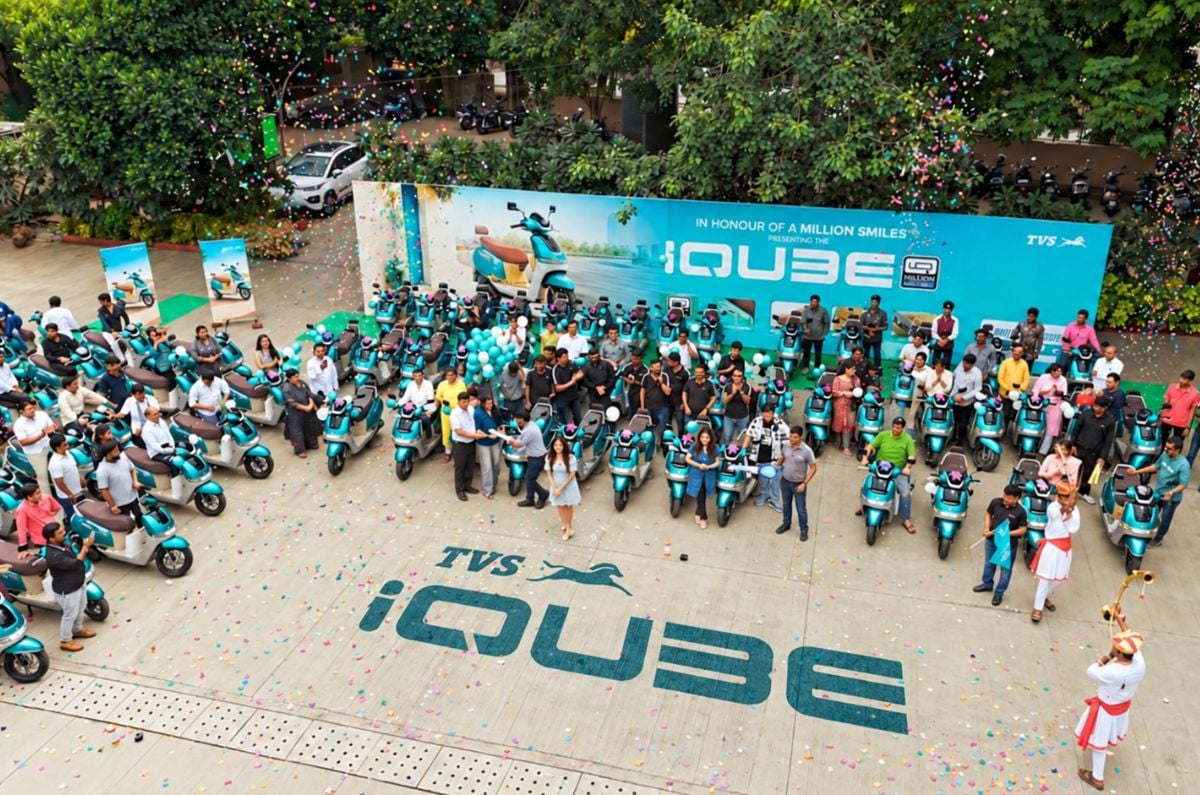
TVS held a mega delivery event in Pune on September 15, where more than 100 iQube MillionR Special Edition scooters were handed over to customers. The special edition was launched on August 25 to commemorate the iQube crossing one million units on Indian roads.
The MillionR Edition is based on the 3.5kWh iQube and has a claimed 145km IDC range.
The event was held in Pune on September 15
TVS iQube MillionR Edition deliveries
Over 100 units delivered at a special event
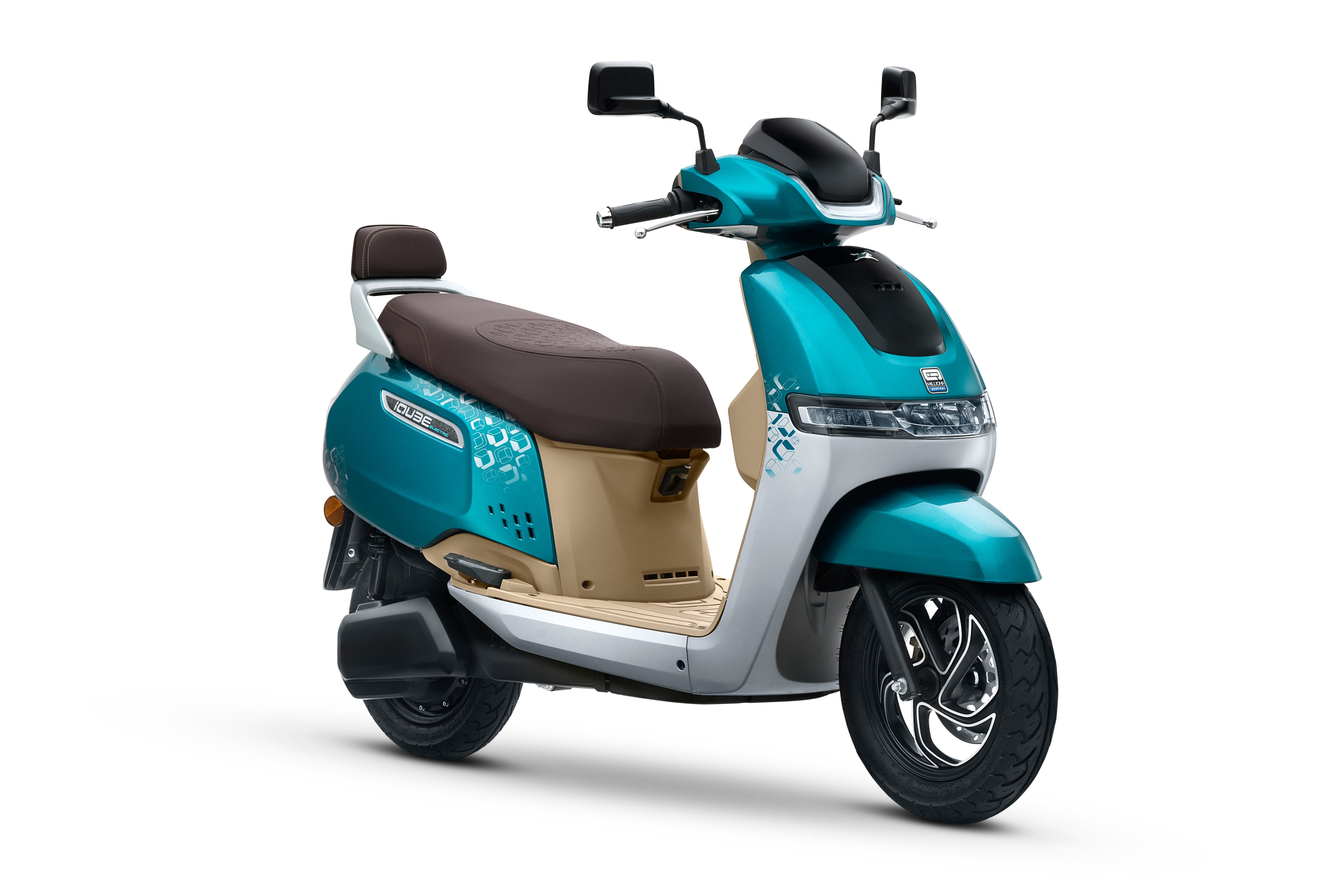
The MillionR Edition is based on the 3.5kWh variant and gets an Aurora Green dual-tone colour inspired by the Northern Lights, along with premium seat upholstery, MillionR badging and unique graphics.
The special edition adds a front utility storage compartment, increasing the iQube’s total storage capacity from 32 litres to 35.5 litres. It also gets an integrated USB Type-C charging port. The scooter retains the 3.5kWh battery and has a claimed IDC range of 145km. TVS says it comes with more than 118 connected technology features.
The TVS iQube MillionR Special Edition is priced at Rs 1.40 lakh (ex-showroom, Maharashtra). The wider iQube range starts at Rs 1.13 lakh, while BaaS prices start at Rs 59,999.
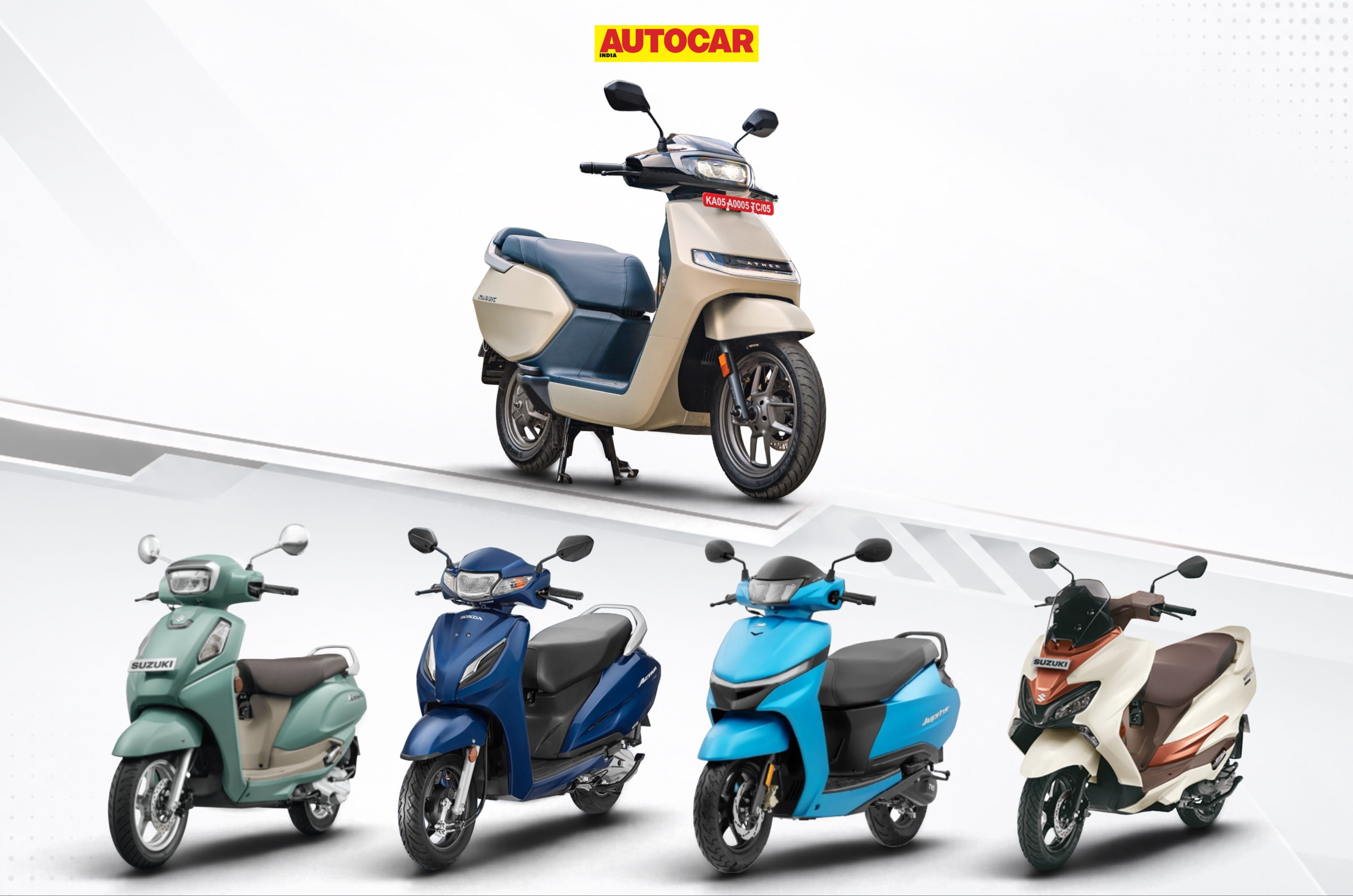
Family scooter. As soon as you read that, probably one specific scooter comes to your mind, summing up how the scooter industry has functioned the past two decades. However, over the past few years, EVs like the TVS iQube, River Indie, and the Ather Rizta have shown that they can go toe-to-toe with petrol scooters. The brand-new Ather Konarc is poised to add to that arsenal. However, if you aren’t quite convinced yet, here are some internal combustion engine (ICE) scooters you can look at instead.
All scooters are being compared to the Ather Konarc S 100, priced at Rs 99,999 (ex-showroom, Bengaluru). For Konarc, we haven’t considered features that require Ather StackPro subscription. All the other scooter prices mentioned are ex-showroom, Delhi.
Honda Activa
Rs 76,083 onwards
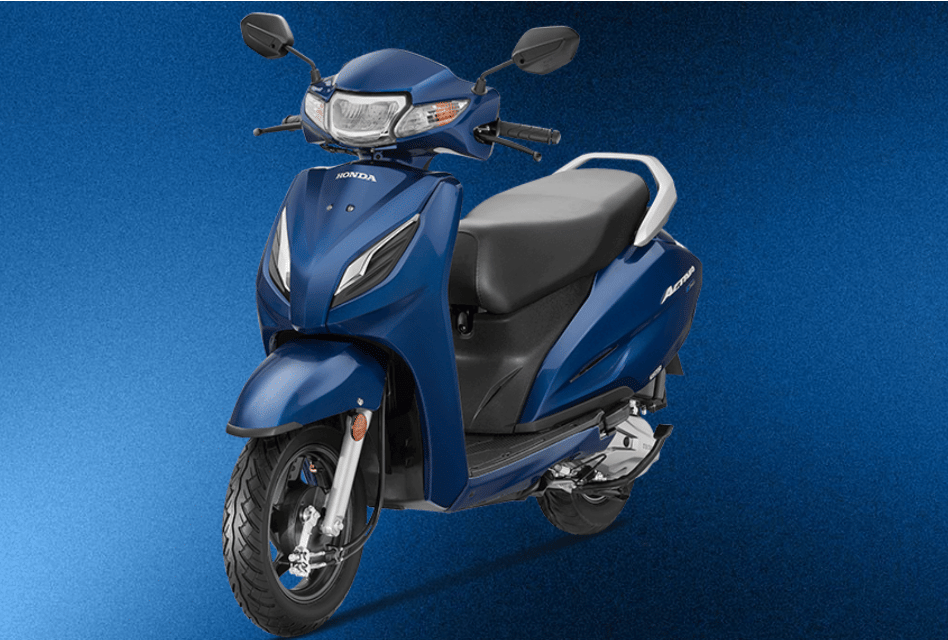
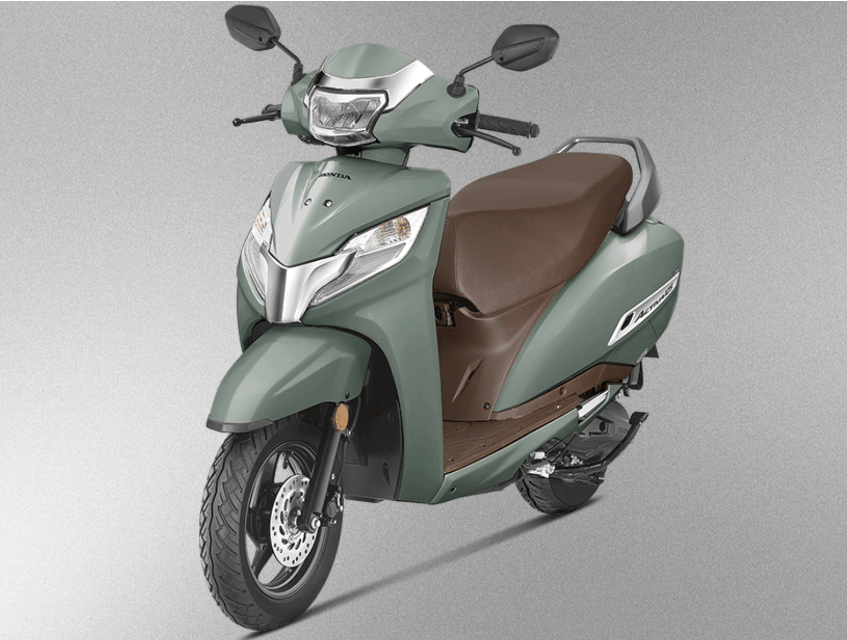
The default family scooter and the one your mind reminded you of when you started reading this. You cannot go wrong with the Activa’s reliable 110cc engine and the trust the brand brings you. However, this and the 125 have a lean feature set compared to the other ICE scooters here. The Activa 110 gets a 4-inch TFT instrument cluster with turn-by-turn navigation, smartphone connectivity, a silent start and stop-start system via an Integrated Starter Generator (ISG), and a smart key on the top variant. With the Activa’s 54.4kpl fuel economy, you’re looking at a 270km range before coming to a standstill. The Activa’s prices tops out at Rs 91,082 which makes it close to the entry-level variants of the Ather Konarc and the Simple Wave.
By paying Rs 9,000 more for the Konarc, you’ll get 100km IDC range, 70kph top speed, two ride modes, bigger 14/12-inch front/rear wheels, a bigger 31L under seat storage.
Honda Activa 125
Rs 91,178 onwards
The bigger Activa bumps up the cubic capacity to 124cc and increases the power by 0.4hp to 8.3hp and increases the torque by 1.4Nm to 10.5Nm compared to the 110, but is otherwise almost exactly the same as the 110. For that extra power and torque, the Activa 125 bumps up the prices and tops out at Rs 95,622. As such, the extra features you gain by switching to the Konarc also remain the same.
TVS Jupiter (110)
Rs 74,125 onwards
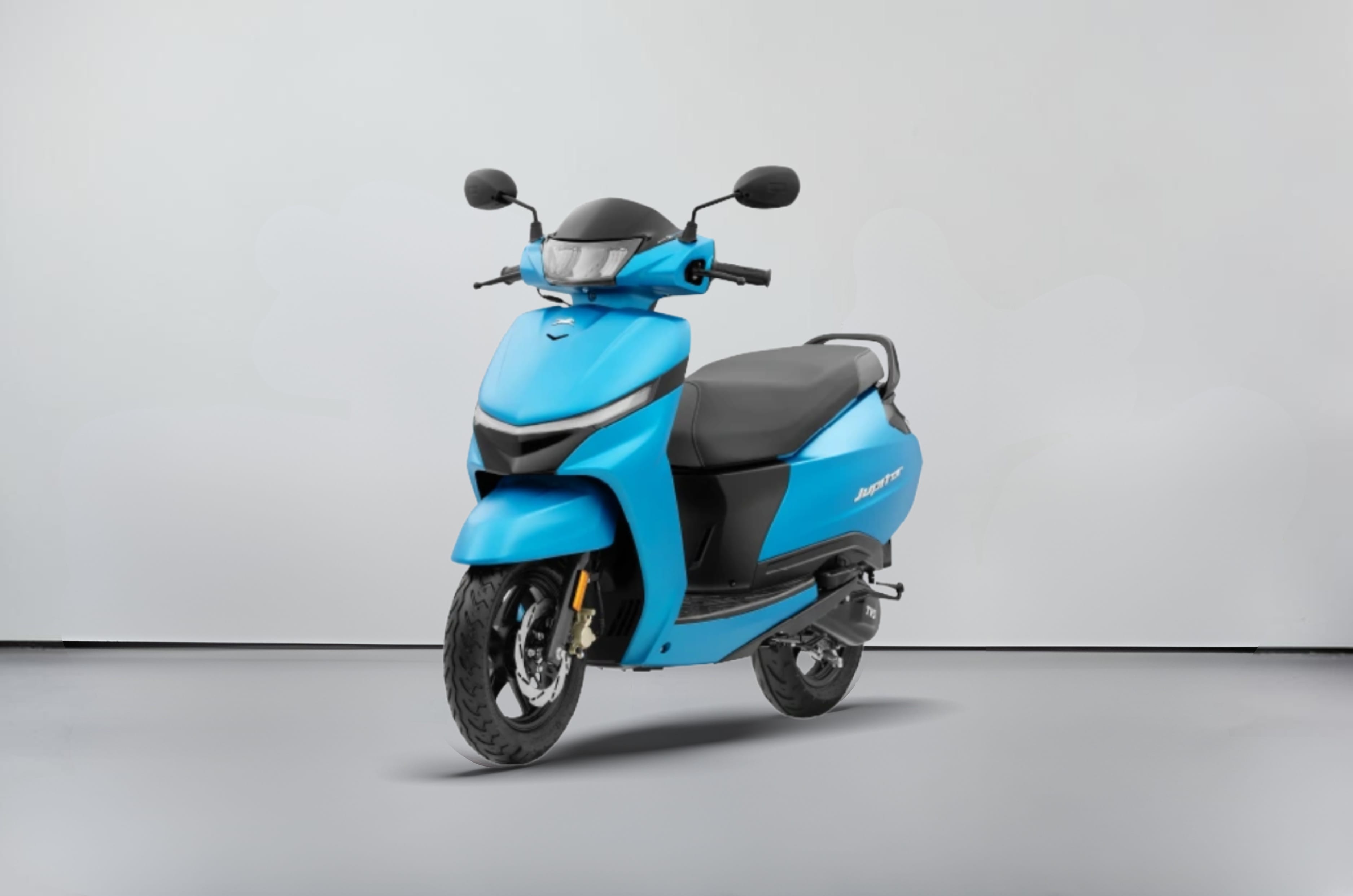
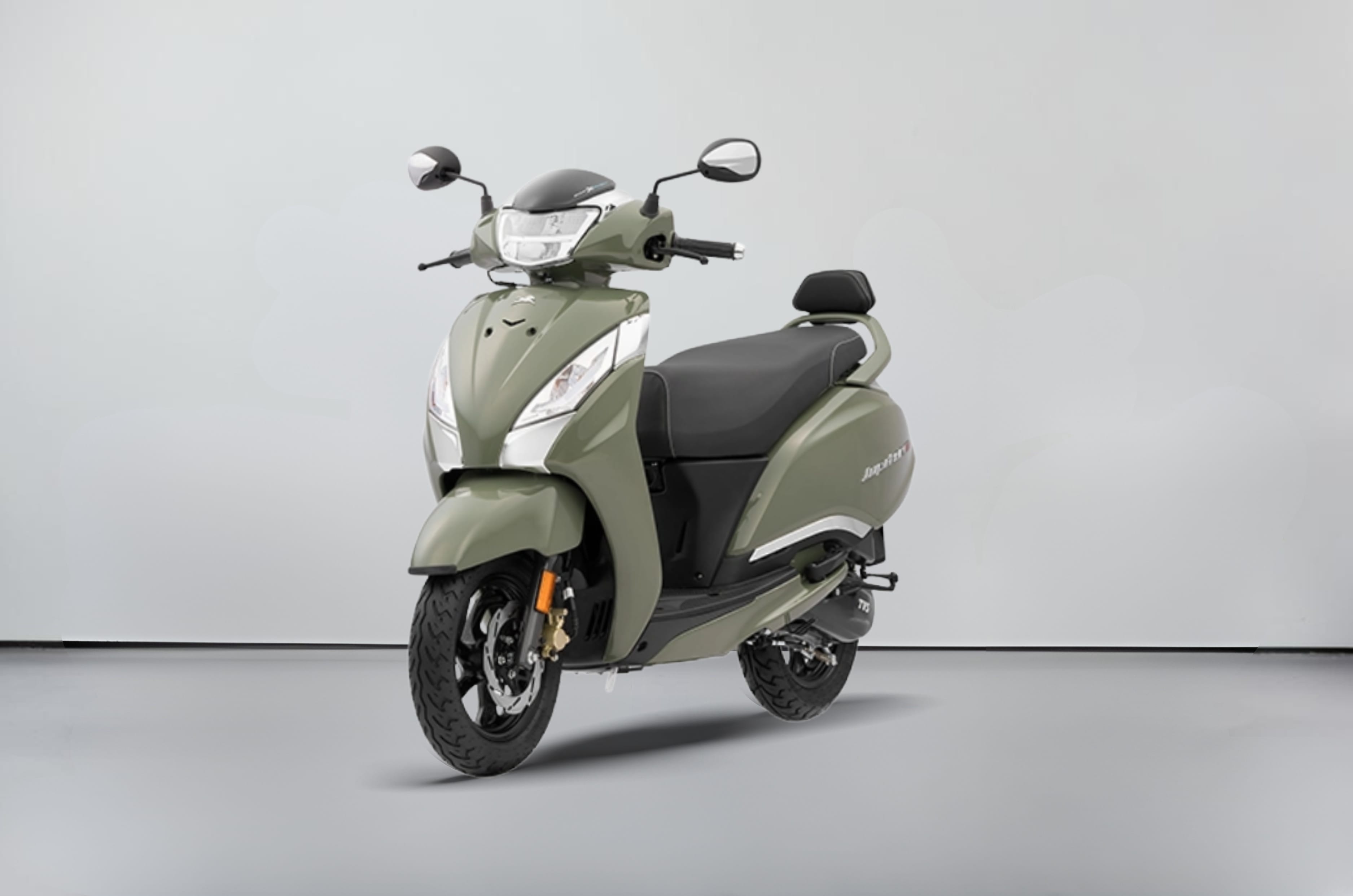
The Activa’s biggest competitor is the Jupiter which received a comprehensive upgrade in 2024. TVS gave it an all-new 113.3cc engine with 7.9hp and 9.8Nm of torque (with 0.6Nm from the ISG). It also received a much sleekier design over its predecessor. As things stand today, the Jupiter has perhaps the largest feature set of any ICE scooter. Thanks to sharing the platform with its bigger brother, the new Jupiter gets a front fuel tank, 33L under seat storage (that’s still the largest on an ICE scooter). It also gets a wide floorboard, more storage on the front apron storage, an ISG, smartphone connectivity, 12-inch wheels at both ends, a front disc brake on higher variants, and a design that’s much more modern than any of its peers. With its 57kpl fuel economy, the Jupiter also has the Activa beat with a higher 285km range. The Jupiter starts at Rs 74,125 and tops out at Rs 89,825 for the dual-tone variant.
By stepping up to the Konarc by paying an additional Rs 10,174 over the top-most variant, you gain a larger 14-inch front wheel.
TVS Jupiter 125
Rs 81,700 onwards
The bigger Jupiter unfortunately didn’t quite get the rejuvenation. It’s stuck to essentially the same design from its debut in 2021. With the larger 124.8cc engine, you get 0.5hp extra power and 1.3Nm extra torque over the 110, with the ISG’s assistance; without it, they become 0.1hp and 0.7Nm extra, respectively. Sharing the same platform means that the new 110 has caught up to most of the 125’s features. Though, you do get a TFT display on the 125’s cluster, but it isn’t adding any real value. The Jupiter 125 starts at Rs 81,700 and tops out at Rs 89,935.
By stepping up to the Konarc for approximately Rs 10,000 extra, you gain a larger front tyre.
Suzuki Access (125)
Rs 82,185 onwards
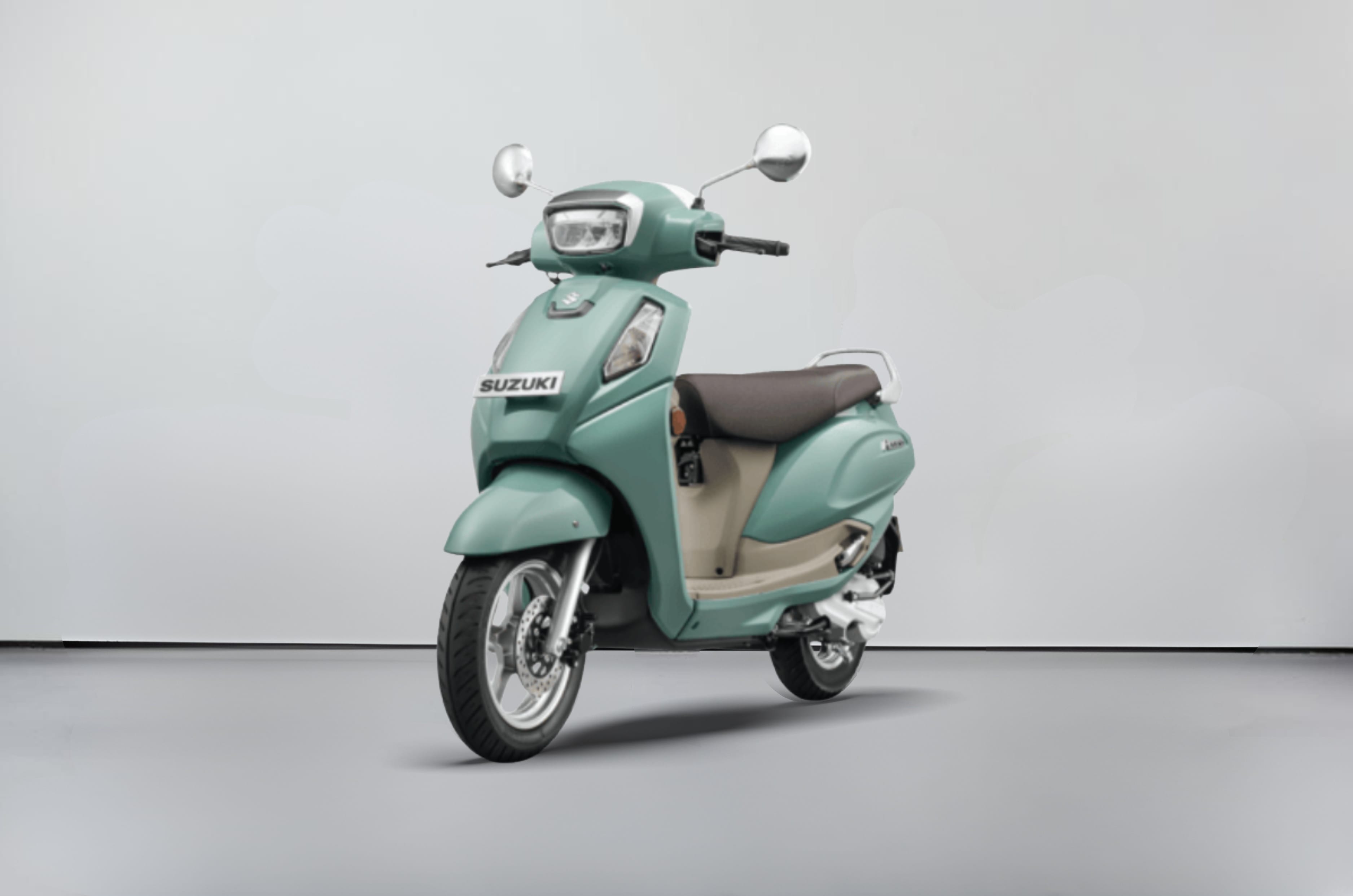
The Suzuki Access has silently been one of the best-selling scooters in the family scooter segment and it received a comprehensive upgrade in early 2025. While there wasn’t a brand-new engine, Suzuki gave it a new frame and made scores of minute improvements to the engine that added up to make it a comprehensively better scooter. However, that also means there aren’t any new features to help the Access’ case. It sticks to a 12/10-inch front and rear wheel setup, a 24.4L under seat storage that now feels measly even for the ICE world. Suzuki did give it a TFT instrument cluster and single-channel ABS on the highest variant, but that’s about it. The Access starts at Rs 82,185 and will set you back by Rs 1.02 lakh for the TFT-ABS variant.
With the Ather Konarc, you will end up paying Rs 3,000 less and gain a larger 14/12-inch front and rear wheels, two ride modes, and a considerably larger 31L under seat storage but the Access is the only scooter here that offers the safety net of an ABS system.
Suzuki Burgman Street
Rs 1.03 lakh onwards
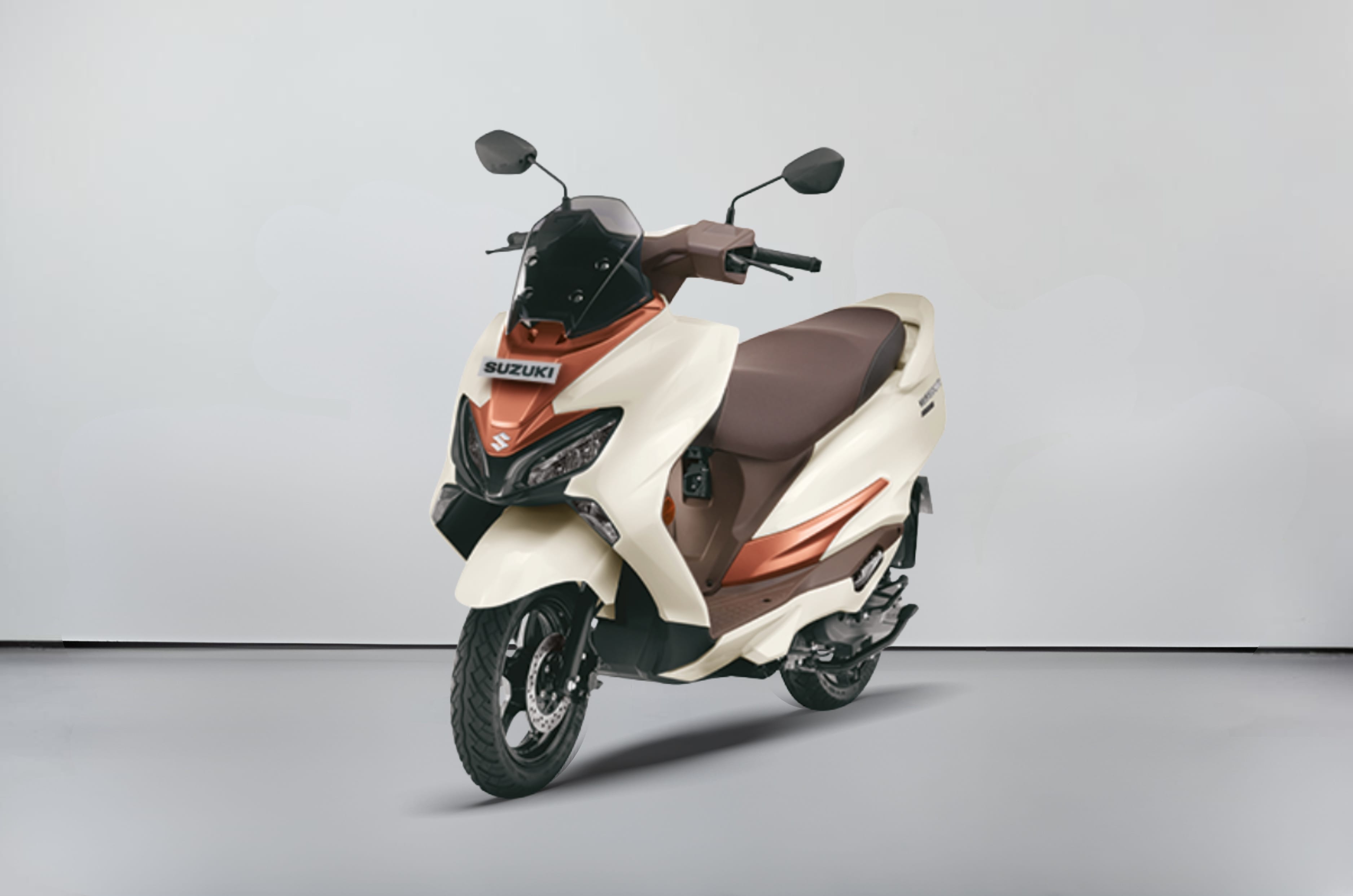
The Burgman received most of the same upgrades as the Access in early 2026, with the maxi-scooter stance as its biggest differentiation. The Burgman Street exclusively gets a keyless system on the top-variant, but loses out on the single-channel ABS compared to the Access. On the dimensions front, it gets a 25mm longer wheelbase, 7kg additional weight, and 0.2 litres larger fuel tank compared to the Access. It’s also one of the two Suzuki scooters to have a 12/12-inch front and rear wheel setup in India; the older Burgman Street EX being the other one. Except for these differences and a different design, the Burgman Street shares its mechanicals and convenience features with the Access. The Burgman Street starts at Rs 1.03 lakh and the top TFT variant with the keyless system costs Rs 1.15 lakh.
By getting the Konarc instead, you end up saving about Rs 4,000 (Rs 12,000 compared to the top variant) and you gain a larger 14-inch front wheel, two ride modes, and of course, the larger 31L under seat storage.
Summary and conclusion
We understand that this article makes it seem like there’s no point in choosing the Ather Konarc in most cases; that’s not quite true. Getting an EV scooter might be the best decision for some people, especially ones with a fixed daily travel distance, living in either their own house, or a housing society that’s generous with setting up a home charger, and all the tech enthusiasts who would like to see how far EVs have come in the past few years. Just the novel riding experience of an EV might be enough to choose the Konarc for you. So, take a test ride of the Konarc S 100 when it becomes available. We’d like you to be aware of the closest ICE options, if you end up deciding the Konarc isn’t for you.
With Ather StackPro and Ather Connect subscription, the Konarc S can offer more smart features that none of the others here can hope to match, but there’s an additional price to be paid for them. Hence, if you’re after the most value for your money, there’s no question that ICE vehicles still offer more for their asking price.