Climate impact ON wheat: जलवायु परिवर्तन का असर अब हमारी थाली तक पहुंच सकता है। जी हां, जिस गेहूं से हर दिन करोड़ों लोगों की रोटी बनती है, उसकी पोषण संबंधी गुणवत्ता और प्रोटीन संरचना भविष्य में बदल सकती है। एक नई वैज्ञानिक स्टडी में सामने आया है कि वातावरण में कार्बन डाइऑक्साइड (CO₂) का स्तर बढ़ने से गेहूं के प्रोटीन की संरचना में महत्वपूर्ण बदलाव हो सकते हैं। इसका असर न केवल आटे और ब्रेड की क्वालिटी पर पड़ सकता है, बल्कि गेहूं से जुड़ी कुछ स्वास्थ्य समस्याओं के लिहाज से भी यह महत्वपूर्ण हो सकता है।
स्टडी में खुलासा हुआ है कि वातावरण में बढ़ती CO₂ गेहूं की प्रोटीन संरचना को बदल सकती है। इसका असर बेकिंग गुणवत्ता पर पड़ने के संकेत मिले हैं। जर्मनी के लीबनिज इंस्टीट्यूट फॉर फूड सिस्टम्स बायोलॉजी और टेक्निकल यूनिवर्सिटी ऑफ म्यूनिख से जुड़े शोधकर्ताओं के नेतृत्व में किए गए इस अध्ययन के निष्कर्ष प्रतिष्ठित जर्नल फूड केमिस्ट्री (Food Chemistry) में प्रकाशित हुए हैं। वैज्ञानिकों का कहना है कि जलवायु परिवर्तन के दौर में गेहूं की खेती पर विचार करते समय केवल उत्पादन बढ़ाने पर ध्यान देना पर्याप्त नहीं होगा। अनाज की गुणवत्ता और उसमें मौजूद प्रोटीन के प्रकारों को भी समझना जरूरी है।
हवा में बढ़ती CO₂ से गेहूं पर कितना असर?
स्टडी के अनुसार, वातावरण में कार्बन डाइऑक्साइड की मात्रा लगातार बढ़ रही है। वर्ष 1980 में इसका स्तर लगभग 340 पार्ट्स पर मिलियन (ppm) था, जो 2024 में बढ़कर करीब 425 ppm तक पहुंच गया। अनुमान है कि वर्ष 2050 तक यह स्तर 600 ppm तक जा सकता है। गेहूं दुनिया की सबसे महत्वपूर्ण खाद्य फसलों में से एक है। ऐसे में वातावरण में CO₂ की बढ़ती मात्रा के बीच इसकी खेती और अनाज की क्वालिटी में होने वाले बदलावों को समझना बेहद जरूरी है। वैज्ञानिकों ने इसी सवाल का जवाब तलाशने के लिए गेहूं की अलग-अलग किस्मों पर प्रयोग किया।
10 किस्मों पर हुआ प्रयोग, सामने आए चौंकाने वाले बदलाव
शोधकर्ताओं ने सर्दियों में उगाई जाने वाली गेहूं की 10 खेती की किस्मों को वास्तविक कृषि और पर्यावरणीय परिस्थितियों के अनुरूप उगाया। इनमें से कुछ पौधों को सामान्य परिस्थितियों में मौजूद CO₂ के स्तर पर रखा गया। जबकि अन्य पौधों को 546 ppm की बढ़ी हुई CO₂ में उगाया गया। फसल तैयार होने के बाद वैज्ञानिकों ने गेहूं के दानों में मौजूद प्रोटीन का बारीकी से विश्लेषण किया। इसके लिए हाई-रिजॉल्यूशन मास स्पेक्ट्रोमेट्री तकनीक का इस्तेमाल किया गया।
स्टडी में विशेष रूप से ग्लूटेन प्रोटीन, एमाइलेज/ट्रिप्सिन इनहिबिटर्स (ATIs), प्यूरोइंडोलिन और सीलिएक रोग से संबंधित कुछ पेप्टाइड्स पर ध्यान दिया गया। नतीजों से पता चला कि CO₂ कॉन्सेंट्रेशन का स्तर बढ़ने पर गेहूं के अलग-अलग प्रोटीन समूहों में एक जैसा बदलाव नहीं हुआ। कुछ प्रोटीन बढ़े। जबकि कुछ की मात्रा घट गई। इसका मतलब है कि जलवायु परिवर्तन गेहूं की प्रोटीन संरचना को प्रभावित कर सकता है।
बढ़ेगा एक तरह का प्रोटीन, घट सकता है ग्लूटेन
इस स्टडी में पाया गया कि बढ़ी हुई CO₂ कॉन्सेंट्रेशन में गेहूं के दानों में एमाइलेज/ट्रिप्सिन इनहिबिटर्स (ATIs) की मात्रा बढ़ गई। दूसरी ओर, प्यूरोइंडोलिन, ग्लूटेन प्रोटीन और सीलिएक रोग से एक्टिव हो सकने वाले कुछ पेप्टाइड्स की मात्रा में कमी देखी गई। ATIs ऐसे प्रोटीन हैं जिनकी संभावित हेल्थ संबंधी भूमिका पर वैज्ञानिक अध्यन करते रहे हैं। इनकी मात्रा बढ़ने का असर मानव स्वास्थ्य के लिहाज से महत्वपूर्ण हो सकता है।
लेकिन इस स्टडी के आधार पर यह निष्कर्ष नहीं निकाला जा सकता कि बढ़ी हुई CO₂ में उगा गेहूं सीधे तौर पर लोगों को बीमार कर देगा। वैज्ञानिकों ने यह भी स्पष्ट किया कि ग्लूटेन प्रोटीन की मात्रा घटने के साथ गेहूं की बेकिंग गुणवत्ता में गिरावट देखी गई। यानी प्रोटीन की संरचना में बदलाव का असर रोटी, ब्रेड और गेहूं से बनने वाले दूसरे खाद्य पदार्थों की निर्माण संबंधी विशेषताओं पर पड़ सकता है।
क्या गेहूं से जुड़ी बीमारियों का खतरा भी बदल सकता है?
अध्ययन का एक महत्वपूर्ण पहलू गेहूं से संबंधित स्वास्थ्य समस्याओं से जुड़ा है। शोधकर्ताओं ने पाया कि CO₂ बढ़ने के कारण ATIs और सीलिएक रोग से सक्रिय होने वाले कुछ पेप्टाइड्स की मात्रा में बदलाव हुआ। सीलिएक रोग एक प्रतिरक्षा सिस्टम से जुड़ी बीमारी है, जिसमें ग्लूटेन के सेवन से छोटी आंत को नुकसान पहुंच सकता है।
हालांकि, स्टडी में कुछ संबंधित पेप्टाइड्स की मात्रा घटने का संकेत मिला। जबकि ATIs की मात्रा बढ़ी। इसलिए इन बदलावों का कुल स्वास्थ्य प्रभाव क्या होगा, यह अभी स्पष्ट नहीं है। शोधकर्ताओं के मुताबिक, यह समझने के लिए आगे अध्ययन करना जरूरी है कि गेहूं में प्रोटीन संरचना के ये बदलाव वास्तव में मानव शरीर की जैविक और प्रतिरक्षा संबंधी प्रतिक्रियाओं को किस तरह प्रभावित करते हैं। फिलहाल इस शोध को गेहूं से जुड़ी बीमारियों में निश्चित वृद्धि या कमी का प्रमाण नहीं माना जा सकता।
हर गेहूं की किस्म पर एक जैसा असर नहीं
पीटीआई के मुताबिक, इस अध्ययन में एक और अहम बात सामने आई कि सभी गेहूं की किस्मों में बदलाव समान नहीं थे। प्रमुख शोधकर्ता सबरीना गाइस्लिट्ज के अनुसार, प्रोटीन संरचना में परिवर्तन की सीमा काफी हद तक इस बात पर निर्भर करती है कि गेहूं की कौन-सी किस्म उगाई गई है। यह निष्कर्ष भविष्य की खेती के लिए महत्वपूर्ण हो सकता है। यदि कुछ किस्में बढ़ी हुई CO₂ परिस्थितियों में अपनी गुणवत्ता बेहतर बनाए रखती हैं, तो उन किस्मों की पहचान और विकास पर ध्यान दिया जा सकता है। हालांकि, इसके लिए अलग-अलग जलवायु परिस्थितियों और कृषि क्षेत्रों में और परीक्षण करने होंगे।
भविष्य की खेती के लिए क्या है सबक?
इस स्टडी से साफ संकेत मिलता है कि जलवायु परिवर्तन का आकलन केवल इस आधार पर नहीं किया जाना चाहिए कि खेतों में कितना अनाज पैदा हो रहा है। यह भी देखना होगा कि उस अनाज में किस तरह के प्रोटीन मौजूद हैं। उसकी बेकिंग गुणवत्ता कैसी है। उसके सेवन से जुड़े संभावित स्वास्थ्य पहलुओं पर क्या प्रभाव पड़ सकता है। वैज्ञानिकों के अनुसार, भविष्य में गेहूं की ऐसी किस्में विकसित करने की जरूरत होगी, जो बदलती पर्यावरणीय परिस्थितियों में भी अच्छी पैदावार के साथ बेहतर गुणवत्ता बनाए रख सकें।
The Hector Tomahawk EV is MG’s newest SUV in the market, and despite its name, it’s based on an all-new ‘ADAPT’ architecture and shares nothing with the ICE version of the Hector. Priced between Rs 19.50 lakh and Rs 23.50 lakh (ex-showroom), the Hector Tomahawk EV is available in 5-seater and 7-seater variants.
We put the MG Hector Tomahawk EV through our real-world tests to find out how efficient it really is.
Claimed range is 517km from its 69.2kWh battery
Driven in ‘Eco’ mode, with regen set to ‘Strong’ (city) and ‘Comfort’ (highway)
Weighs 1,908kg
MG Hector Tomahawk EV real-world range tested
The MG Hector Tomahawk EV is powered by a single Permanent Magnet Synchronous Motor (PMSM) mounted on the front axle, and produces 204hp and 310Nm. It is only available with a 69.2kWh battery pack and uses Lithium Iron Phosphate (LFP) cell chemistry. It comes with three driving modes – Eco, Standard and Sport – and four regen modes – Comfort, Standard, Strong and Intelligent. For our tests, the Tomahawk EV was driven in ‘Eco’ mode with the regen set to ‘Strong’ and ‘Comfort’ mode in the city and on the highway, respectively.
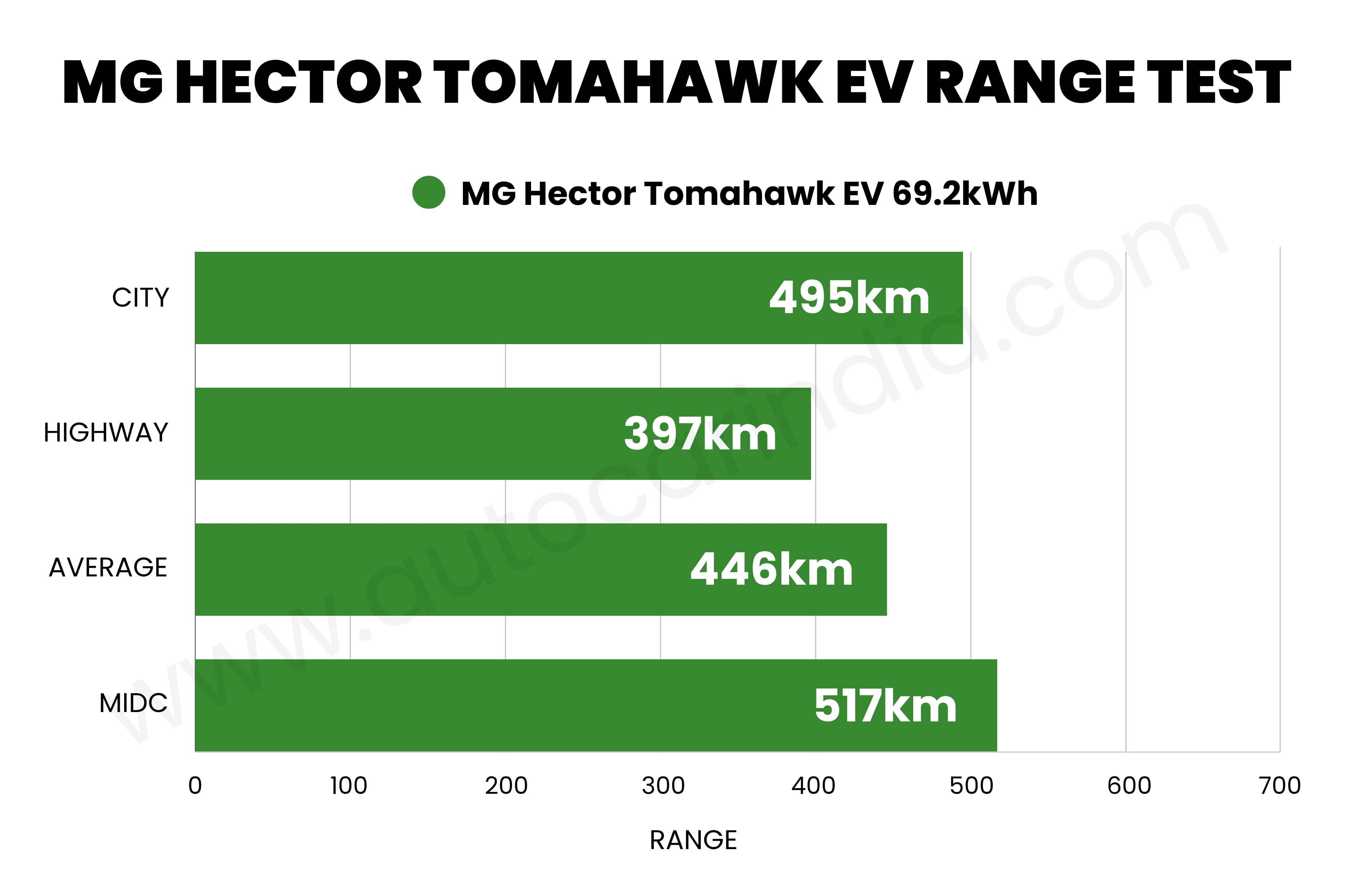
In the city, this MG delivered 7.15km/kWh, whereas on the highway, the efficiency was 5.73km/kWh. This extrapolates to a range of 495km and 397km in the city and on the highway, respectively. With an overall efficiency of 6.44km/kWh, you can expect a real-world range of about 446km on a full charge, which is respectable.
During our tests, we noticed that the regen modes are quite mild, even in its strongest setting. And while the city efficiency is quite good, a stronger regen could’ve made it even more efficient in the city. Also, the regen takes around a second to kick in after you lift off the throttle, which makes it slightly less predictable in the city.
EVs are generally less efficient on highways than in the city, and the bulky, upright design of the Tomahawk doesn’t help with aerodynamics either.
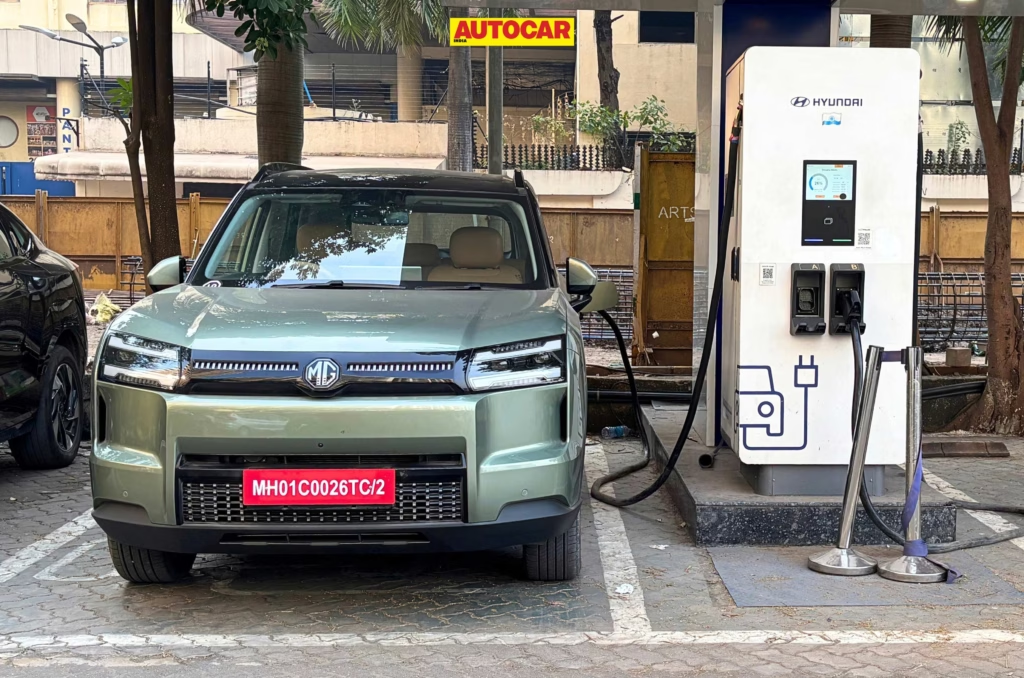
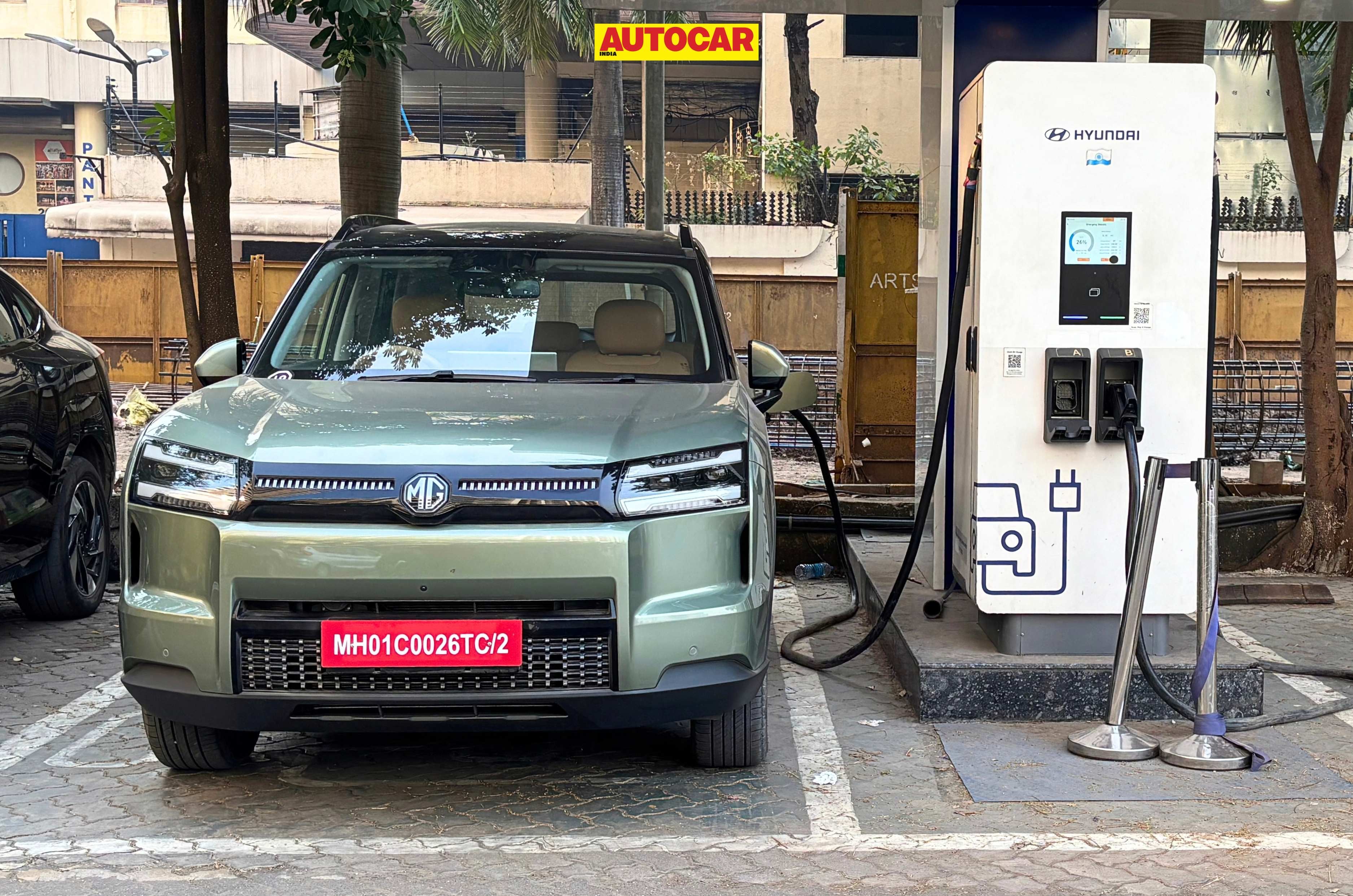
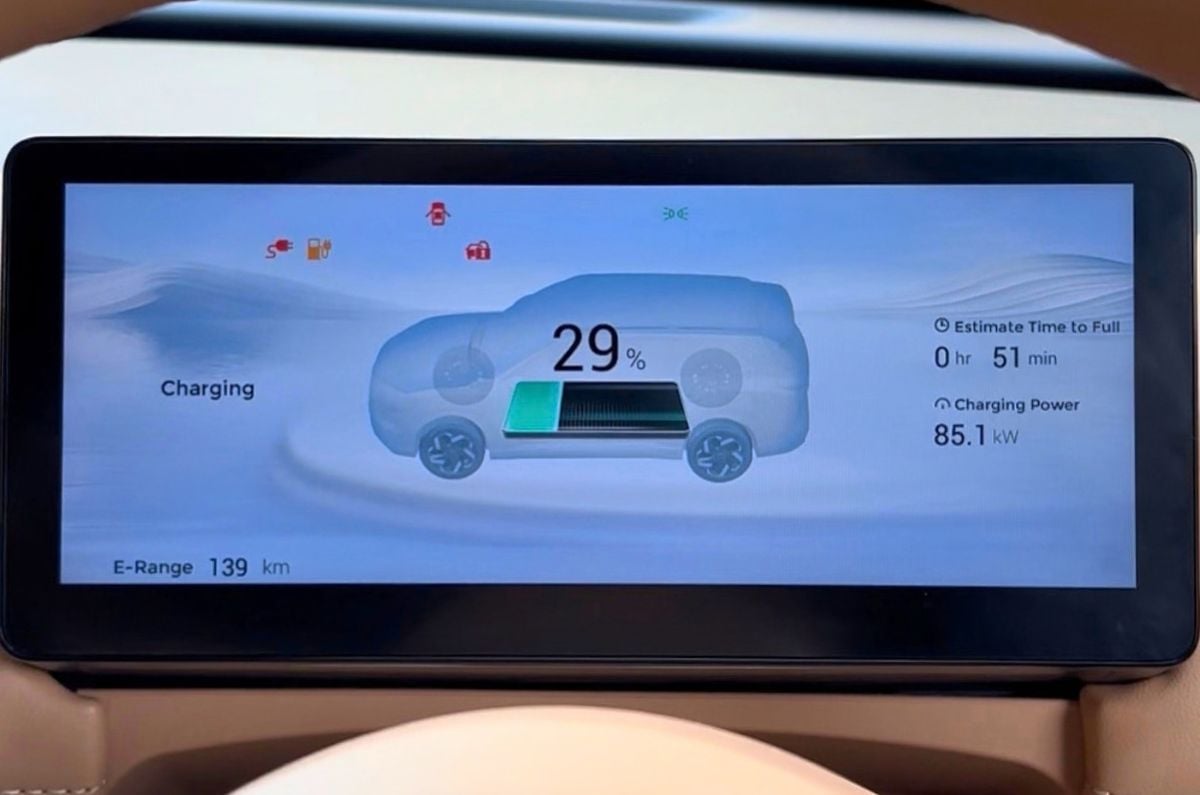
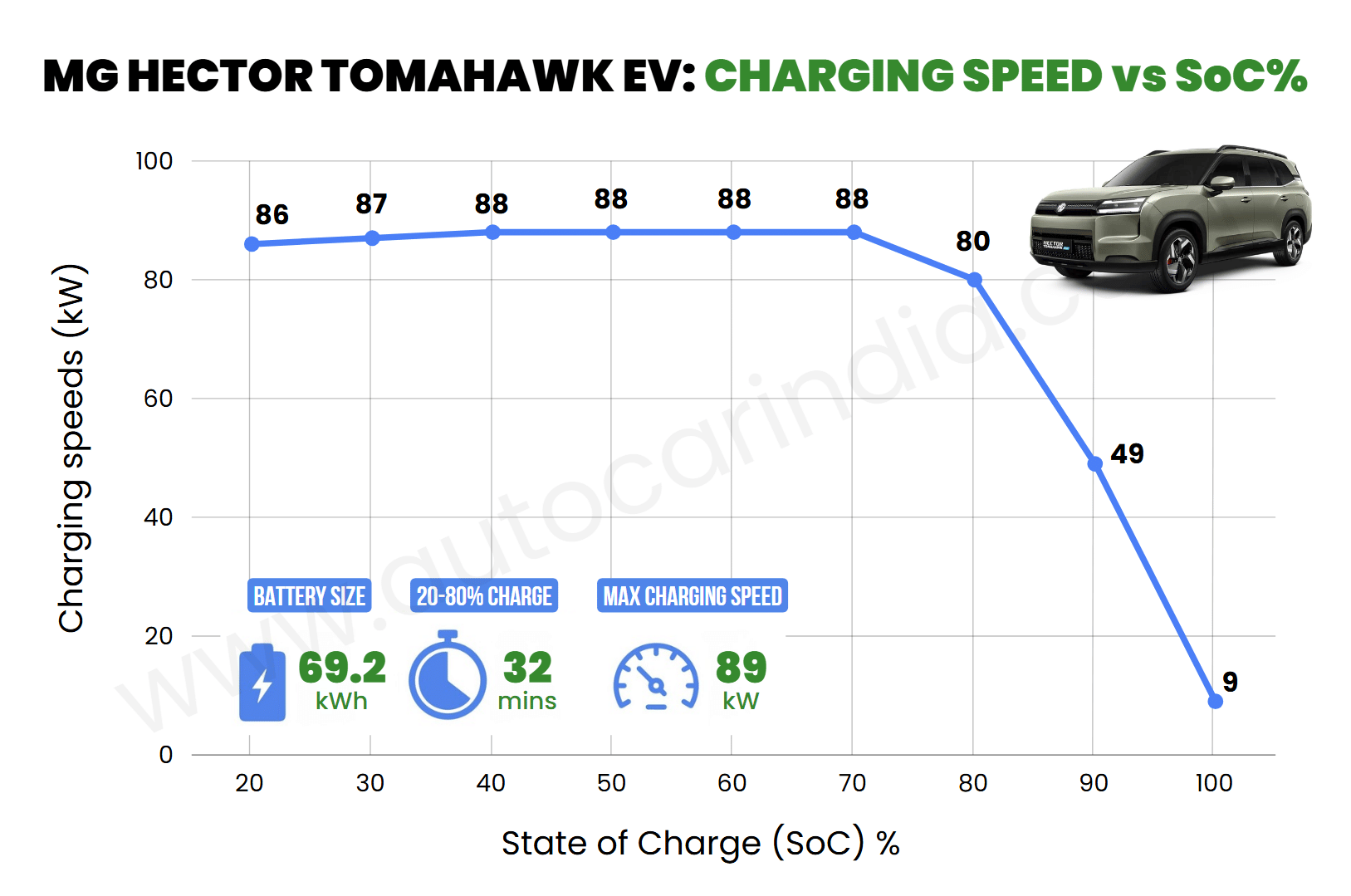
MG claims that the Hector Tomahawk EV can recharge its battery from 30-80 percent in 35 minutes when connected to a 90kW DC fast charger. However, we were able to recharge its battery from 20-80 percent in 32 minutes when connected to a 150kW DC fast charger. This is faster than what MG claims, and we saw peak charging speeds of about 89kW during this session.
Autocar India’s range testing
Before our real-world range tests, the battery of our test car was fully charged, and we maintained tyre pressures in accordance with the manufacturer’s recommendations. The car was driven on a weekday in Mumbai city and on the adjoining state highway in a fixed loop, and we maintained the set average speeds. At the end of each cycle, we calculated the range based on the percentage charge consumed.
Throughout our tests, the climate control was set to 22deg C in a full-auto setting, and other electricals, such as the audio system, indicators and ventilated front seats, were used when required, just as a regular user would. We take pride in our testing data, which isn’t merely consistent but also gives users an accurate indication of what they can expect in the real world.
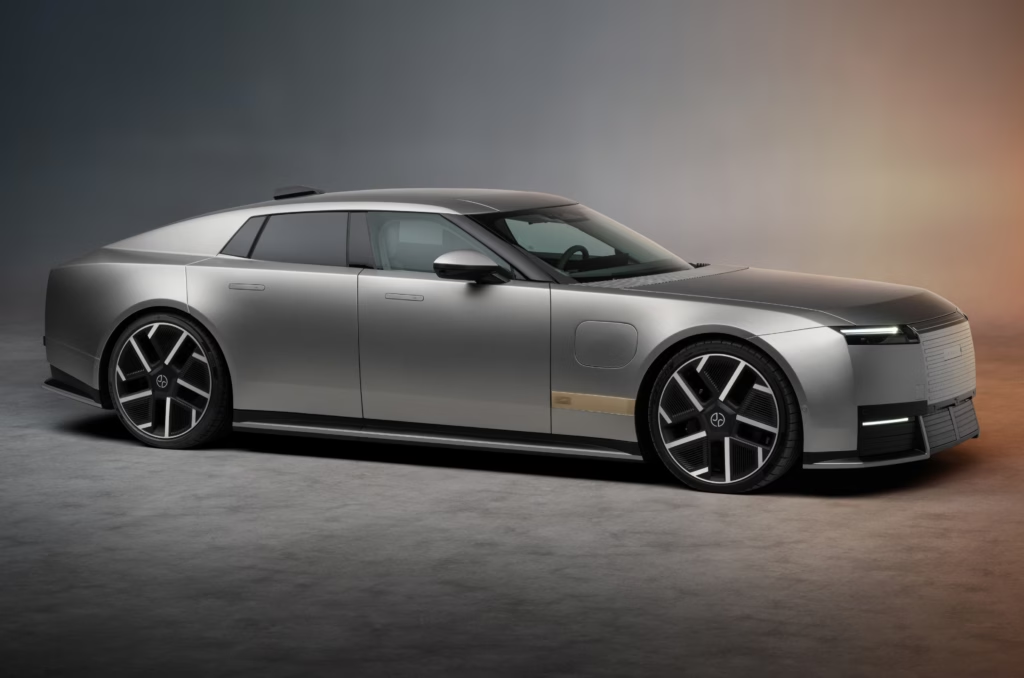
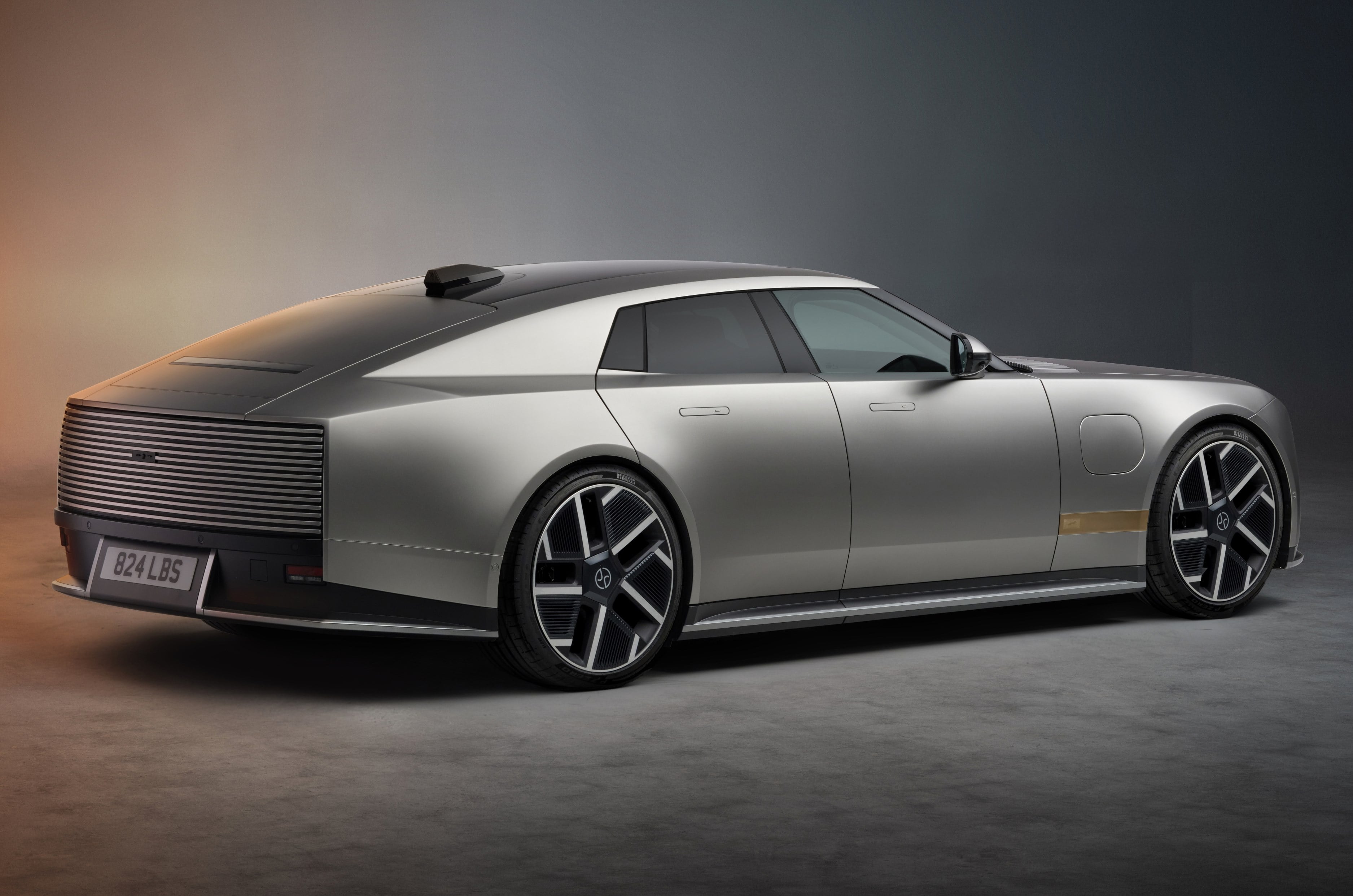
Grace, Space, Pace. That’s been a long-held Jaguar maxim, clearly no more the case, though, at least not that first part. Jaguar’s new Type 01 ditches grace for a design that’s very much in your face, or, styled with exuberant modernism, as the brand more eloquently puts it.
Yes, exuberant it most certainly is; the sheer size and presence of the car are unapologetically bold, and we knew this would be the case when we saw the Type 00 concept. At the time, Jaguar said it would greatly influence the actual production car. Love it or hate it, you have to applaud Jaguar for keeping a majority of the concept’s far-out ideas to the point where a lot of time was spent engineering the new Jaguar Electric Architecture (JEA) to make the design possible.
Strike a chord
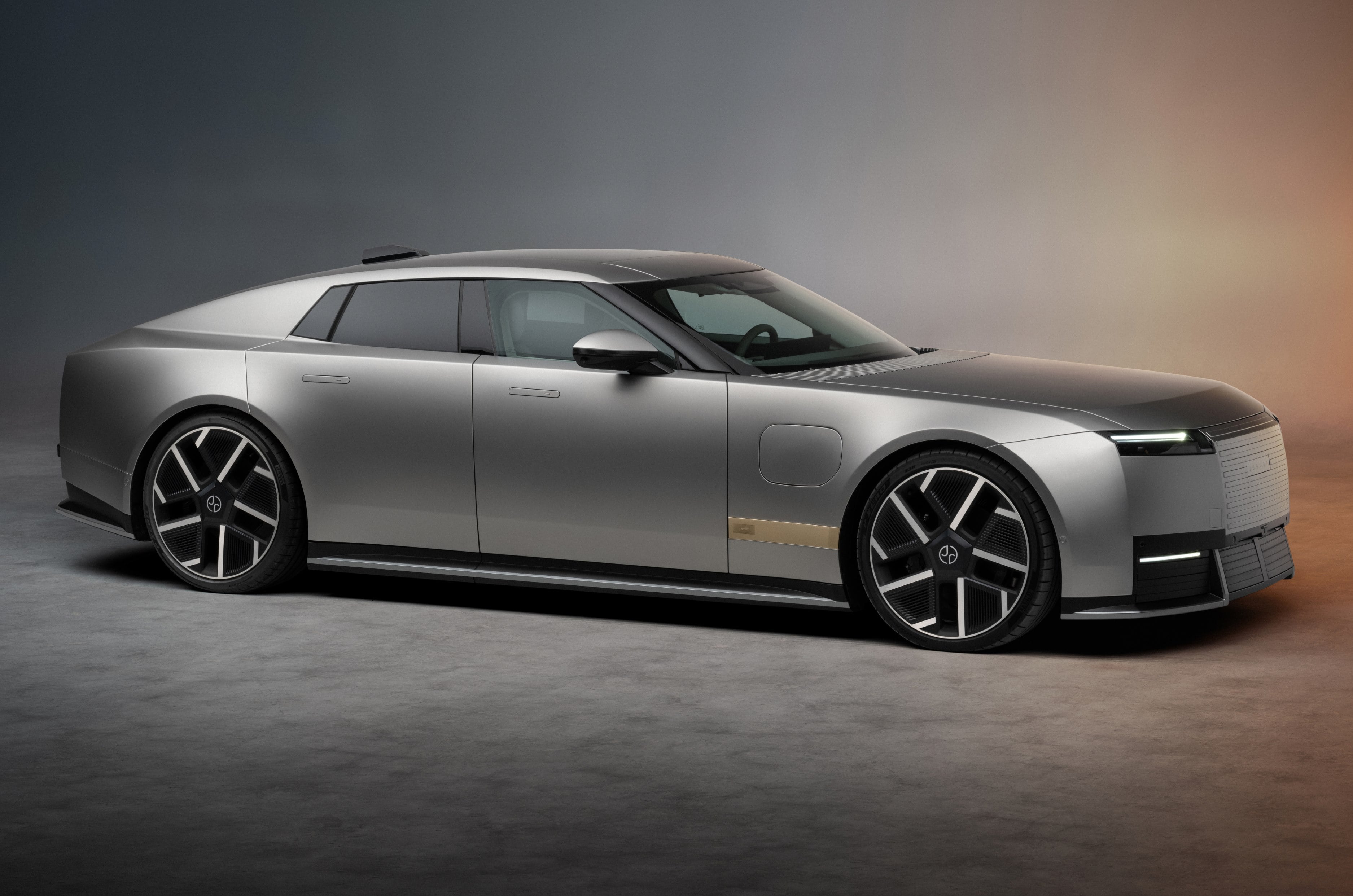
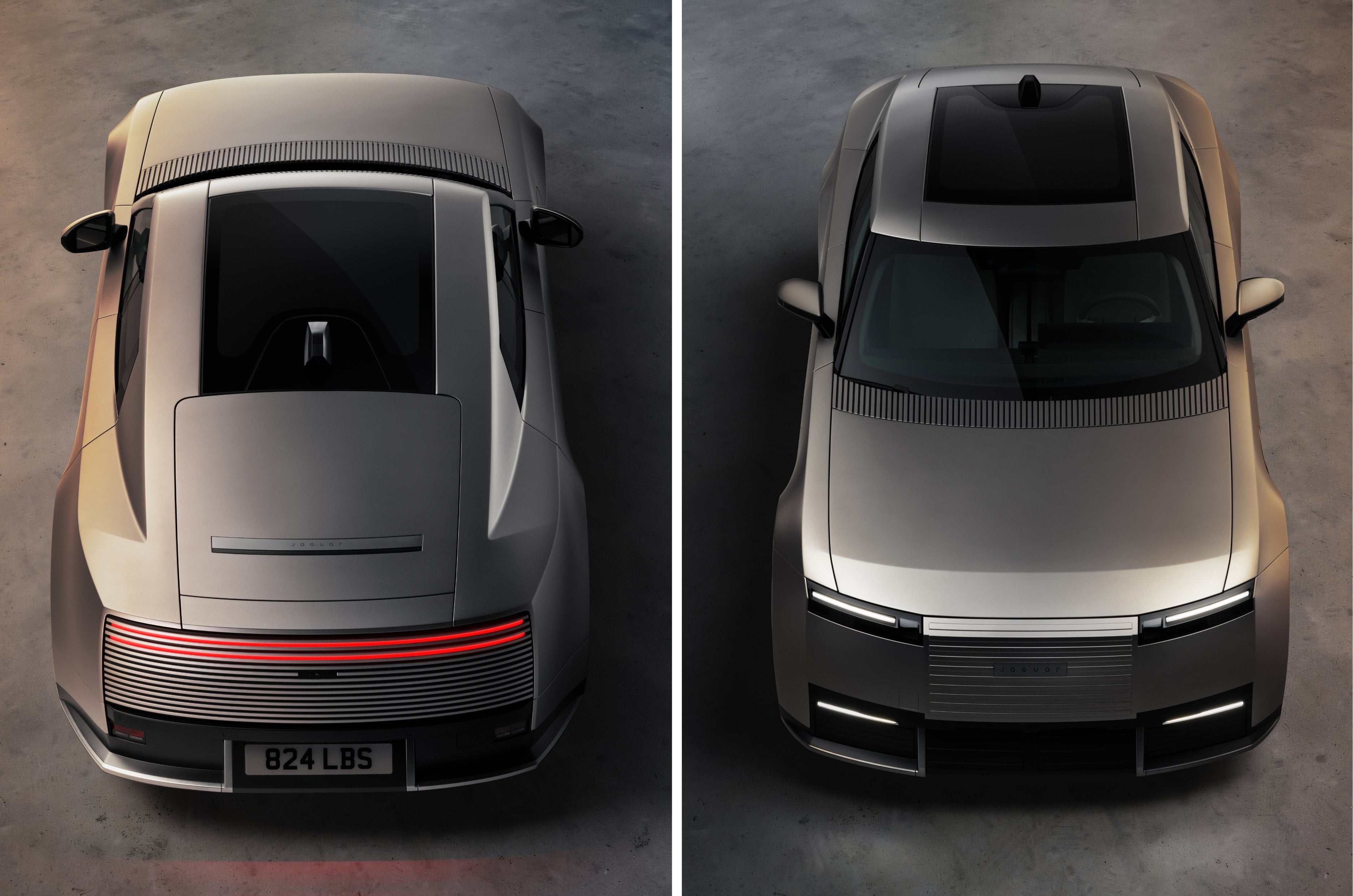
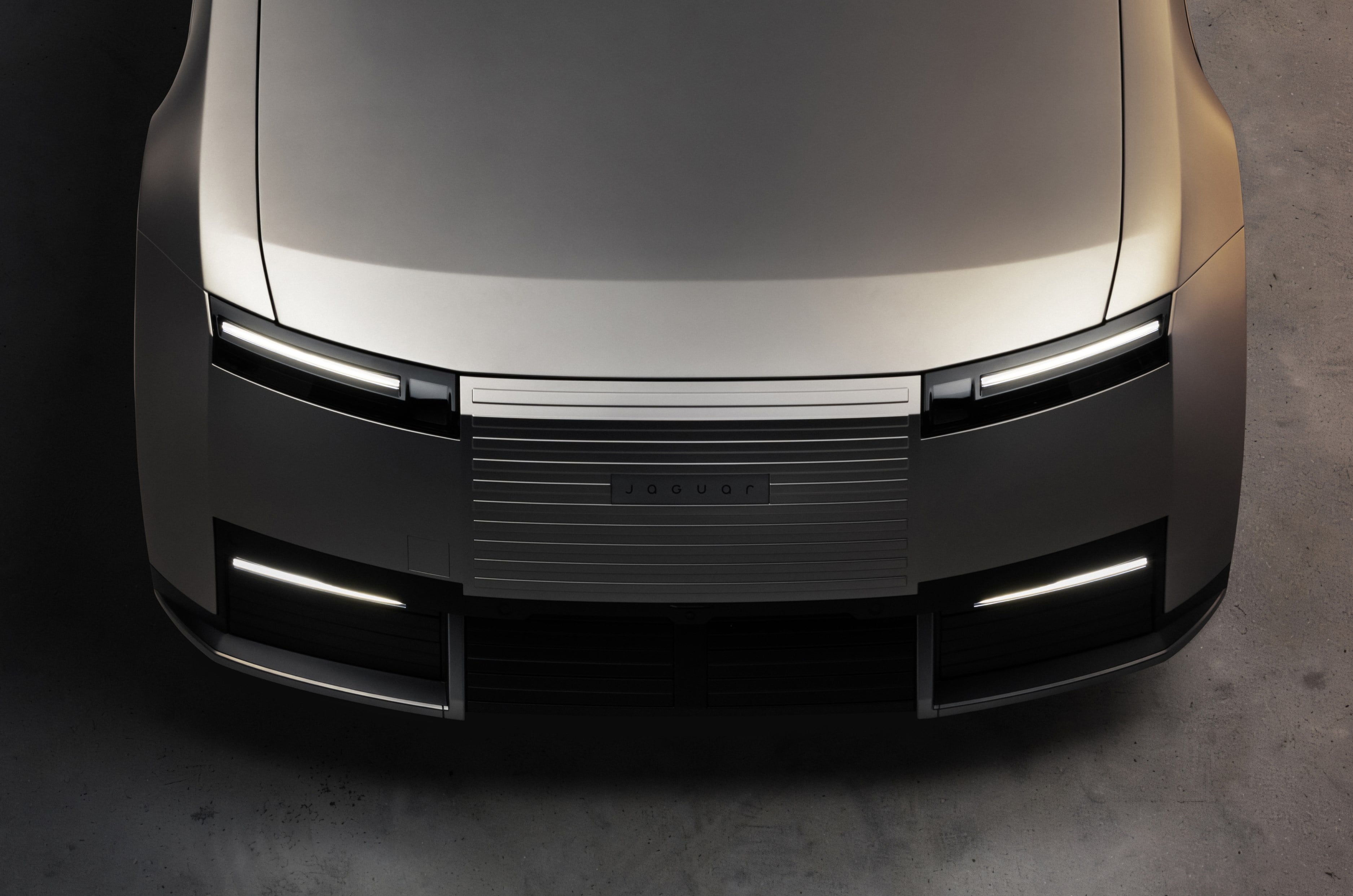
The front is dominated by Jaguar’s new ‘strikethrough’ design element, which gives the bluff nose some character. Unlike most EVs that have a blanked-off front, the strikethrough simulates a grille, retaining some of the visual character of a conventional car. There is, of course, cooling required, and this is handled by active shutters lower down, which open and close depending on cooling requirements.
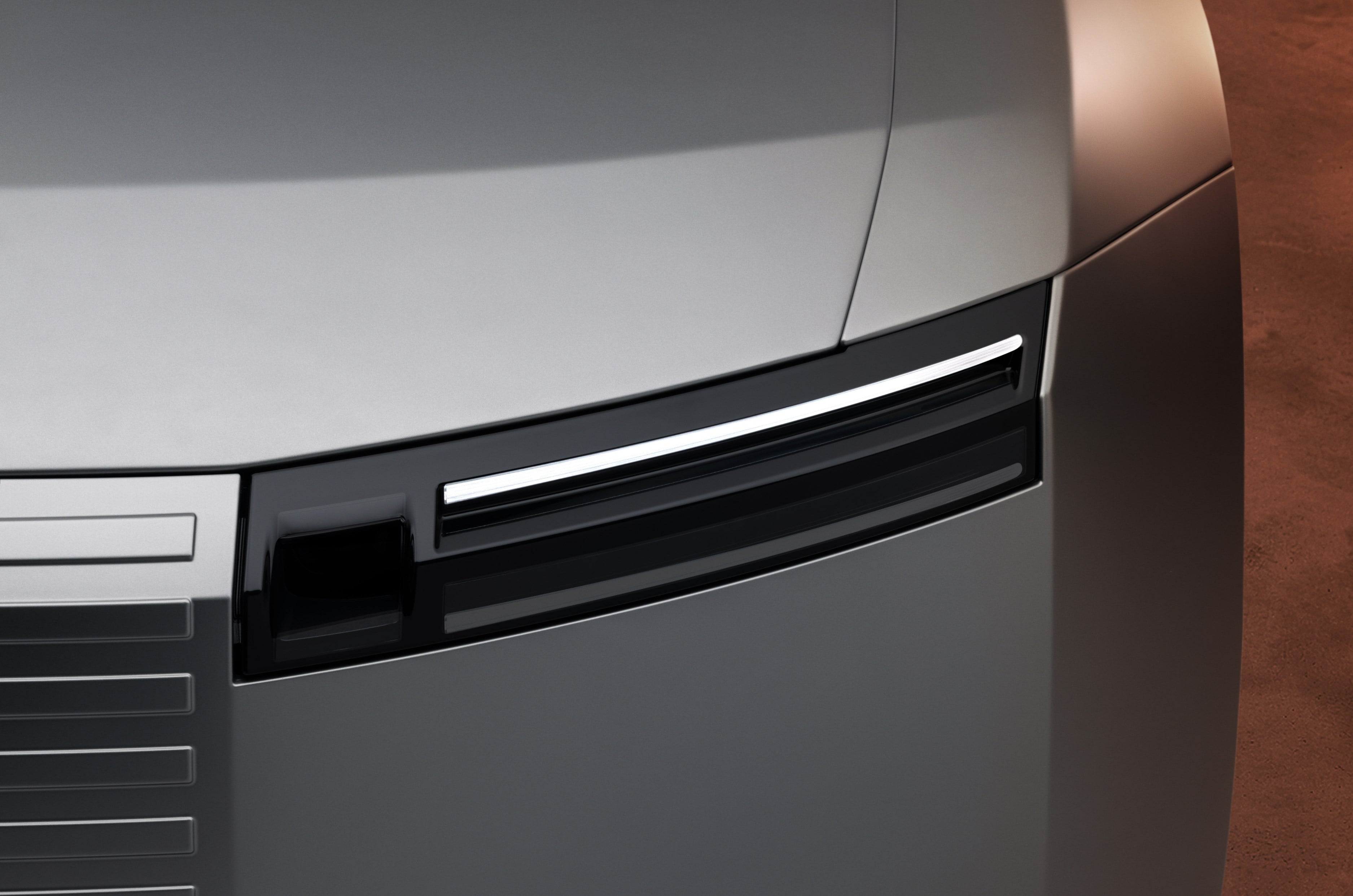
The four ‘line’ daytime running lights are another distinctive element and could become a signature for future Jaguars. The headlights, meanwhile, are the slimmest ever fitted to a Jaguar.
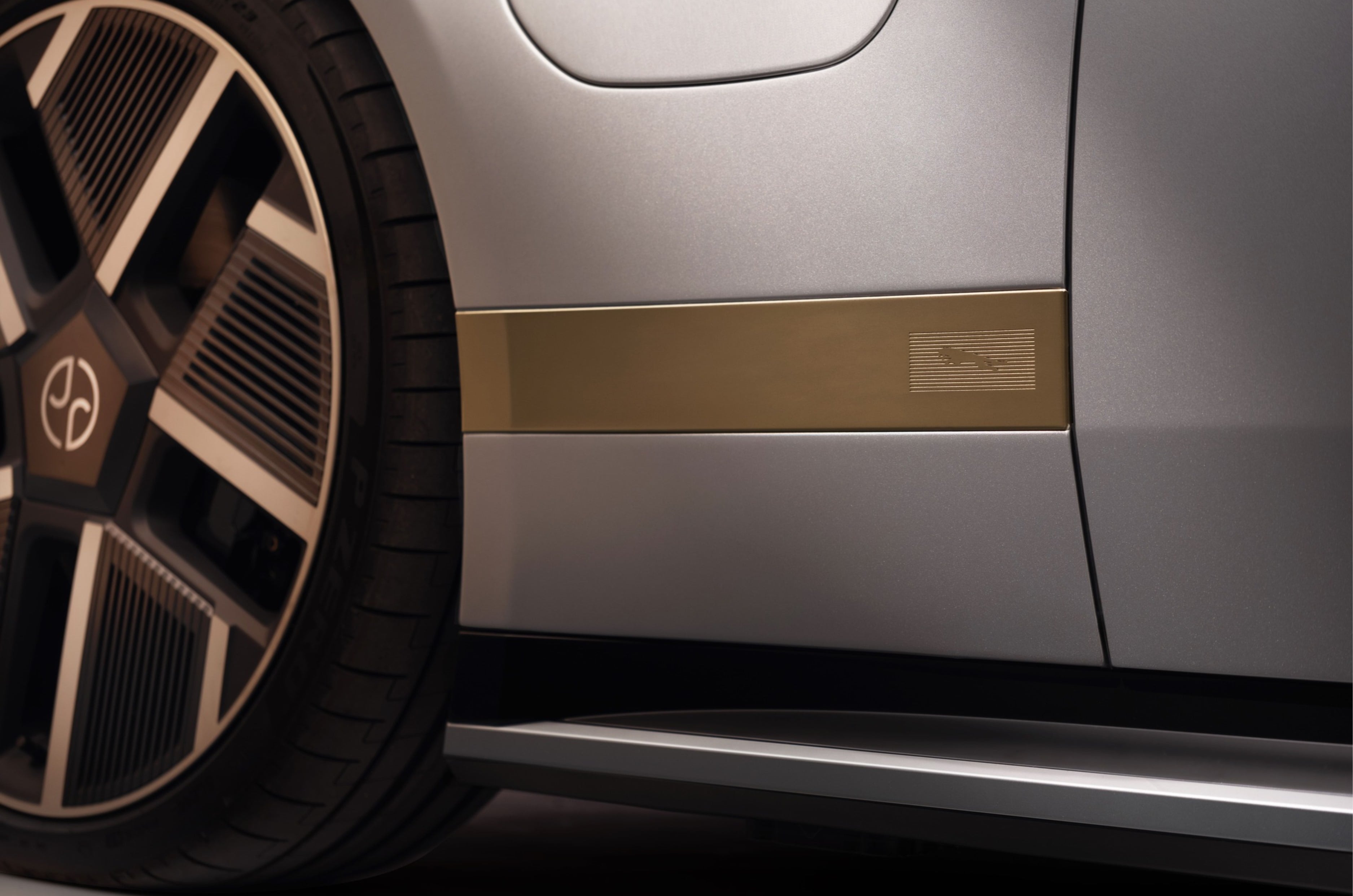
Despite its almost upright front end, the Type 01 is the most aerodynamic Jaguar yet, with a drag coefficient of just 0.23. This has been achieved through extensive aerodynamic work, including active aero elements and clean, uninterrupted body surfaces. The traditional leaping Jaguar mascot is absent from the bonnet, but fear not, it’s not entirely gone, surfacing on a brass-like panel on the front fenders, which also highlights what Jaguar calls the ‘luxury gap’ — the distance between the front axle and the A-pillar. This massive length gives the car its distinctive bonnet-forward proportions and a very regal stance; there is also a functional purpose.
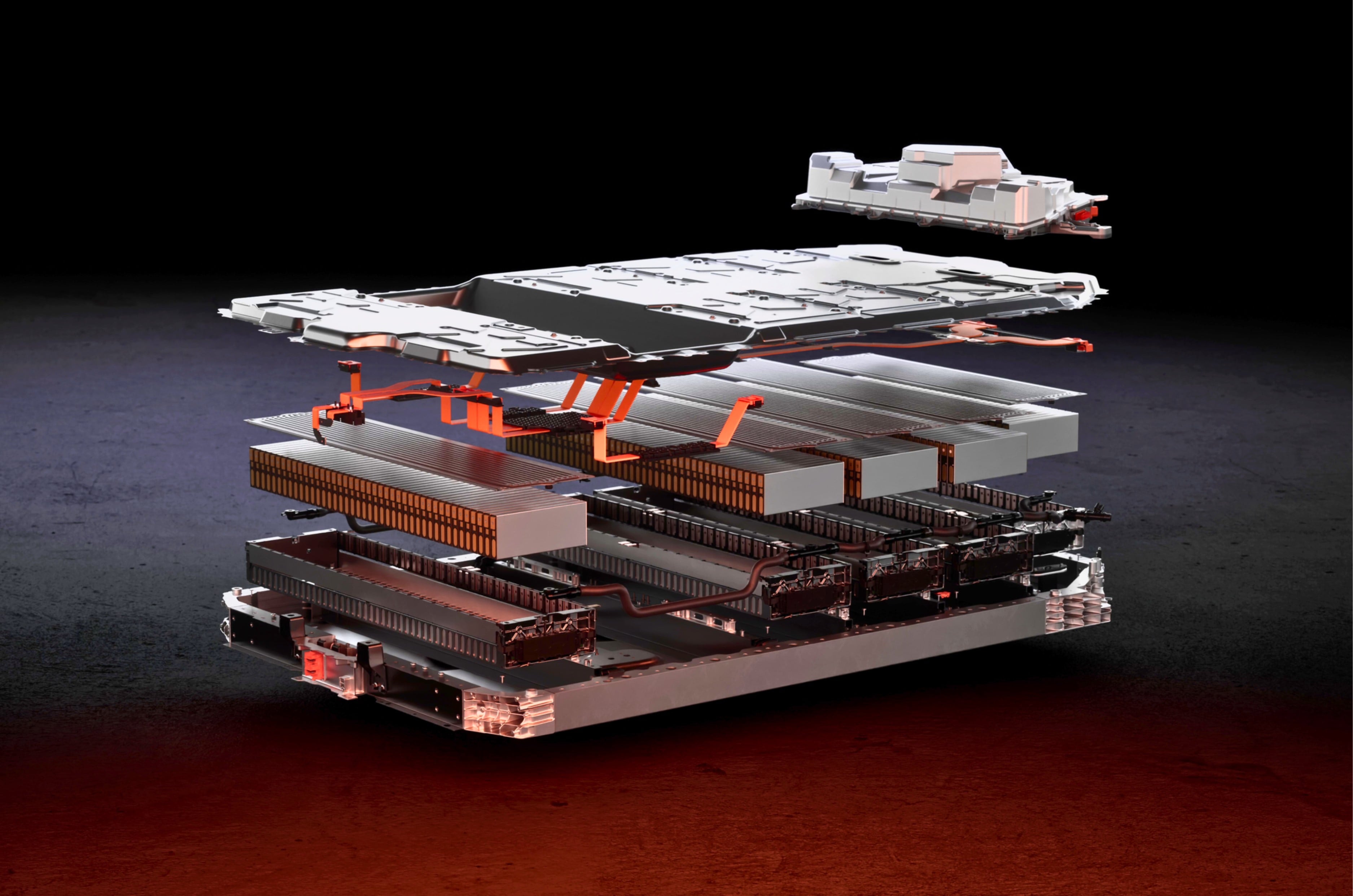
The Type 01 has a split battery pack, comprising five separate modules: one positioned ahead of the A-pillar – in this gap – necessitating a re-engineered front crash structure; then there are three modules behind the A-pillar, a gap around the B-pillar area and then the final module near the C-pillar. Typically, EVs use a single battery pack contained between the A and C pillar line; however, the low roof meant Jaguar needed that gap to create a footwell for rear passengers.
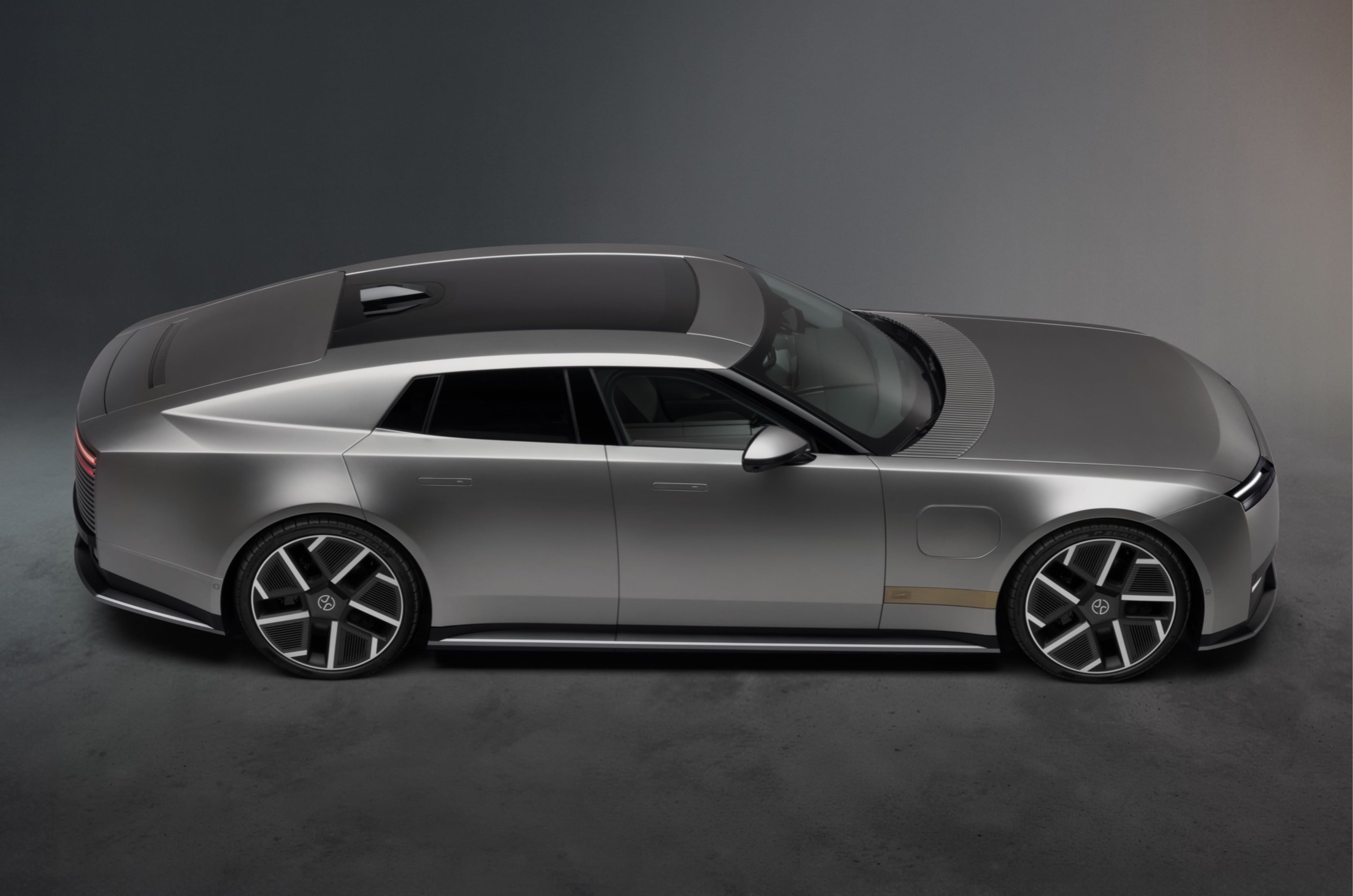
The long 3.2-metre wheelbase and low 1,400mm overall height give the Type 01 its dramatic slammed-down stance, a hallmark of the concept. In fact, the massive 23-inch wheels make up more than half the height of the entire car. Charging ports are provided on both sides, making it convenient to plug in regardless of which side the charging station is on.
One of the most interesting elements of the Type 01’s is what Jaguar calls the ‘impossible panel’. This is essentially the rear fender panel that extends all the way to the A-pillar at the top and has an extremely deep draw forming massive shoulders over the rear wheels. Jaguar says computer simulations initially suggested that the required depth could not be created with a single piece of aluminium, but it worked with the tooling and made it a reality. The resulting panel features a sharp crease that rises from the window line and creates a striking visual effect, which stands out nicely in the silver finish of the car we see here.
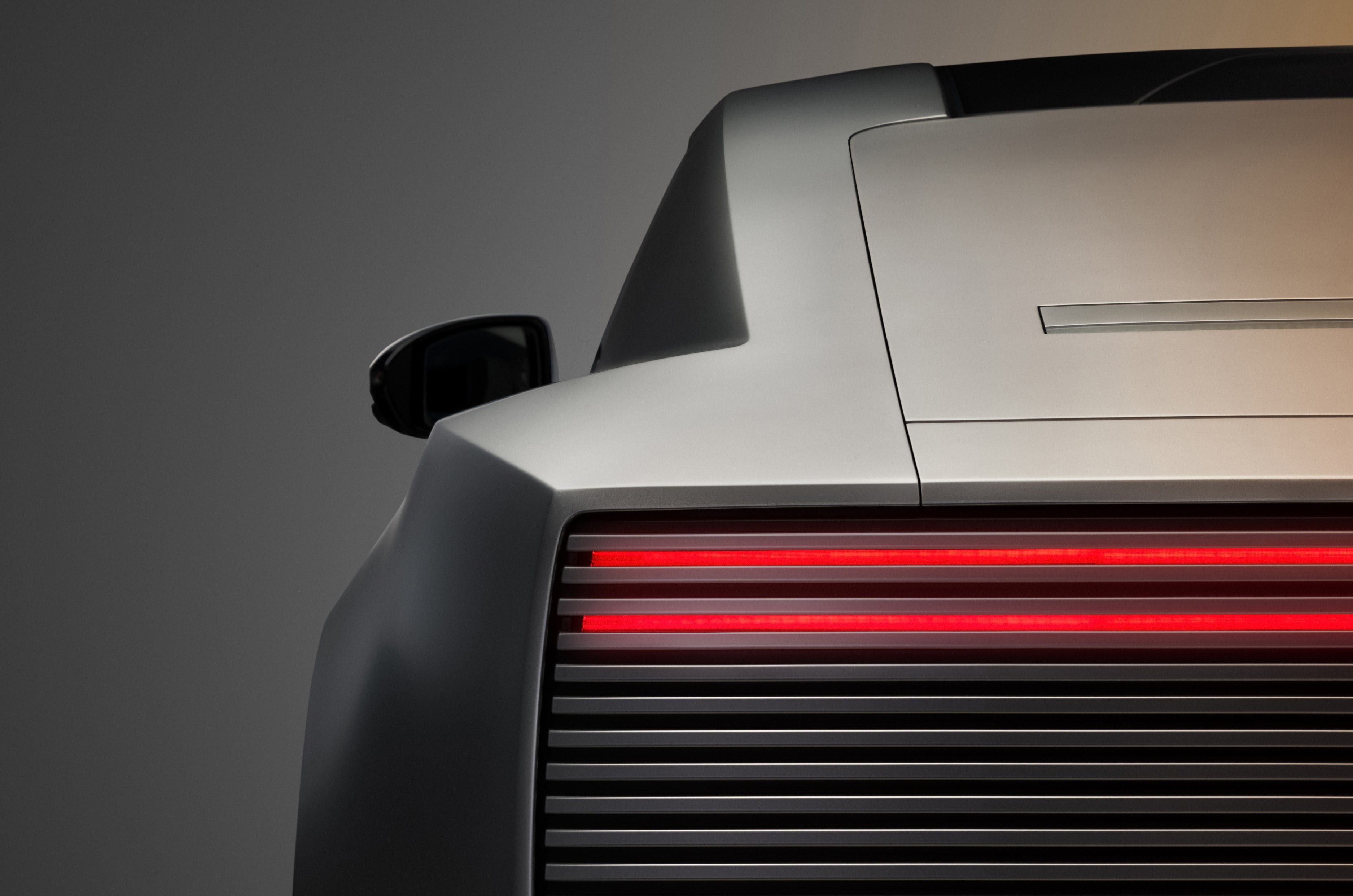
The rear is another striking area and will be the one with the most polarised views. The strikethrough design continues, but it pretty much dominates the entire width of the car; even the taillights are hidden within. When the car is switched off, the lights are invisible, leaving just the grille-like surface, and it does look excessively lined, though unique.
Then there’s the complete absence of a rear windscreen. Jaguar says a conventional rear windscreen would offer very limited visibility with a short vertical height, given the car’s long sloping roofline, so it opted for a clean monolithic panel while a camera feeds a digital rear-view mirror. There’s also a rear spoiler that can be deployed; there are three positions in all, adjusting according to speed to aid aerodynamic efficiency and stability. Beneath the tailgate is 450 litres of boot space in a relatively shallow bay, with some additional storage beneath a panel.
Give and take
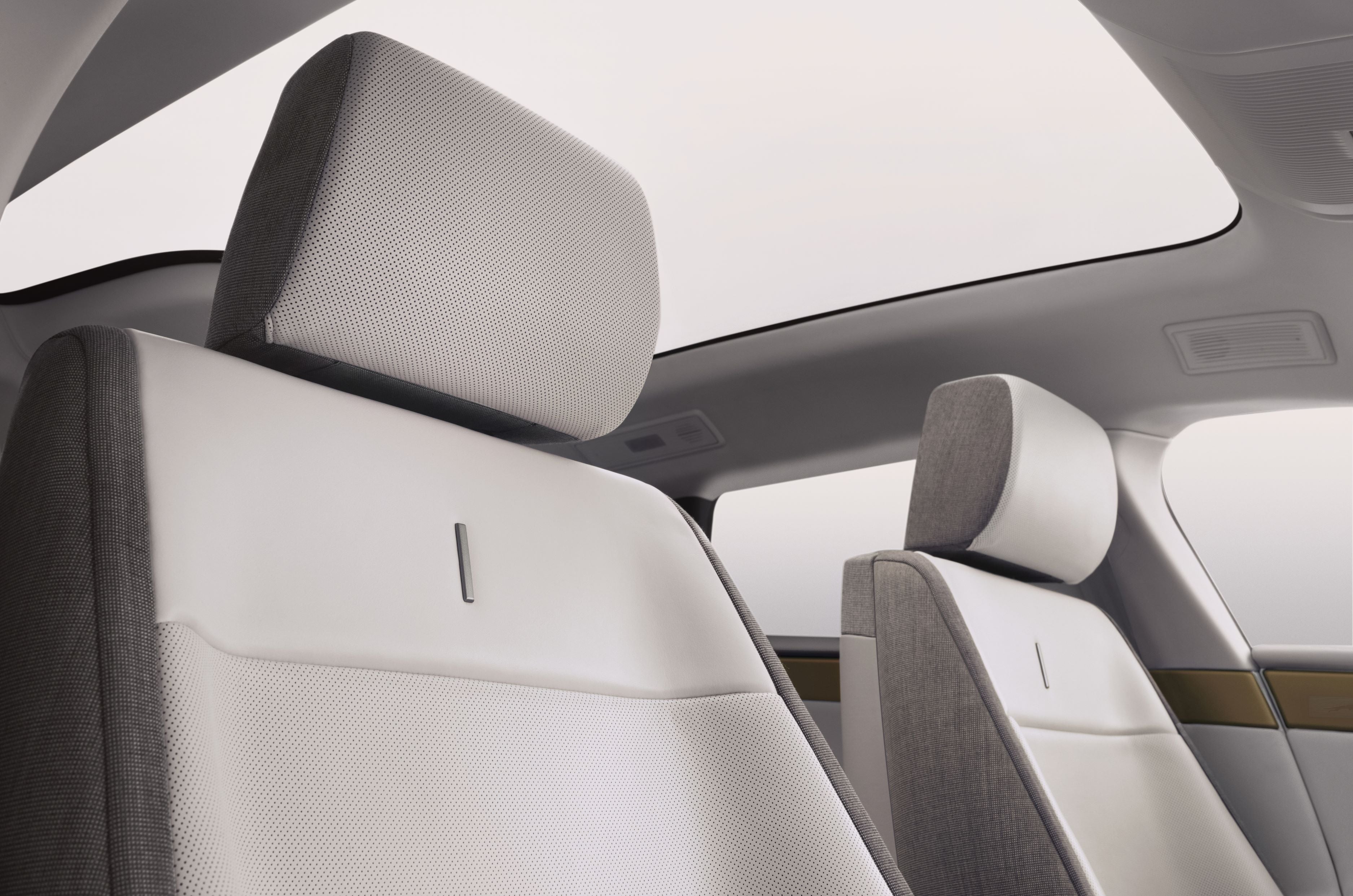
The Type 01’s concept car design and proportions do come with some compromises, and that’s immediately apparent stepping into the rear. You have to move around a protruding rear panel and sink into the seats. Once there, the space is cosy or claustrophobic depending on how you see small spaces. The trouble is the low roof is very close to your head, and the window panes are extremely small; there’s a glass roof, but it only does so much to alleviate the lack of cabin volume. Furthermore, you sit behind the pillar, so you get some privacy, but not an open view outside.
The seats are comfy enough, and at the rear the split battery arrangement reduces the knees-up seating position; while it isn’t comfortable like a conventional car, the arrangement makes a meaningful difference.
At the front too, the low roof means a low-set driving position; the windscreen is shallow in height, and headroom is just about sufficient for taller occupants. Also, the rear-view mirror – or display, more accurately – is positioned at the base of the windscreen rather than atop. The front seats feature heating, cooling and massage functions.
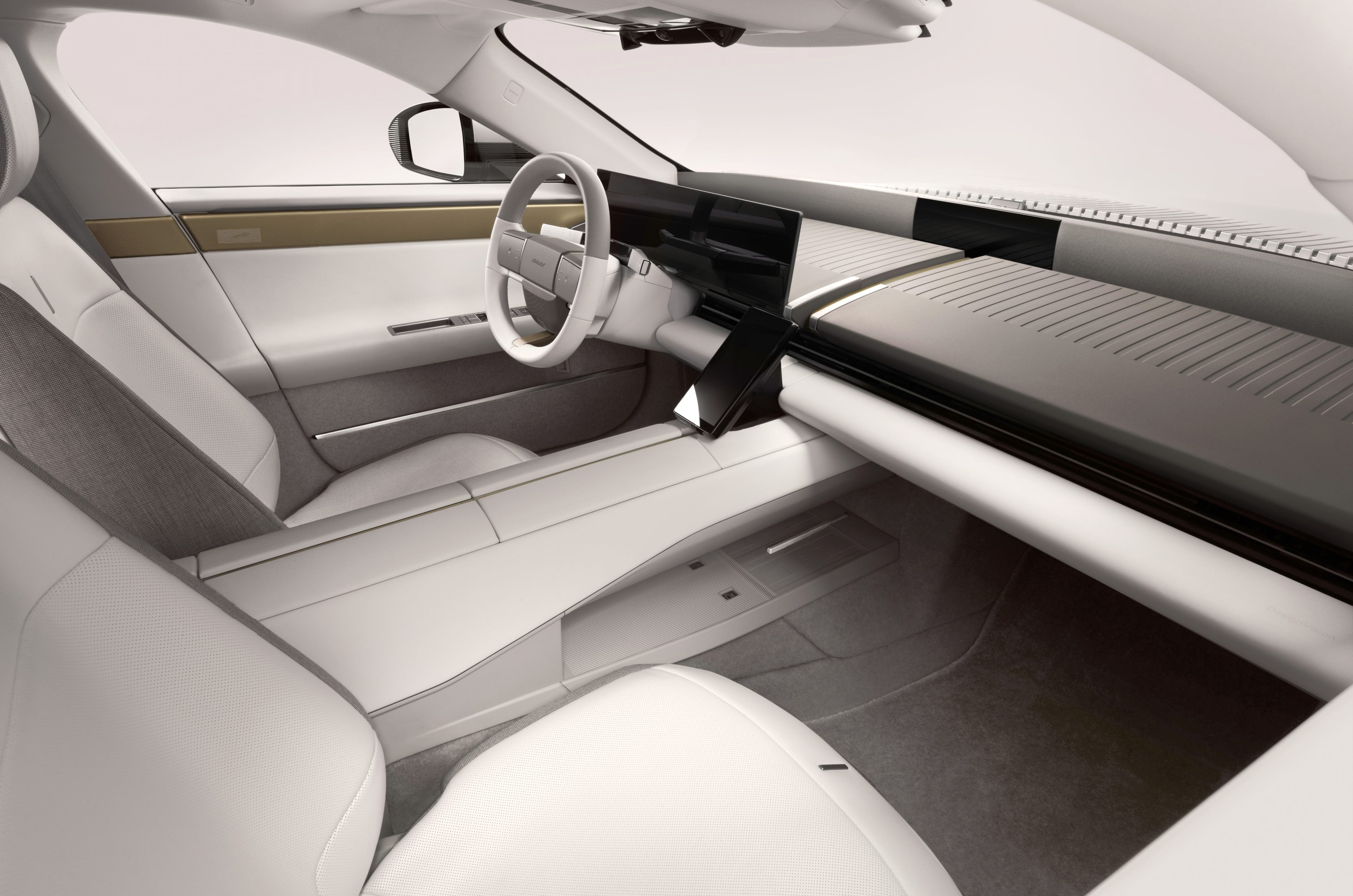
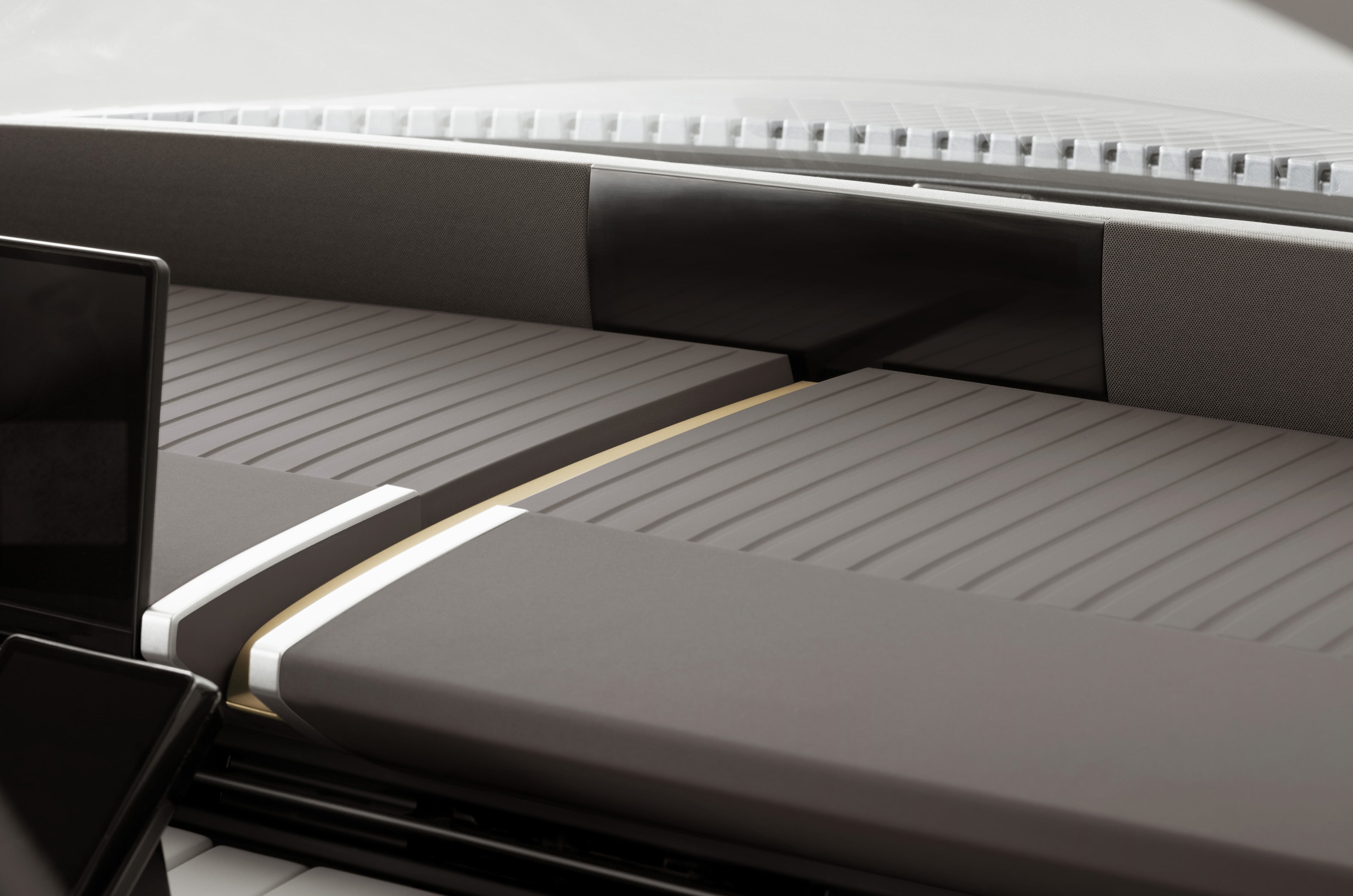
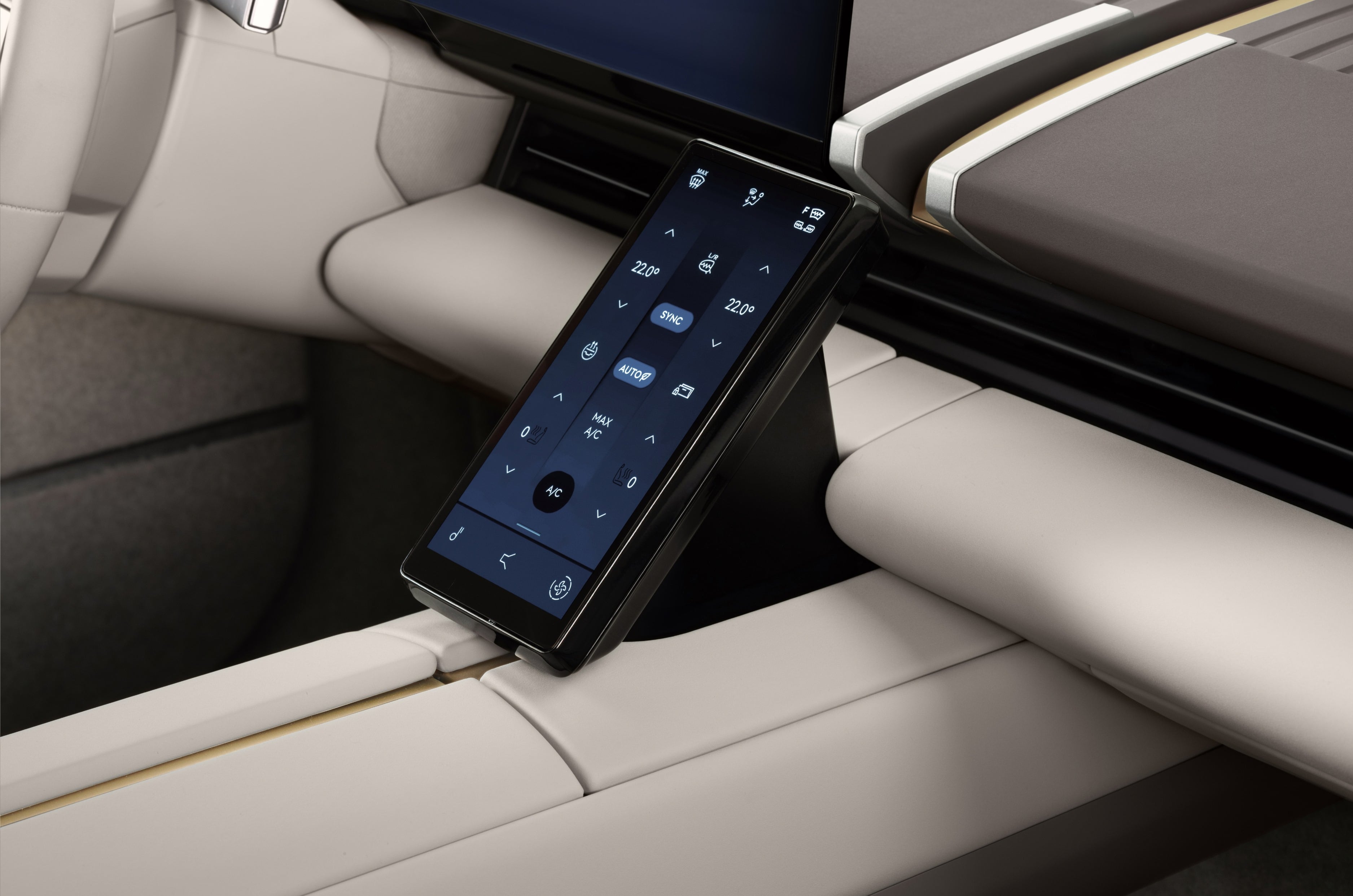
The cabin is divided into four distinct zones by a prominent central spine that houses storage spaces and a rear touchscreen controller. The dashboard carries the strikethrough pattern from the bonnet outside, and the doors carry prominent brass-finished panels. The absence of physical buttons is disappointing; thankfully, the central touchscreen, which handles climate control, is positioned in a manner that allows the driver to rest a hand on the central spine to make operations a bit easier.
There’s a single large 24-inch display combining the instrument cluster and central infotainment screen; driver-focused information is to the right, and functions accessible to the front passenger are on the left.
Number crunching
Underneath its dramatic styling, the Type 01 packs in some serious performance hardware and is the latest to join the 1,000hp+ club. Power comes from a three-motor setup, two at the rear and one at the front. Combined, these produce a massive 1,030hp and 1,365Nm of torque, and despite it weighing in at about 2.7 tonnes, the Type 01 does the 0 to 100kph sprint in 3.2 seconds. This isn’t the 2-second territory that others of this high horsepower club claim, but it’s still extremely quick for what is essentially a four-door GT. Jaguar has often talked of ‘power in reserve’ and highlights its strong 100kph to 180kph of 4.0 seconds as evidence.
Feeding this power is the split module battery; it utilises NMC chemistry and has a 120kWh capacity (118kWh usable) and promises a WLTP range of up to 720km. Jaguar says thanks to the 850-volt architecture, on a 350kW DC charger you can add 321km of range in 13 minutes and 10-80 per cent in around 22 minutes with the split pack set-up to maximise 400-volt chargers. The Type 01 also features twin AC charging ports, one on each side, so it’s easy to charge no matter how you park.
The powertrain has drive modes, torque vectoring and ride is courtesy of switchable air springs and twin-valve active dampers. Rear-wheel steering keeps a tight 11.5m wall-to-wall turning circle diameter.
Shock! And awe?
The Type 01 is unlike Jaguars of the past, which were the target. Jaguar sales were drying up, and it needs to bring in new customers, and that’s where this entirely new design direction comes in. It has traces of its heritage but, on the whole, is unique, and there’s no denying it’s striking to look at with its wild concept car looks. This, however, means interior space is at a premium, and there are ingress and egress challenges. Making amends in some way is the minimal and classy interior styling and, of course, a powertrain with all the right numbers and ingredients that promises a thrilling drive experience.
Asking prices for all this will be going up, not to the levels of a Rolls or Bentley but above what the brand’s previous flagships like the XJ were at. Expect prices to start at £120,000 in international markets where deliveries are scheduled to begin by mid-2027. India will follow a few months on with prices around the Rs 2 crore mark, give or take.
Sitting between Mercedes and BMWs at the lower end and Rolls and Bentleys above, the Type 01 has found a gap and a differentiation in its style and appeal too. But can Jaguar transform from elegance and heritage to exuberant modernism? It’s a big leap for sure, and one that the company needs the big cat to make.
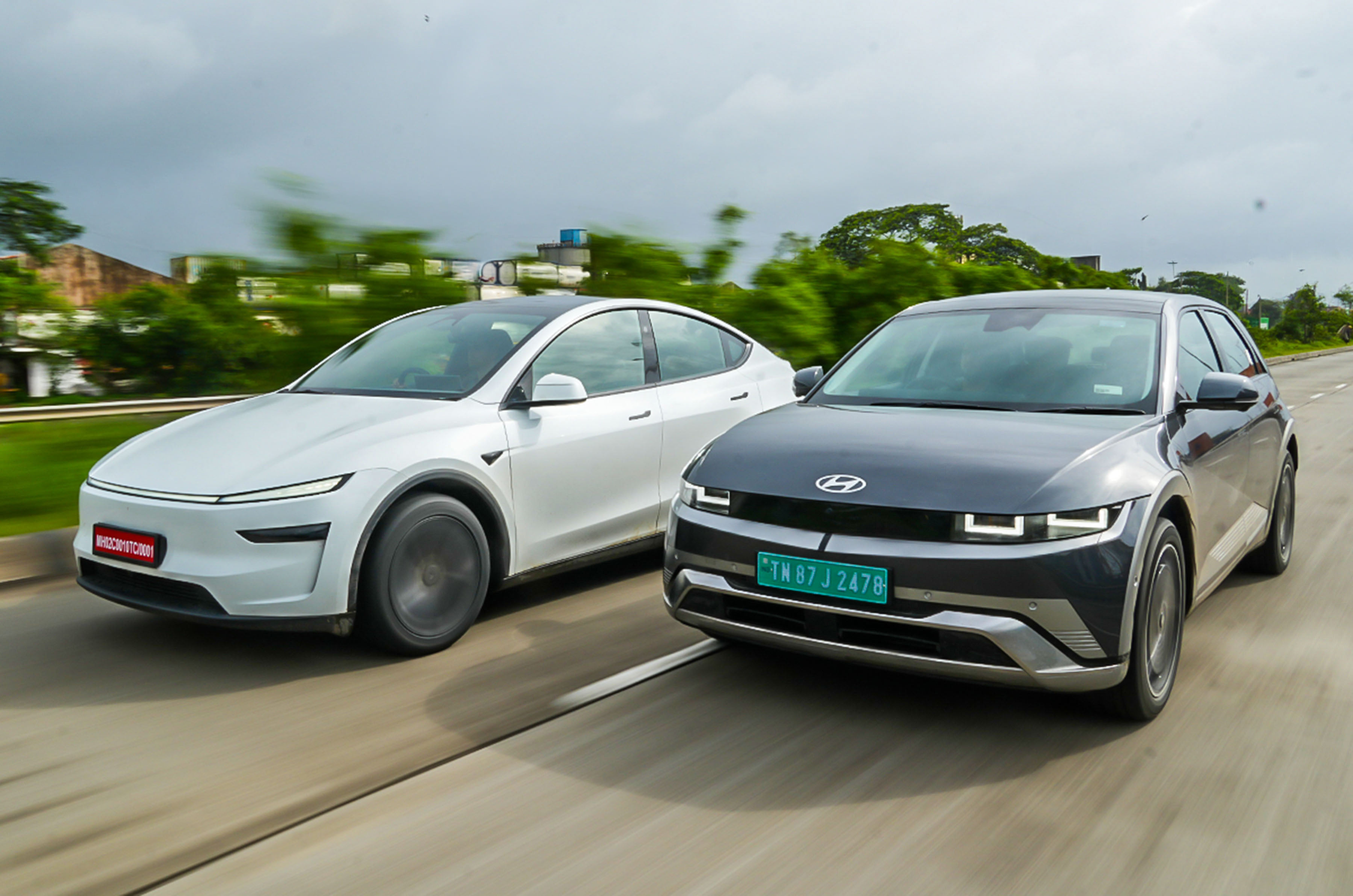
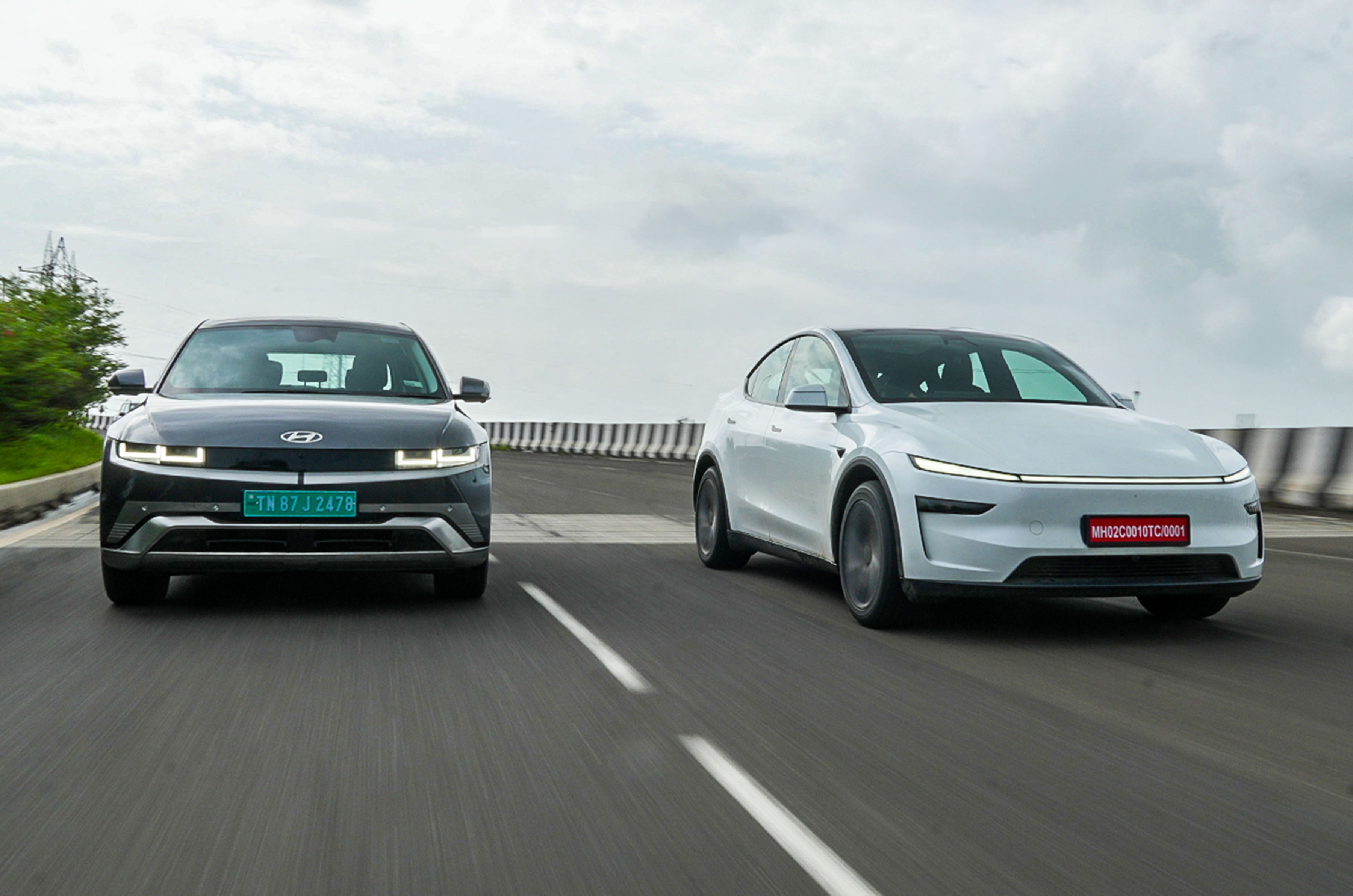
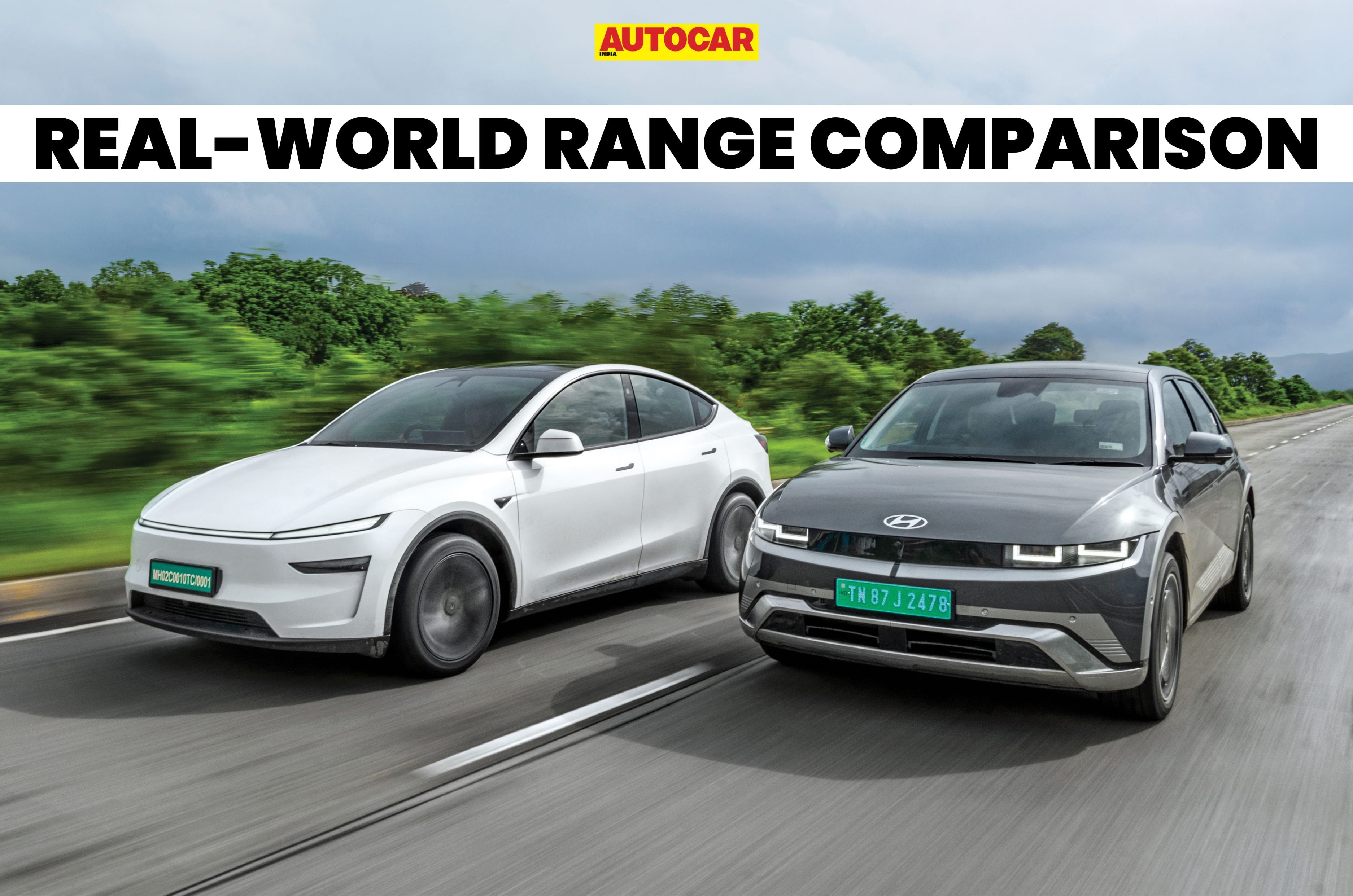
The Hyundai Ioniq 5 has been one of the standout EVs of recent years, so much so that we crowned it our 2024 Car of the Year. Back then, besides being one of the most impressive electric cars on sale, it was also among the most affordable in its segment. And when compared with rivals like the BYD Sealion 7 and BMW iX1, the Ioniq 5 came out on top thanks to its comfort, practicality and value.
Fast forward to 2026, and the landscape has changed. Hyundai has updated the Ioniq 5, and the biggest talking point is its larger 84kWh battery. But in the process, this value-focused EV has become one of the most expensive options available.
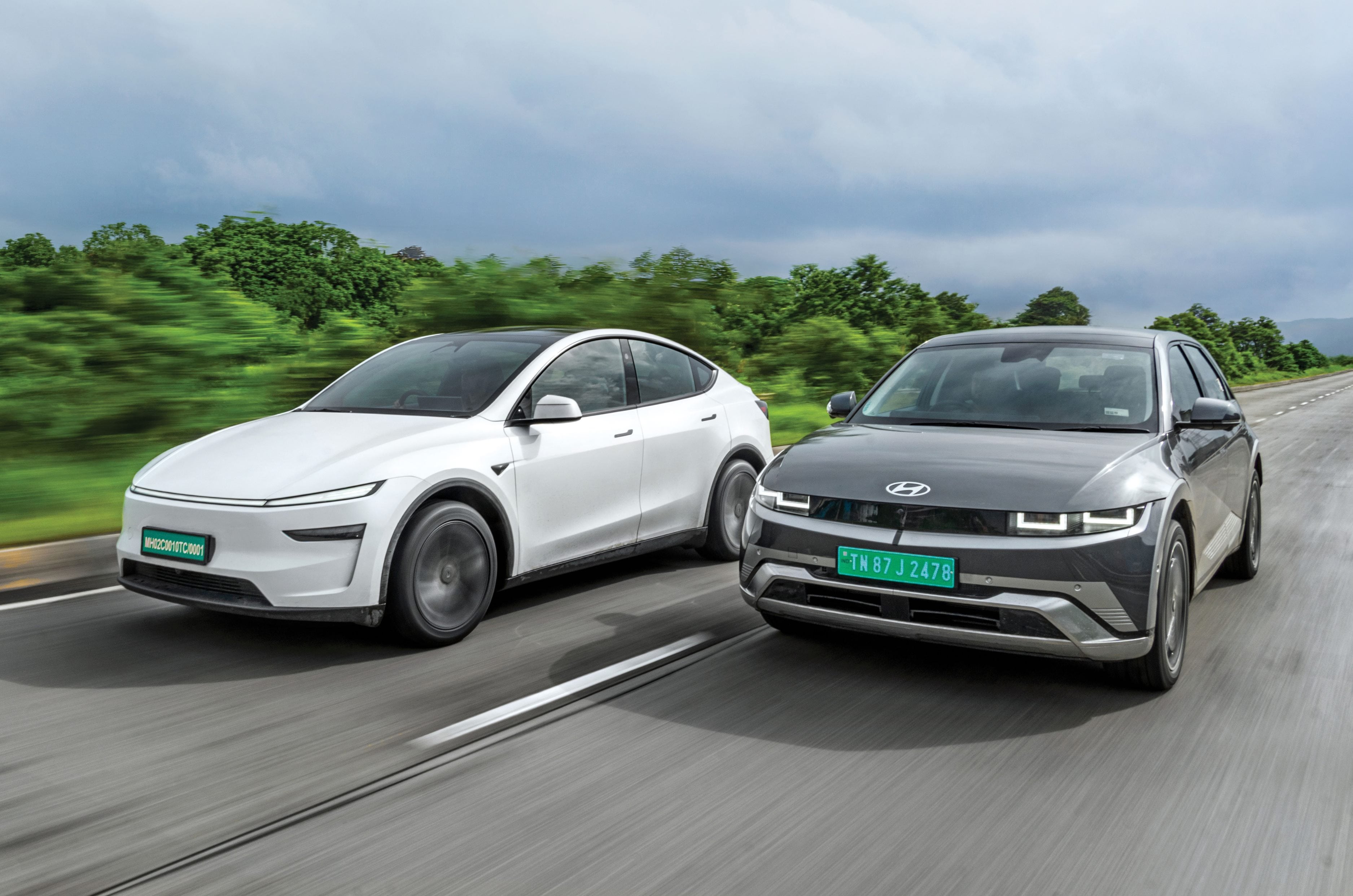
Tesla, meanwhile, has dropped prices. The Model Y now starts at just under Rs 51 lakh, undercutting the Ioniq 5 and transforming itself from one of the pricier alternatives into the more affordable option. With the pricing hierarchy flipped, this comparison has become more interesting than ever.
Tesla Model Y vs Hyundai Ioniq 5: Exterior design
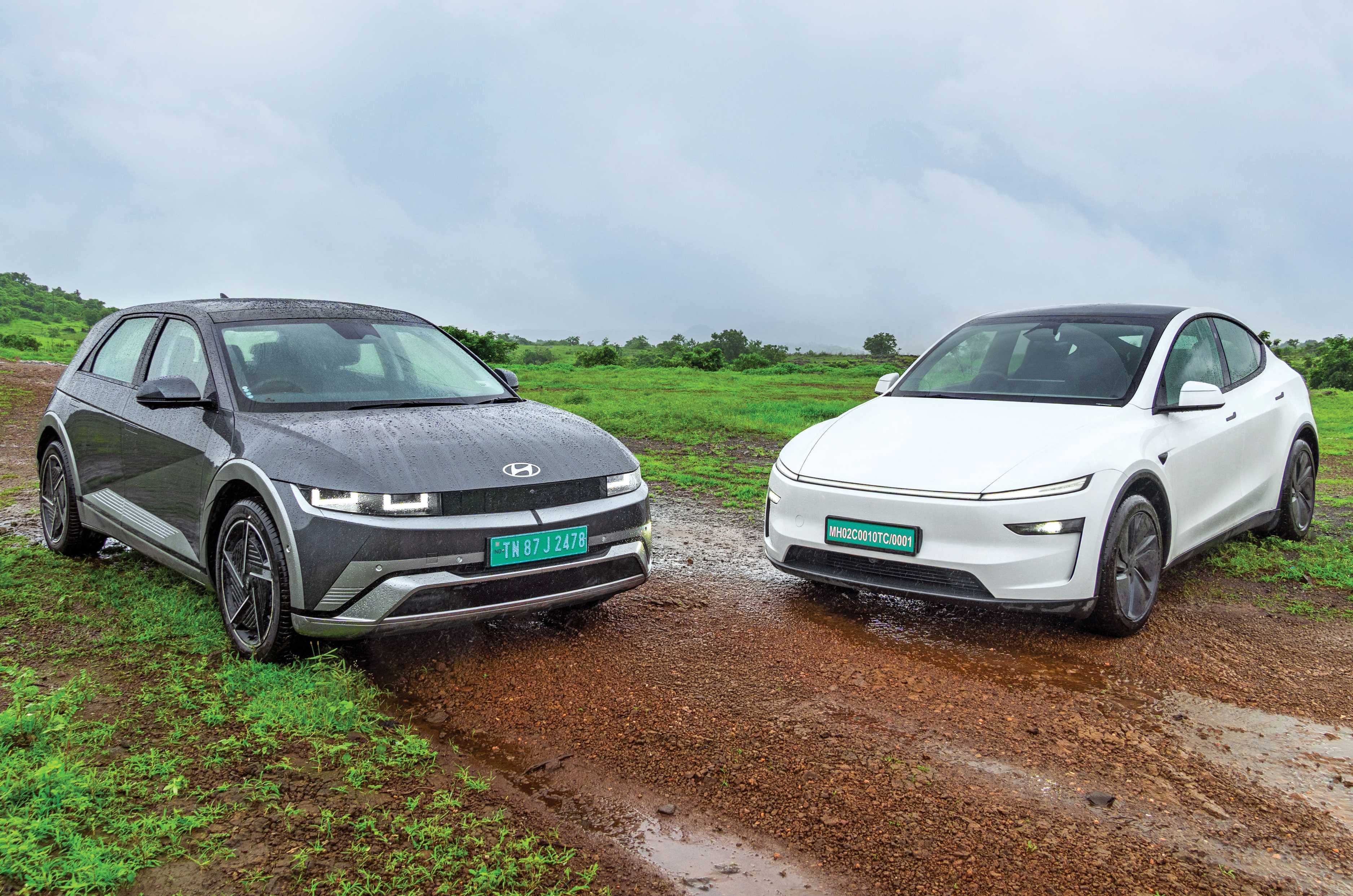
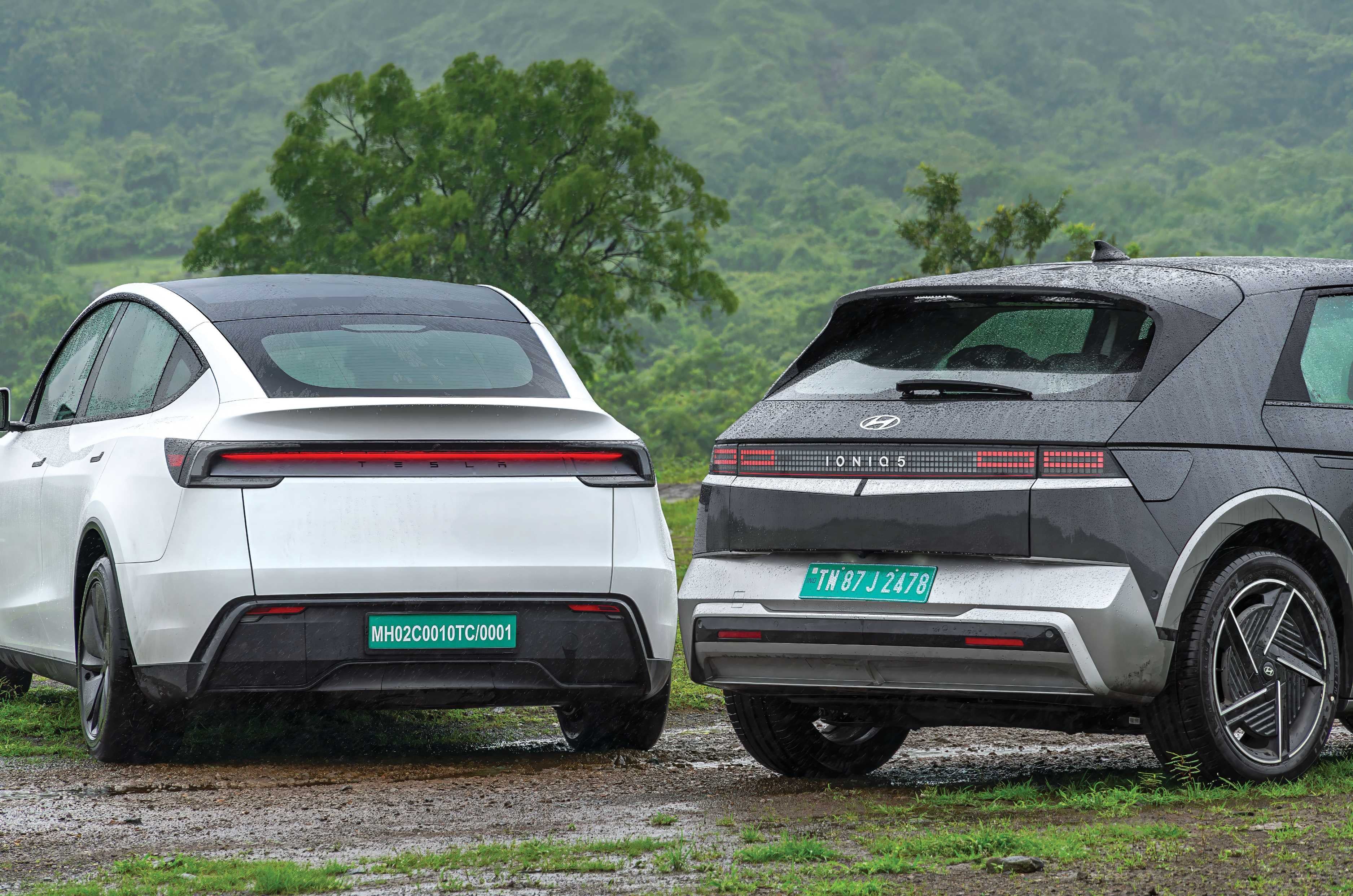
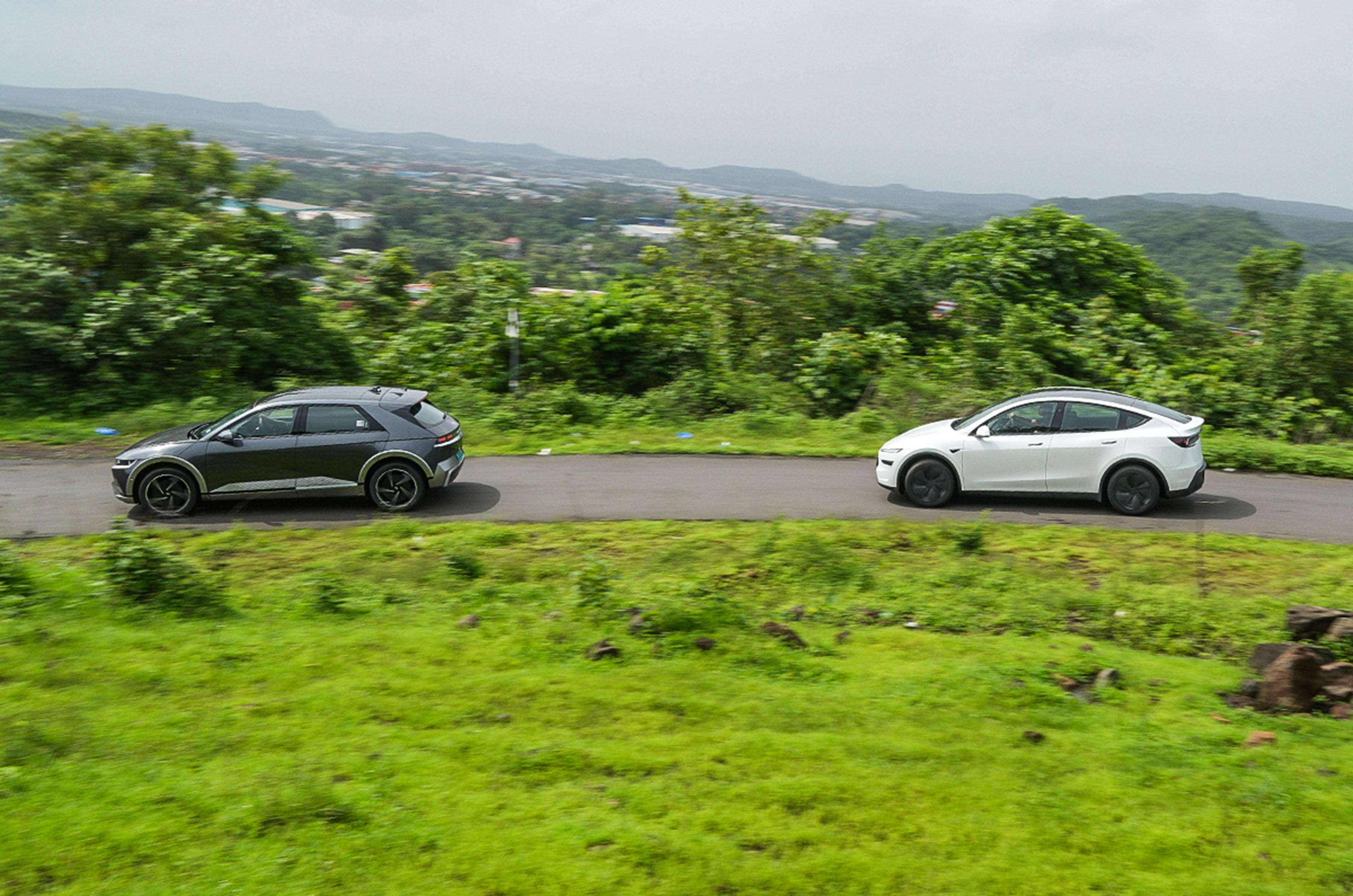
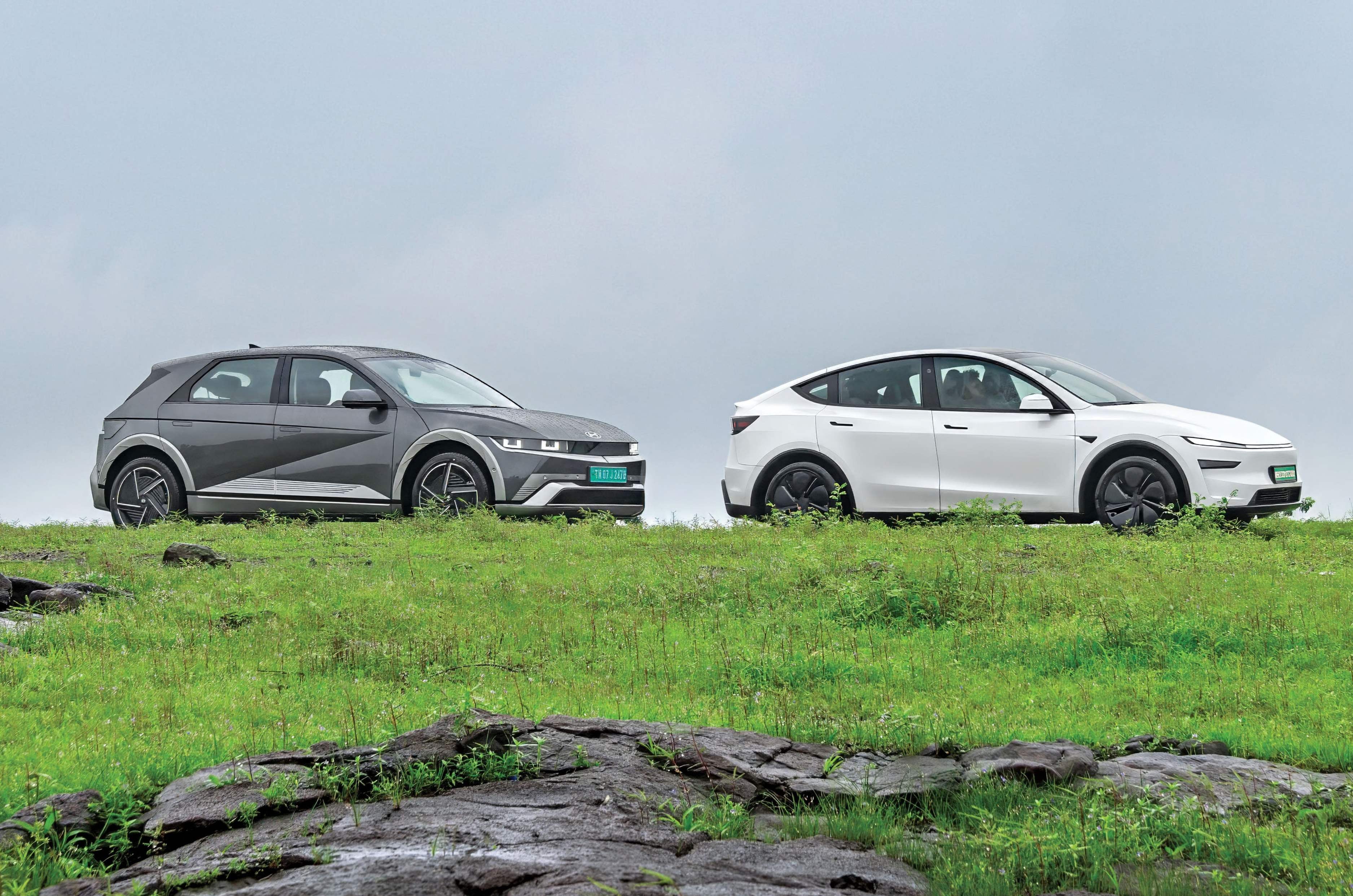
The Tesla Model Y is the larger vehicle overall, although the Hyundai counters with a longer wheelbase. Neither car follows a traditional SUV or sedan template, with muscular proportions and aggressive styling, but the Ioniq 5 stands out with its retro-futuristic design language, blending hatchback and crossover cues into a shape that is both distinctive and characterful. That said, its styling will continue to divide opinion.
The Tesla, by comparison, plays it a little safer. It too wears a crossover body style, but with a minimalist design that is unlikely to offend anyone. Frameless windows and a unique tail-lamp treatment with a hidden light bar add some flair to its otherwise fuss-free styling.
It’s worth noting that Tesla lists ground clearance at 167mm (unladen), while the Ioniq’s figure is specified as laden, coming in at 163mm. In the real world, the Tesla occasionally scrapes over unusually large speed breakers, while the Hyundai clears most of them despite its longer wheelbase.
Tesla Model Y vs Hyundai Ioniq 5: Interior and features
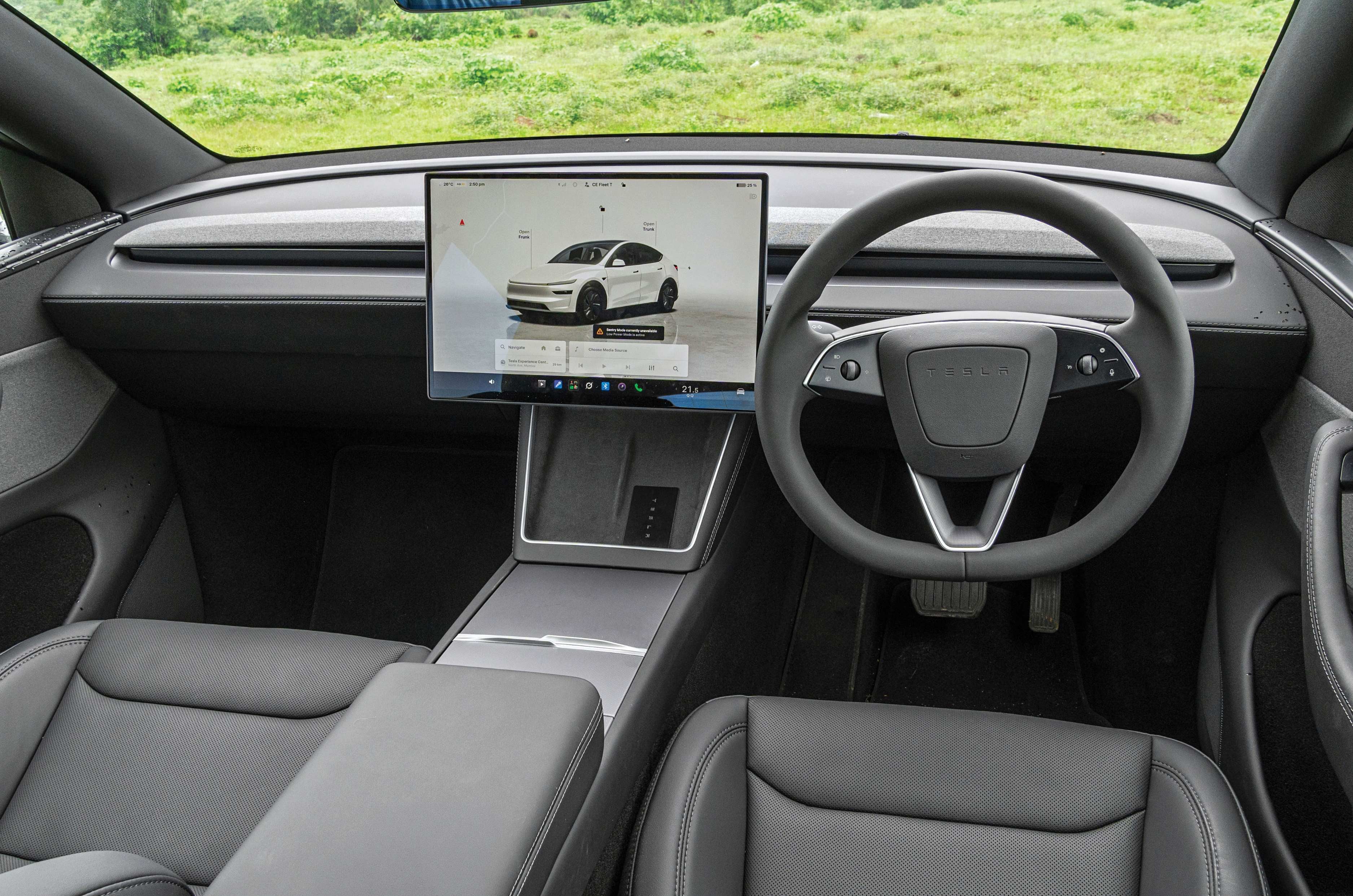
Takes minimalism to a whole different level, with merely a handful of physical controls. Lack of design elements, vegan materials don’t feel special.
Tesla’s non-motorised flush door handles remain a usability frustration, requiring an awkward push-and-pull action to operate. On the inside, the Model Y’s cabin embraces minimalism to an even greater extent. Even the air vents are hidden. The lack of design elements looks clean, but this and the choice of materials diminish the sense of occasion one expects at this price point.
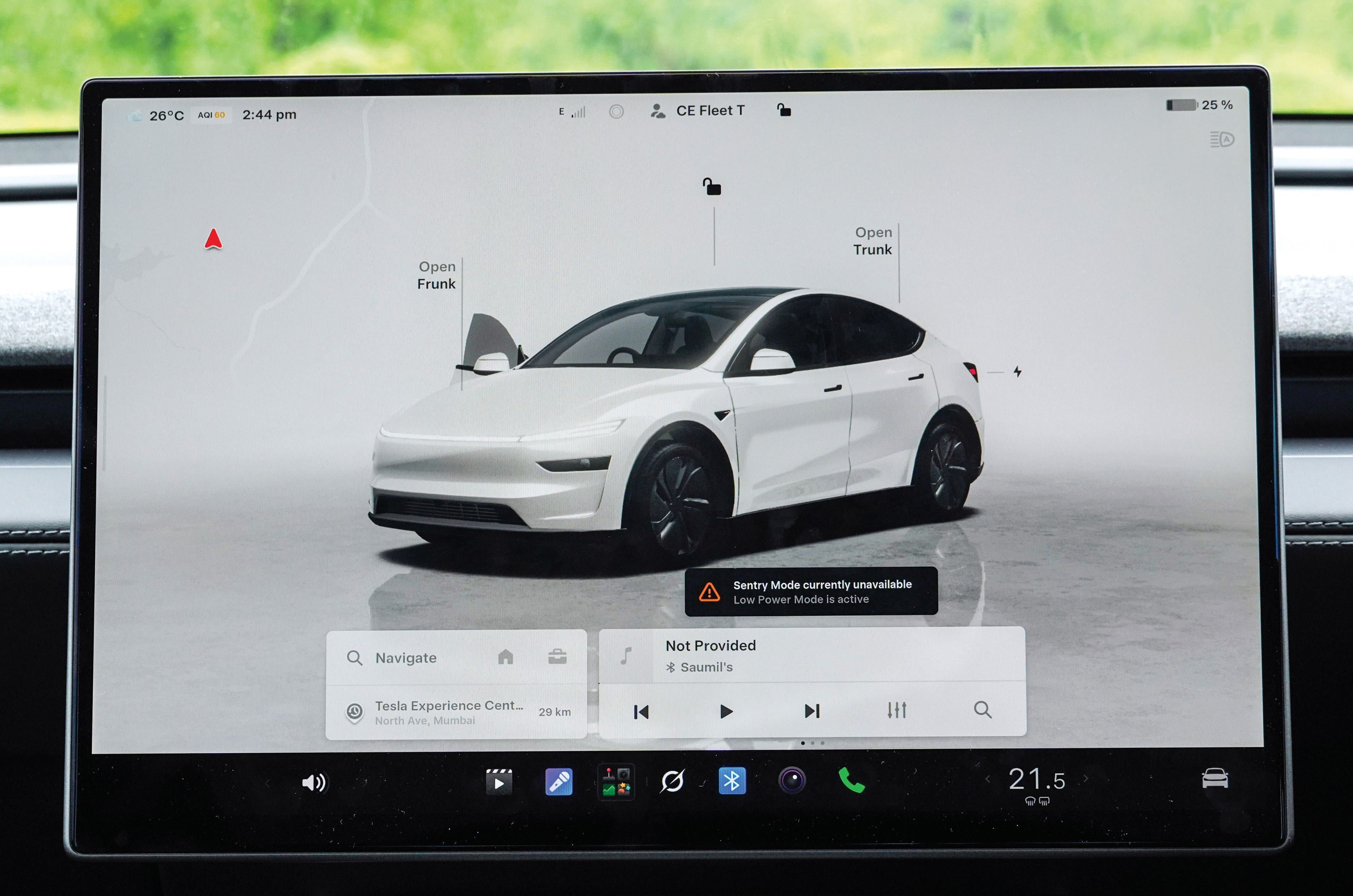
All functions are relegated to its slick screen.
Taking centre stage, quite literally, is a massive touchscreen. Nearly every function is controlled via the screen, including controls for the frunk, tailgate, glovebox, climate control, seats and steering, and mirror adjustments, among many others. This over-reliance on the touchscreen is daunting at first, but Tesla’s software experience is exceptional. The interface remains the benchmark for responsiveness, fluidity and overall usability.
The steering wheel features multi-function controls that take some time to get accustomed to. The high-beam flasher is integrated into the steering wheel too. Thankfully, the indicators and power-window switches remain physical controls. The lack of buttons might seem futuristic, but it often feels as though technology has taken precedence over usability. There are two charging pads, and below them sits an unusually bulky centre console that robs the cabin of some of its sense of space. Hampering usability further is the exceptionally deep storage area, which requires you to stretch to reach items placed inside.
Albeit a bit low-set, this space feels airy thanks to its low window line.
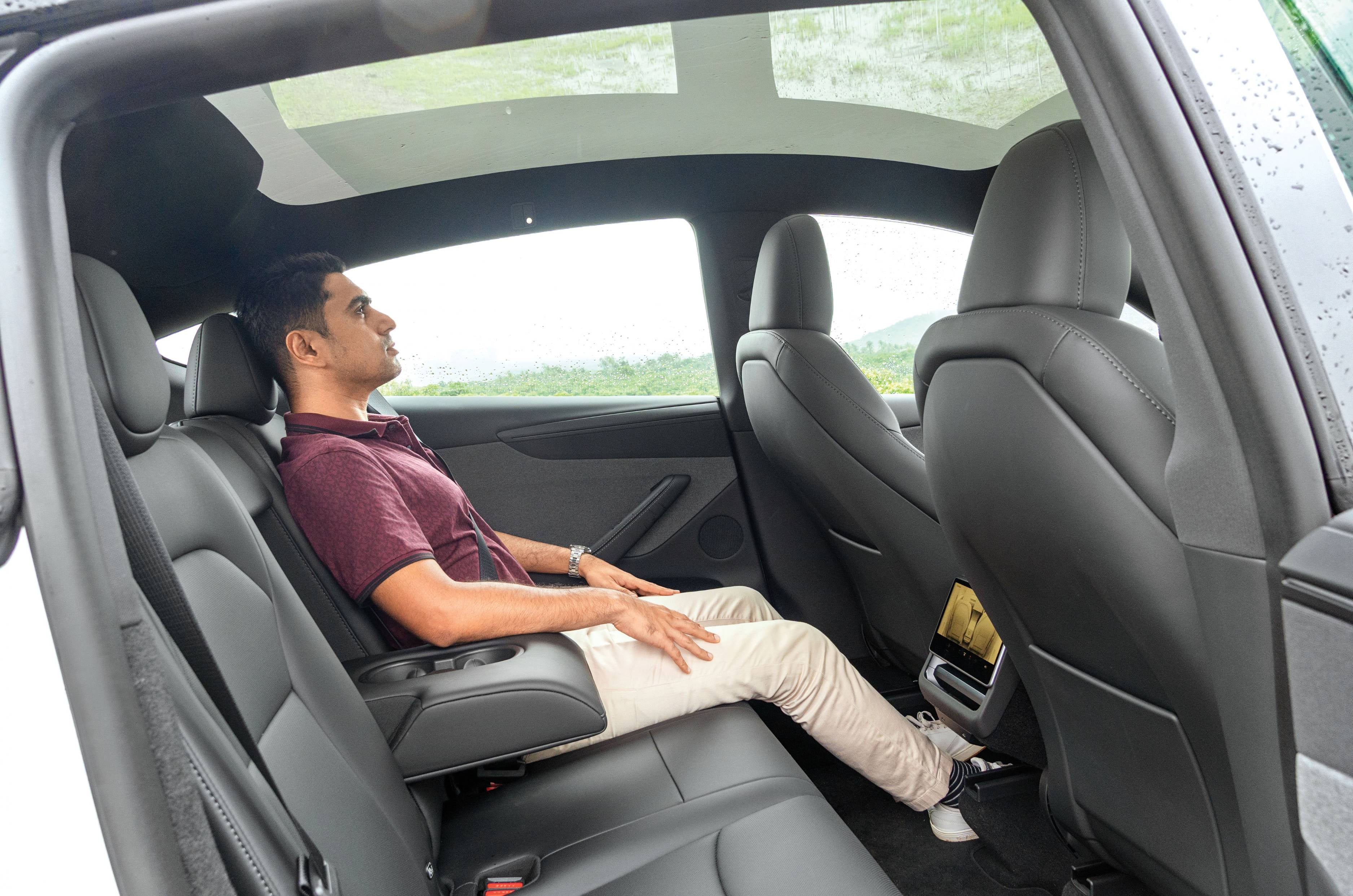
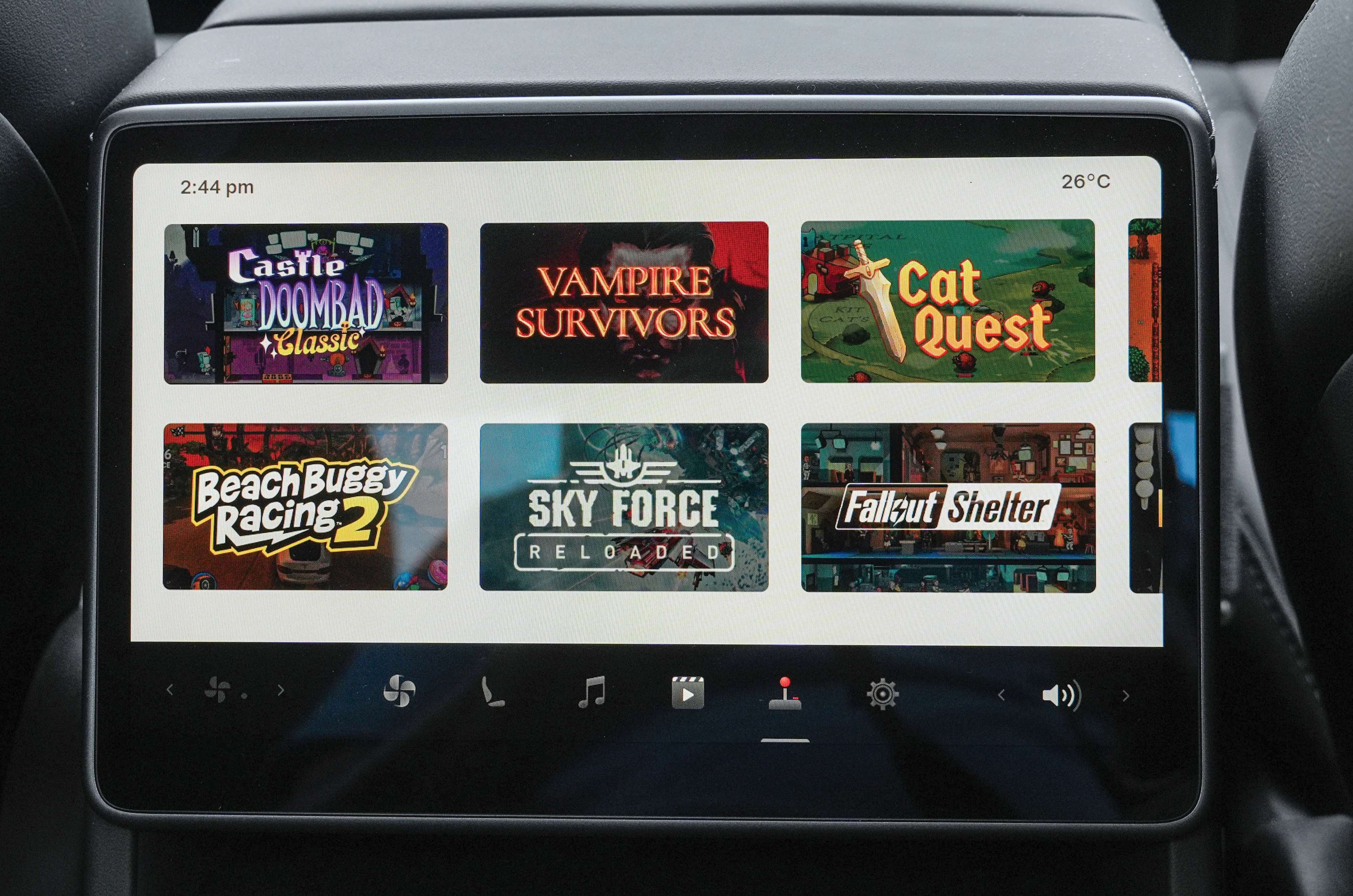
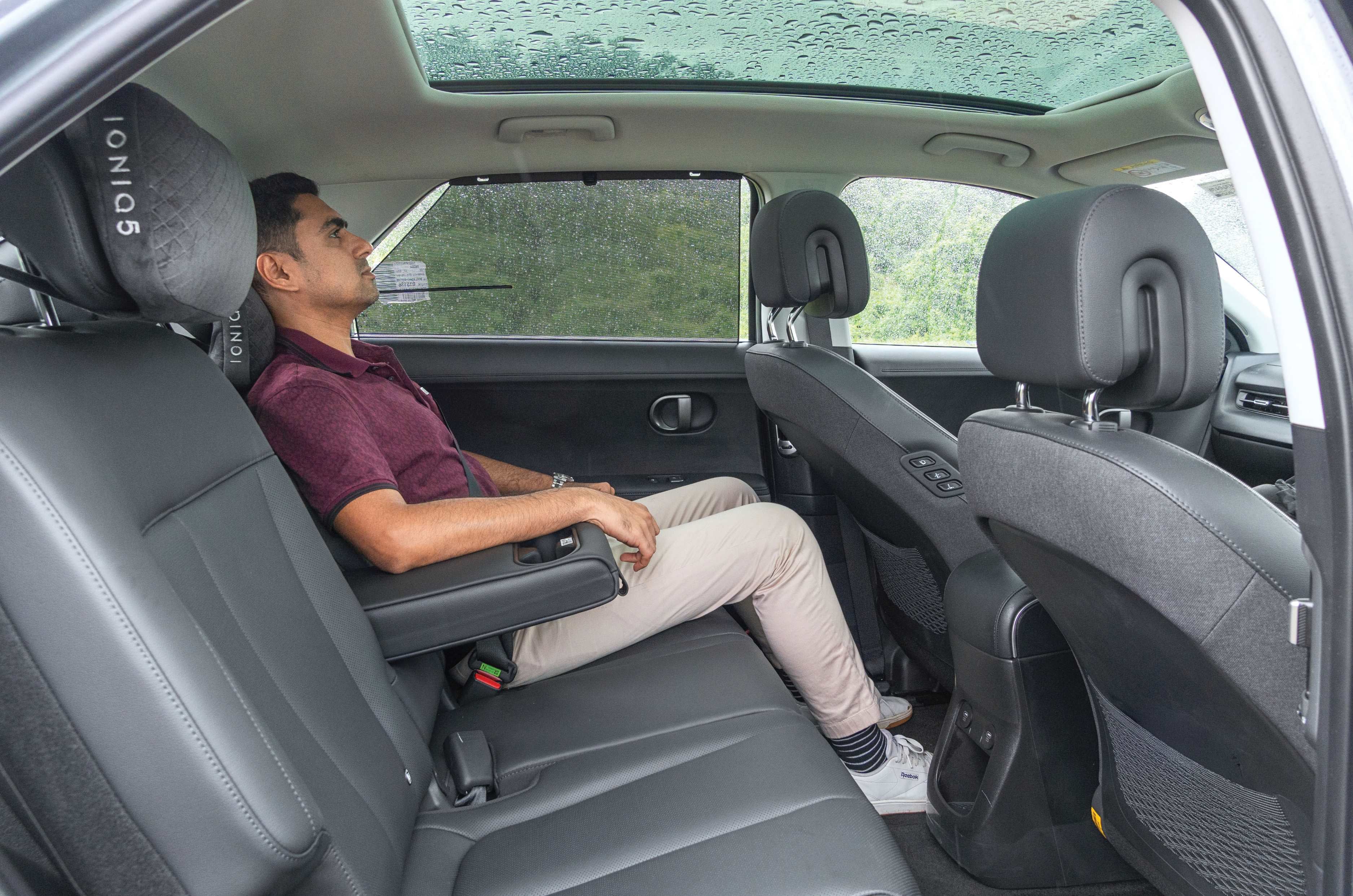
The front seats look simple and are surprisingly comfortable, with heating and ventilation functions. The rear seat is equally comfortable, although the seating position is somewhat low, resulting in a knees-up posture. What’s nice is that the backrest reclines to a comfortable angle. Rear-seat passengers are also treated to a dedicated touchscreen capable of controlling climate functions, streaming content and even gaming.
Rear screen for controls, games and videos.
One major drawback is that the sunroof still lacks a dedicated sunshade, causing the cabin to heat up considerably under the afternoon sun. The rear windows also miss out on sunshades.
More suited to our conditions, the black interiors are well-finished. It gets full marks as far as storage, ergonomics and usability goes.
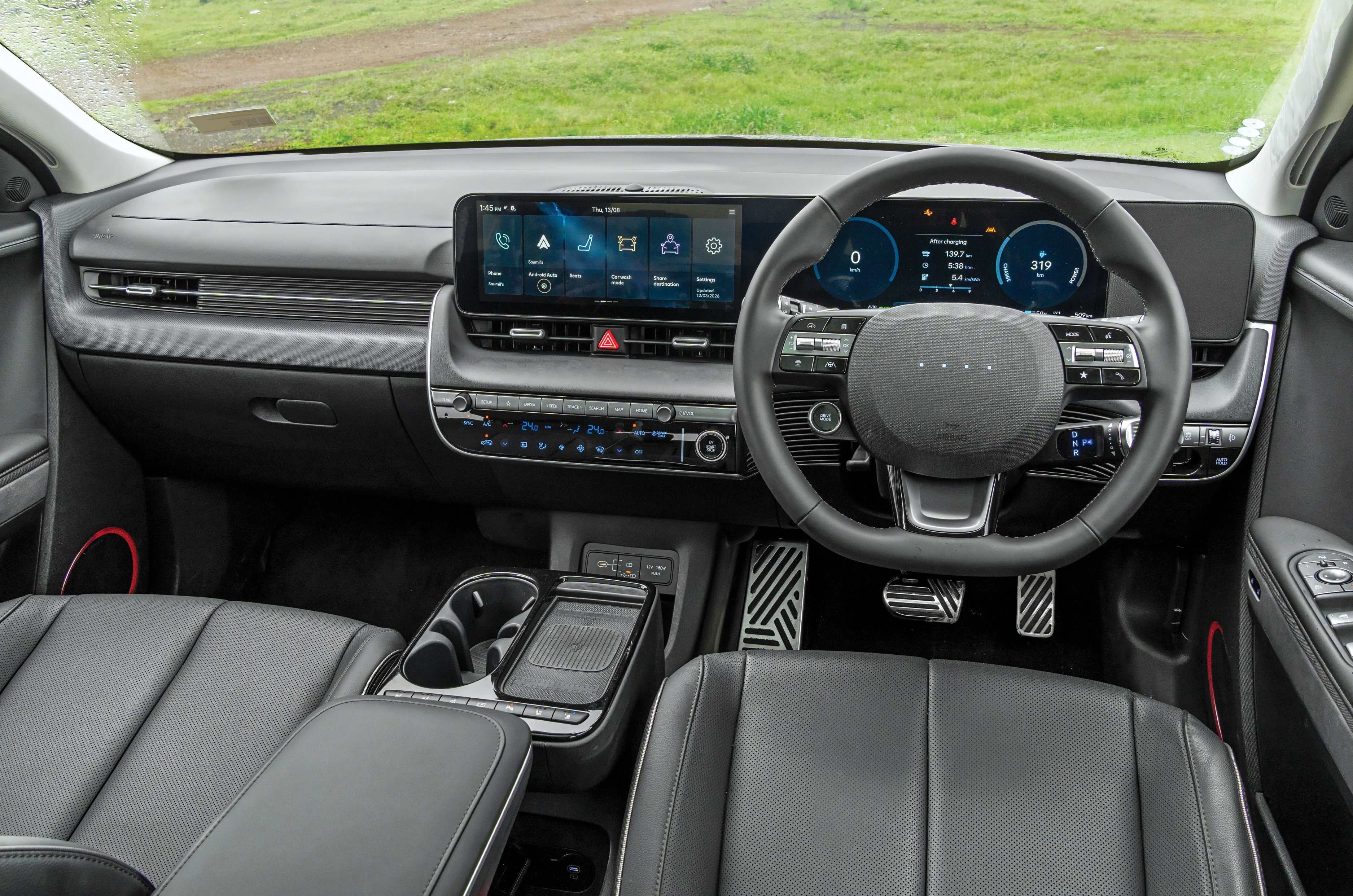
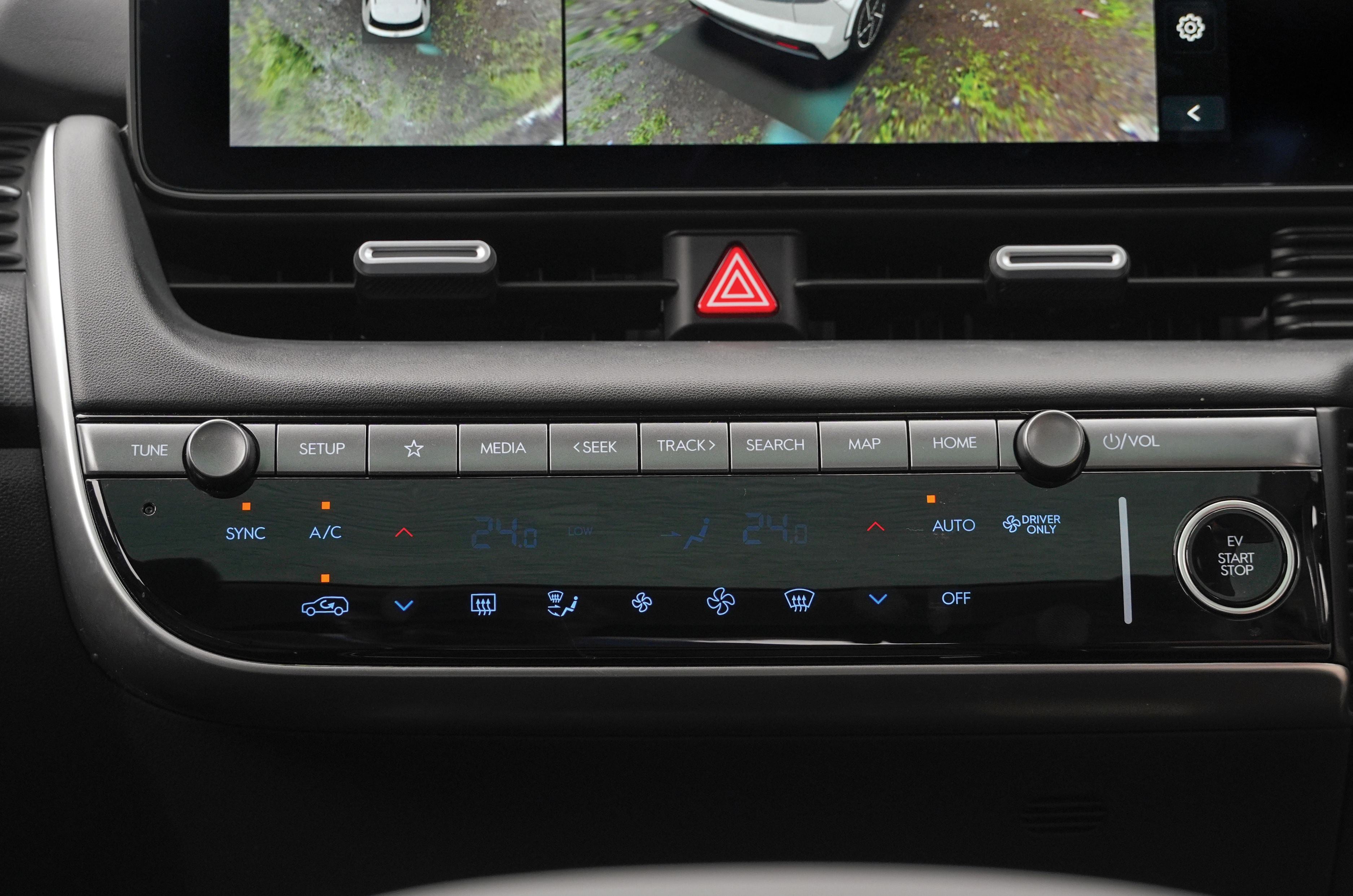
The Ioniq 5’s interior takes a more balanced, user-friendly approach. Not only does it get motorised pop-out door handles, but its cabin also combines touch-sensitive controls with physical buttons and knobs, creating an environment that feels intuitive from the moment you step in.
Thankfully, it retains physical controls.
Material quality is impressive, and where the Hyundai truly excels is in comfort and practicality. Storage areas are thoughtfully integrated throughout the cabin, and the sense of space is outstanding, making the Ioniq 5 particularly easy to live with.
Slide, recline, boss function and sunshades mean a better rear experience.
The front seats are broader and more comfortable, with extensive adjustment, including an ottoman-style leg support. Both front seats can be set up in a ‘zero-gravity’ position, where your back is reclined and legs lifted on the ottoman, making it very comfy. Plus, you can have the seats cooled or heated too, which adds to the relaxing experience. Rear-seat comfort is equally impressive, thanks to a bench that both slides and reclines. While it doesn’t get a dedicated rear screen like the Tesla, it does offer window sunshades and a 3-pin socket to power larger electronic devices.
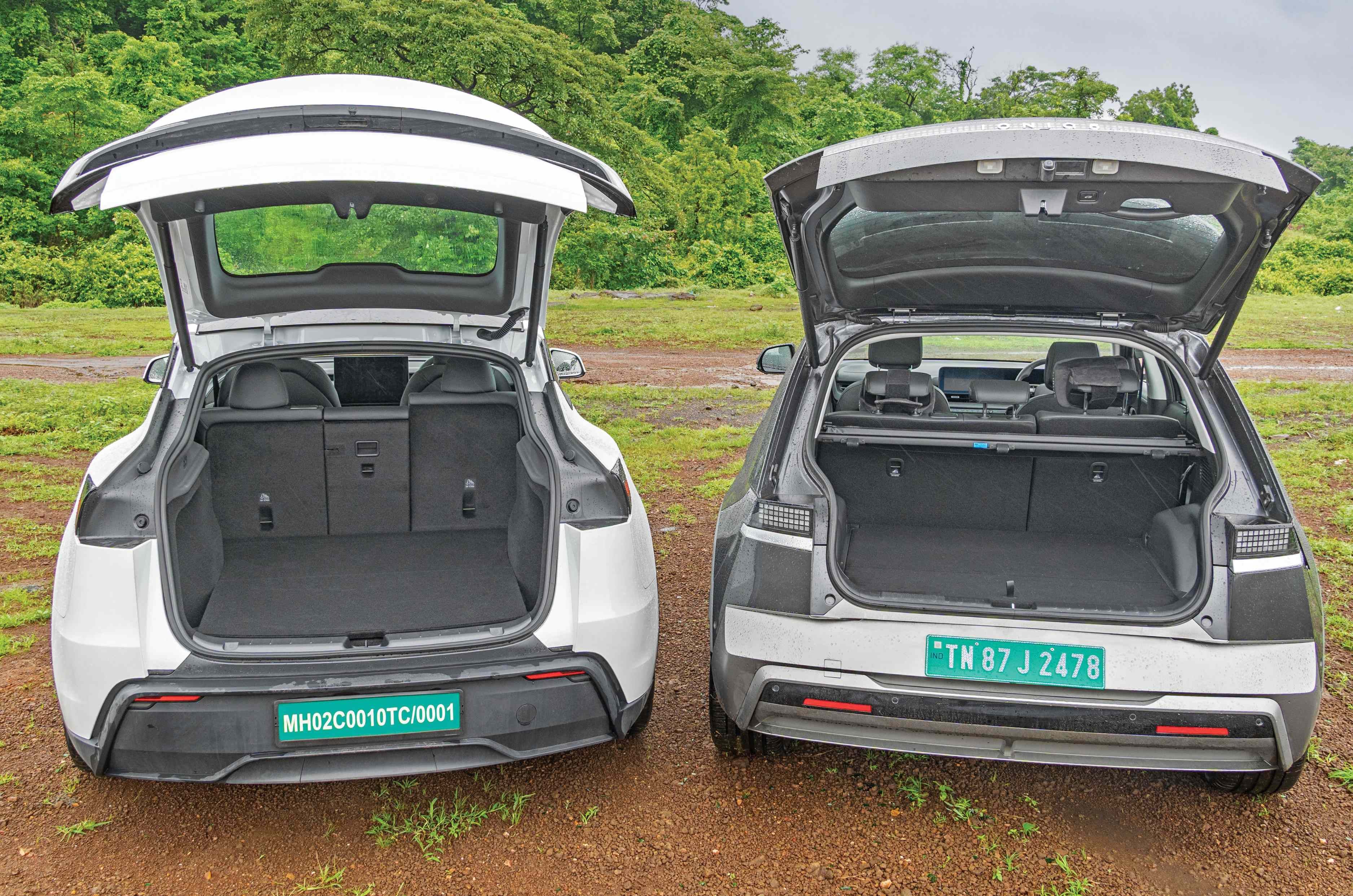
Along with a larger boot, the Tesla gets substantial underfloor storage.
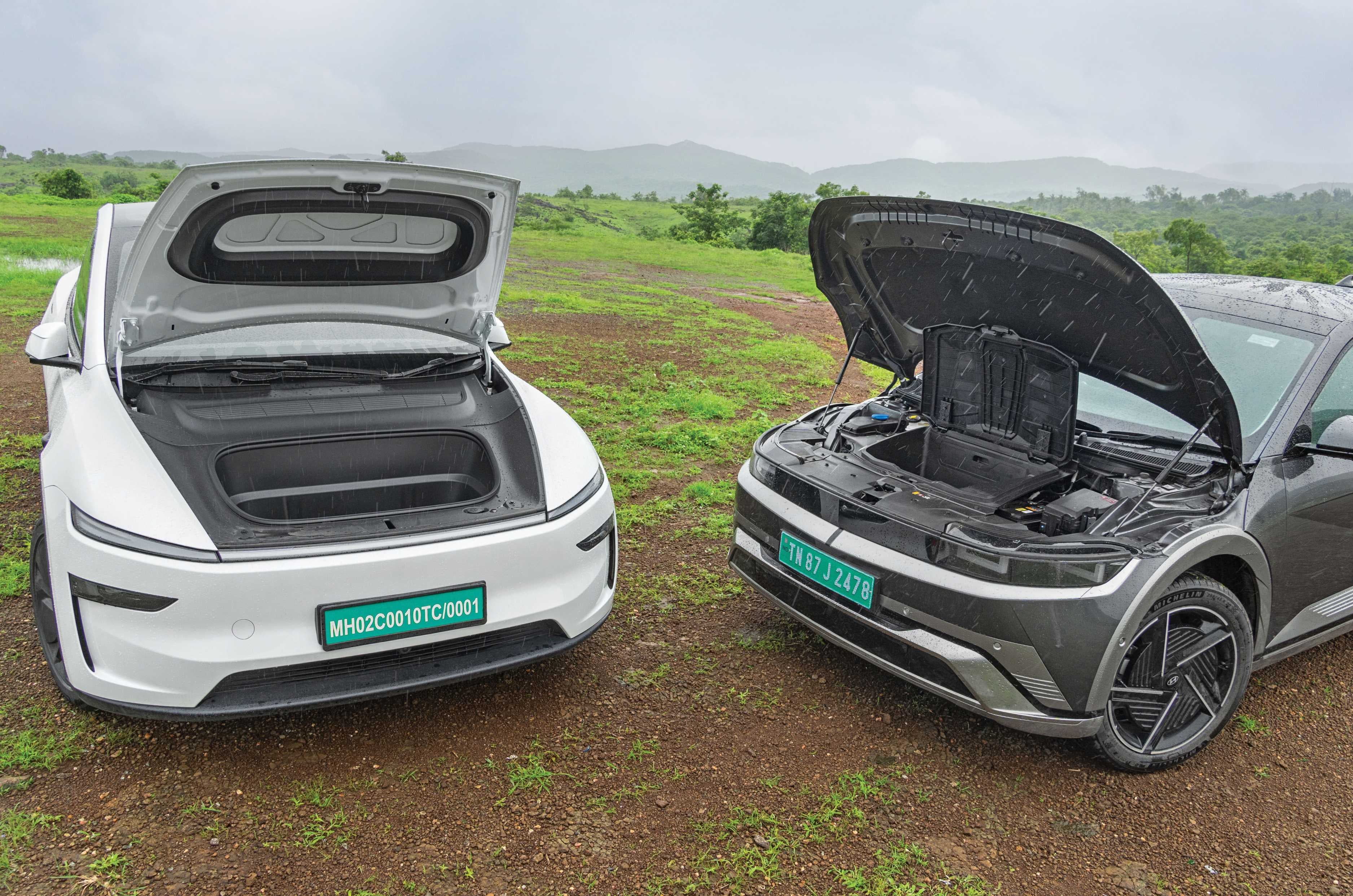
The Tesla regains some lost ground when it comes to luggage-carrying capacity. Its front luggage compartment is broader and deeper than the Ioniq’s, and its boot is more spacious too. Additionally, it offers even more storage space beneath the boot floor. The Ioniq 5, on the other hand, not only falls a bit short in outright boot capacity, but also has a relatively higher loading lip, making it slightly more challenging to load heavy luggage.
The Model Y has a deeper and wider front-loading area than the Hyundai.
Tesla Model Y vs Hyundai Ioniq 5: Powertrain and performance
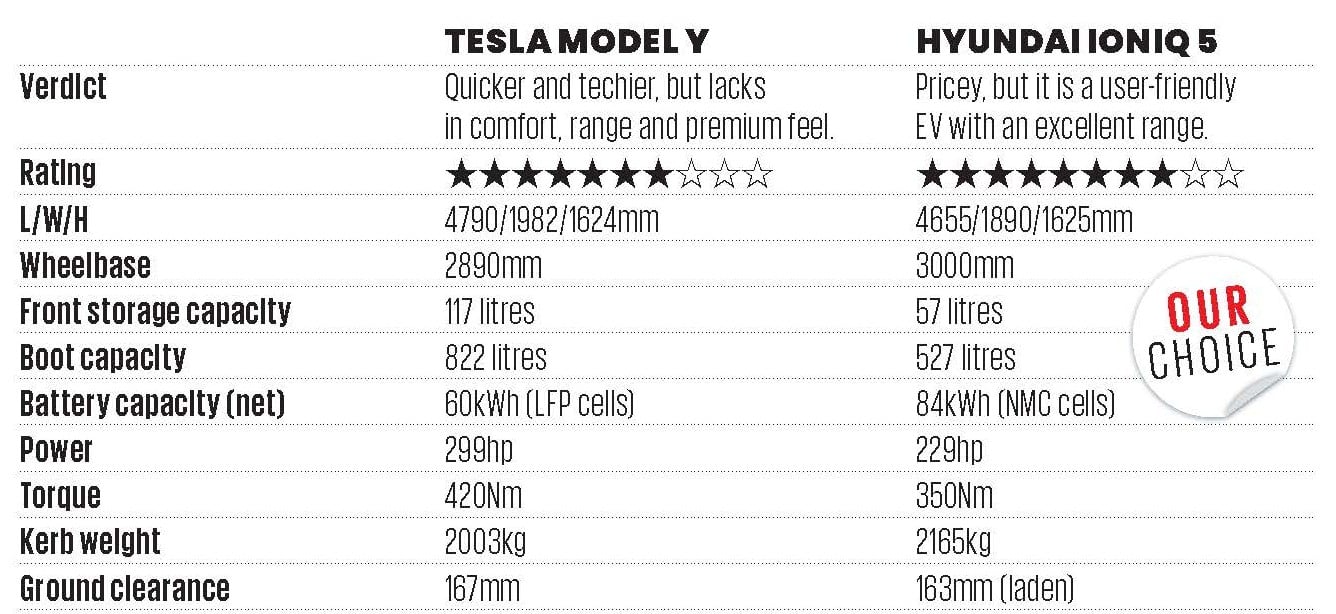
Hyundai has increased the battery size from 72.6kWh to 84kWh (gross capacity) while continuing to use Nickel Manganese Cobalt (NMC) cell chemistry. This feeds a 229hp/350Nm rear-mounted motor, which is 12hp more than before. However, the larger battery has pushed kerb weight up to 2,165kg, which is 150kg more than the outgoing version.
In contrast, the Model Y uses a 64kWh (gross capacity) battery with Lithium Ferrous Phosphate (LFP) cell chemistry, powering a 299hp/420Nm rear-mounted electric motor. While it is significantly more powerful, the Tesla is also 162kg lighter. As a result, its performance feels considerably stronger. It feels quicker off the line, accelerates harder and responds more eagerly to throttle inputs than the Hyundai.
Tesla keeps things simple with just two drive modes: Standard and Chill, the latter serving as an economy setting. Impressively, Chill mode remains highly usable and, despite being toned down, still accelerates as strongly as the Hyundai in its sportiest setting.
Tesla Model Y vs Hyundai Ioniq 5: Acceleration test (in seconds)
Tesla Model Y
Hyundai Ioniq 5
20kph
1.29
1.31
40kph
2.33
2.66
60kph
3.48
4.05
80kph
4.69
5.71
100kph
6.19
7.97
120kph
8.23
10.83
140kph
10.78
14.63
160kph
14
20.27
To put its performance into perspective, the Model Y accelerates from 0-100kph in just 6.19 seconds in Standard mode and reaches its 203kph top speed in roughly 25 seconds. Even in Chill mode, it completes the 0-100kph run in a respectable 8.25 seconds, just 0.28 seconds slower than the Ioniq 5. More interestingly, the Tesla reaches 160kph in 18.58 seconds, making it 1.6 seconds quicker to the mark.
Tesla Model Y vs Hyundai Ioniq 5: Regenerative braking distance (80-20kph)
Tesla Model Y
Hyundai Ioniq 5
Strongest
116.71m (Standard)
136.45m (i-Pedal)
Weakest
223.55m (Reduced)
391.50m (Level 1)
In the Model Y, regenerative braking has just two modes – Standard and Reduced – and the retardation is seamless, though quite strong when you lift off the accelerator. Notably, Standard mode generates stronger deceleration than the Ioniq 5 in its most aggressive single-pedal setting. And while both cars support true one-pedal driving, the Tesla’s implementation feels more natural and intuitive. The Ioniq, though, with its multiple levels, can be set up to have retardation feel more ICE-like and thus very familiar.
Turning our attention to the Hyundai Ioniq 5, it may not dominate traffic-light drag races, but the good news is that power delivery is exceptionally smooth, and the overall driving experience feels highly refined. It offers multiple drive modes that alter part-throttle responses, steering feel and brake-pedal feel, although outright acceleration remains largely unchanged between them.
In general, the Ioniq 5’s cabin feels slightly more hushed than the Model Y’s, with a quieter motor and lower levels of road and tyre noise. Notably, though, the Tesla’s frontal sound insulation is exceptional – from inside the cabin, you would swear its horn is rather meek, but we assure you, that isn’t the case.
Tesla Model Y vs Hyundai Ioniq 5: Ride and handling
The Model Y is quicker, but the Ioniq 5 betters it on range and fast-charging speed.
On the move, the Model Y inspires confidence. High-speed stability is excellent, and it changes direction with greater eagerness compared to the Ioniq. The small-diameter steering wheel offers different weight settings, but even its lightest mode feels substantial; it isn’t that light, one-finger-twirl setup and does come across as heavy. Ride comfort also doesn’t feel particularly plush. The suspension is quite firm and thuds noticeably over potholes and broken surfaces, making it less suited to rough Indian roads.
The Ioniq 5 takes a different approach. It feels far more comfortable and user-friendly, thanks to lighter steering and a softer suspension that, despite its 20-inch alloy wheels, absorbs road imperfections with much greater composure than the Tesla. The result is a more relaxed and comfortable driving experience. Sure, it doesn’t feel as sporty while changing direction and can feel a touch floaty at higher speeds, but that is a compromise many buyers will gladly accept for its low-speed pliancy and overall comfort.
Tesla Model Y vs Hyundai Ioniq 5: Range and efficiency
For our real-world range test, we ran the Hyundai Ioniq 5 in Eco mode and the Model Y in Chill mode, with the former’s regenerative braking set to Level 2 in the city and Level 1 on the highway, and the latter’s set to Standard in the city and Reduced on the highway.
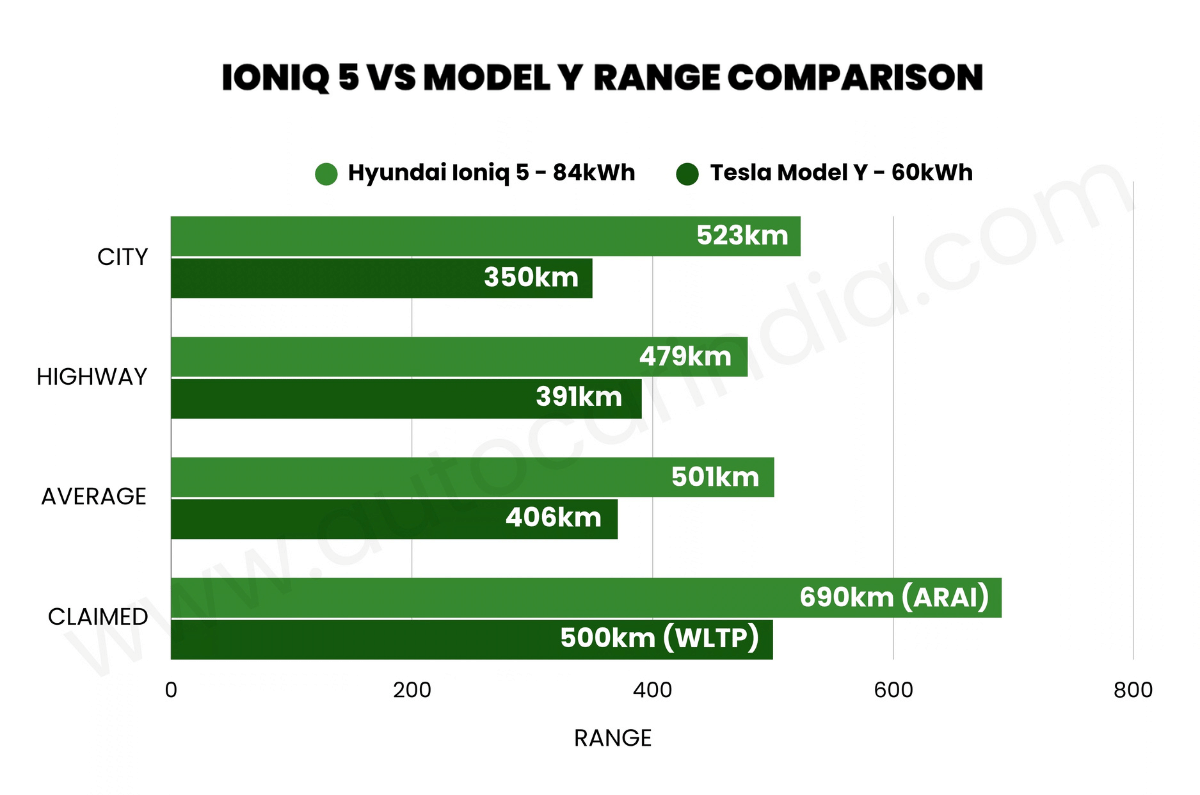
As far as efficiency goes, the Ioniq 5 was more efficient in the city, delivering 6.22km/kWh, while the Model Y managed 5.84km/kWh. On the highway, the Tesla’s superior aerodynamics yielded 6.52km/kWh, whereas the Ioniq 5 managed 5.71km/kWh. However, thanks to Hyundai’s substantially larger battery, its overall average range extrapolates to 501km, comfortably ahead of the Tesla’s 371km.
Tesla Model Y vs Hyundai Ioniq 5: Real-world range and efficiency
Tesla Model Y
Hyundai Ioniq 5
Claimed range
500km
690km
City range
350km
523km
City efficiency
5.84km/kWh
6.22km/kWh
Highway range
391km
479km
Highway efficiency
6.52km/kWh
5.71km/kWh
Average range
371km
501km
Average efficiency
6.18km/kWh
5.96km/kWh
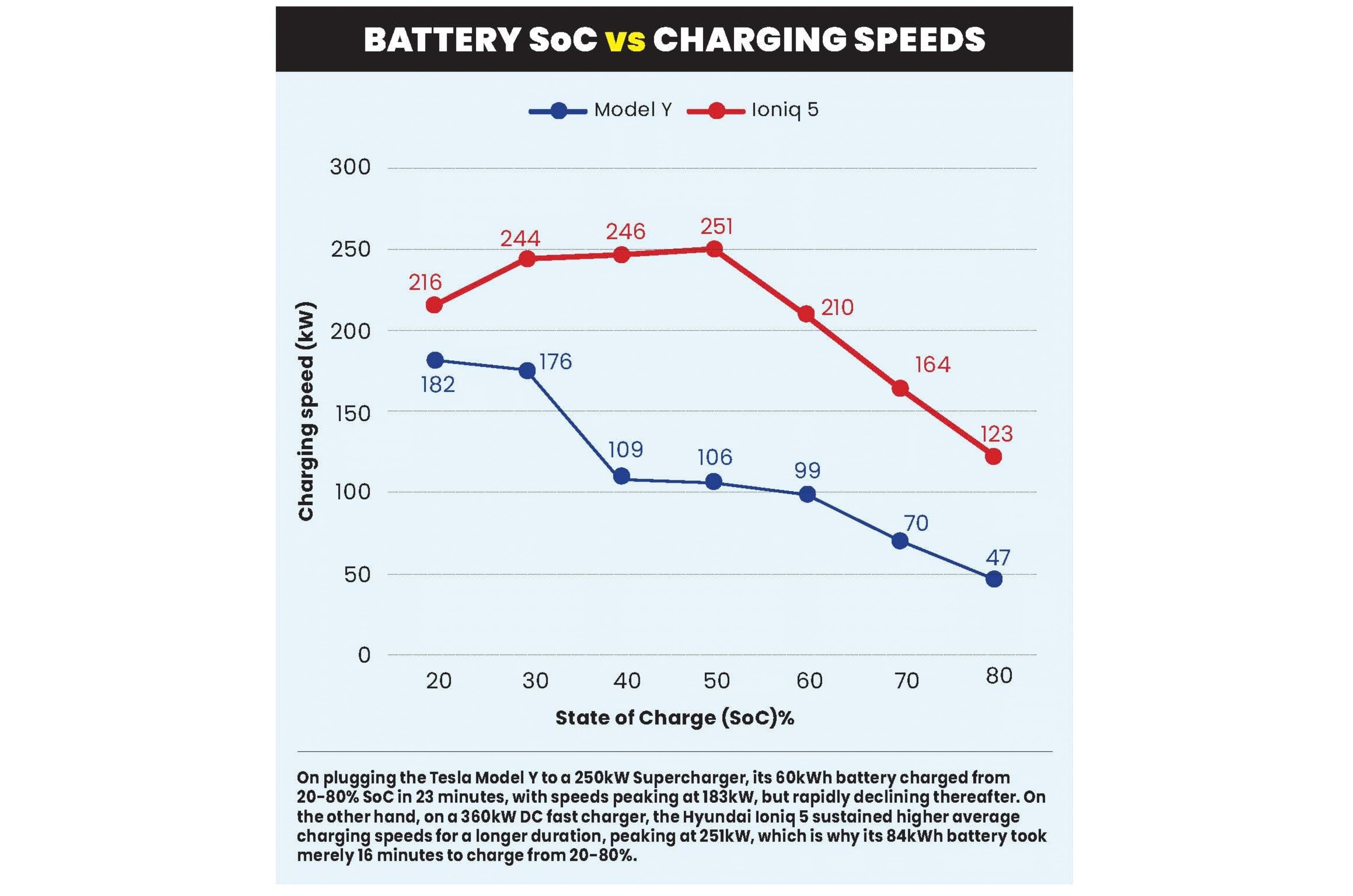
As for charging performance, we plugged the Model Y into a 250kW Tesla Supercharger, where it achieved peak charging speeds of 183kW. However, the Model Y does not sustain such high speeds for long, and its 60kWh battery is charged from 20-80 percent SoC in 23 minutes. From there, it took an additional 30 minutes to reach a full charge.
The Hyundai Ioniq 5 performs even better. Connected to a 360kW DC fast charger, its 800V electrical architecture enabled it to consistently maintain higher average charging speeds, peaking at 251kW. As a result, its 84kWh battery charged from 20-80 percent SoC in just 16 minutes. Like the Tesla, however, it required an additional 33 minutes to charge from 80 percent to full.
Tesla Model Y vs Hyundai Ioniq 5: Verdict
The Ioniq 5 no longer offers the value it once did. The Model Y, however, does.
The Tesla Model Y makes a compelling case for itself. It is quicker, more technologically advanced and backed by software that remains among the best in the automotive world. Crucially, it is now the more affordable option, making it a very tempting proposition. However, its over-reliance on the touchscreen, heavy steering, a firm low-speed ride and limited range due to the smaller battery count against it.
In comparison, the Hyundai Ioniq 5 remains the more rounded package. Its superior ride comfort, more intuitive cabin, significantly longer real-world range and impressive charging performance give it a clear edge where it matters most. More importantly, it feels better adapted to Indian roads and daily usage, thanks to its lighter steering and more comfortable ride.
At current prices, though, the Hyundai no longer holds the value card, nor does the brand command the same equity or snob value as some similarly priced rivals. But judged purely on its merits, the Hyundai Ioniq 5 continues to be the best all-round EV at this price point and thus gets our vote.
The Hyundai Ioniq 5 received a larger battery pack with its April 2026 update, resulting in a higher claimed single-charge range. In this feature, we compare the Hyundai EV with the Tesla Model Y, one of its direct rivals in India. Keep reading to see how the two performed in real world conditions. We also compare their prices, as the Ioniq 5 has become more expensive after the update, while Tesla has dropped the price of the Model Y.
Hyundai Ioniq 5 vs Tesla Model Y: Specifications, price
Ioniq 5
Model Y
Battery size (kWh)
84 (NMC)
60 (LFP)
Power (hp)
229
299
Torque (Nm)
350
420
Drive layout
RWD
RWD
Claimed range (km)
690 (ARAI)
500 (WLTP)
Kerb weight (kg)
2,165
2,003
The Ioniq 5’s battery size has increased from 72.6kWh to 84kWh (gross capacity), though the nickel manganese cobalt (NMC) cell chemistry has been retained. The larger battery has increased the kerb weight to 2,165kg, up by 150kg from the outgoing version. In comparison, the Model Y uses a 64kWh (gross capacity) battery with lithium ferrous phosphate (LFP) cell chemistry; the smaller battery contributes to the Tesla EV being 162kg lighter in this comparison. Their claimed range figures are based on different test cycles – ARAI for the Ioniq 5 and WLTP for the Model Y – so they are not directly comparable.
Speaking of motor outputs, the Model Y makes 70hp and 70Nm more than the Ioniq 5; both use a rear-wheel-drive setup. The Model Y feels stronger to drive, with quicker acceleration and sharper throttle response than the Hyundai.
Hyundai Ioniq 5 vs Tesla Model Y: Real-world range
For our real-world range test, the Hyundai Ioniq 5 was driven in Eco mode and the Model Y in Chill mode (Eco in Tesla speak). The Ioniq 5 used Level 2 regenerative braking in the city and Level 1 on the highway, while the Model Y used Standard in the city and Reduced on the highway.
Ioniq 5
Model Y
Tested city efficiency (km/kWh)
6.22
5.84
Tested highway efficiency (km/kWh)
5.71
6.52
Tested average efficiency (km/kWh)
5.96
6.18
In the city, the Ioniq 5 returned 6.22km/kWh, compared to 5.84km/kWh for the Model Y. On the highway, however, the Tesla was more efficient at 6.52km/kWh, aided by its superior aerodynamics; the Ioniq 5 managed 5.71km/kWh. But overall range in our tests stood at 501km for the Ioniq 5, 130km more than the Model Y’s 371km figure.
Hyundai Ioniq 5 vs Tesla Model Y: Prices
Ioniq 5
Model Y
Price (Rs lakh)
55.71
50.89
At the time of writing, the Hyundai Ioniq 5 is pricier than the Tesla Model Y by Rs 4.82 lakh. But judged purely on its higher real-world range, the Hyundai Ioniq 5 gets our vote.
Autocar India’s range testing
For our real-world range comparisons, we begin with each car’s battery fully charged and tyre pressures set as per the manufacturer’s recommendations. We drive the cars on a fixed loop covering both city and highway stretches while maintaining set average speeds. We then calculate the range based on the percentage of charge consumed. The AC is set to 22deg C in auto mode, and we use features such as the music system, lights and ventilated seats as needed, just as a regular user would. This approach ensures consistency and gives a clear idea of what to expect in actual conditions.
Ex-showroom prices mentioned above are as of September 23, 2026.
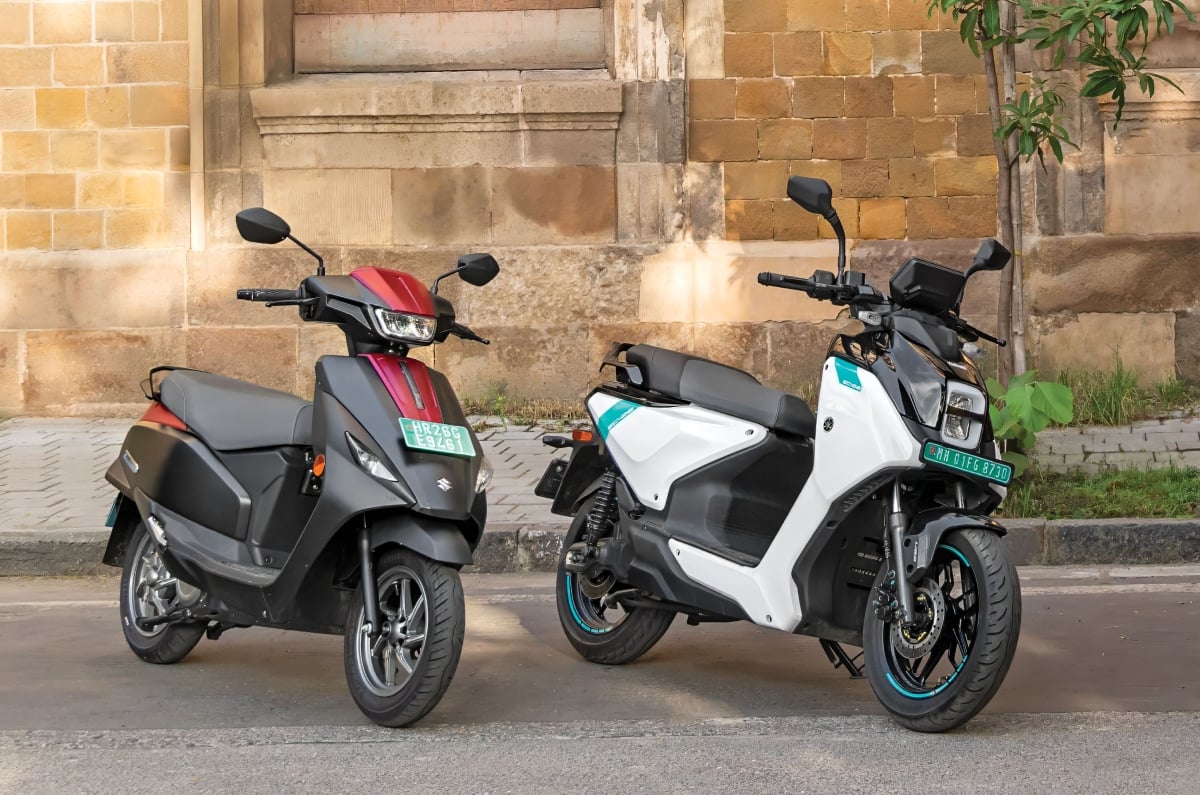
While the Indian manufacturers have been quick to capitalise on the EV boom, the Japanese have been rather more measured in their approach. Honda arrived in 2025 with not one but two in-house electric scooters, though both had unique limitations that prevented them from succeeding.
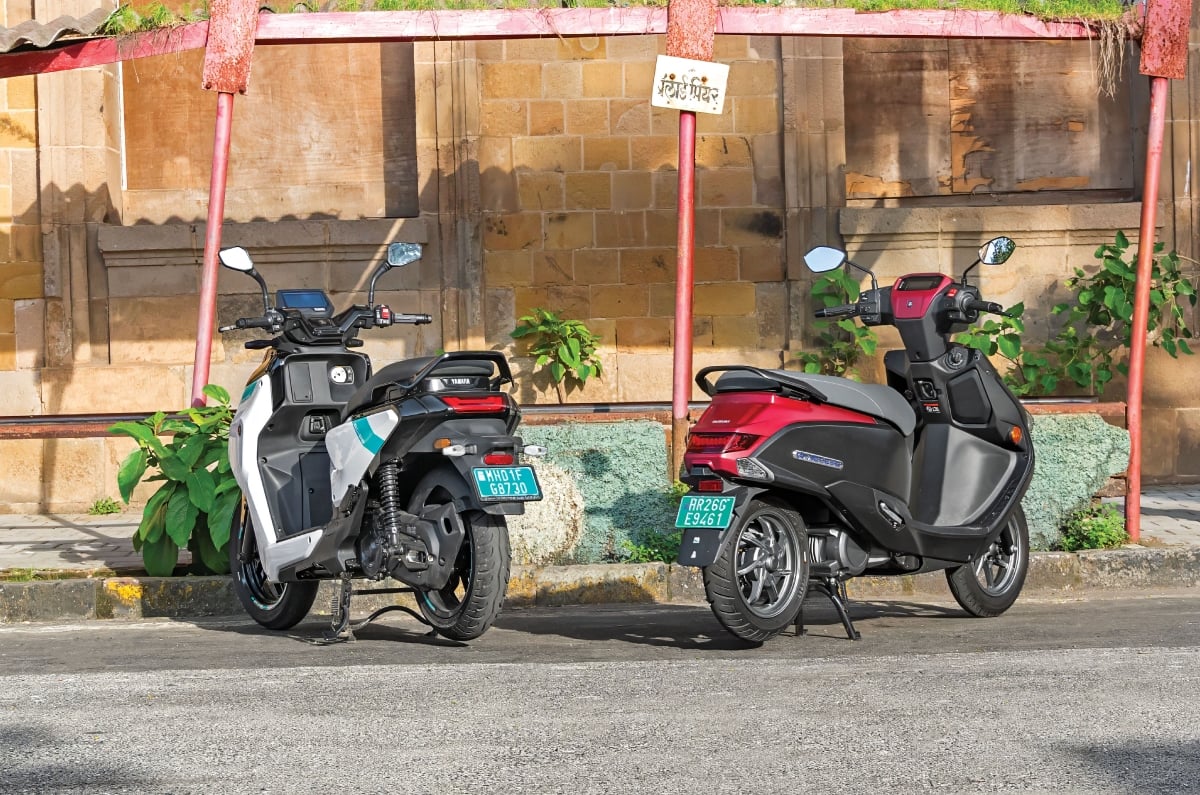
Suzuki, like Honda, chose to develop its own platform from scratch, but its e-Access appears expensive for what it offers. Yamaha, meanwhile, took a markedly different route for its more affordable offering and partnered with an Indian startup. The EC-06 is, in essence, a more expensive River Indie in sharper clothes.
So if you’ve been waiting for a Japanese e-scooter, you now have two choices, but like their very different inceptions, both also offer you two very different flavours of electric scooter. The question, then, is which one deserves your money – and whether either deserves it over the competition.
Not hiding in plain sight
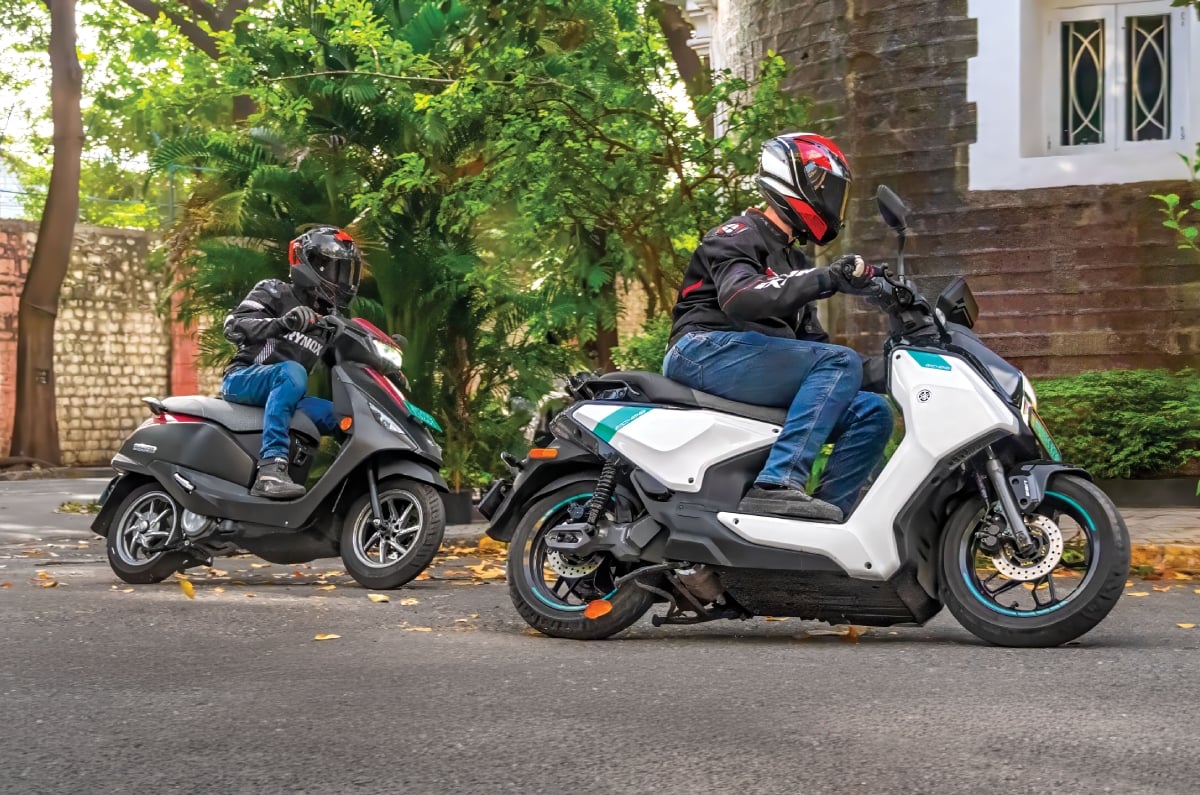
Subtle, these scooters are not. Both take distinctly left-field approaches to styling and will stand out from the crowd. Over the fortnight we spent with them, the EC-06 consistently drew more positive attention thanks to its chunky, squared-off proportions. The e-Access found its niche too, though its double duck-bill nose, flowing front panels with a contrastingly boxy tail make it more of an acquired taste.
Yamaha EC-06
Suzuki e-Access
Kerb weight
132kg
122kg
Seat height
770mm
765mm
Underseat storage
24.5 litres
17 litres
Ground clearance
145mm (laden)
160mm (unladen)
Climb aboard and their personalities diverge further still. The e-Access feels more like a conventional scooter. Despite its compact dimensions, it never feels cramped, even for taller riders, while its 765mm seat height makes it instantly approachable for shorter ones.
The EC-06, by comparison, feels a size larger. Its riding triangle is noticeably roomier, which taller riders will appreciate in a segment that seldom caters to them. Yet, with a friendly 770mm seat height, it remains fairly unintimidating for shorter riders. In fact, tall riders will want a higher seat.
Different strokes
The riding experience of both also reflects two very different engineering philosophies. The 122kg e-Access feels exceptionally light on its feet; whether wheeling it around a parking space or flicking it into a bend, it responds eagerly – actually, a bit too eagerly. Some of that can be attributed to Suzuki mounting the battery pack vertically beneath the seat, a decision that, as you will read further on, has implications elsewhere too.
Yamaha EC-06
Suzuki e-Access
Battery capacity / chemistry
4kWh / NMC
3.072kWh / LFP
Motor
Permanent Magnet Synchronous
Permanent Magnet Synchronous
Power
6.7kW
4.1kW
Torque
26Nm
15Nm
Like the latest Burgman, its ride also errs towards the firmer side rather than the plush feel of a TVS iQube. It isn’t uncomfortable by any means, but it is something worth paying attention to on a test ride. Taller riders will also discover the Suzuki’s compactness during full-lock U-turns, where their knees will foul the handlebar.
On the flip side, the EC-06 is relatively heavier and slower to steer, but it’s a small tradeoff. That’s because its larger 14-inch wheels lend it greater stability at faster speeds and also help it dismiss broken roads with admirable composure. Its absorptive suspension also factors in here, though particularly sharp impacts can provoke a slight judder in the fork.
E-Access has the more flighty, energetic demeanour, whereas the EC-06’s handling is more sure-footed.
The Yamaha’s seat, however, leaves quite some room for improvement. Its forward-sloping shape constantly makes you slide forward, necessitating frequent shuffling about. The padding is also too soft, and after just 30 minutes or so, you find yourself sinking into the seat pan. This results in a gradually more knees-up riding position, which might sound like a trifling problem at first but one that becomes increasingly apparent over longer journeys.
Neither one gets ABS, which feels like quite an egregious oversight considering their price points. Nevertheless, the Yamaha’s brakes inspire greater confidence because they are powerful without being overly aggressive, and its wider tyres also provide better traction. The Suzuki’s brakes, conversely, are almost too sharp. On Mumbai’s slippery concrete roads, they demand a more measured touch when coming to a halt quickly.
Not that you’ll often rely heavily on them. That’s partly down to the well-calibrated regenerative braking system and partly because the e-Access’ performance is quite unremarkable. Not only is it much slower than the EC-06, but it also feels noticeably less eager than the petrol-powered Access. It’s perfectly usable in the city, but on faster roads, overtakes require planning. Unsurprisingly, the Yamaha feels considerably livelier. It accelerates with genuine enthusiasm in its top Power mode, the regenerative braking is seamlessly calibrated in all 3 modes (Standard and Eco being the other two) and, despite using chain drive, its drivetrain is remarkably silent – akin to a hub-mounted motor.
Feel Good (?) Features
Build quality on both is reassuringly solid and exactly what one expects from the Japanese. At these prices, however, there are a few omissions that are difficult to overlook.
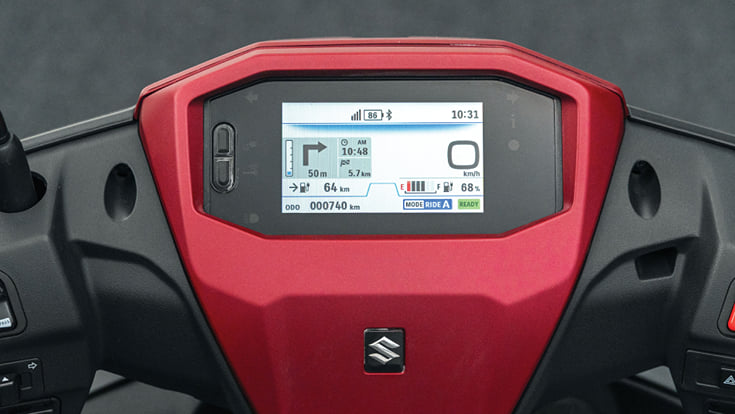
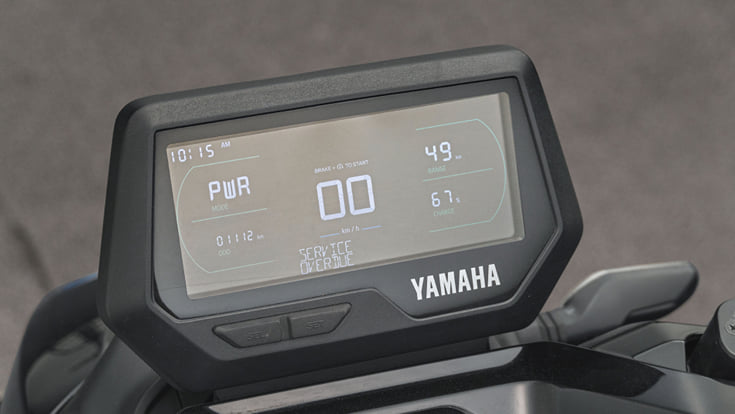
The e-Access employs the same TFT display found on the ICE Access 125 and Burgman, both of which cost substantially less. Yamaha, meanwhile, supplies only the slower 480W charger, despite the considerably more affordable River offering a faster 750W unit as a Rs 3,000 option.
Same TFT as ICE Access; EC’s negative LCD is simpler but well laid out.
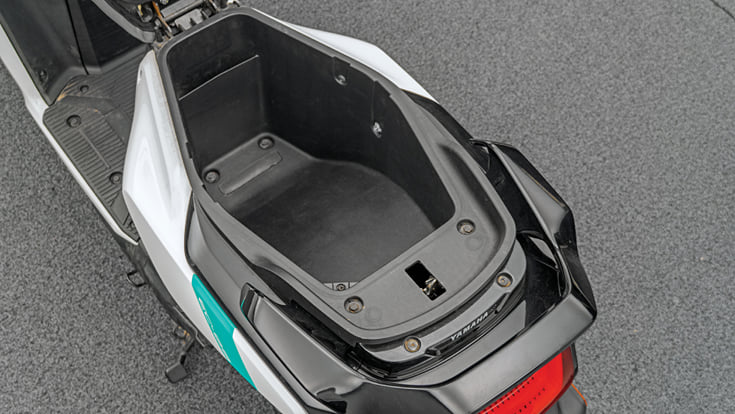
The EC-06 also sacrifices a lot of storage compared to the Indie. Its 24.5-litre under-seat boot is far short of the latter’s enormous 43-litre boot and trails established rivals such as the iQube, Rizta and Chetak. The River’s lockable 12-litre glovebox has been omitted too, though Yamaha has used this to reposition the charging port to a more convenient location.
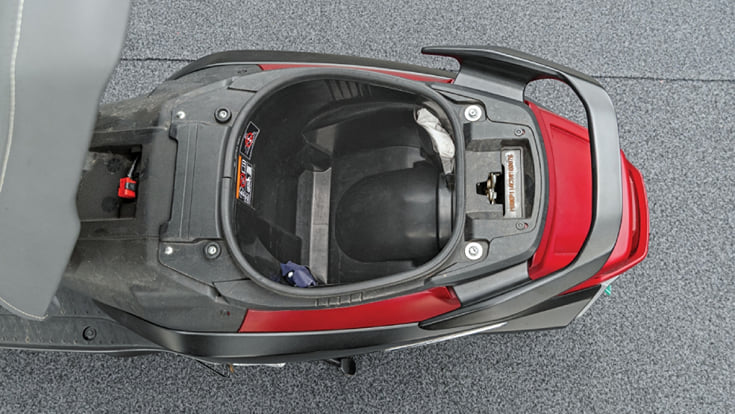
e-Access’ 17L boot far too small and oddly shaped; Yamaha’s 24.5L boot is more usable but not segment-leading.
If the Yamaha’s storage is merely average, the Suzuki’s is positively outclassed. The battery’s position beneath the seat results in just 17 litres of bootspace – roughly half what you’ll find on rivals like the Rizta and Chetak. In fact, even the ICE Access 125 offers you quite a bit more storage space. The e-Access’ boot is also shaped quite awkwardly, and unless the charger’s cables are folded with almost Victorian precision, it simply refuses to fit.
Range Rovers?
An electric scooter ultimately needs to deliver one thing above all else – promising range to reduce your running costs. In Ride A mode, which delivers full performance and max regen, the e-Access covered a little over 88km in our range test. Given its smaller 3kWh battery and its use of safer, but less energy-dense, LFP chemistry, the result is respectable in isolation; however, compared to the market’s front-runners, it falls far short.
Yamaha EC-06
Suzuki e-Access
0-40kph
3.46s
4.94s
0-60kph
6.82s
11.93s
Roll-on Acceleration
20-50kph
3.31s
5.46s
30-70kph
7.34s
17.01s
50-80kph
10.96s
–
Our test on the EC-06 was conducted in its middle Standard mode, which retains full performance but softens throttle response compared to Power mode. It covered 114km, comfortably exceeding the distance initially predicted. Both scooters deserve praise here, as their range indicators proved refreshingly honest, not indulging in optimistic guesswork.
Yamaha EC-06
Suzuki e-Access
60-0kph
22.87m
24.64m
Using Eco mode will naturally extend the range on both, though with reduced acceleration and lower top speeds. Thankfully, neither becomes painfully slow. Even in Eco, both climb flyovers and keep up with city traffic without reducing themselves to rolling roadblocks.
While the Yamaha’s range is undoubtedly more impressive, its charging time is a rather different story. The supplied 480W charger requires a glacial ten hours to replenish a flat battery. Meanwhile, the Suzuki’s 600W unit requires around six hours to do the same, although its battery pack is also smaller.
One thoughtful detail both manufacturers deserve credit for is the inclusion of a dedicated charger bag. It is a small touch, but one that should help protect the charger from spending years rattling around inside the boot.THE BIGGER PICTURE
Judged purely against each other, the result is straightforward – the EC-06 clearly wins. It offers superior performance, greater comfort, longer range and also costs much less than the e-Access.
Yamaha EC-06
Suzuki e-Access
Price (ex-showroom, Bengaluru)
Rs 1.71 lakh
Rs 1.92 lakh
However, if you zoom out and look at the broader market, the context changes. At Rs 1.71 lakh, the Yamaha is hardly inexpensive, and the Suzuki, which is knocking on the door of Rs 2 lakh, is even worse off. When proven alternatives from TVS, Ather, Bajaj, Vida and River offer similar or even superior alternatives for substantially less money, the Japanese appear more like fringe players and less like mainstream contenders.
There will undoubtedly be a small demographic of buyers for whom a Japanese badge carries enough cachet to justify this big premium. However, for the rest of us, the more keenly priced and proven homegrown contenders are the better bet.
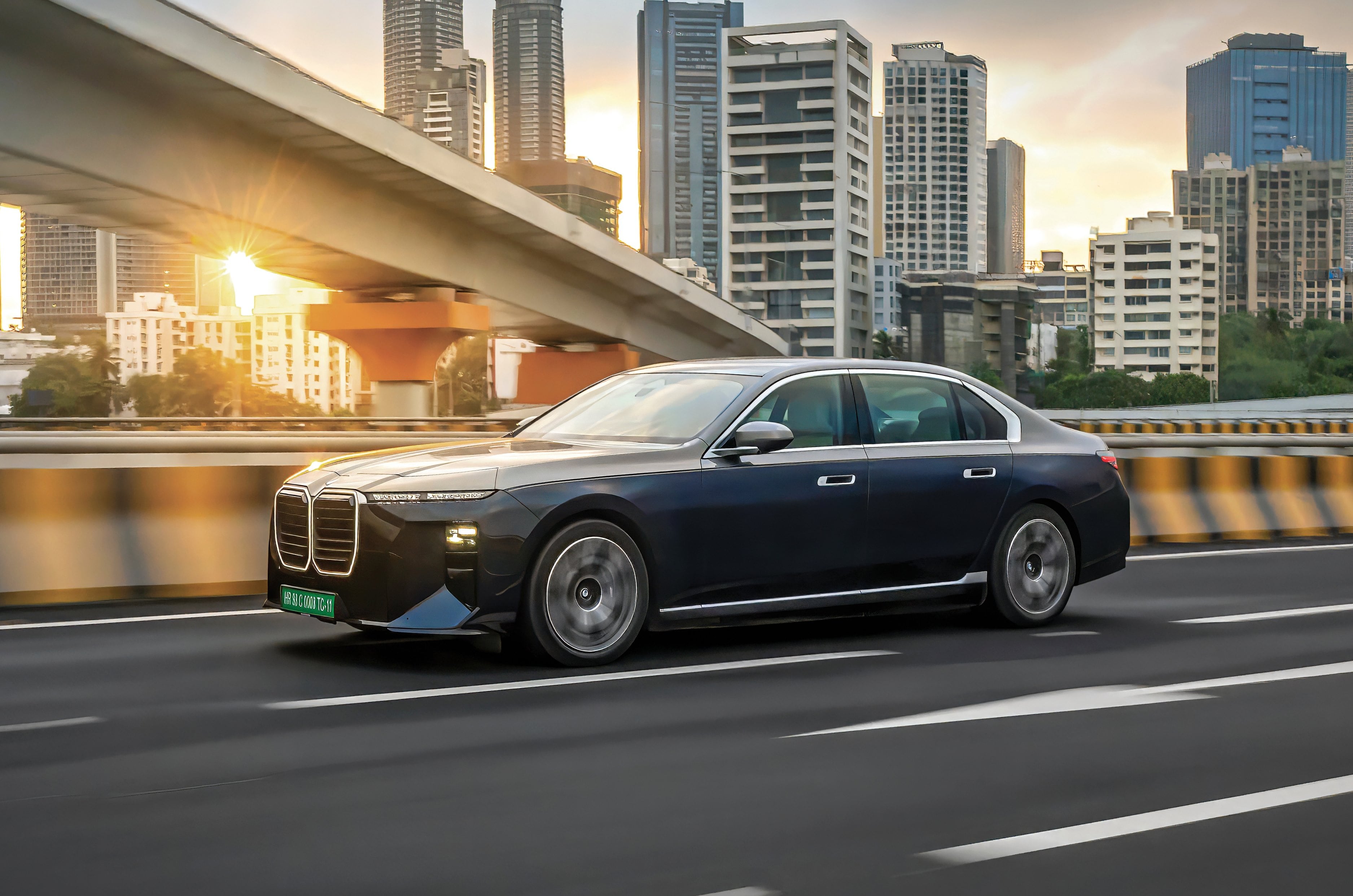
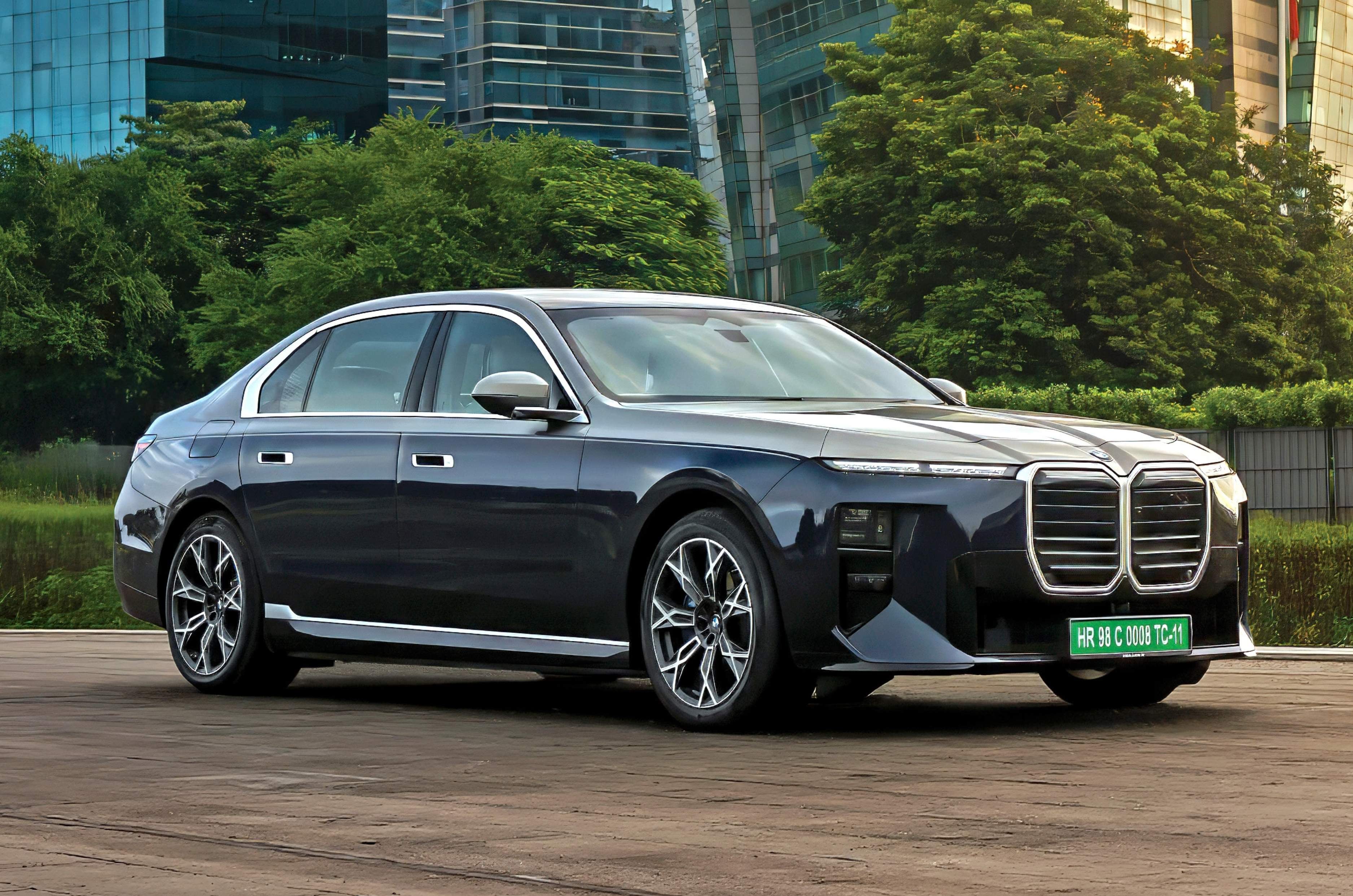
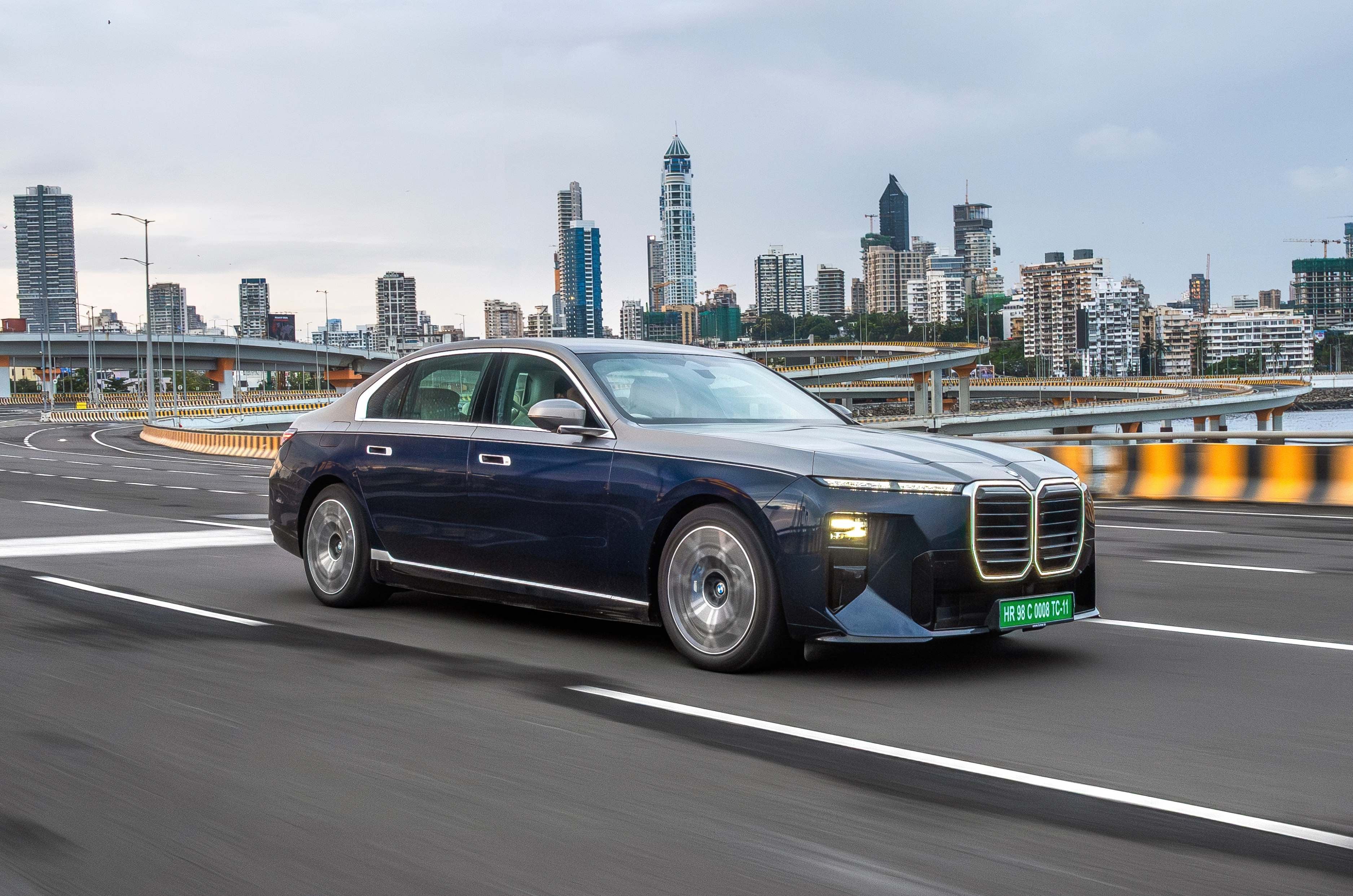
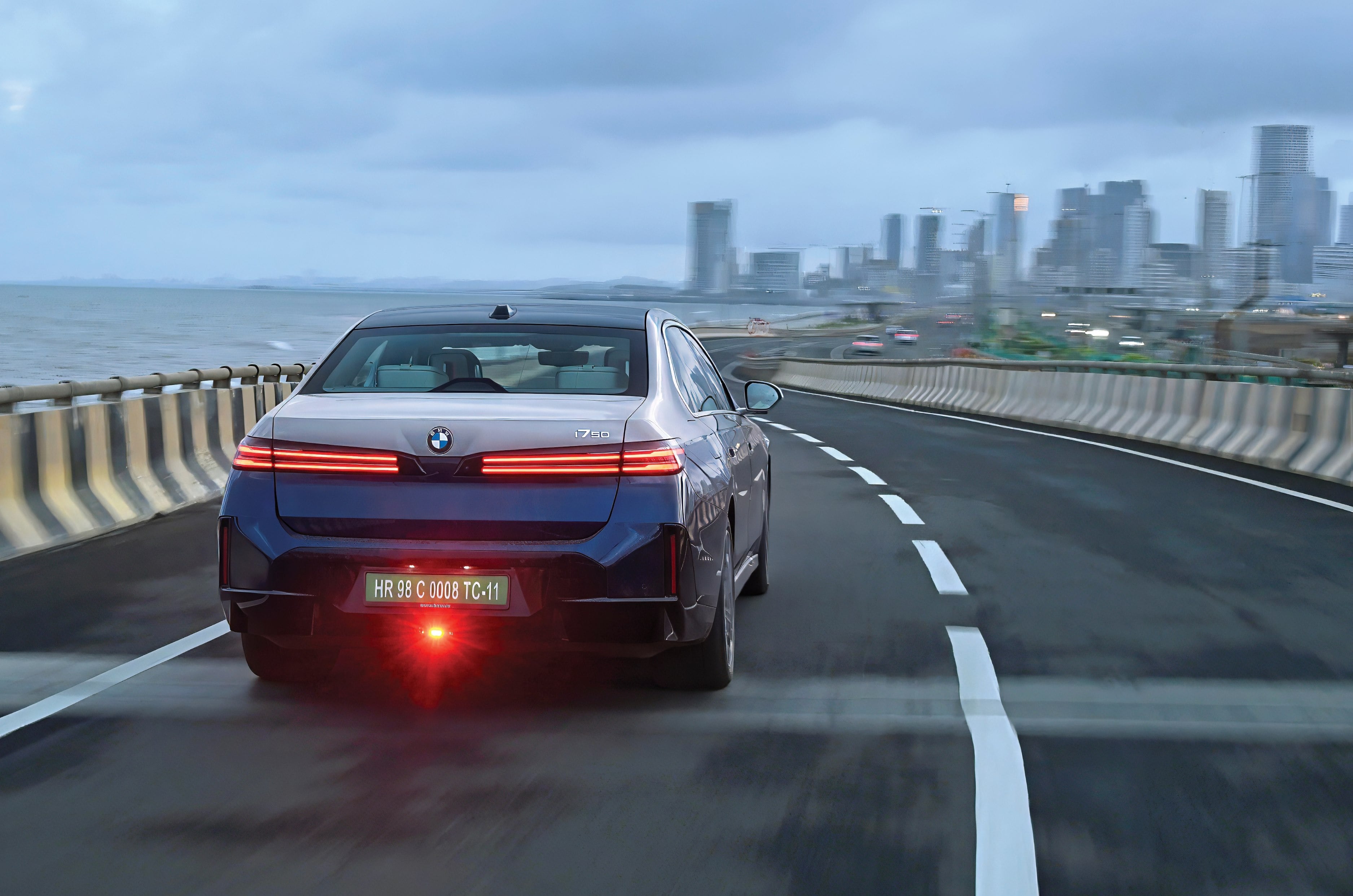
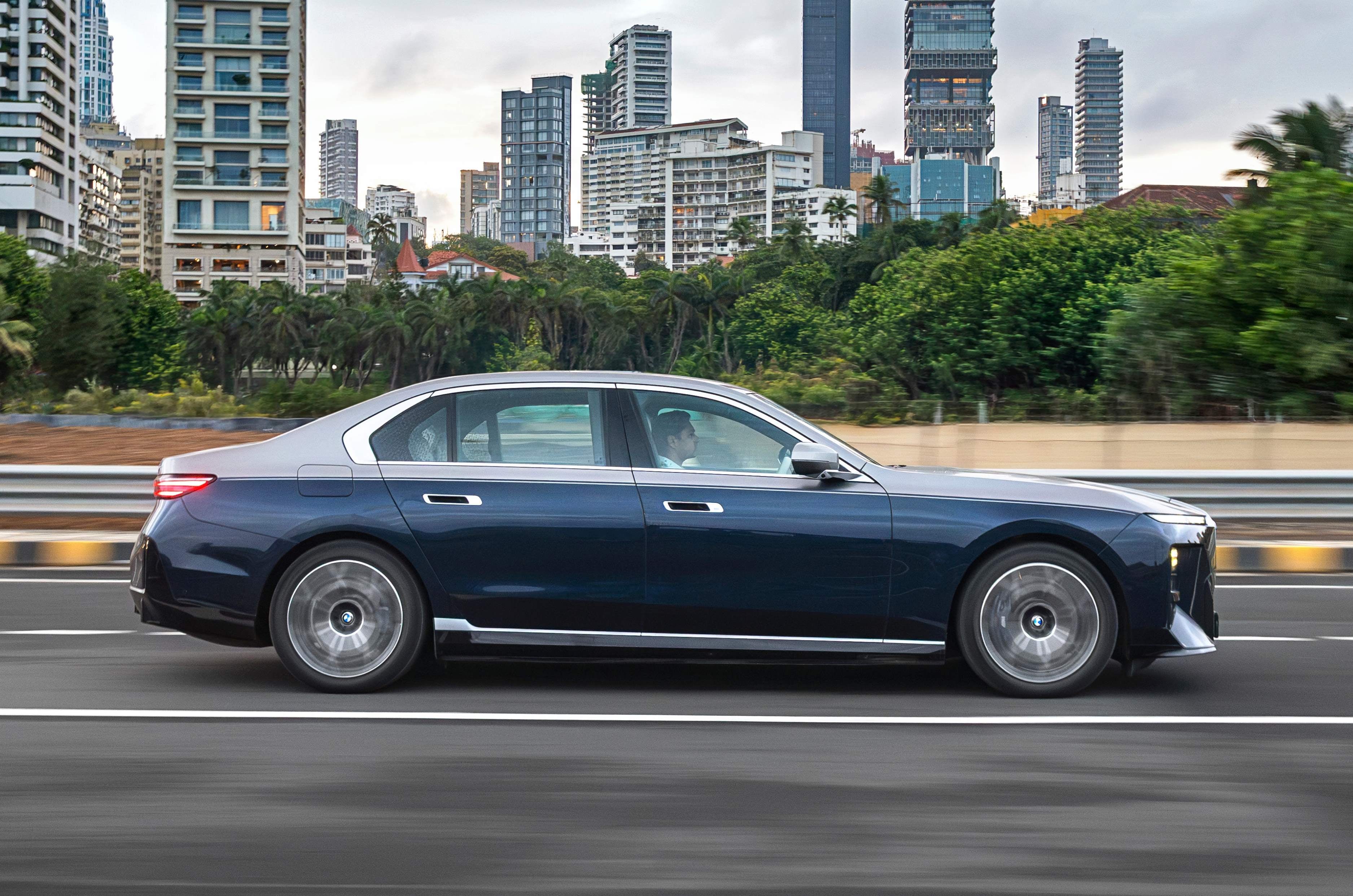
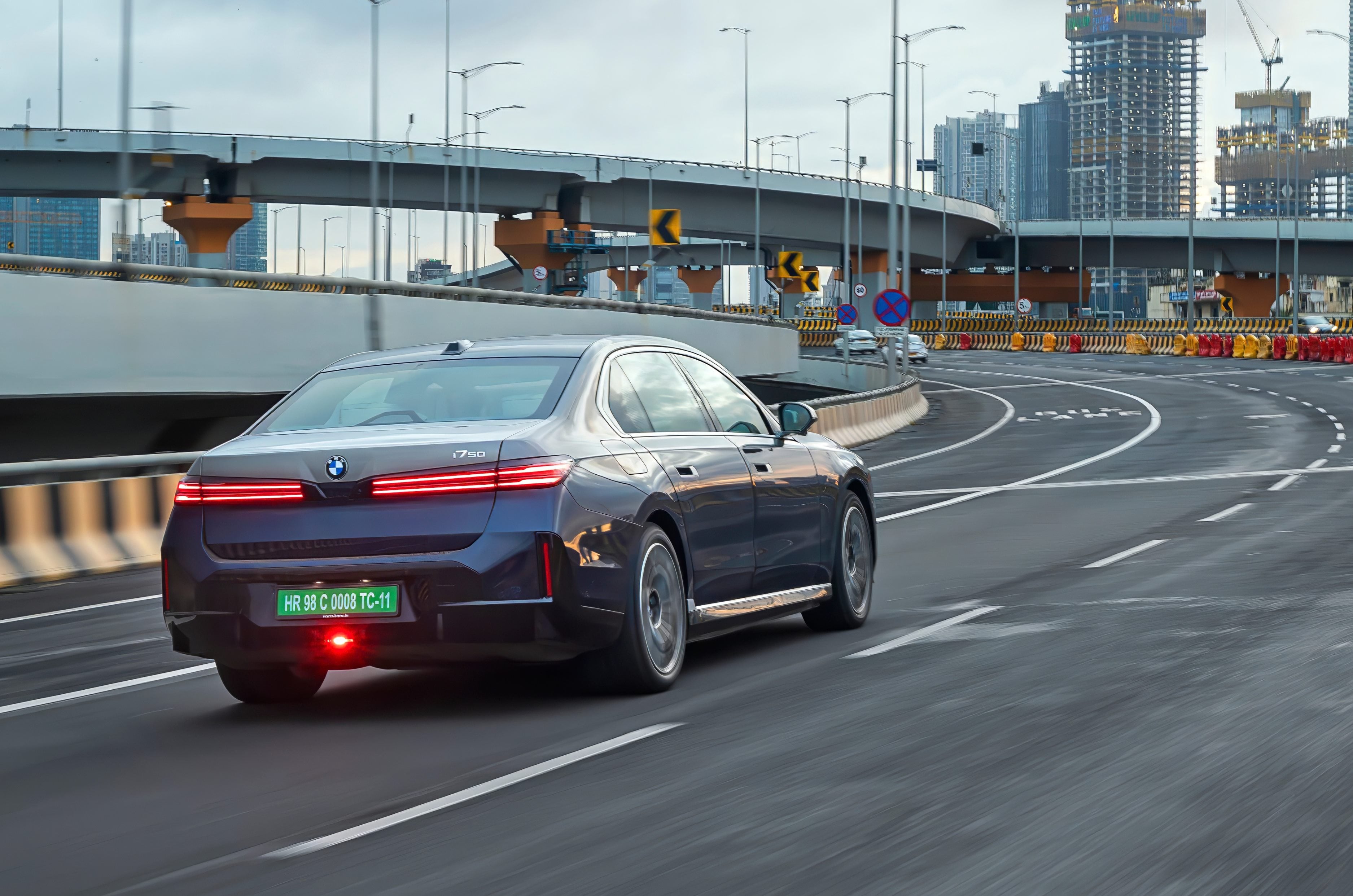
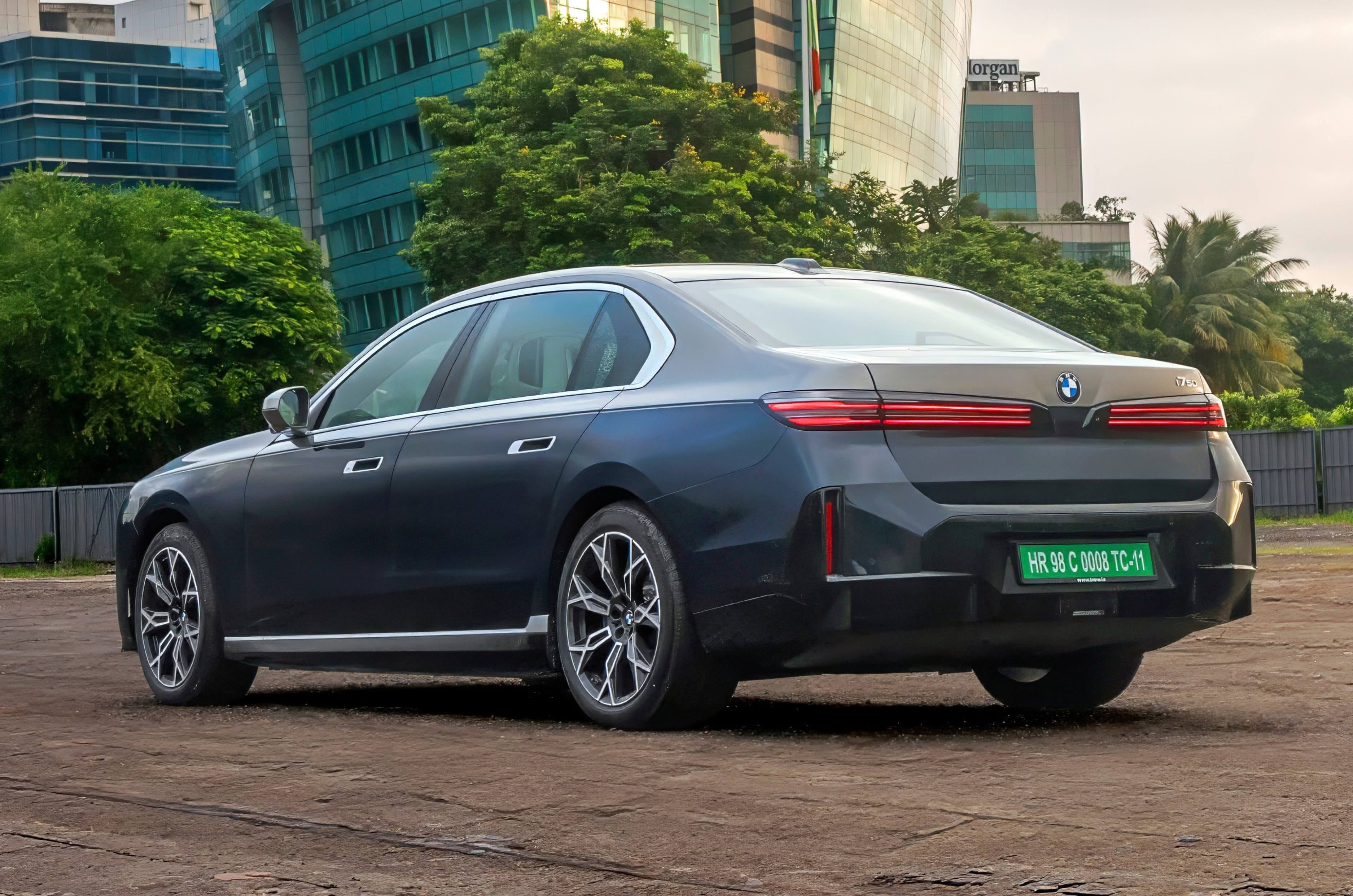
The BMW i7 has been embraced wholeheartedly by India’s ultra-high-net-worth buyers. Since its launch in 2023, it has dominated the high-end luxury sedan space, and interestingly, has consistently outsold its own petrol sibling. In fact, around 60 percent of 7 Series buyers have opted for the EV. With the 2026 i7 now being locally assembled in India and the i7 50 xDrive priced at Rs 1.95 crore, exactly at par with the petrol 740, BMW expects the scales to tilt even further in favour of the electric version.
BMW has also introduced the significantly more powerful i7 M70 xDrive. However, as a full import priced at Rs 2.65 crore, it commands a substantial Rs 70 lakh premium, which is likely to limit its appeal. For most buyers then, the locally assembled i7 50 xDrive is expected to remain the sweet spot of the range.
BMW i7 50 xDrive Exterior Design and Engineering – 8/10
The cleaned-up styling looks significantly more palatable than its predecessor.
BMW has made substantial changes to the i7’s styling. The DRLs are now longer and slimmer, and feature a crystalline effect that looks absolutely stunning up close. The oversized kidney grille has also been redesigned and, like before, remains illuminated. The air dam adopts a more rectangular design, the headlamps are vertically oriented, and the excessive black treatment has been done away with completely.
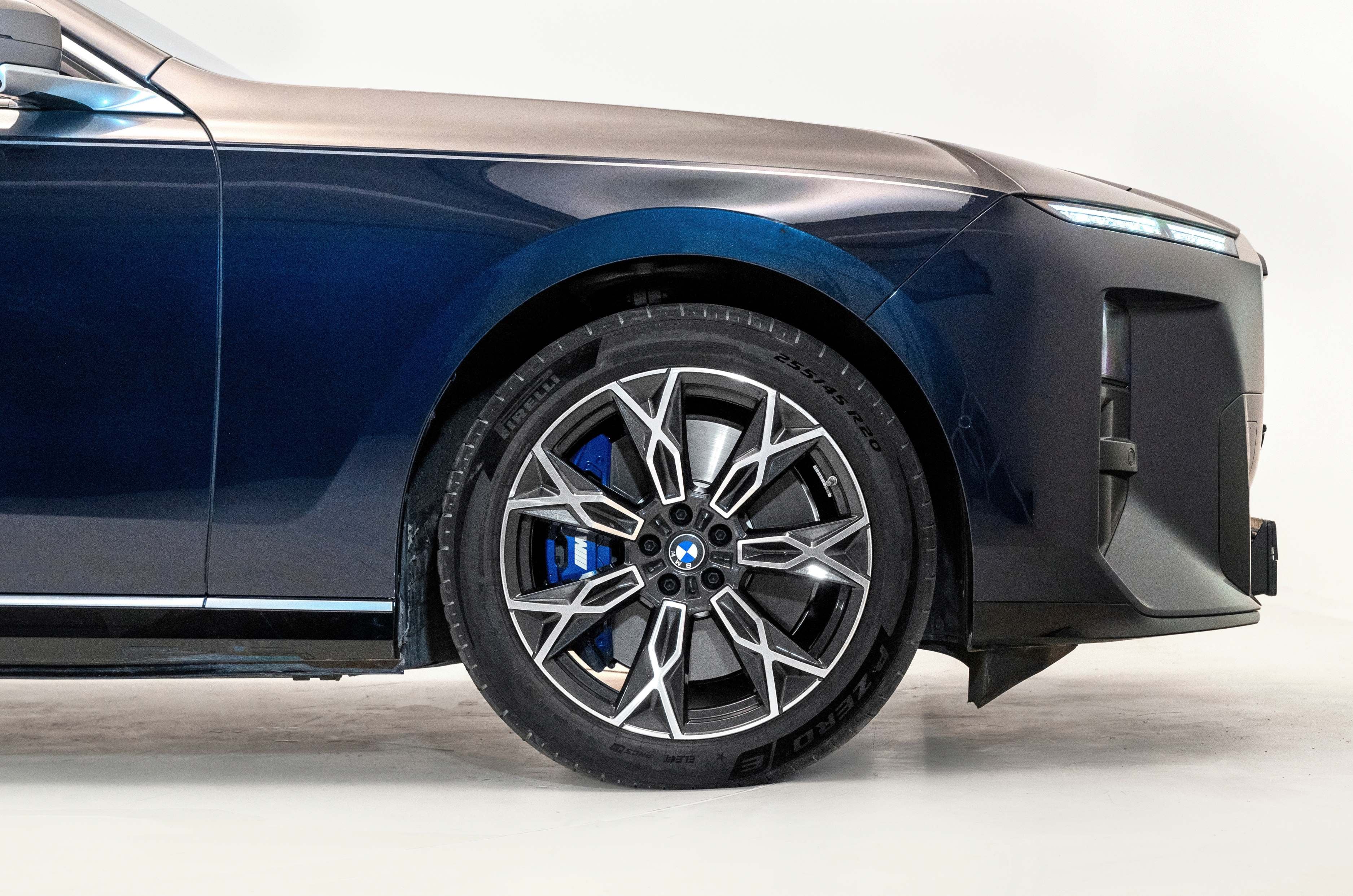
The tyres appear undersized but owners are unlikely to complain given the ride comfort benefits that come with the higher-profile tyres.
New 20-inch alloy wheels replace the outgoing version’s 21-inch units. While some might argue they appear slightly undersized, owners are unlikely to complain given the ride comfort benefits that come with the higher-profile tyres.
Like the front, the rear has also been cleaned up. There’s a new diffuser, broader tail-lamps, and a neater bumper design. Overall, this iteration looks significantly more palatable than its predecessor, and in the optional two-tone paint finish of our test car, road presence was immense.
BMW i7 50 xDrive Interior Space and Comfort – 9/10
The redesigned dashboard adds freshness and previews the direction BMW’s future interiors are expected to take.
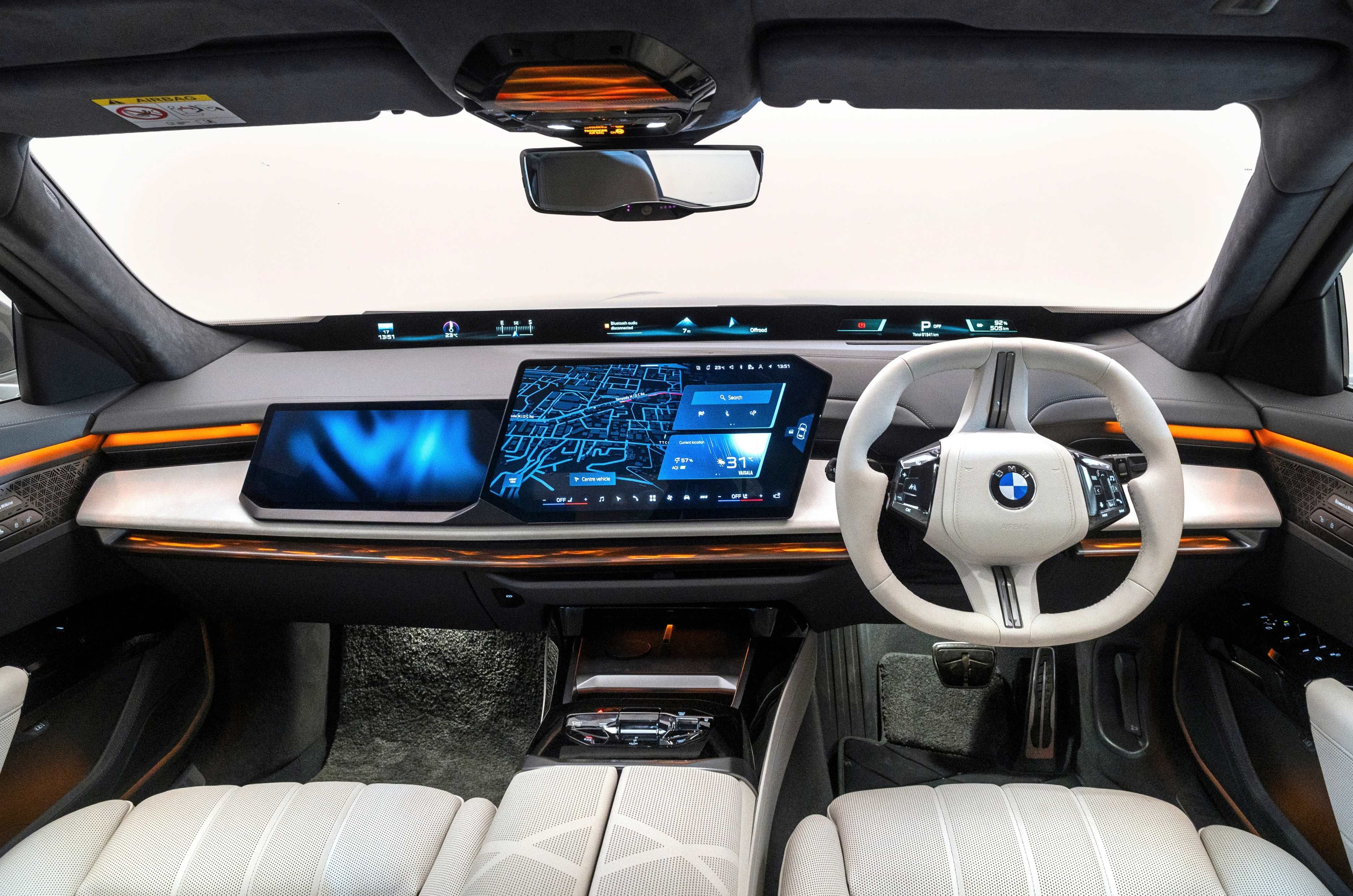
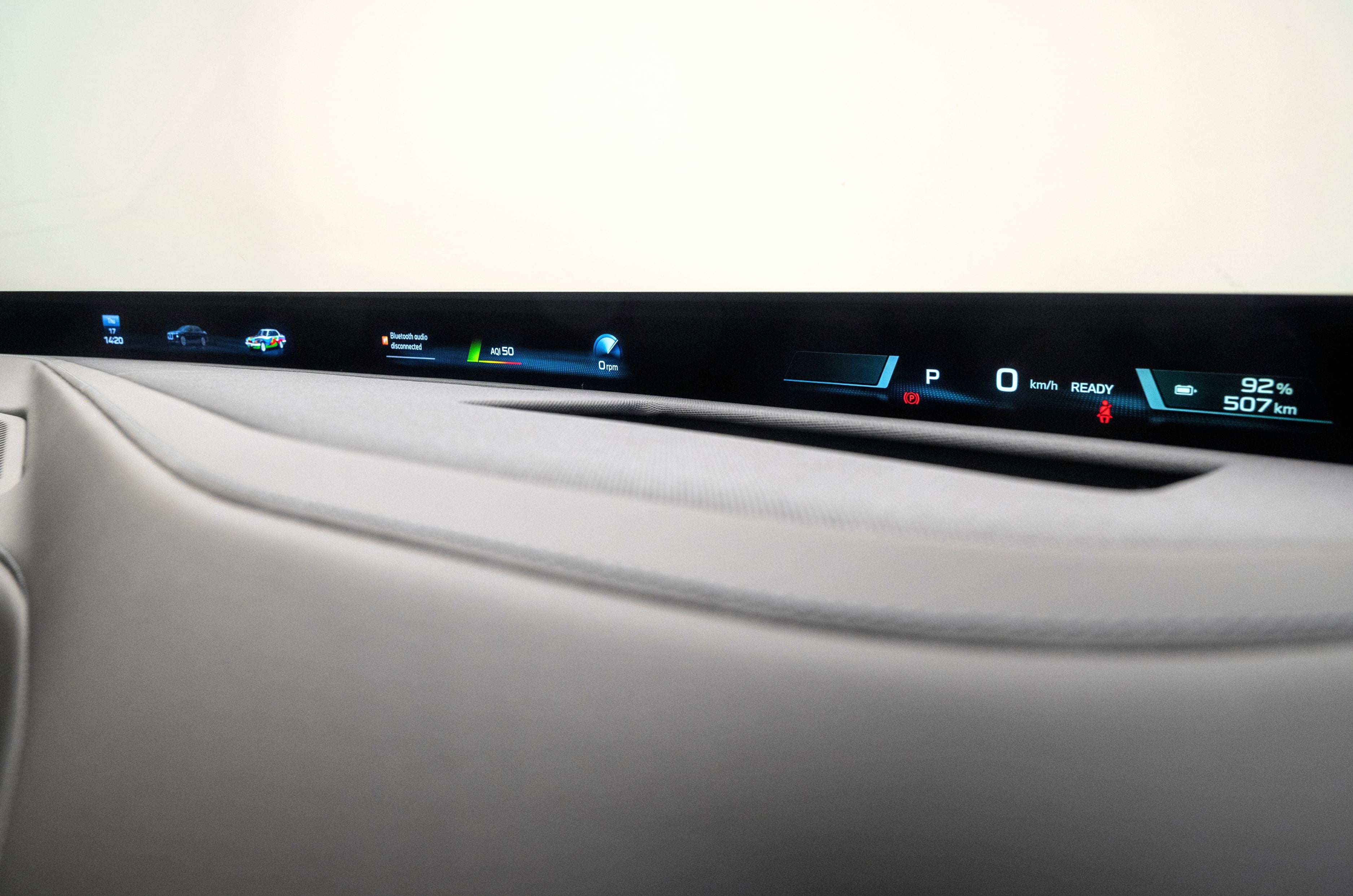
The i7’s dashboard has been completely redesigned, adding much-needed freshness while also previewing the direction BMW’s future interiors are expected to take. The biggest talking point is the deletion of the conventional instrument cluster. In its place sits a new panoramic head-up display positioned right at the base of the windscreen, projecting a wealth of information. It is highly customisable and, besides essentials like speed, charge status and warnings, can display motor speed, navigation, compass information, audio details, date and time, outside temperature, air quality, or even one of BMW’s Art Cars as a decorative element in the remaining six slots. The display is sharp, brilliantly executed, and sits naturally within your field of vision without becoming distracting.
A panoramic head-up display projects a wealth of information, it’s highly customisable and the display is sharp and brilliantly executed.
As for design, the new steering wheel is far more divisive. Its octagonal shape, combined with spokes extending from the horn boss at the 12 and 6 o’clock positions, makes it look unconventional. The light-coloured finish is also likely to be difficult to keep clean — you may even find yourself asking your chauffeur to wear gloves. On the plus side, it feels pleasant to hold, and the controls, though limited in number and not individual buttons, are satisfying to use.
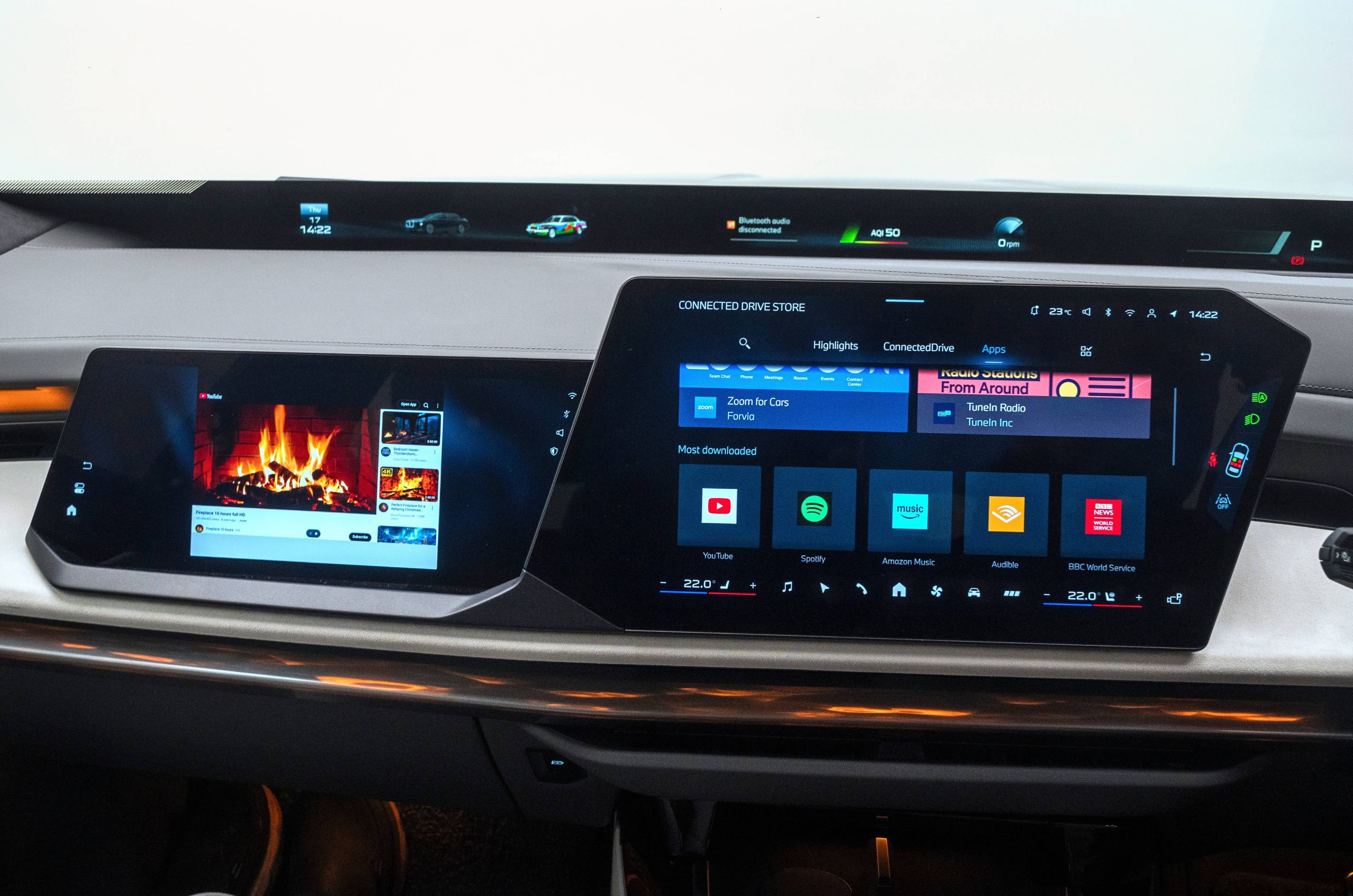
There’s also a new 17.9-inch free-standing touchscreen along with a smaller passenger display, both adopting a parallelogram shape. Curiously, the top-right corner of the central screen appears as though it has been chipped off, although that isn’t actually the case. Generous ambient lighting, crystalline detailing for the drive selector, volume controller and start-stop button, silver speaker grilles, and an overall light-coloured cabin theme further elevate the sense of luxury.
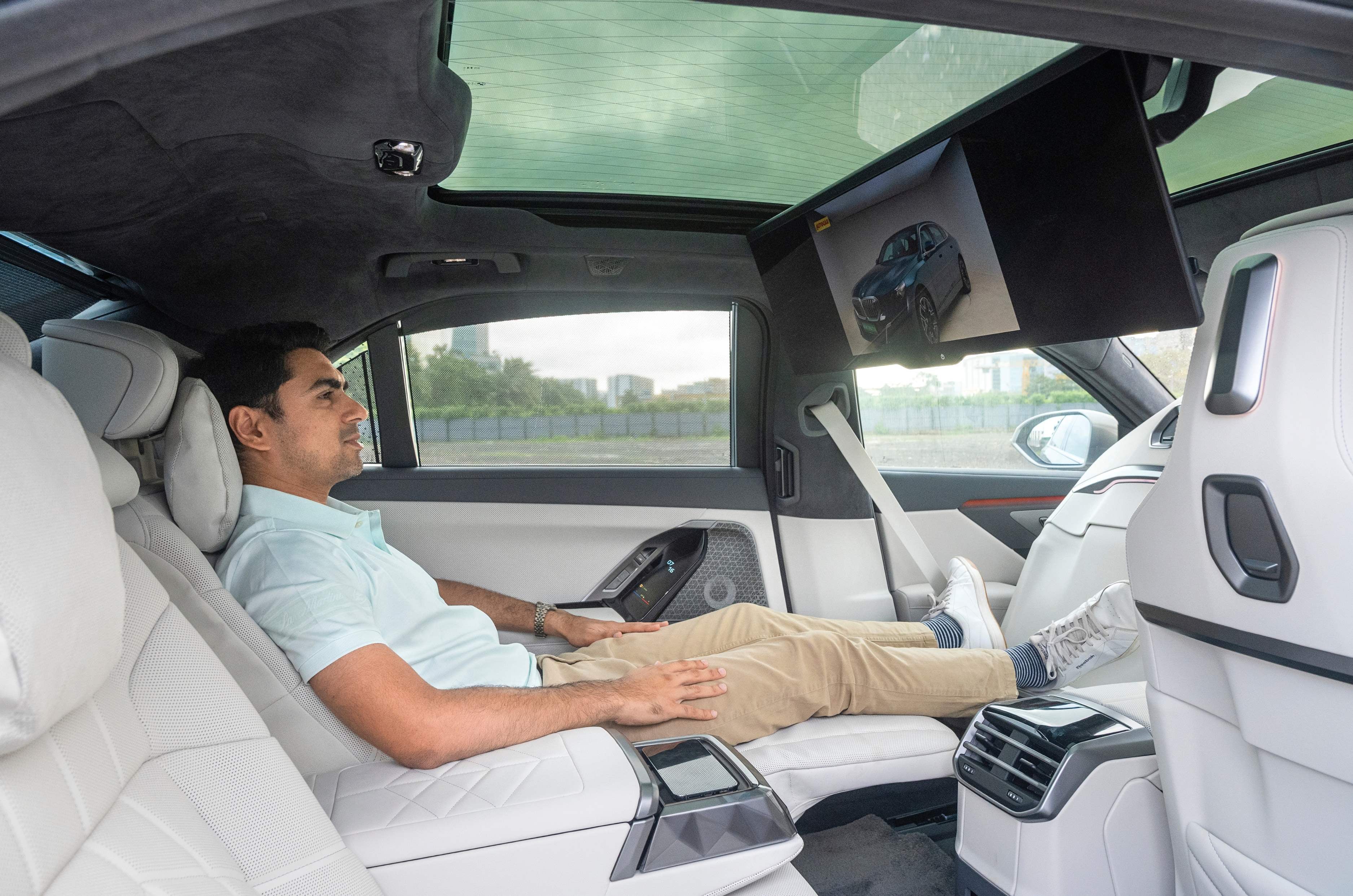
A one-touch relaxation mode transforms the rear seat into a lounge-like position. Updated 8K theatre screen is still part of the package.
Expectedly, the seats are supremely comfortable. All four seats get heating, ventilation and massage functions. Additionally, the rear-left seat features a one-touch relaxation mode that transforms it into a lounge-like position, complete with a raised ottoman, a fully-forward front passenger seat, and a fold-down footrest. Sadly, like the outgoing model, the spare wheel remains mounted on the boot floor, significantly compromising luggage capacity.
BMW i7 50 xDrive Features and Safety – 10/10
The i7 50 M Sport comes loaded with virtually every feature luxury sedan buyers could ask for. The new panoramic end-to-end head-up display replaces the conventional instrument cluster and is not only unique and highly customisable, but also exceptionally well executed. The 17.9-inch touchscreen is new too, and now benefits from additional shortcut keys in addition to permanently displayed climate-control functions, making it marginally easier to operate than before. However, the user interface still feels somewhat overwhelming, with an abundance of functions buried within multiple sub-menus.
The central screen is marginally easier to operate than before. The new front passenger entertainment display is likely to be of limited relevance to most owners.
Also new is a front passenger entertainment display, though we suspect it will be of limited relevance to most owners. The new 31.3-inch 8K rear theatre screen, on the other hand, is likely to see much greater use, particularly on longer journeys.
Carried over from the outgoing version and continuing to add a sense of occasion are the powered doors, which open and close at the touch of a button.
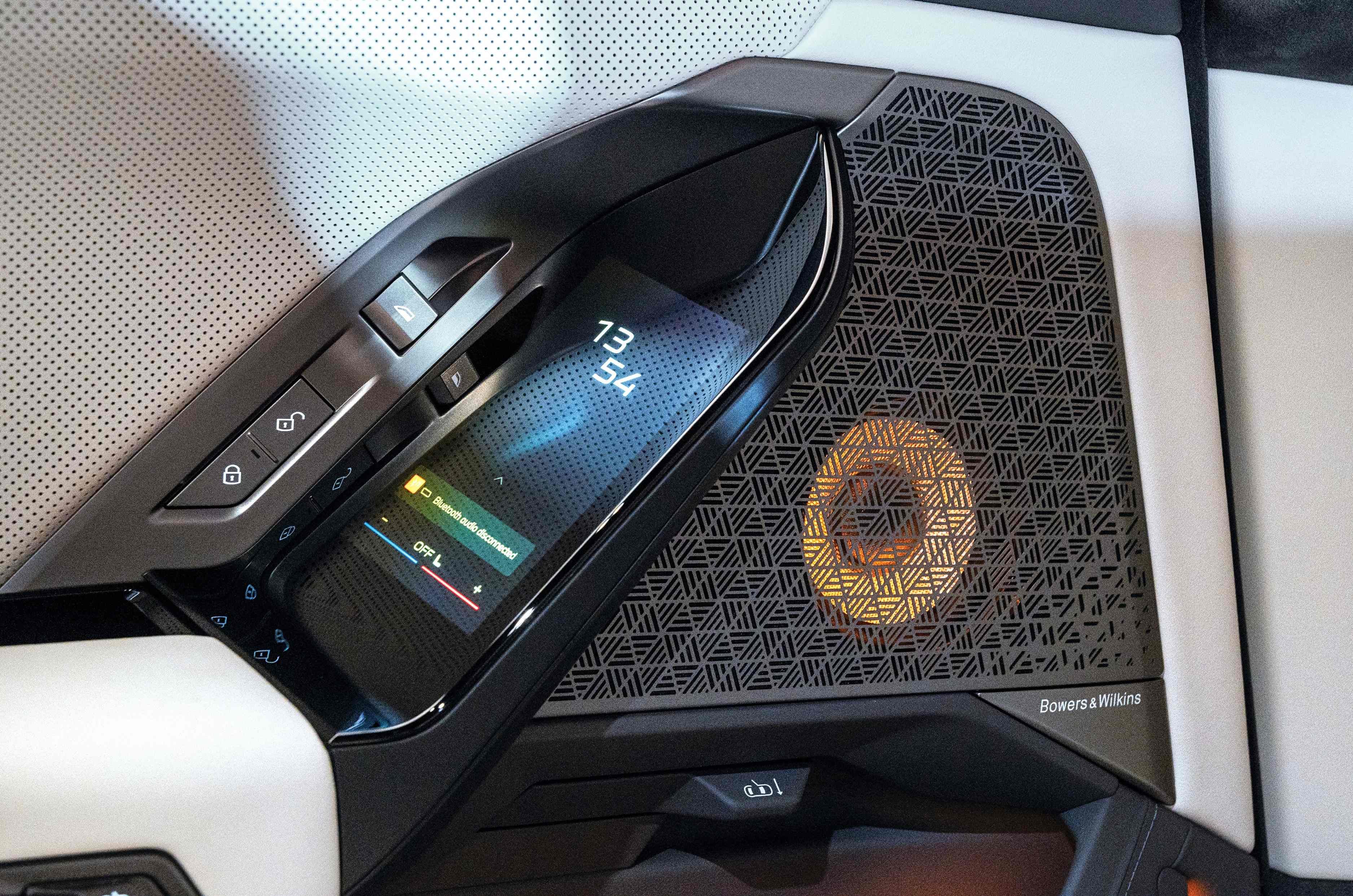
Its Bowers & Wilkins Diamond Surround Sound System with Dolby Atmos delivers an incredibly immersive audio experience.
The highlight, however, is the outstanding Bowers & Wilkins Diamond Surround Sound System with Dolby Atmos and a whopping 35 speakers. It even delivers a 4D experience, with a pronounced thump felt through all four seats. The result is an incredibly immersive audio experience that is sure to impress even the most discerning audiophile.
BMW i7 50 xDrive Performance and Refinement – 9/10
Its performance feels effortless and reassuring, while the accelerator calibration is smooth and progressive for everyday driving.
The i7 50 xDrive uses a dual-motor setup producing a combined 483hp and 660Nm, which is more than adequate for a luxury sedan of this nature. There’s rarely any need to switch out of Efficient mode because there is always a vast reserve of torque available. The effortless performance feels reassuring, while the accelerator calibration is smooth and progressive during everyday driving.
Press the accelerator beyond the halfway mark and the i7 takes off like a scalded cat. Acceleration is rapid, with this 2.8-tonne luxury sedan sprinting from 0-100kph in just 5.5 seconds and reaching 200kph in a shade under 19 seconds. Owners can also choose to activate synthetic motor sounds that play through the speakers, adding a dramatic, sci-fi soundtrack to acceleration. These can be switched off entirely for a completely silent experience.
There are multiple regenerative braking settings, including Adaptive, High, Mid and Low. Of these, Adaptive stands out for its excellent calibration, intelligently varying regeneration and coasting based on traffic and road conditions. There’s also a dedicated one-pedal ‘B’ mode selectable via the drive selector. It delivers regeneration similar to the High setting but, unlike it, can bring the car to a complete stop without any brake pedal input.
BMW i7 50 xDrive Range and Efficiency – 9/10
The i7 50 xDrive gets a larger 112.5kWh battery pack with NMC cell chemistry, replacing the outgoing version’s 101.7kWh unit. As a result, this version claims a WLTP range of up to 728km. Although we haven’t yet subjected it to our range tests, we expect it to comfortably deliver over 500km in real-world conditions, which is more than sufficient for most users. BMW claims the battery can charge from 10-80 percent in 28 minutes using a 250kW (or higher) DC fast charger. On a 22kW AC charger, a full charge takes approximately six hours.
BMW i7 50 xDrive Ride Comfort and Handling – 10/10
What’s truly impressive is the pillowy ride quality. It shrugs off badly broken roads with ease, and maintains excellent body control.
Piloting the i7 may initially seem intimidating given its considerable dimensions, but its light steering and rear-axle steering significantly aid manoeuvrability. The latter allows the rear wheels to turn either with or against the fronts by up to 3.5 degrees, helping the car feel remarkably agile for its size.
What’s truly impressive is the pillowy ride quality. The thick, high-profile tyres add another layer of cushioning, allowing the i7 to shrug off even badly broken roads with ease. It absorbs potholes effortlessly, keeps road shocks well isolated, and maintains excellent body control. Passengers are also spared the uncomfortable side-to-side movements over unusually rough patches.
Selecting Sport mode does firm things up slightly, but while the air suspension becomes tauter and body control improves further, ride comfort never suffers. Handling feels predictable and, thanks to xDrive all-wheel drive, the i7 feels exceptionally planted and offers impressive grip when tackling corners. Rear-wheel steering also does a remarkable job of disguising its size.
In short, the i7 can be driven surprisingly enthusiastically, and for a luxo-barge, it drives exceptionally well. We would, however, recommend leaving the steering in Comfort mode, as it feels unnecessarily heavy in Sport.
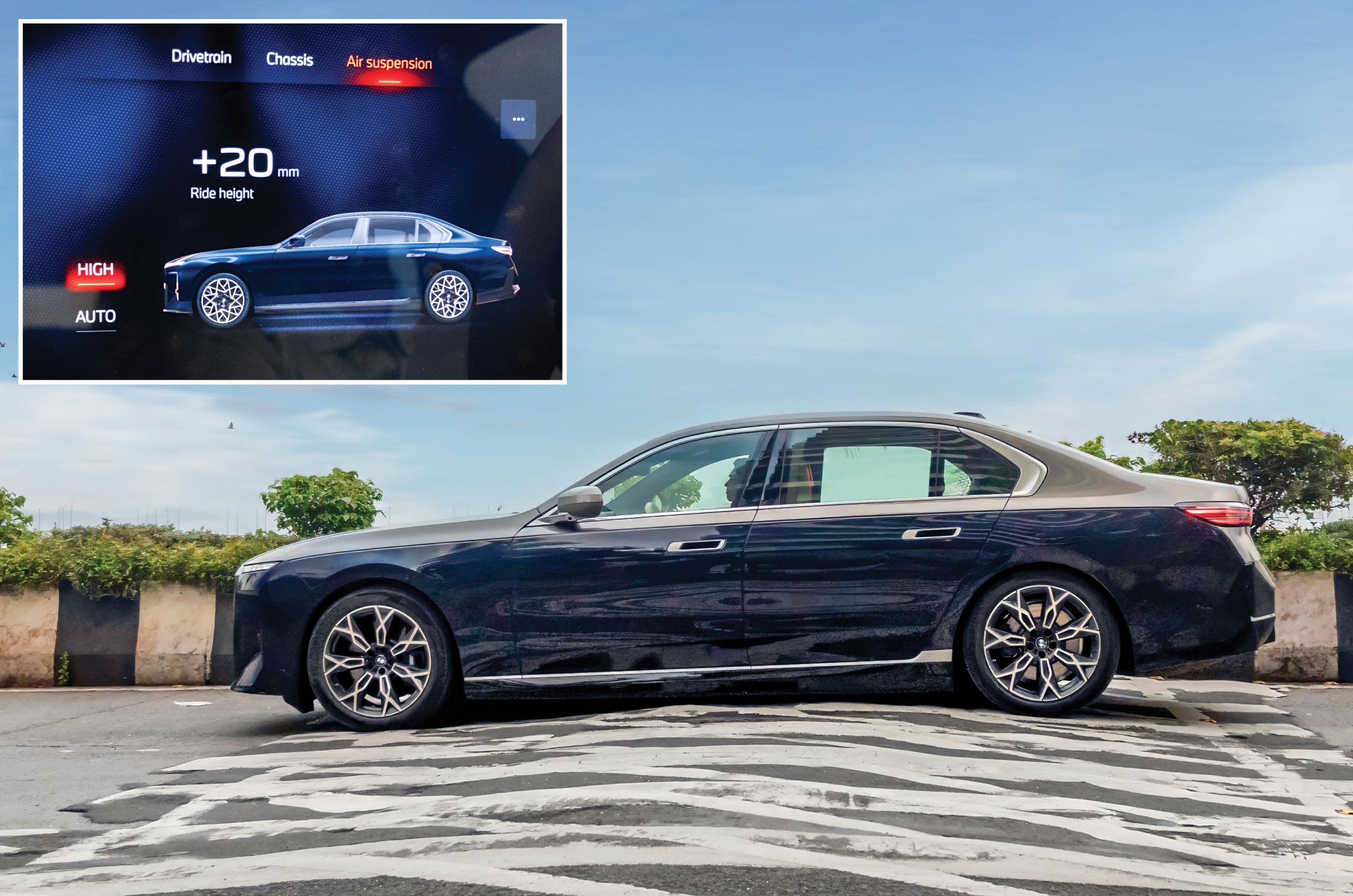
The suspension raises by 20mm over the 136mm standard setting, allowing it to clear all but the most poorly designed obstacles.
Sport mode also lowers the ride height by 10mm from the standard 136mm setting. While beneficial for dynamics, it makes the underbody vulnerable even on relatively small speed breakers. Thankfully, two taps on the touchscreen raise the suspension by 20mm over the standard setting, allowing it to clear all but the most poorly designed obstacles. Cabin insulation is outstanding too, keeping road, wind and ambient noise effectively isolated from occupants.
BMW i7 50 xDrive Price and Verdict – 9/10
At Rs 1.95 crore, the locally assembled i7 50 xDrive is priced exactly at par with the petrol-powered 740 and is even a few lakhs more affordable than its chief rival, the Mercedes-Benz S-Class. Yet pricing alone isn’t what makes the i7 such a compelling proposition.
What truly sets it apart is the sheer sense of occasion it delivers. Its styling is bold, the cabin feels genuinely special, ride comfort is exceptional, and the level of technology on offer significantly elevates its desirability. Add to that an extraordinary audio system and the effortless refinement that only a luxury EV can deliver, and the i7 feels every bit the flagship it is.
Yes, luggage space remains compromised by the spare wheel placement, and the touchscreen interface isn’t quite as intuitive as that of its chief rival. But in this segment, neither is likely to be a deal-breaker.
The bigger takeaway is that BMW has successfully made the electric version of its flagship sedan the more desirable one. For buyers seeking luxury, comfort and technology, the i7 50 xDrive isn’t merely an excellent EV, it’s quite simply all the luxury car you’ll ever need.
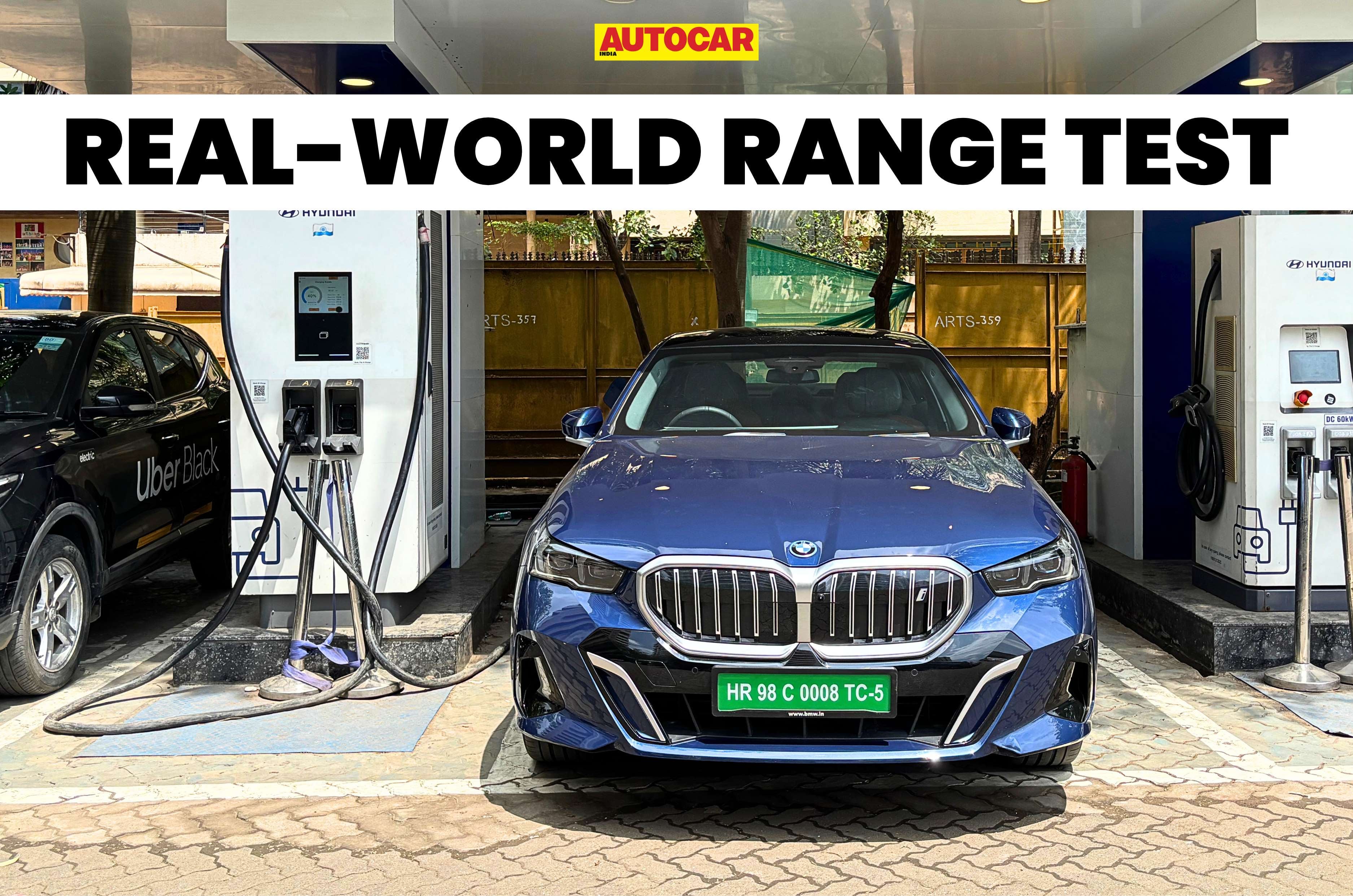
BMW has launched the BMW i5 eDrive35L, the electric version of the long wheelbase 5 series sedan. Compared to the international spec, this India-spec version’s wheelbase has been extended by 110mm. Priced at Rs. 79.60 lakh (ex-showroom), it commands a Rs. 3 lakh premium over its petrol counterpart, the 530Li. We put the BMW i5 LWB through our real-world tests to find out how efficient it really is
Claimed range is 669km
Gets five regen modes – High, Medium, Low, B Mode and Adaptive
Net battery capacity is 76.3kWh
BMW i5 LWB real-world range and charging explained
This BMW i5 LWB is powered by a single motor mounted on the rear-axle, and produces 272hp and 410Nm. It is equipped with a 81.6kWh (gross capacity) battery pack that uses NMC (Nickel Manganese Cobalt) cell chemistry. For this test, we drove the BMW i5 LWB in ‘Efficient’ mode with the regen set to ‘Adaptive’. In Adaptive mode, the regenerative braking is automatically adjusted depending on the road and traffic conditions, and it works as intended.
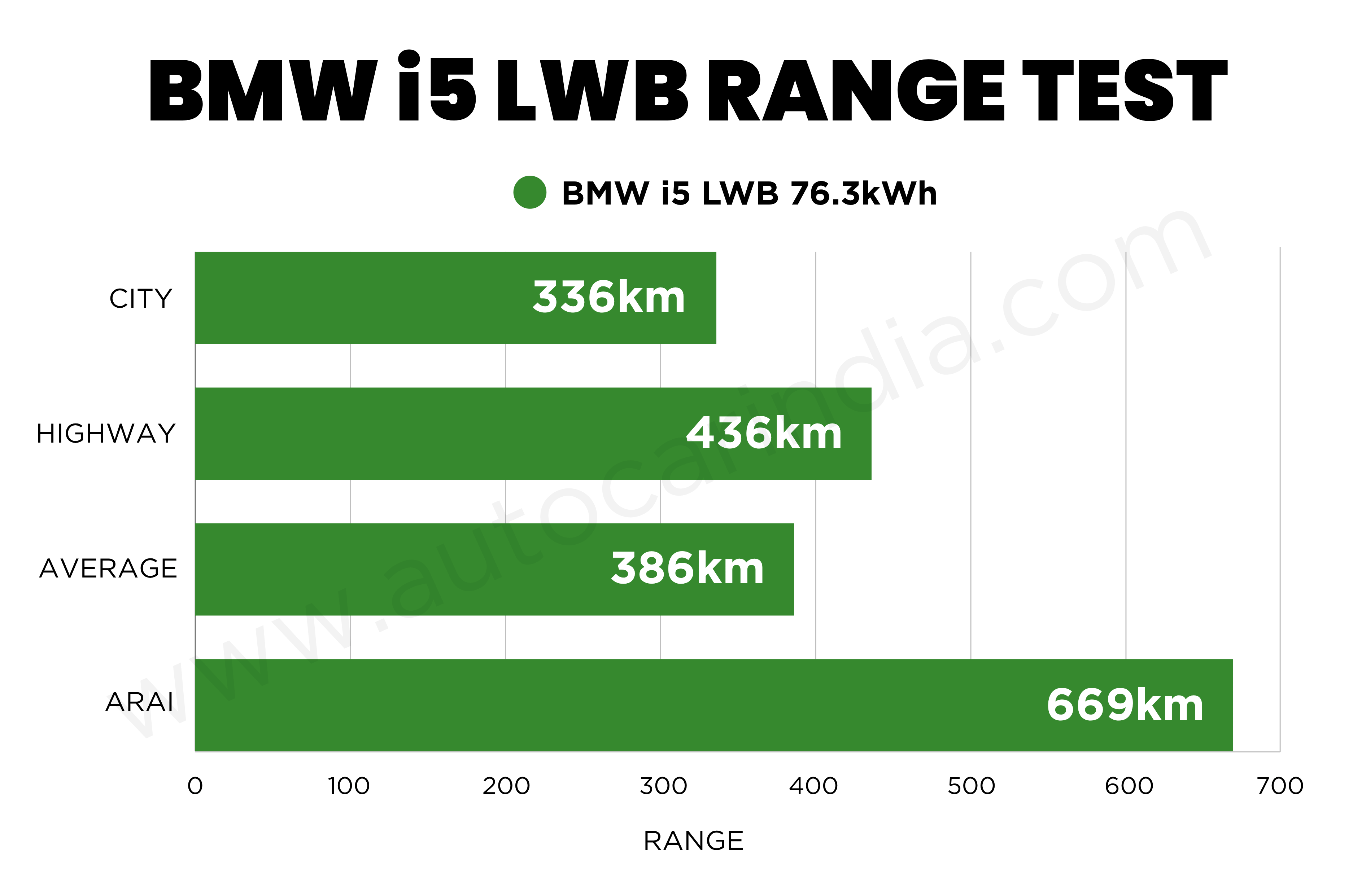
In the city, the i5 delivered an efficiency of 4.4km/kWh, whereas on the highway, it delivered 5.71km/kWh. This extrapolates to a range of 336km and 436km in the city and on the highway, respectively. With an overall average efficiency of 5.06km/kWh, you can expect a real world range of 386km on a full charge.
BMW claims that the i5 can charge from 10-80 percent in 33 minutes using a 160kW DC fast charger. We recharged its battery using a 60kW DC fast charger, and it took 47 minutes to charge the battery from 20-80 percent.
Autocar India’s range testing
Before our real-world range tests, the battery of our test car was fully charged, and we maintained tyre pressures in accordance with the manufacturer’s recommendations. The car was driven on a weekday in Mumbai city and on the adjoining state highway in a fixed loop, and we maintained the set average speeds. At the end of each cycle, we calculated the range based on the percentage charge consumed.
Throughout our tests, the climate control was set to 22deg C in a full-auto setting, and other electricals, such as the audio system, indicators and ventilated front seats, were used when required, just as a regular user would. We take pride in our testing data, which isn’t merely consistent but also gives users an accurate indication of what they can expect in the real world.
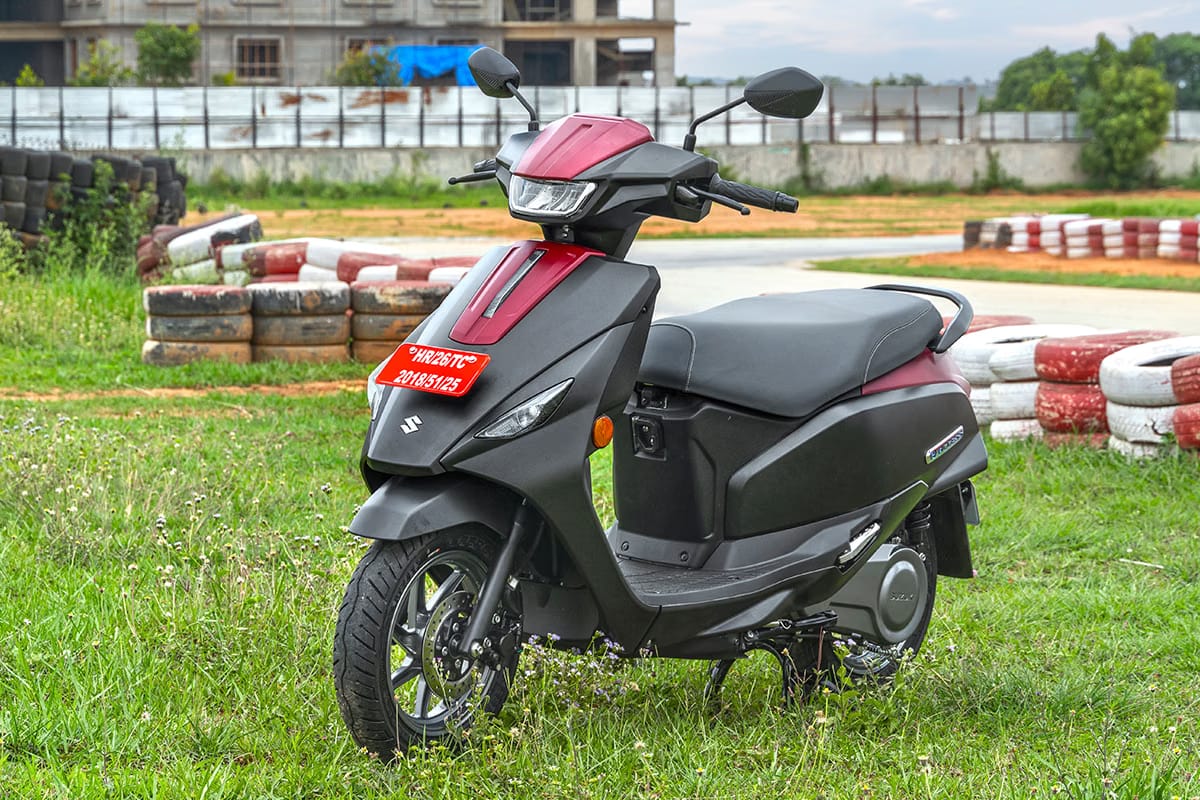
The Suzuki e-Access is the brand’s first electric scooter for India and a ground-up new product, sharing little with the petrol Access beyond its name. Built on an entirely new platform, it makes a case for itself through longevity and reliability rather than outright performance or features. Here’s what works in its favour and a couple of reasons it might not be for everyone.
Reasons to buy the Suzuki e-Access
Comfortable to ride and the reliability promise is real
The e-Access is a pleasant machine to spend time on. The ergonomics are neutral, the seat is flat and spacious, and the suspension is well-tuned – firm enough to feel taut without being harsh. Next, in terms of build quality, it is solidly put together with the kind of tactile feel that Suzuki two-wheelers are known for. The LFP battery chemistry offers a longer service life and lower thermal runaway risk than the NMC packs used by most rivals, which should translate to long-term ownership confidence.
Trustworthy range indicator
One area where the e-Access stands out is the accuracy of its range prediction. Once the system calibrates to your riding style, the distance-to-empty figure shown on the display is reliable. This is not something that can be taken for granted across the electric scooter segment, where optimistic range indicators that drop sharply under any real-world load are a common frustration. In our tests with Ride A mode, we covered just over 88km on a single charge – slightly below the 95km claimed IDC range, but within a reasonable margin.
Reasons to skip the Suzuki e-Access
Performance and range fall short for the price
The e-Access is slow by the standards of the electric scooter segment. In our tests, it took nearly 12 seconds to complete the 0-60kph sprint, which is not only slower than similarly priced rivals but also significantly slower than the petrol Access 125. The 88km real-world range is a reasonable figure in isolation, but rivals with similarly-sized batteries routinely return over 100km. The powertrain is also noticeably noisier than most other reputed electric scooters on sale today.
Boot space is woefully inadequate
The 17-litre underseat boot is the e-Access’s most immediately frustrating shortcoming. At a time when most mainstream electric scooters offer 30-35 litres of storage – and some, like the Simple Wave offering nearly 70 litres – the e-Access’s boot feels genuinely inadequate for daily use. The supplied charger barely fits inside once the cables are folded correctly, leaving almost no usable free space. This is a consequence of Suzuki positioning the battery pack vertically under the seat, and it is compounded by the fact that even the latest petrol Access 125 offers more boot space than the electric version.
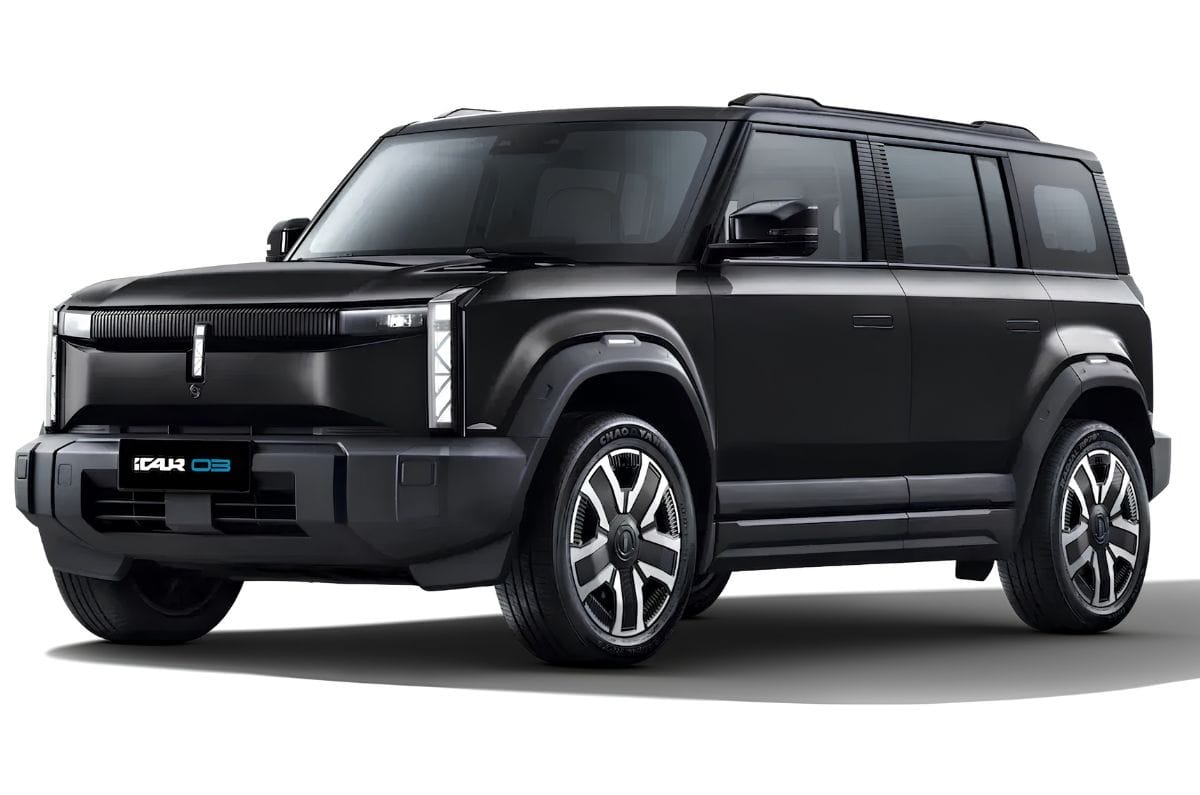
The iCAUR 03, a 5-seat electric SUV from Chinese carmaker Chery, was recently spotted in India. This model is likely to be launched under the JSW Motors nameplate, but unlike other expected JSW models that have been spied testing in India with heavy camouflage, the iCAUR 03 was uncamouflaged and being transported on a flatbed truck.
Chery iCAUR 03: What is it?
China-spec Chery iCAUR 03 used for representation
The 03 is an electric SUV sold under Chery’s iCAUR sub-brand alongside the V23. It’s 4,406mm long, 1,910mm wide, 1,715mm tall, has a 2,715mm wheelbase, and a ground clearance of 195mm. China-spec versions are powered by a 69.8kWh battery pack that utilises LFP (Lithium-ion Phosphate) chemistry. Power comes from a dual- motor setup with a combined output of 279hp and 385Nm, and it gets an AWD configuration. On the NEDC cycle, it can go up to 418km on a single charge, and the battery supports DC charging speeds of up to 80kW.
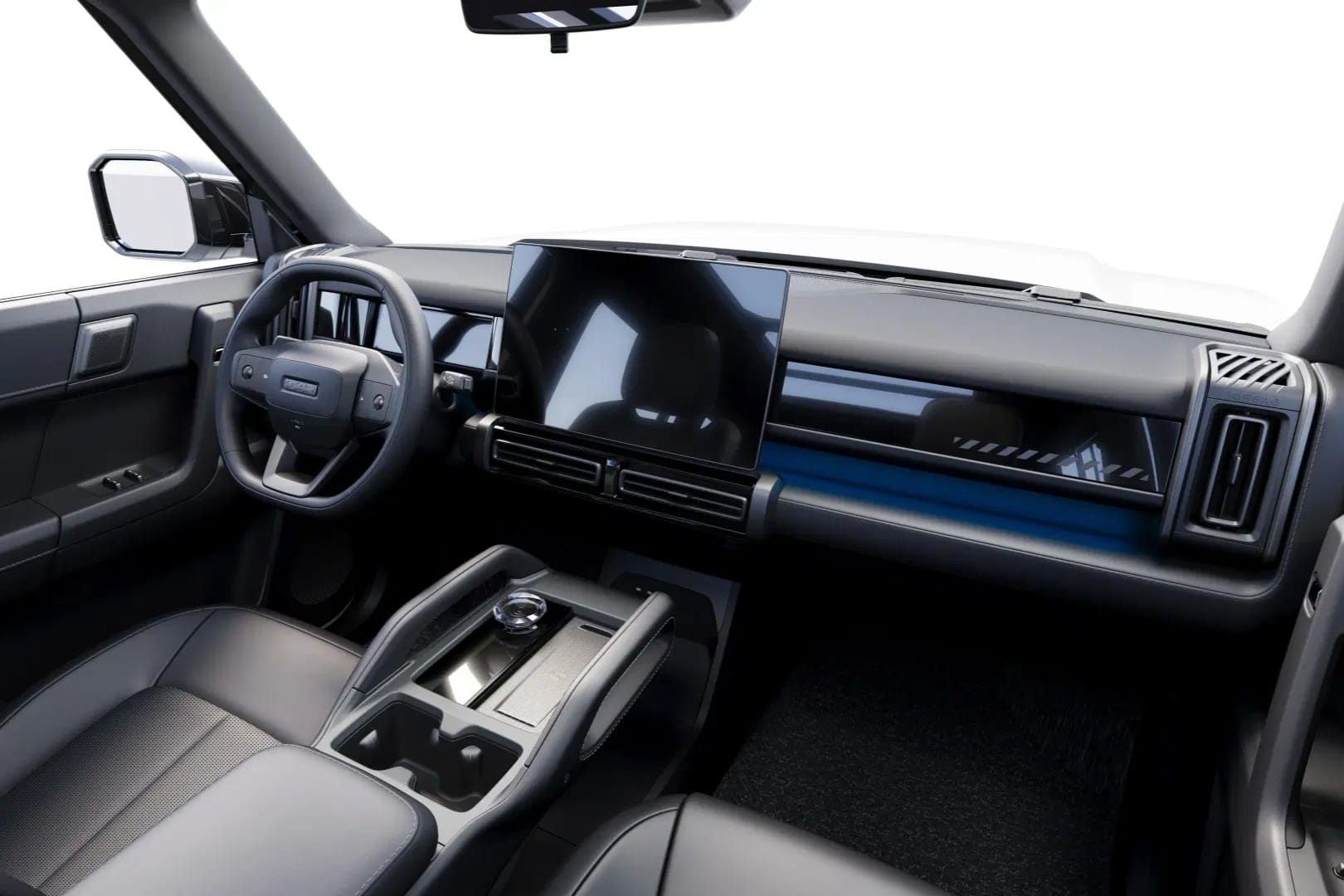
China-spec Chery iCAUR 03 interior used for representation
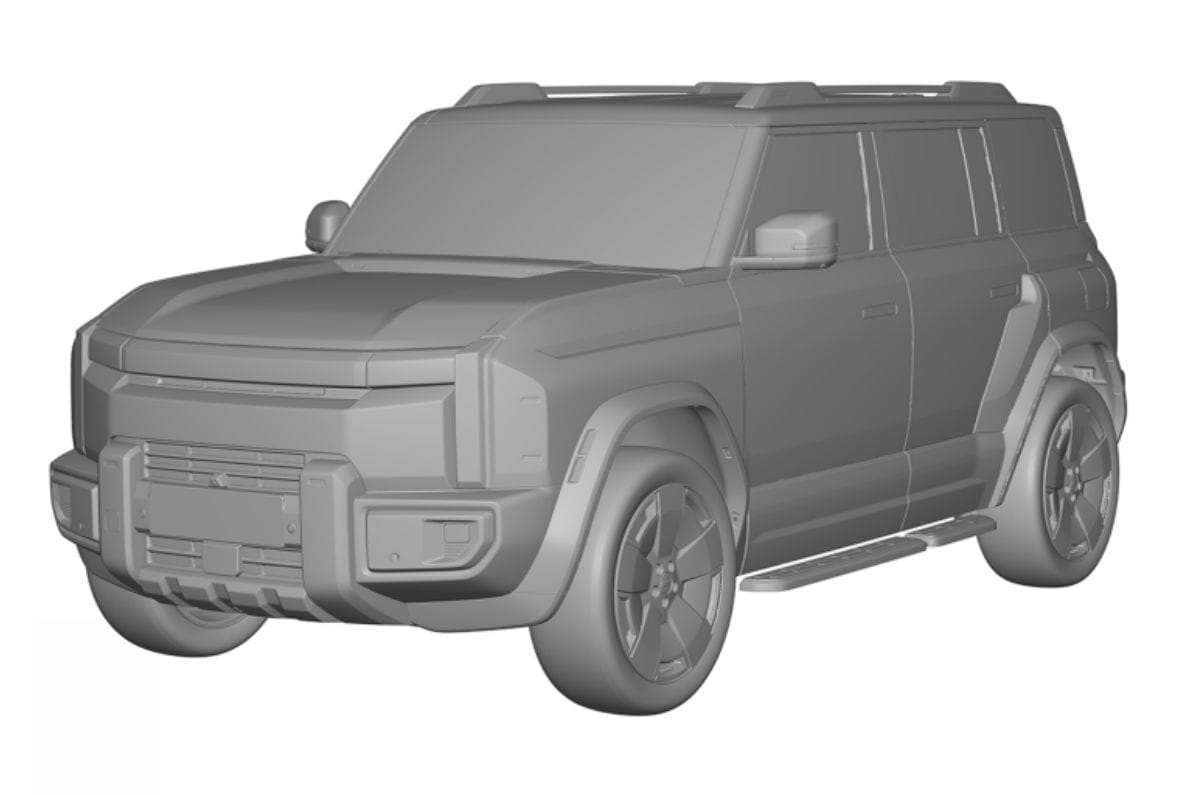
The exterior of the vehicle spotted in India had a boxy silhouette with a black finish for the front bumper and cladding on the wheel arches and door sills. Dual-tone design for the alloys, flush door handles, and LED headlamps were seen too. Interestingly, Chery has already filed a design patent for this SUV in India, as it has with its other products. However, the patented model has much beefier body cladding and rugged-looking bumpers than the model spotted on our roads. The interior of the China-spec 03 looks tough yet modern with niceties like a 15.6-inch infotainment system, 9.2-inch digital driver’s display, powered front seats, ventilated front and rear seats, level 2 ADAS, and a 360-degree camera.
Chery iCAUR 03: Another JSW Motors model?
If the iCAUR 03 does make it to our market, it is likely to be sold under the JSW Motors nameplate. Dimensions and specs considered, it could potentially compete in the mid-size electric SUV category, rivalling the likes of the Tata Harrier EV. Meanwhile, JSW Motors has been testing several other Chery-made products on our roads, including the Jetour T2, Chery iCar V23, and the Jaecoo J5. Out of these, the Jetour T2 is expected to be the first to arrive by the end of this year. It will be followed by the Jaecoo J5 and the iCar V23 at a later date.