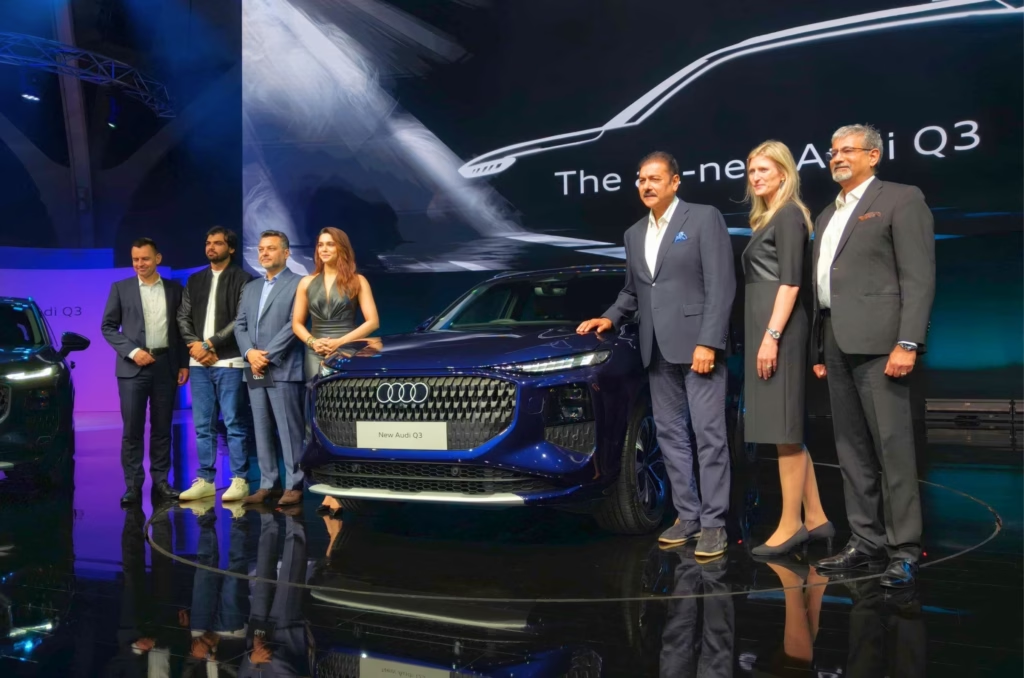
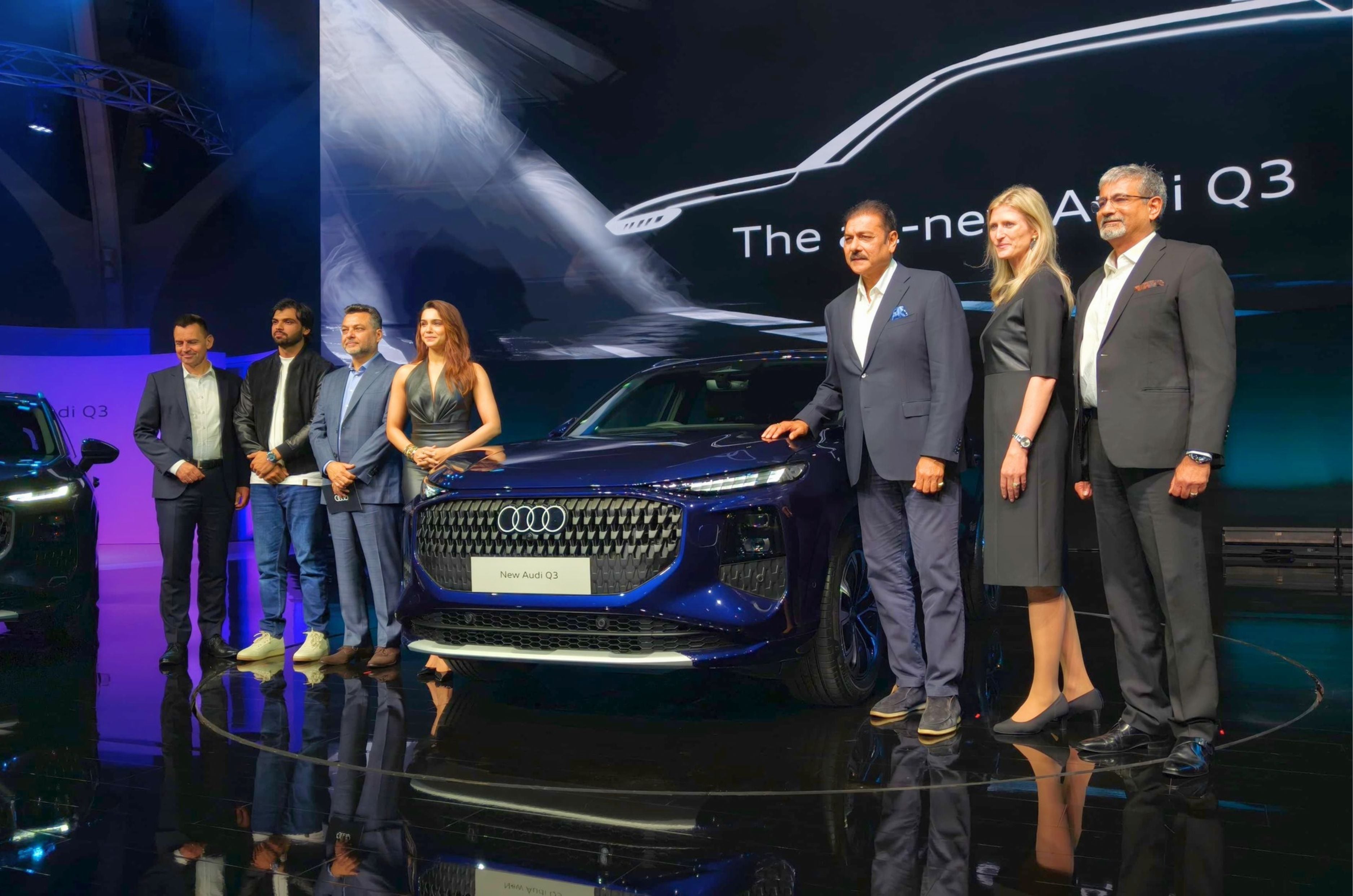
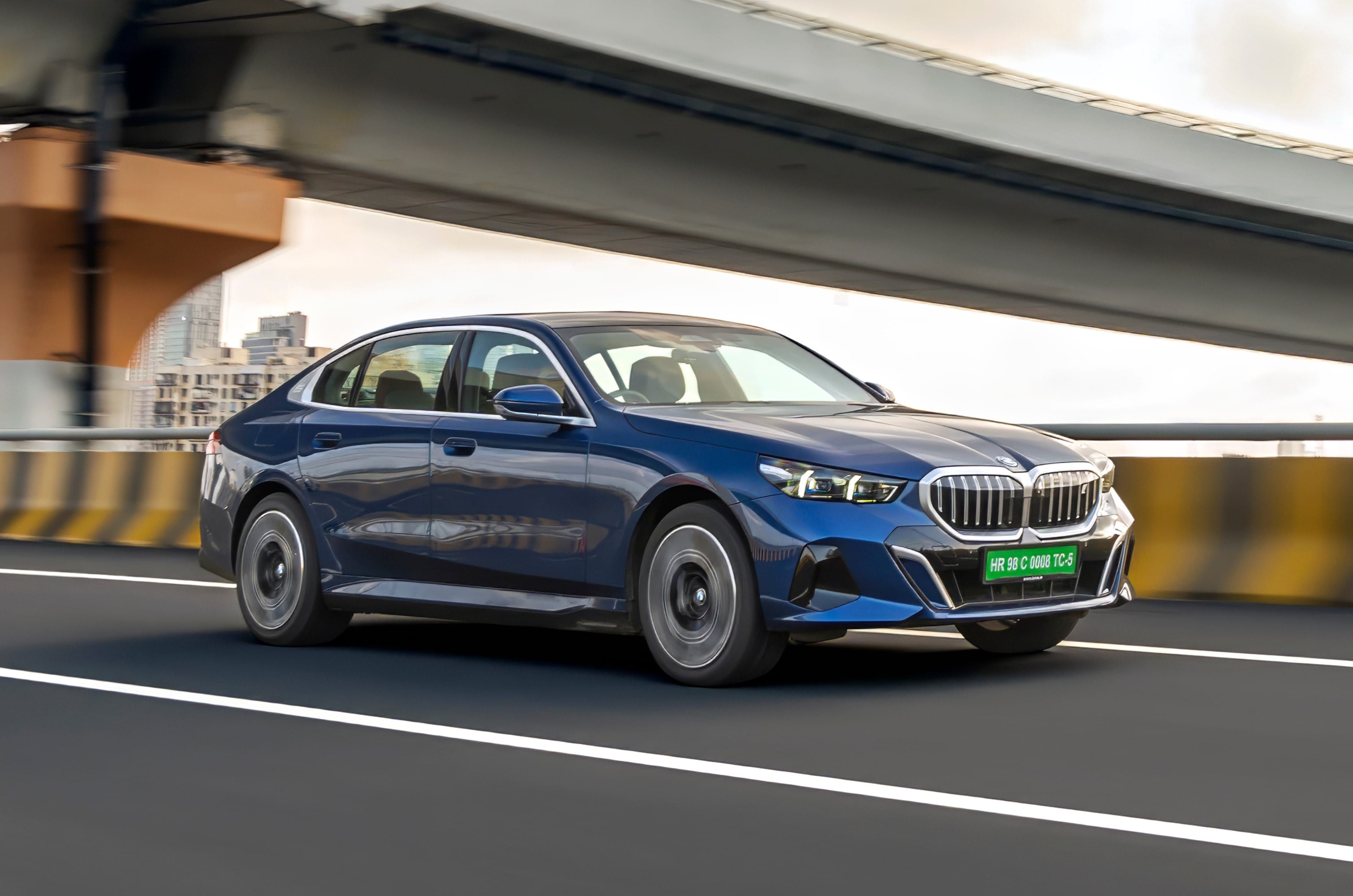
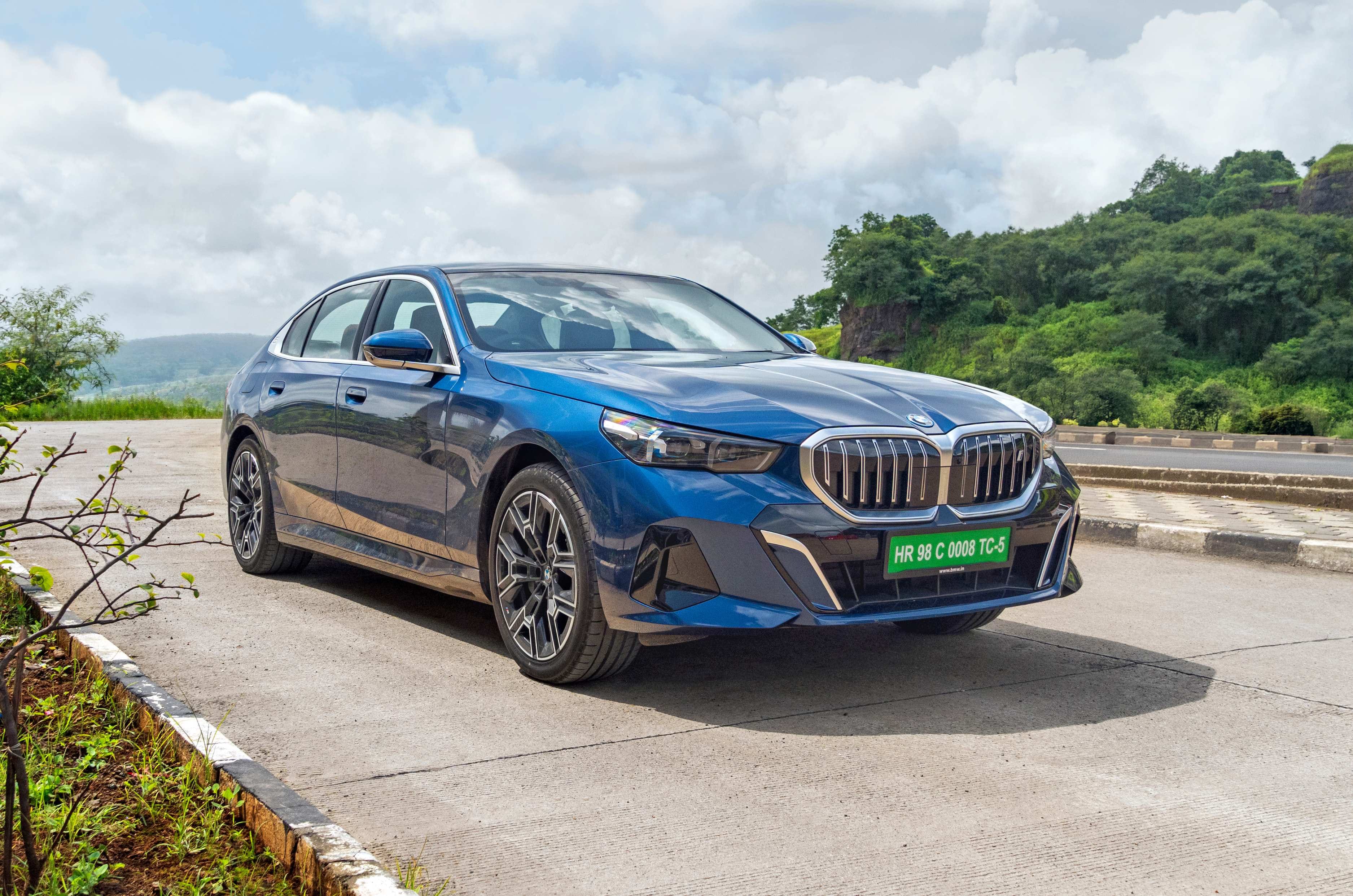
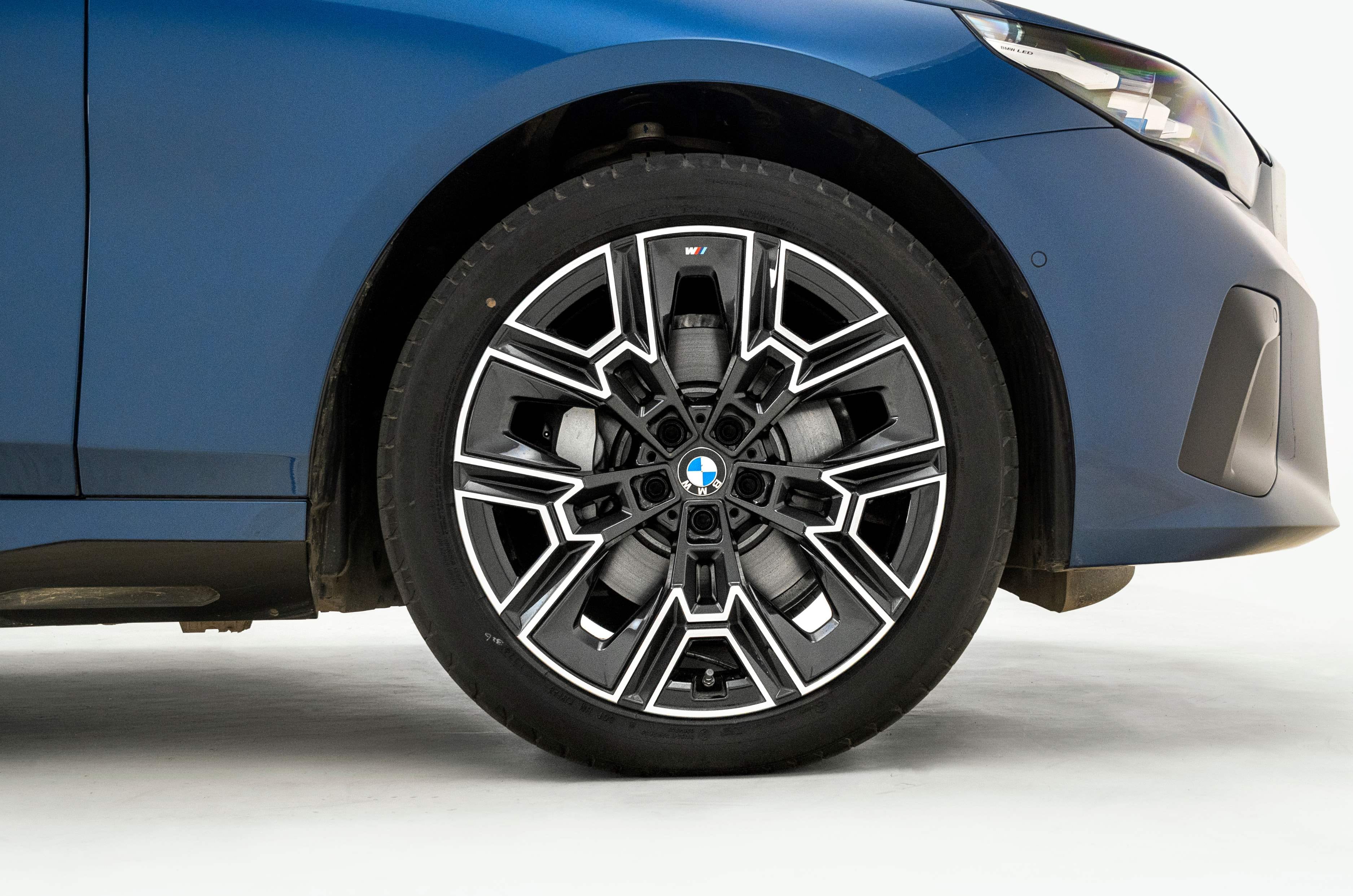
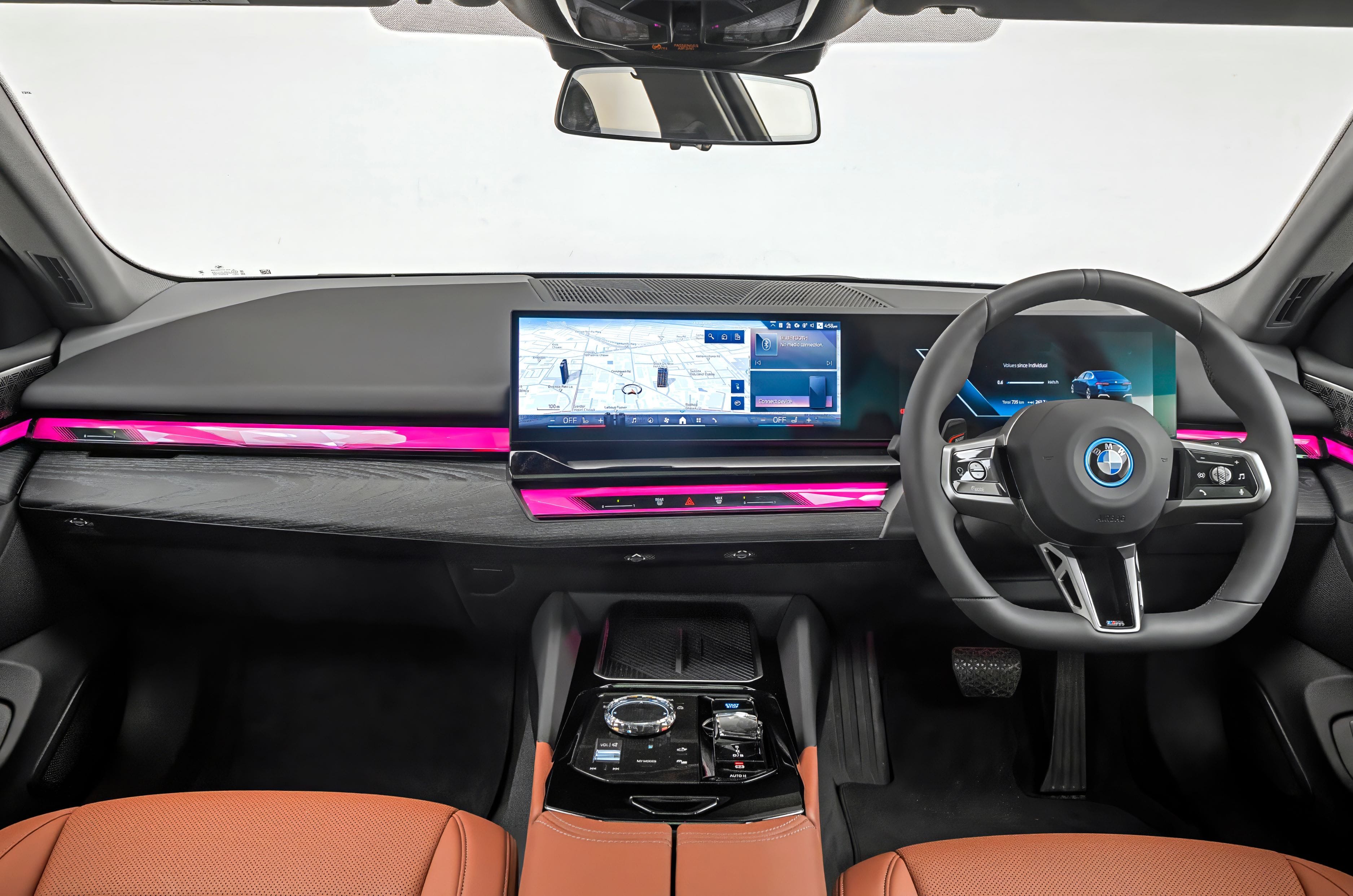
Audi has launched the 2026 Q3 in India at Rs 51.99 lakh (ex-showroom). This is the third-generation entry-level luxury SUV in India, which is being offered in two trims: Nova and Zenith, and the latter’s price is yet to be revealed. It sports extensive design changes inside and outside, additional features and a turbo-petrol engine option only. The 2026 Audi Q3 is being assembled at the manufacturer’s Chhatrapati Sambhajinagar plant in Maharashtra, and its deliveries are also underway.
Only luxury car in its segment with an AWD setup
Features split-style headlights and 18-inch alloy wheels
Gets dual digital screens, panoramic sunroof, 3-zone AC
2026 Audi Q3 exterior design
Gets split-style headlights, taillights and 18-inch alloy wheels
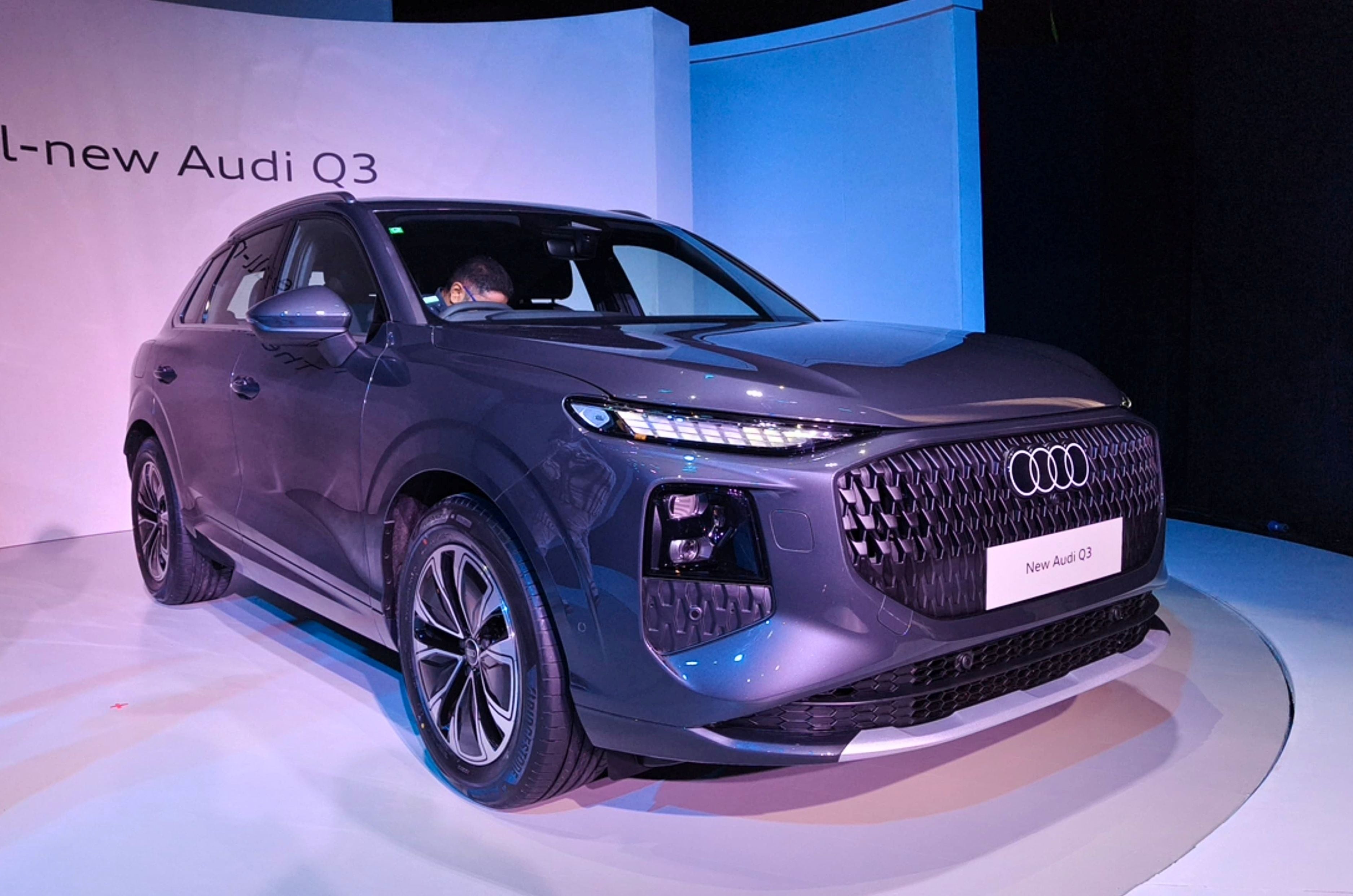
Being a generation update, the 2026 Audi Q3 comes with a thoroughly redesigned exterior. It gets split-style headlights, with LED DRLs at the top and the main digital Matrix LED headlights on the bumper with dedicated washers. The LED DRLs and headlights feature lighting signatures, and in fact the latter can even project important ADAS information on the road in the driver’s direct field of vision for improved safety. It also gets a large grille with honeycomb mesh elements and similar air intakes on the lower section of the bumper.
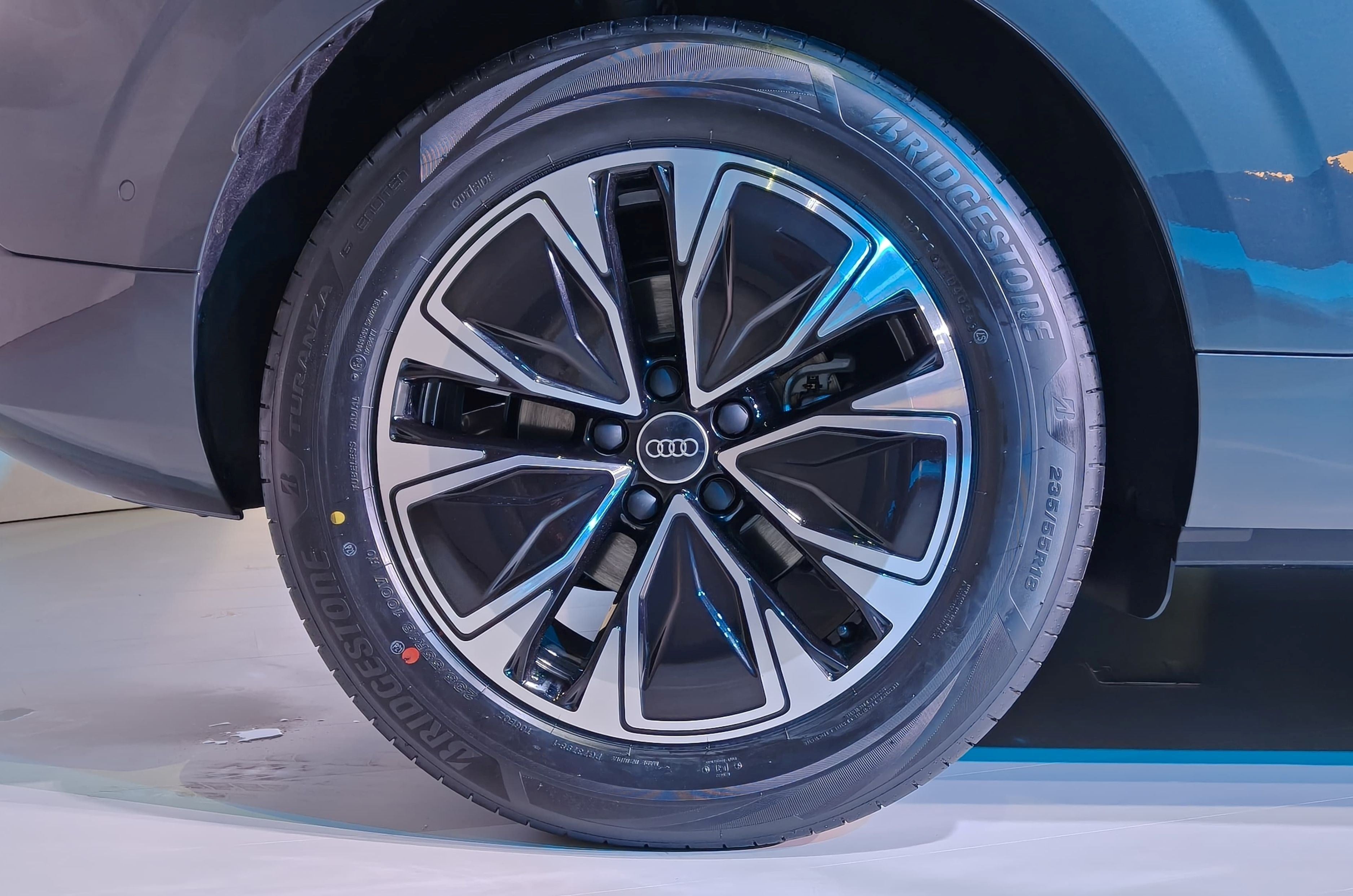
In profile, the Q3 features 18-inch alloy wheels as standard with self-centring hubcaps. It also gets a chrome windowline, slim roof rails and slightly flared wheel arches.
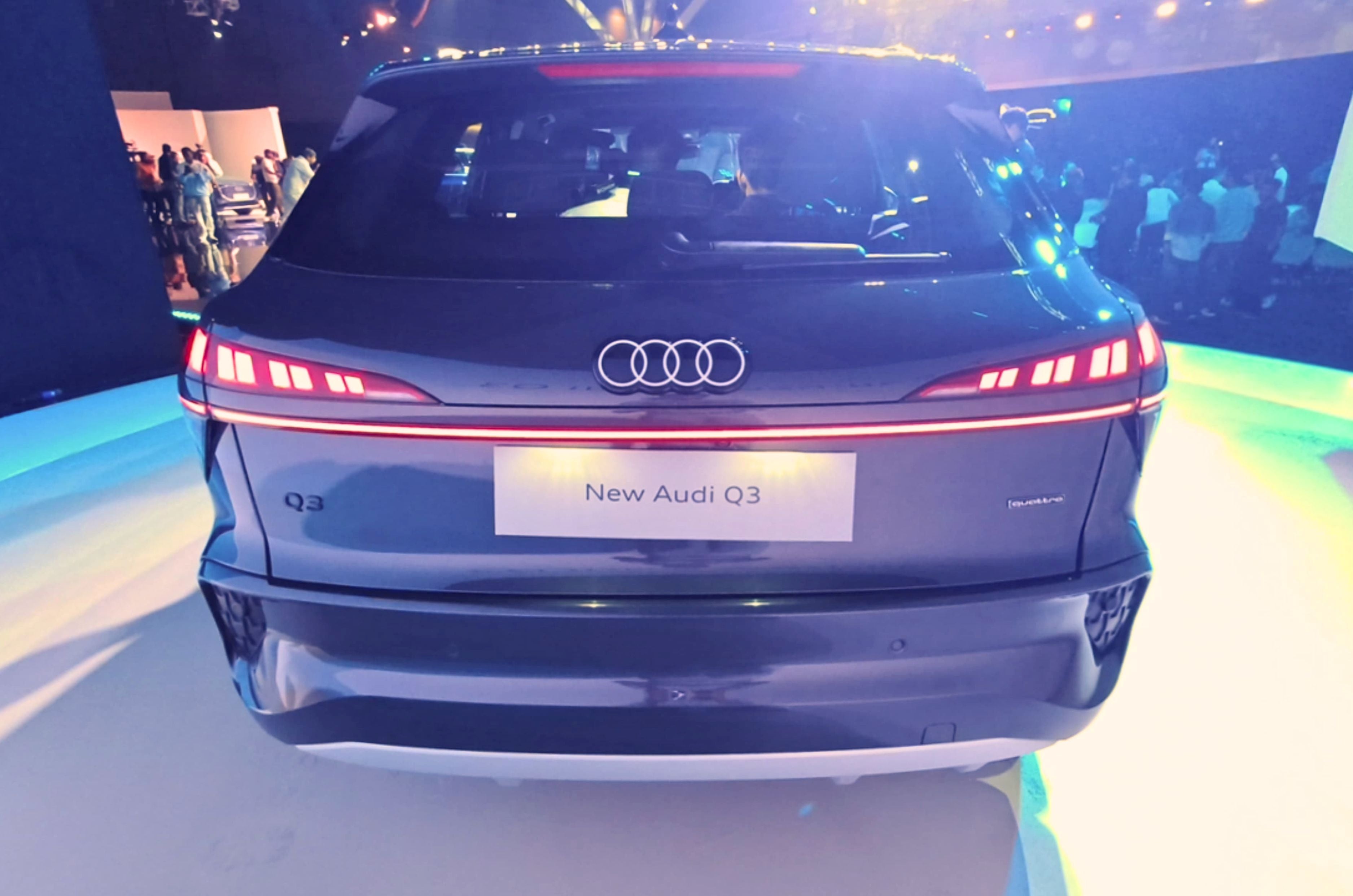
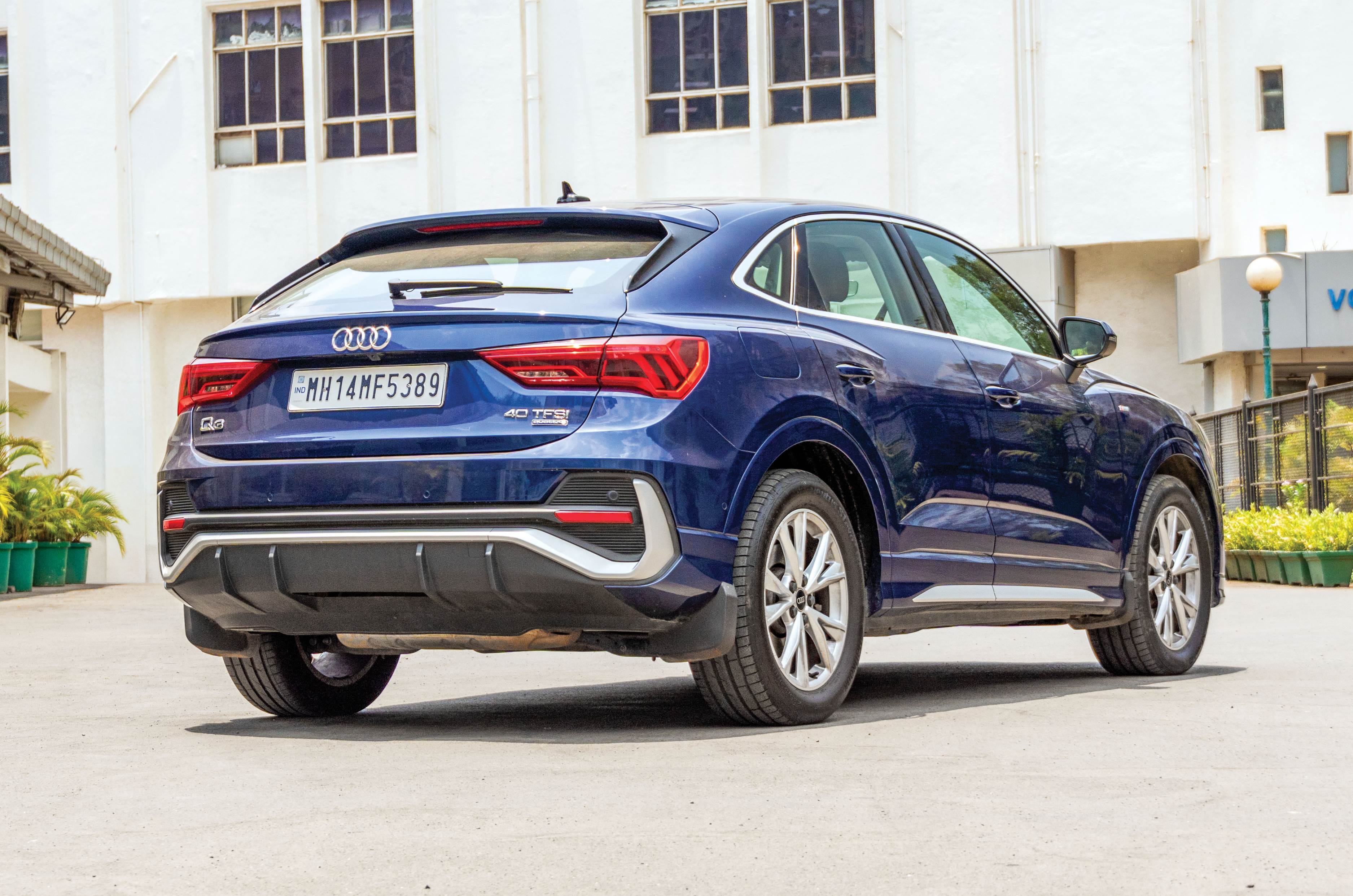
At the rear, it features split LED taillights; the lower unit is connected by a thin strip of light bar. The Audi logo at the rear is illuminated. Audi is also offering a roof-mounted spoiler and a rear wiper and washer.
Here are the dimensions and other specifications of the 2026 Audi Q3:
2026 Audi Q3 dimensions and other specifications
Length
4,531mm
Width
1,859mm
Height
1,601mm
Wheelbase
2,681mm
Boot space
488 litres
2026 Audi Q3 interior design and features
Gets a hexagonal steering wheel, curved displays and a decently equipped cabin
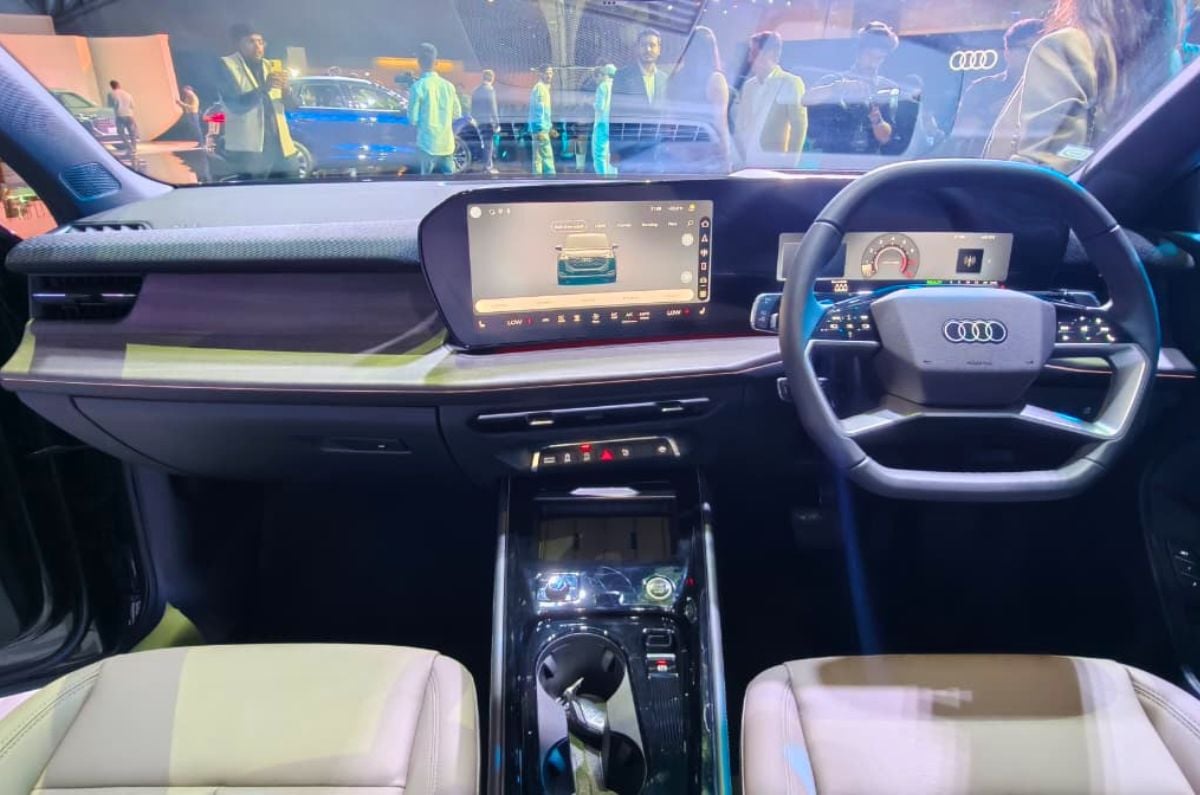
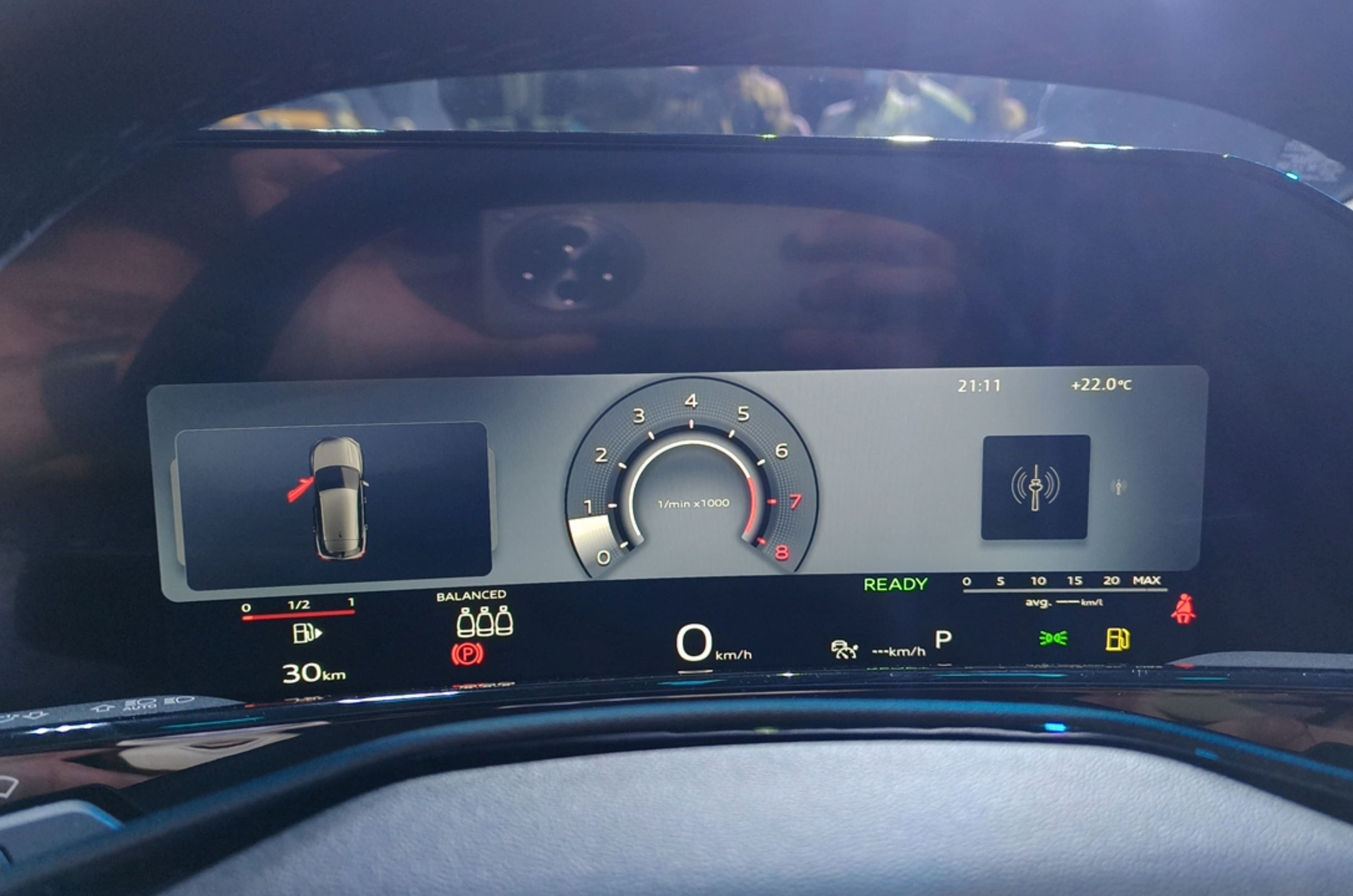
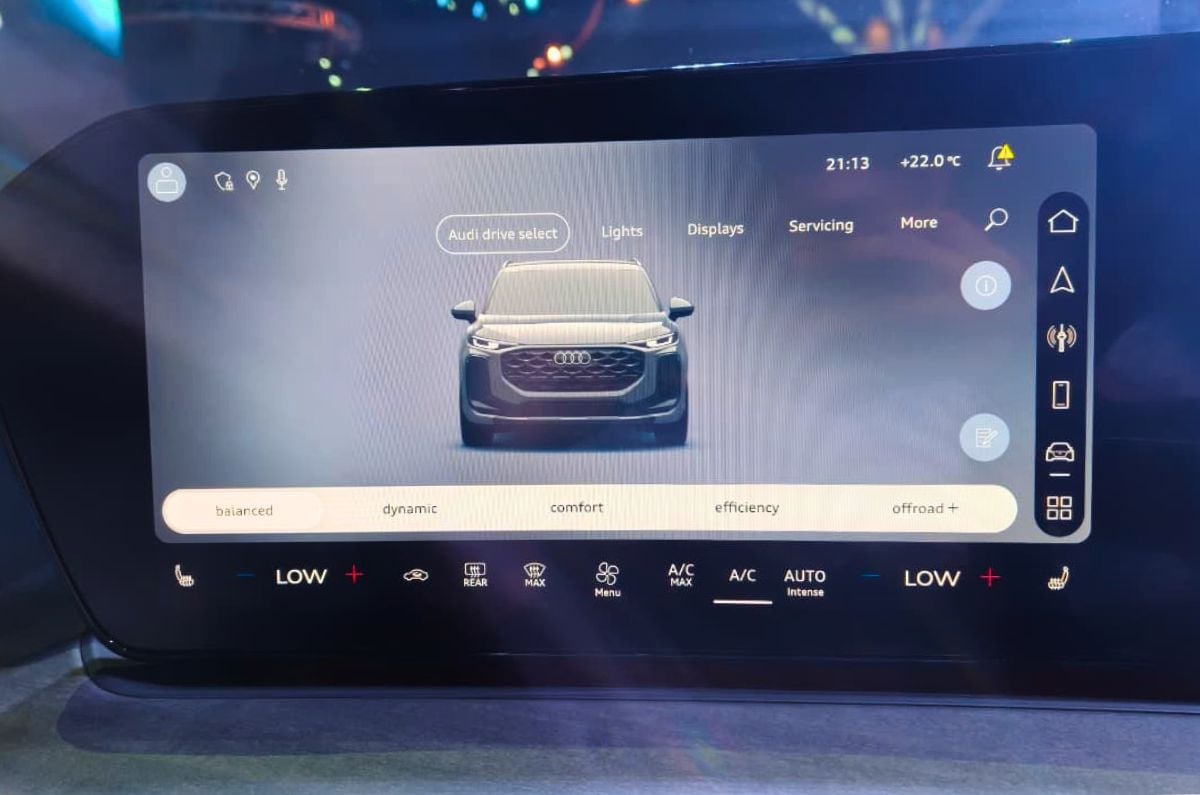
Inside, the Audi Q3 has a minimalistic dashboard and features dual digital screens (a 12.8-inch infotainment touchscreen and an 11.9-inch digital driver’s display) arranged in a curved setup. It also gets a 4-spoke hexagonal steering wheel with touch-enabled controls. Notably, the right-side stalk on the steering wheel works as a drive selector, while the left one can be used to control the headlights and turn indicators.
The drive selector on the steering column has enabled a cleaner centre console, featuring a wireless phone charger, two cupholders, and an electronic parking brake. The centre console extends to a centre armrest for front passengers. The seats get leatherette upholstery, and the front seats are powered and heated. The driver’s seat has a memory function that is also tied to the powered outside rearview mirrors (ORVMs).
On the feature front, it is equipped with a 3-zone climate control, a panoramic sunroof, a 12-speaker Sonos sound system, a coloured head-up display (HUD), and a powered tailgate. Safety-wise, it gets 9 airbags, a rear parking camera (not a 360-degree surround-view system), hill hold and hill climb assists, and an advanced driver assistance systems (ADAS) suite.
2026 Audi Q3 powertrain
Gets a 2.0-litre turbo-petrol engine and an AWD setup
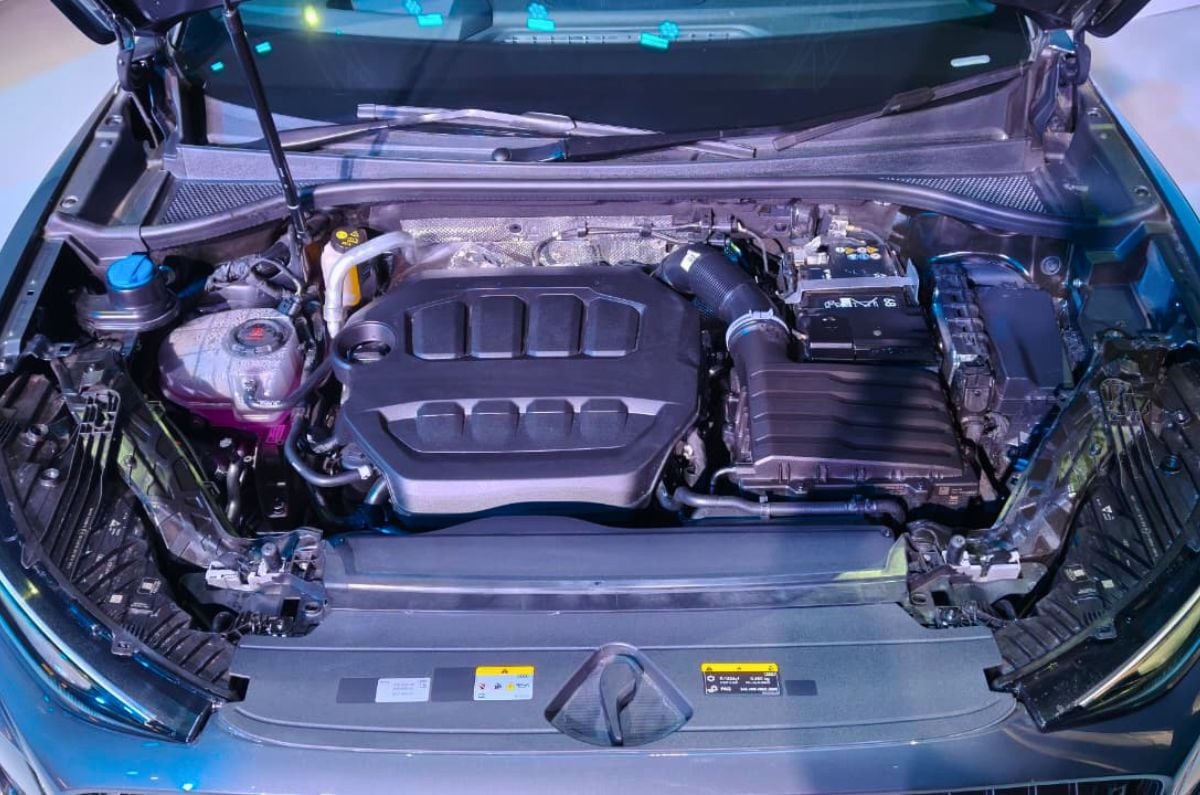
The 2026 Audi Q3 is powered by a 2.0-litre direct-injection turbo-petrol engine that produces 204hp and 320Nm. It is mated to a 7-speed dual-clutch automatic transmission (AT) which sends power to all wheels (AWD). This powertrain enables a claimed 0-100kph sprint of 7.1 seconds and a top speed of 229kph.
The Audi Q3 is the only rival in the segment to offer AWD. Rivals like the BMW X1 and Mercedes-Benz GLA are front-wheel-drive (FWD) only.
Mercedes-Benz’s 140 Years, 140 Places odyssey is a celebration of the carmaker’s origins in 1886. Spanning six continents, covering over 60,000 kilometres, it is as massive in significance as it is in scale. The tour kicked off at the Mercedes-Benz Museum in Stuttgart on the 29th of January, the same day Carl Benz received the patent for his first car 140 years ago! The cars then went to the Daimler house in Bad Cannstatt, they tracked the original route of Bertha Benz’s historic 1888 drive and drove the iconic Spa-Francorchamps racetrack in Belgium in wheel tracks of the W109 ‘Red Pig’ that made such a splash in 1971. The cars then went to the US, visiting the first plant in the US started by William Steinway (of Steinway & Sons, the famous German Piano makers), South America, Australia, Japan, Korea and Japan.
Legacy and history
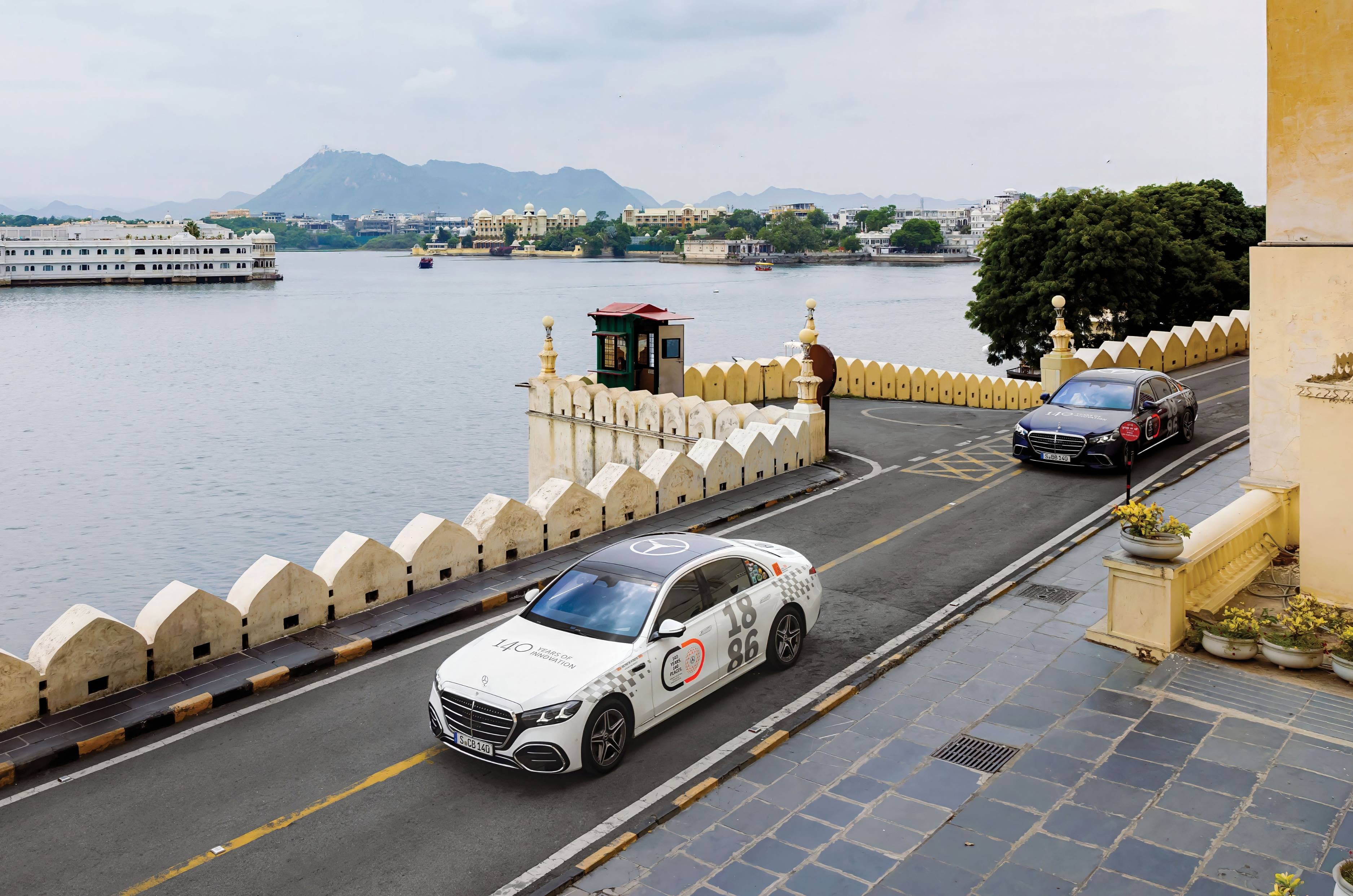
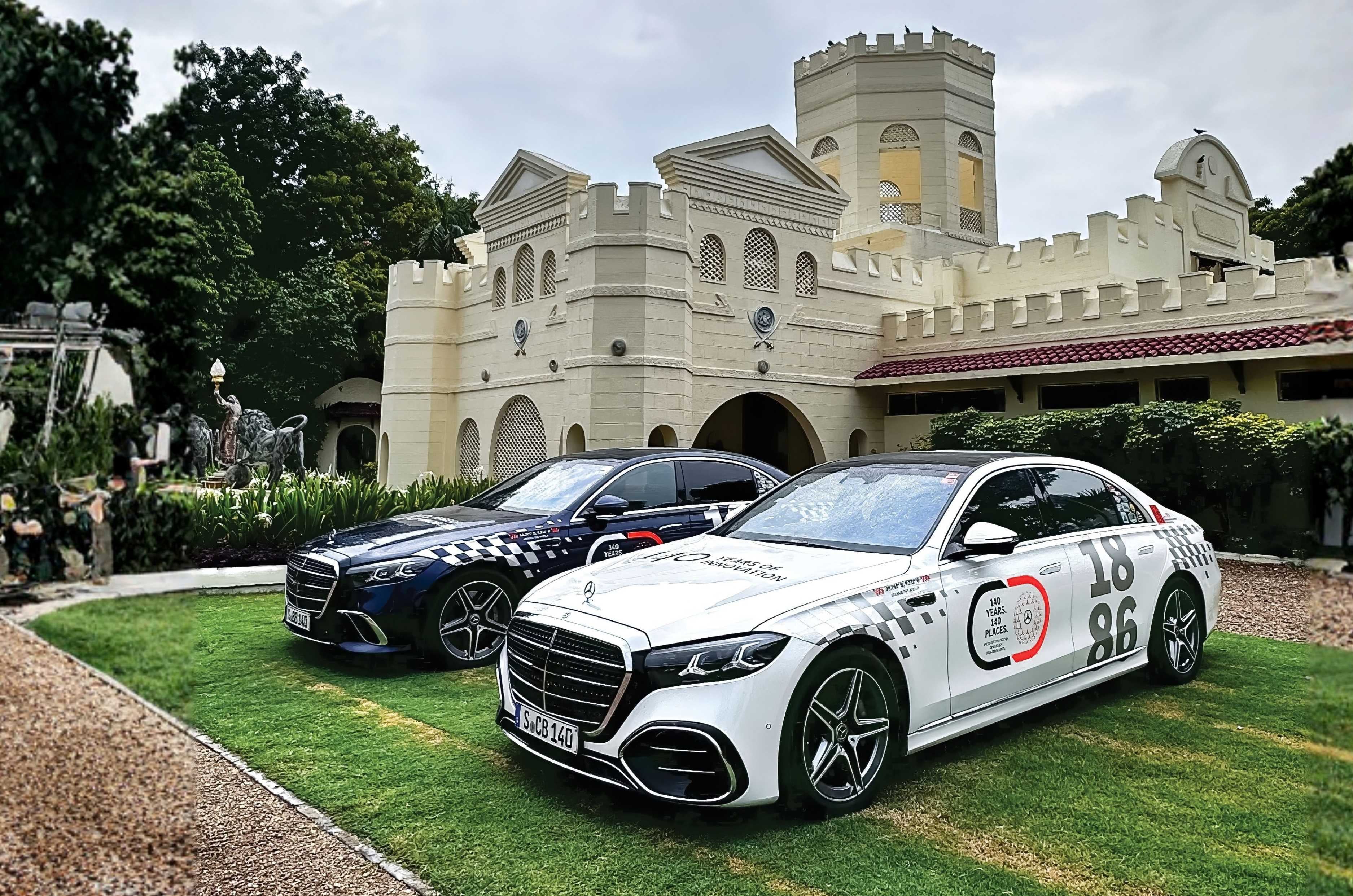
With their royal and regal air, the S-Classes feel right at home in Udaipur.
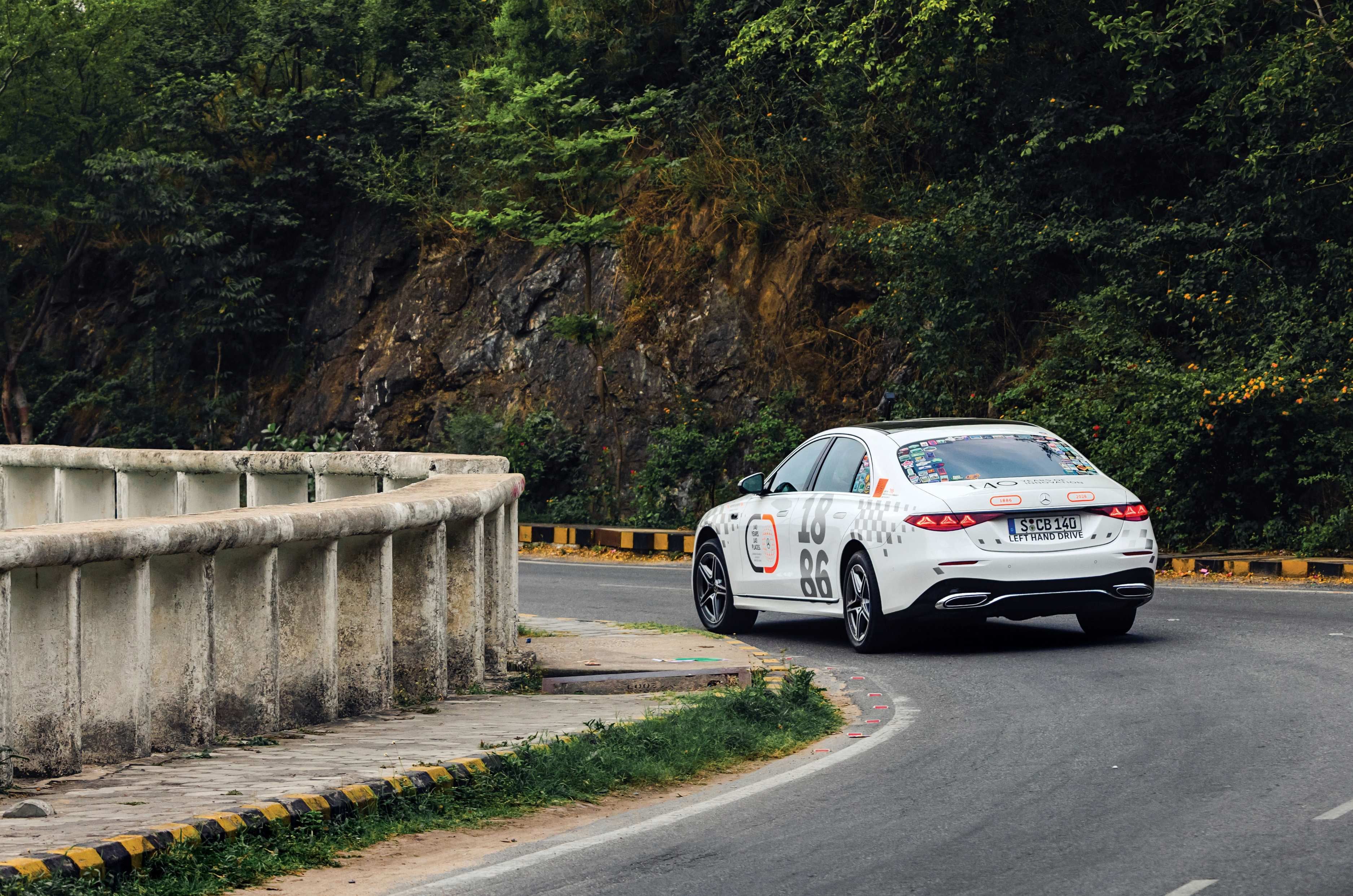
Part of the 140 Years, 140 Places expedition, Udaipur is one of the more stunning locations the Mercedes drive will visit on this India leg, and what’s incredible is that we have been chosen to be a part of it. What a privilege. The lake city of Udaipur also has tremendous historical significance. Home to one of the longest-serving dynasties, one that spans 1,500 years, this leg sees a coming together of the world’s oldest carmaker and one of the oldest dynasties. And while this trans-continental excursion is called 140 Years, 140 Places, it could also easily have been called 140 Years of Automotive Technology. With these S-Class pre-production cars dripping with both mechanical and electronic tech, what we are also celebrating is the journey of the car from a three-wheeler with a single-cylinder engine to this technological marvel. The company that invented the motorcar is still widely regarded as the one that makes ‘the best car in the world’.
Luxe Supreme
Everything is perfectly still. Not a gauge in the car is moving, and there’s no real sensation of speed. I must have dozed off. Blame it on the incredibly comfortable back seats and the sensory isolation. This car just shuts you off from the rest of the world. Then I discover we are cruising at 100kph, and not just 30 or 40. Up ahead is the lake city of Udaipur. Ahh.
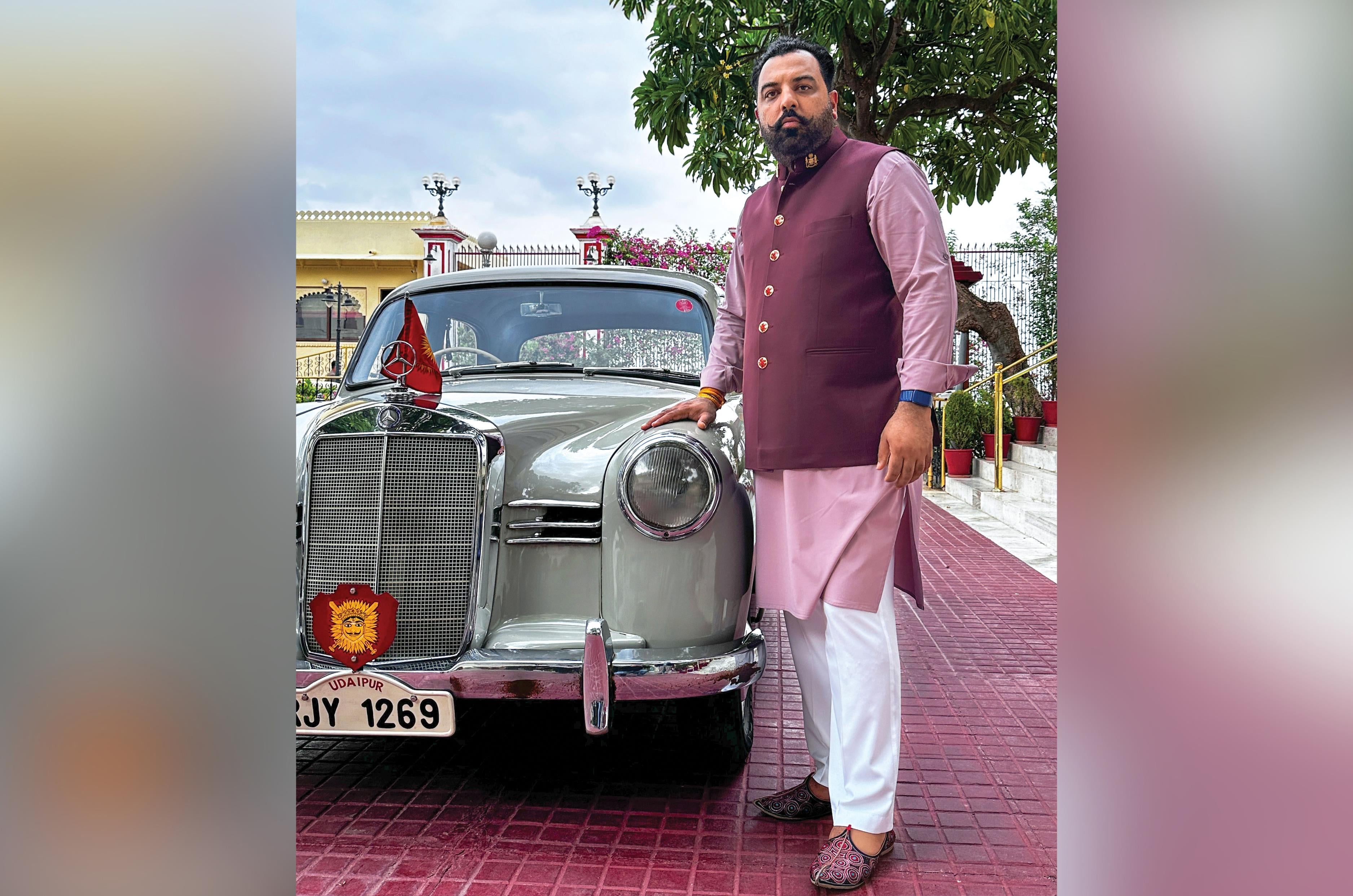
The Maharana of Udaipur with a car that has been in his family for three generations.
We start our journey on this leg from a very significant place, the palace situated on the lakeside at Udaipur. And not only does Lakhsyaraj, the 77th Custodian of the House of Mewar (formally Shriji Huzoor Dr Lakshyaraj Singh of Udaipur), play the perfect host, but he also parks an olive-green 180D in the foyer, a car that has been used by three generations of his family. The symbolism is rich; two legacies converging in a place that embodies the spirit of grandeur and continuity.
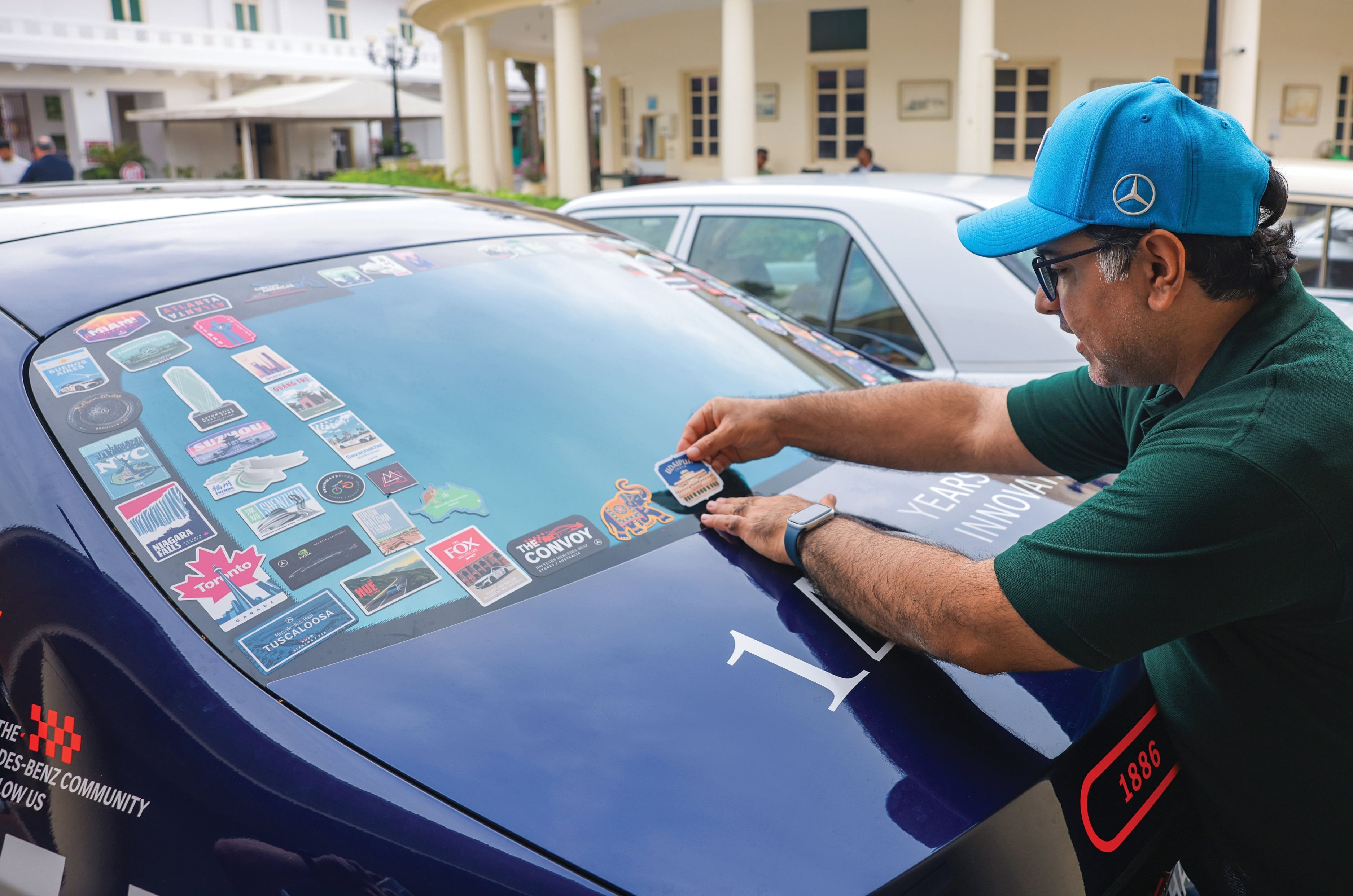
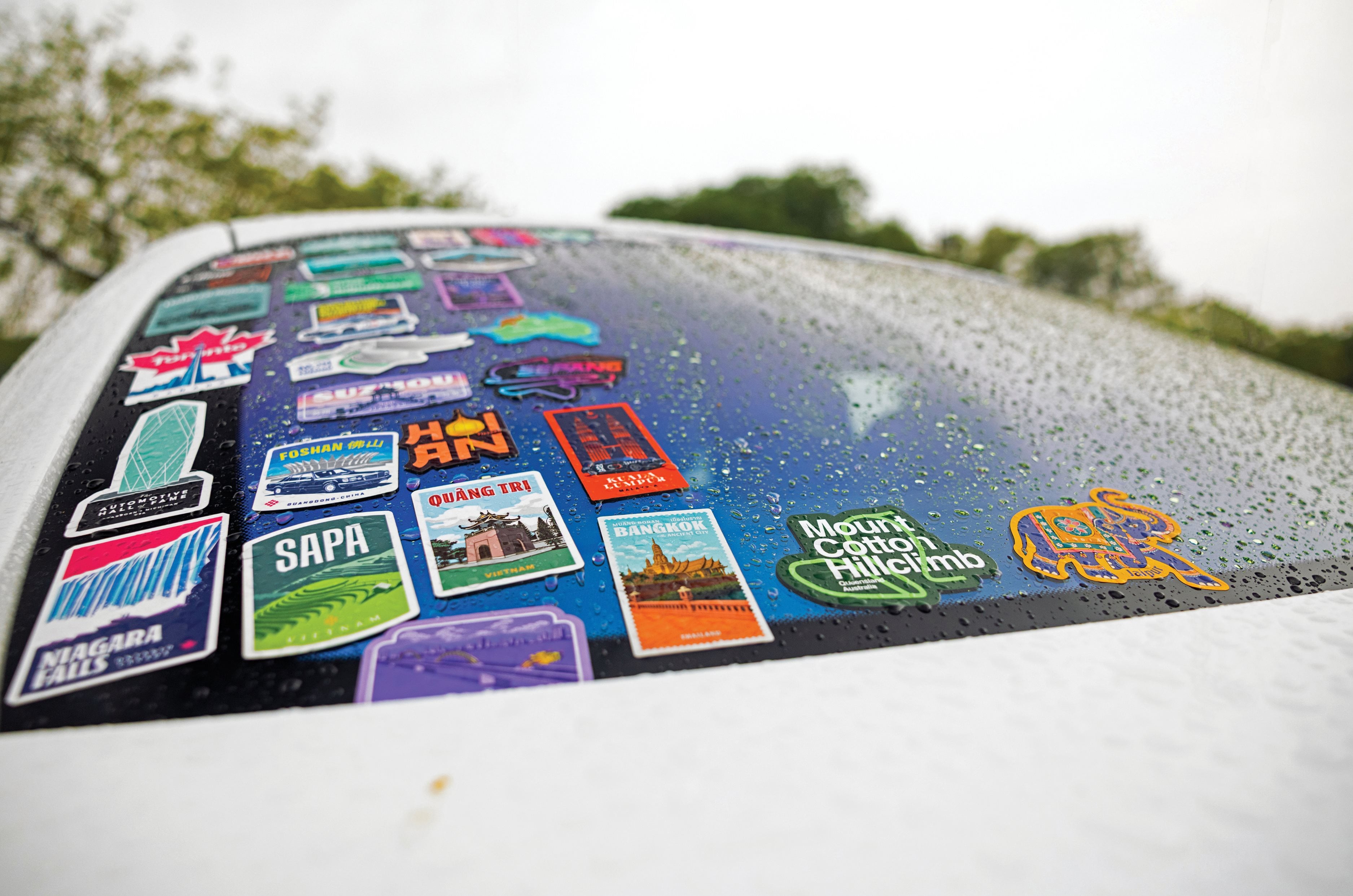
Perseus places the sticker on ‘Bertha’ in Udaipur.
Since Udaipur is one of the 140 iconic destinations on the drive, Mercedes asks him to place an Udaipur sticker on the rear of the car; fitting. These cars, all three (the third is on another leg elsewhere in India), will eventually be housed in the Mercedes museum in Stuttgart, and what’s cool is that you can trace their journey via the stickers. Lakshyaraj then takes one of the cars for a brief drive. He wants to see just how much better this new version, with all its 2,700 new bits, is over his pre-facelifted car. And yes, he loves driving. I’d bumped into him earlier in the day at the airport, where his S-Class had come to pick him up, flags flying and uniformed driver and assistant in tow. But instead of climbing into the rear, he’d gotten straight behind the wheel. Tells you a lot.
Still at the top
Late prototypes of the New S-Class made the journey.
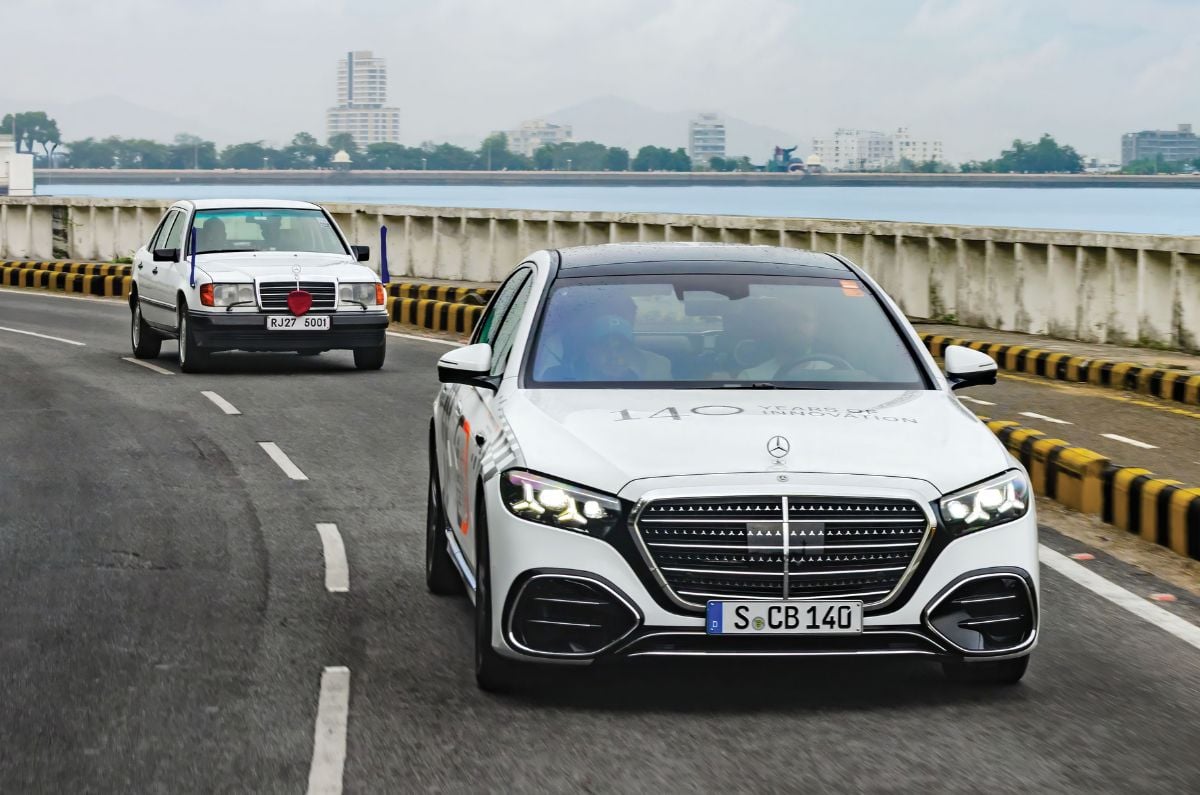
Later in the day, I get another demonstration of why the S-Class is so special. We decide to drive around the lake for the cameras, the orange glow of the setting sun adding to the drama of this once James Bond film set. Sitting in the back feels almost magical, as the S-Class slips forward effortlessly, the sun glistening off the lake. It skips over cratered roads, glides silently through noisy bazaars and intersections and then, as the road around the lake opens out, I barely hear it even though Mercedes’ test driver is pulling the torque-y straight-six hard. This car is named Bertha, after Carl Benz’s wife, the one who undertook the world’s first long-distance drive; quite a story that. And the other, the white one, is Carl; BB and CB, both on Stuttgart number plates.
Hello Grandpa
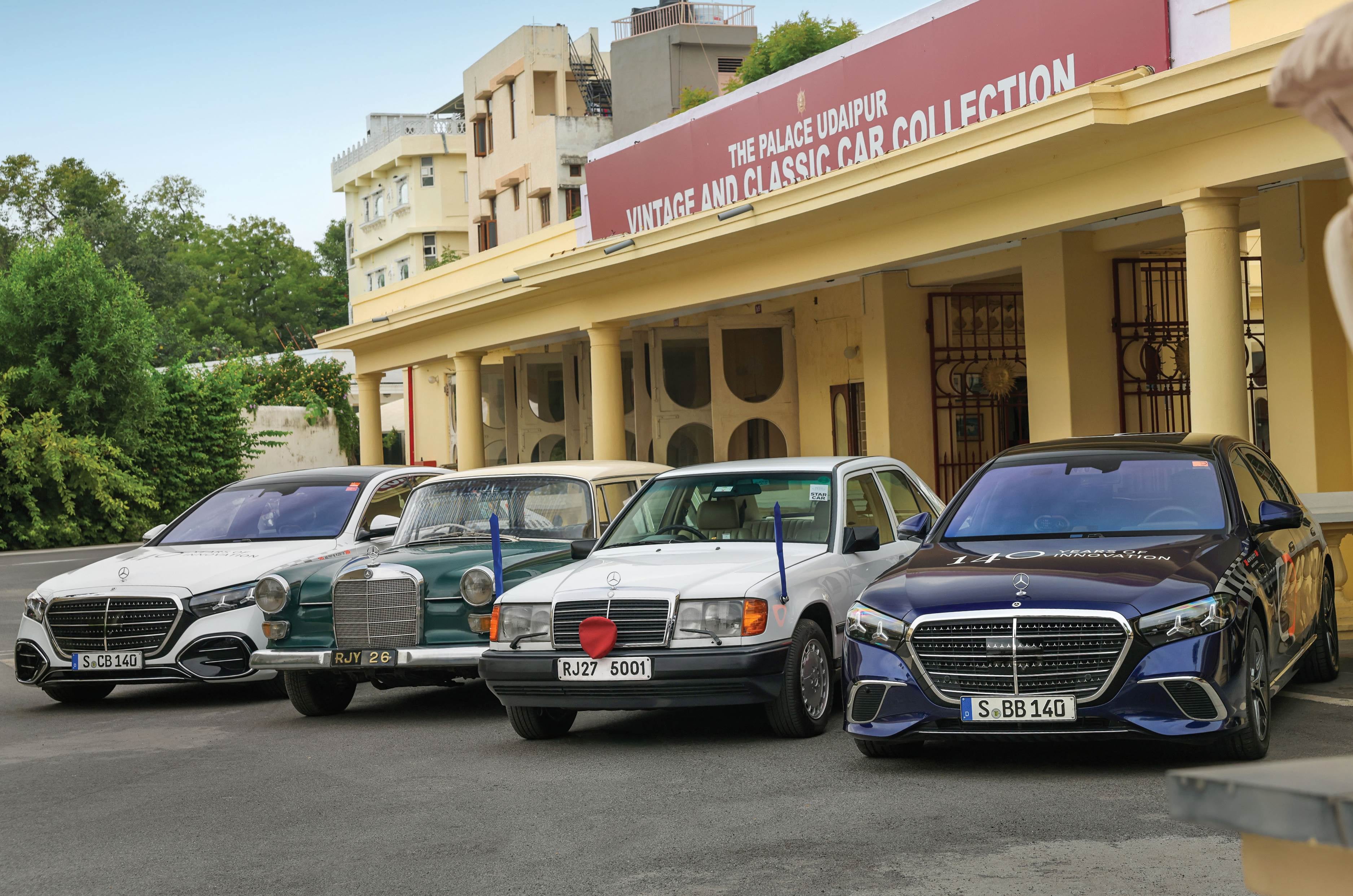
The S-Classes, along with the fin-tail and the 300D.
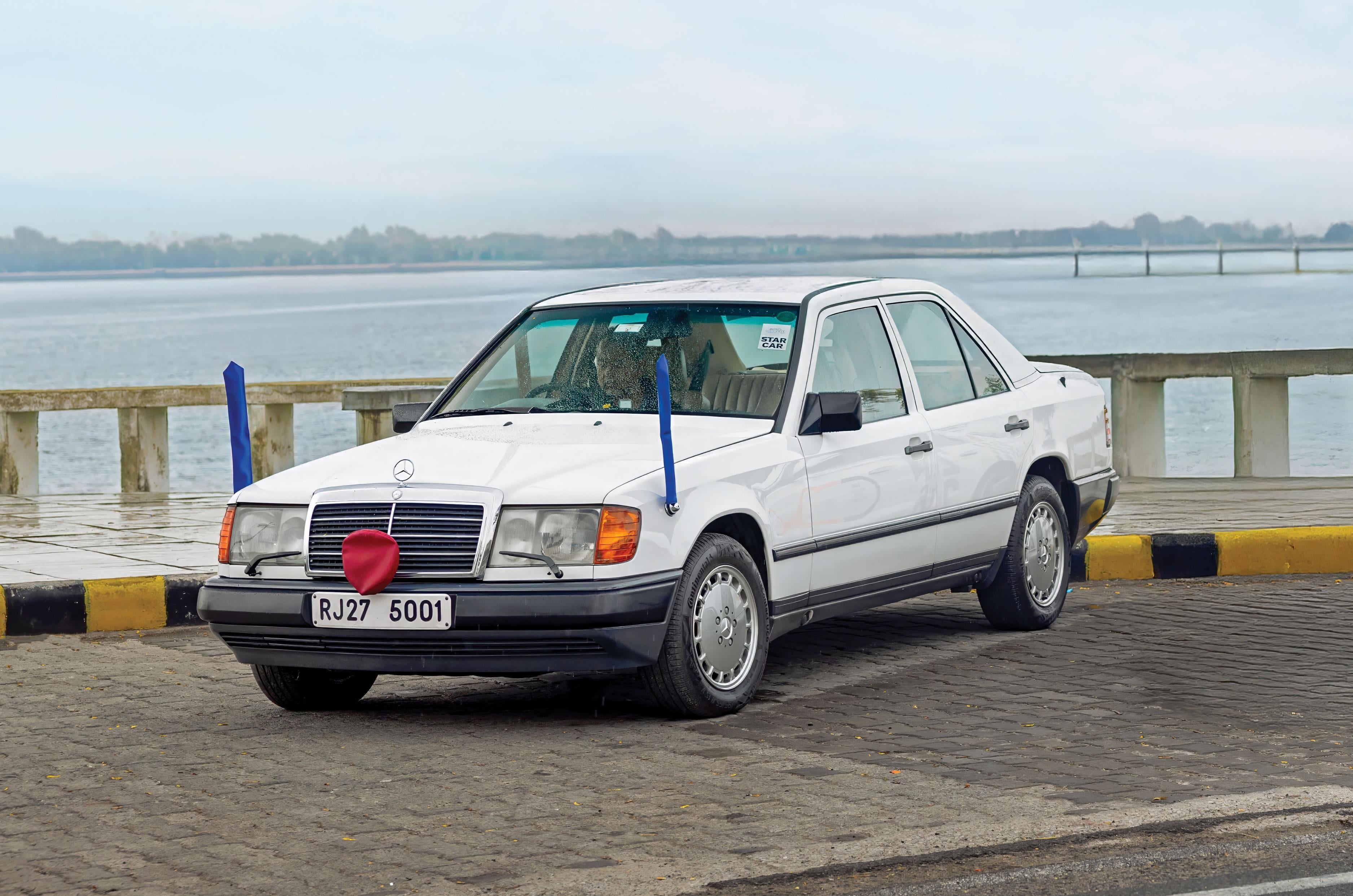
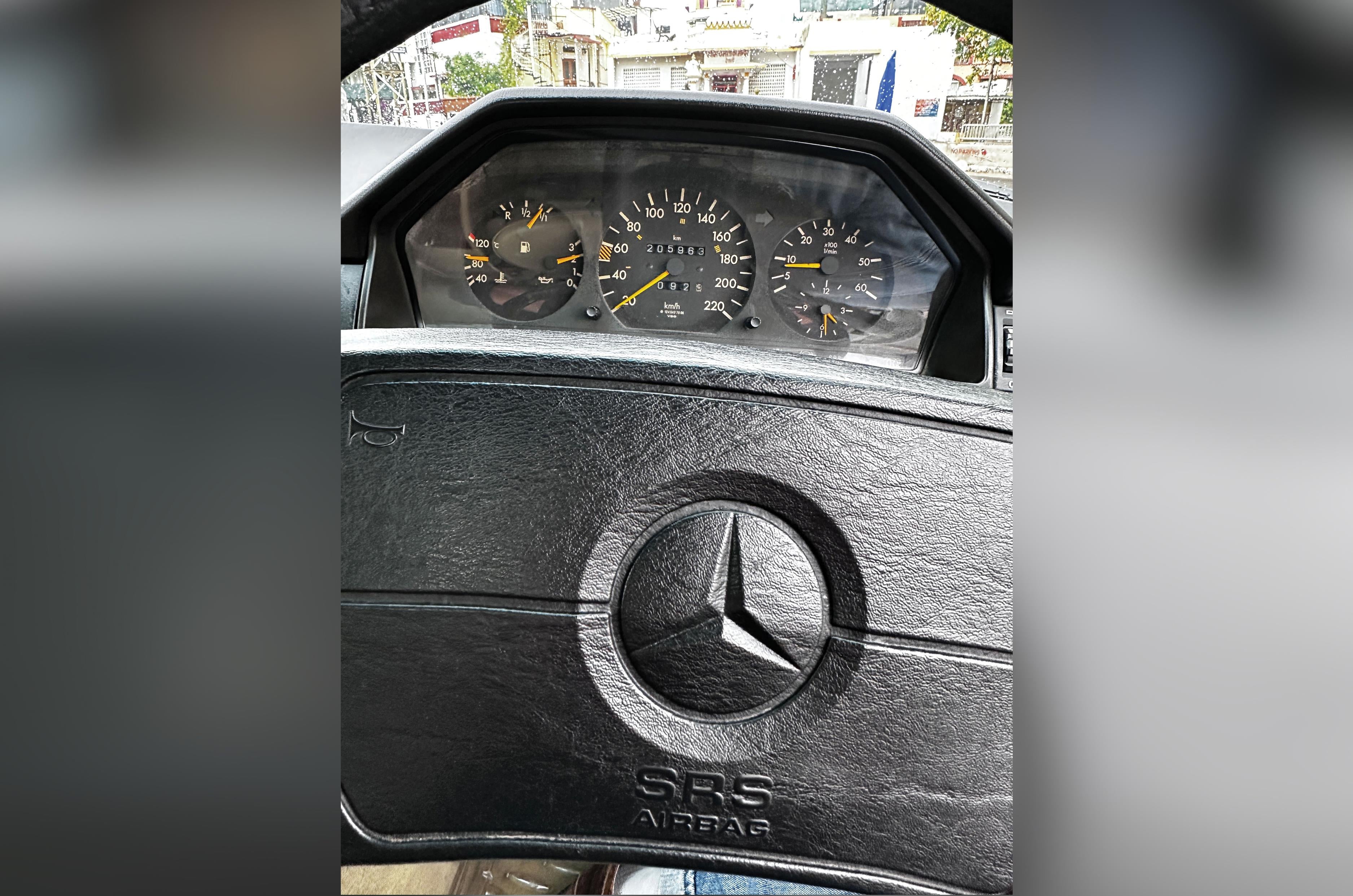
The next day, we set off to see the Udaipur Royal Garage, where we are met by other Mercedes cars. There’s a fin-tail that was used to pick up and drop off guests of the Royal family from neighbouring ‘states’ and a very special W124 300D. The latter, an import rather than a locally assembled W124, stands out from Indian-assembled cars with its black bumpers, headlamp wipers and amber indicators. This six-cylinder diesel with more than 2,00,000km on the clock was used by Shri Arvind Singh Mewar, the earlier Maharana, to cover long distances like Ahmedabad or Jodhpur. Recently restored, it was presented at the Mercedes-Benz Classic Car Rally in Mumbai. The 300D is in such fine nick, I can’t resist a quick spin around another of Udaipur’s stunning lakes, Fateh Sagar.
Why the 300D is such a legend
The W124 300D is an import.
On the outside, the 300D looks sort of underwhelming. Starting up the straight-six diesel is relatively straightforward, although I have to wait for the glow plug to heat up (remember those?). While the roughly 110hp engine doesn’t feel responsive, it feels smooth and refined for a diesel, especially after 2,500rpm. And though it is slow by today’s standards, it doesn’t feel like you’re dragging anchor either. The chunky 300D also feels as tough as a Godrej safe.
It has 2,00,000km on the odo, but hardly feels like it.
Then I catch a glimpse of the odometer; it reads in excess of 2,00,000 kilometres! Surely my eyes are playing tricks on me. Yes, this car has been recently refurbished, and the suspension has been tightened up, but this thing feels like it has just rolled out of the showroom only recently. It tracks straight, the steering is well weighted and, when I plonk my foot down, it even generates a reasonable amount of torque. This ‘OM603’ straight-six uses indirect injection and a pre-chamber, and has a simple two-valve-per-cylinder setup. Legend has it, it can do a million miles with only basic care. And what of turbo lag, you ask? It doesn’t have one.
Performance tech
The next morning, I get straight behind the wheel of CB or Carl Benz. I’m particularly excited because Carl has a V8 under the hood. What makes this V8 different is that it has some unique tech. This new S-Class is fitted with the ‘M177 Evo’ V8 engine that uses a flat-plane crankshaft! Made popular by Ferrari, a flat-plane crank is used on sportscars to help bunch up the firing order of the cylinders, so you get more of a kick from overlapping strokes. These engines, however, are not as smooth. So why has Mercedes used it in the S-Class, an out-and-out luxury car? Simple: it delivers better efficiency and lower emissions, as the crankshaft is lighter and there’s less reciprocating mass. And what of the vibrations? Mercedes says it has thrown tech at the problem.
V8-equipped S-Class feels effortlessly quick.
Initially, the going is slow as we exit the city. But once we get onto the wide highway, a small tap on the throttle releases a swell of torque just off 2,000rpm. And with 537hp propelling the limousine forward, it just shrinks the long straights on the highway. What’s cool is that the engine never feels brutish or AMG-like; the V8 soundtrack and rumble are superbly muted. The tech works. The new engine, in fact, is so well behaved that I have to check if it is indeed the one with the flat plane crank. At the next stop, I turn around and ask Mario Schneider, head of development for all Mercedes-Benz sedans, who just happens to be in the rear seat.
Also along for the drive is Perseus Bandrawalla, Autocar India’s curator of classic and modern classic events. Five minutes behind the wheel and he is waxing lyrical about the Mercedes V8 engines of days gone past – the M100, the M119 that powered the SL and others. It brings into perspective just how many great V8s Mercedes has had over the years, the 6.3 AMG V8, of course, included.
Cruise control
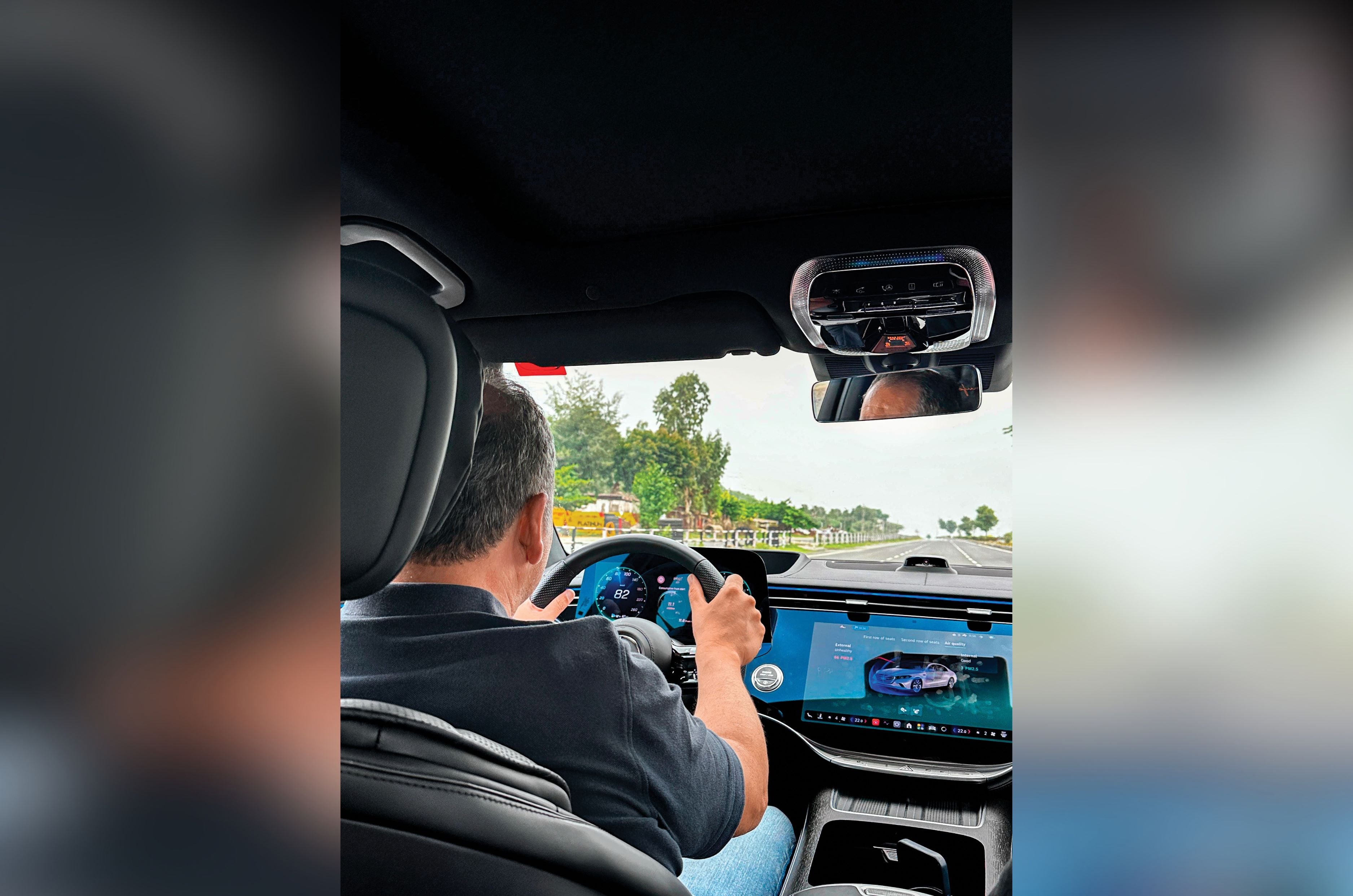
The three screens and updated cabin created a futuristic setup in a traditional environment.
Further up, we get to a ghat section. Not only does the ride on this updated air suspension and adaptive dampers feel a bit more supple, it also feels at home on the winding road, the rear-wheel steering helps it into corners neatly. Even cooler, despite all the tech, it retains a natural fluidity and a sense of mechanical harmony, which make long drives feel just effortless. Are city-bound S-Class owners missing what’s best about this car? Absolutely! Talking about tech, this car also gets Level 3 autonomous driving (in places where it’s allowed), where the driver can be hands off, and even eyes off, with Mercedes Drive Pilot taking responsibility for safety. It is only one of two cars to get this globally.
As we get into traffic, what I notice is that the updated cabin, with its three screens and ambient lighting, creates an environment that is both futuristic and traditional. The seats, with massage and cooling functions, are thrones in their own right. And it’s not just the size, specifications and features it has; it’s how well everything is executed, from the solid build of the cabin to the new phone-like remote controls in the rear.
Collector’s edition
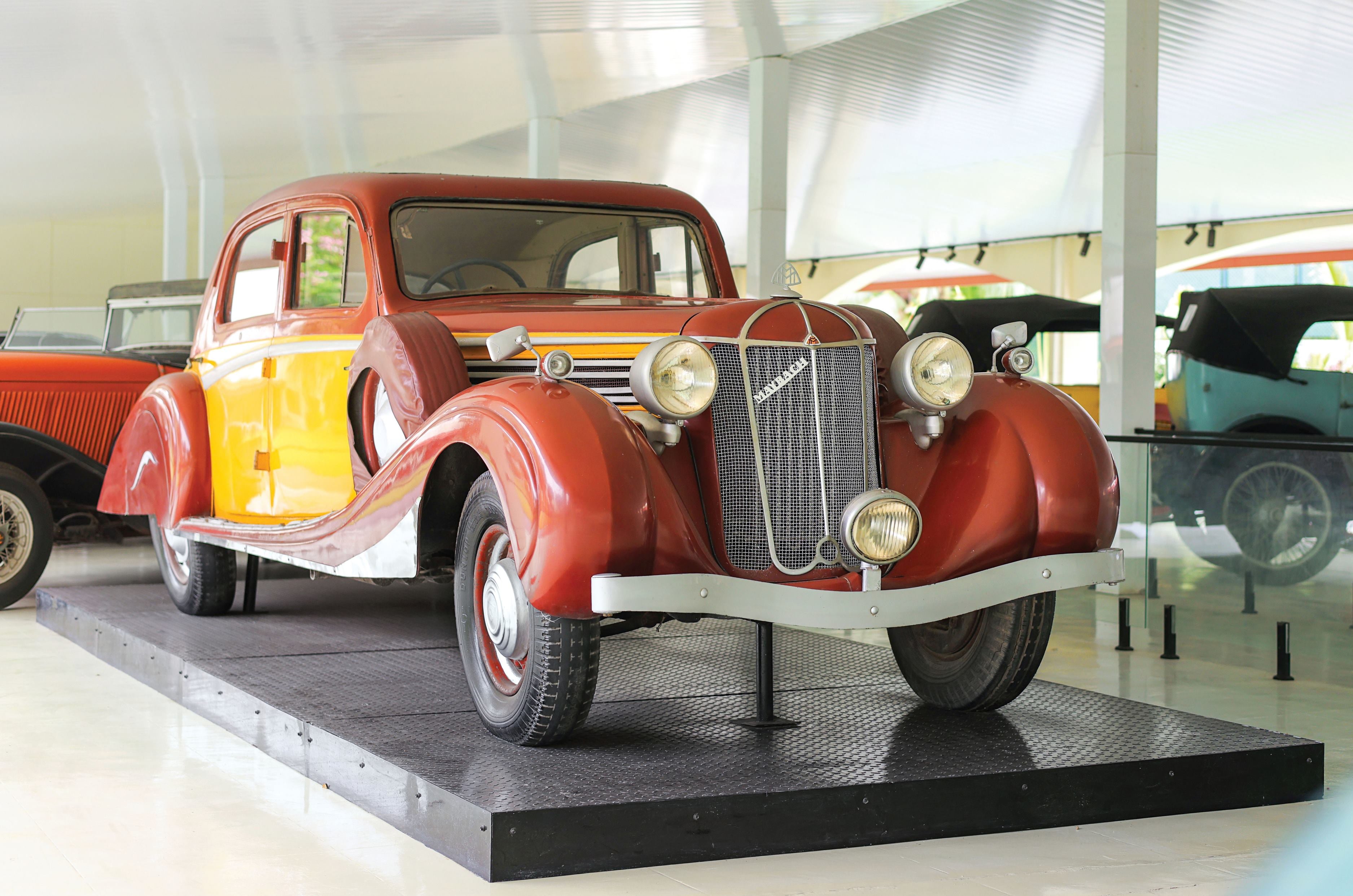
Streamlined Maybach SW38 four door could do 160kph
As we get to Ahmedabad, we turn into another historical location, Dastan Auto World – collector extraordinaire Pranlal Bhogilal’s collection, where the modern S-Classes met some more of their ancestors. A Maybach SW38, ordered by Maharaja Umaid Singh of Kota, draws admiring stares from the German members of the Mercedes crew, especially its aerodynamic profile. Capable of nearly 160kph, it was one of the fastest four-doors of its time. Equally captivating are Mercedes’ post-war comeback cars – the 300S ‘Adenauers’. Named after Germany’s first Chancellor, who famously rode in one with his hat on, this limousine is what eventually evolved into the S-Class.
Heritage and high tech
You can trace the journey via the stickers on the cars.
The 140 Years, 140 Places drive captured the duality of Mercedes perfectly; the brand embodies both heritage and innovation in equal measure, both streams converging seamlessly. As the convoy continues its odyssey, what’s clear is that this is a celebration not only of Mercedes’ past, but also the brand’s ability to connect eras, cultures and people through the universal language of the automobile.
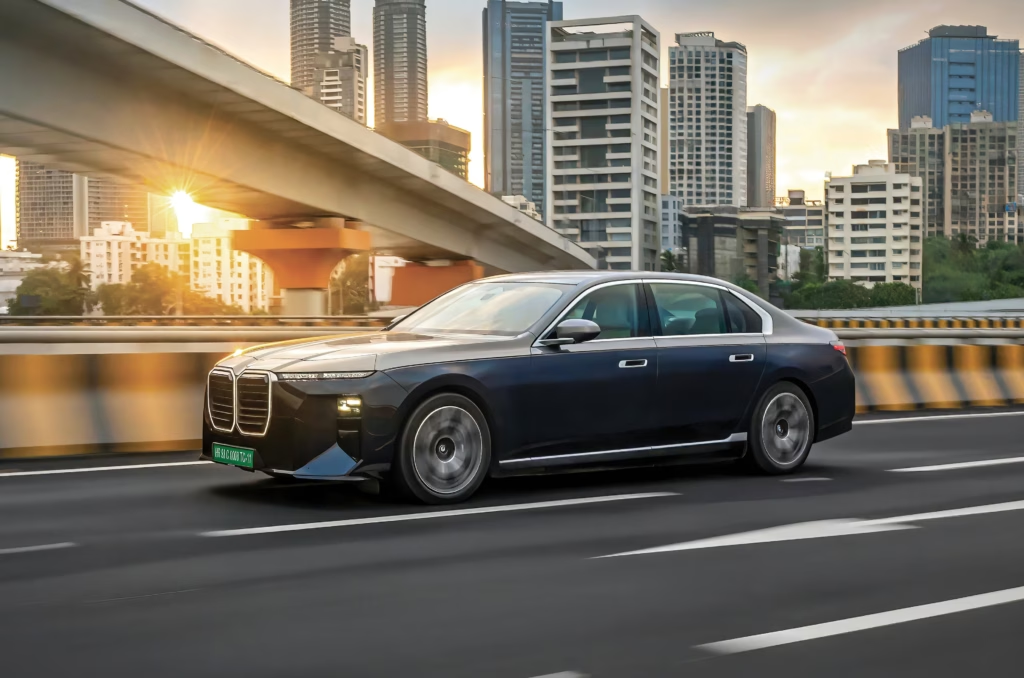
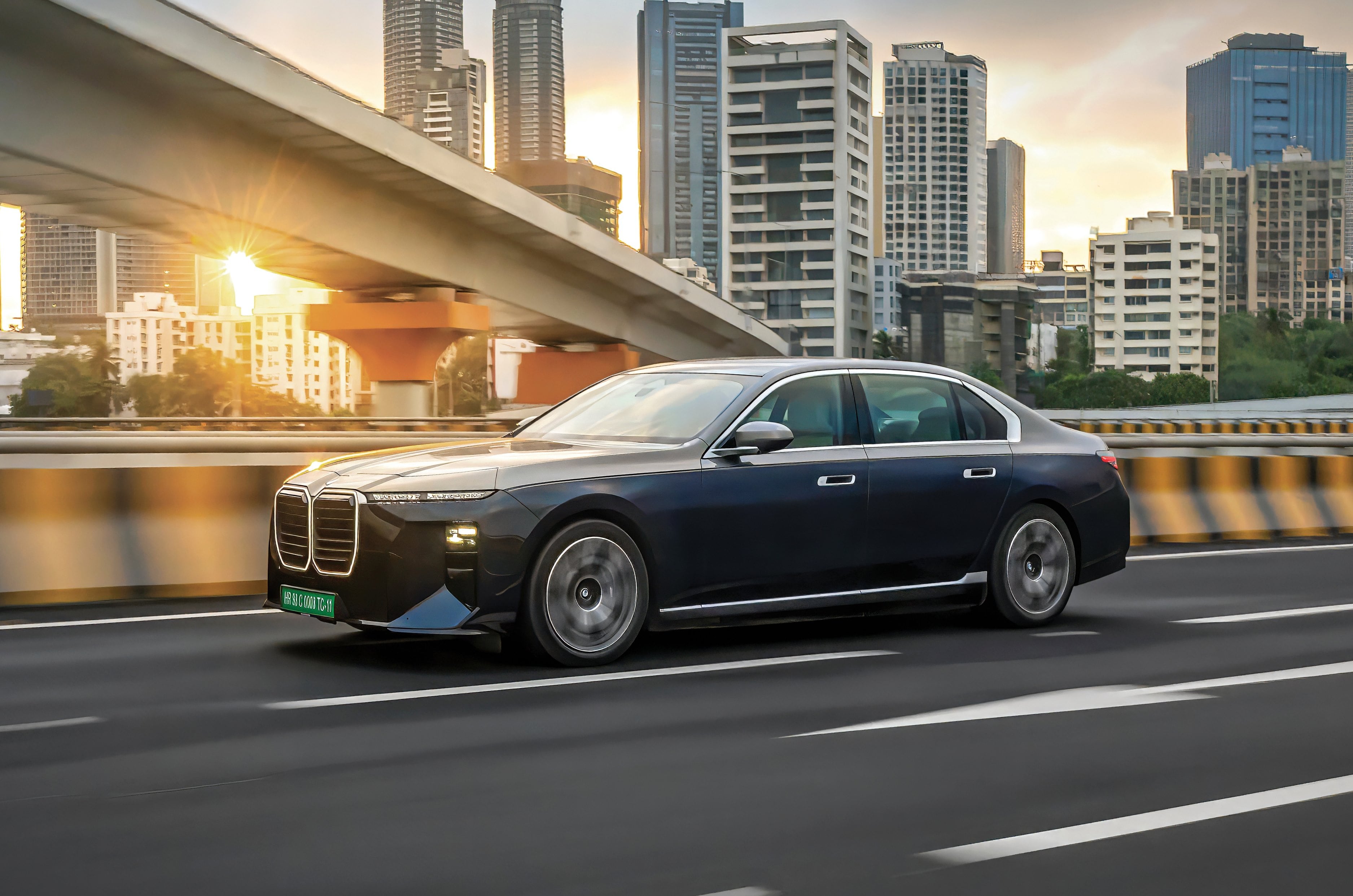
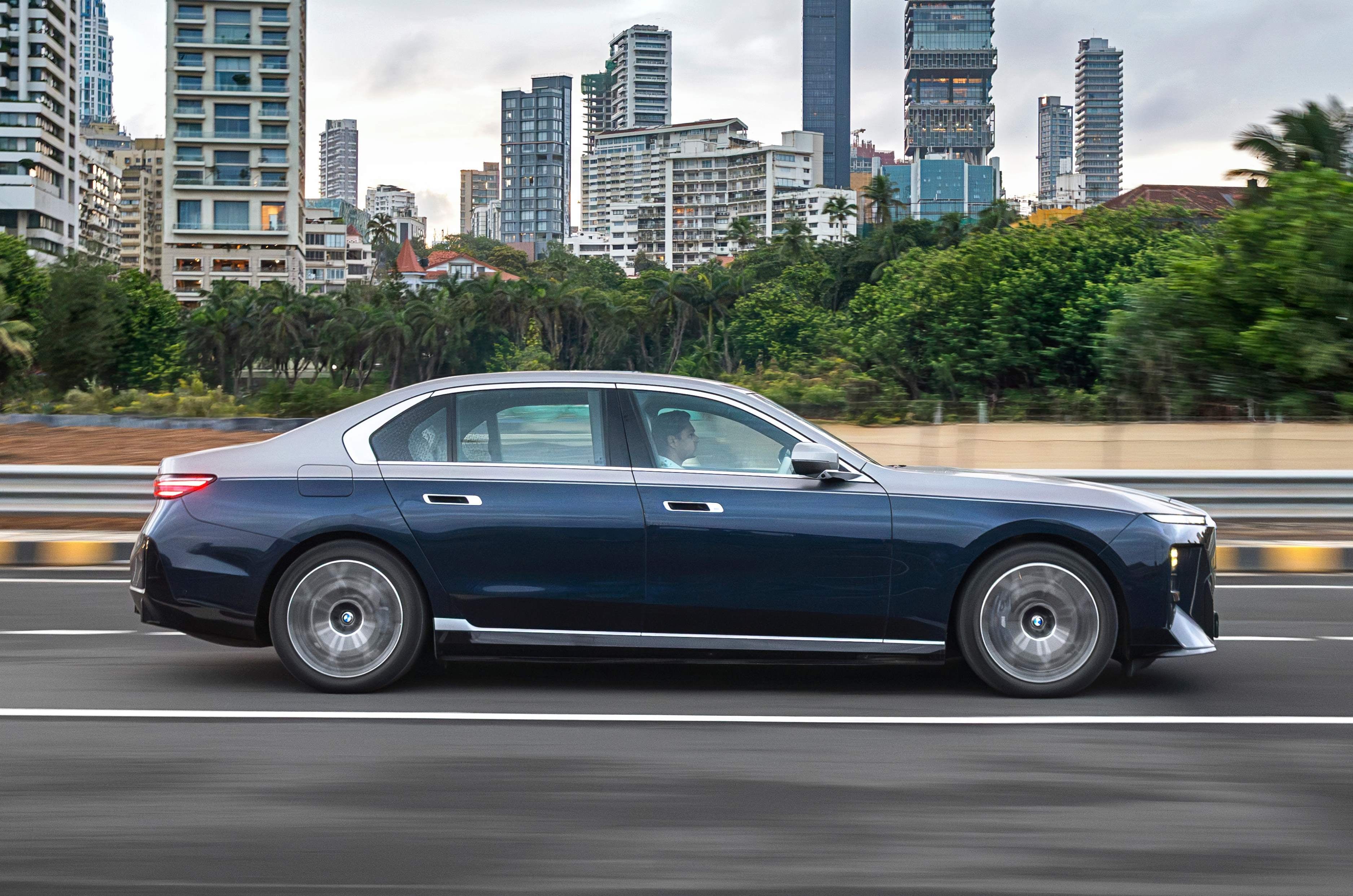
The BMW i7 has been embraced wholeheartedly by India’s ultra-high-net-worth buyers. Since its launch in 2023, it has dominated the high-end luxury sedan space, and interestingly, has consistently outsold its own petrol sibling. In fact, around 60 percent of 7 Series buyers have opted for the EV. With the 2026 i7 now being locally assembled in India and the i7 50 xDrive priced at Rs 1.95 crore, exactly at par with the petrol 740, BMW expects the scales to tilt even further in favour of the electric version.
BMW has also introduced the significantly more powerful i7 M70 xDrive. However, as a full import priced at Rs 2.65 crore, it commands a substantial Rs 70 lakh premium, which is likely to limit its appeal. For most buyers then, the locally assembled i7 50 xDrive is expected to remain the sweet spot of the range.
BMW i7 50 xDrive Exterior Design and Engineering – 8/10
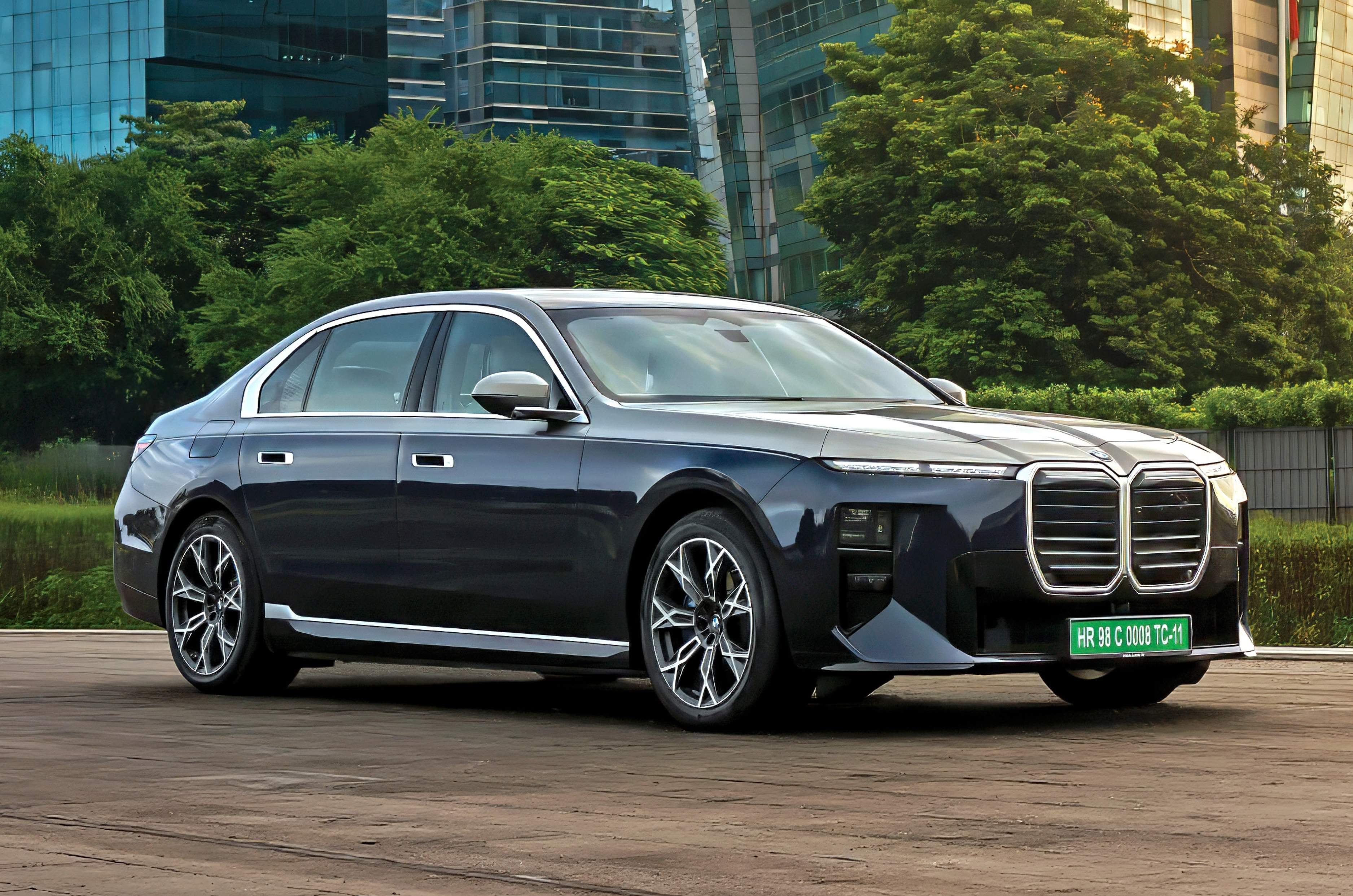
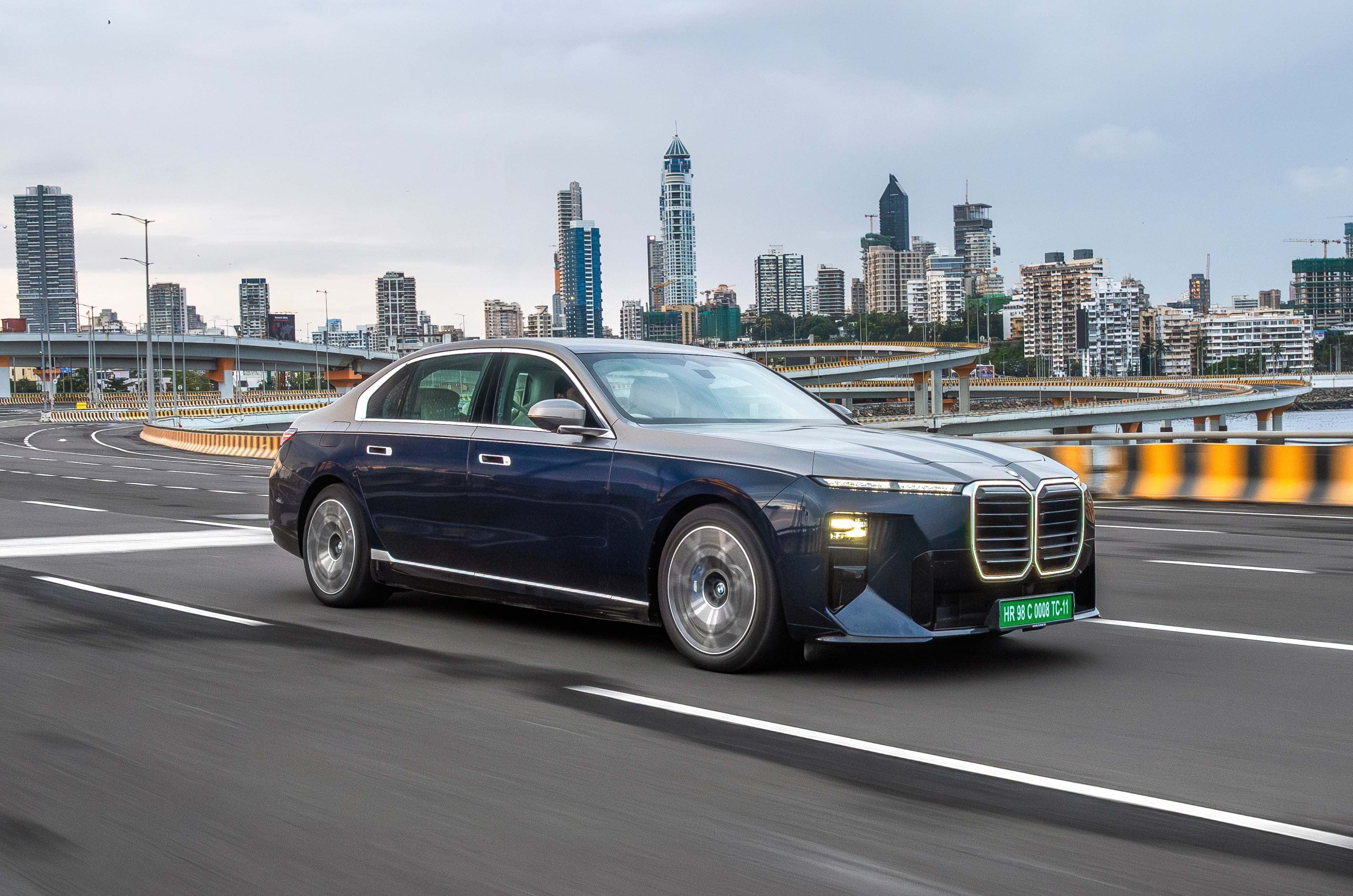
The cleaned-up styling looks significantly more palatable than its predecessor.
BMW has made substantial changes to the i7’s styling. The DRLs are now longer and slimmer, and feature a crystalline effect that looks absolutely stunning up close. The oversized kidney grille has also been redesigned and, like before, remains illuminated. The air dam adopts a more rectangular design, the headlamps are vertically oriented, and the excessive black treatment has been done away with completely.
The tyres appear undersized but owners are unlikely to complain given the ride comfort benefits that come with the higher-profile tyres.
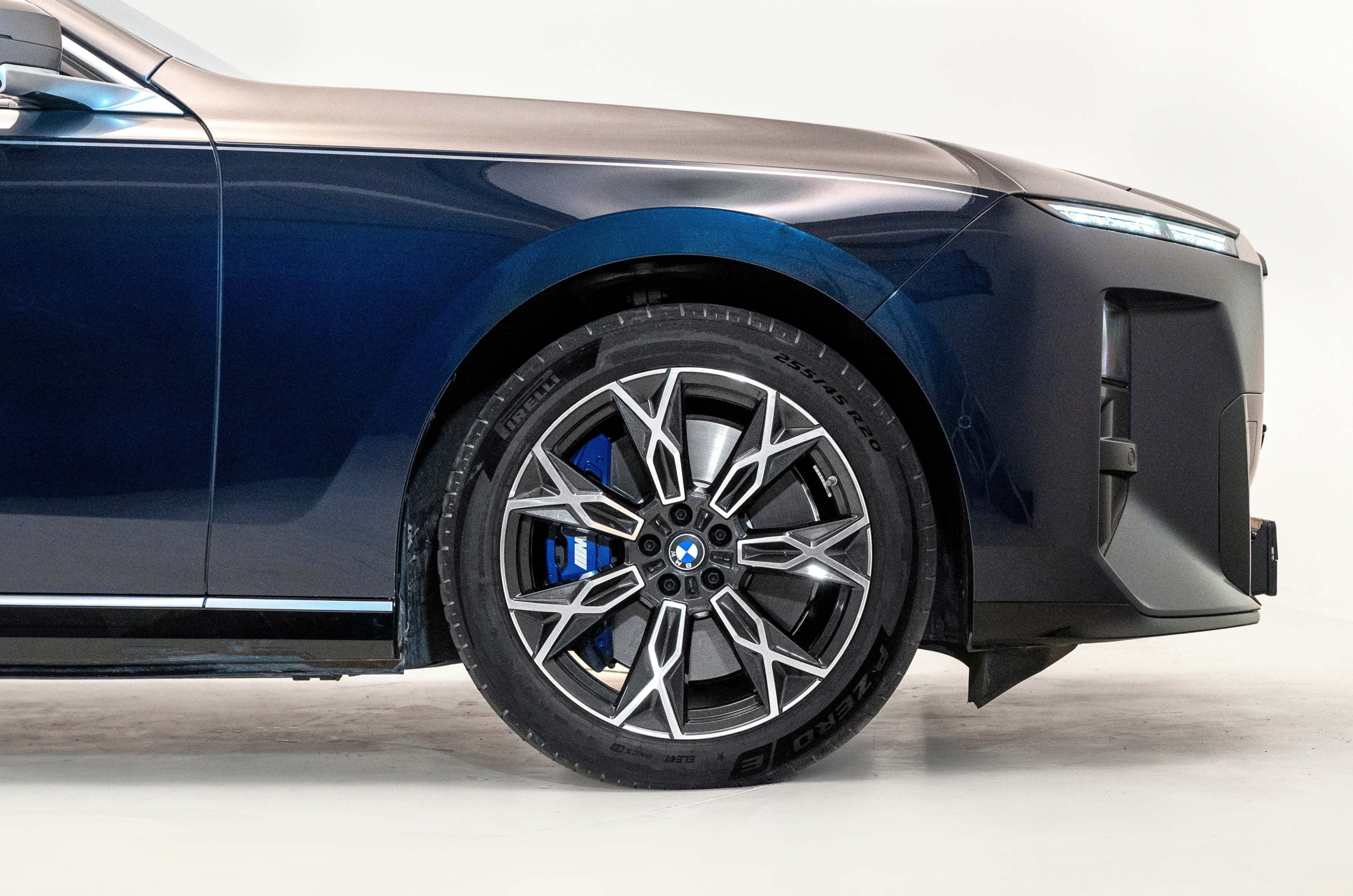
New 20-inch alloy wheels replace the outgoing version’s 21-inch units. While some might argue they appear slightly undersized, owners are unlikely to complain given the ride comfort benefits that come with the higher-profile tyres.
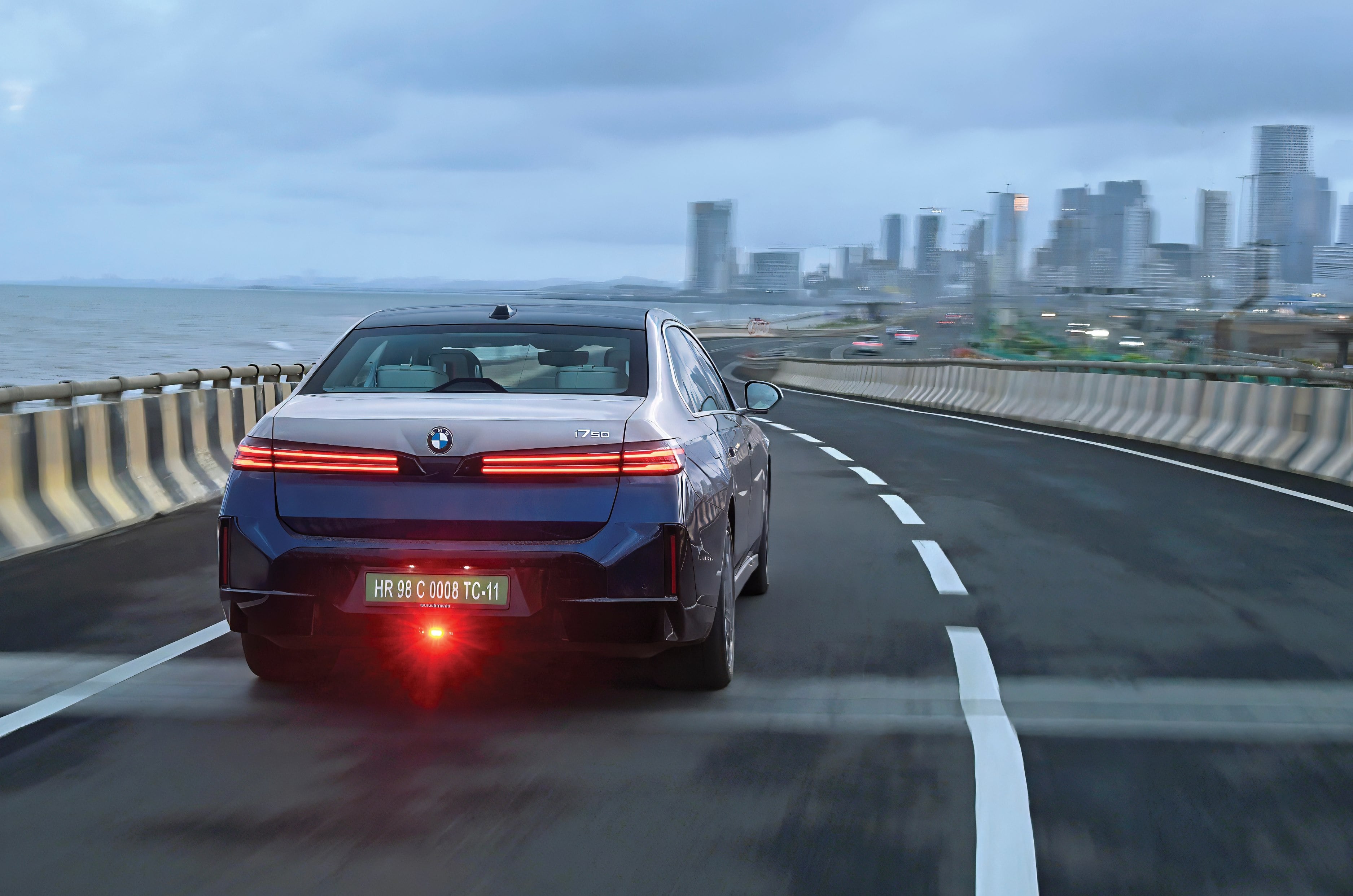
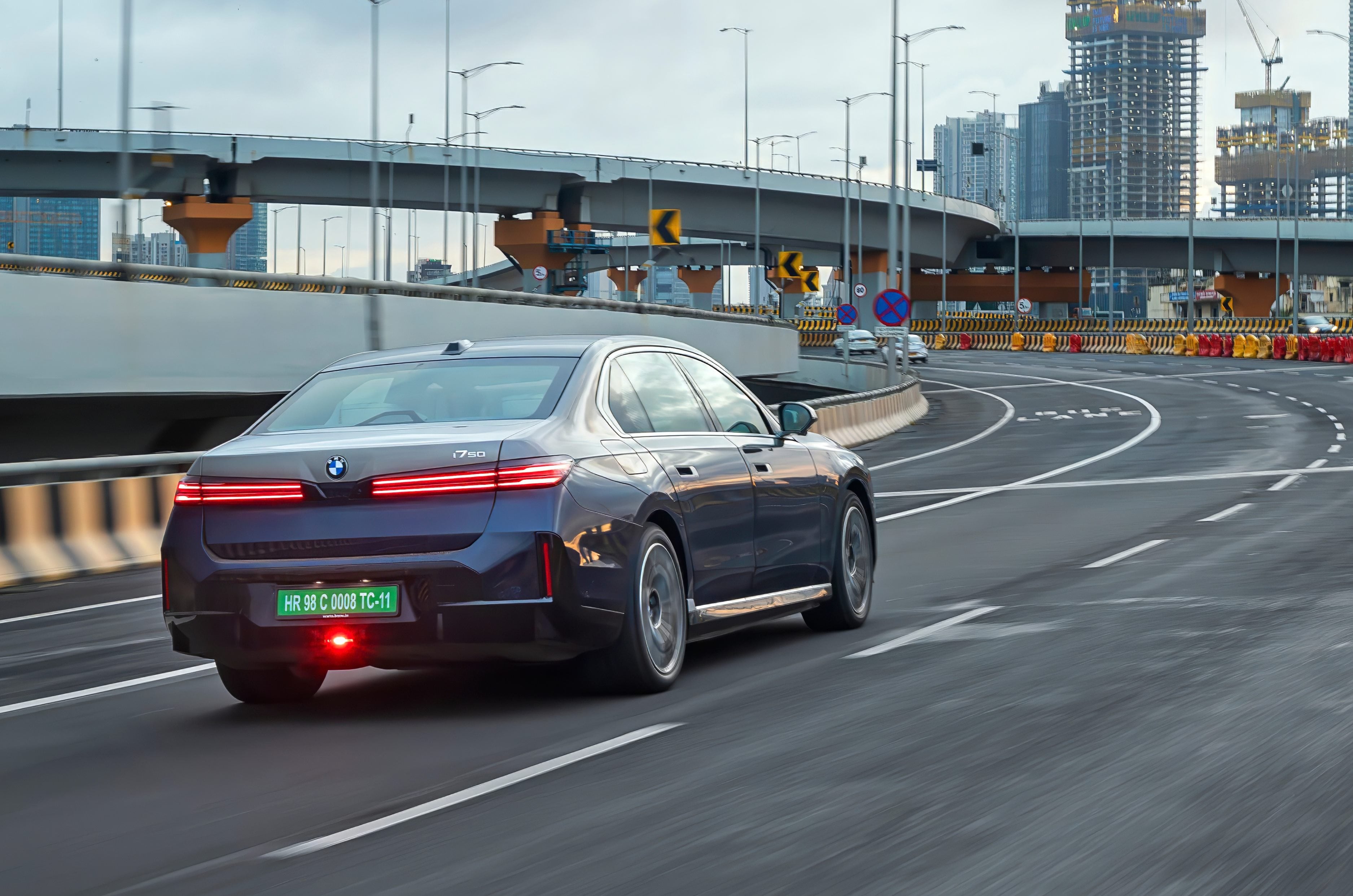
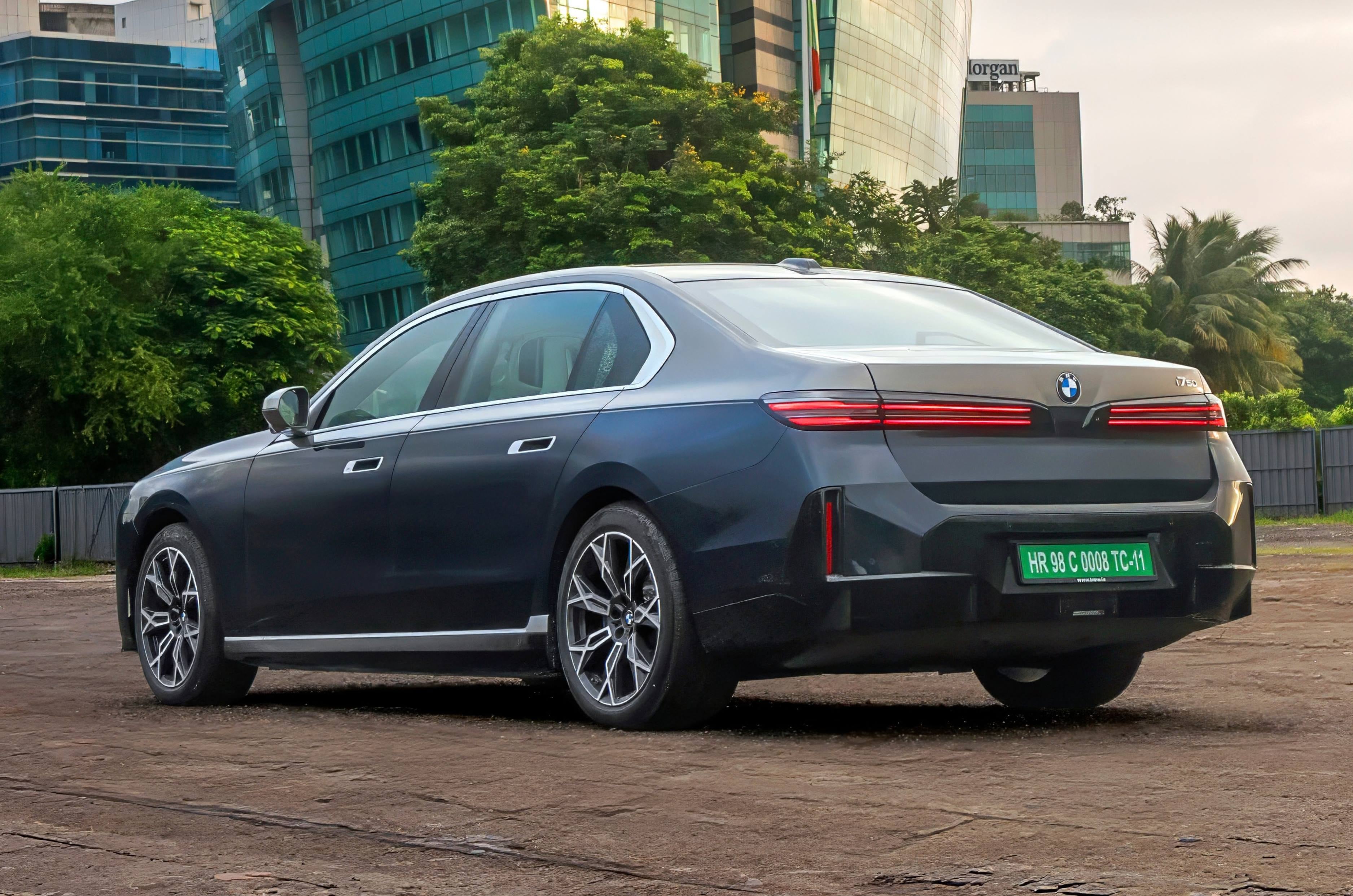
Like the front, the rear has also been cleaned up. There’s a new diffuser, broader tail-lamps, and a neater bumper design. Overall, this iteration looks significantly more palatable than its predecessor, and in the optional two-tone paint finish of our test car, road presence was immense.
BMW i7 50 xDrive Interior Space and Comfort – 9/10
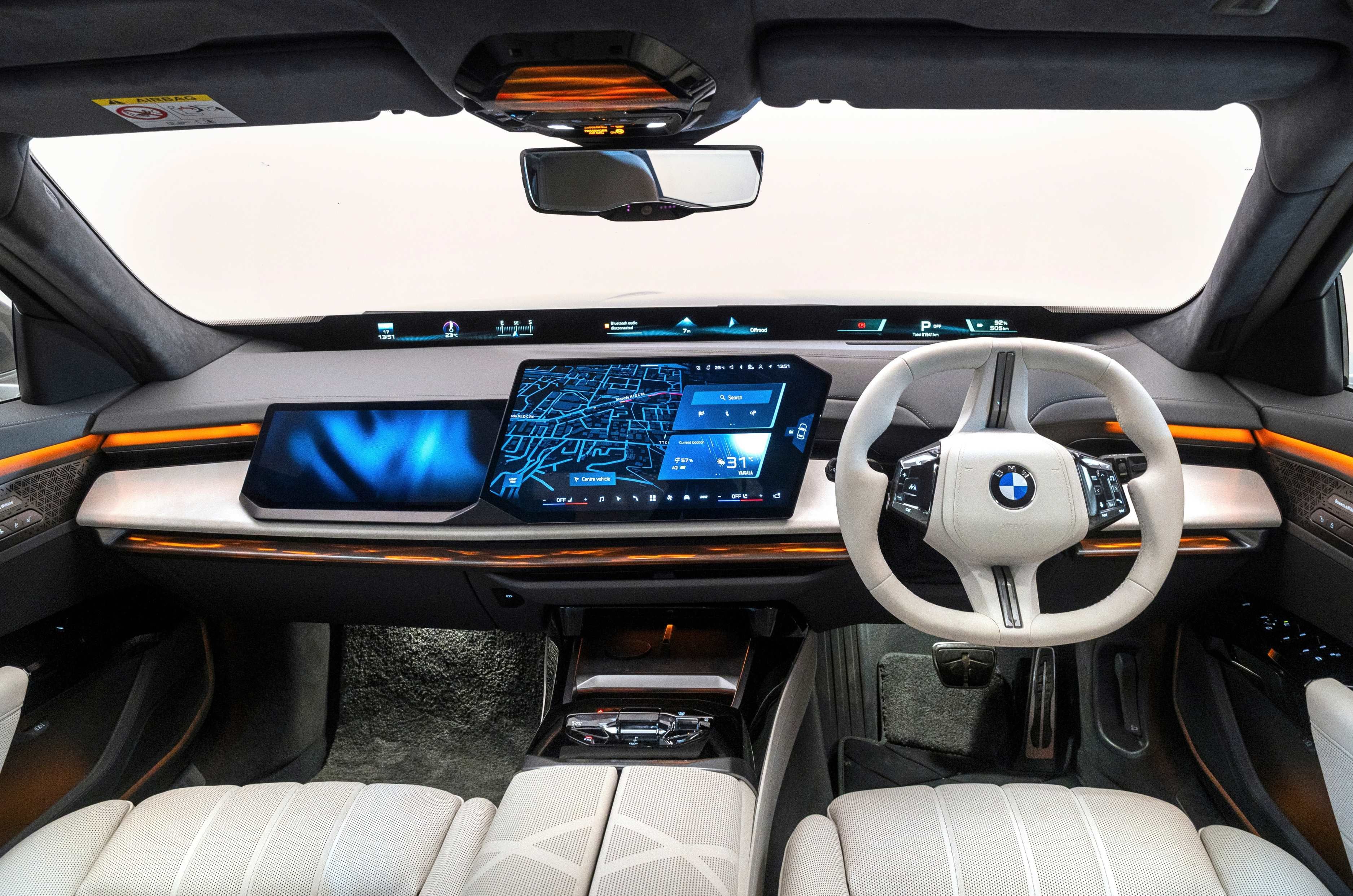
The redesigned dashboard adds freshness and previews the direction BMW’s future interiors are expected to take.
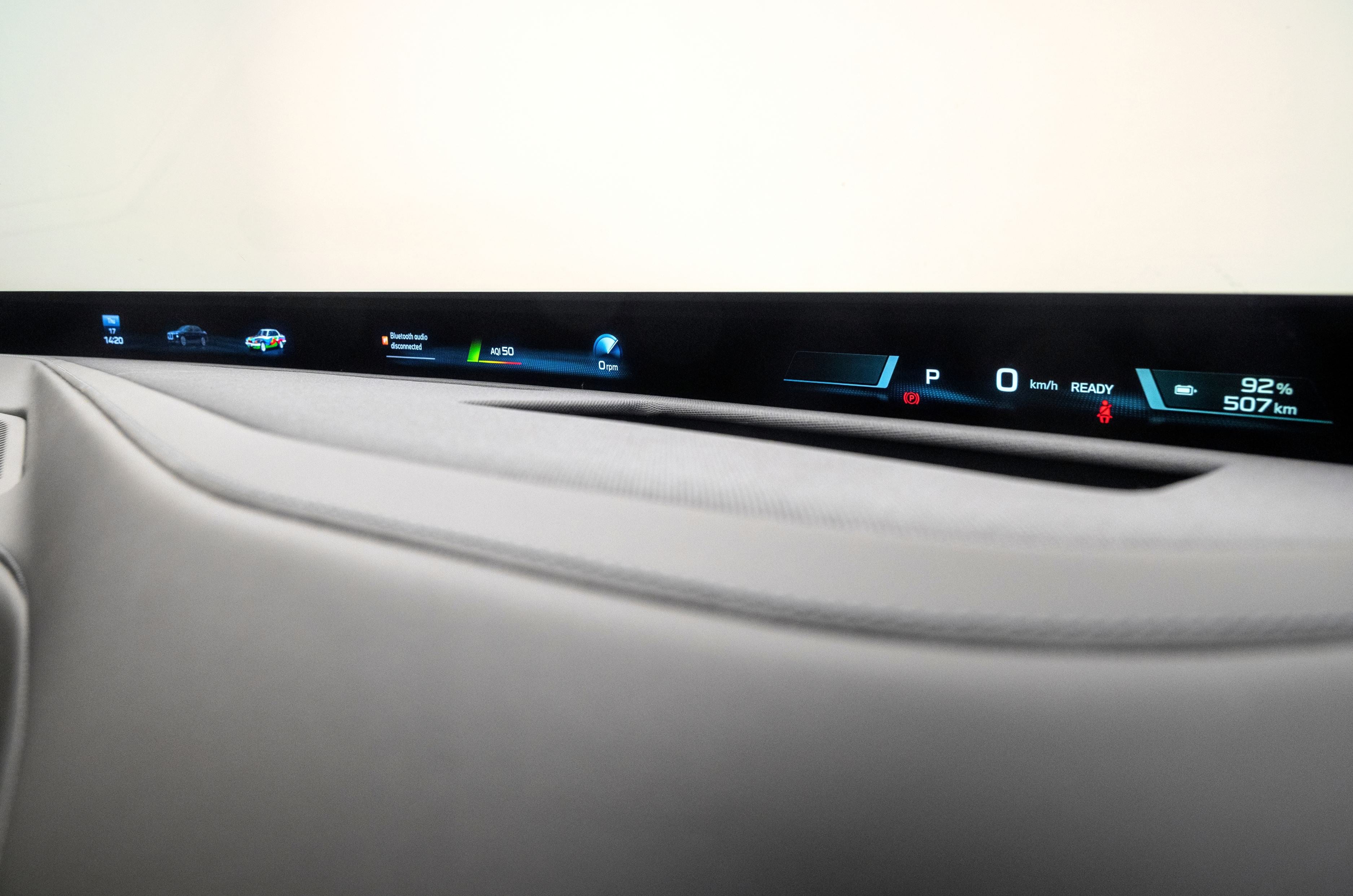
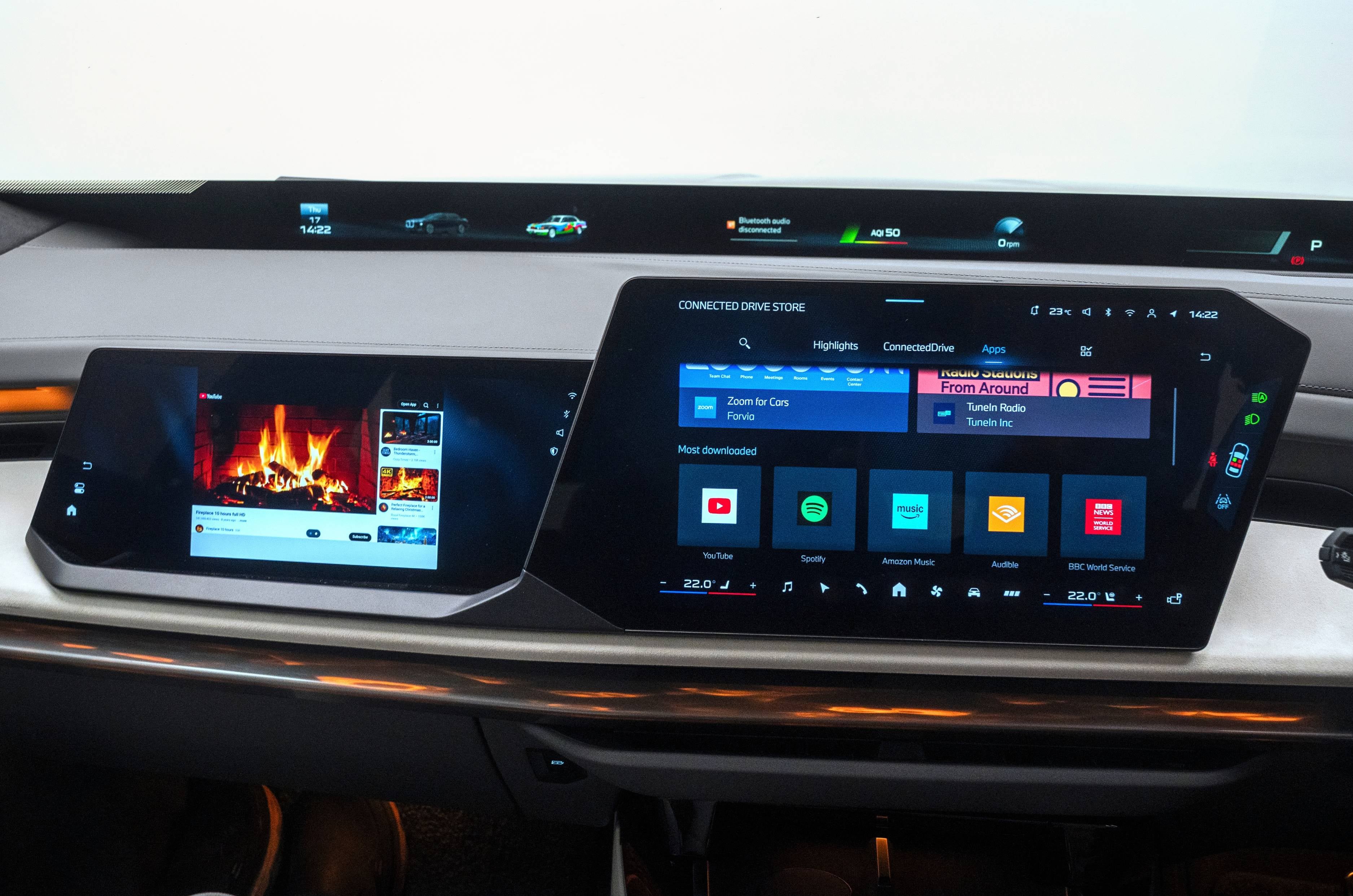
The i7’s dashboard has been completely redesigned, adding much-needed freshness while also previewing the direction BMW’s future interiors are expected to take. The biggest talking point is the deletion of the conventional instrument cluster. In its place sits a new panoramic head-up display positioned right at the base of the windscreen, projecting a wealth of information. It is highly customisable and, besides essentials like speed, charge status and warnings, can display motor speed, navigation, compass information, audio details, date and time, outside temperature, air quality, or even one of BMW’s Art Cars as a decorative element in the remaining six slots. The display is sharp, brilliantly executed, and sits naturally within your field of vision without becoming distracting.
A panoramic head-up display projects a wealth of information, it’s highly customisable and the display is sharp and brilliantly executed.
As for design, the new steering wheel is far more divisive. Its octagonal shape, combined with spokes extending from the horn boss at the 12 and 6 o’clock positions, makes it look unconventional. The light-coloured finish is also likely to be difficult to keep clean — you may even find yourself asking your chauffeur to wear gloves. On the plus side, it feels pleasant to hold, and the controls, though limited in number and not individual buttons, are satisfying to use.
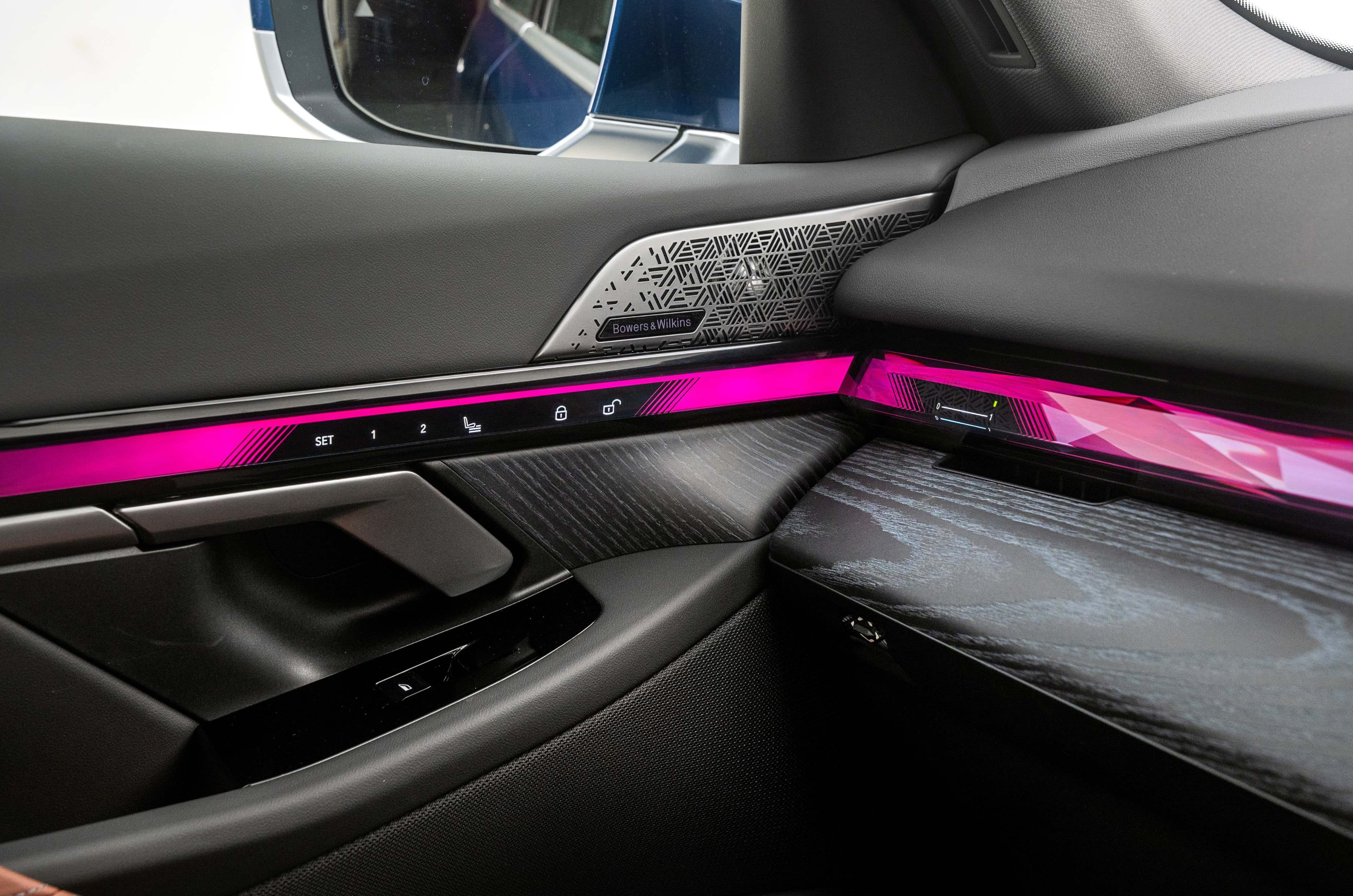
There’s also a new 17.9-inch free-standing touchscreen along with a smaller passenger display, both adopting a parallelogram shape. Curiously, the top-right corner of the central screen appears as though it has been chipped off, although that isn’t actually the case. Generous ambient lighting, crystalline detailing for the drive selector, volume controller and start-stop button, silver speaker grilles, and an overall light-coloured cabin theme further elevate the sense of luxury.
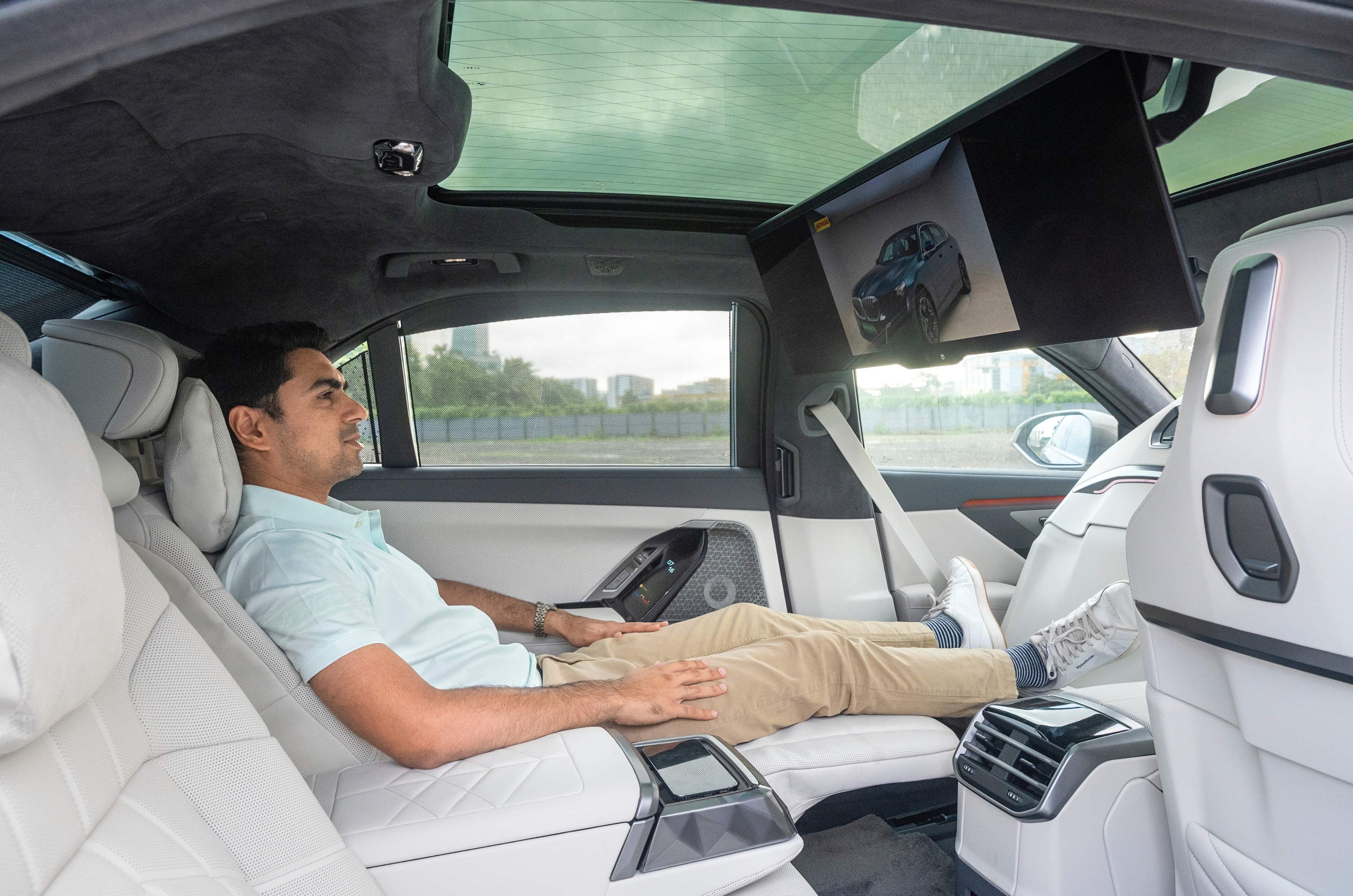
A one-touch relaxation mode transforms the rear seat into a lounge-like position. Updated 8K theatre screen is still part of the package.
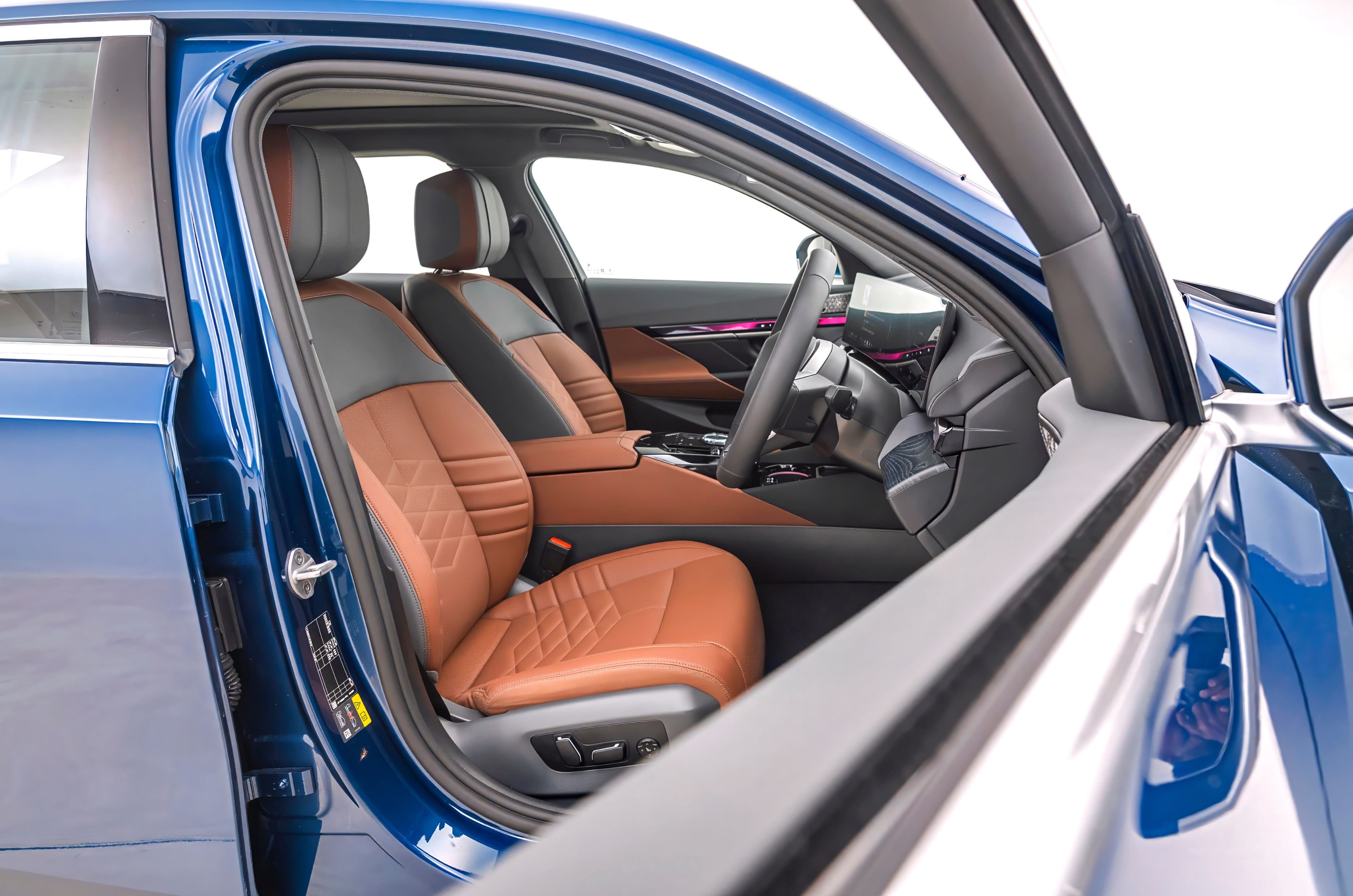
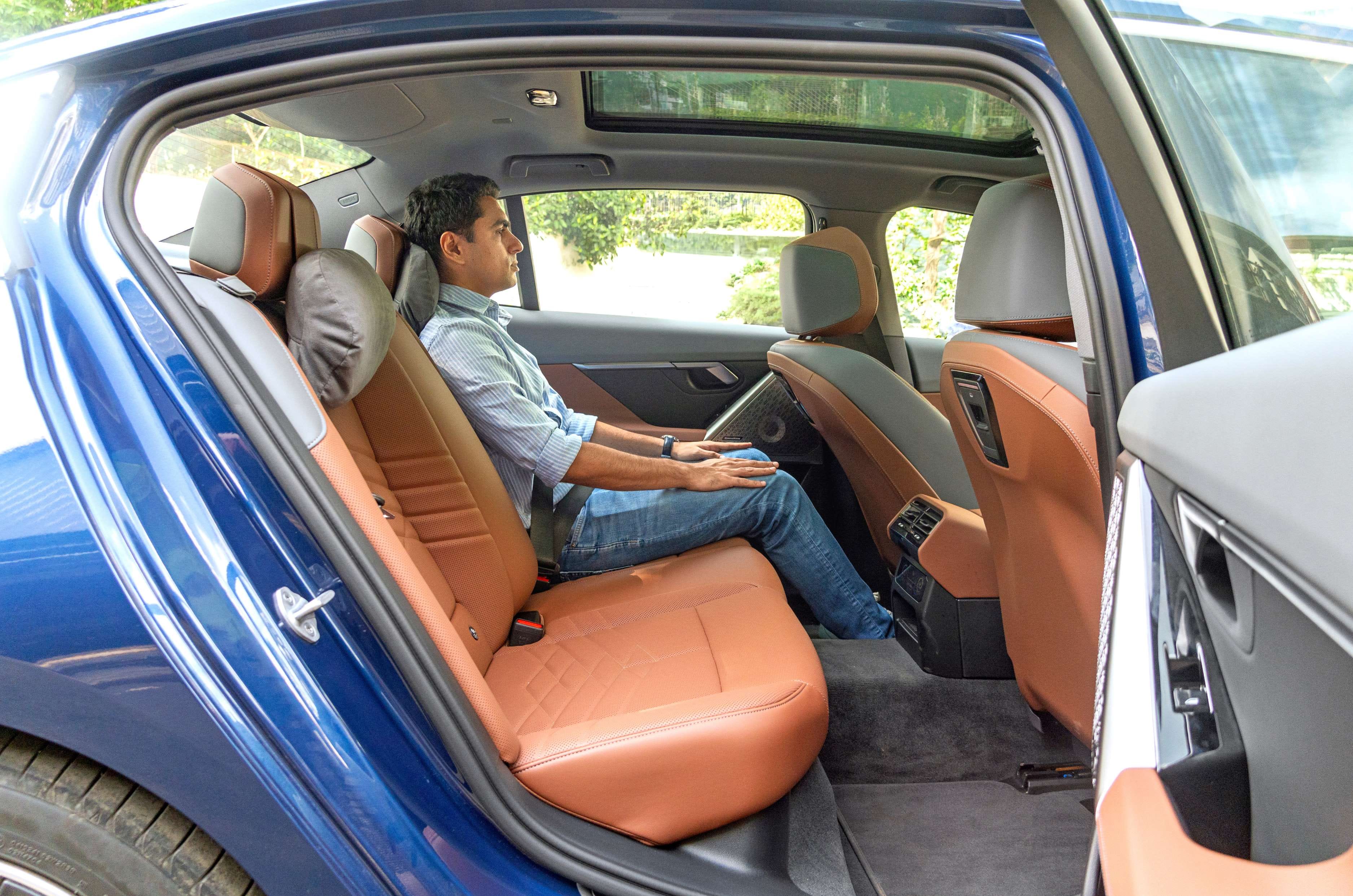
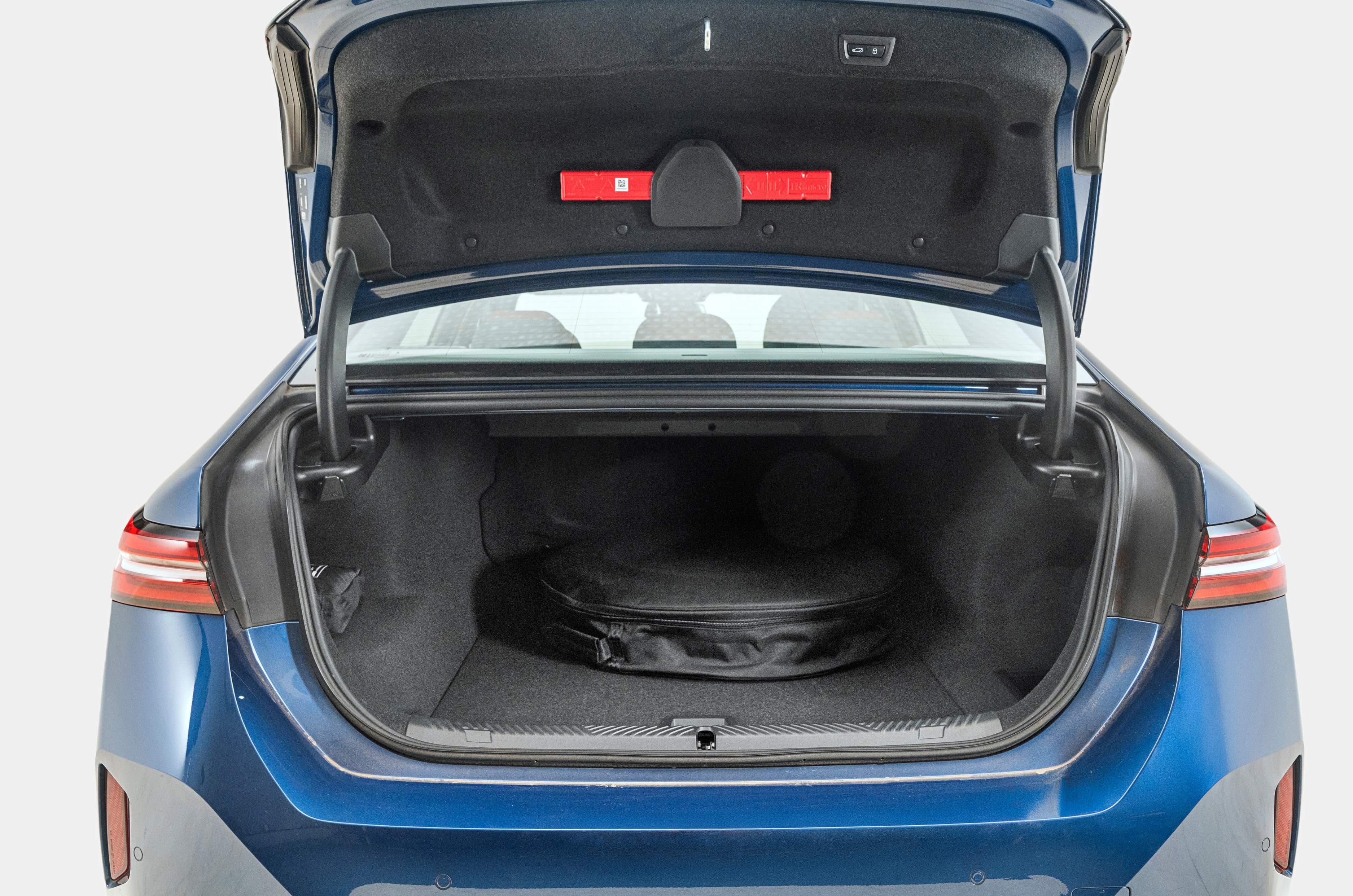
Expectedly, the seats are supremely comfortable. All four seats get heating, ventilation and massage functions. Additionally, the rear-left seat features a one-touch relaxation mode that transforms it into a lounge-like position, complete with a raised ottoman, a fully-forward front passenger seat, and a fold-down footrest. Sadly, like the outgoing model, the spare wheel remains mounted on the boot floor, significantly compromising luggage capacity.
BMW i7 50 xDrive Features and Safety – 10/10
The i7 50 M Sport comes loaded with virtually every feature luxury sedan buyers could ask for. The new panoramic end-to-end head-up display replaces the conventional instrument cluster and is not only unique and highly customisable, but also exceptionally well executed. The 17.9-inch touchscreen is new too, and now benefits from additional shortcut keys in addition to permanently displayed climate-control functions, making it marginally easier to operate than before. However, the user interface still feels somewhat overwhelming, with an abundance of functions buried within multiple sub-menus.
The central screen is marginally easier to operate than before. The new front passenger entertainment display is likely to be of limited relevance to most owners.
Also new is a front passenger entertainment display, though we suspect it will be of limited relevance to most owners. The new 31.3-inch 8K rear theatre screen, on the other hand, is likely to see much greater use, particularly on longer journeys.
Carried over from the outgoing version and continuing to add a sense of occasion are the powered doors, which open and close at the touch of a button.
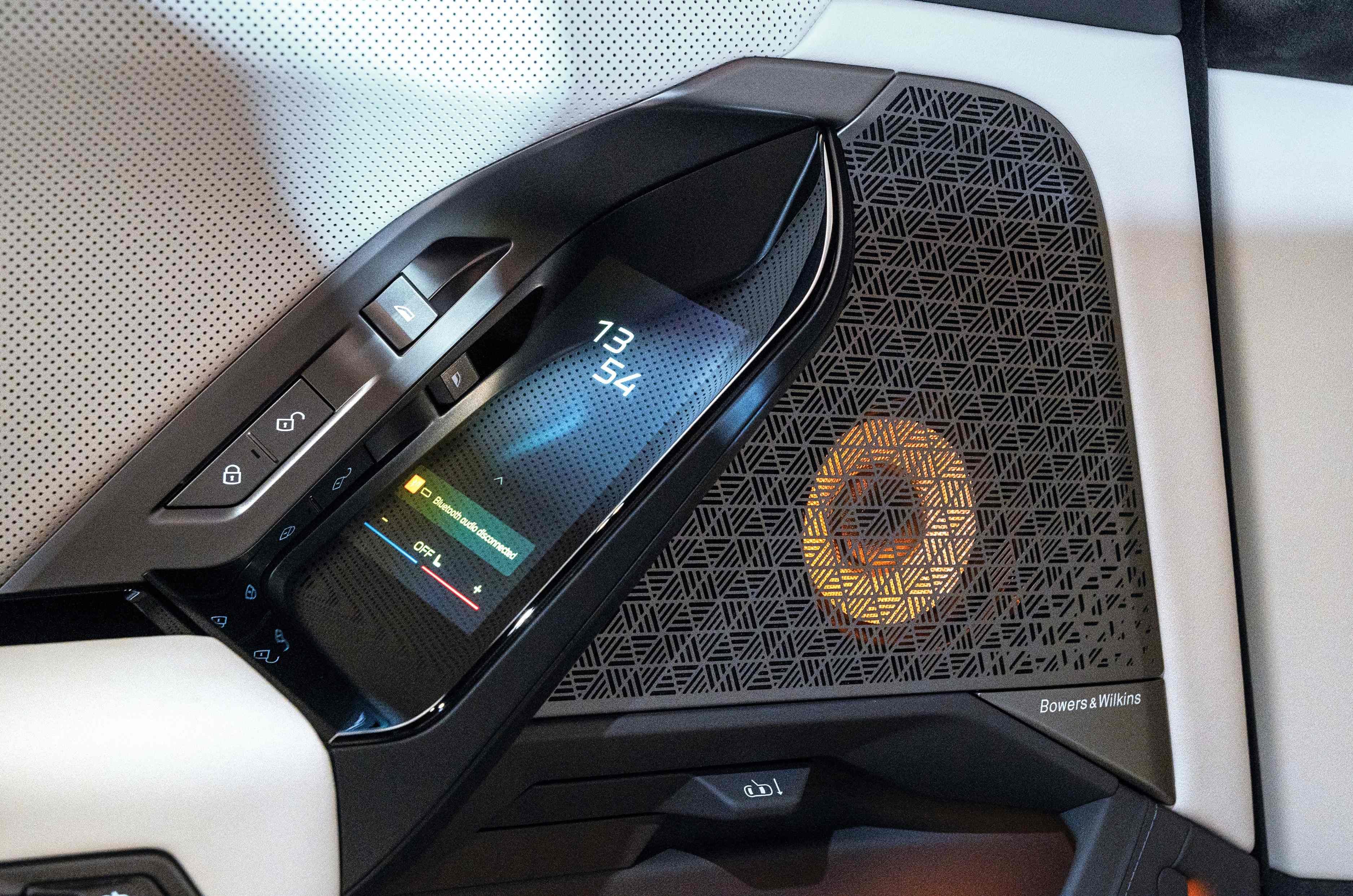
Its Bowers & Wilkins Diamond Surround Sound System with Dolby Atmos delivers an incredibly immersive audio experience.
The highlight, however, is the outstanding Bowers & Wilkins Diamond Surround Sound System with Dolby Atmos and a whopping 35 speakers. It even delivers a 4D experience, with a pronounced thump felt through all four seats. The result is an incredibly immersive audio experience that is sure to impress even the most discerning audiophile.
BMW i7 50 xDrive Performance and Refinement – 9/10
Its performance feels effortless and reassuring, while the accelerator calibration is smooth and progressive for everyday driving.
The i7 50 xDrive uses a dual-motor setup producing a combined 483hp and 660Nm, which is more than adequate for a luxury sedan of this nature. There’s rarely any need to switch out of Efficient mode because there is always a vast reserve of torque available. The effortless performance feels reassuring, while the accelerator calibration is smooth and progressive during everyday driving.
Press the accelerator beyond the halfway mark and the i7 takes off like a scalded cat. Acceleration is rapid, with this 2.8-tonne luxury sedan sprinting from 0-100kph in just 5.5 seconds and reaching 200kph in a shade under 19 seconds. Owners can also choose to activate synthetic motor sounds that play through the speakers, adding a dramatic, sci-fi soundtrack to acceleration. These can be switched off entirely for a completely silent experience.
There are multiple regenerative braking settings, including Adaptive, High, Mid and Low. Of these, Adaptive stands out for its excellent calibration, intelligently varying regeneration and coasting based on traffic and road conditions. There’s also a dedicated one-pedal ‘B’ mode selectable via the drive selector. It delivers regeneration similar to the High setting but, unlike it, can bring the car to a complete stop without any brake pedal input.
BMW i7 50 xDrive Range and Efficiency – 9/10
The i7 50 xDrive gets a larger 112.5kWh battery pack with NMC cell chemistry, replacing the outgoing version’s 101.7kWh unit. As a result, this version claims a WLTP range of up to 728km. Although we haven’t yet subjected it to our range tests, we expect it to comfortably deliver over 500km in real-world conditions, which is more than sufficient for most users. BMW claims the battery can charge from 10-80 percent in 28 minutes using a 250kW (or higher) DC fast charger. On a 22kW AC charger, a full charge takes approximately six hours.
BMW i7 50 xDrive Ride Comfort and Handling – 10/10
What’s truly impressive is the pillowy ride quality. It shrugs off badly broken roads with ease, and maintains excellent body control.
Piloting the i7 may initially seem intimidating given its considerable dimensions, but its light steering and rear-axle steering significantly aid manoeuvrability. The latter allows the rear wheels to turn either with or against the fronts by up to 3.5 degrees, helping the car feel remarkably agile for its size.
What’s truly impressive is the pillowy ride quality. The thick, high-profile tyres add another layer of cushioning, allowing the i7 to shrug off even badly broken roads with ease. It absorbs potholes effortlessly, keeps road shocks well isolated, and maintains excellent body control. Passengers are also spared the uncomfortable side-to-side movements over unusually rough patches.
Selecting Sport mode does firm things up slightly, but while the air suspension becomes tauter and body control improves further, ride comfort never suffers. Handling feels predictable and, thanks to xDrive all-wheel drive, the i7 feels exceptionally planted and offers impressive grip when tackling corners. Rear-wheel steering also does a remarkable job of disguising its size.
In short, the i7 can be driven surprisingly enthusiastically, and for a luxo-barge, it drives exceptionally well. We would, however, recommend leaving the steering in Comfort mode, as it feels unnecessarily heavy in Sport.
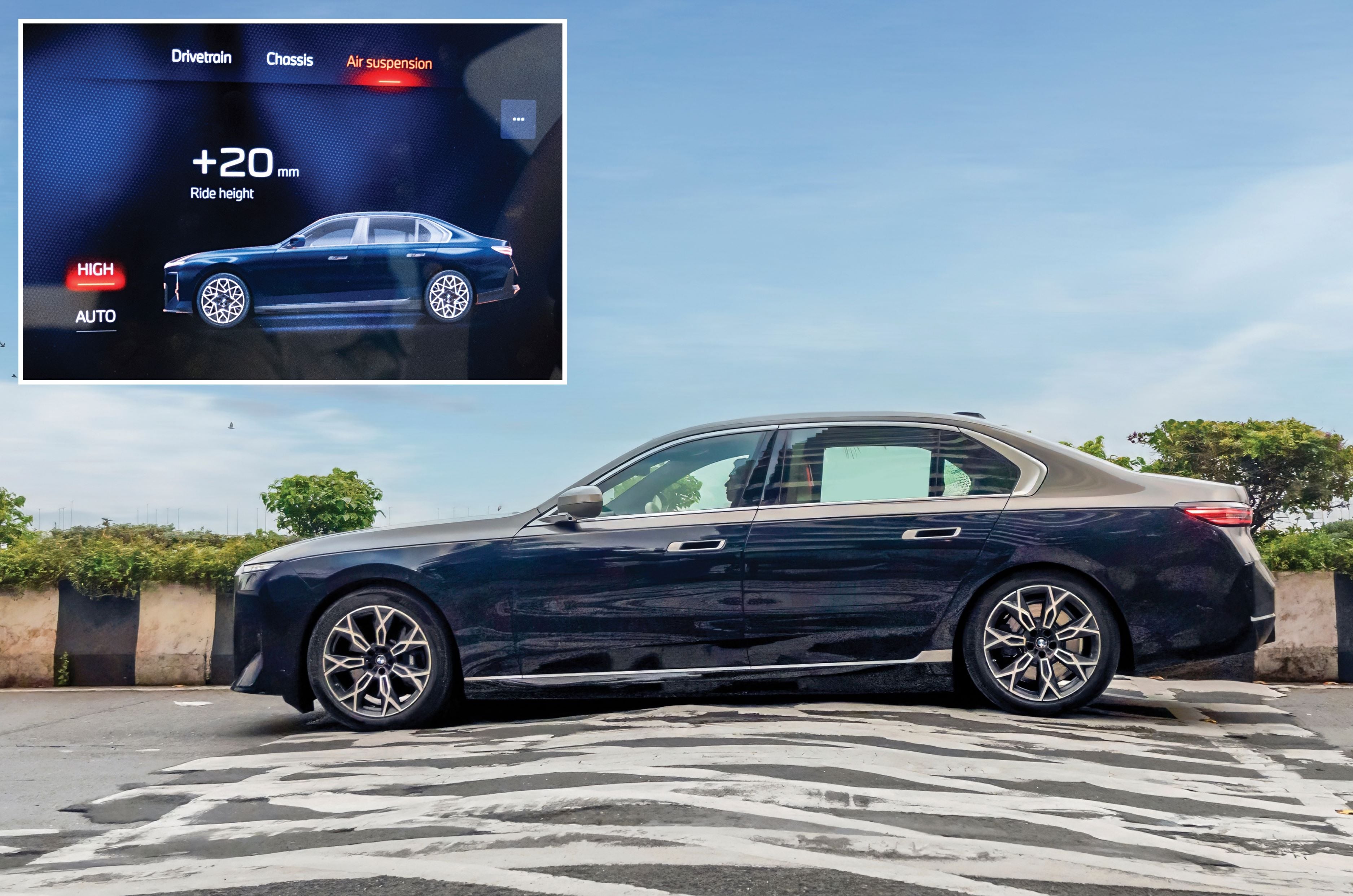
The suspension raises by 20mm over the 136mm standard setting, allowing it to clear all but the most poorly designed obstacles.
Sport mode also lowers the ride height by 10mm from the standard 136mm setting. While beneficial for dynamics, it makes the underbody vulnerable even on relatively small speed breakers. Thankfully, two taps on the touchscreen raise the suspension by 20mm over the standard setting, allowing it to clear all but the most poorly designed obstacles. Cabin insulation is outstanding too, keeping road, wind and ambient noise effectively isolated from occupants.
BMW i7 50 xDrive Price and Verdict – 9/10
At Rs 1.95 crore, the locally assembled i7 50 xDrive is priced exactly at par with the petrol-powered 740 and is even a few lakhs more affordable than its chief rival, the Mercedes-Benz S-Class. Yet pricing alone isn’t what makes the i7 such a compelling proposition.
What truly sets it apart is the sheer sense of occasion it delivers. Its styling is bold, the cabin feels genuinely special, ride comfort is exceptional, and the level of technology on offer significantly elevates its desirability. Add to that an extraordinary audio system and the effortless refinement that only a luxury EV can deliver, and the i7 feels every bit the flagship it is.
Yes, luggage space remains compromised by the spare wheel placement, and the touchscreen interface isn’t quite as intuitive as that of its chief rival. But in this segment, neither is likely to be a deal-breaker.
The bigger takeaway is that BMW has successfully made the electric version of its flagship sedan the more desirable one. For buyers seeking luxury, comfort and technology, the i7 50 xDrive isn’t merely an excellent EV, it’s quite simply all the luxury car you’ll ever need.
Kangana Ranaut: एक्टर और BJP सांसद कंगना रनौत ने MLA मैथिली ठाकुर का समर्थन किया है। मैथिली ठाकुर को कुछ दिन पहले मुंबई के मशहूर लालबागचा राजा पंडाल में एक लग्जरी नीली रोल्स-रॉयस कलिनन कार में आने के लिए ट्रोल किया गया था। सोशल मीडिया पर कई यूजर्स ने सवाल उठाया कि अपनी राजनीतिक यात्रा के एक साल के भीतर ही बिहार की MLA और सिंगर के पास इतनी महंगी लग्जरी SUV कैसे हो सकती है, जिसकी मुंबई में ऑन-रोड कीमत 13 करोड़ से ज्यादा हो सकती है। कंगना ने सवाल किया कि जब राजनेता अपनी जिंदगी बेहतर बनाने की कोशिश करते हैं तो ट्रोलर्स को हमेशा बुरा क्यों लगता है।
कंगना ने क्या कहा
इंस्टाग्राम स्टोरीज पर कंगना ने लिखा, “कुछ लोगों को तब बहुत जलन होती है जब वे राजनेता को अच्छी जिंदगी जीते हुए देखते हैं। अब हमारी युवा MLA को लग्जरी कार इस्तेमाल करने के लिए ट्रोल किया जा रहा है। हम भले ही समाज सेवा में लगे हों, लेकिन हमारे अपने करियर, जिंदगी और लोकप्रियता भी होती है। हम निस्वार्थ भाव से जनहित में काम करते हैं, लेकिन कुछ लोगों को हमारे अच्छे से रहने पर इतनी तकलीफ क्यों होती है? हम अच्छी जिंदगी क्यों नहीं जी सकते? हमें जनता के पैसे में कोई दिलचस्पी नहीं है, लेकिन हमसे यह उम्मीद करना कि हम गरीब और बेजान जिंदगी जिएं, बहुत बेतुका है।”
कौन हैं मैथिली ठाकुर?
लोक गायिका से राजनेता बनीं मैथिली ठाकुर 2025 के बिहार विधानसभा चुनावों में एक बड़े उलटफेर का कारण बनीं और RJD के दिग्गज नेता बिनोद मिश्रा को बड़े अंतर से हराया। वह बिहार की सबसे युवा MLA हैं। मैथिली ठाकुर एक लोकप्रिय गायिका हैं, जिन्होंने बिहार विधानसभा चुनावों के दौरान BJP उम्मीदवार के तौर पर राजनीति में कदम रखा। भारतीय शास्त्रीय संगीत और लोक परंपराओं में प्रशिक्षित, उनके गायन में मैथिली, भोजपुरी, भक्ति भजन और फिल्मी-शैली के गाने शामिल हैं।
मैथिली बिहार के मधुबनी जिले के बेनीपट्टी की रहने वाली हैं। बाद में उनका परिवार उनकी संगीत की ट्रेनिंग और करियर को आगे बढ़ाने के लिए द्वारका- नई दिल्ली आ गया। उनके पिता रमेश ठाकुर संगीत शिक्षक हैं और उन्होंने बहुत कम उम्र से ही अपने पिता और दादा दोनों से संगीत सीखा।
2017 में, रियलिटी सिंगिंग शो ‘राइजिंग स्टार इंडिया’ में भाग लेने के बाद उन्हें बड़ी पहचान मिली। तब से उन्होंने सोशल मीडिया, खासकर YouTube पर अपनी मज़बूत उपस्थिति बनाई है, जहां वह शास्त्रीय और लोक संगीत की प्रस्तुतियां पोस्ट करती हैं। कुछ दिन पहले कंगना ने एक्ट्रेस तृषा कृष्णन के समर्थन में बात की थी। पिछले महीने चेन्नई में स्वतंत्रता दिवस 2026 के समारोह में शामिल होने की वजह से तृषा एक विवाद में फंस गई थीं। तृषा का नाम लिए बिना उन्होंने कहा, “आपने देखा होगा कि तमिलनाडु में क्या हुआ, जहां एक बहुत सम्मानित कलाकार और एक्ट्रेस एक ऐसे मामले में शामिल थीं, जिसमें दोनों पक्षों के बीच संबंध था। हालांकि जब गाली-गलौज और चरित्र हनन की बात आती है तो हमेशा महिला को ही निशाना बनाया जाता है।”
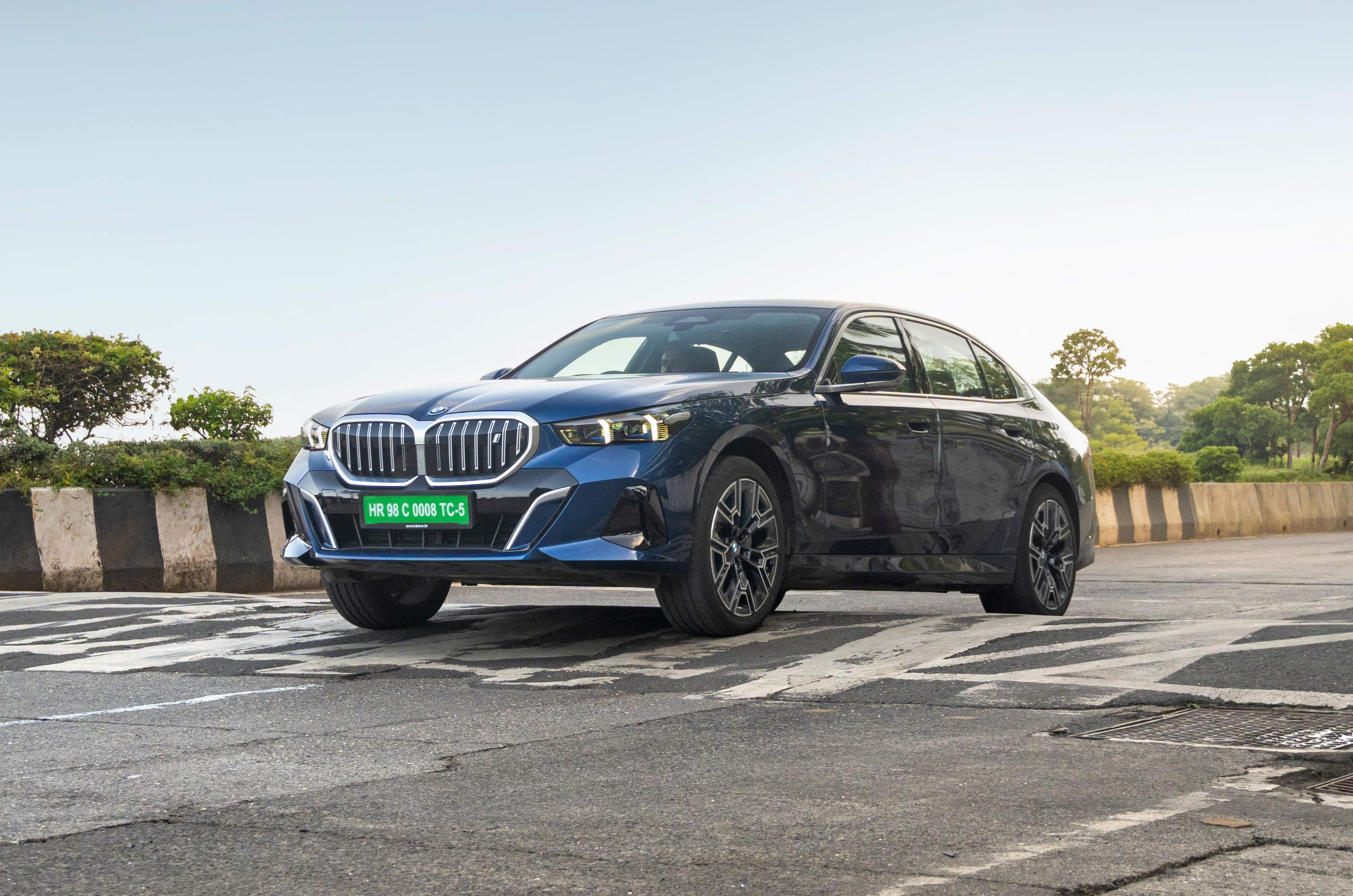
In the first half of 2026, BMW sold nearly 2,400 EVs in India, with the entry-level iX1 and flagship i7 accounting for the bulk of those volumes. Now, BMW has introduced an all-new electric long-wheelbase sedan to bridge the sizable gap between the two. Meet the BMW i5 eDrive35L, the electric counterpart to the 5 Series sedan.
The i5 nameplate isn’t new to India. BMW launched the imported, performance-focused i5 M60 here back in 2024. However, that was a niche offering. This new version is expected to appeal to a much wider audience. Being locally assembled, the i5 eDrive35L is priced at Rs 79.60 lakh, commanding a premium of Rs 3 lakh over its petrol-powered sibling. In this review, we find out what it’s like to live with.
BMW i5 LWB Exterior Design and Engineering – 8/10
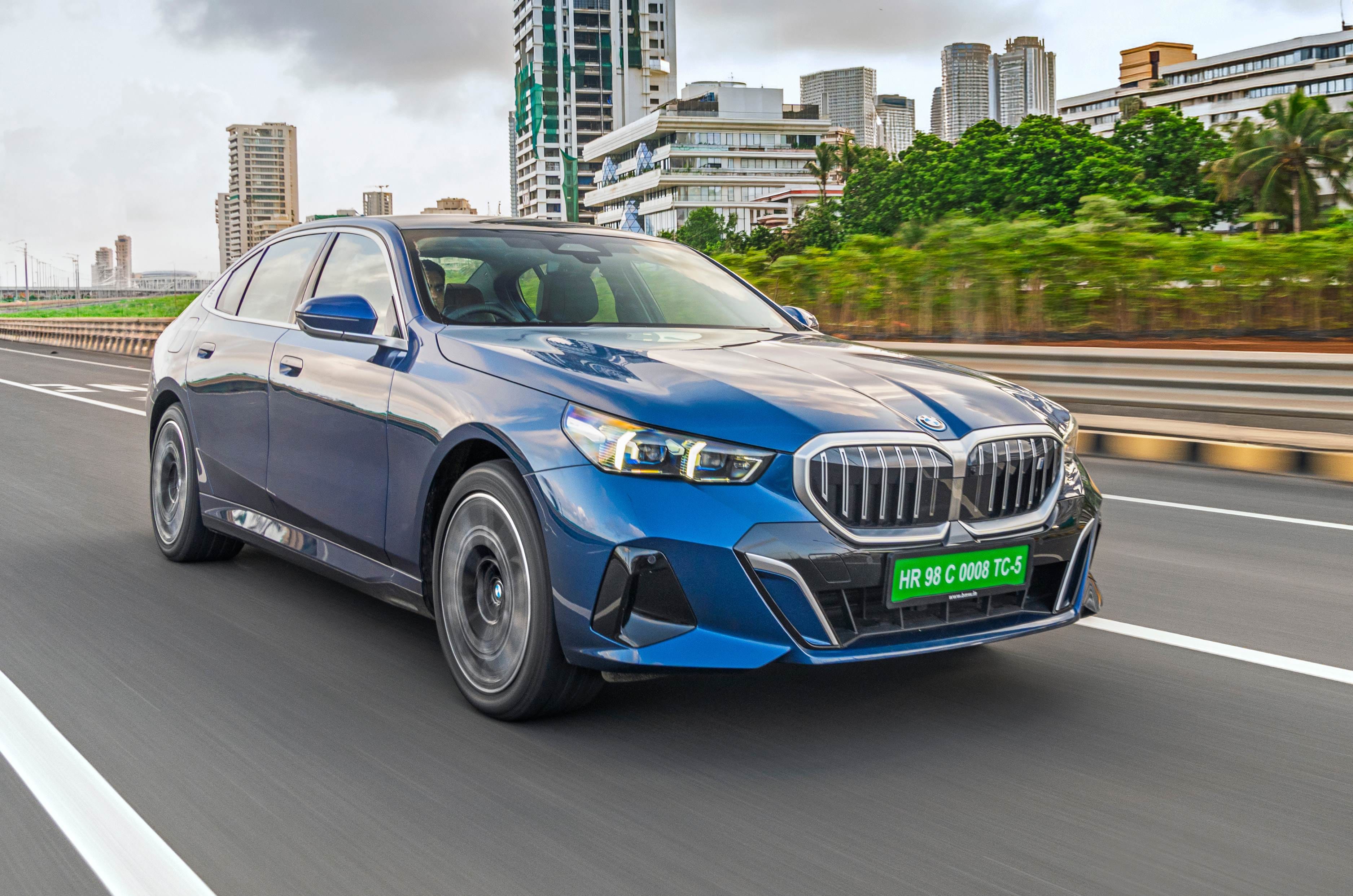
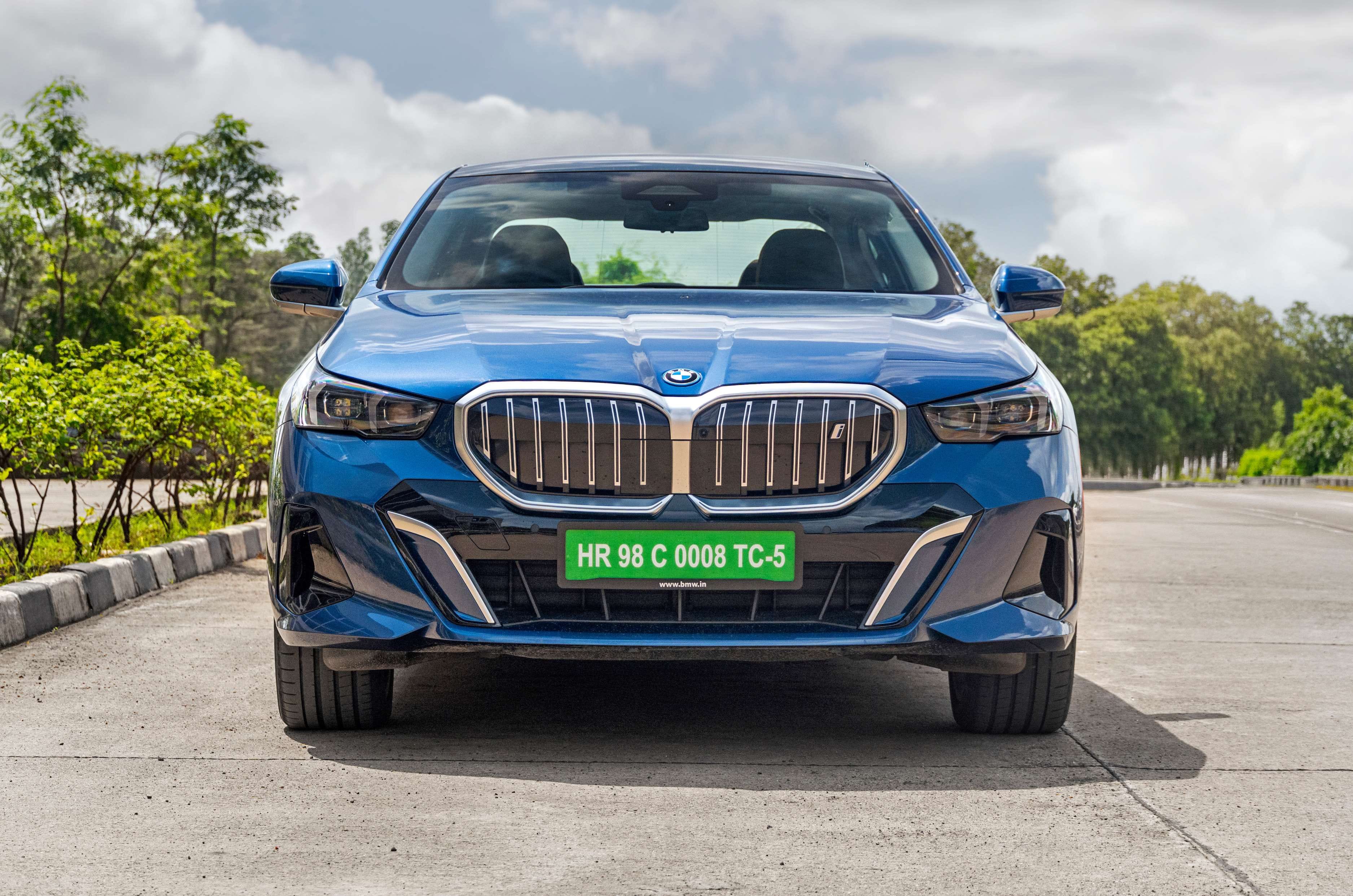
An ‘i’ badge on the grille along with its green number plate differentiate it from its petrol sibling
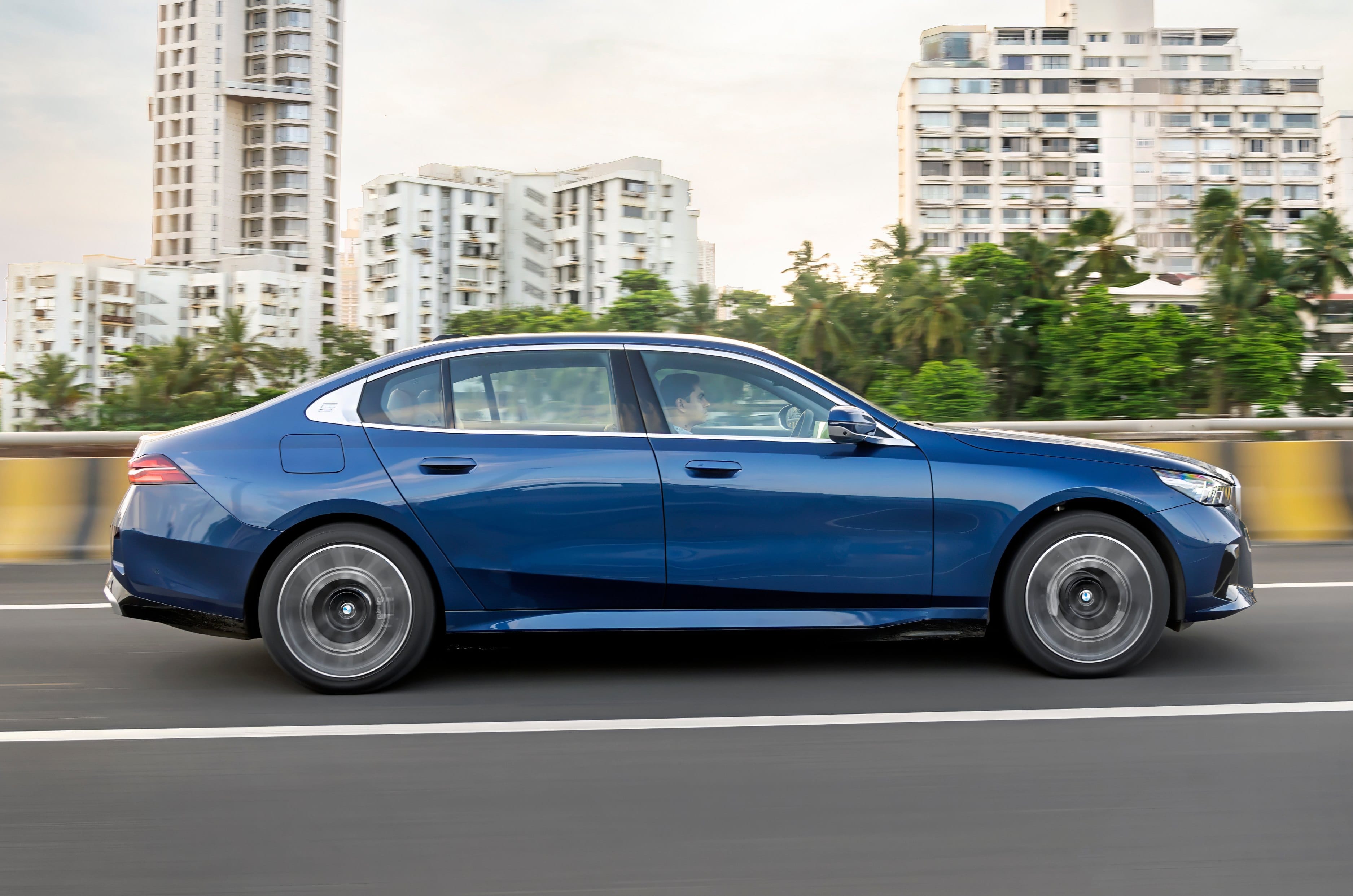
Compared to the international version, this i5’s wheelbase has been stretched by 110mm to 3,105mm, while overall length now stands at 5,175mm. Interestingly, the 5 Series is larger than its chief rival, the Mercedes-Benz E-Class, in every dimension.
As for styling, this generation of the 5 Series has been around since 2024 and much like most modern BMW designs, it’s something that grows on you with time. That said, there’s no denying that it’s a polarising design. The numerous cuts, heavy surfacing and intricate detailing make it look busy and excessive to some eyes.
Gets large 20-inch alloys which look far more proportionate than the 18-inch wheels initially available with the 530Li.
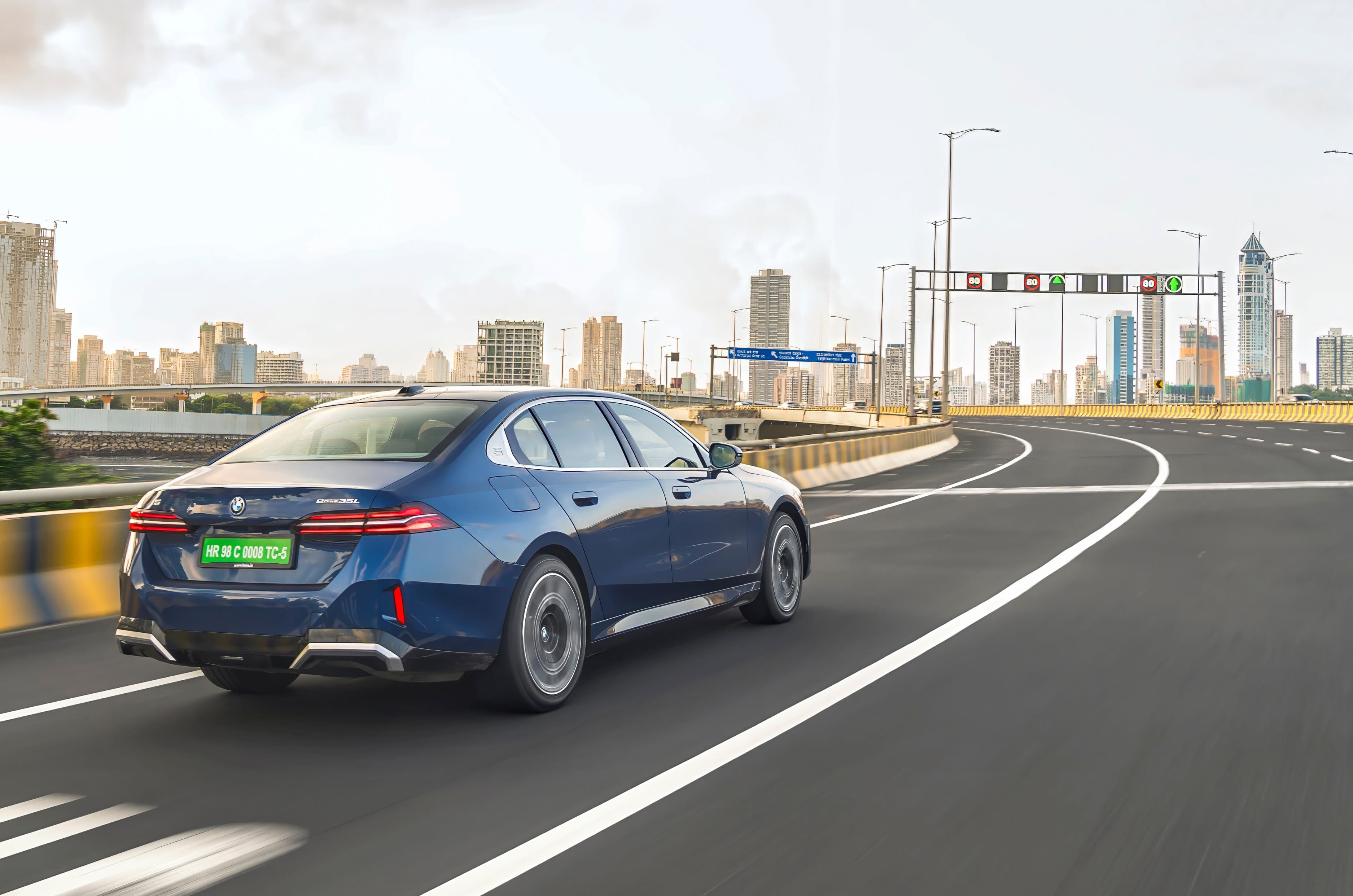
Differentiating the i5 from its petrol-powered counterpart are an ‘i’ logo on the grille and larger 20-inch alloy wheels. The latter look far more proportionate than the 18-inch wheels initially offered on the 530Li. At the rear, the only distinguishing elements are the i5 and eDrive35L badges, apart from the obvious giveaway – the green number plate.
BMW i5 LWB Interior Space and Comfort – 9/10
Dash is dominated by BMW’s twin curved screens, a flat-bottomed steering wheel and generous ambient lighting.
Step inside and the dashboard is dominated by BMW’s twin curved-screen setup, complemented by a flat-bottomed steering wheel, generous ambient lighting, and a tasteful mix of open-pore wood trim and silver inlays. The crystalline drive selector, rotary infotainment controller and volume roller on the centre console add a welcome sense of occasion.
Those familiar with older 5 Series models will quickly notice the absence of the manually adjustable thigh support for the front seats. That aside, the seats themselves are exceptionally comfortable and supportive, and they also feature ventilation.
The seats are exceptionally comfortable and supportive, and they also feature ventilation.
Being the long-wheelbase version, the i5 benefits from an additional 4.3 inches of wheelbase compared to the international model, resulting in noticeably more rear legroom. Sure, the floor sits higher than in the ICE version, but this remains a very comfortable place to be for chauffeur-driven buyers. The rear bench is well contoured and, with just two occupants, delivers a genuinely luxurious experience. Some may find the pillows a little excessive, and they aren’t quite as comfortable as the integrated units in the E-Class. Speaking of which, unlike the Mercedes, the i5’s rear seat doesn’t recline, and there are arguably too few indulgent touches to truly cater to chauffeur-driven buyers.
A bit knees-up, but the rear seat feels luxurious; however, there are too few amenities for chauffeur-driven buyers.
The middle seat is considerably less accommodating. The raised seat base compromises headroom, the backrest is firm, and the tall central tunnel further detracts from comfort for a third passenger.
Boot space is rated at 500 litres, which is broadly similar to the ICE 5 Series. However, while the spare wheel is neatly tucked beneath the boot floor in the petrol version, it sits on the boot floor in the i5, significantly compromising usable luggage space.
The spare wheel sits on the boot floor, significantly compromising usable luggage space.
BMW i5 LWB Features and Safety – 8/10
The i5 eDrive35L comes generously equipped. Highlights include 20-inch alloy wheels, adaptive LED headlamps, powered and ventilated front seats, four-zone climate control, wireless charging pads for both front and rear occupants, a panoramic fixed glass roof, ambient lighting and a powered boot lid.
Audiophiles will particularly appreciate the superb 17-speaker, 655W Bowers & Wilkins audio system.
The curved touchscreen and digital instrument cluster look suitably futuristic, although the user experience isn’t the most intuitive due to the number of menus and sub-menus. On the plus side, the 360-degree camera offers excellent clarity. Audiophiles will particularly appreciate the superb 17-speaker, 655W Bowers & Wilkins audio system.
The i5 also gets a comprehensive suite of driver assistance features, including adaptive cruise control, lane-keeping assist and autonomous emergency braking.
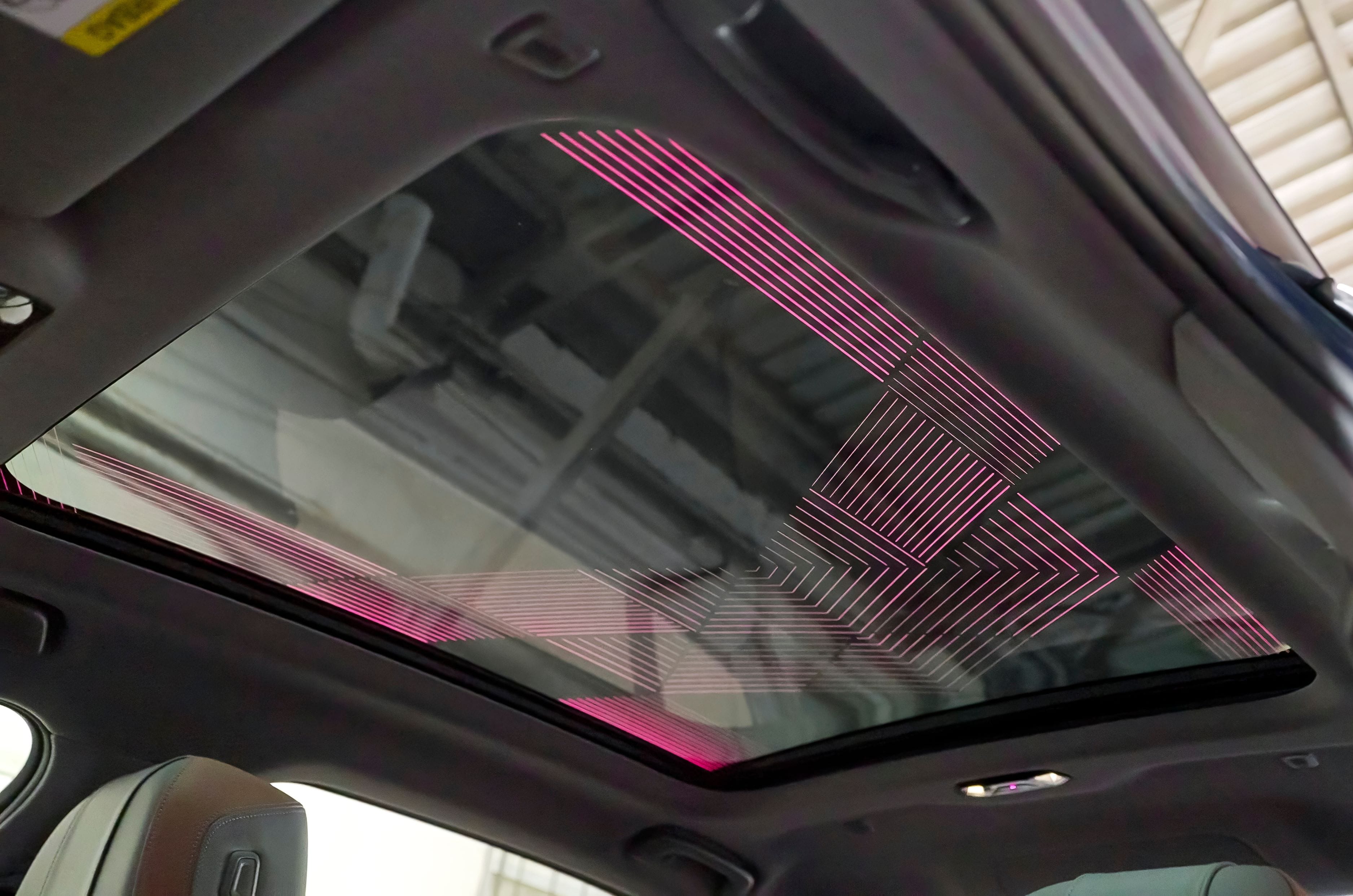
Its fixed panoramic glass roof has unique embedded LED lighting.
However, there are a few omissions that chauffeur-driven buyers may find difficult to overlook. A head-up display is absent, while smaller but genuinely useful features such as rear window sunshades, reclining rear seats, soft-close doors, a boss mode for the front passenger seat and rear-seat audio controls are all missing.
BMW i5 LWB Performance and Refinement – 8/10
The rear-wheel-drive i5 eDrive35L uses a single electric motor producing 272hp and 410Nm, figures that are remarkably similar to the mild-hybrid 530Li. However, the way it delivers its performance is entirely different. With peak torque available instantly, responses are smooth, effortless and distinctly EV-like. There are multiple drive modes on offer, each altering throttle response. Sport sharpens reactions noticeably, while Efficient is the most relaxed and efficiency-focused setting.
Retains a 50:50 weight distribution and RWD layout, but it has lost the sharpness and precision of earlier generations of the 5 Series.
BMW claims a 0-100kph time of 6.7 seconds, although our best run yielded 6.99 seconds. Interestingly, the 530Li is marginally quicker, recording 6.45 seconds for the same sprint, and it is also slightly faster in our 20-80kph and 40-100kph acceleration tests.
The i5’s top speed is rated at 195kph, although acceleration begins to taper off noticeably beyond 100kph. In short, acceleration isn’t neck-snappingly quick, but there’s more than enough performance to keep things entertaining within legal limits.
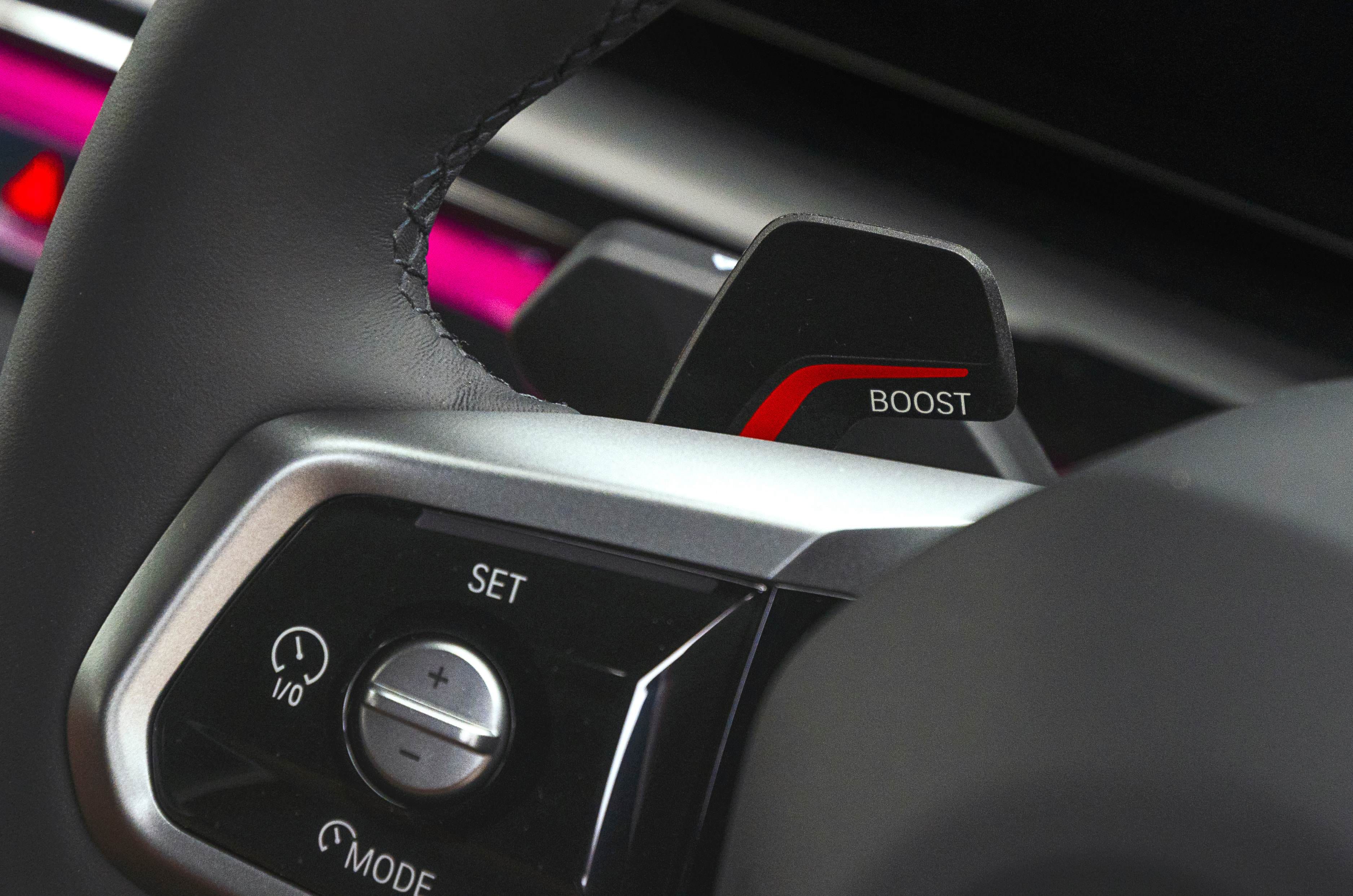
Boost function unlocks the motor’s full potential for 10 seconds. If your’re already in Sport mode, it barely makes any difference.
The i5 also offers multiple regenerative braking settings, including Adaptive, High, Mid and Low. Of these, Adaptive stands out for its excellent calibration, intelligently varying regeneration and coasting based on traffic and road conditions. There’s also a dedicated one-pedal ‘B’ mode, selectable via the drive selector. It delivers regeneration comparable to the High setting but, unlike it, can bring the car to a complete stop without requiring any brake pedal input.
Braking performance itself is strong, although keen drivers may wish for a little more feel from the pedal. The transition between regenerative and mechanical braking leaves it feeling somewhat numb.
BMW i5 LWB Range and Efficiency – 6/10
BMW claims the i5’s 81.6kWh battery (net capacity is 76.3kWh) can deliver a range of up to 669km, a figure that appears rather optimistic. In our real-world range tests, the i5 eDrive35L returned an average efficiency of 5.06km/kWh, translating to an estimated range of 386km. It’s worth noting that the car was driven in its most efficiency-focused ‘Efficient’ mode throughout the test, with regenerative braking set to Adaptive.
We also connected the battery to a 60kW DC fast charger, where it took 47 minutes to charge from 20-80 percent state of charge. BMW additionally supplies a complimentary AC wallbox charger along with installation.
BMW i5 LWB Ride Comfort and Handling – 8/10
Ground clearance has been increased by 18mm compared to the international version; hence, it clears most speedbreakers easily.
With every successive generation, the 5 Series has become softer and more comfort-focused, and the i5 is arguably the most luxurious iteration yet. Despite riding on larger 20-inch wheels with lower-profile tyres than the petrol-powered 530Li, ride quality is seriously impressive. The i5 feels plush and remarkably absorbent over typical urban roads. Notably, it also benefits from rear air suspension, a feature absent on the 530Li.
In addition to the extended wheelbase, BMW has increased ground clearance by 18mm compared to the global standard-wheelbase model. The result is a luxury sedan that’s far better suited to Indian conditions. Even with four occupants on board, the i5 clears most speed breakers without drama. As a luxury car, then, it unquestionably gets the fundamentals right.
With a plush ride and increased ground clearance, the i5 is far better suited to Indian conditions.
However, the softer suspension setup and increased ground clearance have diluted some of the driver-focused character that defined earlier generations of the 5 Series. While it retains a near-perfect 50:50 weight distribution and rear-wheel-drive layout, there’s no escaping the fact that, in prioritising comfort and practicality, BMW has sacrificed a measure of the sharpness and precision that once made the 5 Series a benchmark for driving enthusiasts.
BMW i5 LWB Price and Verdict – 8/10
At Rs 79.60 lakh, the locally assembled i5 LWB has all the ingredients to become BMW India’s next EV success story alongside the iX1. With the i5 eDrive35L, BMW continues its successful long-wheelbase formula, maximising cabin space while building upon the strengths of the petrol-powered 5 Series, with which it shares much of its cabin, equipment and overall character. Buyers can also opt for extended warranty and prepaid maintenance packages of up to 10 years, in addition to the standard eight-year battery warranty.
Generous cabin space, comfy seats, a plush ride, and effortless performance make the i5 eDrive35L a compelling electric luxury sedan
That said, much like its petrol-powered sibling, some of the traditional 5 Series driving feel has been diluted. It also misses a few feel-good features, particularly those aimed at rear-seat occupants. More importantly, the spare wheel’s placement on the boot floor significantly compromises luggage-carrying ability.
So, is it worth paying the Rs 3 lakh premium over the petrol-powered 5 Series? The answer largely depends on your usage. The i5 eDrive35L makes sense for buyers registering it under a company name, thanks to the higher depreciation benefits available for EVs. It also suits those who cover significant distances and can take advantage of lower running costs. Generous cabin space, comfortable seats, a plush ride, respectable range and effortless performance make the i5 eDrive35L a compelling electric luxury sedan for buyers shopping in this segment.
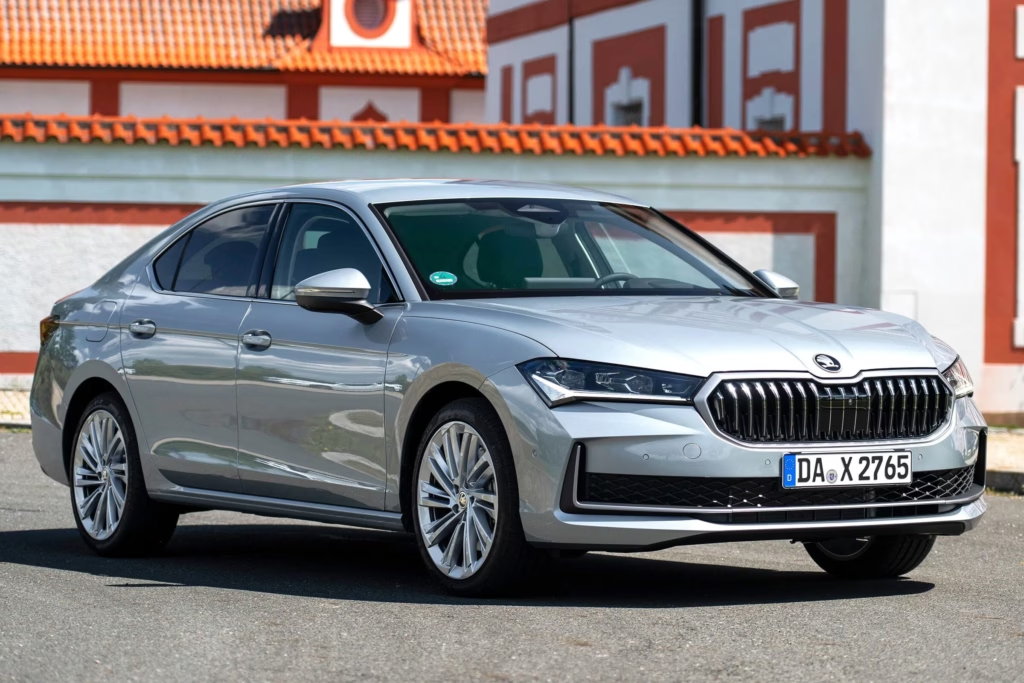
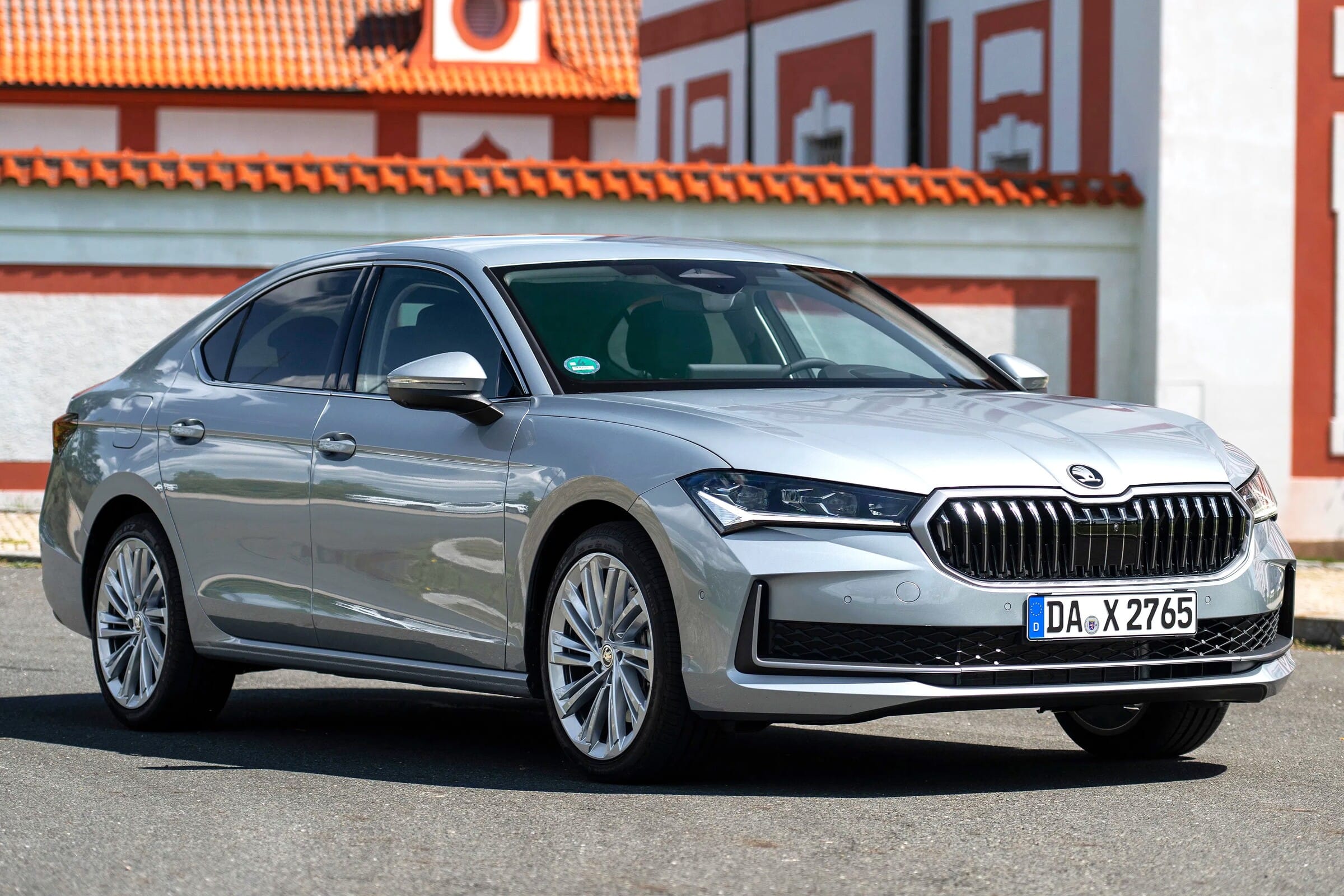
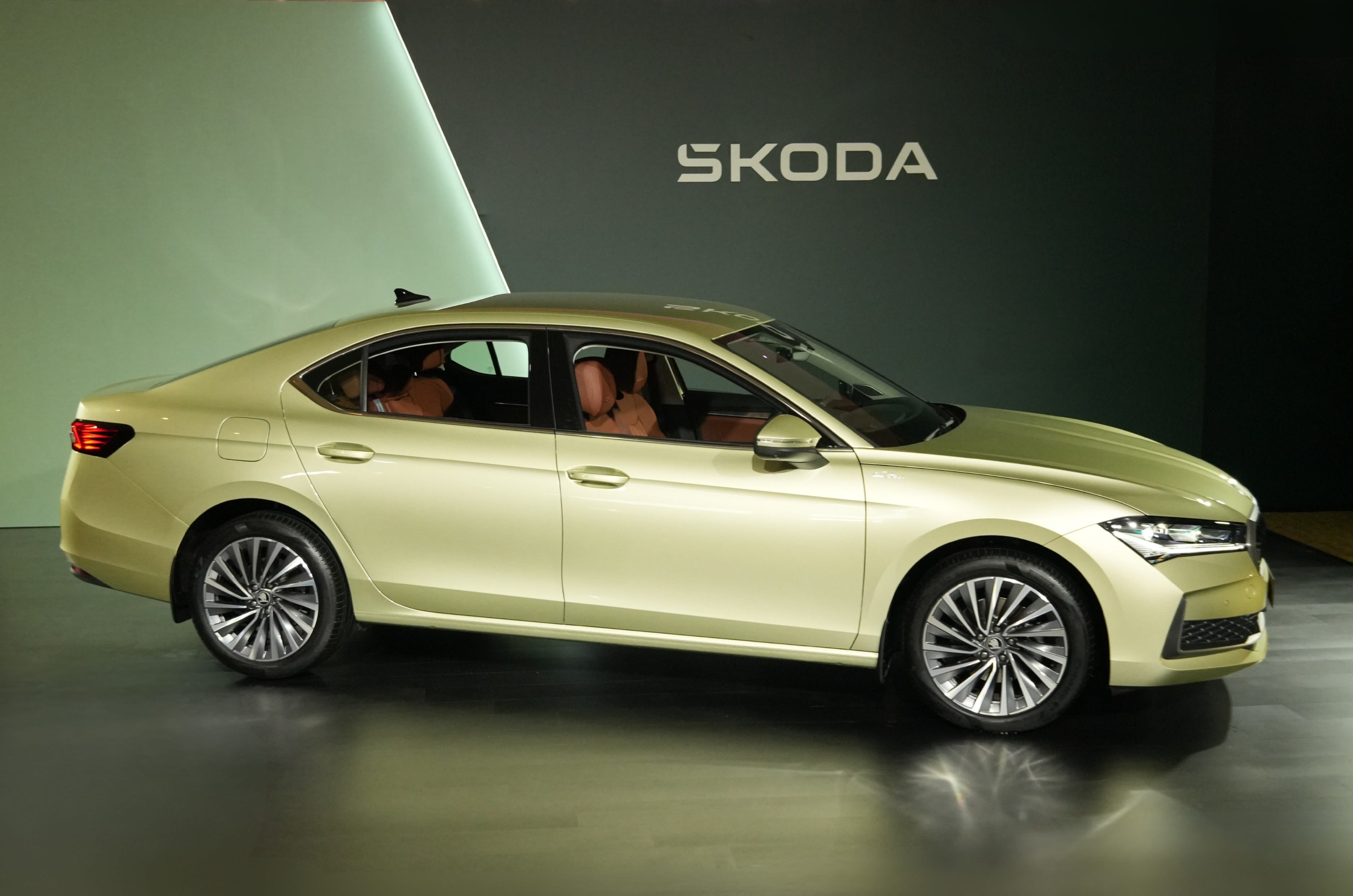
Skoda is evaluating the discontinuation of its flagship sedan, the Superb, amid a larger cost-reduction effort by the Volkswagen Group – the conglomerate aims to halve the number of models it sells within the next decade. First introduced in 1934, the Superb nameplate was originally used for a full-size luxury car made by Skoda up until 1949. Skoda revived the Superb nameplate in 2001 for its flagship sedan, which is now in its fourth generation and has sold over 1.6 million units to date worldwide.
Skoda Superb might end up on the chopping block
In a recent media interaction (reported on by Autocar UK), Skoda CEO Klaus Zellmer said it’s “not a given” that it wouldn’t shrink its model line-up in the future. This is despite the fact that the Czech carmaker reported its most profitable H1 numbers yet in 2026 – €16 billion in revenue and an 8.5 percent return on sales.
Zellmer hinted that Skoda’s sedan and estate line-up could be subject to reductions due to fading buyer interest in these body styles. “The big question is going forward: saloons and limousines and combis [estates] are not on the rising path. The [next-gen SSP] platform caters for wiggle room to go up to Superb dimensions. We’re currently looking into whether we still need the full monty, or whether we will have a smart way to cover both segments and target groups,” he said.
The fourth-gen Superb is offered as both a sedan and an estate, while the Octavia sits below it and has sold nearly 8 million units over its 30-year tenure. Zellmer said the “Octavia has led its segment since 2016,” giving the carmaker a strong seller that increasingly overlaps with the Superb in terms of size and practicality. Therefore, Skoda is examining whether it needs two models covering these buyers or whether a single model could serve both groups more efficiently.
Interestingly, the fourth-gen Superb is set to launch in India as a fully-imported model sometime during the first half of 2027. The Superb will also mark the return of diesel power for Volkswagen Group’s India portfolio, as the sedan will come equipped with a 150hp 2.0-litre TDI engine.
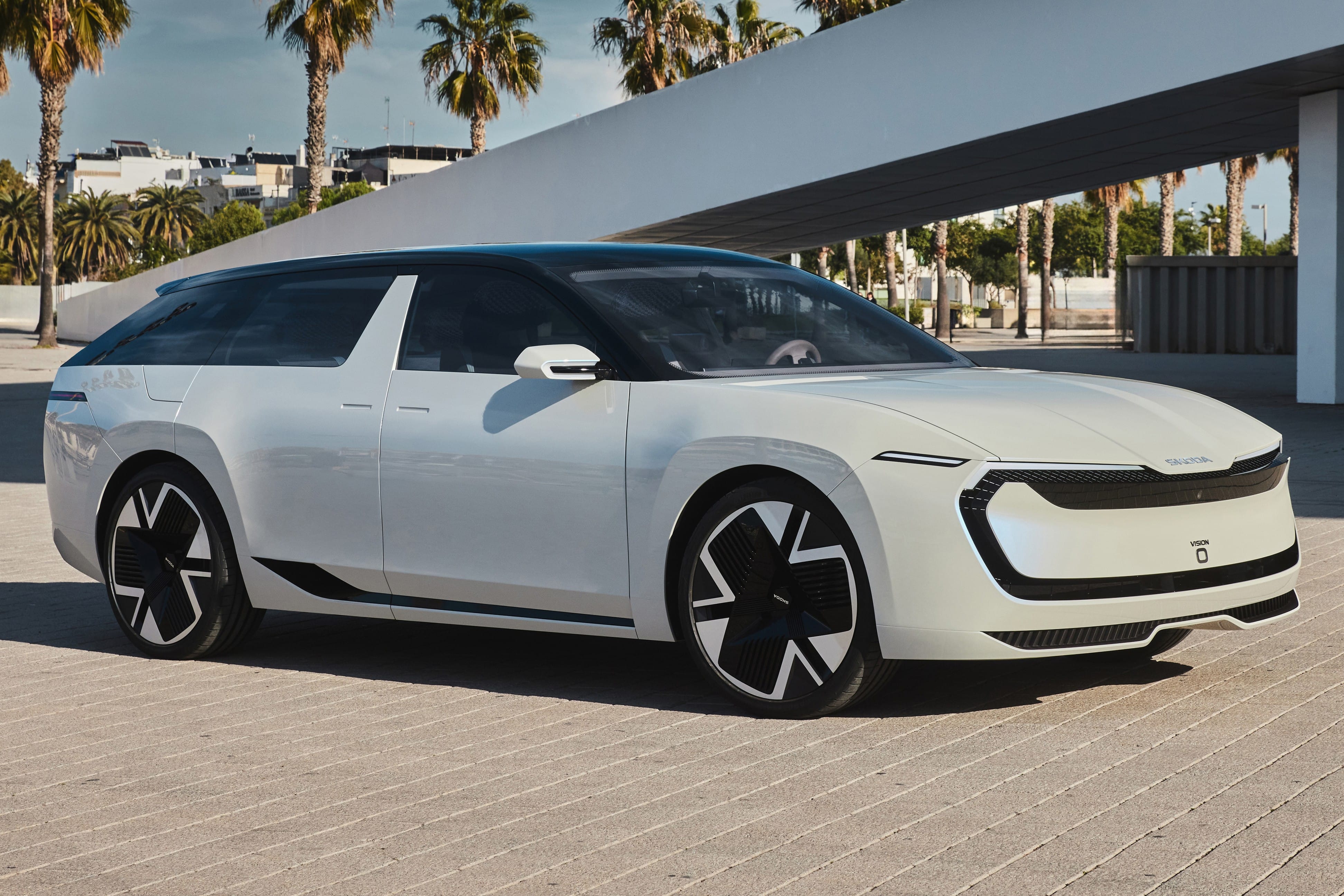
Could the production-spec Vision O replace the Superb?
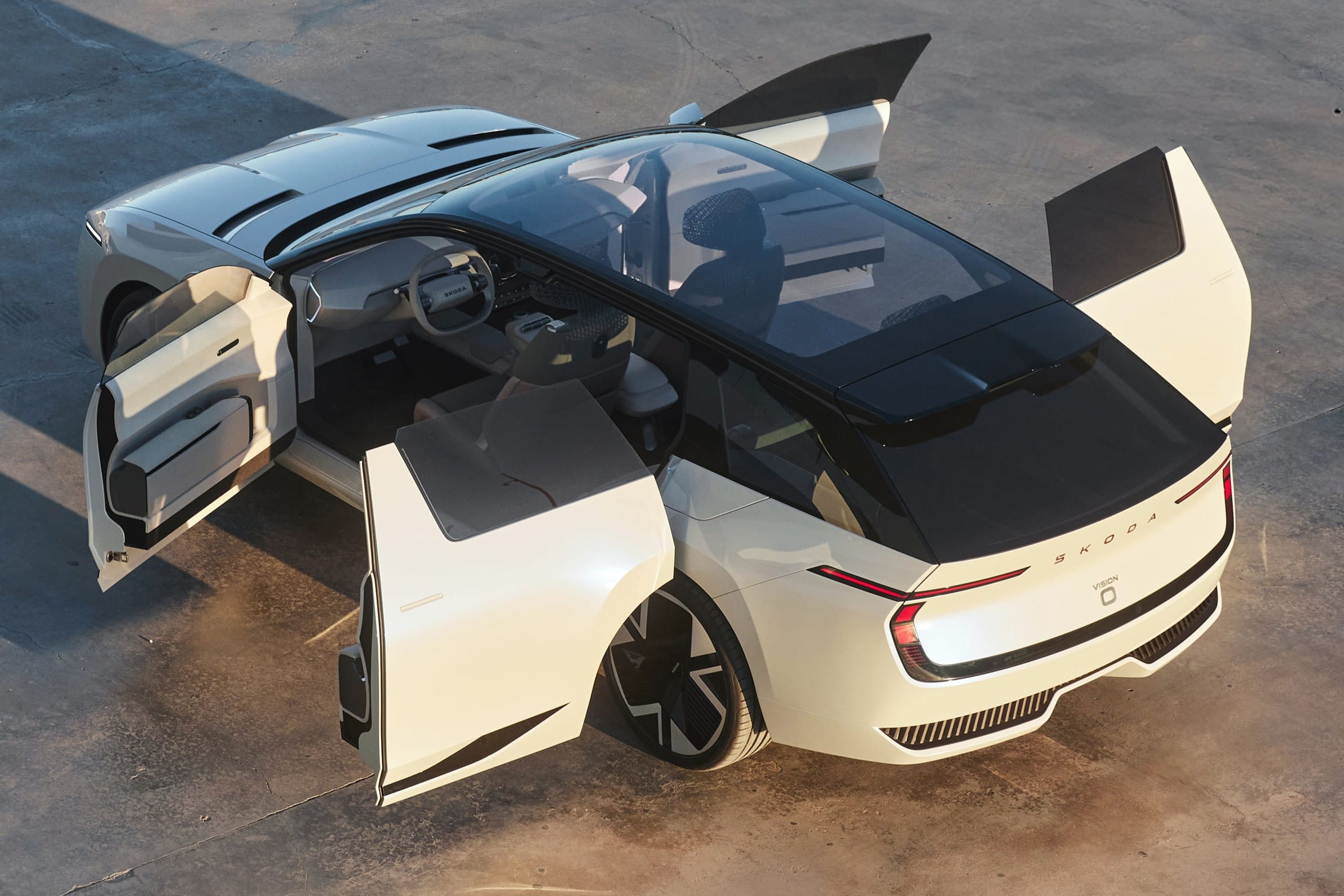
Skoda’s Vision O concept, which was unveiled in 2025 and previews the next-gen Octavia, provides a possible indication of how the carmaker could consolidate its future estate offerings. The 4,850mm-long concept previews the next-generation Octavia as an electric estate, and is 152mm longer than the current Octavia Combi (4,698mm) and just 52mm shorter than the Superb Combi (4,902mm).
This could enable the next-gen Octavia to move upmarket and provide the space and practicality currently offered by the Superb, thus allowing Skoda to axe the latter nameplate. That said, Skoda has not confirmed if the production-spec Vision O will replace the Superb. The concept’s production version is expected to land by the end of the decade and will use the Volkswagen Group’s next-gen SSP architecture.
Skoda is also keeping its options open on powertrains in light of slowing EV adoption, with Zellmer stating that the carmaker’s current model line-up is the largest in its history as a result of “catering for a market still divided between combustion drivetrains and electric vehicles, and everything in between such as mild hybrid, full hybrid, plug-in hybrid.” To that end, a range-extender hybrid setup is being considered for the production-spec Vision O. The EV sales downturn may prompt Skoda to extend the lifespan of its ICE-powered models as well.
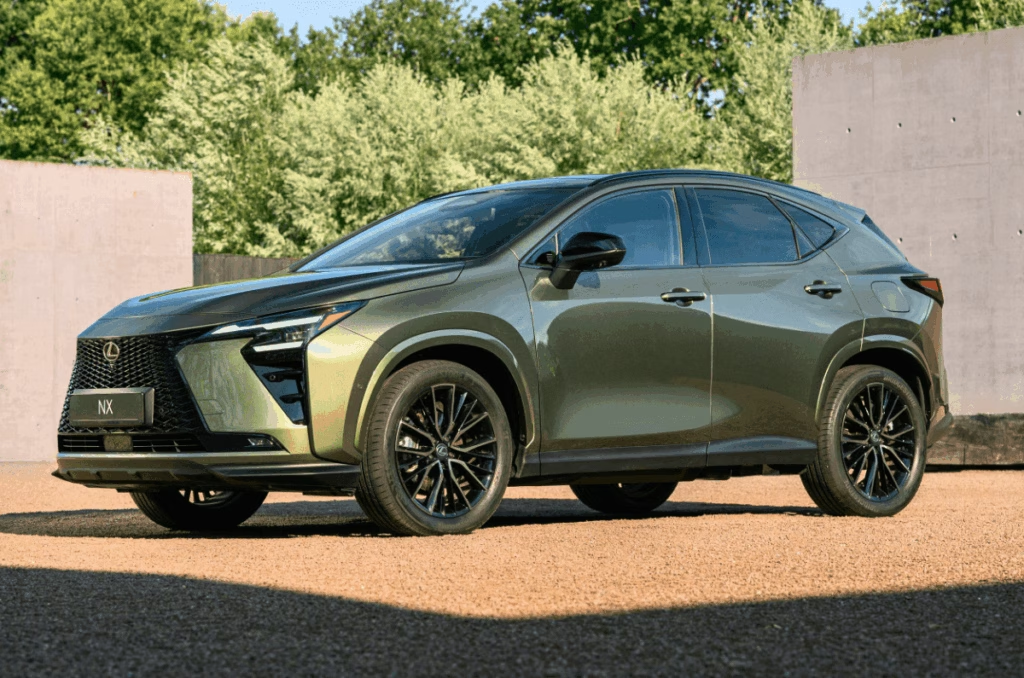
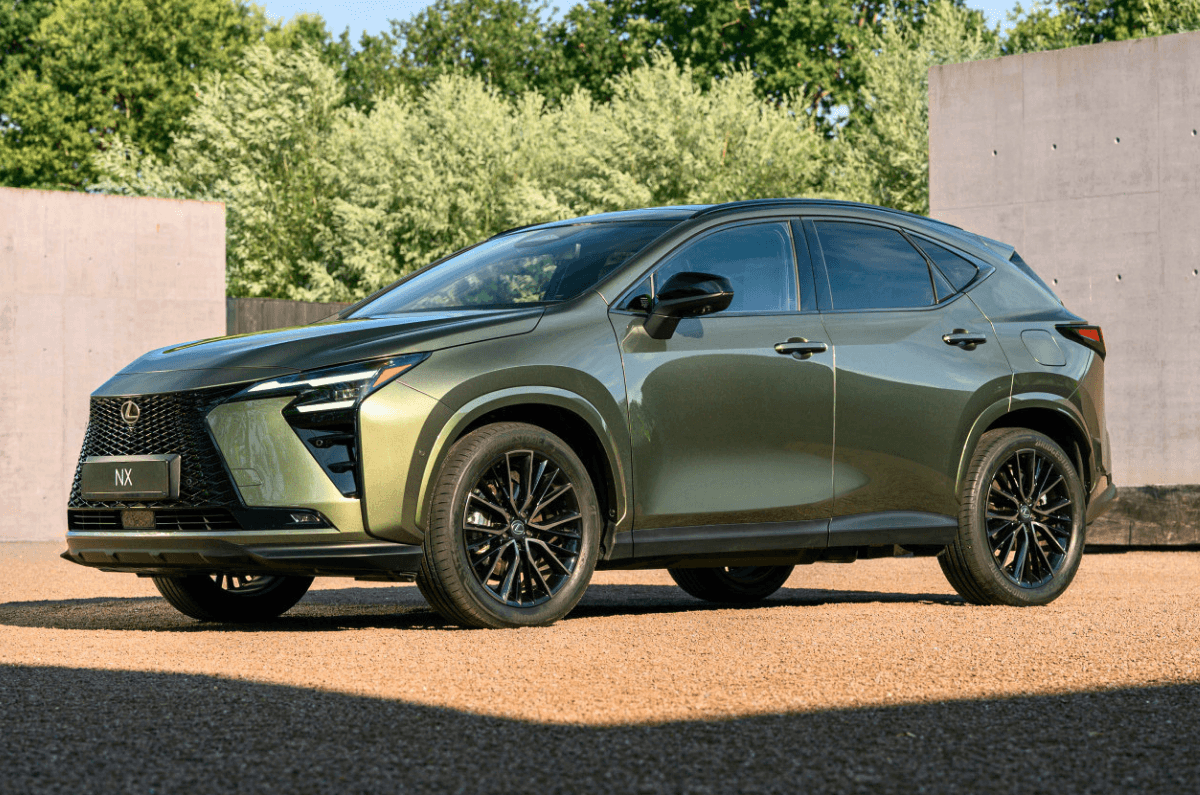
Japanese luxury car brand Lexus has revealed a mid-lifecycle update for its second-generation NX SUV. The 2026 Lexus NX gets design, powertrain and feature upgrades. The carmaker is yet to announce a launch date for the new NX in India.
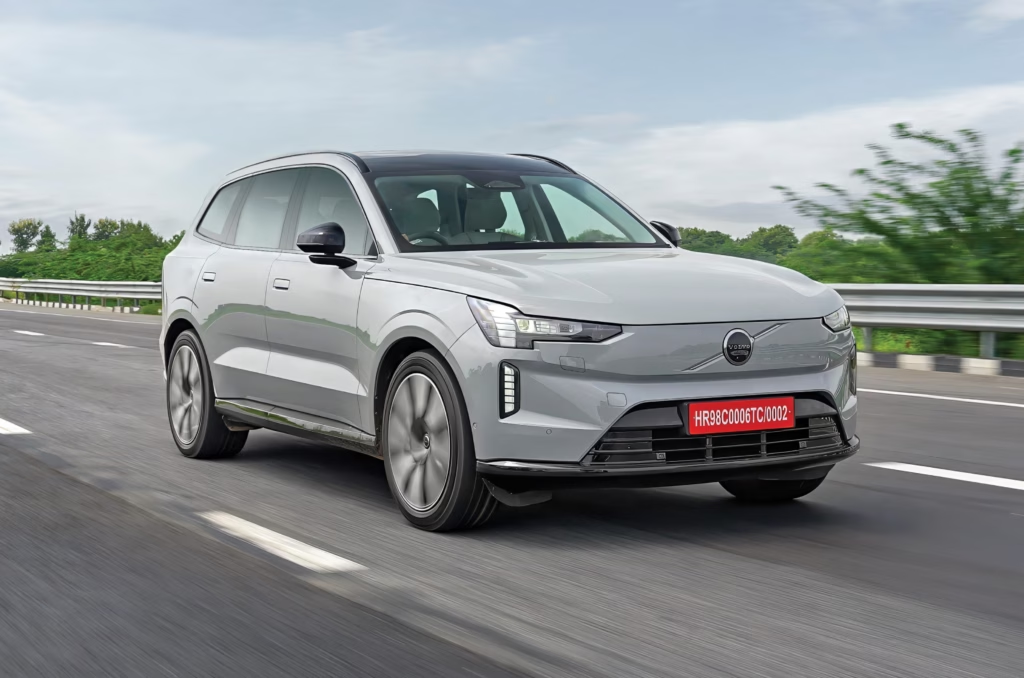
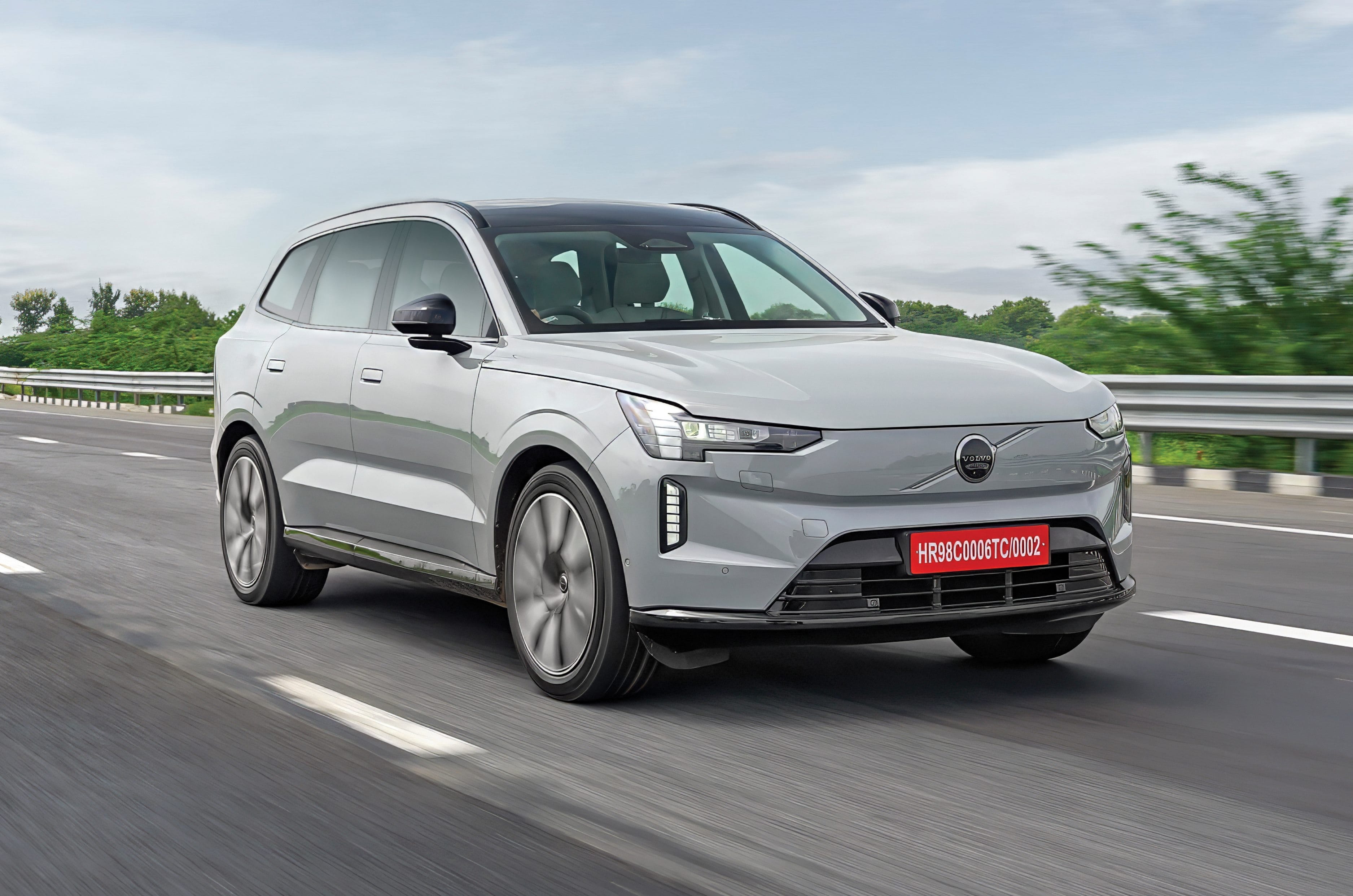
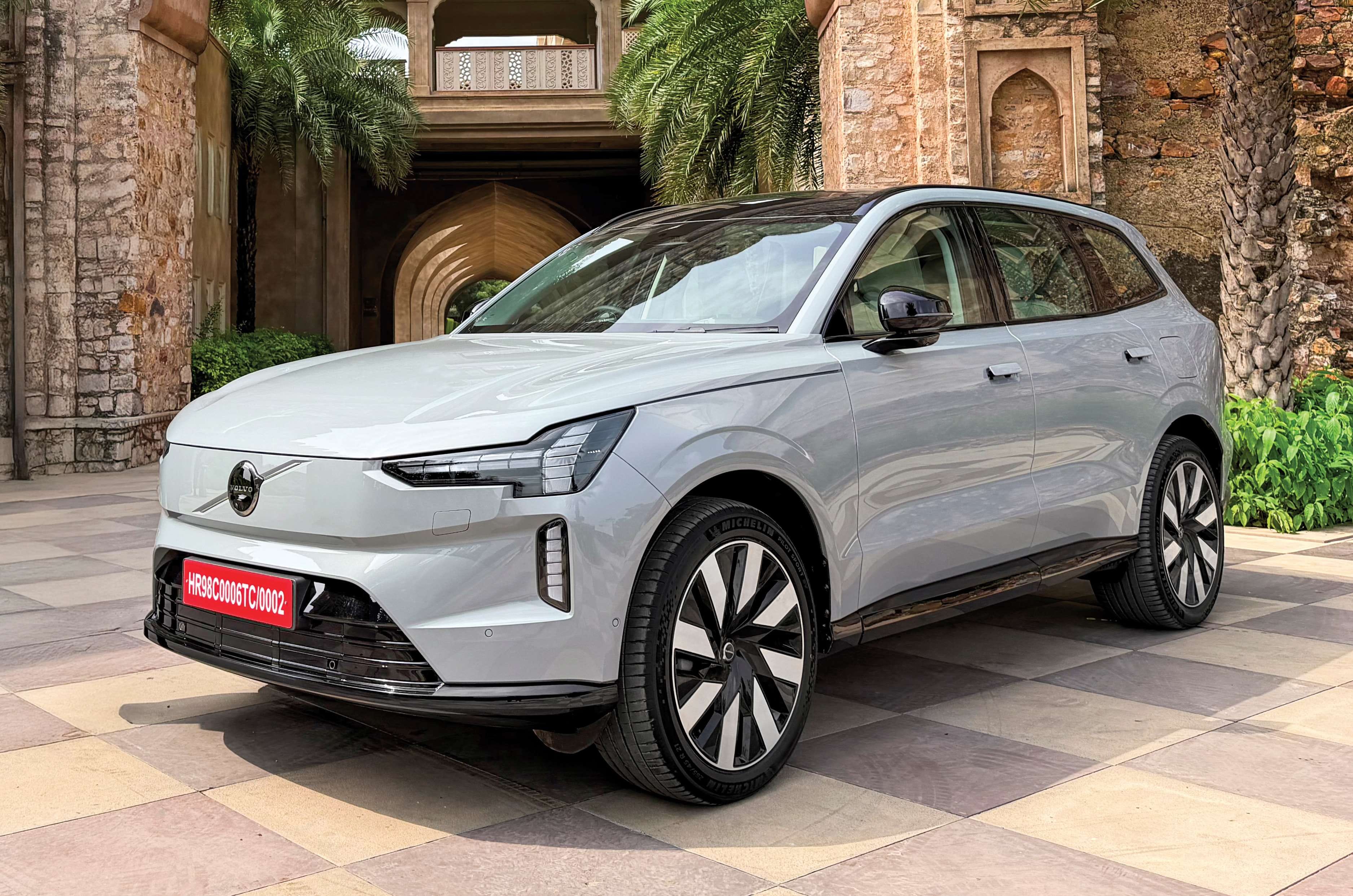
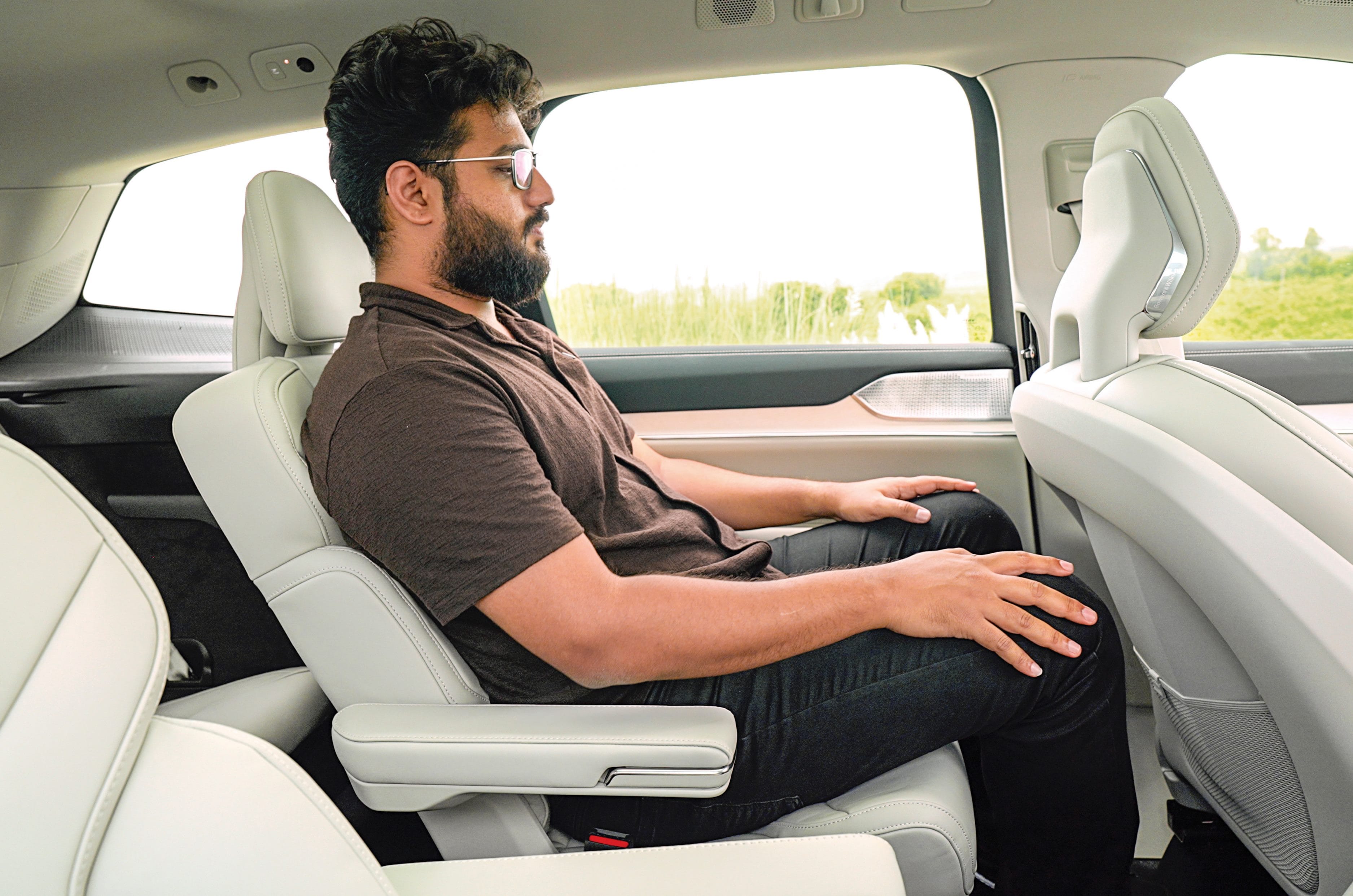
The EX90 is Volvo’s latest offering in India and also its most premium one. The EX30 and EC40 compete in the entry-level luxury EV segment, but the EX90 is the brand’s flagship electric SUV. It comes in a single, fully loaded variant with all the bells and whistles, along with a dual-motor setup and a claimed range of over 600km. Can it bring in a new audience or convert some XC90 customers? It certainly has the traits to do both.
EX90 Exterior Design and Engineering – 9/10
Built on Volvo’s SPA2 dedicated EV platform that has hints of the XC90.
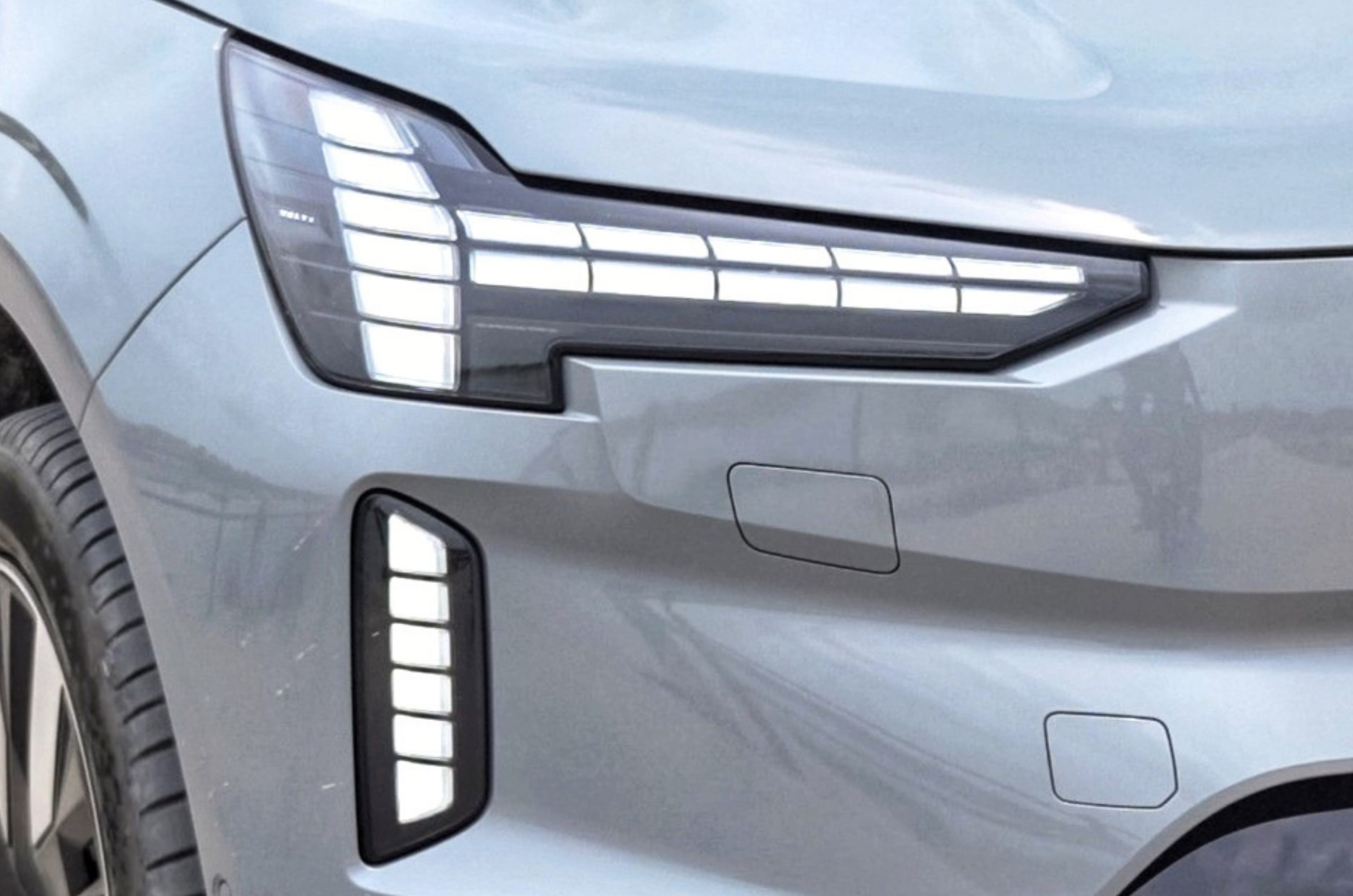
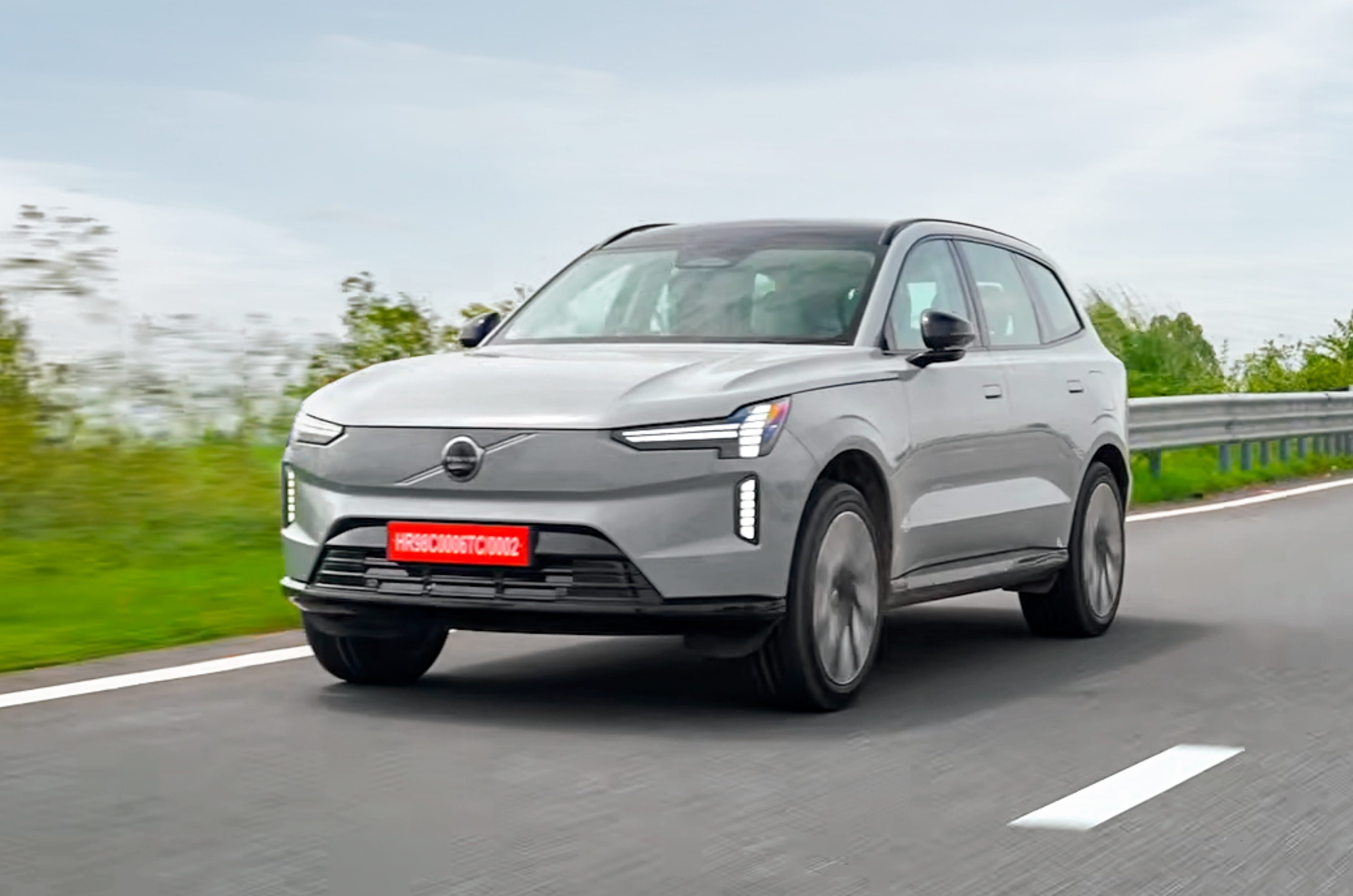
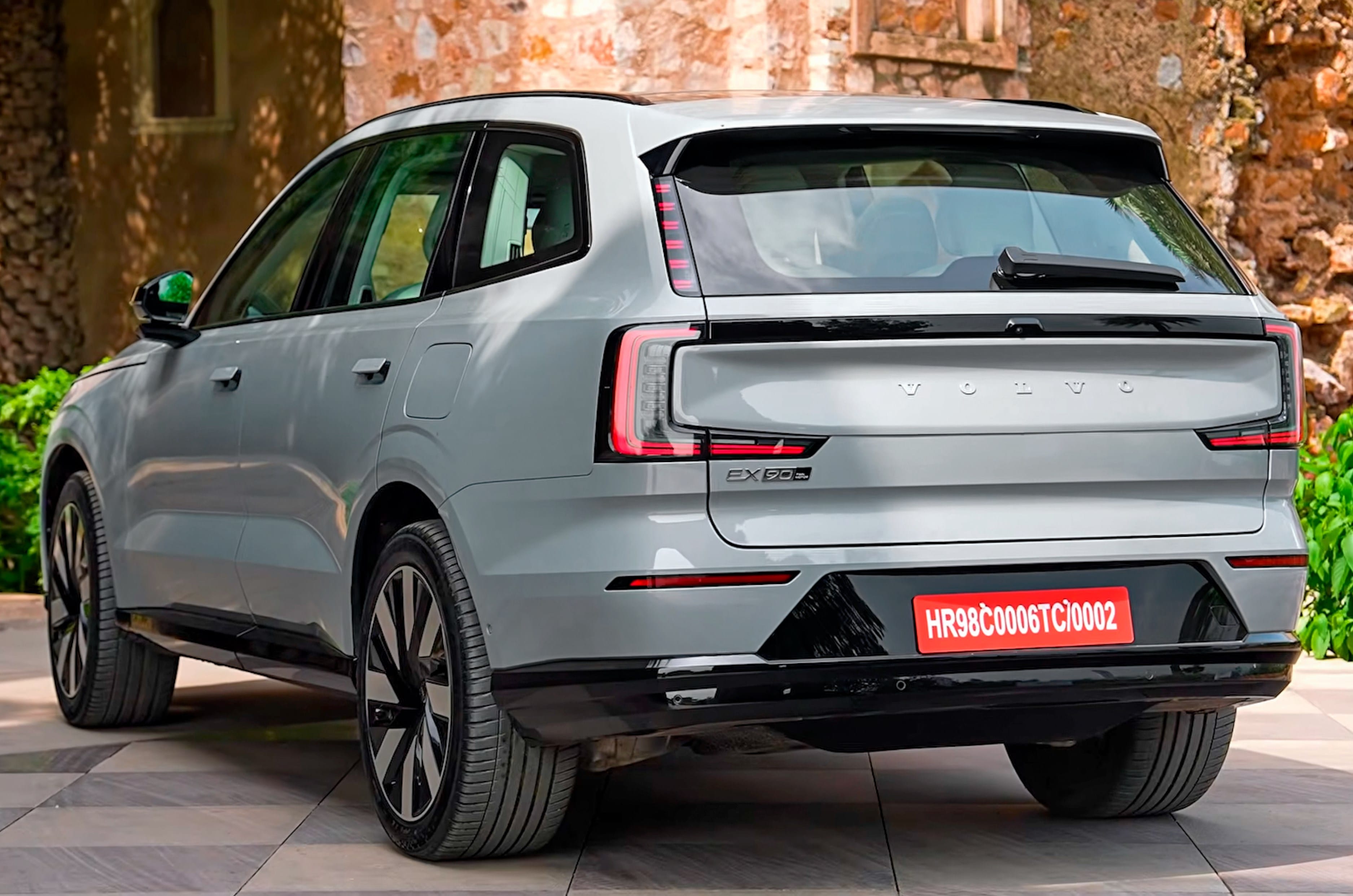
Based on the new SPA2 architecture, which has its roots in the previous SPA platform but is built specifically for EVs, the EX90 does share some resemblance to the XC90 in its shape and form factor. However, the details are different. As expected, the overall design is simple and far from outlandish or attention-seeking. This is in keeping with the brand’s image, and the restraint actually works. The flat, closed-off front end dismisses any chances of a blingy chrome grille, and what adds drama instead are the LED lights that split open to reveal the main headlamps behind. These, too, have an impressive party trick; with over a million pixels, they can individually light up or switch off and constantly shape a light beam to avoid dazzling oncoming traffic. Further down, you get some more DRL strips, one on each side, and a rather simple, fuss-free bumper.
DRLs that spilt open to reveal headlamps add drama.
Over to the side, the EX90 is slightly longer than the XC90, while the rest of its dimensions see a marginal bump. 21-inch wheels are standard, and the 210mm of ground clearance at its lowest setting is plenty. The air suspension also allows you to raise the car up to 250mm for off-road use. The door handles are pop-up, flip-up-style units, and you no longer get a key. Instead, you get a card that you need to tap at the right spot, with the Volvo logo facing the right way, for the handle to pop up. Alternatively, you can simply link your phone to the car and use it as a key. It seems convenient on paper, but the card system needs to be a lot more seamless to be hassle-free.
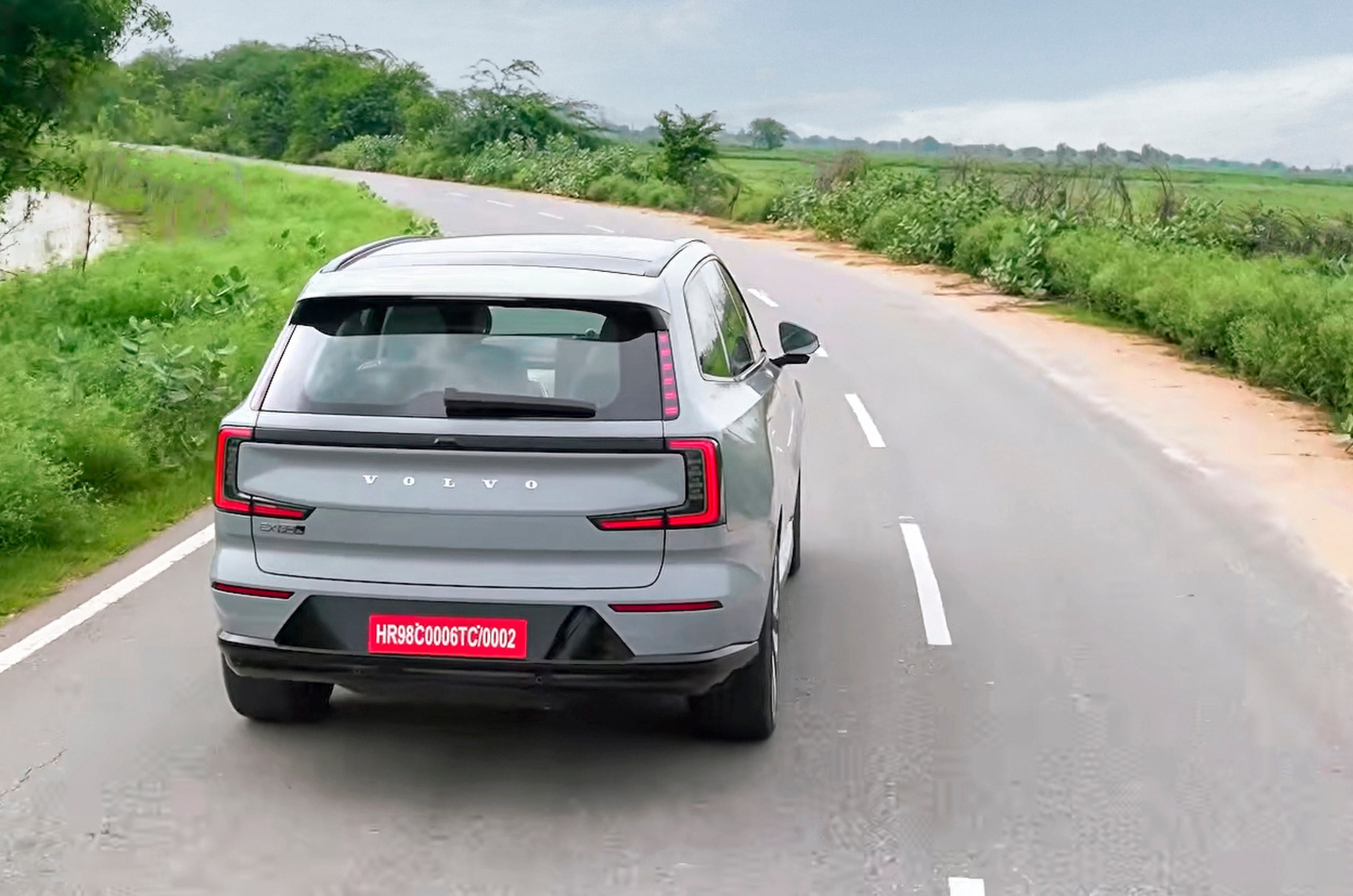
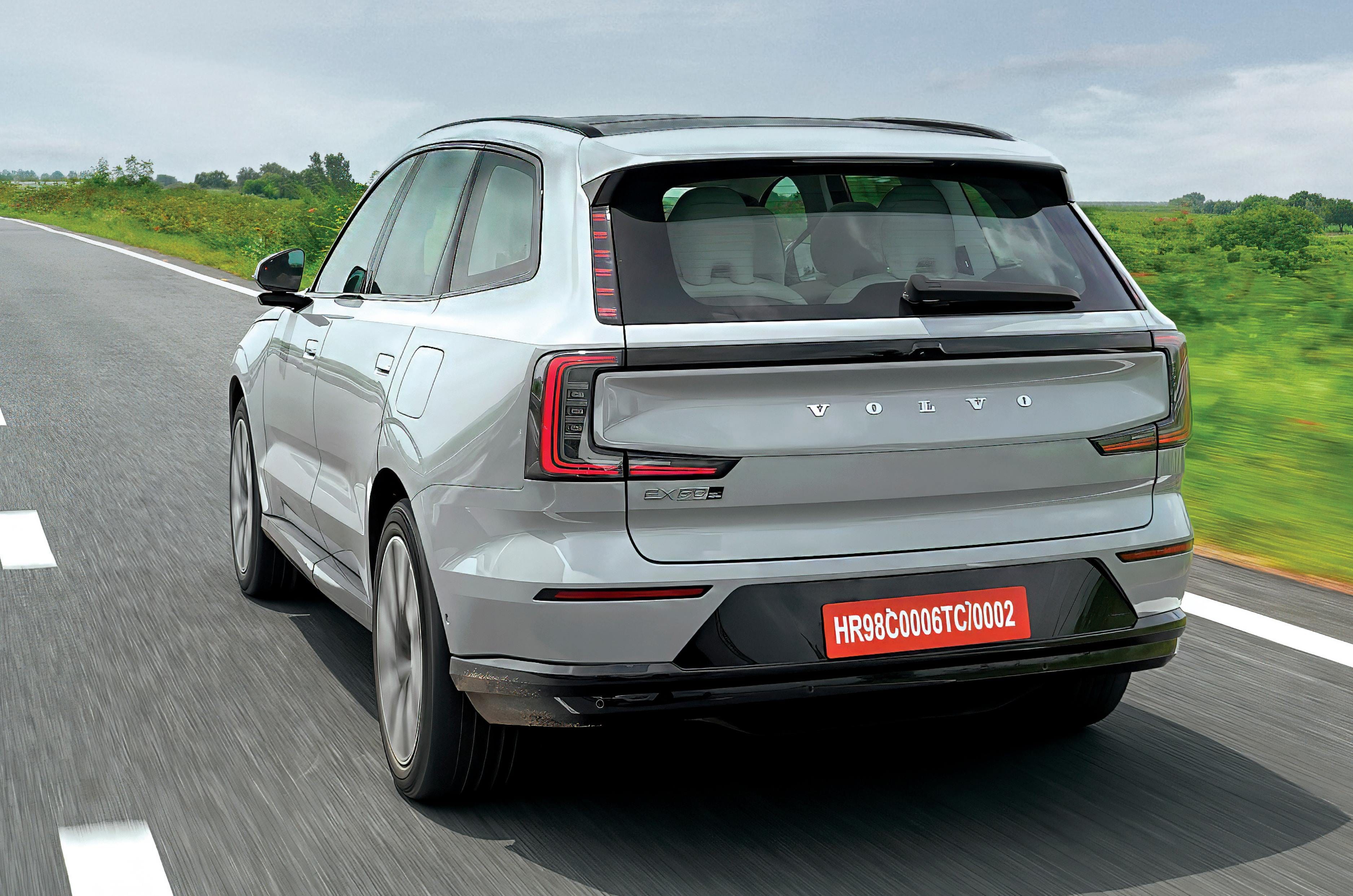
At the rear, it gets a split setup for the LED tail-lamps, with C-shaped LEDs on the lower half and vertically stacked LEDs in the D-pillar. There isn’t a single strip of chrome, and even the cladding is minimal. Subtlety is what Volvo aims for with its design, and the EX90 offers just that.
EX90 Interior Space and Comfort – 8/10
Two-tone upholstery looks rich and materials feel plush.
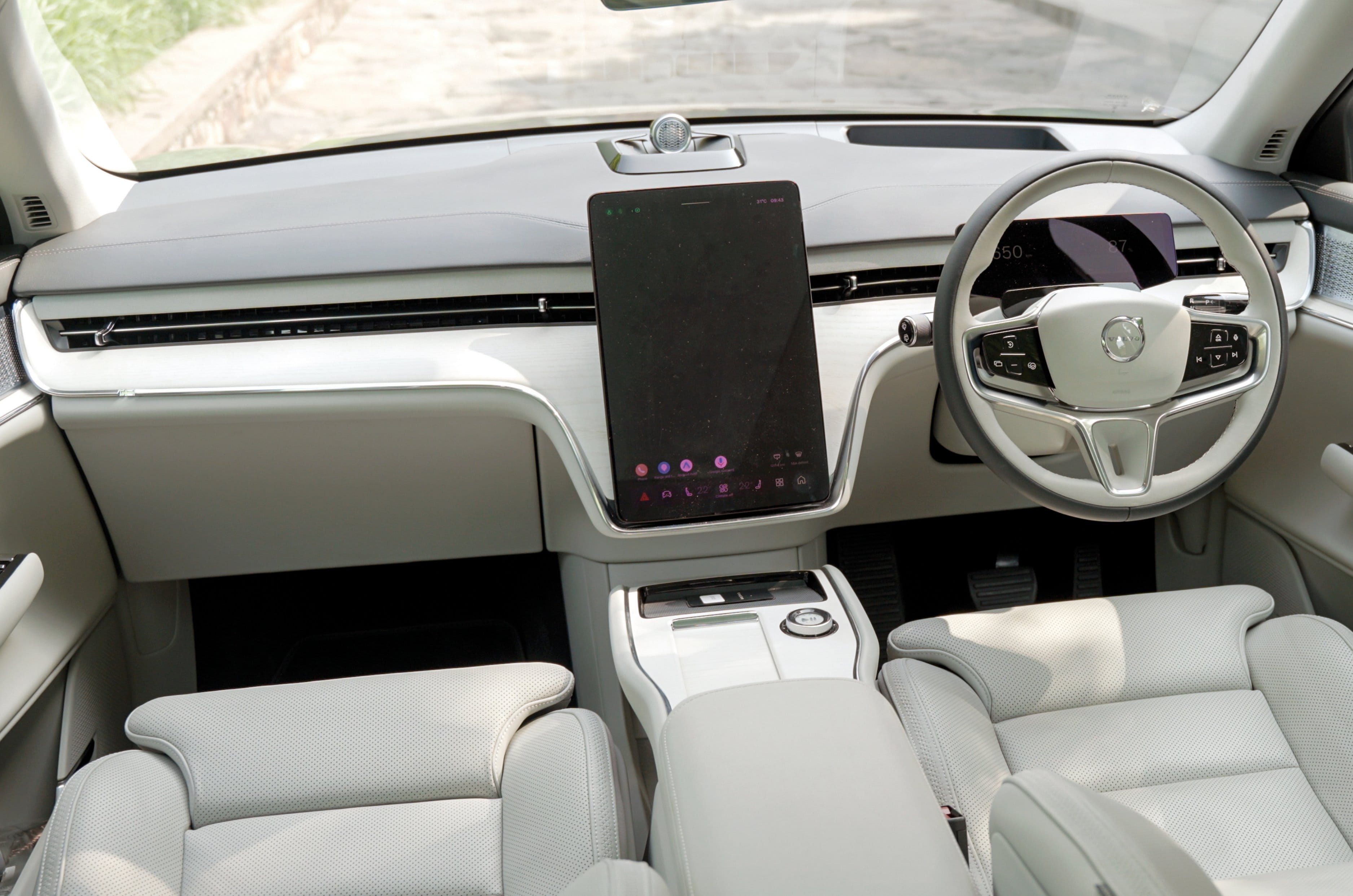
Inside, the minimalist approach continues and even takes precedence. The dashboard is devoid of any buttons whatsoever, and the majority of the real estate is taken up by the 14.5-inch touchscreen. However, the bright seats and upholstery, along with the bright open-pore wood, lift the cabin ambience significantly. There is generous use of brushed aluminium as well, and the Nappa leather is fantastic to the touch. The centre console also features wireless charging and a rotary knob for media control.
There is plenty in the front seats to pamper you. They offer excellent support, and feature heating, ventilation and a whole host of massage options. Plenty of electric adjustment also means finding an accurate driving position is easy, and all-round visibility is very good.
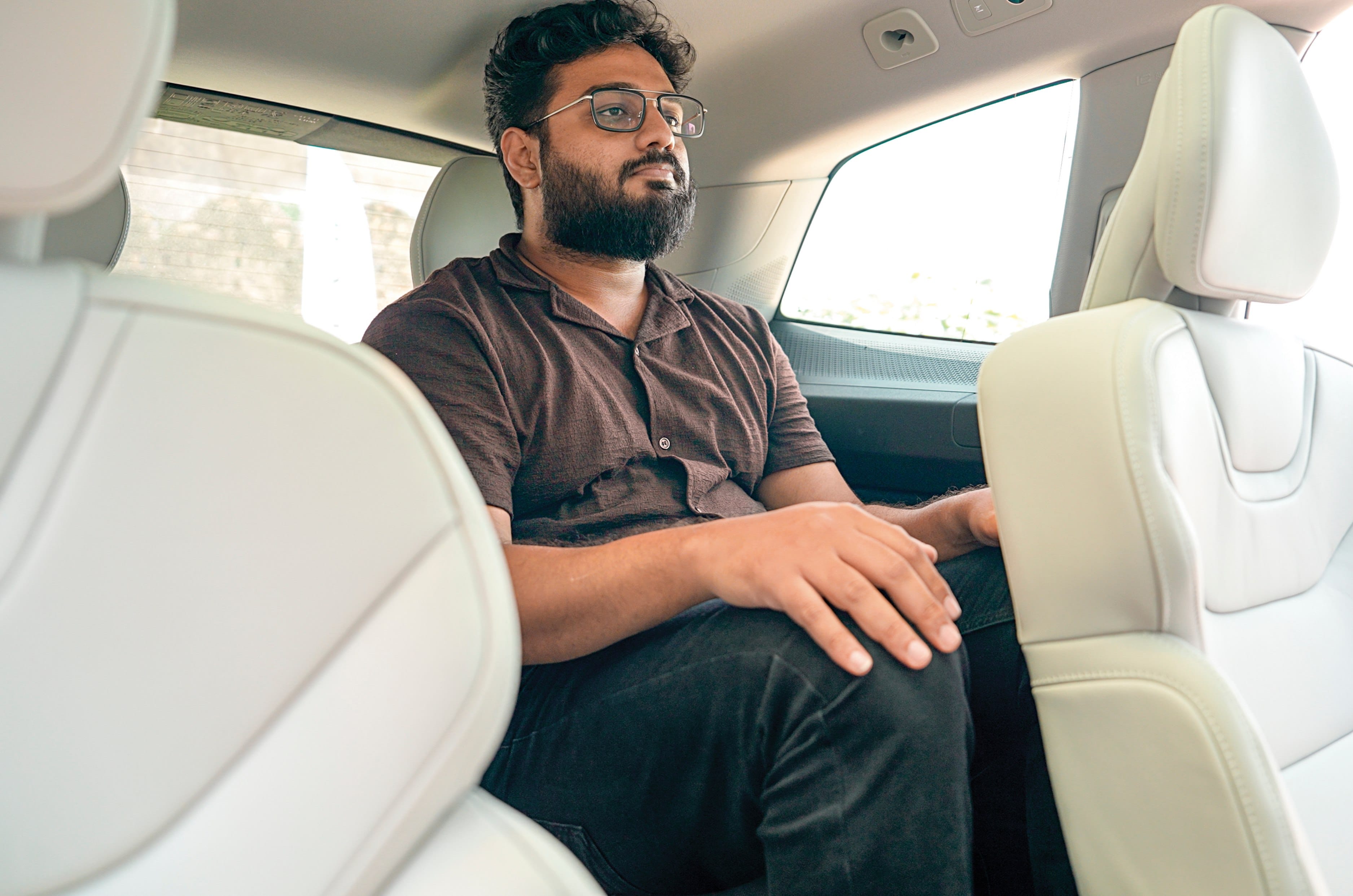
Exclusively a six-seater with good space and comfort.
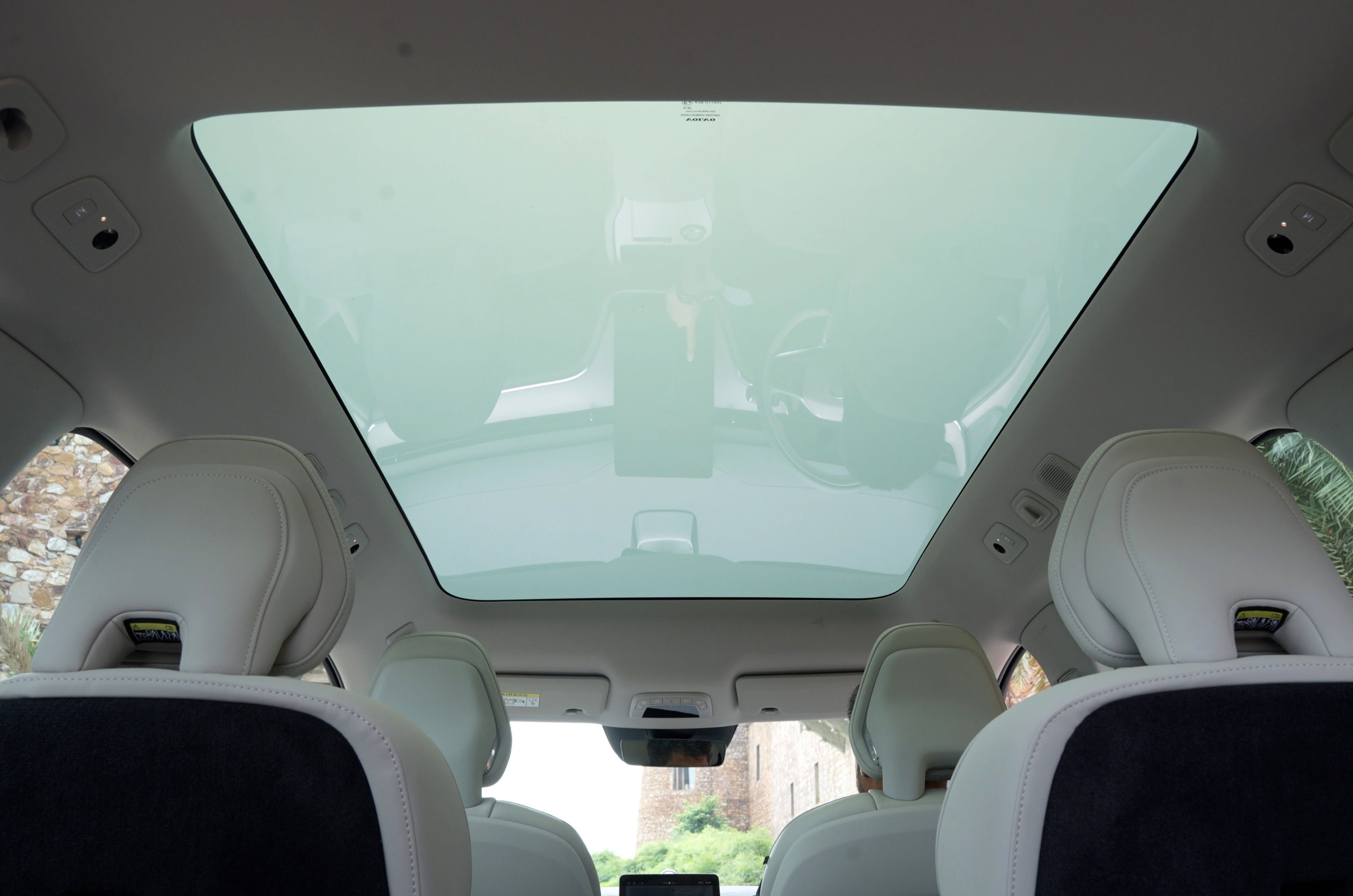
The EX90 is only available as a six-seater, so in the middle row you get captain’s chairs, but these would feel snug for some, and for a luxury car that would be chauffeur-driven, you don’t get the same level of pampering as in the front seats. There is no electric adjustment, heating, ventilation or massage either. There aren’t any sunblinds for the windows too, and even though the huge panoramic sunroof is electrochromic, at the tap of a button you get a bit of tint in the glass, on a hot day with the sun overhead, you will need more.
Massive panoramic glassroof gets electrochromic shade. Physical sunshade is an accessory.
The accessories list has a proper roof shade to protect you from that, and it is an extra we recommend you select. On the plus side, space is good, and the seats can be adjusted for legroom and recline too. You get four-zone climate control, with AC vents in the pillars that are a lot more effective, and cupholders stowed within the armrests. Also, being a modified platform, the floor is raised, and you notice this while getting in and out of the car.
Access to the third row is easy from between the captain’s chairs, thanks to the flat floor, but there is no tumble feature for the seats. Instead, they only slide forward, opening a cavity to get in. Room in the last row is at a premium for tall adults, but kids or shorter adults will do just fine with a little adjustment to the middle row.
Third row best suited for kids or short adults over quick drives.
With all three rows up, boot space stands at a healthy 324 litres, and with the third row folded away, it is a sufficient 690 litres. There is a 46-litre frunk too for stowing charging cables. Impressively, there is a full-size spare wheel as standard, which will eat up some boot space but is a huge relief given the low-profile tyres and our roads.
EX90 Features and Safety – 8/10
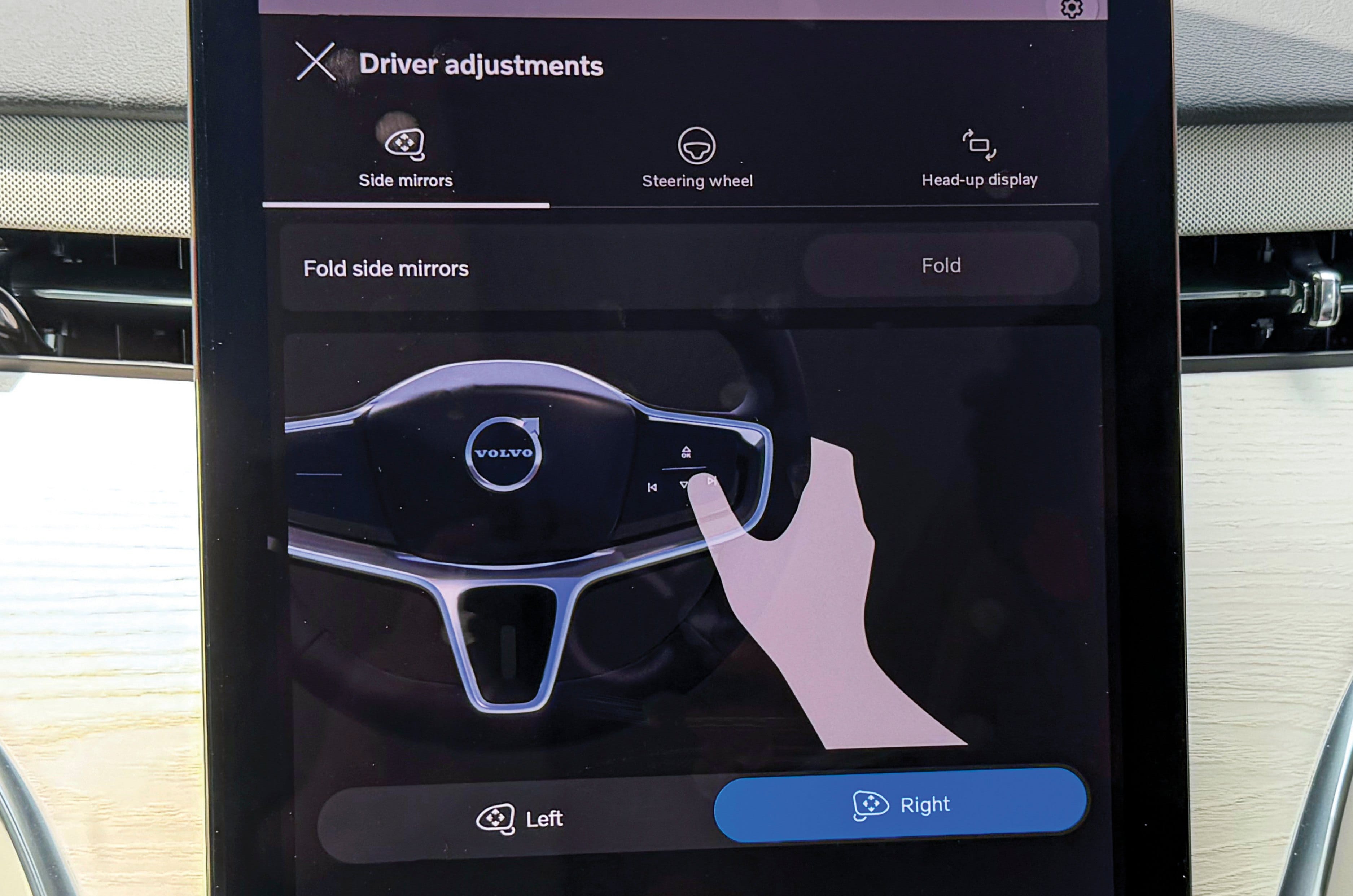
Annoyingly every control is within the 14.5-inch Google-powered screen.
Most of the EX90’s features are accessed through the massive, vertically oriented touchscreen. Being Google-powered, it runs a smooth OS, but simple tasks like adjusting the ORVMs require multiple inputs and navigation through the menus, which isn’t easy while on the move. There are some hard-coded functions at the bottom of the touchscreen, such as climate control, but you still need to focus on the screen and cannot operate them easily while driving. There is also a 9-inch driver display with nothing but the absolute necessary figures, such as range, speed and battery percentage. You can also load up the maps there, and it displays the traffic around you too. However, don’t expect multiple dials and a loaded, fighter-jet-like cockpit experience, the instrumentation is all minimal but feels sparse too.
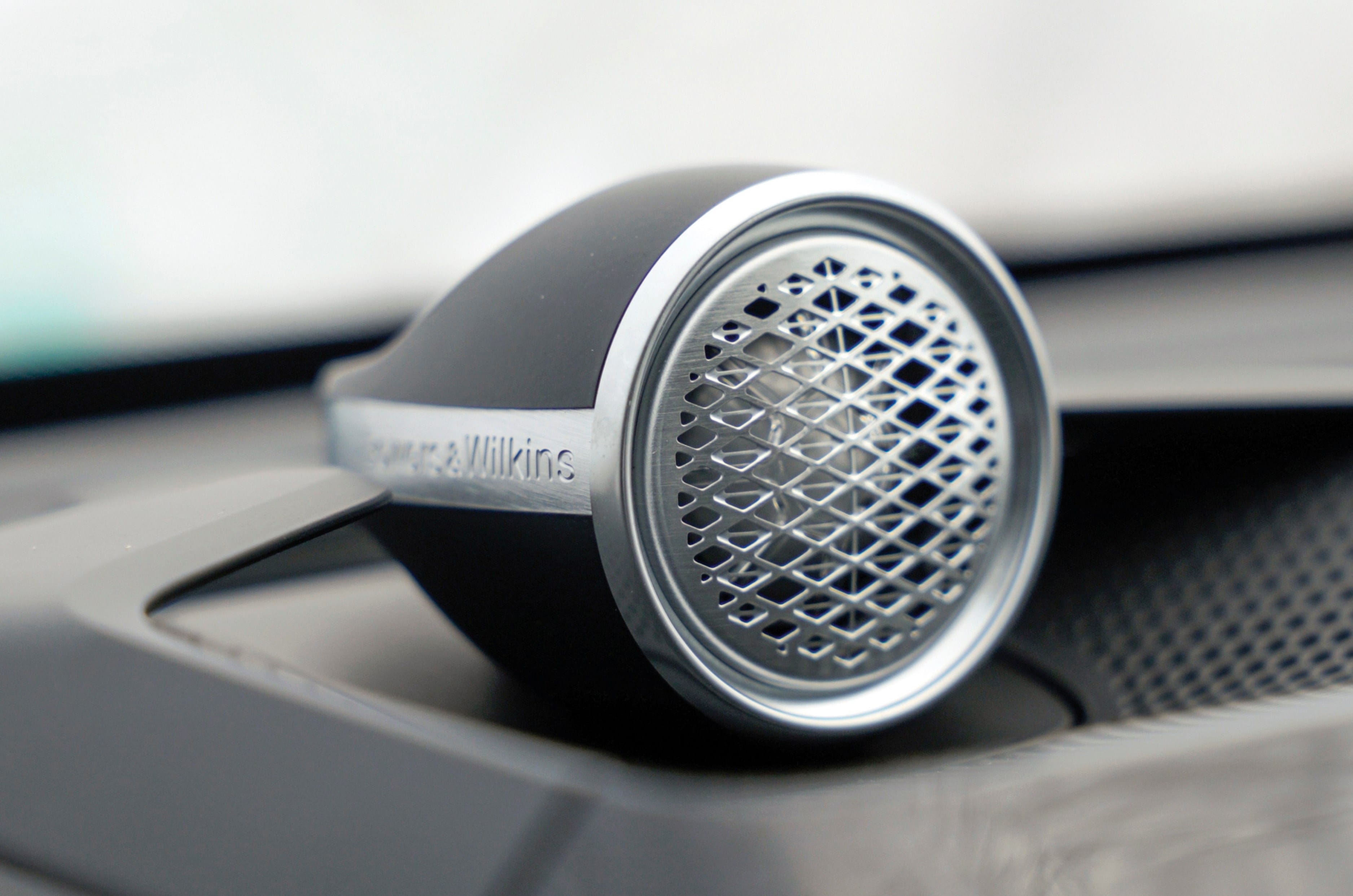
Bowers & Wilkins Hi-Fi audio system is epic.
What is excellent, however, is the music system: a 1,610W, 25-speaker Bowers & Wilkins Hi-Fi audio system with custom presets and modes that truly transform the cabin. If you enjoy your music, there are few cars in the world that offer something at this level or better. Safety is where Volvo excels, and the EX90, being the flagship, has all the bells and whistles – active and passive. Nine airbags, five cameras, five radars and 12 ultrasonic sensors, powering a full ADAS suite including door-opening alert and post-impact braking, make it exceptionally well equipped. Essentials like a 360-degree camera and auto-parking further make it easy to live with.
EX90 Performance and Refinement – 9/10
It is just as nice to drive as it is to be chauffeured in.
The EX90 comes in a single variant in India, with a dual-motor setup and a 106kWh battery pack. It develops 456hp and 670Nm, making it quick off the line. 0-100kph takes just 5.5sec, which, given its size and type, is pretty impressive. However, from behind the wheel, the experience aligns with its laid back character. You can alter the dynamics using the four drive modes. ‘Range’ prioritises efficiency, and power and torque are heavily restrained, although in bumper-to-bumper traffic, you will not notice the dip. There is a creep function too for peak-hour jams. ‘Standard’ is a balance that suits the car well for the most part, while ‘Performance’ is for that rare time when you want to add some enthusiasm.
Despite its strong power figures, performance feels more like an airliner than a fighter jet.
Don’t expect fighter-jet levels of reactions, though. Even in ‘Performance’ and with a heavy right foot, the EX90 builds pace gradually. It is almost like taking off in an aeroplane, where the speed rises in a strong and linear manner. This mode zaps power swiftly, so it is best to use the ‘Standard’ mode and get the best of all worlds. If you end up venturing off the tarmac, the ‘Off-road’ mode allows for more ground clearance (250mm), and it alters traction control and ESP settings to allow for more traction on loose surfaces.
Once on the move, what is extremely impressive is cabin refinement. With no engine sound to distract you, EV cabins amplify ambient sounds like wind and road noise, especially with large tyres, but the EX90 is a different story. Cabin insulation is top-notch, and it is near-silent on the inside. It also has a neat trick, microphones all around the car can relay conversations via the speakers clearly no matter where you are seated. You only have to talk in your natural tone for your voice to clearly go through the microphone and speakers. So passengers sitting at the first and third row can have a conversation without having to speak loudly.
EX90 Mileage / Range and Efficiency – 9/10
The 106kWh battery can eke out 625km according to the WLTP cycle. In our short test drive, we saw an efficiency of 5km/kWh in mixed driving conditions, resulting in a range of 530km. That is rather respectable, and considering a majority of our drive was on the highway, this number should only get better in the city.
The EX90 also has regenerative braking, and you can go from having it completely off to low or high, or just leave it in Auto, where it does all the thinking for you. Feel, though, leaves a lot to be desired, the pedal never feels consistent in its bite point. You get an 11kW AC charger for your home or office, which takes 11 hours for 0-100 percent. But being an 800V system, it can charge at up to 350kW on a DC charger, taking just 23 minutes for 10-80 percent. The car will also pre-condition the battery, meaning it gets the battery up to its optimum temperature to charge as quickly as possible.
EX90 Ride Comfort and Handling – 8/10
The EX90 rides on air suspension, which, over broken roads at medium or high speeds, is excellent. The car adjusts within microseconds, and you barely feel bumps inside. You can firm it up for the highway, so there is none of the wallowy feel associated with a softly sprung setup. Three modes to choose from give you flexibility depending on the road surface. ‘Standard’ offers the best balance, as it has the softness without feeling overly soft in the corners, while ‘Firm’ adds a layer of stability at speed and on fast bends. ‘Soft’ is a bit too soft, and the car ends up diving or rolling a tad more than necessary. In the city, there is none of the harshness over low-speed bumps, and the composed nature of the suspension is its highlight.
EX90 Value for Money – 8/10
The EX90 offers just about everything you need in a luxury EV
Prices for the EX90 will be out in October, and it will be the brand’s flagship SUV, sitting above the XC90. If you are looking for a chauffeur-driven luxury EV, it will tick the right boxes. That said, sunblinds would have been nice, and as a driver, it will frustrate you with an over-reliance on the touchscreen and a fiddly key card. On the whole, though, it does a lot to impress and allows you to forgive these shortcomings. You get everything you expect from a luxury EV, the cabin is plush and comfortable, the materials and feel are excellent, the design is subtle but svelte, and the ride comfort is truly impressive. It rivals the Mercedes-Benz EQS and BMW iX, and while it may not be as feature-loaded in the rear seat as the EQS or as powerful and fun to drive as the iX, it does find a very nice middle ground and would be top of the list for those looking for minimalist class and luxury.
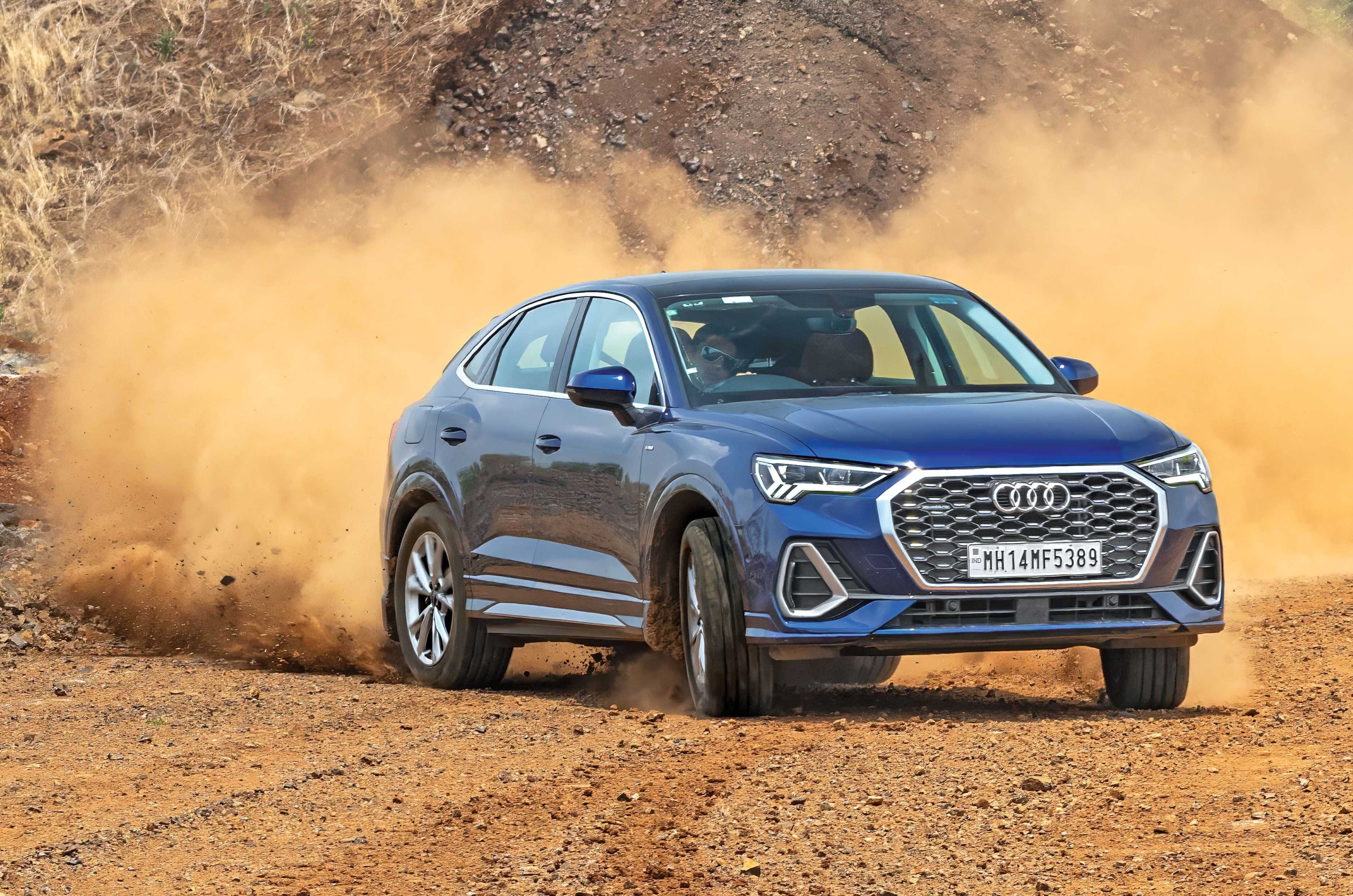
Okay, first, a clarification: that’s not me hooning around in the Audi Q3 Sportback. That’s a certain Mr Saumil Shah, who borrowed the car from me for ‘work’ – in the biggest air quotes imaginable.
The Q3 Sportback was the support car for our Lamborghini Sterrato shoot at Nanoli Speedway. And, naturally, a muddy track with acres of runoff was an opportunity that proved far too tempting for him to resist. Fun cars do have a way of making you do slightly silly things when the right opportunity presents itself. And I’d definitely put the Audi Q3 in that category. It’s got a peppy engine, neat handling and even good ground clearance, all wrapped within a compact footprint. As someone who loves smaller cars, the Q3 is right up my alley.
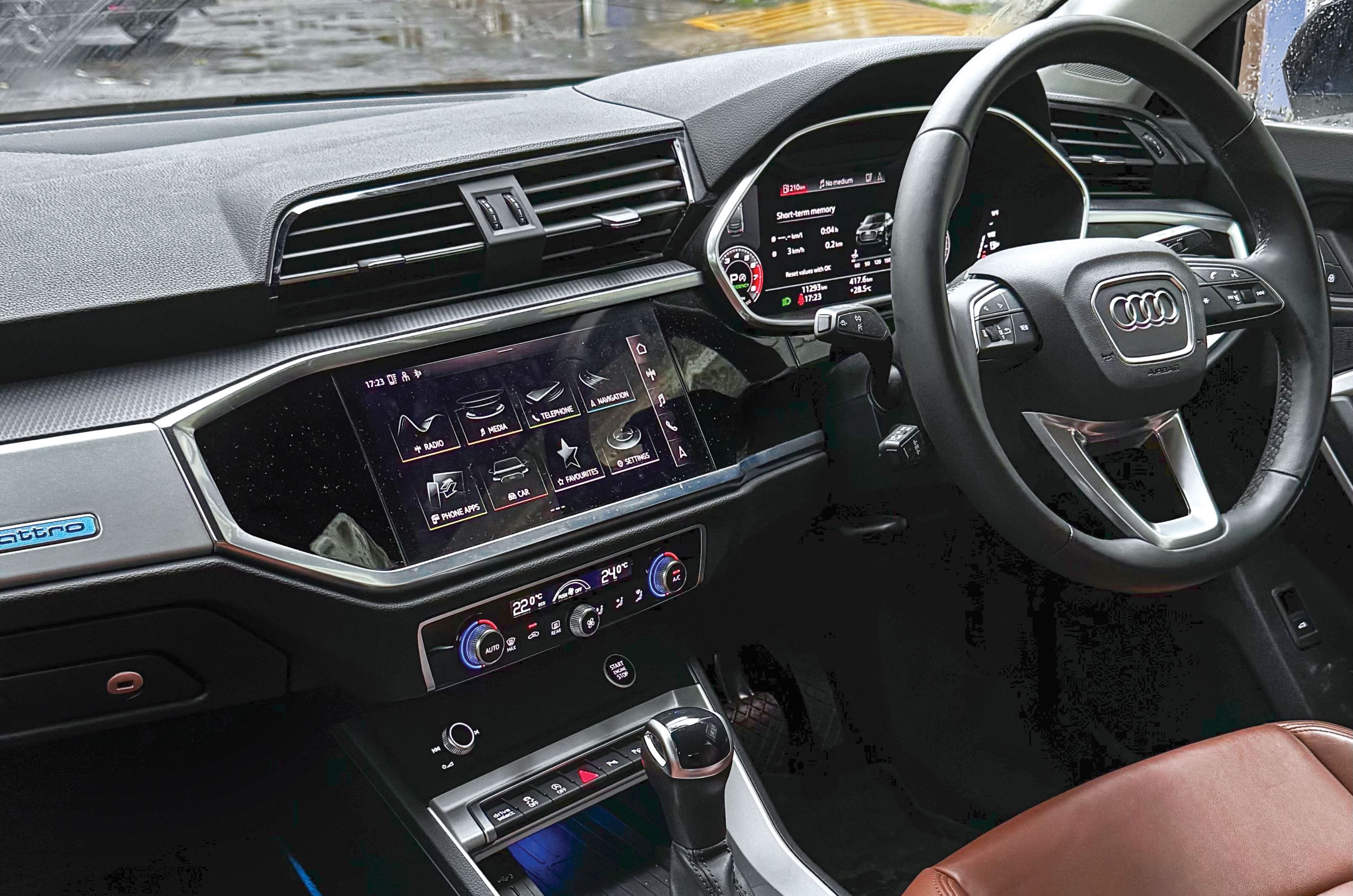
It might not look cutting-edge, but buttons and knobs make the dash very user-friendly.
I’ll admit, life with a luxury car can be a little stressful on Mumbai’s congested roads, where you’re sharing whatever road space is left after all the construction with cars, bikes, battle-hardened buses and everything in between. But the Q3 takes a lot of that stress away. The small size and elevated seating make it very easy to place, and what makes things more relaxing still is the excellent noise insulation. It’s no EV (the engine does get vocal in a good way when rushed), but the Q3 does cut out a lot of the cacophony outside. Another highlight on the Q3 is ride comfort. It makes light work of bad roads with the chunky tyres taking up a lot of the initial impact. Just wish the Q3 got snazzier wheels. The boring alloys undo much of the glamour of the Sportback’s SUV-coupé shape. Gun to my head, I’d still take the standard Q3 with its more conventional derriere.
The Sportback has its fans, but I’d have the conventional Q3.
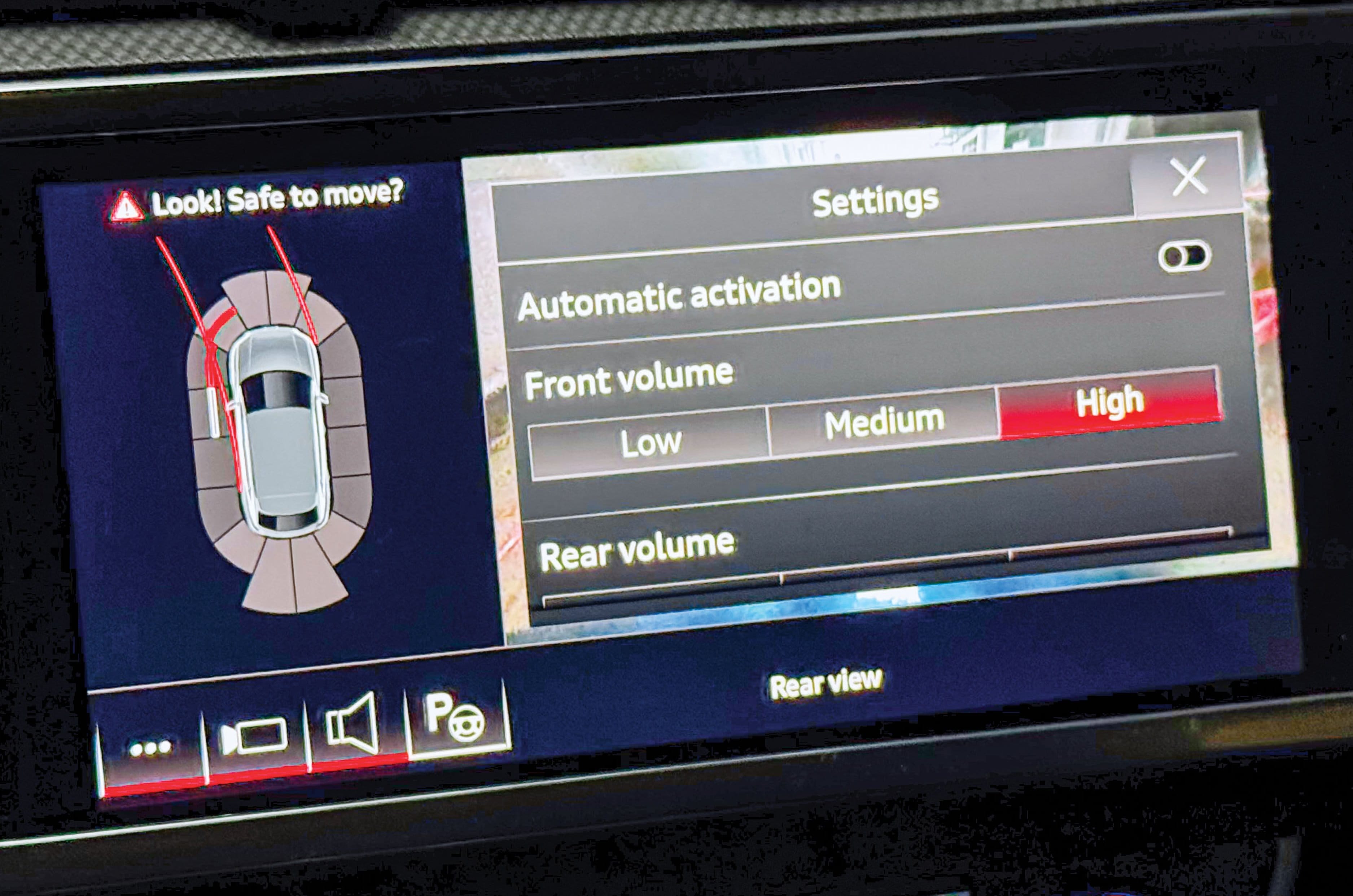
In cars with ADAS, my SOP is to first check if auto-braking functions are off. The Q3 doesn’t have ADAS, but I do still have a pre-flight check. And that is to ensure Automatic Parking Sensor Activation is turned off. The Q3’s overly sensitive proximity sensors seem to react to absolutely everything around the car and the constant beeping can get alarming in heavy traffic. Of course, connecting my phone via a wire is also a requirement because there’s no wireless connectivity in the Audi.
Constant warnings from over-sensitive proximity sensors an irritant. Best kept off in traffic.
Thing is, I don’t want to overplay these small irritants. Because, in the big picture, the Q3 remains a charming option for buyers looking for an entry luxury car. More so now with some great deals going on the model as it makes way for the next-gen Q3 that comes later this year. Having lived with one, I know I won’t get bored of this Q3 for a long time to come. Heck, maybe I need to scout around for a good deal myself.
आर्थिक रूप से आत्मनिर्भर होने के बाद, कई बच्चे अपने माता-पिता को आरामदायक जिंदगी देने और उनके सपने को पूरा करना चाहते हैं। एक व्यक्ति के लिए यह सपना एक लग्जरी कार के रूप में सच हुआ, जबकि एक समय ऐसा भी था जब सिर्फ ‘Nano’ कार खरीदने की इच्छा रखने पर उनके परिवार का मजाक उड़ाया गया था।
माता-पिता को आराम की जिंदगी देना और उनके सपनों को पूरा करना हर बच्चे की इच्छा होती है। आर्थिक रूप से मजबूत होने के बाद कई बच्चे अपने माता-पिता के लिए कुछ खास करना चाहते हैं।
यह वीडियो ट्रेडर और कंटेंट क्रिएटर हर्षित पटेल ने इंस्टाग्राम पर शेयर किया है। क्लिप में पटेल अपनी मां को 1.5 करोड़ रुपये की कार में टेस्ट ड्राइव पर ले जाते हुए दिख रहे हैं। जब उनकी मां कार में बैठती हैं, तो वह उन्हें उन दिनों की याद दिलाते हैं जब परिवार के लिए कार का मालिक बनना ही एक बहुत बड़ा लक्ष्य हुआ करता था।
ड्राइव के दौरान, पटेल अपनी मां से कहते हैं, “वो दिन याद है मम्मी जब मैं कह रहा था कि नैनो खरीद लेते हैं क्योंकि एक गाड़ी होनी चाहिए अपने पास। और आज देखो मम्मी 1.5 करोड़ रुपये की गाड़ी में बैठी हैं आप और आपको ये गिफ्ट मिलने वाली है। डिपेंड करता है आपको कौन सी पसंद आती है।”
बेटे की यह बात सुनकर उनकी मां कार के अंदर भावुक होती नजर आती हैं। हर्षित उन्हें बताते हैं कि यह कार उनके लिए एक गिफ्ट हो सकती है।
हर्षित ने वीडियो के कैप्शन में लिखा, “जब हम Nano खरीदने की बात करते थे, तब लोग हमारा मजाक उड़ाते थे। आज वही मां 1.5 करोड़ रुपये की कार में बैठी हैं।”
पटेल कहते हैं कि जब उनका परिवार आर्थिक रूप से मजबूत नहीं था और उनके करियर के प्लान भी पक्के नहीं थे, तब उन्हें आलोचनाओं का सामना करना पड़ा। उन्होंने लिखा, “जब आपकी शुरुआत साधारण होती है, तो लोग हमेशा आपके विजन पर शक करते हैं। वे आपसे सुरक्षित रास्ता चुनने, ‘नॉर्मल’ नौकरी करने और इतने बड़े सपने न देखने के लिए कहेंगे। जब हम उस छोटे से कमरे में रह रहे थे, तो ताने कभी खत्म नहीं होते थे। लेकिन उन सभी शक और तानों ने मेरे अंदर कुछ कर दिखाने की आग को और भड़काया।”
एक और वीडियो में उन्होंने कहा, “उन्होंने मेरे माता-पिता से कहा कि मैं अपना समय बर्बाद कर रहा हूं, मुझे ‘असली पढ़ाई’ पर ध्यान देना चाहिए और मैं जिंदगी में कुछ नहीं कर पाऊंगा। हमने यह सफर एक सेकंड-हैंड होंडा सिटी कार से शुरू किया था और चुपचाप लोगों के मजाक और शक को सहते रहे। आज, मेरी मां 1.5 करोड़ रुपये की कार में बैठी हैं और गर्व के आंसू बहा रही हैं।”
जैसे ही यह वीडियो ऑनलाइन वायरल हुआ, लोगों ने मां-बेटे के इस इमोशनल पल पर अपनी प्रतिक्रिया दी।
एक यूजर ने कमेंट किया, “मेरी तरफ से बहुत-बहुत बधाई।” दूसरे ने लिखा, “सच में रोंगटे खड़े हो गए।” एक ने कहा, “सबसे बेहतरीन पल।”