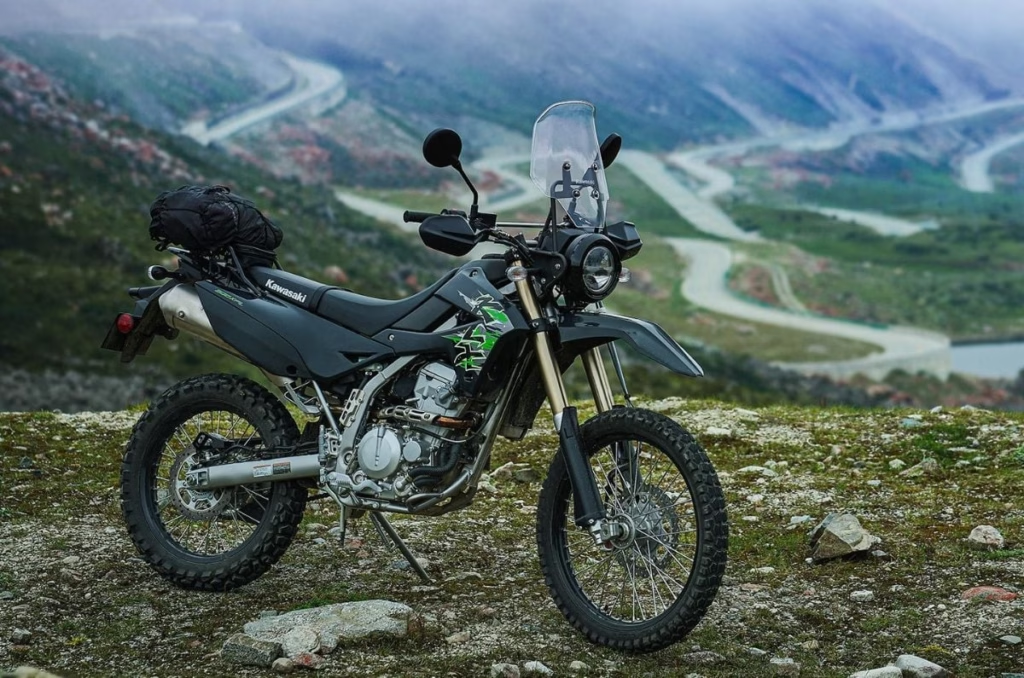
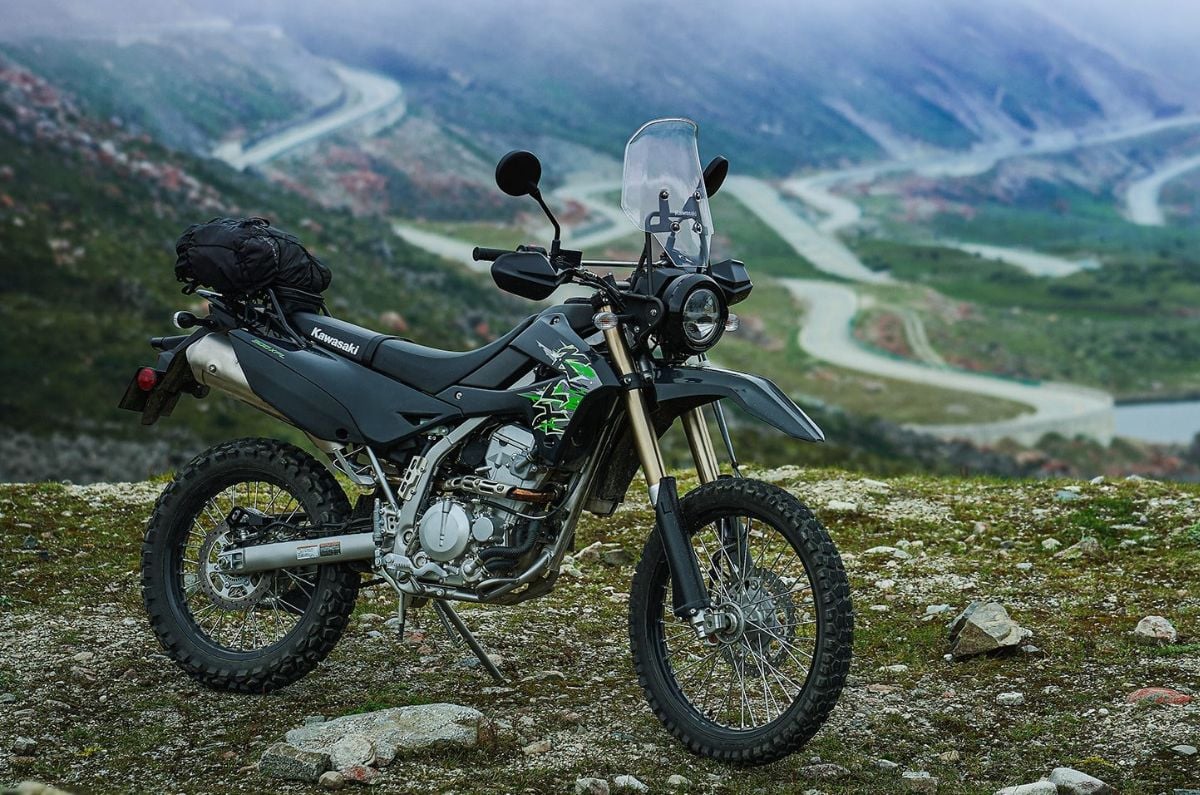
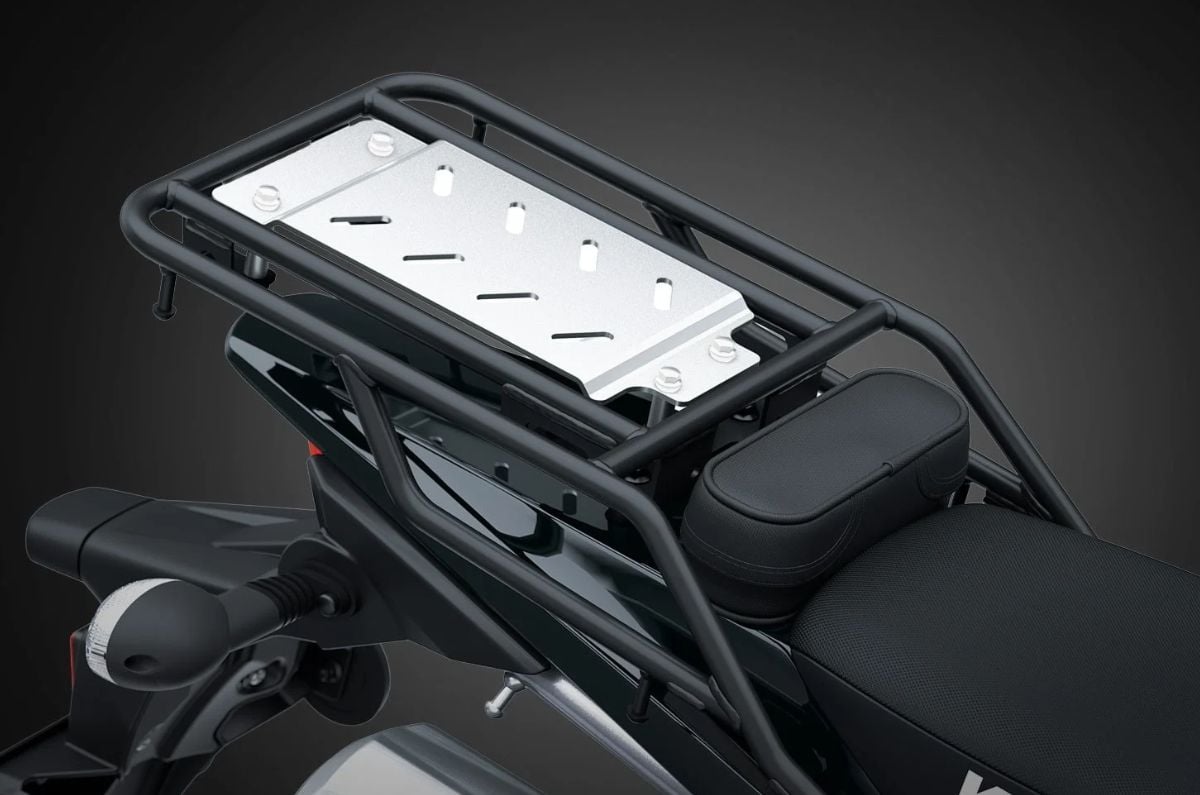
Kawasaki has launched the KLX300 XPL in America, priced at USD 6,499 (equivalent to Rs 6.17 lakh). This travel-oriented dual-sport motorcycle is based on the base KLX300 but has factory-fitted accessories which include a tall windscreen, handguard and rear carrier. This lineup also comprises the standard KLX300, the KLX300 DF (which adds a hand guard and a rear carrier as standard), and KLX300 SM (supermoto with 17-inch wheels and road-focused tyres).
Powered by a 292cc liquid-cooled engine making 27hp, 25Nm of torque
Gets adjustable suspension both at the front and rear
Uses a 21/18 wheel setup like the KLX230
2027 Kawasaki KLX300 XPL details
The liquid-cooled single-cylinder engine makes around 27hp and 25Nm of torque
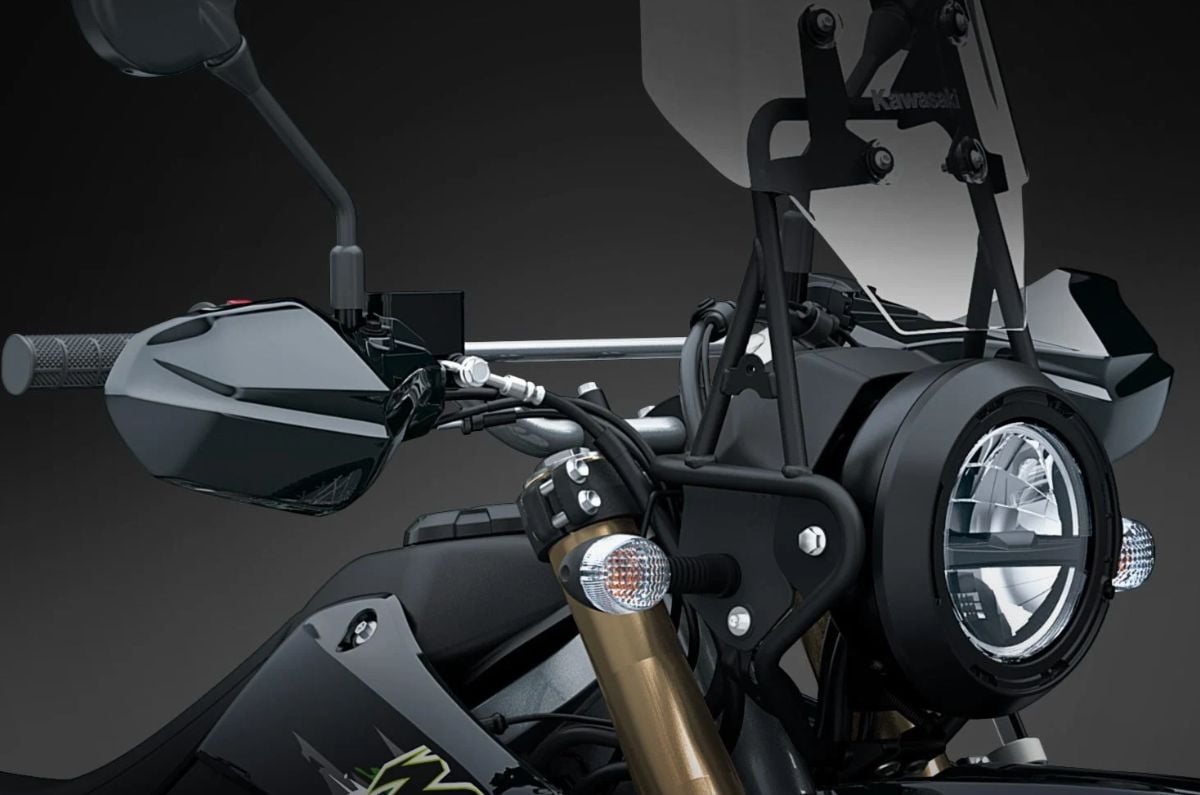
Setting the new KLX300 XPL apart from the rest of the range is a distinct round LED headlight. All four variants are powered by the 292cc liquid-cooled single-cylinder engine, producing 26.8hp at 8,000rpm and 24.9Nm of torque at 6,800rpm, paired with a 6-speed gearbox. Kawasaki has introduced revised internals like a new connecting rod bearing design across the 2027 range to enhance engine performance and reliability. The twin-radiator setup from the previous model has also given way to a repositioned single unit to accommodate the new ABS hardware.
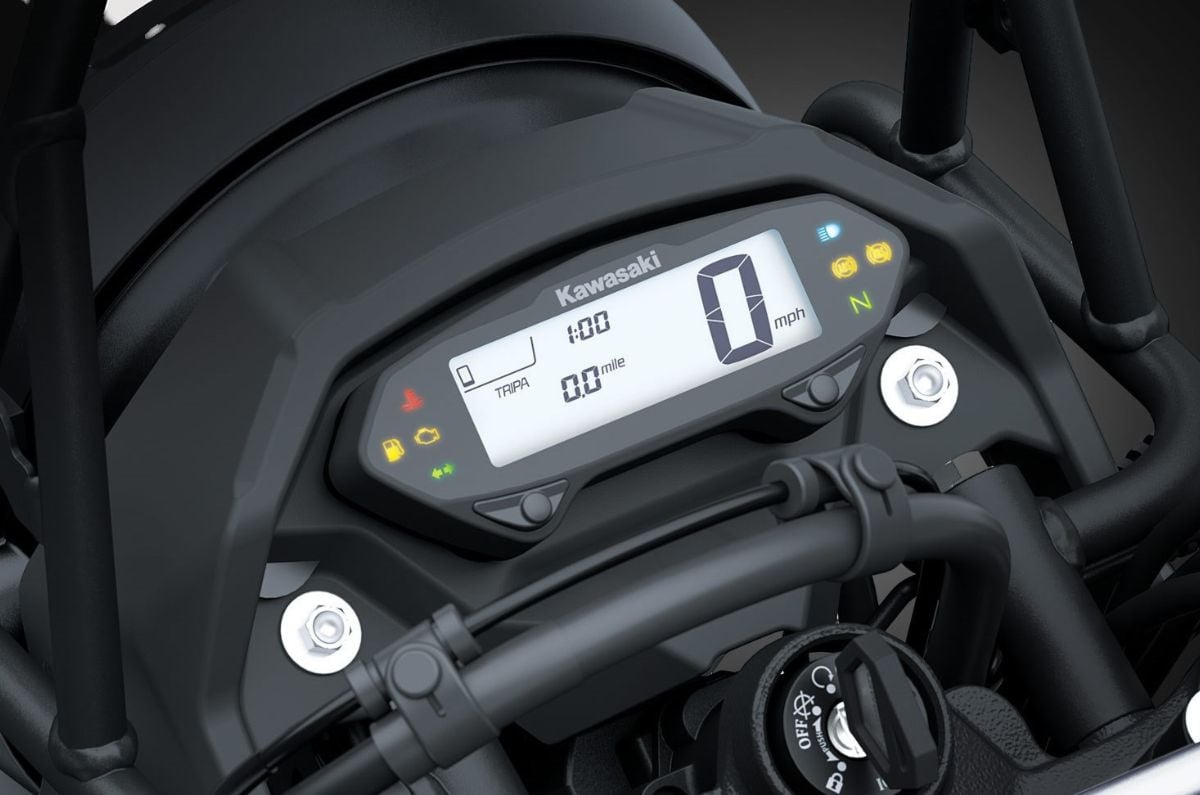
On the features front, the 2027 updates brings a redesigned LCD instrument cluster with smartphone connectivity through the Kawasaki Rideology app. Kawasaki has also equipped the KLX300 lineup with front-wheel ABS, which can be disabled to tailor braking performance when riding off-road. When the motorcycle is turned off and restarted, ABS automatically returns to its default active setting.
Chassis setup comprises a double cradle frame paired with an aluminum swingarm. Up front, it features a 43mm USD fork with adjustable compression damping, while the rear gets a fully adjustable link-type monoshock. Despite the additional equipment on offer, the KLX300 XPL (142kg) only weighs 3kg more than the KLX230 which is sold in India (139kg).
In theory, the KLX300 would make for a good step up from the KLX230 (Rs 2.19 lakh ex-showroom) sold in India, which has an air-cooled 233cc motor. However, Kawasaki India currently has made no announcement to indicate that the liquid-cooled KLX models will be coming to our shores.
USD-to-INR conversions are based on exchange rates at the time of writing.
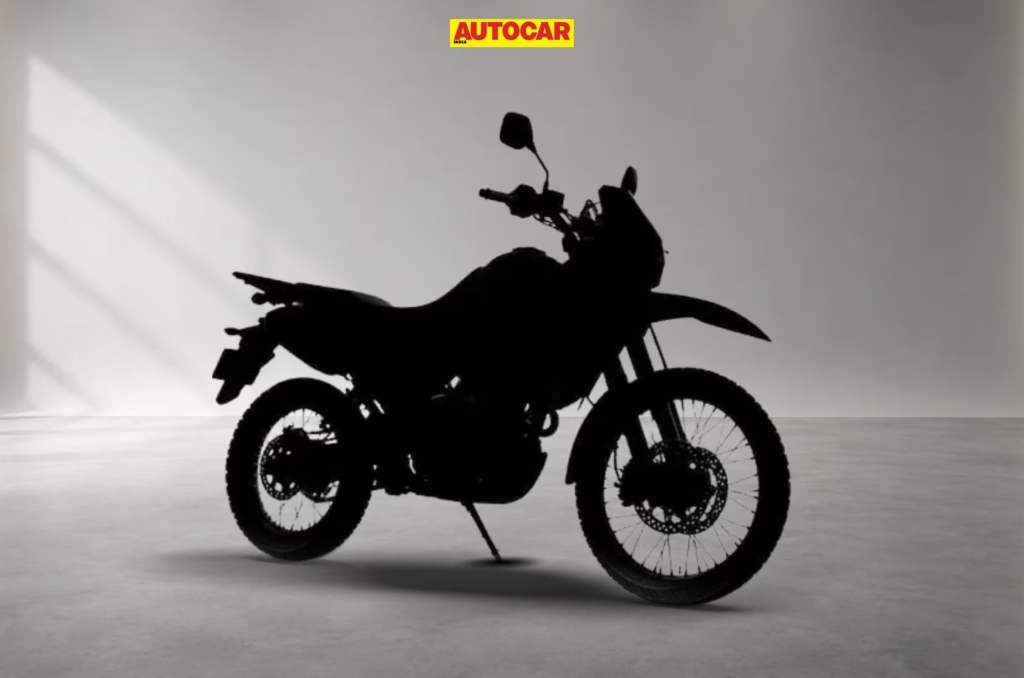
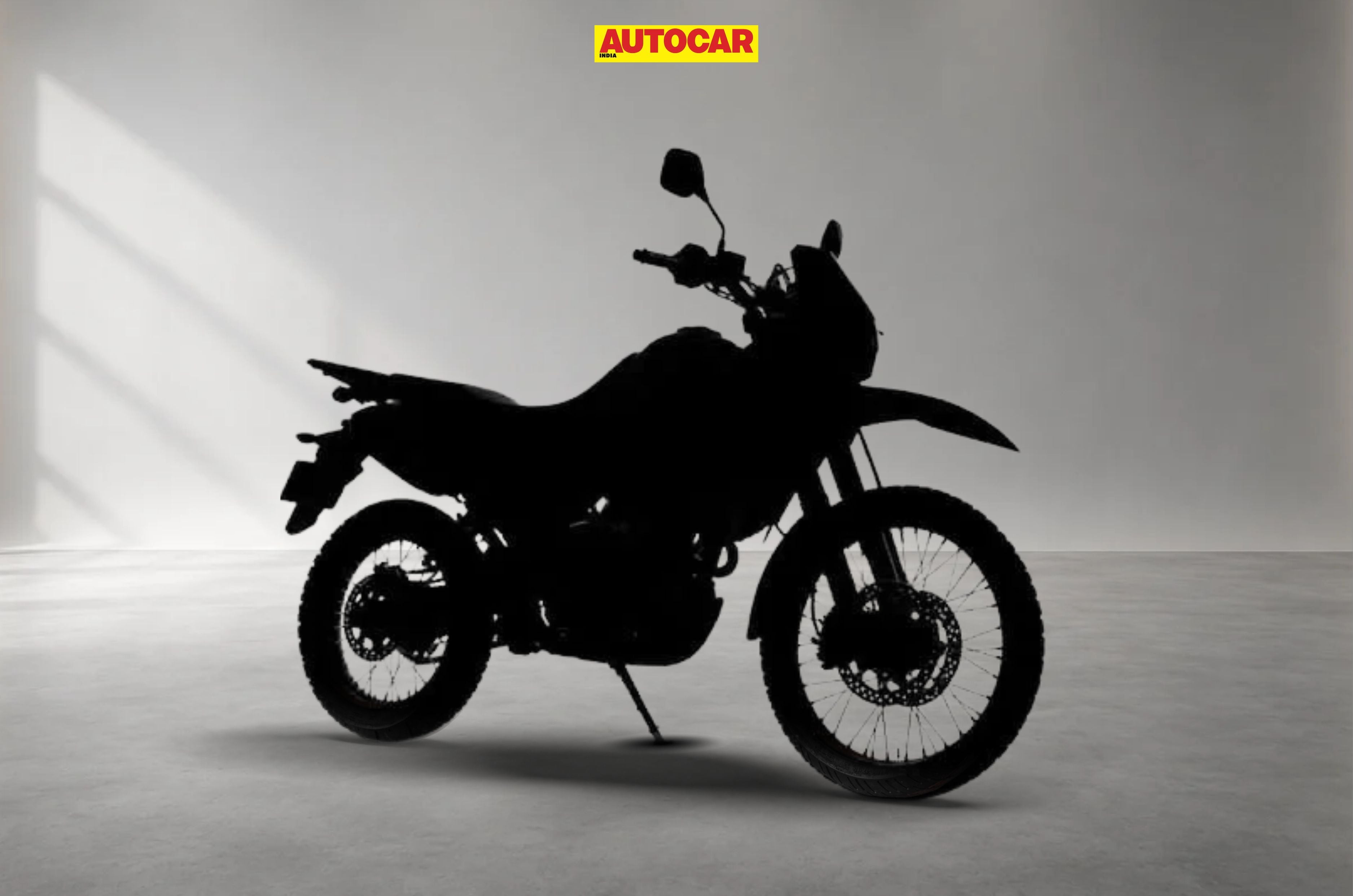
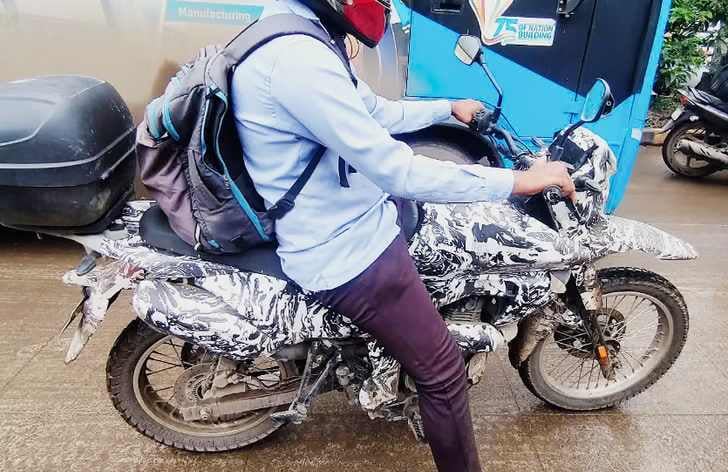
In a recent interview with Brazilian media, Bajaj’s executive director for the country, Waldyr Ferreira, hinted that the upcoming dual-sport motorcycle might come in multiple engine sizes. The first bike is expected to arrive in Latin America before the end of 2026.
Might be offered in multiple engine options
Could range from entry-level off-roader to long-distance tourer
Previous sightings suggest it uses a 19-inch front and 17-inch rear wheel setup
A line-up of dual-sport motorcycles?
Small capacity options could be offered in Latin American markets
Ferreira has hinted that rather than just a single model, it could be a line-up. Offering diverse displacement will allow the brand to cater to different demographics and reach wider audiences. After all, the company has a huge selection of existing 150-250cc air/oil-cooled and 200-400cc liquid-cooled motors to choose from. That said, we could also see all-new engines developed specifically for these models.
In Brazil, a good portion of the dual-sport market is held by Honda, with its NXR 160 and Sahara 300, and Yamaha, with the Crosser 150 and Lander 250. So, this multi-model approach from Bajaj would allow it to reach from entry-level off-road riding to long-distance touring segments. Although engine specifications and other details remain undisclosed, this development suggests the new line-up could cover a wide range of prices and performance.
For India, the speculation revolves around the first motorcycle being around the 200cc mark. Currently, the off-road motorcycles this segment has to offer include popular options like the Hero Xpulse 210, Kawasaki KLX 230 and the recently launched Honda XR300L, all of which are possible rivals for the upcoming Bajaj, which should deliver similar performance and capabilities.
Honda Motorcycle and Scooter India (HMSI) is significantly scaling up its manufacturing capacity in India, with company President and CEO Tsutsumu Otani confirming plans to increase output across its four Indian plants from the current 62.5 lakh units per year to 80 lakh units by 2028.
HMSI to expand production capacity from 62.5 lakh to 80 lakh units annually by 2028
CB350 already being exported to Europe; CB500 being evaluated as the next export model
Africa, Central America and South America identified as key future export markets
HMSI production and export plans
The expansion is expected to create over 2,000 jobs
Otani said the expansion over the next 18-24 months is aimed at serving both domestic demand and a growing export business. “With the eight-million-unit capacity planned in 2028, we will be well equipped to handle customer demand for ICE or EV products,” he said. The company’s current production is already running at full capacity.
On the export front, HMSI has begun shipping India-made models to Europe, starting with the CB350, for which Otani said the “sales situation is also very good”. The CB500 is being evaluated as the next potential export model, although he described these plans as being at an early stage.
Beyond Europe, Otani highlighted Africa, Central America and South America as important future markets, with Africa singled out as particularly significant. “India’s geographical proximity can provide an advantage in serving the African market, especially if one were to factor in transportation costs,” he said.
To support its export ambitions, HMSI is also looking to deepen localisation. Otani acknowledged that several components currently undergo final assembly in India but rely on parts imported from Thailand, Japan and Europe. “We intend to accelerate localisation and manufacture more in India as our next step,” he said, adding that resource circulation and the recycling of steel and aluminium remain areas the company is working through, given India’s limited domestic supplies of these materials.
Tanishaa Mukerji: काजोल की बहन और एक्ट्रेस तनीषा एस मुखर्जी अक्सर अपने X अकाउंट पर अलग-अलग मुद्दों पर अपनी बेबाक राय शेयर करती रहती हैं। जब देश में मुख्य चुनाव आयुक्त के खिलाफ बड़े पैमाने पर विरोध प्रदर्शन हो रहे हैं, तो केंद्र सरकार की भी आलोचना हो रही है। इसी बीच तनीषा ने सोशल मीडिया पर कुछ ‘अच्छे-खासे पढ़े-लिखे और खुद को ऊंचा समझने वाले’ आलोचकों पर ‘अंधी नफरत’ के साथ काम करने का आरोप लगाया।
तनीषा ने क्या कहा
हालांकि तनीषा ने विरोध प्रदर्शनों का सीधे तौर पर जिक्र नहीं किया और न ही अपनी पोस्ट के लिए कोई संदर्भ दिया। लेकिन उन्होंने इस बात पर जोर दिया कि हर किसी को अपने देश का साथ देना चाहिए। X पर उन्होंने लिखा, “मैं कुछ ऐसे तथाकथित पढ़े-लिखे और खुद को ऊंचा समझने वाले हिंदुओं की अंधी नफरत देखकर सचमुच हैरान हूं, जो अभी भी पूरी तरह से ब्रिटिश सोच में जी रहे हैं! अगर आपको लंदन और अमेरिका इतना ही पसंद है तो प्लीज चले जाइए! हमें यहां आपकी जरूरत नहीं है कि आप हमें नीचा दिखाएं! हां बहुत सारी समस्याएं हैं, लेकिन समय लगता है और देखिए पिछले 10 सालों में हम कहां पहुंच गए हैं!”
‘बातें लॉजिकल और तथ्यों पर आधारित होनी चाहिए’
तनीषा ने आगे कहा कि लोग किसी भी व्यक्ति को इस आधार पर तुरंत किसी कैटेगरी में डाल देते हैं कि वे किस राजनीतिक पार्टी का समर्थन करते हैं, जिससे आपस में मतभेद पैदा होते हैं। “अगर हम अपनी सरकार का समर्थन करते हैं, तो हम अंधभक्त और अनपढ़ कहलाते हैं। लेकिन अगर हम अमेरिका और जर्मनी से इस देश को बर्बाद करने की कोशिश करने वाले गुटों का समर्थन करते हैं, तो हम ‘कूल’ और ‘वोके’ (जागरूक) कहलाते हैं!
I am truly shocked by the blind hate of some supposedly well educated elitist Hindus that live with a complete British hangover ! If u love london and America so much. Pls leave ! We don’t want u here trying to put us down! Yes there are a lot of problems but it takes time and look where we have reached in the last 10 years. ! If we support our govt we are #andhbhakts and uneducated. But if we support factions trying to destroy this country from America and Germany we are cool and woke ! There is a war for ur mindset. Ur attention and ur thoughts. But pls don’t be so influenced by media that you refuse to use ur own common sense! Things should be logical factual. And a society ruled by laws is the way we stay safe.
आपकी सोच, आपके ध्यान और आपके विचारों को लेकर एक जंग चल रही है। लेकिन प्लीज मीडिया से इतने भी प्रभावित न हों कि आप अपनी सामान्य समझ (कॉमन सेंस) का इस्तेमाल करना ही छोड़ दें! बातें लॉजिकल और तथ्यों पर आधारित होनी चाहिए। कानूनों से चलने वाला समाज ही हमें सुरक्षित रखता है।
कुछ दिन पहले तनीषा मुंबई में आयोजित एक प्रेस कॉन्फ्रेंस में शामिल हुई थीं। वहां उन्होंने पैपराजी और आम जनता से अपील करते हुए कहा था कि वे जुहू के SNDT ग्राउंड में मुखर्जी परिवार द्वारा आयोजित ‘नॉर्थ बॉम्बे सार्वजनीन दुर्गा पूजा’ के दौरान मर्यादा बनाए रखें।
तनीषा के करियर के बारे में
तनुजा की बेटी तनीषा ने 2003 में करण नाथ और डिनो मोरिया के साथ फिल्म ‘Sssshhh’ से बॉलीवुड में धमाकेदार एंट्री की थी। हालांकि यह फिल्म बॉक्स ऑफिस पर फ्लॉप रही। इसके बाद उन्होंने ‘सरकार’, ‘नील ‘एन’ निक्की’ और तमिल हिट फिल्म ‘उन्नाले उन्नाले’ में काम किया। ‘उन्नाले उन्नाले’ के लिए उन्हें विजय अवॉर्ड के लिए नॉमिनेशन भी मिला। 2013 में ‘बिग बॉस 7’ में फर्स्ट रनर-अप बनकर उन्हें काफी लोकप्रियता मिली, जहां अरमान कोहली के साथ उनके रिश्ते ने खूब सुर्खियां बटोरीं थीं।
इसके बाद उन्होंने ‘फियर फैक्टर: खतरों के खिलाड़ी 7’ (2016) में हिस्सा लिया और ‘झलक दिखला जा 11’ में भी एक कंटेस्टेंट के तौर पर नजर आईं। बाद में वह कॉमेडी शो ‘गैंग्स ऑफ हसीपुर’ में जज के तौर पर भी दिखीं। तनीषा आखिरी बार 2024 की फिल्म ‘लव यू शंकर’ में नजर आई थीं।
Harley-Davidson has had a dearth of its performance focused ST models lately, with the US website currently offering only two, the cruiser Low Rider and the adventure tourer Pan America 1250. It looks like the American company is fixing that next year, with three more models expected to add to the line-up. We believe the models to be the Road King ST, Road Glide ST and Street Glide ST, all of which fall under the ‘Grand American Touring’ category. Currently, Harley-Davidson sells the latter two exclusively in CVO (Custom Vehicle Operations) guise.
Besides Road King ST, four other Harleys are expected for 2027
The ST could be powered by the Milwaukee-Eight 117 engine
Road King ST set to arrive in 2027: What else can we expect?
More powerful than the 2025 Road King, and ‘sporty’ suspension
A brief untangling of Harley-Davidson’s nomenclature before we get back to the motorcycles. ST refers to Softail frame which essentially means that these motorcycles are performance-oriented, with more powerful engines and a more sophisticated suspension setup compared to their non-ST counterparts. As for CVO, it is more intense than your average factory custom program. CVO models are usually very limited in number, and get exclusive part upgrades, beautiful material finishes and colour schemes that ‘regular’ Harleys don’t get. The American manufacturer is also known to have tested new accessories and colour schemes via this program, before rolling it out at a larger scale since the program’s debut in 1999.
Harley’s accessories page for the 2027 Road King ST. Image courtesy: Motorcycle.com
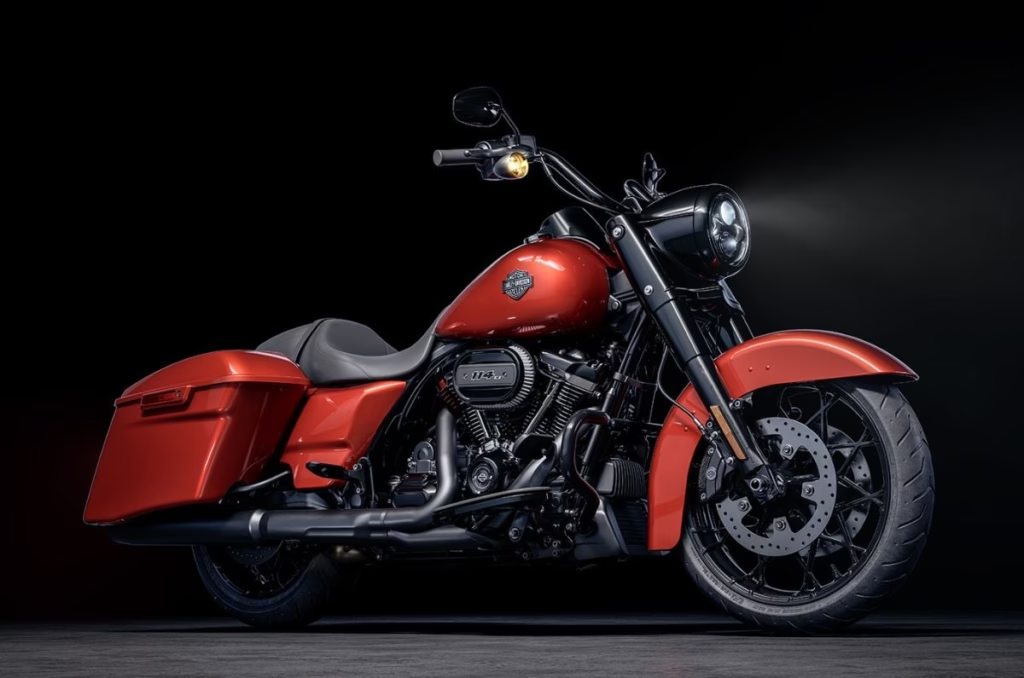
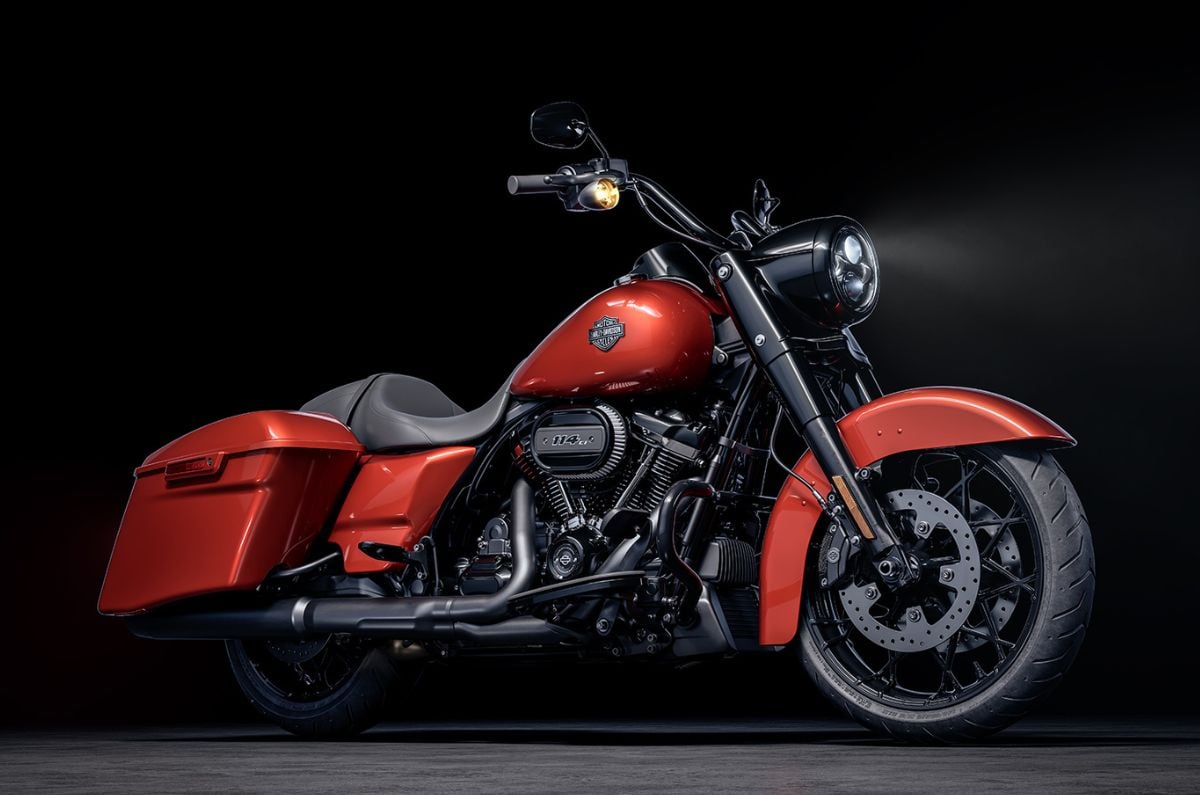
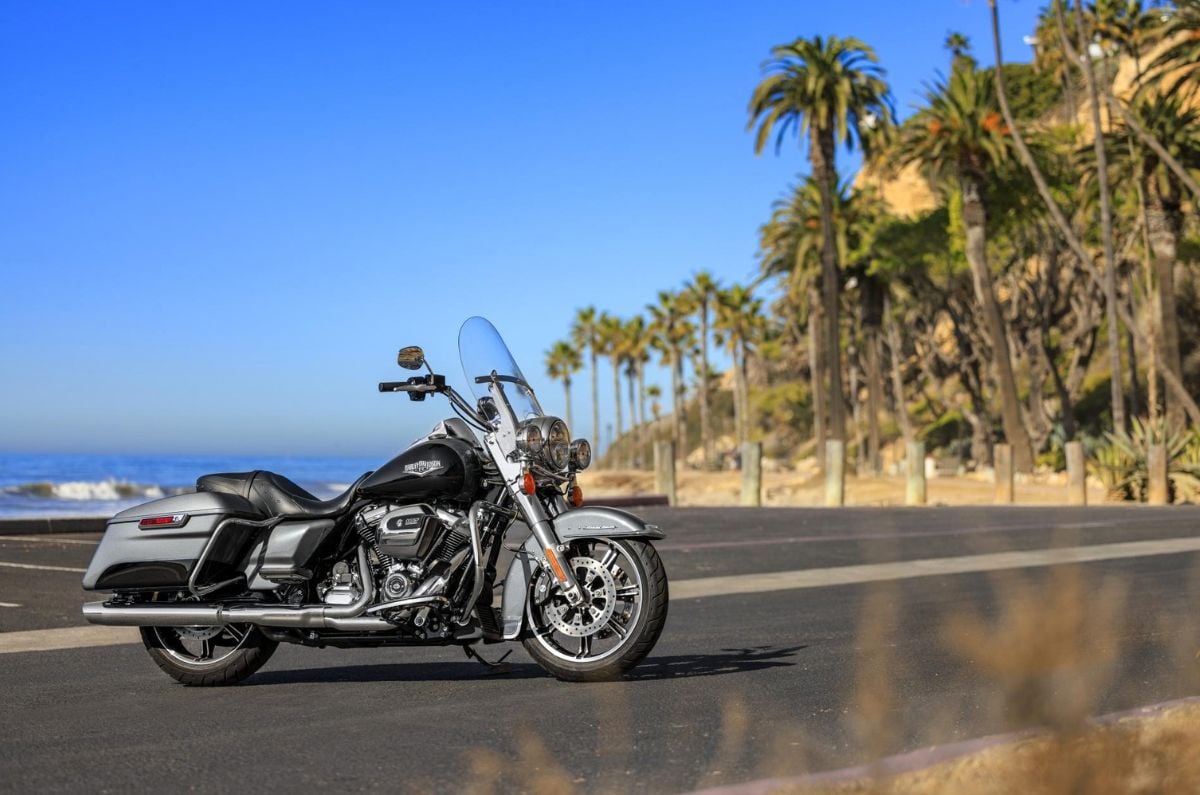
The Road King ST is expected to find its way onto the lineup next year, thanks to Harley-Davidson creating an accessories page for it (which has now been taken down). While we have no idea what any of these motorcycles will look like, thanks to the accessories pages, we know that the Road Glide ST and the Street Glide ST will also be available in non-CVO guise next year. The last time this happened was in 2023, before H-D rolled out its current touring platform. The Road King was last seen in 2025 in Special guise, when it was powered by the Milwaukee-Eight 114 engine and came equipped with side cases but no windshield (as shown in the picture above). The regular Road King was last seen in 2022, powered by the Milwaukee-Eight 107 engine, with side cases as well as a windshield.
Harley-Davidson Road King in 2022
We expect the Road King ST to run on the Milwaukee-Eight 117 engine, similar to most of Harley’s other touring models. Typical for ST motorcycles, we expect all three models to have more performance-focused suspension and braking setups. For context, the CVO versions of the Road Glide and Street Glide motorcycles are powered by even more powerful Milwaukee-Eight 121 engines. The non-CVO Road Glide and Street Glide will also likely lose out on their carbon components (a CVO exclusive), besides getting downgraded to a slightly lower powered engine, which could be the same Milwaukee-Eight 117.
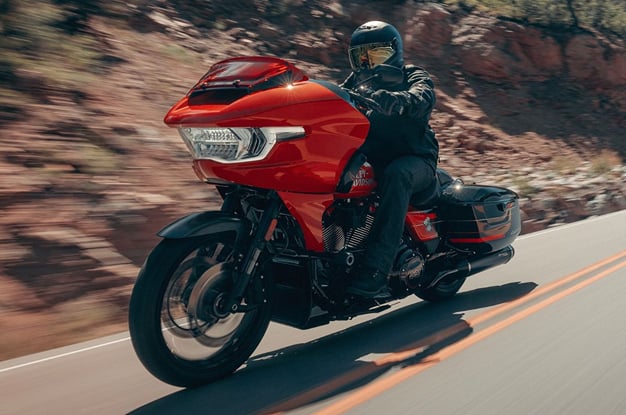
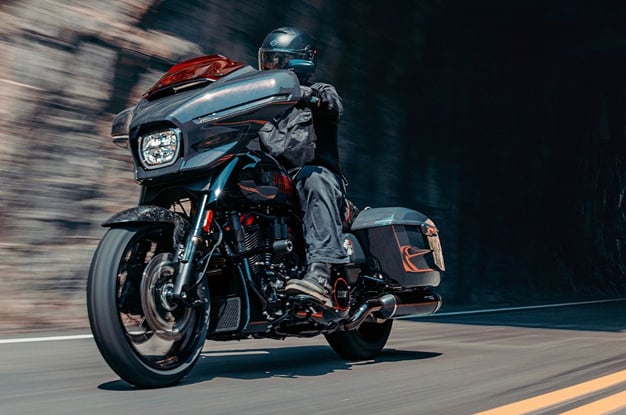
CVO Road Glide vs CVO Street Glide
The fact that Harley-Davidson has started working on the website pages likely indicates that these motorcycles are slated to arrive soon, more than likely with new colour options as well. Alongside the three motorcycles above, H-D has also set up accessory pages for other non-CVO models as well, such as the Deadwood and the Super Glide, tacitly indicating that they too are going to enter the market soon.
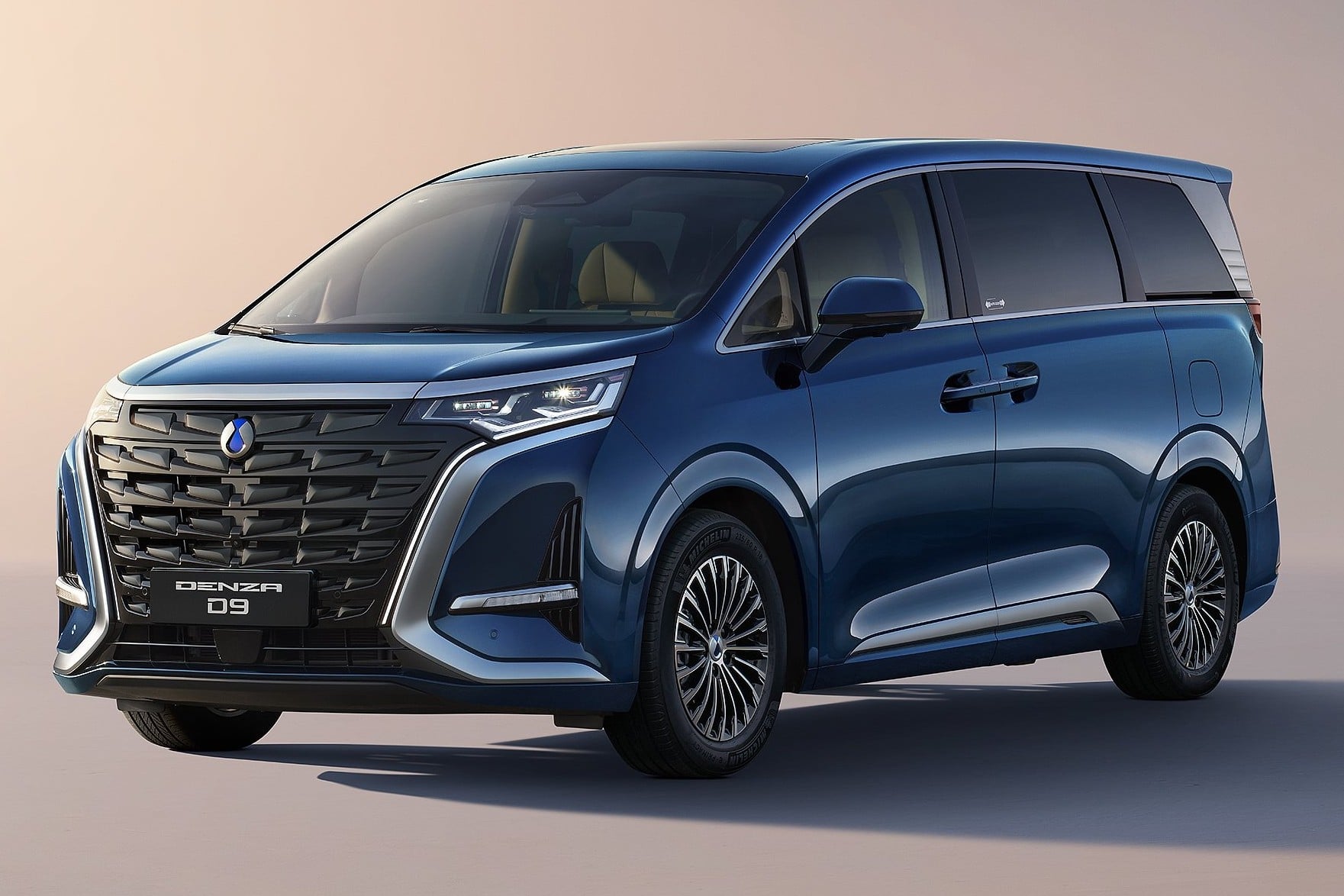
Denza, the luxury brand of Chinese carmaker BYD, has announced its India entry by way of a recent social media post. This confirms our prior report on BYD bringing Denza to the Indian market in the coming months. The report also contained details surrounding Denza’s first pair of models for India.
BYD Denza India entry announcement
A recent social media post from Denza India shows the brand’s blue-and-silver hourglass-esque logo with “Arriving soon” written above. The caption adds that Denza is set to introduce a “sophisticated, high-performance EV experience” to the Indian market, which sounds par for the course for the brand. Denza models will be positioned above those offered by BYD, particularly above the Rs 80 lakh price point.
Denza was founded in 2010 as a joint venture between BYD and Mercedes-Benz Group. By 2024, Mercedes-Benz Group relinquished its shares in Denza entirely and transferred ownership to BYD. As it stands, Denza operates in markets like Southeast Asia, China, Australia, Europe, and Latin America, offering luxury and performance EVs and plug-in hybrids.
Which Denza cars are coming to India
Z9 GT
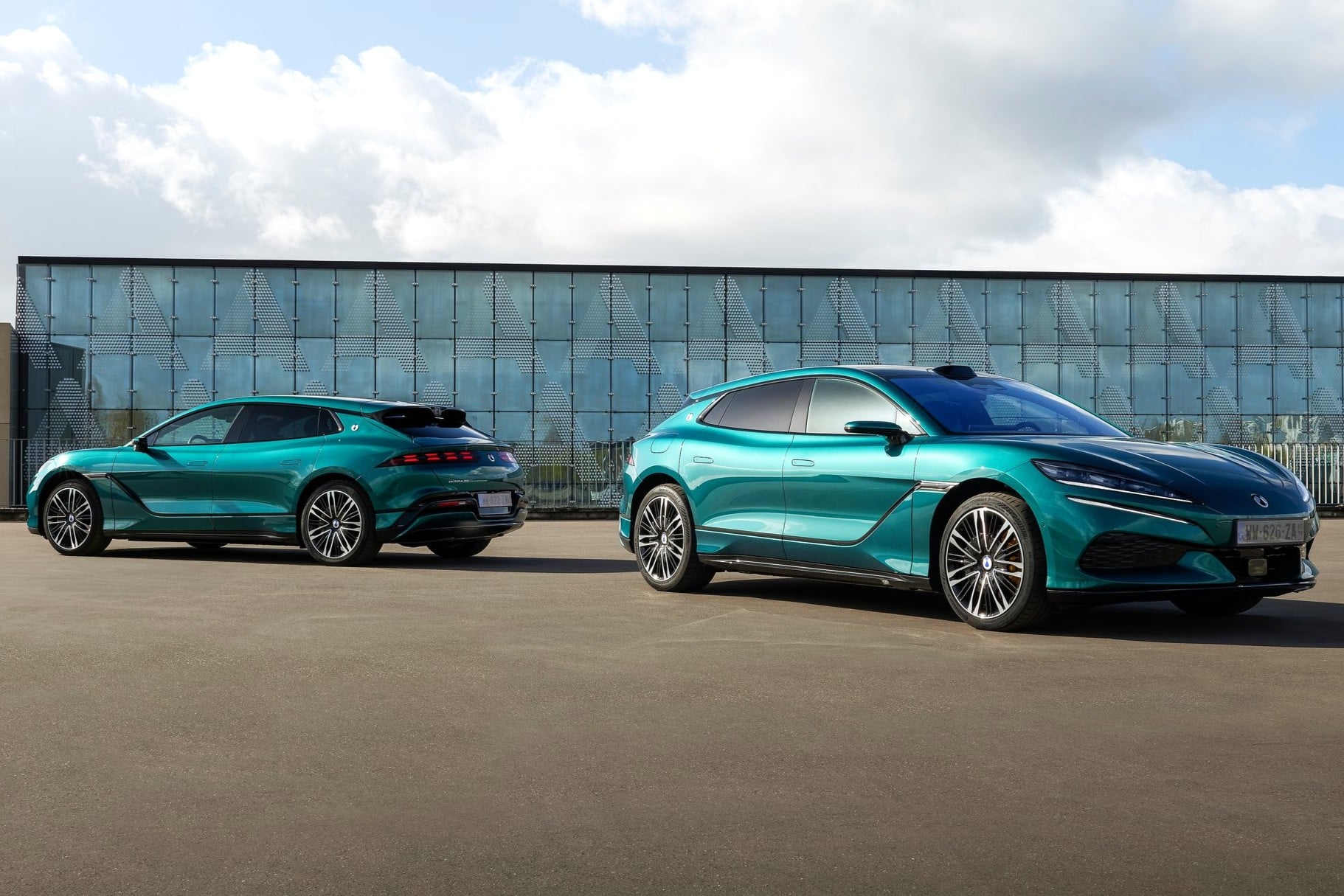
The Denza Z9 GT is a four-door shooting brake, which will make it the only one of its kind in the Indian market. It comes with a massive 122.5kWh battery pack powering a trio of electric motors that produce 1,156hp, sent to all four wheels. 0-100kph comes up in a claimed 2.7 seconds, and the top speed is rated at 270kph. The Z9 GT delivers a WLTP-rated range of 600km, and can be charged at up to a whopping 1,500kW – at this wattage, the battery takes just nine minutes for a 10 to 97 percent charge.
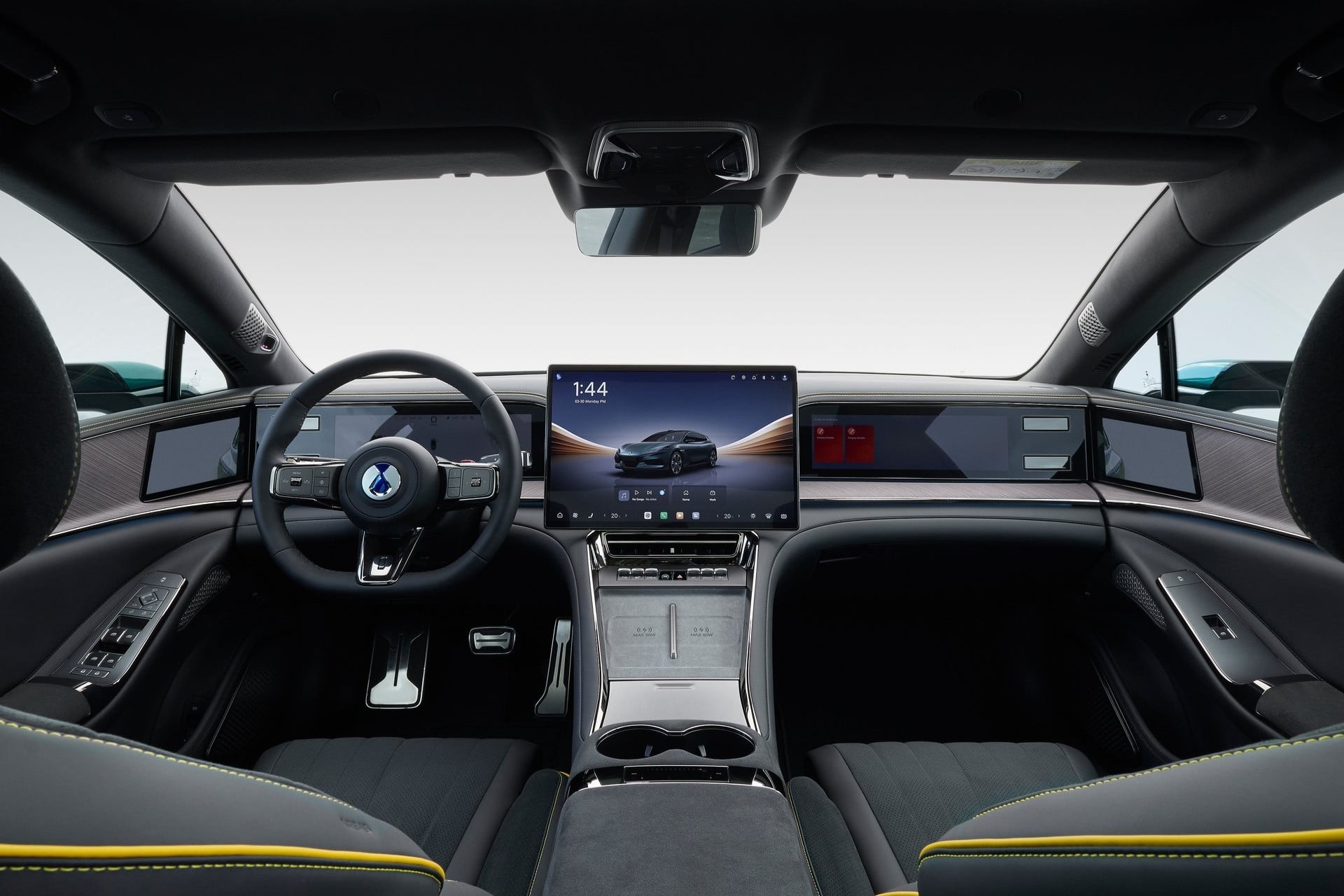
Rear-wheel steering is also part of the package, and enables cool features like the ‘crab walk’, where the Z9 GT can move sideways, and ‘Compass Turn 360°’, which can perform a full rotation of the car akin to the Mercedes G-Class Electric’s G-Turn function. Inside, the Z9 GT offers a triple-screen setup on the dashboard, along with two screens that project a feed of the outside cameras. Other notable features include Level 2+ ADAS, full leather upholstery, a 20-speaker Devialet sound system, powered, heated, ventilated, and massaging front seats, and more. Pricing for the Z9 GT is expected to land in the Rs 1.2 crore-1.5 crore range.
D9
Rounding off the duo is the Denza D9, a large luxury MPV that will take on the likes of the MG M9 and Toyota Vellfire. The India-spec D9 is likely to get a 103kWh battery pack with a front-mounted motor outputting 313hp and 360Nm. WLTP range for the D9 is 520km, and it can be charged at up to 200kW DC.
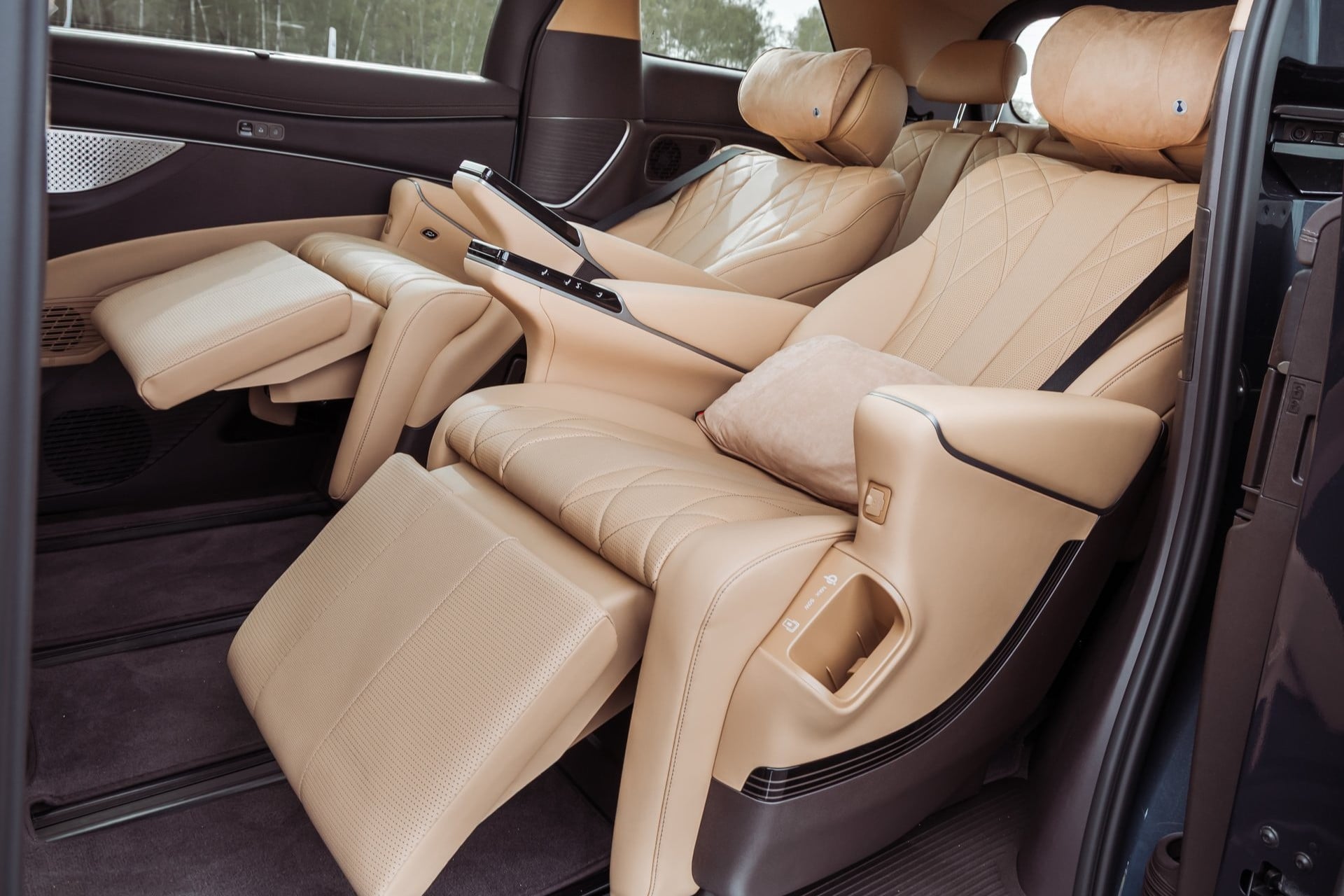
Inside, there’s a 2+2+3 seating layout, which means you get second-row captain’s chairs with electrical adjustment, heating, ventilation, and massage functions. Three-zone climate control, powered thigh extenders, a Dynaudio sound system, full leather upholstery, ambient lighting, and more are also part of the equipment list. Expect the D9 to be priced at around Rs 90 lakh, placing it between the M9 and Vellfire.
Mercedes-Benz’s 140 Years, 140 Places odyssey is a celebration of the carmaker’s origins in 1886. Spanning six continents, covering over 60,000 kilometres, it is as massive in significance as it is in scale. The tour kicked off at the Mercedes-Benz Museum in Stuttgart on the 29th of January, the same day Carl Benz received the patent for his first car 140 years ago! The cars then went to the Daimler house in Bad Cannstatt, they tracked the original route of Bertha Benz’s historic 1888 drive and drove the iconic Spa-Francorchamps racetrack in Belgium in wheel tracks of the W109 ‘Red Pig’ that made such a splash in 1971. The cars then went to the US, visiting the first plant in the US started by William Steinway (of Steinway & Sons, the famous German Piano makers), South America, Australia, Japan, Korea and Japan.
Legacy and history
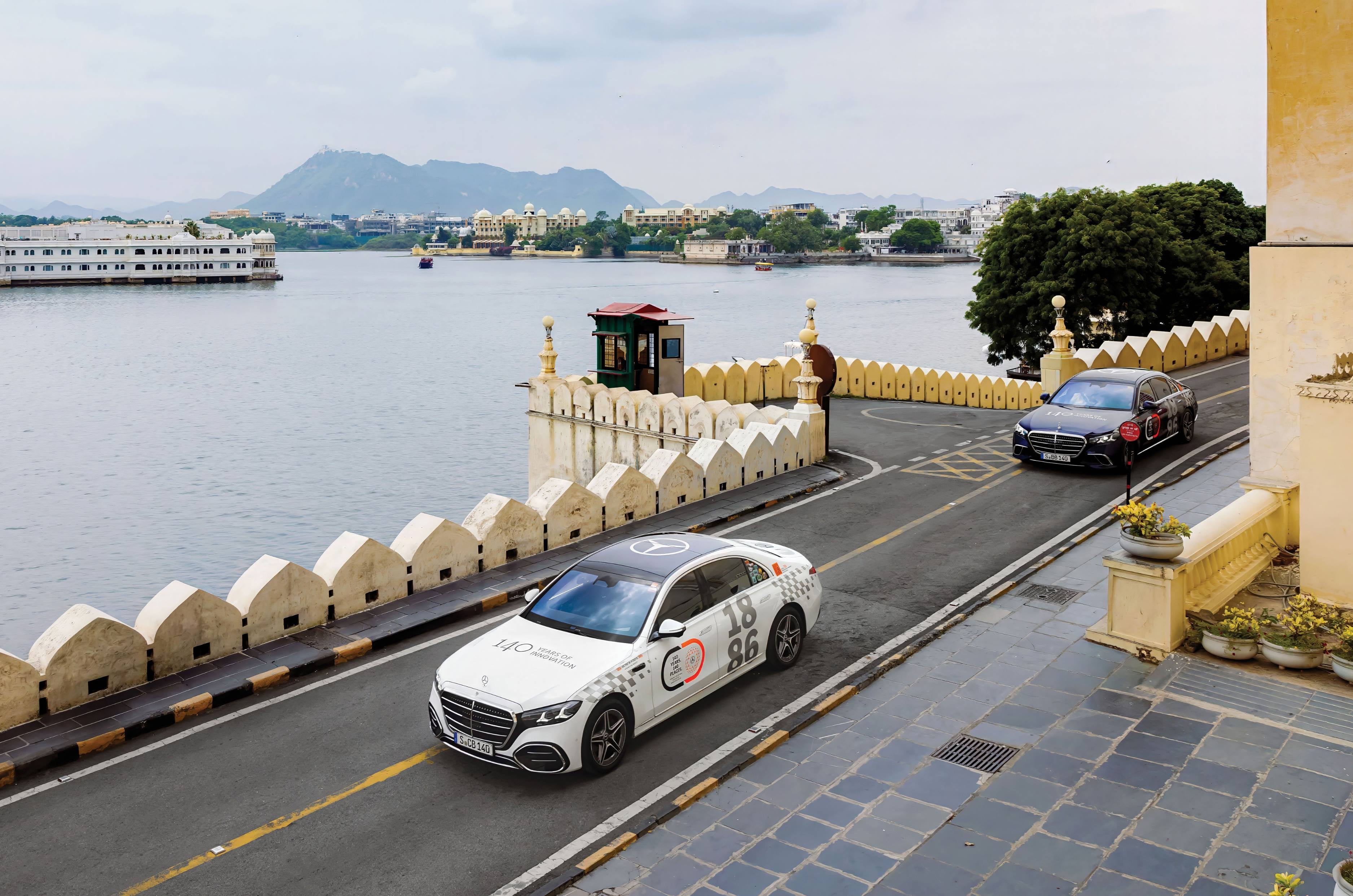
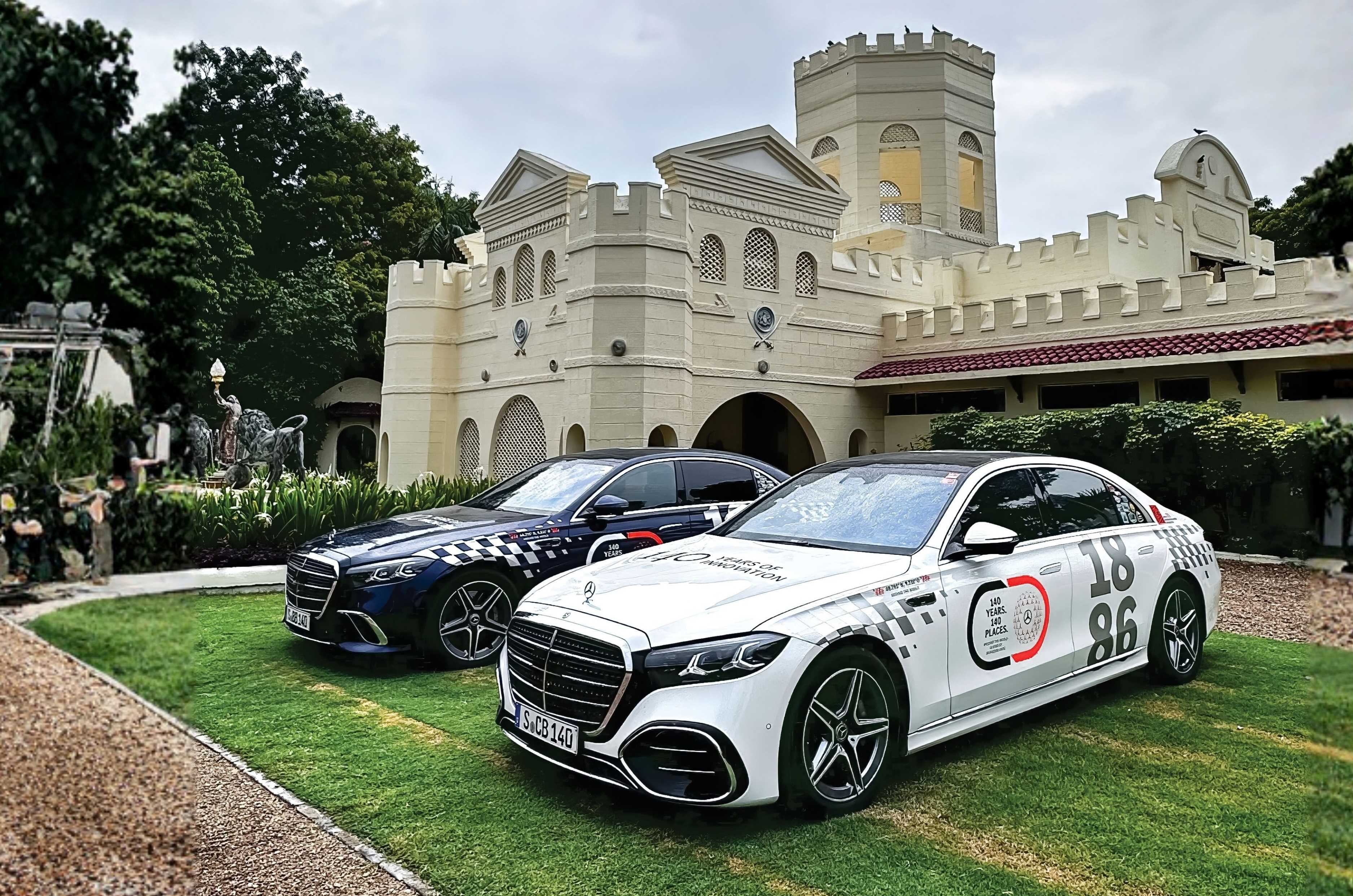
With their royal and regal air, the S-Classes feel right at home in Udaipur.
Part of the 140 Years, 140 Places expedition, Udaipur is one of the more stunning locations the Mercedes drive will visit on this India leg, and what’s incredible is that we have been chosen to be a part of it. What a privilege. The lake city of Udaipur also has tremendous historical significance. Home to one of the longest-serving dynasties, one that spans 1,500 years, this leg sees a coming together of the world’s oldest carmaker and one of the oldest dynasties. And while this trans-continental excursion is called 140 Years, 140 Places, it could also easily have been called 140 Years of Automotive Technology. With these S-Class pre-production cars dripping with both mechanical and electronic tech, what we are also celebrating is the journey of the car from a three-wheeler with a single-cylinder engine to this technological marvel. The company that invented the motorcar is still widely regarded as the one that makes ‘the best car in the world’.
Luxe Supreme
Everything is perfectly still. Not a gauge in the car is moving, and there’s no real sensation of speed. I must have dozed off. Blame it on the incredibly comfortable back seats and the sensory isolation. This car just shuts you off from the rest of the world. Then I discover we are cruising at 100kph, and not just 30 or 40. Up ahead is the lake city of Udaipur. Ahh.
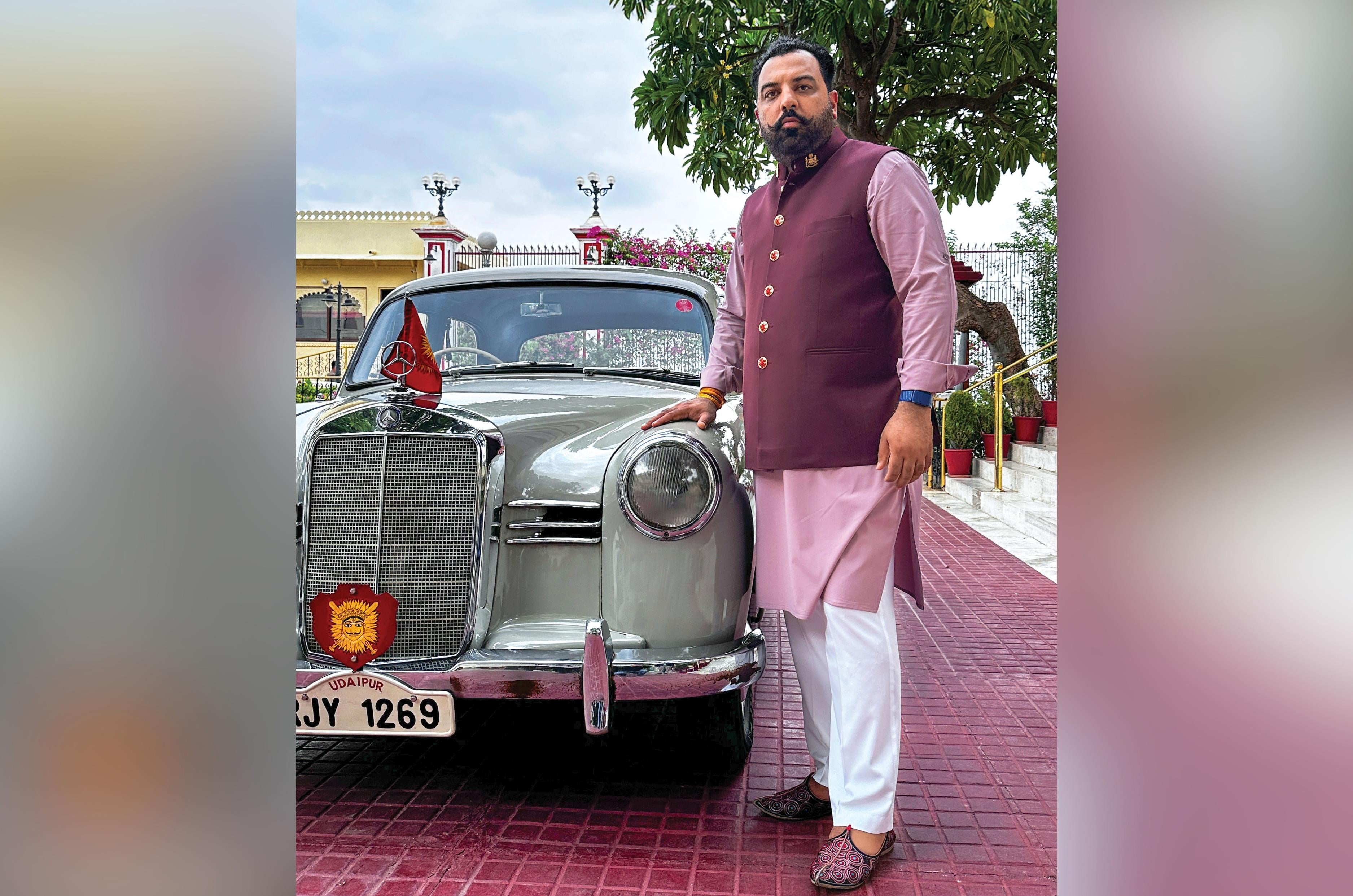
The Maharana of Udaipur with a car that has been in his family for three generations.
We start our journey on this leg from a very significant place, the palace situated on the lakeside at Udaipur. And not only does Lakhsyaraj, the 77th Custodian of the House of Mewar (formally Shriji Huzoor Dr Lakshyaraj Singh of Udaipur), play the perfect host, but he also parks an olive-green 180D in the foyer, a car that has been used by three generations of his family. The symbolism is rich; two legacies converging in a place that embodies the spirit of grandeur and continuity.
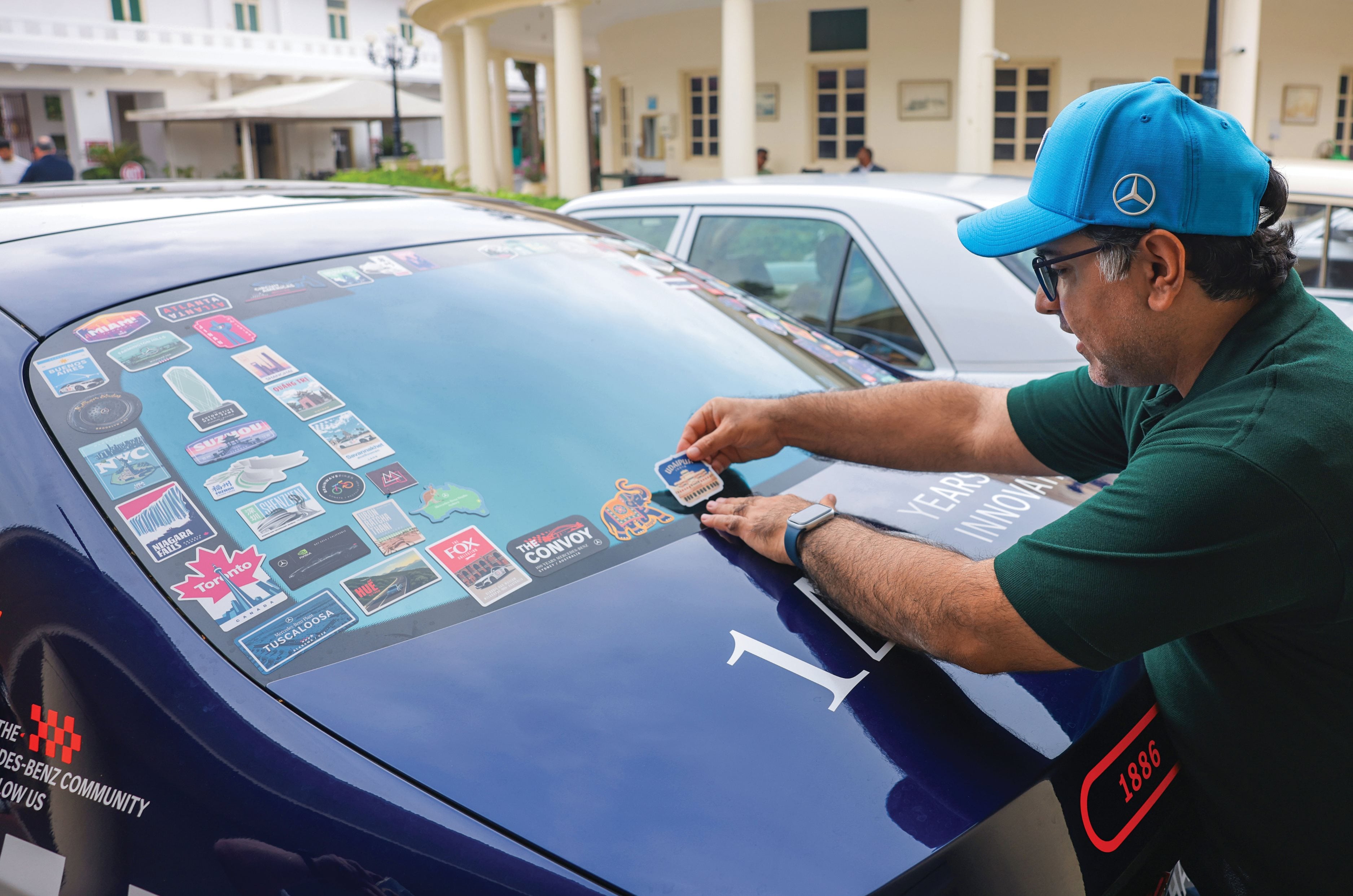
Perseus places the sticker on ‘Bertha’ in Udaipur.
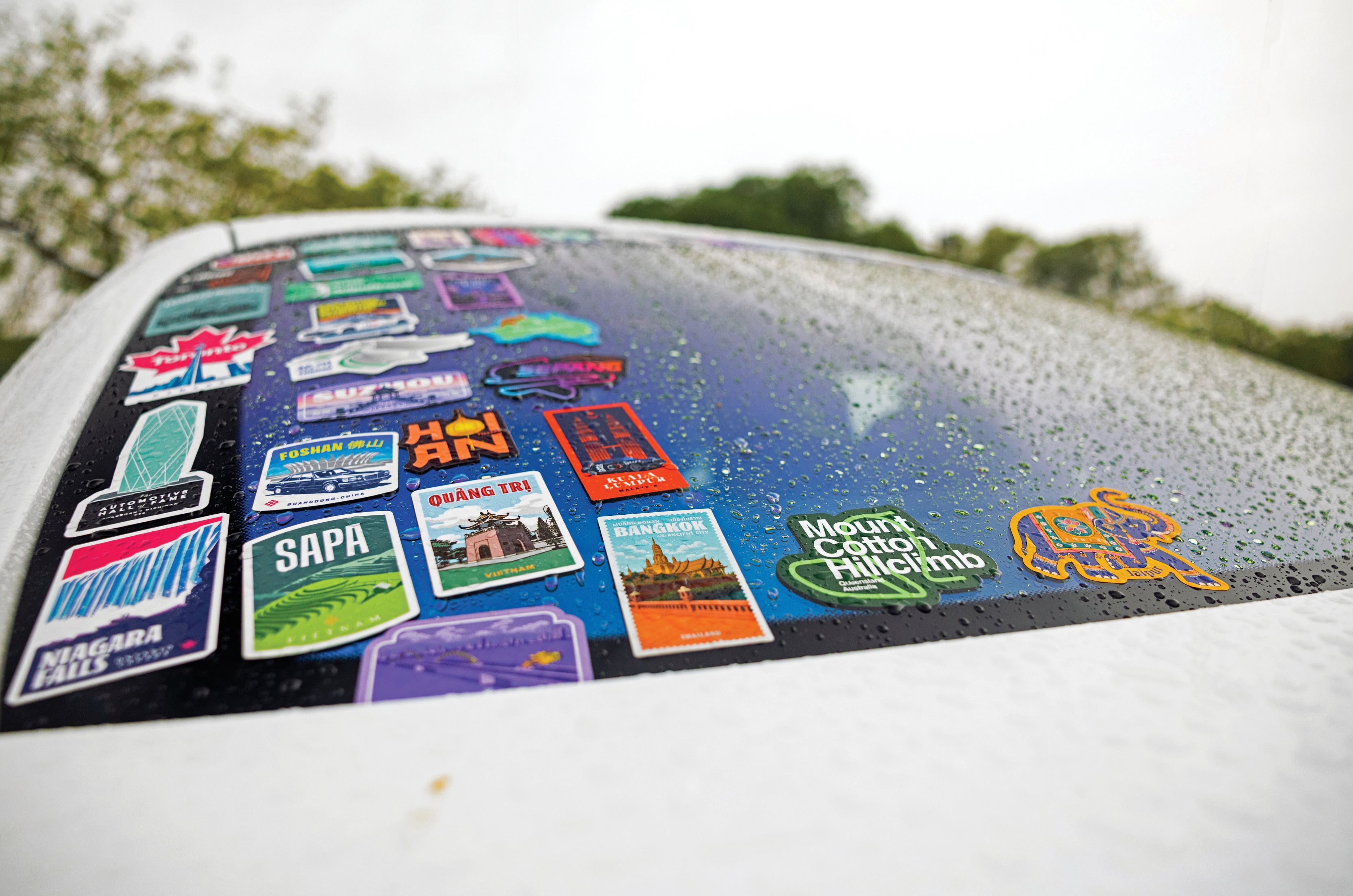
Since Udaipur is one of the 140 iconic destinations on the drive, Mercedes asks him to place an Udaipur sticker on the rear of the car; fitting. These cars, all three (the third is on another leg elsewhere in India), will eventually be housed in the Mercedes museum in Stuttgart, and what’s cool is that you can trace their journey via the stickers. Lakshyaraj then takes one of the cars for a brief drive. He wants to see just how much better this new version, with all its 2,700 new bits, is over his pre-facelifted car. And yes, he loves driving. I’d bumped into him earlier in the day at the airport, where his S-Class had come to pick him up, flags flying and uniformed driver and assistant in tow. But instead of climbing into the rear, he’d gotten straight behind the wheel. Tells you a lot.
Still at the top
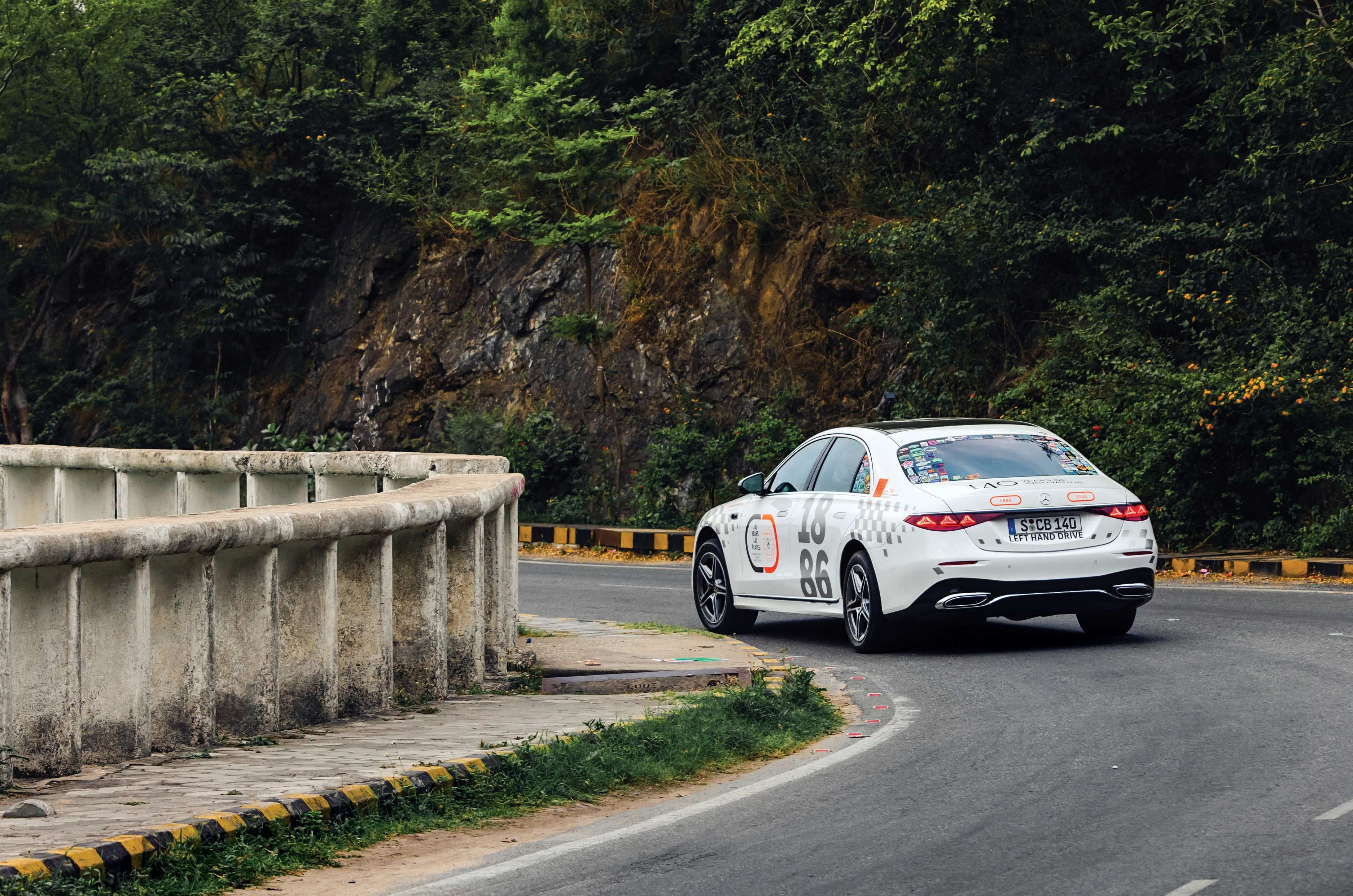
Late prototypes of the New S-Class made the journey.
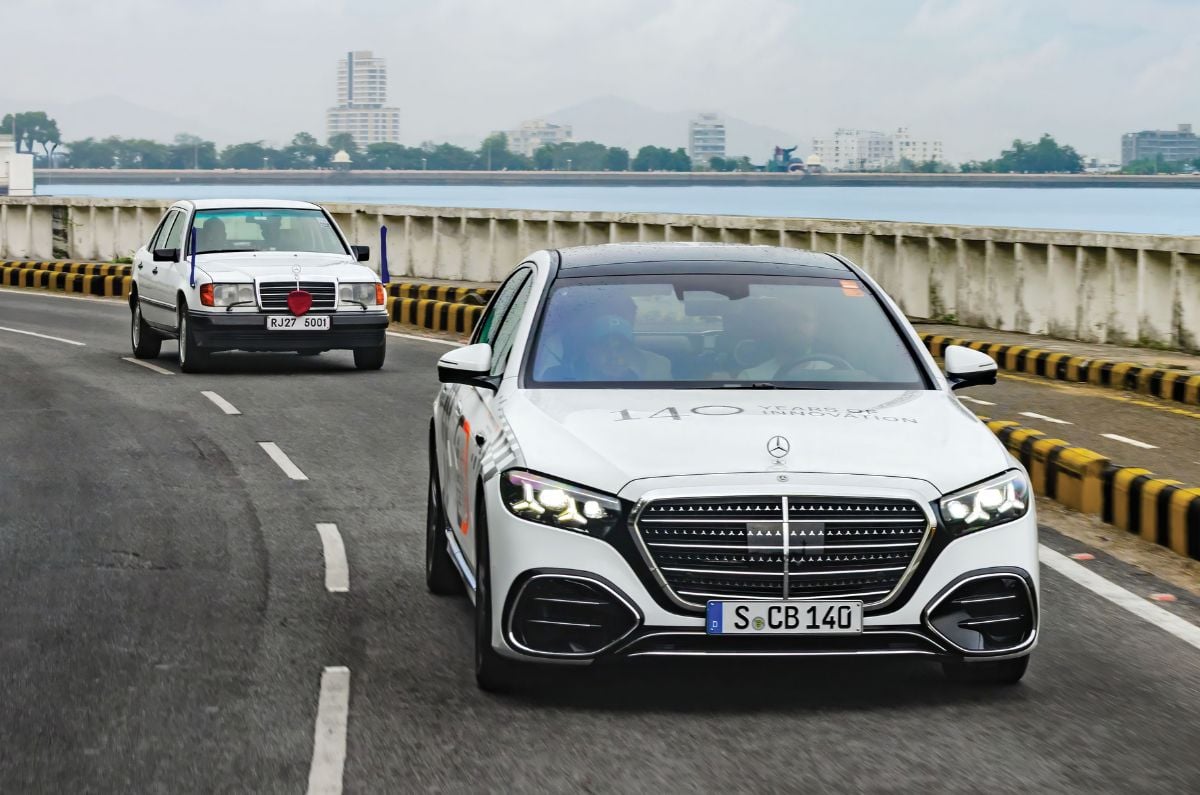
Later in the day, I get another demonstration of why the S-Class is so special. We decide to drive around the lake for the cameras, the orange glow of the setting sun adding to the drama of this once James Bond film set. Sitting in the back feels almost magical, as the S-Class slips forward effortlessly, the sun glistening off the lake. It skips over cratered roads, glides silently through noisy bazaars and intersections and then, as the road around the lake opens out, I barely hear it even though Mercedes’ test driver is pulling the torque-y straight-six hard. This car is named Bertha, after Carl Benz’s wife, the one who undertook the world’s first long-distance drive; quite a story that. And the other, the white one, is Carl; BB and CB, both on Stuttgart number plates.
Hello Grandpa
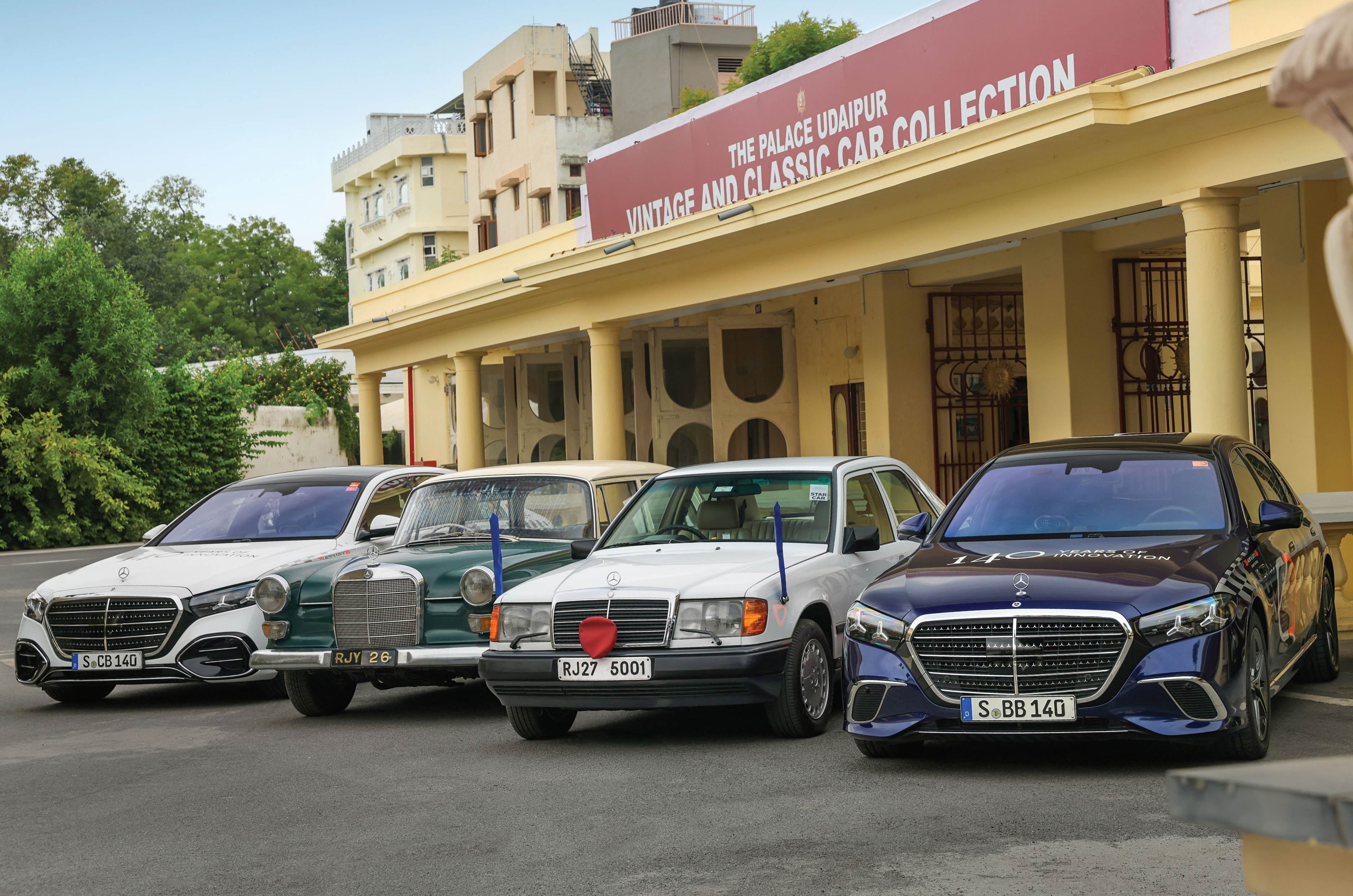
The S-Classes, along with the fin-tail and the 300D.
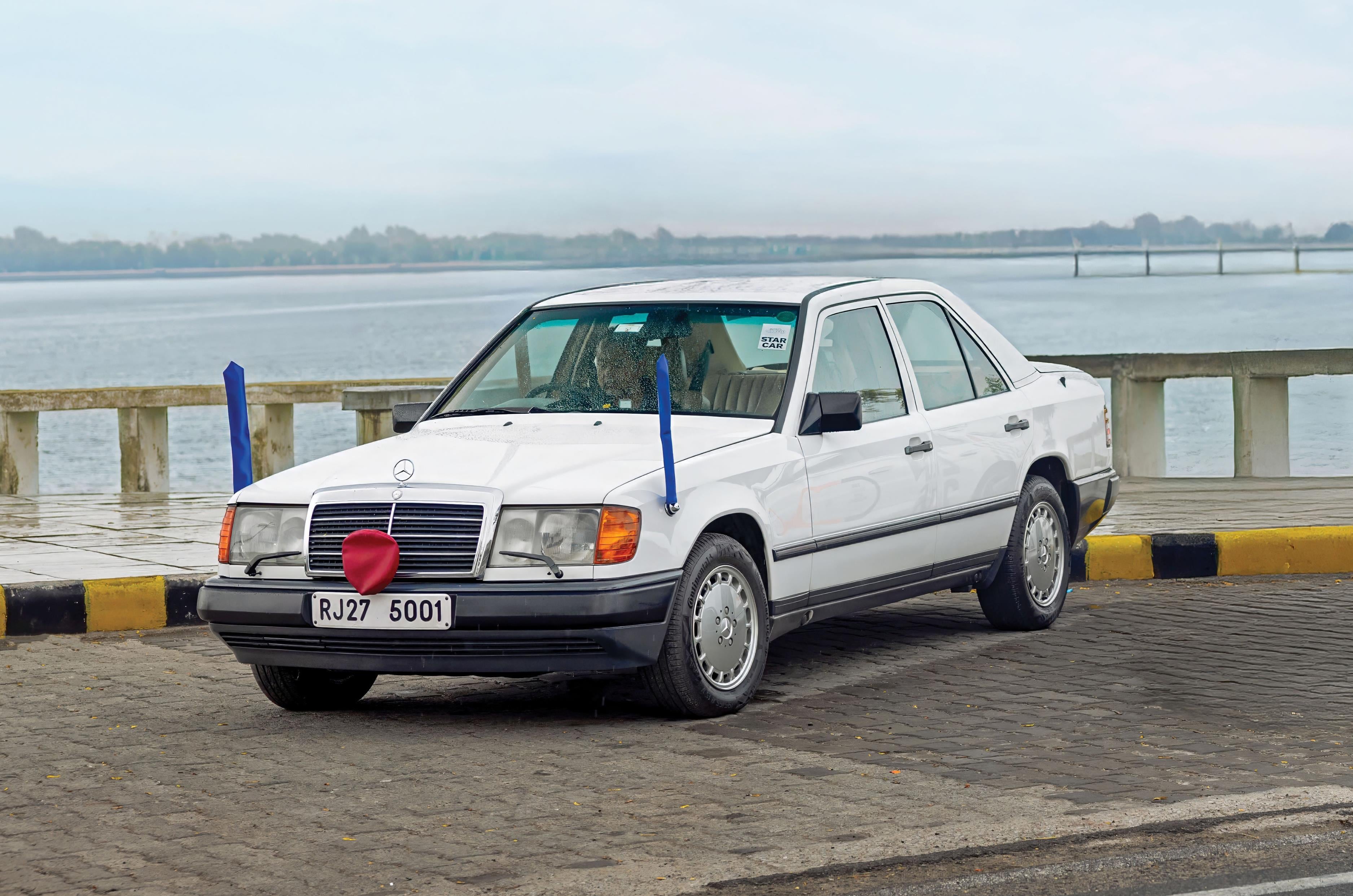
The next day, we set off to see the Udaipur Royal Garage, where we are met by other Mercedes cars. There’s a fin-tail that was used to pick up and drop off guests of the Royal family from neighbouring ‘states’ and a very special W124 300D. The latter, an import rather than a locally assembled W124, stands out from Indian-assembled cars with its black bumpers, headlamp wipers and amber indicators. This six-cylinder diesel with more than 2,00,000km on the clock was used by Shri Arvind Singh Mewar, the earlier Maharana, to cover long distances like Ahmedabad or Jodhpur. Recently restored, it was presented at the Mercedes-Benz Classic Car Rally in Mumbai. The 300D is in such fine nick, I can’t resist a quick spin around another of Udaipur’s stunning lakes, Fateh Sagar.
Why the 300D is such a legend
The W124 300D is an import.
On the outside, the 300D looks sort of underwhelming. Starting up the straight-six diesel is relatively straightforward, although I have to wait for the glow plug to heat up (remember those?). While the roughly 110hp engine doesn’t feel responsive, it feels smooth and refined for a diesel, especially after 2,500rpm. And though it is slow by today’s standards, it doesn’t feel like you’re dragging anchor either. The chunky 300D also feels as tough as a Godrej safe.
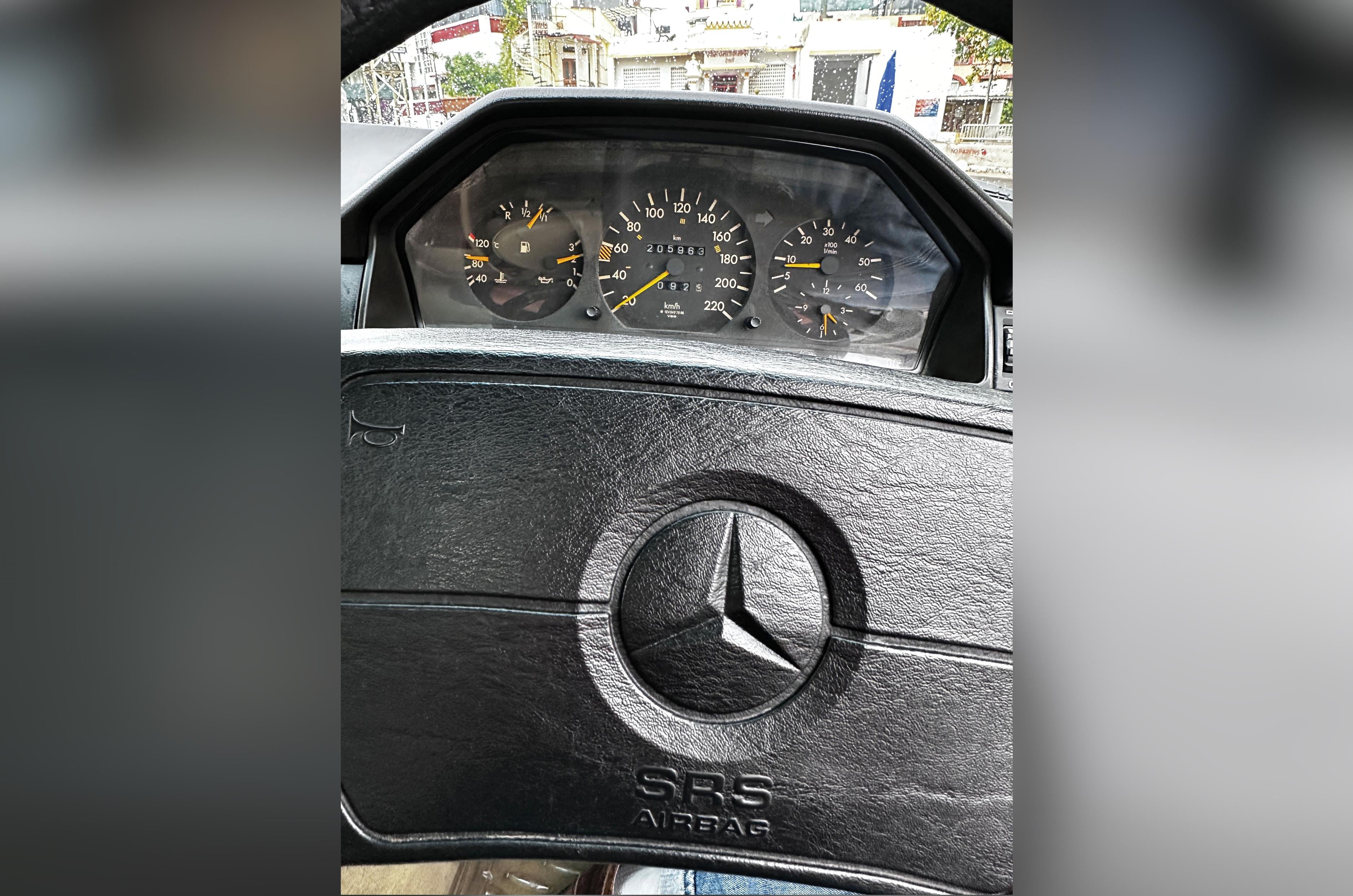
It has 2,00,000km on the odo, but hardly feels like it.
Then I catch a glimpse of the odometer; it reads in excess of 2,00,000 kilometres! Surely my eyes are playing tricks on me. Yes, this car has been recently refurbished, and the suspension has been tightened up, but this thing feels like it has just rolled out of the showroom only recently. It tracks straight, the steering is well weighted and, when I plonk my foot down, it even generates a reasonable amount of torque. This ‘OM603’ straight-six uses indirect injection and a pre-chamber, and has a simple two-valve-per-cylinder setup. Legend has it, it can do a million miles with only basic care. And what of turbo lag, you ask? It doesn’t have one.
Performance tech
The next morning, I get straight behind the wheel of CB or Carl Benz. I’m particularly excited because Carl has a V8 under the hood. What makes this V8 different is that it has some unique tech. This new S-Class is fitted with the ‘M177 Evo’ V8 engine that uses a flat-plane crankshaft! Made popular by Ferrari, a flat-plane crank is used on sportscars to help bunch up the firing order of the cylinders, so you get more of a kick from overlapping strokes. These engines, however, are not as smooth. So why has Mercedes used it in the S-Class, an out-and-out luxury car? Simple: it delivers better efficiency and lower emissions, as the crankshaft is lighter and there’s less reciprocating mass. And what of the vibrations? Mercedes says it has thrown tech at the problem.
V8-equipped S-Class feels effortlessly quick.
Initially, the going is slow as we exit the city. But once we get onto the wide highway, a small tap on the throttle releases a swell of torque just off 2,000rpm. And with 537hp propelling the limousine forward, it just shrinks the long straights on the highway. What’s cool is that the engine never feels brutish or AMG-like; the V8 soundtrack and rumble are superbly muted. The tech works. The new engine, in fact, is so well behaved that I have to check if it is indeed the one with the flat plane crank. At the next stop, I turn around and ask Mario Schneider, head of development for all Mercedes-Benz sedans, who just happens to be in the rear seat.
Also along for the drive is Perseus Bandrawalla, Autocar India’s curator of classic and modern classic events. Five minutes behind the wheel and he is waxing lyrical about the Mercedes V8 engines of days gone past – the M100, the M119 that powered the SL and others. It brings into perspective just how many great V8s Mercedes has had over the years, the 6.3 AMG V8, of course, included.
Cruise control
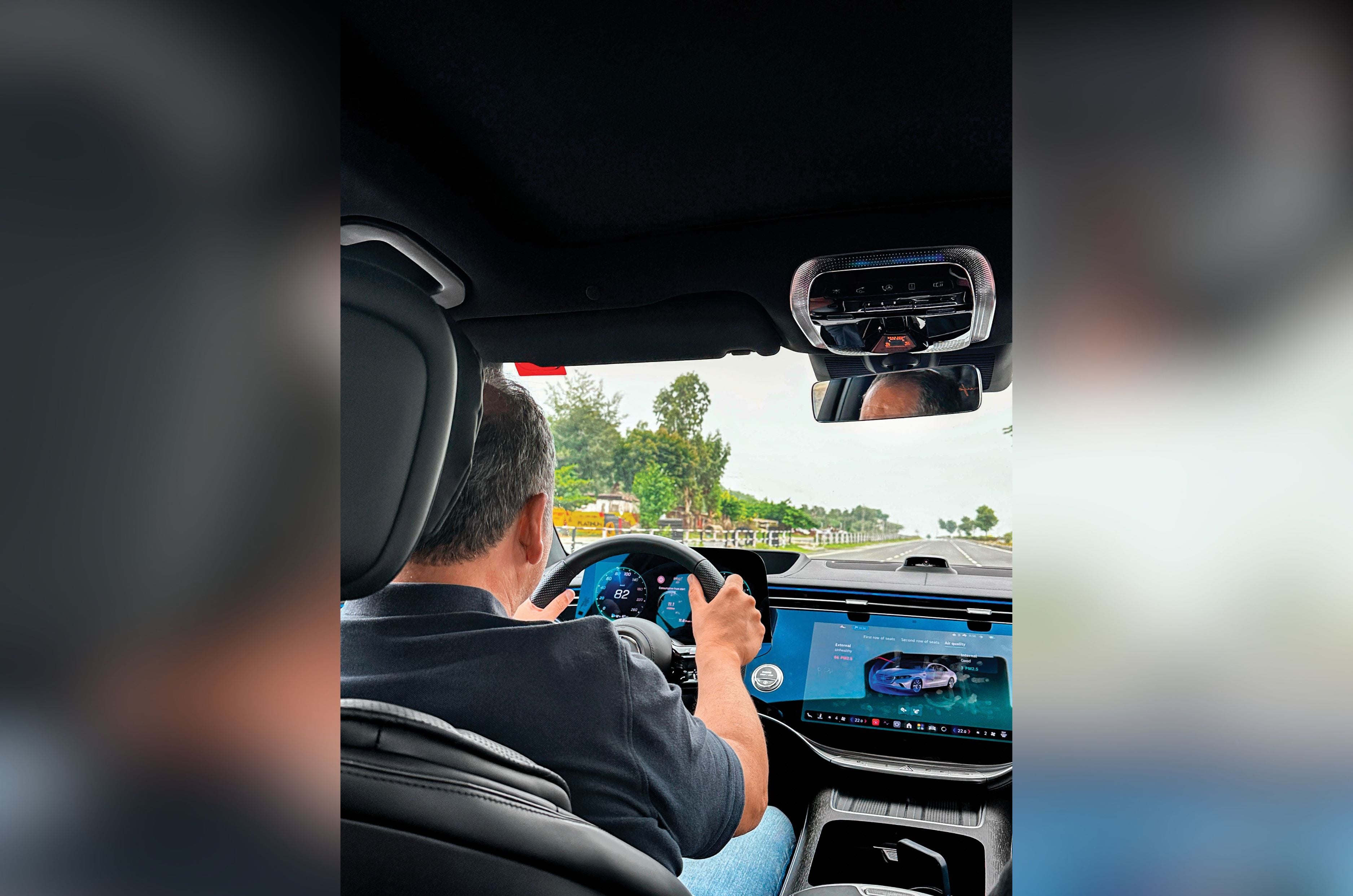
The three screens and updated cabin created a futuristic setup in a traditional environment.
Further up, we get to a ghat section. Not only does the ride on this updated air suspension and adaptive dampers feel a bit more supple, it also feels at home on the winding road, the rear-wheel steering helps it into corners neatly. Even cooler, despite all the tech, it retains a natural fluidity and a sense of mechanical harmony, which make long drives feel just effortless. Are city-bound S-Class owners missing what’s best about this car? Absolutely! Talking about tech, this car also gets Level 3 autonomous driving (in places where it’s allowed), where the driver can be hands off, and even eyes off, with Mercedes Drive Pilot taking responsibility for safety. It is only one of two cars to get this globally.
As we get into traffic, what I notice is that the updated cabin, with its three screens and ambient lighting, creates an environment that is both futuristic and traditional. The seats, with massage and cooling functions, are thrones in their own right. And it’s not just the size, specifications and features it has; it’s how well everything is executed, from the solid build of the cabin to the new phone-like remote controls in the rear.
Collector’s edition
Streamlined Maybach SW38 four door could do 160kph
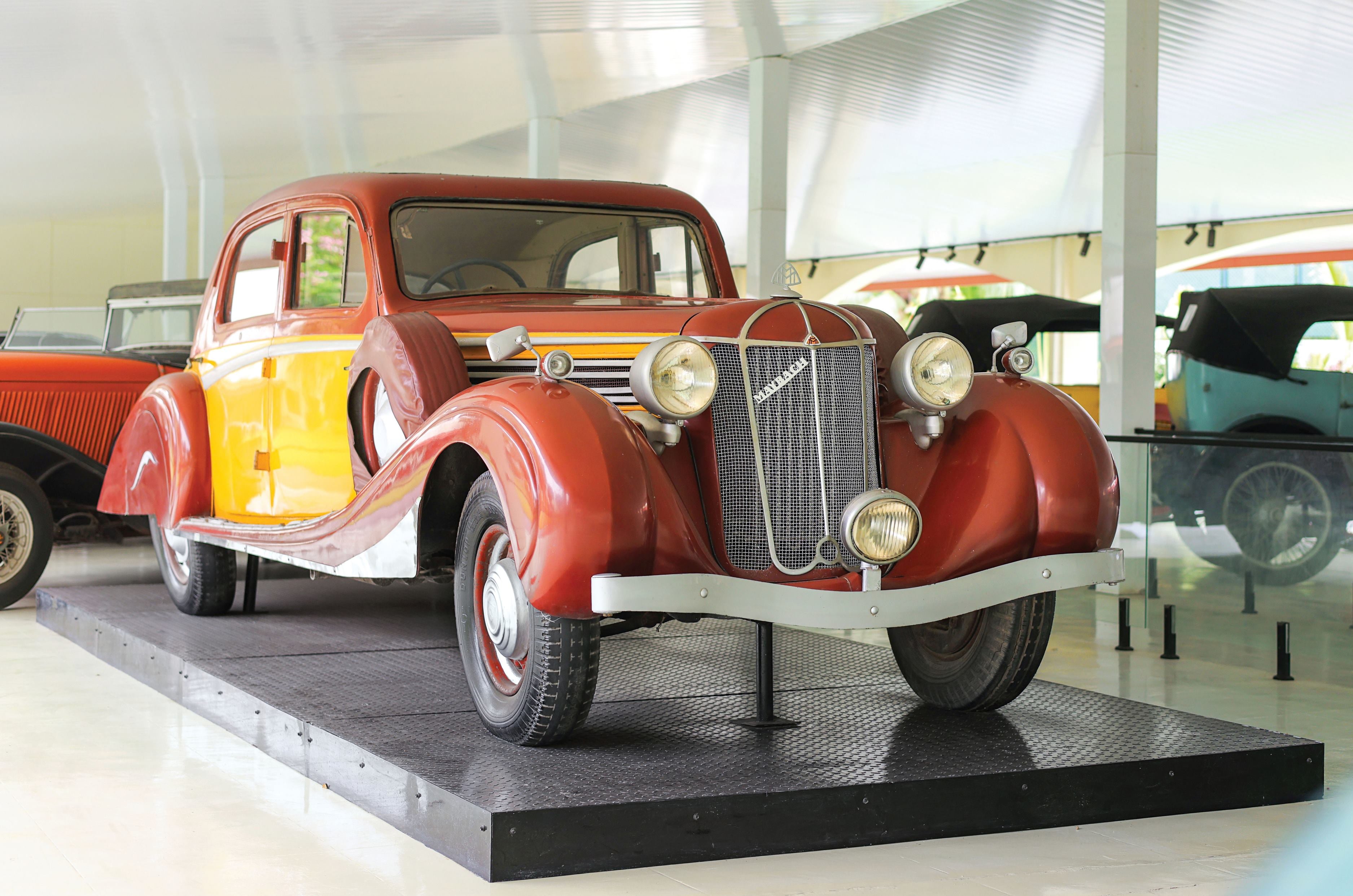
As we get to Ahmedabad, we turn into another historical location, Dastan Auto World – collector extraordinaire Pranlal Bhogilal’s collection, where the modern S-Classes met some more of their ancestors. A Maybach SW38, ordered by Maharaja Umaid Singh of Kota, draws admiring stares from the German members of the Mercedes crew, especially its aerodynamic profile. Capable of nearly 160kph, it was one of the fastest four-doors of its time. Equally captivating are Mercedes’ post-war comeback cars – the 300S ‘Adenauers’. Named after Germany’s first Chancellor, who famously rode in one with his hat on, this limousine is what eventually evolved into the S-Class.
Heritage and high tech
You can trace the journey via the stickers on the cars.
The 140 Years, 140 Places drive captured the duality of Mercedes perfectly; the brand embodies both heritage and innovation in equal measure, both streams converging seamlessly. As the convoy continues its odyssey, what’s clear is that this is a celebration not only of Mercedes’ past, but also the brand’s ability to connect eras, cultures and people through the universal language of the automobile.
समाजवाद को सकारात्मक नजरिए देखने वाले नौजवान अमेरिकियों की संख्या बढ़ती जा रही है। सोशल मीडिया पर पूंजीवाद बनाम समाजवाद की बहस व्यापक चर्चा का विषय बनी हुई है। यह संकेत है कि कम्युनिस्ट और समाजवादी विचारधाराएं, जिन्हें कभी अमेरिका में कलंकित और वर्जित माना जाता था, अब हाशिये से निकलकर मुख्यधारा की चेतना में प्रवेश करती दिख रही हैं- विशेषकर युवा पीढ़ी के बीच।
यूरोपीय राजनीति की खिसक रही भू-गर्भीय परतों (Tectonic Plates) से उठते भूकंपीय झटकों का सितंबर में जर्मनी शिकार बना। पहले हफ्ते में सैक्सनी-अनहाल्ट पहला जर्मन प्रांत बना, जहां नव-नाजीवादी ऑल्टरनेटिव्स फॉर ड्यूशलैंड (एएफडी) पार्टी प्रादेशिक चुनाव जीतने में कामयाब रही (वहां वह लगभग 44 फीसदी वोट पाकर सबसे बड़ी पार्टी बनी)। यह किसी आम स्थिति में अचानक पैदा हुई विसंगति नहीं थी। बल्कि यह एक दशक से अधिक समय से उभरते रूझान का ठोस रूप ग्रहण कर लेना भर था। इस बात की पुष्टि 20 सितंबर को जर्मनी के मेक्लेनबर्ग– वेस्टर्न पोमेरेनिया प्रांत में एएफडी की जीत से हुई। वहां वह 38 प्रतिशत से अधिक वोटों के साथ पहले स्थान पर रही।
उसी रोज जर्मनी की राजधानी बर्लिन में एक दूसरे किस्म का सियासी भूकंप आया। वहां डाई लिंके (द लेफ्ट) पार्टी सबसे आगे रही, जिसे पश्चिमी मीडिया धुर-वामपंथी बताता है। इन तीन नतीजों ने यह साफ कर दिया है कि जर्मनी की राजनीति तेजी से दक्षिण एवं वाम की ‘चरम’ (extreme) धुरियों के बीच बंटती जा रही है। इस तरह सेंटर राइट- क्रिश्चियन डेमोक्रेटिक पार्टी (सीडीयू) और सेंटर लेफ्ट- सोशल डेमोक्रेटिक पार्टी (एसपीडी) के बीच सत्ता की अदला-बदली का जारी लगभग आठ दशक से जारी खेल अब खत्म हो रहा है। उचित ही इसे जर्मन राजनीति में मध्य मार्ग के विलोप के रूप में देखा गया है।
और यह सिर्फ जर्मनी का रुझान नहीं है। वैसे तो यह ट्रेंड चुनावी लोकतंत्र वाले तमाम देशों में उभरा है, लेकिन पश्चिमी देशों में इस नई राजनीतिक परिघटना की खास झलक देखी जा सकती है। कुछ महीनों के बाद इस रुझान की पुष्टि संभवतः फ्रांस में भी होगी, जहां अगले साल होने वाले राष्ट्रपति चुनाव में मुख्य गोलबंदी “धुर वामपंथी” नेता ज्यां ल्यूक मेलेन्शॉ और धुर दक्षिणपंथी नेता मेरी ली पेन के बीच हो रही है।
यह घटनाक्रम आने वाले वक्त में संभावित राजनीतिक टकराव का संकेत है। डाई लिंके की जीत और मेलेन्शॉ को मिल रही लोकप्रियता दुनिया में नए तेवर वाले वामपंथ के उदय की मिसाल हैं। और ऐसे संकेत सिर्फ यूरोप तक सीमित नहीं हैं। डाई लिंके की जीत के सिलसिले में यह बात सामने आई कि इस पार्टी ने बर्लिन में अपने चुनावी अभियान को न्यूयॉर्क के मेयर जोहरान ममदानी से सीख लेते हुए डिजाइन किया। बर्लिन में डाई लिंके का चेहरा तुर्किश मूल की सोशलिस्ट एलीफ एराल्प हैं। उनकी टीम ममदानी के प्रचार अभियान का अध्ययन करने न्यूयॉर्क गई। वहां से वह ये सबक लेकर लौटी कि बिखरे हुए अनगिनत मुद्दों को उठाने के बजाय दो या तीन ऐसे मुद्दे लिए जाएं, जिनकी वजह ‘लोगों की रात की नींद उड़ी रहती है’।
न्यूयॉर्क की तरह ही बर्लिन में भी नवोदित लेफ्ट ने मकान किराये को अपना केंद्रीय मुद्दा बनाया। साथ में रोजमर्रा की चीजों की महंगाई और परिवहन पर ध्यान केंद्रित किया गया। उसके साथ हज़ारों स्वयंसेवकों को संगठित किया गया, ताकि वे घर घर जाकर चर्चा कर सकें। और उसका असर हुआ- ठीक न्यूयॉर्क की तरह। अब एराल्प बर्लिन की मेयर कार्यालय के दरवाजे तक पहुंच चुकी हैं।
एक जर्मन विश्लेषक ने लिखा है- यह तथ्य कि पूंजीवादी विरोधी वामपंथ ने बर्लिन में जीत हासिल की है, पुष्टि करता है कि उदारवादी (लिबरल) और मध्यमार्गी (सेंटरिस्ट) विकल्पों का पतन और “बाज़ार लोकतंत्र” का ढहना जारी है। वह पार्टी सिस्टम ढह रहा है, जो नव-उदारवाद के दौरान एक ही केंद्र- पूंजी से नियंत्रित रहा, भले दिखावटी तौर पर कई पार्टियों के रूप में उसके अनेक चेहरे सामने रहे हों।
गुजरे डेढ़ दशक में दुनिया के बहुत बड़े हिस्से में धुर-दक्षिणपंथ का बढ़ना सबसे मजबूत राजनीतिक परिघटना रही है। ऐसा उन विशाल निराश समूहों की प्रतिक्रिया से संभव हुआ, जिन्होंने नव-उदारवादी भूमंडलीकरण के विनाशकारी परिणामों को झेला और एक मुकाम आकर उसे ठुकराना शुरू किया। अर्थव्यवस्था का उत्तरोत्तर वित्तीयकरण, वेतन की अस्थिरता, बेरोजगारी, आवास का दुर्लभ होना, स्वास्थ्य सेवाओं की महंगाई, शिक्षा का व्यापारीकरण, आम इन्फ्रास्ट्रक्चर का क्षय- आदि के कारणों से उपजे जन असंतोष का लाभ धुर दक्षिणपंथी दलों ने उठाया। किसी ‘आंतरिक शत्रु’ के खिलाफ नफरत भरे अभियान चलाना, काल्पनिक प्रभु वर्ग (मोटे तौर पर पहले सत्ता से लाभान्वित रहे समूहों) को तमाम समस्याओं के लिए जिम्मेदार ठहराना, अयथार्थ समाधान पेश करना- आदि ऐसा तरीका रहा है, जिसे लगभग हर देश में उन दलों ने अपनाया है। इनकी बदौलत धुर-दक्षिणपंथियों को कामयाबी मिली है।
उन्हें यह सफलता इसलिए भी मिली, क्योंकि पारंपरिक वामपंथ ने नव-उदारवाद के हाथों अपनी हार को स्वीकार कर लिया। वे दल बाजार, बड़ी कंपनियों, और अंतरराष्ट्रीय पूंजी के समन्वित हमलों के आगे झुक गए। उन्होंने बिना आलोचनात्मक रुख अपनाए उस एजेंडे को स्वीकार कर लिया, जो शासक वर्ग उनके लिए तैयार किया था। मसलन, पहचान आधारित मुद्दों और woke culture के समर्थन में उन्होंने अपना सारा जोर लगाया, जबकि आम जन के रोजमर्रा के सवालों से उन्होंने नेता तोड़ लिया।
ट्रेड यूनियनों का बदलाव के बड़े सपनों को छोड़ देना, वर्ग-आधारित पार्टियों का विघटन और वर्ग चेतना को आगे बढ़ाने की जिम्मेदारी से उनका मुंह मोड़ लेना- ये सब इसी दौर की कहानियां हैं। इस दौर में पूंजी बनाम श्रम की बहस को हाशिये में चले जाने दिया गया और यह शिक्षा नजरअंदाज दी गई कि पूंजी का बेलगाम संकेंद्रण धन उत्पन्न करने के अन्य दो स्रोतों- प्रकृति और श्रम- को नष्ट कर देता है।
इसी दौर में धुर-दक्षिणपंथ “समाधान” बनकर उभरा। उसने मुसीबत के असली स्रोतों से ध्यान हटा कर अल्पसंख्यकों, प्रवासियों, या कम्युनिस्ट प्रतीकों को निशाने पर लिया। पश्चिमी देशों में पारंपरिक वामपंथ और मध्यमार्गी दलों ने इनमें से कुछ सवालों पर धुर-दक्षिणपंथ को अपनी मौन सहमति दी, जबकि कुछ मुद्दों पर उसे सीधे चुनौती देने से वे बचते रहे। उसी का नतीजा अब उनका खुद हाशिये पर चले जाना और उससे पैदा हुए खालीपन को भरने के लिए नए तेवर वाले वामपंथ का उभरना है।
इस प्रक्रिया को फिलहाल अमेरिका भी साफ देखा जा सकता है। वहां नए वामपंथी तेवर की नुमाइंदगी Democratic Socialists of America (डीएसए) कर रहा है। हालांकि यह स्वायत्त राजनीतिक समूह है, लेकिन चुनावी सिस्टम की मजबूरियों के कारण वह डेमोक्रेटिक पार्टी के अंदर अपने को संगठित किए हुए है। इस समय जोहरान ममदानी डीएसए का सबसे प्रखर चेहरा हैं। लेकिन उसके अनेक चेहरे इस वर्ष डेमोक्रेटिक प्राइमरी (उम्मीदवार चुनने की प्रक्रिया) में कामयाब रहे, और तीन नवंबर को होने वाले मध्य-अवधि चुनावों में डेमोक्रेटिक उम्मीदवार के तौर पर मैदान में हैं। उनके नतीजों पर सबका ध्यान टिका हुआ है।
यह घटनाक्रम अमेरिका में आए एक बड़े बदलाव को जाहिर करता है। इस सिलसिले में ब्रिटिश अर्थशास्त्री जॉन रॉस की यह टिप्पणी काबिल-ए-गौर हैः
“पिछली बार जब किसी सोशलिस्ट उम्मीदवार को अमेरिकी चुनाव में गंभीरता से लिया गया, तो वह 1912 में था, जब यूजीन डेब्स को राष्ट्रपति पद के लिए 6 फीसदी वोट मिले। यह बहुत कम था, लेकिन नगण्य नहीं था। उसके बाद पहली बार हो रहा है, जब डीएसए चुनाव जीत रहा है। उनके सदस्य कांग्रेस में हैं। उन्होंने दो सीटें जीतीं। उन्होंने सीनेट के लिए डेमोक्रेटिक उम्मीदवारी हासिल की है। न्यूयॉर्क के मेयर ममदानी डीएसए के सदस्य हैं। यह पहली बार है कि जब उम्मीदवार खुले तौर पर समाजवादी के रूप में खड़े हो रहे हैं। इसका अपवाद सिर्फ बर्नी सैंडर्स हैं, जो डेमोक्रेटिक सोशलिस्ट हैं, लेकिन वे निर्दलीय के रूप में ही चुनाव लड़ते रहे।।।।।
अमेरिकी अखबार पढ़ें, तो मुझे लगता है वॉल स्ट्रीट जर्नल लगभग हर दिन डीएसए की निंदा करने वाला लेख छापता है, और न्यूयॉर्क टाइम्स आदि भी। और यह चौंकाने वाला है। यह तो शायद संवैधानिक भी न हो कि अमेरिकी कांग्रेस किसी विशिष्ट संगठन की निंदा करने के लिए मतदान करे, क्योंकि यह कहा जा सकता है कि यह अमेरिकी संविधान के प्रथम संशोधन के खिलाफ है, जो अभिव्यक्ति की स्वतंत्रता का अधिकार सुनिश्चित करता है। लेकिन ऐसा इसीलिए हुआ, क्योंकि अब मामला गंभीर है।।।।
इसका मतलब यह नहीं है कि अमेरिका समाजवादी बनने जा रहा है। दुर्भाग्य से मेरे जीवन काल में ऐसा नहीं होगा। यहां मेरा मतलब वास्तविक समाजवाद से है- यानी उस अर्थ में, जिसमें अर्थव्यवस्था का अधिकांश हिस्सा राजकीय स्वामित्व में आ जाता है, आपके सामने औपचारिक समाजवादी समाज होता है, और श्रमिक वर्ग समाज में अग्रणी शक्ति होता है।”
यहां जॉन रॉस ने कांग्रेस (अमेरिकी संसद) के जिस प्रस्ताव का जिक्र किया, वह निचले सदन हाउस ऑफ रिप्रजेंटेटिव ने पिछले एक सितंबर को पारित किया। 192 के मुकाबले 220 मतों के बहुत से पारित इस प्रस्ताव में “समाजवाद” की निंदा की गई। डीएसए का इसमें नाम लेकर जिक्र किया गया। इसके अलावा हाल में अमेरिकी राष्ट्रपति डॉनल्ड ट्रंप और रिपब्लिकन पार्टी के नेता बार बार कम्युनिस्ट खतरे का जिक्र करते रहे हैं। उन्होंने डीएसए उम्मीदवारों का उल्लेख कर कहा है कि “कम्युनिज़्म हमारा दुश्मन है”। बीते चार जुलाई को अमेरिकी स्वतंत्रता की 250वीं सालगिरह के मौके पर राष्ट्र के नाम संबोधन में ट्रंप ने एक चौथाई से ज्यादा समय कम्युनिस्ट खतरे के उल्लेख और कम्युनिज्म के कथित अत्याचारों की चर्चा में लगाया।
इसके बावजूद हकीकत यह है कि समाजवाद को सकारात्मक नजरिए देखने वाले नौजवान अमेरिकियों की संख्या बढ़ती जा रही है। सोशल मीडिया पर पूंजीवाद बनाम समाजवाद की बहस व्यापक चर्चा का विषय बनी हुई है। यह संकेत है कि कम्युनिस्ट और समाजवादी विचारधाराएं, जिन्हें कभी अमेरिका में कलंकित और वर्जित माना जाता था, अब हाशिये से निकलकर मुख्यधारा की चेतना में प्रवेश करती दिख रही हैं- विशेषकर युवा पीढ़ी के बीच। और अब बात चर्चा से आगे निकल कर यहां पहुंच गई है कि खुद को सोशलिस्ट बताने वाले उम्मीदवार चुनाव जीतने लगे हैं।
इस घटनाक्रम ने डीएसए की नीतियों और कार्यक्रम को चर्चा के केंद्र में लाया है। आम धारणा यही है कि डीएसए नॉर्डिक सोशल डेमोक्रेसी का अमेरिकी संस्करण है। नॉर्डिक मॉडल निजी स्वामित्व, प्रतिस्पर्धी बाज़ार, और बड़े निजी कॉरपोरेट्स को चुनौती नहीं देता। वह महज सामूहिक सौदेबाजी (यानी यूनियन अधिकारों) को मजबूत करने और उदार कल्याणकारी राज्य की धारणा पर आधारित है। नॉर्डिक मॉडल के तहत राज्य अधिक कर लगाता है, अधिक विनियमन करता है, और अधिक सार्वजनिक सेवाएं प्रदान करता है, लेकिन अर्थव्यवस्था का स्वामित्व और संचालन मुख्य रूप से निजी पूंजी ही करती है।
व्यवहार में डीएसए की राजनीति चाहे जो हो, अपने प्रोग्राम में वह इससे कहीं आगे गया है। उसका कार्यक्रम पूंजीवादी स्वामित्व को केंद्रीय समस्या मानता है। वह कंपनी संचालन, निवेश, संसाधन आवंटन आदि का दायित्व सार्वजनिक संस्थानों, श्रमिक संगठनों और लोकतांत्रिक निकायों की ओर ट्रांसफर करना चाहता है। संघीय स्तर पर रोजगार गारंटी, 32 घंटे का कार्य सप्ताह, पूर्ण वेतन के साथ पर्यटन अवकाश, व्यक्तिगत शुल्क के बिना सार्वजनिक स्वास्थ्य सेवा, प्री-स्कूल से विश्वविद्यालय तक मुफ्त शिक्षा, छात्र ऋण की समाप्ति, किराया नियंत्रण, बड़े पैमाने पर सामाजिक आवास का निर्माण आदि उसके कार्यक्रम का हिस्सा हैं। संसाधन जुटाने के लिए वह वेल्थ टैक्स, कॉरपोरेट टैक्स की ऊंची दरों तथा उत्तराधिकार कर लगाने की मांग करता है।
डीएसए का राजनीतिक सुधार कार्यक्रम भी उतना ही व्यापक है। यह अमेरिकी सीनेट और इलेक्टॉरल कॉलेज को समाप्त करने, आनुपातिक प्रतिनिधित्व लागू करने, बहुदलीय लोकतंत्र लागू करने, राष्ट्रपति पद और सुप्रीम कोर्ट का ढांचा फिर से तय करने, और कार्यपालिका तथा न्यायपालिका को कहीं अधिक कड़े विधायी नियंत्रण के अधीन लाने आदि जैसी बात करता है।
अमेरिकी सिस्टम के भीतर से ऐसे सुधारों को लागू करवा पाना असंभव समझा जाता है। जबकि बाहरी जन हस्तक्षेप से सिस्टम को पलटना डीएसए की रणनीति का हिस्सा नहीं है। इसीलिए उसके कार्यक्रमों को अक्सर हवाई बताया जाता है। लेकिन इसका अर्थ यह नहीं है कि उनका कोई महत्त्व नहीं है। डीएसए को इस बात का श्रेय दिया जाएगा कि उसने अमेरिका में उन मुद्दों को लोकप्रियता दिलाई, जिनसे वहां का शासक वर्ग ना सिर्फ नफरत करता है, बल्कि भयभीत भी होता है।
बीसवीं सदी वयस्क मताधिकार आधारित लोकतांत्रिक प्रणाली की स्थापना के लिए हुए आंदोलनों के कारण जनता के राजनीतिक अधिकारों का विस्तार हुआ था। बोल्शेविक क्रांति ने उसमें आर्थिक एवं सामाजिक पक्ष जोड़े। लेकिन एक मुकाम के बाद शासक वर्ग उस चेतना को भटकाने और सिस्टम पर फिर से अपना पूरा शिकंजा कसने में कामयाब हो गया। मौजूदा दौर में धुर-दक्षिणपंथ को उसने अपना राजनीतिक औजार बनाया है। उसके प्रतिवाद के रूप में अब नए तेवर वाला वामपंथ सामने आया है। हालांकि इसकी सीमाएं हर जगह स्पष्ट हैं, फिर भी इसका उदय स्वागतयोग्य है, क्योंकि इनसे नई संभावनाएं खुलती हैं।
भारत के राजनीतिक क्षितिज पर अभी ऐसी किसी संभावना के संकेत नजर नहीं आते, तो उसकी वजह यहां शासक वर्ग के चलाए उस वैचारिक एजेंडे का अभी भी प्रभावशाली बने रहना है, जिसके जरिए आम जन की रोजमर्रा की समस्याओं को विमर्श से बाहर धकेला गया है। बहरहाल, यहां की नई पीढ़ी अगर सीखना चाहे, तो वह पश्चिम में उभरी संभावनाओं और उनकी सीमाओं का अध्ययन कर सकती है। हालांकि अपनी राजनीति विकसित करने के लिए शिक्षा का असल स्रोत तो अपनी वस्तुगत परिस्थितियां और आवाम हो ही सकते हैं। खैर, यह एक बिल्कुल अलग मुद्दा है।
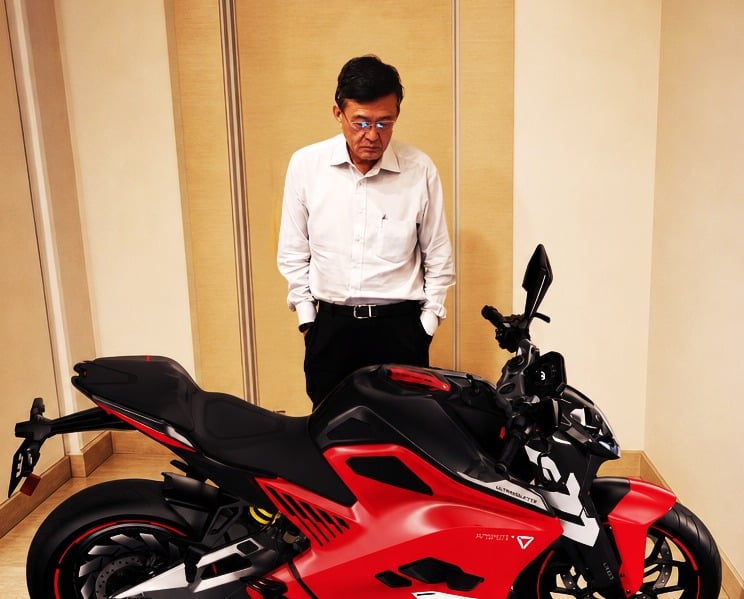
Bengaluru based EV manufacturer, Ultraviolettehad recently announced plans for a new manufacturing facility in Hosur, to increase production capacity up to 5 lakh units a year. The company has now received USD 85 million in a new funding round. The additional capital and the new factory is expected to boost the manufacturing of its current products, the F77 (Mach 2 and Superstreet), X-47, and development of upcoming platforms and products.
The USD 85 million funding was led by Deep Tech Fund Yali Capital and TDK Ventures
New Hosur plant expected to increase production capacity up to 5 lakh units a year
Ultraviolette currently has the means to build battery architecture ranging from 48V to 400V
Ultraviolette plans expansion in India and abroad
Four new products and US entry planned for next year
Currently, Ultraviolette operates in India and 20 European countries. With the fresh round of investment, the company has targeted an US market entry next year, alongside key markets in Latin America and Southeast Asia. The USD 85 million funding round was led by Deep Tech Fund Yali Capital and TDK Ventures and investment from Lip-Bu Tan, Chief Executive Officer of Intel, Chairman of Walden International and Advisor to Ultraviolette, alongside the company’s current and long-term investors. UV says the new and continued support from the investors will help scale production of its current portfolio as well as upcoming products.
The investment will also help with the development of UV’s next generation of models. The company currently boasts technical capabilities to build battery architecture spanning 48V to 400V which it says allows for engineering platforms catering to different needs. Its current list of investors include Zoho Corporation, TVS Motors, and Qualcomm Ventures. Besides India, UV currently operates across Europe including Germany, France, Spain, Portugal, the UK, Belgium, Netherlands, Italy, Switzerland and Hungary.
Bajaj Auto has exported 11,00,827 two-wheelers in the April-August period of FY27, up 50 percent year-on-year from 7,34,193 units in the same period last year. The figure already represents 56 percent of Bajaj’s highest-ever annual motorcycle export tally of 19.6 lakh units in FY26, putting the company on course to set a new record by the end of the fiscal year. Across all vehicle categories – two-wheelers, three-wheelers and the Qute quadricycle – Bajaj exported 12,66,714 units in the five-month period, up 50 percent year-on-year.
Bajaj Auto exports 11 lakh two-wheelers in April–August FY27
Holds 41 percent share of India’s total two-wheeler exports; TVS second at 28 percent
Entry-level 100-125cc bikes account for 71 percent of motorcycle export volumes
Bajaj Auto 2W export breakdown
Latin America and Africa drive demand
Of the 10,96,009 motorcycles exported (remaining 4,818 units in the two-wheeler tally were Chetak electric scooters) in the period, bikes displacing 100-110cc accounted for the largest share at 4,70,362 units – up 95 percent year-on-year – and a 43 percent share of total motorcycle exports. The 110-125cc bracket contributed a further 3,04,191 units, up 42 percent, for a 28 percent share. Together, these two entry-level categories account for 71 percent of Bajaj’s motorcycle exports in the period.
The 125-150cc bracket (Boxer, CT 150, Pulsar) contributed 1,02,266 units, up 11 percent, while the 150-200cc range fared better at 1,22,481 units, up 17 percent. In terms of geographies, motorcycle exports have risen strongly in Latin America – particularly Brazil and Mexico, the region’s two largest two-wheeler markets – and in Africa, where the Boxer 125 Heavy Duty is seeing strong demand in Nigeria.
Commercial vehicles and Qute
Three-wheeler exports also posted strong growth, with Bajaj shipping 1,60,685 units in the period – up 48 percent year-on-year – for a commanding 62 percent share of India’s total three-wheeler exports of 2,59,593 units. Demand for the Qute surged 206 percent year-on-year to 5,202 units, driven by Egypt, Turkey and select African markets, and is already 78 percent of the Qute’s highest-ever annual export total of 6,696 units in FY26.