Scooter sales hit record high in first half of FY2027

Scooter sales hit record high in first half of FY2027
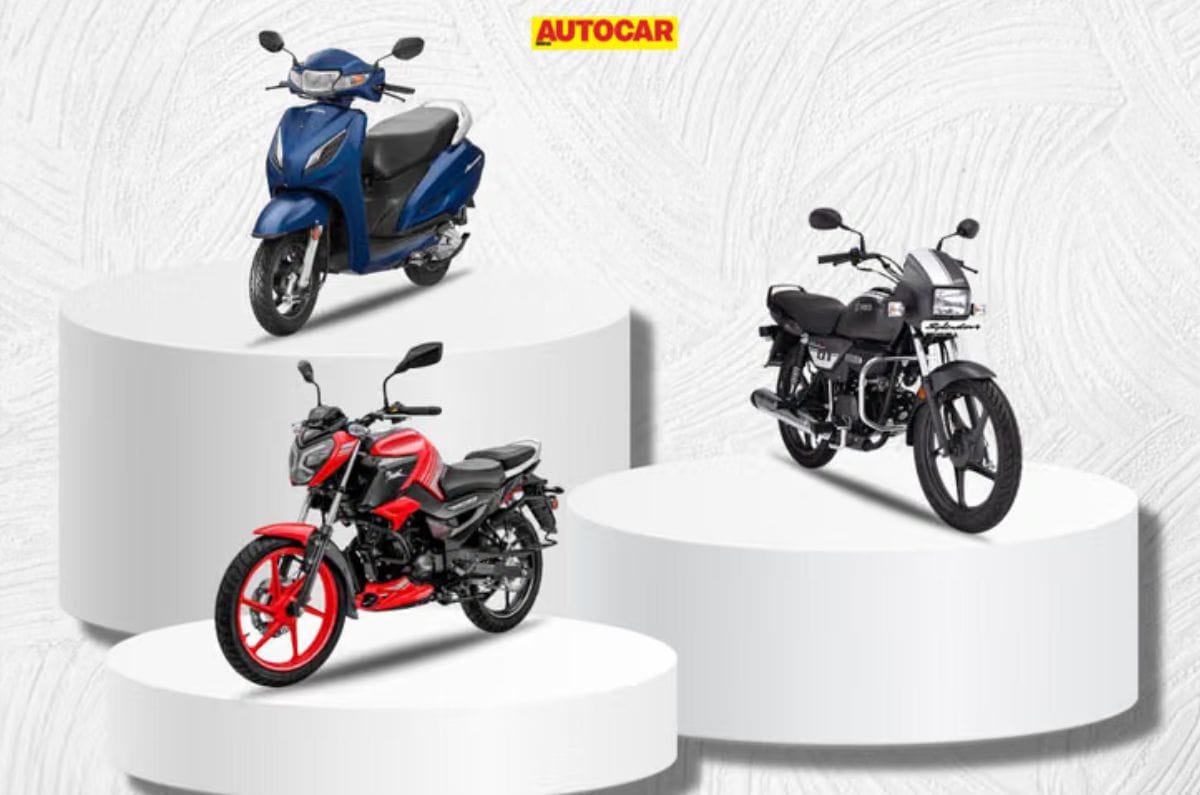
Graphic with Activa, Jupiter, and Access on a podium

Two-wheeler manufacturers have dispatched a record 48,65,192 scooters in the domestic market in the first half (H1) of FY2027. That’s an additional 10.8 lakh units over the same period last year, representing a 29 percent increase. The six-month period included two monthly records: April 2026 opened as the best-ever April, with 6,91,993 units, while September registered 9,95,576 units – the highest monthly total ever for the category and just 4,424 units short of the million-unit (10 lakh) milestone.

Zooming out, the scale of the growth becomes clearer. Scooter sales have more than doubled over 12 years. In H1 FY2016, the total was 2.4 million units, whereas FY2027’s first half has already reached about 60 percent of FY2026’s full-year record of 8.11 million units.

Electric scooters double, claim a 20 percent share

Honda leads overall, TVS grows faster

The fastest-growing part of the segment is electric. E-scooter wholesales hit 9,78,017 units in H1 FY2027, up 103 percent year-on-year from 4,81,199 units in H1 FY2026. This surge has pushed EVs’ share of total scooter sales from 13 percent to 20 percent in a single year.

TVS Motor Company leads the e-scooter market, with 3,05,972 iQube and Orbiter units dispatched, up 107 percent year-on-year, giving it a 31 percent share. Bajaj Auto is second, with 2,60,982 Chetak and Yulu units – a 116 percent jump – and a 27 percent share. Together, the two account for 58 percent of all e-scooters sold in the first half. Ather Energy, with 1,71,611 units and 56 percent growth, held third place, though its share dipped from 23 percent to 18 percent as the market expanded. Hero MotoCorp’s Vida dispatched 1,33,964 units, up 118 percent, for a 14 percent share.

The three Japanese players – Honda, Suzuki and Yamaha – collectively sold 12,523 e-scooters, accounting for a combined 1 percent share. Honda led the group with 7,010 units, up 176 percent.
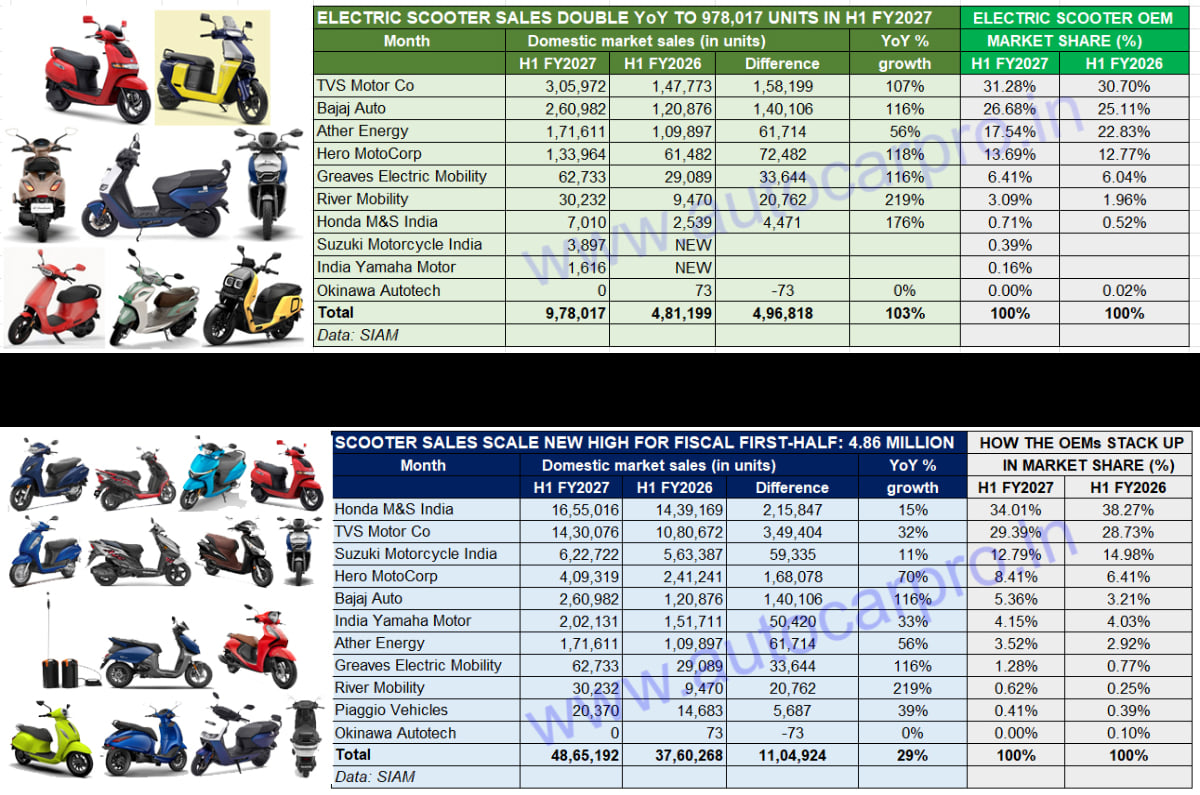
Across ICE and EV models combined, Honda Motorcycle & Scooter India remains the category leader with 1.65 million units, up 15 percent, although its market share has dipped from 38 percent to 34 percent. TVS Motor Company is in second place with 1.43 million units and 32 percent growth, adding 3,49,404 units year-on-year. Nearly half of that incremental volume came from its electric lineup.

Suzuki, with 6,22,722 units and 11 percent growth, and Hero MotoCorp, with 4,09,319 units and 70 percent growth, hold third and fourth place, respectively. Bajaj Auto has climbed to fifth with 2,60,982 units and 116 percent growth, displacing Yamaha, which recorded 2,02,131 units, up 33 percent. Ather Energy is seventh with 1,71,611 units, while River Mobility has entered the top 10, overtaking Piaggio with 30,232 units of the Indie scooter.

With the festive season now underway, the industry will be looking to convert the strong H1 momentum into retail sales. Whether Q3 and Q4 can sustain the near-30 percent growth rate needed to push scooter sales past 10 million units for the first time remains to be seen, but the trajectory points firmly in that direction.
 

Honda, Suzuki and Yamaha e-scooter sales cross 10,000 units in 2026

Honda, Suzuki and Yamaha e-scooter sales cross 10,000 units in 2026
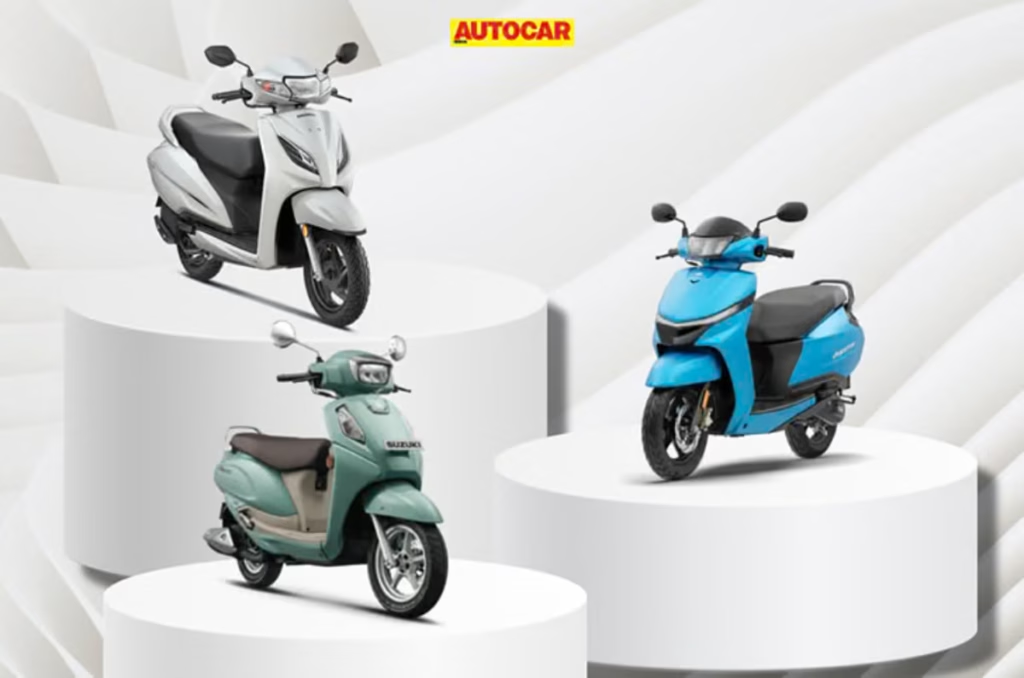
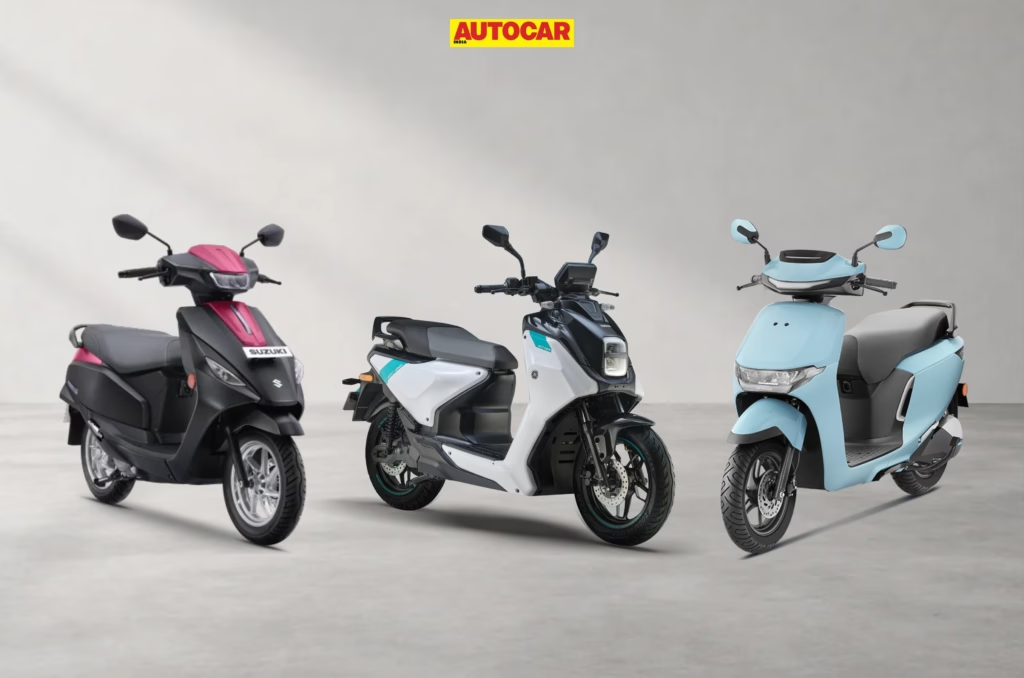
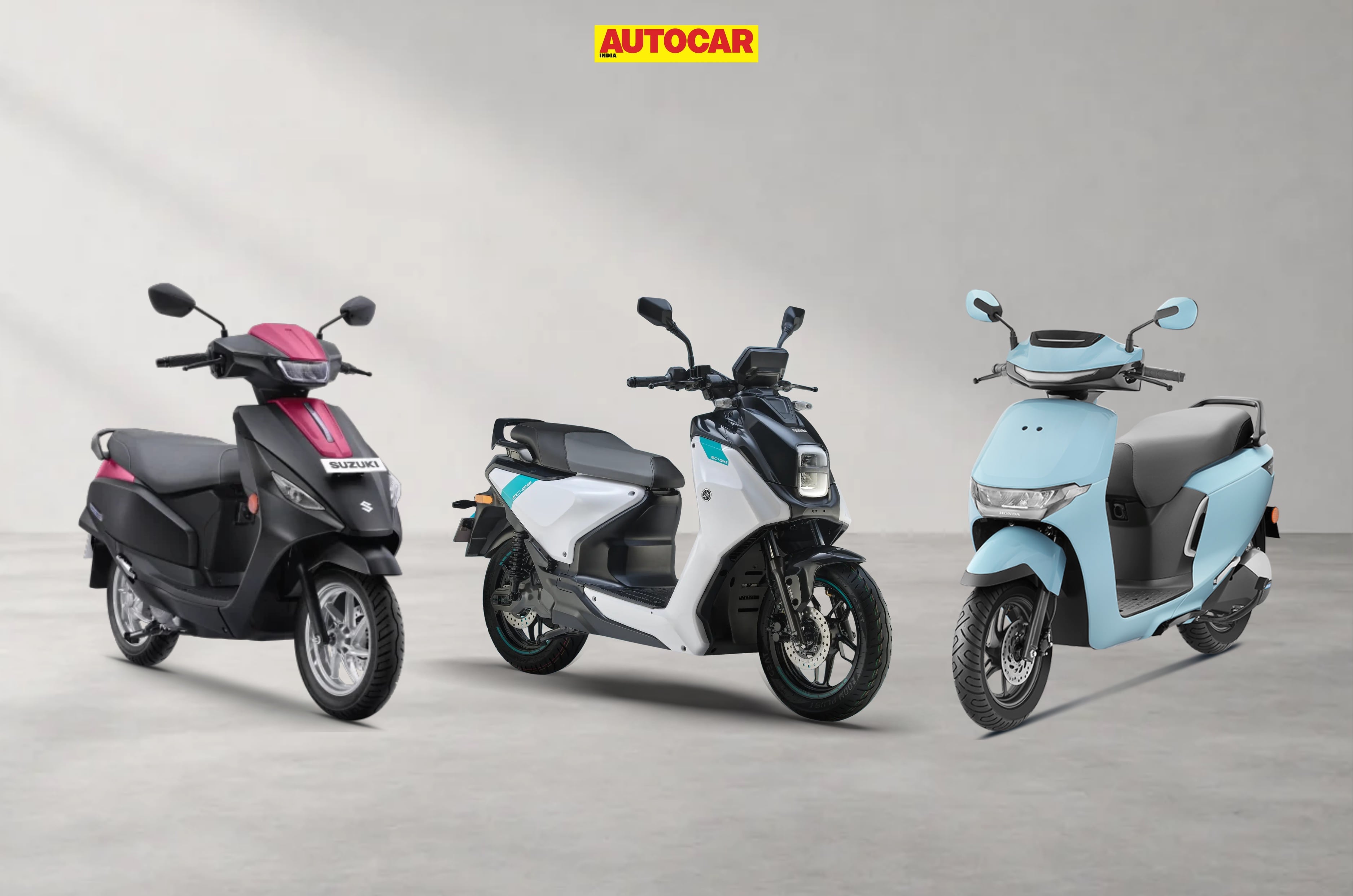
Graphic with Honda, Suzuki and Yamaha e-scooters

Cumulative retail sales of the three Japanese electric scooter manufacturers in India – Honda, Suzuki and Yamaha – have crossed the 10,000-units mark for the first time in a calendar year. As per the latest Vahan statistics, this triumvirate have delivered 10,735 units to their customers between January 1 and October 8 in 2026. 

Last year, Honda, which was the sole e-2-wheeler OEM in India, had sold 7,730 units of the Activa-e and QC1, less of the former and more of the latter. While Suzuki entered the market in January 2026 with its e-Access, Yamaha plugged in two months later in March with its EC-O6. This makes 2026 the first year when all these three Japanese OEMs are part of the Indian electric scooter market.

A look at the OEMs’ monthly performance reveals that Honda Motorcycle & Scooter India has sold 5,536 units in this year to date, accounting for 51 percent of the total 10,735 Japanese e-scooters delivered. HMSI’s best monthly sales this year were in September (1,107 units), marking the first time the OEM has crossed 1,000 units. This number can only improve following the recent launch of its third e-scooter for India – the QC3. 

The initial rollout of the QC3 will be limited to five cities across the country: Delhi, Agra, Cuttack, Surat and Kollam, with a nationwide rollout to follow in a phased manner.. 

Suzuki Motorcycle India, which entered the India e-2W market with its e-Access in January this year as an alternative to the popular petrol-engined Suzuki Access 125, has delivered 4,133 units till October 8. This gives the company a 39 percent share of the three Japanese OEM’s total e2W retail sales. The monthly sales chart reveals that monthly sales have crossed 600 units for three months running: July (606 units), August (674 units) and September (657 units). Rather creditable considering this is an expensive product, priced at Rs 1.88 lakh (ex-showroom) and the costliest amongst the Japanese EVs. 

India Yamaha Motor, which plugged into the e-2W market this March, has retailed 1,066 units, which gives it a 10 percent share of the 10,735 units delivered by Honda, Suzuki and Yamaha. Yamaha’s vehicle of entry is the EC-06, its first electric scooter developed in collaboration with River Mobility. IYM’s highest monthly sales to date were in September (232 units)

Japanese OEMs have 0.66 percent share of e-2Ws sold in 2026 so far

As the monthly retail sales data table depicts, combined Honda-Suzuki-Yamaha sales were at their highest in September 2026 (1,996 units), which gives them a 1 percent share of the record 2,07,850 e-2Ws sold in India last month. Of the total 16,10,854 e-2Ws sold between January 1 and October 8, these three Japanese OEMs with 10,735 units have a meagre 0.66 percent share. 

Among the reasons for their minimal presence in this booming segment of the Indian EV industry is that Honda, Suzuki and Yamaha entered the e-2W market late, as compared to their ICE legacy rivals TVS Motor Co (January 2020), Bajaj Auto (January 2020) or Hero MotoCorp Vida (November 2022).

While market leader TVS has sold 4,22,274 iQubes and Orbiters for a 26 percent market share of the e-2W sales in 2026 to date, Bajaj Auto has delivered 3,61,988 Chetaks (22 percent share), Ather Energy has sold 2,67,579 units (17 percent share) and Hero Vida 1,77,541 e-scooters (11 percent share). 

There is also the issue of their stiff model pricing in a value-conscious market, which has a plethora of more affordable e-scooters which are also more tech-laden, as well as a limited sales network compared to the Indian legacy OEMs as well as a host of startups which are regulars in the monthly Top 10 e-2W OEM chart. 

Bajaj two-wheeler exports increase by 50 percent in FY27

Bajaj two-wheeler exports increase by 50 percent in FY27
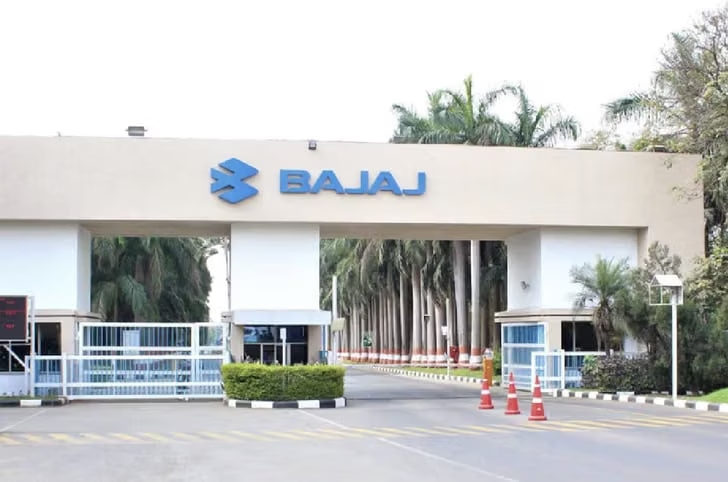
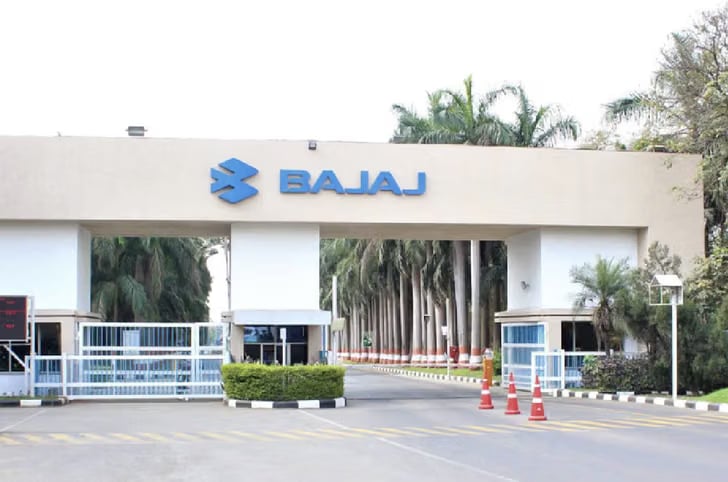
Bajaj factory exterior

Bajaj Auto has exported 11,00,827 two-wheelers in the April-August period of FY27, up 50 percent year-on-year from 7,34,193 units in the same period last year. The figure already represents 56 percent of Bajaj’s highest-ever annual motorcycle export tally of 19.6 lakh units in FY26, putting the company on course to set a new record by the end of the fiscal year. Across all vehicle categories – two-wheelers, three-wheelers and the Qute quadricycle – Bajaj exported 12,66,714 units in the five-month period, up 50 percent year-on-year.

  1. Bajaj Auto exports 11 lakh two-wheelers in April–August FY27
  2. Holds 41 percent share of India’s total two-wheeler exports; TVS second at 28 percent
  3. Entry-level 100-125cc bikes account for 71 percent of motorcycle export volumes

Bajaj Auto 2W export breakdown

Latin America and Africa drive demand

Of the 10,96,009 motorcycles exported (remaining 4,818 units in the two-wheeler tally were Chetak electric scooters) in the period, bikes displacing 100-110cc accounted for the largest share at 4,70,362 units – up 95 percent year-on-year – and a 43 percent share of total motorcycle exports. The 110-125cc bracket contributed a further 3,04,191 units, up 42 percent, for a 28 percent share. Together, these two entry-level categories account for 71 percent of Bajaj’s motorcycle exports in the period.

The 125-150cc bracket (Boxer, CT 150, Pulsar) contributed 1,02,266 units, up 11 percent, while the 150-200cc range fared better at 1,22,481 units, up 17 percent. In terms of geographies, motorcycle exports have risen strongly in Latin America – particularly Brazil and Mexico, the region’s two largest two-wheeler markets – and in Africa, where the Boxer 125 Heavy Duty is seeing strong demand in Nigeria. 

Commercial vehicles and Qute

Three-wheeler exports also posted strong growth, with Bajaj shipping 1,60,685 units in the period – up 48 percent year-on-year – for a commanding 62 percent share of India’s total three-wheeler exports of 2,59,593 units. Demand for the Qute surged 206 percent year-on-year to 5,202 units, driven by Egypt, Turkey and select African markets, and is already 78 percent of the Qute’s highest-ever annual export total of 6,696 units in FY26.

Bajaj Pulsar NS200 and N250 spied with new TFT, WP USD fork

Bajaj Pulsar NS200 and N250 spied with new TFT, WP USD fork

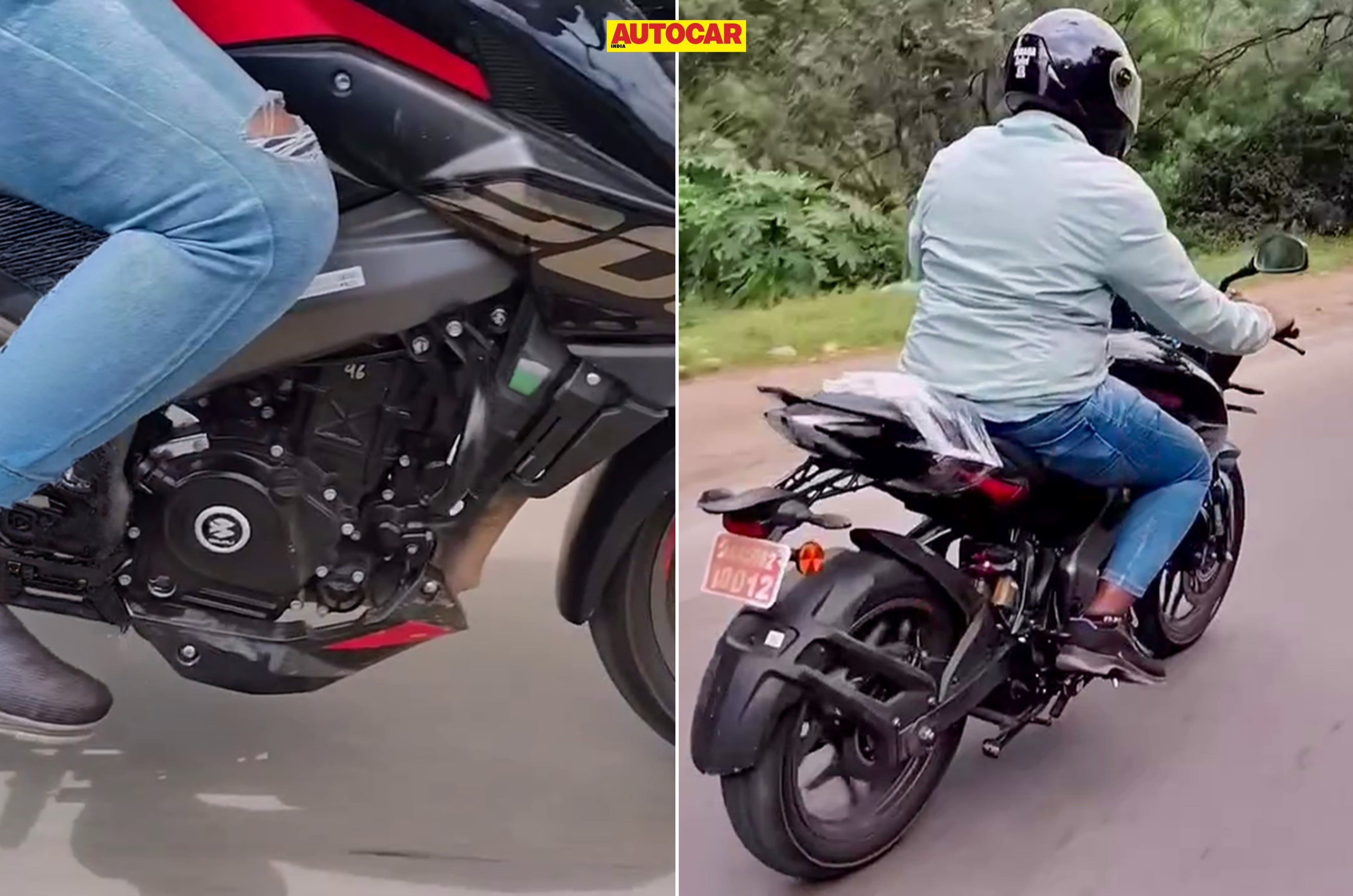
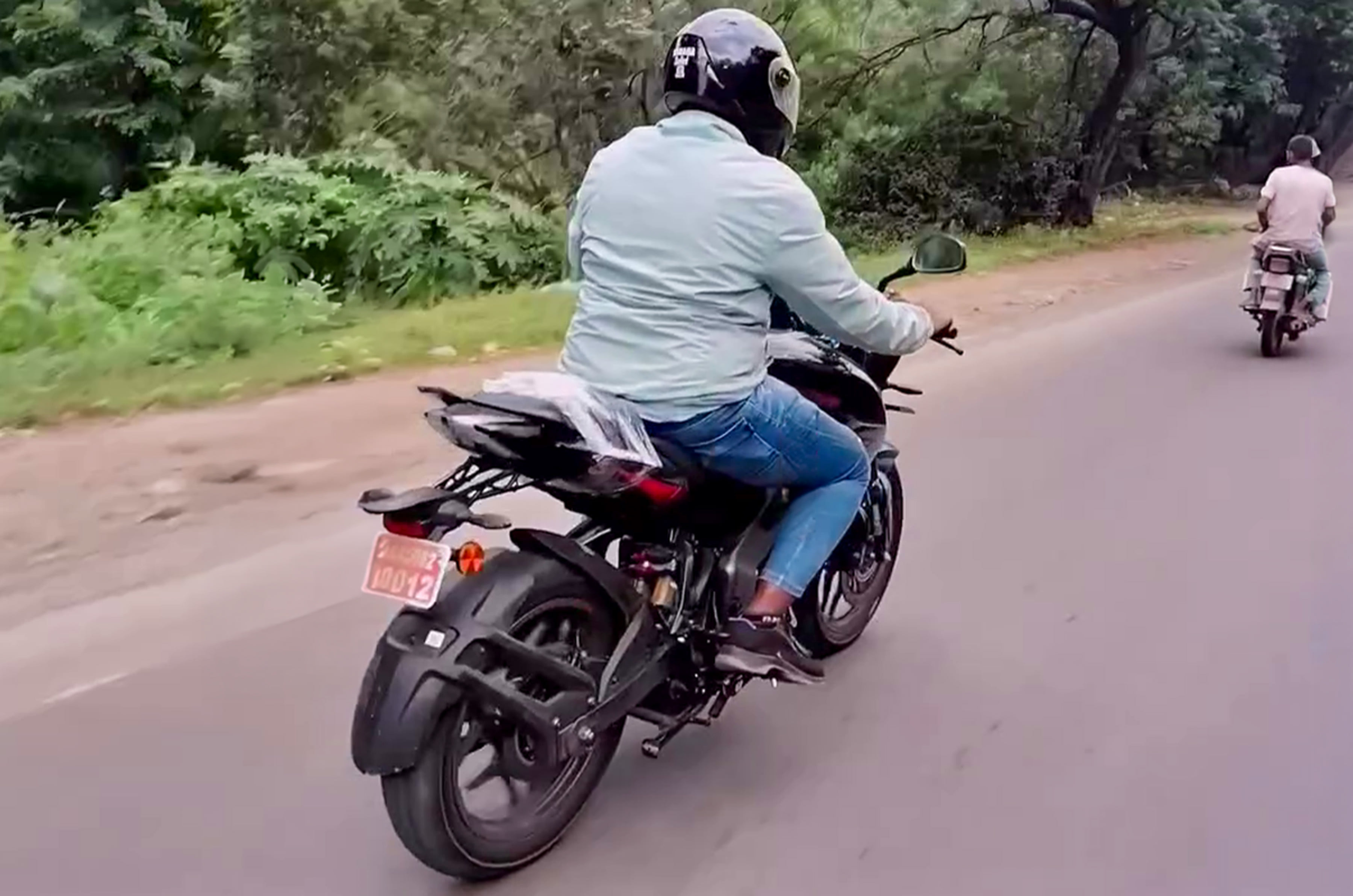
After launching the N160 SS with a new 4-valve engine and the next-generation Classic Pulsar 150 and 125, Bajaj Auto appears to be gearing up to update the Pulsar NS200 and N250. Spy shots reveal a new TFT display, revised switchgear and upgraded suspension hardware on the two motorcycles.

  1. NS200 gets WP USD fork, while both bikes get a new TFT display
  2. Revised switchgear and adjustable levers also spotted on the NS200

Bajaj Pulsar NS200, N250 to get feature upgrades

New TFT display and switchgear

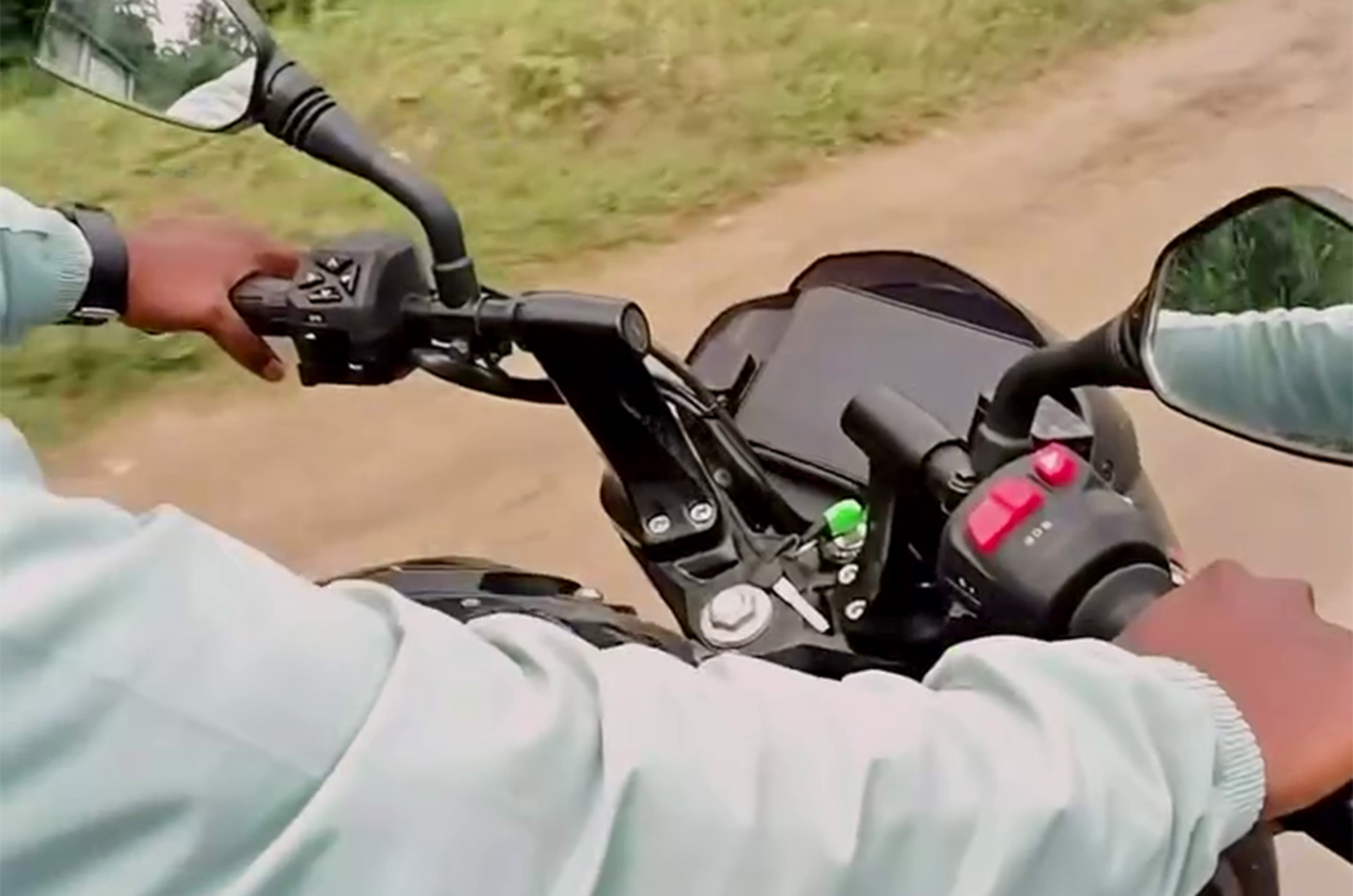
The updated Pulsar NS200 and N250 have been spotted with the same 5-inch TFT display introduced on the Pulsar N160 SS and subsequently seen on the new-generation Classic Pulsar 150. The display is accompanied by revised switchgear, including a four-way controller for navigating its various functions.

The TFT on the N160 SS supports smartphone connectivity, Google Maps mirroring, music controls, third-party notifications and document storage. It is not yet clear if the NS200 and N250 will get the complete feature set of the N160 SS. The NS200 also appears to get adjustable brake and clutch levers, along with revised switchgear.

The more significant hardware change is on the NS200, which has been spotted with a WP upside-down fork. The fork carries visible WP branding and replaces the unbranded USD fork on the current motorcycle. The N250 has also been spotted with an upside-down fork, although it is not clear if it uses the same WP hardware.

The WP fork would make the updated NS200 the first Bajaj motorcycle to use this suspension hardware. WP Performance Systems is part of the KTM Group and its suspension components are used on several KTM and Husqvarna motorcycles – specially the Apex.

Both motorcycles are expected to retain their existing engine platforms. The NS200 currently uses a 199.5cc, liquid-cooled single-cylinder engine, while the N250 is powered by a 249cc single-cylinder unit. 

The updated Pulsar NS200 and N250 are expected to be launched ahead of the festive season. More details, including their specifications and pricing, should emerge closer to the launch.

Image credits: motomaniac_2161/instagram

Electric two-wheeler sales fall 11 percent in August after record July 2026

Electric two-wheeler sales fall 11 percent in August after record July 2026
TVS iQube, Bajaj Chetak, and Ather Rizta on a podium graphic

Following a record-setting July that saw the electric two-wheeler segment cross 2 lakh monthly sales for the first time, August delivered a more measured 1,82,936 units – down 11 percent month-on-month but still 67 percent higher than the same month last year. With cumulative sales in the first eight months of the year crossing 13.6 lakh units, already surpassing the full-year tally of 13.4 lakh units in 2025, the 20 lakh annual sales milestone is within reach, with four months and the festive season surge still to go.

  1. Electric two-wheeler retail sales of 1,82,936 units in August 2026
  2. TVS, Bajaj, Ather and Hero Vida account for 75 percent of sales
  3. 2026 sales already exceed the full-year 2025 total

August 2026 electric two-wheeler sales: OEM breakdown

TVS Motor Co: 48,873 units

TVS Motor Company sold 48,873 electric scooters last month – up 91 percent year-on-year and good for a 27 percent market share, up from 23 percent a year ago. While this represents a 12 percent drop from July’s record 55,823 units, cumulative eight-month sales of 3,56,579 units have already exceeded TVS’s full-year CY2025 total of 3,15,082 units. As it stands, TVS is on course to cross 5,25,000 annual electric scooter sales for the first time in 2026.

Bajaj Auto: 41,019 units

Bajaj Auto delivered 41,019 Chetak units in August – a 235 percent year-on-year increase. However, it is worth noting that the comparison is skewed by supply chain disruptions that affected production in August 2025. Like TVS, Bajaj’s sales so far this year, at 3,05,226 units, have already surpassed the brand’s full-year total of 2,79,687 units from 2025. It is now on track to cross 4 lakh annual EV sales for the first time.

Ather Energy: 28,708 units

Ather sold 28,708 units in August, up 49 percent year-on-year, for a 16 percent market share. Cumulative eight-month sales of 2,29,099 units are up 83 percent year-on-year. With the recently introduced Konarc, the brand will be looking to significantly accelerate volumes heading into the festive season.

Vida: 18,978 units

Vida delivered 18,978 units in August, up 38 percent year-on-year but down 17 percent from its best-ever month of 22,989 units in July. Sales from January to August, at 1,48,069 units, are up 151 percent year-on-year, putting the brand on course to cross 2 lakh annual EV sales for the first time.

Ola Electric: 13,849 units

Ola Electric sold 13,849 units in August – down 29 percent from last August and making it the only top-10 brand to register a decline. The company’s eight-month total of 94,307 units is down 39 percent year-on-year. Ola’s market share has dropped sharply to 8 percent from 18 percent a year ago, when it ranked third overall.

Other notable performers

Greaves Electric Mobility delivered 8,612 units, up 89 percent year-on-year, with the Ampere Magnus Neo and the recently updated Magnus G Max both contributing to demand. River Mobility sold 5,134 units of the Indie, up 170 percent year-on-year, while Bgauss Auto sold 4,844 units, up 180 percent from last August. Simple Energy delivered 1,635 units from its One, OneS and Ultra range, with the Simple Wave, expected to go on sale later this month, potentially helping boost those figures further.

Two-wheeler retail sales up 19.7 percent in August

Two-wheeler retail sales up 19.7 percent in August

Two-wheeler retail sales in India rose 19.69 percent year on year to 17,14,610 units in August 2026, according to the Federation of Automobile Dealers Associations (FADA). The segment recorded its highest-ever August sales, although volumes declined 5.70 percent from July, when dealers retailed 18,18,289 two-wheelers. August 2025 sales stood at 14,32,537 units.

  1. Retail sales reach 17.15 lakh units, highest for an August
  2. Share of EVs in two-wheeler sales crosses 10 percent in a non-festive month
  3. Honda leads the market as dealers turn optimistic ahead of the festive season

FADA attributed the strong year-on-year growth to healthy rural demand and improved affordability following the GST 2.0 rollout. The month-on-month decline was attributed to the seasonal monsoon slowdown, rainfall in some regions and the inauspicious Shravan/Aadi period.

Rural two-wheeler retail grew 20.25 percent year on year in August, slightly ahead of the 19.07 percent growth recorded in urban markets. Compared with July, however, two-wheeler sales fell 6.85 percent in rural areas and 4.38 percent in urban centres.

EVs accounted for 10.68 percent of total two-wheeler retail sales in August, up from 7.66 percent a year ago. The share of electric models was 11.24 percent in July. FADA noted that August was the first non-festive month in which EVs comprised over 10 percent of two-wheeler sales.

As for fuel type, petrol continued to dominate the two-wheeler market with an 89.23 percent share, while CNG and LPG models together accounted for 0.08 percent.

Honda Motorcycle and Scooter India remained the largest two-wheeler OEM in August with a 26.09 percent market share, retailing 4,47,342 units. Hero MotoCorp was second with 4,13,996 units and a 24.15 percent share, while TVS Motor Company sold 3,53,746 units and had a 20.63 percent share.

Bajaj Auto retailed 1,57,149 two-wheelers, giving it a 9.17 percent share, followed by Suzuki Motorcycle India with 1,04,217 units and a 6.08 percent share. Royal Enfield recorded 94,448 units and a 5.51 percent share.

Among the electric-focused manufacturers listed separately by FADA, Ather Energy sold 28,757 units and had a 1.68 percent share, while Ola Electric registered 13,852 units and a 0.81 percent share. Greaves Electric Mobility, River Mobility and BGauss recorded 8,613, 5,141 and 4,845 units, respectively.

With the festive season approaching, FADA expects two-wheeler demand to strengthen in September. Rural cash flows and late-season rainfall remain key factors that could influence sales, while the continued shift towards alternative powertrains is expected to support the market.

Dealer sentiment for September remains positive, with 67.09 percent of dealers expecting growth, 27.35 percent expecting a flat market and 5.56 percent anticipating de-growth. For the September-November period, 81.62 percent of dealers expect the market to grow.

With inputs from Eshisha Java

TVS outsells Hero and Honda to top bike and scooter sales in August 2026

TVS outsells Hero and Honda to top bike and scooter sales in August 2026
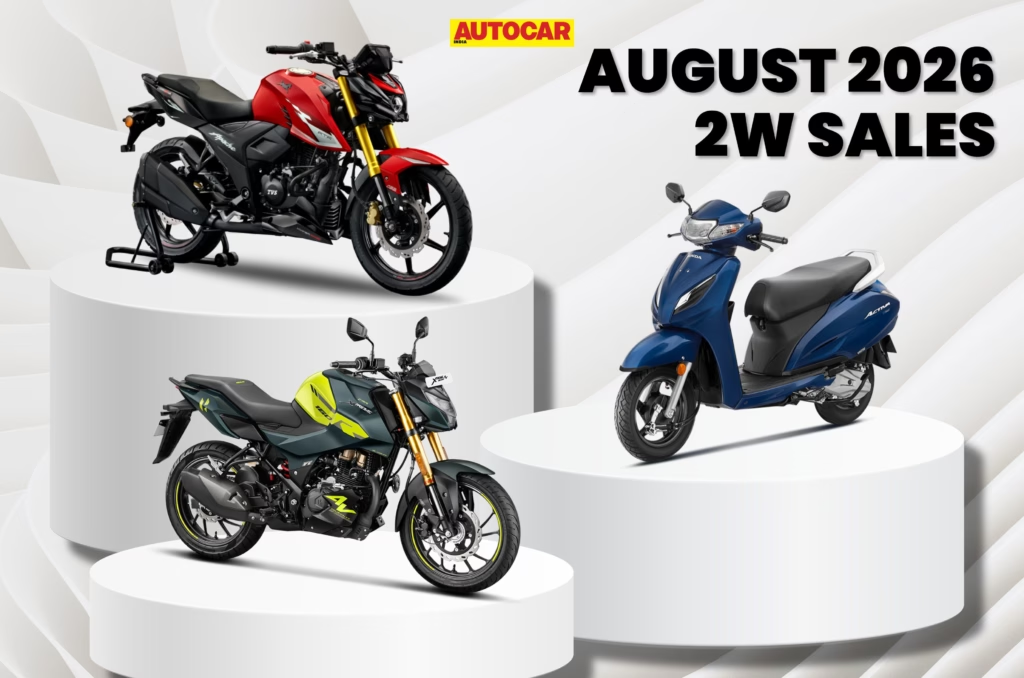
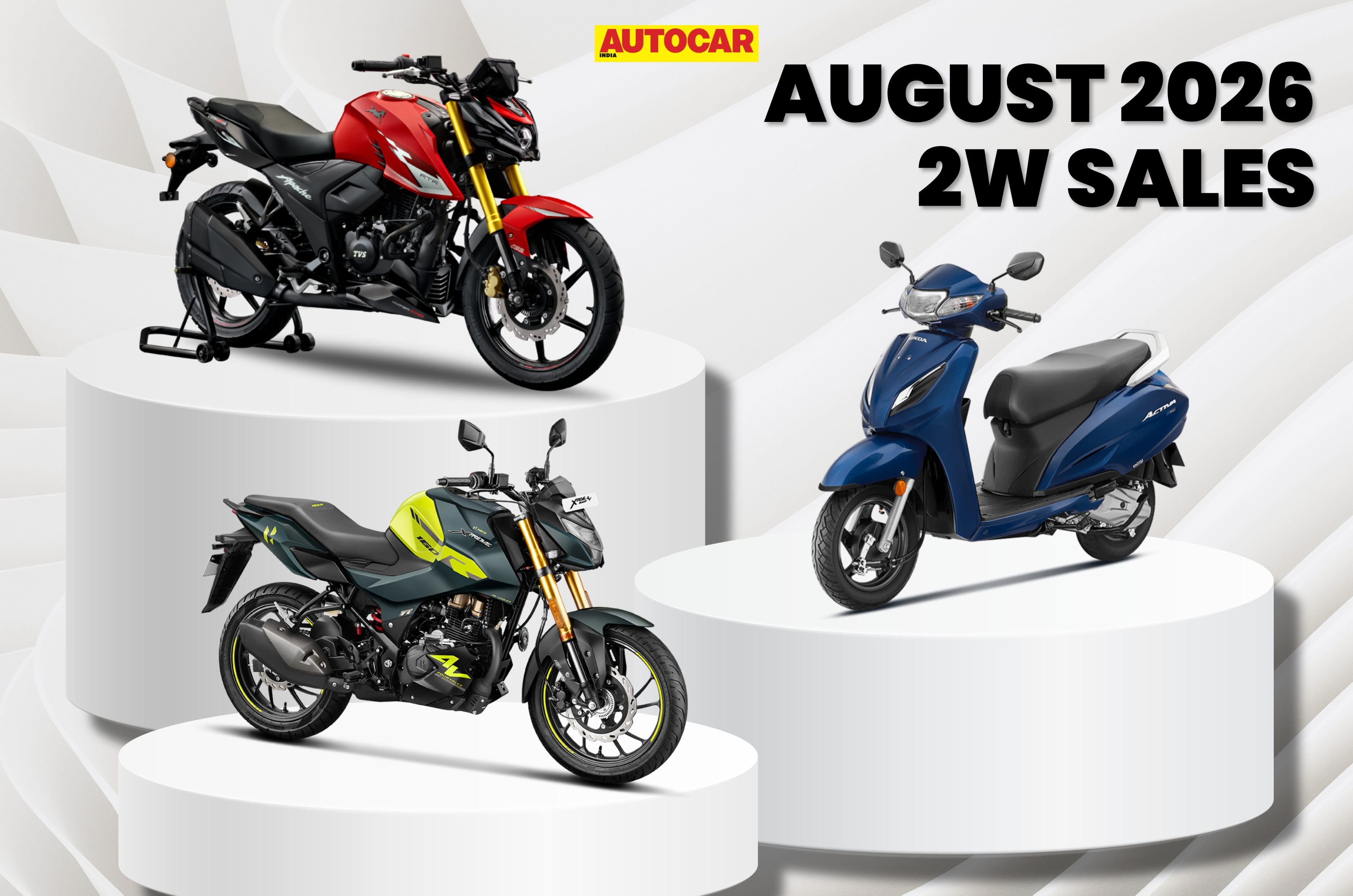
Graphic with TVS Apache, Honda Activa, and Hero Xtreme 160 4V on a podium

August 2026 delivered strong year-on-year growth across the board as manufacturers gear up for the festive season, but the standout story was TVS Motor Company leapfrogging both Honda and Hero MotoCorp to become India’s largest two-wheeler manufacturer by monthly dispatches for the first time.

TVS Motor: 5,91,437 units

TVS recorded its highest-ever monthly two-wheeler sales this past August, with dispatches climbing 21 percent year-on-year from 4,90,788 units last August. This pushed it past both Honda and Hero for the top spot this month. Domestic two-wheeler sales grew 18 percent to 4,33,796 units, while the company’s electric two-wheeler business posted growth of 137 percent to 59,453 units. TVS also continued to lead as an exporter, shipping 1,57,641 two-wheelers overseas, up 29 percent year-on-year.

Honda: 5,79,162 units

Honda Motorcycle & Scooter India (HMSI) posted 8 percent YoY growth, with total sales rising from 5,34,861 units last August. Domestic sales grew at the same 8 percent clip to 5,17,329 units, while exports rose by a sharper 15 percent to 61,833 units.

Hero MotoCorp: 5,68,398 units

Hero two-wheeler dispatches grew a modest 2.65 percent year-on-year from 5,53,727 units. Domestic ICE dispatches stood at 5,16,747 units, while the Vida brand continued its strong run with 25,558 units dispatched – a 38 percent growth. Exports fell 24.6 percent to 26,093 units from 34,588 a year earlier.

Bajaj Auto: 4,43,748 units

Bajaj two-wheeler dispatches grew 30 percent YoY from 3,41,887 units. Domestic sales rose 10 percent to 2,01,898 units, while exports jumped 53 percent to 2,41,850 units, continuing the company’s run as one of India’s largest two-wheeler exporters.

Royal Enfield: 1,26,479 units

Royal Enfield motorcycle sales grew 11 percent YoY from 1,14,002 units. Domestic sales rose 11 percent to 1,14,204 units, while exports grew 10 percent to 12,275 units. The month saw the launch of the Classic 350 Gorkha Edition and an updated Continental GT 650, alongside continued momentum for the Flying Flea C6, which the brand says has crossed 50,000 customer-driven kilometres in its current sole market of Bengaluru.

Suzuki: 1,20,611 units

Suzuki posted 6 percent year-on-year growth from 1,13,936 units, driven largely by domestic sales, which rose 13 percent to 1,03,118 units. Exports declined to 17,493 units from 22,307 units a year earlier.

2030 तक EV सेक्टर में आएंगी 5 करोड़ नौकरियां, 20 लाख करोड़ रुपये तक पहुंचेगा मार्केट! नितिन गडकरी का बड़ा दावा

केंद्रीय सड़क परिवहन और राजमार्ग मंत्री नितिन गडकरी ने बुधवार को कहा कि भारत का इलेक्ट्रिक व्हीकल (EV) बाजार 2030 तक 20 लाख करोड़ रुपये तक पहुंच सकता है। इसके साथ ही इस सेक्टर में 5 करोड़ नौकरियां पैदा होने की उम्मीद है।

PTI की रिपोर्ट के अनुसार, CII-ITC सेंटर ऑफ एक्सीलेंस फॉर सस्टेनेबल डेवलपमेंट की ओर से आयोजित एक समिट को संबोधित करते हुए गडकरी ने कहा कि भारत में अभी 57 लाख इलेक्ट्रिक वाहन रजिस्टर्ड हैं और ऑटोमोबाइल बाजार में इलेक्ट्रिक वाहनों की हिस्सेदारी करीब 7 प्रतिशत है।

उन्होंने कहा, “2030 तक भारत का इलेक्ट्रिक व्हीकल (EV) मार्केट 20 लाख करोड़ रुपये का हो जाएगा। इससे 2030 तक पांच करोड़ नौकरियां भी पैदा होंगी।”

इस दौरान गडकरी ने भारत की दो सबसे बड़ी टू-व्हीलर बनाने वाली कंपनियों, बजाज ऑटो और हीरो मोटोकॉर्प की एक्सपोर्ट क्षमता का भी जिक्र किया और कहा कि वे अपने बनाए गए वाहनों में से 50 प्रतिशत से ज्यादा का एक्सपोर्ट करती हैं।

भारत को और ज्यादा इलेक्ट्रिक बसों की जरूरत

गडकरी ने कहा कि भारत में हर साल एक लाख इलेक्ट्रिक बसों की मांग है, लेकिन देश के मैन्युफैक्चरर अभी साल में सिर्फ 50,000-60,000 EV बसें ही बनाते हैं।

उन्होंने कहा कि सरकार का लक्ष्य अगले पांच सालों में भारत के ऑटोमोबाइल इंडस्ट्री को दुनिया में सबसे बड़ा बनाना है। उन्होंने यह भी कहा कि देश के पास ट्रेंड मैनपावर और कॉम्पिटिटिव व्हीकल मैन्युफैक्चरिंग क्षमताएं हैं।

गडकरी ने आगे कहा, “अगले पांच सालों में हमारा लक्ष्य भारत के ऑटोमोबाइल इंडस्ट्री को दुनिया में नंबर 1 बनाना है… यह मुश्किल है, लेकिन नामुमकिन नहीं।”

उन्होंने कहा कि भारत के ऑटोमोबाइल सेक्टर का आकार काफी बढ़ गया है। उन्होंने बताया कि जब उन्होंने ट्रांसपोर्ट मिनिस्टर का पद संभाला था, तब इस सेक्टर की वैल्यू 14 लाख करोड़ रुपये थी, जो अब बढ़कर 22 लाख करोड़ रुपये हो गई है।

केंद्रीय मंत्री ने कहा कि अभी US के ऑटोमोबाइल सेक्टर की वैल्यू 78 लाख करोड़ रुपये है, इसके बाद चीन 47 लाख करोड़ रुपये के साथ दूसरे और भारत 23 लाख करोड़ रुपये के साथ तीसरे स्थान पर है।

फॉसिल फ्यूल के इंपोर्ट और लॉजिस्टिक्स लागत को कम करने पर जोर

गडकरी ने कहा कि भारत फॉसिल फ्यूल के इंपोर्ट पर 22 लाख करोड़ रुपये खर्च करता है, जिससे प्रदूषण भी बढ़ता है।

उन्होंने कहा, “हम अच्छे हाईवे बना रहे हैं… अच्छे रास्ते और उनके विकल्प तैयार कर रहे हैं, और बायो-फ्यूल ही भविष्य है।”

लॉजिस्टिक्स लागत के बारे में गडकरी ने कहा कि सरकार का लक्ष्य इसे घटाकर 8% तक लाना है। उनका तर्क है कि लॉजिस्टिक्स लागत कम होने से ग्लोबल मार्केट में भारत की कॉम्पिटिटिवनेस (प्रतिस्पर्धा क्षमता) बेहतर होगी।

गडकरी ने कहा कि IIT चेन्नई, IIT कानपुर और IIM बैंगलोर की हालिया रिपोर्ट से पता चला है कि एक्सप्रेसवे और इकोनॉमिक कॉरिडोर बनने से भारत की लॉजिस्टिक्स लागत 16% से घटकर 10% हो गई है।

उन्होंने कहा, “सरकार का लक्ष्य लॉजिस्टिक्स लागत को घटाकर 8% करना है, जिससे भारत को ज्यादा प्रतिस्पर्धी बनने में मदद मिलेगी।”

यह भी पढ़ें: Honda ADV160 Flex-Fuel स्कूटर और Rebel 300 बाइक लॉन्च, ₹5,000 में बुकिंग शुरू, अक्टूबर से मिलेगी डिलीवरी