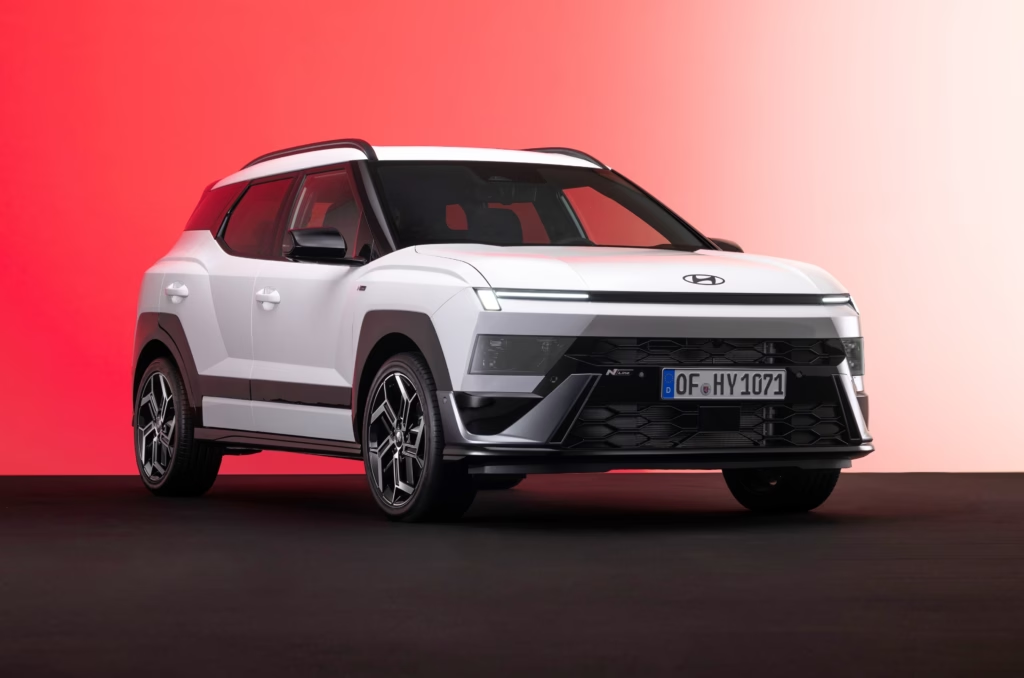
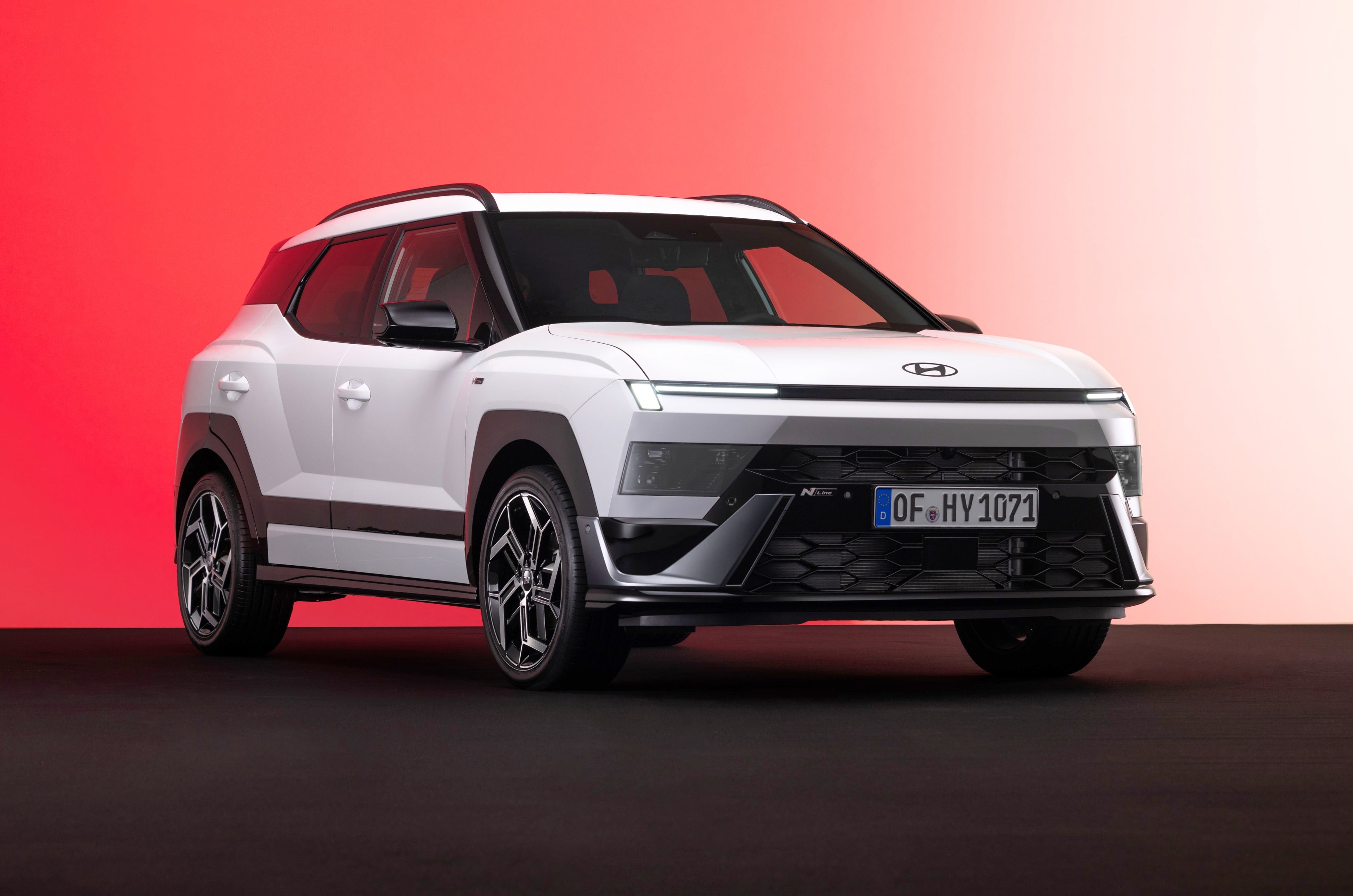
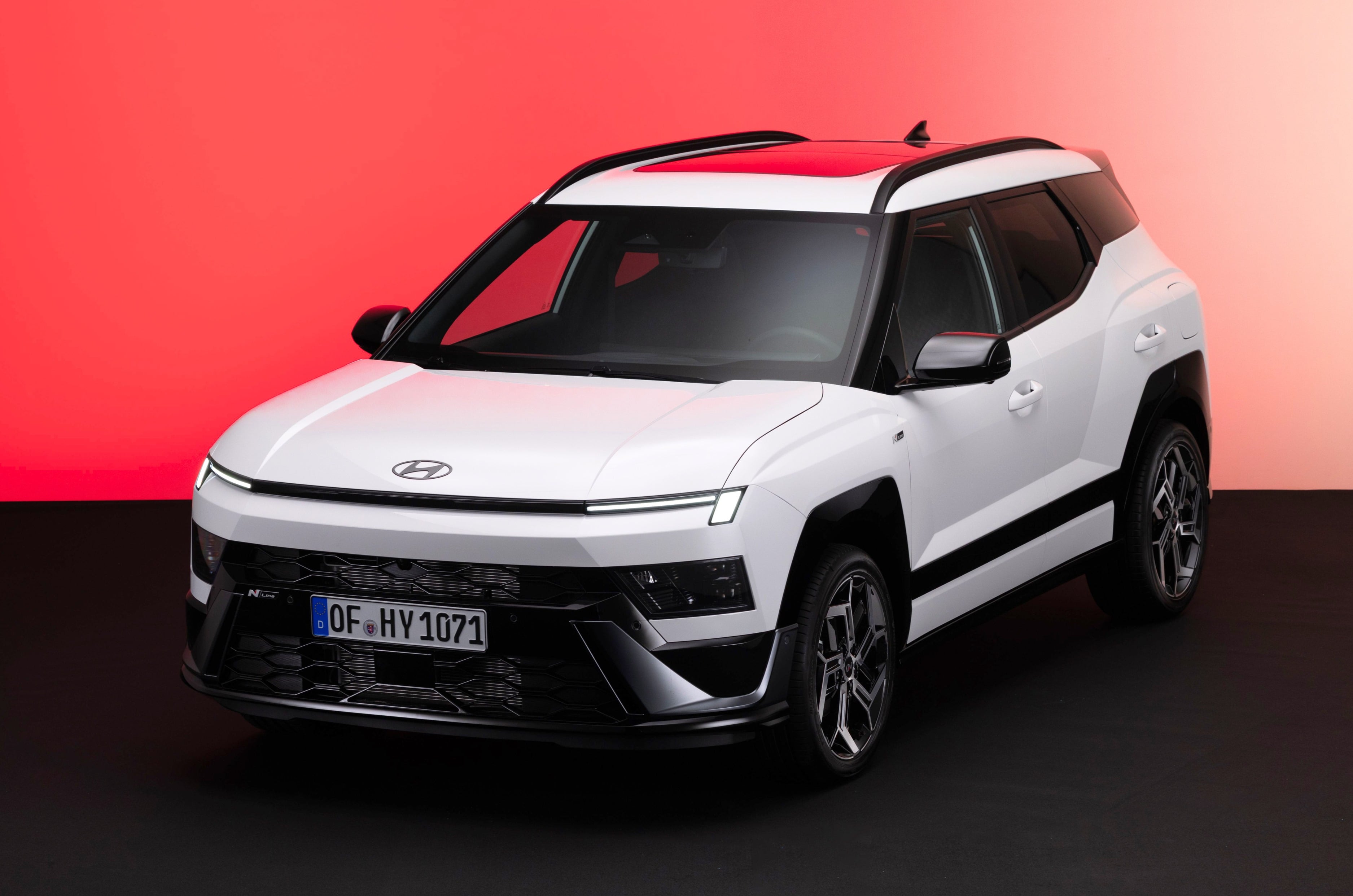
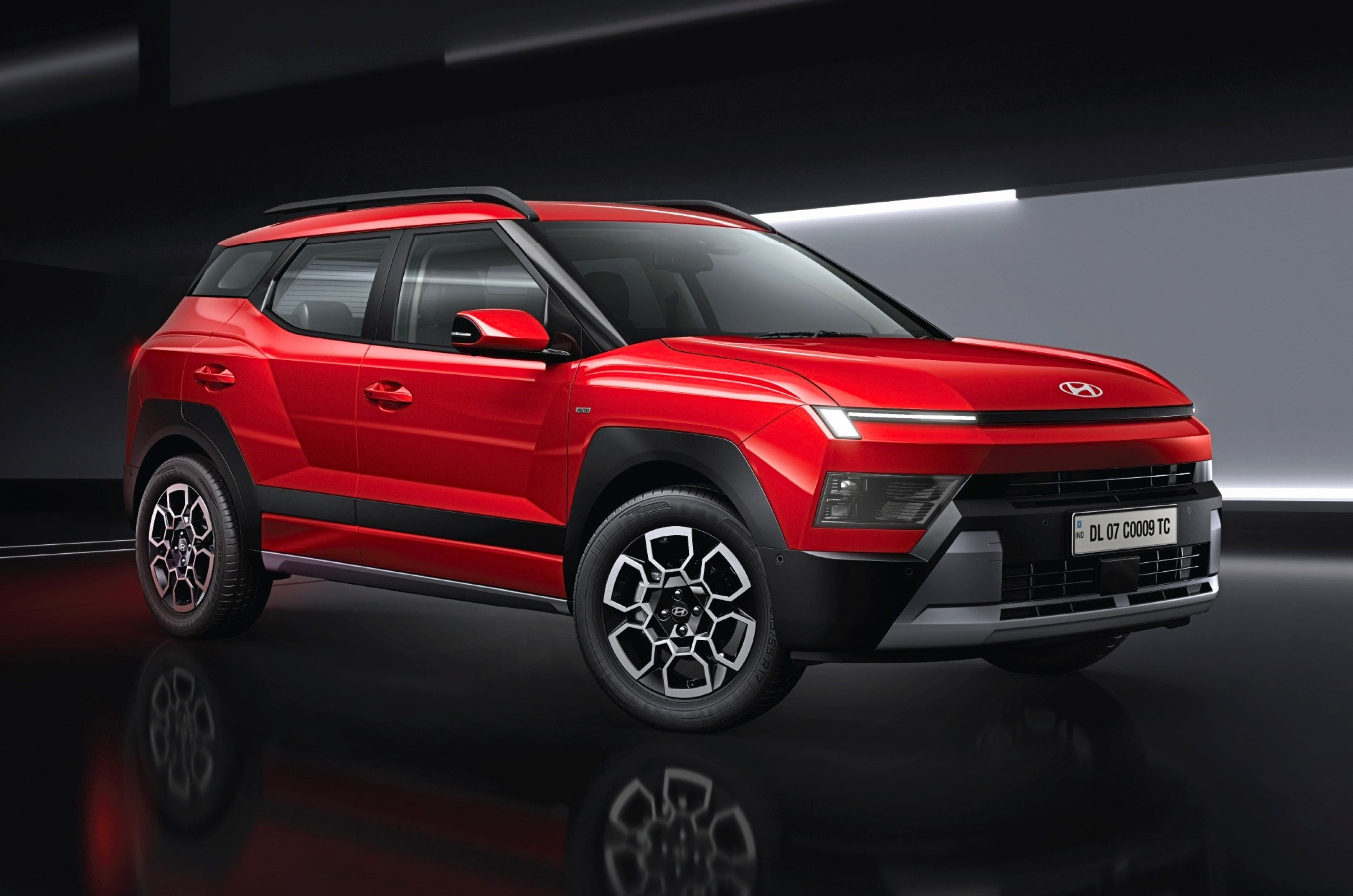
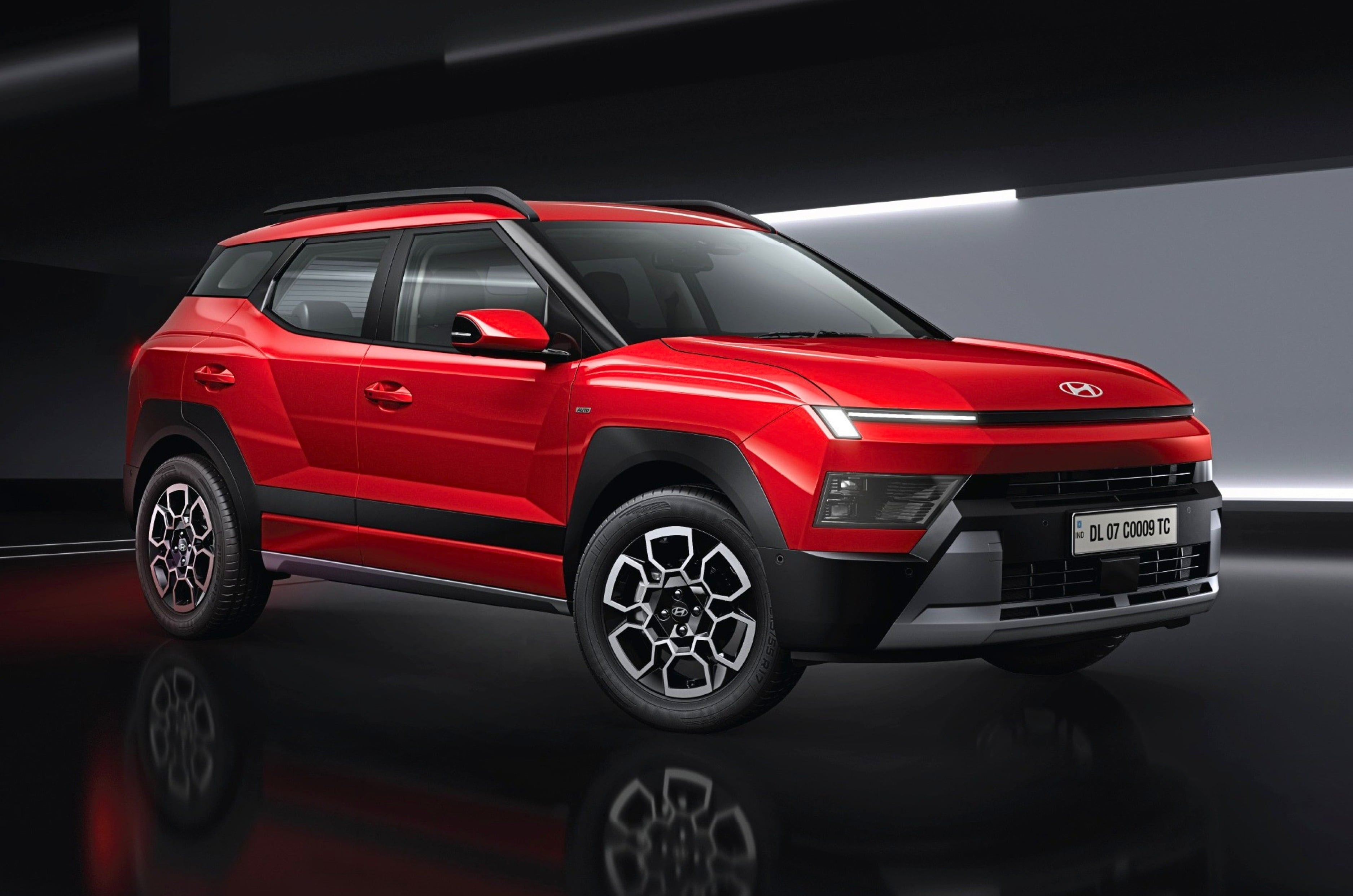
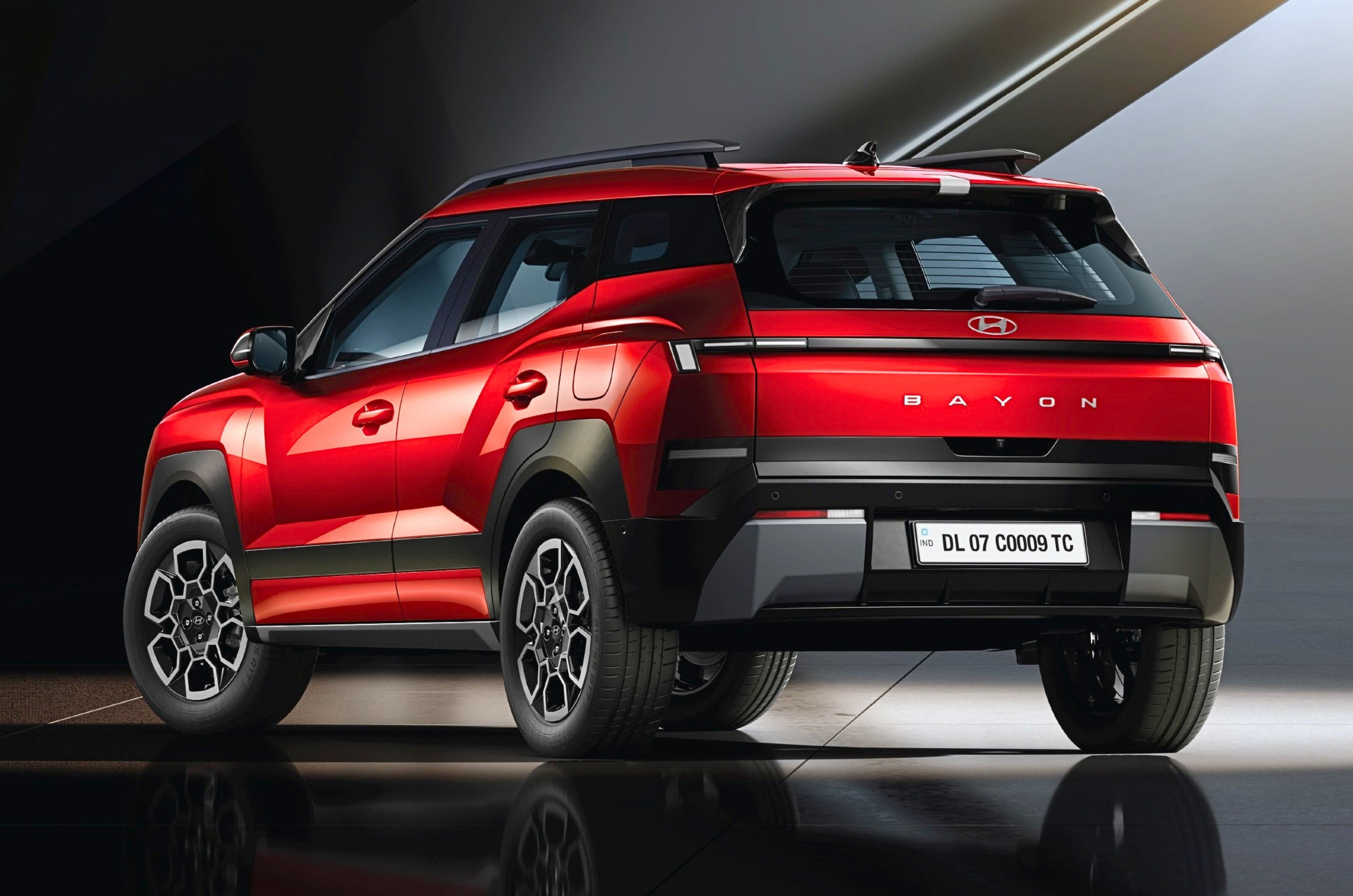
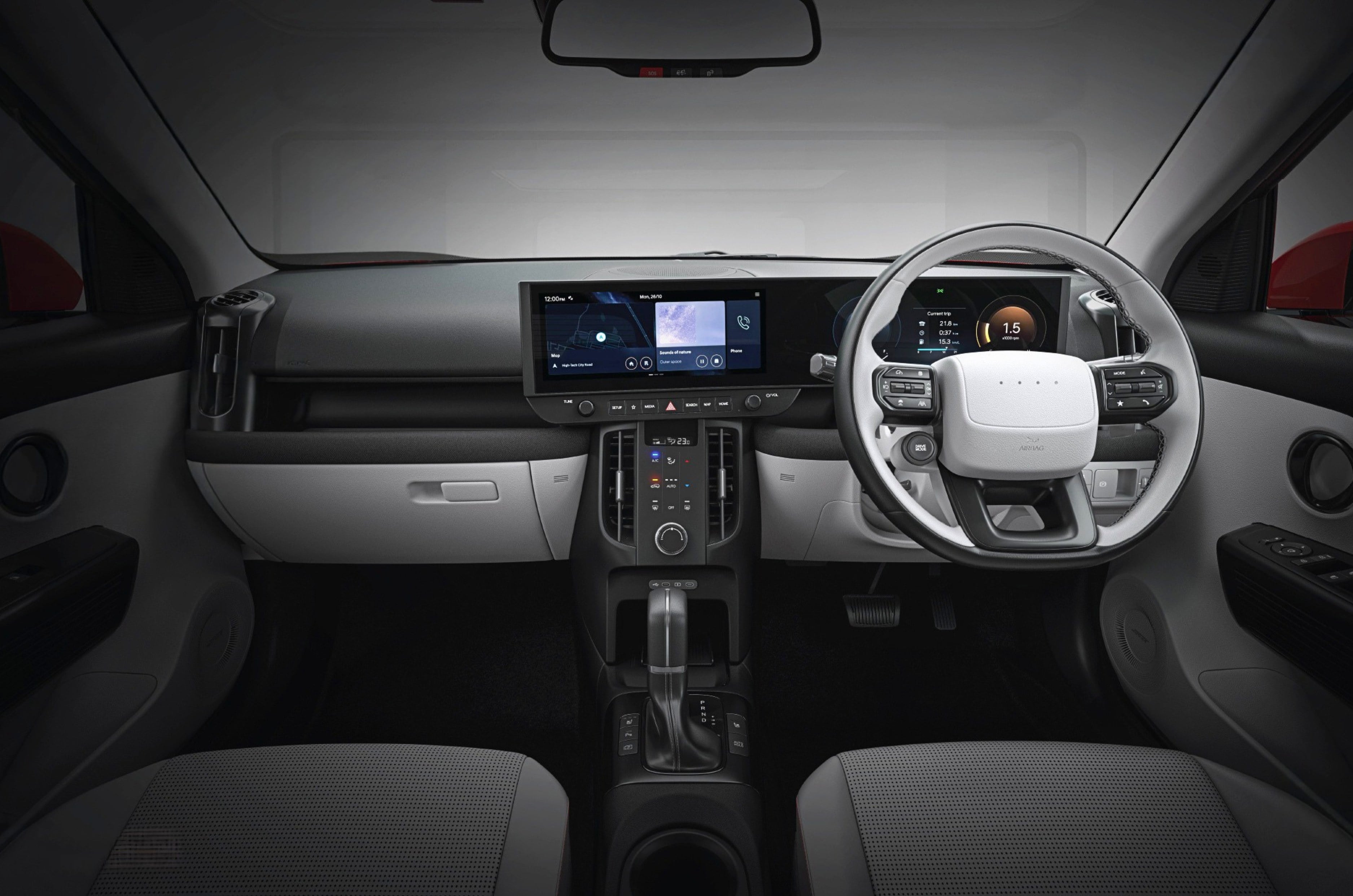
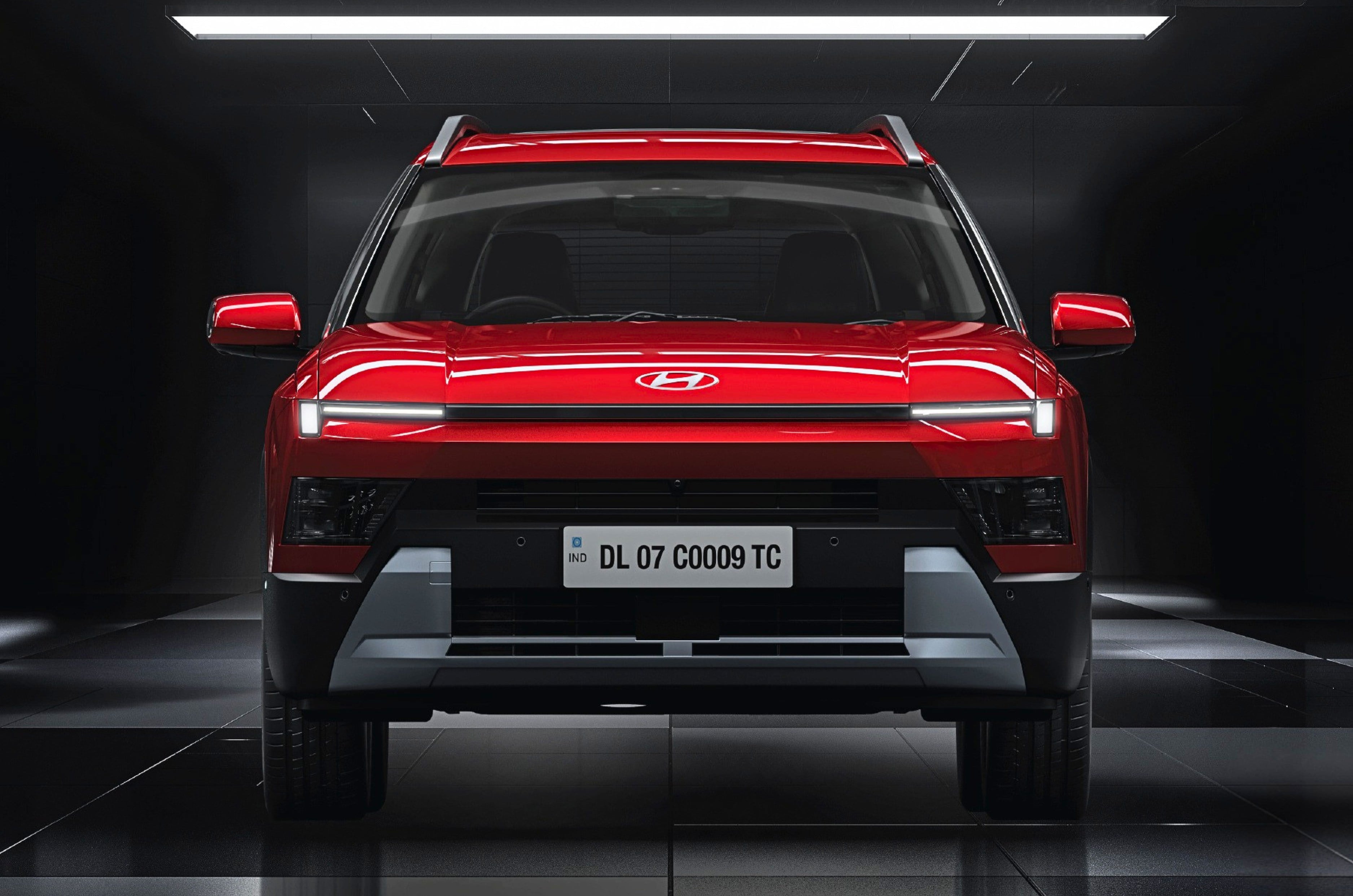
Alongside the recent reveal of the India-spec Bayon, Hyundai unveiled the SUV’s sporty N Line version at Paris Motor Show 2026. The Bayon N Line shares its top hat with the standard India-spec model, but has sportier touches all around and different engines.
2026 Hyundai Bayon N Line exterior design
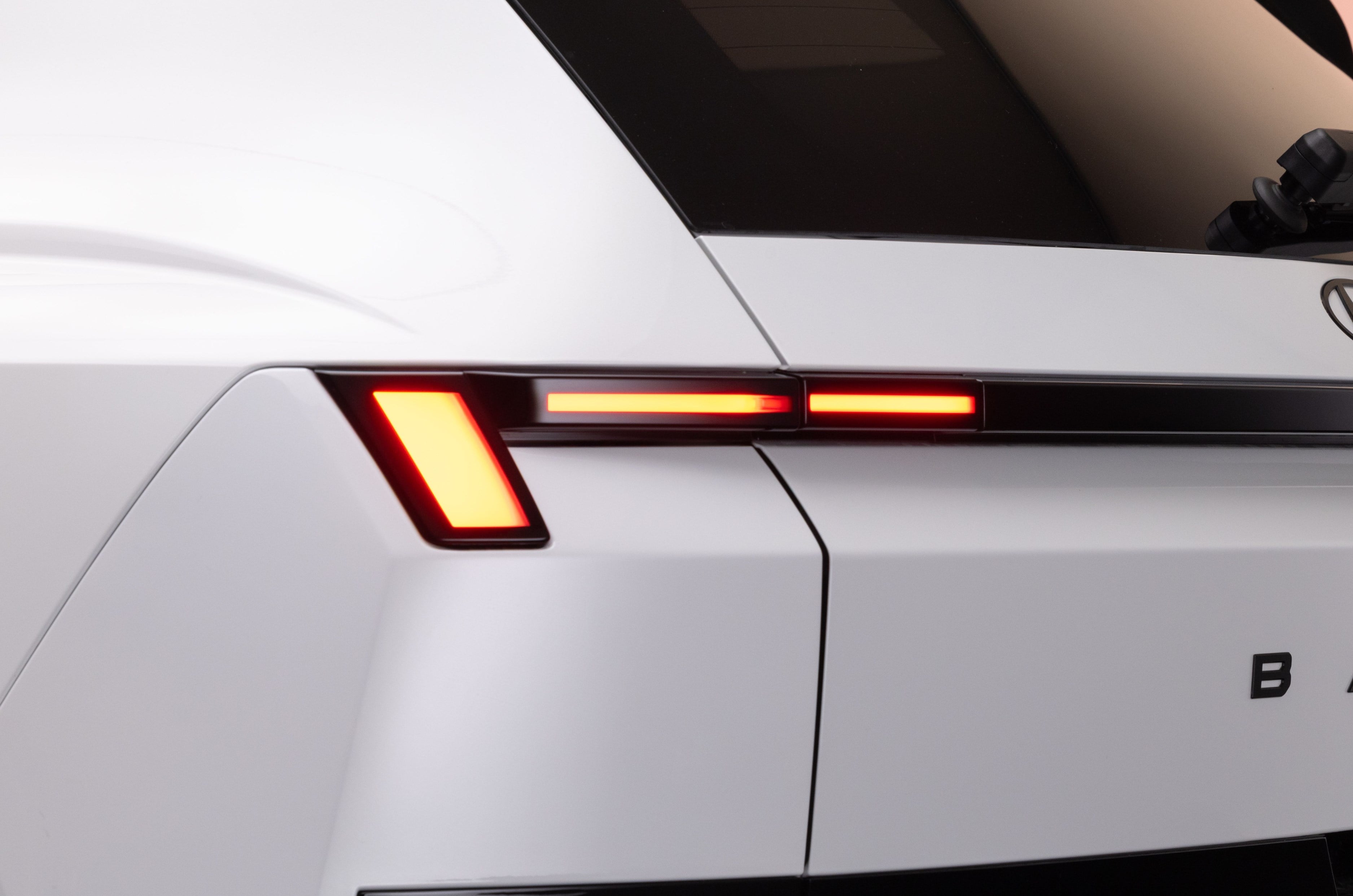
Much like the India-spec Bayon, the N Line features design cues like L-shaped front and rear lights, squared-off headlamp units, boxy wheel-arch cladding and flared fenders, a Bayon wordmark on the bootlid, and a heavily kinked windowline. However, the Bayon N Line differentiates itself with sportier styling elements.
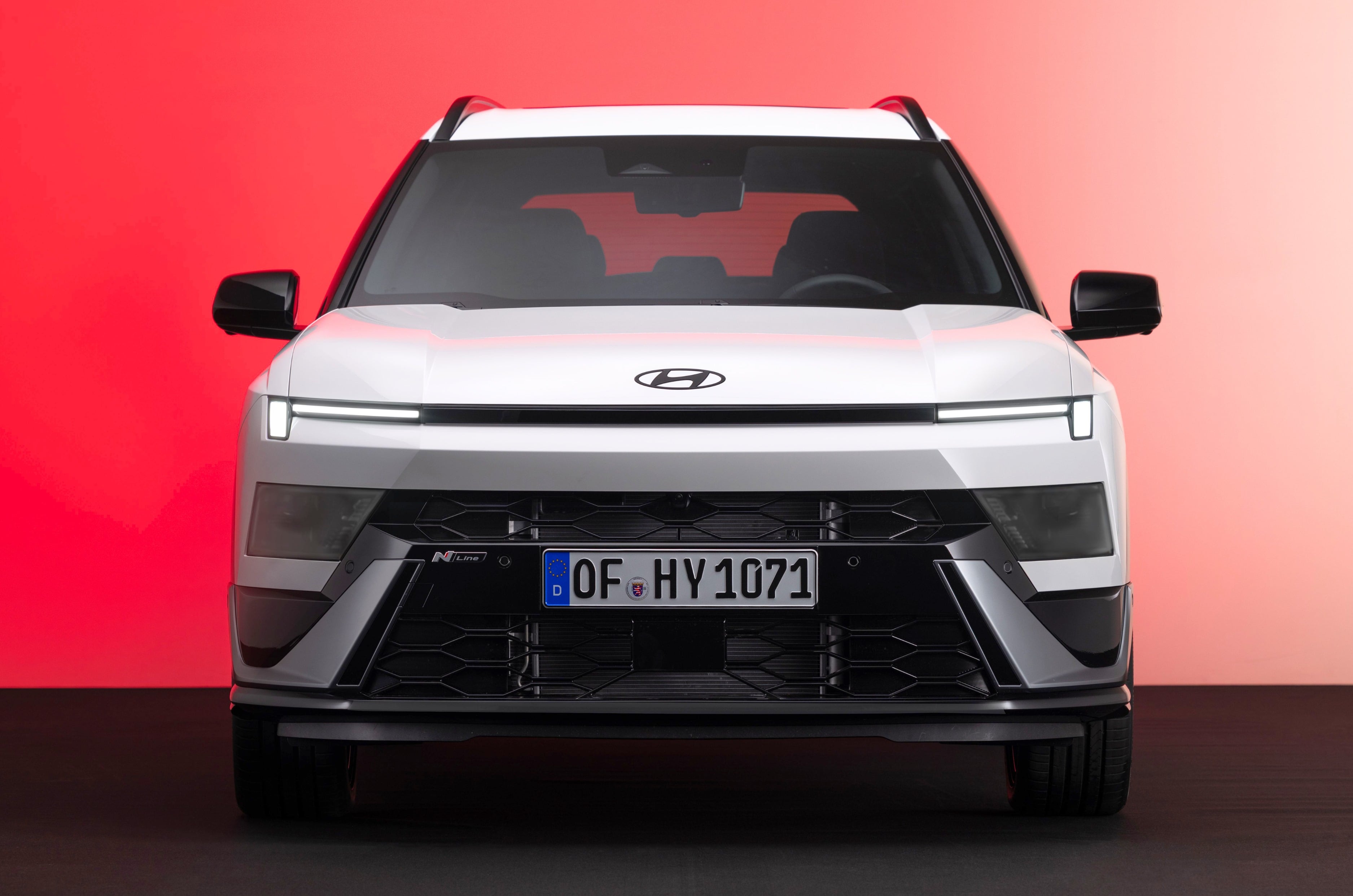
Up front, the Bayon N Line has a different bumper with a more open design, blacked-out cladding, winglets, and a honeycomb pattern for the grille. An ‘N Line’ badge can also be seen on the left side of the bumper, and the headlamps look to have a smoked finish.
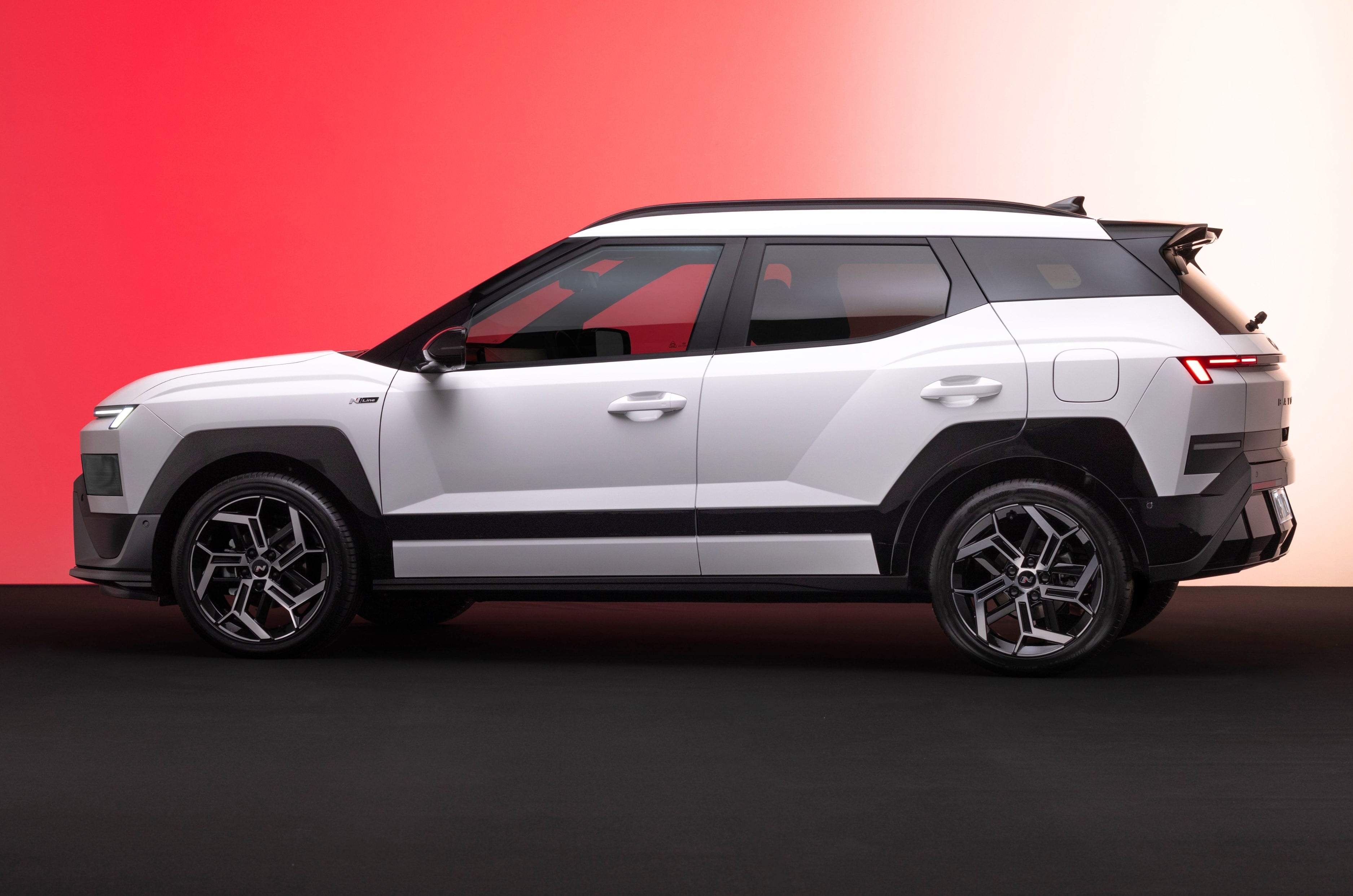
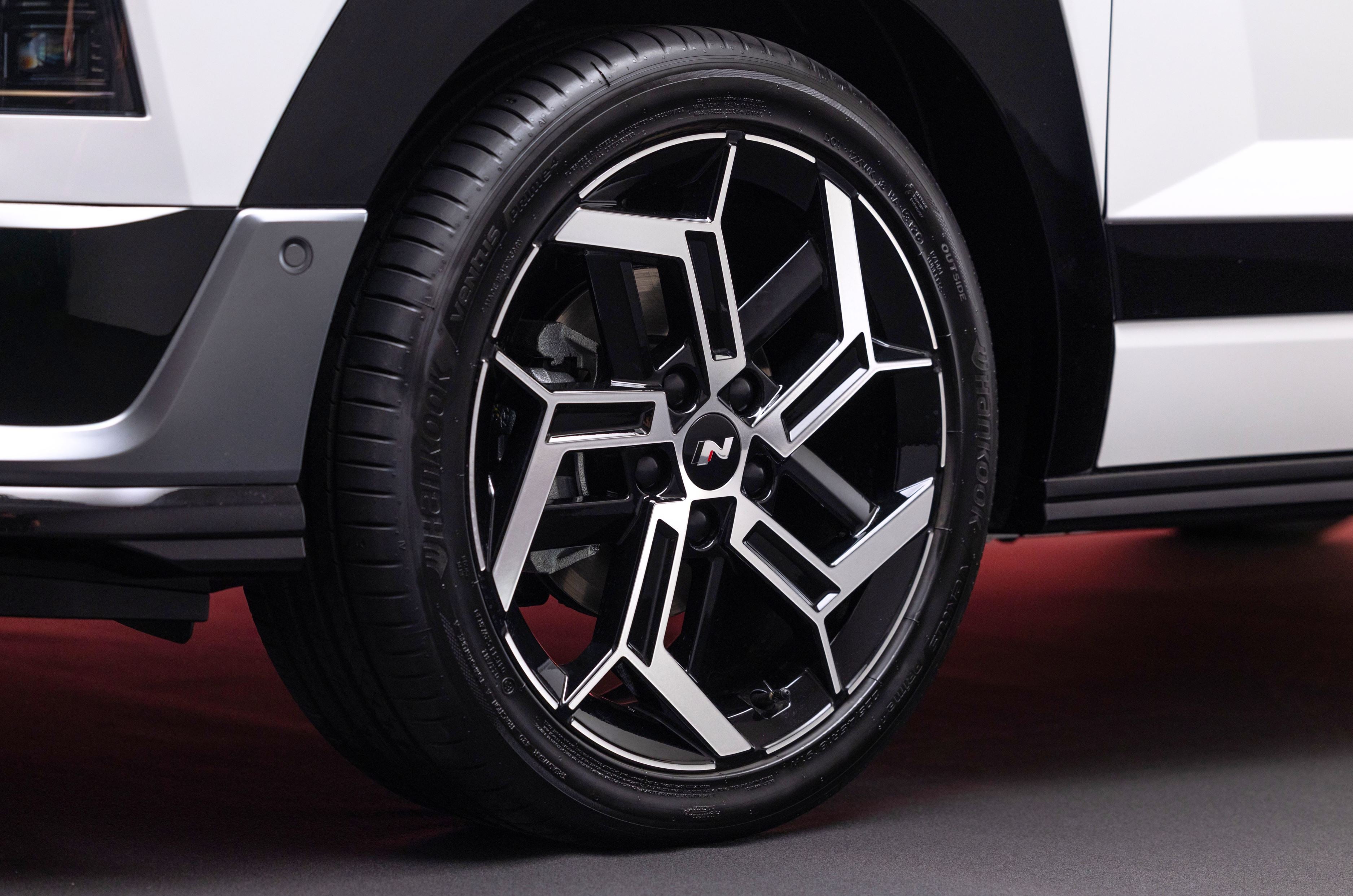
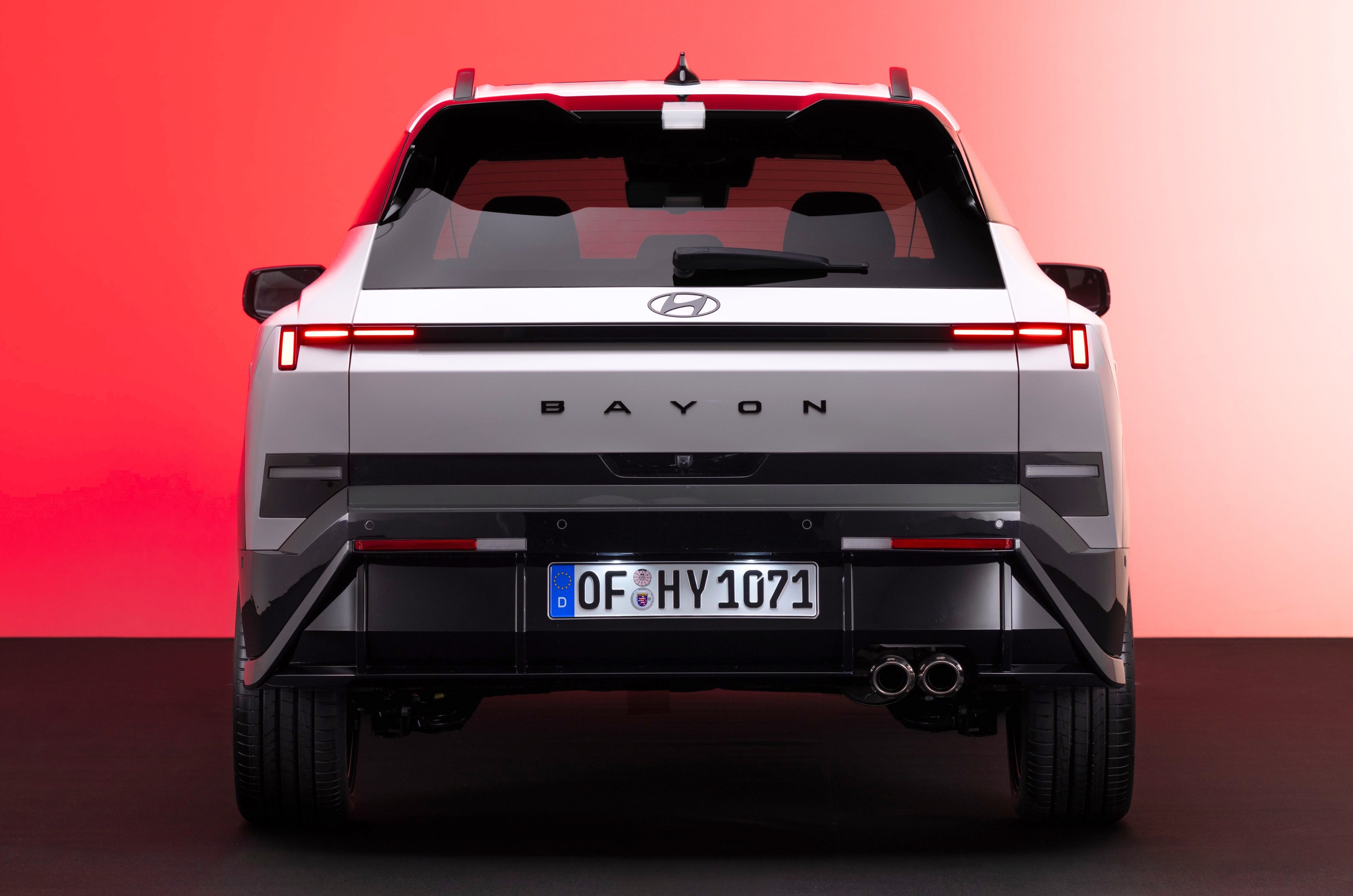
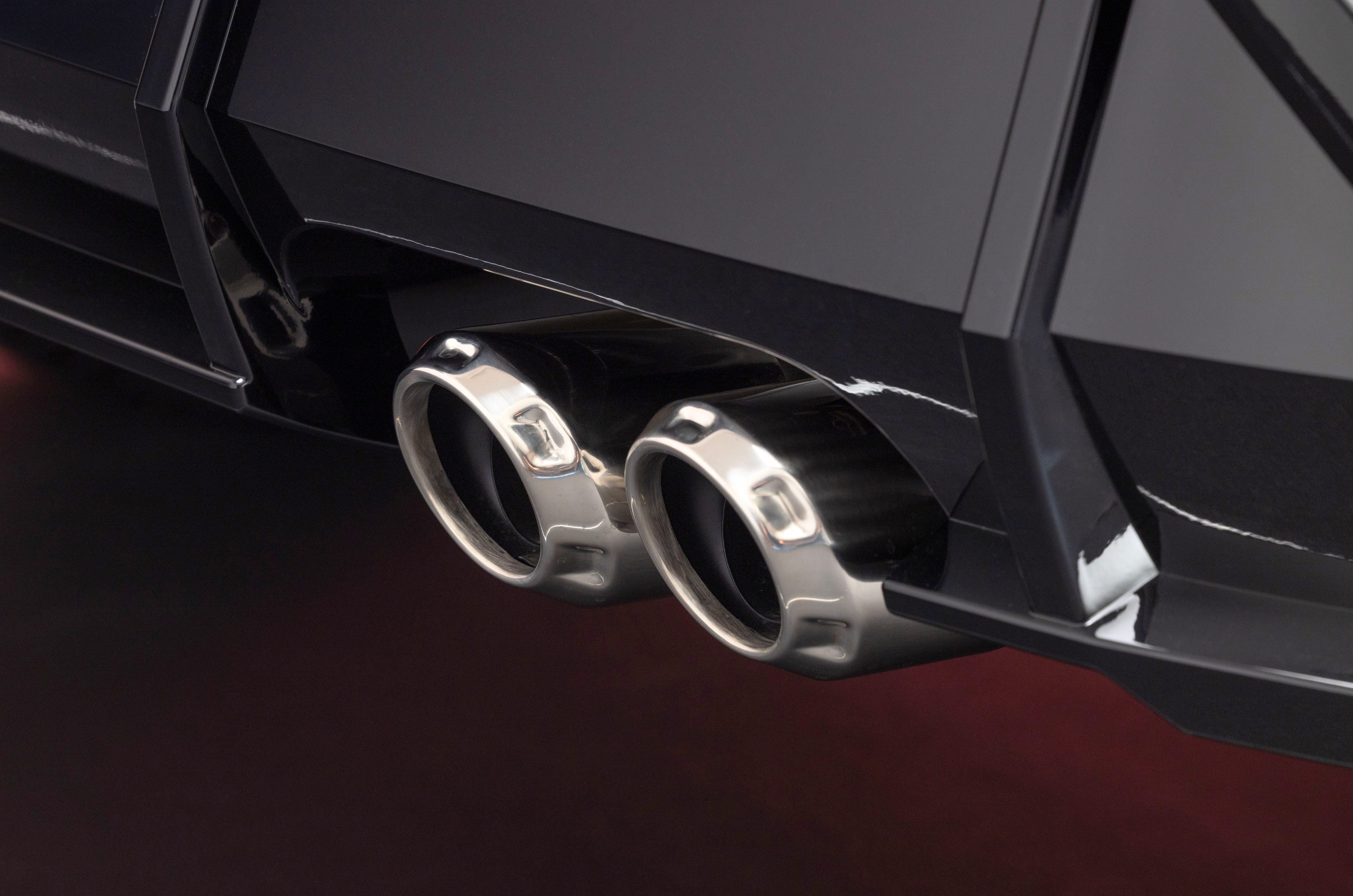
Over to the side, the N Line gets gloss-black finishes for the cladding and ORVMs, larger 18-inch alloy wheels, and N Line badging on the front fenders. The roof rails are also slimmer than the ones seen on the India-spec Bayon. At the back, the Bayon N Line sports a bigger twin-ridge roof spoiler, dual exhaust tips, a fully black bumper, and black finishes for the Hyundai emblem and Bayon wordmark on the bootlid.
The Europe-spec Bayon stretches the tape at 4,245mm long, 1,810mm wide, and 1,565mm tall, with a wheelbase of 2,600mm. These dimensions place it perfectly between the Venue and Creta in terms of size, and you can expect the India-spec Bayon to not stray that far off from them.
2026 Hyundai Bayon N Line interior and features
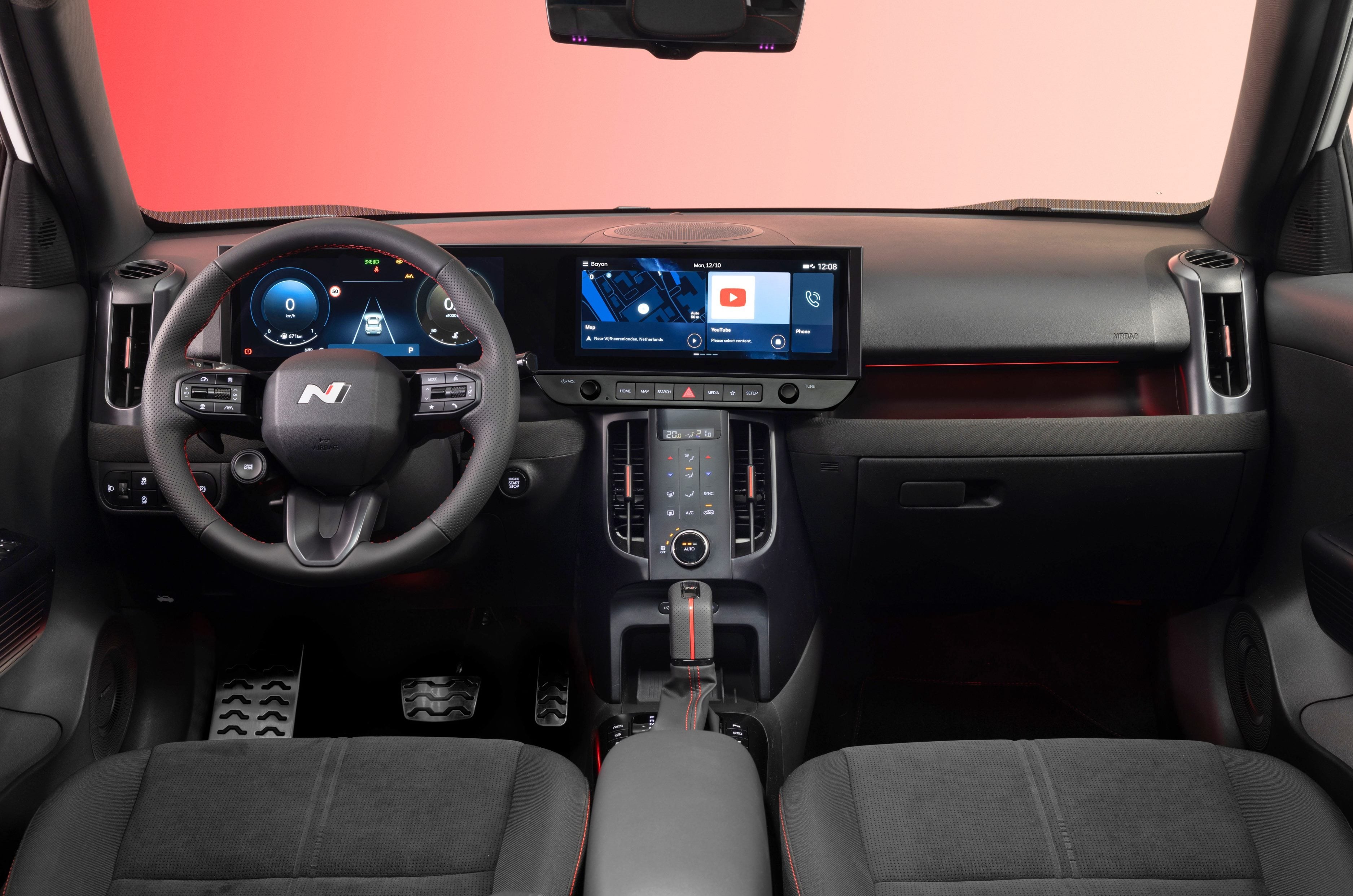
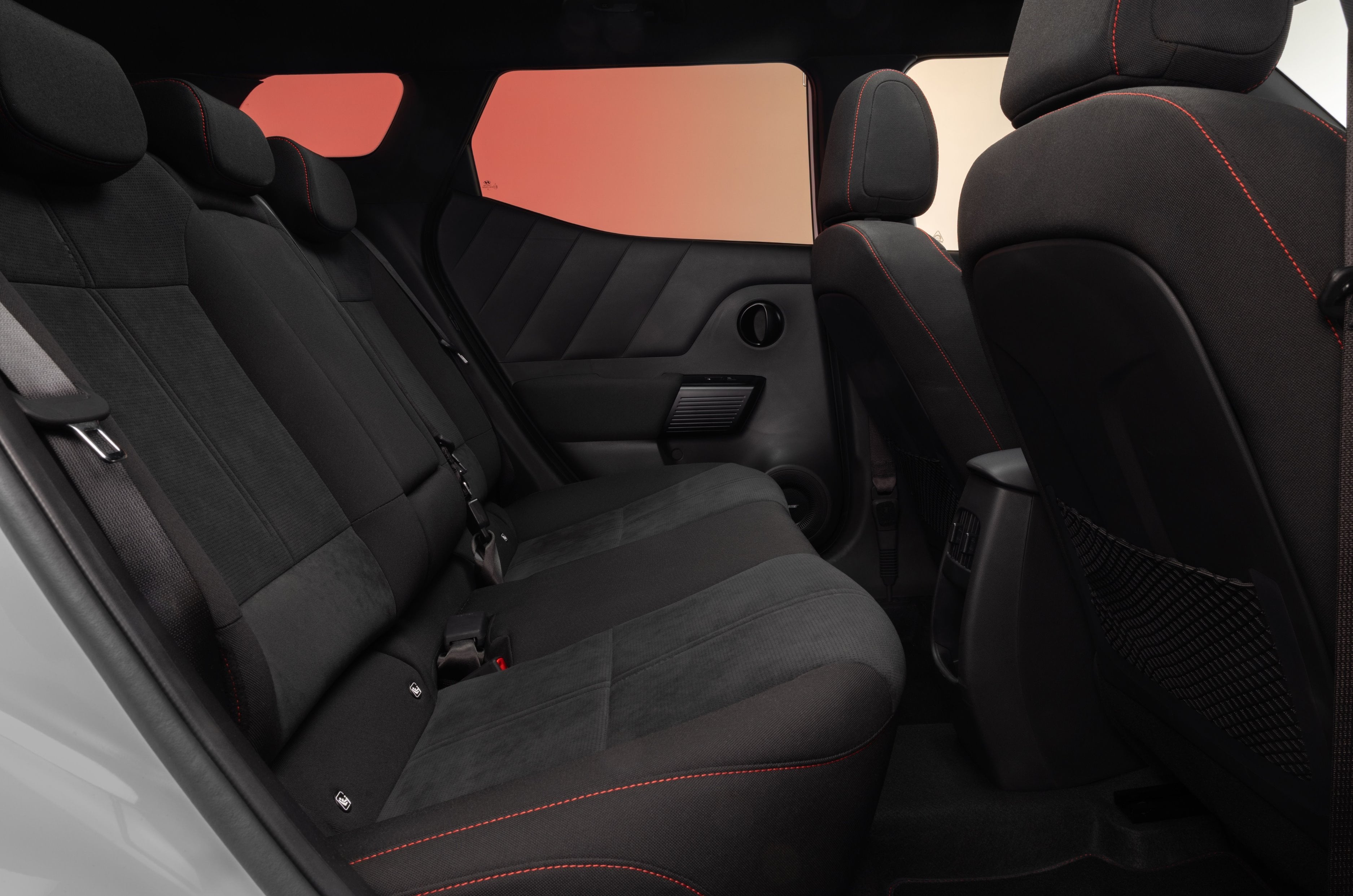
Similar to the outside, the core interior layouts of the India-spec Bayon and the N Line are identical, including a curved pair of 12.3-inch displays, a vertical design for the centre console (à la the fourth-gen i20), vertically oriented air vents, an open storage space on the co-driver side of the dashboard, among others. The Bayon N Line, however, brings in sportier touches like a black interior colour scheme with red accents and contrast stitching, Alcantara-esque seat upholstery, and an N-Line-specific steering wheel and gear lever.
As for features, the Bayon N Line offers wireless Apple CarPlay and Android Auto, ambient lighting, a panoramic sunroof, heated and ventilated front seats, reclining rear seats, a digital key, an 8-speaker Bose sound system, Level 2 ADAS, connected car tech, a wireless charging pad, dual-zone climate control, and more. Notably, Hyundai has not mentioned the inclusion of a generative AI voice assistant for the Bayon N Line, which the India-spec model will get. Coming to boot space, Hyundai claims 440 litres for non-hybrid versions of the Europe-spec Bayon.
2026 Hyundai Bayon N Line engine and gearbox
Where the India-spec Bayon will be powered solely by a 115hp 1.5-litre naturally aspirated four-cylinder petrol engine mated to either a 6-speed manual or CVT automatic, the N Line will be offered with Hyundai’s 1.0-litre three-pot direct-injection turbo-petrol motor in two states of tune – 90hp and 115hp – along with 6-speed manual and 7-speed dual-clutch automatic gearbox options.
Hyundai claims a 0-100kph time of as low as 10.8 seconds for the Bayon N Line – likely the 115hp DCT version – going up to 14.1 seconds for presumably the 90hp MT variant. Additionally, a strong-hybrid version will join the Europe-spec Bayon line-up at a later date, comprising a 1.6-litre direct-injection petrol engine, an electric motor, and a 6-speed DCT for a combined output of 138hp. It will also get adaptive regenerative braking that can be controlled by the steering-mounted paddle shifters.
Similarly, the India-spec Bayon is expected to receive a CNG version sometime after launch, which will strap an underbody tank to the SUV and allow it to directly rival the likes of the Maruti Suzuki Victoris, Maruti Suzuki Grand Vitara, and Toyota Hyryder.
Will the Hyundai Bayon N Line come to India
Hyundai is yet to confirm whether the Bayon N Line will be available in India, but given the positioning and target demographic of the model that will soon go on sale here, the prospect is unlikely (at least initially). The India-spec Bayon’s relatively sedate 1.5-litre engine, borrowed from the Creta, encourages smooth and relaxed driving over outright sportiness, and the incoming CNG version further reinforces the notion that this model will serve as Hyundai’s answer to the Victoris – a practical, no-nonsense midsize SUV that’s high on feel-good factor and low on running costs.
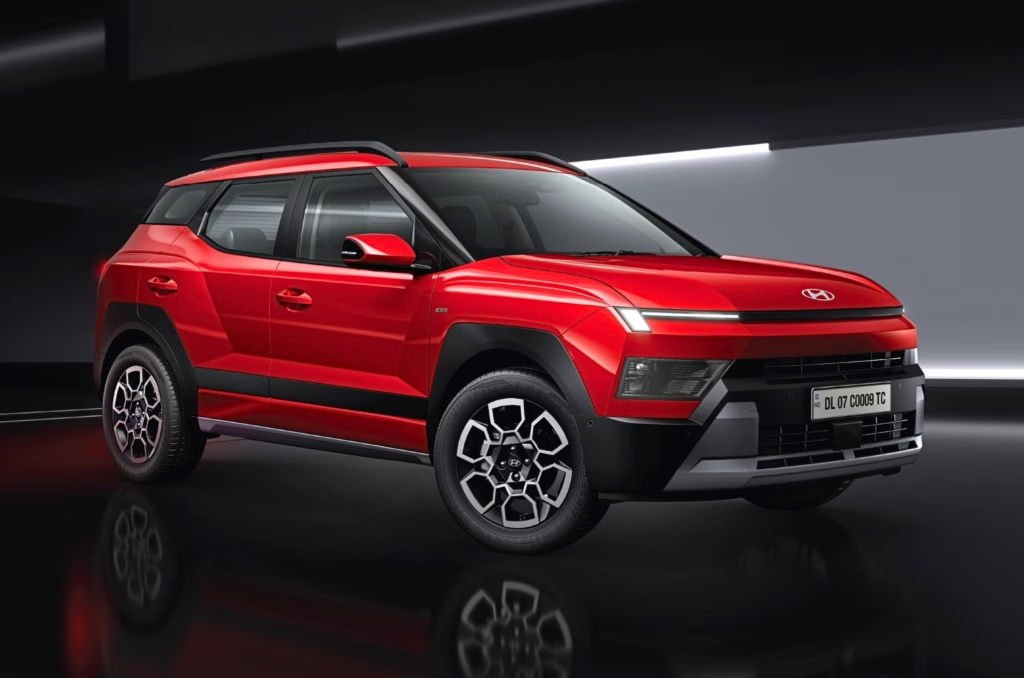
Hyundai has fully revealed the new Bayon midsize SUV ahead of its price announcement on October 26. The Bayon will be positioned between the Venue and Creta in Hyundai’s SUV lineup and is squarely meant to take on the Maruti Victoris. It gets Hyundai’s latest ‘Art of Steel’ design language, a new interior shared with the Brazil-spec i20 and will come powered by a 1.5-litre petrol engine at launch. Bookings for the new Hyundai Bayon have commenced today.
First Hyundai in India to get Generative AI voice assistance
Interior gets dual 12.3-inch displays for instrumentation and infotainment
1.5-litre petrol engine gets 6-speed MT and CVT gearbox options
Hyundai Bayon exterior design
The Bayon gets Hyundai’s latest ‘Art of Steel’ design language, and from certain angles, looks very much like a scaled-down Tucson that was recently revealed for the North American market. Although Hyundai hasn’t revealed the exact dimensions yet, it’s expected to measure just a tad more than 4 meters, thereby slotting below the 4.3-meter Creta.
Up front, the layered fascia sports a split headlamp setup, with the LED DRLs positioned in a slim black trim on the leading edge of the bonnet. The DRLs also resemble Hyundai’s ‘H’ motif split in half – this one doesn’t get a full-width LED light band, as is very much the trend these days. Meanwhile, the bumper houses the main headlamp unit and chunky cladding finished in black and silver.
The Bayon perhaps looks the most distinctive in profile, with its flared wheel arches and sharp character lines adding quite a lot of visual muscle. There’s generous use of cladding over the wheel arches and the petal-style alloy wheels also look quite stylish. Hyundai has also opted for traditional pull-type door handles instead of flush-fitting units and the gloss-black treatment for the pillars creates a nice floating effect for the roof.
At the rear, the Bayon gets a slim black band housing very sleek tail lamps and there’s ‘Bayon’ spelt bold and centre on the tail gate. There’s also a pronounced roof spoiler, while the bumper gets a dual-tone black and silver treatment housing some more lighting elements. Overall, the Bayon has a crossover-ish look rather a boxy, upright SUV.
Hyundai Bayon interior and features
The layered dashboard sports a twin 12.3-inch connected screen setup and a central dropdown panel housing the HVAC controls – it also seems to have physical dials and knobs, which is always a welcome sight. We can also spot a wireless charging pad at the base of the vertically oriented centre console.
The steering wheel with Hyundai’s four-dot motif, the vertical AC vents flanking the centre panel and even the door pads look very similar to those on the new i20. It also gets steering-mounted paddle shifters, and like all Hyundais, expect it to be properly kitted out with convenience and safety features.
Hyundai Bayon expected powertrain options
At launch, Hyundai is offering the Bayon with the tried and tested 115hp/144Nm 1.5-litre, four-cylinder naturally aspirated petrol engine that powers the Creta. It will come with manual and CVT gearbox options. And while Hyundai hasn’t confirmed it yet, a CNG version is also expected to be added to the lineup at a later stage, likely with an underbody tank, making the Bayon the first Hyundai model over four metres long to be powered by CNG.
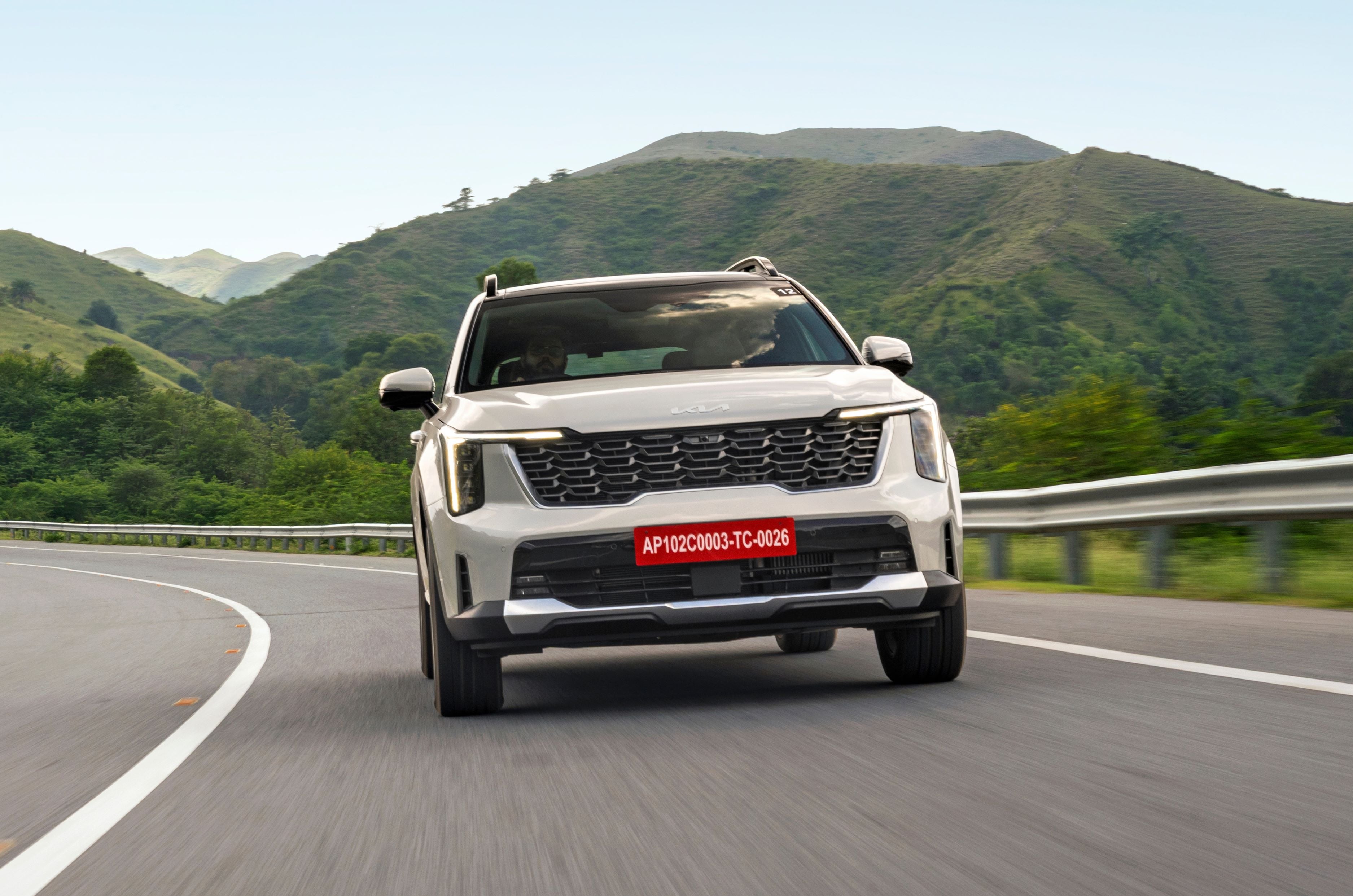
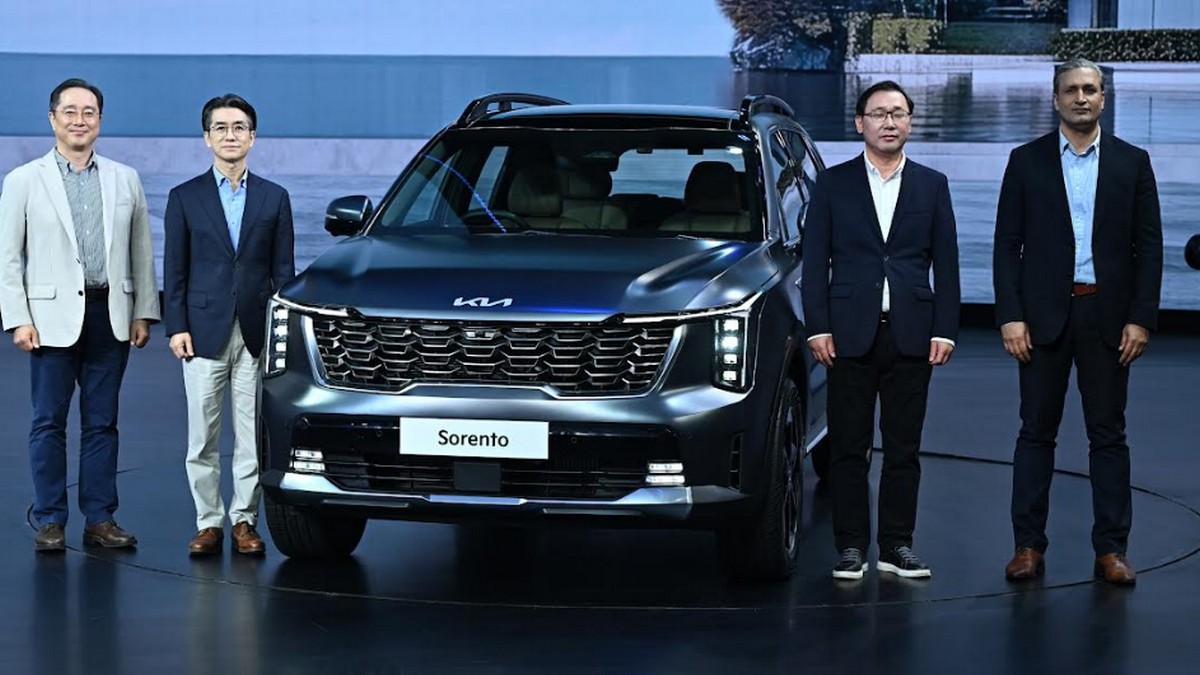
The Sorento is a big bet for Kia India, and you can tell. Six trims, two powertrains, front- and all-wheel drive, six or seven seats and 32 versions in all. This is not a toe in the water exercise but a full-blooded dive into the deep end of the executive SUV pool. More than that, it is a case study in how to launch a product in India, because Kia has got the basics right before it has even started talking about features.
Start with the powertrains, which for this class of SUV could hardly be better judged. There is a strong 2.2-litre diesel for diesel die-hards and there are still plenty of those. And then there is a 1.6-litre turbo-petrol strong hybrid whose timing couldn’t be more perfect. Petrol prices are climbing, E20 has quietly eaten into real-world efficiency, and buyers want diesel-like running costs from a smooth, quiet powertrain without lying awake worrying about diesel’s long-term future. The Sorento hybrid is pitched squarely at that anxiety.
The strategy behind the car is just as interesting. This fourth-generation (MQ4) Sorento arrives in India towards the end of its global life cycle. It is still a current product, but one due to be replaced internationally next year, while India will carry on with this one. That is actually a very smart move. A car this late in its life has its development costs largely amortised, and Kia India can bring some of the tooling here, which slashes the investment.
And this is a properly localised car, not a screwdriver job. The body is stamped and welded at Kia’s Anantapur plant, and the dashboard and seats are made here too. That is what makes the Rs 27.99 lakh starting price possible. The catch is that localisation on this scale only pays off with volume, and Kia wants to sell around 40,000 Sorentos a year. That is a big number for a Rs 30-40 lakh SUV. Can it get there?
Kia Sorento exterior design and engineering
Based on the gen 4 Sorento, it carries over the older and more palatable design language.
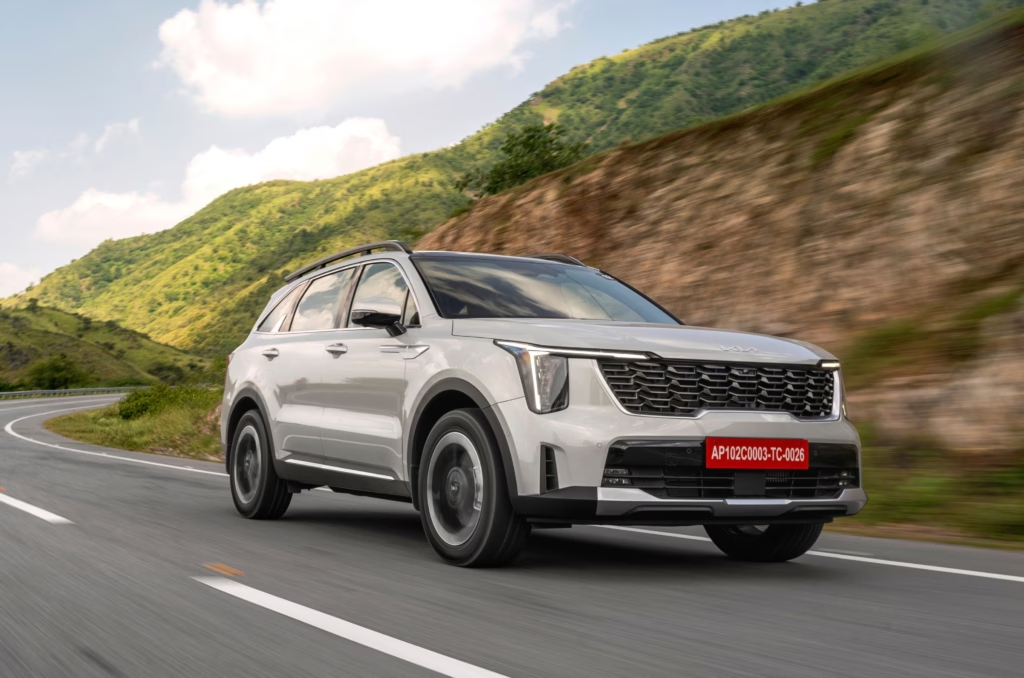
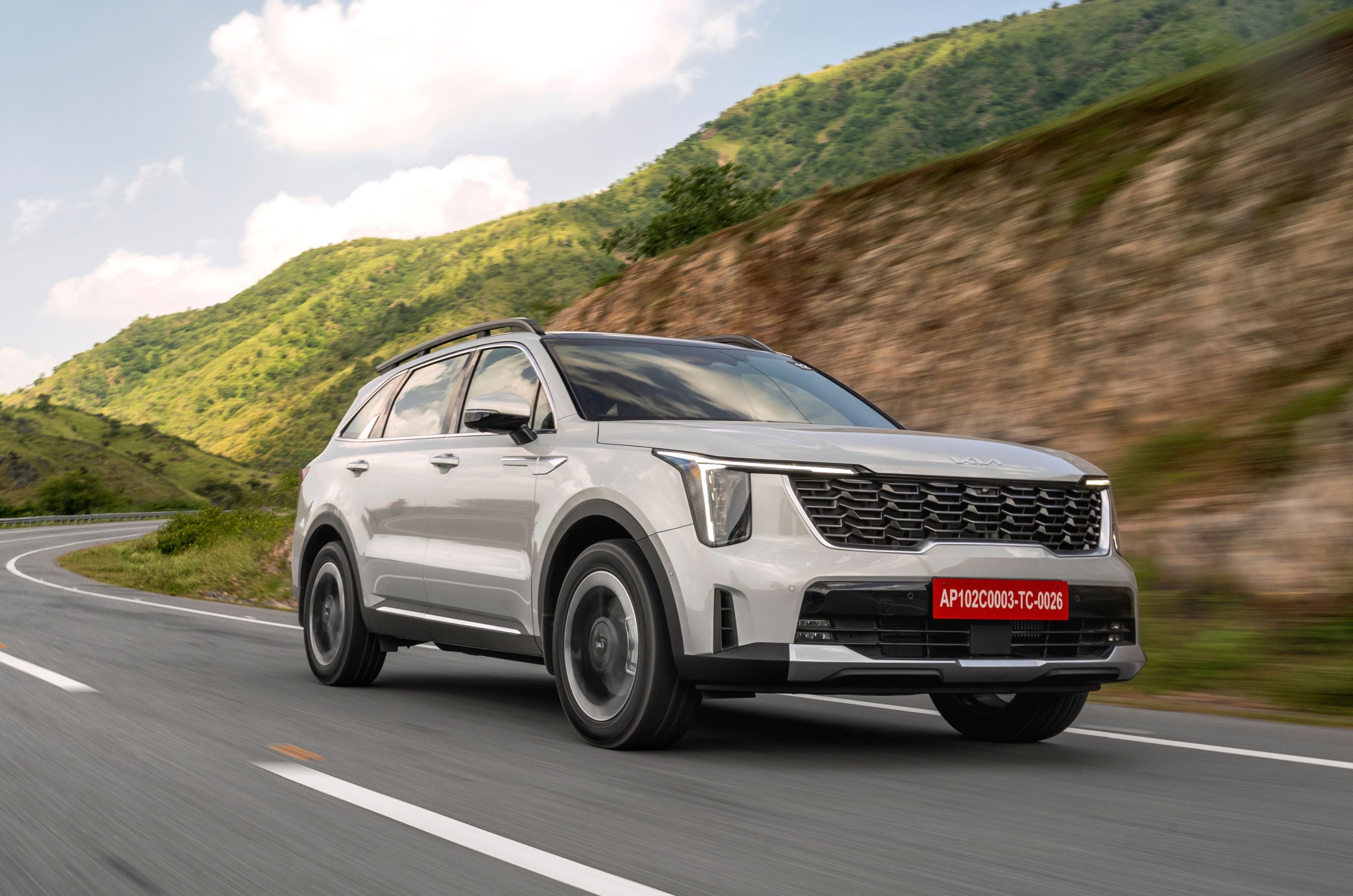
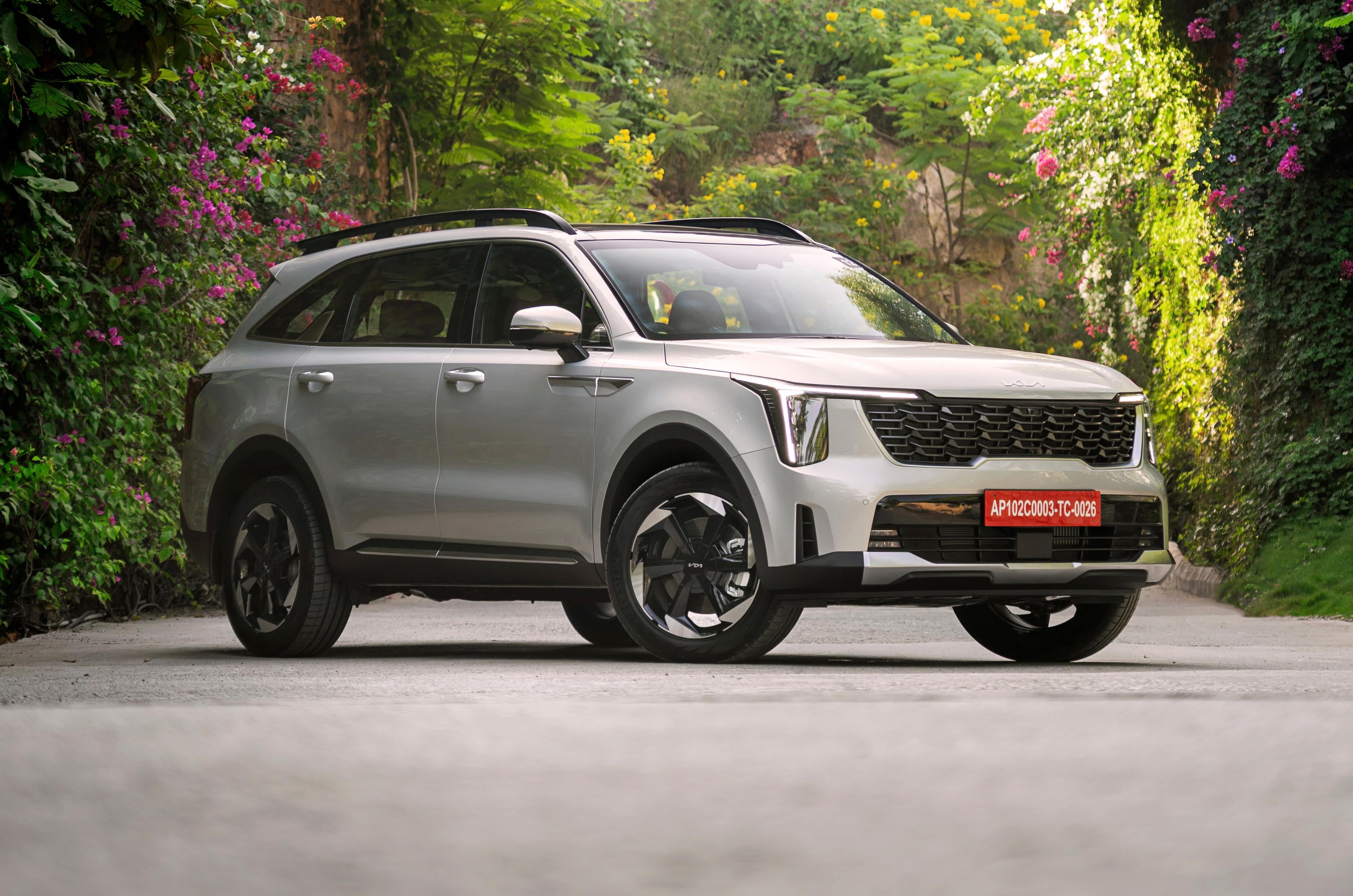
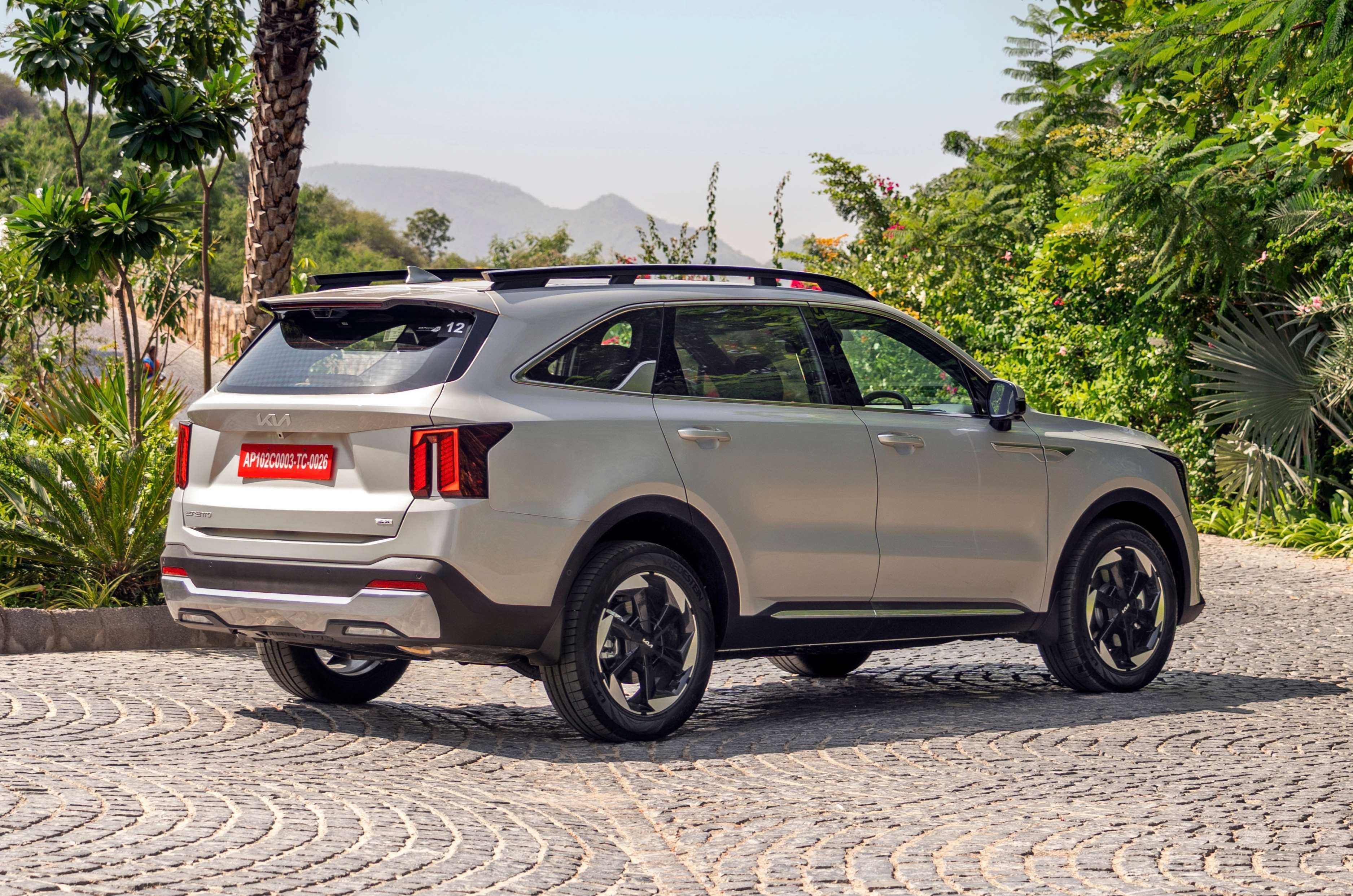
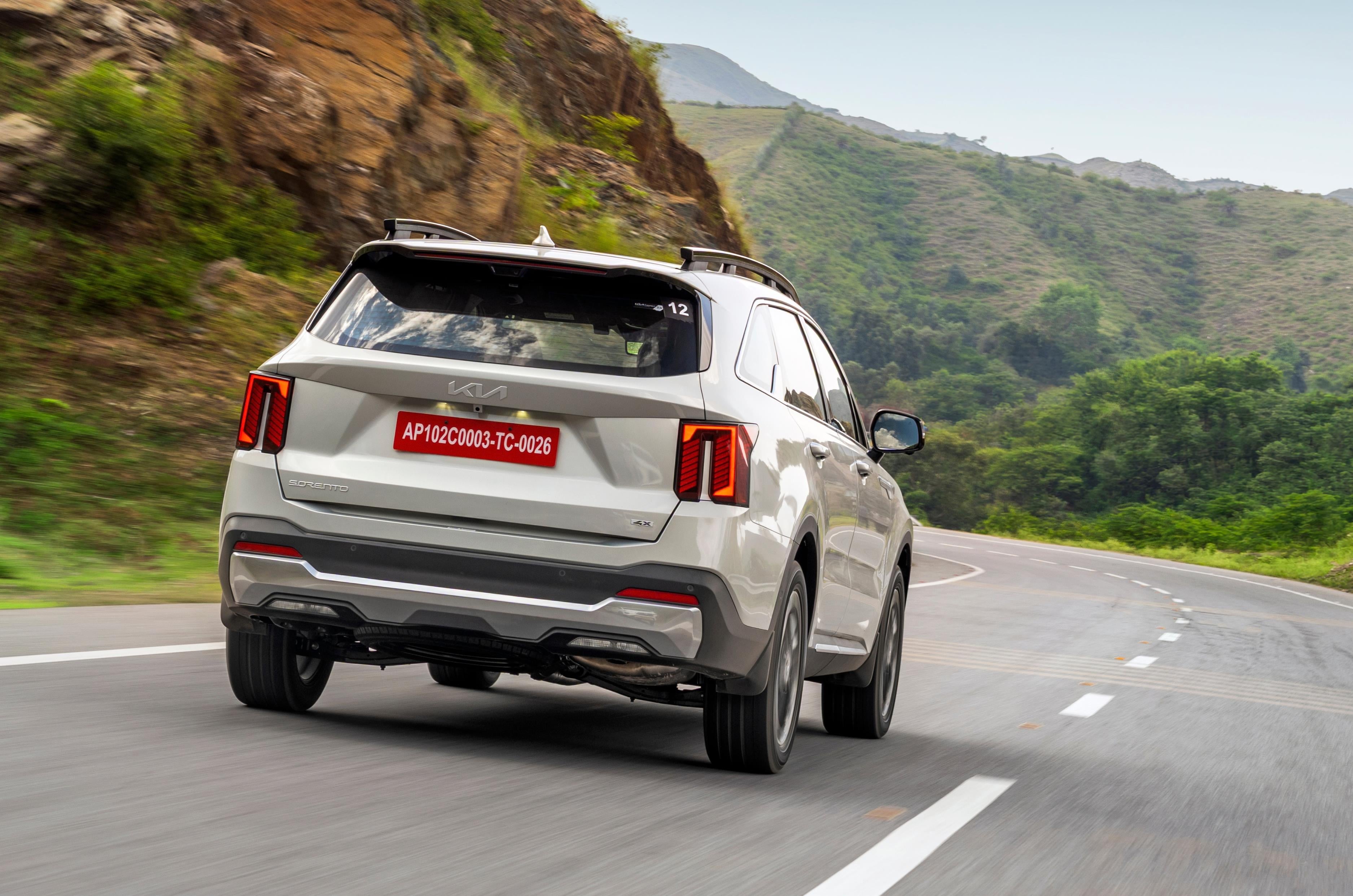
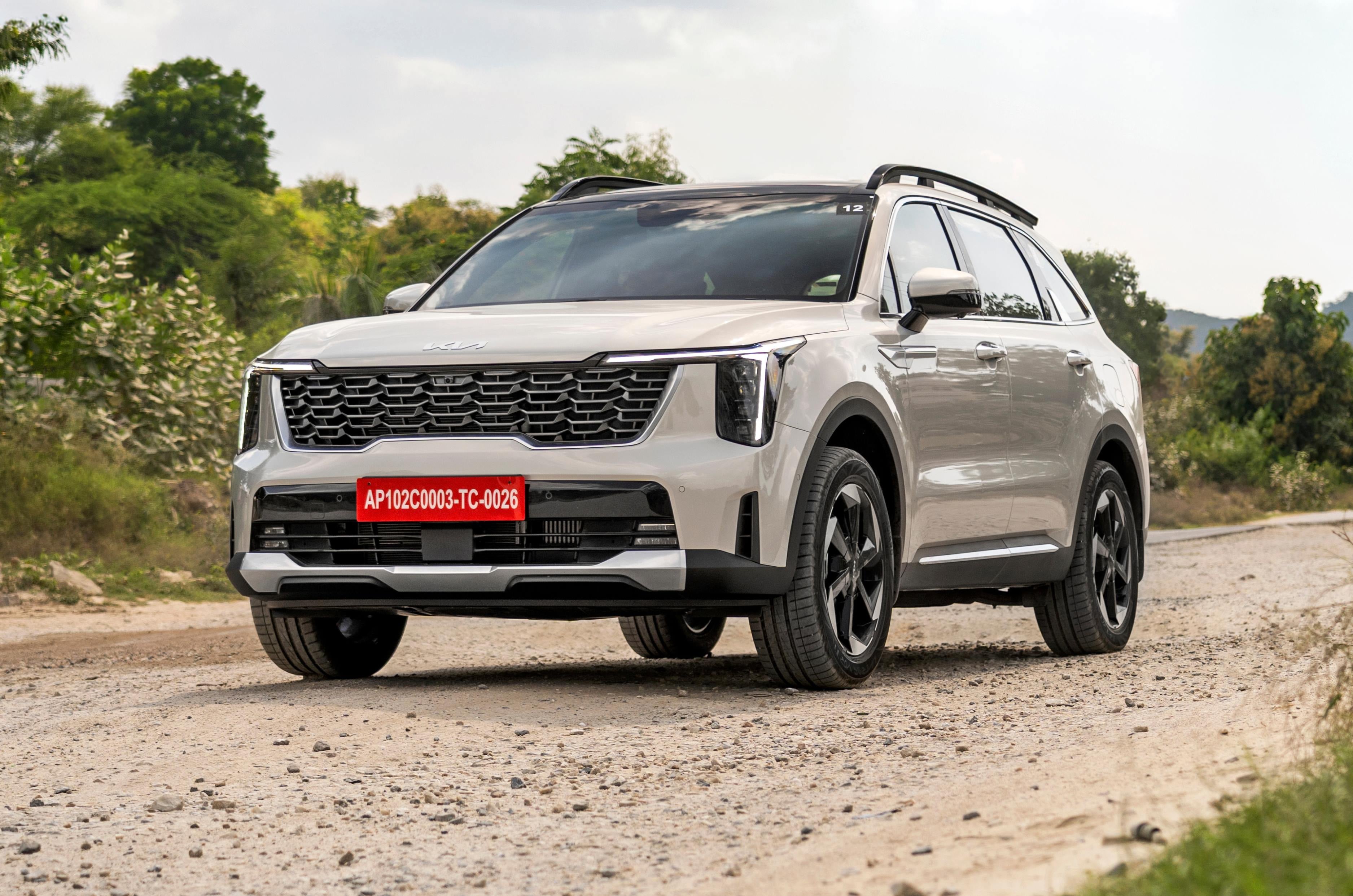
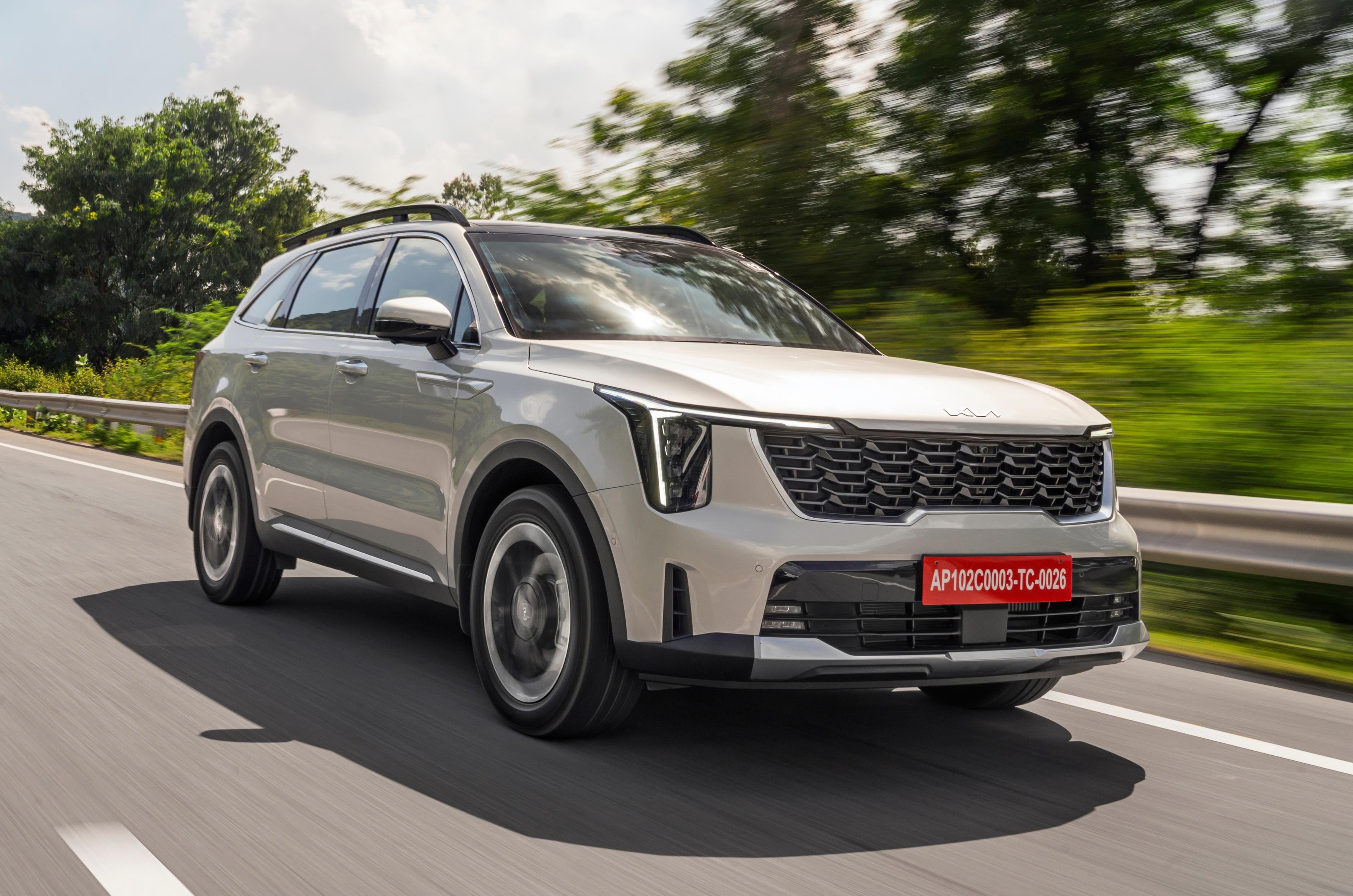
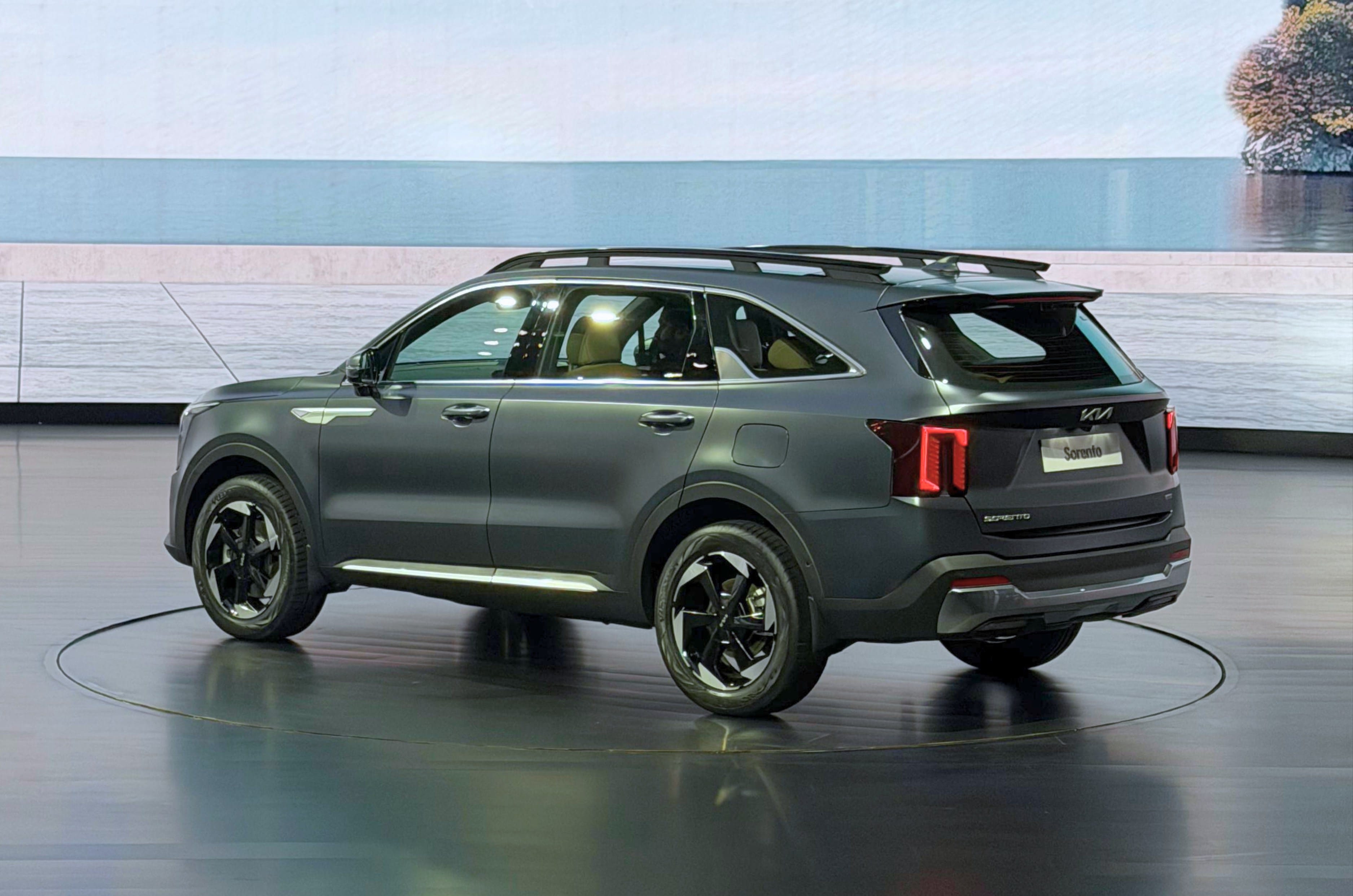
The Sorento sits on Hyundai-Kia’s MQ4 platform, the freshest architecture in its class, and it has already had a mid-life update to keep it looking current. The 2024 facelift brought the nose in line with the design language Kia kicked off with the EV9, so you get vertically stacked LED headlights, Y-shaped daytime running lamps and an aggressive looking bumper with wide intakes. At the back are L-shaped wraparound tail-lamps, and thankfully no light bar stretched across the tailgate.
Beats the rivals in length, width, and wheelbase.
Kia’s stated aim was a more technical, precise look, one meant to signal tight build quality and engineering sophistication. It is a trick the German premium brands have used for years, and Kia has clearly taken a leaf out of their book. The Sorento looks crisp and expensive rather than flashy, and is likely to age well too.
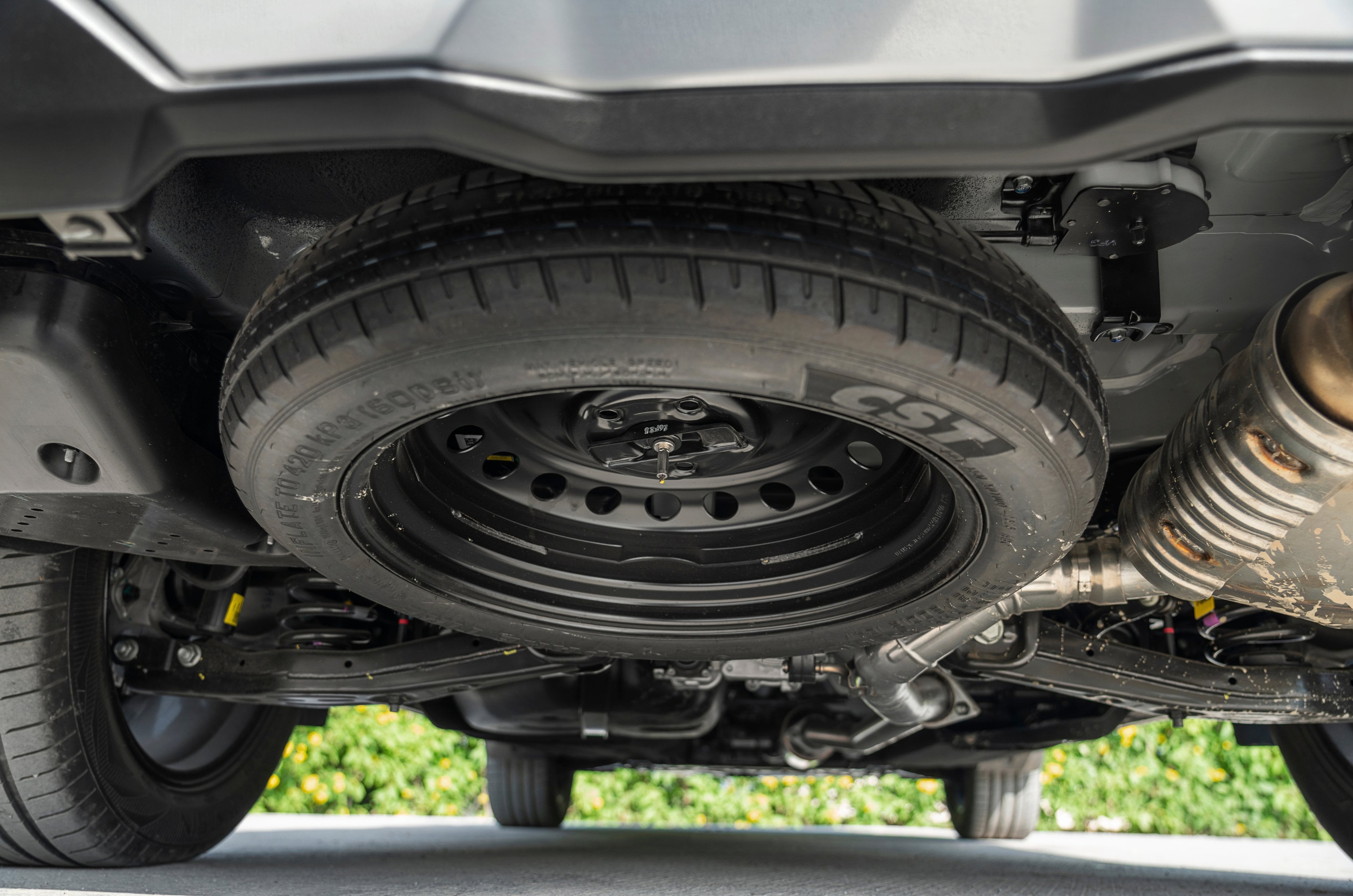
Spare wheel mounted under the floor frees up room in the boot.
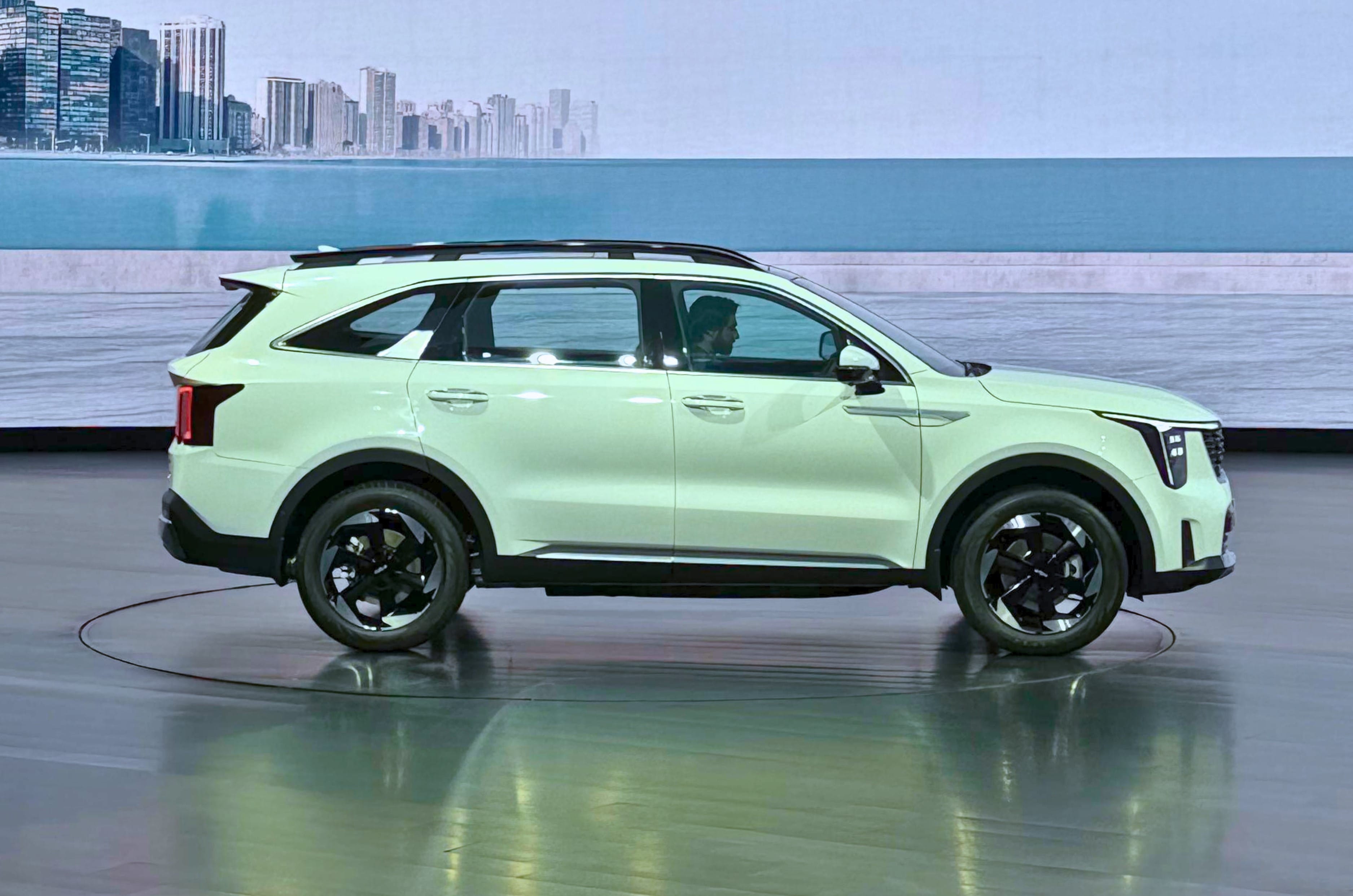
What it does not have is brute presence. Despite being the longest, widest and tallest SUV in its segment, at 4,815mm long, 1,900mm wide and 1,785mm tall on a 2,815mm wheelbase, it does not loom in your mirrors the way a Fortuner does. The sloping roofline at the rear softens the silhouette and lends it a hint of crossover, and some will see it as a big Seltos rather than a junior Land Cruiser. Clearly this is not an SUV that looks like it can bully its way through traffic.
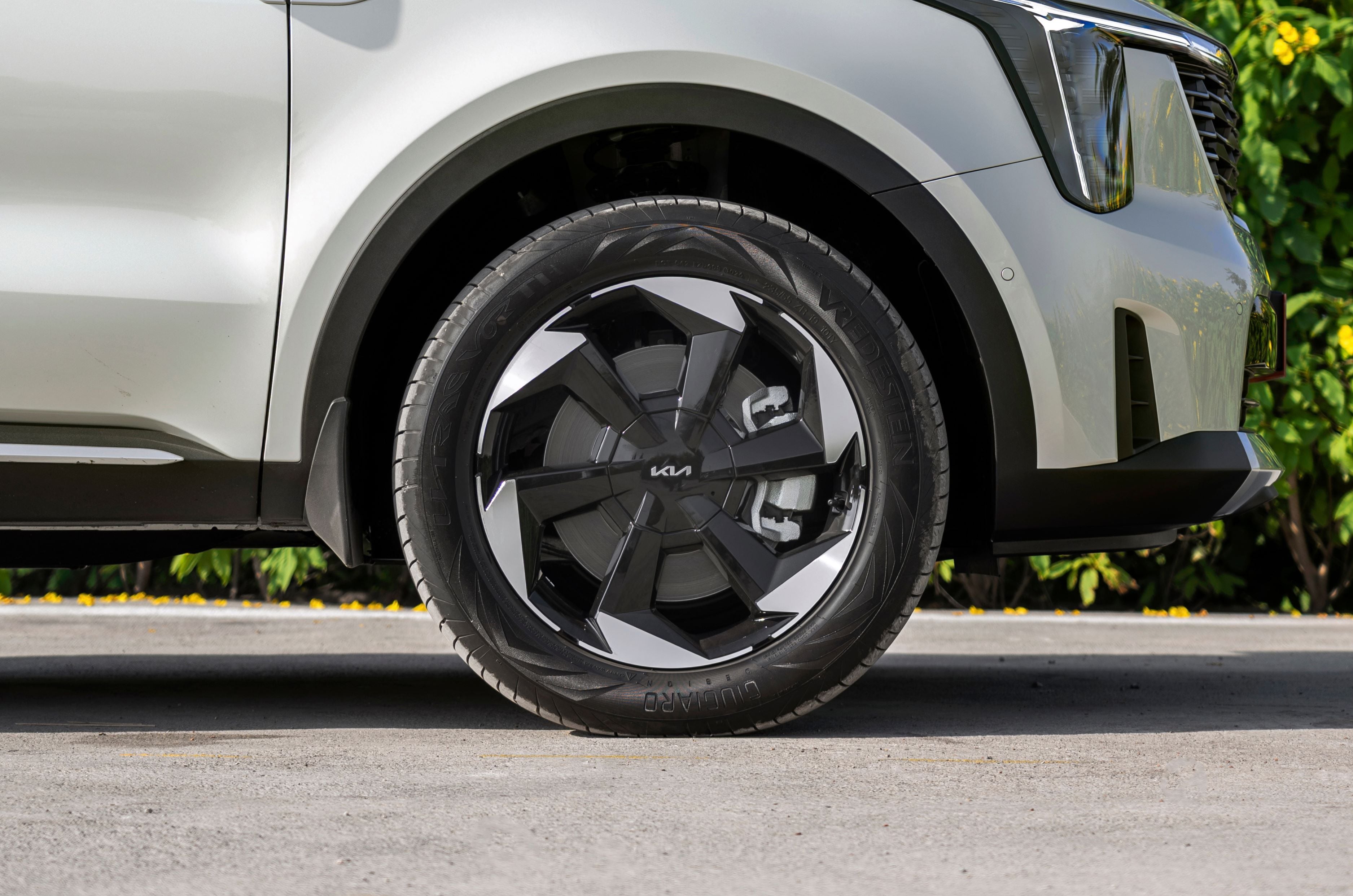
A more unique design could’ve been used for the 19-inch alloys.
The 19-inch dual-tone alloys could have been more distinctive, too an effect exaggerated by the chunky 235/55 R19 tyres. Those tall sidewalls, though, are not a styling misstep so much as an engineering choice, and they play a big part in how this car rides. More on that later.
Kia Sorento interior space and comfort
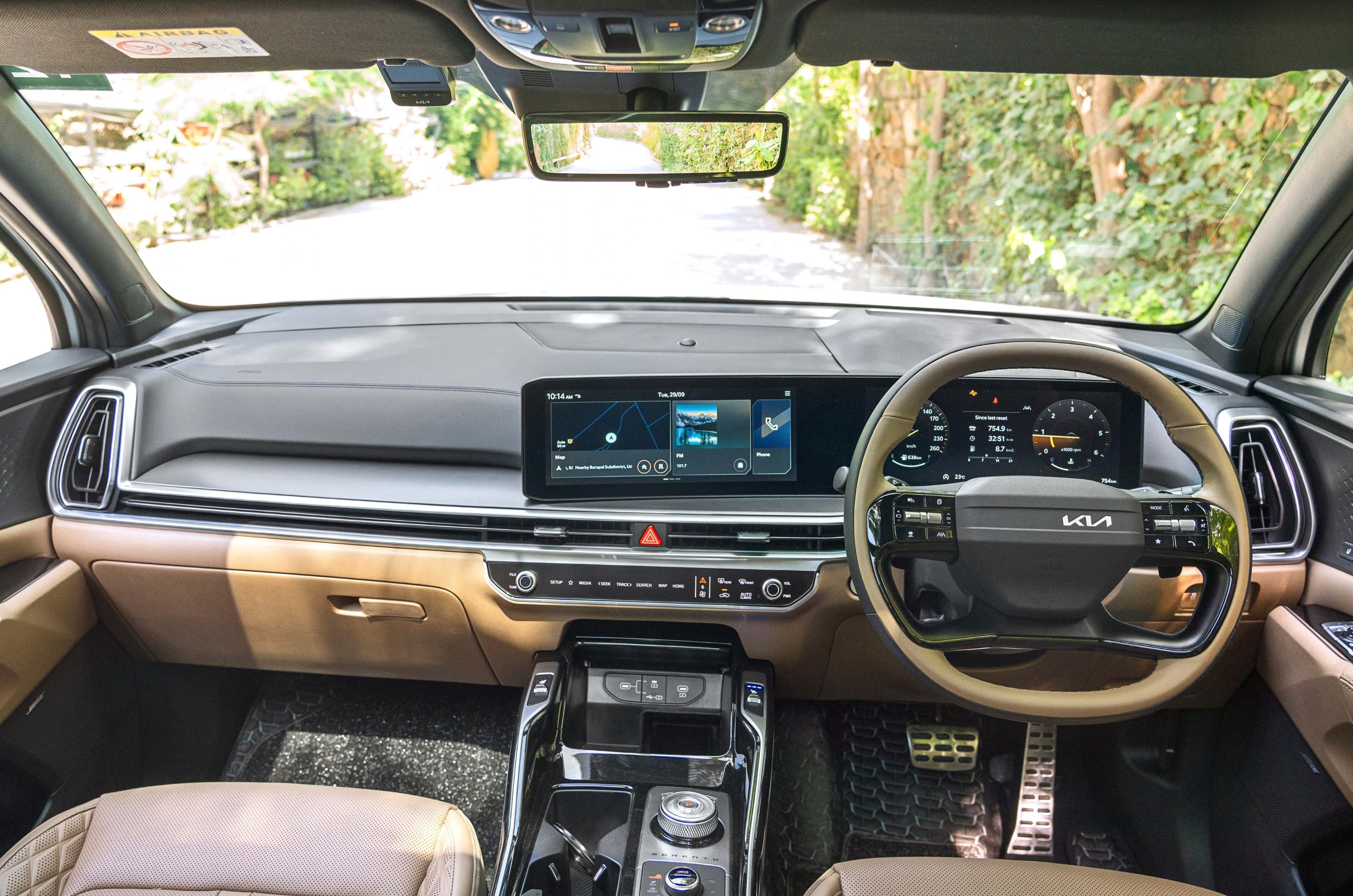
Clutter-free dashboard with solid build and plush feel.
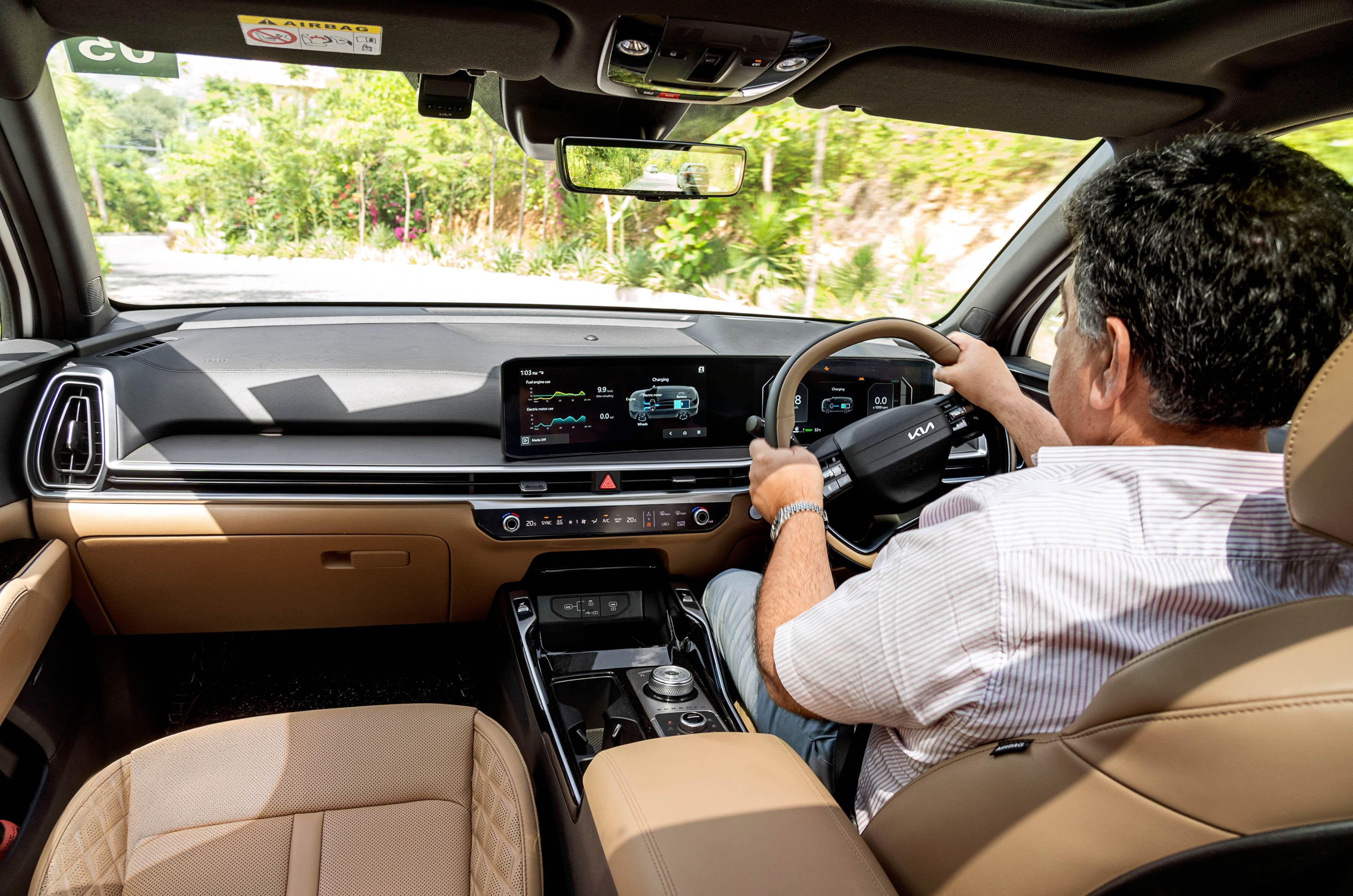
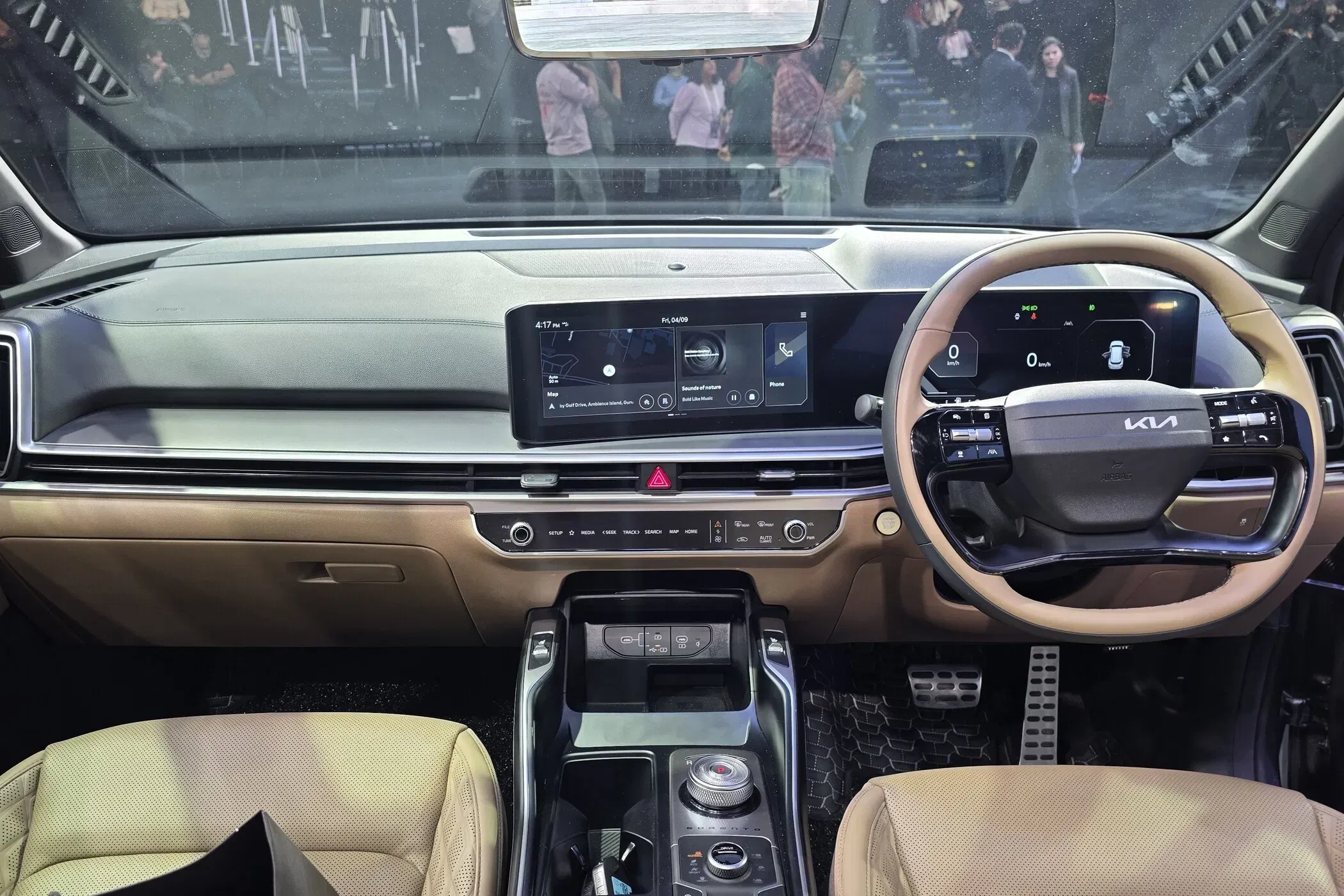
If the exterior is quietly effective, the cabin is where Kia has truly aced it. The Sorento offers a mix of quality, equipment and ergonomics that nothing at this price can match. Soft-touch materials cover everything you are likely to touch, including the spots where your knee rests against the centre console. There is a healthy count of physical buttons, and they click with a precision that feels engineered rather than sourced. The knurled finish on the rotary drive selector and the switchgear adds a tactile richness you normally pay German money for.
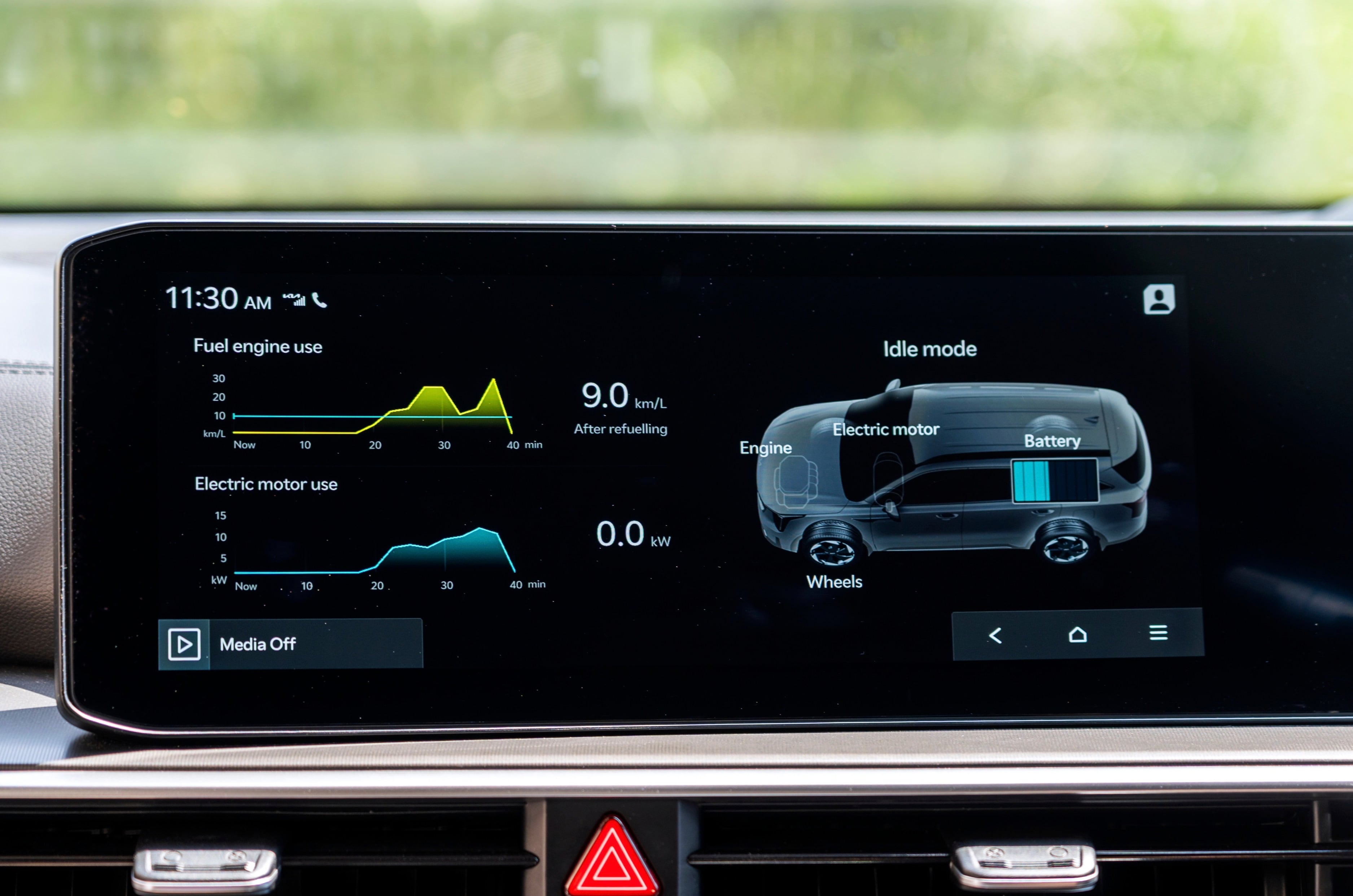
Hybrid variant gets exclusive data for power flow and efficiency.
As with its Hyundai cousins, the real ace is the software. The 12.3-inch infotainment system is logically laid out, menus are where you expect them to be, and getting to a feature takes a tap or two rather than a treasure hunt. Kia has also kept the climate controls off the main screen. They live on a touch-sensitive bar below it, with scrollers and a button that toggles the bar between air-con and infotainment shortcuts. It is a clever, space-saving solution, though you will occasionally find it in the wrong mode just when you need it.
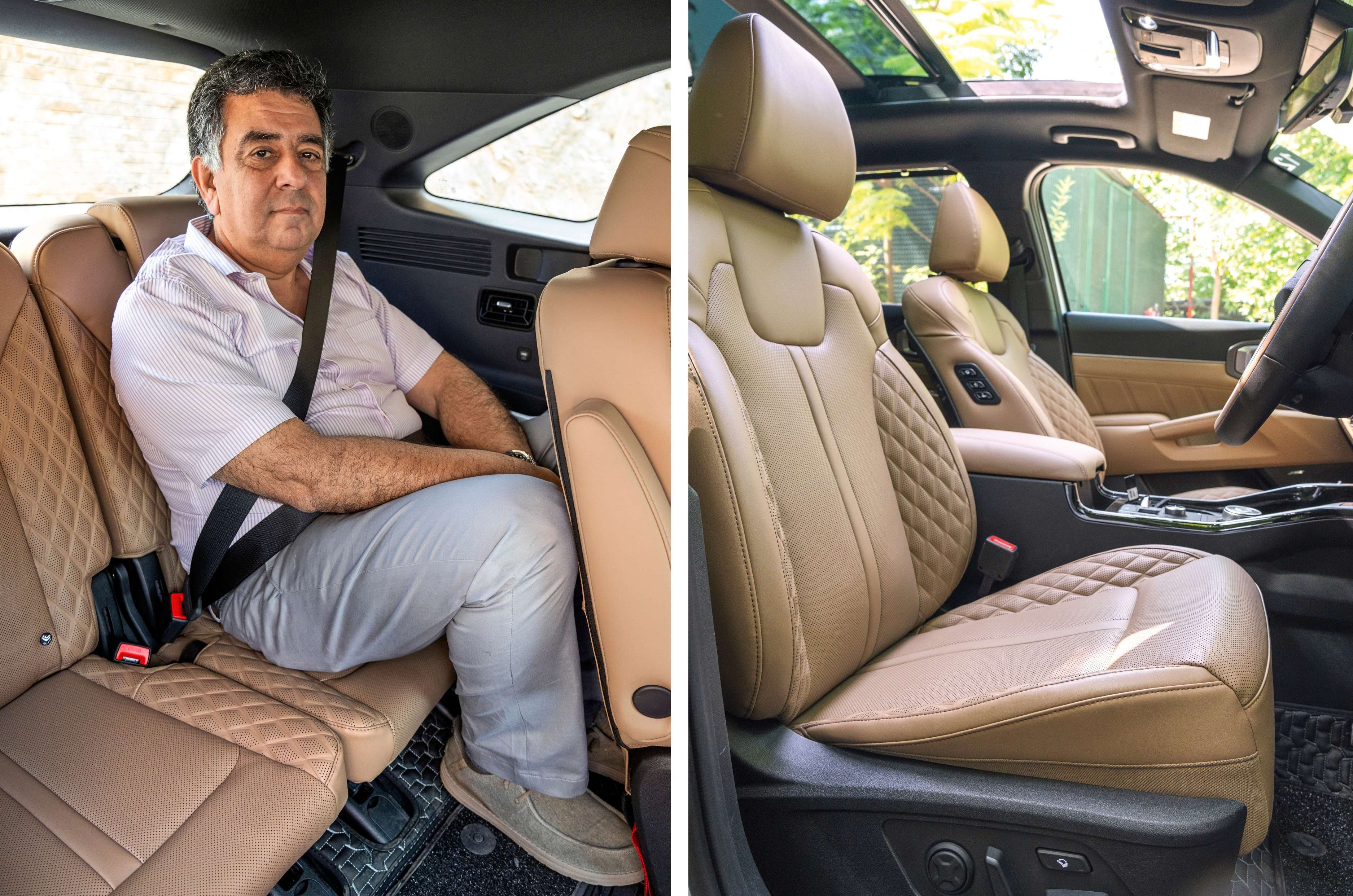
L: Third row seat placed on floor results in knees-up seating; best for children. R: Broad, supportive and well-cushioned front seats are electric and also get ventilation.
The front seats are fully powered, with 10-way adjustment, lumbar support and ventilation, and the passenger seat gets a boss mode so whoever sits behind can push it forward. Coming to the third row, access is easy. You can either walk through the gap between the captain chairs or press a button on the seat, which electrically slides and tilts it forward. Once there, the news is mixed. Legroom is better than you expect, but the seat base is mounted almost flat on the floor, so there is no under-thigh support and your knees point at the roof. Treat it as a space for children or short hops. At least the third row gets its own blower controls and USB ports.
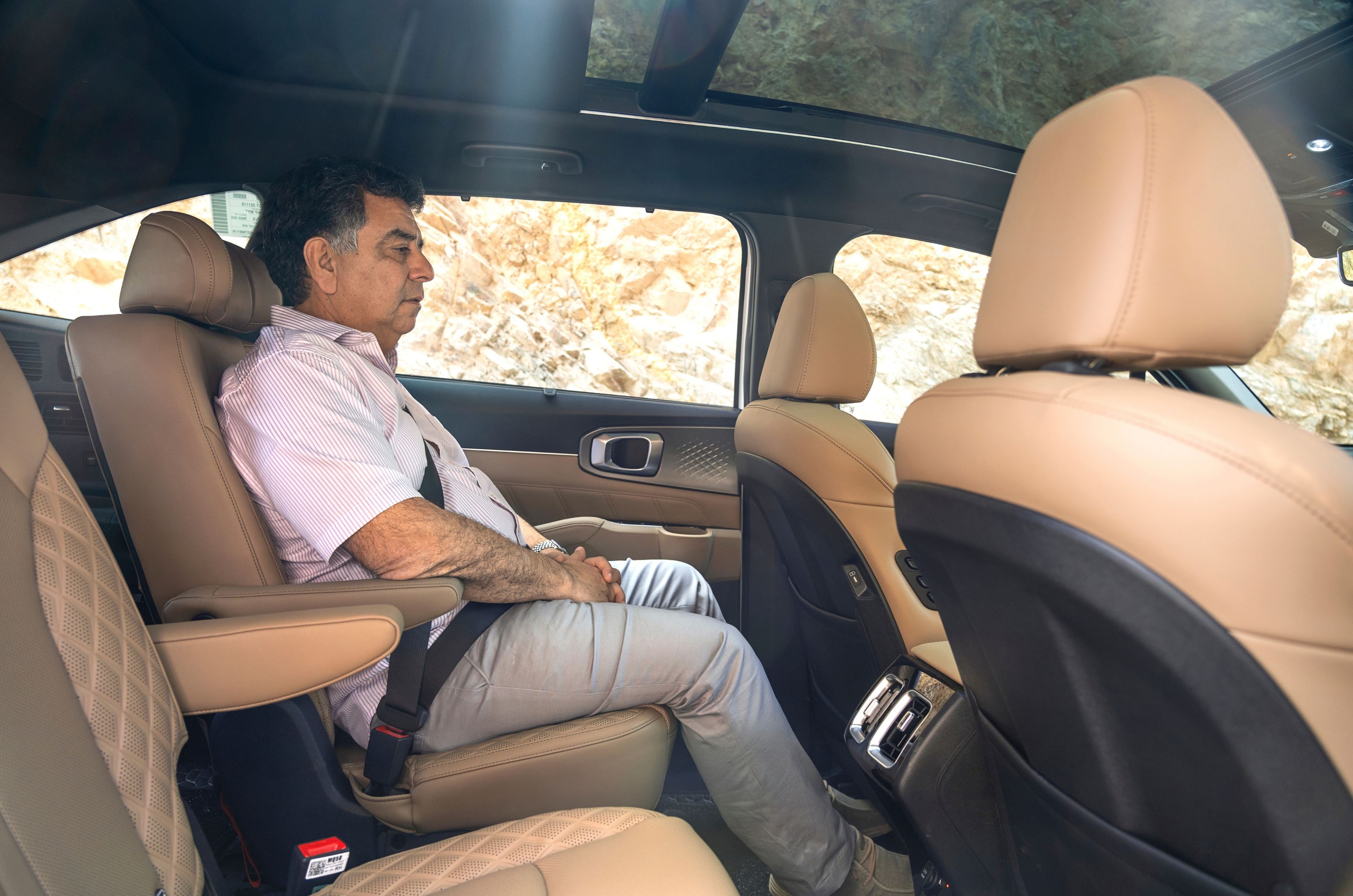
Spacious middle-row with ventilated and adjustable captain chairs; bench seat version also available.
One of the Sorento’s highlights, however, is the second-row experience. Our test car was the top HTX with six seats, and its second-row captain chairs are ventilated too, a rarity in this class. They are the best seats in the house. There is lots of legroom, a commanding view out and good under-thigh support, comparable to the Innova Hycross’s middle-row captain chairs, though the Toyota seats you a touch higher. A neat detail is the cupholder moulded into the door, up near the handle, where it is actually easy to reach.
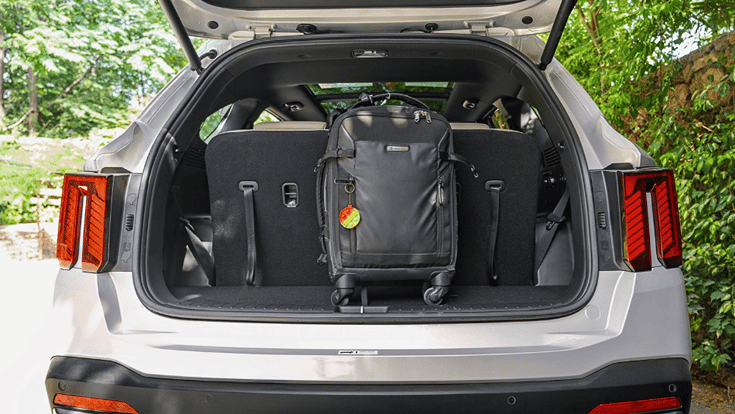
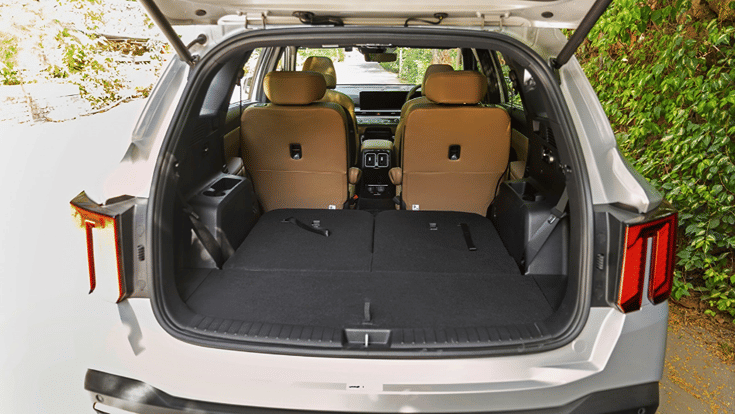
With all three rows up, the boot is a modest 179 litres; fold the third row and that grows to 813 litres. A full-size spare is welcome, but it is slung under the body, which is not the most convenient place to reach. Overhead, the massive panoramic roof floods the cabin with light and adds to the sense of space.
Kia Sorento features and technology
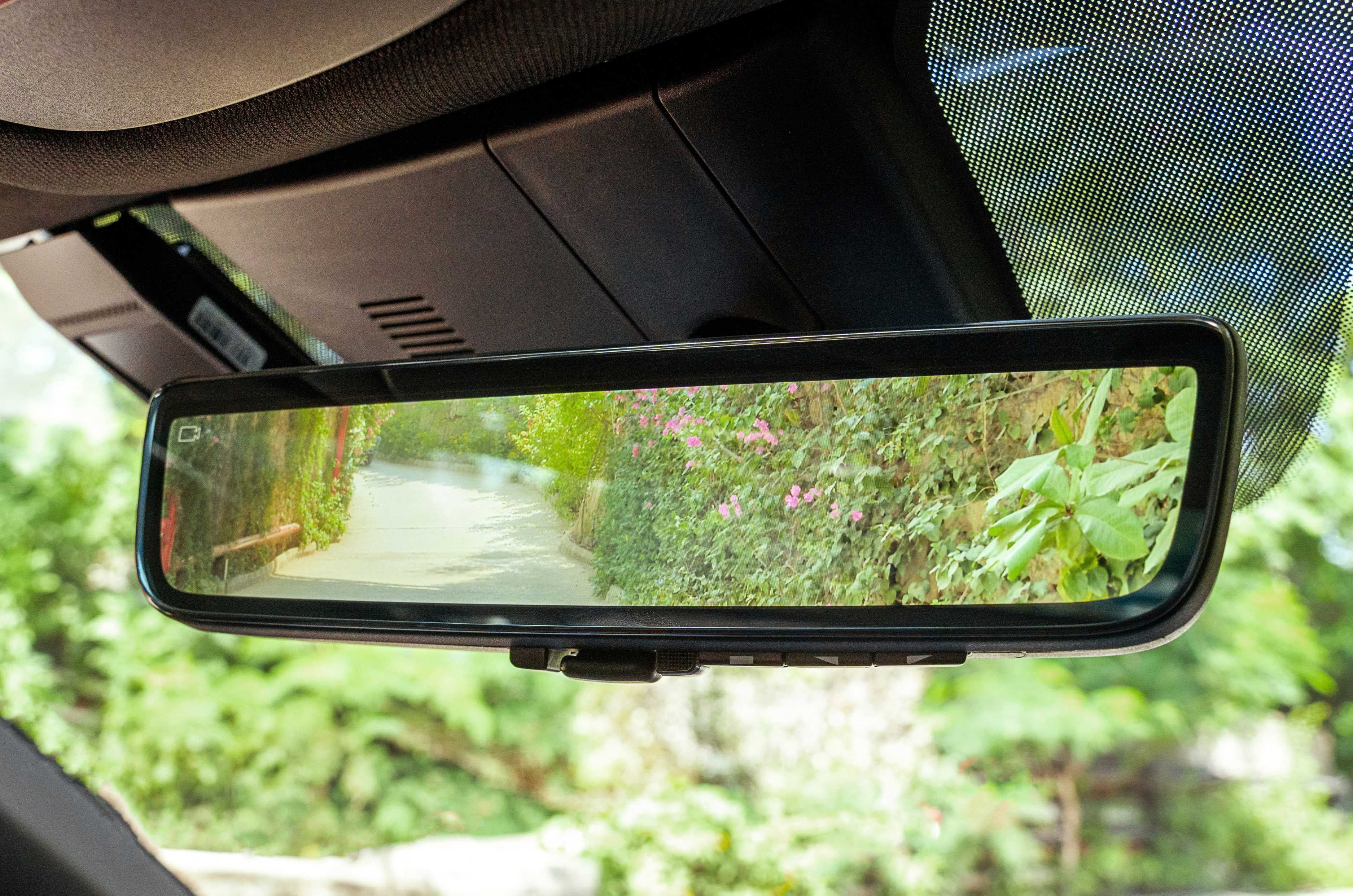
Digital IRVM offers excellent resolution and can be adjusted for level and brightness.
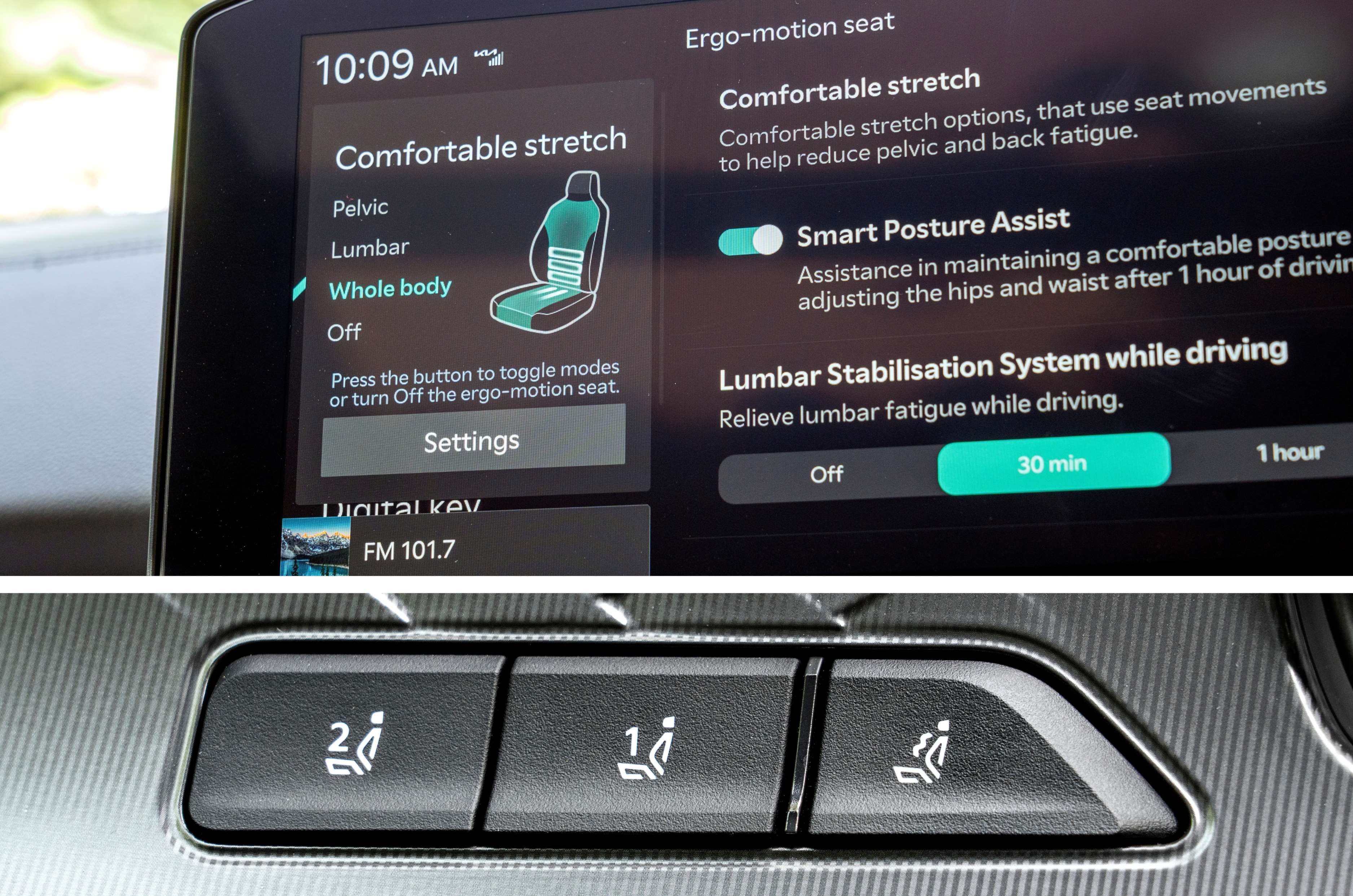
The equipment list is huge. In addition to the aforementioned 12.3-inch touchscreen, powered front seats, ventilated captain’s chairs, and panoramic sunroof, the Sorento comes packed with a 12.3-inch digital driver’s display, a head-up display, a 12-speaker Bose system, dual-zone climate control, a powered tailgate, rear-window sunshades, 64-colour ambient lighting and a digital rear-view mirror that flips back to a conventional one at the turn of a knob. The driver’s seat even gets an ‘ergo-motion’ mode that simulates a massage function by shifting the contours around.
Ergo mode for driver seat acts like a massage by moving the contours to avoid a stiff back on a long trip.
Safety is just as thorough, with 10 airbags, a 360-degree camera, front and rear dashcams, remote parking assist, TPMS and Level 2+ ADAS on the (A) trims. There is even real-time generative AI, a first for any Sorento globally.
Kia Sorento performance and refinement
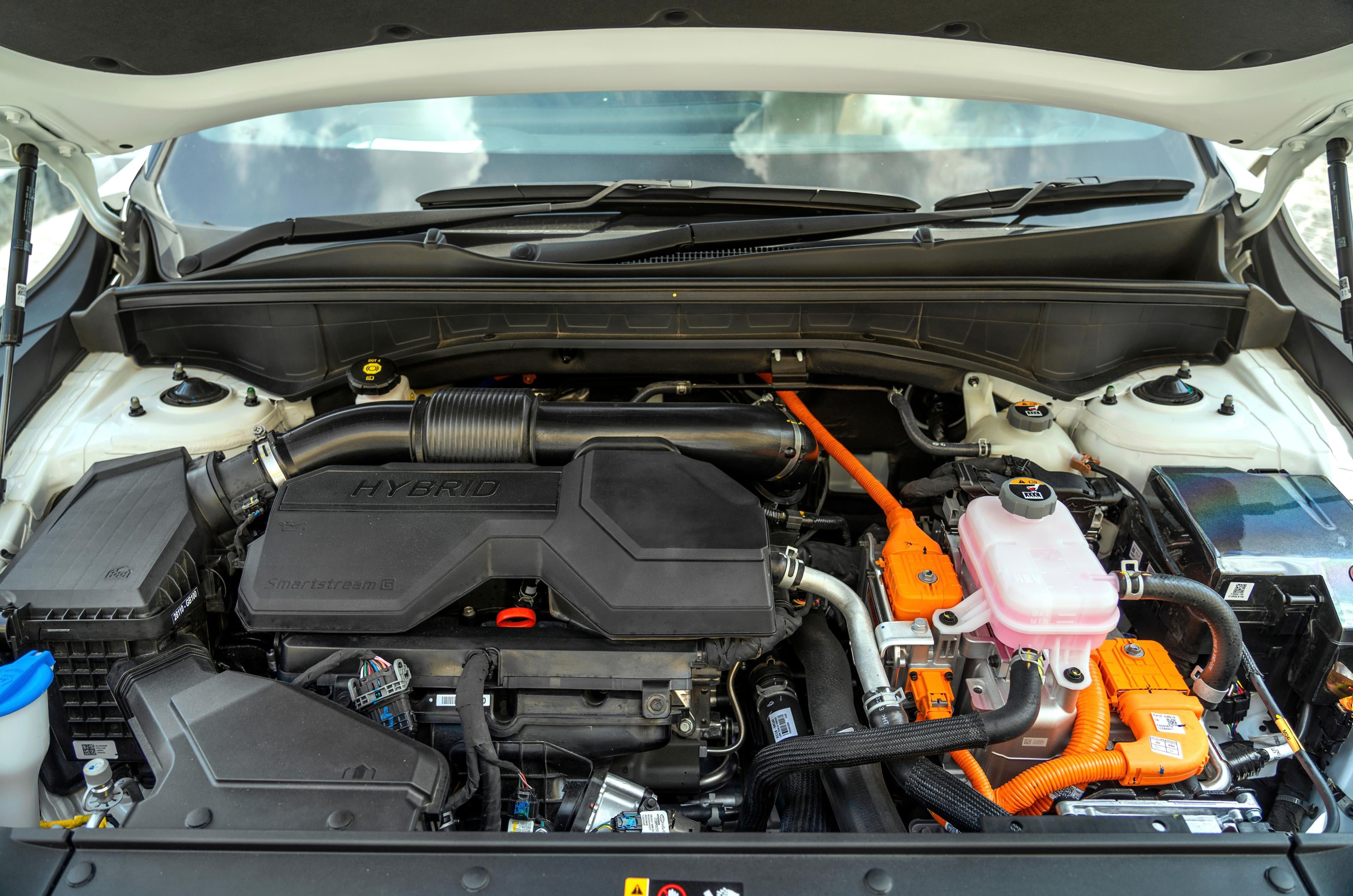
1.6-litre turbo-petrol engine paired with an electric motor and 6-speed torque converter automatic.
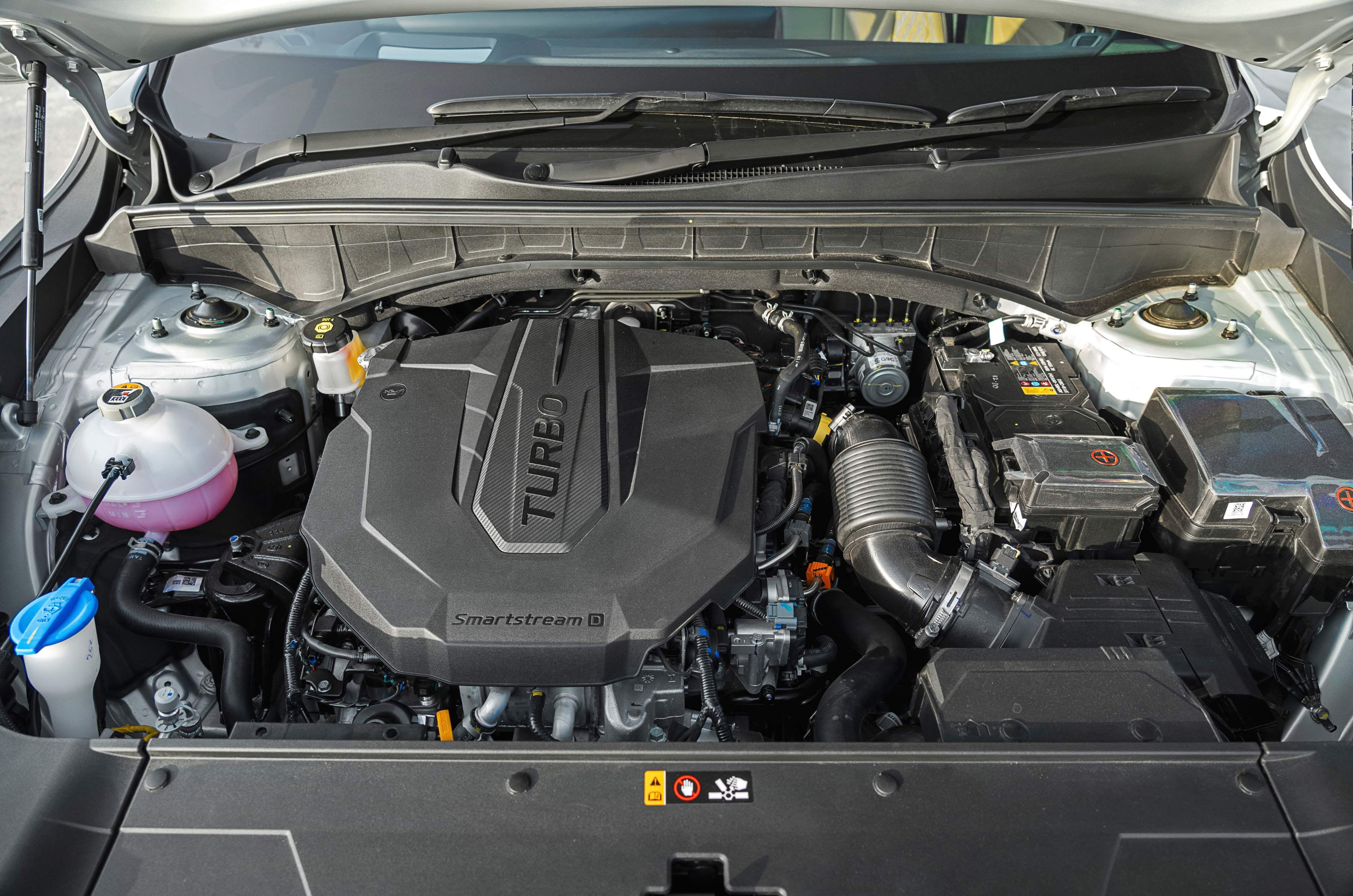
First up, the hybrid. Its 1.6-litre turbo-petrol makes 180hp and 265Nm, and the electric motor adds 65hp and 264Nm. The combined figure rating is 230hp and 380Nm of torque You can tell this the hybrid is the one for the city the moment you pull away, because the response is instant. It is well mated to the 6-speed torque-converter automatic, and the handover from electric to petrol power is close to seamless.
Hybrid variant is smooth in the city but gets noisy on the highway especially during overtakes.
The 1.49kWh battery lets it run in EV mode for a decent stretch at crawling speeds, and in stop-go traffic the hybrid makes eminent sense. Power delivery is refined, seamless and relaxing, and efficiency should be strong; The limitation is the motor itself. With only 65hp to shift a car weighing over two tonnes, it cannot do the heavy lifting on its own, so when you want to make quick progress the engine kicks in early. Push hard on the highway and the four-cylinder gets noisy and starts to run out of steam.
2.2-litre diesel engine makes 193hp mated to an 8-speed DCT and is the same unit seen on the Carnival.
Which is where the diesel comes in. The 2.2-litre is familiar from the Carnival, but it feels a lot sprightlier in the lighter Sorento. Its 193hp and 442Nm arrive in a strong, linear surge, and this is a fantastic, long-legged cruiser. Settle into eighth gear on an open highway and it simply lopes along, the engine barely working. It is also more tractable at low speeds than you might expect, pulling cleanly at part throttle from very low revs, so it can double as a city car, although its low-end response does not come close to the hybrid’s. It’s only when you floor it to dart through traffic that you experience a bit of hesitation, and its hear that you can use the paddle shifts to be in the right gear at the right time of the 8-speed DCT which comes as a pleasant surprise.
The diesel‘s strong torque and effortless cruising makes it perfect for long trips.
Rather than the snappy, slightly jerky shifts typical of dual-clutch boxes, this DCT slurs its changes almost like a torque converter, which adds to the smoothness of the whole package. The reason is that it is a wet-clutch unit, which also bodes well for durability in Indian traffic. The diesel is quite refined for the most part and its only when pushed hard that it gets audible and takes on a gruff note.
Both get drive modes; You can play with the Eco, Normal, Sport and Smart (or auto) modes in the diesel which alters the power delivery. In Sport, the throttle response is sharper and the default mode we liked whilst in Eco you can feel the response a bit dulled down. The Sorento Hybrid gets just Eco, Sport and Smart modes and in Eco mode EV running is prioritised. In addition, the AWD versions get Snow, Sand and Mud terrain modes which we didn’t a get chance to fully experience.
Kia Sorento mileage
In terms of fuel efficiency, the hybrid is rated at a highly frugal 19.60kpl with front-wheel drive and 17.70kpl with AWD, while the diesel returns 17.66kpl and 15.79kpl respectively on the Indian test cycle. In real-world city driving the gap between the hybrid and diesel could be bigger, depending on traffic. On long cross-country runs, though, with extended stints of cruising in high gears, the diesel could well be the more frugal of the two.
Kia Sorento ride and handling
The Sorento’s ride comfort is simply outstanding, and it comes as a pleasant surprise. That’s because Kias have traditionally been stiffer sprung than their Hyundai cousins, but here Kia has clearly prioritised comfort over sportiness, and the suspension is on the soft side. The way it smothers bad roads at speed is remarkable. Around Udaipur, where several stretches are properly broken, we never once had to lift off for a bad patch. The car just soaked it up and kept going.
Ride quality is segment best and it is unfazed over broken roads.
The isolation it gives its passengers is shockingly good, and those tall-sidewall tyres deserve part of the credit. They do a fine job of rounding off sharp jolts and filtering out the high-frequency shocks that a suspension alone cannot fully absorb. At highway speeds there is a bit of body movement on the undulating bits but its not disconcerting and both versions feel stable and planted at high speeds, which matters in a car this tall.
Our HTX test cars came with AWD as standard. We did not get a chance to test its off-road ability properly, but on dirt roads it felt sure-footed and secure. A proper off-road test will reveal how capable the all-wheel-drive system, though we doubt owners will really want to test the Sorento’s off-road capability.
Steering is light but lacks consistency and sharpness of European rivals.
The steering is less impressive. There is a dead zone around the straight-ahead position, and it does not feel as fluid or progressive as its European rivals’. The Volkswagen Tayron and Skoda Kodiaq are both dynamically sharper. One reason is because the Sorento rides taller too, as ground clearance has been raised from the global car’s 176mm to 208mm, and there is a touch of body roll when you push hard through corners.
But that misses the point. On balance, the Sorento’s ride and handling are superbly judged for the people who will buy it. Kia has done a fine job of understanding what a premium SUV buyer in India wants, and it has tailored the car accordingly.
Kia Sorento price and verdict
As a package, the Sorento hits it out of the park; rivals have a lot of catching up to do.
If the product does not win you over, the pricing certainly will. A starting price of Rs 27.99 lakh has set the cat amongst the pigeons, putting the Sorento within striking distance of the Mahindra XUV 7XO. And with its size, features and overall polish, the Sorento will not just nibble at the top end of the 7XO’s pie but with the Hybrid could also tempt a few Innova Hycross buyers. As for the Volkswagen Tayron and Skoda Kodiaq, the Sorento makes them look overpriced and underequipped.
The lower and mid variants are exceptional value. The top-end HTX, at Rs 37.49-40.19 lakh depending on fuel and seating, is pricey by comparison, around Rs 5 lakh more than an equivalent HTK, because it comes with AWD as standard. Here Kia has missed a trick. An HTX with two-wheel drive, a few lakh cheaper, would have been a far easier sell to the many buyers who want all the features and ventilated rear seats but will never leave the tarmac. That however is a small quibble that Kia can easily correct.
The lasting impression is that the Sorento feels premium, bordering on luxury. It is fantastically equipped, it rides beautifully, and it offers a choice of two powertrains that are each right for a distinct type of buyer. Most of all, it fits what the Indian SUV buyer actually wants with uncanny precision. Will Kia hit its target of 40,000 sales a year? That could be a tall order. But what there is no doubt about is that Kia has built another winner.
Kia has a new flagship ICE SUV in India in the form of the Sorento. The Korean carmaker has thrown quite a lot at it, offering it with a wide variant lineup with strong-hybrid and diesel engines, front wheel drive and all-wheel drive configurations, and both 6- and 7-seater configurations. In the executive SUV space, the Sorento finds itself in the company of the Skoda Kodiaq, Volkswagen Tayron and Jeep Meridian, and uniquely, it’s the only one to come with a strong-hybrid powertrain. If you have your eyes set on the Sorento, here’s everything you need to know about Kia’s latest three-row SUV.
1. What’s the price range of the Kia Sorento?
2026 Kia Sorento variant-wise prices (in Rs lakh, introductory, ex-showroom)
Diesel 7-str
Diesel 6-str
Strong-hybrid 7-str
Strong-hybrid 6-str
HTE
27.99
–
29.49
–
HTE(O)
29.49
–
30.99
–
HTK
32.49
32.69
33.99
34.19
HTK(A)
33.49
33.69
34.99
35.19
HTX (AWD)
37.49
37.69
38.99
39.19
HTX(A) (AWD)
38.49
38.69
39.99
40.19
The Kia Sorento is priced between Rs 27.99 lakh and Rs 40.19 lakh (ex-showroom), and is available in as many as 20 different variants. More specifically speaking, the diesel range starts at Rs 27.99 lakh and goes up to Rs 38.69 lakh for the top-spec AWD variant. Meanwhile, the strong-hybrid range is priced from Rs 29.49 lakh and Rs 40.19 lakh (ex-showroom).
On-road prices for the Sorento hybrid range between Rs 37.68 lakh and Rs 51.30 lakh in Delhi. Meanwhile, the diesel’s on-road price in Delhi ranges between Rs 35.81 lakh and Rs 49.42 lakh (ex-showroom). Do note on-road prices can vary depending on the city.
2. What powertrains are available with the Kia Sorento?
The Sorento is available with two powertrain options – a 1.6-litre turbo-petrol strong hybrid and a 2.2-litre diesel engine. In the turbo-petrol strong hybrid version, the combustion engine produces 180hp and 265Nm while an electric motor produces an additional 65hp and 264Nm. Kia has, however, not revealed the battery size or the combined total output for this powertrain. The diesel, meanwhile, produces 193hp and 442Nm. The Sorento is, in fact, just one of two SUVs in this segment to offer a diesel engine, while the strong-hybrid is its novelty.
Both powertrains are offered only with an automatic gearbox – 6-speed AT for the strong-hybrid and 8-speed DCT for the diesel. Both also get the option of front-wheel drive and all-wheel drive. Kia has, however, not revealed specific fuel efficiency figures for either powertrain yet.
3. How big is the Kia Sorento
Kia Sorento vs rivals: Powertrain options
Kia Sorento
Volkswagen Tayron
Skoda Kodiaq
Jeep Meridian
Length (mm)
4,815
4,792
4,758
4,769
Width (mm)
1,900
1,866
1,864
1,859
Height (mm)
1,785
1,665
1,679
1,698
Wheelbase (mm)
2,815
2,789
2,791
2,782
Ground clearance (mm)
TBC
TBC
192
214
Wheel size (inch)
18-19
19
18
18
The Sorento is the largest SUV in its segment in every parameter, which lends it quite an imposing stance on the road. It also has the longest wheelbase in its class, and offers the option 18-inch and 19-inch alloy wheels, depending on the trim. For
4. What are the exterior and interior colour options available on the Sorento?
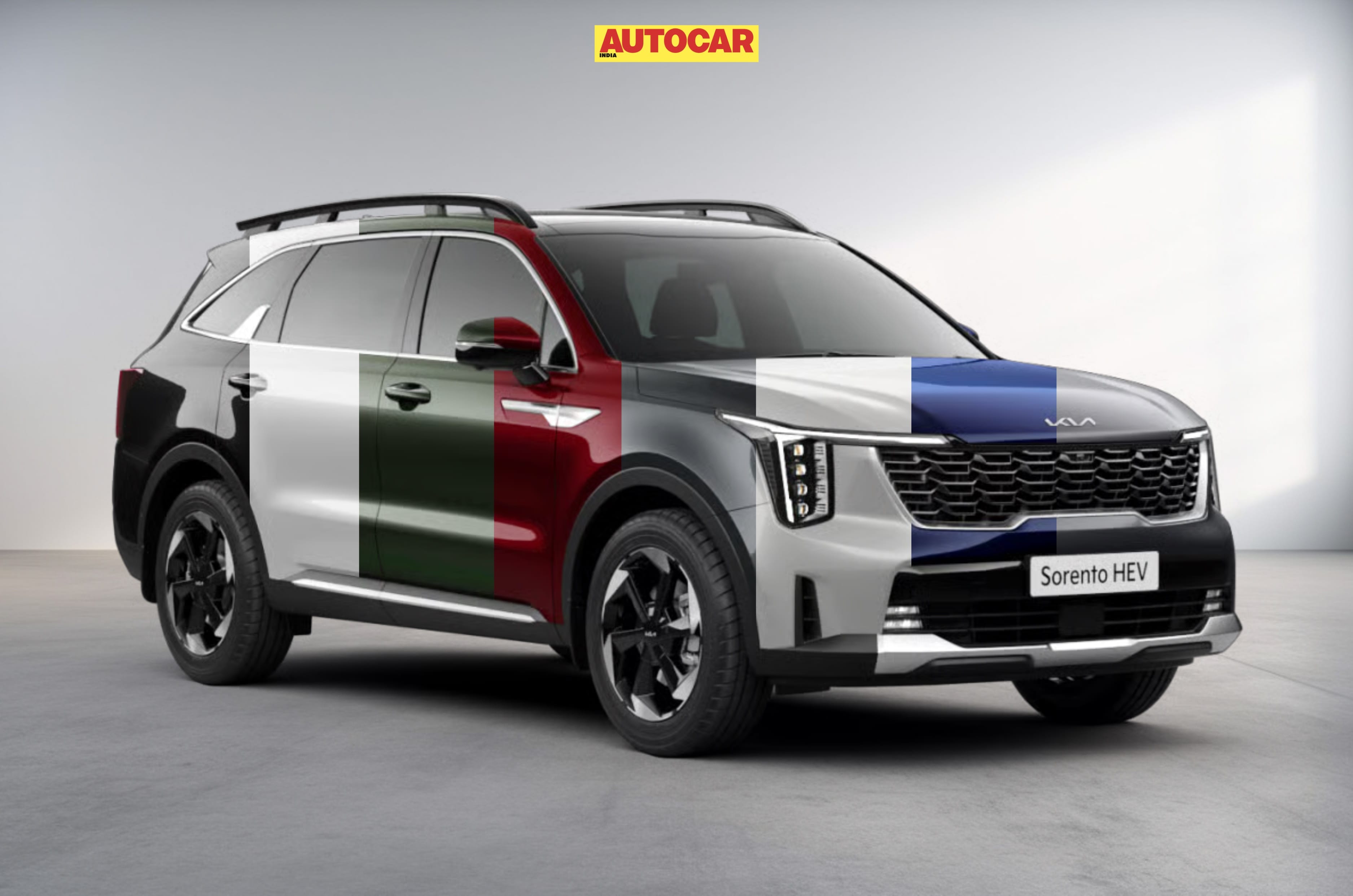
The Kia Sorento is offered with eight exterior colour options, including Aurora Black Pearl, Glacier White Pearl, Magma Red, Ivory Silver, Gravity Grey, Imperial Blue, Pewter Olive, and Dark Gun Metal. Among these, the Dark Gun Metal colour is offered on the top-spec HTX and HTX(A) trims, while all other options are available across the range.
On the inside, Kia is offering two colour schemes: Smoky Black and Grey, and Premium Black and Olive Brown. The former is offered with the lower-spec HTE, HTK, HTE (O), HTK(A) trims, while the latter is available with the higher-spec HTX and HTX(A) trims.
5. What are some of the standout features on the Sorento?
Like most Kia, the Sorento is absolutely loaded to gills, with the India-spec model even debut some features for the Sorento nameplate globally. There are two 12.3-inch screens for instrumentation and infotainment, the front seats are ventilated, have 10-way power adjustability and offer adjustable lumbar support. The co-driver’s seat has a boss mode to extend the middle-row space. The middle-row seats can be electronically folded, and the 6-seater version further offers middle-row seat ventilation.
Other features include a 12-speaker Bose sound system, a panoramic sunroof, dual-zone climate control, a head-up display (HUD) and a powered tailgate. Real-time generative AI is a first for any Sorento available globally. Safety features include 10 airbags, a digital inside rearview mirror (IRVM), a 360-degree camera, auto parking assistance, front and rear dashcams, a tyre-pressure monitoring system (TPMS) and Level 2+ advanced driver assistance systems (ADAS).
6. Which variant of the Kia Sorento should you buy?
With over 20 variants to choose from, the Sorento stretches a very wide price band across both its powertrain options. However, we’d recommend the mid-spec HTK variant which offers the most for your money. It misses out on the AWD system, but packs all the niceties such as the dual 12.3-inch screens, 12-speaker Bose sound system, 360-degree camera with blind-spot monitor, 64-colour ambient lighting, 19-inch alloys, leatherette upholstery, panoramic sunroof, powered tail gate, ventilated front seats and more.
It does miss out on a digital IRVM, HUD, more electronic adjustment levels for the front seats, ventilated second-row seats and boss mode but none of these is a deal breaker. However, if you are on a budget, the one-over-base HTE(O) is the best value-for-money variant, offering a decently equipped feature suite for its price.
kia sorento launched : किआ इंडिया ने भारत के प्रीमियम थ्री-रो SUV सेगमेंट में कदम रखते हुए अपनी ग्लोबल SUV Kia Sorento को भारत में लॉन्च कर दिया है। इसकी शुरुआती एक्स-शोरूम कीमत ₹27.99 लाख रखी गई है। वहीं, इसका Hybrid मॉडल ₹29.99 लाख की शुरुआती कीमत पर उपलब्ध होगा।
Kia Sorento के साथ कंपनी ने भारत में पहली बार Hybrid पावरट्रेन पेश किया है। इसके अलावा, भारत-स्पेक Sorento में Kia AI Assistant भी पेश किया गया है, जिसमें रियल-टाइम Generative AI की क्षमता है। कंपनी के मुताबिक, यह तकनीक पहली बार वैश्विक स्तर पर Sorento में पेश की गई है। Kia Sorento की आधिकारिक डिलीवरी 4 सितंबर 2026 से देशभर में शुरू हो गई है।
भारत में पहली बार Hybrid पावरट्रेन
Kia Sorento को Hybrid और Diesel, दो पावरट्रेन विकल्पों के साथ पेश किया गया है। Hybrid मॉडल में Smartstream 1.6 Turbo GDI Hybrid इंजन मिलता है। इस इंजन से 180 PS की पावर और 265 Nm का टॉर्क मिलता है। इसके साथ 65 PS का इलेक्ट्रिक मोटर दिया गया है, जो 264 Nm का टॉर्क पैदा करता है। Hybrid पावरट्रेन को 6-स्पीड ऑटोमैटिक गियरबॉक्स से जोड़ा गया है।
दूसरा विकल्प Smartstream 2.2 Diesel इंजन है, जो 193 PS की पावर और 442 Nm का टॉर्क देता है। इसे 8-स्पीड Dual Clutch Transmission (8DCT) के साथ जोड़ा गया है। दोनों पावरट्रेन में Eco, Normal, Smart और Sport ड्राइव मोड दिए गए हैं।
Hybrid के साथ AWD का भी विकल्प
Kia Sorento अपने सेगमेंट की पहली SUV है जिसमें Hybrid पावरट्रेन के साथ All-Wheel Drive (AWD) का विकल्प दिया गया है। Hybrid और Diesel दोनों पावरट्रेन AWD के साथ उपलब्ध हैं। इनमें Snow, Sand और Mud जैसे Terrain Modes दिए गए हैं, जो अलग-अलग परिस्थितियों में बेहतर ट्रैक्शन और टॉर्क डिस्ट्रीब्यूशन में मदद करते हैं।
4,815 mm लंबी और 1,900 mm चौड़ी SUV
Sorento को Kia के ग्लोबल N3 प्लेटफॉर्म पर तैयार किया गया है। इसकी लंबाई 4,815 mm, चौड़ाई 1,900 mm, व्हीलबेस 2,815 mm और रूफ रेल्स के साथ ऊंचाई 1,785 mm है। कंपनी के अनुसार, यह अपने सेगमेंट की सबसे लंबी और चौड़ी SUV है। इसका बड़ा आकार तीनों रो में ज्यादा जगह उपलब्ध कराने में मदद करता है। SUV के फ्रंट में Kia Digital Tiger Face, Crystal Cube LED Projection Headlamps और Star Map LED DRLs दिए गए हैं। पीछे Star Map LED Tail Lamps मिलते हैं। इसके अलावा SUV में Satin Chrome फिनिश वाली फ्रंट और रियर स्किड प्लेट, Satin Chrome बेल्टलाइन और इंटीग्रेटेड रियर स्पॉयलर भी दिया गया है। Sorento में 18-इंच Sporty Crystal Cut Alloy Wheels और 19-इंच Premium Crystal Cut Alloy Wheels का विकल्प मिलता है।
प्रीमियम केबिन में 12.3-इंच के दो डिस्प्ले
Kia Sorento के केबिन को प्रीमियम और टेक्नोलॉजी से लैस बनाया गया है। इसमें Panoramic Curved Display Panel मिलता है, जिसमें 31.24 cm यानी 12.3-इंच HD Touchscreen Navigation Cockpit और 12.3-इंच HD Digital Instrument Cluster शामिल हैं। इसके साथ Windshield Head-Up Display और Advanced Digital IRVM दिया गया है। SUV में Smoky Black & Grey और टॉप HTX वेरिएंट में Black & Olive Brown इंटीरियर थीम का विकल्प मिलता है। इसमें Dual Pane Panoramic Sunroof और 64-कलर Ambient Mood Lighting भी दी गई है।
6 और 7-सीटर दोनों विकल्प
Kia Sorento को 6-सीटर और 7-सीटर कॉन्फिगरेशन में पेश किया गया है। पहली रो में 10-Way Power Driver और Co-Passenger Seats, Lumbar Adjustment, Relaxation Power Seats, Driver Seat Ergo Function और Integrated Memory System जैसे फीचर्स दिए गए हैं। Sorento की खासियत यह है कि इसमें पहली रो के अलावा दूसरी रो में भी Ventilated Seats मिलती हैं। सीटों में 3-स्टेप कूलिंग फंक्शन दिया गया है। 6-सीटर मॉडल में दूसरी रो में Captain Seats मिलती हैं, जबकि 7-सीटर मॉडल में 60:40 स्प्लिट रियर सीटें दी गई हैं। दोनों में Slide, Recline और Walk-in फंक्शन मिलता है।
इसके अलावा 4-Way Power Boss Mode, Wing Type Headrests, तीसरी रो में 50:50 Split-Folding Seats और दूसरी-तीसरी रो के लिए Rear AC Vents दिए गए हैं।
Kia Sorento में पहली बार Real-Time Generative AI
Kia Sorento का सबसे बड़ा टेक्नोलॉजी अपडेट इसका Kia AI Assistant है। भारत-स्पेक Sorento में यह तकनीक पहली बार वैश्विक स्तर पर पेश की गई है। Kia AI Assistant रियल-टाइम सर्च पर आधारित जानकारी उपलब्ध कराता है। यह सामान्य बातचीत को समझने के साथ Follow-up Questions का जवाब भी दे सकता है। “Hey Kia” Wake Word के जरिए इसे हैंड्स-फ्री इस्तेमाल किया जा सकता है। यह चुनिंदा वाहन फंक्शंस, जैसे Air Conditioning और Windows को भी कंट्रोल कर सकता है।
इसके अलावा Sorento में:
Remote Vehicle Immobilization
Kia Connect 2.0 के 85+ कनेक्टेड कार फीचर्स
30 कंट्रोलर्स के लिए OTA Software Updates
Digital Key 2.0
Wireless Android Auto
Wireless Apple CarPlay
जैसे फीचर्स मिलते हैं।
Disney, Marvel और Pixar थीम से कर सकेंगे कार को पर्सनलाइज
Kia ने पहली बार भारत में Personalized Display Themes भी पेश किए हैं। Sorento के Cluster और Infotainment सिस्टम में Disney, Marvel और Pixar पर आधारित कुल 9 थीम मिलेंगी। इन थीम के जरिए ग्राहक डैशबोर्ड के रंग, एनिमेशन और स्क्रीन लेआउट को अपनी पसंद के अनुसार बदल सकेंगे। दिसंबर 2026 से Kia Connect Store भी Sorento के लिए शुरू किया जाएगा। इसके जरिए ग्राहक चुनिंदा Feature-on-Demand सेवाओं को खरीद सकेंगे।
30 ADAS फीचर्स और 10 एयरबैग तक
सेफ्टी के मामले में भी Sorento को काफी एडवांस बनाया गया है। SUV में ADAS Level 2+ के 30 फीचर्स दिए गए हैं।
इनमें:
Forward Collision Warning
Forward Collision-Avoidance Assist
Lane Keeping Assist
Lane Following Assist
Highway Driving Assist
Smart Cruise Control
Blind Spot Collision Avoidance
Rear Cross Traffic Collision Avoidance
Safe Exit Warning
Remote Smart Parking Assist
जैसे फीचर्स शामिल हैं।
Kia का Robust 26 Standard Safety Package भी मिलता है। इसमें 7 एयरबैग स्टैंडर्ड हैं, जबकि टॉप वेरिएंट में अतिरिक्त Rear Side और Centre Side Airbags के साथ कुल 10 एयरबैग तक मिलते हैं।
इसके अलावा 360-डिग्री कैमरा, Blind View Monitor, 12 पार्किंग सेंसर, पांच रडार और Dynamic Guidelines वाला रियर कैमरा भी दिया गया है।
भारत में बनी, भारतीय ग्राहकों के हिसाब से तैयार
Kia Sorento का उत्पादन भारत में Kia India की अनंतपुर, आंध्र प्रदेश स्थित मैन्युफैक्चरिंग फैसिलिटी में किया गया है। कंपनी ने भारतीय सड़कों और ग्राहकों की जरूरतों को ध्यान में रखते हुए इसमें कई बदलाव किए हैं। इनमें India-specific grille detailing, Acoustic Windshield और Black High Glossy Bridge Type Roof Rails शामिल हैं। कंपनी का दावा है कि Acoustic Windshield, Door Trim Insulator और अन्य इंजीनियरिंग सुधारों की वजह से Sorento में बेहद शांत केबिन और बेहतर NVH प्रदर्शन मिलता है।
ये प्रमुख फीचर्स भी मिलेंगे
Kia Sorento में कई प्रीमियम और सेगमेंट-फर्स्ट फीचर्स दिए गए हैं, जिनमें शामिल हैं:
Smart Power Tailgate with Anti-Pinch
Dual Pane Panoramic Sunroof
Bose Premium Sound System with 12 Speakers
Smart Dashcam with Front & Rear Camera
Remote Smart Parking Assist
220V Power Outlet
Digital IRVM
Head-Up Display
Wireless Smartphone Charger
Dual-Zone Automatic Climate Control
Tyre Pressure Monitoring System
Electronic Parking Brake with Auto Hold
Front और Rear Seat Side Airbags
Driver Knee Airbag
All-Wheel Disc Brakes
ISOFIX
Rear Occupant Alert
Kia Sorento की कीमत और वेरिएंट
Kia Sorento को तीन मुख्य ट्रिम्स और उनके Option Pack के साथ पेश किया गया है। Diesel 7-Seater की शुरुआती कीमत ₹27.99 लाख है, जबकि Hybrid 7-Seater की शुरुआती कीमत ₹29.49 लाख है। टॉप वेरिएंट में कीमत करीब ₹40.19 लाख एक्स-शोरूम तक जाती है।
प्रमुख कीमतें
पावरट्रेनसीटिंगशुरुआती कीमतटॉप कीमत
2.2 Diesel 8DCT7-सीटर₹27.99 लाख₹38.69 लाख
2.2 Diesel 8DCT6-सीटर₹32.69 लाख₹38.89 लाख
1.6 Turbo Hybrid 6AT7-सीटर₹29.49 लाख₹40.19 लाख
1.6 Turbo Hybrid 6AT6-सीटर₹34.19 लाख₹40.39 लाख
आठ एक्सटीरियर कलर का विकल्प
Kia Sorento को आठ मोनो-टोन एक्सटीरियर कलर में पेश किया गया है:
Glacier White Pearl
Gravity Gray
Imperial Blue
Magma Red
Pewter Olive
Ivory Silver Gloss
Aurora Black Pearl
Matte Dark Gun Metal
इसके अलावा पहली बार Kia India लाइन-अप में Black Line Trim भी पेश किया गया है। इसमें Kia और Sorento बैज, 19-इंच Premium Crystal Cut Alloy Wheels, Fender Garnish और Beltline सहित कई एक्सटीरियर एलिमेंट्स को ब्लैक फिनिश दी गई है।
4.8 मिलियन से ज्यादा ग्राहकों का भरोसा
Kia Sorento पिछले 24 वर्षों और चार पीढ़ियों के दौरान 132 देशों में 4.8 मिलियन से ज्यादा ग्राहकों तक पहुंच चुकी है। यही वजह है कि यह Kia की सबसे सफल ग्लोबल SUV नेमप्लेट में शामिल है। भारत में नई Sorento के साथ Kia ने पहली बार प्रीमियम थ्री-रो SUV सेगमेंट में कदम रखा है। Hybrid पावरट्रेन, AWD, ADAS Level 2+, 10 एयरबैग तक और Real-Time Generative AI वाला Kia AI Assistant इसे इस सेगमेंट की एक टेक्नोलॉजी-फोकस्ड SUV बनाते हैं।
Only the day before I would be surprised with a passenger ride in a prototype of Bentley’s new electric SUV, I just so happened to be engaged in a conversation about why an EV would be so well suited to this brand in particular. Yes, as we’ve said in the past, EVs are perfect for luxury applications – smooth, silent and effortless as they are. But the other realisation we made was that Bentley, despite leaning into sportiness as one of its core brand pillars, has never been a slave to weight loss. Even its lightest car in 85 years – the new, stripped-down Supersports – is but one kilogram shy of two tonnes! And yet its cars have always managed to deliver the comfort expected of a super-luxury vehicle, and somehow also the poise and agility of a sports tourer. A tricky balance indeed.
Reining in 2.5-tonne-plus vehicles, then, isn’t so much a challenge for Bentley’s chassis engineers as it is standard operating procedure. And thus, when the time came to create the brand’s first EV – a five-metre SUV no less – weight management was the last thing on their minds. Being a luxury EV with the full technological might of the Volkswagen Group behind its development, it would be all too easy to just squeeze out a bunch of eye-watering performance figures and leave it at that. But Bentley engineers say that won’t necessarily be the case, and certainly not the focus. The focus, instead, was on making the Torcal walk the razor-thin line between sport and luxury that every one of their cars is required to.
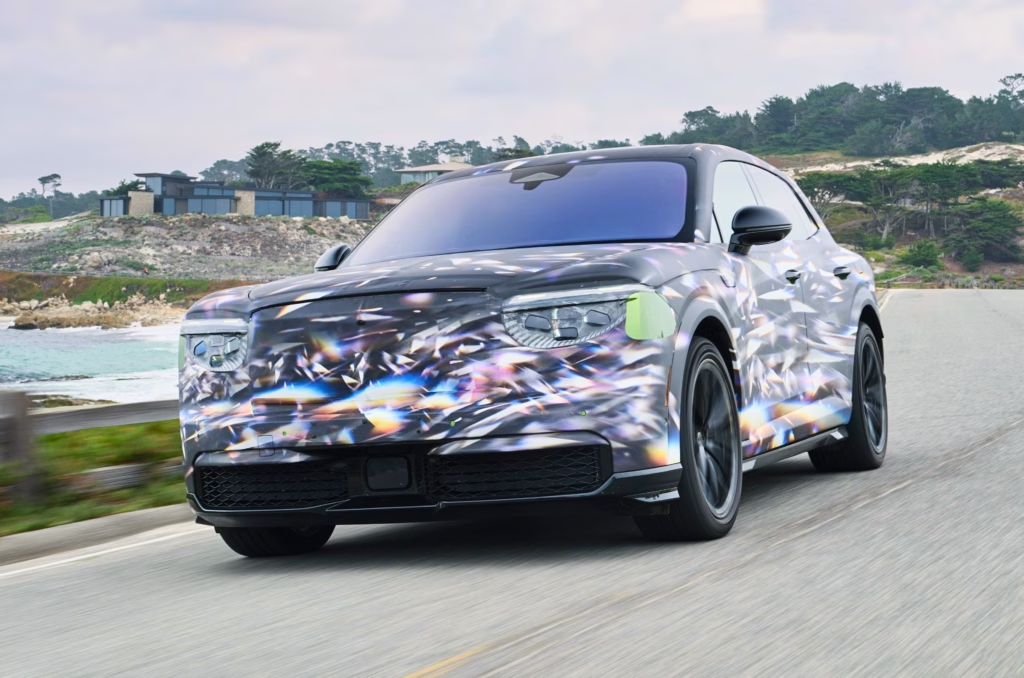
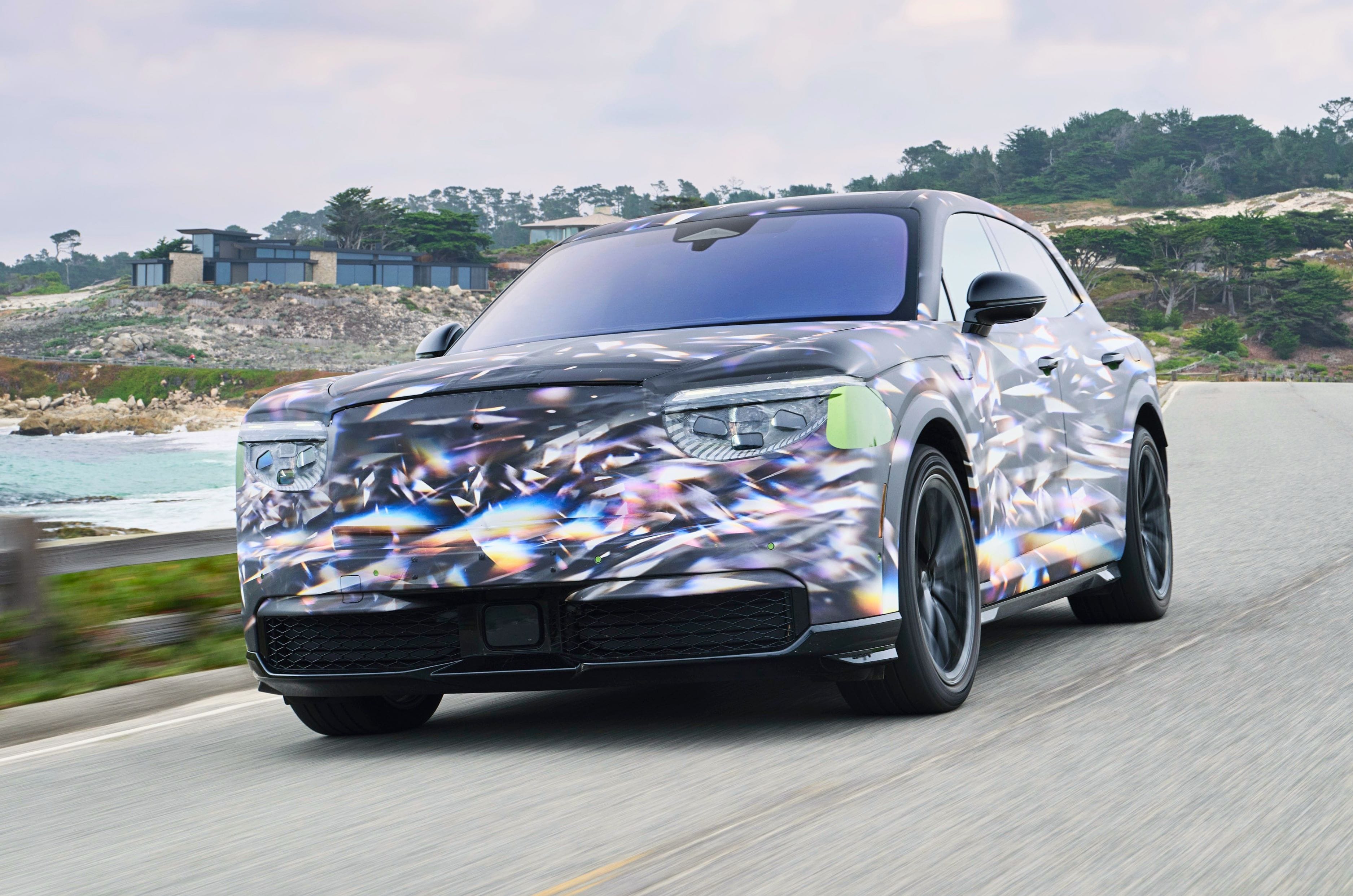
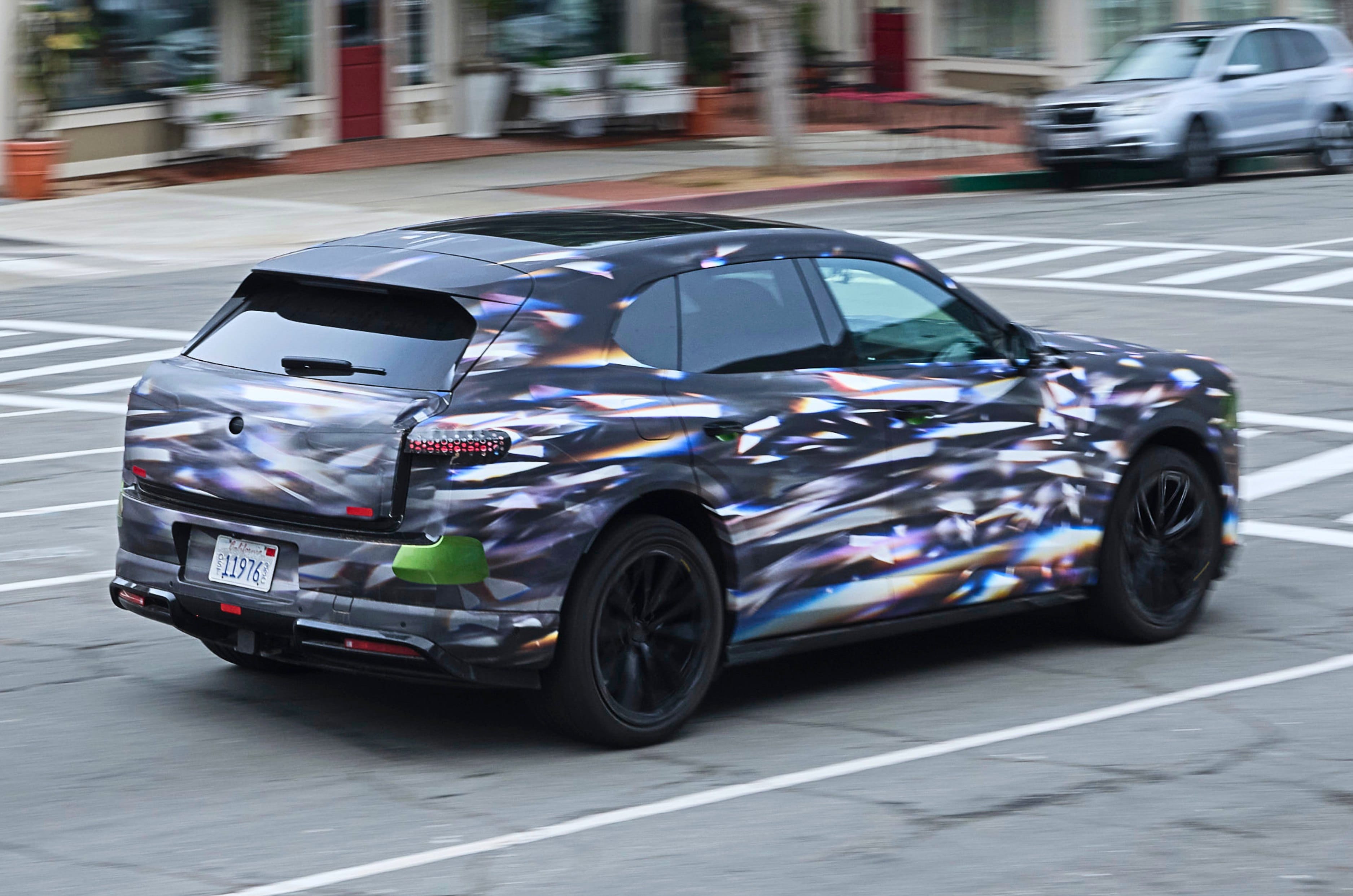
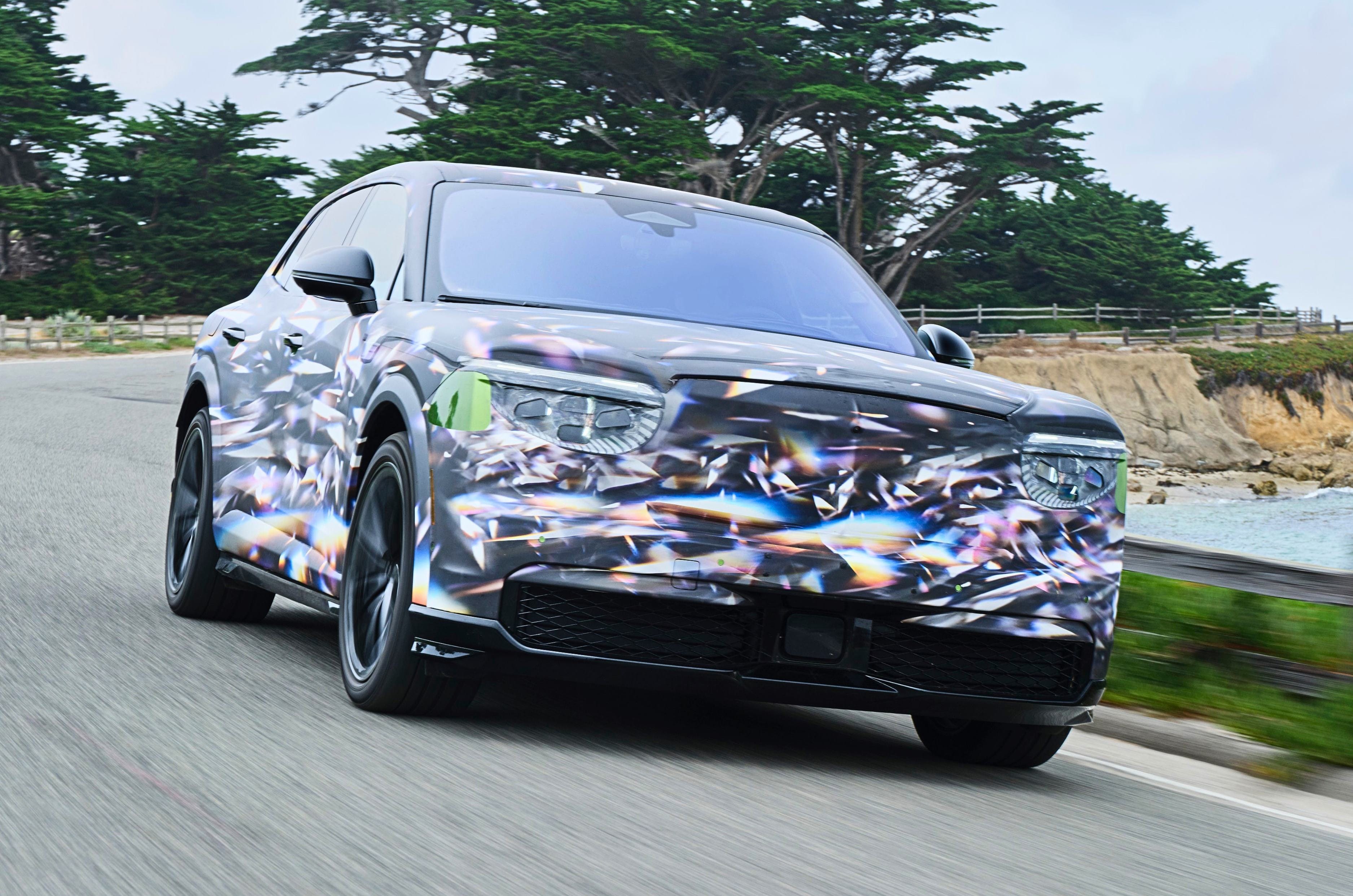
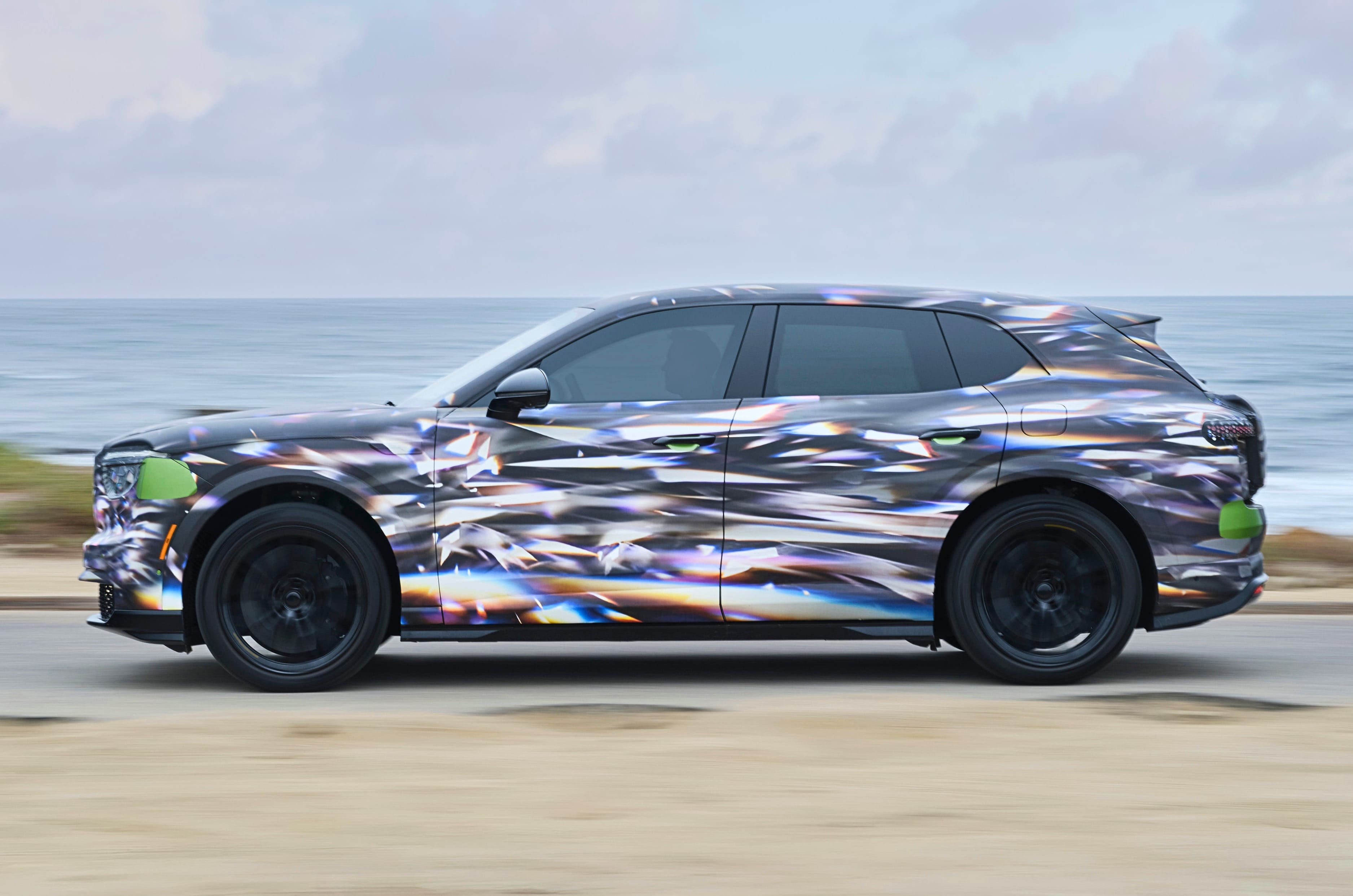
The Torcal prototype rolls silently into view at the driveway of our hotel in Monterey, California shrouded as it is in its crystalline camouflage – a motif we’ll revisit later. It hides the details well enough, but what’s clear is that this a tall and squared-off SUV, much like the Bentayga, and though aerodynamics will no doubt have been a consideration, that Bentley boldness is recognisable in its bluff front fascia. It’s actually a little smaller than a Bentayga, but the smaller front overhangs tell me they’re making good use of its wheelbase.
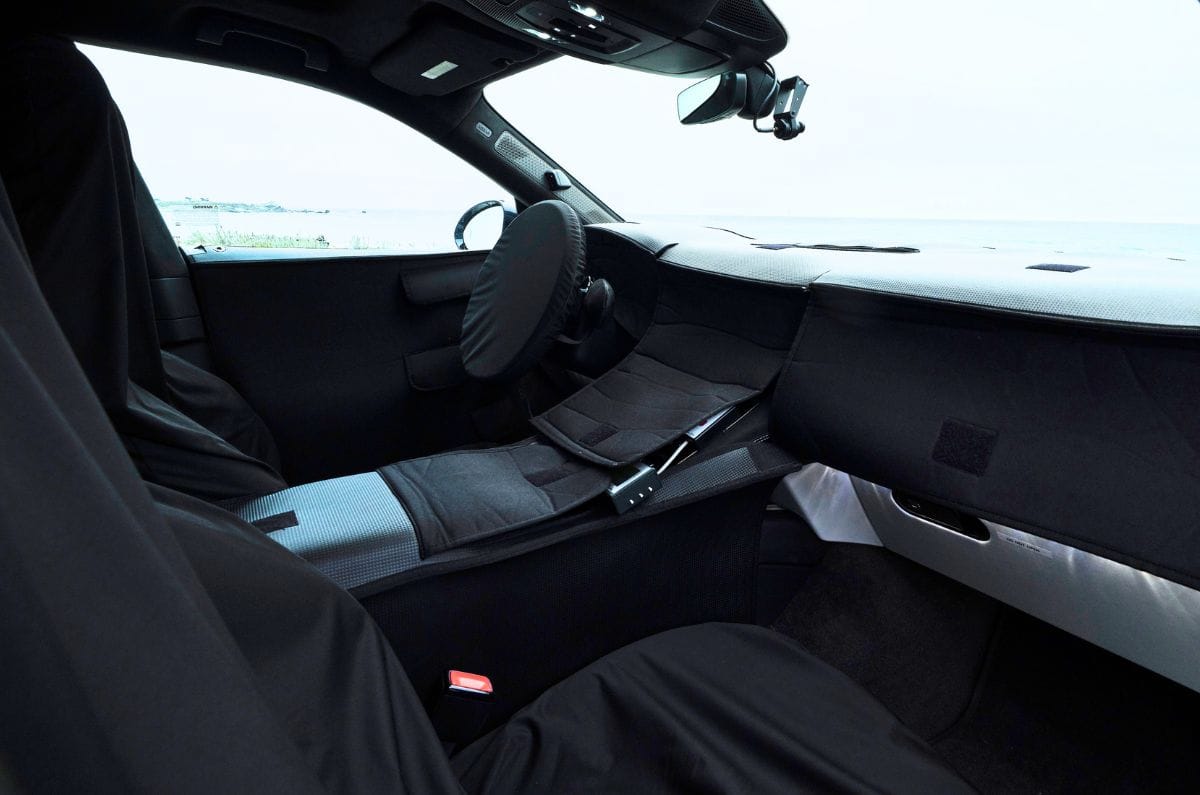
We’re ushered quickly into the cabin, which too is wrapped up from floor to headliner, and quickly given a brief before prying eyes can come in for a closer look. There’s stuff we’re told about that I can’t reveal today, but I’m hurriedly making notes all the same. But then Torcal product line director Martin Page presses the start button, and my brain does a somersault. “It’s… idling?” I mutter, as he cracks a smile from the driver’s seat.
Digital meets analogue
Yes, they’ve given the Torcal the sound of a V8, the most enduring engine layout the brand has used in its century of making cars. And while this is hardly the first EV to mimic an engine, there’s a mesmerising authenticity to it that I’ve never experienced from a synthetised setup before. I’d go as far as saying sounds better – more layered and full-bodied than the twin-turbo 4.0-litre you’ll find in the Continental range, and we’re still at a standstill. It’s uncanny.
As we move off, the sound swells, ebbs and flows with an almost flawed resonance that fills up the cabin. It’s not loud or overwhelming; but it’s ever present, though I’m told it can be switched off if not desired. I’m told the car is in ‘Bentley’ mode – the middle ground, as we know from existing models – and once on the move, the sound fades into the background.
The story behind the V8 sound is almost as fascinating as the sound itself. Any other brand would record one of its V8 engines, play the recording through the speakers and call it a day. But in keeping with Bentley’s history of doing things painstakingly by hand, they recorded the sound and got an orchestra to recreate it with live instruments. What I’m listening to is a mix of drums, viola and bass guitar – every beat and note fed into a machine and algorithmically meted back out in proportion with the torque demand. Moving up to Sport mode suitably increases the volume and even alters the pitch slightly, but what doesn’t change is the genuine feeling that somewhere up front, an old-school, hairy-chested V8 is thumping away to move us forward.
The crystal method
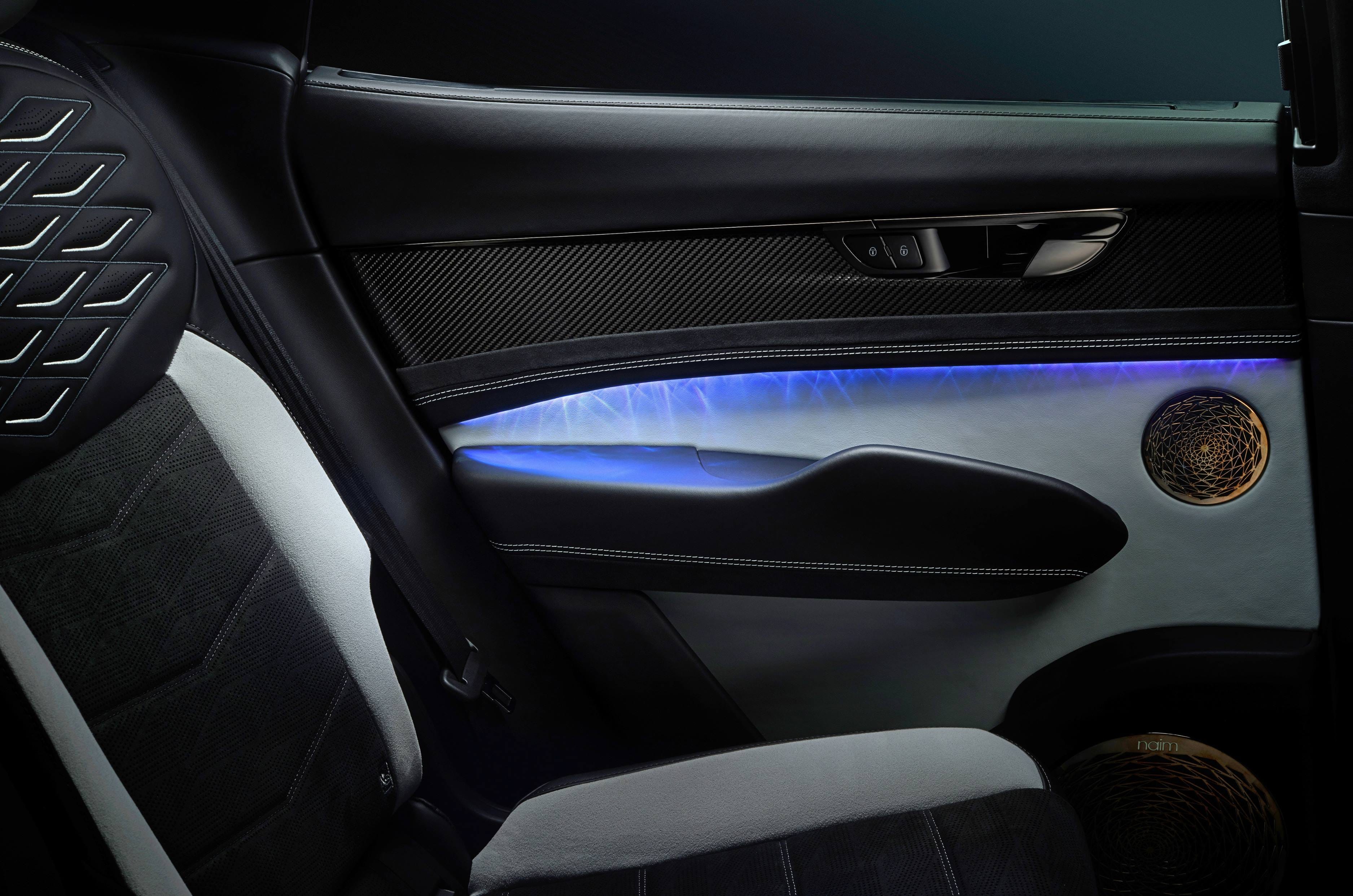
The over-engineering doesn’t stop there, however; Bentley’s handcrafted approach extends to the graphics of the Torcal – both physical and digital. The diamond motif has long been a part of the Bentley brand, and you’ll see it everywhere from its cars’ grille mesh patterns, to stitching, to upholstery quilting. Something catches my eye from under the sheet that covers the rear doors, which I carefully lift up to catch a sneak peek.
It’s ambient lighting, shimmering, moving as it cascades across a soft Merino wool door card. The idea was to simulate light flowing through crystal, and though it’s probably a simulated effect, it is incredibly convincing, and oddly relaxing to stare at. Curiously, it’s blue, and we’re in Sport mode, Bentley having chosen to buck the trend of equating ‘Sport’ with ‘red’.
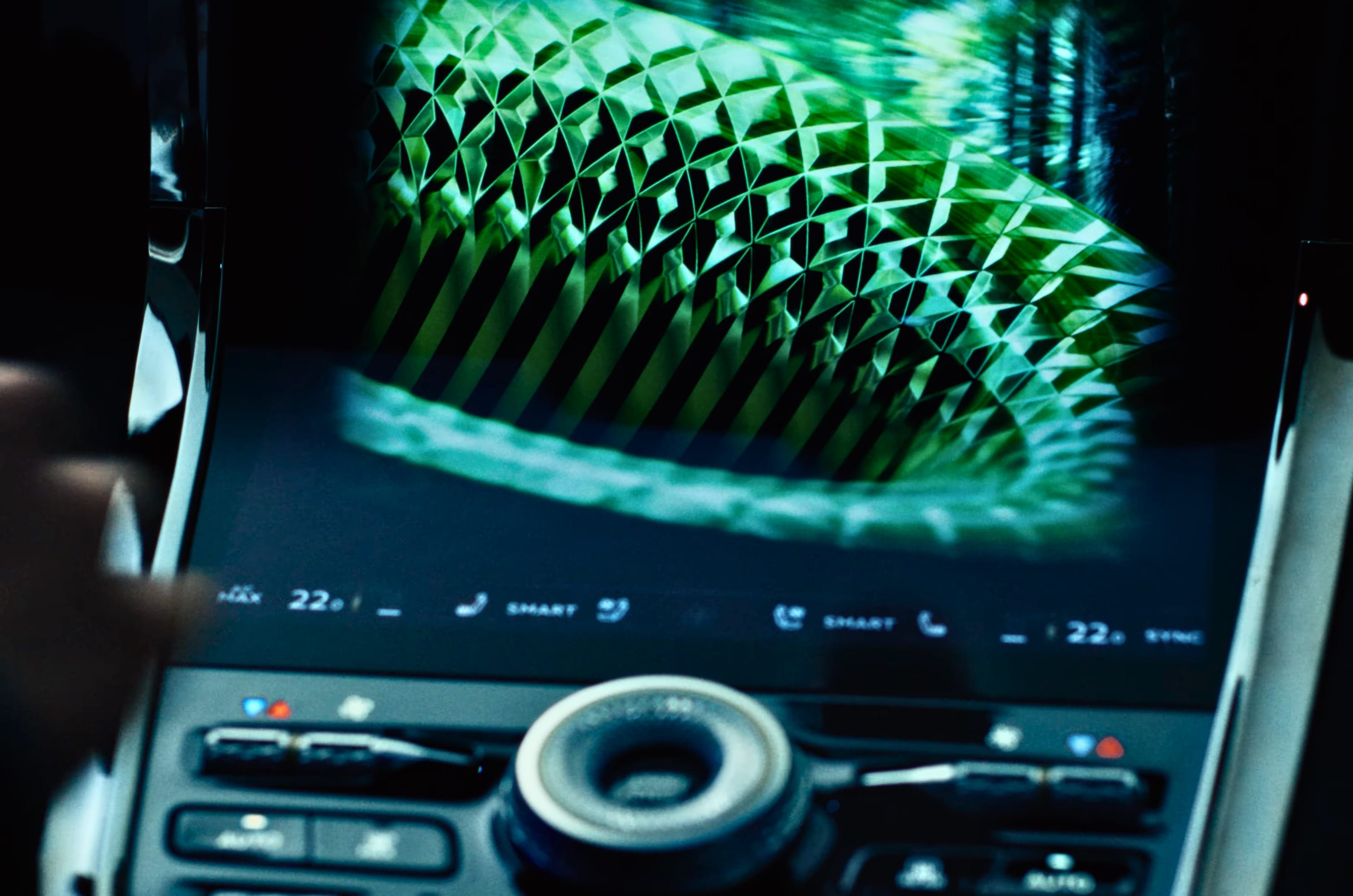
But as Martin cycles back and forth through the modes of the ‘Curation Engine’ – a luxurious way to say ‘drive mode selector’ – I notice something else. The graphics on the curved touchscreen – also with a crystalline theme – are slick and incredibly sharp, in a way I haven’t seen in any Bentley before. Credit to the new-gen PPE (Premium Platform Electric) and its E&E architecture the Torcal shares with the electric Cayenne, I suppose.
I then glance at the digital speedo, which shows a digital number encased in a ring of crystal, which again hides a fascinating story. This seemingly innocuous graphical element is not the result of Adobe After Effects or, god forbid, generative AI. Bentley commissioned Cumbria Crystal to make a cut crystal tube and then shone light through it from various angles. This was filmed and then programmed to play back in sync with the car’s speed, so what you’re seeing is high-res footage of real light passing through real glass, moving in a circle as the car goes faster. But what is luxury, if not unnecessary excess?
Effortless heft
My mind circles back to my conversation from the previous evening, however, as we approach the Freeway. Bentley hasn’t revealed power and torque figures yet, describing them only as ‘ample’, and that’s clear as we break off the on-ramp and merge into the swarm of American commuters hurrying to work. The seat-of-the-pants sensation is one of power that feels effortless, if not hurried, if that makes sense, which is in line with any of the V8 hybrid cars Bentley also sells.
Bentley also hasn’t revealed the kerb weight figure, but going by other EVs of this size and nature, my guess puts it well past 2.5 tonnes and closer to 2.7 or 2.8. Not that you can tell from inside, where there’s a composure that feels truest to the contemporary range of Bentley models. The Torcal uses two-chamber air suspension, adaptive dampers and active anti-roll bars to control its immense mass, and I suspect a bit of magic too, because here too, they’ve managed to find a balance. I noticed the prototype was riding on 22-inch wheels with supercar-like 315-section rear tyres, and road noise is kept incredibly well in check.
The ride is hefty but not harsh like some sports SUVs, comfortable but not floaty like some outright luxury SUVs. It stays steady on the Freeway, and as we get back to the narrower roads that snake around Pebble Beach, it stomps out imperfections with authority. As Martin takes the opportunity to lean it into some curvier bits of road, I sense a bit of give and roll, but not too much. I’m told they could have erased it entirely, but that would feel too unnatural.
And that sums up the Torcal nicely. It feels ‘natural’, and even from this short passenger ride, a great exercise in manufacturing analogue authenticity from what is a very digital set of tools. When advancing beyond the realm of mundane transportation and into more desirable applications – luxury, or performance, for instance, of which Bentleys have to do both – an EV has to be more convincing. So far, ballistic numbers have been that route for most, but there is an increasing effort to build tangible character into these cars that must be applauded. The Torcal feels like one of the best examples of this yet, and though far from the finished product, it’s a promising sign that Bentley is on the right track with its first EV.
देश की सबसे बड़ी आईटी सर्विसेज कंपनी Tata Consultancy Services (TCS) आर्टिफिशियल इंटेलिजेंस (AI) पर बड़ा दांव लगाने की तैयारी में है। टाटा ग्रुप की यह कंपनी AI से जुड़ी नई सर्विसेज को बढ़ाने के लिए 5,900 से 8,900 तक फॉरवर्ड-डिप्लॉयड इंजीनियर्स (FDEs) की टीम तैयार करेगी। इसके साथ ही AI से जुड़ी कंपनियों को खरीदने (Acquisition) के विकल्प भी तलाश रही है।
आखिर FDE क्या होते हैं?
फॉरवर्ड-डिप्लॉयड इंजीनियर्स (FDEs) ऐसे सॉफ्टवेयर इंजीनियर होते हैं, जो सिर्फ कंपनी के ऑफिस में बैठकर कोड नहीं लिखते। वे सीधे क्लाइंट के साथ काम करते हैं और उसकी समस्याओं के हिसाब से AI या टेक्नोलॉजी सॉल्यूशन तैयार करते हैं।
अब मान लीजिए किसी बैंक को AI से अपने कस्टमर सर्विस सिस्टम को बेहतर बनाना है। ऐसे में TCS का FDE उस बैंक के साथ मिलकर काम करेगा। वह बैंक के मौजूदा सॉफ्टवेयर, डेटा और बिजनेस प्रोसेस को समझेगा। फिर AI मॉडल को उसी हिसाब से जोड़ेगा और उसे लागू करेगा।
इन इंजीनियरों का काम क्या होगा?
TCS के CEO के. कृतिवासन ने रॉयटर्स से कहा कि कंपनी अपने कुल कर्मचारियों में से 1% से 1.5% को फॉरवर्ड-डिप्लॉयड इंजीनियर बनाना चाहती है।
ये इंजीनियर सीधे क्लाइंट के साथ काम करेंगे। उनका काम कंपनियों में AI टूल्स को लागू करना, उन्हें मौजूदा सिस्टम से जोड़ना और कारोबार की जरूरत के हिसाब से AI सॉल्यूशन तैयार करना होगा।
OpenAI और Microsoft से मुकाबला
TCS की यह रणनीति ऐसे समय आई है, जब OpenAI, Anthropic और Microsoft जैसी कंपनियां भी फॉरवर्ड-डिप्लॉयड इंजीनियर्स की भर्ती बढ़ा रही हैं। इन इंजीनियरों की मदद से कंपनियां अपने ग्राहकों के यहां AI को तेजी से लागू कर रही हैं।
AI, डेटा सिक्योरिटी में अधिग्रहण की तैयारी
TCS अब AI, डेटा सिक्योरिटी और साइबर सिक्योरिटी से जुड़े अधिग्रहणों पर भी विचार कर रही है। TCS के CFO समीर सेक्सरिया ने कहा कि कंपनी ऐसे कारोबार तलाश रही है, जो उसकी रणनीतिक स्थिति को और मजबूत बना सकें।
AI से आउटसोर्सिंग मॉडल को खतरा नहीं
कई निवेशकों को डर है कि AI की वजह से आईटी कंपनियों को मिलने वाले प्रोजेक्ट कम हो सकते हैं। लेकिन TCS के CEO का मानना है कि ऐसा नहीं होगा।
उन्होंने कहा कि कंपनियों को AI अपनाने के लिए ऐसे पार्टनर की जरूरत होगी, जो उनके मौजूदा सिस्टम, डेटा और प्रक्रियाओं को अच्छी तरह समझते हों। यही TCS की सबसे बड़ी ताकत है। उनके मुताबिक, यह सिर्फ कम लागत का मामला नहीं, बल्कि कंपनी के अनुभव और प्रतिभा का फायदा है।
AI कारोबार की ग्रोथ धीमी हुई
हालांकि, जून तिमाही में TCS के AI कारोबार की रफ्तार कुछ धीमी पड़ी है। पहली तिमाही में AI से होने वाली सालाना आय की ग्रोथ 13% रही, जबकि पिछली तिमाही में यह 28% थी।
CEO ने कहा कि लंबी अवधि में वह AI कारोबार में करीब 25% तिमाही-दर-तिमाही ग्रोथ देखना चाहते हैं। हालांकि, उन्होंने माना कि यह बढ़ोतरी हर तिमाही एक जैसी नहीं रहेगी।
AI पर ₹8,500 करोड़ खर्च
TCS हर साल करीब 1 अरब डॉलर (लगभग ₹8,500 करोड़) टैलेंट डेवलपमेंट और AI पर खर्च करती है। इसमें कर्मचारियों की ट्रेनिंग, AI स्किल्स डेवलप करना और नई AI तकनीकों के लिए एक्सपर्ट्स की हायरिंग शामिल है।
Disclaimer: यहां मुहैया जानकारी सिर्फ सूचना के लिए दी जा रही है। यहां बताना जरूरी है कि मार्केट में निवेश बाजार जोखिमों के अधीन है। निवेशक के तौर पर पैसा लगाने से पहले हमेशा एक्सपर्ट से सलाह लें। मनीकंट्रोल की तरफ से किसी को भी पैसा लगाने की यहां कभी भी सलाह नहीं दी जाती है।