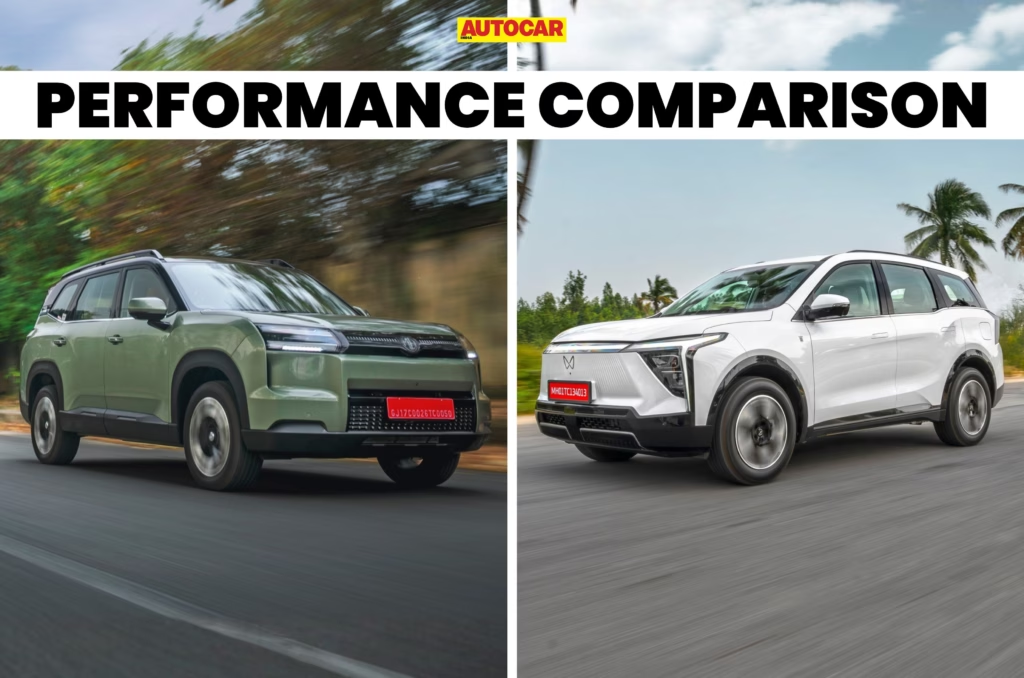
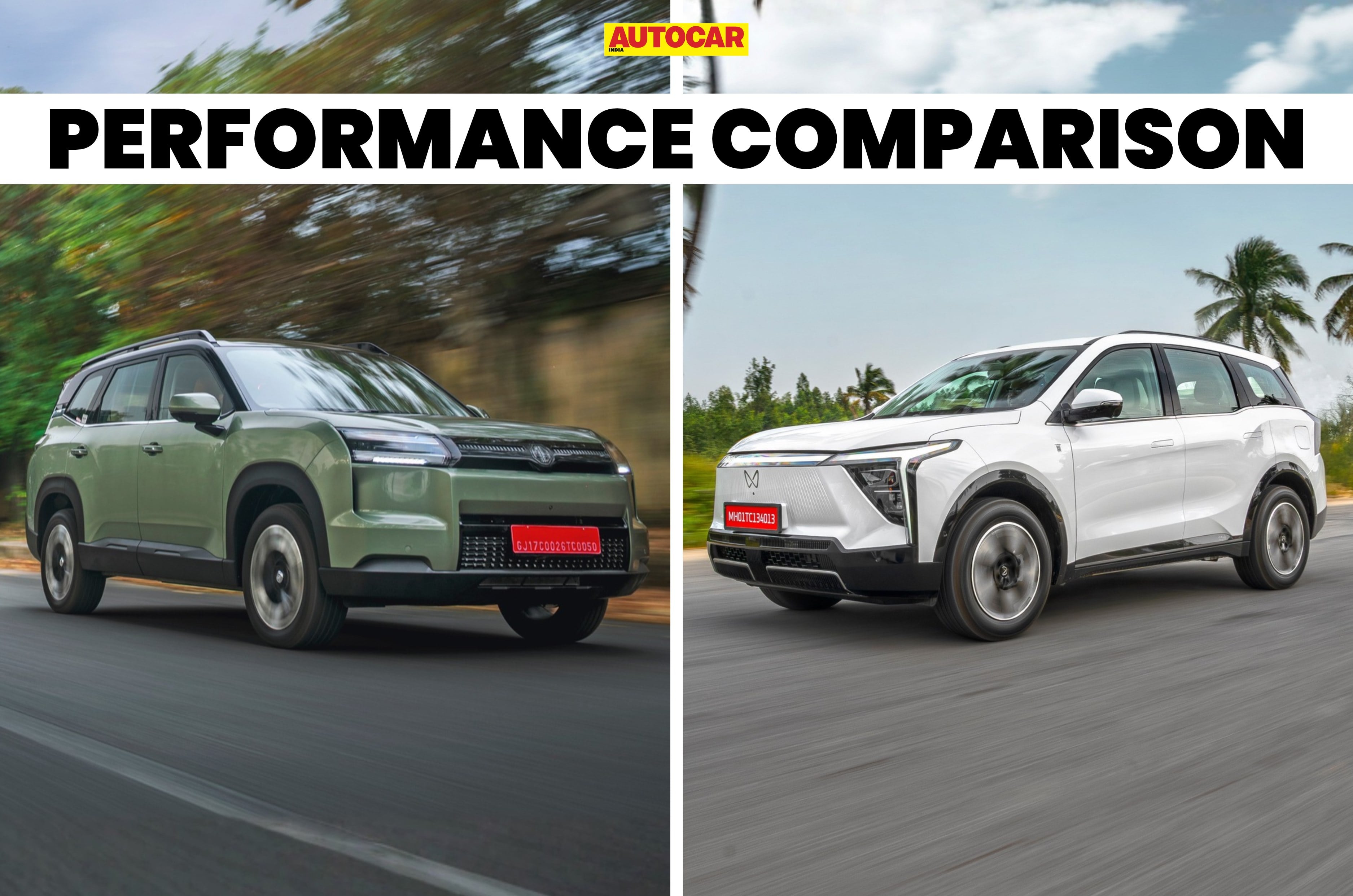
The Mahindra XEV 9S Pack Three Above and MG Hector Tomahawk EV are three-row electric SUVs that differ in their acceleration, driving range and charging capabilities. Here’s how the two compare on performance, specifications and price.
Mahindra XEV 9S vs MG Hector Tomahawk EV: Specifications
Specifications
Mahindra XEV 9S Pack Three Above
MG Hector Tomahawk EV
Battery capacity
79kWh
69.2kWh
Electric motor setup
Single, rear-mounted
Single, front-mounted
Power
286hp
204hp
Torque
380Nm
310Nm
Gearbox
Single-speed automatic
Single-speed automatic
Drive layout
Rear-wheel drive
Front-wheel drive
Claimed MIDC range
679km
517km
Maximum DC charging rate
180kW
90kW
Claimed DC charging time
20min (20-80 percent)
Around 35min (30-80 percent)
AC charging time
11.7 hours (7.2kW charger)
8 hours (11.2kW charger)
12.5 hours (10-100 percent)
The XEV 9S has a 82hp advantage over the Tomahawk EV and produces 70Nm more torque. The two SUVs also differ in their drive layouts. The XEV 9S sends power to the rear wheels, while the Tomahawk EV is front-wheel drive. Both use a single-speed automatic transmission.
The XEV 9S has a claimed MIDC range of 679km, which is 162km more than the Tomahawk EV’s 517km. It also supports DC fast charging at up to 180kW, compared with 90kW for the MG.
Mahindra claims the XEV 9S can charge from 20-80 percent in 20 minutes, while MG quotes around 35 minutes for a 30-80 percent charge. Since the quoted charging times cover different charging windows, they are not directly comparable. The AC charging figures also use different charging ranges. The XEV 9S supports an optional 11.2kW AC charger, in addition to the 7.2kW unit. The Tomahawk EV supports 7.4kW AC charging.
Mahindra XEV 9S vs MG Hector Tomahawk EV: Acceleration timings
Mahindra XEV 9S vs MG Tomahawk EV: Acceleration timings (seconds)
Mahindra XEV 9S
MG Tomahawk EV
0-20kph
1.39
1.47
0-40kph
2.73
2.84
0-60kph
4.17
4.25
0-80kph
5.62
5.93
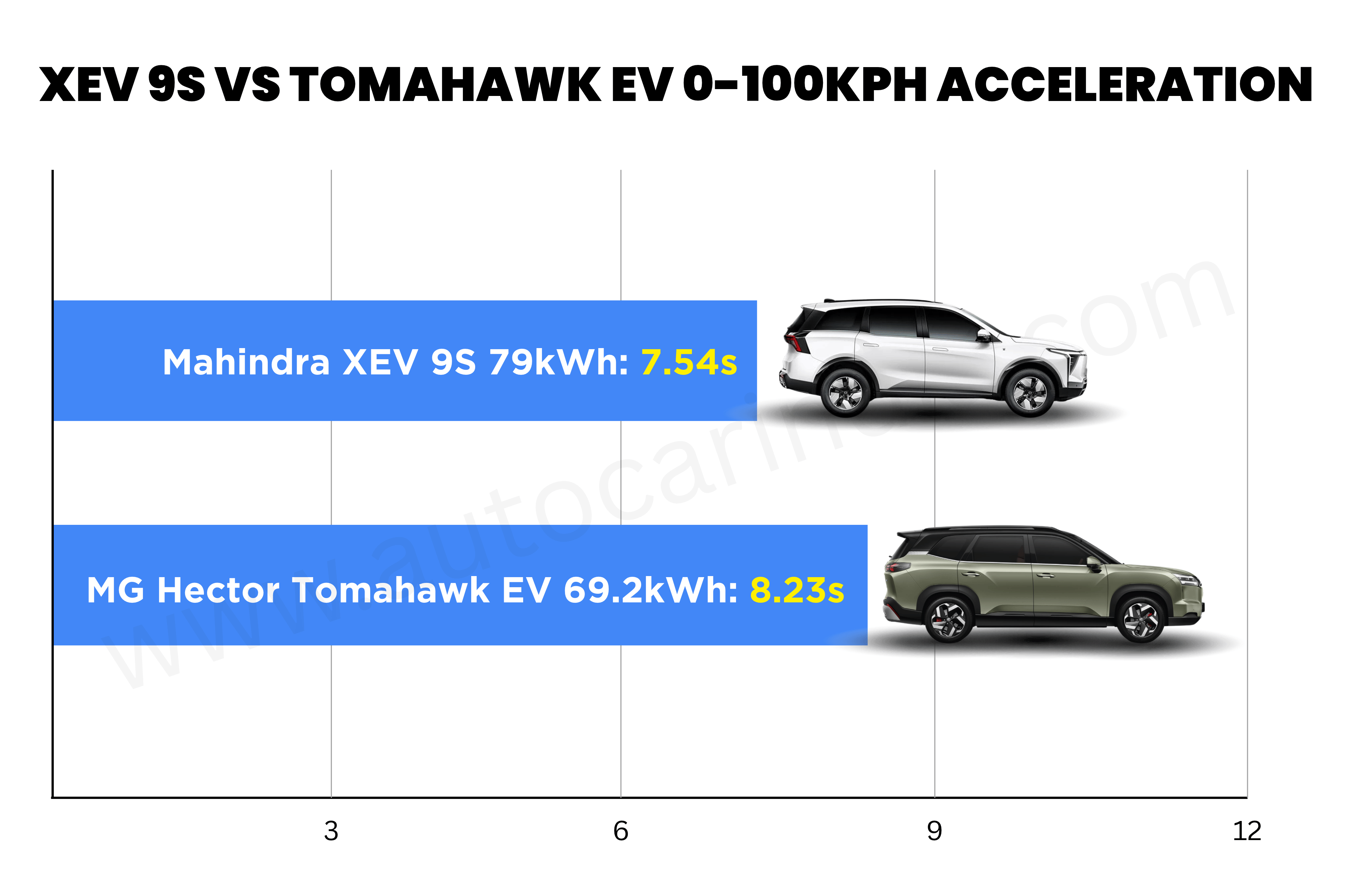
0-100kph
7.54
8.23
0-120kph
9.98
11.28
The XEV 9S gets off the line slightly quicker, reaching 20kph 0.08 seconds ahead of the Tomahawk EV. The gap remains narrow at 40kph and 60kph, with the Mahindra holding leads of 0.11 seconds and 0.08 seconds, respectively.
It begins to pull further ahead beyond 60kph, reaching 80kph 0.31 seconds sooner and 100kph 0.69 seconds sooner than the MG. By 120kph, the difference has widened to 1.30 seconds, with the XEV 9S completing the run in 9.98 seconds against the Tomahawk EV’s 11.28 seconds. The results show the Mahindra’s advantage growing at higher speeds, rather than coming solely from its initial launch.
Mahindra XEV 9S vs MG Hector Tomahawk EV: Rolling acceleration timings
Mahindra XEV 9S vs MG Hector Tomahawk EV: Rolling acceleration timings (seconds)
Rolling acceleration tests
Mahindra XEV 9S
MG Hector Tomahawk EV
20-80kph (in kickdown)
4.11
4.56
40-100kph (in kickdown)
4.74
5.45
The results show that the XEV 9S retains its lead across both rolling acceleration tests. It completes the 20-80kph run in 4.11 seconds, 0.45 seconds quicker than the Tomahawk EV’s 4.56 seconds. The gap widens in the 40-100kph test, with the Mahindra taking 4.74 seconds against the MG’s 5.45 seconds. This gives the XEV 9S a 0.71-second advantage in the higher-speed run, further underlining its stronger acceleration performance across both speed ranges.
Mahindra XEV 9S vs MG Hector Tomahawk EV: Braking tests
Mahindra XEV 9S vs MG Hector Tomahawk EV: Braking tests
Mahindra XEV 9S
MG Hector Tomahawk EV
80-0kph distance (m)
29.67
27.52
80-0kph time (seconds)
2.55
2.39
80-20kph L1 regen distance (m)
341.03
575.94
80-20kph L2 regen distance (m)
215.8
389.91
80-20kph L3 regen distance (m)
162.46
210.09
The Tomahawk EV has the advantage in the conventional braking test, stopping from 80kph in 27.52m and 2.39 seconds. The XEV 9S takes 29.67m and 2.55 seconds to come to a halt, requiring 2.15m more distance.
The results reverse under regenerative braking. In the 80-20kph tests, the XEV 9S covers a shorter distance at all three regeneration levels. At L1, it takes 341.03m to slow down, compared with 575.94m for the MG. At L2, the respective distances are 215.8m and 389.91m, while at L3, they are 162.46m and 210.09m. The difference is largest at L2, where the Tomahawk EV covers 174.11m more than the Mahindra before slowing from 80kph to 20kph.
Mahindra XEV 9S vs MG Hector Tomahawk EV: Prices
Model
Price (ex-showroom)
Mahindra XEV 9S Pack Three Above
Rs 29.95 lakh
MG Hector Tomahawk EV
Rs 19.49 lakh-23.49 lakh
The MG Hector Tomahawk EV is priced between Rs 19.49 lakh and Rs 23.49 lakh, while the Mahindra XEV 9S Pack Three Above costs Rs 29.95 lakh. The Tomahawk EV’s top variant is Rs 6.46 lakh cheaper than the XEV 9S. The Mahindra, however, gets a larger 79kWh battery and higher power and torque outputs, and was quicker in all three acceleration tests. The MG stopped in a shorter distance in our 80-0kph braking test.
Autocar India’s testing standards
Before conducting our performance tests, we check and maintain tyre pressure based on the manufacturer’s recommendation and ensure that the car is charged to 100 percent. The car is then tested in a controlled environment with two people on board, and the data is collected via highly accurate GPS-based timing equipment.
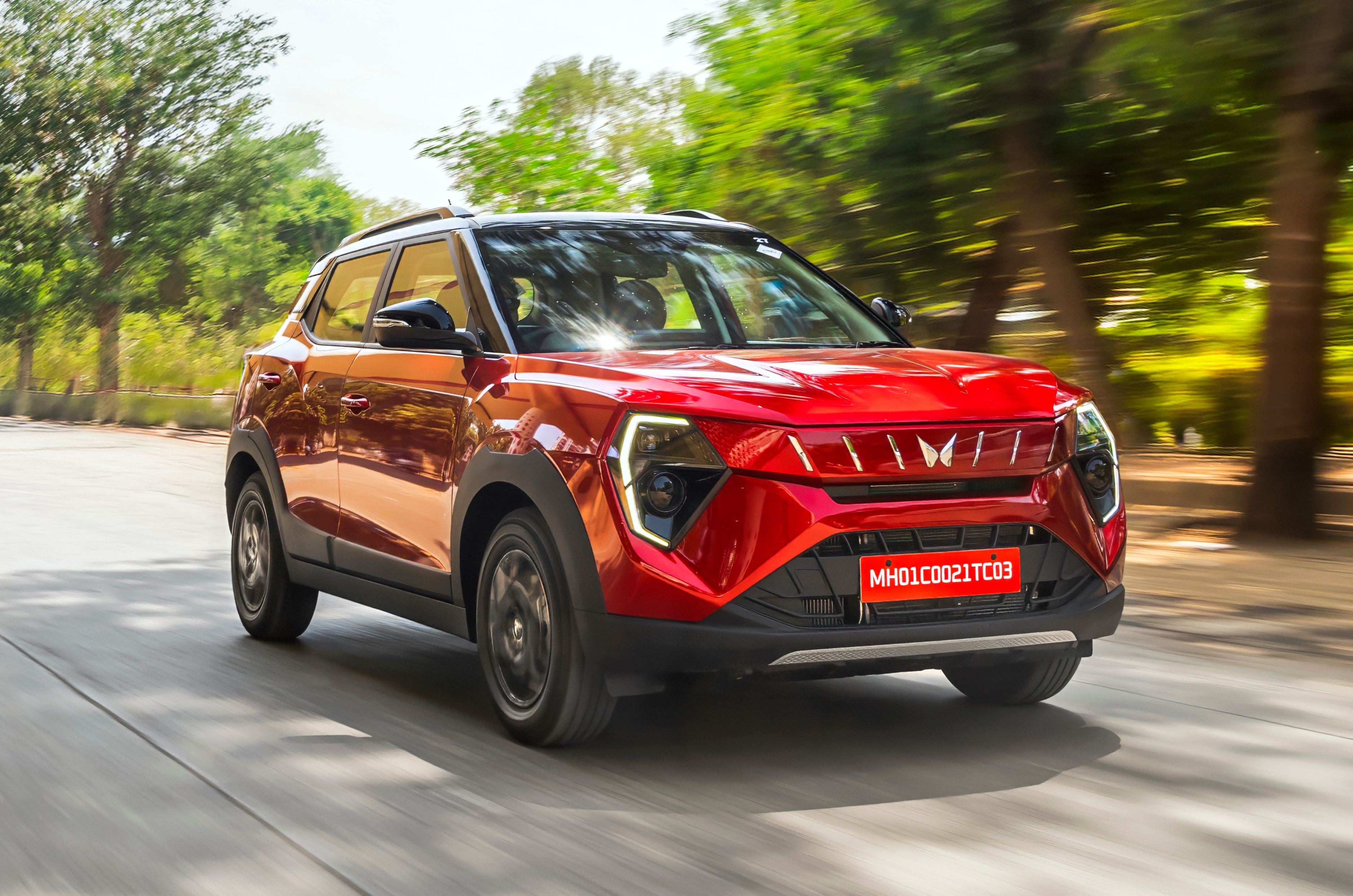
CNG is shaping up to be the new diesel. For the second year running, CNG passenger vehicles outsold diesels, accounting for 21.98 percent of the market compared to 18.08 percent for oil burners in FY2026. That is a very big deal. Big enough for Mahindra – traditionally a diesel-first brand – to sit up, take notice and want a piece of the action. Its first attempt – if you don’t count the fleet-only KUV100 CNG – is the Mahindra XUV 3XO ZNG. Read as Zee-NG and pronounced Zing. The headline is that it makes the same amount of power as the pure-petrol 3XO TCMPFi. We experienced it in Mumbai to see if it really has zing.
Mahindra XUV 3XO ZNG Exterior Design and Engineering – 7/10
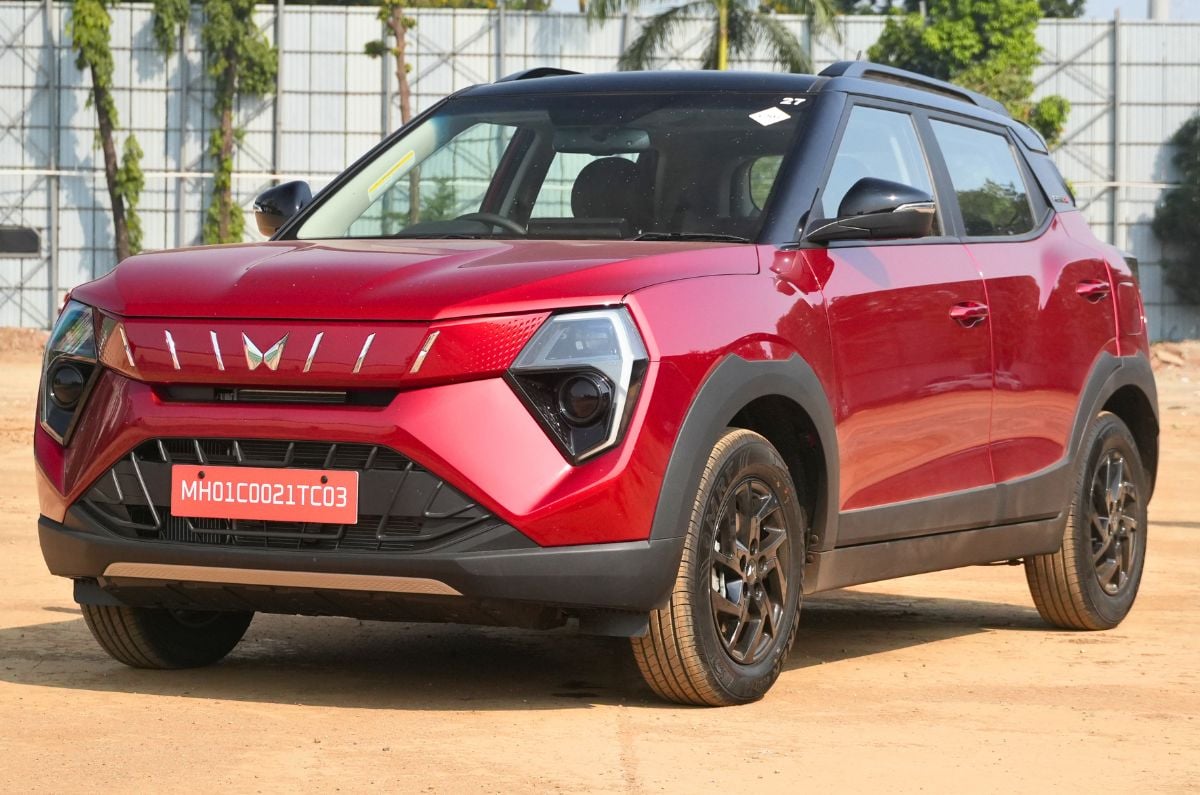
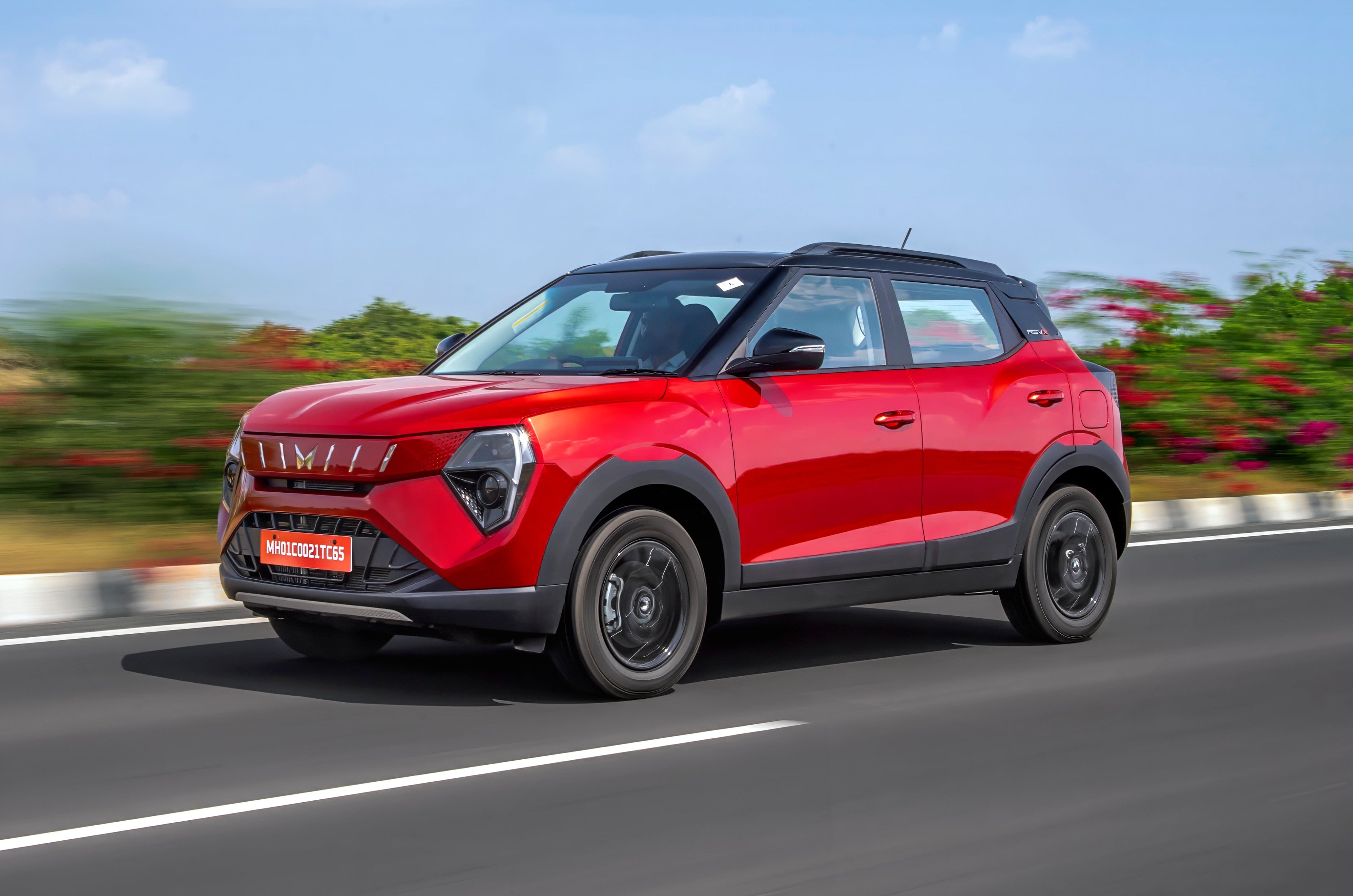
Outside, there isn’t much to tell the ZNG apart from the regular XUV 3XO. Our test car is based on the REVX trim and gets a body-coloured grille, while other trims gloss black. LED lighting is present, though fog lamps are missing even on the top REVX A CNG trim.
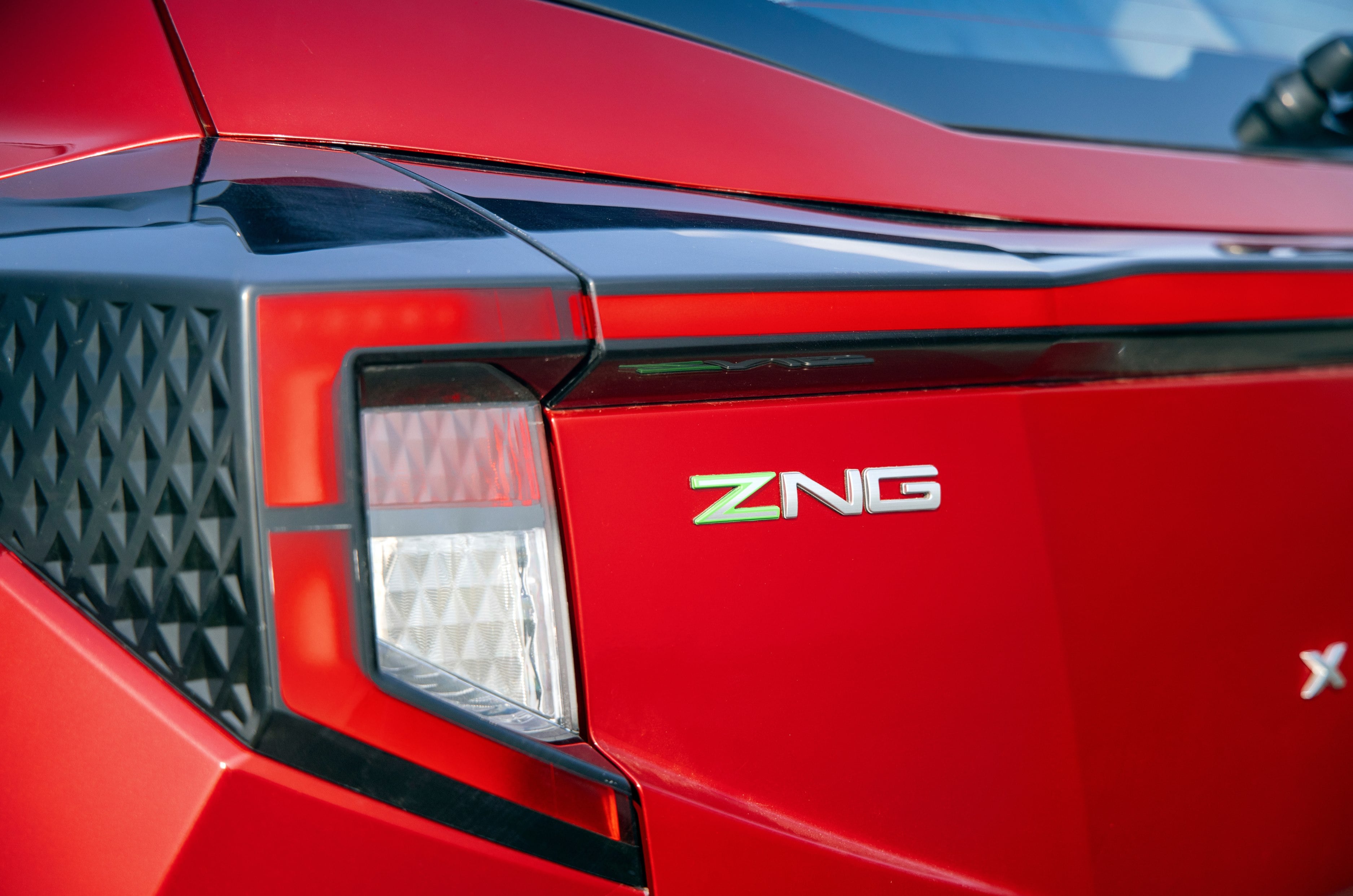
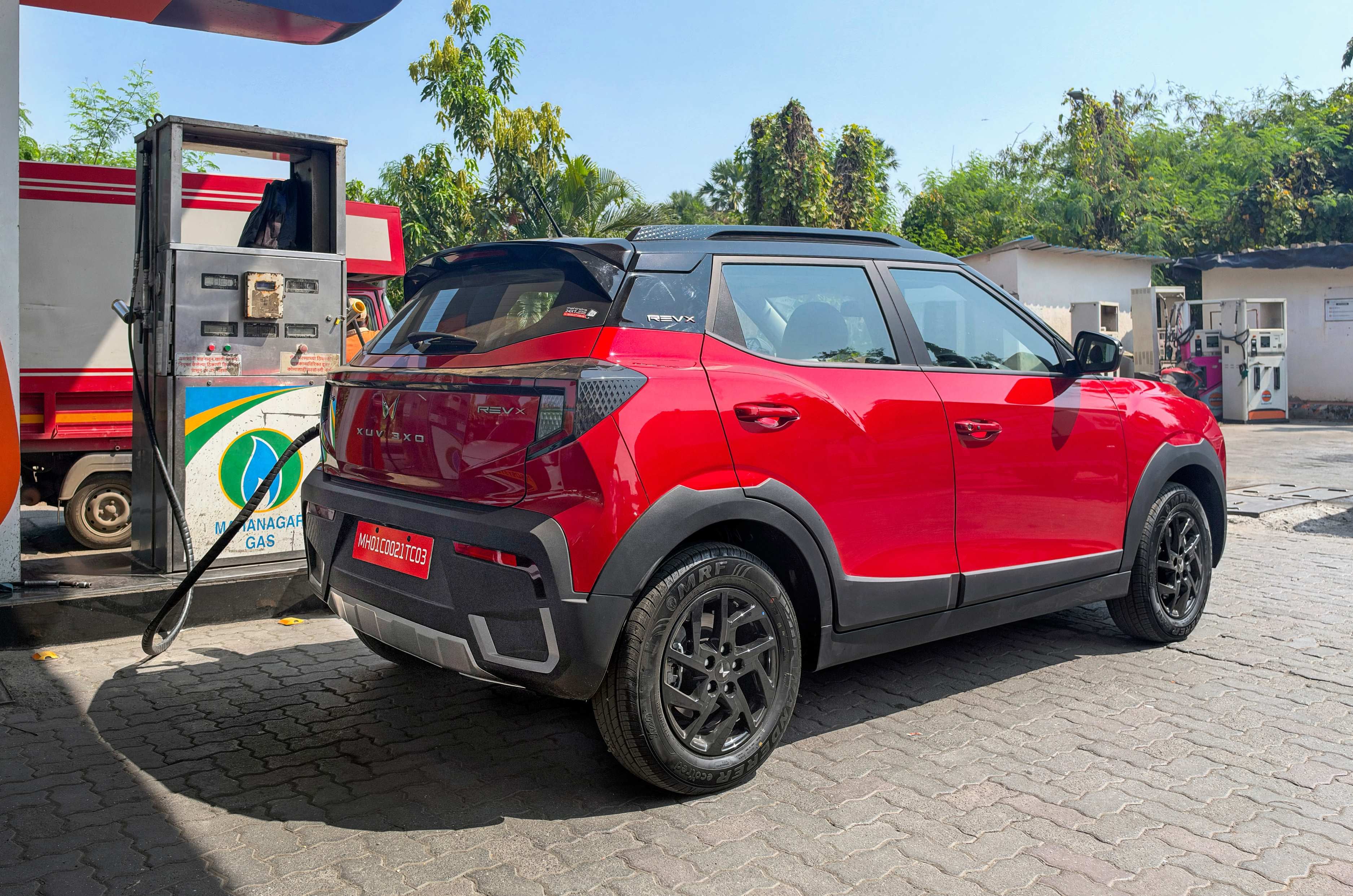
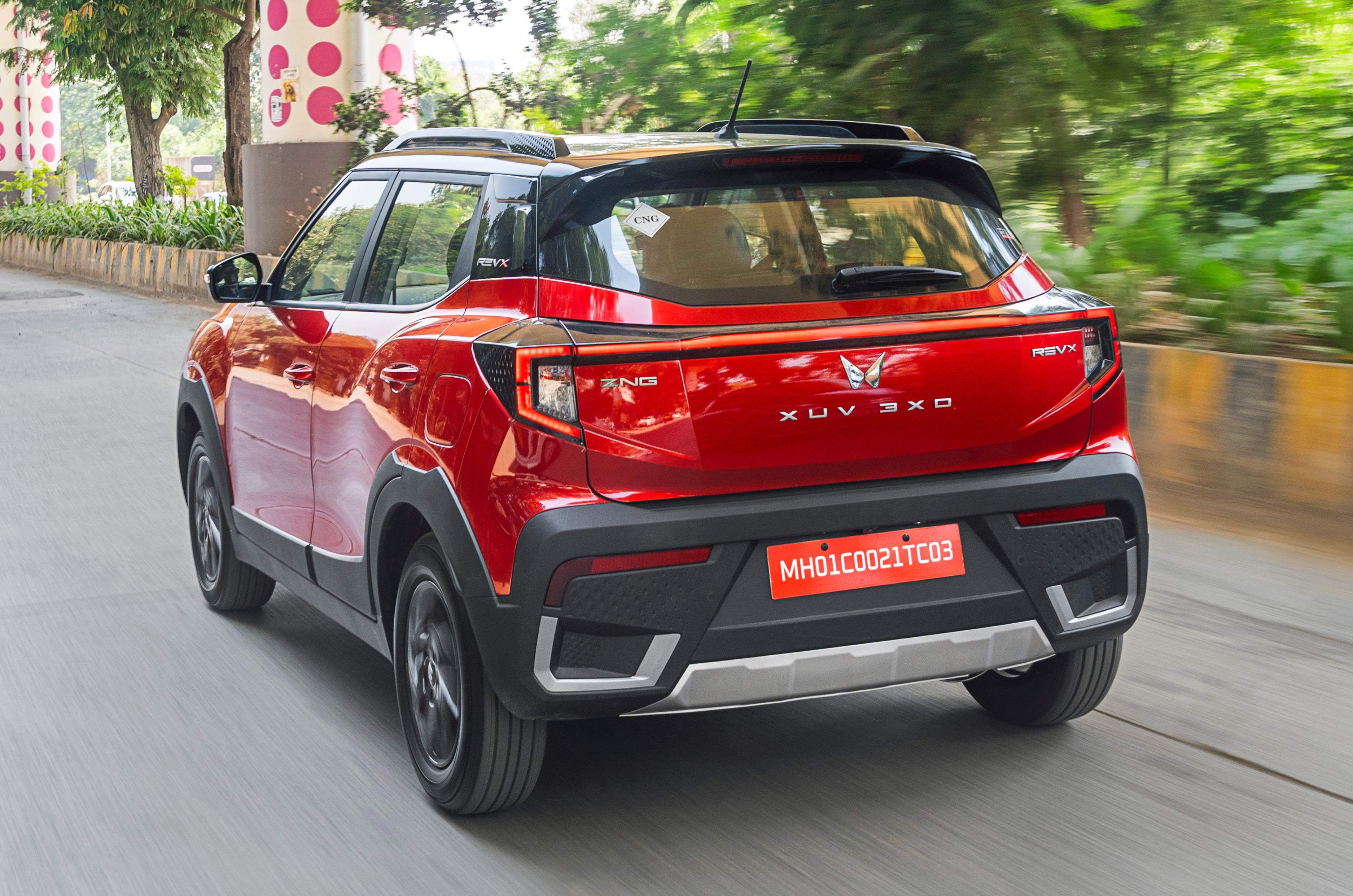
ZNG badge on the tailgate is the only exterior telltale of the CNG powertrain.
In profile, you’ll notice the gloss black 16-inch wheels – the largest size available on the ZNG, with 17s reserved for the pure-petrol TGDi. At the rear is the clearest giveaway of its CNG powertrain: a ZNG badge on the tailgate.
XUV 3XO ZNG Interior Space and Comfort – 8/10
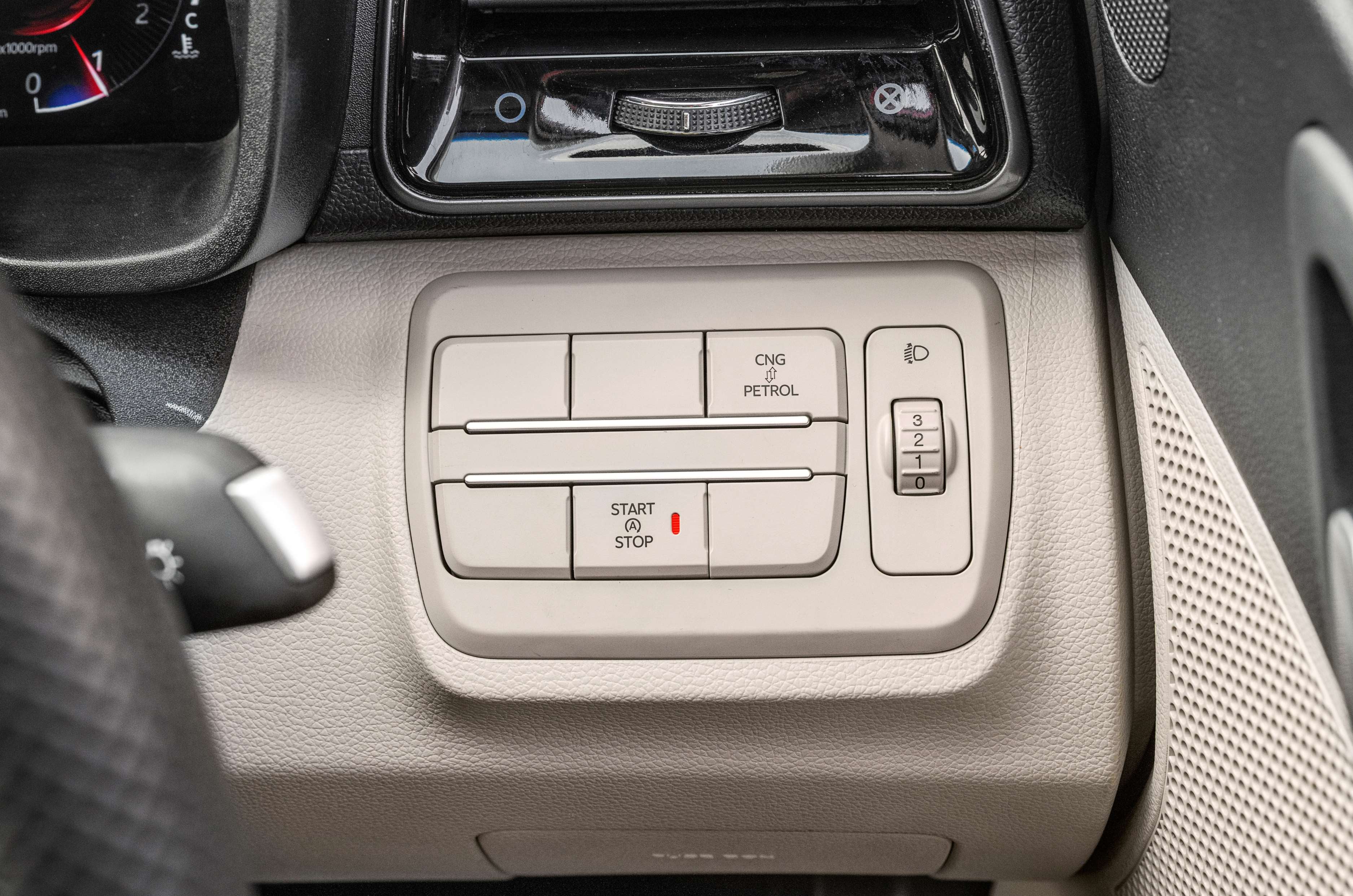
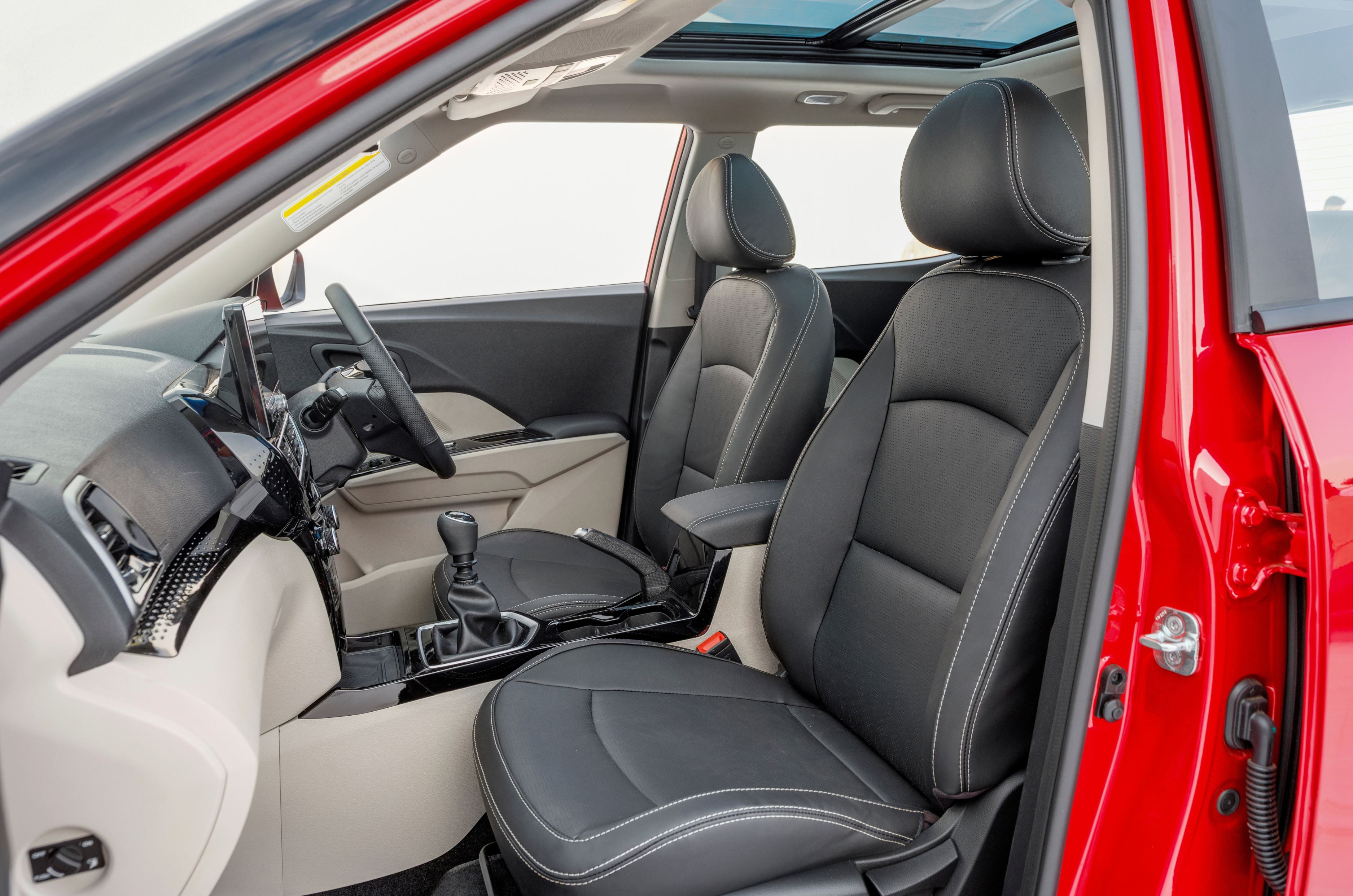
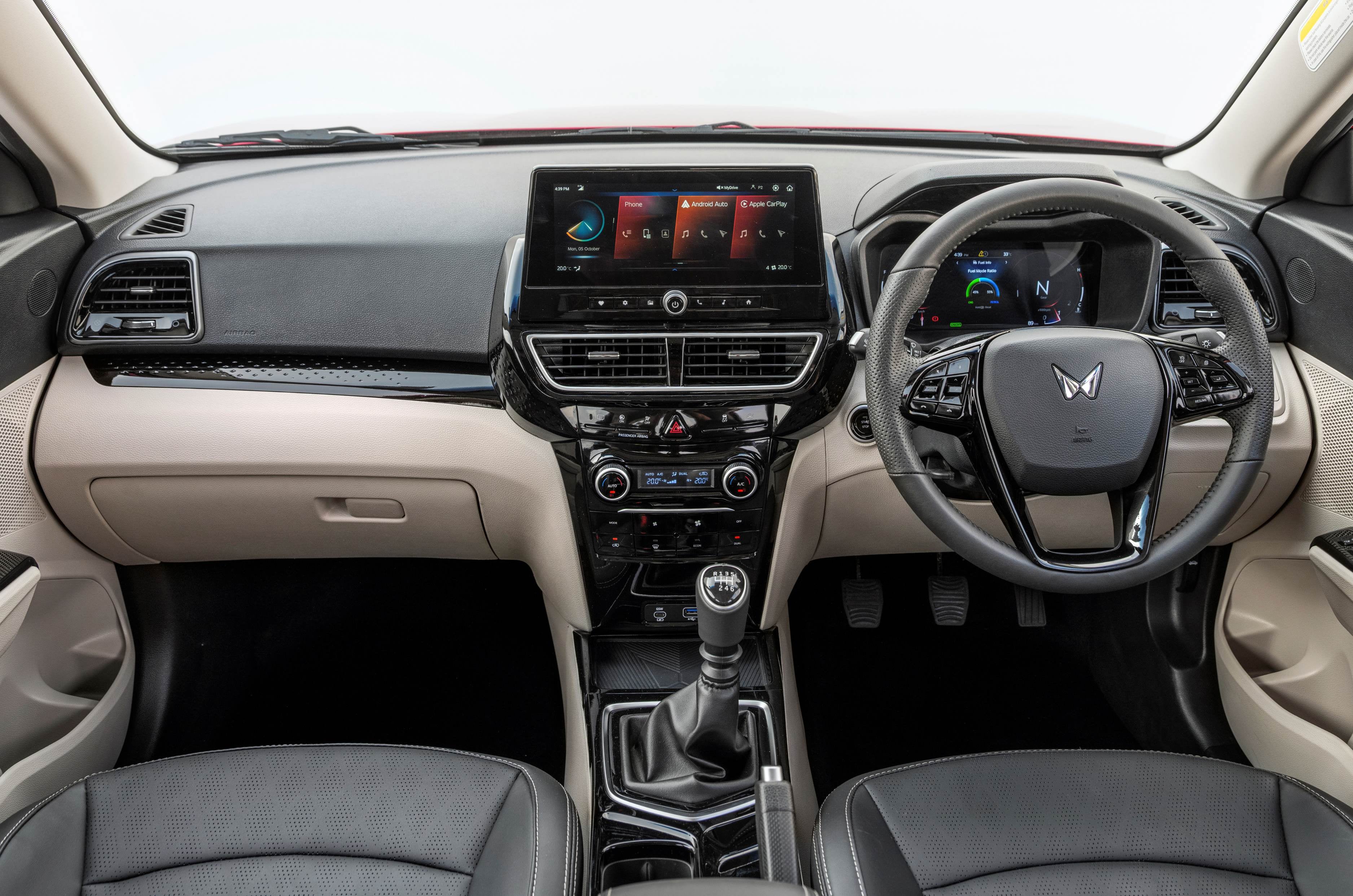
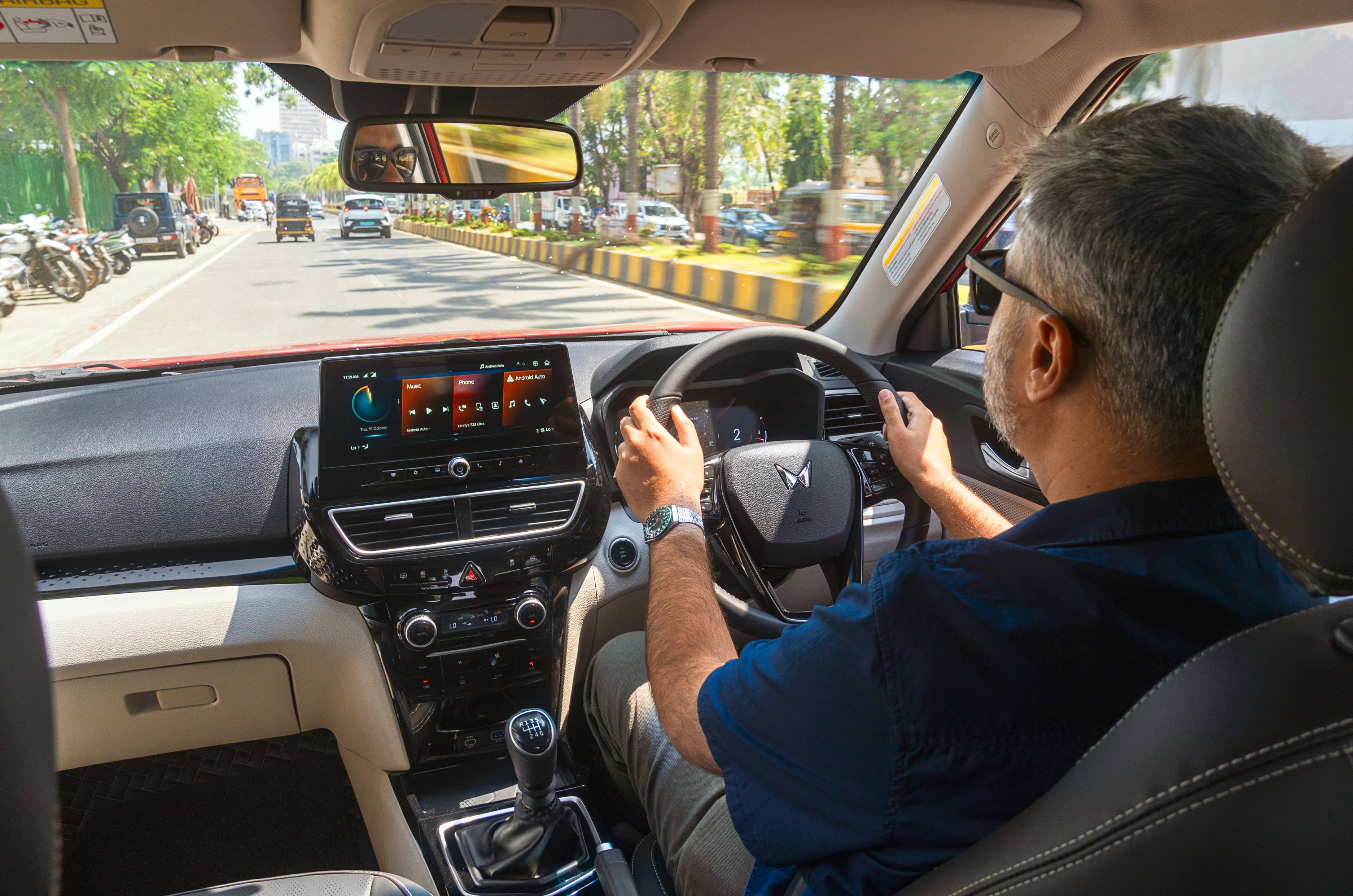
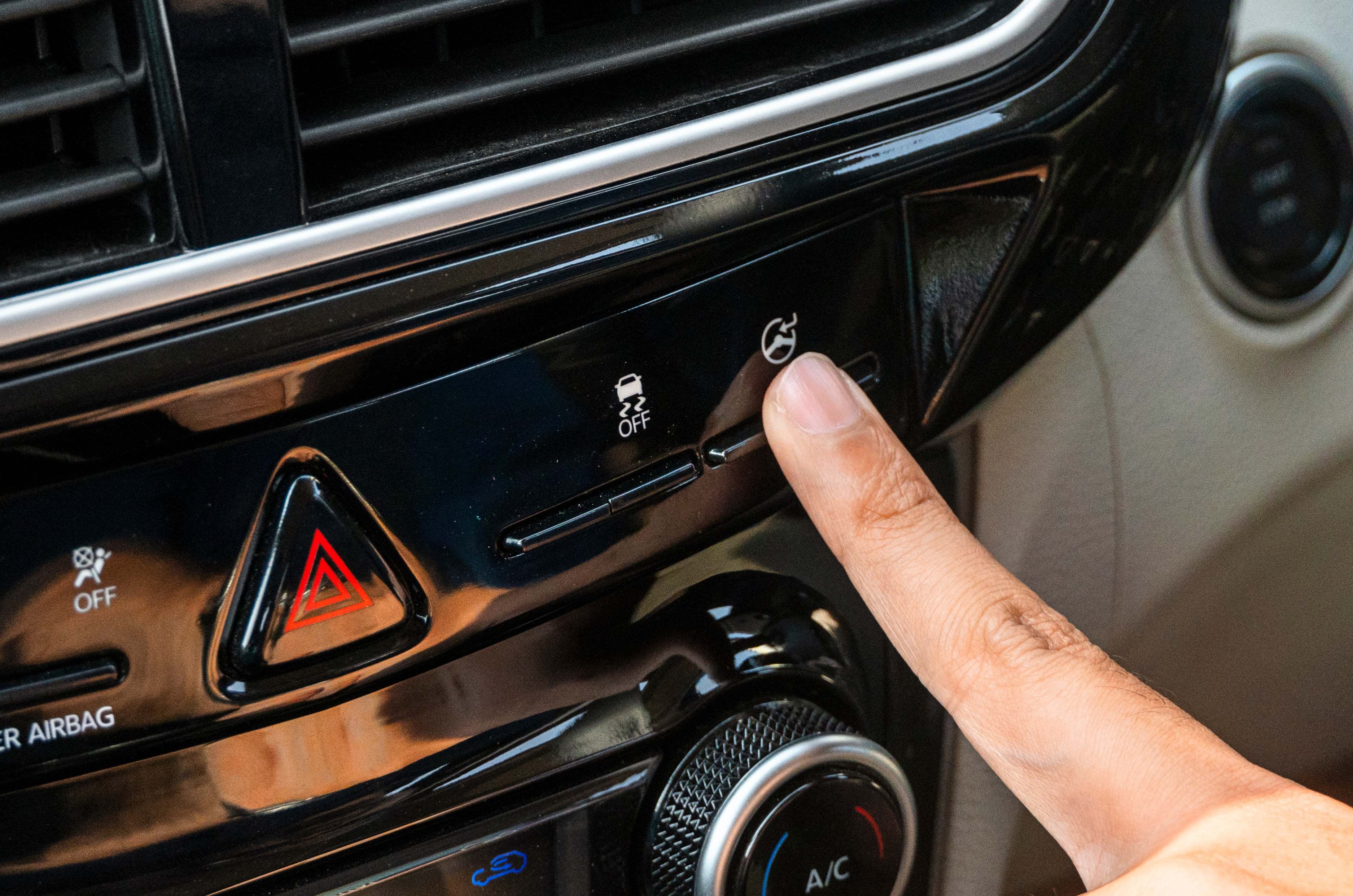
Inside, too, the ZNG is largely identical to its petrol and diesel counterparts, with a CNG switch to the right of the steering wheel being the only real giveaway. The dual-tone dashboard with lots of gloss black trim is otherwise carried over unchanged. Despite not being the top of the line variant, the cabin has an upmarket and well-trimmed air to it.
Our REVX A test car gets black leatherette seats, which can get quite hot, and they lack ventilation, just like the regular 3XO. The front seats are also a bit tight for larger frames, and the lack of a telescoping steering makes it hard to get comfy. Another ergonomic gripe is the tight driver’s footwell, with no dead pedal – pertinent as a six-speed manual is your only gearbox option.
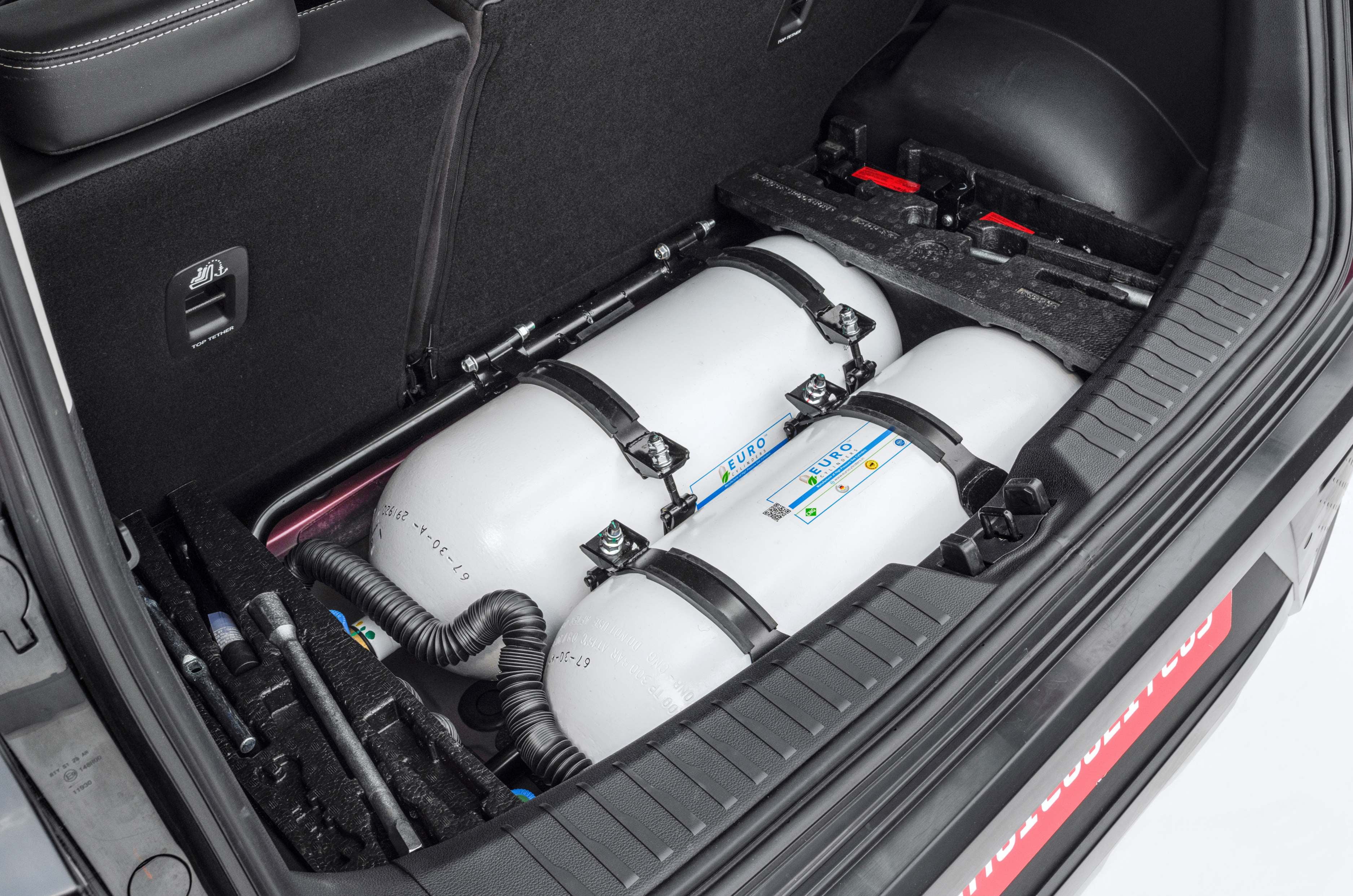
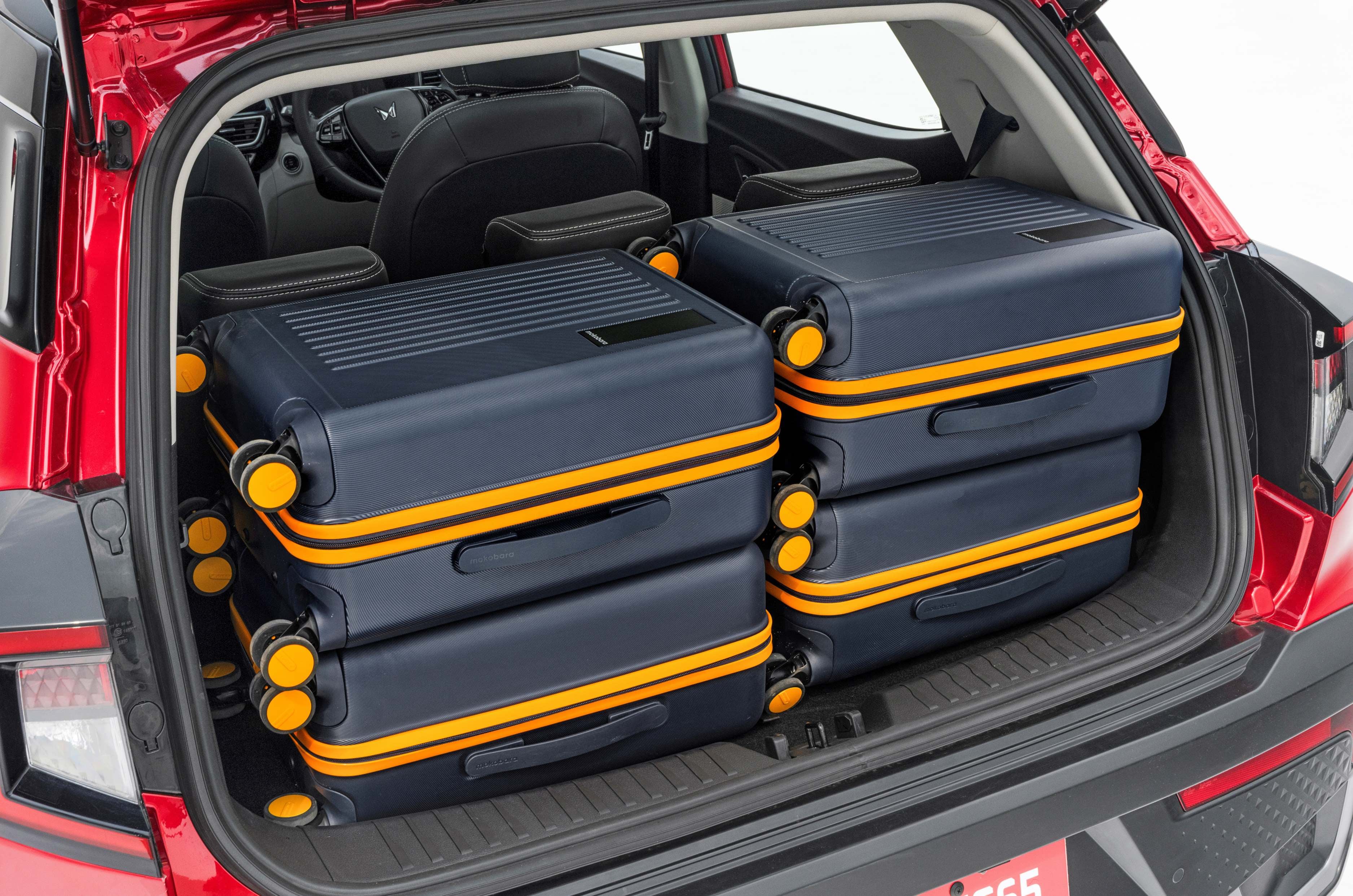
The rear seat remains spacious and comfortable for its segment, and accommodating three abreast is not an issue. One area where the 3XO fell short was boot space, measuring just 295 litres – the smallest in the segment. To keep as much of the boot intact as possible, Mahindra has moved the space-saver spare under the body and placed a dual-tank setup under the boot floor. The combined liquid capacity of the tanks is 60 litres, which translates to 10kg of CNG capacity.
Boot capacity has dropped to 270 litres, which is smallest amongst immediate rivals, however it remains fairly wide and can accommodate up to four cabin bags.
Mahindra XUV 3XO ZNG Features and Safety – 8/10
The 3XO ZNG is available in four trims, which offer the same features as their petrol and diesel counterparts. The highlights are a pair of sharp 10.25-inch screens for infotainment and instrumentation, a panoramic sunroof and a six-speaker audio system with Dolby Atmos.
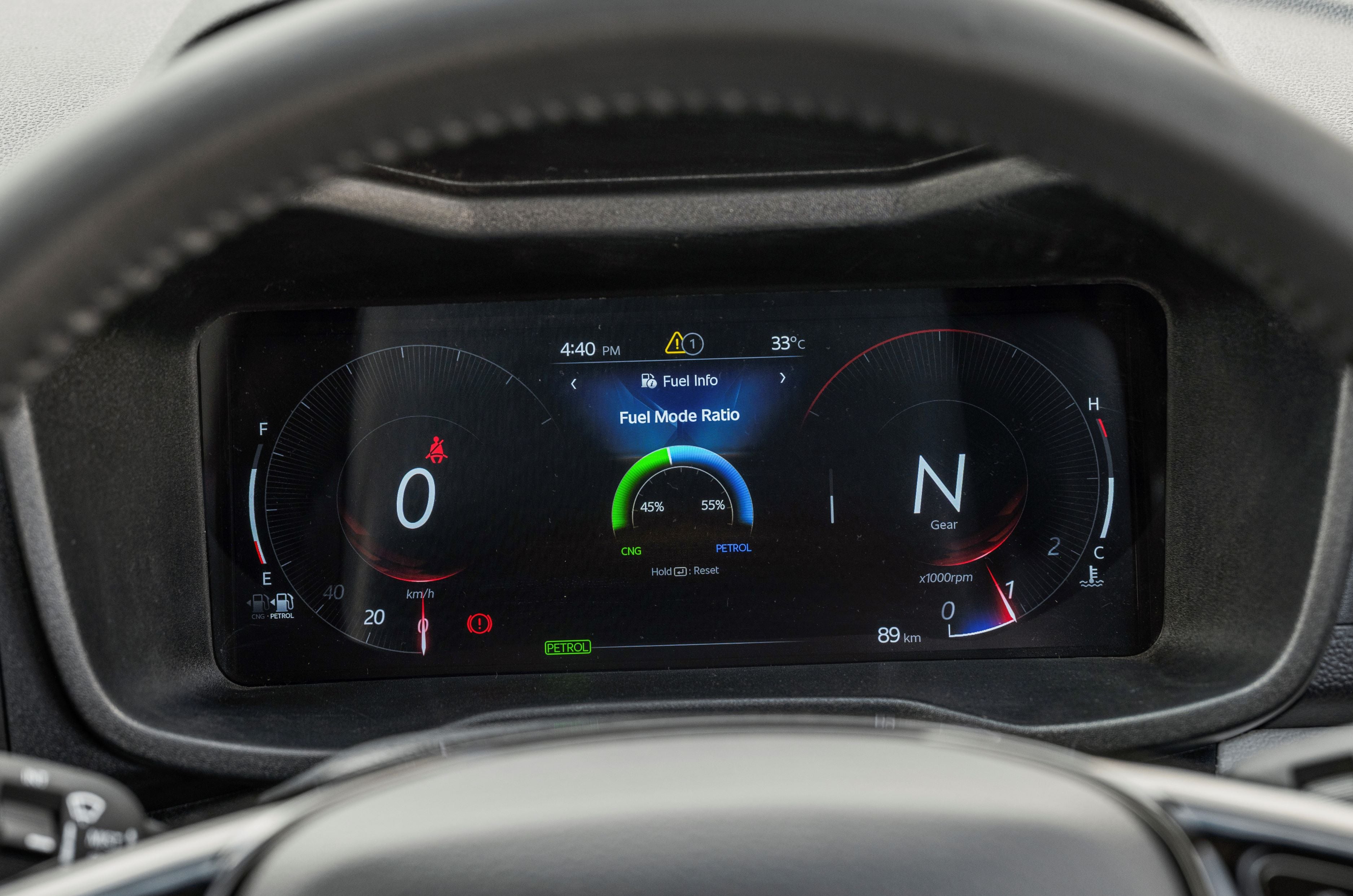
The digital instrument cluster has a few more CNG-related functions. Hit the CNG switch, and an indicator on the digital instrument cluster confirms the fuel you are using, while the fuel gauge changes to display the fuel level. The cluster can also show the ratio of time spent in each fuel mode and the corresponding fuel efficiency.
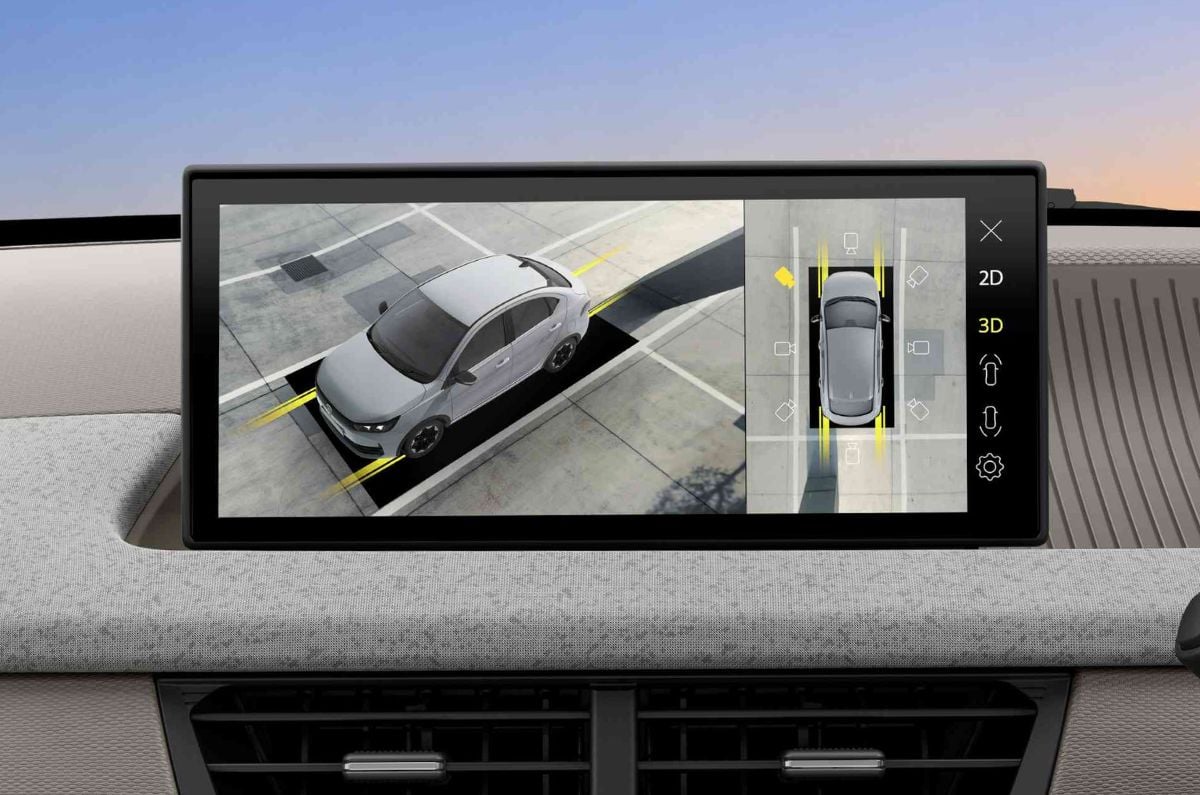
As such, the 3XO ZNG is reasonably well equipped compared to equivalent variants of its main rival, the Tata Nexon iCNG. However, the Nexon offers a wider choice of CNG variants, with top-spec versions getting features such as a 360-degree camera, ventilated front seats and a wireless charger, all of which the Mahindra misses out on.
The safety kit is quite comprehensive, featuring six airbags, ESC, ISOFIX mounts, a tyre pressure monitoring system and a reversing camera. The regular XUV 3XO is also a five-star Bharat NCAP safety-rated car, and Mahindra says the ZNG has been engineered to meet the same standards.
Mahindra XUV 3XO ZNG Performance and Refinement – 8/10
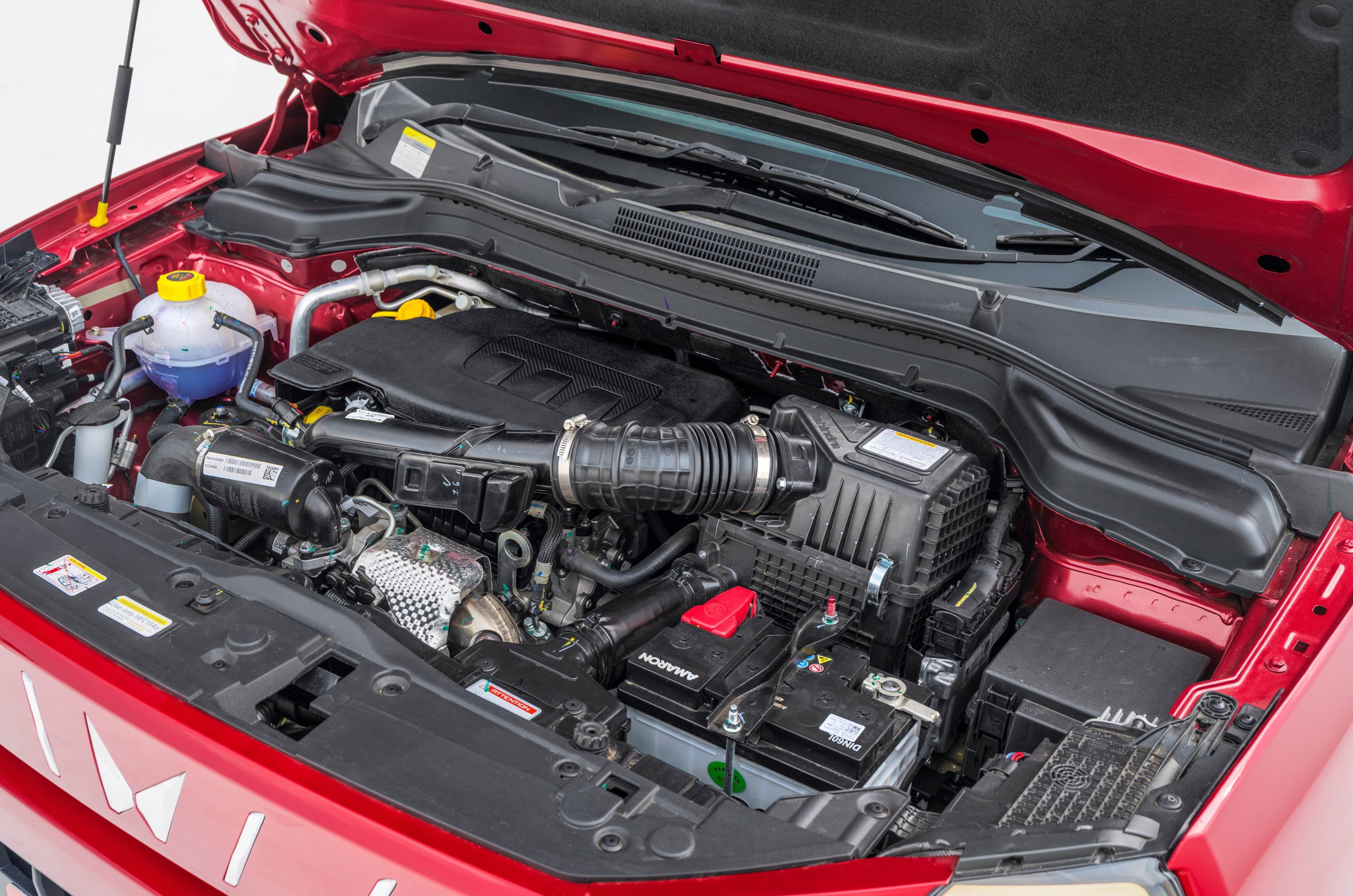
Powering the ZNG is the same 1.2-litre multi-point fuel injection (MPFi) turbo-petrol engine that does duty on the lower and mid-level trims of the 3XO. The kicker is that Mahindra quotes the exact same power and torque figures for CNG as for the pure-petrol version – 111hp and 200Nm. That is highly unusual, as a 10 to 15 percent drop in power figures is the norm. For comparison, its direct rival, the Tata Nexon iCNG, loses 20hp when switching from petrol to CNG. Mahindra says it has managed this with the use of a 10-bar CNG injection system. It also says the turbocharger and ECU calibration have been optimised to run on CNG, and initial impressions seem to back this up.
1.2-litre TCMPFI engine uses a 10-bar CNG injection system; Mahindra claims identical 111hp and 200Nm figures for petrol and CNG.
In everyday driving, the difference between CNG and petrol modes is barely noticeable. The engine feels smooth and refined in both, only becoming audible when extended. Performance, too, is very similar. Throttle response is good and the motor feels tractable, rarely requiring a shift into first when negotiating a speed breaker. There is a bit of turbo lag below 2,000rpm, but get past this and performance feels brisk.
The switch between modes is also quite seamless, with no apparent jerkiness or change in engine note. However, switch back and forth a few times, and you’ll notice the throttle response is ever so slightly duller in CNG mode, and there are times when it will hesitate on sudden throttle inputs. Overall, though, calibration in CNG mode is very good, and in everyday driving, there is very little to fault.
Performance feels brisk once you get past 2000rpm.
While the pure-petrol version of this engine can be had with a six-speed torque-converter automatic, the ZNG is only available with the six-speed manual. While its immediate rivals don’t offer an automatic with CNG either, Mahindra would have done well to offer at least an AMT. As it is, the manual is a smooth and easy-to-use unit, but not quite at the level of its Japanese or Korean competition. Its throws are a bit too long, and the clutch, while light, has a long travel.
In terms of outright performance, Mahindra claims an 11.8sec 0-100kph time for the ZNG. We conducted a quick performance test (not to Autocar India standards), which resulted in a 0-100kph time of 12.98s on petrol and 12.64s on CNG – a difference we put down to the launch. In-gear acceleration figures paint a clearer picture, where the ZNG was quicker in petrol mode by about 0.7 seconds in both 20-80kph and 40-100kph runs. Nevertheless, performance in either CNG or petrol is so close that most drivers would be hard-pressed to tell the difference.
Mahindra XUV 3XO ZNG Mileage and Efficiency – 8/10
Mahindra claims an efficiency figure of 24.7km/kg for the XUV 3XO ZNG, which translates to a theoretical range of 247km from its 10kg CNG capacity.
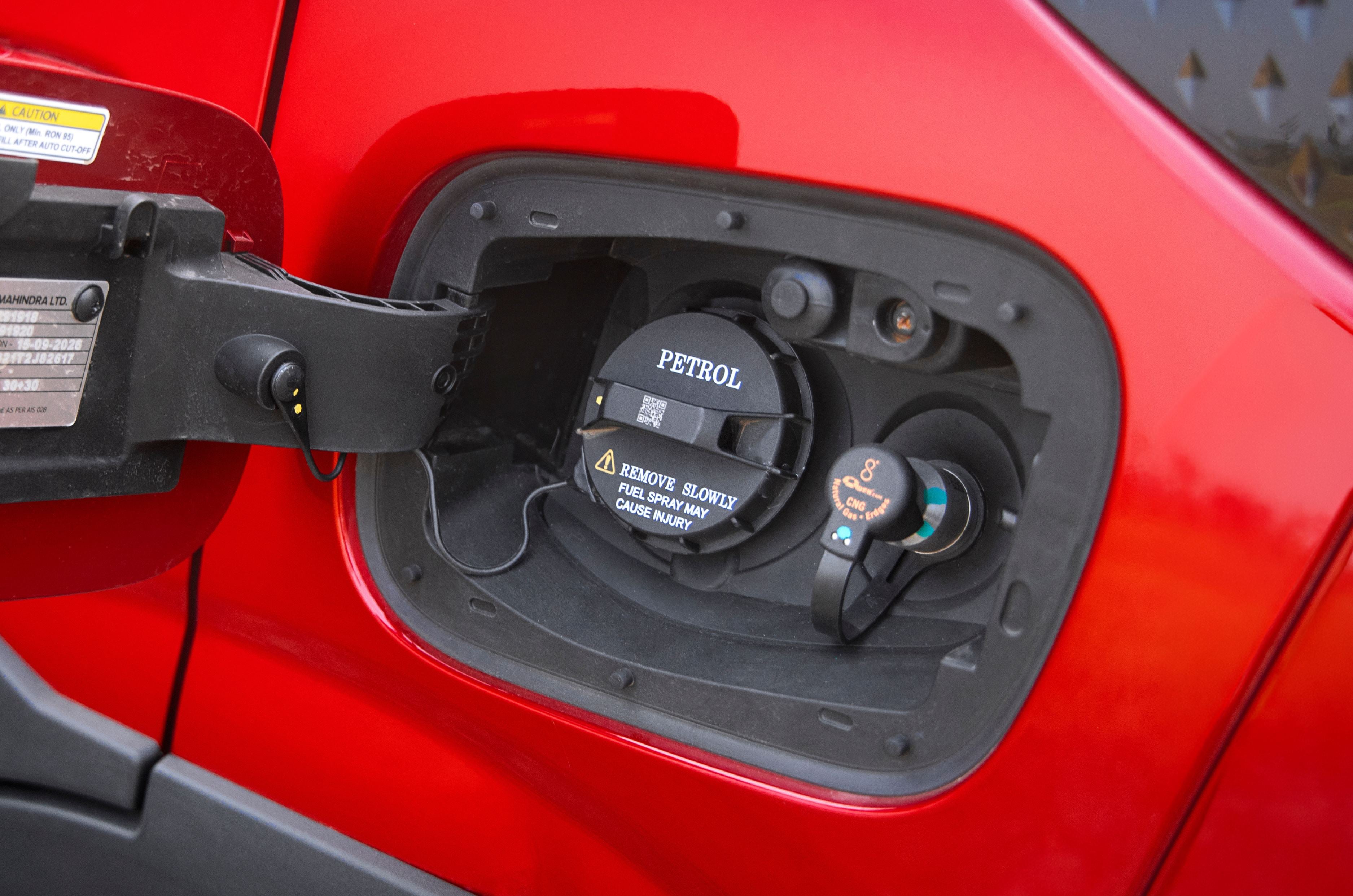
CNG filler neatly positioned beside the fuel filler; fuel filler door still has a manual release in the cabin.
It also gets an idle-stop/start function, which should help efficiency. We will verify these claims with a real-world test soon.
Mahindra XUV 3XO ZNG Ride Comfort and Handling – 9/10
Light steering works well in town; steering modes dial up resistance but don’t offer better feel.
The switch to CNG adds around 100kg to the 3XO, most of it concentrated at the rear. To ensure this doesn’t affect ride or handling, Mahindra has tweaked the suspension to cope with the extra weight. The ZNG’s ride has a slightly firm edge, but overall it deals with bad roads very well.
16-inch wheels and tall tyres are better at absorbing sharper bumps than the 17s on higher petrol trims.
The smaller 16-inch wheels also play an important part here, as their taller-sidewall tyres absorb sharp edges before they make their way to the cabin. Overall, the ride remains amongst the best in the class.
Handling, too, remains tight and engaging, with a planted feel around the bends. The steering is light and direct, and while you can dial up the resistance using the three steering modes, this adds little in terms of feel or feedback.
Mahindra XUV 3XO ZNG Value for Money – 8/10
Overall, the Mahindra XUV 3XO offers good value for money and makes for a compelling entrant into the CNG compact SUV space. Prices for the Mahindra XUV 3XO ZNG start at Rs 9.99 lakh and go up to Rs 12.27 lakh, which is between Rs 1 lakh and Rs 1.2 lakh more than the equivalent petrol trims. Pricing is on par with comparable variants of the Tata Nexon iCNG. However, the Nexon has a wider range and also offers more features on the higher trims.
Mahindra has packaged the CNG tanks cleverly, minimising the impact on boot space. That said, the 3XO’s boot wasn’t particularly large to begin with, and that remains a drawback. What sets it apart is the driving experience. CNG calibration is very good, and performance in CNG mode is close enough to petrol for most people not to notice a real difference. For a first attempt, the XUV 3XO ZNG certainly ticks a lot of boxes.
Alongside the heavily revised Xtreme 160R 4V, Hero has also taken the wraps off an updated Xtreme 250R that brings a significant addition of electronics and rider aids.
Gets a TFT display, bi-directional quickshifter, riding modes and traction control
Adds segment-first Frequency Selective Damping (FSD) rear suspension
249cc liquid-cooled single makes 30hp and 25.3Nm
What’s new on the updated Hero Xtreme 250R?
The engine and overall design remain largely unchanged
For starters, the Xtreme 250R now features a 4.2 inch TFT instrument cluster (from the Xpulse 210) that replaces the older LCD unit, enabling multiple features, including smartphone connectivity, turn-by-turn navigation, and a lap timer. The addition of a ride-by-wire throttle system introduces four riding modes – Rain, Road, Sport and Track – along with traction control. Each mode gets its own traction control calibration. A bi-directional quickshifter is also new, as are cruise control and a tyre pressure monitoring system.
Other notable additions include a rear monoshock with Frequency Selective Damping (FSD). It uses a secondary valve system to automatically vary damping stiffness based on the frequency of road inputs, making the suspension firmer over high-frequency surface chatter and softer over low-frequency bumps. The 43mm USD fork at the front remains unchanged.
Not much has changed with regard to the powertrain, and the bike continues to be powered by a 249cc liquid-cooled, single-cylinder engine producing 30hp at 9,250rpm and 25.3Nm at 7,500rpm – the latter represents a 0.3Nm bump, delivered 250rpm higher in the rev band.
The new Xtreme 250R will be available in three new colour options – Carbon Red, Carbon Black and Carbon White. At Rs 1.98 lakh, the added features come at a substantial Rs 25,000 premium over the existing standard Xtreme 250R, bringing it much closer to rivals like the KTM 250 Duke, which is priced at Rs 2.28 lakh.
Toyota has introduced a comprehensive update to the Glanza for 2026. Over a month ago, its badge-engineered Maruti counterpart, the Baleno, was updated as well. But how unique are both hatchbacks when placed side by side? From exterior, interior, features, and price, we explain all the differences and similarities between the Glanza facelift and the Maruti Baleno.
Toyota Glanza facelift vs Maruti Baleno: Exterior
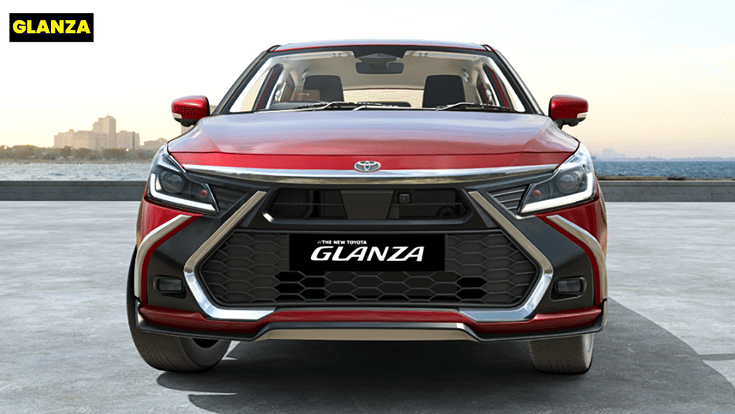
The Glanza facelift and Baleno’s fascias are the biggest distinctions between them. The Glanza’s fascia gets a bold look with a chrome strip connecting the headlamps, a massive grille with a honeycomb pattern, and silver surrounds. A black trim on either side of the bumper encases rectangular LED fog lamps, and there are additional chrome strips on the bumper edges. The bumper gets a sportier dual-tone design with a gloss black chin spoiler.
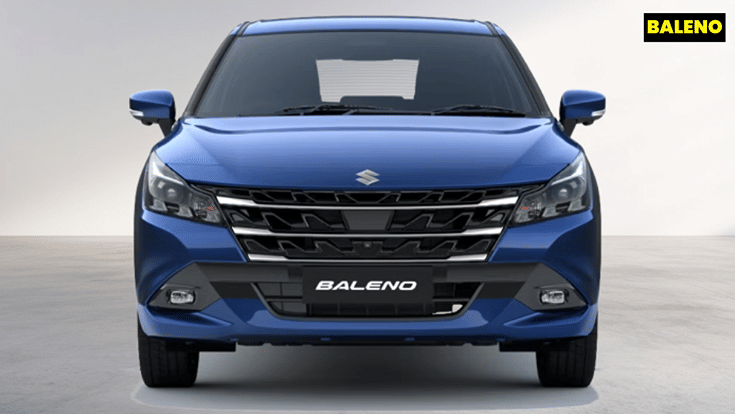
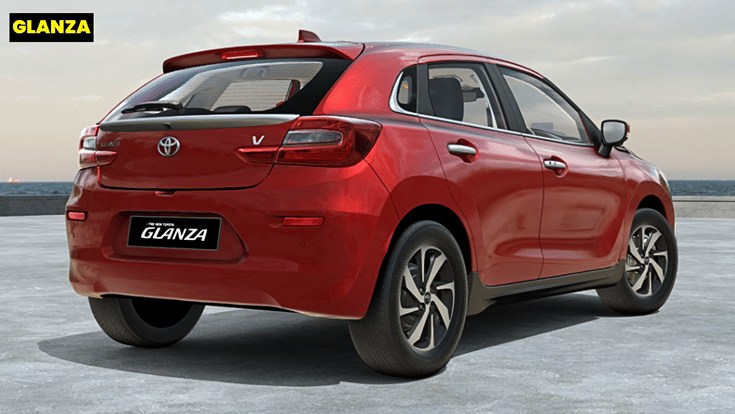
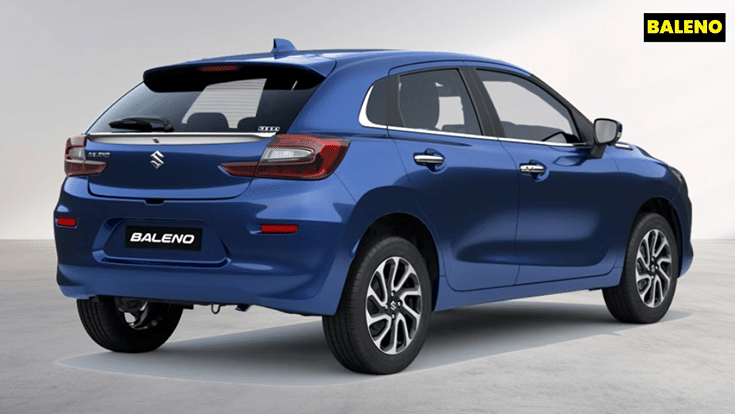
Meanwhile, the Baleno’s fascia takes an elegant approach with a trapezoidal grille with a triangular pattern and three chrome strips. The sculpted bumper gets a monotone finish, and there’s a gloss black trim that encases LED fog lamps that look similar to those on the Glanza. Though both hatchbacks get a similar shape for the LED headlamps, the detailing is different. Additionally, there are unique designs for the 16-inch alloy wheels for both models. Similar elements on both cars include a chrome finish for the window line, door handles, front fender garnish, and the strip on the bootlid. At the back, both models look nearly identical to each other.
Toyota Glanza facelift vs Maruti Baleno: Interior and features
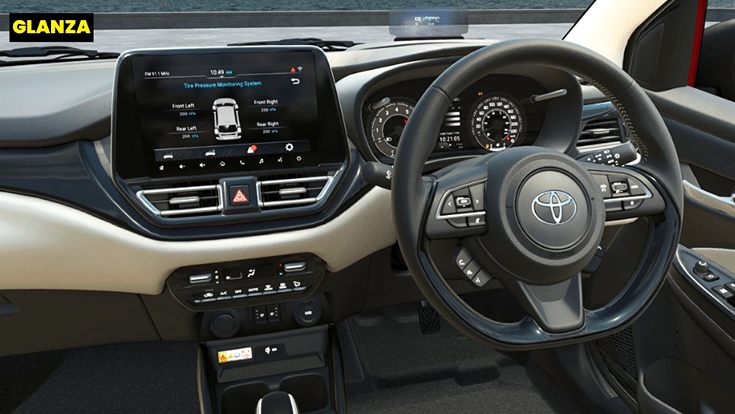
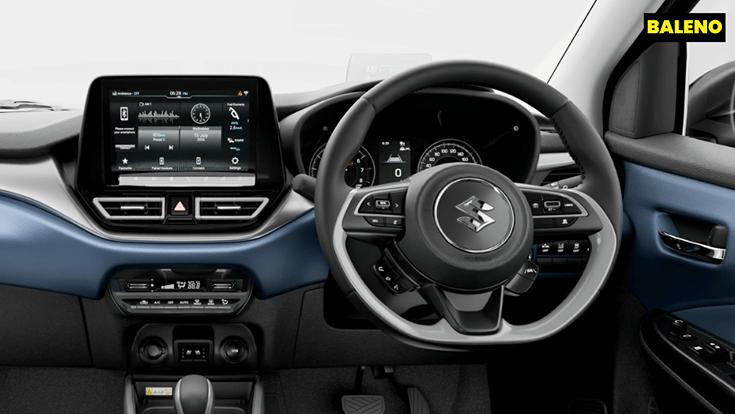
Unlike the outside, the interior of the Glanza facelift isn’t much different from the Baleno’s. Apart from the different colour scheme, seat upholstery, and obvious badging differences, the overall cabin layout remains the same. Both get a layered dashboard with a free-standing infotainment display and physical switches for the HVAC controls lower down. As for features, the Glanza facelift now gets front seat ventilation and a level 2 ADAS suite like the Baleno. Similarly, the Glanza facelift’s safety kit sees the inclusion of a tyre pressure monitoring system and six airbags standard across the lineup.
Toyota Glanza facelift vs Maruti Baleno: Engines
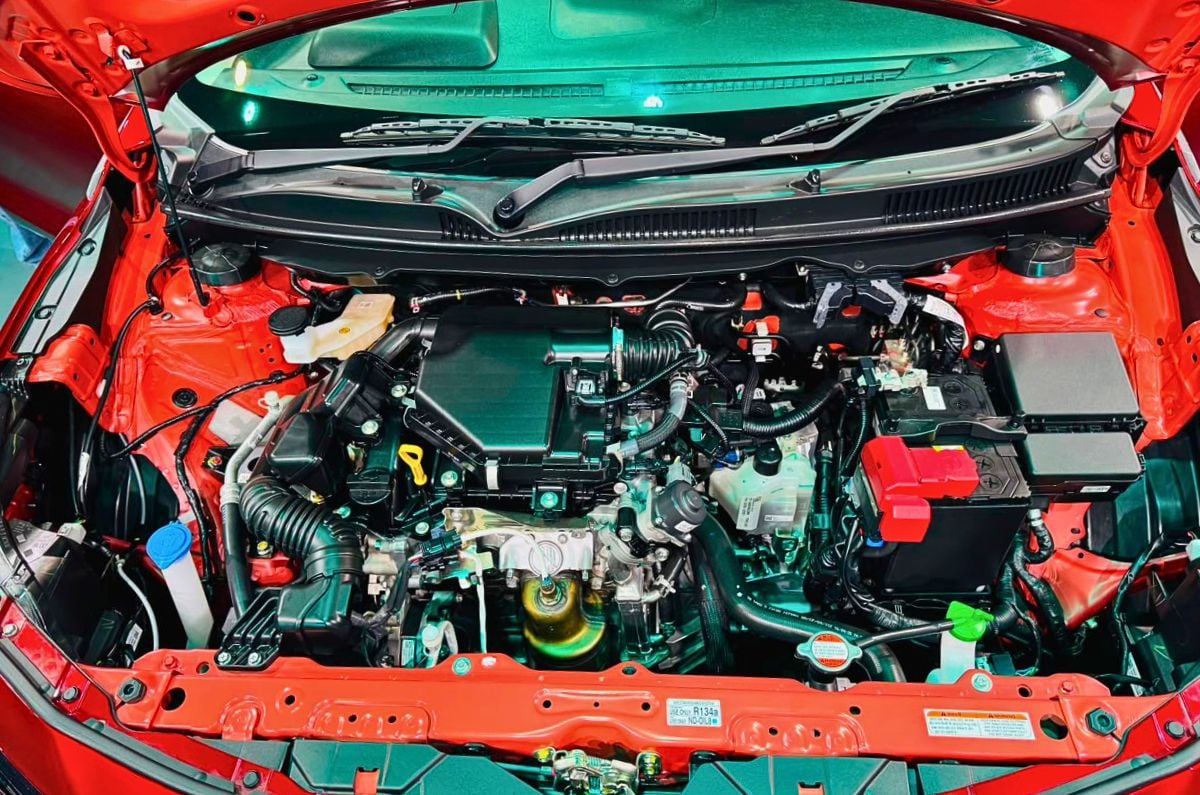
Under the bonnet, the Glanza facelift and Baleno get the same powertrain options. Both offer petrol and CNG versions that use a 1.2-litre, 3-cylinder, naturally aspirated engine. Petrol versions produce 83hp and 112Nm, while CNG versions deliver 70hp and 102Nm in CNG mode. Either powertrain is paired with a 5-speed manual or a 5-speed AMT gearbox. Additionally, both have identical claimed mileage figures: 23.80kpl (MT) and 24.77kpl (AMT) for the petrol, and 33.61km/kg (MT) and 34.47km/kg (AMT) for CNG versions.
Toyota Glanza facelift vs Maruti Baleno: Price
Toyota Glanza facelift vs Maruti Baleno: Price (Rs lakh)
Variant level
Glanza petrol MT | AMT
Baleno petrol MT | AMT
Glanza CNG
MT | AMTl
Baleno CNG
MT | AMT
Base
6.99
5.99
–
–
One above base
7.71 | 8.31
7.00 | 7.50
8.76 | 9.31
7.92 | 8.32
Mid level
8.73 | 9.33
8.00 | 8.50
9.68 | 10.23
8.92 | 9.32
Top-end
9.99 | 10.59
9.50 | 9.60
–
–
Top-end (ADAS)
10.49 | 10.98
9.50 | 9.99
–
–
When it comes to prices of their respective petrol-powered versions, the Glanza facelift is pricier than the Baleno. Depending on the variant, the Glanza facelift will set you back by up to Rs 1 lakh over the Baleno. Moreover, both have an identical 3 years / 1,00,000km warranty.
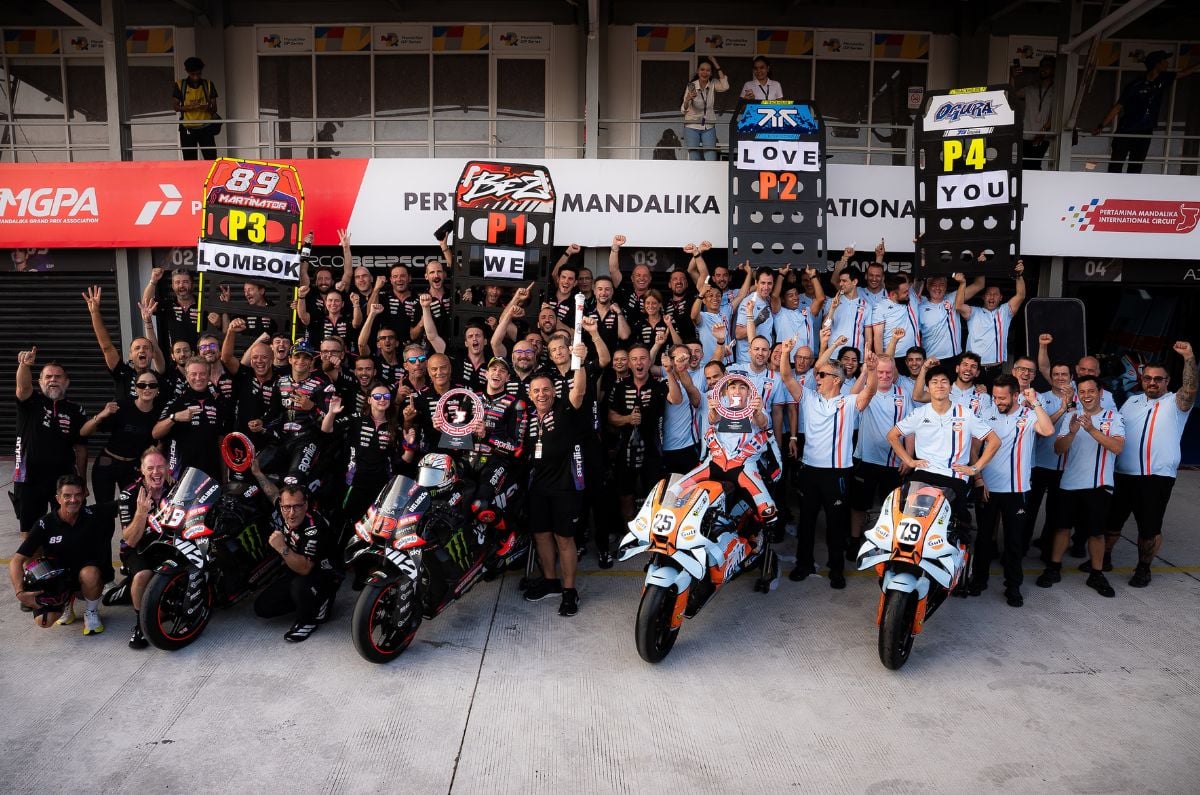
The last leg of the 2026 MotoGP season is here, and the stakes are only getting higher. Aprilia Racing rider Marco Bezzecchi, currently P3 in the world championship, won the Indonesian GP (133 days after his last win), and Jorge Martin, who currently leads the standings, took P3. Raul Fernandez and Ai Ogura of the Trackhouse MotoGP team ranked P2 and P4, resulting in an Aprilia 1-2-3-4 for the first time in the history of the premier class.
Marco Bezzecchi wins for the first time since the dominant Italian GP victory
Martin and Marquez are separated by 2 points, same as after Motegi the previous week
Maximo Quiles wins Moto3 championship, with Izan Guevara continuing to chip away at Manu Gonzalez’s lead in Moto2
Marc Marquez started off strong with Sprint win
Aided by Raul and Marco’s crash
Going into the weekend, Aprilia was expected to be the better performer and that largely held true throughout the practice sessions. However, during Saturday’s sprint, Marco Bezzecchi’s momentary lapse in judgement resulted in him and Raul Fernandez crashing out in the very first corner of the first lap. This gave the lead to Jorge Martin (started in P5), who held on to it until lap 9, when a front tyre pressure warning forced him to slow down and let the trailing rider, Marc Marquez, overtake him. Marc then started building a gap between the two of them, and while Martin sorted out his issues and started catching up to Marc, he ran wide on the last lap, thereby falling out of the podium positions, with a final P4 result.
Pedro Acosta was actively in the battle for podium with Fabio DiGiannantonio and Ai Ogura, until he received a long lap penalty for track limits and ended the Sprint with P6, behind Alex Marquez. A series of technical issues and the early crash guided Marc to a Sprint win, making him the outright championship leader on Saturday by 4 points, with Fabio and Ogura finishing in P2 and P3, respectively. Fernandez ended up with a broken index finger as a result of the crash but was cleared to race on Sunday.
An eventful Grand Prix, dominated by Aprilias
An injury-stricken Raul showed admirable resilience
The Sunday race, though, went as expected as can be. Fernandez started from pole position and had to modify his riding technique to brake with his middle finger, owing to his broken index finger. He was quick to race away from the rest of the pack, with Marco closely following for 17 out of the 27 laps, where he finally overtook him on turn 1 and won the race eventually. In addition to winning, Bezzecchi also set the fastest lap of the race at 1:29:660 and finished the race 21.060 seconds quicker compared to 2025.
Marc Marquez – rejuvenated by his Sprint victory – started strong in P3 but was subsequently overtaken by Jorge Martin and then Pedro Acosta later in the race. Marc and Pedro had a back-and-forth for some laps, where they both faced apparent front tyre pressure warnings (similar to Martin on Saturday), so they let each other pass a few times to let their tyres recover. Once Pedro resolved the issue, he overtook Marc but was then overtaken by Ogura. The race ended with Martin in P3, Ogura in P4, Pedro in P5 and Marc in P6.
Left to right: Jorge Martin (P3), Marco Bezzecchi (P1), Raul Fernandez (P2) and Ai Ogura (P4) celebrating the historic Aprilia 1-2-3-4 with their teams.
Fabio DiGiannantonio had a desirable race start at P3 but was quickly overtaken by all the riders above as well as Alex Marquez, ending his race with P8. Pedro was once again the best performing KTM rider, after Enea Bastianini out-performed him in Motegi. Speaking of whom, Enea ended his run with P10, followed by Pedro’s teammate Brad Binder in P11.
After his win in the Japanese GP, Marc Marquez had reduced the points gap to leader Jorge Martin to 2; and he briefly led the championship after his Sprint win. However, the race results have brought the duo back to the same gap with Jorge Martin once again becoming the leader, followed by Marc Maquez with a two points deficit going to Phillip Island, Australia.
Hot track, hotter riders, notable crashes
Four DNFs and one DNS
The Indonesian GP, hosted in the Lambok island, is considered to be a trying track for the riders as well as their motorcycles. During the MotoGP race, the track temperature was at a scalding 62 degree celsius and the air temperature was bordering around 29 degrees with 73 percent humidity. The conditions remained similarly scorching throughout the weekend, and evidently, it was a tough environment to race in. Fermin Aldeguer, last year’s Indonesian GP winner, crashed out at the end of lap 1, followed by Jack Miller and Pecco Bagnaia – separate incidents – in lap 5. Toprak Razgatlioglu retired in lap 8, due to weakness and lack of feeling in his right shoulder following a massive highside on Saturday practice, as he explained in post race interviews.
Honda had announced Aleix Espargaro will be replacing Joan Mir for the weekend and Aleix partook in all the practice sessions and the Sprint. However, he withdrew from the Grand Prix, citing arm pump issues and choosing to focus on Honda’s 850cc tests in Sepang next week.
Maximo Quiles takes Moto3 championship
A chaos filled Moto2 race with a closer championship fight than MotoGP
The other two races were just as eventful and perhaps more chaotic than MotoGP. After an impressive 2026 campaign, Maximo Quiles of CFMoto Gaviota Aspar team became the Moto3 World Champion with five races remaining. Quiles has the second-best win rate of 58.8 percent, trailing only David Alonso’s dominant run of 2024, with a 70 percent win rate.
Speaking of David Alonso, his Moto2 race came to a sadly premature end. Alonso started as P2 in the race, but in the first turn of the first lap, his CFMoto Power Electronics Aspar teammate Dani Holgado crashed into him leading to Alonso’s bike getting severely damaged. The crash also took out Joe Roberts and Collin Veijer, which brought red flags out, and resulted in a race restart with a reduced 14 laps (versus planned 22 laps). Except Alonso, the other three riders were able to restart their races, although Joe Roberts quickly retired because of an issue with his rear brake.
Klint Racing’s Alex Escrig was quick to overtake Izan Guevara and held on to the lead successfully, until a technical issue with his bike made him drop out of the race with two laps to go, handing Izan the victory. The final race results saw Izan Guevara in P1, current rider championship leader Manu Gonzalez in P2, and Dani Holgado in P3. With his hattrick race win, Izan has reduced the points gap to Manu to 6.5, going to Phillip Island in two weeks’ time.
The Tata Aeris may be a new name, but its roots lie in the Tigor, which has enjoyed considerable popularity since 2017 for its distinctive styling, practical cabin, comfortable ride and decent powertrains. The Aeris builds on that foundation with a sharper design, a more upmarket cabin and an even more generous equipment list while retaining the same basic mechanical package underneath. Having already driven the iCNG version, we now get behind the wheel of the petrol Aeris to see how it fares as an everyday sedan.
Tata Aeris petrol performance and refinement – 7/10
The petrol engine gives it slightly better cruising capability than the CNG
3-cylinder engine is so-so on refinement and sounds coarse when revved hard
The Tata Aeris comes with a 1.2-litre 3-cylinder naturally aspirated engine that produces 86hp and 113Nm in its petrol guise and is offered with a choice between a 5-speed manual and a 5-speed automated manual transmission (AMT). The three-cylinder engine isn’t the smoothest in the segment, while the sound insulation also has room for improvement. There are noticeable vibrations at idle and low speeds, though these settle down once you’re on the move. However, they make a comeback beyond 2,500rpm, accompanied by a coarse engine note that can get intrusive and tiring on longer high-speed drives.
Manual lever looks premium for the price, offering short throws and defined gear gates.
The petrol version’s output figures are 10hp and 16Nm higher than the CNG version, which may look modest on paper, but the difference is discernible out on the road. We drove the petrol-powered Aeris with a 5-speed manual gearbox and noticed it offers short shift throws and well-defined gear gates. While it is not the slickest gearbox compared to its Maruti, Honda and Hyundai rivals, it is still a step up from the Tigor’s in terms of smoothness.
Aeris’ petrol version feels adequate for the city and is fine for gentle highway cruises too.
The performance in city speeds is adequate, and the powertrain is peppy enough for everyday driving. The clutch is light and has a predictable bite point, meaning you do not strain your left foot even in bumper-to-bumper traffic. There’s a dead pedal too, but it feels narrower than what we would have liked.
It is fairly quick to reach 80kph, but takes some time to reach triple-digit speeds. However, the petrol-powered Aeris maintains these speeds with relative ease, which makes it a decent highway cruiser. Unlike the CNG, the Aeris petrol does not feel out of breath when overtaking, and as long as you are in the right gear, it maintains good momentum.
AMT adds convenience for city drives but doesn’t like being rushed; the manual gearbox is easy to use.
We got a taste of the AMT during our earlier stint with the Aeris iCNG, when we switched to petrol mode, and found that the gearbox offered reasonable acceleration with measured inputs. Push the accelerator aggressively, though, and the typical AMT hesitation became evident, meaning overtakes need to be planned well. The AMT also gets a creep function, which comes in handy in bumper-to-bumper traffic.
All of this makes the AMT a good option for city driving, but for high-speed highway cruising, we recommend the manual gearbox, which offers greater control and a more engaging experience. That said, opting for the manual in the city is not a compromise either.
Tata Aeris petrol ride comfort and handling – 8/10
It allows for a confident drive at both low and high speeds
Like other Tata offerings, ride quality is one area where the Aeris excels. It takes broken roads in its stride, with the suspension absorbing rough patches well and keeping most surface irregularities from filtering into the cabin. The 170mm ground clearance is also adequate for tackling large speed breakers without much concern. That said, the CNG version has an edge in this department, thanks to its 14-inch steel wheels with taller sidewalls, which offer a more cushioned ride than the 15-inch alloys on the top-spec petrol version. Notably, lower Aeris trims get 14-inch wheels.
Well-tuned suspension keeps the Aeris comfortable and confident on all roads.
At high speed too, the suspension stiffens enough to keep the Aeris composed through quick lane changes, without feeling floaty. On the highways, it remains stable and inspires confidence at higher speeds. The steering, however, could do with more precision, as it feels slightly vague around the centre. While it weighs up nicely as speeds rise, a sharper response around the centre would have further enhanced the Aeris’ high-speed confidence.
Tata Aeris petrol mileage and efficiency
We expect the Aeris petrol to have similar fuel efficiency as the Tiago
Tata has yet to reveal the official fuel-efficiency figures for the petrol-powered Aeris. But it gets the same powertrain as the pre-facelift Tiago we tested in 2022. In that test, it returned 13.30kpl in the city and 16.60kpl on the highway. The Aeris could have similar fuel efficiency. However, we will be able to give you a more definitive assessment once we put the Aeris through our standard fuel-efficiency tests.
Tata Aeris petrol exterior design and engineering – 8/10
Has a sleeker and more modern exterior design and comes with LED lights all around
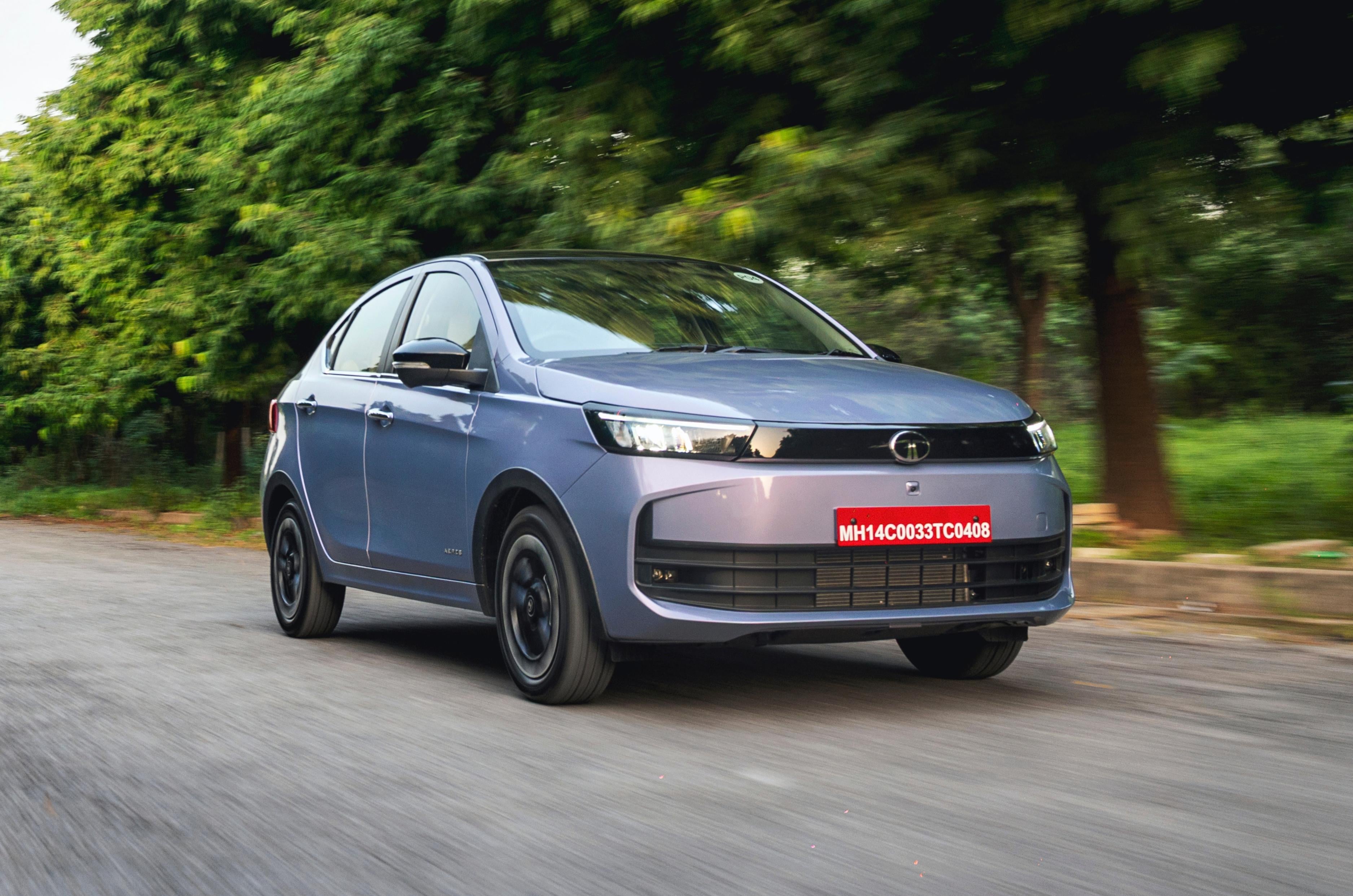
Save for the new bumper, the fascia is similar to the Tiago’s and looks very modern.
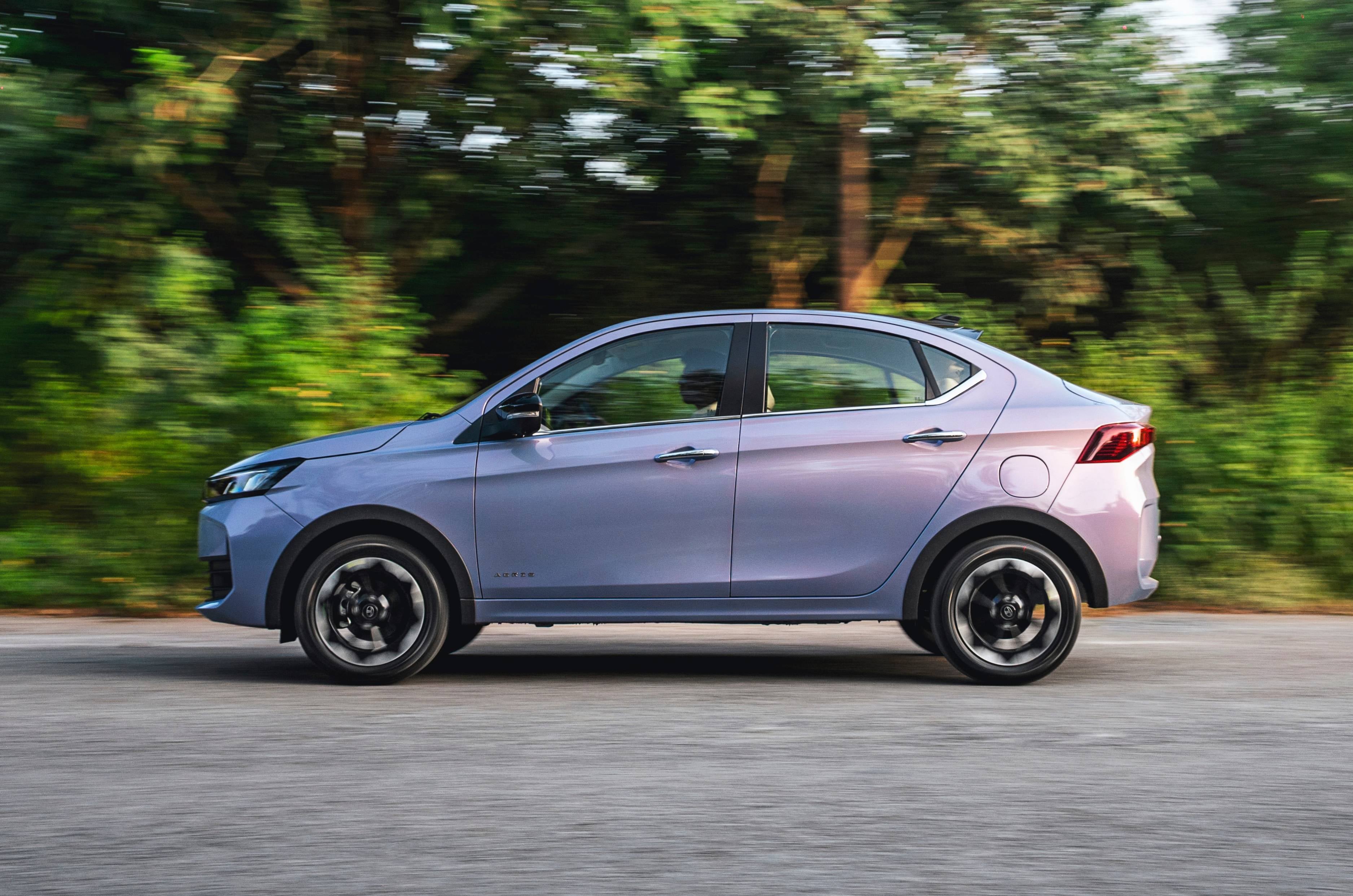
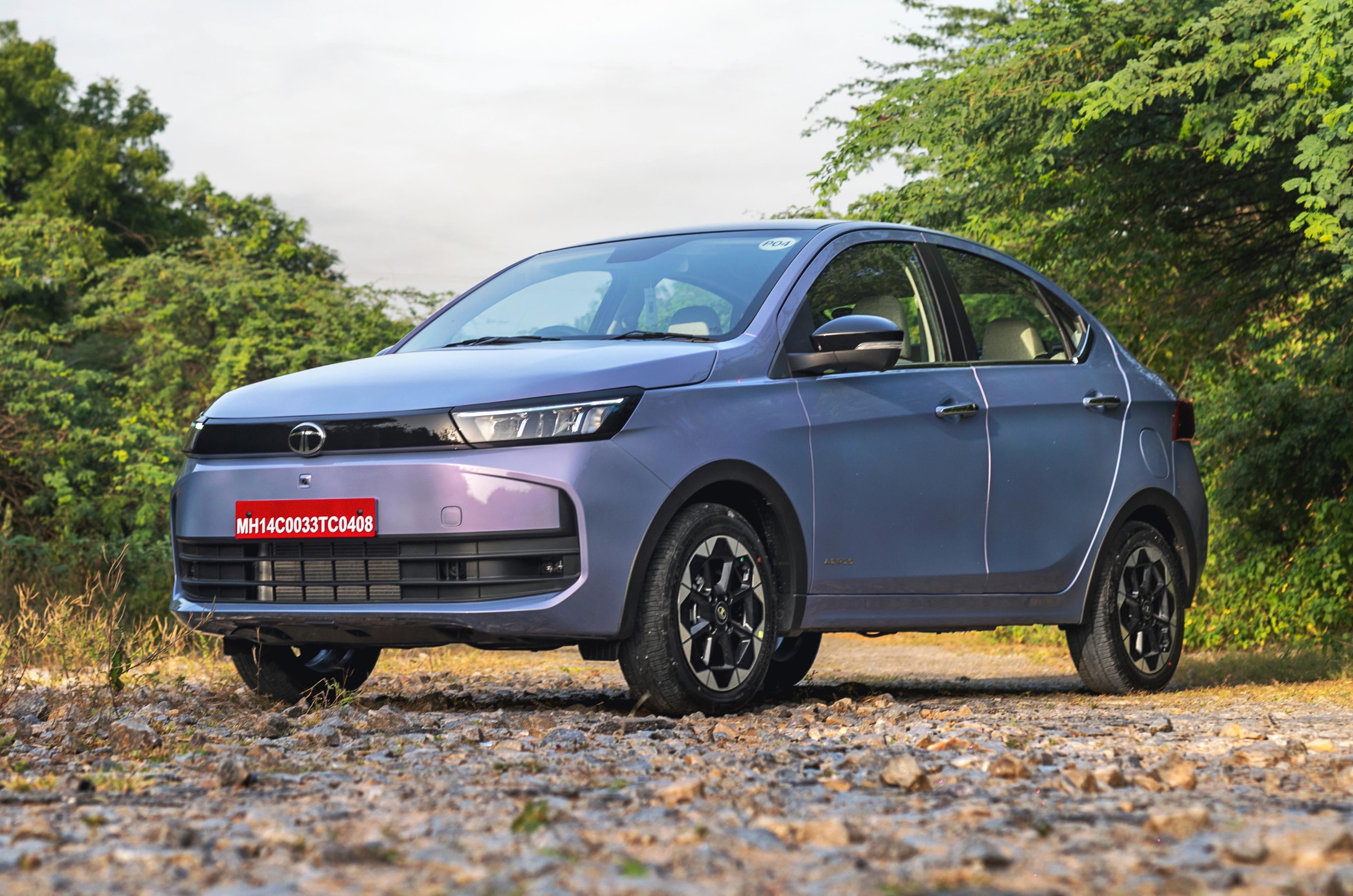
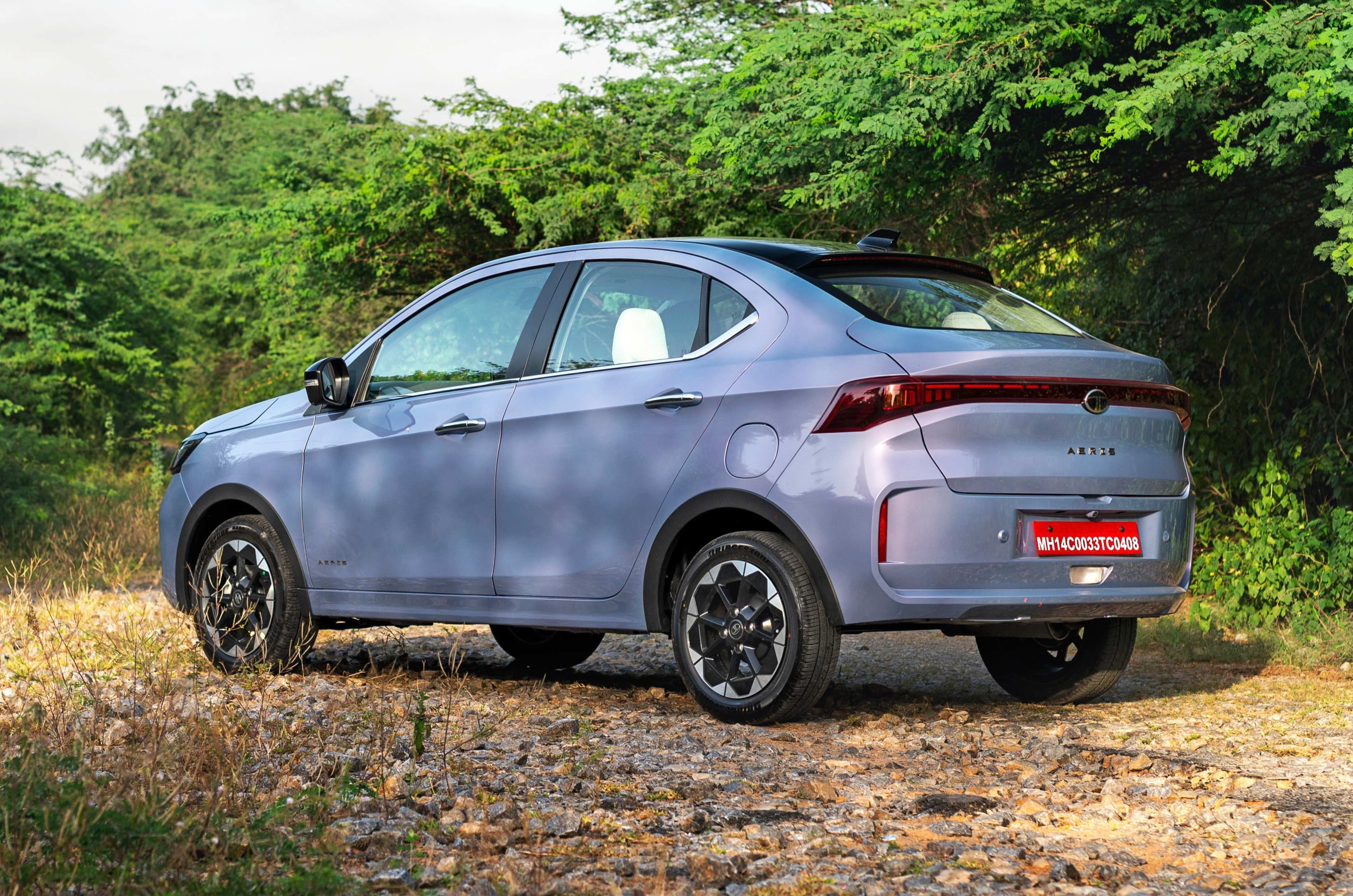
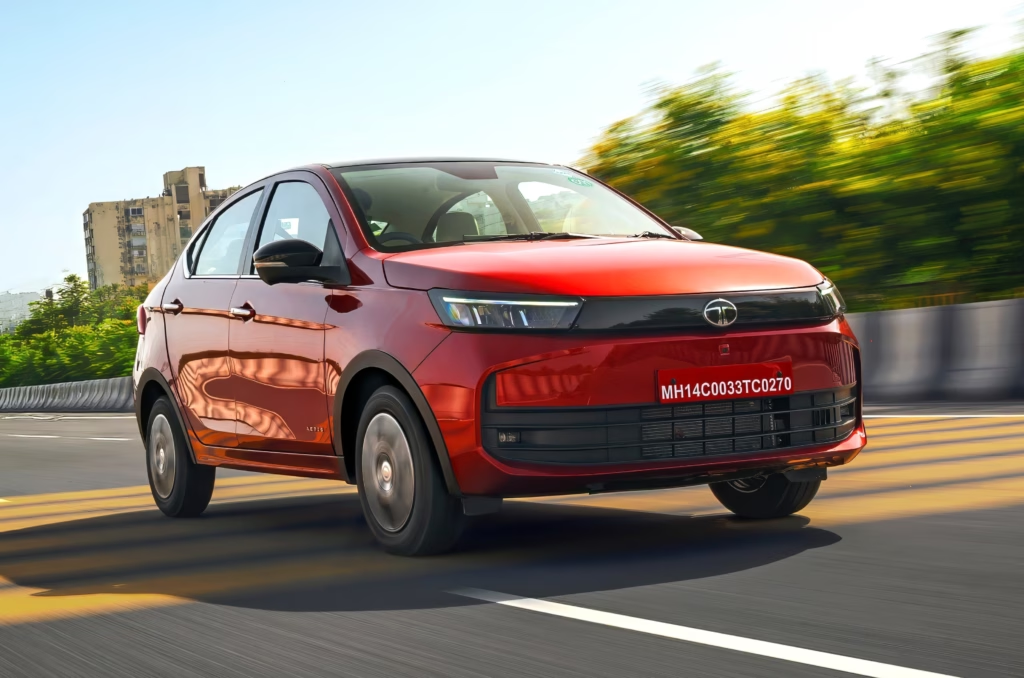
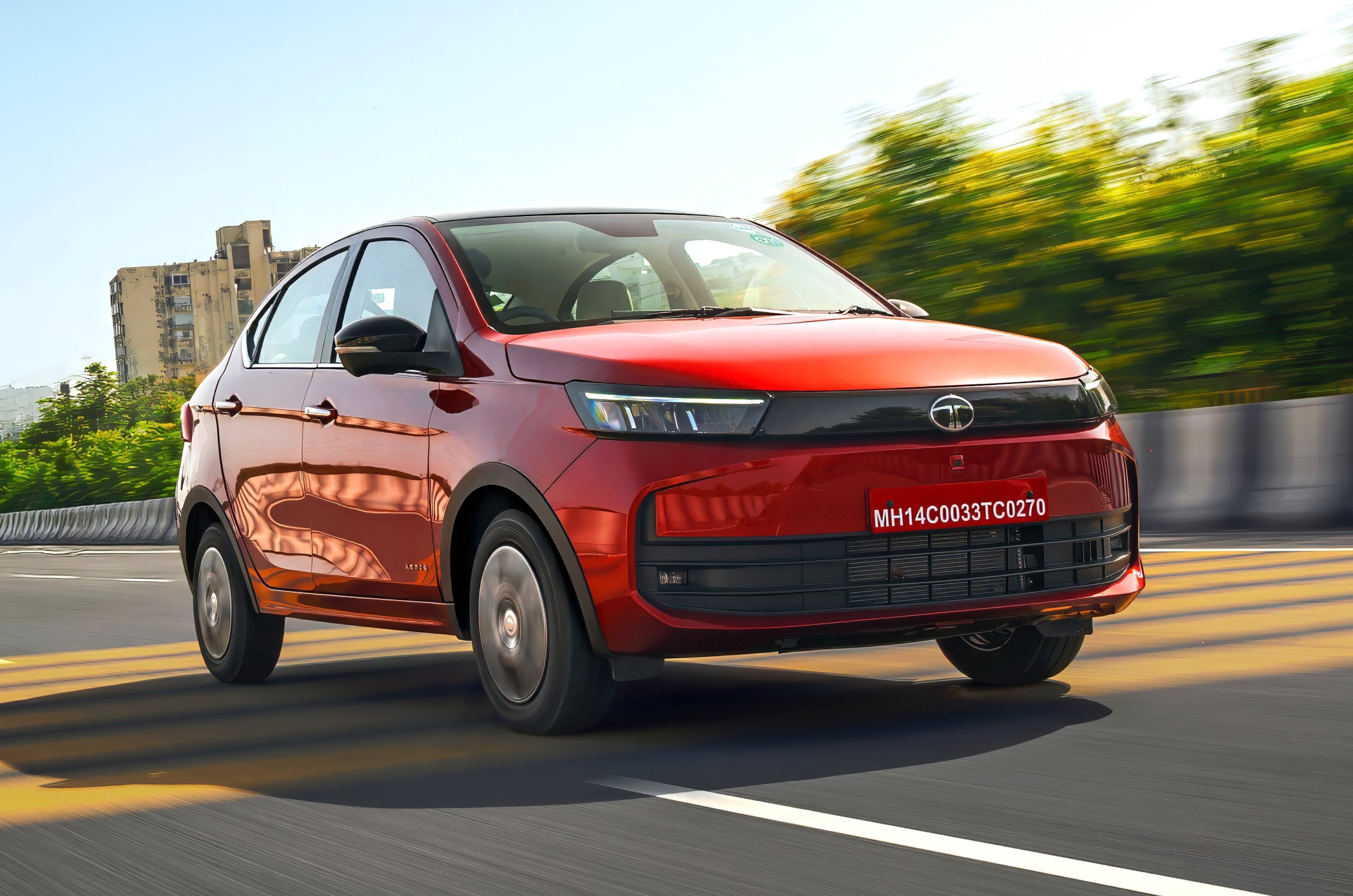
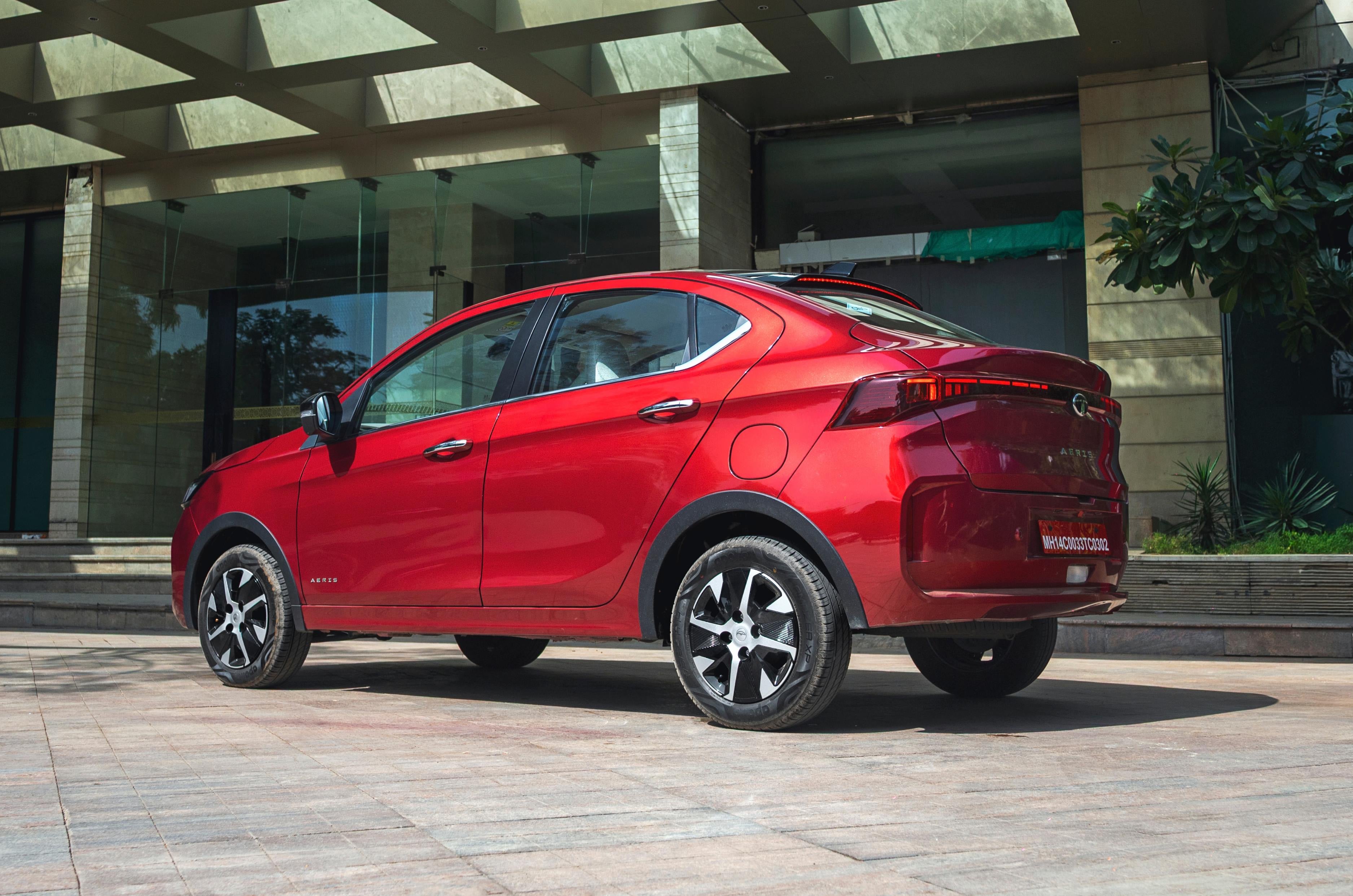
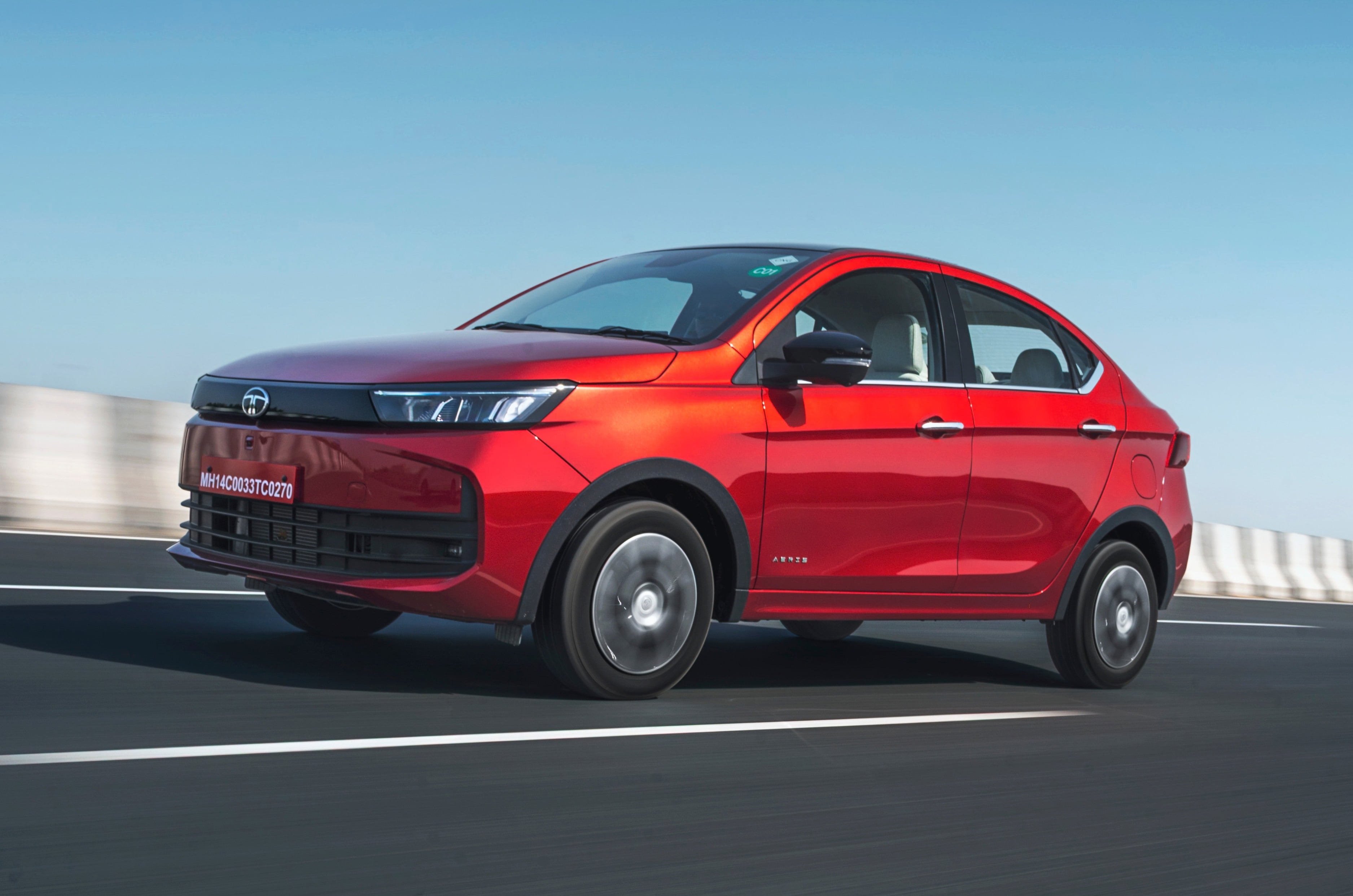
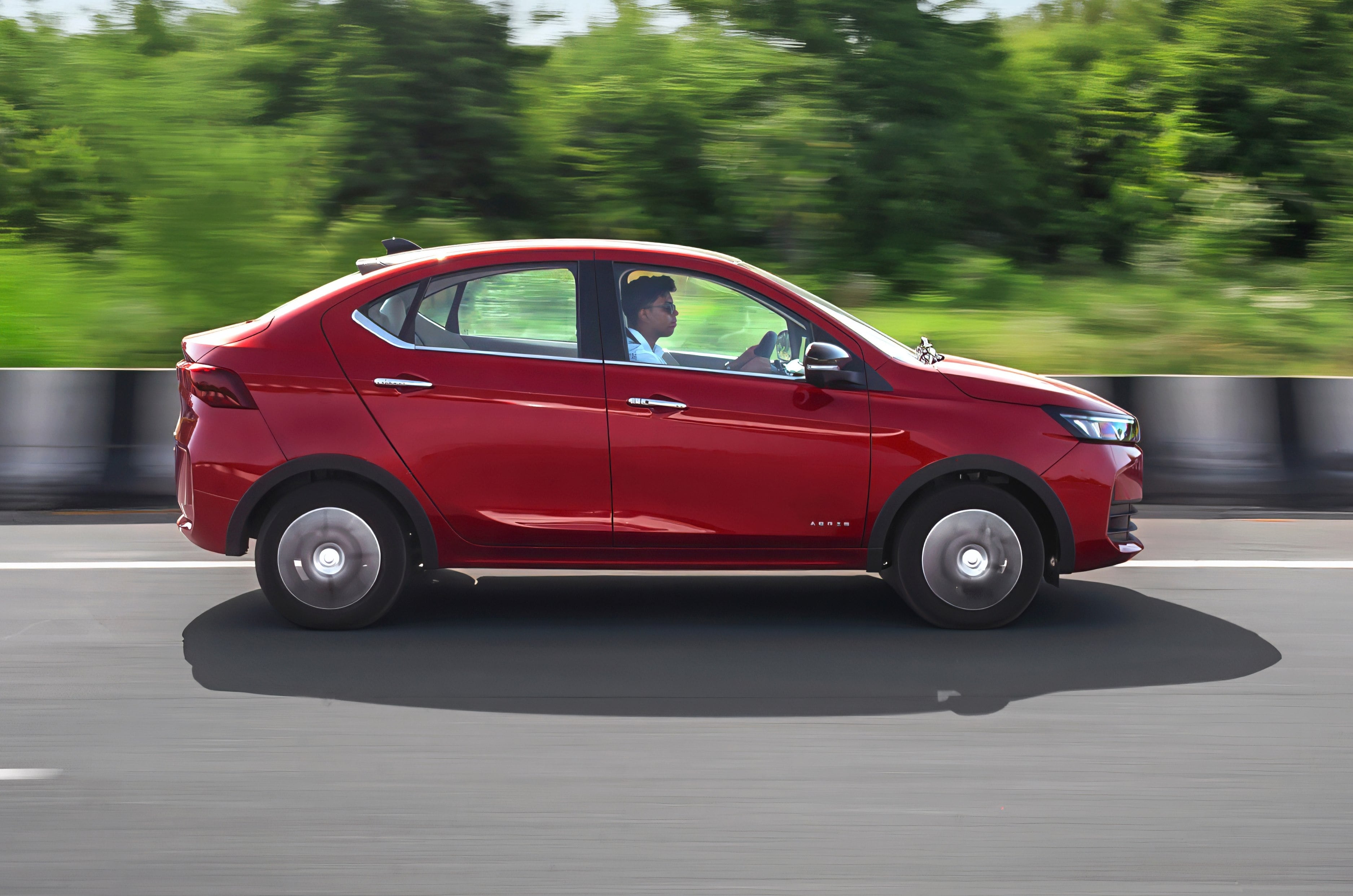
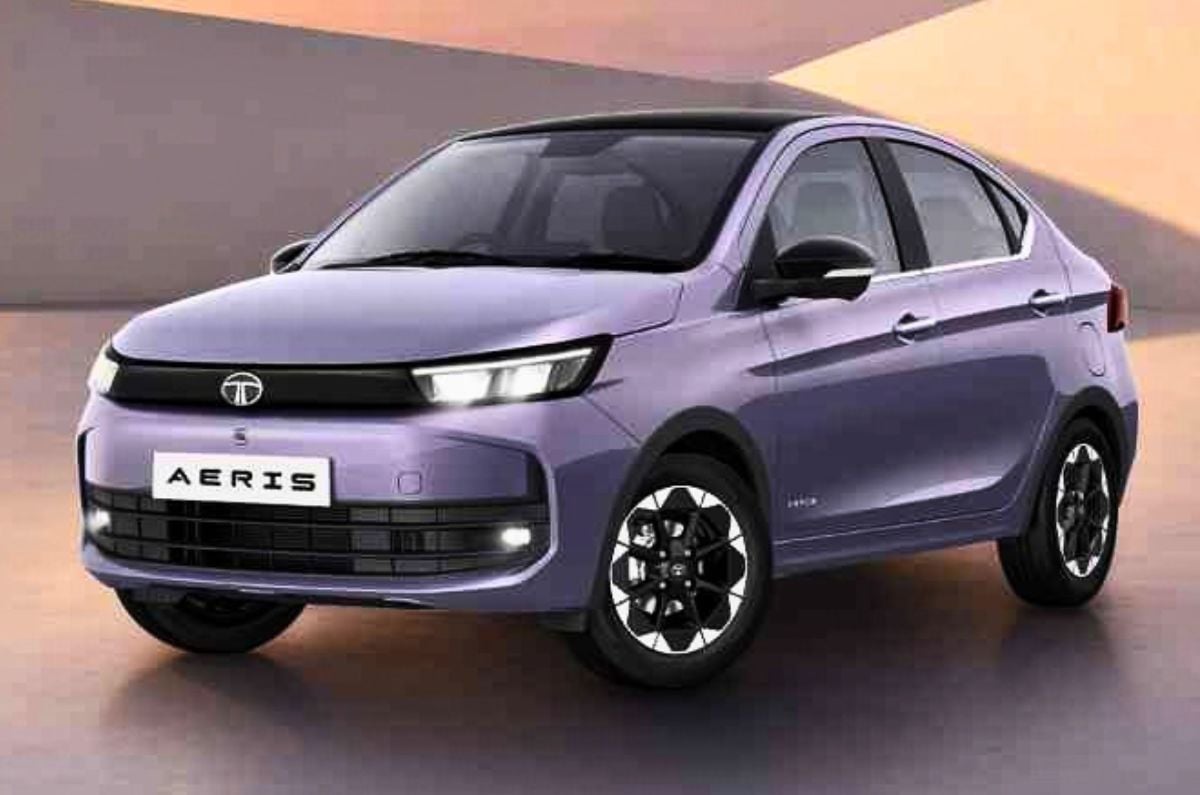
The Tata Aeris looks sleeker than before, with its design now closely aligned with the Tiago hatchback, something we have seen previously with the Tigor. Another factor that could work in the Aeris’ favour is Tata’s decision to offer it exclusively to private buyers, while retaining the Xpres, the fleet version of the Tigor, for commercial customers. This should help the Aeris steer clear of the ‘taxi’ tag often associated with rival compact sedans.
LED headlights with LED DRLs, which are connected by a black trim, make it look sleeker.
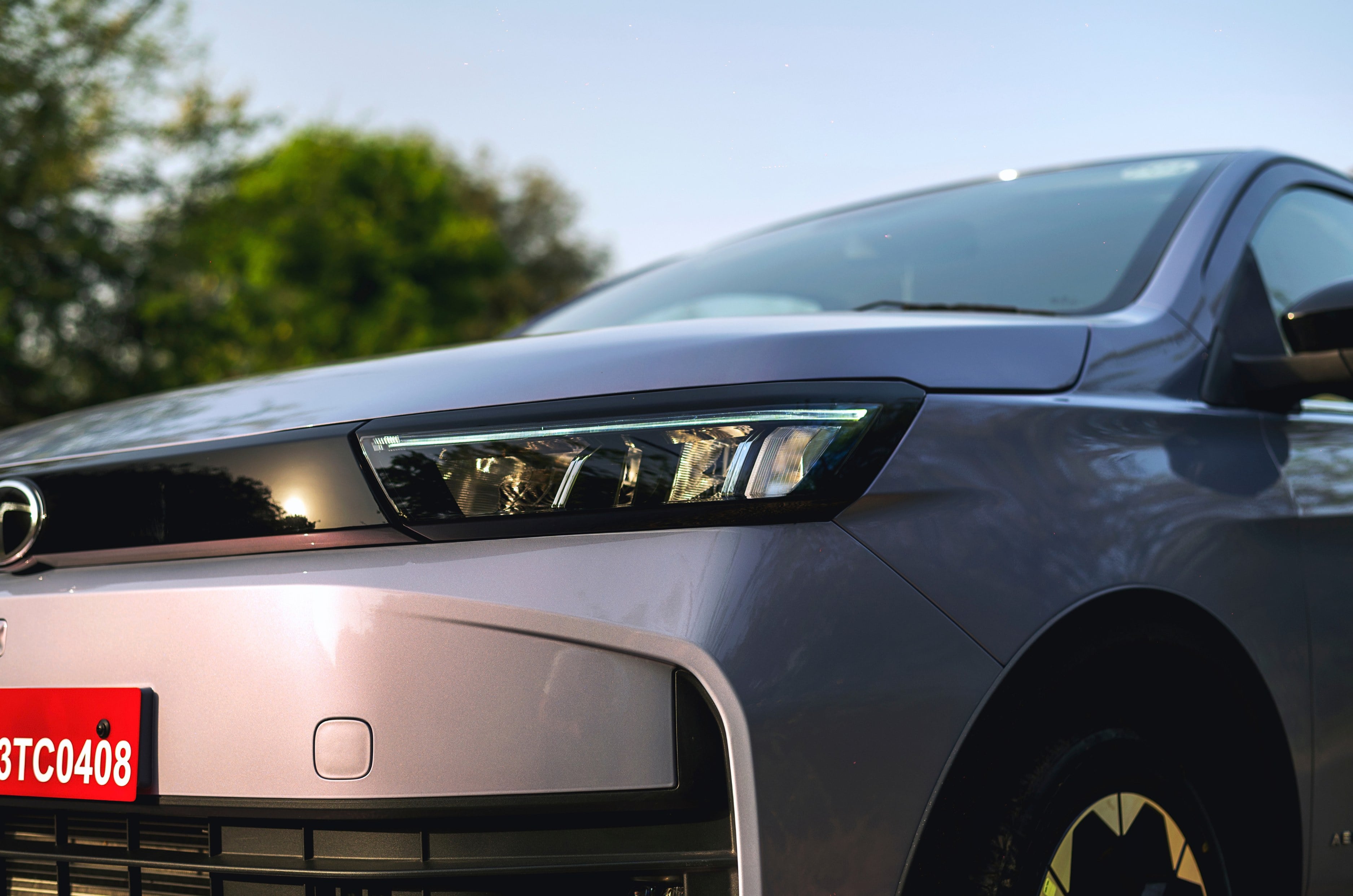
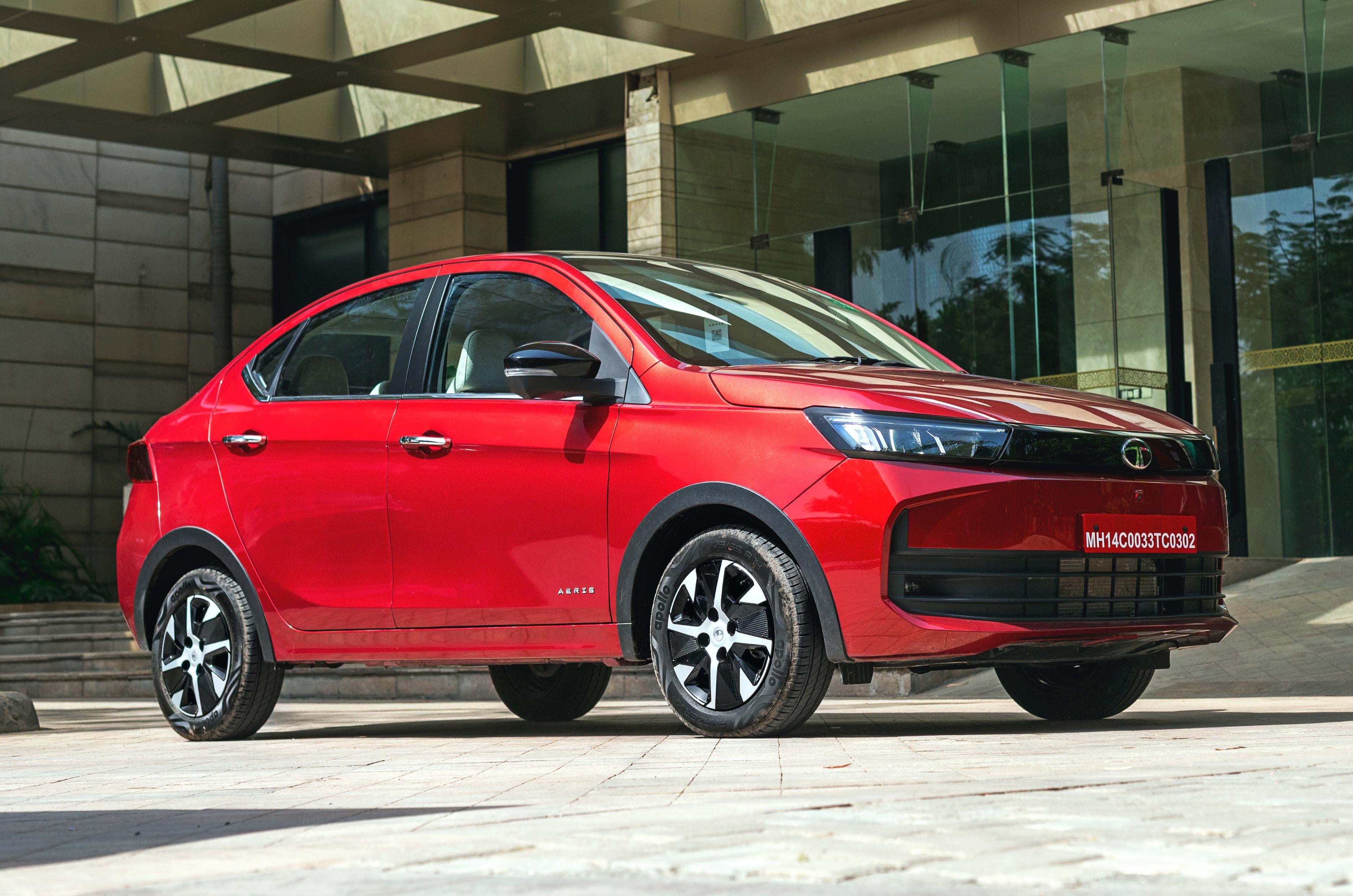
Up front, the new clamshell bonnet leads into slim LED headlights with thin LED DRL strips integrated into them. The headlights are connected by a gloss-black trim. The front bumper is also new, featuring wider air intakes and LED fog lamps, a welcome upgrade over the Tigor’s halogen units.
Top versions get 15-inch alloy wheels; 14-inch wheels on other variants appear undersized.
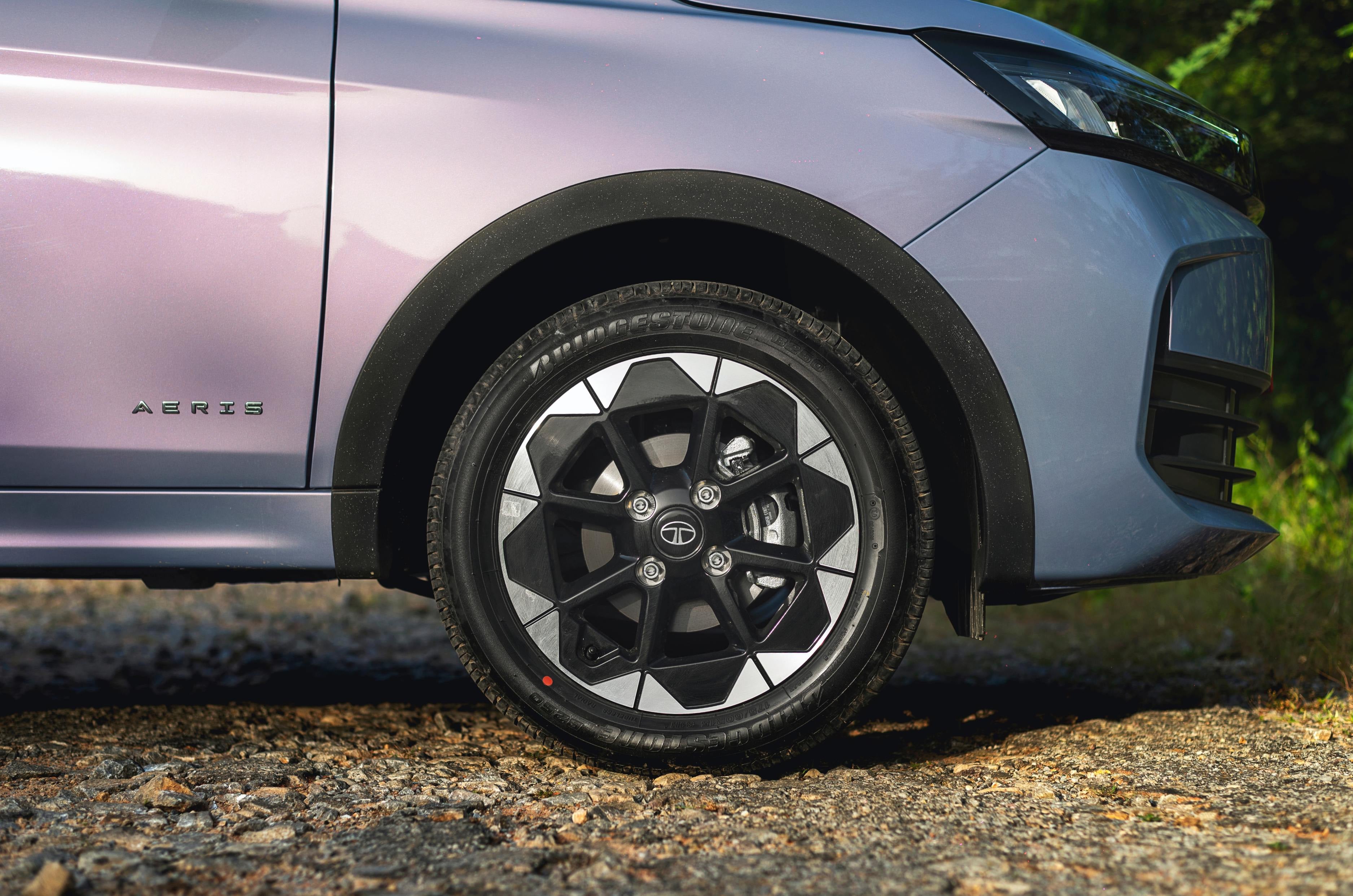
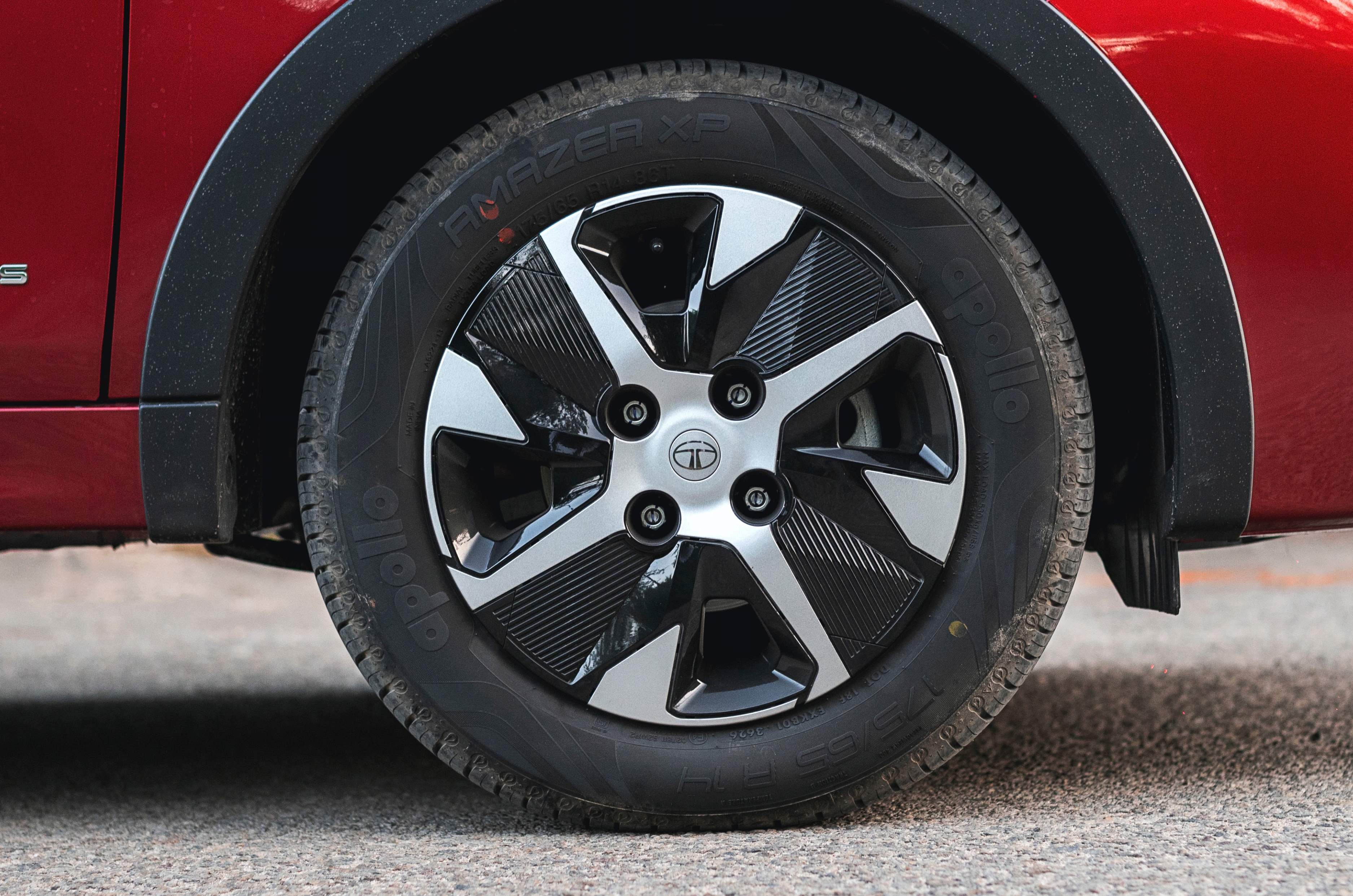
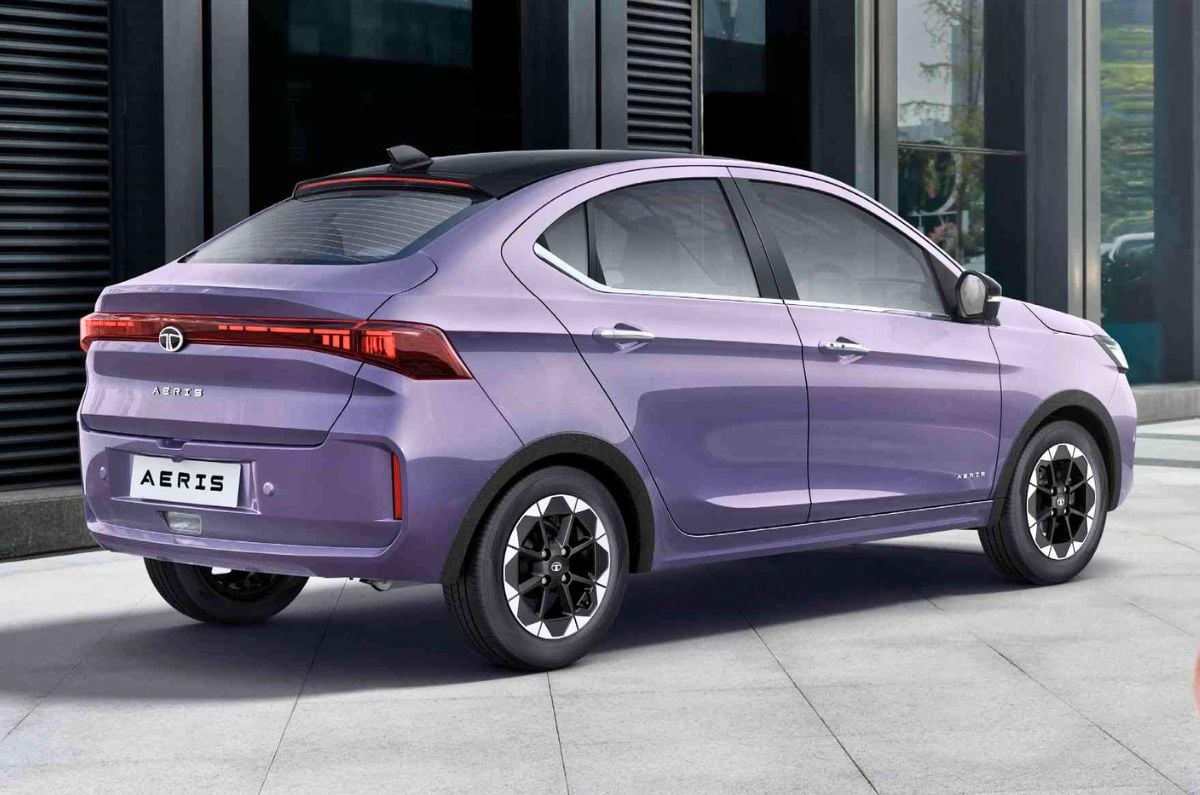
In profile, the 15-inch dual-tone alloy wheels fill the wheel arches nicely, and their contrasting finish looks particularly appealing when the Aeris is on the move. The wheel arches get slim cladding, which Tata says is made from recycled materials and features a distinctive speckled texture. Like the Tigor, the Aeris also gets chrome door handles and a chrome strip along the window line, adding some contrast to the otherwise clean design.
Fastback-like roofline remains a distinctive design element.
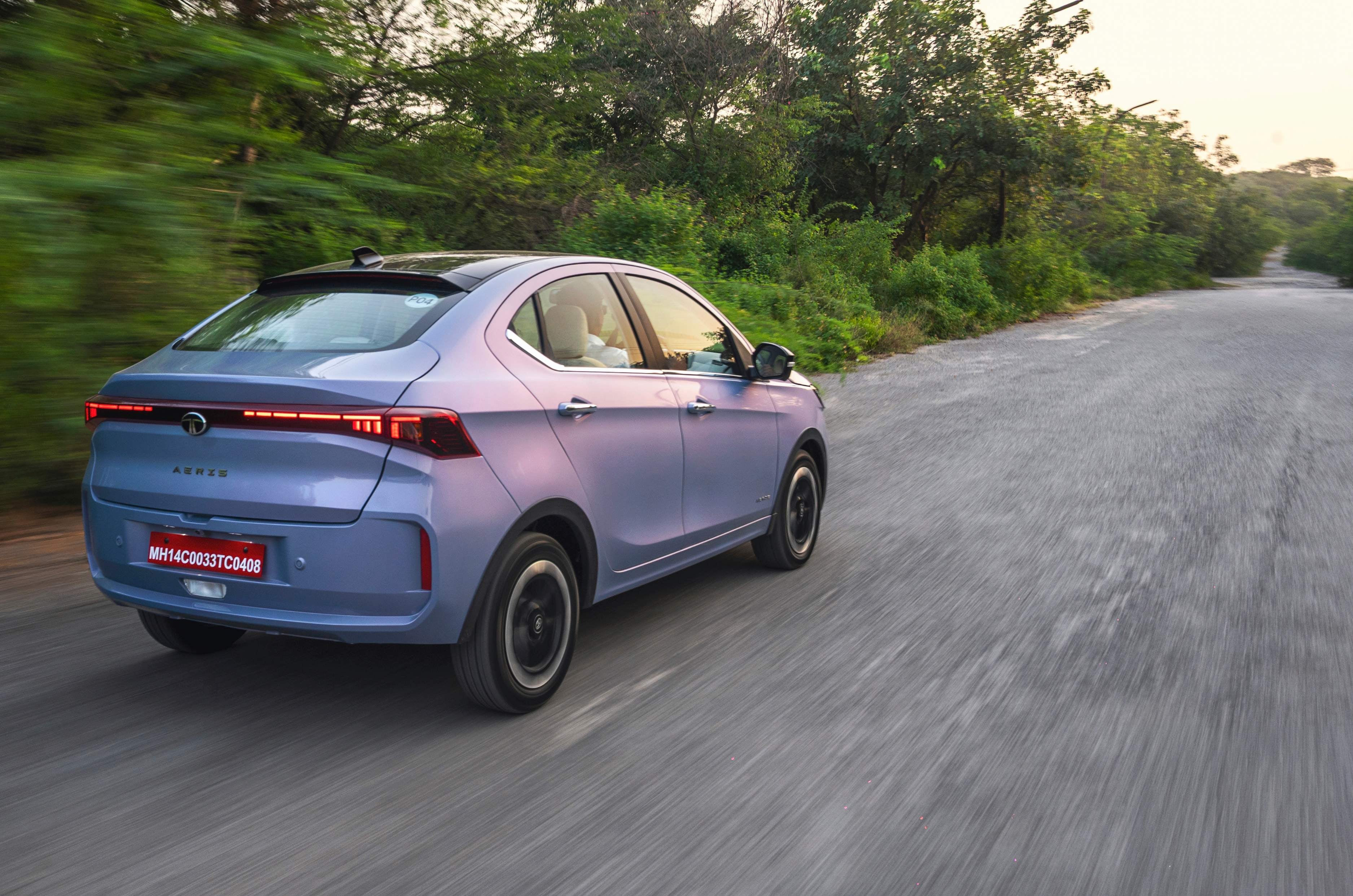
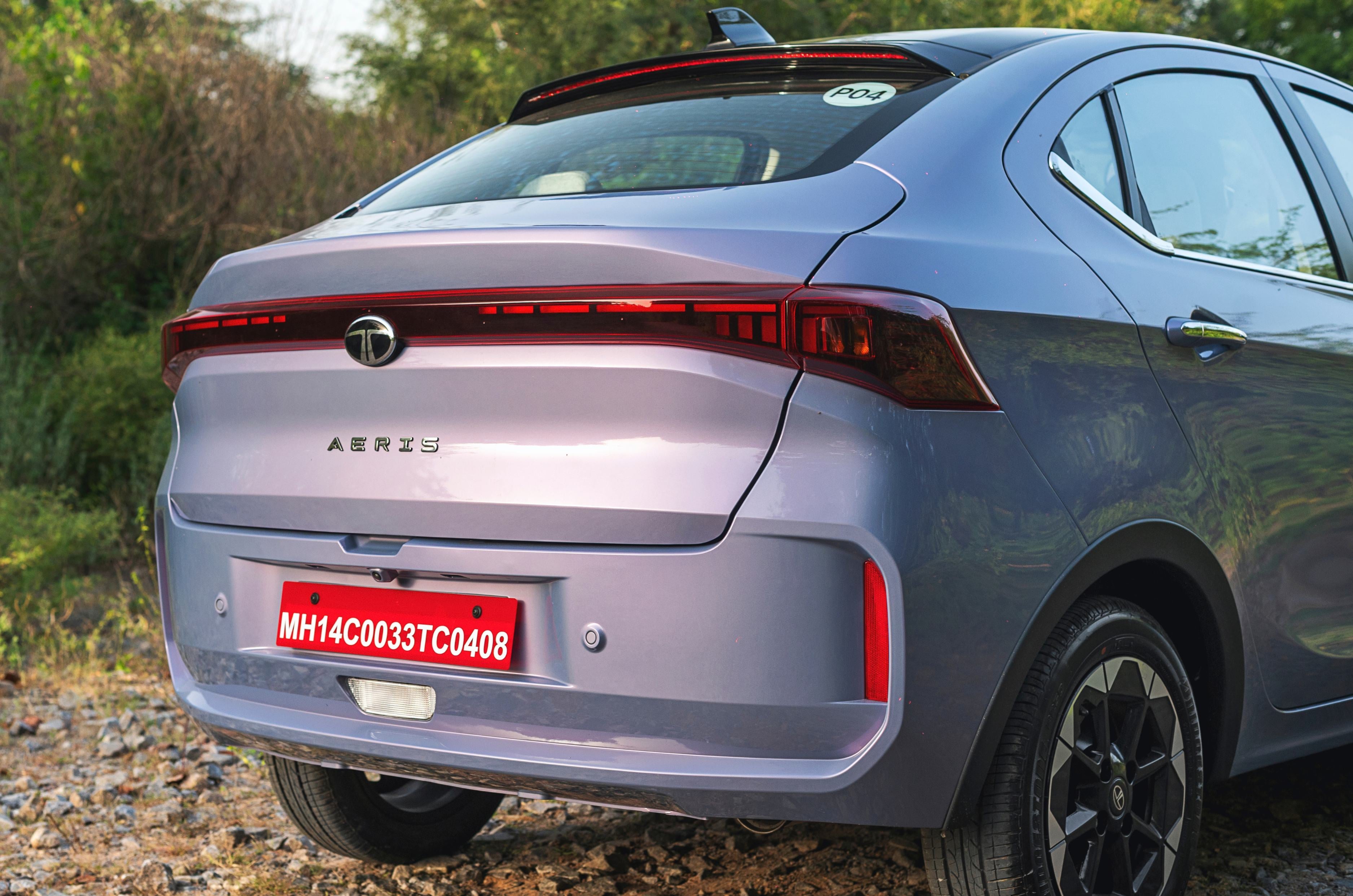
The coupe-like, tapering roofline remains unchanged from the Tigor, and continues to make the Aeris’ overall design cohesive. At the rear, the new taillights give the sedan a more modern appearance, while the red trim connecting them visually makes the Aeris appear larger than it is. The rear bumper is cleanly styled, with the reverse light neatly positioned in the centre.
The Aeris measures 3,995mm in length, 1,684mm in width and 1,532mm in height, and has a 2,450mm wheelbase.
Tata Aeris petrol interior space and comfort – 8/10
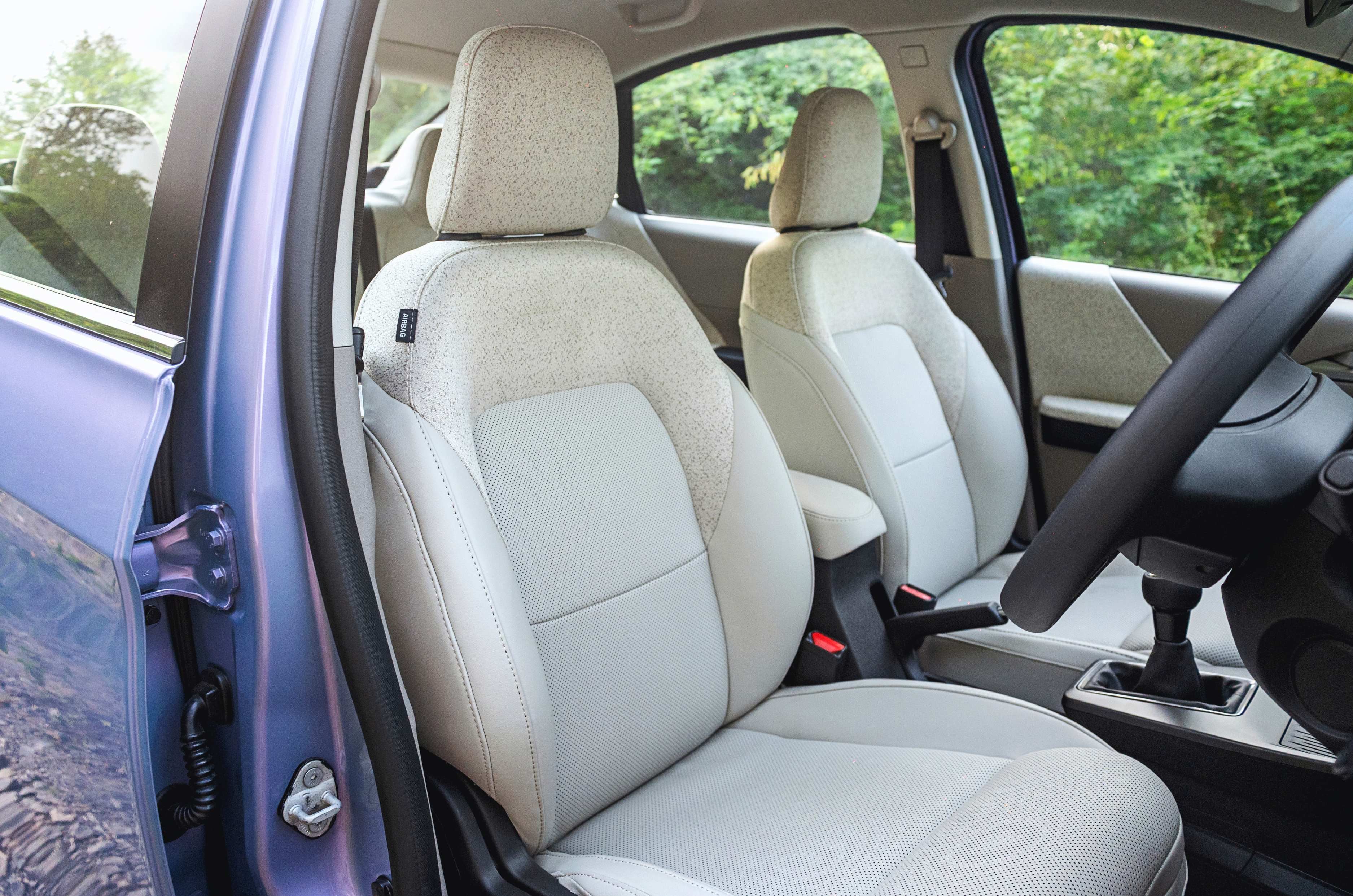
Beige theme makes the interior feel airy, and everything is nicely laid out in the cabin
Beige theme lends the cabin an airy feel; dashboard is neatly laid out.
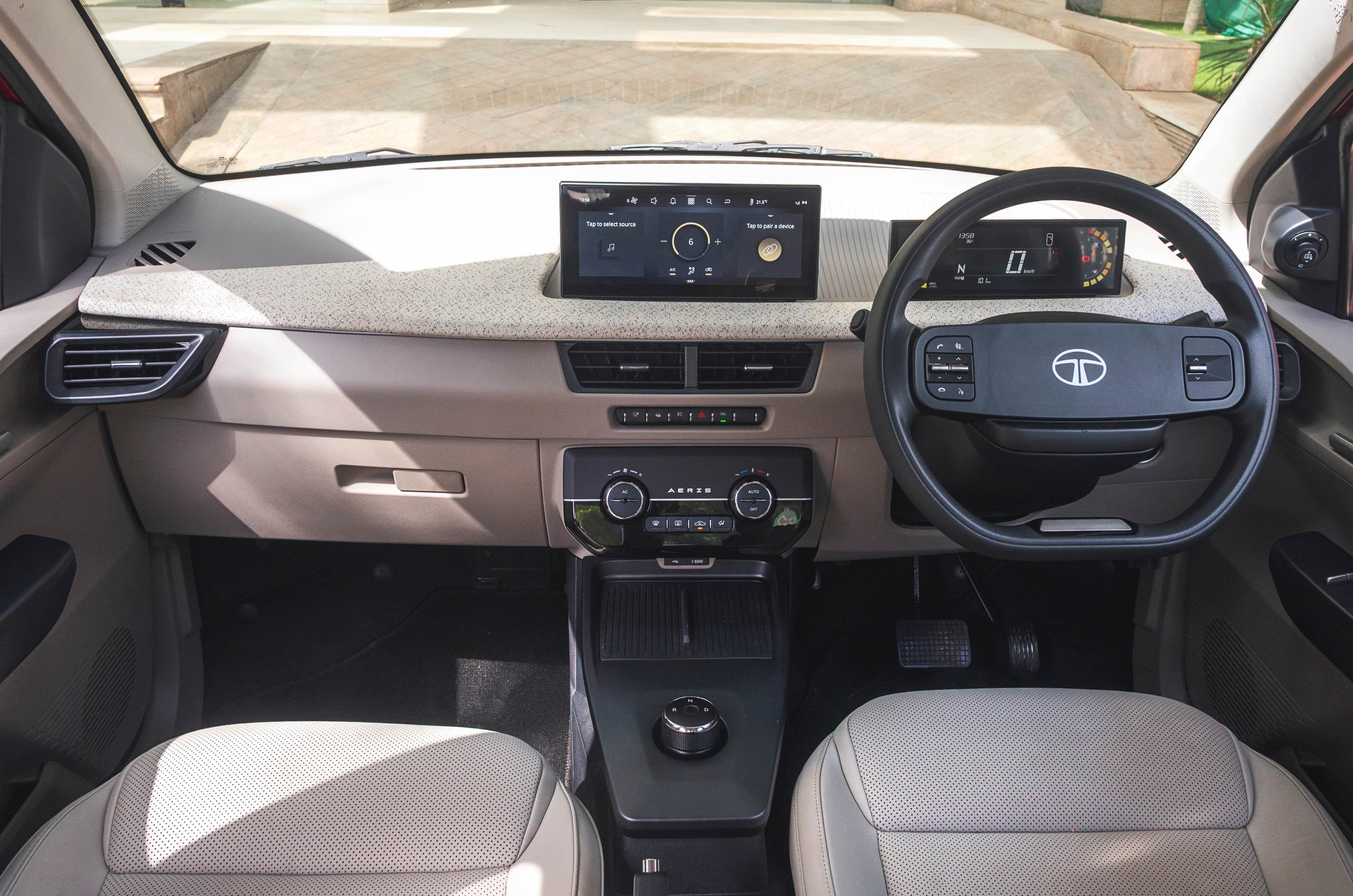
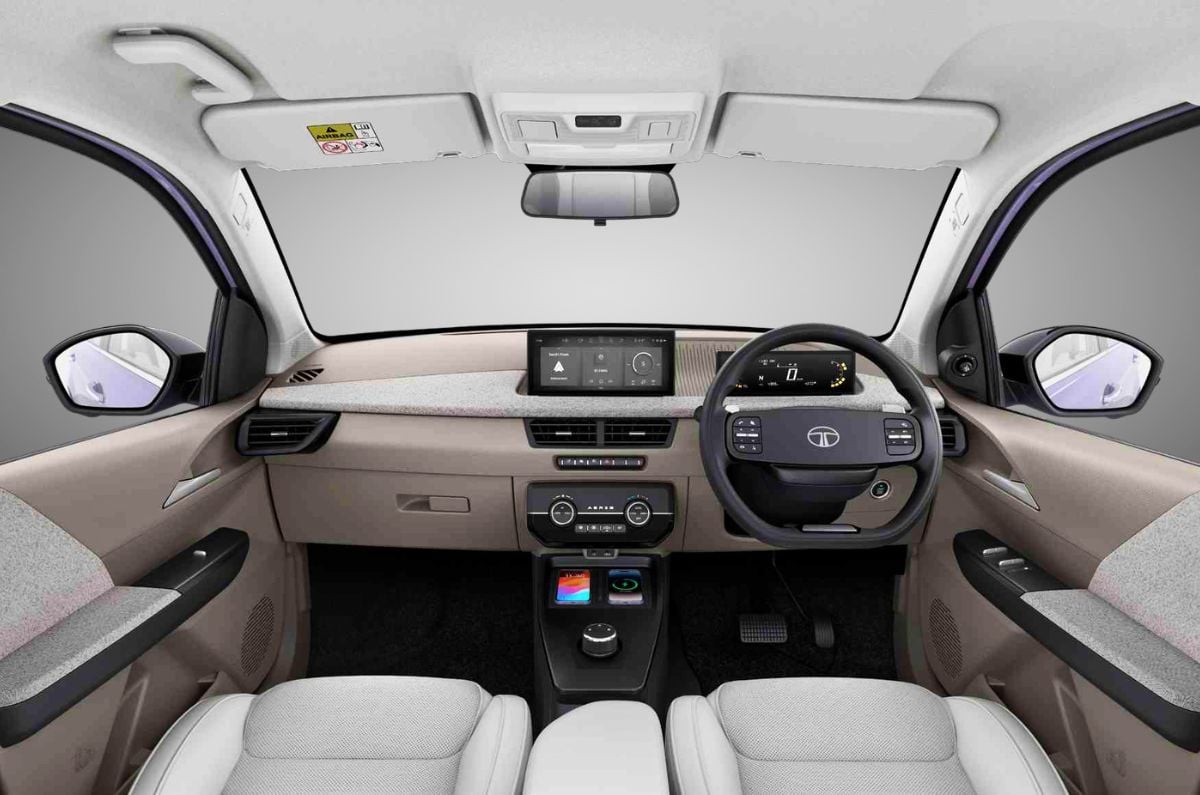
The Aeris’ interior is neatly laid out and looks fairly modern. The cabin gets a beige colour scheme, which makes it feel airy and gives the sedan a greater sense of space. However, the light shade could prove difficult to keep spick and span, especially with regular use.
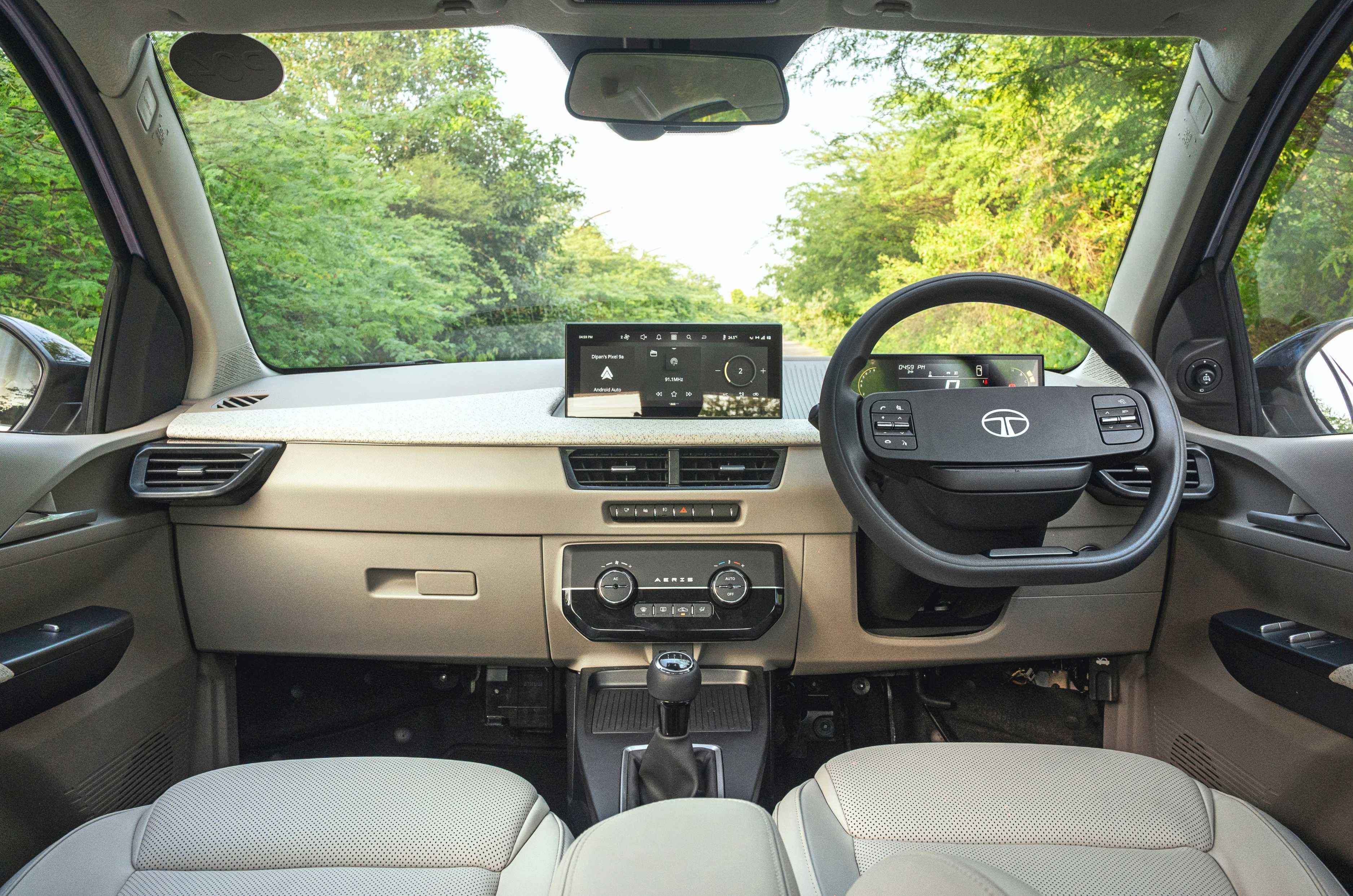
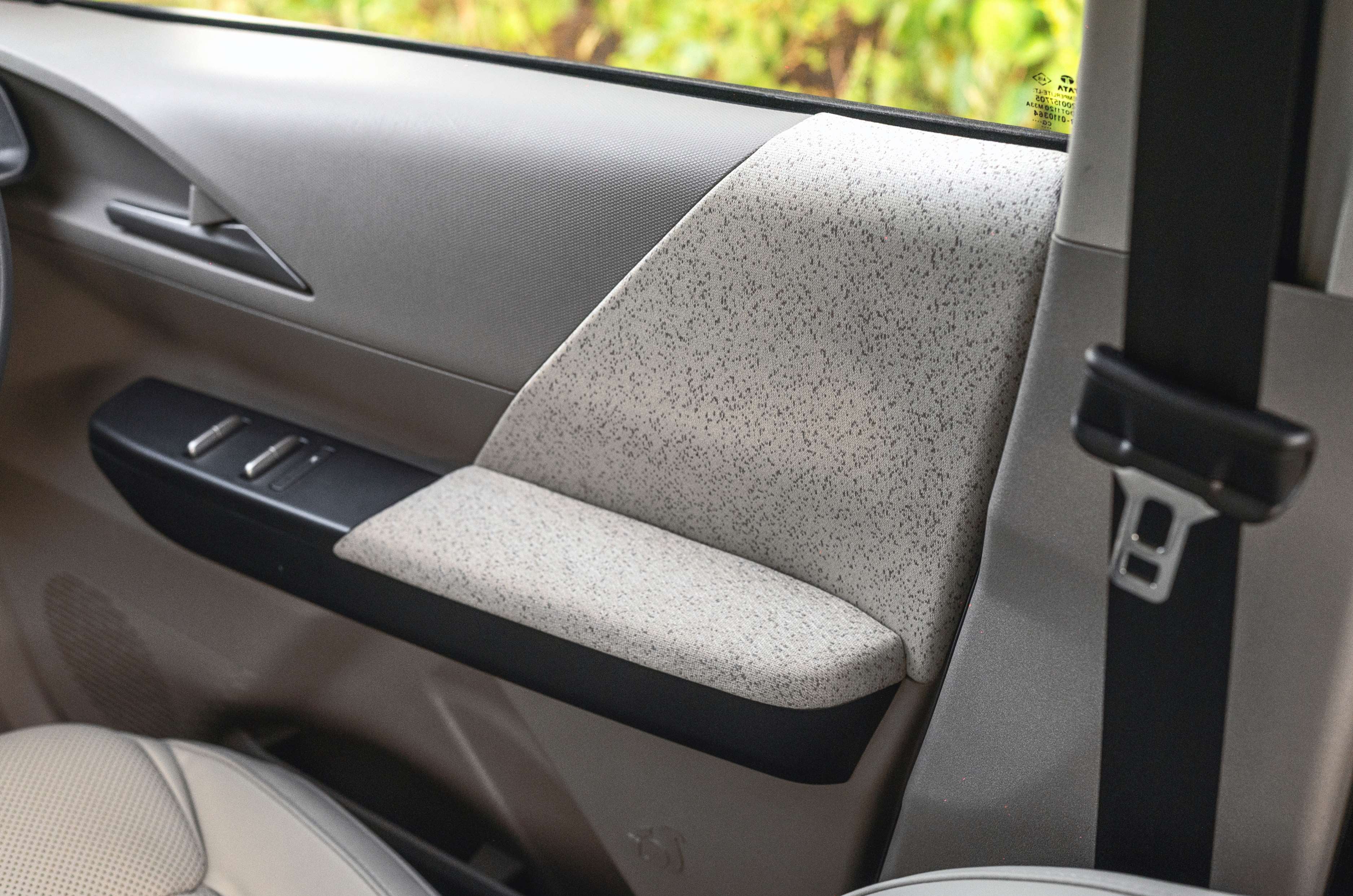
The dashboard houses a 10.25-inch infotainment touchscreen, a free-standing semi-digital instrument cluster and a revised two-spoke steering wheel. The latter retains physical buttons and, thankfully, does away with the scratch-prone gloss-black finish seen on the Tigor. The door handles look floating like the Sierra and feel sturdy. Lower down, Tata has retained rotary dials and physical buttons for the climate control. They feel solid and do not come across as flimsy.
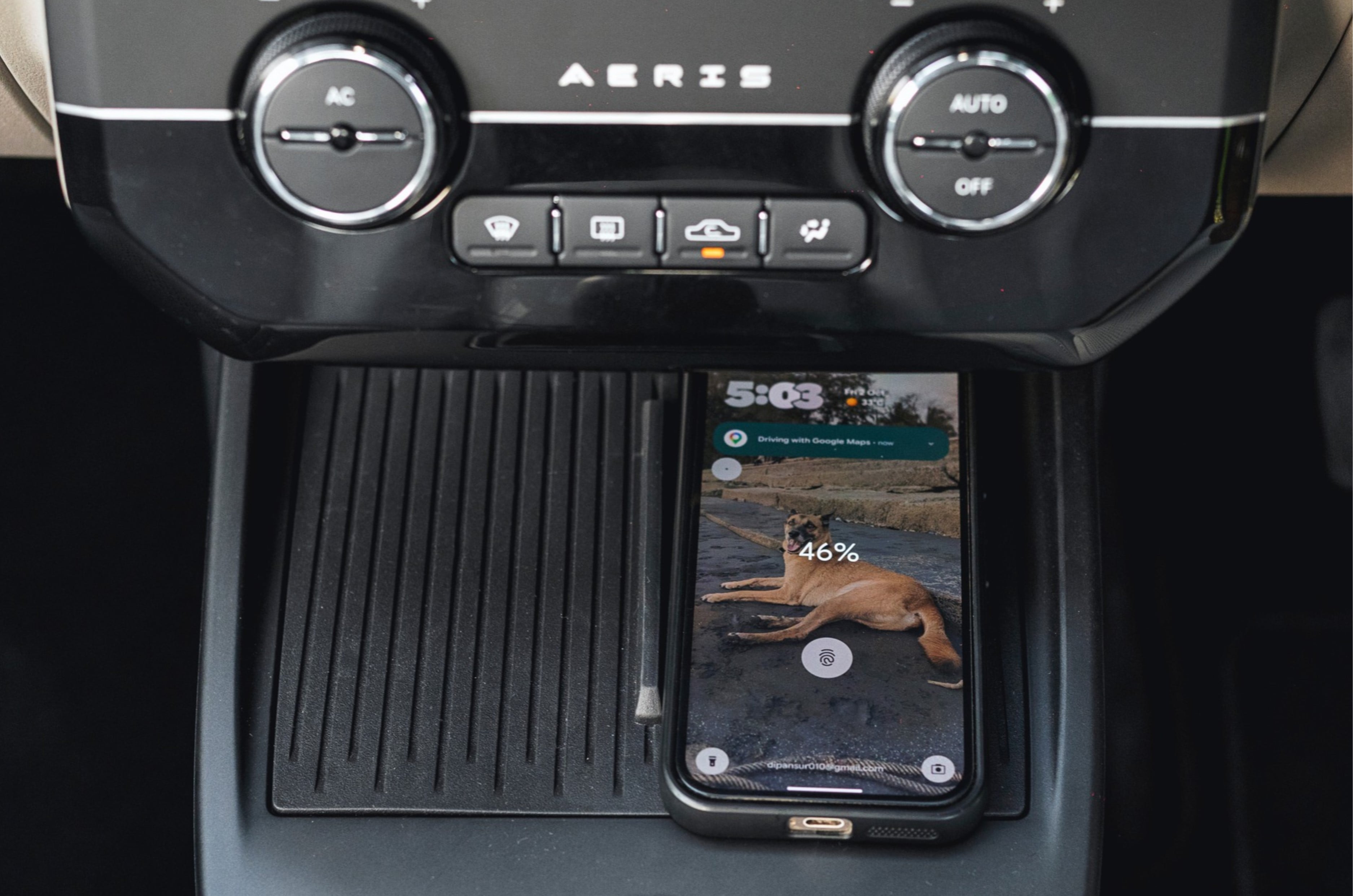
The wireless charger works well but tends to make the phone hot during prolonged use.
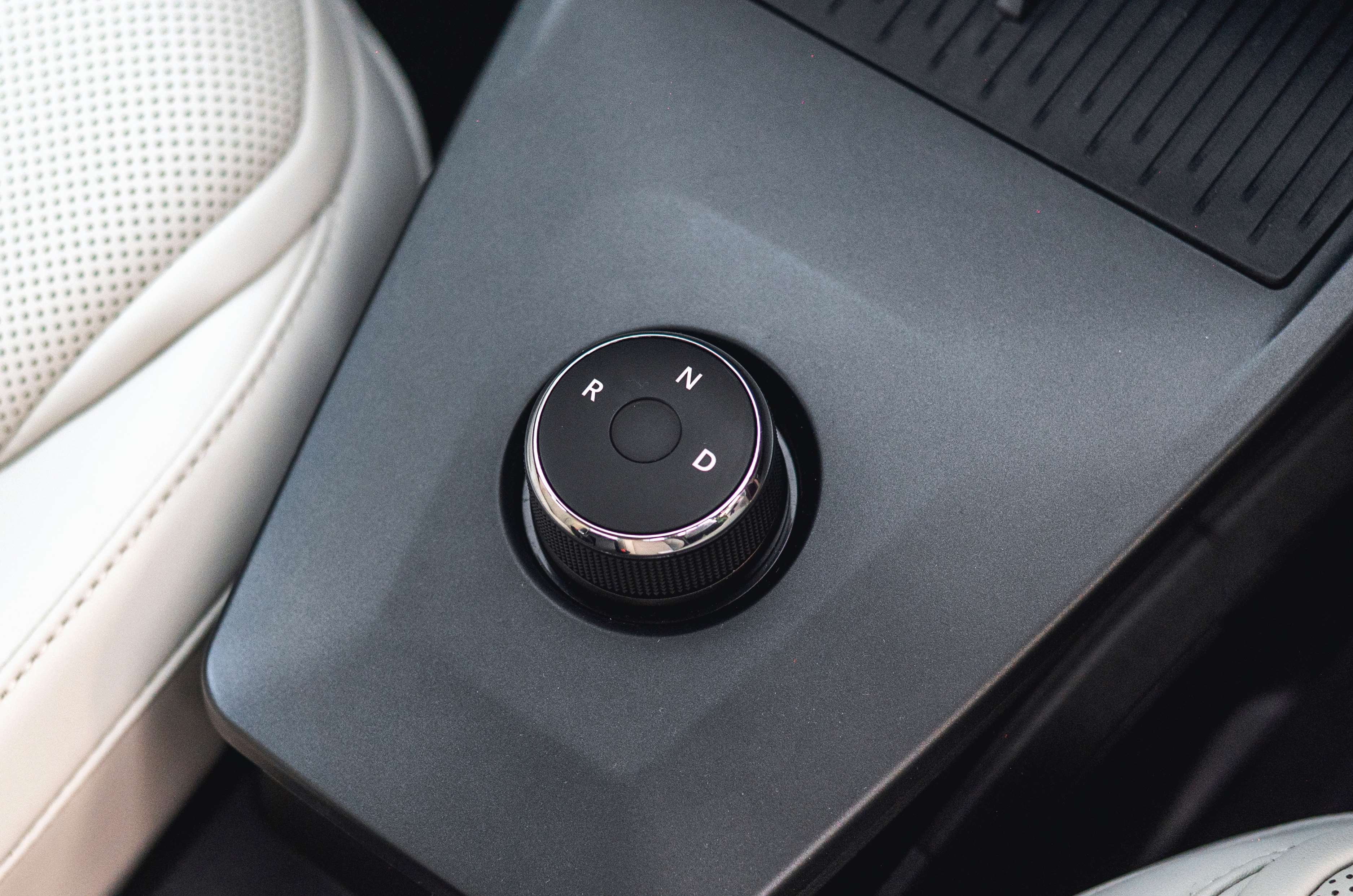
The centre console has been thoroughly redesigned and looks neat. The manual gear lever looks premium and feels good to hold, while the AMT gets a rotary dial that also feels solid and operates seamlessly. Two rubberised phone holders on the console keep phones from sliding around, and the top-spec Accomplished trim offers wireless charging in one slot. The centre console also gets two cupholders and a leatherette-wrapped centre armrest with integrated storage space underneath.
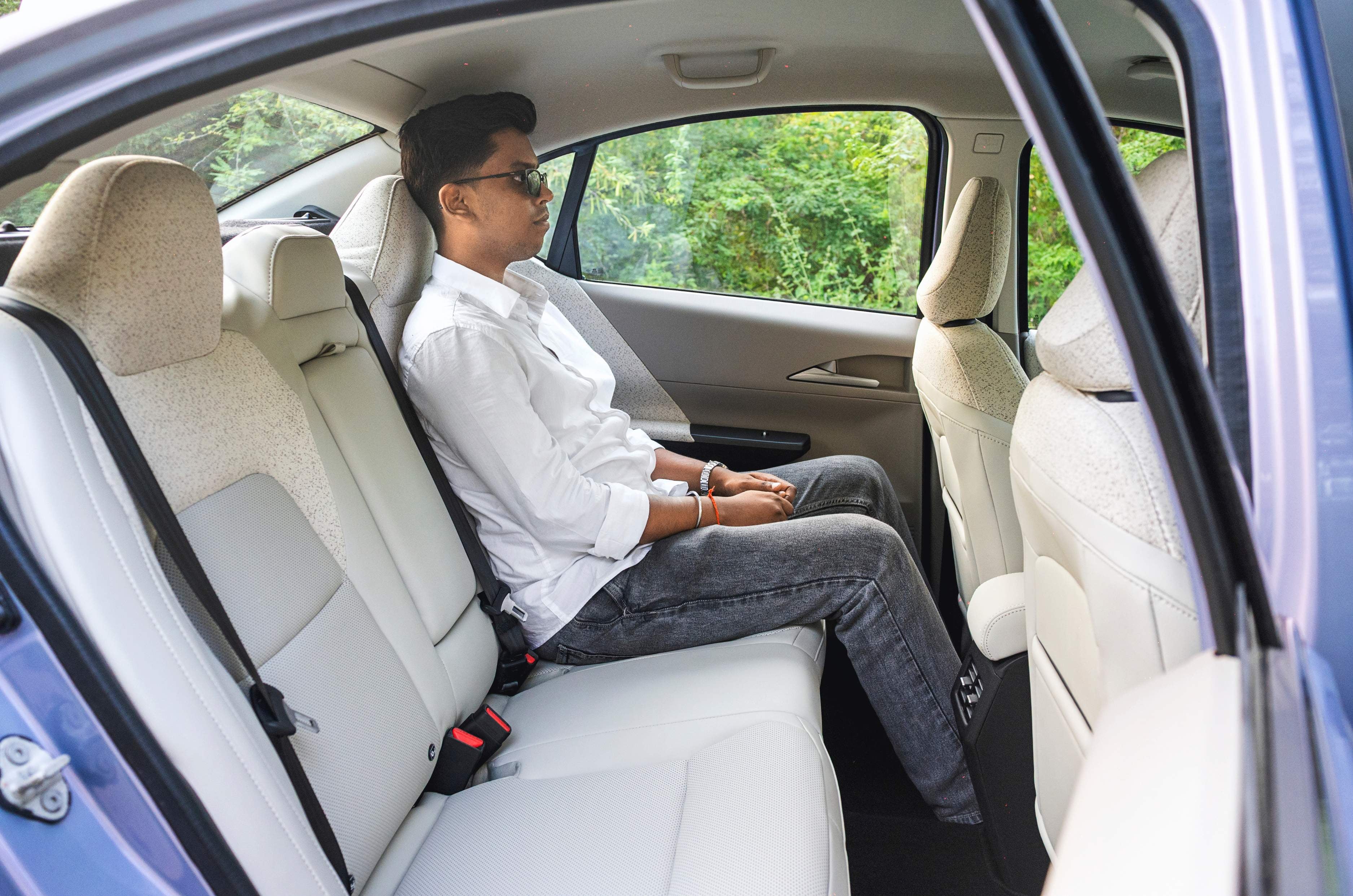
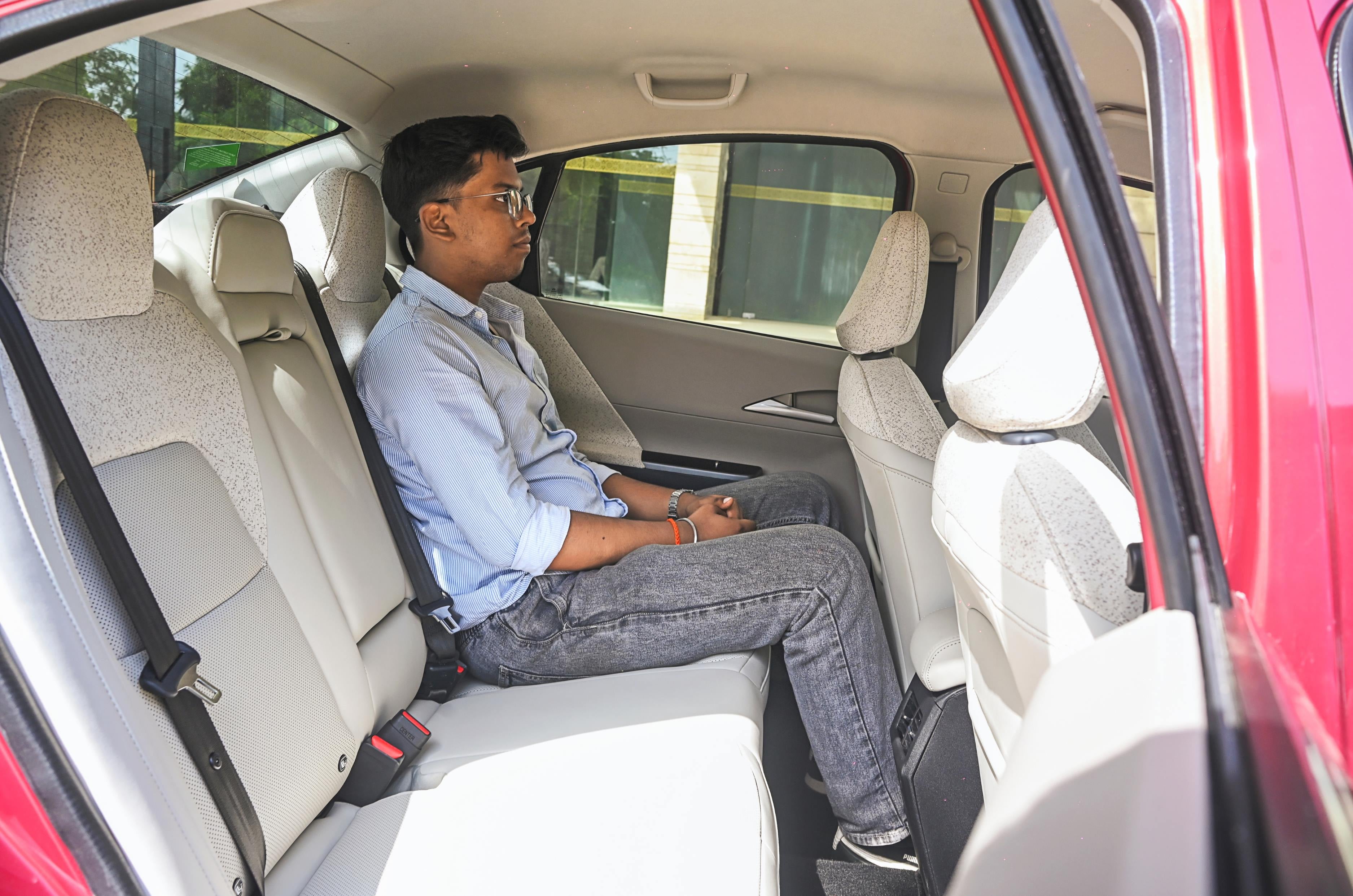
The rear seat offers good kneeroom and legroom, while headroom can be tight for taller passengers.
Tata offers part-leatherette upholstery and has revised the cushioning and bolstering, ensuring comfort even on long journeys. They also get a segment-first ventilation function. The rear seats are comfortable too, with good legroom and kneeroom, although headroom is a little tight for passengers over six feet tall. Under-thigh support is adequate.
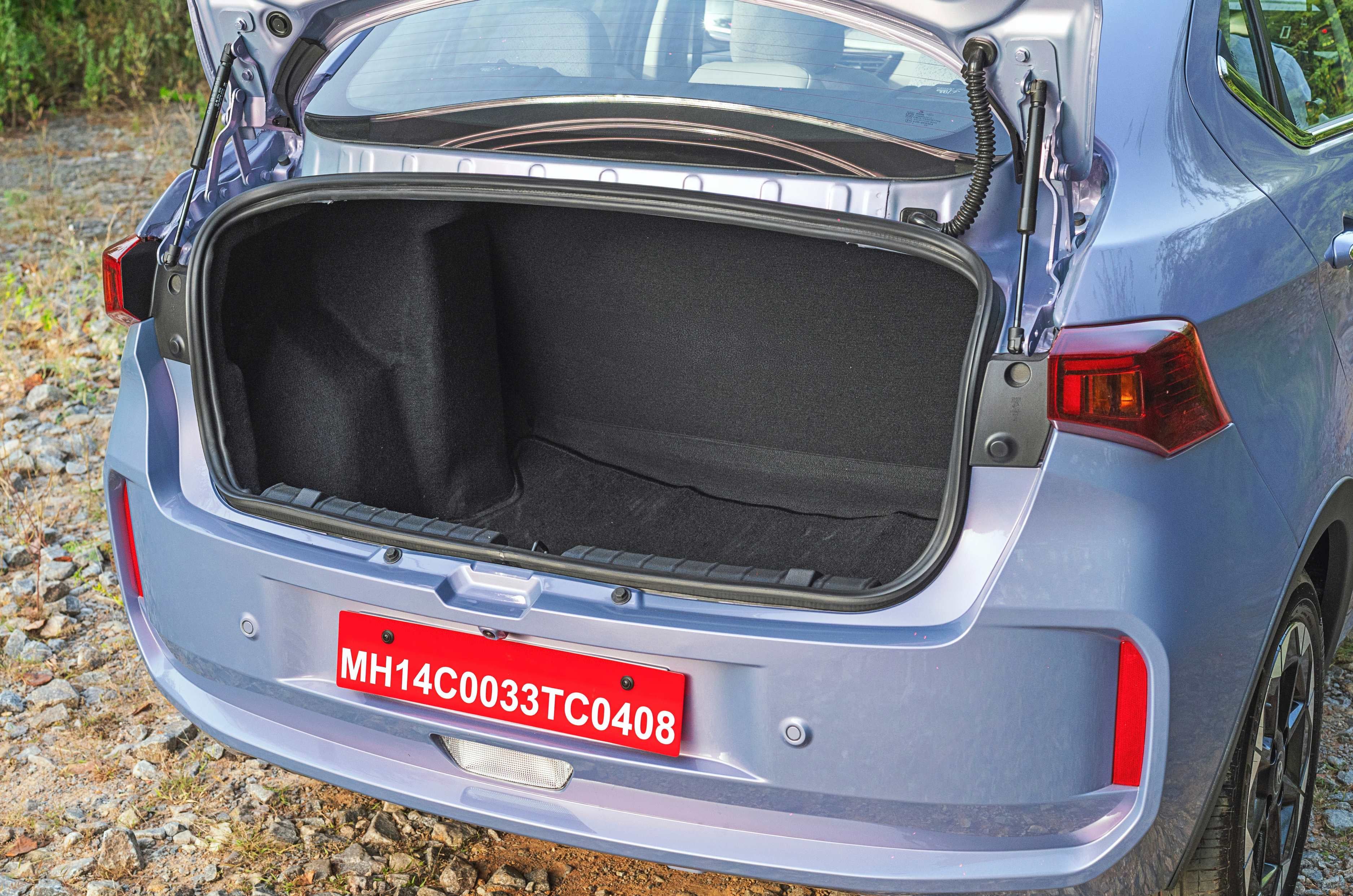
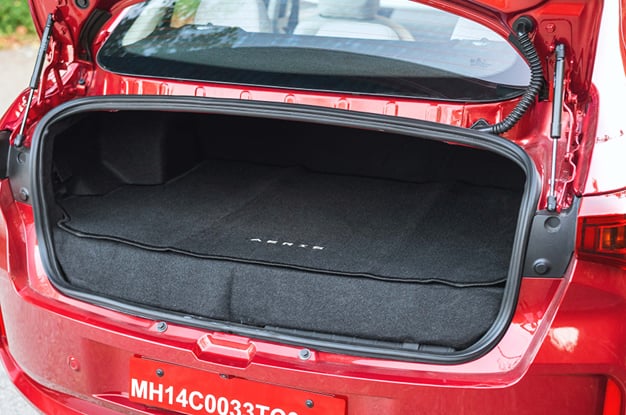
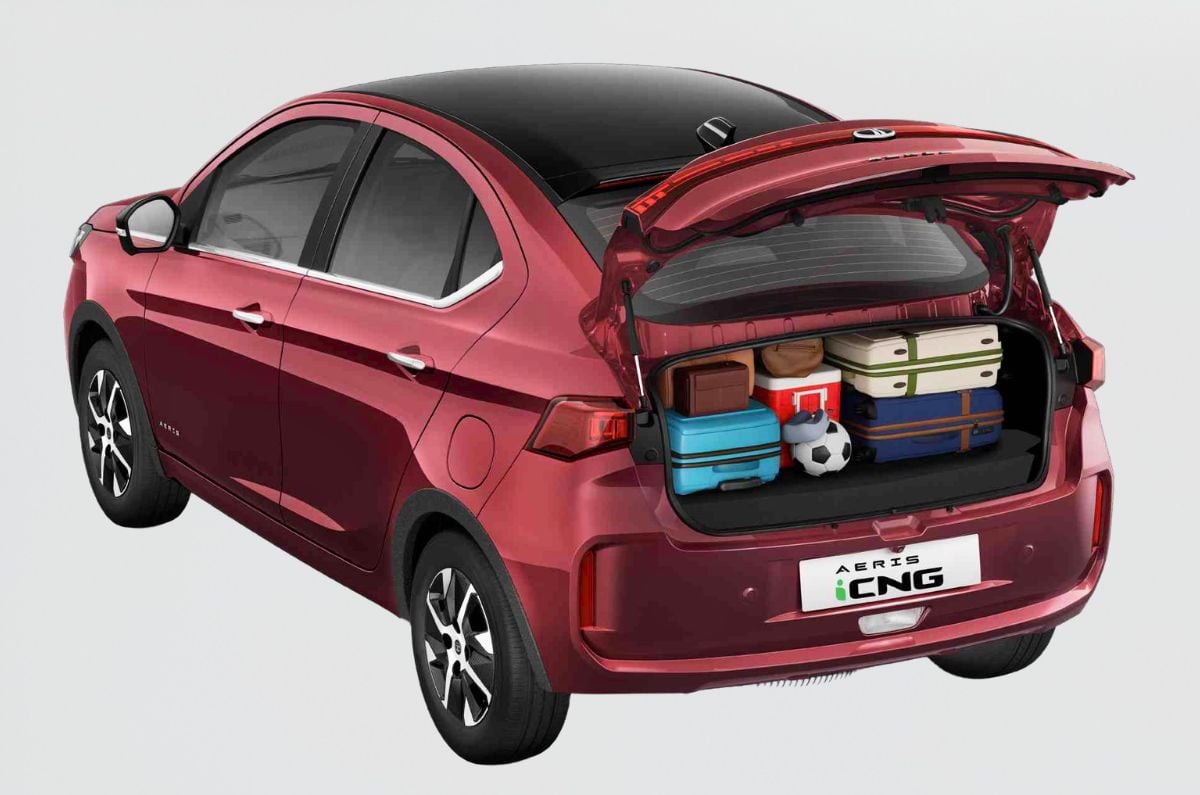
The 419-litre boot is handily large, but the aperture makes loading tricky. Struts free up more usable space.
The Aeris offers 419 litres of boot space, marginally more than the Amaze’s 416 litres and comfortably ahead of the Dzire’s 382 litres and Aura’s 402 litres. The boot itself is large and can swallow a substantial amount of luggage. The use of mechanical struts instead of conventional hinges is a clever touch, as they do not eat into the available boot space. Despite the large boot, the Aeris gets a 14-inch underbody-mounted spare wheel, which is always more promising than a puncture repair kit.
Tata Aeris petrol features and safety – 9/10
Loaded with features to the brim, most of which are well integrated
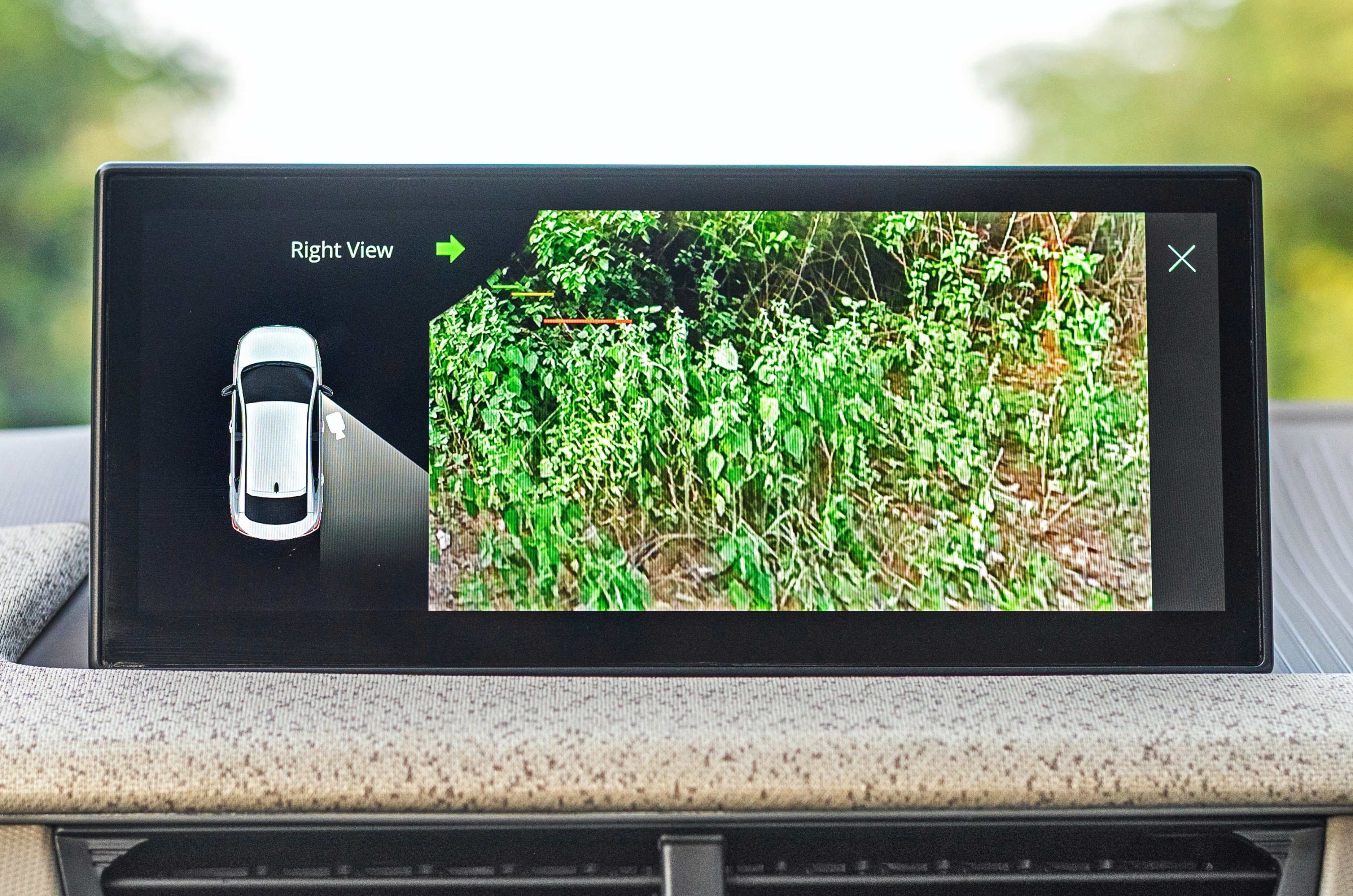
Blind-spot monitor is very useful but takes up the full screen and hides the map display.
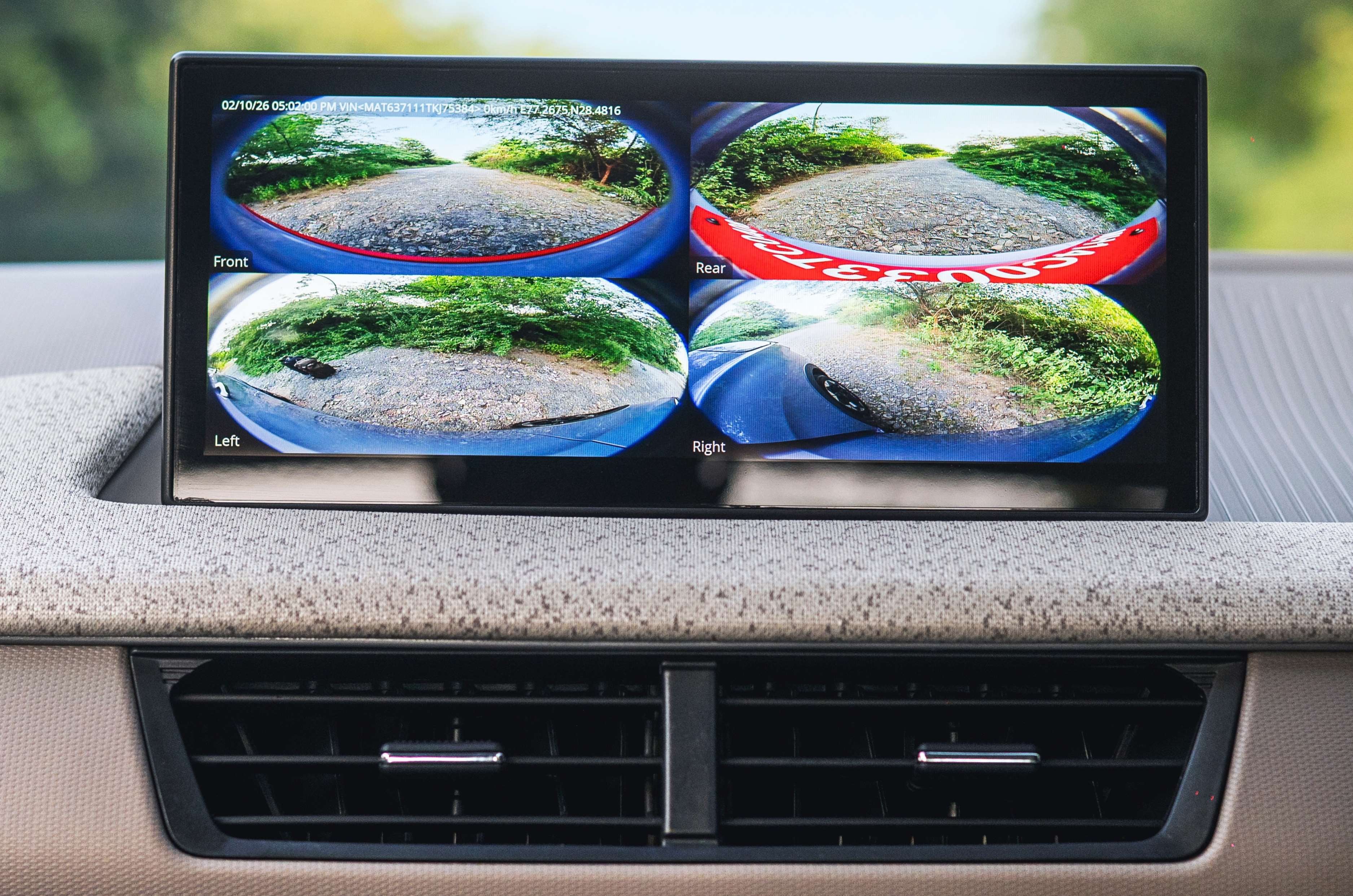
Like other Tata cars, the Aeris is packed with features. The 10.25-inch infotainment touchscreen is slick to use and remains responsive even when navigating through multiple menus. It also displays the 360-degree camera feed, which is lag-free, although the image quality isn’t the best. Tata has also added a new DVR function that allows the surround-view cameras to record the car’s surroundings, ensuring you do not shell out extra for a dashcam. The infotainment screen automatically switches to the blind-spot monitor when indicators are used, which is useful. However, this can be annoying when you are using navigation, although there is an option to disable the view completely.
Revised cushioning and bolstering, and a new ventilation function on the front seats improve overall comfort.
The front-seat ventilation function works well too. During our time with the car, it proved effective at keeping us cool in Faridabad’s near 40deg C ambient temperature. However, the infotainment screen or driver’s display shows nothing when the ventilation is on or the level is adjusted, which can be a little inconvenient.
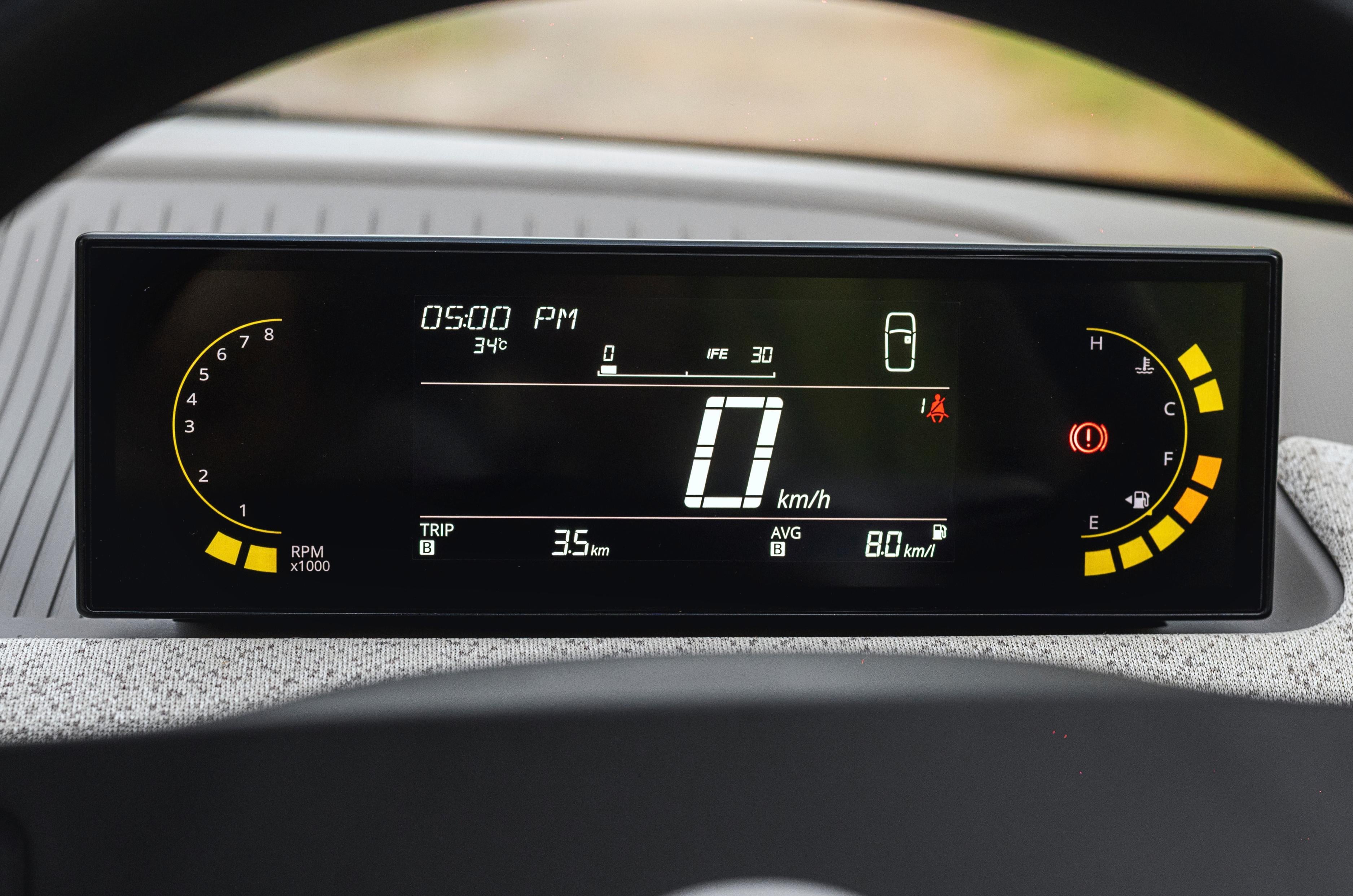
Part-digital Instrument cluster includes screen flanked by rev counter and fuel gauge.
The instrument cluster itself is fairly basic, with analogue dials for the fuel level and rev counter, while a digital display handles the speed and other general information. Depending on the steering wheel’s tilt angle and the driver’s seating position, some of this information can occasionally be obscured.
The four-speaker, two-tweeter audio system is a step down from the Tigor’s four-speaker, four-tweeter setup, although sound quality remains good enough for the segment. The rear seats lack pressure sensors, meaning the seat-belt warning will sound until the belts are fastened.
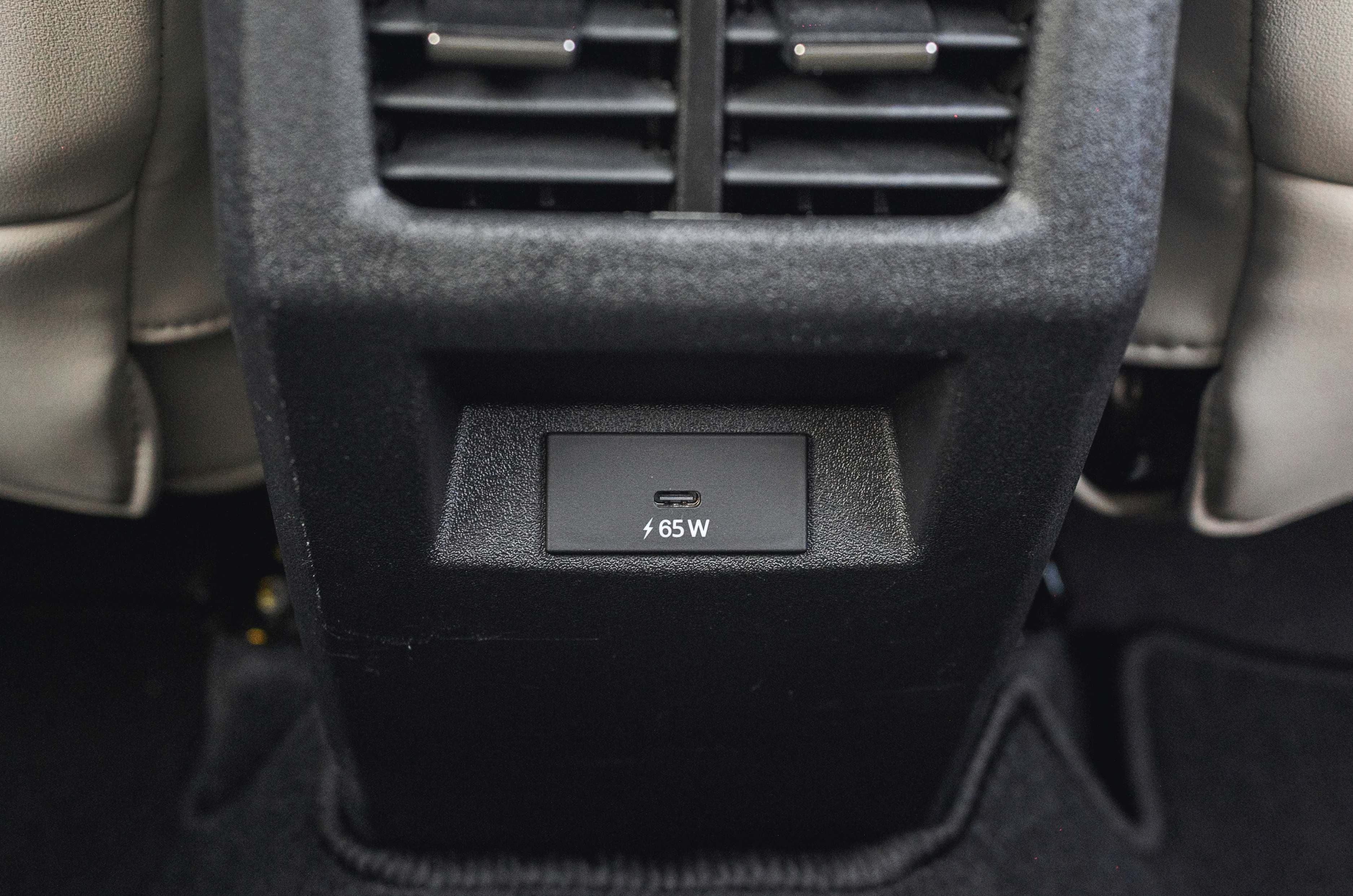
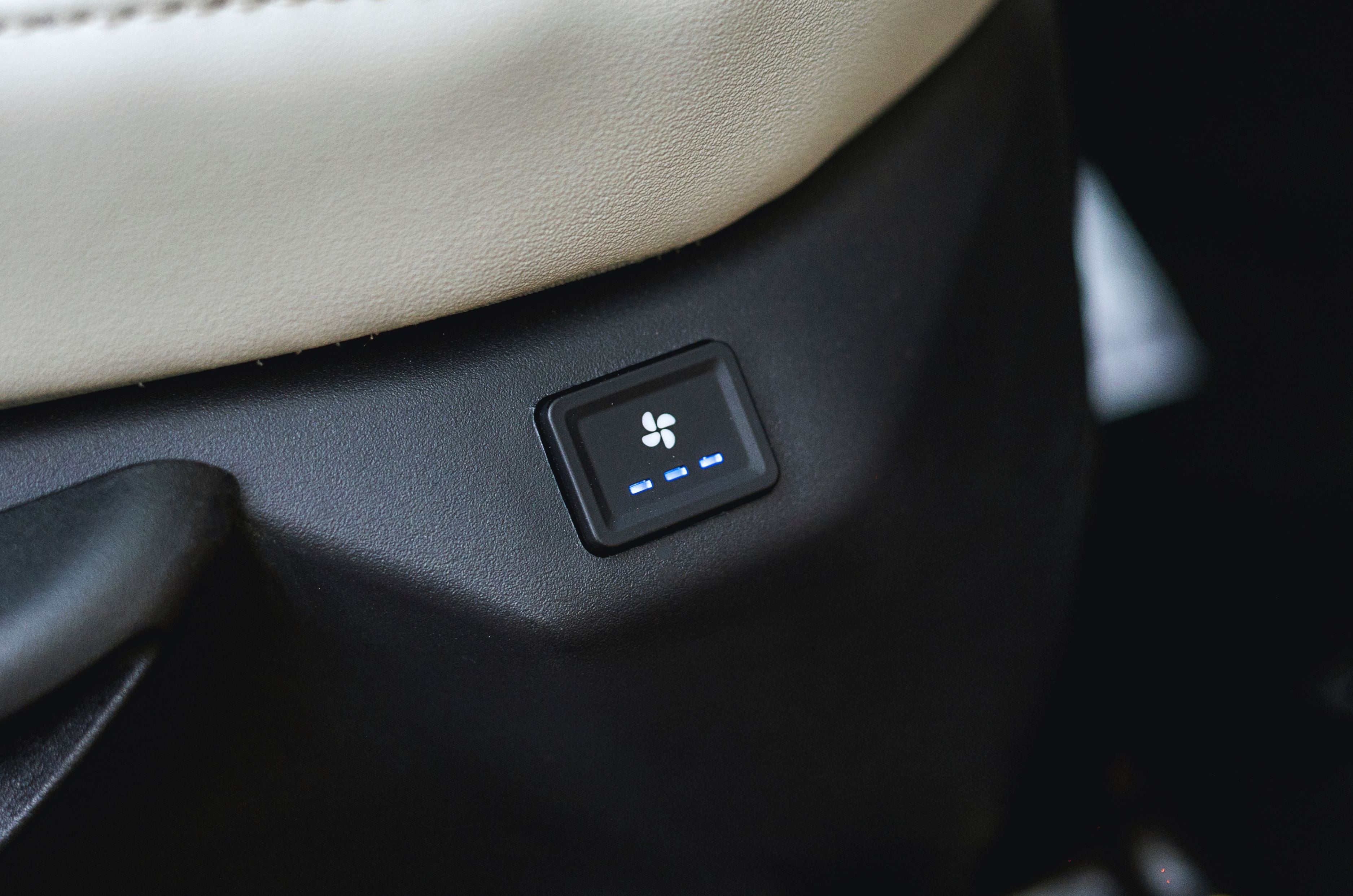
AC vents and a 65W Type-C charging port are among the additions at the back.
On the safety front, the Aeris gets six airbags, Isofix child-seat anchorages for the rear seats, rear parking sensors and three-point seat belts with reminders for all occupants as standard. Higher variants add a 360-degree camera, a day/night inside rear-view mirror, rain-sensing wipers, a rear defogger, a tyre pressure monitoring system (TPMS) and ESP with traction control. The pre-facelift Tigor scored four stars in Global NCAP testing in 2020, but a Bharat NCAP test for the Aeris is due.
Tata Aeris petrol value for money and verdict – 8/10
A well-rounded compact sedan, with the petrol engine making it more versatile
Priced from Rs 5.29 lakh, it offers strong value in a segment where affordability matters.
The Tata Aeris is a much more appealing proposition than the Tigor it replaces. Its fresh design, well-equipped cabin, generous boot and comfortable ride make it easy to live with, while the petrol engine gives it enough performance for both city and high-speed highway cruising. The manual gearbox is light and easy to use, while the AMT is better suited to relaxed city driving than enthusiastic highway use. The long list of features adds further appeal to the package.
There are some shortcomings too, including a coarse engine and poor cabin insulation. However, the Aeris’ biggest strength is its pricing. The petrol variants are priced from Rs 5.29 lakh to Rs 8.74 lakh (ex-showroom), and it undercuts rivals by a fair margin, making a strong case for itself in a segment where value for money remains a key consideration.
The Tata Tigor never quite made the impact the manufacturer hoped for in the compact sedan segment. Now, Tata has reworked it and given it a new identity as the Aeris, with a fresh design, a more upmarket cabin and a longer list of features. That alone makes the Aeris an interesting proposition, but there is another reason its arrival is well timed.
Tata has a CNG option in a market where demand for the fuel is growing rapidly, with CNG cars accounting for nearly 22 percent of passenger vehicle sales in FY2026, up from around 12-13 percent three years ago in FY2023. That gives the manufacturer an interesting opportunity, but the bigger question is whether the Aeris itself has enough going for it this time around.
Tata Aeris iCNG exterior design and engineering – 8/10
Looks more modern than the Tigor, but the Tiago influence is hard to miss
Save for the new bumper, the fascia is similar to the Tiago and looks very modern.
The Tata Aeris looks more modern and sleeker than the older Tigor, but there’s a strong sense of familiarity to its exterior design. It borrows several elements from the Tiago, giving the two cars a similar visual identity, but that also means the Aeris does not look particularly distinctive.
At the front, it gets slim LED headlights with integrated LED DRLs, joined by a gloss black trim, a design treatment that is very similar to the Tiago. What’s new is the front bumper with wider air inlets. It also features fog lamps that get an LED upgrade from the Tigor’s halogens. The Aeris also gets a new clamshell bonnet.
The wheel arch cladding adds contrast, but they make 14-inch wheels look undersized.
In profile, the iCNG gets the 14-inch stylised steel wheels which look undersized, particularly against the prominent wheel-arch cladding. The cladding is made from recycled materials and features a speckled texture. The use of chrome on the door handles and the window line further gives some contrast to the Aeris’ otherwise clean profile.
The Aeris retains the Tigor’s distinct coupe-like roof that flows into the tail. The rear features segmented LED taillights joined by red plastic trim, and new Aeris lettering on the centre of the tailgate. The rear bumper features a reverse light and has an overall clean design.
Tigor’s fastback-like sloping roofline is retained; new taillights make it appear larger.
The Aeris is 3,995mm long, 1,684mm wide and stands 1,532mm tall. It has a wheelbase of 2,450mm. These dimensions are similar to the older Tigor. While Tata has not quoted an official ground clearance figure, we found it adequate for broken roads and large speed breakers. All of this is expected to appeal to most buyers.
Tata Aeris iCNG interior space and comfort – 8/10
Lighter theme makes the cabin feel airy, and revised cushioning improves seat comfort
The dashboard looks minimalistic, and the lighter theme makes the cabin feel airy.
The Tata Aeris’ interior layout is the same as the Tiago and looks neat. The lighter beige theme makes the cabin feel airy. However, this same thing might make it difficult to keep the interior spick and span. The dashboard has a clean look, featuring two free-standing displays and a revised 2-spoke steering wheel.
The rotary dial does not have illuminated drive modes, but operating it is a breeze.
The manual variants feature a new, more premium-looking gear stalk, while the AMT variants get a cleaner-looking rotary drive selector with N (neutral), D (drive) and R (reverse) modes. The rotary dial does not feel finicky, and the modes switch seamlessly. One complaint, however, is that the drive modes (N, D and R) are not illuminated, which means you rely on the instrument cluster to know which mode is selected.
The Aeris gets floating door handles like on the Sierra, which feel sturdy.
The centre console has also been thoroughly redesigned for a cleaner look and a more practical application. It features two rubberised pads to keep phones, one of which gets wireless charging capability in the top-spec Accomplished trim. The centre console also features two cupholders and a leatherette-wrapped centre armrest which integrates a decent cubby space. The doors have floating-style handles integrated with the armrest, which feel sturdy.
Legroom and kneeroom won’t be an issue for most, but taller passengers could feel the headroom is tight.
The seats feature revised cushions and bolsters that have increased the overall comfort and are wrapped in a part leatherette upholstery that feels premium. The rear seats are comfortable as well and offer good legroom and kneeroom. The headroom, however, could be an issue for passengers over 6 feet tall. The rear passengers benefit from dedicated air vents and a 65-watt Type-C charger. These seats get fixed headrests.
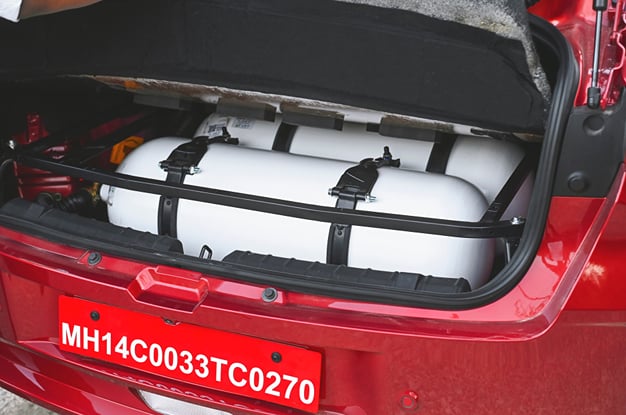
Aeris CNG’s boot space figure is not revealed, but could be similar to the Tigor CNG’s 227-litre space.
The Aeris iCNG gets a dual-cylinder tank setup inside the boot, unlike its rivals that use a single CNG tank and are left with very little usable boot space. Despite the additional tank, the Aeris has enough room for a couple of backpacks and a small luggage bag. Tata also offers a 13-inch underbody-mounted spare wheel, which is more useful than a puncture repair kit.
Tata Aeris iCNG features and safety – 9/10
Gets a lot of modern-day features, some of which could have better integration
Segment-only ventilated seats cool effectively and mark a step up in the comfort quotient.
Like other Tata cars, the Aeris is filled with features to the brim. It debuts a front seat ventilation function for the compact sedan segment, which is offered with the Aeris’ top Accomplished trim. During our drive, the seat ventilation was very effective in cooling the cabin in Faridabad’s near 40deg ambient temperature. However, there’s no confirmation on the infotainment system or the driver’s display when the feature is engaged or the ventilation level is changed.
360-degree camera system has a crisp feed and can record the surroundings.
A 10.25-inch infotainment touchscreen is the same as before, which remains slick to use and has no lag even when browsing through multiple menus. The user interface (UI) is also easy to get used to. The Aeris continues with a 360-degree camera setup that is also lag-free and works well even in low-light conditions. Tata has added a new DVR feature, which allows the surround-view cameras to double up as a dashcam and record the surroundings of the car. These recordings can be stored and accessed either on the infotainment touchscreen or a USB drive, and can also be seen on a phone via a QR code.
The instrument cluster has a retro theme and displays all the important driving data, but the steering wheel’s tilt angle and the driver’s seating position sometimes obscure certain details. The steering wheel lacks the leatherette wrap offered with the Tigor, but feels nice to hold nevertheless. The wheel is now free of the Tigor’s scratch-prone gloss black trim and thankfully retains physical controls. It also gets cruise control, but only with the manual variants.
The wireless charger works well, but tends to make the phone hot during prolonged use.
The 4-speaker, 2-tweeter audio system is a step down from the Tigor’s 4-speaker, 4-tweeter setup, although sound quality is still good enough for the price. Certain features also could have been integrated better. The wireless charging pad can also heat up phones, particularly during extended use. Cooling vents near the pad could have fixed the issue. The infotainment system switches to the blind-spot monitor every time the indicators are used, which can be annoying when following navigation. The rear seats also lack pressure sensors, so the seatbelt warning continues to chime until the belts are fastened.
Standard safety features include 6 airbags, ISOFIX child seat anchorages on the rear seats, rear parking sensors and 3-point seatbelts with reminders on all seats. Higher variants equip the Aeris with a 360-degree camera, a day/night inside rearview mirror (IRVM), rain-sensing wipers, rear defogger, a tyre pressure monitoring system (TPMS) and ESP with traction control. The pre-facelift Tigor received a four-star rating from Global NCAP in 2020, but the Aeris has yet to be tested by Bharat NCAP.
Tata Aeris iCNG performance and refinement – 6/10
Performance in the city is adequate, but it feels out of breath if pushed hard
The 3-cylinder engine is not the smoothest in the segment and the NVH levels are also not the best.
The Tata Aeris continues with the Tigor’s 1.2-litre, three-cylinder naturally aspirated engine, producing 76hp and 97Nm in CNG guise. It is offered with a five-speed manual and a five-speed AMT, and we drove the latter.
At city speeds, the engine has enough performance to keep up with traffic, but the CNG-AMT combination is not particularly responsive. There is a noticeable pause between pressing the accelerator and the powertrain responding, which becomes more evident when you need to accelerate quickly.
Performance is adequate in the city, but it feels out of breath during overtakes.
The AMT also makes starts from standstill quite jerky, which can get tiresome in stop-and-go traffic. Once up to speed, however, the Aeris settles into a relaxed rhythm and is comfortable enough when driven at a steady pace. The AMT also gets paddle shifters for manual gear changes, which are useful when you want more control over the gearbox, particularly during overtakes.
On the highway, the lack of response is more noticeable, particularly when overtaking. The Aeris can maintain triple-digit speeds, but building speed takes time, and overtaking requires some planning. The rotary gear selector itself, however, as mentioned above, is neat and easy to use.
As you start driving, the vibrations from the 3-cylinder engine are ironed out till you reach 2,500rpm.
Refinement is another weak point. Refinement is another weak point. The engine feels generally smooth when driven gently, but above 2,500rpm, engine noise and vibrations become quite pronounced. Wind and road noise insulation isn’t particularly strong either, so the cabin gets fairly noisy at higher speeds.
Tata Aeris iCNG ride comfort and handling – 8/10
Has a commendable ride quality for a sedan on both rough roads and highways
Like other Tata cars, the suspension is well tuned to Indian conditions.
The Aeris is particularly impressive over poor roads. The suspension does a good job of absorbing broken surfaces and larger bumps without unsettling the car, while the ground clearance is adequate for tackling rough roads and large speed breakers. Despite being a sedan, it does not feel particularly vulnerable to bad roads.
Out on the highway, the Aeris is equally composed. It stays planted at triple-digit speeds and does not feel floaty or nervous when driven quickly. The steering is also nice to hold and offers decent feedback, although there is some vagueness around the centre that takes away a little from the confidence.
Tata Aeris iCNG mileage and efficiency
We expect it to offer a real-world mileage in the 25-30km/kg range
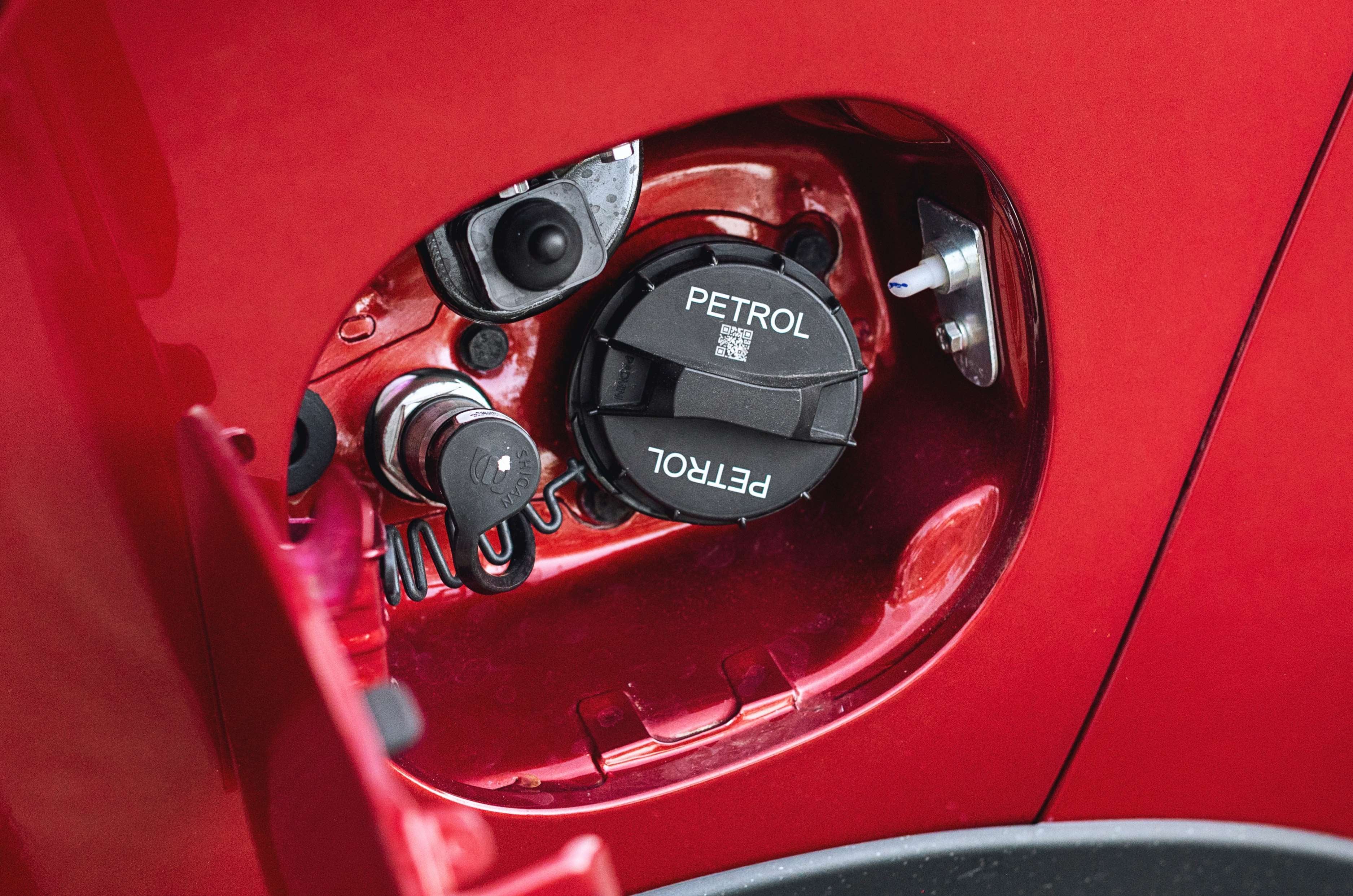
It kills the ignition whenever the fuel lid is opened, offering a layer of safety while filling fuel.
While we haven’t put the Aeris iCNG through our full test yet, its CNG powertrain should make it considerably more economical to run than the petrol version. Tata is yet to reveal an official efficiency figure, but we expect real-world mileage to be in the 25-30km/kg range. We’ll bring you our tested mileage figures once we put the Aeris iCNG through our standardised test procedures.
Tata Aeris iCNG value for money – 8/10
CNG buyers don’t have to compromise on features, but the AMT isn’t ideal
The Aeris CNG offers good value, but AMT should be chosen only if city driving is a priority.
The Aeris, priced from Rs 5.70 lakh to Rs 9.10 lakh (ex-showroom), is a more convincing compact sedan than the Tigor ever was. Its modern design, well-equipped cabin, comfortable ride and, most importantly, useful boot space despite the CNG setup give it plenty going for it. The fact that Tata offers the CNG powertrain with higher-spec variants also means buyers don’t have to sacrifice features for lower running costs.
The CNG-AMT powertrain, however, takes some shine off the package. The slow responses, jerky starts and excessive NVH at higher revs make it better suited to relaxed city driving than frequent highway use. Even so, for buyers looking for a practical and well-equipped CNG sedan, the Aeris does make a stronger case than its predecessor and even against its rivals.
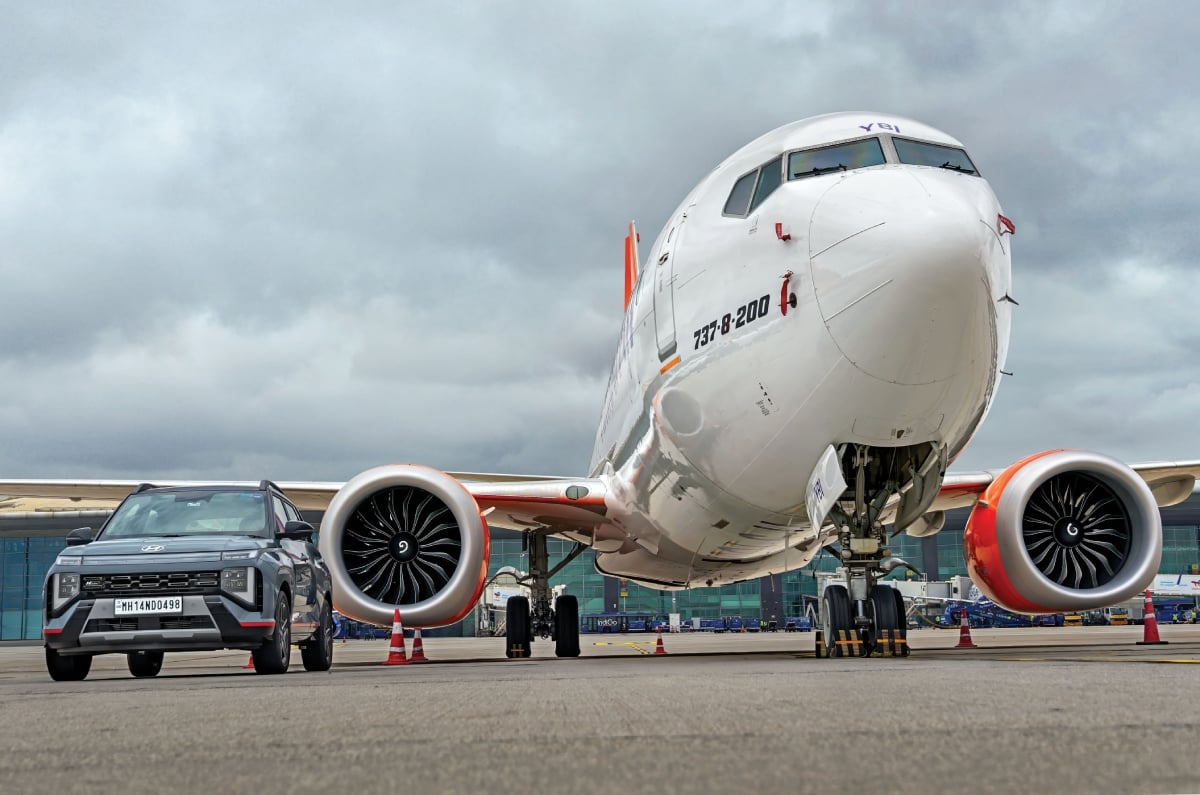
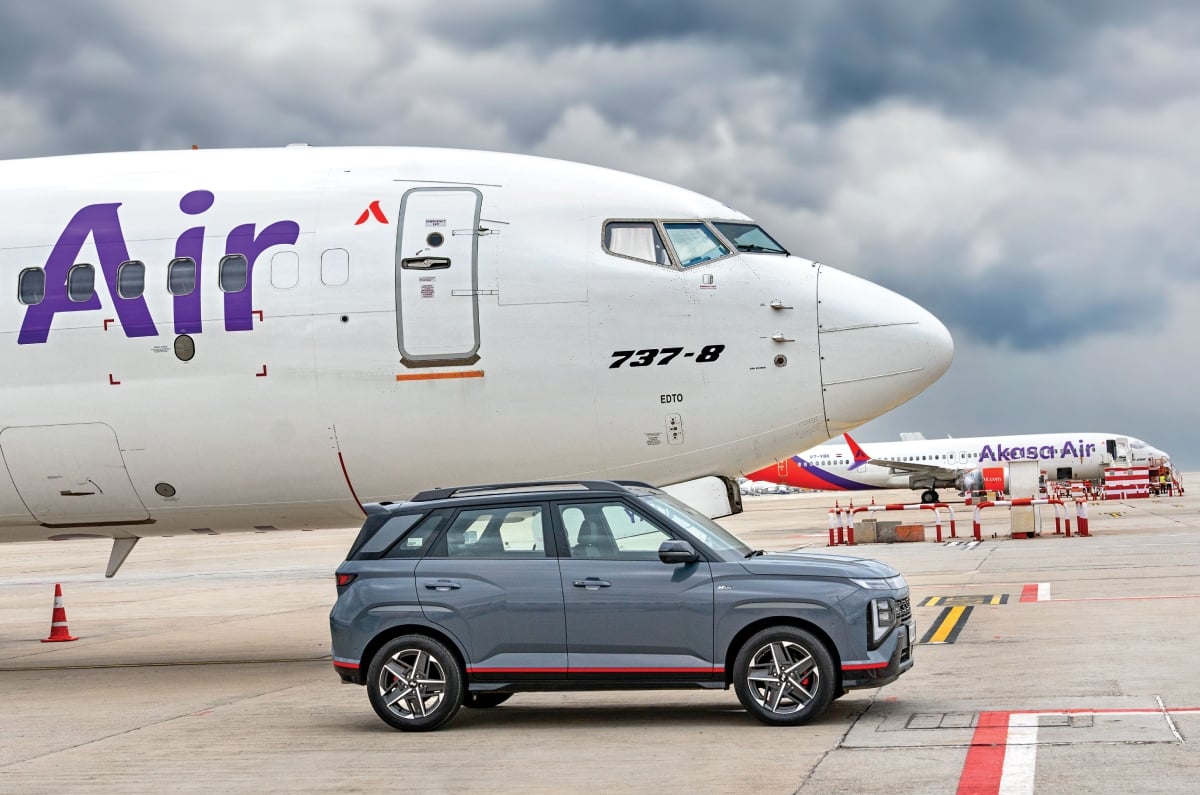
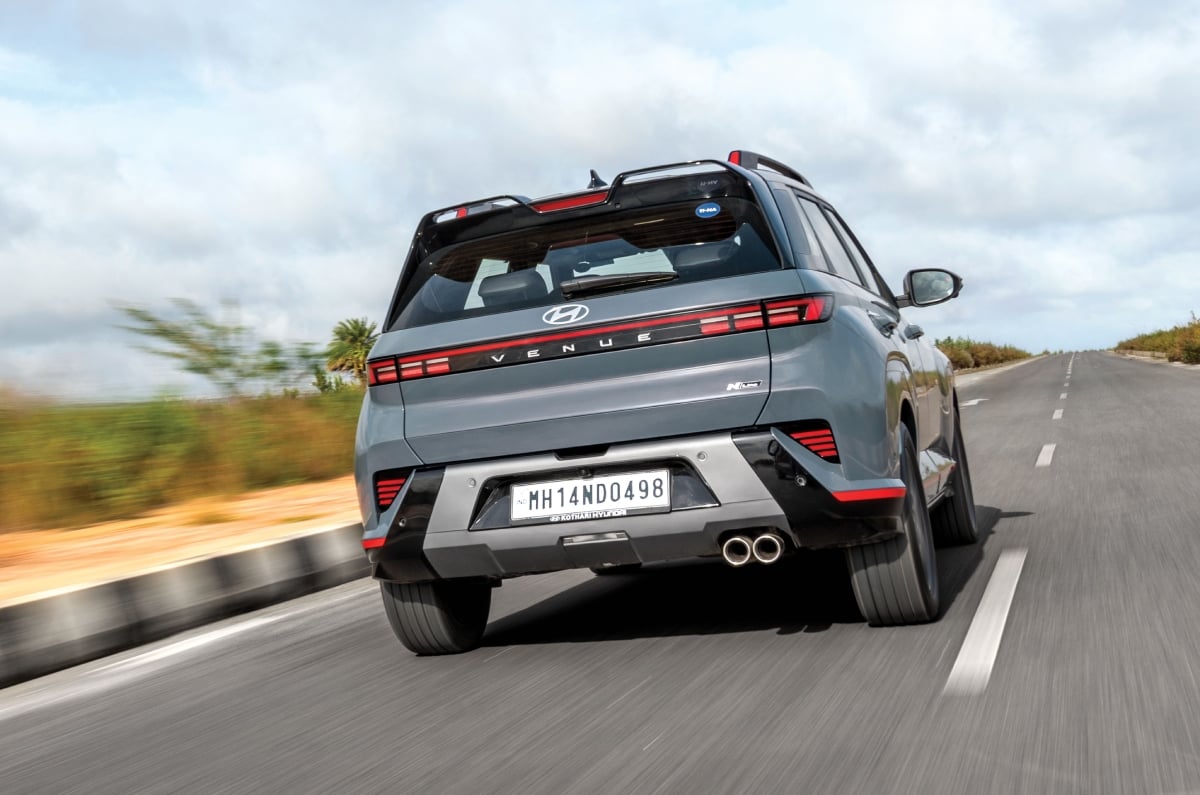
A Hyundai Venue N Line runs down a well-lined access road, its sensors alive. Off to the left overhead, an Akasa Boeing 737 Max makes its way down gracefully, flaps extended, ready to land. Both machines are bristling with technology that allows them to operate with a degree of independence once unthinkable. The car can keep itself within a lane, regulate speed in relation to the car ahead, and brake in emergencies. The aircraft can fly itself across continents, execute complex routes, and even land in zero visibility. Welcome to the new world where machines are self-aware and can operate for long stretches on their own.
Today, we dive deep into tech and compare how Advanced Driver Assistance Systems (ADAS), found in modern cars like the Hyundai Venue work, and juxtapose them against how advanced autopilot systems on airliners like the Boeing 737 Max function. Want to know how this Hyundai Venue senses lane markings, what it picks up, how it processes the data, makes a decision and executes a steering manoeuvre to keep the car within the lane, or how aircraft like the Boeing 737 Max are programmed to fly themselves and how they can even land automatically? Read on; there’s plenty of fascinating tech ahead.
Sensor fusion
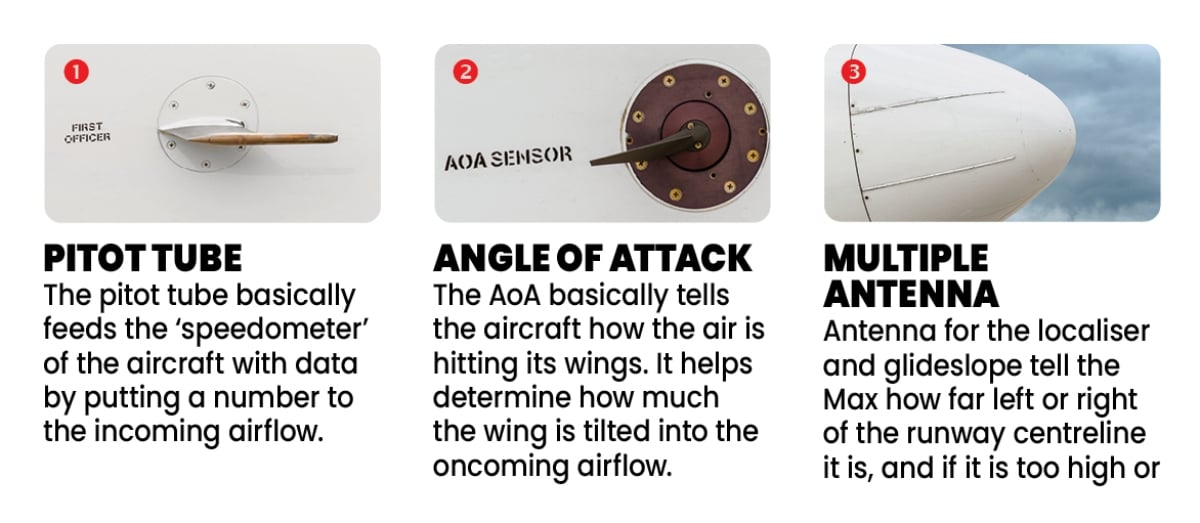
Walk around the attractive-looking Akasa 737 Max, now one of forty-three, and you notice the nose of the aircraft bristling with sensors. It’s from where a vast majority of the data for the Autopilot is collected. Showing me around and explaining things is Captain Svetlana from Akasa. First up, the speed sensors – elbow-shaped pitot tubes that stick out at an angle. This tube helps measure the airflow and, hence, the speed of the aircraft. For accuracy, this speed data is correlated with the static port, mounted flush on the side of the aircraft, which measures the real atmospheric pressure at the height the aircraft is flying.
Then there’s the AOA or Angle Of Attack sensor that basically tells you how the air is hitting the wings or how much the wing is tilted into the oncoming airflow. This is essential to know just how much lift the wing is making and how close the aircraft is to stall.
Then, inside the nose cone, apart from the weather radar, are antennas for the localiser and glideslope. Both pick up radio beams sent from transmitters positioned near the runway. The localiser tells the aircraft how far left or right of the runway centreline it is, and the glideslope tells if the aircraft is too high or too low. Together, they give the aircraft a complete three-dimensional picture of the ideal path to the runway. They feed data to the Instrument Landing System (ILS) and are what lets a 737 Max line up and descend precisely even when visibility is poor.
Further back are a pair of TCAS antennas, one on the belly and one on the top. They listen for nearby transponders (that also help flightradar24 funtion) to keep the aircraft clear of traffic.
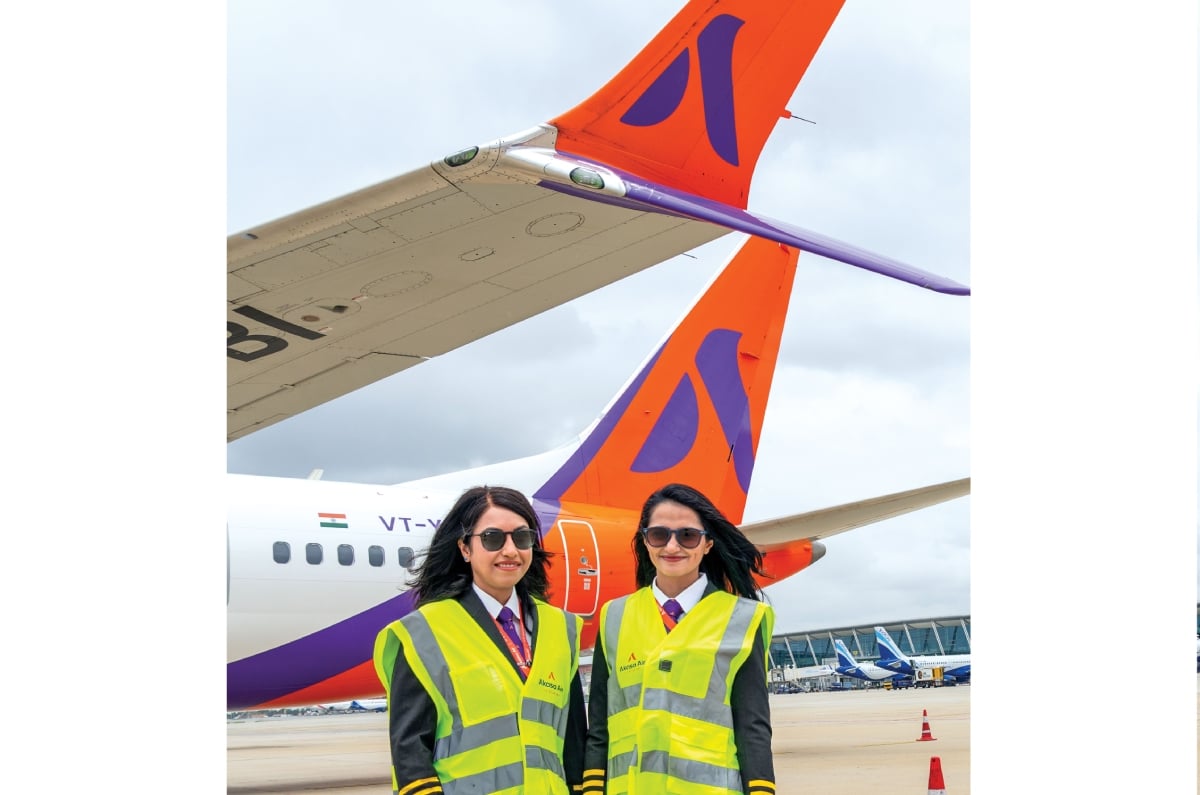
Capt. Svetlana and Capt. Sanaya help us get to grips with how the autopilot on the 737 Max functions.
Positioning is done with the help of a GPS antenna on the roof. Another system, known as the Inertial Reference System, uses laser gyroscopes bolted to the airframe to sense every turn the aircraft makes. It uses accelerometers that sense every change in speed. A computer fuses the two, continuously tracking exactly how far and in which direction it’s travelled from a known starting point, which is set by the pilots at the gate.
Road and track
Though this is a high-tech and complex system, functionality is slick and smooth.
Now swap the open skies for chaotic tarmac. Here, the Venue N Line’s ADAS Level 2 suite runs off far fewer sensors or data points. The difference, however, is that the car actually ‘sees’ what is ahead, correlating data from the radar and the high-resolution camera into a single picture. Sensor fusion is essential on both the 737 and the Venue. What’s different is that the reactions of the car have to be immediate, and that means Smart Sense on the Venue not only has to process gigabytes of data every second, it also has to be ready with, say, a braking solution in milliseconds, just in case that petulant biker cuts across the Venue’s nose.
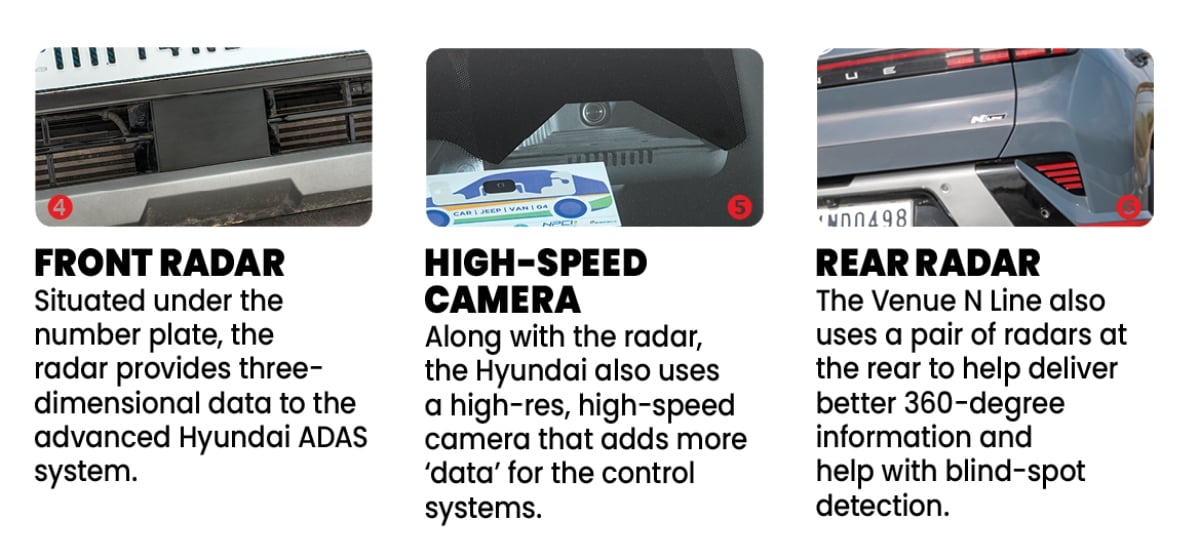
One of the primary sensors is the radar. Located behind the black square plastic panel under the number plate up front, it acts as a measuring tape, constantly tracking the exact distance and closing speed of the car ahead. Similar to a fruit bat, the radar sends out bursts of high-frequency radio waves (or chirps) that vary between 10,000-50,000 bursts per second. Just as important is how quickly the data is processed and passed on, which provides enough sharpness and resolution to differentiate between shapes ahead. This data is used by the Forward Collision-Avoidance Assist (FCA) to stop the Venue often before human reflexes can even respond to danger. In addition, the system uses a pair of rear-mounted radars, ultrasonic sensors and parking and proximity cameras for a more secure 360-degree ‘picture’.
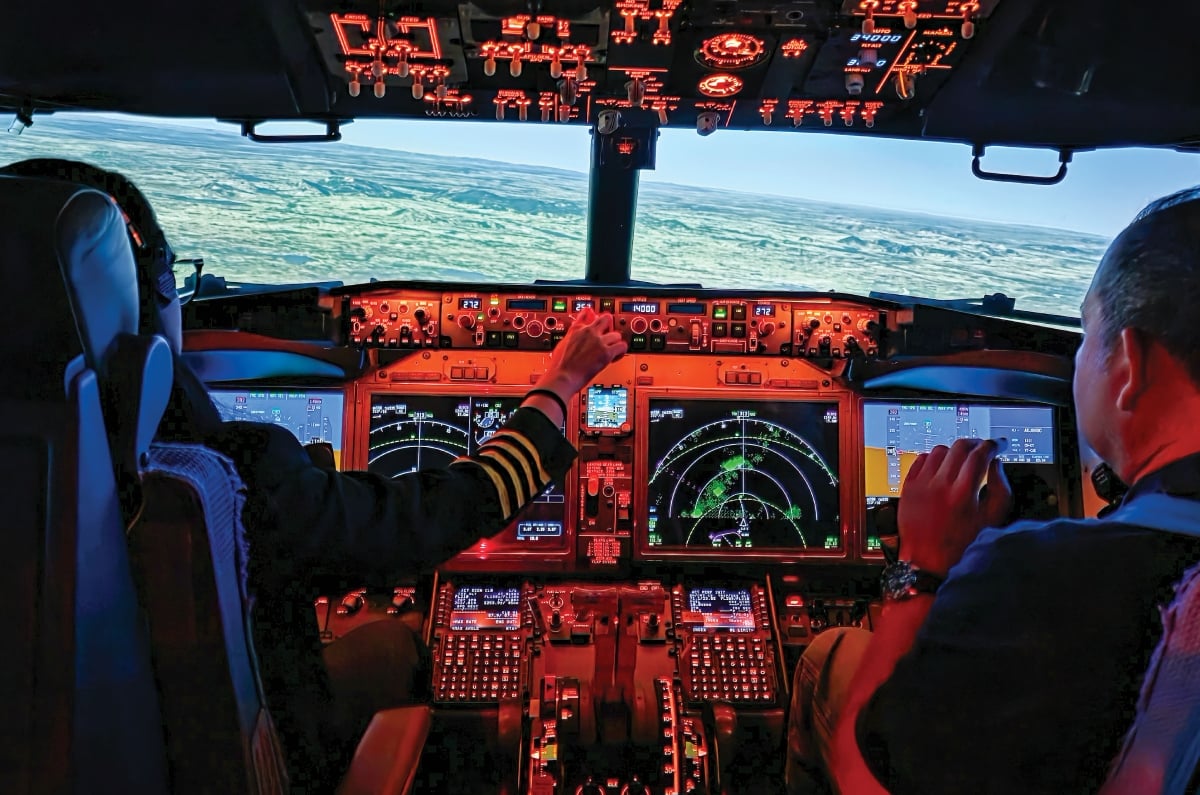
Captain Sanaya adjusts the heading knob in the sim, the aircraft reacts in real time without disengaging the system.
The other important data source is a high-resolution, high-speed camera at the top of the windshield. While its primary job is to look for lane markings and obstacles, it also works along with the radar up front, sharing the workload. The camera, for example, sees every detail but lacks depth perception (or 3D vision), and a radar tracks distance but cannot see the same amount of detail as the camera. The camera sends data via a special, automotive application-optimised CMOS sensor, similar to the one on your Sony mirrorless camera that also has a high dynamic range (for bright lights). Hyundai’s system can even detect faded lines with its edge-detection, texture-tracking, and colour-reading systems. Hyundai’s SmartSense also integrates Artificial Intelligence (AI) and Machine Learning. So, instead of using rigid “if-then” decision-making software, it uses embedded neural networking to interpret real-time sensor data.
Together, these systems form a nervous system that feeds into the car’s brain, which then nudges the steering, modulates throttle, or applies brakes. Unlike aviation, redundancy is limited. A sensor failure usually hands control back to the driver, who remains the ultimate fallback.
Steering wheels and yokes
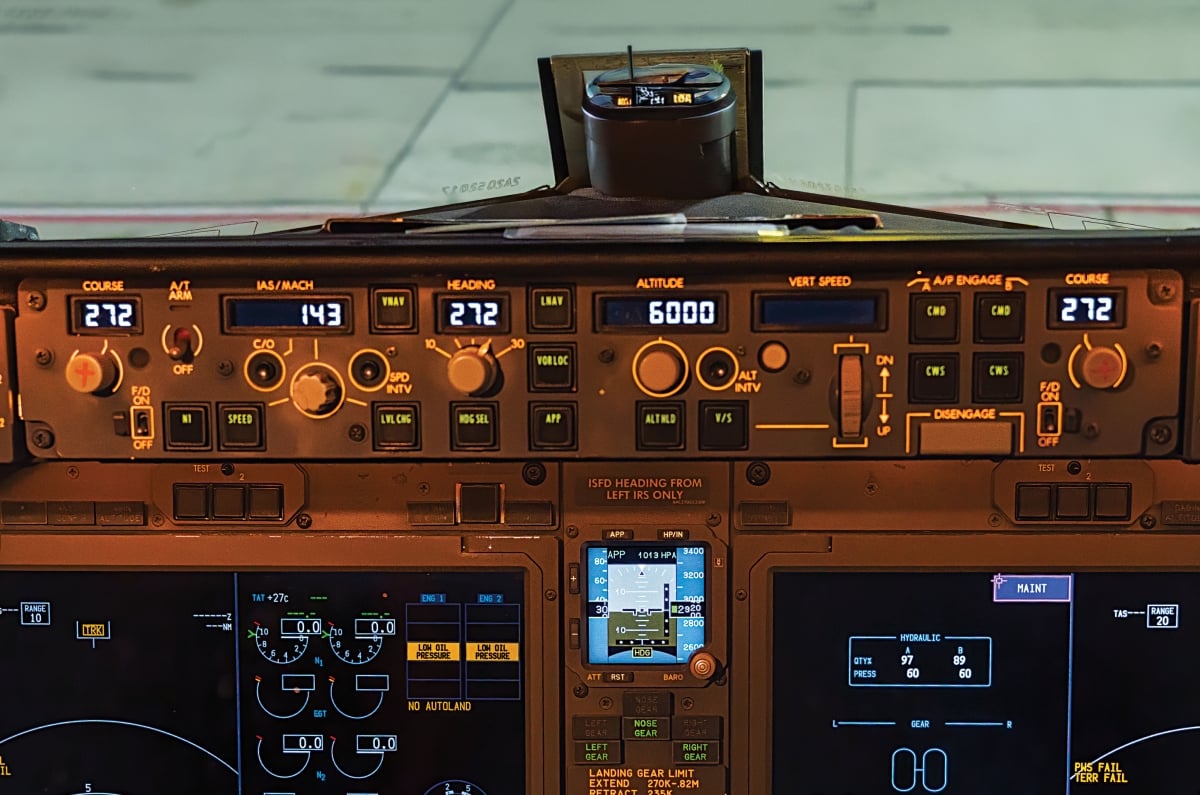
Hit ‘A/P Engage’ on mode control panel to activate autopilot; course, speed, heading and altitude are also adjustable here.
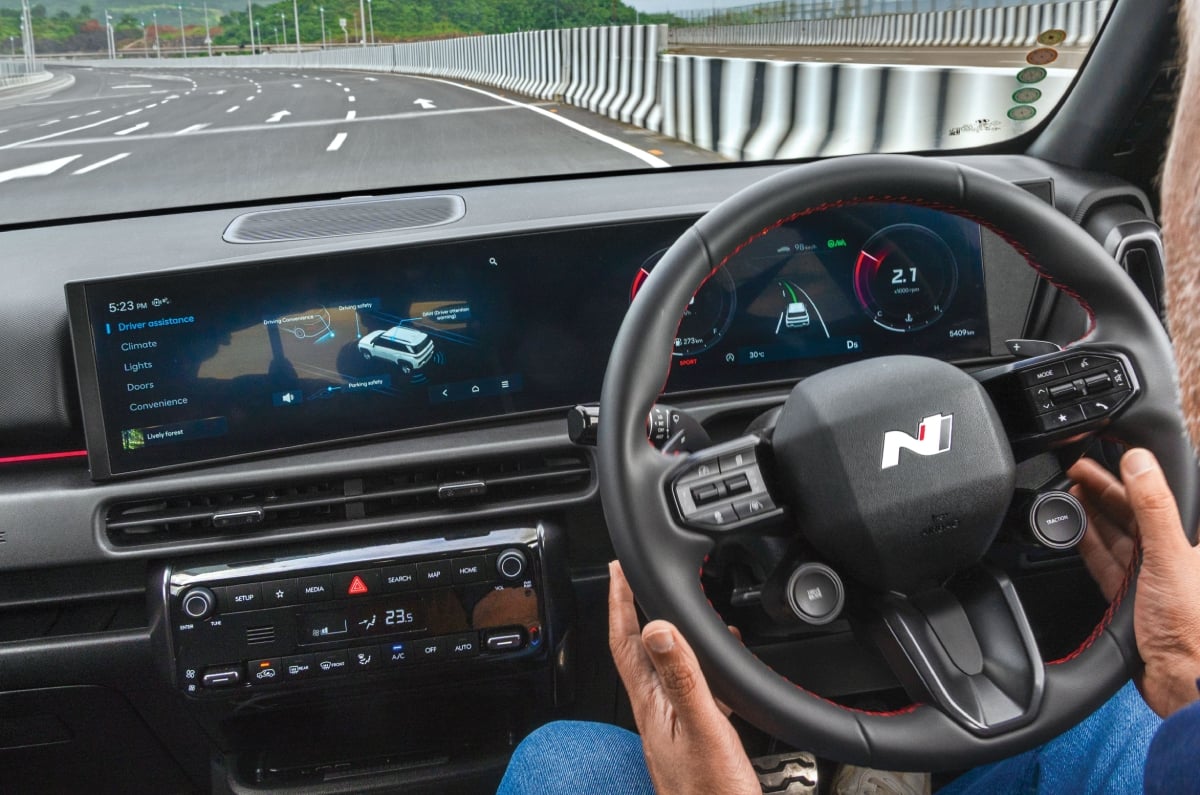
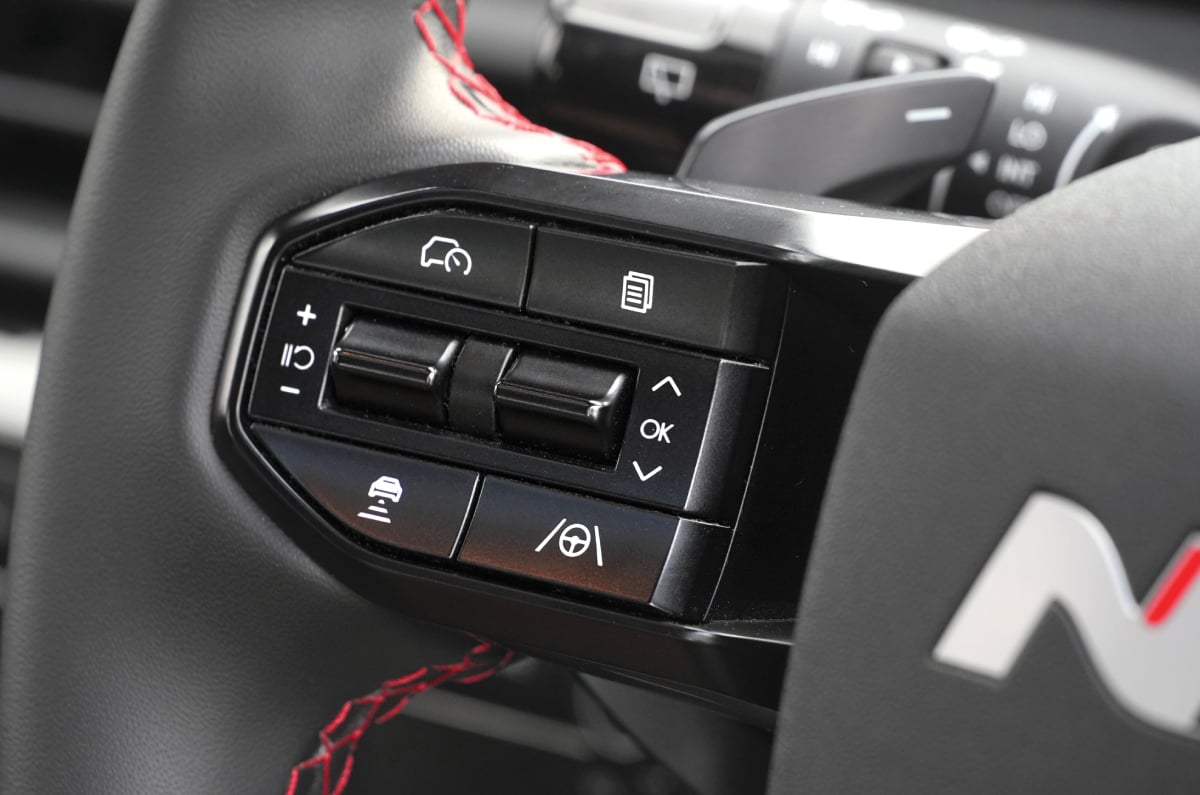
Once behind the wheel of the Venue, engaging the ADAS is seamless. You need to be above 30kph and on a well-lined road. To engage the system, you have to zoom into the left spoke of the steering wheel. Here you find the four buttons that help activate and operate the system. The first activates the Smart Cruise Control, the second allows you to increase or decrease the speed you want to run at, the third helps you set the desired safe distance to the car ahead and the fourth activates Lane Keep Assist (LKA).
Tyre pressure essential here too.
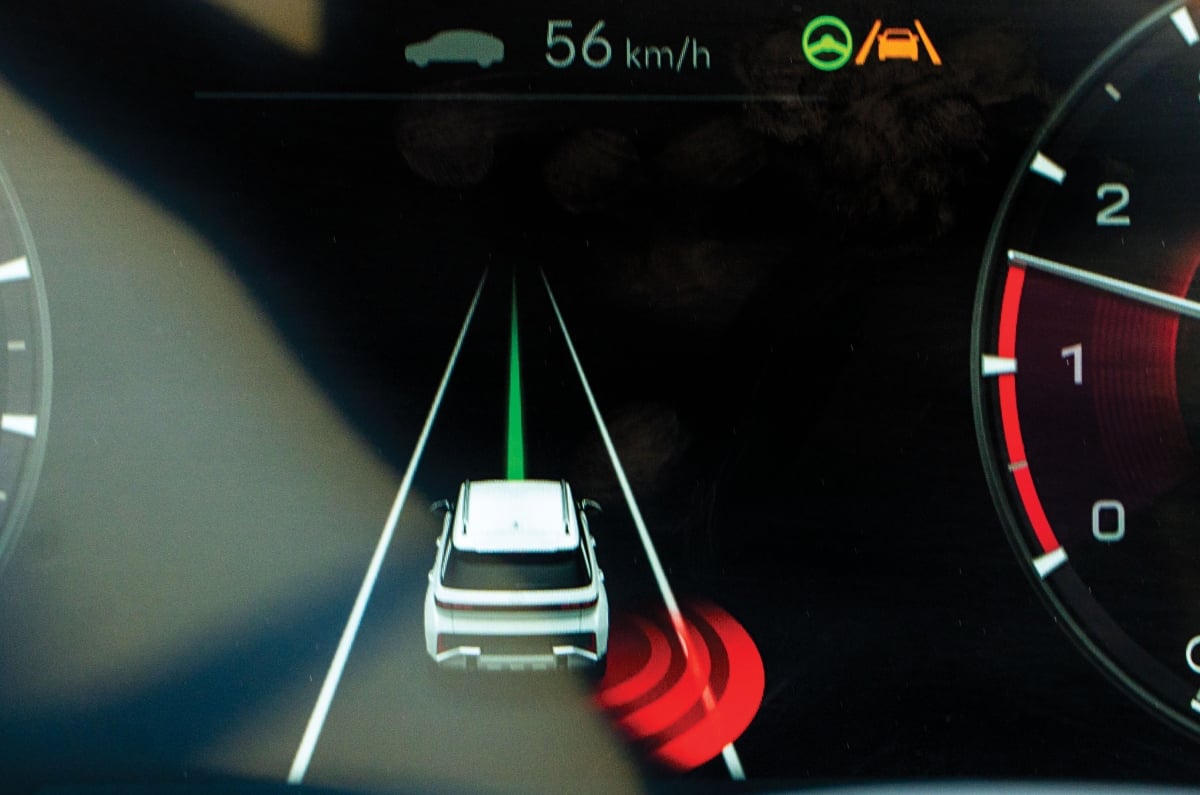
Activating LKA for me comes first, and you do this when you are running in a lane on a well-marked road. You know the system is engaged when the green steering icon lights up on the instrument panel and the car icon shows it running between the lines. Then you engage the smart cruise control and set the speed you want to run at, stepping off the accelerator simultaneously. The display on the instrument cluster lights up with the speed set, and you also get a horizontal bar showing the distance to the car ahead; which can be adjusted by the button with the distance icon.
Unseen by the driver and passengers in the car, the camera immediately begins scanning lane markings, and radar modules measure the distance to the vehicle ahead. The steering wheel then nudges itself gently to follow curves, while the throttle and brakes modulate to maintain speed and distance. The system makes split‑second decisions to help keep you out of harm’s way.
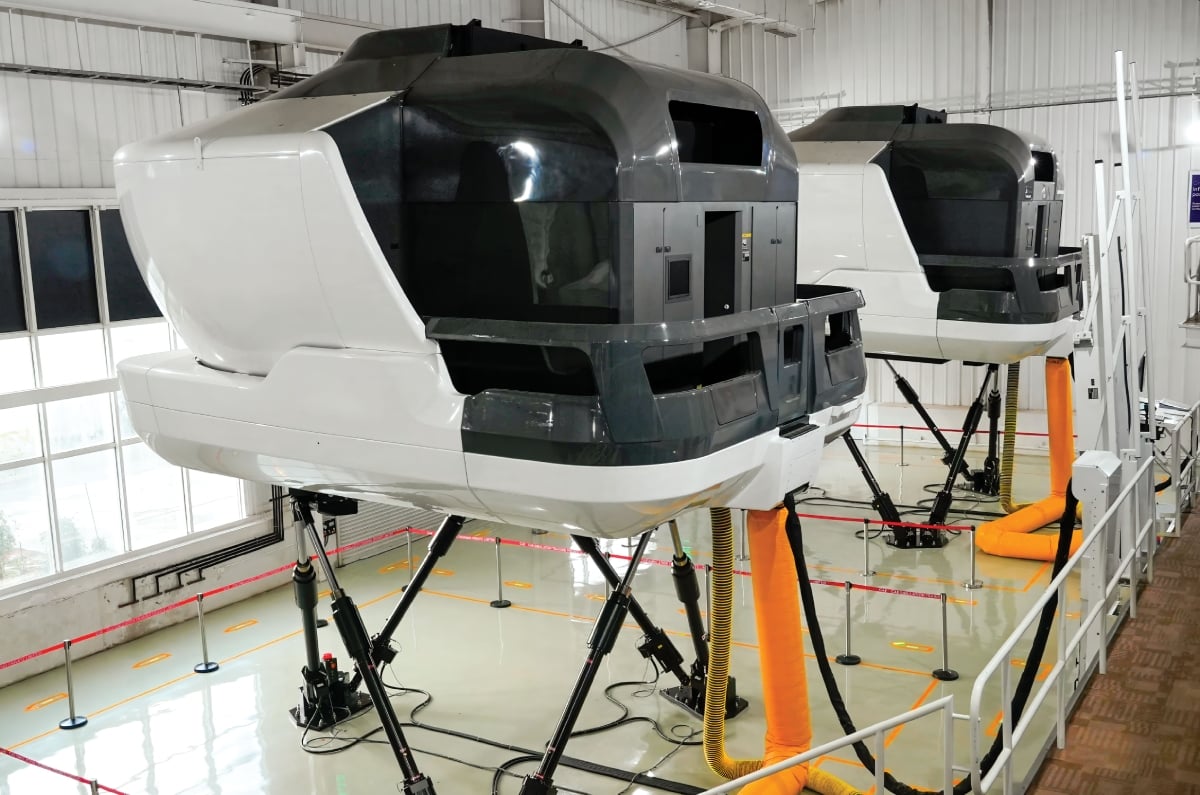
We took the assistance of the full-fledged 737 Max simulator that pilots train on to help us understand the systems better.
Climbing into the Akasa Boeing 737 Max cockpit is an immediate sensory overload. Hundreds of buttons, switches, levers and dials just overwhelm you. They are ahead of you, to your left, your right, and even above. There are, in fact, so many switches, buttons and dials above, I have to duck-walk in. And I’m not exactly Joel Garner or Kareem Abdul-Jabbar. Once seated, I slide the seat to the left and forward by depressing a lever, no powered seats here. And forget about comparing screen size, this is a proper ‘glass cockpit’ with wall-to-wall screens. My feet rest on the pedals that work the rudder in the tail, and ahead of me is Boeing’s famous yoke; unlike a regular joystick, you bank by turning the semi-circular bit of the ‘wheel’.
In contrast to our chaotic driving environment, the autopilot in the 737 Max operates on different principles. The environment is structured and regulated. There are no sudden jaywalkers or rogue bikers at thirty‑five thousand feet. So, unlike the Venue, the 737 doesn’t use optical cameras to see where it’s going. It doesn’t need to look for lanes or lines at 800kph. Instead, it relies on a combination of GPS, Inertial Reference Systems, antennas and sensors in the aircraft’s nose and cheek to get a fix on the exact heading, speed and altitude.
Driver’s display shows detailed ADAS information.
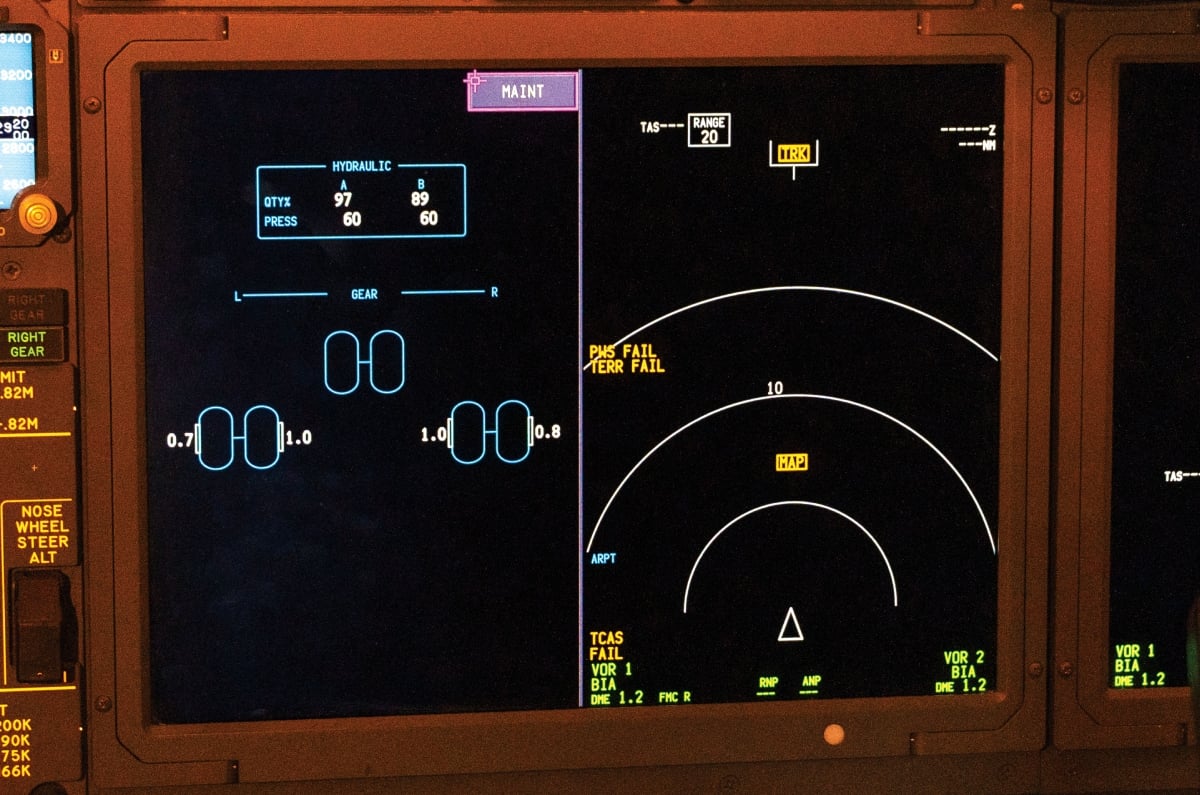
After taking a good look at the real cockpit and understanding some of the controls that help initiate the autopilot sequence, we shift to a full-scale moving platform simulator used to train airline pilots around the world. The cockpit is identical, down to the last detail, and here we have Captain Sanaya Chothia to help us conduct a simulated flight. Can’t help noticing, the 737 also has a tyre pressure monitor; of course, it does.
First up, a full-bore take off in the sim, Capt. Sanaya working the rudder pedals to keep the aircraft running down the centre line. Wow, this feels real, the sound, the visuals, the motion all combined. What a thing! After climbing out, we take a quick look at the sequence used to initiate the autopilot, most of the steps done on the long horizontal panel that sits between the pilots, directly in their line of vision. The first step involves checking if the auto throttle is engaged, and then all the pilot needs to do is press a single button on the autopilot panel. Unlike ADAS, the route the aircraft has to take is already pre-programmed into the navigation computer, a fairly long and detailed process. The speed, the height, the course, the heading, everything. And the autopilot just follows this.
The buttons that initiate ADAS are all placed here.
Once the system is initiated, the throttles move on their own, adjusting thrust; the yoke makes deliberate corrections and the screens display the aircraft banking smoothly along its GPS track. As the flight progresses, pilots can keep the aircraft on autopilot and make plenty of alterations to the route, either to avoid weather, get a more direct route or as directed by Air Traffic Control. There are knobs on the panel to alter course, speed, heading and altitude, with even the rate of descent and ascent adjustable.
We even execute an autoland, where the aircraft lands itself. The Instrument Landing System frequency is first inputted into the Multi-Mode navigation panel, the final approach course is set for the runway on the Mode Control or autopilot panel (272 for runway 27 in this case), and then the APP or approach mode is selected once the aircraft is positioned correctly. Doing this arms the localiser and glideslope systems that, as we’ve mentioned earlier, have their sensors in the nose cone. Seeing the aircraft adjust, manoeuvre, manage its path, height and distance, and land itself is an eye-opener. What an incredible piece of technology!
Level 2 ADAS on the Hyundai Venue N Line integrates data from all its sensors for a smooth, seamless drive.
What’s fascinating is that both systems have boundaries. In aviation, autopilot is trusted to fly for hours, even land. Pilots monitor, manage and intervene when necessary, but the system is designed to shoulder the bulk of the workload. Take offs, however, are always manual. In cars, ADAS is an assistant with a much narrower scope. It reduces fatigue, takes a load off the driver and adds a safety net, but ultimately the driver is always on call at short notice and is the one in control.
Sharing the workload
Modern aircraft like this Akasa 737 Max can get onto autopilot soon after take off.
Similar in execution but very different in how they function, ADAS and Autopilot both overlap but also exist in isolation. One is designed to keep you from bumping into a hatchback on the Western Express Highway, while the other is designed to guide an 80-tonne metal tube across oceans. Both are glimpses into a future where machines will shoulder more of the burden of control and blow us away with the technology on offer. But for now, if you step into an aircraft, know that while autopilot may be doing a bulk of the flying, a pilot is always watching, and when you engage ADAS to ease your commute, keep your eyes on the road, your hands on the wheel.
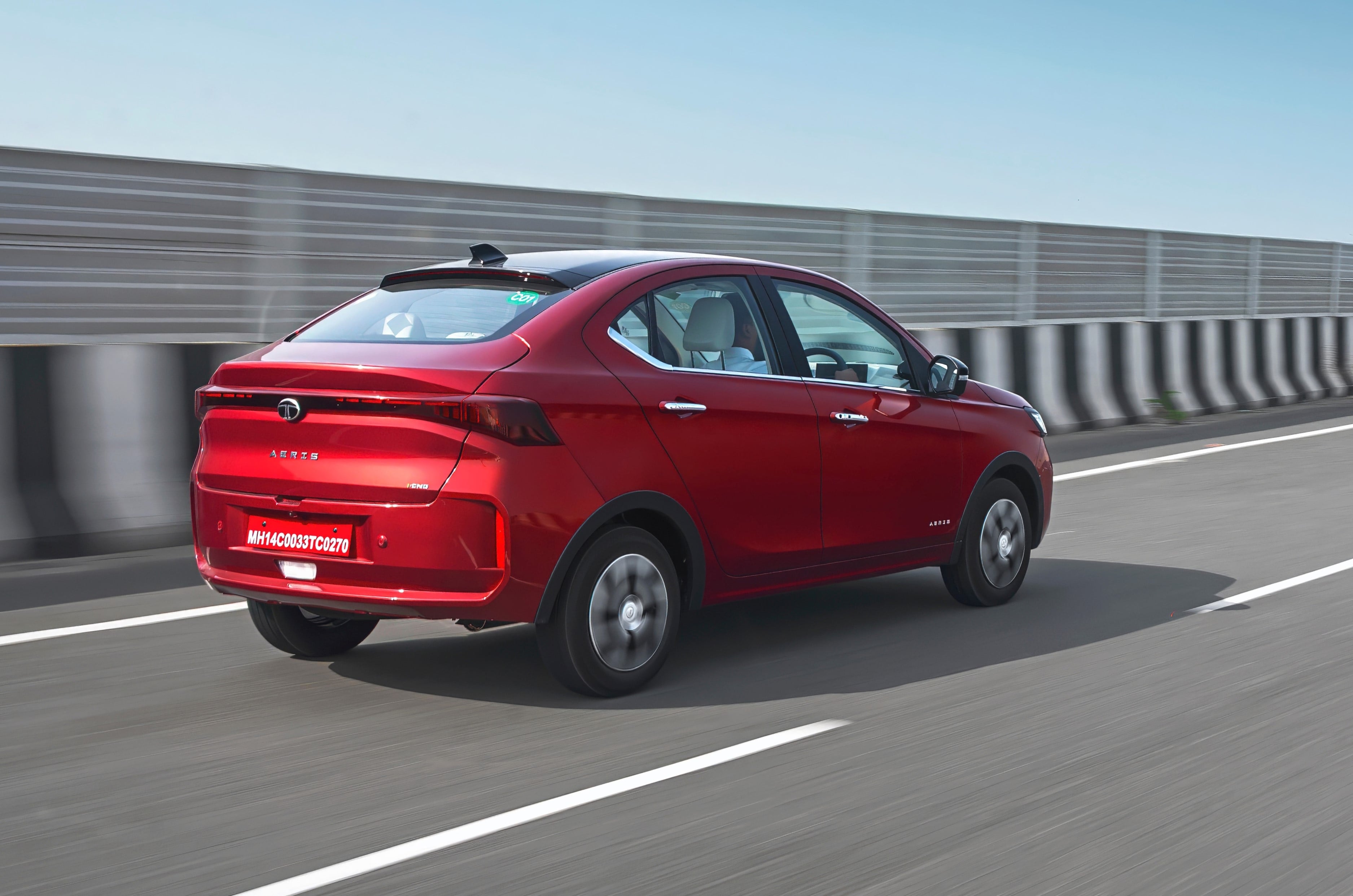
The Tata Aeris has been launched in India at Rs 5.29 lakh (introductory, ex-showroom). It is essentially a facelifted version of the outgoing Tigor compact sedan. It features a Tiago-like exterior and interior design while retaining the mechanicals. Tata is offering the Aeris in five trims: Smart, Pure, Pure+, Creative and Accomplished. Official bookings for the sedan have begun, and deliveries will commence from October 11.
Both 86hp petrol and 76hp CNG are available with manual and AMT options.
Gets sleeker LED lighting elements, fresh bumpers and 15-inch alloy wheels.
New features include a wireless charger and ventilated seats.
Tata Aeris variant-wise prices
Tata has yet to reveal AMT prices for both the petrol and CNG engines
Tata Aeris variant-wise price list (in Rs, lakh)
Petrol MT
CNG MT
Smart
5.29
6.29
Pure
6.14
7.14
Pure+
6.74
7.74
Creative
7.49
8.49
Accomplished
8.19
9.19
Prices for the petrol-AMT and CNG-AMT versions are expected to be announced soon. An AMT option will be available with both engines across all trims, except the base-spec Smart trim.
Tata Aeris exterior design
Borrows a lot of its design from the Tiago hatchback
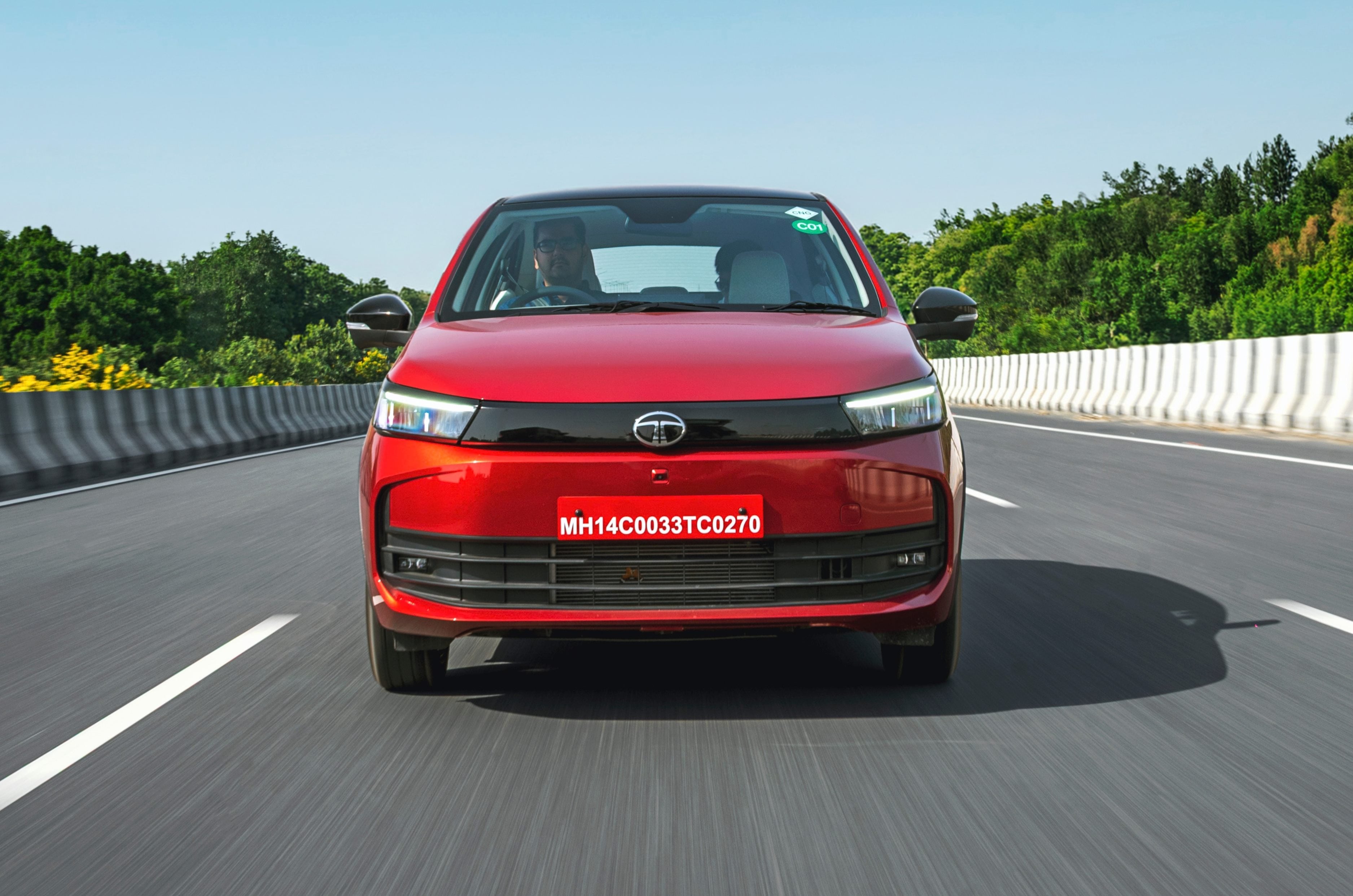
The Tata Aeris gets a sharper look that borrows a lot from the smaller Tiago. It gets sleeker LED headlights with eyebrow-like LED DRLs, and a gloss black grille. The front bumper features black elements with pixel-shaped LED fog lamps.
In profile, the Aeris gets 15-inch dual-tone alloy wheels. Lower-spec (Smart and Pure) and all CNG variants get smaller 14-inch wheels. Like the Tiago, the Aeris gets slim cladding on the wheel arches, chrome door handles and a chrome trim on the window line.
At the rear, it gets slimmer LED taillights connected via a red trim. Like the older Tigor, the high-mounted stop lamp stretches the length of the rear windscreen. The rear bumper is simpler now and features a reverse parking light in the centre.
The Aeris is being offered in six exterior shades: Nitro Crimson, Pure Grey, Dandeli Drizzle, Pristine White, Daytona Grey, and Dune Glow.
Here are the dimensions and other specifications of the Tata Aeris:
Tata Aeris dimensions and other specifications
Length
3,995mm
Width
1,684mm
Height
1,532mm
Wheelbase
2,450mm
Ground clearance
170mm
Boot space
419 litres (petrol)
The Tata Aeris CNG has dual cylinders, while all its rivals have a single CNG tank. This setup enabled a 227-litre boot space on the Tigor, which is expected to be the same on the Aeris, making it the largest for a CNG-powered sedan in the segment. The petrol version’s 419-litre boot space is similar to the Amaze (416 litres) but larger than the Dzire (382 litres) and Aura (402 litres).
Tata Aeris interior design and features
Gets a Tiago-like dashboard and is offered with more features
Like the exterior, the Aeris’ interior design is similar to the Tiago, but it gets a lighter cabin theme. The dashboard features a free-standing semi-digital driver’s display, a 10.25-inch infotainment touchscreen and a 2-spoke steering wheel with physical buttons. New features include a wireless phone charger, ventilated front seats and leatherette seat upholstery. The Aeris also gets a ‘DashCam Recorder’ function, which uses the surround view cameras as a dashcam. However, a 6-speaker sound system is a downgrade from the previous model’s 8-speaker audio system.
In terms of safety, the Aeris comes with 6 airbags as standard, a 360-degree camera with a blind-spot monitor, a tyre pressure monitoring system (TPMS), hill hold control and ISOFIX child seat anchorages.
Tata Aeris powertrain options
Gets petrol and CNG engine options with manual and AMT choice
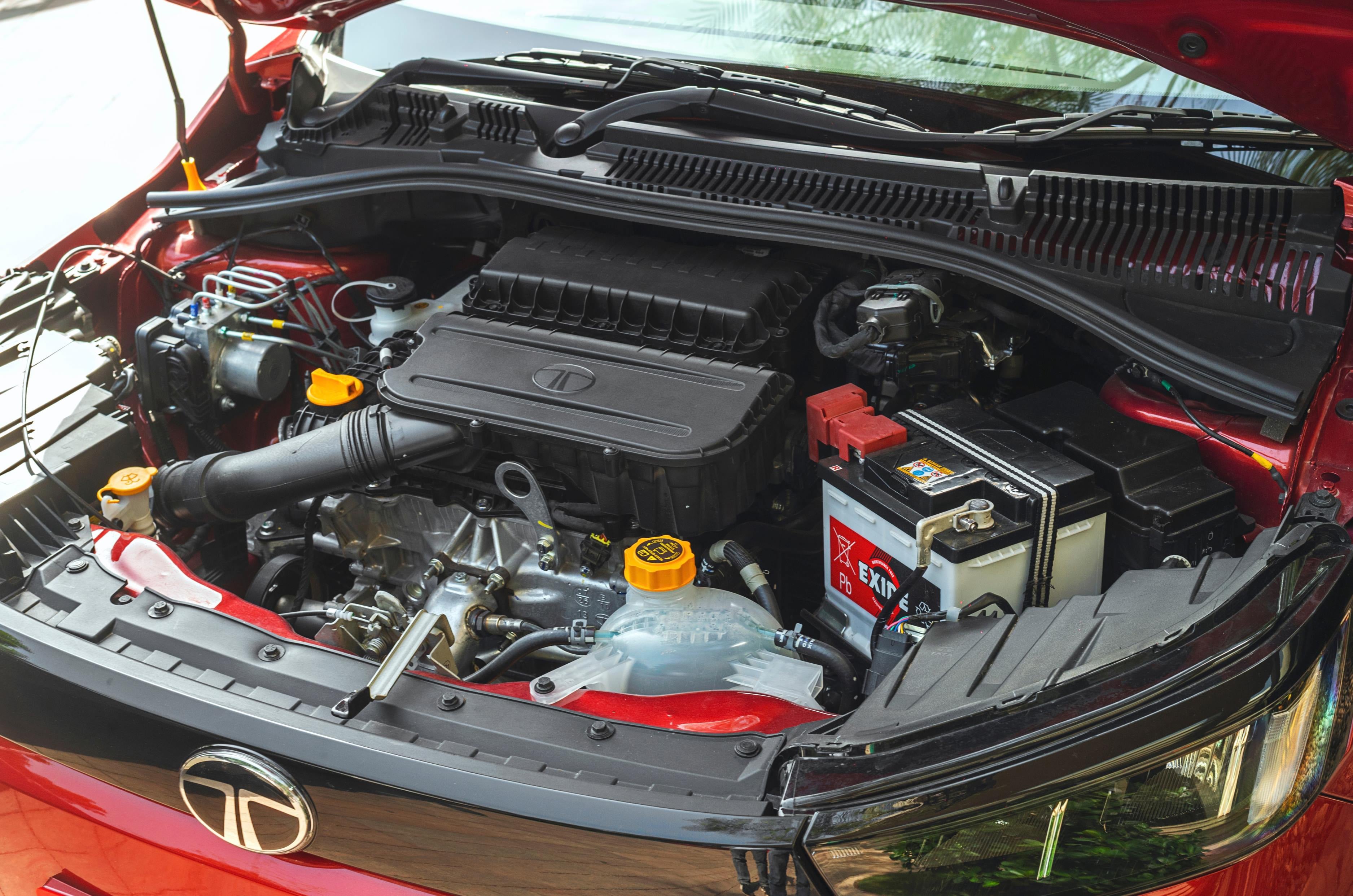
The Tata Aeris is powered by a 1.2-litre 3-cylinder naturally aspirated petrol engine that produces 86hp and 113Nm. It is offered with either a 5-speed manual or a 5-speed automated manual transmission. This engine is also available with a CNG powertrain, with both manual and AMT options, producing a lower output of 76hp and 97Nm. These are the same powertrains offered with the pre-facelift Tigor and the current Tiago.
The Tata Aeris rivals the Maruti Dzire (Rs 6.31 lakh to Rs 9.54 lakh), Honda Amaze (Rs 7.65 lakh to Rs 10 lakh) and Hyundai Aura (Rs 6 lakh to Rs 8.67 lakh).
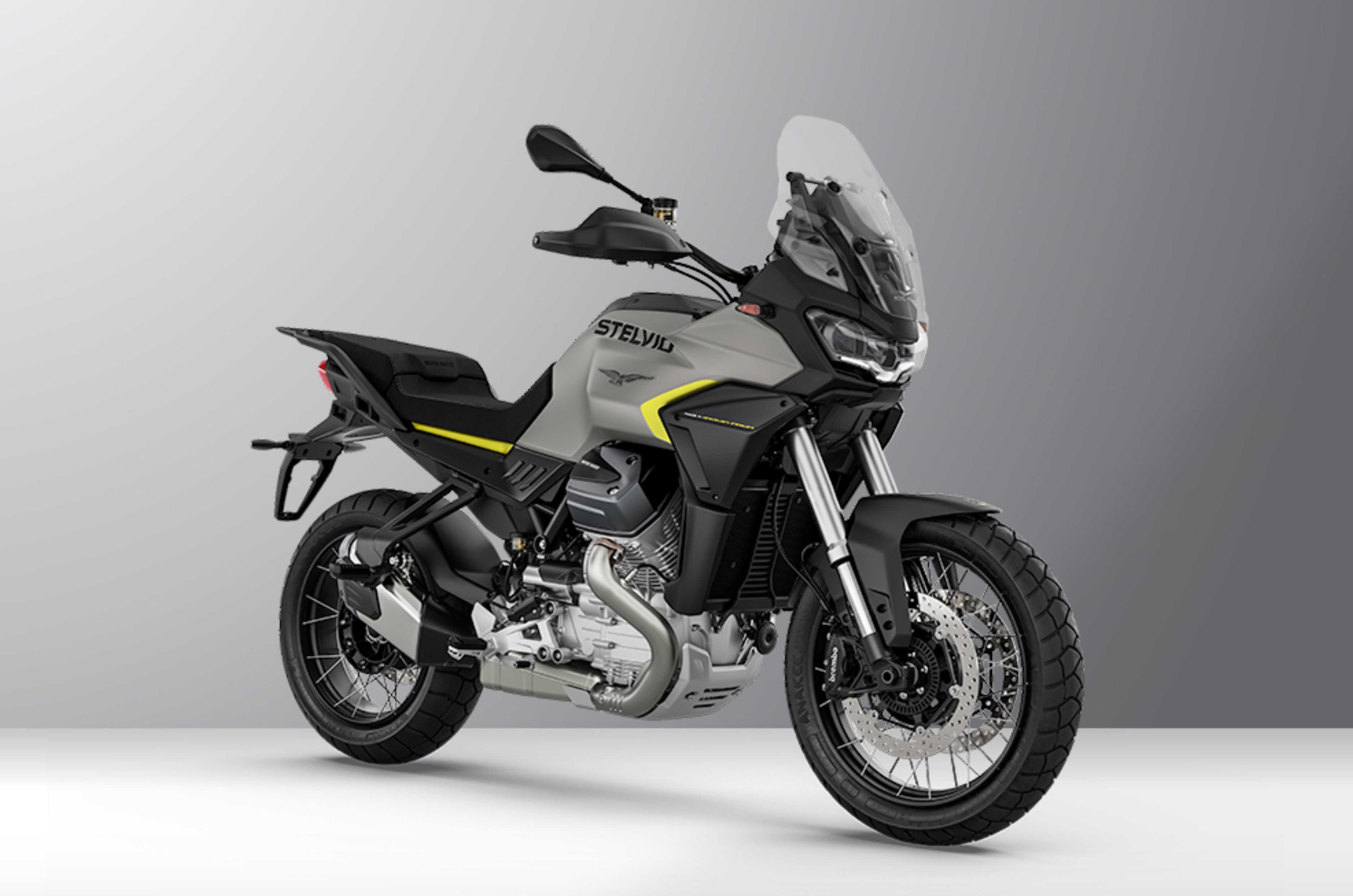
Moto Guzzi is an Italian brand and the Stelvio is one of their two ADV tourers in the litre class; the other one being the V100. They both share a 1042cc V-twin, liquid-cooled engine with 115hp and 105Nm of torque. The Stelvio is a bit more off-road oriented with a 19-inch front wheel and (tubeless) spoked wheels.
It gets cruise control, full LED lighting, cornering lamps, cornering ABS, traction control, five ride modes, adjustable front and rear suspension (preload and rebound), electrically adjustable windscreen, and handguards as standard. It’s also ready for accessories like an up-and-down quickshifter, tyre pressure monitoring system (TPMS), and multimedia connectivity system. Keeping up with the tourer theme, it also has a substantial 21-litre fuel tank as well with a rated economy of 20kpl, enabling roughly 450km range before needing a refueling.
In Europe, the Moto Guzzi Stelvio starts at EUR 16,990 (Rs 18.70 lakh) and is available in three variants and three colours.
EUR-to-INR conversion based on exchange rate at the time of writing.