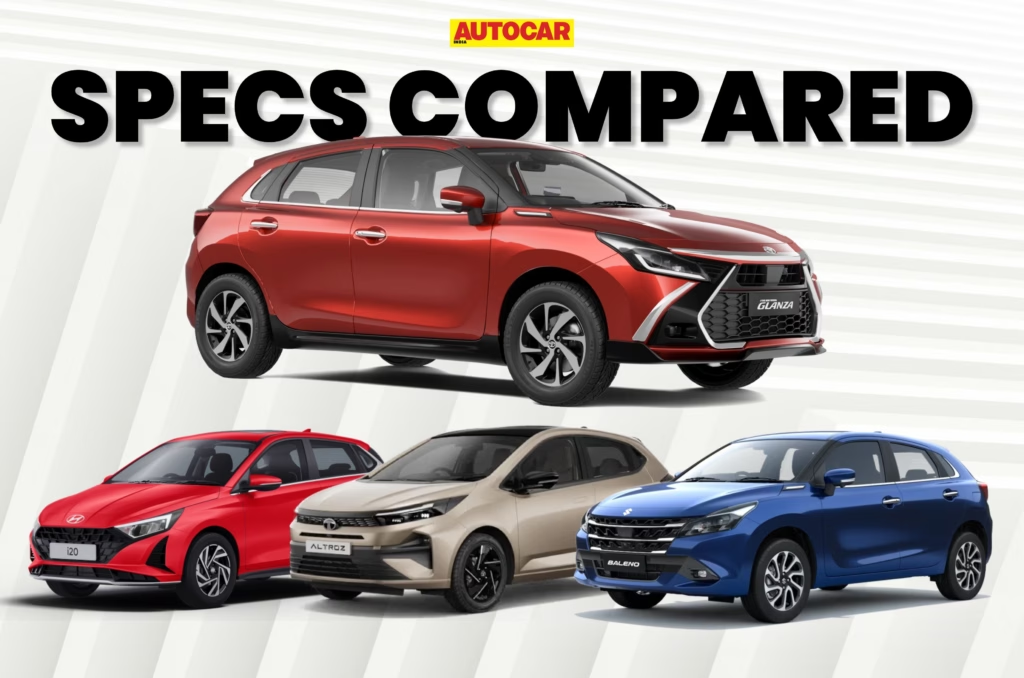
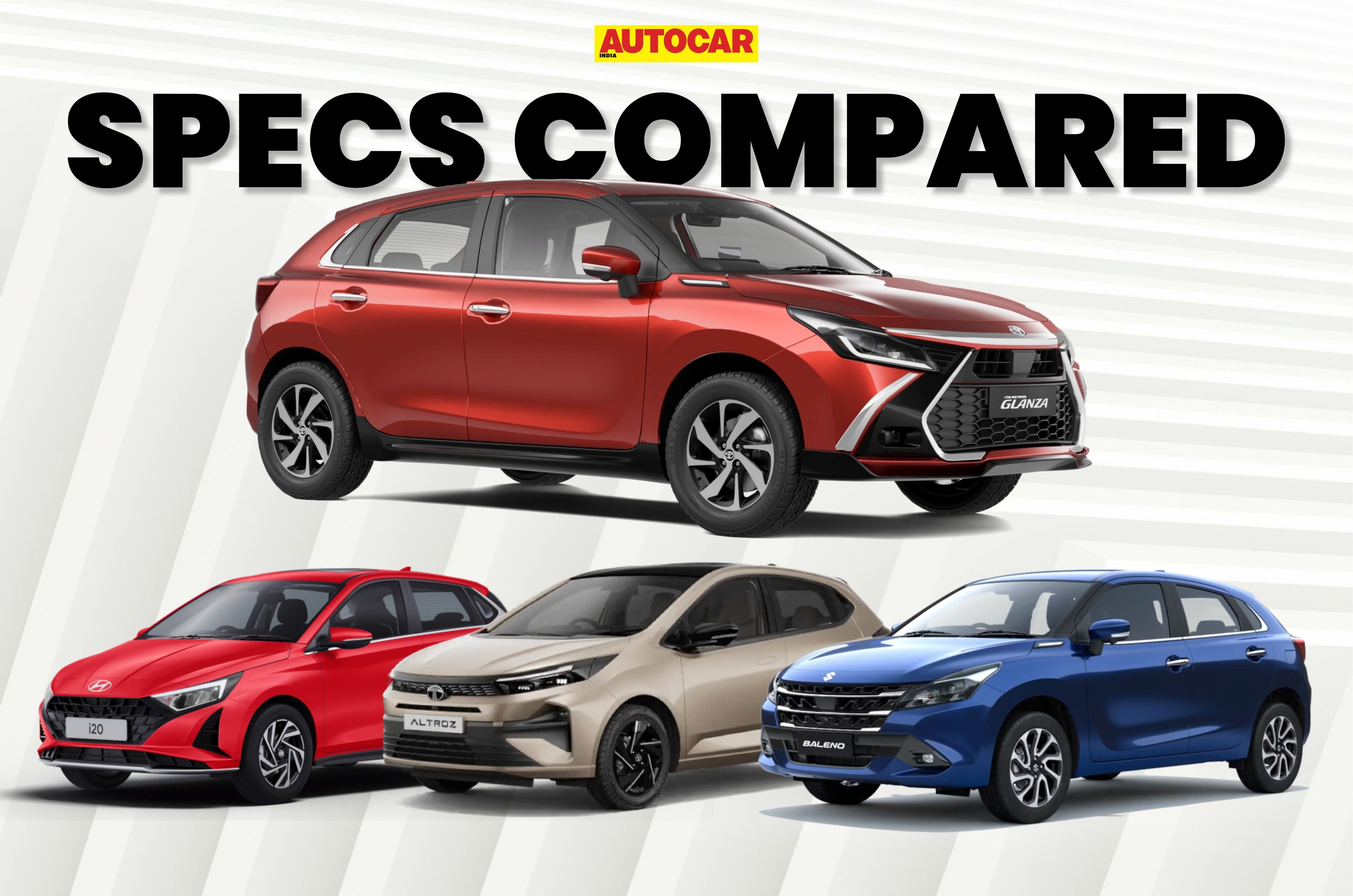
The Toyota Glanza is a premium hatchback that shares its underpinnings and powertrain with the Maruti Suzuki Baleno. The 2026 update brings changes to its styling and features, along with a CNG-AMT option. We compare it with the Baleno, Hyundai i20 and Tata Altroz in terms of specifications, features and prices.
2026 Toyota Glanza vs rivals: Dimensions
The i20 has the longest wheelbase, while the Altroz has the largest boot
Dimensions
Toyota Glanza
Maruti Suzuki Baleno
Hyundai i20
Tata Altroz
Length
3,990mm
3,990mm
3,995mm
3,990mm
Width
1,745mm
1,745mm
1,775mm
1,755mm
Height
1,530mm
1,530mm
1,505mm
1,523mm
Wheelbase
2,520mm
2,520mm
2,580mm
2,501mm
Boot space
TBA
318 litres
311 litres
345 litres
The Glanza and Baleno share the same length, width, height and wheelbase. The i20 is marginally longer than the other three and has the greatest width and wheelbase. The Altroz offers the largest boot capacity at 345 litres, ahead of the Baleno’s 318 litres and the i20’s 311 litres. Toyota has yet to confirm the facelifted Glanza’s boot capacity, although its badge-engineered relationship with the Baleno suggests the two could have similar luggage space.
2026 Toyota Glanza vs rivals: Engine specifications
The Glanza gets petrol and CNG options, with manual and AMT gearboxes
Engine specifications
Toyota Glanza
Maruti Suzuki Baleno
Hyundai i20
Tata Altroz
Petrol engine
1.2-litre, 3-cylinder
1.2-litre, 3-cylinder
1.2-litre, 4-cylinder
1.2-litre, 3-cylinder
Petrol power
83hp
83hp
83hp (MT); 88hp (IVT)
88hp
Petrol torque
112Nm
112Nm
114.7Nm
115Nm
CNG option
Yes
Yes
No
Yes
CNG power
70hp
70hp
–
74hp
CNG torque
102Nm
102Nm
–
103Nm
Diesel option
No
No
No
Yes
Transmission options
5-speed MT, 5-speed AMT
5-speed MT, 5-speed AMT
5-speed MT, IVT
5-speed MT, 5-speed AMT, 6-speed DCT
The Glanza’s new 1.2-litre three-cylinder engine produces 83hp and 112Nm in petrol mode, down 7hp and 1Nm compared with the outgoing four-cylinder unit. Claimed fuel efficiency stands at 23.80kpl with the manual and 24.77kpl with the AMT. In CNG mode, output drops to 70hp and 102Nm, with claimed efficiency of 33.61km/kg for the manual and 34.47km/kg for the AMT.
Like the Glanza, the Baleno offers petrol and CNG powertrains with manual and AMT options. The i20 is petrol-only, while the Altroz offers petrol, CNG and diesel engines. The Altroz is also the only one of these four to offer a diesel engine, while the Glanza and Baleno now add the convenience of an AMT with CNG.
2026 Toyota Glanza vs rivals: Features
Glanza adds ventilated seats and Level 2 ADAS, while the i20 and Altroz get sunroofs
Features
Toyota Glanza
Maruti Suzuki Baleno
Hyundai i20
Tata Altroz
Head-up display
Yes
Yes
No
No
Ventilated front seats
Yes
Yes
No
No
360-degree camera
Yes
Yes
No
Yes
Wireless phone charger
Yes, with cooling
Yes, with cooling
Yes
Yes
Sunroof
No
No
Yes
Yes
Infotainment touchscreen
9-inch
9-inch
10.25-inch
10.25-inch
Instrument cluster
Analogue dials with MID
Analogue dials with MID
TFT display
10.25-inch digital
Wireless Android Auto and Apple CarPlay
Yes
Yes
Yes
Yes
Automatic climate control
Yes
Yes
Yes
Yes
Rear AC vents
Yes
Yes
Yes
Yes
Adaptive cruise control
Yes
Yes
No
No
The Glanza and Baleno share several key features, including a head-up display, ventilated front seats, a 360-degree camera and a cooled wireless charger. Both also use a 9-inch touchscreen and analogue instrument dials with a multi-information display.
The i20 and Altroz offer larger 10.25-inch infotainment screens and sunroofs, which the Glanza and Baleno do not get. The Altroz also has a fully digital instrument cluster. All four offer automatic climate control, rear AC vents and wireless smartphone connectivity.
2026 Toyota Glanza vs rivals: Safety
Glanza and Baleno get Level 2 ADAS
Safety features
Toyota Glanza
Maruti Suzuki Baleno
Hyundai i20
Tata Altroz
Level 2 ADAS
Yes
Yes
No
No
Airbags
6
6
6
6
Tyre-pressure monitoring system
Yes
Yes
Yes
Yes
Electronic stability control
Yes
Yes
Yes
Yes
Hill-hold assist
Yes
Yes
Yes
Yes
ABS with EBD
Yes
Yes
Yes
Yes
ISOFIX child-seat mounts
Yes
Yes
Yes
Yes
The Glanza facelift adds Level 2 ADAS, including adaptive cruise control, lane-keeping assist, lane-departure warning and prevention, autonomous emergency braking and high-beam assist. It also gets a tyre-pressure monitoring system. The Baleno offers Level 2 ADAS as well, while all four hatchbacks have six airbags, electronic stability control, hill-hold assist, ABS with EBD and ISOFIX child-seat mounts.
2026 Toyota Glanza vs rivals: Price
Glanza prices range from Rs 6.99 lakh to Rs 10.98 lakh
Price (ex-showroom)
Toyota Glanza
Maruti Suzuki Baleno
Hyundai i20
Tata Altroz
Price range
Rs 6.99 lakh-10.98 lakh
Rs 5.99 lakh-9.99 lakh
Rs 6 lakh-11.64 lakh*
Rs 6.30 lakh-10.75 lakh
The Baleno has the lowest starting price at Rs 5.99 lakh, making it Rs 1 lakh cheaper than the Glanza. The Altroz starts at Rs 6.30 lakh, while the i20’s entry price is Rs 6 lakh. At the top end, the i20 is the most expensive at Rs 11.64 lakh with the N-line trim, followed by the Glanza at Rs 10.98 lakh. The Altroz tops out at Rs 10.75 lakh, while the Baleno has the lowest top-spec price at Rs 9.99 lakh. The Glanza’s higher starting and top-end prices place it above its badge-engineered sibling, the Baleno, across the range.
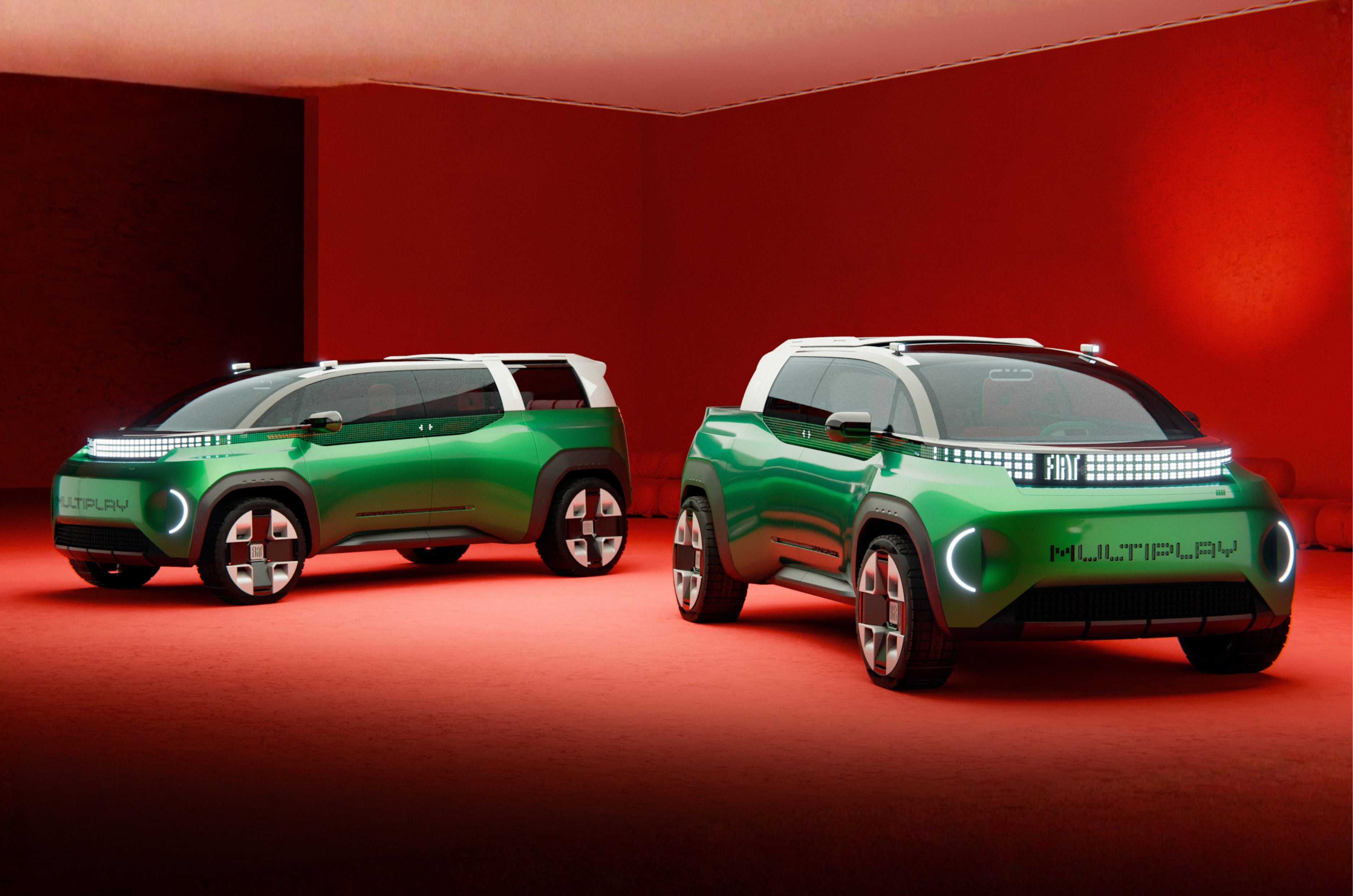
Fiat has revealed the Multiplay concept, which can switch between SUV and pick-up truck body styles electronically. The carmaker claims that its new concept builds on the legacy of the Multipla models of the past that redefined the relationship between exterior dimensions and interior space. The 3.5-metre-long Fiat 600 Multipla from 1956 could seat six people, while the 1998 Multipla had three seats each in the front and back rows in a vehicle less than 4 metres long. Fiat says the new concept continues that exploration of space through an architecture that can adapt to different uses.
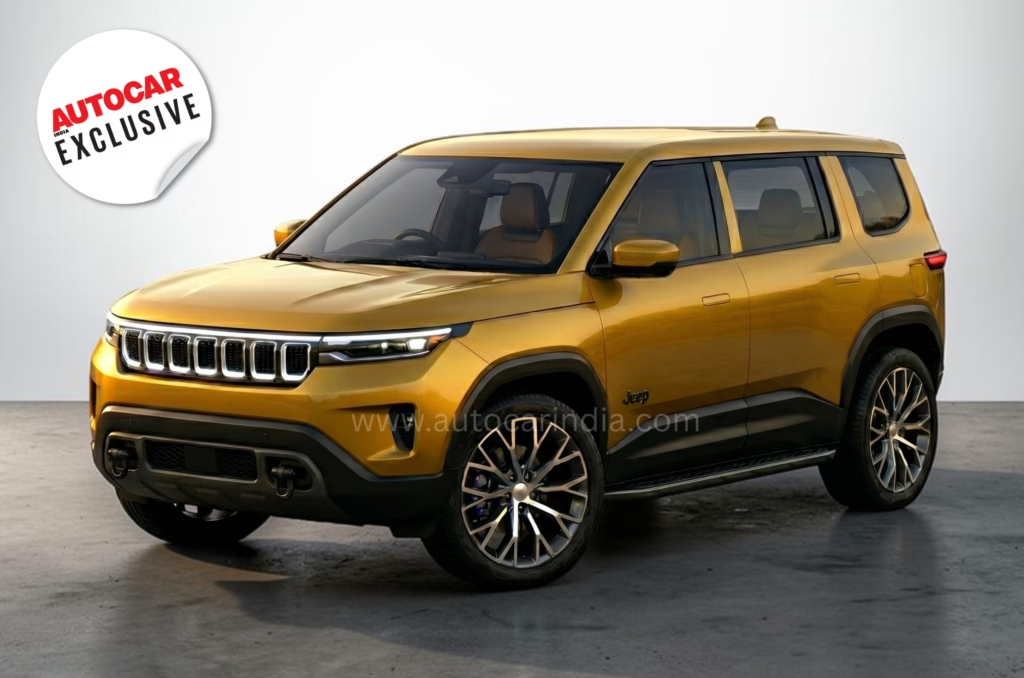
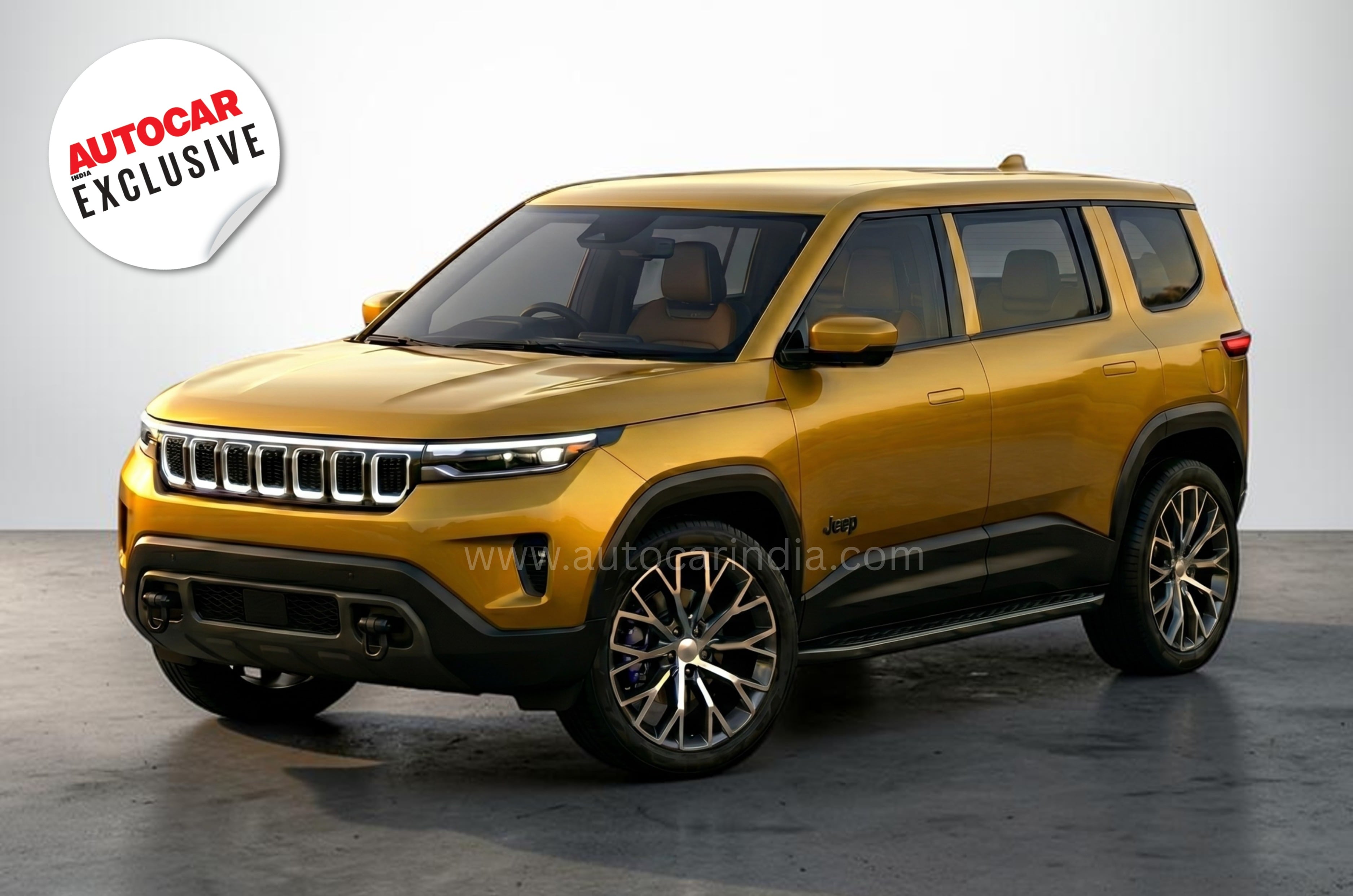
Tata Motors Passenger Vehicles (TMPV) and Stellantis have signed a formal agreement to expand their partnership into product technology, platforms and vehicle architecture, formalising plans for a new Jeep SUV based on the Tata Sierra’s ARGOS platform, according to people in the know. Internally codenamed J1J, the Jeep SUV will get both internal combustion engine and electric versions and it is likely to use the same powertrains as the Sierra, say people in the know.
Sierra-based Jeep SUV: platform and production plans
ARGOS stands for All-Terrain Ready, Omni-Energy and Geometry Scalable. It is TMPV’s modular, multi-energy vehicle architecture, designed to accommodate different vehicle dimensions and powertrain applications, which can open up more opportunities for Stellantis in the future.
While Tata Motors is producing the Sierra at its Sanand factory in Gujarat, production of the Jeep model is likely to take place at the Fiat India Automobiles Ltd (FIAL) joint venture facility in Ranjangaon, Maharashtra. The manufacturing operations are expected to be adapted for the programme over the next 18 months, added a person in the know.
The programme forms part of Stellantis’ wider ambition to sell 100,000 locally produced vehicles globally in 2028 across its Tata and Dongfeng partnership programmes combined, as outlined at its May 2026 Investor Day. The target covers several products. The company is likely to launch the first vehicle in the first half of 2028, say sources.
A dedicated team for the project is currently based out of Pune and will look at adapting the vehicle architecture, including a left-hand-drive version for overseas markets. A range-extender electric vehicle application is also being explored on the platform, although no production decision for the REEV has been finalised, according to people familiar with the engineering work.
An email sent to Tata Motors and Stellantis seeking comment remained unanswered at the time of publication.
The formal agreement builds on a relationship spanning more than two decades. Having collaborated on manufacturing, powertrains and the supply chain, the partners are now extending their cooperation into vehicle development.
Sierra-based Jeep SUV: Different body and cabin
Stellantis is benchmarking its own Jeep Renegade and Compass products for the J1J model development, according to company sources. Its eventual name and final production design are being firmed up.
This clearly indicates that the Jeep will have a different upper body, or top hat, exterior styling and cabin. Changes will extend to the seating package, interior features and equipment. These will distinguish it from the Sierra, while allowing the companies to share the underlying architecture and components.
Much of the platform is expected to be retained, with structural modifications and reinforcements, where required, to accommodate the Jeep body and meet crash and overseas regulatory requirements. Details of Jeep-specific suspension tuning and off-road hardware could not immediately be established. A 4×4 variant is also likely as Jeep’s brand guidelines insist on giving its customers a 4×4 option for all its models. Whilst the electric version of the Sierra already comes with 4×4, the ARGOS platform has been packaged and developed to accommodate a 4×4 ICE drive train as well. In fact, the Jeep partnership could accelerate the launch of a Sierra 4×4 to coincide with launch of the next-gen Jeep SUV.
Tata Motors sister company Tata Technologies is understood to be involved in engineering execution at Stellantis. The work includes the Jeep-specific body and interior package, left-hand-drive adaptation and changes needed to meet overseas regulations.
According to people familiar with the programme, TMPV will retain ownership of the architecture and license it to Stellantis. Existing Sierra suppliers are expected to support Jeep where components can be shared, with separate sourcing and tooling for model-specific parts.
India development, global markets
Stellantis had disclosed its intention to develop a Tata-based Jeep at its May 21, 2026 Investor Day. Grégoire Olivier, its Asia Pacific chief operating officer, said Tata Motors would provide a competitive platform for a new Jeep vehicle to be developed and assembled in India through the existing joint venture for global markets.
Olivier had also outlined exports to more than 50 countries across the wider portfolio, including the Dongfeng programmes, the Tata-based Jeep and the existing Citroën Smart Car programme in India. The markets allocated specifically to J1J have not been established.
For Stellantis, Tata’s architecture and supplier base offer a way to reduce development expenditure while adding a new Jeep product. For TMPV, the arrangement could generate licensing revenue and spread platform costs across additional vehicles. Common components could also bring suppliers higher volumes.
The alliance is a much-needed segue for the Jeep brand which has been in India for close to a decade but has been relegated to the fringes of the Indian market with a lack of product action. A licensed modular architecture with the potential for multiple powertrains, 4×4 capability and different wheelbases will open opportunities for more products in a quicker time interval.
The programme would extend the Ranjangaon venture from manufacturing cooperation to producing a Jeep on Tata’s vehicle architecture. The left-hand-drive version would widen its overseas reach, giving the plant access to demand beyond India and other right-hand-drive markets.
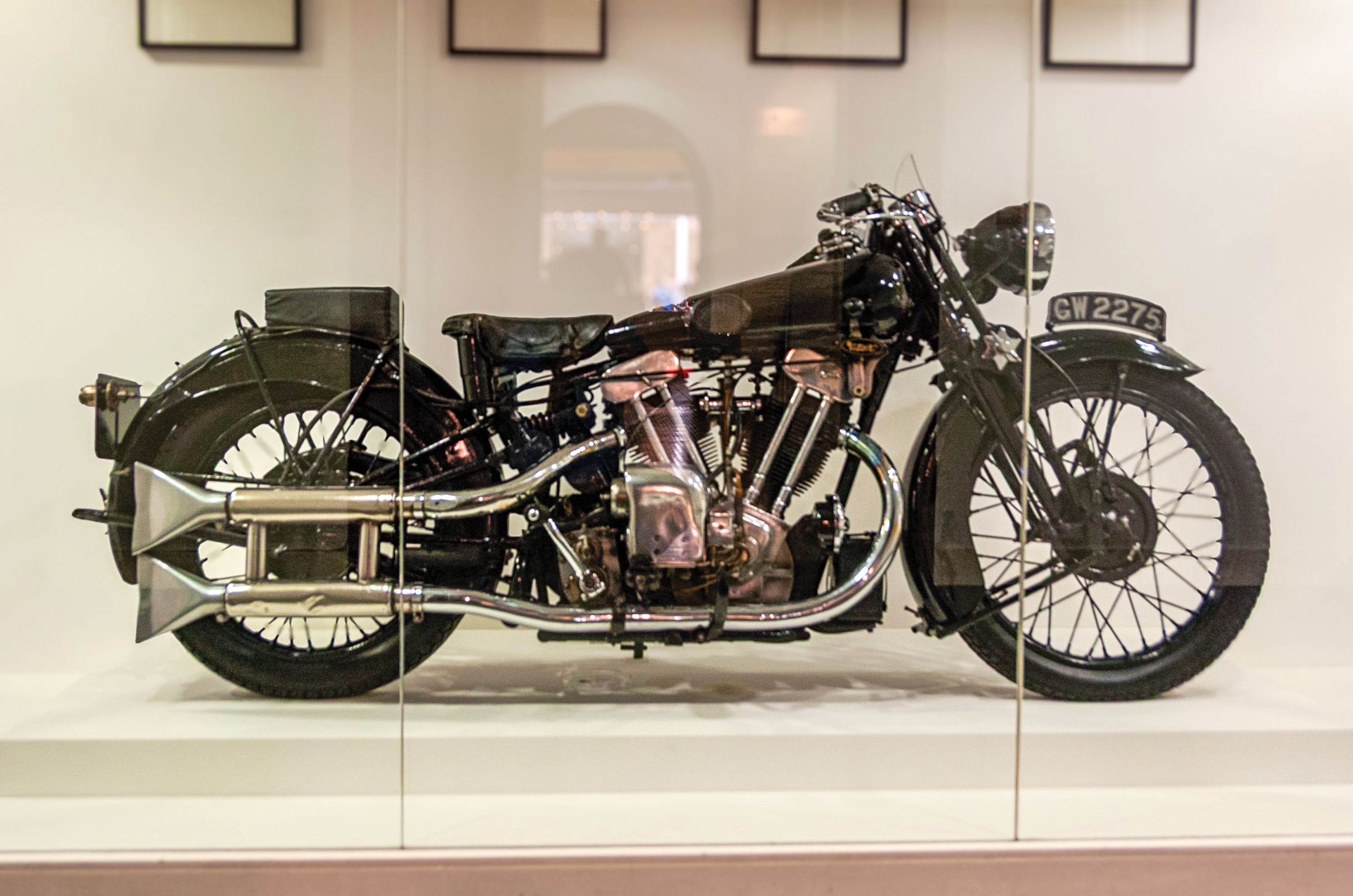
Seventeen years ago, in the Imperial War Museum on Lambeth Road in London, I stood mesmerised in front of a motorcycle with the number plate GW 2275, enclosed in a glass case. It was a beautiful, brooding machine, low and long, finished in deep black with just enough nickel and chrome to catch the museum lights: twin fishtail exhausts sweeping back in a graceful curve, the big JAP V-twin sitting exposed and unapologetic between the frame rails, cylinders splayed wide, cooling fins stacked like the pages of a book. Thin copper oil lines ran externally along the frame, feeding the total-loss lubrication system of the era, a solution that looked almost primitive next to a modern engine yet was efficient enough to survive being wrung out past 100mph on 1930s public roads.
A flamboyant form, every component left exposed, hinting at George Brough’s intention to let you see exactly what you were paying for. This was, in its day, the pinnacle of what was once the finest motorcycle industry in the world, the British motorcycle industry. Standing there, it was easy to understand why a certain kind of Englishman, restless, brilliant, and a little broken, would have fallen entirely in love with a machine like this.
The very Brough Superior SS100 Lawrence died on, photographed at the Imperial War Museum in 2008. Its last known owner, reclusive collector John Weekly, kept it in his lounge for over 45 years before his death in 2024. After which the Brough’s whereabouts are unknown.
It took me straight back to being a teenager watching Lawrence of Arabia for the first time. The film famously opens with this motorcycle: the frantic braking, the fatal swerve to avoid two boys on bicycles, before flashing back to how a restless desk officer became a legendary guerrilla leader in the Arab Revolt, and how that legend curdled into cynicism once Britain betrayed the cause he’d fought for. This was the actual Brough Superior SS100 that TE Lawrence was ripping home on from Bovington on May 13, 1935, when he went over the handlebars, struck his head, and died six days later without regaining consciousness.
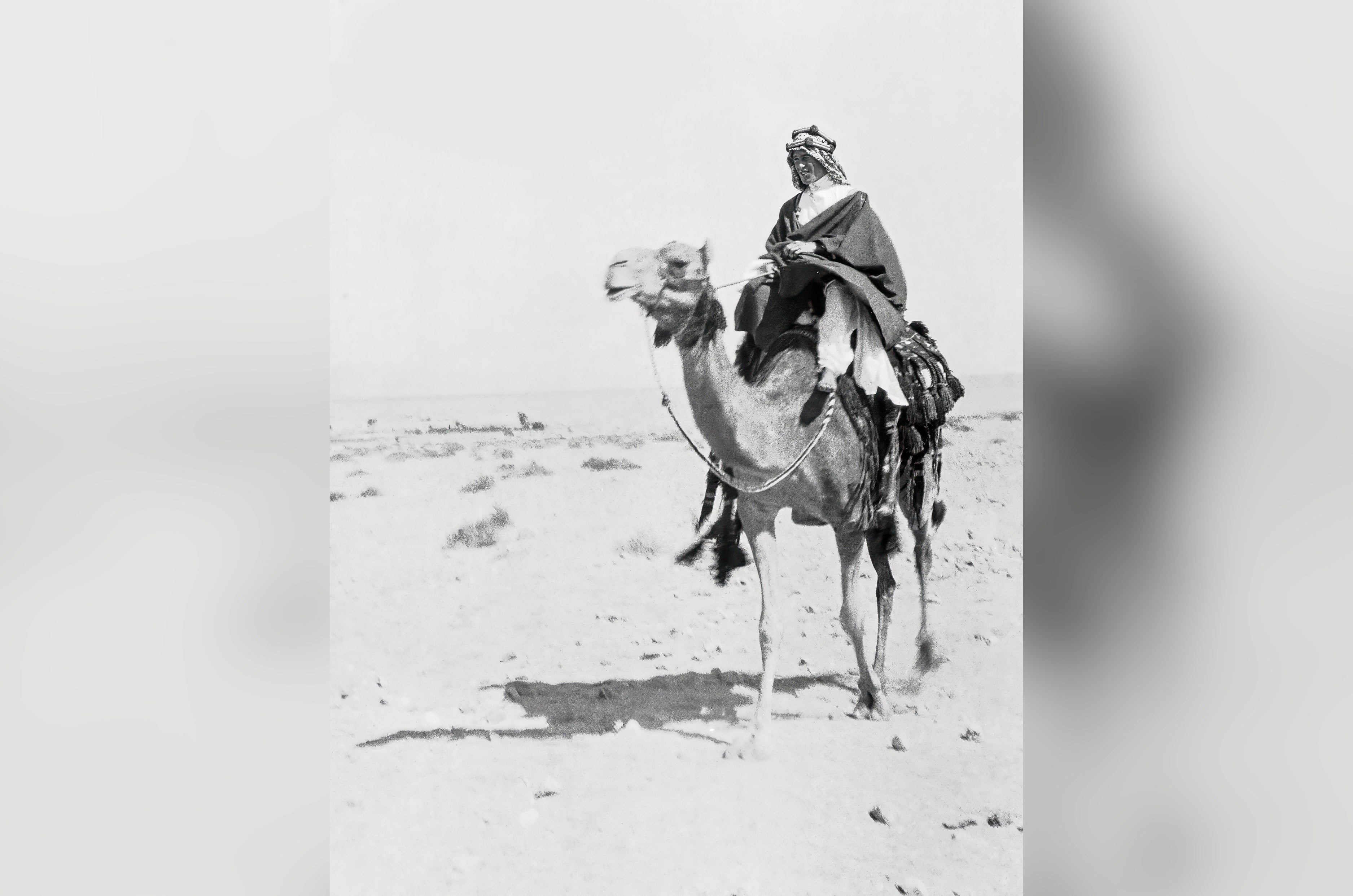
Motorcycle or camel, Lawrence rode with consummate ease.
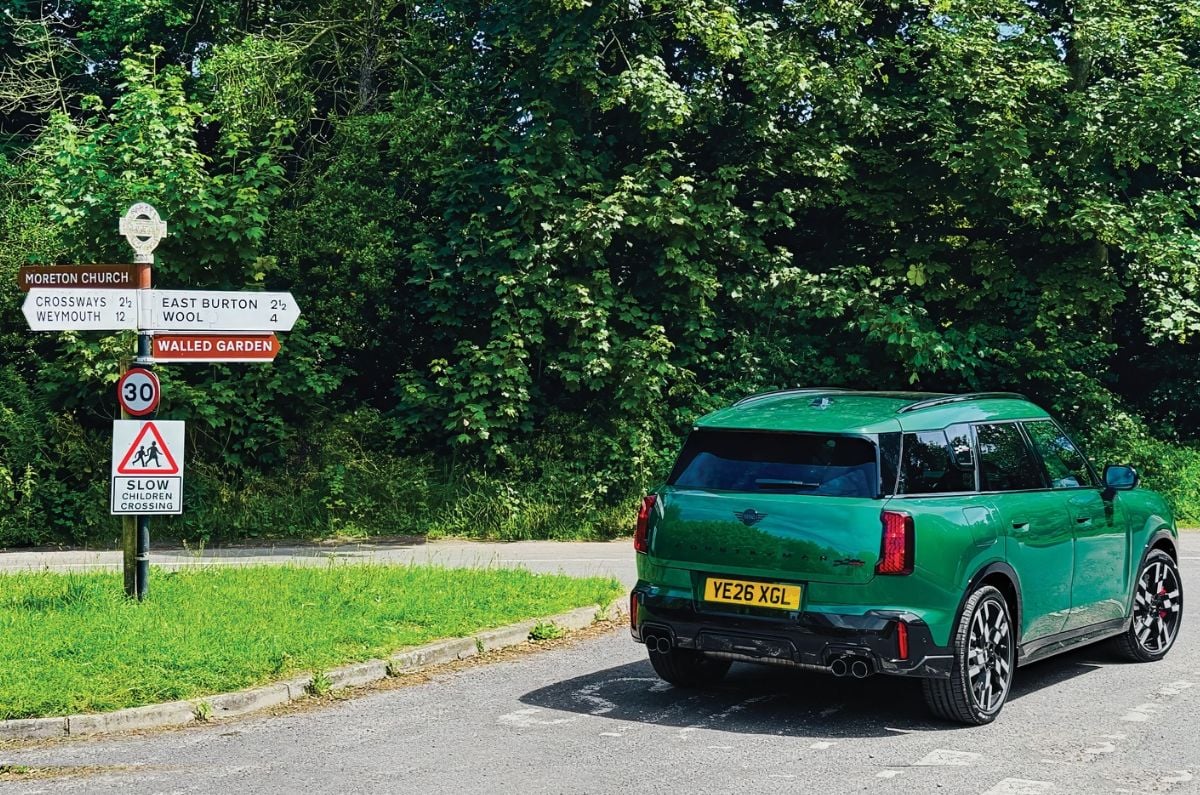
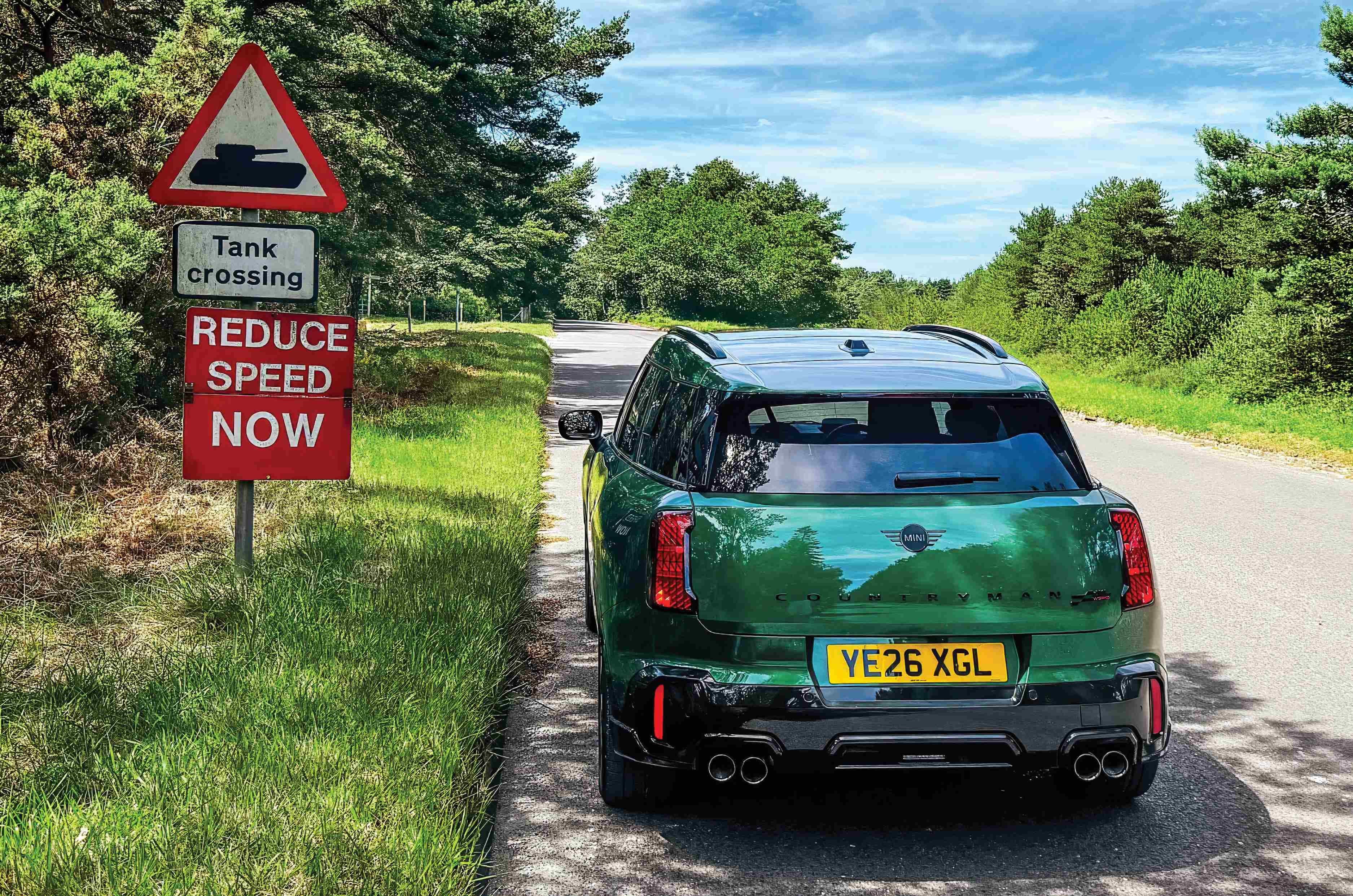
I have always felt a pull towards places where history happened, where the past has left something tangible behind, and this anniversary issue gave me the excuse I needed to follow Lawrence’s last ride. For this quest, I got behind the wheel of the new Mini Countryman John Cooper Works. A slightly contradictory choice of car for a story about a restless man who spent his last years trying to shrink his own reputation by changing his name twice to get away from the legend he’d unwillingly become. Because the new Countryman is going through much the same thing but in reverse.
By the very virtue of its name, the Mini has a reputation of being a compact and cheeky car that seems to occupy hardly any road at all, but this Mini is large and an SUV, accentuated by beefy curves with all-wheel drive as standard and sporty vivid red disc calipers. Under the bonnet sits a potent 2.0-litre turbo four-cylinder engine with 300 horsepower of shove and 400Nm of tug.
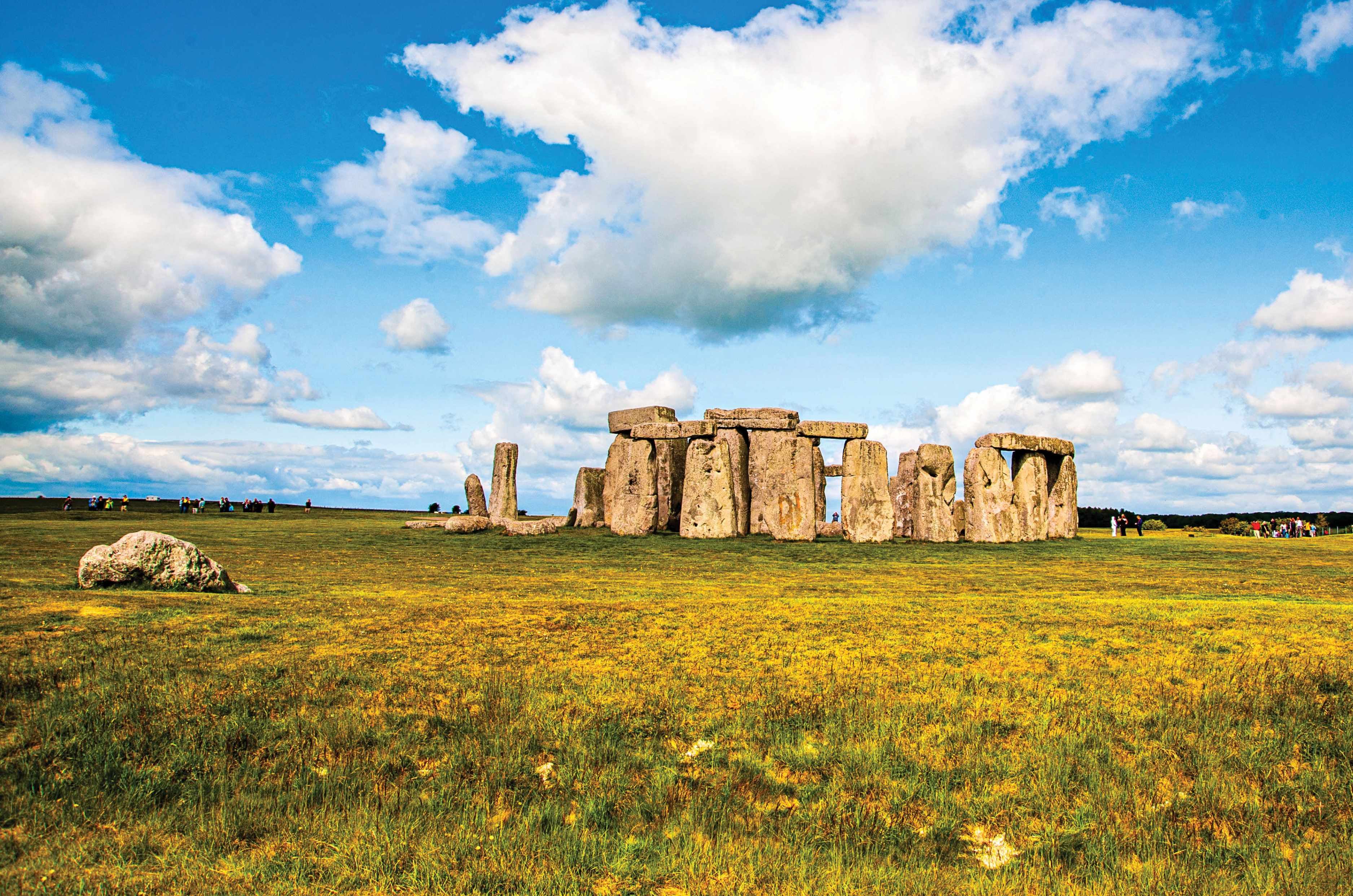
The irony was not lost on me: I was driving a car that had outgrown its own name, setting off to chase a man who’d spent his final years trying to shrink his. I pointed the car west out of London on the M3, then the A303, pulling over near Stonehenge for a quick photograph before pressing on toward another English icon further down the road.
The road to Clouds Hill
Stonehenge bursts into view without warning as the A303 tops a crest, the ancient stones suddenly filling the windscreen against the Salisbury Plain.
Beyond Stonehenge, the Countryman ate the tarmac in complete comfort, cabin hushed, adaptive cruise doing most of the thinking. The road eventually dropped south onto narrower country lanes for the final approach into Dorset, and it was here, as the hedgerows closed in, that the JCW visibly changed character. All-wheel drive dug in through the bends, the exhaust note sharpened, and for a few minutes on the approach to Clouds Hill, this bulked-up, grown-up Mini showed me that the nimbleness of its ancestors still lived somewhere in its genes.
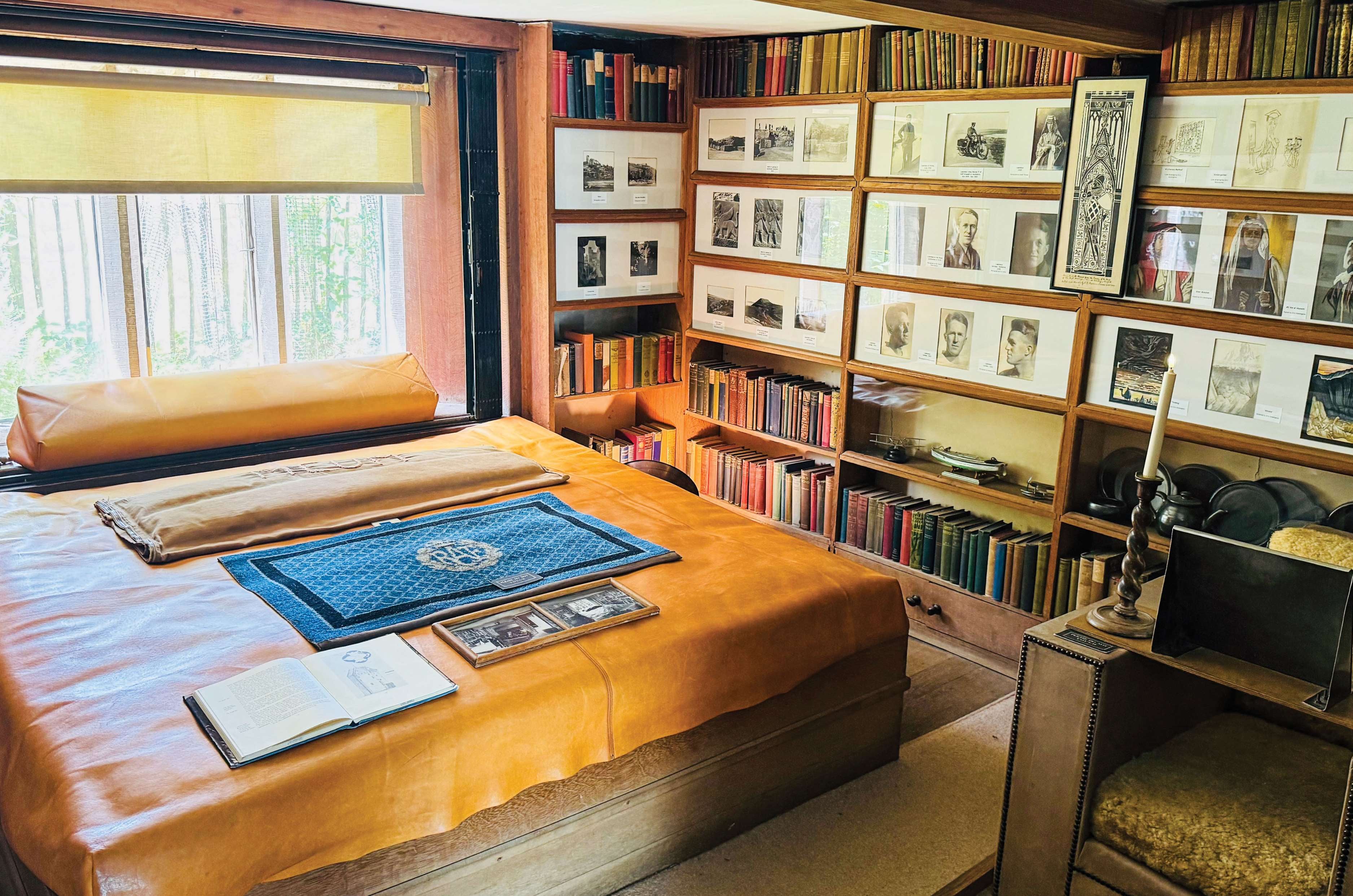
Inside Clouds Hill: Lawrence’s daybed and bookshelves, preserved almost as he left them.
Clouds Hill itself is almost comically modest for a man who became one of the most famous people in England. It’s a four-room labourer’s cottage with no electricity, which Lawrence first rented in 1923 while stationed at nearby Bovington, then painstakingly rebuilt with his own hands before buying it outright in 1929. Inside, the leather-topped daybed, bookshelves crammed with correspondence and photographs, and framed portraits of Bedouin faces and RAF colleagues remain much as he left them, preserved by the National Trust.
What hints at the pull of Lawrence’s personality is who came all the way here to visit him. George Bernard Shaw, EM Forster, Thomas Hardy and Robert Graves all found their way to this tiny, electricity-less retreat, which was slightly ironic, because Lawrence was doing his best to disappear. The world knew him as Lawrence of Arabia, the flamboyant soldier in Arab robes who’d become one of the most recognisable figures of the First World War, and he wanted none of the celebrity that came with it.
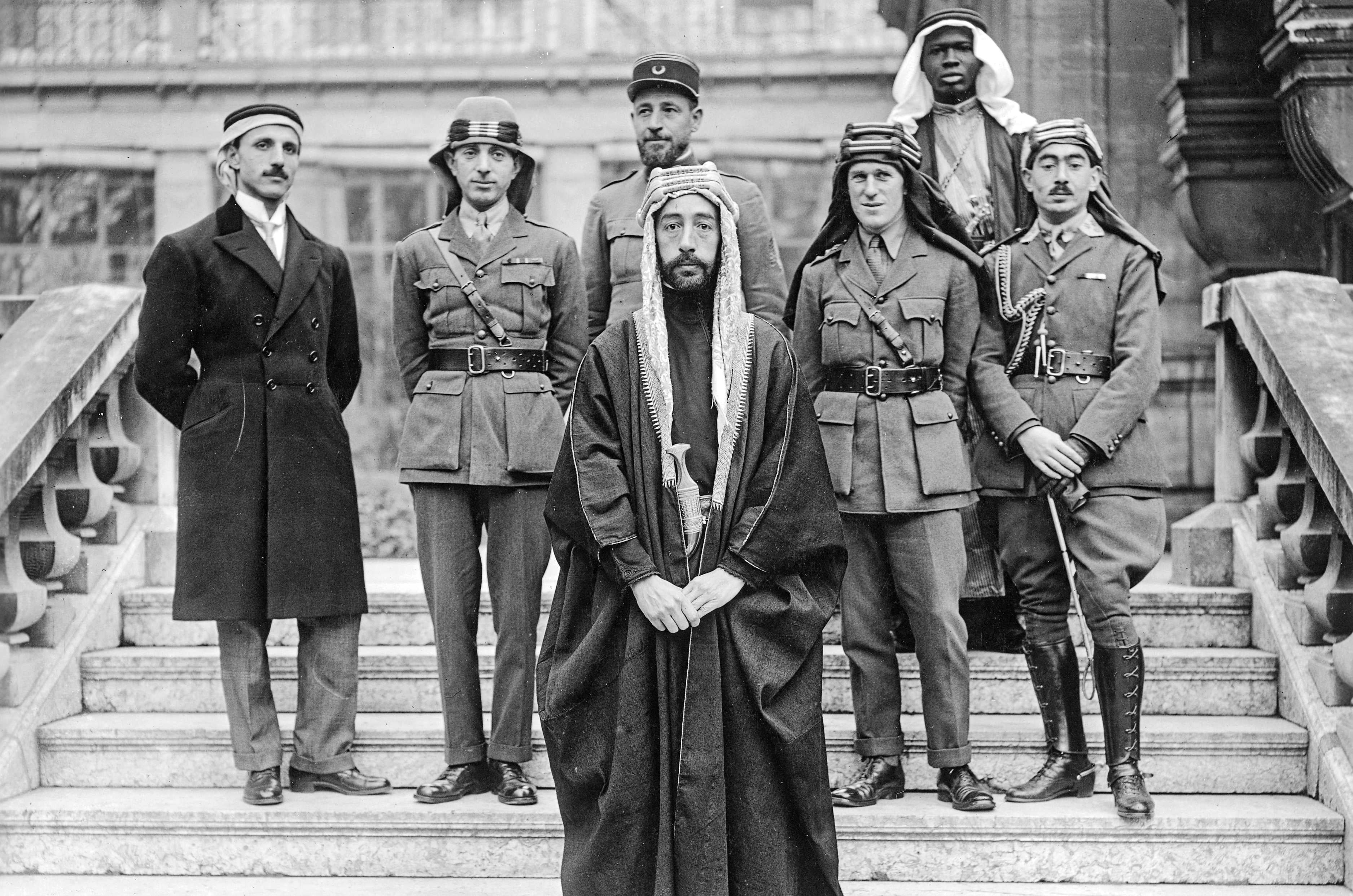
Prince Faisal’s delegation at the 1919 Paris Peace Conference. Lawrence (third from left) stood among men Britain would soon betray.
He’d already tried once: in 1922, he joined the RAF under the name John Hume Ross, but the press uncovered him within months. The following year, he joined the Tank Corps as TE Shaw, a name he kept for the rest of his life. Clouds Hill became his refuge, a place to read, write, listen to music, work on his boats and motorcycles, and retreat from a world determined to keep finding him.
He did make forays out. Winston Churchill was a genuine friend, and Lawrence would occasionally turn up unannounced at Chartwell, Churchill’s home about 130 miles away. He liked to boast that his long-distance visits to friends like Churchill and Lady Astor were made in “record time” thanks to the Brough’s speed, calling the machine “the silkiest thing I have ever ridden.”
Churchill’s daughter Mary remembered him arriving as “a short, nondescript, sandy-haired airman riding a motorcycle,” only to reappear at dinner transformed, “presenting himself in the flowing robes of a Prince of Arabia.” She also recalled the “pin-drop silence” that fell over the room whenever Lawrence spoke, a silence that apparently included her father, who himself considered Seven Pillars of Wisdom “unsurpassable” as a war narrative. It was an odd, quietly moving thing to stand in a room with no electricity and realise the man who once sat there could hold some of the loudest reputations in England spellbound.
The road that killed him
This road has widened over the decades, much like the Mini brand, which now includes an SUV.
From Clouds Hill, the road towards Bovington Camp is the one Lawrence rode almost daily, and it’s easy to see why he loved it: well cambered, with quick, confident curves that seem made for two wheels rather than four. The road has changed considerably since 1935, widened, realigned and smoothed out, the dips Lawrence knew long gone, but the bends remain, and the JCW flowed through them on silky modern tarmac with barely a shudder.
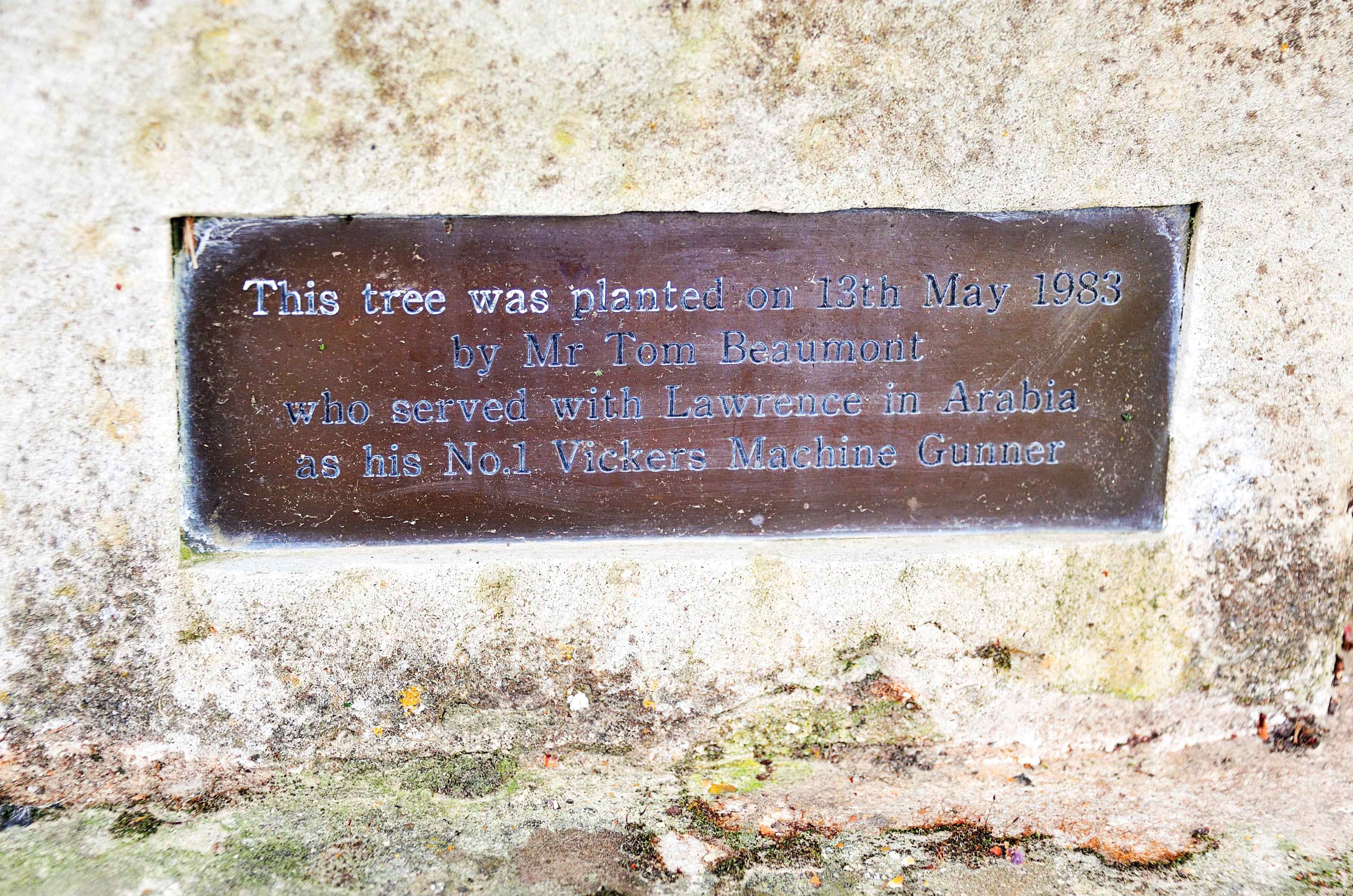
The plaque marking the tree planted by T.E. Lawrence’s former Vickers gunner, Tom Beaumont, in 1983.
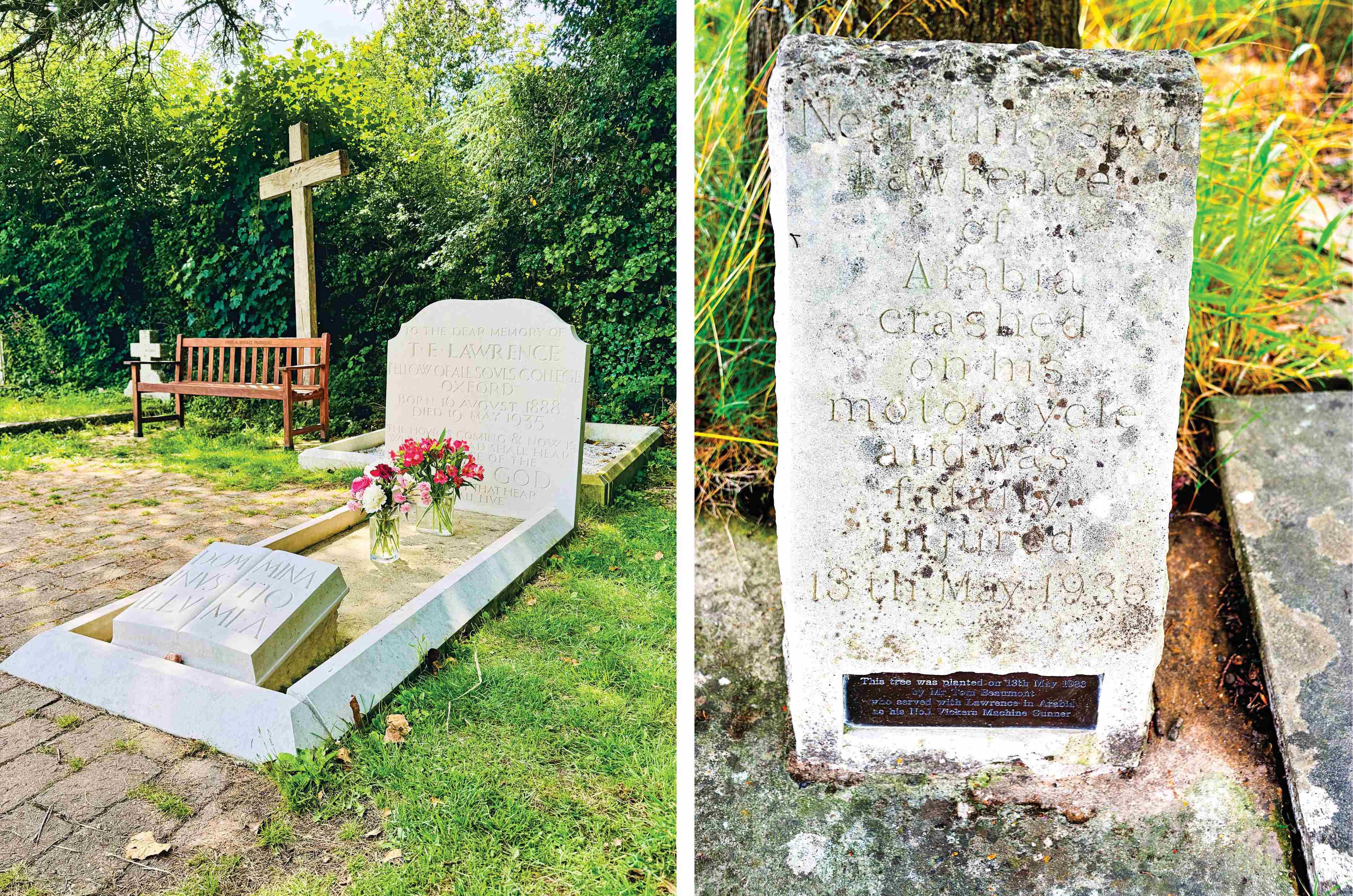
Lawrence was known to push his Brough to 100mph on roads like this despite the rougher surfaces and primitive brakes of the time. It takes a particular sort of nerve to do that. Sadly, this is also the road on which he died. A small, weathered stone marker stands by the roadside near the crash site, its inscription barely legible: Near this spot Lawrence of Arabia crashed on his motorcycle and was fatally injured, 13th May 1935.
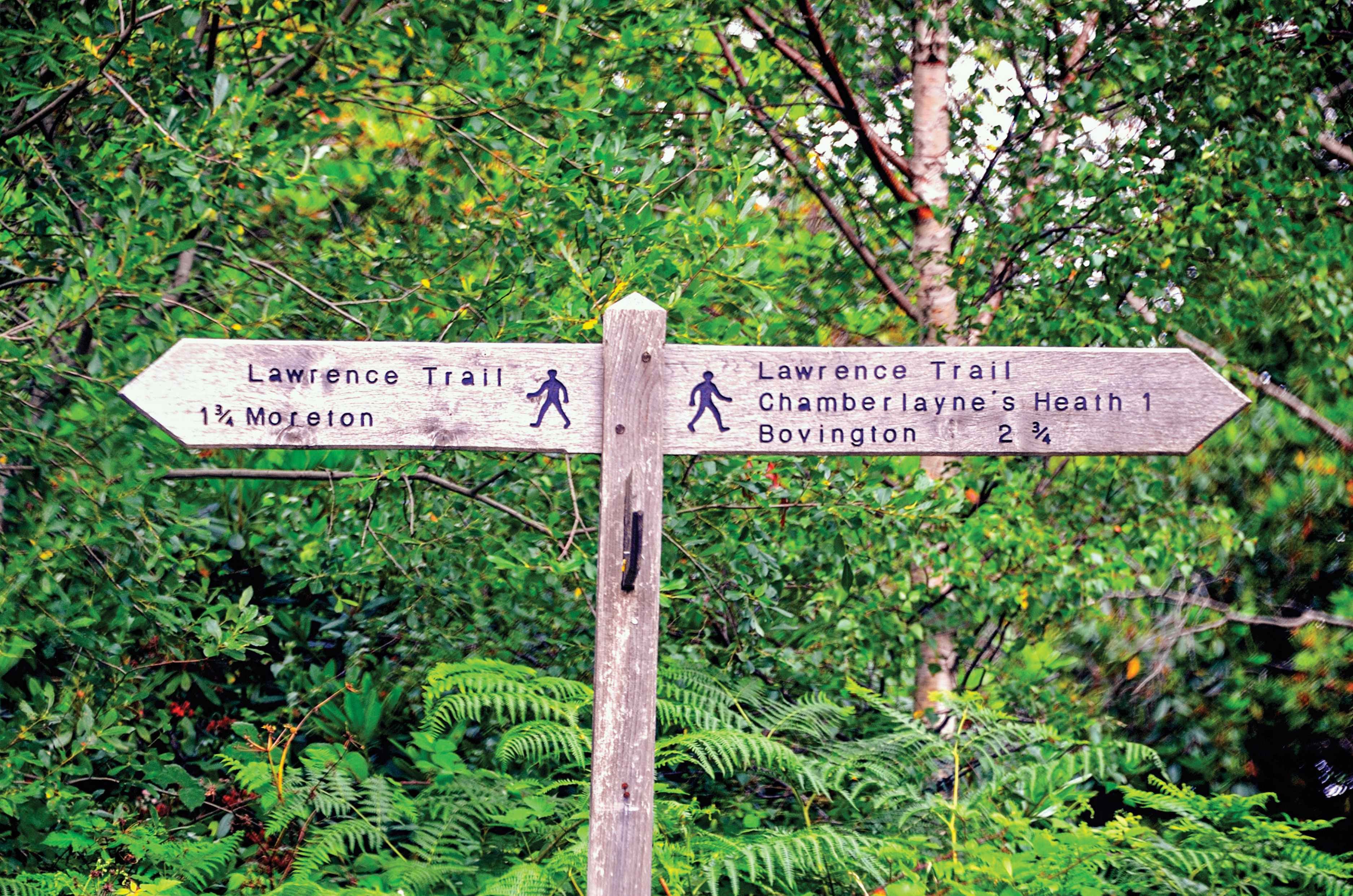
A signpost for the Lawrence of Arabia Trail.
Below it, a plaque records that the tree beside the marker was planted in 1983 by Tom Beaumont, who had served as Lawrence’s Vickers machine gunner in Arabia, one old comrade returning nearly half a century later to mark where another had died. It’s a small, unshowy memorial for a man who became the subject of an Oscar-winning film. Bovington Camp is also the start and finish point of the circular 10.8km Lawrence of Arabia Trail, which strings together the cottage, the crash site, and the church at Moreton in one walkable loop.
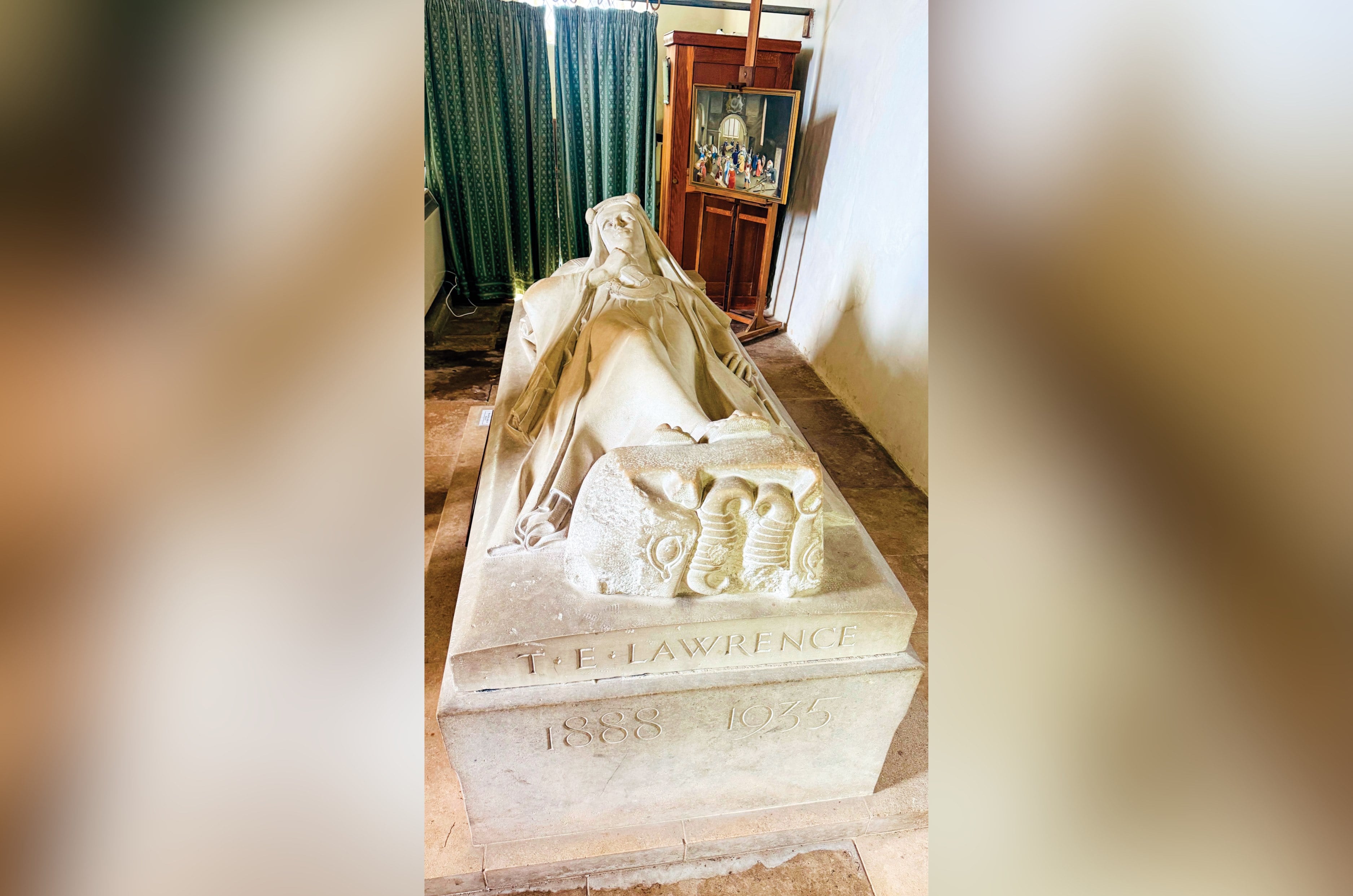
Lawrence’s effigy at St Martin’s Church, Wareham, carved by his friend Eric Kennington.
A short drive away in Wareham is one more stop worth making: the Saxon church of St Martin’s, home to a life-size effigy of Lawrence carved by his friend Eric Kennington, originally intended for St Paul’s Cathedral before being rejected there and finding its way to this small parish church instead.
Moreton and the memory of him
Moreton itself is a proper Dorset postcard, a signpost outside St Nicholas’ Church pointing the way to “Walled Garden” beside directions to Wool and Weymouth, as if history and horticulture share equal billing. Lawrence’s small and very private funeral and burial were held here on May 21, 1935, and the mourners included Churchill, Lady Astor, General Wavell (who flew in by autogiro), and author Henry Williamson.
Left: T.E. Lawrence’s grave at St Nicholas’ Church, Moreton. Simple white stone, flowers left fresh by visitors. Right: The weathered marker near Bovington, barely legible, recording the spot of Lawrence’s crash.
His grave sits a short walk from the church, simple white stone, flowers laid fresh by visitors, the inscription noting he was a Fellow of All Souls College, Oxford, and making no mention at all of Arabia.
The coast, and letting the car breathe
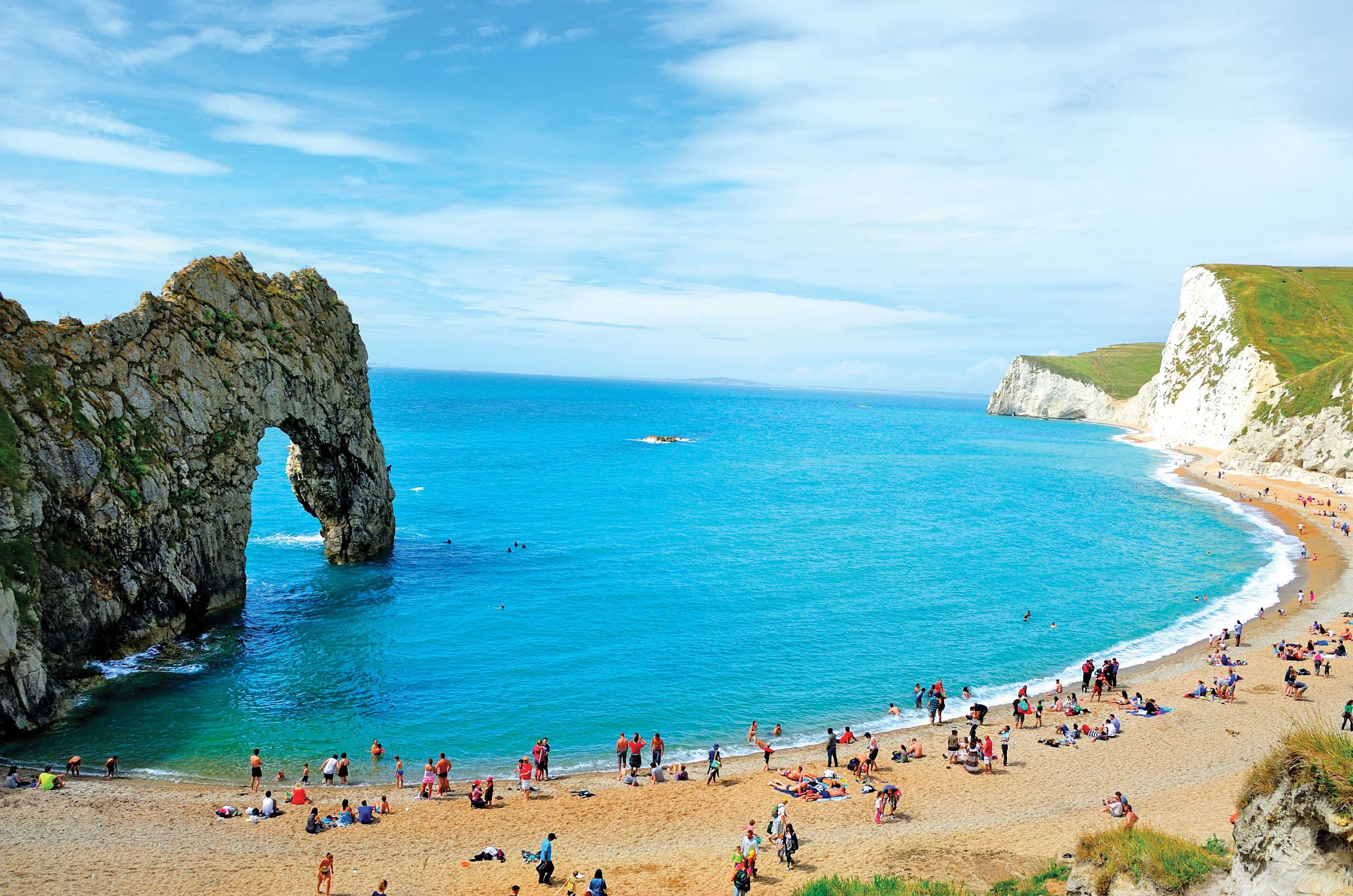
Durdle Door, the natural limestone arch that draws crowds to this stretch of coastline.
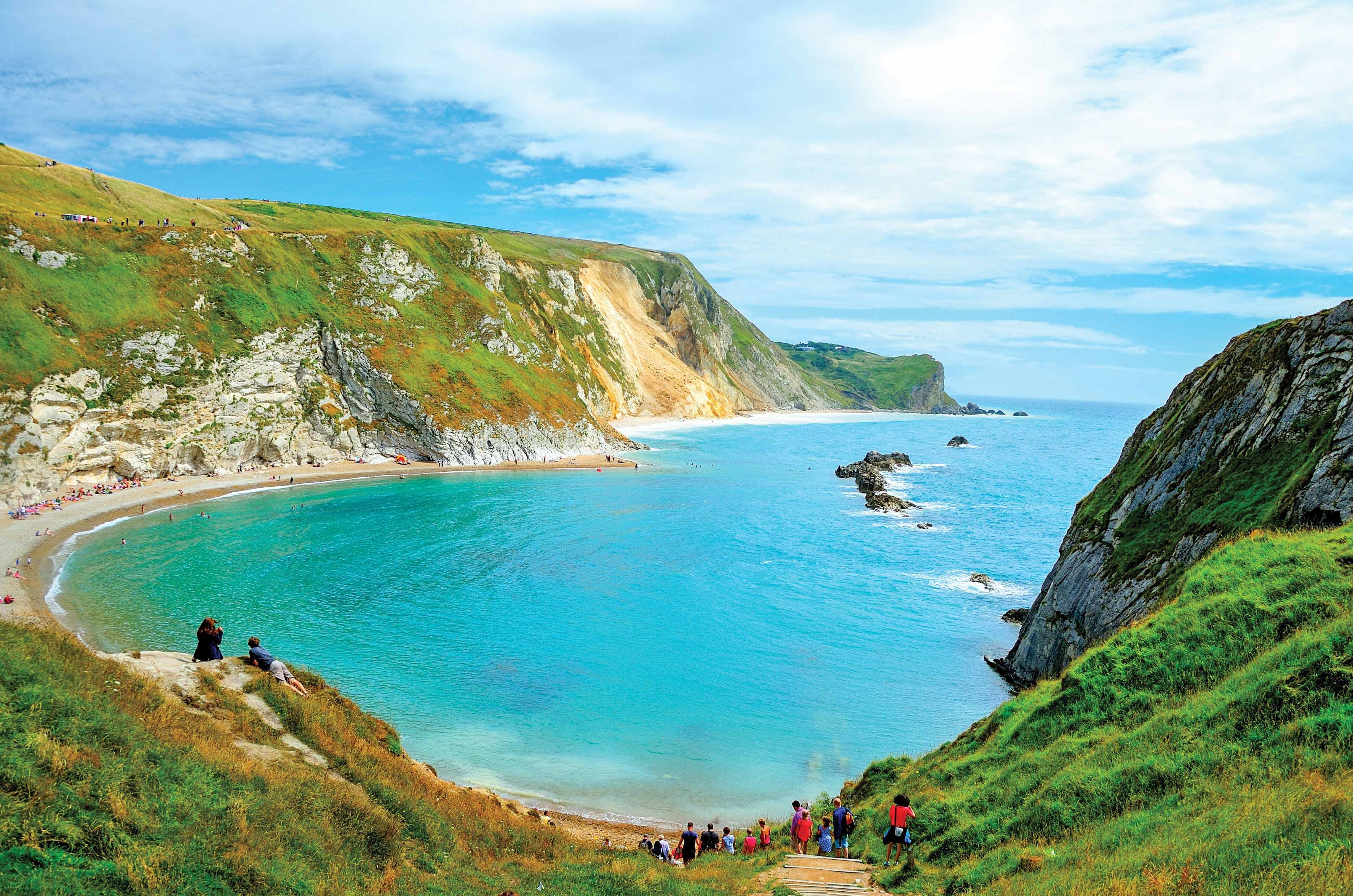
I couldn’t leave Dorset without giving the JCW a proper stretch, so I pushed south to the Jurassic Coast, Durdle Door and Lulworth Cove, a slight detour from Lawrence’s own story, but too good to leave out of a day like this. Every mile of the drive validated it being classed as an SUV. The properly deep boot held picnic mats, beach gear, including chairs and an umbrella, without the need of the rear seats being dropped.
Lulworth Cove’s chalk cliffs and turquoise water, a world away from Lawrence’s Dorset lanes.
The cabin felt roomy, and the ride height shrugged off potholed coastal car parks without a second thought. There’s real engine grunt for those urgent overtakes on narrow country lanes when stuck behind agonizingly slow motorhomes that make you feel like tearing your hair out.
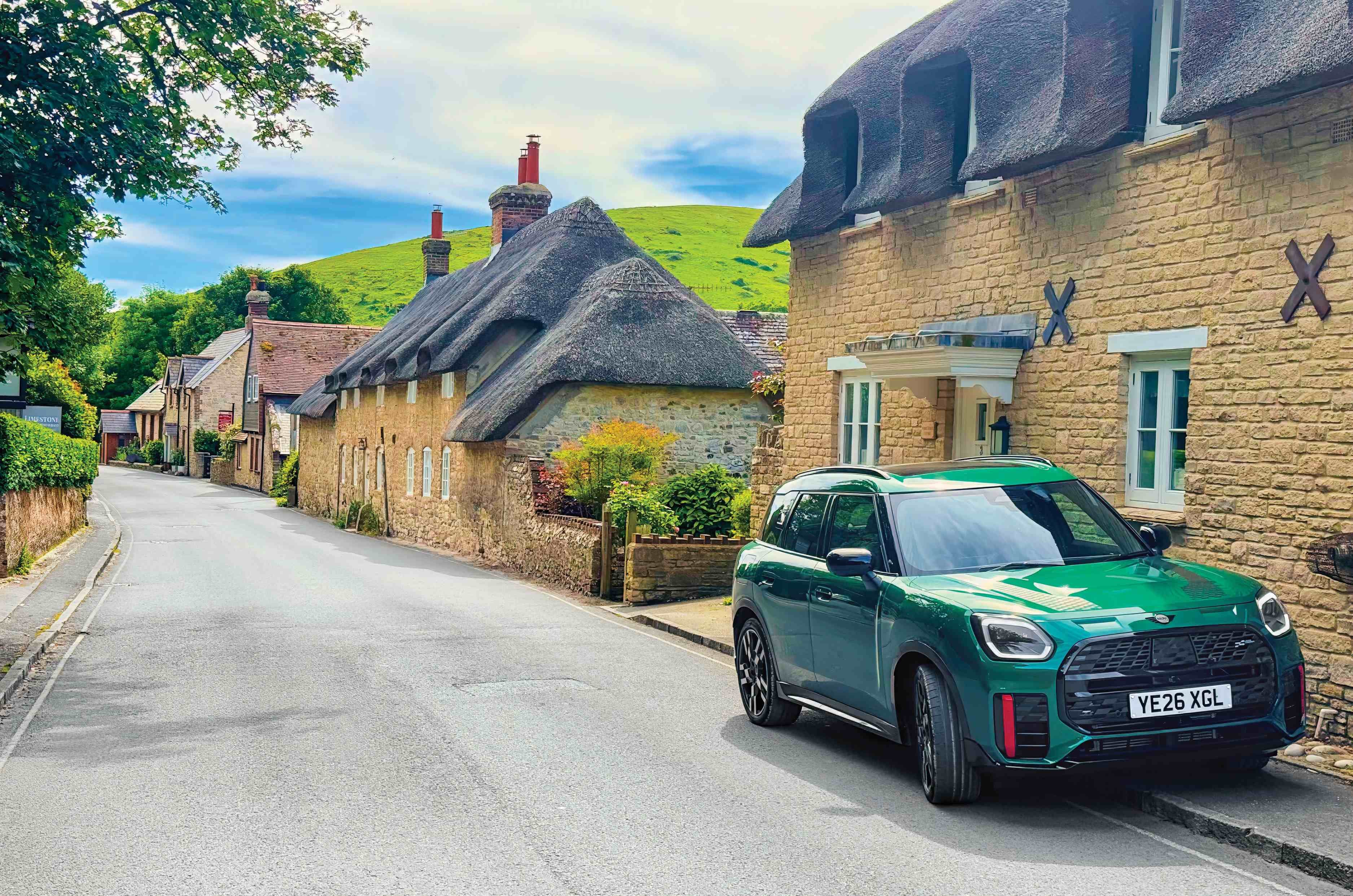
West Lulworth, all thatched roofs and honey-coloured stone, is about as quintessentially Dorset as a village gets.
The all-wheel-drive system quietly sorts out grip on the tighter, greasier lanes, especially with the left wheels on a shoulder slick with wet grass. Flick it into its sportiest mode, and the exhaust note gets a synthesised boost through the speakers. It may be all theatre, but it certainly made me grin, and that’s a win because sound plays such a large part in defining how a car makes me feel.
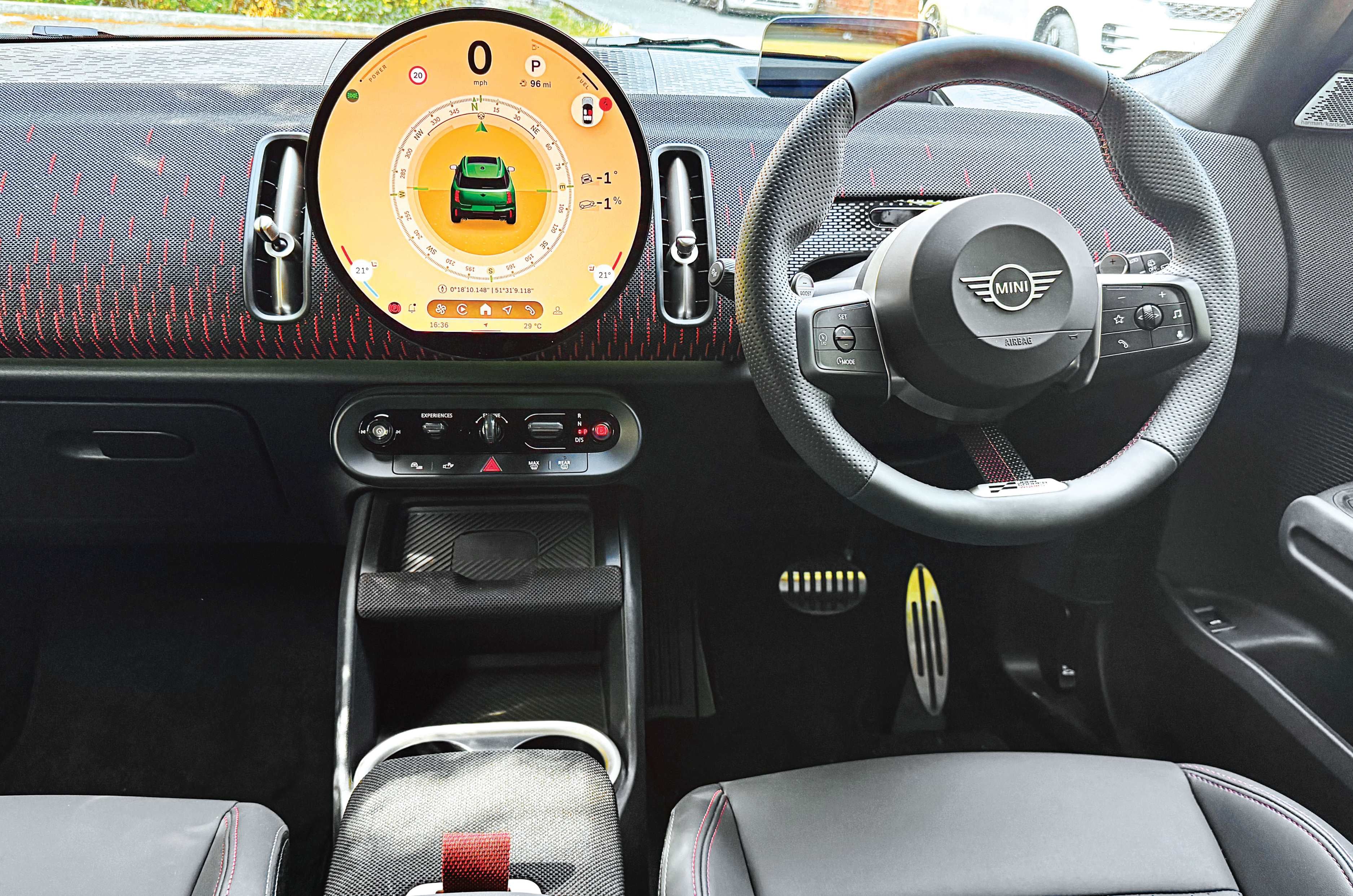
A compass and live pitch-and-roll readout flaunts SUV identity; instrumentation no traditional Mini has ever needed.
By the time I rolled back into London, it was quite clear to me that at the wheel of a Mini Countryman, what you get is a car that is actually larger and roomier than the Jeep Compass. It has the space, the grunt and the ground clearance, and from the smooth roads of Dorset to the Jeep-only trails of Zanskar, this Mini is genuinely man enough for whatever the country throws at it.
The Helmet He Never Wore
Lawrence’s fatal crash had one consequence far beyond Dorset. Among the doctors treating him at Bovington Camp Military Hospital was a young Australian neurosurgeon named Hugh Cairns, who had himself served in the Middle East during the First World War. Watching Lawrence die of head injuries that a helmet might have prevented left a deep impression on him, and he began studying motorcycle head trauma as a direct consequence.
Sir Hugh Cairns
Crash helmets already existed, invented back in 1914 for racing at Brooklands, but nobody wore them on the road. It took the Second World War, and Cairns’s appointment as a head injuries adviser to the Ministry of Health, for that to change. Researching fatalities among military despatch riders, he found that head injuries were the single biggest killer among motorcyclists and that, of the few riders wearing helmets when they crashed, not one had died.
His 1941 paper was damning enough that helmets became compulsory for all military motorcyclists within a month, and a 1946 follow-up showed the death rate had fallen sharply as a result. Cairns argued the same logic should extend to every civilian rider. It took another 27 years, and Cairns didn’t live to see it, for that to become UK law in 1973. But the chain runs in a straight, almost eerie line from one Dorset lane to millions of ordinary commutes: the man who died avoiding two boys on bicycles ended up, through the doctor who treated him, saving countless lives on two wheels after his own.
“The Rolls-Royce of Motorcycles”
Every Brough Superior was hand-built at George Brough’s works on Haydn Road, Nottingham, and Brough himself was as singular as his machines. Rarely seen without his trademark tailored flat cap, he carried himself more like landed gentry than a factory owner, and his standards bordered on obsessive. Born to motorcycle pioneer William Edward Brough, George forged his own path in 1919 after a rift with his father over how grand and expensive motorcycles ought to be.
Left: George Brough, Right: T.E. Lawrence
A friend suggested adding “Superior” to the name, which Brough senior took as a personal insult. That pursuit of excellence defined the marque: each machine was assembled once to fit every component together, then stripped down for painting and plating, then reassembled for delivery. Brough tested every SS100 himself on public roads past 100mph, and each one left the factory with George Brough’s personal approval and a written certificate guaranteeing it had been timed at the ton over a flying quarter mile.
‘SS’ stood for Super Sports, ‘100’ for that guaranteed top speed of a 100mph, and Brough pushed the idea further still in 1928, setting a 130.6mph record at Arpajon in France. The “Rolls-Royce of Motorcycles” nickname was coined by journalist HD Teague of The Motor Cycle, and Brough liked it enough to use it in his own advertising, reportedly with the real Rolls-Royce’s blessing.
War ended civilian production in 1940, when the factory turned to munitions and aircraft parts, and the specialised J.A. Prestwich (JAP) 998cc, air-cooled, 50-degree OHV V-twin engines Brough relied on were never commercially viable again. Around 3,100 machines were made across 19 models in the marque’s 21-year run, and roughly a third survive today, making every survivor a priceless piece of automotive art.
Lawrence’s relationship with the marque ran deeper than most customers’. Writing to Brough in 1926, he said he’d ridden five Broughs and covered 1,00,000 miles in four years, calling them the greatest delight of his life, two of them possessing “a speed and reliability that reminded me of an express train.” Between 1922 and 1935, he owned eight. The first, bought in 1922, was nicknamed “Boa,” short for Boanerges, meaning “son of thunder.”
The seven that followed were named George I through George VII, with a ninth, George VIII, still being built when he died. At around £200 apiece, enough to buy a modest cottage, this was extraordinary indulgence for a man on an RAF aircraftman’s pay, though royalties from Seven Pillars of Wisdom helped fund it. The Brough he crashed on May 13, 1935, registration GW 2275, was George VII, his last completed machine.
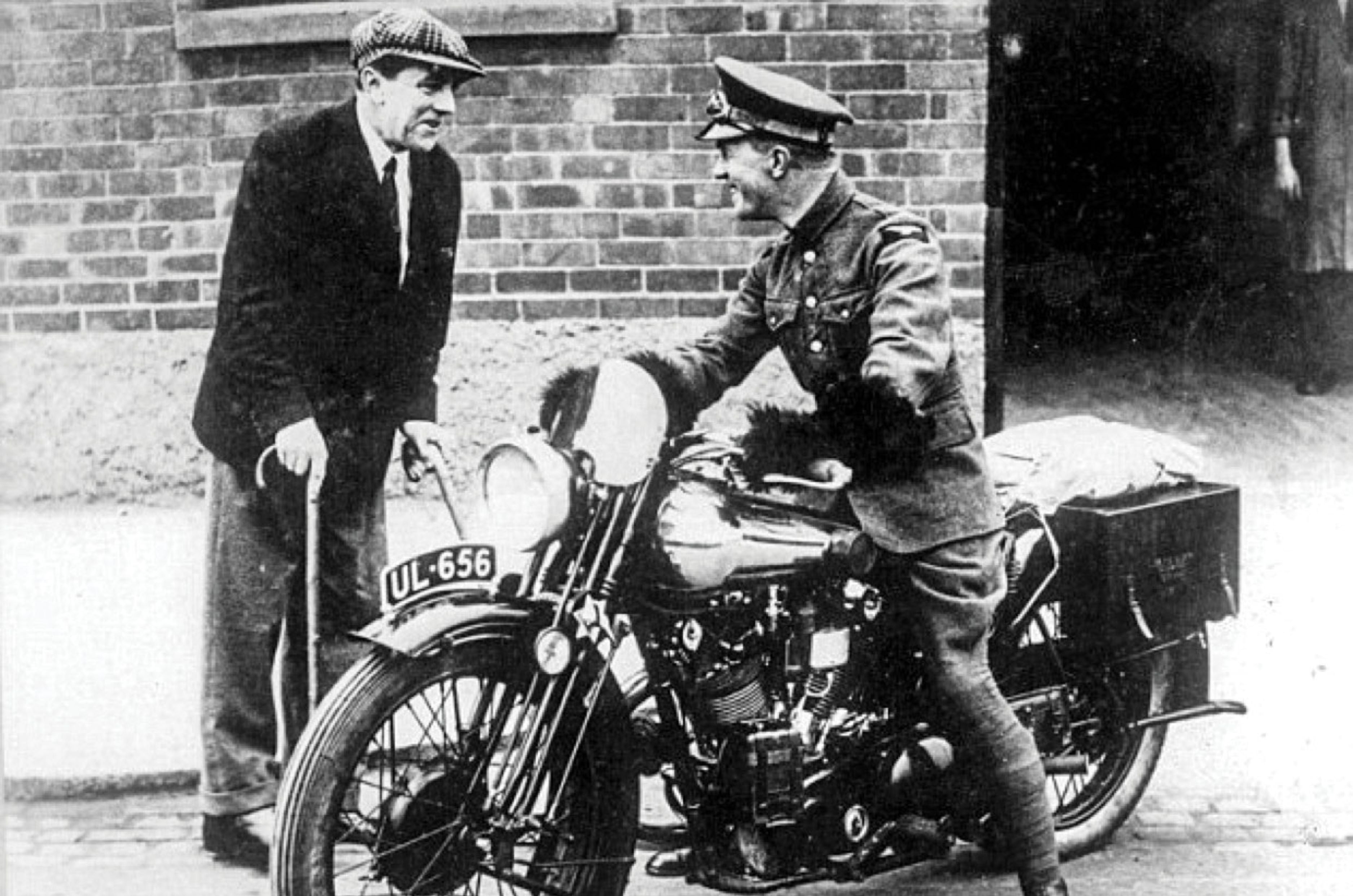
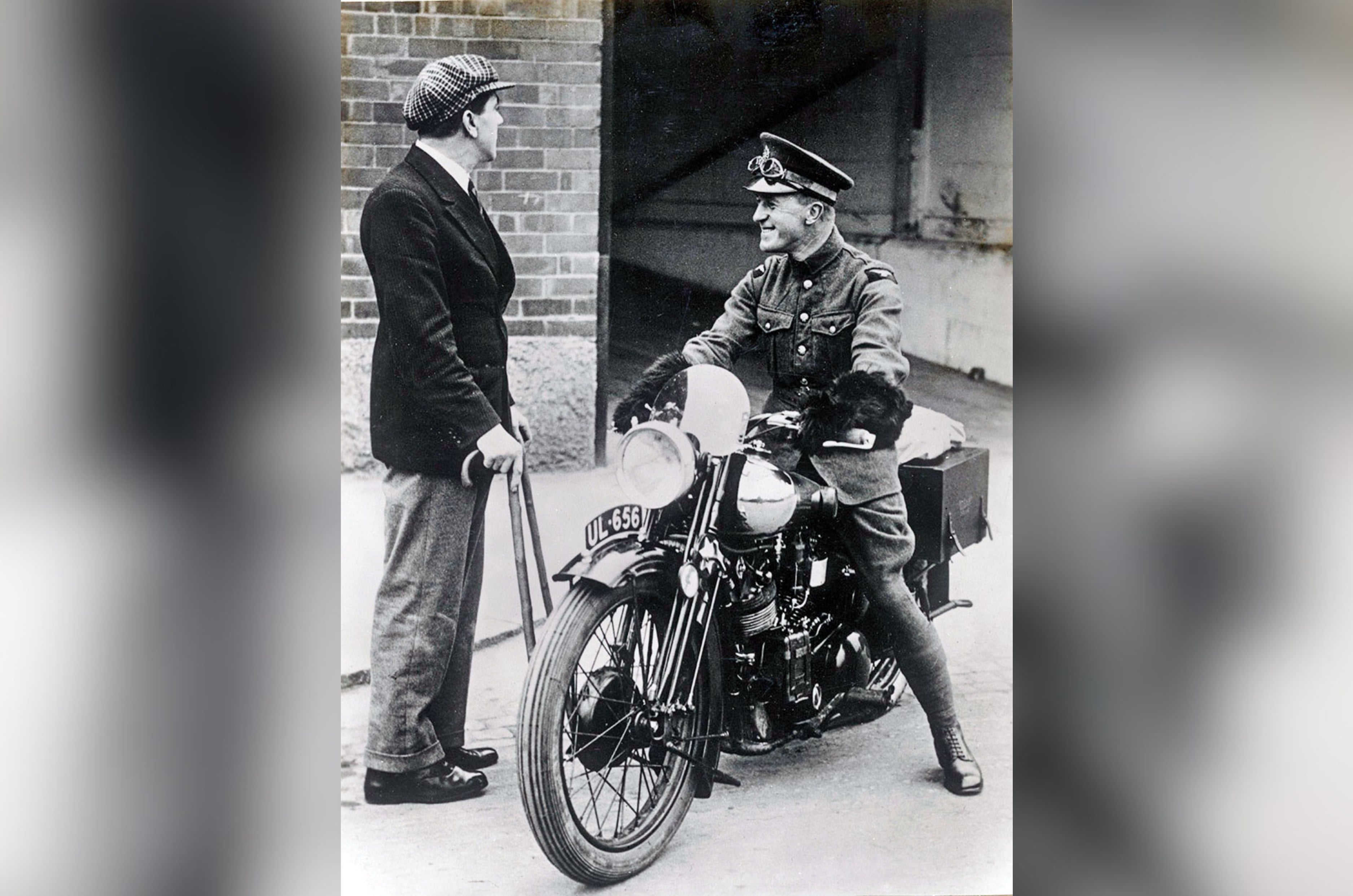
The photographs here are of George Brough and Lawrence on the Brough nicknamed George VI. They were taken during one of Lawrence’s frequent, unassuming visits to the Haydn Road factory by Jack Hallsworth, a Nottingham Journal photographer who knew George Brough and had been tipped off to bring his camera one afternoon.
It’s a rare glimpse of a man famously camera-shy and almost never photographed candidly, hinting at the genuine warmth behind the machines: two very different Englishmen, one a self-effacing war hero trying to vanish into rural obscurity, the other a flamboyant engineer-showman happy to let Rolls-Royce’s name do some of his advertising for him, bound by a friendship that outlasted their differences.
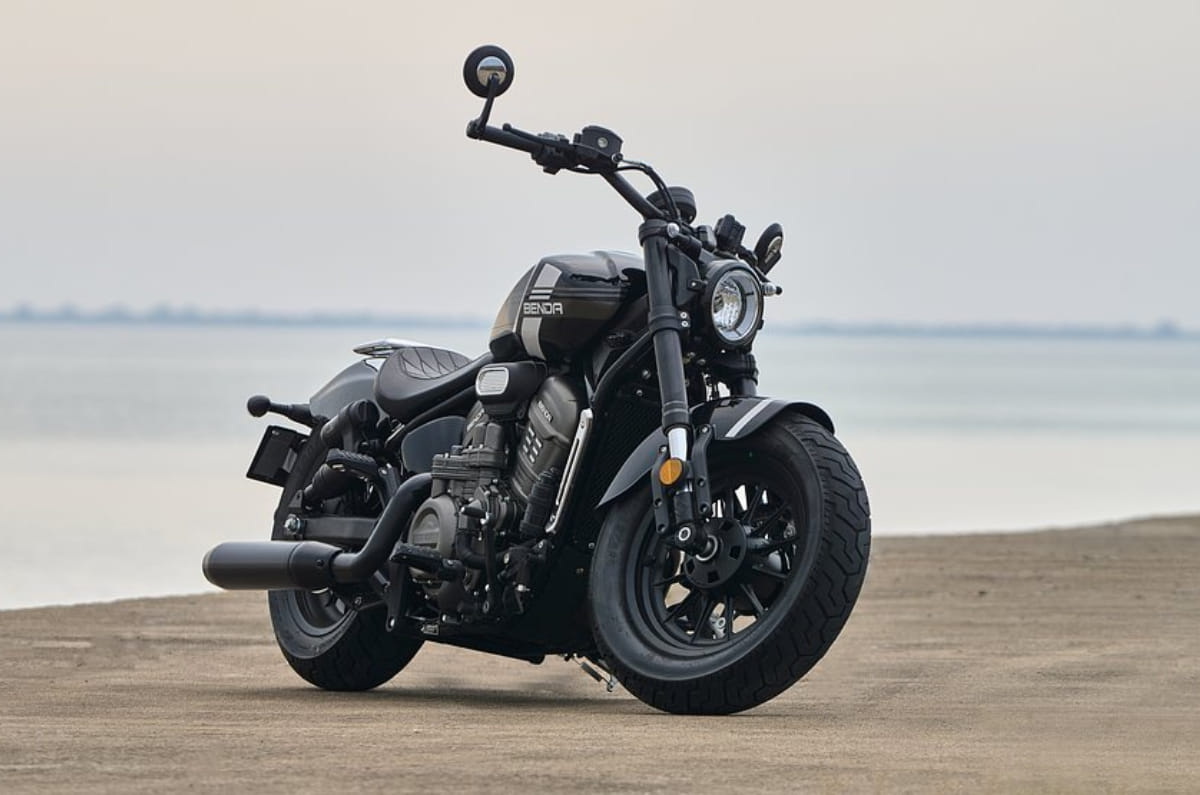
Chinese motorcycle manufacturer Benda has revealed the Rock 707, the latest addition to its Rock cruiser family, ahead of a European market launch in mid-September. The bike combines a 692cc V-twin engine with two interesting pieces of tech – an electronically controlled adaptive air rear suspension system and an electronic clutch.
692cc V-twin produces 73hp at 9,000rpm and 68Nm at 6,500rpm
Gets electronically controlled dual-chamber air rear suspension
Electronic clutch allows clutchless gear changes; manual clutch control remains available
Benda Rock 707 details
Air suspension automatically lowers the bike at a standstill and returns to full height on the move
The most distinctive feature on the Rock 707 is its rear suspension. A dual-chamber adaptive air system responds electronically to rider and passenger load and road conditions, automatically lowering the bike by up to 30mm when coming to a stop and raising it again once the rider pulls away. The system enables a seat height adjustable between 690mm and 720mm, which should make it notably easier to manoeuvre, especially for shorter riders.
The Rock 707 also features the brand’s BEC MK-III electronic clutch, which is similar to Honda’s E-Clutch technology in application. It allows the rider to pull away, shift gears and come to a stop without operating the clutch lever, while retaining full manual clutch control at any time.
Powering the motorcycle is a 692cc V-twin that produces peak output figures of 73hp at 9,000rpm and 68Nm at 6,500rpm. Benda says it is tuned for accessible low- and mid-range performance suited to the bike’s cruiser character. Power is sent to the rear wheel via a belt drive.
The chassis comprises a USD fork and the aforementioned electronically controlled rear air suspension. Front braking is handled by a 320mm single disc, while the rear gets a 260mm disc, and the motorcycle has a kerb weight of 235kg. Other notable features include cruise control, traction control and a 3.6-inch TFT display.
Benda has a close relationship with Keeway, with both brands sharing ownership under the same Chinese parent company, Qianjiang Group, which also owns Benelli. There are no signs indicating that Benda products will reach India through Keeway’s existing distributor network here.
Purchasing an automobile is one of life’s special moments in India. After all, you are not only paying a lot of money but also laying significant faith into a manufacturer’s ability to have properly engineered a safe, reliable and enjoyable product. There’s also the fact that you are entering a long-term relationship with that manufacturer when it comes to service. With three-year warranties becoming common and extended warranties being sold for just a few thousand rupees, the duration of said relationship is now longer than ever. Unfortunately, a lot of customers these days don’t feel like they are being given the treatment they deserve in this ‘relationship’.
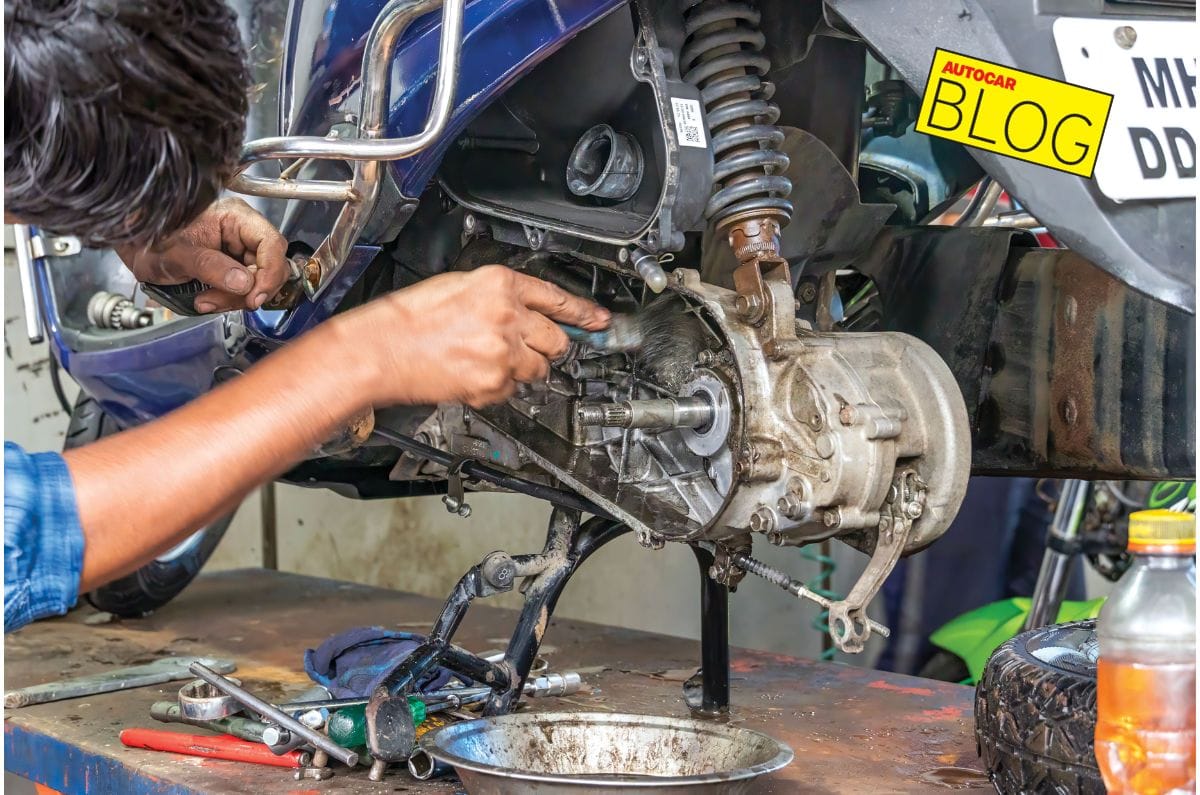
While the quality of products coming from domestic two-wheeler manufacturers has grown tremendously in recent years, the same can’t be said for the service support. While some manufacturers fare worse than others, you will find plenty of reports of shoddy work or general ineptness when it comes to authorised service centres. The reasons behind this are multifold.
The first is that motorcycles today are far more complicated than they used to be. Electronics are everywhere, and even the simplest of commuters now have ECUs, electronic fuel pumps and fuel injectors. 150cc bikes and above are constantly increasing the amount of performance, tech and gadgets on offer, and all of this brings in more complication. Caring for more advanced motorcycles requires a more technical approach.
The “chalta hai/chalega sir” attitude that is a universal truth in India presents a challenge when the job gets more technical. Another cultural aspect at play is that people are far more proud of how quickly a job gets done (or with how much ‘jugaad’) rather than how well the job gets done. Case in point, I once insisted on a torque wrench being used on my KTM 790 Duke at an official service centre a couple of years ago. This led to a stool being brought out to reach an overhead cabinet, from which a dusty torque wrench was liberated. Clearly, that tool was almost never used, and the fact is, most mechanics in India simply use their biceps to decide how much force needs to go into tightening a bolt.
Money is the other big challenge. Time is money, so the more vehicles that are serviced, the better. More so, most junior mechanic salaries are very low, which results in high job attrition. It’s also difficult for dealerships to have enough trained staff and sufficient workshop space for the amount of money that is earned per service. With automobile sales records being broken every other month, there is a big strain on the system.
The ideal scenario is that big cities need more workshops, staff should be trained better and workshop managers need to be more diligent about implementing proper operating procedures. At the end of the day, quality work can only be provided by someone who has been trained well and is remunerated fairly for the job. And that will increase the cost of service for the customer, primarily in terms of the labour cost.
It is inevitable that service costs in India will rise, as does the constantly improving standard of our motorcycles and the ever increasing cost of living. The big challenge for manufacturers is to ensure that customers get their money’s worth for these increasing costs.
Kuku kohli Aruna Irani Relationship: अरुणा ईरानी और दिवंगत फिल्म निर्माता कुकू कोहली की प्रेम कहानी और उनकी शादी उन दिनों अक्सर सुर्खियों में रहती थी। कुकू कोहली की पहली पत्नी के जिंदा रहते अरुणा ईरानी इस हादसे के बारे में ज्यादा बात नहीं करती थीं। चार साल पहले, अरुणा ईरानी ने एक इंटरव्यू में बताया कि कैसे उनकी मुलाकात कुकू कोहली से एक फिल्म सेट पर हुई और कैसे उनका रिश्ता पनपा।
अरुणा ईरानी ने टाइम्स ऑफ इंडिया को बताया- हमारी मुलाकात एक फिल्म के दौरान हुई, जिसमें हम दोनों साथ काम कर रहे थे। उस फिल्म के दौरान वह सभी अन्य अभिनेताओं को तब तक इंतजार करवाते थे, जब तक धर्मेंद्र जी सेट पर नहीं आ जाते। तभी शूटिंग शुरू होती थी।
मुझे उन पर बहुत गुस्सा आता था क्योंकि मैं उस समय कुछ अन्य फिल्मों में भी काम कर रही थी। इसलिए हमारा रिश्ता प्यार और नफरत से भरा हुआ था। मैं उन पर बहुत गुस्सा होती थी और वह मुझे दिलासा देते थे। उस चक्कर में कैसे लफड़ा हो गया समझ नहीं आया ।
अरुणा ईरानी को यह जानकर काफी हैरानी हुई कि कुकू पहले से शादीशुदा थे और उनके बच्चे भी थे। उन्होंने एक इंटरव्यू में कहा, “जब हम मिले थे, तो उन्होंने मुझे यह भी नहीं बताया था कि वह शादीशुदा हैं, और इसी वजह से मुझे उनसे प्यार हो गया। इसलिए हमारे रिश्ते के बारे में बात करना सही नहीं लगा, क्योंकि वह पहले से ही शादीशुदा थे और उनकी पत्नी और बेटियां थीं। अब मैं इस बारे में इसलिए बात कर रही हूं, क्योंकि उनकी पहली पत्नी का कुछ महीने पहले निधन हो गया है।”
अरुणा और कुकू की शादी 1990 में हुई थी, जब वह 40 साल की थीं
फिल्मफेयर के साथ एक पुराने इंटरव्यू में, अरुणा ने यह भी बताया था कि उनके और कुकू कोहली के बच्चे क्यों नहीं हुए। “आज जब मैं अपने भतीजे-भतीजियों और भांजे-भांजियों को देखती हूं, तो मुझे खुशी होती है कि मेरे बच्चे नहीं हैं। अगर कोई मेहमान घर आता और मेरा बच्चा उनका स्वागत न करता या सोफे पर बेपरवाह पड़ा रहता – जैसा कि आजकल के बच्चे करते हैं – तो मुझे बुरा लगता।
उनका ऐसा रवैया होता है, ‘तो क्या हुआ?’ भगवान का शुक्र है। मेरे एक करीबी दोस्त, डॉ. अजय कोठारी ने मुझे सही बात समझने और फैसला लेने में मदद की। उन्होंने कहा, ‘शादी करना ठीक है, आपको साथ की जरूरत है, लेकिन बच्चे और आपके बीच उम्र का फ़ासला इतना ज़्यादा होगा कि उसे संभालना मुश्किल होगा।’ मुझे लगता है कि वह सही थे। मैं और मेरा बच्चा एक-दूसरे के साथ घुटन महसूस करते।
1991 की फ़िल्म ‘फूल और कांटे’ के लिए मशहूर अनुभवी फ़िल्म निर्माता कुकू कोहली का 77 साल की उम्र में निधन हो गया। उनके दोस्त अशोक पंडित ने मंगलवार को यह जानकारी दी। अशोक पंडित ने PTI को बताया, “उन्हें बेचैनी महसूस हो रही थी, इसलिए कल उन्हें कोकिलाबेन धीरूभाई अंबानी अस्पताल में भर्ती कराया गया था। शाम करीब 4:30 बजे हार्ट अटैक के कारण उनका निधन हो गया।” कोहली के परिवार में उनकी पत्नी अभिनेत्री अरुणा ईरानी और उनकी पहली पत्नी रीटा कोहली से हुई दो बेटियां, पूजा और करिश्मा हैं।
शादी से पहले होने वाले पति की एक बात सुनकर महिला ने रिश्ता खत्म करने का फैसला लिया। सोशल मीडिया पर ये मामला तेजी से वायरल हो रहा है। महिला ने X पर बताया कि उसने शादी से इनकार इसलिए किया क्योंकि होने वाले पति ने कहा था कि शादी के बाद उसकी मां भी उनके साथ रहेगी। महिला को ये बात पसंद नहीं आया और उसने आगे बढ़ने के बजाय रिश्ता खत्म करना बेहतर समझा। इस पोस्ट के बाद शादी से पहले सीमाओं और जिम्मेदारियों पर साफ बातचीत को लेकर सोशल मीडिया पर बहस छिड़ गई।
सोशल मीडिया पर किया पोस्ट
अपनी बातचीत को याद करते हुए महिला ने एक्स पर पोस्ट में बताया कि, “मैंने एक आदमी को इसलिए रिजेक्ट कर दिया क्योंकि उसने मुझसे कहा था कि शादी के बाद उसकी मां हमारे साथ रहेगी।” उस व्यक्ति ने कहा, “वह बूढ़ी हो चुकी हैं, मैं और क्या कर सकता हूं?” महिला ने साफ किया कि उसे इस बात से कोई परेशानी नहीं है कि वह अपनी मां की देखभाल करे, लेकिन उसे इस बात पर आपत्ति है कि बिना उसकी सहमति के उससे भी इस जिम्मेदारी की उम्मीद की जाए। उसने कहा, “तुम उनका ख्याल रखो, लेकिन जिस फैसले में मेरी सहमति नहीं है, उसकी जिम्मेदारी मुझ पर मत डालो।”
जिम्मेदारी साफ होनी चाहिए
महिला ने बताया कि, उसकी बात सुनने के बाद उस व्यक्ति ने उसे स्वार्थी कह दिया। महिला ने कहा कि, शादी करने का फैसला लेने का यह मतलब नहीं है कि कोई व्यक्ति बिना चर्चा के हर तरह की नई जिम्मेदारी स्वीकार कर ले। उसके मुताबिक, शादी से पहले दोनों लोगों के बीच यह साफ होना जरूरी है कि आगे चलकर कौन-सी जिम्मेदारियां किसकी होंगी और किन बातों पर दोनों की सहमति है। महिला ने कहा कि बिना बातचीत और सहमति के किसी पर जिम्मेदारी डालना सही नहीं है।
सोशल मीडिया पर लोगों ने किया रिएक्ट
महिला की पोस्ट सामने आने के बाद सोशल मीडिया पर लोगों ने अलग-अलग तरह की राय दी। कुछ यूजर्स इस फैसले को लेकर बंटे रहे। कुछ ने इसे सही बताया, तो कुछ ने शादी की जिम्मेदारियों से बचना कहा। इस मुद्दे पर यूजर्स दो अलग-अलग राय में बंटे नजर आए। एक यूजर ने महिला के फैसले पर सवाल उठाते हुए लिखा, “आपने किसी खराब पति को मना नहीं किया। आपने उस आदमी को इसलिए ठुकराया क्योंकि वह शादी से पहले से चली आ रही अपनी एक जिम्मेदारी को छोड़ना नहीं चाहता था।”
I rejected a man because he told me his mother would be living with us after marriage.
He said, “She’s old. What else am I supposed to do?”
I said, “Take care of her. Just don’t make me responsible for a decision I didn’t make.”
दूसरे यूजर ने कहा, “अगर आप शादी में किसी तरह की जिम्मेदारी नहीं लेना चाहते हैं, तो महिलाओं को भी शादी से पहले प्री-नप एग्रीमेंट करना चाहिए। आप अपनी जिंदगी में जैसा चाहें वैसा रह सकते हैं, लेकिन इसका मतलब यह भी है कि शायद आप शादी की असली जिम्मेदारियों को नहीं समझते।”
लोगों ने उठाए सवाल
इस चर्चा के बीच कुछ यूजर्स ने महिला के फैसले पर काफी तीखी प्रतिक्रिया भी दी। एक यूजर ने लिखा, “वह आदमी बहुत खुशकिस्मत है कि वह इस रिश्ते से बच गया। उसने एक बड़ी मुसीबत को आने से पहले ही टाल दिया।” वहीं, एक अन्य यूजर ने कहा, किसी बुजुर्ग मां की देखभाल को ऐसी जिम्मेदारी बताना, जिसे वह शादी के साथ “विरासत में लेने” के लिए तैयार नहीं थी, उसके सोचने के तरीके को काफी हद तक सामने लाता है।