यूपी का शख्स मुंबई में नाई का काम करके हर महीने कमाता है करीब 1 लाख रुपये, हफ्ते में 6 दिन करता है मेहनत

भारत में सरकारी नौकरी को अक्सर सुरक्षित भविष्य और अच्छी जिंदगी की गारंटी माना जाता है। लेकिन मुंबई में काम करने वाले उत्तर प्रदेश के आजमगढ़ निवासी एक नाई की कहानी इस सोच से अलग नजर आती है। दावा है कि वह महीने में करीब 1 लाख रुपये कमाता है। दिलचस्प बात यह है कि इतनी कमाई के बावजूद वह एंट्री-लेवल सरकारी नौकरी मिलने पर भी अपना मौजूदा काम छोड़ना नहीं चाहता।

लेखक और फंड मैनेजर हर्ष गुप्ता मधुसूदन ने सोशल मीडिया प्लेटफॉर्म X पर इस नाई के साथ हुई बातचीत साझा की। उनकी पोस्ट के मुताबिक, नाई हफ्ते में छह दिन सुबह से रात तक काम करता है। यात्रा के बुनियादी खर्च निकालने के बाद उसकी मासिक कमाई करीब एक लाख रुपये बताई गई है।

मेहनत और आजादी को मानता है अपनी सबसे बड़ी पूंजी

हर्ष के मुताबिक, बातचीत के दौरान नाई ने कहा कि काम करने और मेहनत करने वालों के लिए अवसरों की कमी नहीं है। वह अपने काम को पसंद करता है और इसमें मिलने वाली आजादी उसके लिए अहम है। यही वजह है कि वह सरकारी नौकरी के बजाय अपना मौजूदा काम जारी रखना चाहता है।

उसकी कहानी ने रोजगार को लेकर एक दिलचस्प सवाल खड़ा किया है क्या अच्छी कमाई और संतुष्टि के लिए सरकारी नौकरी ही एकमात्र रास्ता है? हालांकि, एक व्यक्ति का अनुभव पूरे रोजगार बाजार की तस्वीर नहीं बताता।

आजमगढ़ से लखनऊ तक का सफर हुआ आसान, विकास से खुश है परिवार

बातचीत में उत्तर प्रदेश के विकास का जिक्र भी आया। हर्ष के अनुसार, नाई ने बताया कि पहले उसके गांव से लखनऊ पहुंचने में 7-8 घंटे लगते थे। अब बेहतर सड़कों के कारण उतने ही समय में आना-जाना संभव हो गया है, वह भी रास्ते में चाय और खाने के लिए रुकने के बाद।

नाई ने देश में हुए विकास कार्यों पर खुशी जताई। उसने बताया कि गांव में उसके परिवार को कुछ सरकारी योजनाओं का लाभ मिला है, हालांकि शहर में ऐसा लाभ नहीं मिला।

टैक्स भरने पर गर्व, बेटे की पढ़ाई पर भी ध्यान

इस कहानी का एक और पहलू उसकी पारिवारिक जिंदगी है। हर्ष के मुताबिक, नाई की कमाई से टैक्स कटता है और वह गर्व के साथ इनकम टैक्स रिटर्न भी दाखिल करता है। कई बार उसे रिफंड भी मिलता है।

उसका एक छोटा बेटा है, जिसे वह निजी प्री-स्कूल में पढ़ाता है। उसकी पत्नी भी कमाई में योगदान देती थी, लेकिन फिलहाल बच्चे की देखभाल के लिए काम से ब्रेक पर है।

सोशल मीडिया पर छिड़ी बहस, क्या हर किसी के लिए ऐसे अवसर हैं?

पोस्ट वायरल होने के बाद सोशल मीडिया पर लोगों की अलग-अलग प्रतिक्रियाएं सामने आईं। कुछ यूजर्स ने नाई की मेहनत और आत्मनिर्भरता की तारीफ की। वहीं, कुछ ने सवाल उठाया कि क्या एक नाई के लिए हर महीने एक लाख रुपये कमाना आम बात है। कुछ लोगों ने इस कमाई के दावे की तुलना दूसरे शहरों में नाइयों की आमदनी से भी की।

दूसरी ओर, कुछ यूजर्स ने कहा कि एक व्यक्ति की सफलता को देश में रोजगार की पूरी स्थिति का प्रमाण नहीं माना जा सकता। उन्होंने शिक्षित युवाओं के रोजगार, शिक्षा की गुणवत्ता और महिलाओं की सुरक्षा जैसे मुद्दे भी उठाए।

हर्ष ने अपनी पोस्ट के अंत में व्यंग्य करते हुए लिखा कि उनका मन नाई से कहने का हुआ कि वह भारत और अपनी जिंदगी को लेकर इतनी सकारात्मक सोच छोड़कर सोशल मीडिया पर देश की नाकामियों के बारे में पढ़े, लेकिन वह ऐसा कह नहीं सके।

इस कहानी का असली पहलू यही है कि जहां कुछ लोग सरकारी नौकरी को सफलता मानते हैं, वहीं कुछ के लिए अपने काम में कमाई, संतुष्टि और आजादी ज्यादा मायने रखती है।

(डिस्क्लेमर: यह रिपोर्ट सोशल मीडिया पर यूज़र द्वारा शेयर किए गए कंटेंट पर आधारित है। मनीकंट्रोल इन दावों की न तो स्वतंत्र रूप से पुष्टि नहीं करता है और न ही इनका समर्थन करता है।)

छोटे भाई का अंतिम संस्कार मेरा इंतजार कर रहा है, ट्रेन लेट मत करना… पैसेंजर ने की भावुक अपील तो रेलवे ने दिया ये जवाब

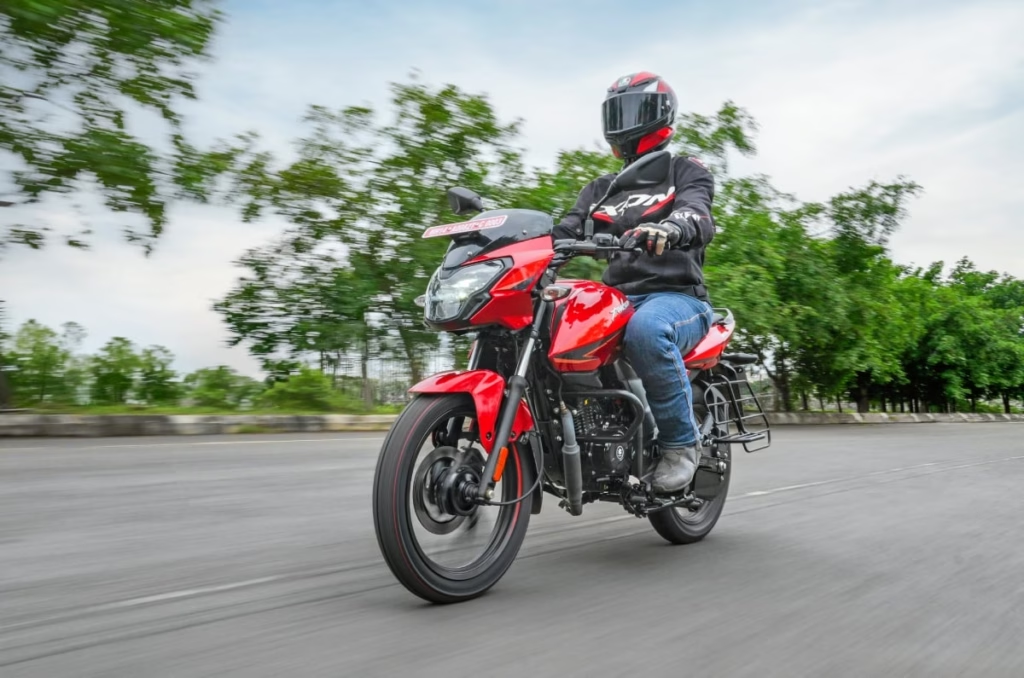
Bajaj Pulsar 150 review: Familiar yet very different

 Bajaj Pulsar 150 review: Familiar yet very different

When the first Bajaj Pulsar 150 broke onto the scene in 2001, it shattered the mould of what was expected of an accessible yet sporty commuter motorcycle. This recipe saw such widespread success that nothing Bajaj brought out since has been able to replace it. Therefore, the company went back to the drawing board and has now brought out a new generation of Classic Pulsars, spearheaded by the 125 and 150. In this review, we’ll share what the larger one was like to ride. 

Bajaj Pulsar 150: What’s changed compared to before?

From the mechanicals to the tech, it is all-new

To start with, gone are the double-cradle frame and twin shock absorbers, replaced by a lighter and stiffer diamond frame and monoshock, respectively. Complementing the new chassis is a brand new motor. This engine started life as an engine from a similar displacement N model, but Bajaj has made certain changes to suit this application. The state of tune, various internals and the exhaust system are all different over here. 

The Pulsar 150, understandably, has the sprightlier performance of the two.

Unlike before, the motor is now used as a stressed member of the chassis, and Bajaj has also peppered in the learnings it has made from the N range. For starters, the gearbox now has shorter, more tractable ratios, and there’s also a low rpm assist function, which raises engine rpm slightly to reduce stalling when you’re crawling at a higher gear at low speeds. Furthermore, higher variants of the 150 also come equipped with an Integrated Starter Generator (ISG), which brings in silent start and a reasonably quick start/stop system. 

Pulsar 150 design and quality – 8/10

Looks uncannily similar to the older bike; feels very similar to sit on, too

Considering how much has changed underneath, it’s especially commendable that the Pulsar 150 looks this similar to before. Bajaj’s design team has deliberately gone to great lengths to package everything neatly and retain the bike’s instantly recognisable silhouette. Pulsar hallmarks that people appreciate, like a ‘wolf eye’ headlight, a chunky tank, sharp tank extensions and a pointy tail, all continue, and you won’t be mistaking it for anything other than a classic Pulsar. There are no complaints when it comes to quality, and it’s as well-finished as you’d expect from a commuter bike today. 

Top variants come with a split seat.

Just like the near-unchanged design, the Pulsar 150’s ergonomics are almost the same as before – but that’s a good thing. You’re sat very neutrally, and the riding position is that of a textbook commuter with only slightly rearward pegs for the sporty touch that a Pulsar is known for. With a perch that’s just 795mm off the ground, the 150 strikes a nice chord by being friendly and approachable for both shorter folks and 6’1 Rishaad. To cater to the wants of different riders, Bajaj will sell you a Pulsar equipped with either a single piece seat or split seats. Both options are spacious – the single piece seat understandably more so – and decently padded, capable of accommodating two full-size people without them getting acquainted with each other too intimately. 

Pulsar 150 performance – 8/10

Has enough pep for city and highway duties, engine stalls a little too easily, though 

City traffic is where most Pulsar riders spend most of their time, so we did the same and found that the bike behaves exactly as you’d expect from a commuter. The motor has good low- and mid-range torque, and paired with the super light clutch, wading through the drudgery of traffic doesn’t feel too taxing. 

The new engine is also super smooth, and should you choose to venture out onto the highway, the Pulsar can do that as well. The upper limit of the 150’s comfortable cruising speed is 90-95kph in its top 5th gear, which is par for the course in this class. 

Engine

149.5cc, single-cylinder, air-oil cooled

Power

14hp at 8,000rpm

Torque

14.1Nm at 6,500rpm

Gearbox

5-speed

However, for all its strengths, the engine in the Pulsar 150 unit we were allotted displayed a tendency to stall a little too easily, and this happened on multiple occasions to both myself and Rishaad, who rode the bike. 

Pulsar 150 ride and handling – 8/10

Behaves predictably and handles all situations well

While the chassis is largely the same between the 125 and 150, one noteworthy difference is that the bigger one uses a fatter 33mm fork, compared to the 31mm unit on the smaller bike. Also, unlike the 125, the Pulsar 150 comes with the government-mandated safety net of single-channel ABS. All variants come with a 260mm disc brake at the front, paired with either a 230mm drum brake on the lowest variant or a 230mm disc on the higher two variants. 

Pulsar 150 behaves neutrally and predictably when subjected to a variety of riding conditions.

The best way to describe the new Pulsar 150’s handling is neutral and predictable. Neither does it feel as vague as the previous-gen model, nor does it feel as responsive as the N / NS models. The Classic Pulsar 150 retains its surefootedness in a straight line while introducing a newfound taut feeling when taking a corner. Its demeanour is predictable at all times, which is sure to inspire confidence in the varied sort of riders it will cater to. The brakes work well and bring the Pulsar to a stop in a quick fashion without much drama, although overenthusiastic usage will result in the rear locking up.

Fuel tank

14 litres

Seat height

785mm

Ground clearance

165mm

Kerb weight

141kg

Wheelbase

1,320mm

However, for all its strengths, the Pulsar 150 is not perfect, and there are some areas of improvement. The rear suspension feels slightly underdamped and springy, throwing you off the seat over larger road imperfections. The gearshifts, too, felt a little rubbery and vague, lacking a snick feel. 

Pulsar 150 features and safety – 8/10

Comes with a lot of tech-y features on the top two variants

Following today’s market trends, even a humble commuter like this one now packs a dollop of tech. This includes a USB-C charging port, 4 riding modes (Sport, Tour, Road and Rain), Bluetooth connectivity for the dash via Bajaj’s app, which brings in a host of functions, and you can even cast your phone’s screen onto the TFT display, although some of these functions are still not available yet and will be rolled out at a later date. 

Top variants also come with a colour TFT display and riding modes

To control the TFT display’s functions and switch between the riding modes on the top variants, you also have more comprehensive switchgear whereas the colour LCD dash on the lower variants is paired with a simpler switch cluster. Both displays are informative and well laid-out and bring an air of premiumness from the rider’s POV. Admittedly, most of these features aren’t going to add much value for most everyday riders but for the few that want their motorcycle to double up as a gadget, they’re there. 

Pulsar 150 price and verdict – 8/10

It suits its intended purpose quite well

Aside from a few small misses, the new Pulsar 150 is a lovely commuter, which comes in at a price point that is more or less in line with the competition today. Prices start at Rs 1.15 lakh and go up to Rs 1.23 lakh (ex-showroom, Delhi). Compared to the last-gen 150, this latest-gen Pulsar’s prices have gone up by Rs 4,000-Rs 6,000, which is a digestible amount considering the sheer scale of new components in use here. 

Given the huge demand for a bike that looks like a Classic Pulsar and the fact that this new-gen model is such a quantum leap ahead compared to the old ones while costing just a few thousand rupees more, Bajaj seems to have a winner on its hands.  

Bajaj Pulsar 125 review: VFM Pulsar reinvented

Bajaj Pulsar 125 review: VFM Pulsar reinvented
Bajaj Pulsar 125 tracking shot

The classic Pulsar 125 has always been the most affordable way into Bajaj Pulsar ownership and while the 2026 model might look largely the same as before, underneath, it is actually all new.

Bajaj Pulsar 125 what’s changed under the skin?

Everything from stem to stern is all-new

To start with, gone are the double-cradle frame and twin shock absorbers, replaced by a lighter and stiffer diamond frame and monoshock, respectively. Complementing the new chassis is a brand-new motor. This engine started life as an engine from an N model of a similar displacement, but Bajaj has made certain changes to suit this application. For instance, the new 124.58cc engine on the smaller Pulsar has the lightest crank inertia among its peers– claims Bajaj– and the company has saved 1.2kg here alone, compared to before. Speaking of weight, the 125 weighs 131kg with its 11 litre fuel tank brimmed.

Despite all under-the-skin changes, the Pulsars retain their traditional styling to cater to market demand.

The new engine is also used as a stressed member of the chassis, and Bajaj has also peppered in the learnings it has made from the N range over here. For starters, the gearbox now has shorter, more tractable ratios and there’s also a low-rpm assist function, which raises engine rpm slightly to reduce stalling when you’re crawling at a higher gear at low speeds. Furthermore, the Pulsar 125’s higher variants also come equipped with an Integrated Starter Generator (ISG) which brings in silent start and a reasonably quick start/stop system.

Bajaj Pulsar 125 Design and seating comfort – 8/10

Looks uncannily similar to the older bike; feels very similar to sit on too

Considering how much has changed underneath, it’s especially commendable that the Pulsars look so similar to before. Bajaj’s design team has deliberately gone to great lengths to package everything neatly and retain the bikes’ instantly recognizable silhouette.

Pulsar hallmarks like a ‘wolf eye’ headlight, chunky tank, sharp tank extensions and a pointy tail, all continue and you won’t be mistaking them for anything other than a classic Pulsar. Overall quality is quite nice for the price that the Pulsar 125 commands.

Lower variants come with a single-piece seat.

The seating position also echoes the near-unchanged design and you’re sat very neutrally with the riding position best described as that of a textbook commuter.The only difference is that the pegs are set slightly rearward for the sporty touch that Pulsars are known for. With a perch that’s just 795mm off the ground, the Pulsar 125 feels friendly and approachable for shorter folks as well as 5’11 me. 

Engine

124.6cc, single-cylinder, air-cooled

Power

12.1hp at 8,500rpm

Torque

11.4Nm at 6,500rpm

Gearbox

5-speed

To cater to the needs of different riders, Bajaj will sell you a bike equipped with either a single-piece seat or split seats, depending on the variant you buy. Both options are spacious and decently padded, capable of accommodating two full-size people without them getting acquainted with each other too intimately.

Bajaj Pulsar 125 Performance – 8/10

Engine is smooth and responsive; gearshifts can feel a little vague though

City traffic is where a majority of Pulsar riders spend their time, so we did the same and found that the bike behaves exactly as you’d expect from a commuter. The new engine is smooth with good low- and mid-range torque and paired with the super-light clutch, wading through the drudgery of traffic demands very little effort from the rider.

The Pulsar 125 behaves neutrally and predictably when subjected to a variety of riding conditions.

Even at highway speeds, the engine retains its smooth characteristics, and should you choose to venture out onto the highway, the Pulsar 125 is up for it. The upper limit of the 125’s comfortable cruising speed is 80-85kph in its top 5th gear, which is quite respectable considering the displacement.

The monoshock feels a little springy and underdamped; it can kick you off the seat over sharper and larger bumps.

Bajaj Pulsar 125 ride and handling – 8/10

Feels trustworthy and neutral

Coming to how the Pulsar behaves on the side of the tyre, the best way to describe it is neutral and predictable. Neither does it feel as flaccid as the previous-gen model, nor does it feel as agile as the N / NS models. The bike has a good sense of surefootedness, both around a corner as well as in a straight line, which is sure to inspire confidence in the varied sort of riders it will cater to.

Two full-size adults will fit comfortably.

The lowest variant of the 125 comes with a 130mm drum front brake whereas higher variants come with a 260mm disc brake, although there’s no ABS on offer here. All variants of the 125 come with a 130mm rear drum brake. The braking power is more than sufficient for the power on tap and the drum brake also works predictably.

Tyres (F/R)

80/100-17 / 100/90-17

Brakes (F/R)

260mm disc / 130mm drum

Suspension (F/R)

Telescopic fork / monoshock

However, for all its strengths, the Pulsar 125 is not perfect and there are some areas of improvement. The rear suspension feels slightly underdamped and springy, throwing you off the seat over larger road imperfections, and the gearshifts, too, felt a little rubbery and vague, lacking a snick feel.

With this generation change, the Pulsar 125 is now a substantial 15 kilos lighter than before.

Bajaj Pulsar 125 Features – 8/10

Higher variants have a lot of tech

Following today’s market trends, humble commuters like these now also pack a dollop of tech. This includes a USB-C charging port, 4 riding modes (Sport, Tour, Road and Rain), Bluetooth connectivity for the dash via Bajaj’s app, which brings in a host of functions, and you can even cast your phone’s screen onto the TFT display, although some of these functions are still not available yet, and will be rolled out at a later date.

Lower variants feature a negative colour LCD display.

To control the TFT display on the top variants, you also have more comprehensive switchgear, whereas the colour LCD dash on the lower variants is paired to a simpler switch cluster. Both displays are informative and well-laid-out and bring an air of premiumness to the rider’s POV. Admittedly, most of these features aren’t going to add much value for most everyday riders, but for the few that want their motorcycle to double up as a gadget, they’re there.

Bajaj Pulsar 125 Price and verdict – 8/10

It’s an accomplished commuter with very few misses

Aside from a few foibles, the new Pulsar 125 is a good commuter which comes in at a price point that is more or less in line with the competition today. Prices start at Rs 92,990 and top out at Rs 1.04 lakh (ex-showroom, Delhi). Compared to the bargain basement Pulsar 125 Neon, the 2026 bike’s price has risen quite significantly, but if you were to compare the actual Pulsar 125 base model, the increment is much smaller.

Given the huge demand for a bike that looks like a Classic Pulsar, and the fact that this new-gen model is such a quantum leap ahead compared to the old ones while costing just a few thousand rupees more, Bajaj seems to have a winner on its hands. 
 

Share Market Crash: 5 सेकंड में ₹5 लाख करोड़ साफ, Sensex में 800 अंकों की गिरावट, Nifty 23800 के नीचे

Share Market Crash: कच्चे तेल की कीमतों में तेजी, अमेरिकी ट्रेजरी यील्ड में बढ़ोतरी और अमेरिका-ईरान के बीच युद्ध गहराने से घरेलू स्टॉक मार्केट में कोहराम मच गया। शुरुआती कारोबार में ही सेंसेक्स 800 प्वाइंट्स से अधिक टूट गया तो निफ्टी भी टूटकर 23800 के नीचे आ गया। ब्रोडर लेवल पर भी काफी दबाव है और निफ्टी मिडकैप 100 और निफ्टी स्मॉलकैप में 1-1% की गिरावट है। निफ्टी के सभी सेक्टर्स के इंडेक्स लाल हैं। ओवरऑल बात करें तो BSE पर लिस्टेड कंपनियों का मार्केट कैप ₹5.60 लाख करोड़ घट गया है यानी निवेशकों की दौलत मार्केट खुलते ही ₹5.60 लाख करोड़ कम हो गई।

अब इक्विटी बेंचमार्क इंडेक्सों की बात करें तो फिलहाल 09:21 AM पर सेंसेक्स (Sensex) 706.50 प्वाइंट्स यानी 0.92% की गिरावट के साथ 76,237.78 और निफ्टी 50 (Nifty 50) 235.40 प्वाइंट्स यानी 0.98% की फिसलन के साथ 23,820.40 पर है। इंट्रा-डे में सेंसेक्स 808.56 प्वाइंट्स टूटकर 76,135.72 और निफ्टी 269.00 प्वाइंट्स गिरकर 23,786.80 पर आ गया।

09:21

निवेशकों की दौलत में ₹5.60 लाख करोड़ की गिरावट

एक कारोबारी दिन पहले यानी 01 सितंबर 2026 को बीएसई पर लिस्टेड सभी शेयरों का कुल मार्केट कैप ₹4,89,41,989.64 करोड़ था। आज यानी 02 सितंबर 2026 को मार्केट खुलते ही यह ₹4,83,81,902.24 करोड़ पर आ गया। इसका मतलब हुआ कि निवेशकों की पूंजी ₹5,60,087.4 करोड़ घट गई है।

Sensex का सिर्फ एक शेयर ग्रीन

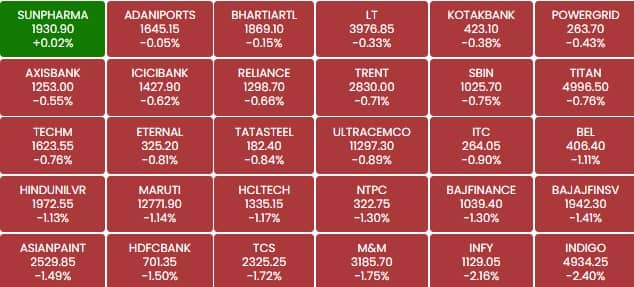
सेंसेक्स पर 30 शेयर लिस्टेड हैं जिसमें सिर्फ एक सन फार्मा ही फिलहाल ग्रीन है लेकिन इसमें भी तेजी मामूली ही है। सबसे अधिक गिरावट फिलहाल इंडिगो, इंफोसिस और एमएंडएम में है। नीचे सेंसेक्स पर लिस्टेड सभी शेयरों के लेटेस्ट भाव और आज उतार-चढ़ाव की डिटेल्स देख सकते हैं-

sensex 1890

63 शेयर एक साल के हाई पर

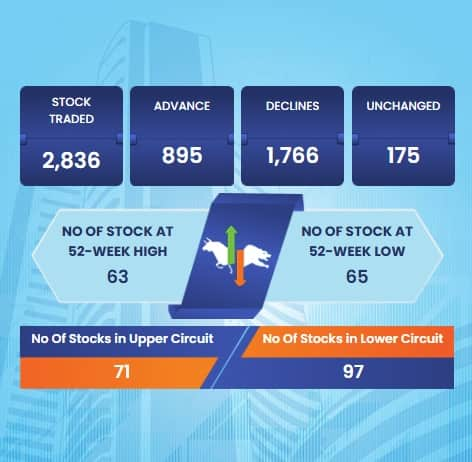
बीएसई पर आज 2836 शेयरों की ट्रेडिंग हो रही है। इसमें 895 शेयर मजबूत दिख रहे हैं तो 1766 में गिरावट का रुझान है और 175 में कोई बदलाव नहीं दिख रहा है। इसके अलावा 63 शेयर एक साल के हाई और 65 शेयर एक साल के निचले स्तर पर आ गए। वहीं 71 शेयर अपर सर्किट पर पहुंच गए तो 97 शेयर लोअर सर्किट पर आ गए।

bse 1907

स्टॉक मार्केट में आज की लाइव हलचल के लिए यहां जुड़ें

डिस्क्लेमर: यहां मुहैया जानकारी सिर्फ सूचना के लिए दी जा रही है। यहां बताना जरूरी है कि मार्केट में निवेश बाजार जोखिमों के अधीन है। निवेशक के तौर पर पैसा लगाने से पहले हमेशा एक्सपर्ट से सलाह लें। मनीकंट्रोल की तरफ से किसी को भी पैसा लगाने की यहां कभी भी सलाह नहीं दी जाती है।

Bajaj Pulsar 125: Price and Variants Explained

Bajaj Pulsar 125: Price and Variants Explained
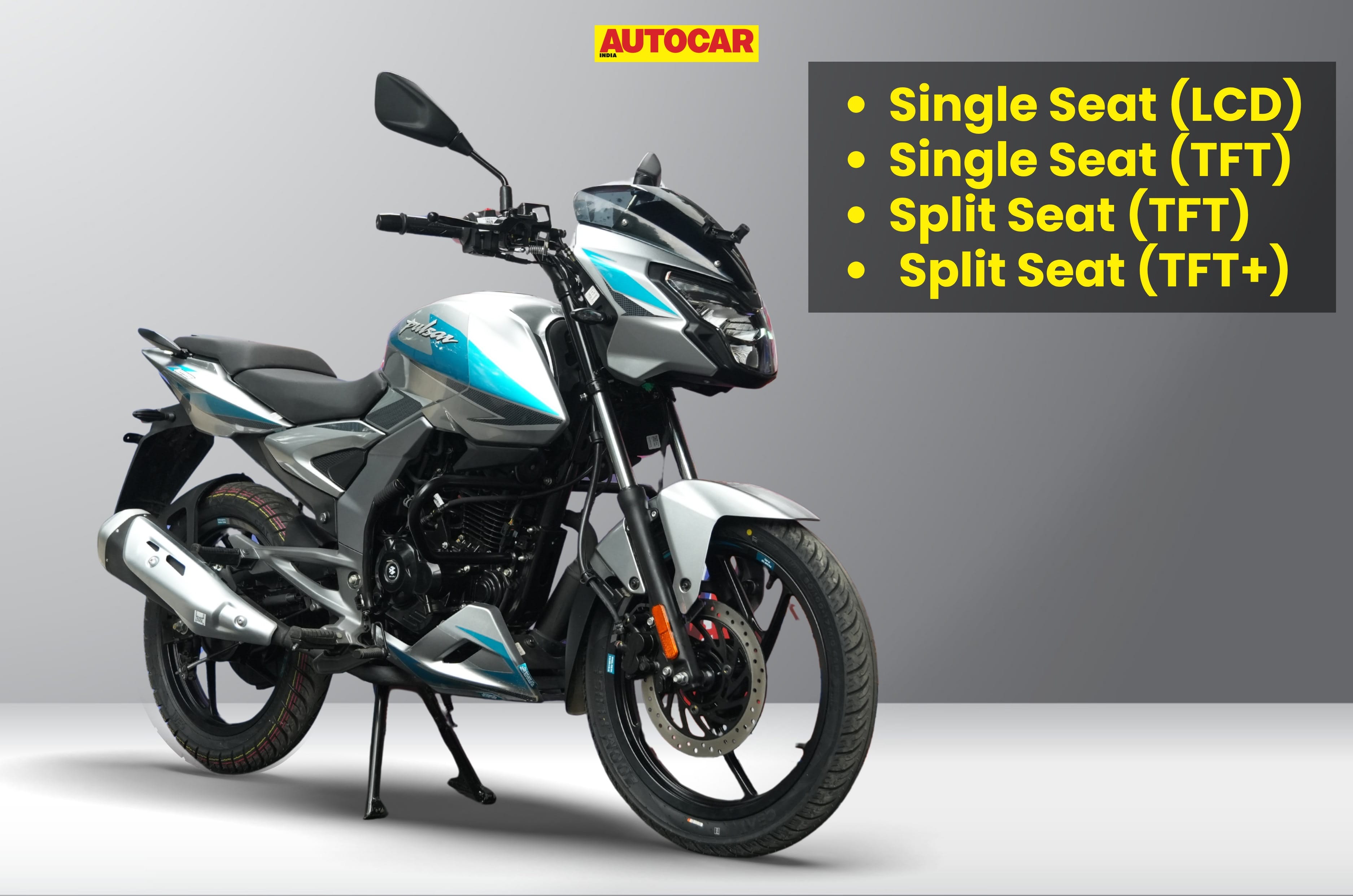
Front right quarter studio image of the Bajaj Pulsar 125 in Dark Silver + Aqua Blue colour

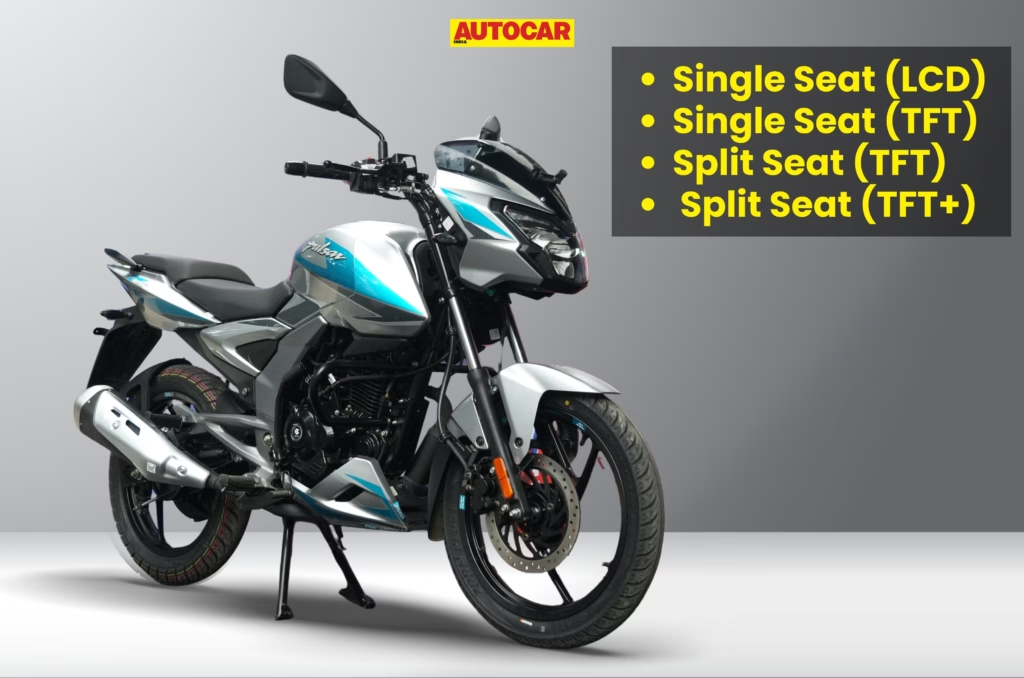
Bajaj has updated the Pulsar 125 comprehensively with the new version having four variants, compared to two on the previous iteration. Similar to the Pulsar 150, the aim is to offer value for money and to wit, Bajaj has packed in a sizable set of features into each variant, but how do they differ from each other? Fret not, let us help.

All prices mentioned are ex-showroom, Delhi.

Bajaj Pulsar 125 variant breakdown

Pulsar 125 Single Seat (LCD)

All four variants share the new single-cradle chassis and the 124.58cc engine making 12.1hp at 8,500rpm and 11.4Nm torque at 6,500 rpm, a marginal bump of 0.3hp and 0.6Nm over the 124.38cc engine on the previous gen. All four variants share the same LED headlight and taillight, tyres, and front and rear suspensions. Bluetooth and turn-by-turn navigation is also common to all of them.

The base Single Seat (LCD) variant, like the name implies, gets a single seat piece and an LCD instrument cluster. It gets a 240mm front disc with a 130mm rear drum brake as well as Combined Braking System (CBS) as standard. It uses bulb indicators and offers a USB type-C port as an optional extra accessory. This variant is priced at Rs 92,900.

Pulsar 125 Single Seat (TFT)

The second variant, once again mentioned in the name, replaces the LCD instrument cluster with a 5-inch TFT display. Other areas in the ride package see upgrades as well. This variant adds three ride modes, an integrated starter generator (ISG), and gets the USB Type-C port as standard fitment. There’s also a larger 260mm front disc and the indicators are LED as well, with hazard lights function. Bajaj has priced this variant at Rs 99,291, Rs 6,391 step up over the base variant.

Pulsar 125 Split Seat (TFT)

The next variant swaps the single seat pad for a split rider and pillion pads for just over a lakh of rupees. It’s otherwise identical to the previous variant.

Pulsar 125 Split Seat (TFT+)

Don’t let the + mislead you into thinking that this top variant is another small step up. There are three upgrades on this one. Starting with the cluster itself, the TFT display on this one exclusively gets WiFi support, enabling Google Maps mirroring for navigation. It’s also the only one getting a belly pan as standard for added protection to the engine sump and it gets a dual-horn, compared to the single-horn on the rest. For these three features, this variant’s asking price is Rs 1.04 lakh, roughly Rs 4,000 over the last variant.
 

Opinion: Quality of two-wheeler service in India needs to improve

Opinion: Quality of two-wheeler service in India needs to improve
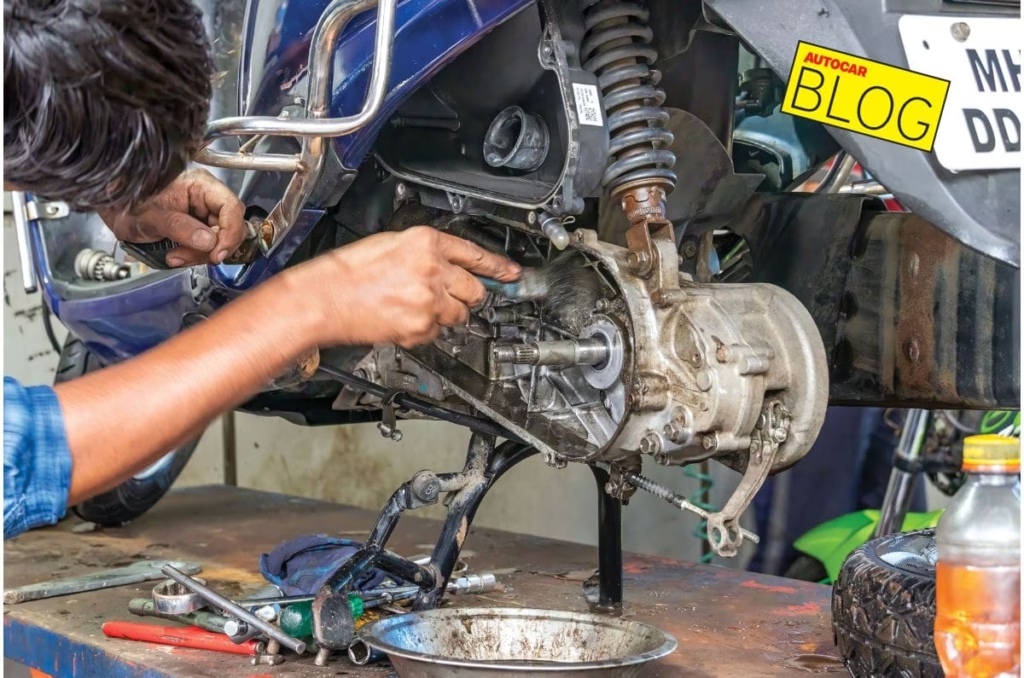
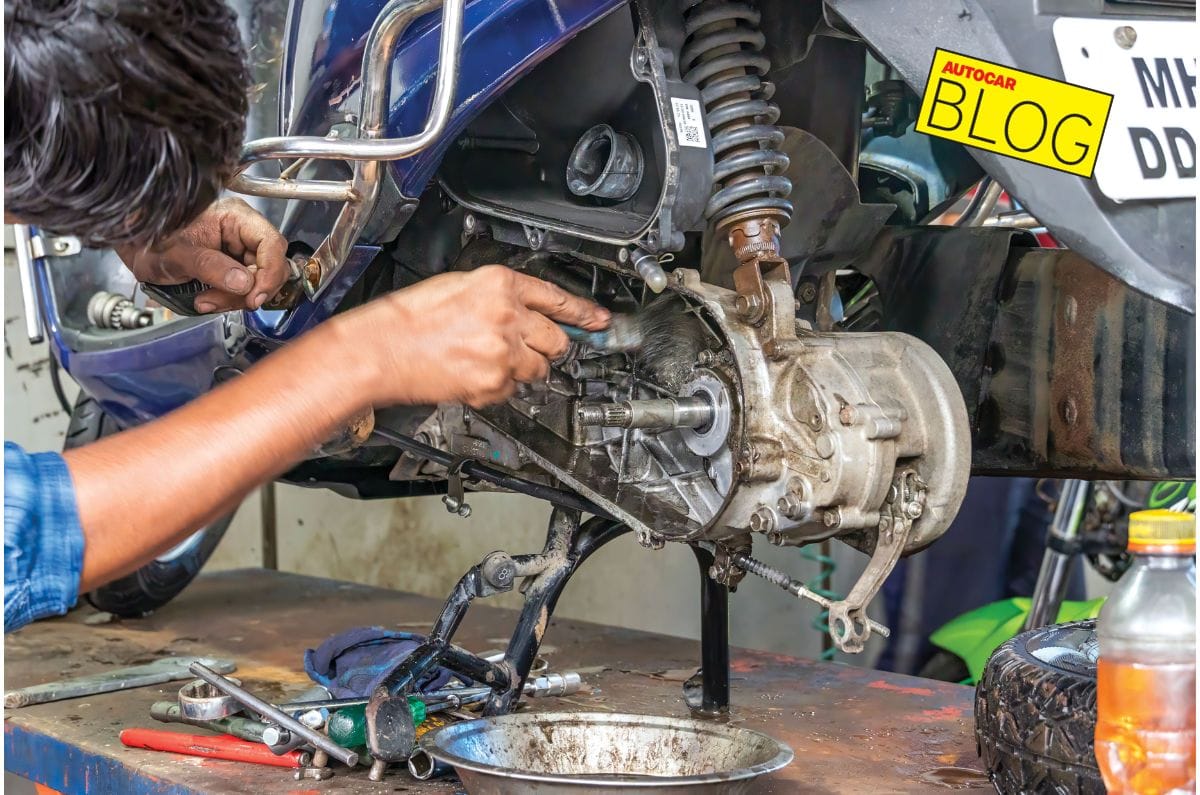
A scooter being serviced at a garage in India

Purchasing an automobile is one of life’s special moments in India. After all, you are not only paying a lot of money but also laying significant faith into a manufacturer’s ability to have properly engineered a safe, reliable and enjoyable product. There’s also the fact that you are entering a long-term relationship with that manufacturer when it comes to service. With three-year warranties becoming common and extended warranties being sold for just a few thousand rupees, the duration of said relationship is now longer than ever. Unfortunately, a lot of customers these days don’t feel like they are being given the treatment they deserve in this ‘relationship’.

While the quality of products coming from domestic two-wheeler manufacturers has grown tremendously in recent years, the same can’t be said for the service support. While some manufacturers fare worse than others, you will find plenty of reports of shoddy work or general ineptness when it comes to authorised service centres. The reasons behind this are multifold.

The first is that motorcycles today are far more complicated than they used to be. Electronics are everywhere, and even the simplest of commuters now have ECUs, electronic fuel pumps and fuel injectors. 150cc bikes and above are constantly increasing the amount of performance, tech and gadgets on offer, and all of this brings in more complication. Caring for more advanced motorcycles requires a more technical approach.

The “chalta hai/chalega sir” attitude that is a universal truth in India presents a challenge when the job gets more technical. Another cultural aspect at play is that people are far more proud of how quickly a job gets done (or with how much ‘jugaad’) rather than how well the job gets done. Case in point, I once insisted on a torque wrench being used on my KTM 790 Duke at an official service centre a couple of years ago. This led to a stool being brought out to reach an overhead cabinet, from which a dusty torque wrench was liberated. Clearly, that tool was almost never used, and the fact is, most mechanics in India simply use their biceps to decide how much force needs to go into tightening a bolt. 

Money is the other big challenge. Time is money, so the more vehicles that are serviced, the better. More so, most junior mechanic salaries are very low, which results in high job attrition. It’s also difficult for dealerships to have enough trained staff and sufficient workshop space for the amount of money that is earned per service. With automobile sales records being broken every other month, there is a big strain on the system.

The ideal scenario is that big cities need more workshops, staff should be trained better and workshop managers need to be more diligent about implementing proper operating procedures. At the end of the day, quality work can only be provided by someone who has been trained well and is remunerated fairly for the job. And that will increase the cost of service for the customer, primarily in terms of the labour cost. 

It is inevitable that service costs in India will rise, as does the constantly improving standard of our motorcycles and the ever increasing cost of living. The big challenge for manufacturers is to ensure that customers get their money’s worth for these increasing costs.

Stocks to Watch: 21 स्टॉक्स; TempSens की लिस्टिंग समेत Lenskart, Wipro और Tejas Networks समेत ये शेयर फोकस में

Stocks to Watch: अधिकतर एशियाई बाजारों में मजबूत रुझानों के बीच गिफ्ट निफ्टी से आज घरेलू मार्केट में ग्रीन शुरुआत के संकेत मिल रहे हैं। गिफ्ट निफ्टी फिलहाल 60.50 प्वाइंट्स यानी 0.25% की बढ़त के साथ 24,260.50 पर है। एक कारोबारी दिन पहले 27 अगस्त को सेंसेक्स की मंथली एक्सपायरी के दिन सेंसेक्स (Sensex) 539.35 प्वाइंट्स यानी 0.70% की गिरावट के साथ 76,933.59 और निफ्टी 50 (Nifty 50) भी 116.90 प्वाइंट्स यानी 0.48% की फिसलन के साथ 24,090.85 पर बंद हुआ था। अब आज इंडिविजुअल स्टॉक्स की बात करें तो अपनी खास कॉरपोरेट एक्टिविटीज के चलते कुछ स्टॉक्स में तेज हलचल दिख सकती है। यहां इन शेयरों के बारे में डिटेल्स दी जा रही है।

Stocks to Watch: आज इन स्टॉक्स पर फोकस

Lenskart Solutions

सीएनबीसी-टीवी18 को सूत्रों से मिली जानकारी के मुताबिक अल्फा वेव वेंचर्स ब्लॉक डील के जरिए लेंसकार्ट में 1.2% हिस्सेदारी बेच सकती है। लगभग ₹1,313 करोड़ की इस डील के लिए फ्लोर प्राइस प्रति शेयर ₹630 तय किया गया है।

Texmaco Rail and Engineering

टेक्समैको रेल एंड इंजीनियरिंग ने जर्मनी की Bochumer Verein Verkehrstechnik GmbH (BVV) के साथ एक एमओयू किया है। इसमें रेलवे व्हील्स, व्हीलसेट्स, एक्सल्स और रेल गाड़ियों के दूसरे पार्ट्स को लेकर कारोबारी मौके तलाशने और उन पर आगे बढ़ने के लिए जरूरी शर्तें तय की गई हैं।

Tejas Networks

तेजस नेटवर्क्स को टीसीएस से बीएसएनएल के 4G मोबाइल नेटवर्क के लिए 18,685 साइट्स पर RAN इक्विपमेंट, एक्सेसरीज और इंस्टॉलेशन मैटीरियल की सप्लाई के लिए ₹1,537 करोड़ का LoA (लेटर ऑफ इंटेंट) मिला है।

NBCC (India)

एनबीसीसी को केंद्रीय विद्यालय संगठन, डायरेक्टरेट ऑफ टीचर एजुकेशन एंड एससीईआरटी (ओडिशा) और केनरा बैंक से ₹134.27 करोड़ के कई कंस्ट्रक्शन ऑर्डर मिला है।

Chemplast Sanmar

कॉर्पोरेट मामलों के मंत्रालय ने 1 अप्रैल, 2026 से तीन साल के लिए केमप्लास्ट सनमार

के मैनेजिंग डायरेक्टर के तौर पर गणेशकुमार सुब्रमण्यन की नियुक्ति को मंजूरी दे दी है।

Wipro

विप्रो ने जेमिनी एंटरप्राइज और एजेंटिक AI को गूगल क्लाउड के साथ अपनी साझेदारी को बढ़ाने का ऐलान किया है। इसके अलावा विप्रो जेमिनी एंटरप्राइज के इंटरनल डिप्लॉयमेंट को बढ़ा रही है और 1,500 फॉरवर्ड डिप्लॉयड इंजीनियर्स समेत 10,000 से ज्यादा एआई-सर्टिफाइड स्पेशलिस्ट्स को एडवांस्ड AI क्षमताओं से लैस करेगी।

Adani Power

अदाणी पावर ने अपनी सब्सिडियरीज चंदेनवल्ले इंफ्रा पार्क और अदाणीकनेक्स के साथ एक शेयर खरीद समझौता किया है, जिसके तहत यह चंदेनवल्ले इंफ्रा पार्क में अपनी पूरी हिस्सेदारी अदाणीकनेक्स को ₹535.69 करोड़ में बेचेगी।

RPP Infra Projects

तमिलनाडु स्पोर्ट्स डेवलपमेंट अथॉरिटी ने आरपीपी इंफ्रा प्रोजेक्ट्स को दिए गए ₹205.89 करोड़ के वर्क ऑर्डर को रद्द कर दिया है।

Star Cement

MMDR (माइंस एंड मिनरल्स (डेवलपमेंट एंड रेगुलेशन)) एक्ट, 1957 के नए नियमों के तहत स्टार सीमेंट और उसकी सब्सिडियरीज को अब 22 अगस्त, 2026 से मिनरल सेस का पेमेंट करने की जरूरत नहीं है। केंद्र सरकार ने MMDR एक्ट में बदलाव किया है और अब राज्य सरकारें मिनरल राइट्स या मिनरल वाली जमीनों पर टैक्स, सेस और अन्य लेवी नहीं लगा सकती हैं। इसमें यह भी है कि पुरानी बकाया लेवी अब वसूली नहीं जाएगी।

Dr Agarwal’s Health Care

डॉ अग्रवाल हेल्थ केयर की सब्सिडियरी डॉ अग्रवाल आई हॉस्पिटल ने चेन्नई में दुनिया का पहला पिनहोल पपिलोप्लास्टी (PPP) सेंटर शुरू किया है।

Union Bank of India

एसएंडपी ग्लोबल रेटिंग्स ने यूनियन बैंक ऑफ इंडिया की दुबई इंटरनेशनल फाइनेंशियल सेंटर ब्रांच के अमेरिकी डॉलर में जारी हुए सीनियर अनसिक्योर्ड नोट्स को ‘BBB’ लॉन्ग-टर्म इश्यू रेटिंग दी है।

Apollo Tyres

ग्लोबल प्राइवेट इक्विटी फर्म वॉरबर्ग पिनकस की कंपनी एमेराल्ड सेज इन्वेस्टमेंट ने अपोलो टायर्स में 4.25% हिस्सेदारी वाले 2.7 करोड़ इक्विटी शेयर ₹1,174.93 करोड़ के भाव पर बेच दिए। ये शेयर तीन घरेलू इंस्टीट्यूशनल इन्वेस्टर्स- ICICI प्रूडेंशियल म्यूचुअल फंड, बजाज लाइफ इंश्योरेंस और SBI लाइफ इंश्योरेंस कंपनी ने प्रति शेयर ₹435 के भाव पर खरीदे। जून 2026 तक अपोलो टायर्स में एमेराल्ड सेज इन्वेस्टमेंट की हिस्सेदारी 9.93% थी, जबकि ICICI प्रूडेंशियल म्यूचुअल फंड के पास 1.12% हिस्सेदारी थी।

ICICI Prudential Asset Management Company

प्रूडेंशियल कॉर्पोरेशन होल्डिंग्स ने ICICI प्रूडेंशियल एसेट मैनेजमेंट कंपनी के 98.85 लाख शेयर (2% हिस्सेदारी) ₹3,030.3 करोड़ में प्रति शेयर ₹3,065.47 के भाव पर बेचे। जून 2026 तक ICICI प्रूडेंशियल AMC में प्रमोटर्स की कुल हिस्सेदारी 87.6% थी, जिसमें प्रूडेंशियल कॉर्पोरेशन होल्डिंग्स की हिस्सेदारी 34.59% थी।

Foseco India

मॉर्गन टेरासेन और मॉर्गेनाइट क्रूसिबल ने फोसेको इंडिया में अपनी पूरी 15.26% हिस्सेदारी बेच दी। मॉर्गन एडवांस्ड मैटेरियल्स की मॉर्गन टेरासेन ने फोसेको इंडिया के 5.6 लाख शेयर (7.43% हिस्सेदारी) ₹330.26 करोड़ में तो मॉर्गेनाइट क्रूसिबल ने 5.9 लाख शेयर (7.84% हिस्सेदारी) ₹348.36 करोड़ में बेचे हैं। कुल मिलाकर ₹678.6 करोड़ में 11.5 लाख शेयर को नौ देशी-विदेशी निवेशकों- सिटीग्रुप, इंवेस्को एमएफ, एलआईसी एमएफ, महिंद्रा मैनुलाइफ एमएफ, मिरे एसेट एमएफ, मॉर्गन स्टेनले, कैटामारन वेंचर्स, एसबीआई एमएफ और मोतीलाल ओसवाल एएमसी ने प्रति शेयर ₹5,897 के भाव पर खरीदे।

Aye Finance

ग्लोबल अल्टरनेटिव एसेट मैनेजर अल्फा वेव ग्लोबल की कंपनी अल्फा वेव इंडिया I ने आय फाइनेंस से अपनी पूरी 7.78% हिस्सेदारी (1.92 करोड़ शेयर) ₹322.57 करोड़ में बेच दी। इनमे में 14.88 लाख शेयर मधुसूदन केला की सिंगुलैरिटी AMC ने सिंगुलैरिटी लार्ज वैल्यू फंड III के जरिए ₹25 करोड़ में और इंटीग्रेटेड कोर स्ट्रैटेजीज (एशिया) ने 23.8 लाख शेयर ₹40 करोड़ में खरीदे। शेयरों का लेन-देन ₹168 के भाव पर हुआ।

DCB Bank

एसबीआई और ओमान इन्वेस्टमेंट अथॉरिटी की ओमान इंडिया जॉइंट इन्वेस्टमेंट फंड II ने डीसीबी बैंक के 37 लाख शेयर (1.14% हिस्सेदारी) ₹80.29 करोड़ में प्रति शेयर ₹217.01 के भाव पर बेच दिए। जून 2026 तक बैंक में इस फंड की 2.86% हिस्सेदारी थी।

Happiest Minds Technologies

पोलुनिन इमर्जिंग मार्केट्स स्मॉल कैप फंड एलएलसी ने हैप्पिएस्ट माइंड्स टेक्नोलॉजीज के 8.3 लाख शेयर (0.54% हिस्सेदारी) ₹35.68 करोड़ में प्रति शेयर ₹429.92 के भाव पर खरीद लिए।

Iris Clothings

निप्पॉन लाइफ इंडिया एसेट मैनेजमेंट ने आइरिस क्लोदिंग्स में 0.6% हिस्सेदारी के बराबर 11.53 लाख शेयर ₹6.58 करोड़ में प्रति शेयर ₹57.1 के भाव पर खरीदे।

RPP Infra Projects

सीएमके प्रोजेक्ट्स ने आरपीपी इंफ्रा प्रोजेक्ट्स के प्रमोटर यागवी एनए से कंपनी के 5 लाख शेयर ₹2.84 करोड़ में प्रति शेयर ₹56.85 के भाव पर खरीद लिए।

Wonder Electricals

नेक्सस ग्लोबल अपॉर्चुनिटीज फंड और यूनिको ग्लोबल अपॉर्चुनिटीज फंड ने वंडर इलेक्ट्रिकल्स में अपनी 5.66% हिस्सेदारी (75.89 लाख शेयर) ₹98.21 करोड़ में बेच दी। जून 2026 तक नेक्सस ग्लोबल अपॉर्च्यूनिटीज फंड की कंपनी में 2.34% हिस्सेदारी थी, तो यूनिको ग्लोबल अपॉर्च्यूनिटीज फंड की 7.48%।

Tempsens Instruments (India)

आईपीओ को 184 गुना से अधिक बोली मिलने के बाद टेंपसेंस इंस्ट्रूमेंट्स के शेयरों की आज बीएसई और एनएसई पर एंट्री होगी।

Stocks to Watch: इन पर भी रहेगी नजर

एक्स-डिविडेंड: एमसीएक्स, होनासा कंज्यूमर, एलाइड डिजिटल सर्विसेज, अरविंद स्मार्टस्पेस, ब्लैक बॉक्स, कैंटाबिल रिटेल इंडिया, कोरल इंडिया फाइनेंस एंड हाउसिंग, डैम कैपिटल एडवाइजर्स, डायनामेटिक टेक्नोलॉजीज, इमामी पेपर मिल्स, गुजरात अंबुजा एक्सपोर्ट्स, गुफिक बायोसाइंसेज, गुलशन पॉलीओल्स, हल्डिन ग्लास, जेनबर्कट फार्मा, क्रेडो ब्रांड्स मार्केटिंग, एनबीसीसी (इंडिया), पारस डिफेंस एंड स्पेस टेक्नोलॉजीज, पॉली मेडिक्योर, प्रोटियन ई-गवर्नेंस टेक्नोलॉजीज, रॉयल ऑर्किड होटल्स, साल्जर इलेक्ट्रॉनिक्स, स्टर्लिंग टूल्स, स्टड्स एक्सेसरीज, सुपरशक्ति मेटालिक्स, स्वान कॉर्प, वेरिटास (इंडिया), वर्धमान होल्डिंग्स, विक्रान इंजीनियरिंग, वर्धमान स्पेशल स्टील्स, वर्धमान टेक्सटाइल्स, व्हर्लपूल ऑफ इंडिया, यूकेन इंडिया

एक्स-राइट्स: जयके एंटरप्राइजेज

एक्स-स्प्लिट: रोटोग्राफिक्स (इंडिया), स्पाइस आइलैंड्स इंडस्ट्रीज

F&O बैन: आज एलआईसी हाउसिंग फाइनेंस और SAIL में एफएंडओ की नई पोजिशन नहीं ले पाएंगे।

स्टॉक मार्केट में आज की लाइव हलचल के लिए यहां जुड़ें

डिस्क्लेमर: यहां मुहैया जानकारी सिर्फ सूचना के लिए दी जा रही है। यहां बताना जरूरी है कि मार्केट में निवेश बाजार जोखिमों के अधीन है। निवेशक के तौर पर पैसा लगाने से पहले हमेशा एक्सपर्ट से सलाह लें। मनीकंट्रोल की तरफ से किसी को भी पैसा लगाने की यहां कभी भी सलाह नहीं दी जाती है।

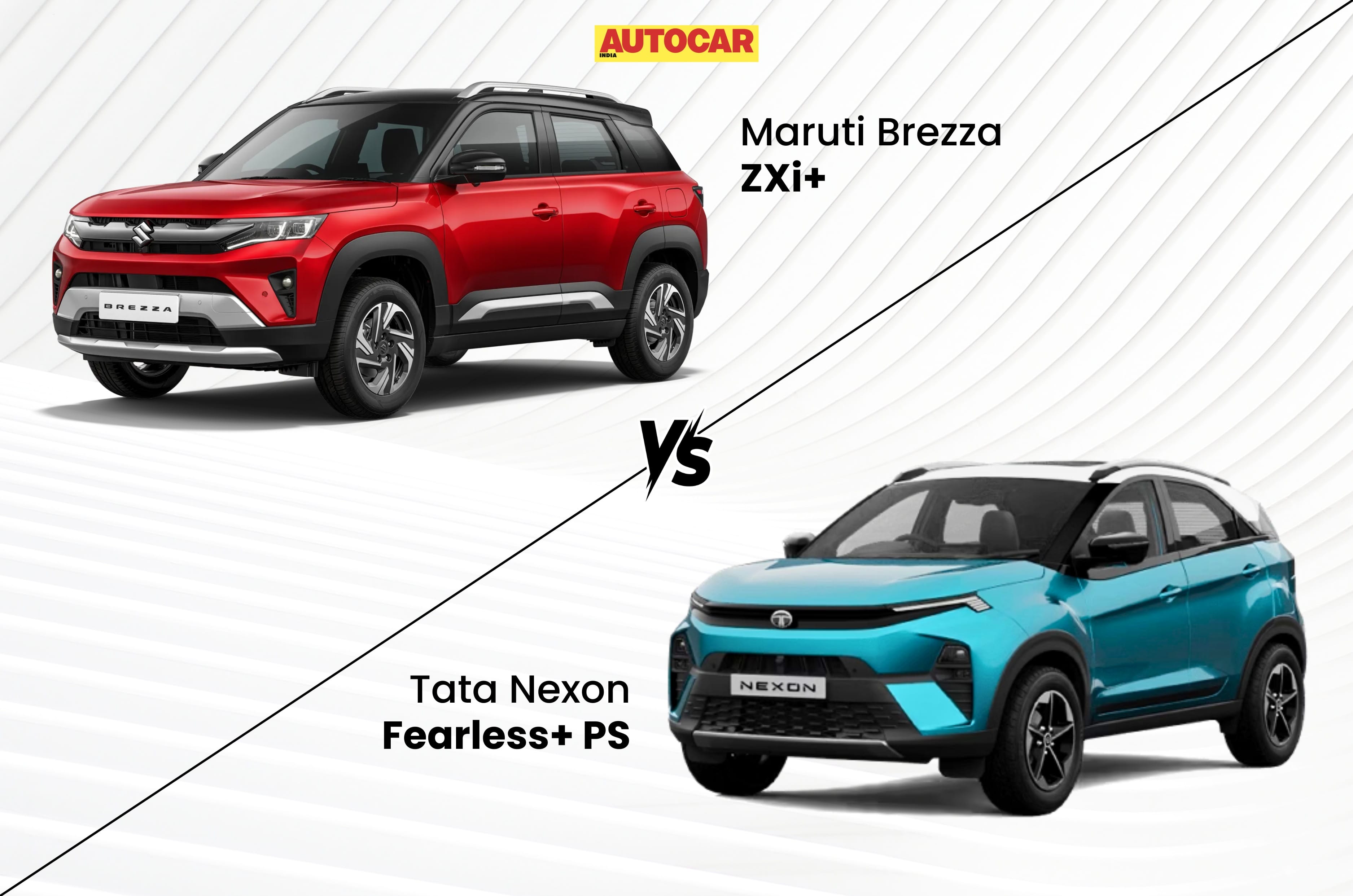
Maruti Brezza ZXi+ vs Tata Nexon Fearless+ PS: Which should you buy?

Maruti Brezza ZXi+ vs Tata Nexon Fearless+ PS: Which should you buy?
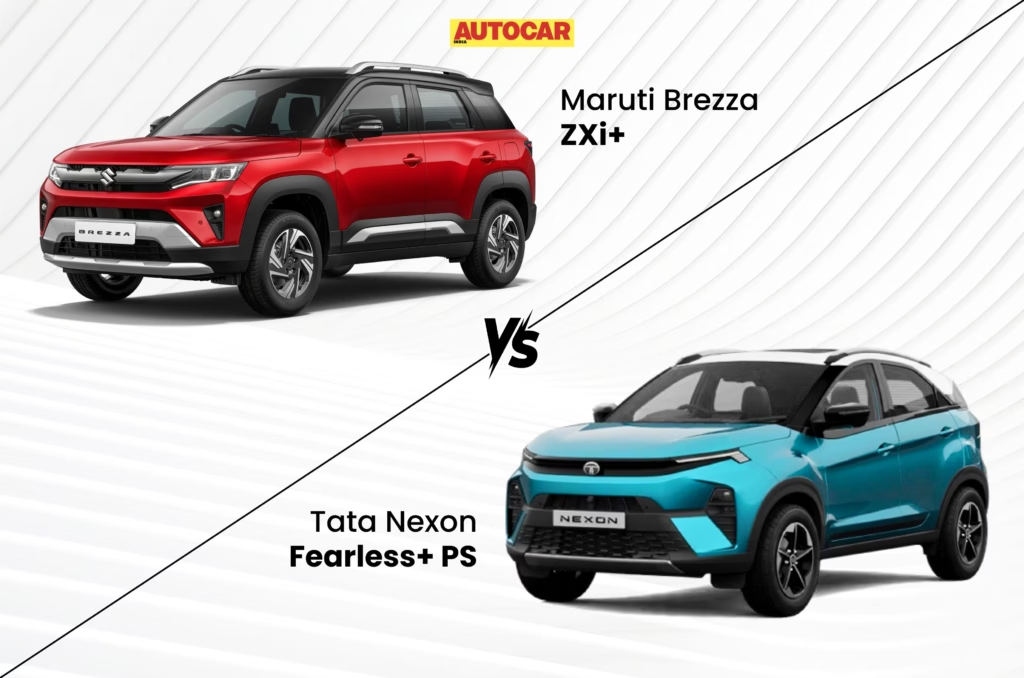
Maruti Brezza vs Tata Nexon

The Maruti Brezza and Tata Nexon are among the bestselling compact SUVs in the Indian market. While the former received a comprehensive update that introduced cosmetic changes, more features and a powerful new turbo-petrol engine, the latter continues to attract consumers with a wide choice of powertrains. If you are looking to buy a compact SUV, we compare the Brezza’s top-spec ZXi+ trim and the Nexon Fearless+ PS to find out which offers better value for money.

Explore full specs, features and a price breakdown in our Brezza vs Nexon comparison.

Maruti Brezza vs Tata Nexon: Dimensions

Brezza is taller, while Nexon has a bigger boot

Maruti Brezza vs Tata Nexon: Dimensions


Maruti Brezza

Tata Nexon

Difference

Length (mm)

3,995

3,995

–

Width (mm)

1,790

1,804

-14

Height (mm)

1,685

1,620

+65

Wheelbase (mm)

2,500

2,498

+2

Ground clearance (mm)

198

208

-10

Boot space (litres)

328

382

-54

Only the length of both models is identical. Beyond that, the Brezza is taller and has a slightly longer wheelbase than the Nexon. On the other hand, the Nexon is wider, rides higher off the ground and has a larger boot.

Maruti Brezza vs Tata Nexon: Powertrain options

Brezza ZXi+ offers limited powertrain options

Maruti Brezza vs Tata Nexon: Powertrain options


Maruti Brezza

Tata Nexon

Powertrain

Naturally aspirated petrol | Turbo-petrol

Turbo-petrol | CNG | Turbo-diesel 

Engine configuration

1.5-litre, 4-cyl | 1.0-litre, 3-cyl

1.2-litre, 3-cyl | 1.2-litre, 3-cyl | 1.5-litre, 4-cyl 

Power (hp)

103 | 110 

120 | 100 |115

Torque (Nm)

139 | 170

170 | 170 | 260

Transmission

6MT | 6AT

6MT / 7DCT | 6MT / 6AMT | 6MT 

The Brezza ZXi+ is available only with the naturally aspirated petrol automatic and turbo-petrol manual powertrains. On the other hand, the Nexon Fearless+ PS offers a wide range of options: a turbo-petrol manual and automatic, a diesel manual and automatic, and a CNG manual. As for their turbo-petrol engines, the torque is identical, but the Nexon’s larger mill delivers more power.

Maruti Brezza vs Tata Nexon: Exterior features 

Nexon offers some feel-good features like welcome/goodbye animations

Maruti Brezza vs Tata Nexon: Exterior features 


Maruti Brezza

Tata Nexon

Headlights 

LED projector

LED projector

Tail-lights

LED

Connected LED

Welcome/goodbye animations

No

Yes

Sequential turn indicators

No

Yes

Daytime running lamps (DRLs)

Yes

Yes

Fog lamps

LED

LED

Wheels

16-inch

16-inch

Outside rearview mirrors (ORVMs)

Electrically adjustable, auto-folding

Electrically adjustable, auto-folding

Roof rails

Yes

Yes

Rear wiper, washer

Yes

Yes

Colour options

Monotone and dual-tone

Dual-tone

Both the Brezza and Nexon are similarly equipped on the exterior, with LED light setups, DRLs, fog lamps, electrically adjustable and auto-folding ORVMs and 16-inch alloy wheels. However, the Nexon gets some fancier features such as welcome/goodbye animations for the light setups, along with sequential turn indicators. As for colour options, the Nexon is limited to dual-tone schemes, whereas the Brezza offers monotone options as well.

Maruti Brezza vs Tata Nexon: Interior features 

Brezza not as well equipped as Nexon

Maruti Brezza vs Tata Nexon: Interior features


Maruti Brezza

Tata Nexon

Instrument cluster

Analogue dials with MID

10.25-inch display

Infotainment screen

10.1-inch

10.25-inch

Head-up display

Yes

No

Android Auto, Apple CarPlay

Wireless

Wireless

Sunroof

Single-pane

Panoramic

Audio system

6-speaker Arkamys Surround Sense

9-speaker JBL

Climate control

Automatic

Automatic

Rear AC vents

Yes

Yes

Driver seat adjustment

Manual

Manual

Front seat ventilation

Yes

Yes

Seat upholstery

Leatherette

Leatherette

Wireless phone charger

Yes

Yes

Air purifier

Yes

Yes

Connected car tech

Yes

Yes

Rear centre armrest

Yes

Yes

Rear sunshade

No

Yes

Ambient lighting

64-colour

No

60:40 split folding seat

Yes

Yes

Apart from multi-colour ambient lighting and a head-up display, the Brezza’s overall interior equipment falls short of the Nexon’s. The latter comes packed with features such as a digital driver’s display as opposed to analogue dials on the former, a panoramic sunroof, a slightly larger infotainment screen, more speakers and rear window sunshades.  

Maruti Brezza vs Tata Nexon: Driving tech

Brezza misses out on drive modes

Maruti Brezza vs Tata Nexon: Driving tech


Maruti Brezza

Tata Nexon

Drive modes

No

Eco, City and Sport

Paddleshifters

Yes

Yes

Cruise control

Yes

Yes

While paddleshifters and cruise control are available on both models, drive modes are offered only with the Nexon.

Maruti Brezza vs Tata Nexon: Safety features

Brezza comes equipped with more advanced safety tech 

Maruti Brezza vs Tata Nexon: Safety features


Maruti Brezza

Tata Nexon

BNCAP rating 

5 stars

5 stars

Blind-spot warning

Yes

No

Safe-exit warning

Yes

No

Rear cross-traffic alert

Yes

No

Airbags

6

6

Camera setup

360-degree

360-degree

Parking sensors

Front and rear

Front and rear

Disc brakes

Front only

Front only

Tyre-pressure monitoring system

Yes

Yes

Interior rearview mirror (IRVM)

Auto-dimming 

Auto-dimming

Hill-hold assist

Yes

Yes

ESC

Yes

Yes

Both the Brezza and Nexon have achieved a 5-star BNCAP crash-safety rating and are equally matched in terms of offering a basic safety kit, along with features such as a 360-degree camera and front parking sensor. But only the former comes with advanced safety systems such as rear cross-traffic alert and blind-spot and safe-exit warnings.

Maruti Brezza vs Tata Nexon: Price and verdict

Brezza’s more affordable, but Nexon’s powertrain range is hard to ignore

Maruti Brezza vs Tata Nexon: Prices


Maruti Brezza

Tata Nexon

NA petrol AT

13.54

–

Turbo petrol MT

11.16

12.34

Turbo petrol AT

–

12.55

Turbo diesel MT

–

13.45

Turbo diesel AMT

–

14.10

CNG MT

–

13.30

Comparing only the turbo-petrol manual powertrain, which is common to both, the Brezza is Rs 1.18 lakh more affordable than the Nexon. Notably, the Brezza ZXi+ NA petrol automatic costs almost a lakh rupees more than the Nexon Fearless+ PS turbo-petrol automatic. This is due to the higher tax on the 1.5-litre unit powering the Brezza. Moreover, the Nexon has a Fearless+ A PS trim that sits above the Fearless+ PS trim and brings Level 2 ADAS, but it is limited to the turbo-petrol automatic.

When it comes to choosing between the two, we’d recommend the Tata Nexon. Though the Brezza’s ZXi+ trim starts at a more affordable price point and is backed by Maruti’s widespread and hassle-free service experience, the Nexon’s multiple powertrain options are simply hard to ignore. Additionally, the Tata comes with more bells and whistles than the Maruti, and that’s why it’s our pick.

All prices are ex-showroom, India.

Stocks to Watch: 20 स्टॉक्स; तीन लिस्टिंग और Groww, Cipla, Rama Steel समेत ये शेयर धमाल मचाने को तैयार!

Stocks to Watch: अधिकतर एशियाई बाजारों में रौनक के बीच गिफ्ट निफ्टी से आज घरेलू मार्केट में भी ग्रीन शुरुआत के संकेत मिल रहे हैं। गिफ्ट निफ्टी फिलहाल 73.50 प्वाइंट्स यानी 0.30% की बढ़त के साथ 24,553.50 पर है। एक कारोबारी दिन पहले 25 अगस्त को अगस्त सीरीज में निफ्टी की मंथली एक्सपायरी के दिन सेंसेक्स (Sensex) 286.98 प्वाइंट्स यानी 0.37% के उछाल के साथ 77,656.09 और निफ्टी 50 (Nifty 50) भी 115.50 प्वाइंट्स यानी 0.48% की मजबूती के साथ 24,334.55 पर बंद हुआ था। अब आज इंडिविजुअल स्टॉक्स की बात करें तो अपनी खास कॉरपोरेट एक्टिविटीज के चलते कुछ स्टॉक्स में तेज हलचल दिख सकती है। यहां इन शेयरों के बारे में डिटेल्स दी जा रही है।

Stocks to Watch: आज इन स्टॉक्स पर फोकस

Billionbrains Garage Ventures (Groww)

सीएनबीसी-टीवी18 को सूत्रों से मिली जानकारी के मुताबिक ग्रो की पैरेंट कंपनी बिलियनब्रेन्स गैराज वेंचर्स में रिबिट कैपिटल 1.6% हिस्सेदारी बेच सकती है। ₹1914 करोड़ की इस ब्लॉक डील के फ्लोर प्राइस ₹195 तय किया गया है।

Welspun Corp

सीएनबीसी-टीवी18 को सूत्रों से मिली जानकारी के मुताबिक वेलस्पन कॉर्प में वेलस्पन इंवेस्टमेंट्स एंड कमर्शियल्स और एमडी-सीईओ विपुल माथुर कुल 63 लाख शेयर (2.4% हिस्सेदारी बेच सकते हैं। ₹1417 करोड़ की इस ब्लॉक डील के फ्लोर प्राइस ₹2250 तय किया गया है।

Honasa Consumer

होनासा कंज्यूमर ने शेयर खरीद सौदे के तहत तय शर्तों को पूरा न कर पाने के कारण फ्लूएंस फार्मा में 58% हिस्सेदारी खरीदने के प्रस्ताव को रद्द कर दिया है।

Cipla

अमेरिकी दवा नियामक एफडी ने 17 से 25 अगस्त, 2026 के बीच पीथमपुर में सिप्ला की मैन्युफैक्चरिंग यूनिट में cGMP (करंट गुड मैन्युफैक्चरिंग प्रैक्टिसेज) का फॉलो-अप इंस्पेक्शन किया, जिसके बाद कंपनी को फॉर्म 483 में सात इंस्पेक्शन ऑब्जर्वेशन मिला।

UCO Bank

यूके बैंक के एग्जीक्यूटिव डायरेक्टर राजेंद्र कुमार साबू को बैंक के एमडी और सीईओ का अतिरिक्त प्रभार सौंपा गया है।

ARSS Infrastructure Projects

एआरएसएस इंफ्रास्ट्रक्चर प्रोजेक्ट्स को ईस्ट कोस्ट रेलवे से ₹104.06 करोड़ का वर्क ऑर्डर मिला है।

Advait Energy Transitions

अद्वैत एनर्जी ट्रांजिशन्स को मध्य प्रदेश पावर ट्रांसमिशन कंपनी लिमिटेड से ₹134.63 करोड़ का टर्न्की कॉन्ट्रैक्ट मिला है। यह कॉन्ट्रैक्ट 400kV, 220kV और 132kV वोल्टेज-क्लास EHV लाइनों के लिए सभी जरूरी एक्सेसरीज के साथ ‘इमरजेंसी रेस्टोरेशन सिस्टम’ (ERS) के डिजाइन, मैन्युफैक्चरिंग और सप्लाई के लिए है।

NBCC (India)

एनबीसीसी को राजस्थान काउंसिल ऑफ स्कूल एजुकेशन से 170 नई स्कूल बिल्डिंग बनाने के लिए ₹121.74 करोड़ का ऑर्डर मिला है।

Sai Parenterals

साई पैरेंटरल्स की ऑस्ट्रेलियाई सब्सिडियरी नोमेड फार्मा ने ऑस्ट्रेलिया की एक बड़ी मल्टी-बिलियन-डॉलर फार्मेसी चेन के साथ ओटीसी (ओवर-द-काउंटर) दवाओं की सप्लाई का एग्रीमेंट रिन्यू किया है। इसमें प्रोडक्ट पोर्टफोलियो बढ़ाया गया है, एग्रीमेंट और लंबा हुआ और इसकी वैल्यू बढ़ी है। तीन साल के लिए इस डील की वैल्यू AUD 3 करोड़ (लगभग ₹204 करोड़) होने का अनुमान है, जो तुरंत लागू होगी।

United Breweries

यूनाइटेड ब्रुअरीज ने प्रीमियमाइजेशन की स्पीड तेज करने के लिए केरल, ओडिशा और मध्य प्रदेश में हेनेकेन सिल्वर के विस्तार का ऐलान किया है।

Varun Beverages

वरुण बेवरेजेज ने रेडी-टू-ड्रिंक (RTD) एल्कोहलिक बेवरेजेज और उससे जुड़े प्रोडक्ट्स का बिजनेस करने के लिए एक नई सब्सिडियरी KIVA स्पिरिट्स एंड कंपनी बनाने का ऐलान किया है। बोर्ड ने इसका सीईओ और एमडी प्रथमेश मिश्रा को बनाया है। इसके अलावा वरुण बेवरेजेज ट्यूनीशिया में बेवरेजेज के प्रोडक्शन और डिस्ट्रीब्यूशन का बिजनेस करने के लिए एक जॉइंट वेंचर कंपनी बनाएगी, जिस पर अभी जरूरी मंजूरी लेनी है।

Rainbow Children’s Hospital

विकास माहेश्वरी ने निजी कारणों से रेनबो चिल्ड्रन्स हॉस्पिटल के सीएफओ पद से इस्तीफा दे दिया है, जो 31 अगस्त, 2026 से लागू होगा।

Tata Motors Passenger Vehicles

टाटा मोटर्स पैसेंजर वेईकल्स ने हाल ही में लॉन्च हुई Sierra.ev को बिल्ट-इन 5G सेल्युलर कनेक्टिविटी से लैस करने के लिए टाटा कम्युनिकेशंस के साथ सहयोग की ऐलान किया, जिससे आने वाले समय में सॉफ्टवेयर-डिफाइंड गाड़ियों (SDVs) का रास्ता साफ हो गया है।

Hindustan Copper

हिंदुस्तान कॉपर के ऑफर फॉर सेल इश्यू के तहत सरकार ने 2.90 करोड़ शेयरों के बेस इश्यू के बाद अब 2.90 करोड़ शेयरों (3% इक्विटी) के ओवरसब्सक्रिप्शन ऑप्शन का इस्तेमाल करने का फैसला किया है। यह इश्यू आज बंद होगा।

Shankesh Jewellers

पीएनजीएस रेवा डायमंड ज्वैलरी के प्रमोटर गाडगिल रेणु गोविंद और पीएन गाडगिल एंड संस ने शंकेश ज्वैलर्स में प्रति शेयर ₹101.05 के भाव पर ₹23.44 करोड़ में 23.2 लाख शेयर (1.57% हिस्सेदारी) खरीद लिए। लिस्टिंग के दिन नीरज रजनीकांत शाह ने ₹22.96 करोड़ में 23 लाख शेयर ₹99.86 के भाव पर, राजस्थान ग्लोबल सिक्योरिटीज ने ₹7.3 करोड़ में 7.3 लाख शेयर ₹100.03 के भाव पर तो एनके सिक्योरिटीज रिसर्च ने ₹35.68 करोड़ में 35.14 लाख शेयर ₹101.55 के भाव पर खरीद लिए। इस बीच नोमुरा सिंगापुर ने शंकेश ज्वैलर्स से अपनी पूरी हिस्सेदारी (16.17 लाख शेयर) ₹15.63 करोड़ में ₹96.66 के भाव पर बेचकर बाहर निकलने का फैसला किया।

Medi Assist Healthcare Services

इन्वेस्टमेंट मैनेजर एनटीएसेट केमैन की एनटीएशियन डिस्कवरी मास्टर फंड ने मेडी असिस्ट हेल्थकेयर सर्विसेज के 4 लाख शेयर और ₹14.27 करोड़ में प्रति शेयर ₹356.76 के भाव पर खरीदे हैं। एनटीएशियन डिस्कवरी मास्टर फंड के पास जून 2026 तक मेडी असिस्ट में पहले से ही 1.39% हिस्सेदारी (10.41 लाख शेयर) थी।

Rama Steel Tubes

मॉरीशस की इंवेस्टमेंट वेईकल मिनर्वा वेंचर्स फंड ने रामा स्टील ट्यूब्स के 1.72 करोड़ शेयर और ₹7.18 करोड़ में प्रति शेयर ₹4.16 के भाव पर खरीदे हैं। इससे पिछले कारोबारी सत्र में फंड ने ₹4.08 के भाव पर 2.25 करोड़ शेयर ₹9.18 करोड़ में खरीदे थे।

Gaja Alternative Asset Management

आईपीओ को करीब 33 गुना बोली मिलने के बाद गजा अल्टरनेटिव एसेट मैनेजमेंट के शेयरों की आज बीएसई और एनएसई पर एंट्री होगी।

Dhanwel Hybrid Seeds, Mopshop Distribution

धनवेल हाइब्रिड सीड्स और मॉपशॉप डिस्ट्रीब्यूशन के शेयर आज बीएसई एसएमई पर लिस्ट होंगे।

स्टॉक मार्केट में आज की लाइव हलचल के लिए यहां जुड़ें

डिस्क्लेमर: यहां मुहैया जानकारी सिर्फ सूचना के लिए दी जा रही है। यहां बताना जरूरी है कि मार्केट में निवेश बाजार जोखिमों के अधीन है। निवेशक के तौर पर पैसा लगाने से पहले हमेशा एक्सपर्ट से सलाह लें। मनीकंट्रोल की तरफ से किसी को भी पैसा लगाने की यहां कभी भी सलाह नहीं दी जाती है।

योगी सरकार का बड़ा एक्शन प्लान, IIT कानपुर, BHU और रुड़की को सौंपी कमान! यूपी में ₹100 करोड़ से बड़े प्रोजेक्ट्स का यूं होगा ऑडिट

UP News: उत्तर प्रदेश सरकार ने राज्य में बड़े इंफ्रास्ट्रक्चर प्रोजेक्ट्स की क्वालिटी सुधारने के लिए बड़ा फैसला लिया है। अब 100 करोड़ रुपये से अधिक लागत वाली सड़क, पुल, सीवरेज और जलापूर्ति परियोजनाओं की क्वालिटीकी जांच देश के प्रतिष्ठित इंडियन इंस्टीट्यूट ऑफ टेक्नोलॉजी (IIT) संस्थानों के एक्सपर्ट्स करेंगे। सरकार ने इसके लिए थर्ड पार्टी क्वालिटी ऑडिट (TPQA) की व्यवस्था लागू करने का फैसला किया है। इस नई व्यवस्था में IIT कानपुर, IIT-BHU वाराणसी और IIT रुड़की जैसे प्रमुख संस्थान बड़ी परियोजनाओं की टेक्निकल क्वालिटी की निगरानी करेंगे।

इसका मकसद यह है कि निर्माण में किसी भी तरह की तकनीकी कमी, घटिया सामग्री या सुरक्षा से जुड़ी समस्या का पता परियोजना पूरी होने के बाद नहीं। बल्कि निर्माण के दौरान ही चल जाए। थर्ड-पार्टी क्वालिटी ऑडिट (TPQA) में सड़कें, पुल, सीवरेज सिस्टम और पानी की सप्लाई वाले प्रोजेक्ट्स शामिल होंगे।

प्रोजेक्ट की शुरुआत से लेकर आखिर तक होगी जांच 

एक्सपर्ट्स हर प्रोजेक्ट की शुरुआत से लेकर आखिर तक जांच करेंगे। इसमें उसका डिजाइन, बनाने का तरीका, इस्तेमाल होने वाली सामग्री और जरूरी मानकों का पालन हो रहा है या नहीं, जैसे सभी कारण शामिल होगा। IIT की टीमें निर्माण के अलग-अलग चरणों की भी निगरानी करेंगी ताकि काम पूरा होने के बाद के बजाय शुरुआती दौर में ही किसी भी समस्या का पता लगाया जा सके।

शुरुआत से अंत तक होगी जांच

IIT के विशेषज्ञ केवल तैयार सड़क या पुल की जांच नहीं करेंगे, बल्कि परियोजना के अलग-अलग चरणों की निगरानी करेंगे। इसका उद्देश्य निर्माण पूरा होने के बाद खामियां मिलने के बजाय उन्हें समय रहते पहचानकर ठीक करना है। इसमें मुख्य रूप से-

  • प्रोजेक्ट के डिजाइन की जांच
  • निर्माण में अपनाई जा रही तकनीक
  • इस्तेमाल होने वाली निर्माण सामग्री की गुणवत्ता
  • निर्धारित तकनीकी मानकों का पालन
  • निर्माण की सुरक्षा
  • काम की अलग-अलग स्टेज पर गुणवत्ता की जांच शामिल होगी।

IIT कानपुर को 8 डिवीजन की जिम्मेदारी

‘हिंदुस्तान टाइम्स’ की एक रिपोर्ट के मुताबिक, सरकारी व्यवस्था के तहत IIT कानपुर को उत्तर प्रदेश के 8 डिवीजन में प्रोजेक्ट की क्वालिटी जांच की जिम्मेदारी दी गई है। इनमें कानपुर, लखनऊ, बांदा, प्रयागराज, अयोध्या, आगरा, झांसी और देवीपाटन शामिल हैं। इन क्षेत्रों में ₹100 करोड़ से अधिक लागत वाले संबंधित इंफ्रास्ट्रक्चर प्रोजेक्ट्स की तकनीकी जांच IIT कानपुर की टीम करेगी।

IIT-BHU के जिम्मे ये इलाके

IIT-BHU वाराणसी को भी कई महत्वपूर्ण डिवीजन की जिम्मेदारी दी गई है। इसके तहत बस्ती, गोरखपुर, आजमगढ़, वाराणसी और मिर्जापुर में बड़े इंफ्रास्ट्रक्चर प्रोजेक्ट्स की गुणवत्ता की निगरानी की जाएगी। वहीं IIT रुड़की को सहारनपुर, मुरादाबाद, बरेली, मेरठ और अलीगढ़ समेत पांच डिवीजन की जिम्मेदारी दी गई है।

₹100 करोड़ से ज्यादा के प्रोजेक्ट पर खास नजर

नई व्यवस्था के तहत ₹100 करोड़ से अधिक लागत वाले प्रमुख प्रोजेक्ट जांच के दायरे में आएंगे। टेक्निकल एक्सपर्ट निर्माण की क्वालिटी के साथ-साथ इस्तेमाल की जा रही सामग्री और परियोजना की सुरक्षा का भी परीक्षण करेंगे। सरकार का मानना है कि बाहरी और एक्सपर्ट्स संस्थानों से ऑडिट कराने से निर्माण एजेंसियों पर गुणवत्ता बनाए रखने का दबाव बढ़ेगा। साथ ही सरकारी पैसे से तैयार होने वाली बड़ी परियोजनाओं की विश्वसनीयता बेहतर होगी।

‘उन्नाव एक्सप्रेसवे’ हादसे के बाद बड़ा फैसला

उत्तर प्रदेश सरकार का यह कदम ऐसे समय आया है जब उन्नाव में ग्रीनफील्ड नेशनल एलिवेटेड एक्सप्रेसवे के एक हिस्से के उद्घाटन के कुछ ही दिनों बाद ढहने की खबर सामने आई थी। रिपोर्ट के मुताबिक, करीब ₹4,200 करोड़ की लागत से तैयार इस एक्सप्रेसवे का उद्घाटन 13 जुलाई को हुआ था।

इस कार्यक्रम में मुख्यमंत्री योगी आदित्यनाथ, रक्षा मंत्री राजनाथ सिंह और केंद्रीय सड़क परिवहन एवं राजमार्ग मंत्री नितिन गडकरी मौजूद थे। इसके करीब 12 दिन बाद एक्सप्रेसवे के एक हिस्से के ढहने की खबर ने निर्माण की गुणवत्ता और निगरानी व्यवस्था को लेकर गंभीर सवाल खड़े कर दिए।

अब निर्माण के दौरान ही पकड़ में आएंगी खामियां

नई TPQA व्यवस्था का सबसे बड़ा फायदा यह हो सकता है कि किसी परियोजना के पूरा होने के बाद सामने आने वाली तकनीकी खामियों को निर्माण के दौरान ही पकड़ा जा सकेगा। सरकार की कोशिश है कि बड़े इंफ्रास्ट्रक्चर प्रोजेक्ट केवल समय और बजट के भीतर पूरे न हों। बल्कि उनकी गुणवत्ता, मजबूती और सुरक्षा भी सुनिश्चित हो। यानी अब यूपी में ₹100 करोड़ से बड़े प्रोजेक्ट पर सिर्फ सरकारी विभागों की नजर नहीं होगी। बल्कि IIT के टेक्निकल एक्सपर्ट भी निर्माण की क्वालिटी का हिसाब रखेंगे।

ये भी पढ़ें- यूपी में लड़कियों को स्कूल में हिजाब पहनकर आने की अनुमति नहीं; इलाहाबाद HC ने खारिज की मुस्लिम छात्रा की याचिका