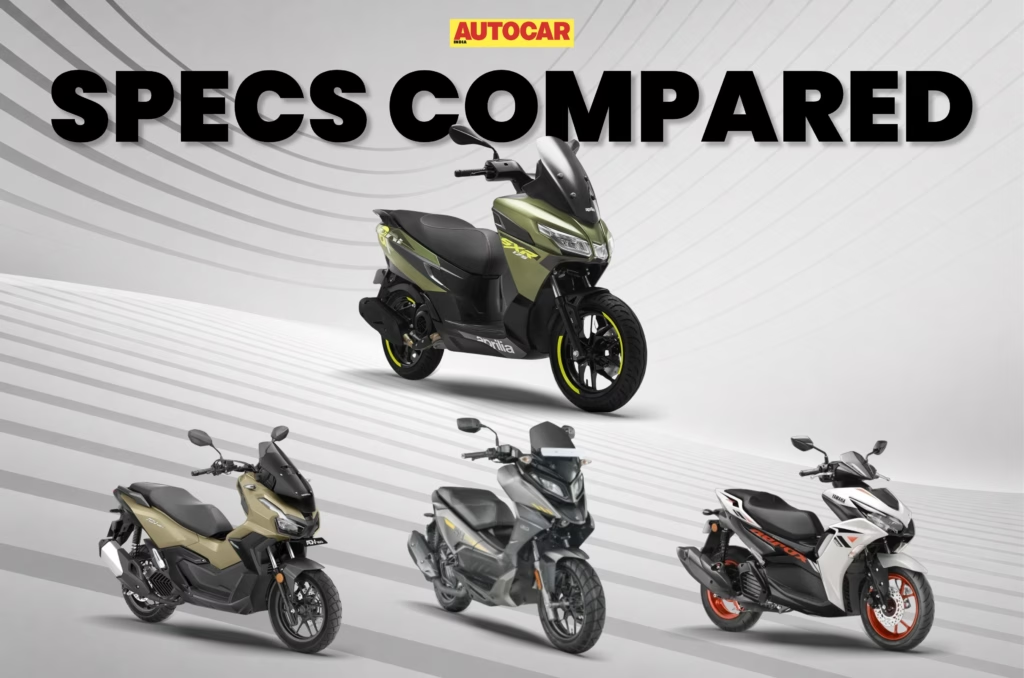
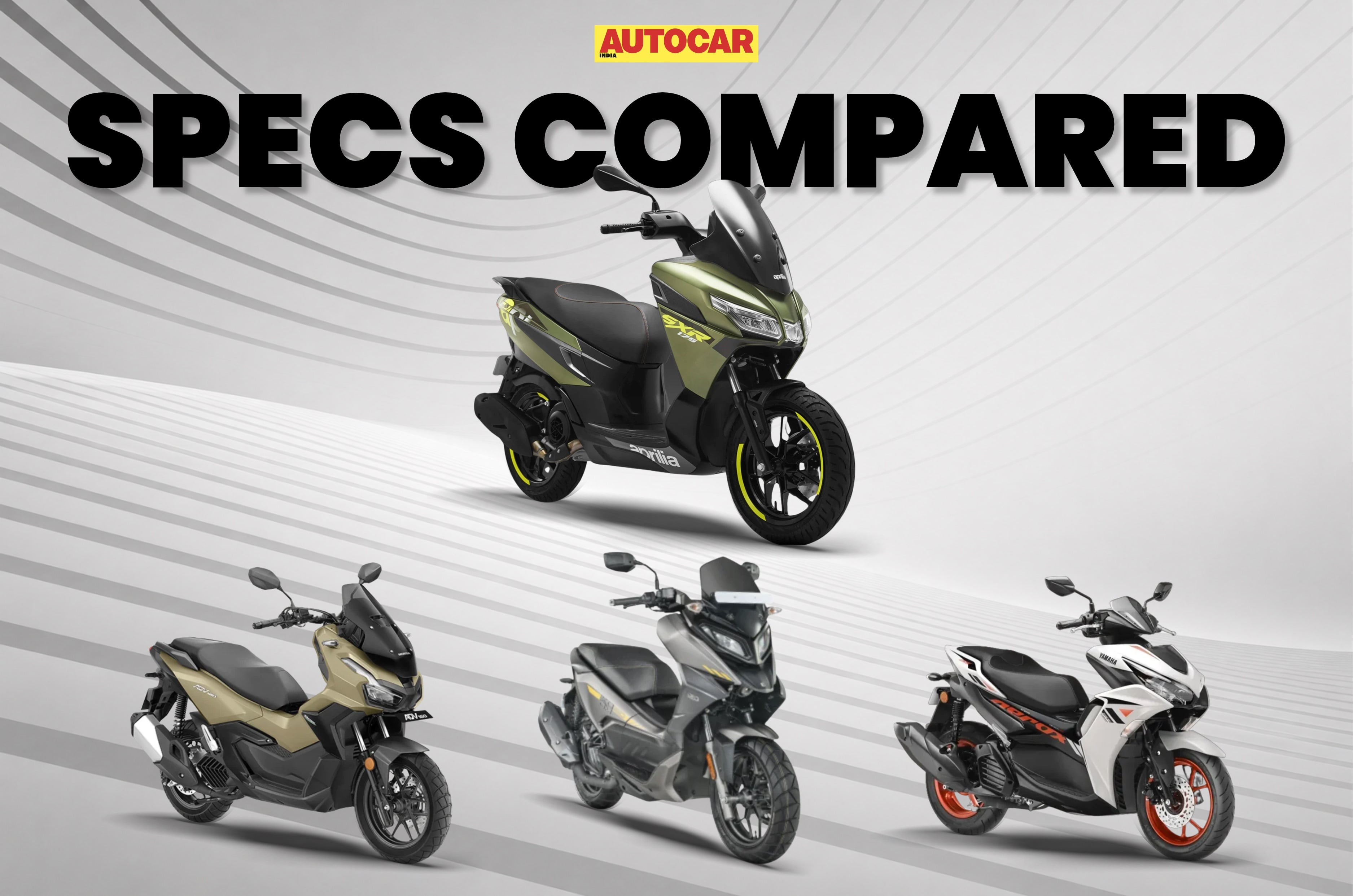
Maxi scooters have technically been around in our market since 2006, thanks to the Kinetic Blaze but the idea was first popularised by the Suzuki Burgman and later the Yamaha Aerox added to it. “Popularised” being the operating word because Aprilia also had a player in there from 2020, which has just been updated. So, what’s the maxi scooter scene like today and which one should you go get a test ride of? Let’s see.
Aprilia SXR GT 175 hp-e vs Rivals: Engine and output
Smaller rivals all make more power
Aprilia SXR GT 175 hp-e
Honda ADV160
Hero Xoom 160
Yamaha Aerox 155
Engine
174.7cc, single-cylinder, air-cooled
156.9cc, single-cylinder, liquid-cooled
156cc, single-cylinder, liquid-cooled
155cc, single-cylinder, liquid-cooled
Power
13.3hp at 7,200rpm
16.3hp at 8,750rpm
14.8hp at 8,000rpm
15hp at 8,000rpm
Torque
14.14Nm at 6,000rpm
14.9Nm at 6,500rpm
14Nm at 6,250rpm
13.9Nm at 6,500rpm
Transmission
CVT
CVT
CVT
CVT
Power-to-weight ratio
100.76hp/tonne
118.98hp/tonne
104.23hp/tonne
119.05hp/tonne
Don’t let the bigger displacement number mislead you into thinking the Aprilia SXR GT 175 is the most powerful of these scooters, because that’s not the case. The SXR has the only air-cooled mill in this class, possibly contributing to its lower output figures. Combine that with the weight and the Aprilia’s case only becomes weaker. For what it’s worth the Italian scooter delivers its peak torque faster than the others so that should be an advantage while plying within the city.
The Yamaha has the lowest kerb weight on this list, which contributes to the highest power-to-weight ratio, very closely followed by the Honda.
Aprilia SXR GT 175 hp-e vs Rivals: Dimensions and weight
Hero is the heaviest, Yamaha is the lightest
Aprilia SXR GT 175 hp-e
Honda ADV160
Hero Xoom 160
Yamaha Aerox 155
Fuel tank capacity
7 litres
8.1 litres
7 litres
5.5 litres
Ground clearance
170mm
175mm
155mm
145mm
Seat height
800mm
NA
787mm
790mm
Kerb weight
132kg
137kg
142kg
126kg
Wheelbase
1362mm
1333mm
1348mm
1350mm
Aprilia gains some ground, or rather gets away from ground with its second highest ground clearance figures. However, it also has the tallest seat height of this bunch. While Yamaha’s ground clearance numbers seem the lowest, do note that the website specifies it to be minimum, which means that it’s measured under laden conditions. So, it’s actually the Hero that has the lowest ground clearance.
As for seat height, Honda doesn’t specify that for the ADV160, but it shouldn’t be too tall for it to be a concern for most Indians. On the other hand, the Xoom 160 is the heaviest of these four, which could prove to be tricky to some at low speed rides and reversing out of parking lots. Aprilia and Hero have neglected mentioning the under seat storage but none of these is likely to impress you in that specific aspect. For what it’s worth, the Honda ADV160 has the highest number of the lot, 27 litres followed by the Yamaha Aerox at 24.5 litres.
Aprilia SXR GT 175 hp-e vs Rivals: Tyres, brakes and suspension
Honda strikes the best balance in equipment
Aprilia SXR GT 175 hp-e
Honda ADV160
Hero Xoom 160
Yamaha Aerox 155
Tyres (F, R)
120/70-14, 120/70-14
110/80-14, 130/70-13
120/70R14, 140/60R14
110/80-14, 140/70-14
Brakes (F, R)
220mm disc, 140mm drum; single-channel ABS
Disc, disc; single-channel ABS
240mm disc, drum; single-channel ABS
230mm disc, 130mm drum; single-channel ABS
Suspension (F, R)
Telescopic fork, Monoshock
Telescopic fork, twin-shock
Telescopic fork, twin-shock
Telescopic fork, twin-shock
Aprilia has given the SXR GT 175 the widest front tyre, but the rear tyre too is the exact same size which makes it the narrowest rear tyre in this list. Honda appears to have struck the best balance, with respect to the equipment on offer. Though that could change depending on the odd 14-13 front-rear wheel size’s real world implications on the ADV160’s handling.
Aprilia SXR GT 175 hp-e vs Rivals: Features
Honda has an unbeatable ‘feature’
A keyless system is present on all scooters but the Aprilia although Yamaha requires you to pony up for the Aerox S variant to get it. Of the four, Hero and Yamaha’s cockpit views are going to feel the oldest, simply because of their LCD screens. Both companies have packed it with features (call and SMS alerts, metrics on the app and turn-by-turn navigation, to name a few) but apples to apples, the SXR and ADV160 have more modern-looking TFT displays and they also match the former two in features. This will make a difference only if you clearly prefer one over the other, for otherwise there isn’t anything to fault with the Hero and the Yamaha’s displays.
Elsewhere, all offer some type of USB port for charging your devices, front cubby storage and LED lighting. On the convenience front, Hero, Honda and Yamaha offer an integrated starter-motor-generator which gives their scooters features like auto stop/start and a silent start. Honda and Yamaha offer traction control as standard.
A big advantage that only the Honda ADV160 can boast at the moment though, is its E85 compatibility. While Hero and Yamaha do offer other vehicles in their line-up with flex fuel compatibility, the Xoom and the Aerox respectively, do not have that and in these uncertain times, that’s certainly an unmissable advantage of the Honda.
Aprilia SXR GT 175 hp-e vs Rivals: Price
Honda’s advantages have a price to pay
Aprilia SXR GT 175 hp-e
Honda ADV160
Hero Xoom 160
Yamaha Aerox 155
Price (ex-showroom)
Rs 1.30 lakh
Rs 1.70 lakh
Rs 1.45 lakh
Rs 1.46-1.50 lakh
The Aprilia’s an unbeatable bargain at this price with its nearest rival being the Xoom 160, closely followed by the Yamaha for its non-S version. Honda appears to offer the best balance of everything along with a currently significant E85 compatibility, but also costs Rs 40,000 over the Aprilia. While it’s easy to get confused over what is the right scooter for you, all of these – thankfully – make it unmistakably clear what they intend to offer. Hence, if you’re confused, figuring out your priorities and taking test rides (hopefully back-to-back) should help you pick the right one for you. If that happens to be the ADV160, you now know what you’re paying for.
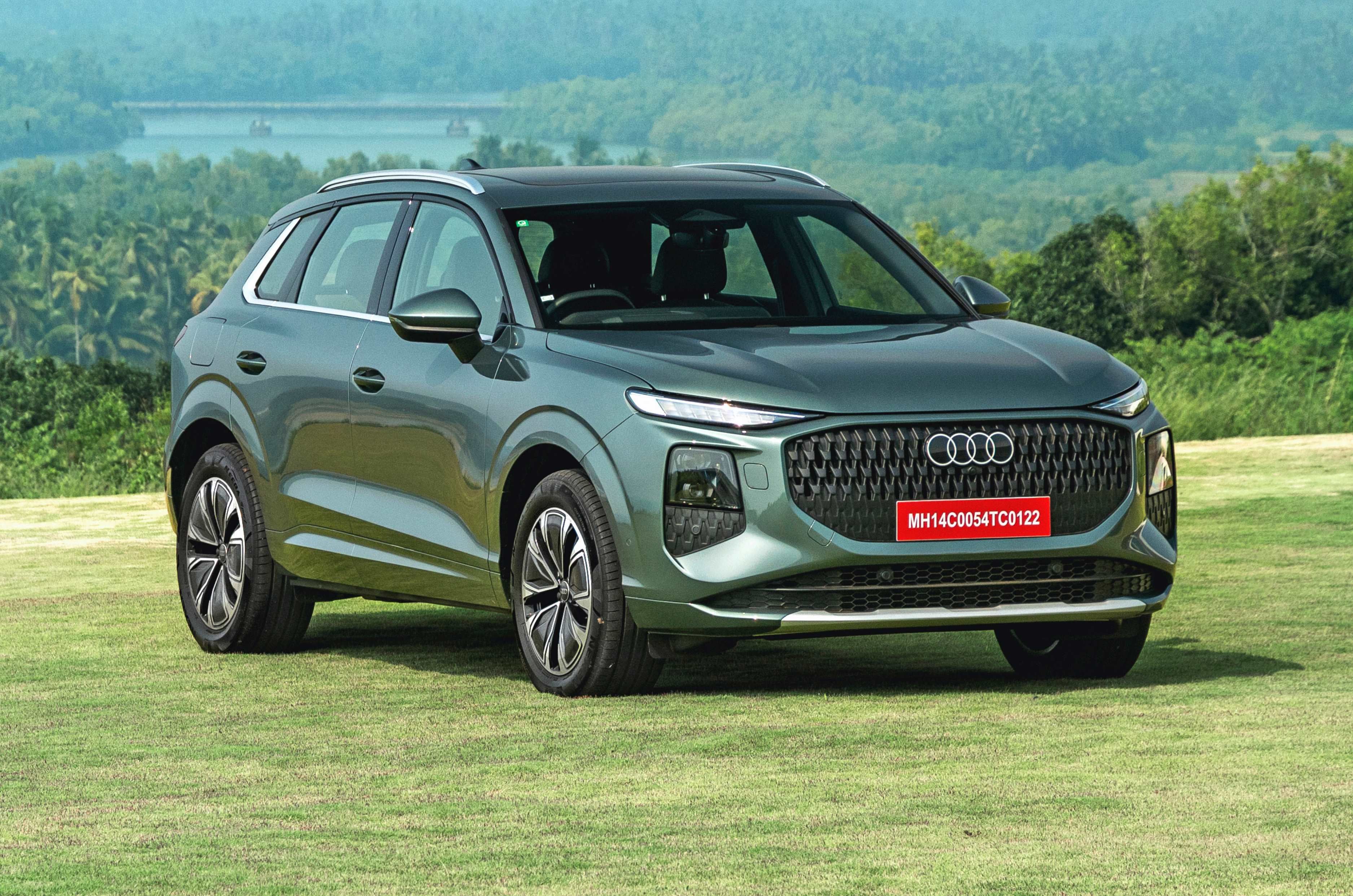
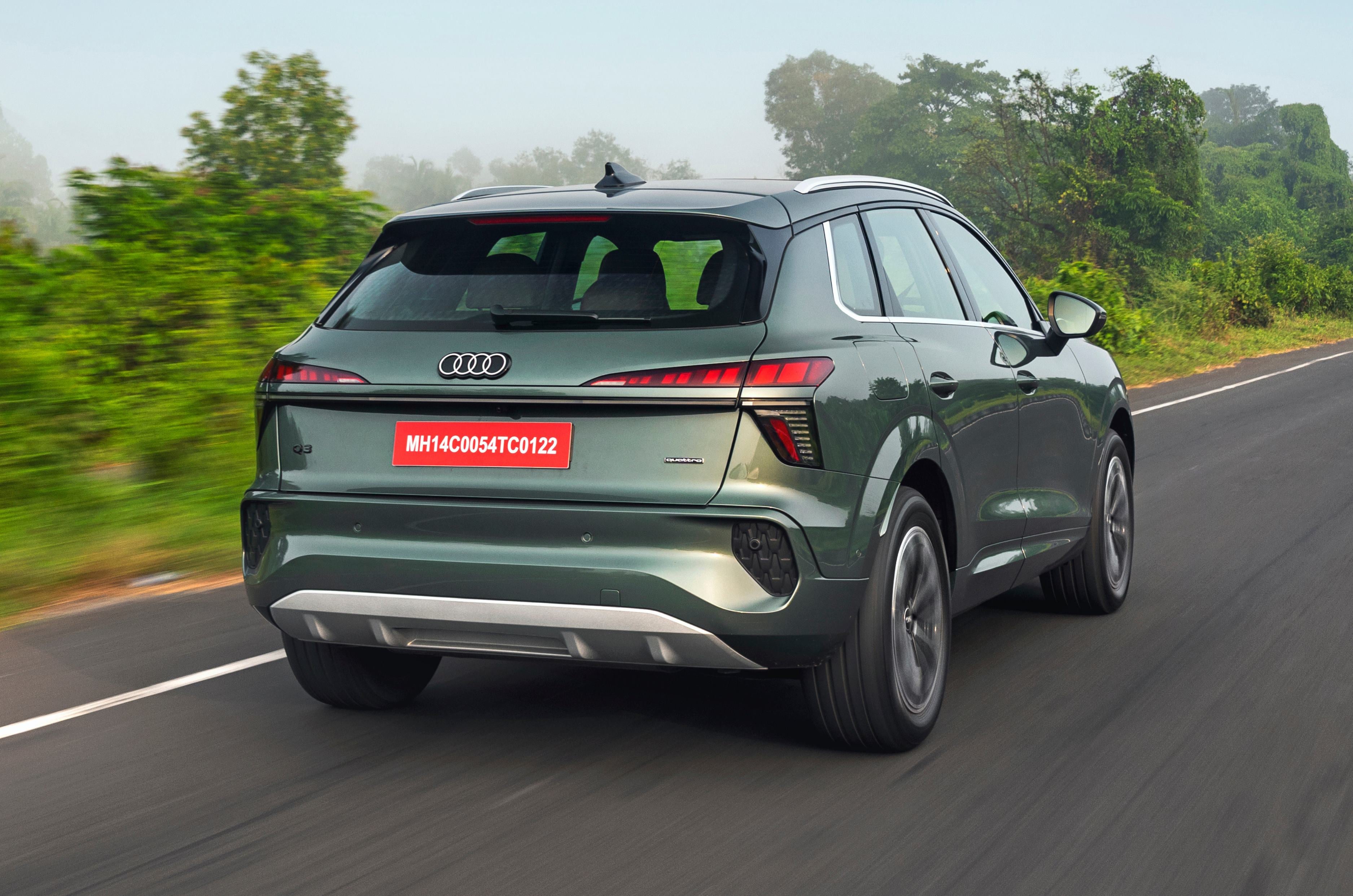
It would be easy to file the third-generation Q3 as just another new model but it isn’t. For Audi India, this is closer to a reset. The brand has spent the past few years soldiering on with ageing, outdated products and its showroom traffic has paid the price for this freeze in new products. But that’s all changed now. With fresh investment pouring in from its headquarters, Audi is on a new product offensive which has been kicked started with the Q3. This compact SUV is also the entry point into the brand, so it carries the burden of deliveringthe maximum sales. There’s a lot riding on the Q3’s gentle shoulders and Audi is hopeful that this will model will mark the turning point for the brand. But first, Audi has to convince customers. Is the new Q3 a quantum leap over the past Q3? We drove it in Goa to find out.
Audi Q3 Exterior Design and Engineering – 8/10
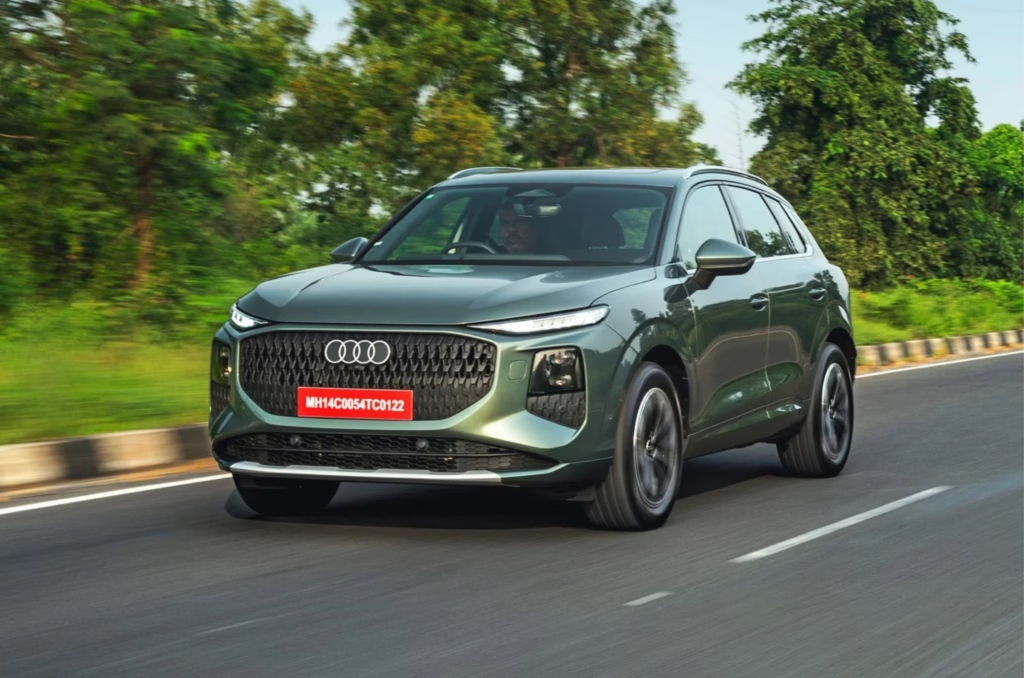
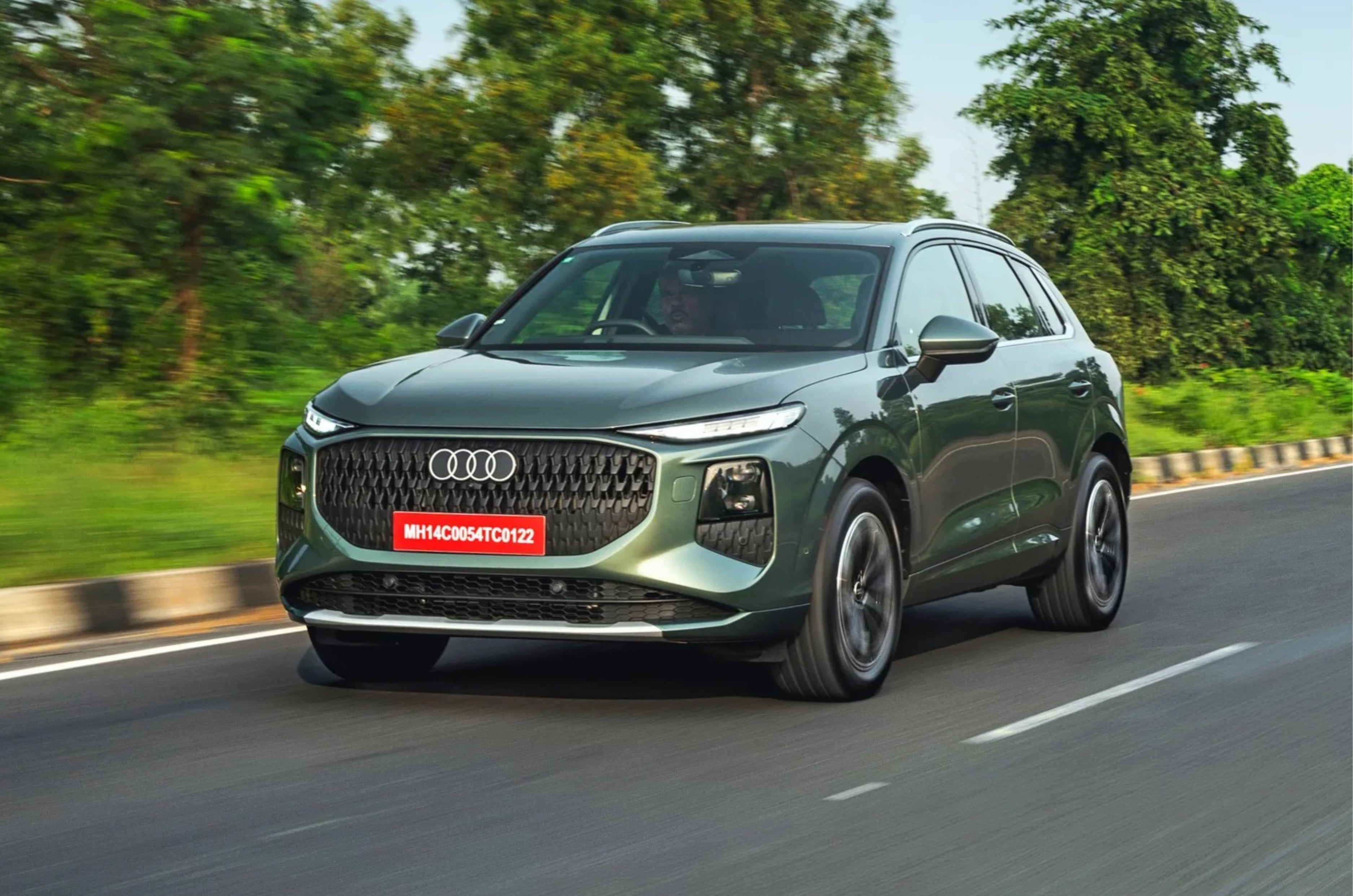
The crisp, edgy lines of the old car have made way for something more fluid and flamboyant. The new Q3 has grown marginally in every dimension, but the 2,681mm wheelbase is unchanged, so it keeps the compact footprint its urban buyers like.
A fluid and flamboyant new design language replaces the edgy styling of the old car
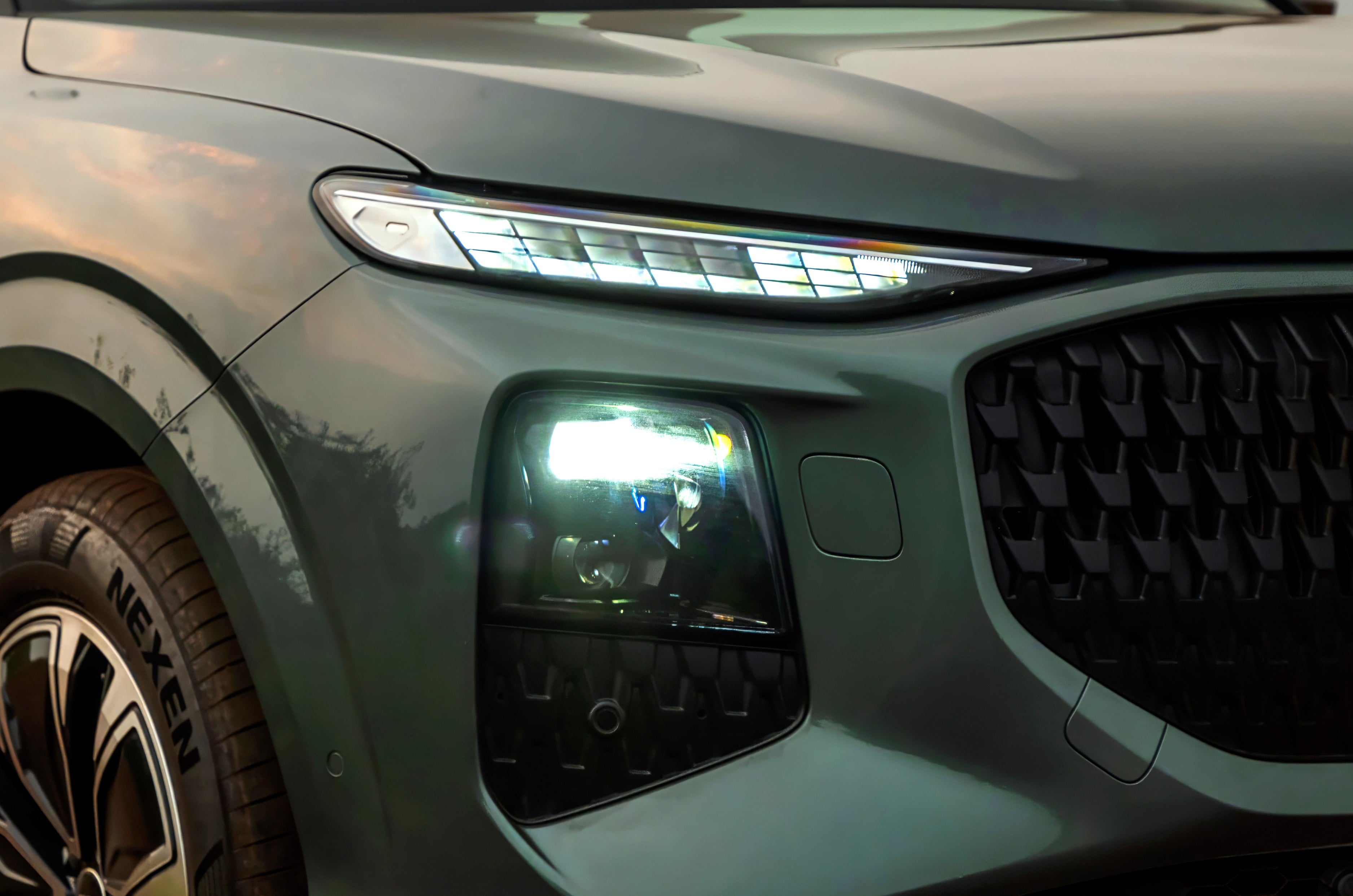
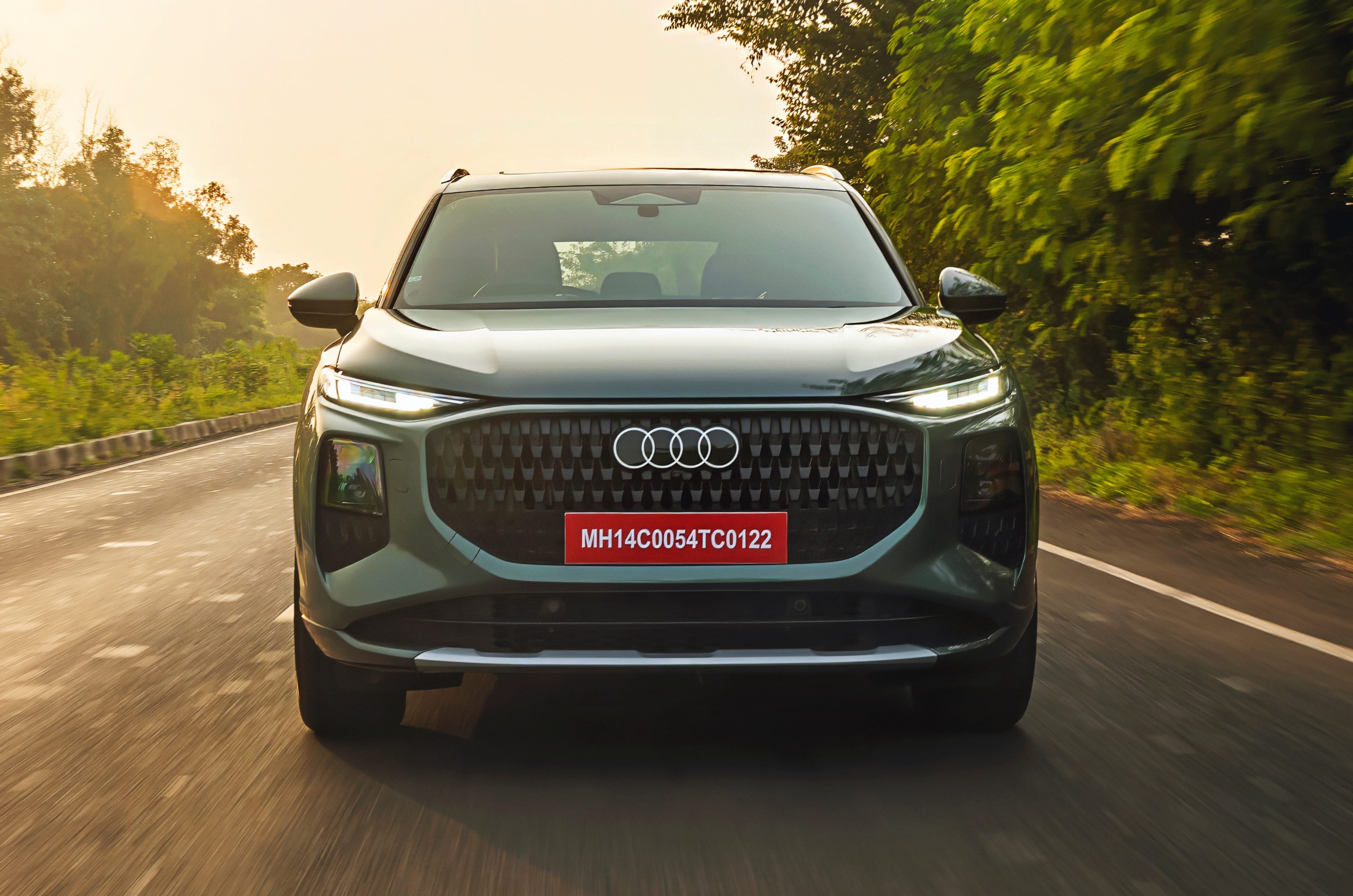
The face is split in two. Slim LED daytime running lights sit up top and double as dynamic indicators, while the main headlamps are stacked below. The wide honeycomb grille certainly makes a statement, and its flat 2D logo hides the ADAS radar. Up close, though, the grille’s finish looks a touch plasticky for a car wearing four rings.
Lighting is the real party piece. The Digital Matrix LED units use micro-LED technology, with some 25,600 individually controlled pixels per headlamp. That lets them do far more than dip and glare-free high beam. They can project a carpet of light in your own lane, and when you flick the indicator, the beam stretches across to illuminate the lane you are moving into. It’s a clever way to flag your intent and place the car on dark, unlit roads. The DRLs also offer four selectable light signatures via the touchscreen. There is a caveat. The projection tricks are at their best on pitch-black roads; with streetlights around, the effect is largely lost.
Trick Digital Matrix LED headlights use 25,600 individually controlled pixels per side
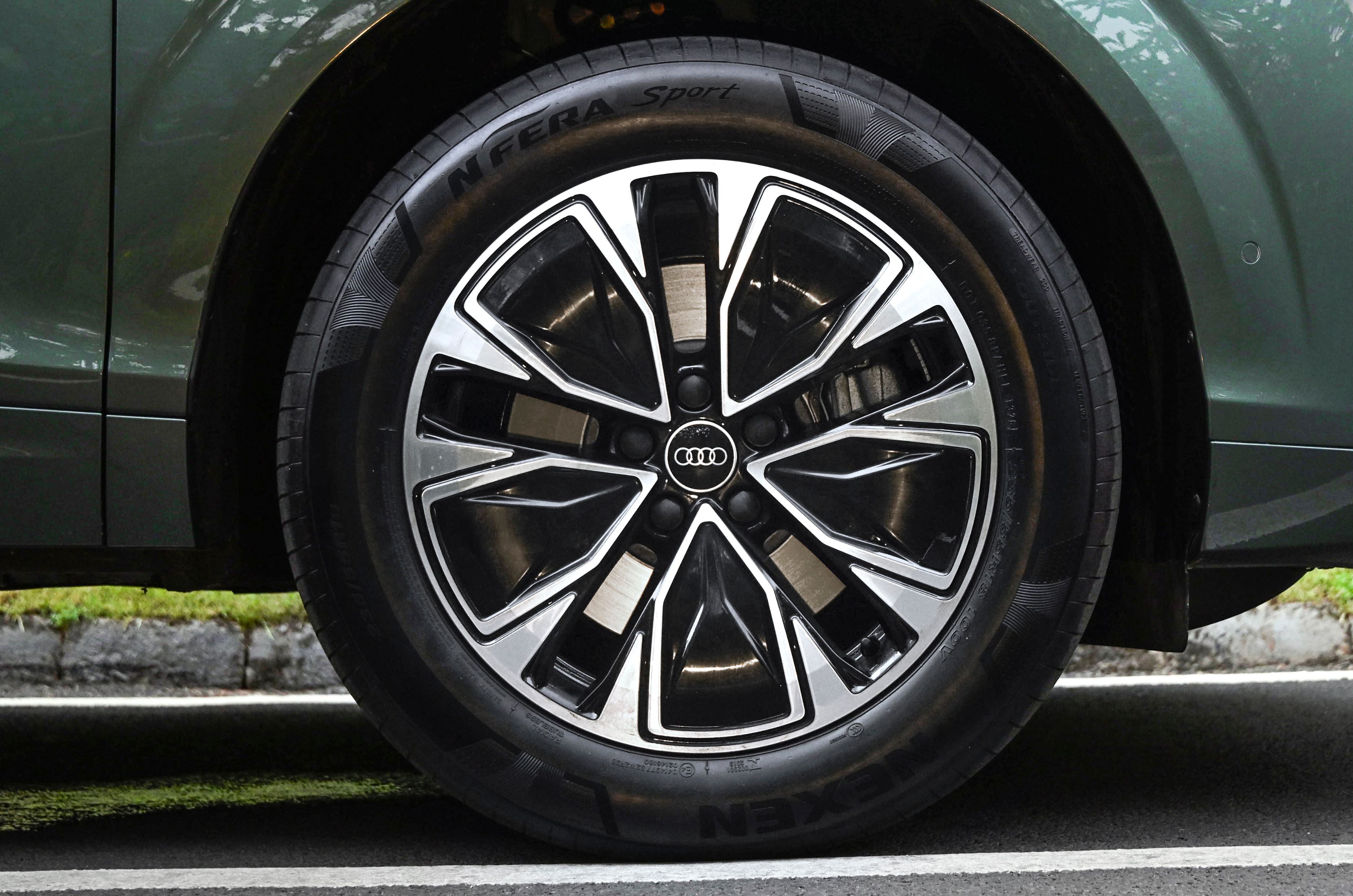
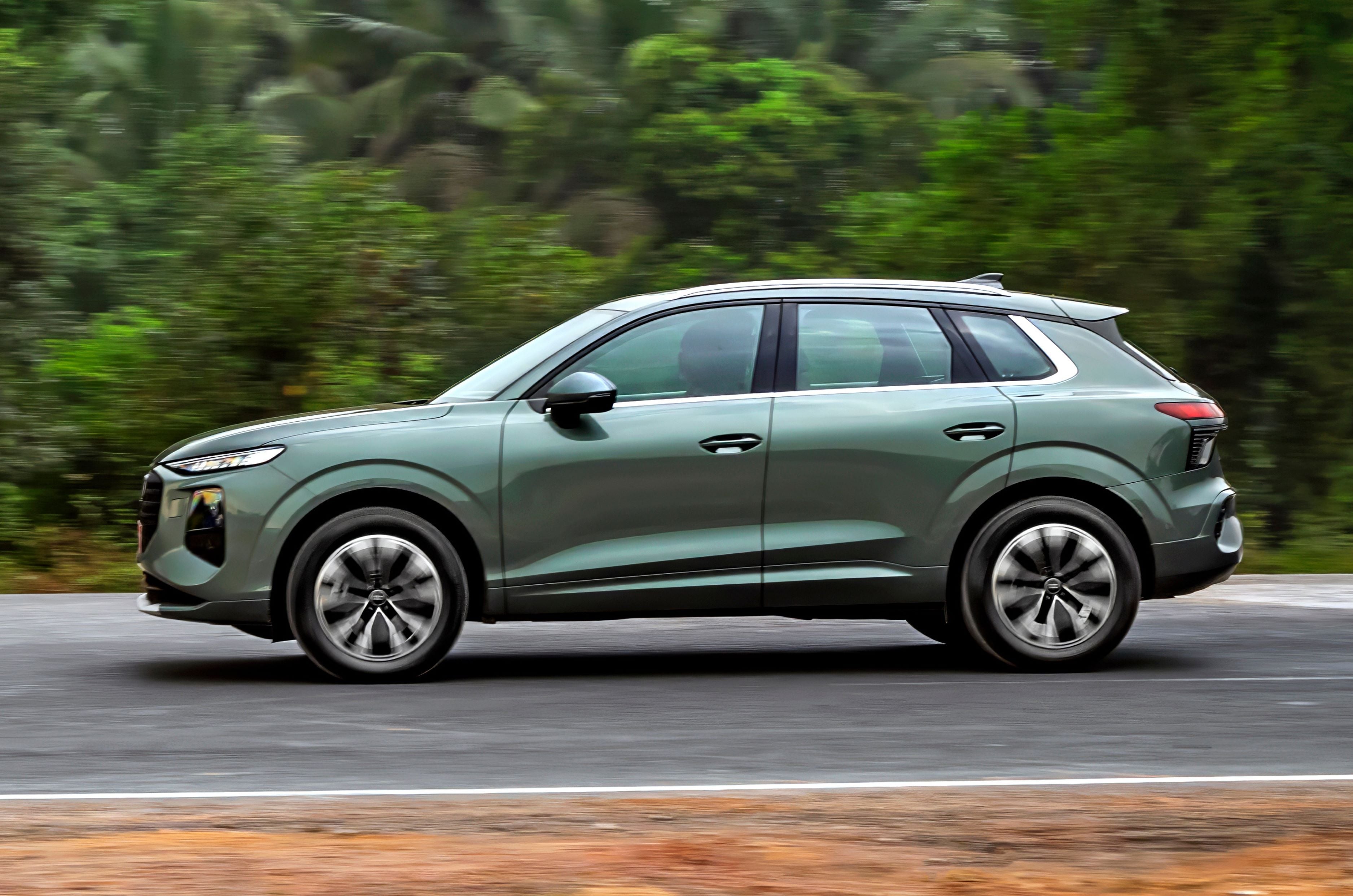
In profile, brushed aluminium below the windows and gloss black above create a floating-roof effect, and the rear haunches add a hint of muscle. For once, the wheels deserve a mention too. Audi has rarely nailed its alloy designs, but these are genuinely striking, wrapped in chunky, high-profile rubber. At the back, split LED tail-lamps are joined by a slim light bar and an illuminated Audi logo, and the tailgate is powered.
Stunning 18-inch alloys get self-leveling centre caps and are wrapped in high-profile tyres
Audi Q3 Interior Space and Comfort – 8/10
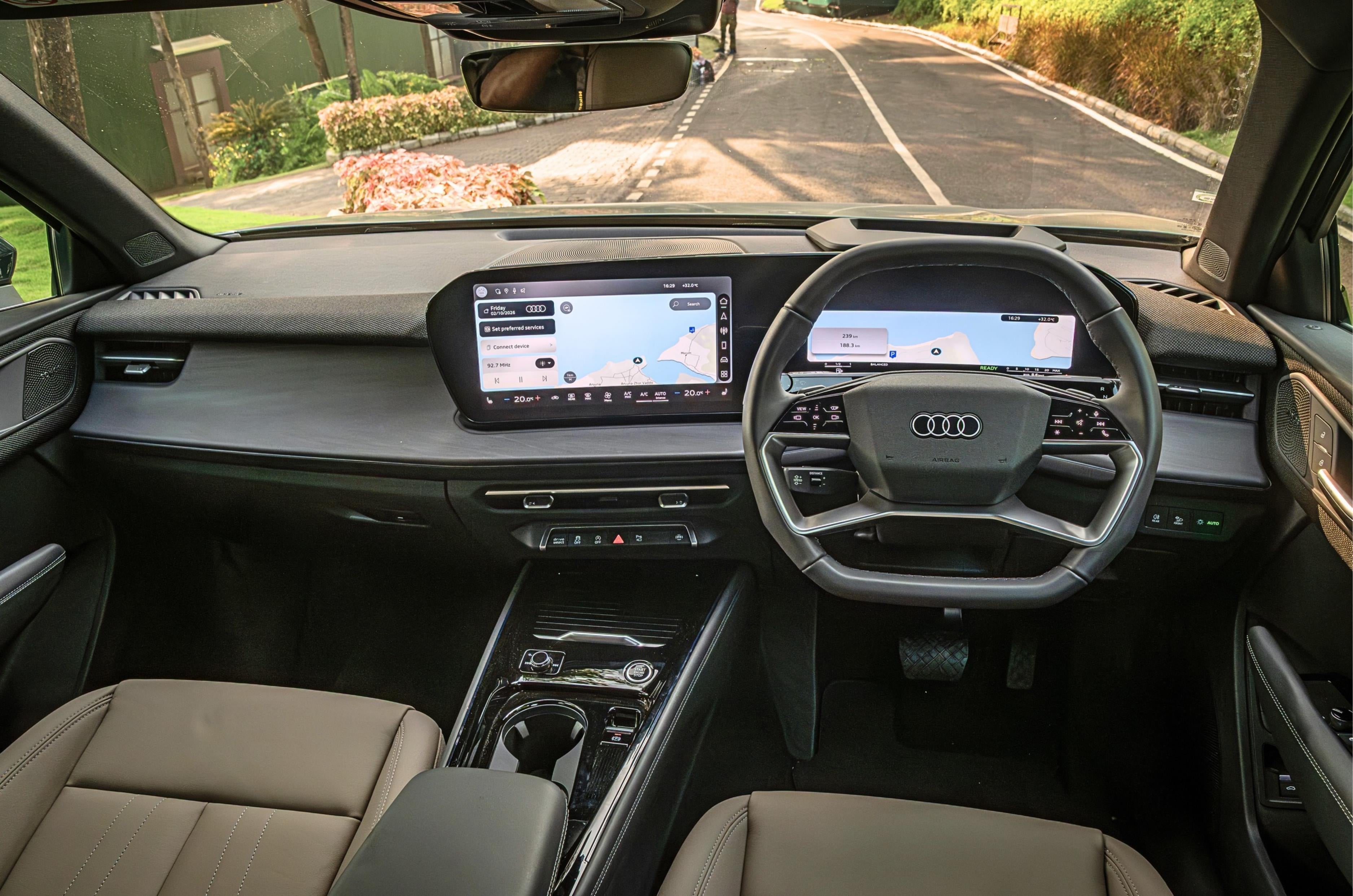
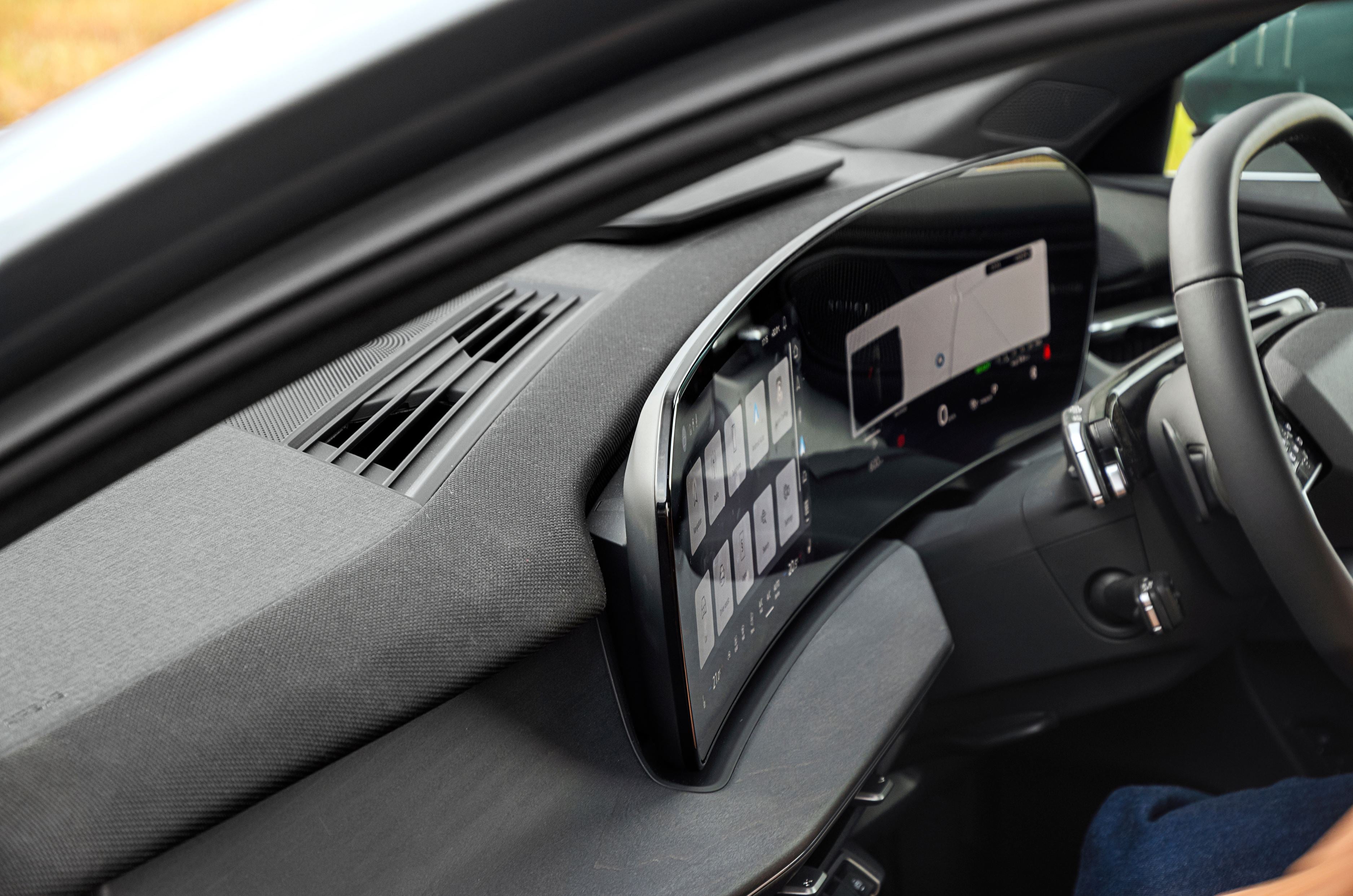
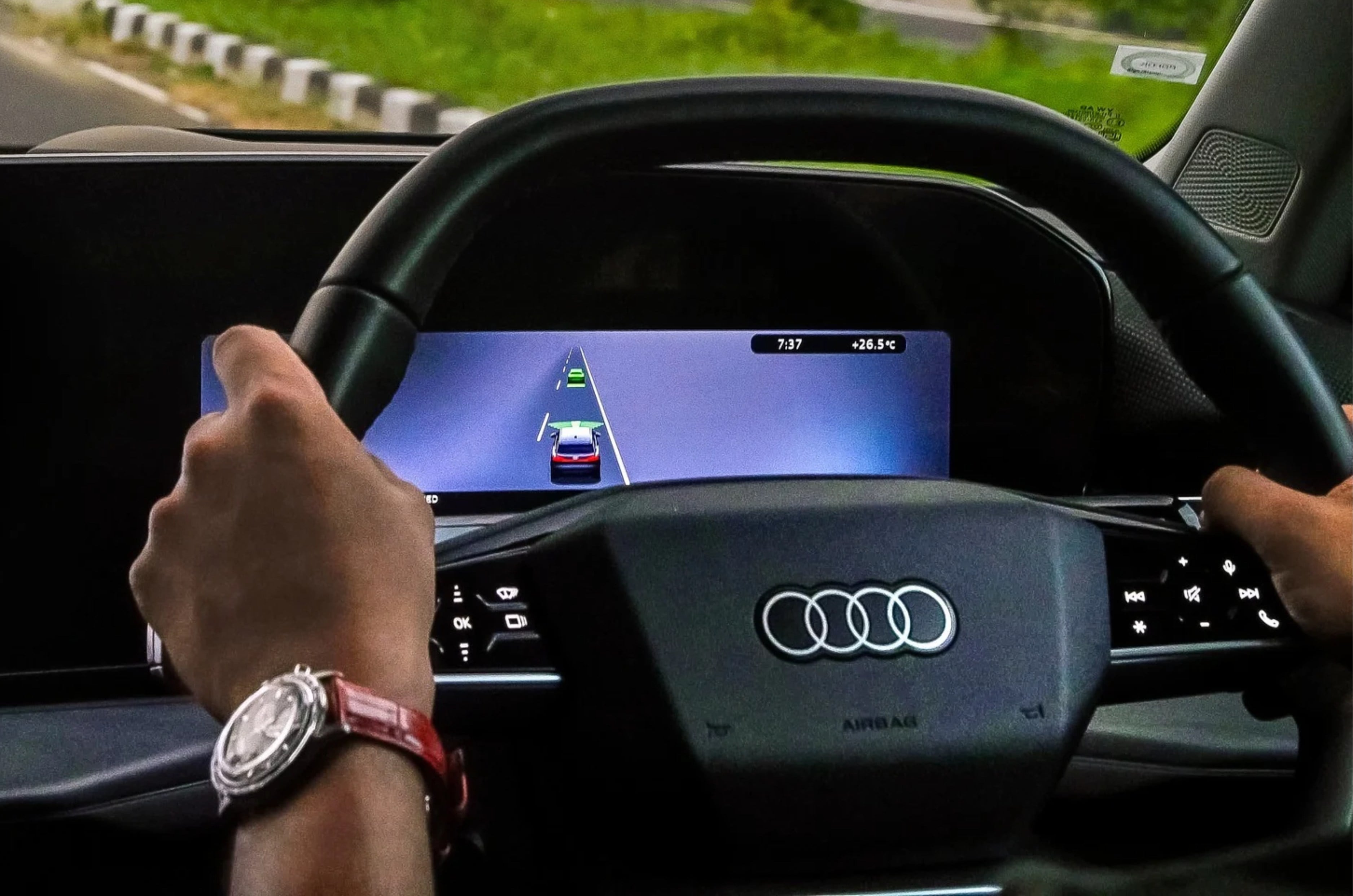
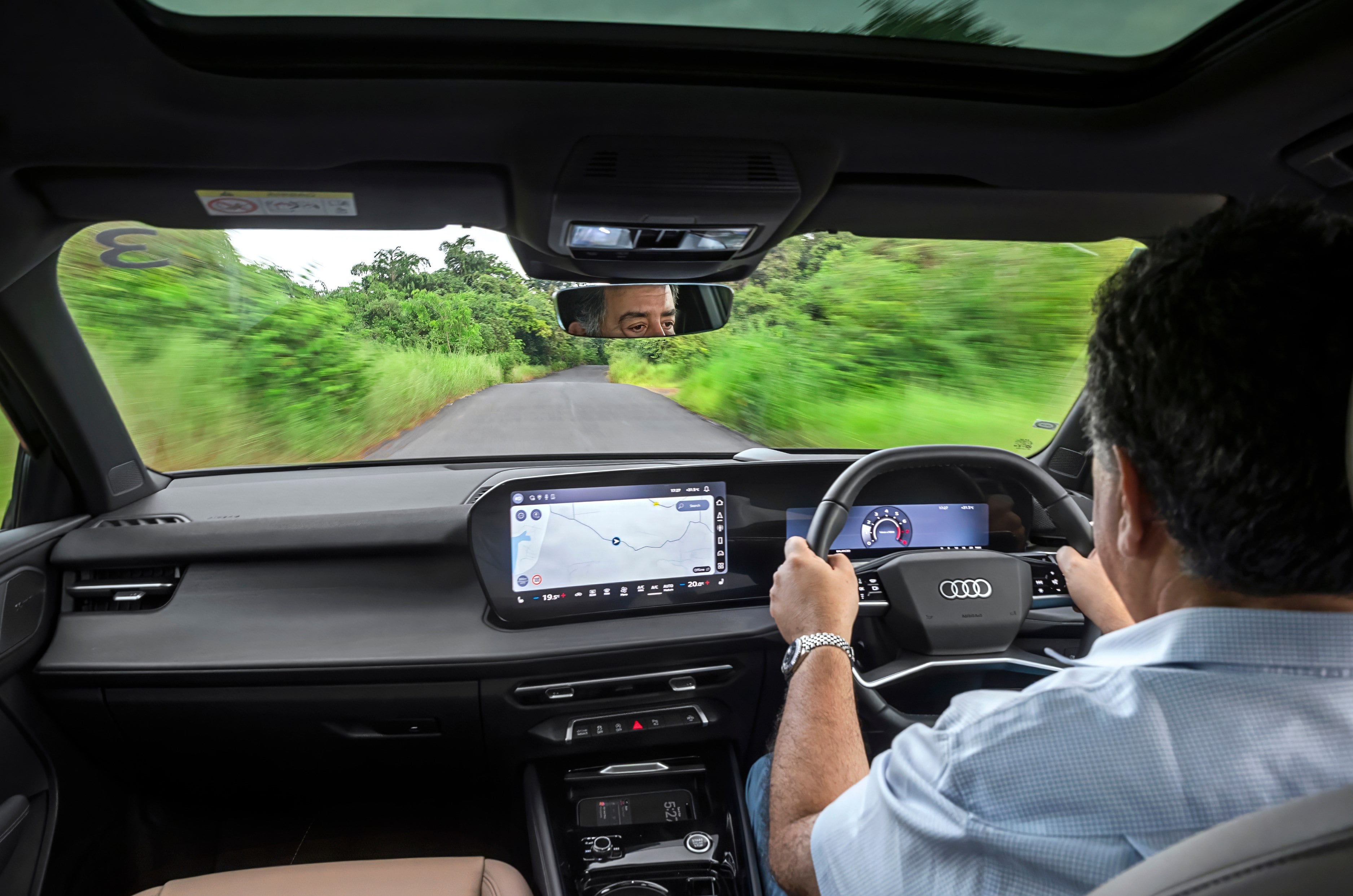
Step inside and the leap over the old Q3 is obvious. The dashboard is clean and contemporary, anchored by a curved panel that houses an 11.9-inch driver’s display and a 12.8-inch touchscreen. Fabric replaces leather across much of the cabin and the lower plastics are on the hard side. Yet the overall impression is of a cabin that’s solidly screwed together, and it feels more robust than its German rivals. Small details help: the fat tabs that adjust the air-con vents have a reassuringly substantial action.
New interior is a big leap over the last model and feels better built than its German rivals
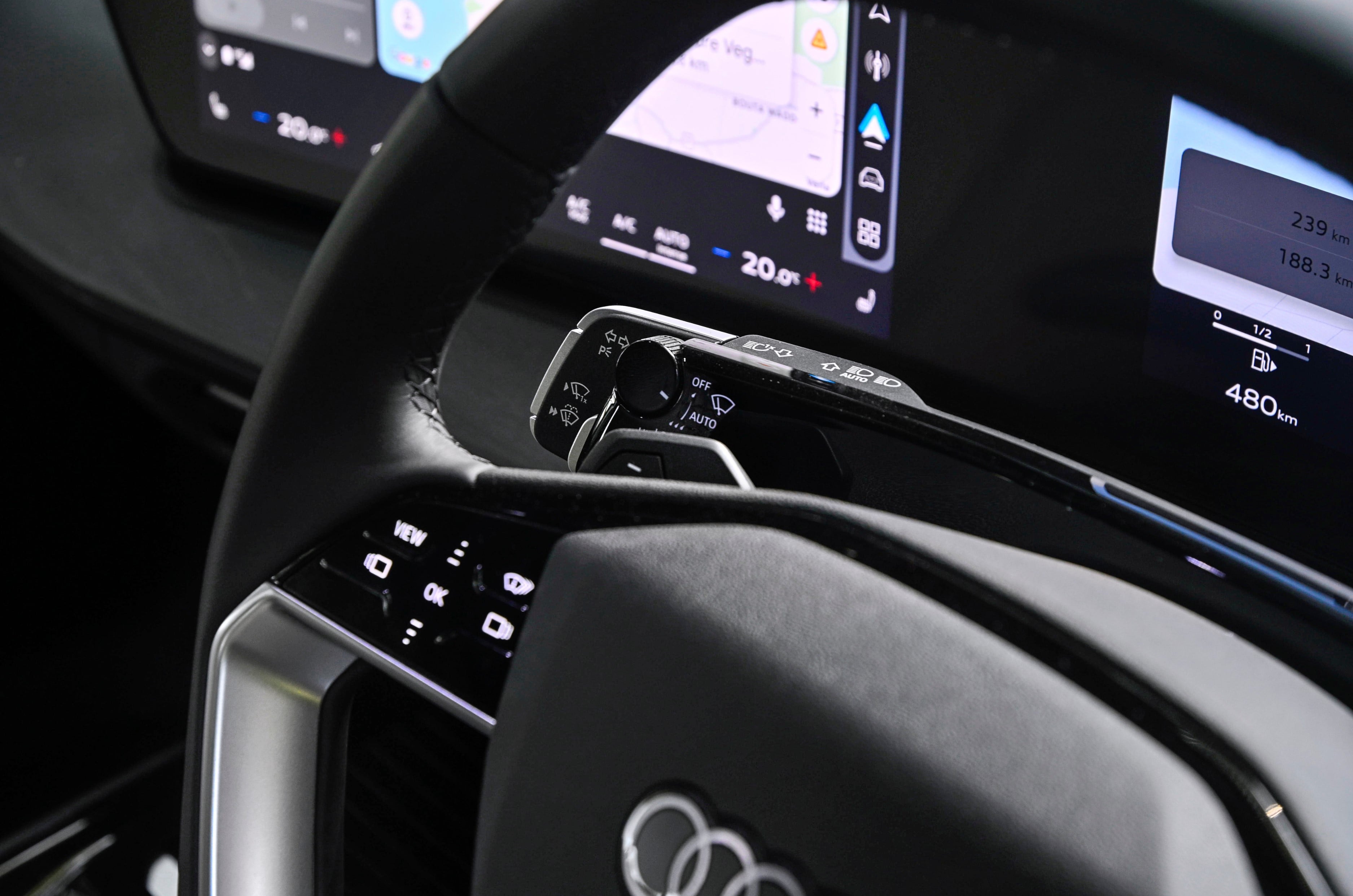
The hexagonal steering wheel takes some getting used to. So does the new control stalk, which Audi has loaded with an astonishing number of jobs: indicators, front and rear wipers and headlamp controls all live on one chunky lever. The gear selector moves to a stalk of its own on the other side. It feels awkward at first, but within a day it becomes second nature.
Two adults will be comfortable in the back seat, but a third will feel like a sqeeze
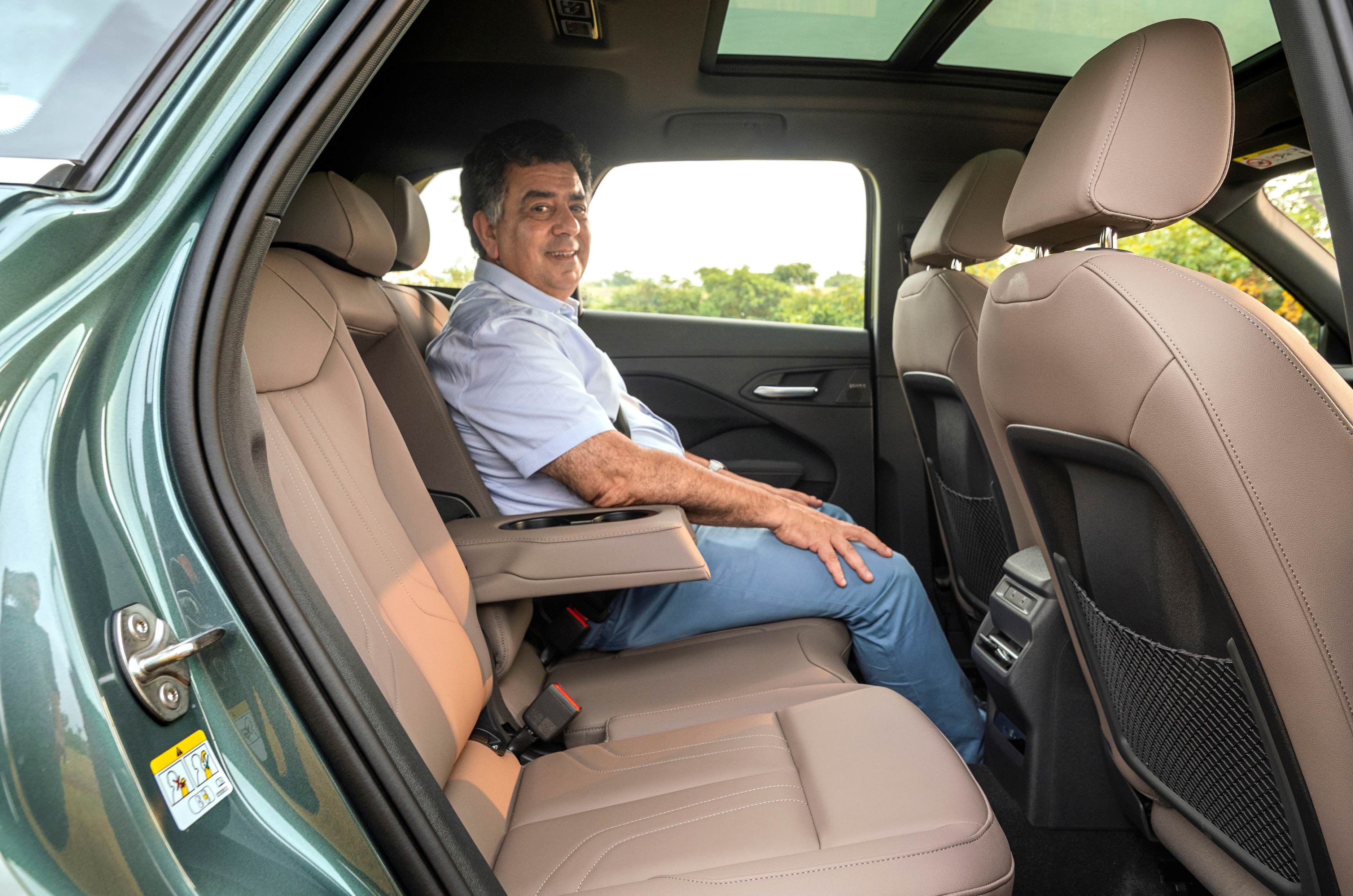
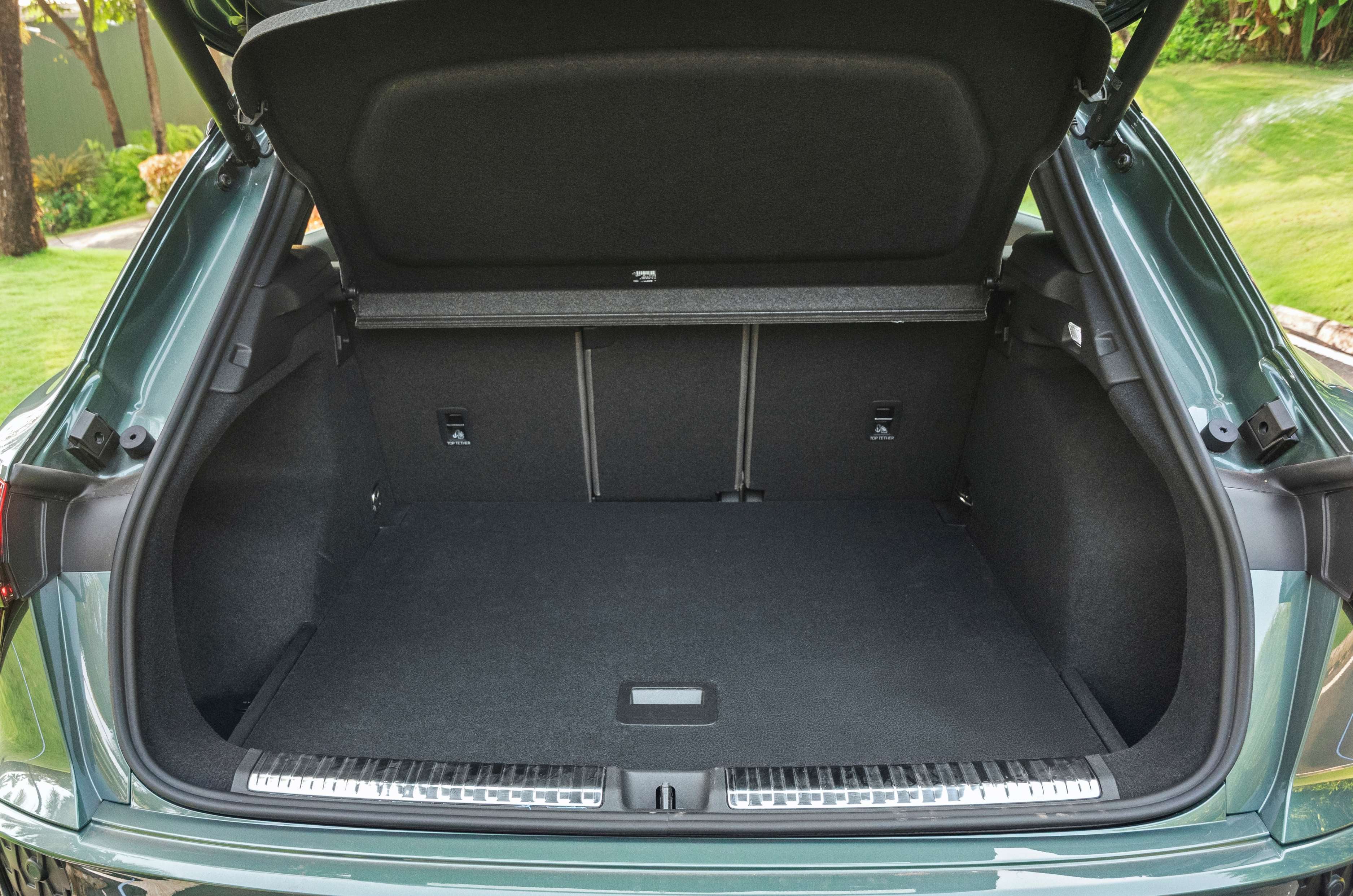
The front seats are generous, well bolstered and very comfortable over long stints. The rear hasn’t moved on much from the old car. Two large adults will be fine, but three is a squeeze; think of it as a four-seater with an occasional fifth. Rear passengers do get a third climate zone and two USB-C ports. The boot is spacious, and it’s good to find a space-saver spare under the floor.
Powered tailgate opens to a large 488-litre boot; seats split 40:20:40 for longer items
Audi Q3 Features and Safety – 7/10
The curved touchscreen works well, and the curvature itself cuts out glare and reflections. Response is smooth and quick, though the icons are, in typical Audi fashion, a bit subdued and not instantly distinguishable. Physical buttons are fewer, but the climate controls sit permanently at the base of the screen, so you never dig through menus to change the temperature or blower speed.A head-up display brings key information into your line of sight and the fonts are crisp and sharp.
Curved display cuts out glare and reflections
Audi’s own navigation is good, but integrated Google Maps, increasingly the benchmark, is expensive to licence and hence missing. The instrument cluster is surprisingly basic too, with little configurability and minimal choice of layouts and that’s a let-down from the brand that pioneered the virtual cockpit.
We also hit a software glitch with our iPhones. Wireless phone mirroring connected initially, then dropped out and refused to reconnect, prompting a switch to USB. It’s the sort of bug an over-the-air update should fix.
Lighting and wiper controls are odd at first but easy to get used to
The equipment list isn’t thin. There’s a superb-sounding 12-speaker Sonos system, a large panoramic sunroof, powered and heated front seats with driver memory, nine airbags and adaptive cruise control. That cruise works well, too. But for a car costing over Rs 50 lakh and launching in 2026, there gaps that are hard to overlook.
There is no lane-keep assist, so the ADAS suite stops at adaptive cruise. A full Level 2+ package is now table stakes in this class, all the more so when far cheaper mass-market cars offer one. There are no ventilated seats either, near-essential in our climate. The biggest miss, though, is a 360-degree camera, something a great many buyers actively look for. The reversing camera’s resolution is disappointing, although there is an auto-park function.
ADAS kit limited to auto emergency braking and adaptive cruise control
None of this is unusual for its rivals. But as the newest kid on the block, the Q3 should have moved the game on, and here it hasn’t.
Audi Q3 Performance and Refinement – 9/10
The engine is the star of the show. Audi’s 2.0 TFSI makes 201bhp and 320Nm, and it is smooth, strong and refined. That alone hands the Q3 a massive edge over the underwhelming, smaller-capacity motors in the X1 and GLA.
Strong and refined 2.0 TFSI makes 204hp and 320Nm, enough for 0-100kph in 7.1 seconds
It isn’t flawless. At low revs there’s a brief hesitation before it gathers itself and pulls smartly, which is why we left it in Dynamic mode most of the time. Once on the boil, though, it is eager and free-revving, a reminder of why this is the best 2-litre turbo-petrol in the business. Around town it feels responsive; on the highway it builds pace effortlessly. Audi claims 0-100kph in 7.1sec, which puts the Q3 at the top of its class.
The 7-speed dual-clutch remains a fine partner, eager to drop a gear to keep the engine in its powerband. Flick it into Sport or reach for the paddles if you want to take charge. Quattro all-wheel drive is now standard on every Q3, not an option, and there’s a range of drive modes including an off-road setting to make the most of it. It’s good insurance on slippery surfaces and gives the Q3 an edge over rivals when conditions turn tricky. Whether many owners need it, or more importantly will pay extra for it, is another question.
Strikes a great balance of ride and handling; gets Quattro all-wheel drive as standard
Audi Q3 Ride Comfort and Handling – 9/10
The big surprise is the handling. The variable-ratio steering adjusts its response to both speed and lock, so its light and effortless at parking speeds, then quicker and more direct as you wind on more lock. Barring a touch of slack around the straight-ahead, it is accurate and weights up superbly.
Quick steering often makes a car nervous at speed. Not here. The Q3 stays stable and reassuring when the needle climbs, yet changes direction with an agility you simply don’t expect from an Audi SUV.
New Progressive Steering is light at parking speeds, but gets sharper and more direct as speeds rise
What you do expect from an Audi is a good ride, and the Q3 delivers. It is on the firm side but never uncomfortable, soaking up potholes and broken patches with real composure. A big help is the 55-profile tyres. Their roughly 130mm sidewall is the first line of defence, absorbing much of the shock before it reaches the suspension and, ultimately, the cabin.
Audi Q3 Value for Money – 8/10
The new Q3 is a superbly engineered car, and its mechanical package sits well ahead of its rivals. The cabin is a big step up too, but given its timing, the Q3 doesn’t quite leapfrog the competition here; it lands a little short on equipment.
What it does do is drive brilliantly. It is by far the nicest car to drive in its class, and that matters, because Audi says 84 percent of Q3 owners drive themselves.
Easily the nicest car to drive in its class, but doesn’t leapfrog the competition in terms of features
A lot now rides on price. At around Rs 65 lakh on-road, it is steep. Not because the car isn’t worth it, but because buyers may balk at paying so much more than the outgoing Q3, whose transaction price had slipped to around Rs 40 lakh.
On the product front, though, Audi has come back with a bang. A brilliant powertrain, a superb blend of ride and handling and a genuinely classy feel make the Q3 the enthusiast’s pick of the class. If this is the opening act, Audi’s reset is off to a promising start.
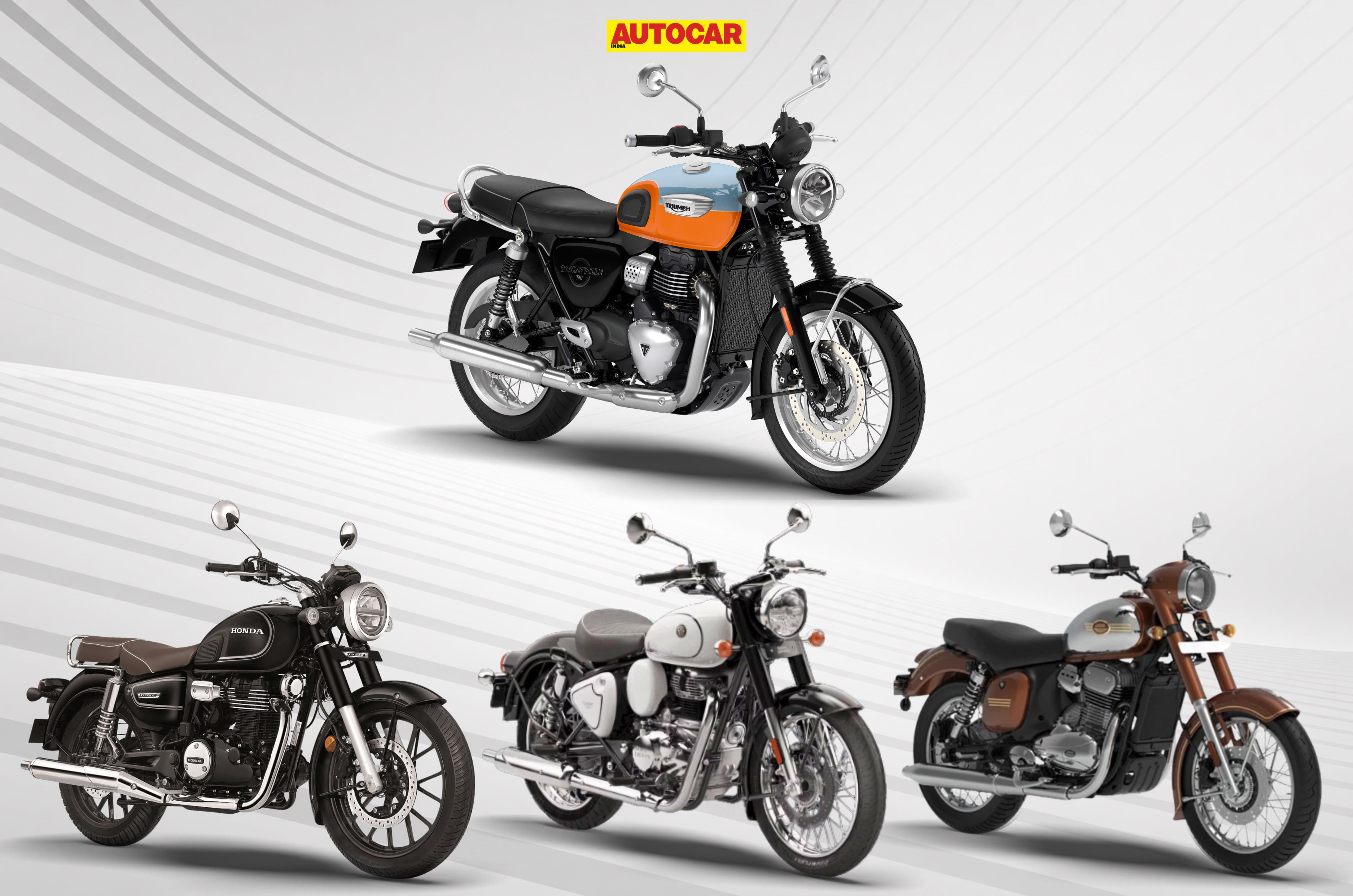
It’s here, finally. Almost three years after the very first Triumph 400s debuted (Speed and Scrambler X), we have a Bonneville for the class, and it’s looking to redraw the boundaries for the retros. However, the 350cc class is silently one of the fiercest segments in India, with Royal Enfield leading it, predominantly with the Classic 350. We have Honda trying to eat away at that dominance with the CB350 and Jawa with its 350, but sales-wise at least, Royal Enfield has so far remained unassailable. Can the Hinckley-based manufacturer finally make its Indian-UK counterpart feel the heat? Let’s see.
Triumph Bonneville T40 vs Rivals: Engine and output
Triumph is off to a great start
Triumph Bonneville T40
Royal Enfield Classic 350
Honda CB350C
Jawa 350
Engine
350cc, single-cylinder, liquid-cooled
349cc, single-cylinder, air-cooled
348.36cc, single-cylinder, air-cooled
334cc, single-cylinder, liquid-cooled
Power
29hp at 7,000rpm
20.2hp at 6,100rpm
21hp at 5,500rpm
22.57hp at 7,000rpm
Torque
31.2Nm at 5,500rpm
27Nm at 4,000rpm
29.5Nm at 3,000rpm
28.1Nm at 5,000rpm
Transmission
6-speed
5-speed
5-speed
6-speed
Power-to-weight ratio
148.72hp/tonne
103.59hp/tonne
113.28hp/tonne
116.53hp/tonne
Triumph is looking to distinguish the Bonneville T40 in every way possible, starting with the engine itself. Its 350cc unit is one of two liquid-cooled mills on the list. This bike also makes the most power and torque. The T40’s peak power is followed at a distance by the Jawa 350, and it’s the Honda CB350 that makes the nearest comparable amount of peak torque. Honda’s 348cc engine also delivers both power and torque much earlier in the rev range.
Triumph Bonneville T40 vs Rivals: Dimensions and weight
Honda strikes a fine balance
Triumph Bonneville T40
Royal Enfield Classic 350
Honda CB350C
Jawa 350
Fuel tank capacity
14.5 litres
13 litres
15.2 litres
13.2 litres
Ground clearance
165mm
170mm
165mm
178mm
Kerb weight
195kg
195kg
186kg
~193kg
Seat height
790mm
805mm
800mm
790mm
Wheelbase
1418mm
1390mm
1441mm
1449mm
In this section, the Honda CB350C immediately stands out because of its kerb weight. It is the lightest motorcycle in this comparison, and that’s despite being the heaviest version in the CB350 line-up; the CB350 weighs 181kg and the CB350RS 180kg. Yet, it has the largest fuel tank capacity, along with decent seat height and ground clearance. The T40’s second-shortest wheelbase should make it an agile bike, but it remains to be seen how it rides in the real world. The Classic 350 – with the shortest wheelbase – isn’t exactly known for its agility, not that it’s expected in this segment to begin with.
Please note that Jawa/Yezdi report dry weight on the website, so you’ll find the Jawa 350’s weight to be 184kg there, but with 90 percent fuel and other fluids, its kerb weight should be closer to the others in the list.
Triumph Bonneville T40 vs Rivals: Tyres, brakes and suspension
Old vs new retros
Triumph Bonneville T40
Royal Enfield Classic 350
Honda CB350C
Jawa 350
Tyres (F, R)
100/90-18, 150/70R17
100/90-19, 120/80-18
100/90-19, 130/70-18
100/90-18, 130/80-17
Brakes (F, R)
310mm disc, 255mm disc; dual-channel ABS
300mm disc, 270mm disc; dual-channel ABS
310mm disc, 240mm disc; dual-channel ABS
280mm disc, 240mm disc; dual-channel ABS
Suspension (F, R)
Telescopic fork, twin-shock
Telescopic fork, twin-shock
Telescopic fork, twin-shock
Telescopic fork, twin-shock
The differences are a bit confusing, mainly because there are barely any. The only major distinction among these four motorcycles is that two have a 19-inch front wheel, whereas the other two have an 18-inch one. The same goes for the rear wheel: two of them have an 18-inch unit, and the other two get a 17-inch one. Elsewhere, there are minor variations in the disc rotor sizes, but by and large, they fall in the same ballpark, all things considered.
Triumph Bonneville T40 vs Rivals: Features
Triumph’s biggest flaunt
The Bonneville T40 is the newest entrant in this retro segment, and that contrast is most visible in the features department. It offers ride-by-wire and a 4-inch TFT display with five ride modes (Eco, Road, Rain, Rider A and B), turn-by-turn navigation powered by Triumph, cornering ABS, traction control and cruise control, all as standard. For context, here’s what the second most feature-packed motorcycle, the Honda CB350C, offers: dual-channel ABS, a slip-and-assist clutch, Honda Selectable Torque Control (HSTC, traction control) and Honda RoadSync connectivity on the higher variants through the LCD screen.
Triumph has waited to debut a much-needed new instrument cluster with the Bonneville. It’s a decision you can raise questions about (like, why not on the Tracker 400?), but it’s a change that’s wholeheartedly welcomed nevertheless. If you prefer your retros to straddle the line between the old and new, the Bonneville T40 is hard to beat.
Triumph Bonneville T40 vs Rivals: Price
Most expensive modern classic
Triumph Bonneville T40
Royal Enfield Classic 350
Honda CB350C
Jawa 350
Price (ex-showroom)
Rs 2.80 lakh
Rs 1.89-2.26 lakh
Rs 2.00-2.04 lakh
Rs 2.11-2.21 lakh
Triumph is also the most expensive of the lot. An Indian-specific T4 has also been revealed at a lower price point of Rs 2.55 lakh, but that is still Rs 29,000 more expensive than the Classic 350’s top variant. If you find these to be too expensive and would rather have a more retro experience, Royal Enfield’s very own Bullet 350 starts at Rs 1.67 lakh and tops out at Rs 2.11 lakh.
Triumph’s own Speed T4 is the closest modern classic from the brand, coming in at a more palatable Rs 2.10 lakh, although it doesn’t have the decorated name. All things considered, the Bonneville’s arrival has been anticipated for quite a while, and it’s finally here, ready to swing. We now have to see how convincing its swing ends up being.
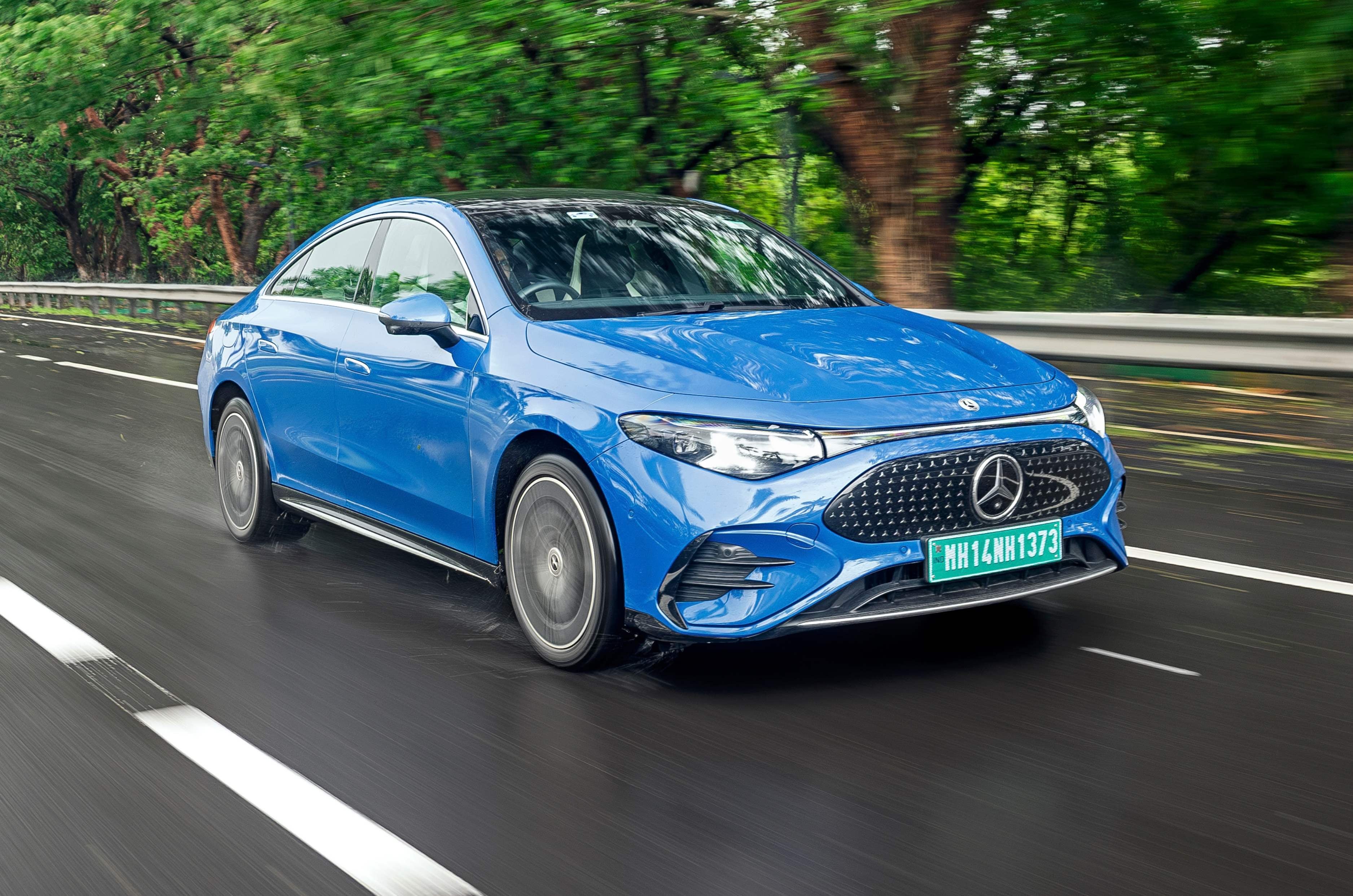
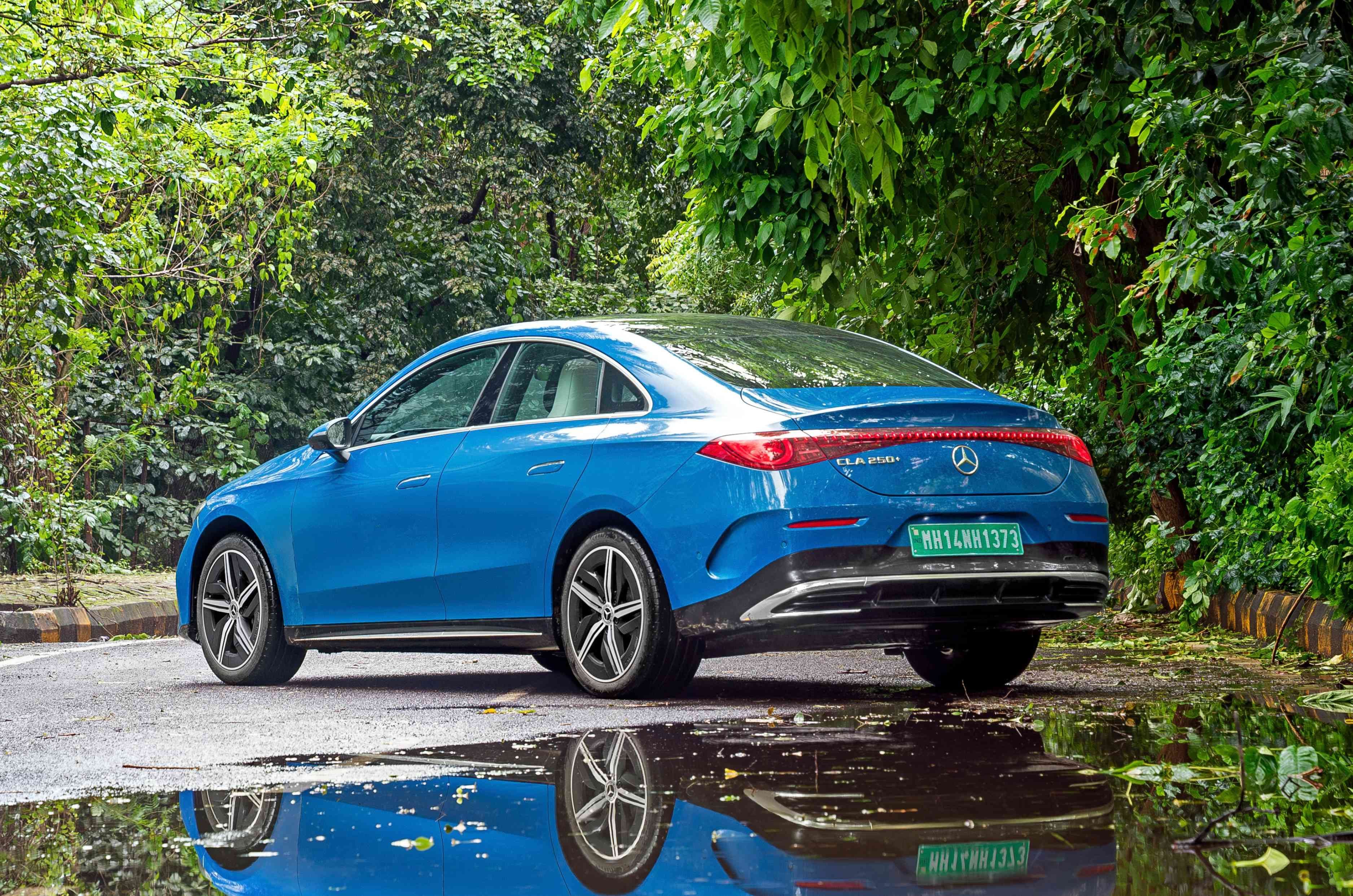
When we first drove the all-new, all-electric Mercedes-Benz CLA, we came away impressed with its smooth powertrain and its promise of a substantial real-world range. We’ve now subjected it to our real-world performance and efficiency tests to see if it delivers on that promise.
Mercedes CLA 250+ exterior design and engineering – 8/10
Polarising, aero-efficient design; based on new MMA platform.
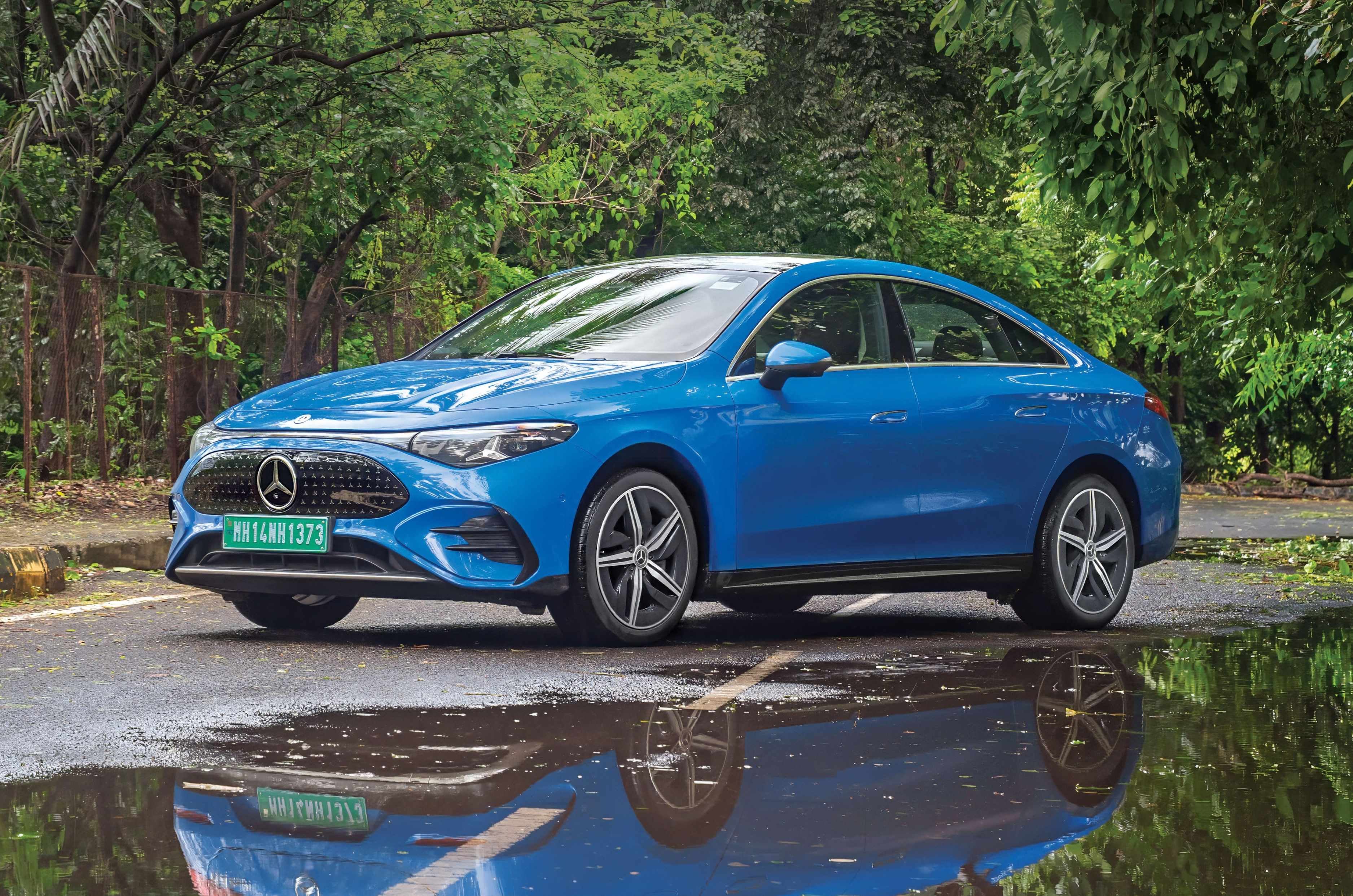
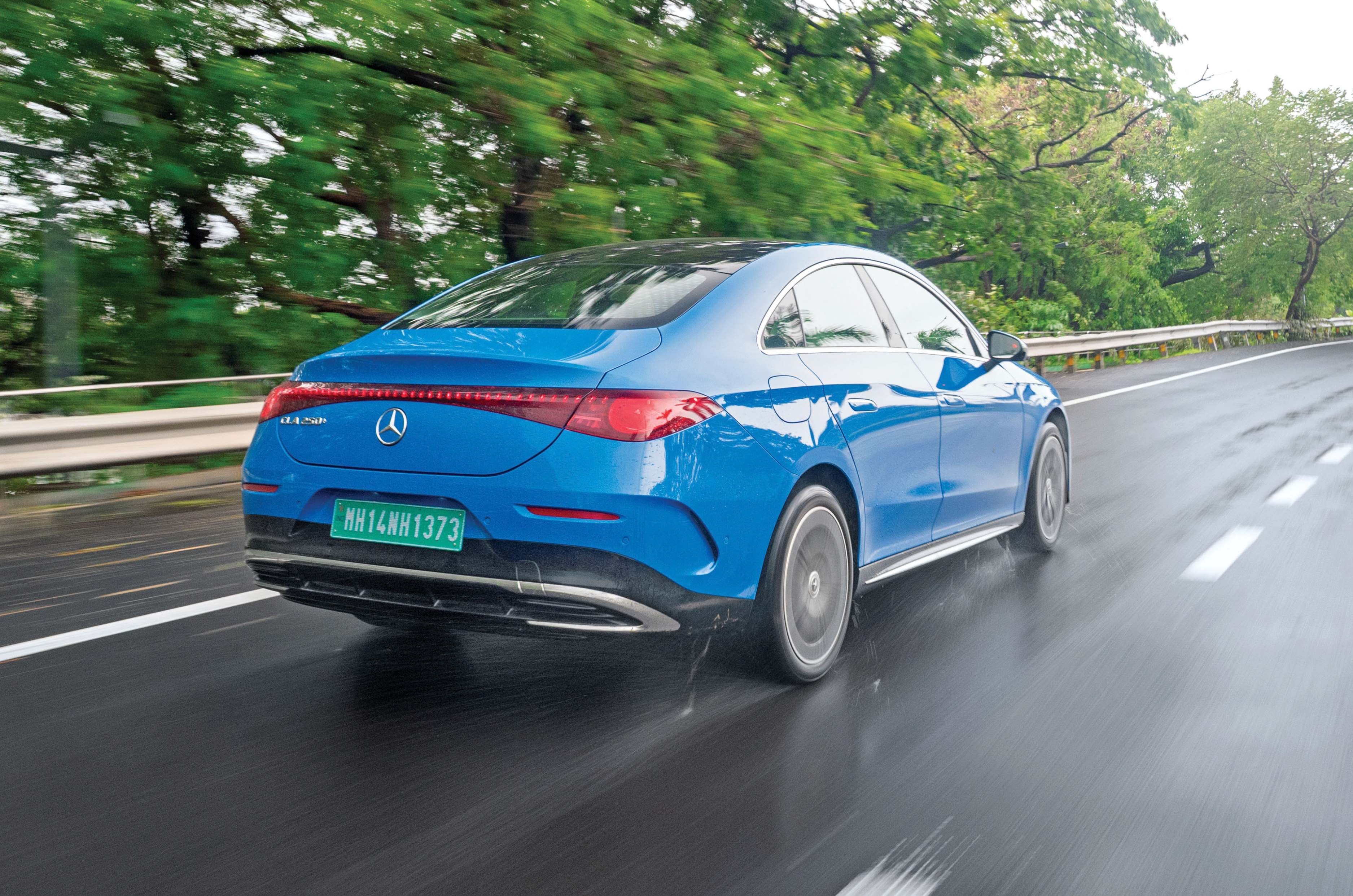
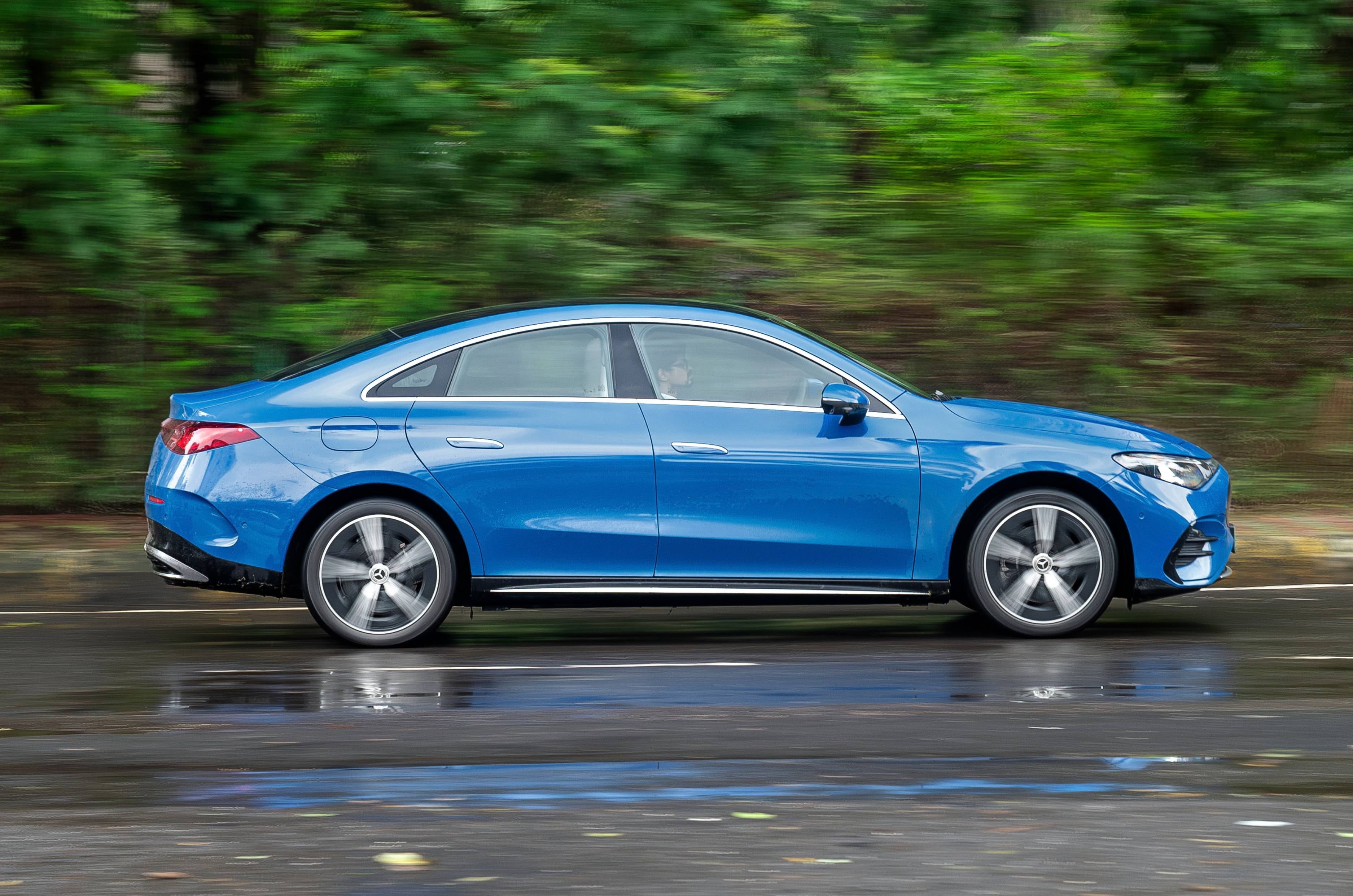
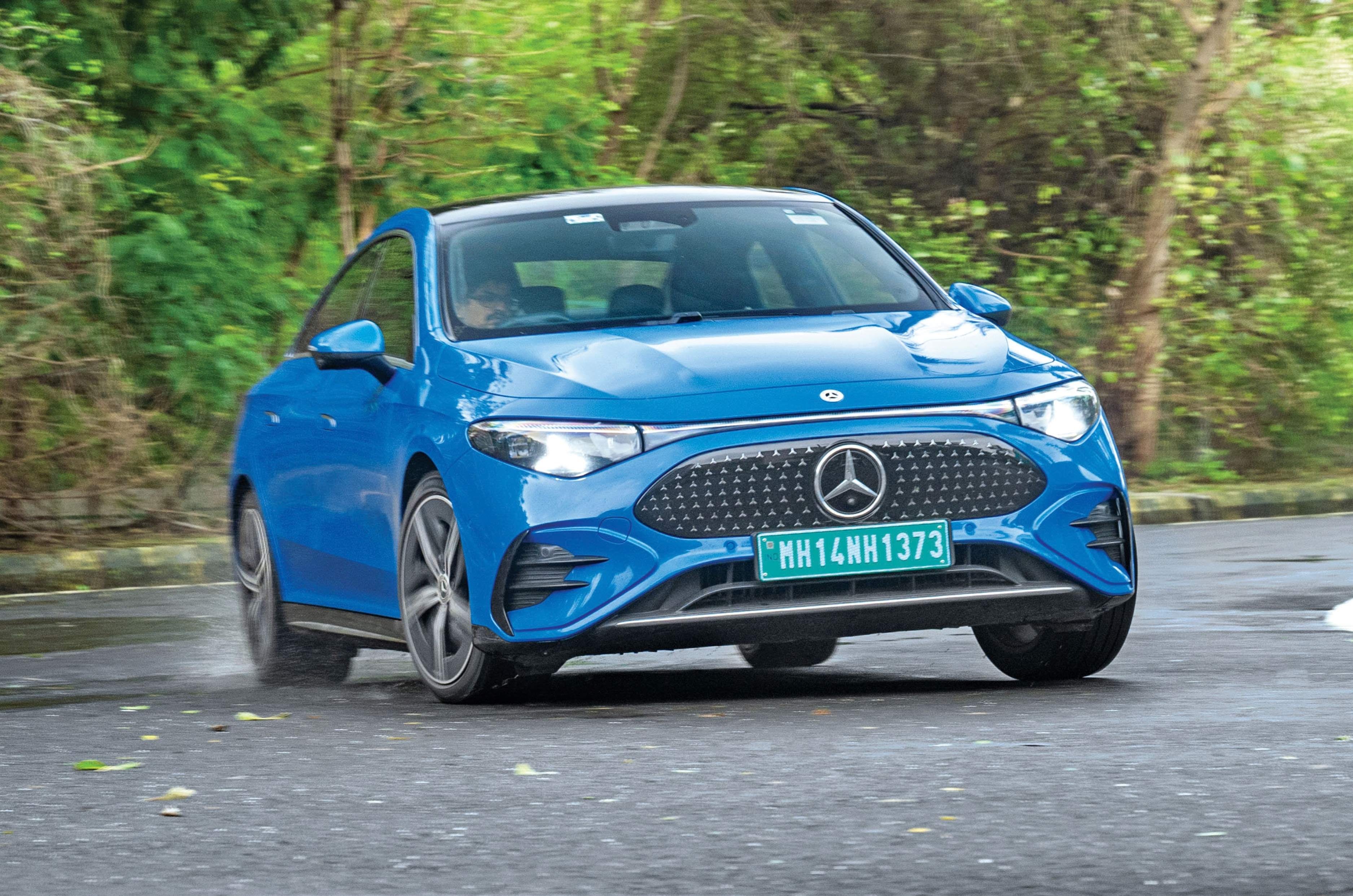
The new CLA has been designed with efficiency very much in mind, but Mercedes hasn’t completely abandoned the visual character that made the original car appealing. Its smooth, rounded silhouette is familiar from other Mercedes EVs, yet the low-slung, coupé-like roofline and frameless doors give it a distinct identity. Flush-fitting door handles, a sealed-off grille, aero-optimised 18-inch AMG alloys and a fully sealed underbody all contribute to an exceptionally slippery shape, with a drag coefficient of just 0.21Cd.
Mercedes’ three-pointed star features prominently across the CLA, appearing on the bonnet, grille, headlamps and tail-lamps. The grille itself gets 142 illuminated stars, which might sound excessive on paper, but they do give the CLA a distinctive look and, in person, seem to work rather well.
More significant, however, is what lies underneath. The CLA EV is the first Mercedes to use the new Modular Architecture (MMA) skateboard platform, which will also underpin future models. At over 4.7m long, more than 1.8m wide and over 1.4m tall, with a wheelbase approaching 2.8m, it is roughly the same size as a BYD Seal.
Mercedes CLA 250+ interior space and comfort – 7/10
Impresses with tech and quality; cramped rear with high floor.
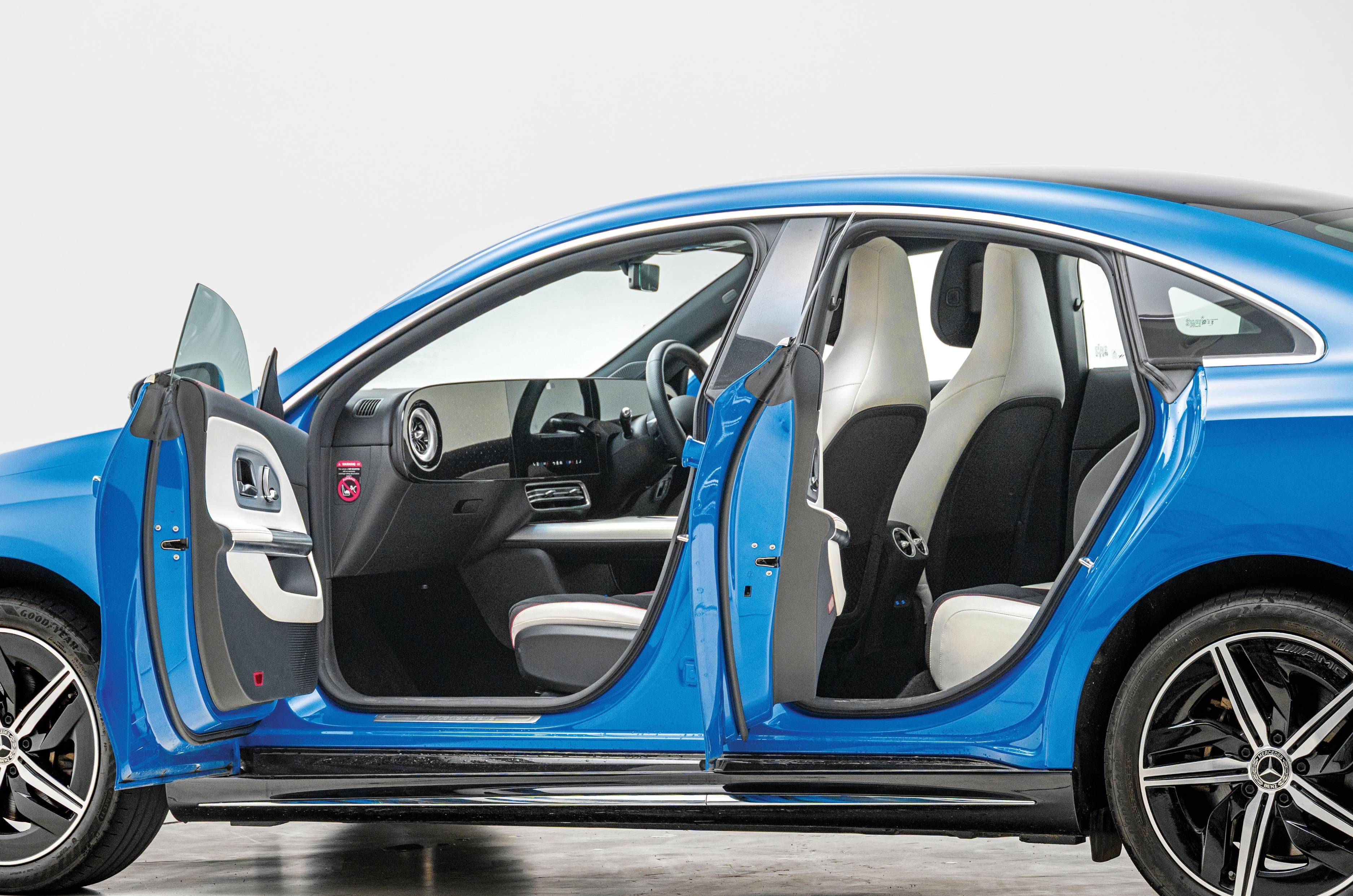
The CLA makes a good first impression inside. Its doors open wide for easy access, while the cabin combines smart design with good materials and build quality. The CLA 250+ is offered in AMG Line trim, so you get a flat-bottomed AMG steering wheel, sporty metal pedals and AMG-spec upholstery.
Doors open wide to aid access to the cabin; retains the stylish frameless doors.
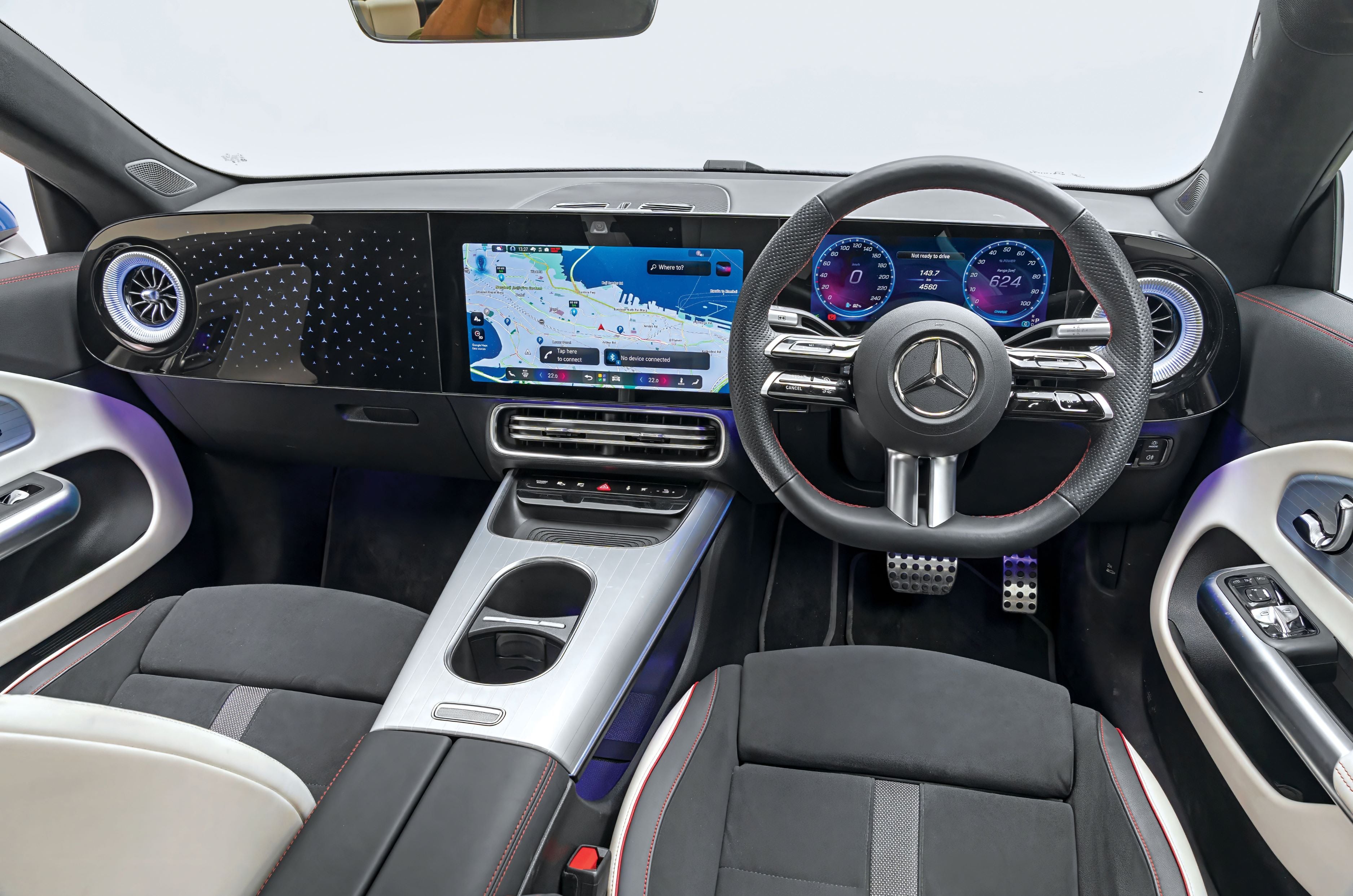
The dashboard is dominated by a large gloss-black panel housing the digital displays. The graphics are sharp, the interface is clean, and the system is easy to navigate. What isn’t quite as convincing is the near-total absence of physical controls. Apart from a few capacitive shortcuts for functions such as volume and drive modes, most functions are accessed through the touchscreen, which isn’t ideal while on the move.
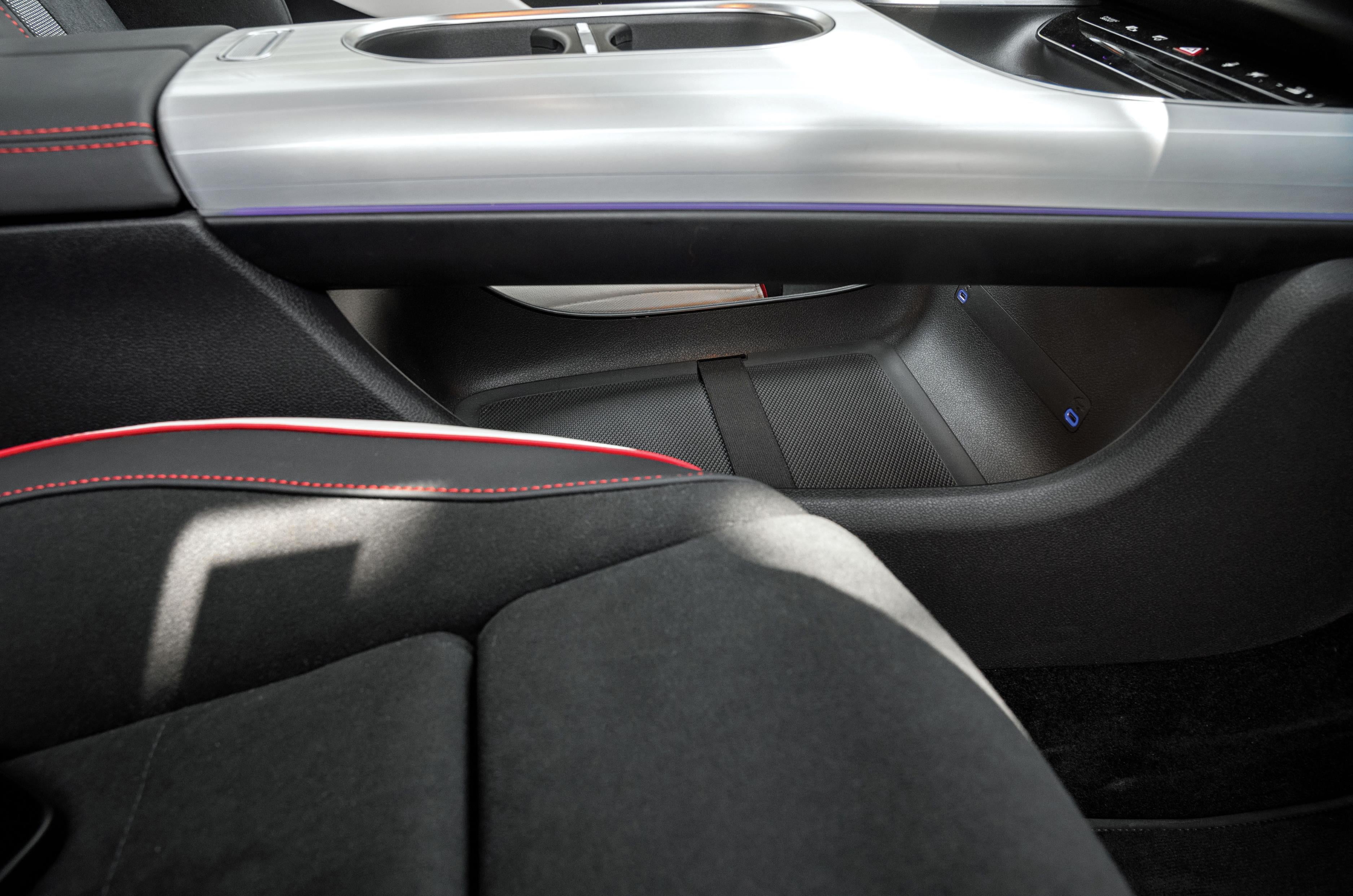
Centre console has two levels, with the top featuring cupholders and a wireless charger, and a large cubby space below.
The third passenger display offered in the 250+ Launch Edition has been omitted here, with its place taken by a gloss-black panel featuring illuminated Mercedes stars. The turbine-style air vents at either end of the dashboard are a nice touch, though, and are particularly satisfying to operate.
There is decent storage, too. You get a large glovebox, storage beneath the centre armrest, bottle holders in the doors and a floating centre console with cupholders and a wireless charger on top, along with a large storage area underneath.
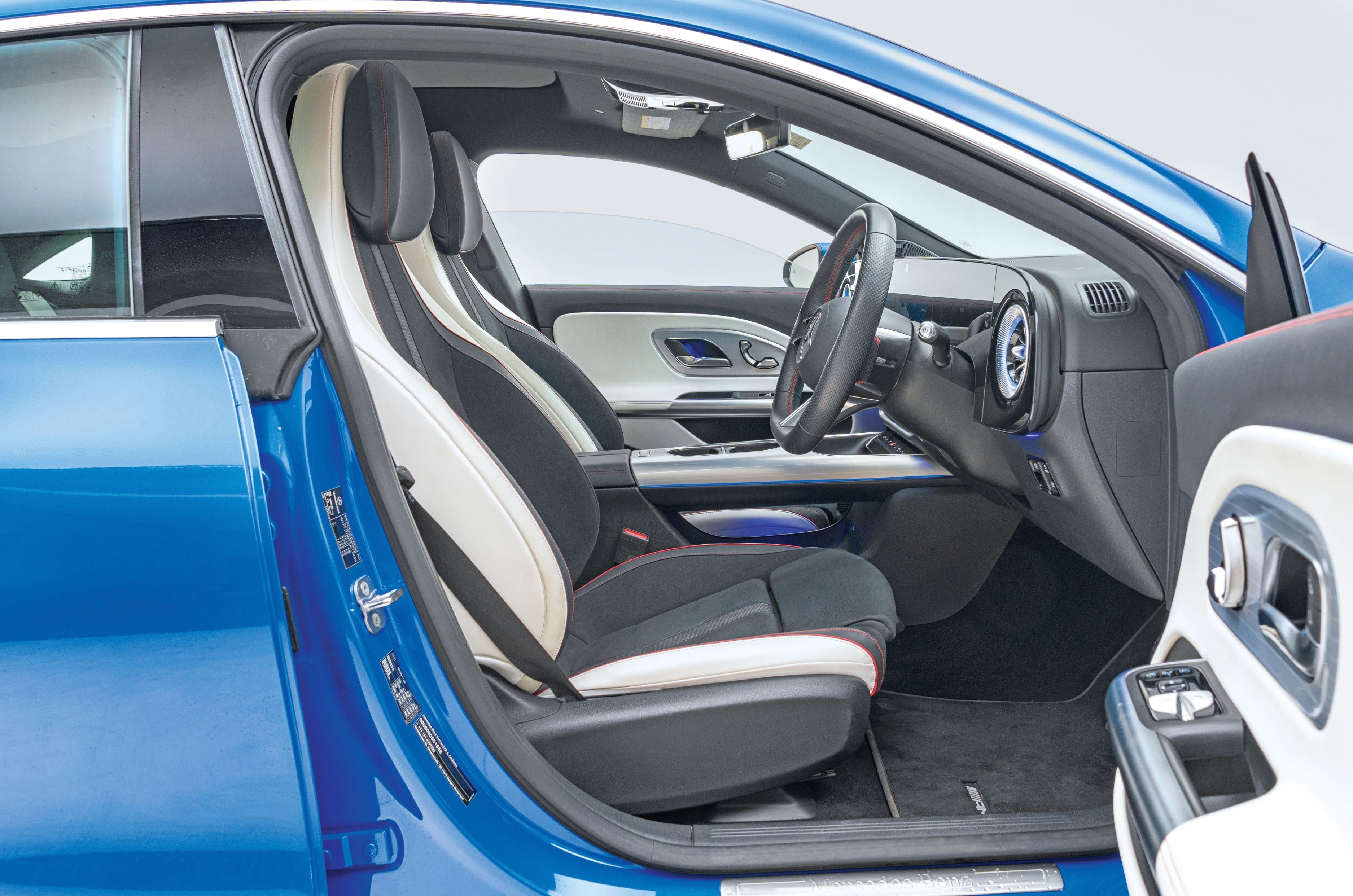
AMG Line brings Alcantara and leather trim for the snug and supportive seats; relatively knees-up seating here too.
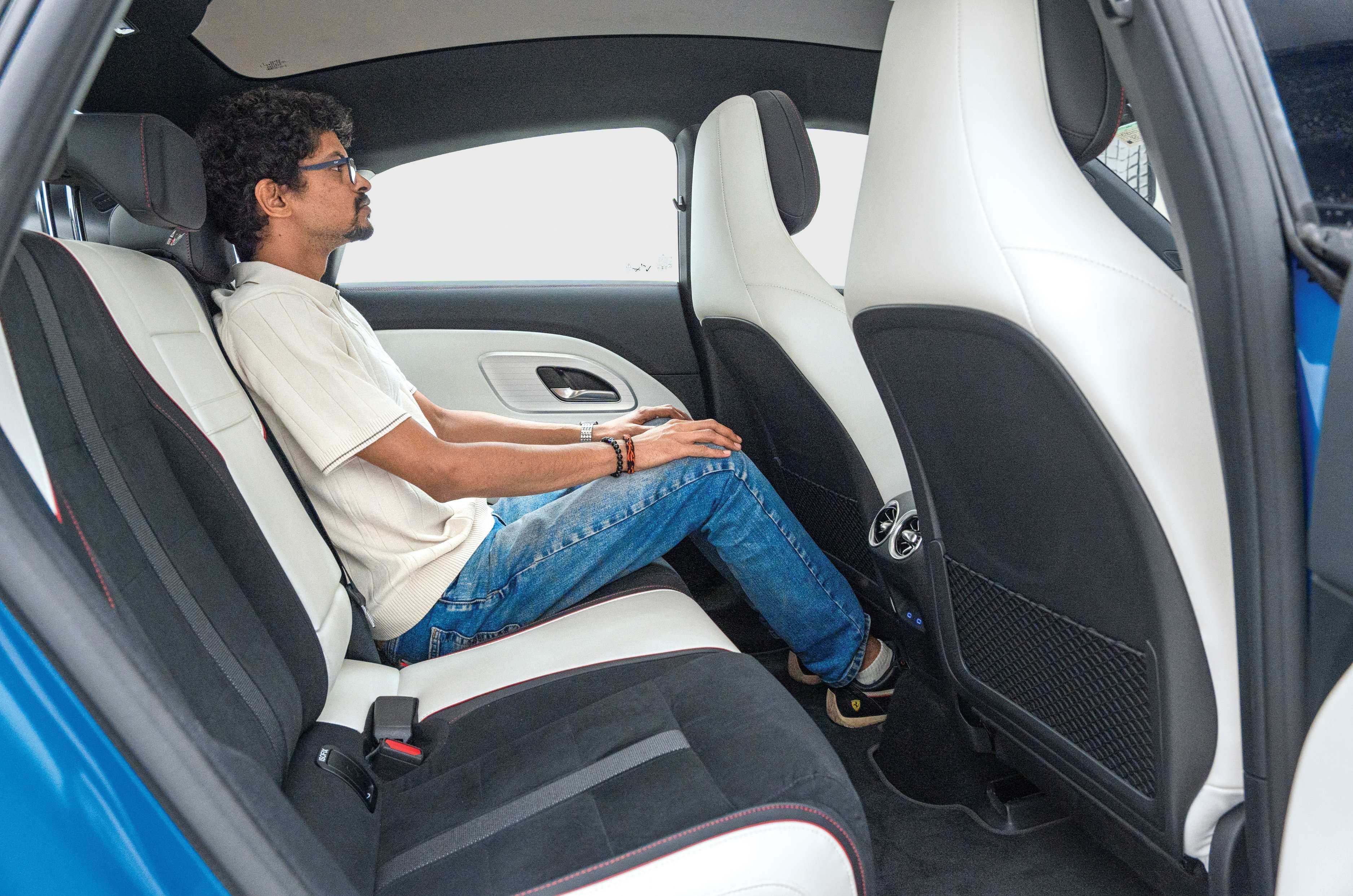
The front seats are supportive and well padded, although larger occupants might find them a little snug. More importantly, the relatively high floor means you sit with your knees raised even in the front. At the rear, this issue is more pronounced.
High floor results in knees-up seating, upright backrest and sloping roof further compromise rear seat’s comfort.
Although the CLA has a longer wheelbase than its predecessor, which improves knee room, the battery beneath the floor eats into under-thigh support and results in a knees-up seating position. The upright backrest and sloping roofline further compromise comfort, particularly for taller passengers. There is a centre armrest with cupholders and dedicated rear AC vents, but this still isn’t a car we’d recommend for regular chauffeur-driven use.
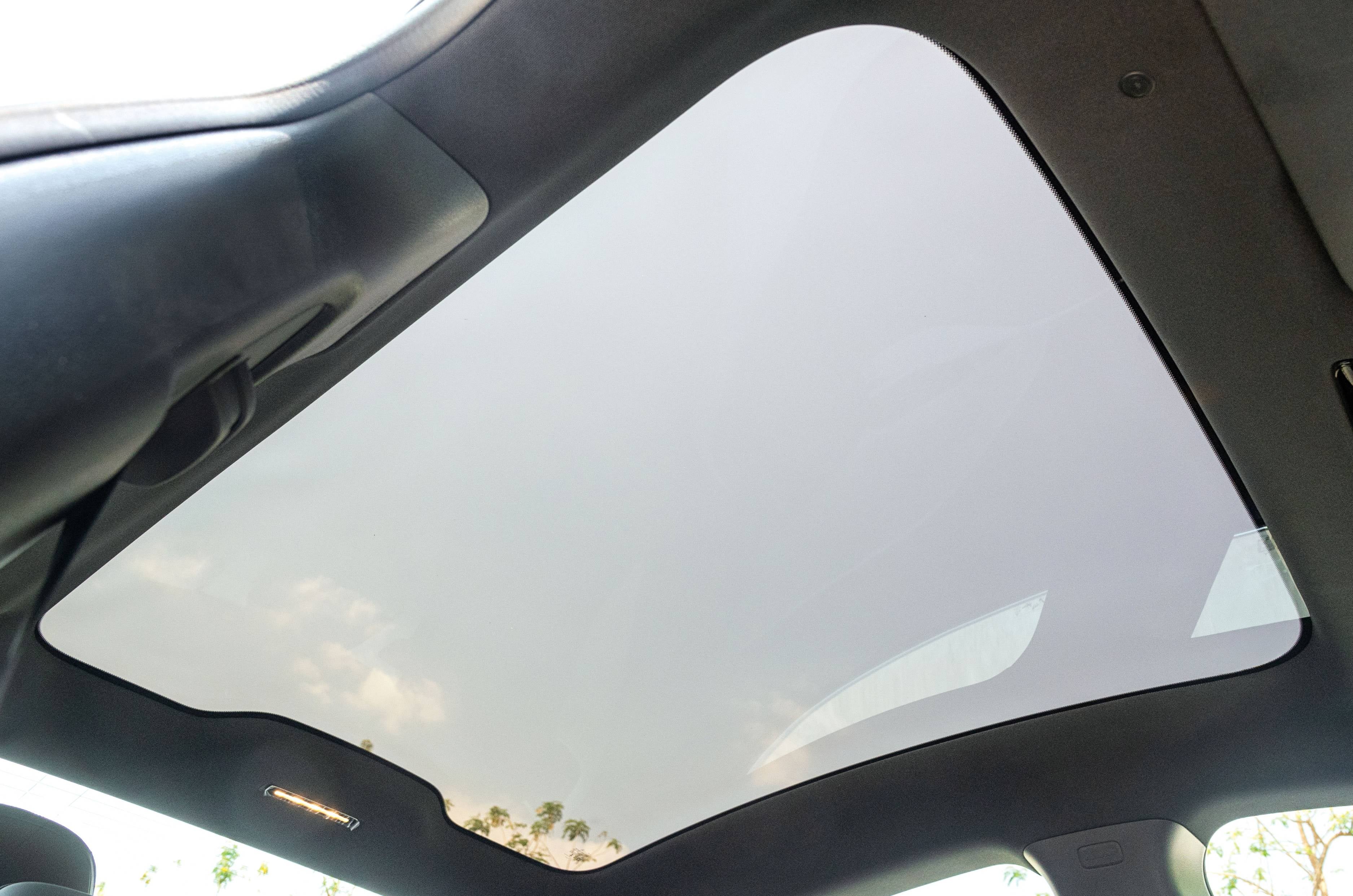
There is a large fixed panoramic glass roof that does make the cabin feel more spacious. Mercedes says the glass is heat-insulated, but a sunshade would have been welcome, particularly in our climate. It also misses sunblinds for the rear windows, meaning the rear AC has to work particularly hard to keep the back of the cabin cool.
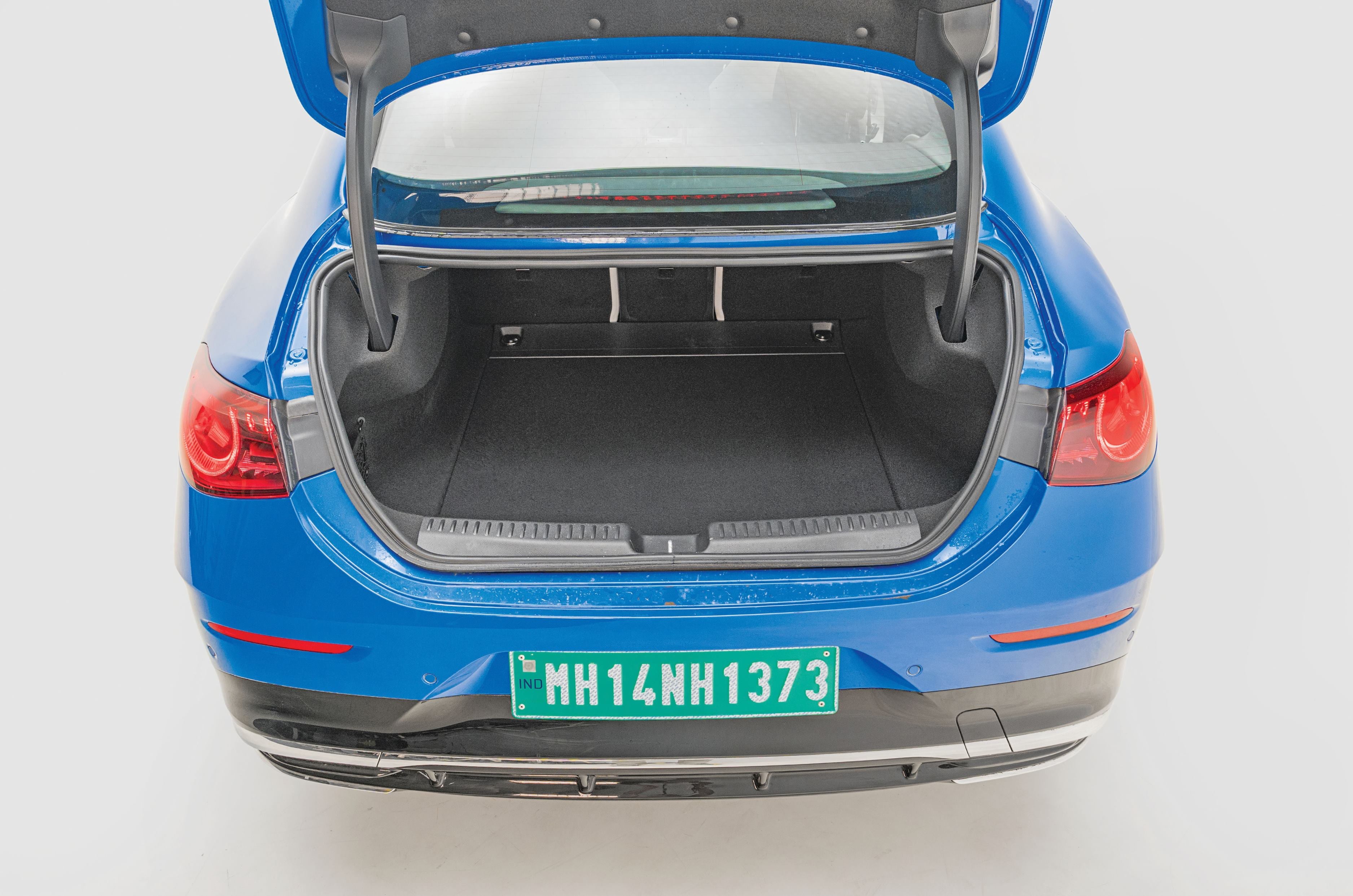
Cargo space is a useful 405 litres; boot opening isn’t large, though.
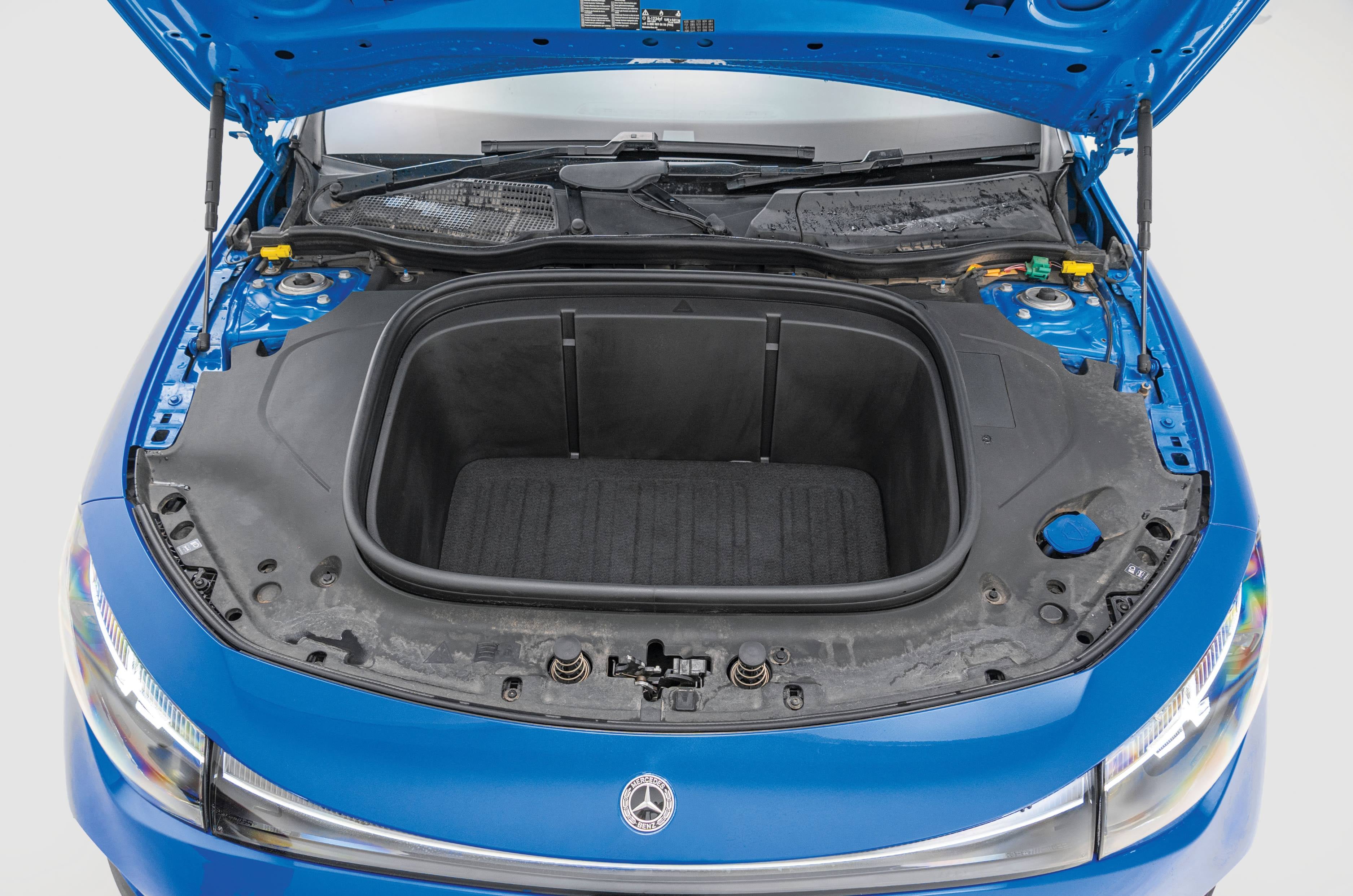
Boot space stands at a useful 405 litres. More interestingly, the CLA gets a 101-litre front trunk – the first time Mercedes has offered a frunk on one of its EVs.
In a first for Mercedes-Benz EVs, there’s a convenient 101-litre front trunk.
Mercedes CLA 250+ features and safety – 9/10
Packed with cutting-edge tech and features; no seat ventilation.
The CLA is a showcase for Mercedes’ latest technology. Four supercomputers provide the computing power, which Mercedes says is more than 200 times that of the previous CLA. It is also the first Mercedes to use the company’s new MB.OS infotainment operating system.
With the AMG Line styling package, the 250+ gets a flat-bottomed AMG steering, metal pedals and AMG seat upholstery; third passenger screen is reserved for the Launch Edition; cabin is practical with loads of storage, and overall fit/finish is good.
An Nvidia processor allows for quick responses, while over-the-air updates mean the system can be updated without a visit to the workshop. There’s also a new MBUX Virtual Assistant, which learns about the driver, including their language, accent and mood. It uses AI tools, including ChatGPT, Gemini and Bing, to further make your life easier, and you can ask them to do just about anything from setting navigation to changing the AC and so much more.
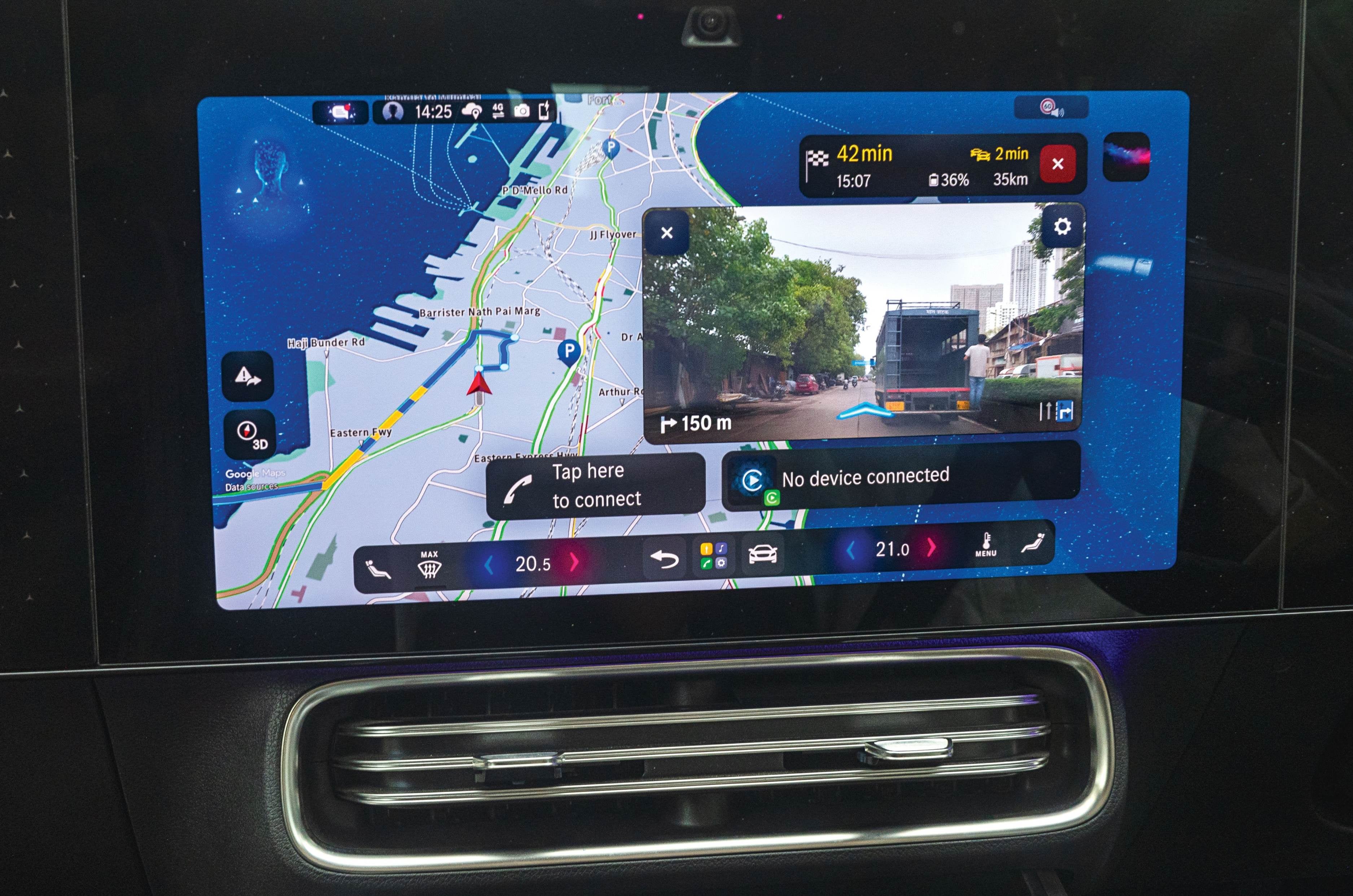
Screen is slick, has sharp graphics and native maps, which show directions in real-time using the camera feed.
The CLA also gets the new MB.Charge app, which brings charging providers together in one place. It can locate chargers, show their real-time availability, help plan a journey and even handle payment for a charging session.
The feature list is extensive. Highlights include a 14-inch central touchscreen, 10.25-inch digital driver’s display, powered, heated and massaging front seats, dual-zone climate control, configurable ambient lighting, a panoramic glass roof, Burmester 3D audio, wireless phone charging and auto parking. Ventilated front seats, however, aren’t offered.
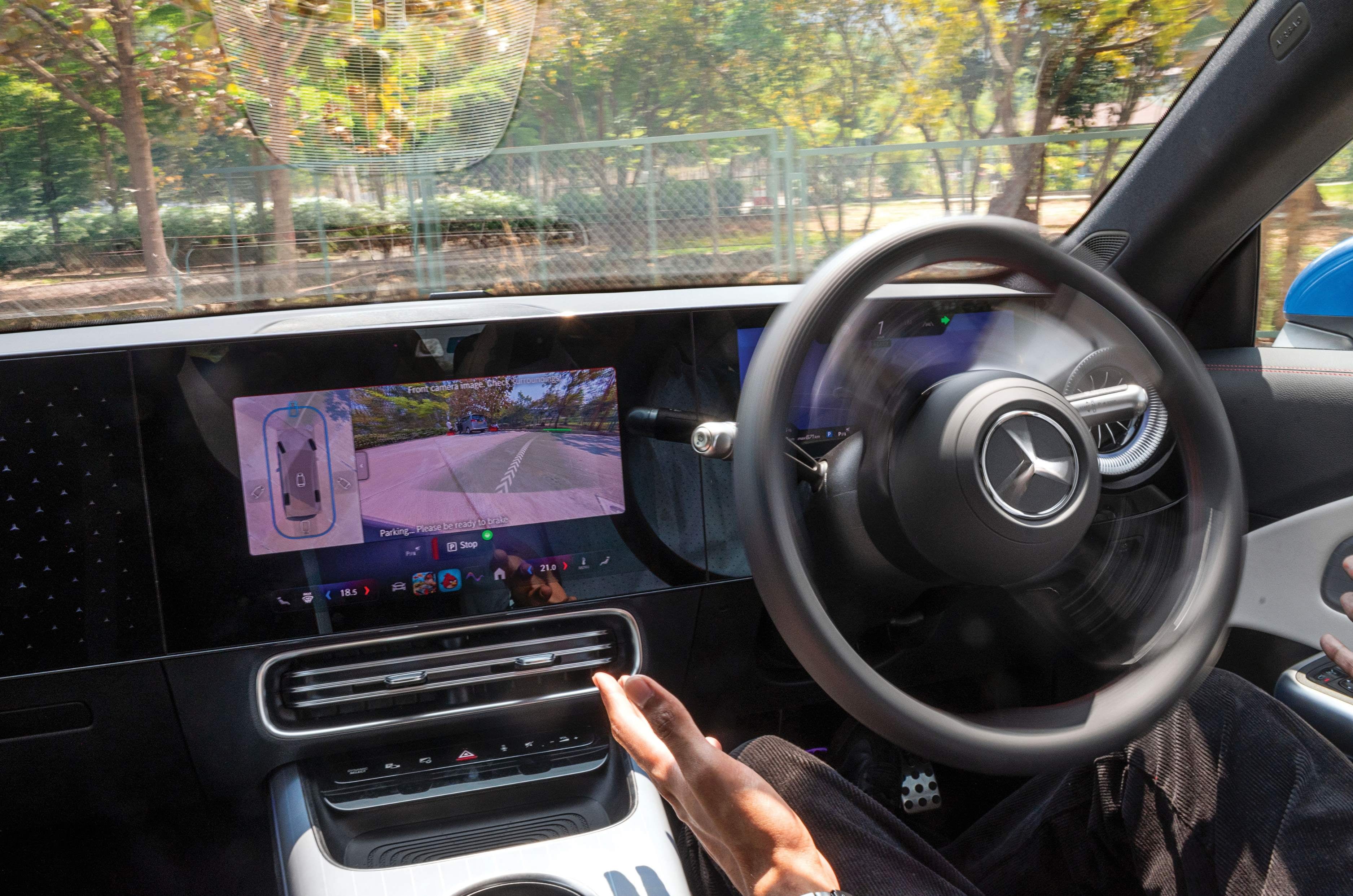
CLA 250+ packs in an auto park feature, which works very well in unmarked spaces too.
Safety equipment is comprehensive, with six airbags, a 360-degree camera and Level 2+ ADAS, which Mercedes calls MB.Drive. It includes adaptive cruise control, lane-keep assist, blind-spot monitoring, autonomous emergency braking and semi-autonomous driving functions. The system uses a combination of radar sensors and cameras and didn’t feel overly intrusive; better than previous Mercs, which feel trigger-happy with emergency braking. The CLA was also the safest car tested by Euro NCAP in 2025.
Mercedes CLA 250+ performance and refinement – 9/10
Smooth, progressive powertrain; refinement is impressive.
The CLA 250+ uses a rear-mounted electric motor producing 272hp and 335Nm. Performance is brisk, but what stands out more than outright acceleration is the way it delivers its performance.
Unlike some performance EVs that deliver power aggressively from the moment you bury the accelerator, the CLA builds speed in a smooth, progressive manner. The power delivery is linear, and there’s always enough performance on tap. Sport mode sharpens the response, while synthesised sounds played through the speakers add a little more theatre.
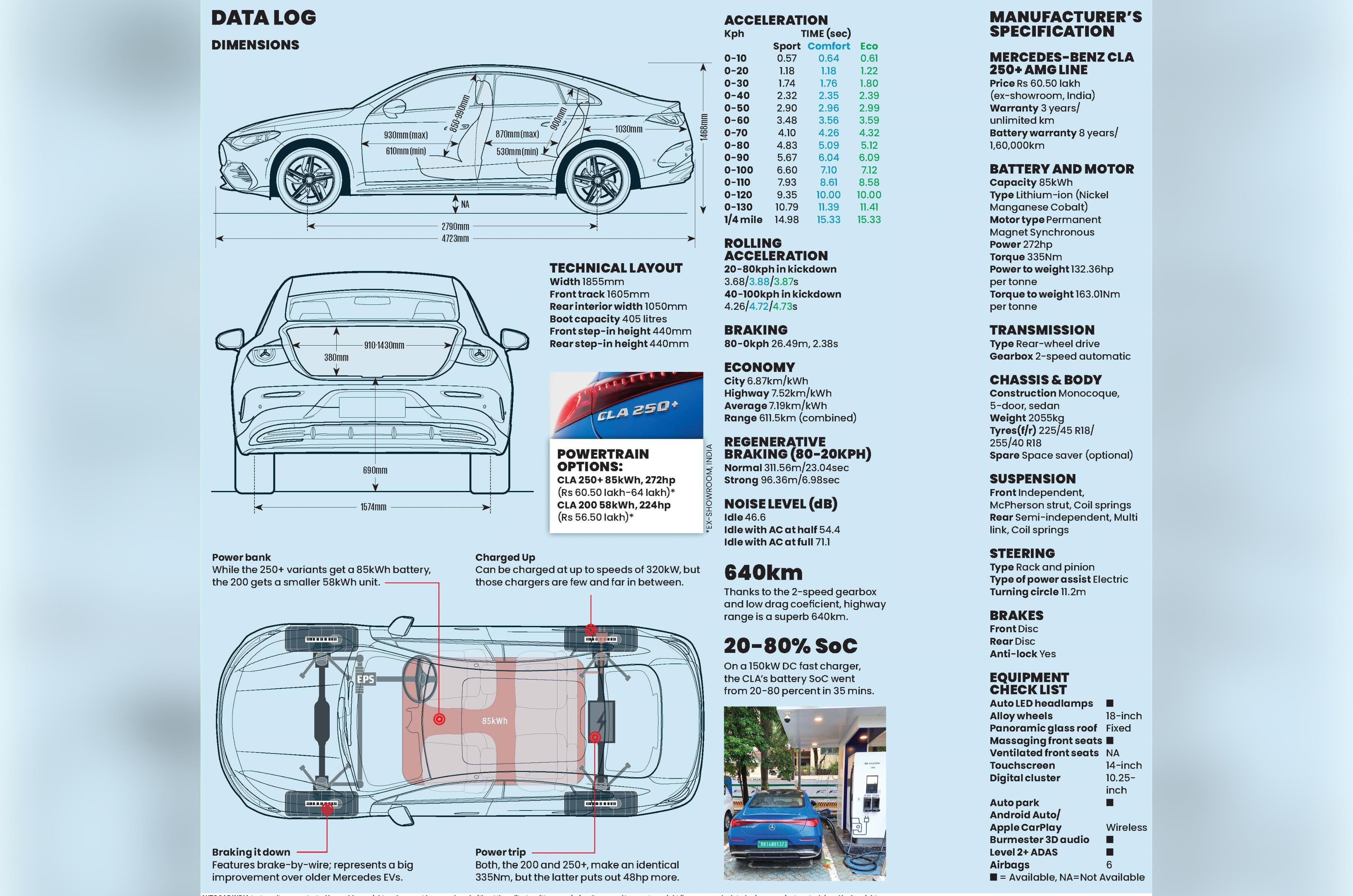
In our performance tests, it managed a 0-100kph time of 6.6sec in Sport mode, narrowly beating the claimed time of 6.7sec. Rolling acceleration is impressive too, with 20-80kph in Sport taking 3.68sec, and 40-100kph being dealt with in 4.26sec. Naturally, performance in the Comfort and Eco drive modes is more sedate than Sport, with the difference between the former two being almost negligible.
Mercedes has also opted for a two-speed gearbox, which is unusual for an EV, but makes sense here. The short 11:1 first gear helps with initial acceleration, while the taller 5:1 second gear is intended to improve efficiency at higher speeds. And from behind the wheel, you can feel when it shifts gears. Mercedes claims a drivetrain efficiency of 93 percent, and that plays an important role in the CLA’s impressive range.
The new brake-by-wire system is another area where the CLA makes a big improvement over older Mercedes EVs. Brake response is reassuring, with a good bite and a natural, consistent feel. In our braking test, the CLA came to a halt from 80kph in 26.49m despite it being on a damp surface.
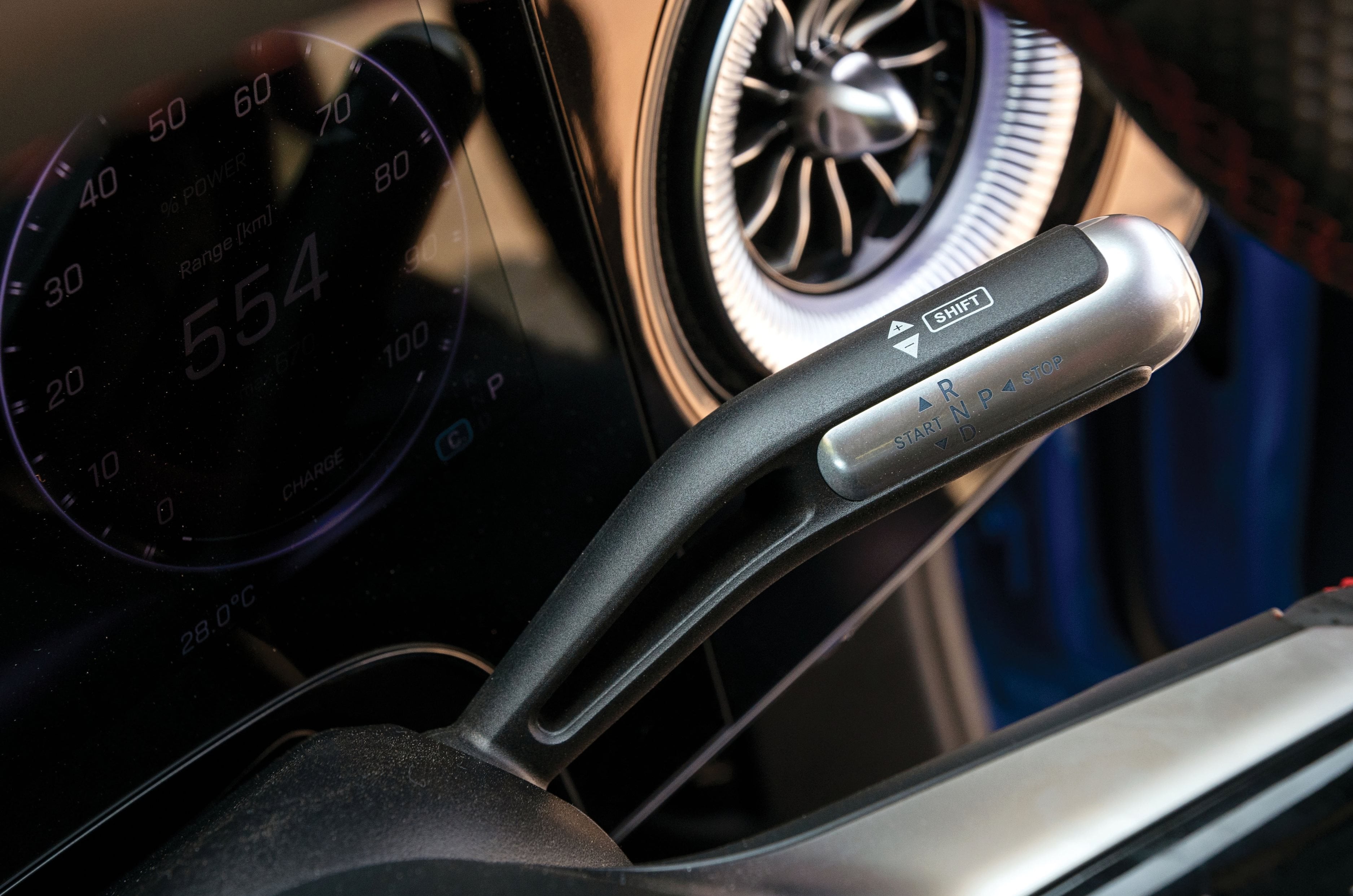
Control stalk now houses the start/stop button, the drive selector, and is also used to toggle between regen braking modes.
There are four levels of regenerative braking, including a one-pedal mode and an adaptive setting. They work well, with the Normal setting bringing it from 80-20kph in 311.56m, while the Strong setting takes 96.36m for the same. It’s worth noting, however, that Mercedes has moved the controls for the regen from the steering-mounted paddles used on some EVs to the gear selector stalk. You push or pull the stalk to change the regen level, and this isn’t quite as intuitive. The same stalk also incorporates the start/stop button.
Where the CLA really impresses is refinement. The absence of an engine obviously helps, but Mercedes has also done an excellent job of keeping wind and road noise out. At speed, the cabin remains remarkably quiet. A CLA 200 variant is also available in India, using the same rear-mounted motor layout but producing a lower 224hp and 335Nm. However, we’re yet to test this version.
Mercedes CLA 250+ tested acceleration times (sec)
Sport
Comfort
Eco
0-10kph
0.57
0.64
0.61
0-20kph
1.18
1.18
1.22
0-30kph
1.74
1.76
1.80
0-40kph
2.32
2.35
2.39
0-50kph
2.90
2.96
2.99
0-60kph
3.48
3.56
3.59
0-70kph
4.10
4.26
4.32
0-80kph
4.83
5.09
5.12
0-90kph
5.67
6.04
6.09
0-100kph
6.60
7.10
7.12
0-110kph
7.93
8.61
8.58
0-120kph
9.35
10
10
0-130kph
10.79
11.39
11.41
1/4 mile
14.98
15.33
15.33
20-80kph (rolling)
3.68
3.88
3.87
40-100kph (rolling)
4.26
4.72
4.73
Mercedes CLA 250+ range and efficiency – 9/10
Low drag, efficient powertrain mean superb real-world range.
Mercedes claims a WLTP range of 792km from the 85kWh (net) NMC battery, although, predictably, the real-world range is lower. In the city, with the regen set to the strongest mode, it delivered an efficiency of 6.87km/kWh that translates to a range of 584km. On the highway, with the regen set to ‘Normal’, it delivered an efficiency of 7.52km/kWh for a 640km range. With an average efficiency of 7.2km/kWh, you can expect a real-world range of 612km on a single charge, which is very impressive.
In the city, the strongest regen setting enabled it to recoup energy effectively, which helped boost efficiency, while the two-speed gearbox, with its taller 5:1 second gear, enabled greater efficiency at higher speeds and thus contributed to the EV’s highway efficiency. Combined with the low 0.21Cd drag coefficient and the normal regen mode that allows for more coasting, it proved even more efficient on the highway, which isn’t usually the case with EVs.
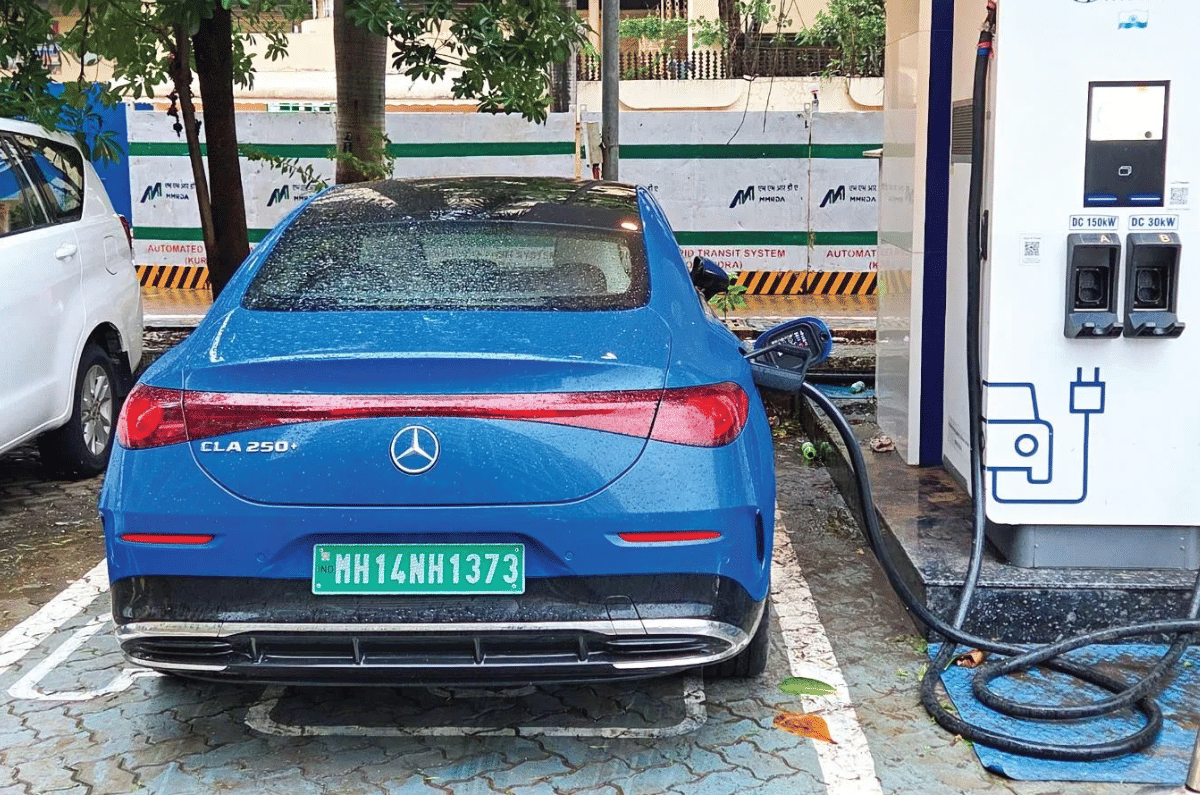
The CLA 250+ uses an 800V electrical architecture and supports charging at up to 320kW, but chargers capable of delivering that output remain few and far between in India. In our charging test using a 150kW DC fast charger, we saw an average charging speed of around 92kW with a peak charging speed of 125kW. To charge from 20-80 percent, it took 35 minutes and consumed 53.89kWh in total. This, combined with the efficiency and large real-world range, should make long-distance driving relatively stress-free.
Mercedes CLA 250+ tested range
City (km/kWh)
6.87
Highway (km/kWh)
7.52
Average (km/kWh)
7.19
Range (km)
611.5
Mercedes CLA 250+ ride comfort and handling – 8/10
Strikes a mature balance between ride and handling.
The CLA’s rear-wheel-drive layout gives it an enjoyable character on a winding road, and the steering is one of its stronger points. With no drive being sent through the front wheels, it feels precise, building up weight progressively with speed. It’s light enough at low speeds to make manoeuvring easy, yet gains enough weight as you go faster.
Thanks to the CLA’s rear-wheel-drive setup and precise steering, it feels agile and good fun around corners.
Mercedes has increased the Euro-spec CLA’s 107mm ground clearance for India and made suspension changes to better suit our roads, and both have worked. There’s enough clearance to deal with regular-sized speed breakers, while the additional height hasn’t really compromised the car’s handling or comfort. Around corners, the CLA remains agile, and body roll is well controlled. The ride does have a hint of firmness to it, but it deals with road imperfections without fuss and feels composed at both low and high speeds. Overall, it’s a mature combination of ride comfort, stability and handling.
Mercedes CLA 250+ value for money – 8/10
Refined and efficient powertrain, long range and sorted ride and handling make it Merc’s best EV yet.
Priced at Rs 60.50 lakh (ex-showroom), the CLA 250+ is a fairly compelling proposition, considering what it brings to the table. There are shortcomings, most notably the cramped rear seat, knees-up seating even at the front, and the absence of sunshades for the panoramic roof and rear windows. But if you’re going to drive yourself and want a luxury EV that’s distinctive, the CLA makes a strong case for itself.
Its powertrain is smooth and refined, its efficiency is excellent, it has an impressive real-world range of over 600km, and it strikes a very good balance between ride comfort and handling. Add to that a cabin packed with cutting-edge tech, and the new CLA emerges as one of the company’s most accomplished EVs yet.
When the first Bajaj Pulsar 150 broke onto the scene in 2001, it shattered the mould of what was expected of an accessible yet sporty commuter motorcycle. This recipe saw such widespread success that nothing Bajaj brought out since has been able to replace it. Therefore, the company went back to the drawing board and has now brought out a new generation of Classic Pulsars, spearheaded by the 125 and 150. In this review, we’ll share what the larger one was like to ride.
Bajaj Pulsar 150: What’s changed compared to before?
From the mechanicals to the tech, it is all-new
To start with, gone are the double-cradle frame and twin shock absorbers, replaced by a lighter and stiffer diamond frame and monoshock, respectively. Complementing the new chassis is a brand new motor. This engine started life as an engine from a similar displacement N model, but Bajaj has made certain changes to suit this application. The state of tune, various internals and the exhaust system are all different over here.
The Pulsar 150, understandably, has the sprightlier performance of the two.
Unlike before, the motor is now used as a stressed member of the chassis, and Bajaj has also peppered in the learnings it has made from the N range. For starters, the gearbox now has shorter, more tractable ratios, and there’s also a low rpm assist function, which raises engine rpm slightly to reduce stalling when you’re crawling at a higher gear at low speeds. Furthermore, higher variants of the 150 also come equipped with an Integrated Starter Generator (ISG), which brings in silent start and a reasonably quick start/stop system.
Pulsar 150 design and quality – 8/10
Looks uncannily similar to the older bike; feels very similar to sit on, too
Considering how much has changed underneath, it’s especially commendable that the Pulsar 150 looks this similar to before. Bajaj’s design team has deliberately gone to great lengths to package everything neatly and retain the bike’s instantly recognisable silhouette. Pulsar hallmarks that people appreciate, like a ‘wolf eye’ headlight, a chunky tank, sharp tank extensions and a pointy tail, all continue, and you won’t be mistaking it for anything other than a classic Pulsar. There are no complaints when it comes to quality, and it’s as well-finished as you’d expect from a commuter bike today.
Top variants come with a split seat.
Just like the near-unchanged design, the Pulsar 150’s ergonomics are almost the same as before – but that’s a good thing. You’re sat very neutrally, and the riding position is that of a textbook commuter with only slightly rearward pegs for the sporty touch that a Pulsar is known for. With a perch that’s just 795mm off the ground, the 150 strikes a nice chord by being friendly and approachable for both shorter folks and 6’1 Rishaad. To cater to the wants of different riders, Bajaj will sell you a Pulsar equipped with either a single piece seat or split seats. Both options are spacious – the single piece seat understandably more so – and decently padded, capable of accommodating two full-size people without them getting acquainted with each other too intimately.
Pulsar 150 performance – 8/10
Has enough pep for city and highway duties, engine stalls a little too easily, though
City traffic is where most Pulsar riders spend most of their time, so we did the same and found that the bike behaves exactly as you’d expect from a commuter. The motor has good low- and mid-range torque, and paired with the super light clutch, wading through the drudgery of traffic doesn’t feel too taxing.
The new engine is also super smooth, and should you choose to venture out onto the highway, the Pulsar can do that as well. The upper limit of the 150’s comfortable cruising speed is 90-95kph in its top 5th gear, which is par for the course in this class.
Engine
149.5cc, single-cylinder, air-oil cooled
Power
14hp at 8,000rpm
Torque
14.1Nm at 6,500rpm
Gearbox
5-speed
However, for all its strengths, the engine in the Pulsar 150 unit we were allotted displayed a tendency to stall a little too easily, and this happened on multiple occasions to both myself and Rishaad, who rode the bike.
Pulsar 150 ride and handling – 8/10
Behaves predictably and handles all situations well
While the chassis is largely the same between the 125 and 150, one noteworthy difference is that the bigger one uses a fatter 33mm fork, compared to the 31mm unit on the smaller bike. Also, unlike the 125, the Pulsar 150 comes with the government-mandated safety net of single-channel ABS. All variants come with a 260mm disc brake at the front, paired with either a 230mm drum brake on the lowest variant or a 230mm disc on the higher two variants.
Pulsar 150 behaves neutrally and predictably when subjected to a variety of riding conditions.
The best way to describe the new Pulsar 150’s handling is neutral and predictable. Neither does it feel as vague as the previous-gen model, nor does it feel as responsive as the N / NS models. The Classic Pulsar 150 retains its surefootedness in a straight line while introducing a newfound taut feeling when taking a corner. Its demeanour is predictable at all times, which is sure to inspire confidence in the varied sort of riders it will cater to. The brakes work well and bring the Pulsar to a stop in a quick fashion without much drama, although overenthusiastic usage will result in the rear locking up.
Fuel tank
14 litres
Seat height
785mm
Ground clearance
165mm
Kerb weight
141kg
Wheelbase
1,320mm
However, for all its strengths, the Pulsar 150 is not perfect, and there are some areas of improvement. The rear suspension feels slightly underdamped and springy, throwing you off the seat over larger road imperfections. The gearshifts, too, felt a little rubbery and vague, lacking a snick feel.
Pulsar 150 features and safety – 8/10
Comes with a lot of tech-y features on the top two variants
Following today’s market trends, even a humble commuter like this one now packs a dollop of tech. This includes a USB-C charging port, 4 riding modes (Sport, Tour, Road and Rain), Bluetooth connectivity for the dash via Bajaj’s app, which brings in a host of functions, and you can even cast your phone’s screen onto the TFT display, although some of these functions are still not available yet and will be rolled out at a later date.
Top variants also come with a colour TFT display and riding modes
To control the TFT display’s functions and switch between the riding modes on the top variants, you also have more comprehensive switchgear whereas the colour LCD dash on the lower variants is paired with a simpler switch cluster. Both displays are informative and well laid-out and bring an air of premiumness from the rider’s POV. Admittedly, most of these features aren’t going to add much value for most everyday riders but for the few that want their motorcycle to double up as a gadget, they’re there.
Pulsar 150 price and verdict – 8/10
It suits its intended purpose quite well
Aside from a few small misses, the new Pulsar 150 is a lovely commuter, which comes in at a price point that is more or less in line with the competition today. Prices start at Rs 1.15 lakh and go up to Rs 1.23 lakh (ex-showroom, Delhi). Compared to the last-gen 150, this latest-gen Pulsar’s prices have gone up by Rs 4,000-Rs 6,000, which is a digestible amount considering the sheer scale of new components in use here.
Given the huge demand for a bike that looks like a Classic Pulsar and the fact that this new-gen model is such a quantum leap ahead compared to the old ones while costing just a few thousand rupees more, Bajaj seems to have a winner on its hands.
Car buyers today are pretty spoilt for choice. Beyond a multitude of brands, body styles and variants, there are now more fuel options than ever before. Petrol, diesel, CNG, hybrid, electric, and soon even ethanol-powered vehicles are all vying for attention, making the decision increasingly complicated. So, which powertrain makes the most sense for you?
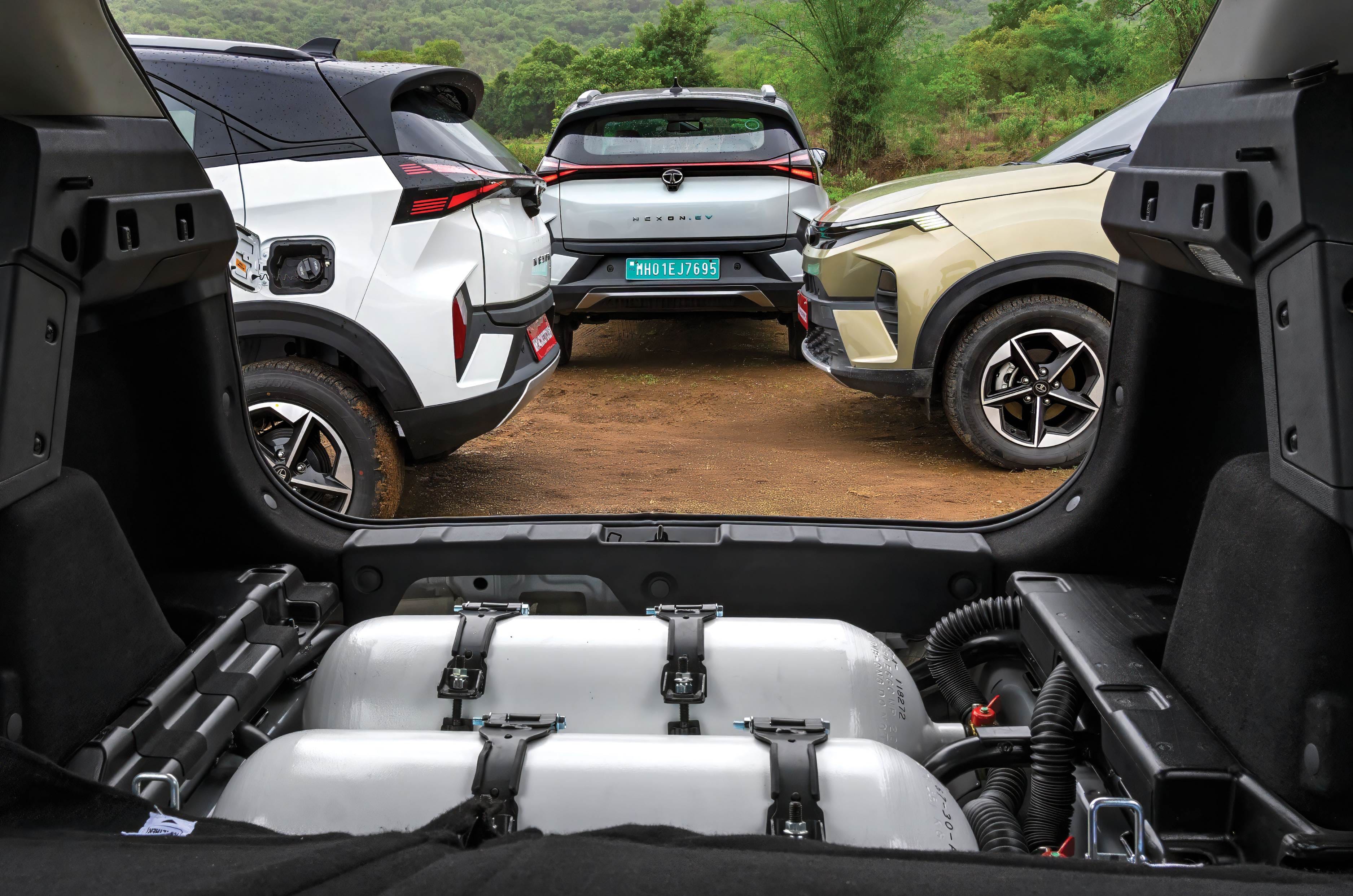
Tata Nexon models (left to right): Petrol, diesel, petrol-CNG and EV.
To answer that question, we turned to one of the most versatile models on sale in India – the Tata Nexon. Few vehicles offer such a broad range of powertrain choices, and with design, space, practicality, safety and features remaining largely consistent across the range, the Nexon provides the perfect platform to isolate the one key variable – the fuel itself. So, we got together the turbo-petrol, CNG, diesel, as well as the EV to find out each fuel’s pros and cons, and thus, which would best fit your needs.
Disclaimer: Fuel prices vary from state to state.
Tata Nexon turbo-petrol: Fuss free
Tata’s 1.2-litre, three-cylinder ‘Revotron’ turbo-petrol engine debuted with the Nexon in 2017 and received a power bump in 2020, taking outputs to 120hp and 170Nm. Today, it is offered with an unusually wide range of transmission choices – a 5-speed manual, 6-speed manual, 6-speed AMT and a 7-speed dual-clutch automatic.
Prices start at Rs 7.40 lakh and extend up to Rs 13.90 lakh, ex-showroom (excluding dual-tone, Dark and Red Dark editions). Its broad variant spread and attractive pricing are key reasons why the turbo-petrol accounts for 42 percent of all Nexon sales.
The engine offers decent driveability and benefits from selectable Eco, City and Sport drive modes. But outright performance, refinement and smoothness aren’t class-leading and not what you get from other turbo-petrols.
Within the range, the 7-speed DCA stands out as the most desirable option. Despite accounting for less than 4 percent of total Nexon sales, it is arguably the nicest ICE-powered Nexon on sale. The wet-clutch dual-clutch transmission prioritises smoothness over sportiness and suits the engine’s character well. While downshifts can occasionally feel a touch hesitant, the overall experience is noticeably more polished than the manual and AMT alternatives. Notably, the top-spec Turbo DCA is the best-equipped ICE version and is also the only version to offer ADAS.
Fuel efficiency, however, remains this powertrain’s weakest area. In our tests, the turbo-petrol DCA returned 7.7kpl in the city and 13.9kpl on the highway, translating to an average running cost of Rs 9.46 per kilometre – the highest among all Nexon powertrains.
To put that into perspective, even though a fully loaded Fearless + A PS DCA is Rs 2.65 lakh more affordable than a top-spec Empowered + A 45 EV, the EV’s significantly lower running costs (of Rs 1.03 per km using home charging) allow owners to recover that initial price difference in roughly 32,000km.
Tata Nexon diesel: Highway star
The diesel range starts at Rs 9.15 lakh and extends up to Rs 14.40 lakh for the top-spec AMT. Interestingly, while the diesel once outsold the petrol version in the Nexon’s early years, buyer preferences shifted following the BS6 transition, causing diesel sales to gradually decline to 13 percent. Despite this, Tata has persisted with the fuel, and today remains one of the few carmakers still offering diesel engines in its portfolio.
Instead of adopting a conventional SCR setup with a urea tank, AdBlue injection system and additional electronic controls, Tata developed a Lean NOx Trap system for the 1.5-litre, four-cylinder turbo-diesel engine. Despite this relatively low-cost passive emissions-control system, the price premium over an equivalent turbo-petrol variant remains around Rs 1 lakh – broadly in line with what rivals charge. The only tangible benefit for buyers is that, unlike many competitors, there is no urea tank requiring periodic top-ups, resulting in marginal savings over time and a bit less hassle.
Like the turbo-petrol, refinement isn’t this diesel’s strongest suit. And even though turbo lag is more perceptible than in the petrol iteration, performance flows in a rather strong manner, making it well-suited for highway drives. Its tall fuel efficiency also makes it ideal for those who cover long distances frequently. In our tests, the diesel-manual delivered an impressive average of 17.95kpl, resulting in a running cost of just Rs 5.30 per kilometre – significantly lower than the turbo-petrol.
Tata Nexon EV: Smooth operator
As India’s first widely accessible electric SUV from a domestic manufacturer, the Nexon EV played a pivotal role in democratising EV ownership. Combining brisk performance, usable real-world range and a relatively accessible price point, it opened up the Tata brand to an entirely new set of buyers. For a long time, it was India’s bestselling EV. Within the Nexon range, it accounts for 14 percent of total sales.
Today, the Nexon EV range spans Rs 12.49 lakh to Rs 17.49 lakh, with buyers able to choose between two battery packs – 30kWh and 45kWh. The line-up itself is relatively straightforward, with three trims available for each battery option.
In the real world, the 30kWh version can deliver a little over 200km on a charge, while the larger 45kWh battery can comfortably manage around 350km. For buyers seeking the smoothest and most refined driving experience, nothing quite matches the seamlessness of an EV. Acceleration feels brisk, and its zippy yet seamless performance makes for a hushed, enjoyable drive experience.
The two battery versions differ in more ways than just capacity. The 45kWh version uses Tata’s newer Gen 2 motor, which is lighter, more compact and more efficient than the Gen 1 unit used in the 30kWh variant. The long-range version’s more modern architecture also enables significantly faster DC charging. To put it into perspective, the 30kWh version takes about an hour to charge from 20-80 percent using a DC fast charger, whereas the 45kWh variant achieves the same in just 29 minutes. Not only does the larger battery offer greater range, but it is also quicker to recharge despite its higher capacity, making it the more suitable choice for longer highway journeys.
Interestingly, the EV also enjoys a feature advantage over the best-equipped turbo-petrol DCA, gaining a larger 12.3-inch touchscreen, rear disc brakes, and an electronic parking brake with auto-hold functionality.
Coming to the 45kWh version’s running cost, using a home charger (at an average cost of Rs 8 per unit of electricity), buyers can enjoy driving around at just Rs 1.03 per km. Even if users opt for public DC fast-charging, the rates of which range between Rs 24 and Rs 28 per unit, still, average running costs work out to merely Rs 3.34 per km, which is almost a third of the petrol-automatic’s number and about sixty percent of a diesel-manual’s cost per km.
Tata Nexon CNG: Jack of all trades
There’s a lot Tata has got right with the Nexon CNG. For starters, prices range from Rs 8.35 lakh to Rs 13.60 lakh, positioning it neatly between the petrol and diesel alternatives.
Under the bonnet is the same 1.2-litre, three-cylinder turbocharged engine found in the petrol Nexon. Not only is it India’s first turbo-petrol CNG SUV, but it is also the most powerful, producing 100hp and 170Nm when running on CNG. Impressively, peak torque remains identical to the petrol version, although it is available across a narrower band. As a result, driveability feels remarkably similar to the turbo-petrol, and users are unlikely to find themselves wanting for performance, whether in urban conditions or on the highway.
Being a turbocharged CNG engine, efficiency in city driving can take a hit. In our real-world city test involving frequent stop-start traffic, the Nexon CNG returned 15.1km/kg. Out on the highway, however, flowing traffic and the presence of a sixth gear helped it achieve close to 24km/kg. The end result is an average running cost of just Rs 4.28 per kilometre, making it the most economical option in the ICE line-up.
With driveability that’s remarkably close to the turbo-petrol, lower purchase and running costs than the diesel, and very few compromises in practicality or equipment, the Nexon CNG presents perhaps the strongest all-round case in the range. Its only notable drawback is the limited CNG infrastructure. While station availability continues to improve, rising CNG adoption often leads to longer queues and wait times at many outlets.
Unlike many CNG vehicles, the Nexon CNG doesn’t feel like a stripped-down, budget-focused alternative. It remains spacious, practical and generously equipped while delivering the lowest running costs of any ICE Nexon. Small omissions, such as cruise control, connected-car technology and JBL-branded speakers, are unlikely to be deal-breakers for most buyers.
Viewed through the lens of value, usability and cost of ownership, the Nexon CNG strikes perhaps the most convincing balance of the lot. Which perhaps explains why, despite being offered with just one engine and a manual gearbox, it now contributes more than a third of all Nexon sales.
Tata Nexon petrol vs diesel vs CNG vs EV: Verdict
The turbo-petrol’s lowest starting price, as well as the widest choice for buyers, is the reason behind its popularity. Our pick of the range, however, is the priciest 7-speed DCA, which delivers the smoothest and most polished Nexon ICE driving experience. That said, performance and efficiency aren’t exactly class-best.
The diesel’s impressive fuel efficiency and thus low running costs make it an ideal choice for those who rack up high annual mileages. Performance is the strongest among all ICE versions, and its torquey nature makes it an excellent highway companion, perfect for those who regularly cover long distances.
For buyers with reliable home charging, a predominantly urban usage pattern and high annual running, the EV is the one to pick. The 45kWh model has a genuinely usable real-world range and is also the most advanced version with a rich feature list, making it a very well-rounded option.
The Nexon CNG retains the petrol’s drivability, offers low running costs, a long range, and buyers aren’t forced to compromise features or practicality either. It thus strikes a convincing balance between price, performance and real-world usability, emerging as the sweet spot of the line-up.
मोहम्मद शमी और मुकेश कुमार (दो-दो विकेट) के झटकों के बावजूद दक्षिण क्षेत्र ने कप्तान तिलक वर्मा (नाबाद 56) और देवदत्त पड़िक्कल (62) की अर्धशतकीय पारियों के दम पर दलीप ट्रॉफी के फाइनल मुकाबले के तीसरे दिन मंगलवार को पूर्वी क्षेत्र के खिलाफ छह विकेट पर 242 रनों का स्कोर बना लिया है। हालांकि दक्षिण क्षेत्र अभी भी पूर्वी क्षेत्र के पहली पारी में बनाये गये स्कोर से 466 रनों से पीछे है।
आज बल्लेबाजी करने उतरी दक्षिण क्षेत्र की शुरुआत अच्छी नहीं रही और उसने 10 रन के स्कोर पर सलामी बल्लेबाज रिकी भुई (एक) रन का विकेट गवां दिया। भुई को मुकेश कुमार ने आउट किया। इसके बाद देवदत्त पड़िक्कल ने नारायण जगदीशन के साथ पारी को संभालने का प्रयास किया। दोनों बल्लेबाजों के बीच दूसरे विकेट के लिए 60 रनों की साझेदारी हुई।
Shami-Mukesh combo strikes
The pace bowling duo dismiss set batters Shaik Rasheed and Devdutt Padikkal and breaks 56-run stand
19वें ओवर में शिखर मोहन ने नारायण जगदीशन ( 32) रन को आउट कर दक्षिण क्षेत्र को दूसरा झटका दिया। शेख रशीद (27) रन को मोहम्मद शमी ने पगबाधा आउट किया। 36वें ओवर में मुकेश कुमार ने देवदत्त पड़िक्कल को आउट कर पवेलियन भेज दिया। पड़िक्कल ने 104 गेंदों में चार चौकों की मदद से (62) रनों की पारी खेली। आर स्मरण (23) रन को मोहम्मद शमी ने आउट कर पूर्वी क्षेत्र को पांचवीं सफलता दिलाई। आज पूरे दिन पूर्वी क्षेत्र का दबदबा रहा।
दक्षिण क्षेत्र के बल्लेबाज पूर्वी क्षेत्र के गेंदबाजों के आगे संघर्ष करते नजर आये। 80वें ओवर में के. कुरैशी ने श्रेयस गोपाल (26) को आउट कर दक्षिण क्षेत्र को दिन का छठा झटका दिया। दिन का खेल समाप्त होने के समय दक्षिण क्षेत्र ने छह विकेट 242 पर रन बना लिये है। तिलक वर्मा (नाबाद 56) और चामा मिलिंद (नाबाद दो) रन क्रीज पर मौजूद थे। पूर्वी क्षेत्र के लिए मोहम्मद शमी और मुकेश कुमार ने दो-दो विकेट लिये। शिखर मोहन और कुनैन कुरैशी ने एक-एक बल्लेबाज को आउट किया।
Houthi Strikes in Saudi Arabia: मिडिल ईस्ट में तनाव एक बार फिर चरम पर पहुंच गया है। यमन के हूती विद्रोहियों ने सऊदी अरब के दक्षिणी इलाके पर सिलसिलेवार बड़ा हमला किया है। इस हमले में सऊदी अरब की तेल दिग्गज कंपनी अरामको के ठिकानों, अंतरराष्ट्रीय एयरपोर्ट और मिलिट्री एयरबेस को निशाना बनाया गया है।
सऊदी अधिकारियों के मुताबिक, इन हमलों के कारण कई जगहों पर भीषण आग लग गई और 73 लोग घायल हो गए हैं। हूती विद्रोहियों ने धमकी दी है कि वे आने वाले दिनों में सऊदी अरब के अंदर और भी बड़े ऑपरेशन को अंजाम देंगे।
7 प्वाइंट्स में समझिए सऊदी अरब में क्या हुआ, हूती विद्रोहियों ने हमला क्यों किया और इसका दुनिया पर क्या असर पड़ेगा।
1. क्या हुआ सऊदी अरब में?
हूती विद्रोहियों ने मंगलवार तड़के सऊदी अरब के दक्षिणी हिस्से में एक साथ कई ऊर्जा, सैन्य और नागरिक ठिकानों पर ड्रोन और मिसाइल से हमले किए। हमले के बाद कई तेल प्रतिष्ठानों में आग लग गई, जिससे वहां कामकाज अस्थायी रूप से प्रभावित हुआ। सऊदी जॉइंट फोर्सेज कमान ने पुष्टि की है कि इन हमलों में 73 नागरिक घायल हुए हैं।
2. कौन-कौन से बड़े ठिकाने बने निशाना?
हूतियों ने रणनीतिक रूप से बेहद अहम ठिकानों को चुना:
अभा इंटरनेशनल एयरपोर्ट (Abha International Airport)
किंग खालिद एयरबेस (King Khalid Air Base)
अरामको के तेल ठिकाने (Abha & Jazan Aramco Facilities)
सैन्य और ऊर्जा प्रतिष्ठानों को एक साथ निशाना बनाकर हूतियों ने सऊदी अरब की सुरक्षा और अर्थव्यवस्था दोनों पर चोट करने की कोशिश की है।
3. अरामको के तेल ठिकानों में लगी आग
सऊदी अरब की सरकारी तेल कंपनी ‘अरामको’ के ठिकानों पर हमले के बाद कई जगह आग की लपटें दिखाई दीं। सऊदी ऊर्जा मंत्रालय ने बताया कि आग पर काबू पाने, नुकसान का आकलन करने और कर्मचारियों की सुरक्षा सुनिश्चित करते हुए कामकाज को दोबारा बहाल करने के लिए इमरजेंसी टीमें तैनात कर दी गई हैं।
4. जाजान रिफाइनरी पहले से थी ठप
जाजान स्थित अरामको की रिफाइनरी की क्षमता रोजाना 4,00,000 बैरल तेल प्रोसेस करने की है। लेकिन यह रिफाइनरी जुलाई में हुए पिछले हूती हमले के बाद से ही बंद पड़ी है। हूतियों ने पिछले महीने भी इस कॉम्प्लेक्स पर दो बार हमले का दावा किया था, जिसमें रिफाइनरी में आग लग गई थी।
5. हमले में कितने लोग घायल हुए?
सऊदी अधिकारियों के अनुसार, अब तक 73 नागरिकों के घायल होने की खबर है। सऊदी नीत सैन्य गठबंधन ने इन हमलों को गैर-जिम्मेदाराना करार देते हुए कहा कि वे इसका मुंहतोड़ जवाब देंगे।
6. क्यों हमला कर रहे हैं हूती विद्रोही?
हूती विद्रोहियों का दावा है कि यह हमला उन्होंने सऊदी अरब की ओर से यमन में की गई एयरस्ट्राइक के जवाब में किया है।
जेल पर एयरस्ट्राइक का आरोप: हूतियों ने आरोप लगाया था कि सऊदी अरब ने उत्तरी यमन के अल-जौफ प्रांत में एक जेल पर बमबारी की, जिसमें कई लोग मारे गए।
सैन्य प्रवक्ता की चेतावनी: हूती सैन्य प्रवक्ता यह्या सरी (Yahya Saree) ने कहा कि सऊदी अरब का हमला तनाव बढ़ाने वाला था और अब वे सऊदी अरब के अंदर “बड़ा ऑपरेशन” चलाकर इसका जवाब देंगे।
7. बाब अल-मंडेब जलडमरूमध्य क्यों है इतना अहम?
यह पूरा तनाव यमन में फिर से शुरू हुई जंग के बीच बढ़ रहा है, जहां हूती विद्रोही रणनीतिक रूप से महत्वपूर्ण बाब अल-मंडेब स्ट्रैट (जलडमरूमध्य) पर अपना दबदबा बढ़ाना चाहते हैं।
यह समुद्री रास्ता अदन की खाड़ी को लाल सागर से जोड़ता है और दुनिया के सबसे महत्वपूर्ण व्यापारिक रास्तों में से एक है।
अमेरिका-ईरान तनाव के कारण होर्मुज जलडमरूमध्य से शिपिंग पहले से ही प्रभावित है, ऐसे में बाब अल-मंडेब का रास्ता सऊदी अरब और वैश्विक तेल सप्लाई के लिए बेहद संवेदनशील हो गया है।
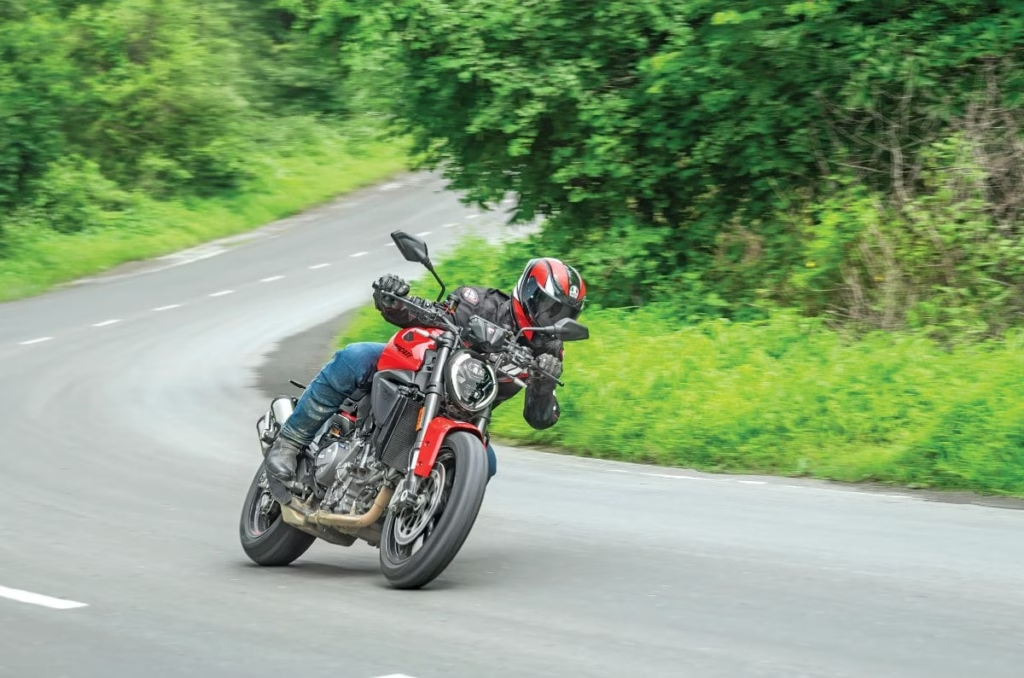
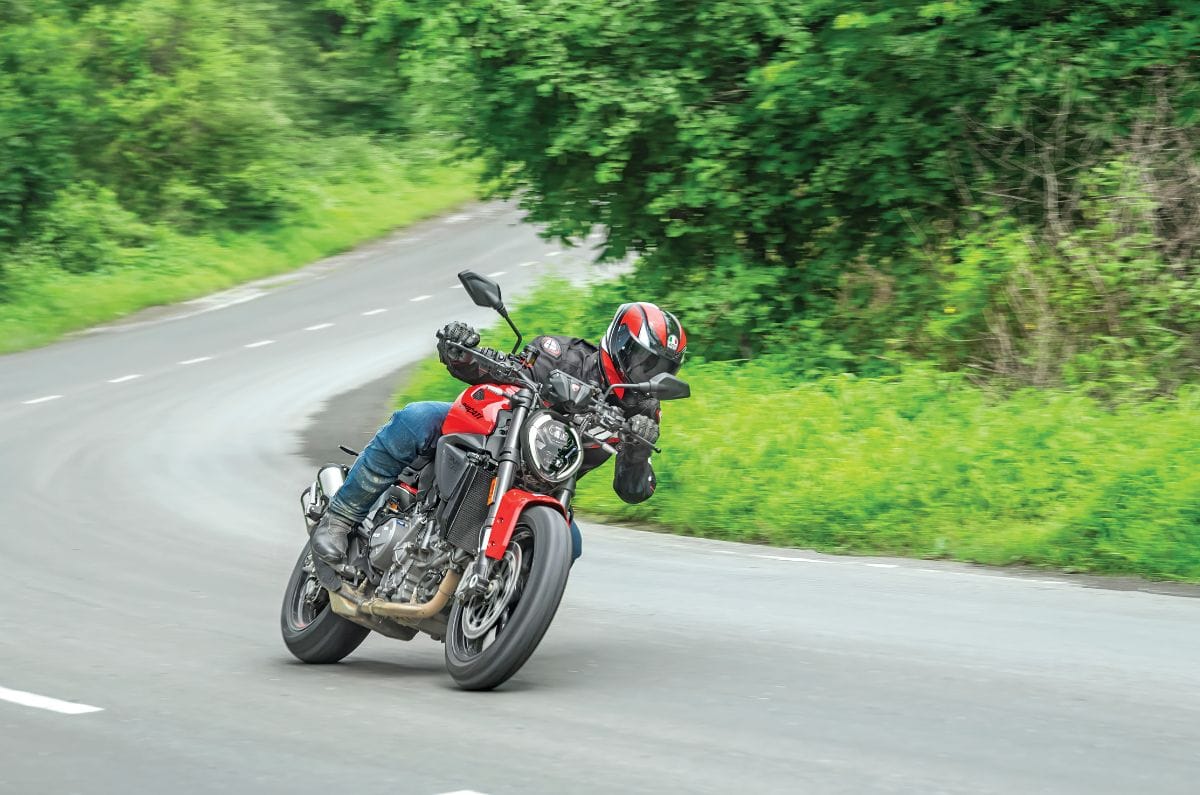
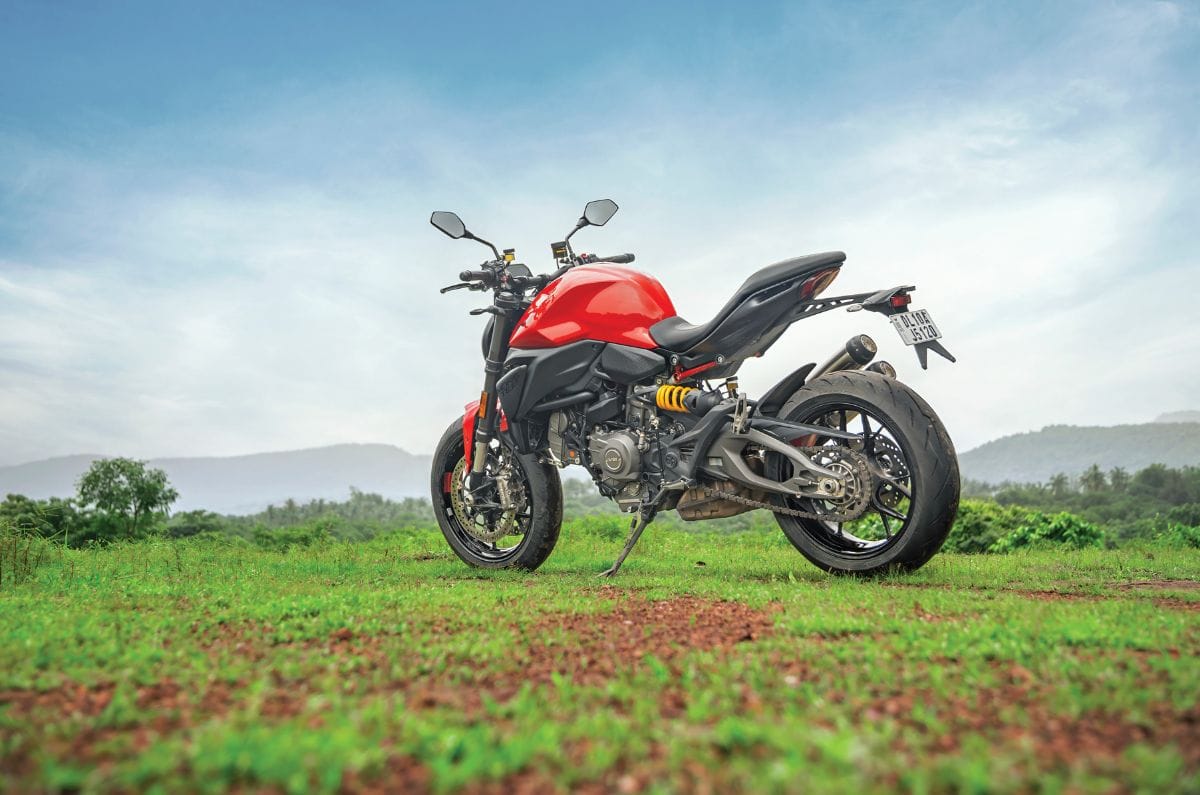
The Monster was perhaps the world’s first ‘parts bin special’, created using a smattering of different parts from various Ducatis of the late ‘80s and early ‘90s. It was a resounding success for the company and remains one of its strongest sellers in India. Today, the Monster is in its fifth generation and is now powered by the company’s new 890cc spring valve V-twin.
Design and Quality – 9/10
Hey, good lookin
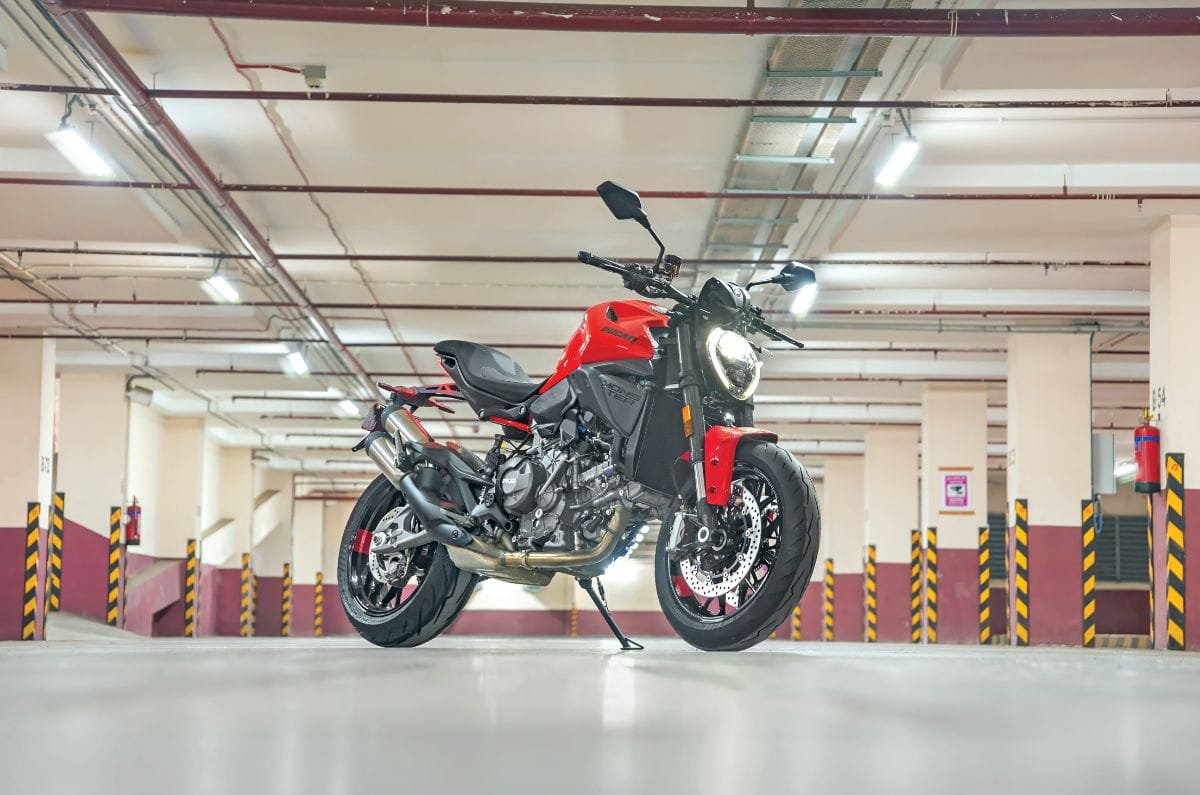
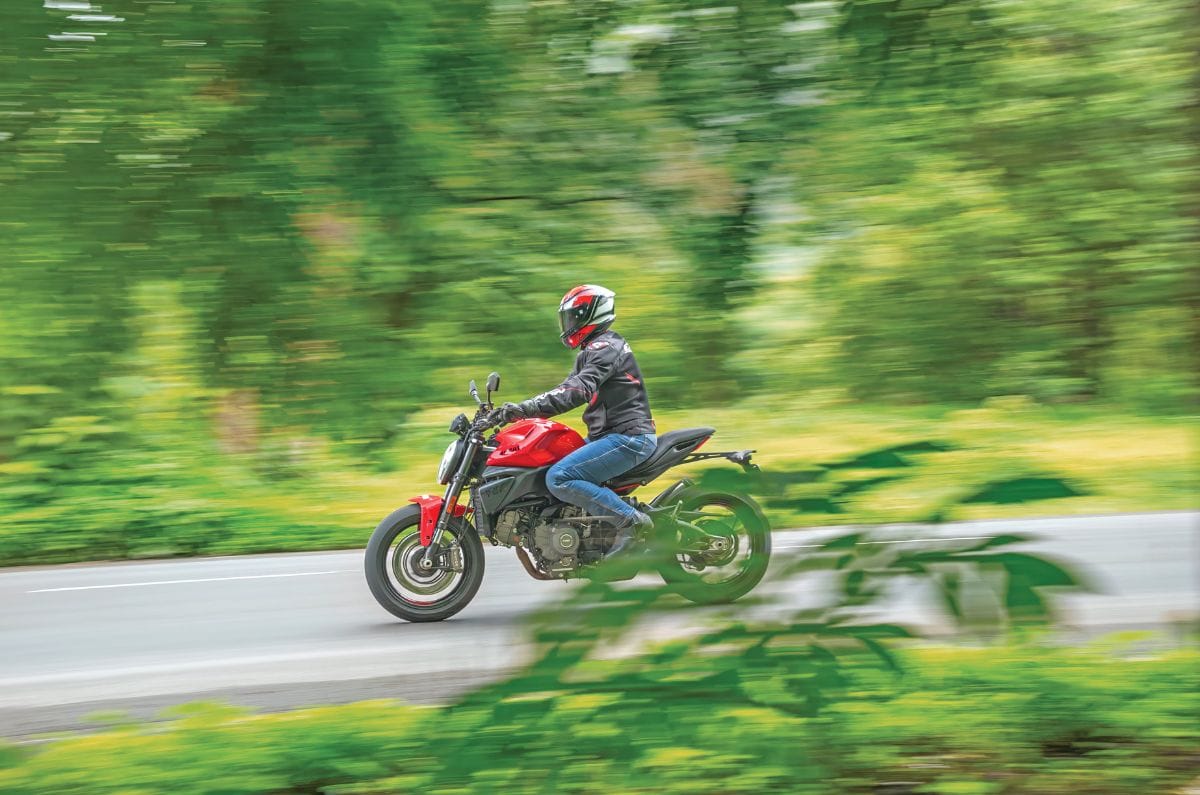
Traditionally, the Monster was known for its butch stance, clean lines and round headlight and the fifth-gen V2 has two of those three attributes. The earlier 937 drew some flak for being too thin so for the V2, Ducati has reverted to a big tank look albeit, at 14L, the capacity is quite small for an engine of this size and the same as before. In an era where most sporty bikes have sprouted winglets and sharp edges galore, the Monster’s textbook, elemental lines are a breath of fresh air. However, it’s definitely not as chunky-looking as the older trellis-frame Monsters – not a complaint to our eyes but purists could be put off.
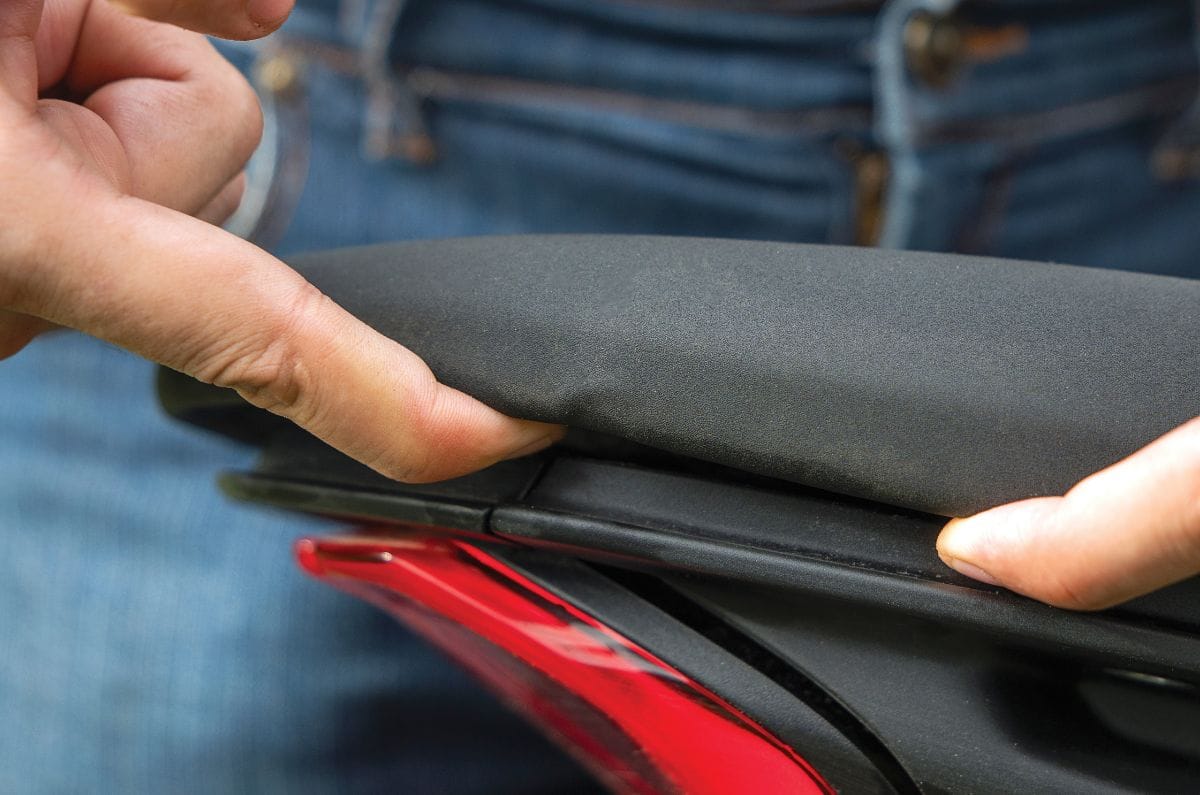
Too big a gap between seat and subframe
Typical of Ducati, quality is high all around and just about everything in sight and touch is well put together. I say ‘just about’ because the mirror housings & stalks feel very budget for a bike of its price and also, the gap between the seat and the subframe is a bit much. On a rainy day, a lot of filth gets kicked into this crevice and to clean it, you need to remove the seat. These are nitpicks but on a bike at this price, something to bear in mind.
Performance and fuel economy – 9/10
Unique and playful heart
Specifications
Values
Max Engine Power
111 hp @ 9000 rpm
Max Engine Torque
91.1 Nm @ 7250 rpm
Transmission Type
Manual
Fuel Type/ Propulsion
Petrol
Engine Type
2 cylinder
Expensive it might be, but the Monster is still the most attainable way to get your hands on Ducati’s new 890cc V-Twin. In a world increasingly populated with parallel-twin engines, Ducati has commendably stuck to its guns and is giving you an authentic V-Twin experience.
In this application, the V2 is tuned to make 111hp (it’s lowest yet) and this number is on the lower side for the segment, but the 91.1Nm of torque it makes, is conversely, one of the higher numbers in the class. Not just that, Ducati claims that from 3,000rpm you have 70 percent of that available and it definitely charges forward with gusto above that threshold. It’s enthralling fun to chase the rather high – for a big twin – 11,750rpm redline and the butter smooth quickshifter ensures you have to wait but a few milliseconds before the next gear brings you the next wave of adrenaline. The exhaust note is a bit muted (Euro5+ will do that) but there’s an enticing intake roar and even lovelier pops and bangs on the overrun, which all add to the theatricity of it.
Yet, for all its zest and verve, Ducati’s latest V2 benefits from the company’s learnings over the years. No longer do you have to fear exorbitant Desmo services or overheating in traffic. Valve clearance checks are now at 45,000km and the cooling system works superbly to ensure the engine never boils over.
However, while the engine doesn’t overheat, being stuck in traffic does result in the rider’s legs slowly being done medium rare. Since you’re sitting right on the top of the rear cylinder, there’s not much that can be done but to build your tolerance and wear motorcycle-appropriate clothing. Its hydraulic clutch too is properly weighty but what annoys more is its grabby nature causing you to lurch forward in traffic.
Ride and Handling – 8/10
On a dime
Specifications
Values
Seat height
815 mm
Front Suspension Type
Showa Ø 43 mm usd fork
Rear Suspension Type
Showa monoshock with adjustable preload. Aluminum double-sided swingarm
Fuel Tank Size
14 L
Chassis type
Aluminum monocoque frame
Front Tyre Size
120/70 – ZR17
Rear Tyre Size
180/55 – ZR17
Kerb Weight
186 kg
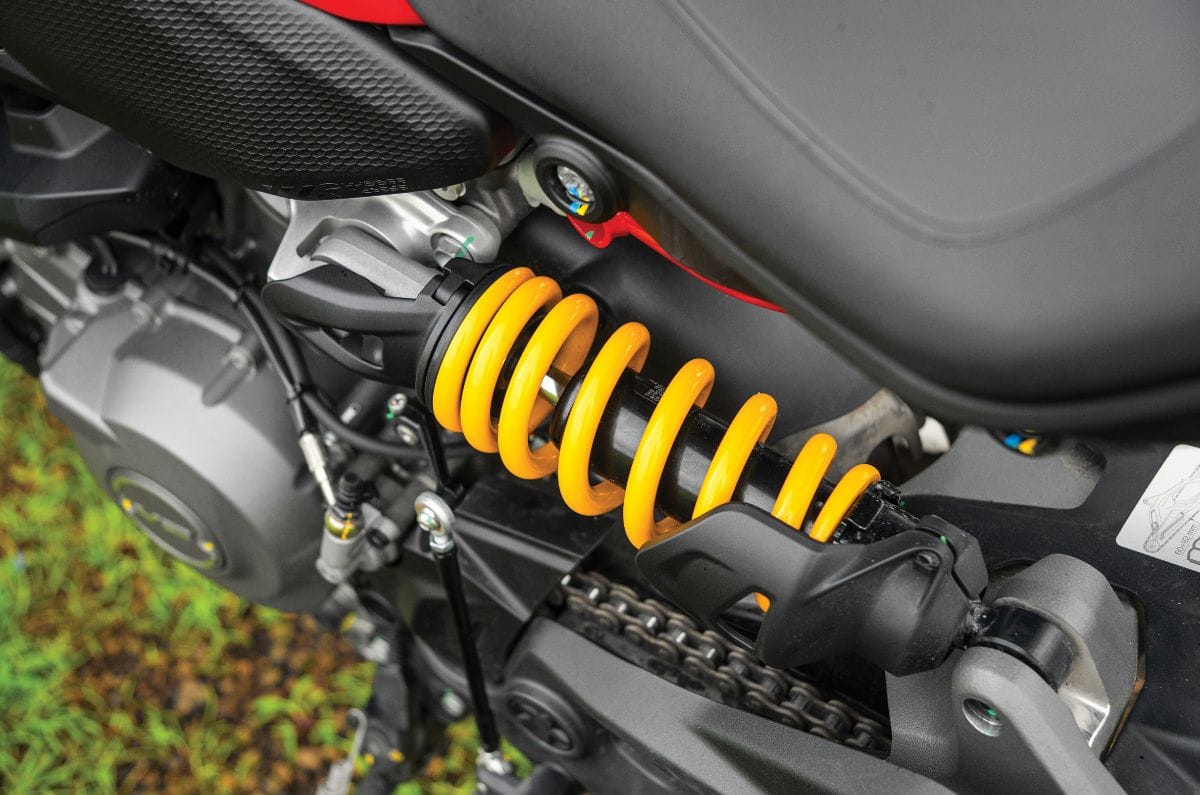
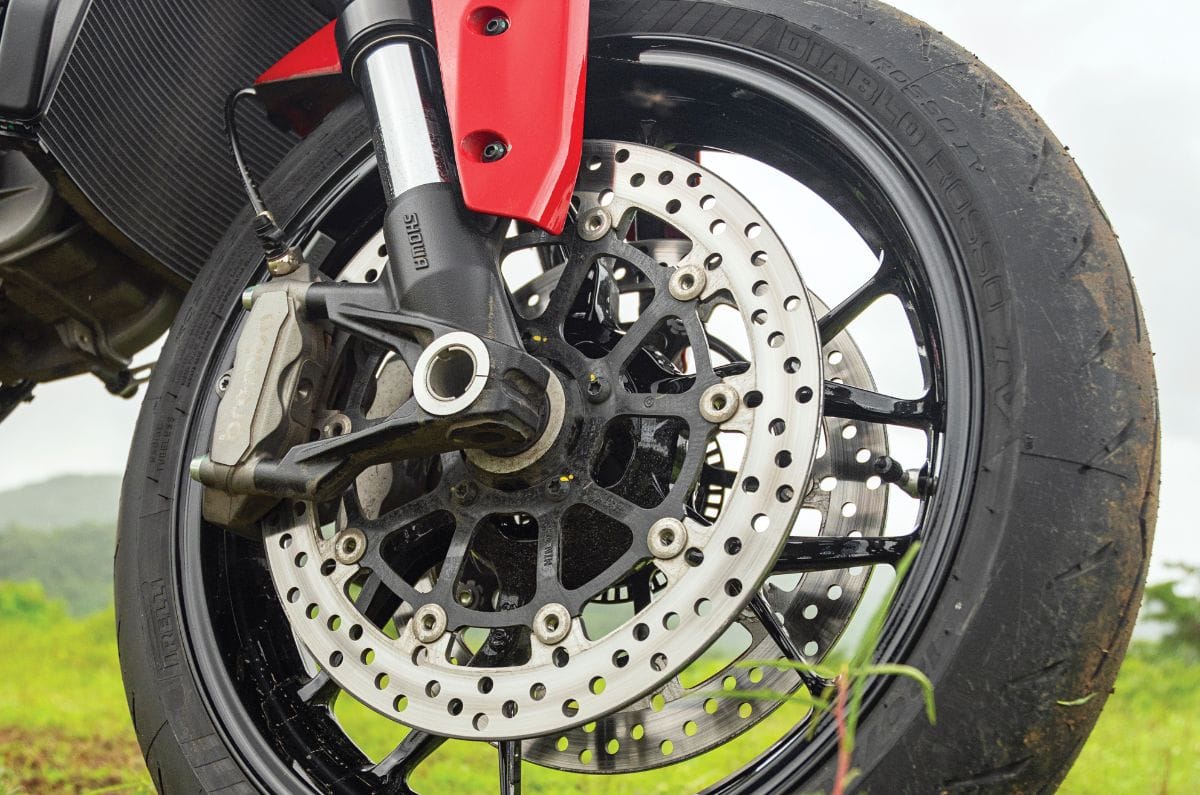
Happily, once you find some nicely laid tarmac roads, these quibbles fade away and the Monster makes up for it with its surefooted and energetic handling. On paper, the chassis components may feel a bit budget (for an 18L rupee machine) but in practice, they work very well. The non-adjustable Showa fork and Sachs monoshock have good poise when you want to attack corners but simultaneously also provide an air of suppleness over bumps, striking a nice balance. Brembo’s M4.32 calipers may have been around for well over a decade now but they bring the Monster to a halt seriously quickly and the radial master cylinder too is bristling with feedback.
What also helps the Monster tip into corners and come to a halt exceedingly well is its weighs just 186kg fully fueled – similar to a RE Guerrilla 450, which has half the displacement! Not only is the Monster one of the lightest bikes in the class, it also has a friendly 815mm perch (in the context of big, sporty machines). The rider’s triangle too is not overly committed and strikes a nice balance between being engaging yet comfortable. These attributes mean that the Monster is one of the friendliest big bikes you can buy.
Suspension has a decent level of pliancy to it
Features and safety – 8/10
There when you need them, mostly
Brembo M4.32s have great stopping power and good feel at the lever
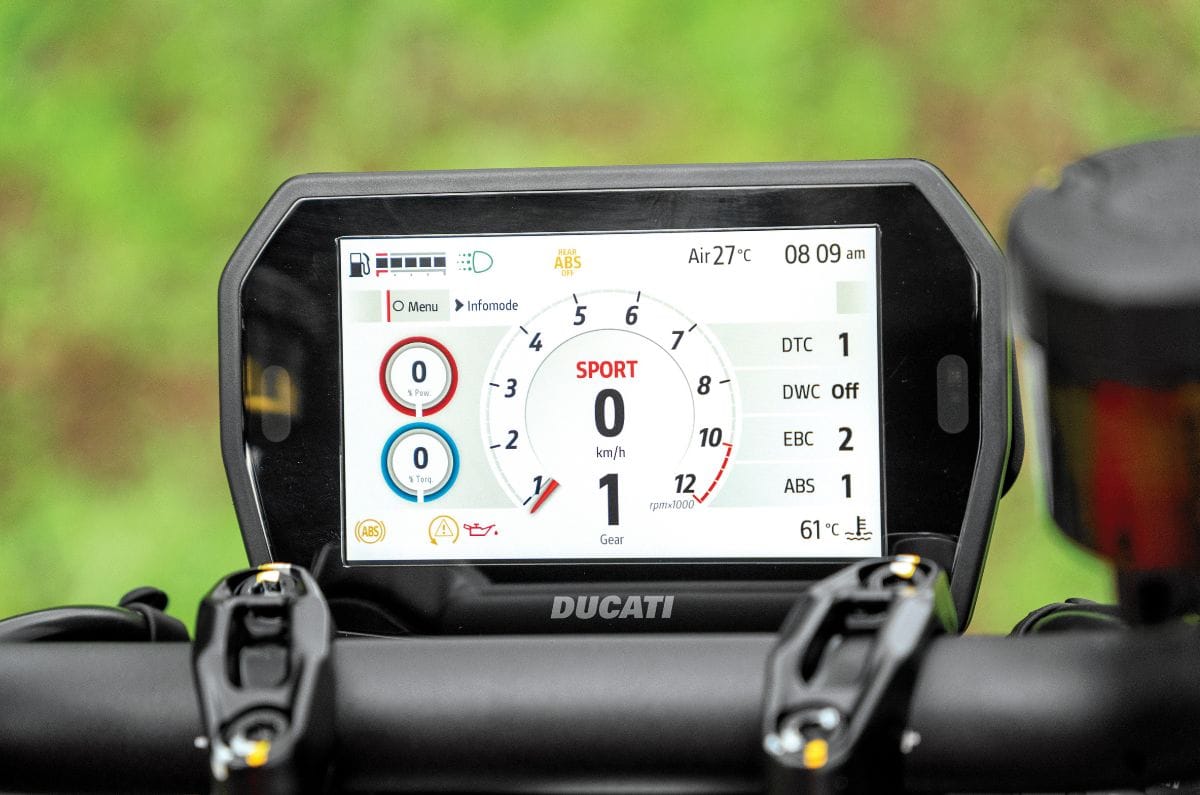
What further reinforces the Monster’s approachability (especially to someone who’s buying their first big bike) is its array of electronic rider aids. There are four riding modes (Sport, Road, Urban and Wet) with dedicated settings for power levels, traction control, wheelie control, engine brake control and ABS intervention. These work exceptionally well when you need them to and fade into the background when having fun – just the way it should be! Typical of Ducati, you can go into each mode and adjust everything to your preference, giving you complete control over the electronics – an appreciable touch.
Specifications
Values
Anti-Lock Brakes (ABS)
Dual channel
Front Disc/Drum Size
320 mm
Rear Disc/Drum Size
245 mm
Calliper Type
Front – 4 Piston, Rear – 2 Piston
Traction control
Yes
Riding Modes
Yes
Cruise Control
No
Quickshifter
Yes
TFT colour Instrument cluster
Yes
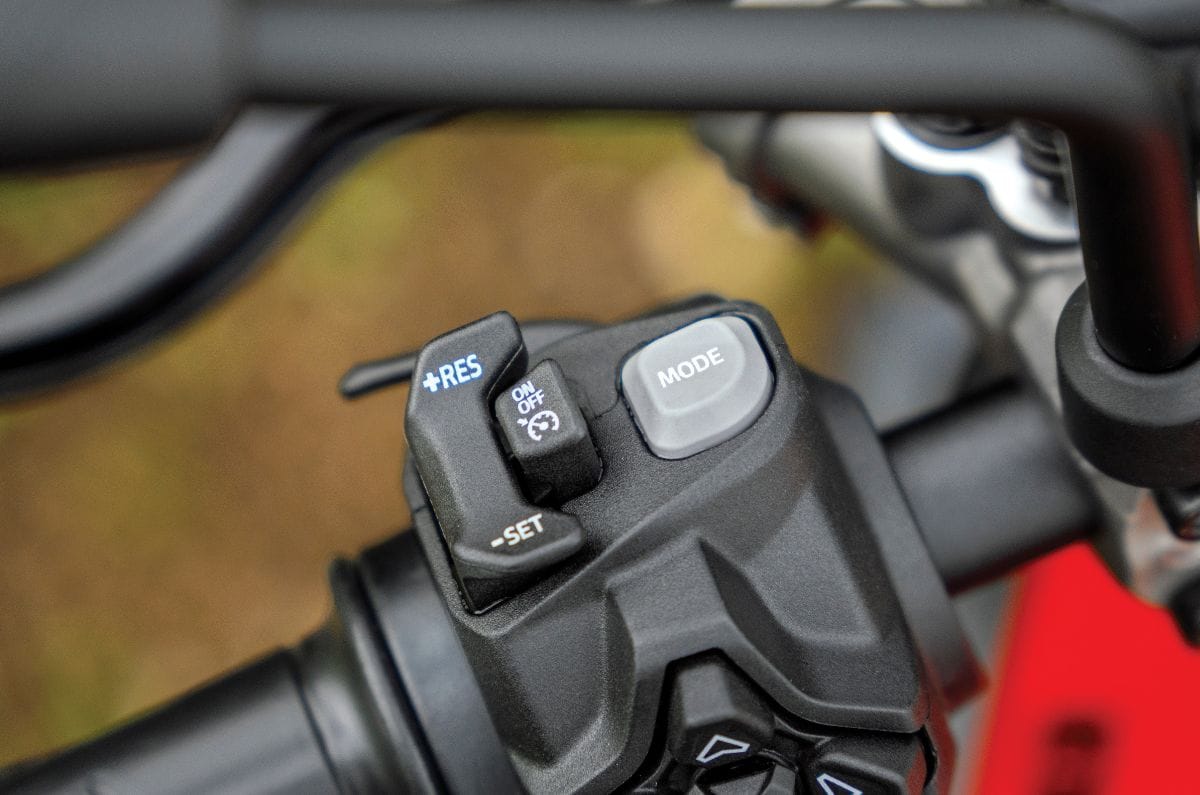
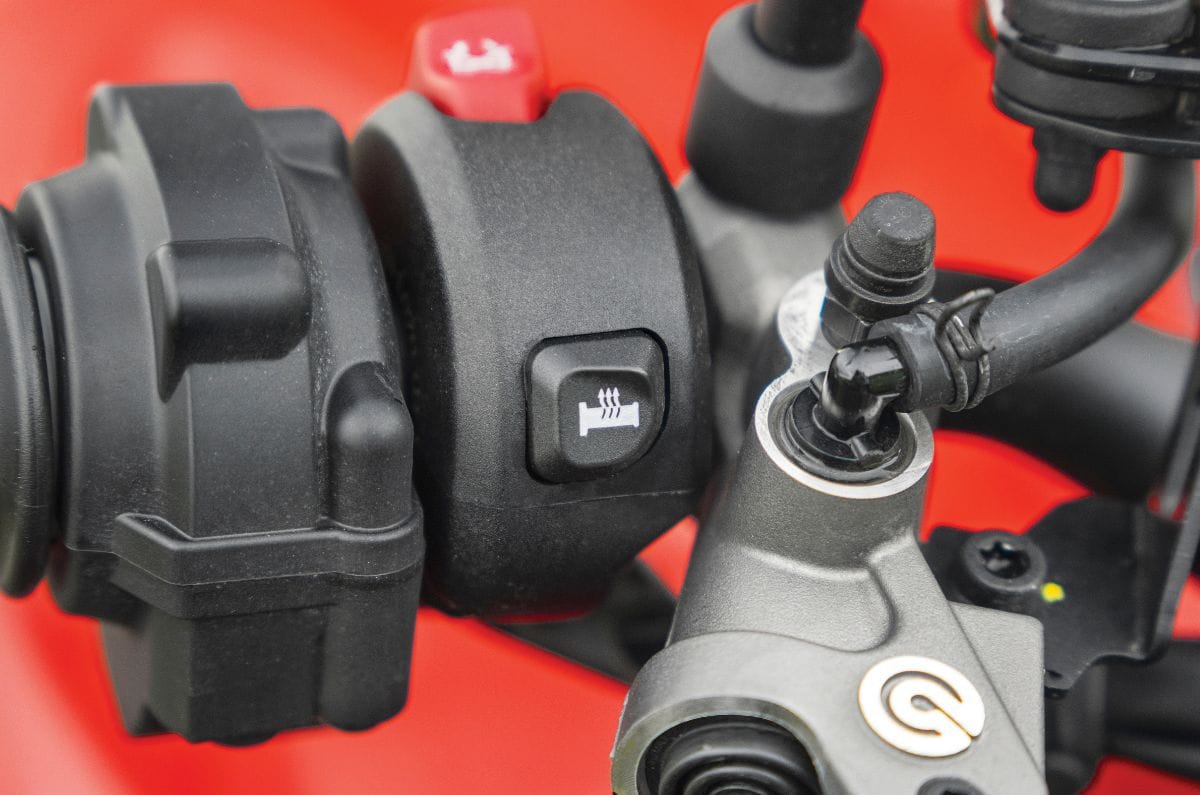
However, what I certainly don’t appreciate is the fact that Ducati has provided you the switchgear and wiring for the cruise control and heated grips on the bike but is deliberately gatekeeping the software in lieu of princely sums of Rs 40,009 and Rs 41,013, respectively. This trend of locking valuable features already present on the expensive machine you buy until you pay an additional sum needs to be abdicated promptly before it becomes commonplace.
5-inch TFTs shared with other Ducati V2s and has intuitive functionsActivating the existing Cruise Control functionality costs Rs 40,009 extra!Activating heated grips will set you back by Rs 41,013
Price and verdict – 7/10
Pretty penny
The words above are apt to describe the new Monster V2, which starts at Rs 13.99 lakh (ex-showroom, India) and the price only goes northward for different colours and if you opt for the Plus variant, with the flyscreen and pillion seat cowl. There’s no justifying the very large price delta to its European and Japanese counterparts, which are accomplished machines in their own right.
What are strong points on the Monster are that it is a desirable, good-looking and exciting machine that gives you access to the alluring world of Ducati. Plus, today’s V2 Ducatis now have ownership costs that are more or less in line with their peers and the company’s aftersales is a particularly strong highlight for customers. If all that sounds like something you are looking for, the Monster V2 should be on your radar.
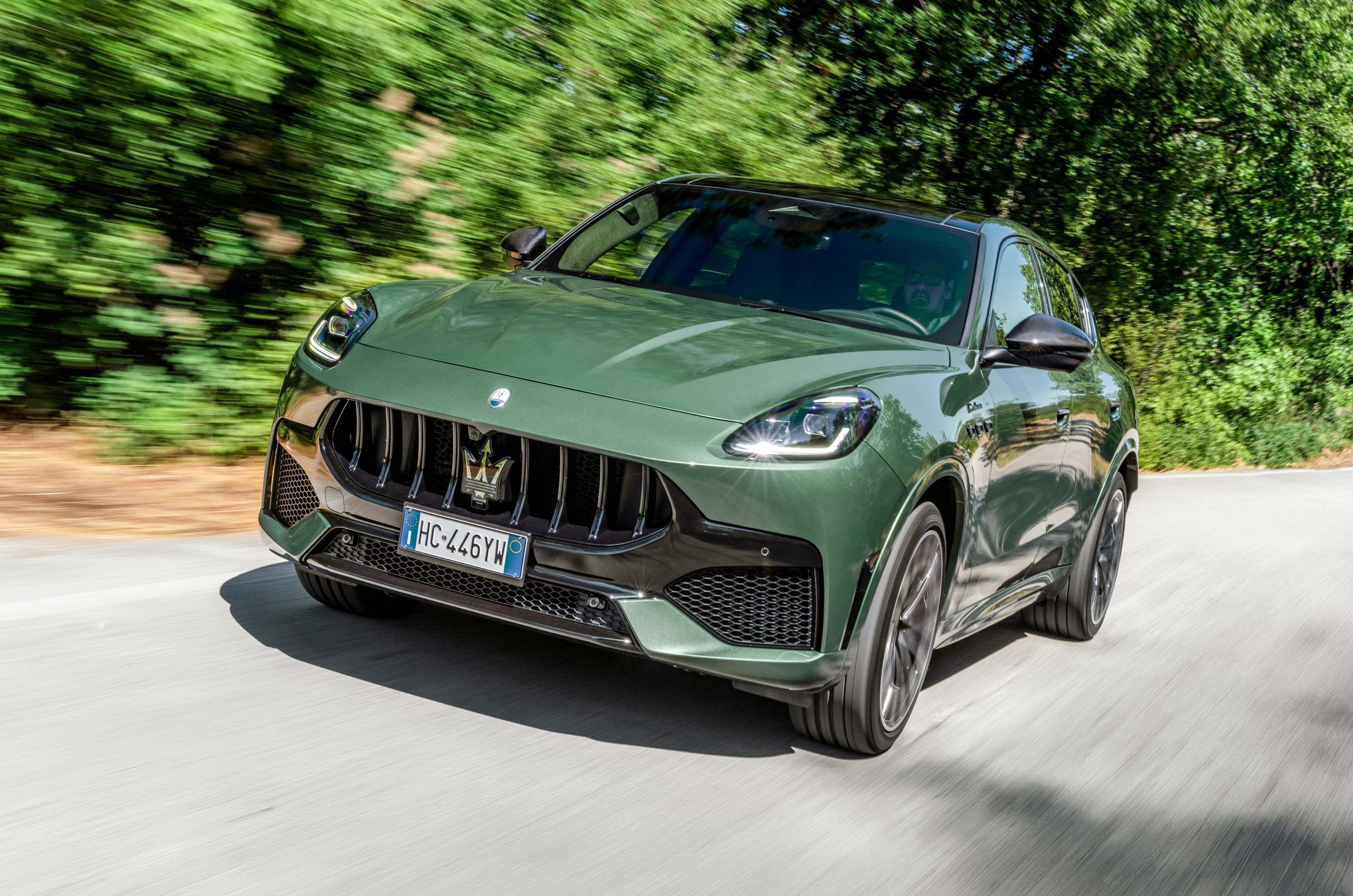
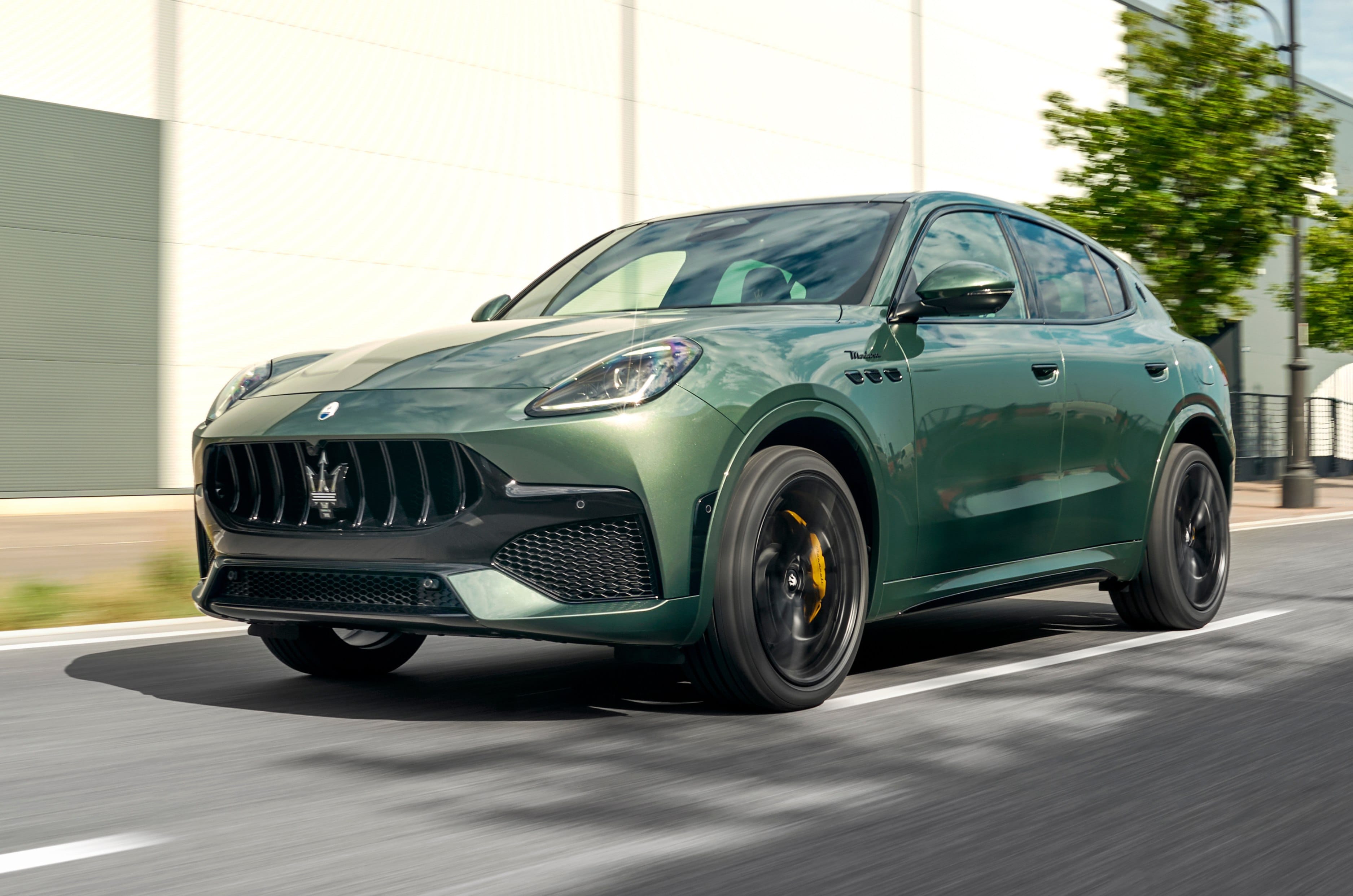
The Grecale is Maserati’s take on the mid-size luxury SUV and in SUV-crazy India will likely be the first port of call for buyers intrigued by the iconic brand. It’s been updated outside, inside and under the hood to help convert that mystique into sales.
2027 Maserati Grecale Exterior Design and Engineering – 8/10
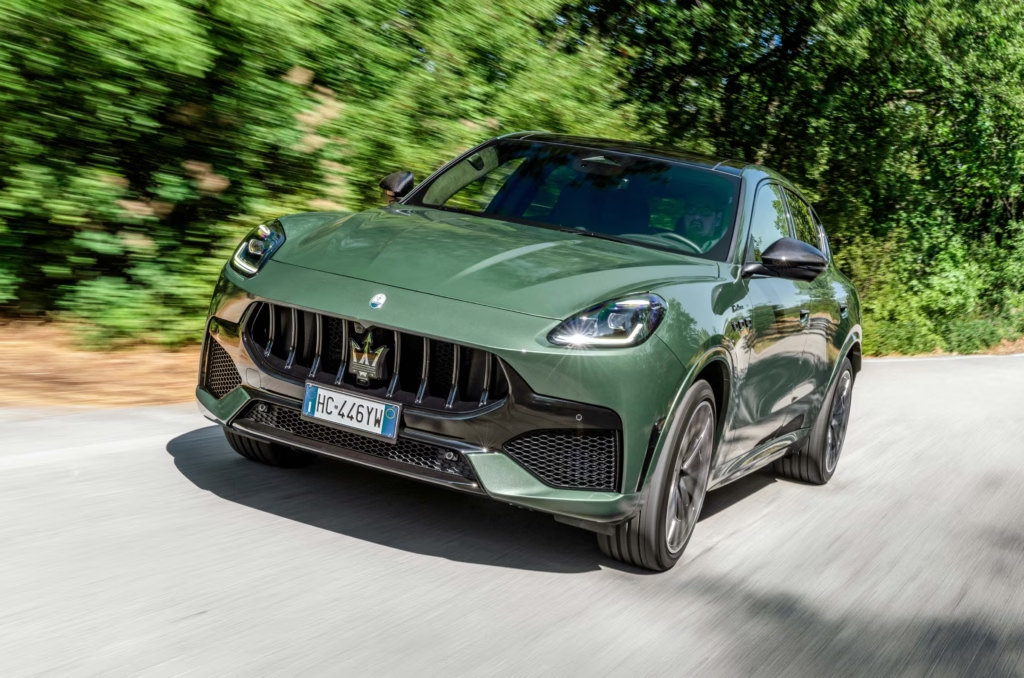
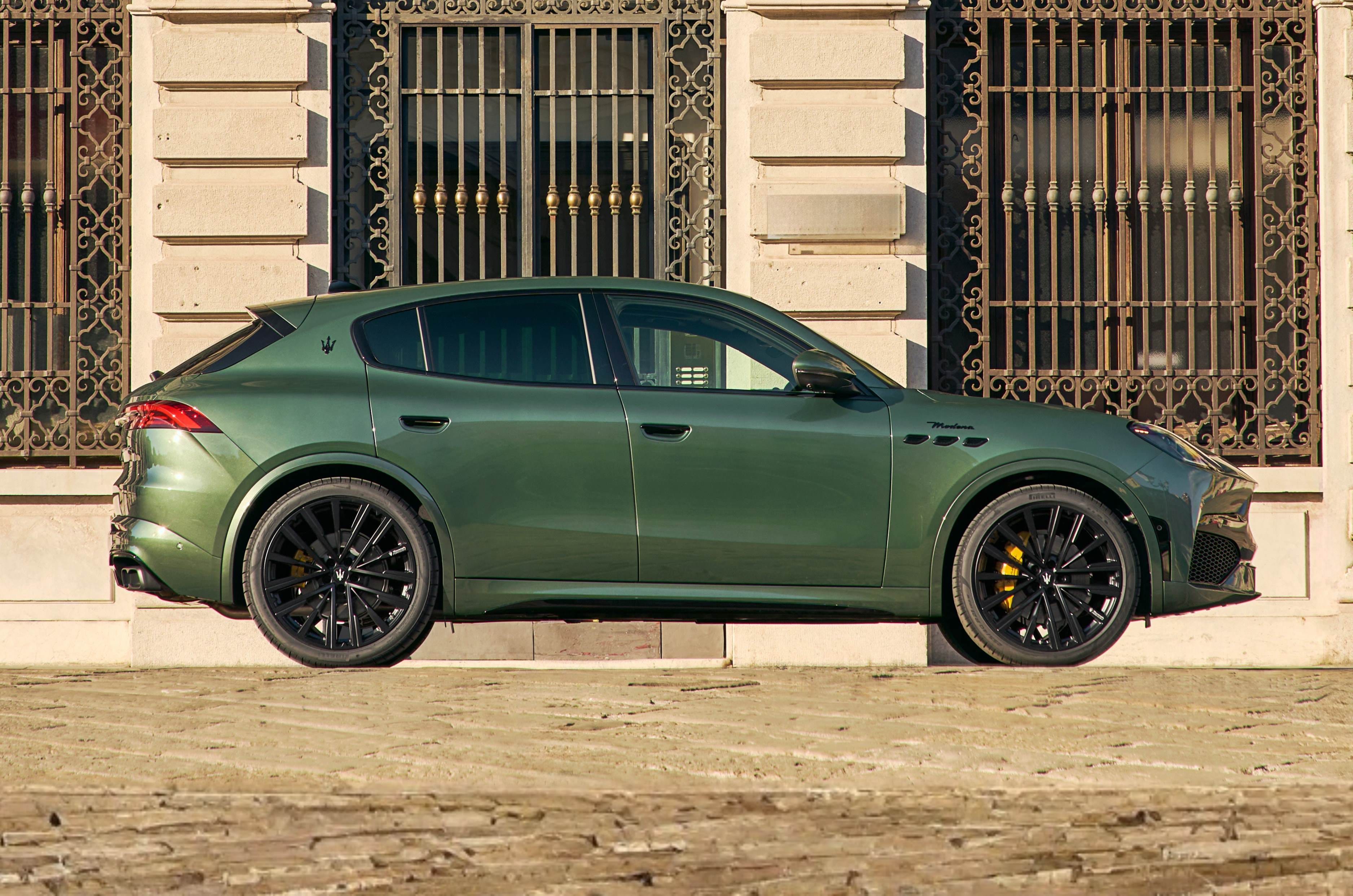
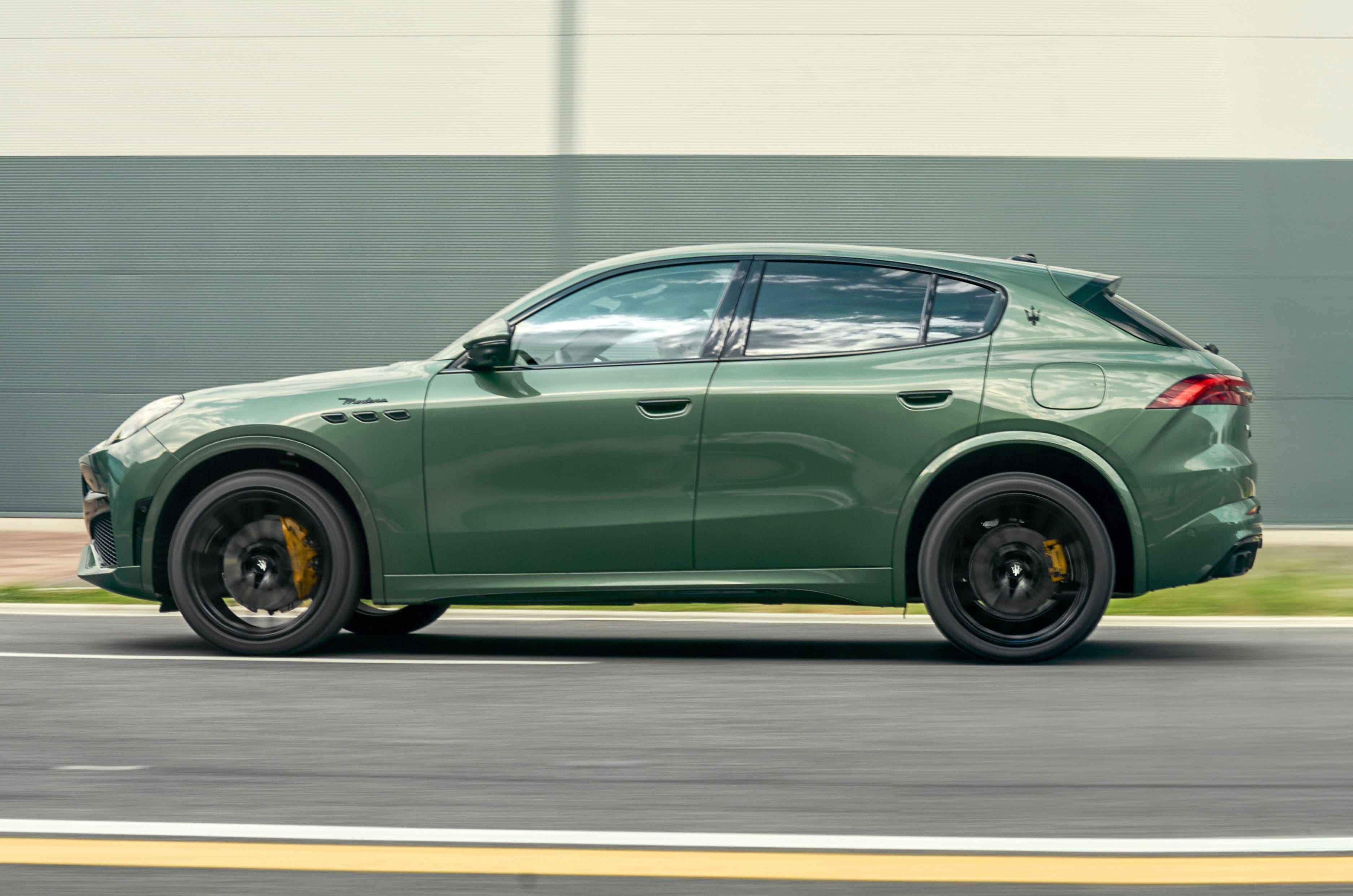
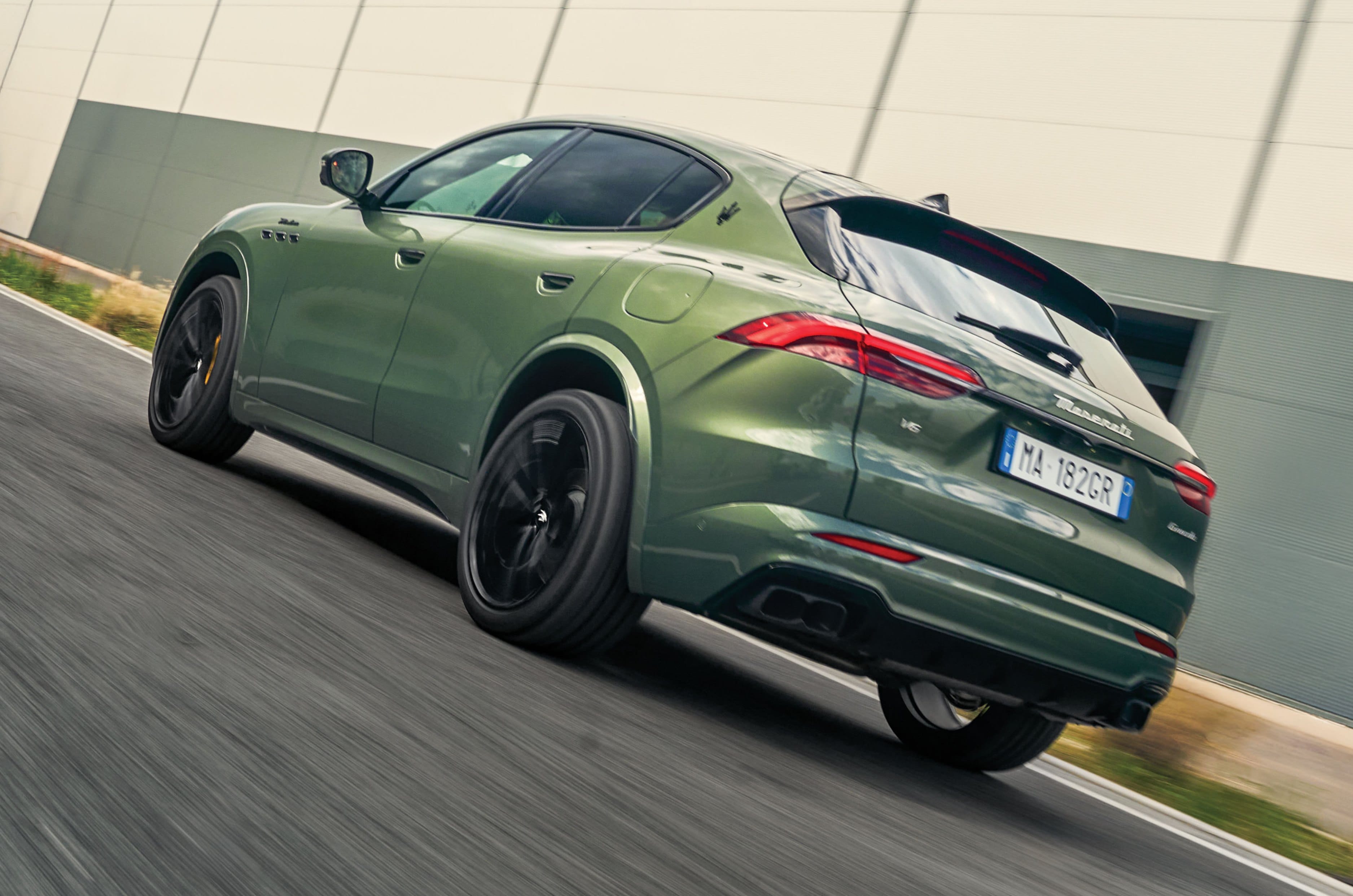
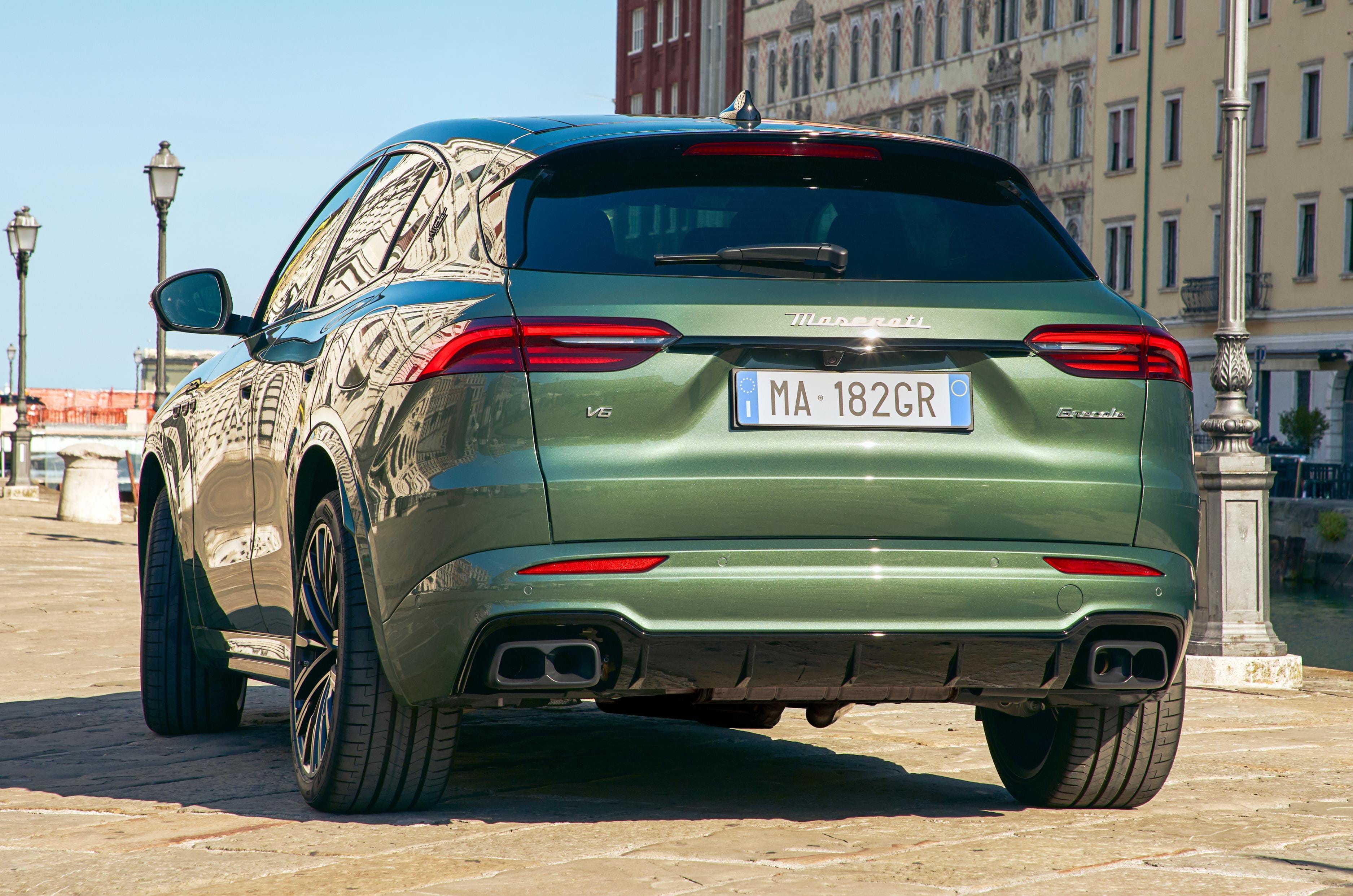
Like most Maseratis, the Grecale is one of those cars that looks better in the metal than it does in photographs. There’s Italian flair to the design, with the proportions finely balanced across its 4.8m length. The classic Maserati cues – voluptuous fenders, vents aft of the front wheels and the cut of the glasshouse – are all there and help establish the marque, even in profile.
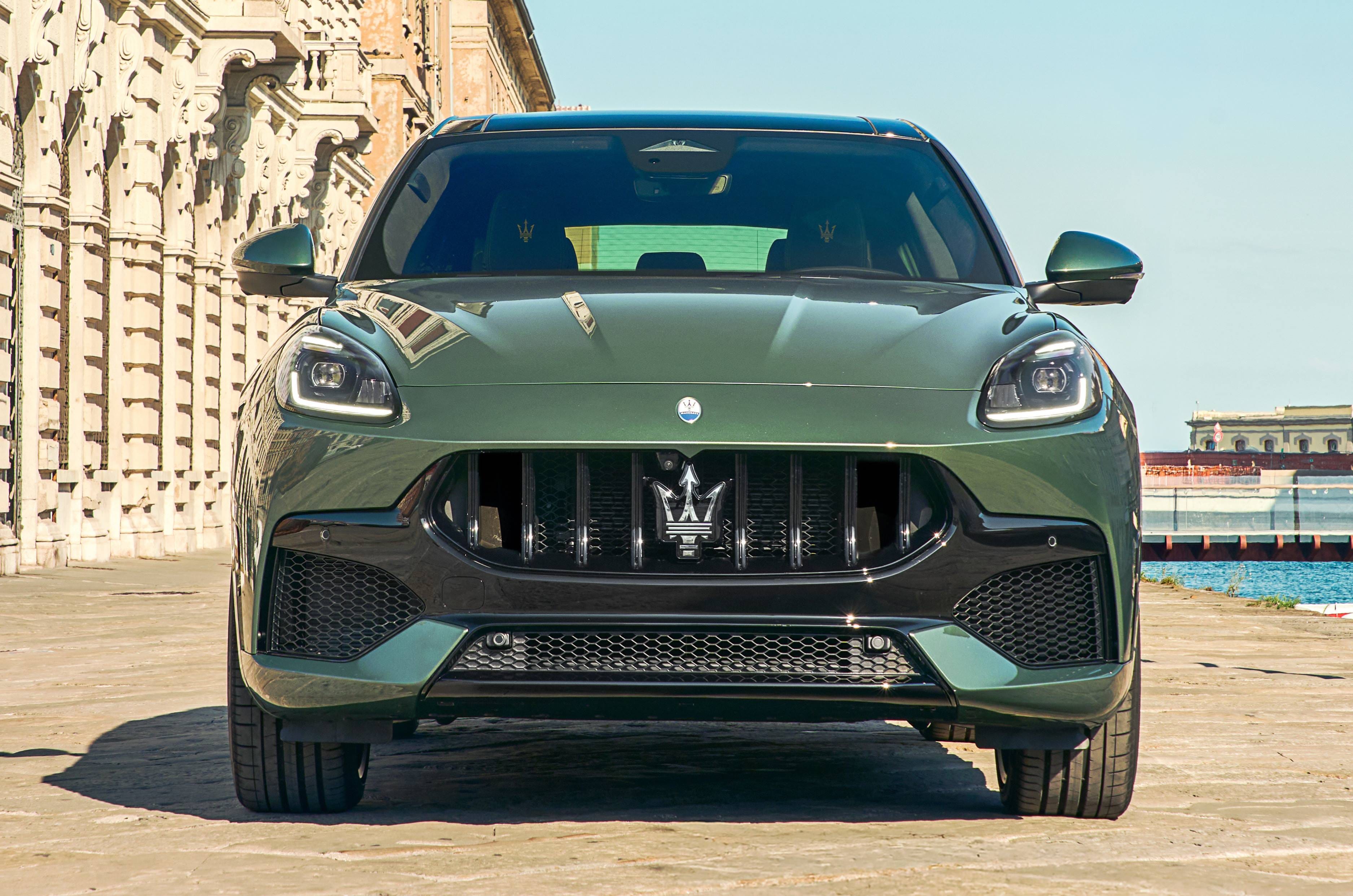
The 2027 Grecale gets a more prominent concave grille with the Trident logo at its centre.
The key visual change comes at the front. A strong horizontal crease visually divides the face into two distinct sections. The upper portion retains the familiar sculpted Maserati look, while the lower section adopts a far more technical and aggressive appearance. Larger air intakes flank a more pronounced concave grille, with the Trident logo taking centre stage. The changes aren’t dramatic, but they make the Grecale look considerably sportier and give it much stronger road presence. Ahem, that visual link to the humble Suzuki Swift is also less pronounced now.
Signature vents on the front fenders add character to the Grecale’s profile.
There are minor tweaks to the trim elsewhere and, as ever, there’s lots of scope to customise the appearance. I wouldn’t change our test car’s arresting Verde Royale-on-black colour scheme, thank you very much.
2027 Maserati Grecale Interior Space and Comfort – 8/10
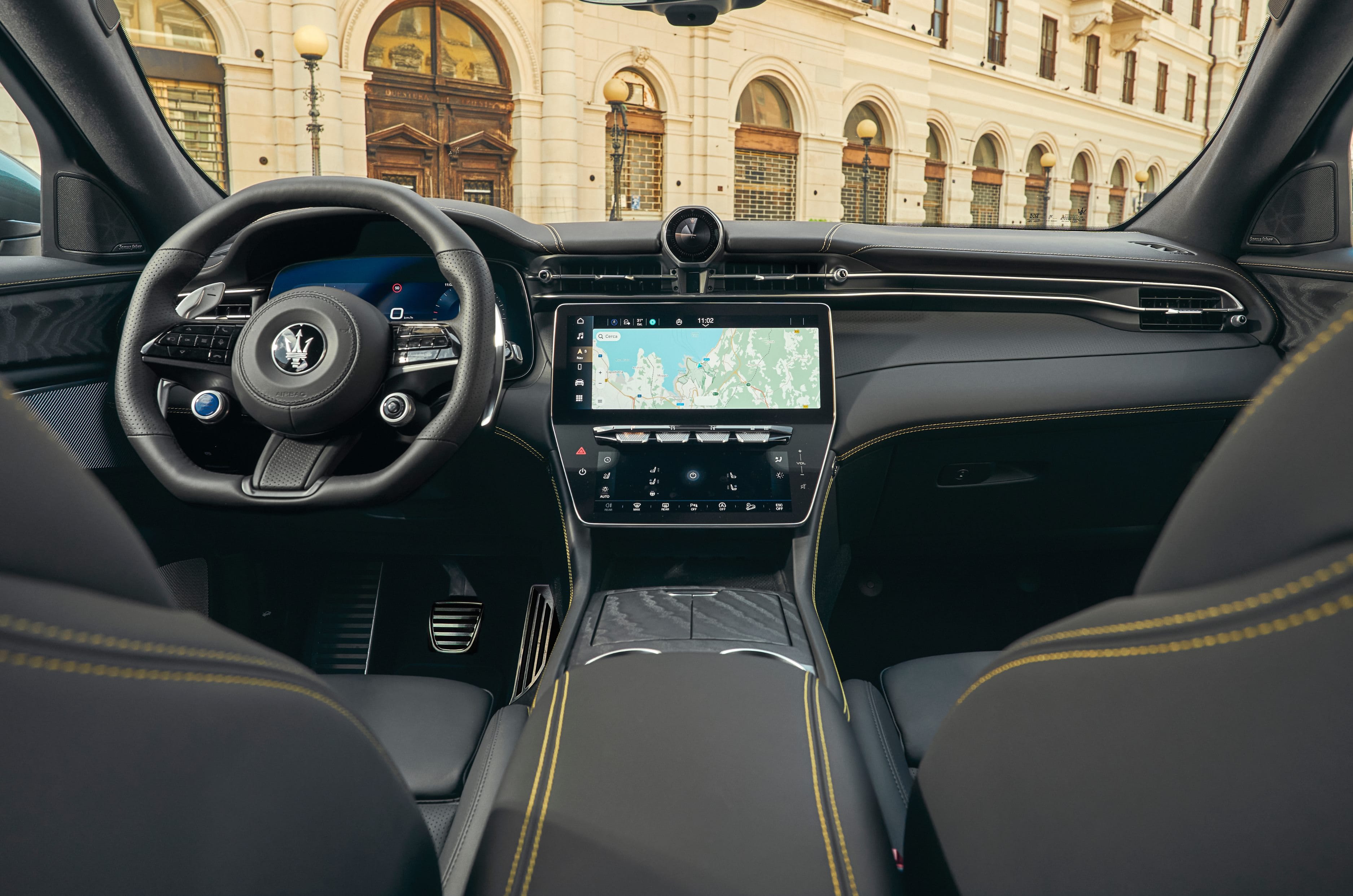
The cabin continues to combine rich leather upholstery with stitched dashboard detailing.
Not much has changed inside, but that’s no bad thing because this remains a cabin that strikes a nice balance between modern technology and traditional Italian craftsmanship.
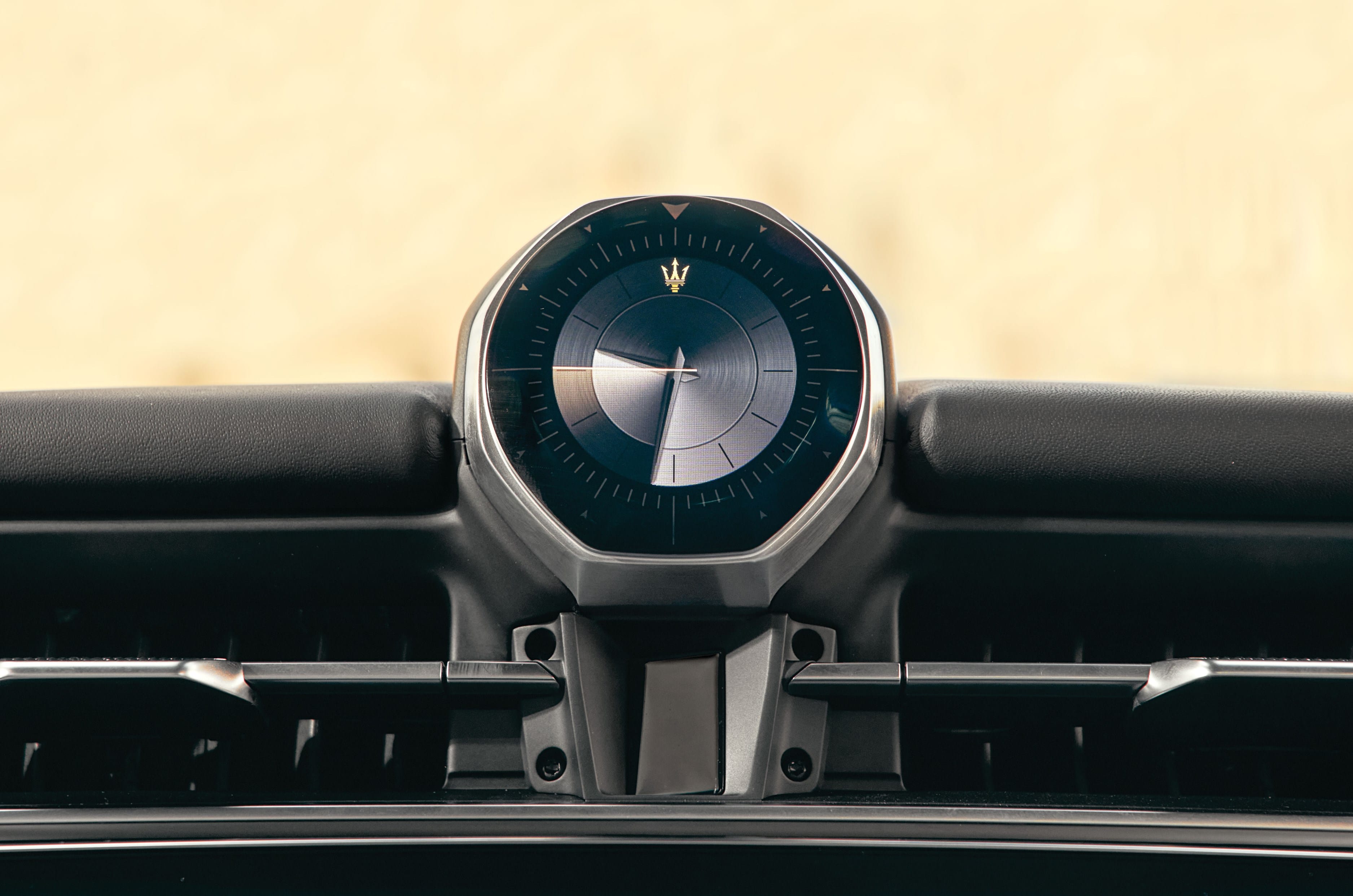
There are still four displays: a digital instrument cluster, a large central touchscreen, a lower touchscreen for climate control functions and Maserati’s signature clock. Each has been subtly updated. The digital clock gets a revised face and new glass designed to mimic the appearance of a conventional analogue timepiece while retaining its digital functionality.
The digital clock gets a new face and glass designed to imitate an analogue timepiece.
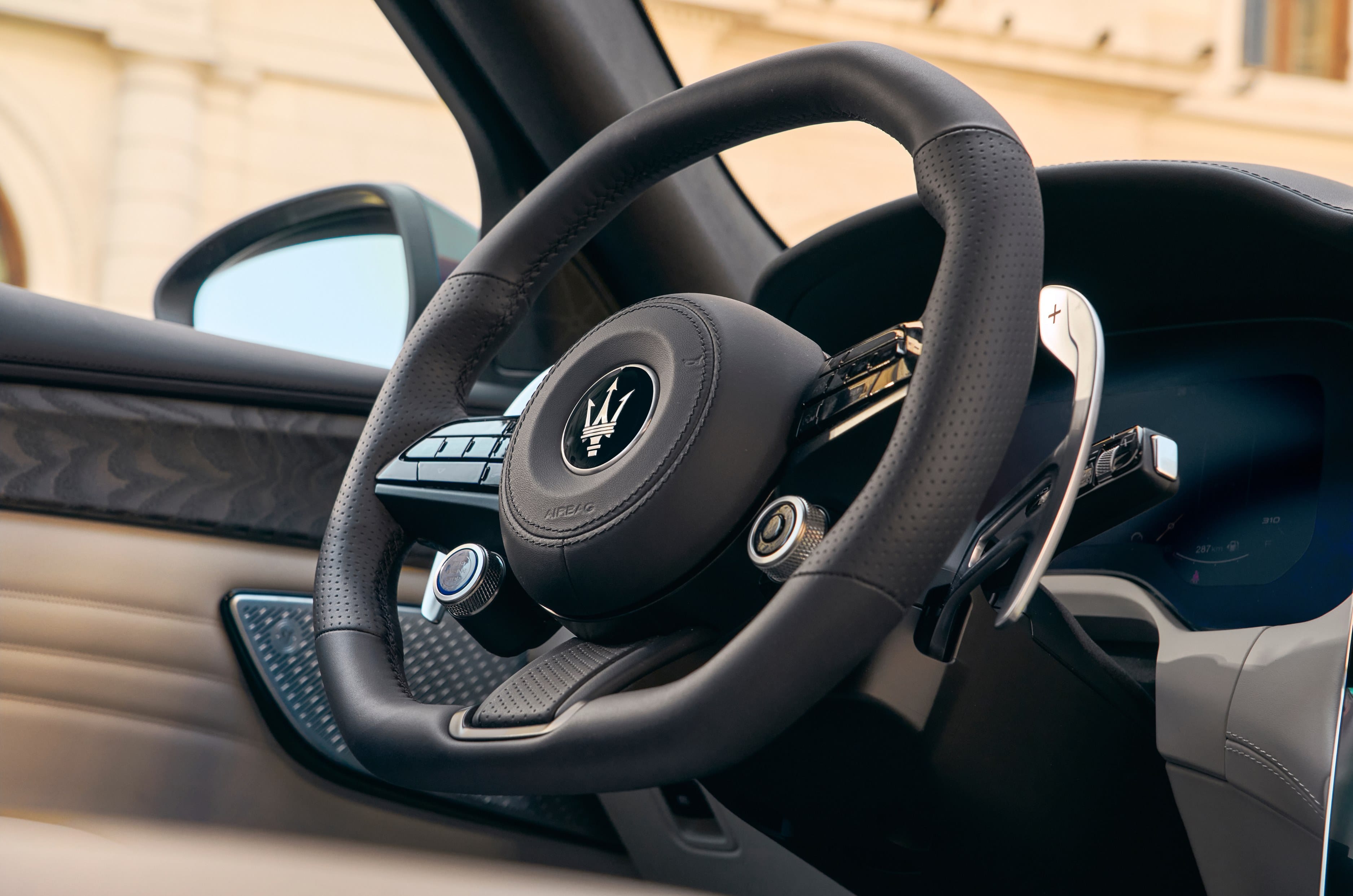
Lower down, the old gear selector buttons have made way for metallic toggle switches that look and feel richer. The steering wheel has also been redone with a squared-off shape that feels great to hold. Behind it sit Maserati’s trademark oversized aluminium paddle shifters, mounted to the steering column, and they remain among the most satisfying paddle shifters you’ll use in any performance SUV.
Grecale’s aluminium paddle shifters are among the most satisfying to use.
Despite the screen-heavy layout, the Grecale’s interior isn’t lacking on warmth. Rich leather upholstery, beautifully stitched dashboard trim and some plush materials (exposed carbon fibre for the win) tell you a lot of love and work has gone into putting the interior together. Some plastics do feel ordinary, though.
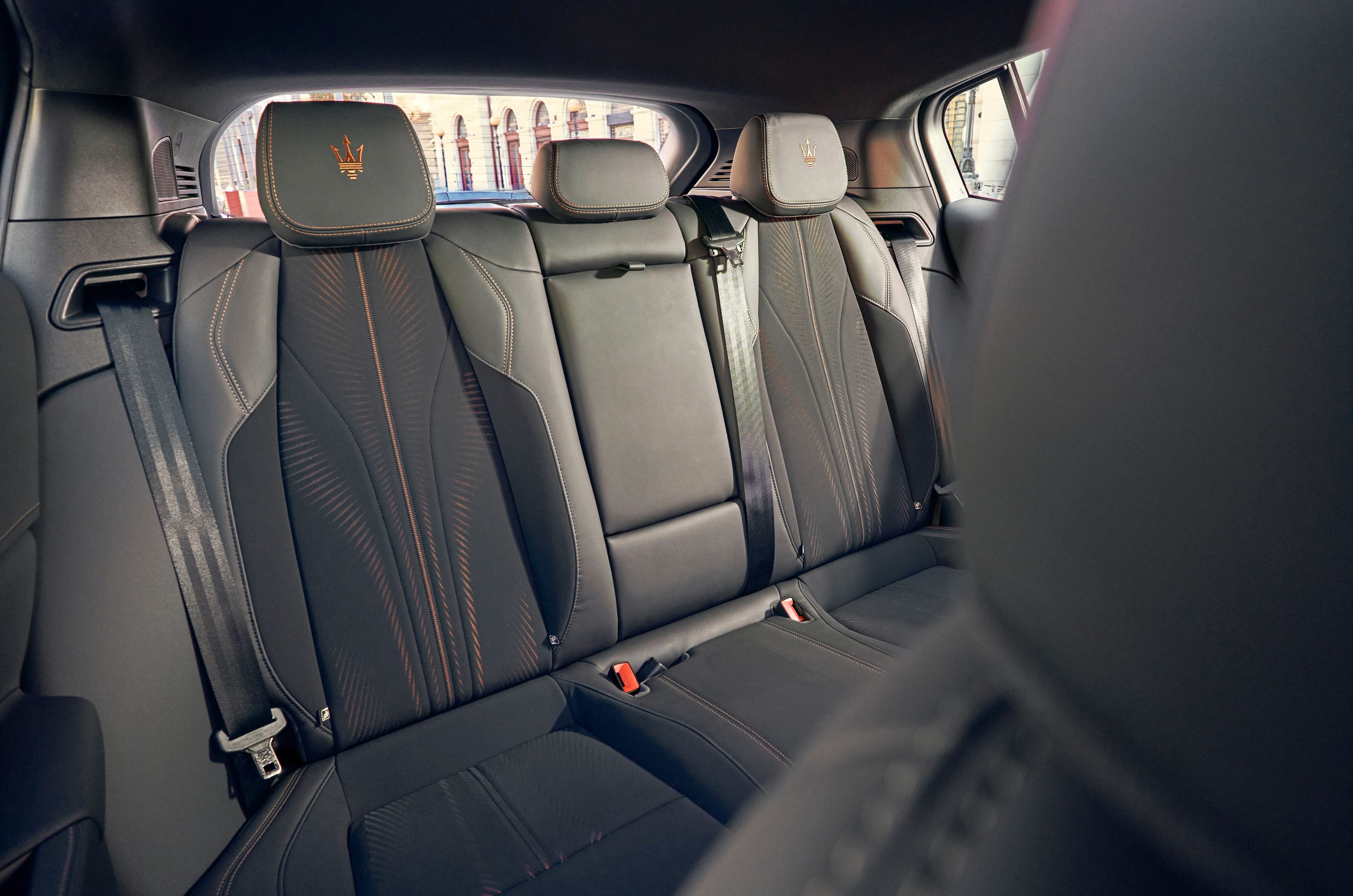
Rear passengers get good kneeroom and headroom, although the backrest is not reclinable.
The front seats are supportive and are the best ones in the house. While rear seat space is better than that of a Porsche Macan (the car the Grecale was built to beat), it’s not the ideal buy for chauffeur-driven buyers who will see more value in a like-priced Merc GLE or BMW X5.
Rear-seat passengers will find kneeroom and headroom more than adequate, although a reclinable backrest would have added another layer of comfort.
2027 Maserati Grecale Performance and Refinement – 8/10
The Grecale continues to be offered in three flavours – GT, Modena and Trofeo – but today’s Modena isn’t exactly the same as the one before. While the Modena was powered by a 2.0-litre four-cylinder turbo-petrol producing 330hp, the new Modena, confusingly enough, also gets Maserati’s 3.0-litre Nettuno V6, with output pegged at 390hp. It neatly bridges the gap between the entry-level 300hp Grecale GT and the full-fat 530hp Trofeo.
2027 Grecale Modena switches to 3.0-litre V6 from the erstwhile 2.0-litre 4-cylinder mill.
It’s easy to fall for the charms of the ‘new’ Modena. The new 390hp V6 comes across as a much more natural fit for something with the Maserati badge. There’s ready power at hand and a nice pull past 6,500rpm when the roads allow. There’s great fun working through the gears too, partly because of the feel at the paddles and partly because of the ‘braaap’ from the exhaust during shifts. The soundtrack, in general, is very appealing, with a gentle growl growing into a muscle-car burble. How much of that sound originates from the engine and exhaust, and how much is enhanced through the speakers, is difficult to tell, but the end result is undeniably enjoyable.
2027 Maserati Grecale Ride Comfort and Handling – 8/10
Its sporty setup lets some road imperfections through, but it stops short of feeling uncomfortable.
What’s also easy to glean is that the Grecale isn’t trying to be a soft, comfort-focused luxury SUV. There is a definite sporting edge to the way it rides and handles. You’ll feel bumps and imperfections in the road more readily than you would in some rivals, although it never crosses the line into feeling harsh or uncomfortable.
Adaptive dampers let you adjust the suspension response through via drive modes.
Adaptive dampers allow you to tailor the suspension’s responses depending on the selected drive mode, and while they do make a noticeable difference, even the most comfort-oriented setting stops short of completely isolating you from the road. The way to look at it is that it allows a little more of the driving experience to filter through, reminding you that this is a Maserati first and an SUV second. The crisp handling is up there with the now-retired Porsche Macan ICE, and that’s high praise.
2027 Maserati Grecale Price and Verdict – 8/10
The updates for 2026 may not completely transform the Grecale, but they make an already distinctive luxury SUV a more convincing proposition. The sharper styling gives it greater visual presence, while the introduction of the V6-powered Modena fills an important gap in the range. More importantly, it strengthens the Grecale’s case for anyone in the market for an SUV that prioritises driver appeal.
The timing couldn’t be better either. Maserati is renewing its focus on India with a new dealer network and a stronger push in the market. The Grecale will continue to command a premium over similarly sized luxury SUVs (we expect the range to start at Rs 1.2 crore ex-showroom), but it has the style and character to charm its way into contention.