Honda CB500 vs Rivals: Price and specifications compared

Honda CB500 vs Rivals: Price and specifications compared
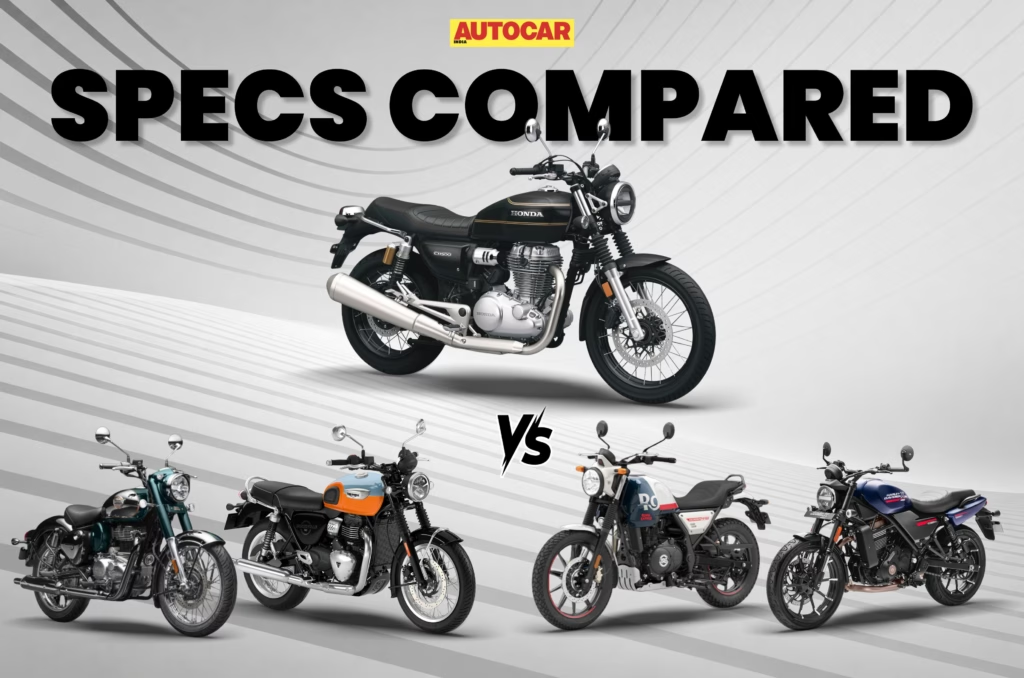
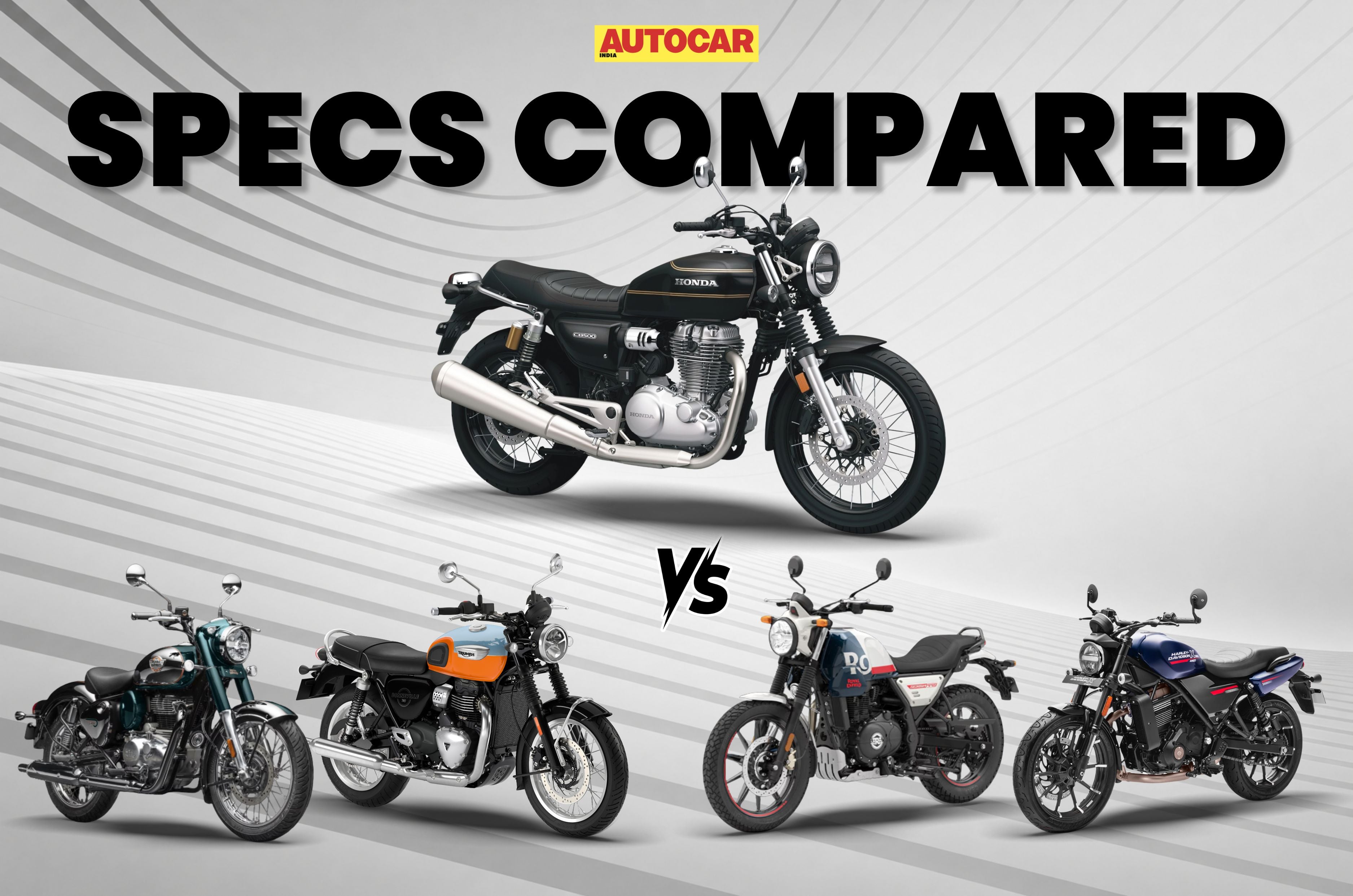
An render showing the spec comparison between the, Honda CB350, Harley-Davidson X440 T, Triumph Bonneville T40, Royal Enfield Scram 440 and Classic 350

Honda has revealed the specifications for the CB500, so it’s only natural that we see how it stacks up against its main rivals such as the Harley-Davidson X440 T and Triumph Bonneville T40. For good measure, we’ve even thrown in other lower-priced and lower-spec but far more popular alternatives like the Royal Enfield Scram 440 and the king of this class, the Classic 350. Here is how these stack up against each other on paper.

Honda CB500 vs Rivals: Engine and output  

The Honda CB500 shines with plenty of low-to-mid range torque


Honda CB500

Harley-Davidson X440 T

Triumph Bonneville T40


Royal Enfield Scram 440

Royal Enfield

Classic 350

Engine

501.7cc, single-cylinder, oil-cooled

440cc, single-cylinder, oil-cooled

350cc, single-cylinder, liquid-cooled

443cc, single-cylinder, oil-cooled

349cc, single-cylinder, liquid-cooled

Power

28.14hp at 5,250rpm

27hp at 6,000rpm

29hp at 9,000rpm

25.42hp at 6,250rpm

20.2hp at 6,100rpm

Torque

43.3Nm at 3,750rpm

38Nm at 4,000rpm

31.2Nm at 5,500rpm

34Nm at 4,000rpm

27Nm at 4,000rpm

Gearbox

5-speed

6-speed

6-speed

6-speed

5-speed

Power-to-weight ratio

148.88hp/tonne

140hp/tonne

148.71hp/tonne

129.69hp/tonne

103.59hp/tonne

With its large 501.7cc mill, the Honda offers more low-to-mid-range torque than the others, and it arrives the earliest too, at 3,750rpm. The torque outputs in this comparison are largely dictated by the engine’s displacement. In the modern retro segment where riders want an effortless riding experience, a healthy torque output delivered without too much effort is almost a necessity. The only anomaly here is the Bonneville T40, with its short stroke and liquid-cooled engine, making the most peak horsepower, although its torque output can’t match the larger bikes’ figures.  

Honda CB500 vs Rivals: Dimension and weight  

The CB 500 is the lightest in its segment


Honda CB500

Harley-Davidson X440 T

Triumph Bonneville T40

Royal Enfield Scram 440


Royal Enfield

Classic 350

Fuel tank capacity

15.2 litres

13.5 litres

14.5 litres

15 litres

13 litres

Ground Clearance

168mm

170mm

165mm

200mm

170mm

Kerb weight

189kg

192kg

195kg

196kg

195kg

Seat Height

NA

805mm

790mm

795

805mm

Wheelbase

1439mm

1418mm

1418mm

1460

1390mm

The Honda CB500 immediately stands out because of its kerb weight. It is the lightest motorcycle in this comparison, despite having the largest motor. Of all the bikes here, the T40 offers the most accessible saddle height, and you can further drop it down to 770mm with the accessory low seat.  No bike here is a corner carver and all of them prioritize a laidback and stable demeanour on the side of their tyres. Given that we are yet to ride 2 of the most recent entrants yet, any comment on a comparison of their ride and handling will have to wait until a later date.

If you want your neo retro machine to be able to tackle bad roads, all of them should be up for the job but it’s the Scram that is the most apt for it with its Himalayan-derived suspension and chassis.

Honda CB500 vs Rivals: Tyres, brakes and suspension  

The X440 T is the only motorcycle that features a USD fork


Honda CB500

Harley-Davidson X440 T

Triumph Bonneville T40

Royal Enfield Scram 440

Royal Enfield

Classic 350

Tyre (F, R)

100/90-19, 150/70-17

100/90-18, 140/70-17

100/90-18, 150/70 R17

100/90-19, 120/90-17

100/90-19, 120/80-18

Brakes (F/R)

Disc/ Disc; dual channel ABS

320mm disc/ 240mm disc; dual channel ABS

310mm disc/ 255mm disc; dual channel ABS

300mm disc/ 240mm disc; switchable dual channel ABS

300mm disc/ 270mm; dual channel ABS

Suspension (F/R)

Telescopic fork/ twin-shock

USD fork/ twin-shock

Telescopic fork/ twin-shock

Telescopic fork/ monoshock

Telescopic fork/ town-shock

While the Harley-Davidson features a USD front fork, the other motorcycles rely on right way up telescopic forks and twin rear shocks with the exception of the Scram, which uses a link-type monoshock. Again, in keeping with their more relaxed nature, the simple spec on offer here is more than sufficient for these bikes’ intended roles. Of them all, the H-D X440 T is likely to be the most agile owing to its more sophisticated front suspension and smaller wheel sizes, which are almost akin to a traditional roadster.

More pertinent here is that the Classic 350 (except for the alloy wheel ‘Dark’ variant) and Bonneville T40 come only with tubed tyres. The Honda comes with tubeless tyres on all variants and save for the base one, the other two come with neat-looking side-laced rims permitting the aforementioned feature.    

Honda CB500 vs Rivals: Features 

Triumph takes the lead in the features department

The Bonneville T40 offers more features than any bike in the neo-retro segment (even more than its much more expensive twin-cylinder brethren!).  Its electronic throttle body permits  five ride modes (Eco, Road, Rain and customizable Rider A and B) as well as cruise control. A handsome full colour, 4-in TFT dash further brings in turn-by-turn navigation and cornering ABS as well as traction control complete its electronic arsenal.  

The X440 T also has a TFT display, but it’s neither as sophisticated nor as pleasing to look at as the one on the ‘Bonnie’. It brings in 2 riding modes (Road and Rain) and has the safety net of switchable dual channel ABS and traction control. While the Honda has the same riding aids as the Harley, it displays information to the rider via a simple and easy-on-the-eyes digi-analogue display which has basic Bluetooth connectivity. 
The Scram and  Classic -in true RE fashion – are simple, but not spartan machines. The Classic offers you a slip-and-assist clutch, type-C charger and dual-channel ABS, whereas the Scram misses out the slip-and-assist clutch and further offers you the ability to disable ABS at the rear.

Honda CB500 vs Rivals: Price  

The CB500 is priced competitively 


Honda CB500

Harley-Davidson X440 T

Triumph Bonneville T40

Royal Enfield Scram 440

Royal Enfield

Classic 350

Price (ex-showroom)

Rs 2.75-3.02 lakh

Rs 2.86 lakh

Rs 2.80 lakh

Rs 2.25-2.32 lakh

Rs 1.89-2.26 lakh

Honda has priced the CB500 rather well considering its capacity, what it brings to the table and despite the higher 40 percent GST working against it. In fact, its starting price undercuts both the smaller Harley and Triumph, and not by an unsubstantial amount.

However, in comparison to the slower and smaller REs, the Honda’s price is a segment higher and rightly so, because the CB500 is, for all intents and purposes, a machine from a segment above.  Deliveries for the Alloy variants are expected later this year, and for the spoke and tubeless spoked variants in the first quarter of 2027.

Given what the latest offerings bring to the segment and their differing price strategies, the neo retro segment is now larger and more diverse than ever before with an option to suit just about every need. Choosing between these bikes is more than a simple comparison on paper and will need a more nuanced understanding of what they offer the rider.


Honda to scale two-wheeler production to 80 lakh units by 2028 and expand export

Honda to scale two-wheeler production to 80 lakh units by 2028 and expand export
Aerial image of Honda factory

Honda Motorcycle and Scooter India (HMSI) is significantly scaling up its manufacturing capacity in India, with company President and CEO Tsutsumu Otani confirming plans to increase output across its four Indian plants from the current 62.5 lakh units per year to 80 lakh units by 2028.

  1. HMSI to expand production capacity from 62.5 lakh to 80 lakh units annually by 2028
  2. CB350 already being exported to Europe; CB500 being evaluated as the next export model
  3. Africa, Central America and South America identified as key future export markets

HMSI production and export plans

The expansion is expected to create over 2,000 jobs

Otani said the expansion over the next 18-24 months is aimed at serving both domestic demand and a growing export business. “With the eight-million-unit capacity planned in 2028, we will be well equipped to handle customer demand for ICE or EV products,” he said. The company’s current production is already running at full capacity.

On the export front, HMSI has begun shipping India-made models to Europe, starting with the CB350, for which Otani said the “sales situation is also very good”. The CB500 is being evaluated as the next potential export model, although he described these plans as being at an early stage.

Beyond Europe, Otani highlighted Africa, Central America and South America as important future markets, with Africa singled out as particularly significant. “India’s geographical proximity can provide an advantage in serving the African market, especially if one were to factor in transportation costs,” he said.

To support its export ambitions, HMSI is also looking to deepen localisation. Otani acknowledged that several components currently undergo final assembly in India but rely on parts imported from Thailand, Japan and Europe. “We intend to accelerate localisation and manufacture more in India as our next step,” he said, adding that resource circulation and the recycling of steel and aluminium remain areas the company is working through, given India’s limited domestic supplies of these materials.

Source: ET Auto

Opinion: The Japanese are finally taking India more seriously

Opinion: The Japanese are finally taking India more seriously
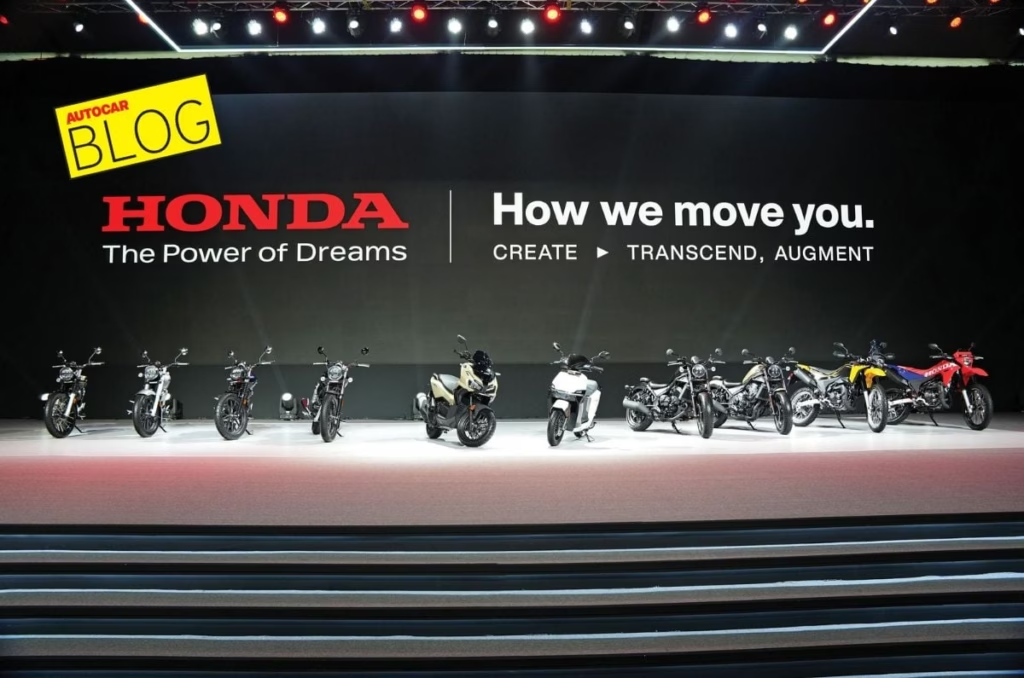
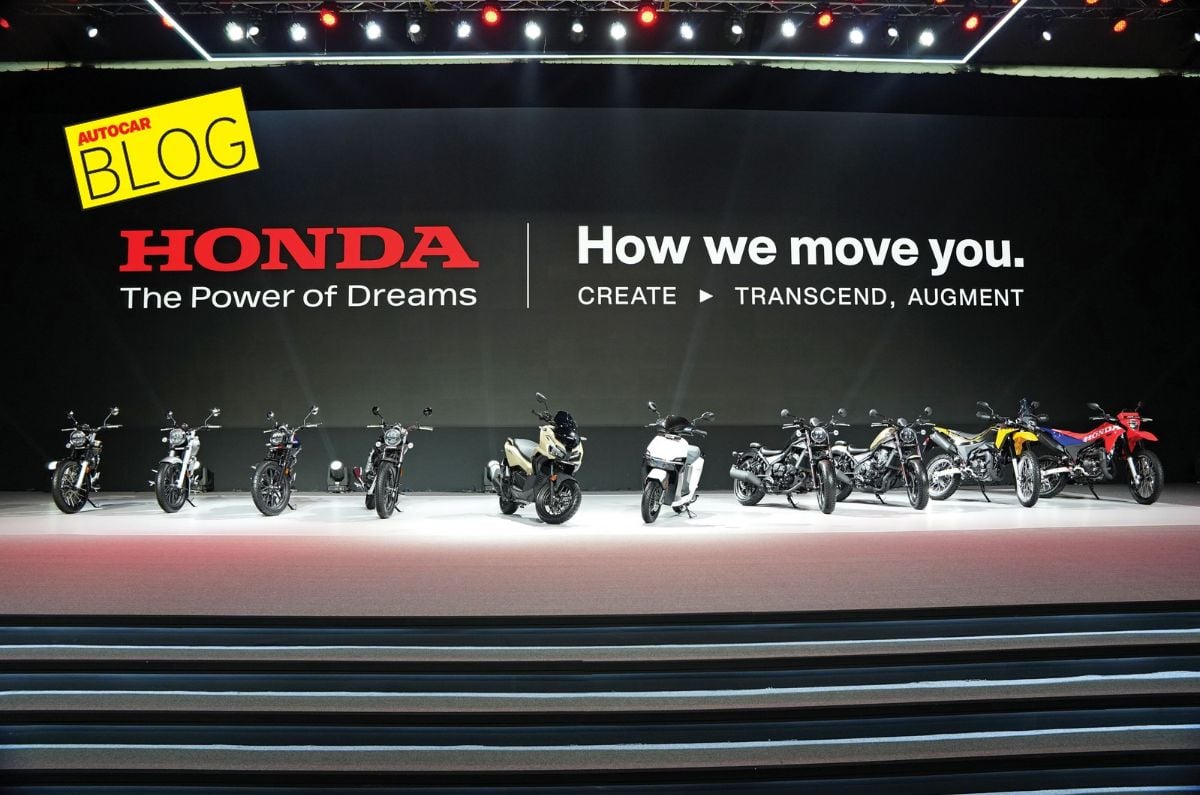
Honda bikes onstage at a big press event

2026 has revealed a change in how the Japanese treat our market. After years of being content to watch Indian competitors moving forward into more premium segments, the Japanese have finally realised that this is a space they can no longer ignore. 

The world’s biggest two-wheeler manufacturer is leading this charge. Honda recently held a huge event in Delhi in July, where they revealed ten new premium two-wheelers for India. That event on its own was a good sign, but there was still the very real concern of what these products would be priced at. After all, Indian enthusiasts have been burned by unrealistic pricing from the Japanese far too many times in the past.

Thankfully, things seem different this time around. So far, Honda has already released prices for the Rebel 300 (Rs 2.22 lakh-2.62 lakh), ADV160 (Rs 1.7 lakh), the QC3 electric scooter (Rs 1.35 lakh), XR300L and XR300 Rally (Rs 1.83 lakh & Rs 2.08 lakh, respectively) and the CB500 (Rs 2.75 lakh-3.02 lakh). All these prices are very reasonable and are either directly comparable with rivals or are at a small but justifiable premium. 

The best way to highlight this shift within Honda’s pricing strategy is to examine its own prices from a few years ago. The far superior Rebel 300 costs less today than the Rs 2.29 lakh price in 2022 for the now-discontinued CB300F. 

Sure, the Rebel now benefits from a lower GST structure, but the opposite holds true for the Honda CB1000 Hornet SP, which is priced at Rs 13.29 lakh. In comparison, the older CB1000R cost Rs 14.46 lakh in 2019, and it had far less fancy equipment. With Honda’s big bikes, the main issue is no longer the price but the fact that many of them aren’t available half the time. 

These new Hondas hold their own when compared with rivals as well. The new QC3 electric scooter is priced bang on par with equivalent rivals from Ather, Bajaj and TVS, and it will finally get Honda taken seriously in the EV space. The new CB500 is also priced Rs 10,000 lower than the top-spec Harley-Davidson X440 T, which is its closest rival. 

Yamaha is another manufacturer that has started to take crucial steps ahead. The awfully overdue XSR155 was finally introduced to India late last year, the R2 was just launched, and the NMax 155 will be coming in next year as well. These are good moves, but Yamaha needs to do more to cater to Indian riders who want more than just 150-200cc products. Kawasaki has localised a handful of its small bikes and we hear Suzuki is in the process of improving localisation on some of its big bikes as well, which is welcome news. 

None of these companies are taking these calls because they suddenly feel for the poor Indian motorcycle enthusiast who is crying out for more options. Those calls have gone unheeded for the better part of a decade.

The fact is that the Japanese (particularly Honda) are now seriously feeling the heat from local competition. Indian manufacturers (particularly TVS) have made massive gains over the last 5-10 years in all segments from scooters to EVs to premium motorcycles. Competition always benefits the customer, and it’s competition that we have to thank for this new enthusiasm shown by the Japanese towards the Indian market.

Triumph Bonneville T40/Bonneville T4 Image Gallery

Triumph Bonneville T40/Bonneville T4 Image Gallery
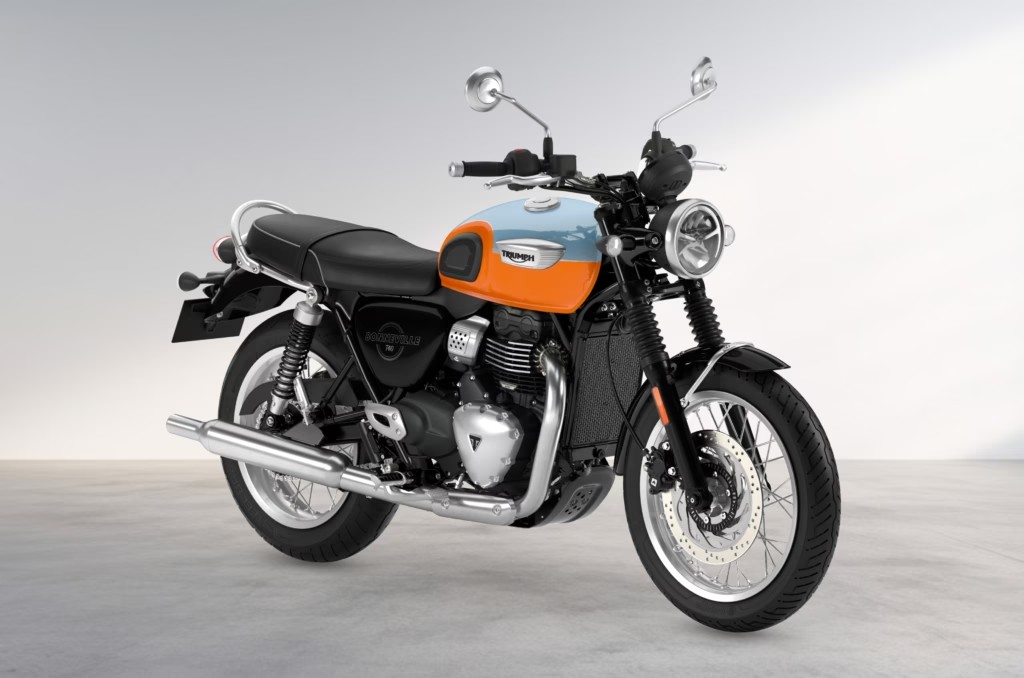
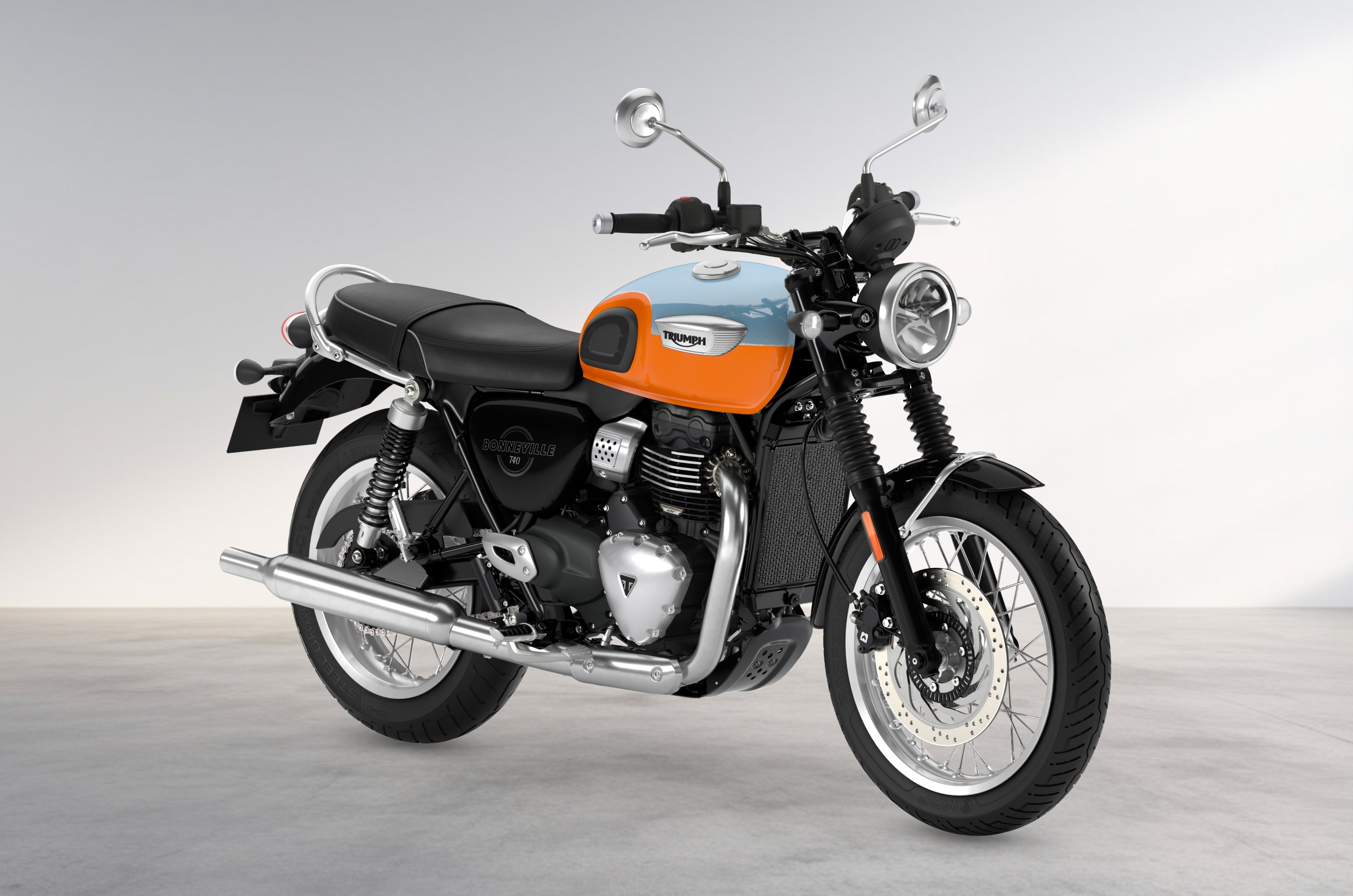
Triumph Bonneville T40 in Meridien Blue/Tangerine.

Triumph has now launched the Bonneville T40, which underneath the appealing classical design, is somewhat amalgamation of its siblings, and is unique in some ways too. Powering the India-spec Bonneville T40 is the same 350cc single-cylinder liquid-cooled engine, but it makes 29hp at 7,000rpm and 31.2Nm of torque at 5,500rpm – numbers that are incidentally very similar to the Speed T4.

In typical Bonneville fashion, the T40 runs on wire-spoke wheels shod with tubed MRF tyres developed specifically for it – no tubeless option here. The front tyre is sized 100/90-18, while the rear is a 150/70-R18 hoop. The result of the chassis changes is that the Bonneville T40 weighs 195kg, the heaviest of the Bajaj-built Triumph models. Having said that, at 14.5 litres, it also has the largest fuel tank capacity. With a friendly 790mm seat height, the T40 is quite accessible in terms of ground reach, with a healthy 165mm of ground clearance. Where the T40 goes one step further is that it debuts a new round 4-inch colour TFT display. This is to control the different riding aids such as five riding modes, ABS, traction control and cruise control. This display even has a ‘Heritage’ mode. If you pair your phone to the display, you can also get navigation information on the screen.

At Rs 2.80 lakh (ex-showroom, Delhi), the Bonneville T40 (and T40 Black) is priced at a premium compared to its direct rivals. In fact, at this price, the Bonneville T40 also costs more than the base variant of the newly launched Honda CB500. There’s also a lower-spec (only for the Indian market) Bonneville T4, which has  a colour LCD display with turn-by-turn navigation, ride modes and dual-channel ABS but misses out on cruise control and the inertial measurement unit (IMU). The T4 Bonneville is priced at Rs 2.55 lakh.

Honda CB500: Price and variants explained

Honda CB500: Price and variants explained
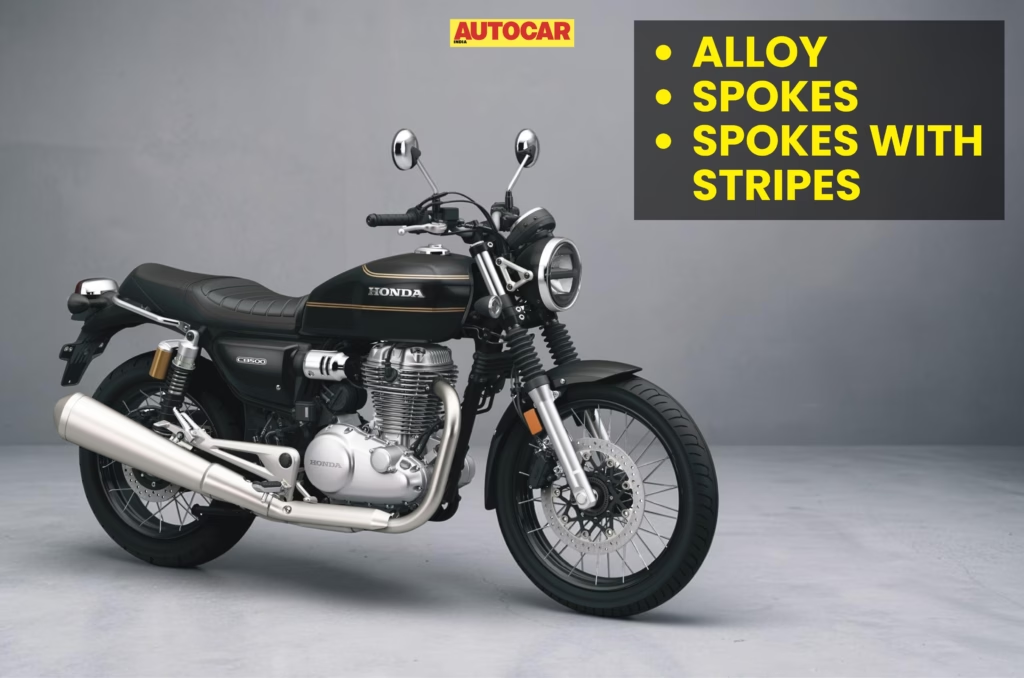
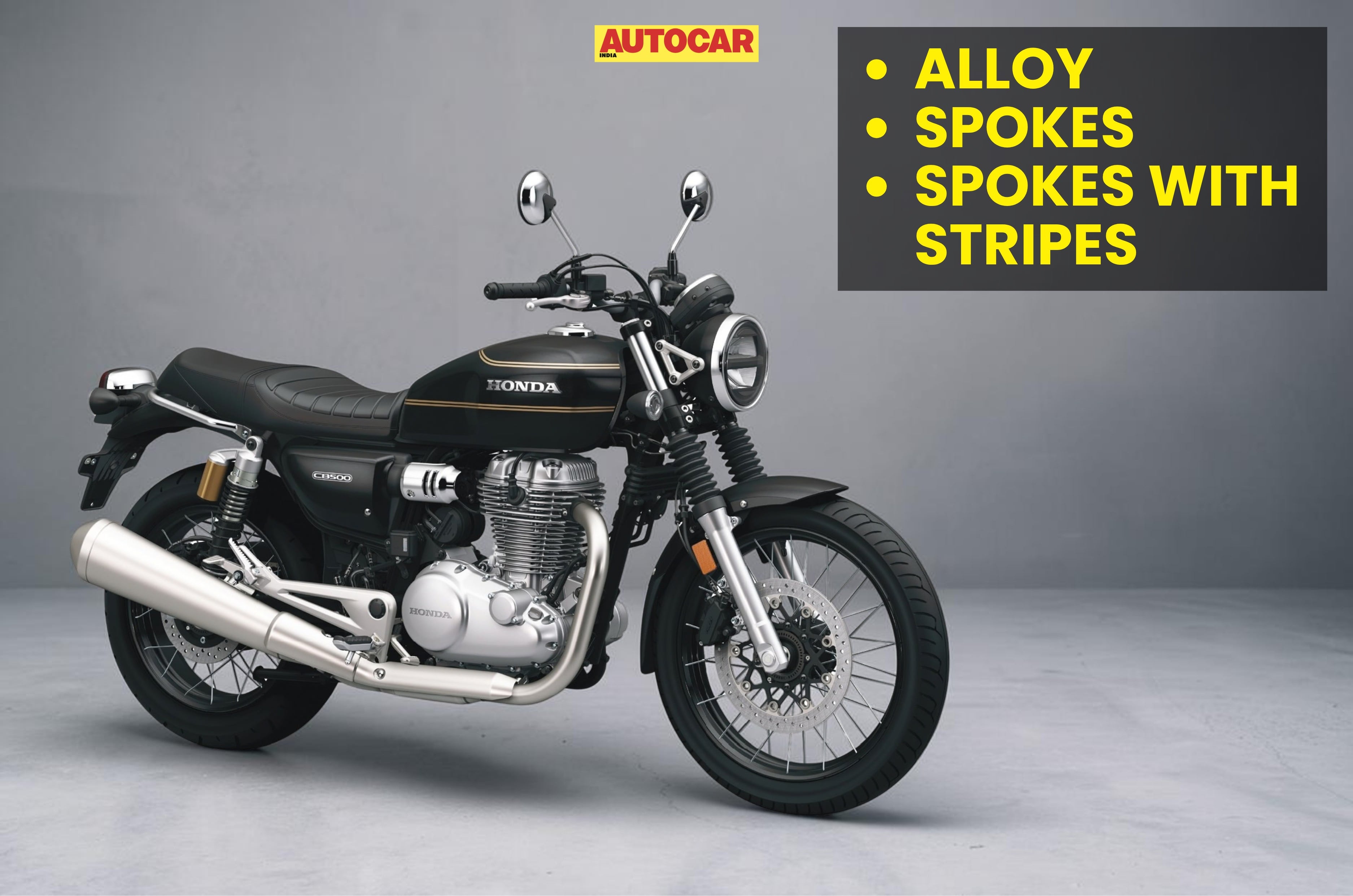
Honda CB500 variant breakdown graphic

The Honda CB500 is the brand’s largest air-cooled, single-cylinder motorcycle in India, powered by a 501cc air- and oil-cooled engine producing 28hp and 43.3Nm. It is available in three variants, with the differences coming down to wheel type and colour options. While Honda has revealed prices for each variant, it has also said that the bikes will only go on sale in the coming months. Here’s a breakdown of each variant, along with a note on when each will be available.

Honda CB500 variant breakdown

CB500 Alloy

The base CB500 Alloy is the entry point into the range and, as the name suggests, uses alloy wheels. It is available in two colour options – black and grey – and will be the first of the three variants to arrive, with detailed configurations and full specifications to be revealed in Q3 FY2027. This means sometime between October and December this year, with deliveries commencing shortly after. The CB500 Alloy is priced at Rs 2.75 lakh.

CB500 Spoke

The CB500 Spoke steps up to cross-spoke tubeless wheels in place of the alloy wheels on the base variant and will be available in two metallic-finish solid paint options – silver and red. Full specifications for this variant will be available in Q4 FY2027 (January to March), with deliveries following shortly after. The CB500 Spoke is priced at Rs 3 lakh.

CB500 Spoke with Stripes

The range-topping CB500 Spoke with Stripes retains the cross-spoke tubeless rims of the mid variant and will be available in the same Peak Black colourway as the alloy-wheel variant, but with exclusive pinstripes on the fuel tank, making it the most visually distinctive of the three. Like the Spoke variant, it will be available in Q4 FY2027. The CB500 Spoke with Stripes is priced at Rs 3.02 lakh.

All three variants share the same 501cc air- and oil-cooled engine, Honda Selectable Torque Control (HSTC), a slipper clutch, an analogue-digital instrument console with Honda RoadSync connectivity, and all-LED lighting.

All prices are ex-showroom, Bengaluru.

Honda CB500 Image Gallery

Honda CB500 Image Gallery
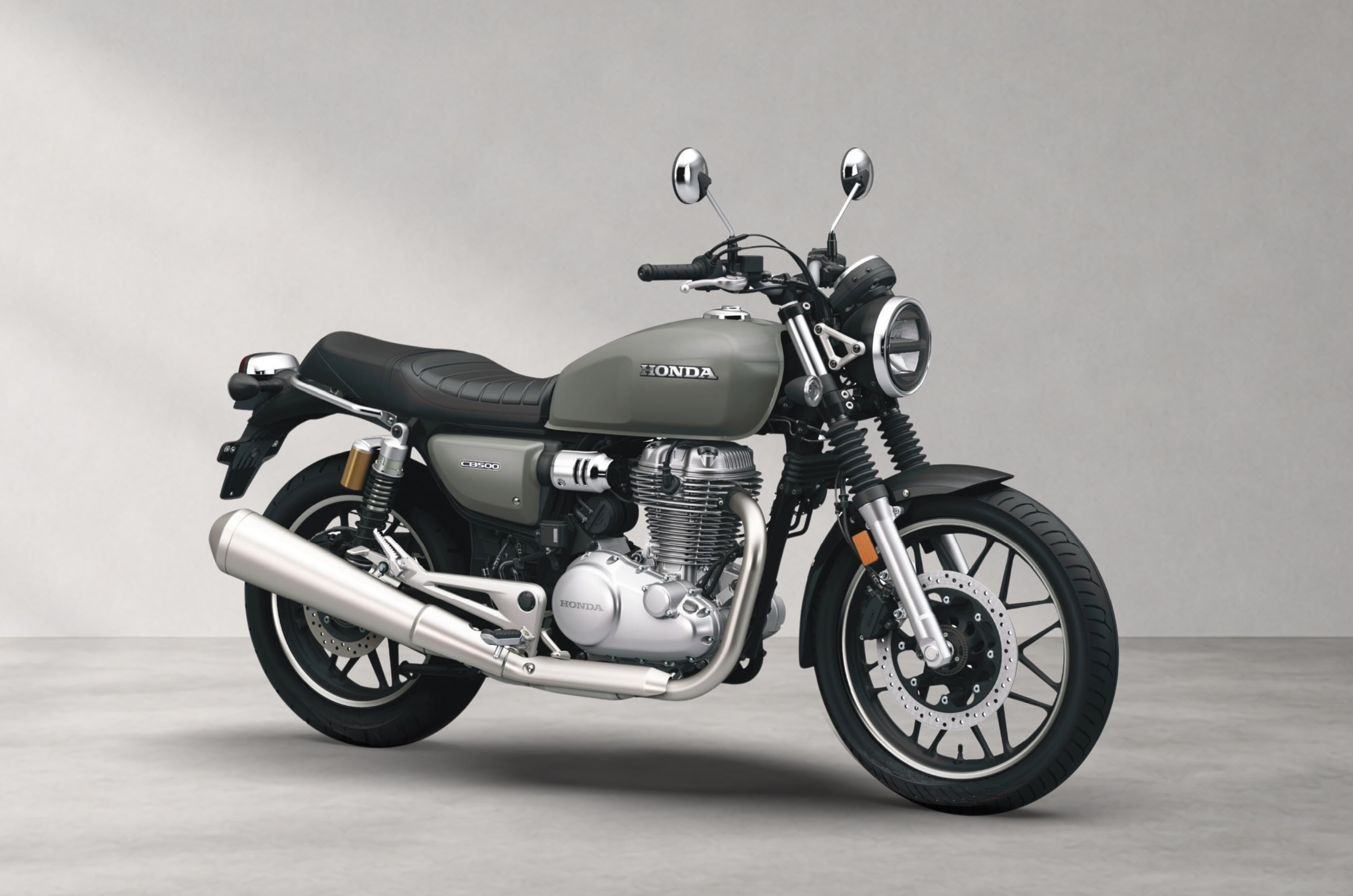
Inside render showing the Honda CB500 in Pearl Deep Ground Grey colour.

The Honda CB500 was one of multiple models Honda showcased in July as part of its broader product plans for India and arguably the one that many enthusiasts were most eagerly awaiting. The CB500 brings an engine configuration that has long been missing from our market – a big, air-cooled single – and is now on sale, with prices starting at Rs 2.75 lakh.

The CB500 is powered by an all-new 501cc single-cylinder air- and oil-cooled engine producing 28hp and 43.3Nm of torque, making it Honda’s largest air-cooled single-cylinder motorcycle in our market. The CB500 will be available in three variants, alloy, tubeless spoke, and tubeless spoke wheels with exclusive colours and graphics.

Honda manufactures the CB500 in India, which has helped keep pricing competitive despite the 40 percent GST rate applicable to motorcycles above 350cc. It slots in below the Royal Enfield 650 twins, which start at Rs 3.39 lakh (ex-showroom, Chennai).

Honda ने लॉन्च की नई 501cc रोडस्टर बाइक, मिलेगा 19-इंच फ्रंट व्हील और डुअल-चैनल ABS, जानें कीमत और फीचर्स

अगर आप एक स्टाइलिश और दमदार लुक वाले बाइक की तलाश में हैं, जो आपके राइड यादगार बनाए तो यह खबर आपको जरूरी पढ़नी चाहिए। दरअसल, Honda ने भारत में CB500 को ₹2.75 लाख (एक्स-शोरूम) की शुरुआती कीमत पर लॉन्च किया है, जिससे उसकी लाइनअप में एक नई 501cc रोडस्टर बाइक शामिल हो गई है। यह मोटरसाइकिल तीन वेरिएंट्स में उपलब्ध है, जिसमें टॉप मॉडल की कीमत ₹3.01 लाख (एक्स-शोरूम) है। CB350 के उलट, CB500 में बड़ा 501cc सिंगल-सिलेंडर इंजन दिया गया है और इसमें होंडा सिलेक्टेबल टॉर्क कंट्रोल, स्लिपर क्लच और होंडा रोडसिंक कनेक्टिविटी जैसे फीचर्स भी मिलते हैं। Honda ने इस बाइक की बुकिंग शुरू कर दी है, हालांकि हर वेरिएंट की पूरी जानकारी बाद में बताई जाएगी। बता दें कि CB500 को भारत में ही बने मॉडल के तौर पर पेश किया जा रहा है, और इसके तीनों वर्जन में मुख्य अंतर व्हील सेटअप और ग्राफिक्स का है।

Honda CB500: कीमत और वेरिएंट

Honda CB500 को 3 वेरिएंट में पेश किया गया है। कंपनी ने बेंगलुरु में इसकी एक्स-शोरूम कीमतें इस तरह रखी हैं:

वेरिएंटएक्स-शोरूम कीमत
CB500 Alloy₹2.75 लाख
CB500 Spoke₹2.99 लाख
CB500 Spoke With Graphics₹3.01 लाख

इसके बेस मॉडल में अलॉय व्हील्स मिलते हैं। बाकी दो वेरिएंट्स में स्पोक व्हील्स दिए गए हैं, और सबसे महंगे वेरिएंट में ग्राफिक्स भी हैं। फिलहाल, कंपनी ने कीमतें तो बता दी हैं, लेकिन हर वेरिएंट के फीचर्स की पूरी लिस्ट अलग से जारी की जाएगी।

Honda CB500 में 501cc का इंजन है

इस बाइक की सबसे बड़ी खासियत इसका इंजन है। Honda CB500 में 501cc का सिंगल-सिलेंडर, एयर-कूल्ड इंजन दिया गया है। इसमें ऑयल कूलर भी मिलता है। लॉन्च के समय सामने आई जानकारी के मुताबिक, यह इंजन 28 hp की पावर और 43.3 Nm का टॉर्क जनरेट करता है। इंजन को 5-स्पीड गियरबॉक्स से जोड़ा गया है।

इंजन के मामले में CB500, CB350 से काफी अलग है। CB350 में छोटा 348.36cc इंजन दिया गया है। वहीं, CB500 में ज्यादा क्षमता वाला इंजन मिलता है, जिससे यह रेट्रो रोडस्टर बाइक सेगमेंट में एक अलग जगह बनाती है।

Honda CB500: फीचर्स और हार्डवेयर

Honda ने CB500 में एनालॉग-डिजिटल इंस्ट्रूमेंट कंसोल और Honda RoadSync कनेक्टिविटी दी है। इस सिस्टम में टर्न-बाय-टर्न नेविगेशन और कॉल व SMS अलर्ट जैसे भी फीचर्स मिलते हैं।

इस बाइक में Honda Selectable Torque Control और स्लिपर क्लच भी दिया गया है। हार्डवेयर की बात करें तो इसमें टेलिस्कोपिक फ्रंट फोर्क और ट्विन गैस-चार्ज्ड रियर शॉक एब्जॉर्बर शामिल हैं।

इसके अलावा, Honda CB500 में आगे की तरफ 19 इंच का व्हील और पीछे 17 इंच का व्हील दिया गया है। ब्रेकिंग के लिए बाइक के आगे और पीछे दोनों तरफ डिस्क ब्रेक मिलते हैं। इसके साथ डुअल-चैनल ABS भी दिया गया है।

Honda CB500: बुकिंग और डिलीवरी

HMSI ने भारत में CB500 के लिए बुकिंग पहले ही शुरू कर दी है। कंपनी इसके तीन वेरिएंट्स के लिए चरणबद्ध तरीके से काम कर रही है और इनके बारे में पूरी जानकारी अलग-अलग समय पर दी जाएगी।

अलॉय वेरिएंट की पूरी जानकारी और स्पेसिफिकेशन की घोषणा FY2026-27 की तीसरी तिमाही (Q3) में की जाएगी, जबकि Spoke और Spoke With Graphics वर्जन की जानकारी चौथी तिमाही (Q4) में दी जाएगी। बता दें कि स्पेसिफिकेशन की घोषणा के बाद ही इन वेरिएंट्स की डिलीवरी शुरू होगी।

फिलहाल Honda CB500 को लेकर मुख्य जानकारी साफ है। इसकी शुरुआती कीमत ₹2.75 लाख (एक्स-शोरूम) है। इसमें 501cc सिंगल-सिलेंडर इंजन दिया गया है और यह 3 वेरिएंट में उपलब्ध होगी। बाकी वेरिएंट्स से जुड़ी पूरी जानकारी Honda बाद में जारी करेगी।

यह भी पढ़ें: Tata Sierra का नया Dark Edition लॉन्च, All Black लुक के साथ मिलेंगे पर्पल क्रोम एक्सेंट, जानें कीमत और फीचर्स