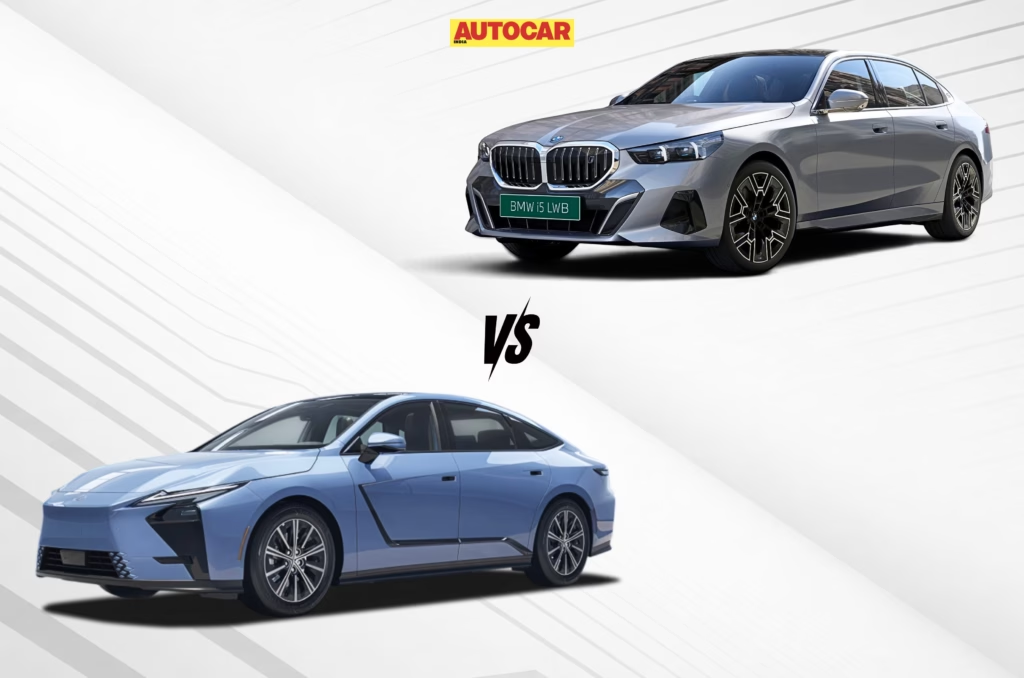
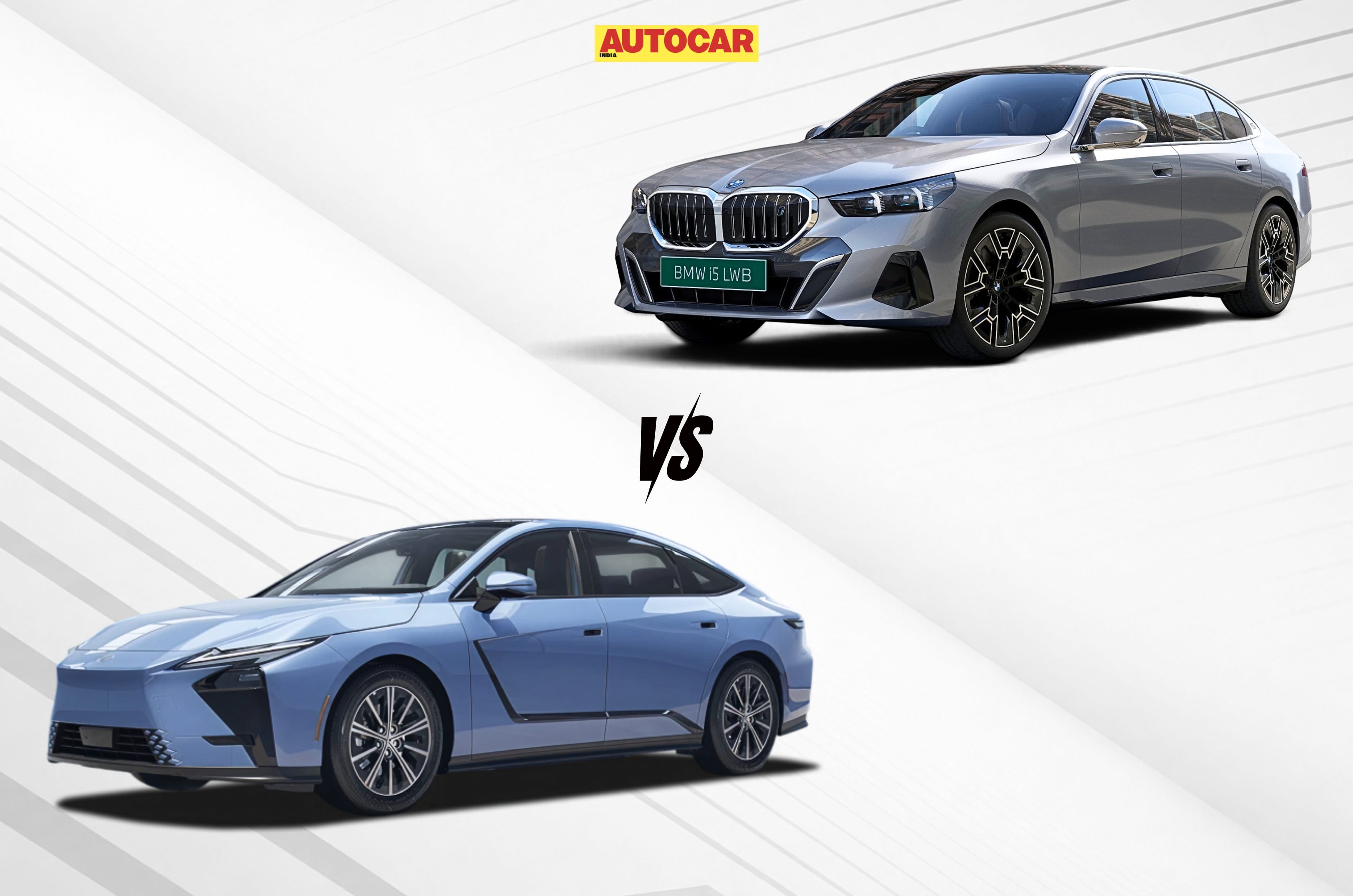
The BMW i5 LWB (long wheelbase) and Lexus ES 500e are two of the latest additions to the luxury electric sedan segment. Both pack an extensive list of features, but each has an advantage in some areas. They also get different battery pack sizes, and their peak power and torque outputs vary as well. So, how different are the two on paper? We find out.
BMW i5 LWB vs Lexus ES 500e: Dimensions
BMW i5 LWB
Lexus ES 500e
Length
5,175mm
5,145mm
Width
2,156mm
1,920mm
Height
1,520mm
1,575mm
Wheelbase
3,105mm
2,950mm
Boot space
Not disclosed
377 litres
Wheel size
20 inch
21 inch
The BMW i5 LWB is slightly longer by 30mm than the Lexus ES 500e, but the bigger difference is in width. The i5 LWB is 236mm wider than the Lexus; however, the ES 500e is 55mm taller. The BMW sedan also has a 155mm longer wheelbase. In terms of wheels, the Lexus EV rides on 21-inch units, which are 1 inch larger than the i5’s 20-inch ones. BMW has not disclosed the i5 LWB’s boot capacity at the time of writing. Meanwhile, the Es 500e has a 377 litre boot.
Another point of difference is the suspension. The i5 LWB gets rear-axle air suspension, which should offer better ride comfort in real-world conditions, while the ES 500e uses a multi-link setup.
BMW i5 LWB vs Lexus ES 500e: Powertrain specs
BMW i5 LWB
Lexus ES 500e
Battery size
81.6kWh
74.68kWh
Drive configuration
RWD
AWD
Power
268hp
343hp
Torque
410Nm
438Nm
0-100kph
6.7 seconds
5.5 seconds
Claimed range
669km (MIDC)
580km (WLTP)
AC charging (0-100 percent)
Not revealed (11kW charger)
~4 hours (22kW charger)
DC charging (10-80 percent)
33 minutes (160kW charger)
28 minutes (150kW charger)
Clearly, the dual-motor setup of the ES 500e makes much more peak outputs that the i5 LWB, which gets just a rear-mounted electric motor. Compared to the i5, the ES 500e has a 75hp and 28Nm advantage. It’s also quicker, taking 5.5 seconds to go from 0-100kph, which is 1.2 seconds quicker than the BMW. The BMW, however, gets a larger 81.6kWh battery than the Lexus’ 74.68kWh unit.
As for the claimed range figures of the two sedans, it should be noted that the i5 LWB’s 669km figure is based on the modified Indian driving cycle (MIDC), which is more relaxed than the worldwide harmonised light vehicles test procedure (WLTP). The ES 500e, meanwhile, claims a range of 580km on the stricter WLTP cycle.
When it comes to fast charging times, the ES 500e has the upper hand. On DC charging, the Lexus takes 28 minutes from 10-80 percent compared to 33 minutes for the BMW. Although the BMW supports a slightly higher maximum charging speed of 160kW compared to the Lexus’ 150kW, its longer charging time could be due to the BMW sedan’s larger battery pack.
BMW i5 LWB vs Lexus ES 500e: Exterior features
BMW i5 LWB
Lexus ES 500e
LED headlamps
Yes
Yes
LED DRLs
Yes
Yes
LED tail-lights
Yes
Yes
Fog lamps
No
Yes
Powered ORVMs
Yes
Yes
Door handles
Flap type
Flush-fitting
Shark-fin antenna
Yes
Yes
Powered tail-gate
Yes
Yes
In terms of exterior features, both sedans are similarly equipped. Both get LED headlamps, LED DRLs, LED tail-lights, powered ORVMs, shark-fin antennas and powered tail-gates. The Lexus, however, stands out here with fog lamps. The two also differ in their door-handle designs. The i5 LWB uses flap-type handles, while the ES 500e gets flush-fitting units.
BMW i5 LWB vs Lexus ES 500e: Interior features
BMW i5 LWB
Lexus ES 500e
Touchscreen
14.9 inch
14 inch
Digital driver’s display
12.3 inch
12.3 inch
Speakers
17-speaker Bowers & Wilkins
17-speaker Mark Levinson
Sunroof
Fixed, panoramic
Openable, single-pane
Ventilated front seats
Yes
Yes
Rear centre armrest
Yes
Yes
Wireless charger
Front and rear (1 each)
Front (2)
Ambient lighting
Yes
Yes
Apple CarPlay and Android Auto
Wireless
Wireless
Connected car tech
Yes
Yes
Rear sunshades
No
Yes
Soft-close doors
No
Yes
Digital IRVM
No
Yes
The two sedans get a 12.3-inch digital driver’s display, 17 speakers, ventilated front seats, rear centre armrest, ambient lighting, wireless Apple CarPlay and Android Auto, and connected car tech. While the BMW gets a Bowers & Wilkins sound system, the Lexus opts for a Mark Levinson setup.
The BMW gets a slightly larger 14.9-inch touchscreen compared to the Lexus’ 14-inch unit. The sunroof setup is different too, with the i5 LWB getting a fixed panoramic unit with integrated lights, while the ES 500e has an openable single-pane unit. The BMW also gets one wireless charger each at the front and rear, whereas the Lexus gets two at the front. The Lexus claws back some ground with rear sunshades, soft-close doors and a digital IRVM, all of which are missing on the BMW.
BMW i5 LWB vs Lexus ES 500e: Safety features
BMW i5 LWB
Lexus ES 500e
Airbags
8
8
360-degree camera
Yes
Yes
Electronic parking brake
Yes
Yes
Digital IRVM
No
Yes
ISOFIX seat anchors
Yes
Yes
Rear defogger
Yes
Yes
ADAS
Yes
Yes
Both the sedans are evenly matched on most safety features. Both get eight airbags, a 360-degree camera, electronic parking brake, ISOFIX child seat anchors, rear defogger and ADAS. The Lexus, however, offers a digital IRVM, which is not offered on the BMW.
BMW i5 LWB vs Lexus ES 500e: Verdict
BMW i5 LWB
Lexus ES 500e
Ex-showroom price (Rs lakh)
79.60
89.99
Pricing is one area where the BMW i5 LWB and Lexus ES 500e differ quite significantly, by Rs 10.39 lakh to be precise. The other difference is in outright performance. The ES 500e’s AWD setup gives it an advantage in acceleration from 0-100kph. However, for most buyers, the i5 LWB makes more sense, as it gets a relatively larger battery pack and is much more accessible in terms of price. In addition to that, you also get the BMW badge value.
कभी नौकरी के लिए दर-दर भटकने वाला एक इंजीनियर आज लाखों रुपये के पैकेज पर काम कर रहा है। 2019 में B.Tech करने के बाद इस युवक के पास न अच्छी नौकरी थी और न ही करियर को लेकर कोई स्पष्ट दिशा। कई बार रिजेक्शन और मुश्किलों का सामना करने के बावजूद उसने कोशिश जारी रखी। Reddit के r/Indian_flex पर शेयर की गई उसकी कहानी बताती है कि करियर की शुरुआत भले ही कमजोर हो, लेकिन आगे की राह बदली जा सकती है।
इंजीनियरिंग के बाद भी नहीं थी नौकरी की तैयारी
युवक ने बताया कि कॉलेज के दौरान उसका पढ़ाई में ज्यादा मन नहीं लगता था। इंजीनियरिंग उसके लिए पसंद का करियर नहीं था। वह गेमिंग में काफी दिलचस्पी रखता था और दोस्तों के साथ वक्त बिताने में ज्यादा सहज महसूस करता था।
2019 में B.Tech पूरी करने के बाद उसका प्लेसमेंट नहीं हुआ। परिवार की उम्मीदें अलग थीं। पिता चाहते थे कि वह IT सेक्टर में अच्छी नौकरी हासिल करे। नौकरी नहीं मिलने की वजह से घर में तनाव बढ़ने लगा और युवक ने बेंगलुरु जाने का फैसला किया।
बेंगलुरु में भी नहीं बदली तस्वीर
नौकरी की तलाश में बेंगलुरु पहुंचने के बाद भी उसके सामने सबसे बड़ी परेशानी स्किल की कमी थी। कुछ दोस्तों के साथ रहते हुए शुरुआती दिन किसी नए कॉलेज लाइफ जैसे ही गुजरते रहे। इसी बीच एक रेफरेंस के जरिए उसे यूरोप बेस्ड स्टार्टअप में करीब ₹12,000 महीने की नौकरी मिली। लेकिन काम में जरूरी तकनीकी पकड़ नहीं होने के कारण वह वहां ज्यादा समय नहीं टिक पाया। करीब 20 दिन बाद उसकी नौकरी चली गई।
कोविड ने और बढ़ाई परेशानी
नौकरी जाने के कुछ ही समय बाद कोरोना महामारी आ गई। लॉकडाउन के कारण हालात और मुश्किल हो गए। आखिरकार जून 2020 में वह घर लौट आया। उस समय परिवार को लगता था कि वह नौकरी कर रहा है, जबकि वह कई महीनों से बेरोजगार था। माता-पिता के सवालों से बचने के लिए उसे अपनी नौकरी और सैलरी को लेकर झूठ तक बोलना पड़ा। करीब नौ महीने बाद आखिरकार उसे एक सर्विस बेस्ड कंपनी में नौकरी मिल गई। पैकेज था सिर्फ ₹3.37 LPA, लेकिन उसके लिए यह नौकरी किसी बड़ी राहत से कम नहीं थी।
यहीं से लौटा आत्मविश्वास
कम सैलरी के बावजूद इस नौकरी ने उसके अंदर एक बड़ा बदलाव किया। प्रोजेक्ट में उसका प्रदर्शन अच्छा रहा और वह टीम के प्रमुख परफॉर्मर्स में शामिल होने लगा। यहीं उसे महसूस हुआ कि शायद उसमें उतनी कमी नहीं है, जितना वह खुद समझता था। इसके बाद उसने बेहतर अवसरों के लिए इंटरव्यू देना शुरू किया।
कई बार ऑफर मिला, लेकिन किस्मत ने रोका
2022 में उसने ₹7.72 LPA के एक अवसर के लिए इंटरव्यू के सभी जरूरी राउंड पार कर लिए, लेकिन HR राउंड में कुल अनुभव से जुड़ी शर्त के कारण चयन नहीं हो पाया।
बाद में उसे Big4 कंपनी में ₹8.75 LPA का ऑफर मिला। नौकरी शुरू करने के कुछ ही समय बाद उसने ₹16.5 LPA का इंटरव्यू भी क्लियर किया, लेकिन करियर के शुरुआती गैप की वजह से HR राउंड में फिर रिजेक्शन हो गया।
यह उसके लिए बेहद निराशाजनक दौर था, क्योंकि तकनीकी और इंटरव्यू प्रक्रिया पार करने के बावजूद अंतिम चरण में मौका हाथ से निकल गया।
शादी से पहले बदली कमाई की तस्वीर
कुछ समय बाद उसकी शादी तय हुई। शादी से करीब 20 दिन पहले उसे एक नई कंपनी से ऑफर मिला और पैकेज बढ़कर ₹15.8 LPA हो गया। इसके बाद भी उसने ग्रोथ की तलाश जारी रखी। करीब एक साल बाद उसने फिर स्विच करने का फैसला किया और एक Big4 कंपनी से शुरुआत में ₹25.3 LPA का ऑफर मिला।
मामला यहीं खत्म नहीं हुआ। दूसरी तरफ से काउंटर ऑफर मिलने के बाद पैकेज में और बदलाव हुआ। बातचीत के बाद Big4 कंपनी का ऑफर बढ़कर ₹29.05 LPA हो गया, जिसमें वैरिएबल और जॉइनिंग बोनस शामिल था। यानी जिस शख्स ने अपने करियर की शुरुआत ₹12 हजार महीने की नौकरी और फिर ₹3.37 LPA के पैकेज से की थी, वह कुछ वर्षों में करीब 29 लाख रुपये के पैकेज तक पहुंच गया।
‘मैं एक्सपर्ट नहीं, लेकिन कोशिश करता हूं’
युवक ने अपनी कहानी में खुद को प्रोग्रामिंग का बहुत बड़ा एक्सपर्ट नहीं बताया। उसका कहना है कि वह चीजों को समझने, काम पूरा करने और लगातार प्रयास करने पर भरोसा करता है। उसकी कहानी की खास बात यही है कि करियर में कई बार दरवाजे बंद हुए, लेकिन उसने कोशिश करना नहीं छोड़ा। नौकरी छूटने से लेकर रिजेक्शन और कम पैकेज तक, हर मुश्किल के बाद उसने अगला मौका तलाशा।
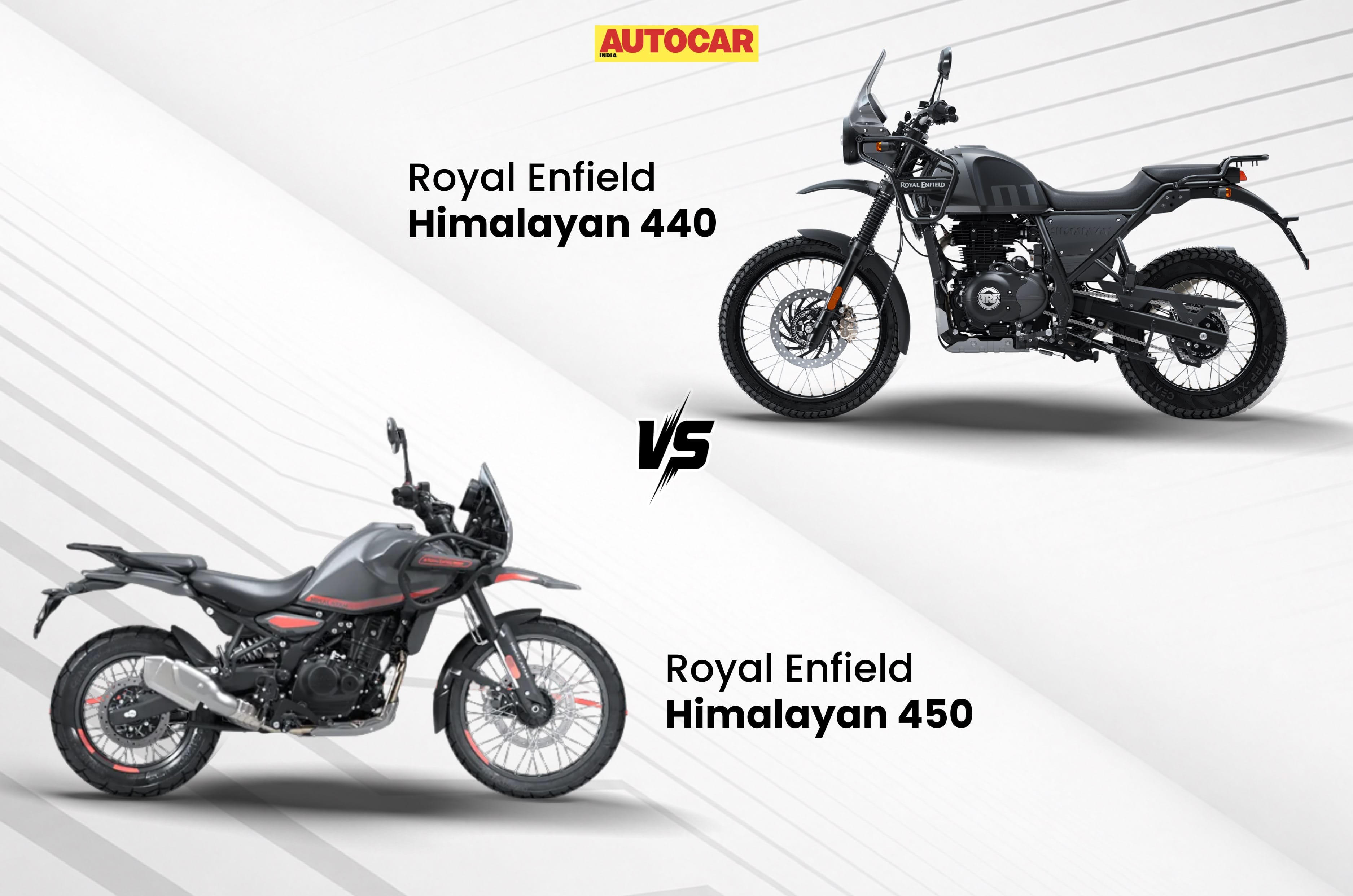
Royal Enfield has rejuvenated the Himalayan 411 as the Himalayan 440, with a new 443cc engine. Based on the Scram 440’s core principles, the motorcycle carries over the same looks as the 411 but with the promise of a better riding experience. The Scram 440’s 1.4hp extra power and 2Nm of torque coupled with an additional sixth gear did help it perform well on the highway. We can expect that to be the case with the Himalayan 440 too. But wait, isn’t there a Himalayan 450 with a 452cc engine? At first glance, they do look similar but is that really the case? Let’s see what else you get besides 9cc extra on the bigger brother.
Royal Enfield Himalayan 440 vs 450: Engine and output
Himalayan 450 has more power, torque, and a revvy engine
Royal Enfield Himalayan 440
Royal Enfield Himalayan 450
Engine
443cc single-cylinder, air- and oil-cooled
452cc single-cylinder, liquid-cooled
Power
25.4hp at 6,250rpm
40.02hp at 8,000rpm
Torque
34Nm at 4,000rpm
40Nm at 5,500rpm
Transmission
6-speed
6-speed
Power-to-weight ratio
127.64hp/tonne
204.18hp/tonne
Perhaps there are no better examples than these two motorcycles to demonstrate that an engine’s displacement doesn’t reveal the full picture. Like we’d mentioned above, exactly 9cc separates the two but the differences only get bigger from there. The 450 gets the more modern liquid-cooling tech, ensuring that the engine temperature is controlled more effectively; which allows the Himalayan 450 to produce substantially more power from a similar displacement engine. It makes 14.62hp extra power over the 440 and delivers it at a higher rpm compared to it.
A higher revving engine is associated with performance, and the 450 makes it clear that its engine is more suitable for it. Torque is also higher on the 450, albeit a smaller 6Nm difference. Both motorcycles now have six gears so highway tours on neither should be straining, but there’s no doubt which one will have more power left in reserve.
Royal Enfield Himalayan 440 vs 450: Dimensions and weight
Himalayan 450 is lighter, longer, and (slightly) taller
Royal Enfield Himalayan 440
Royal Enfield Himalayan 450
Fuel tank
15 litres
17 litres
Ground clearance
220mm
230mm
Seat height
800mm
825mm
Kerb weight
199kg
196kg
Wheelbase
1460mm
1510mm
This may be a surprise for some, but Royal Enfield made sure the newer 450 is better on (almost) all fronts compared to its predecessor, the 411. Since the 440 shares the same dimensions, it has 10mm less ground clearance, 3kg extra kerb weight, and 50mm lesser wheelbase. It is, however, more accessible with a 25mm lower seat height than the 450, but Royal Enfield does offer a lower seat accessory to bring its seat height down to 805mm. Royal Enfield has also upgraded the chassis on the 450 to an advanced, performance-oriented twin-spar frame compared to the 440’s simpler split-cradle frame.
Since a Himalayan is all about the adventure (pun intended), the 450’s two litres larger fuel tank is sure to add at least 60km additional range over the 440. In most situations, this shouldn’t make a massive difference, but it is a marked advantage that the 450 lords over most of its rivals, which now includes the older-younger brother.
Royal Enfield Himalayan 440 vs 450: Tyres, brakes, and suspension
Himalayan 450 gets bigger brakes, tyres, and suspension travel
Royal Enfield Himalayan 440
Royal Enfield Himalayan 450
Tyres (F,R)
90/90-21, 120/90-17
90/90-21, 140/80R17
Brakes (F,R)
300mm disc, 240mm disc; dual-channel ABS
320mm disc, 270mm disc; dual-channel ABS
Suspension (F,R)
Telescopic (RSU) fork, linkage monoshock
Telescopic (USD) fork, linkage monoshock
The ‘new advantage’ carries onto this section as well. The 450 gets a larger rear tyre that’s also radially constructed, compared to the 440’s traditional bias-ply constructed rear tyre. The 450 also boasts a larger front disc, although the ratio between the front and rear disc stays similar across both motorcycles. Both also get dual-channel ABS as standard, and both allow you to turn off the rear ABS at will. Lastly, the 450 gets the USD front fork and it’s a larger 43mm diameter unit, compared to the 440’s 41mm. The suspension travel on the rear has been increased by 20mm over the 440 as well, to 200mm. Both motorcycles do let you adjust the rear preload for further personalisation, and both lack the ability to adjust the front fork in any form or fashion.
Royal Enfield Himalayan 440 vs 450: Features
Himalayan 450 gets more features and better quality levels
To no one’s surprise, again, the 450 offers you more features for the extra price you pay for it. You get an assist and slipper clutch, a 4-inch TFT instrument cluster that offers Google Maps mirroring, two ride modes, and ride-by-wire technology. Besides the extras mentioned in the other sections, the 450 also gets the newer rotary switches for ignition and high beam controls, but we wouldn’t consider that to be an upgrade in experience. The 450 does get an upgraded design and quality levels, more in line with 2026. The 440 does get an updated instrument cluster with the tripper pod as standard, enabling Google Maps power turn-by-turn navigation. However, it can’t match the 450 on any of its other features. To be clear, the 440 by no means is a poorly made machine, but it consciously sticks to an older design and feature set, which is unmissable when you see the two side-by-side.
One feature that’s afforded only to the 450, quite literally, are the tubeless spoke rims. The top three variants of it get those rims as standard fitment. Royal Enfield charges Rs 16,000 at the moment for upgrading the wire-spoked rims to cross-spoked, tubeless rims on the lower two variants. On the 440, however, they aren’t offered at all and Royal Enfield didn’t confirm if the 450’s rims can be retrofitted to the 440 either.
Royal Enfield Himalayan 440 vs 450: Price
Himalayan 450’s upgrades come at a significant cost
Royal Enfield Himalayan 440
Royal Enfield Himalayan 450
Price (ex-showroom, Chennai)
Rs 2.29 lakh
Rs 3.08-3.40 lakh
This will likely be how you decide which Himalayan to buy, assuming you’re okay with either bike otherwise and that’s of course an advantage to the 440. It starts a full Rs 78,000 lower than the 450 for the single variant with three colours. The 450 has effectively two variants (with or without tubeless spoke rims) in six colours; Royal Enfield does charge different prices for five of those variants so it’s best to pay a visit to the website or your nearest dealer for the specifics.
Even though the 450 offers much more, the 440’s competitive pricing helps it compete with smaller capacity adventure models like the KTM 250 Adventure and the TVS RTX 300. It’s also priced very similarly to the road-biased Scram 440; in fact, the Himalayan 440 costs Rs 3,000 less than the Scram 440’s top variant with alloy wheels.
We’d like to acknowledge that this isn’t a comparison we’d usually do, but these two motorcycles could mislead the uninformed buyer into misjudging the Himalayan 450 and we hope to have helped you see the differences run far deeper than that, just to make sure that you’re getting the right Himalayan for yourself.
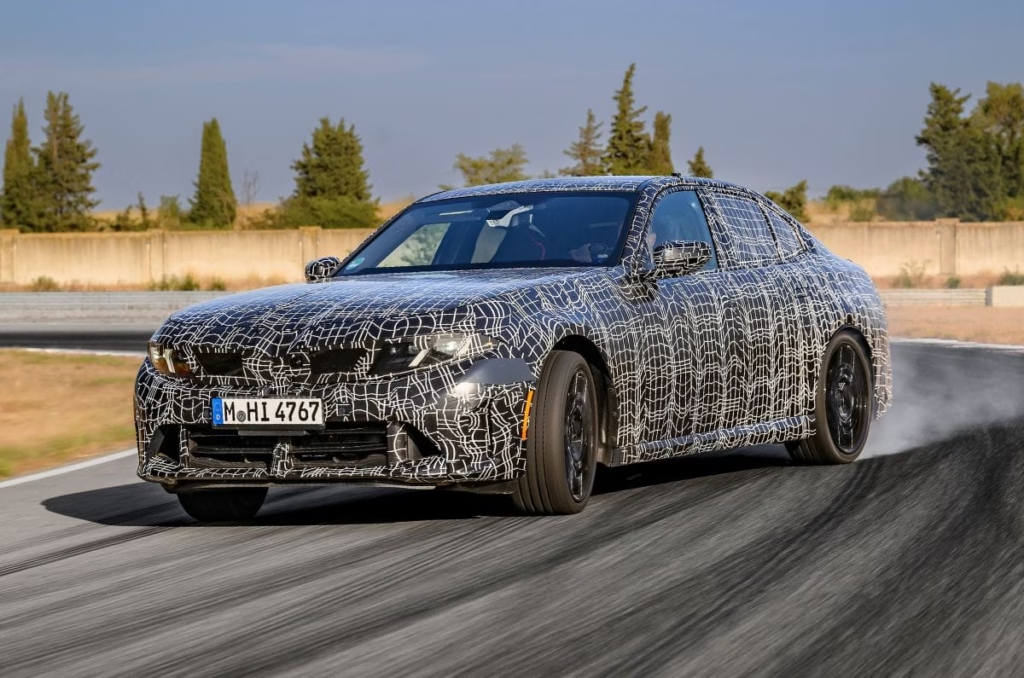
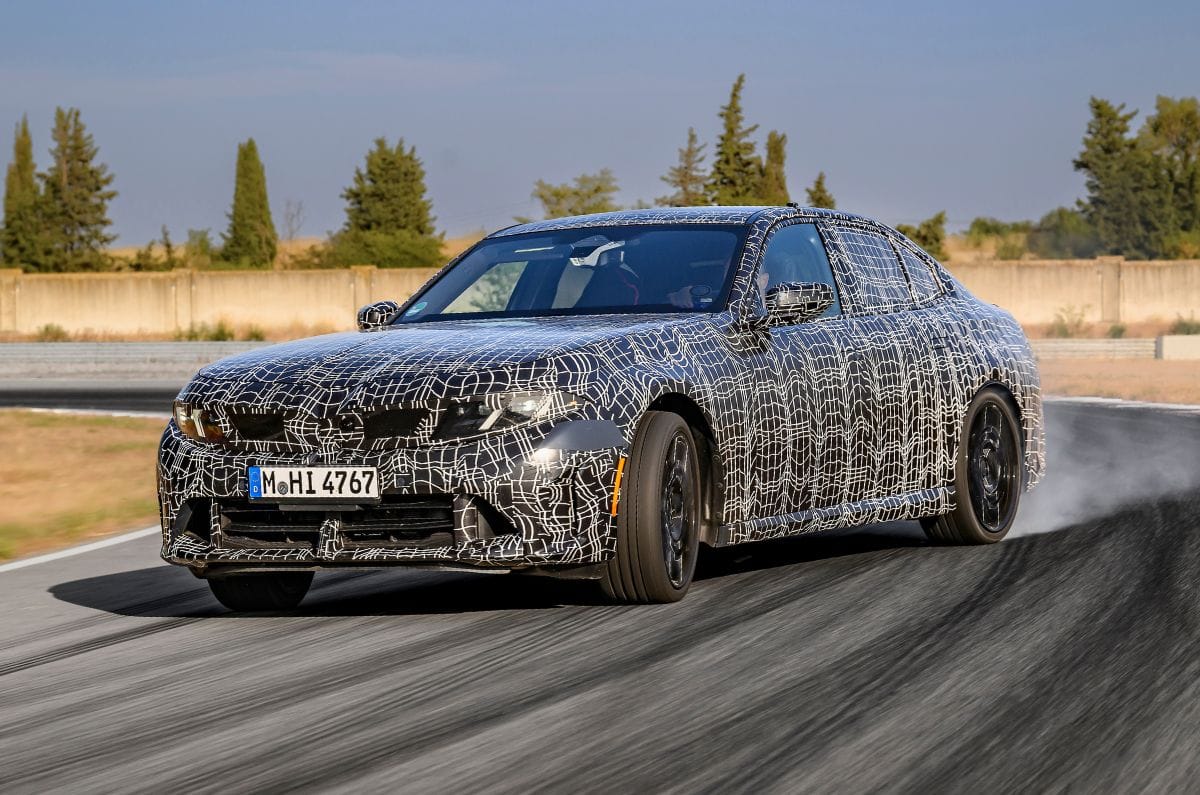
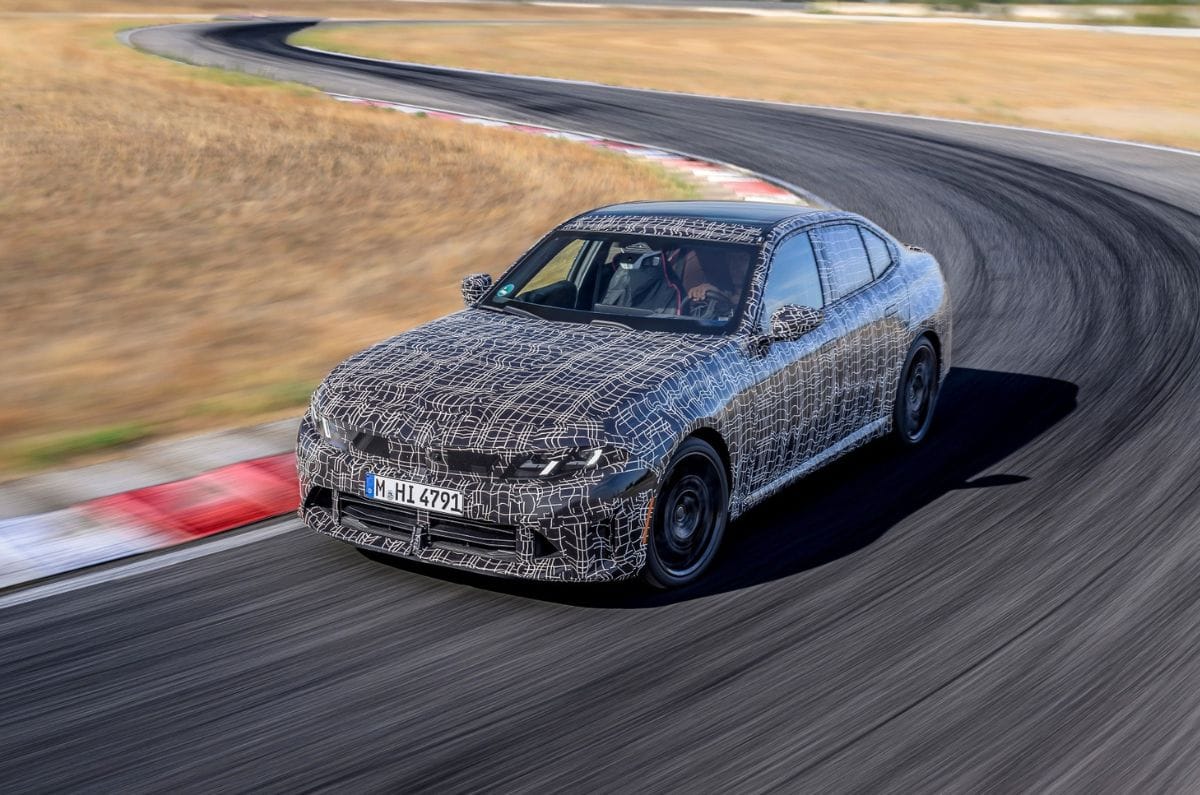
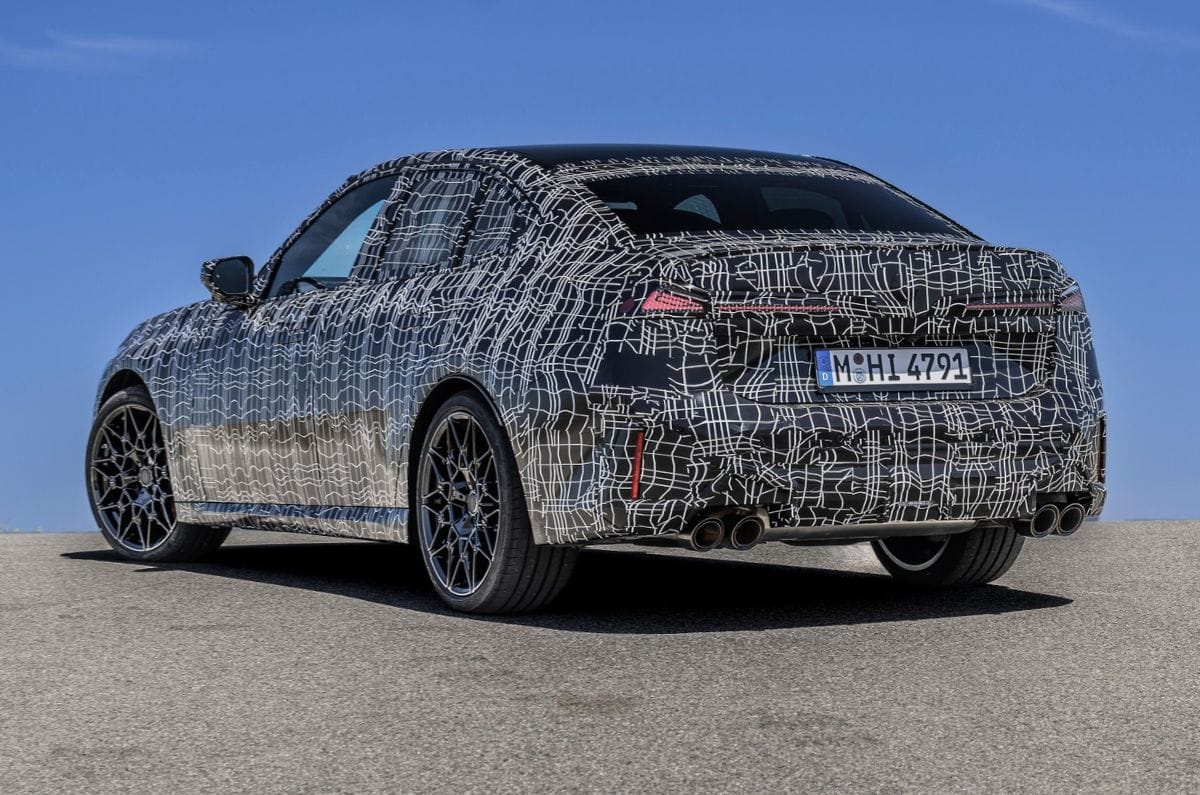
BMW has completed testing the next-generation (Neue Klasse-based) 3 Series in Miramas, France, and has revealed a few key specifications for the M350 version, which will replace the current M340i. The specifications suggest that the M350 will come with a more potent six-cylinder engine than the M340i and will get a drift mode, which will be a first for any BMW 3 Series M Performance model.
Will get a 443hp, 3.0L 6-cylinder turbo-petrol engine
8-speed Steptronic transmission and AWD will be standard
Next-generation BMW 3 Series: What was revealed?
M350 will get a drift mode and will produce 69hp more than the M340i
The M350 xDrive will serve as the range-topping model for the upcoming 8th generation 3 Series sedan. It will be powered by a 3.0-litre 6-cylinder turbo-petrol engine producing 443hp and 580Nm, 69hp and 80Nm more than the M340i. It will be offered with a 48V mild-hybrid system for slightly better efficiency, an 8-speed automatic gearbox and an xDrive all-wheel-drive (AWD) layout.
The M350 will also get a drift mode, with all engine power sent to the rear wheels, a first for any BMW 3 Series M Performance model. Till now, a drift mode was reserved for the full-fat M models. With the M350, BMW claims a provisional 0-100kph time of 4.1 seconds, which is 0.3 seconds faster than the M340i, and a top speed of 250kph.
However, BMW has not indicated that a high-performance diesel-powered 3 Series, similar to the current M340d, is in the works. The removal of the ‘i’ suffix from the petrol-powered model’s new M350 badge suggests that a diesel-powered performance variant, traditionally denoted by the ‘d’ suffix, may already be off the table.
Other models in the 3 Series range will be offered with four-cylinder engines and 48V mild-hybrid tech. These are expected to be updated ‘B48’ (2.0L turbo-petrol) and ‘B47’ (2.0L diesel) powerplant versions, offered in the outgoing model.
Will get steel suspension as standard; adaptive suspension setups as options
BMW has also revealed that the 3 Series will come with steel suspension as standard. It will get a double-joint spring strut front axle and a five-link rear axle. Adaptive suspension (for a more comfortable ride) and adaptive M suspension (for a stiffer ride) will be offered as options. Sports tyres – 245/35 R20 at the front and 275/30 R20 at the rear – will also be available as options on the next-generation 3 Series for the first time.
With the summer driving dynamics testing completed in Miramas, the upcoming Neue Klasse-based 3 Series “is entering the final phase of series production development”. It is expected to be available internationally by the end of 2026 and is expected to be offered in India sometime in 2027.
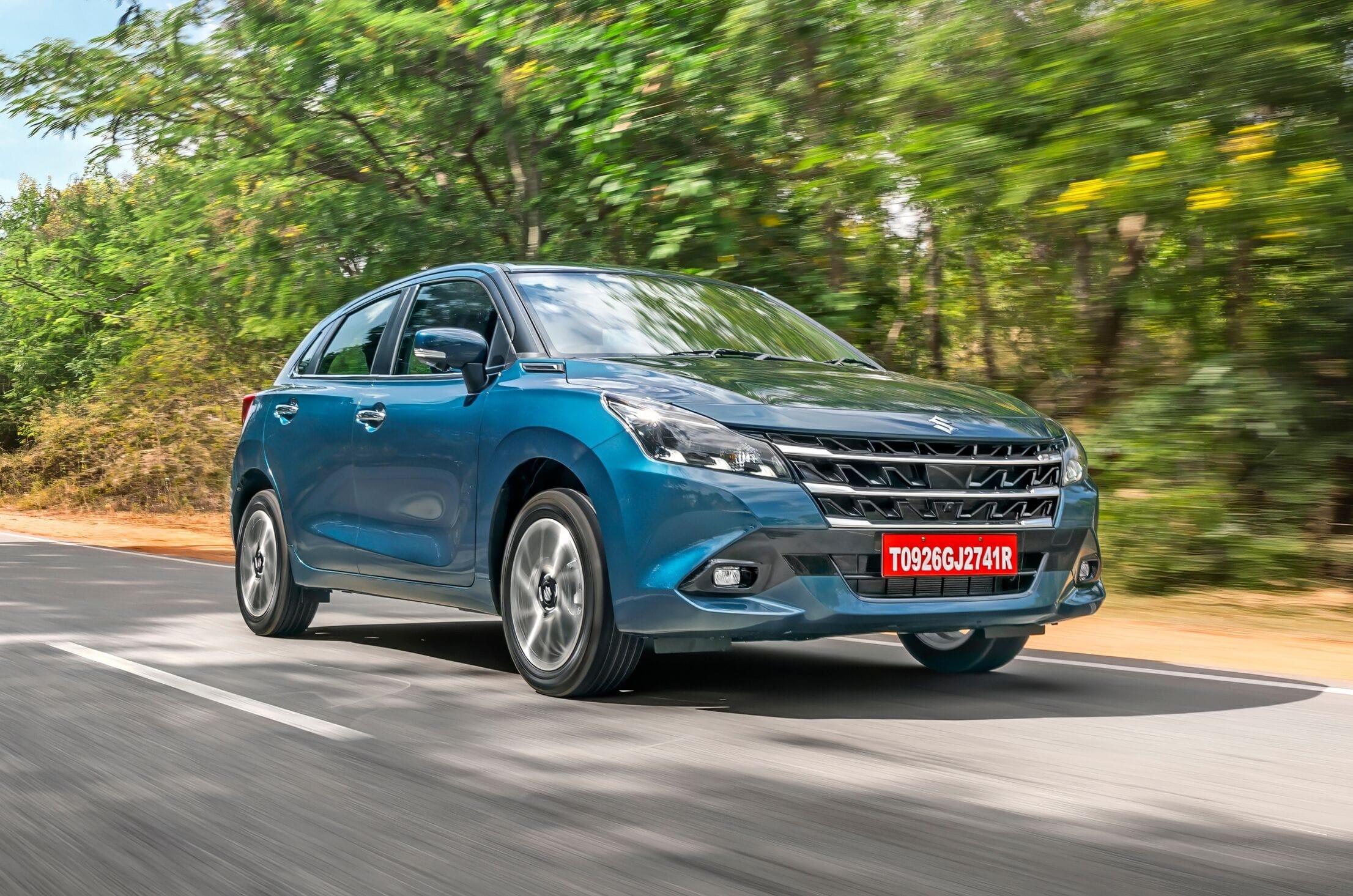
The Maruti Suzuki Baleno has proven to be hugely successful, with the premium hatchback going home to 1.9 million buyers since its introduction in 2015. And in a time when compact SUVs are all the rage, the Baleno continues to buck the trend and bring in the numbers for the brand. And now in a bid to keep it fresh and relevant, Maruti Suzuki has updated it with a tweaked design, new comfort and safety features and even a new petrol engine.
Maruti Baleno Exterior Design and Engineering – 7/10
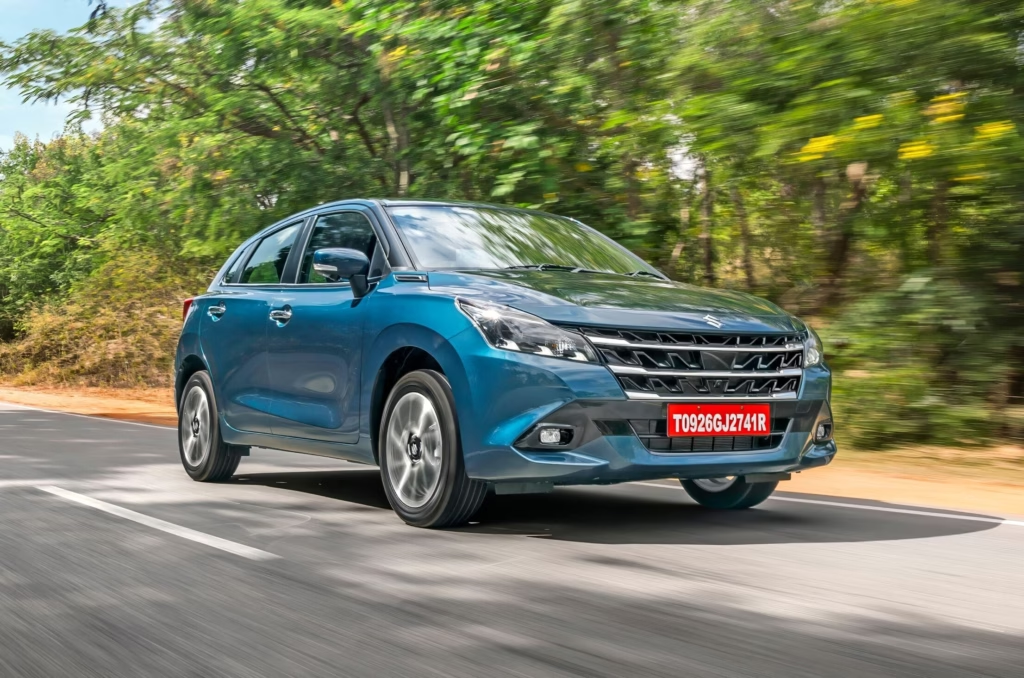
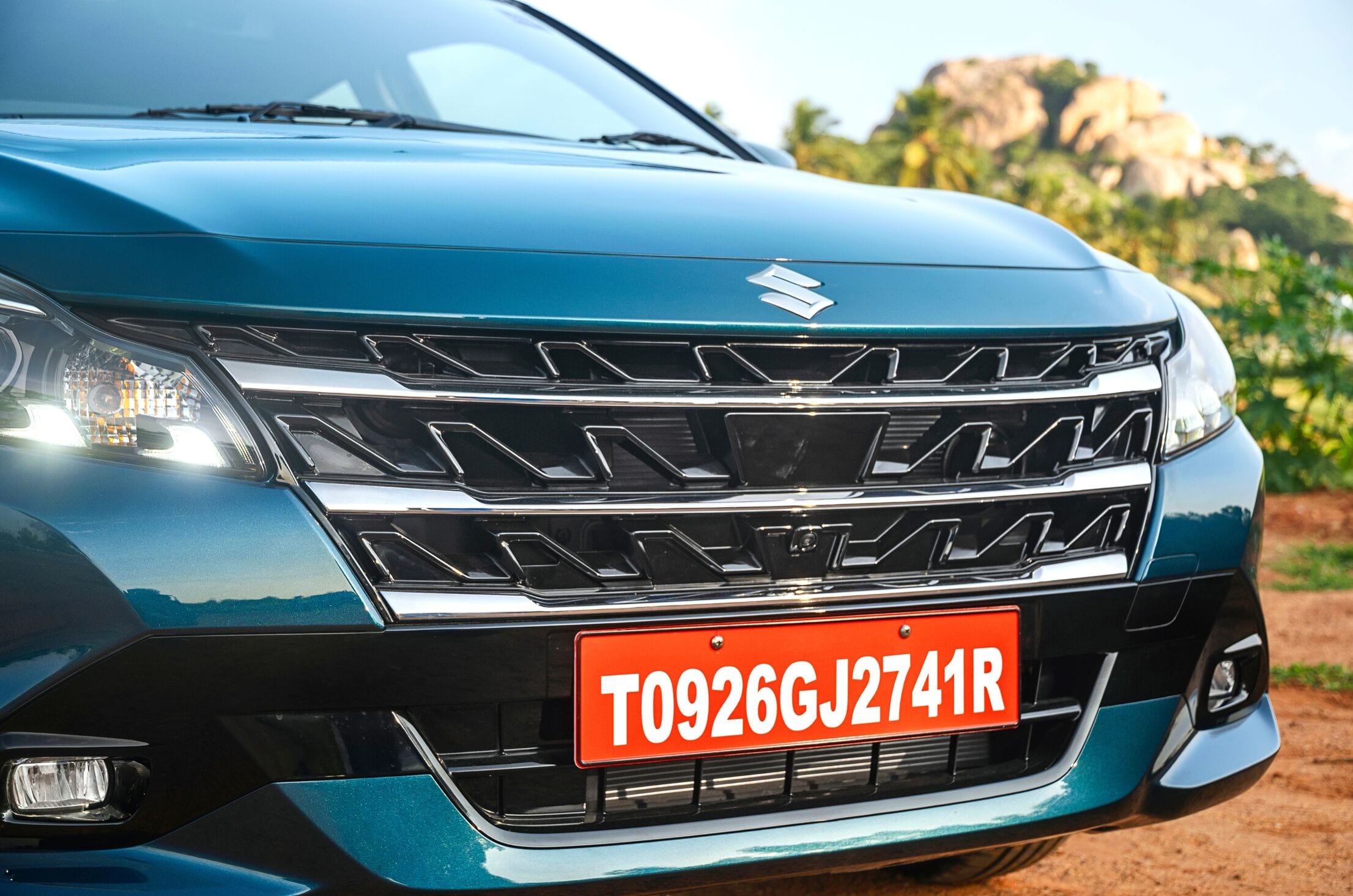
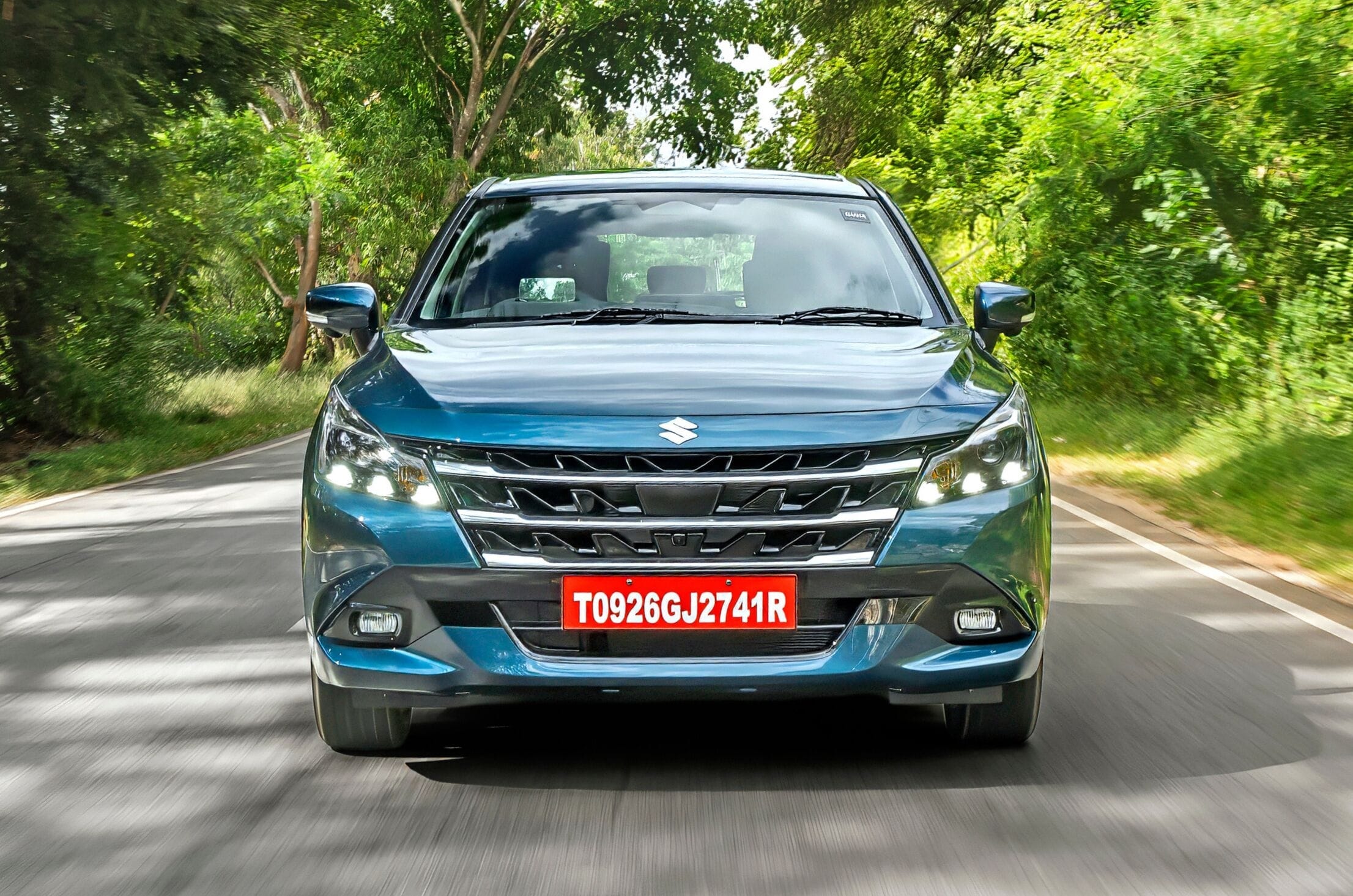
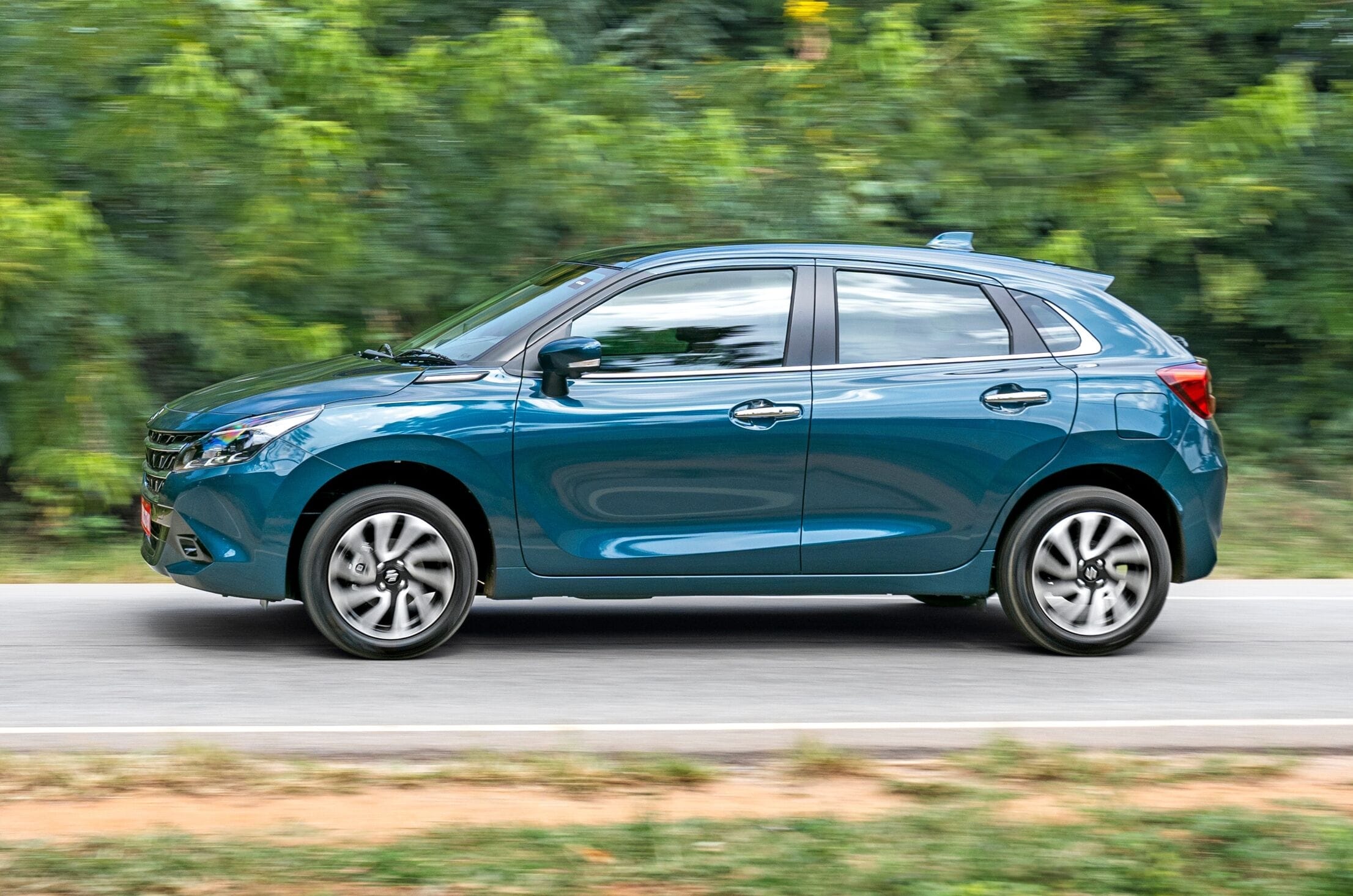
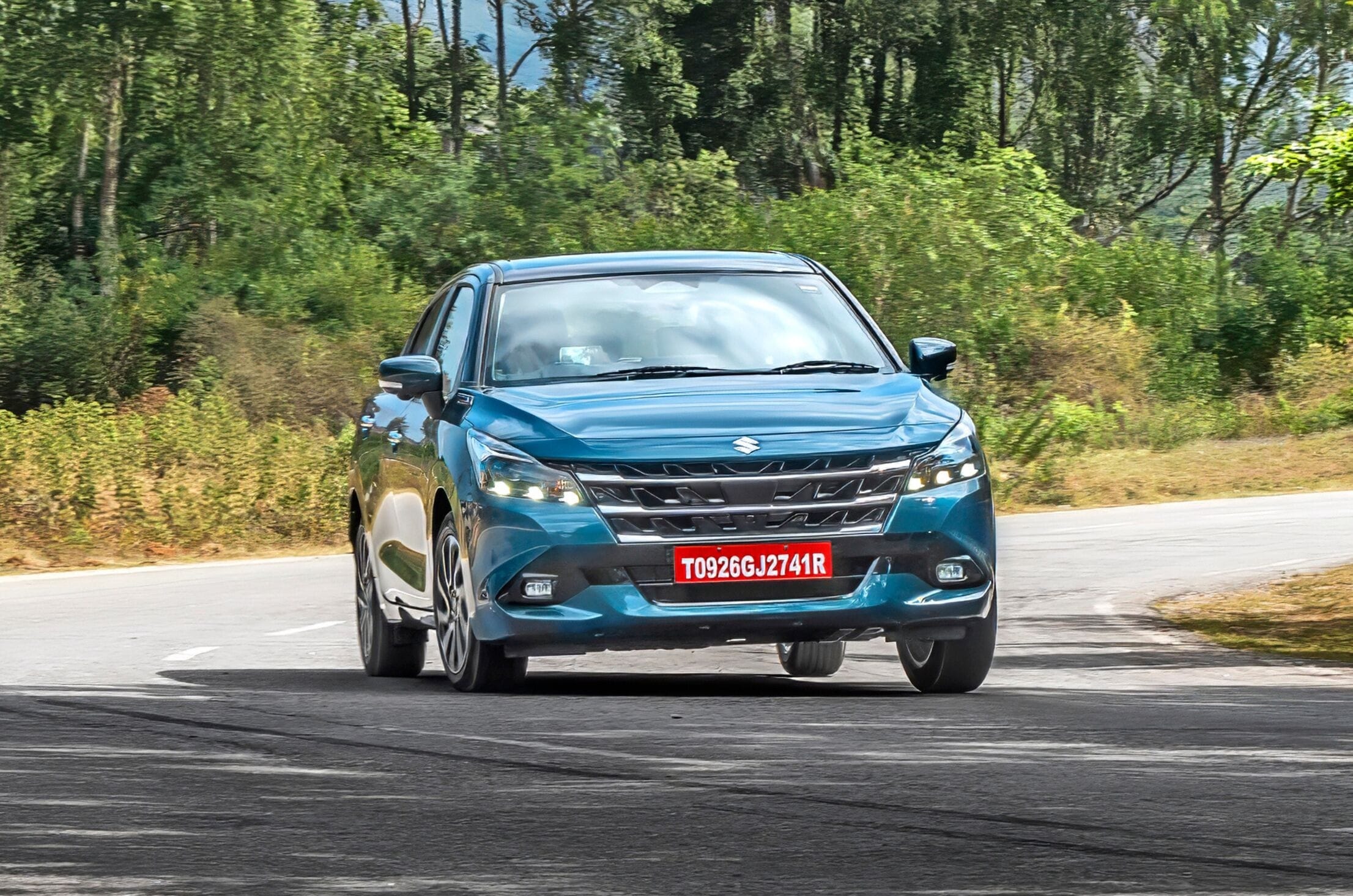
Being a mid-life-cycle update, the Baleno doesn’t get a design overhaul but rather tweaked styling with the bulk of the design changes concentrated at the front end. The grille is now much larger than before with three horizontal chrome slats and gloss black detailing, with a radar module in the centre for the new ADAS tech. The bumper is new too and features a gloss black trim that links the new LED fog lamps and the Suzuki logo has also been moved above the grille. Otherwise, the clamshell bonnet with the two character lines and the LED headlamps with the three-block DRL signature are carried over unchanged.
Gets a new larger grille with chrome slats, a new bumper and new fog lamps.
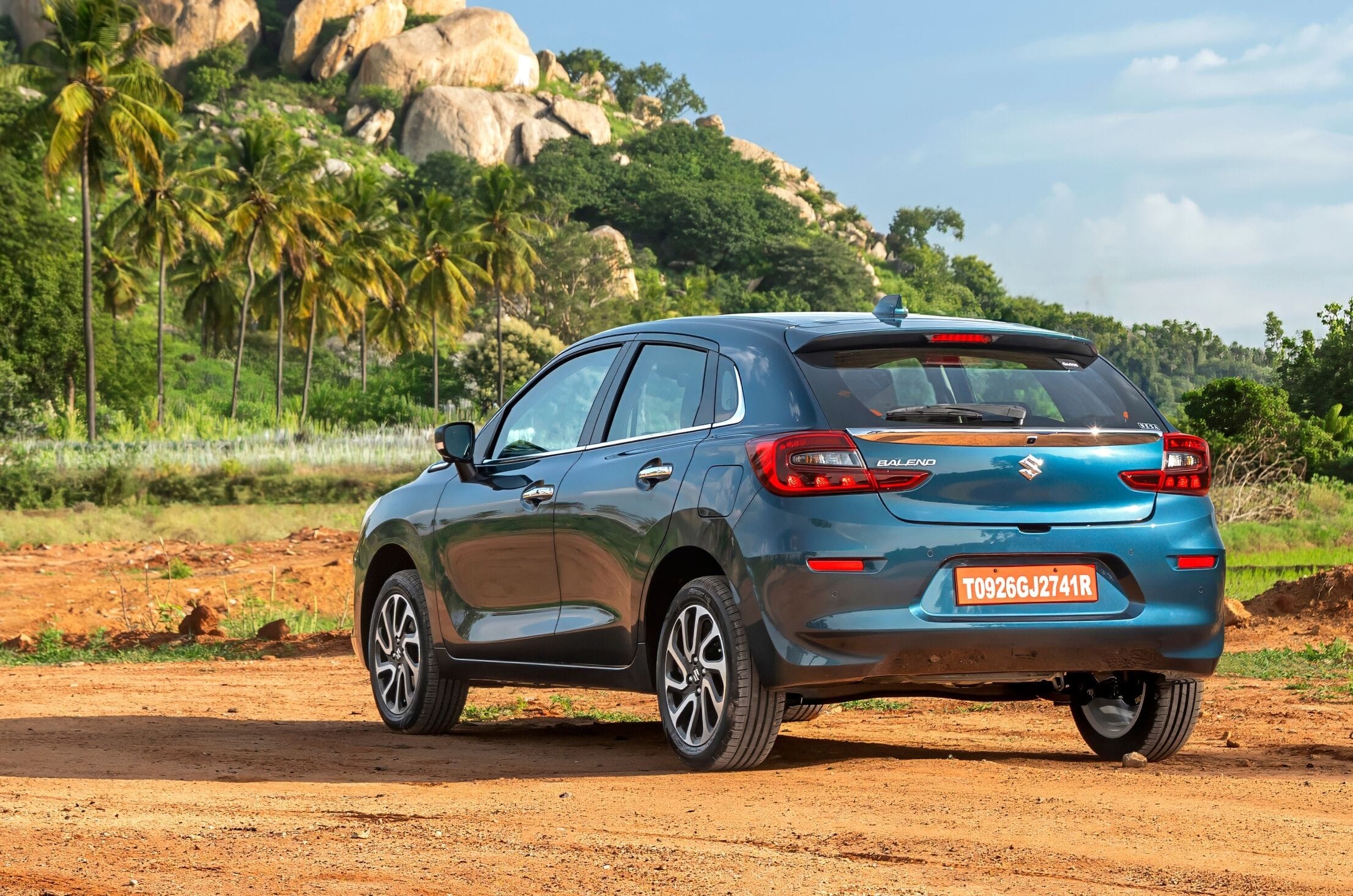
Changes along the sides are minimal, with the only distinguishing factors being a chrome garnish on the front fender and a shark fin antenna on the roof. The facelift retains the older Baleno’s chrome lining under the windows that extends up till the C-pillar, chrome door handles and the dual-tone 16-inch alloy wheels on this top-spec Alpha (O) variant.
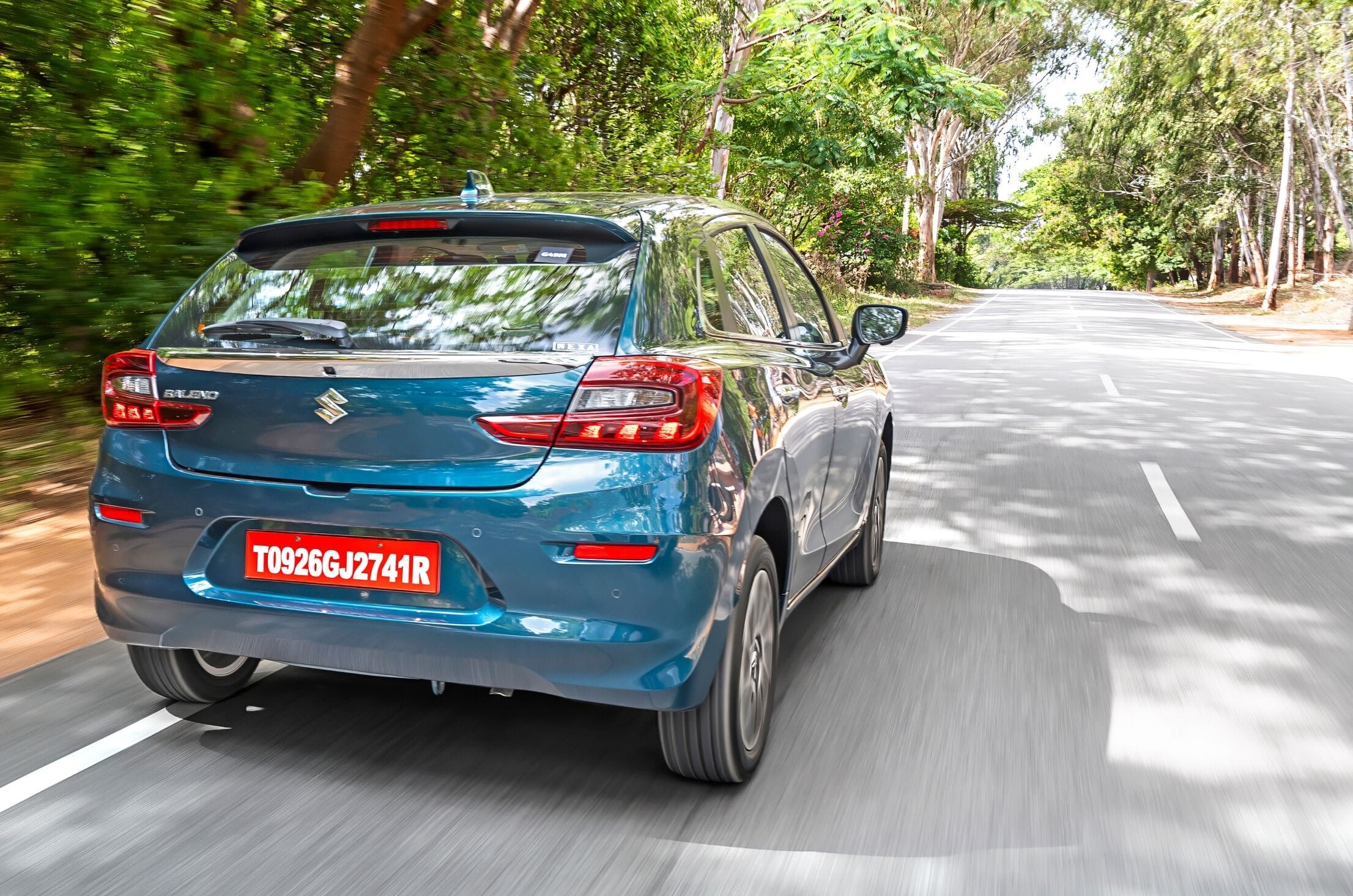
The rear however, stays identical to the pre-facelift Baleno with its C-shaped LED taillamps that also feature the three-block pattern, a chrome band running across the tailgate and a small, roof-mounted spoiler. There’s also a new Enigmatic Teal Green paint shade as seen in the pictures here. Overall, the Baleno sticks to the formula that’s made it as successful as it is with minor tweaks in order to keep it fresh. The front grille, though, splits opinion and certainly doesn’t appear as cohesive as the one on the model it replaces.
Rear stays identical to the pre-facelift model, with the same dual-tone alloys as well
Maruti Baleno Interior Space and Comfort – 8/10
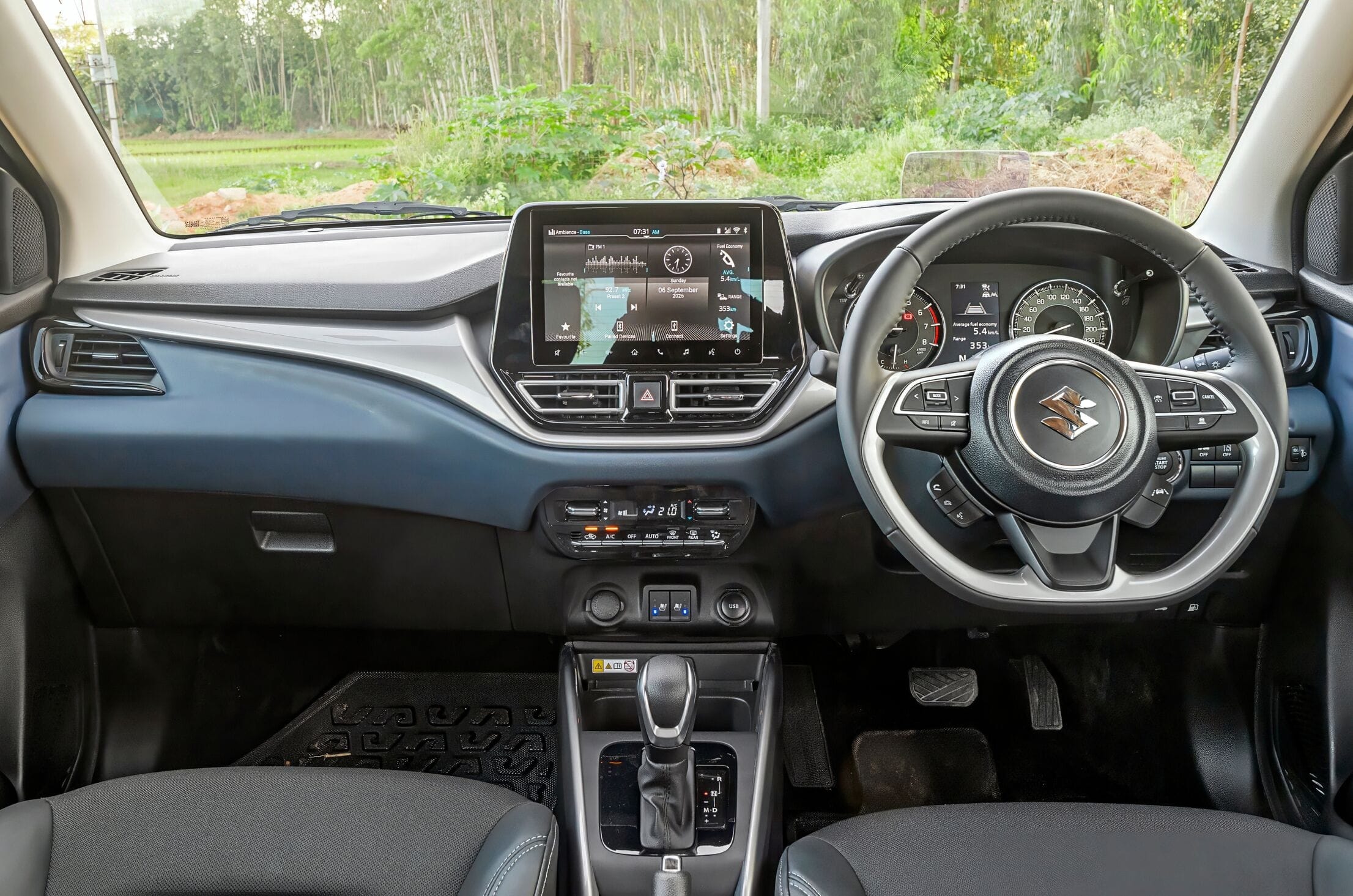
The interior of the Baleno facelift stays near-identical, with the same layered, V-shaped dashboard, flat-bottom three-spoke steering wheel and dual-tone black and blue colour scheme. There have been some tweaks however. The steering now features buttons on the right side for the adaptive cruise control and lane keep assist, there are more buttons on the right of the steering too (near the start/stop button) to turn off certain ADAS features and the seats now feature part-leatherette upholstery. The seats still majorly feature fabric upholstery but the outer edges are now finished in leatherette, which helps up the premium feel.
Layered dashboard with a dual-tone black-and-blue interior theme is carried over unchanged
Otherwise, this cabin is made up of good quality materials, particularly the soft touch leather wrapped steering and the padded elbow rests on the doorcards. The only sore points are the hard plastics and the simple woven roofliner. It’s a practical place too, with big door pockets, a decent-sized glovebox and storage in the centre console, with big cupholders and a small bin under the centre armrest.
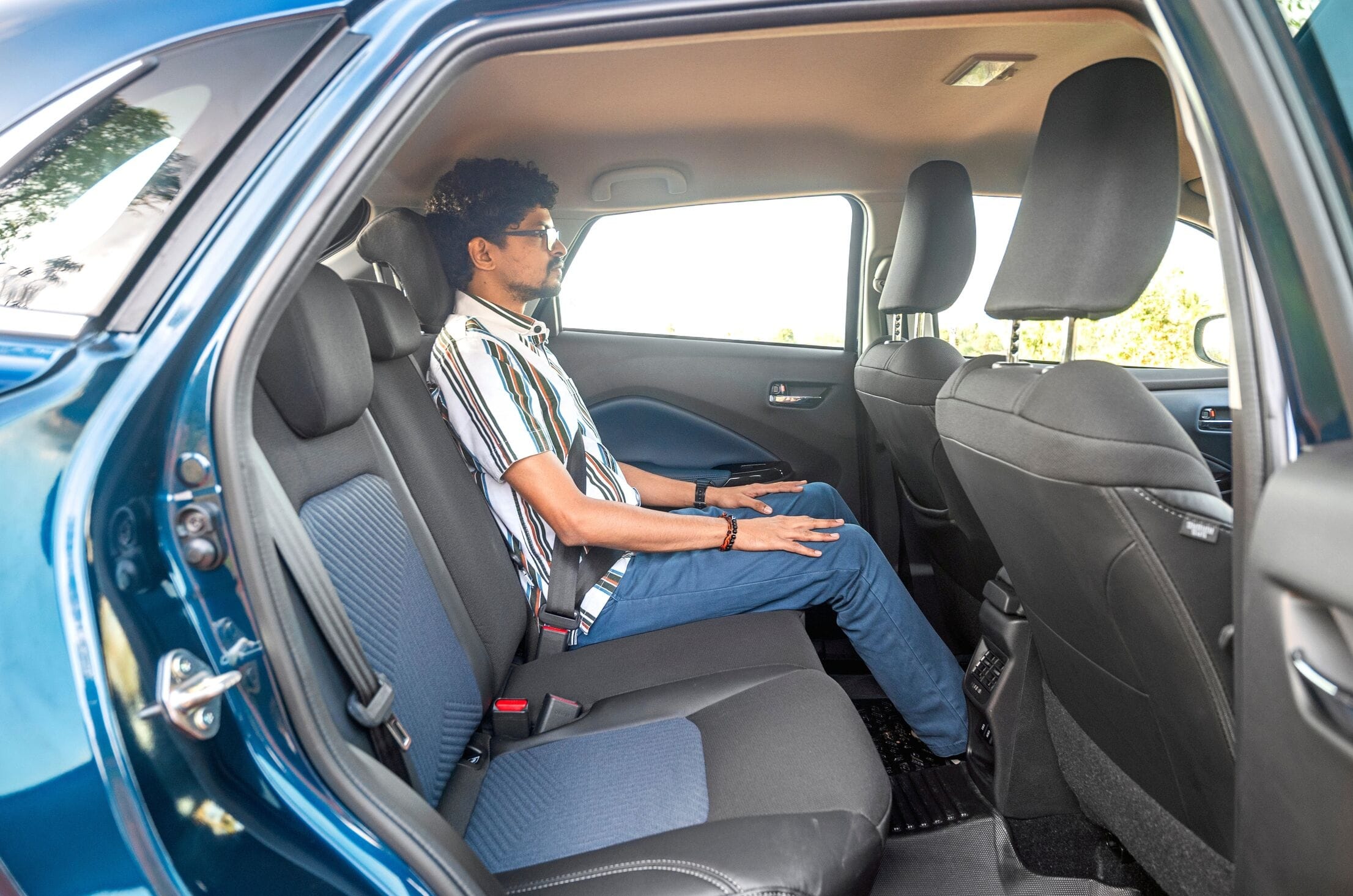
The front seats are unchanged and that’s a good thing as they are accommodating, supportive and offer nice cushioning. Thanks to the height adjustable driver’s seat and tilt/telescopic steering, finding an ideal driving position is an easy affair. Space at the rear is excellent, and even tall passengers won’t find a shortage of headroom or legroom. There’s good underthigh support, the seat cushioning is on point and on the whole, this is a comfy place to be. A welcome addition is an adjustable headrest and three-point seatbelt for the rear centre passenger. Rear passengers also get dedicated AC vents and USB charging ports.
Rear seat space is excellent and even tall passengers won’t find a shortage of headroom or legroom
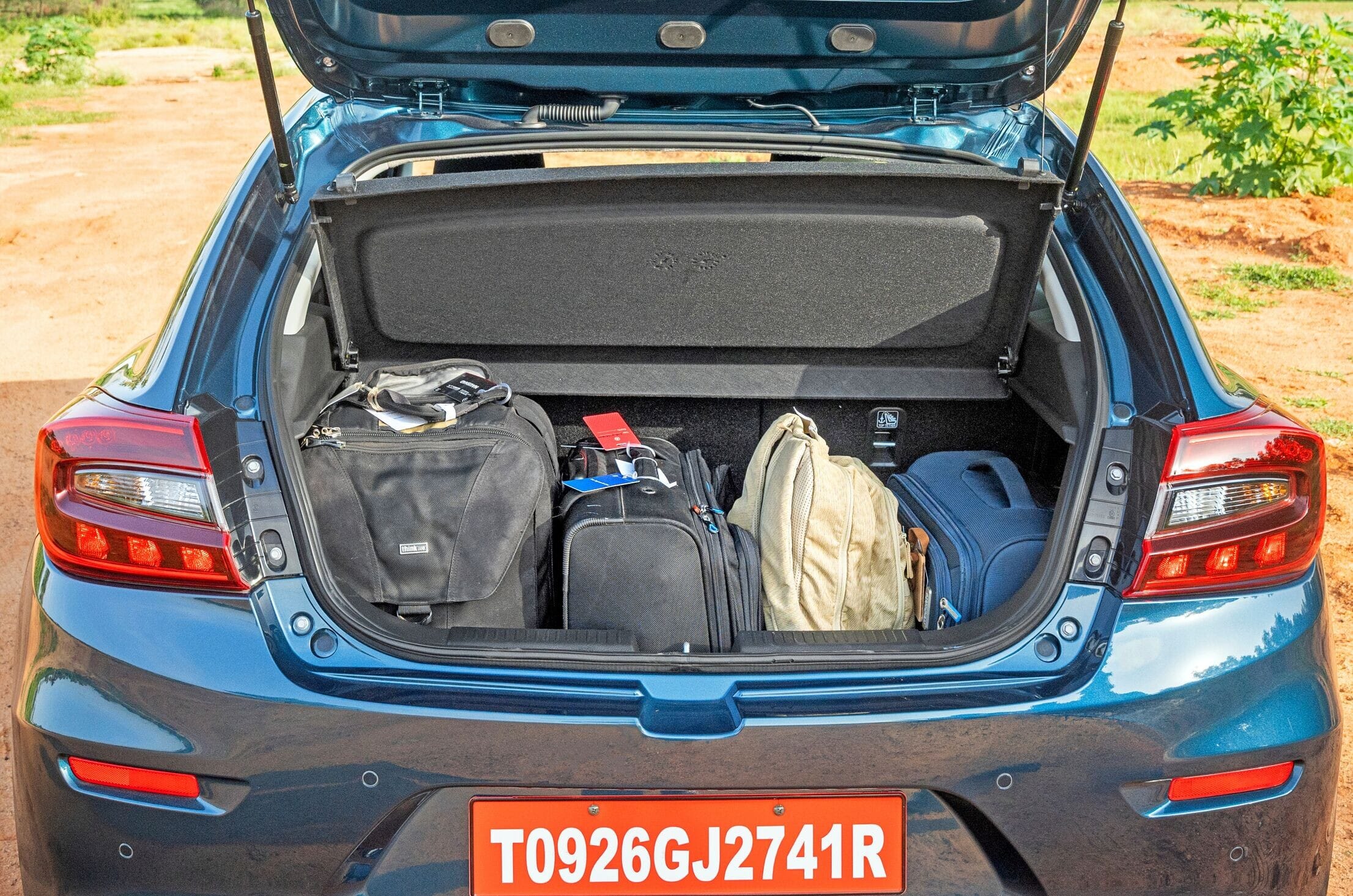
What further enhances overall comfort are the UV-cut glasses, which helps keep the heat out. As for boot space, it’s a sizable 318 litres, though the loading lip is quite high. It’s also nice to see that it retains a spare tyre under the boot floor, when many modern cars are pivoting to puncture repair kits.
Boot is a sizeable 318-litres though the loading lip is quite high; continues to get a spare tyre
Maruti Baleno Features and Safety – 9/10
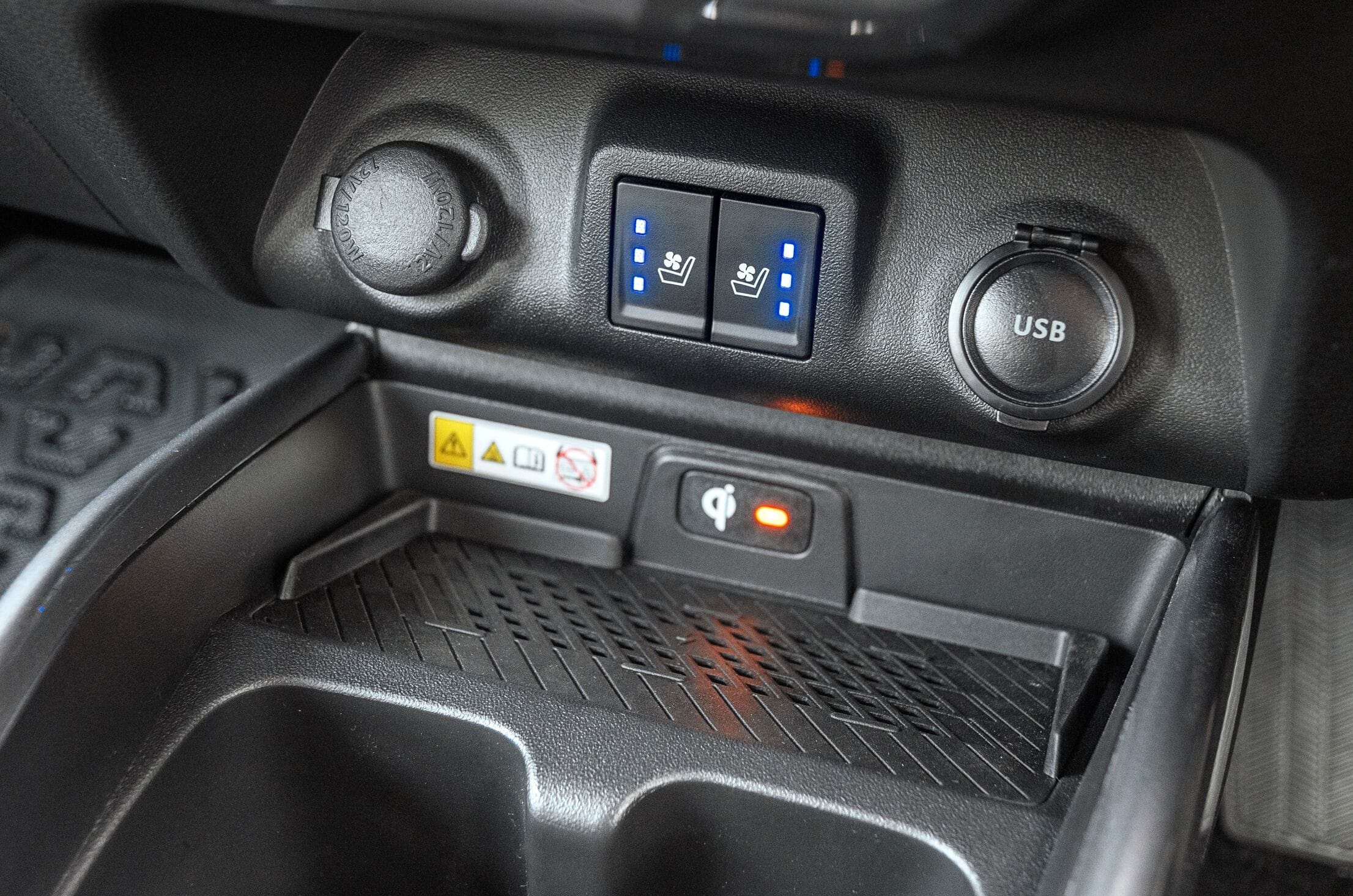
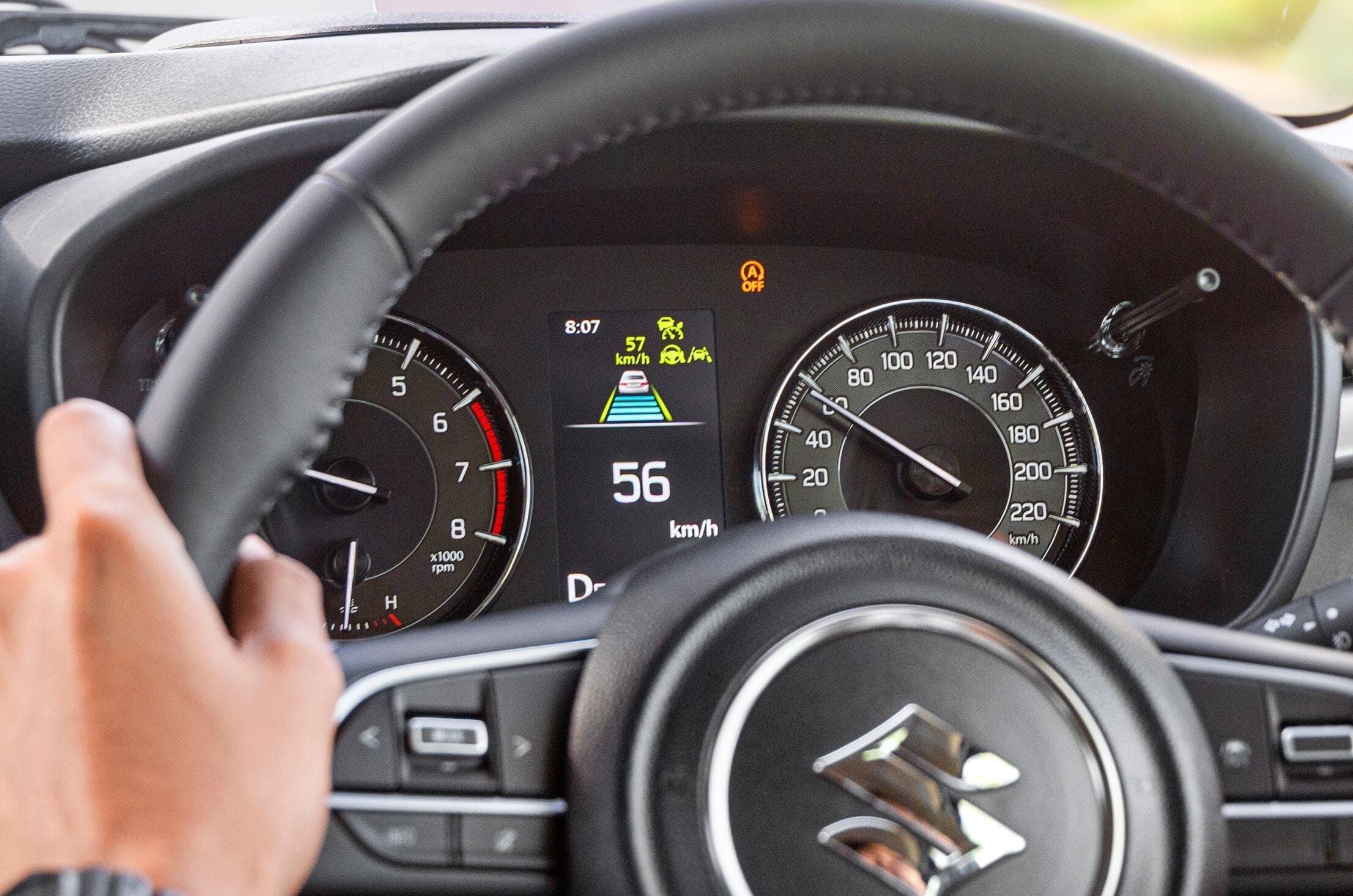
There have been some important additions when it comes to features, as the Baleno now gets ventilated front seats, a cooled wireless phone charger, a tyre pressure monitoring system, a Clarion sound system, and perhaps most importantly, segment-first ADAS Level 2 features.
Ventilated front seats and a cooled wireless charging pad are among the new additions
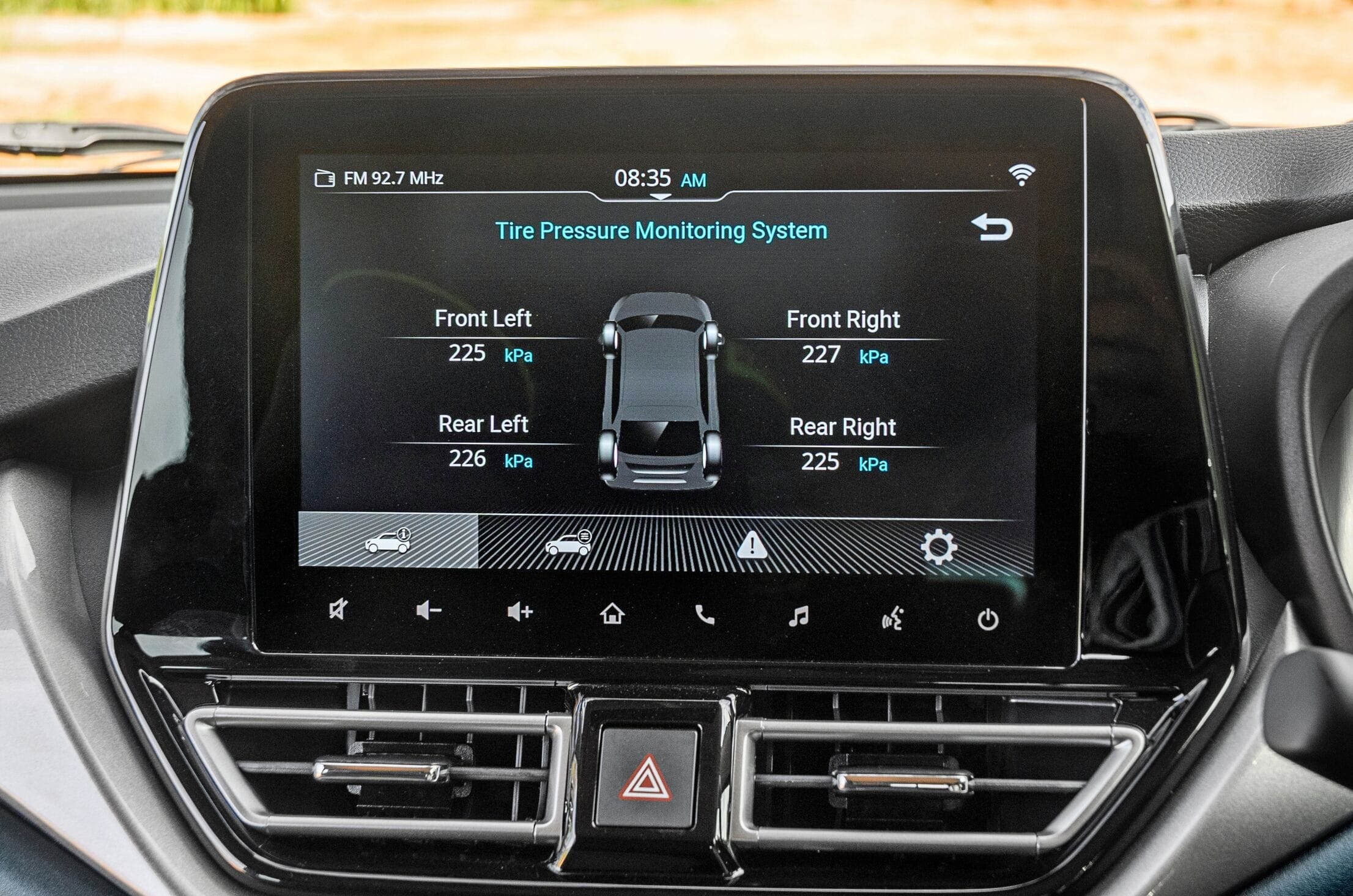
Other than that, the features list was fairly expansive as is, with this top-spec Alpha (O) also getting a 9-inch infotainment touchscreen with wireless smartphone integration, auto climate control, a heads-up display, colour MID, auto headlamps, auto-dimming IRVM, keyless entry and go, rear wiper/washer, connected car tech and more. Safety kit includes 6 airbags as standard, traction control, a 360-degree parking camera (its quite low res though) and ISOFIX child seat mounts. The outgoing Baleno had a 4-star crash safety rating from Bharat NCAP and that should be the case for this one as well.
9-inch touchscreen has been retained; now features a TPMS
Of the newer features, the ventilated front seats work effectively though the blower is quite audible while the wireless charger charges your phone’s battery at a good rate without overheating it. The TPMS too worked as intended, while the Clarion audio system is better than the outgoing model’s it still falls short of what rivals offer.
The addition of Level 2 ADAS tech however, greatly boosts the Baleno’s safety quotient. It’s a camera and radar-based system that brings in features like auto emergency braking, adaptive cruise control, lane keep assist, lane departure warning and more. On our brief test drive, the ADAS features worked as intended and seemed well calibrated as they weren’t overly intrusive. However, if you turn off the ADAS features they will automatically switch back on everytime you start the car.
Gets segment-first Level 2 ADAS features which seemed well calibrated for our conditions
As for features then, the Baleno facelift takes a step up and almost has all bases covered. Only things missing are a rear centre armrest and a sunroof, both of which its rivals offer.
Maruti Baleno Performance and Refinement – 8/10
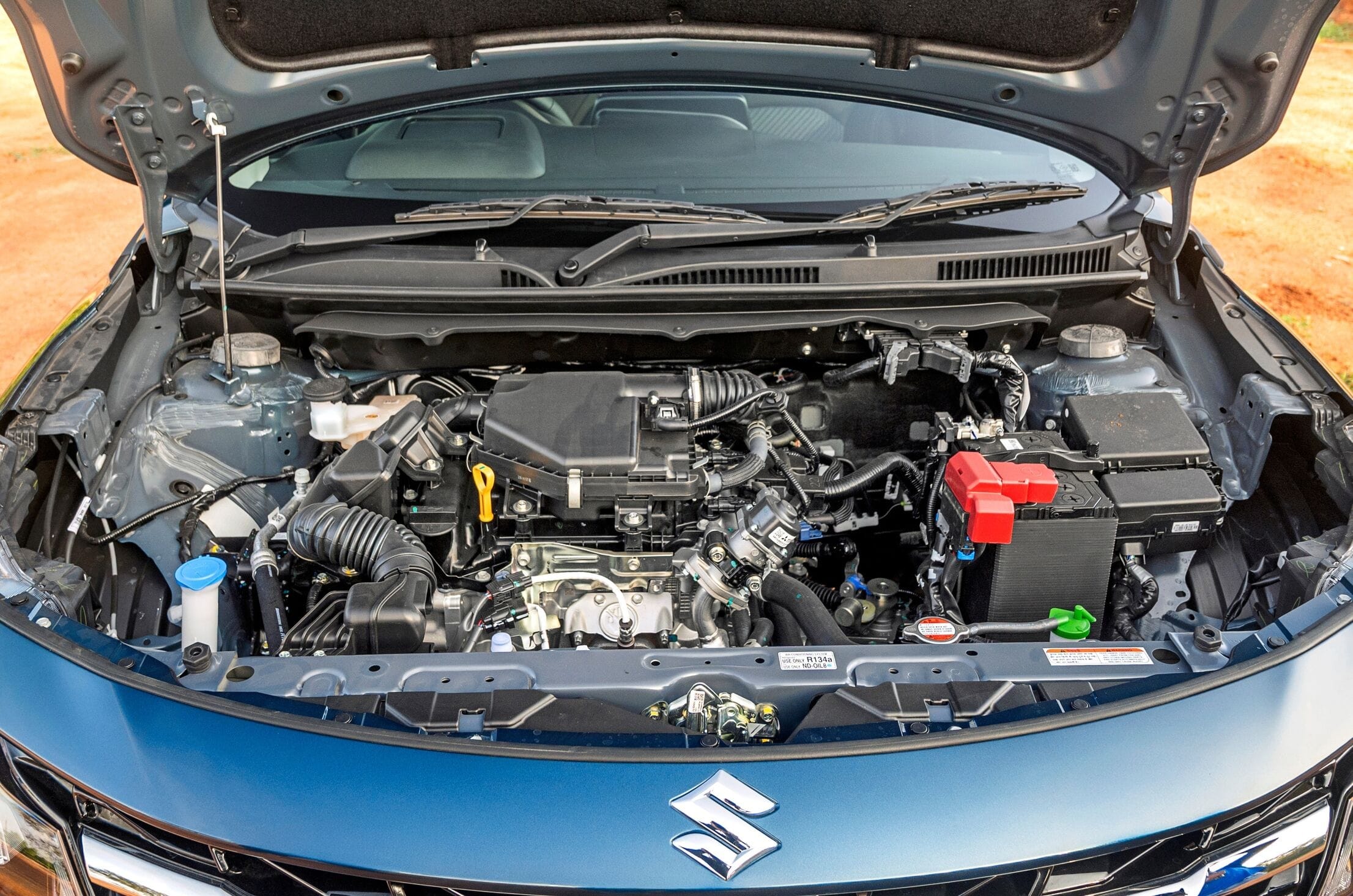
By far the biggest change with the facelift comes under the hood and it’s rare that we get to see a new engine with a facelift. Out goes the 1.2-litre, four-cylinder, K-series engine and in comes the 1.2-litre, three-cylinder, Z-series engine from the likes of the Swift and the Dzire. Yes, the Baleno is down a cylinder and as such, down on output too. The Z12E engine makes 83hp and 112Nm, which is 7hp and 1Nm lower than the older K12N engine. Maruti has moved to this engine as it is newer, is less polluting, more efficient and also opens it up to the possibility of hybridisation in the future.
New Z-series engine impresses with its drivability, low end response and promises more efficiency
This Z-series naturally aspirated engine is one of the most refined three-cylinder engines around. There is some of that typical three-cylinder thrum at idle but that smoothens out as the revs climb. It’s fairly quiet too at idle and it’s only when you’re at the top of the rev range that it becomes audible inside the cabin.
As we’ve experienced in the Swift and Dzire, this Z-series engine impresses with its low-end response and drivability. Power builds in a smooth linear manner, it moves off the line cleanly and part-throttle responses are good too. However, it doesn’t feel as peppy as the older K-series engine and doesn’t feel as strong at the top of the rev range. And considering that it’s down on power and heavier than the outgoing car, it isn’t as quick in terms of outright acceleration. But for a daily urban runabout, this engine is up to the task. For reference, we managed a 0-100kph time of 13.03sec and 15.89sec for the Swift MT and Swift AMT, respectively and you can expect the Baleno to be slightly slower than this owing to its higher kerb weight.
Power builds in a smooth linear manner and part-throttle responses are good, too.
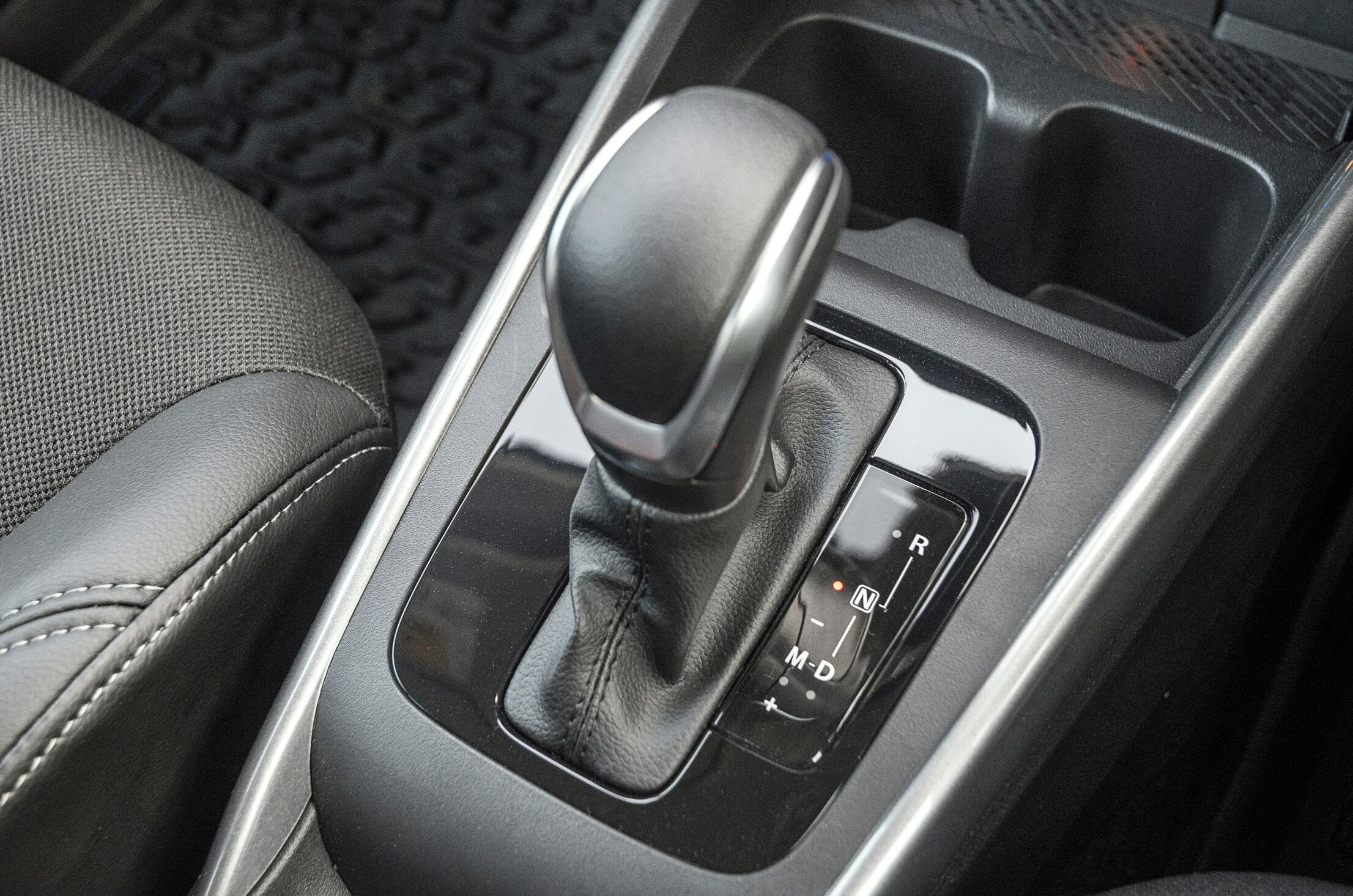
As was the case earlier, the Baleno facelift can be had with either a 5-speed manual or a 5-speed AMT automatic. The manual gearbox is particularly impressive with its effortlessness and our pick of the two. The clutch pedal is light and easy to modulate, while the gearbox is smooth and has nice, short throws and well defined gates.
In comparison to its rivals, which offer more sophisticated automatics in the form of a CVT and a DCT, the Baleno only comes with a simpler, more cost-effective AMT. The AMT makes for a good option for those who wish for greater convenience and it’s smooth as far as AMTs go. There is still that noticeable headnod effect that you get between shifts and it is hesitant when you try to make a quick overtake, as it takes some time to downshift. That can be alleviated however, by shifting to manual mode via the gear lever and what’s nice is that it won’t auto upshift in this mode.
AMT adds a layer of convenience but feels hesitant when you try to make a quick overtake
A factory-fitted CNG option is also available with the Baleno facelift. It uses the same engine but power and torque outputs fall to 70hp and 102Nm, respectively, when run on CNG, and it can only be had with the 5-speed manual gearbox. However, we’re yet to experience the Baleno facelift CNG.
Maruti Baleno Mileage and Efficiency – 9/10
Both manual and AMT variants see an improvement in claimed efficiency with the new engine.
The biggest advantage with the move to the Z-series engine comes in the form of fuel efficiency. The Baleno petrol-manual is now claimed to return 23.80kpl (1.45kpl more), while the AMT is said to do 24.77kpl, which is a 1.83kpl improvement. The Baleno CNG meanwhile, sees an improvement of 3km/kg, with a claimed 33.61km/kg. As always, these are claimed figures tested in ideal conditions and expect real-world fuel efficiency to be lower. What’s interesting is that the Baleno has become more efficient despite becoming up to 30kg heavier than the outgoing version.
Maruti Baleno Ride Comfort and Handling – 8/10
As before, the Baleno continues to impress with its ride comfort. The suspension has a softness to it, which means low speed ride is excellent and it’s only the sharpest bumps and big potholes that manage to unsettle it. It also manages to iron out road imperfections with considerable ease and stays composed at higher speeds, with well-contained vertical and side-to-side movements.
Good body control with minimal roll and the steering weighs up nicely as you pick up the pace
Handling isn’t its strongest suit but the Baleno displays good body control with minimal roll around the corners. The steering, meanwhile, is light at low speeds, which aids city driving, but it adds some reassuring weight as you pick up the pace which is confidence-inspiring. It’s not particularly feelsome but that’s nothing to complain about, given its an urban premium hatchback. As for braking, it continues with the same discs up front and drums at the rear setup and the stopping power is more than adequate. On the whole then, the Baleno feels mature and composed on the move.
Maruti Baleno Value for Money – 8/10
The Maruti Baleno facelift is priced from Rs 6.10 lakh (ex-showroom, India), though this is a special festive price and Maruti is yet to disclose complete variant-wise pricing. It continues to get a 3 year/1,00,000km standard warranty and as before, rivals other premium hatchbacks in the Hyundai i20 and Tata Altroz, both of which are priced from Rs 6 lakh (ex-showroom, India).
The added features and the promise of greater fuel efficiency just further enhance the Baleno’s appeal
There are some drawbacks of course, like the hesitant AMT automatic and it doesn’t feel as peppy as the older K-series Baleno. But those pale in comparison to the Baleno’s inherent strengths of a spacious and comfortable cabin, an effortless drive thanks to its light controls, a refined engine and a good ride comfort and handling balance. The added comfort and safety features and the promise of greater fuel efficiency with the new engine just further enhance its appeal. As such, the Baleno is all set to retain its spot at the top of the premium hatchback chain.
Who is IAS Sanjeev Khirwar: दिल्ली के त्यागराज स्टेडियम में अपना कुत्ता टहलाने के चक्कर में विवादों में आए और दिल्ली से सीधे लद्दाख ट्रांसफर कर दिए गए वरिष्ठ आईएएस अधिकारी संजीव खिरवार एक बार फिर सुर्खियों में हैं।
जनवरी 2026 में एमसीडी (MCD) कमिश्नर के रूप में दिल्ली वापसी करने वाले संजीव खिरवार अब दक्षिण दिल्ली के सत्य निकेतन में एक पांच मंजिला इमारत गिरने के हादसे के बाद चौतरफा घिर गए हैं। इस हादसे के बाद कई छात्र संगठनों ने नगर निगम की लापरवाही का आरोप लगाते हुए उनके इस्तीफे की मांग तेज कर दी है।
आइए आपको बताते हैं कि आखिर कौन हैं आईएएस संजीव खिरवार, क्या था उनका पुराना कुत्ता टहलाने वाला विवाद और अब वे नए विवाद में क्यों फंसे हैं।
कौन हैं संजीव खिरवार?
संजीव खिरवार 1994 बैच के AGMUT (अरुणाचल प्रदेश-गोवा-मिजोरम-केंद्र शासित प्रदेश) कैडर के वरिष्ठ आईएएस (IAS) अधिकारी हैं। उनके पास कंप्यूटर इंजीनियरिंग में B.Tech और इकोनॉमिक्स में मास्टर डिग्री है। उन्होंने अपने प्रशासनिक करियर की शुरुआत चंडीगढ़ में SDM के रूप में की थी। इसके बाद वे दिल्ली सरकार और केंद्र सरकार में कई महत्वपूर्ण पदों पर तैनात रहे।
साल 2022 का ‘डॉग-वॉकिंग’ विवाद, जिससे हुआ था लद्दाख ट्रांसफर
साल 2022 में संजीव खिरवार तब पूरे देश में चर्चा में आए थे, जब दिल्ली के त्यागराज स्टेडियम से एक तस्वीर वायरल हुई थी। स्टेडियम में प्रैक्टिस करने वाले एथलीटों और कोचों ने आरोप लगाया था कि उन्हें शाम 7 बजे तक ट्रेनिंग खत्म कर स्टेडियम खाली करने को कहा जाता था, ताकि आईएएस अधिकारी संजीव खिरवार वहां अपने पालतू कुत्ते को टहला सकें।
वैसे स्टेडियम प्रशासक ने आरोपों को खारिज करते हुए कहा था कि 7 बजे का समय ट्रेनिंग खत्म होने का आधिकारिक शेड्यूल था। लेकिन विवाद इतना बढ़ा कि केंद्र सरकार ने तुरंत एक्शन लेते हुए खिरवार का ट्रांसफर दिल्ली से सुदूर लद्दाख कर दिया था।
जनवरी 2026 में की दिल्ली वापसी और MCD चीफ का संभाला मोर्चा
लद्दाख में अपनी सेवाएं देने के बाद गृह मंत्रालय ने जनवरी 2026 में संजीव खिरवार को वापस दिल्ली बुला लिया। उन्हें अश्वनी कुमार की जगह MCD कमिश्नर की कमान सौंपी गई। दिल्ली वापसी के बाद माना जा रहा था कि उनके करियर का नया अध्याय शुरू होगा, लेकिन कुछ ही महीनों में वे एक बड़े नागरिक हादसे के केंद्र में आ गए।
सत्य निकेतन इमारत हादसे में क्यों मांगे जा रहे हैं इस्तीफे?
छात्रों के हॉस्टल और पीजी के लिए मशहूर सत्य निकेतन इलाके में एक 5 मंजिला इमारत ढह गई, जिसके बाद एमसीडी की बिल्डिंग सेफ्टी और अनधिकृत निर्माण पर सवाल खड़े हो गए हैं।
छात्र संगठनों ने एमसीडी मुख्यालय पर जोरदार विरोध प्रदर्शन किया और आरोप लगाया कि इलाके में अवैध निर्माण और जर्जर इमारतों पर एमसीडी ने कोई कार्रवाई नहीं की, जिससे यह हादसा हुआ। छात्र संगठन अब संजीव खिरवार के इस्तीफे पर अड़े हैं।
विवाद बढ़ता देख एमसीडी कमिश्नर ने नगर निगम के पक्ष का बचाव करते हुए कहा कि पिछले कुछ महीनों में एमसीडी ने अवैध निर्माण के खिलाफ कड़ा अभियान चलाया है, जिसके तहत सैकड़ों अवैध इमारतों को सील और ध्वस्त किया गया है।
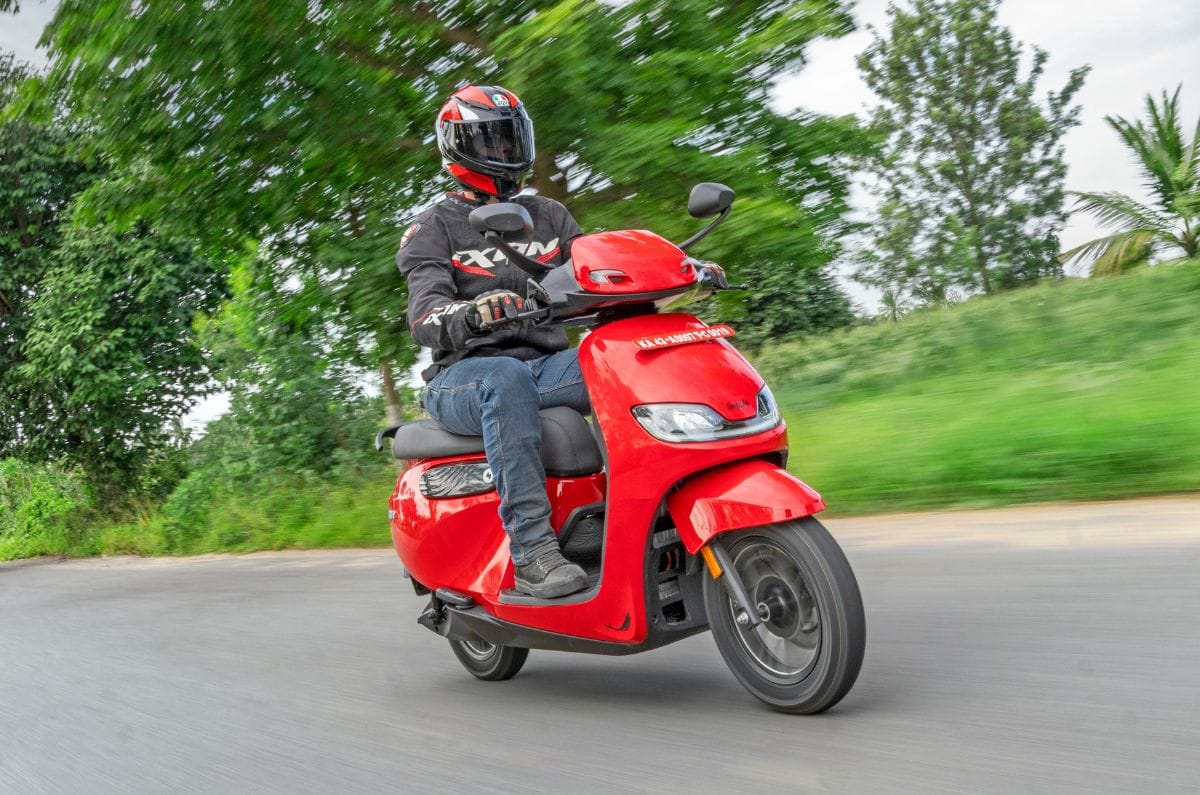
The Simple Wave is an interesting proposition in the increasingly crowded electric scooter space. Its rounded, smooth looks certainly grab attention and, as we found out, it is comfortable, spacious and offers brisk performance. There’s plenty to like here, so let’s dive right in.
Simple Wave Design and quality – 8/10
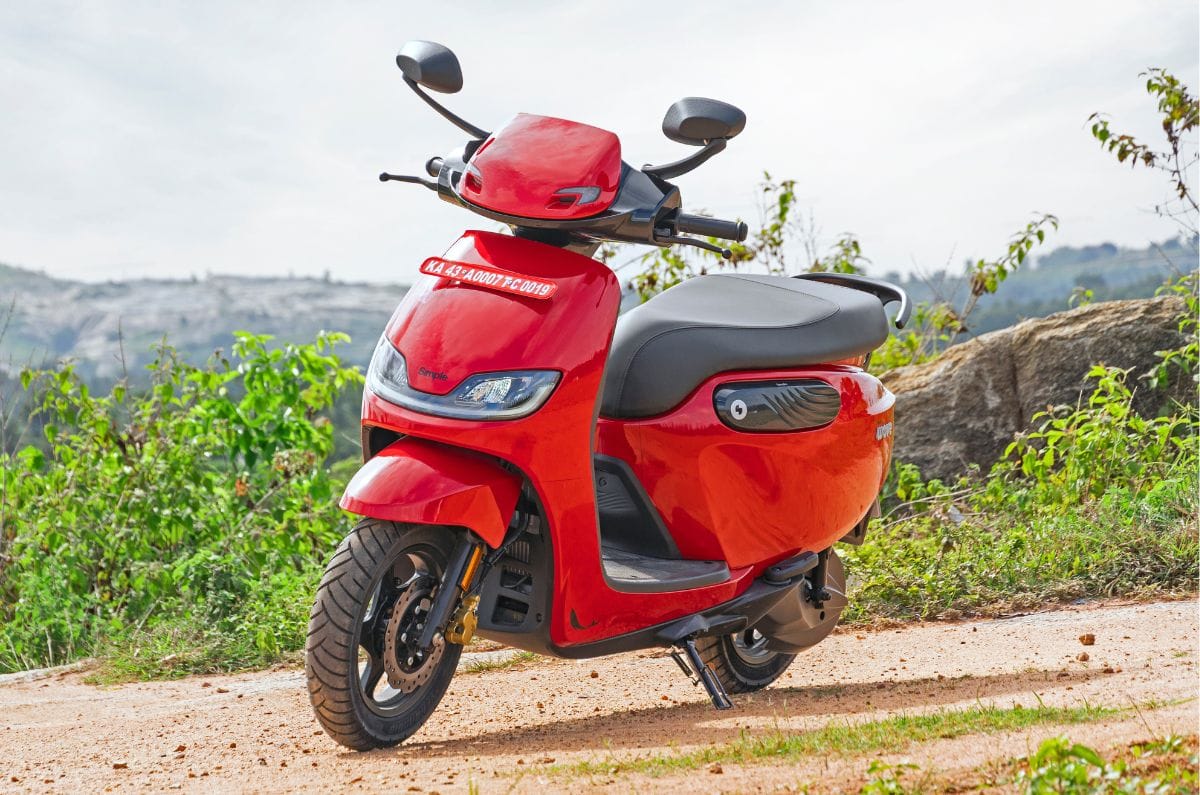
Looks unique and features many chassis changes over the One
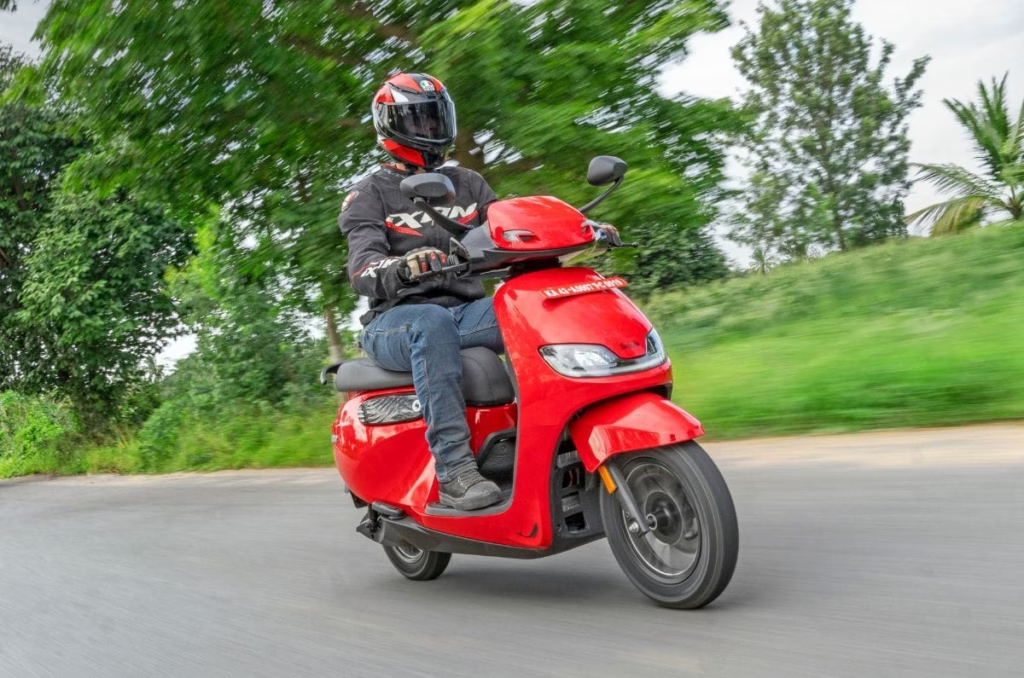
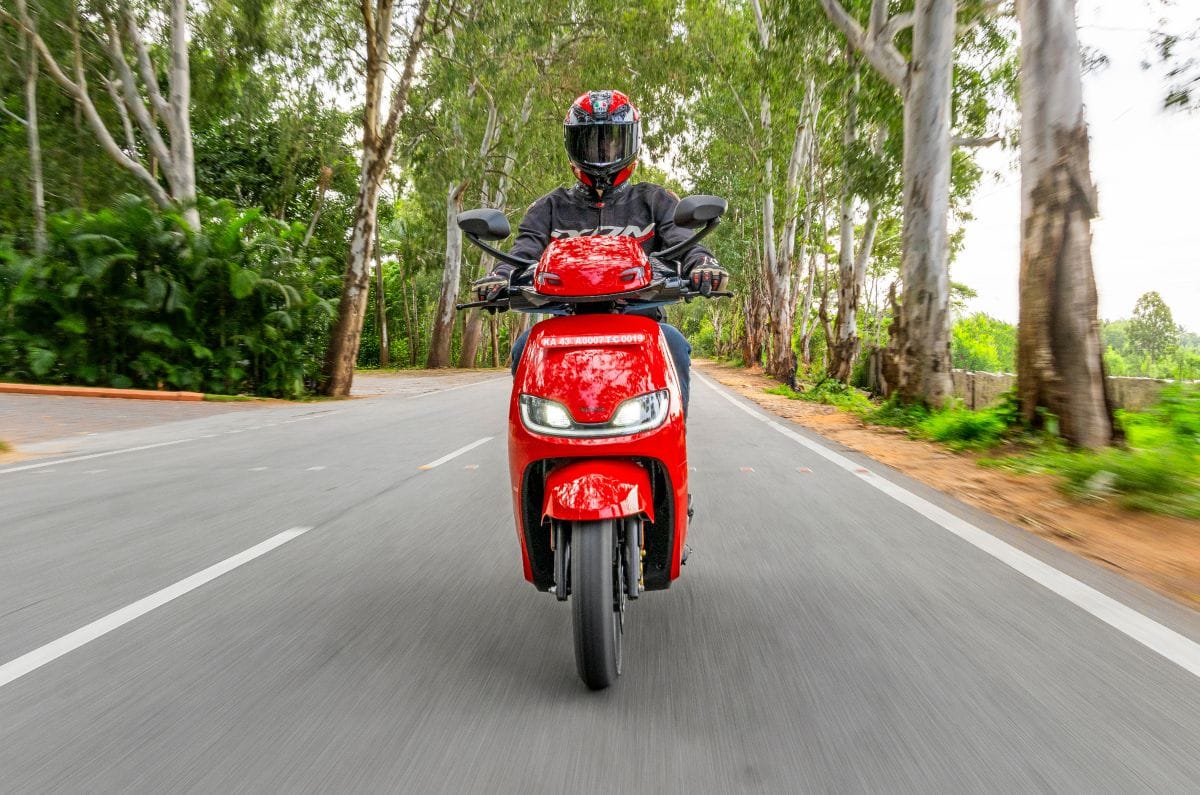
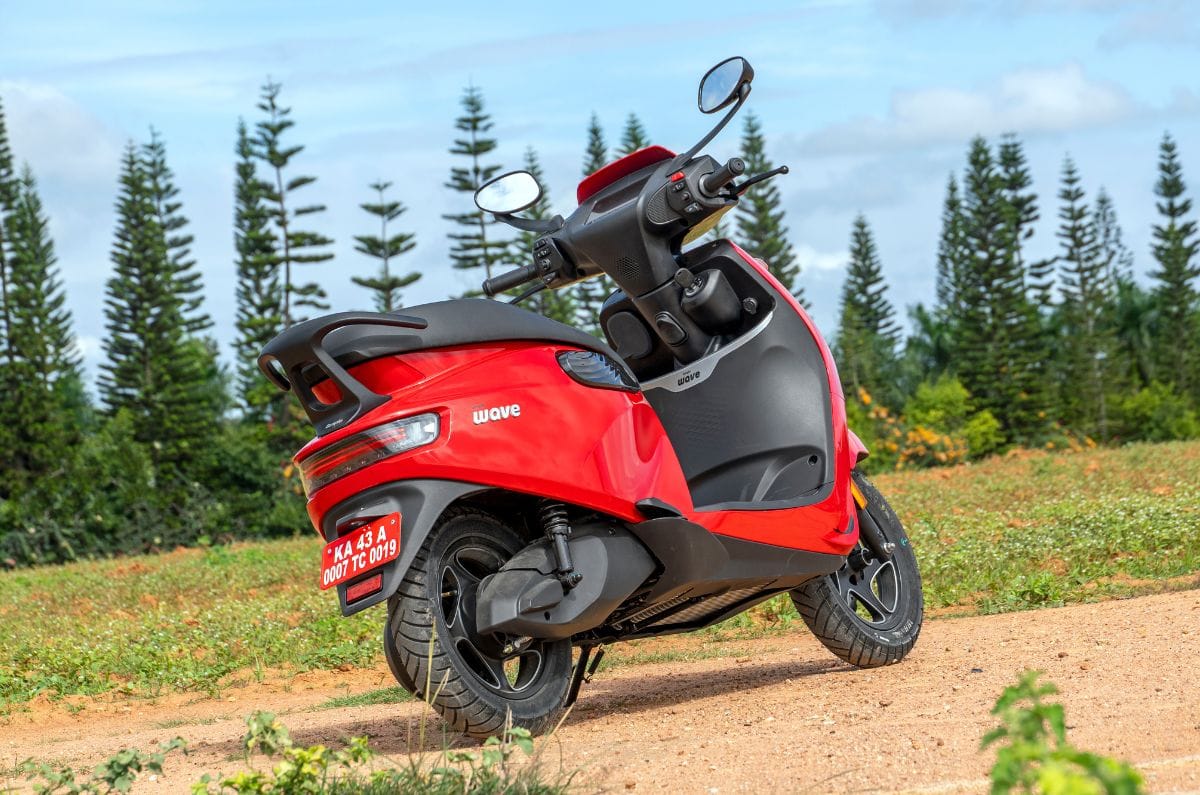
Design is subjective, of course, but the Wave looks good to my eyes with its smooth, rounded edges and distinctive silhouette. It’s got a good level of finish too, and the brighter colour options – red and blue – help it stand out. Simple has designed the Wave as a more accessible, family-oriented scooter, without making it look or feel built down to a cost.
It has a quirky design and surely stands out, especially in the brighter colour options.
Compared to the sporty Simple One, the Wave’s chassis is quite different. The rear subframe has been reworked to accommodate the bigger boot and twin shocks (which replace the One’s monoshock). The Wave also uses a simpler, more cost-effective tubular swingarm instead of the cast unit on the One.
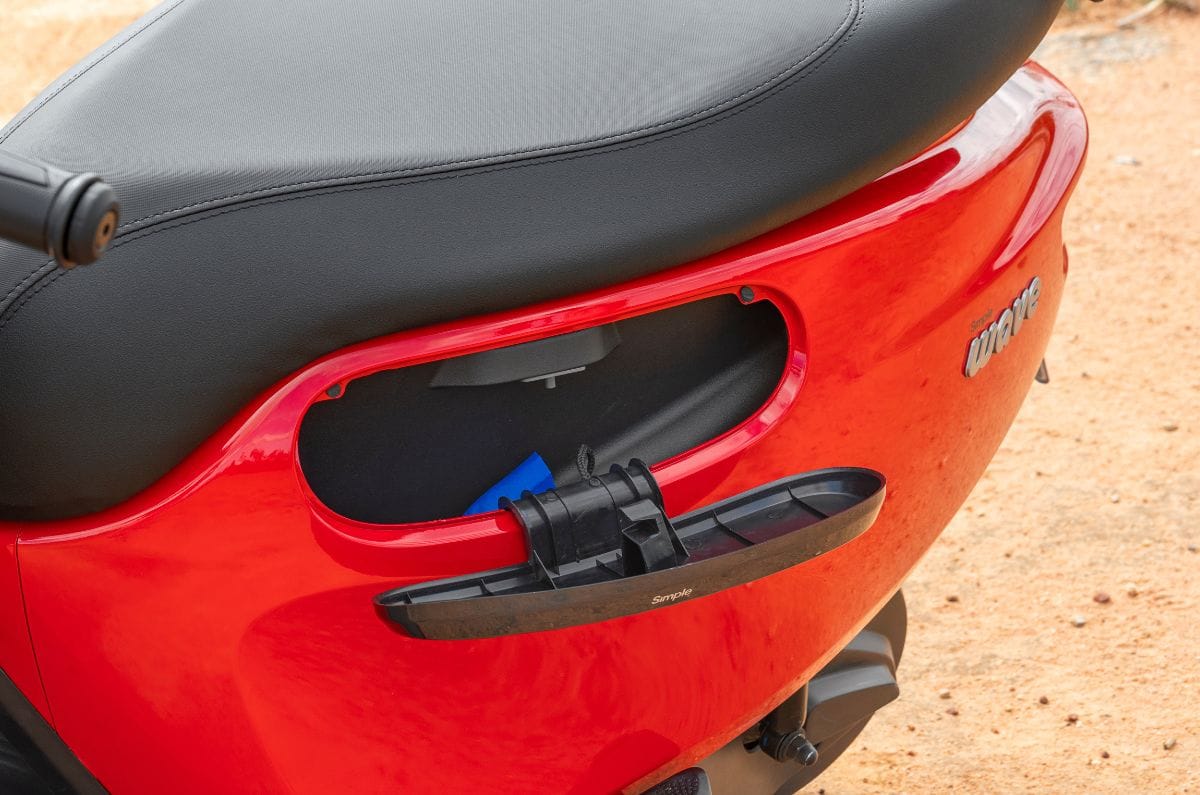
Lockable and weatherproof 4L“Pill” storage cubbies are a thoughtful touch, RH cubby is an accessory.
Simple Wave Ergonomics and comfort – 9/10
Offers a supple ride and ample space for two people
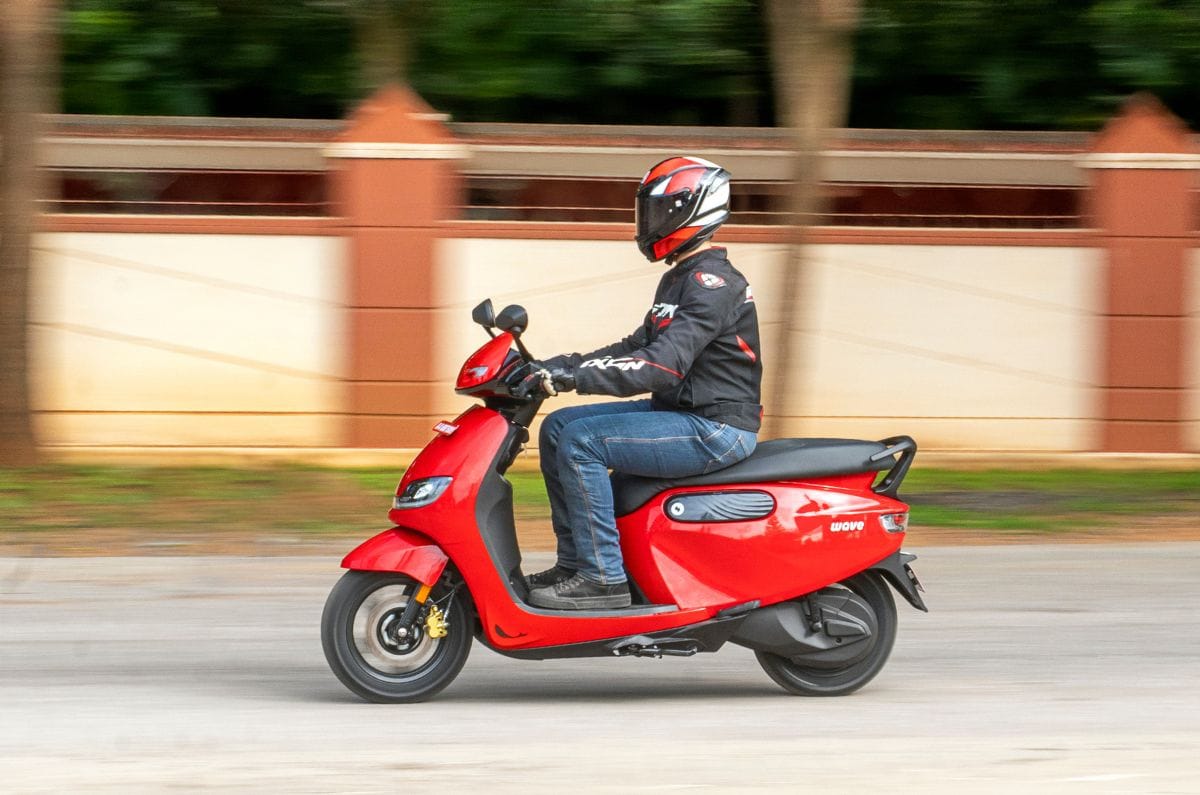
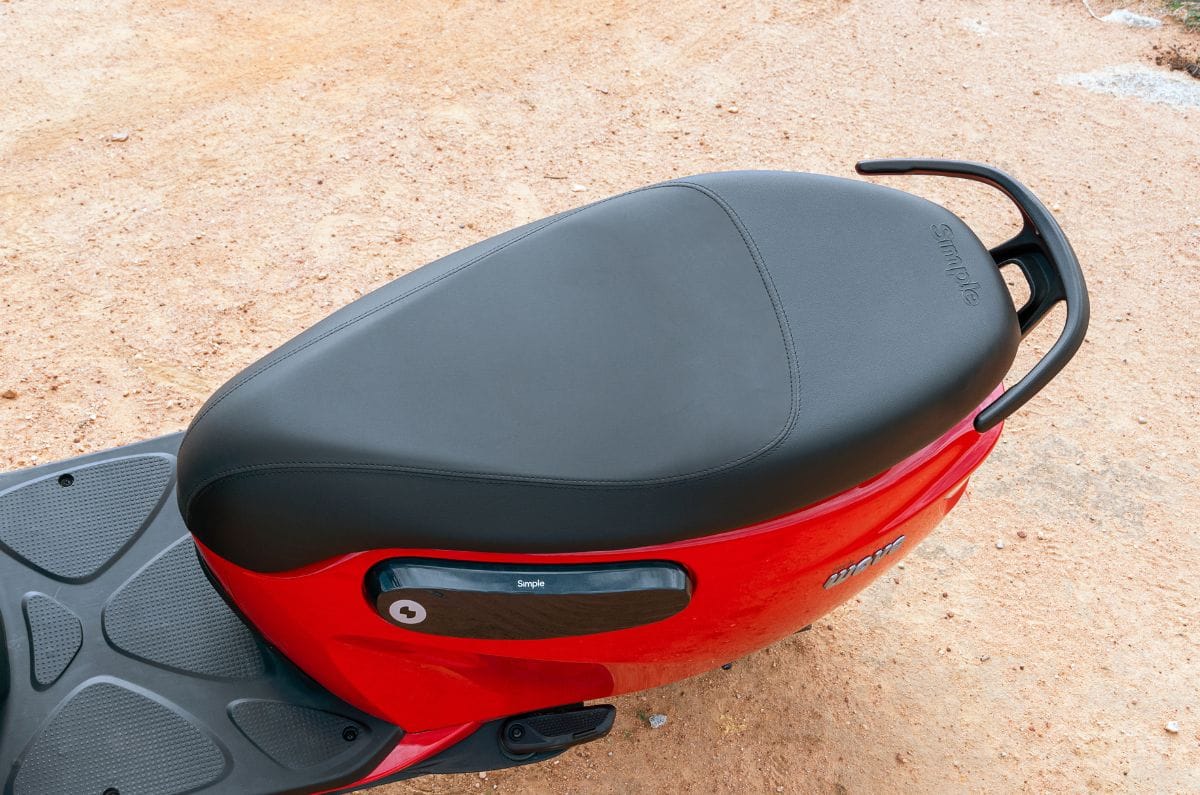
The differences only get more pronounced once you sit on the Wave. Its seat is long, wide and will easily accommodate two full-size adults, while its relatively low 775mm seat height makes it friendly for shorter riders.
That low seat height is no accident either; Simple took feedback from customers who had the One and incorporated it into the Wave. This is why the Wave also has a lower handlebar to make it more approachable for shorter and female riders. This has a trade-off, however. Taller riders will find the handlebar fouls their knees during tight, lock-to-lock U-turns.
Riding position is spot-on and ride comfort too is excellent.
Other than that, the Wave is rather sorted ergonomically. Ride comfort is excellent for a scooter, and that isn’t a surprise given that the Simple One itself was quite comfortable. The Wave builds on that with a composed and plush ride that suits its intended role.
Depending on the variant, the Wave weighs between 121-128kg with the 3.7kWh TFT variant provided to us sitting roughly in the middle of that range (124.5kg). We found the Wave handled predictably, without any unwelcome surprises, feeling stable and sure-footed without compromising agility expected of a scooter.
Spacious, well-paded seat can comfortably seat 2 full-size adults.
Simple Wave Performance and range – 9/10
Performance is more than sufficient, Eco mode truly usable
Like the One, the Wave offers really brisk performance, but still feels approachable enough for everyday use. The 3.7 version gets three riding modes – Eco, Ride and Sport – and both Ride and Sport offer more than enough performance for everyday use, which isn’t really a surprise. In Ride the top speed is 75kph, whereas Sport takes it up to 90kph (speedo-indicated, not actual).
The real surprise, however, is Eco mode. Yes, it feels duller than the other two modes, but it isn’t crippled in the way Eco modes on other EVs. The Wave can still get up to around 50-55kph quite respectably and overtake traffic, making Eco genuinely usable even on faster roads or in a big city.
It handles predictably and surefootedly in all scenarios.
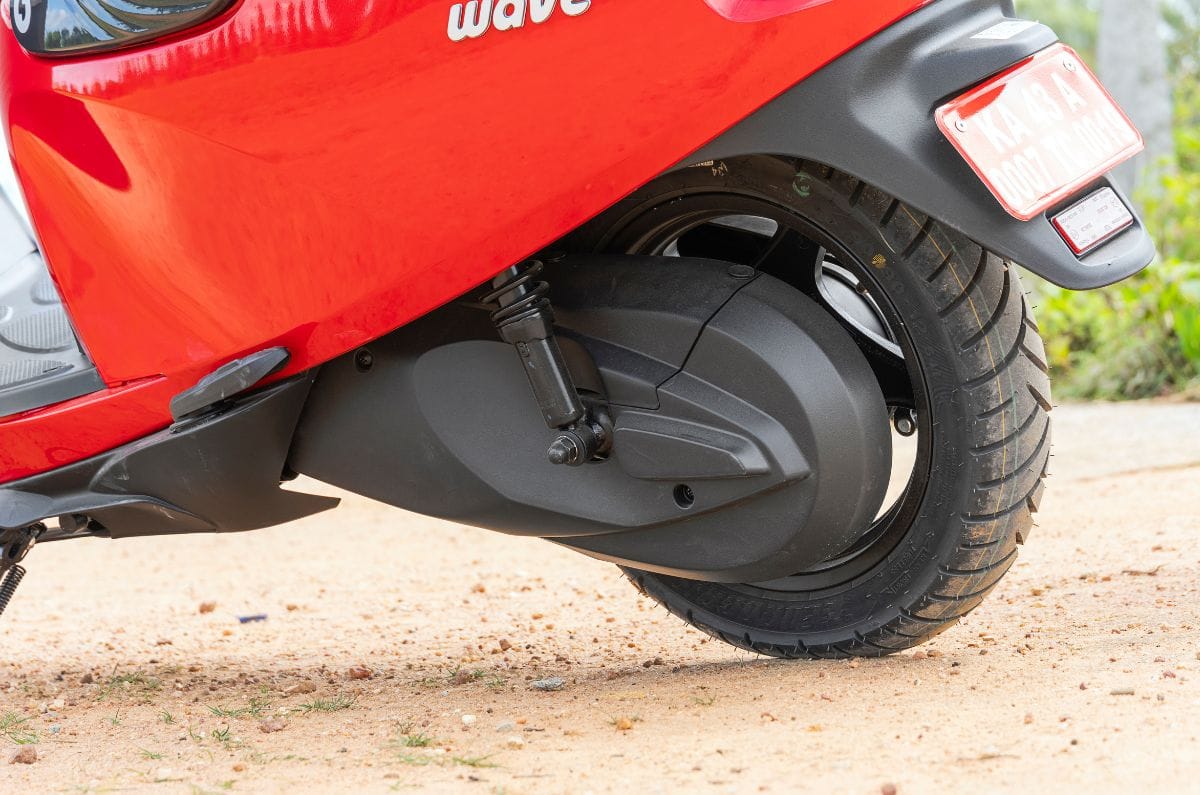
Given that the Wave uses the same motor as the OneS making 6.4kW and 52Nm, this performance is no surprise. However, on the Wave, the motor drives the rear wheel via a chain drive, not a belt as seen on the One models.. While a chain will be more maintenance-intensive than a belt, replacing it should be more affordable. Simple has worked to reduce powertrain noise with measures such as a rubber-damped sprocket, but there is still some motor noise. However, it’s much quieter than an Ather Rizta or 450, although far from dead silent like an Ather Konarc or TVS iQube.
Another welcome change to the One is the throttle response. Unlike the older One models we tested, where the scooter could continue accelerating briefly after the throttle was closed, the Wave’s accelerator behaves much more intuitively. It also gets traction control, although the throttle calibration is so smooth, you’re unlikely to need it in dry conditions but it will be a useful safety net in the wet.
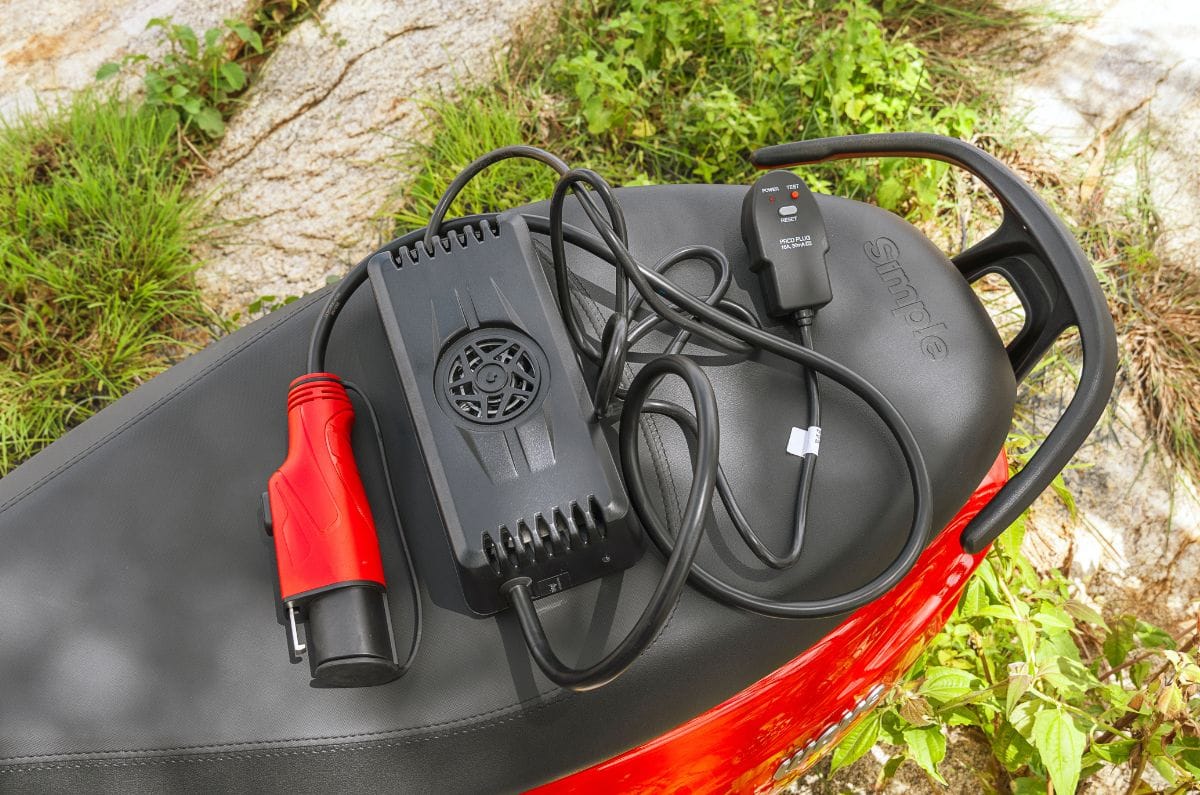
Fast 750W charger is standard on all variants.
Powering the Wave are four battery packs, depending on the variant you choose: 2.2kWh, 2.7kWh, 3.7kWh and 5kWh. The IDC ranges Simple claims are 110km, 132km, 171km and 243km, respectively. The first two use LFP (Lithium Ferrous Phosphate) chemistry, while the larger batteries use NCA (Nickel Cobalt Aluminium) cells.
The range indicator also appears to be quite trustworthy although we’ll reserve final judgement on real-world range until we can conduct a full test back in Mumbai. What is also nice is that all variants of the Wave come with a fast 750W charger which enables a pretty quick 0-80 percent claimed charging time of 3hr30min on the 3.7kWh version we were riding.
The standard warranty on the Wave is three years/30,000km, with five years/50,000km and 15 years/2 lakh km extended options also available. The price of these optional longer warranties has not been shared with us.
The Wave’s motor feeds power to the rear wheel via a chain, not a belt like on the One.
Simple Wave Features – 9/10
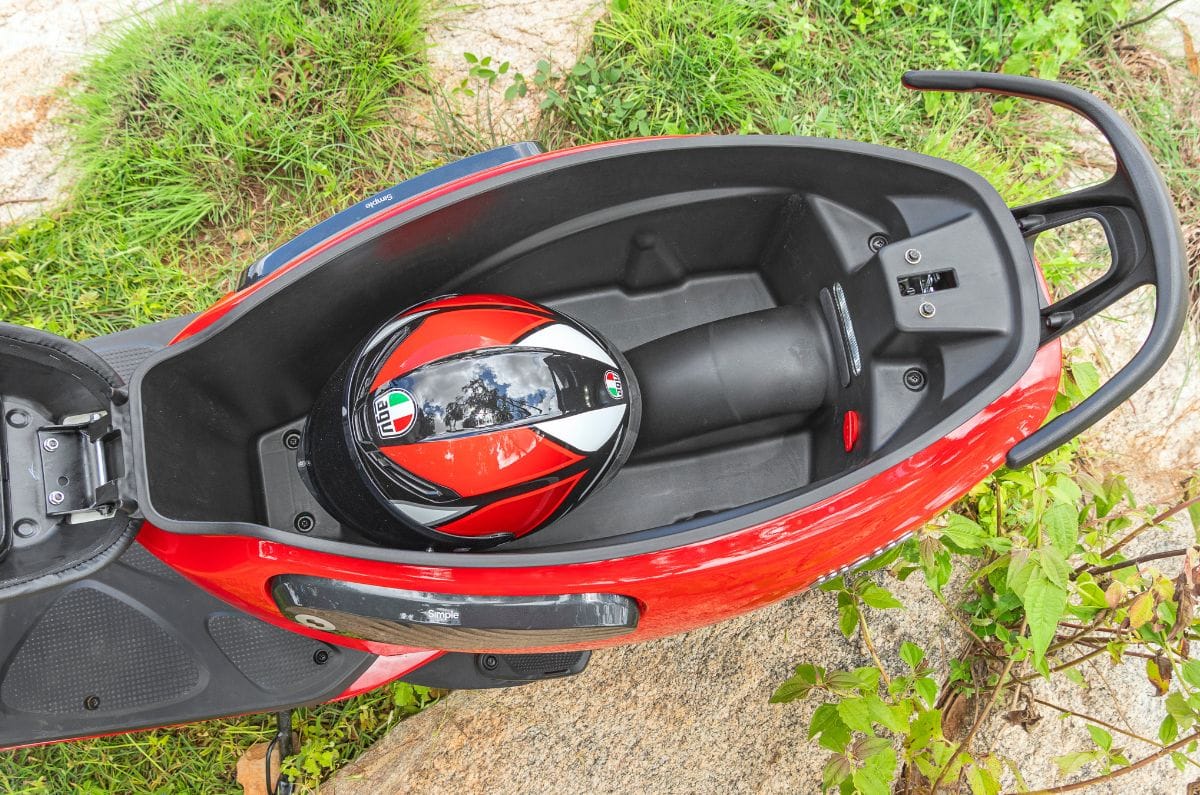
Massive 63L boot and Pill storage cubbies are very useful
While range without sacrificing usable performance is surely valuable on an EV, practicality is an important consideration as well. Storage is one of the Wave’s big strengths. There’s a useful front cubby, while the two “Pill” storage boxes on either side of the body panels are particularly nifty allowing you quick access to essentials you may need to reach for without having to get off the scooter. Each offers 4 litres of lockable weatherproof storage; the left one is standard, while the right is an accessory.
An undoubtedly big USP on the Wave is its cavernous 63L boot, the largest on any Indian scooter to date.
What is also an undoubtedly big USP on the Wave is its cavernous 63 litre boot, which is the largest on any Indian scooter to date. This should prove to be more than enough for everyone in the family! That being said, 63 litres is an enormous number and while this boot is undoubtedly big, I’m do find myself struggling to comprehend how it is nearly 50 percent bigger than the already cavernous 43 litre boot in the River Indie.
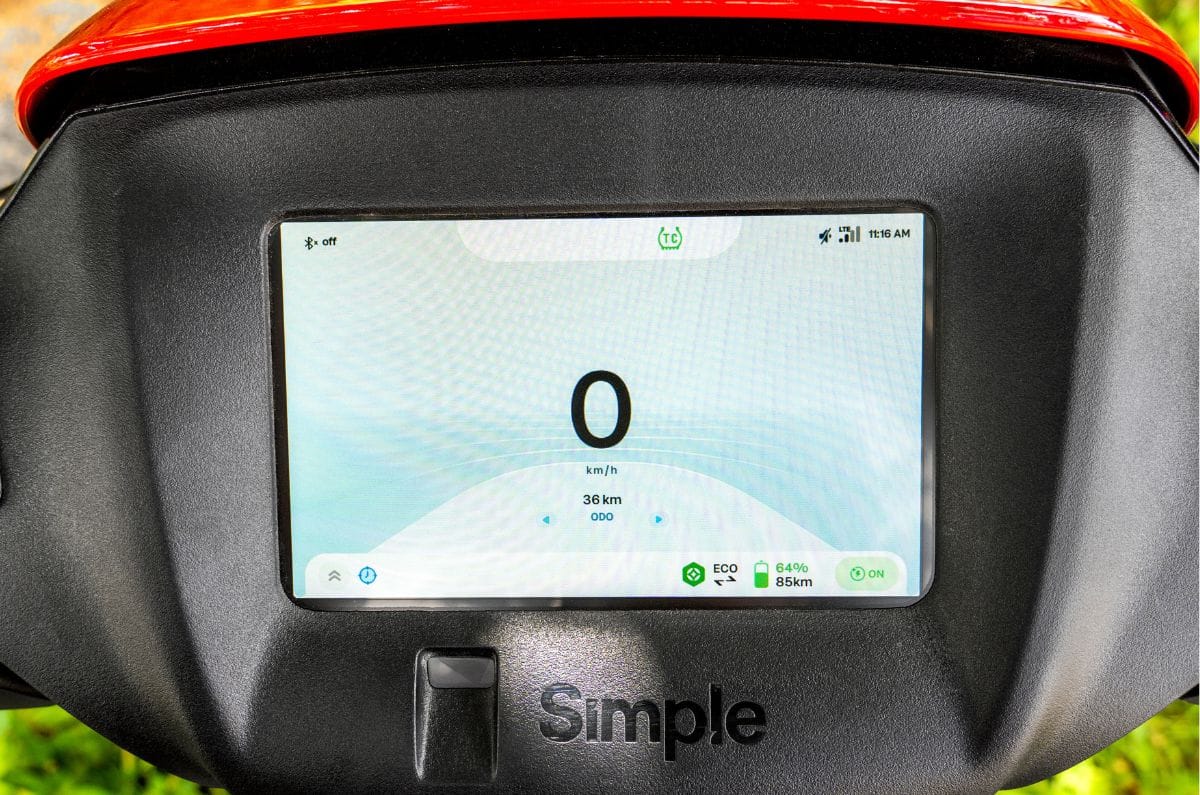
There’s plenty of technology too, including hill hold, drop-safe functionality, theft alerts and Bluetooth connectivity to your phone via the app. The TFT-equipped versions bring even more tech, while the brake-lock clasp is a small but useful touch.
TFT display is well laid-out and has a lot of tech but misses touch functionality.
Simple Wave Price and verdict – 8/10
Scooter has a lot of strengths but is pricey; company yet to prove itself
There isn’t a lot to dislike about the Wave as a scooter. It’s comfortable, spacious, well finished and quick enough to serve its intended purpose very well. However, for all its accomplishments, the Wave doesn’t come cheap. Sure, the Rs 1.10 lakh starting price is tempting, but as you climb the variants ladder, the Wave gets seriously expensive, topping out at Rs 1.90 lakh (ex-showroom, Bengaluru). That said, Simple is one of the few brands offering the option of a 5kWh battery in the family e-scooter space, which is commendable.
However, more than pricing, the bigger issue is that the company is yet to properly scale up its dealer network and establish an aftersales network that delivers the premium experience a buyer will expect after shelling out the money Simple is asking for. The Wave is a good product, but customers paying a premium for an electric scooter will expect not just a solid product but also dependable after-sales support.
The Wave has a lot of strengths but Simple is yet to prove itself in the market.
Ultimately, the Wave’s biggest challenge is that it comes from a start-up that has made plenty of big promises and statements over the past five years but still has a lot to prove. Its dealer network remains minuscule compared with the big players, and long-term reliability still remains unknown.
There’s a lot for Simple to do, but the good news is that the Wave is a genuinely likeable product. If the company can iron out the business side of things, the Wave has the potential to catapult Simple from just another niche start up to a much bigger player. Of course, doing so is a huge challenge and not an overnight process. Simple has a long road ahead of it, but the good news is that it finally has a convincing product to aid in that journey.
Stocks to Watch: एशियाई बाजारों से मिले-जुल रुझानों से घरेलू मार्केट में लाल शुरुआत के संकेत मिल रहे हैं। गिफ्ट निफ्टी फिलहाल 48.50 प्वाइंट्स यानी 0.20% की गिरावट के साथ 23,961.50 पर है। एक कारोबारी दिन पहले 4 सितंबर को सेंसेक्स (Sensex) 362.57 प्वाइंट्स यानी 0.48% की बढ़त के साथ 76,515.43 और निफ्टी 50 (Nifty 50) भी 24.25 प्वाइंट्स यानी 0.10% की मजबूती के साथ 23,897.70 पर बंद हुआ था। अब आज इंडिविजुअल स्टॉक्स की बात करें तो अपनी खास कॉरपोरेट एक्टिविटीज के चलते कुछ स्टॉक्स में तेज हलचल दिख सकती है। यहां इन शेयरों के बारे में डिटेल्स दी जा रही है।
Stocks to Watch: आज इन स्टॉक्स पर फोकस
Molbio Diagnostics Q1 (Consolidated YoY)
जून 2026 तिमाही में सालाना आधार पर मोल्बियो डाइग्नॉस्टिक्स ₹23.7 करोड़ के घाटे से ₹58.7 करोड़ के कंसालिडेटेड प्रॉफिट में आ गई तो रेवेन्यू 4 गुना बढ़कर ₹99.7 करोड़ से ₹408.4 करोड़ पर पहुंच गया।
Cohance Lifesciences
अमेरिकी दवा नियामक एफडीए ने 27 अगस्त से 4 सितंबर के बीच तेलंगाना के शमशाबाद में स्थित कोहेंस लाइफसाइंसेज के फॉर्मूलेशन प्लांट का निरीक्षण किया। निरीक्षण के बाद चार ऑब्जर्वेशन के साथ फॉर्म 483 जारी हुआ।
Tata Motors Commercial Vehicles
टाटा मोटर्स की सब्सिडियरी टीएमएल होल्डिंग्स बीवी ने इवेको ग्रुप के सभी मौजूदा कॉमन शेयरों को खरीदने के लिए वालंटरी टेंडर ऑफर दिया है। इसके लिए कंपनी हर शेयर पर 14.10 यूरो ऑफर कर रही है और इस भाव पर इवेको ग्रुप की वैल्यू 382 करोड़ यूरो है। इस खरीदारी के लिए टाटा मोटर्स की सब्सिडियरी ने मॉर्गन स्टैनले और एमयूएफजी बैंक से फंडिंग का इंतजाम किया है। टेंडर ऑफर 7 सितंबर को खुलेगा और 26 अक्टूबर, 2026 तक खुला रहेगा।
Mazagon Dock Shipbuilders
महाराष्ट्र स्टेट इलेक्ट्रिसिटी ट्रांसमिशन कंपनी (MSETCL) ने मझगांव डॉक शिपबिल्डर्स को ₹118 करोड़ का परचेज ऑर्डर दिया है। यह ऑर्डर पांच सब-स्टेशनों के लिए AI-बेस्ड कॉम्प्रिहेंसिव इन्फ्रा-सिक्योर प्रोजेक्ट की सप्लाई, इंस्टॉलेशन और कमीशनिंग के लिए है।
Rail Vikas Nigam Ltd (RVNL)
रेल विकास को SJVN थर्मल से ₹903 करोड़ का एक ऑर्डर मिला है। यह ऑर्डर 1,320 MW बक्सर थर्मल पावर प्रोजेक्ट (BTPP) के फेज III के तहत है। इसमें प्लांट की बाउंड्री से लेकर बिहार के बक्सर में चौसा और पावनी कामरपुर तक ट्रैक के जरिए एरियल कनेक्शन के साथ एक परमानेंट साइडिंग बनाना है यानी कि पावर प्लांट तक कोयला या सामान की आवाजाही के लिए रेलवे कनेक्टिविटी तैयार करनी है।
Prime Focus
प्राइम फोकस के बोर्ड ने इक्विटी शेयर या डेट सिक्योरिटीज जारी करके ₹3,000 करोड़ तक फंड जुटाने के प्रस्ताव को मंजूरी दे दी है।
Lemon Tree Hotels
लेमन ट्री होटल्स ने लेमन ट्री होटल, बोधगया और कीज सेलेक्ट बाय लेमन ट्री होटल्स, बोधगया को लेकर दो लाइसेंस एग्रीमेंट किए हैं। दोनों प्रॉपर्टीज का मैनेजमेंट कंपनी की सब्सिडियरी कार्नेशन होटल्स संभालेगी। लेमन ट्री होटल, बोधगया में 75 कमरे होंगे, तो कीज सेलेक्ट बाय लेमन ट्री होटल्स, बोधगया में 70 कमरे होंगे।
Lupin
अमेरिका दवा नियामक एफडीए से लुपिन को मोडाफिनिल टैबलेट यूएसपी (100 एमजी और 200 एमजी) के लिए मंजूरी मिल गई है। ये टैबलेट नुवो फार्मा (आयरलैंड) डीएसी की RLD (रेफरेंस लिस्टेड ड्र) प्रोविजिल (Provigil) के बायो-इक्विवेलेंट हैं। यह दवा वयस्कों में नार्कोलेप्सी, ऑब्सट्रक्टिव स्लीप एपनिया (OSA) या शिफ्ट वर्क डिसऑर्डर (SWD) के कारण बहुत अधिक नींद के इलाज के लिए है। IQVIA MAT के जुलाई 2026 डेटा के अनुसार अमेरिका में मोडाफिनिल टैबलेट की अनुमानित सालाना बिक्री $7.07 करोड़ थी।
Brigade Enterprises
ब्रिगेड ग्रुप ने हैदराबाद के नियोपोलिस में ब्रिगेड बार्सिलोना लॉन्च करने का ऐलान किया है। यह प्रीमियम रेजिडेंशियल प्रोजेक्ट कुल 4.04 एकड़ जमीन पर फैला है और इससे ₹2,700 करोड़ से अधिक का रेवेन्यू मिलने का अनुमान है।
Nava
नावा ने रूटीन इंस्पेक्शन, मेंटेनेंस और ओवरहॉलिंग के काम के लिए अपनी दो 60 MW IPP यूनिट्स में से एक को 6 सितंबर से कुछ समय के लिए बंद करने की योजना बनाई है। यह शटडाउन लगभग 55-60 दिनों तक चल सकता है और कंपनी को उम्मीद है कि इस शटडाउन से उसके कारोबार को खास झटका नहीं लगेगा।
Urban Enviro Waste Management
अर्बन एनवायरो वेस्ट मैनेजमेंट को अकोला म्युनिसिपल कॉरपोरेशन से ₹219 करोड़ का ऑर्डर मिला है। यह ऑर्डर पांच साल के लिए म्युनिसिपल सॉलिड वेस्ट को घर-घर से इकट्ठा करने और उसे भोड (Bhod) में तय प्रोसेसिंग/डिस्पोडजल साइट तक ले जाने के लिए है। इसे दो साल तक और बढ़ाया जा सकता है।
Swiggy
बीएनपी परिबास फाइनेंशियल मार्केट्स ने ₹491.99 करोड़ में स्विगी के 1.78 करोड़ शेयर खरीदे तो गोल्डमैन सैक्स इन्वेस्टमेंट्स मॉरीशस I ने ₹549.01 करोड़ में 1.98 करोड़ शेयर खरीदे। इन दोनों ट्रांजैक्शन से कुल 1.36% हिस्सेदारी का लेन-देन प्रति शेयर ₹276.10 के भाव पर हुआ।
Shankara Buildpro
ओहाना इंडिया ग्रोथ फंड ने दो ट्रांजैक्शंस के जरिए शंकर बिल्डप्रो में ₹51.88 करोड़ में अतिरिक्त 1.64% हिस्सेदारी खरीदी है। कैपिटलके (CapitalK) के मालिकाना हक वाले कैटेगरी III अल्टरनेटिव इन्वेस्टमेंट फंड (AIF) ओहाना इंडिया ग्रोथ फंड ने शंकर बिल्डप्रो के 2 लाख शेयर ₹1,296.99 के भाव पर और 2 लाख शेयर ₹1,297 के भाव पर खरीदे हैं। जून 2026 तक शंकर बिल्डप्रो में इस फंड की 1.6% हिस्सेदारी थी।
Unified Data Tech Solutions
कार्नेलियन एसेट मैनेजमेंट एंड एडवाइजर्स के फाउंडर विकास विजयकुमार खेमानी ने यूनिफाइड डेटा टेक सॉल्यूशंस में अपनी पर्सनल होल्डिंग से 1.07 लाख शेयर (0.53% हिस्सेदारी) ₹4.17 करोड़ में प्रति शेयर ₹387.61 के भाव पर बेच दिए। जून 2026 तक कंपनी में उनकी 1.05% हिस्सेदारी थी।
CARE Ratings
टेनकोर पार्टनर्स मास्टर ने प्रति शेयर ₹1,725 के भाव पर ₹73.57 करोड़ में केयर रेटिंग्स के 4.26 लाख शेयर (1.41% हिस्सेदारी) बेच दिए। जून 2026 तक इसकी कंपनी में 1.56% हिस्सेदारी थी।
ESDS Software Solution
एंकरेज कैपिटल फंड की एंकरेज कैपिटल स्कीम I ने ईएसडीएस सॉफ्टवेयर सॉल्यूशन के 10.03 लाख शेयर (0.85% हिस्सेदारी) ₹76.01 करोड़ में ₹757.44 के भाव पर बेच दिए। शुक्रवार को कंपनी के शेयर लिस्ट होने से पहले एंकरेज कैपिटल के पास ईएसडीएस सॉफ्टवेयर सॉल्यूशन में 1.13% हिस्सेदारी थी।
Priority Jewels
केआईएफएस एंटरप्राइज ने प्रायोरिटी ज्वेल्स के 1.25 लाख शेयर ₹2.90 करोड़ में ₹232.30 के भाव पर तो मुंबई की एनबीएफसी आगम कैपिटल की सहयोगी कंपनी आगम इन्वेस्टमेंट्स ने 1.98 लाख शेयर ₹4.67 करोड़ में ₹235.92 के भाव पर खरीदे हैं। इन दोनों ने कुल मिलाकर 1.79% हिस्सेदारी के बराबर शेयर खरीदे हैं।
Gland Pharma
शंघाई फोसुन फार्मा की पूर्ण स्वामित्व वाली सब्सिडियरी प्रमोटर फोसुन फार्मा इंडस्ट्रियल ने ग्लैंड फार्मा के 75.05 लाख शेयर (4.5% हिस्सेदारी) ₹2,121.5 करोड़ में बेच दिए। हर शेयर ₹2,826.6 के भाव पर 11 इंस्टीट्यूशनल इन्वेस्टर्स – कोटक महिंद्रा म्यूचुअल फंड, एक्सिस म्यूचुअल फंड, ICICI प्रूडेंशियल एएमसी, आदित्य बिड़ला सन लाइफ एएमसी, SBI लाइफ इंश्योरेंस कंपनी, HDFC स्टैंडर्ड लाइफ इंश्योरेंस, मिरे एसेट म्यूचुअल फंड, सोसिएट जेनरल, कोटक महिंद्रा लाइफ इंश्योरेंस, सुंदरम म्यूचुअल फंड ने खरीदे हैं। जून 2026 तक इस फार्मा कंपनी में मिरे एसेट की 5.69%, आईसीआईसीआई प्रूडेंशियल एएमसी की हिस्सेदारी 1.79% थी तो फोसुन फार्मा की हिस्सेदारी 51.77% थी।
Tata Technologies
टाटा टेक्नोलॉजीज के पूर्व सीईओ और एमडी पैट्रिक रेमन मैकगोल्ड्रिक ने 0.51% हिस्सेदारी के बराबर 21 लाख शेयर ₹164.85 करोड़ में प्रति शेयर ₹785 के भाव पर बेच दिए। ये शेयर ICICI प्रूडेंशियल एएमसी, कोटक महिंद्रा एएमसी, 360 ONE एसेट मैनेजमेंट और कार्नेलियन एसेट मैनेजमेंट एंड एडवाइजर्स ने खरीदे हैं।
Nexus Select Trust
प्रशांत खेमका के व्हाइटओक कैपिटल म्यूचुअल फंड ने ब्लैकस्टोन की कंपनी बीआरईपी एशिया एसजी फोरम होल्डिंग (NQ) से नेक्सस सेलेक्ट ट्रस्ट के 74.95 लाख यूनिट ₹122.92 करोड़ में प्रति यूनिट ₹164 के भाव पर खरीदे हैं।
Purple Style Labs
आज पर्पल स्टाइल लैब्स के शेयरों की बीएसई और एनएसई पर एंट्री होगी।
डिस्क्लेमर: यहां मुहैया जानकारी सिर्फ सूचना के लिए दी जा रही है। यहां बताना जरूरी है कि मार्केट में निवेश बाजार जोखिमों के अधीन है। निवेशक के तौर पर पैसा लगाने से पहले हमेशा एक्सपर्ट से सलाह लें। मनीकंट्रोल की तरफ से किसी को भी पैसा लगाने की यहां कभी भी सलाह नहीं दी जाती है।
Nifty Outlook: निफ्टी शुक्रवार को चार दिन की लगातार गिरावट के बाद संभला। इंडेक्स 24 अंक चढ़कर 23,897 पर बंद हुआ। हालांकि, पूरे हफ्ते की तस्वीर कमजोर रही। निफ्टी में 1.15% की गिरावट आई। यह लगातार चौथा हफ्ता है, जब इंडेक्स गिरावट के साथ बंद हुआ।
पूरे हफ्ते बिकवाली हावी रही
हफ्ते की शुरुआत ही कमजोर रही। ज्यादातर कारोबारी सत्रों में बिकवाली देखने को मिली। हफ्ते के बीच में बाजार तेज गैप-डाउन के साथ खुला। इसके बाद खरीदारों ने गिरावट रोकने की कोशिश की। लेकिन ऊंचे स्तरों पर खरीदारी ज्यादा देर नहीं टिक पाई। नतीजा यह रहा कि मुनाफावसूली जारी रही और निफ्टी पूरे हफ्ते दबाव में रहा।
किन शेयरों में बड़ी हलचल दिखी
निफ्टी 50 में SBI Life, Tata Steel और HDFC Life सबसे ज्यादा चढ़े। दूसरी तरफ HCL Tech, Bharti Airtel और Maruti सबसे ज्यादा टूटे। सेक्टोरल प्रदर्शन भी मिला-जुला रहा। Metals, Financial Services और Cement सेक्टर में तेजी रही। वहीं रियल्टी, हेल्थकेयर और केमिकल्स में दबाव देखने को मिला।
ब्रॉडर मार्केट में भी तस्वीर साफ नहीं रही। Nifty Midcap 100 में 0.25% की गिरावट आई। Nifty Smallcap 100 में 0.22% की बढ़त रही।
रुपया भी मजबूत हुआ
डॉलर के मुकाबले रुपये में भी मजबूती रही। यह सिलसिला पूरे हफ्ते जारी रहा। हफ्ते के दौरान रुपया करीब 1% मजबूत हुआ। शुक्रवार को यह लगभग 94.50 प्रति डॉलर पर बंद हुआ।
अब इन संकेतों पर रहेगी नजर
आने वाले दिनों में बाजार को थोड़ी राहत मिल सकती है। अमेरिका में फेड की ओर से ब्याज दर बढ़ाने की उम्मीद कम हुई है। ग्लोबल बॉन्ड यील्ड में भी नरमी आई है। लेकिन बाजार के सामने दो बड़ी चुनौतियां हैं। पहला, ब्रेंट क्रूड करीब 95 डॉलर प्रति बैरल पर है। दूसरा, वेस्ट एशिया में तनाव बना हुआ है।
निवेशकों की नजर क्रूड की कीमतों पर रहेगी। वेस्ट एशिया के घटनाक्रम भी अहम होंगे। इसके अलावा ग्लोबल रेट आउटलुक और घरेलू लिक्विडिटी पर भी नजर रहेगी। शुक्रवार को जारी अमेरिकी रोजगार आंकड़े भी महत्वपूर्ण हैं। इनसे फेड के अगले फैसले को लेकर संकेत मिल सकते हैं।
Motilal Oswal के सिद्धार्थ खेमका के मुताबिक, अगले हफ्ते US ISM Services PMI, ECB की पॉलिसी, OPEC की मंथली ऑयल मार्केट रिपोर्ट और भारत के फॉरेक्स रिजर्व के आंकड़े बाजार के लिए अहम रहेंगे।
24,000 के ऊपर जाना जरूरी
HDFC Securities के विनय राजानी के मुताबिक, 24,000-24,200 का जोन निफ्टी के लिए बड़ा रेजिस्टेंस है। 23,800 के नीचे जाने पर निफ्टी 23,600 तक गिर सकता है। वहीं, 23,800 के ऊपर टिकने पर कुछ समय के लिए बाजार दायरे में रह सकता है। हालांकि, बड़ी तस्वीर में ट्रेंड अभी कमजोर है।
Angel One के हितेश राठी के मुताबिक, 23,750-23,600 का जोन अहम सपोर्ट है। इसके नीचे डेली क्लोज मिलने पर निफ्टी 23,450-23,400 तक जा सकता है। ऊपर की तरफ 24,000-24,050 पहला रेजिस्टेंस है। इसके बाद 24,150-24,200 का स्तर आएगा।
50-EMA से नीचे निफ्टी
LKP Securities के रूपक डे ने कहा कि अमेरिकी नॉन-फार्म पेरोल और बेरोजगारी के आंकड़ों से पहले ट्रेडर्स सतर्क रहे। इन आंकड़ों का असर फेड के ब्याज दर के फैसले पर पड़ सकता है।
उनके मुताबिक, निफ्टी प्रति घंटे के चार्ट पर 50-EMA से नीचे है। इससे शॉर्ट टर्म ट्रेंड कमजोर दिख रहा है। जब तक निफ्टी 24,000-24,200 के नीचे है, तेजी पर बिकवाली की रणनीति काम कर सकती है। नीचे 23,830 और 23,700 पर सपोर्ट है।
Banking Index में भी लंबे समय से ठहराव
बैंकिंग इंडेक्स करीब 24 सत्रों से एक दायरे में घूम रहा है। यानी इसमें भी कोई साफ दिशा नहीं दिख रही। शुक्रवार को इंडेक्स 0.02% की मामूली गिरावट के साथ बंद हुआ।
SBI Securities के सुदीप शाह के मुताबिक, 56,900-56,800 का जोन अहम सपोर्ट है। इसके ऊपर टिके रहने पर कंसोलिडेशन जारी रह सकता है। ऊपर 57,800-57,900 का स्तर रेजिस्टेंस है।
अगर इंडेक्स 57,900 के ऊपर निर्णायक ब्रेकआउट देता है या 56,800 के नीचे टूटता है, तो कंसोलिडेशन खत्म हो सकता है। इसके बाद बाजार में किसी एक दिशा में बड़ी चाल देखने को मिल सकती है।
अगले हफ्ते IPO की भी धूम
प्राइमरी मार्केट में गतिविधियां तेज हैं। अगले हफ्ते 11 मेनबोर्ड IPO खुलने वाले हैं। ये कंपनियां मिलकर 7,000 करोड़ रुपये से ज्यादा जुटाने की तैयारी में हैं। कई कंपनियों की लिस्टिंग भी अगले हफ्ते होगी। यानी शेयर बाजार के मुख्य इंडेक्स में भले ही सावधानी है, लेकिन IPO बाजार में हलचल बनी हुई है।
Disclaimer: मनीकंट्रोल.कॉम पर दिए गए सलाह या विचार एक्सपर्ट/ब्रोकरेज फर्म के अपने निजी विचार होते हैं। वेबसाइट या मैनेजमेंट इसके लिए उत्तरदायी नहीं है। यूजर्स को मनीकंट्रोल की सलाह है कि कोई भी निवेश निर्णय लेने से पहले हमेशा सर्टिफाइड एक्सपर्ट की सलाह लें।
हर महीने लाखों रुपये की सैलरी, शानदार कॉर्पोरेट करियर और सुरक्षित नौकरी छोड़कर खेती की राह चुनना आसान नहीं होता। लेकिन चंडीगढ़ के मोहित निजहावन ने इसी चुनौती को स्वीकार किया। करीब 90 लाख रुपये सालाना की नौकरी छोड़ने के बाद उन्होंने माइक्रोग्रीन्स की खेती को अपना नया करियर बनाया। खास बात यह है कि उन्होंने इस बिजनेस की शुरुआत किसी बड़े निवेश या बड़ी जमीन से नहीं की थी। महज 30,000 रुपये और करीब 100 वर्ग फुट की जगह से शुरू हुआ उनका प्रयोग धीरे-धीरे एक कारोबार में बदल गया। मोहित ने इंडोर फार्मिंग के जरिए माइक्रोग्रीन्स उगाए और समय के साथ ग्राहकों, उत्पादन और बिक्री को समझते हुए अपने काम को आगे बढ़ाया।
आज सार्वजनिक रूप से सामने आए आंकड़ों के मुताबिक, उनके कारोबार का सालाना रेवेन्यू करीब 1.44 करोड़ रुपये बताया जाता है। उनकी यह कहानी नौकरी से बिजनेस तक के अनोखे सफर और जोखिम उठाने की मिसाल बन गई है।
B.Tech के बाद शुरू हुआ कॉर्पोरेट सफर
मोहित निजहावन कंप्यूटर साइंस में B.Tech ग्रेजुएट हैं। पढ़ाई पूरी करने के बाद उन्होंने कॉर्पोरेट सेक्टर में शानदार करियर बनाया और अच्छी खासी सैलरी वाली नौकरी हासिल की।
हालांकि, दिसंबर 2020 में उन्होंने अपनी नौकरी छोड़ने का फैसला किया। इसके बाद उन्होंने एक ऐसा रास्ता चुना, जो उनकी पुरानी कॉर्पोरेट जिंदगी से बिल्कुल अलग था।
सिर्फ 30 हजार रुपये से शुरू किया काम
माइक्रोग्रीन्स की खेती का आइडिया मोहित के लिए शुरुआत में एक प्रयोग जैसा था। उन्होंने बड़े निवेश के बजाय सिर्फ 30,000 रुपये से अपना काम दोबारा शुरू किया।
इसके लिए चंडीगढ़ में करीब 100 वर्ग फुट की छोटी-सी जगह ली गई। इसी सीमित जगह में उन्होंने इंडोर माइक्रोग्रीन्स उगाना शुरू किया और धीरे-धीरे खेती के साथ-साथ मार्केटिंग और ग्राहकों की जरूरतों को समझना शुरू किया।
छोटे कमरे से बना Greenu Microgreens
शुरुआती प्रयोग धीरे-धीरे एक बिजनेस मॉडल में बदल गया। मोहित ने उत्पादन बढ़ाने, ग्राहकों तक पहुंच बनाने और माइक्रोग्रीन्स की बिक्री को बेहतर तरीके से मैनेज करने पर काम किया।
इसी सफर से Greenu Microgreens का कारोबार खड़ा हुआ। छोटी जगह और कम पूंजी से शुरू हुआ यह वेंचर आज काफी बड़ा बिजनेस बन चुका है।
हर महीने 12 लाख रुपये का रेवेन्यू!
सार्वजनिक रूप से रिपोर्ट किए गए आंकड़ों के मुताबिक, Greenu Microgreens का कारोबार अब करीब 12 लाख रुपये प्रति महीने का रेवेन्यू जेनरेट करता है। यानी सालाना कारोबार लगभग 1.44 करोड़ रुपये तक पहुंचने का दावा किया गया है।
रिपोर्ट्स में कंपनी का सालाना मुनाफा करीब 60 लाख रुपये बताया गया है। हालांकि, बिजनेस का रेवेन्यू और किसी व्यक्ति की नौकरी की सैलरी अलग-अलग चीजें हैं, इसलिए दोनों की सीधी तुलना करना सही नहीं होगा।
Meet Mohit Nijhawan, a https://t.co/BC6fLkcQNf Computer Science graduate. This guy left his 90 LPA corporate career to grow tiny greens. Today, he has built https://t.co/7yvufGmkSg, a ₹1.44 crore business with approximately ₹60 lakhs in profit annually.
सिर्फ अपना बिजनेस नहीं, दूसरों को भी दे रहे ट्रेनिंग
मोहित की कहानी सिर्फ अपना फार्म चलाने तक सीमित नहीं है। Greenu Microgreens के जरिए वह किसानों और उन लोगों को भी माइक्रोग्रीन्स फार्मिंग की ट्रेनिंग देते हैं, जो इसे बिजनेस के तौर पर शुरू करना चाहते हैं। इस तरह उनका लक्ष्य केवल माइक्रोग्रीन्स उगाना ही नहीं, बल्कि दूसरे लोगों को भी इस क्षेत्र में अवसर तलाशने में मदद करना है।
90 लाख की नौकरी से 30 हजार की खेती तक का सफर
मोहित की कहानी इसलिए चर्चा में है क्योंकि उन्होंने करीब 90 लाख रुपये सालाना की नौकरी छोड़कर सिर्फ 30,000 रुपये से अपना नया सफर शुरू किया। एक तरफ कॉर्पोरेट नौकरी की बड़ी सैलरी थी, तो दूसरी तरफ छोटी जगह में खेती का अनिश्चित रास्ता। इसके बावजूद उन्होंने अपने नए आइडिया पर भरोसा किया और धीरे-धीरे इसे बिजनेस में बदल दिया।
सोशल मीडिया पर छिड़ी बहस
मोहित की कहानी सोशल मीडिया पर सामने आने के बाद लोगों के बीच अलग-अलग तरह की प्रतिक्रियाएं देखने को मिलीं। कुछ लोगों ने इसे नौकरी से अलग रास्ता चुनने और अपने दम पर बिजनेस खड़ा करने की प्रेरणादायक कहानी बताया। वहीं, कुछ यूजर्स ने 90 लाख रुपये की सैलरी और 1.44 करोड़ रुपये के बिजनेस रेवेन्यू की तुलना पर सवाल उठाए। एक यूजर ने इसे भ्रामक तुलना बताते हुए कहा कि किसी व्यक्ति की सालाना सैलरी और बिजनेस का टर्नओवर एक जैसी चीजें नहीं हैं।
दूसरी ओर, कुछ लोगों ने मोहित के फैसले को जिंदगी और सफलता को अलग नजरिए से देखने वाली कहानी बताया। एक यूजर ने इसे “वास्तव में प्रेरणादायक सफर” कहा, जबकि दूसरे ने उनकी यात्रा की तारीफ की।
क्या सीख देती है मोहित की कहानी?
मोहित की कहानी दिखाती है कि सफलता का रास्ता हर व्यक्ति के लिए एक जैसा नहीं होता। बड़ी नौकरी और अच्छी सैलरी के बावजूद कोई व्यक्ति अपना अलग रास्ता चुन सकता है। हालांकि, किसी भी बिजनेस की सफलता को समझने के लिए सिर्फ रेवेन्यू नहीं, बल्कि निवेश, खर्च, मुनाफा और कारोबार की स्थिरता जैसे पहलुओं को भी देखना जरूरी है।
डिस्क्लेमर: यह रिपोर्ट सोशल मीडिया पर यूज़र द्वारा शेयर किए गए कंटेंट पर आधारित है। मनीकंट्रोल इन दावों की न तो स्वतंत्र रूप से पुष्टि नहीं करता है और न ही इनका समर्थन करता है।