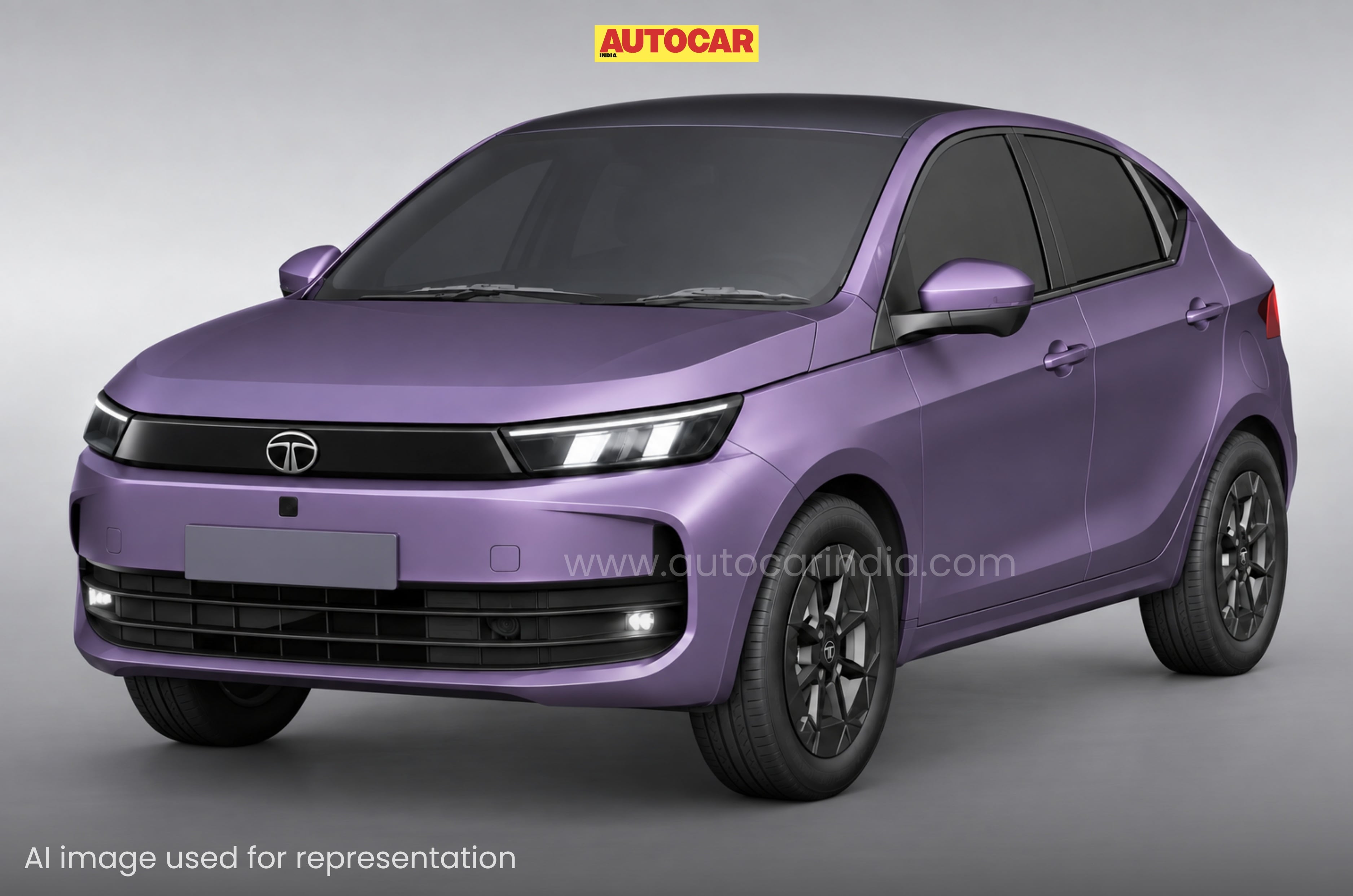
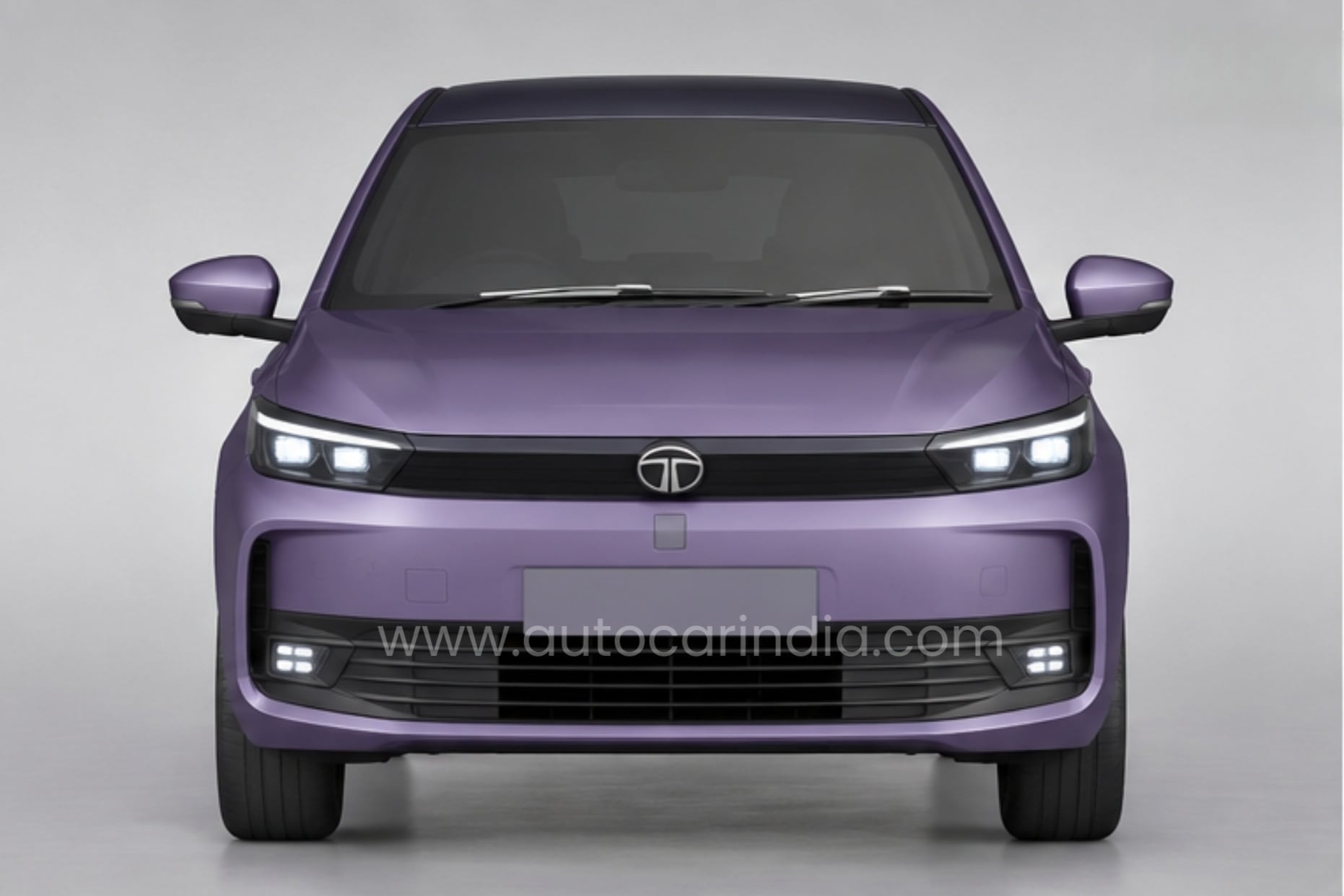
Tata Motors is slated to debut the Aeris on September 25, 2026. It will be a rebranded version of the Tigor and marks one of the biggest updates to Tata’s compact sedan since its inception close to a decade ago. We’ve rendered the upcoming Aeris based on teasers and a design patent filing by Tata ahead of its arrival. This rendering hints at what the Aeris could potentially look like.
Aeris is expected to borrow design cues from the Tiago.
Likely to come with petrol, CNG and EV powertrains.
Tata Aeris: What to expect?
New body panels expected to bring an upmarket look
AI Image used for representation
The Aeris won’t just have new soft parts over the current Tigor, but will likely get sheet metal changes, as seen on the Tiago facelift earlier this year. Up front, the fascia of the Aeris sports a sleeker look as compared to the current Tigor. This includes slimmer LED headlamps and LED fog lamps, which the teaser also revealed. The headlamps are connected by a black trim, and the bumper gets C-shaped design elements and a wide air inlet.
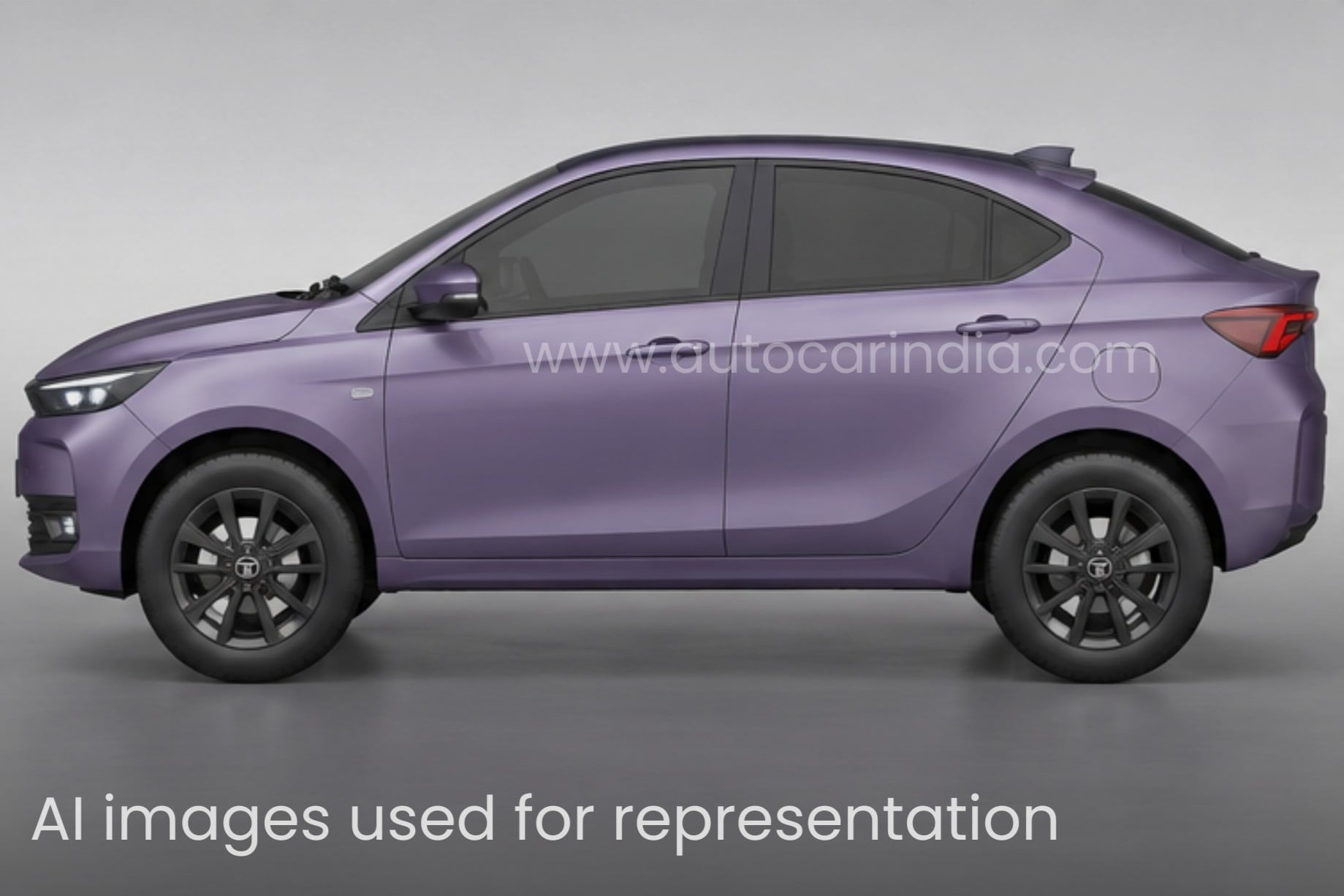
In profile, the notchback roofline and the glasshouse appear to be retained from the current Tigor, with the beltline having an upward kink towards the C-pillar. There’s also a prominent shoulder line running the length of the car, which was shown on the teaser, and a new design for the alloy wheels is likely.
AI Image used for representation.
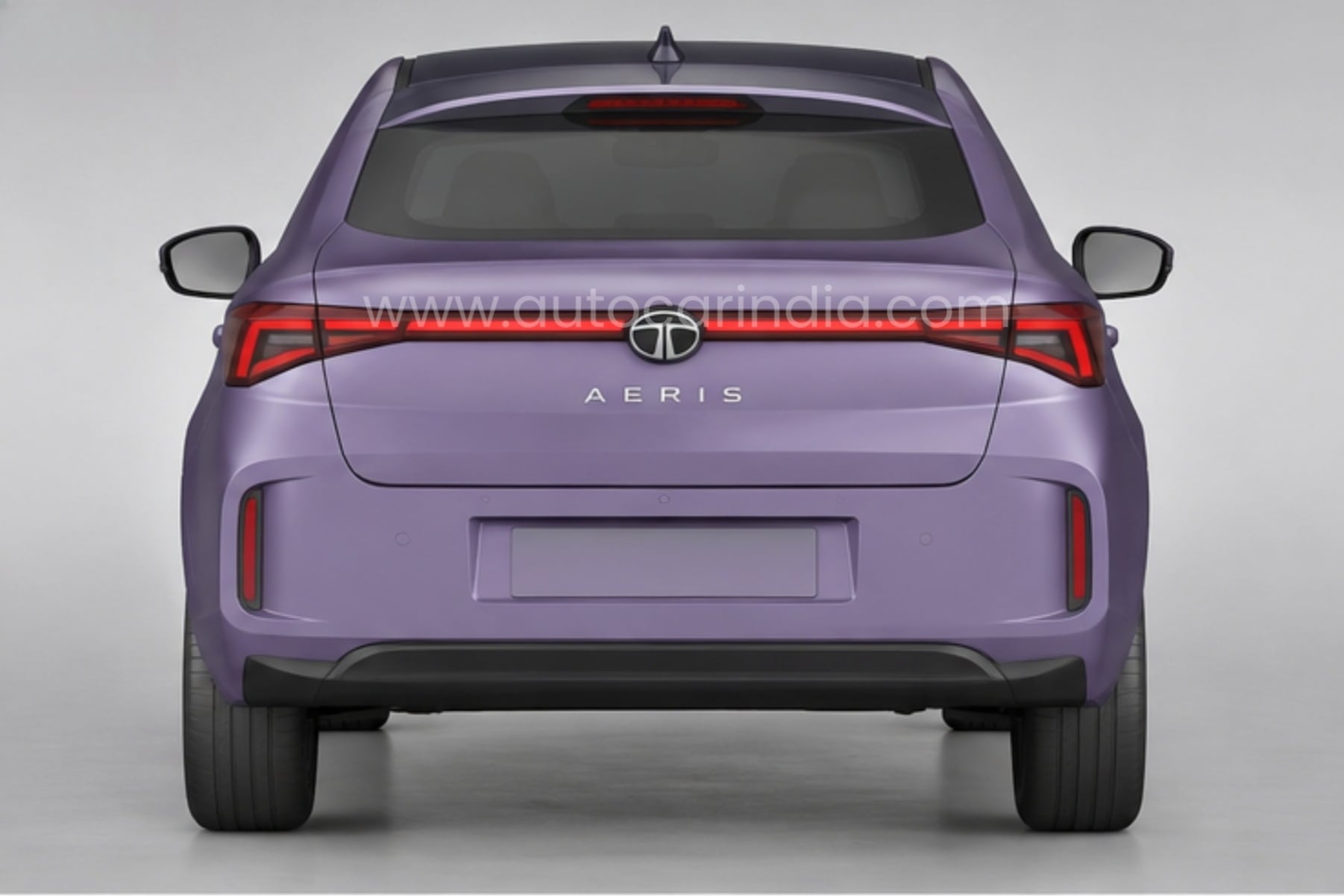
Though the rear side of the Aeris wasn’t teased, our rendering based on patent images hints at major design revisions here. The slimmer tail-lamps get a connected design, and the license plate section has moved from the bootlid to the bumper, which gets vertical reflectors and similar C-shaped design elements as the front. Meanwhile, EV versions are expected to have subtle design changes to set it apart from the ICE counterpart.
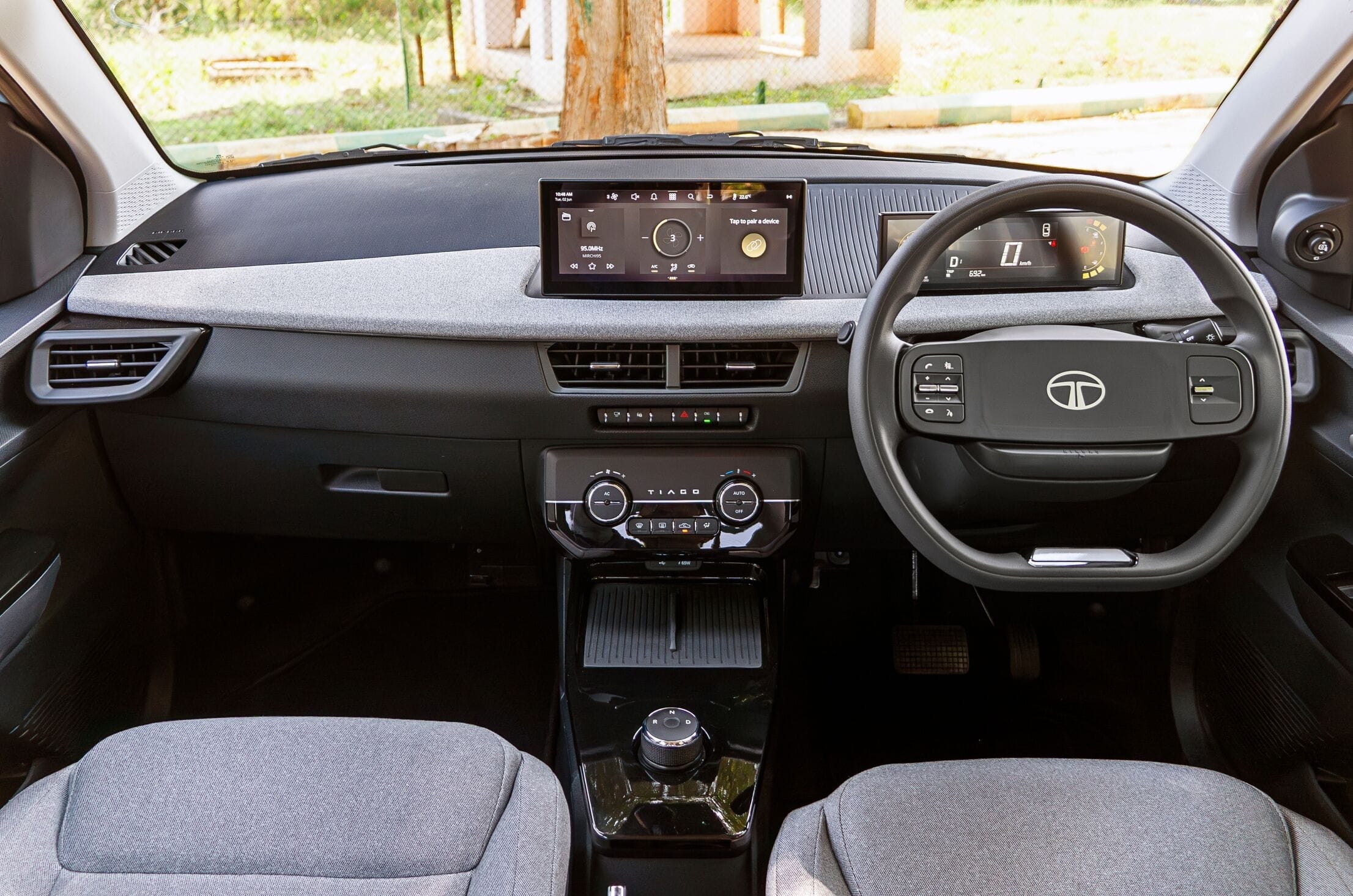
Expected to have a Tiago-like interior with new features onboard
Tata Tiago interior used for representation
Inside, the Aeris is expected to carry the Tiago’s cabin layout with a binnacle-less digital driver’s display with Bluetooth and a 10.25-inch infotainment system on the dashboard. Features like a 360-degree camera, wireless phone charger, and connected-car tech are expected to be part of the Aeris’ equipment list.
Petrol, CNG and EV powertrains likely to be carried over from current Tigor
On the powertrain front, the Aeris is expected to retain the current Tigor’s powertrain options. Petrol-powered versions would utilise a 1.2-litre naturally aspirated engine, and factory-fitted CNG-powered variants will also be on offer. In EV guise, it’s expected to have a 26kWh battery with a front-mounted motor.
Expect the Aeris to come at a premium over the current Tigor facelift. The Tigor currently has a price range of Rs 5.7 lakh to Rs 9.10 lakh, and its EV counterpart is priced between Rs 12.49 lakh and Rs 13.75 lakh. It will lock horns with the Honda Amaze, Maruti Dzire, and the Hyundai Aura.
शुक्रवार को IIT बॉम्बे के पवई कैंपस में एक छात्र के सुसाइड मामले में इलेक्ट्रिकल इंजीनियरिंग के प्रोफेसर सूर्यनारायण डूला जांच के दायरे में आ गए हैं, जिस वजह से संस्थान ने उनसे डीन का पद छीन लिया है। बताया जा रहा है कि BTech के इस द्वितीय वर्ष के छात्र की मौत से ठीक पहले हुई घटना के समय डूला ही इंस्ट्रक्टर और परीक्षा के इनविजिलेटर (निरीक्षक) थे।
खबरों के मुताबिक, IIT बॉम्बे ने सोमवार को सूर्यनारायण डूला को डीन के पद से तत्काल प्रभाव से निलंबित कर दिया। यह कार्रवाई ऐसे समय में हुई, जब संस्थान ने छात्र की मौत से जुड़ी अपनी पहले की कुछ बातों को वापस ले लिया।
IIT बॉम्बे ने यह भी माना कि जांच पूरी होने से पहले मौत की परिस्थितियों को लेकर कुछ बातें कही गई थीं। संस्थान ने इन दावों के लिए माफी भी मांगी है।
कौन हैं प्रोफेसर सूर्यनारायण डूला?
LinkedIn प्रोफाइल के अनुसार, डूला पावर सिस्टम और पावर इलेक्ट्रॉनिक्स के रिसर्चर हैं और उन्होंने IIT बॉम्बे में 17 साल से ज्यादा समय बिताया है।
उनका एकेडमिक काम स्मार्ट ग्रिड, माइक्रोग्रिड, पावर-सिस्टम कंट्रोल और डिस्ट्रिब्यूटेड एनर्जी रिसोर्स के इंटीग्रेशन जैसे क्षेत्रों पर केंद्रित है।
उनकी प्रोफाइल में बताई गई रिसर्च की मौजूदा रुचियों में स्मार्ट ग्रिड और माइक्रोग्रिड, कन्वर्टर टोपोलॉजी और कंट्रोल, पावर सिस्टम के लिए कम्युनिकेशन प्रोटोकॉल, डिस्ट्रिब्यूटेड एनर्जी रिसोर्स का ग्रिड इंटीग्रेशन, और पावर सिस्टम ऑपरेशन और कंट्रोल शामिल हैं।
सूर्यनारायण डूला के प्रोफाइल में बताया गया है कि उनका एकेडमिक बैकग्राउंड पावर इलेक्ट्रॉनिक्स और पावर सिस्टम्स पर आधारित है।
IIT बॉम्बे में 17 साल
डूला सितंबर 2009 में असिस्टेंट प्रोफेसर के तौर पर IIT बॉम्बे से जुड़े और मार्च 2015 तक इस पद पर रहे। इसके बाद, मार्च 2015 से जुलाई 2019 तक वे एसोसिएट प्रोफेसर रहे।
उनकी लिंक्डइन प्रोफाइल के अनुसार, जुलाई 2019 से वे IIT बॉम्बे में फुल-टाइम प्रोफेसर हैं।
उन्होंने मार्च 2023 से जुलाई 2026 तक डीन ऑफ स्टूडेंट अफेयर्स के तौर पर भी काम किया। जुलाई 2026 में उन्होंने डीन ऑफ एडमिनिस्ट्रेटिव अफेयर्स का पद संभाला। उनकी प्रोफाइल के अनुसार, वे अभी भी इस पद पर हैं।
इस तरह, डूला IIT बॉम्बे में शिक्षण और रिसर्च के साथ-साथ कई अहम प्रशासनिक जिम्मेदारियां भी संभाल रहे हैं।
एकेडमिक और प्रोफेशनल बैकग्राउंड
IIT बॉम्बे में शामिल होने से पहले, डूला ने जनवरी से सितंबर 2009 के बीच ‘पावर रिसर्च एंड डेवलपमेंट कंसल्टेंट्स प्राइवेट लिमिटेड’ में पावर-सिस्टम कंसल्टिंग का काम किया।
इससे पहले, उनके लिंक्डइन प्रोफाइल के अनुसार, उन्होंने अगस्त 2006 से अक्टूबर 2008 के बीच ‘मशीन 2 मशीन’ में आर्किटेक्ट के तौर पर काम किया। उन्होंने 2002-03 में एलुरु के CRR कॉलेज ऑफ इंजीनियरिंग में लेक्चरर के तौर पर भी काम किया।
डूला की एकेडमिक क्वालिफिकेशन भी पावर और एनर्जी सिस्टम के क्षेत्र में ही हैं। उन्होंने 2004 से 2006 के बीच IIT दिल्ली से पावर सिस्टम में PhD पूरी की। उससे पहले, उन्होंने 2000 से 2002 के बीच IIT बॉम्बे से एनर्जी सिस्टम्स एंड इंजीनियरिंग में M.Tech किया।
उन्होंने 1996 से 2000 के बीच बीच आचार्य नागार्जुन यूनिवर्सिटी से इलेक्ट्रिकल और इलेक्ट्रॉनिक्स इंजीनियरिंग में B.Tech की डिग्री हासिल की।
विवाद के केंद्र में क्यों हैं डूला?
डूला इस विवाद के केंद्र में इसलिए आए क्योंकि वे मिड-सेमेस्टर परीक्षा के दौरान कोर्स इंस्ट्रक्टर और इनविजिलेटर (निरीक्षक) थे। ANI की रिपोर्ट के अनुसार, IIT बॉम्बे फैकल्टी फोरम के बयान में कहा गया है कि उन्होंने एक छात्र को बिना इजाजत स्मार्टफोन का इस्तेमाल करते हुए देखा था।
फैकल्टी फोरम ने बताया कि डूला 18 सितंबर को सुबह 11 बजे से दोपहर 1 बजे तक परीक्षा की निगरानी कर रहे फोरम के मुताबिक, उन्होंने जिस घटना को शैक्षणिक नियमों का उल्लंघन बताया, उसे देखने के बाद उन्होंने संस्थान के नियमों के अनुसार अधिकारियों को इसकी जानकारी दी।
इसके बाद फोरम ने डूला का समर्थन करते हुए कहा कि वे संस्थान की सीनेट द्वारा मंजूर शैक्षणिक नीतियों के तहत अपनी जिम्मेदारियां निभा रहे थे।
बता दें कि IIT बॉम्बे के पहले के बयान में कहा गया था कि छात्र ने कथित तौर पर परीक्षा के दौरान मोबाइल फोन का इस्तेमाल किया और जवाब पाने के लिए प्रश्न-पत्र को ChatGPT पर अपलोड किया।
बाद में संस्थान ने इस बात के लिए माफी मांगी कि उसने जांच की सही प्रक्रिया से पुष्टि होने से पहले ही ये विवरण सार्वजनिक कर दिए थे।
प्रोफेसर के खिलाफ पुलिस केस दर्ज
वहीं, छात्र के माता-पिता की ओर से उत्पीड़न और जाति-आधारित भेदभाव का आरोप लगाते हुए पुलिस में शिकायत दर्ज कराने के बाद यह विवाद बढ़ गया।
इसके बाद डूल्ला को आरोपी बनाते हुए एक FIR दर्ज की गई। आरोपों में यह भी शामिल था कि उन्होंने तीन महीने तक छात्र के खिलाफ जातिसूचक शब्दों का इस्तेमाल किया।
फिलहाल, मामले को मुंबई पुलिस की क्राइम ब्रांच को सौंप दिया गया है। डूल्ला पर लगे आरोप अभी चल रही जांच का हिस्सा हैं और इन्हें अभी तक तथ्य के तौर पर साबित नहीं किया गया है।
बता दें कि यह घटनाक्रम कैंपस में हो रहे विरोध-प्रदर्शनों और संस्थान से जवाबदेही की बढ़ती मांगों के बीच सामने आया। इसके बाद IIT बॉम्बे ने डूल्ला की डीनशिप सस्पेंड कर दी और साथ ही घटनाओं के बारे में अपनी पिछली बात भी वापस ले ली।
Protean eGov Technologies Ltd के शेयरों में 21 सितंबर को 20 प्रतिशत की तेजी दिखी। BSE पर शेयर 588.05 रुपये पर अपर सर्किट लगा। कंपनी IT सेवाएं देती है। यह कंपनी नागरिकों, निगमों और सरकार के लिए सिटीजन सर्विसेज, ई-गवर्नेंस सॉल्यूशंस, सिस्टम इंटीग्रेशन, बिजनेस प्रोसेस री-इंजीनियरिंग, डेटा सेंटर को-लोकेशन और IT कंसल्टिंग सर्विसेज देती है। कंपनी में पूरी 100 प्रतिशत हिस्सेदारी पब्लिक शेयरहोल्डर्स के पास है।
Protean eGov Technologies नवंबर 2023 में BSE पर लिस्ट हुई थी। इसका IPO ₹489.95 करोड़ का था। IPO के लिए फाइनल इश्यू प्राइस ₹792 प्रति शेयर था। कंपनी का शेयर IPO प्राइस से करीब 26 प्रतिशत नीचे है। कंपनी का मार्केट कैप बढ़कर 2300 करोड़ रुपये से ज्यादा हो गया है।
Protean eGov Tech का शेयर 2 साल में 71 प्रतिशत गिरा
शेयर की कीमत एक साल में 35 प्रतिशत नीचे आई है। यह 2 साल में 71 प्रतिशत कमजोर हुआ है। शेयर का बीएसई पर 52 सप्ताह का एडजस्टेड हाई 940 रुपये और एडजस्टेड लो 445 रुपये है। शेयर की फेस वैल्यू 10 रुपये है। लोअर प्राइस बैंड 20 प्रतिशत की सर्किट लिमिट के साथ 392.05 रुपये है।
Protean eGov Technologies का अप्रैल-जून 2026 तिमाही में रेवेन्यू 250.45 करोड़ रुपये रहा। शुद्ध मुनाफा 5.98 करोड़ रुपये रहा। इस बीच प्रति शेयर अर्निंग 1.47 करोड़ रुपये रही। पूरे वित्त वर्ष 2026 के दौरान कंपनी का रेवेन्यू 996.43 करोड़ रुपये, शुद्ध मुनाफा 94.32 करोड़ रुपये और प्रति शेयर अर्निंग 23.24 करोड़ रुपये दर्ज किया गया।
Disclaimer: यहां मुहैया जानकारी सिर्फ सूचना के लिए दी जा रही है। यहां बताना जरूरी है कि मार्केट में निवेश बाजार जोखिमों के अधीन है। निवेशक के तौर पर पैसा लगाने से पहले हमेशा एक्सपर्ट से सलाह लें। मनीकंट्रोल की तरफ से किसी को भी पैसा लगाने की यहां कभी भी सलाह नहीं दी जाती है।
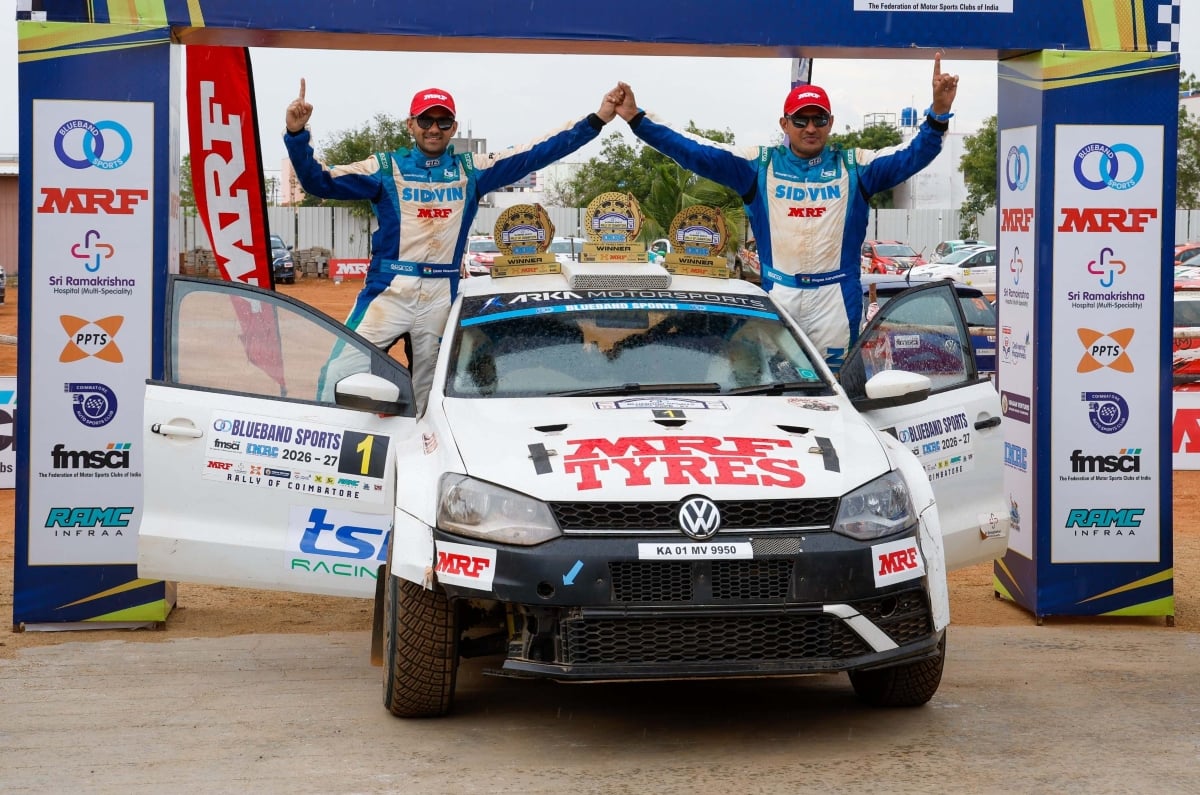
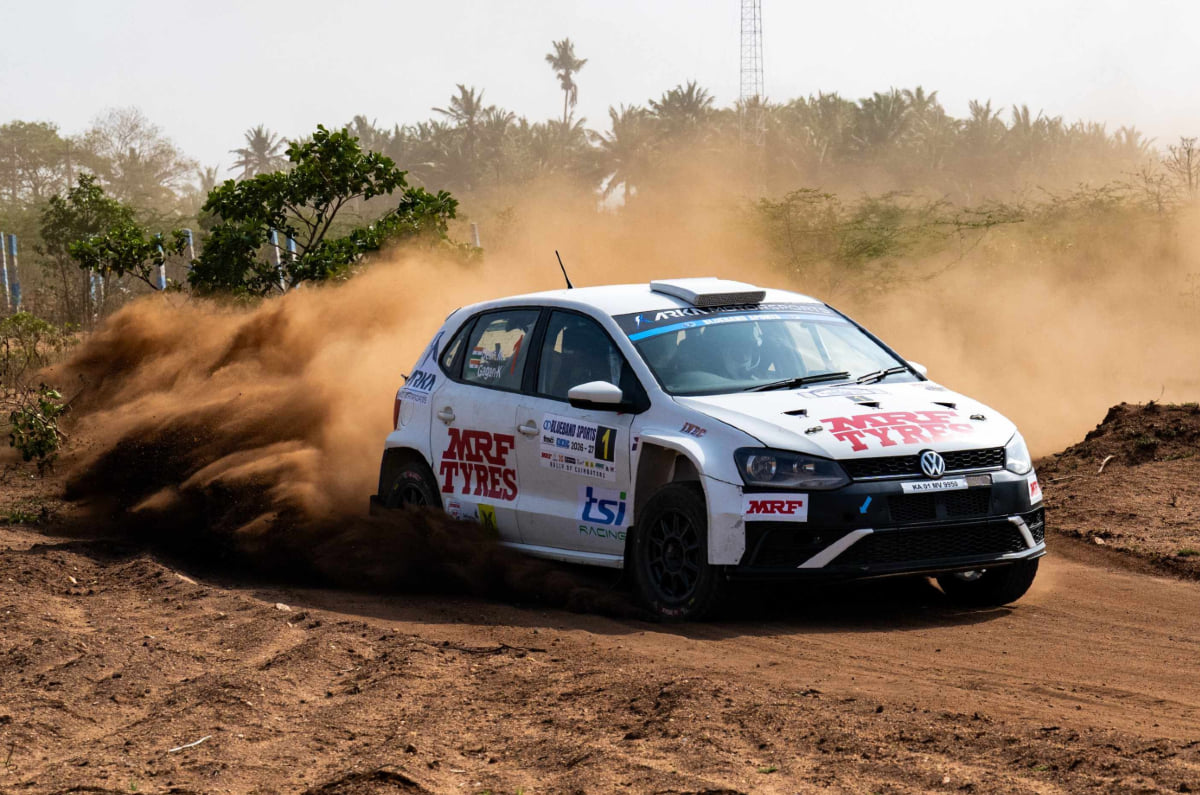
Dean Mascarenhas defeated Karna Kadur to win the 2026 Rally of Coimbatore – Round 2 of this year’s Indian National Rally Championship (INRC). A total of 64 cars participated in the predominantly gravel rally, which covered a total of 110.80km of competitive distance.
Dean Mascarenhas wins, 23.482 sec clear of Karna Kadur
Fabid Ahmer retires on last stage
Former national champion Kadur and co-driver Musa Sherif dominated on the opening day, holding a lead of 5.6 seconds over Fabid Ahmer and Milen George. Mascarenhas and his co-driver Gagan Karumbaiah, meanwhile, were third overall, just over nine seconds adrift.
But Mascarenhas turned things around on the final day. He outpaced Kadur on every stage from SS3 onwards and ended up taking victory by a margin of 23.482 seconds. “Karna and Musa set a really strong pace on Saturday, so we knew we had to stay patient and keep chipping away. Being nine seconds down overnight wasn’t a bad place to be, because there was a lot of road left. On Sunday we found our rhythm, and once we got going on Black Thunder (R) we just kept pushing. It was a proper fight with a great competitor, and I’m delighted to take the win in Round 2,” said Mascarenhas.
His co-driver Karumbaiah added, “Pace notes were everything this weekend, especially on Sunday when the gaps were so small. Dean trusted every call, and that made all the difference. Beating a crew as experienced as Karna and Musa is never easy, and we’re looking forward to the rest of the championship.”
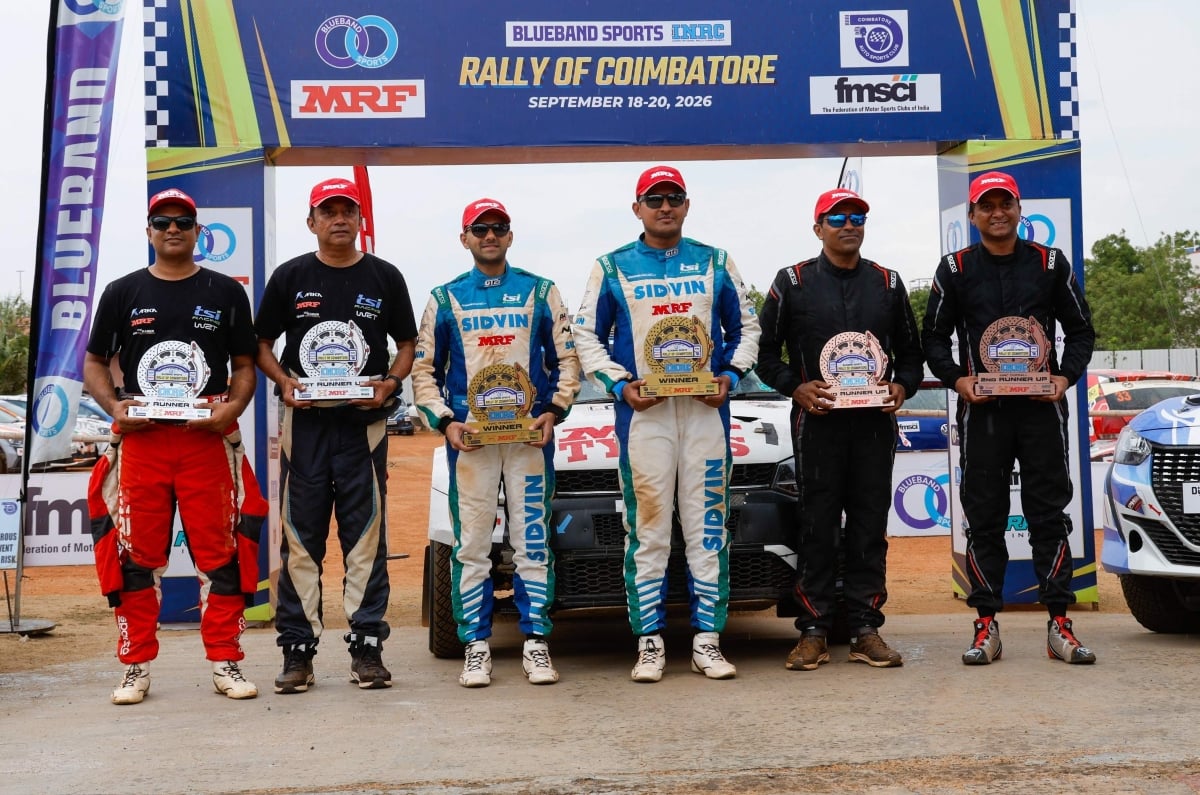
Jason Saldanha and co-driver Srinivas Murthy P V completed the INRC podium in third place. Ahmer remained in podium contention for majority of the event, but was forced to retire on the final stage.
Next up on the INRC calendar is the Robusta Rally in Coorg from November 20 to 22.
2026 Rally of Coimbatore results
INRC
1. Dean Macarenhas, Gagan Karumbaiah
2. Karna Kadur, Musa Sherif (Arka Motorsports)
3. Jason Saldanha, Srinivas Murthy P V (Arka Motorsports)
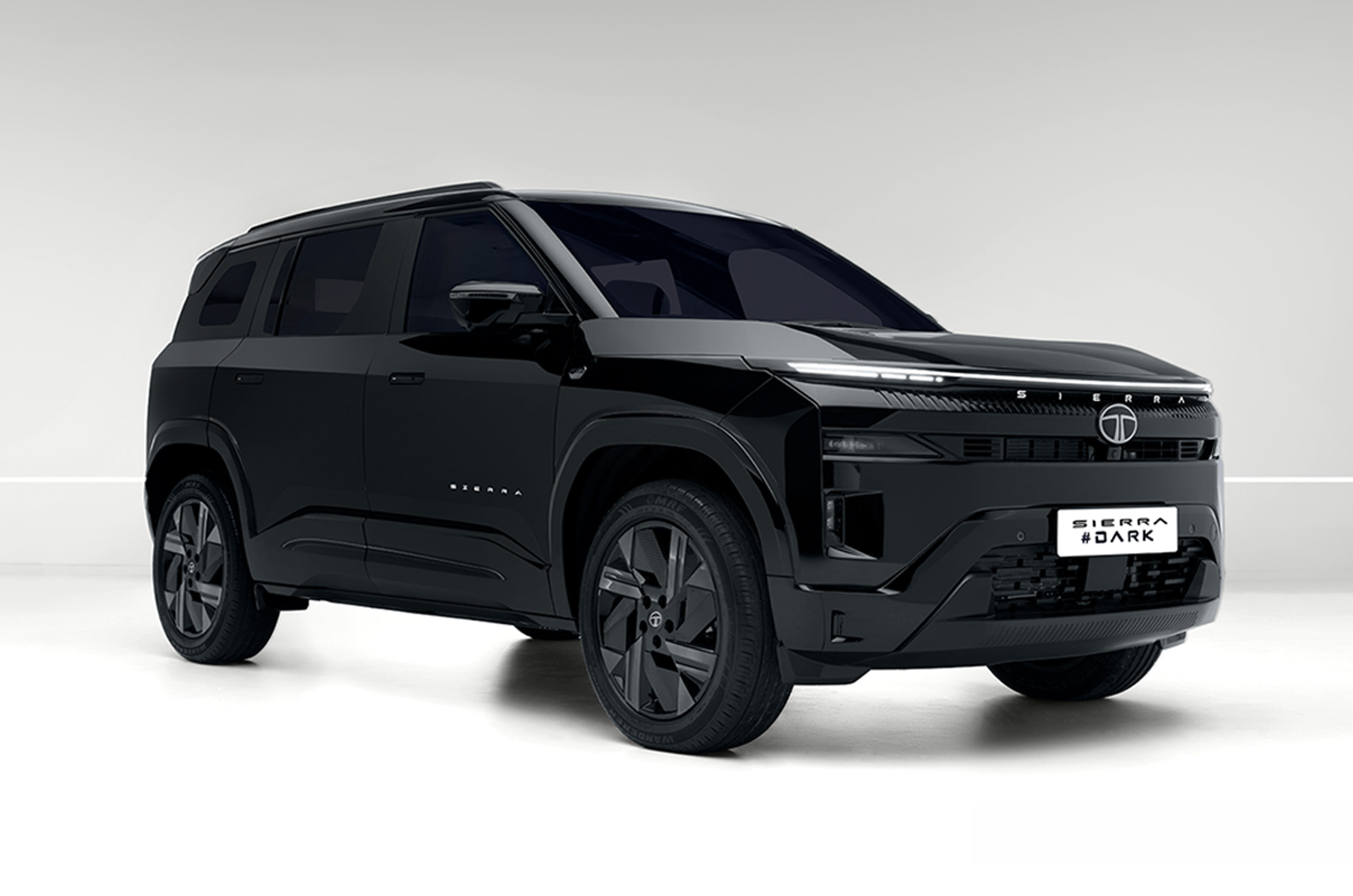
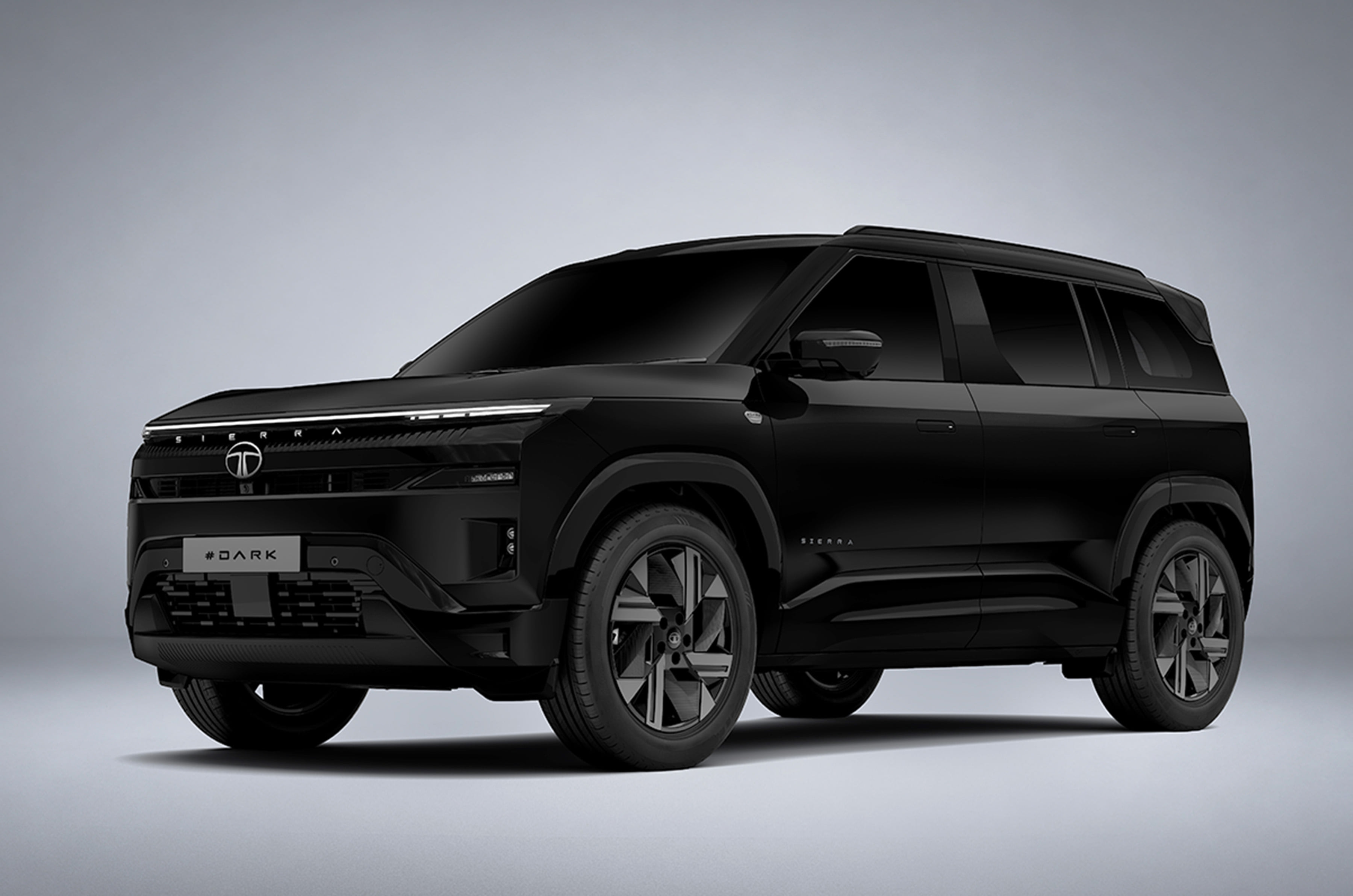
Like many of Tata’s other SUVs, the Sierra can now be had with a blacked-out Dark Edition cosmetic package. The Sierra Dark Edition is available from the Pure L trim onwards, where it commands a premium of Rs 20,000 over the standard version. For all succeeding trims, the Sierra Dark Edition costs Rs 30,000 extra. Pricing for the Sierra Dark Edition starts at Rs 13.99 lakh for the Pure L trim, and at Rs 21.59 lakh for the top-spec Accomplished+ trim.
Sierra Dark Edition gets new Friesian Black paint finish
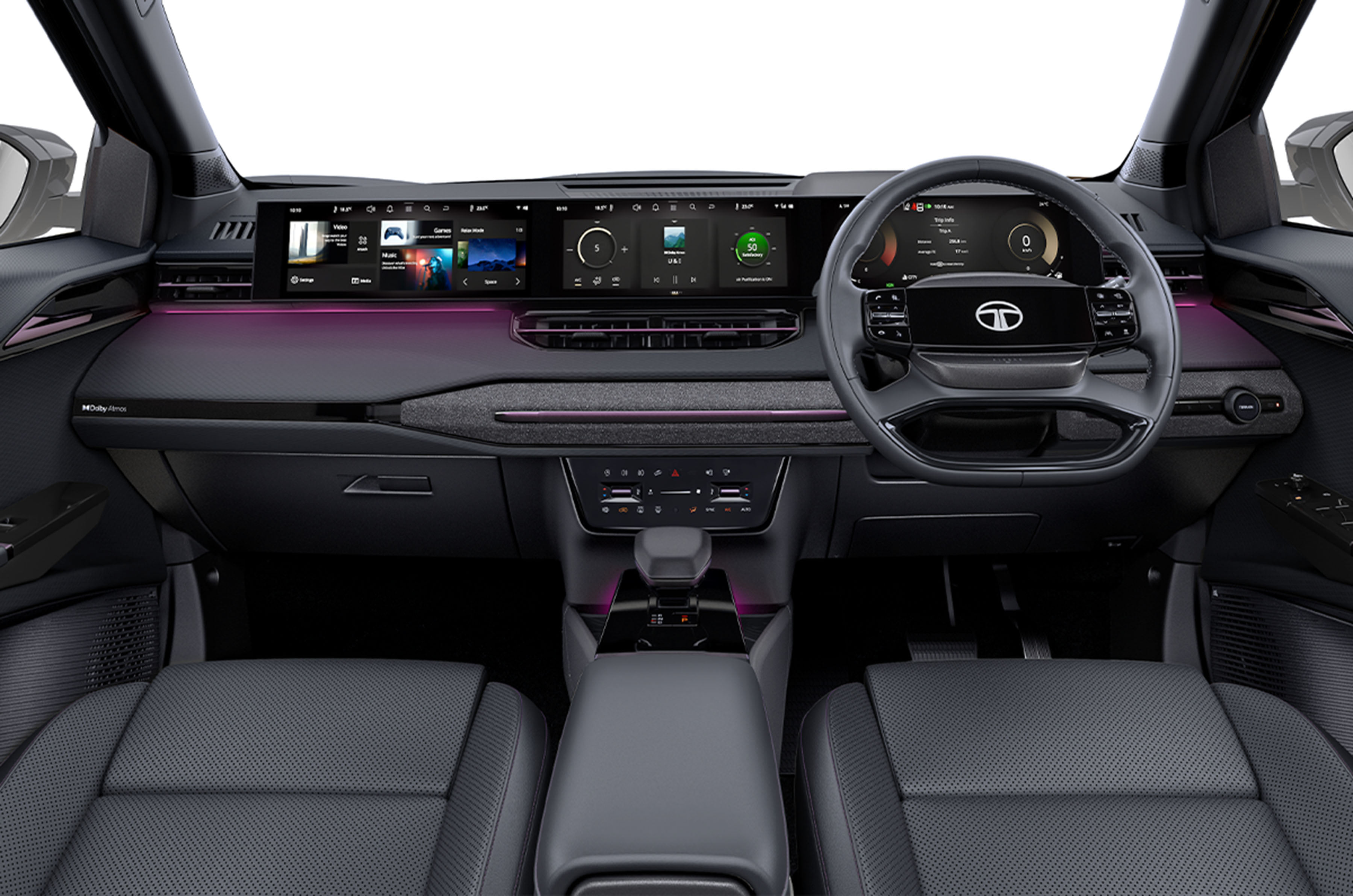
Interior gets blacked-out treatment with violet and purple highlights
Available with all powertrain options of the Sierra
Here’s a look at the full price list of the Tata Sierra Dark Edition:
Tata Sierra Dark Edition price (ex-showroom)
Trim
Petrol-MT
Petrol-DCT
Turbo-petrol AT
Diesel-MT
Diesel-AT
Pure L #Dark
Rs 13.99 lakh
Rs 15.29 lakh
–
Rs 15.44 lakh
–
Pure L (O) #Dark
Rs 14.59 lakh
Rs 15.89 lakh
–
Rs 16.04 lakh
Rs 17.34 lakh
Pure+ L #Dark
Rs 15.29 lakh
Rs 16.59 lakh
–
Rs 16.74 lakh
Rs 18.04 lakh
Adventure+ L #Dark
Rs 17.29 lakh
Rs 18.59 lakh
Rs 19.29 lakh
Rs 18.49 lakh
Rs 19.79 lakh
Accomplished #Dark
Rs 18.29 lakh
–
Rs 20.29 lakh
Rs 19.29 lakh
Rs 20.29 lakh
Accomplished+ #Dark
–
–
Rs 21.29 lakh
Rs 20.59 lakh
Rs 21.59 lakh
Tata Sierra Dark Edition exterior and interior
As you’d expect, the Sierra Dark Edition comes finished in Friesian Black on the outside as standard. Much of the exterior trim is black instead of chrome, and the Tata emblems and alloy wheels have been darkened as well. Lastly, this stealth-spec Sierra gets ‘#DARK’ badging on the front fenders.
The blacked-out finish extends to the Sierra’s cabin as well, but Tata has added a pop of colour by way of violet metallic trim pieces in areas like the AC vent bezels, door handles, front armrest, front seatbacks, and more – even the seat stitching is purple. There are otherwise no changes to the interior layout or features list over the standard versions of the Sierra, so depending on the variant, you get goodies like a triple-screen setup, ventilated front seats, a panoramic sunroof, dual-zone climate control, a powered tailgate, connected car tech, Level 2 ADAS, a 360-degree camera, a 12-speaker JBL Black sound system, among others.
Tata Sierra Dark Edition engine and gearbox
There are no changes to the powertrain offerings for the Sierra Dark Edition. It offers the same configurations found in the trim it’s based on. That means depending on the variant, you get a 106hp 1.5-litre naturally aspirated petrol engine with either a 6-speed manual or 7-speed DCT, a 118hp 1.5-litre diesel mill with either a 6-speed manual or 6-speed torque converter, or a 160hp 1.5-litre direct-injection turbo-petrol motor mated solely to a 6-speed torque converter.
Epiq, Elroq, Enyaq, it’s pretty clear to see the nomenclature every electric Skoda SUVs follows, not so here though. You see this is Skoda’s new flagship or its peak as the company says, ergo we have the Peaq.
Skoda Peaq Exterior Design and Engineering – 9/10
Doubles down on minimalist style but looks premium, classy and has good presence.
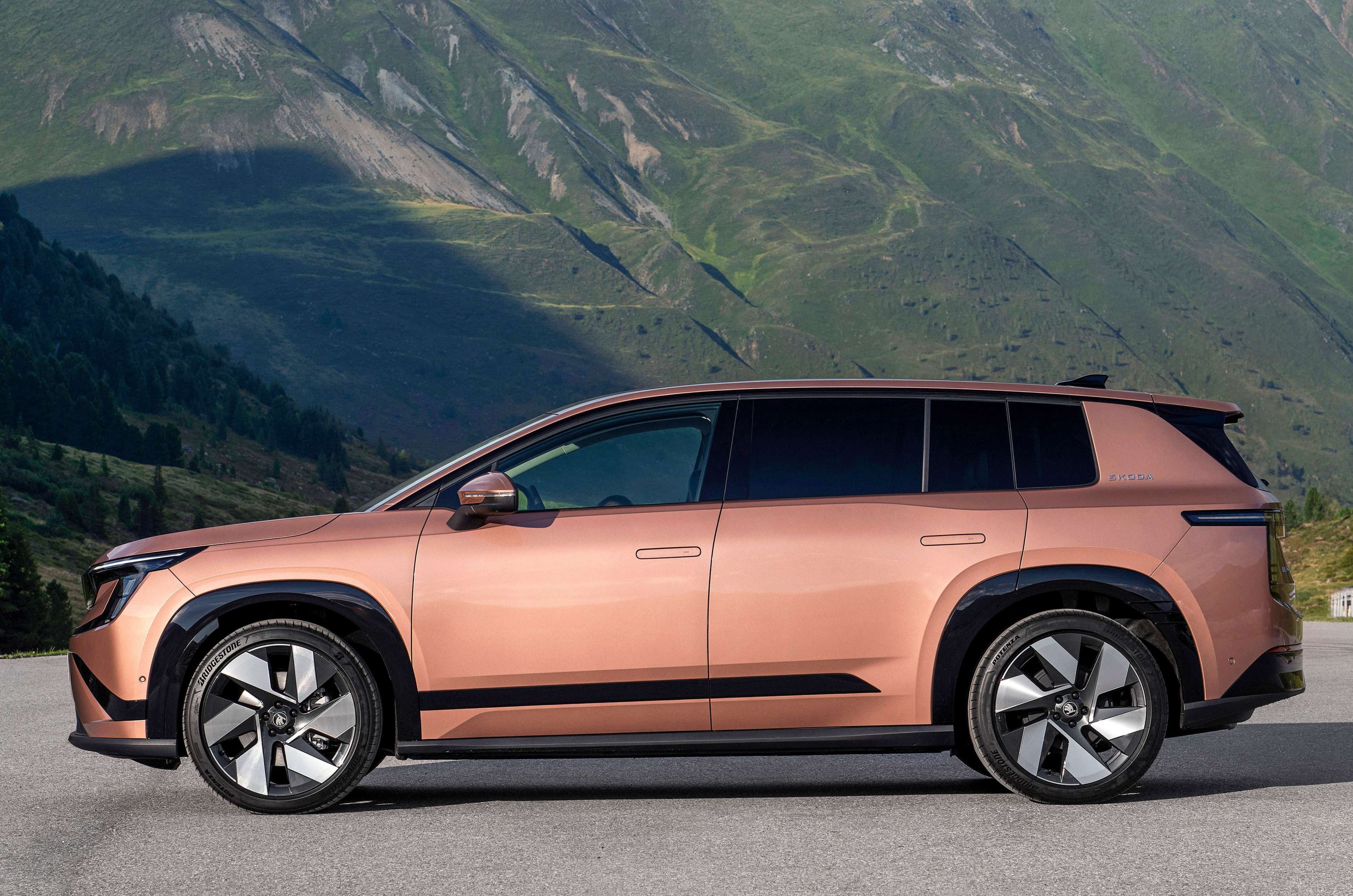
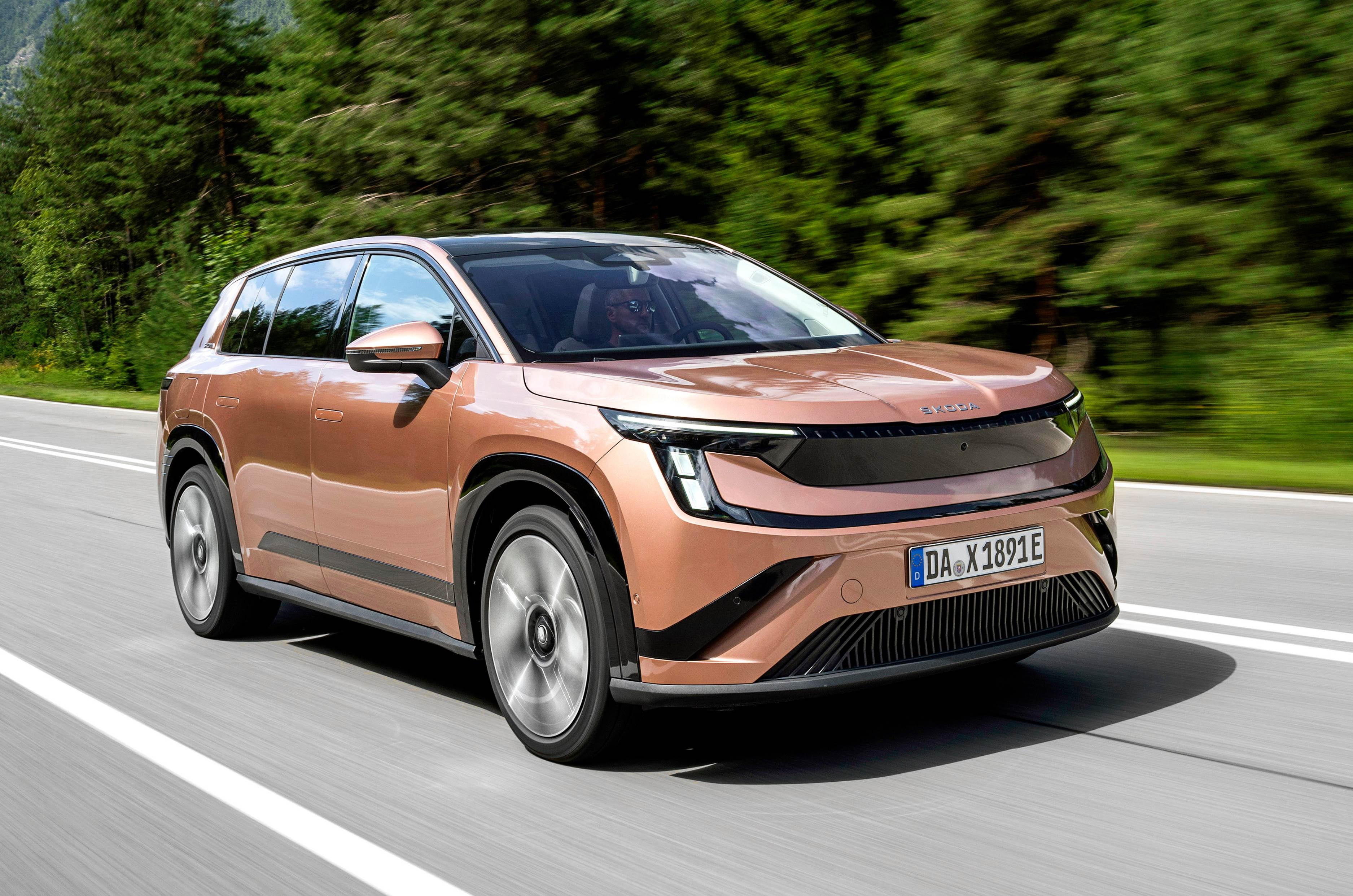
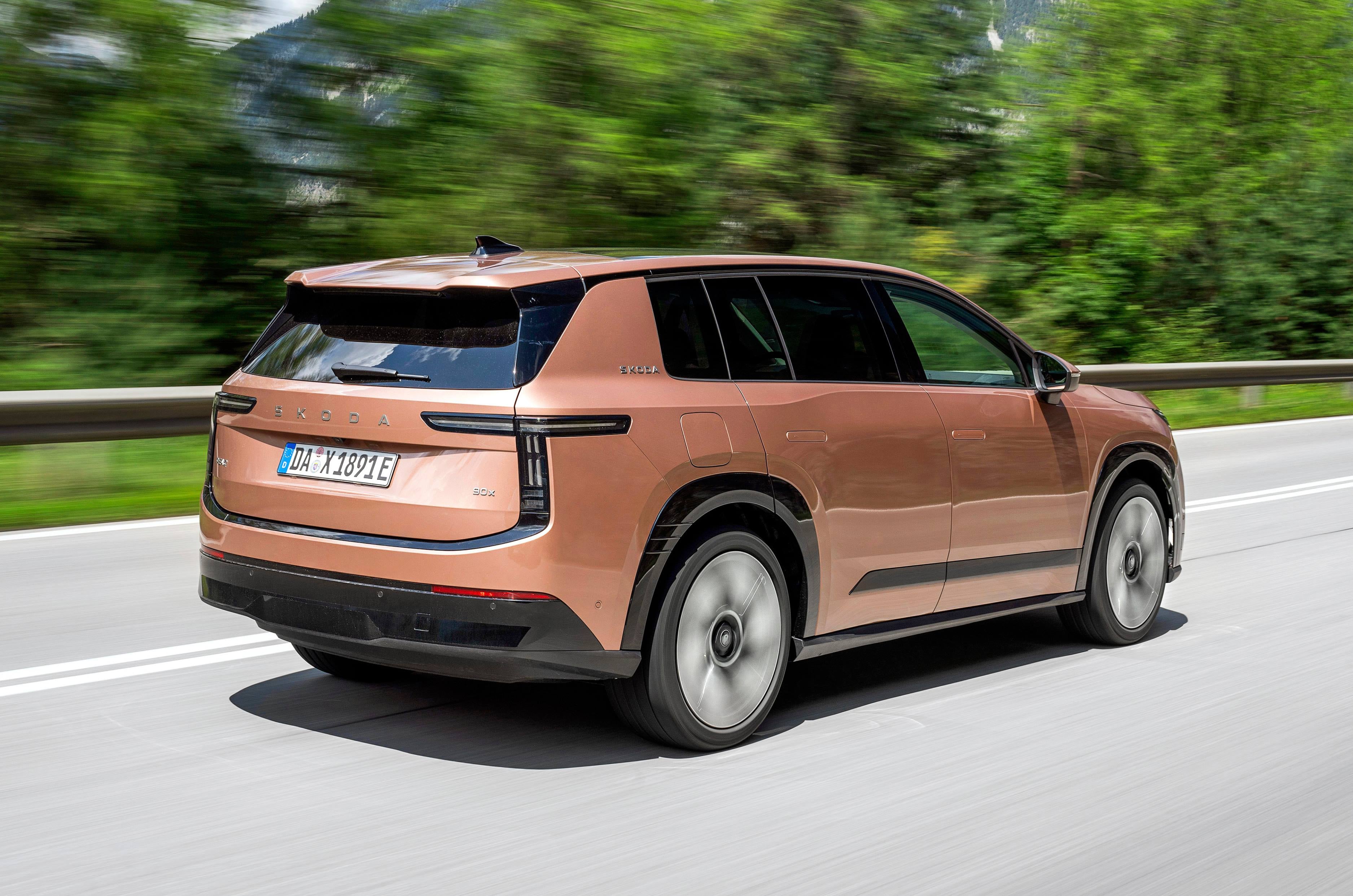
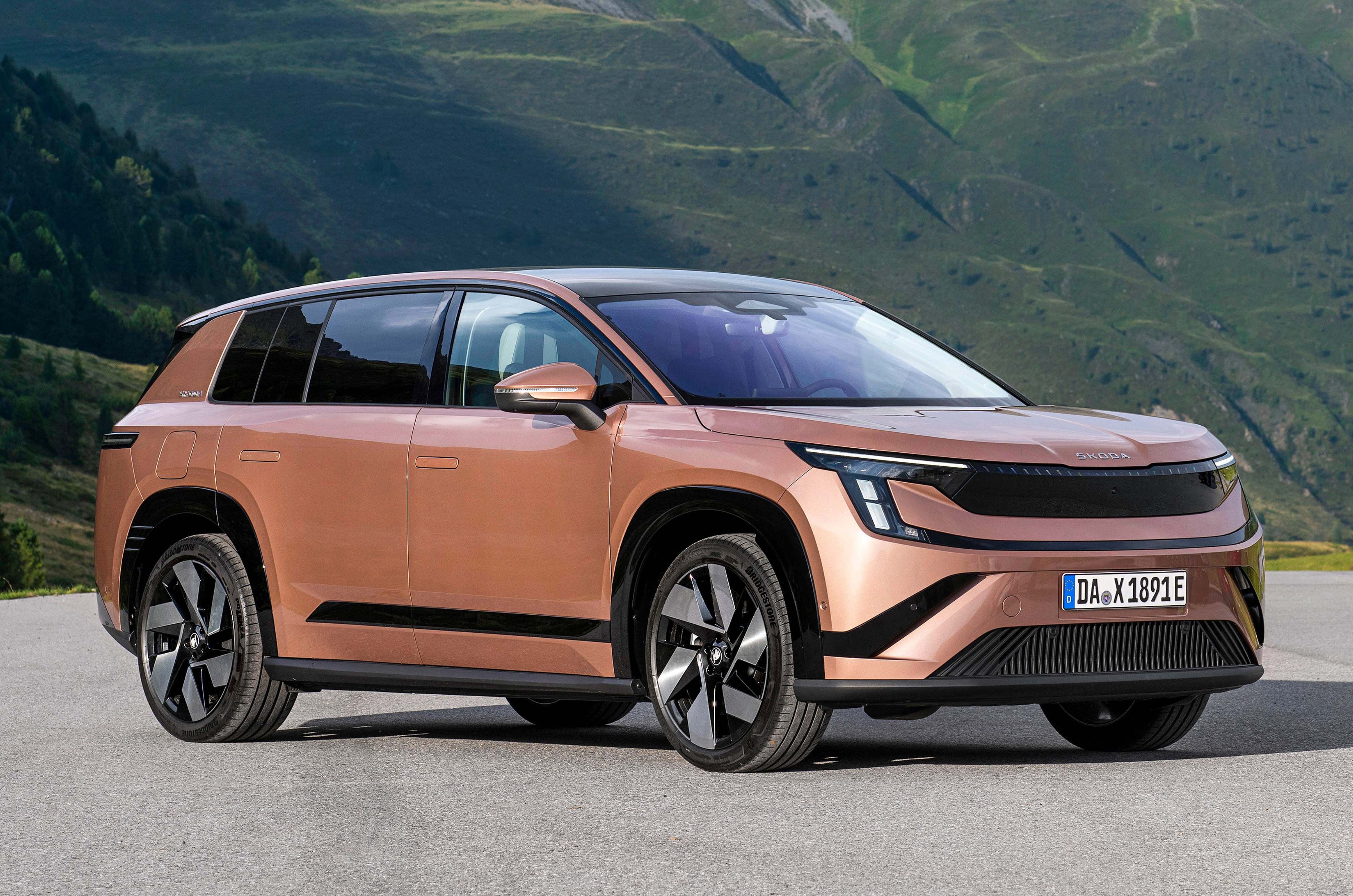
At 4.87 meters, the Peaq is the largest Skoda SUV yet.
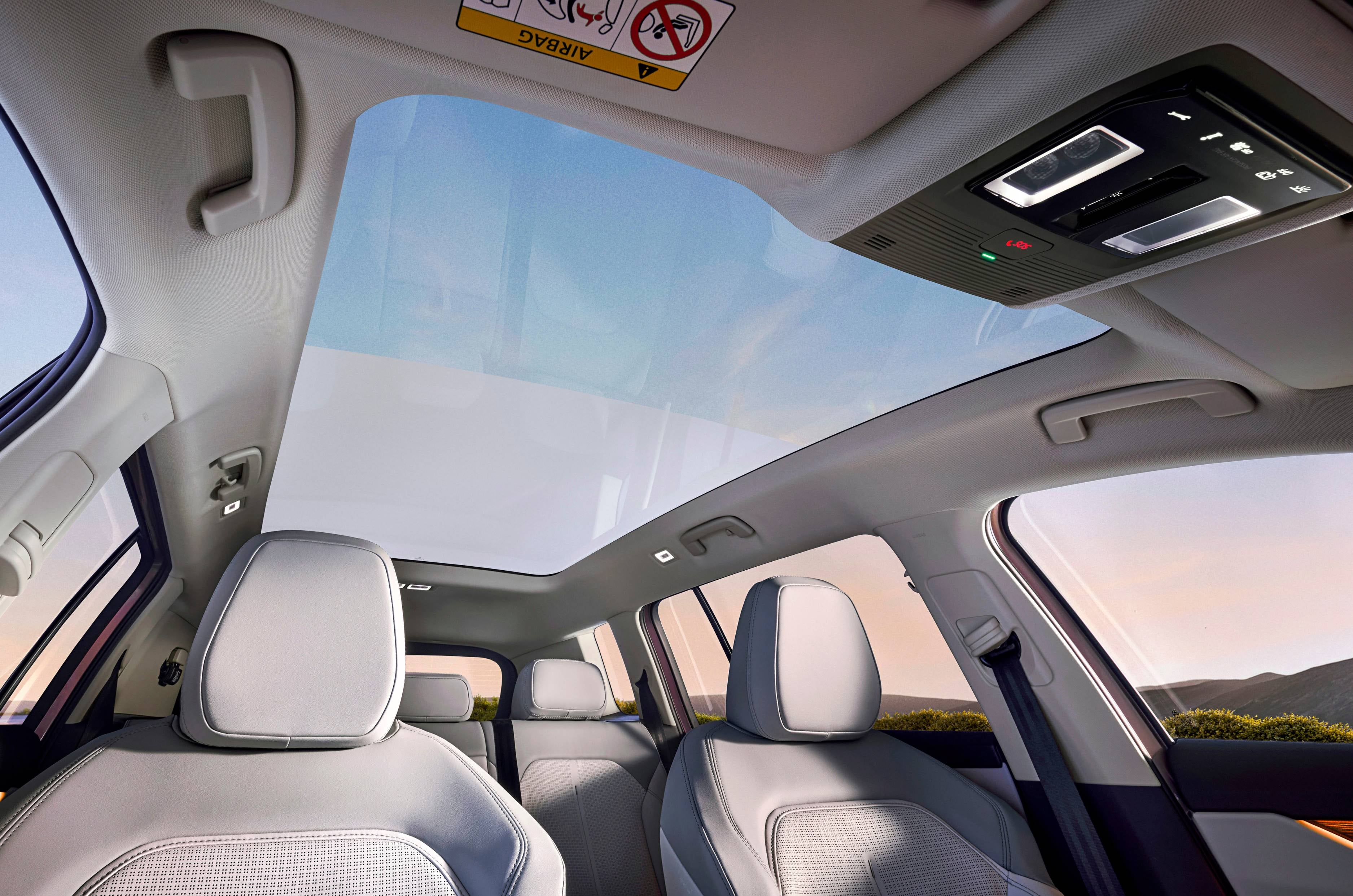
While the entry level model, the Epiq, utilizes the front wheel driven MEB+ platform, the Elroq, Enyaq and the Peaq are all built on the MEB platform which is primarily rear wheel driven with the option of AWD, which the Peaq does offer. At 4.87 meters the Peaq is the largest Skoda SUV and sports Skoda’s largest boot, battery and sunroof, too.
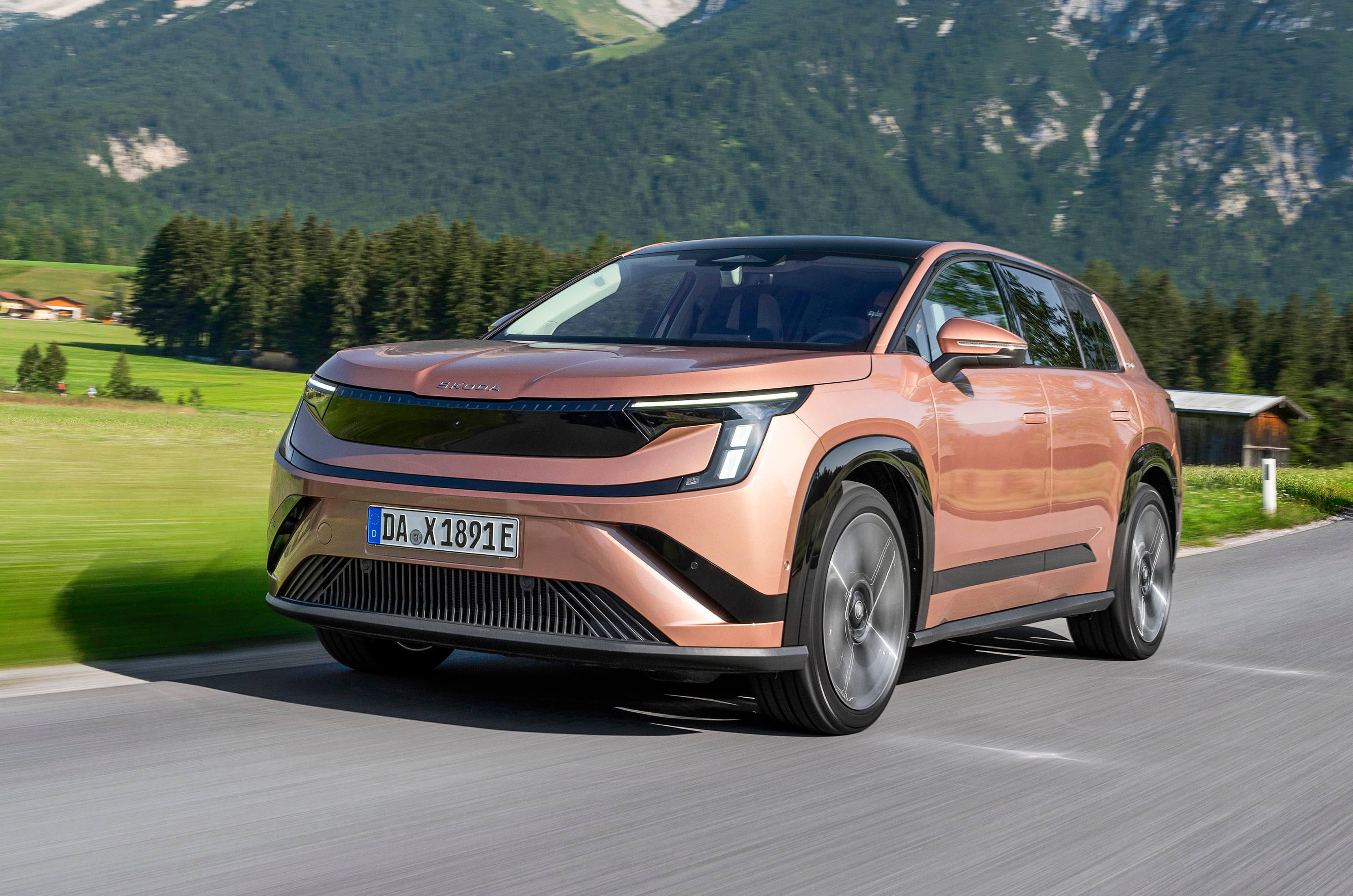
Despite its size it doesn’t look brutish like most large SUVs seem to be leaning towards these days. Thanks to Skoda’s new ‘Modern Solid’ design language, which is all about minimalism the Peaq looks premium and classy and the bodywork is quite aero efficient too with a 0.249 drag coefficient.
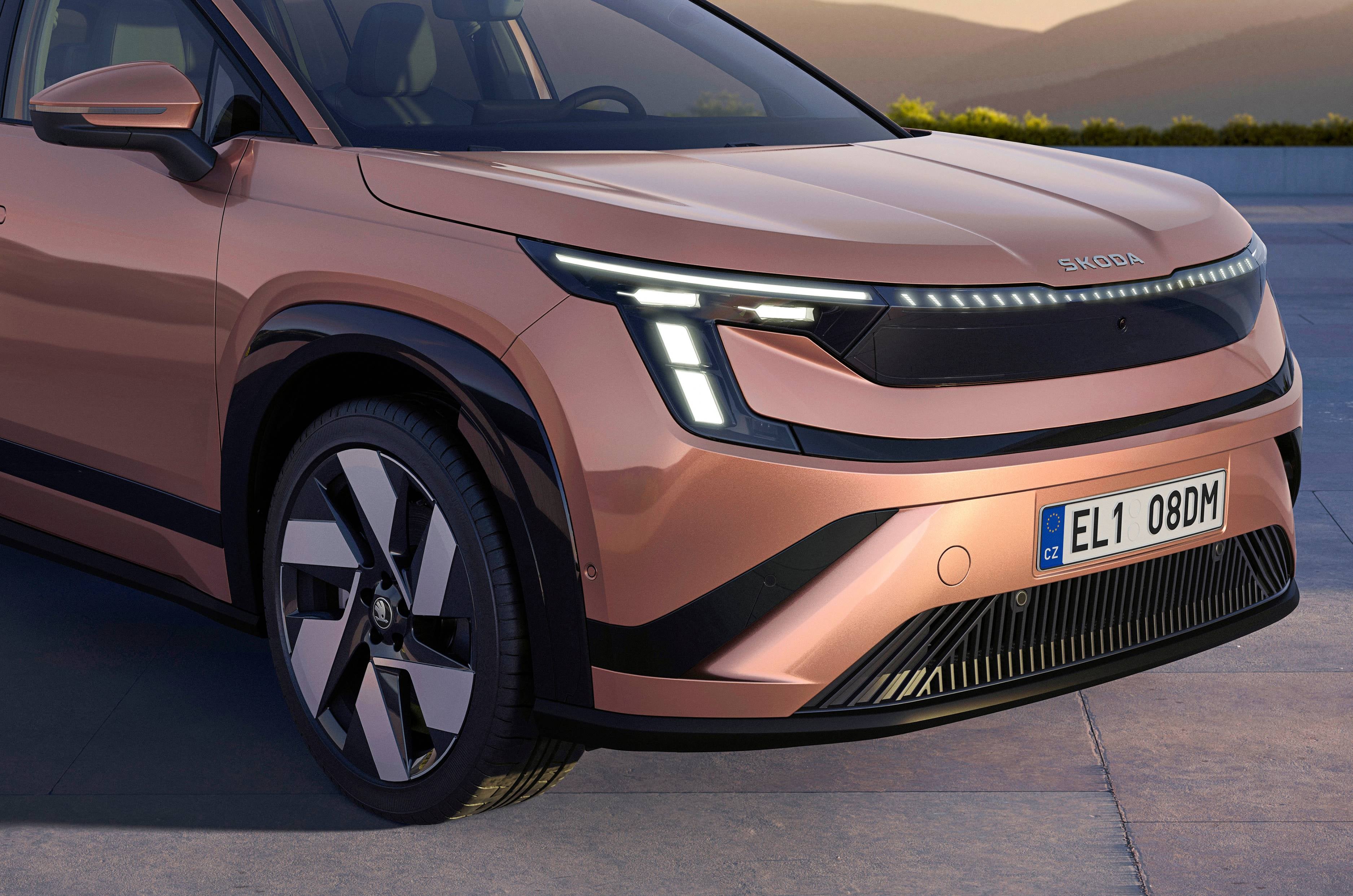
The black panel houses all the tech bits like the cameras, radars and lidar.
At the front the lines are simple and clean. The fascia sports the company’s T-shaped DRL and headlight signature and the rather clever Tech Deck; the black panel which hides all the tech bits like the cameras, radars and lidar and mimics a grille thus avoiding that faceless look many EVs sport. Skoda has even hidden LED lights behind it that – to a small extent – mimic grille slots. Notably the Skoda emblem is missing, the company is in the process of moving away from it and the Peaq carries the new Skoda letter mark instead.
Over at the sides the clean lines continue with flush door handles, these can also be pressed in at the edge to manually operate them. The alloy wheels on our car were the 21 inchers and have a neatly balanced sporty and classy look. A defining styling element in profile is the C pillar which is body coloured and looks like a reversed fin and carries the Skoda lettering.
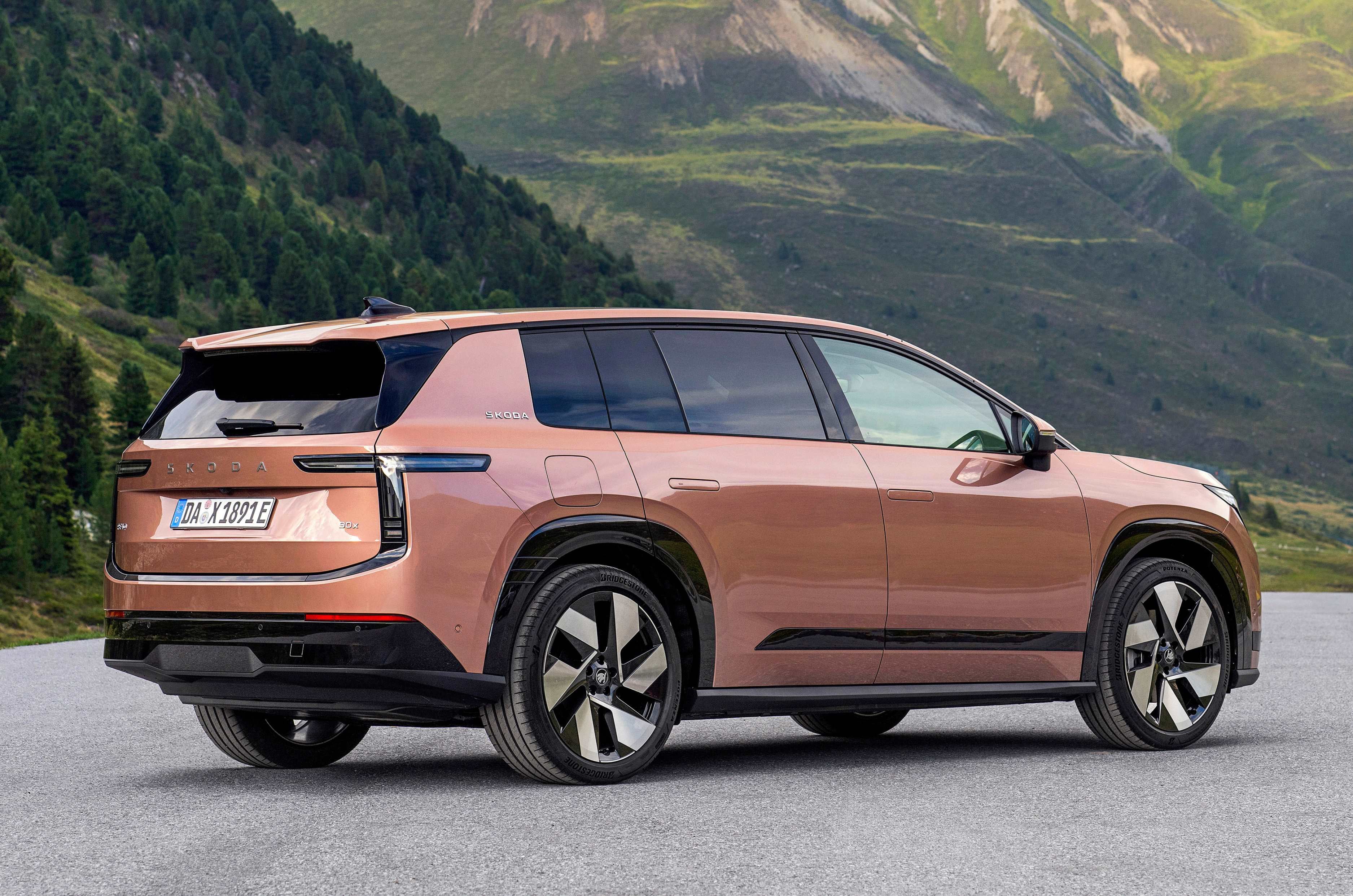
T-shaped tail lights are connected by a stylistic loop running at the bottom of the tail gate.
Like the headlights, the taillights too are T-shaped and are connected to each other via a stylistic loop running at the bottom of the tailgate. A roof integrated spoiler and a shark fin antenna complete the rear look and here too it’s just the Skoda lettering spelled out across the boot lid.
Skoda Peaq Interior Space and Comfort – 7/10
Minimalism carries on inside but cabin could do with a dash of flair.
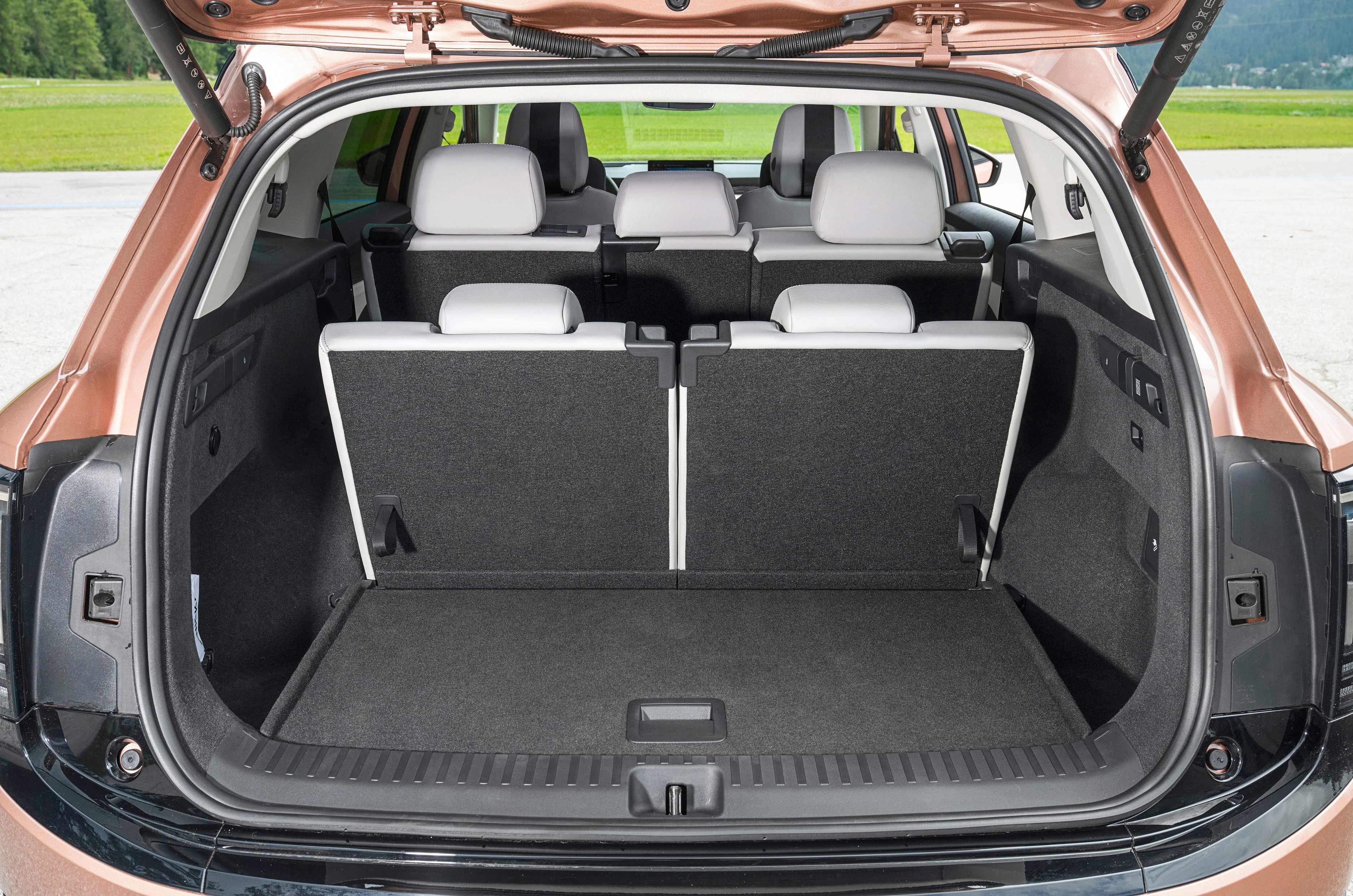
Peaq’s boot is the largest on a Skoda so far; offers 299-litres of space with all rows up.
With a near three-meter wheelbase there’s plenty of space inside, beginning with the boot which is the largest on a Skoda so far; 935 litres without the third row, but even in the 3-row version and with the third-row seats in place, there’s 299 litres which is more than enough for a few small bags. A handy little bit is a motorised cargo cover that rolls open or close with the boot opening and closing. At the front there’s also a 37-litre frunk.
Front seats feature a ‘zero-gravity’ position allowing one to fully stretch out.
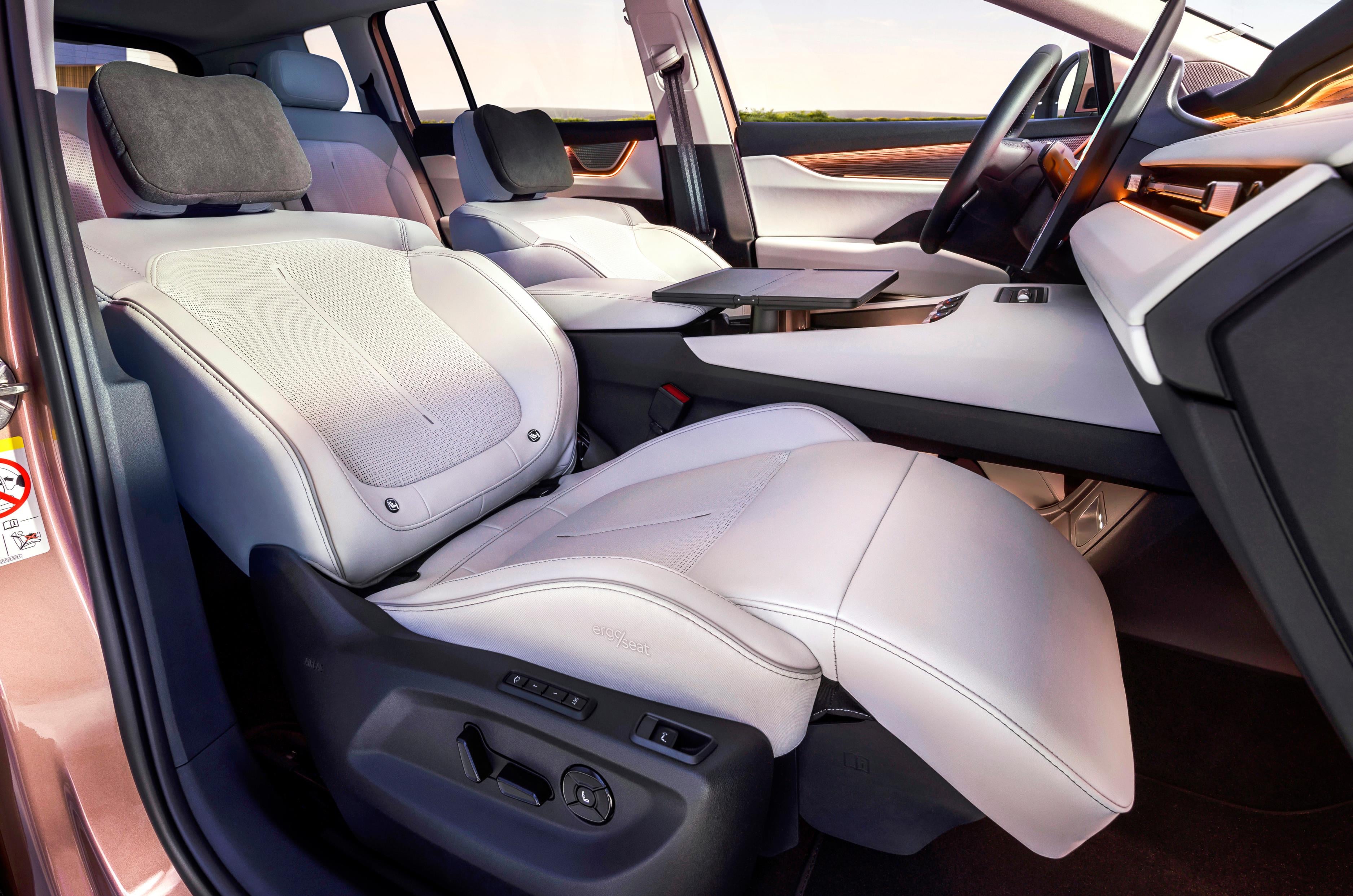
Passengers are well catered too, especially at the front two rows. The front seats offer plenty of space and will suit broader frames quite nicely. They also offer a ‘zero-gravity’ position wherein at the touch of a button the seat base dips, the seat back reclines and an ottoman style leg rest extends upward. They also offer heating, ventilation and a massage function. There’s an app too – which new EV does not have one these days – and that can configure the cabin lighting, seats, climate and other elements in six modes from a relaxing to an energizing ambience. On our drive in the cold Austrian mountains, we had a lot of rain and the ‘warm feet’ HVAC setting proved to be very handy and welcome.
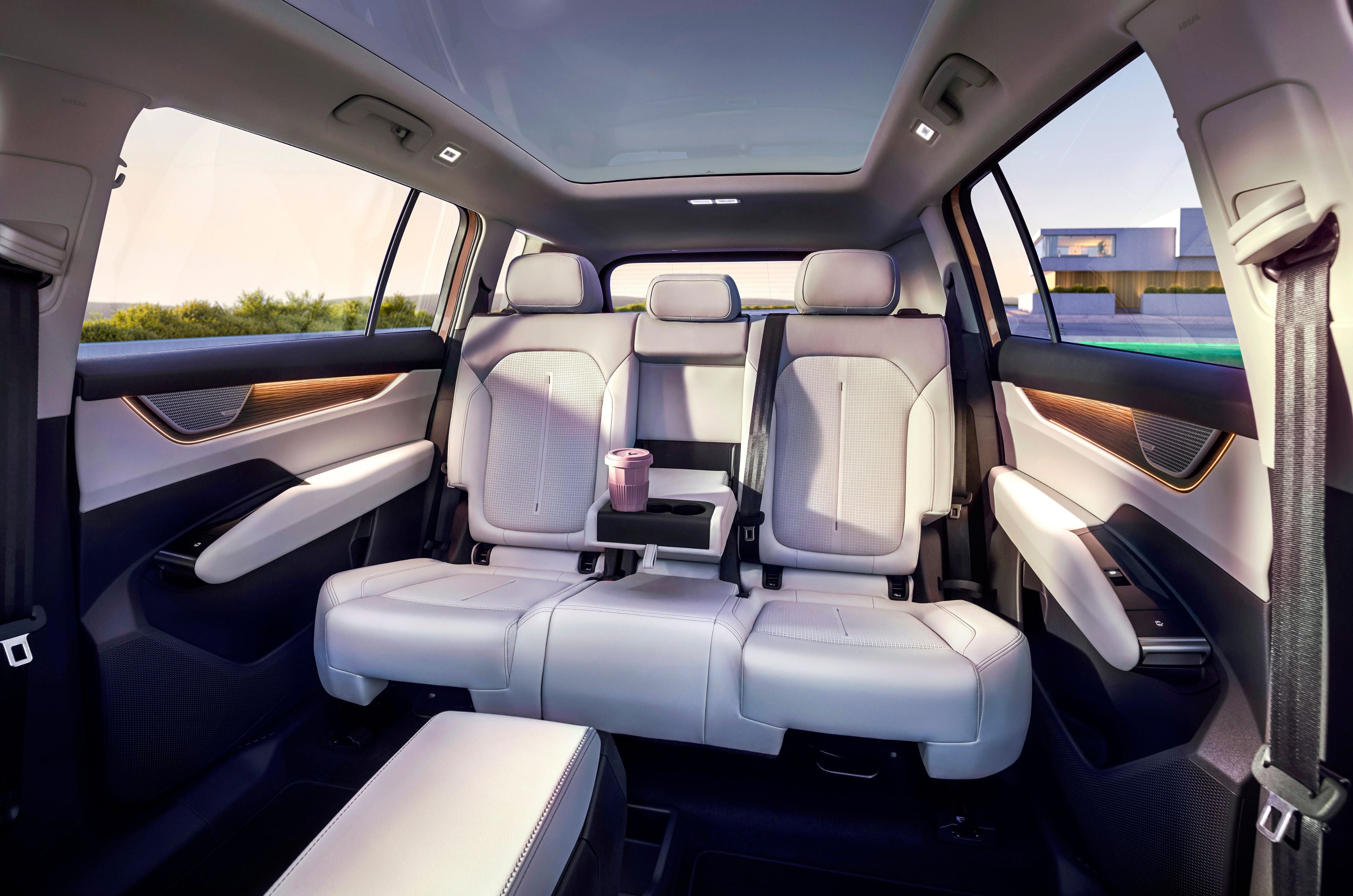
Three people can sit abreast in the second row; one doesn’t sit in a knees-up position like in most EVs.
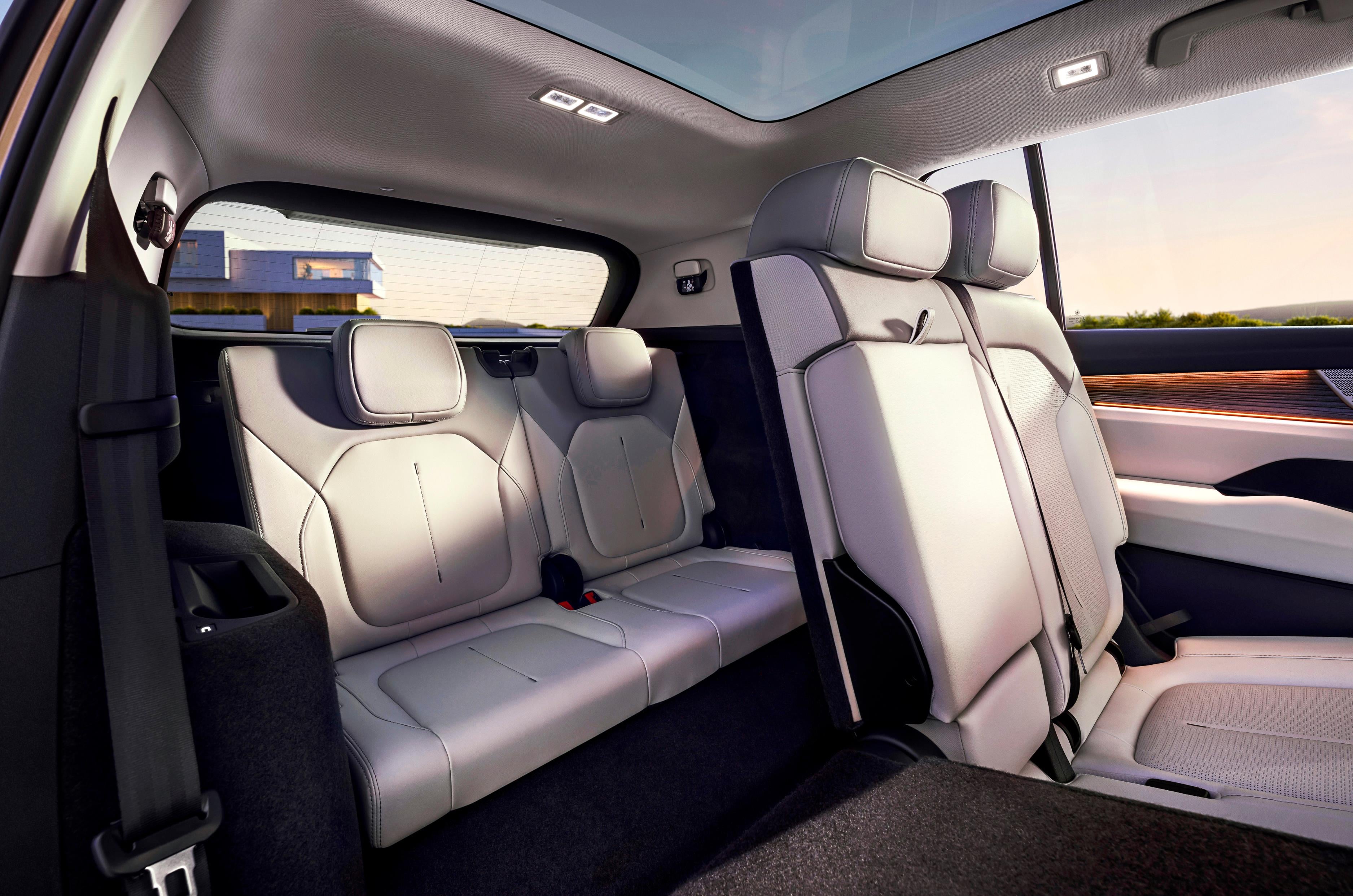
There’s plenty of space in the second row, legroom is good as is shoulder room. We did sit three abreast and didn’t have too much of shoulder overlap. Headroom is very generous and what’s nice is that you don’t sit in a knees-up position as is the case in some EVs. The third row is decent, there should have been more room given the length of the car, but on its own its quite useable and more than enough for kids or short journeys. Like the second row, headroom here is also good.
In terms of styling the cabin follows on with the exterior minimalist theme and all the lines are simple and clean, with very little flair about. A bit of panache would have been nice and in keeping with the flagship positioning of the Peaq.
Third row is decent enough for kids or for short journeys.
Skoda Peaq Features and Safety – 8/10
Well equipped and with a healthy does of Skoda’s ‘Simply Clever’ details.
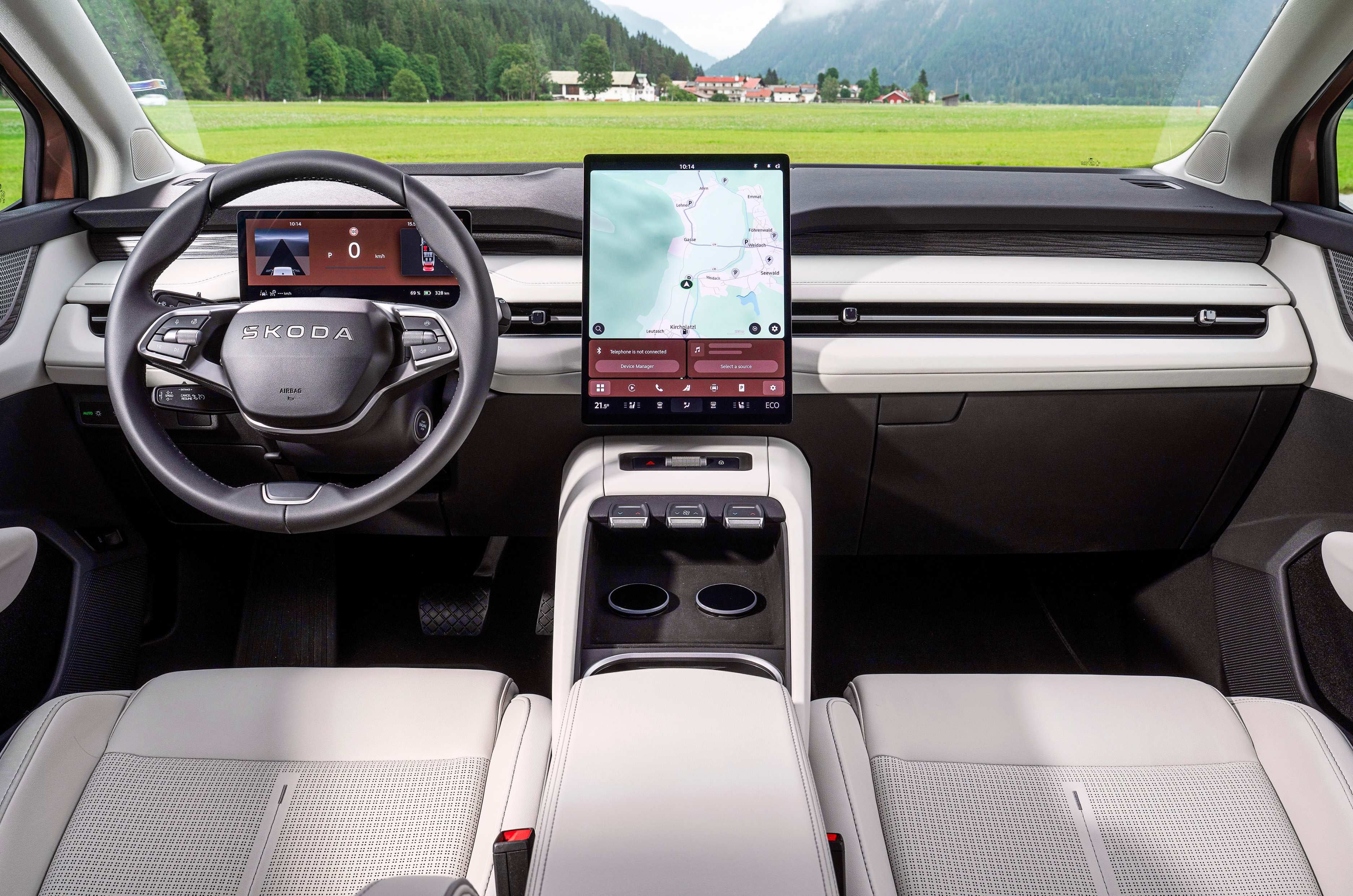
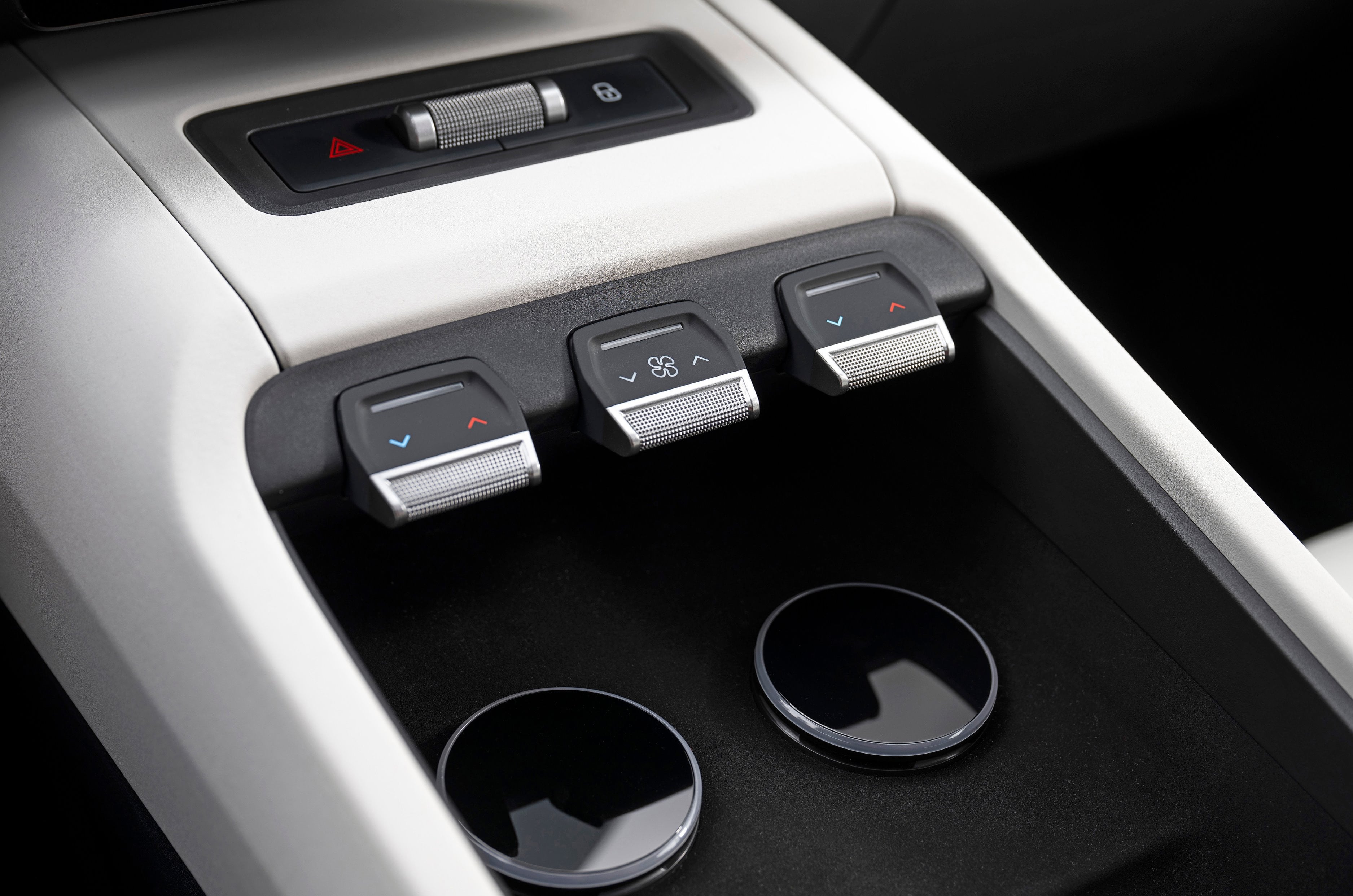
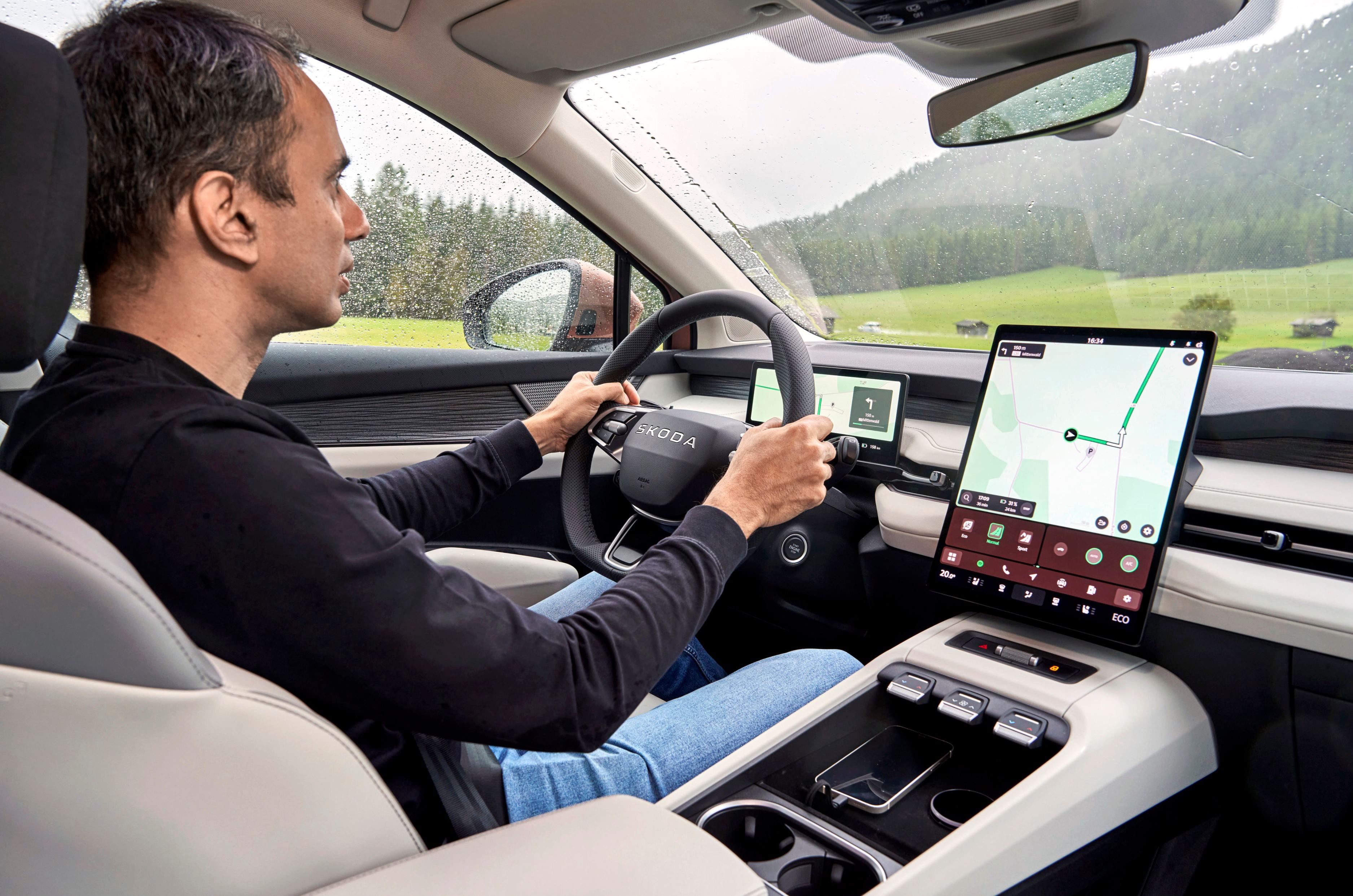
Sitting at the very top of the Skoda range the Peaq is well equipped. The dash carries a 13.6-inch, portrait-oriented touch screen – a first for Skoda – which runs a new UI. There’s a hard baked area for certain controls and thankfully physical controls are retained for main entertainment and HVAC functions, the latter being large toggle switches that are easy to use. These sit on top of an open charging box that has two illuminated magnetic Qi2 wireless charging disc with active cooling, and have a max speed of 25W. The rest of the center console is made up of many storage spaces and cubbies with a neat pass-through slot for charging cables from the lower to the upper console.
A portrait-oriented touchscreen is a first for a Skoda, and runs a brand-new UI.
Ahead of the driver is a 10-inch digital instrument panel which sounds large but has a slim aspect ratio, and there’s also an HUD. The steering wheel is the familiar Skoda unit with the letter mark on the boss and the buttons and scroll wheels on the two wings and as expected the operate with a satisfying click feel.
Thankfully, there are large toggle switches for HVAC controls which are easy to use.
Other features include a 360-degree camera with a transparent 3D body on the display that helps in positioning the car, a 16-speaker SONOS sound system, park assist, a full connectivity suite, 10-airbags and ADAS and of course a healthy dose of Skoda’s ‘Simply Clever’ details like a fold out table for the front passengers that’s tucked away in the center console and umbrella holders in the doors. And topping things off is a large panoramic glass roof, which does not have a sunscreen, instead there’s 9 electrochromic panels that can be darkened to keep out the light and heat says Skoda. We’ll reserve that judgement for when we test it here in our hot climate though.
Panoramic glass roof doesn’t have a sunscreen but features 9 electrochromic panels to keep sun and heat out.
Skoda Peaq Performance and Refinement – 8/10
Strong performance that does not feel characterless like most EVs
There are three powertrain versions on offer starting with the 60-variant, power for which comes from a 63kWH (gross) NMC battery that drives a 204 hp rear motor. Next is the 90 trim which has a 91kWh (gross) NMC battery – the largest on a Skoda –power is courtesy a 286hp rear motor, and the range topper is the 90X which is also powered by the same battery as the 90 but driving a dual motor AWD set up that puts out a combined 300hp. Either of the 90 series cars is what Skoda will bring to India and for our drive today we had the 90X version.
Throtlle response feels quite ICE-like, building speed progressively.
As expected, power delivery is strong and acceleration is brisk, the claimed 0 – 100kph time stands at 6.7 seconds which is plenty quick for a large seven seat family SUV. What’s nice though is that the delivery isn’t typically EV like, which is to say power dumped in an instant and then linear all through. On the Peaq, throttle response feels quite ICE like, it’s fed in progressively and build nicely as you explore deeper regions of the throttle pedal. Top speed is limited to 180kph which is very easy to get too, on the unrestricted section of the German autobahns we hit an indicated 185kph. Wind and tyre noise is well controlled especially over the smooth tarmac sections and even at high triple digit speeds the cabin was silent enough.
Wind and tyre noise are well contained even at triple digit speeds.
Skoda Peaq Ride Comfort and Handling – 7/10
Very stable at speeds, but Normal mode sees some body float over undulations.
The 90X comes with Skoda’s dynamic chassis control and the adjustable dampers do alter the ride character noticeably. In Normal mode is very comfy and could do well over potholes and ruts, however at highway speeds and over undulations that we did see on some section there is some body float. A switch to the Sport setting however tides this up quite nicely and was the default setting I used for most of the drive. Being an AWD, there’s also a few off-road modes though we didn’t get to try these out and I suspect most owners won’t either.
Depending on the mode, adjustable dampers noticeably alter the ride quality.
In terms of handling this isn’t what you would call light on its feet, you do know you are driving a large SUV but its never cumbersome and through the mountain passes we did have a bit of fun, not sporty then but enjoyable enough if how I’d describe the handling character.
Skoda Peaq Range and Efficiency – 7/10
Charging speeds and range are par for course
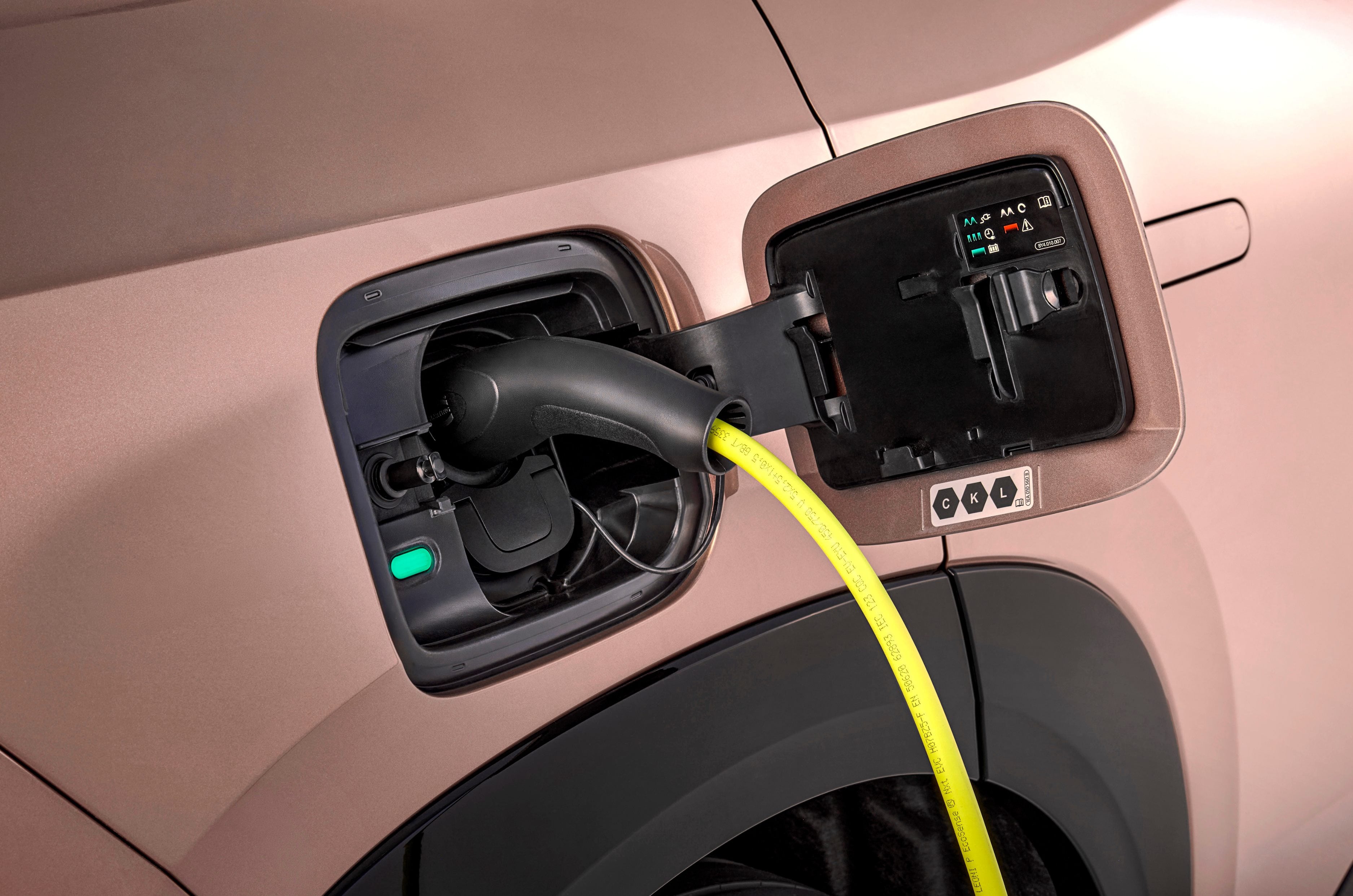
The Peaq 60 battery capacity stands at 63kWh (59kWh net) and that’s good for a range of 450kms says Skoda. Max charging speed is 160kW on a DC fast charger and that can take the battery from 10 to 80 percent in 27 minutes.
A 160kW DC fast charger can top up the battery from 10 to 80 percent in 27 minutes (claimed).
The 90 cars are powered by a larger 91kWh (86kWh net) battery, max charging speed stands at 199kW and a 10 to 80 percent charge on a DC fast charger takes 28 mins. On the 90X range stands at 610kms while the two wheel drive 90 version sees a slightly longer range at 640 kms. We’ll know the real-world range once we put it through our standard test cycle back home.
Skoda Peaq Expected price and Verdict – 8/10
Priced at Rs 60 lakh it would be a tempting option and it does more than enough to call this peak Skoda.
Skoda is really doing a fine job with its EVs, we liked the Enyaq, were superbly impressed with the Elroq and the flagship Peaq does not disappoint too. Yes, the ride does feel soft and the interiors do lack flair, something you would expect on a flagship and we’ll of course have to wait and see how Skoda price this when it comes to India some time mid next year. Skoda says it will arrive as a CBU and we expect it to be priced at around Rs 60 lakh ex-showroom where it will be able to compete with rivals like the Tesla Model Y L, above that though and Skoda will face some heat from premium brands like BMW and Mercedes that are also expanding their electric SUV portfolio.
The Peaq will arrive in India as a CBU and is expected to be priced around the Rs 60 lakh mark.
The Peaq though does provide a very well-turned-out product, it looks classy and premium and that’s important at this price point, there’s a good amount of space inside, especially for the front two rows, it’s well equipped with typically Skoda clever bits and the drive experience is mature and enjoyable. All typical highlights that we’ve come to expect of the brand. All in all, then, the Skoda Peaq does more than enough to safely call this, peak Skoda.
Dividends, Stock Splits, Bonus this week: इस हफ्ते 170 से ज्यादा कंपनियों के शेयर डिविडेंड, स्टॉक स्प्लिट और बोनस जैसे कॉरपोरेट एक्शन के चलते फोकस में रहेंगे। इनमें IRCTC, Dixon Technologies और BEML समेत कई कंपनियां शामिल हैं। रिकॉर्ड डेट 21 से 25 सितंबर के बीच है।
कॉरपोरेट एक्शन का फायदा लेने के लिए रिकॉर्ड डेट पर शेयर डीमैट अकाउंट में होना जरूरी है। यह लिस्ट अस्थायी है। हफ्ते के दौरान कुछ और कंपनियां भी रिकॉर्ड डेट घोषित कर सकती हैं।
अगले हफ्ते स्टॉक स्प्लिट
तीन शेयर अगले हफ्ते एक्स-स्प्लिट होंगे। इनमें TAAL Tech, Naturite Agro Products और Midwest Energy शामिल हैं।
TAAL Tech 1:5 स्टॉक स्प्लिट करेगा। ₹10 फेस वैल्यू वाला एक शेयर पांच शेयरों में बंटेगा। नई फेस वैल्यू ₹2 होगी। रिकॉर्ड डेट 22 सितंबर है।
Naturite Agro Products 1:2 और Midwest Energy 1:10 स्टॉक स्प्लिट करेगा। दोनों की रिकॉर्ड डेट 25 सितंबर है। इसके बाद Naturite की फेस वैल्यू ₹5 और Midwest Energy की ₹1 हो जाएगी।
सोमवार, 21 सितंबर
करीब 55 कंपनियों की रिकॉर्ड डेट सोमवार को है। Maharashtra Scooters ₹160 प्रति शेयर का डिविडेंड देगी। Bajaj Holdings and Investments ₹65 और Southern Gas ₹60 प्रति शेयर देगी।
Monte Carlo Fashions और KJMC Financial Services ₹20 प्रति शेयर का डिविडेंड देंगी। Dixon Technologies ₹10, Bharat Dynamics ₹0.40 और CONCOR ₹1 प्रति शेयर का फाइनल डिविडेंड देगी।
मंगलवार, 22 सितंबर
50 से ज्यादा कंपनियां मंगलवार को एक्स-डिविडेंड होंगी। GOCL Corporation ₹30 प्रति शेयर का डिविडेंड देगी। BEML ₹12.28 और National Peroxide ₹7 प्रति शेयर देगी।
IRCTC ₹0.50 प्रति शेयर का डिविडेंड देगी।
बुधवार, 23 सितंबर
40 से ज्यादा कंपनियां बुधवार को एक्स-डिविडेंड होंगी। GMDC ₹9.50 प्रति शेयर का फाइनल डिविडेंड देगी। Tyche Industries ₹3.50 प्रति शेयर देगी।
Goodluck India और Talbros Engineering ने ₹3 प्रति शेयर का डिविडेंड घोषित किया है।
गुरुवार, 24 सितंबर
गुरुवार को सिर्फ दो कंपनियों की रिकॉर्ड डेट है। Engineers India ₹2.50 प्रति शेयर और Adtech Systems ₹1.10 प्रति शेयर का डिविडेंड देगी।
शुक्रवार, 25 सितंबर
शुक्रवार को छह शेयर अलग-अलग कॉरपोरेट एक्शन के लिए एक्स-डेट होंगे। Sri Lotus Developers and Realty ₹0.50 प्रति शेयर का फाइनल डिविडेंड देगी।
LGT Global Hospitality और Shreeji Global FMCG ₹0.25 प्रति शेयर का फाइनल डिविडेंड देंगी। Noble Polymers ₹0.05 प्रति शेयर के फाइनल डिविडेंड के लिए एक्स-डिविडेंड होगा।
Disclaimer: यहां मुहैया जानकारी सिर्फ सूचना के लिए दी जा रही है। यहां बताना जरूरी है कि मार्केट में निवेश बाजार जोखिमों के अधीन है। निवेशक के तौर पर पैसा लगाने से पहले हमेशा एक्सपर्ट से सलाह लें। मनीकंट्रोल की तरफ से किसी को भी पैसा लगाने की यहां कभी भी सलाह नहीं दी जाती है।
Picture the scene: you’re a commando who’s just parachuted behind enemy lines. Along with you and your team are a bunch of military off-roaders. It’s been a tough jump. High winds, terrain, difficult odds. While the men all make it intact, the machines break up and are destroyed. The team has to salvage what it can, reassemble a couple of off-roaders from the parts of the half dozen parachuted out. What’s clear is that special forces and the military need a tougher, more capable off-roader, one engineered with today’s tech and requirements in mind.
From the school of hard knocks
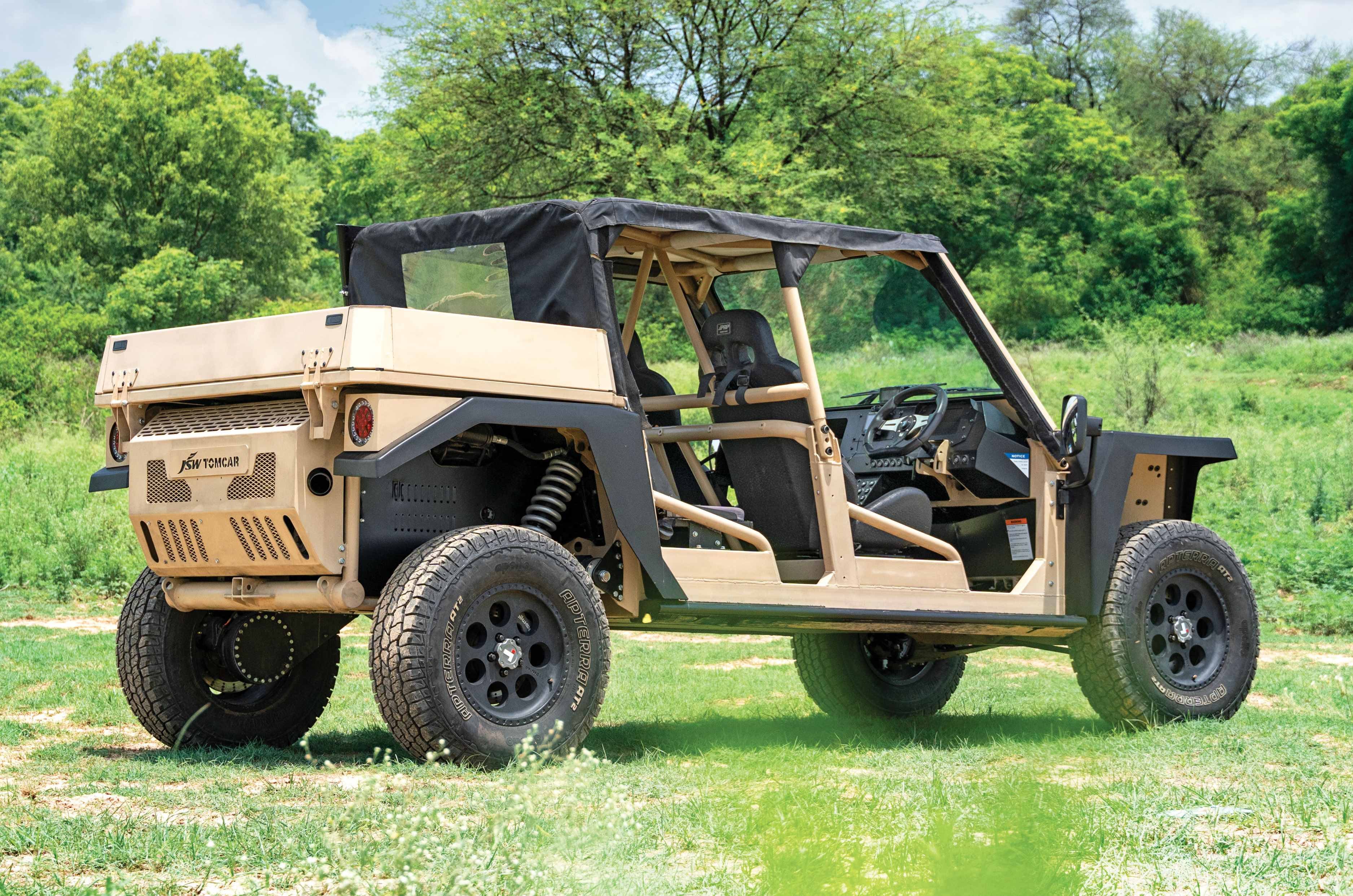
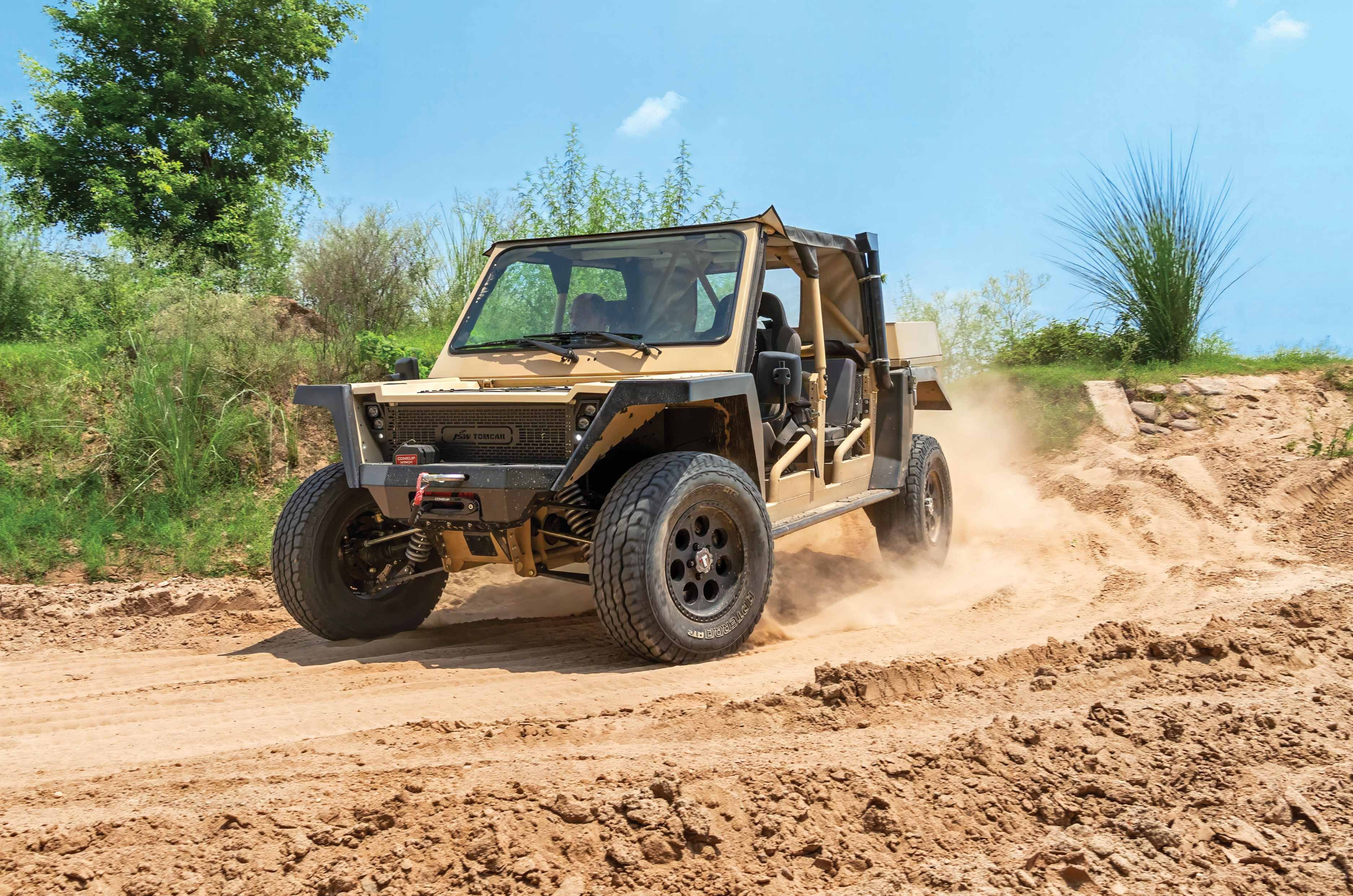
The Tomcar is purpose-engineered and built for special forces.
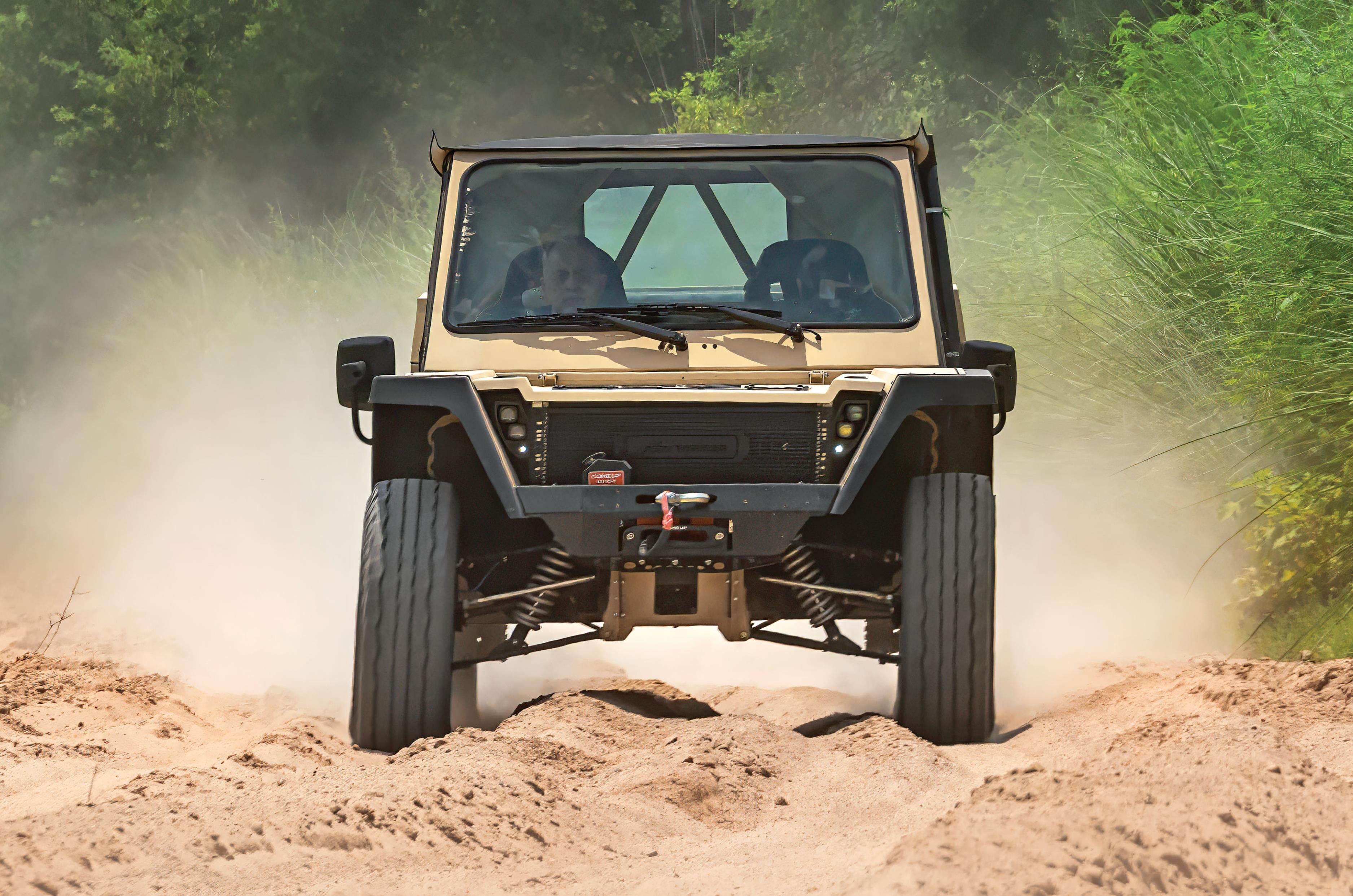
This then is the Tomcar: a military off-roader explicitly designed for commando operations. Designed to survive a parachute drop without requiring a rebuild or a massive parachute, heavy rigging and cushioning equipment, it sets an all-new benchmark. The Tomcar is built to take hard knocks, and that’s because the structure is fundamentally different.
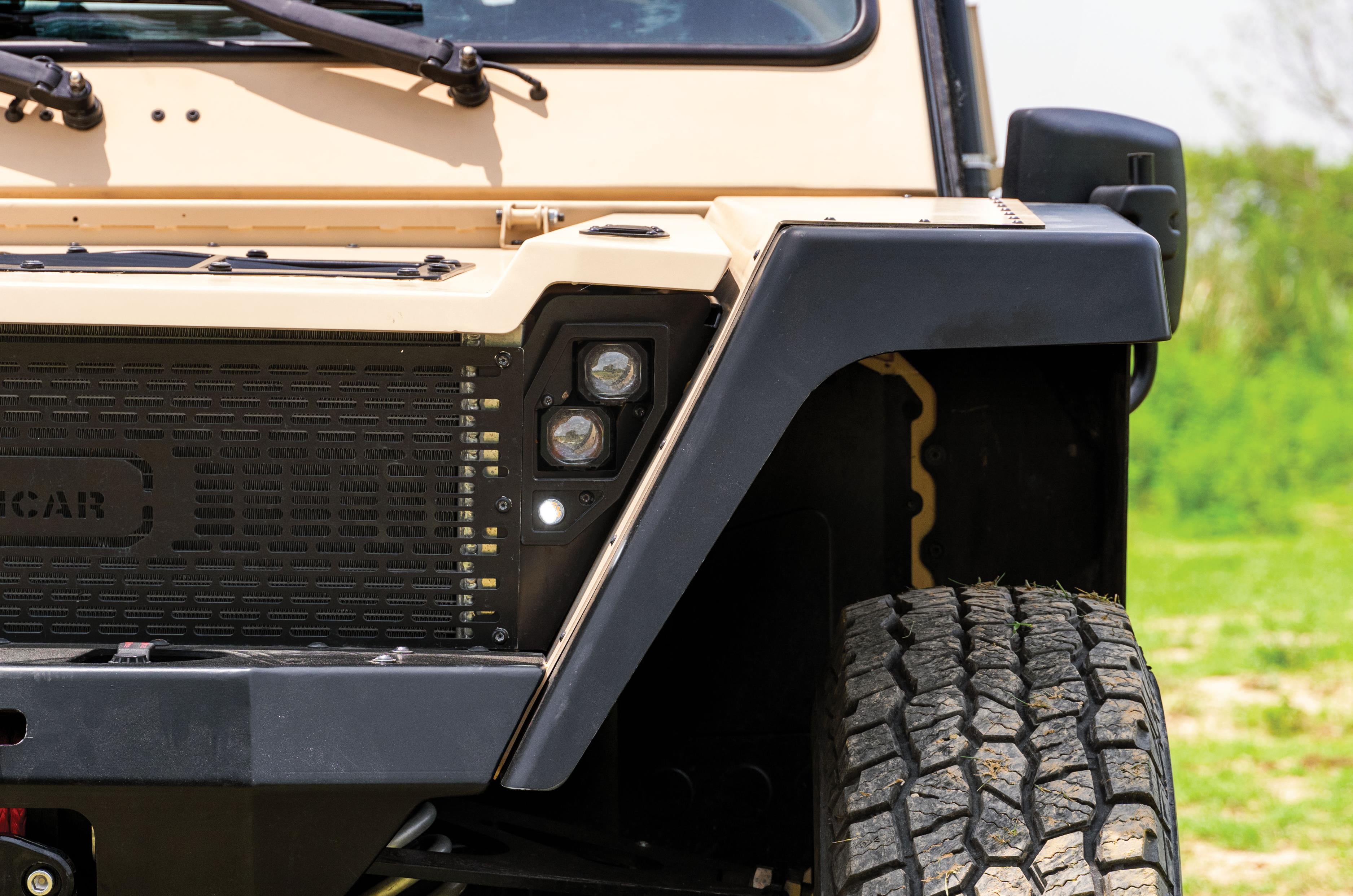
Compact nose and tiny LED headlights are unique.
This is evident even when you take a quick glance at the Tomcar TX. It looks like nothing you’ve seen before. Stubby nose, tiny headlights, no doors and a heavy-set rear. What’s for certain is that every small bit is purpose-built and functional, and the only decorative bit seems to be the badge at the rear.
No form, all function
Let’s start with what you can’t see: the monocoque frame. Unlike other off-roaders that use bolted frames, the Tomcar has a one-piece, fully welded frame and integrated roll cage. Designed specifically and tested to absorb and dissipate the extreme G-forces of an air drop (without bending or shearing), it forms the centrepiece of the design. Perfectly in sync with the concept of a very durable, over-engineered vehicle that can be air-dropped or dragged out of aerial transport at low speed. What’s even more impressive is that it can easily be repaired in the field with basic hand tools.
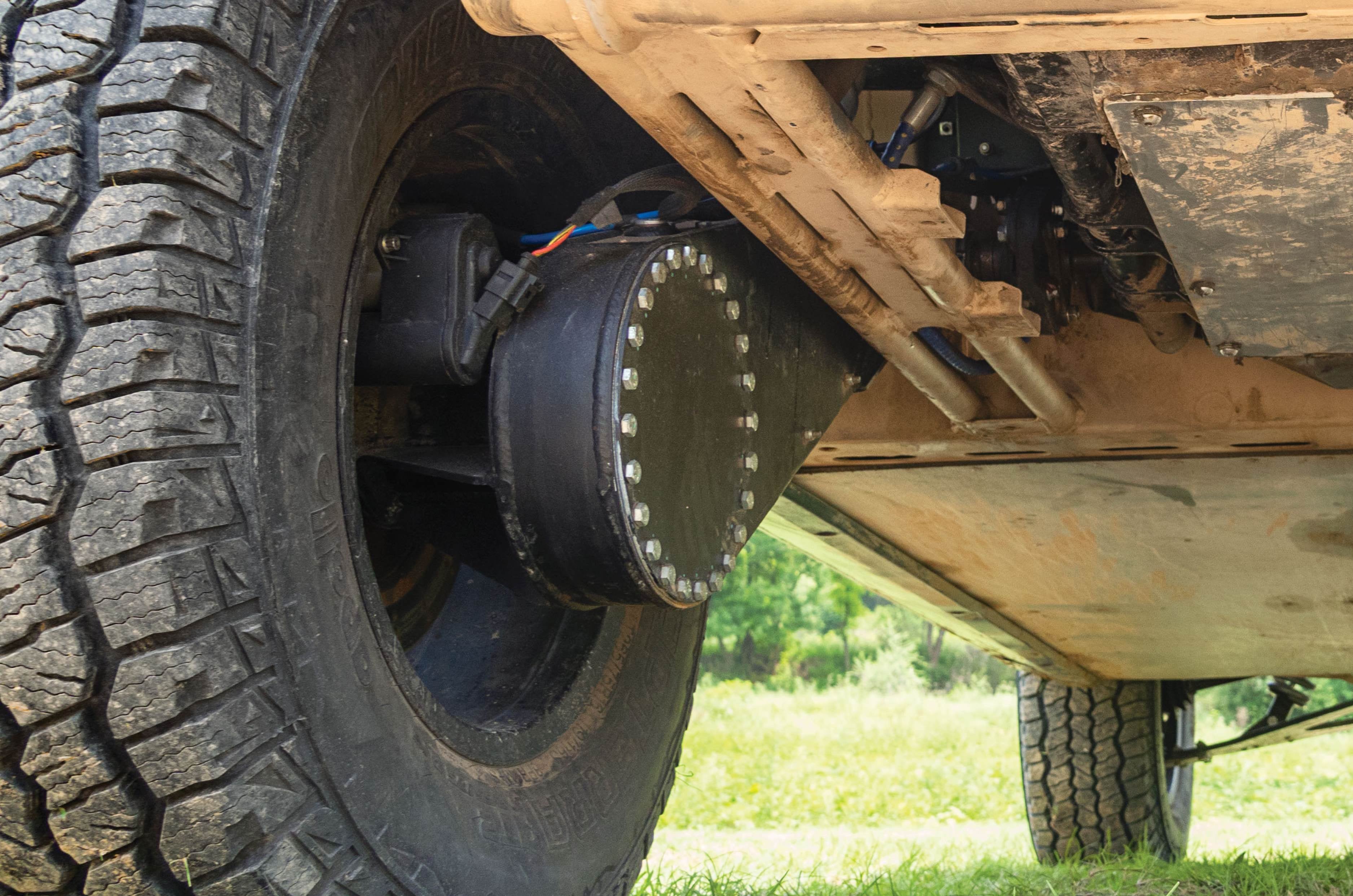
Independent rear suspension and chain drive in one single compact unit.
Next up, the all-independent suspension, which has massive travel and long suspension arms. The heavy-duty suspension offers up to 14 inches of travel and 17 inches (430mm) of ground clearance. This setup uses massive coil springs, not dissimilar to Baja racers, and motorsport-like damper systems with remote reservoirs. This enables it both to take hard knocks and remain stable at speed. This is so that the Tomcar can cruise effortlessly across undulating terrain at speed and provide a stable platform.
Special powers
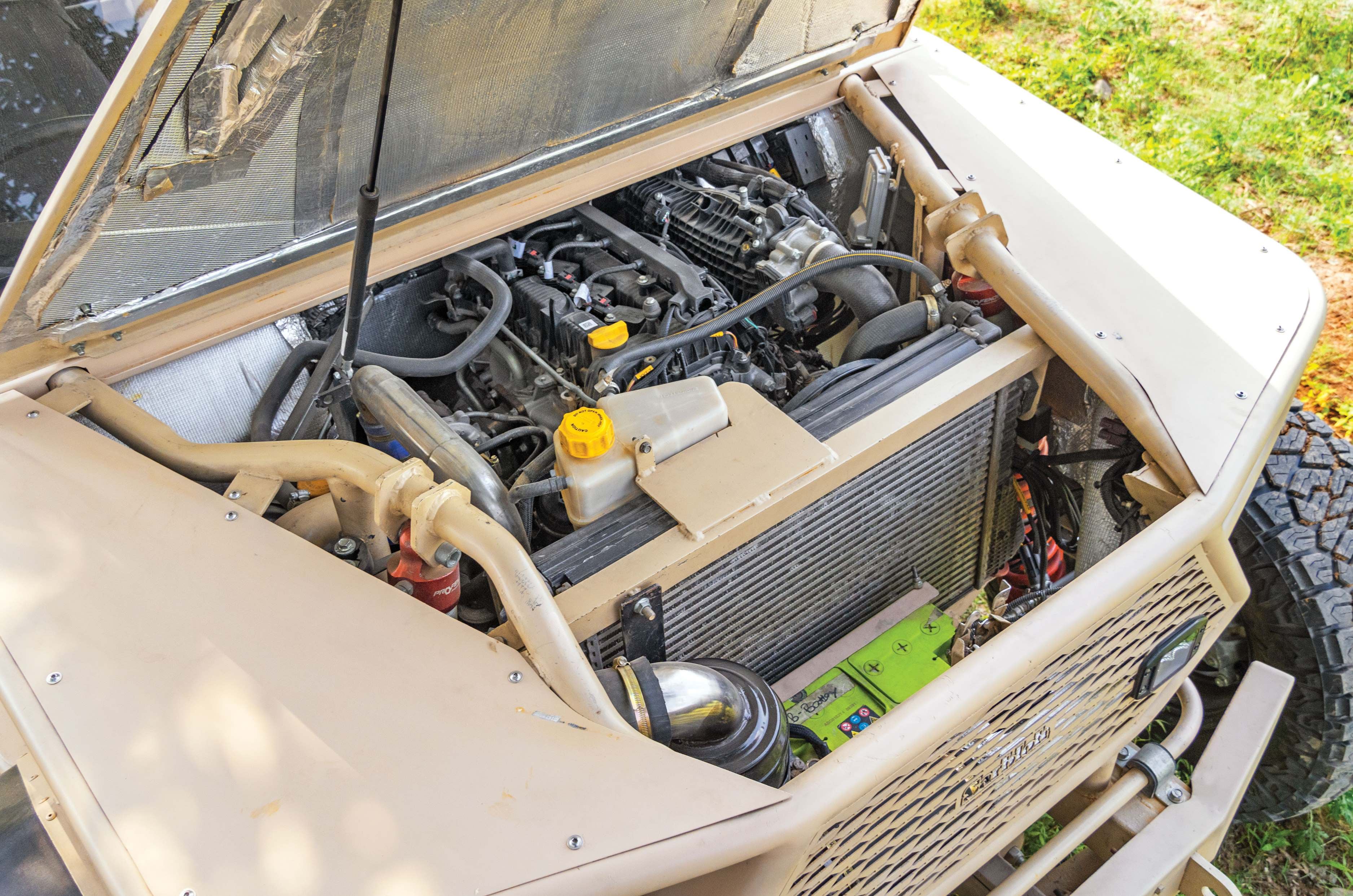
175hp engine sits low in the back, aids traction and lends stability.
I walk around the rear and take a good look as the next piece of the puzzle falls in place. There are vents at the rear, and that means that’s where the engine sits. Done to maximise traction, like VW-based Baja buggies, the Tomcar has its 1.5-litre four-cylinder engine mounted low in the rear. The Chevy engine makes 175hp and 275Nm torque.
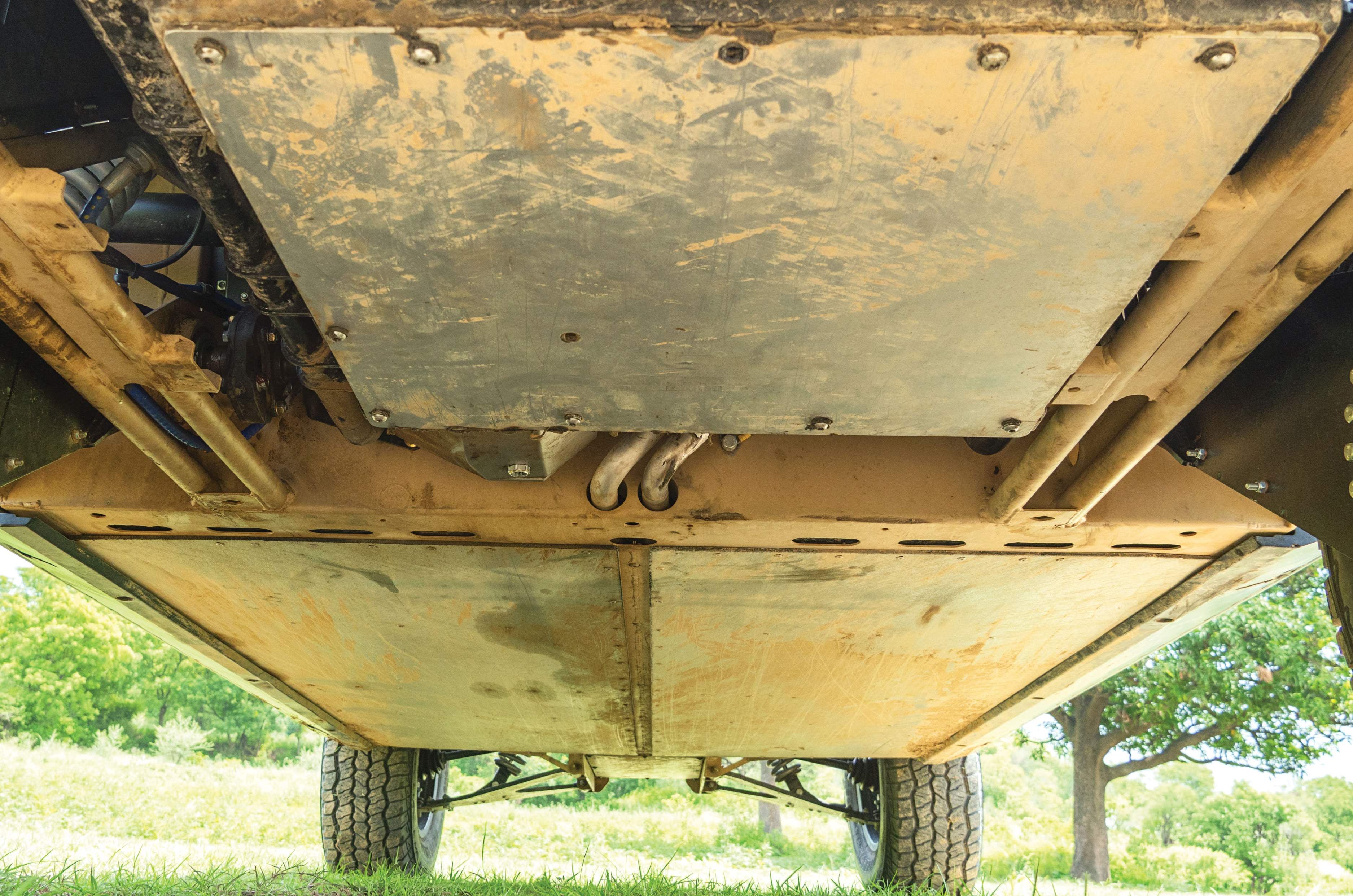
Flat floor prevents it from snagging on rough terrain.
The TX uses a CVT gearbox for easy use and good torque manipulation. This is placed at the rear with the engine and sends power forward to two transfer cases that are sandwiched together. The first transfer case allows you to shift from rear-wheel drive to four-wheel drive instantly with a mere push of a lever. Bang! The second gives you low range, and along with that, regular gearbox directional functionality – Drive, Neutral and Reverse. There is no Park, only an E-parking brake. These differentials have another unique tech – they are both air-locking and are engineered so that the Tomcar has a completely flat belly – nothing hangs down so it can slide over terrain without the belly fouling. Even more interesting is how power gets transferred to the rear wheels; it’s done through a pair of double chain-drive systems, encased in the hardened steel swing arms!
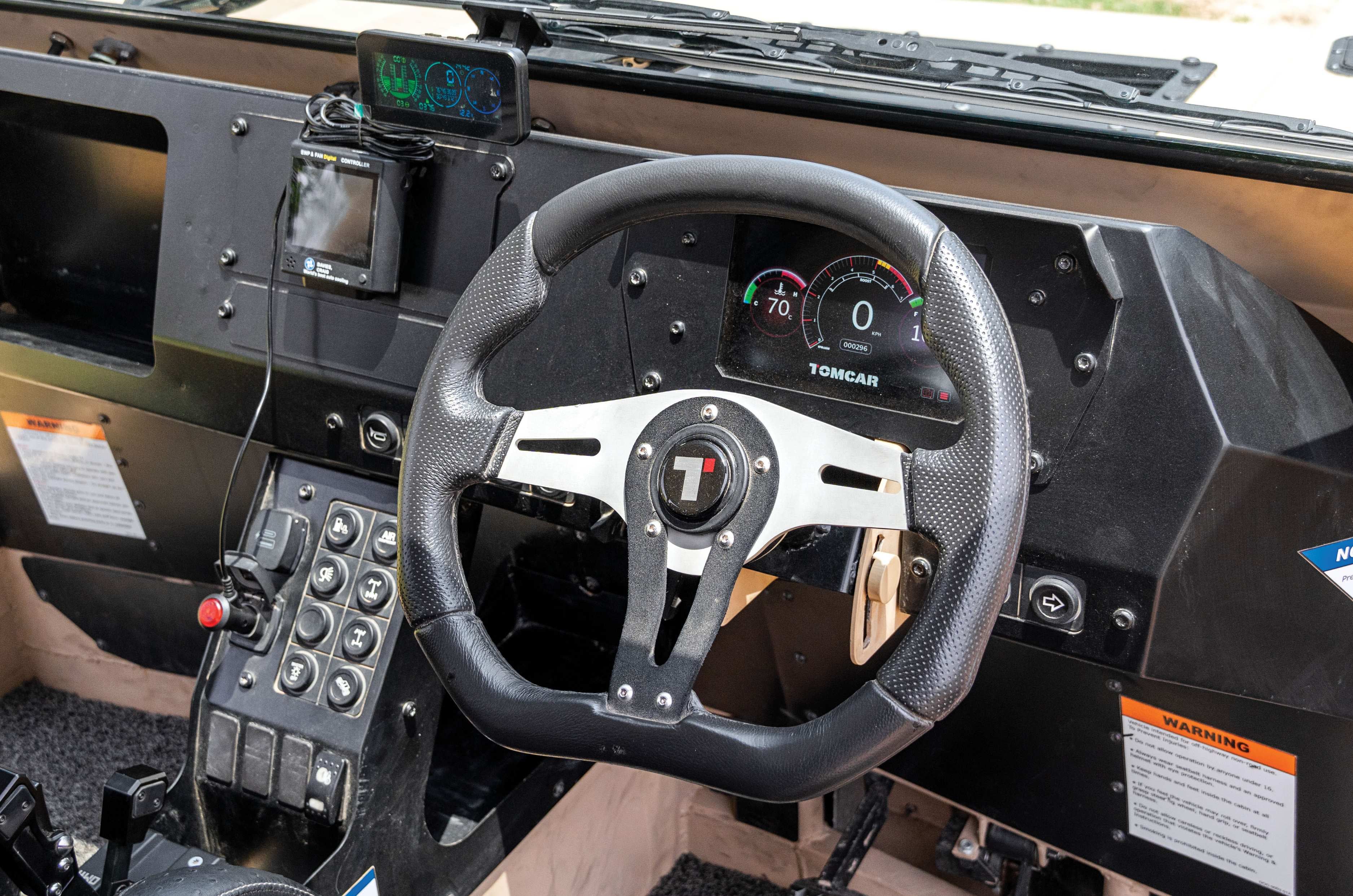
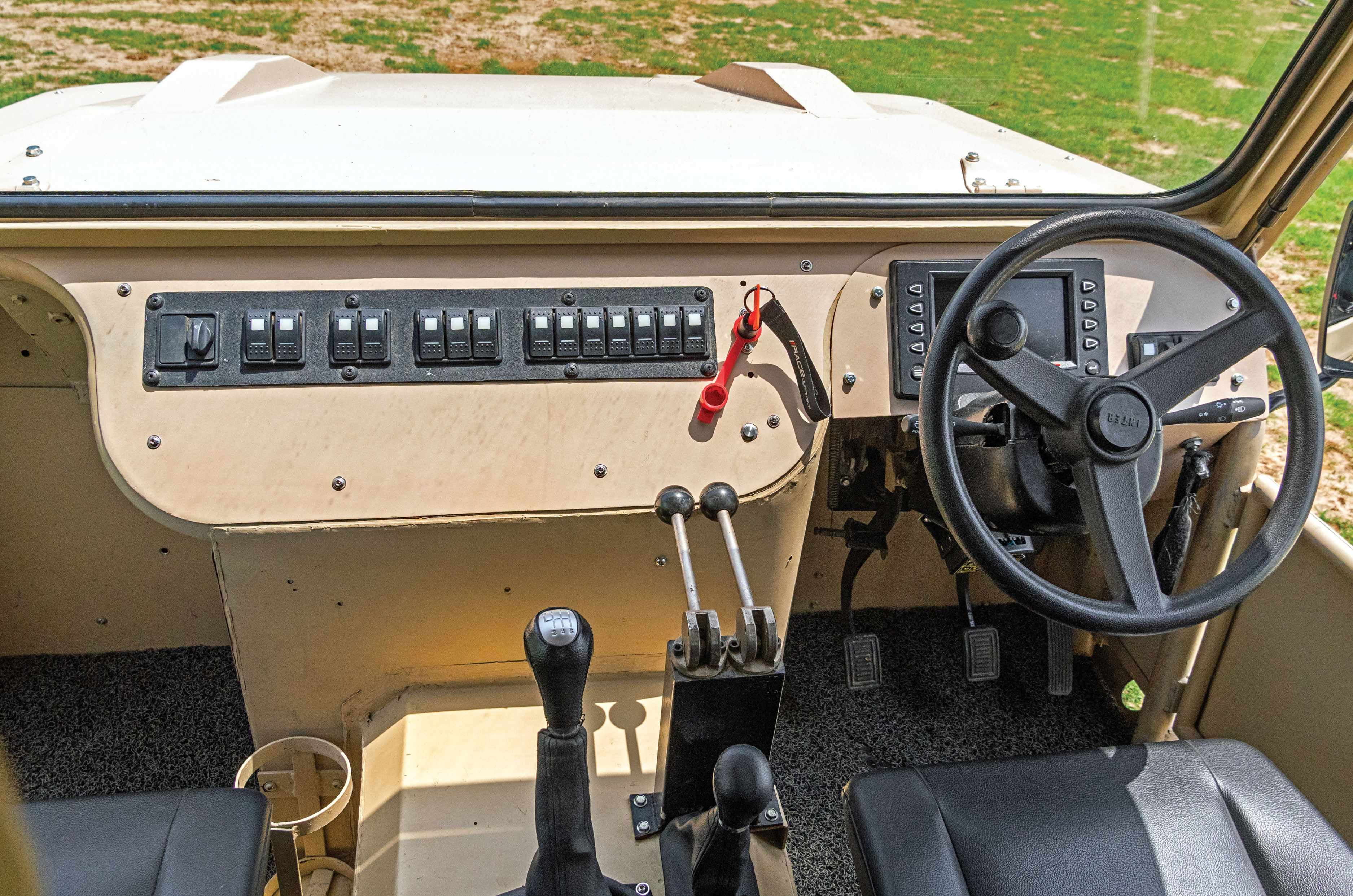
Basic dash and instruments get the job done.
In addition, the Tomcar has been made for easy serviceability in the field. Components often have a backup, and the vehicle can even function with a high degree of redundancy. There are, for example, two end-to-end fuel systems and twin radiators, and then bits like the suspension have load paths designed specifically to break at specific points where parts are easy to replace. What’s also impressive is that this 1.3-tonne vehicle can carry or pull more than a tonne.
Floats like a butterfly
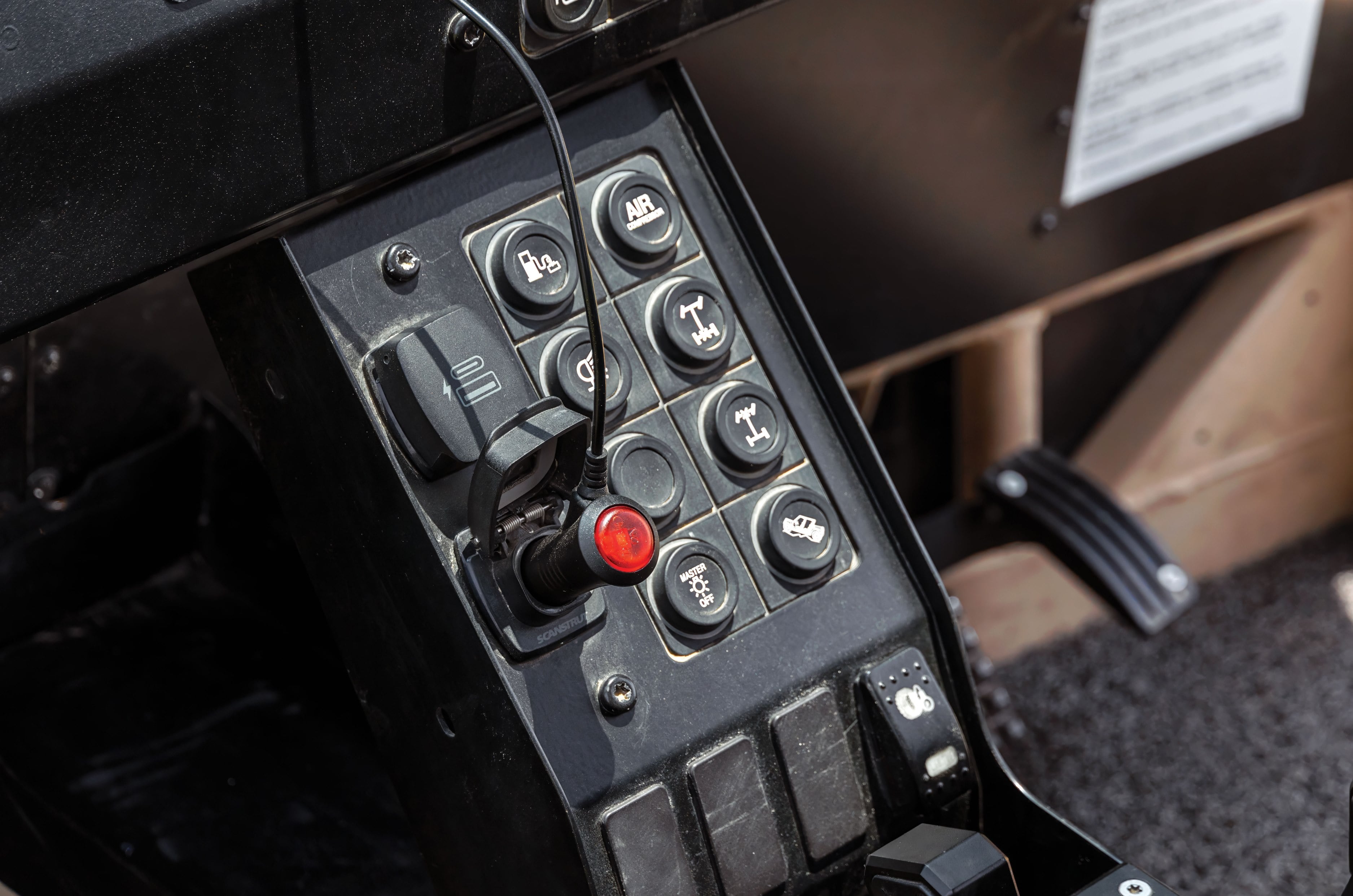
Big buttons are hardy, can deal with dirt and are easy to hit with gloves on.
With this kind of unique specification, it’s little wonder that this vehicle feels unique to drive. For a start, with no doors, you just slide in behind the wheel. Start up is pretty straightforward, and you can sort of tell this vehicle will be comfortable to operate even with heavy gloves.
Initially, the sound of the quad drive chains at the rear dominates. A gnashing, chainsaw-like ripping sound, it combines with the whine of the CVT to give the Tomcar a unique sound signature. And from slow speeds, especially in sand, the CVT does require a buildup of revs before it pulls forward happily.
Once you build a bit of momentum, however, progress over the sand feels effortless. You can just float over big ruts and carry on without too much deflection of the wheel. A lot of this is because it has the weight of the engine pushing down over the rear-driven wheels, and the stiff chassis and soft, long-travel suspension deal beautifully with the soft undulating surface. While most 4x4s feel heavy when driving through sandy river beds like the one we are on, and tend to bog down and struggle when you slow to a crawl, the Tomcar feels right at home. It’s even relatively easy to steer and place it alongside another vehicle on the narrower sections of this riverbed. Sure, the turning radius isn’t great, and it pays to be ham-fisted with the steering, but what surprises me is just how much speed I can carry without it getting uncomfortable.
It feels completely at home even on seriously difficult off-road trails.
What’s also very impressive is its ability to do some serious off-roading. Running along the steep sides of the ravine, you can feel the low centre of gravity, which feels like it sits somewhere below the level of the driver’s seat. And then we climb an extremely steep hill, the Tomcar ‘walking’ up the step-like undulations of the trail with superb rear traction. Only the engine and CVT system seem to strain with the load of the uphill climb.
Also super impressive is the ride. The stiff chassis, long-travel suspension and motorsport damper system mean you can carry speed over sections you normally only have to crawl over. You look at a broken trail and drive over, fully expecting to be tossed around, but the Tomcar stays flat, so you add more speed. And this goes on for a bit until eventually stopping distances rein you in. Want to carry speed over rough terrain? This thing operates in another dimension.
Making India’s extreme off-roaders
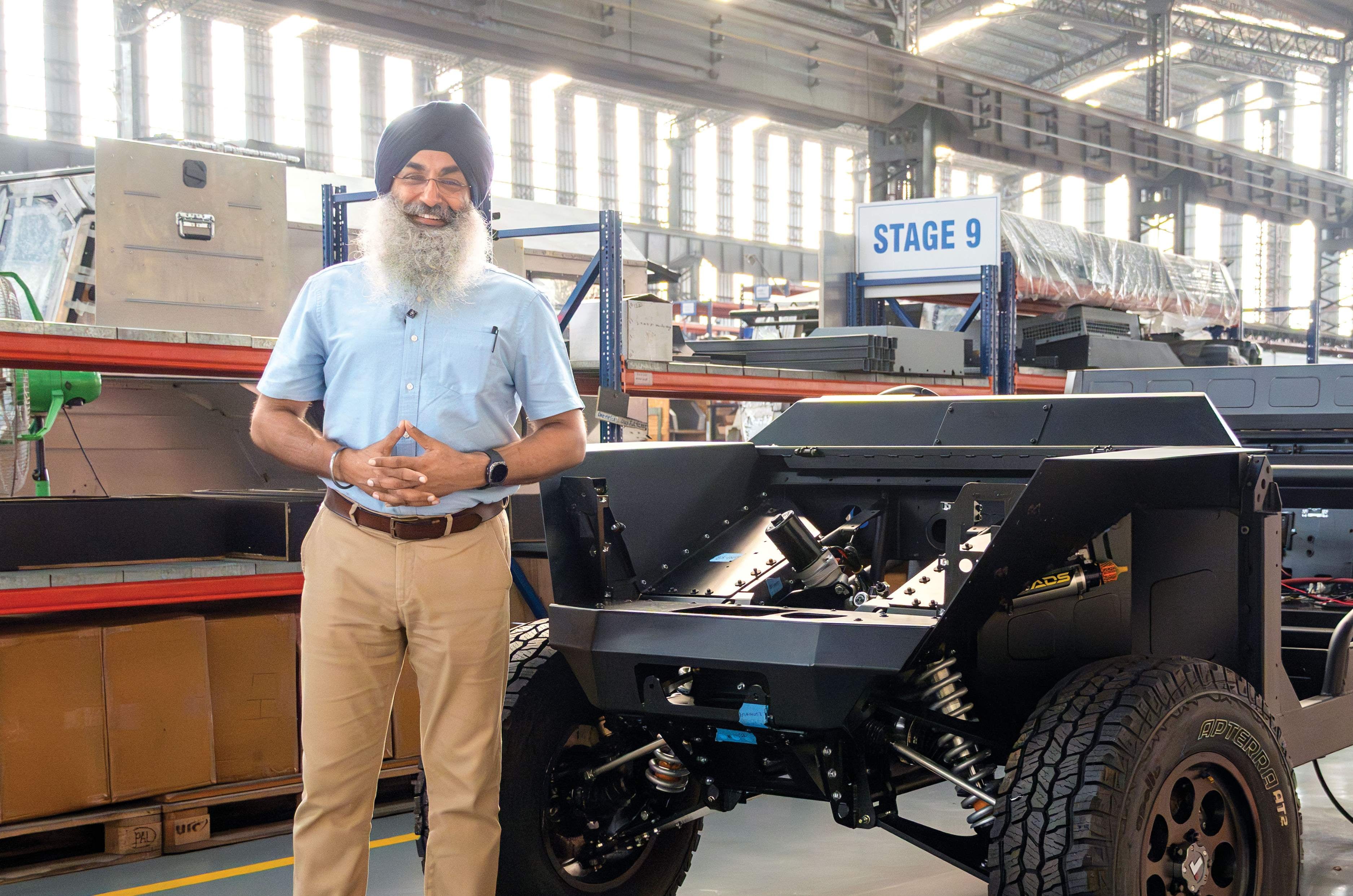
CEO and founder director of JSW Sarbloh Motors started his journey in extreme off-roading.
One of Jaskirat Singh Nagra’s first off-road excursions landed him, and his family car, in a ditch. Things, however, have looked up since then. Not only has his company Sarbloh Motors made several winning contenders for events like the Rain Forest Challenge and Orange Festival in Arunachal, it, along with JSW Defence, also makes the Sherp and Tomcar in India. Up next, the company’s own EX4. And with 140 Sherps already produced and a line already setup for tactical ATVs, you can expect many more extreme off-roaders to be built by this company.
The EX4: Engineered, designed and made in India
EX4’s wheel articulation with independent suspension.
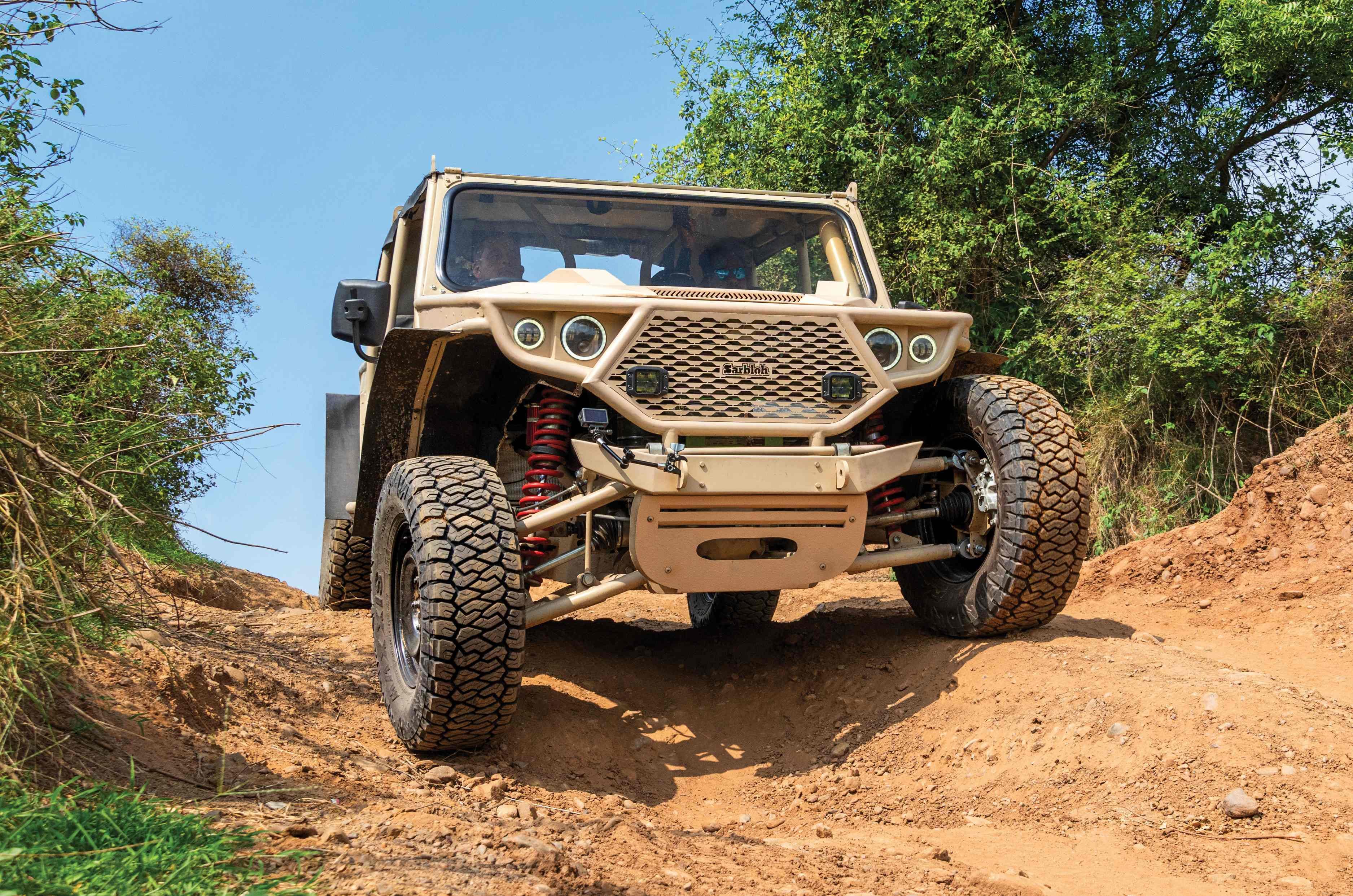
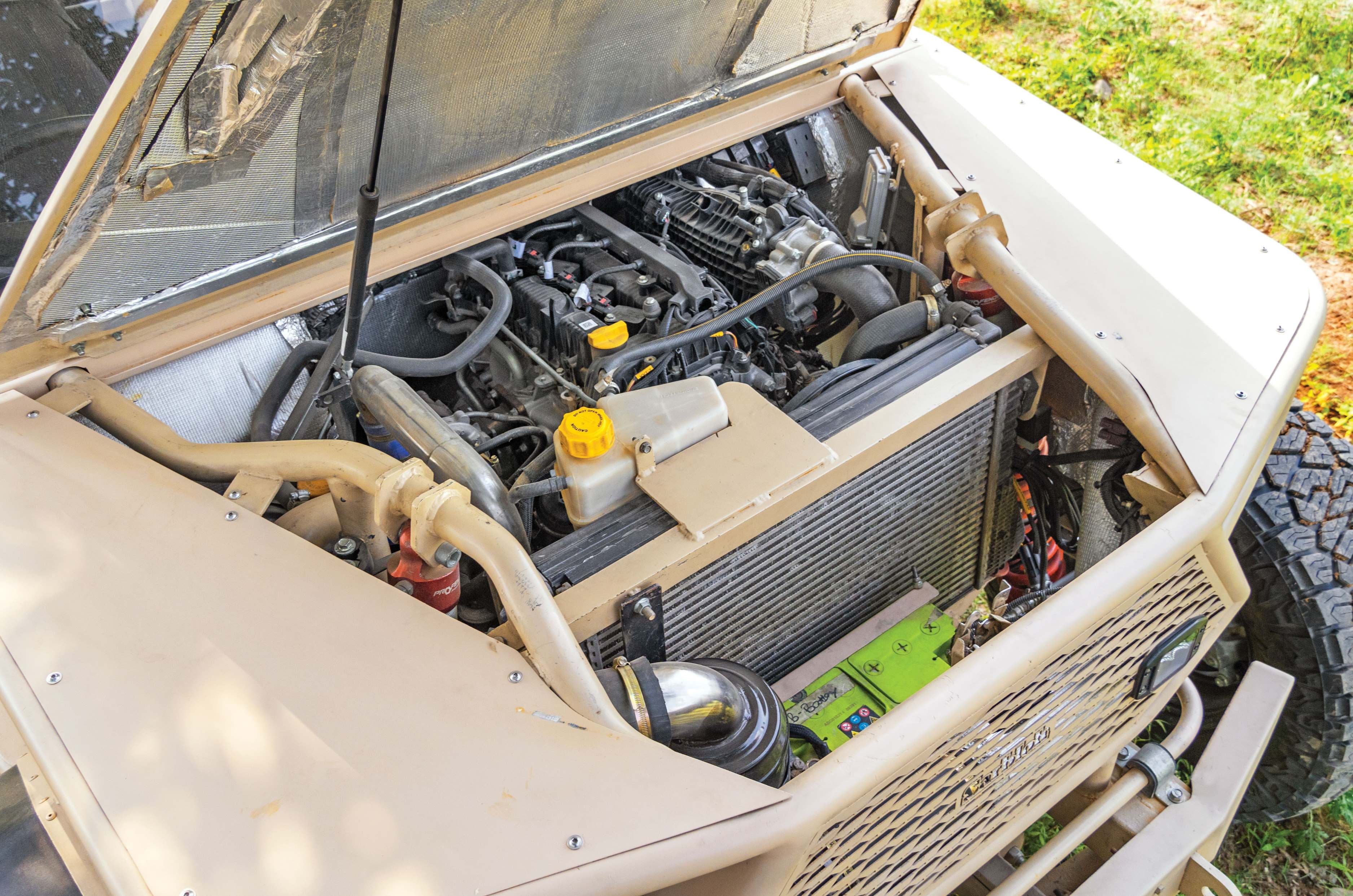
While the Tomcar is a tactical ATV meant to function as the tip of the sword, the EX4 is a home-grown scout vehicle built to take on difficult terrain and tough off-road conditions. Based on an extreme off-roader, this is a more conventional vehicle that has its engine up front and extremely short front and rear overhangs. Power comes via the same 175hp 1.5-litre turbo-petrol, and then this one even gets the option of a 2.0 diesel that makes 167hp. The latter is sourced from Fiat/Jeep or Stellantis. The chassis is a tubular space frame, and from the dimensions, you can sort of tell that this thing evolved from a Rain Forest Challenge buggy.
It can be had with a 175hp petrol or 167hp diesel.
A large A-arm suspension up front and an elongated rear trailing arm help it clamber over most obstacles, and like the Tomcar, it uses canister-fed, motorsport-based dampers that can be adjusted over a wide range. Now, despite the engine being in front, the nose is pretty compact, and interestingly, the anti-roll bar can be seen running around the front of the grille! Of course, the tyres form the extremities of the car; it gets rubber or plastic fenders around the side, and check this out, you can raise the windscreen so you can stick a weapon out and defend yourself if you are in the front seat.
The snorkel is placed with the frame.
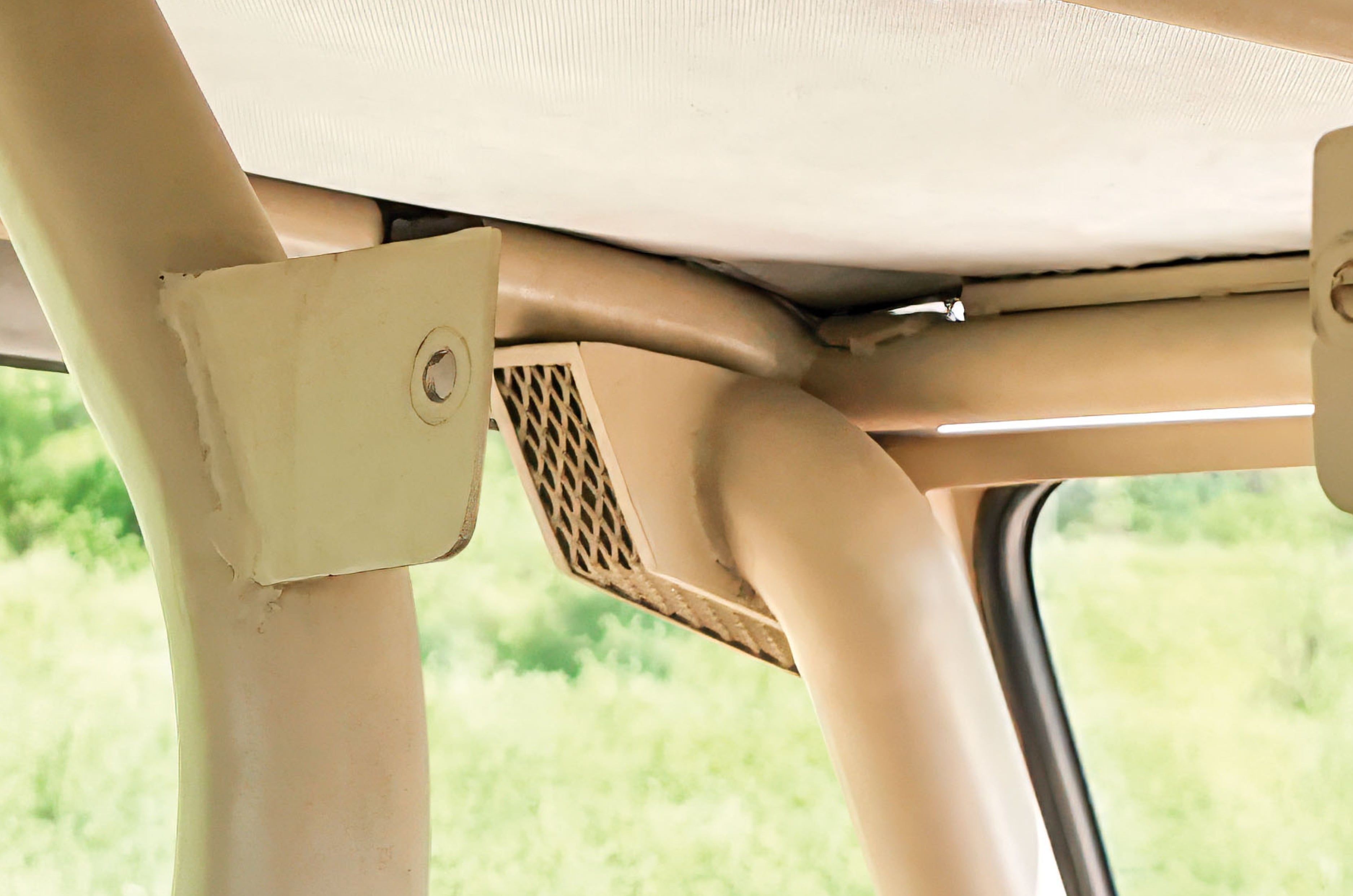
Unlike the Tomcar, this one also has mini doors, look behind the A-pillar on the left and you see the snorkel (neatly hidden away), and walk around to the rear and you get a sense of just how compact this car is. It’s so tight, even the spare sticks out the back. Also interesting are the large brackets on the roof, in case you want to air-lift this vehicle or hoist it onto a ship.
This prototype has many basic features that are likely to be upgraded in future versions.
Once behind the wheel, the EX4 feels more ‘direct,’ the manual gearbox making it feel much more sprightly. And then once you find traction in the sand, it takes off and accelerates better too. If anything, this one clearly has more zip, and it feels lighter on its feet too. The ride on this early prototype, however, isn’t anywhere as stable, and the faster you go, the more it bobs and gets tossed around. What’s also clear as you up the speed is that directional stability isn’t as good. That said, it is more willing to turn and take tighter corners. What you also hear while driving the EX4 is the intake, placed not too far from your ear, and that’s especially when you work the throttle and ask for more air. Where it shines is in extreme off-road conditions. Steep climbs with low traction, drops that could give you nose bleed, these are taken in its stride, the low range and superior traction not even needing the intervention of the locking differential for the most part. The EX4 is available from Rs 40 lakh.
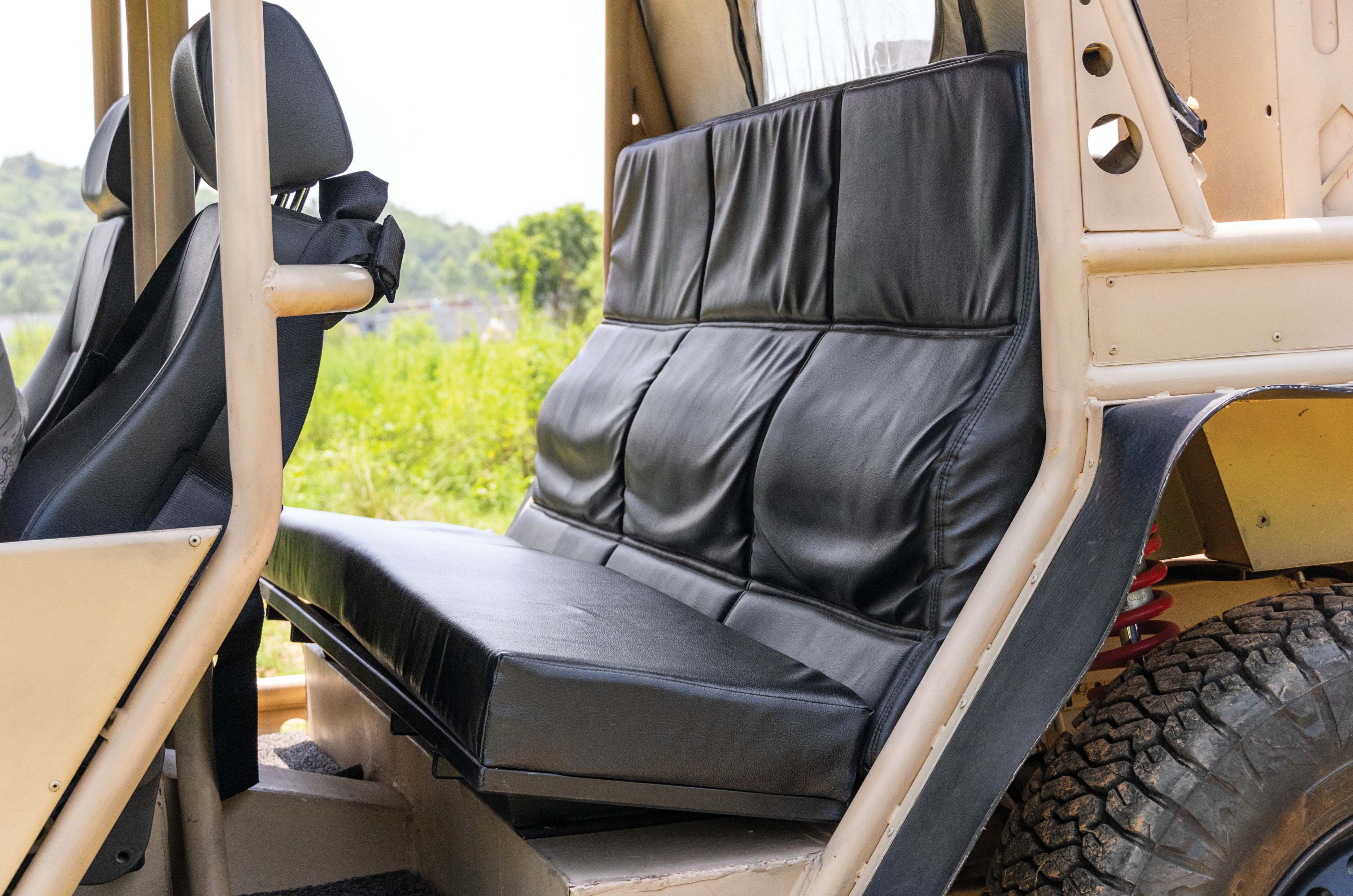
Compact rear carries essential water supply for troop.
Bespoke by design
Blessed with the functional focus of a moon buggy, the ability to drive over terrain at speed that would have a regular 4×4-based military off-roader bouncing all over the place, the Tomcar is a purpose-built weapon system engineered by the end user. Designed to push the envelope in specific areas and deliver speed and dependability over rough terrain, it possesses a unique set of characteristics that are sure to give our special forces and advanced tactical units a unique advantage. And the cherry on top is that it is made right here in India by JSW Tomcar (part of JSW Defence).
JSW Group, one of India’s largest conglomerates, is preparing to significantly expand its automotive ambitions. Having already established a presence through JSW-MG Motor India, its joint venture with China’s SAIC, the company is now gearing up to enter the market with an all-new brand of its own, JSW Motor.
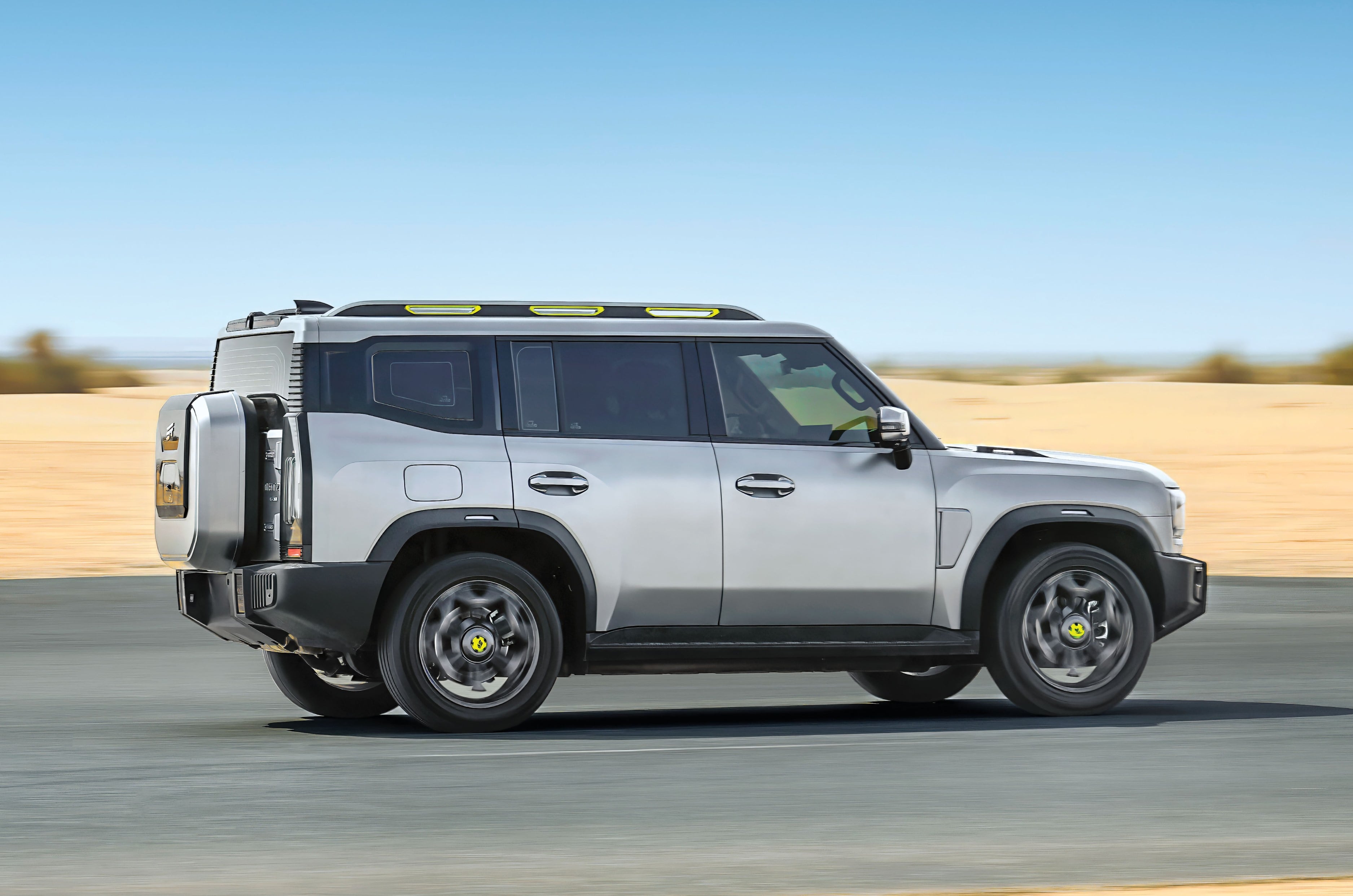
Rather than taking the conventional route of developing products from the ground up, JSW is leveraging global partnerships to fast-track its entry into the industry. Its first product for India will be a large plug-in hybrid SUV based on the Chery Jetour T2, which is expected to be assembled at JSW’s upcoming facility in Chhatrapati Sambhajinagar, and we hear it will be called the Combat.
With its rugged styling, imposing road presence and the promise of combining EV-like efficiency and long-distance touring ability, the SUV is expected to be positioned in the Rs 30-50 lakh segment and take on established players head-on.
Ahead of its India launch later this year, we got an early drive of the SUV to find out whether JSW Motor’s debut offering is ready for combat.
Jetour T2 Exterior Design and Engineering – 8/10
A handsome SUV that oozes character and rugged appeal.
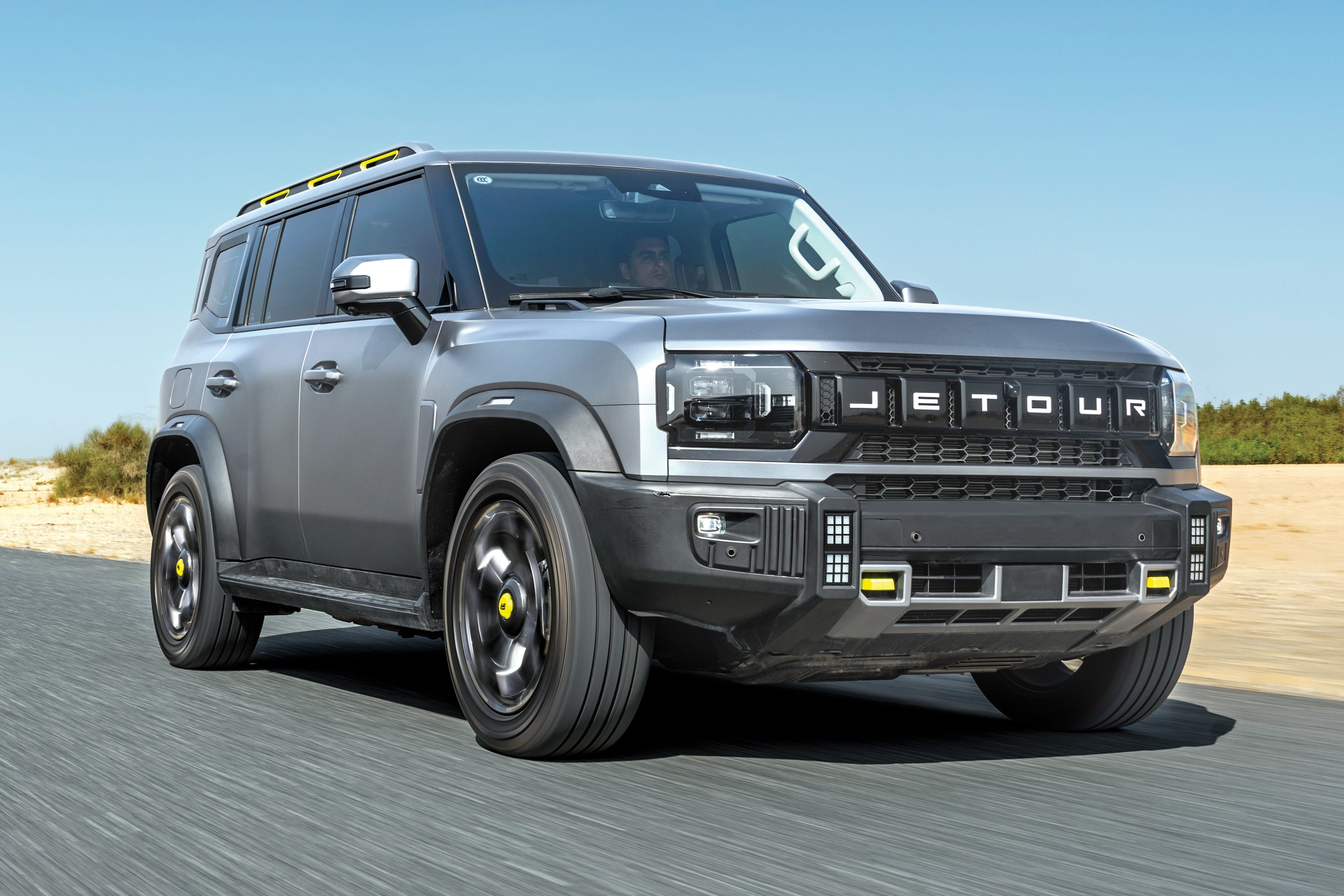
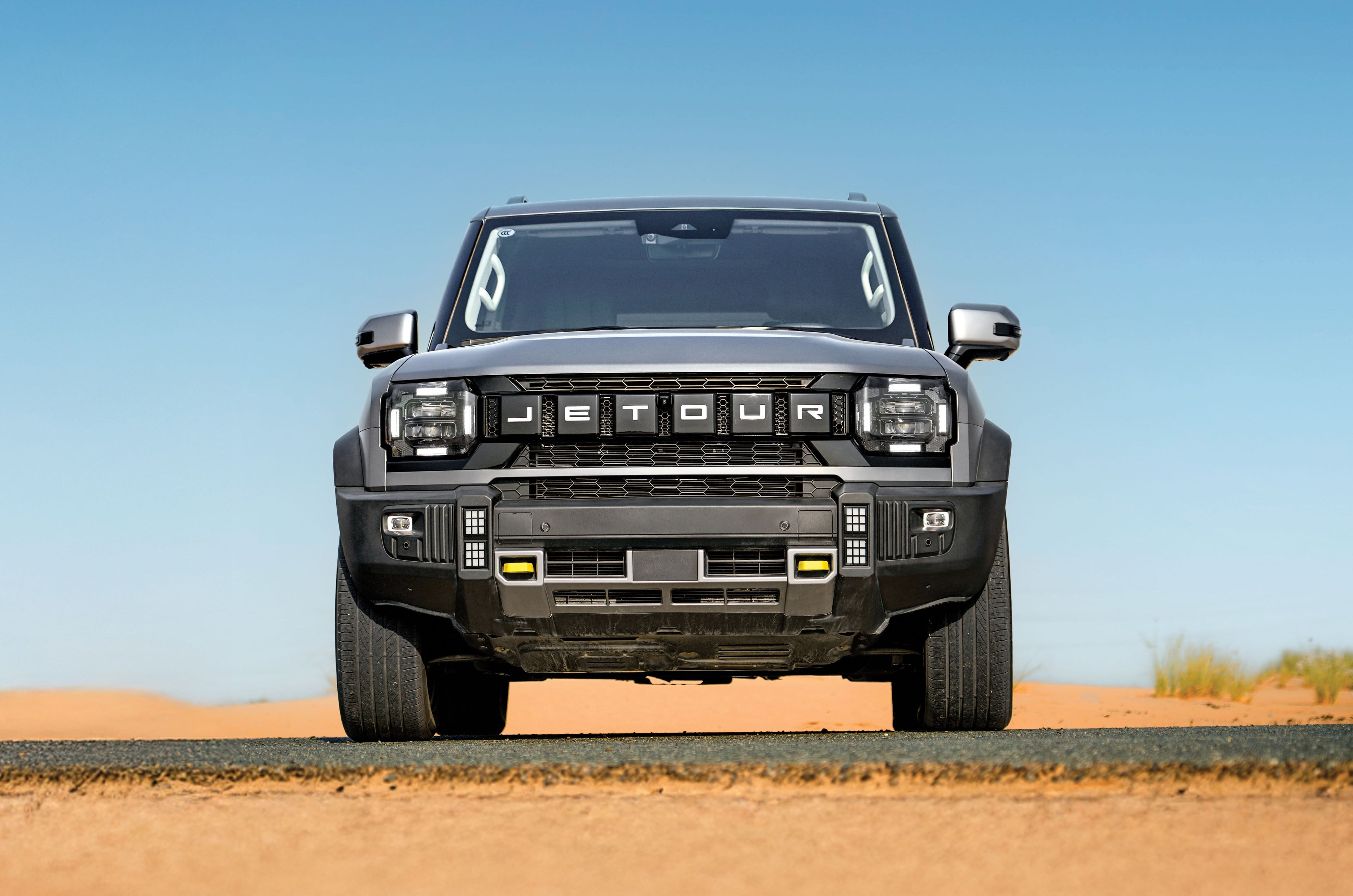
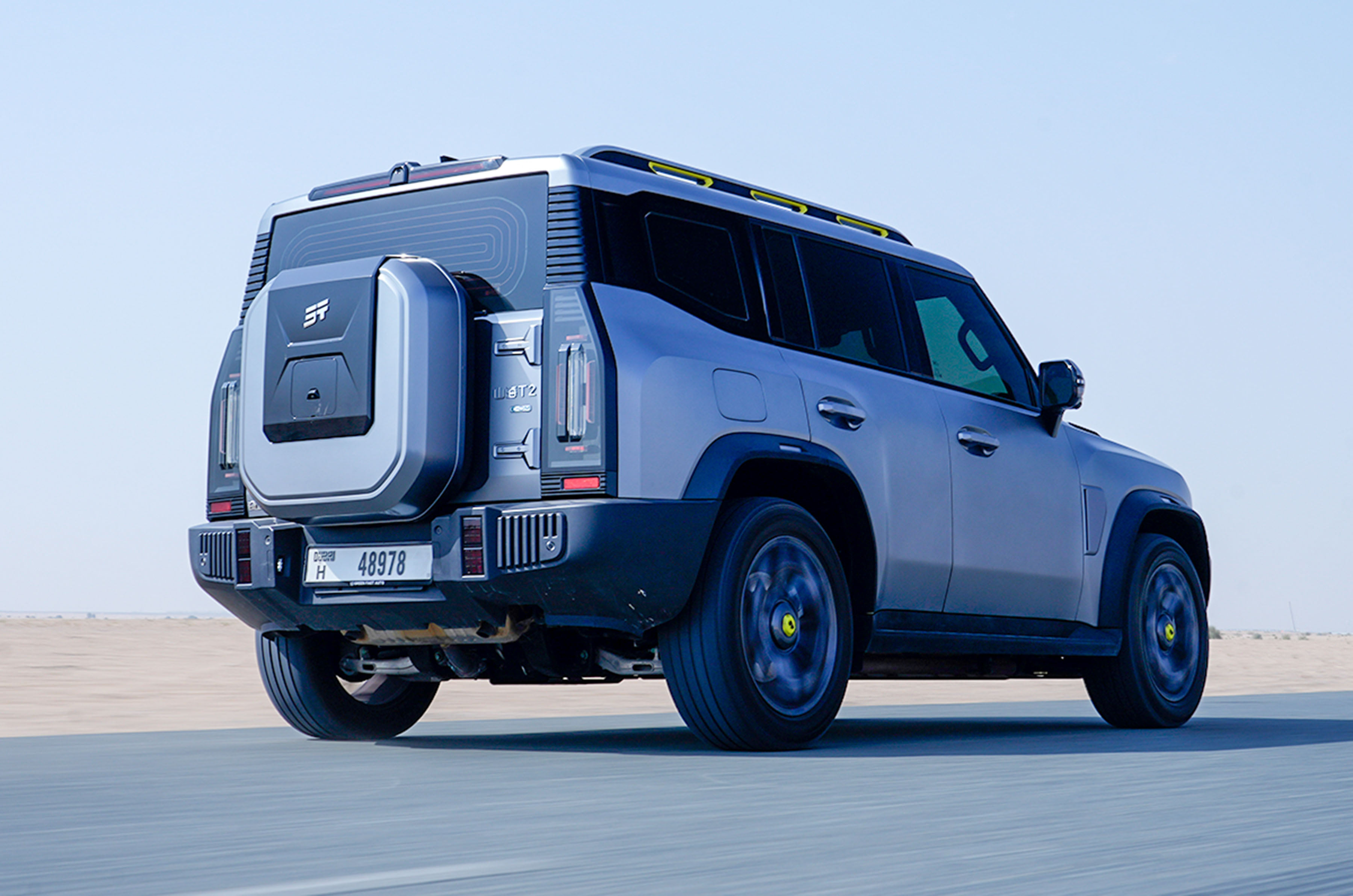
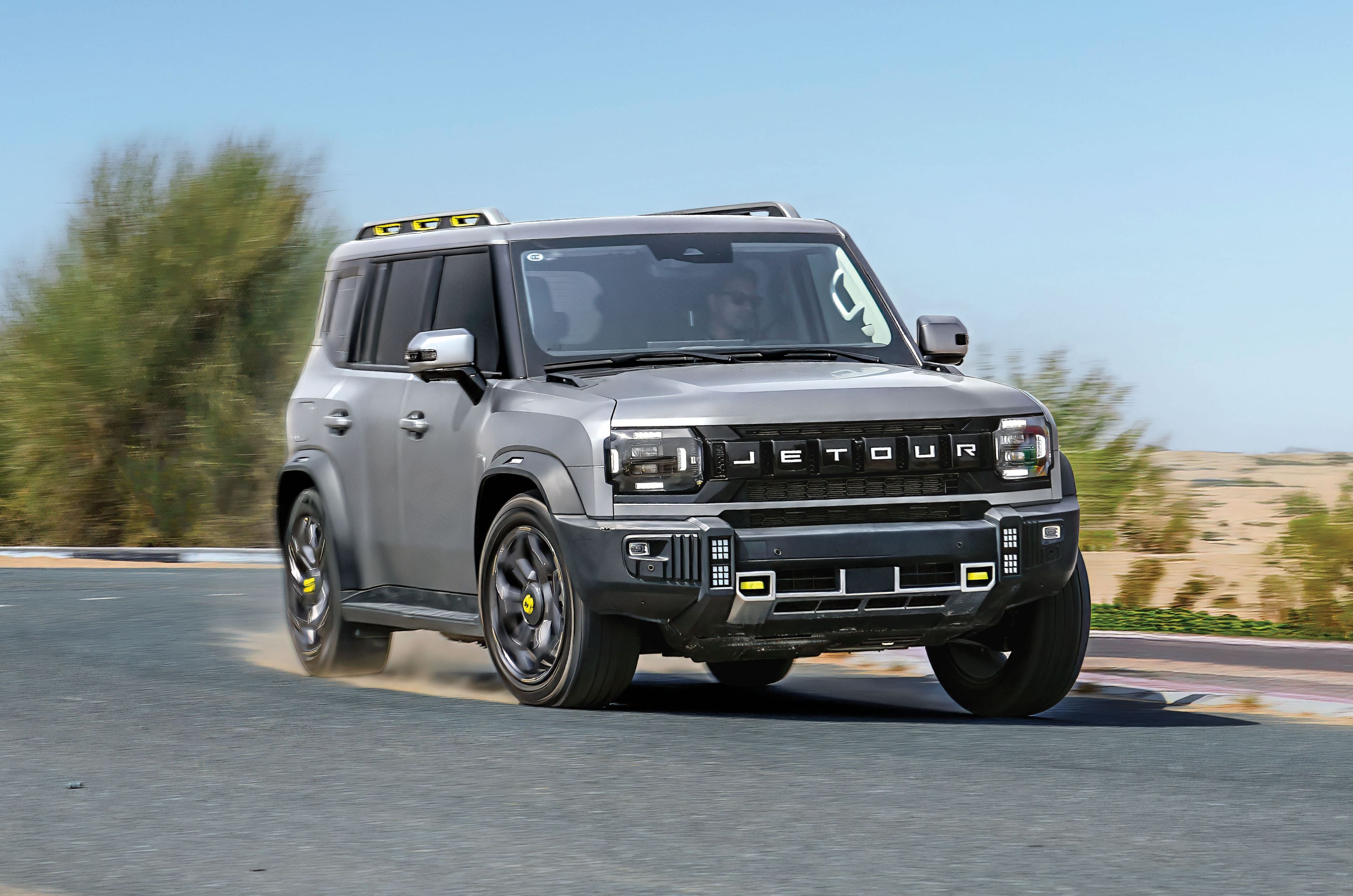
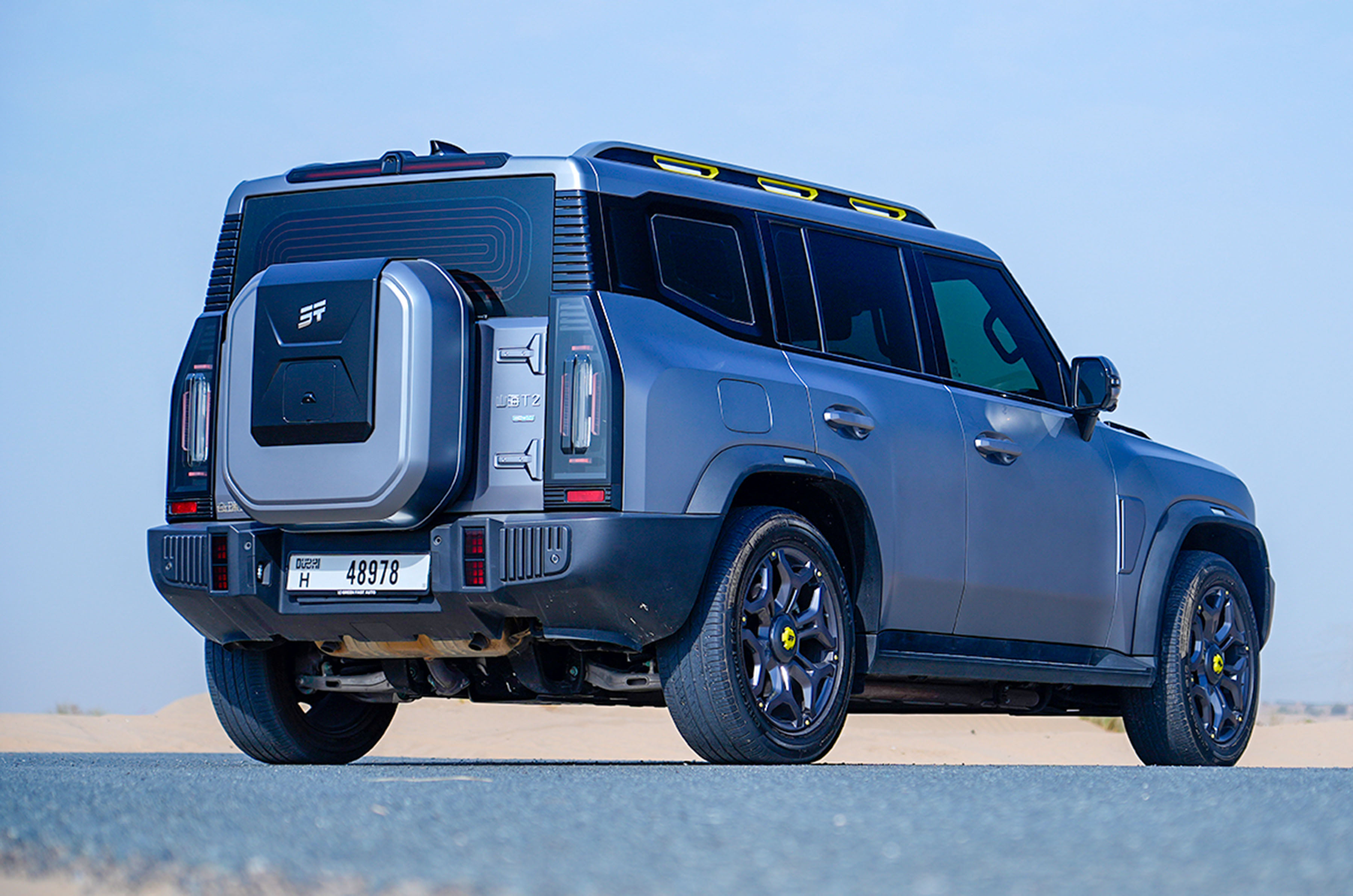
The Jetour T2 delivers on the SUV template to the T – flat bonnet, upright stance, raised ride height, chunky tyres, rugged body cladding, and, as the icing on the cake, a spare wheel mounted on the tailgate. It looks imposing and highly desirable, and while its silhouette bears a resemblance to the Defender, the T2 still manages to carve out a distinctive identity. JSW is likely to make a few changes to the headlamps, grille and bumpers to further differentiate the Combat, but the overall shape, clean surfacing and most of its defining design elements are expected to remain unchanged.
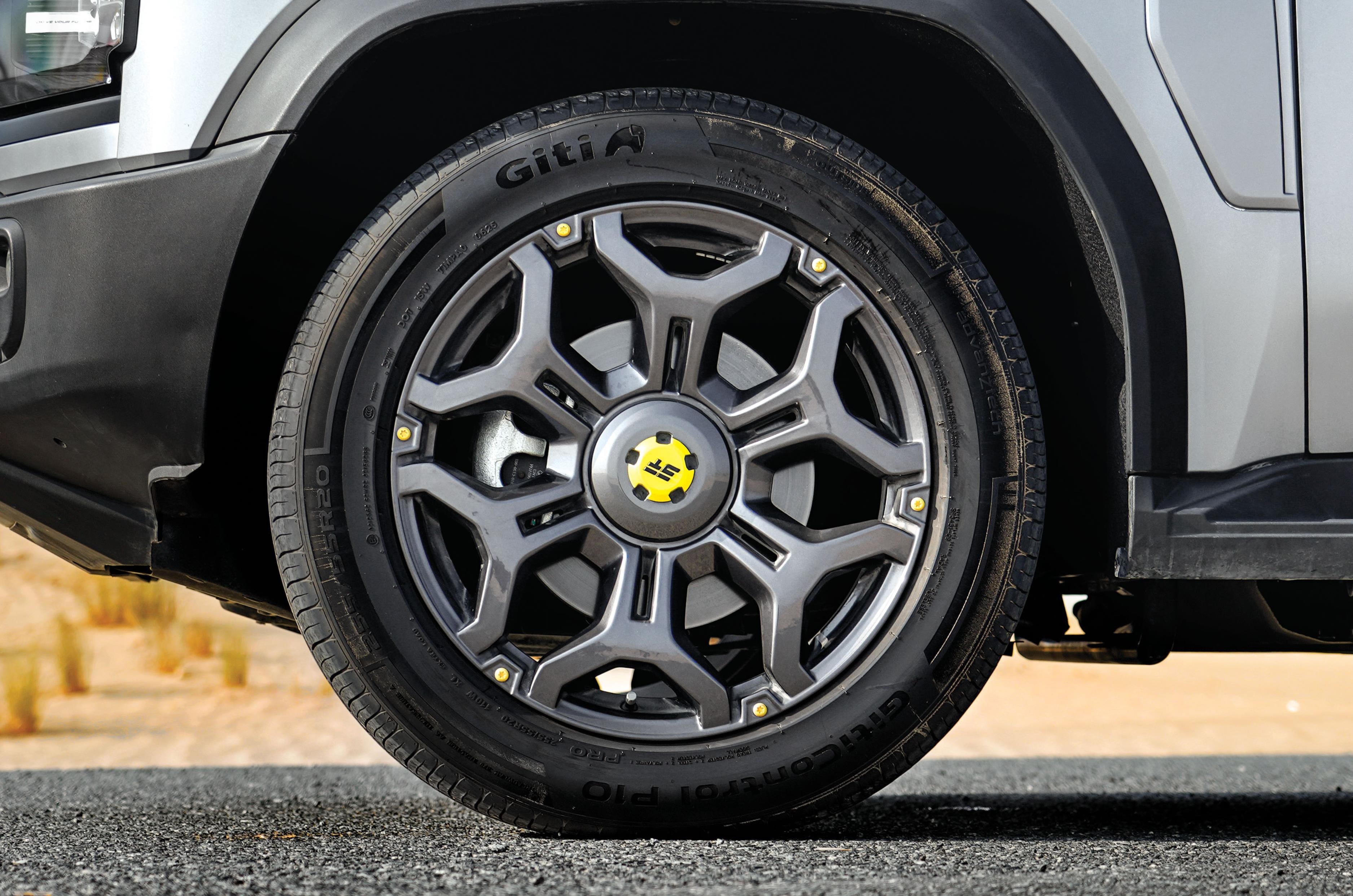
Attractive 20-inch wheels; 201mm of laden clearance.
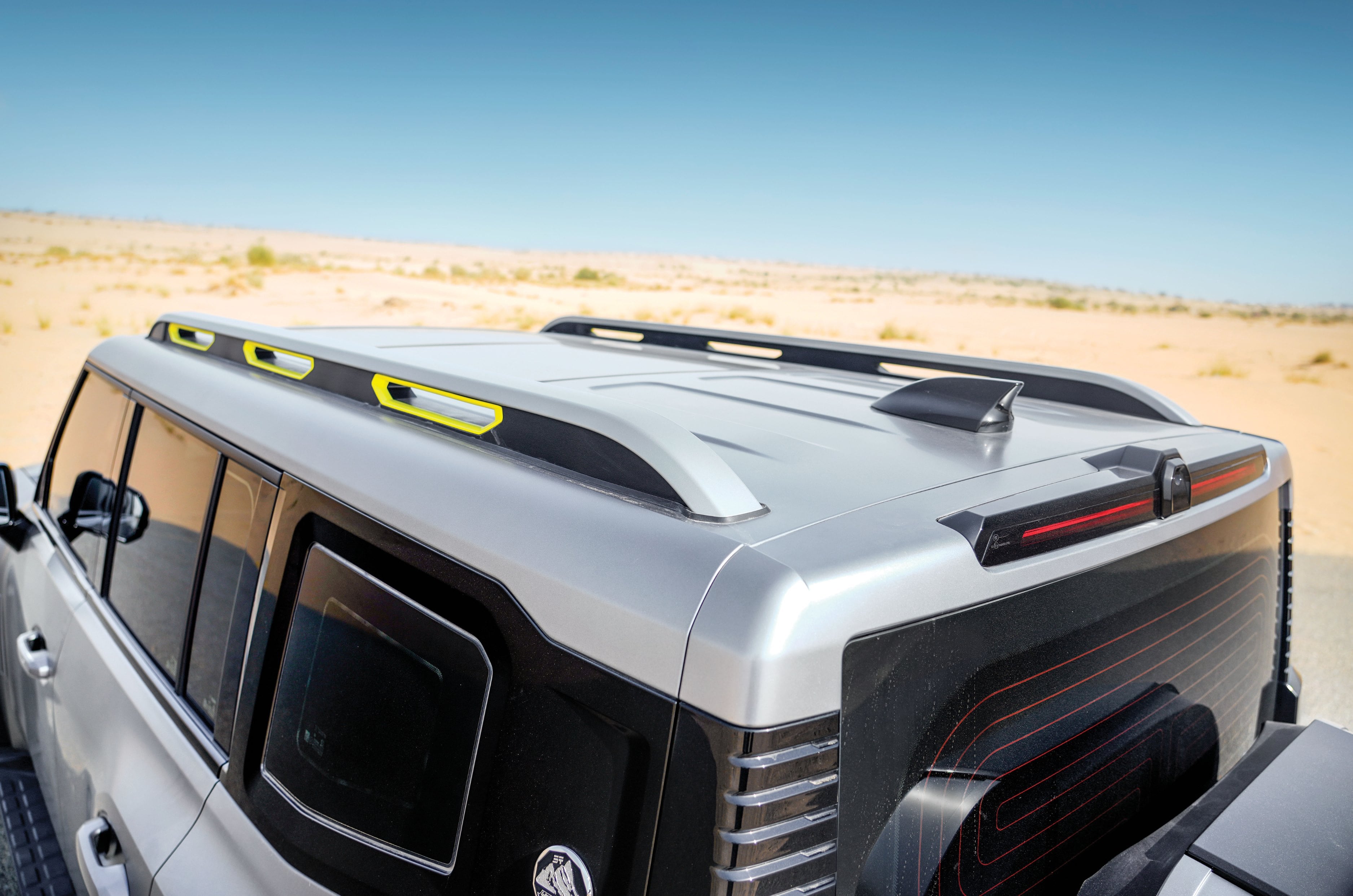
The massive 20-inch wheels suit the T2’s stance perfectly, and the clean bodywork, free of unnecessary cuts and creases, is particularly appealing. It also gets functional roof rails capable of carrying up to 100kg of luggage, while the side steps feel reassuringly sturdy and genuinely useful.
The T2’s space-saver spare wheel sits within a squircle-shaped cover, although accessing it involves a multi-step process that could prove frustrating if you ever need to change a tyre on a deserted road late at night.
Functional roof rails can take up to 100kg of load.
In terms of dimensions, it is longer (including the spare wheel), wider and taller than the Toyota Fortuner. Ground clearance, too, is an impressive 190mm in laden condition. However, don’t let its rugged appearance fool you – the version destined for India will remain front-wheel drive.
Jetour T2 Interior Space, Comfort, and Features – 8/10
Solidly built, well-designed cabin with some clever detailing and plenty of storage areas.
Climb aboard using the sturdy side step and handy grab handles, and the T2 immediately impresses with its sense of solidity. The cabin feels built to last, with numerous thoughtful design details lending it plenty of character. Nearly upright windows, a steeply raked windscreen and a dashboard pushed far forward create a tremendous sense of space, further amplified by the panoramic sunroof.
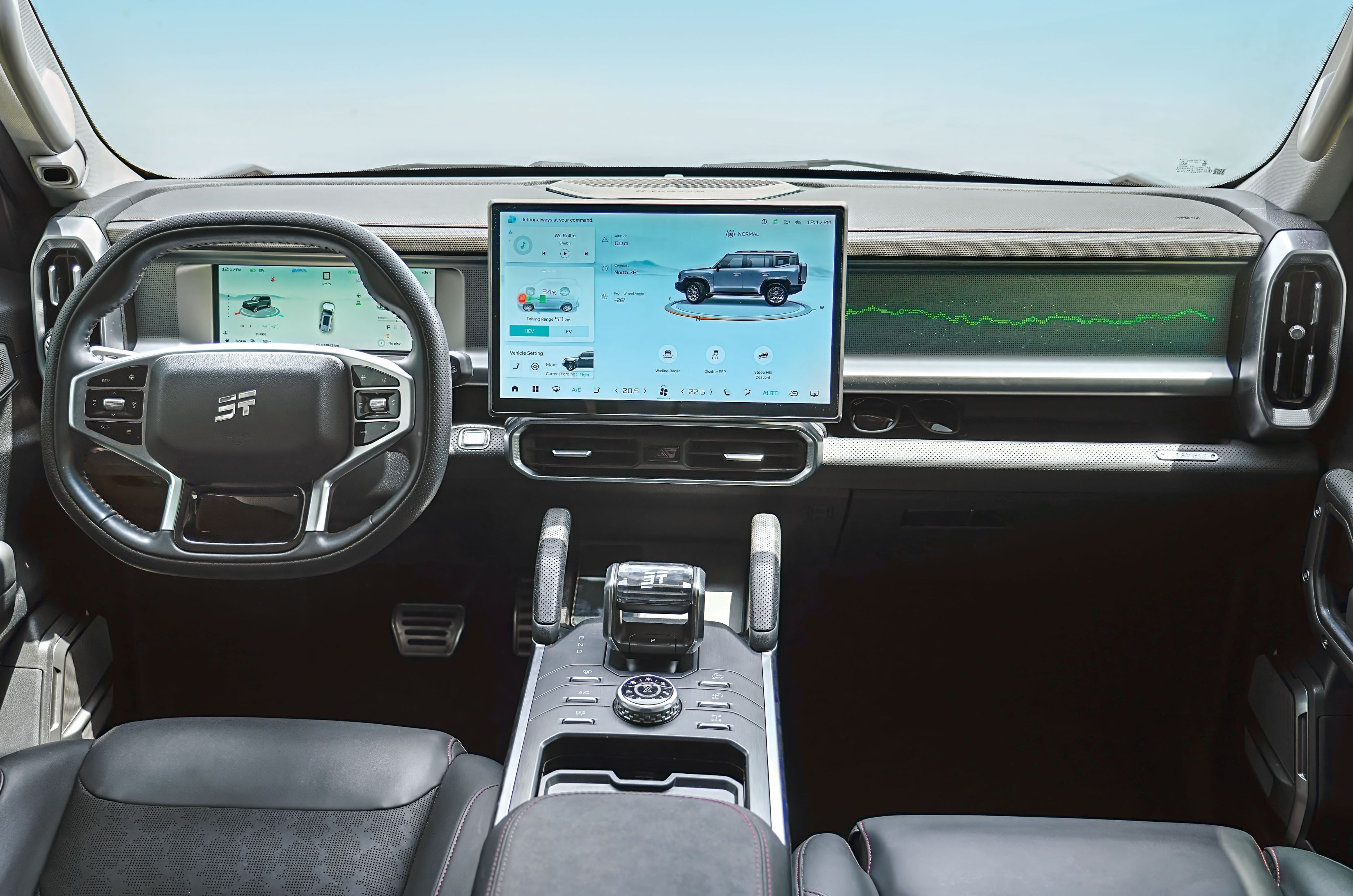
The dashboard itself has a distinctive design, with an illuminated pattern across the fascia adding a unique touch. Several layers are wrapped in dimpled leatherette padding, a theme that extends to the steering wheel and centre console.
Dominating the cabin is a massive 15.6-inch touchscreen that houses numerous vehicle functions, including mirror adjustment, climate control and seat ventilation/heating settings. Wireless Android Auto and Apple CarPlay are included, while the 12-speaker Sony audio system delivers impressive sound quality. Even the 540-degree camera system offers excellent image clarity. The downside is that the interface isn’t slick or responsive.
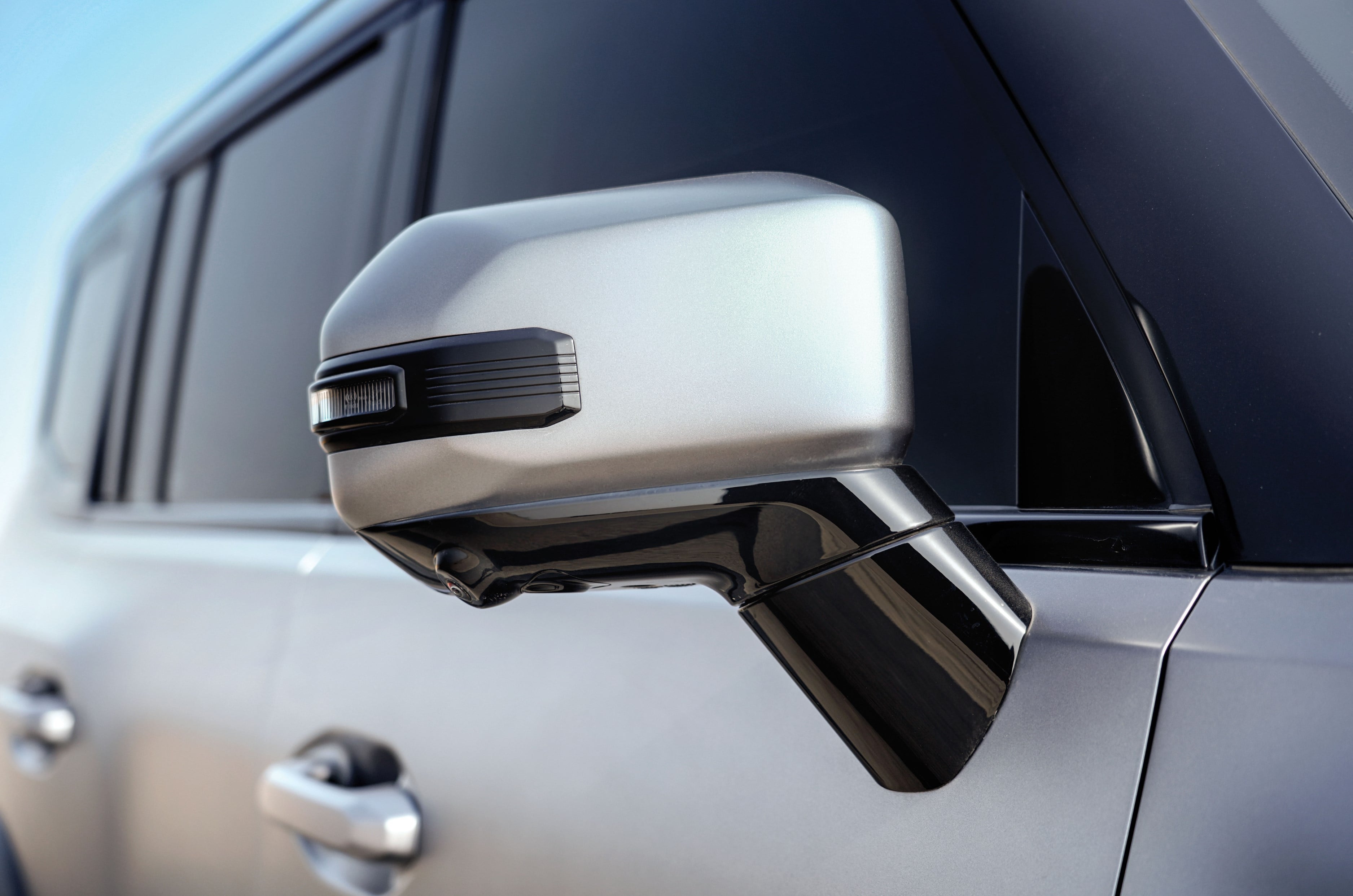
Chunky, door-mounted mirrors. Sadly, controls via touchscreen.
Ahead of the driver sits a 10.6-inch digital instrument cluster, a unit we’ve previously seen in some MG and BYD models. While it displays a wealth of information, the fonts and icons are rather small, making them difficult to read at a glance.
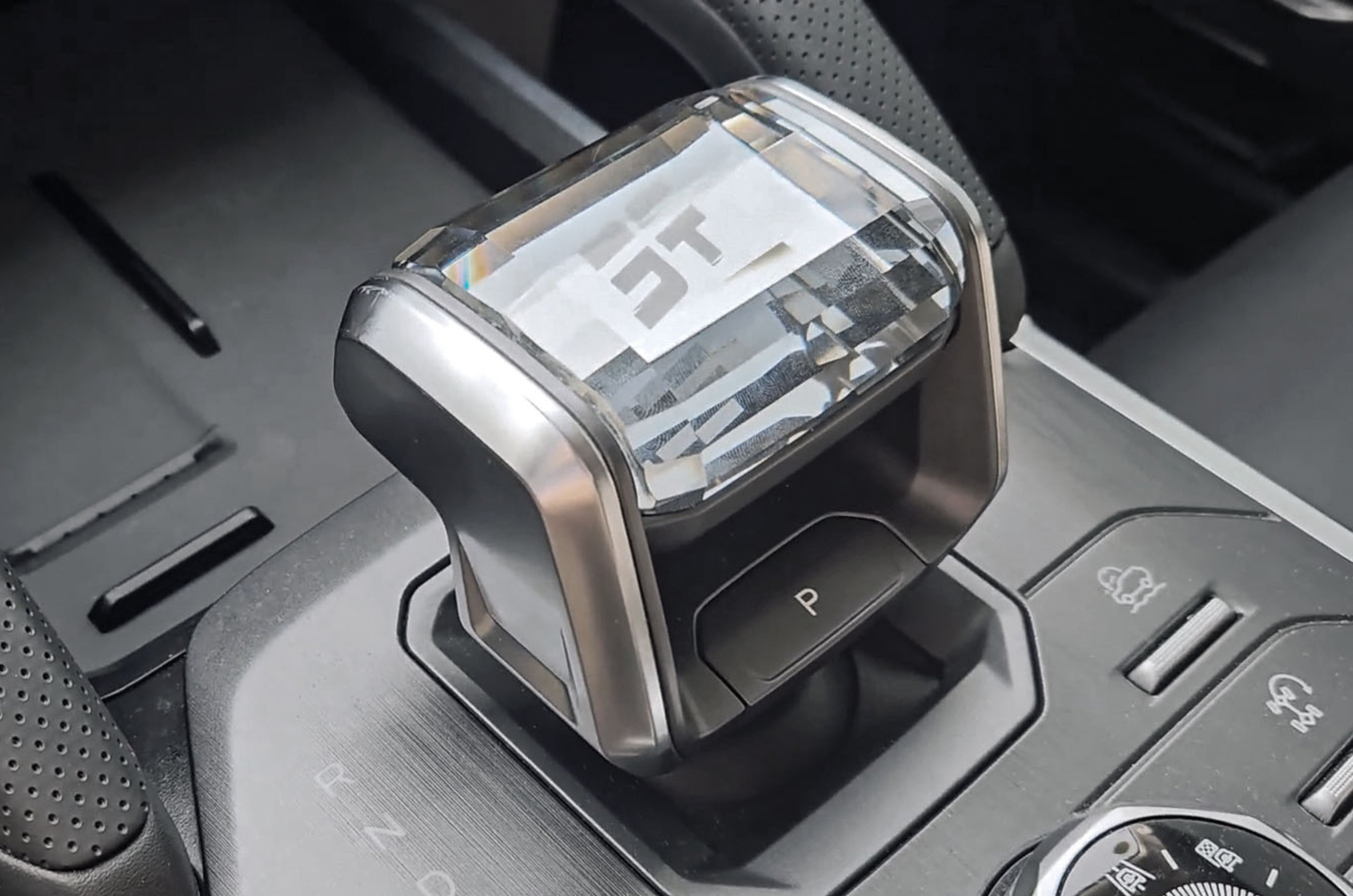
Material quality is generally impressive. The stalks and window switches feel robust and premium, while the jewel-like gear selector features an attractive diamond-cut effect. However, under harsh sunlight, it becomes highly reflective and can prove distracting. Reflections from the dashboard on the front windows are also noticeable.
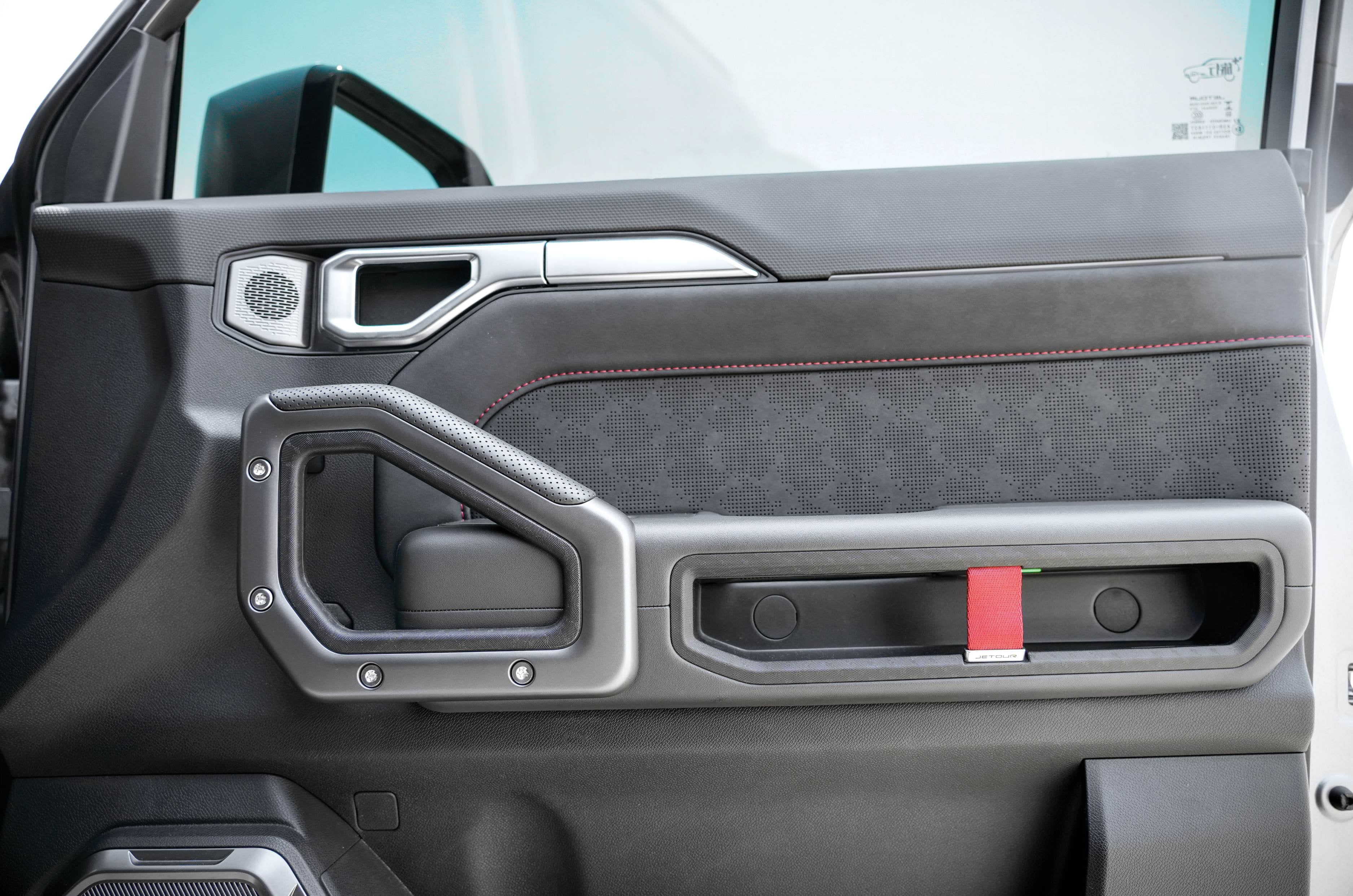
Rugged-looking door pads with nice detailing.
Notably, its dual-zone climate control struggled to cool its large cabin quickly despite the heavily tinted windows. While our test vehicle was a China-specific version, we hope the version we’re going to get in India has an upgraded air-con compressor. Its seat ventilation didn’t seem very effective either, even at its maximum setting.
Diamond-like chunky gear selector is illuminated.
The sculpted front seats, finished in black leatherette with contrasting red stitching, look suitably sporty. They provide excellent support, though the cushioning feels slightly overstuffed, and the absence of lumbar adjustment is disappointing.
Practicality is a strong point. There are large door bins, two phone storage areas (one incorporating a wireless charger), cupholders, a deep-cooled centre console, a large glovebox and even a hidden storage tray beneath the front seat.
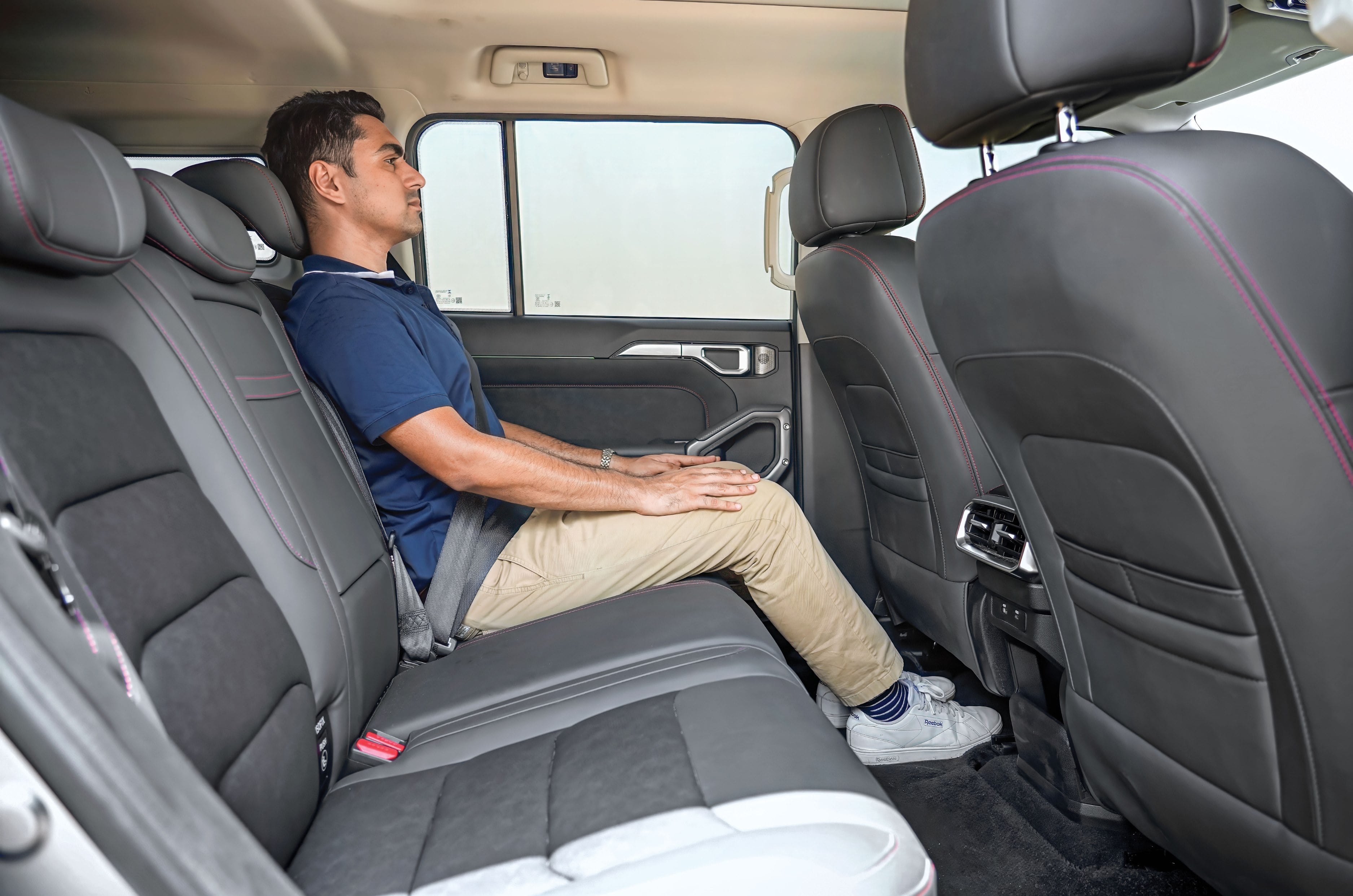
Albeit a bit low-set, rear seat is spacious. Flat floor, wide bench make it comfy for three adults.
The rear seat is equally spacious. A wide bench and completely flat floor make it comfortable for three adults, while the boxy cabin ensures generous headroom and overall space. The seat base is positioned slightly low, but comfort levels remain good.
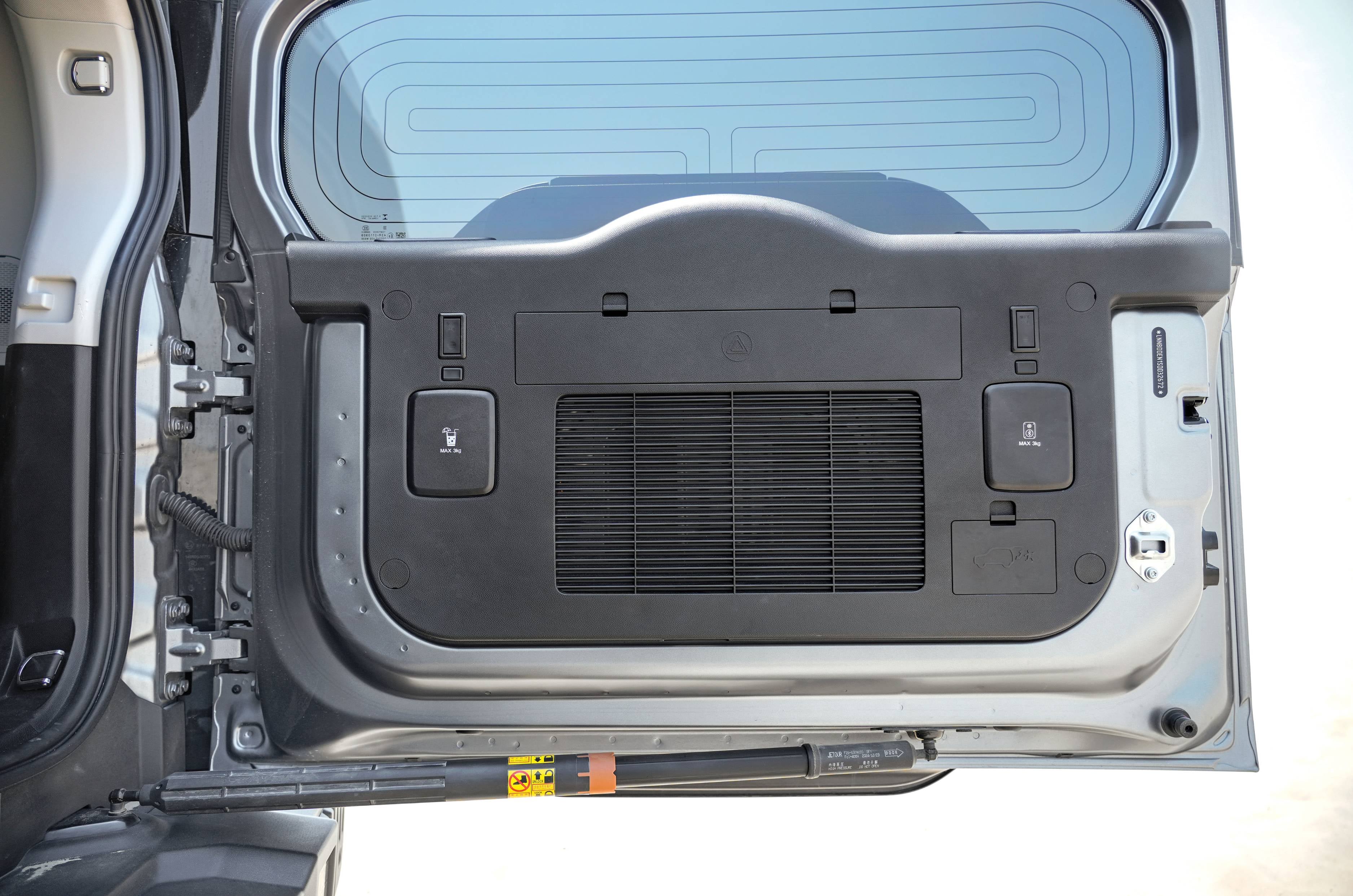
Cupholders, luggage hooks, bottle opener on its tailgate.
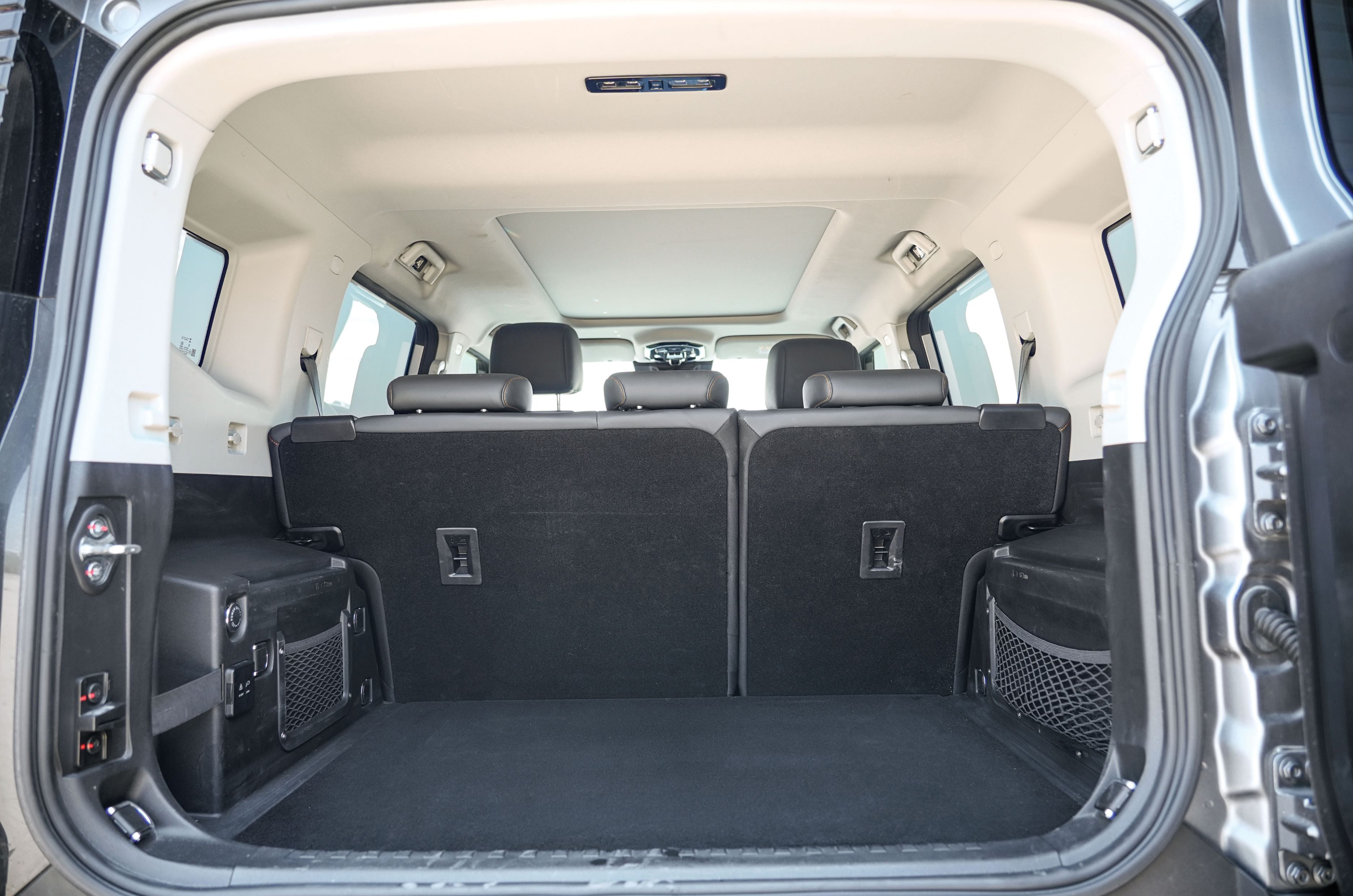
The side-hinged tailgate opens to reveal a cavernous 580-litre boot. Despite carrying the spare wheel, the tailgate itself requires surprisingly little effort to open. Thoughtful touches include a locking mechanism that prevents it from swinging shut unexpectedly, and there are cupholders, luggage hooks and even a bottle opener integrated into the inner panel. The boot area also features clever luggage nets and charging provisions, while a soft-close function further enhances convenience.
Humongous 580L boot. 60:40 rear seat split for added flexibility.
Besides the features already mentioned, it gets one-touch-down power windows, powered front seats with memory, LED lights all around, ambient lighting, a frameless inside mirror, autonomous emergency braking, lane-assist, adaptive cruise control, blind-spot monitoring, front and rear cross-traffic alert, six airbags, hill-start assist, hill descent control and ESP, to name a few more.
Jetour T2 Performance, Refinement and Efficiency- 8/10
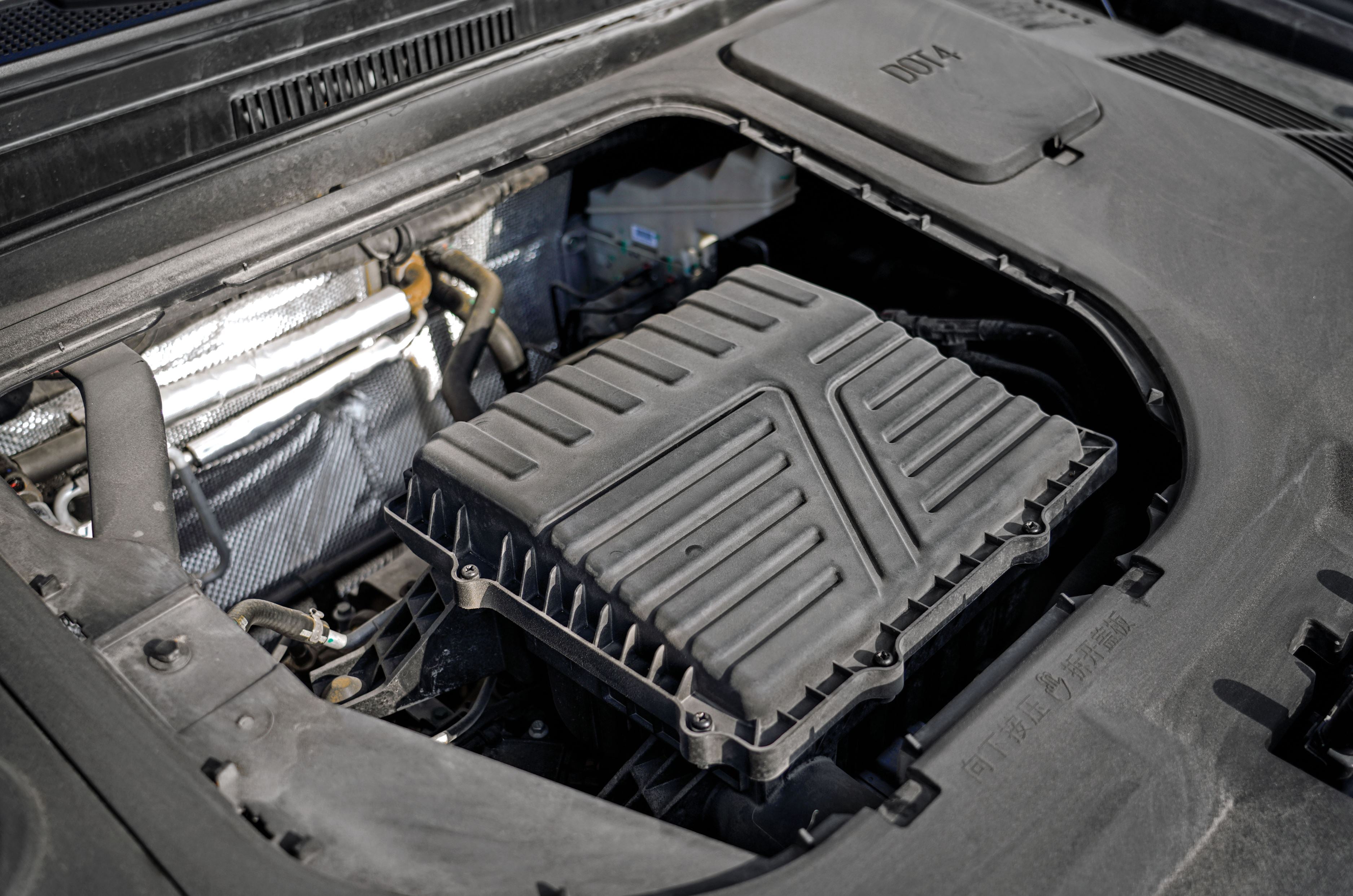
The T2 version we’re driving today is a plug-in hybrid, which combines a 156hp/220Nm 1.5-litre direct-injection turbo-petrol engine, a 43.24kWh LFP battery pack, and three electric motors. Together, the three motors produce 462hp and 700Nm of torque, with power sent to all four wheels. India will also see the plug-in tech, but in front-wheel-drive guise only, with two electric motors instead of three and a smaller 18.4kWh battery.
Powered by a 1.5 turbo along with 3 electric motors.
While the engineering sounds complex, the driving experience is refreshingly straightforward. The four-cylinder engine is refined, although when it operates primarily as a generator to charge the battery, a faint and distant hum does filter into the cabin.
The SUV can be driven either in pure EV mode or in hybrid mode. In EV mode, Jetour claims a range of up to 211km, and performance feels smooth and relaxed rather than outright brisk. Switch to hybrid mode, and the system automatically alternates between EV operation and combined petrol-electric drive, depending on throttle inputs, road conditions and battery charge levels, among other factors.
In this mode, performance feels remarkably effortless, with the T2 gathering speed with surprising urgency as speeds rise. Under full throttle, acceleration is initially measured up to around 40kph, after which there is a noticeable surge in performance as the powertrain delivers a much stronger pull.
Multiple drive modes are available, including Eco, Normal and Sport. In both Normal and Sport, we noticed the vehicle continuing to accelerate momentarily even after lifting off the throttle, which can feel unnerving. Throttle response in these modes is also a touch too aggressive. Eco mode offers a more natural and polished throttle calibration.
In our testing conducted in 40-degree heat, the T2 accelerated from 0-100kph in just 6.35 seconds in its sportiest setting – quick for its size. Flat out, it will reach a claimed top speed of 200kph.
The T2 also offers three levels of regenerative braking. Impressively, all three feel natural in operation, bringing the SUV down to a crawl smoothly and predictably. The brake pedal itself inspires confidence, with the transition between regenerative and friction braking being almost imperceptible.
Jetour T2 Ride Comfort and Handling – 6/10
Soft suspension and tall ride height mean driving dynamics aren’t anything to write home about.
The T2 rides on MacPherson struts at the front and a multi-link independent rear suspension setup. Its suspension tuning leans towards comfort, but this results in a degree of bounce over speed breakers and undulating surfaces.
The chunky, high-profile tyres do an excellent job of smothering smaller imperfections, while the 201mm laden ground clearance provides ample confidence over rough roads. At higher speeds, however, the ride never feels quite as settled or composed. One positive is that it remains well controlled under heavy braking, resisting excessive pitch.
Dynamic prowess is clearly not the priority here. The tall body exhibits a fair amount of roll, noticeable during quick lane changes. Push harder through a series of bends, and this two-tonner T2 understeers quite readily. Combined with its light and somewhat disconnected steering, it is clear that this SUV prefers a more relaxed driving style.
A light steering, smooth hybrid and excellent visibility make it surprisingly easy to drive.
Driven at a gentler pace, the T2 proves extremely easy to live with. The steering offers three weight settings, though it feels best in its lightest mode. Combined with excellent visibility and a smooth, responsive hybrid powertrain, it makes piloting this large SUV remarkably effortless.
Jetour T2 Should You Buy Now or Wait – 8/10
The Jetour T2 plug-in hybrid appears to have all the ingredients needed to establish the JSW brand in India and perhaps even challenge the Toyota Fortuner, despite offering only five seats. It is spacious and practical, it is expected to come loaded with technology and features, and its rugged styling gives it immense road presence and desirability.
The plug-in hybrid powertrain adds further unique appeal, offering the flexibility of pure EV driving and an impressive mileage figure with the hybrid tech. Better still, the system is smooth, refined and delivers strong performance.
It’s larger than a Fortuner, looks imposing, and stays true to the SUV formula.
Yes, it is not without flaws. The touchscreen experience and throttle calibration need refinement, the air-conditioning needs to be more effective, and the ride and handling would benefit from further fine-tuning for Indian conditions. These are areas we hope JSW addresses before launch.
On the whole then, the T2 is certainly ready for combat. Will it win, though, will also depend on JSW pulling off an aggressive pricing strategy and, importantly, backing it up with a reliable ownership and service experience too. That latter is why Toyota rules the roost. The battle lines, then, are drawn.
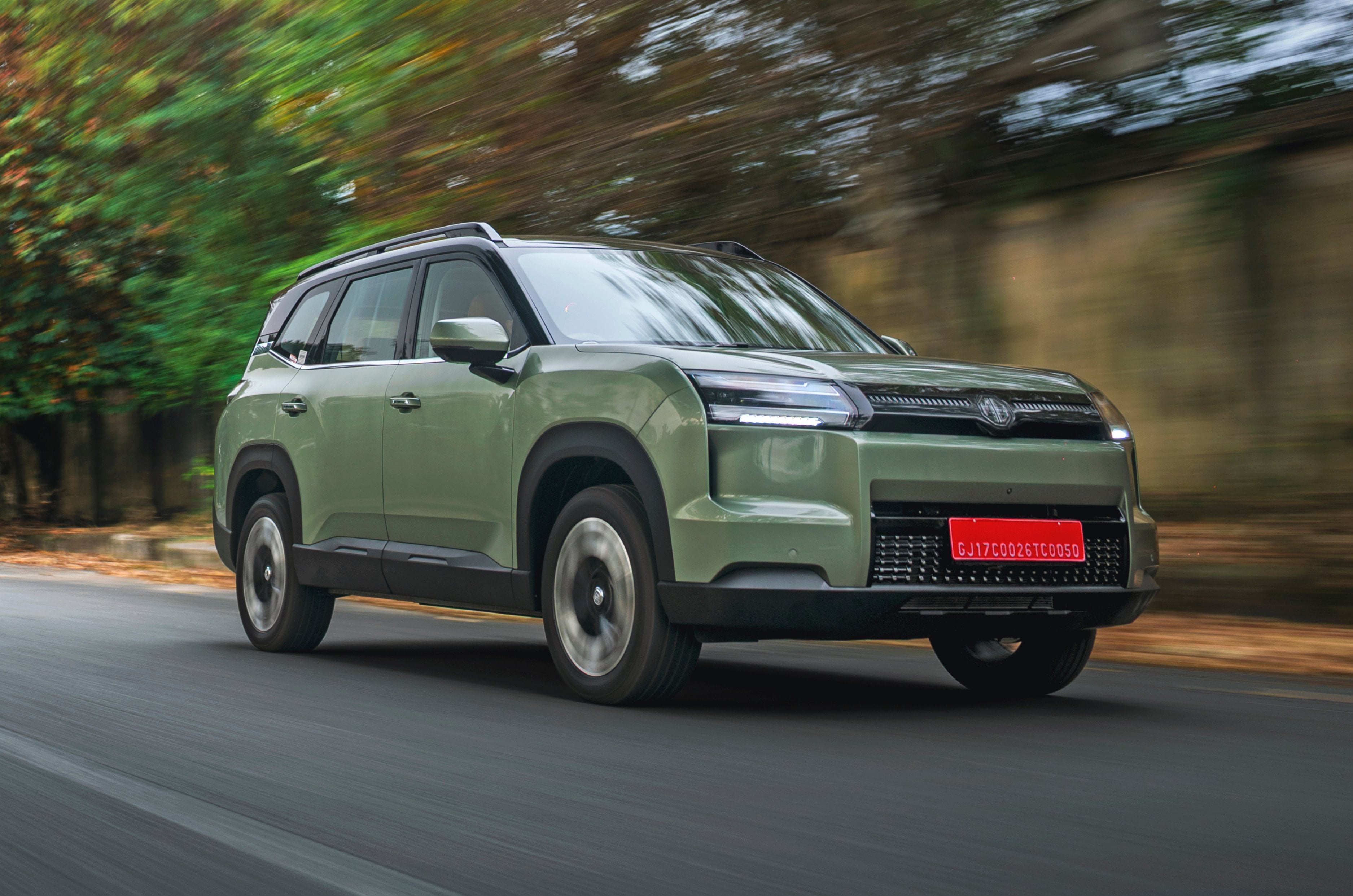
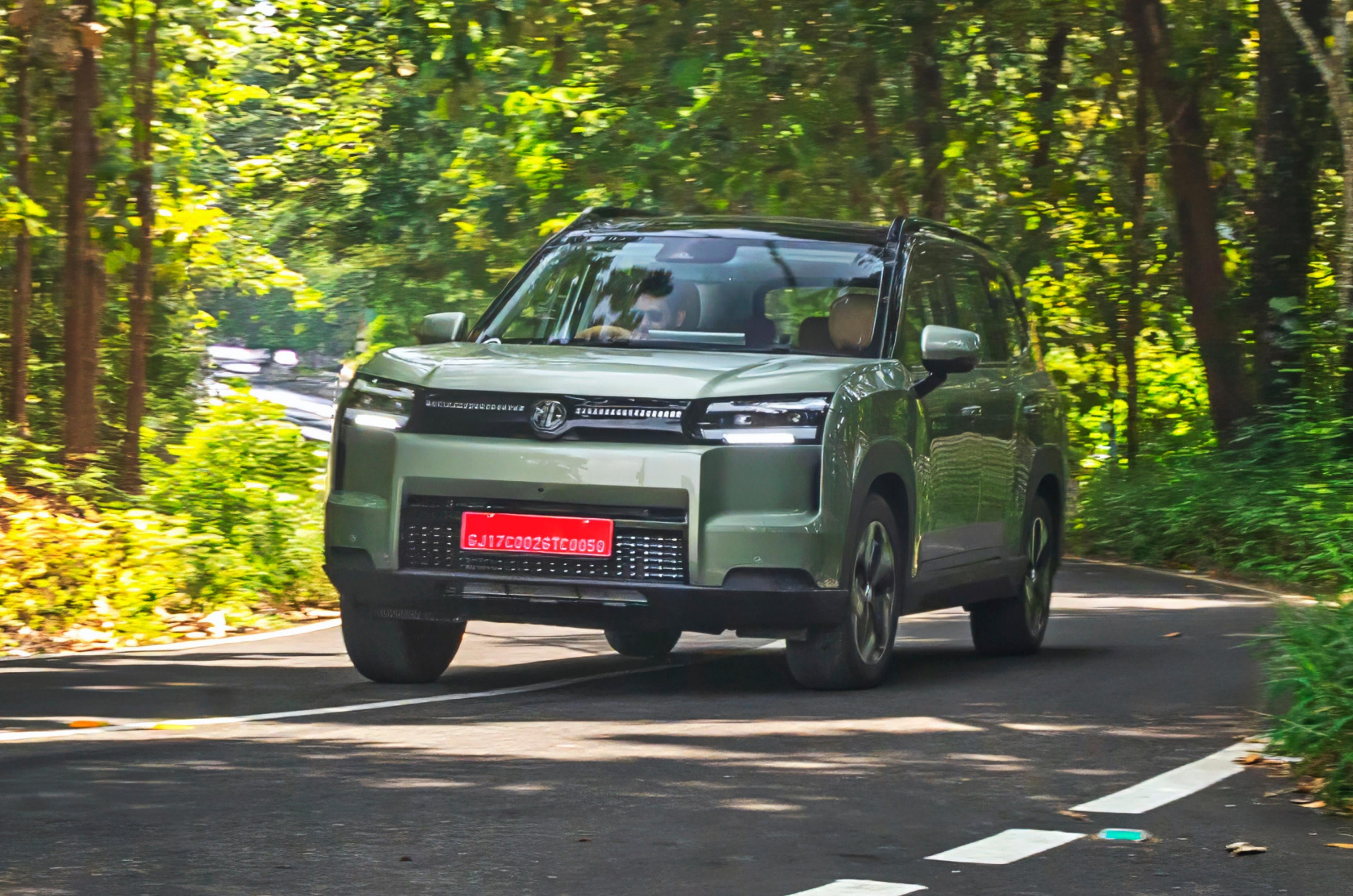
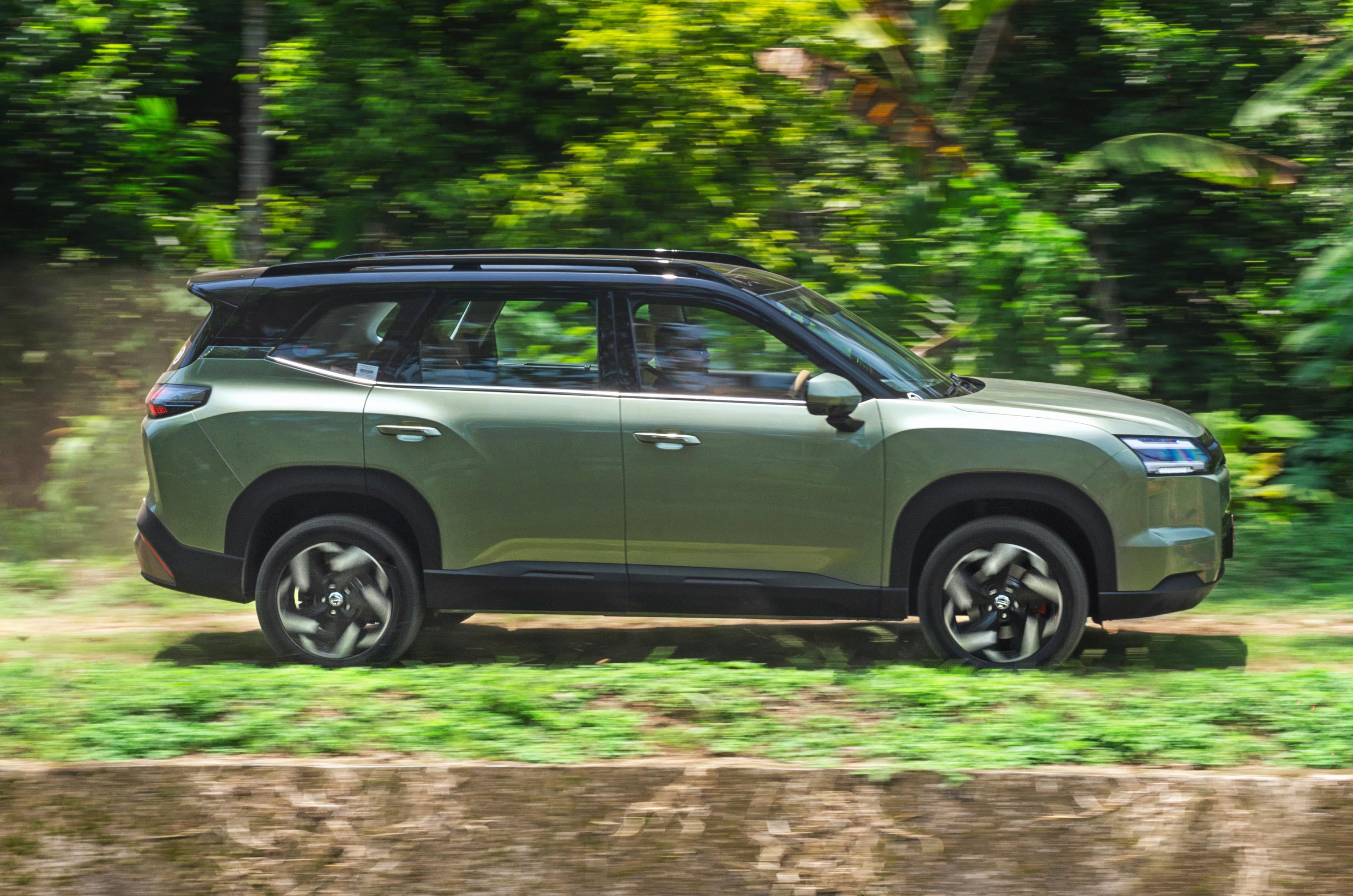
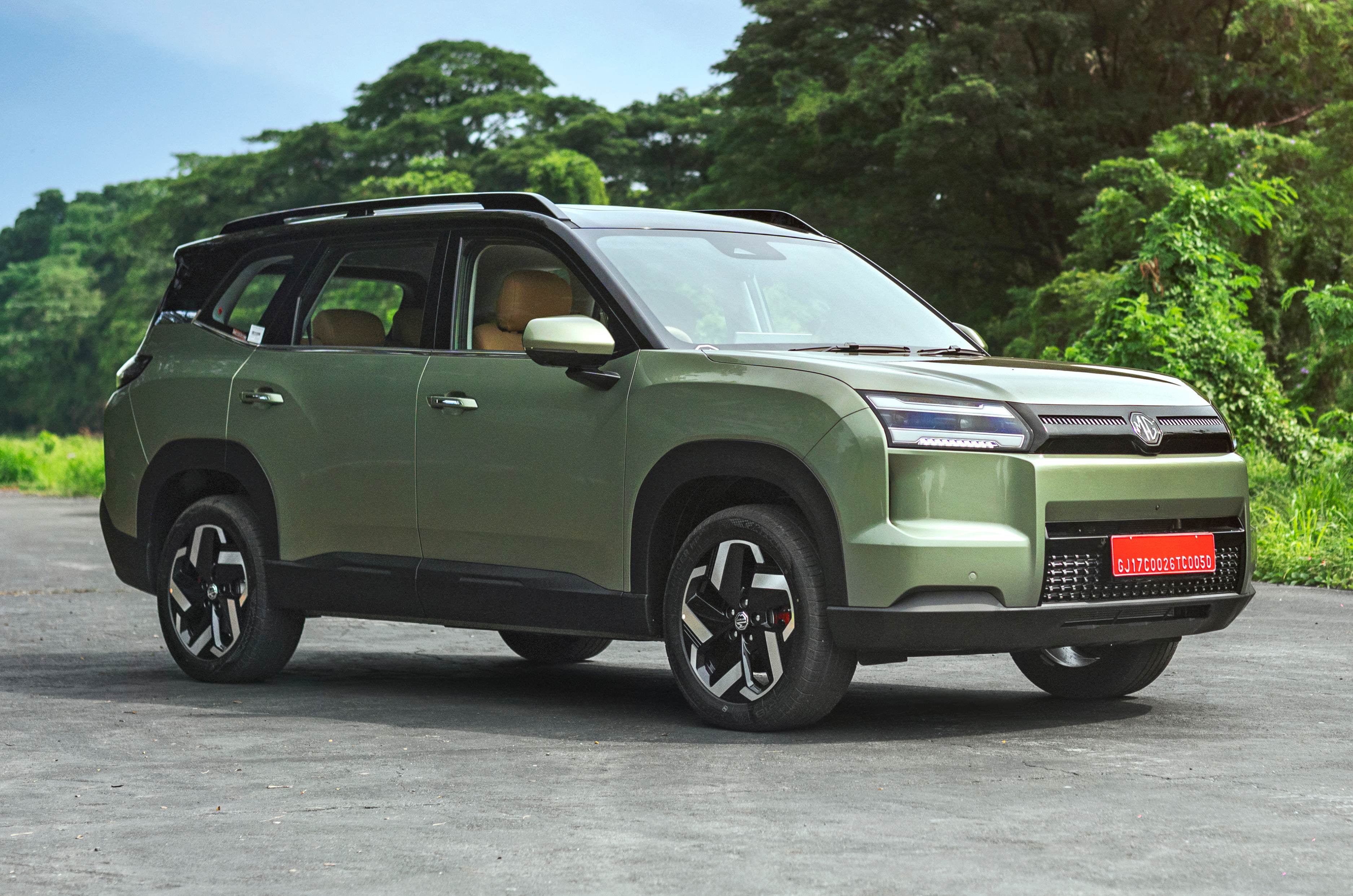
MG’s newest SUV has been christened the Hector Tomahawk, but despite the name, it shares nothing with the ICE-powered Hector we’ve known since 2019. The Hector Tomahawk EV and PHEV are the first models on MG’s ADAPT architecture, which will eventually spawn strong hybrids and range-extender hybrids. We drove the Tomahawk EV in sunny Kochi to see how it stacks up in the ever-growing segment.
MG Hector Tomahawk EV Exterior Design and Engineering – 6/10
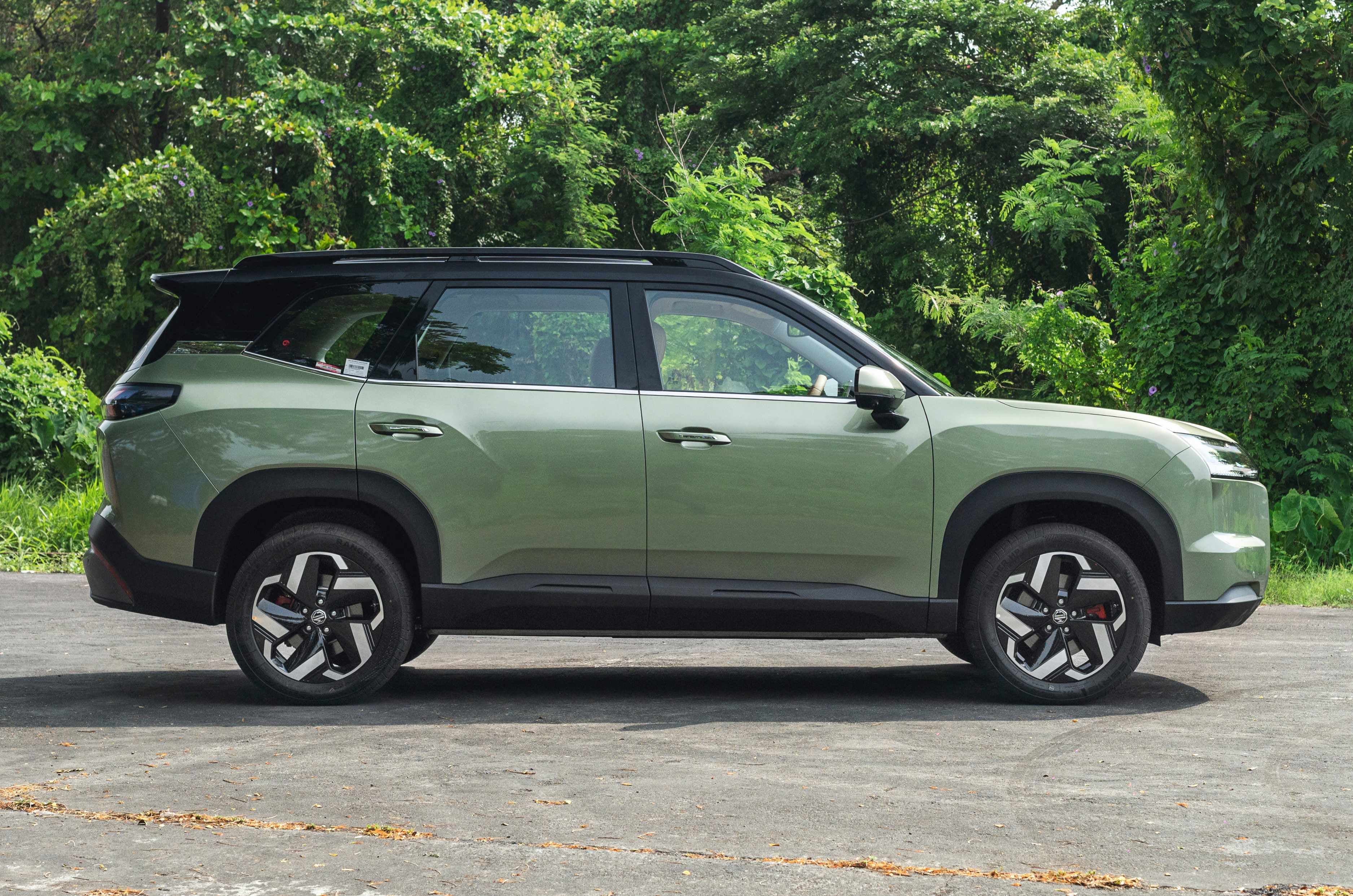
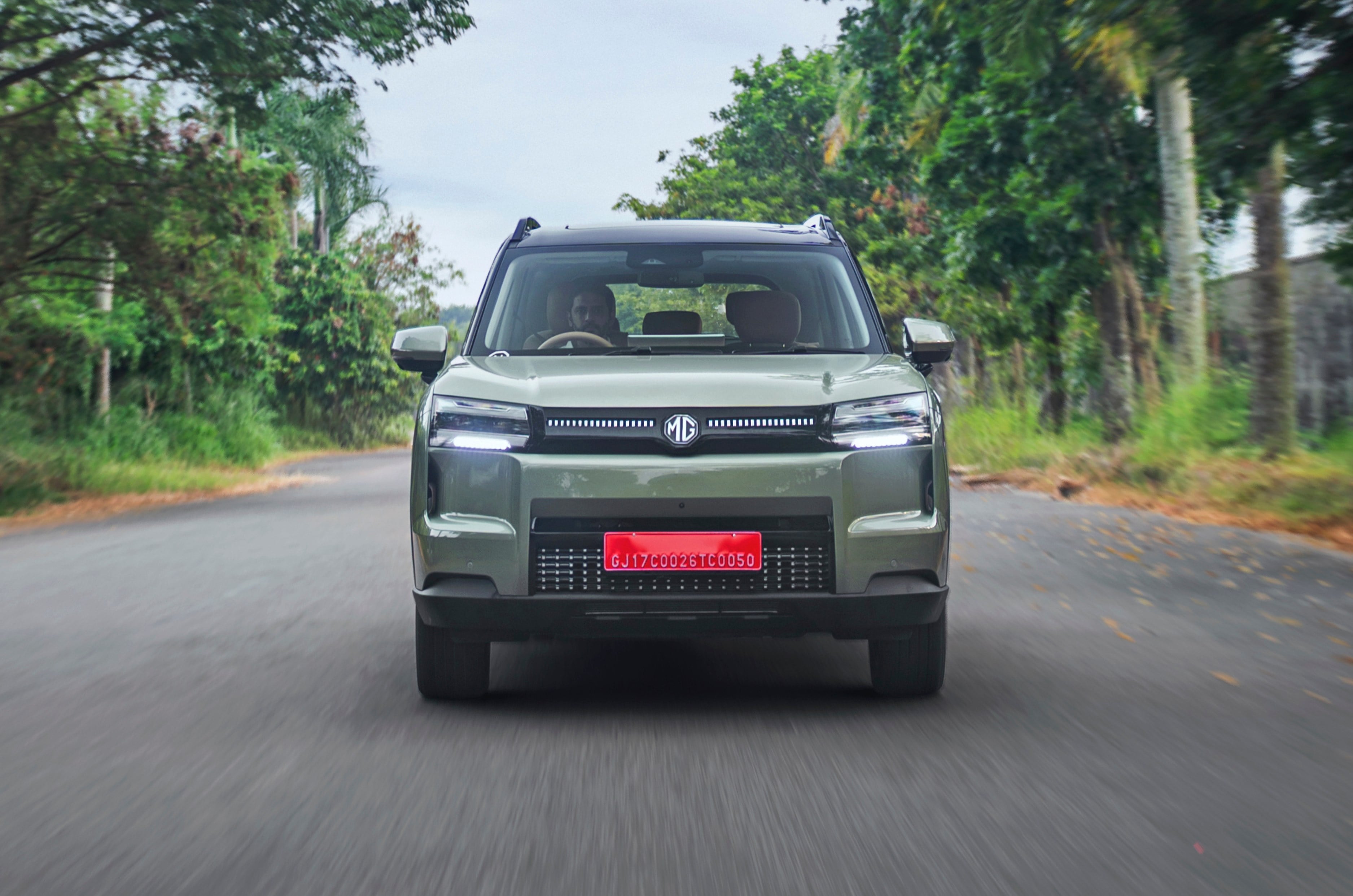
Let’s talk dimensions first. At 4,745mm long, 1,850mm wide, 1,770mm tall and with a 2,810mm wheelbase, the Tomahawk is larger than the Mahindra XEV 9S in all areas except width. Ground clearance, at 230mm (measured to battery), is also class-best. However, these numbers don’t translate to a particularly imposing stance. Instead, it straddles the line between an MPV and SUV.
Size doesn’t translate to an imposing stance; it straddles the line between an MPV and an SUV.
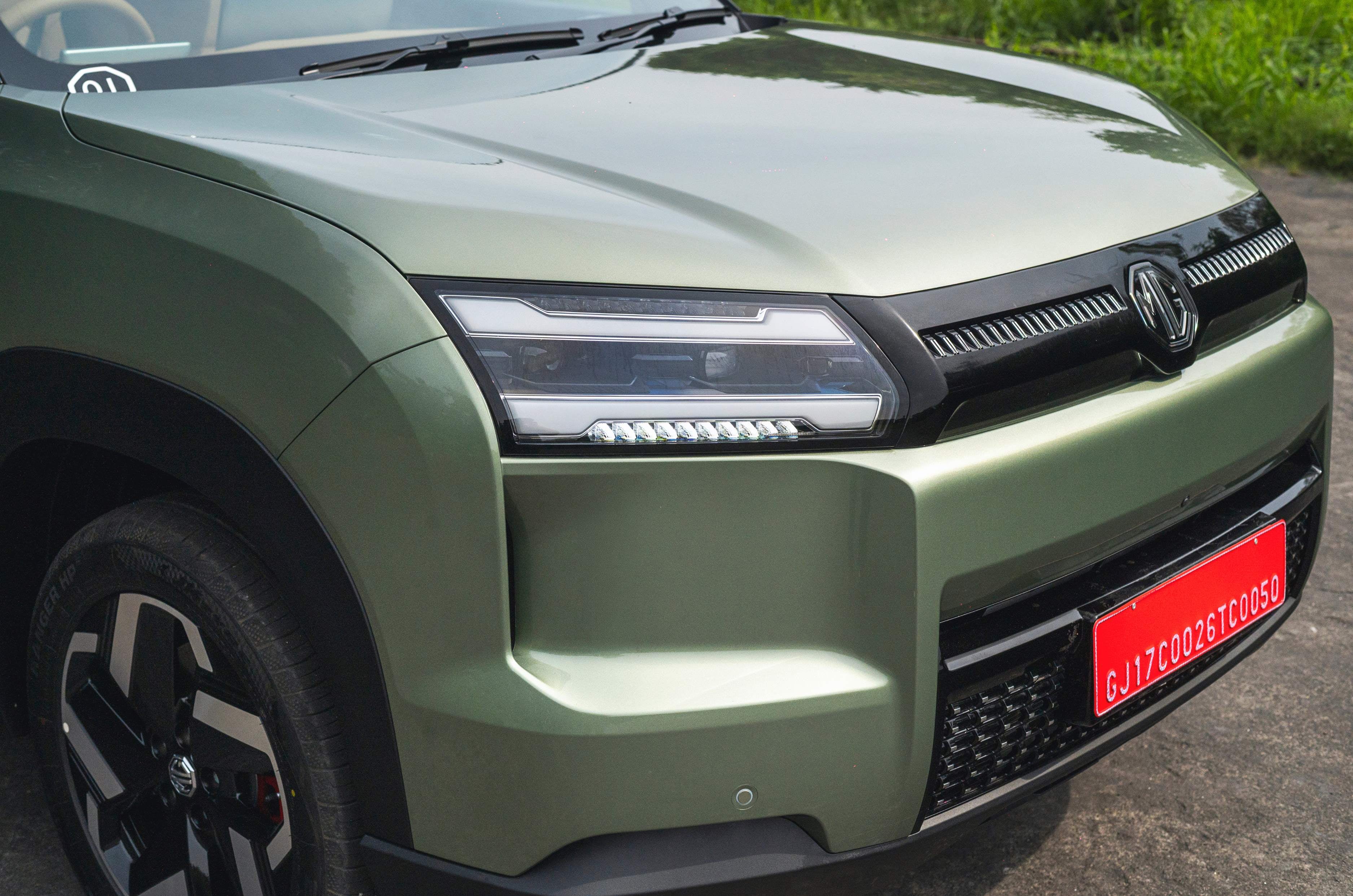
The design is clean and quite handsome, if a bit uninspiring. The front bumper is squared off with pass-through aero vents on the edges and chunky cladding lower down. Cooling requirements are met by slim slots in the centre section with some chrome detailing, while the conventional grille is blanked off and finished in gloss black. No light bar here, thankfully, but the MG logo does glow and is flanked by rectangular LED headlights with a subtle H-shaped light signature.
Large rectangular LED headlights have a subtle H in them; no light bar, but the MG logo glows.
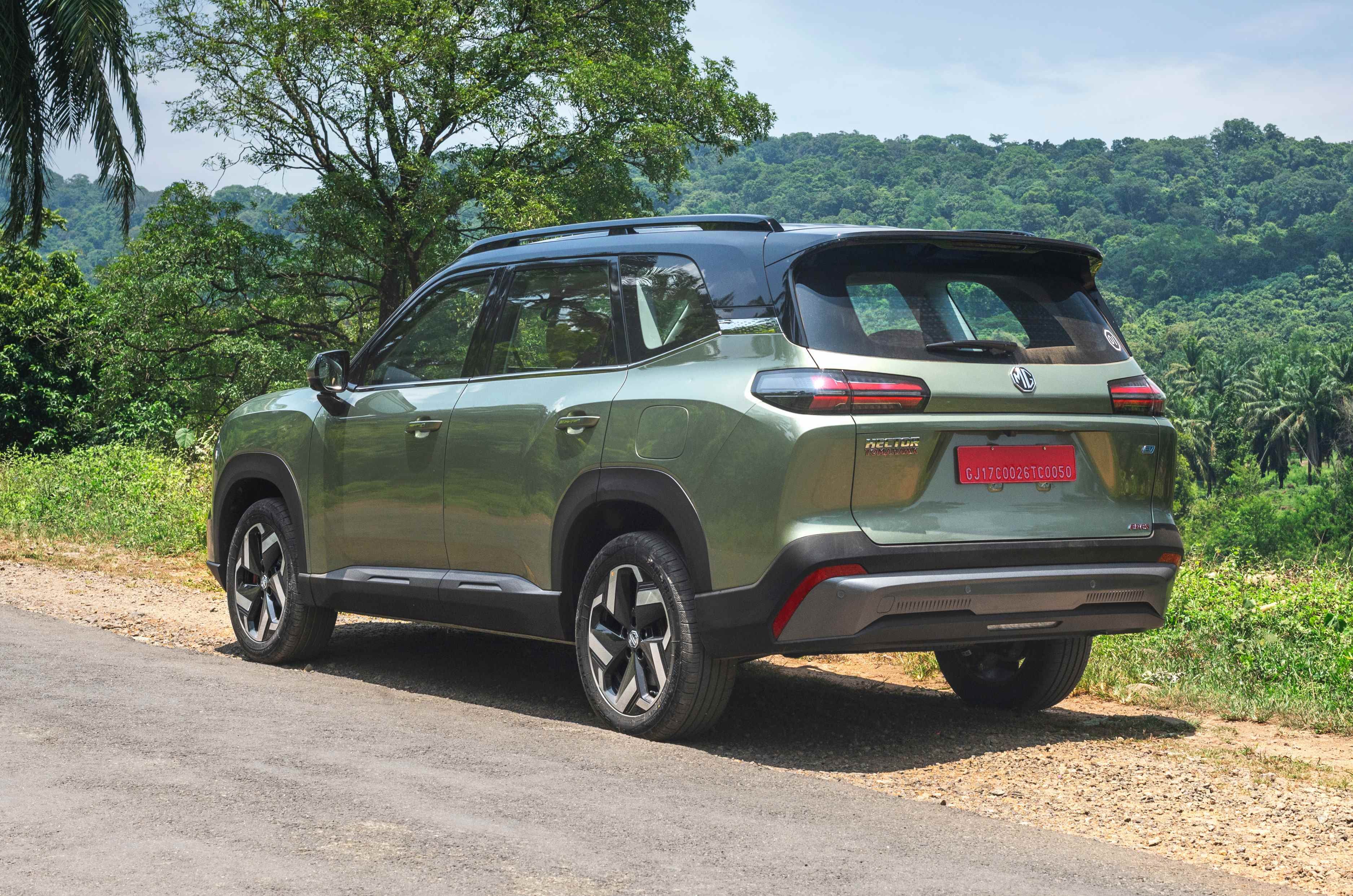
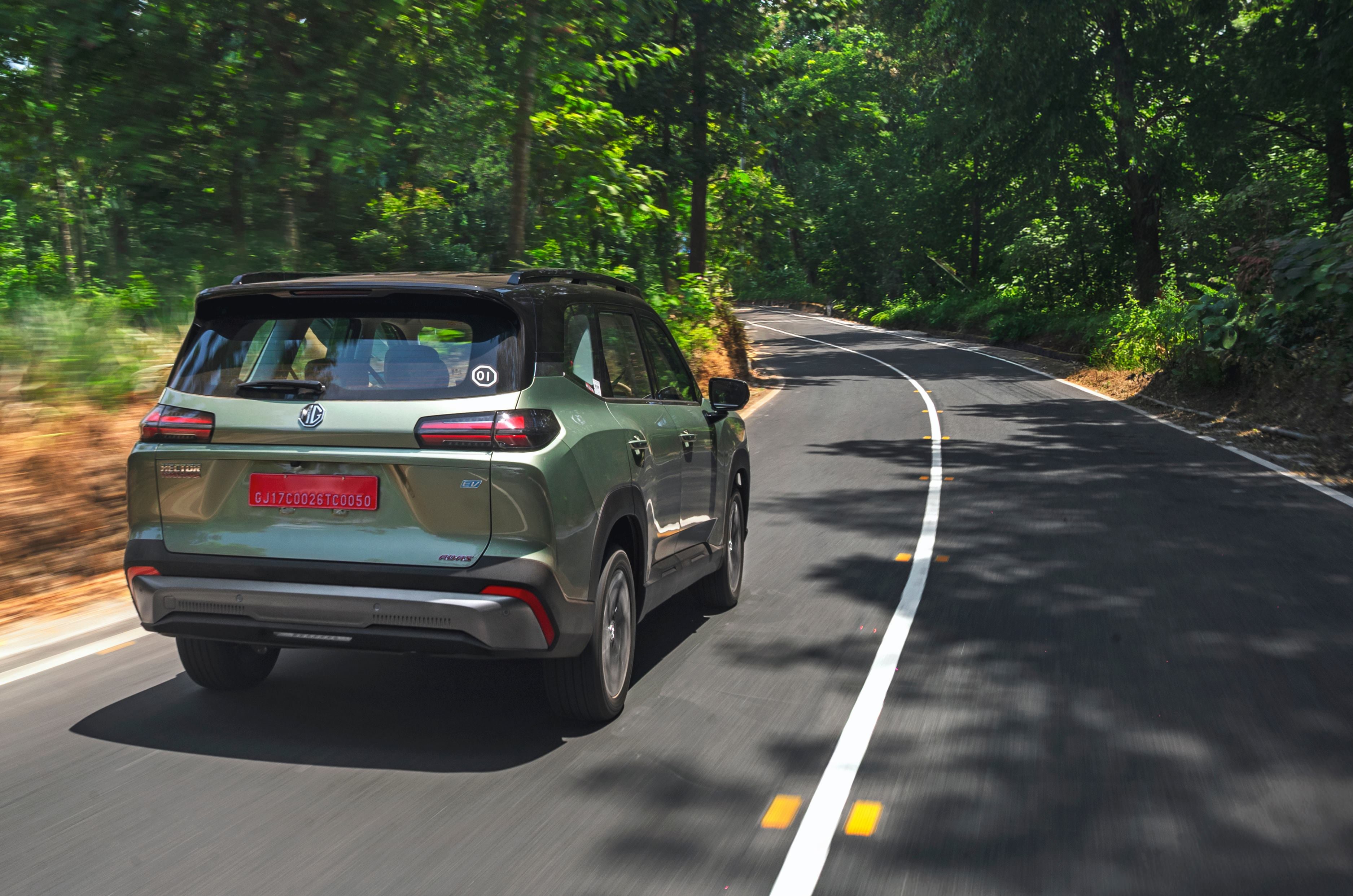
In profile, it looks quite slab-sided, with sharp creases along the fenders and plastic wheel-arch cladding adding some definition. These, along with the chunky door cladding, attempt to give it a rugged appearance but are let down by 18-inch wheels that look a tad too small. No electric door handles here, just good old-fashioned pull types.
Further back are a set of intricate LED tail-lights that again resist the connected trend. MG’s love for badging is clear though, with four on the powered tailgate. Finishing things off nicely is a sculpted bumper with a grey trim piece and a centre-mounted reverse lamp. Overall, it’s a reasonably pleasing design, but it looks a tad dated and lacks the butch appeal of some rivals.
Overall styling is neatly done but somewhat uninspiring.
MG Hector Tomahawk EV Interior Space and Comfort – 8/10
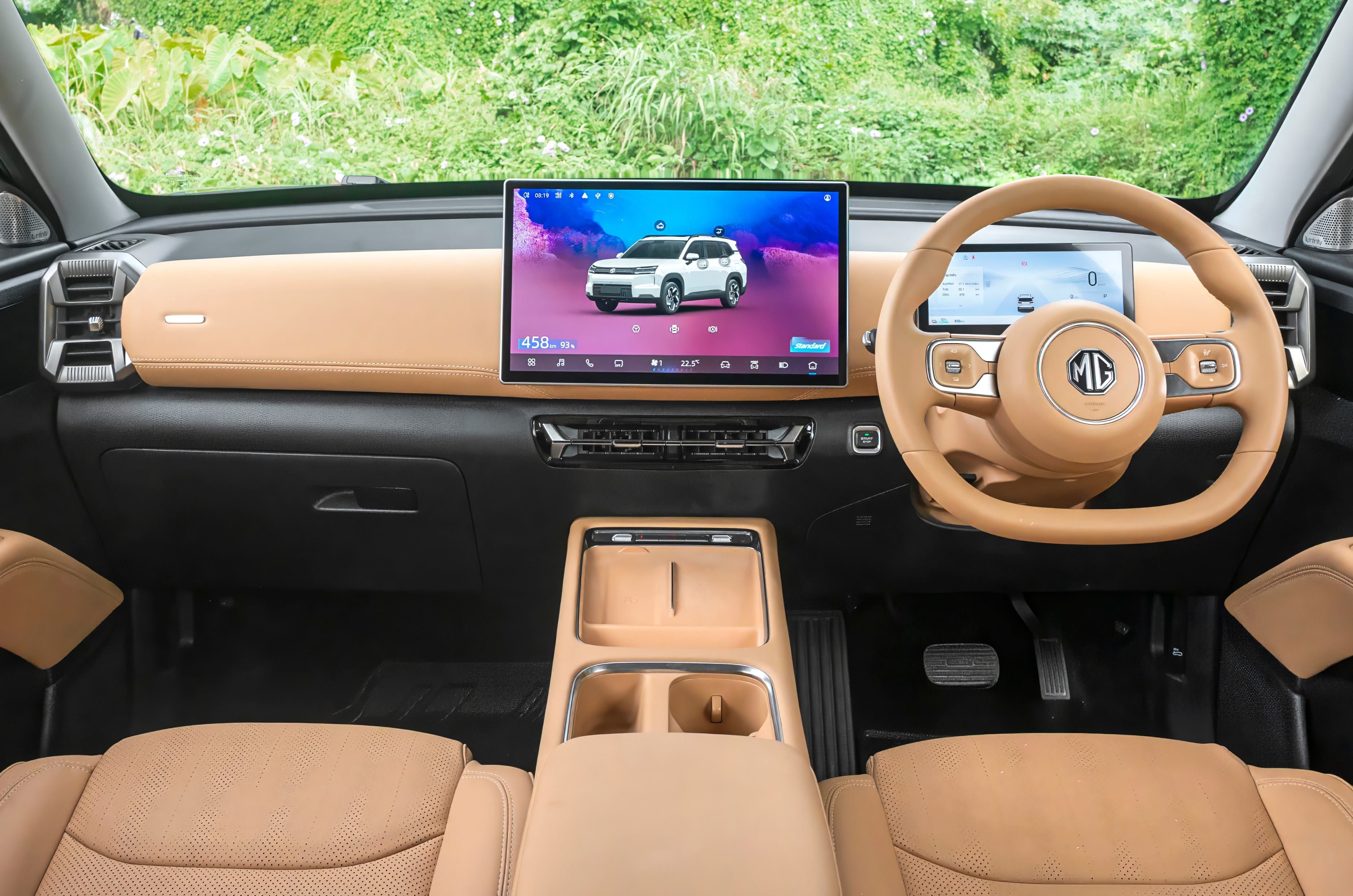
Inside, the dash features a familiar minimalistic layout with a large touchscreen front and centre. It looks premium and features soft-touch materials on the dash and doors, but lacks a certain wow factor, and the light tan colour palette might not be to all tastes. That said, the light tone and large windows do give it an airy ambience. Look hard, and you will find areas where fit and finish could be improved. The centre console in particular feels poorly textured and finished, which we were told is down to a supplier issue. Speaking of the centre console, the column-mounted drive selector frees up space here for a wireless charger, cupholders, multiple bins as well as a large pass-through cubby lower down, and the door bins are enormous too.
Minimalistic interior looks premium, but the light tan colour palette might not be to all tastes.
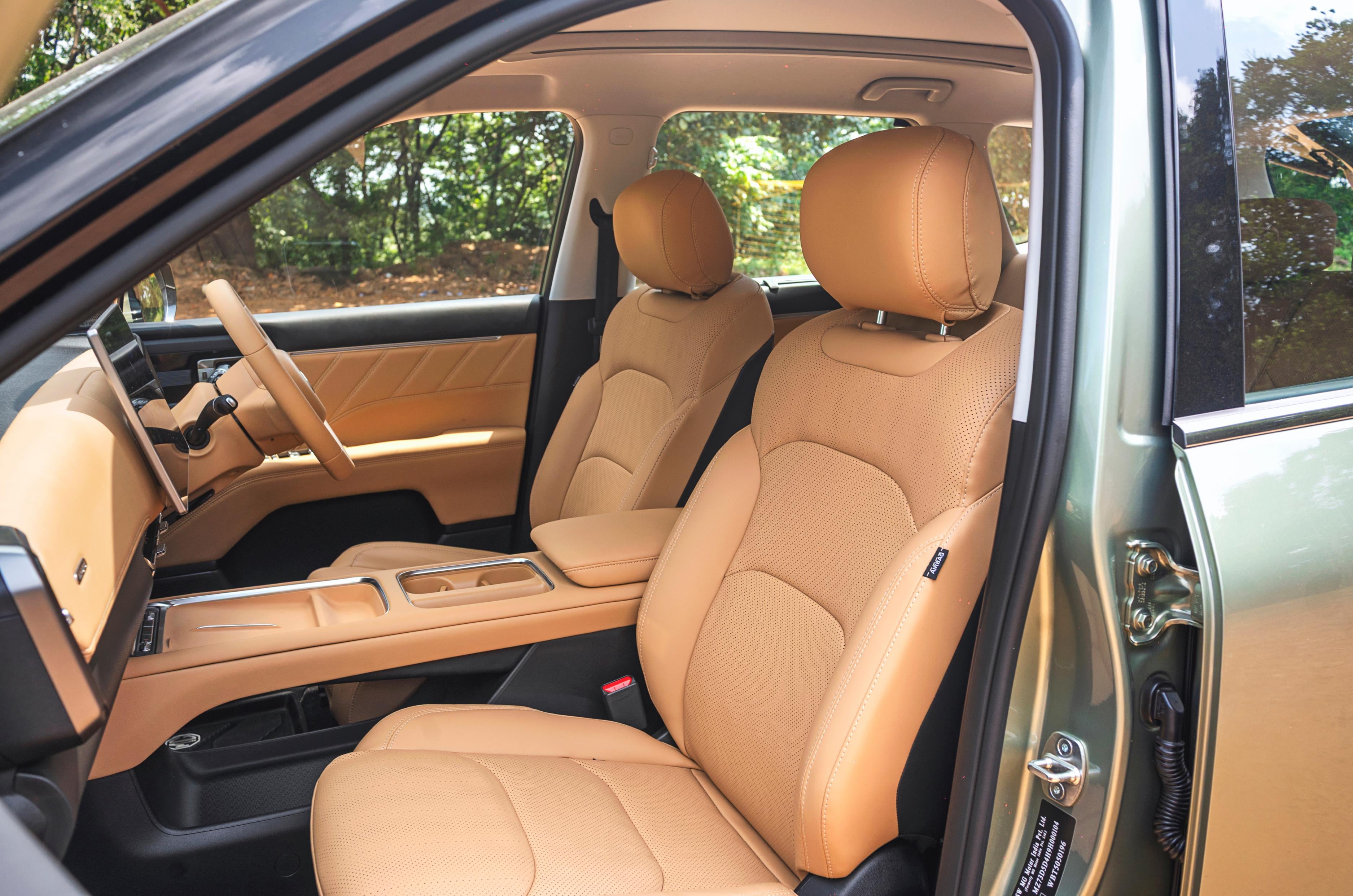
It’s easy to get into a comfortable and commanding driving position using the power-operated seats and reach-and-rake adjustment for the steering wheel. The seats themselves are wide, and despite the firm cushioning, they felt comfortable on our full day of driving. They are ventilated too, and the driver’s seat also gets a memory function.
Powered and ventilated front seats are wide and comfortable; driver’s seat gets a memory function.
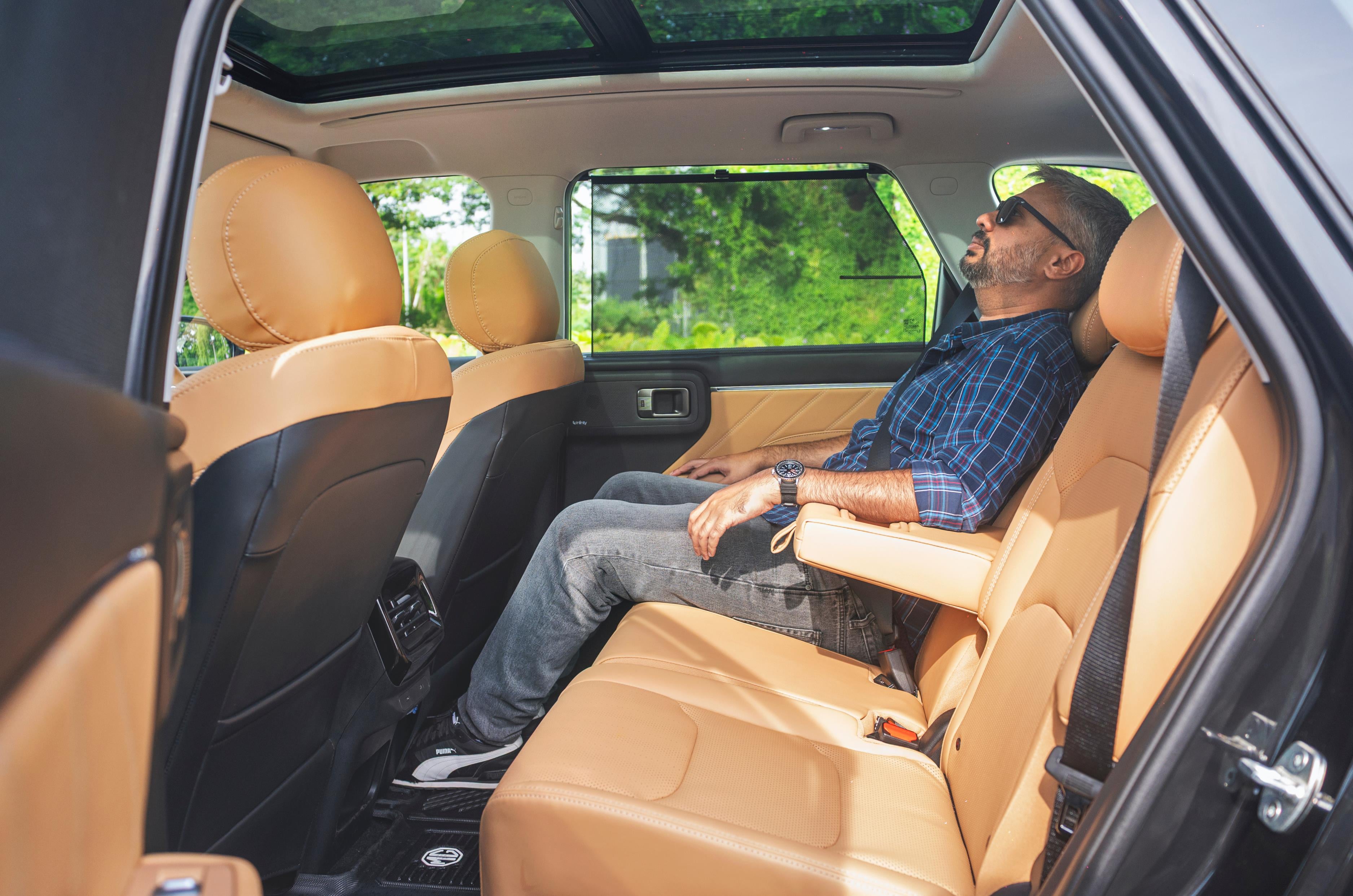
The Tomahawk has the second-longest wheelbase in class (next only to the Vinfast MPV 7), and it shows in the second row. Legroom is excellent, and while you do sit slightly knees-up, thigh support is adequate too. The seatback reclines pretty far back and features an armrest and three adjustable headrests. Window sunshades, AC vents and Type-C USB ports add to the rear-seat comfort and convenience.
The chauffeur-driven are well taken care of, with a comfy reclining bench, plenty of room all around and sunblinds.
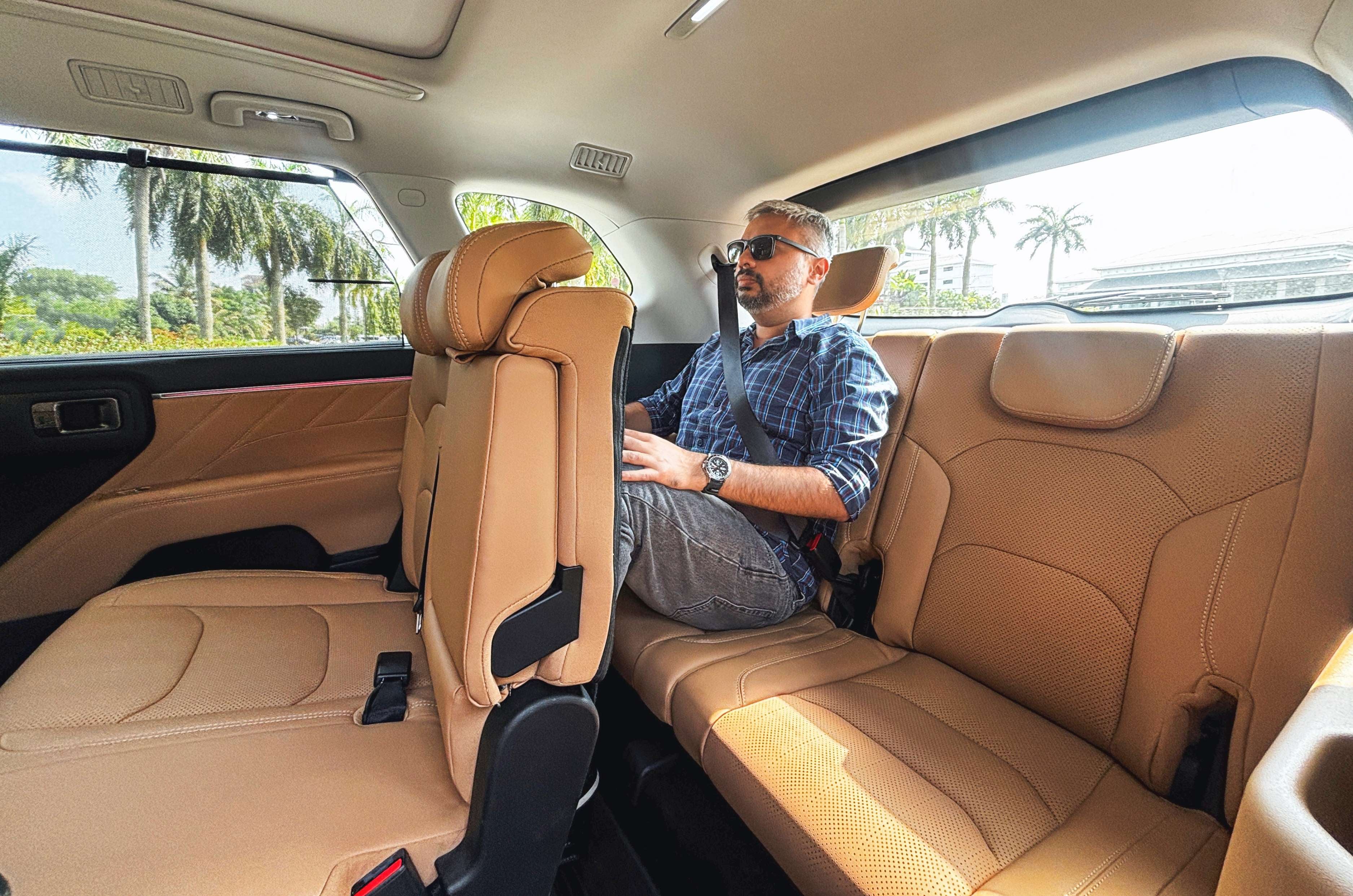
The Tomahawk EV is available in both 5- and 7-seater guises. The latter adds a sliding second row with one-touch tumble to access the third row, as well as more AC vents on the roof and a dedicated fan-speed control. Getting into the last row is surprisingly dignified thanks to a large aperture, but kneeroom depends largely on the middle-row passengers’ generosity, and the low seat means thigh support is non-existent. Headroom is good, though, and for short journeys, adults will be fine back there.
Third row will fit adults but with a slight compromise to the middle-row space.
With the third row up, boot space stands at 192 litres – enough for a couple of carry-on bags – expanding to a generous 528 litres with it stowed. Under the boot floor are a few more storage cubbies, which are handy since there is no frunk – a miss considering there appears to be enough space under the bonnet. A space-saver spare is mounted underneath the car.
MG Hector Tomahawk EV Features and Safety – 8/10
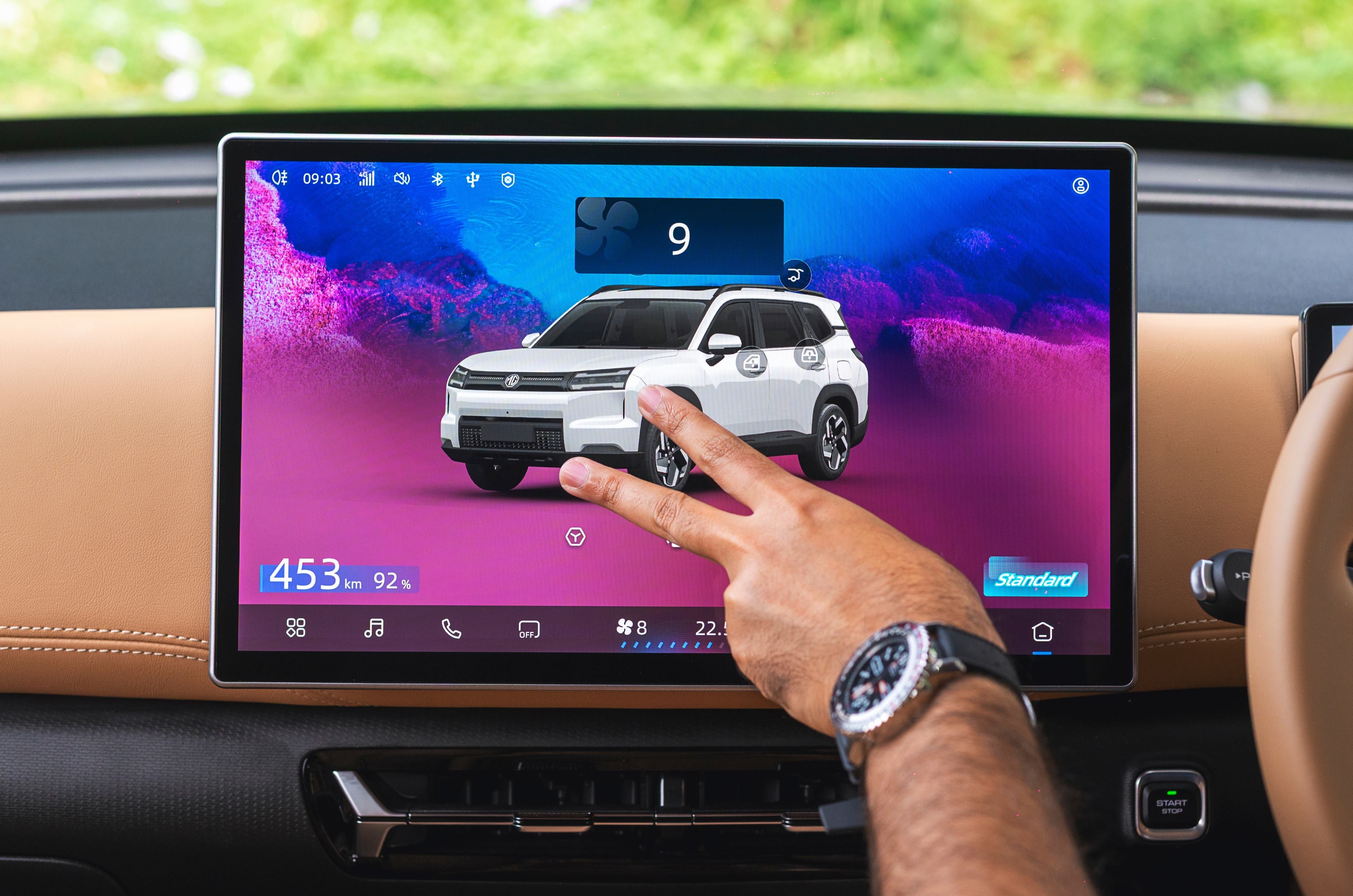
The minimalist interior layout means you reach for the 15.6-inch infotainment screen for most functions. While this can get distracting, physical and swipe-gesture controls together handle most basic HVAC and audio functions with surprising ease. Anything beyond basic, though, will require a deep dive into the screen. While the screen is sharp and snappy and the UI is clean, it can take a while to find your way through the maze of sub-menus. Wireless Android Auto and Apple CarPlay are also present, but using either hides the row of shortcuts at the bottom of the screen. Hardcoding these buttons to always stay on top would improve usability. The screen also often catches glare, which takes away from the otherwise sharp 360-degree camera.
Several functions are baked into the 15.6-inch touchscreen, but gesture controls for essential functions are quite intuitive.
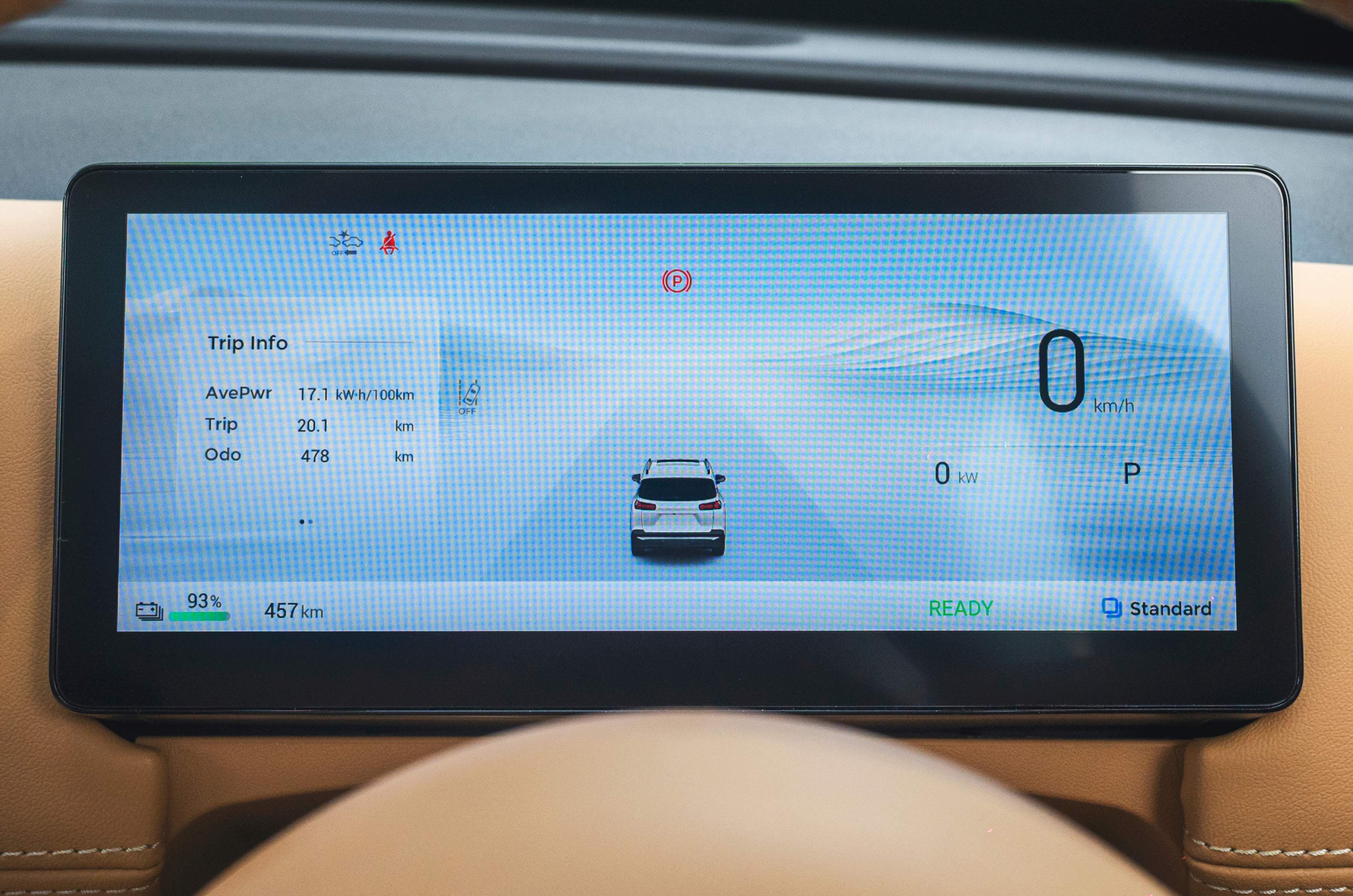
Instrumentation is handled by an 8.8-inch display directly in front of the driver. The screen itself is sharp, but some smaller fonts might have you reaching for your reading glasses. Its real estate could also be better utilised by displaying the blind-view camera feed rather than the current pop-up on the centre screen. Other feature highlights include a sweet-sounding 10-speaker Infinity audio system, a panoramic sunroof that stretches over the second row, 256-colour ambient lighting, connected car tech, an AI assistant and more. It’s worth mentioning that the Tomahawk EV also gets a physical start/stop button, which is absent on the brand’s other EVs.
8.8-inch driver’s display is sharp, but some smaller fonts might have you reaching for your reading glasses.
A Level 2 ADAS suite is also available on the top Essence trim, with functions such as adaptive cruise control, lane keep assist and auto emergency braking. While there isn’t an official crash-test rating yet, the robust standard safety kit, including six airbags, ESP, all-wheel disc brakes and Isofix mounts, provides some confidence.
MG Hector Tomahawk EV Performance and Refinement – 7/10
The Tomahawk EV offers just one powertrain configuration – a 69.2kWh LFP battery pack powering a single motor on the front axle, producing 204hp and 310Nm, good for a claimed 0-100kph time of 8.2 seconds. Its front-wheel-drive layout puts it at a disadvantage against rivals from Tata and Mahindra, who offer either rear- or all-wheel drive and higher power outputs. The front-driven Hyundai Creta Electric or Kia Carens Clavis EV are closer matches, and the Tomahawk EV betters them on power and torque.
First EV on MG’s ADAPT architecture pairs a 69.2kWh battery with a front-mounted motor producing 204hp and 310Nm.
Initial throttle response is mild, making it quite easy to amble around town, but push harder, and you get a power spike resulting in torque steer. In Sport mode, you’ll hear the front tyres protest when made to put all that torque down on a less-than-perfect road. Standard mode dulls response slightly, but it can still catch new drivers off guard. With time, it is possible to drive around this, but the latest crop of rival EVs has mastered a more linear delivery. Eco mode feels a bit tepid and is best saved to counter range anxiety, while a Custom mode lets you customise power output and regen braking in increments of 10 percent. There are also three preset regen modes – Standard, Comfort and Strong – but no paddles to control them or one-pedal mode. Instead, you get an Intelligent setting that uses the ADAS sensors to adjust regen in real time based on the traffic in front of you.
Grip levels and body control are good, but FWD layout struggles to put power down.
Refinement is a bit of a mixed bag. While the motor is fairly muted and there is little wind or tyre noise coming through, you hear the suspension at work on rough patches.
MG Hector Tomahawk EV Range and Efficiency – 7/10
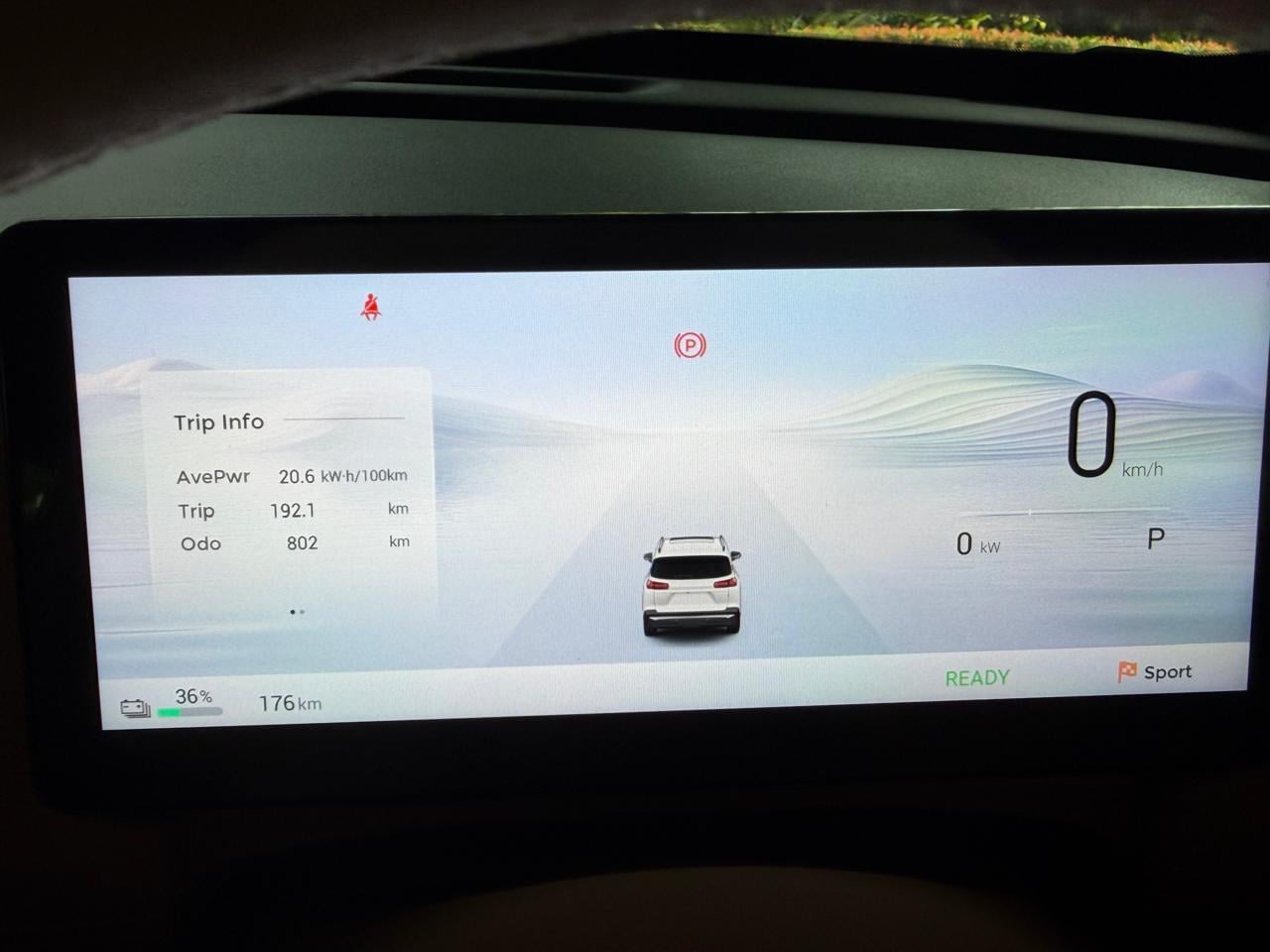
A spirited highway drive from Kochi to Kozhikode covering 192km, resulted in an overall efficiency of 4.85km/kWh.
While the Hector name is often associated with poor fuel efficiency, the new EV and PHEV hope to change that. MG claims an MIDC range of 517km from its 69.2kWh battery pack. On a spirited drive from Kochi to Kozhikode covering 192km, we recorded an overall efficiency of 4.85km/kWh, translating to a real-world range of 336km. This was on a fast highway run, where the Tomahawk’s tall shape won’t do its efficiency any favours. We’ll put it through our standard real-world efficiency test when we have the car for longer.
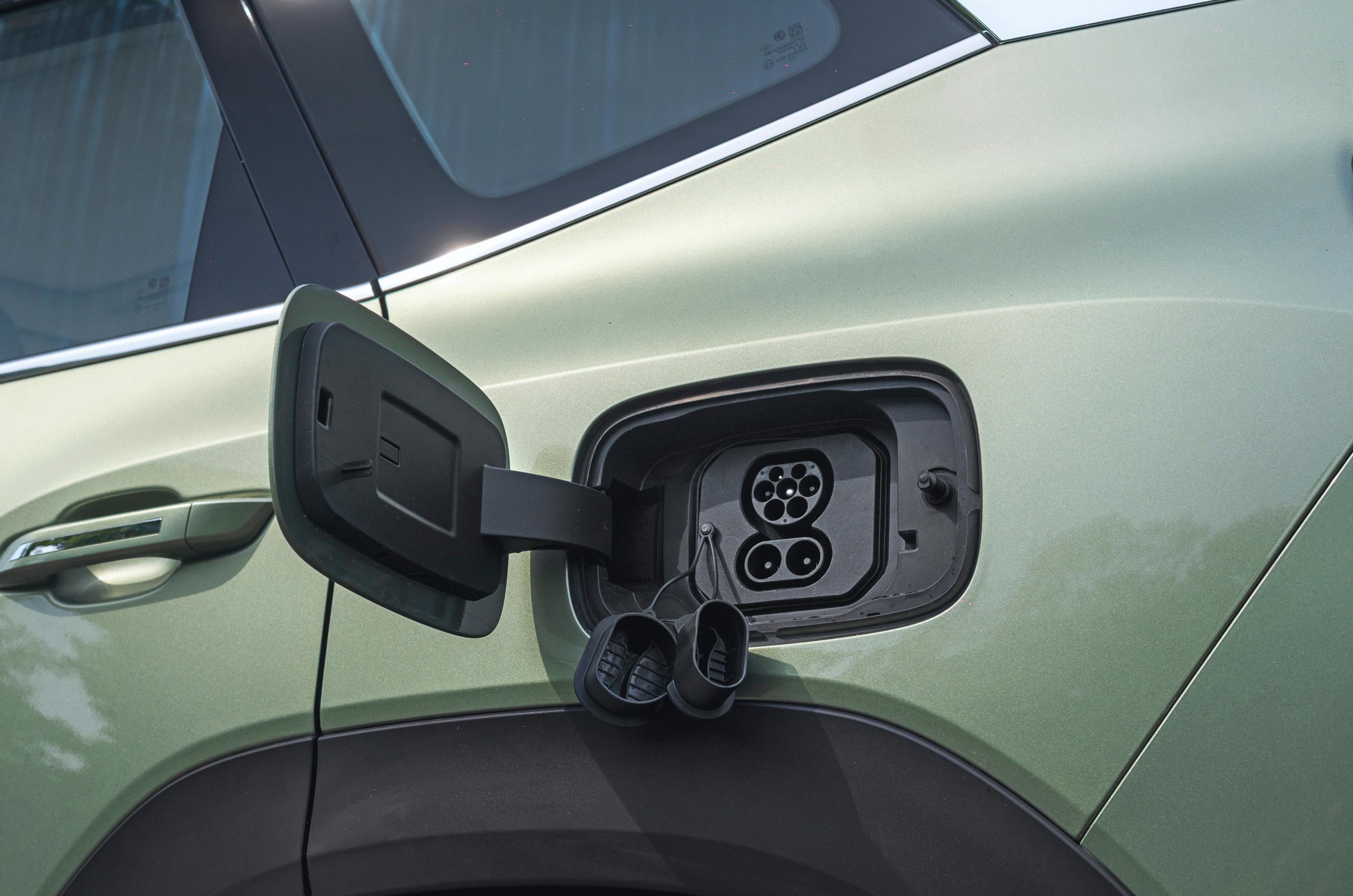
DC fast charges at 90kW – slower than rivals but enough for a 30 to 80 percent top-up in a claimed 35 minutes.
Topping up the battery from 10 to 100 percent using the 7.4kW charger is said to take around 12.5 hours. It can also DC fast charge at speeds of up to 90kW, which is lower than its immediate rivals but still enough to take the battery from 30 to 80 percent in about 35 minutes.
MG Hector Tomahawk EV Ride Comfort and Handling – 7/10
Rides with more maturity than previous MG EVs, but suspension can be heard working.
The Hector Tomahawk EV makes a big step up in ride and handling compared to the ICE Hector, but there is still some room for improvement. It rides with more maturity than previous MG EVs, comfortably absorbing most of what we threw at it. However, you do hear the suspension working. Sharper bumps reveal an underlying firmness that occasionally comes through to the cabin. Most roads around Kochi were relatively smooth, and we weren’t able to experience it on rippled concrete, so we will reserve full judgement until we have the car for longer.
A big positive is how easy the Tomahawk is to drive for something this large. Visibility all around is excellent, and you can see the bonnet’s edges from the driver’s seat. A light steering also helps, and overall, it feels less intimidating to drive through tight traffic than, say, the XEV 9S.
230mm claimed ground clearance is best in class; wheelbase second only to VF MPV 7.
The steering also weighs up as speeds rise and feels reasonably direct, though the sheer amount of torque going to just the front wheels corrupts the feel. At a quick pace through the twisties, you feel the wheel tugging at your hands as you apply power. Body control is good, and it stays composed through quick direction changes, but a sedate pace is more its element. Braking is strong, with four-wheel discs bringing the heavy SUV to a confident halt.
MGHector Tomahawk EV Value for Money – 7/10
Introductory pricing for the Hector Tomahawk EV starts at Rs 19.49 lakh and tops out at Rs 23.49 lakh. The Battery-as-a-Service (BaaS) scheme lowers the entry barrier to Rs 13.99 lakh, with battery rental set at Rs 4.90 per km. While all these prices are applicable to limited units only, this is quite aggressive pricing from MG.
Practical, comfortable and no-nonsense SUV will appeal to the chauffeur-driven but lacks the dynamic polish of its rivals.
When compared spec-for-spec, it undercuts the competition from Tata and Mahindra while offering a bigger battery and more performance than its Korean rivals. It has a spacious and comfortable cabin, a comprehensive feature set and is surprisingly easy to drive for its size. However, it lacks the dynamic polish of its rivals and therefore doesn’t feel like a latest-generation EV. As such, its Hector name starts to make more sense. It is a practical, comfortable, no-nonsense SUV that will appeal to the chauffeur-driven just like its forebear. Those looking to do the driving, though, are better off looking elsewhere.