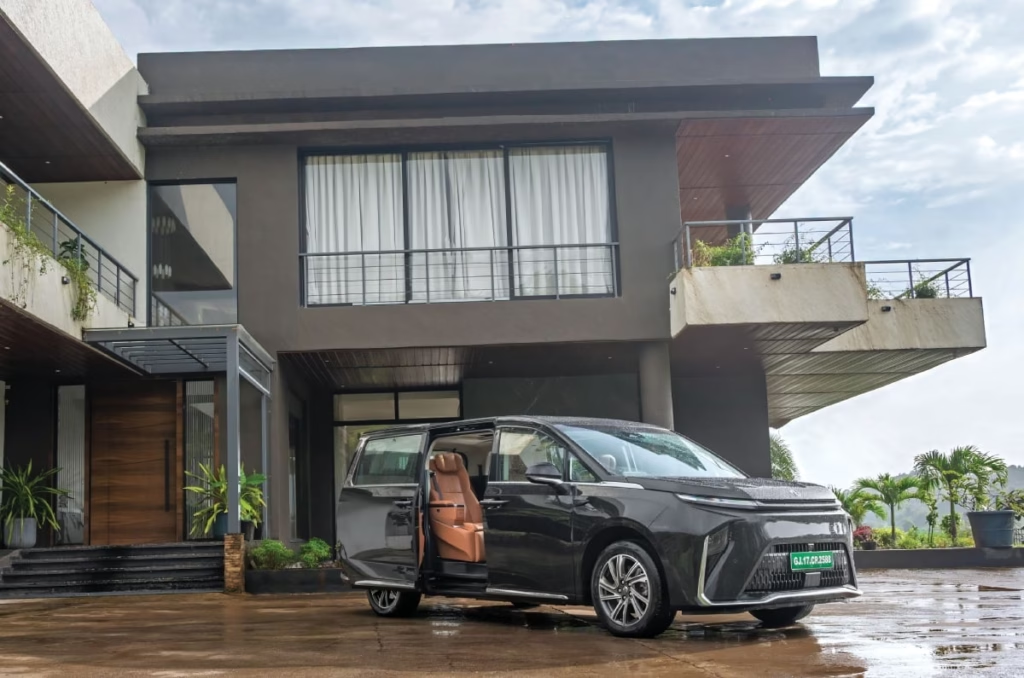
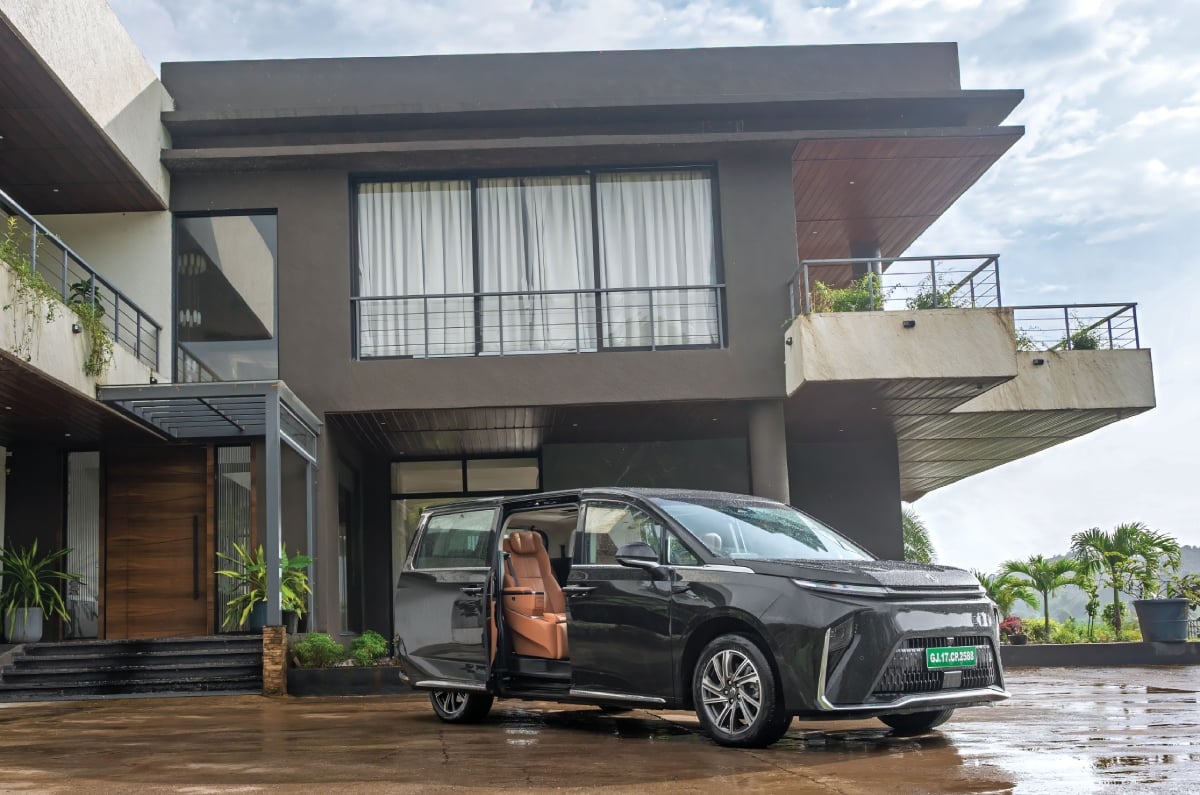
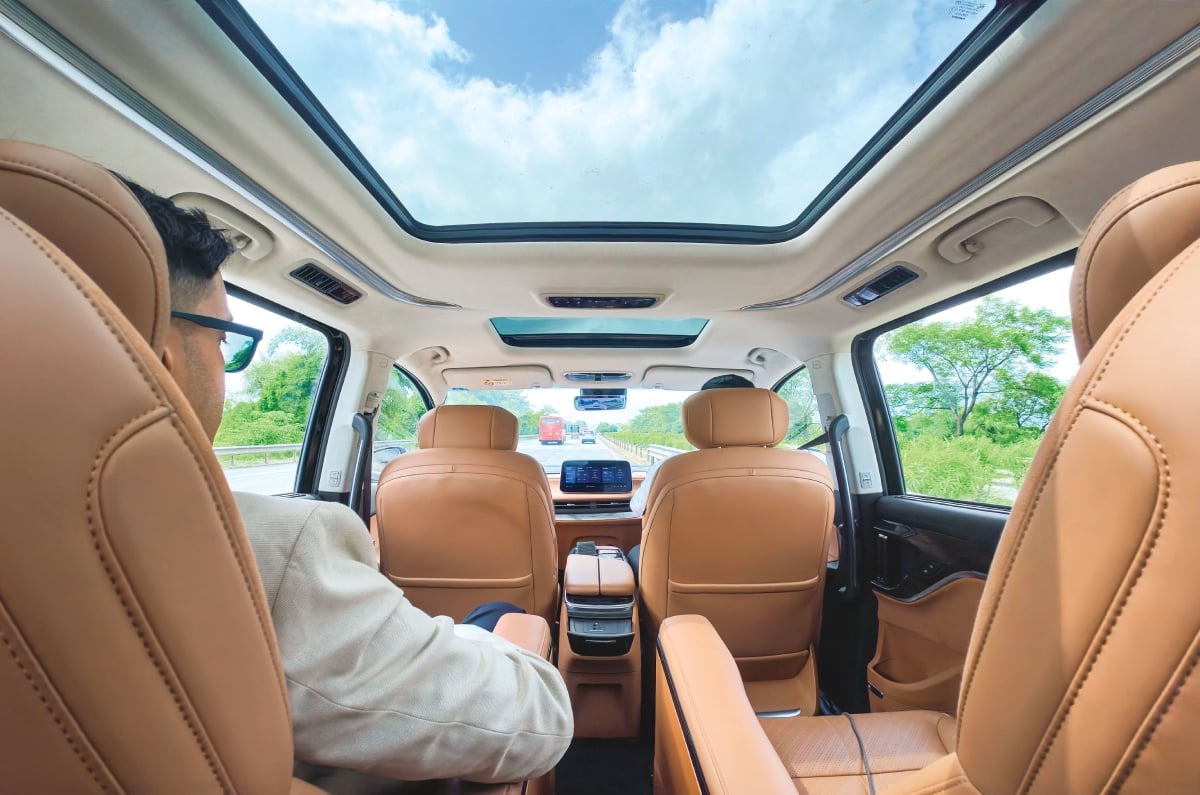
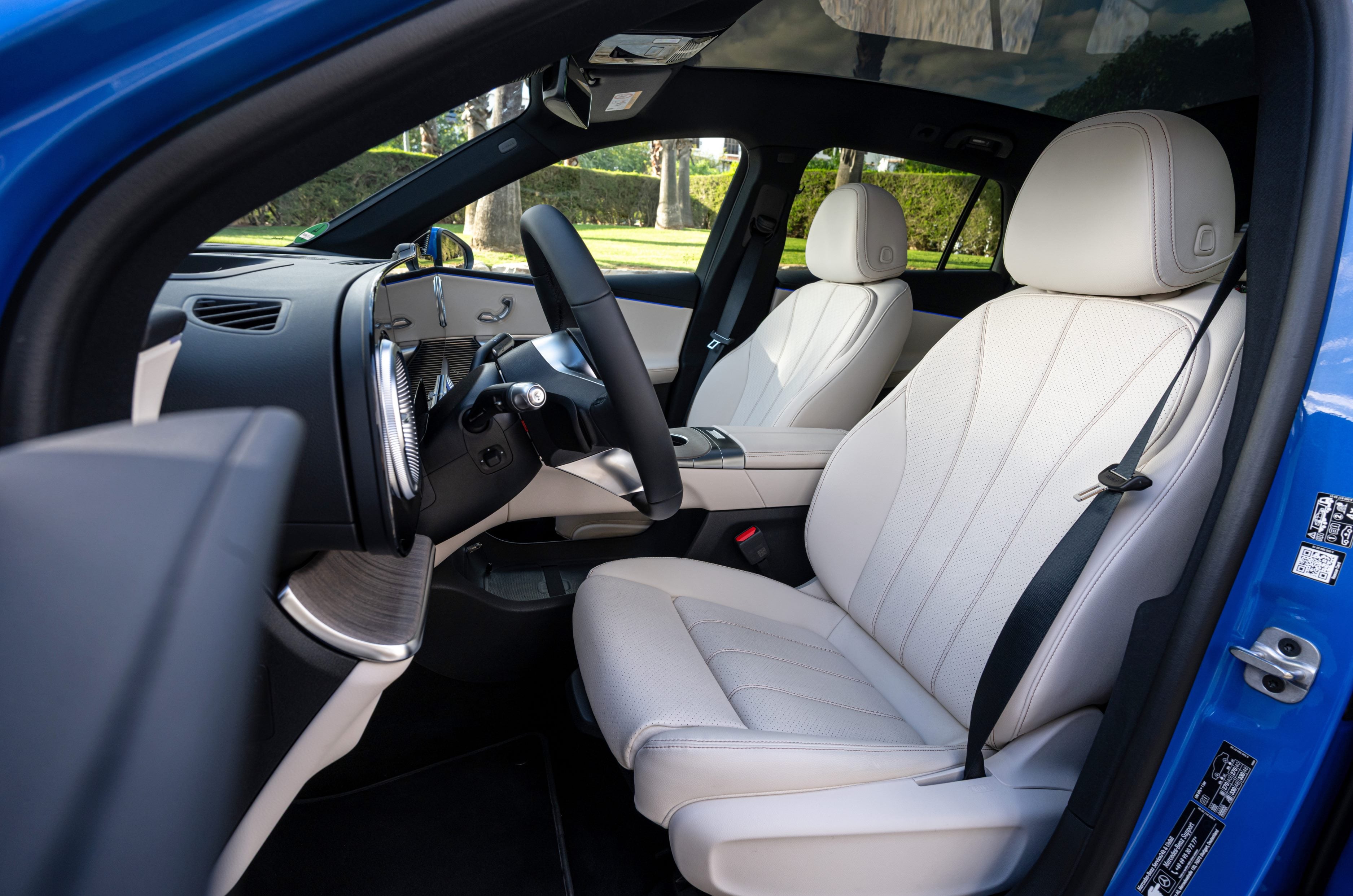
There are vastly different ideas of what luxury means. For some, it is craftsmanship – the quality of the materials, the precision of the detailing and the sense of occasion that comes with them. For others, it is exclusivity, space or technology. But perhaps the most valuable form of luxury today is something considerably harder to manufacture: time.
The freedom to spend a journey exactly as you want, without worrying about the road ahead, is the kind of luxury the MG M9 is built around. And nowhere is that more evident than in its Presidential second row.
Every drive in the M9 is an opportunity to stretch out and relax.
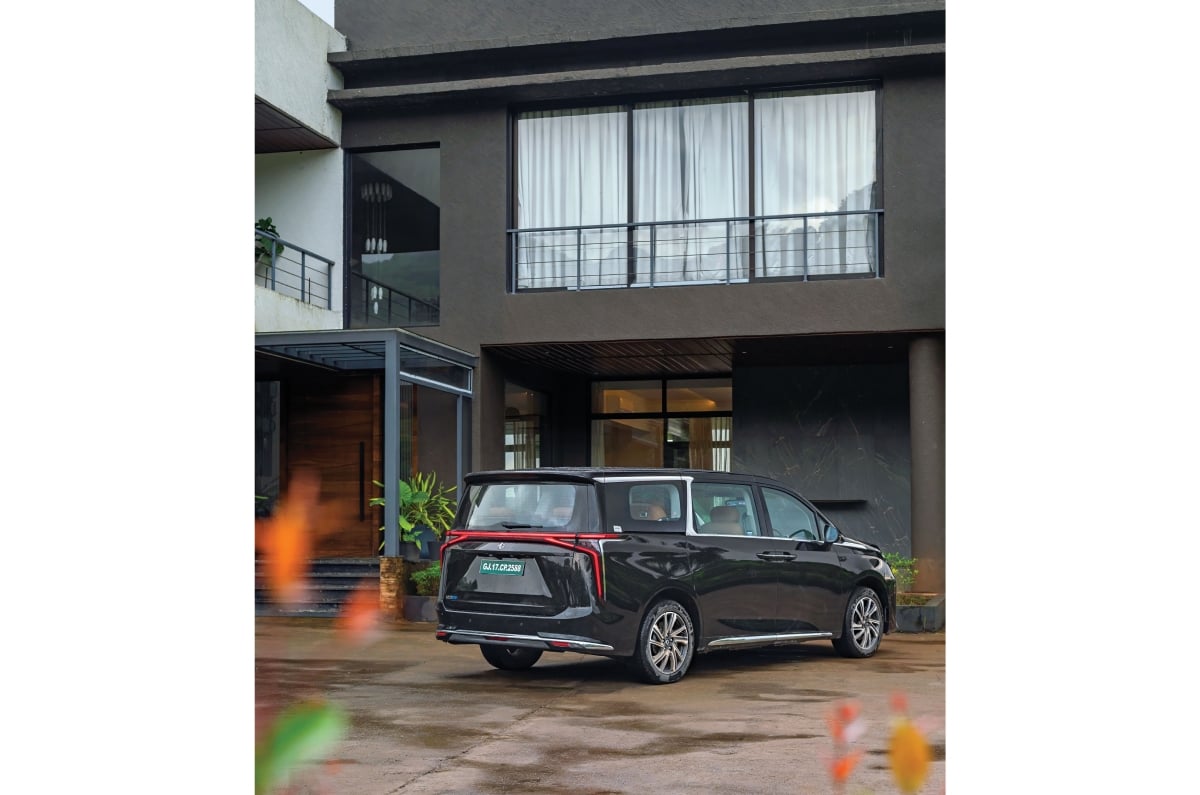
Leaving Mumbai behind for Karjat, the M9 turns what could be a routine road trip into something rather different. The traffic, the road surface and the distance to the destination are still there, but they no longer need to occupy the passenger’s attention. The second row has been designed to make the journey itself the experience.
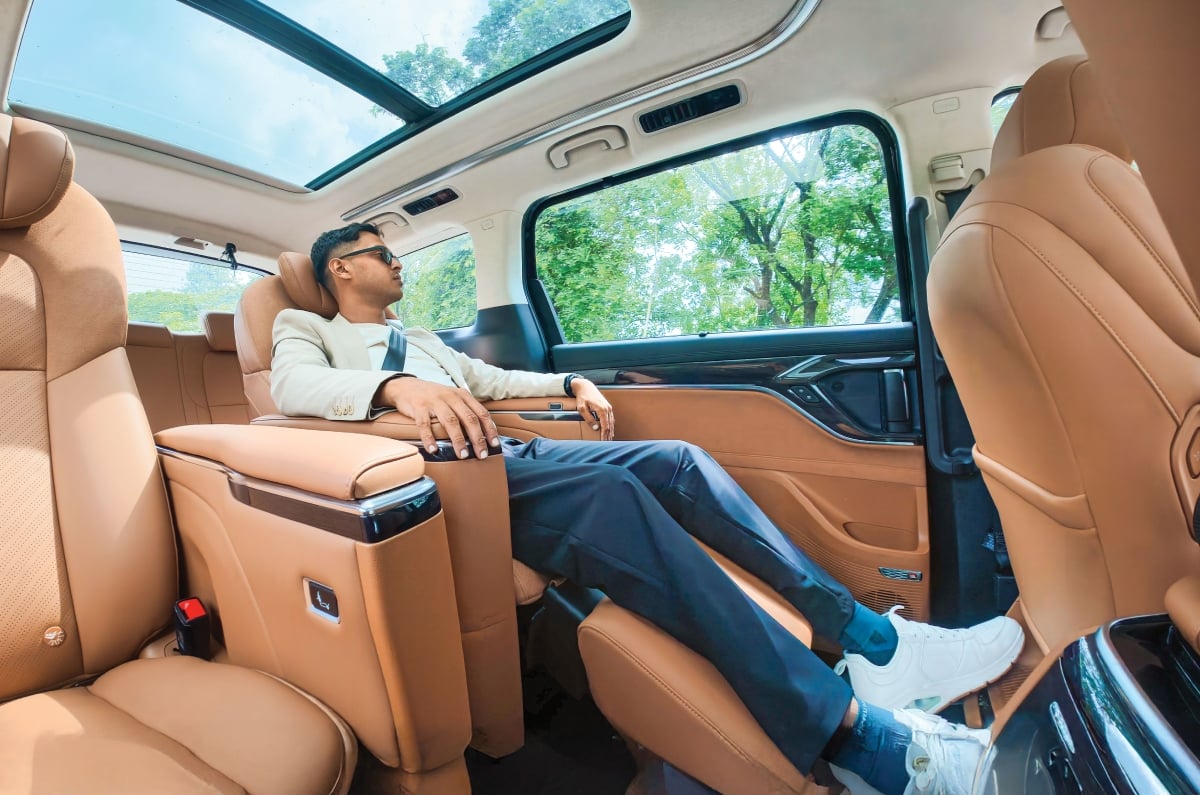
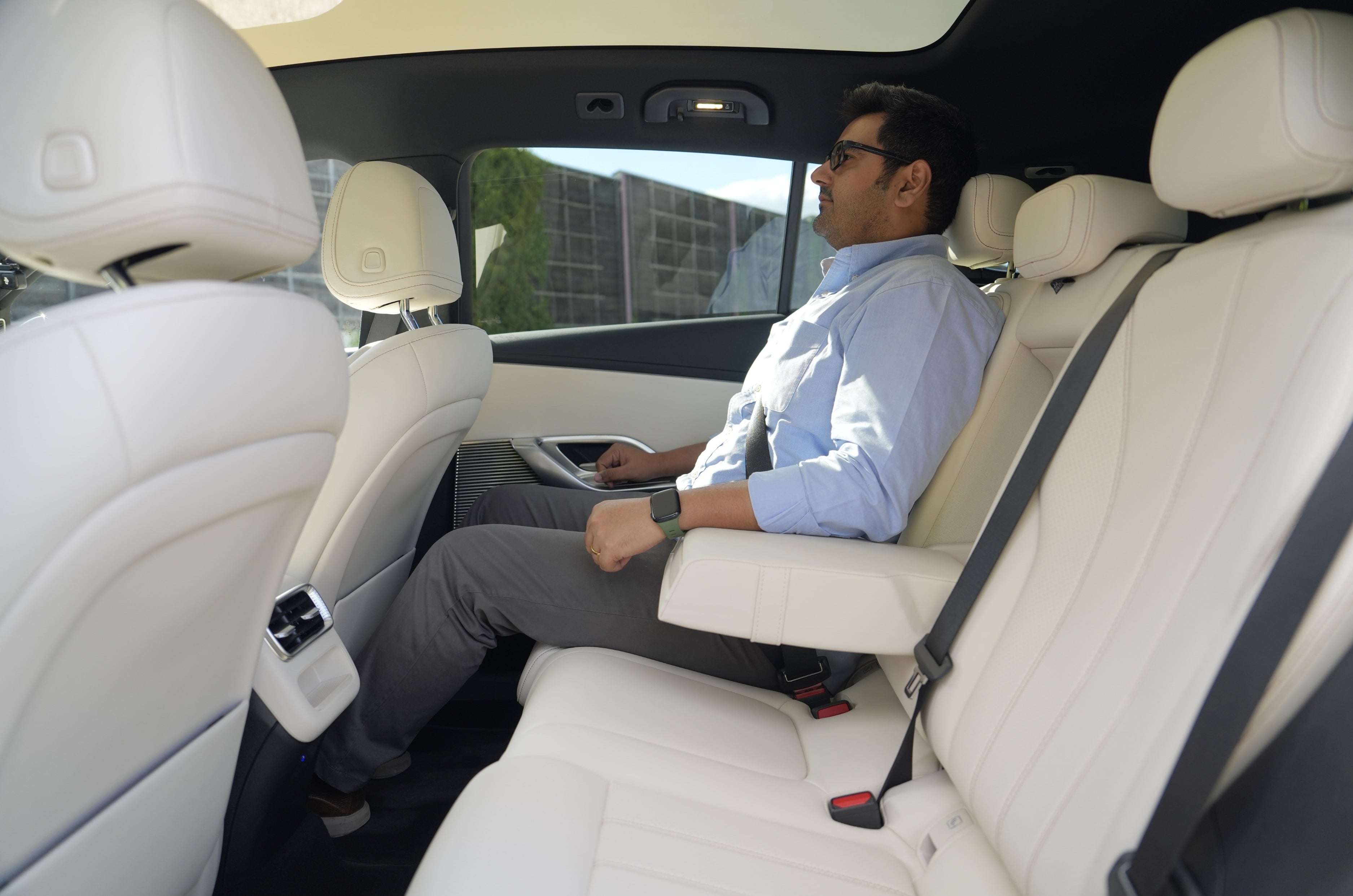
The two Presidential Seats are the obvious starting point. With 16-way electric adjustment, heating, ventilation and eight massage functions, they offer considerably more than simply a comfortable place to sit. Their leg rests can be extended, allowing you to get that ‘putting your feet up after a long day’ experience, and the backrests can be reclined. And particularly with Boss Mode moving the front passenger seat forward, the available space is nothing short of vast.
The M9’s Boss Mode is especially handy if you want to free up some leg room in the second row.
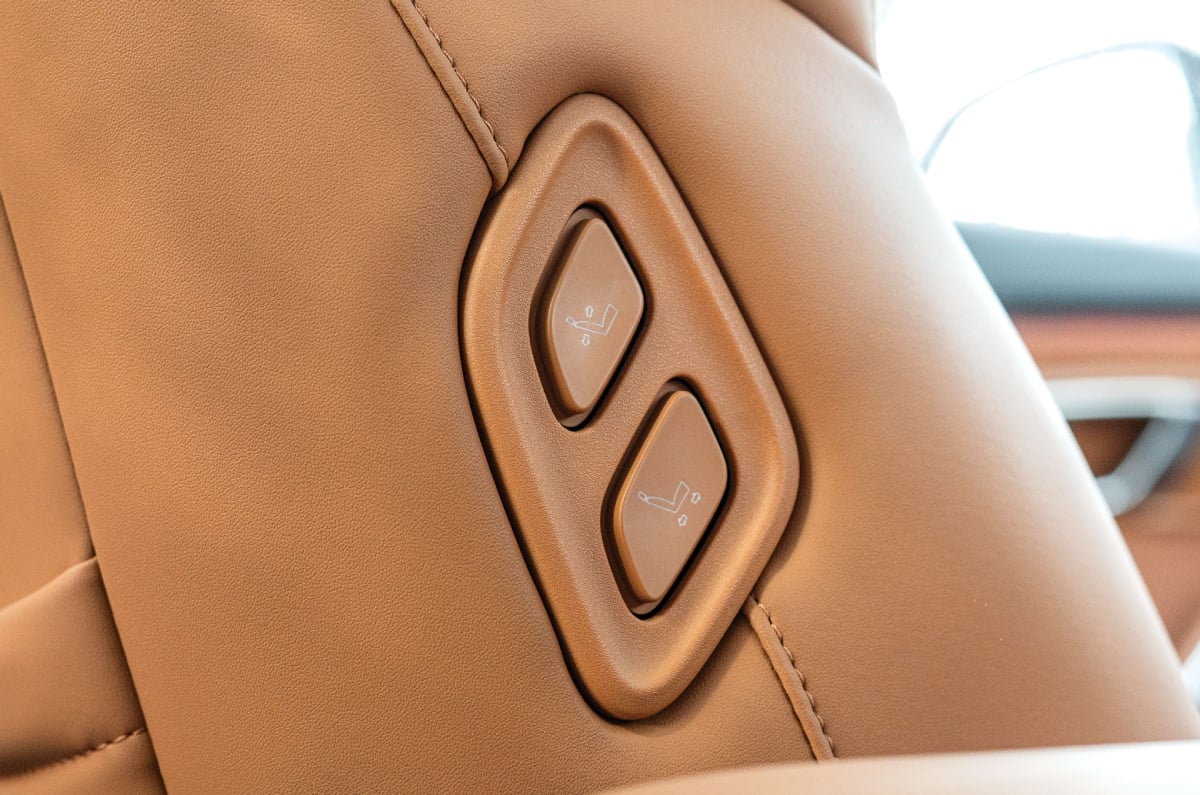
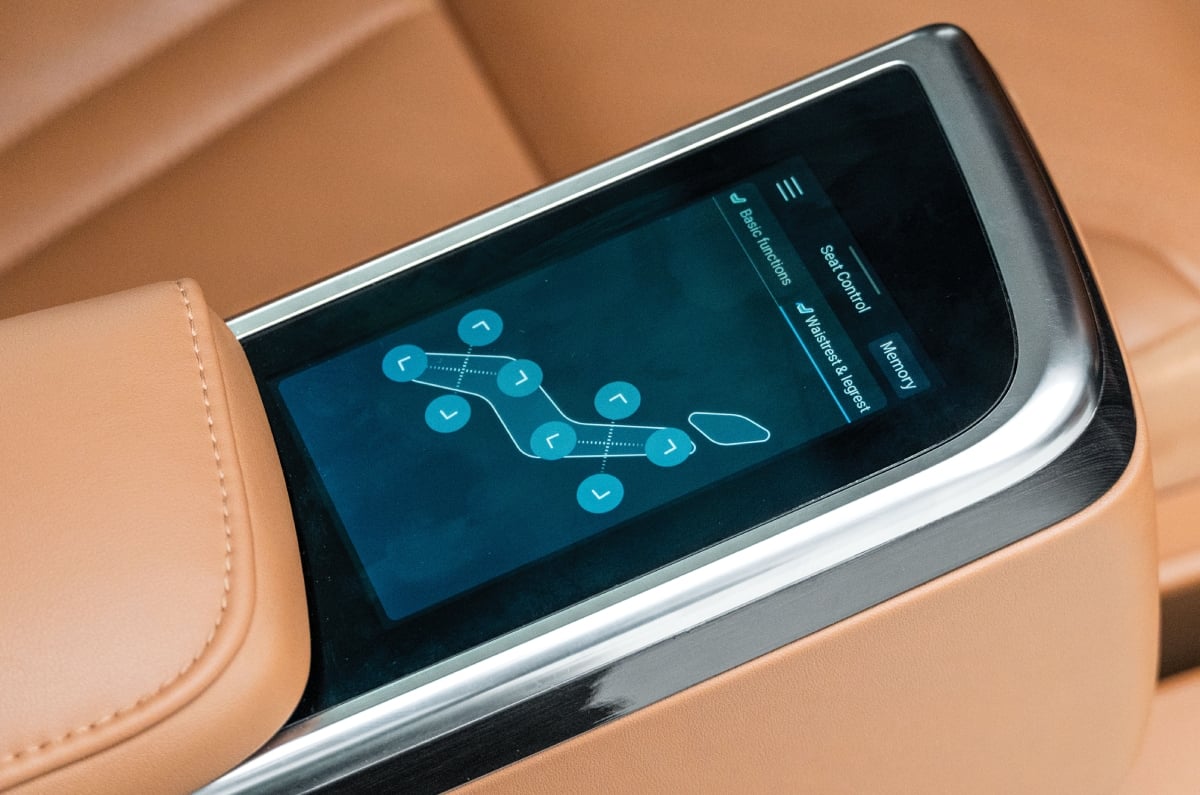
It is the sort of environment in which work can be done without feeling like work. Every major seat function is within easy reach thanks to the intelligent armrests. Not only can passengers adjust their seats’ position and temperature and regulate the AC, they can even get a massage, activate the sunroof or alter the ambient lighting. Once the laptop is closed, the M9 can change character just as easily.
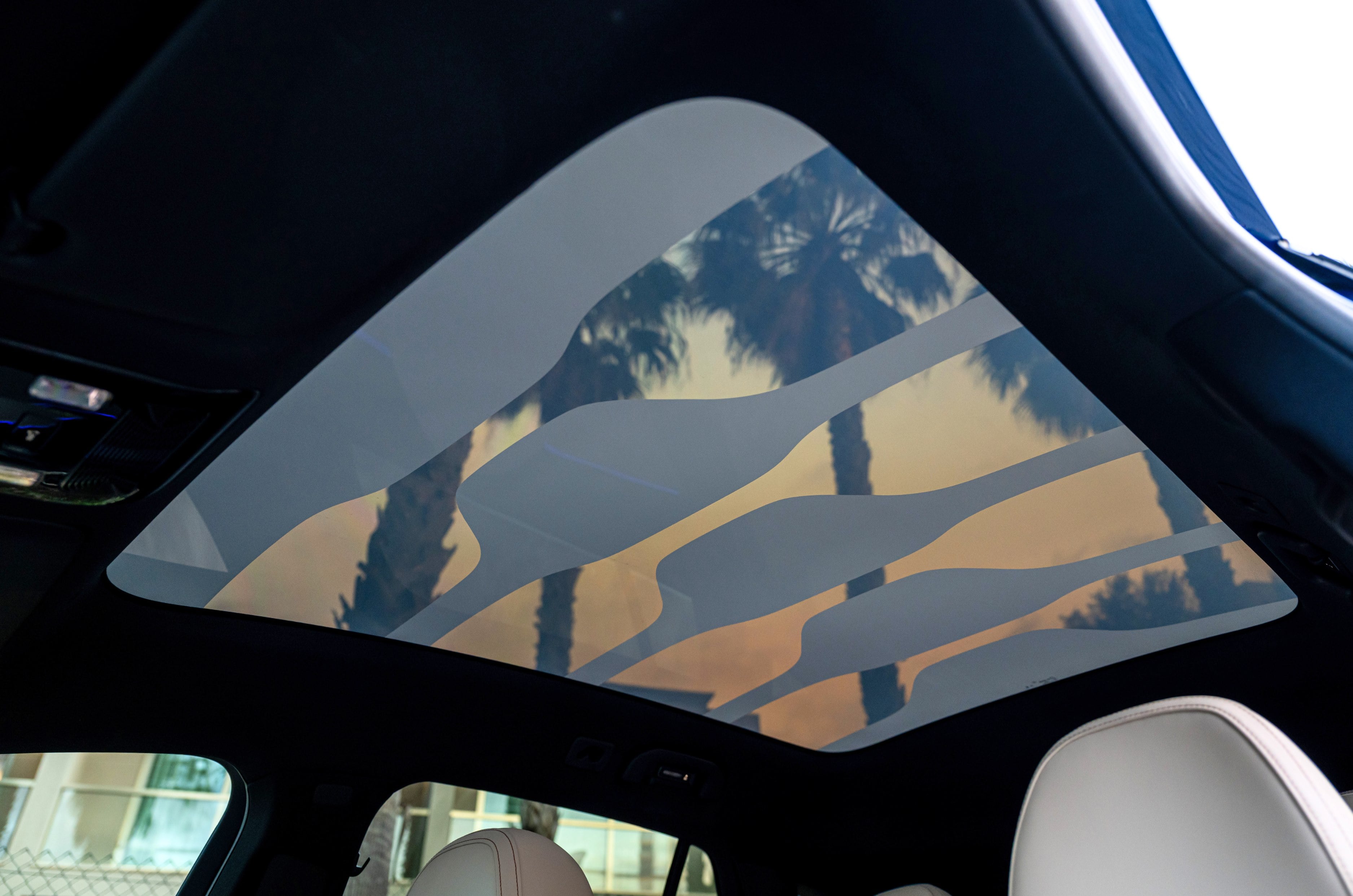
The dedicated second-row climate zone means passengers can set the temperature to their liking, while 64-colour ambient lighting allows the atmosphere to be changed from bright and functional to subdued and relaxing. The panoramic, yacht-style dual sunroof adds another layer to the sense of space, bringing natural light into what already feels more like a lounge than an MPV cabin.
The M9’s 13-speaker JBL audio system, complete with amplifier and subwoofer, takes advantage of the cabin’s excellent isolation. Even the details that are easy to overlook have been considered. There is a wireless charger, an air purifier and sunshades for the rear windows. The front seats are heated, ventilated and massaging too, while the third row gets its own air-conditioning vents and USB connectivity. This is a seven-seater, after all, and the M9 doesn’t treat the occupants furthest from the driver as an afterthought.
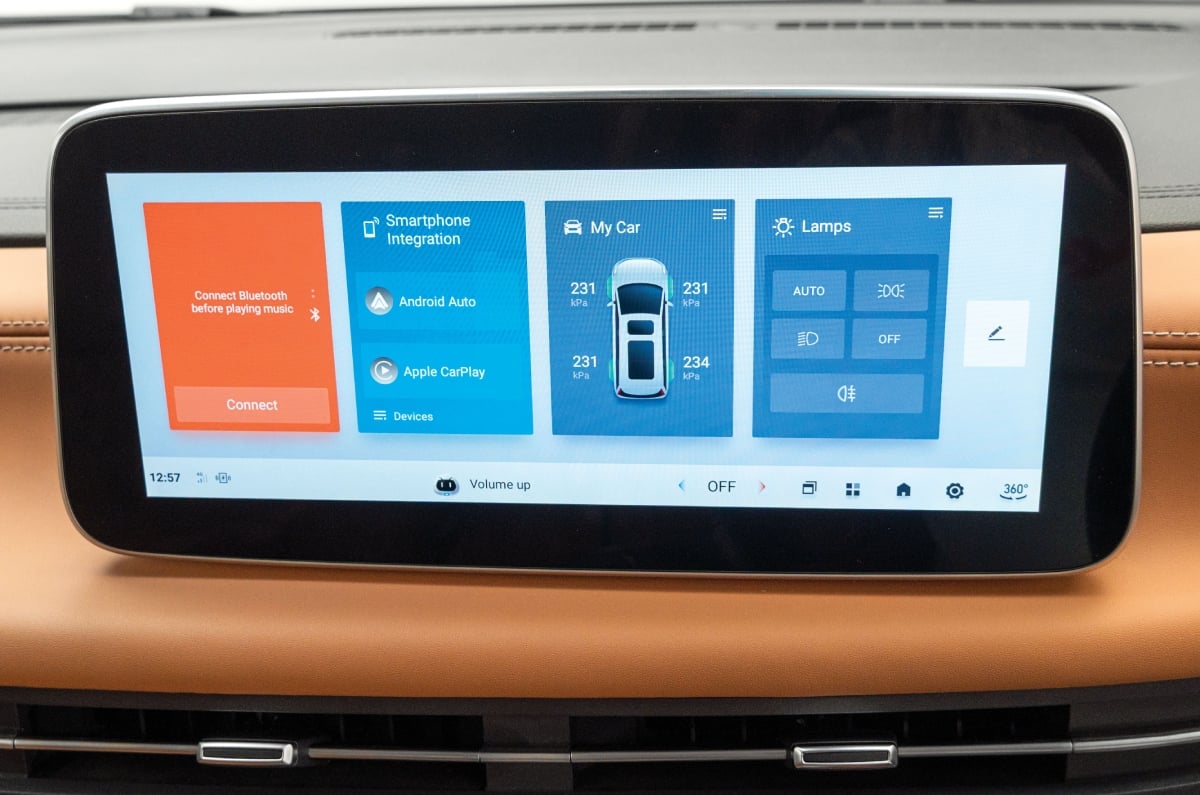
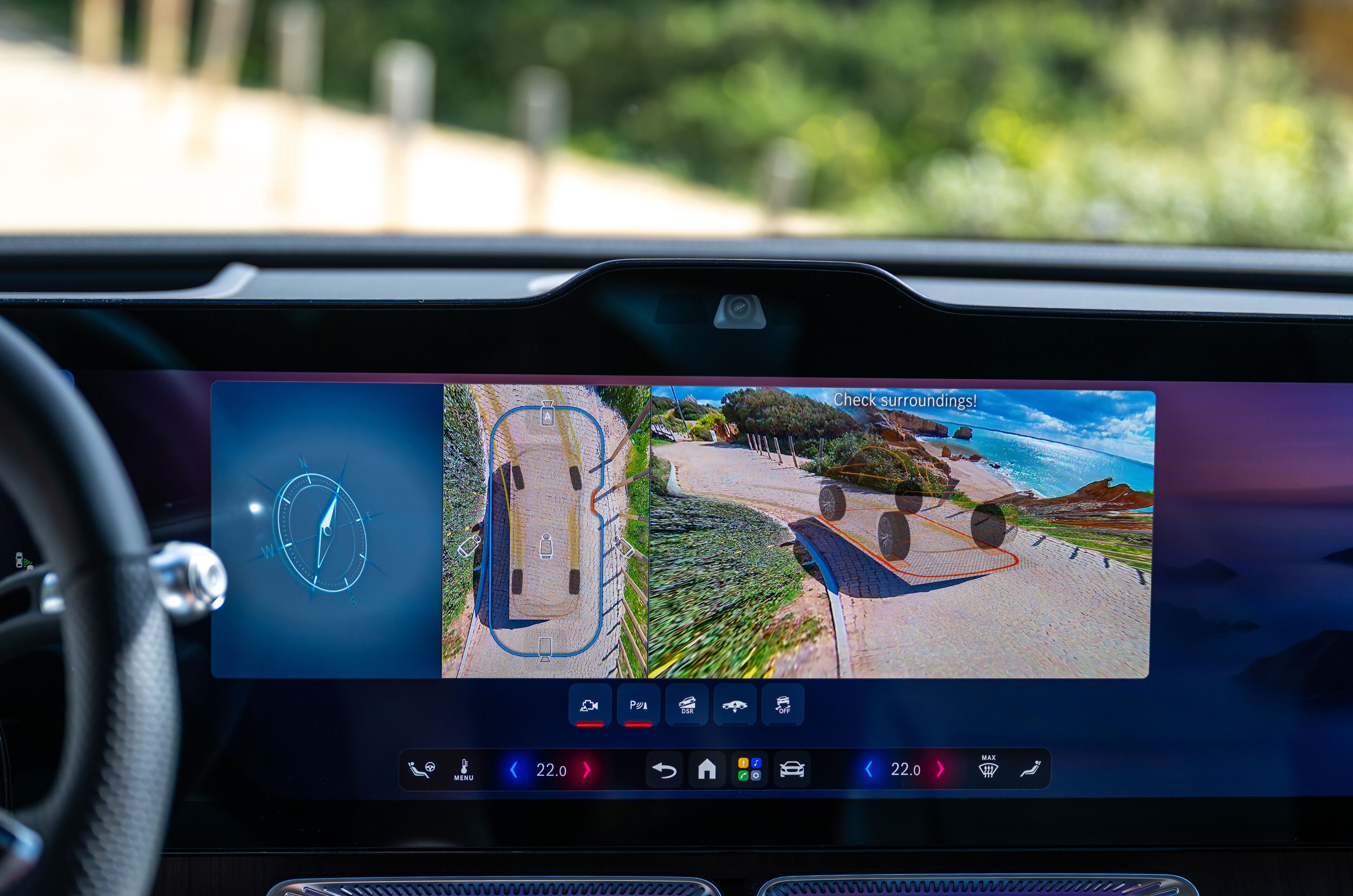
M9’s 12.3-inch central screen is loaded with useful functions and can even fully recline the second-row seats.
But it is the Presidential second row that defines the M9. And as the journey progresses, its importance becomes increasingly apparent. Mumbai’s roads aren’t always smooth. There are bumps, undulations, and speed breakers that arrive with little warning. Yet the M9’s suspension works quietly underneath, muffling sharper edges and keeping the cabin composed.
That refinement is complemented by the electric powertrain. A 90kWh NMC battery feeds a front-mounted motor producing 245hp and 350Nm, with a claimed range of 548km. But for those in the back, the more important numbers are the ones that don’t appear on a specification sheet: how little noise enters the cabin, how smoothly the M9 gathers speed and how rarely the occupants are reminded of the machinery doing the work.
Seat massage and adjustment controls are neatly built into second-row armrests.
As Mumbai’s traffic thins out, the road begins to wind through the green, mist-covered hills approaching Karjat, and the monsoon transforms the landscape into a succession of views worth looking at.
The M9 takes the inherent practicality and space of an MPV and reorganises them around the passenger. Its Presidential second row isn’t simply a collection of luxury features; it is the point around which the entire vehicle’s character revolves.
And the response has been encouraging. The M9 has found more than 2,500 buyers in less than a year, the surest sign that the idea of luxury is changing. It is becoming less about arriving with a sense of occasion and more about making the journey itself feel effortless.
Because when someone else is worrying about the road, the greatest luxury isn’t necessarily having somewhere better to go. It is having the time – and the space – to enjoy getting there.
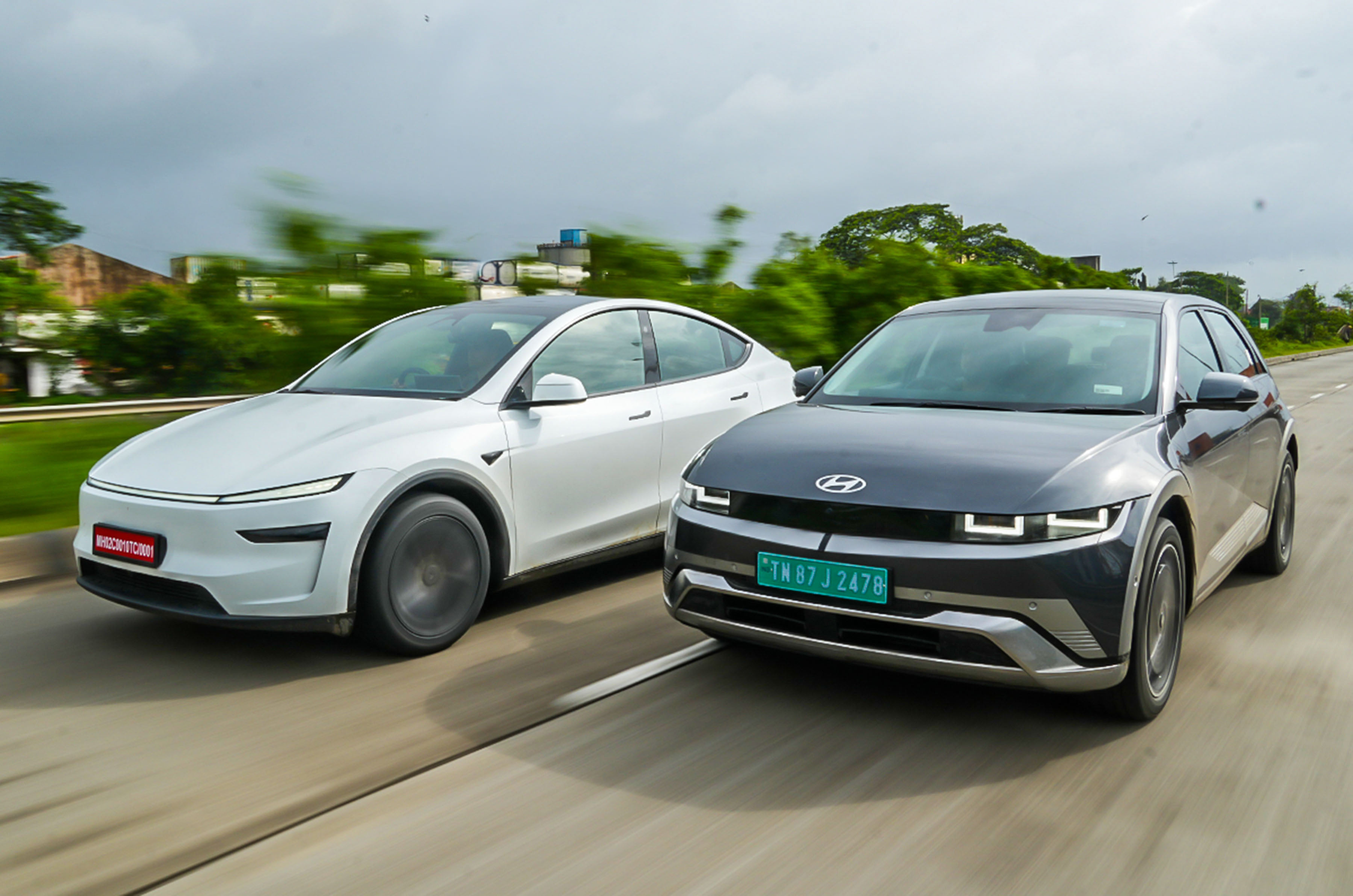
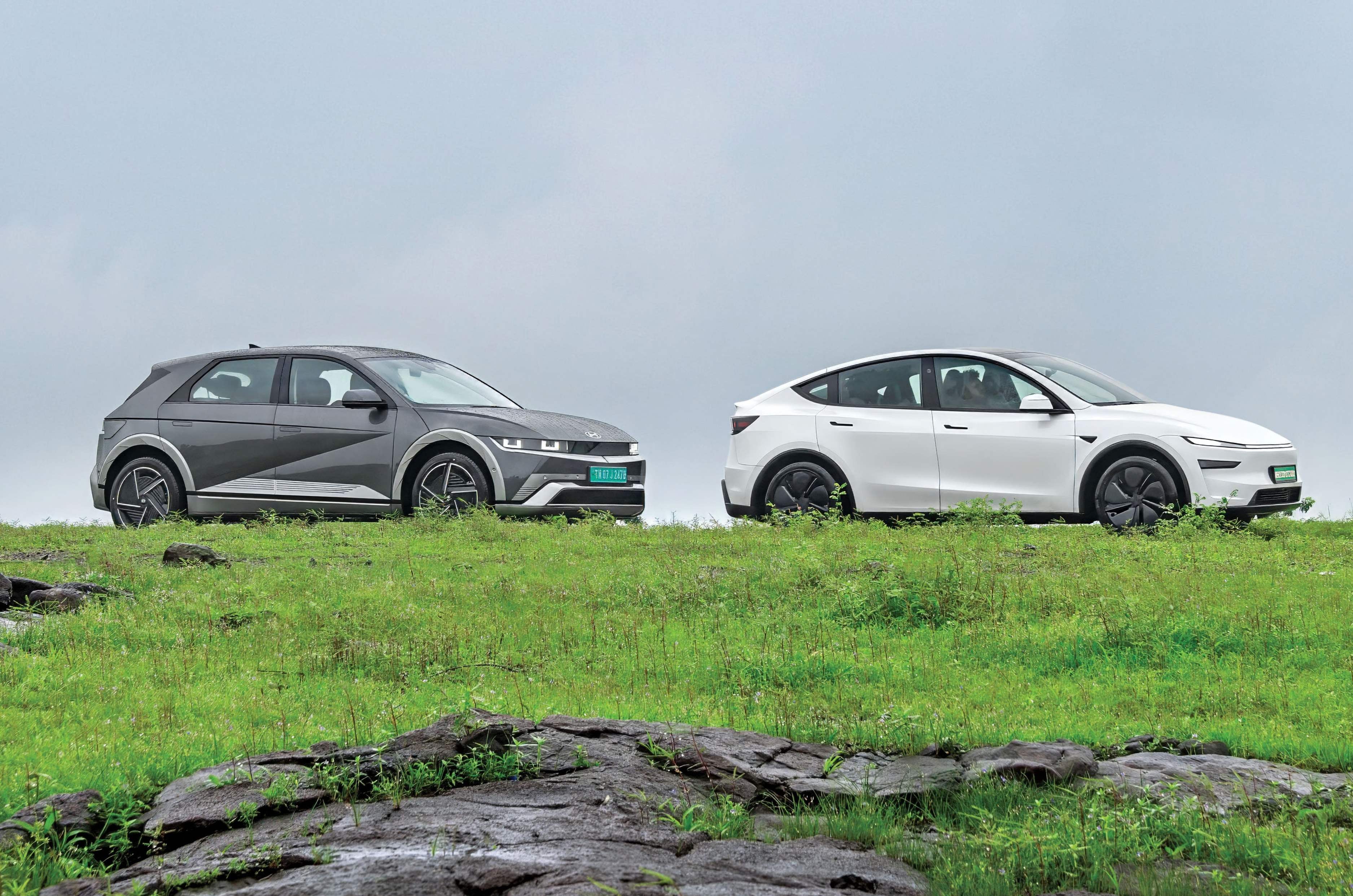
The Hyundai Ioniq 5 has been one of the standout EVs of recent years, so much so that we crowned it our 2024 Car of the Year. Back then, besides being one of the most impressive electric cars on sale, it was also among the most affordable in its segment. And when compared with rivals like the BYD Sealion 7 and BMW iX1, the Ioniq 5 came out on top thanks to its comfort, practicality and value.
Fast forward to 2026, and the landscape has changed. Hyundai has updated the Ioniq 5, and the biggest talking point is its larger 84kWh battery. But in the process, this value-focused EV has become one of the most expensive options available.
Tesla, meanwhile, has dropped prices. The Model Y now starts at just under Rs 51 lakh, undercutting the Ioniq 5 and transforming itself from one of the pricier alternatives into the more affordable option. With the pricing hierarchy flipped, this comparison has become more interesting than ever.
Tesla Model Y vs Hyundai Ioniq 5: Exterior design
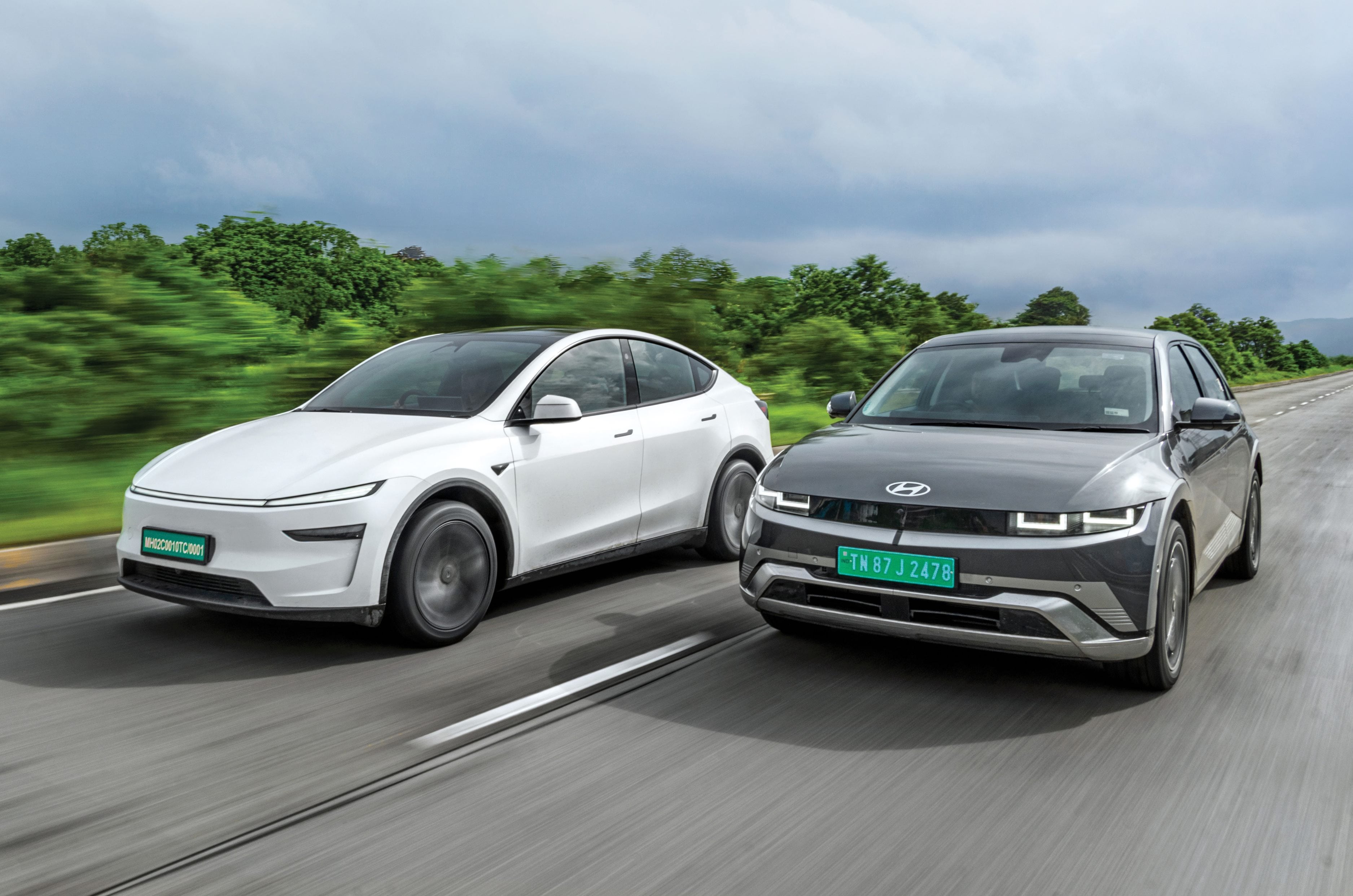
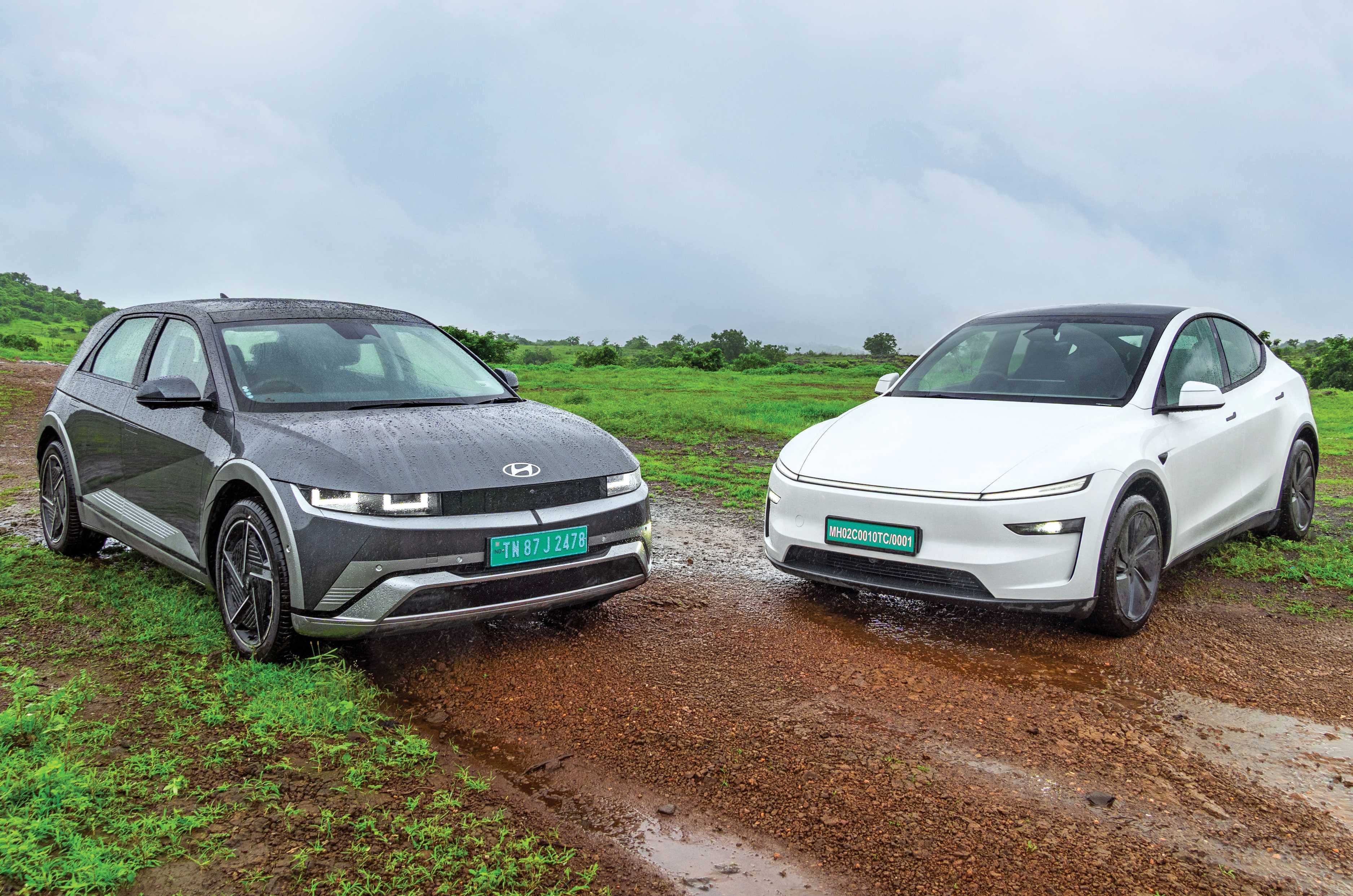
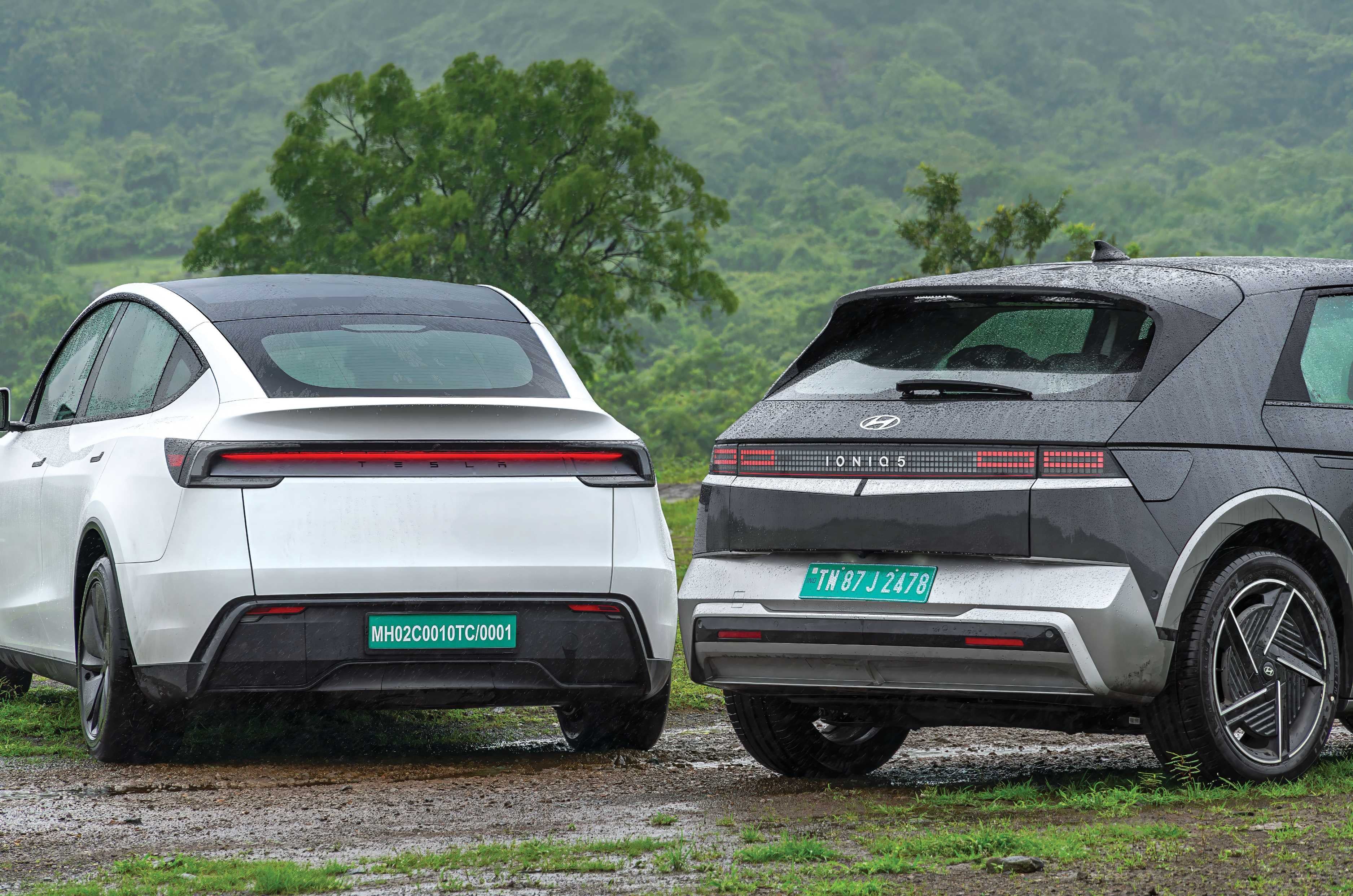
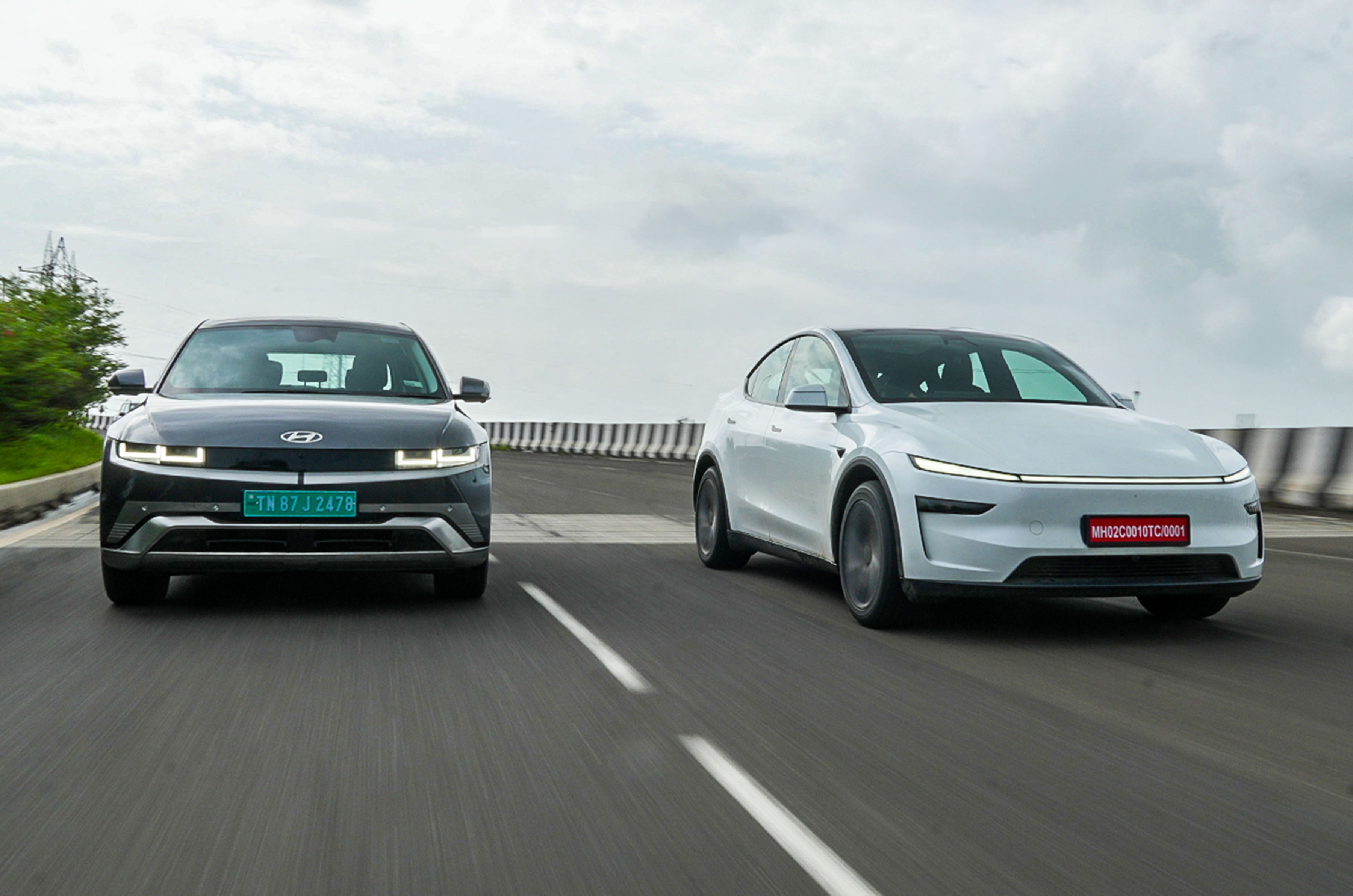
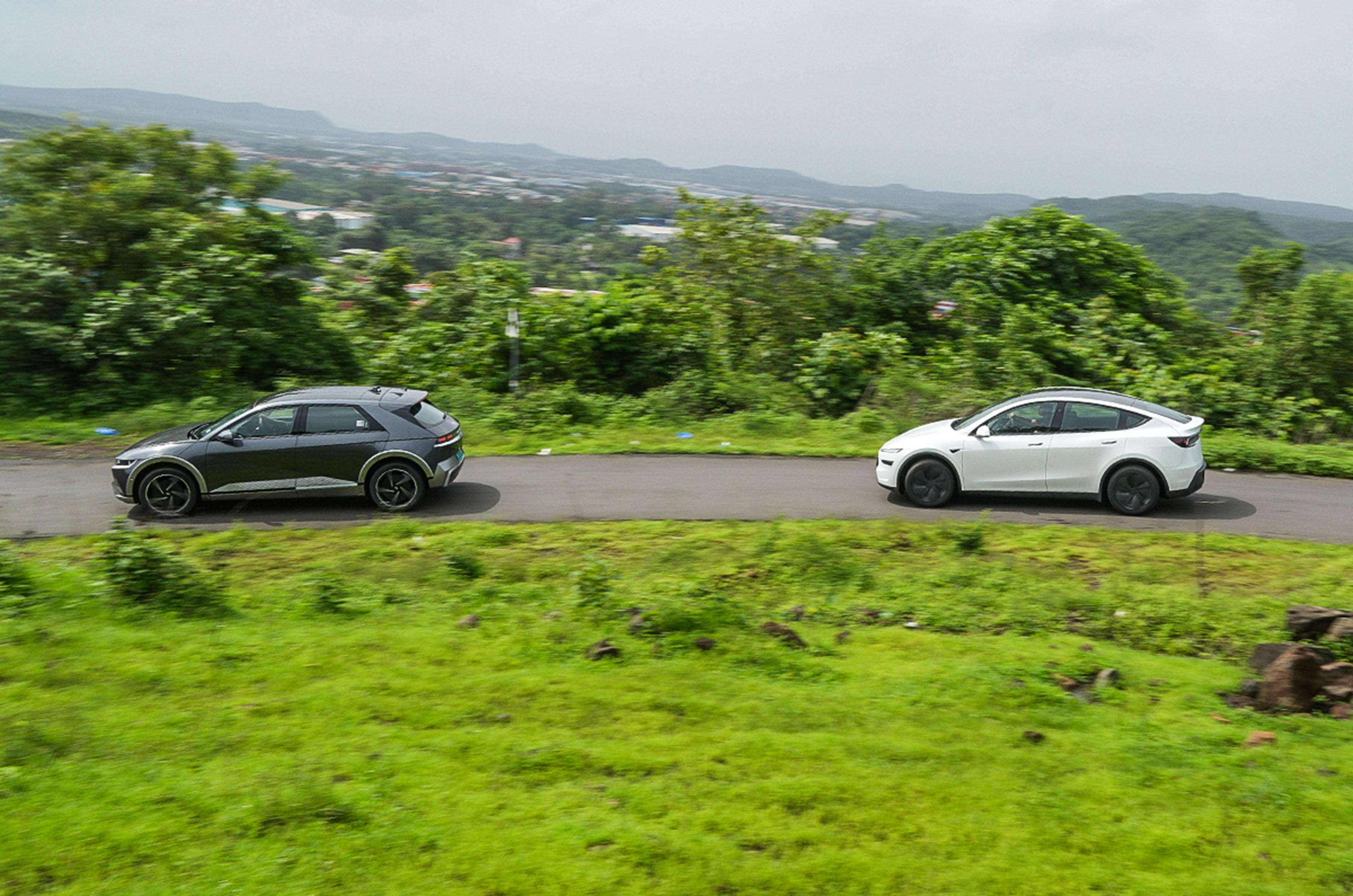
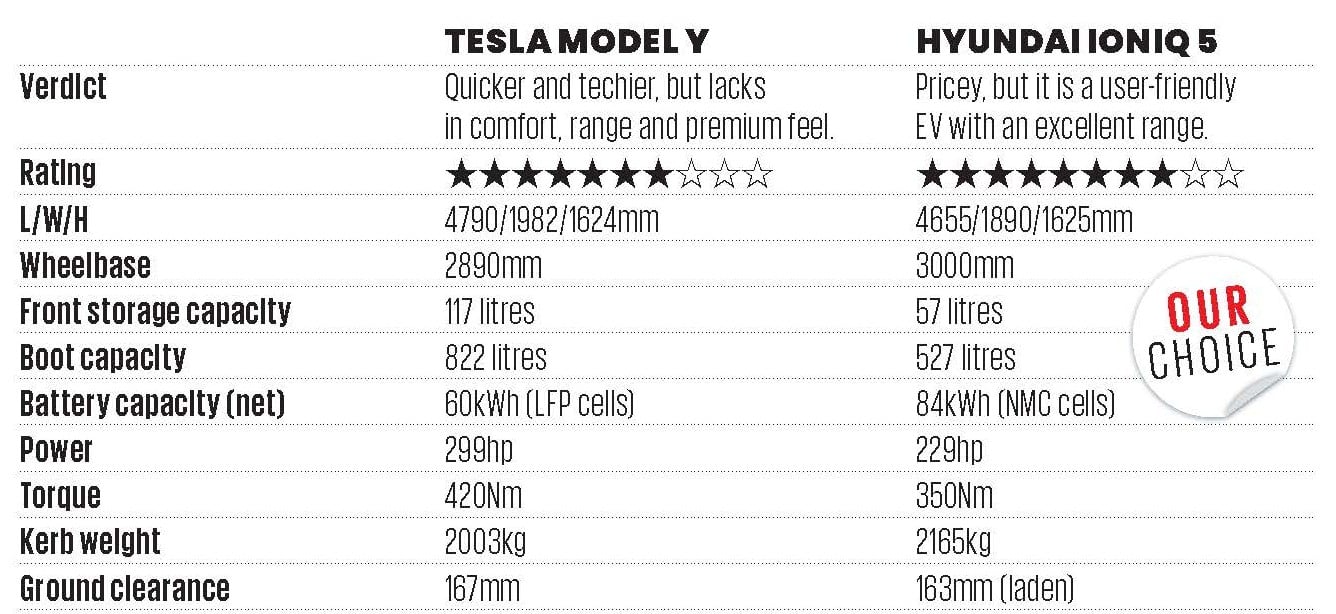
The Tesla Model Y is the larger vehicle overall, although the Hyundai counters with a longer wheelbase. Neither car follows a traditional SUV or sedan template, with muscular proportions and aggressive styling, but the Ioniq 5 stands out with its retro-futuristic design language, blending hatchback and crossover cues into a shape that is both distinctive and characterful. That said, its styling will continue to divide opinion.
The Tesla, by comparison, plays it a little safer. It too wears a crossover body style, but with a minimalist design that is unlikely to offend anyone. Frameless windows and a unique tail-lamp treatment with a hidden light bar add some flair to its otherwise fuss-free styling.
It’s worth noting that Tesla lists ground clearance at 167mm (unladen), while the Ioniq’s figure is specified as laden, coming in at 163mm. In the real world, the Tesla occasionally scrapes over unusually large speed breakers, while the Hyundai clears most of them despite its longer wheelbase.
Tesla Model Y vs Hyundai Ioniq 5: Interior and features
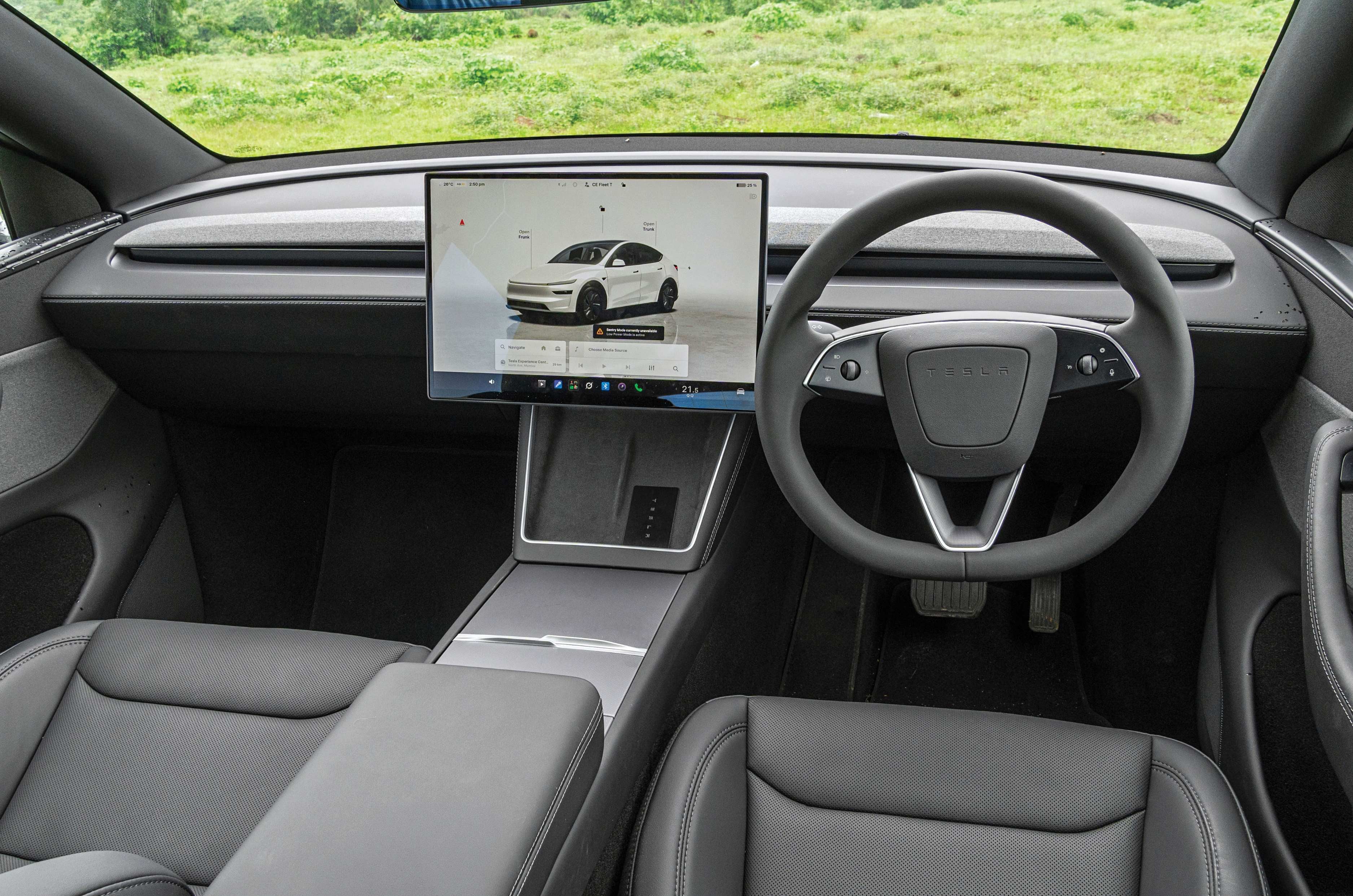
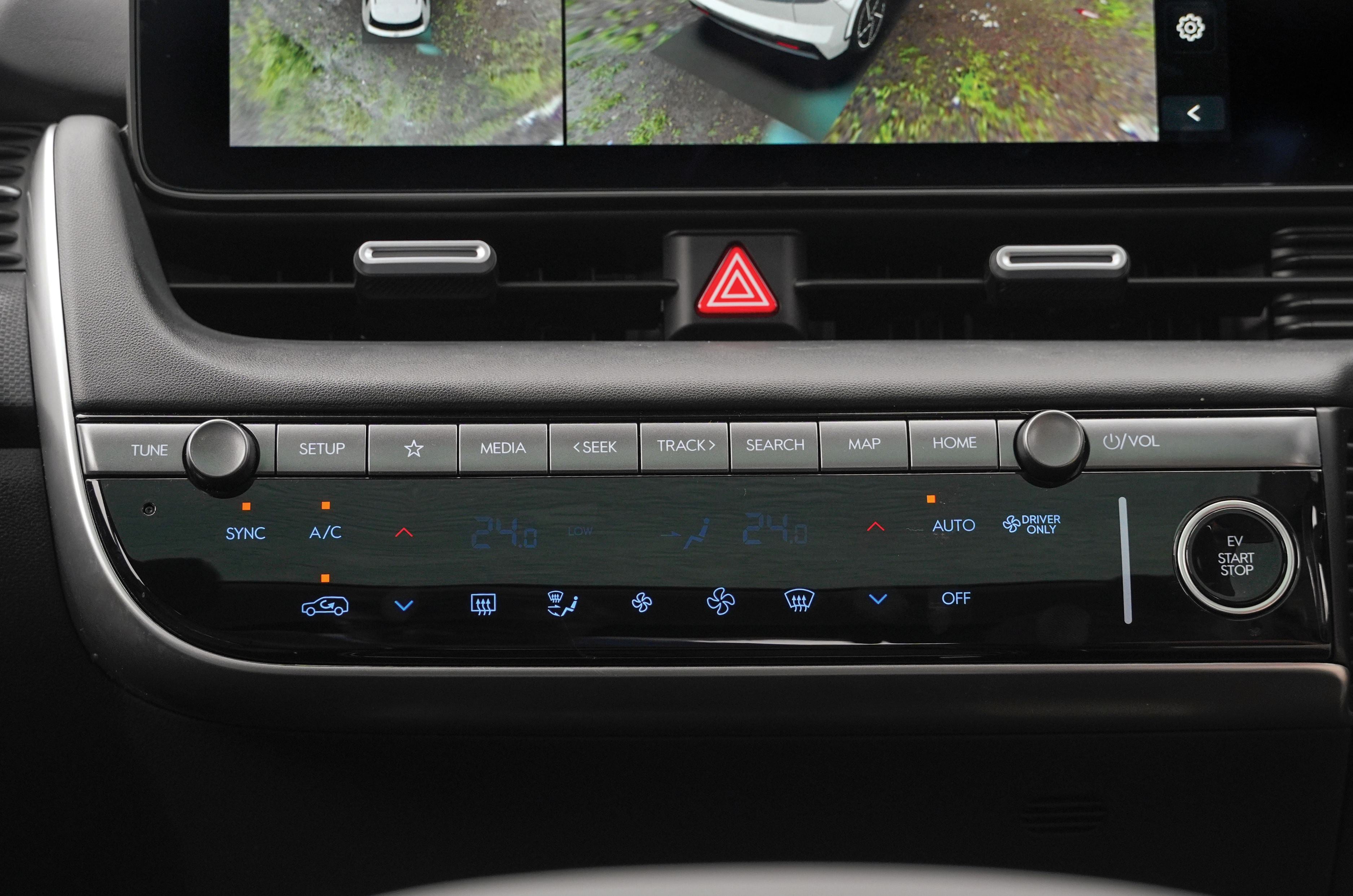
Takes minimalism to a whole different level, with merely a handful of physical controls. Lack of design elements, vegan materials don’t feel special.
Tesla’s non-motorised flush door handles remain a usability frustration, requiring an awkward push-and-pull action to operate. On the inside, the Model Y’s cabin embraces minimalism to an even greater extent. Even the air vents are hidden. The lack of design elements looks clean, but this and the choice of materials diminish the sense of occasion one expects at this price point.
All functions are relegated to its slick screen.
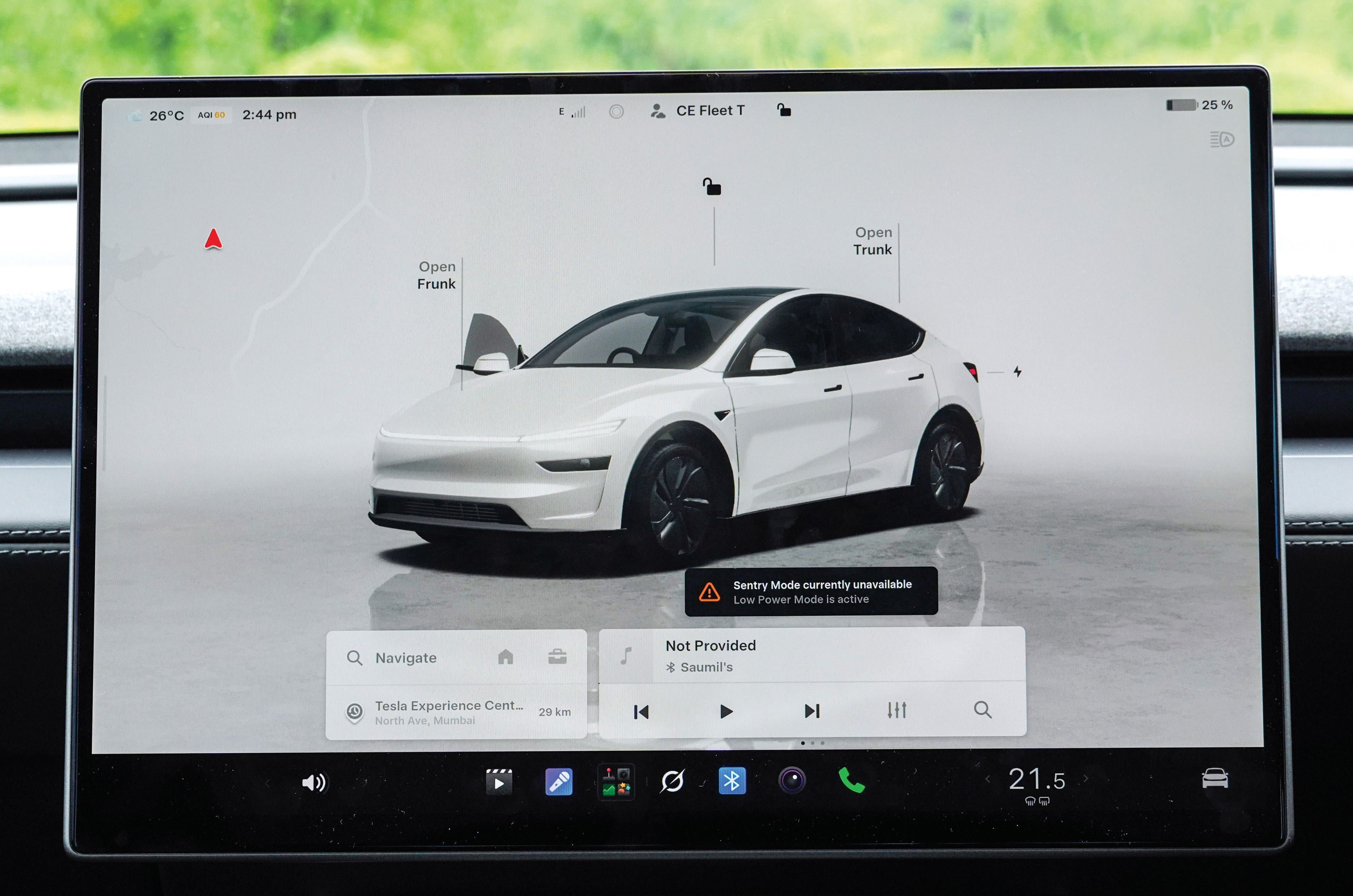
Taking centre stage, quite literally, is a massive touchscreen. Nearly every function is controlled via the screen, including controls for the frunk, tailgate, glovebox, climate control, seats and steering, and mirror adjustments, among many others. This over-reliance on the touchscreen is daunting at first, but Tesla’s software experience is exceptional. The interface remains the benchmark for responsiveness, fluidity and overall usability.
The steering wheel features multi-function controls that take some time to get accustomed to. The high-beam flasher is integrated into the steering wheel too. Thankfully, the indicators and power-window switches remain physical controls. The lack of buttons might seem futuristic, but it often feels as though technology has taken precedence over usability. There are two charging pads, and below them sits an unusually bulky centre console that robs the cabin of some of its sense of space. Hampering usability further is the exceptionally deep storage area, which requires you to stretch to reach items placed inside.
Albeit a bit low-set, this space feels airy thanks to its low window line.
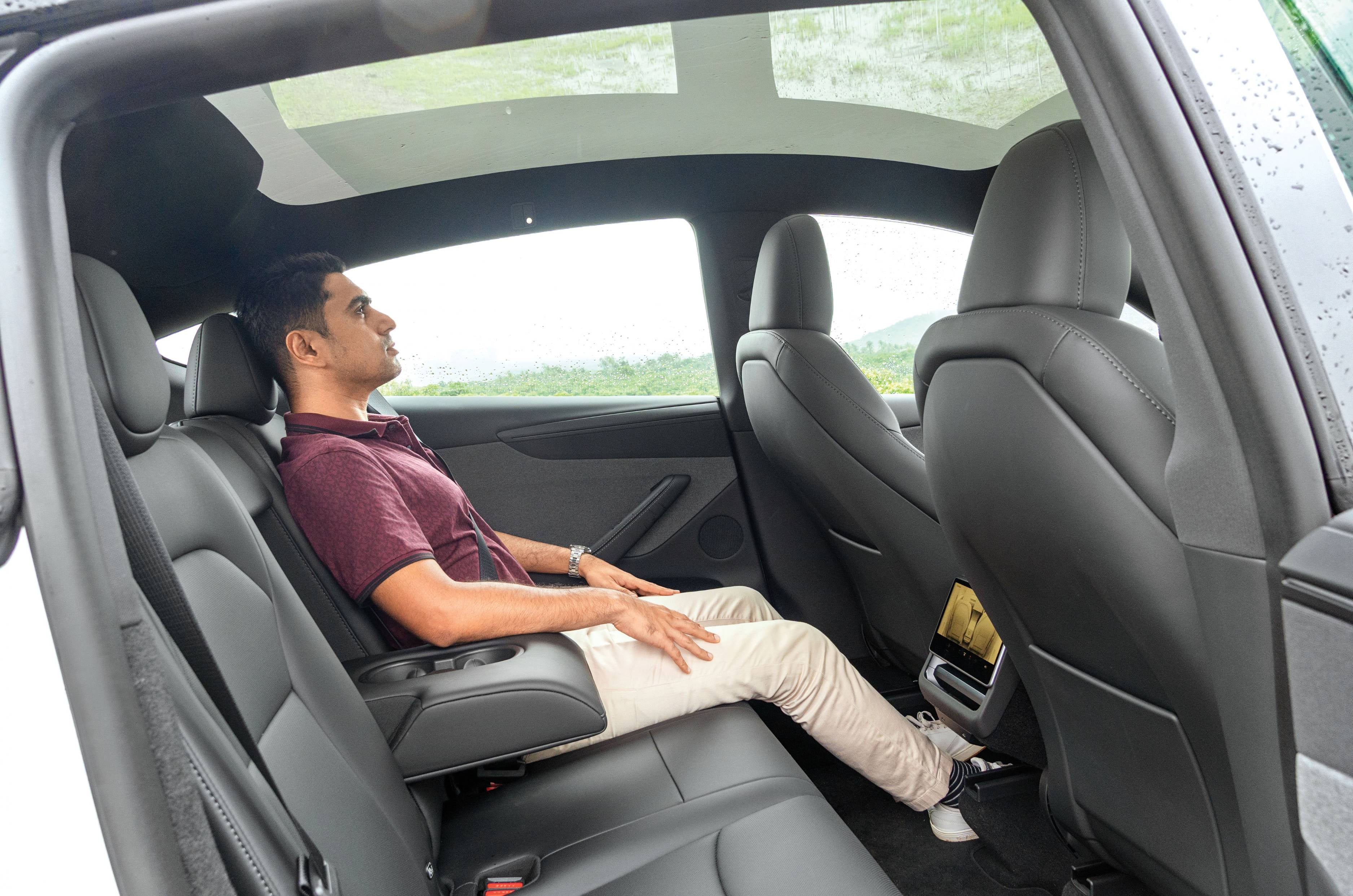
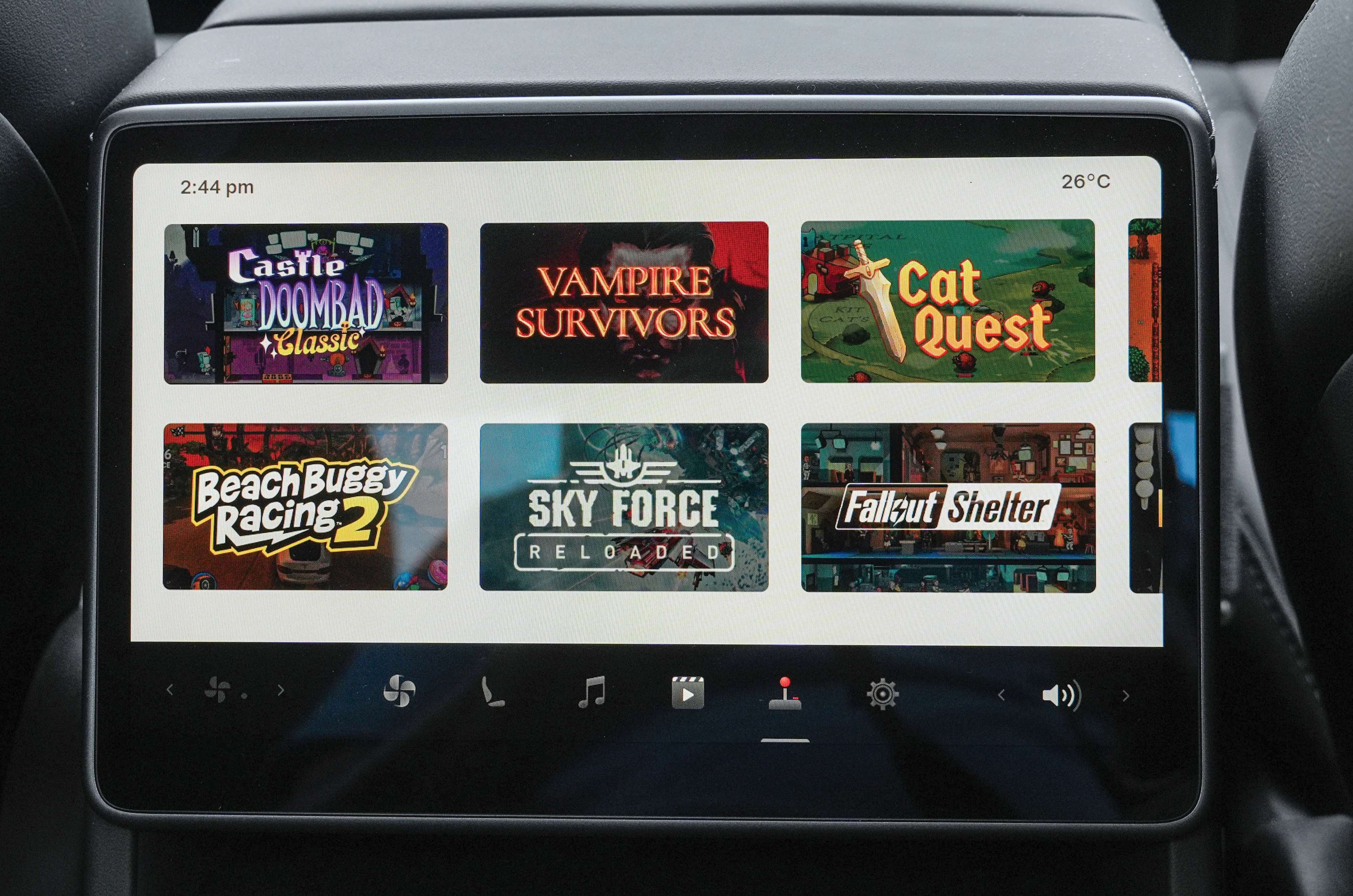
The front seats look simple and are surprisingly comfortable, with heating and ventilation functions. The rear seat is equally comfortable, although the seating position is somewhat low, resulting in a knees-up posture. What’s nice is that the backrest reclines to a comfortable angle. Rear-seat passengers are also treated to a dedicated touchscreen capable of controlling climate functions, streaming content and even gaming.
Rear screen for controls, games and videos.
One major drawback is that the sunroof still lacks a dedicated sunshade, causing the cabin to heat up considerably under the afternoon sun. The rear windows also miss out on sunshades.
More suited to our conditions, the black interiors are well-finished. It gets full marks as far as storage, ergonomics and usability goes.
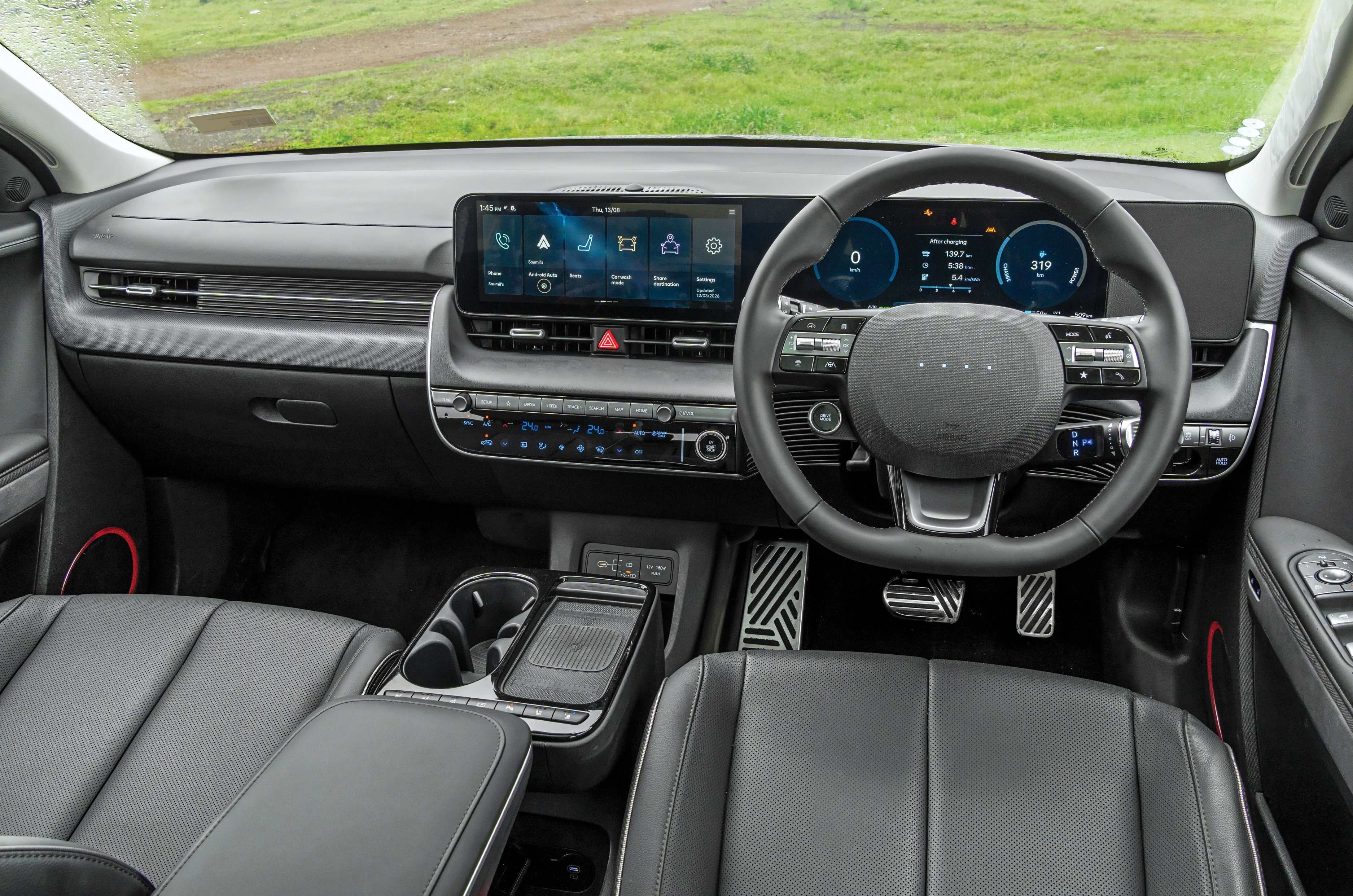
The Ioniq 5’s interior takes a more balanced, user-friendly approach. Not only does it get motorised pop-out door handles, but its cabin also combines touch-sensitive controls with physical buttons and knobs, creating an environment that feels intuitive from the moment you step in.
Thankfully, it retains physical controls.
Material quality is impressive, and where the Hyundai truly excels is in comfort and practicality. Storage areas are thoughtfully integrated throughout the cabin, and the sense of space is outstanding, making the Ioniq 5 particularly easy to live with.
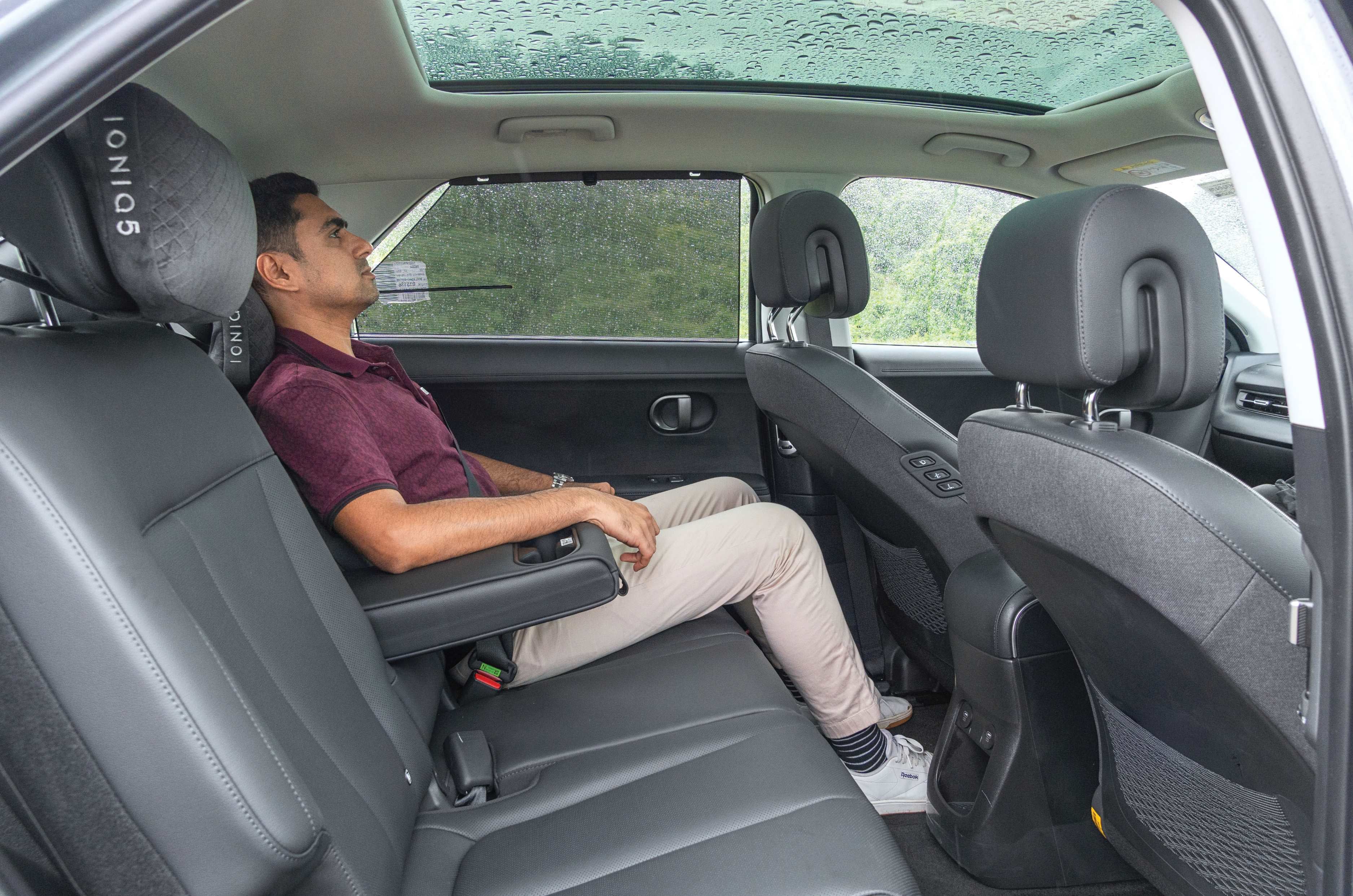
Slide, recline, boss function and sunshades mean a better rear experience.
The front seats are broader and more comfortable, with extensive adjustment, including an ottoman-style leg support. Both front seats can be set up in a ‘zero-gravity’ position, where your back is reclined and legs lifted on the ottoman, making it very comfy. Plus, you can have the seats cooled or heated too, which adds to the relaxing experience. Rear-seat comfort is equally impressive, thanks to a bench that both slides and reclines. While it doesn’t get a dedicated rear screen like the Tesla, it does offer window sunshades and a 3-pin socket to power larger electronic devices.
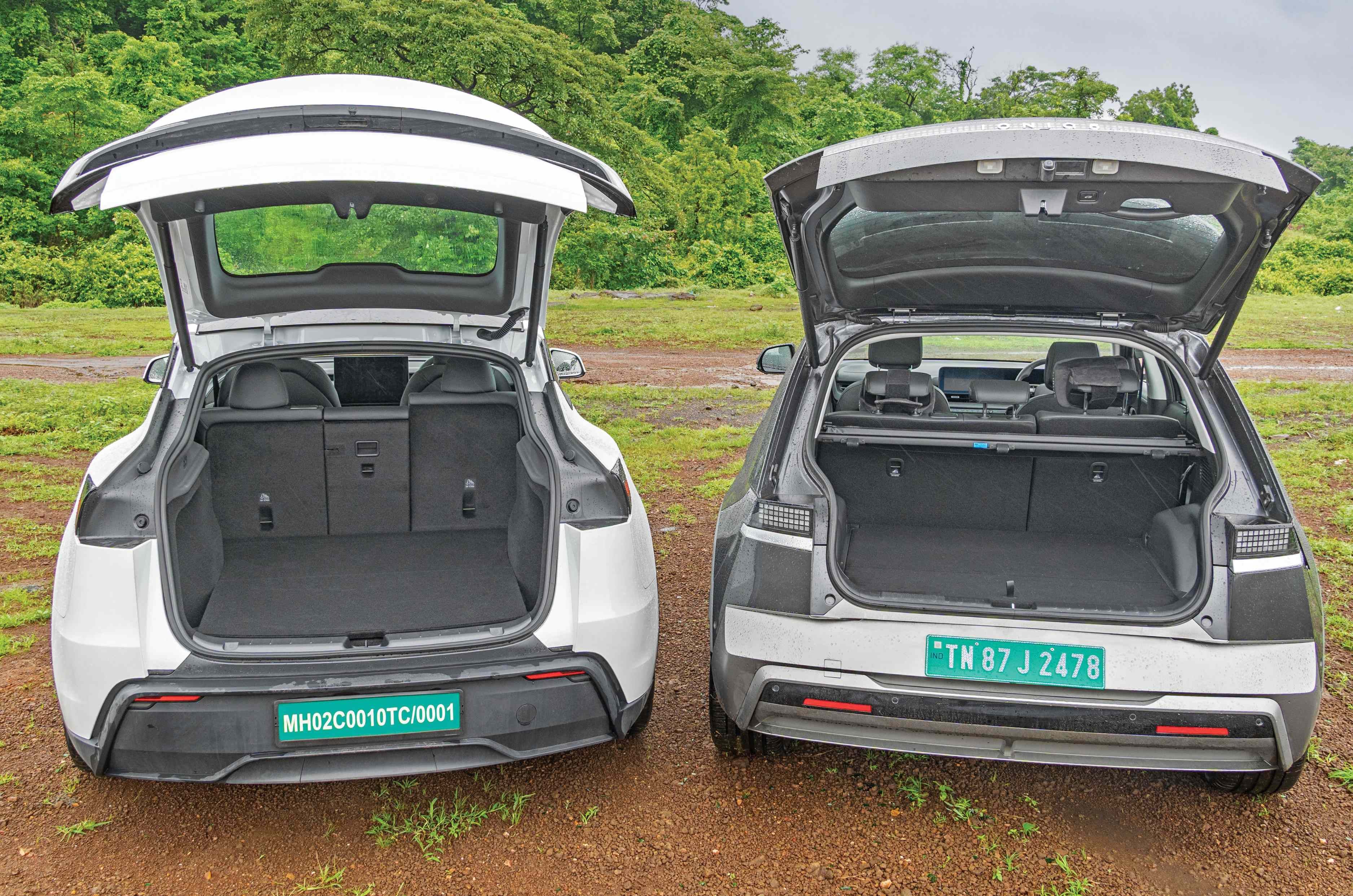
Along with a larger boot, the Tesla gets substantial underfloor storage.
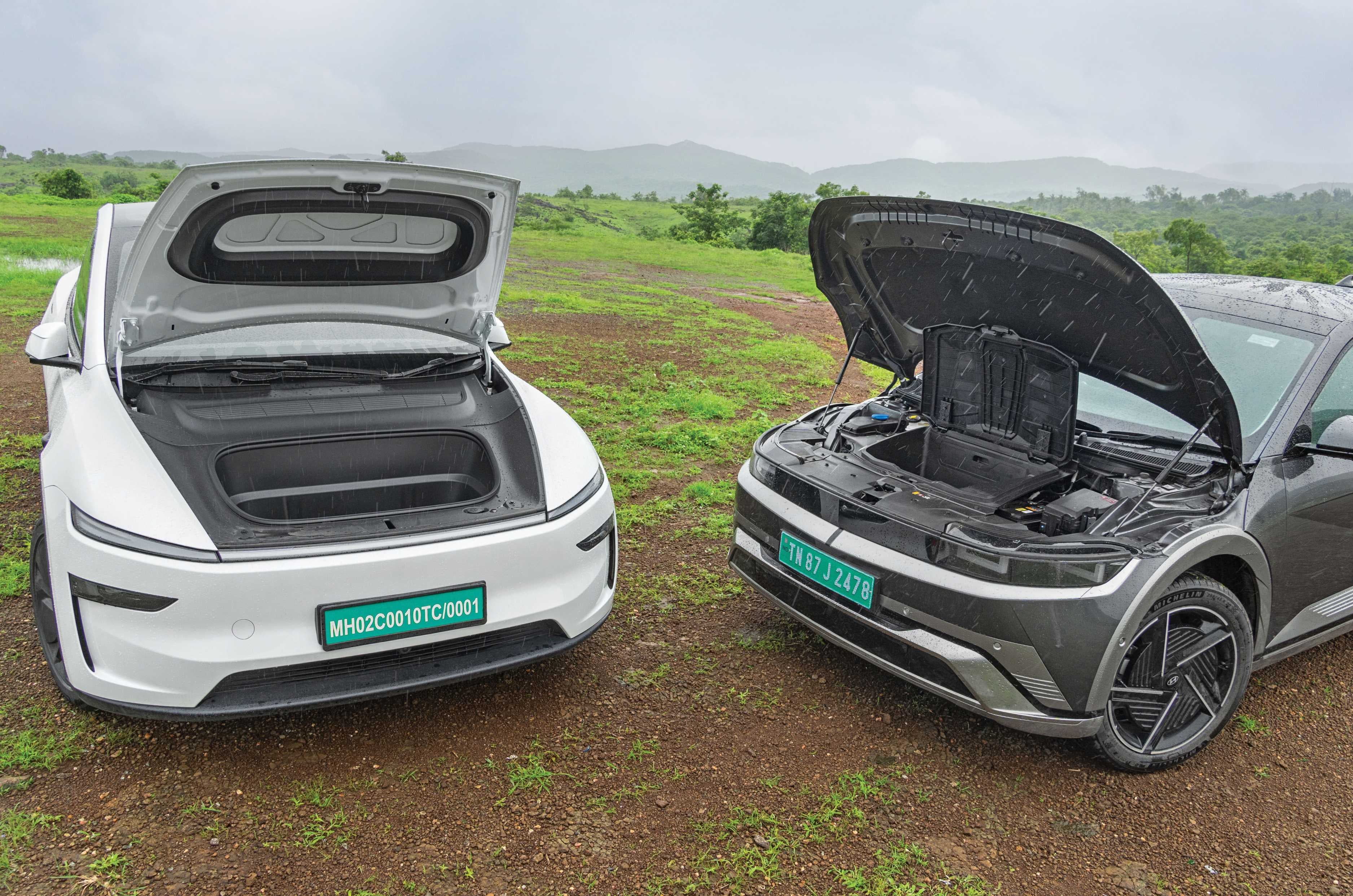
The Tesla regains some lost ground when it comes to luggage-carrying capacity. Its front luggage compartment is broader and deeper than the Ioniq’s, and its boot is more spacious too. Additionally, it offers even more storage space beneath the boot floor. The Ioniq 5, on the other hand, not only falls a bit short in outright boot capacity, but also has a relatively higher loading lip, making it slightly more challenging to load heavy luggage.
The Model Y has a deeper and wider front-loading area than the Hyundai.
Tesla Model Y vs Hyundai Ioniq 5: Powertrain and performance
Hyundai has increased the battery size from 72.6kWh to 84kWh (gross capacity) while continuing to use Nickel Manganese Cobalt (NMC) cell chemistry. This feeds a 229hp/350Nm rear-mounted motor, which is 12hp more than before. However, the larger battery has pushed kerb weight up to 2,165kg, which is 150kg more than the outgoing version.
In contrast, the Model Y uses a 64kWh (gross capacity) battery with Lithium Ferrous Phosphate (LFP) cell chemistry, powering a 299hp/420Nm rear-mounted electric motor. While it is significantly more powerful, the Tesla is also 162kg lighter. As a result, its performance feels considerably stronger. It feels quicker off the line, accelerates harder and responds more eagerly to throttle inputs than the Hyundai.
Tesla keeps things simple with just two drive modes: Standard and Chill, the latter serving as an economy setting. Impressively, Chill mode remains highly usable and, despite being toned down, still accelerates as strongly as the Hyundai in its sportiest setting.
Tesla Model Y vs Hyundai Ioniq 5: Acceleration test (in seconds)
Tesla Model Y
Hyundai Ioniq 5
20kph
1.29
1.31
40kph
2.33
2.66
60kph
3.48
4.05
80kph
4.69
5.71
100kph
6.19
7.97
120kph
8.23
10.83
140kph
10.78
14.63
160kph
14
20.27
To put its performance into perspective, the Model Y accelerates from 0-100kph in just 6.19 seconds in Standard mode and reaches its 203kph top speed in roughly 25 seconds. Even in Chill mode, it completes the 0-100kph run in a respectable 8.25 seconds, just 0.28 seconds slower than the Ioniq 5. More interestingly, the Tesla reaches 160kph in 18.58 seconds, making it 1.6 seconds quicker to the mark.
Tesla Model Y vs Hyundai Ioniq 5: Regenerative braking distance (80-20kph)
Tesla Model Y
Hyundai Ioniq 5
Strongest
116.71m (Standard)
136.45m (i-Pedal)
Weakest
223.55m (Reduced)
391.50m (Level 1)
In the Model Y, regenerative braking has just two modes – Standard and Reduced – and the retardation is seamless, though quite strong when you lift off the accelerator. Notably, Standard mode generates stronger deceleration than the Ioniq 5 in its most aggressive single-pedal setting. And while both cars support true one-pedal driving, the Tesla’s implementation feels more natural and intuitive. The Ioniq, though, with its multiple levels, can be set up to have retardation feel more ICE-like and thus very familiar.
Turning our attention to the Hyundai Ioniq 5, it may not dominate traffic-light drag races, but the good news is that power delivery is exceptionally smooth, and the overall driving experience feels highly refined. It offers multiple drive modes that alter part-throttle responses, steering feel and brake-pedal feel, although outright acceleration remains largely unchanged between them.
In general, the Ioniq 5’s cabin feels slightly more hushed than the Model Y’s, with a quieter motor and lower levels of road and tyre noise. Notably, though, the Tesla’s frontal sound insulation is exceptional – from inside the cabin, you would swear its horn is rather meek, but we assure you, that isn’t the case.
Tesla Model Y vs Hyundai Ioniq 5: Ride and handling
The Model Y is quicker, but the Ioniq 5 betters it on range and fast-charging speed.
On the move, the Model Y inspires confidence. High-speed stability is excellent, and it changes direction with greater eagerness compared to the Ioniq. The small-diameter steering wheel offers different weight settings, but even its lightest mode feels substantial; it isn’t that light, one-finger-twirl setup and does come across as heavy. Ride comfort also doesn’t feel particularly plush. The suspension is quite firm and thuds noticeably over potholes and broken surfaces, making it less suited to rough Indian roads.
The Ioniq 5 takes a different approach. It feels far more comfortable and user-friendly, thanks to lighter steering and a softer suspension that, despite its 20-inch alloy wheels, absorbs road imperfections with much greater composure than the Tesla. The result is a more relaxed and comfortable driving experience. Sure, it doesn’t feel as sporty while changing direction and can feel a touch floaty at higher speeds, but that is a compromise many buyers will gladly accept for its low-speed pliancy and overall comfort.
Tesla Model Y vs Hyundai Ioniq 5: Range and efficiency
For our real-world range test, we ran the Hyundai Ioniq 5 in Eco mode and the Model Y in Chill mode, with the former’s regenerative braking set to Level 2 in the city and Level 1 on the highway, and the latter’s set to Standard in the city and Reduced on the highway.
As far as efficiency goes, the Ioniq 5 was more efficient in the city, delivering 6.22km/kWh, while the Model Y managed 5.84km/kWh. On the highway, the Tesla’s superior aerodynamics yielded 6.52km/kWh, whereas the Ioniq 5 managed 5.71km/kWh. However, thanks to Hyundai’s substantially larger battery, its overall average range extrapolates to 501km, comfortably ahead of the Tesla’s 371km.
Tesla Model Y vs Hyundai Ioniq 5: Real-world range and efficiency
Tesla Model Y
Hyundai Ioniq 5
Claimed range
500km
690km
City range
350km
523km
City efficiency
5.84km/kWh
6.22km/kWh
Highway range
391km
479km
Highway efficiency
6.52km/kWh
5.71km/kWh
Average range
371km
501km
Average efficiency
6.18km/kWh
5.96km/kWh
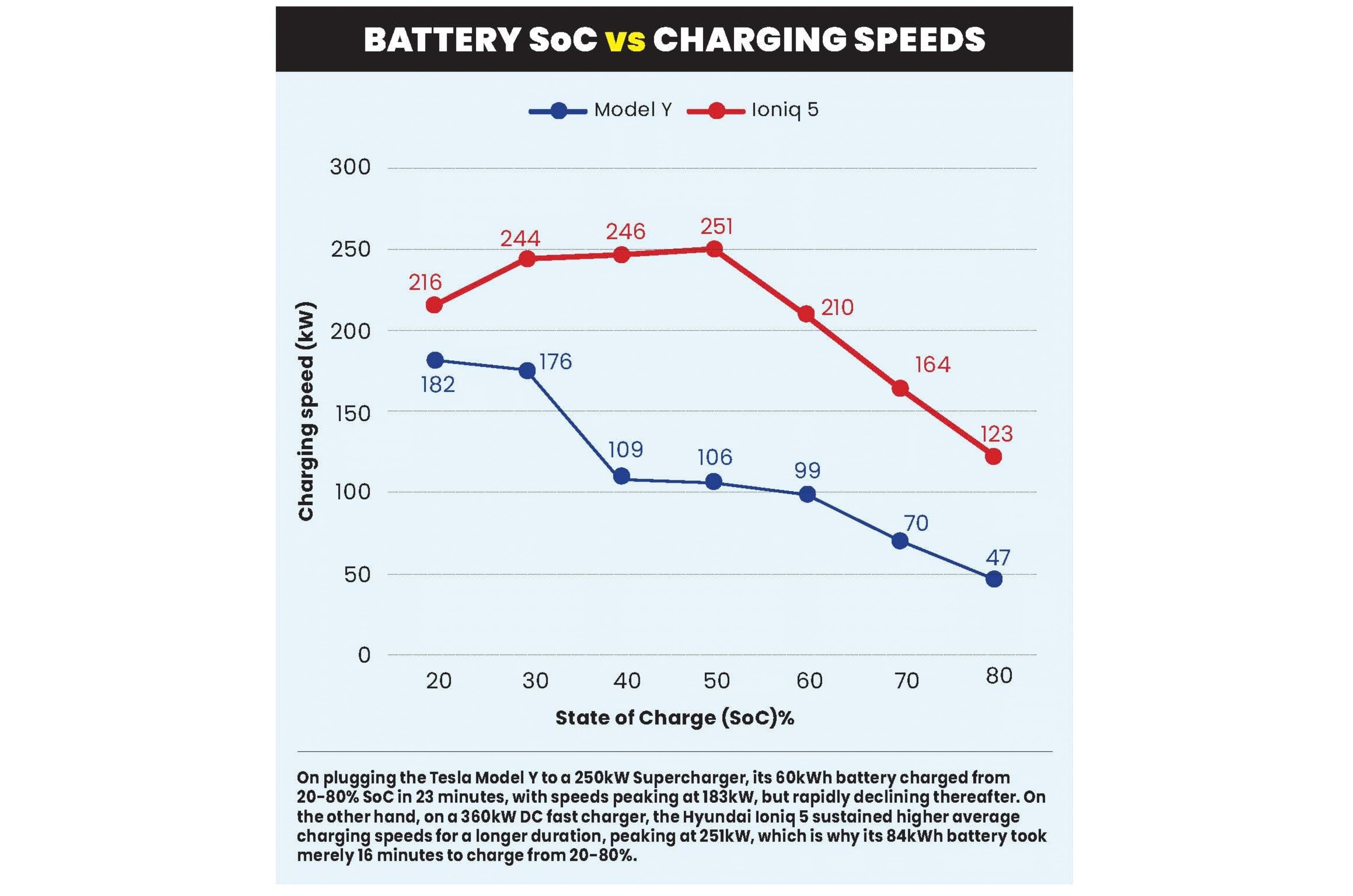
As for charging performance, we plugged the Model Y into a 250kW Tesla Supercharger, where it achieved peak charging speeds of 183kW. However, the Model Y does not sustain such high speeds for long, and its 60kWh battery is charged from 20-80 percent SoC in 23 minutes. From there, it took an additional 30 minutes to reach a full charge.
The Hyundai Ioniq 5 performs even better. Connected to a 360kW DC fast charger, its 800V electrical architecture enabled it to consistently maintain higher average charging speeds, peaking at 251kW. As a result, its 84kWh battery charged from 20-80 percent SoC in just 16 minutes. Like the Tesla, however, it required an additional 33 minutes to charge from 80 percent to full.
Tesla Model Y vs Hyundai Ioniq 5: Verdict
The Ioniq 5 no longer offers the value it once did. The Model Y, however, does.
The Tesla Model Y makes a compelling case for itself. It is quicker, more technologically advanced and backed by software that remains among the best in the automotive world. Crucially, it is now the more affordable option, making it a very tempting proposition. However, its over-reliance on the touchscreen, heavy steering, a firm low-speed ride and limited range due to the smaller battery count against it.
In comparison, the Hyundai Ioniq 5 remains the more rounded package. Its superior ride comfort, more intuitive cabin, significantly longer real-world range and impressive charging performance give it a clear edge where it matters most. More importantly, it feels better adapted to Indian roads and daily usage, thanks to its lighter steering and more comfortable ride.
At current prices, though, the Hyundai no longer holds the value card, nor does the brand command the same equity or snob value as some similarly priced rivals. But judged purely on its merits, the Hyundai Ioniq 5 continues to be the best all-round EV at this price point and thus gets our vote.
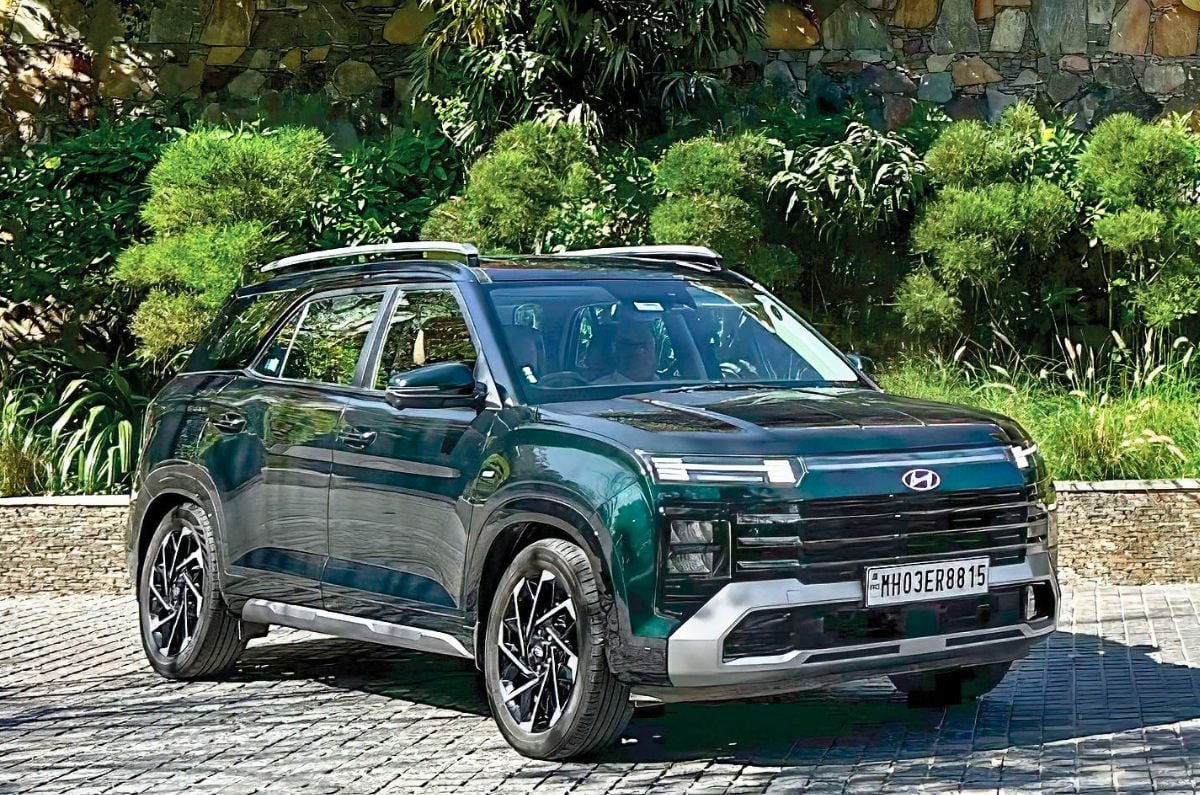
Our long-term Alcazar has done all sorts of jobs since it joined the fleet. City runs, airport pickups, the odd weekend getaway. But nothing quite like what it was asked to do recently. It had to play support car for our camera crew shooting a feature on the Delhi-Mumbai Expressway, and that meant a 2,700km round trip between Mumbai and Delhi with barely a day’s rest in between.
I wasn’t driving the entire way myself, and the Alcazar was only handed over to me in Delhi by one of our drivers. His enthusiasm to ask me if we needed him to drive it back to Mumbai was a testament of how impressed he really was with the Alcazar.
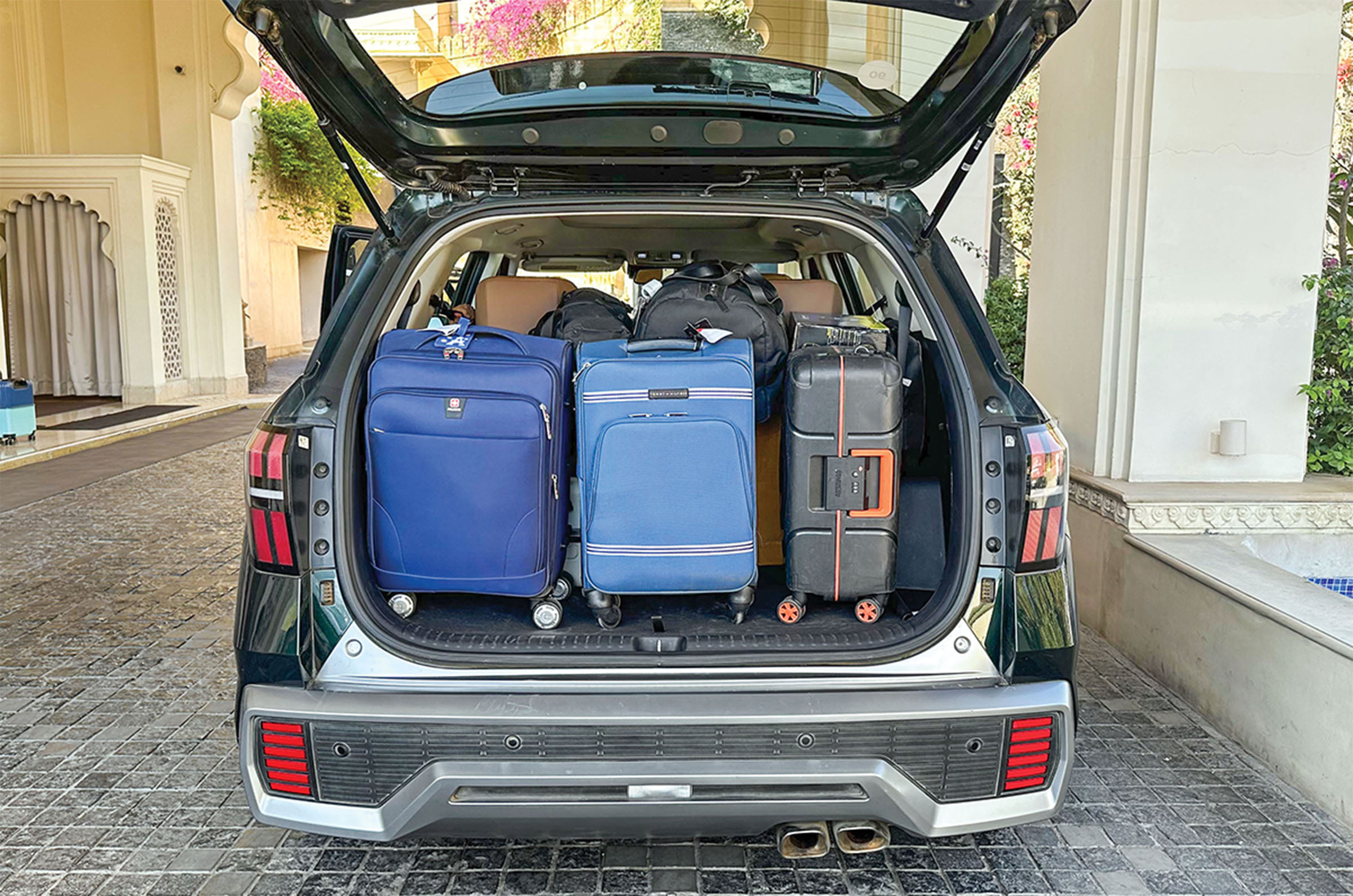
Folded third row frees up a lot of space for luggage.
The brief was simple. The Alcazar had to carry three crew members and all their camera gear along with all our luggage. This is exactly the kind of job our Alcazar has proven good at before, and it didn’t disappoint this time either. With the third row folded flat, the boot swallowed almost everything.
The captain seats in the second row turned out to be a real boon, especially for the camera crew – super comfy during a long day of shooting. The foldable tray table was handy for the laptop to copy and work on footage, and the fact that it was steady enough says a lot about the good build quality.
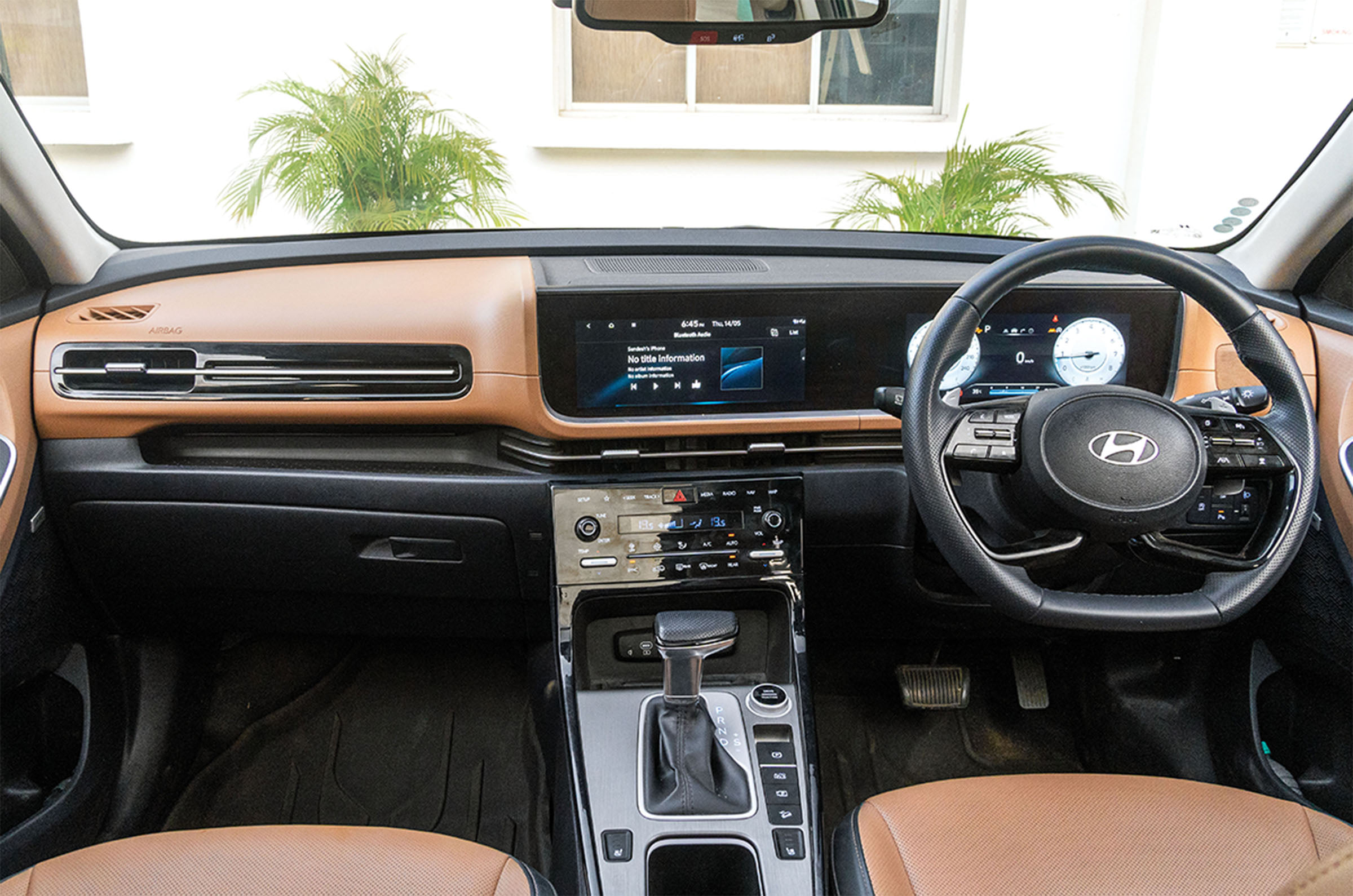
Design is simple yet ergonomic. Dark-coloured interiors help it look clean.
The Delhi-Mumbai Expressway is where this car was always going to shine, and it did. Long, arrow-straight sections let the 1.5-litre turbo-petrol settle into an easy cruise. At 100kph in top gear, the engine barely feels stressed, and wind noise is well contained for a car this size. We clocked long hours driving in a single day on the way back, stopping only for fuel and food, and nobody complained of fatigue by the end of it.
The DCT, which I’ve spoken of before, is jerky in bumper-to-bumper traffic, but was not an issue here. Once you’re past 40kph and holding a steady throttle, it’s smooth and quick to respond. It’s really only the crawl through Mumbai and Delhi outskirts where its low-speed hesitation showed up.
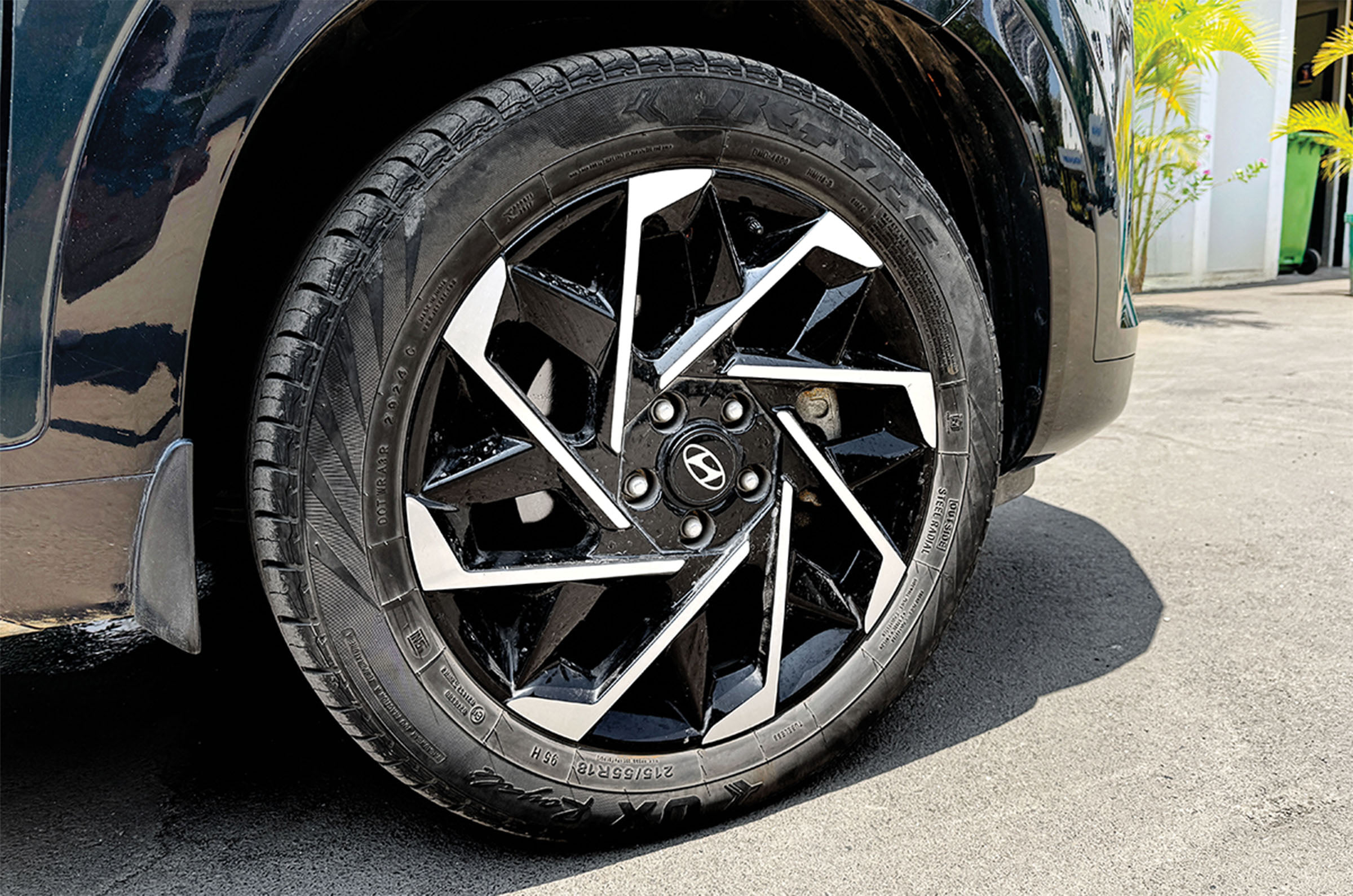
Large 18-inch wheels look stylish, but they don’t help the Alcazar’s ride quality.
The return leg we took had some patchy sections in Maharashtra, where the NE4 Expressway ends and connects to the old Golden Quadrilateral section of the highway. The Alcazar’s ride, tuned more for comfort on good surfaces, felt busy over broken patches. Nothing alarming, but the ride did feel slightly firmer than I expected from a car this size.
This stretch also penalised fuel efficiency. Loaded up with gear, four adults, and running the air conditioning at full blast through most of the drive, the trip computer settled at 12.8kmpl. That’s respectable for a heavy petrol SUV doing this kind of duty, but it’s definitely not the frugal numbers our diesel Alcazar managed, doing the same duty on the Kashmir-to-Kanyakumari run a few years back.
Ventilated driver and passenger seats are a boon on a hot, sunny afternoon.
A few other bits we did appreciate. The ventilated seats made the long hours of driving through the heat a lot more comfortable. The adaptive cruise control also was genuinely useful on the Expressway stretch, taking a lot of the fatigue out of long, straight sections. The absence of wireless Android Auto or Apple CarPlay was an irritant, as it meant connecting to the Infotainment using the cable and having a fully charged phone constantly plugged in for a long period of time.
Another observation on this trip: the plasticky bits on the dashboard picked up a fair bit of dust, especially with four people living out of the car for five days. To be honest, though, the camera crew kept the windows rolled down for a fair amount of time shooting. Thankfully, nothing a wipe down couldn’t fix.
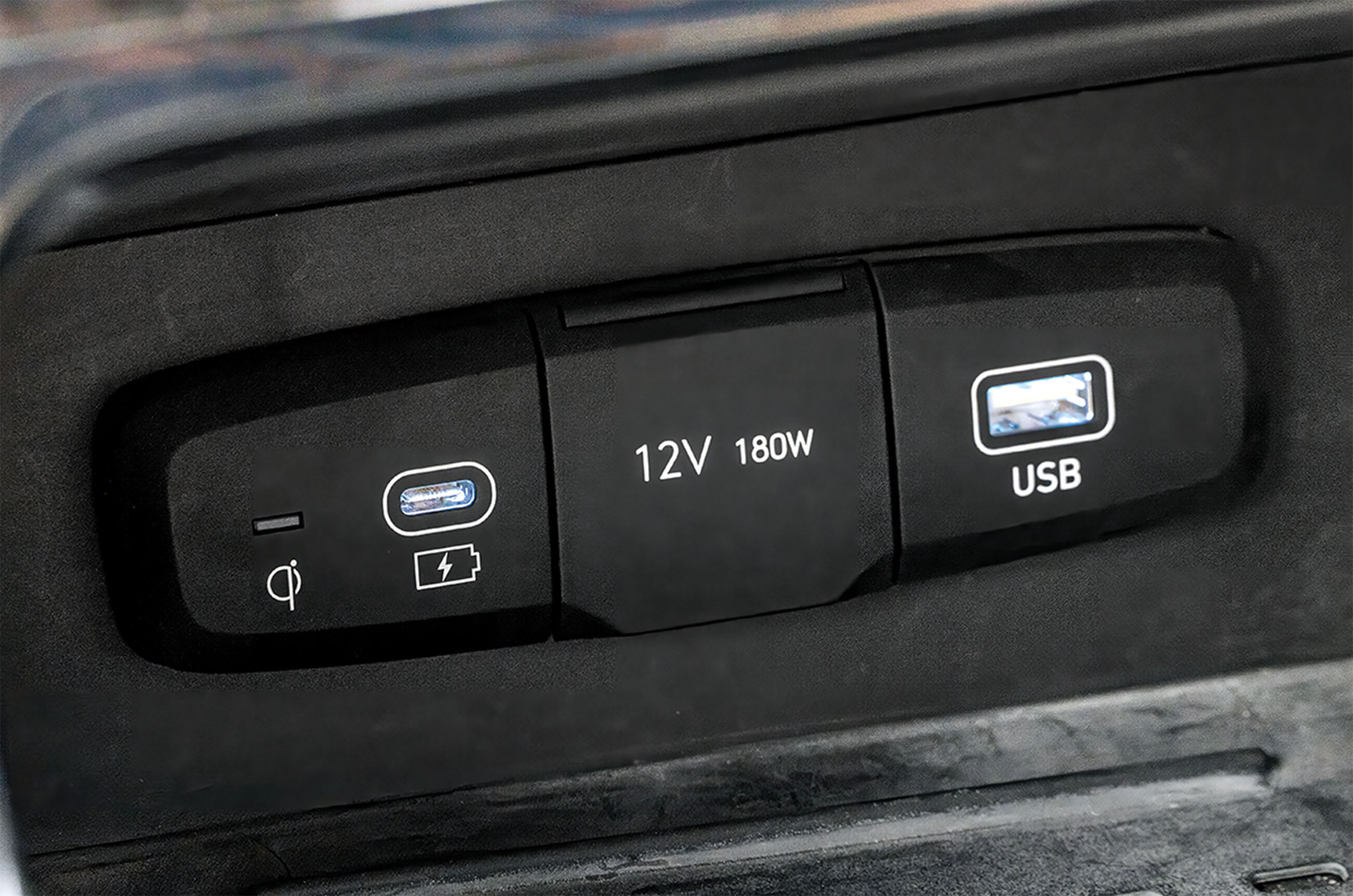
Type-A USB for smartphone interface needed. Type-C only works for charging.
At the end of it all, the Alcazar clocked close to 2,750km in five days absolutely fuss-free. No warning lights, no rattles that weren’t there before. It’s exactly the kind of trip that reminds you why a car like this earns its place in our long-term fleet. Not glamorous, not the fastest thing on the road, but dependable when you need it most. As it happens, this Mumbai-Delhi-Mumbai run turned out to be its last big assignment with us. With this report, our time with the Alcazar comes to a close, and it’s headed back to Hyundai. It leaves the fleet the same way it arrived, quietly capable, and it’s fitting that its final outing was spent doing what it always did best, hauling people and gear over long distances without a fuss.
Hyundai Alcazar Petrol DCT Signature 6-seater test data
The Mahindra Thar OG was launched in September 2026 and marks the second update to the 3-door SUV in just over a year. Along with the new ‘OG’ suffix, it gets a host of changes to the design, interior and under the skin, along with several new features. If you are considering adding the Thar OG to your garage, here are three reasons to buy it and two reasons why it may not be for you.
Pros
Off-roading capability
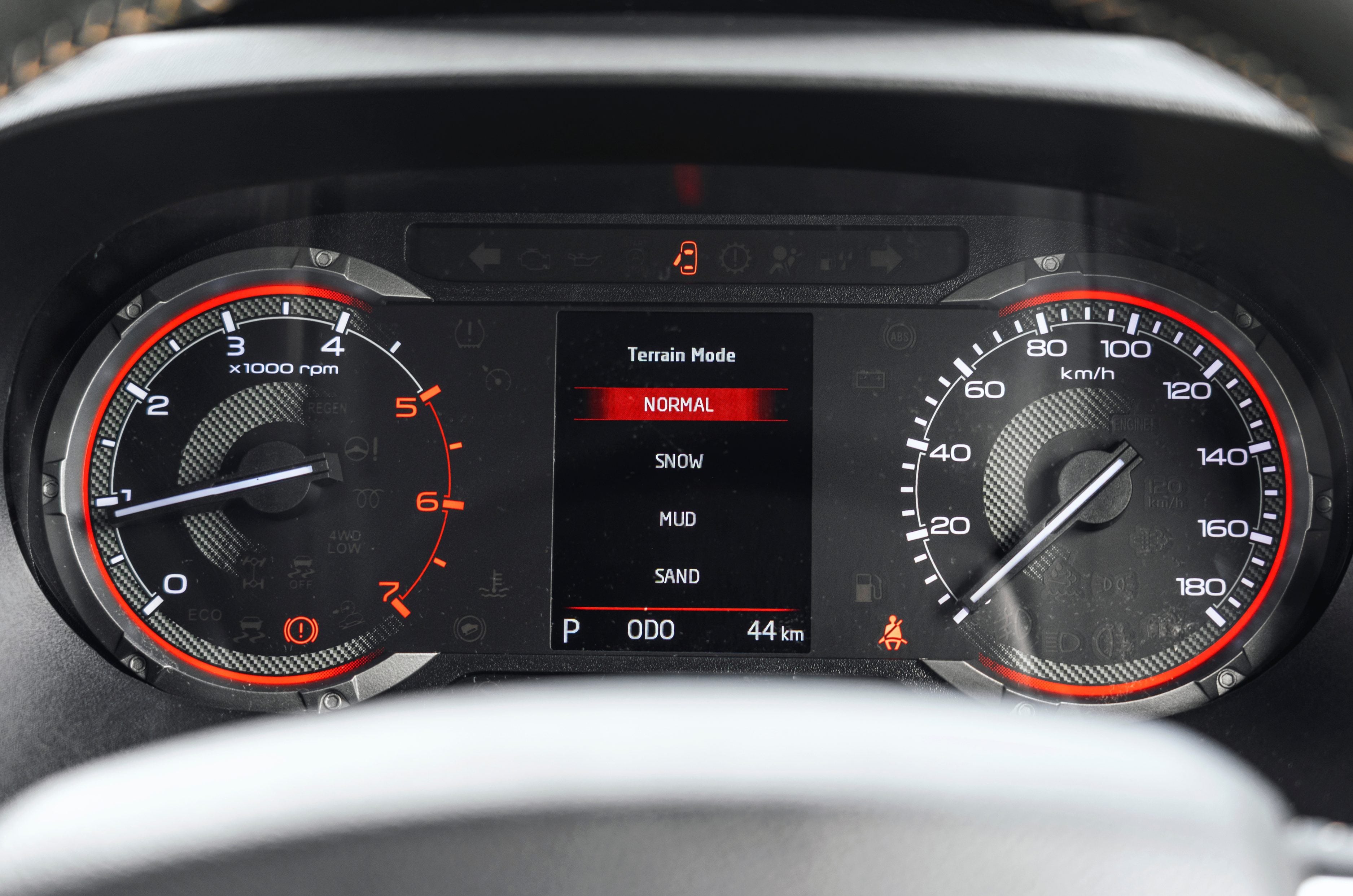
The Thar OG remains a hardcore body-on-frame SUV, and its off-roading ability has been further enhanced with new Snow, Sand and Mud terrain modes. These work with ESP, throttle control and steering input for maximum assistance while off-roading. The electronic locking differential is also more convenient to use. For someone who enjoys off-roading, there is nothing like the Thar OG under Rs 65 lakh.
Light steering
The Thar OG gets electric power steering (EPS) instead of the previously-on-offer hydraulically assisted unit, and as a result, much less effort is needed to steer and turn the Thar. Below 20kph, it’s light enough to turn with just one finger. As the speed increases, it gains heft so it does not feel uncomfortably light. As a result, you no longer need to wrangle with the steering to make a three-point turn.
Improved stability
The Watts linkage at the rear adds stability by keeping the axle centred as it moves up and down. This means there is less bouncing over uneven highways and bad patches. The track has also been widened, which further improves stability, even at highway speeds.
Then there is the DaVinci damping setup. Sharp, low-speed bumps no longer send harsh thuds into the cabin. To improve comfort with the larger 19-inch wheels, the ZXT trim also gets frequency-dependent dampers alongside the DaVinci setup.
Cons
Lack of space
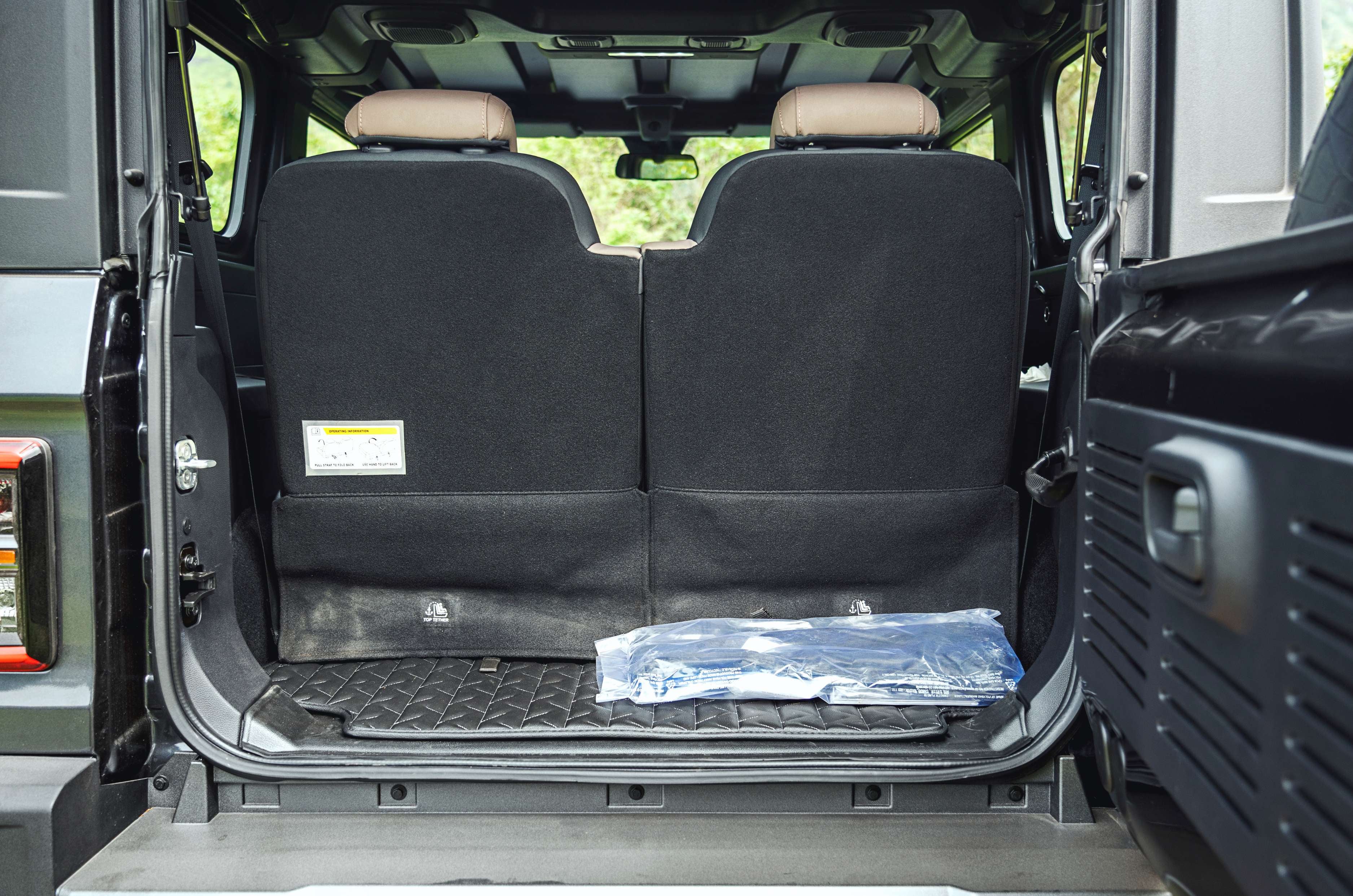
The Thar’s cabin remains short on space, especially at the rear. It continues to be a strict two-seater at the back. Accessing the rear seats could also be difficult for older adults. Boot space is a weak point as well, with barely enough room for an airport run. Carrying large suitcases will require folding down the rear seats.
Interior plastic quality
Unlike the soft-touch materials used in the Thar Roxx’s cabin which give it a more premium feel, the Thar OG’s hard plastics feel low rent. This becomes more noticeable when compared with rivals in the same price bracket. At the time of writing, the Thar OG is priced between Rs 10.32 lakh and Rs 17.75 lakh, ex-showroom.
Not too long after a significant update, Mahindra has given the Thar yet another shot in the arm. The Thar OG now gets a whole new set of upgrades to the design, interior and, mainly, under the skin. A new suspension, new steering and added features are all part of the aim to make it more liveable and urban-friendly while retaining the Thar’s butch and bullyish character. Have they succeeded?
Mahindra Thar OG exterior design and engineering – 9/10
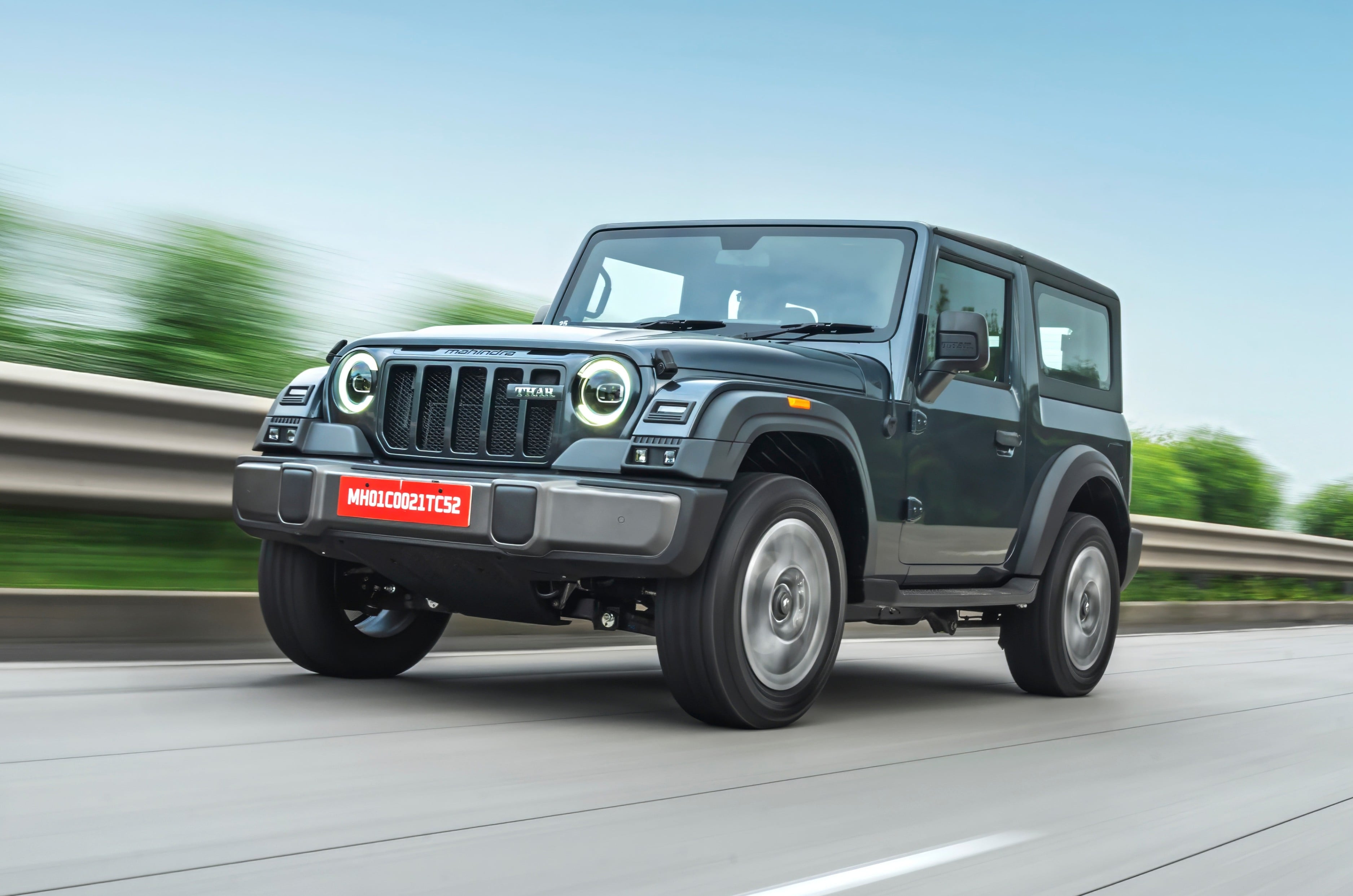
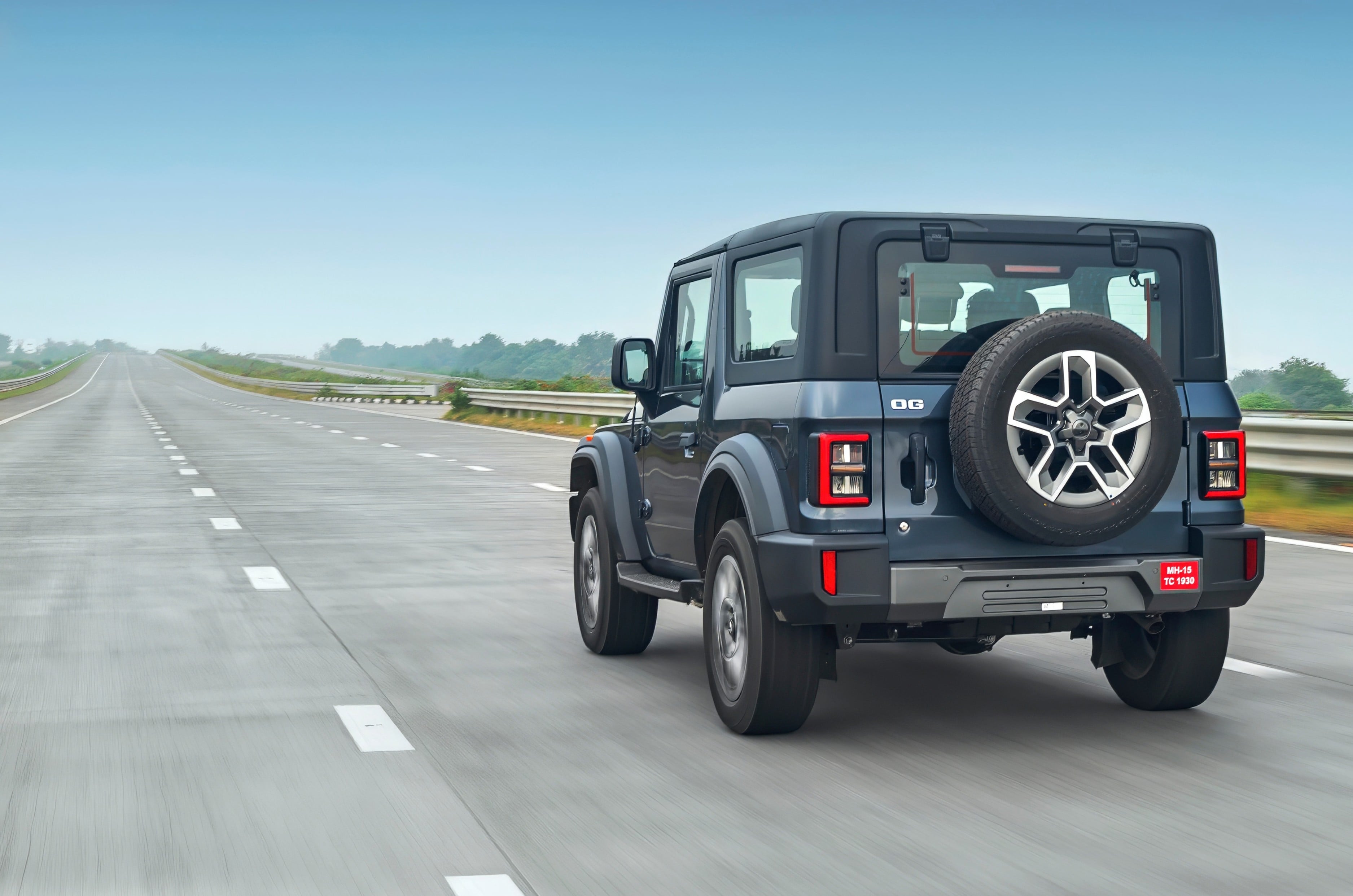
Design updates have retained the classic Thar look and road presence.
The design is why the Thar stands out, so Mahindra has not done much to change its character. However, it now gets some modern touches. At the front, the halogens are replaced with LED headlamps with C-shaped LED DRLs, along with LED fog lamps. The grille has been redesigned, with the Thar logo forged into it, and so has the front bumper. Look closer, and you will also see front parking sensors now, while the track has been widened for more stability.
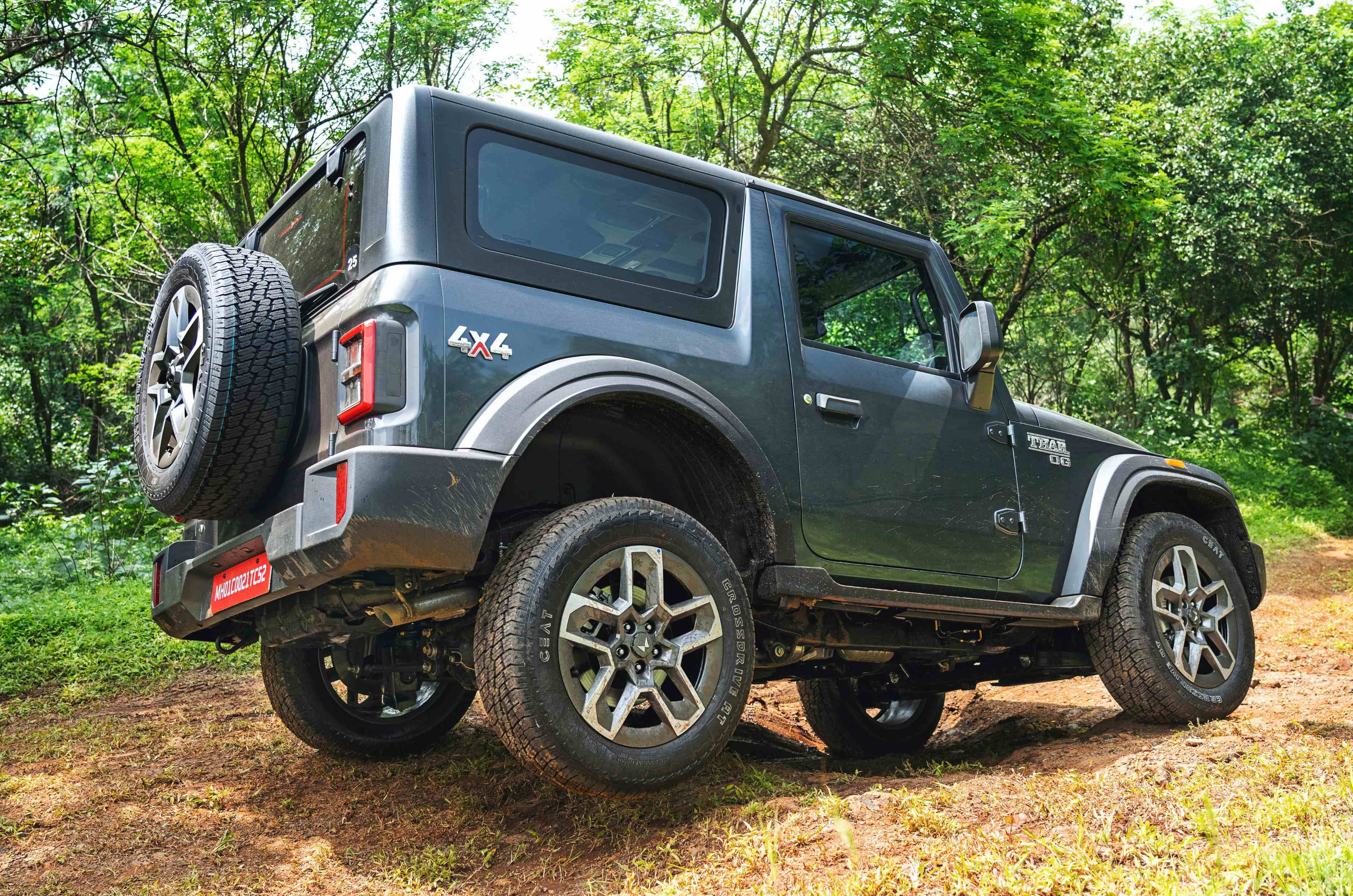
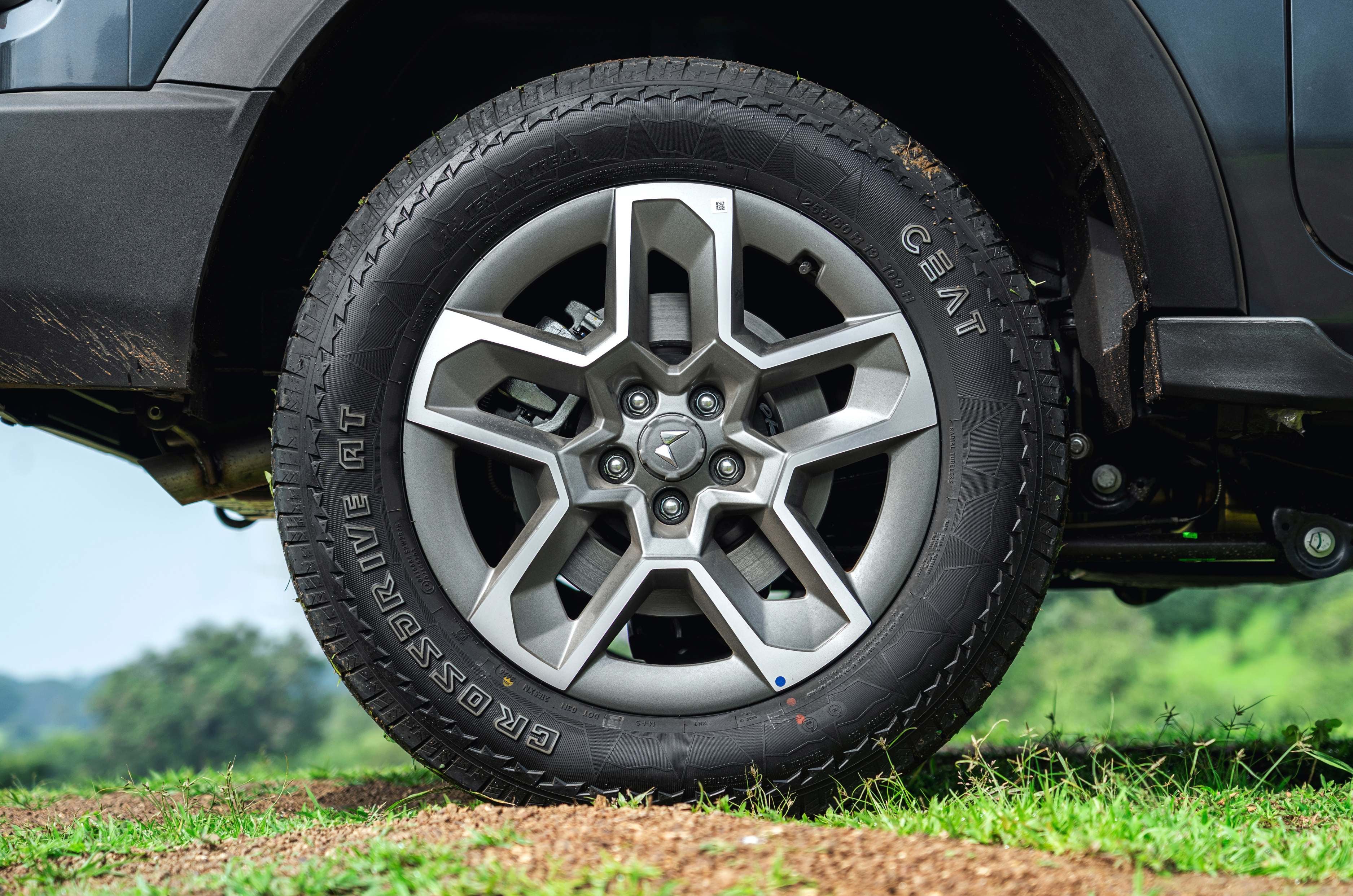
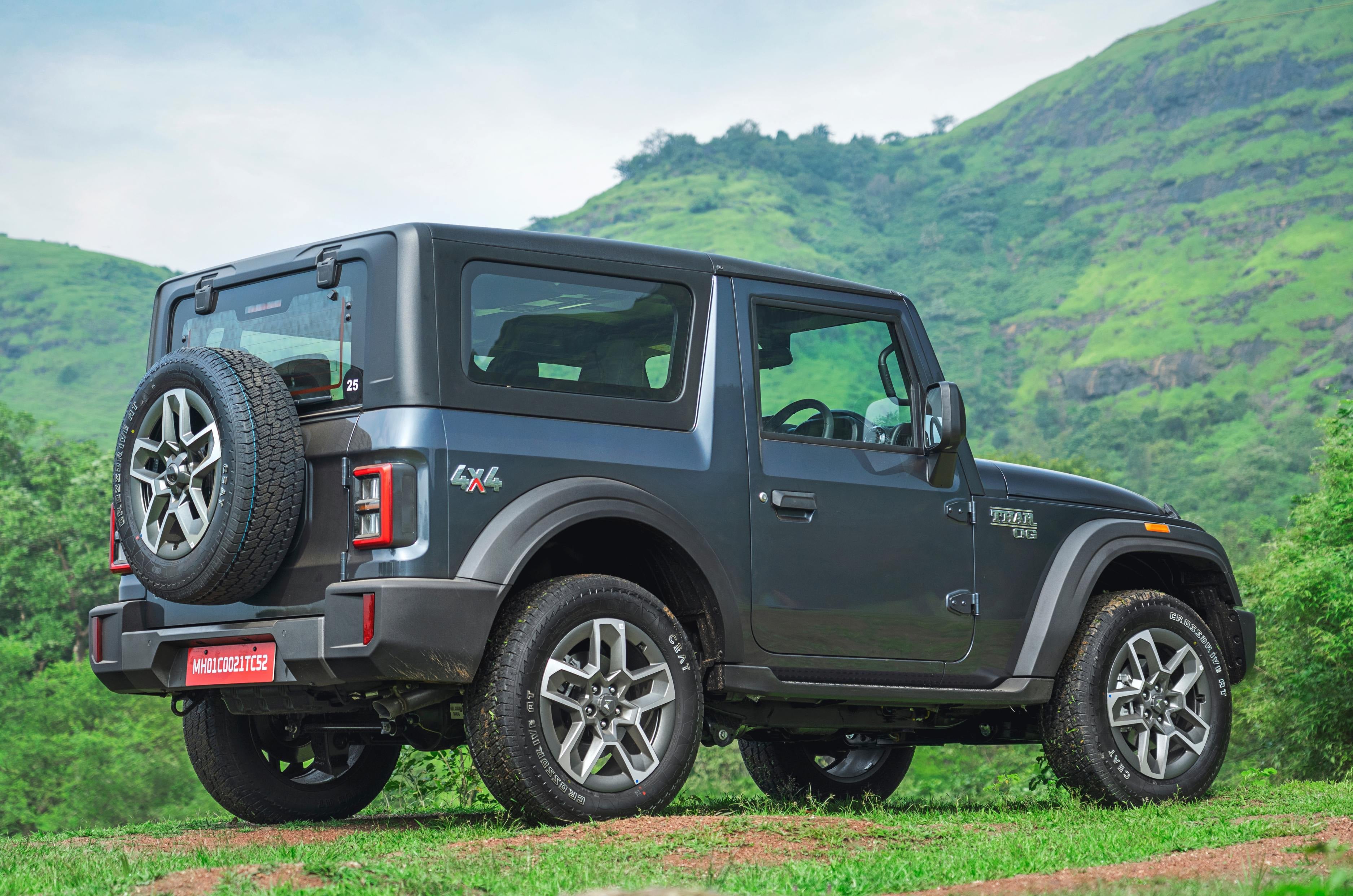
19-inch alloy wheels with AT tyres add to the toughness.
What you don’t see is the new platform the Thar sits on. The OG is now based on the Gen 4 chassis, dubbed M-Glyde, which also serves the Roxx. The side profile flaunts new 19-inch wheels with AT tyres, the Thar OG badge and a new design for the cladding.
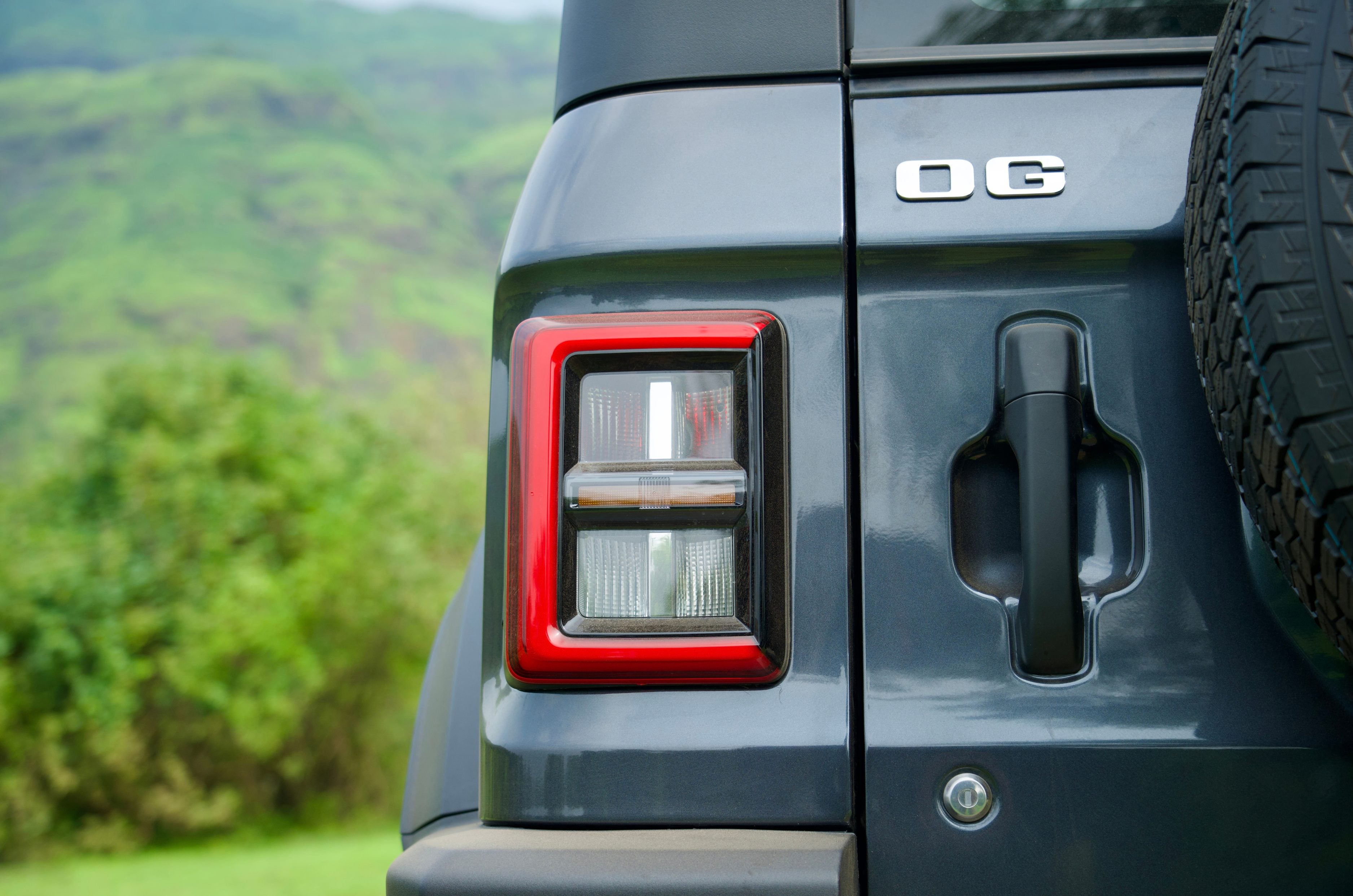
LED taillamps are similar to the Thar Roxx.
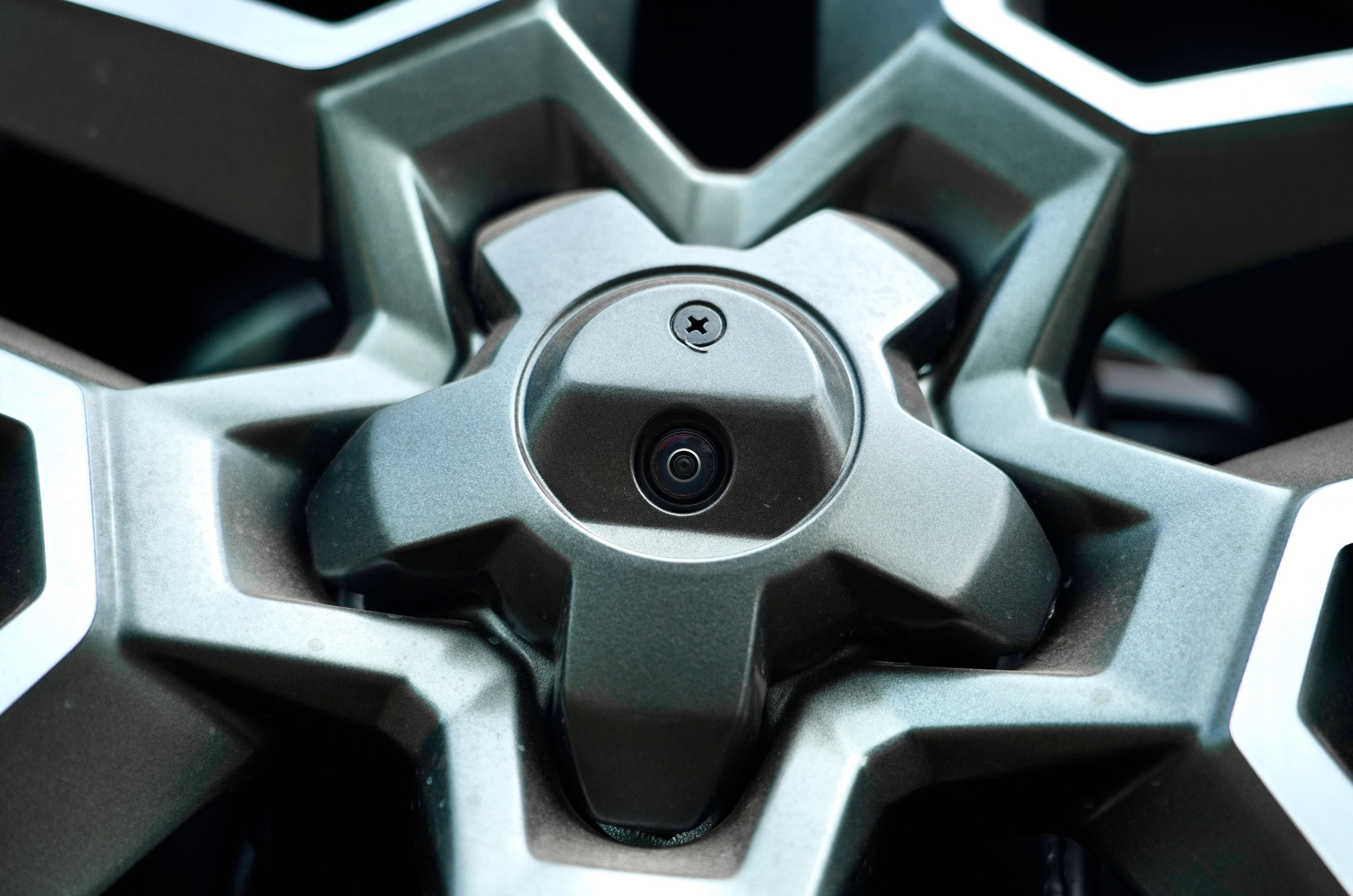
The rear continues with the LED treatment, with C-shaped taillamps, a new bumper and another OG logo. A closer look reveals a rear camera in the centre of the spare wheel.
The reversing camera is tucked in the centre of the spare wheel.
Overall, the imposing, butch design remains, with new modern touches.
Mahindra Thar OG interior space and comfort – 6/10
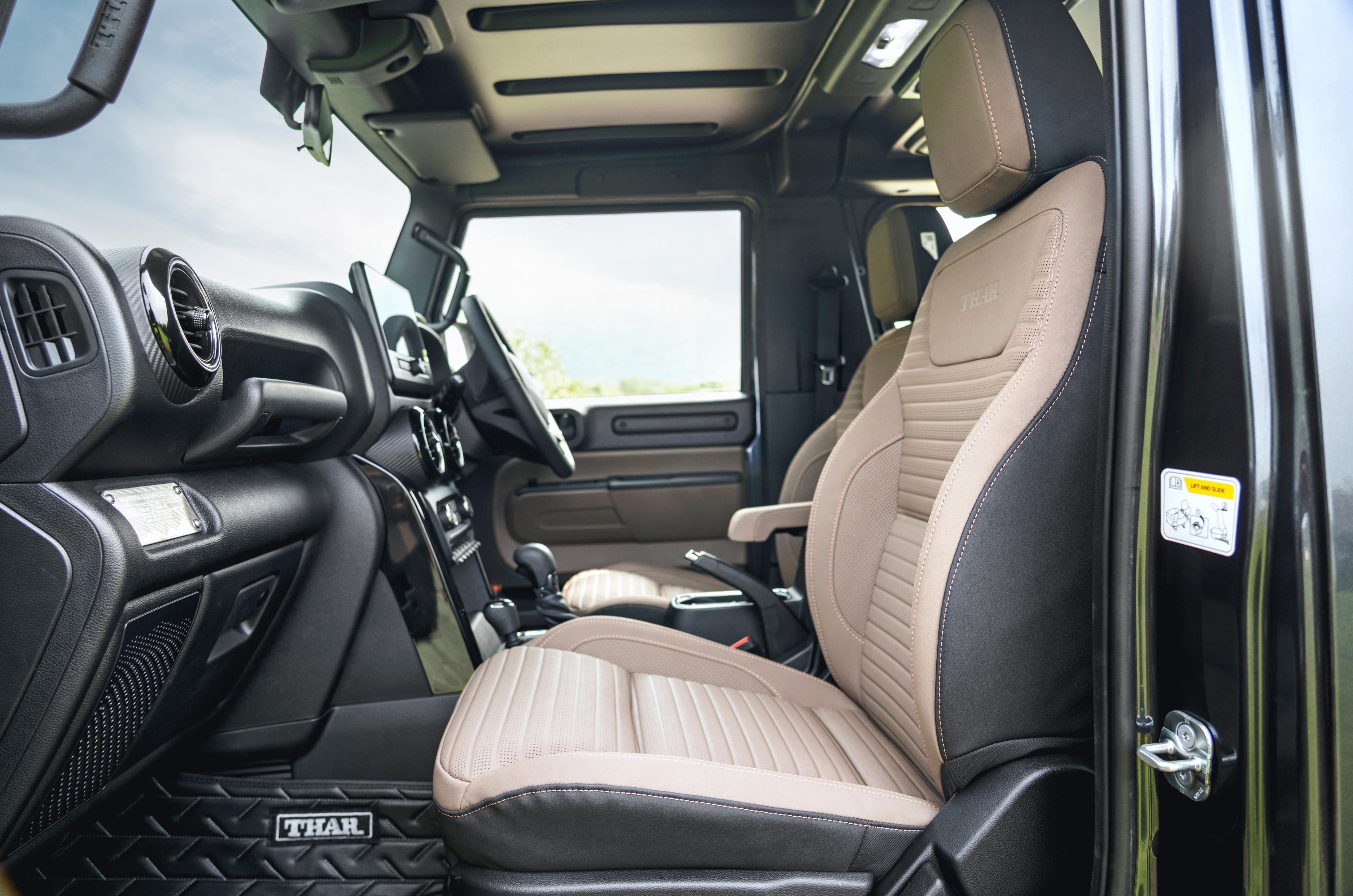
Top-spec ZXT trim gets leatherette upholstery in a new shade.
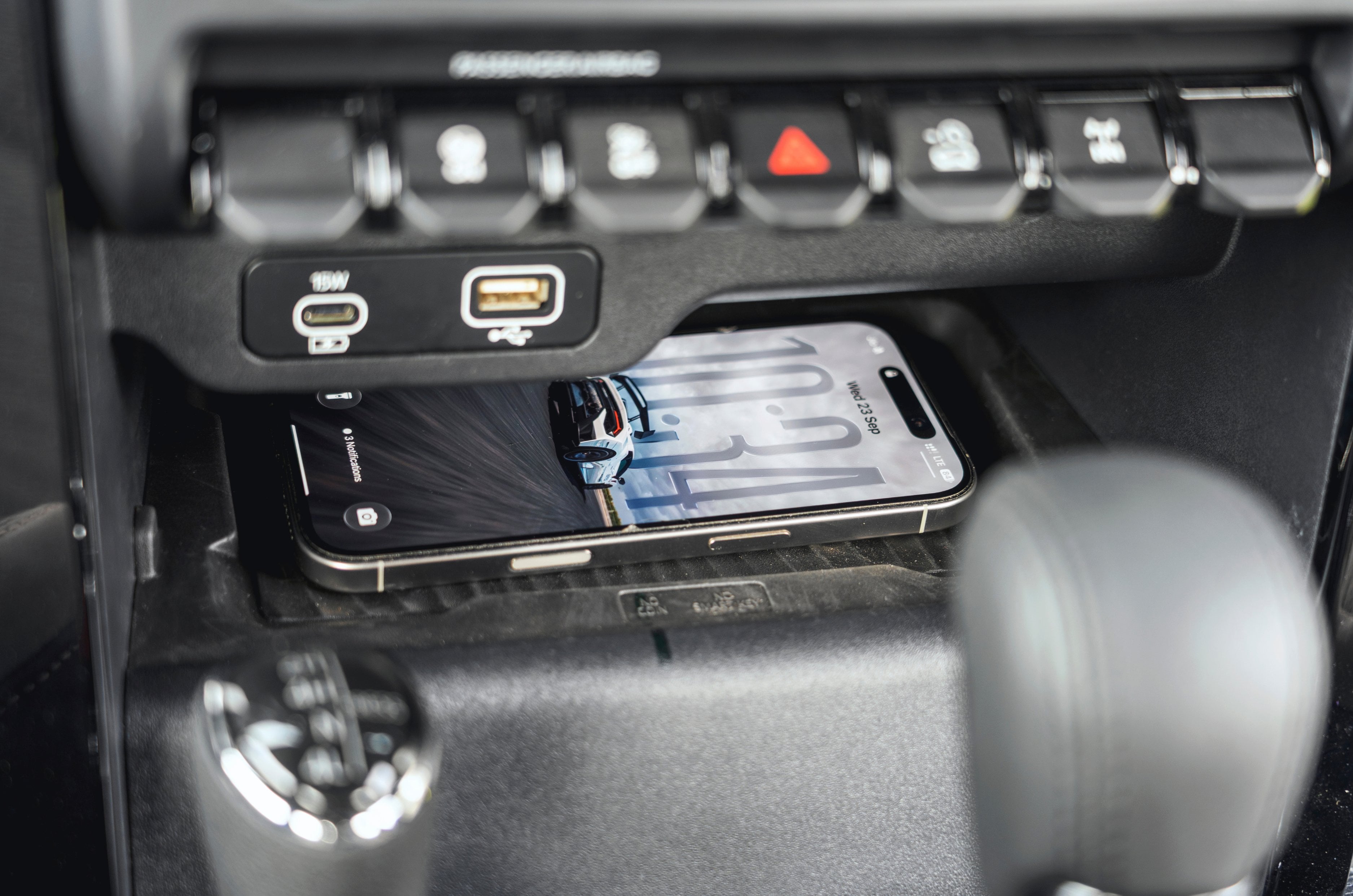
Compared to the exterior, the changes on the inside are a lot more subtle. The new top-spec ZXT trim gets leatherette upholstery finished in a shade of brown, which looks premium with the exposed stitching. There is a new wireless charger and two new switches on the centre console: one for the terrain modes and the other to engage the electronic locking differential.
Gets a new wireless phone charger and different switchgear.
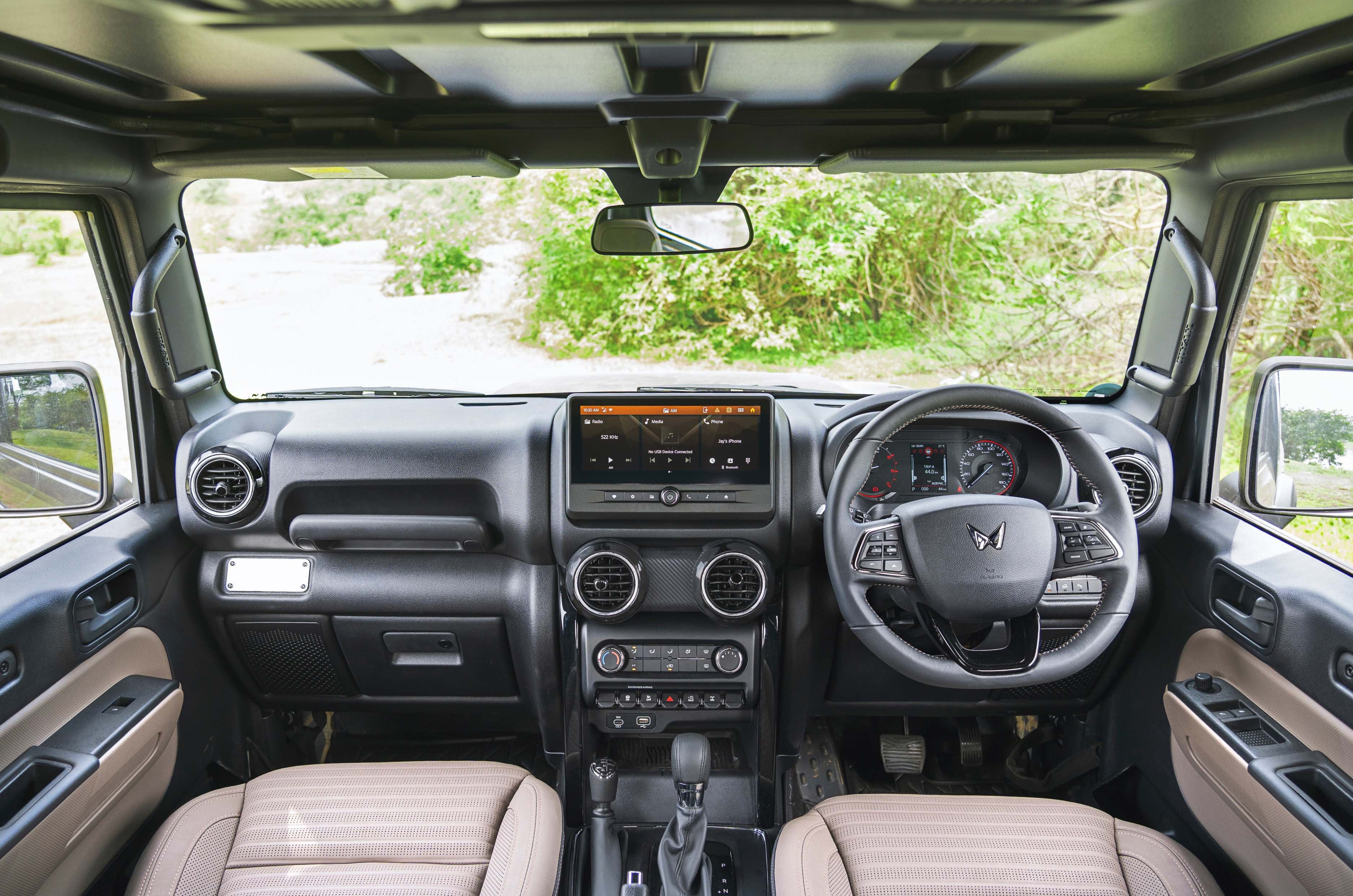
The Thar received a facelift around a year ago, when the cabin was brought up to date with a new steering wheel, touchscreen and dashboard, and these features have been carried over to the OG. The seats are broad and comfy but miss out on ventilation. The two dummy buttons on the centre console will hopefully be used for this feature soon.
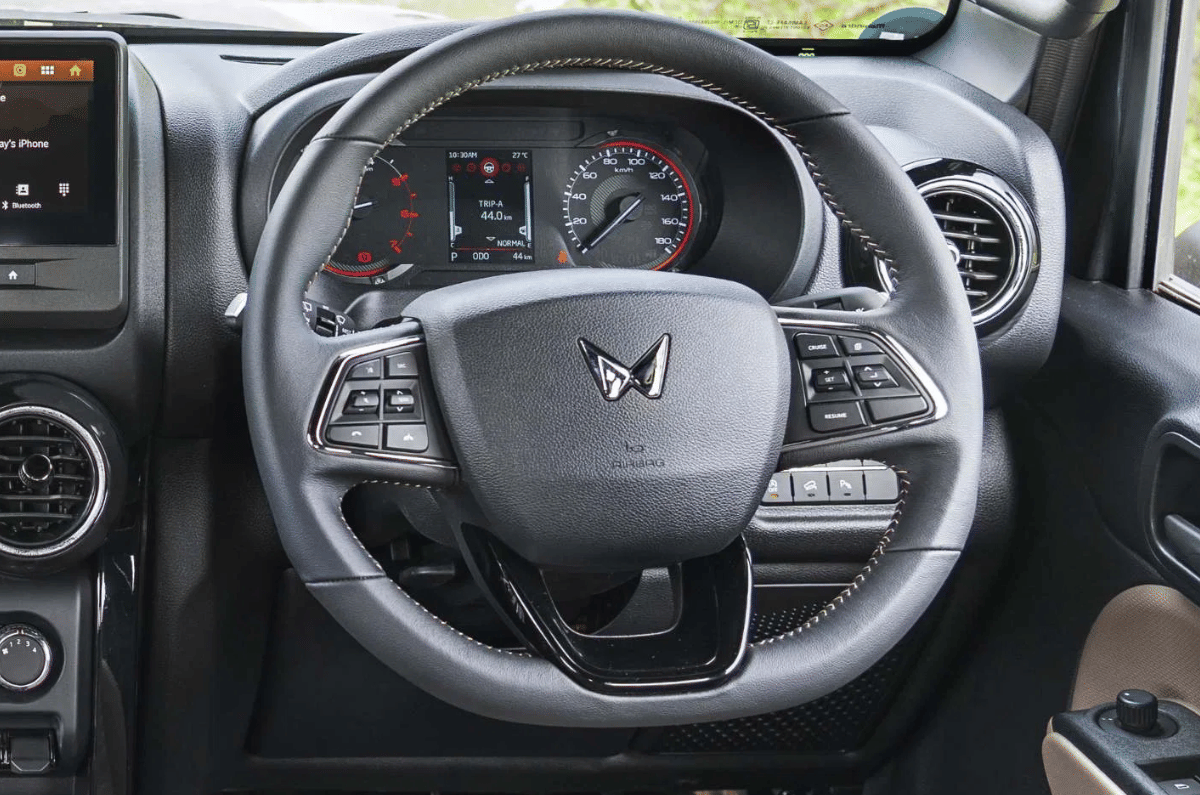
Dashboard design is unchanged from the 2025 facelift.
The steering wheel is also the same as before, as is the analogue instrument cluster with an MID in the centre. The plastics, however, feel low-rent, especially when you consider the rivals in the same price bracket.
Just enough room in the rear seat; gets AC vents now.
At the rear, space remains as it was, and it is exclusively a two-seater. However, the addition of AC vents, a USB-C port and soft-plastic armrests with cupholders has enhanced comfort. The backrest can recline, and short drives should be easy once you settle in.
Boot space is still not adequate for long trips or airport runs without folding the second row.
The boot space remains a weak point too, with barely any room for an airport run. Large suitcases will require folding down the second row.
Mahindra Thar OG features and safety – 7/10
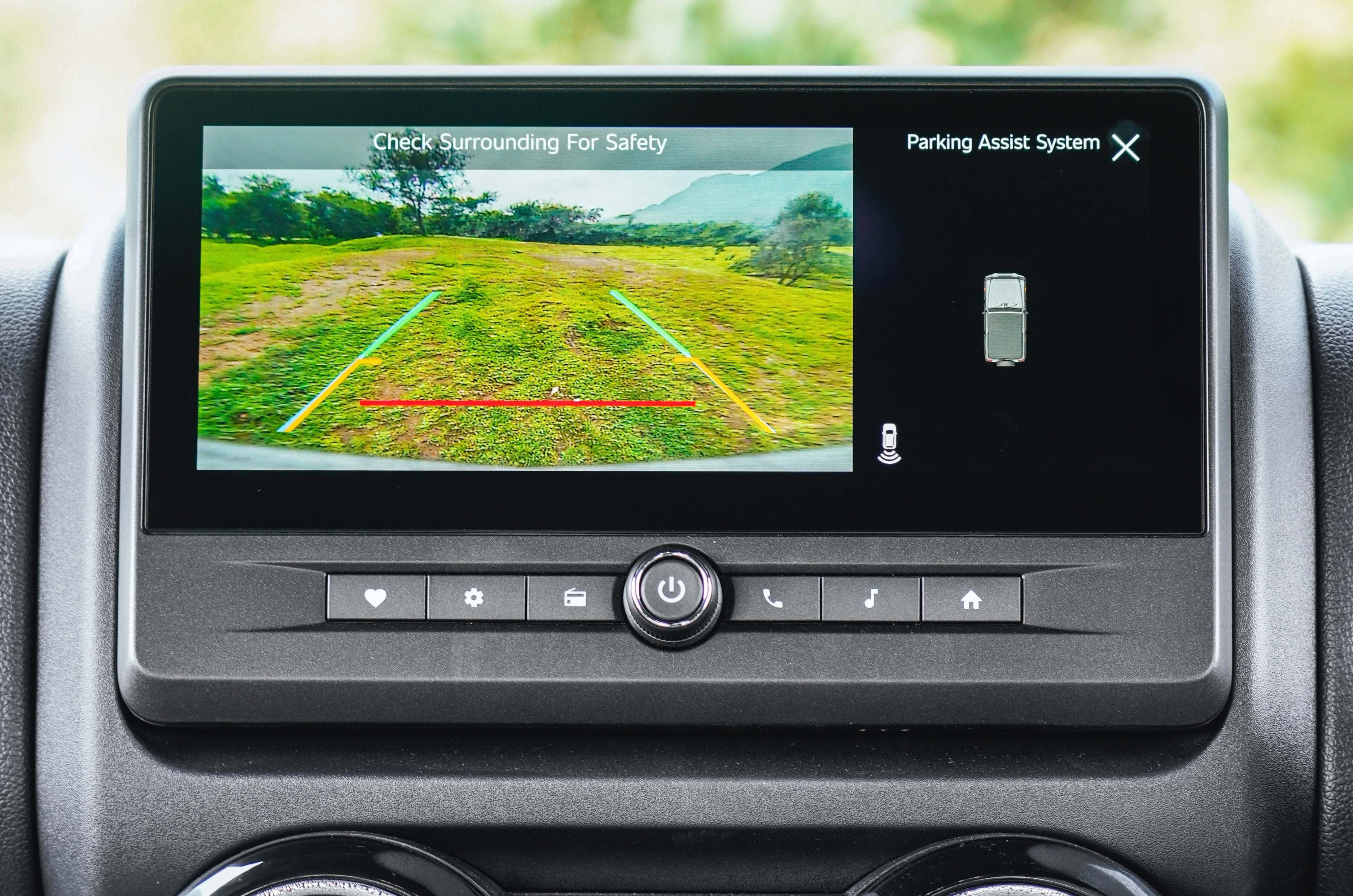
Not the best clarity and misses a 360-degree view, which is essential for off-roading.
The Thar OG isn’t on par with rival mid-size SUVs but does get the essentials this time around. There are grab handles, manual AC controls, a USB-A port for Apple CarPlay since it isn’t wireless, and a USB-C port for charging. Android Auto gets wireless connectivity.
Crucially, the ZXT trim gets six airbags now, with the launch of the new HPTS airbags, which stand for Head, Pelvis, Thorax and Shoulder. There are front parking sensors with a reversing camera now, although, given the Thar’s off-road bias, a 360-degree camera would have been a lot more useful. The ESP also gets a retune for better response, and then there are the big mechanical updates under the skin.
Mahindra Thar OG performance and refinement – 8/10
The bump in power and torque makes it better at highway cruising.
Powering the Thar OG is the same powertrain lineup as before, but with a bump in power and torque for the turbo-petrol engine and the bigger diesel. We had the 2.2-litre diesel engine on test with the six-speed automatic gearbox. The engine now produces 152hp and 330Nm, which is 18hp and 30Nm more than the outgoing unit.
To be honest, the jump in performance is not evident initially, as Mahindra engines have always had a good off-the-line response. Where the power comes in is in the second half of the rev band. Highway cruising at triple-digit speeds is a bit more effortless now, but you wouldn’t enjoy rushing the Thar. Sedate cruising is what it does best.
Highway stability is better now, but over an uneven stretch it still tosses you around.
What Mahindra has also improved is NVH, and the cabin is a bit more muted now. You still hear the diesel drone past 2,500rpm, but overall sound damping has been improved.
The gearbox, too, likes to pace itself, and quick overtakes come at the cost of engine noise. The shifts are smooth but relaxed, and even in manual mode, you don’t get much better response. Enthusiastic driving is not something the Thar enjoys, contrary to the infamous videos circulating online.
Mahindra Thar OG ride comfort and handling – 7/10
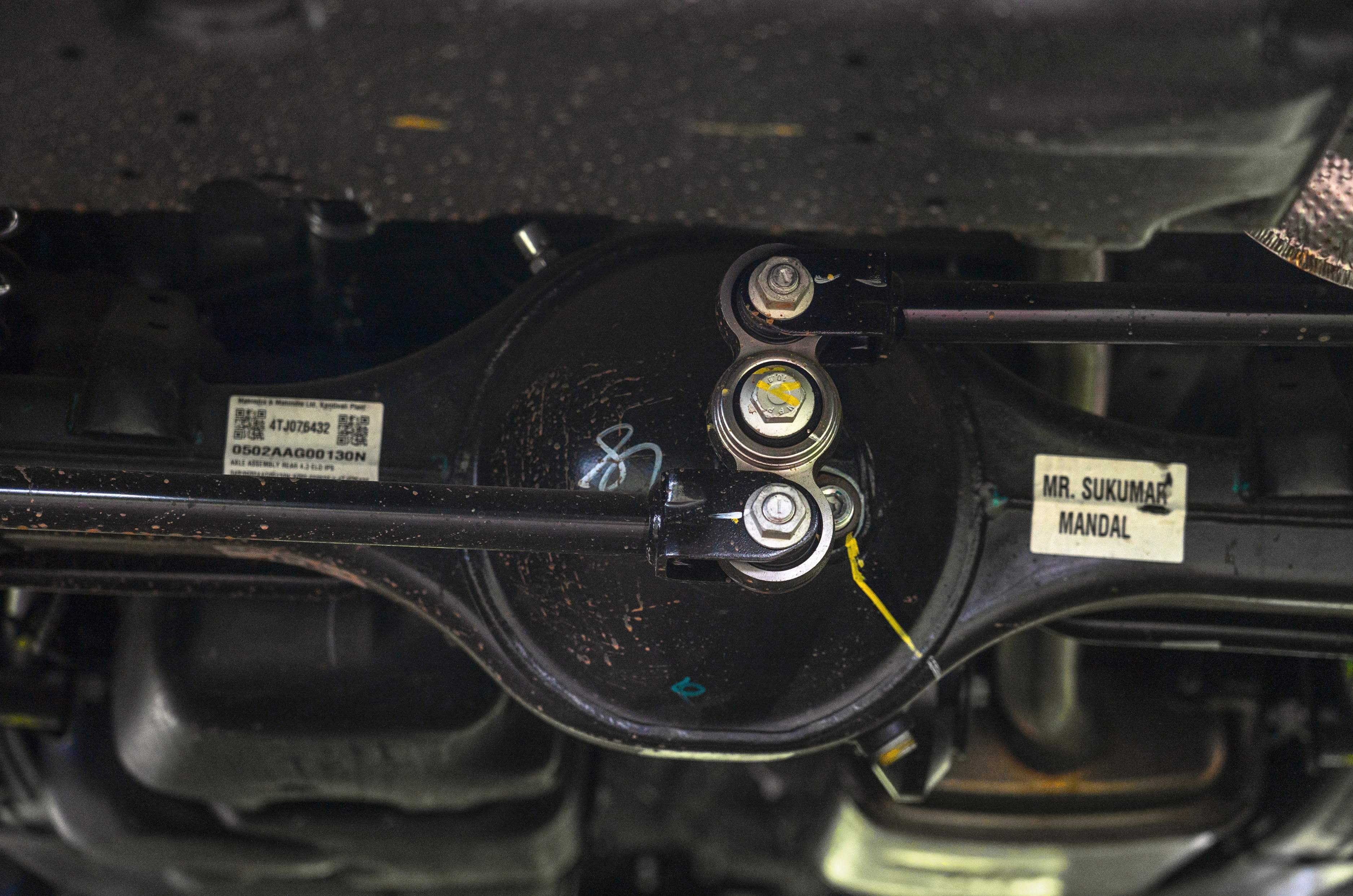
Rear pentalink suspension with Watts linkage for added stability and comfort.
The biggest advances to the Thar OG have taken place under the body. The stiffer Gen 4 chassis is paired with a new Pentalink suspension at the rear, with a Watts linkage and DAVINCI dampers. Frequency-dependent damping, however, is only available on the top-spec trim. But has that improved the Thar on the road? The simple answer is yes.
The Watts linkage is responsible for adding stability at the rear. Imagine you’re pushing a shopping trolley. If one wheel suddenly moves sideways while you hit a bump, the trolley gets wobbly. The Watts linkage basically tells the axle: “You can go up and down, but please stay in the middle.” The effect is less bouncing over uneven highways and bad patches.
The electronic locking differential is now convenient to use, making the Thar just as capable as before.
Then there is the DAVINCI damping that was seen on the XUV 7XO. The thuds coming from sharp, low-speed bumps are now not as harsh and, while it will still toss you around, if you hit a bad bump, it won’t unsettle the car. To add even more comfort with the bigger 19-inch wheels, the ZXT trim also gets frequency-dependent dampers along with the DAVINCI setup. Over a rough patch, you can tell they are working full-time to keep the cabin unfazed.
New gen 4 platform seen on the Roxx now underpins the 3-door Thar.
Now, as sophisticated as all of this is, the Thar OG is still a hardcore body-on-frame SUV at the end of the day. The new tech has certainly improved its on-road manners, but if you want a plush, supple ride, the Thar won’t cut it. A long drive will now be more comfortable, but you will still get knocked awake from your snooze.
Terrain modes work with ESP, throttle control and steering input for maximum assistance while off-roading.
The new EPS, however, has made a huge difference. The amount of effort needed to steer and turn the Thar is no longer a game of might. Under 20kph, the steering is light enough to twirl with just one finger, but as the speed rises, it gains heft so as not to feel uncomfortably light at speed. So, there is no need to wrangle with the steering to make a three-point turn anymore.
Also new and exclusive to the ZXT trim are rear disc brakes, which have added to the stopping power. The bite is stronger, and the Thar feels a lot more confident when slowing down now.
Mahindra Thar OG price and verdict – 8/10
The Thar OG is improved in all areas without sacrificing its character.
With a starting price of Rs 10.32 lakh, the Thar OG is rather tempting. However, for most of the new bells and whistles, you will have to opt for the top-spec ZXT trim, which starts at Rs 13.99 lakh for the 1.5-litre engine with RWD. The diesel-AT version we drove will set you back Rs 18.99 lakh, so you need to be sure of what you want. The Thar OG is mighty capable, has a lot of character and is a lot better in every area than before. But as an everyday car, you’d still want some more practicality, creature comforts and refinement. However, if you are someone who likes to off-road or even just take the long way home with little regard for plushness, there is nothing like the Thar OG under Rs 65 lakh.
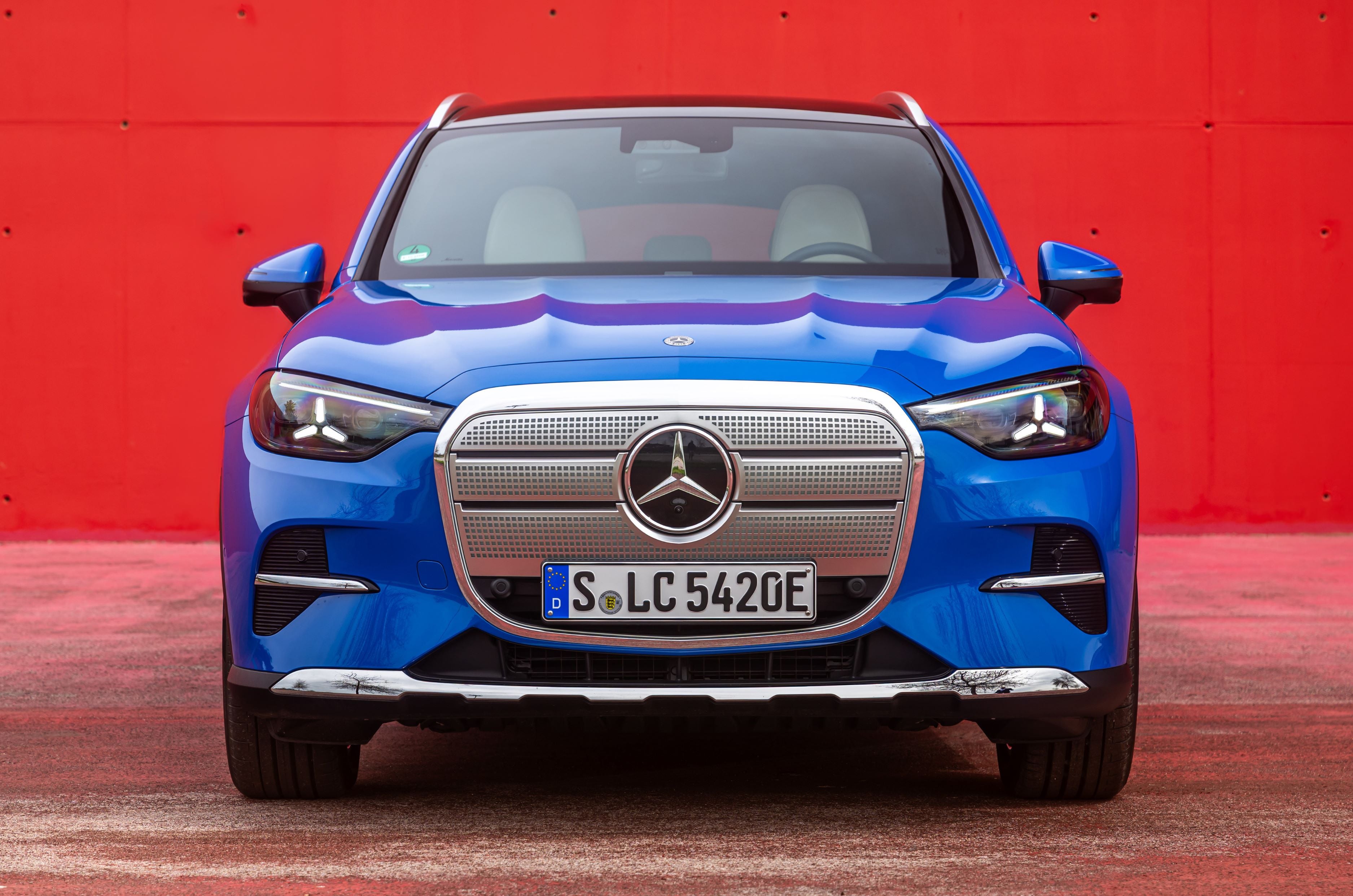
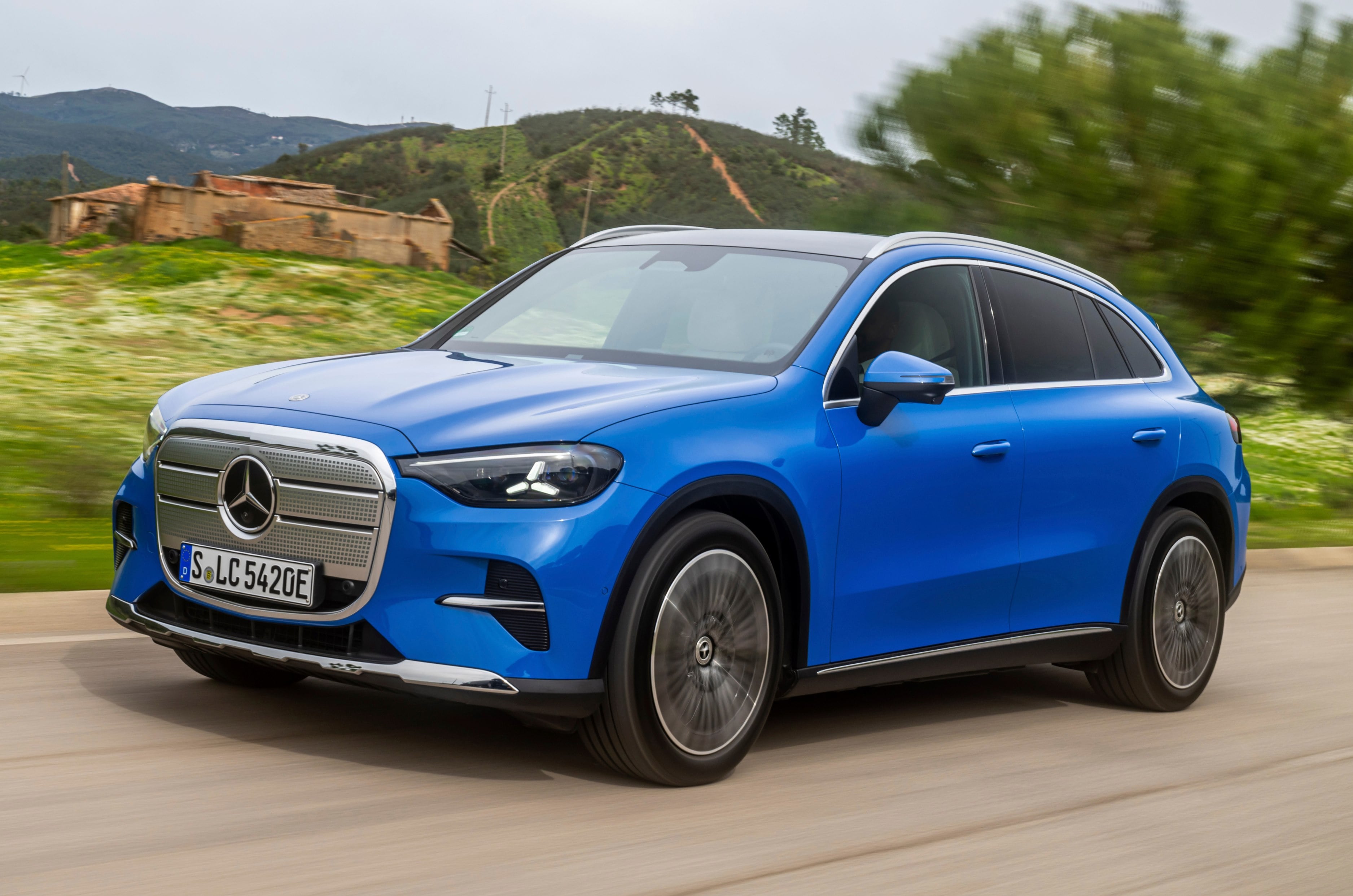
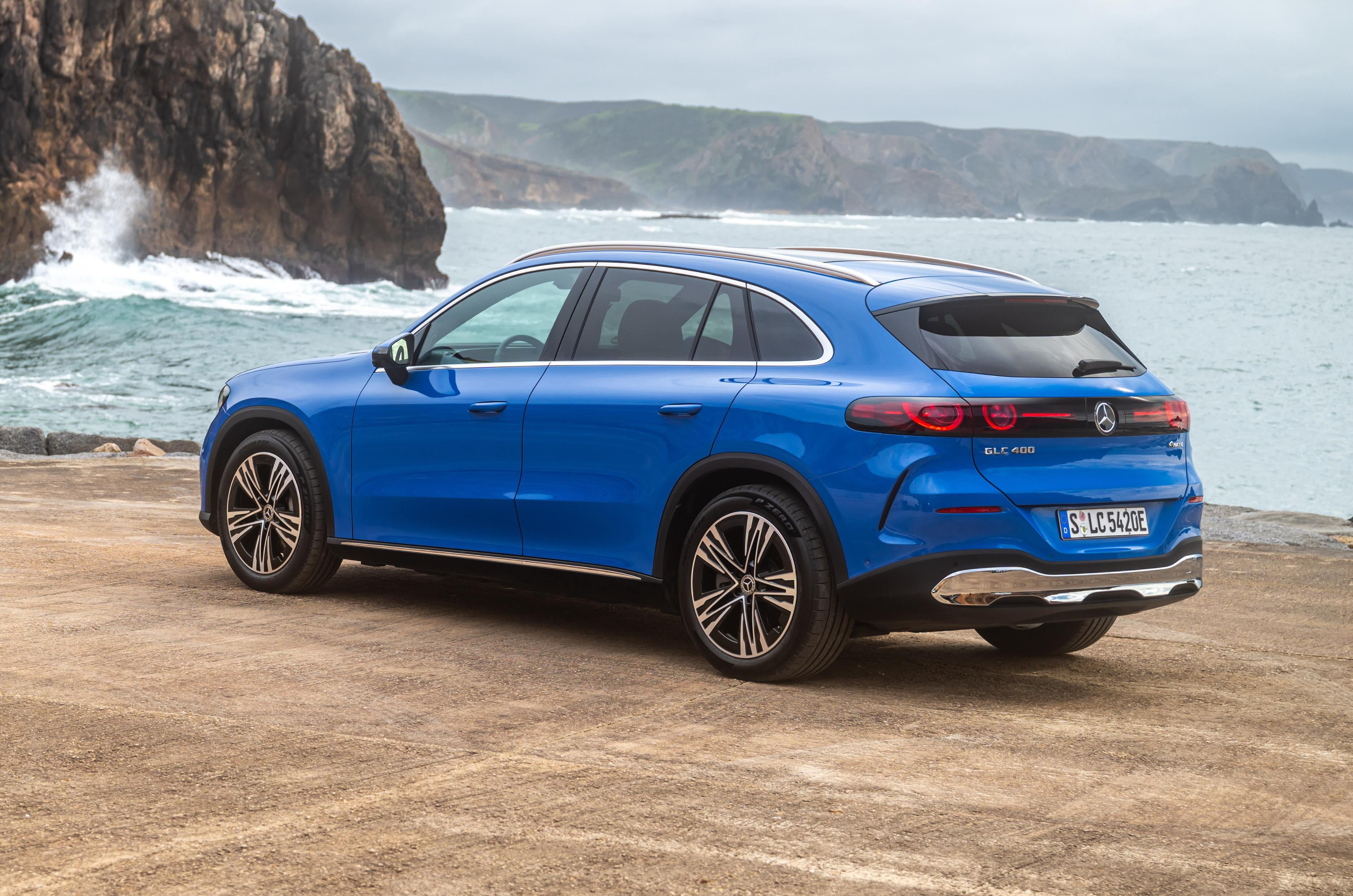
The Mercedes-Benz GLC EV you see here is not merely an electric derivative of the GLC you and I are familiar with. It’s built on an all-electric platform, and it’s longer, wider, and built on a slightly larger wheelbase than the GLC. And it also does 0-100kph in just 4.3 seconds.
The big news is that it’s coming to India by the end of the year. There’s lots to talk about, so let’s go one by one.
Mercedes-Benz GLC EV Exterior Design and Engineering – 8/10
Large new grille reminiscent of older Mercs
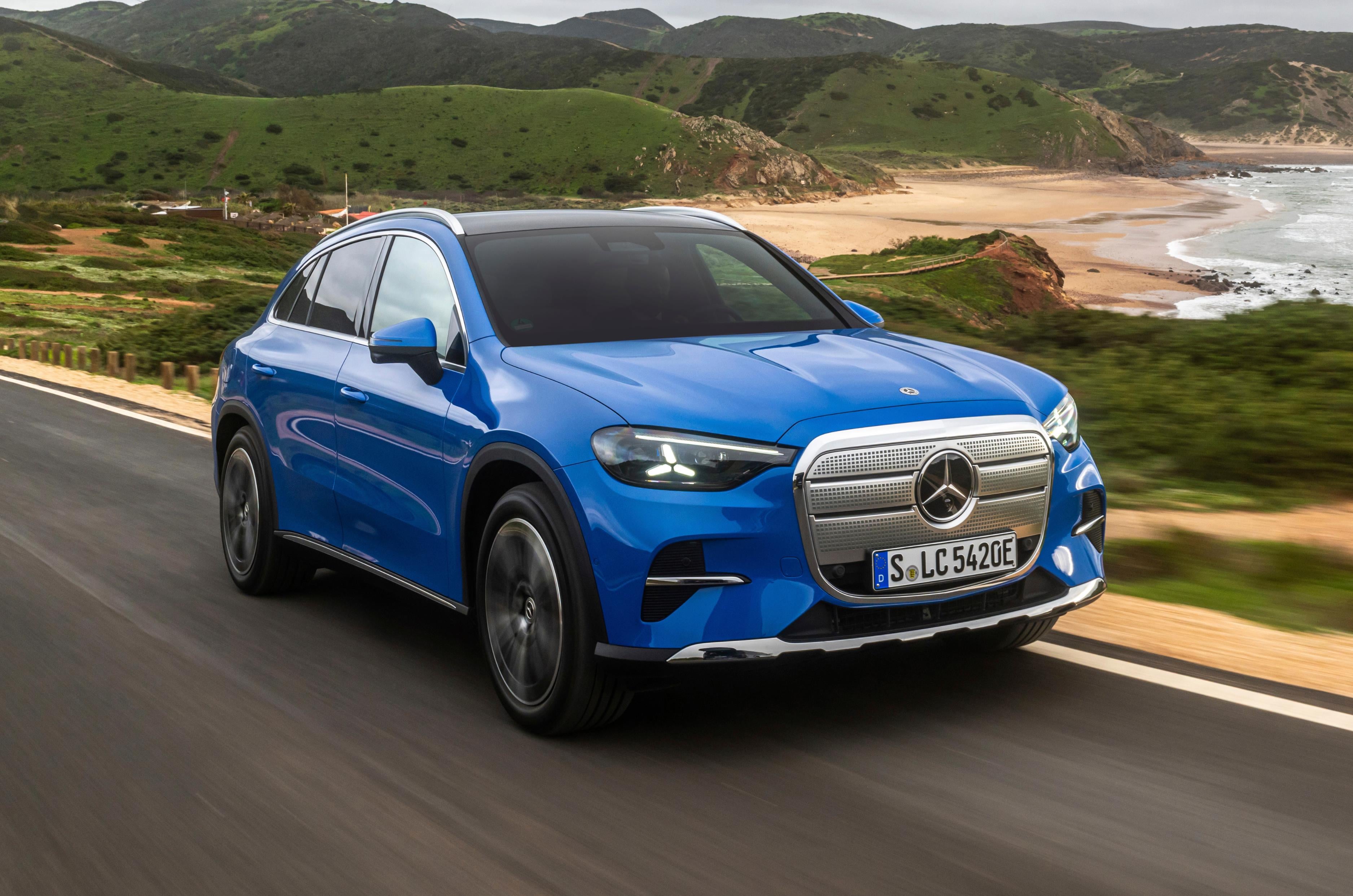
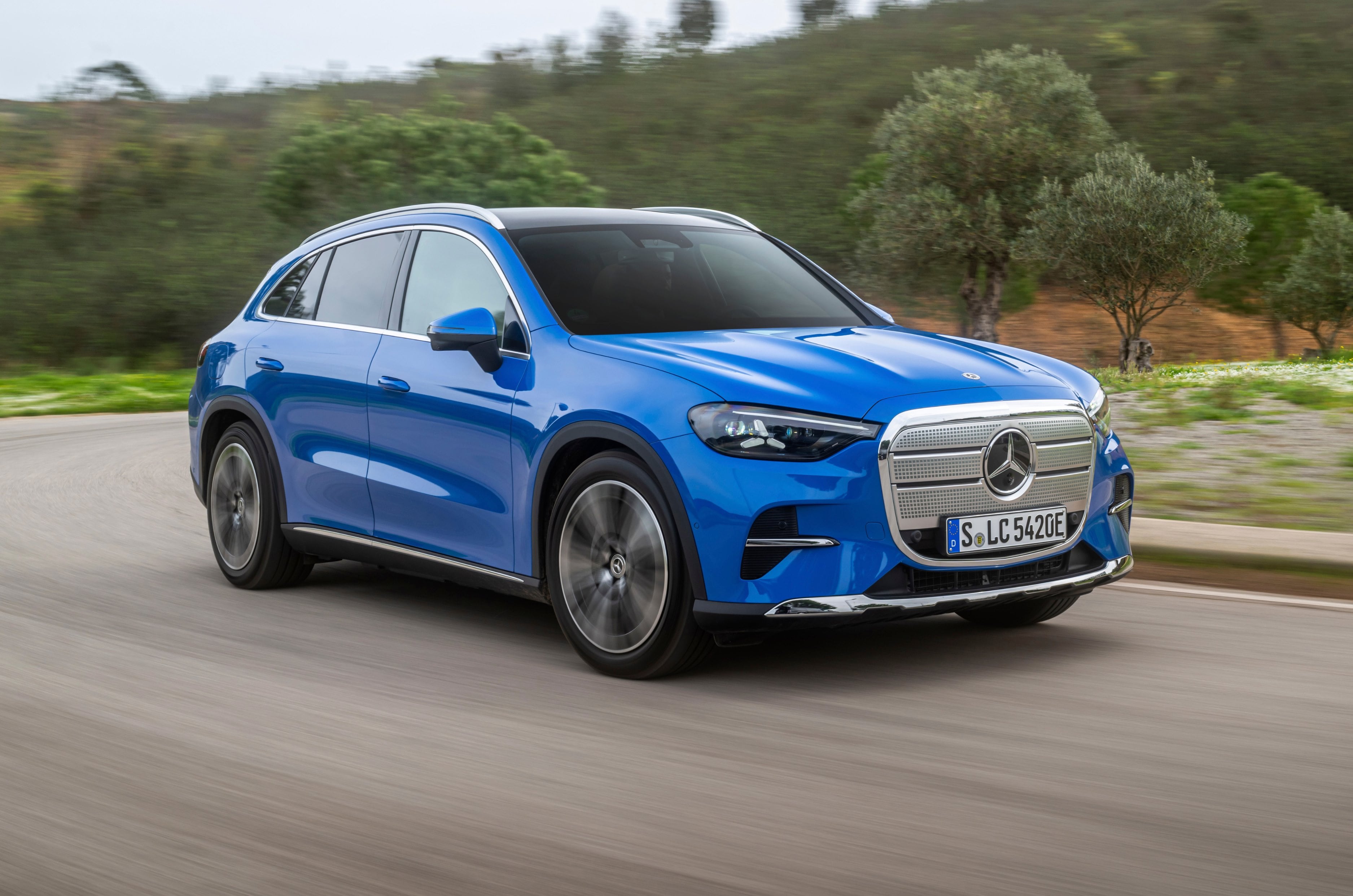
Let’s talk styling first, and what catches your attention up front is this large new grille. It’s very different from what we’ve seen of Mercs of late, but it actually has a link to Mercs of old. The upright grille is styled to look like the one on iconic models like the W112 S-Class, but there’s a lot of modernity built into it as well. There are 942 lighting elements in it! Talking of lighting, the three-pointed star on the nose glows and there’s a tri-star DRL pattern in the headlights too. And unlike other Merc EVs from the (recent) past, there is a functional frunk with a handy 129 litres of space.
Gets an 84mm longer wheelbase than the ICE version.
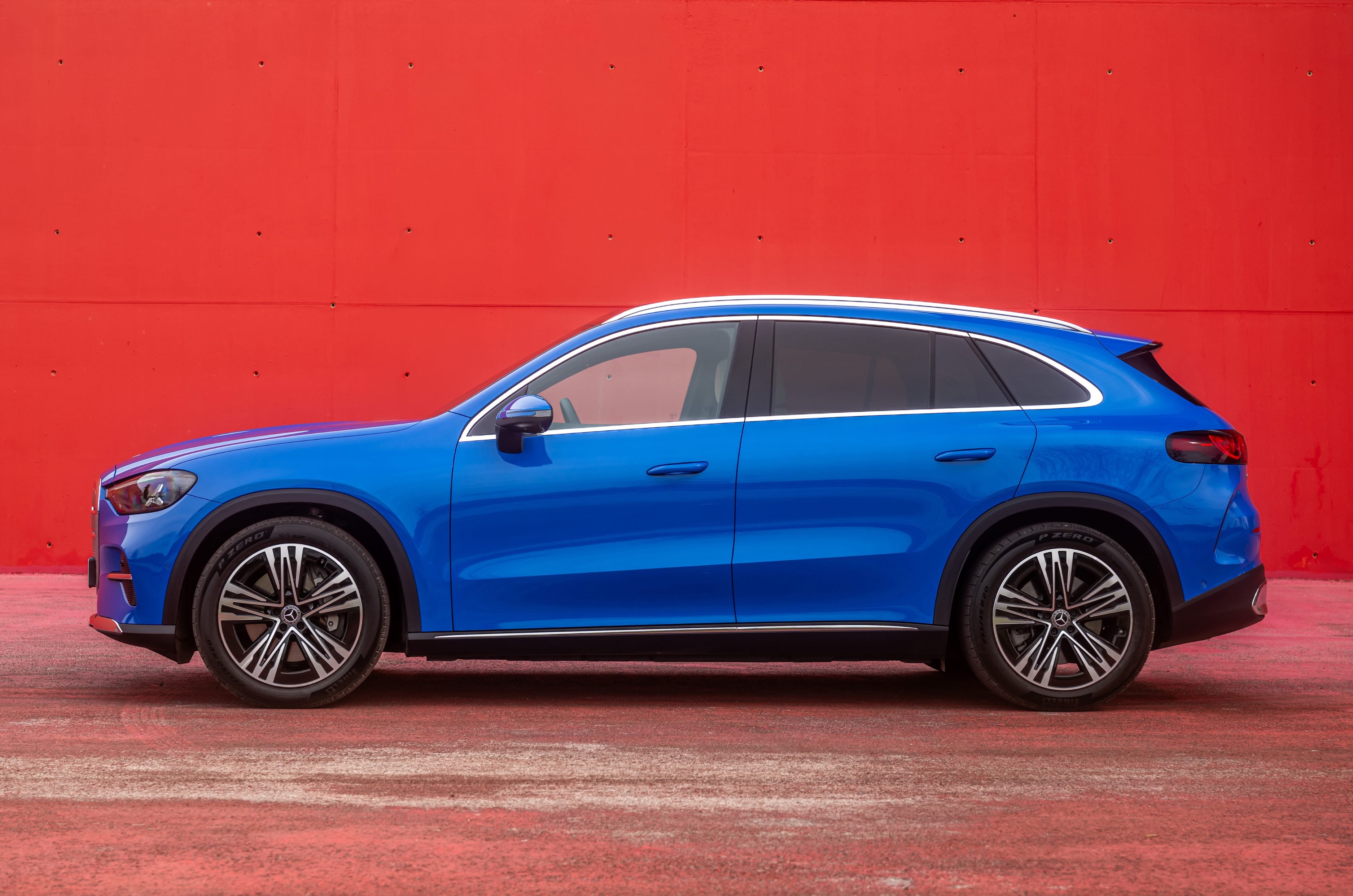
The GLC EV doesn’t look all too different to the ICE GLC in profile. Which is to say it is not an upright SUV but curvy, low-slung and aerodynamic. What is noticeably different is the wheelbase, which is a full 84mm longer. Mind you, this is the standard wheelbase GLC EV. There’s a long-wheelbase version sold in markets like China. India will get the GLC with 20-inch rims and flush-fitted door handles that pop out when the doors are unlocked.
570-litre boot is spacious, but a caveat is the absence of a spare wheel.
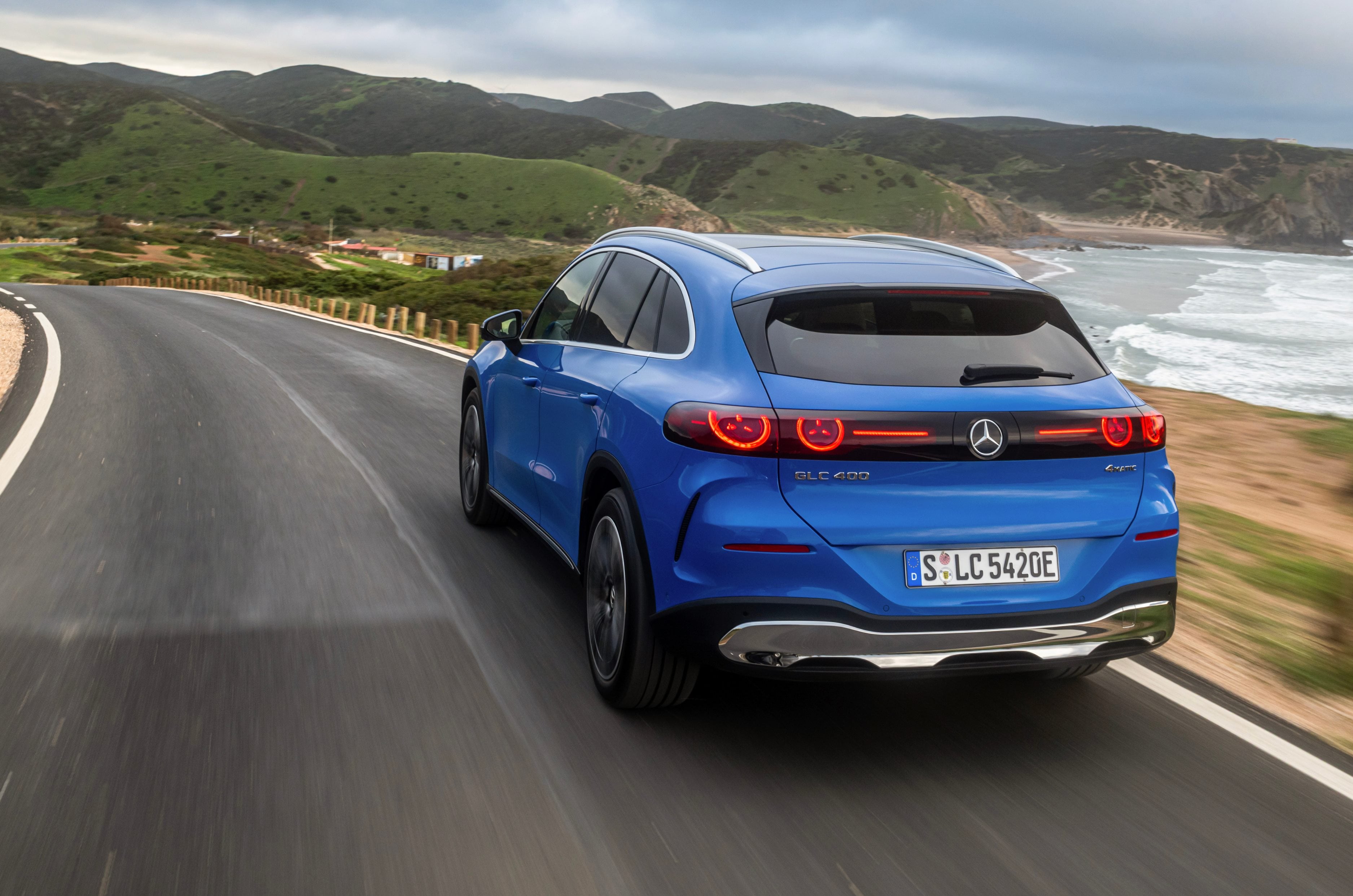
Styling at the back is quite distinct from the other lot of Mercedes SUVs, and that’s thanks to a band of black that runs the width of the tailgate. There’s full-LED lighting at the back replete with three-pointed star light signatures.
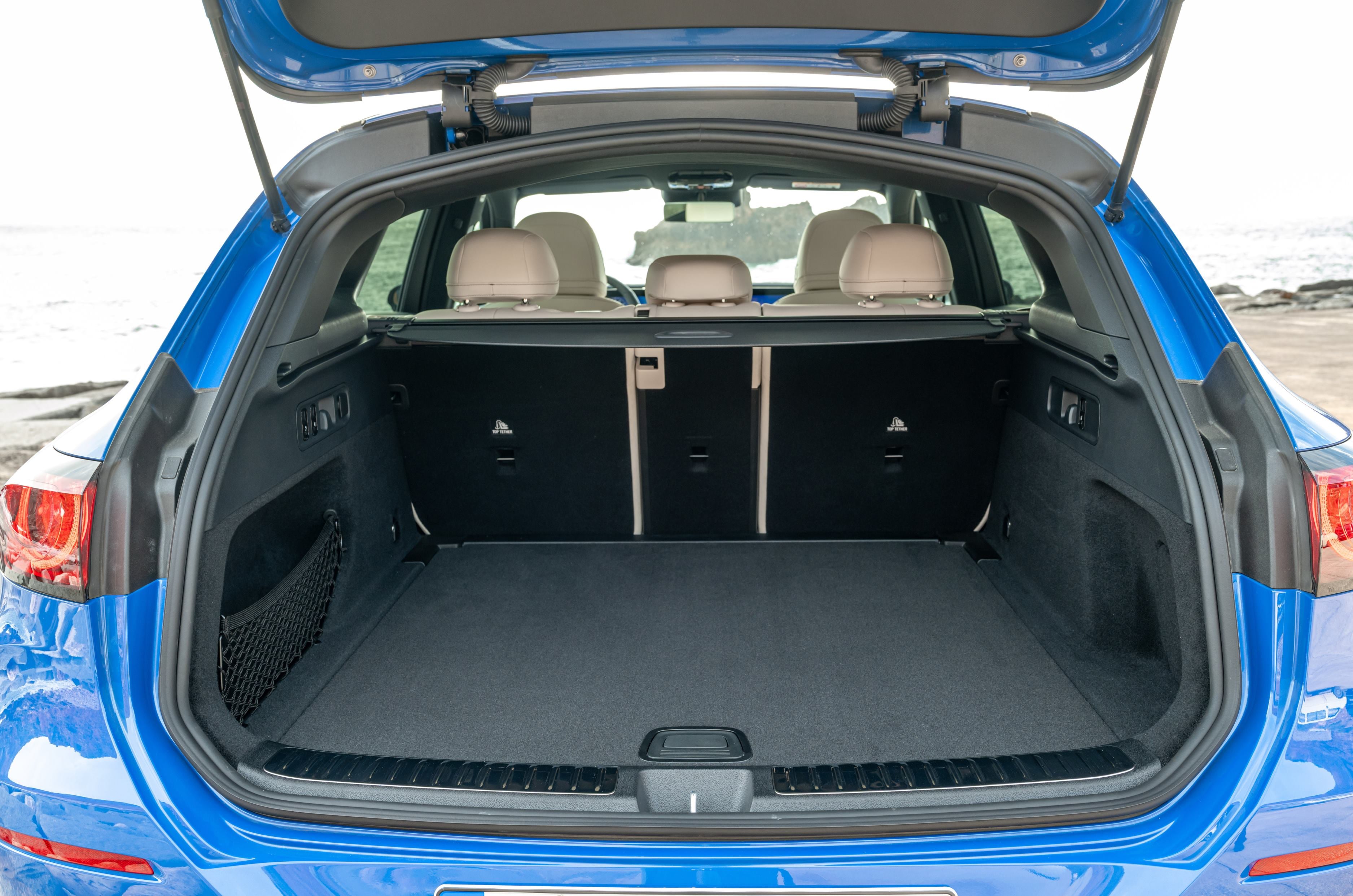
The powered tailgate opens up to a 570-litre luggage area, which is quite sizable. The only catch is that there’s no space for a spare tyre. Mercedes India will probably have to provide one to sit on the boot floor, which means not much space will be left for luggage.
Before we proceed, I have to admit, I didn’t like what I saw of the GLC EV in pictures. In reality, it is eye-catching, and in a very good way.
Mercedes-Benz GLC EV Interior Space and Comfort – 8/10
Interior quality is impressive, with open-pore wood trim while physical steering knobs and AC vents have a tactile feel
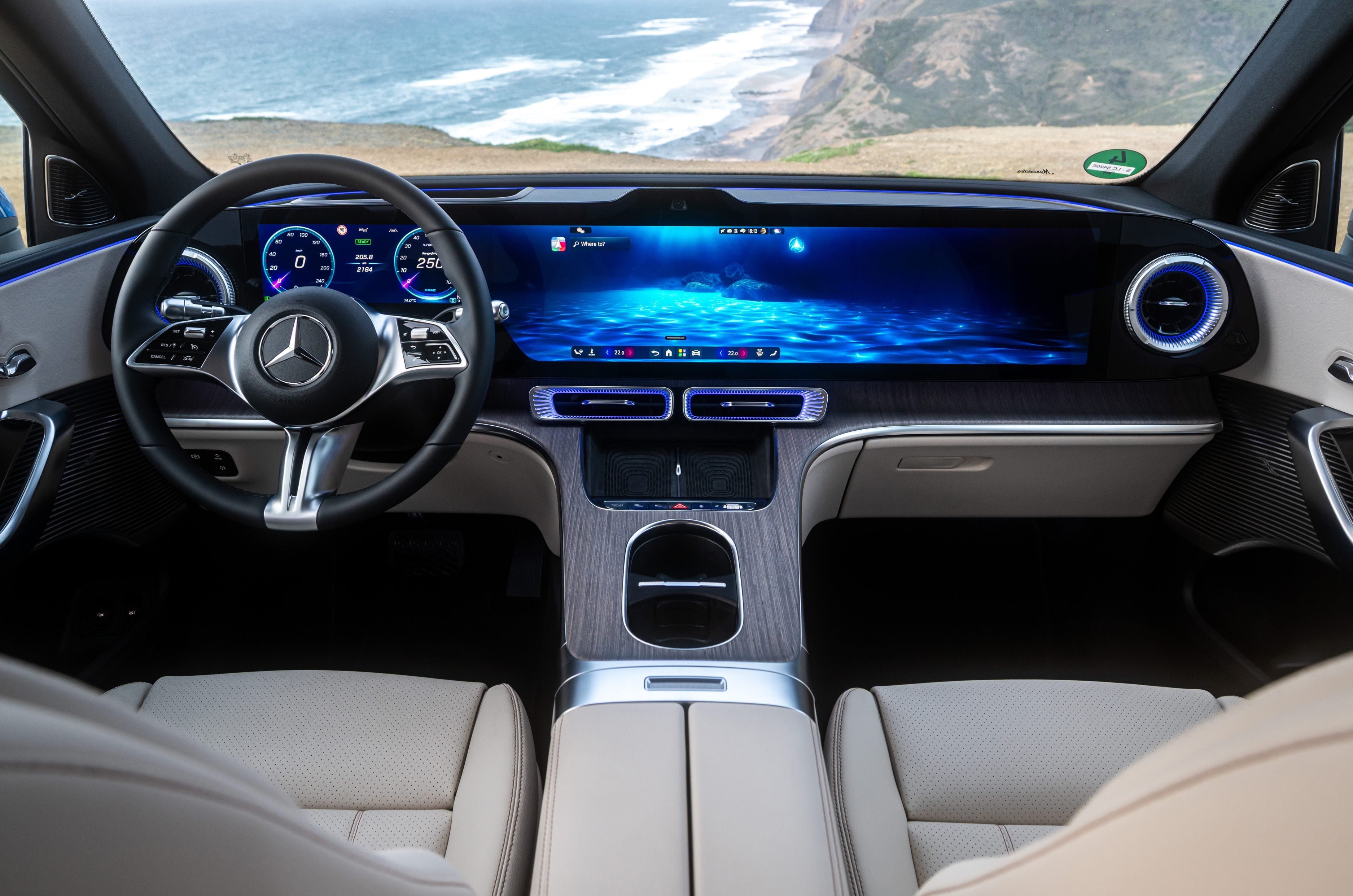
That new-age Mercedes vibe continues inside too, and that feeling is all thanks to a 39-inch Hyperscreen that extends nearly the entire width of the dash. There’s a seamless connection between the digital instrument cluster, the centre touchscreen and front passenger display, and it does look really impressive. That being said, the screens have taken away some of the warmth that you’d expect in a Merc.
Comfy front seats come with various levels of adjustment, massage and heating. India-spec model expected to come with a cooling function.
In terms of quality, though, the GLC EV feels like an expensive Mercedes. There’s open-pore wood, the AC vents operate with very satisfying clicks and clacks, and physical rotary controllers make a welcome comeback to the steering wheel.
The front seats are as comfy as they look, with multi-way powered adjustment, massage and heating. We expect the model for India to pack in ventilation as well.
You get more space than the standard GLC, and unlike some EVs, you do get good foot room. However, it’s best suited for two.
It’s at the back where things get really interesting for buyers confused between a GLC and a GLC EV. Rear seat space is a bit more generous than the standard GLC. There’s also good foot room under the front seats, which is not something you can say about all EVs, and even the seating position isn’t the typical knees-up that we’ve come to associate with EVs. A longer seat squab would have upped the experience. Also, the rear seat is best for two. A middle passenger will have to contend with a high centre tunnel.
Mercedes-Benz GLC EV Features and Safety – 9/10
The Hyperscreen is the focal point of the dash and delivers brilliant graphics across the entire display. The digital dials, centre touchscreen and passenger screen appear to be part of a seamless display and look terrific. There are themes for the screen too that also adjust other functions for the full effect. For instance, a bonfire on the screen will be accompanied by the seat heating coming on.
Massive 39-inch hyperscreen has a good UI and seamlessly integrates with other in-car displays but packs in too many functions.
The thing is, there’s just too much packed onto the centre touchscreen. The UI is good but more physical controls would just make life easier. The passenger display is slick in its own right but only blanks out if it detects the driver looking at it (a camera on the dash monitors the driver’s gaze). A privacy glass would have just been better.
Among the other features, the panoramic glass roof is made up of nine segments which can be individually controlled for transparency. You can make them completely opaque, and they did a surprisingly good job of keeping the heat out. You could even have the glass roof specced with 162 stars that change colour with the ambient lighting.
Panoramic glass roof comprises nine individually configurable segments to control transparency.
Features-wise, aside from the screens and glass roof, the other highlight is the Burmester 4D sound system with exciters in the seat, so you can actually feel the bass. The head-up display and cameras are also top-class, while the AI integration doesn’t feel like a tick-mark item. You can actually converse with your car for restaurant recommendations or even abstract general knowledge.
The safety suite includes 9 airbags, ESC and a full suite of ADAS features.
Mercedes-Benz GLC EV Performance and Refinement – 9/10
Your friendly Mercedes salesperson will only be too happy to run you through the GLC 400’s big numbers: 489hp, 800Nm and a 4.3 sec 0-100kph time. The figures are made possible by front and rear permanently excited motors that draw power from a 94kWh battery pack.
489hp from its dual motors makes the GLC EV feel like an AMG compared to its ICE counterpart.
How does it all come together? The first thing that gets you is the silence. The drive experience is just what you’d expect in a plush Mercedes electric car. So it’s really quiet, and you don’t hear much of the world outside. There is a bit of wind noise if you really pay attention, but honestly, with some music piping out of the Burmester sound system, it’s not something that will catch your attention in the least.
What’s also clear is that the GLC EV is the strong and silent type. The performance makes the GLC EV feel like an AMG compared to the standard GLC petrol and diesel. A two-speed gearbox ensures quick getaways when needed, as well as the long legs for a more relaxed drive. Stomp down on the accelerator from a steady cruise, and you can feel the kickdown.
You won’t need to drive like a hoon to enjoy the GLC EV. Performance, no surprises, is very brisk when you put some weight on the accelerator pedal, with easy access to power. You can make the GLC EV feel a bit more urgent when you play around with the drive modes, but honestly, you won’t really need to because of how friendly the power feels and how ready the GLC EV feels at all times.
Power is easily accessible and is ready to push further when you put your foot down.
You’ll also take very naturally to the regen braking levels. One-pedal driving is included, and there’s the option of an intelligent mode too that reads the driving environment and optimises regen force.
The GLC EV also gets sound profiles, and we have to say they’re a bit unusual. They’re not trying to mimic the sound of a V8 or a V6 or any kind of ICE engine. The sounds are more on the sci-fi spectrum, so if you accelerate hard, you’d get the feeling of being in a UFO, which is disconcerting, if we can be honest. We’d rather enjoy the quiet inside.
Mercedes-Benz GLC EV Range and Efficiency – 8/10
Its large 94kWh battery can be charged from 10-80 percent in 22 minutes with a 330kW DC fast charger.
Now, on to the matter of range. Mercedes claims a 715-kilometre range on the WLTP cycle. Even if you account for real-world Indian conditions, you’re looking at a comfortable range of over 550 kilometres. Drive with a bit of care, and you could see that figure go past 600 kilometres. We really have come a long way in just a few years, haven’t we?
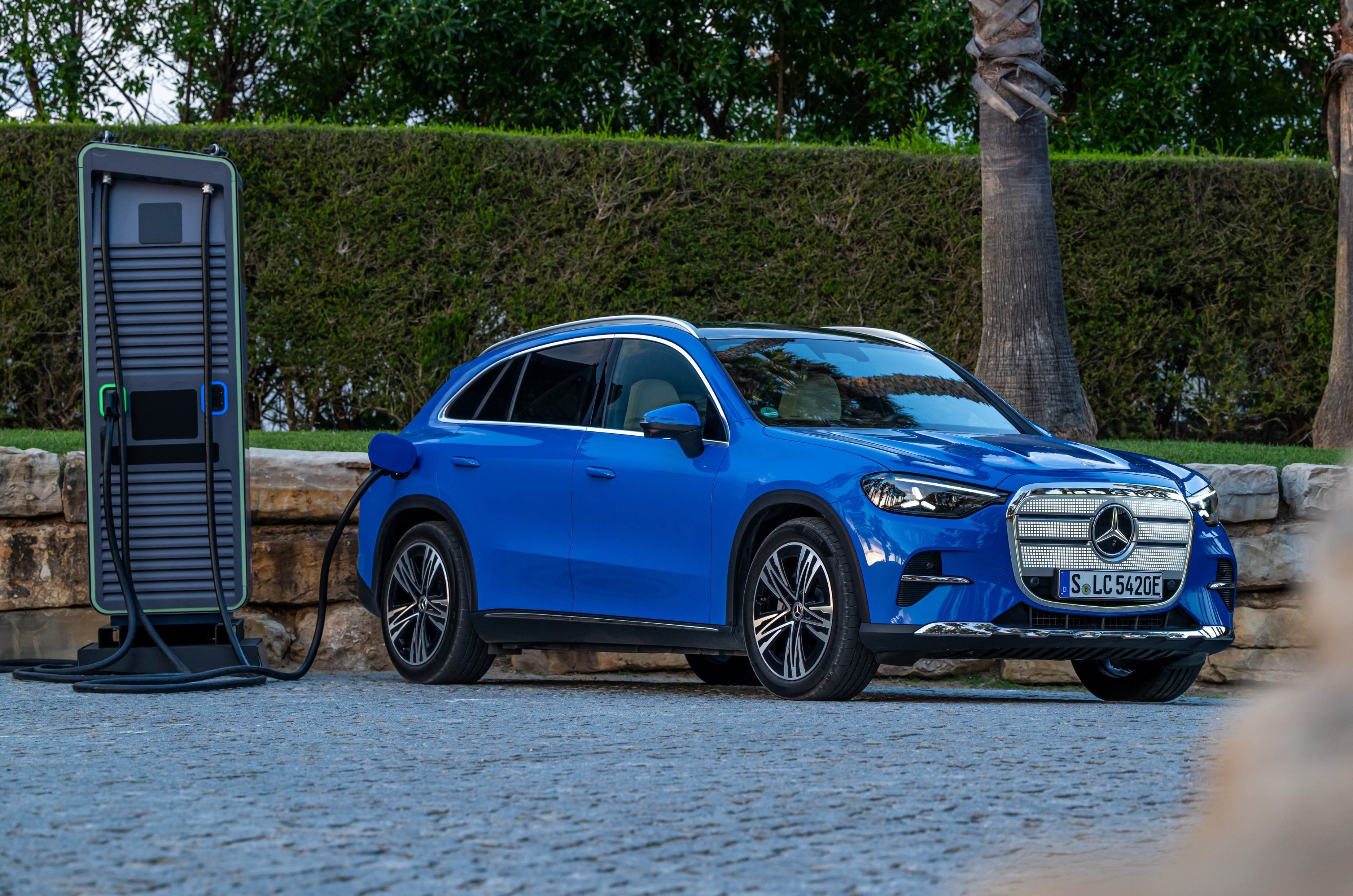
Of course, the go-to charging solution for most owners will be home charging. There’s up to 22kW AC support. The GLC can also be charged at up to 330kW using DC charging. Theoretically, at max speed, the GLC EV’s 94kWh battery can be juiced up from 10 to 80 percent in 22 minutes. A 10-minute charge alone can give you 300 kilometres of range.
Mercedes-Benz GLC EV Ride Comfort and Handling – 8/10
We can’t give a definitive verdict on cornering ability, as the bulk of our route was on the Autobahn outside Stuttgart, which has the gentlest of curves.
At Autobahn speeds, the GLC EV feels really planted and drives like a proper German car should. There’s pleasant weight at the steering wheel as well.
In terms of high-speed ride comfort, the GLC EV doesn’t come across as softly sprung as something like an EQS SUV, which really feels a bit roly-poly. There is still some vertical movement even when you switch to Sport mode, but it’s not to the point of being an irritant.
Feels planted out on the Autobahn and the steering is well-weighted
We’ll reserve judgement on the air suspension’s bump absorption till we drive the GLC EV on our roads, but on the sole patch of broken road on our route, the GLC EV didn’t feel entirely plush. Perhaps that’s something for Mercedes India to have on their list of things to do for the version headed our way.
A cool feature on the GLC’s suspension is its use of Google Maps to identify the vehicle’s environment and adjust ride height. For instance, the car automatically lowers on a highway. Also cutting-edge is how the suspension preps damping force in advance of a bump based on Car2X information from a Mercedes vehicle driving ahead. The systems better be up for the challenge of our roads.
Bundled in with air suspension is rear-axle steer, and the 4.5 degrees of movement does help greatly at parking speeds.
Mercedes-Benz GLC EV Should You Buy Now or Wait – 9/10
Bookings for the GLC EV open in early October, and the model will be launched in India within 2026.
It’s a big deal because the GLC EV comes to India within just six months of its European rollout. What makes the timeline even more impressive is the fact that the GLC EV won’t be an import, but will be assembled in India. Local assembly points at keen pricing.
The GLC EV will be locally assembled 6 months after its European version goes on sale.
We expect the model to be priced at about Rs 85-90 lakh (estimated, ex-showroom), which wouldn’t be all too far from the ICE GLC’s price. Factor in the registration benefits on EVs, and the price gets more tempting still.
As a product, the GLC EV does have lots going for it. It’s got the power, the refinement and the tech you’d expect on a luxury EV. Importantly, it doesn’t feel like your dad’s Mercedes, and that new-age cool is something many buyers will resonate with.
BMW’s iX3 Long Wheelbase and Audi’s Q6 e-tron are alternatives to watch out for in 2027, but in the near future, the GLC EV looks set for a clean run.
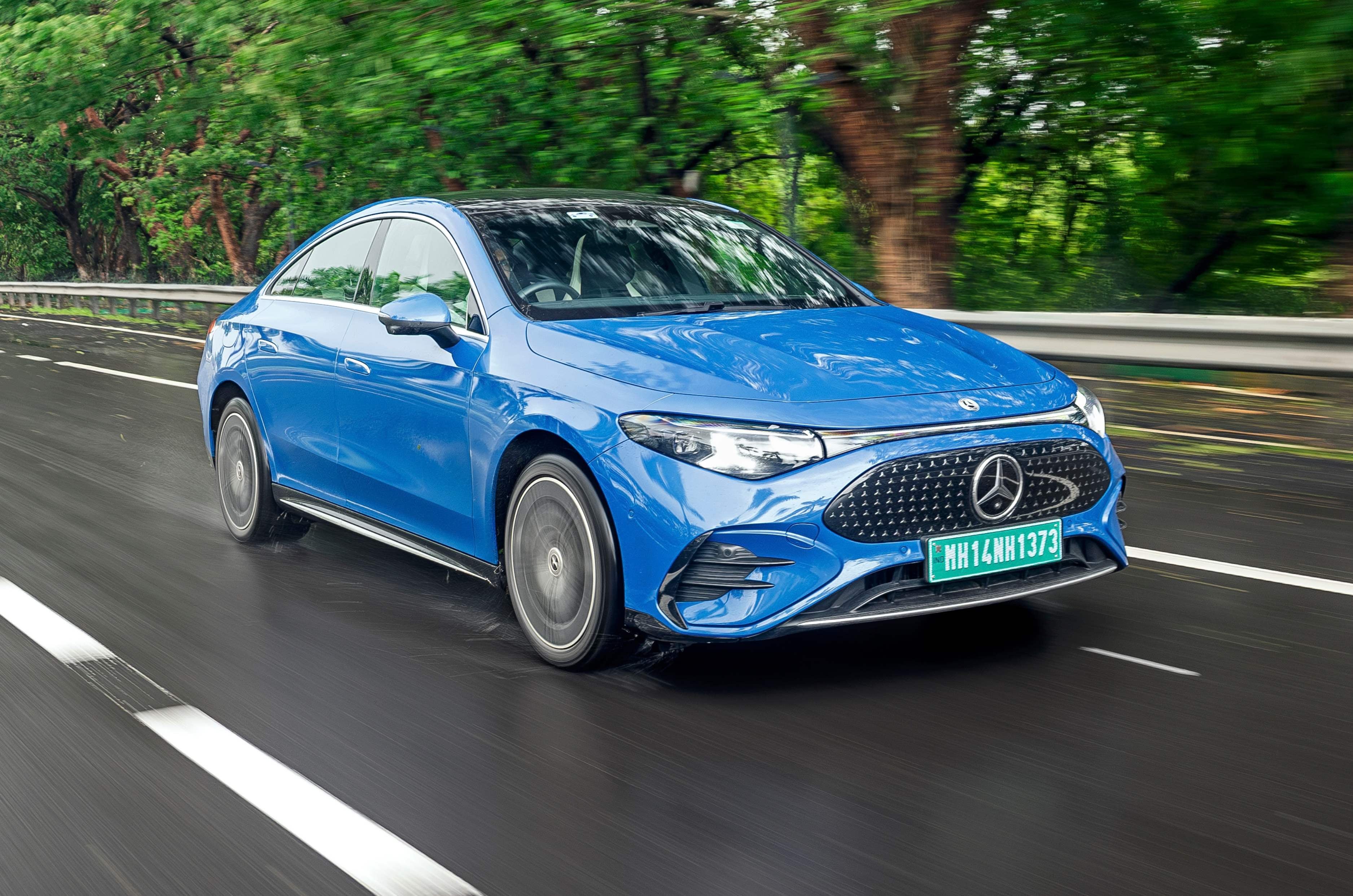
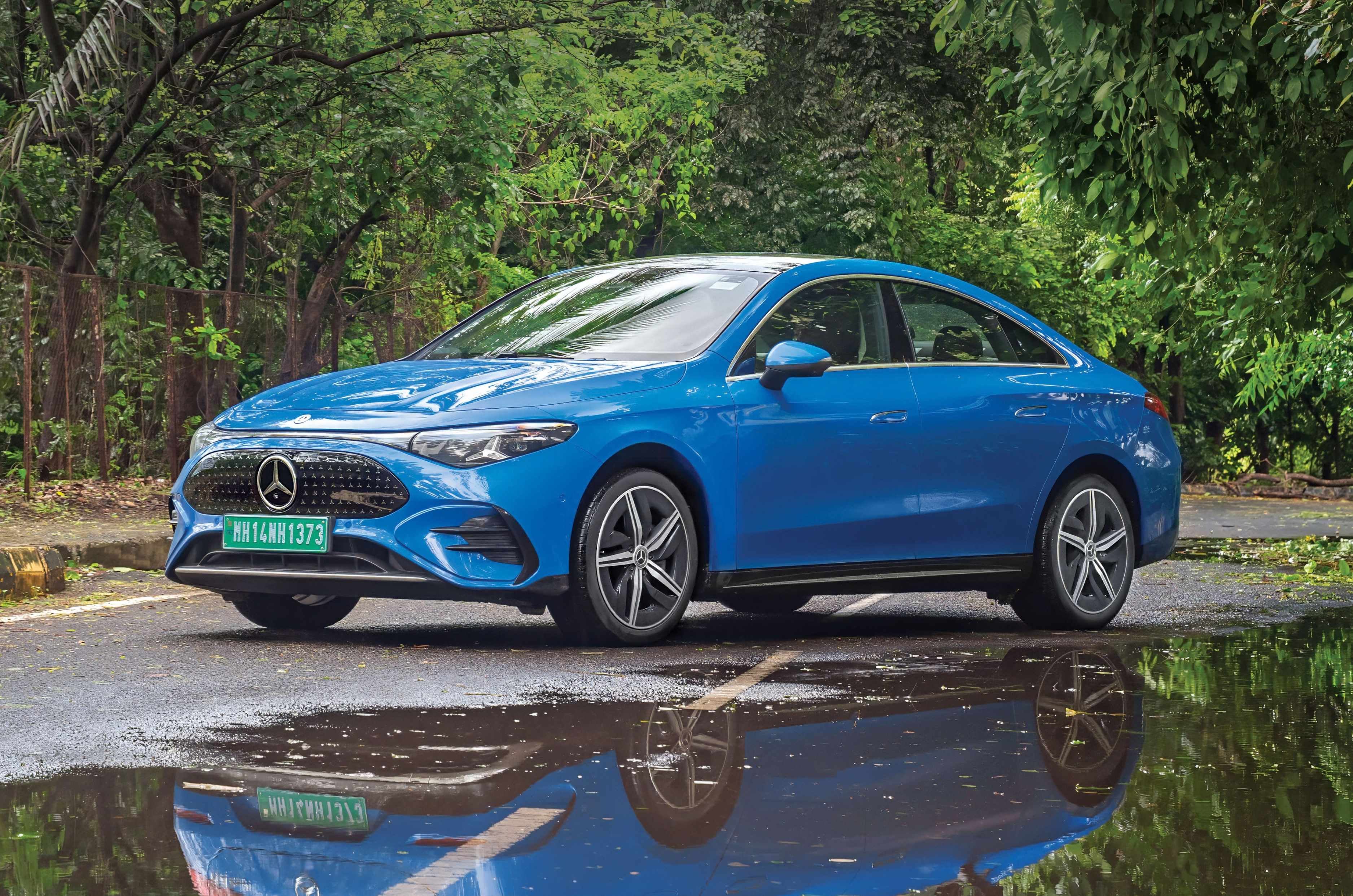
When we first drove the all-new, all-electric Mercedes-Benz CLA, we came away impressed with its smooth powertrain and its promise of a substantial real-world range. We’ve now subjected it to our real-world performance and efficiency tests to see if it delivers on that promise.
Mercedes CLA 250+ exterior design and engineering – 8/10
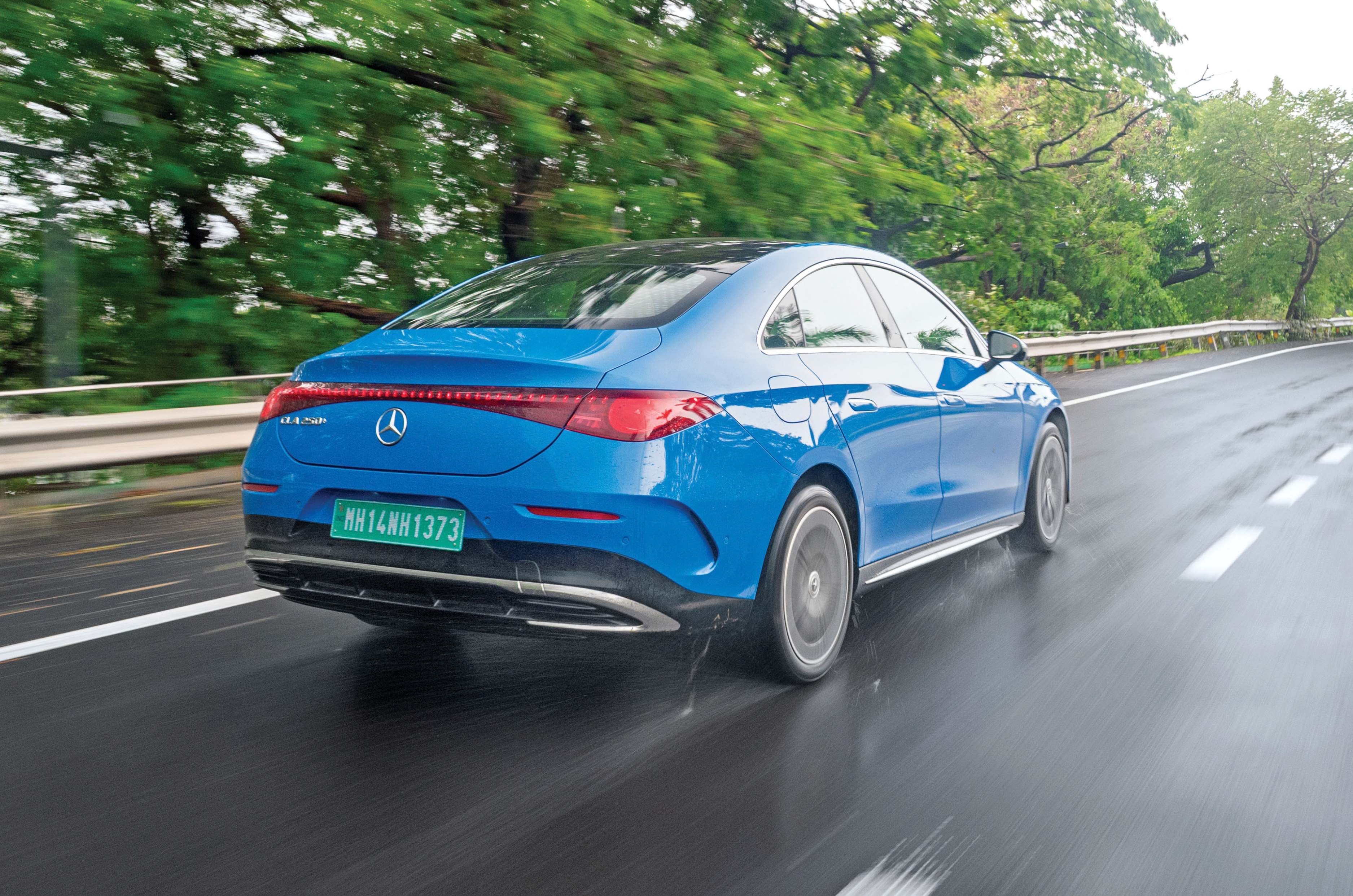
Polarising, aero-efficient design; based on new MMA platform.
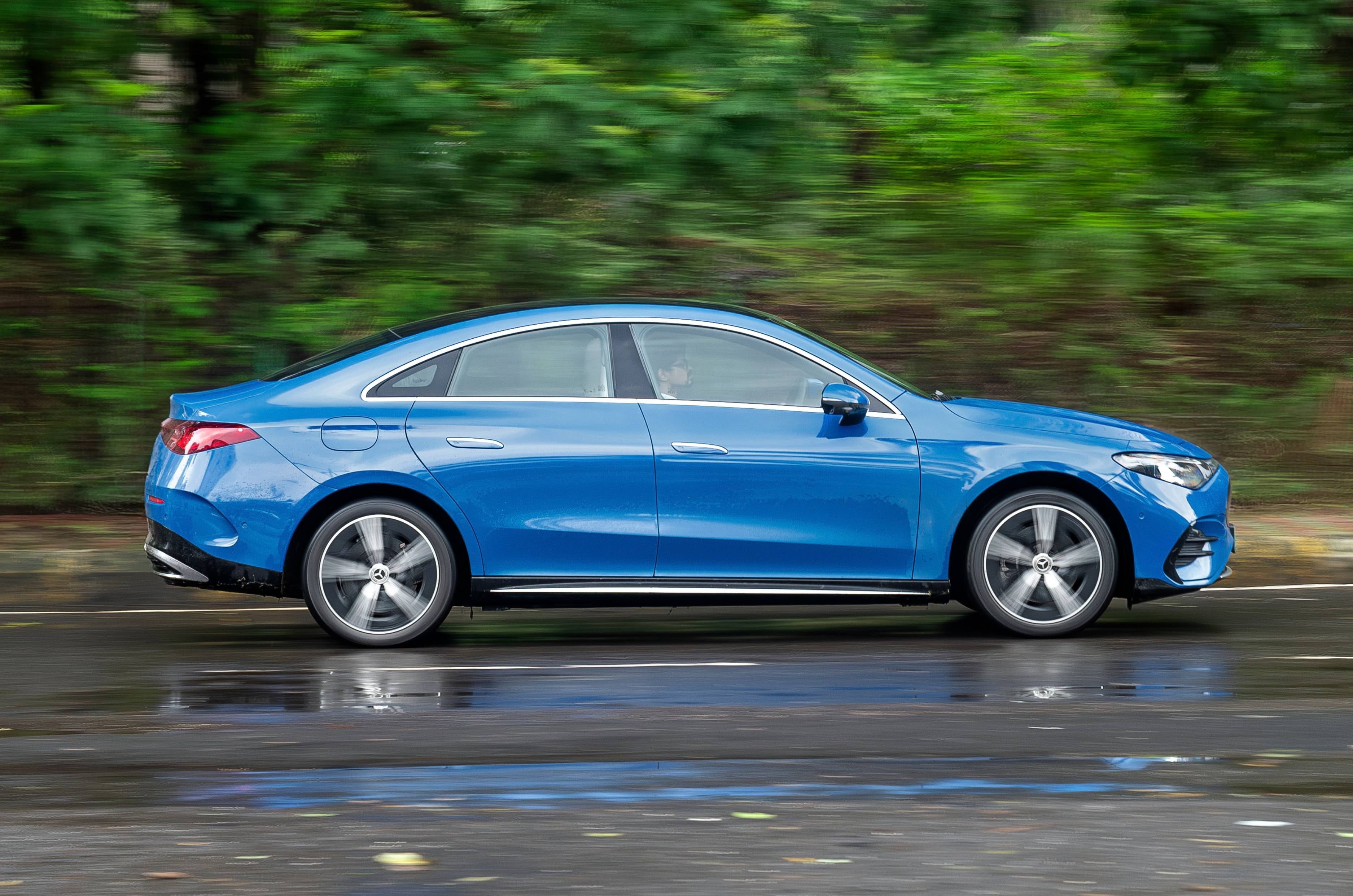
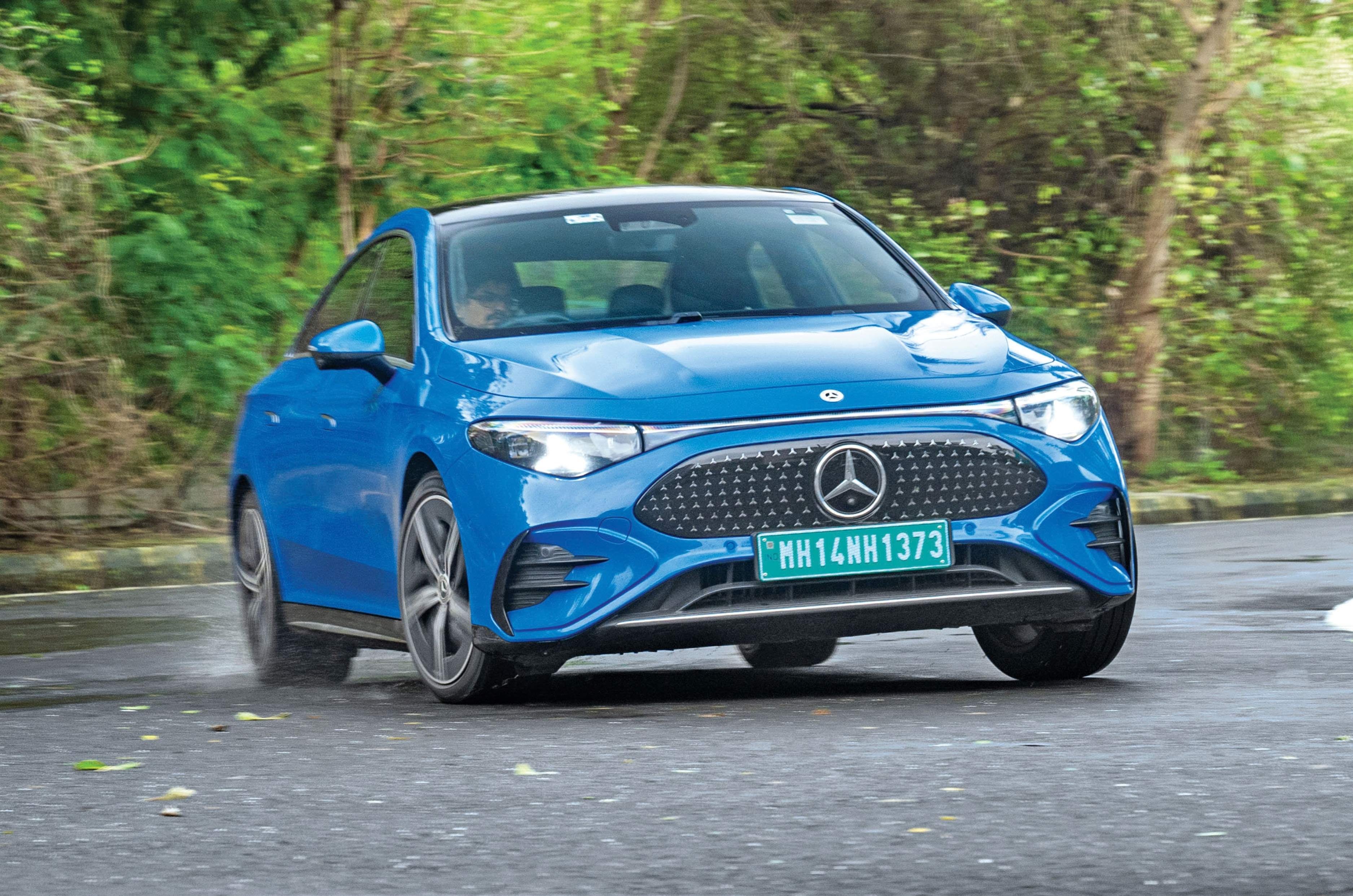
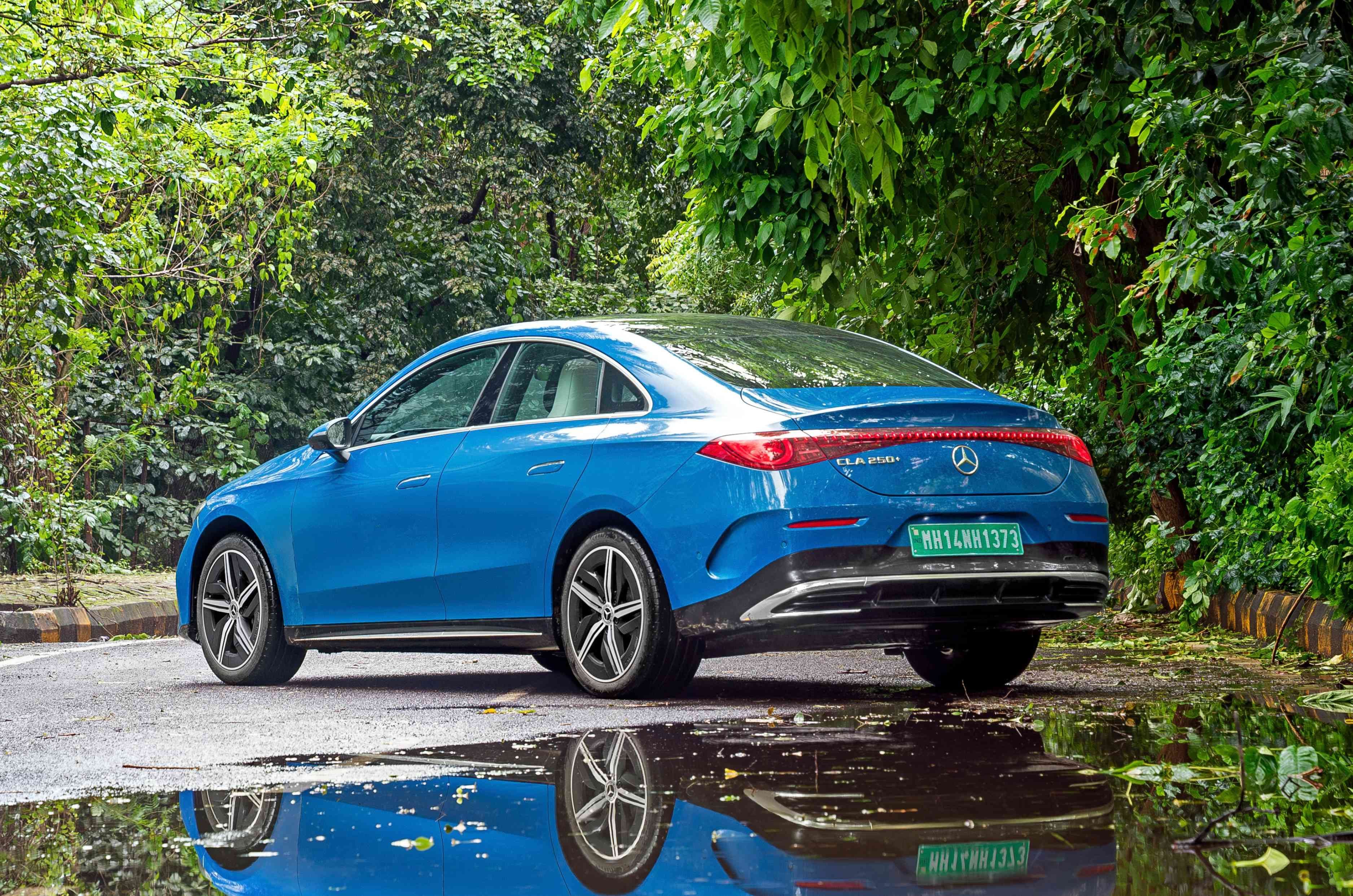
The new CLA has been designed with efficiency very much in mind, but Mercedes hasn’t completely abandoned the visual character that made the original car appealing. Its smooth, rounded silhouette is familiar from other Mercedes EVs, yet the low-slung, coupé-like roofline and frameless doors give it a distinct identity. Flush-fitting door handles, a sealed-off grille, aero-optimised 18-inch AMG alloys and a fully sealed underbody all contribute to an exceptionally slippery shape, with a drag coefficient of just 0.21Cd.
Mercedes’ three-pointed star features prominently across the CLA, appearing on the bonnet, grille, headlamps and tail-lamps. The grille itself gets 142 illuminated stars, which might sound excessive on paper, but they do give the CLA a distinctive look and, in person, seem to work rather well.
More significant, however, is what lies underneath. The CLA EV is the first Mercedes to use the new Modular Architecture (MMA) skateboard platform, which will also underpin future models. At over 4.7m long, more than 1.8m wide and over 1.4m tall, with a wheelbase approaching 2.8m, it is roughly the same size as a BYD Seal.
Mercedes CLA 250+ interior space and comfort – 7/10
Impresses with tech and quality; cramped rear with high floor.
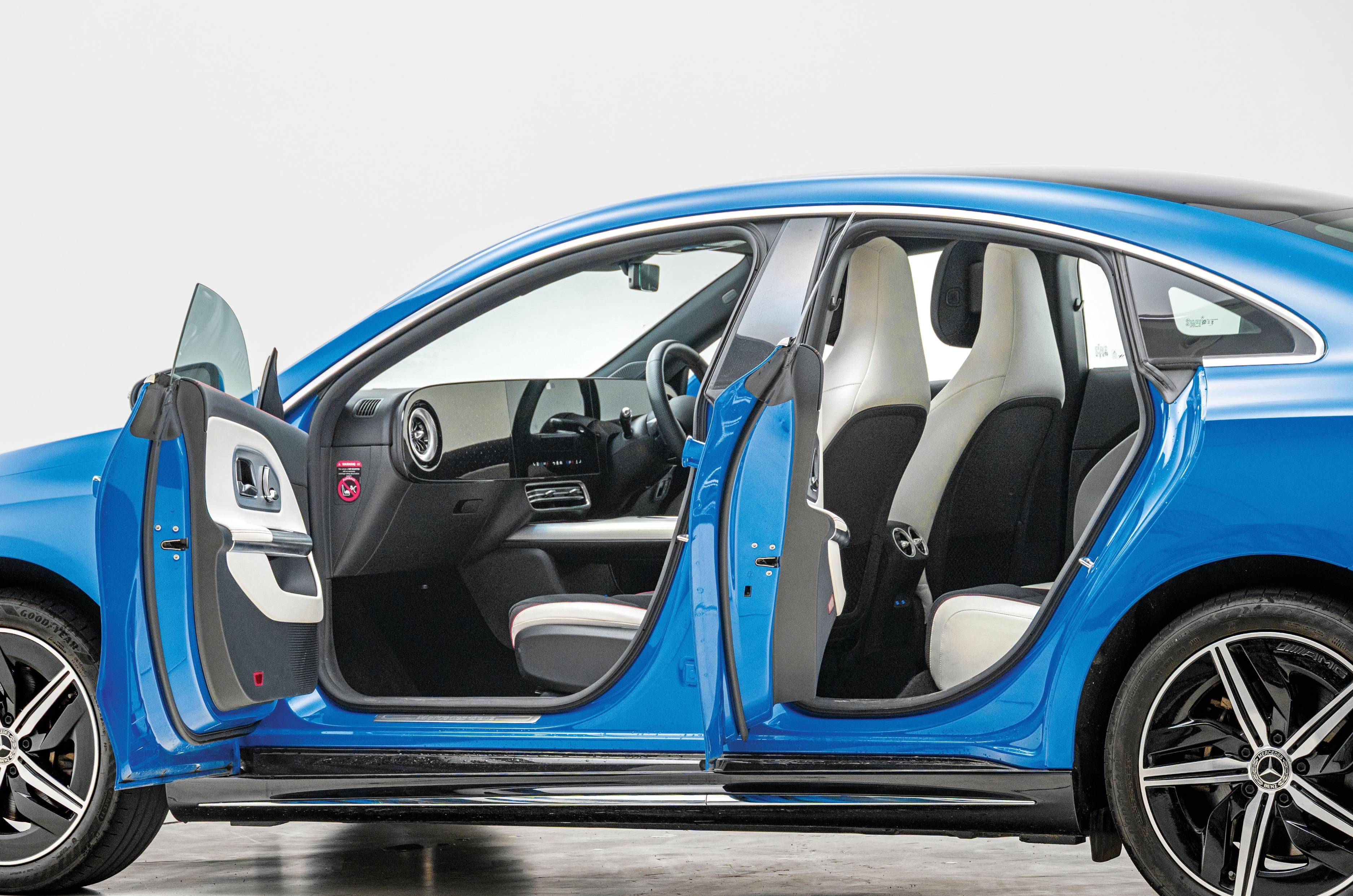
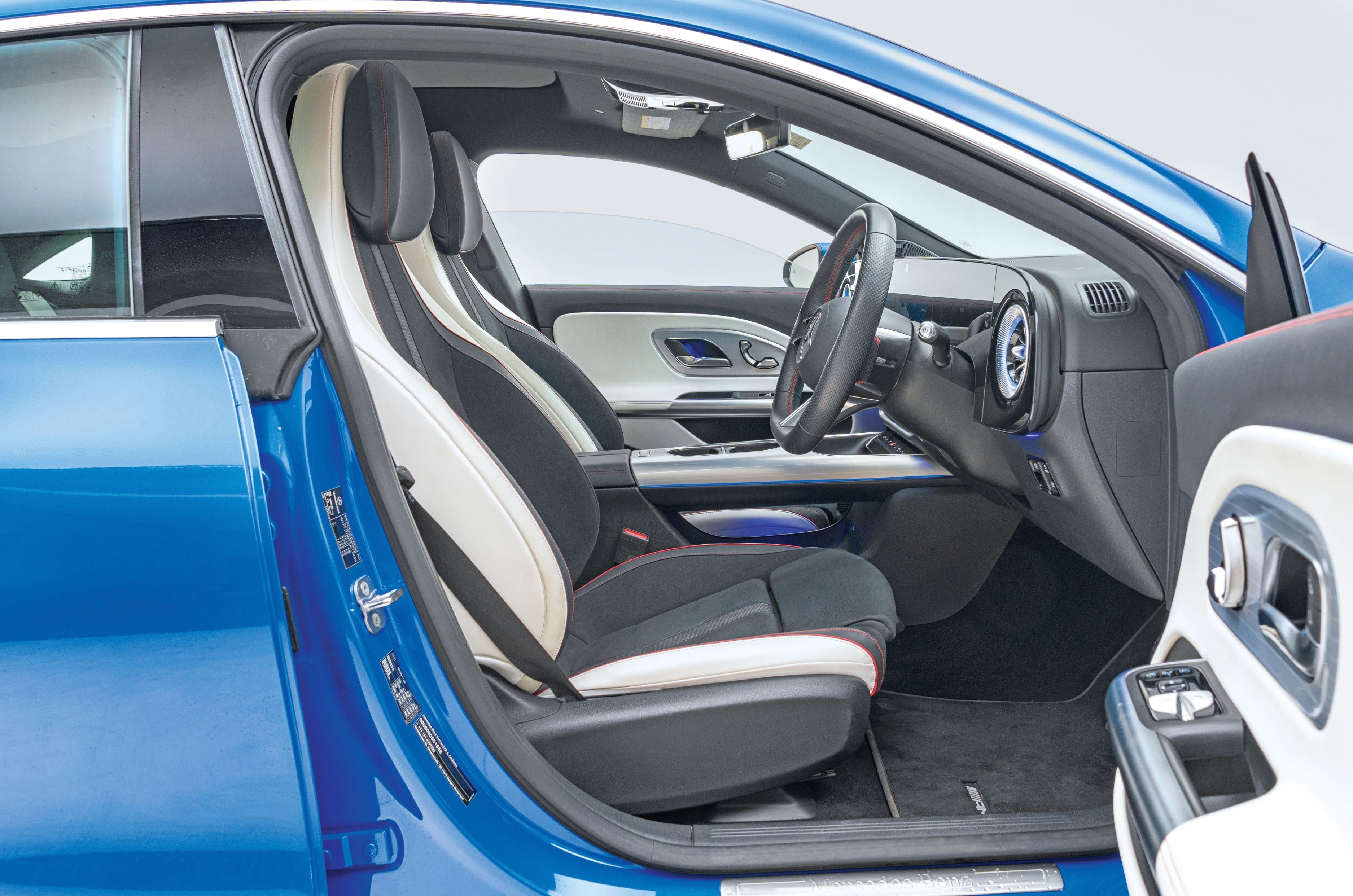
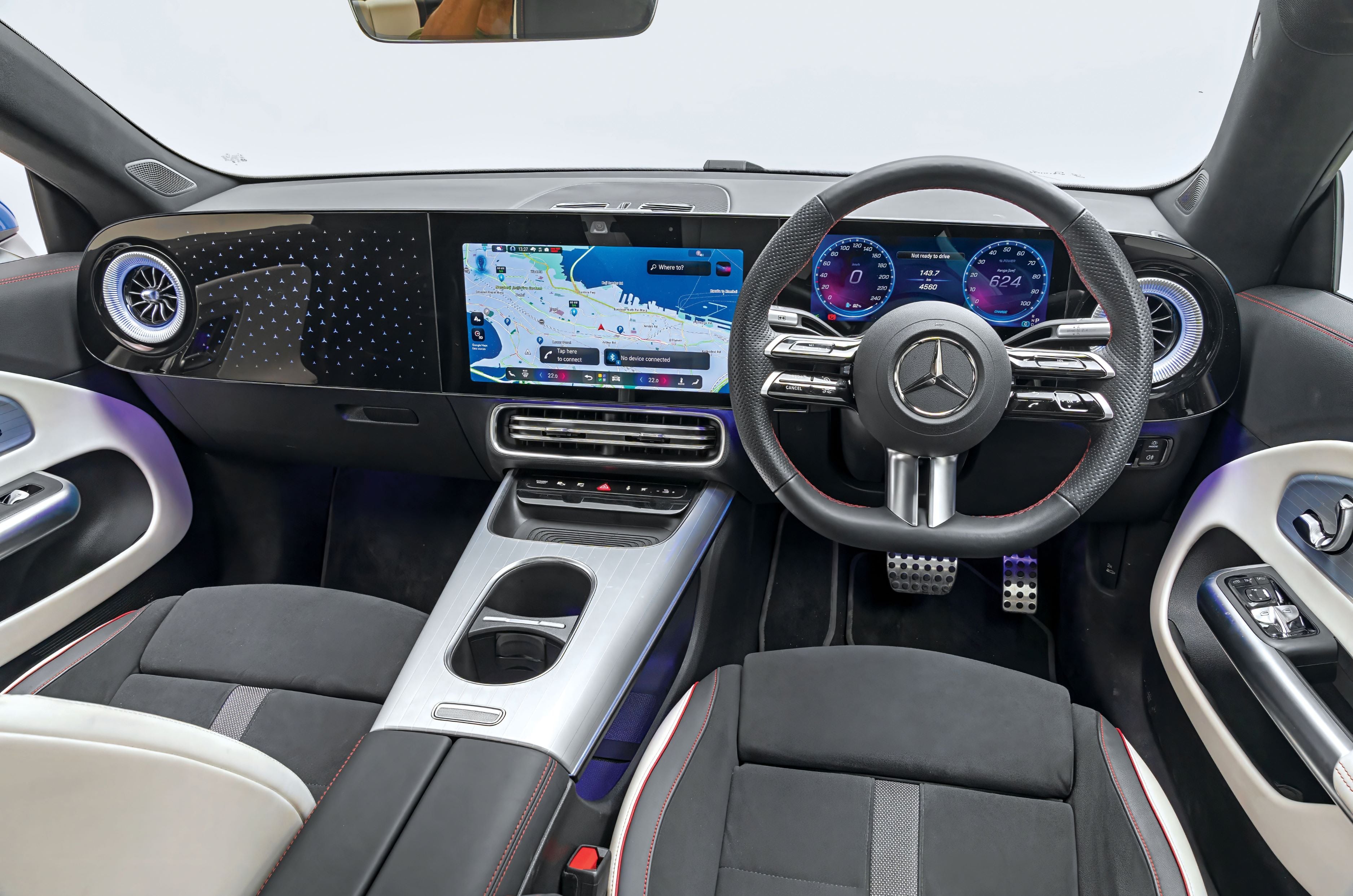
The CLA makes a good first impression inside. Its doors open wide for easy access, while the cabin combines smart design with good materials and build quality. The CLA 250+ is offered in AMG Line trim, so you get a flat-bottomed AMG steering wheel, sporty metal pedals and AMG-spec upholstery.
Doors open wide to aid access to the cabin; retains the stylish frameless doors.
The dashboard is dominated by a large gloss-black panel housing the digital displays. The graphics are sharp, the interface is clean, and the system is easy to navigate. What isn’t quite as convincing is the near-total absence of physical controls. Apart from a few capacitive shortcuts for functions such as volume and drive modes, most functions are accessed through the touchscreen, which isn’t ideal while on the move.
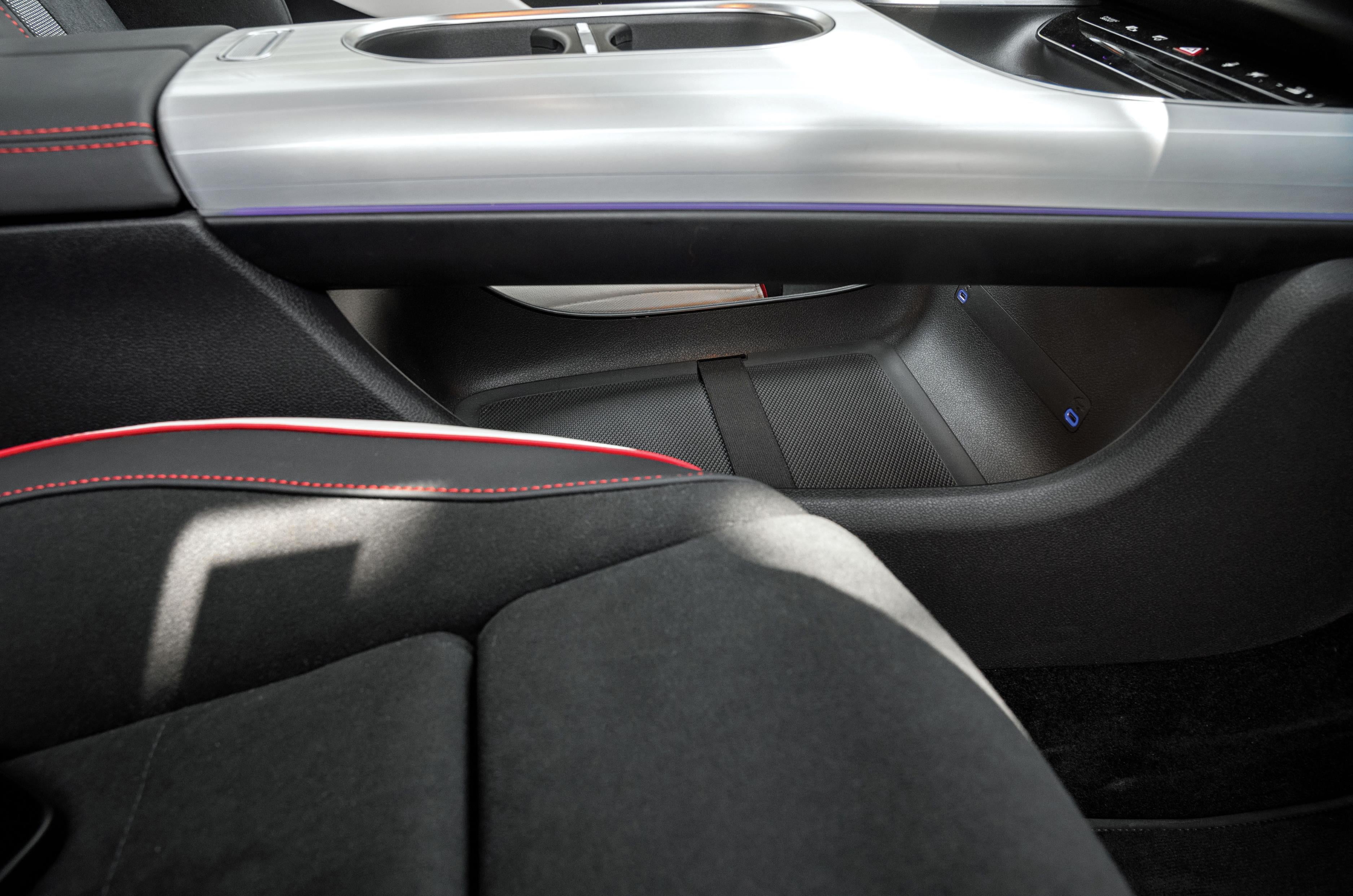
Centre console has two levels, with the top featuring cupholders and a wireless charger, and a large cubby space below.
The third passenger display offered in the 250+ Launch Edition has been omitted here, with its place taken by a gloss-black panel featuring illuminated Mercedes stars. The turbine-style air vents at either end of the dashboard are a nice touch, though, and are particularly satisfying to operate.
There is decent storage, too. You get a large glovebox, storage beneath the centre armrest, bottle holders in the doors and a floating centre console with cupholders and a wireless charger on top, along with a large storage area underneath.
AMG Line brings Alcantara and leather trim for the snug and supportive seats; relatively knees-up seating here too.
The front seats are supportive and well padded, although larger occupants might find them a little snug. More importantly, the relatively high floor means you sit with your knees raised even in the front. At the rear, this issue is more pronounced.
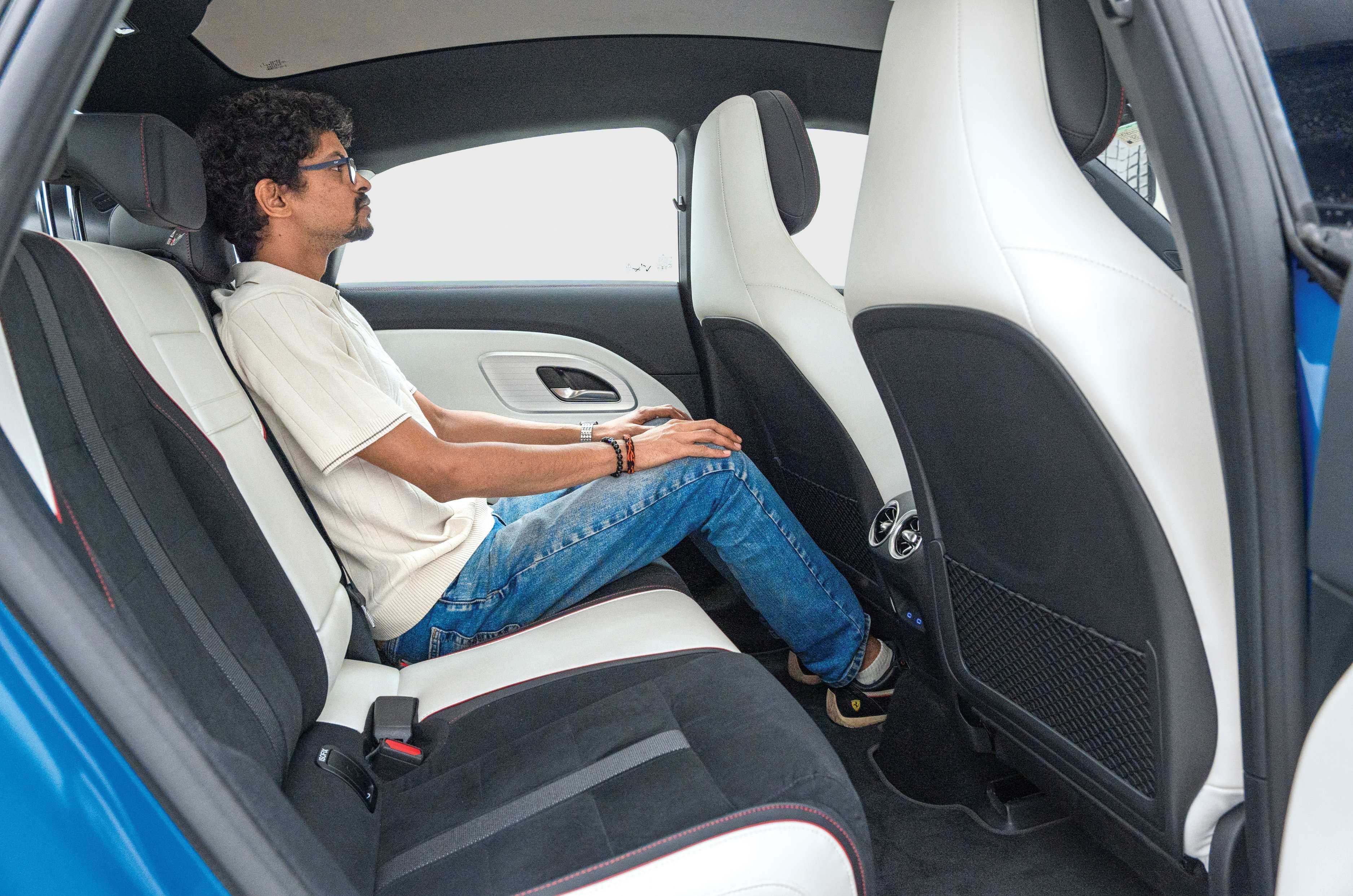
High floor results in knees-up seating, upright backrest and sloping roof further compromise rear seat’s comfort.
Although the CLA has a longer wheelbase than its predecessor, which improves knee room, the battery beneath the floor eats into under-thigh support and results in a knees-up seating position. The upright backrest and sloping roofline further compromise comfort, particularly for taller passengers. There is a centre armrest with cupholders and dedicated rear AC vents, but this still isn’t a car we’d recommend for regular chauffeur-driven use.
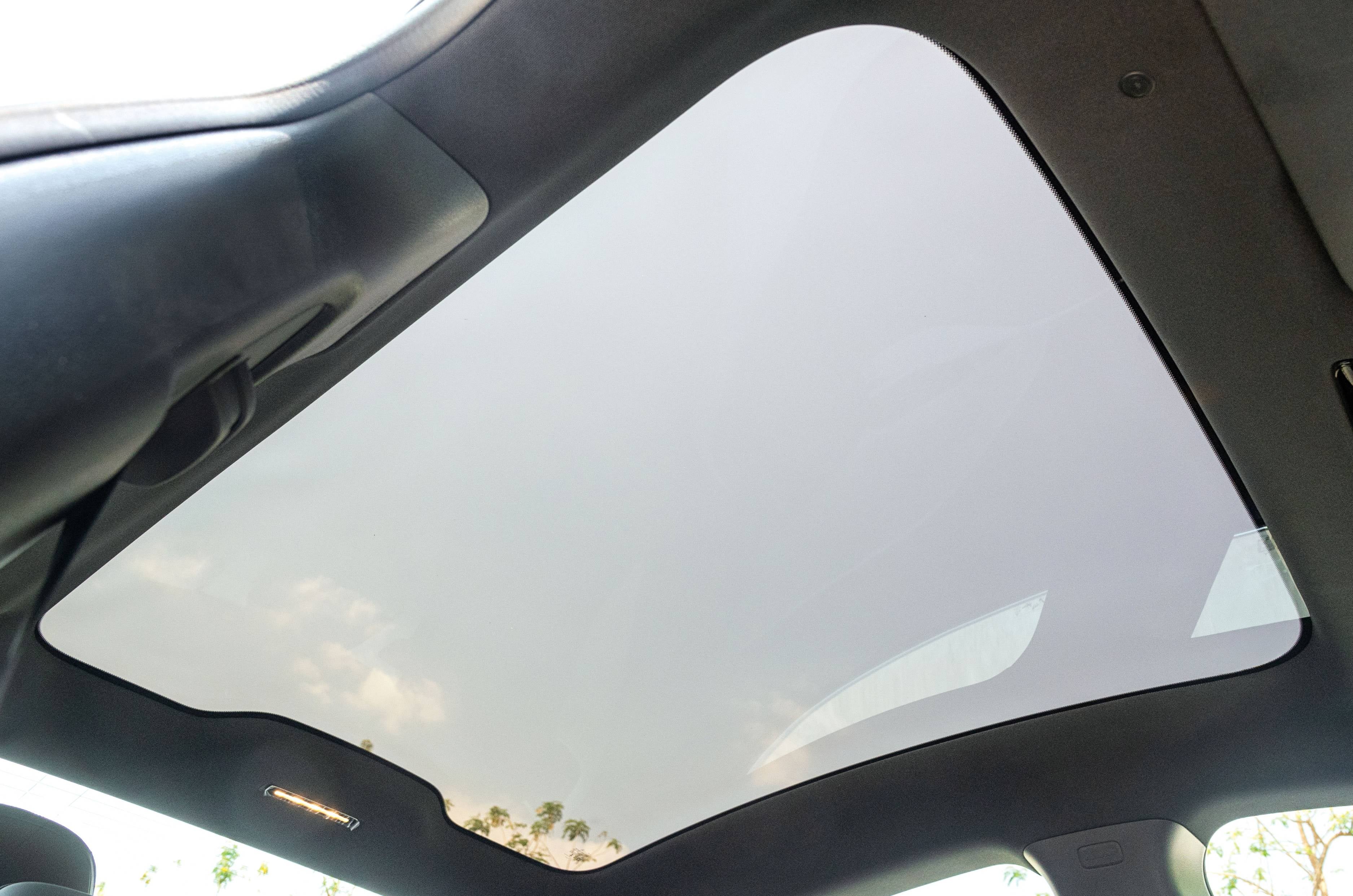
There is a large fixed panoramic glass roof that does make the cabin feel more spacious. Mercedes says the glass is heat-insulated, but a sunshade would have been welcome, particularly in our climate. It also misses sunblinds for the rear windows, meaning the rear AC has to work particularly hard to keep the back of the cabin cool.
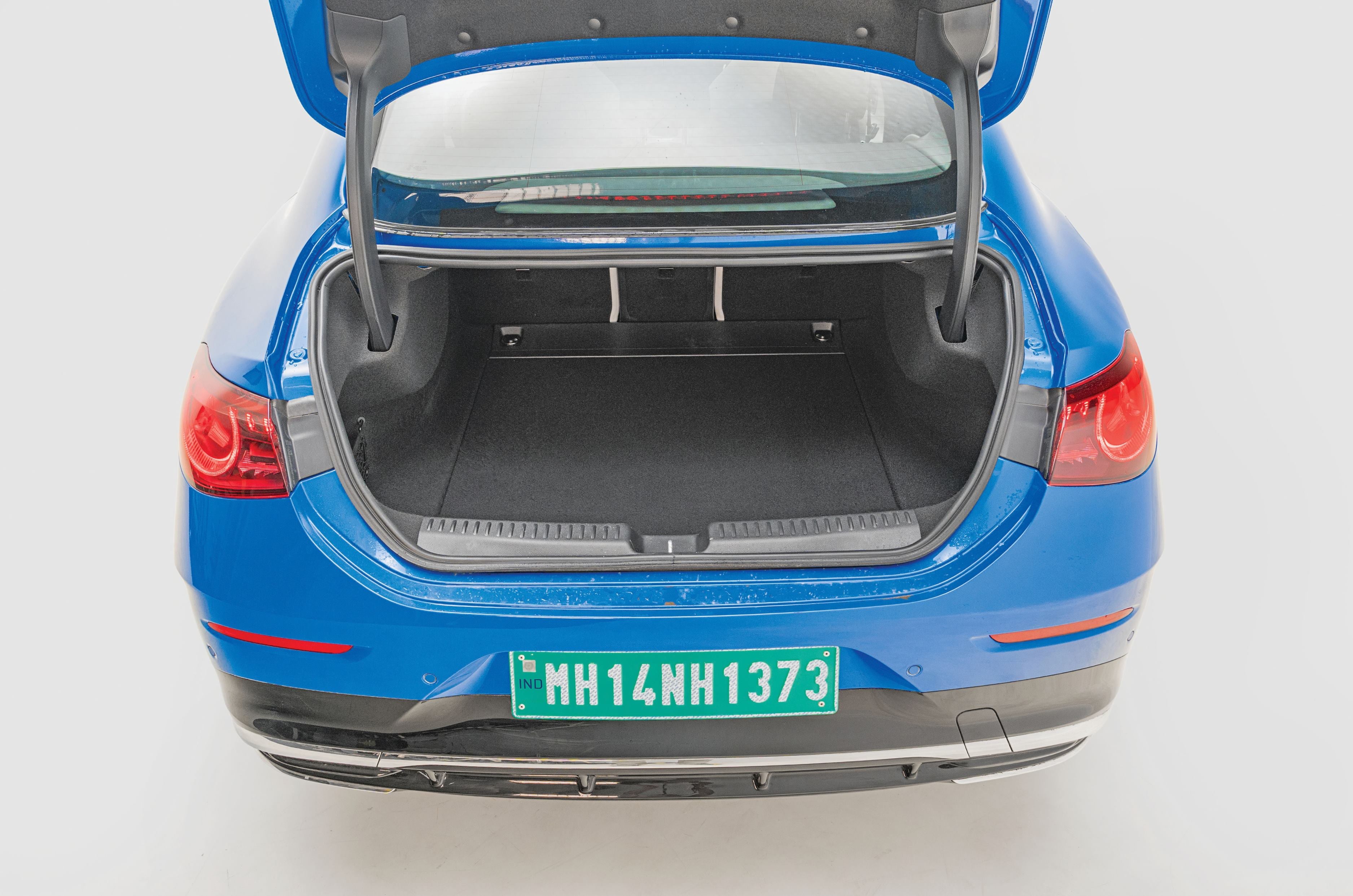
Cargo space is a useful 405 litres; boot opening isn’t large, though.
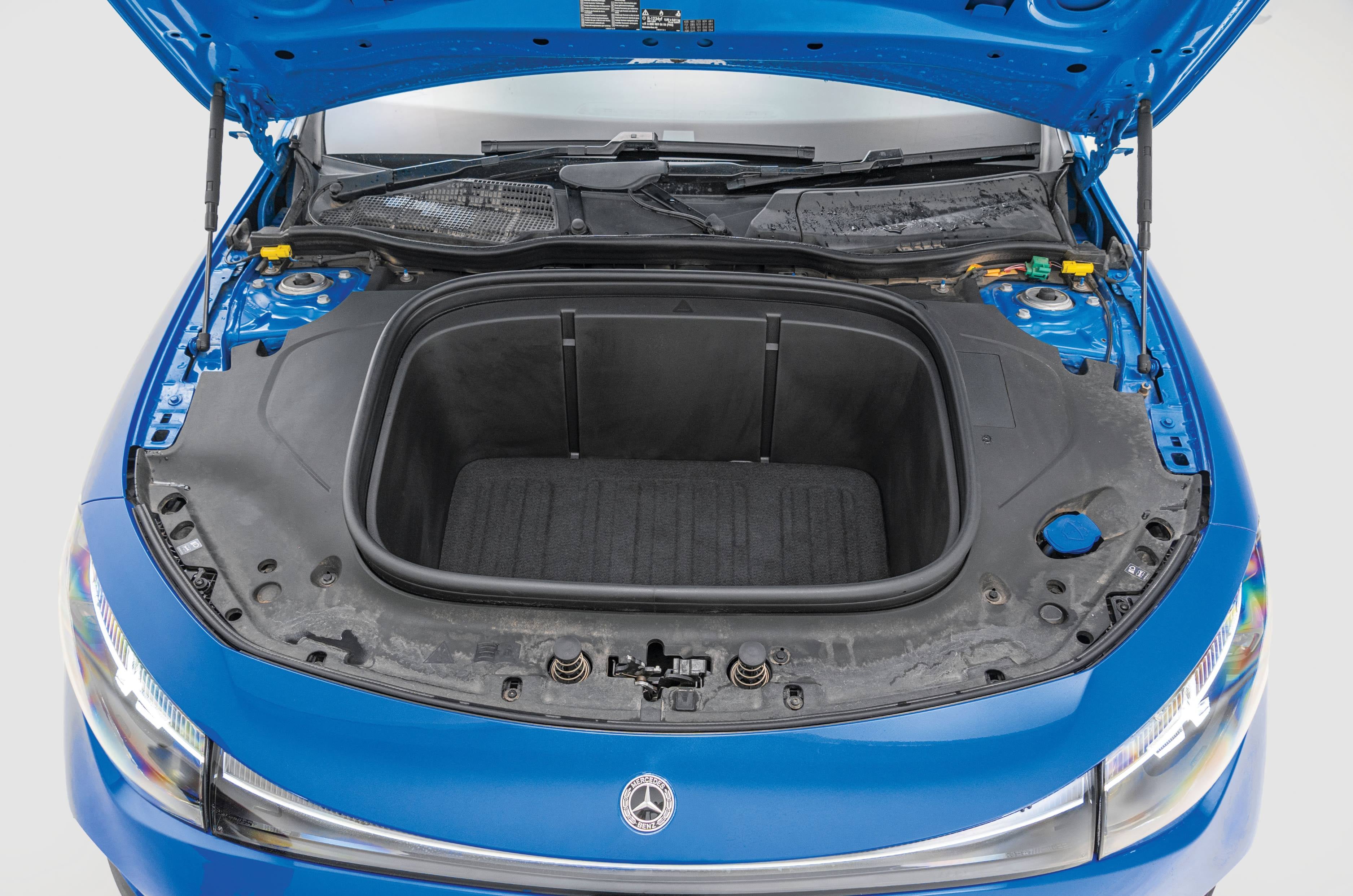
Boot space stands at a useful 405 litres. More interestingly, the CLA gets a 101-litre front trunk – the first time Mercedes has offered a frunk on one of its EVs.
In a first for Mercedes-Benz EVs, there’s a convenient 101-litre front trunk.
Mercedes CLA 250+ features and safety – 9/10
Packed with cutting-edge tech and features; no seat ventilation.
The CLA is a showcase for Mercedes’ latest technology. Four supercomputers provide the computing power, which Mercedes says is more than 200 times that of the previous CLA. It is also the first Mercedes to use the company’s new MB.OS infotainment operating system.
With the AMG Line styling package, the 250+ gets a flat-bottomed AMG steering, metal pedals and AMG seat upholstery; third passenger screen is reserved for the Launch Edition; cabin is practical with loads of storage, and overall fit/finish is good.
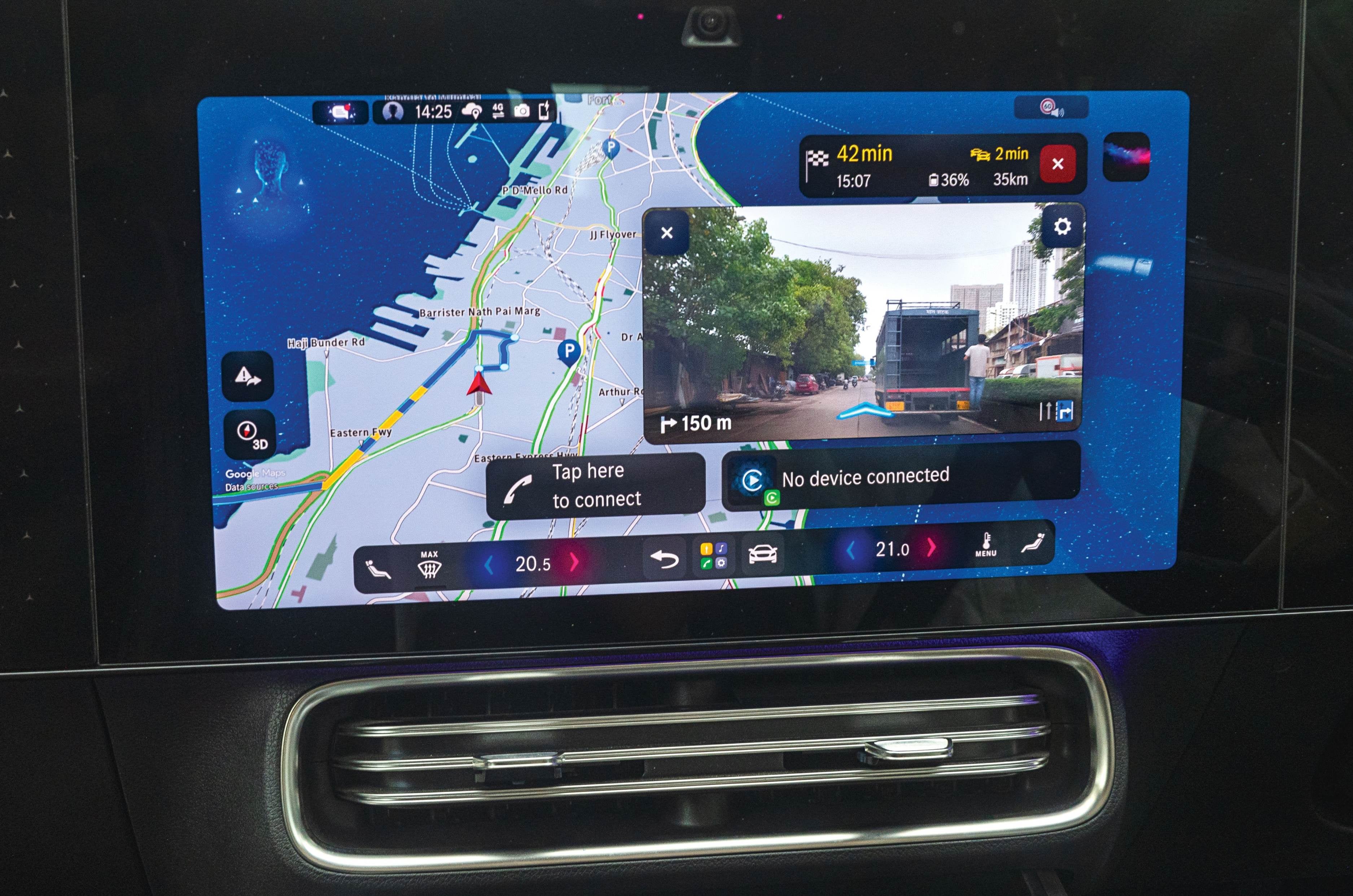
An Nvidia processor allows for quick responses, while over-the-air updates mean the system can be updated without a visit to the workshop. There’s also a new MBUX Virtual Assistant, which learns about the driver, including their language, accent and mood. It uses AI tools, including ChatGPT, Gemini and Bing, to further make your life easier, and you can ask them to do just about anything from setting navigation to changing the AC and so much more.
Screen is slick, has sharp graphics and native maps, which show directions in real-time using the camera feed.
The CLA also gets the new MB.Charge app, which brings charging providers together in one place. It can locate chargers, show their real-time availability, help plan a journey and even handle payment for a charging session.
The feature list is extensive. Highlights include a 14-inch central touchscreen, 10.25-inch digital driver’s display, powered, heated and massaging front seats, dual-zone climate control, configurable ambient lighting, a panoramic glass roof, Burmester 3D audio, wireless phone charging and auto parking. Ventilated front seats, however, aren’t offered.
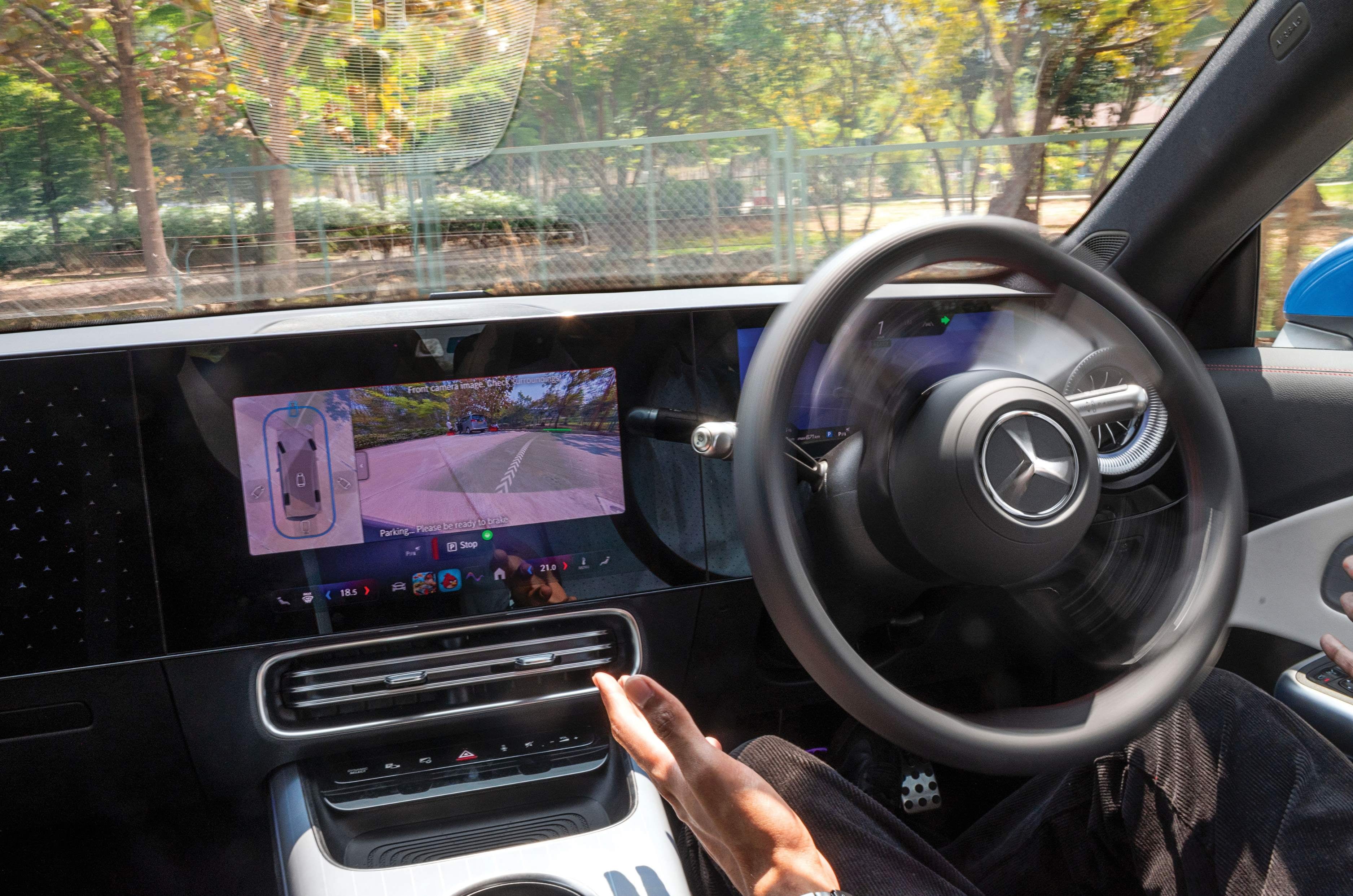
CLA 250+ packs in an auto park feature, which works very well in unmarked spaces too.
Safety equipment is comprehensive, with six airbags, a 360-degree camera and Level 2+ ADAS, which Mercedes calls MB.Drive. It includes adaptive cruise control, lane-keep assist, blind-spot monitoring, autonomous emergency braking and semi-autonomous driving functions. The system uses a combination of radar sensors and cameras and didn’t feel overly intrusive; better than previous Mercs, which feel trigger-happy with emergency braking. The CLA was also the safest car tested by Euro NCAP in 2025.
Mercedes CLA 250+ performance and refinement – 9/10
Smooth, progressive powertrain; refinement is impressive.
The CLA 250+ uses a rear-mounted electric motor producing 272hp and 335Nm. Performance is brisk, but what stands out more than outright acceleration is the way it delivers its performance.
Unlike some performance EVs that deliver power aggressively from the moment you bury the accelerator, the CLA builds speed in a smooth, progressive manner. The power delivery is linear, and there’s always enough performance on tap. Sport mode sharpens the response, while synthesised sounds played through the speakers add a little more theatre.
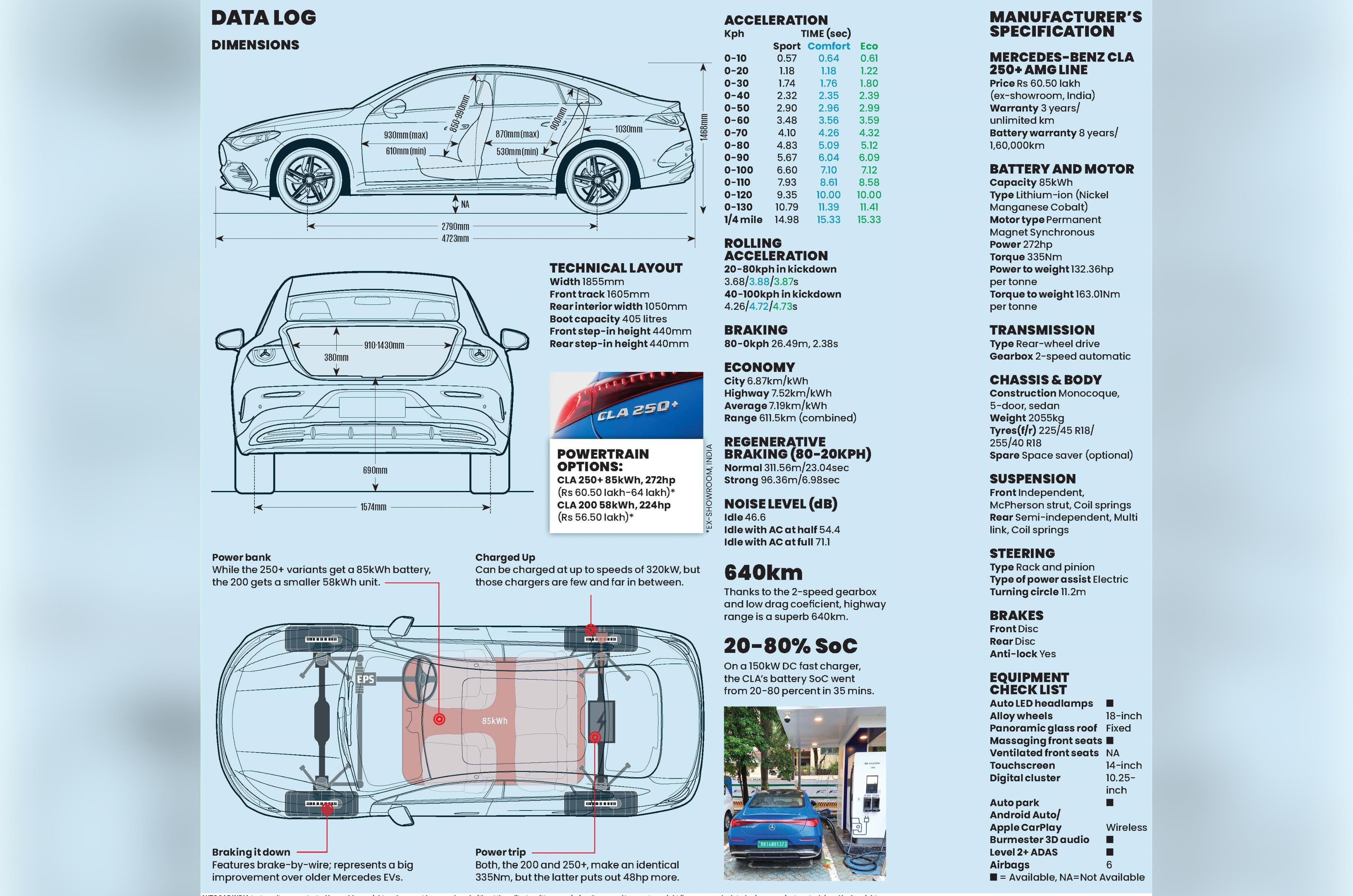
In our performance tests, it managed a 0-100kph time of 6.6sec in Sport mode, narrowly beating the claimed time of 6.7sec. Rolling acceleration is impressive too, with 20-80kph in Sport taking 3.68sec, and 40-100kph being dealt with in 4.26sec. Naturally, performance in the Comfort and Eco drive modes is more sedate than Sport, with the difference between the former two being almost negligible.
Mercedes has also opted for a two-speed gearbox, which is unusual for an EV, but makes sense here. The short 11:1 first gear helps with initial acceleration, while the taller 5:1 second gear is intended to improve efficiency at higher speeds. And from behind the wheel, you can feel when it shifts gears. Mercedes claims a drivetrain efficiency of 93 percent, and that plays an important role in the CLA’s impressive range.
The new brake-by-wire system is another area where the CLA makes a big improvement over older Mercedes EVs. Brake response is reassuring, with a good bite and a natural, consistent feel. In our braking test, the CLA came to a halt from 80kph in 26.49m despite it being on a damp surface.
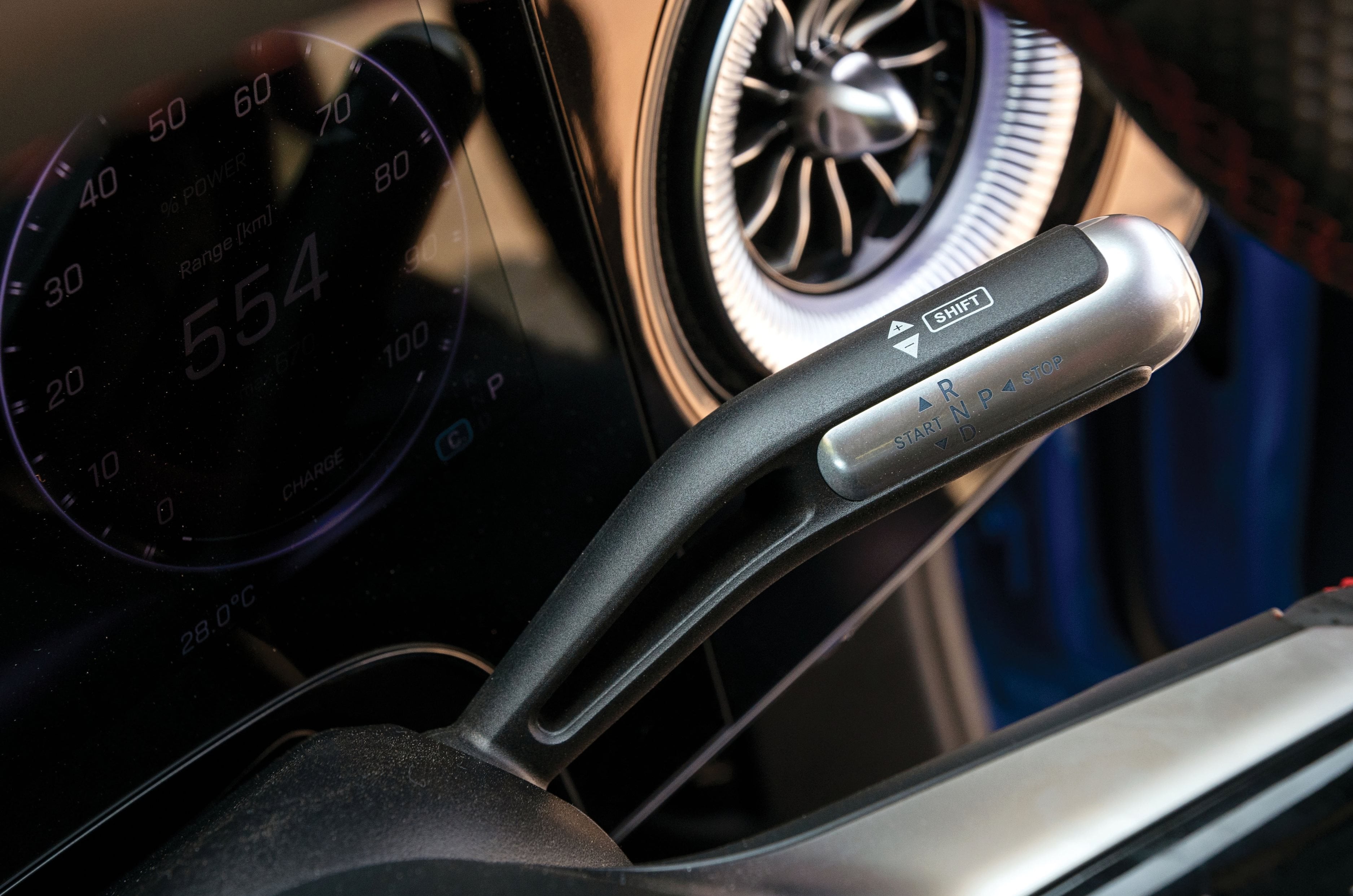
Control stalk now houses the start/stop button, the drive selector, and is also used to toggle between regen braking modes.
There are four levels of regenerative braking, including a one-pedal mode and an adaptive setting. They work well, with the Normal setting bringing it from 80-20kph in 311.56m, while the Strong setting takes 96.36m for the same. It’s worth noting, however, that Mercedes has moved the controls for the regen from the steering-mounted paddles used on some EVs to the gear selector stalk. You push or pull the stalk to change the regen level, and this isn’t quite as intuitive. The same stalk also incorporates the start/stop button.
Where the CLA really impresses is refinement. The absence of an engine obviously helps, but Mercedes has also done an excellent job of keeping wind and road noise out. At speed, the cabin remains remarkably quiet. A CLA 200 variant is also available in India, using the same rear-mounted motor layout but producing a lower 224hp and 335Nm. However, we’re yet to test this version.
Mercedes CLA 250+ tested acceleration times (sec)
Sport
Comfort
Eco
0-10kph
0.57
0.64
0.61
0-20kph
1.18
1.18
1.22
0-30kph
1.74
1.76
1.80
0-40kph
2.32
2.35
2.39
0-50kph
2.90
2.96
2.99
0-60kph
3.48
3.56
3.59
0-70kph
4.10
4.26
4.32
0-80kph
4.83
5.09
5.12
0-90kph
5.67
6.04
6.09
0-100kph
6.60
7.10
7.12
0-110kph
7.93
8.61
8.58
0-120kph
9.35
10
10
0-130kph
10.79
11.39
11.41
1/4 mile
14.98
15.33
15.33
20-80kph (rolling)
3.68
3.88
3.87
40-100kph (rolling)
4.26
4.72
4.73
Mercedes CLA 250+ range and efficiency – 9/10
Low drag, efficient powertrain mean superb real-world range.
Mercedes claims a WLTP range of 792km from the 85kWh (net) NMC battery, although, predictably, the real-world range is lower. In the city, with the regen set to the strongest mode, it delivered an efficiency of 6.87km/kWh that translates to a range of 584km. On the highway, with the regen set to ‘Normal’, it delivered an efficiency of 7.52km/kWh for a 640km range. With an average efficiency of 7.2km/kWh, you can expect a real-world range of 612km on a single charge, which is very impressive.
In the city, the strongest regen setting enabled it to recoup energy effectively, which helped boost efficiency, while the two-speed gearbox, with its taller 5:1 second gear, enabled greater efficiency at higher speeds and thus contributed to the EV’s highway efficiency. Combined with the low 0.21Cd drag coefficient and the normal regen mode that allows for more coasting, it proved even more efficient on the highway, which isn’t usually the case with EVs.
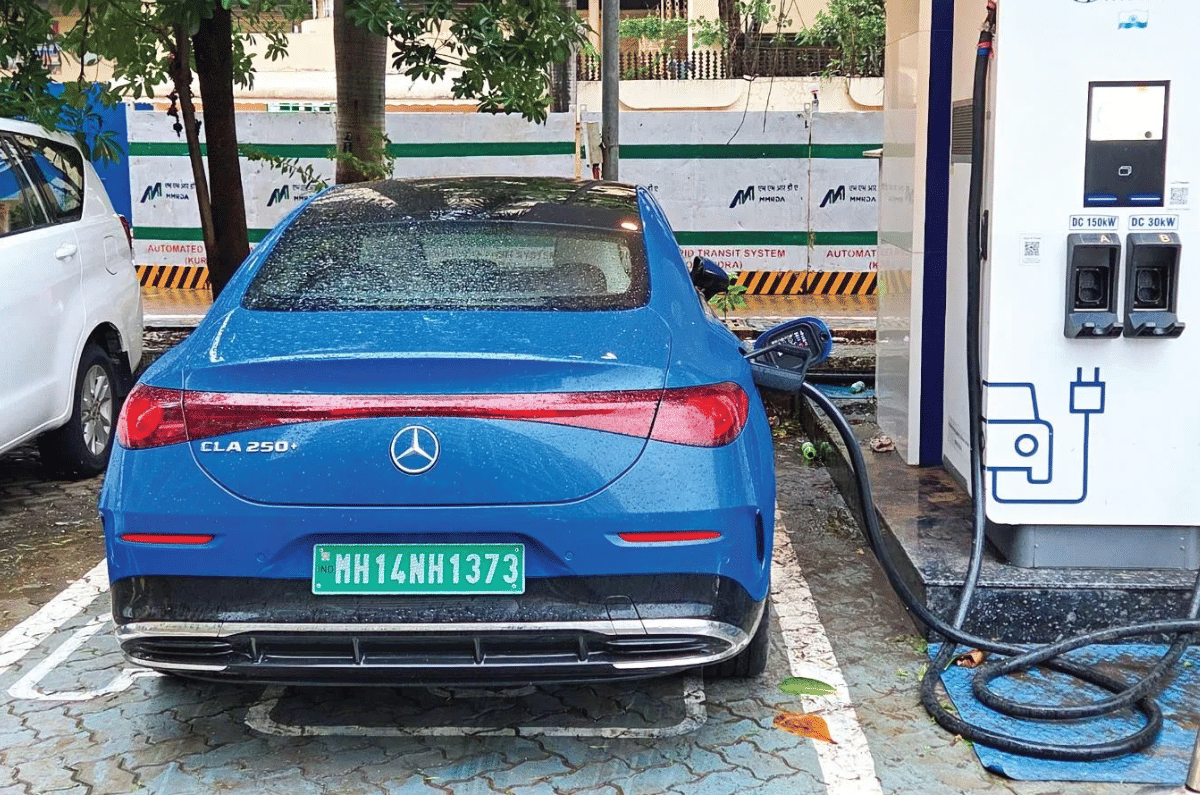
The CLA 250+ uses an 800V electrical architecture and supports charging at up to 320kW, but chargers capable of delivering that output remain few and far between in India. In our charging test using a 150kW DC fast charger, we saw an average charging speed of around 92kW with a peak charging speed of 125kW. To charge from 20-80 percent, it took 35 minutes and consumed 53.89kWh in total. This, combined with the efficiency and large real-world range, should make long-distance driving relatively stress-free.
Mercedes CLA 250+ tested range
City (km/kWh)
6.87
Highway (km/kWh)
7.52
Average (km/kWh)
7.19
Range (km)
611.5
Mercedes CLA 250+ ride comfort and handling – 8/10
Strikes a mature balance between ride and handling.
The CLA’s rear-wheel-drive layout gives it an enjoyable character on a winding road, and the steering is one of its stronger points. With no drive being sent through the front wheels, it feels precise, building up weight progressively with speed. It’s light enough at low speeds to make manoeuvring easy, yet gains enough weight as you go faster.
Thanks to the CLA’s rear-wheel-drive setup and precise steering, it feels agile and good fun around corners.
Mercedes has increased the Euro-spec CLA’s 107mm ground clearance for India and made suspension changes to better suit our roads, and both have worked. There’s enough clearance to deal with regular-sized speed breakers, while the additional height hasn’t really compromised the car’s handling or comfort. Around corners, the CLA remains agile, and body roll is well controlled. The ride does have a hint of firmness to it, but it deals with road imperfections without fuss and feels composed at both low and high speeds. Overall, it’s a mature combination of ride comfort, stability and handling.
Mercedes CLA 250+ value for money – 8/10
Refined and efficient powertrain, long range and sorted ride and handling make it Merc’s best EV yet.
Priced at Rs 60.50 lakh (ex-showroom), the CLA 250+ is a fairly compelling proposition, considering what it brings to the table. There are shortcomings, most notably the cramped rear seat, knees-up seating even at the front, and the absence of sunshades for the panoramic roof and rear windows. But if you’re going to drive yourself and want a luxury EV that’s distinctive, the CLA makes a strong case for itself.
Its powertrain is smooth and refined, its efficiency is excellent, it has an impressive real-world range of over 600km, and it strikes a very good balance between ride comfort and handling. Add to that a cabin packed with cutting-edge tech, and the new CLA emerges as one of the company’s most accomplished EVs yet.
While the Indian manufacturers have been quick to capitalise on the EV boom, the Japanese have been rather more measured in their approach. Honda arrived in 2025 with not one but two in-house electric scooters, though both had unique limitations that prevented them from succeeding.
Suzuki, like Honda, chose to develop its own platform from scratch, but its e-Access appears expensive for what it offers. Yamaha, meanwhile, took a markedly different route for its more affordable offering and partnered with an Indian startup. The EC-06 is, in essence, a more expensive River Indie in sharper clothes.
So if you’ve been waiting for a Japanese e-scooter, you now have two choices, but like their very different inceptions, both also offer you two very different flavours of electric scooter. The question, then, is which one deserves your money – and whether either deserves it over the competition.
Not hiding in plain sight
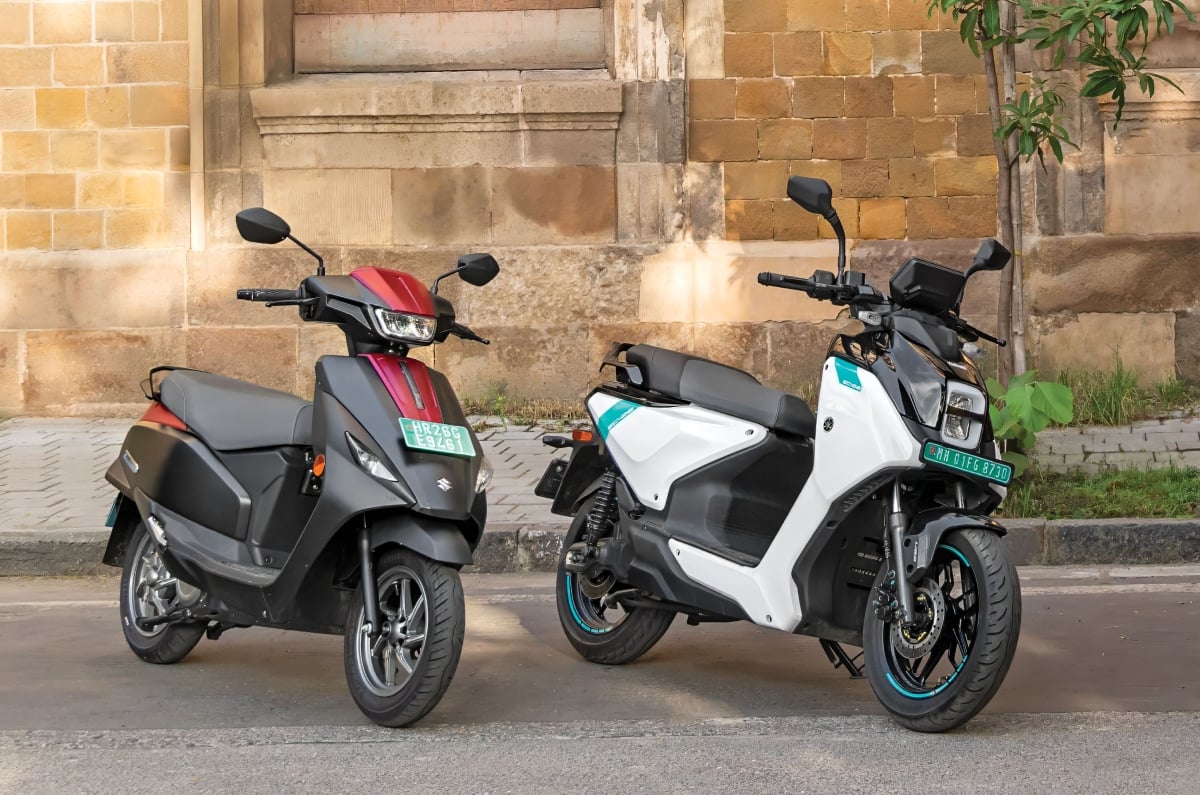
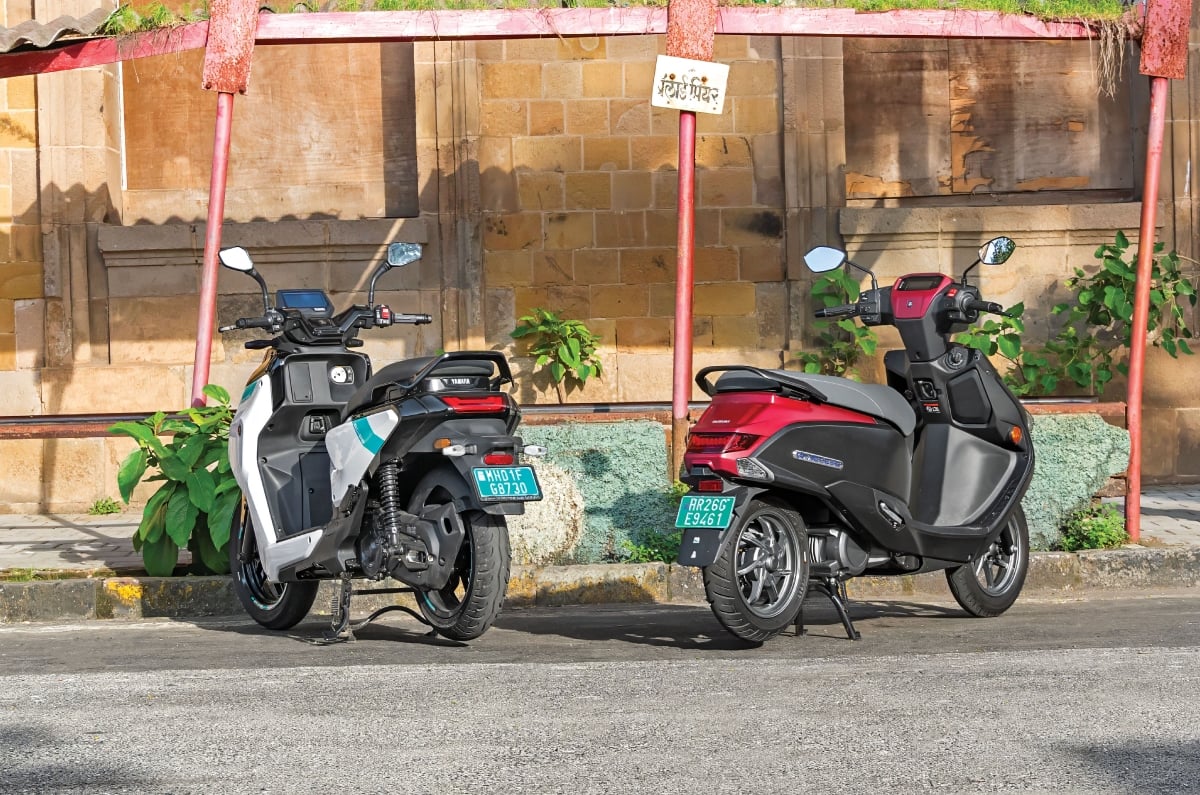
Subtle, these scooters are not. Both take distinctly left-field approaches to styling and will stand out from the crowd. Over the fortnight we spent with them, the EC-06 consistently drew more positive attention thanks to its chunky, squared-off proportions. The e-Access found its niche too, though its double duck-bill nose, flowing front panels with a contrastingly boxy tail make it more of an acquired taste.
Yamaha EC-06
Suzuki e-Access
Kerb weight
132kg
122kg
Seat height
770mm
765mm
Underseat storage
24.5 litres
17 litres
Ground clearance
145mm (laden)
160mm (unladen)
Climb aboard and their personalities diverge further still. The e-Access feels more like a conventional scooter. Despite its compact dimensions, it never feels cramped, even for taller riders, while its 765mm seat height makes it instantly approachable for shorter ones.
The EC-06, by comparison, feels a size larger. Its riding triangle is noticeably roomier, which taller riders will appreciate in a segment that seldom caters to them. Yet, with a friendly 770mm seat height, it remains fairly unintimidating for shorter riders. In fact, tall riders will want a higher seat.
Different strokes
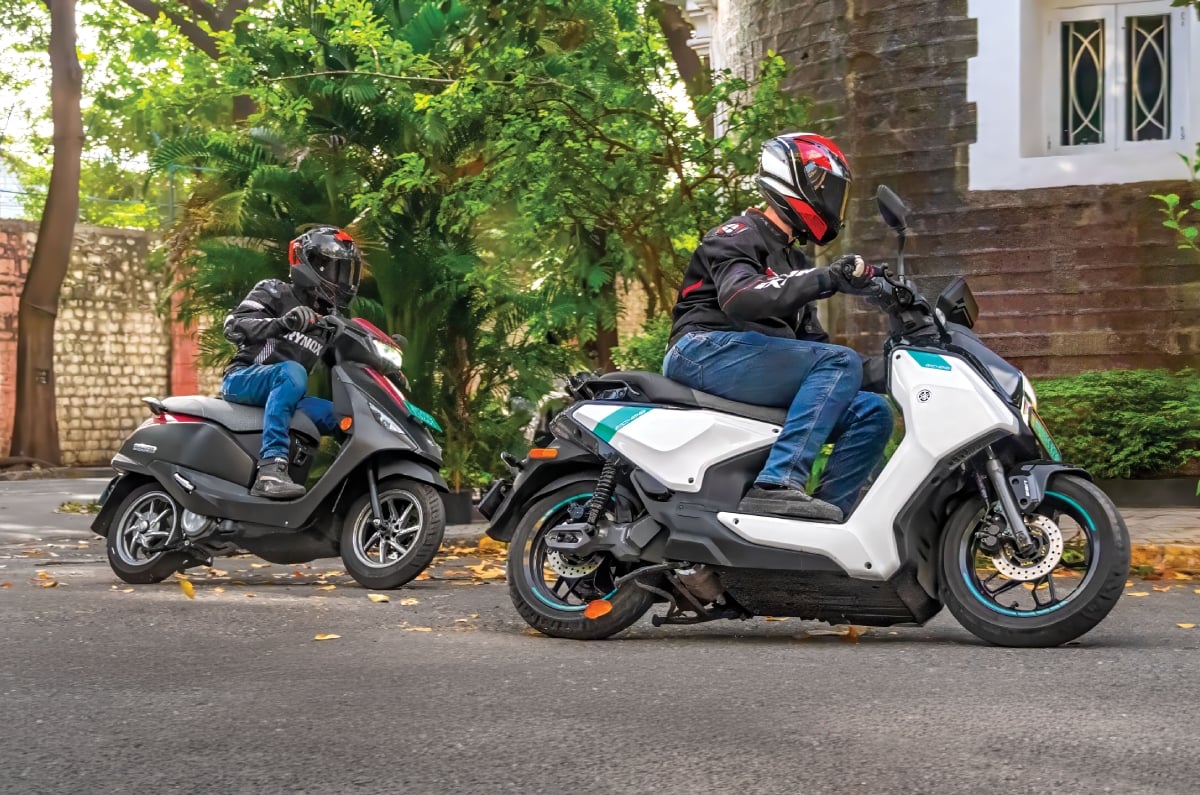
The riding experience of both also reflects two very different engineering philosophies. The 122kg e-Access feels exceptionally light on its feet; whether wheeling it around a parking space or flicking it into a bend, it responds eagerly – actually, a bit too eagerly. Some of that can be attributed to Suzuki mounting the battery pack vertically beneath the seat, a decision that, as you will read further on, has implications elsewhere too.
Yamaha EC-06
Suzuki e-Access
Battery capacity / chemistry
4kWh / NMC
3.072kWh / LFP
Motor
Permanent Magnet Synchronous
Permanent Magnet Synchronous
Power
6.7kW
4.1kW
Torque
26Nm
15Nm
Like the latest Burgman, its ride also errs towards the firmer side rather than the plush feel of a TVS iQube. It isn’t uncomfortable by any means, but it is something worth paying attention to on a test ride. Taller riders will also discover the Suzuki’s compactness during full-lock U-turns, where their knees will foul the handlebar.
On the flip side, the EC-06 is relatively heavier and slower to steer, but it’s a small tradeoff. That’s because its larger 14-inch wheels lend it greater stability at faster speeds and also help it dismiss broken roads with admirable composure. Its absorptive suspension also factors in here, though particularly sharp impacts can provoke a slight judder in the fork.
E-Access has the more flighty, energetic demeanour, whereas the EC-06’s handling is more sure-footed.
The Yamaha’s seat, however, leaves quite some room for improvement. Its forward-sloping shape constantly makes you slide forward, necessitating frequent shuffling about. The padding is also too soft, and after just 30 minutes or so, you find yourself sinking into the seat pan. This results in a gradually more knees-up riding position, which might sound like a trifling problem at first but one that becomes increasingly apparent over longer journeys.
Neither one gets ABS, which feels like quite an egregious oversight considering their price points. Nevertheless, the Yamaha’s brakes inspire greater confidence because they are powerful without being overly aggressive, and its wider tyres also provide better traction. The Suzuki’s brakes, conversely, are almost too sharp. On Mumbai’s slippery concrete roads, they demand a more measured touch when coming to a halt quickly.
Not that you’ll often rely heavily on them. That’s partly down to the well-calibrated regenerative braking system and partly because the e-Access’ performance is quite unremarkable. Not only is it much slower than the EC-06, but it also feels noticeably less eager than the petrol-powered Access. It’s perfectly usable in the city, but on faster roads, overtakes require planning. Unsurprisingly, the Yamaha feels considerably livelier. It accelerates with genuine enthusiasm in its top Power mode, the regenerative braking is seamlessly calibrated in all 3 modes (Standard and Eco being the other two) and, despite using chain drive, its drivetrain is remarkably silent – akin to a hub-mounted motor.
Feel Good (?) Features
Build quality on both is reassuringly solid and exactly what one expects from the Japanese. At these prices, however, there are a few omissions that are difficult to overlook.
The e-Access employs the same TFT display found on the ICE Access 125 and Burgman, both of which cost substantially less. Yamaha, meanwhile, supplies only the slower 480W charger, despite the considerably more affordable River offering a faster 750W unit as a Rs 3,000 option.
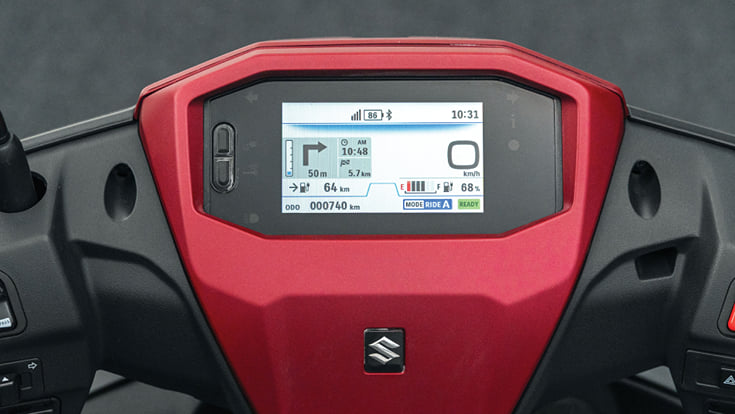
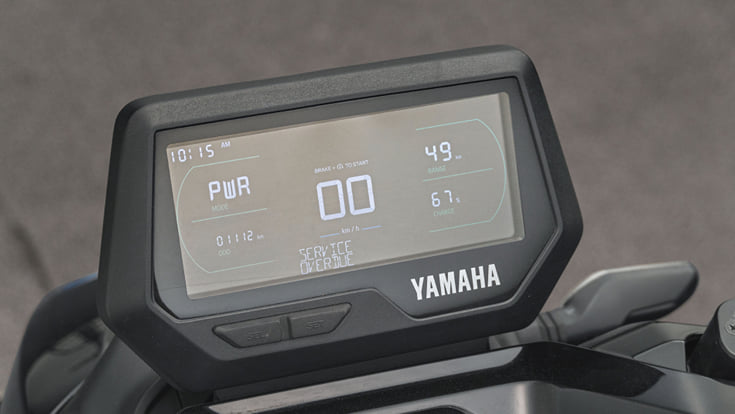
Same TFT as ICE Access; EC’s negative LCD is simpler but well laid out.
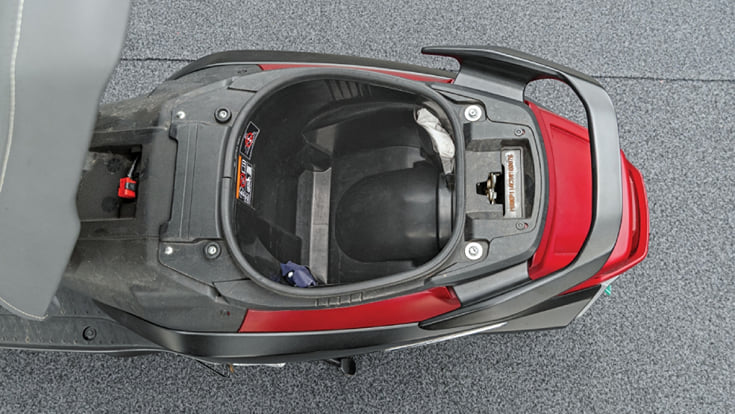
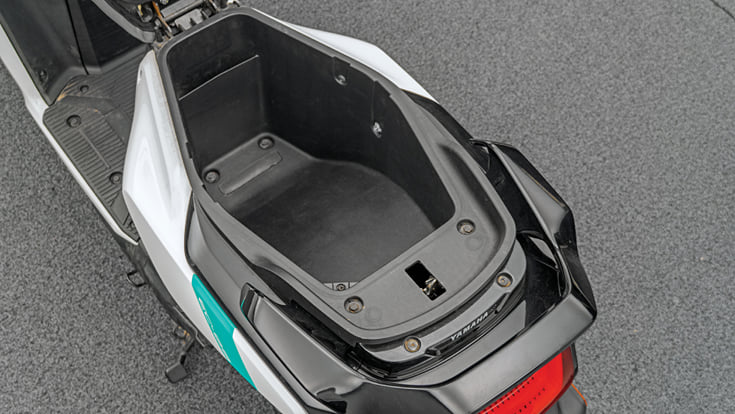
The EC-06 also sacrifices a lot of storage compared to the Indie. Its 24.5-litre under-seat boot is far short of the latter’s enormous 43-litre boot and trails established rivals such as the iQube, Rizta and Chetak. The River’s lockable 12-litre glovebox has been omitted too, though Yamaha has used this to reposition the charging port to a more convenient location.
e-Access’ 17L boot far too small and oddly shaped; Yamaha’s 24.5L boot is more usable but not segment-leading.
If the Yamaha’s storage is merely average, the Suzuki’s is positively outclassed. The battery’s position beneath the seat results in just 17 litres of bootspace – roughly half what you’ll find on rivals like the Rizta and Chetak. In fact, even the ICE Access 125 offers you quite a bit more storage space. The e-Access’ boot is also shaped quite awkwardly, and unless the charger’s cables are folded with almost Victorian precision, it simply refuses to fit.
Range Rovers?
An electric scooter ultimately needs to deliver one thing above all else – promising range to reduce your running costs. In Ride A mode, which delivers full performance and max regen, the e-Access covered a little over 88km in our range test. Given its smaller 3kWh battery and its use of safer, but less energy-dense, LFP chemistry, the result is respectable in isolation; however, compared to the market’s front-runners, it falls far short.
Yamaha EC-06
Suzuki e-Access
0-40kph
3.46s
4.94s
0-60kph
6.82s
11.93s
Roll-on Acceleration
20-50kph
3.31s
5.46s
30-70kph
7.34s
17.01s
50-80kph
10.96s
–
Our test on the EC-06 was conducted in its middle Standard mode, which retains full performance but softens throttle response compared to Power mode. It covered 114km, comfortably exceeding the distance initially predicted. Both scooters deserve praise here, as their range indicators proved refreshingly honest, not indulging in optimistic guesswork.
Yamaha EC-06
Suzuki e-Access
60-0kph
22.87m
24.64m
Using Eco mode will naturally extend the range on both, though with reduced acceleration and lower top speeds. Thankfully, neither becomes painfully slow. Even in Eco, both climb flyovers and keep up with city traffic without reducing themselves to rolling roadblocks.
While the Yamaha’s range is undoubtedly more impressive, its charging time is a rather different story. The supplied 480W charger requires a glacial ten hours to replenish a flat battery. Meanwhile, the Suzuki’s 600W unit requires around six hours to do the same, although its battery pack is also smaller.
One thoughtful detail both manufacturers deserve credit for is the inclusion of a dedicated charger bag. It is a small touch, but one that should help protect the charger from spending years rattling around inside the boot.THE BIGGER PICTURE
Judged purely against each other, the result is straightforward – the EC-06 clearly wins. It offers superior performance, greater comfort, longer range and also costs much less than the e-Access.
Yamaha EC-06
Suzuki e-Access
Price (ex-showroom, Bengaluru)
Rs 1.71 lakh
Rs 1.92 lakh
However, if you zoom out and look at the broader market, the context changes. At Rs 1.71 lakh, the Yamaha is hardly inexpensive, and the Suzuki, which is knocking on the door of Rs 2 lakh, is even worse off. When proven alternatives from TVS, Ather, Bajaj, Vida and River offer similar or even superior alternatives for substantially less money, the Japanese appear more like fringe players and less like mainstream contenders.
There will undoubtedly be a small demographic of buyers for whom a Japanese badge carries enough cachet to justify this big premium. However, for the rest of us, the more keenly priced and proven homegrown contenders are the better bet.
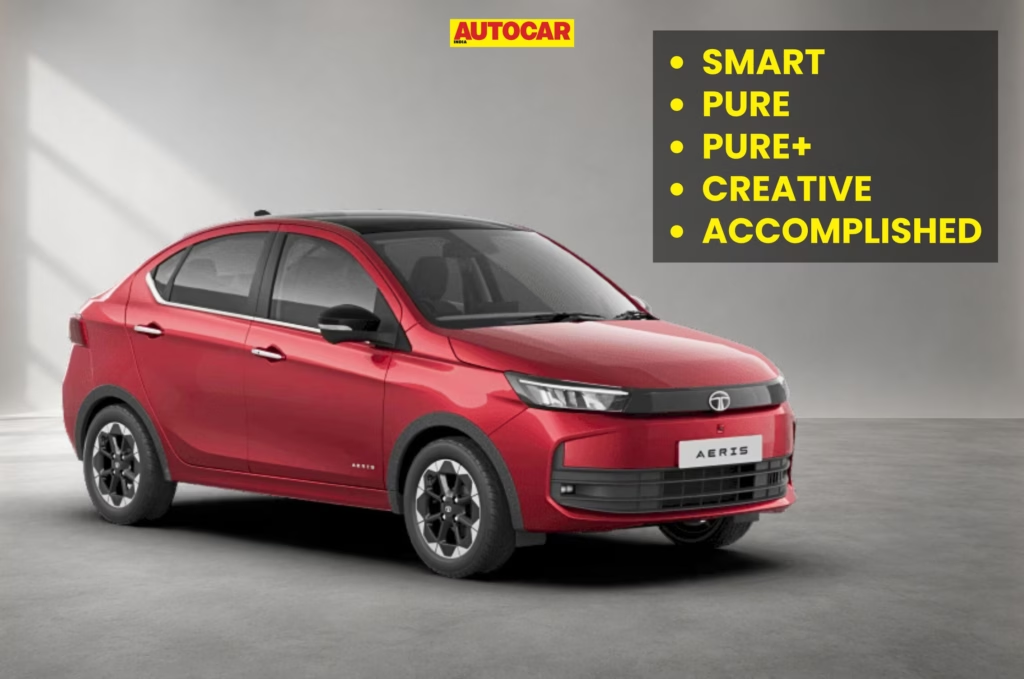
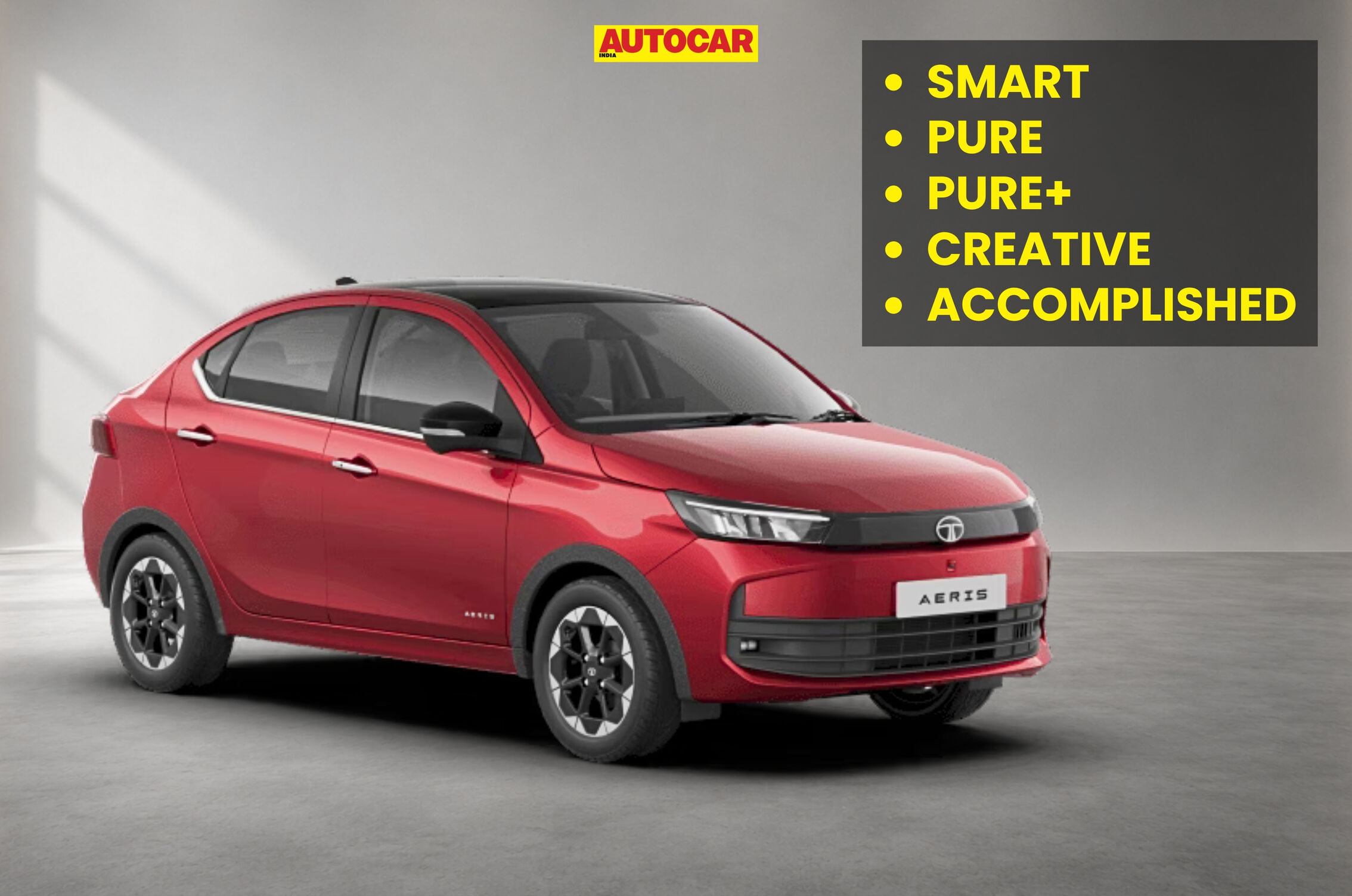
The Tata Aeris has replaced the Tigor as the manufacturer’s compact sedan offering. Priced from Rs 5.29 lakh, it is available in five trims: Smart, Pure, Pure+, Creative and Accomplished. These variants can be had with either a petrol or CNG engine, paired with a 5-speed manual or AMT. So, which Aeris variant should you choose? Let’s find out.
Tata Aeris powertrain options and prices
Available in 5 trims, offered with a petrol and a CNG engine option
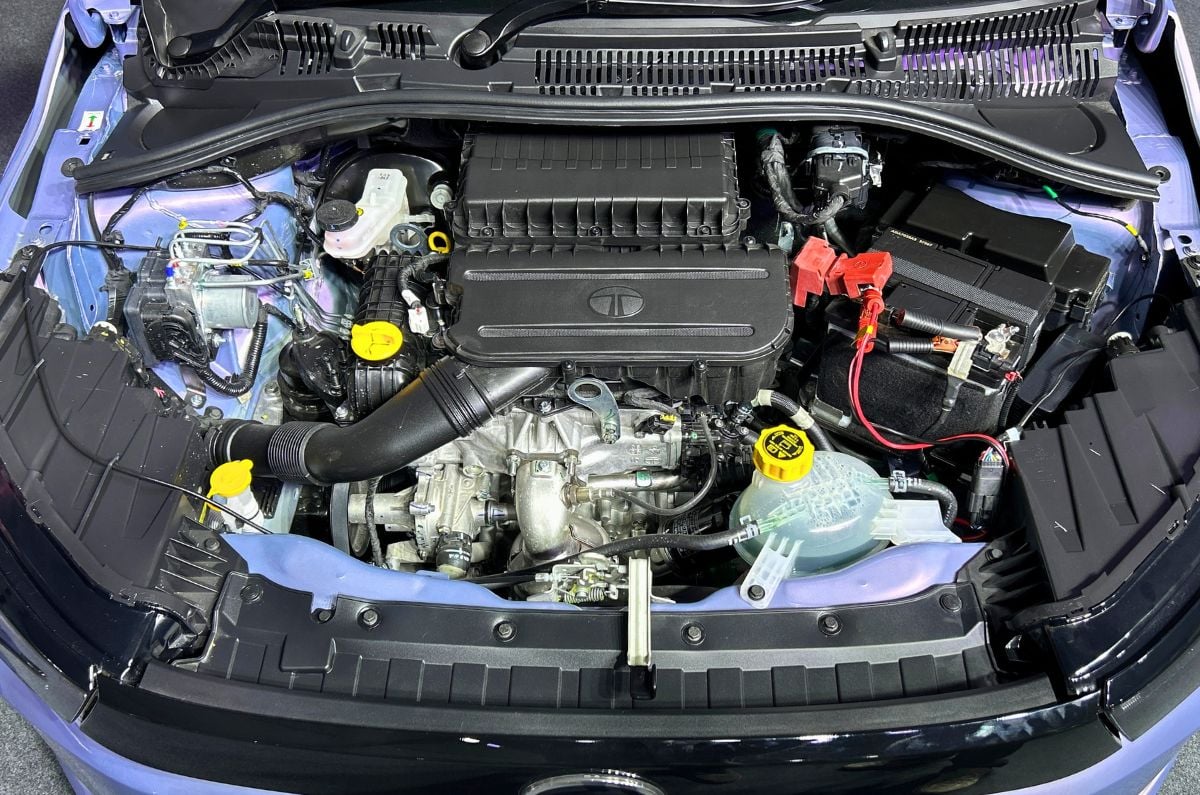
The Tata Aeris gets a 1.2-litre three-cylinder Revotron petrol engine that produces 86hp and 113Nm. The CNG version uses the same 1.2-litre engine but produces 75.5hp and 96.5Nm in CNG mode. Both powertrains are offered with a 5-speed manual and a 5-speed AMT. The CNG version also gets a twin-cylinder setup, with the two CNG cylinders positioned beneath the boot floor for usable luggage space.
Tata Aeris variant-wise ex-showroom price list (in Rs, lakh)
Petrol MT
Petrol AMT
CNG MT
CNG AMT
Smart
5.29
–
6.29
–
Pure
6.14
6.69
7.14
7.69
Pure+
6.74
7.29
7.74
8.29
Creative
7.49
8.04
8.49
9.04
Accomplished
8.19
8.74
9.19
9.74
Tata Aeris colour options
Offered in 6 hues, available with a body-coloured or black roof
The Tata Aeris is offered in six exterior colours: Dandeli Drizzle, Dune Glow, Nitro Crimson, Pure Grey, Daytona Grey and Pristine White. These colours are offered in a dual-tone option with a black roof in the one-below-top Creative and top-spec Accomplished trims.
Price: Rs 6.14 lakh to Rs 7.69 lakh, Powertrain: Petrol MT/AMT, CNG MT/AMT
Features over Pure
8-inch infotainment touchscreen
Wireless Android Auto and Apple CarPlay
4-speaker sound system
Reverse parking camera
Rear AC vents
65W front USB Type-C charging
Cruise control
Front and rear centre armrest
Tyre pressure monitoring system (TPMS)
Shark-fin antenna
Hill hold control
15-inch stylised steel wheels on petrol variants
14-inch stylised steel wheels on CNG variants
Creative
Price: Rs 7.49 lakh to Rs 9.04 lakh, Powertrain: Petrol MT/AMT, CNG MT/AMT
Features over Pure+
Auto LED headlights and LED DRLs
Auto-folding ORVMs
LED fog lamps
LED taillights
15-inch alloy wheels on petrol variants
10.25-inch infotainment touchscreen
Connected car technology
360-degree camera
Automatic climate control
Cooled glovebox
Rain-sensing wipers
Dual-tone roof
Accomplished
Price: Rs 8.19 lakh to Rs 9.74 lakh, Powertrain: Petrol MT/AMT, CNG MT/AMT
Features over Creative
Ventilated front seats
Wireless phone charger
2 tweeters
Leatherette upholstery on seat and armrests
65W rear USB Type-C charger
Dashcam recorder via 360-degree camera feed
Chrome door handles and waistline detailing
Magazine pockets
Which variant of the Tata Aeris should you buy?
Creative trim offers a good balance, but Pure+ trim is suitable for budget buyers
The Tata Aeris Creative offers a good balance between price and features, and its misses over the Accomplished are not significant, especially considering the price difference. If you want a well-equipped Aeris without spending on the top-spec trim, the Creative is the variant to go for. If you are on a budget, the Pure+ is a suitable alternative.
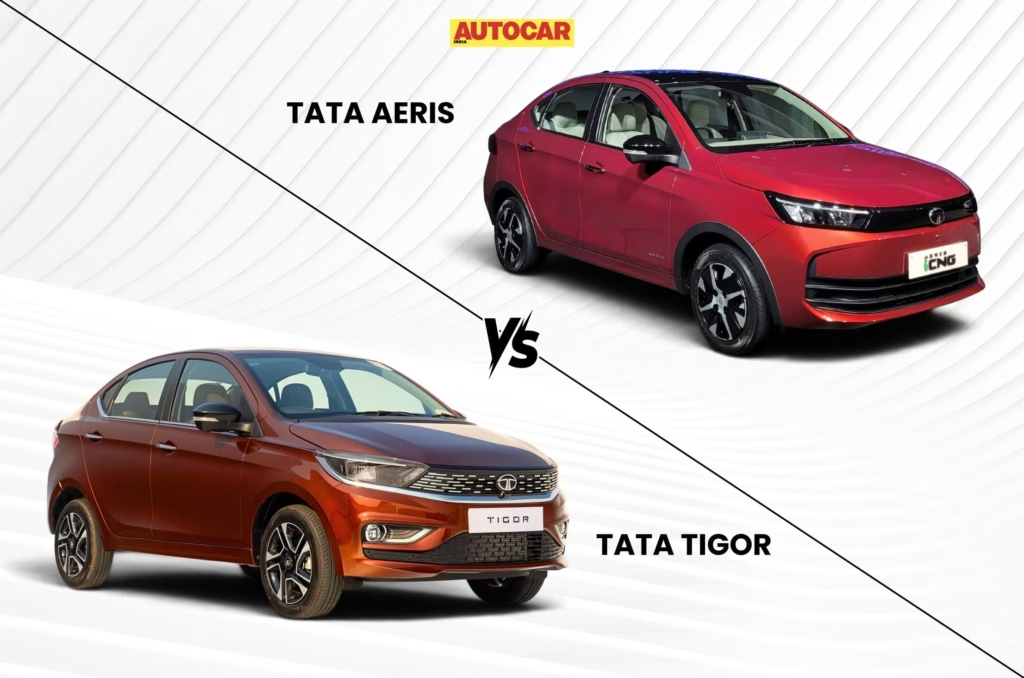
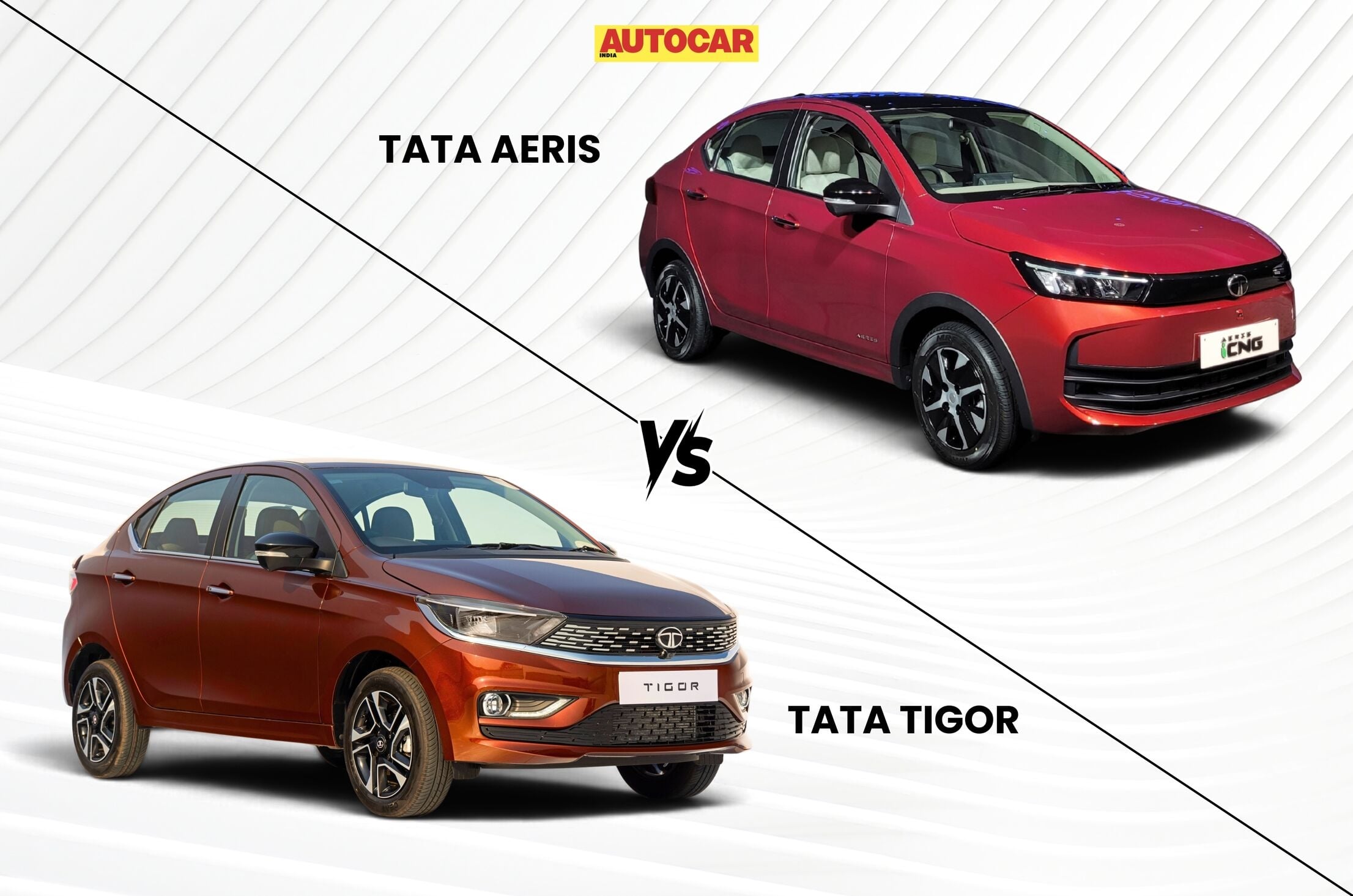
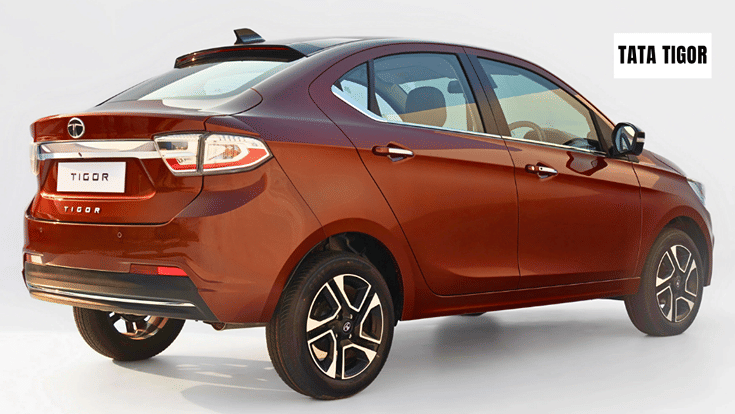
Tata has launched the Aeris as the facelifted version of the Tigor, priced from Rs 5.29 lakh to Rs 9.74 lakh (ex-showroom). It features a sleeker exterior with new LED lighting elements and redesigned bumpers, while the cabin gets a revamped dashboard and fresh features. Here’s a look at how the new Aeris compares with the outgoing Tigor, including the key similarities and differences.
Tata Aeris vs Tigor: Exterior design
Gets a more aggressive face with sleeker headlights and fog lamps
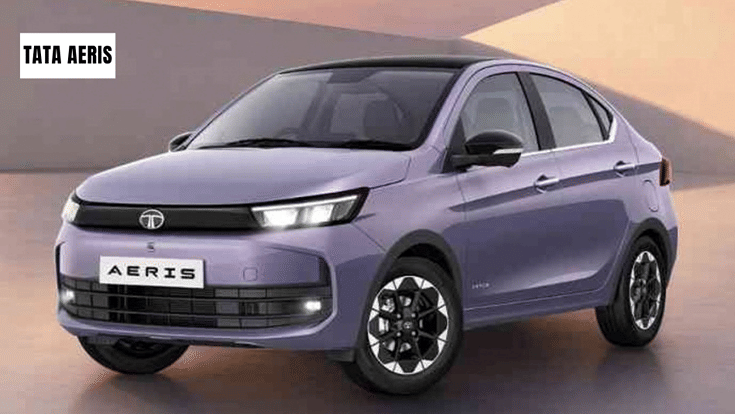
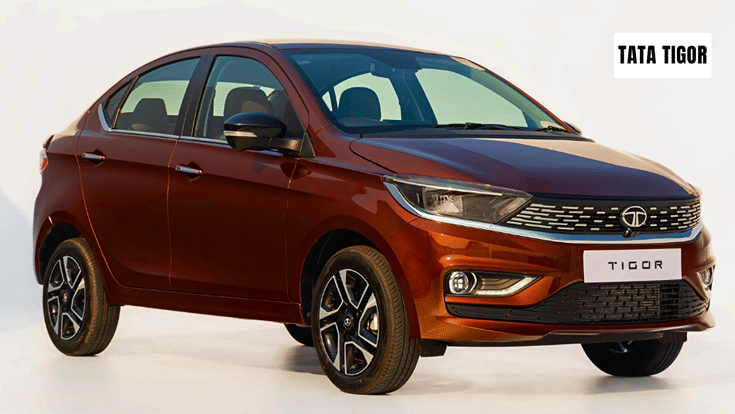
The Tata Aeris features a more aggressive design inspired by the Tiago hatchback, much like the pre-facelift versions of both Tata models. It gets sleeker LED headlights with eyebrow-shaped DRLs, along with a slimmer and simpler grille that does away with the chrome trims seen on the Tigor. The bumper has also been redesigned with larger air intakes and sleeker LED fog lamps, giving it a more minimal look compared with the Tigor’s circular halogen units.
Aeris gets redesigned alloy wheels and new badges on front doors
In profile, the Tata Aeris remains largely unchanged from the Tigor, with the only notable updates being the redesigned 15-inch alloy wheels and new Aeris badges on the front doors. Both sedans feature black outside rearview mirrors (ORVMs), chrome door handles and a chrome strip along the window line.
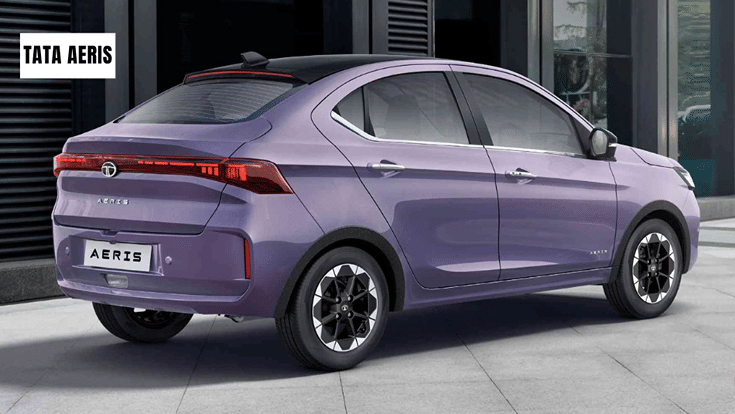
Sleeker LED taillights and a simpler bumper are offered with the Aeris
The Aeris retains the Tigor’s coupe-like tapering roofline, but gets a few updates that give it a more modern look. These include sleeker LED taillights connected by a red plastic trim and a revised bumper with a centrally positioned reverse parking light. The high-mounted stop lamp continues to span the width of the rear windscreen.
Tata Aeris vs Tigor: Interior design and features
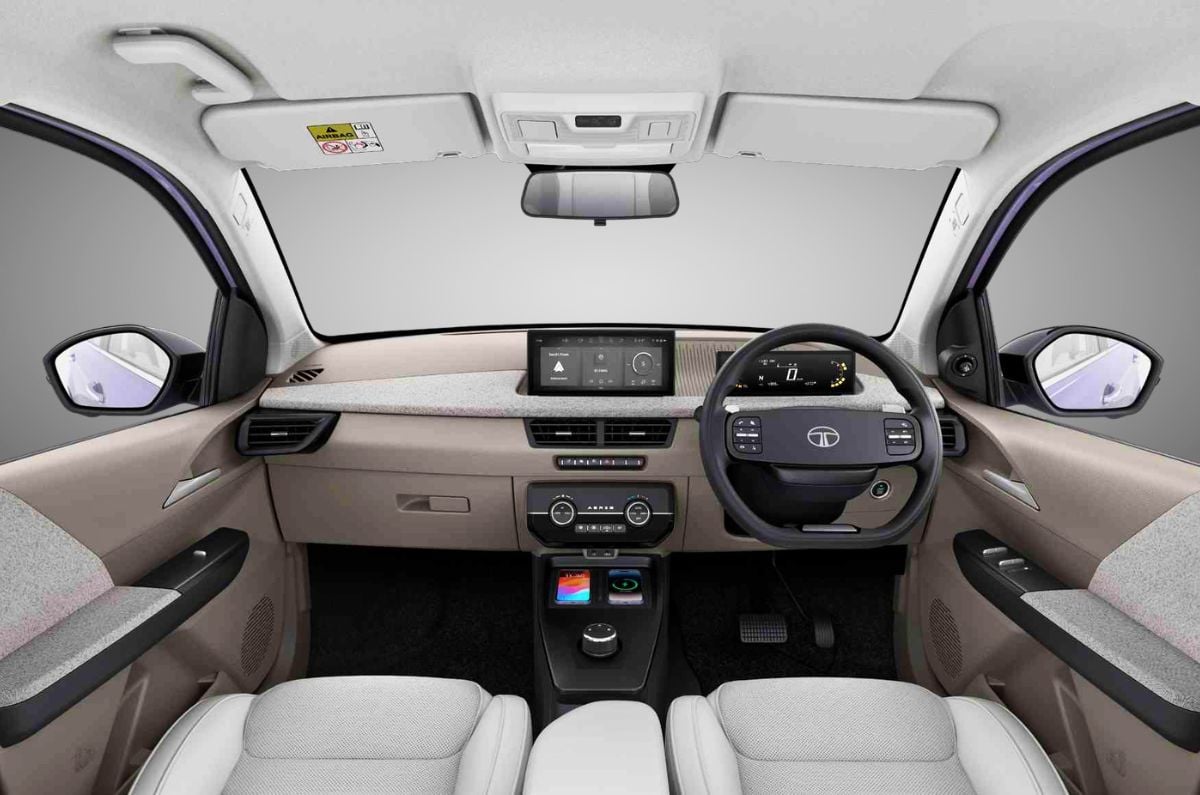
Gets a new cabin theme and a minimalistic dashboard
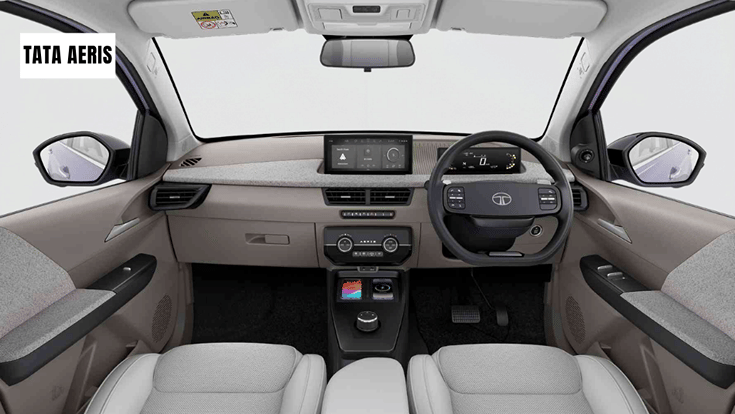
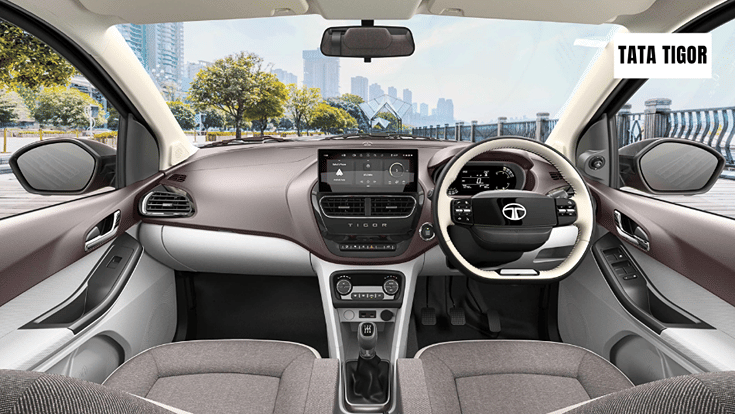
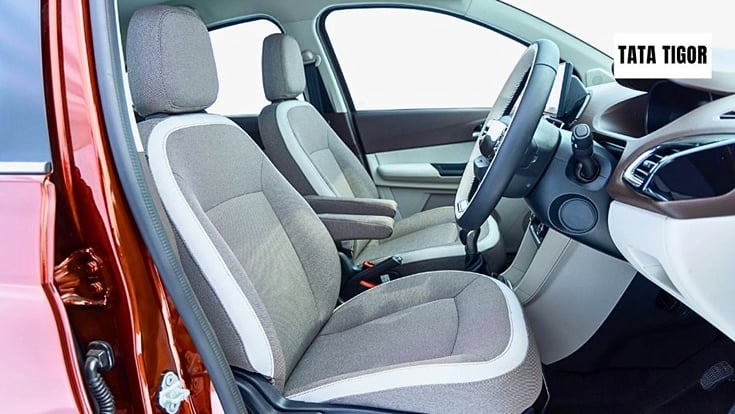
The Tata Aeris gets a new cabin theme with a more minimalistic dashboard design. It continues with the free-standing 10.25-inch touchscreen infotainment system, but now features a new free-standing semi-digital driver’s display. The 2-spoke steering wheel is carried over, but now gets a non-illuminated Tata logo on the horn pad.
The climate control panel remains unchanged from the Tigor, while the centre console has been redesigned to accommodate two smartphones, with one slot incorporating a wireless charging pad. The door armrests have also been revised, while the individual centre armrests have been replaced by a chunkier single unit with storage space underneath. On AMT variants, a rotary drive selector replaces the traditional gear selector stalk.
New features make the Aeris a more modern offering
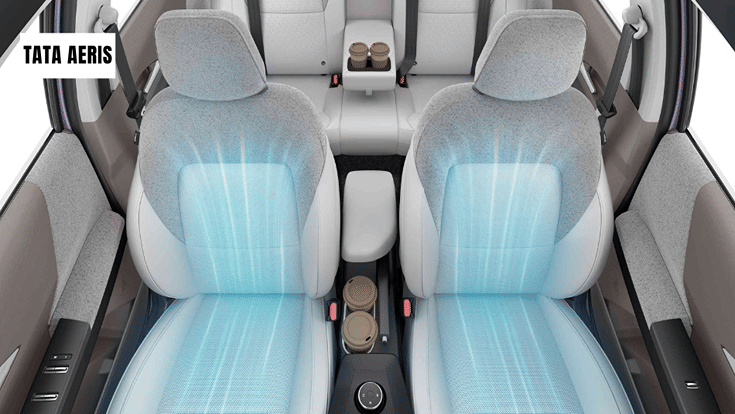
The seats in the Tata Aeris get revised cushions and leatherette upholstery, while the front seats are now ventilated. However, the 6-speaker sound system is a downgrade from the Tigor’s 8-speaker unit. Other features, including automatic climate control, wireless Android Auto and Apple CarPlay, a cooled glovebox and rear AC vents, continue to be offered.
In terms of safety, the Aeris gets six airbags as standard, compared with the Tigor’s standard dual-airbag setup. Its 360-degree camera can also be used as a dashcam, while hill hold assist, ISOFIX child-seat anchorages and rear parking sensors are carried over from the Tigor.
Tata Aeris vs Tigor: Powertrain options
No changes have been made to the powertrain department
There are no changes to the powertrain, with the Tata Aeris continuing with the 1.2-litre, 3-cylinder naturally aspirated engine, available with either petrol or CNG. The petrol version produces 86hp and 113Nm, while the CNG version makes 76hp and 97Nm. Both powertrain options are paired with either a 5-speed manual or a 5-speed AMT.
As before, the CNG version gets two cylinders mounted inside the boot, reducing boot space to 227 litres, which is 192 litres less than the petrol version.
The Tata Aeris is priced from Rs 5.29 lakh to Rs 9.74 lakh, compared to the older Tigor’s Rs 5.70 lakh to Rs 9.10 lakh range. The Aeris locks horns with the Maruti Dzire, Honda Amaze and Hyundai Aura.