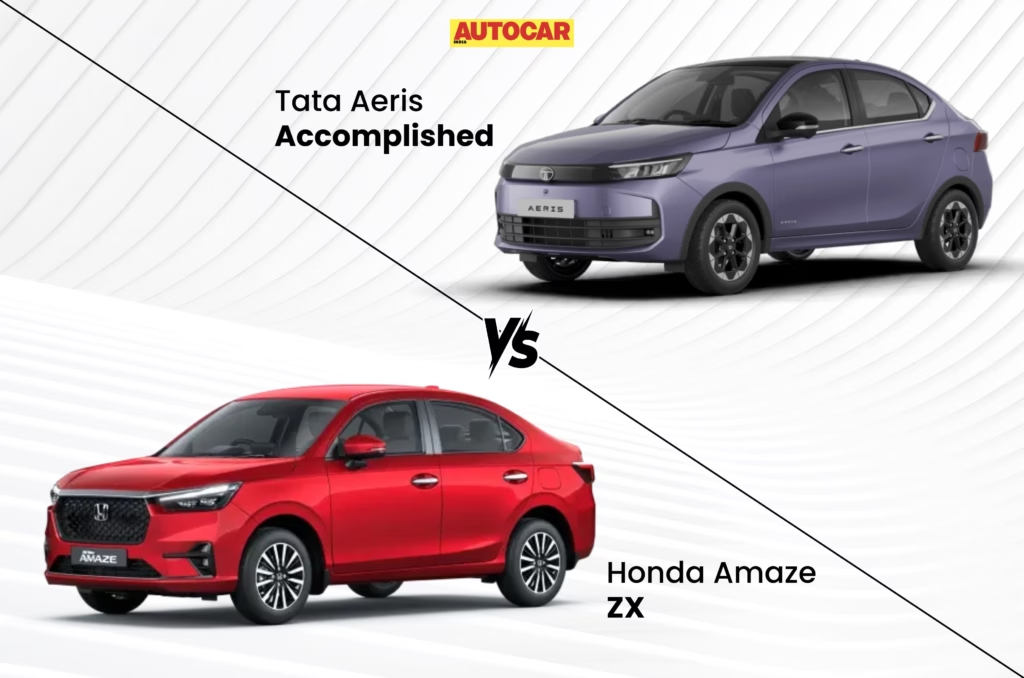
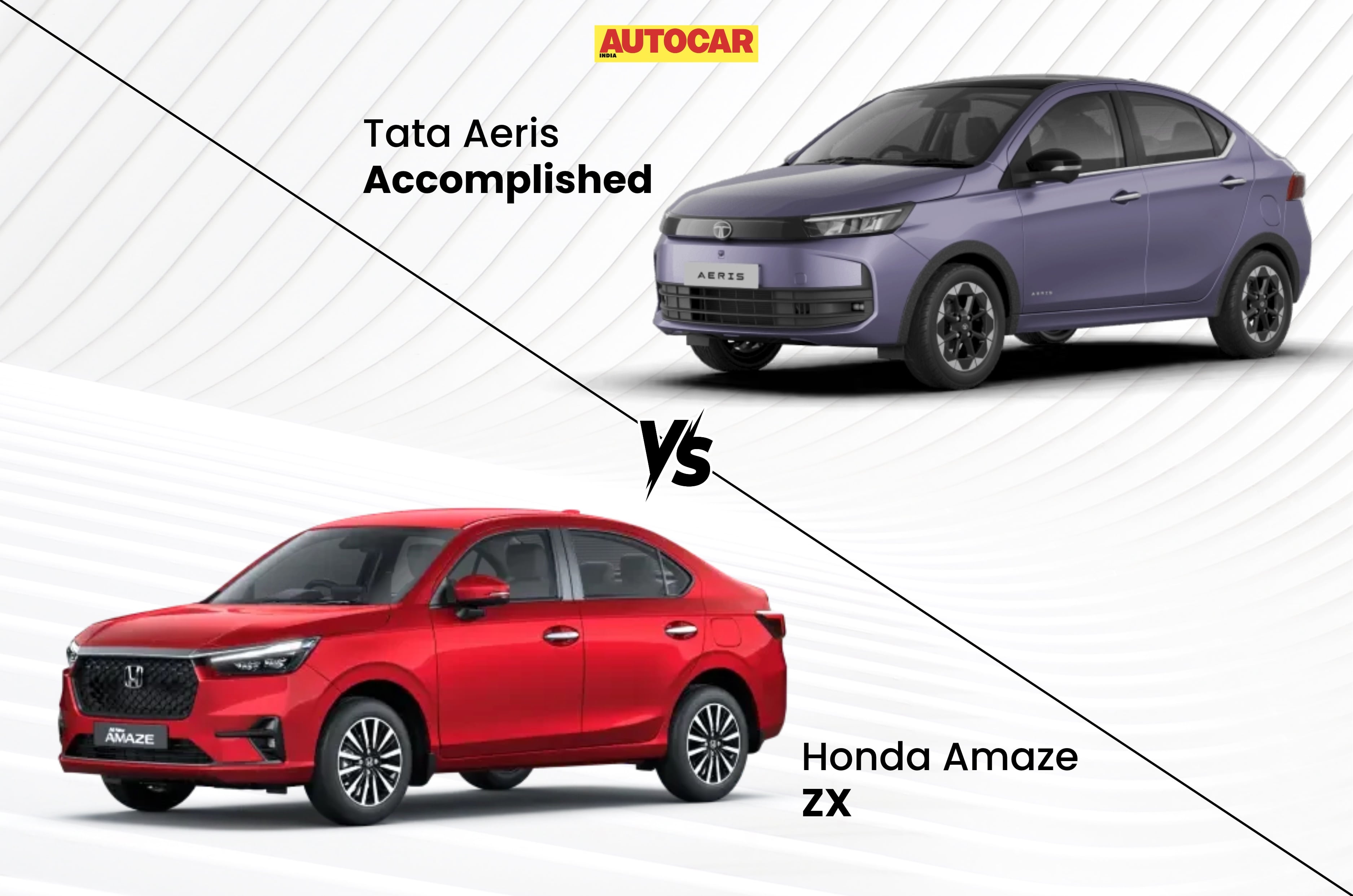
With the arrival of the new Aeris, Tata has made an attempt to strengthen its prowess in the compact sedan space. Though based on the Tigor, the Aeris comes with fresher styling elements and added features. Here, we’ve compared it with the Honda Amaze, which is currently in third-gen form and one of the longstanding contenders in the segment. For this comparison, we’ve chosen the Aeris’ Accomplished trim and the Amaze’s ZX trim.
For full specs, features, and a price breakdown, check our Aeris vs Amaze comparison.
Tata Aeris vs Honda Amaze: Dimensions
Aeris is taller and gets the larger boot; Amaze is wider and has a longer wheelbase
Tata Aeris vs Honda Amaze: Dimensions
Tata Aeris
Honda Amaze
Difference
Length (in mm)
3,995
3,995
–
Width (in mm)
1,684
1,733
-49
Height (in mm)
1,532
1,500
+32
Wheelbase (in mm)
2,450
2,470
-20
Ground clearance (in mm)
170
172
-2
Boot space (litres)
419
416
+3
The Aeris and Amaze have the same length but differ greatly in other dimensions. The Amaze is wider, has a longer wheelbase, and rides a narrow 2mm higher than the Aeris. On the other hand, the Aeris is taller and has a slightly bigger boot. One thing to note is that the Aeris’ boot is likely to have more usable space, as its boot lid uses gas struts to open and close, whereas the Amaze’s trunk lid utilises a hinge mechanism.
Tata Aeris vs Honda Amaze: Powertrain
CNG AMT combo offered only on the Aeris
Tata Aeris vs Honda Amaze: Powertrain
Tata Aeris
Honda Amaze
Engine
1.2-litre 3-cyl petrol | 1.2-litre 3-cyl CNG
1.2-litre 4-cyl petrol
Power (hp)
86 | 76
90
Torque (Nm)
113 | 97
110
Transmission
5MT / 5AMT
5MT / CVT
In petrol guise, both the Aeris and Amaze get a 1.2-litre naturally aspirated unit. The former’s mill uses a 3-cylinder setup, whereas the latter adds an additional cylinder. Amaze’s power output is higher than the Aeris, but the latter delivers slightly more torque. Both models get a 5-speed manual, but automatic variants of the Aeris use an AMT while the Amaze gets a CVT gearbox.
The Aeris offers a factory-fitted CNG kit on its top Accomplished trim with petrol and AMT gearbox choices. In CNG guise, it gets a dual-cylinder setup that doesn’t sacrifice much boot space as opposed to a single large tank. While Honda also offers a CNG kit on the Amaze, it’s exclusively offered with the manual gearbox and is fitted at the dealer level.
Tata Aeris vs Honda Amaze: Exterior
Dual-tone paint options exclusive to the Aeris
Tata Aeris vs Honda Amaze: Exterior
Tata Aeris
Honda Amaze
Headlights
Auto LED
Projector Auto LED
Tail-lights
LED
LED
DRLs
Yes
Yes
Front fog lamps
LED
Projector LED
Wheels
15-inch alloys
15-inch alloys
Powered ORVMs
Yes
Yes
Shark-fin antenna
Yes
Yes
Colour
Dual-tone, 6 options
Monotone, 6 options
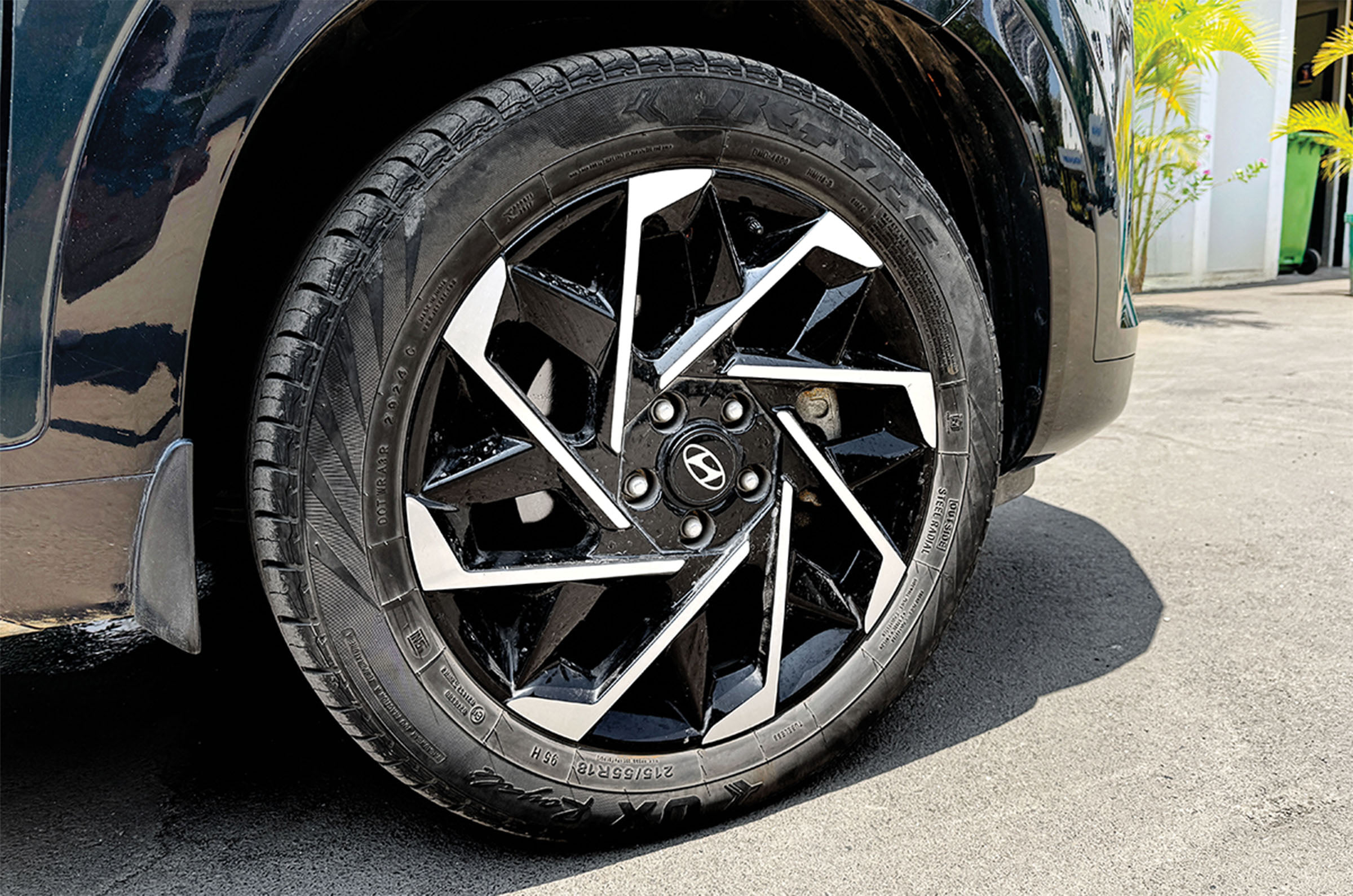
On the visual front, the Aeris and Amaze are neck and neck with LED light setups, fog lamps, 15-inch alloy wheels, powered ORVMs, and a sharkfin antenna. However, when it comes to paint options, the Aeris Accomplished is limited to dual-tone finishes with a black roof, and the Amaze gets monotone paint jobs only.
Tata Aeris vs Honda Amaze: Interior
Aeris gets the popular front seat ventilation feature
Tata Aeris vs Honda Amaze: Interior
Tata Aeris
Honda Amaze
Instrument cluster
Digital dials
Part-digital TFT display with analogue dials
Infotainment screen
10.25-inch
8-inch
Android Auto, Apple CarPlay
Wireless
Wireless
Sunroof
No
No
Front seat ventilation
Yes
No
Audio system
4-speaker, 2-tweeter
4-speaker, 2-tweeter
Wireless phone charger
Yes
Yes
Climate control
Automatic
Automatic
Driver seat adjustment
Height, reach (manual)
Height, reach (manual)
Steering adjustment
Tilt
Tilt
Rear AC vents
Yes
Yes
Rear centre armrest
Yes
Yes
Seat upholstery
Leatherette
Fabric
Connected car tech
Yes
Yes
Keyless entry
Yes
Yes
Push-button start
Yes
Yes
Cooled glove box
Yes
No
USB ports
2x Type-C 1x Type-A
2x Type-A ports
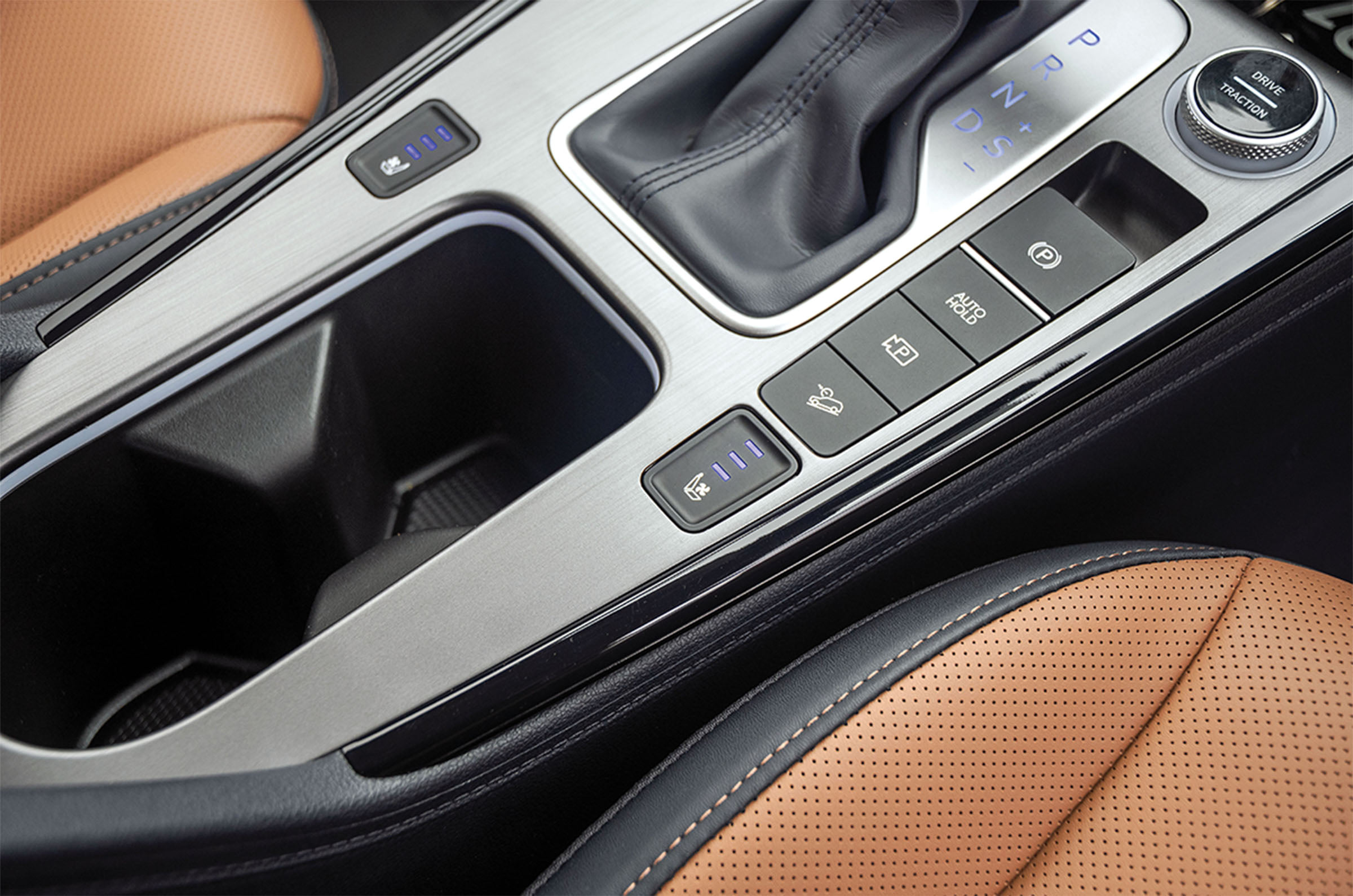
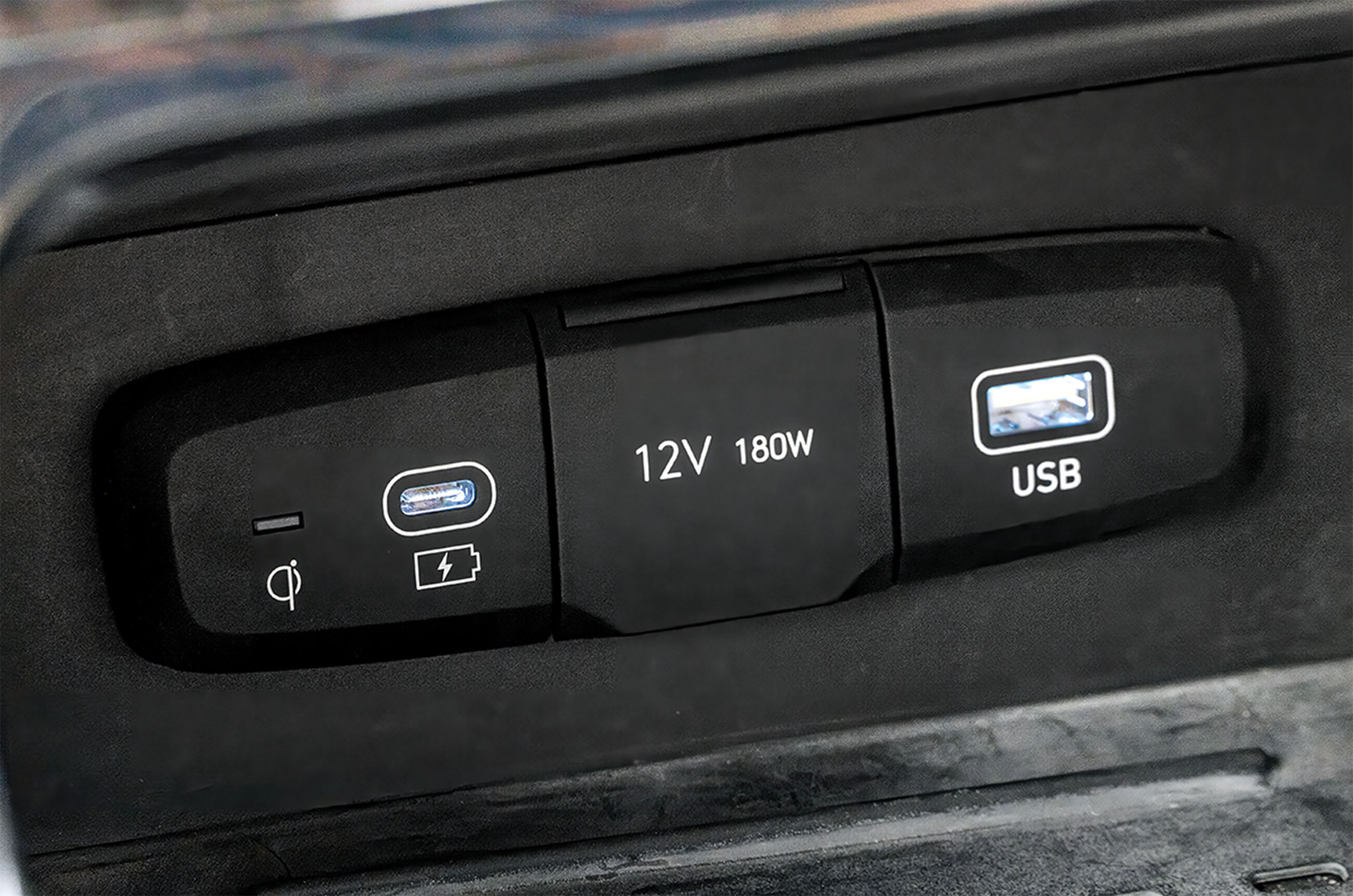
Inside is where the odds look in favour of the Aeris. It gets a larger infotainment screen, front seat ventilation, leatherette seat upholstery, and a cooled glovebox over the Aeris. Meanwhile, the Amaze’s instrument cluster has a colour TFT with configurable displays on offer.
Tata Aeris vs Honda Amaze: Driving features
Paddle shifters found on both; Adaptive cruise control exclusive to the Aeris
Tata Aeris vs Honda Amaze: Driving features
Tata Aeris
Honda Amaze
Paddle shifters
Yes
Yes
Cruise control
Regular
Adaptive
As for driving features, both get paddle shifters with their respective automatic versions. But the Aeris gets regular cruise control as opposed to the advanced adaptive cruise control found on the Amaze.
Tata Aeris vs Honda Amaze: Safety features
360-degree camera exclusive to the Aeris; Amaze is the only compact sedan with ADAS
Tata Aeris vs Honda Amaze: Safety features
Tata Aeris
Honda Amaze
BNCAP rating
Not tested
5 stars
Airbags
6
6
ADAS
No
Level 1
Camera setup
360-degree
Rear
Blind view monitor
Yes
Yes
Dashcam recording
Yes
No
Rain sensing wipers
Yes
Yes
Parking sensors
Rear
Rear
Disc brakes
Front
Front
Tyre-pressure monitoring
Yes
Yes
Interior rearview mirror (IRVM)
Manual dimming
Manual dimming
Hill-hold assist
Yes
Yes
ESC
Yes
Yes
Traction control
Yes
Yes
Adjustable headrests
Front only
Front only
The Amaze has achieved a 5-star crash safety rating by BNCAP. While the Aeris is yet to be tested by BNCAP, it’s worth noting that the Tigor that it’s based on achieved a 4-star rating by GNCAP. As for safety equipment, both are well equipped with six airbags, ESC, traction control, rear parking sensors, TPMS, and hill hold assist. Additionally, the Aeris gets a 360-degree camera as opposed to the Amaze’s rear-view only, but the latter offers an ADAS suite which the former misses out on. Meanwhile, both skip adjustable headrests for the rear occupants.
Tata Aeris vs Honda Amaze: Price and verdict
Tata Aeris vs Honda Amaze: Price
Tata Aeris Accomplished
Honda Amaze ZX
Petrol manual
8.20
9.39
Petrol automatic
8.75
10.00
CNG manual
9.20
–
CNG automatic
9.75
–
Comparing like-for-like powertrain combinations, the Aeris is more affordable than the Amaze by up to Rs 1.25 lakh. Interestingly, even its CNG automatic version is cheaper than the Amaze petrol CVT. Between the Aeris and the Amaze, it’s the former we’d pick. Not only is the Aeris more affordable than the Amaze by over a lakh, but it also packs in more features and offers more powertrain combinations. Though in automatic guise the Amaze’s CVT unit delivers a more refined experience than the AMT on the Aeris, the premium that it commands isn’t justified.
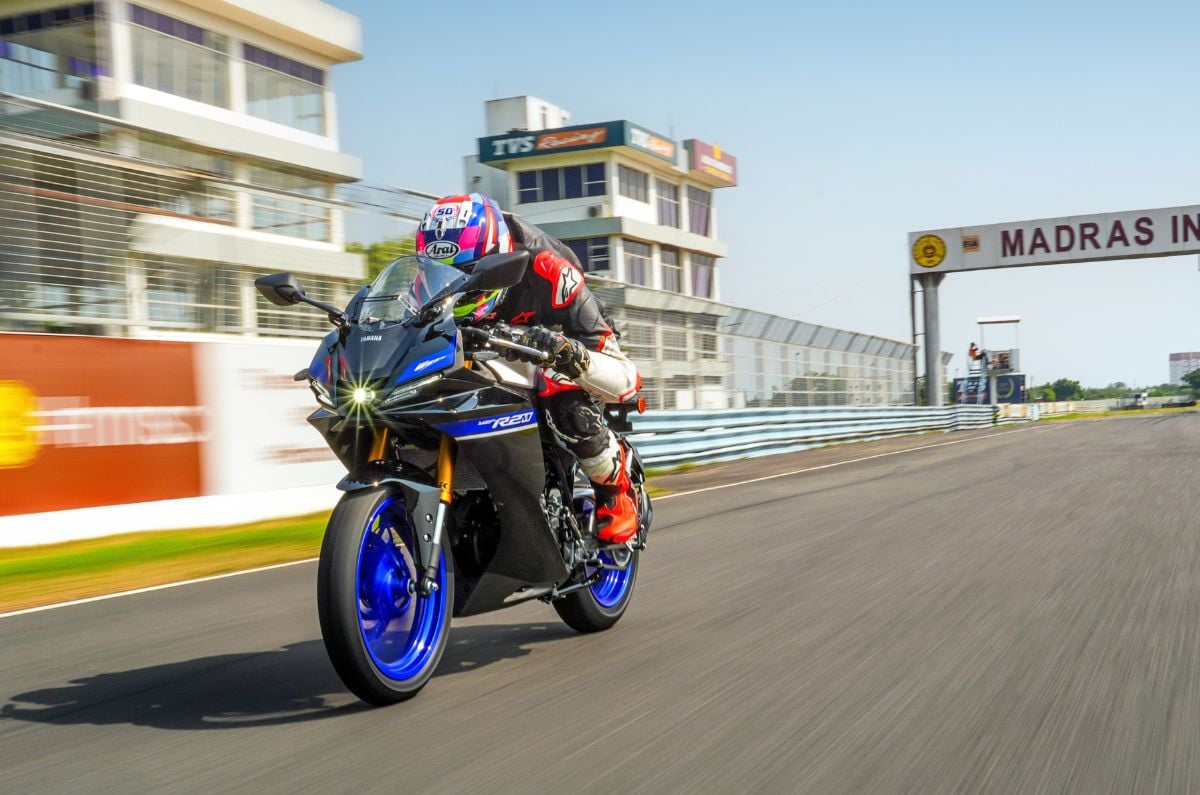
The internet has expressed considerable concern in the month following the launch of the new R2, that it has lost some of the key elements that made the R15 such a standout. While I agree that the lack of the deltabox frame and the removal of the variable valve timing system, don’t make for great viewing on a spec sheet, they also don’t dictate what makes for a great riding experience. Yamaha recently gave us a brief chance to experience the R2 on the Madras International Circuit and, I’m happy to confirm that that authentic Yamaha R experience is still very much intact.
Yamaha R2 Riding position and Seat height – 8/10
Slightly more accessible than the R15
Specifications
Values
Seat height
810 mm
Adjustable seat height
No
Wheelbase
1340 mm
Ground Clearance
170 mm
The familiar Yamaha feeling set in from the moment we swung a leg over the bike. The ergos have been tweaked very slightly, but the overall riding position is still very similar to the R15. The biggest difference for me was that the tank looks and feels bigger. Shorter riders will be pleased that the seat height has been reduced from 815mm to 810mm, but tall riders won’t feel horribly hemmed in either. I’m 6’1” and while I certainly won’t call it spacious, there was just enough room for me to get into a full race crouch.
In the pitlane, the engine felt very similar with a soft response at the accelerator at low revs. The bike now has ride-by-wire which has unlocked three riding modes as well as a custom mode where accelerator response and TC level (3 levels) can be set. Given that we had just 15 minutes of track time, I left it in Sport mode and had no issues – throttle response was smooth and predictable and TC didn’t get intrusive in the short time we had.
Yamaha R2 Engine and Performance – 9/10
Surprisingly refined high-end!
Specifications
Values
Engine Displacement
204 cc
Cooling
Liquid Cooled
Engine Type
1 cylinder
Max Engine Power
26.5 PS @ 10000 rpm
Max Engine Torque
19.1 Nm @ 8000 rpm
Number of Gears
6
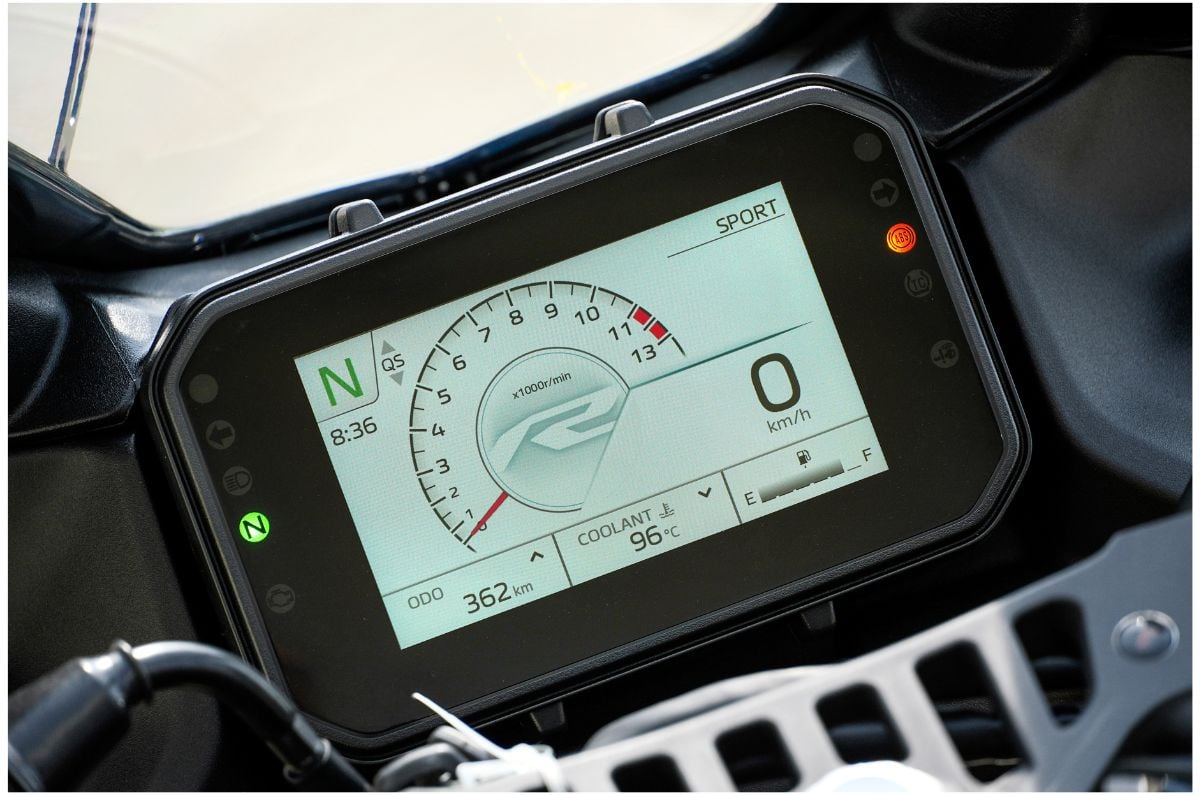
While there’s no VVA, this new 204cc single-cylinder DOHC engine still loves to rev and it still has an exciting “switch on” moment at around 7,000rpm. From what I could tell on the cool down lap, the engine is tractable, but the bottom end does feel quite weak. With the throttle wide open, the engine starts to pull at around 6,000rpm and really picks up once the digital needle on the 5-inch TFT display crosses the 7,000rpm mark. The segment leading 26.5hp peak power figure comes in at 10,000rpm, but the engine spins up all the way to 11,000rpm.
Performance is a big step ahead of the R15 and I’m quite sure this will be quicker than its 200cc rivals while potentially being quicker than a few 250s as well. I saw just over 140kph on the track in 6th gear and top speed should be somewhere between 155-160kph on the display. This performance edge is fair to expect given that the R2 weighs a good deal less than its rivals (more on that later), but what was a surprise was the high rpm refinement.
You start to feel a buzz at around 7,000rpm and this becomes very noticeable in the bars, fuel tank and footpegs at the upper-most reaches of the rev band. We’re keen to observe how this translates to the road riding experience, especially since it was never a concern on the R15.
Yamaha R2 Chassis and Handling – 9/10
(Almost) nothing has changed
Specifications
Values
Chassis type
Backbone frame, High-tensile steel
Front Suspension Type
Telescopic Upside Down Fork (USD Fork), 37.0 mm
Front Suspension Adjustability
Yes
Rear Suspension Type
Linked-Type Monocross Suspension
Rear Suspension Adjustability
Yes
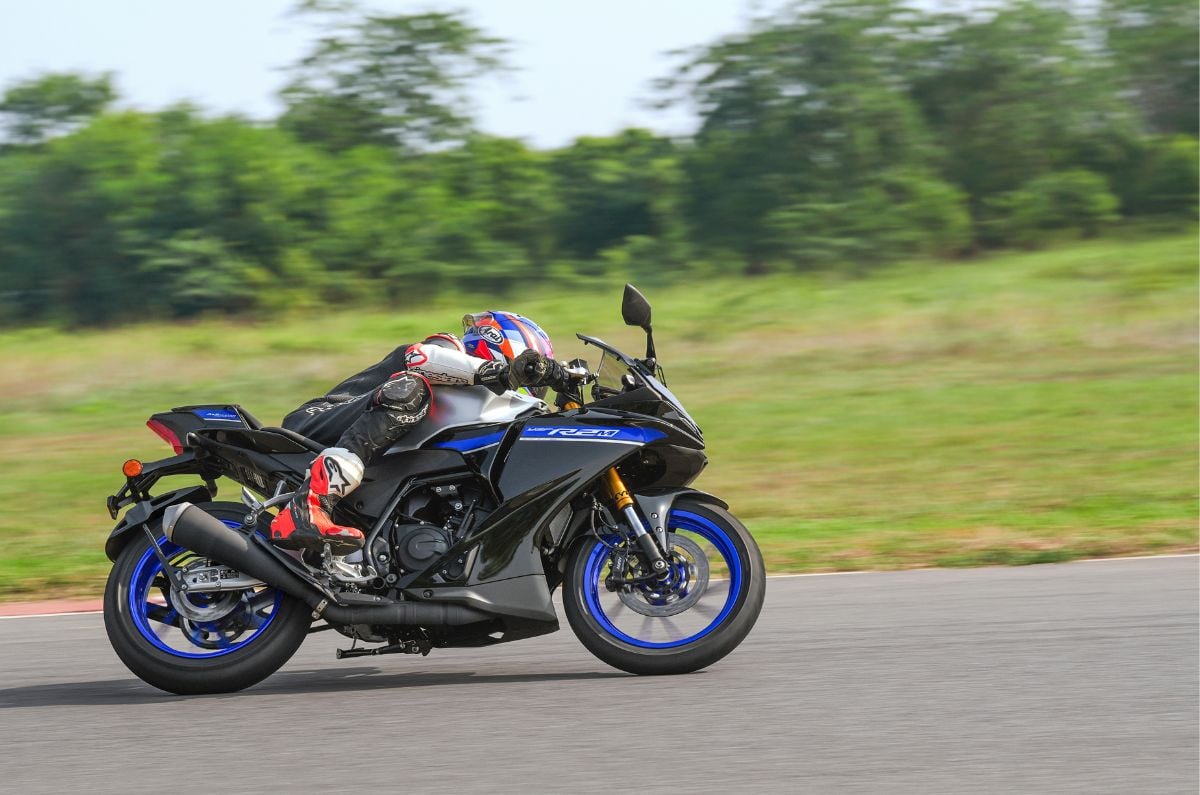
Handling wise, I’m pleased to report that this is a very capable, light, agile and sweetnatured sportbike, much like its younger sibling. While Yamaha does call this new chassis a tubular diamond frame, it’s nothing like what you’ll find on a commuter motorcycle and is a comprehensive thing with almost trellis-like reinforcing members along the side. Perhaps a professional racer might be able to tell any stiffness differences to the Deltabox in the R15, but as far as I’m concerned, this is a fabulous handler and is exactly what I’d expect from a small Yamaha sportbike.
Weighing in at 149kg (150kg for the M we were riding) the R2 still feels like a delightful light and flickable motorcycle, but you will notice the 9kg difference to an R15 when ridden back to back, particularly at a GoKart track. Just like an R15, it never feels nervous or skittish and you can trust the bike to respond as expected.
Yamaha R2 Tyres and brakes – 7/10
Need better feedback
Specifications
Values
Front Tyre Size
100/80-17 M/C 52S
Rear Tyre Size
140/70R17 M/C 66H
Front Disc/Drum Size
282 mm
Rear Disc/Drum Size
220 mm
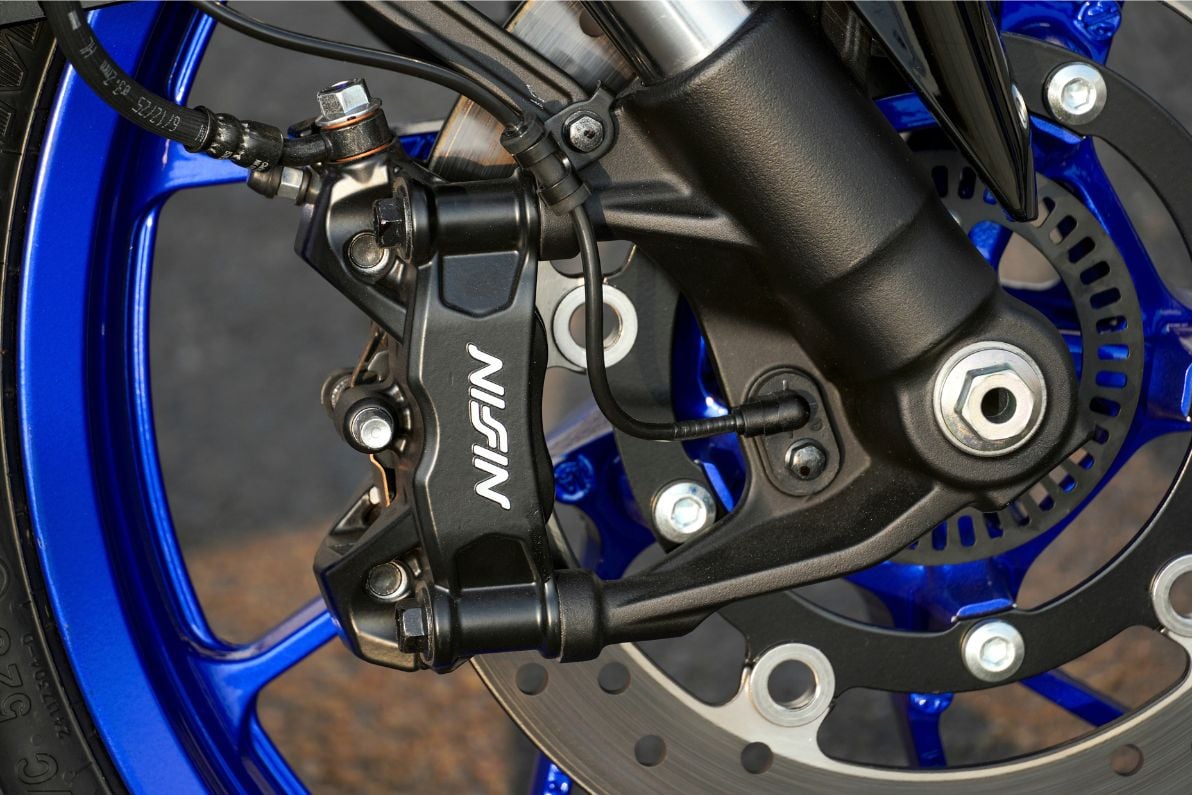
Where the trust factor can improve is in the tyres. The R2 uses the same MRF tyres as the R15 and while they were adequate on track (I lowered the pressures by about 6PSI), they didn’t give me the confidence to search for the limits of adhesion. The front brake also has a similarly spongy feel to the R15, even with that new radial front caliper. While it’s a sensation you need to get used to, the actual stopping performance is fine and I never felt doubt when braking into corners.
The main dynamics-related complaint I had was that there was some ABS intrusion in hard braking zones, and there’s not much you can do about that, short of pulling a fuse to deactivate the system. The intrusion wasn’t excessive, but it could become more problematic if we had more time to ride over the day, which would have meant an increased pace.
Yamaha R2 Design and Quality – 8/10
Covers the basics and then some
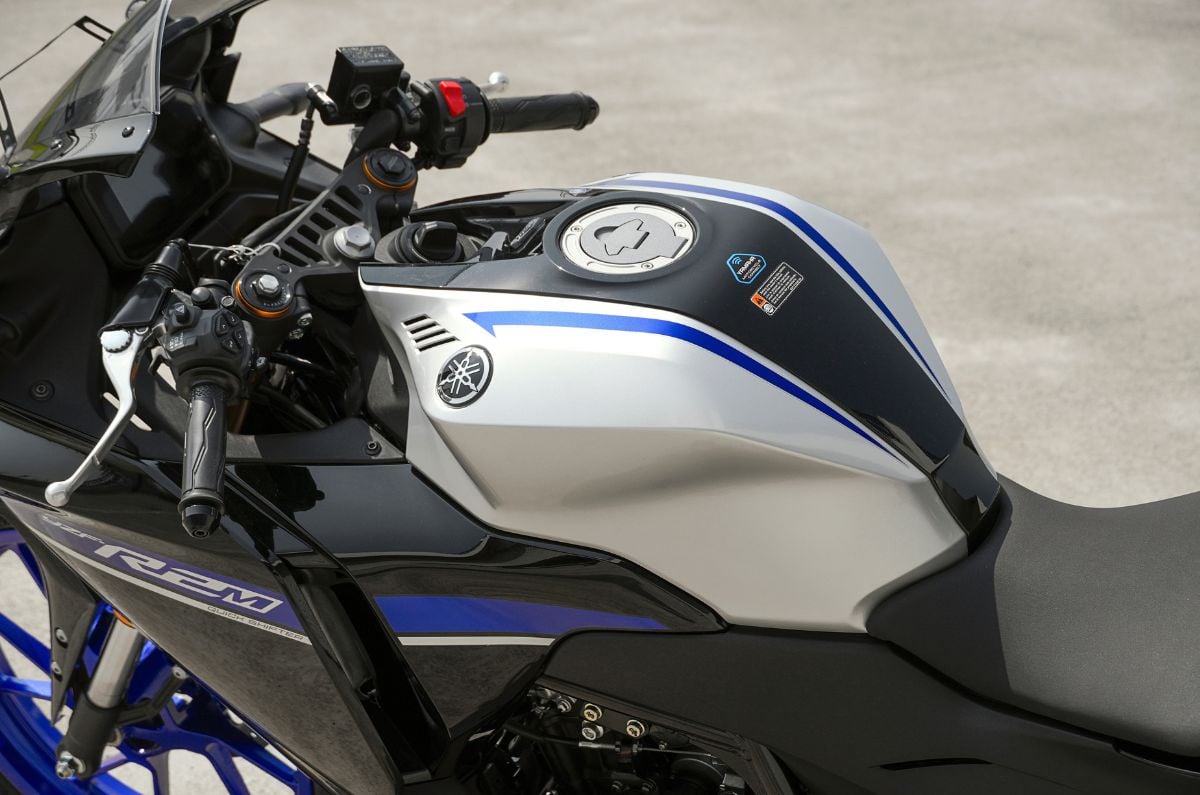
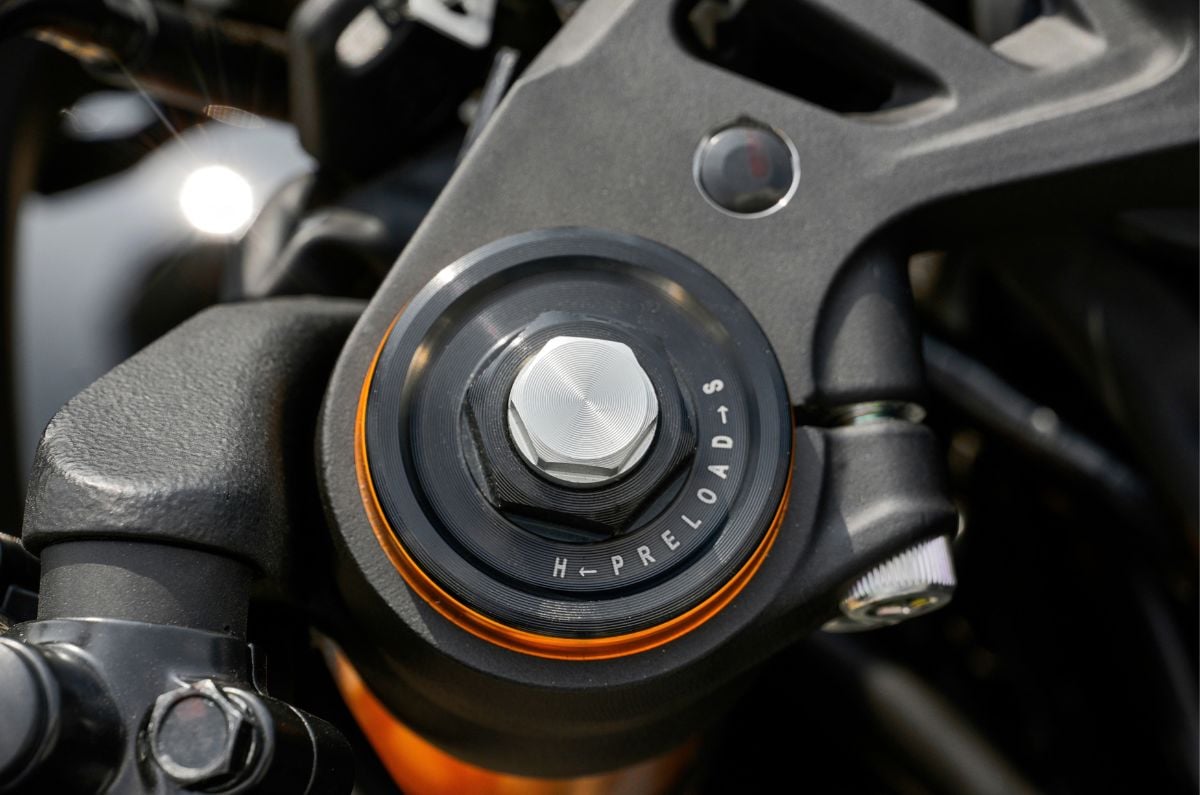
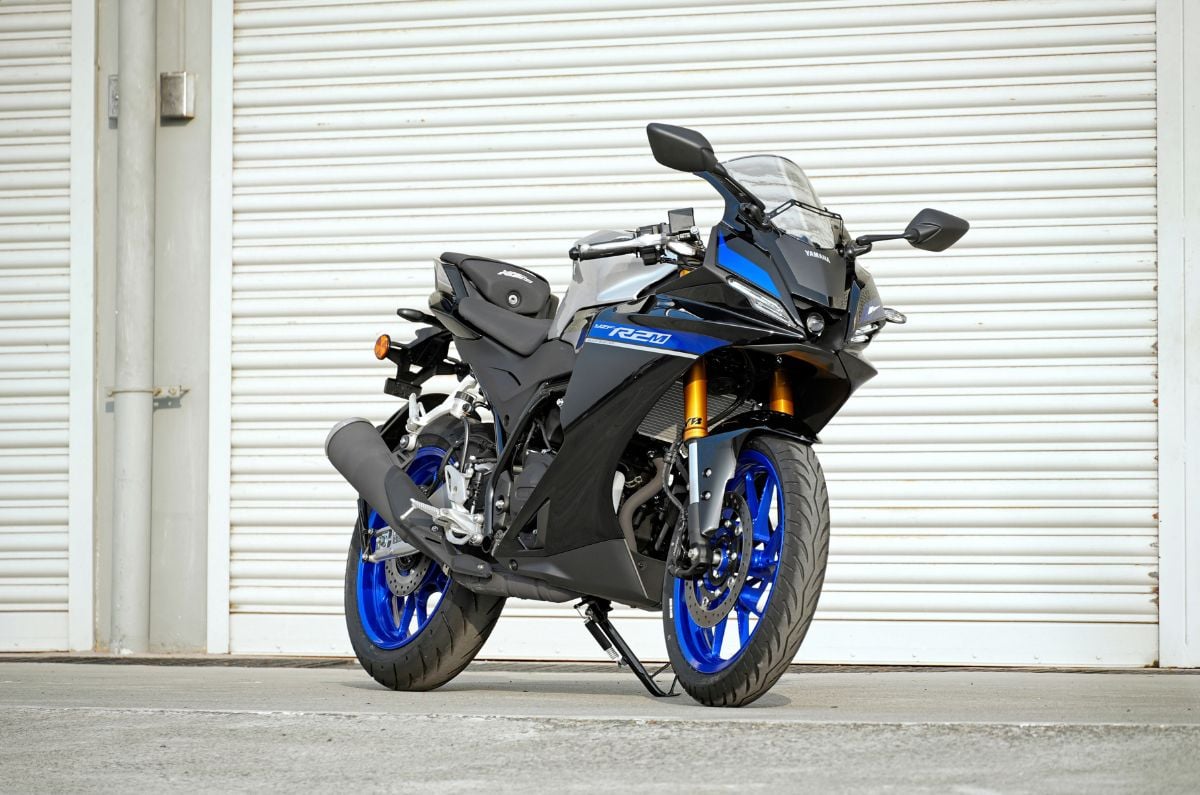
By now you’ve gauged that this is a very similar bike to its younger sibling in the way it feels and that’s a good thing. However, I wish it didn’t look so similar to the R15 and that does seem like a lost opportunity because it takes a trained eye to distinguish this bike as the new one. Quality and finish levels are pleasingly high with the switchgear being pleasant to look at and use. The bike is quite well specced too, with all variants getting a 5-inch TFT display. The mid variant adds a bi-directional quickshifter while the top M version brings in adjustable levers, preload adjustable front suspension, keyless start/steering lock and a unique paint scheme.
Yamaha R2 Price and Verdict – 8/10
A welcome addition
Yamaha R sportbikes have always been expensive and the R2 is no exception. At Rs 2.3-2.53 lakh ex-showroom it commands the kind of money that can get you much more powerful premium motorcycles like the Guerilla 450 Apex and Triumph Tracker 400. It’s very good at what it does, but I think it should have been a little more affordable.
Nevertheless, the R2 is a welcome addition to the Yamaha line-up in India and more bikes will follow on this platform. That being said, we hope to see more action from Yamaha in the locally manufactured premium bike space, because the step up from the R15 is too small and Yamaha is likely to continue to lose many of its existing R15 customers once they are ready to upgrade to a bigger motorcycle.
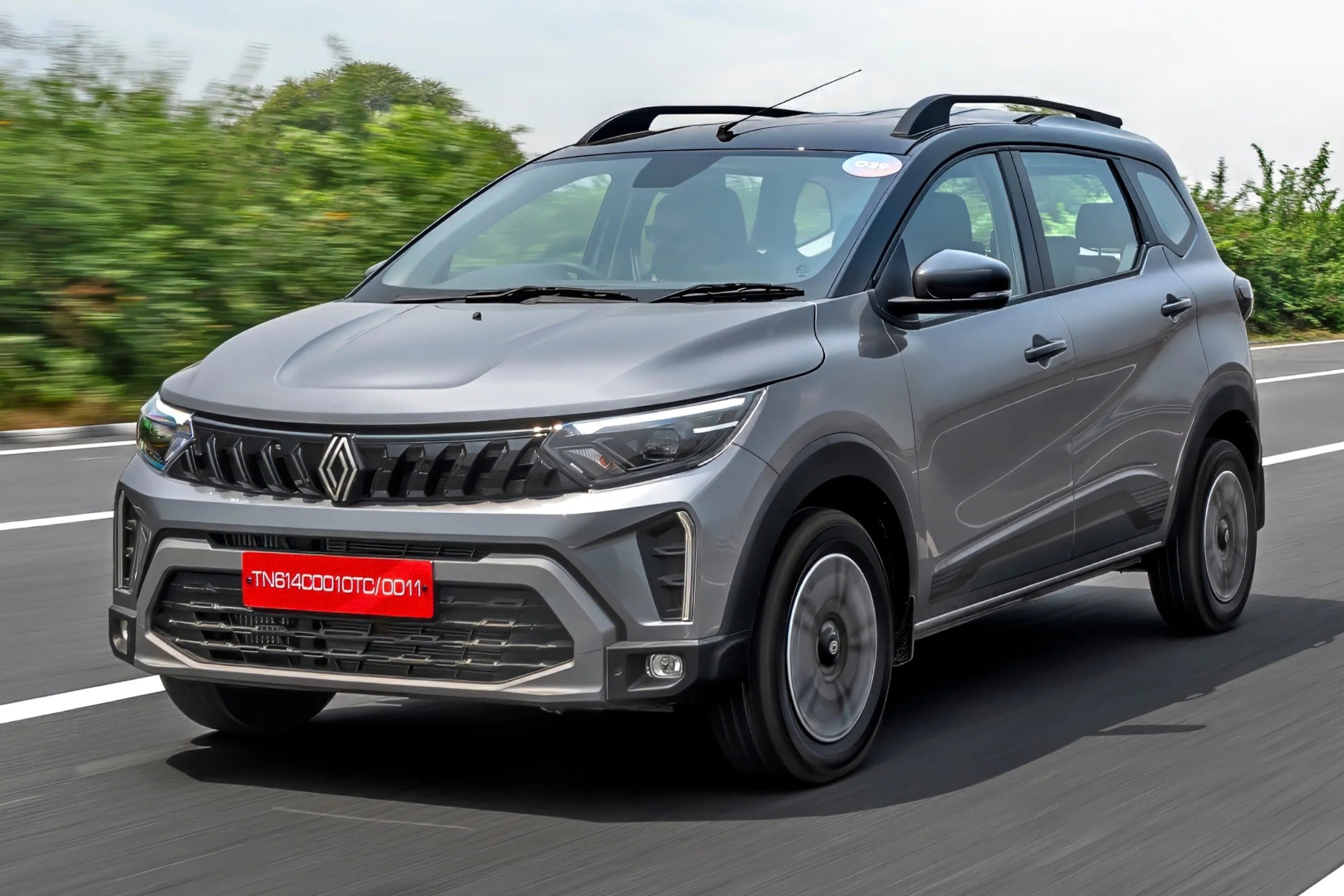
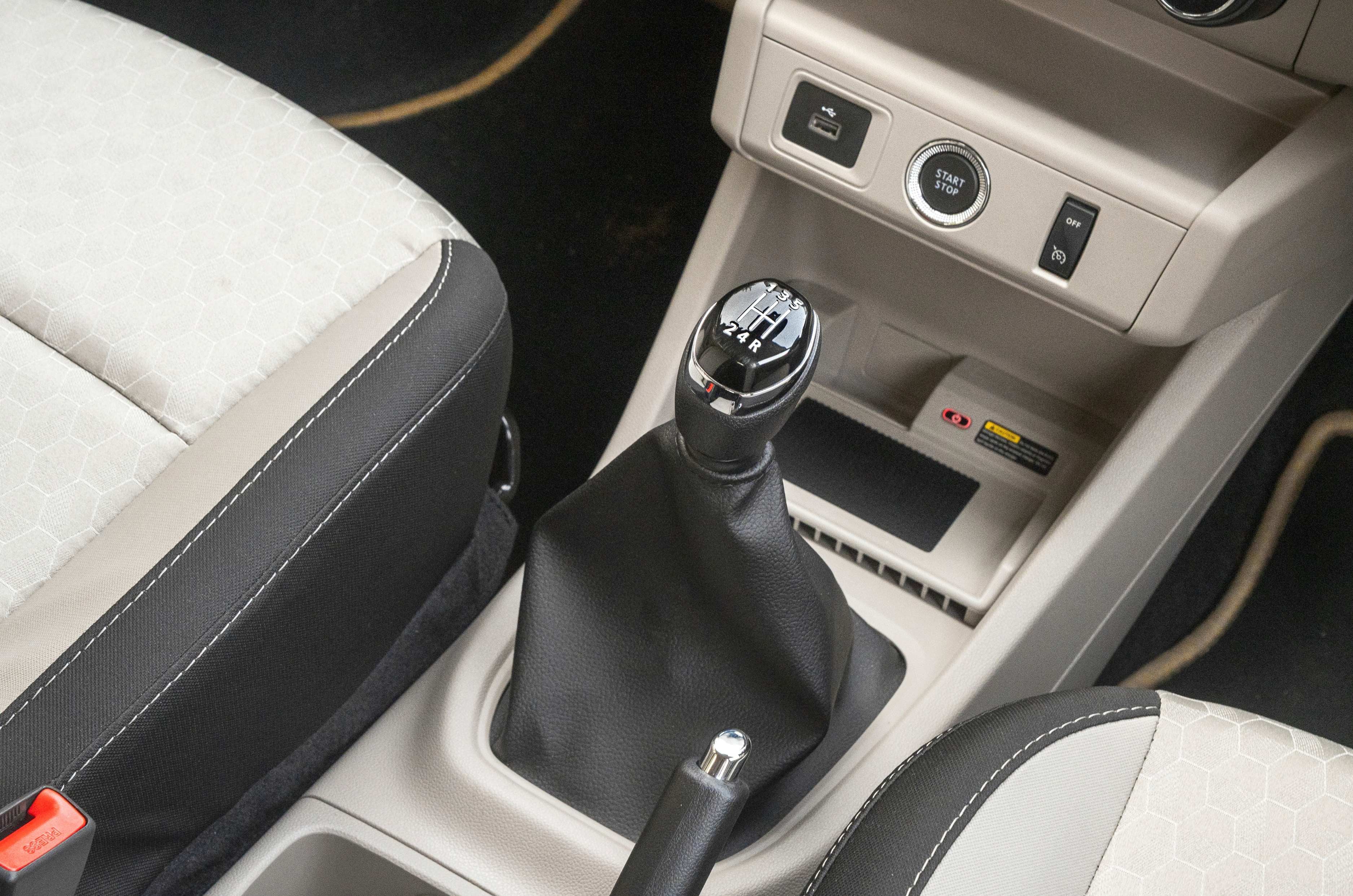
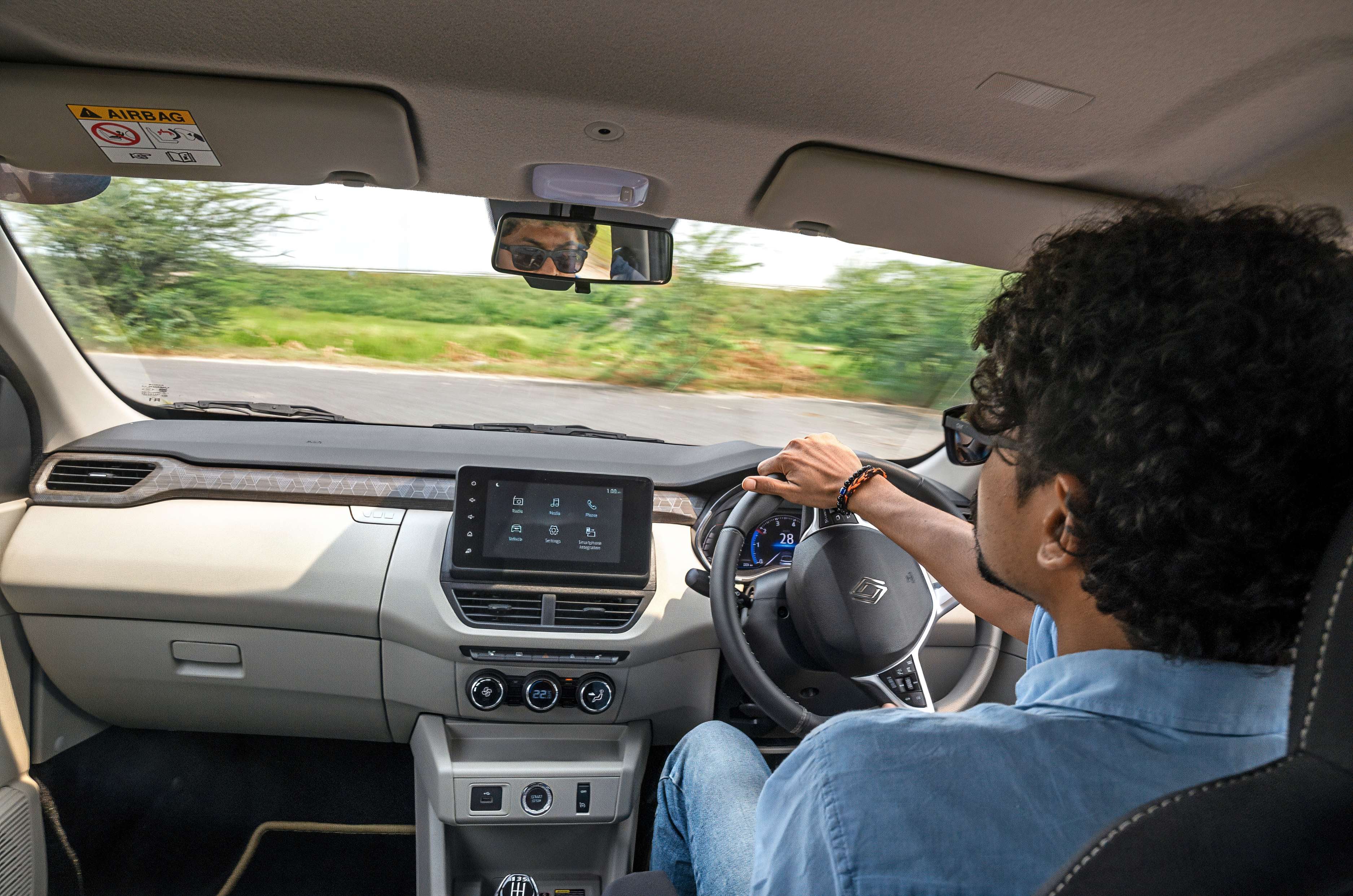
If you’re in the market for an affordable and compact 7-seater, the Renault Triber comes across as a well-packaged choice. For 2026, the Triber has been updated — it sits on a reengineered platform for better structural durability, gets a beefier suspension setup, and most importantly, it gets a much-needed turbo-petrol engine option. If you’re seriously considering the Triber, we bring a comprehensive list of reasons to go for one and reasons to look at another option.
Reasons to buy Renault Triber turbo
Punchy turbo-petrol engine
Turbo-petrol versions of the Triber get the same ‘HR10’ 1.0-litre, 3-cylinder unit as the Kiger and Duster. Power stands at an identical 100hp. But the Triber delivers more torque (180Nm) than both those SUVs thanks to a new engine management system. Pass the 2,500rpm mark and the Triber Turbo surges ahead with a strong midrange punch. In fact, pulling power feels sufficient even when fully loaded. This engine addresses the power gap left by the naturally aspirated petrol engine very well.
Clever packaging
For its size and price, Renault has packaged the Triber’s cabin impressively with a surprising amount of room. Additionally, the light upholstery lends an airy feel to the cabin, and there’s plenty of storage space, including two large glove boxes, a smartphone shelf, two cup holders, a useful cooled storage bin and sizeable door pockets.
The second-row seats can slide, recline, tumble forward, and split-fold, making them quite versatile, and space is sufficient while the seats themselves are comfortable. Even third-row seat comfort is adequate, especially over short distances. Additionally, the third-row seats can be removed completely to provide extra boot space. Moreover, there are dedicated air vents and three-point seat belts for each row.
Composed ride quality
With the update, Renault has introduced new valve tech in the Triber’s shock absorbers and added anti-roll bars at the front and rear. These improvements have led to more stable ride quality, with better-controlled body roll around corners. Overall ride composure is impressive considering its 1-tonne kerb weight.
Reasons not to buy the Kiger turbo
Notchy manual gearbox
Though the turbo petrol mill brings much-needed power, accessing it, however, will be a task. Like its naturally aspirated counterpart, the 5-speed manual gearbox isn’t slick and requires more effort than usual to slot it into a desired gear. Meanwhile, the light nature of the clutch pedal does aid with city driving.
Light steering
With the Triber turbo, Renault has lightened the steering to compensate for the added weight. However, it has been done excessively, making it devoid of feel, and it increasingly feels disconnected as speeds rise. Though a light steering is useful for parking and navigating tight spaces, the one in the Triber lacks feedback.
High NVH levels
Overall refinement levels in the Renault Triber aren’t something to write home about. Its 3-cylinder turbo mill has the typical thrum when idling and gets noisy when you rev it hard. Road and tyre noises are also loud, especially at higher speeds.
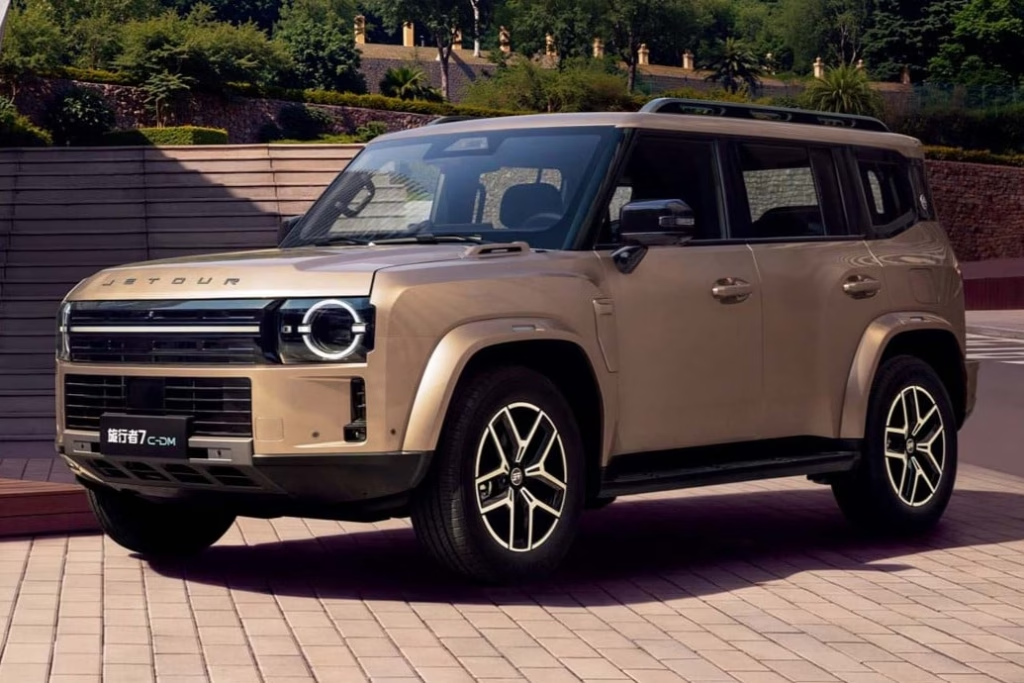
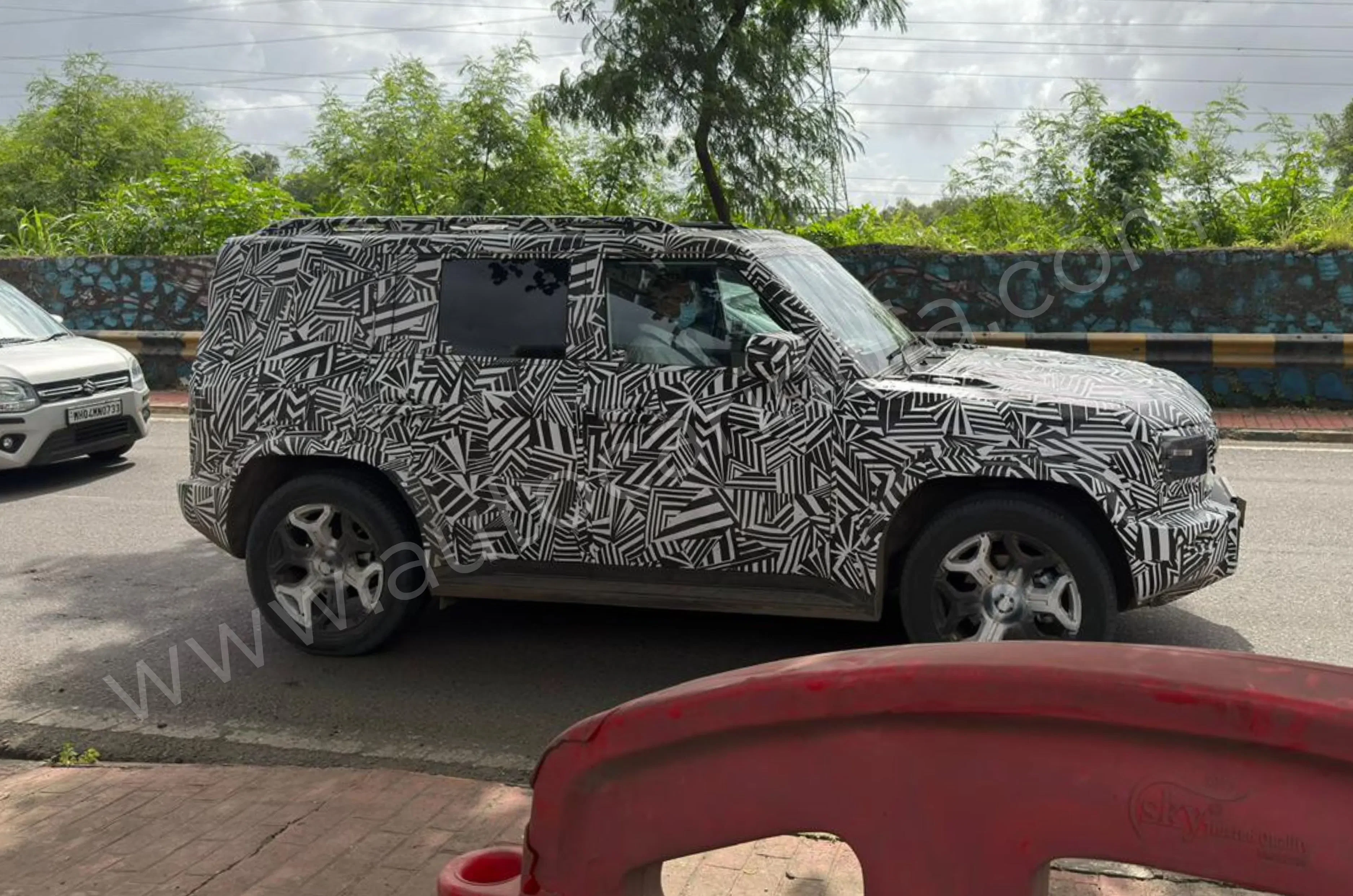
A facelifted version of the Jetour T2 has been launched in global markets. The Jetour T2 facelift was first unveiled in August at the Chengdu Motor Show in China, and gets some design revisions, more features, and powertrain tweaks. Interestingly, this updated iteration went on sale not long before the launch of the pre-facelift Jetour T2 under the JSW Combat name in India.
Jetour T2 facelift exterior design
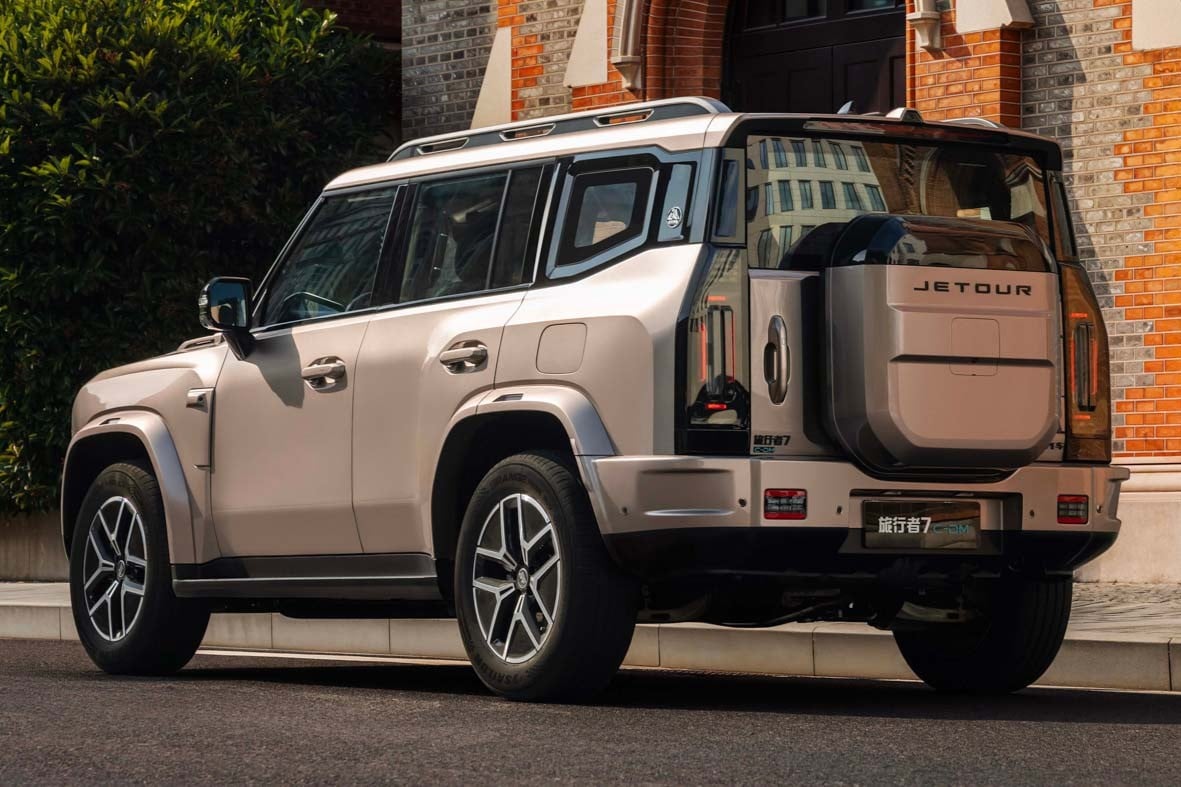
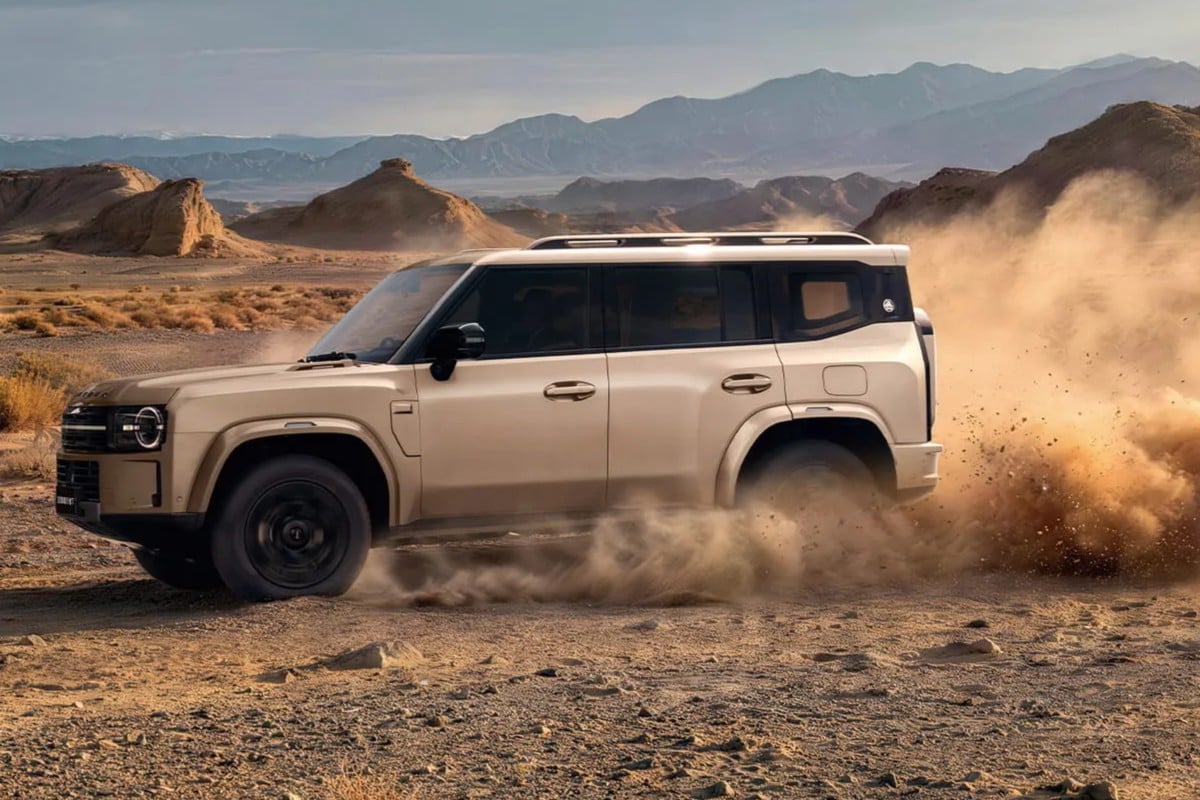
The updated Jetour T2 retains the prior version’s boxy proportions, but with a few notable styling updates. Most of these are up front, such as circular DRLs in the headlamps, a new grille housing an LED strip, and a much cleaner front bumper. The Jetour wordmark has also been relocated from the grille to the leading edge of the bonnet.
Over to the side, the Jetour T2 facelift gets new alloy wheel designs, as well as body-coloured wheel arches. The rear end sees some revisions too, particularly a cleaner bumper design, an updated spare wheel cover with a Jetour wordmark, and a discreet roof spoiler.
Jetour T2 facelift interior and features
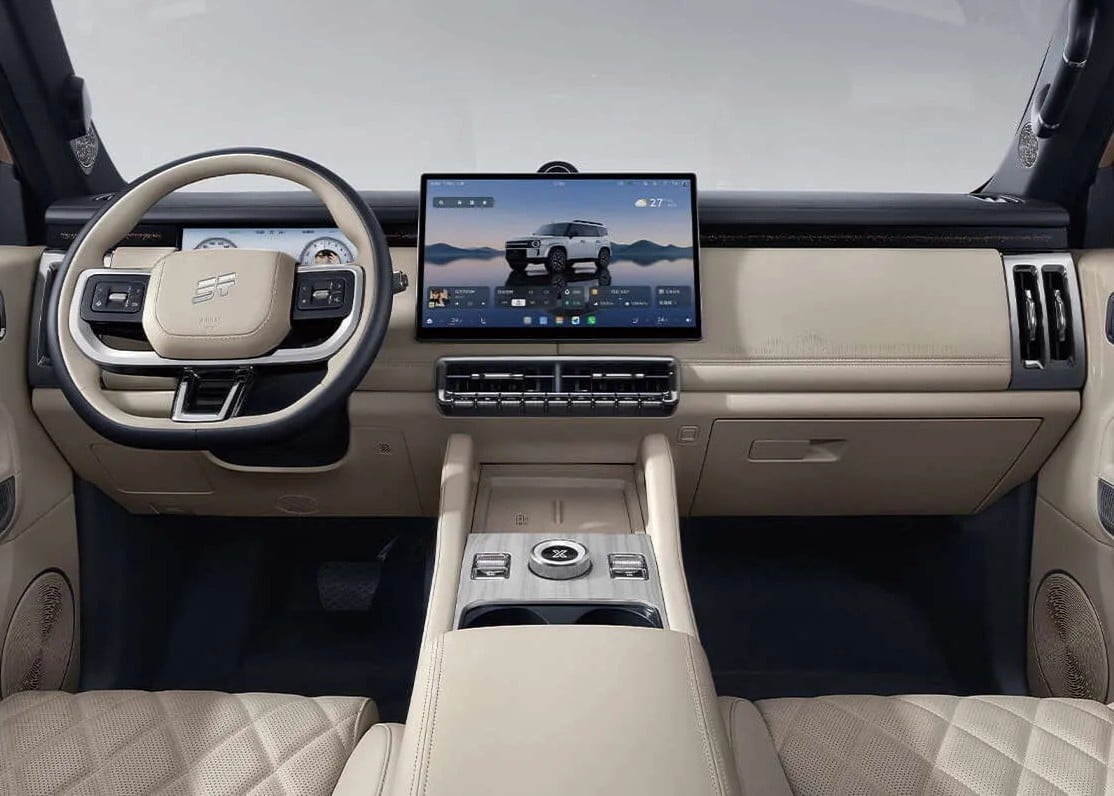
Inside, the Jetour T2 facelift takes on a more premium slant than its predecessor. The beige colour scheme lends the cabin an airier vibe, the seats are upholstered in quilted leatherette, and the dashboard looks to be fitted with leatherette trim – the open storage space in front of the co-driver looks to be closed-off in the facelifted model. There’s also a new three-spoke flat-bottomed steering wheel, and the AC vents have fresh designs too.
The 10.25-inch digital driver’s display and 15.6-inch infotainment touchscreen remain unchanged in size, but the latter is now powered by a stronger Qualcomm Snapdragon 8255 chip that allows for the integration of a new voice-controlled AI assistant. Other notable features include 10-way powered front seats with a massage function, dual wireless charging pads, a 23-speaker sound system, an ADAS suite, and 256-colour ambient lighting.
Jetour T2 facelift powertrains
The Jetour T2’s powertrain offerings vary widely by market, but looking at the China-spec model, the facelifted version continues to offer a 184hp 1.5-litre four-cylinder turbo-petrol engine in the base variant. This mill is paired with a 7-speed dual-clutch automatic that sends power to the front wheels. All other petrol variants of the facelifted Jetour T2, meanwhile, get a 254hp 2.0-litre turbo-petrol engine with the same 7-speed DCT and AWD. A big change here is that the top-spec petrol variant comes with an 8-speed automatic gearbox instead.
As for the plug-in hybrid (PHEV) variants of the Jetour T2 facelift, the 156hp 1.5-litre turbo-petrol engine has been retained, but the dual electric motors have been replaced by a single unit that develops 307hp and 330Nm. The 3-speed dedicated hybrid transmission (DHT) is now a 1-speed unit as well. These updates have been made in the interest of efficiency, as even with a slightly smaller 26.61kWh battery pack, the facelifted Jetour T2 PHEV manages a WLTP-certified 108km pure-electric range – up by 8km. There’s a larger 45.12kWh battery pack on offer too, which bumps the rated pure-electric range to 173km – an increase of 11km over the prior 43.24kWh unit.
Is the Jetour T2 facelift coming to India
As noted previously, the pre-facelift Jetour T2 PHEV is set to launch in India in the coming months as JSW Motors’s debut model, the Combat. Since JSW Motors has been extensively testing the pre-facelift Jetour T2, it’s quite unlikely that the facelifted version will make it here in the short term. As it stands, JSW Motors has yet to even communicate the launch date of the Combat, and recent media reports allege that the carmaker has pushed its debut from the festive season to mid-December.
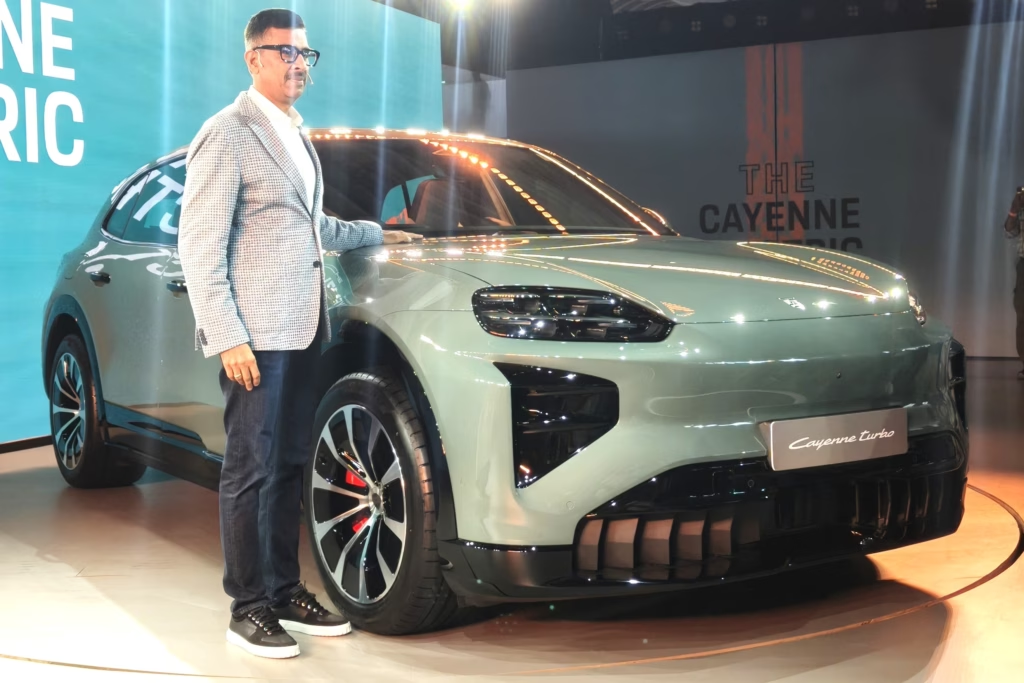
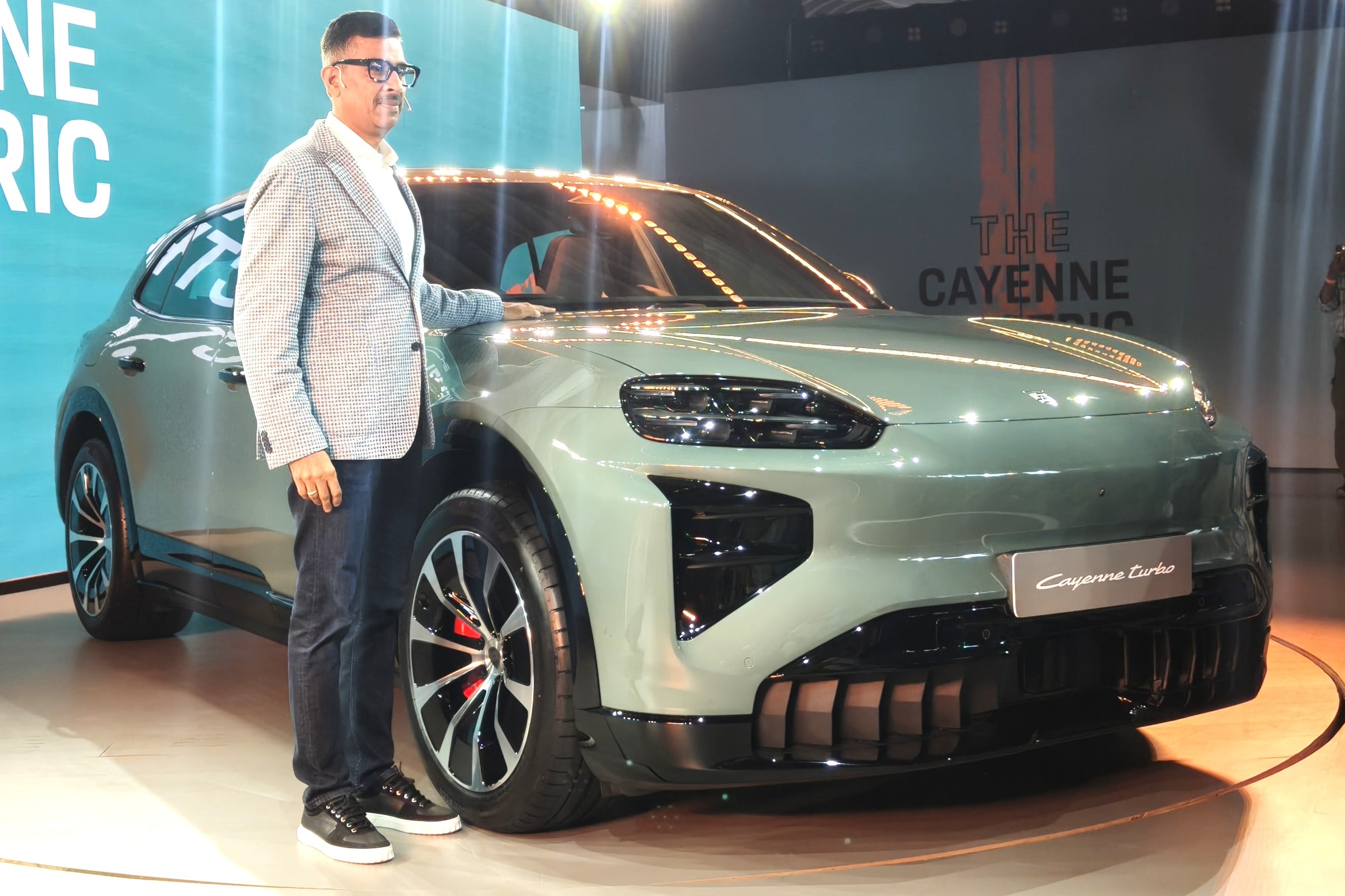
Following the India price reveal of the Cayenne Electric in late 2025, Porsche has formally showcased the electric SUV here for the first time. It’s positioned as Porsche’s flagship electric SUV globally and is available in India in two variants: Cayenne Electric and Cayenne Turbo Electric. These are priced at Rs 1.77 crore and Rs 2.28 crore (before options), respectively.
Porsche Cayenne Electric powertrain and performance
Underpinned by the Volkswagen Group’s 800V Premium Platform Electric (PPE) architecture, the Cayenne Electric comes with a 113kWh battery pack and dual motors (AWD) as standard. The base state of tune is 408hp and 750Nm (442hp and 835Nm with Launch Control engaged), while the range-topping Turbo belts out 857hp and 1,360Nm (1,156hp and 1,500Nm with Launch Control engaged).
With Launch Control, the base Cayenne Electric claims a 0-100kph time of 4.8 seconds, while the Turbo achieves the same in a supercar-baiting 2.5 seconds. The former is good for a top speed of 230kph, with the Turbo upping it to 260kph.
As for WLTP range, the base version is rated at 642km and the Turbo at 623km. Thanks to its 800V architecture, the Cayenne Electric can charge at DC wattages of up to 390kW, which can juice the battery from 10-80 percent in just 16 minutes – a 10-minute charge can net you up to 324km of range. AC charging at up to 22kW is also supported, with a 0-100 percent charge said to take 5.75 hours.
Porsche Cayenne Electric exterior design
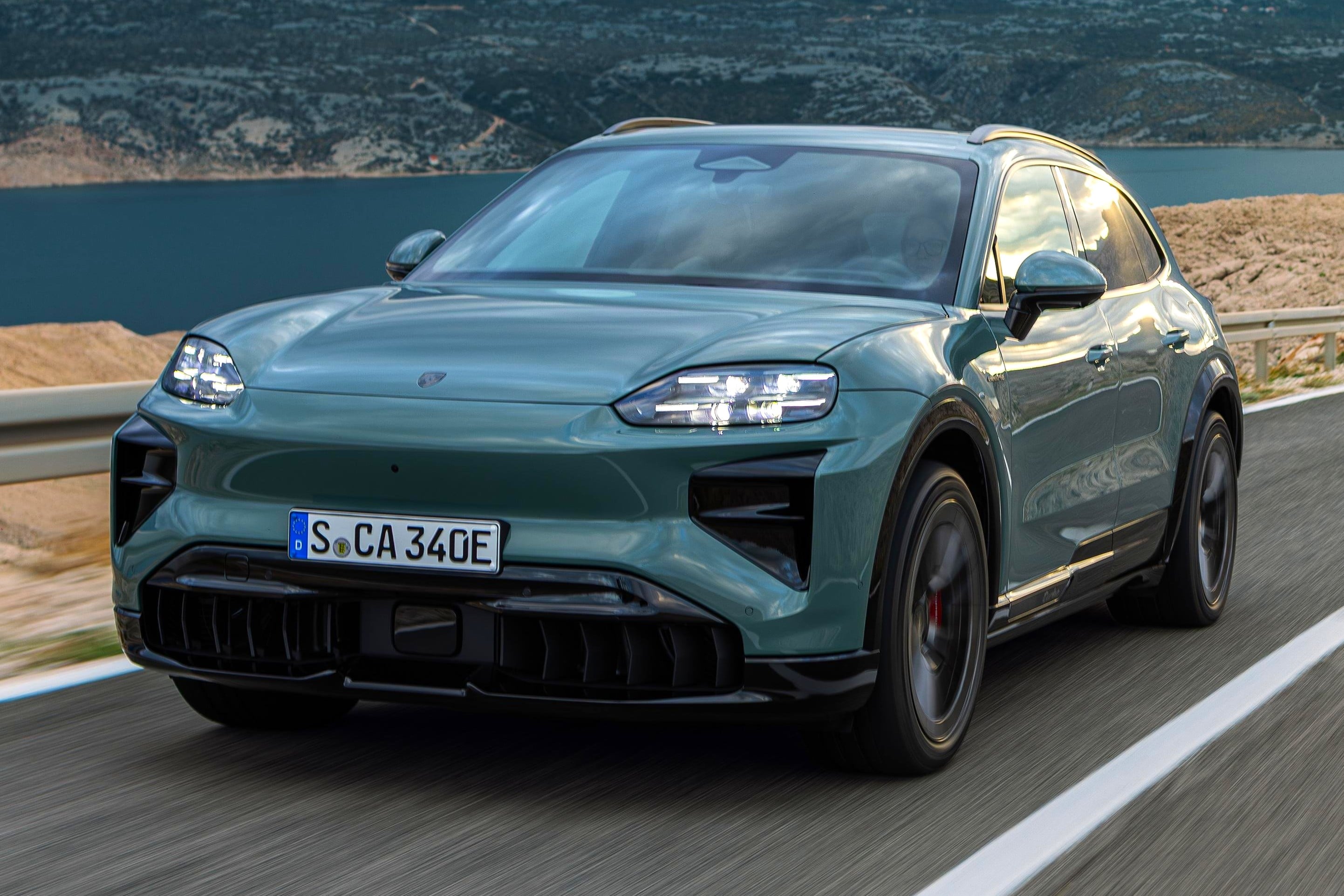
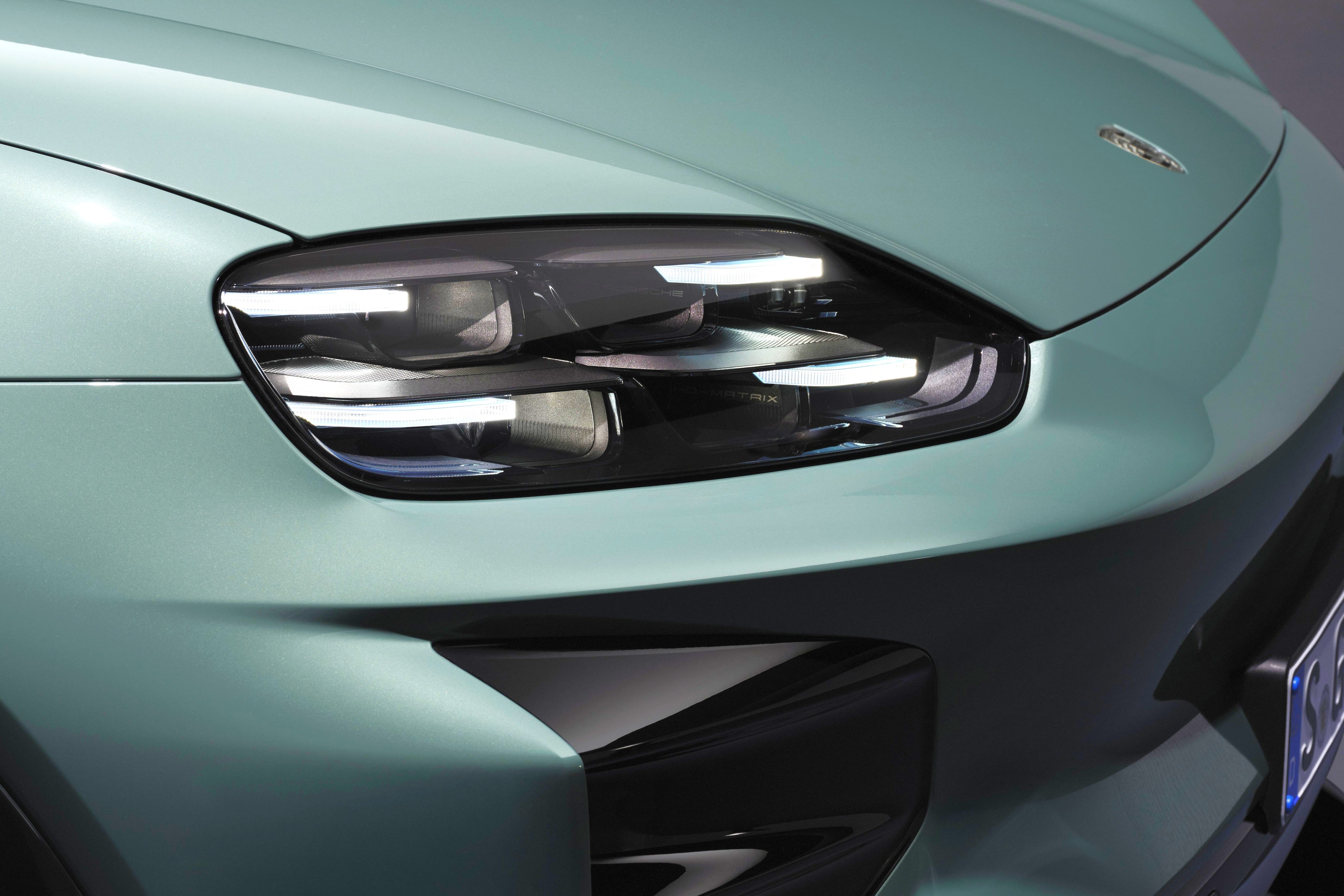
The Cayenne Electric features an evolution of the design language seen on the smaller Macan Electric. Up front, the SUV sports oblong-shaped Matrix LED headlamps housing four individual daytime running lights (DRLs) each. The clean-looking front bumper has a wide air dam flanked by vertically oriented air intakes, along with some relatively discreet black cladding. Under the bonnet, there’s a 90-litre frunk.
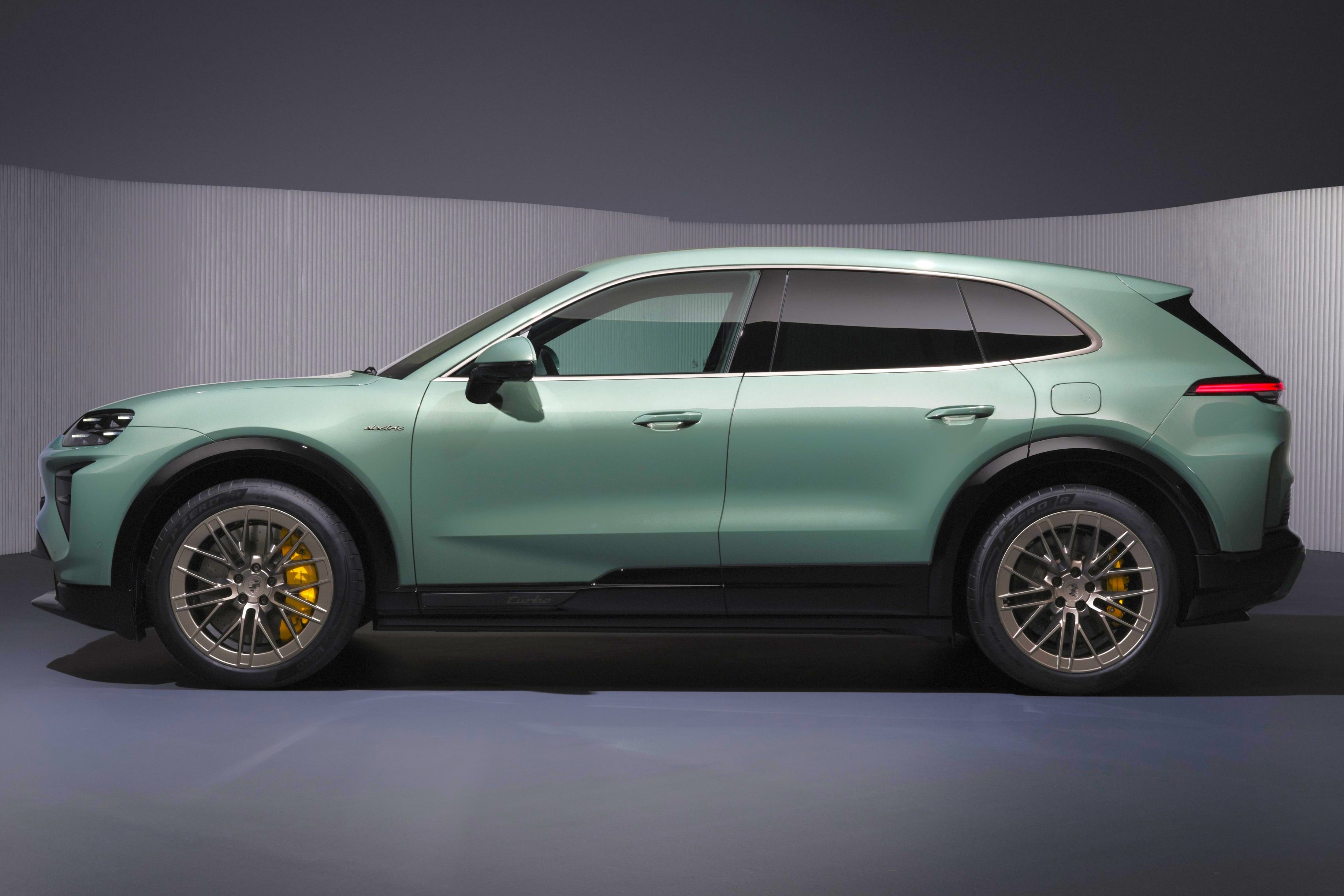
Over to the side, the Cayenne Electric is 55mm longer than its ICE-powered counterpart, measuring 4,985mm in length, 1,980mm in width and 1,674mm in height, with a wheelbase of 3,023mm. 20-inch alloy wheels are standard fit for the Cayenne Electric, which can be optioned up to 22 inches. The SUV comes with soft-close doors as standard too.
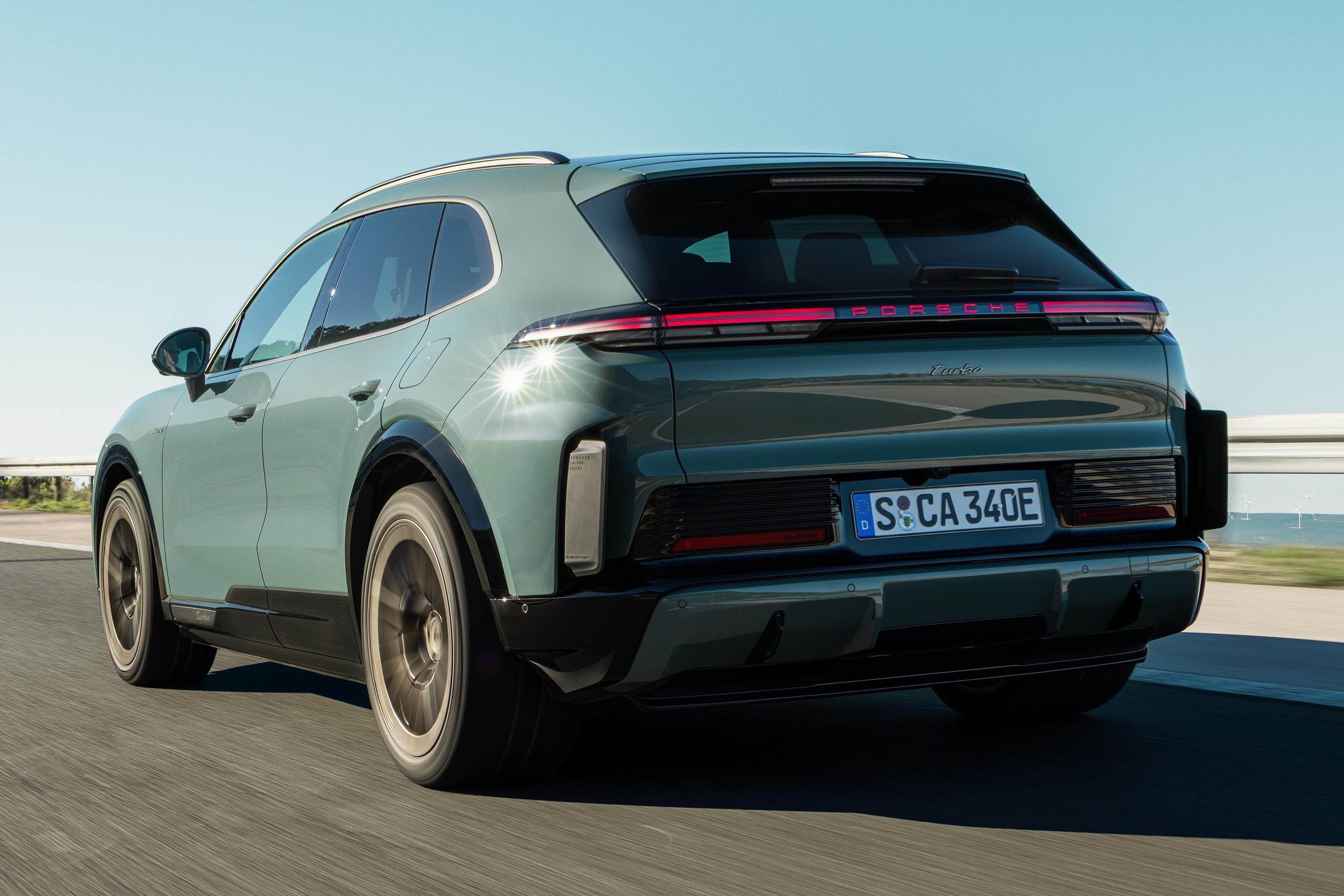
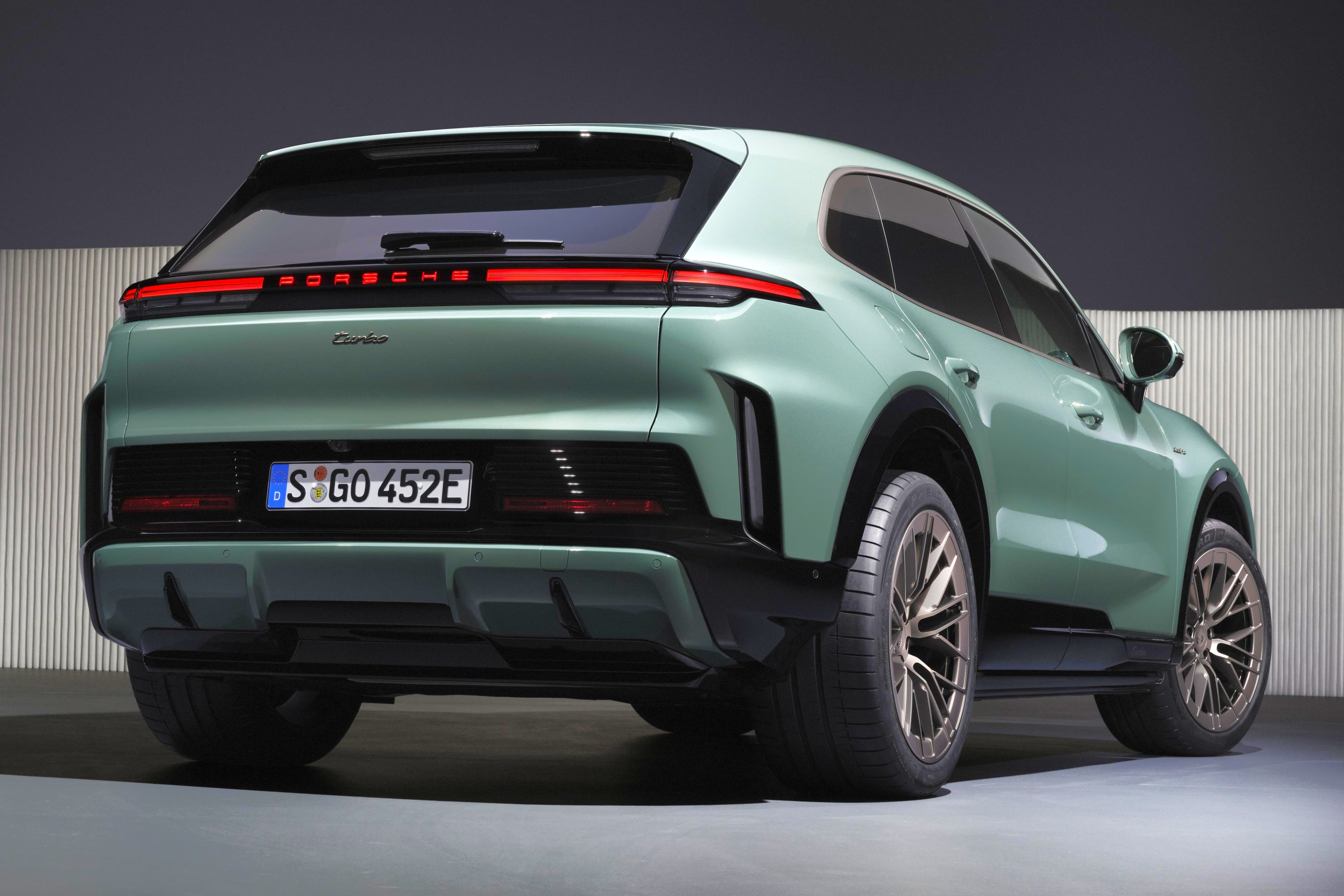
The rear end of the Cayenne Electric features a sporty raked roofline, though not as much as that of its coupe-SUV sibling, the Cayenne Coupe Electric. A wraparound clear-lens LED light bar with an illuminated Porsche wordmark takes prominence here, and there’s a sizeable roof spoiler as well. The rear bumper is quite chunky, and above it lies a blacked-out section with horizontal slats and reflectors.
Porsche Cayenne Electric interior and features
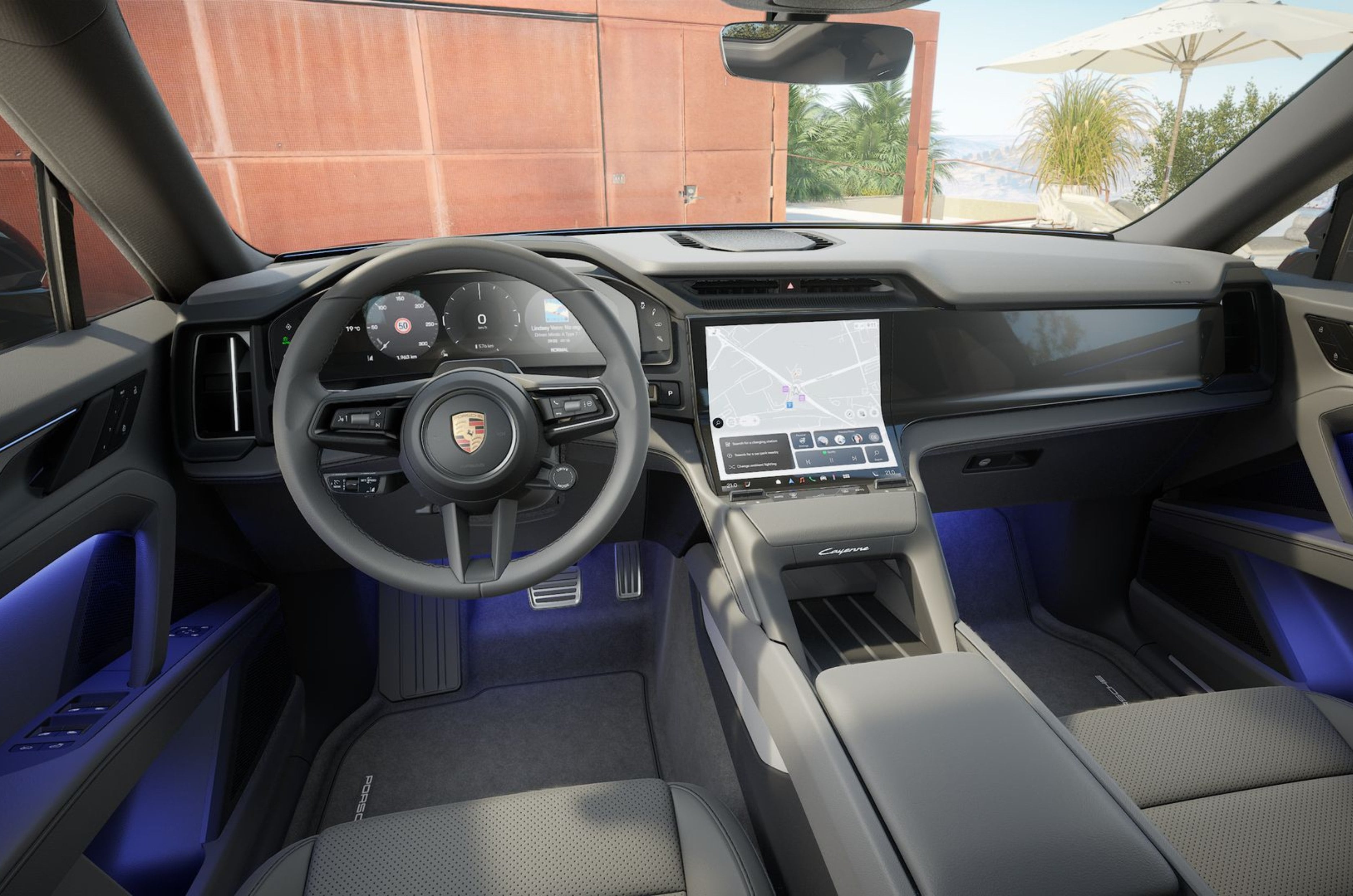
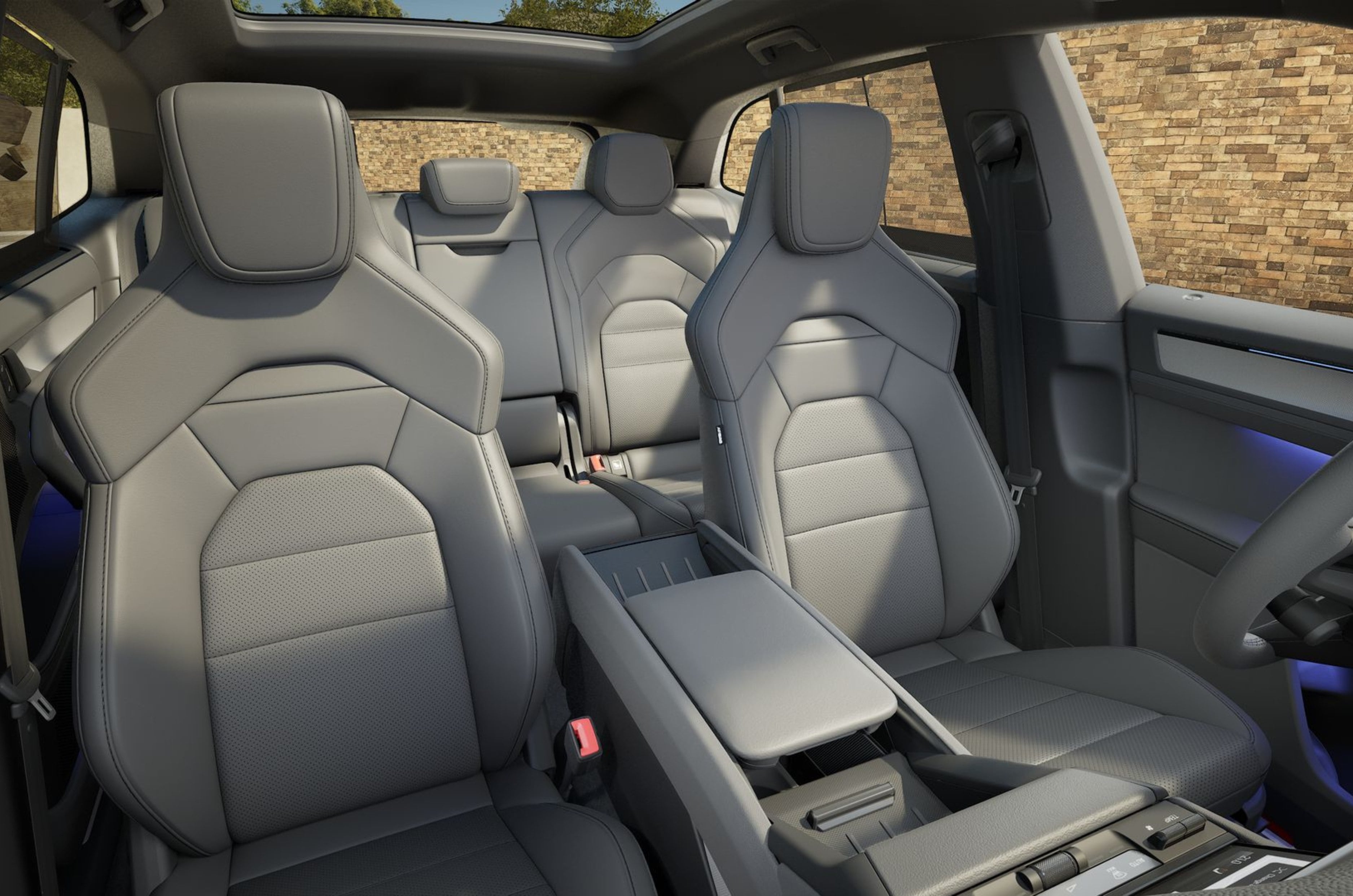
As standard, the interior of the Cayenne Electric is finished in black, and so are many of the controls. The dashboard gets a unique-looking 14.5-inch curved OLED touchscreen in the centre, and there’s a 14.25-inch OLED driver’s display and a three-spoke steering wheel to the side – a 14.9-inch passenger screen is available as an optional extra. The centre console has a pass-through design, allowing for some storage space and a wireless charging pad underneath, and there’s a fairly high central tunnel separating the front seats. Ambient lighting bathes the footwells and door liners in one of 30 configurable colours.
Being a Porsche, the Cayenne Electric offers lots of customisation potential and optional features. Speaking of which, standard equipment for the Cayenne Electric includes a 10-speaker sound system, 8-way powered and heated front seats, a memory function for the driver’s seat, a panoramic sunroof, four-zone climate control, a cabin air purifier, a powered boot lid, powered rear sunshades, a 360-degree camera, advanced driver assistance systems (ADAS), and more. Boot space is rated at a whopping 781 litres.
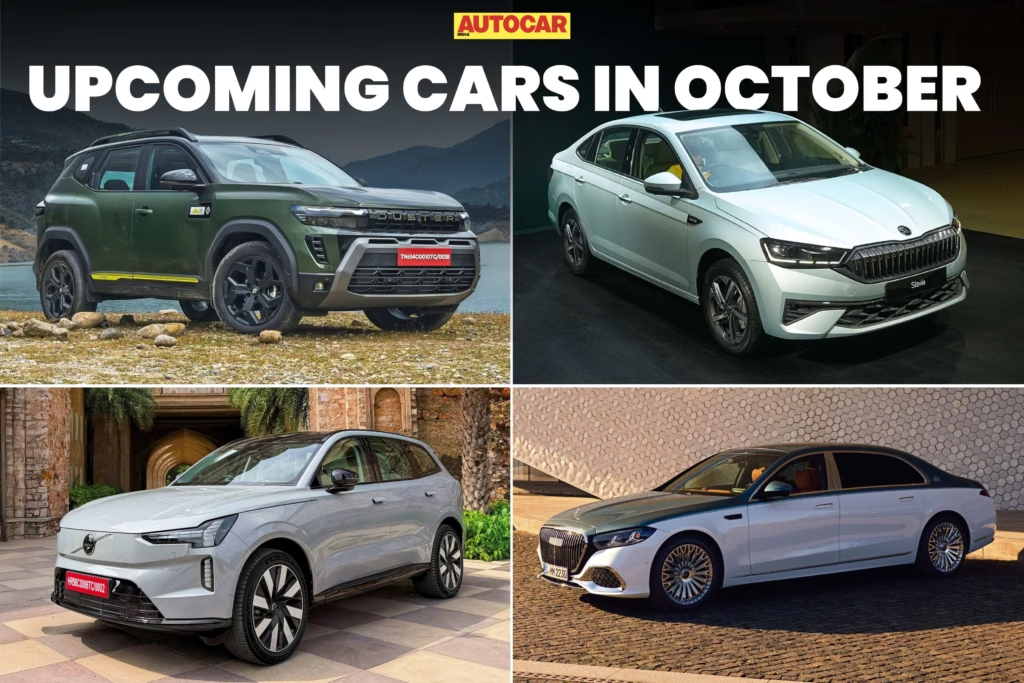
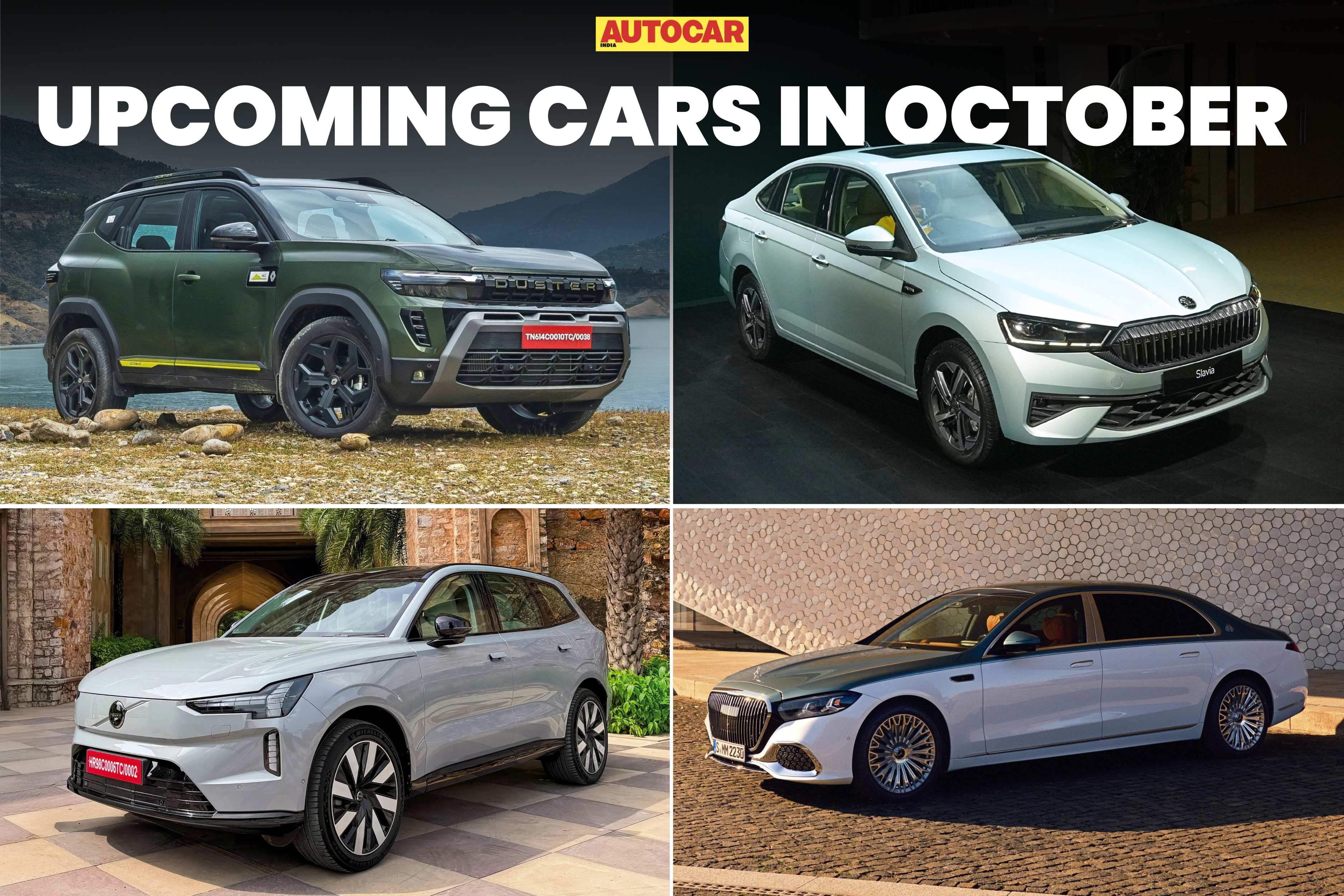
October marks the onset of the festive season in India, which means manufacturers line up a barrage of new car launches and debuts for prospective buyers to consider. It’s no different this year, with October 2026 looking quite stacked with fresh launches and debuts, especially during the first half of the month. Let’s delve into every new car that will either go on sale or debut in India next month.
Mercedes-Benz Maybach S-Class facelift
Launch: 5 October
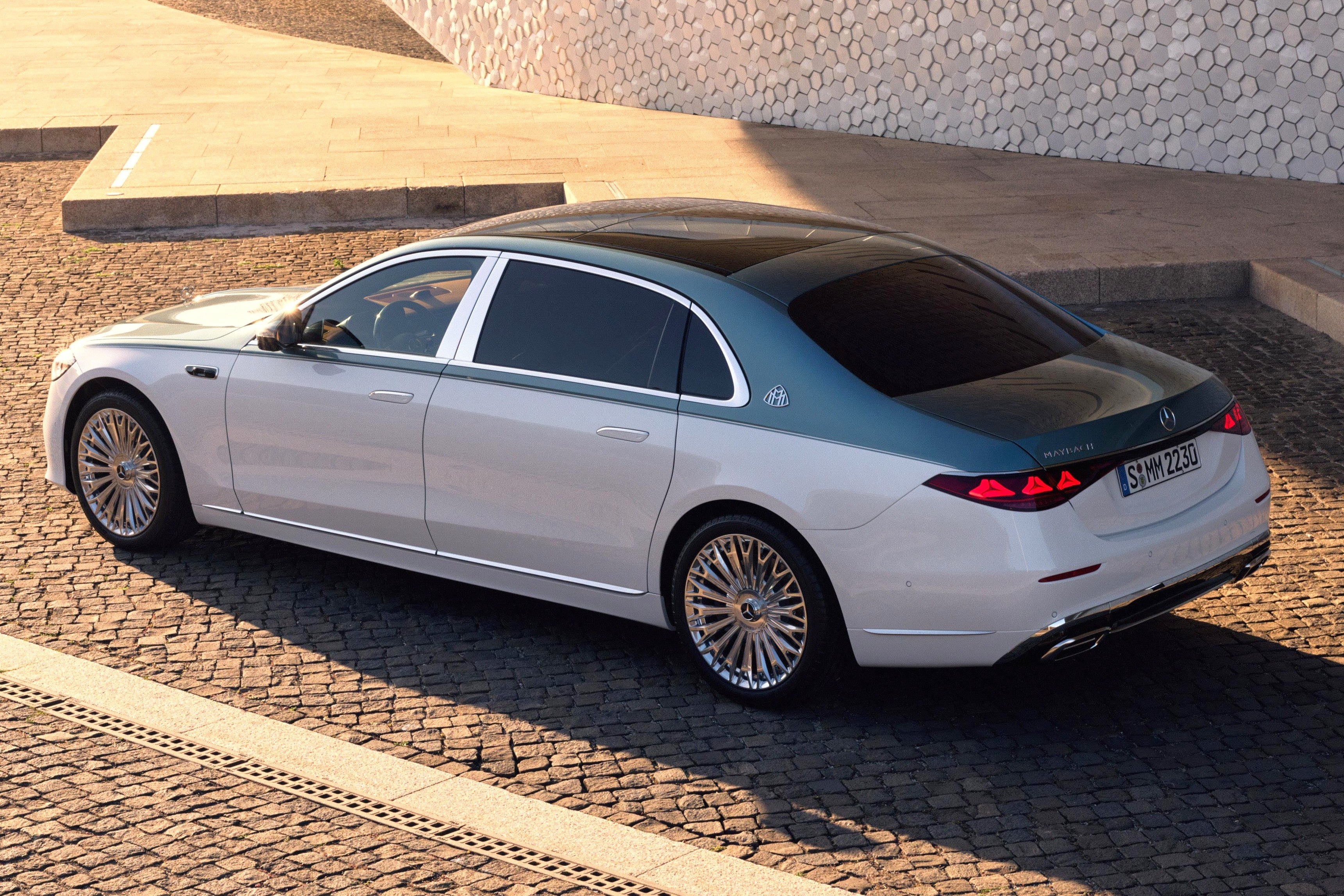
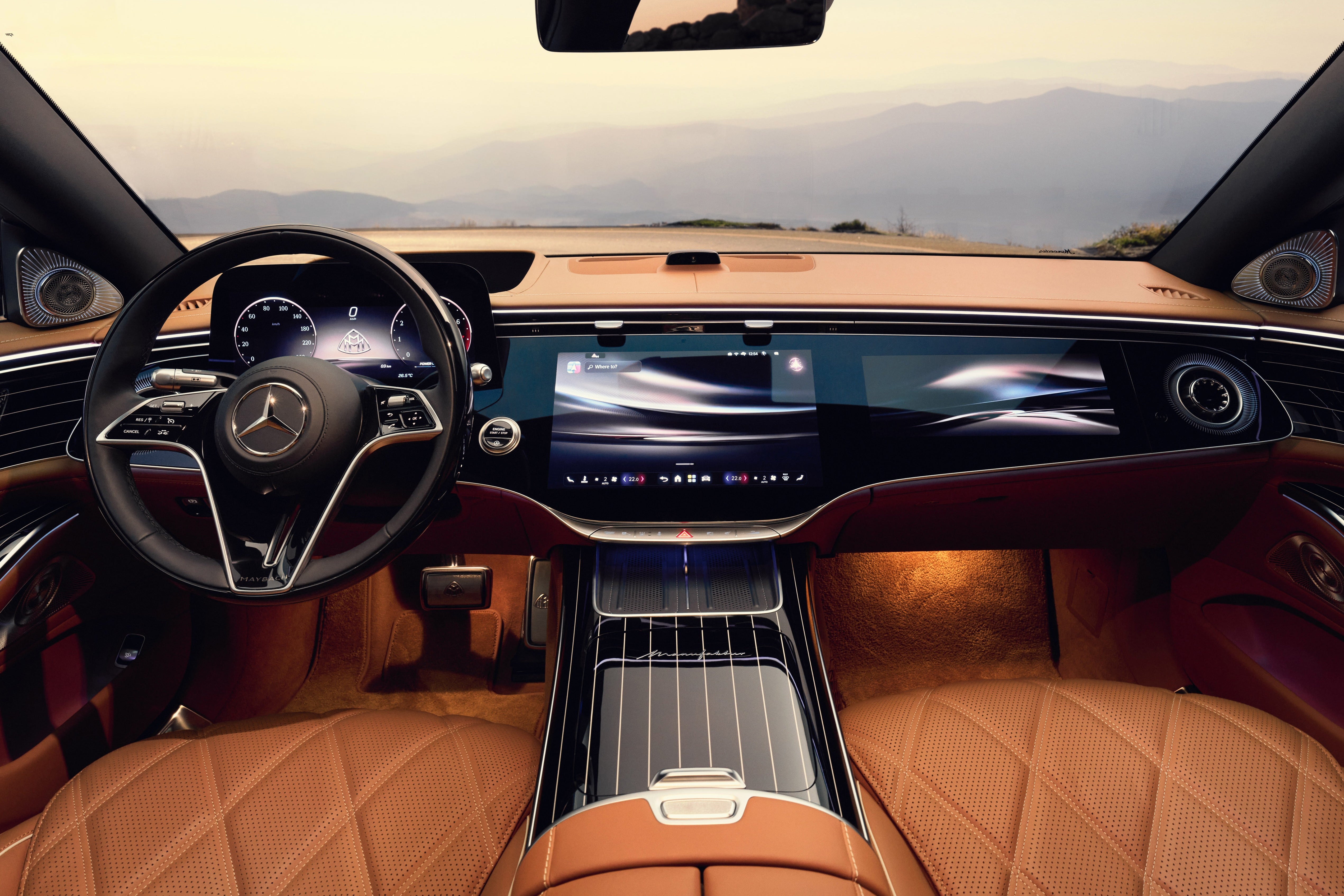
Following the launch of the 2026 S-Class facelift back in June, Mercedes-Benz India will bring the sedan’s longer and more luxurious Maybach derivative in October. Compared to its standard version, the Maybach S-Class facelift continues to be 180mm longer, but carries styling differentiators like a vertically-slatted grille adorned with a ‘Maybach’ wordmark, mildly revised bumpers, bespoke wheel designs, lots of Maybach logos peppered across the bodywork, and the signature dual-tone exterior finish.
Inside, the Maybach prominently retains the standard S-Class’s Superscreen setup, comprising a 12.3-inch digital driver’s display, a 14.4-inch central touchscreen, and a 12.3-inch passenger display. New upholstery choices include extended leather and a leather-free vegan option. The rear seats remain largely unchanged, offering up to 43 degrees of recline, along with heating, ventilation, and massage functions. Globally, the Maybach S-Class can be had with either a 4.0-litre twin-turbo mild-hybrid V8 (S 580), a 4.0-litre twin-turbo V8 plug-in hybrid (S 580e), or a 612hp 6.0-litre twin-turbo V12 (S 680). Mercedes-Benz India is likely to offer the updated Maybach S-Class in S 580 or S 580e spec.
Honda Elevate facelift
Launch: 6 October
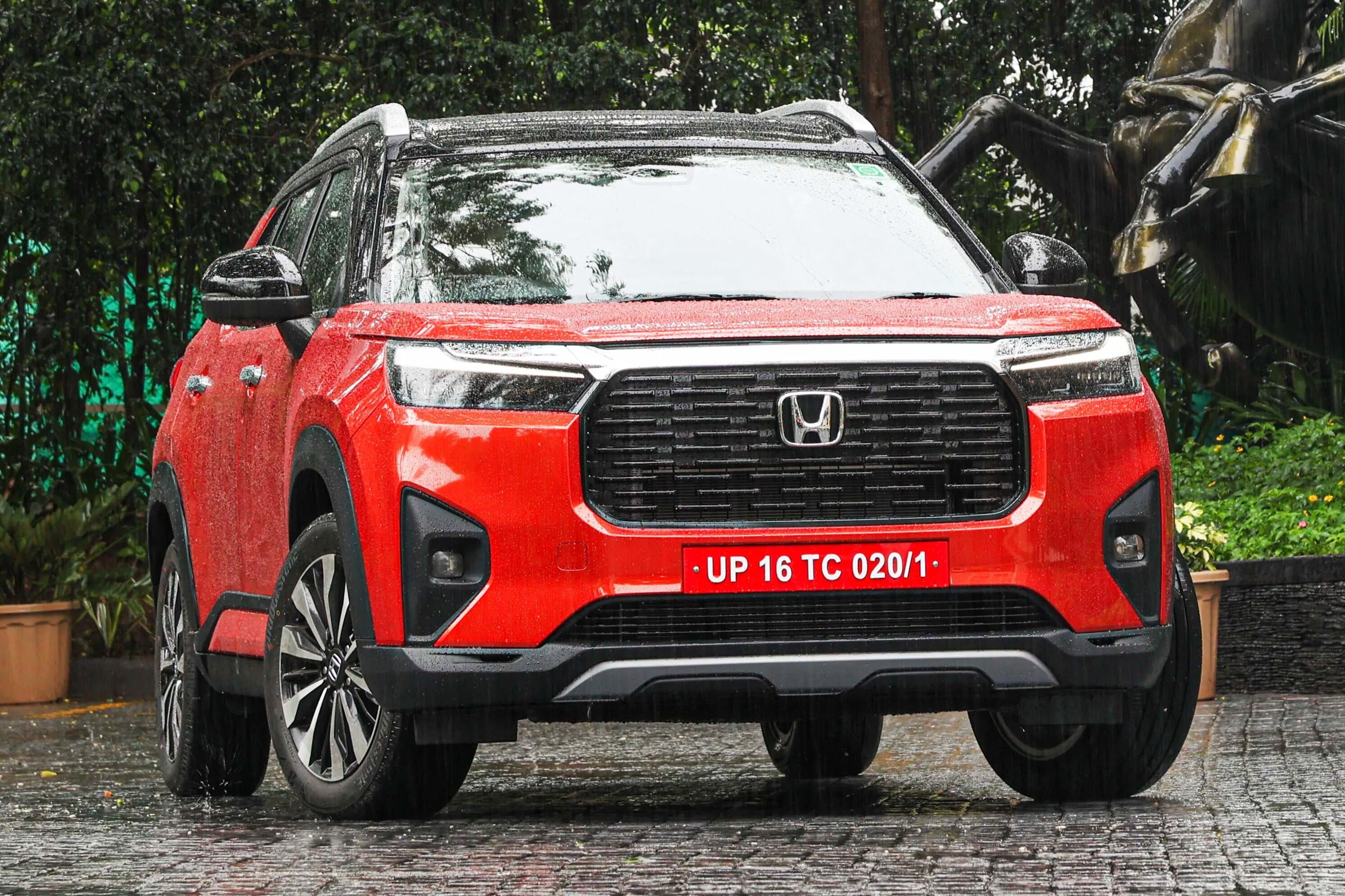
Current Honda Elevate. Image used for representation only.
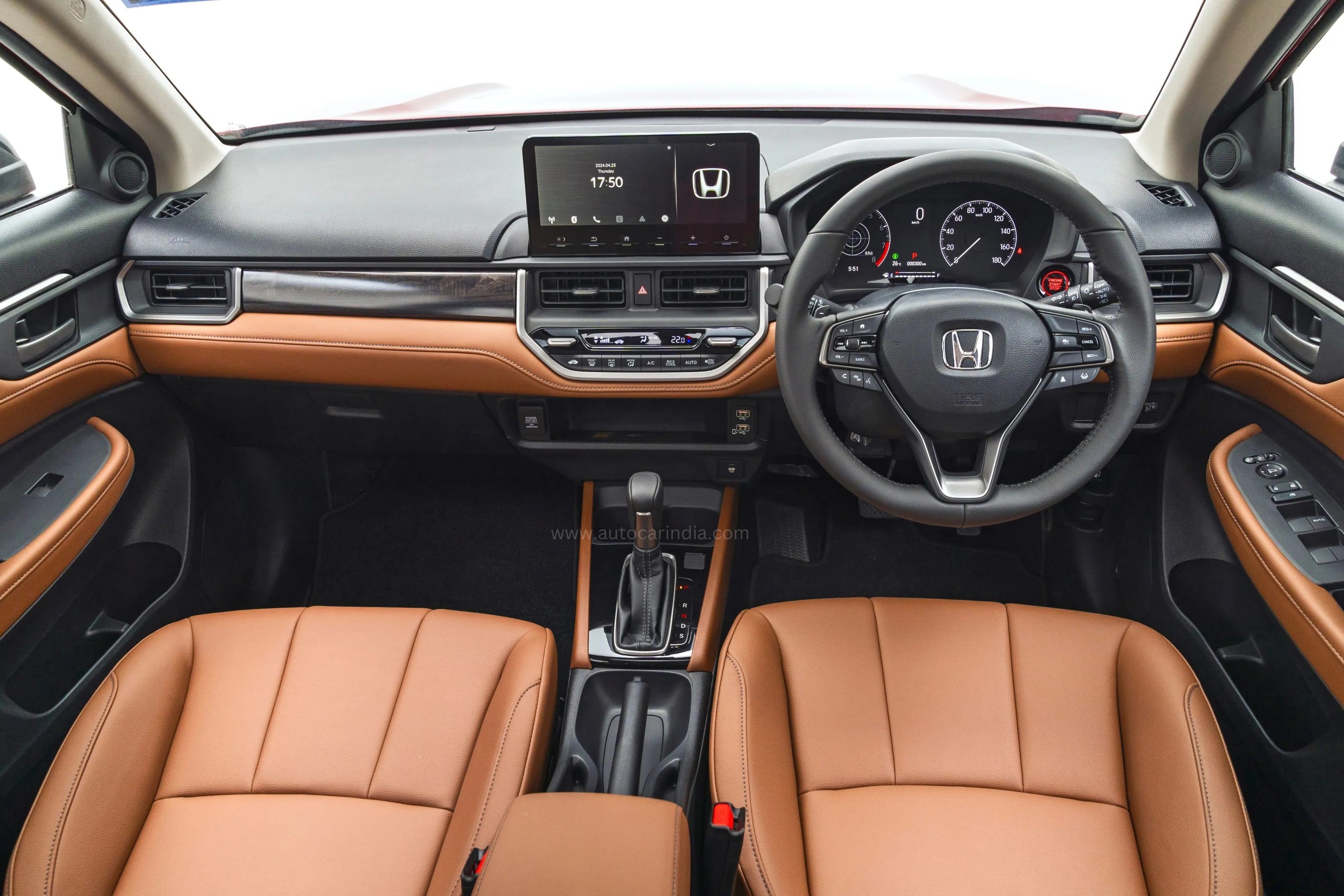
Following in the footsteps of the 2026 City facelift, Honda will launch an updated version of the Elevate SUV in October. Expect the Elevate facelift to sport revised styling cues, including the headlamps, tail-lamps, bumpers, grille, and wheels. The interior is anticipated to see changes like a larger infotainment touchscreen and revised colour schemes, along with feature upgrades like ventilated front seats, a 360-degree camera, ambient lighting, and more.
Current Honda Elevate interior. Image used for representation only.
The facelifted Elevate is likely to retain the current model’s 121hp 1.5-litre four-cylinder naturally aspirated petrol engine, and its 6-speed manual and CVT automatic gearbox options. It remains to be seen if Honda will additionally offer the Elevate facelift with the City e:HEV’s 126hp 1.5-litre four-cylinder petrol-hybrid powertrain, which is solely mated to an e-CVT automatic. A strong hybrid version of the Elevate would allow it to compete directly with established hybrid midsize SUVs like the Maruti Grand Vitara, Victoris, and Toyota Hyryder, as well as the upcoming Renault Duster hybrid – also slated for launch next month.
Skoda Slavia facelift
Launch: 6 October
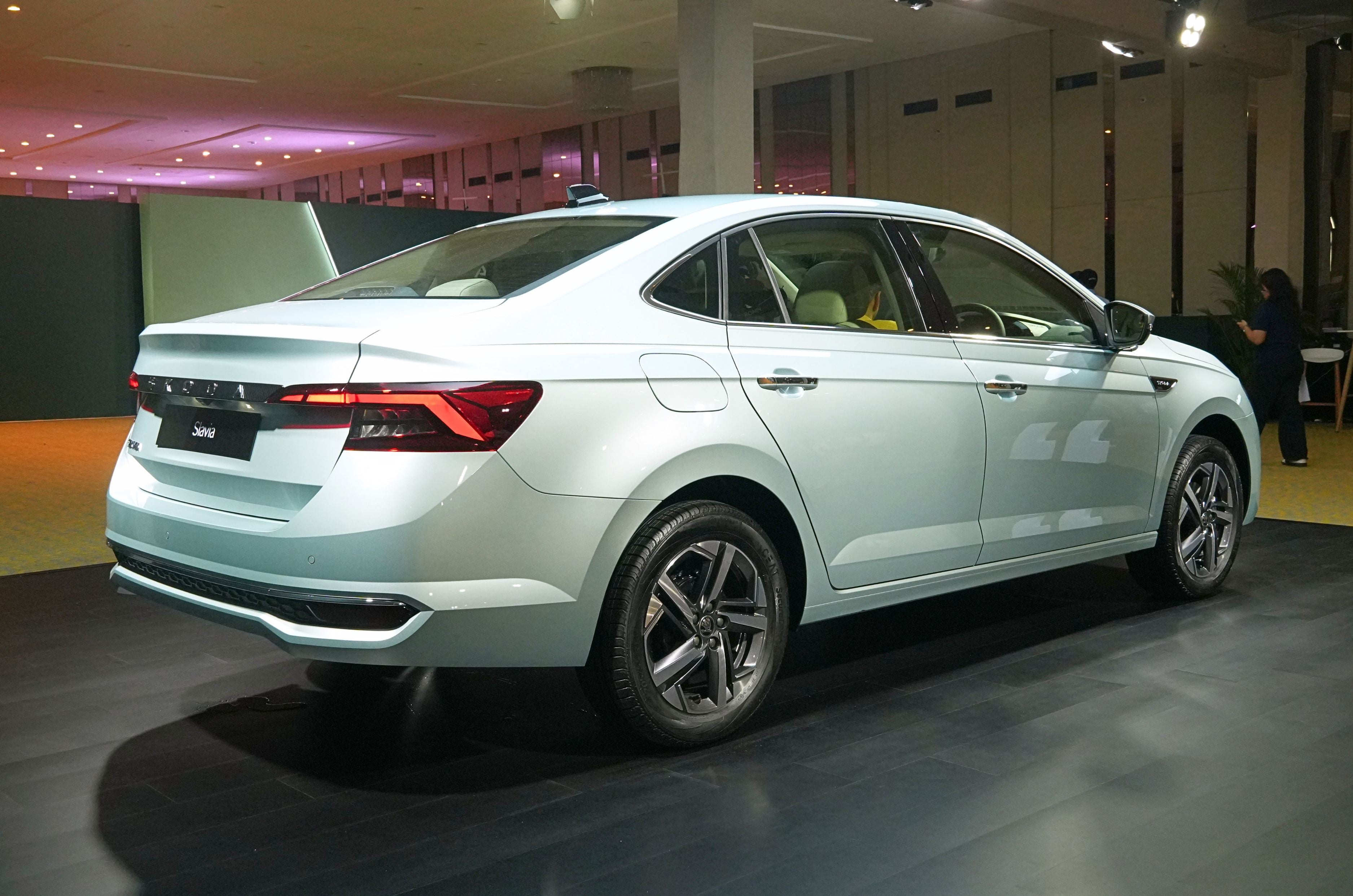
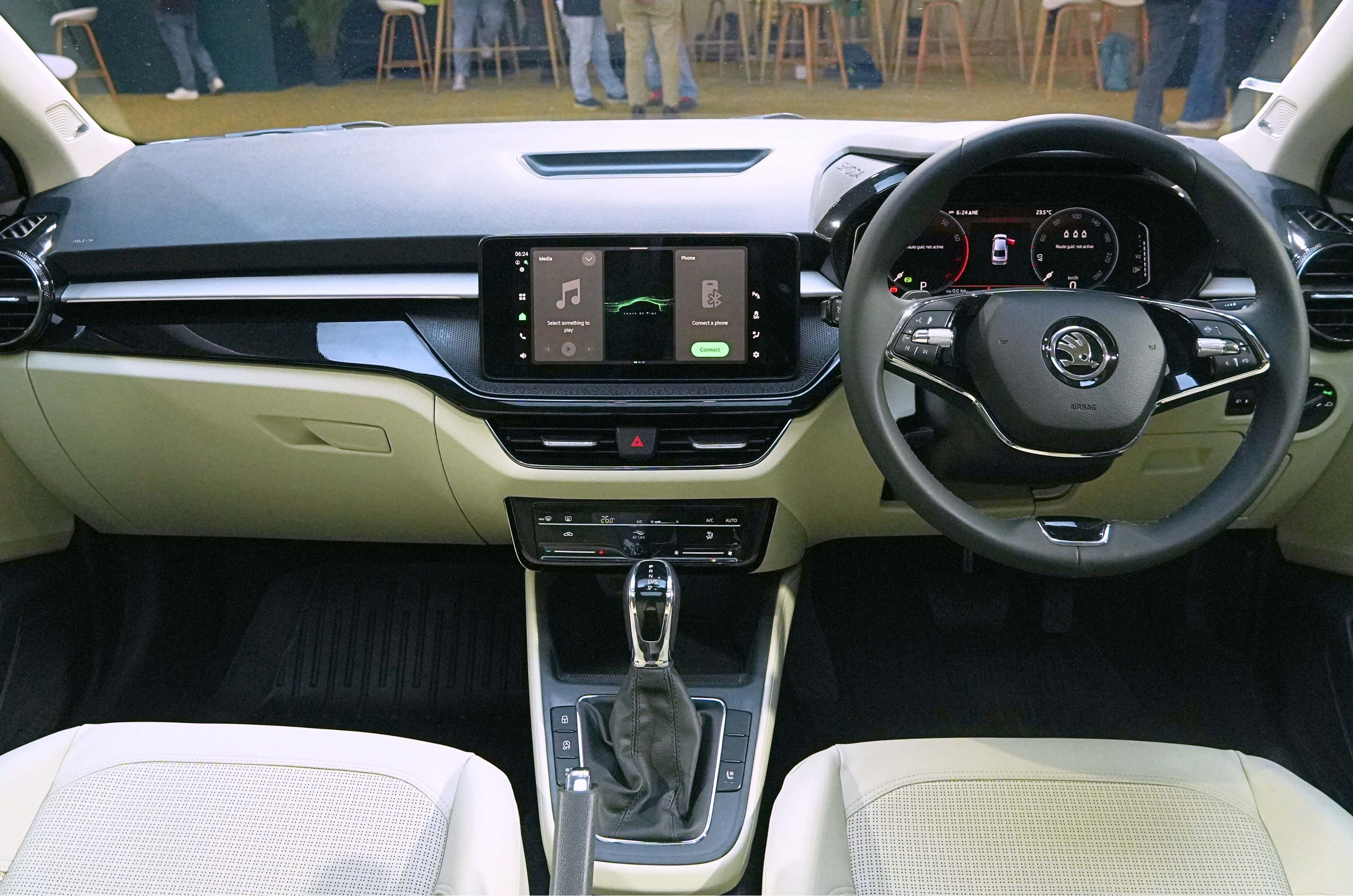
Having debuted back in August, the facelifted Skoda Slavia’s prices will be announced next month. The Slavia facelift brings a host of exterior tweaks, like new DRL signatures for the headlamps, an updated grille, redesigned bumpers, and fresh alloy wheels. Not much has changed on the inside, but there are new colour schemes on offer. Skoda has also added features like a 360-degree camera, a massage function for the outboard rear seats, a larger 10.25-inch digital driver’s display, a Google-based AI assistant, an upgraded variable-geometry AC compressor, and front parking sensors.
Under the bonnet, the Slavia facelift retains its 115hp 1.0-litre three-cylinder direct-injection turbo-petrol and 150hp 1.5-litre four-cylinder direct-injection turbo-petrol engines. The big change here is that the 6-speed torque converter automatic that was previously available for the 1.0 TSI has been swapped with an 8-speed unit, which should deliver better fuel efficiency on the highway. A 6-speed manual gearbox is also available for the 1.0 TSI, whereas the 1.5 TSI continues to be paired exclusively with a 7-speed dual-clutch automatic. The 1.5 TSI will be offered with rear disc brakes too – a much-requested upgrade.
Volvo ES90
Launch: 12 October
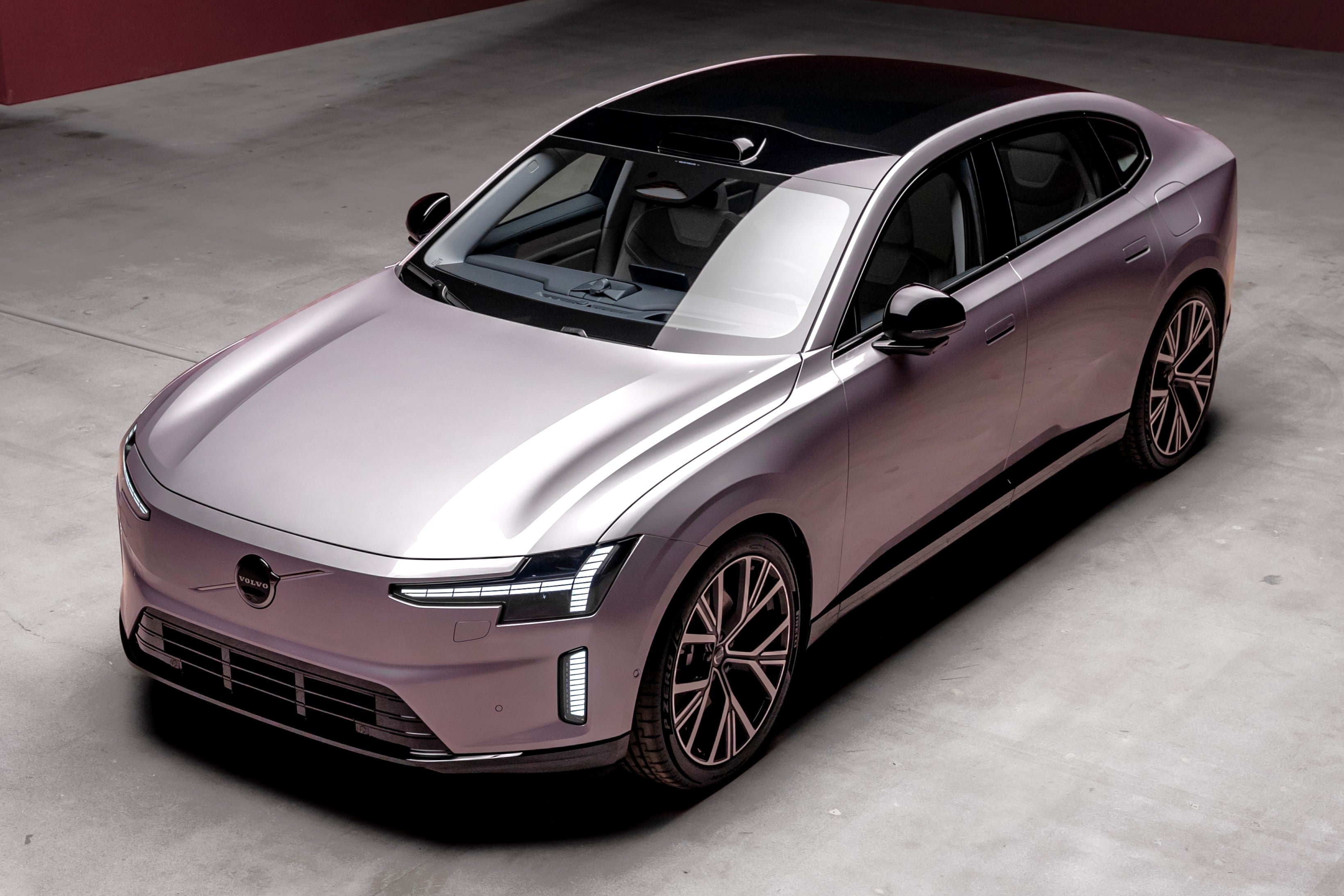
Volvo will return to the luxury sedan space next month with the launch of the all-electric ES90. It’s based on Volvo’s 800V SPA2 platform, and is likely to be offered with a 106kWh battery, dual-motor AWD setup in India. Combined output is pegged at 456hp and 670Nm, which is good for a claimed 0-100kph time of 5.3 seconds. As for WLTP range, the ES90 is rated at 696km, and the sedan can charge at up to 350kW DC, taking 22 minutes for a 10-80 percent top-up.
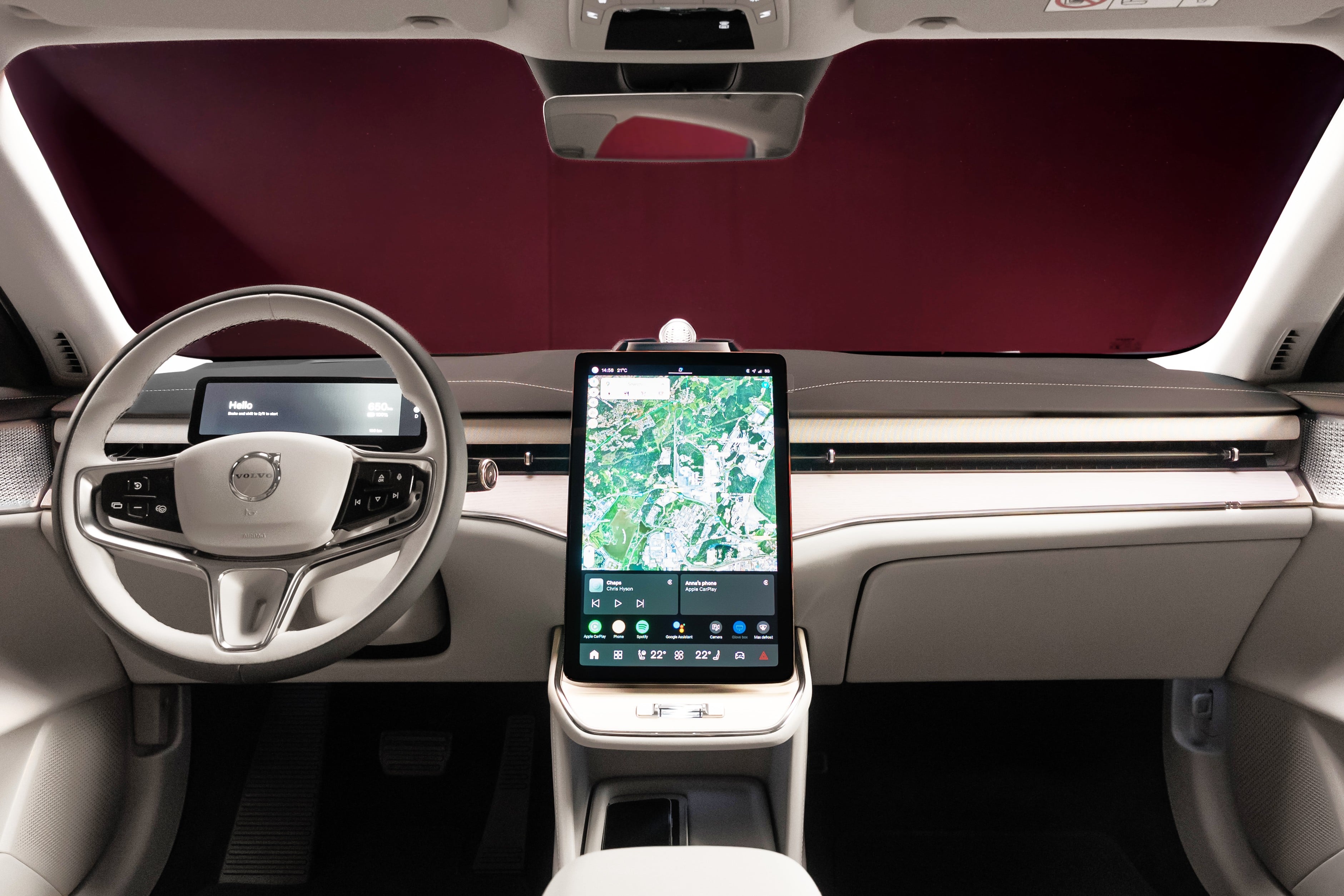
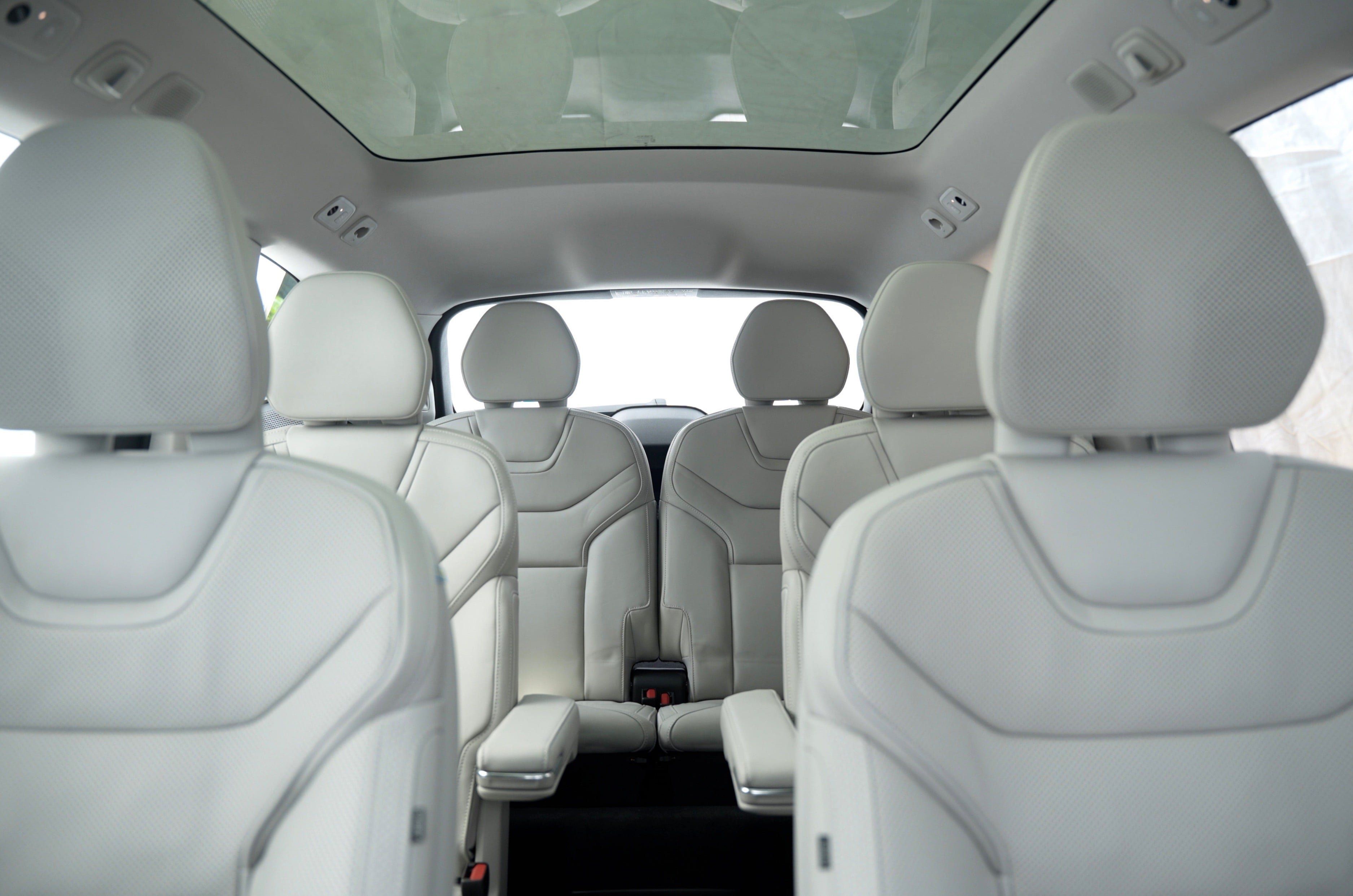
On the outside, the ES90 looks sleek and quietly aggressive, with T-shaped LED headlamps, vertically oriented front fog lamps, clean panelling, and C-shaped tail-lamps. Moreover, it has a drag coefficient of 0.25, making it the most aerodynamic Volvo car yet. Inside, the ES90 packs a 14.5-inch Google-based portrait touchscreen, a floating centre console, a three-spoke steering wheel, a slim 9-inch digital driver’s display, a 13.2-inch head-up display, a panoramic glass roof, four-zone climate control, powered front seats, Level 3 ADAS, and a Bose sound system.
Volvo EX90
Launch: 12 October
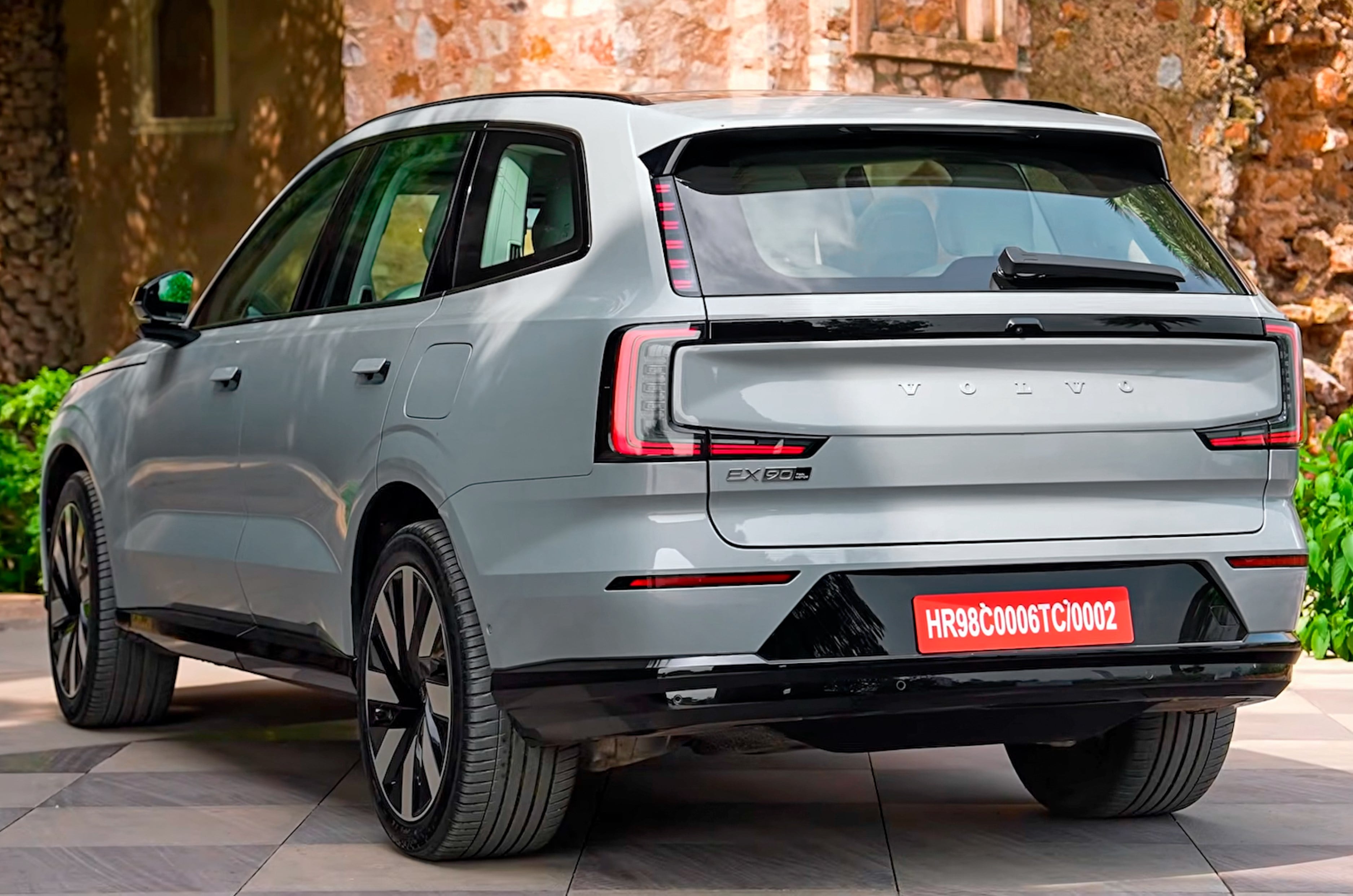
Alongside the ES90, Volvo will launch its SUV counterpart, the EX90. The electric SUV is also based on the SPA2 platform and is expected to offer the same 106kWh dual-motor AWD powertrain. Owing to its higher-riding stance, the EX90’s WLTP range is slightly lower at 625km, but the SUV impressively claims the same 5.3sec 0-100kph time.
Even in terms of exterior design, the core elements are quite similar between the EX90 and ES90. The same holds true for the interior and equipment list as well, with the only major difference being that the EX90 can seat up to six occupants and gets second-row captain’s chairs.
Toyota Glanza facelift
Debut: 14 October
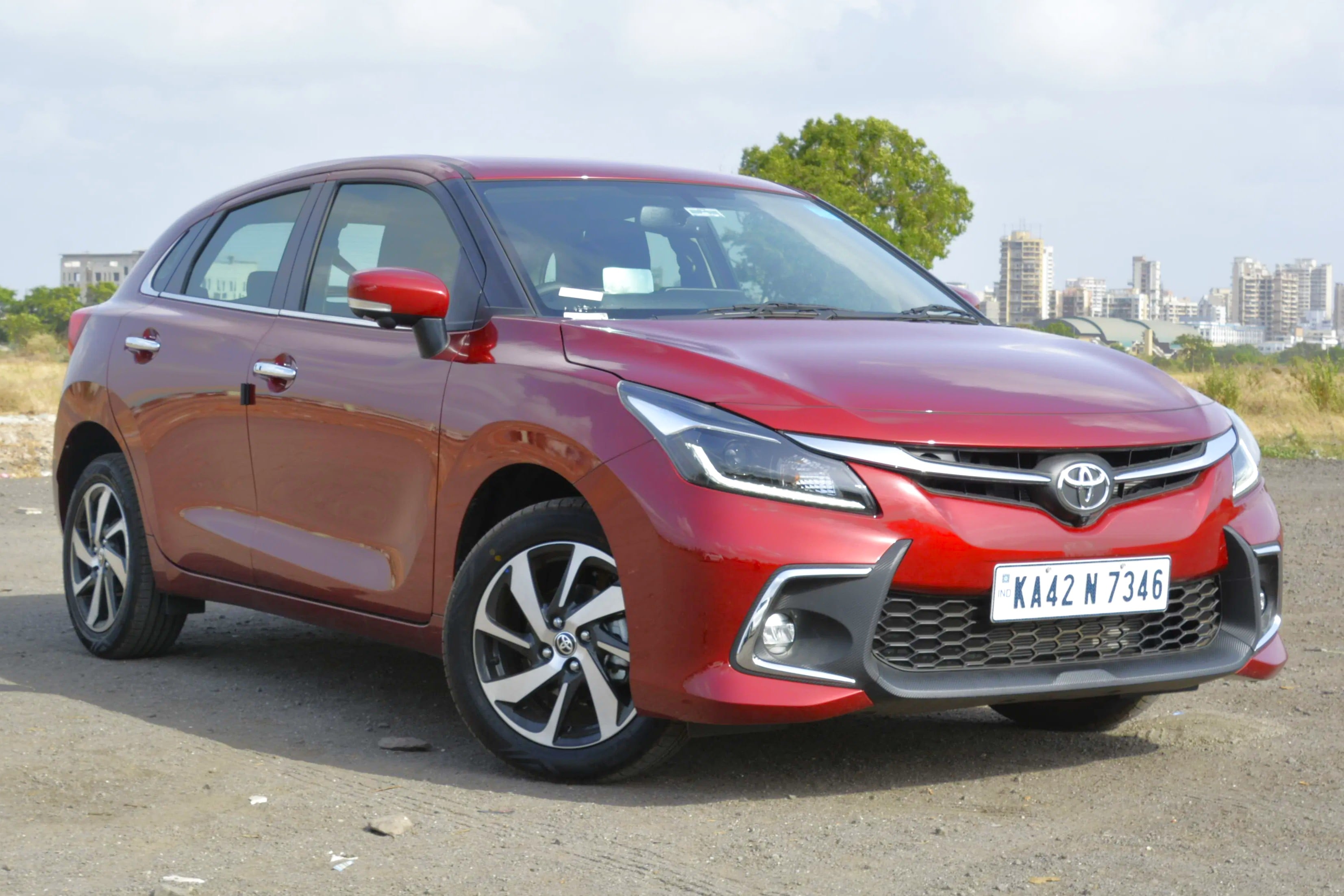
Current Toyota Glanza. Image used for representation only.
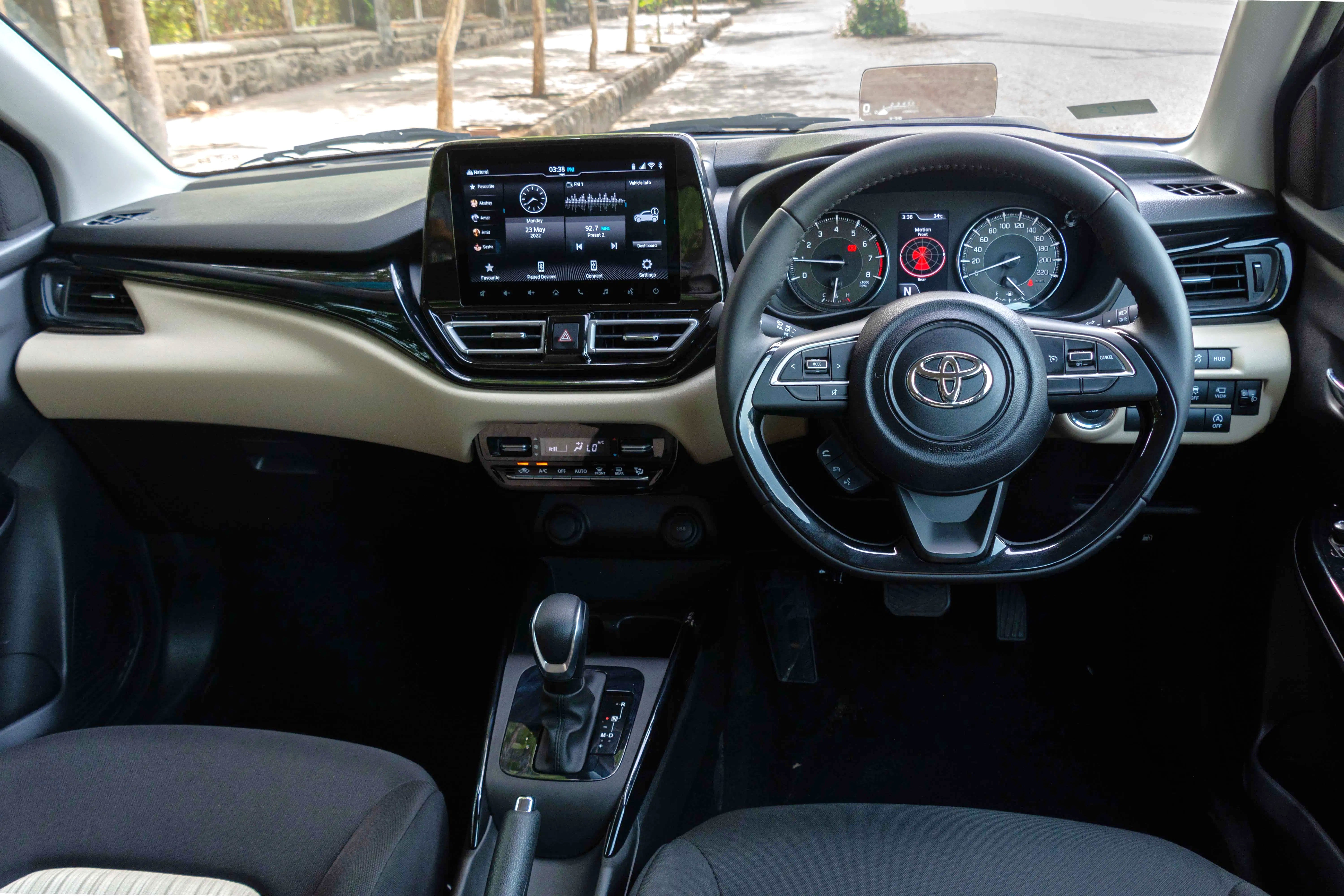
Just a month after the launch of the Baleno facelift, the updated form of its Toyota-badged counterpart, the Glanza, will be revealed. The Glanza facelift is likely to feature styling revisions similar to those of the updated Baleno, like a larger grille, redesigned bumpers, and new alloy wheel designs. Inside, the Toyota hatchback’s dashboard layout is expected to be largely unchanged, save for fresh seat upholstery. New creature comforts are likely to include Level 2 ADAS, a wireless charging pad, and ventilated front seats.
Current Toyota Glanza interior. Image used for representation only.
Under the bonnet, the Glanza facelift is anticipated to mirror the Baleno in dropping its current 90hp 1.2-litre four-cylinder K12N petrol engine in favour of the 83hp 1.2-litre three-cylinder Z12E mill. Like in the Baleno facelift, this engine is expected to be offered with either a 5-speed manual or 5-speed AMT in the updated Glanza, along with a 70hp CNG option.
Third-gen Audi Q3
Launch: 16 October
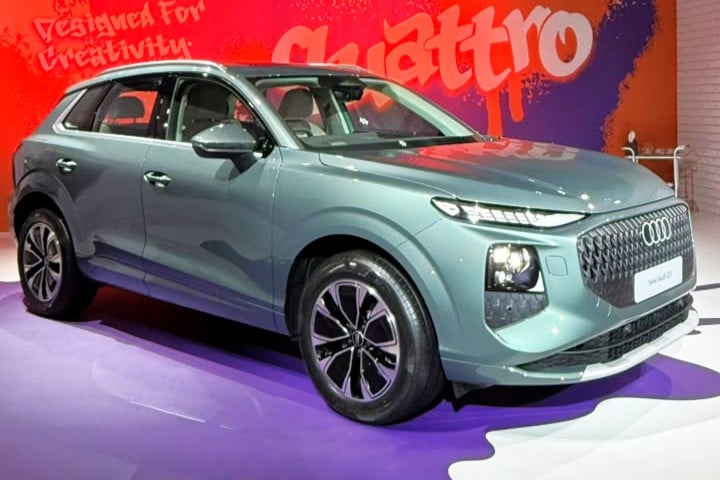
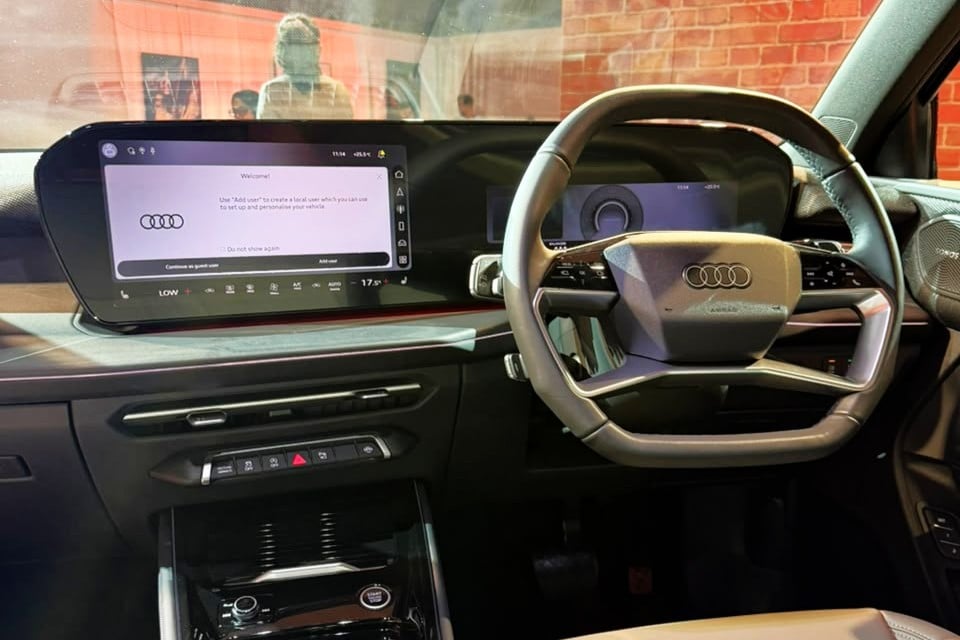
Audi India will launch the latest generation of its entry-level SUV, the Q3, next month. The India-spec third-gen Q3 was unveiled back in August, and will continue to rival the BMW X1 and Mercedes-Benz GLA. On the outside, the new Q3 is larger than its predecessor in every dimension and bears a sharper design language, which includes split LED headlamps, a wide grille, 18-inch alloy wheels, and a rear light bar with an illuminated Audi emblem.
The interior of the third-gen Q3 is more modern and feature-loaded too, offering a 12.8-inch touchscreen, an 11.9-inch digital driver’s display, a new squircle-shaped four-spoke steering wheel, ambient lighting, a Sonos sound system, a panoramic sunroof, ambient lighting, a 360-degree camera, dual-zone climate control, among others. Under the bonnet, the Q3 continues to get a 204hp 2.0-litre four-cylinder direct-injection turbo-petrol engine, mated to a 7-speed dual-clutch automatic and Audi’s Quattro AWD system. 0-100kph comes up in a claimed 7.1 seconds, and the top speed is rated at 229kph.
Renault Duster hybrid
Launch: 17 October
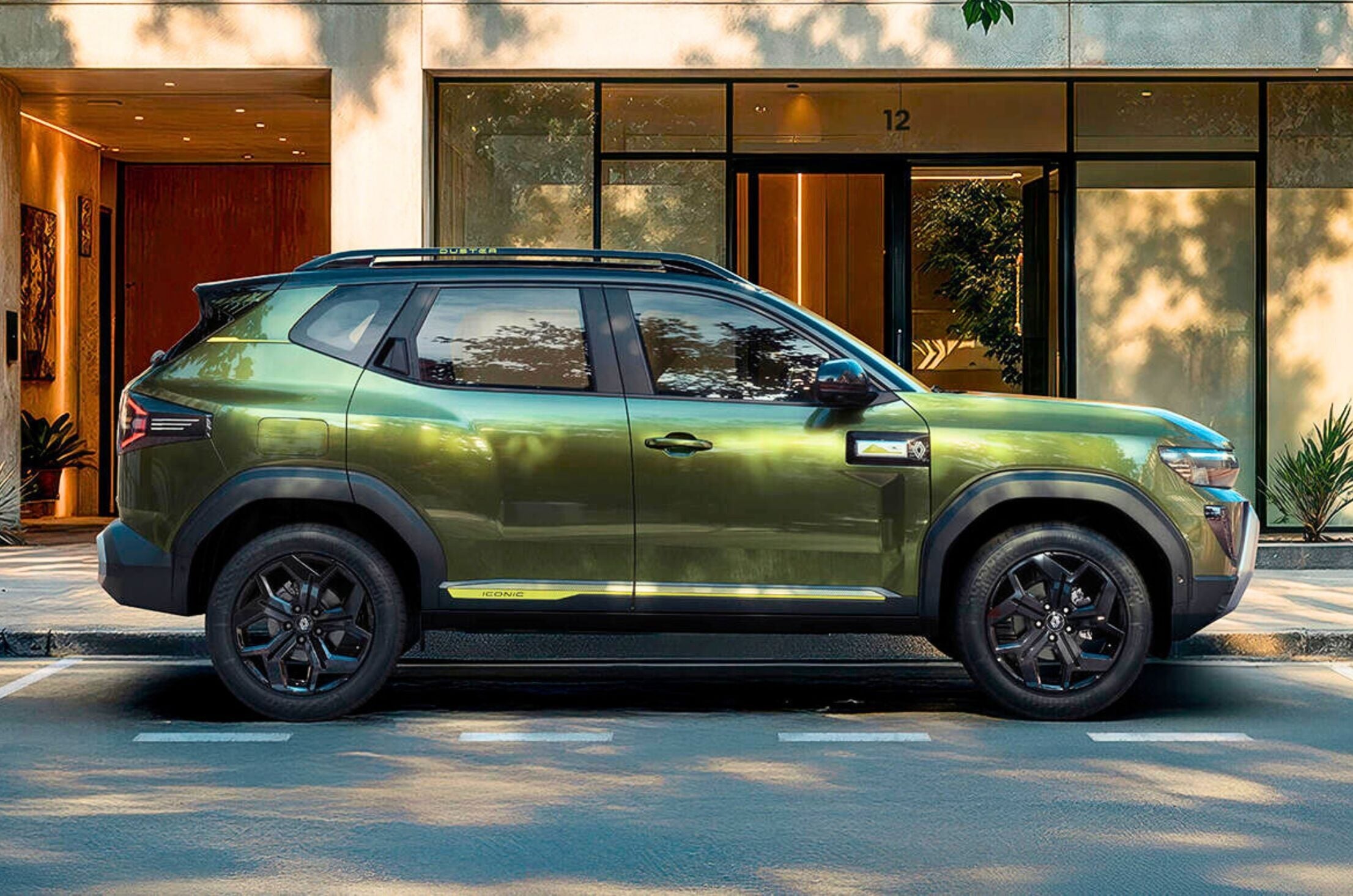
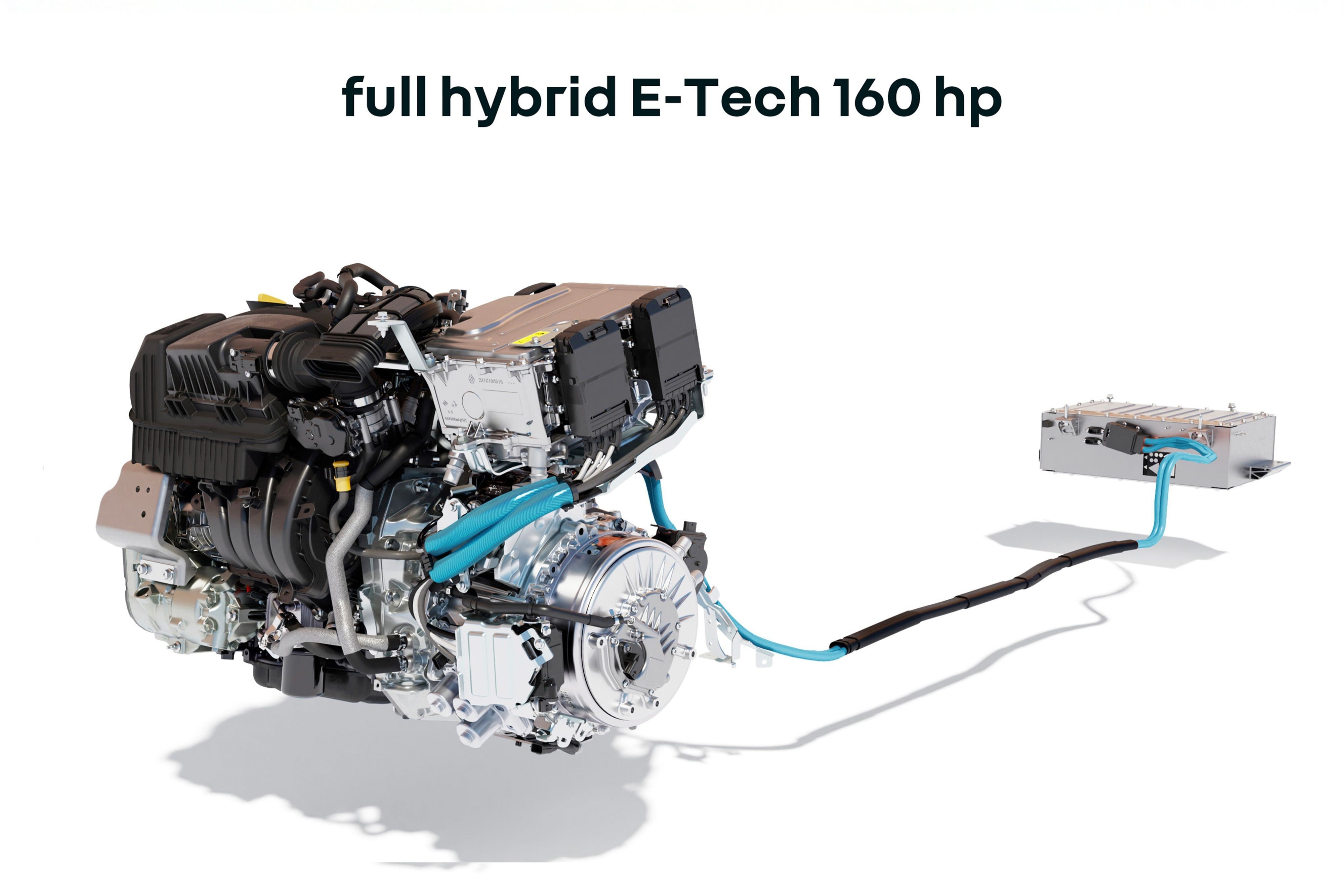
Since its launch earlier this year, the Renault Duster has been available with a couple of turbo-petrol engines only, but that will change come October 17. Renault will bolster the Duster’s line-up with a strong hybrid powertrain dubbed the E-Tech 160. It pairs a 1.8-litre four-cylinder naturally aspirated petrol engine with two electric motors and a 1.4kWh battery pack, developing a combined 160hp and 172Nm.
This setup will be paired with a segment-first 8-speed dedicated hybrid transmission (DHT) that uses fixed gear ratios, unlike the e-CVTs seen in hybrid SUV rivals like the Grand Vitara, Victoris, and Hyryder. The DHT should therefore enable a more natural driving feel to the Duster hybrid. Thanks to its 1.4kWh battery, the E-Tech 160 is also claimed to deliver 80 percent of urban driving in all-electric mode, which should help the Duster hybrid achieve great fuel efficiency.
Hyundai Bayon
Launch: Mid to late October
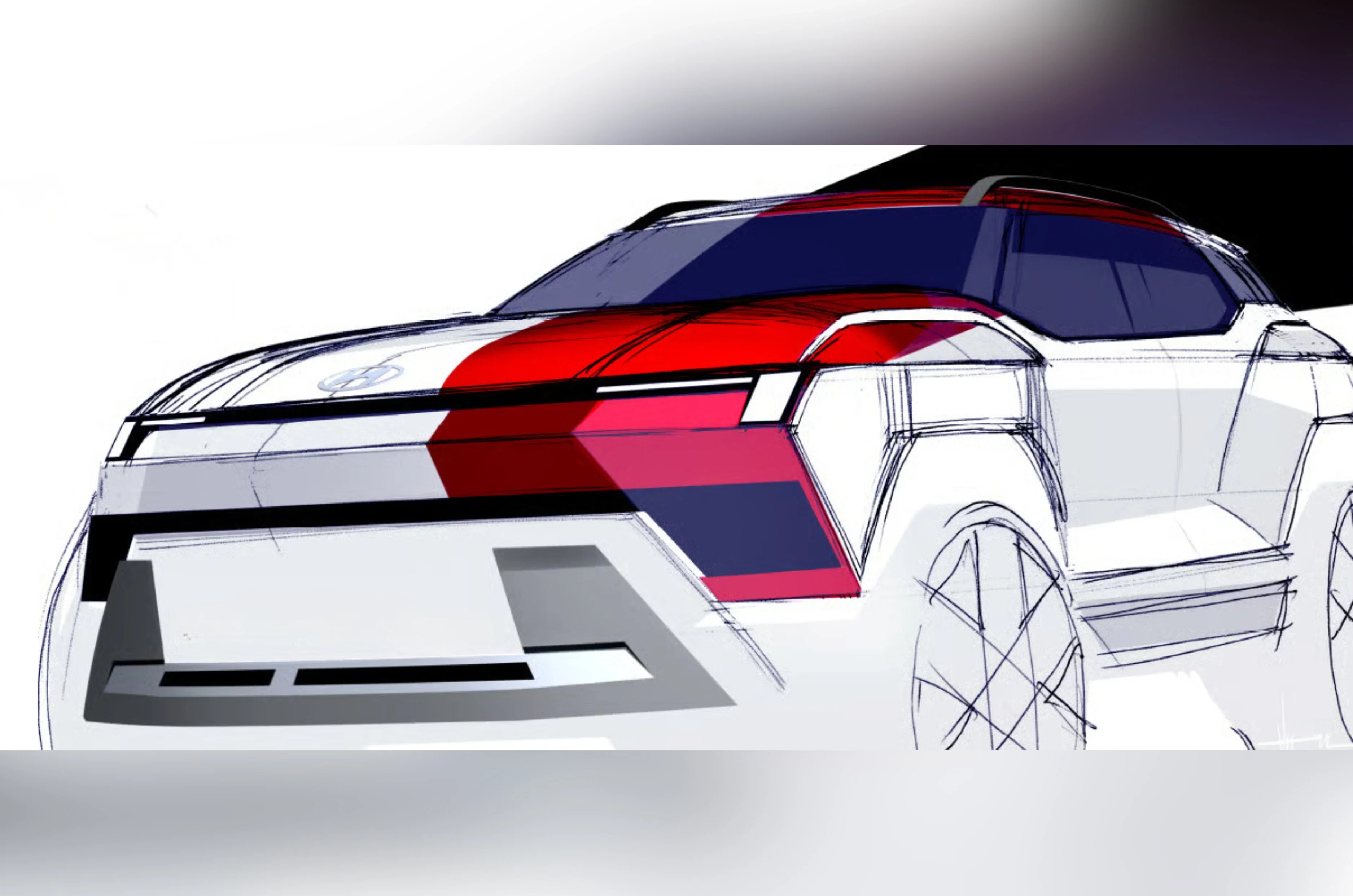
Hyundai’s second midsize SUV for India, the Bayon, is expected to be fully revealed and launched next month – bookings commenced on 23 September. The Bayon will slot between the Venue and Creta, offering the latter’s 1.5-litre naturally aspirated engine in petrol and CNG guises. Gearbox options are likely to include a 6-speed manual and CVT automatic. On the outside, the Bayon will feature Hyundai’s ‘Art of Steel’ design language, with styling cues like L-shaped front and rear LEDs, rakish proportions, an upward-sloping window line, and more. It’s also expected to be the first Hyundai car to come with an underbody CNG tank.
The interior of the Bayon is likely to offer a curved dual-screen setup, a three-spoke steering wheel bearing Hyundai’s four-dot motif, and a vertically oriented centre console – the dashboard layout will resemble that of the fourth-gen i20, which was revealed for the Brazilian market a few months ago.
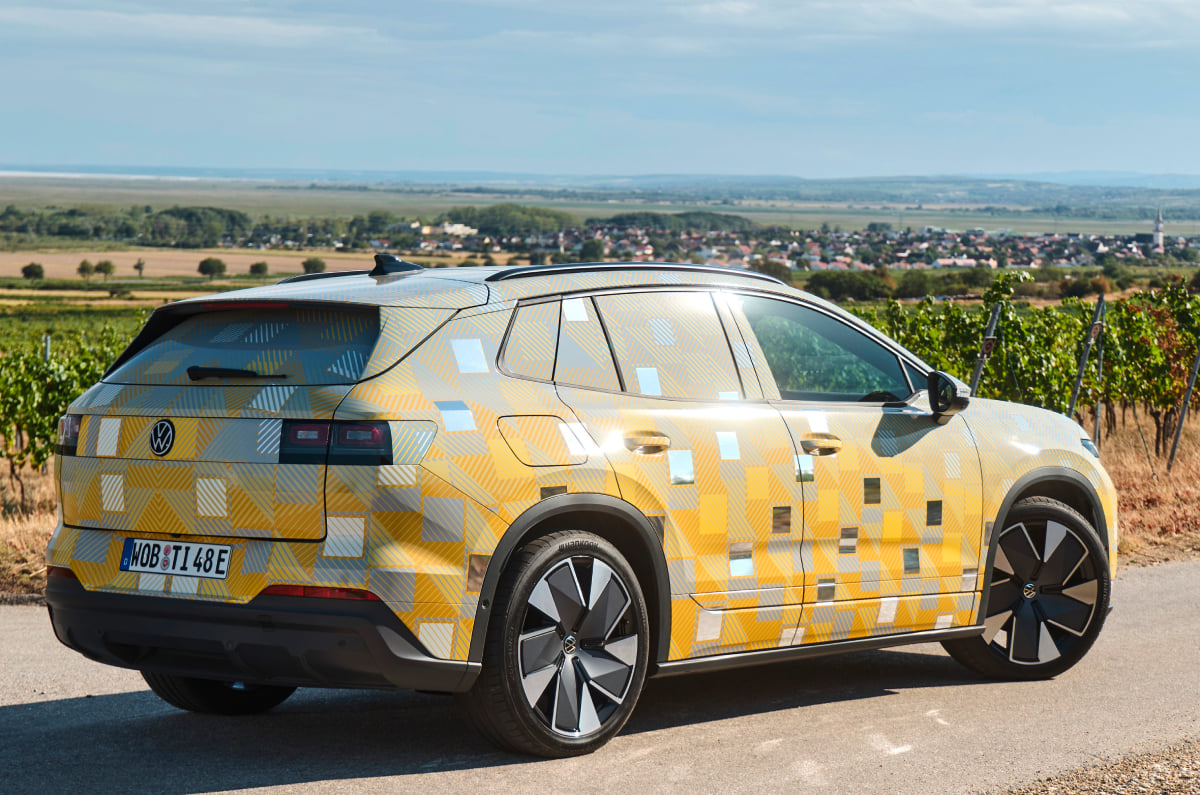
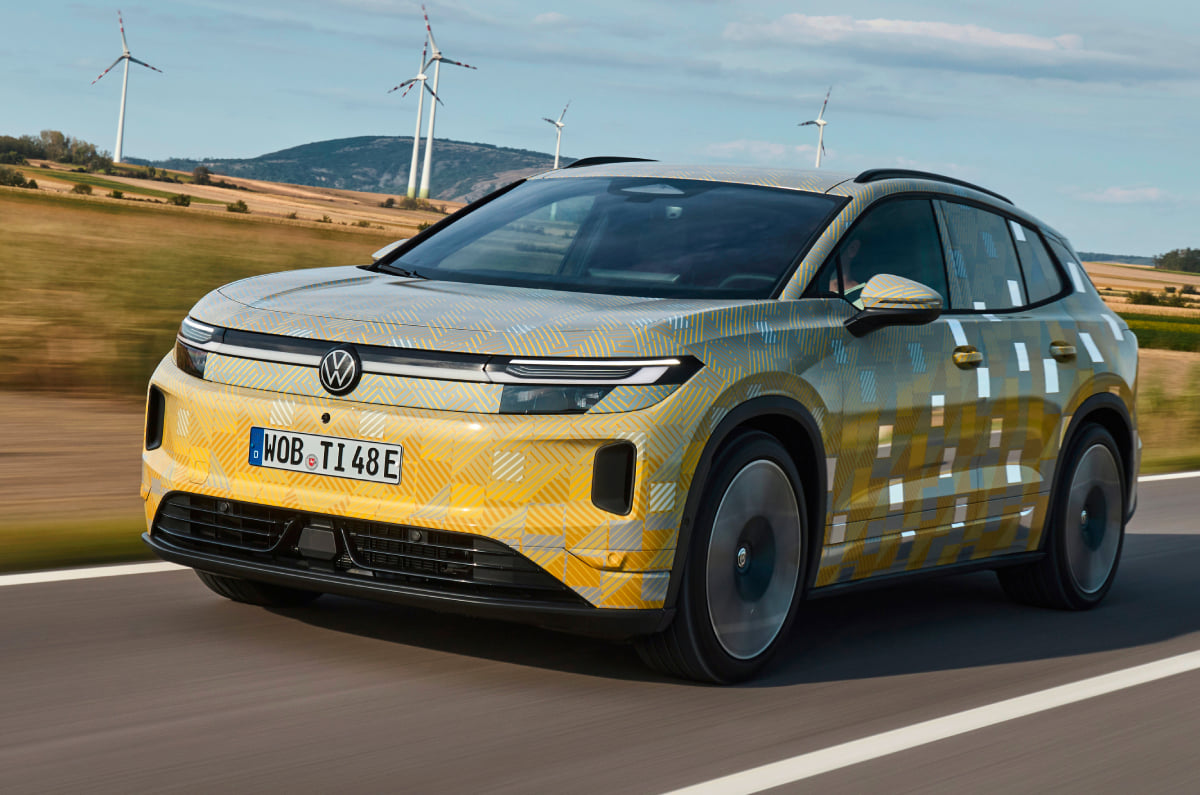
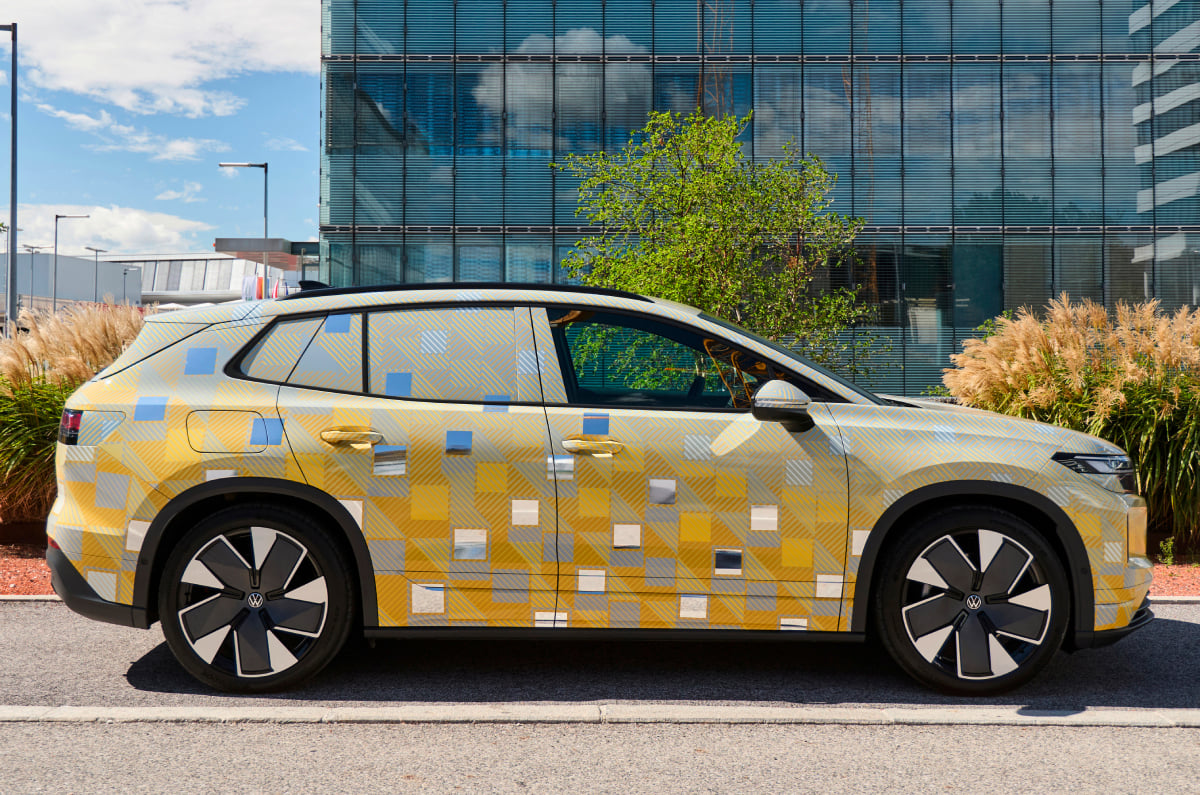
Volkswagen will unveil the all-electric ID Tiguan in early October, with the SUV set to reach international markets in early 2027. The new model will join the existing Tiguan, which will continue to be offered with combustion and hybrid powertrains globally. The ID Tiguan will replace the ID 4 and ID 5 in Volkswagen’s electric SUV range.
ID Tiguan will succeed the ID 4 and ID 5
New electric SUV gets a more spacious interior
Expected to retain 58kWh and 77kWh battery packs
Volkswagen ID Tiguan design and dimensions
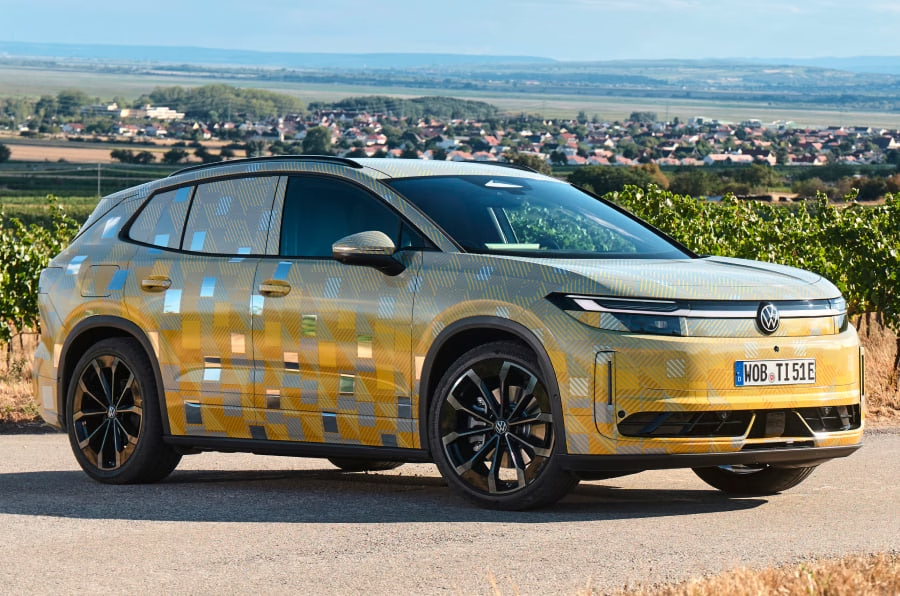
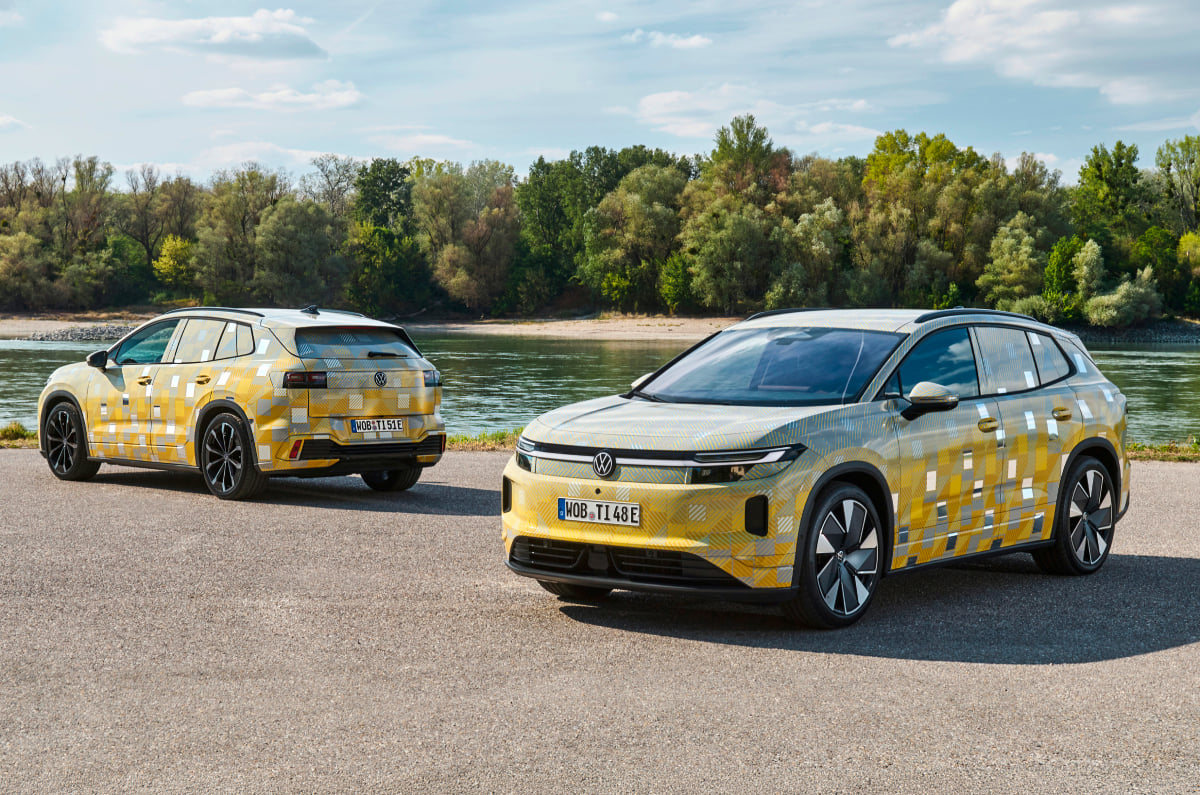
The ID Tiguan will get a completely new exterior look, with slimmer headlights and a new rear light design. It will also be available with alloy wheels sized up to 21 inches. The SUV is 44mm longer than the ID 4, which should provide more space inside the cabin. For reference, the ID 4 is 4,584mm long, 1,852mm wide and 1,639mm high, with a 2,765mm wheelbase.
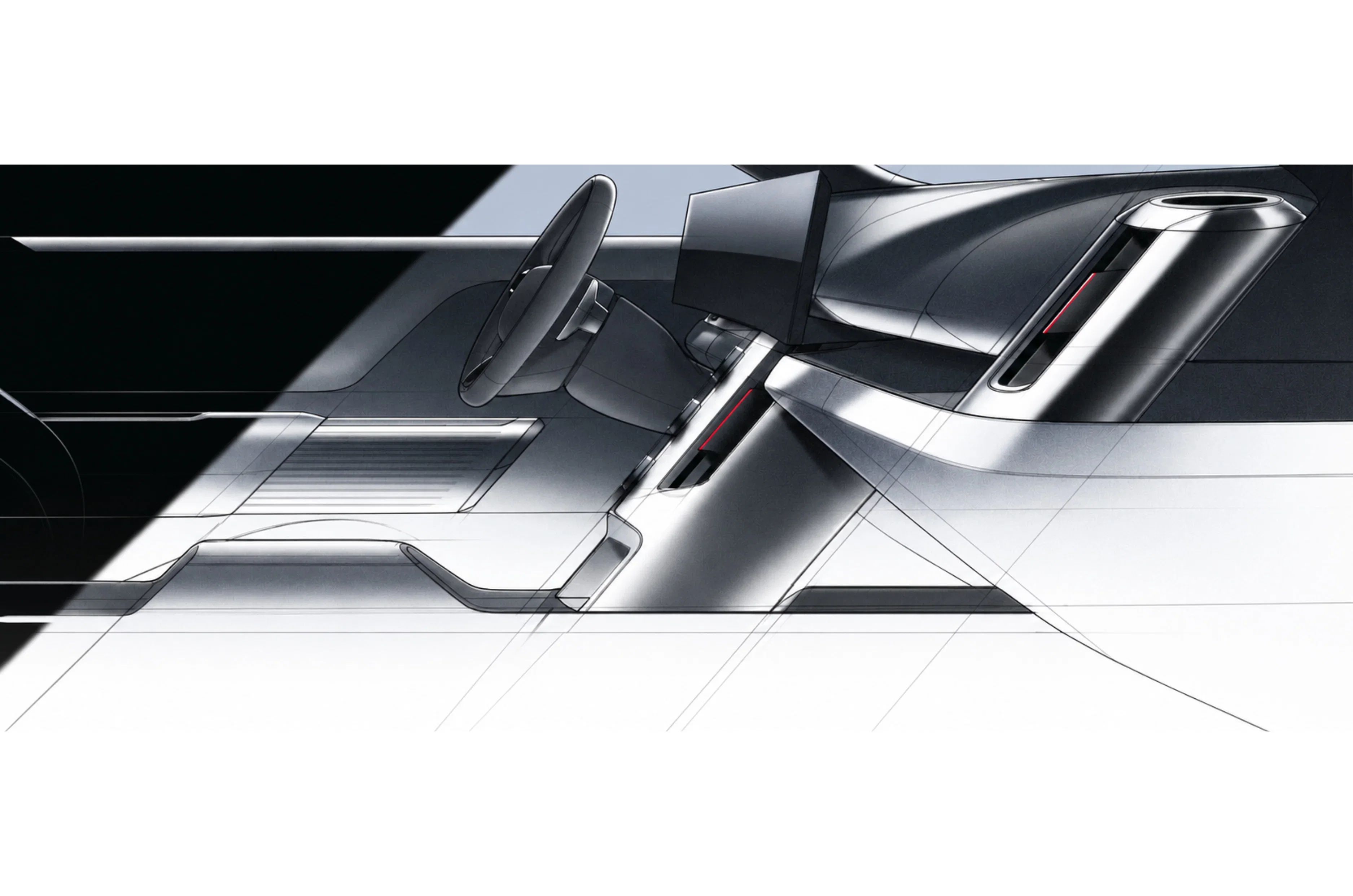
Volkswagen has not revealed the full interior yet, but it says the ID Tiguan will have a more spacious cabin and new technology. The cabin is also expected to bring back physical controls for some functions, including buttons on the steering wheel and a separate set of controls on the dashboard.
Volkswagen ID Tiguan battery and range expectations
The ID Tiguan will be based on Volkswagen’s MEB+ platform, which also underpins the ID Polo and Skoda Epiq. The SUV is expected to retain the 58kWh lithium-iron-phosphate and 77kWh nickel-manganese-cobalt battery options from the ID 4, with the smaller battery likely in the entry-level version and the 77kWh pack in the Pro and dual-motor Pro 4Motion variants.
For reference, the ID 4’s 58kWh battery has a claimed WLTP range of up to 364km, while its larger 77kWh battery offers between 512km and 572km, depending on the version. Power outputs across the ID 4 range span 170-340hp, depending on the battery, motor and variant.
Volkswagen has yet to confirm the final specifications for the production-spec ID Tiguan, including the claimed range and peak output figures.
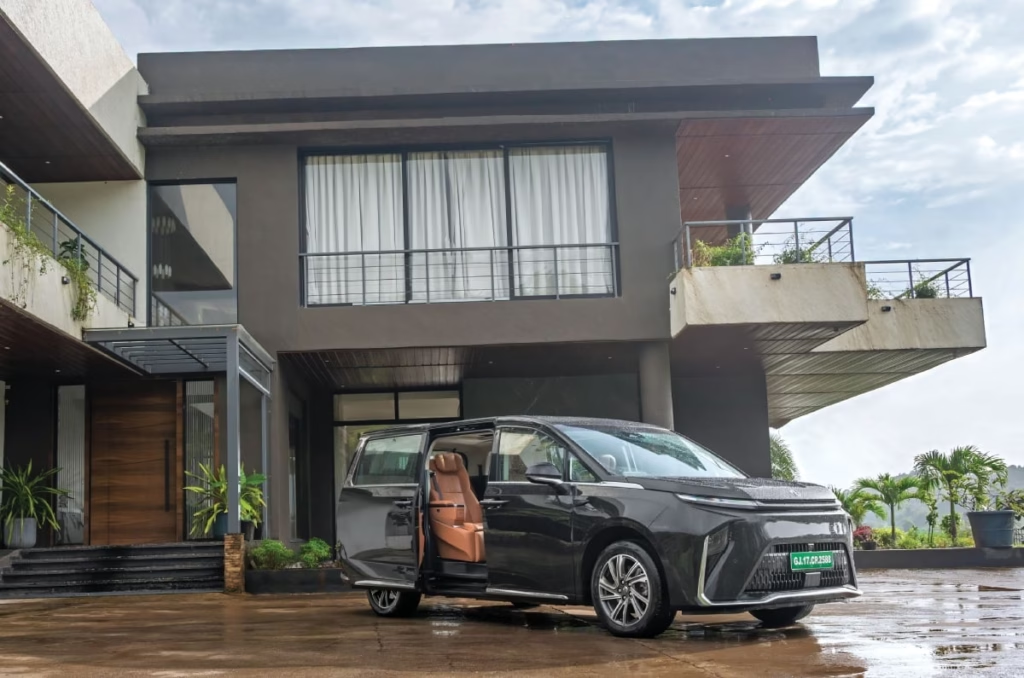
There are vastly different ideas of what luxury means. For some, it is craftsmanship – the quality of the materials, the precision of the detailing and the sense of occasion that comes with them. For others, it is exclusivity, space or technology. But perhaps the most valuable form of luxury today is something considerably harder to manufacture: time.
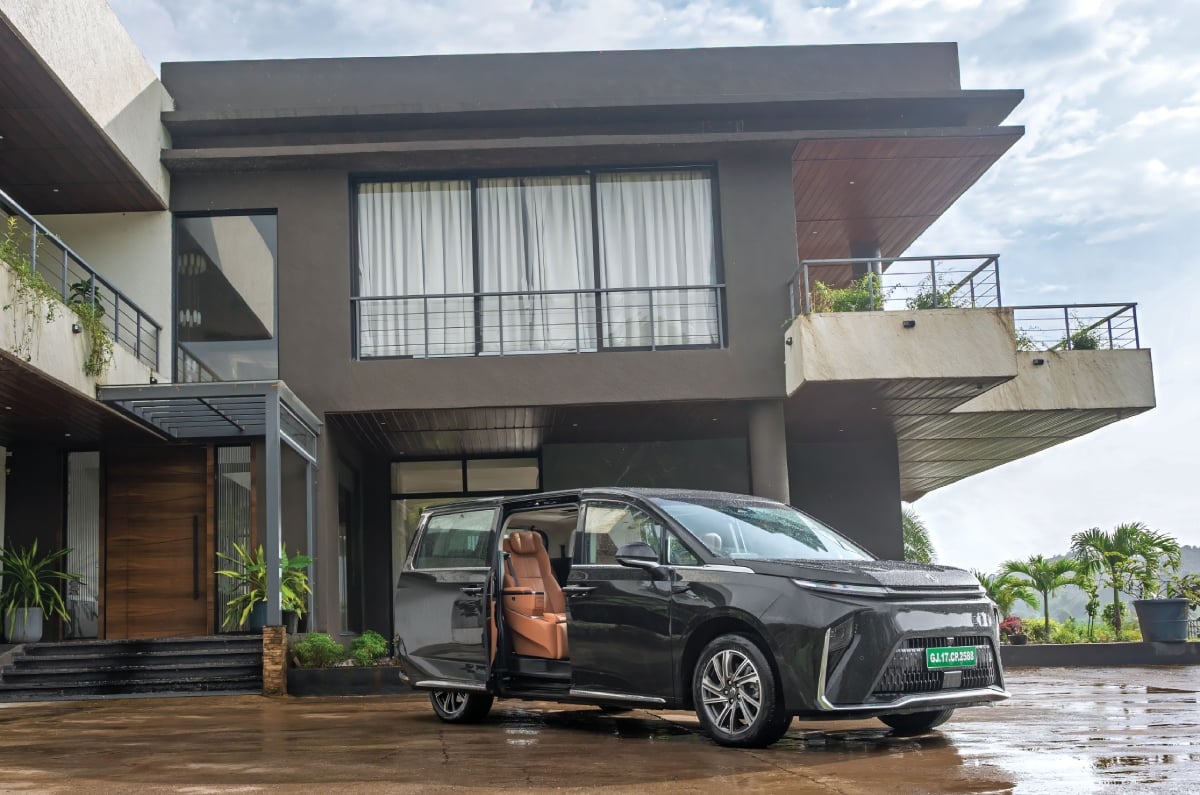
The freedom to spend a journey exactly as you want, without worrying about the road ahead, is the kind of luxury the MG M9 is built around. And nowhere is that more evident than in its Presidential second row.
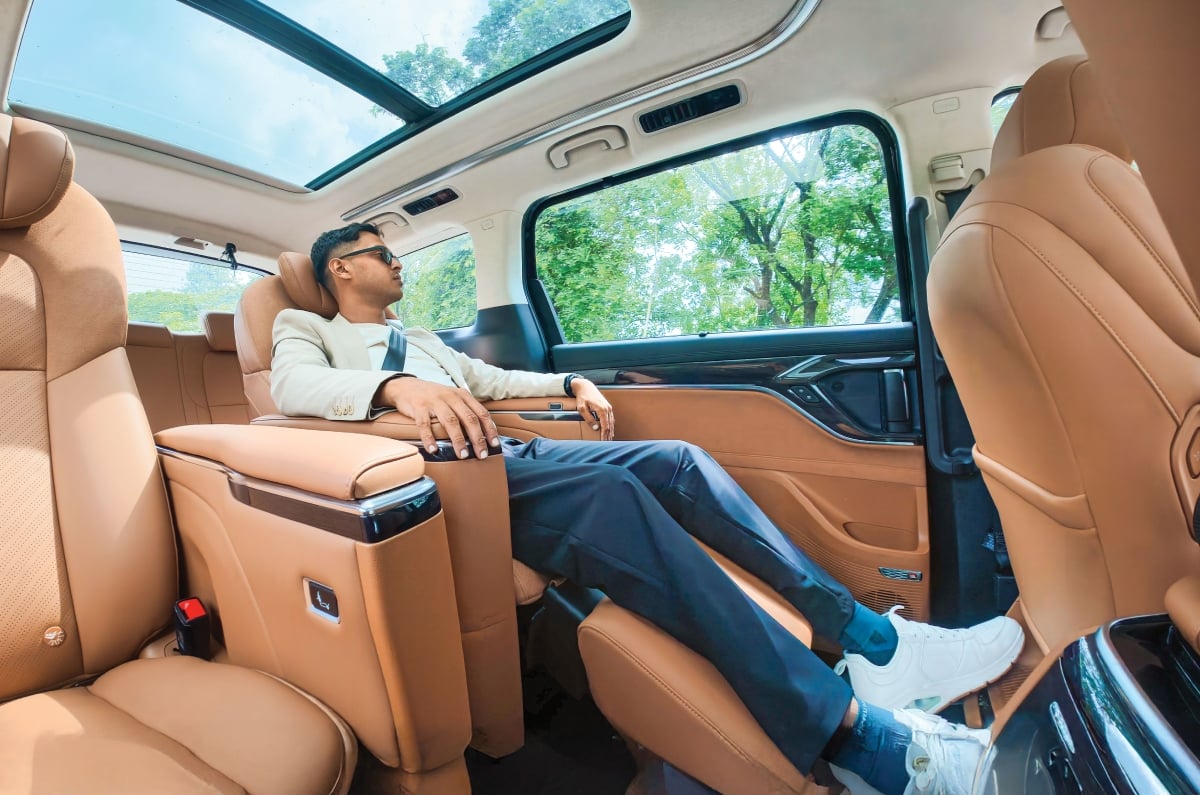
Every drive in the M9 is an opportunity to stretch out and relax.
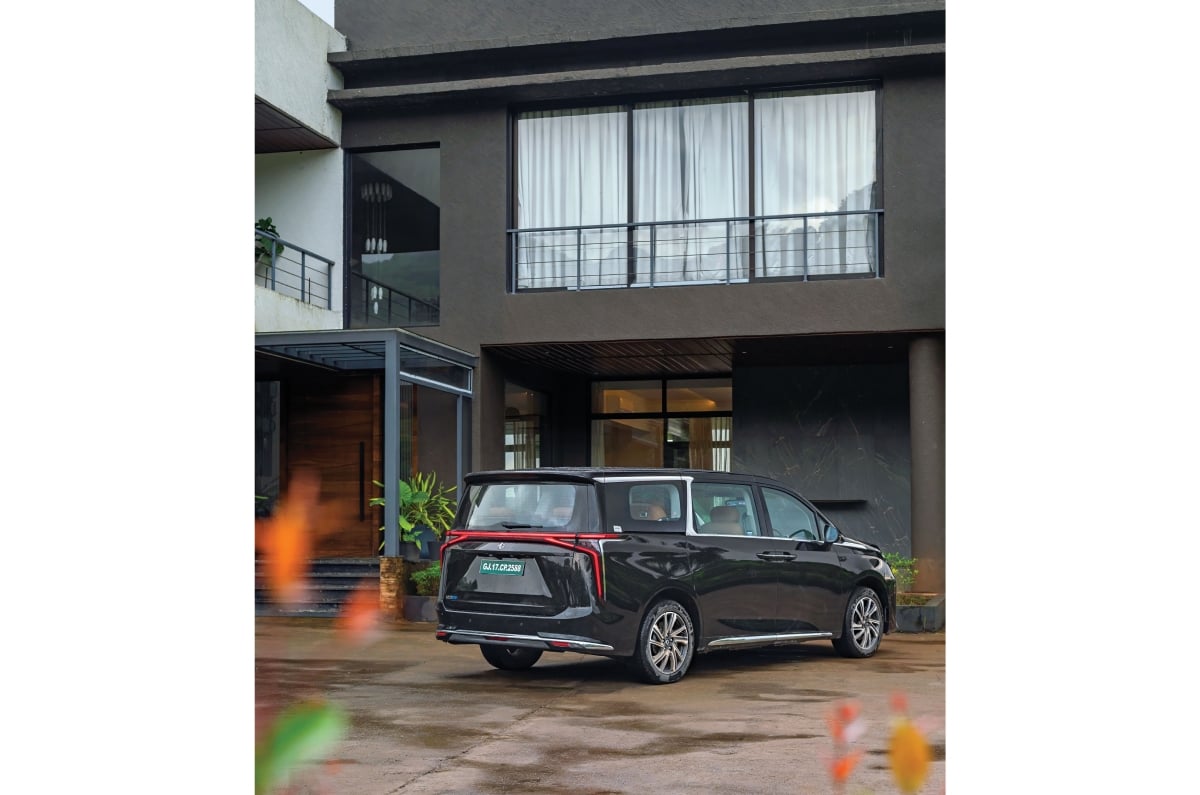
Leaving Mumbai behind for Karjat, the M9 turns what could be a routine road trip into something rather different. The traffic, the road surface and the distance to the destination are still there, but they no longer need to occupy the passenger’s attention. The second row has been designed to make the journey itself the experience.
The two Presidential Seats are the obvious starting point. With 16-way electric adjustment, heating, ventilation and eight massage functions, they offer considerably more than simply a comfortable place to sit. Their leg rests can be extended, allowing you to get that ‘putting your feet up after a long day’ experience, and the backrests can be reclined. And particularly with Boss Mode moving the front passenger seat forward, the available space is nothing short of vast.
The M9’s Boss Mode is especially handy if you want to free up some leg room in the second row.
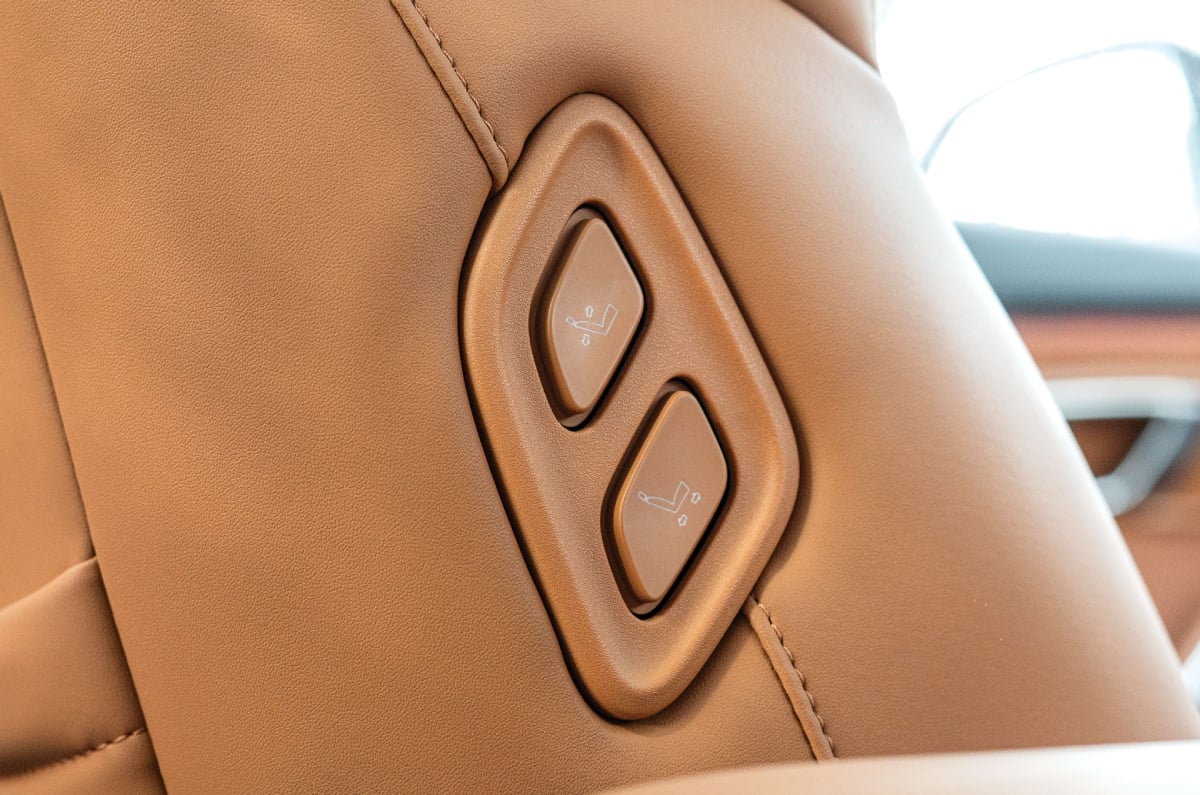
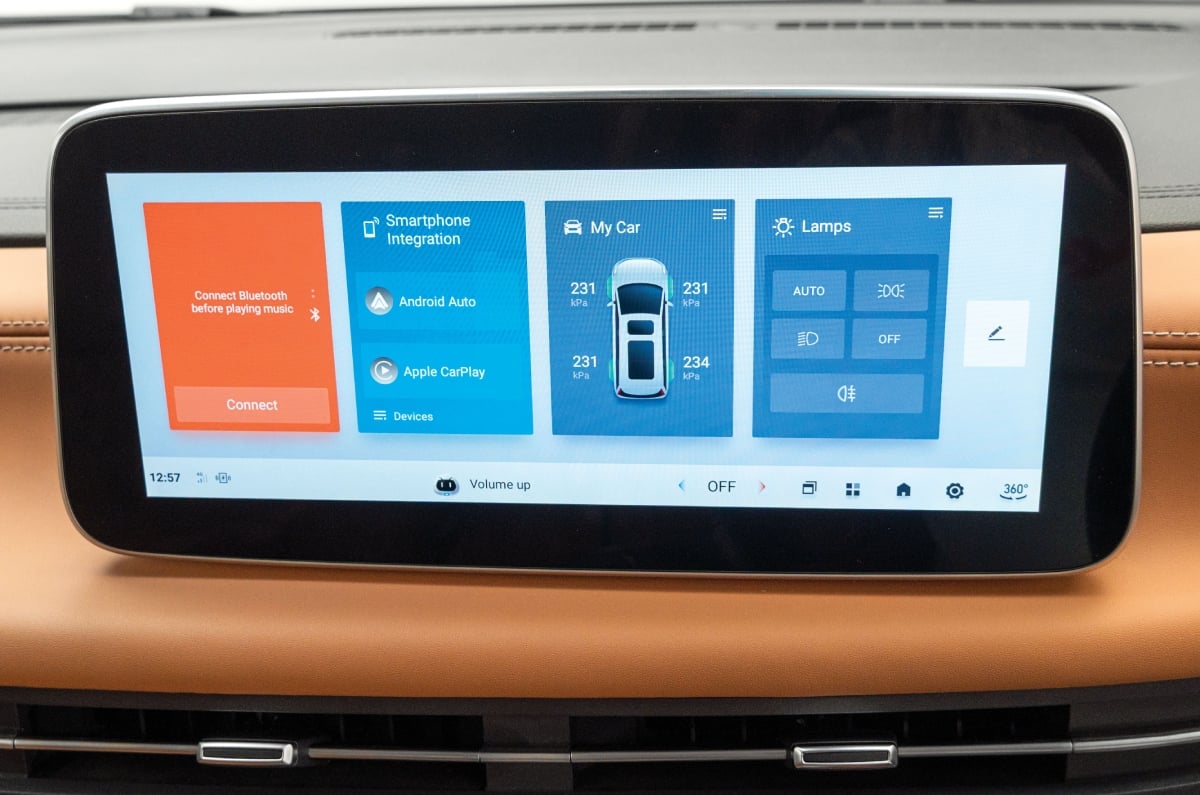
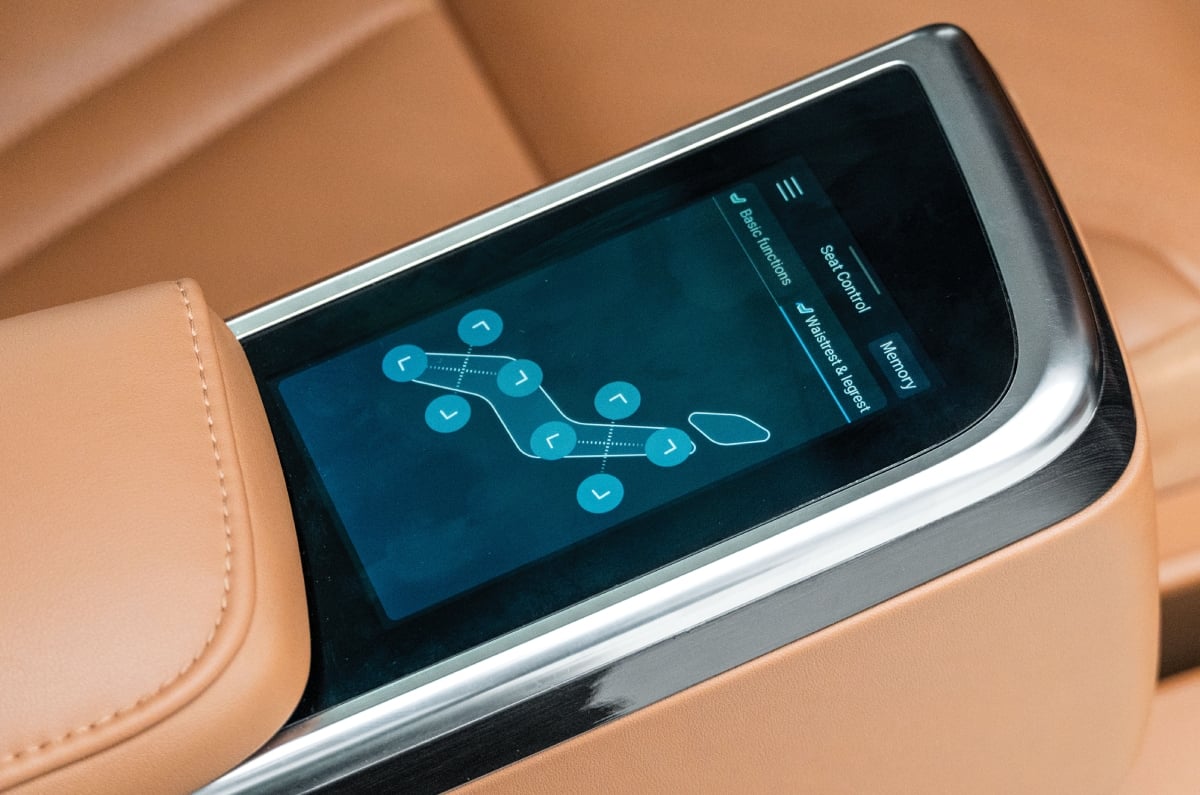
It is the sort of environment in which work can be done without feeling like work. Every major seat function is within easy reach thanks to the intelligent armrests. Not only can passengers adjust their seats’ position and temperature and regulate the AC, they can even get a massage, activate the sunroof or alter the ambient lighting. Once the laptop is closed, the M9 can change character just as easily.
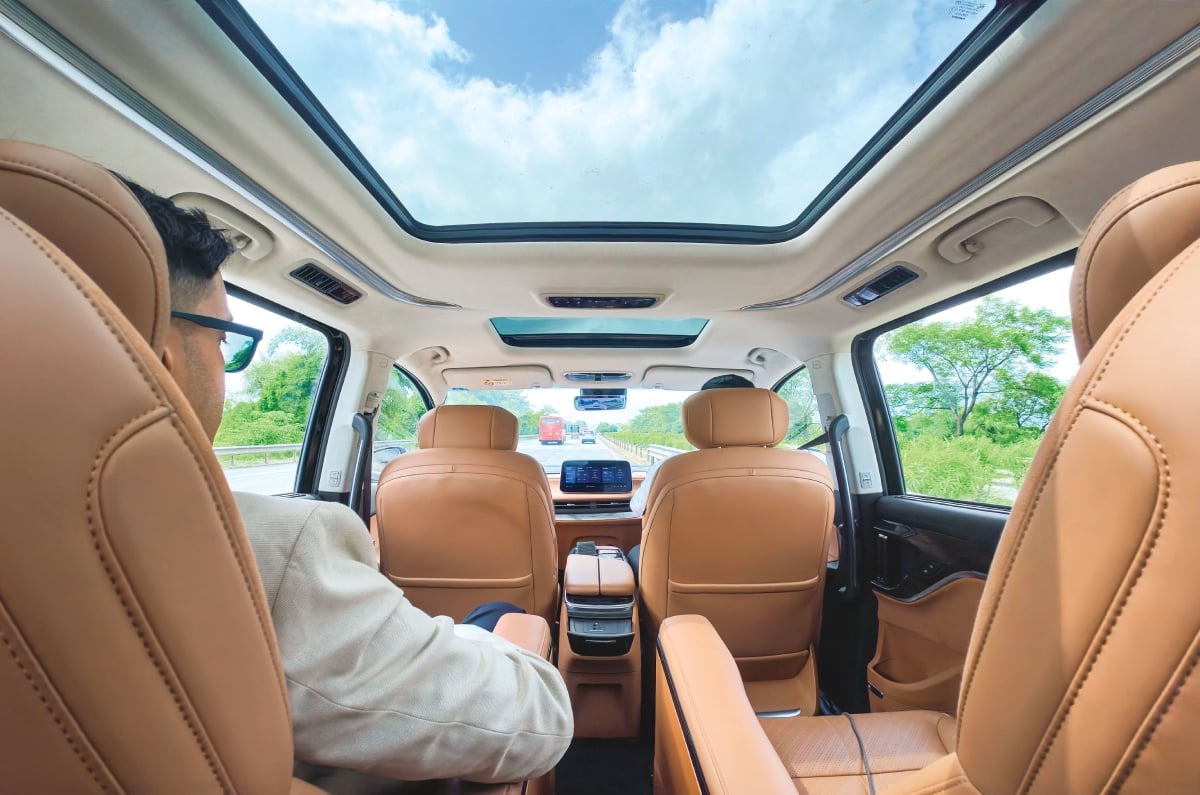
The dedicated second-row climate zone means passengers can set the temperature to their liking, while 64-colour ambient lighting allows the atmosphere to be changed from bright and functional to subdued and relaxing. The panoramic, yacht-style dual sunroof adds another layer to the sense of space, bringing natural light into what already feels more like a lounge than an MPV cabin.
The M9’s 13-speaker JBL audio system, complete with amplifier and subwoofer, takes advantage of the cabin’s excellent isolation. Even the details that are easy to overlook have been considered. There is a wireless charger, an air purifier and sunshades for the rear windows. The front seats are heated, ventilated and massaging too, while the third row gets its own air-conditioning vents and USB connectivity. This is a seven-seater, after all, and the M9 doesn’t treat the occupants furthest from the driver as an afterthought.
M9’s 12.3-inch central screen is loaded with useful functions and can even fully recline the second-row seats.
But it is the Presidential second row that defines the M9. And as the journey progresses, its importance becomes increasingly apparent. Mumbai’s roads aren’t always smooth. There are bumps, undulations, and speed breakers that arrive with little warning. Yet the M9’s suspension works quietly underneath, muffling sharper edges and keeping the cabin composed.
That refinement is complemented by the electric powertrain. A 90kWh NMC battery feeds a front-mounted motor producing 245hp and 350Nm, with a claimed range of 548km. But for those in the back, the more important numbers are the ones that don’t appear on a specification sheet: how little noise enters the cabin, how smoothly the M9 gathers speed and how rarely the occupants are reminded of the machinery doing the work.
Seat massage and adjustment controls are neatly built into second-row armrests.
As Mumbai’s traffic thins out, the road begins to wind through the green, mist-covered hills approaching Karjat, and the monsoon transforms the landscape into a succession of views worth looking at.
The M9 takes the inherent practicality and space of an MPV and reorganises them around the passenger. Its Presidential second row isn’t simply a collection of luxury features; it is the point around which the entire vehicle’s character revolves.
And the response has been encouraging. The M9 has found more than 2,500 buyers in less than a year, the surest sign that the idea of luxury is changing. It is becoming less about arriving with a sense of occasion and more about making the journey itself feel effortless.
Because when someone else is worrying about the road, the greatest luxury isn’t necessarily having somewhere better to go. It is having the time – and the space – to enjoy getting there.
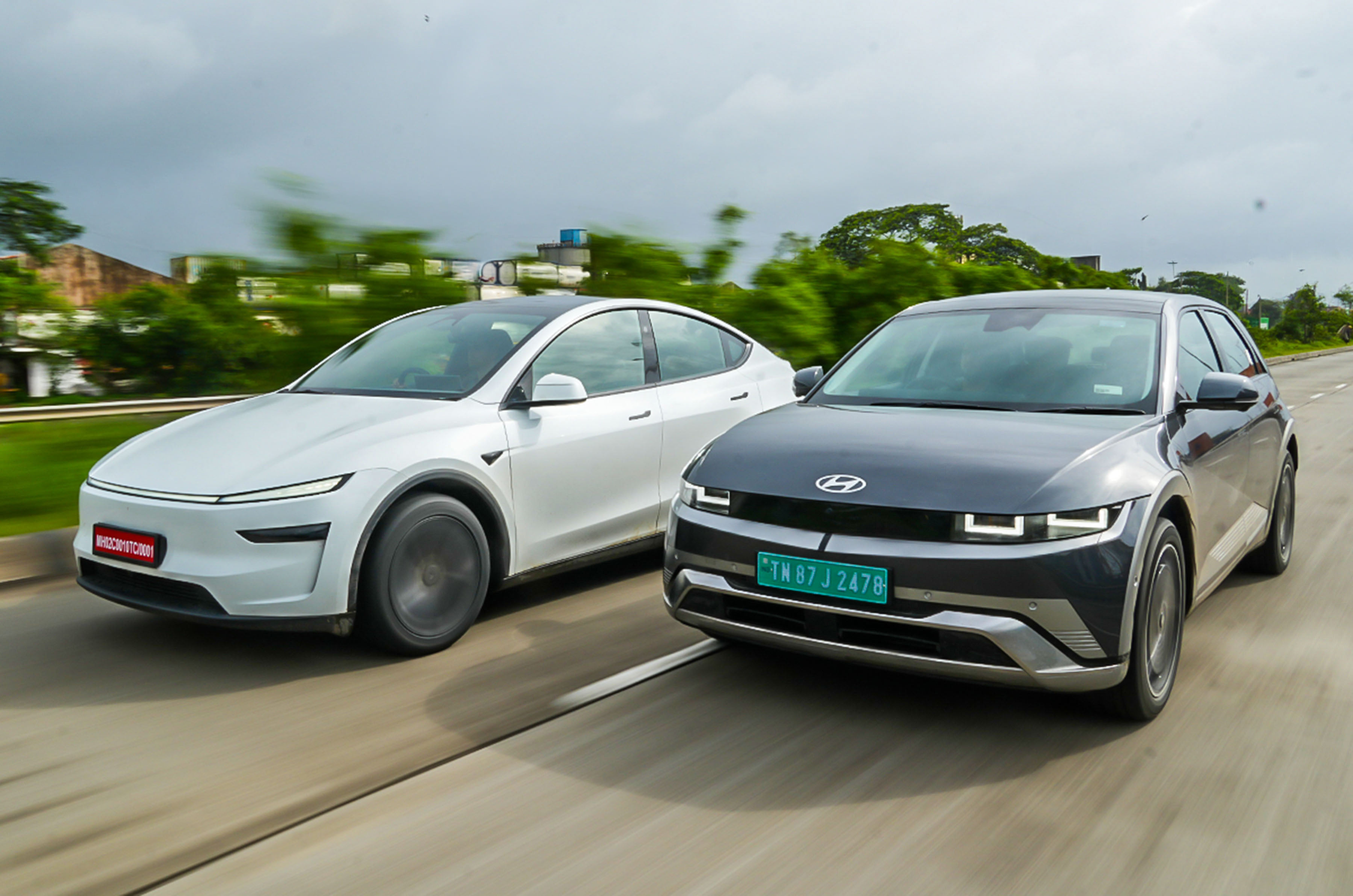
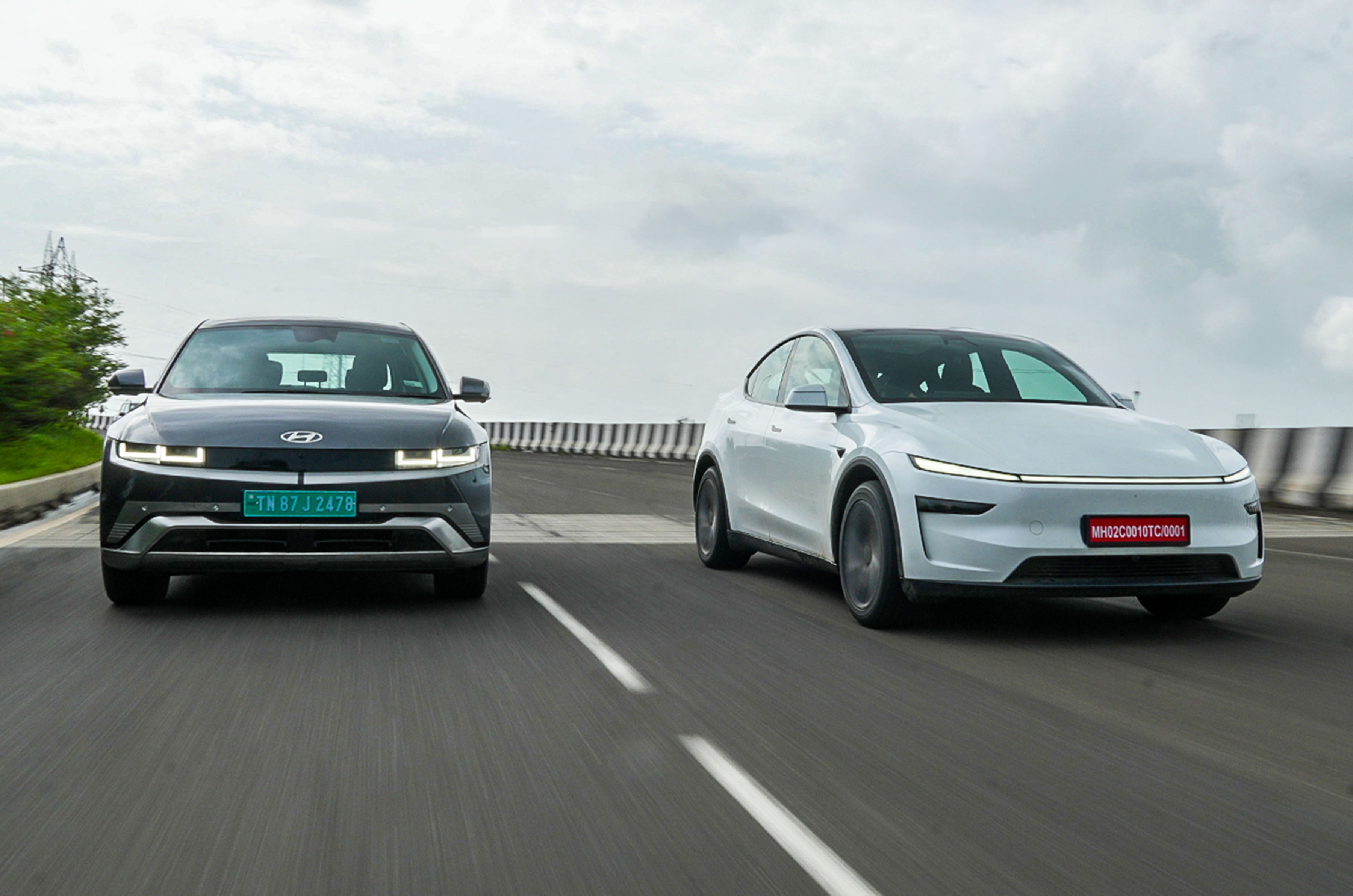
The Hyundai Ioniq 5 has been one of the standout EVs of recent years, so much so that we crowned it our 2024 Car of the Year. Back then, besides being one of the most impressive electric cars on sale, it was also among the most affordable in its segment. And when compared with rivals like the BYD Sealion 7 and BMW iX1, the Ioniq 5 came out on top thanks to its comfort, practicality and value.
Fast forward to 2026, and the landscape has changed. Hyundai has updated the Ioniq 5, and the biggest talking point is its larger 84kWh battery. But in the process, this value-focused EV has become one of the most expensive options available.
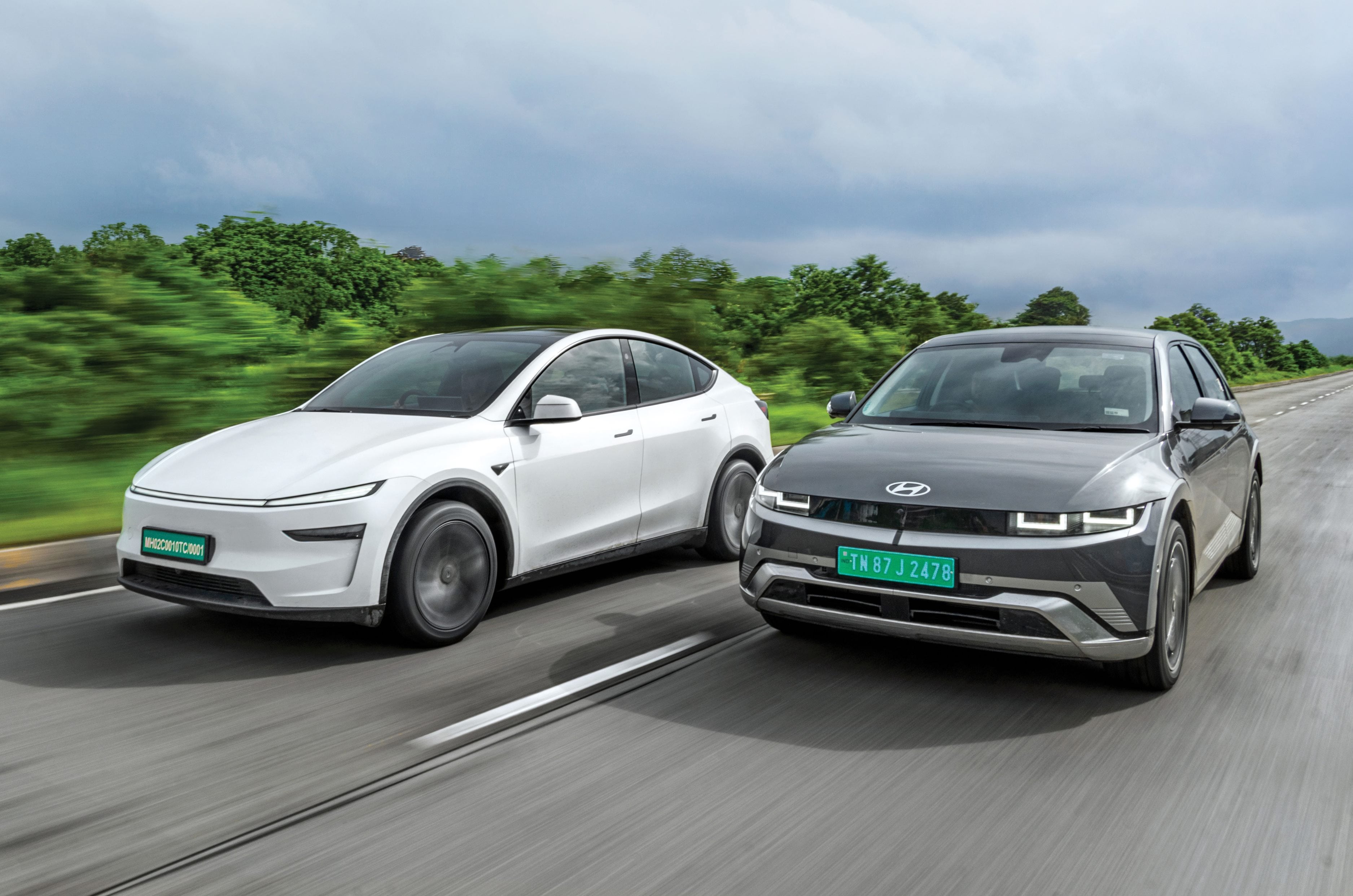
Tesla, meanwhile, has dropped prices. The Model Y now starts at just under Rs 51 lakh, undercutting the Ioniq 5 and transforming itself from one of the pricier alternatives into the more affordable option. With the pricing hierarchy flipped, this comparison has become more interesting than ever.
Tesla Model Y vs Hyundai Ioniq 5: Exterior design
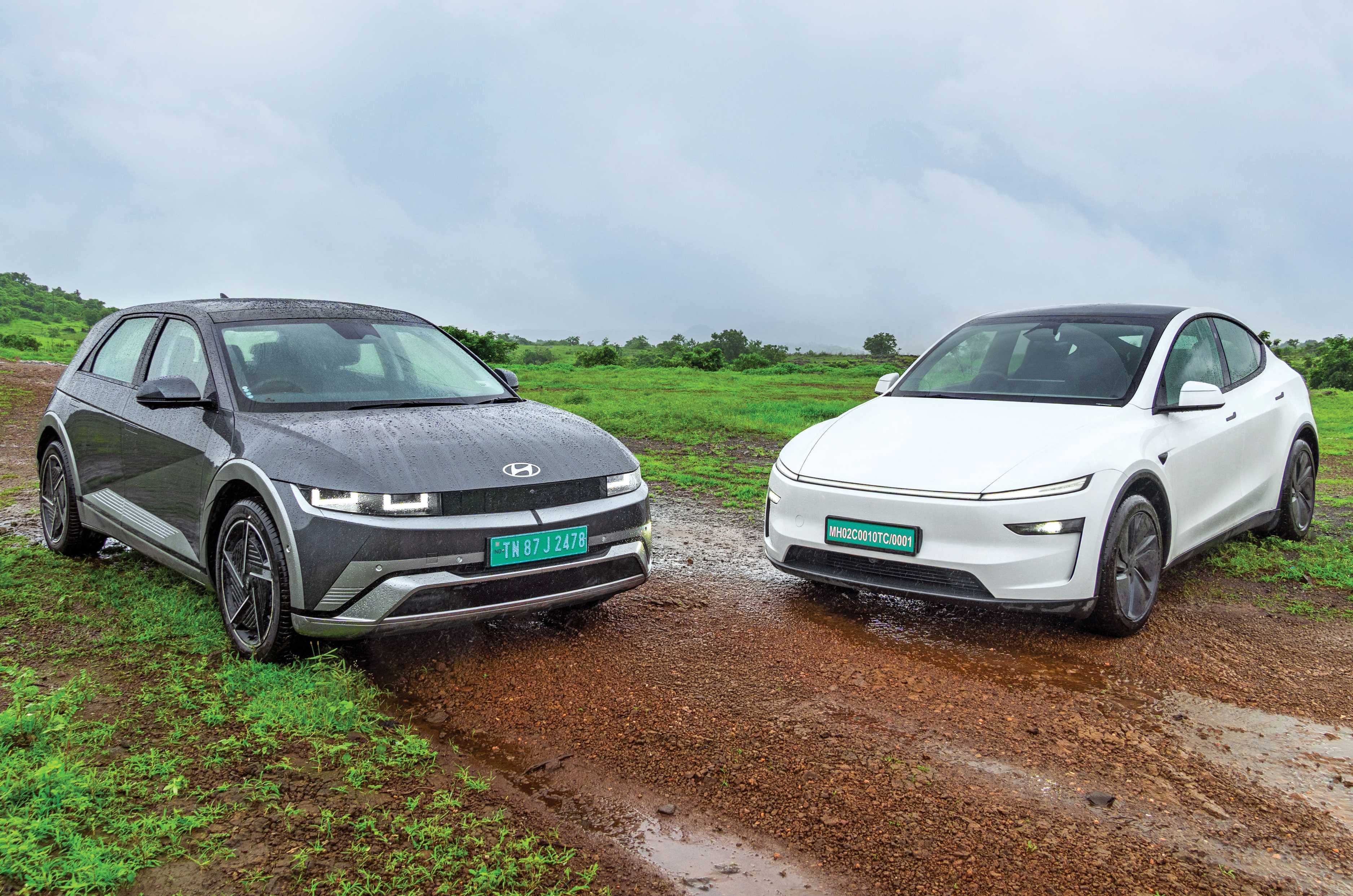
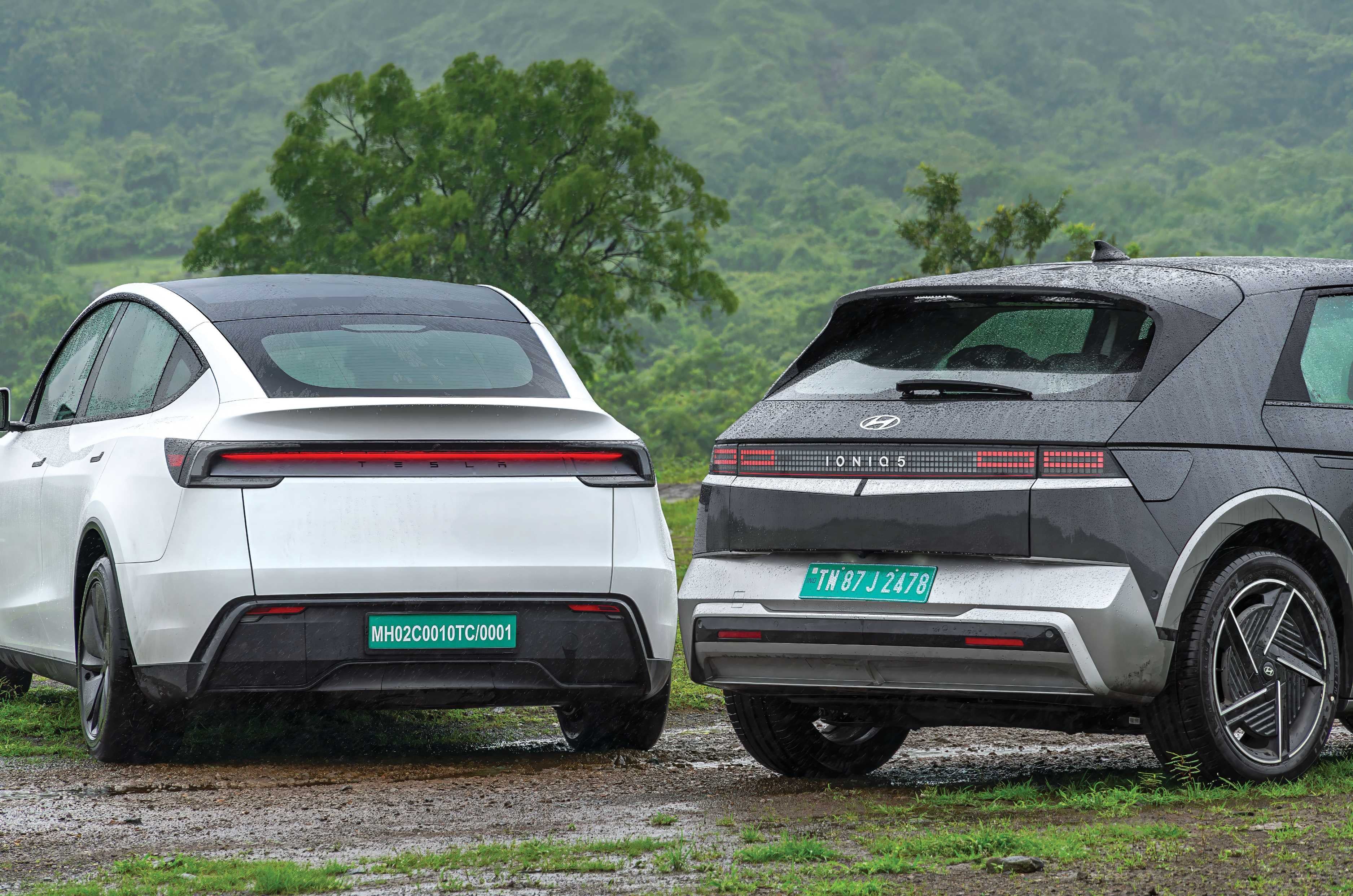
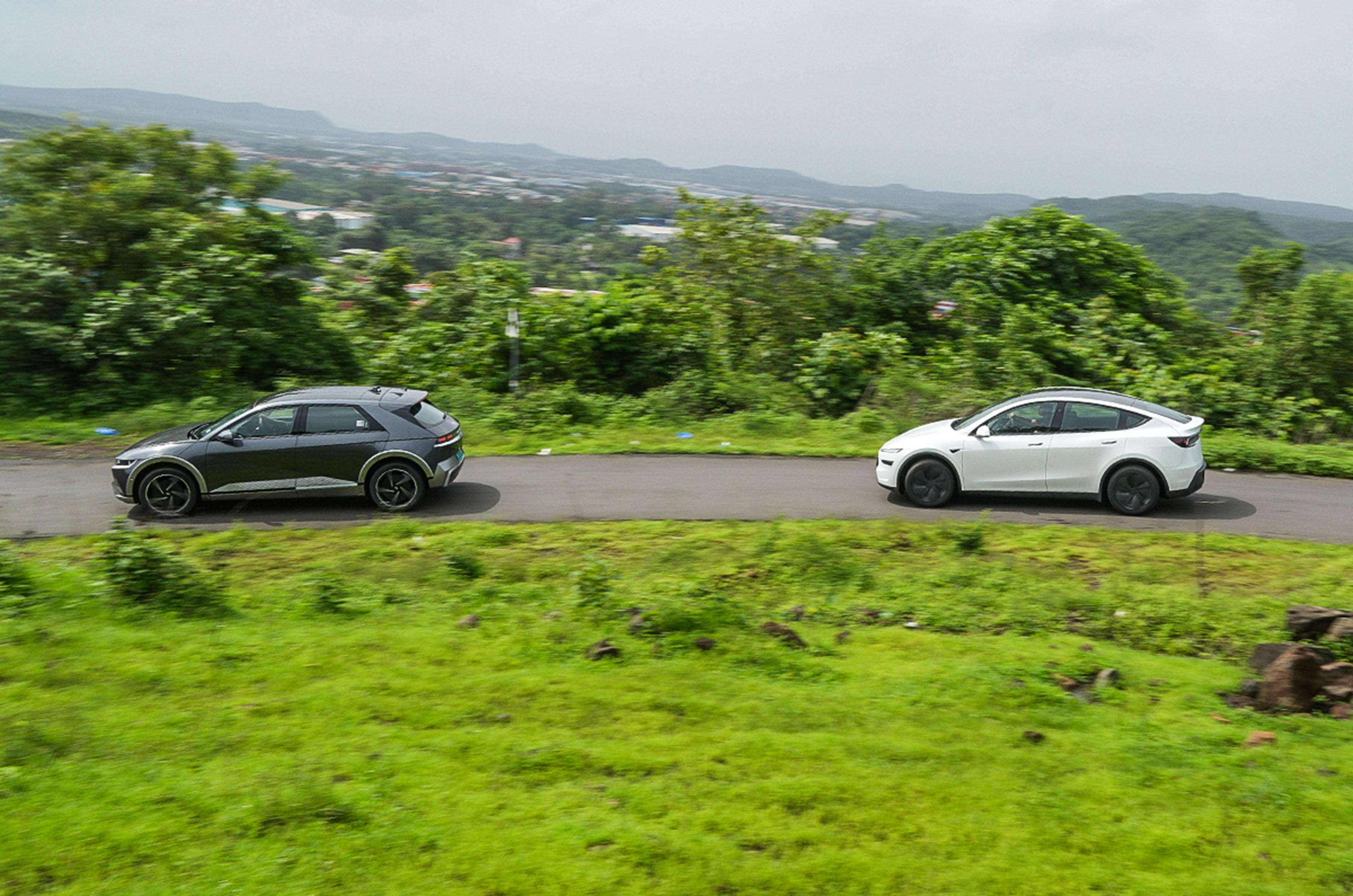
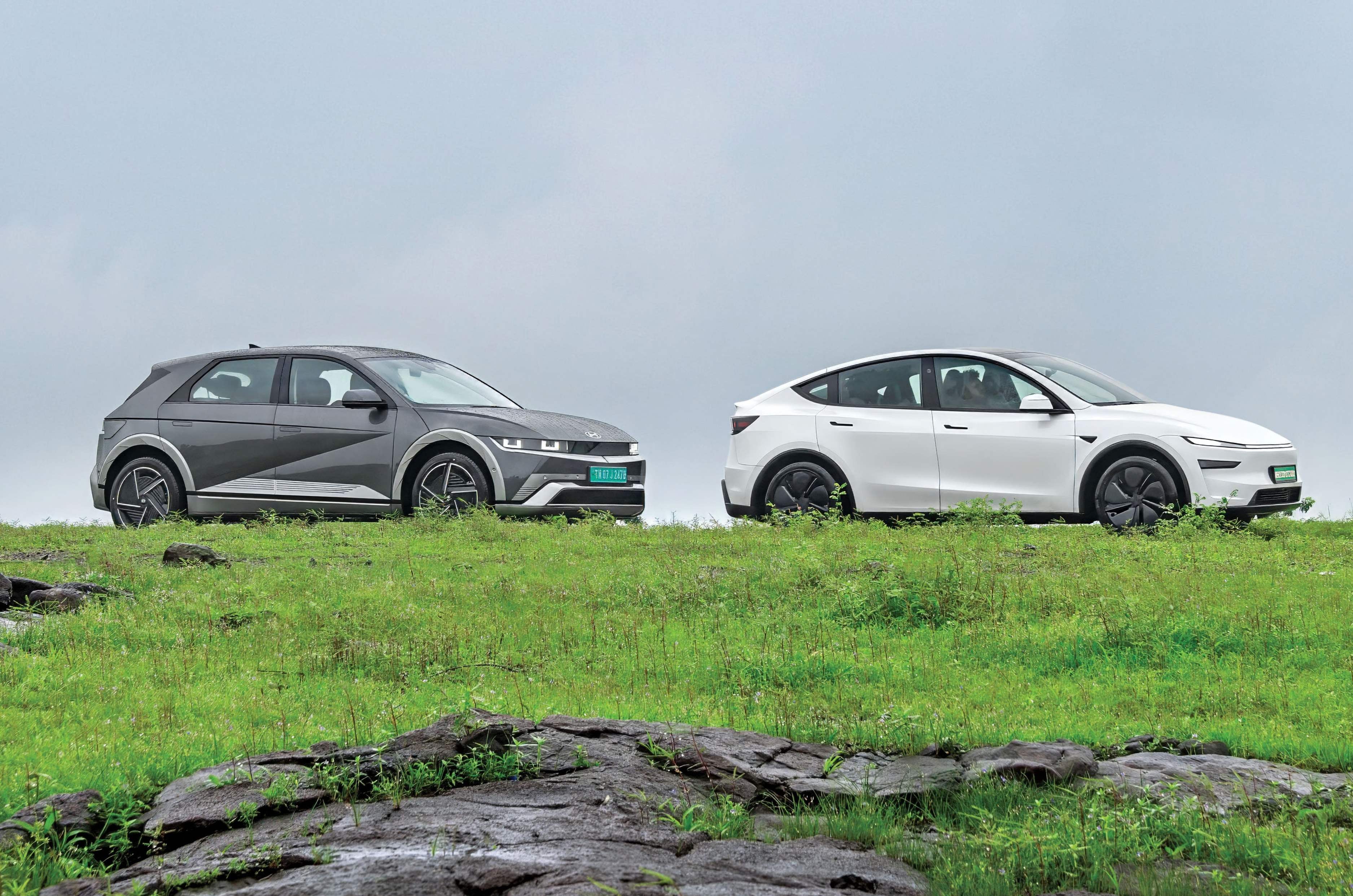
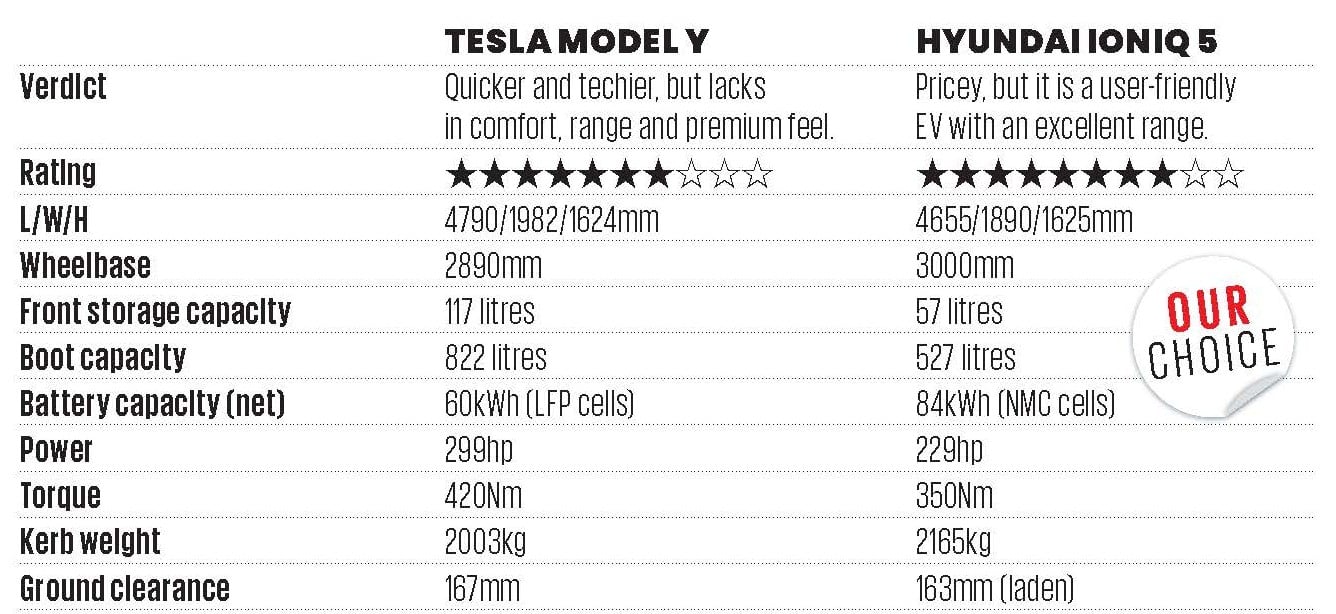
The Tesla Model Y is the larger vehicle overall, although the Hyundai counters with a longer wheelbase. Neither car follows a traditional SUV or sedan template, with muscular proportions and aggressive styling, but the Ioniq 5 stands out with its retro-futuristic design language, blending hatchback and crossover cues into a shape that is both distinctive and characterful. That said, its styling will continue to divide opinion.
The Tesla, by comparison, plays it a little safer. It too wears a crossover body style, but with a minimalist design that is unlikely to offend anyone. Frameless windows and a unique tail-lamp treatment with a hidden light bar add some flair to its otherwise fuss-free styling.
It’s worth noting that Tesla lists ground clearance at 167mm (unladen), while the Ioniq’s figure is specified as laden, coming in at 163mm. In the real world, the Tesla occasionally scrapes over unusually large speed breakers, while the Hyundai clears most of them despite its longer wheelbase.
Tesla Model Y vs Hyundai Ioniq 5: Interior and features
Takes minimalism to a whole different level, with merely a handful of physical controls. Lack of design elements, vegan materials don’t feel special.
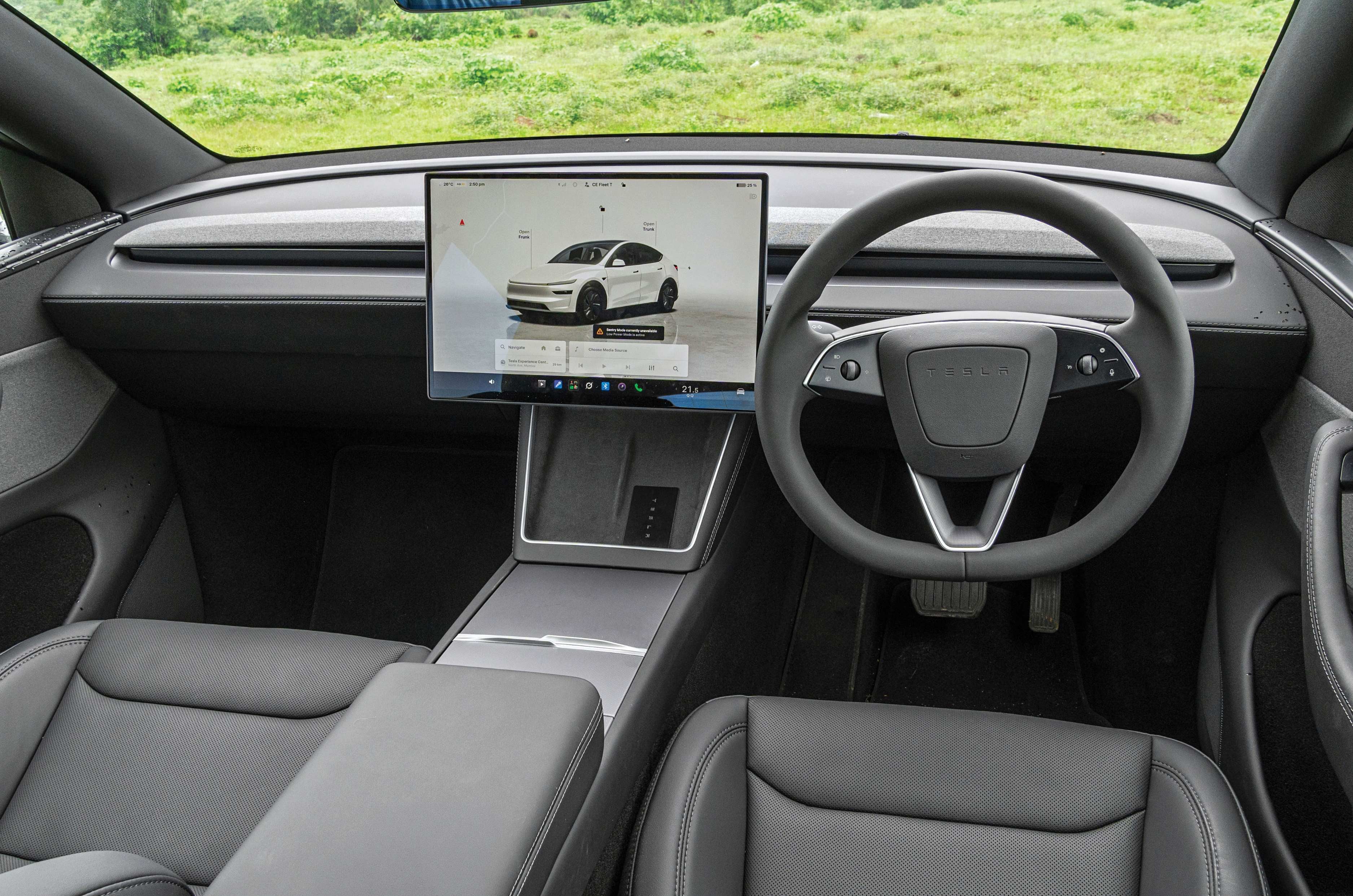
Tesla’s non-motorised flush door handles remain a usability frustration, requiring an awkward push-and-pull action to operate. On the inside, the Model Y’s cabin embraces minimalism to an even greater extent. Even the air vents are hidden. The lack of design elements looks clean, but this and the choice of materials diminish the sense of occasion one expects at this price point.
All functions are relegated to its slick screen.
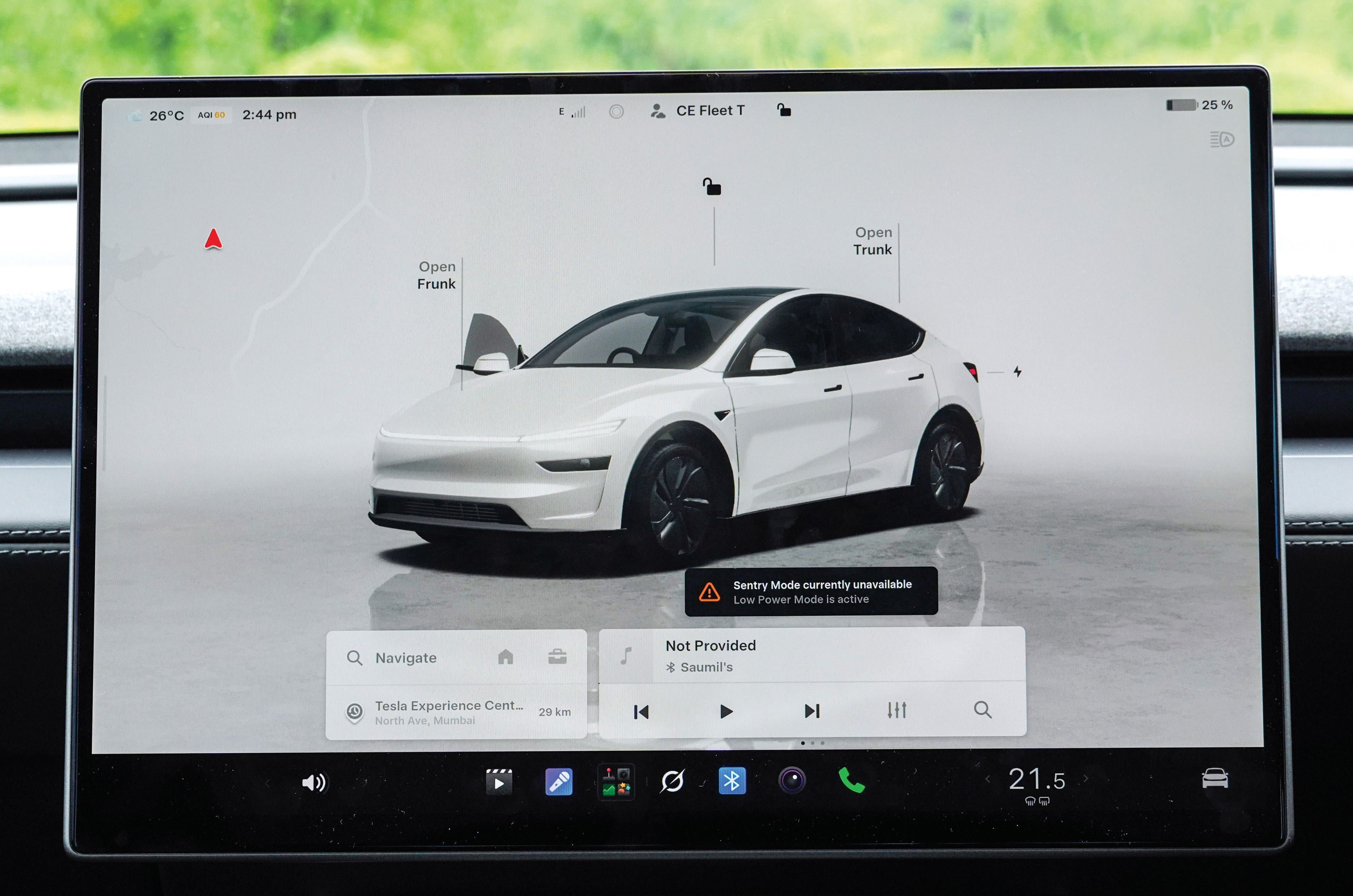
Taking centre stage, quite literally, is a massive touchscreen. Nearly every function is controlled via the screen, including controls for the frunk, tailgate, glovebox, climate control, seats and steering, and mirror adjustments, among many others. This over-reliance on the touchscreen is daunting at first, but Tesla’s software experience is exceptional. The interface remains the benchmark for responsiveness, fluidity and overall usability.
The steering wheel features multi-function controls that take some time to get accustomed to. The high-beam flasher is integrated into the steering wheel too. Thankfully, the indicators and power-window switches remain physical controls. The lack of buttons might seem futuristic, but it often feels as though technology has taken precedence over usability. There are two charging pads, and below them sits an unusually bulky centre console that robs the cabin of some of its sense of space. Hampering usability further is the exceptionally deep storage area, which requires you to stretch to reach items placed inside.
Albeit a bit low-set, this space feels airy thanks to its low window line.
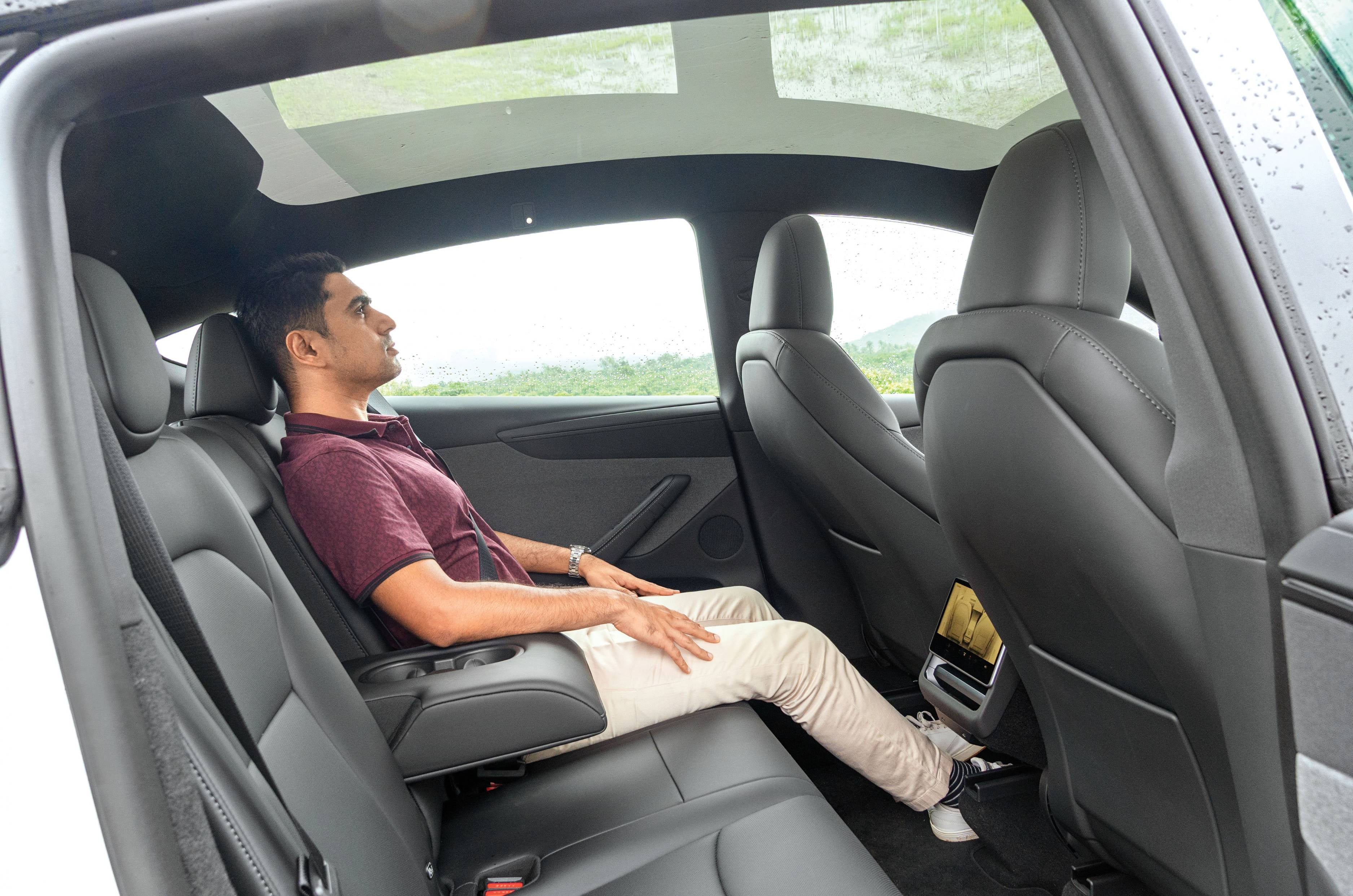
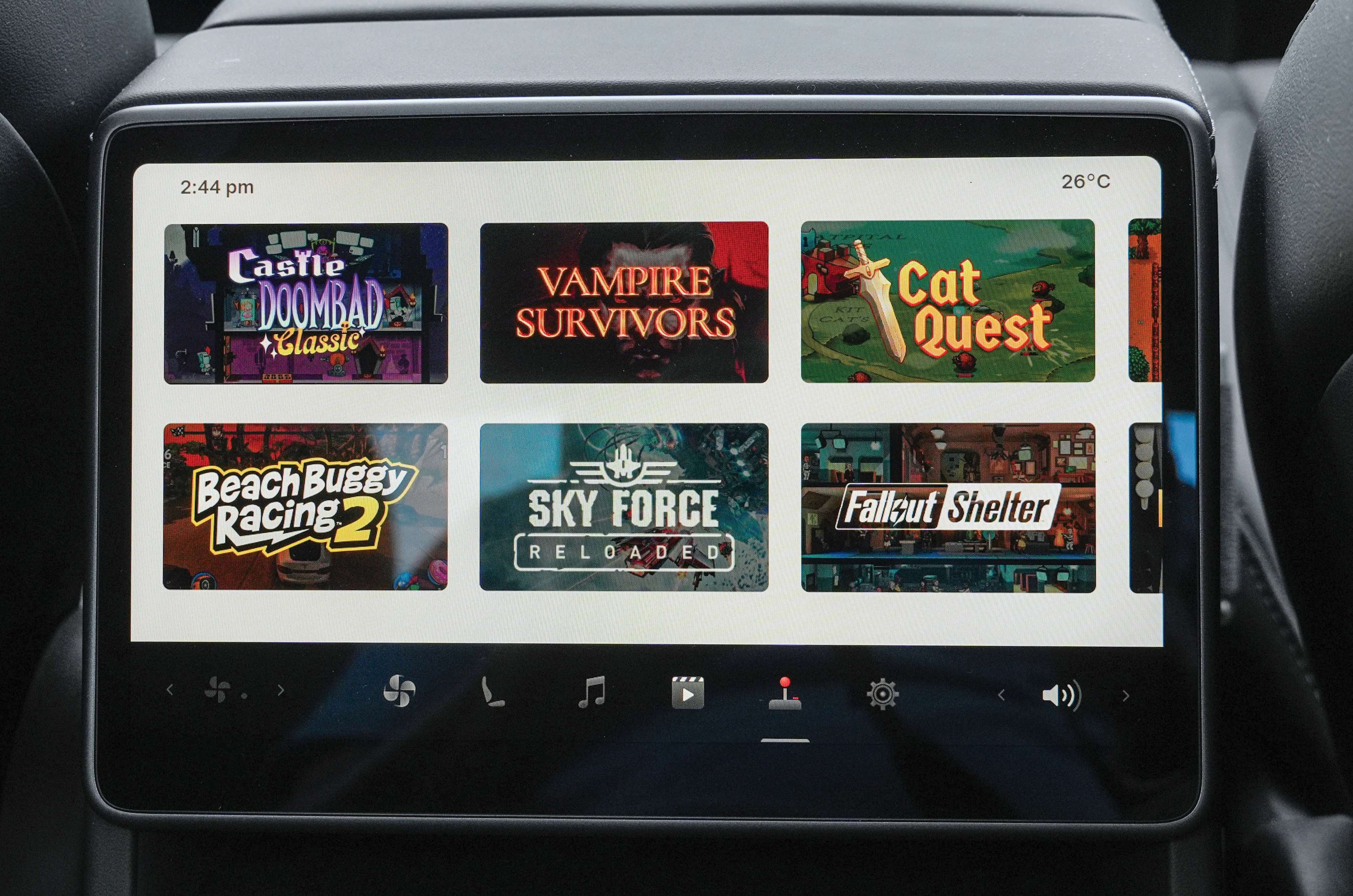
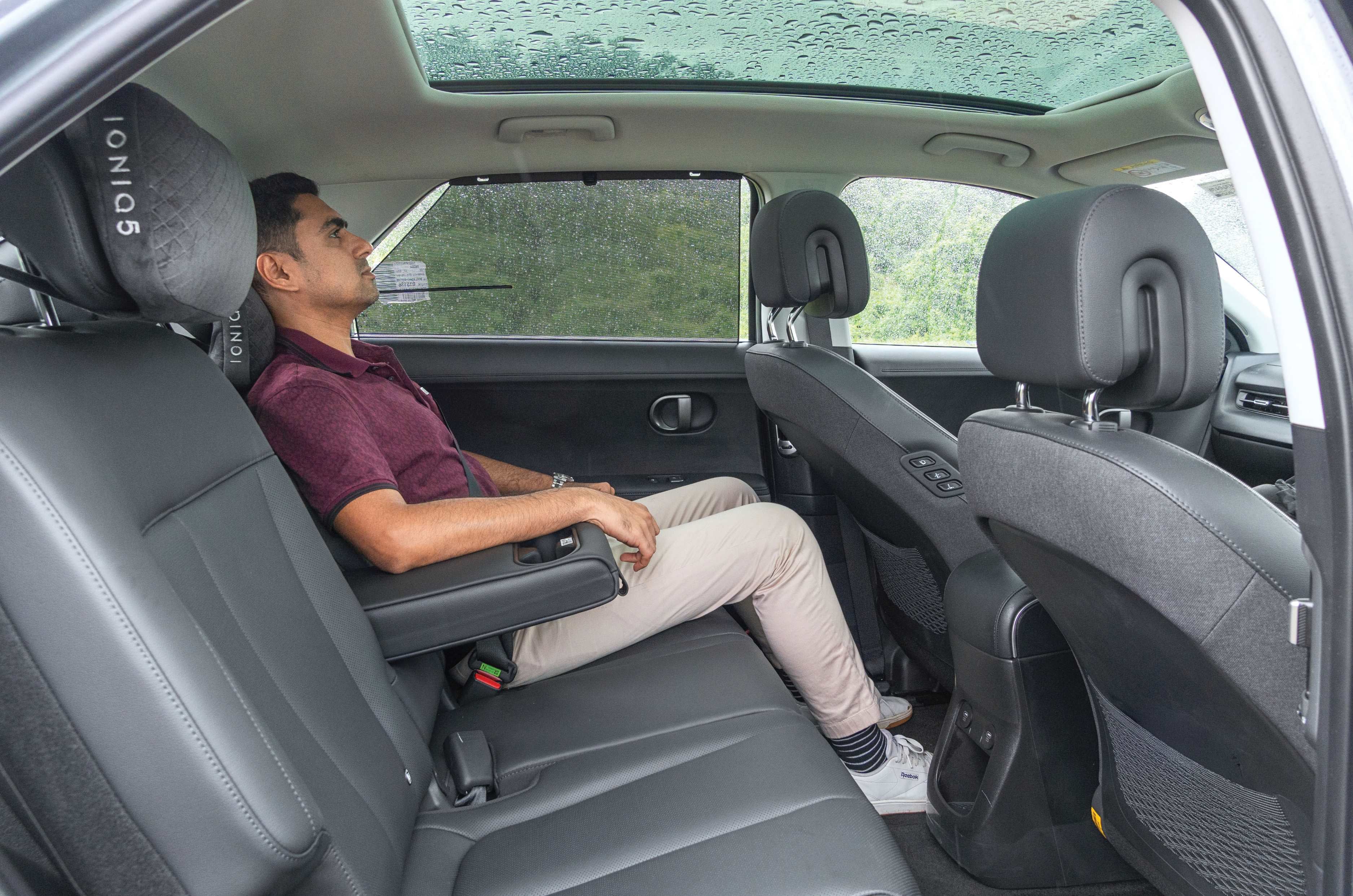
The front seats look simple and are surprisingly comfortable, with heating and ventilation functions. The rear seat is equally comfortable, although the seating position is somewhat low, resulting in a knees-up posture. What’s nice is that the backrest reclines to a comfortable angle. Rear-seat passengers are also treated to a dedicated touchscreen capable of controlling climate functions, streaming content and even gaming.
Rear screen for controls, games and videos.
One major drawback is that the sunroof still lacks a dedicated sunshade, causing the cabin to heat up considerably under the afternoon sun. The rear windows also miss out on sunshades.
More suited to our conditions, the black interiors are well-finished. It gets full marks as far as storage, ergonomics and usability goes.
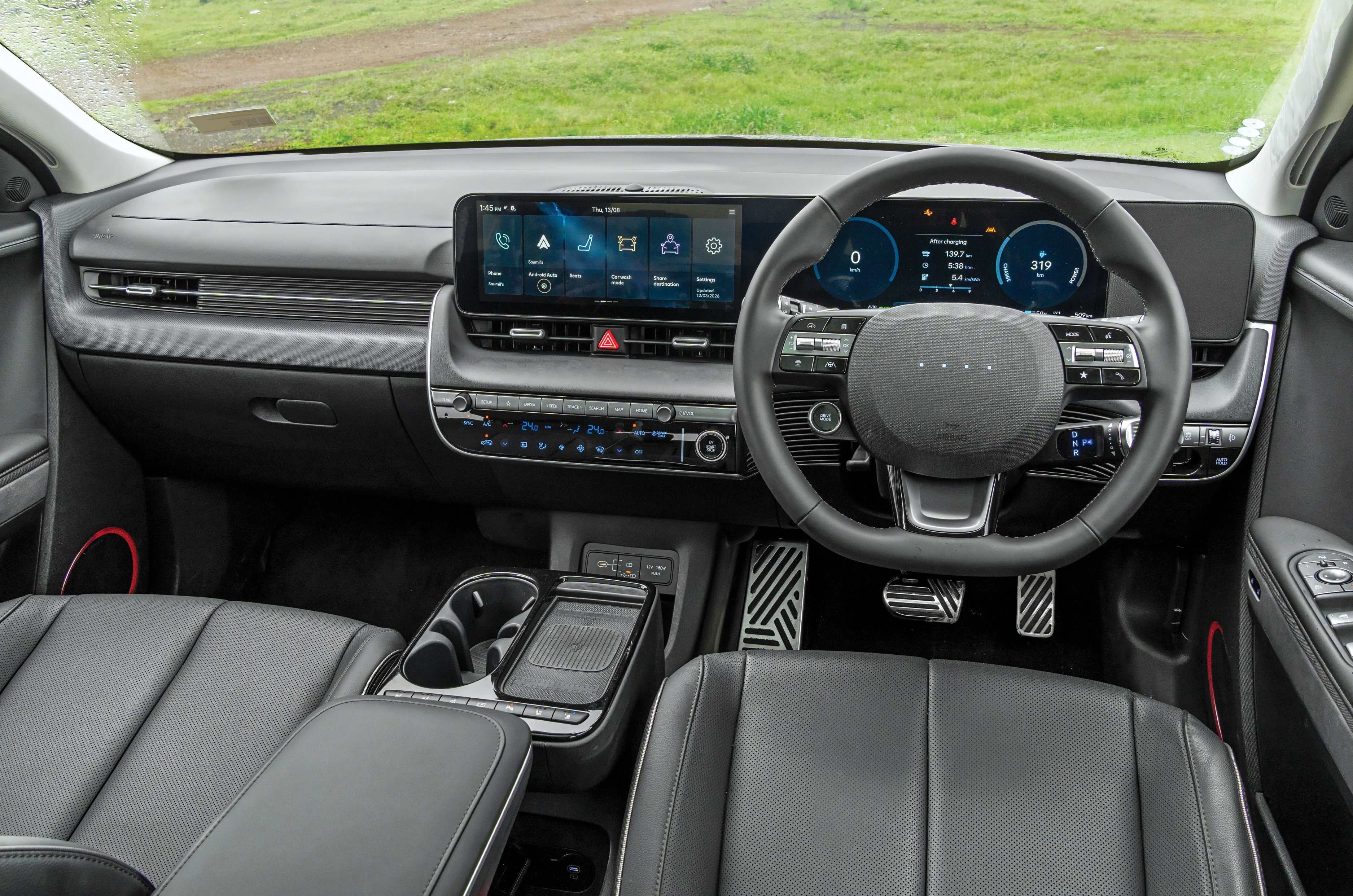
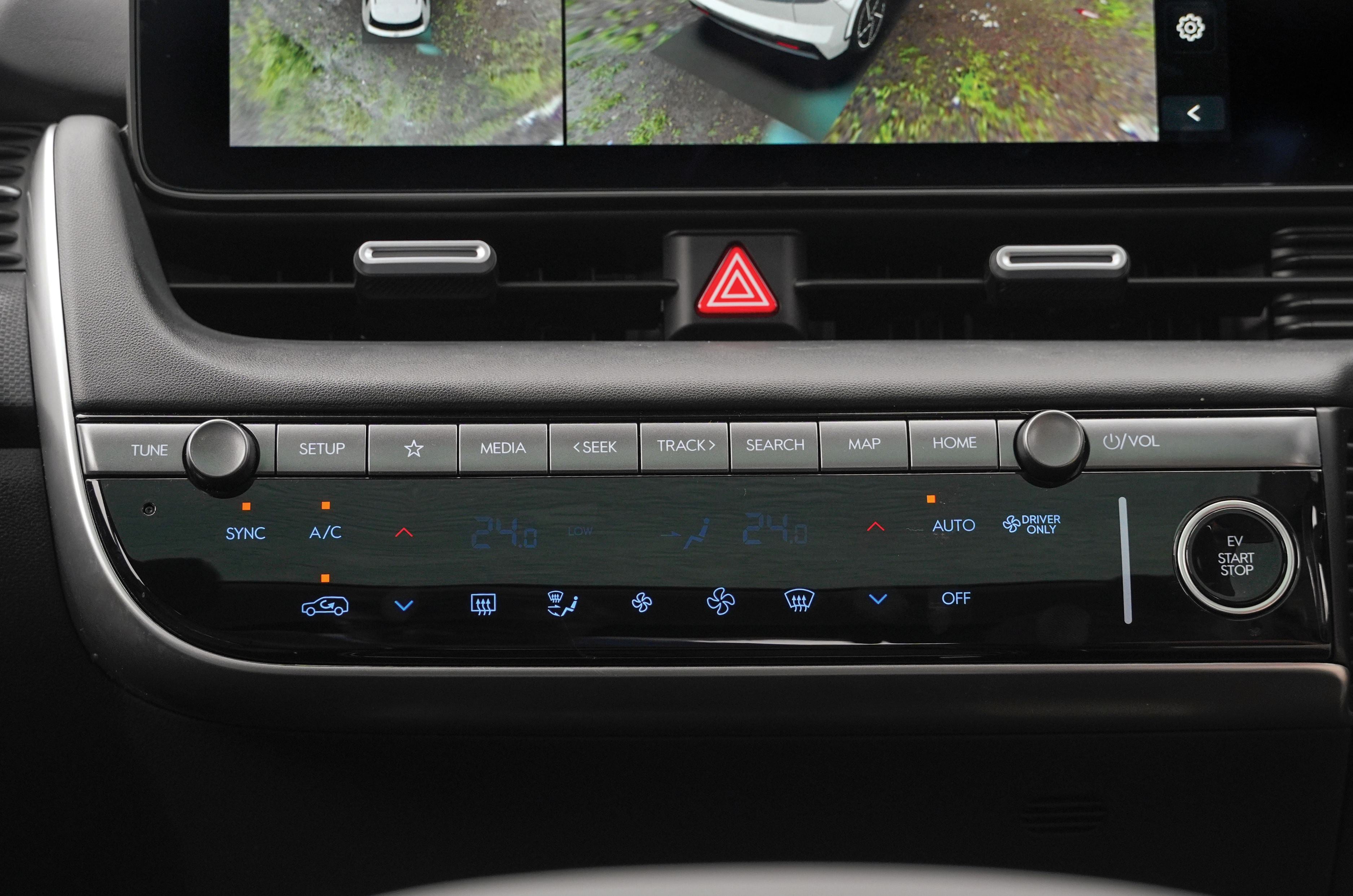
The Ioniq 5’s interior takes a more balanced, user-friendly approach. Not only does it get motorised pop-out door handles, but its cabin also combines touch-sensitive controls with physical buttons and knobs, creating an environment that feels intuitive from the moment you step in.
Thankfully, it retains physical controls.
Material quality is impressive, and where the Hyundai truly excels is in comfort and practicality. Storage areas are thoughtfully integrated throughout the cabin, and the sense of space is outstanding, making the Ioniq 5 particularly easy to live with.
Slide, recline, boss function and sunshades mean a better rear experience.
The front seats are broader and more comfortable, with extensive adjustment, including an ottoman-style leg support. Both front seats can be set up in a ‘zero-gravity’ position, where your back is reclined and legs lifted on the ottoman, making it very comfy. Plus, you can have the seats cooled or heated too, which adds to the relaxing experience. Rear-seat comfort is equally impressive, thanks to a bench that both slides and reclines. While it doesn’t get a dedicated rear screen like the Tesla, it does offer window sunshades and a 3-pin socket to power larger electronic devices.
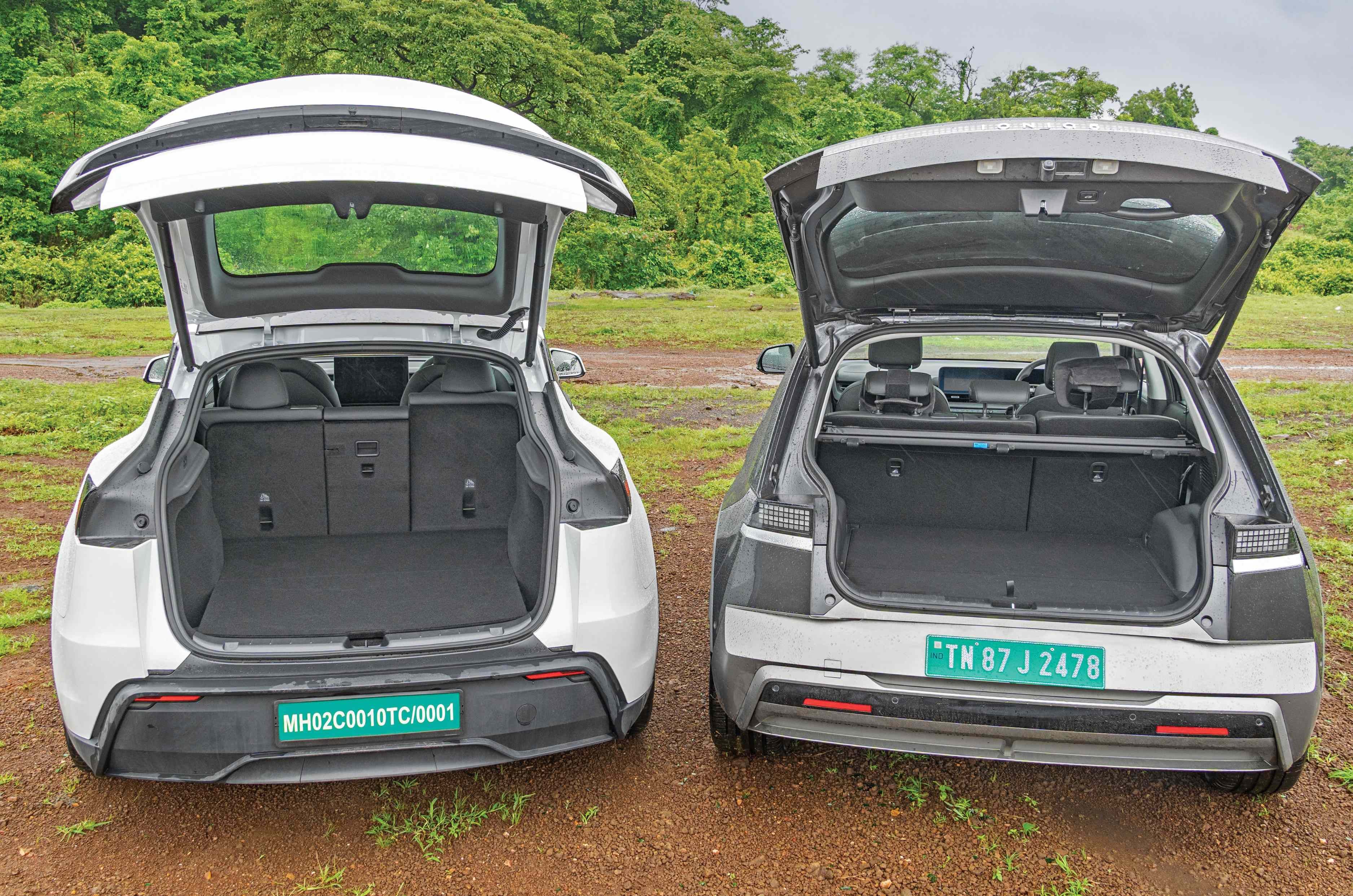
Along with a larger boot, the Tesla gets substantial underfloor storage.
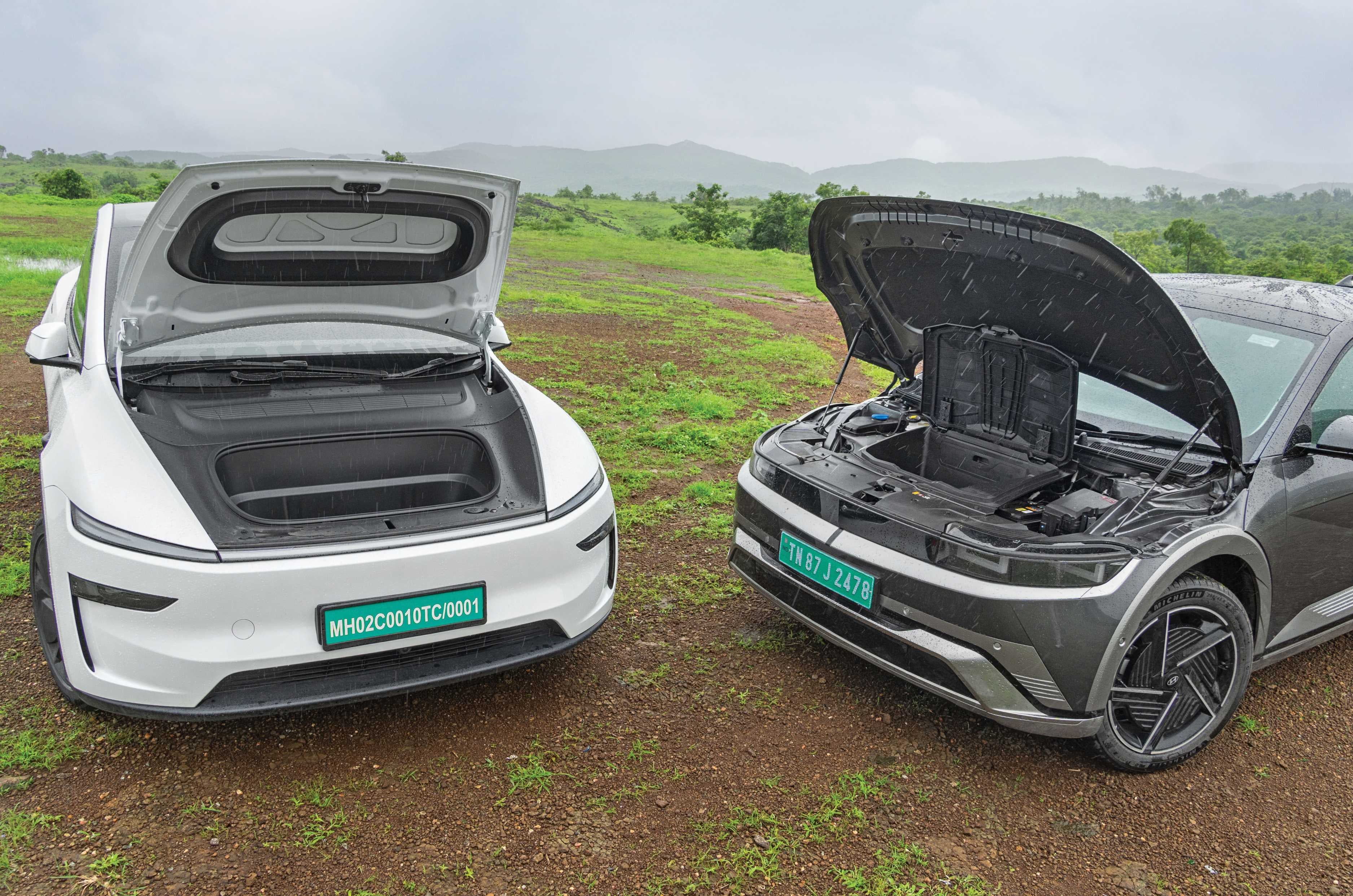
The Tesla regains some lost ground when it comes to luggage-carrying capacity. Its front luggage compartment is broader and deeper than the Ioniq’s, and its boot is more spacious too. Additionally, it offers even more storage space beneath the boot floor. The Ioniq 5, on the other hand, not only falls a bit short in outright boot capacity, but also has a relatively higher loading lip, making it slightly more challenging to load heavy luggage.
The Model Y has a deeper and wider front-loading area than the Hyundai.
Tesla Model Y vs Hyundai Ioniq 5: Powertrain and performance
Hyundai has increased the battery size from 72.6kWh to 84kWh (gross capacity) while continuing to use Nickel Manganese Cobalt (NMC) cell chemistry. This feeds a 229hp/350Nm rear-mounted motor, which is 12hp more than before. However, the larger battery has pushed kerb weight up to 2,165kg, which is 150kg more than the outgoing version.
In contrast, the Model Y uses a 64kWh (gross capacity) battery with Lithium Ferrous Phosphate (LFP) cell chemistry, powering a 299hp/420Nm rear-mounted electric motor. While it is significantly more powerful, the Tesla is also 162kg lighter. As a result, its performance feels considerably stronger. It feels quicker off the line, accelerates harder and responds more eagerly to throttle inputs than the Hyundai.
Tesla keeps things simple with just two drive modes: Standard and Chill, the latter serving as an economy setting. Impressively, Chill mode remains highly usable and, despite being toned down, still accelerates as strongly as the Hyundai in its sportiest setting.
Tesla Model Y vs Hyundai Ioniq 5: Acceleration test (in seconds)
Tesla Model Y
Hyundai Ioniq 5
20kph
1.29
1.31
40kph
2.33
2.66
60kph
3.48
4.05
80kph
4.69
5.71
100kph
6.19
7.97
120kph
8.23
10.83
140kph
10.78
14.63
160kph
14
20.27
To put its performance into perspective, the Model Y accelerates from 0-100kph in just 6.19 seconds in Standard mode and reaches its 203kph top speed in roughly 25 seconds. Even in Chill mode, it completes the 0-100kph run in a respectable 8.25 seconds, just 0.28 seconds slower than the Ioniq 5. More interestingly, the Tesla reaches 160kph in 18.58 seconds, making it 1.6 seconds quicker to the mark.
Tesla Model Y vs Hyundai Ioniq 5: Regenerative braking distance (80-20kph)
Tesla Model Y
Hyundai Ioniq 5
Strongest
116.71m (Standard)
136.45m (i-Pedal)
Weakest
223.55m (Reduced)
391.50m (Level 1)
In the Model Y, regenerative braking has just two modes – Standard and Reduced – and the retardation is seamless, though quite strong when you lift off the accelerator. Notably, Standard mode generates stronger deceleration than the Ioniq 5 in its most aggressive single-pedal setting. And while both cars support true one-pedal driving, the Tesla’s implementation feels more natural and intuitive. The Ioniq, though, with its multiple levels, can be set up to have retardation feel more ICE-like and thus very familiar.
Turning our attention to the Hyundai Ioniq 5, it may not dominate traffic-light drag races, but the good news is that power delivery is exceptionally smooth, and the overall driving experience feels highly refined. It offers multiple drive modes that alter part-throttle responses, steering feel and brake-pedal feel, although outright acceleration remains largely unchanged between them.
In general, the Ioniq 5’s cabin feels slightly more hushed than the Model Y’s, with a quieter motor and lower levels of road and tyre noise. Notably, though, the Tesla’s frontal sound insulation is exceptional – from inside the cabin, you would swear its horn is rather meek, but we assure you, that isn’t the case.
Tesla Model Y vs Hyundai Ioniq 5: Ride and handling
The Model Y is quicker, but the Ioniq 5 betters it on range and fast-charging speed.
On the move, the Model Y inspires confidence. High-speed stability is excellent, and it changes direction with greater eagerness compared to the Ioniq. The small-diameter steering wheel offers different weight settings, but even its lightest mode feels substantial; it isn’t that light, one-finger-twirl setup and does come across as heavy. Ride comfort also doesn’t feel particularly plush. The suspension is quite firm and thuds noticeably over potholes and broken surfaces, making it less suited to rough Indian roads.
The Ioniq 5 takes a different approach. It feels far more comfortable and user-friendly, thanks to lighter steering and a softer suspension that, despite its 20-inch alloy wheels, absorbs road imperfections with much greater composure than the Tesla. The result is a more relaxed and comfortable driving experience. Sure, it doesn’t feel as sporty while changing direction and can feel a touch floaty at higher speeds, but that is a compromise many buyers will gladly accept for its low-speed pliancy and overall comfort.
Tesla Model Y vs Hyundai Ioniq 5: Range and efficiency
For our real-world range test, we ran the Hyundai Ioniq 5 in Eco mode and the Model Y in Chill mode, with the former’s regenerative braking set to Level 2 in the city and Level 1 on the highway, and the latter’s set to Standard in the city and Reduced on the highway.
As far as efficiency goes, the Ioniq 5 was more efficient in the city, delivering 6.22km/kWh, while the Model Y managed 5.84km/kWh. On the highway, the Tesla’s superior aerodynamics yielded 6.52km/kWh, whereas the Ioniq 5 managed 5.71km/kWh. However, thanks to Hyundai’s substantially larger battery, its overall average range extrapolates to 501km, comfortably ahead of the Tesla’s 371km.
Tesla Model Y vs Hyundai Ioniq 5: Real-world range and efficiency
Tesla Model Y
Hyundai Ioniq 5
Claimed range
500km
690km
City range
350km
523km
City efficiency
5.84km/kWh
6.22km/kWh
Highway range
391km
479km
Highway efficiency
6.52km/kWh
5.71km/kWh
Average range
371km
501km
Average efficiency
6.18km/kWh
5.96km/kWh
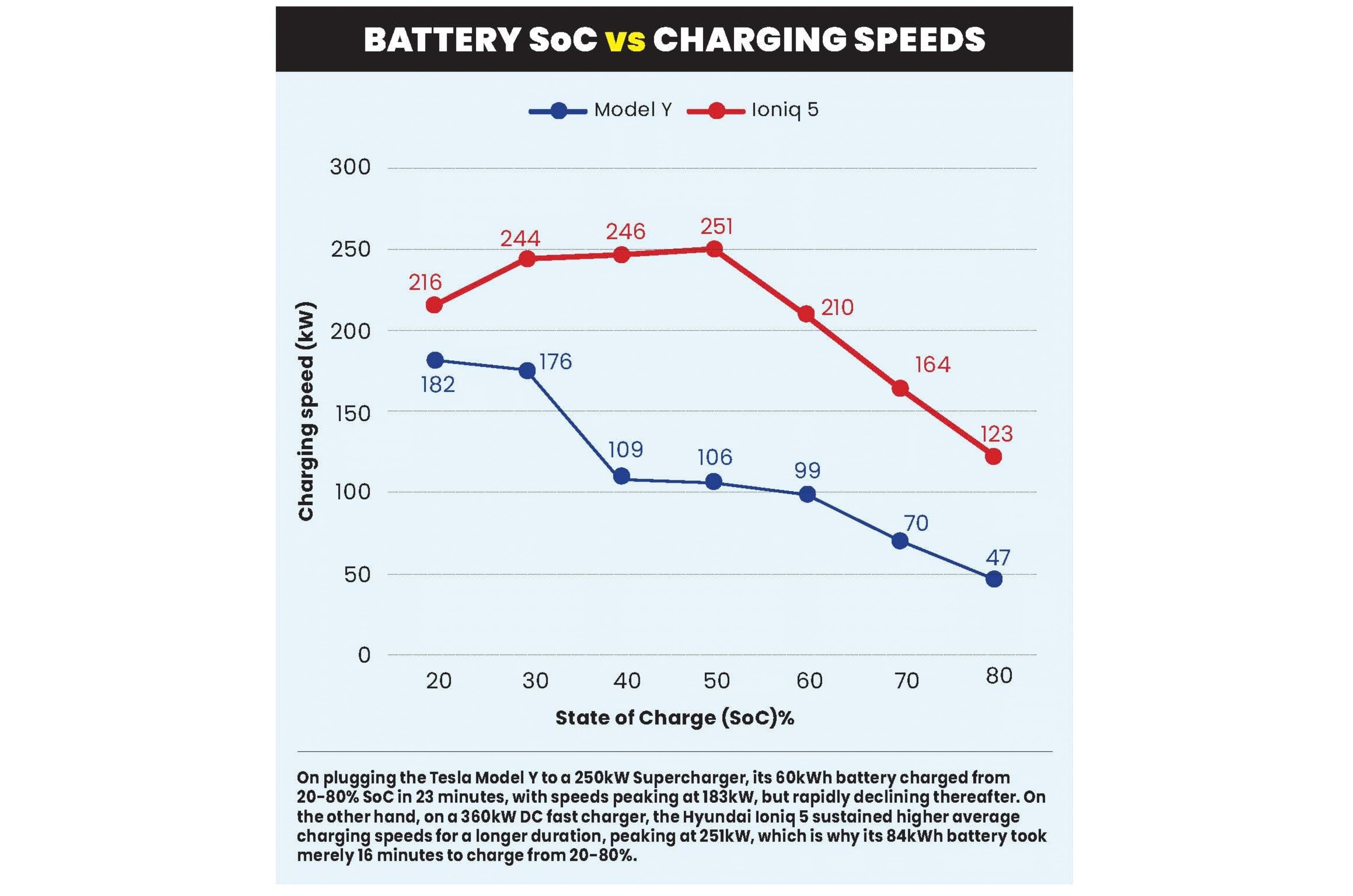
As for charging performance, we plugged the Model Y into a 250kW Tesla Supercharger, where it achieved peak charging speeds of 183kW. However, the Model Y does not sustain such high speeds for long, and its 60kWh battery is charged from 20-80 percent SoC in 23 minutes. From there, it took an additional 30 minutes to reach a full charge.
The Hyundai Ioniq 5 performs even better. Connected to a 360kW DC fast charger, its 800V electrical architecture enabled it to consistently maintain higher average charging speeds, peaking at 251kW. As a result, its 84kWh battery charged from 20-80 percent SoC in just 16 minutes. Like the Tesla, however, it required an additional 33 minutes to charge from 80 percent to full.
Tesla Model Y vs Hyundai Ioniq 5: Verdict
The Ioniq 5 no longer offers the value it once did. The Model Y, however, does.
The Tesla Model Y makes a compelling case for itself. It is quicker, more technologically advanced and backed by software that remains among the best in the automotive world. Crucially, it is now the more affordable option, making it a very tempting proposition. However, its over-reliance on the touchscreen, heavy steering, a firm low-speed ride and limited range due to the smaller battery count against it.
In comparison, the Hyundai Ioniq 5 remains the more rounded package. Its superior ride comfort, more intuitive cabin, significantly longer real-world range and impressive charging performance give it a clear edge where it matters most. More importantly, it feels better adapted to Indian roads and daily usage, thanks to its lighter steering and more comfortable ride.
At current prices, though, the Hyundai no longer holds the value card, nor does the brand command the same equity or snob value as some similarly priced rivals. But judged purely on its merits, the Hyundai Ioniq 5 continues to be the best all-round EV at this price point and thus gets our vote.
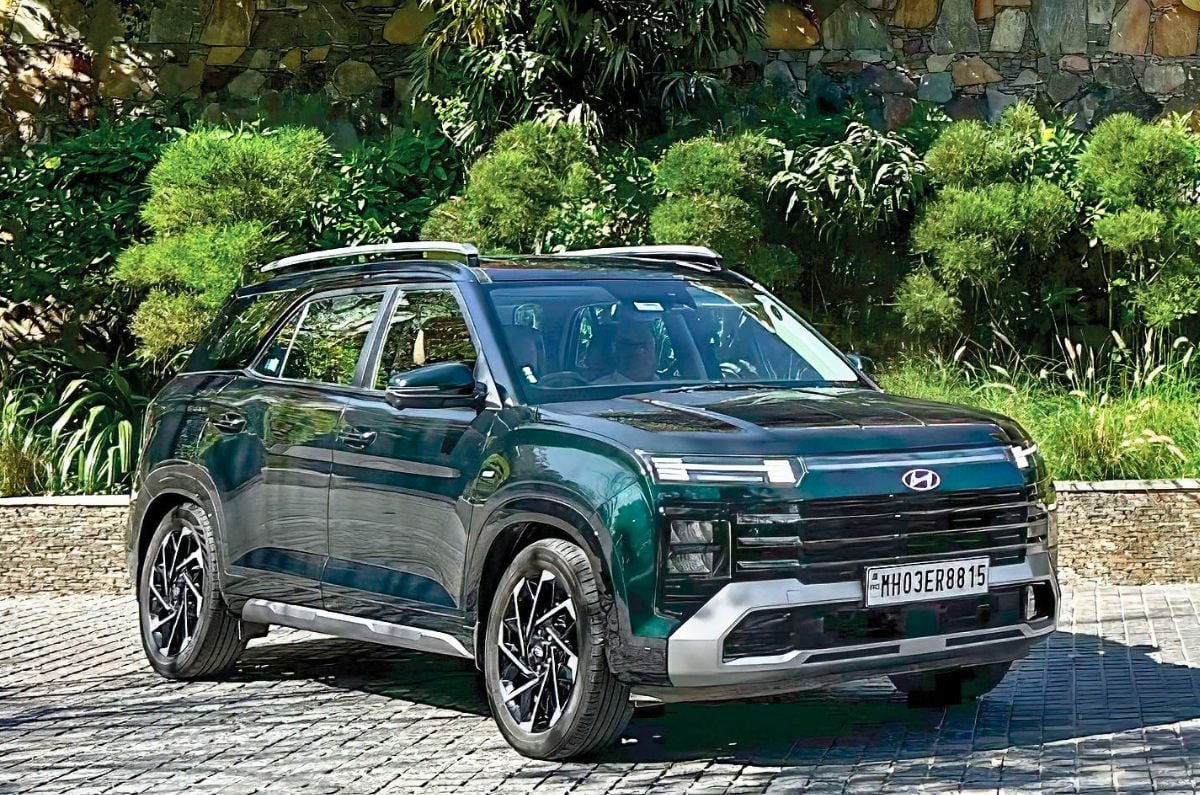
Our long-term Alcazar has done all sorts of jobs since it joined the fleet. City runs, airport pickups, the odd weekend getaway. But nothing quite like what it was asked to do recently. It had to play support car for our camera crew shooting a feature on the Delhi-Mumbai Expressway, and that meant a 2,700km round trip between Mumbai and Delhi with barely a day’s rest in between.
I wasn’t driving the entire way myself, and the Alcazar was only handed over to me in Delhi by one of our drivers. His enthusiasm to ask me if we needed him to drive it back to Mumbai was a testament of how impressed he really was with the Alcazar.
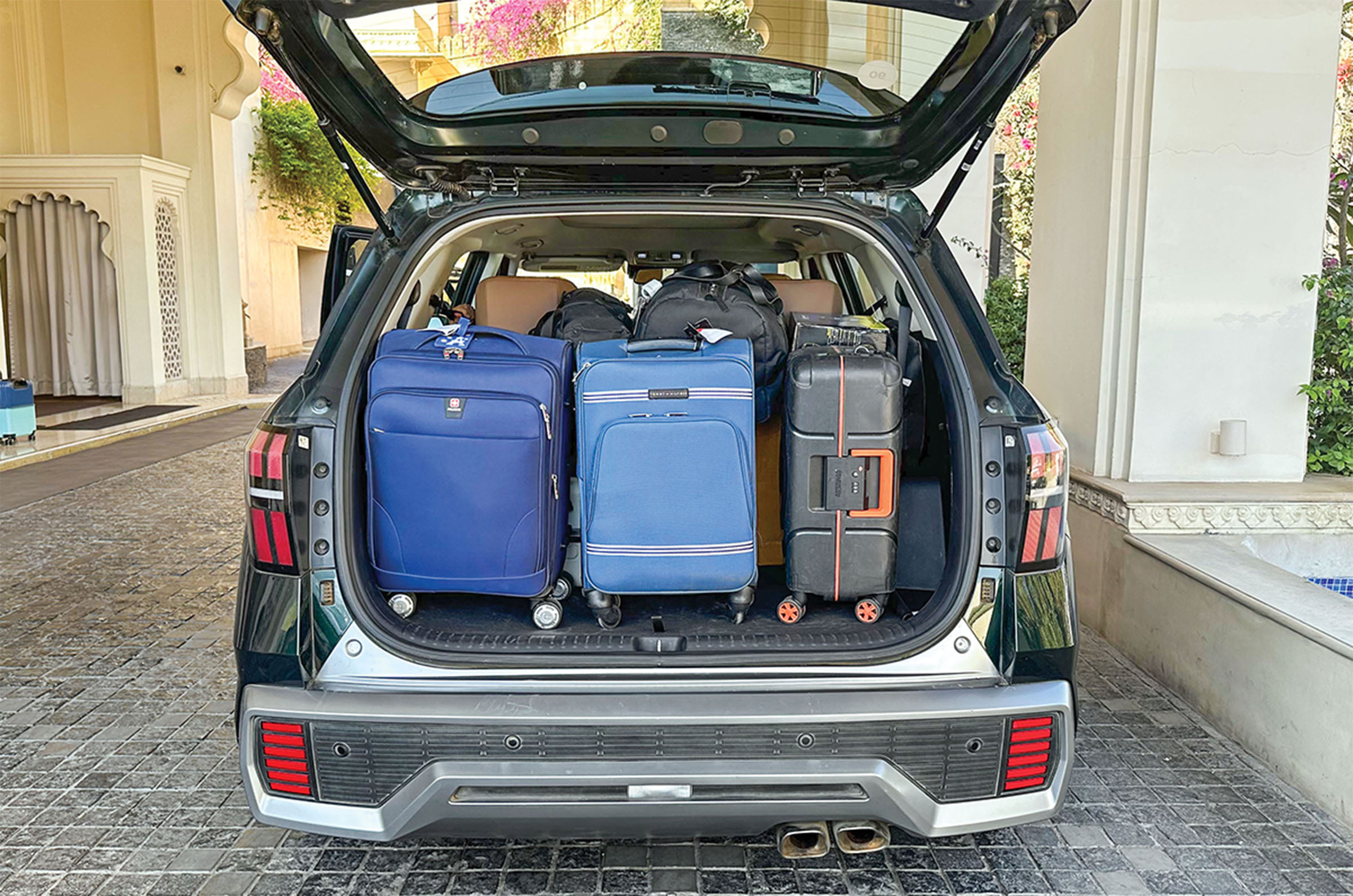
Folded third row frees up a lot of space for luggage.
The brief was simple. The Alcazar had to carry three crew members and all their camera gear along with all our luggage. This is exactly the kind of job our Alcazar has proven good at before, and it didn’t disappoint this time either. With the third row folded flat, the boot swallowed almost everything.
The captain seats in the second row turned out to be a real boon, especially for the camera crew – super comfy during a long day of shooting. The foldable tray table was handy for the laptop to copy and work on footage, and the fact that it was steady enough says a lot about the good build quality.
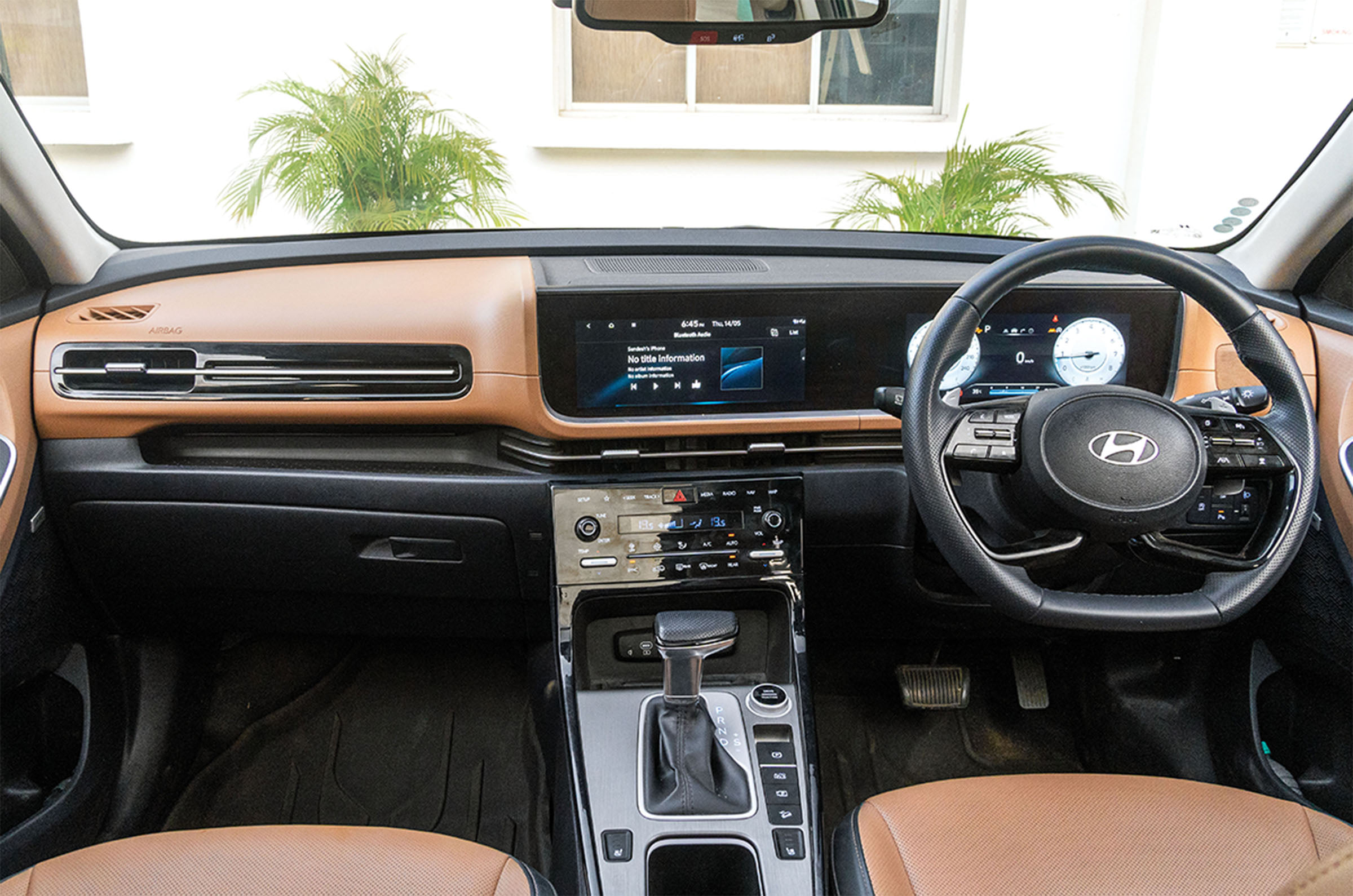
Design is simple yet ergonomic. Dark-coloured interiors help it look clean.
The Delhi-Mumbai Expressway is where this car was always going to shine, and it did. Long, arrow-straight sections let the 1.5-litre turbo-petrol settle into an easy cruise. At 100kph in top gear, the engine barely feels stressed, and wind noise is well contained for a car this size. We clocked long hours driving in a single day on the way back, stopping only for fuel and food, and nobody complained of fatigue by the end of it.
The DCT, which I’ve spoken of before, is jerky in bumper-to-bumper traffic, but was not an issue here. Once you’re past 40kph and holding a steady throttle, it’s smooth and quick to respond. It’s really only the crawl through Mumbai and Delhi outskirts where its low-speed hesitation showed up.
Large 18-inch wheels look stylish, but they don’t help the Alcazar’s ride quality.
The return leg we took had some patchy sections in Maharashtra, where the NE4 Expressway ends and connects to the old Golden Quadrilateral section of the highway. The Alcazar’s ride, tuned more for comfort on good surfaces, felt busy over broken patches. Nothing alarming, but the ride did feel slightly firmer than I expected from a car this size.
This stretch also penalised fuel efficiency. Loaded up with gear, four adults, and running the air conditioning at full blast through most of the drive, the trip computer settled at 12.8kmpl. That’s respectable for a heavy petrol SUV doing this kind of duty, but it’s definitely not the frugal numbers our diesel Alcazar managed, doing the same duty on the Kashmir-to-Kanyakumari run a few years back.
Ventilated driver and passenger seats are a boon on a hot, sunny afternoon.
A few other bits we did appreciate. The ventilated seats made the long hours of driving through the heat a lot more comfortable. The adaptive cruise control also was genuinely useful on the Expressway stretch, taking a lot of the fatigue out of long, straight sections. The absence of wireless Android Auto or Apple CarPlay was an irritant, as it meant connecting to the Infotainment using the cable and having a fully charged phone constantly plugged in for a long period of time.
Another observation on this trip: the plasticky bits on the dashboard picked up a fair bit of dust, especially with four people living out of the car for five days. To be honest, though, the camera crew kept the windows rolled down for a fair amount of time shooting. Thankfully, nothing a wipe down couldn’t fix.
Type-A USB for smartphone interface needed. Type-C only works for charging.
At the end of it all, the Alcazar clocked close to 2,750km in five days absolutely fuss-free. No warning lights, no rattles that weren’t there before. It’s exactly the kind of trip that reminds you why a car like this earns its place in our long-term fleet. Not glamorous, not the fastest thing on the road, but dependable when you need it most. As it happens, this Mumbai-Delhi-Mumbai run turned out to be its last big assignment with us. With this report, our time with the Alcazar comes to a close, and it’s headed back to Hyundai. It leaves the fleet the same way it arrived, quietly capable, and it’s fitting that its final outing was spent doing what it always did best, hauling people and gear over long distances without a fuss.
Hyundai Alcazar Petrol DCT Signature 6-seater test data