Bajaj becomes second Indian EV maker to cross 3 lakh sales this year

Bajaj becomes second Indian EV maker to cross 3 lakh sales this year
Outside shot showing the rear three quarter of the Chetak C2501

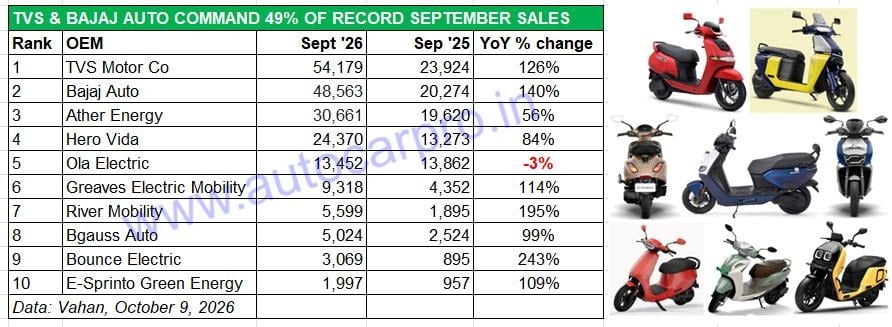
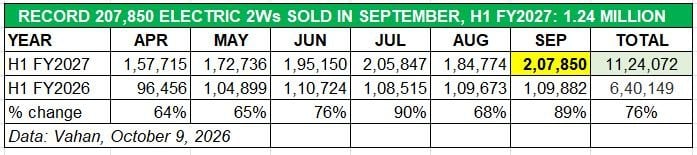
Bajaj has become the second electric vehicle manufacturer in India to cross the 3 lakh sales mark. As per Vahan data, the Pune-based manufacturer of the Chetak e-scooter and Yulu e-bikes has delivered a total of 3.02 lakh units between January and August 2026. This is a first for the brand, and marks a 68 percent growth compared to last year. It also makes Bajaj the second e-2W OEM to do so, after market leader TVS, which crossed the same milestone last month.

  1. Bajaj currently sells five EV scooter models via the Chetak brand
  2. August sales have increased by 210 percent compared to last year

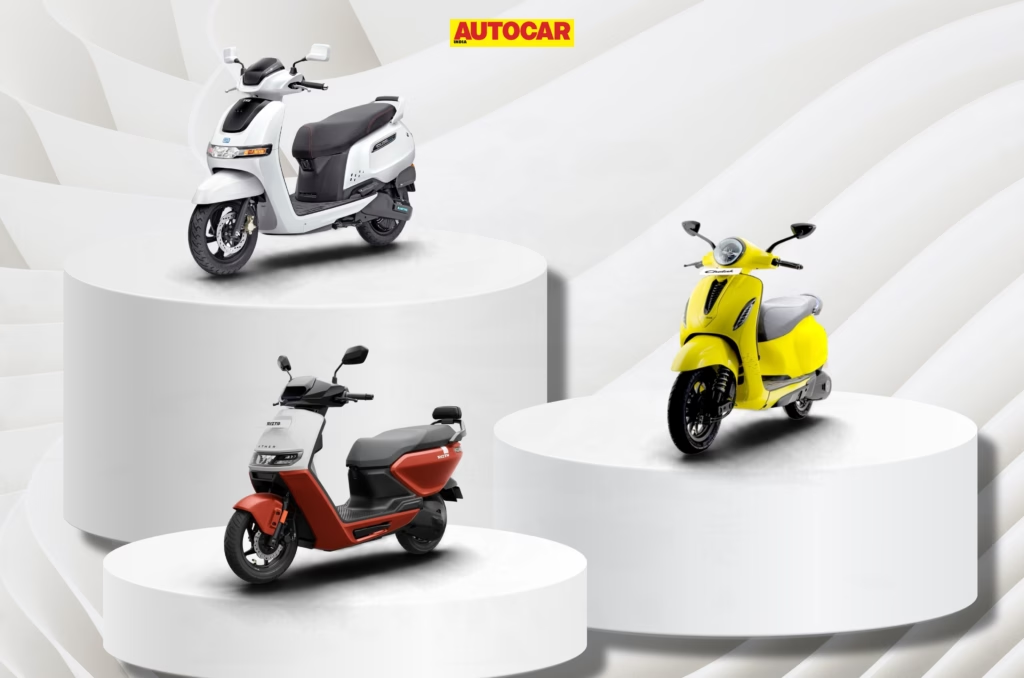
TVS stays ahead of Bajaj by about 50,000 units

Ather is about 75,000 units behind, with the Konarc expected to help

Bajaj Auto retail sales data, Vahan (as of August 30, 2026)

Year

January

February

March

April

May

June

July

August (1-30)

2026

26,575

26,344

47,753

34,600

39,542

43,529

45,860

37,976

2025

22,137

22,242

36,582

19,818

22,641

23,986

20,557

12,246

Percentage increase

20

18

31

75

75

81

123

210

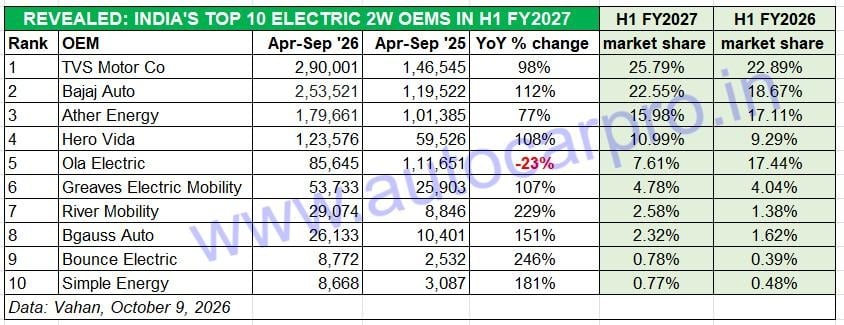
At present, TVS is 51,063 units ahead of Bajaj, having sold 3.53 lakh units till August end. Ather, third in sales at 2.27 lakh units, and has just launched the mass-market Konarc, is also expected to surpass 3 lakh sales close to November this year. The number of units sold so far gives Bajaj a 22 percent share of the market, putting it ahead of Ather Energy (17 percent) and behind TVS (26 percent).

Bajaj currently has a five-variant Chetak portfolio comprising the Chetak C2501 as the entry-level offering and the C3501 as the brand’s current flagship EV. As the monthly retail sales data table above indicates, Bajaj’s highest single-month sales were in March 2026 which was the first time that sales crossed the 40,000 sales mark. Since then, it has crossed that figure two more times, in June and in July.

Upcoming festival season expected to help increase sales

Bajaj is expected to sell up to 4.5 lakh units by year end

With the festive season to kick off soon, expect Bajaj to add another 1.25-1.50 lakh units in the next four months. This will take the company’s total e-2W retail sales to a record 4.25-4.50 lakh sales for the year. The topper, TVS is on track to be the first Indian EV manufacturer to sell 5 lakh units this year. Bajaj will also be well ahead of Ather, which is expected to register record retail sales of an estimated 3.50 lakh units.

Nevertheless, both Bajaj and TVS, will be keenly watching the market response to the Ather Konarc. The Konarc’s base variant has been priced at Rs 99,999, about Rs 4,000-5,000 more than both Bajaj and TVS’ entry level offerings. Vida, fourth in sales, also thus has the incentive to watch the customer response to the Ather Konarc.

With inputs from Stephen Raj Antony.
 

Upcoming IPO: विजय केडिया का है तगड़ा निवेश! एंकर राउंड में मधुसूदन केला ने भी लगाया बड़ा दांव, 31 अगस्त से खुलेगा ये आईपीओ

Vijay Kedia Backed Asuthosh Fibre IPO: शेयर बाजार के दिग्गज निवेशक विजय केडिया के निवेश वाली कंपनी आशुतोष फाइबर का आईपीओ दांव लगाने के लिए खुलने जा रहा है। पब्लिक सब्सक्रिप्शन खुलने से ठीक पहले कंपनी ने एंकर निवेशकों के जरिए ₹16.04 करोड़ जुटा लिए हैं।

एंकर बुक में मधुसूदन केला के मेंटरशिप वाले सिंगुलैरिटी AMC समेत कई बड़े फंड्स ने हिस्सा लिया है। आइए आपको बताते हैं इस आईपीओ की प्राइस बैंड, महत्वपूर्ण तारीखें और कैसी है कंपनी की सेहत।

एंकर बुक: इन 5 बड़े निवेशकों ने लगाए पैसे

28 अगस्त को कंपनी ने एंकर निवेशकों को अपर प्राइस बैंड पर 17.43 लाख शेयर आवंटित किए:

  1. Nine Alps Corporate Advisors: ₹6 करोड़ के निवेश से 6.52 लाख शेयर खरीदे।
  2. Singularity Equity Fund II: ₹3.45 करोड़ के निवेश से 3.75 लाख शेयर खरीदे।
  3. Nav Capital Emerging Star Fund: ₹3.45 करोड़ के निवेश से 3.75 लाख शेयर खरीदे।
  4. Aarth AIF Growth Fund: ₹2.11 करोड़ के निवेश से 2.3 लाख शेयर खरीदे।
  5. Vira Bharat Opportunities Fund: ₹1 करोड़ के निवेश से 1.09 लाख शेयर खरीदे।

Asuthosh Fibre IPO की सभी जरूरी डिटेल्स

गुजरात बेस्ड टेक्निकल टेक्सटाइल प्रोडक्ट्स बनाने वाली यह कंपनी फ्रेश इश्यू के जरिए बाजार से कुल ₹56.34 करोड़ जुटाने की योजना बना रही है। इसमें कोई भी ऑफर फॉर सेल (OFS) कंपोनेंट नहीं है।

  • IPO खुलने की तारीख: 31 अगस्त
  • IPO बंद होने की तारीख: 2 सितंबर
  • प्राइस बैंड: ₹87 से ₹92 प्रति शेयर
  • अलॉटमेंट: 3 सितंबर
  • लिस्टिंग: 7 सितंबर

आईपीओ के पैसों का क्या करेगी कंपनी?

आशुतोष फाइबर जुटाए गए फंड का इस्तेमाल अपनी क्षमता बढ़ाने और कर्ज कम करने में करेगी। ₹25.5 करोड़ नए उपकरण और मशीनरी की खरीद के लिए। ₹20 करोड़ कंपनी का पुराना कर्ज चुकाने के लिए और बाकी रकम सामान्य कॉरपोरेट जरूरतों के लिए करेगी।

विजय केडिया की कितनी है हिस्सेदारी?

ऑफर से पहले कंपनी के प्रमोटर्स के पास 59.79% हिस्सेदारी है। बाकी हिस्सेदारी पब्लिक शेयरधारकों के पास है, जिसमें शेयर बाजार के जाने-माने निवेशक विजय केडिया की 6.57% हिस्सेदारी शामिल है। इस आईपीओ के मर्चेंट बैंकर के रूप में Mefcom Capital Markets को नियुक्त किया गया है।

अब जानिए कैसी है कंपनी की वित्तीय सेहत

टेक्सटाइल यार्न और फैब्रिक मैन्युफैक्चरिंग क्षेत्र से जुड़ी इस कंपनी ने पिछले वित्त वर्ष में शानदार प्रदर्शन किया है। मार्च 2026 को समाप्त वित्त वर्ष में कंपनी का मुनाफा 88.5% बढ़कर ₹16.04 करोड़ हो गया, जो इससे पिछले साल (FY25) में ₹8.5 करोड़ था। कंपनी का कुल रेवेन्यू 2.9% की मामूली बढ़त के साथ ₹117.37 करोड़ रहा, जो पिछले साल ₹114 करोड़ था।

क्या है ग्रे मार्केट का हाल?

आईपीओ वॉच के ताजा आंकड़ों के अनुसार, 29 अगस्त 2026 को आशुतोष फाइबर आईपीओ का ग्रे मार्केट प्रीमियम (GMP) ₹37 प्रति शेयर दर्ज किया गया है। यह इसके अपर प्राइस बैंड ₹92 के मुकाबले 40.22% के तगड़े प्रीमियम का संकेत दे रहा है।

इससे पहले 28 अगस्त को भी जीएमपी ₹37 ही था, जबकि 27 अगस्त को यह ₹15 (16.30%) और 26 अगस्त को ₹13 (14.13%) पर बना हुआ था। लगातार बढ़ते और मजबूत जीएमपी ट्रेंड से स्पष्ट है कि प्राइमरी मार्केट में इस आईपीओ को लेकर निवेशकों के बीच जबरदस्त उत्साह देखने को मिल रही है।

Disclaimer: यहां मुहैया जानकारी सिर्फ सूचना के लिए दी जा रही है। यहां बताना जरूरी है कि मार्केट में निवेश बाजार जोखिमों के अधीन है। निवेशक के तौर पर पैसा लगाने से पहले हमेशा एक्सपर्ट से सलाह लें। मनीकंट्रोल की तरफ से किसी को भी पैसा लगाने की यहां कभी भी सलाह नहीं दी जाती है।

Yamaha India eyes capacity expansion as plants near full utilisation

Yamaha India eyes capacity expansion as plants near full utilisation
Yamaha RayZR on a production line

Yamaha Motor India has begun evaluating additional manufacturing capacity as it expects its existing 1.5 million unit annual output to be fully utilised within the next two to three years. The Japanese two-wheeler maker operates plants in Surajpur, Uttar Pradesh and Kanchipuram, Tamil Nadu, with a combined annual capacity of 1.5 million units, and is weighing whether to expand within its current footprint or invest at a new location.

  1. Yamaha India’s 1.5 million unit annual capacity expected to be fully utilised within 2-3 years
  2. Domestic sales up 41 percent to 4.1 lakh units in H1 2026
  3. Annual sales target of 50,000 units set for the newly launched YZF-R2

Yamaha India capacity expansion: Key details

New plant requires 3-4 years of lead time; expansion within existing sites also being considered

Hajime Aota, Chairman of the Yamaha Motor India Group, said the company still has space to expand at its existing facilities, reducing the immediate pressure to acquire new land. The decision on expansion – whether at Surajpur, Kanchipuram or elsewhere – will depend on manufacturing processes, supplier allocation and longer-term domestic and export requirements. “At this moment, we have capability and we have space,” Aota said, while noting that planning for a new greenfield facility typically requires a lead time of three to four years.

Yamaha expects its total volumes (including exports) to exceed 1.1 million units in 2026, with domestic sales up 41 percent to 4.1 lakh units in the first half of the year. The company expects H2 volumes to be higher, supported by festive demand and new product launches. On the YZF-R2, which debuted yesterday at Rs 2.30 lakh, Yamaha has set an annual domestic sales target of 50,000 units.

Aota described India and Indonesia as Yamaha’s two biggest global growth engines, with India offering the stronger long-term growth opportunity. However, he noted that India must continue improving manufacturing productivity and technical capabilities to narrow the gap with Indonesia and expand its role in Yamaha’s global manufacturing network. The company employs approximately 10,000 people across its Indian operations and has invested over Rs 2,000 crore in research, development and manufacturing in India over the past eight to ten years. The quantum of investment required for the next phase of expansion has not been disclosed.

Yamaha expects the R2 to drive total sales to 11 lakh units in 2026

Yamaha expects the R2 to drive total sales to 11 lakh units in 2026
Launch event image of the R2 with top Yamaha executives

Yamaha is targeting annual sales of 50,000 units for the newly launched R2 in India as it looks to strengthen its position in the country’s premium motorcycle market. The target translates into a monthly run rate of more than 4,000 units, making the R2 an important volume contributor to Yamaha’s premium portfolio rather than a niche model positioned above the R15.

  1. Yamaha R2 starts at Rs 2.30 lakh and is the most feature-packed 200cc motorcycle
  2. India’s premium segment is growing faster than the broader two-wheeler segment
  3. One third of Yamaha’s total sales came from premium motorcycles

R2 is expected to contribute 18 percent of total sales by 2026 end

Scooters account for 46 percent of Yamaha’s sales so far in 2026

The R2 will be manufactured in India and has been designed for domestic and international markets. Company executives said exports remain part of the R2 programme but will follow after the new model establishes itself in India. The R2 target comes as premium motorcycles grow considerably faster than the broader Indian two-wheeler market. Yamaha outpaced the overall market, with its first-half volumes rising 41 percent to 4.1 lakh units from 2.9 lakh a year earlier. This was nearly twice the 21 percent growth recorded by the broader domestic two-wheeler industry, which expanded to 1.06 crore units.

Premium motorcycles accounted for around one-third of Yamaha’s volumes during the period, while scooters contributed approximately 46 percent. The R2’s annual target translates into average monthly sales of about 4,167 units, or approximately 18 percent of Yamaha’s average monthly premium motorcycle volumes in the first half of 2026, underlining the model’s importance to the company’s growth plans.

Raw material costs may affect growth

The rising costs could lead to price hikes too!

The stronger volume outlook comes with pressure on profitability from rising raw-material costs, particularly aluminium. Hajime Aota, Chairman of Yamaha Motor India Group of Companies, said “I wish I did not have to do it,” referring to a possible further price increase. “But if I am going to sacrifice profitability, I may. That is where we are.”

Yamaha will have to balance higher input costs against the price sensitivity of the Indian market as it seeks to sustain growth through the festive season. The company is also expanding its premium retail network, particularly in Tier 1 and Tier 2 cities. It expects the Blue Square network to exceed 600 outlets by the end of 2026.

The R2 launch, network expansion and continued growth in premium motorcycles provide Yamaha with momentum for the second half. Reaching more than 11 lakh units in 2026 will also depend on export performance and the company’s ability to manage cost pressures without weakening domestic demand.

With inputs from Stephen Raj Antony.
 

हथियार बनाने में भारत की लंबी छलांग! प्रोडक्शन ₹1.80 लाख करोड़ और एक्सपोर्ट ₹39,000 करोड़ के पार

India Defence Sector Growth: भारत का रक्षा क्षेत्र आत्मनिर्भरता की दिशा में ऐतिहासिक छलांग लगा रहा है। रक्षा मंत्री राजनाथ सिंह ने गुरुवार को जानकारी दी कि पिछले एक दशक में भारत का घरेलू रक्षा उत्पादन करीब 4 गुना बढ़कर लगभग ₹1.80 लाख करोड़ तक पहुंच गया है। वहीं, भारत से रक्षा उपकरणों का निर्यात बढ़कर ₹39,000 करोड़ के करीब हो गया है।

रक्षा मंत्री मध्य प्रदेश के जबलपुर स्थित 57 साल पुरानी व्हीकल फैक्ट्री जबलपुर (VFJ) में T-सीरीज के मेन बैटल टैंक्स के ओवरहॉलिंग के लिए बनने वाले ₹472 करोड़ के नए प्लांट का शिलान्यास करने पहुंचे थे।

2014 से 2026: रक्षा उत्पादन और निर्यात के आंकड़े

राजनाथ सिंह ने 2014 के मुकाबले रक्षा क्षेत्र में हुई अभूतपूर्व प्रगति का ब्योरा पेश किया। साल 2014 में देश का हथियारों और गोला-बारूद का उत्पादन महज ₹46,000 करोड़ था, जो अब बढ़कर ₹1.80 लाख करोड़ हो गया है। 2014 में भारत का रक्षा निर्यात सिर्फ ₹1,000 करोड़ का था, जो अब ₹39,000 करोड़ के रिकॉर्ड स्तर पर पहुंच गया है। केंद्र सरकार ने वित्त वर्ष 2028-29 तक ₹50,000 करोड़ के रक्षा निर्यात का लक्ष्य तय किया है।

जबलपुर VFJ में ₹472 करोड़ का प्रोजेक्ट

जबलपुर की व्हीकल फैक्ट्री में बनने वाला नया प्रोजेक्ट भारत के रक्षा इंफ्रास्ट्रक्चर को मजबूत करेगा। यह नया प्लांट सालाना 80 T-72 और T-90 टैंकों का ओवरहॉल यानी मरम्मत व अपग्रेडेशन करने में सक्षम होगा। भारतीय सेना को हर साल करीब 230 T-सीरीज टैंकों के ओवरहॉल की जरूरत होती है।

अब तक चेन्नई के आवडी स्थित हैवी व्हीकल्स फैक्ट्री (HVF) में सालाना लगभग 150 टैंकों की ओवरहॉलिंग होती थी। जबलपुर का नया प्लांट शुरू होने के बाद सेना की यह कमी पूरी तरह से दूर हो जाएगी।

‘अब केवल हथियार बना ही नहीं रहे, मेंटेन भी कर रहे हैं’

रक्षा मंत्री ने कहा कि रक्षा के क्षेत्र में दुनिया का भारत को देखने का नजरिया बदल चुका है और इसके पीछे ‘आत्मनिर्भर भारत’ का विजन है। भारत अब न सिर्फ अपनी धरती पर आधुनिक हथियार बना रहा है, बल्कि उनका रखरखाव, ओवरहॉलिंग और अपग्रेडेशन करने की पूरी क्षमता हासिल कर चुका है।

इस प्रोजेक्ट से स्थानीय युवाओं के लिए रोजगार के नए अवसर पैदा होंगे और यह भारतीय सेना के टैंकों को युद्ध के लिए हमेशा तैयार रखने में ‘वरदान’ साबित होगा।

व्हीकल फैक्ट्री जबलपुर का ऐतिहासिक सफर

व्हीकल फैक्ट्री जबलपुर(VFJ) की स्थापना 1969 में हुई थी, जो वर्तमान में आर्मर्ड व्हीकल्स निगम लिमिटेड (AVNL) के तहत काम करती है। शुरुआत में इस फैक्ट्री में जर्मनी की MAN कंपनी के सहयोग से ‘शक्तिमान 3-टन’ ट्रक और जापान की निसान के सहयोग से ‘निसान 1T’ व ‘जोन्गा’ गाड़ियां बनाई जाती थीं। यह फैक्ट्री 330 एकड़ में फैली है और इसका संलग्न एस्टेट 600 एकड़ का है।

Kawasaki W230 gets a new colour for 2027

Kawasaki W230 gets a new colour for 2027
2027 Kawasaki W230

Kawasaki has revealed the 2027 W230 with a new Ebony colour option, replacing the Metallic Matte Dark Green that the bike was available with in 2026. The update is purely cosmetic, with no mechanical, feature or price changes accompanying the new colour in global markets. A single colour option is offered, as was the case with the outgoing scheme.

  1. New Ebony colour replaces Metallic Matte Dark Green
  2. No mechanical changes; 233cc air-cooled single continues unchanged

2027 Kawasaki W230 details

The W230 is powered by the same engine as the KLX230

The W230 is powered by a 233cc air-cooled single-cylinder engine producing 18hp at 7,000rpm and 18.6Nm at 5,800rpm, paired with a 6-speed gearbox. Suspension is handled by a conventional telescopic fork at the front and twin shock absorbers at the rear, sticking with the retro theme of the bike. Braking hardware includes disc brakes at both ends – a 265mm front and 220mm rear.

With a kerb weight of 143kg, the W230 is a relatively lightweight motorcycle and perhaps one of the lightest in its class. That, along with a low 745mm seat height, makes the W230 an incredibly accessible motorcycle for most riders, even those just getting started out.

Unfortunately, the Kawasaki W series in India hasn’t had much of an impact in terms of sales. The W800 was previously available in our market, as was the India-made Kawasaki W175. While the MY24 W175 is still listed on the Kawasaki India site, it’s highly unlikely there’s any stock of that bike left, given that several other models in Kawasaki India’s lineup are now MY27 units.

Kawasaki has long considered India a key manufacturing hub for its smaller-displacement retro models, and while plans for the W230 in India have not been confirmed by Kawasaki, the modern classic segment it targets has seen significant growth here, including the ever-growing popularity of models like the Classic 350 and the more recently revealed Honda CB500.

Welspun Corp में ₹1433 करोड़ की ब्लॉक डील, प्रमोटर ग्रुप और CEO ने बेची 2.4% हिस्सेदारी

पाइप और स्टील मैन्युफैक्चरिंग कंपनी Welspun Corp में बुधवार यानी 26 अगस्त को बड़ी ब्लॉक डील हुई। NSE पर करीब ₹1,433 करोड़ के शेयरों की खरीद-बिक्री हुई। इस डील में प्रमोटर ग्रुप की कंपनी Welspun Investments and Commercials और कंपनी के MD और CEO विपुल माथुर ने मिलकर करीब 63 लाख शेयर बेचे।

NSE के आंकड़ों के मुताबिक, ये शेयर औसतन ₹2,275.30 प्रति शेयर के भाव पर बिके। कुल शेयर कंपनी की करीब 2.4% हिस्सेदारी के बराबर हैं।

Capital Group ने खरीदे ज्यादातर शेयर

इस ब्लॉक डील में Capital Group की तीन कंपनियां बड़ी खरीदार बनकर सामने आईं। तीनों ने मिलकर करीब 42.3 लाख शेयर खरीदे। यह Welspun Corp की करीब 1.64% हिस्सेदारी है।

Euro Pacific Growth Fund सबसे बड़ा खरीदार रहा। उसने करीब 29.5 लाख शेयर खरीदे। यह कंपनी की करीब 1.12% हिस्सेदारी है। इस खरीद के लिए फंड ने करीब ₹670.3 करोड़ खर्च किए।

New World Fund ने करीब 8.4 लाख शेयर खरीदे। यह करीब 0.32% हिस्सेदारी है। इसके लिए करीब ₹191.51 करोड़ खर्च किए गए। Capital Group Europacific Growth Trust ने करीब 4.4 लाख शेयर खरीदे। इसकी हिस्सेदारी करीब 0.2% है और डील की वैल्यू करीब ₹100.9 करोड़ रही।

इन तीनों फंड ने मिलकर करीब ₹963 करोड़ के शेयर खरीदे। बाकी करीब 20.7 लाख शेयर किसने खरीदे, इसकी जानकारी फिलहाल उपलब्ध आंकड़ों में नहीं है।

कंपनी को नहीं मिलेगा डील का पैसा

यह डील सेकेंडरी शेयर सेल है। यानी इसमें कंपनी नए शेयर जारी नहीं कर रही है। शेयर मौजूदा शेयरधारकों ने बेचे हैं। इसलिए डील से मिला पैसा Welspun Corp के खाते में नहीं जाएगा। यह रकम Welspun Investments and Commercials और विपुल माथुर को मिलेगी।

2026 में बढ़ी ब्लॉक डील

Welspun Corp की यह डील इस साल भारतीय बाजार में बढ़ी सेकेंडरी शेयर सेल्स की बड़ी तस्वीर का हिस्सा है। Prime Database के आंकड़ों के मुताबिक, 2026 में अब तक प्रमोटर्स, फाउंडर्स और प्राइवेट इक्विटी निवेशकों ने 9,616 ब्लॉक और बल्क डील के जरिए करीब ₹3.63 लाख करोड़ के शेयर बेचे हैं।

इस दौरान घरेलू म्यूचुअल फंड और इंश्योरेंस कंपनियों ने बाजार में आई इस सप्लाई का कुछ हिस्सा खरीदा है। वहीं विदेशी निवेशक भारतीय शेयरों को लेकर अभी भी सावधानी बरत रहे हैं।

Welspun Corp का शेयर बुधवार को NSE पर 1.49% गिरकर ₹2,310.50 पर बंद हुआ।

पैकेजिंग कंपनी 1:1 बोनस शेयर का देगी, ₹3 डिविडेंड का डिविडेंड; जानिए पूरी डिटेल

Disclaimer: यहां मुहैया जानकारी सिर्फ सूचना के लिए दी जा रही है। यहां बताना जरूरी है कि मार्केट में निवेश बाजार जोखिमों के अधीन है। निवेशक के तौर पर पैसा लगाने से पहले हमेशा एक्सपर्ट से सलाह लें। मनीकंट्रोल की तरफ से किसी को भी पैसा लगाने की यहां कभी भी सलाह नहीं दी जाती है।

Bajaj to launch six more motorcycles before festive season

Bajaj to launch six more motorcycles before festive season
Front left outside image of the Pulsar NS200

Bajaj has been having an eventful August with four launches, the freshly updated Pulsar 125/150 and the new Pulsar N160 S and SS. Seems like they aren’t planning to slow down any time soon. The company has said two of the 10 models would be all-new Pulsars, while the rest would comprise new variants and product upgrades. “Our 150 and 125 are the second launch in this journey,” said Sumeet Narang, President, Marketing, Bajaj Auto. “We will meet you soon again. There’s a lot of stuff that we will still be coming up with in the coming days.”

  1. Bajaj Pulsar was the third best-selling motorcycle range in July 2026
  2. After original and N Pulsars, NS line is expected to be updated
  3. Bajaj dual-sport and Triumph Bonneville 400 will also arrive soon

Pulsar portfolio takes shape

All models are expected to get updates

The launch comes as the Pulsar nameplate remains one of India’s largest-selling motorcycle ranges. It ranked third in the July motorcycle sales chart with 66,156 units dispatched, according to AutoPunditz. Bajaj’s sports motorcycle segment, meanwhile, grew about 50% year on year in the April-June quarter, with Pulsar, Avenger and Dominar recording double-digit growth.

The company has also said upgrades are planned across its 125-160cc motorcycle range. Narang said the refreshed range will be organised around the three Pulsar platforms. “Three very clear distinct platforms, the original, the N and the NS,” he said, with each aimed at a different customer and riding use case.

Triumph Bonneville 400 and Bajaj’s first dual-sport also in the works

Bajaj is also looking to expand manufacturing capacity

We had just reported that Bajaj’s first dual-sport motorcycle was spotted testing again. Our reports indicate that the motorcycle will launch in Brazil before the end of this year, making its way to India at a later time. Currently, it’s unclear if Bajaj is counting that as a part of this 10-Model portfolio. Besides that, Bajaj is also expected to launch the Triumph Bonneville 400, long awaited retro cousin of the existing Triumph 400s.
Speaking of which, the launches come ahead of Bajaj’s planned expansion of annual manufacturing capacity from about 72 lakh vehicles to more than 90 lakh. The company has said the additional capacity will support growing demand across the board. It is evaluating brownfield expansion and a greenfield facility, with the location and investment yet to be finalised. The company has not yet declared any dispatch dates, but clearly they’re looking at a packed schedule inching closer to the festive season.

With inputs from Stephen Raj Antony.

 

RBI के अनुमान को भी पीछे छोड़ सकती है भारत की GDP ग्रोथ, डिप्टी गवर्नर पूनम गुप्ता ने दिए ये बड़े संकेत

आरबीआई की डिप्टी गवर्नर पूनम गुप्ता ने गुरुवार को कहा कि मार्च में खत्म होने वाले फाइनेंशियल ईयर में भारत की ग्रोथ रेट 7% के करीब रह सकती है,जो सेंट्रल बैंक के 6.7% के अनुमान से बेहतर है। इस रफ्तार के साथ भारत दुनिया की सबसे तेजी से ग्रोथ करने वाली बड़ी अर्थव्यवस्थाओं में शामिल रहेगा। फाइनेंशियल एक्सप्रेस में आई अखबार के आधार पर ब्लूमबर्ग ने बताया कि चेन्नई में मद्रास स्कूल ऑफ इकोनॉमिक्स में एक कार्यक्रम में बोलते हुए पूनम गुप्ता ने कहा कि उनका यह अनुमान अप्रैल-जून तिमाही के मजबूत रहने की उम्मीदों पर आधारित है। इस अवधि के आधिकारिक आंकड़े इस महीने के आखिर में आने वाले हैं। अर्थशास्त्रियों का अनुमान आम तौर पर 6.9% से 8% के बीच है। इसका मतलब है कि पूरे साल की ग्रोथ रेट काफी ज़्यादा,यानी 7% के करीब रह सकती है।

तमाम चुनौतियों के बावजूद कायम रही रफ्तार

इकोनॉमी की तेज रफ्तार से पता चलता है कि कमजोर मॉनसून और एनर्जी की बढ़ी लागत जैसे झटकों के बावजूद अर्थव्यवस्था में मजबूती बनी हुई है। इससे यह भी पता चलता है कि गुप्ता का रुख हाल ही में काफी सख्त क्यों हो गया है। इस हफ्ते जारी RBI की अगस्त पॉलिसी मीटिंग के मिनट्स से पता चला कि गुप्ता ने इस साल के आखिर में ब्याज दरें बढ़ाने की संभावना जताई थी।

पूनम गुप्ता ने कहा “इन झटकों के बावजूद,आगे के लिए मैं कहूंगी कि 7.5% ग्रोथ तो तय है और हमें इससे बेहतर करने की कोशिश करनी चाहिए।”

बाहरी खातों को लेकर भी जताया भरोसा 

पूनम गुप्ता ने भारत के बाहरी खातों (external accounts) को लेकर भी भरोसा जताया और कहा कि आगे स्थिति काफी बेहतर होगी। अर्थशास्त्रियों को उम्मीद है कि पहले घाटे के अनुमान के बावजूद,इस फाइनेंशियल ईयर में देश का बैलेंस ऑफ पेमेंट पॉजिटिव हो जाएगा। इसकी मुख्य वजह विदेशी मुद्रा में गिरावट को रोकने के उपायों के बाद 80 अरब डॉलर तक विदेशी फंड आने की उम्मीद है। इन उपायों में विदेशी मुद्रा डिपॉजिट को आकर्षित करने के लिए खास इंसेंटिव भी शामिल हैं।

भारत को एक विकसित देश बनाने के लिए 8% से ज्यादा की ग्रोथ रेट की जरूरत 

पूनम गुप्ता का यह बयान ऐसे समय में आया है जब भारतीय अधिकारी देश की अर्थव्यवस्था को लेकर ज्यादा उम्मीदें जता रहे हैं,क्योंकि ईरान युद्ध के चलते जितने बुरे हालात का डर था,वे सच साबित नहीं हुए। मजबूत ग्रोथ को देखते हुए प्रधानमंत्री नरेंद्र मोदी ने पिछले हफ्ते 2047 तक भारत को एक विकसित देश बनाने के अपने लक्ष्य को फिर से दोहराया। अर्थशास्त्रियों का कहना है कि इस लक्ष्य को हासिल करने के लिए हमें कम से कम दो दशकों तक लगातार 8% से ज्यादा की ग्रोथ रेट की जरूरत हो सकती है।


Monetary Policy : अगर महंगाई ऊंचे स्तर पर रही तो RBI ब्याज दरों में कर सकता है बढ़ोतरी – MPC मेंबर

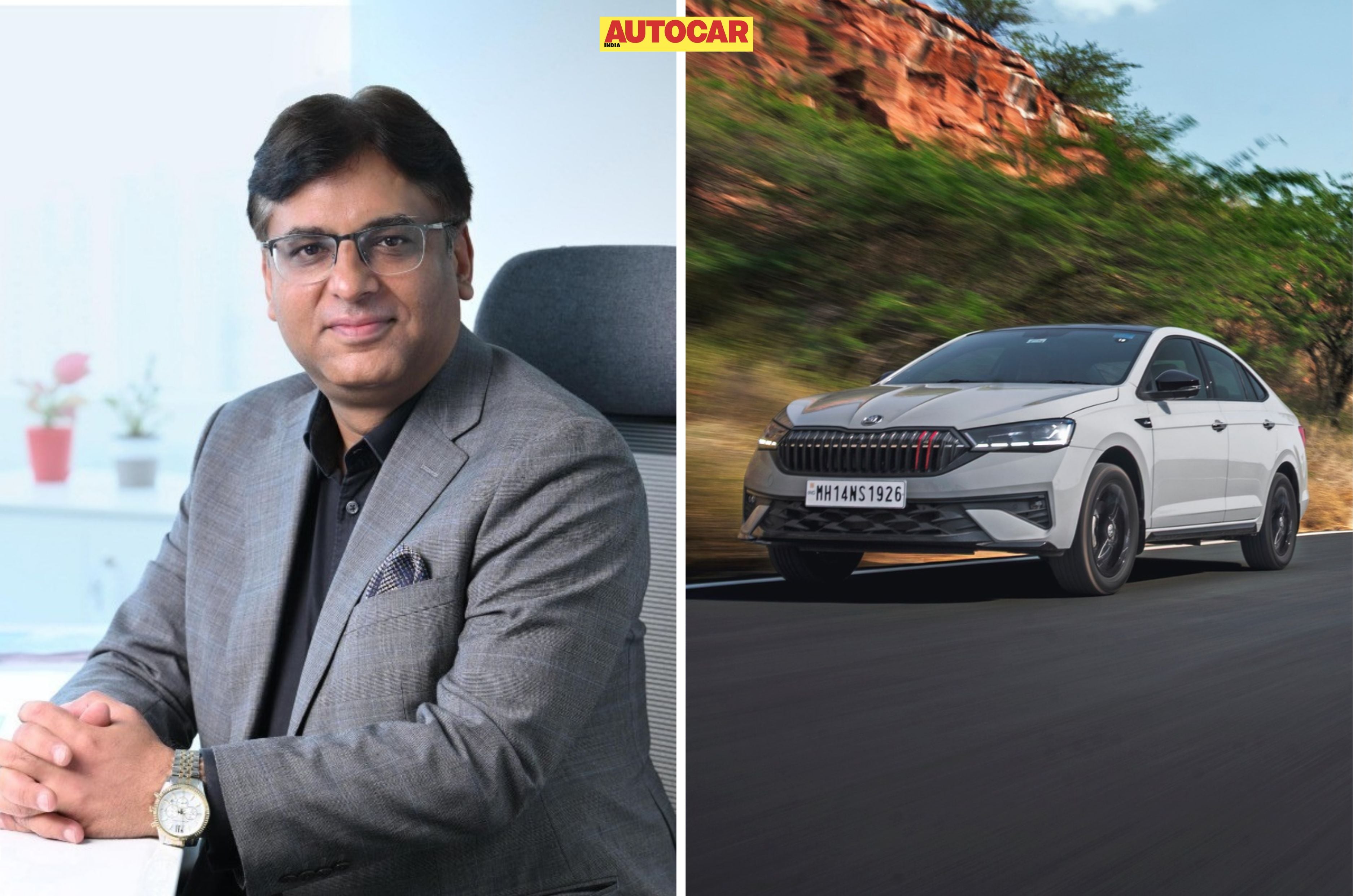
Sedan continues to be the quintessential car, says Skoda India brand director

Sedan continues to be the quintessential car, says Skoda India brand director
Skoda Slavia, Superb and Octavia revealed

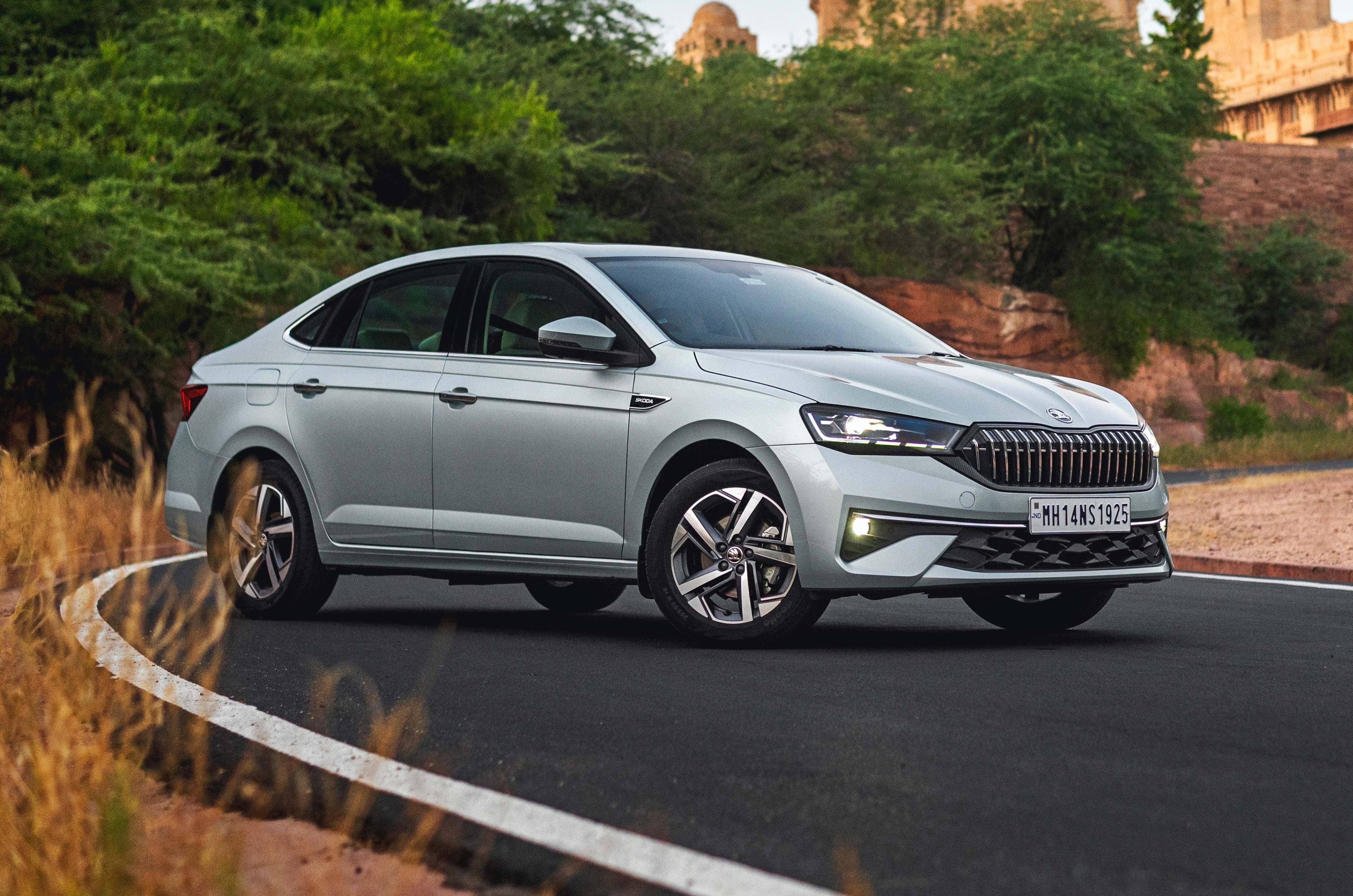
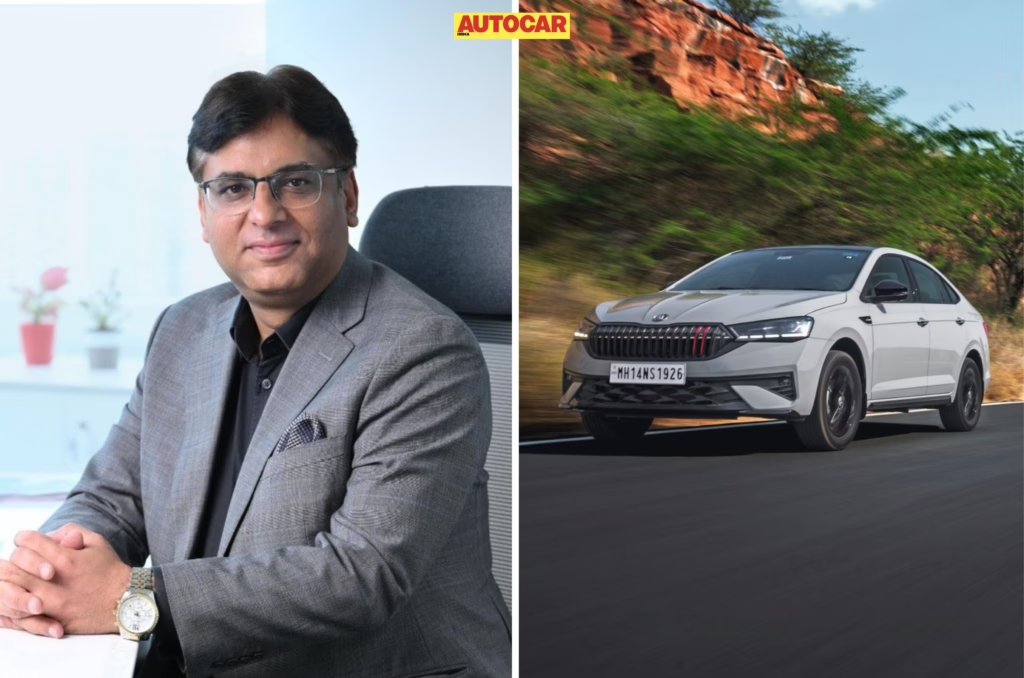
While it sells multiple SUV models, Skoda is the only mass-market automaker that has also remained steadfastly committed to the sedan body type. The Czech brand recently introduced three sedans all at the same event – something of a rarity in an otherwise SUV-dominated market. Skoda’s latest entrants in India include the Slavia facelift, the Superb diesel and the Octavia RS. While admitting to the market’s preference for SUVs over the last decade or so, Ashish Gupta, brand director at Skoda Auto India, also said, “If you look at it, sedans continue to be the quintessential car.”

  1. Gupta says the charm of sedans hasn’t gone away
  2. He cites a lack of focus in the segment by manufacturers
  3. SUV saturation expected to work in favour of sedans

The Czech automaker thinks sedans are here to stay

Gupta believes the sedan body type will continue to make sense for the brand

The Superb nameplate arrived 90 years ago, with the line-up eventually including models such as the Octavia, Rapid and Slavia. “It’s been a long legacy of sedans for Skoda, with the sedan body style defining our brand not only globally but also in India,” said Gupta. The Slavia has been a successful model for the Czech brand in India. “The premium sedan segment in India right now is at around 4,000 to 4,500 units per month, with the Slavia making up nearly 30 percent of all sales in the segment. We are the torchbearers of that segment, and the Slavia facelift will have its role in the company’s India portfolio while also appealing to a wider customer set,” he added.

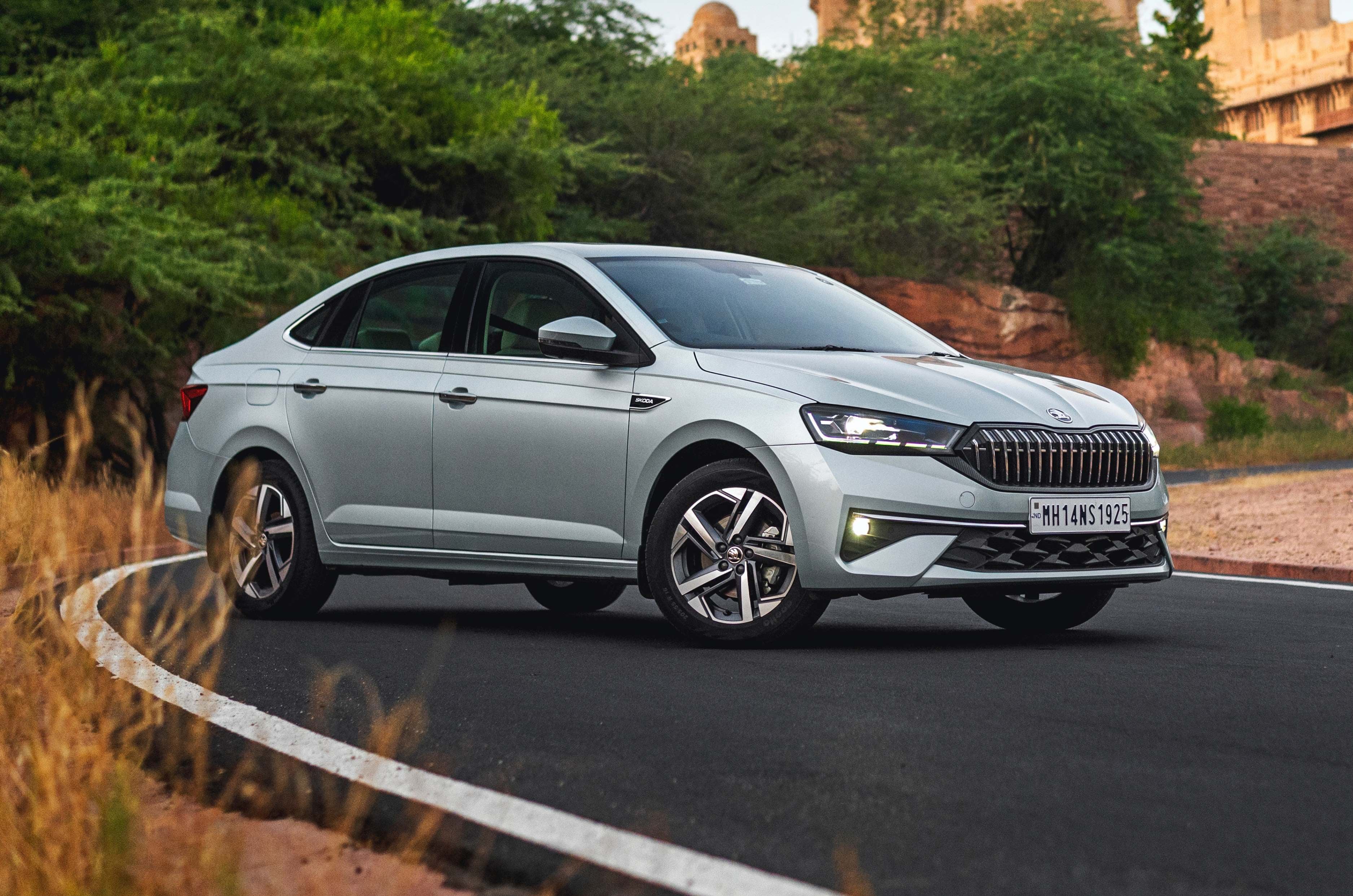
Skoda Slavia facelift front
The Slavia occupies the mass-market sedan segment in India.

According to Gupta, the Slavia offers buyers a blend of performance and understated elegance. “There are good reasons the charm of a sedan hasn’t gone away. There’s the superior driving dynamics and pure elegance that sedans exude. One would love to arrive at an event in a sedan, or go for a fun drive during the weekend. So I think sedans will continue to have their fans and people who would still want to own one.”

However, the brand director isn’t expecting the segment to make a strong comeback in the near future. “I think the sedan segment will continue to remain a smaller part of the market – that much is very clear,” he remarked while citing the current trend in the industry. “Most of the new product launches and introductions are happening in the SUV segment and other body styles.” He thinks the growth potential is primarily hindered by automakers ignoring sedans and instead doubling down on SUVs. “We, as manufacturers, should take the responsibility for this, as we have not focused on the sedan segment.”

Gupta was quick to point out that Skoda is one of the few automakers worldwide that maintains a focus on the sedan space as well. “Perhaps we are among the few brands who still have a large sedan portfolio, which continues to do well.”

SUV saturation to help revive the sedan

Gupta expects the market to eventually reach a saturation point when it comes to SUVs

According to Gupta, the market will eventually grow tired of the SUV body type, making the case for sedans even stronger. He added that first-time buyers have been contributing to the sales numbers of sedans, while more demand is expected to come from families who want to own more than one car. “Sooner or later, families wanting to have multiple cars would like to have differentiated kind of cars. So that is an opportunity for the sedan and one which will continue to evolve in India as the market matures,” he explained.

Skoda sedans in India

The brand’s sedan line-up in India includes three models

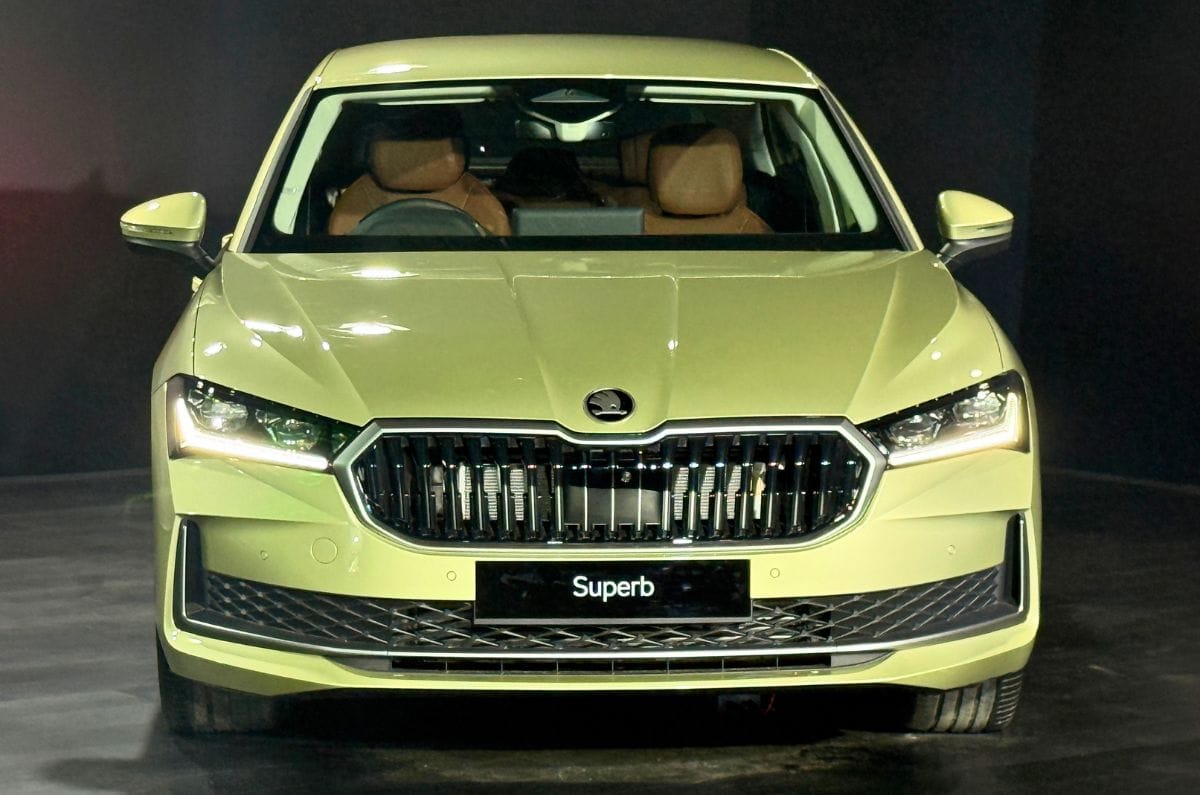
2027 Skoda Superb diesel front
The Superb is targeted at buyers who prioritise luxury over outright performance.

The Slavia remains the entry point into Skoda’s sedan portfolio in India and is the Volkswagen Virtus’s chief rival. However, VW only has this one sedan in its entire India portfolio. Meanwhile, Skoda is also planning to introduce a CNG option for the Slavia, which could interest buyers seeking premium features and lower running costs. Joining the line-up in 2027 will be the Superb diesel in its top-spec Laurin & Klement (L&K) trim – this will be Skoda’s first new diesel car in India since abandoning the powertrain type in 2020. The Superb occupies a space beneath the likes of the Mercedes-Benz C-Class and BMW 5 Series in India.

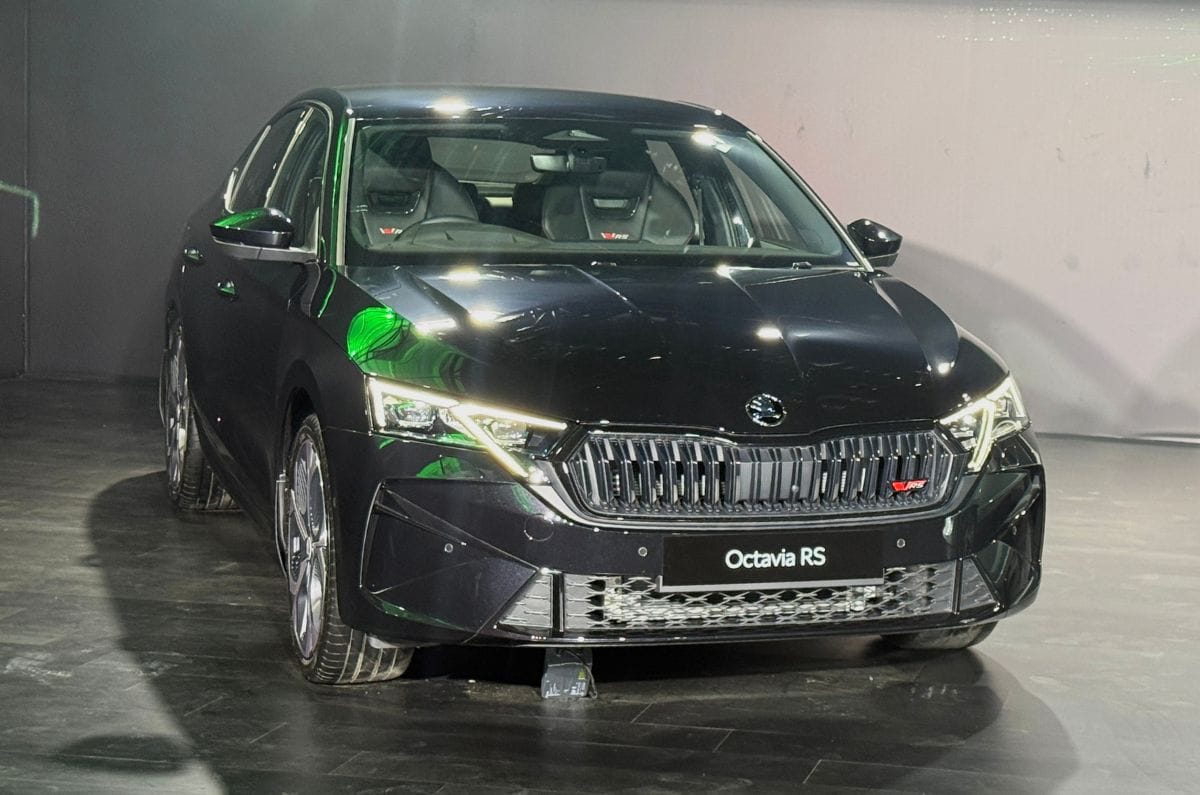
Skoda Octavia RS front quarter
The sportier Octavia RS will continue to be for the enthusiast.

The Octavia RS is also returning to India, with deliveries expected around the upcoming festive season. It’ll once again arrive as a full import and will be limited to just 50 units this time. With the previous 100 units allocated for India reportedly selling out in 20 minutes, the second batch is likely to find takers just as easily. Gupta said customers who had shown genuine interest in the Octavia RS will be given early access. In all, Skoda will be able to cater to mass-market sedan buyers with the Slavia, premium sedan buyers with the Superb and driving enthusiasts with the Octavia RS.

Skoda and the upcoming India-EU FTA

Then there’s the upcoming India-EU Free Trade Agreement (FTA), which will have an impact on fully imported models such as the Superb. “The FTA has kind of given us a good choice between what makes better sense for us and for the market as well. The whole idea is to start deliveries towards Q2 of next year. We are hopeful that by that time, the contours of the FTA will be decided, and we will have clarity on what kind of duty structure to apply to our imported models,” said Gupta. The proposed reduction in import duties could make bringing in more batches from Skoda’s global portfolio to India easier, though Gupta expects currency fluctuations to have an impact on the final price.

Also read

Skoda opens bookings for second batch of Octavia RS

Skoda Superb diesel revealed in India ahead of 2027 launch