Stocks to Watch: गुरुवार 17 सितंबर को शेयर बाजार में 13 कंपनियों से जुड़े अहम अपडेट देखने को मिल सकते हैं। इनमें टाटा ग्रुप के स्टॉक्स से जुड़ी खबर भी शामिल है। वहीं, कुछ कंपनियों को नए ऑर्डर मिले हैं। कुछ ने विस्तार और अधिग्रहण की योजनाओं का ऐलान किया है।
Tata Group Stocks
टाटा ग्रुप की होल्डिंग कंपनी Tata Sons के बोर्ड की बैठक 17 सितंबर को मुंबई में होगी। मीडिया रिपोर्ट्स के मुताबिक, बैठक में चेयरमैन एन चंद्रशेखरन से पद छोड़ने के फैसले पर दोबारा विचार करने को कहा जा सकता है। उनकी मौजूदा अवधि फरवरी 2027 में पूरी हो रही है। बैठक में संभावित लिस्टिंग, अगले चेयरमैन और ग्रुप गवर्नेंस पर भी चर्चा हो सकती है।
GNFC
सरकारी फर्टिलाइजर और केमिकल कंपनी GNFC ने संजीव कुमार को नया मैनेजिंग डायरेक्टर नियुक्त किया है। नियुक्ति 9 सितंबर 2026 से प्रभावी है। उनका कार्यकाल पांच साल का होगा। वह राजकुमार बेनीवाल की जगह लेंगे, जिन्हें गुजरात सरकार ने सूरत का म्युनिसिपल कमिश्नर बनाया है।
Susan Electronics India
इलेक्ट्रिकल प्रोडक्ट बनाने वाली कंपनी Susan Electronics India के बोर्ड ने बागपत में जमीन खरीदने को मंजूरी दी है। कंपनी करीब ₹22 करोड़ में यह जमीन खरीदेगी। इसका इस्तेमाल मैन्युफैक्चरिंग कैपेसिटी बढ़ाने के लिए होगा। कंपनी ने जून 2026 में शेयर बाजार में शुरुआत की थी।
LT Foods
फूड सेक्टर की कंपनी LT Foods, Kameda LT Foods India में जापान की Kameda Seika की पूरी 49% हिस्सेदारी खरीदेगी। LT Foods के पास अभी 51% हिस्सेदारी है। डील के बाद हिस्सेदारी 100% हो जाएगी। यह जॉइंट वेंचर भारत में राइस स्नैक्स का कारोबार करता है और ‘Kari Kari’ ब्रांड से जुड़ा है।
Vodafone Idea
टेलीकॉम कंपनी Vodafone Idea पर TRAI ने ₹2 लाख की फाइनेंशियल पेनल्टी लगाई है। कंपनी ने 16 सितंबर को इसकी जानकारी शेयर बाजार को दी। कार्रवाई नवंबर 2025 में क्वालिटी ऑफ सर्विस के तय मानकों को पूरा नहीं करने से जुड़ी है। कंपनी ने कहा है कि वह TRAI के आदेश की समीक्षा कर रही है।
Krsnaa Diagnostics
डायग्नोस्टिक्स सेक्टर की कंपनी Krsnaa Diagnostics ने पंजाब हेल्थ सिस्टम्स कॉरपोरेशन के साथ 15 साल का करार किया है। इसके तहत पंजाब के चार सरकारी अस्पतालों में PET-CT डायग्नोस्टिक सुविधाएं विकसित की जाएंगी। कंपनी इन सुविधाओं को चलाने और मेंटेन करने का काम भी करेगी।
Mazagon Dock Shipbuilders
सरकारी शिपबिल्डिंग कंपनी Mazagon Dock Shipbuilders ने NSHIPML के साथ समझौता ज्ञापन यानी MoU साइन किया है। इसके तहत कंपनी Dighi ग्रीनफील्ड शिपबिल्डिंग क्लस्टर के लिए एंकर शिपयार्ड के तौर पर काम करेगी।
Venus Pipes & Tubes
स्टेनलेस स्टील पाइप और ट्यूब बनाने वाली कंपनी Venus Pipes & Tubes के बोर्ड ने फंड जुटाने के प्रस्ताव को मंजूरी दी है। कंपनी प्रेफरेंशियल इश्यू के जरिए 371.99 करोड़ रुपये तक जुटाएगी। इसके लिए शेयरधारकों और अन्य जरूरी रेगुलेटरी मंजूरियों की जरूरत होगी।
Fortis Healthcare
हेल्थकेयर सेक्टर की कंपनी Fortis Healthcare ने Seth Sunder Lal Jain Charitable Eye Hospital यानी SLJ Society के साथ अंतिम समझौते किए हैं। इसके तहत कंपनी नई दिल्ली के अशोक विहार में 400 से ज्यादा बेड वाले सुपर स्पेशियलिटी अस्पताल में हेल्थकेयर सेवाएं देगी।
Kalpataru Projects International
इंजीनियरिंग और कंस्ट्रक्शन सेक्टर की कंपनी Kalpataru Projects International ने बताया कि उसकी 96.12% फर्स्ट-लेवल स्टेप-डाउन मटेरियल सब्सिडियरी Linjemontage I Grästorp AB को स्वीडिश फाइनेंशियल सुपरवाइजरी अथॉरिटी से मंजूरी मिल गई है। यह मंजूरी प्रस्तावित IPO के प्रॉस्पेक्टस से जुड़ी है।
Infosys
आईटी सेक्टर की कंपनी Infosys ने इंदौर डेवलपमेंट सेंटर का विस्तार किया है। कंपनी ने सुपर कॉरिडोर स्थित अपने कैंपस में नए Software Development Block यानी SDB-2 का उद्घाटन किया है। इससे इंदौर में कंपनी के डेवलपमेंट सेंटर की क्षमता बढ़ेगी।
Highway Infrastructure
इंफ्रास्ट्रक्चर सेक्टर की कंपनी Highway Infrastructure को उत्तर प्रदेश एक्सप्रेसवेज इंडस्ट्रियल डेवलपमेंट अथॉरिटी से 220.66 करोड़ रुपये का कॉन्ट्रैक्ट मिला है। यह कॉन्ट्रैक्ट गोरखपुर लिंक एक्सप्रेसवे पर टोल कलेक्शन और टोल प्लाजा के संचालन से जुड़ा है।
Alembic Pharmaceuticals
फार्मा सेक्टर की कंपनी Alembic Pharmaceuticals ने बताया कि अमेरिकी दवा नियामक USFDA ने गुजरात के वडोदरा स्थित उसकी बायोइक्विवेलेंस फैसिलिटी का इंस्पेक्शन पूरा कर लिया है। कंपनी के मुताबिक, USFDA ने इस फैसिलिटी का निरीक्षण बंद कर दिया है।
Juniper Hotels
हॉस्पिटैलिटी सेक्टर की कंपनी Juniper Hotels ने Novotel Imagicaa होटल को खरीदने के प्रस्ताव को मंजूरी दी है। कंपनी इस होटल को महाराष्ट्र के खोपोली में Imagicaaworld Entertainment से 248 करोड़ रुपये में खरीदेगी। Juniper Hotels भारत में Hyatt से जुड़े होटलों की सबसे बड़ी मालिक कंपनी है।
Disclaimer: यहां मुहैया जानकारी सिर्फ सूचना के लिए दी जा रही है। यहां बताना जरूरी है कि मार्केट में निवेश बाजार जोखिमों के अधीन है। निवेशक के तौर पर पैसा लगाने से पहले हमेशा एक्सपर्ट से सलाह लें। मनीकंट्रोल की तरफ से किसी को भी पैसा लगाने की यहां कभी भी सलाह नहीं दी जाती है।
Stocks to Buy: शेयर बाजार में दबाव के बीच कुछ ब्रोकरेज हाउस ने चुनिंदा स्टॉक्स पर भरोसा जताया है। इनके टारगेट प्राइस मौजूदा स्तर से अच्छी बढ़त का संकेत दे रहे हैं। हमने सबसे ज्यादा संभावित रिटर्न वाले 5 स्टॉक्स को चुना है।
स्टॉक
करेंट प्राइस
ब्रोकरेज
टारगेट प्राइस
संभावित तेजी
Vodafone Idea
₹14.96
Jefferies
₹20
30%
Polycab India
₹8,264
Jefferies
₹11,100
34%
HAL
₹4,917
Jefferies
₹6,800
39%
J.Kumar Infraprojects
₹475
CLSA
₹765
57%
IRB Infrastructure
₹19.68
CLSA
₹34.50
75%
1. Vodafone Idea
टेलीकॉम कंपनी Vodafone Idea पर Jefferies ने ‘Buy’ रेटिंग दी है। ब्रोकरेज ने ₹20 का टारगेट प्राइस दिया है। इस स्तर तक शेयर में करीब 30% तेजी की उम्मीद है। Jefferies को उम्मीद है कि सब्सक्राइबर स्थिरता, टैरिफ बढ़ोतरी और ऑपरेटिंग लीवरेज से कंपनी के कारोबार में सुधार हो सकता है। हालांकि, फंडिंग और कारोबार का बेहतर एग्जीक्यूशन अहम रहेगा।
2. Polycab India
इलेक्ट्रिकल और केबल कंपनी Polycab India पर Jefferies ने ‘Buy’ रेटिंग बरकरार रखी है। ब्रोकरेज का टारगेट ₹11,100 है। इसके आधार पर शेयर में करीब 34% का उछाल दिख सकता है। UltraTech Cement के केबल और वायर कारोबार में आने के बाद शेयर पर दबाव आया था। हालांकि, Jefferies का मानना है कि इंडस्ट्री में नए खिलाड़ी के लिए पर्याप्त जगह है और इससे मौजूदा कंपनियों पर बड़ा असर नहीं पड़ेगा।
3. HAL
डिफेंस कंपनी HAL Jefferies की पसंदीदा डिफेंस कंपनियों में शामिल है। ब्रोकरेज ने शेयर पर ‘Buy’ रेटिंग दी है और ₹6,800 का टारगेट रखा है। इस टारगेट तक शेयर में करीब 39% की बढ़त देखने को मिल सकती है। कंपनी का ऑर्डर बुक FY26 के रेवेन्यू का करीब 7.7 गुना है। Jefferies को उम्मीद है कि प्रोडक्शन बढ़ने के साथ मौजूदा ऑर्डर्स का एग्जीक्यूशन भी तेज होगा।
4. J.Kumar Infraprojects
इंफ्रास्ट्रक्चर कंपनी J.Kumar Infraprojects पर CLSA ने ‘Outperform’ रेटिंग दी है। ब्रोकरेज का टारगेट प्राइस ₹765 है। इस हिसाब से शेयर में करीब 57% की बढ़त मुमकिन है। जून तिमाही के अंत में कंपनी का ऑर्डर बैकलॉग ₹15,074 करोड़ था। मजबूत ऑर्डर पाइपलाइन आने वाले समय में रेवेन्यू को सपोर्ट कर सकती है।
5. IRB Infrastructure
इंफ्रास्ट्रक्चर कंपनी IRB Infrastructure इस लिस्ट में सबसे आगे है। CLSA ने शेयर पर ‘Outperform’ रेटिंग दी है और ₹34.50 का टारगेट प्राइस दिया है। इस टारगेट के आधार पर शेयर में करीब 75% की तेजी बन सकती है। जून तिमाही के अंत में कंपनी का ऑर्डर बैकलॉग करीब ₹21,373 करोड़ था। CLSA ने इसे इंफ्रास्ट्रक्चर कैपिटल एक्सपेंडिचर थीम के पसंदीदा शेयरों में शामिल किया है।
Disclaimer: मनीकंट्रोल.कॉम पर दिए गए सलाह या विचार एक्सपर्ट/ब्रोकरेज फर्म के अपने निजी विचार होते हैं। वेबसाइट या मैनेजमेंट इसके लिए उत्तरदायी नहीं है। यूजर्स को मनीकंट्रोल की सलाह है कि कोई भी निवेश निर्णय लेने से पहले हमेशा सर्टिफाइड एक्सपर्ट की सलाह लें।
Car buyers today are pretty spoilt for choice. Beyond a multitude of brands, body styles and variants, there are now more fuel options than ever before. Petrol, diesel, CNG, hybrid, electric, and soon even ethanol-powered vehicles are all vying for attention, making the decision increasingly complicated. So, which powertrain makes the most sense for you?
Tata Nexon models (left to right): Petrol, diesel, petrol-CNG and EV.
To answer that question, we turned to one of the most versatile models on sale in India – the Tata Nexon. Few vehicles offer such a broad range of powertrain choices, and with design, space, practicality, safety and features remaining largely consistent across the range, the Nexon provides the perfect platform to isolate the one key variable – the fuel itself. So, we got together the turbo-petrol, CNG, diesel, as well as the EV to find out each fuel’s pros and cons, and thus, which would best fit your needs.
Disclaimer: Fuel prices vary from state to state.
Tata Nexon turbo-petrol: Fuss free
Tata’s 1.2-litre, three-cylinder ‘Revotron’ turbo-petrol engine debuted with the Nexon in 2017 and received a power bump in 2020, taking outputs to 120hp and 170Nm. Today, it is offered with an unusually wide range of transmission choices – a 5-speed manual, 6-speed manual, 6-speed AMT and a 7-speed dual-clutch automatic.
Prices start at Rs 7.40 lakh and extend up to Rs 13.90 lakh, ex-showroom (excluding dual-tone, Dark and Red Dark editions). Its broad variant spread and attractive pricing are key reasons why the turbo-petrol accounts for 42 percent of all Nexon sales.
The engine offers decent driveability and benefits from selectable Eco, City and Sport drive modes. But outright performance, refinement and smoothness aren’t class-leading and not what you get from other turbo-petrols.
Within the range, the 7-speed DCA stands out as the most desirable option. Despite accounting for less than 4 percent of total Nexon sales, it is arguably the nicest ICE-powered Nexon on sale. The wet-clutch dual-clutch transmission prioritises smoothness over sportiness and suits the engine’s character well. While downshifts can occasionally feel a touch hesitant, the overall experience is noticeably more polished than the manual and AMT alternatives. Notably, the top-spec Turbo DCA is the best-equipped ICE version and is also the only version to offer ADAS.
Fuel efficiency, however, remains this powertrain’s weakest area. In our tests, the turbo-petrol DCA returned 7.7kpl in the city and 13.9kpl on the highway, translating to an average running cost of Rs 9.46 per kilometre – the highest among all Nexon powertrains.
To put that into perspective, even though a fully loaded Fearless + A PS DCA is Rs 2.65 lakh more affordable than a top-spec Empowered + A 45 EV, the EV’s significantly lower running costs (of Rs 1.03 per km using home charging) allow owners to recover that initial price difference in roughly 32,000km.
Tata Nexon diesel: Highway star
The diesel range starts at Rs 9.15 lakh and extends up to Rs 14.40 lakh for the top-spec AMT. Interestingly, while the diesel once outsold the petrol version in the Nexon’s early years, buyer preferences shifted following the BS6 transition, causing diesel sales to gradually decline to 13 percent. Despite this, Tata has persisted with the fuel, and today remains one of the few carmakers still offering diesel engines in its portfolio.
Instead of adopting a conventional SCR setup with a urea tank, AdBlue injection system and additional electronic controls, Tata developed a Lean NOx Trap system for the 1.5-litre, four-cylinder turbo-diesel engine. Despite this relatively low-cost passive emissions-control system, the price premium over an equivalent turbo-petrol variant remains around Rs 1 lakh – broadly in line with what rivals charge. The only tangible benefit for buyers is that, unlike many competitors, there is no urea tank requiring periodic top-ups, resulting in marginal savings over time and a bit less hassle.
Like the turbo-petrol, refinement isn’t this diesel’s strongest suit. And even though turbo lag is more perceptible than in the petrol iteration, performance flows in a rather strong manner, making it well-suited for highway drives. Its tall fuel efficiency also makes it ideal for those who cover long distances frequently. In our tests, the diesel-manual delivered an impressive average of 17.95kpl, resulting in a running cost of just Rs 5.30 per kilometre – significantly lower than the turbo-petrol.
Tata Nexon EV: Smooth operator
As India’s first widely accessible electric SUV from a domestic manufacturer, the Nexon EV played a pivotal role in democratising EV ownership. Combining brisk performance, usable real-world range and a relatively accessible price point, it opened up the Tata brand to an entirely new set of buyers. For a long time, it was India’s bestselling EV. Within the Nexon range, it accounts for 14 percent of total sales.
Today, the Nexon EV range spans Rs 12.49 lakh to Rs 17.49 lakh, with buyers able to choose between two battery packs – 30kWh and 45kWh. The line-up itself is relatively straightforward, with three trims available for each battery option.
In the real world, the 30kWh version can deliver a little over 200km on a charge, while the larger 45kWh battery can comfortably manage around 350km. For buyers seeking the smoothest and most refined driving experience, nothing quite matches the seamlessness of an EV. Acceleration feels brisk, and its zippy yet seamless performance makes for a hushed, enjoyable drive experience.
The two battery versions differ in more ways than just capacity. The 45kWh version uses Tata’s newer Gen 2 motor, which is lighter, more compact and more efficient than the Gen 1 unit used in the 30kWh variant. The long-range version’s more modern architecture also enables significantly faster DC charging. To put it into perspective, the 30kWh version takes about an hour to charge from 20-80 percent using a DC fast charger, whereas the 45kWh variant achieves the same in just 29 minutes. Not only does the larger battery offer greater range, but it is also quicker to recharge despite its higher capacity, making it the more suitable choice for longer highway journeys.
Interestingly, the EV also enjoys a feature advantage over the best-equipped turbo-petrol DCA, gaining a larger 12.3-inch touchscreen, rear disc brakes, and an electronic parking brake with auto-hold functionality.
Coming to the 45kWh version’s running cost, using a home charger (at an average cost of Rs 8 per unit of electricity), buyers can enjoy driving around at just Rs 1.03 per km. Even if users opt for public DC fast-charging, the rates of which range between Rs 24 and Rs 28 per unit, still, average running costs work out to merely Rs 3.34 per km, which is almost a third of the petrol-automatic’s number and about sixty percent of a diesel-manual’s cost per km.
Tata Nexon CNG: Jack of all trades
There’s a lot Tata has got right with the Nexon CNG. For starters, prices range from Rs 8.35 lakh to Rs 13.60 lakh, positioning it neatly between the petrol and diesel alternatives.
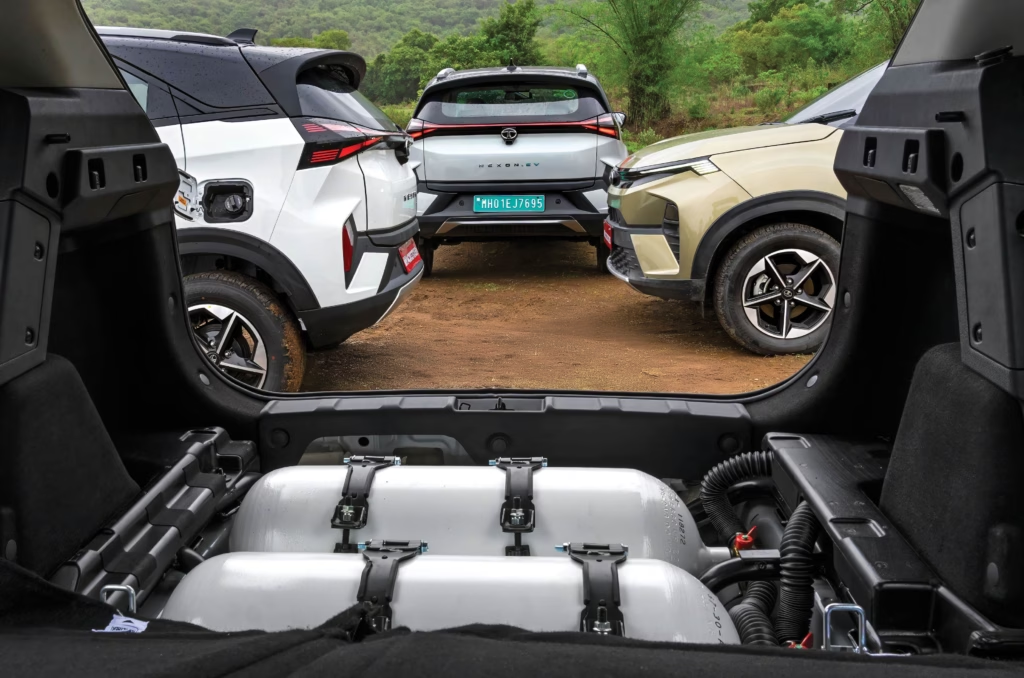
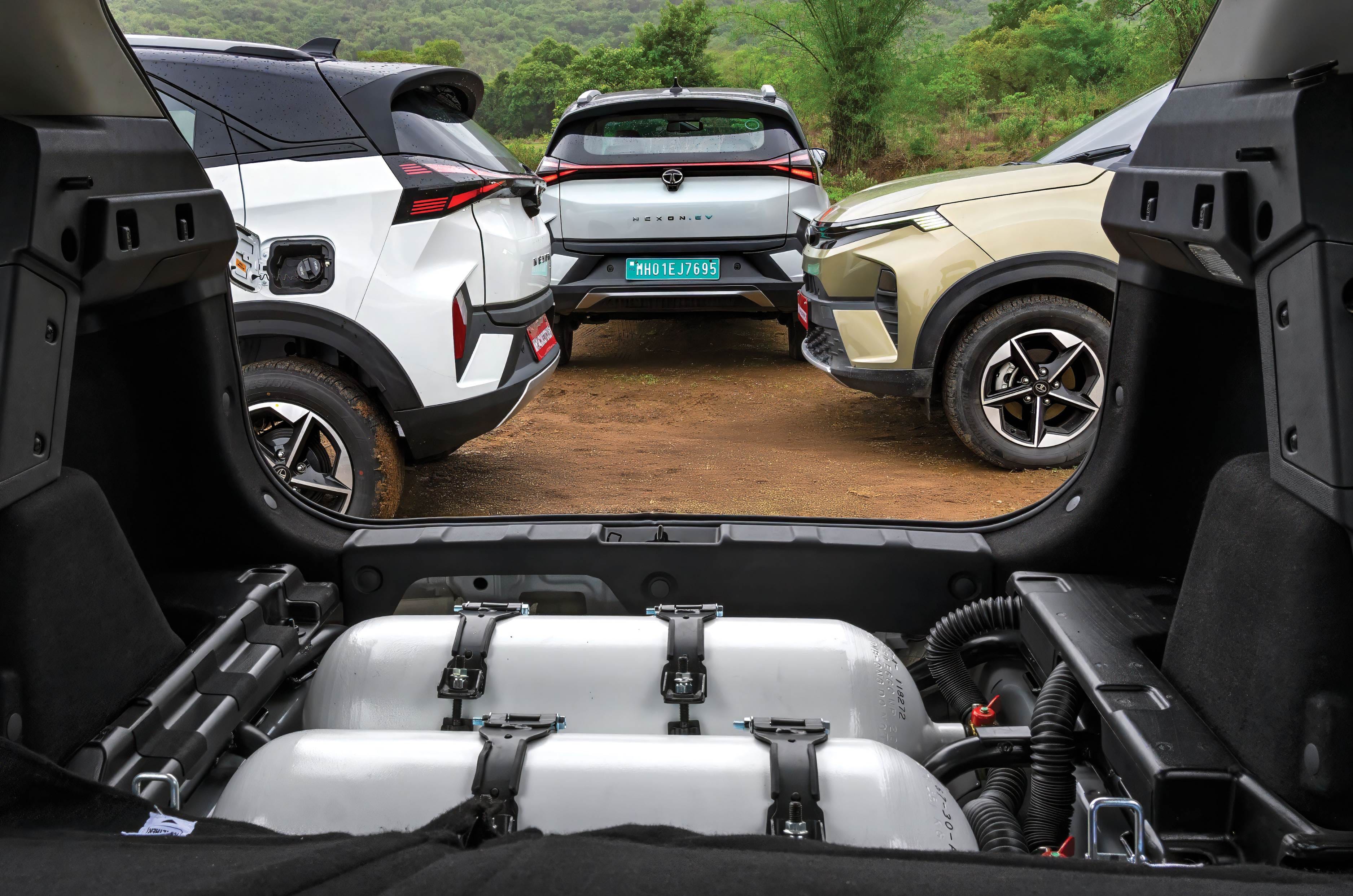
Under the bonnet is the same 1.2-litre, three-cylinder turbocharged engine found in the petrol Nexon. Not only is it India’s first turbo-petrol CNG SUV, but it is also the most powerful, producing 100hp and 170Nm when running on CNG. Impressively, peak torque remains identical to the petrol version, although it is available across a narrower band. As a result, driveability feels remarkably similar to the turbo-petrol, and users are unlikely to find themselves wanting for performance, whether in urban conditions or on the highway.
Being a turbocharged CNG engine, efficiency in city driving can take a hit. In our real-world city test involving frequent stop-start traffic, the Nexon CNG returned 15.1km/kg. Out on the highway, however, flowing traffic and the presence of a sixth gear helped it achieve close to 24km/kg. The end result is an average running cost of just Rs 4.28 per kilometre, making it the most economical option in the ICE line-up.
With driveability that’s remarkably close to the turbo-petrol, lower purchase and running costs than the diesel, and very few compromises in practicality or equipment, the Nexon CNG presents perhaps the strongest all-round case in the range. Its only notable drawback is the limited CNG infrastructure. While station availability continues to improve, rising CNG adoption often leads to longer queues and wait times at many outlets.
Unlike many CNG vehicles, the Nexon CNG doesn’t feel like a stripped-down, budget-focused alternative. It remains spacious, practical and generously equipped while delivering the lowest running costs of any ICE Nexon. Small omissions, such as cruise control, connected-car technology and JBL-branded speakers, are unlikely to be deal-breakers for most buyers.
Viewed through the lens of value, usability and cost of ownership, the Nexon CNG strikes perhaps the most convincing balance of the lot. Which perhaps explains why, despite being offered with just one engine and a manual gearbox, it now contributes more than a third of all Nexon sales.
Tata Nexon petrol vs diesel vs CNG vs EV: Verdict
The turbo-petrol’s lowest starting price, as well as the widest choice for buyers, is the reason behind its popularity. Our pick of the range, however, is the priciest 7-speed DCA, which delivers the smoothest and most polished Nexon ICE driving experience. That said, performance and efficiency aren’t exactly class-best.
The diesel’s impressive fuel efficiency and thus low running costs make it an ideal choice for those who rack up high annual mileages. Performance is the strongest among all ICE versions, and its torquey nature makes it an excellent highway companion, perfect for those who regularly cover long distances.
For buyers with reliable home charging, a predominantly urban usage pattern and high annual running, the EV is the one to pick. The 45kWh model has a genuinely usable real-world range and is also the most advanced version with a rich feature list, making it a very well-rounded option.
The Nexon CNG retains the petrol’s drivability, offers low running costs, a long range, and buyers aren’t forced to compromise features or practicality either. It thus strikes a convincing balance between price, performance and real-world usability, emerging as the sweet spot of the line-up.
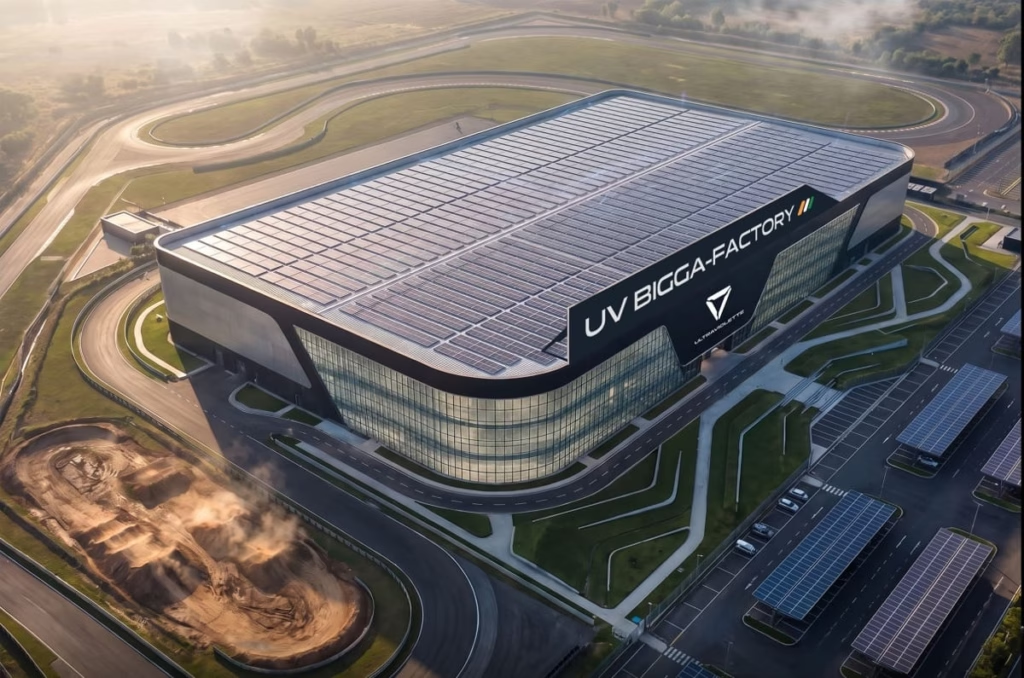
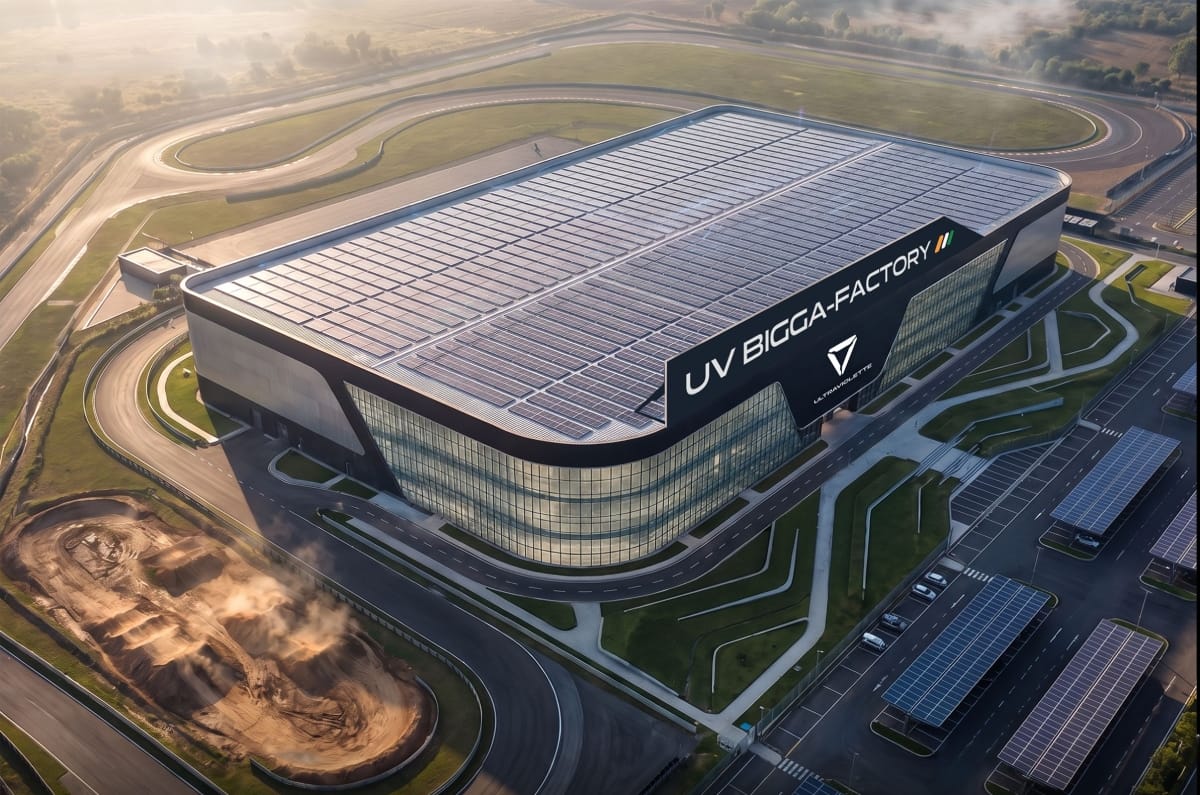
Ultraviolette has announced a new manufacturing facility in Hosur, Tamil Nadu. Named the BIGGA Factory (short for Big Global Ambition), the facility will initially produce the upcoming Tesseract scooter before expanding to support a broader product portfolio. It will begin with an annual capacity of 2.5 lakh units, with infrastructure designed for up to 5 lakh units per year.
BIGGA Factory to be located at SIPCOT Industrial Park, Hosur
Initial capacity of 2.5 lakh units per year, scalable to 5 lakh
Product roadmap image hints at a new X-47 variant and a family scooter for 2027
Ultraviolette BIGGA Factory details
Hosur chosen for its proximity to Bengaluru R&D base and supplier network
The facility will be located at the SIPCOT Industrial Park in Shoolagiri, Hosur, with the land facilitated by the Government of Tamil Nadu. Hosur’s established automotive ecosystem and its proximity to Ultraviolette’s Bengaluru R&D operations and supplier network were cited as key reasons for the location. The BIGGA Factory will operate alongside the company’s existing Bengaluru facility, which will continue its current operations.
Ultraviolette says the facility will use real-time production tracking, collaborative robots for sorting, welding and assembly, and vision-based inspection systems. A dedicated on-site test track will also be used to evaluate every vehicle before dispatch.
Product roadmap hints at new variants and models
Alongside the factory announcement, Ultraviolette shared a product roadmap image showing the silhouettes of two new products planned for 2027. One appears closely similar to the existing X-47, suggesting that a new variant could be in the pipeline. The other is a scooter with a markedly different silhouette compared to the upcoming Tesseract, featuring a more rounded, family-scooter-like profile.
If that is the direction Ultraviolette is taking, it would put the company alongside essentially every other significant EV manufacturer in India currently targeting the mainstream scooter segment. Ather has just launched the Konarc, and Simple Energy has introduced the Wave family scooter range, whereas established players such as TVS, Bajaj and Vida continue to see a majority of their EV sales volumes from models such as the iQube, Chetak and Vida VX2, respectively.
Ultraviolette has not shared any further information on either of the two new products, and the roadmap image remains the only indication of what may be coming. We’ll share further details once more information becomes available.
Stocks to Watch: अधिकतर एशियाई बाजारों से कमजोर रुझानों के बीच गिफ्ट निफ्टी से आज घरेलू मार्केट में फ्लैट शुरुआत के संकेत मिल रहे हैं। चूंकि आज सेंसेक्स की वीकली एक्सपायरी है तो मार्केट में तेज हलचल दिख सकती है। एक कारोबारी दिन पहले 9 सितंबर को सेंसेक्स (Sensex) 813.35 प्वाइंट्स यानी 1.08% की गिरावट के साथ 74,764.23 और निफ्टी 50 (Nifty 50) भी 203.60 प्वाइंट्स यानी 0.86% की फिसलन के साथ 23,431.50 पर बंद हुआ था। अब आज इंडिविजुअल स्टॉक्स की बात करें तो अपनी खास कॉरपोरेट एक्टिविटीज के चलते कुछ स्टॉक्स में तेज हलचल दिख सकती है। यहां इन शेयरों के बारे में डिटेल्स दी जा रही है।
Stocks to Watch: आज इन स्टॉक्स पर फोकस
Dilip Buildcon
दिलीप बिल्डकॉन ने ओडिशा के पारादीप से छत्तीसगढ़ के रायपुर तक एलपीजी पाइपलाइन को लेकर PNGRB (पेट्रोलियम एंड नेचुरल गैस रेगुलेटरी बोर्ड) से LoI (लेटर ऑफ इंटेंट) मिलने के बाद ₹1,800 करोड़ के प्रोजेक्ट के लिए सबसे कम बोली लगाई है।
Indian Bank
इंडियन बैंक ने एनएसई के आईपीओ में ऑफर फॉर सेल विंडो के तहत के जरिए अपनी 17.91% होल्डिंग यानी 15 लाख इक्विटी शेयर बेचने का प्रस्ताव पेश किया है। हालांकि इसके लिए रेगुलटेरी अप्रूवल लेना है।
Shakti Pumps India
शक्ति पंप्स (इंडिया) को महाराष्ट्र स्टेट इलेक्ट्रिसिटी डिस्ट्रीब्यूशन कंपनी से मैगेल त्याला सौर कृषि पंप योजना के तहत पूरे महाराष्ट्र में 3 HP, 5 HP और 7.5 HP क्षमता वाले 10,000 ऑफ-ग्रिड सोलर फोटोवोल्टिक वॉटर पंपिंग सिस्टम (SPWPS) के लिए लेटर ऑफ एम्पैनलमेंट मिला है। इन 10,000 पंपों की कुल वैल्यू लगभग ₹235.92 करोड़ है, और इसे वर्क ऑर्डर जारी होने के 60 दिनों के भीतर पूरा करना है।
ICICI Bank
आईसीआईसीआई बैंक को आरबीआई से इस बात की मंजूरी मिल गई है कि आवेदक आईसीआईसीआई प्रूडेंशियल एसेट मैनेजमेंट कंपनी अब सीएसबी बैंक, डीसीबी बैंक, कोटक महिंद्रा बैंक और एयू स्मॉल फाइनेंस बैंक में 9.95% तक वोटिंग राइट्स हासिल कर सकती है।
IRB Infrastructure Developers
आईआरबी इंफ्रा डेवलपर्स का अगस्त महीने में टोल रेवेन्यू सालाना आधार पर 25% बढ़कर ₹807.4 करोड़ पर पहुंच गया।
Wipro
विप्रो ने नैस्डैक पर लिस्टेड क्राउडस्ट्राइक (CrowdStrike) के साथ मिलकर अपना चीफ इन्फॉर्मेशन सिक्योरिटी ऑफिसर (CISO) कमांड सेंटर लॉन्च किया है। इस कमांड सेंटर को एआई से जुड़े एडवांस्ड रिस्क के खिलाफ कंपनियों की सिक्योरिटी को मजबूत करने के लिए डिजाइन किया गया है।
Hindustan Zinc
हिंदुस्तान जिंक ने कंसंट्रेट यानी कच्चे खनिज को लाने-ले जाने के लिए 30 इलेक्ट्रिक ट्रक को लेकर लॉजिस्टिक्स सॉल्यूशन कंपनी MFL इंडिया के साथ छह साल का ट्रांसपोर्टेशन कॉन्ट्रैक्ट किया है।
Juniper Green Energy
जुनिपर ग्रीन एनर्जी की पूर्ण मालिकाना हक वाली सब्सिडियरी जुनिपर ग्रीन स्पार्क टेन ने 75 MW के विंड-सोलर हाइब्रिड पावर प्रोजेक्ट को पूरी तरह से चालू कर दिया है। यह प्रोजेक्ट साइट पर विंड कैपेसिटी के आखिरी 10 MW के चालू होने के बाद पूरा हुआ है। इसके चालू होने के बाद जुनिपर ग्रीन एनर्जी और उसकी सब्सिडियरी कंपनियों की कुल ऑपरेशनल कैपेसिटी लगभग 2,604 MWp हो गई है और साथ ही लगभग 500 MWh की बैटरी एनर्जी स्टोरेज सिस्टम (BESS) कैपेसिटी भी है।
Biocon
प्राइवेट इक्विटी फर्म ट्रू नॉर्थ की सहयोगी कंपनी एक्टिव पाइन एलएलपी ने बायोकॉन के 1.65 करोड़ शेयर (1.02% हिस्सेदारी) ₹638.37 करोड़ में ₹385 के भाव पर बेच दिए। इसकी जून 2026 तक कंपनी में कुल 1.08% हिस्सेदारी (1.76 करोड़ इक्विटी शेयर) थी। ये शेयर 12 बड़े ग्लोबल और घरेलू निवेशकों- आईसीआईसीआई प्रूडेंशियल म्यूचुअल फंड, एसबीआई म्यूचुअल फंड, कोटक महिंद्रा एएमसी, आदित्य बिड़ला सन लाइफ एएमसी, बीएनबी परिबास आर्बिट्रेज, सिटीग्रुप ग्लोबल मार्केट्स सिंगापुर, व्हाइटओक कैपिटल म्यूचुअल फंड, आईसीआईसीआई प्रूडेंशियल लाइफ इंश्योरेंस कंपनी, बजाज लाइफ इंश्योरेंस, सोसिएट जेनरल, एडलवाइस म्यूचुअल फंड और गवर्नमेंट पेंशन फंड ग्लोबल की तरफ से नॉर्जेस बैंक ने प्रति शेयर ₹385 के भाव पर खरीदे।
Khadim India
एंजल इन्वेस्टर पंकज प्रसून ने प्रति शेयर ₹116.19 के भाव पर जूते-चप्पल बनाने वाली खादिम इंडिया के अतिरिक्त 4.18 लाख शेयर ₹4.86 करोड़ में खरीदे हैं। जून 2026 तक कंपनी में उनकी पहले से ही 1.62% हिस्सेदारी (2.97 लाख शेयर) थी। वहीं दूसरी तरफ एम्बिट इन्वेस्टमेंट एडवाइजर्स ने प्रति शेयर ₹115.97 के भाव पर ₹4.27 करोड़ में खादिम इंडिया के 3.69 लाख शेयर बेच दिए।
Mangalam Global Enterprise
लेमन ग्रुप के निवेश वाली Veloce Fintech ने वेलोस अपॉर्च्यूनिटीज फंड और वेलोस अपॉर्च्यूनिटीज फंड-II के जरिए मंगलम ग्लोबल एंटरप्राइज के 1.17 करोड़ इक्विटी शेयर (3.57% होल्डिंग) ₹18.26 करोड़ में प्रति शेयर ₹15.5 के भाव पर खरीदे। वहीं निवेशक चुंगथ करुणाकरण पद्मा कुमार ने अपने पूरे 1.24 करोड़ शेयर (3.78% हिस्सेदारी) ₹19.3 करोड़ में समान भाव पर बेच दिए।
Stocks to Watch: इन पर भी रहेगी नजर
आज इन कंपनियों के आएंगे रिजल्ट: गजा अल्टरनेटिव एसेट मैनेजमेंट, शंकेश ज्वैलर्स।
डिस्क्लेमर: यहां मुहैया जानकारी सिर्फ सूचना के लिए दी जा रही है। यहां बताना जरूरी है कि मार्केट में निवेश बाजार जोखिमों के अधीन है। निवेशक के तौर पर पैसा लगाने से पहले हमेशा एक्सपर्ट से सलाह लें। मनीकंट्रोल की तरफ से किसी को भी पैसा लगाने की यहां कभी भी सलाह नहीं दी जाती है।
Stocks to Watch: गुरुवार यानी 10 सितंबर को कई शेयरों में हलचल देखने को मिल सकती है। कंपनियों से जुड़े नए अपडेट सामने आए हैं। इनमें नए ऑर्डर, प्रोजेक्ट, कारोबारी फैसले और दूसरे अहम फैसले शामिल हैं।
Wipro
IT कंपनी Wipro और CrowdStrike ने साइबर सिक्योरिटी कमांड सेंटर शुरू किया है। इसका मकसद कंपनियों को बढ़ते साइबर खतरों से बचाने में मदद करना है। इसमें आर्टिफिशियल इंटेलिजेंस से जुड़े खतरे भी शामिल हैं।
Shakti Pumps
सोलर और वॉटर पंप बनाने वाली Shakti Pumps (India) को ₹235.92 करोड़ का ऑर्डर मिला है। यह ऑर्डर MSEDCL से मिला है। कंपनी पूरे महाराष्ट्र में 10,000 सोलर पावर्ड वॉटर पंपिंग सिस्टम की सप्लाई और इंस्टॉलेशन करेगी।
Coal India
सरकारी कंपनी Coal India की प्रमुख सब्सिडियरी Northern Coalfields ने कोयला उत्पादन और डिस्पैच बढ़ा दिया है। बारिश कम होने के बाद 8 सितंबर तक उत्पादन 67% और सप्लाई 75% बढ़ी है। यह तुलना 1 से 3 सितंबर के औसत से की गई है।
Dilip Buildcon
इंफ्रास्ट्रक्चर कंपनी Dilip Buildcon को PNGRB से ₹1,800 करोड़ के LPG पाइपलाइन प्रोजेक्ट का LOI मिला है। कंपनी ओडिशा के Paradip से छत्तीसगढ़ के Raipur तक पाइपलाइन विकसित करेगी। EPC काम 36 महीने में पूरा किया जाना है।
IRB Infrastructure Developers
टोल रोड और हाईवे इंफ्रास्ट्रक्चर कंपनी IRB Infrastructure Developers का ग्रॉस टोल रेवेन्यू अगस्त में करीब 25% बढ़कर ₹807 करोड़ हो गया। अगस्त 2025 में यह ₹646 करोड़ था।
Gujarat Ambuja Exports
एग्रो-प्रोसेसिंग कंपनी Gujarat Ambuja Exports कर्नाटक के हुबली में नया कॉर्न वेट मिलिंग प्लांट लगाएगी। इसकी क्षमता 850 टन प्रतिदिन होगी। कंपनी इस पर ₹333 करोड़ का निवेश करेगी। रकम इंटरनल एक्रुअल्स से जुटाई जाएगी।
ICICI Bank
बैंक ने बताया कि उसकी सब्सिडियरी ICICI Prudential Asset Management Company को RBI से चार बैंकों में कुल 9.95% तक हिस्सेदारी या वोटिंग राइट्स खरीदने की मंजूरी मिली है।
Hindustan Zinc
माइनिंग कंपनी Hindustan Zinc ने MFL India के साथ 6 साल का ट्रांसपोर्टेशन कॉन्ट्रैक्ट किया है। इसके तहत 30 इलेक्ट्रिक ट्रकों का इस्तेमाल होगा। इनसे Rampura Agucha माइन से राजस्थान की स्मेल्टिंग यूनिट्स तक जिंक और लेड कंसंट्रेट पहुंचाया जाएगा।
Union Bank of India
पब्लिक सेक्टर के यूनियन बैंक की देशभर की शाखाओं और प्रशासनिक कार्यालयों में काम प्रभावित हो सकता है। कई बैंक कर्मचारी और अधिकारी यूनियनों ने 11 सितंबर से कई चरणों में हड़ताल का ऐलान किया है।
Disclaimer: यहां मुहैया जानकारी सिर्फ सूचना के लिए दी जा रही है। यहां बताना जरूरी है कि मार्केट में निवेश बाजार जोखिमों के अधीन है। निवेशक के तौर पर पैसा लगाने से पहले हमेशा एक्सपर्ट से सलाह लें। मनीकंट्रोल की तरफ से किसी को भी पैसा लगाने की यहां कभी भी सलाह नहीं दी जाती है।
Stock in Focus: इंफ्रास्ट्रक्चर कंपनी Dilip Buildcon को पेट्रोलियम एंड नेचुरल गैस रेगुलेटरी बोर्ड (PNGRB) से लेटर ऑफ इंटेंट (LOI) मिला है। कंपनी ओडिशा के पारादीप से छत्तीसगढ़ के रायपुर तक LPG पाइपलाइन बनाएगी। प्रस्तावित EPC काम की वैल्यू करीब ₹1,800 करोड़ है। इसमें GST शामिल नहीं है।
36 महीने में पूरा होगा काम
यह प्रोजेक्ट SPV के जरिए पूरा होगा। इसमें दिलीप बिल्डकॉन की 100% हिस्सेदारी होगी। कंपनी को ही करीब ₹1,800 करोड़ का EPC काम देने का प्रस्ताव है। इसे 36 महीने में पूरा करना होगा।
PNGRB अधिकृत कंपनी को LPG पाइपलाइन बिछाने, बनाने, चलाने और जरूरत के मुताबिक उसका विस्तार करने का एक्सक्लूसिव लाइसेंस देगा।
25 साल तक चलेगी पाइपलाइन
प्रोजेक्ट में पाइपलाइन की फाइनेंसिंग, निर्माण और संचालन शामिल है। तीन साल में निर्माण पूरा होने के बाद इसे 25 साल तक चलाया जाएगा।
SPV के जरिए दिलीप बिल्डकॉन पाइपलाइन की डिजाइनिंग, फाइनेंसिंग, निर्माण, संचालन और रखरखाव करेगी। इसके लिए जरूरी मंजूरियां और नियामकीय मंजूरी लेनी होगी।
LPG बॉटलिंग प्लांट तक पहुंचेगी गैस
इस पाइपलाइन से अलग-अलग तेल कंपनियों के LPG बॉटलिंग प्लांट तक LPG पहुंचाई जाएगी। इसे साझा उपयोग वाली पाइपलाइन के तौर पर भी चलाने का प्रस्ताव है। इसके तहत पात्र तेल कंपनियां और अन्य यूजर तय नियमों के मुताबिक पाइपलाइन की क्षमता का इस्तेमाल कर सकेंगे।
कंपनी LPG की खरीद, ट्रेडिंग, वितरण या बिक्री नहीं करेगी। उसका काम पाइपलाइन तैयार करना और LPG की ढुलाई की सुविधा देना होगा।
दिलीप बिल्डकॉन के शेयर
दिलीप बिल्डकॉन का शेयर बुधवार को BSE पर 0.52% की गिरावट के साथ ₹391.55 पर बंद हुआ। पिछले 1 महीने में स्टॉक 11.77% गिरा है। वहीं, 1 साल में इसने 14.82% का नेगेटिव रिटर्न दिया है। कंपनी का मार्केट कैप 6.40 हजार करोड़ रुपये है।
दिलीप बिल्डकॉन का बिजनेस
ये इंफ्रास्ट्रक्चर और EPC कंपनी है। कंपनी सड़क और हाईवे, रेलवे और मेट्रो, एयरपोर्ट, सिंचाई, माइनिंग, पाइपलाइन, पावर ट्रांसमिशन और शहरी इंफ्रास्ट्रक्चर से जुड़े प्रोजेक्ट्स पर काम करती है। कंपनी डिजाइन, निर्माण और प्रोजेक्ट संचालन से जुड़ी सेवाएं भी देती है।
Disclaimer: यहां मुहैया जानकारी सिर्फ सूचना के लिए दी जा रही है। यहां बताना जरूरी है कि मार्केट में निवेश बाजार जोखिमों के अधीन है। निवेशक के तौर पर पैसा लगाने से पहले हमेशा एक्सपर्ट से सलाह लें। मनीकंट्रोल की तरफ से किसी को भी पैसा लगाने की यहां कभी भी सलाह नहीं दी जाती है।
Stock in Focus: सोलर और वॉटर पंप बनाने वाली कंपनी Shakti Pumps (India) को महाराष्ट्र स्टेट इलेक्ट्रिसिटी डिस्ट्रीब्यूशन कंपनी लिमिटेड (MSEDCL) से ₹235.92 करोड़ का ऑर्डर मिला है। कंपनी पूरे महाराष्ट्र में 10,000 सोलर पावर्ड वॉटर पंपिंग सिस्टम की सप्लाई और इंस्टॉलेशन करेगी।
यह ऑर्डर महाराष्ट्र की Magel Tyala Saur Krushi Pump Yojana के तहत मिला है। इसमें 3 HP, 5 HP और 7.5 HP क्षमता वाले सोलर पंप शामिल हैं।
60 दिनों में पूरा करना होगा काम
शक्ति पंप्स के मुताबिक, वर्क ऑर्डर मिलने के बाद इसे 60 दिनों के अंदर पूरा करना होगा। इस प्रोजेक्ट में कंपनी की जिम्मेदारी सिर्फ पंप की सप्लाई तक सीमित नहीं है। कंपनी पंप का डिजाइन और मैन्युफैक्चरिंग करेगी।
इसके बाद पंप को तय जगहों तक पहुंचाया जाएगा। वहां सिस्टम की इंस्टॉलेशन, टेस्टिंग और कमीशनिंग भी कंपनी ही करेगी। यह ऑर्डर पूरे महाराष्ट्र के लिए है। इसका मकसद किसानों को सिंचाई के लिए ऑफ-ग्रिड सोलर पंपिंग सिस्टम उपलब्ध कराना है।
शक्ति पंप्स के शेयरों का हाल
शक्ति पंप्स का शेयर बुधवार को NSE पर 1.06% की गिरावट के साथ ₹468 पर बंद हुआ। पिछले 1 महीने में स्टॉक 8.31% गिरा है। वहीं, 1 साल में यह 42.45% क्रैश हुआ है। हालांकि, बीते 5 साल में इसने 291% का मल्टीबैगर रिटर्न दिया है।
शक्ति पंप्स का बिजनेस क्या है
Shakti Pumps (India) सोलर और वॉटर पंप बनाने वाली कंपनी है। कंपनी सोलर पावर्ड वॉटर पंपिंग सिस्टम की डिजाइनिंग, मैन्युफैक्चरिंग और सप्लाई करती है। इसके साथ ही कंपनी पंप सिस्टम की इंस्टॉलेशन, टेस्टिंग और कमीशनिंग का काम भी करती है।
Disclaimer: यहां मुहैया जानकारी सिर्फ सूचना के लिए दी जा रही है। यहां बताना जरूरी है कि मार्केट में निवेश बाजार जोखिमों के अधीन है। निवेशक के तौर पर पैसा लगाने से पहले हमेशा एक्सपर्ट से सलाह लें। मनीकंट्रोल की तरफ से किसी को भी पैसा लगाने की यहां कभी भी सलाह नहीं दी जाती है।
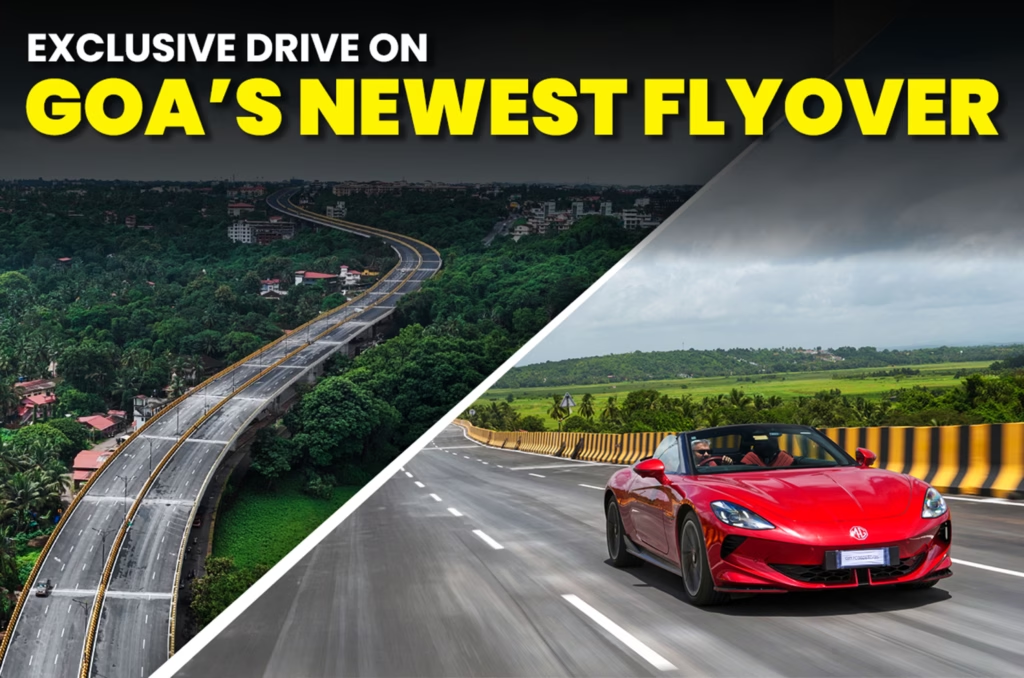
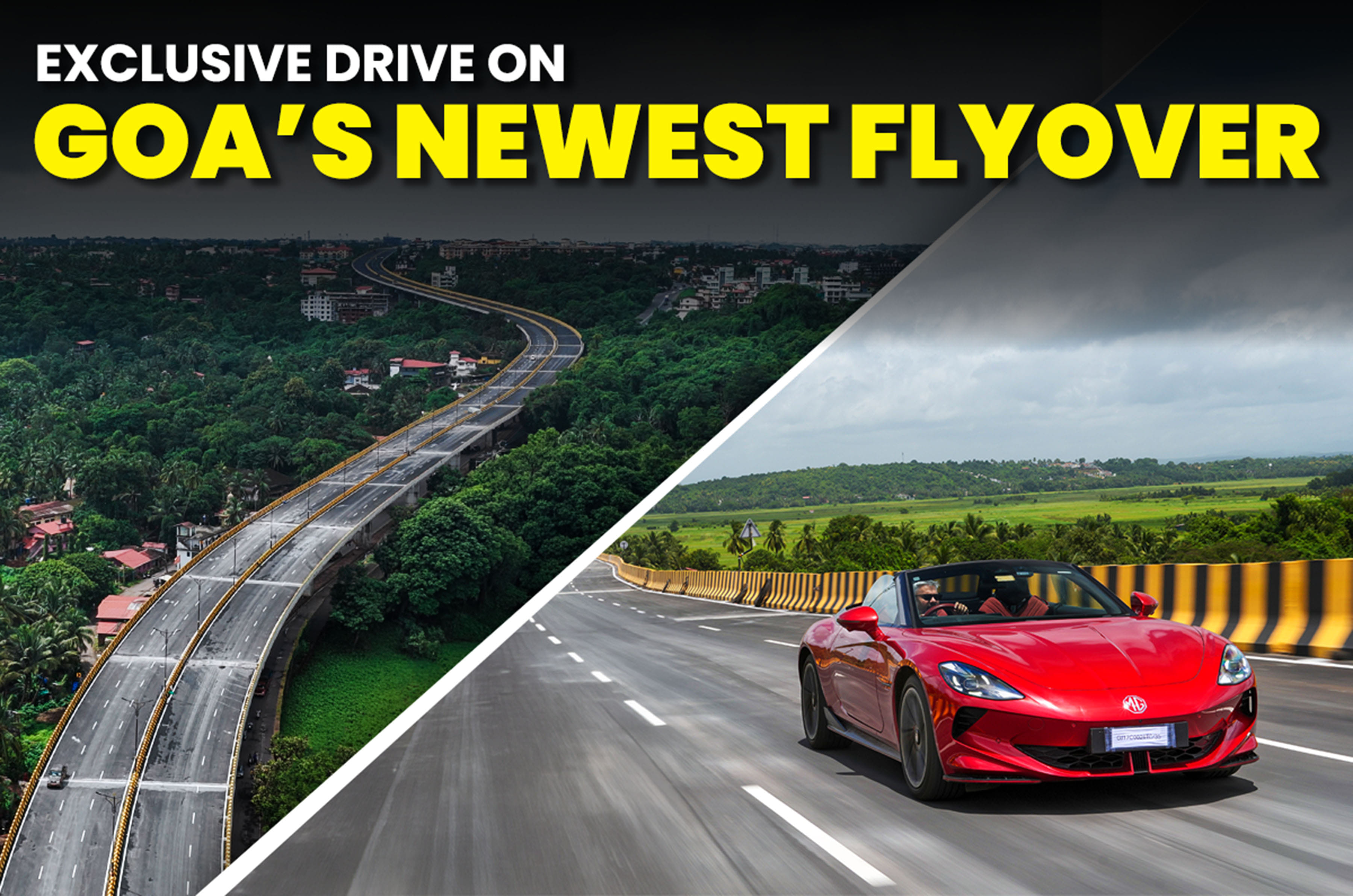
If a holiday in Goa is a fixture on your calendar, you will have noticed that the state has changed a fair bit in the last few years. There is a new airport to fly into, new bridges replacing the old, not to mention the wider highways. The latest upgrade to the state’s road network is the Porvorim Elevated Corridor, targeting a major bottleneck on NH66. We were given an exclusive opportunity to experience it for ourselves before the official inauguration on Sep 9, and we brought along a very ‘Goa’ car for the occasion – the MG Cyberster.
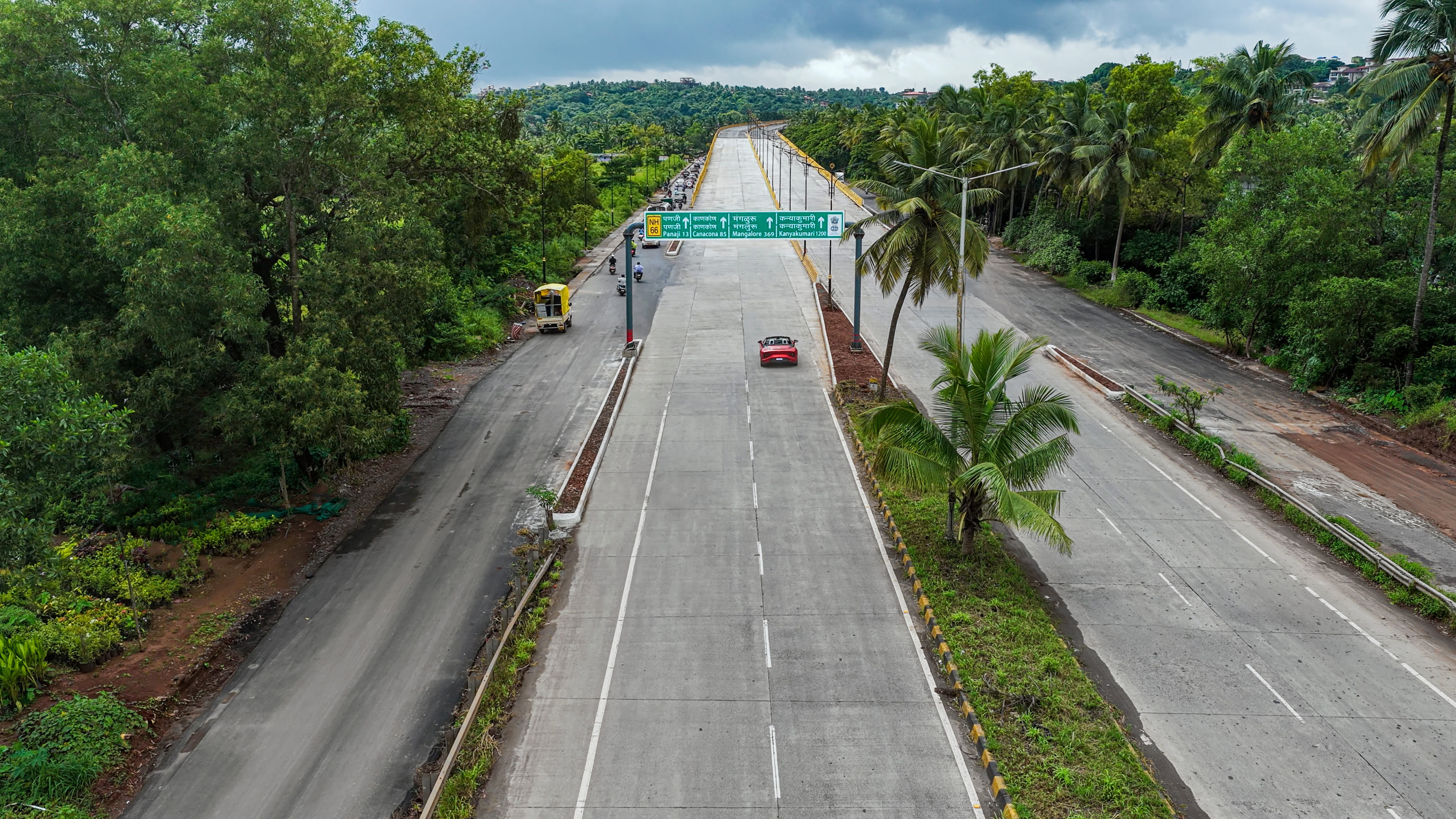
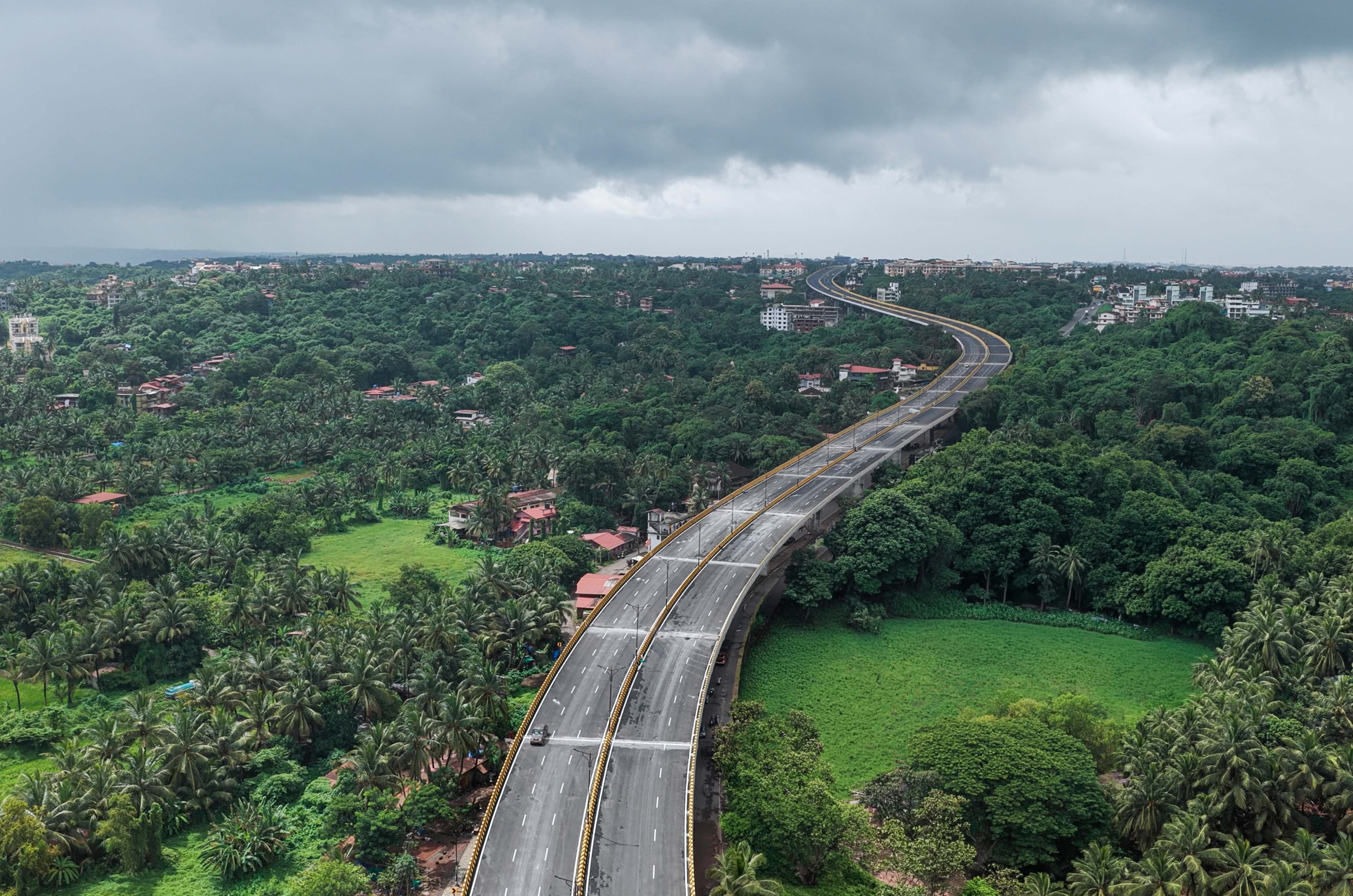
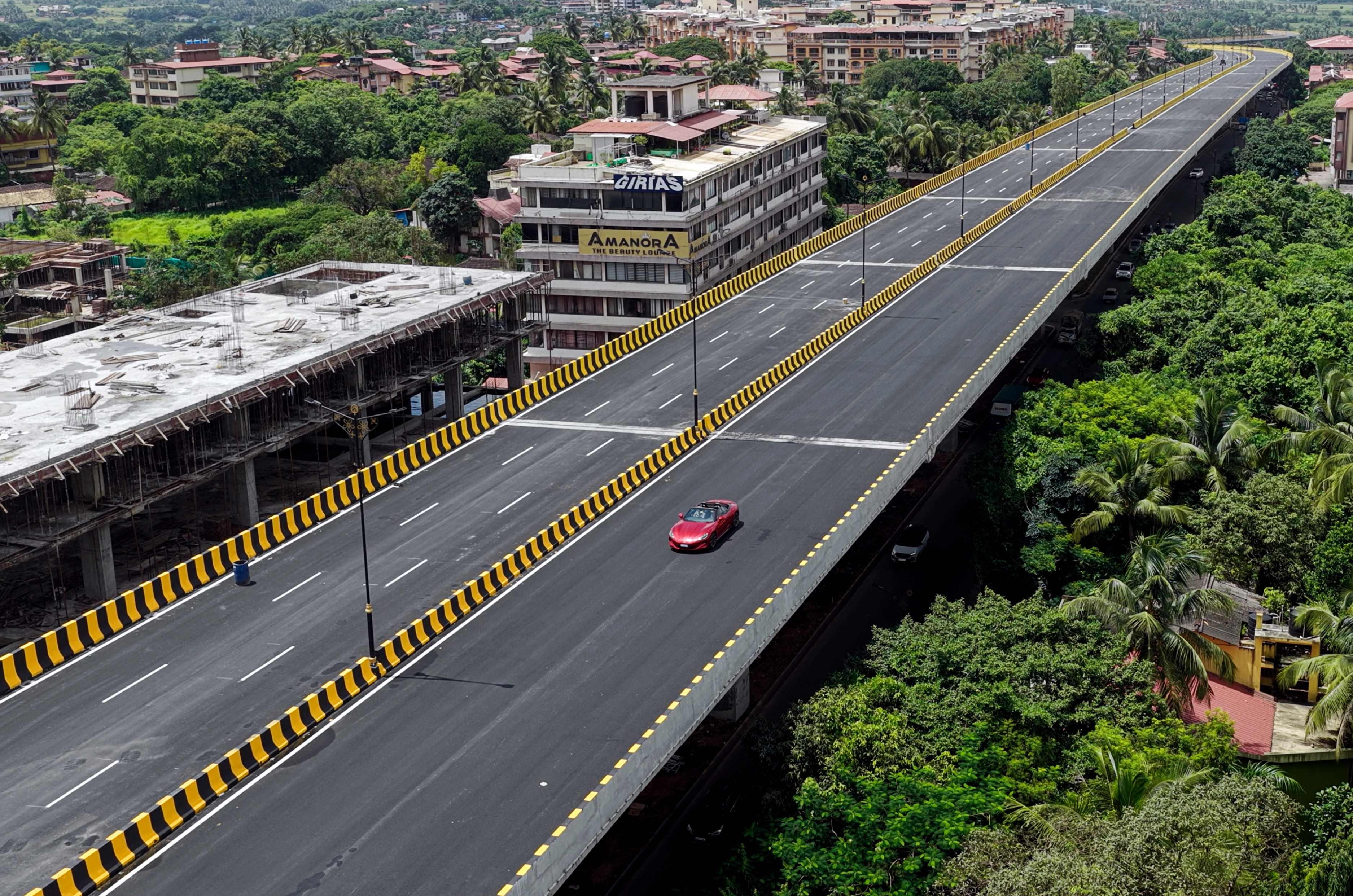
First, a bit of quick history and geography. National Highway 66 is a 1,640km arterial highway running from Panvel in Maharashtra to Kanyakumari in Tamil Nadu. 124km of NH66 is in Goa and, for years, Porvorim has been its most notorious bottleneck. The new 5.15km Porvorim Elevated Corridor lets traffic sail clean over all that congestion below, connecting directly to the Atal Setu bridge that crosses the Mandovi River. It promises to cut travel time between Mapusa in the north and the capital Panaji by up to 30 minutes – a claim we set out to test.
Six-laned Porvorim Elevated Corridor brings North Goa and Panaji closer than ever.
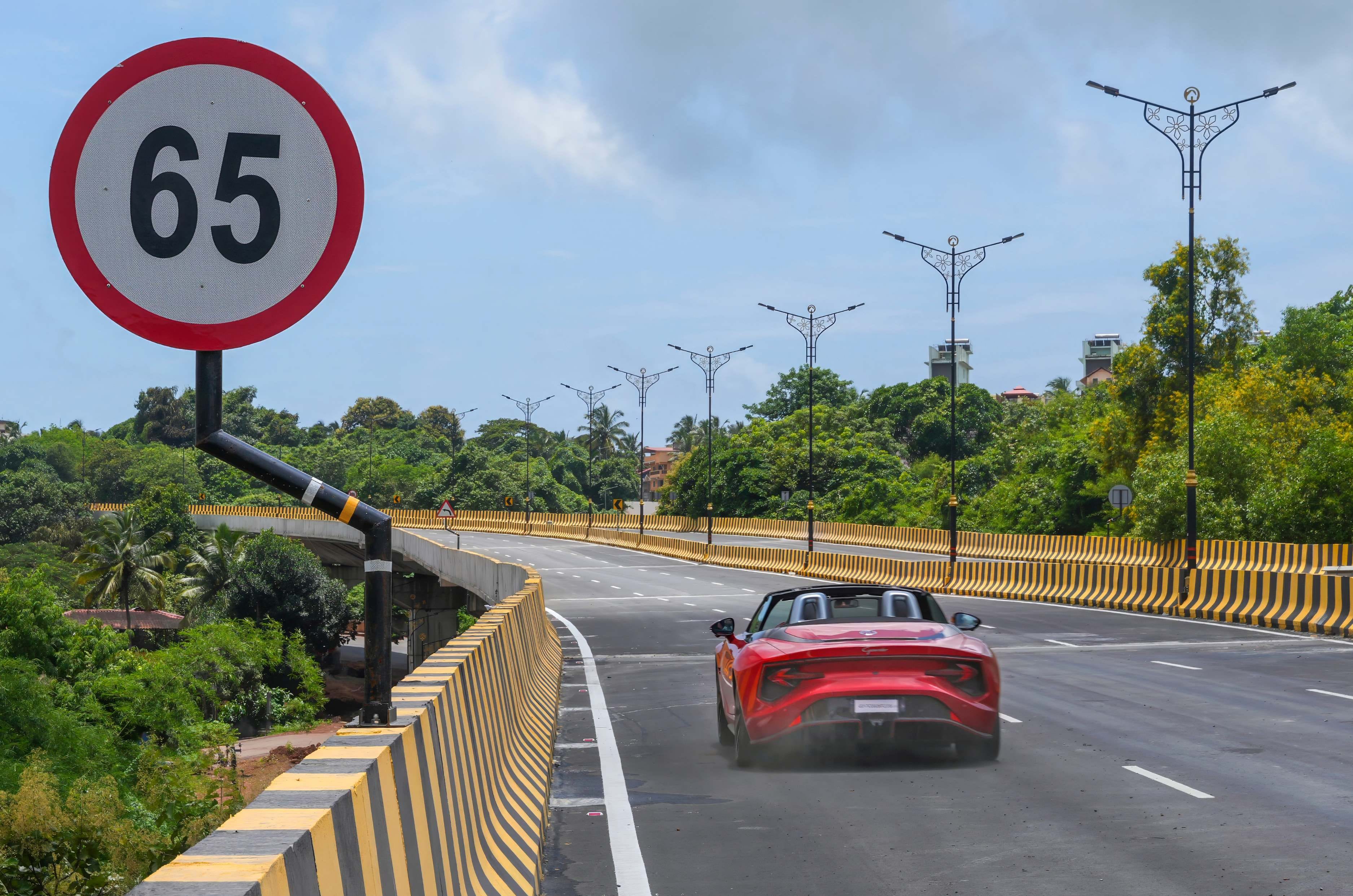
Our starting point was the north end of the corridor, a couple of kilometres away from Guirim village near Mapusa. We started our stopwatch on the concrete ramp leading up the PEC – one we would only stop once we crossed over the Atal Setu Bridge and entered Panaji. And even with 510hp and 725Nm on tap and the road all to ourselves, we would be sticking to the 65kph speed limit.
From the concrete on-ramp, it’s only a few metres until you drive onto the actual viaduct section, which is paved tarmac broken up only by expansion joints. It is not completely straight either – the north end has some lovely sweeping curves. In a car like the Cyberster, it is quite tempting to push through the bends but, exercising restraint, we instead indulged in the joys of open-top motoring. The Cyberster drops its top in 10 seconds at speeds up to 50kph, giving us superb views all around. Importantly, it also raises the top just as quickly, which comes in handy during sudden showers.
No more jams! 5.15km flyover sails over congestion at Porvorim junction.
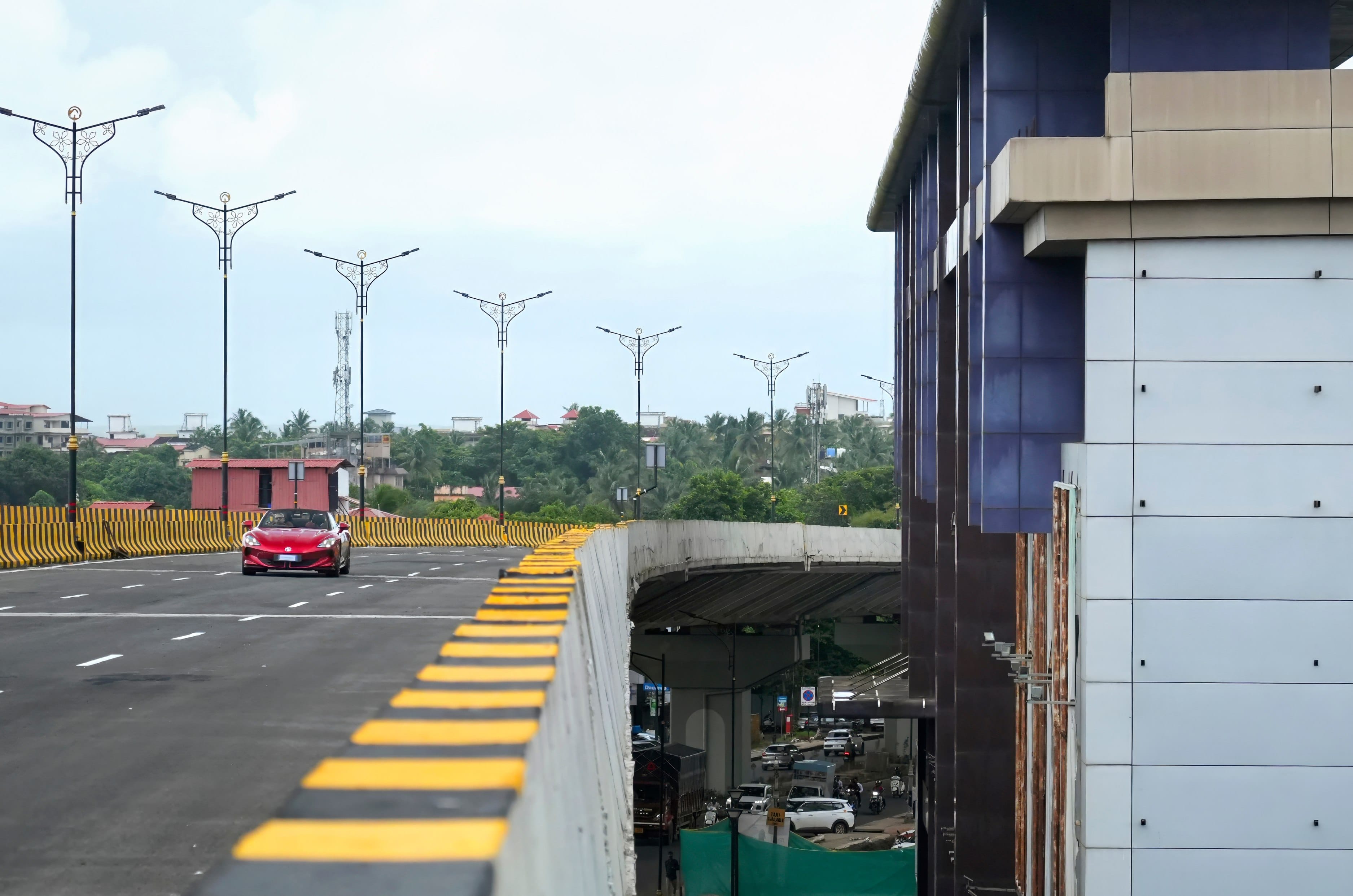
From the driver’s seat, the panoramic view of Porvorim’s greenery was quite stunning – something you would never notice stuck in traffic below. Drive on, and the road becomes arrow-straight, and you start to notice how close some of the buildings are to the corridor. This proximity to adjoining structures, along with the fact that NH66 had to stay operational below, were among the biggest challenges the engineers faced.
Some buildings were a little too close for comfort making construction quite challenging.
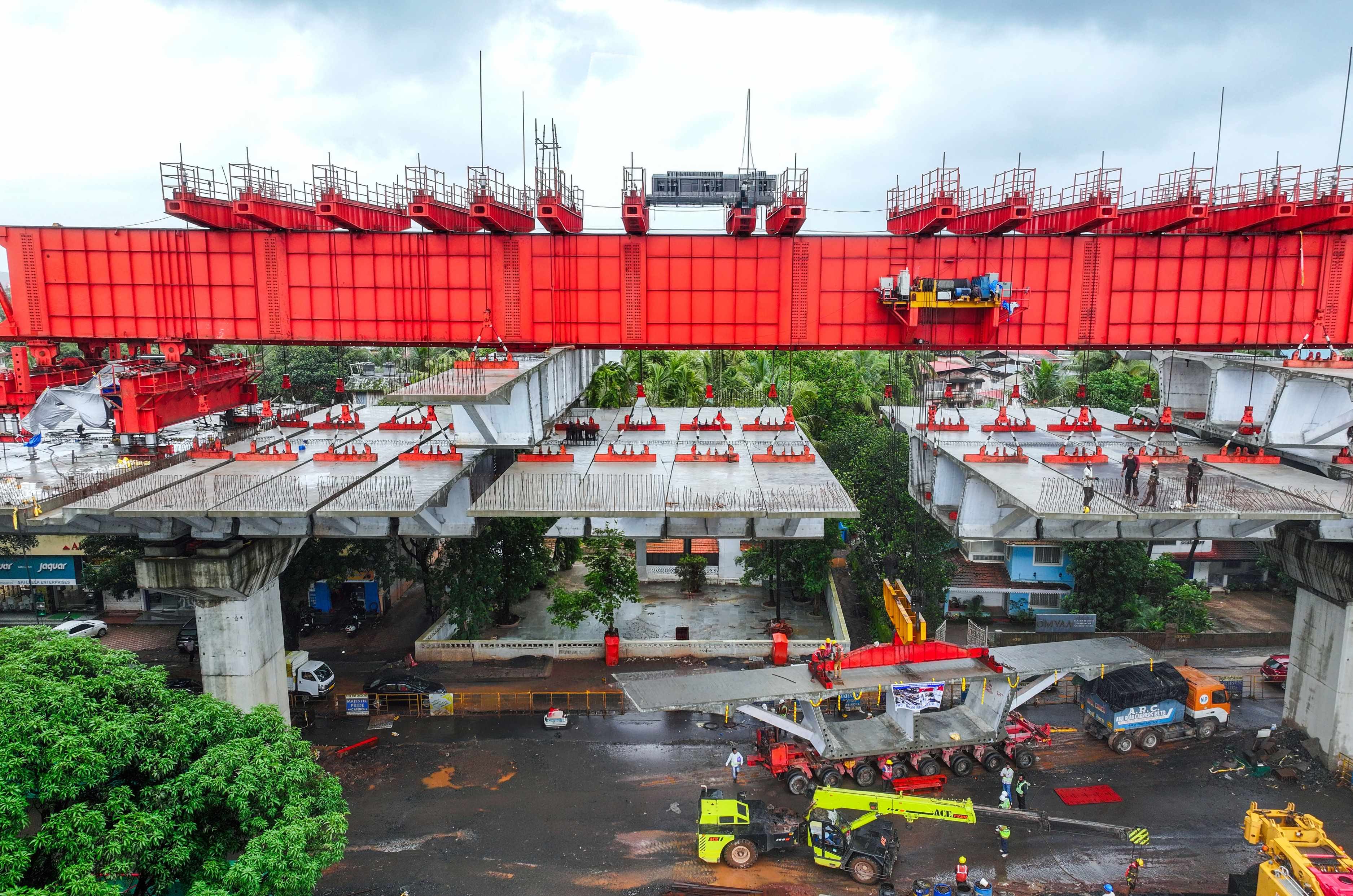
The 4.19km viaduct section is supported by 87 pillars. Each span running between two pillars requires between 13 and 17 individual pre-cast concrete sections. These sections are about 24 metres wide and weigh a whopping 120 tonnes each. They were cast in a yard down the road, trucked to the site, hoisted 11 metres high and installed in place – all in a narrow space between buildings with absolutely no room for error, while ensuring minimal traffic disruptions below.
Considering the challenges, it is quite remarkable that the Porvorim Elevated Corridor was completed in just two years and five months. Below the main structure, 10.30 kilometres of service roads and 28 minor junctions keep local traffic moving, while the corridor sails above it all. Also featured are eight box culverts and a rainwater harvesting system, so the monsoon doesn’t slow traffic down. A modern lighting setup with 515 streetlights has already been installed, while two high-mast lights and ten overhead gantries with cameras are to be put up soon. All constructed at a cost of Rs 641.46 crore.
New flyover part of NH 66 open to cars, two-wheelers and CVs. Speed limit 65kph.
Before long, we were passing the Mall de Goa – close enough to see the expressions on the faces of people in the food court, as they watched the bright red Cyberster whizz past their window. As we made our way down the off-ramp, the stopwatch showed that it had been just over four and a half minutes. Heading towards the Atal Setu, we merged with the dozens coming from the diversion and became part of regular traffic.
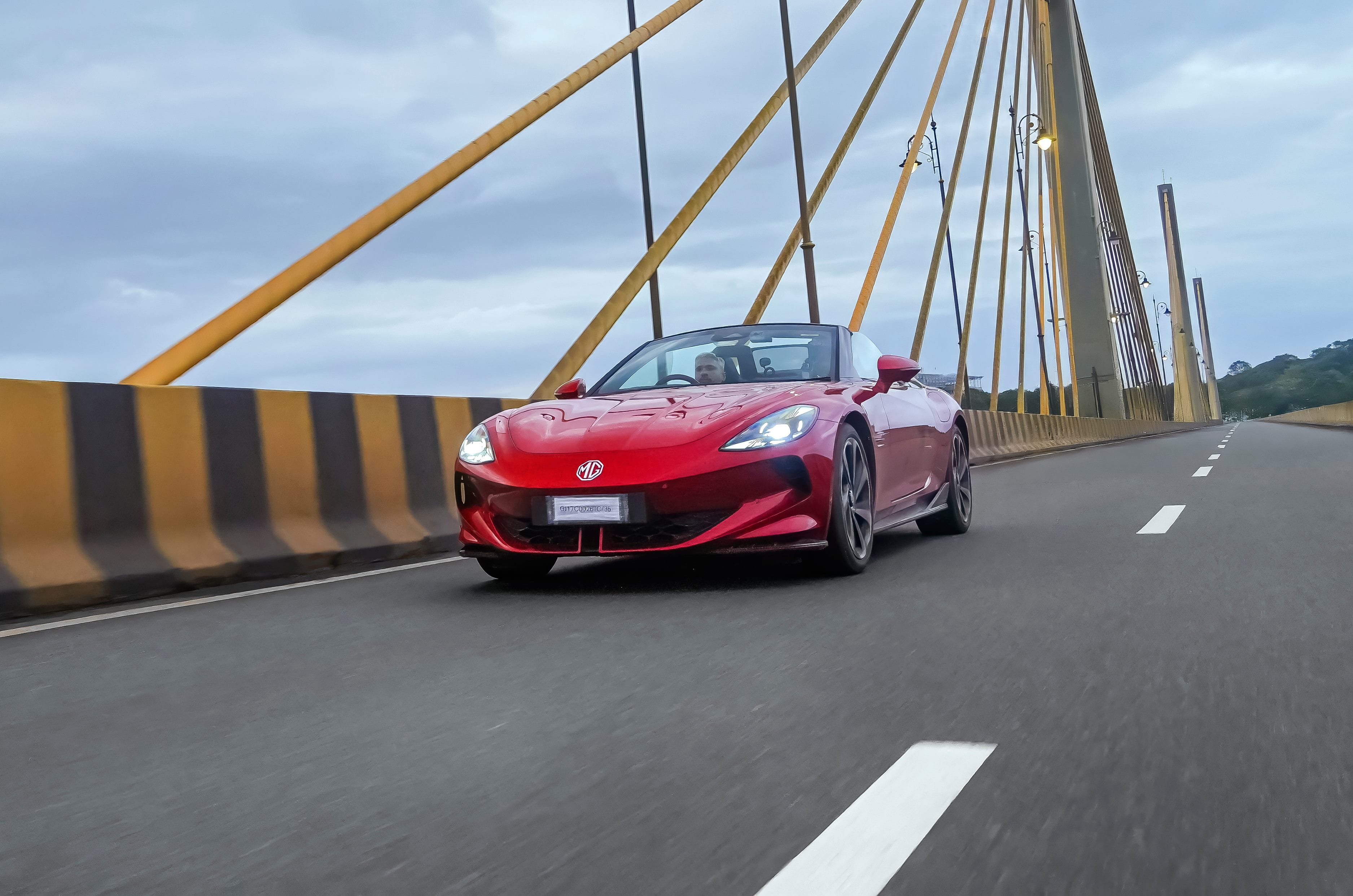
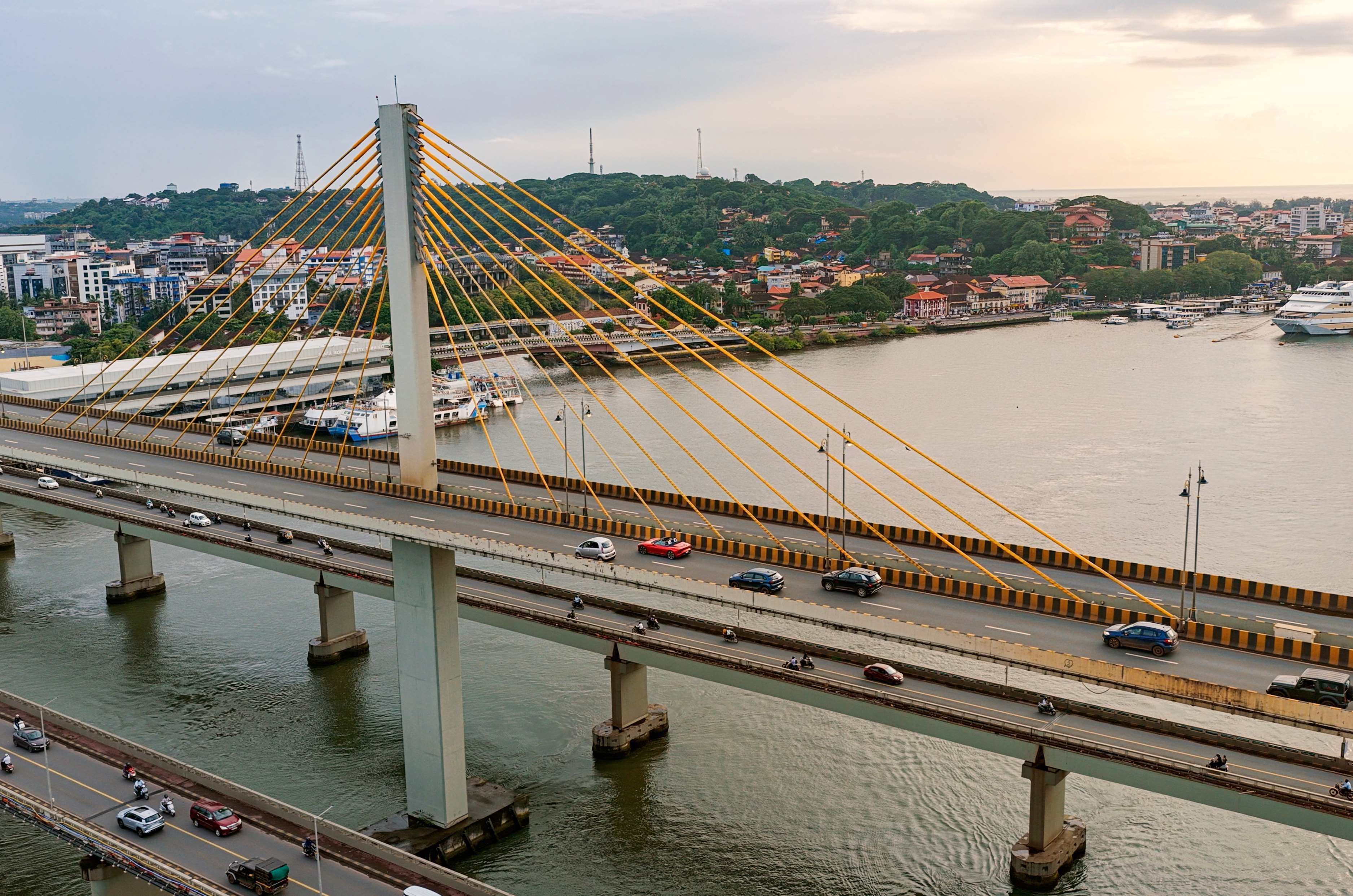
And just like that, we were climbing the Atal Setu bridge, which would take us across the Mandovi River and into Panaji. To the right, stunning views of Panaji city and Miramar beach in the distance, and to the left, Old Goa with its historic churches, while above me, through the open roof of the Cyberster, panoramic views of the bridge’s iconic pylons and yellow cable stays.
Drop top MG Cyberster a great match for Goa’s vibe
Coming down the Atal Setu into Panaji, our stopwatch read just under 10 minutes. Even if you factor in a couple of extra minutes for traffic once the PEC opens, it equates to a real-world saving of about 30 minutes in peak hours, which is quite significant. In fact, the PEC is said to have a capacity of 70,000 PCU, or passenger car units, per day, so traffic flow is expected to be quite swift. Simultaneously, it will reduce the burden on the service and other connecting roads below the corridor, improving flow for local traffic too.
Connects directly to (yet another) Atal Setu bridge and brings you closer to Goa’s historic sites.
The Porvorim Elevated Corridor, along with other recent infra projects such as the Atal Setu, the New Zuari Bridge and the widening of NH66, is expected to boost the economy by improving intra-state connectivity to Goa’s industrial hubs, as well as flow between the airports and ports. It should also make commutes easier for residents and change the way tourists experience Goa – less time spent travelling, more time to explore the beaches, the culture and everything Goa has to offer.
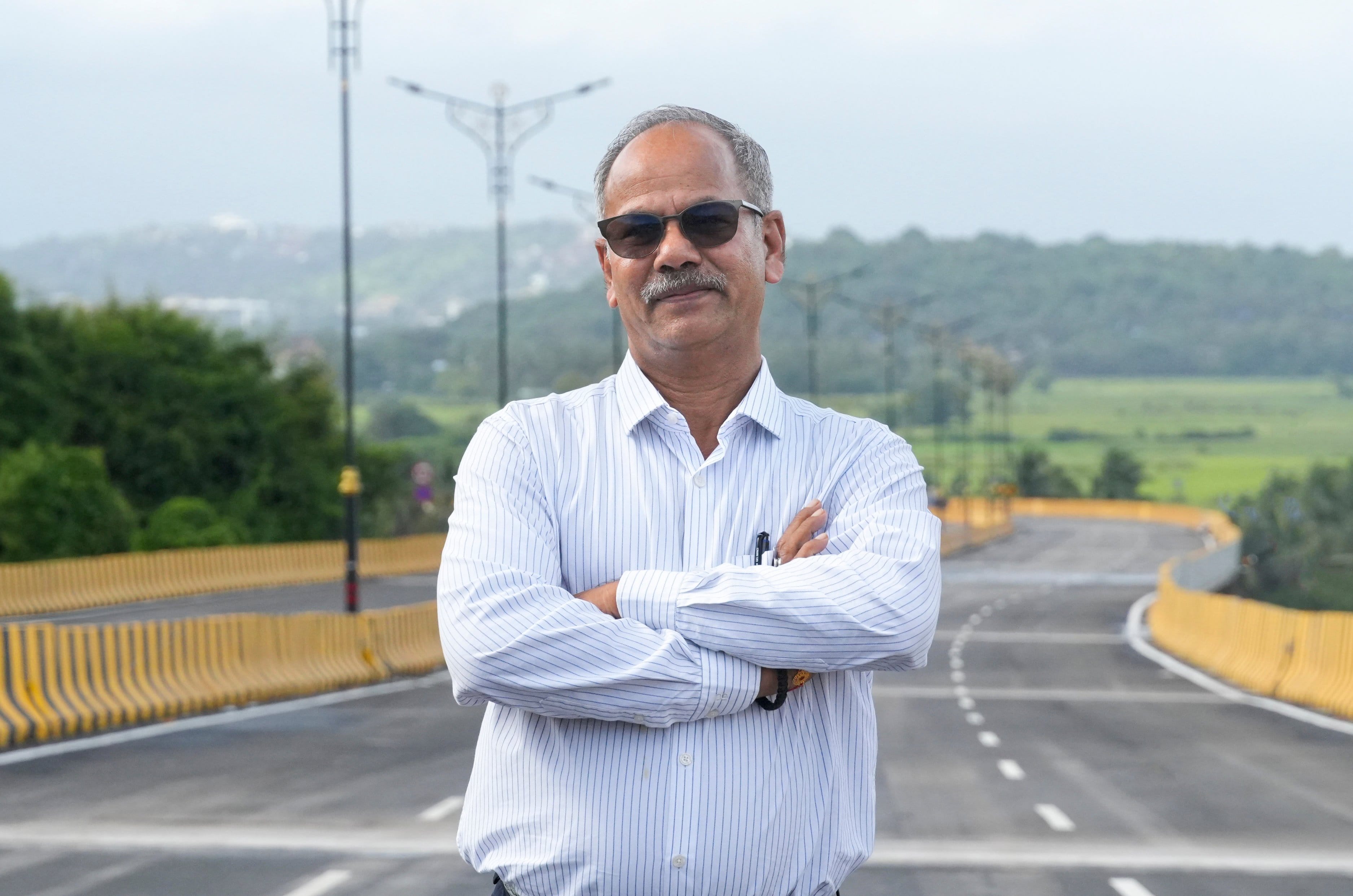
In conversation with Sandip Prabhu Chodnekar, Principal Chief Engineer, Goa Public Works Department (PWD)
On the challenges faced during construction
This bridge is about 24 metres wide, but the right of way is only 25 metres. Constructing such a wide structure when both sides are already fully developed was very challenging. One of the biggest challenges was lifting the segments. Each segment is nearly 24 metres wide and weighs around 120 tonnes. We could not divert the traffic, so we had to carry out most of the work at night. During the daytime, we stopped heavy traffic so that the segments could be lifted safely and normal traffic could resume quickly.
Lifting 25 metre wide sections that weigh 120 tonnes called for nerves of steel.
On other highlights of the project
We tried to harvest the rainwater to recharge the groundwater and increase the water table. There is a median between the service roads below, where we are also planting trees. The corridor’s rainwater harvesting system collects the water and directs it into this median. From there, the water flows into pits that we have dug and filled with aggregates and strainers, allowing the rainwater to percolate into the ground. This helps harvest the rainwater and increase the water table on the plateau during the monsoon.
On traffic and usage
Below the corridor, things will be quite different. Once around 50,000 PCUs of traffic are taken off the existing four-lane road, there could be a tendency for people to park on these lanes. So, we will have to manage parking as well. We have streamlined the junctions and completely reworked the at-grade traffic flow. Motorcycles are also allowed on the Porvorim Elevated Corridor.
In conversation with Dr. Pramod Sawant, Chief Minister, Goa
On the importance of the project
The Porvorim Elevated Corridor is actually important not only for Goa but also for Maharashtra, Karnataka and Kerala. Porvorim had become a problem because it is a congested and newly developed city, with development on both sides of the road. Even after the road was widened, it was very difficult to manage, and it had become an accident-prone zone. That is why the Porvorim flyover was required, to ensure smooth traffic on NH-66.
Greater connectivity a boon for residents, tourists and businesses.
On the project’s wider connectivity benefits
With the opening of Manohar International Airport in North Goa, there was a need to improve connectivity towards South Goa. People arriving at Manohar International Airport and travelling towards South Goa were facing a lot of congestion. Now, that congestion will be reduced and this will definitely help tourism and vehicle movement in the state.
Furthermore, there will be better connectivity between the airports and ports, which will havea positive economic impact. It is also a very important project for the people of Goa. Especially those travelling between North Goa and the capital; they will save time and money, and their daily commute will become much easier.
On Goa’s future infrastructure plans
Almost all the projects on the National Highway network in Goa have been completed. One of the remaining projects is the Borim Bridge, which will connect the Ponda side. The tendering process for it will happen in the next few days.
We are planning to improve connectivity across rural Goa, from one end of Maharashtra towards Karnataka. We are considering a ring road for Goa, because traffic currently comes into the interior areas and cities. In the future, we want traffic to be able to move around the interior villages and across the state without having to enter the cities.
IRB Infrastructure: टोल और हाईवे इंफ्रास्ट्रक्चर डेवलपर कंपनी IRB Infrastructure Developers Ltd ने अगस्त 2026 के टोल रेवेन्यू के आंकड़े जारी किए हैं। कंपनी का ग्रॉस टोल रेवेन्यू सालाना आधार पर करीब 25% बढ़कर ₹807 करोड़ पहुंच गया। अगस्त 2025 में यह ₹646 करोड़ था।
प्रमुख टोल एसेट्स का प्रदर्शन
IRB MP Expressway का टोल रेवेन्यू अगस्त 2026 में बढ़कर ₹172.1 करोड़ हो गया। एक साल पहले यह ₹144.7 करोड़ था। वहीं, IRB Golconda Expressway का रेवेन्यू ₹73.7 करोड़ से बढ़कर ₹87.9 करोड़ हो गया।
IRB Ahmedabad Vadodara Super Express Tollway ने अगस्त में ₹80.3 करोड़ का टोल रेवेन्यू दर्ज किया। पिछले साल इसी महीने यह ₹69.1 करोड़ था। IRB Lalitpur Tollway का रेवेन्यू भी ₹36.1 करोड़ से बढ़कर ₹43.5 करोड़ हो गया।
इसके अलावा, IRB Tumkur Chitradurga Tollway का टोल रेवेन्यू ₹34.9 करोड़ से बढ़कर ₹38.4 करोड़ रहा। Udaipur Tollway का रेवेन्यू ₹26.3 करोड़ से बढ़कर ₹28.8 करोड़ हो गया।
नए एसेट्स से भी मिला योगदान
अगस्त 2026 में तीन ऐसे एसेट्स रहे, जिनका पिछले साल का तुलनात्मक आंकड़ा उपलब्ध नहीं था। IRB Harihara Corridors Tollway ने ₹41.7 करोड़, IRB Chandibhadra Tollway ने ₹20 करोड़ और Meerut Budaun Expressway ने ₹22.6 करोड़ का टोल रेवेन्यू दर्ज किया।
कुछ एसेट्स में रेवेन्यू घटा
सभी प्रोजेक्ट्स का प्रदर्शन एक जैसा नहीं रहा। IRB Kota Tollway का टोल रेवेन्यू ₹7.1 करोड़ से घटकर ₹6.3 करोड़ रह गया। Hapur Moradabad Tollway का रेवेन्यू ₹28.9 करोड़ से घटकर ₹22.3 करोड़ रहा।
वहीं, Kishangarh Gulabpura Tollway का टोल रेवेन्यू मामूली गिरावट के साथ ₹23 करोड़ से ₹22.5 करोड़ रह गया।
28 हाईवे एसेट्स का पोर्टफोलियो
कंपनी के मुताबिक, IRB Group के पास 13 राज्यों में 28 रेवेन्यू जेनरेटिंग हाईवे एसेट्स हैं। इन एसेट्स की कुल वैल्यू करीब ₹94,000 करोड़ है। रोजाना करीब 15 लाख व्हीकल इन हाईवे एसेट्स से गुजरते हैं।
कंपनी अपनी एसेट चर्न स्ट्रैटेजी के जरिए FY2029 तक एसेट बेस को बढ़ाकर करीब ₹1.4 लाख करोड़ करने की योजना बना रही है।
कंपनी ने क्या कहा?
IRB Infrastructure Developers के डिप्टी CEO अमिताभ मुराका ने कहा कि अगस्त में मजबूत टोल रेवेन्यू कंपनी के एसेट्स पर लगातार ट्रैफिक ग्रोथ को दिखाता है। ट्रैफिक बढ़ने के साथ FY27 की शुरुआत में लागू किए गए टैरिफ रिविजन से भी रेवेन्यू को सपोर्ट मिला है।
उन्होंने कहा कि मजबूत GDP ग्रोथ से आर्थिक गतिविधियों में मजबूती बनी हुई है। गणेश फेस्टिवल के साथ फेस्टिव सीजन भी शुरू हो चुका है। ऐसे में आने वाले महीनों में ट्रैफिक का पॉजिटिव मोमेंटम जारी रहने की उम्मीद है।
शेयर का हाल
IRB Infrastructure Developers का शेयर बुधवार को BSE पर 0.94% की गिरावट के साथ ₹19.07 पर बंद हुआ। पिछले 1 साल में स्टॉक 9.84% गिरा है। इसका मार्केट कैप 11.50 हजार करोड़ रुपये है।
Disclaimer: यहां मुहैया जानकारी सिर्फ सूचना के लिए दी जा रही है। यहां बताना जरूरी है कि मार्केट में निवेश बाजार जोखिमों के अधीन है। निवेशक के तौर पर पैसा लगाने से पहले हमेशा एक्सपर्ट से सलाह लें। मनीकंट्रोल की तरफ से किसी को भी पैसा लगाने की यहां कभी भी सलाह नहीं दी जाती है।