Satya Niketan PG, Delhi हादसे में मध्य प्रदेश के 18 वर्षीय अर्पित की जान चली गई! किसी भी माता-पिता के लिए अपने जवान बेटे को खो देने से शायद कोई दुख नहीं होता!
पर इस असहनीय पीड़ा के बीच भी, इस परिवार ने जो किया वह अतुलनीय है!
(18 Year Old Arpit Who Lost His Life In Delhi Satya Niketan PG Building Collapse Donates His Eyes)
सत्य निकेतन PG हादसा: 18 साल के अर्पित ने गंवाई जान, परिवार ने दान की आंखें | Satya Niketan PG Collapse | 18-Year-Old Arpit Lost His Life | Eye Donation।
सोशल मीडिया पर कभी ना हार मानने वाली एक पोस्ट तेजी से वायरल हो रहा है। लगातार 15 बार रिजेक्शन मिलने के बावजूद एक युवक ने अमेजन में नौकरी पाने की कोशिश नहीं छोड़ी। लगातार 15 बार रिजेक्शन मिलने के बावजूद एक युवक ने अमेजन में नौकरी पाने की कोशिश नहीं छोड़ी। भोपाल के लक्ष्मी नारायण कॉलेज ऑफ टेक्नोलॉजी से इलेक्ट्रॉनिक्स एंड कम्युनिकेशन इंजीनियरिंग की पढ़ाई पूरी करने वाले इस युवक ने कंपनी में नौकरी के लिए बार-बार आवेदन किया। आखिरकार उसकी मेहनत रंग लाई और उसे अमेजन जर्मनी में काम करने का मौका मिल गया। कंपनी ने उसे करीब 1.1 करोड़ रुपये का सालाना पैकेज ऑफर किया है। उनकी यह कहानी अब सोशल मीडिया पर लोगों के बीच चर्चा का विषय बनी हुई है।
सोशल मीडिया पर वायरल हो रहा पोस्ट
सोशल मीडिया प्लेटफॉर्म X पर गंतव्य मालवीय की कहानी तेजी से वायरल हो रही है। पोस्ट के मुताबिक, गंतव्य मालवीय ने कंप्यूटर साइंस की पढ़ाई नहीं की थी, लेकिन इंजीनियरिंग के दौरान ही उन्होंने टेक्नोलॉजी के क्षेत्र में करियर बनाने का फैसला किया। इसके लिए उन्होंने प्रोग्रामिंग और डेटा स्ट्रक्चर-एल्गोरिदम जैसी जरूरी स्किल्स सीखीं। इसके साथ ही उन्होंने मशीन लर्निंग और सॉफ्टवेयर डेवलपमेंट पर भी काम किया। अपनी जानकारी को मजबूत करने के लिए उन्होंने अलग-अलग प्रोजेक्ट और इंटर्नशिप के जरिए प्रैक्टिकल अनुभव हासिल किया।
लगातार करते रहे प्रयास
गंतव्य मालवीय अमेजन की नौकरी पाने के लिए लगातार कंपनी के करियर पेज पर नजर रखते थे और अपनी योग्यता के मुताबिक अलग-अलग पदों के लिए आवेदन करते रहे। शुरुआत में उन्हें 15 बार निराशा हाथ लगी, लेकिन उन्होंने कोशिश जारी रखी। आखिरकार उन्हें अमेजन जर्मनी में सॉफ्टवेयर डेवलपमेंट इंजीनियर के पद के लिए चुना गया। LNCT के अनुसार, उन्हें करीब 1.10 करोड़ रुपये का पैकेज मिला। मालवीय अगस्त 2023 से अमेजन वेब सर्विसेज (AWS) में सॉफ्टवेयर डेवलपमेंट इंजीनियर के तौर पर काम कर रहे हैं। उनके लिए यह नौकरी करियर की एक नई शुरुआत साबित हुई।
Meet Gantavya Malviya, who completed his https://t.co/BC6fLkcQNf ECE from LNCT Bhopal. This guy is from a non-CS branch, and you know what? He cracked Amazon off-campus with a ₹1.1 crore package at Amazon Germany.
He was rejected by Amazon 15 times before cracking it.
X पर हाल ही में एक पोस्ट में मालवीय ने बताया कि वह Amazon छोड़कर Taxfix में शामिल होने जा रहे हैं। उन्होंने इसे अपने करियर का अगला कदम बताया। मालवीय ने पोस्ट के साथ एक तस्वीर भी शेयर की, जिसमें वह कंपनी के लोगो वाला सिपर पकड़े नजर आए। तस्वीर के साथ उन्होंने लिखा, “नई शुरुआत।”गंतव्य मालवीय की कहानी कई युवाओं के लिए प्रेरणा बन गई है। नौकरी के लिए कई बार असफल होने के बावजूद उन्होंने अपनी कोशिश जारी रखी और आखिरकार जर्मनी में टेक सेक्टर में अच्छा अवसर हासिल किया। उनकी कहानी सोशल मीडिया पर सामने आने के बाद लोगों ने उनके जज्बे और लगातार मेहनत करने की तारीफ की। यूजर्स का कहना है कि सफलता देर से मिले, लेकिन अगर कोशिश जारी रहे तो लक्ष्य हासिल किया जा सकता है।
लोगों ने किया रिएक्ट
एक यूजर ने मालवीय की कहानी पर प्रतिक्रिया देते हुए कहा, “₹1.1 करोड़ का पैकेज शानदार है, लेकिन इससे भी बड़ी सीख उनकी पूरी प्रक्रिया से मिलती है। उन्होंने समय रहते तैयारी शुरू की, जरूरी स्किल्स पर काम किया, इंटर्नशिप की और अलग-अलग जगहों पर लगातार आवेदन करते रहे। 15 बार रिजेक्शन मिलने के बावजूद उन्होंने हार नहीं मानी और आखिरकार उन्हें मौका मिल गया।” वहीं, एक अन्य यूजर ने मजाकिया अंदाज में लिखा, “15 रिजेक्शन के बाद आखिरकार उनकी मेहनत रंग लाई।” एक अन्य यूजर ने लिखा, “15 बार रिजेक्शन के बाद भी Amazon Germany में अपनी जगह बनाना वाकई उनकी लगन को दिखाता है।”
(डिस्क्लेमर: यह रिपोर्ट सोशल मीडिया पर यूज़र द्वारा शेयर किए गए कंटेंट पर आधारित है। मनीकंट्रोल इन दावों की न तो स्वतंत्र रूप से पुष्टि नहीं करता है और न ही इनका समर्थन करता है।)
Who is UP cricketer Rohit Yadav: भारतीय क्रिकेट कंट्रोल बोर्ड (BCCI) ने मंगलवार (8 सितंबर) को ऑस्ट्रेलिया के खिलाफ आगामी अंडर-19 सीरीज के लिए भारत की U-19 टीम में बदलाव का ऐलान किया है। यह बदलाव बंगाल के क्रिकेटर रोहित यादव को उम्र संबंधी कथित हेरफेर के चलते टीम से हटाए जाने के बाद किया गया है। रोहित को ऑस्ट्रेलिया के खिलाफ होने वाले वनडे और मल्टी-डे दोनों मुकाबलों के लिए भारतीय टीम में चुना गया था।
BCCI ने आधिकारिक बयान में कहा कि ऑस्ट्रेलिया U-19 के खिलाफ राजकोट और अहमदाबाद में होने वाले आगामी मुकाबलों के लिए चुने गए रोहित यादव को उम्र संबंधी रिकॉर्ड में कथित हेरफेर के कारण टीम से वापस लिया गया है। रोहित की जगह सौराष्ट्र क्रिकेट एसोसिएशन के आर्यन सावसानी को भारत की U-19 वनडे टीम में शामिल किया गया है। वहीं, हरियाणा क्रिकेट एसोसिएशन के तन्मय बालोदा को मल्टी-डे टीम में जगह दी गई है।
दो साल के बैन की भी रिपोर्ट
इस पूरे मामले में Sportstar की रिपोर्ट के मुताबिक, बीसीसीआई ने उम्र को लेकर कथित गलत जानकारी देने के मामले में बंगाल के लेग स्पिनर रोहित यादव पर दो साल का प्रतिबंध लगा दिया है। खास बात यह है कि कुछ सप्ताह पहले ही उन्हें ऑस्ट्रेलिया के खिलाफ आगामी सीरीज के लिए भारत की अंडर-19 टीम में चुना गया था। हालांकि, BCCI की ओर से जारी आधिकारिक बयान में प्रतिबंध का जिक्र नहीं किया गया है। रोहित कुछ समय पहले ही जूनियर भारतीय टीम का हिस्सा बने थे। वह भारतीय U-19 टीम के साथ श्रीलंका दौरे पर भी गए थे। वहां उन्होंने अपने प्रदर्शन से चयनकर्ताओं का ध्यान खींचा था।
रोहित लेग स्पिनर हैं और श्रीलंका U-19 के खिलाफ यूथ टेस्ट मैच में उन्होंने शानदार गेंदबाजी करते हुए छह विकेट हासिल किए थे। उनके इस प्रदर्शन के बाद उन्हें ऑस्ट्रेलिया के खिलाफ आगामी सीरीज के लिए भी टीम में चुना गया था। उत्तर प्रदेश के रहने वाले रोहित ने जुलाई में भारत की अंडर-19 टीम के साथ श्रीलंका का दौरा किया था। उन्होंने वहां छह विकेट लिए थे और टीम को अंतिम टेस्ट जीतने में अहम योगदान दिया था।
आधार रिकॉर्ड में सामने आई जन्मतिथि को लेकर गलतियां!
रिपोर्ट के अनुसार, उम्र सत्यापन की प्रक्रिया के दौरान रोहित के आधार रिकॉर्ड में उनकी जन्मतिथि को लेकर कई गड़बड़ियां सामने आईं। रिकॉर्ड में अलग-अलग वर्षों में उनकी जन्मतिथि में बदलाव दिखाई दिया। Sportstar की रिपोर्ट के मुताबिक, श्रीलंका दौरे के दौरान दस्तावेजों की जांच में उनकी उम्र को लेकर गड़बड़ियां सामने आईं। रोहित के पास जन्म के तीन अलग-अलग प्रमाणपत्र मिले, जिनमें जन्म वर्ष 2007, 2009 और 2010 दर्ज है।
इसके अलावा उनके आधार रिकॉर्ड में भी अलग-अलग जन्म वर्ष पाए गए। बंगाल क्रिकेट एसोसिएसन (सीएबी) में उनका जन्म वर्ष 2007 दर्ज था। जबकि आधार रिकॉर्ड में 2017 और 2020 के अपडेट में 2006 और 2021 में इसे बदलकर 2009 किया गया। इन गलतियों के कारण वह आयु वर्ग की क्रिकेट खेलने के लिए अयोग्य पाए गए।
सीएबी ने इन गड़बड़ियों के चलते पहले ही रोहित को अपनी जूनियर टीमों से बाहर कर दिया था। बाद में बीसीसीआई को इसकी जानकारी दी। अब बोर्ड ने उन्हें दो साल तक घरेलू क्रिकेट खेलने से भी रोक दिया है और सभी संबद्ध राज्य क्रिकेट संघों को इसकी सूचना दे दी है।
एड्रेस को लेकर भी बवाल
रिपोर्ट में उनके पते में भी कई बदलाव का जिक्र किया गया है। रिकॉर्ड में पता उत्तर प्रदेश से हावड़ा और बाद में लिलुआह का दर्ज किया गया। इन अलग-अलग रिकॉर्ड के सामने आने के बाद उनकी उम्र को लेकर सवाल उठे और BCCI ने उन्हें ऑस्ट्रेलिया के खिलाफ दोनों सीरीज से वापस लेने का फैसला किया। रोहित को इस महीने के अंत में राजकोट और अहमदाबाद में ऑस्ट्रेलिया की अंडर-19 टीम के खिलाफ होने वाले भारत के घरेलू वनडे और बहुदिवसीय मुकाबलों के लिए भी टीम में शामिल किया गया था।
ऑस्ट्रेलिया सीरीज के लिए भारत U-19 की अपडेटेड वनडे टीम
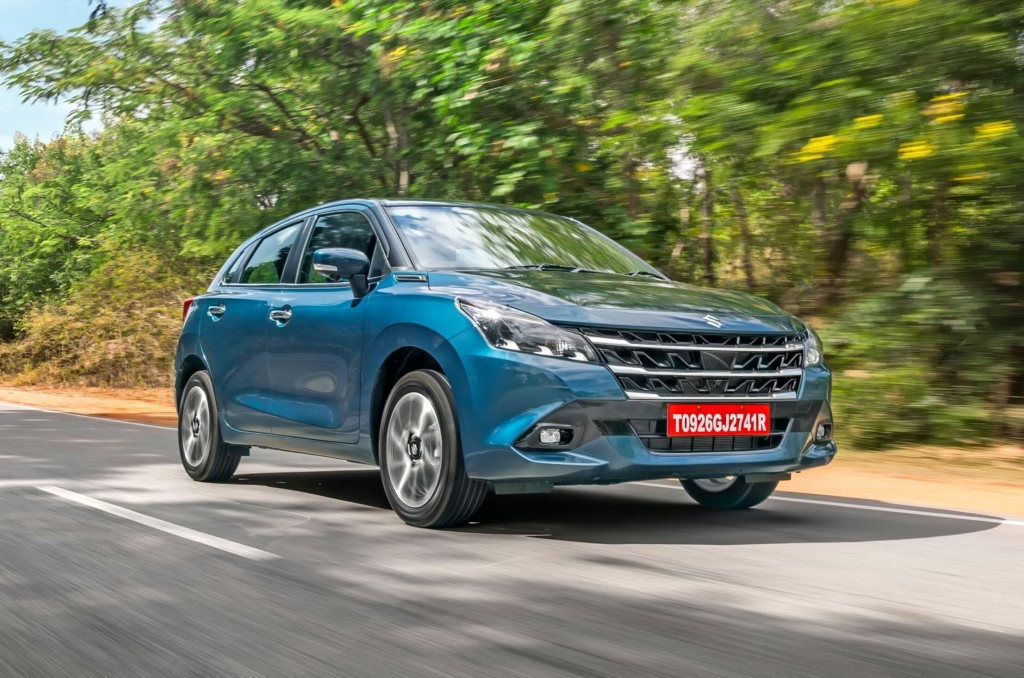
The Maruti Suzuki Baleno has proven to be hugely successful, with the premium hatchback going home to 1.9 million buyers since its introduction in 2015. And in a time when compact SUVs are all the rage, the Baleno continues to buck the trend and bring in the numbers for the brand. And now in a bid to keep it fresh and relevant, Maruti Suzuki has updated it with a tweaked design, new comfort and safety features and even a new petrol engine.
Maruti Baleno Exterior Design and Engineering – 7/10
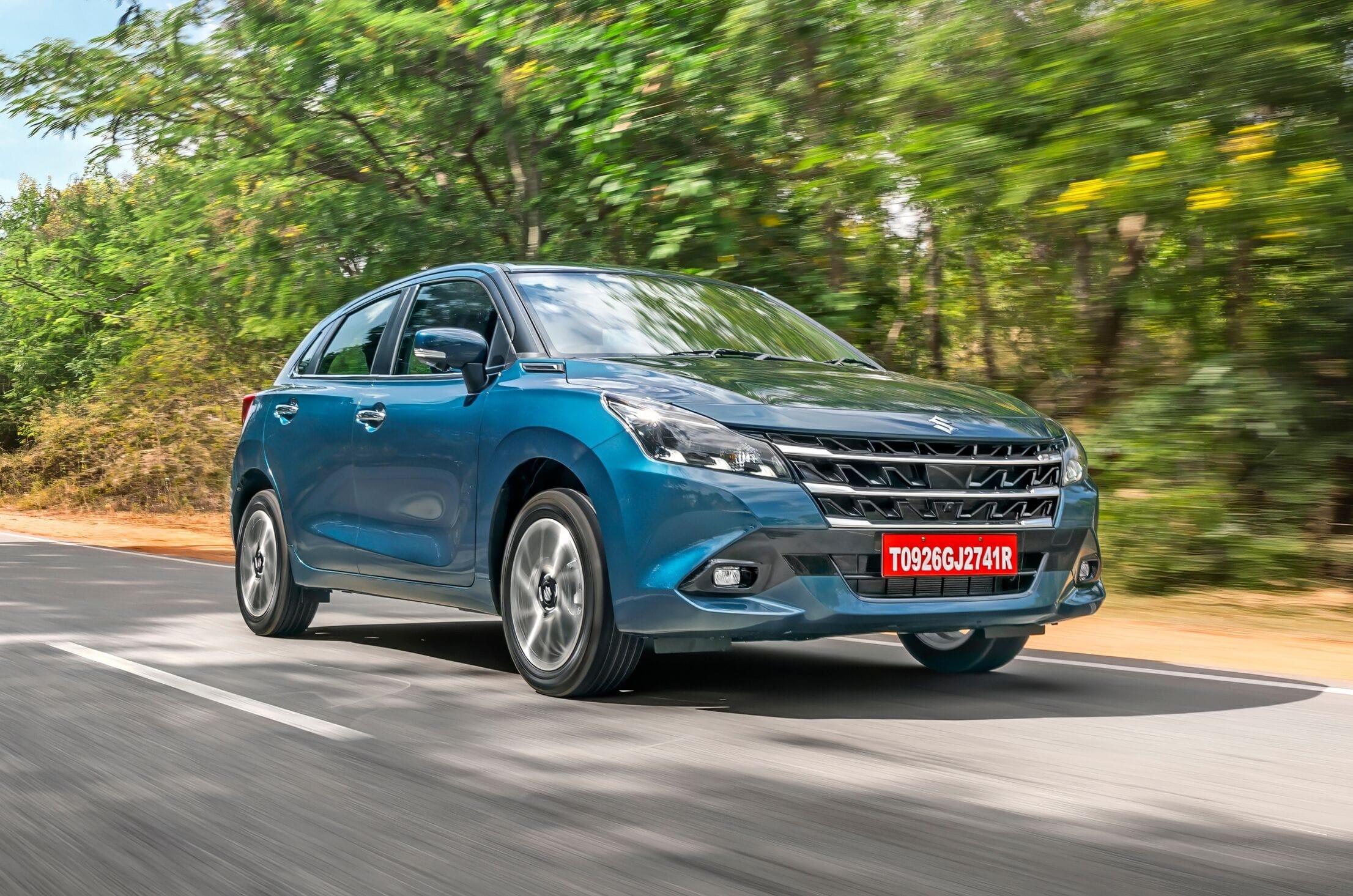
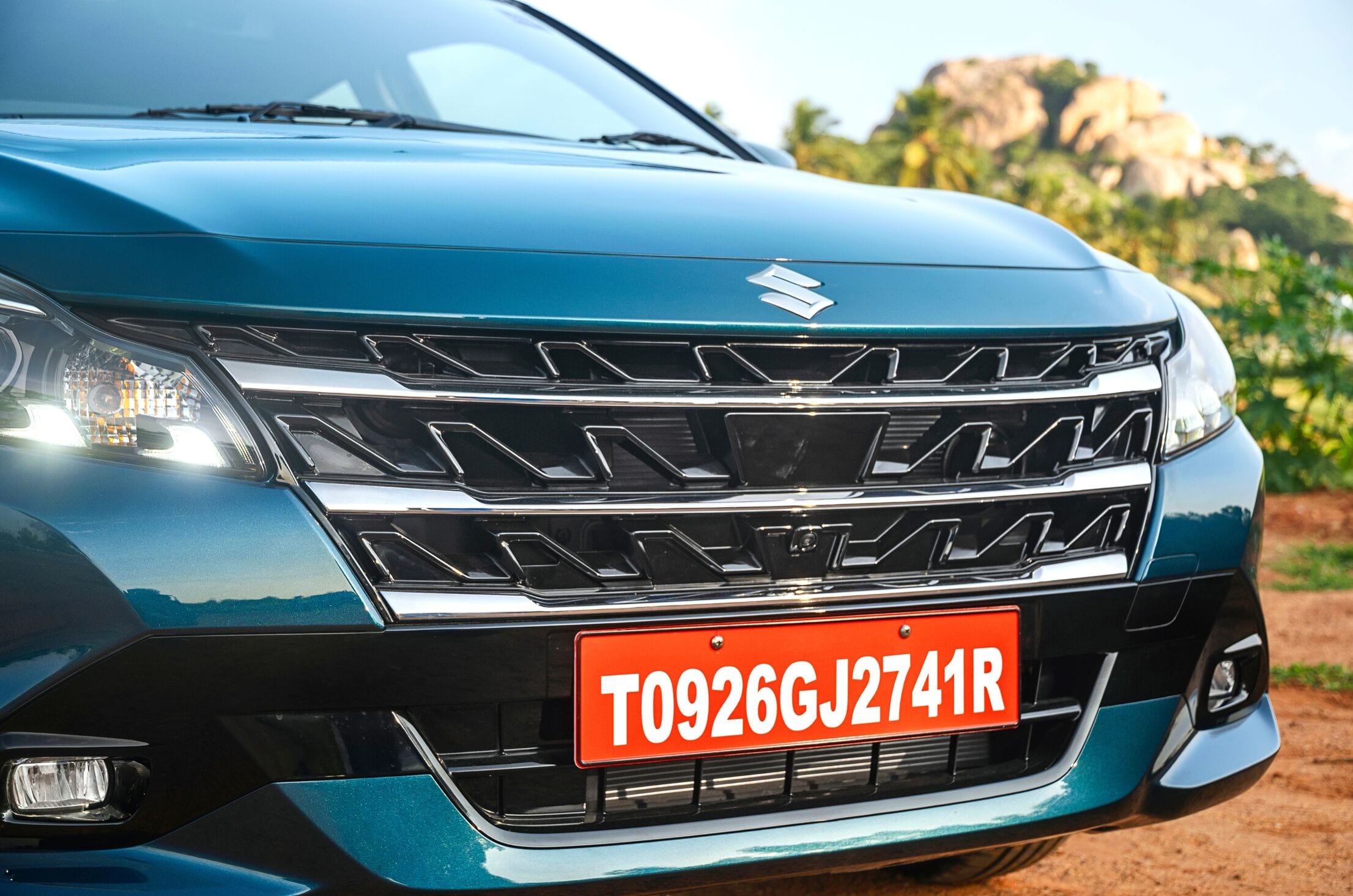
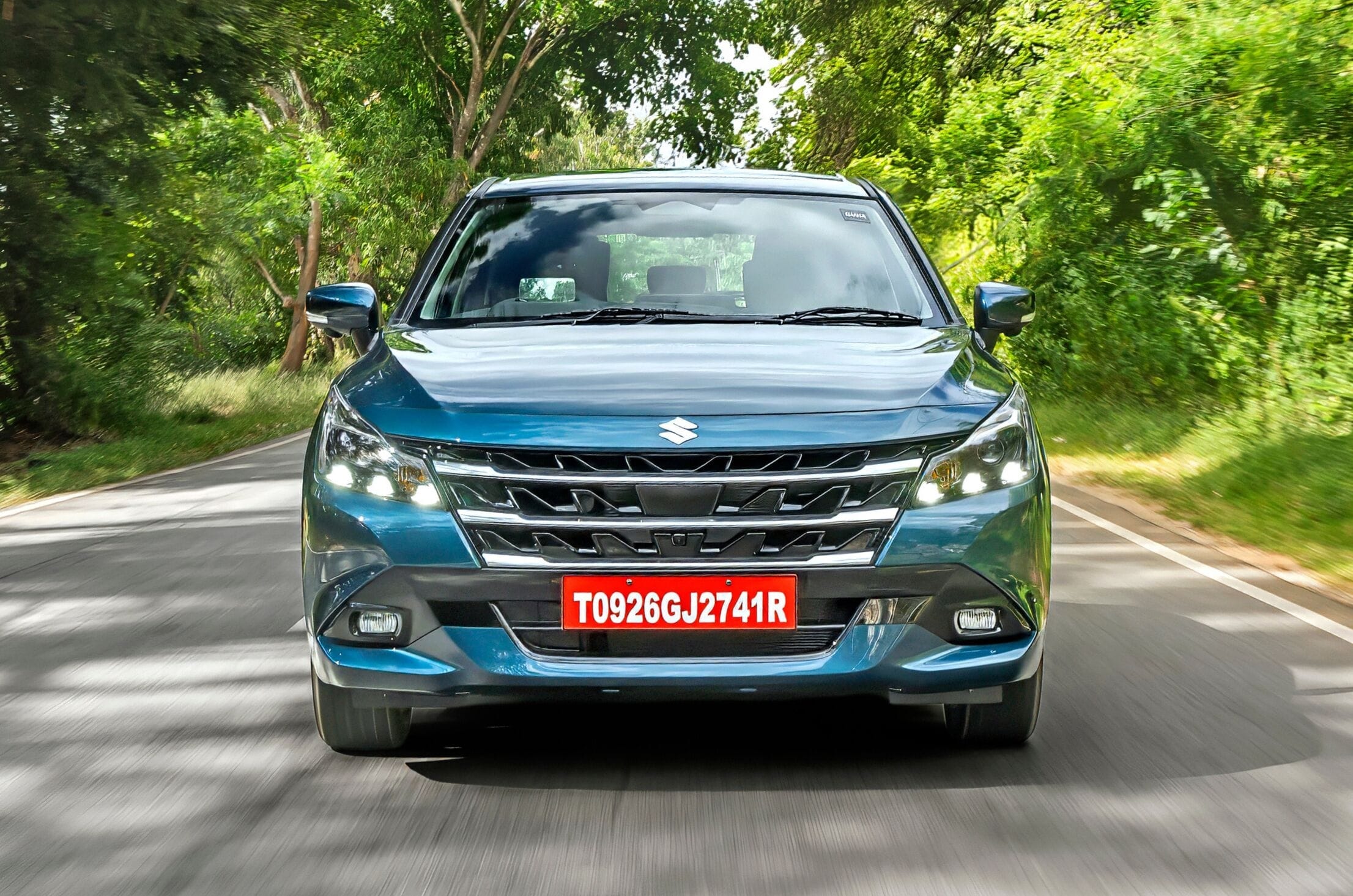
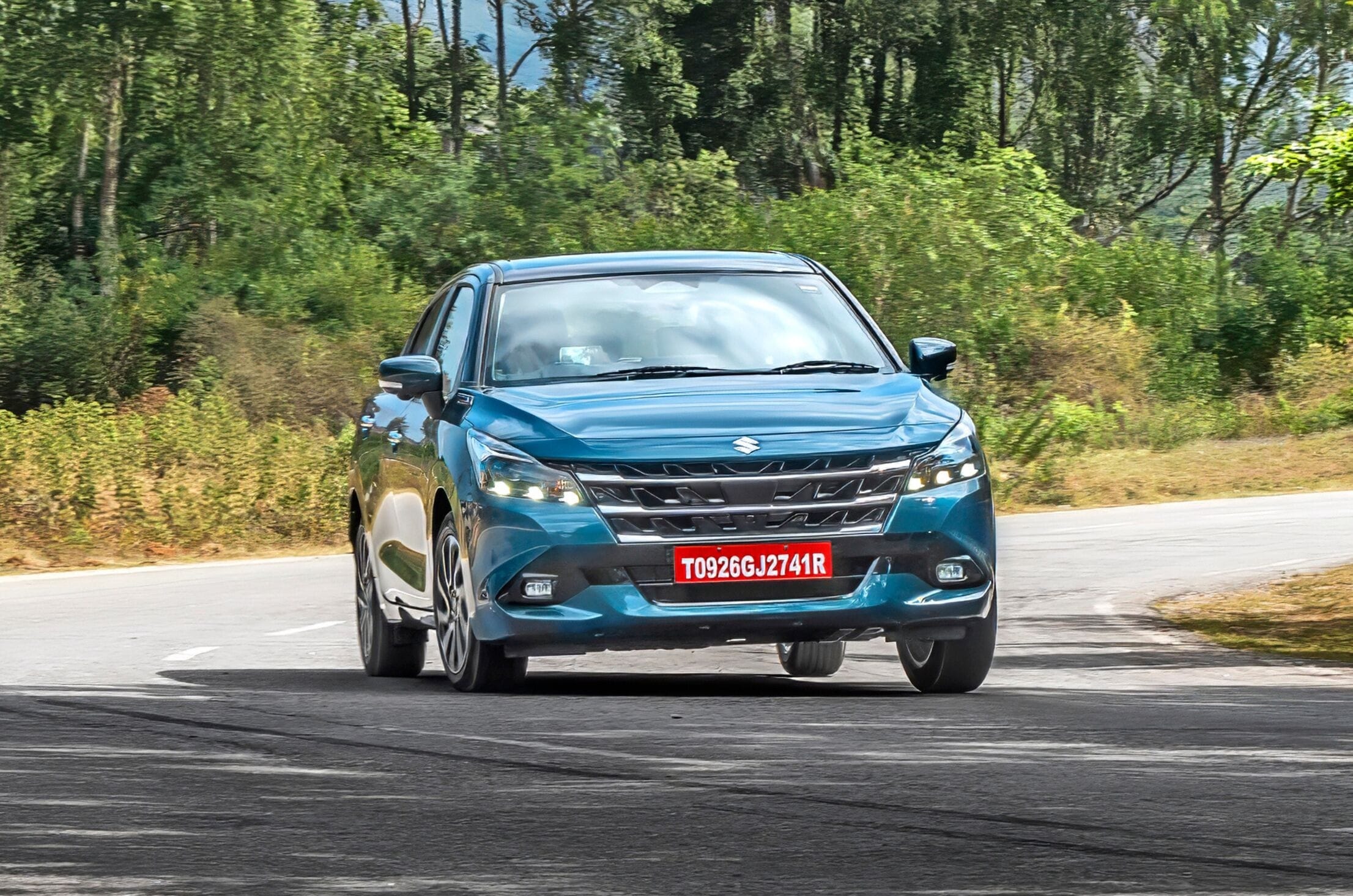
Being a mid-life-cycle update, the Baleno doesn’t get a design overhaul but rather tweaked styling with the bulk of the design changes concentrated at the front end. The grille is now much larger than before with three horizontal chrome slats and gloss black detailing, with a radar module in the centre for the new ADAS tech. The bumper is new too and features a gloss black trim that links the new LED fog lamps and the Suzuki logo has also been moved above the grille. Otherwise, the clamshell bonnet with the two character lines and the LED headlamps with the three-block DRL signature are carried over unchanged.
Gets a new larger grille with chrome slats, a new bumper and new fog lamps.
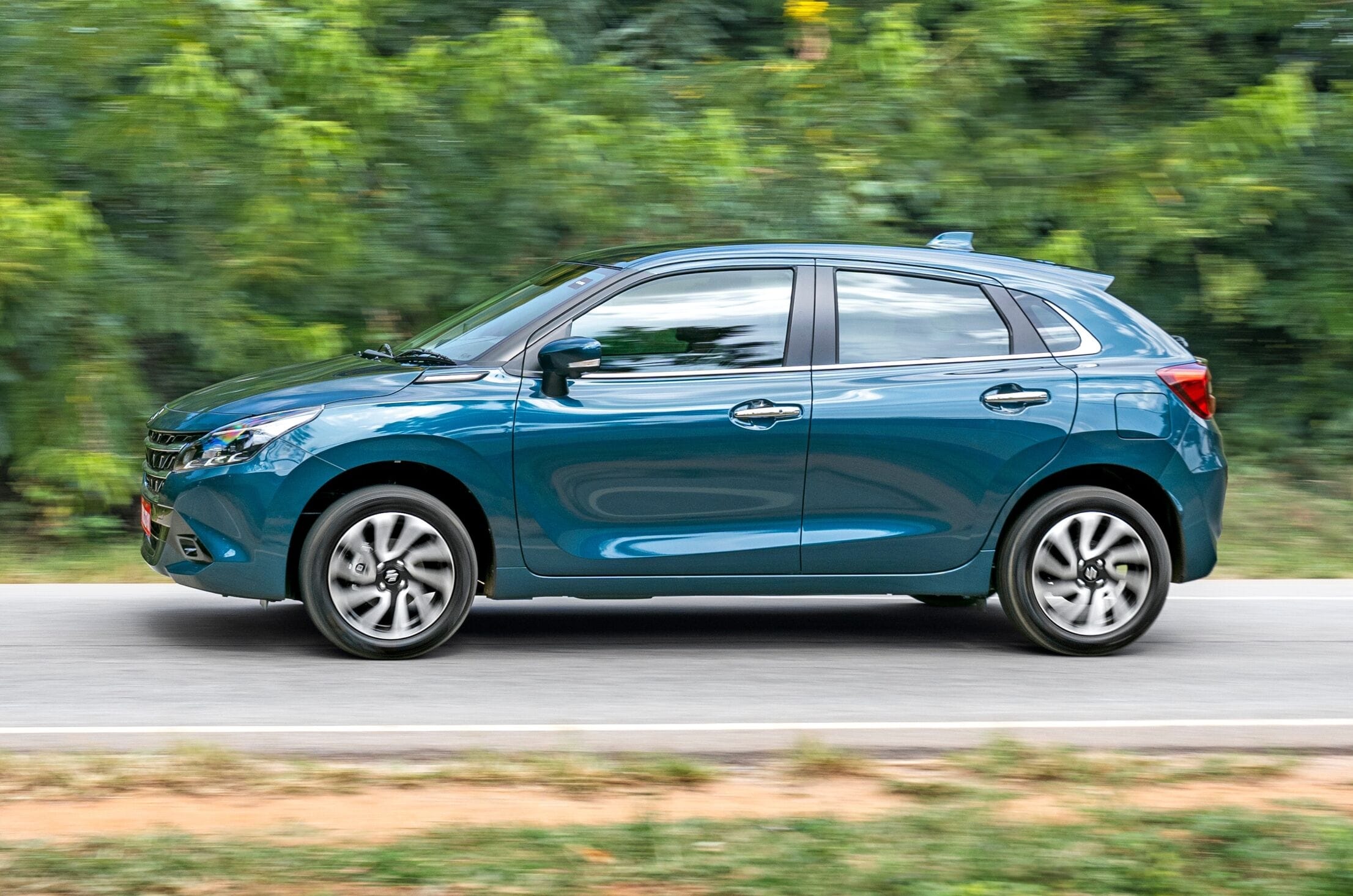
Changes along the sides are minimal, with the only distinguishing factors being a chrome garnish on the front fender and a shark fin antenna on the roof. The facelift retains the older Baleno’s chrome lining under the windows that extends up till the C-pillar, chrome door handles and the dual-tone 16-inch alloy wheels on this top-spec Alpha (O) variant.
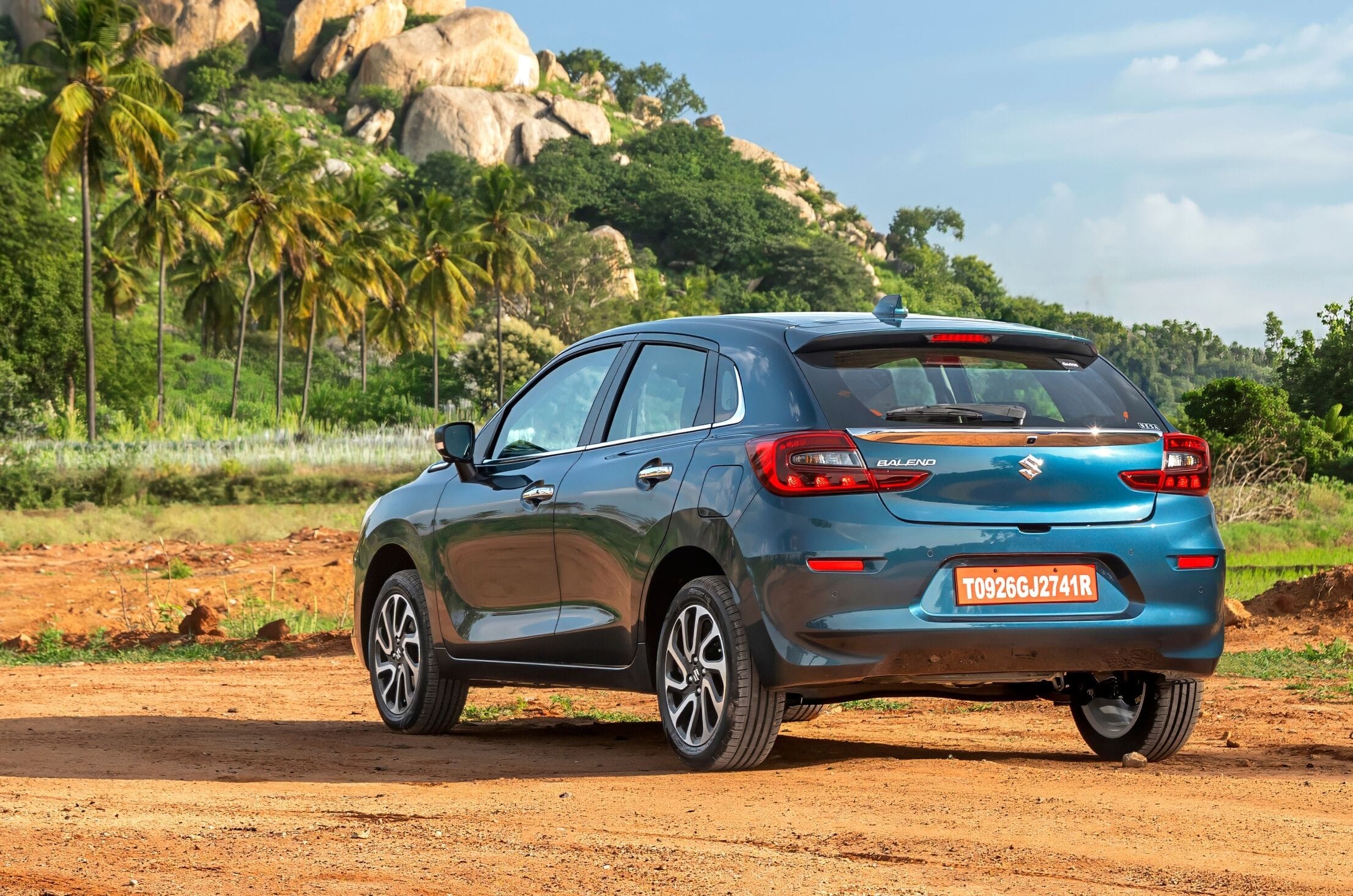
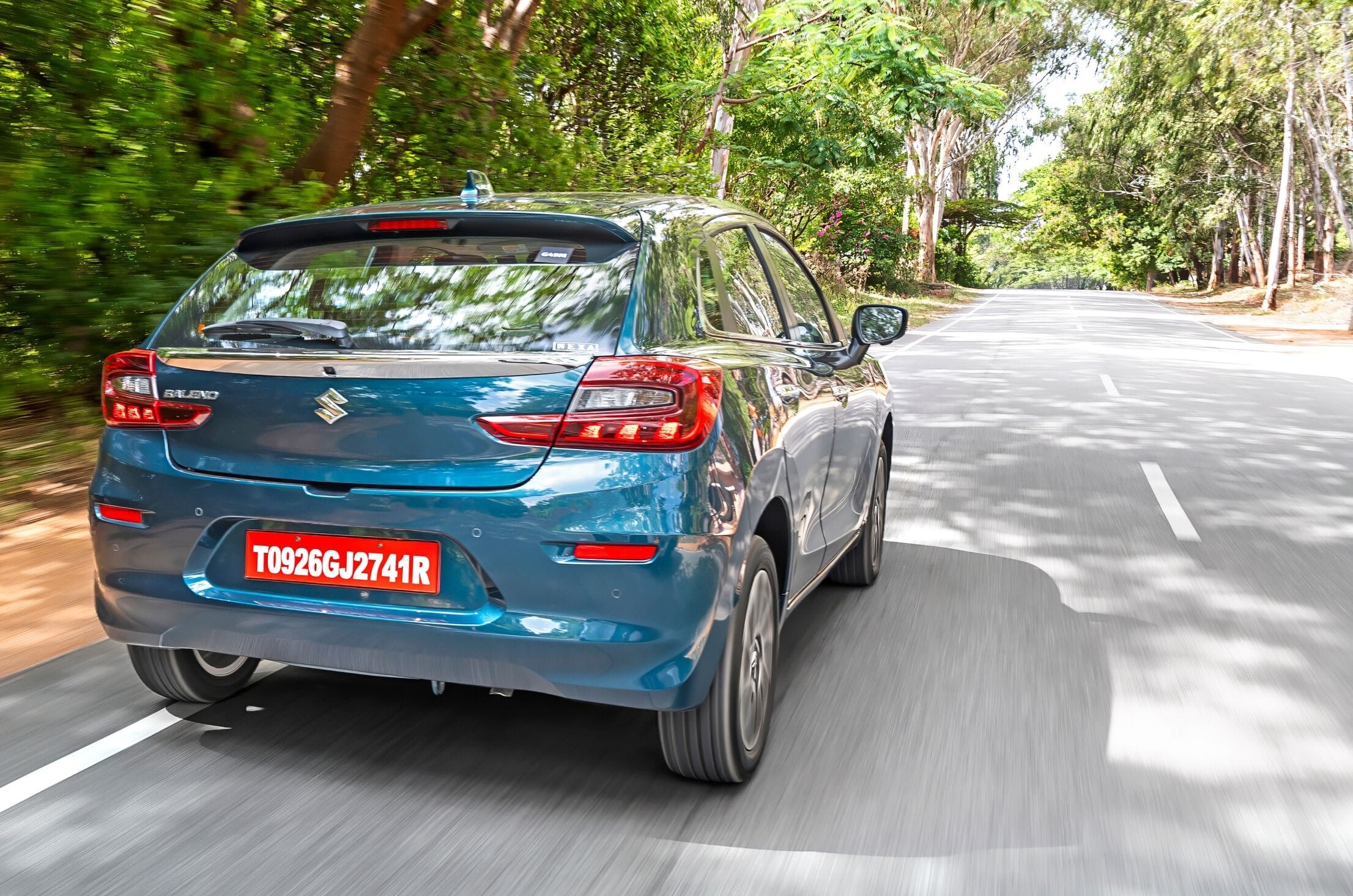
The rear however, stays identical to the pre-facelift Baleno with its C-shaped LED taillamps that also feature the three-block pattern, a chrome band running across the tailgate and a small, roof-mounted spoiler. There’s also a new Enigmatic Teal Green paint shade as seen in the pictures here. Overall, the Baleno sticks to the formula that’s made it as successful as it is with minor tweaks in order to keep it fresh. The front grille, though, splits opinion and certainly doesn’t appear as cohesive as the one on the model it replaces.
Rear stays identical to the pre-facelift model, with the same dual-tone alloys as well
Maruti Baleno Interior Space and Comfort – 8/10
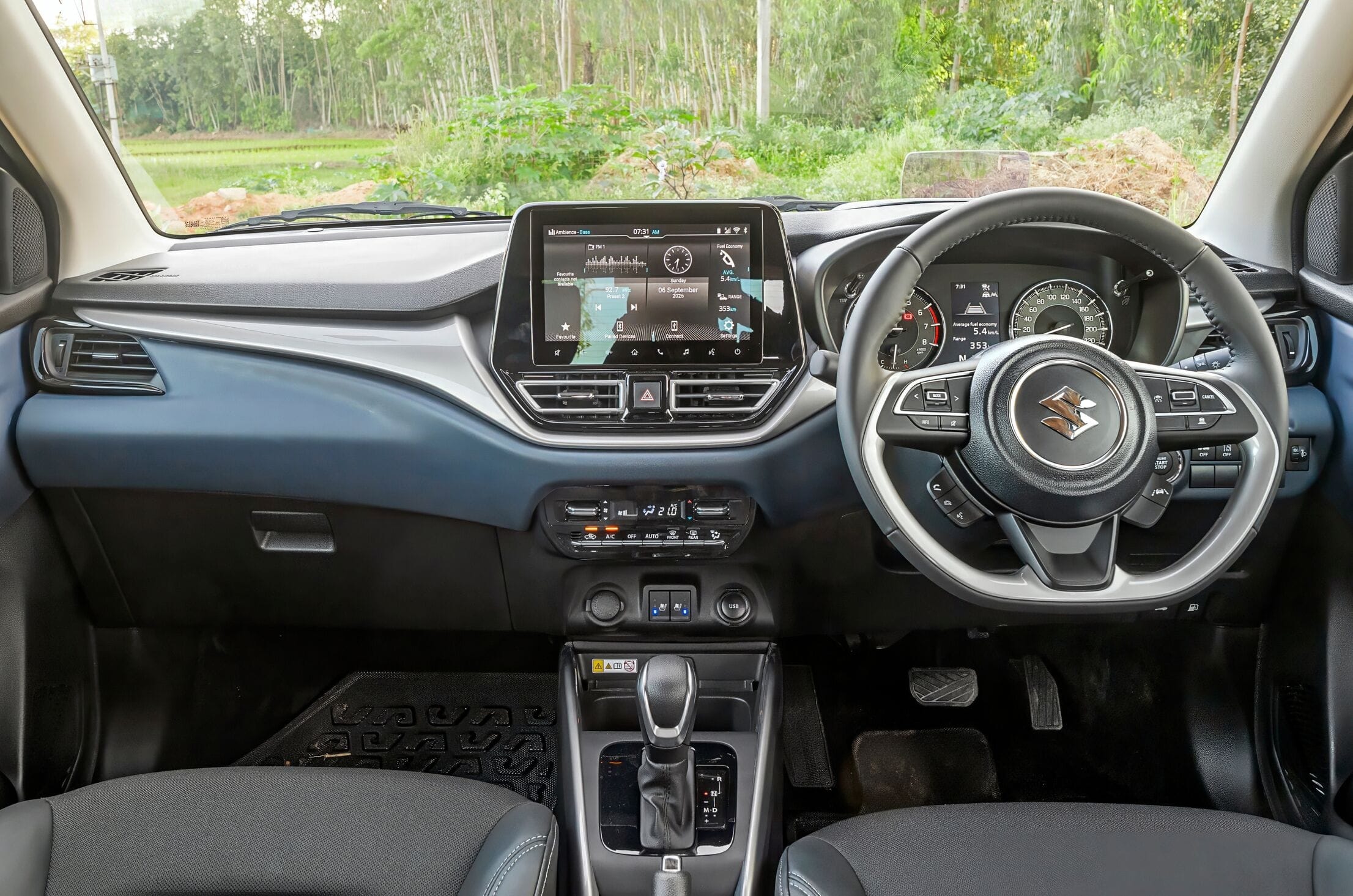
The interior of the Baleno facelift stays near-identical, with the same layered, V-shaped dashboard, flat-bottom three-spoke steering wheel and dual-tone black and blue colour scheme. There have been some tweaks however. The steering now features buttons on the right side for the adaptive cruise control and lane keep assist, there are more buttons on the right of the steering too (near the start/stop button) to turn off certain ADAS features and the seats now feature part-leatherette upholstery. The seats still majorly feature fabric upholstery but the outer edges are now finished in leatherette, which helps up the premium feel.
Layered dashboard with a dual-tone black-and-blue interior theme is carried over unchanged
Otherwise, this cabin is made up of good quality materials, particularly the soft touch leather wrapped steering and the padded elbow rests on the doorcards. The only sore points are the hard plastics and the simple woven roofliner. It’s a practical place too, with big door pockets, a decent-sized glovebox and storage in the centre console, with big cupholders and a small bin under the centre armrest.
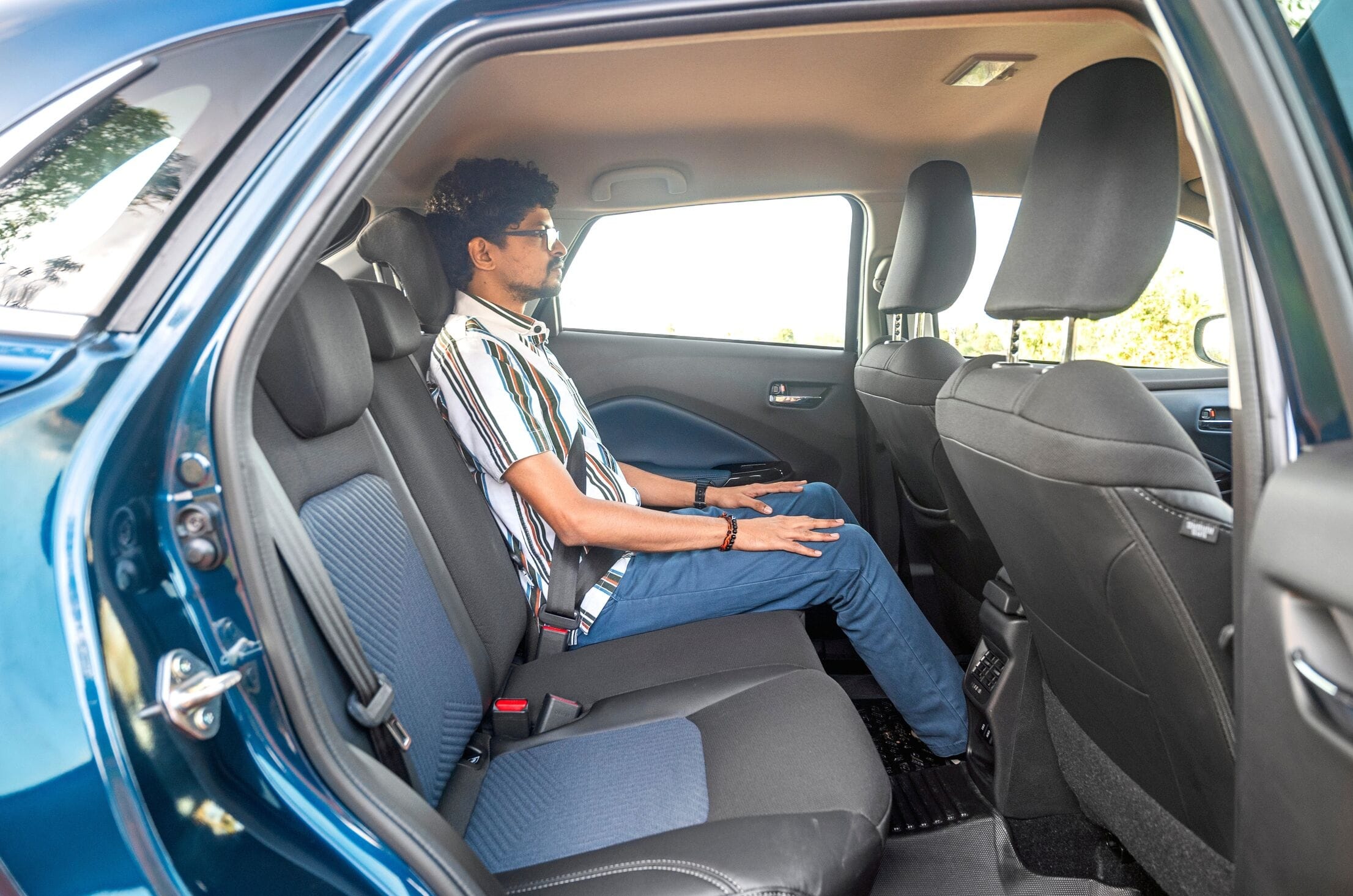
The front seats are unchanged and that’s a good thing as they are accommodating, supportive and offer nice cushioning. Thanks to the height adjustable driver’s seat and tilt/telescopic steering, finding an ideal driving position is an easy affair. Space at the rear is excellent, and even tall passengers won’t find a shortage of headroom or legroom. There’s good underthigh support, the seat cushioning is on point and on the whole, this is a comfy place to be. A welcome addition is an adjustable headrest and three-point seatbelt for the rear centre passenger. Rear passengers also get dedicated AC vents and USB charging ports.
Rear seat space is excellent and even tall passengers won’t find a shortage of headroom or legroom
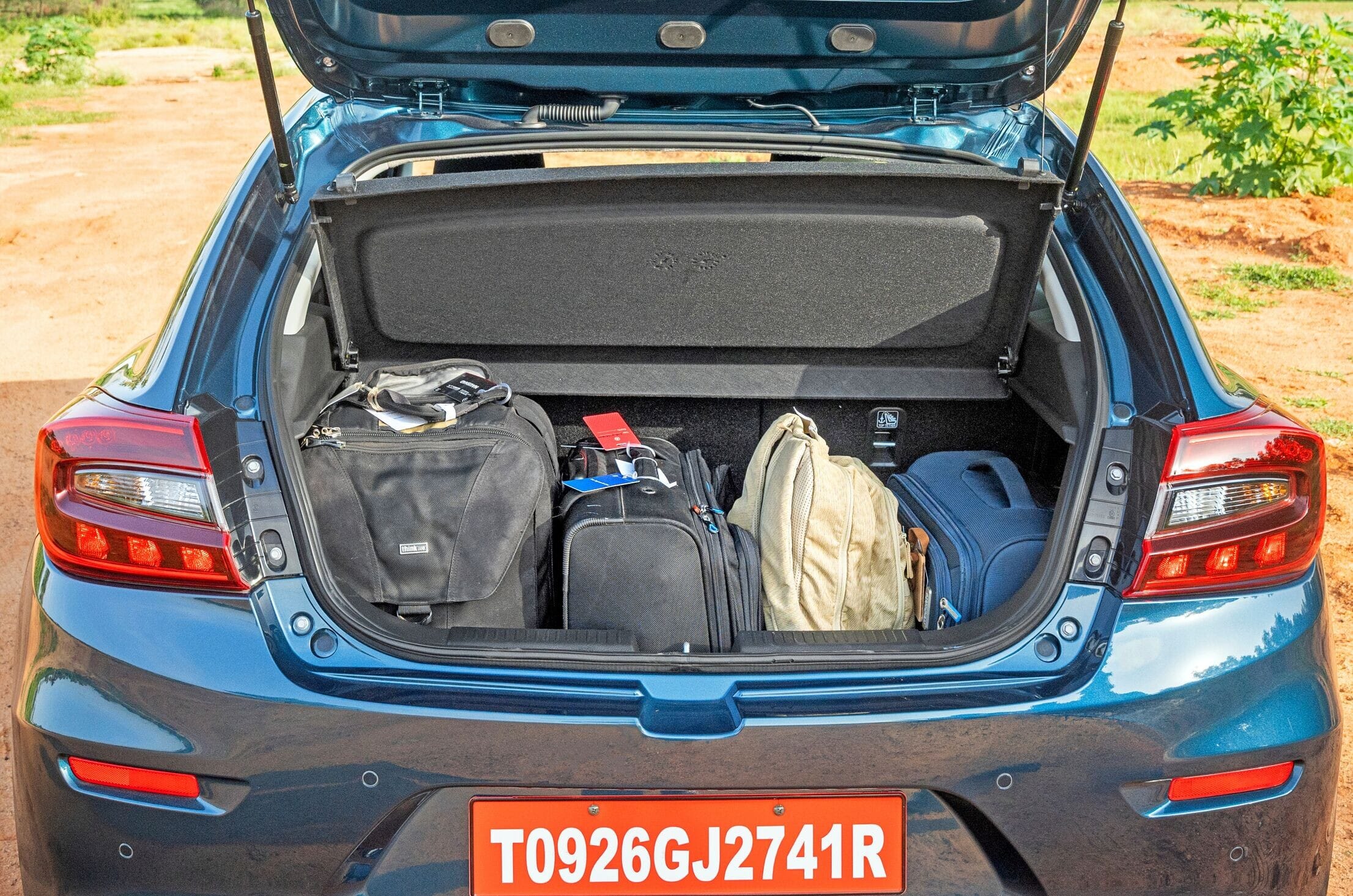
What further enhances overall comfort are the UV-cut glasses, which helps keep the heat out. As for boot space, it’s a sizable 318 litres, though the loading lip is quite high. It’s also nice to see that it retains a spare tyre under the boot floor, when many modern cars are pivoting to puncture repair kits.
Boot is a sizeable 318-litres though the loading lip is quite high; continues to get a spare tyre
Maruti Baleno Features and Safety – 9/10
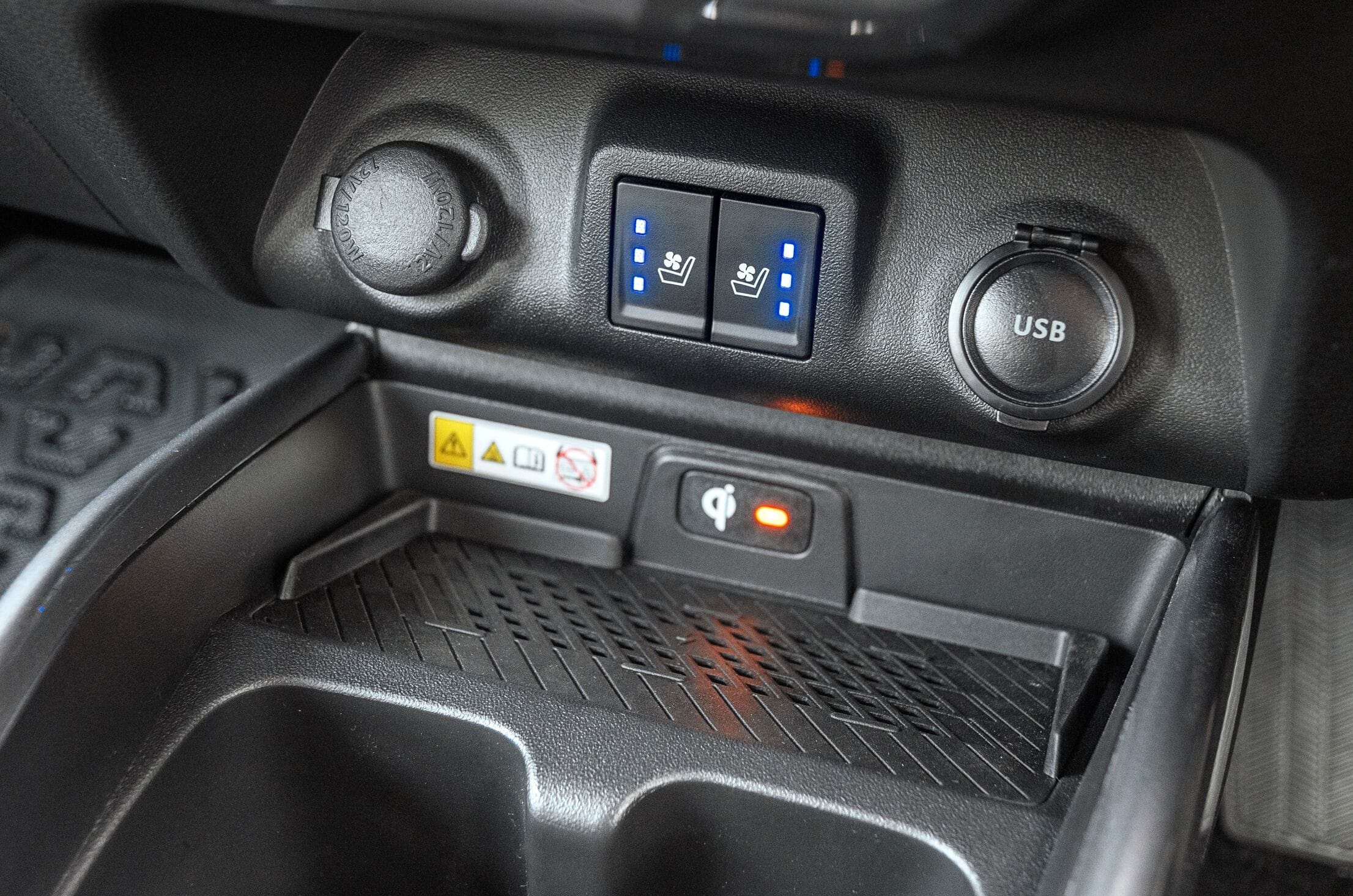
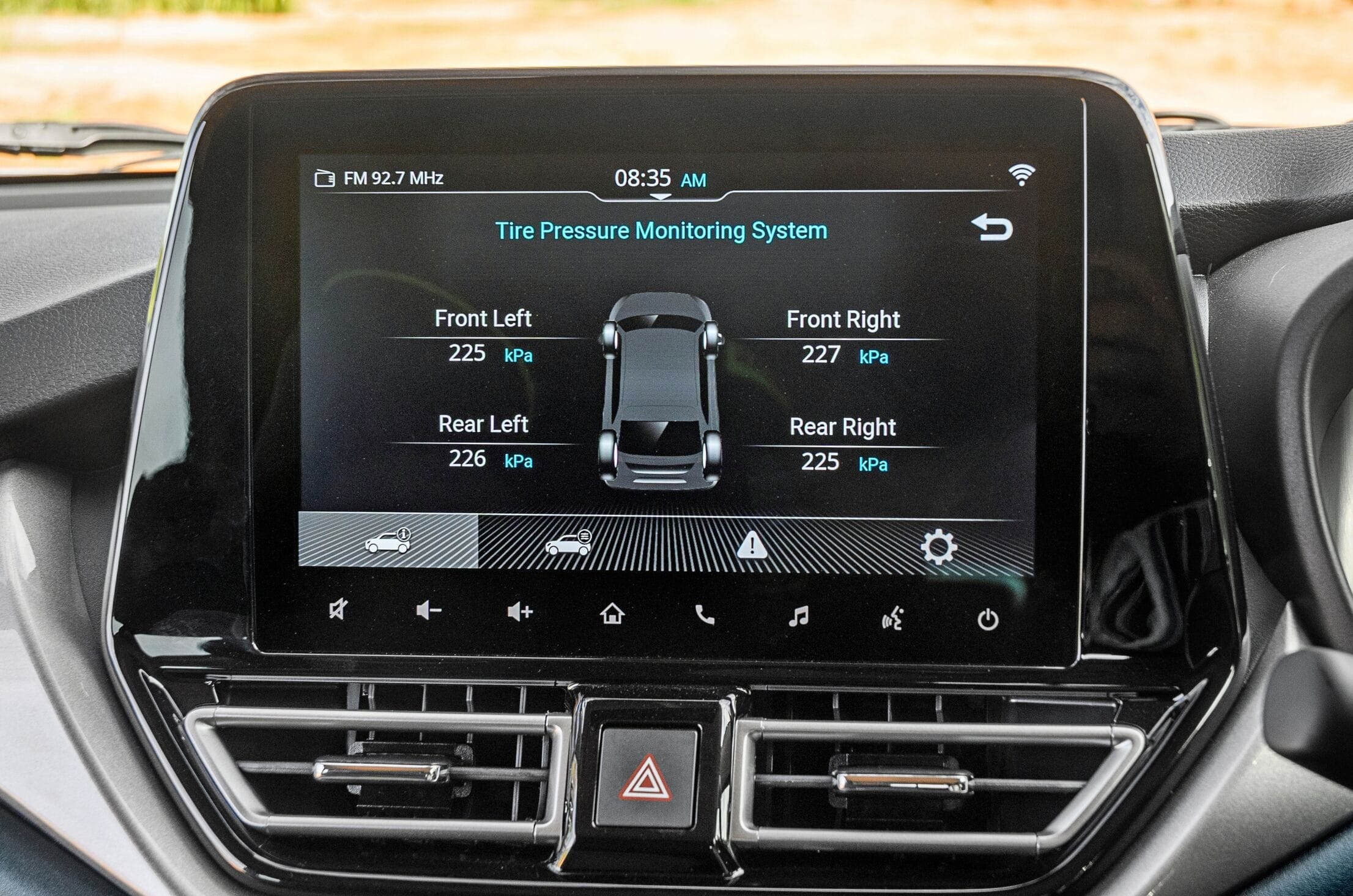
There have been some important additions when it comes to features, as the Baleno now gets ventilated front seats, a cooled wireless phone charger, a tyre pressure monitoring system, a Clarion sound system, and perhaps most importantly, segment-first ADAS Level 2 features.
Ventilated front seats and a cooled wireless charging pad are among the new additions
Other than that, the features list was fairly expansive as is, with this top-spec Alpha (O) also getting a 9-inch infotainment touchscreen with wireless smartphone integration, auto climate control, a heads-up display, colour MID, auto headlamps, auto-dimming IRVM, keyless entry and go, rear wiper/washer, connected car tech and more. Safety kit includes 6 airbags as standard, traction control, a 360-degree parking camera (its quite low res though) and ISOFIX child seat mounts. The outgoing Baleno had a 4-star crash safety rating from Bharat NCAP and that should be the case for this one as well.
9-inch touchscreen has been retained; now features a TPMS
Of the newer features, the ventilated front seats work effectively though the blower is quite audible while the wireless charger charges your phone’s battery at a good rate without overheating it. The TPMS too worked as intended, while the Clarion audio system is better than the outgoing model’s it still falls short of what rivals offer.
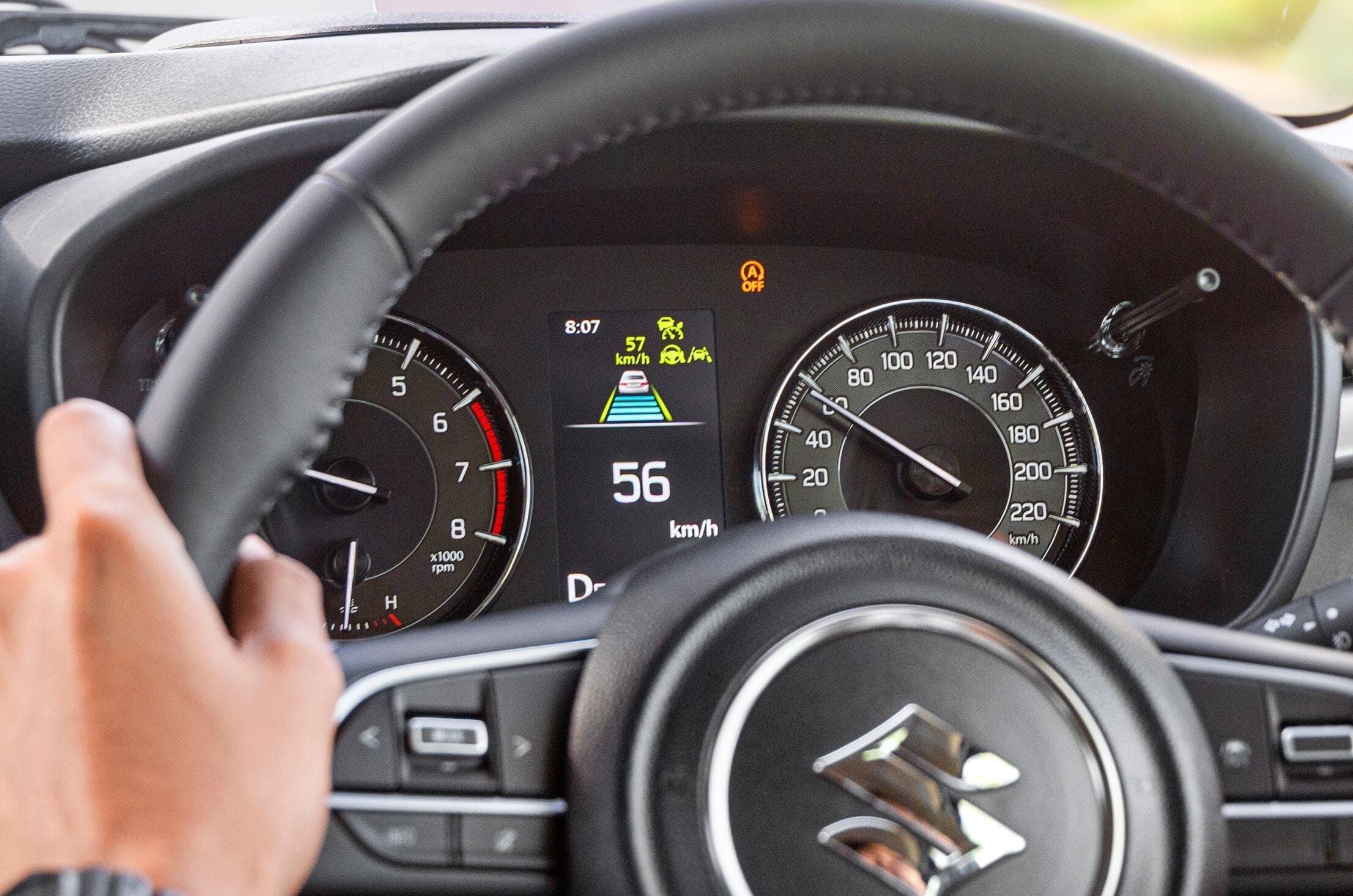
The addition of Level 2 ADAS tech however, greatly boosts the Baleno’s safety quotient. It’s a camera and radar-based system that brings in features like auto emergency braking, adaptive cruise control, lane keep assist, lane departure warning and more. On our brief test drive, the ADAS features worked as intended and seemed well calibrated as they weren’t overly intrusive. However, if you turn off the ADAS features they will automatically switch back on everytime you start the car.
Gets segment-first Level 2 ADAS features which seemed well calibrated for our conditions
As for features then, the Baleno facelift takes a step up and almost has all bases covered. Only things missing are a rear centre armrest and a sunroof, both of which its rivals offer.
Maruti Baleno Performance and Refinement – 8/10
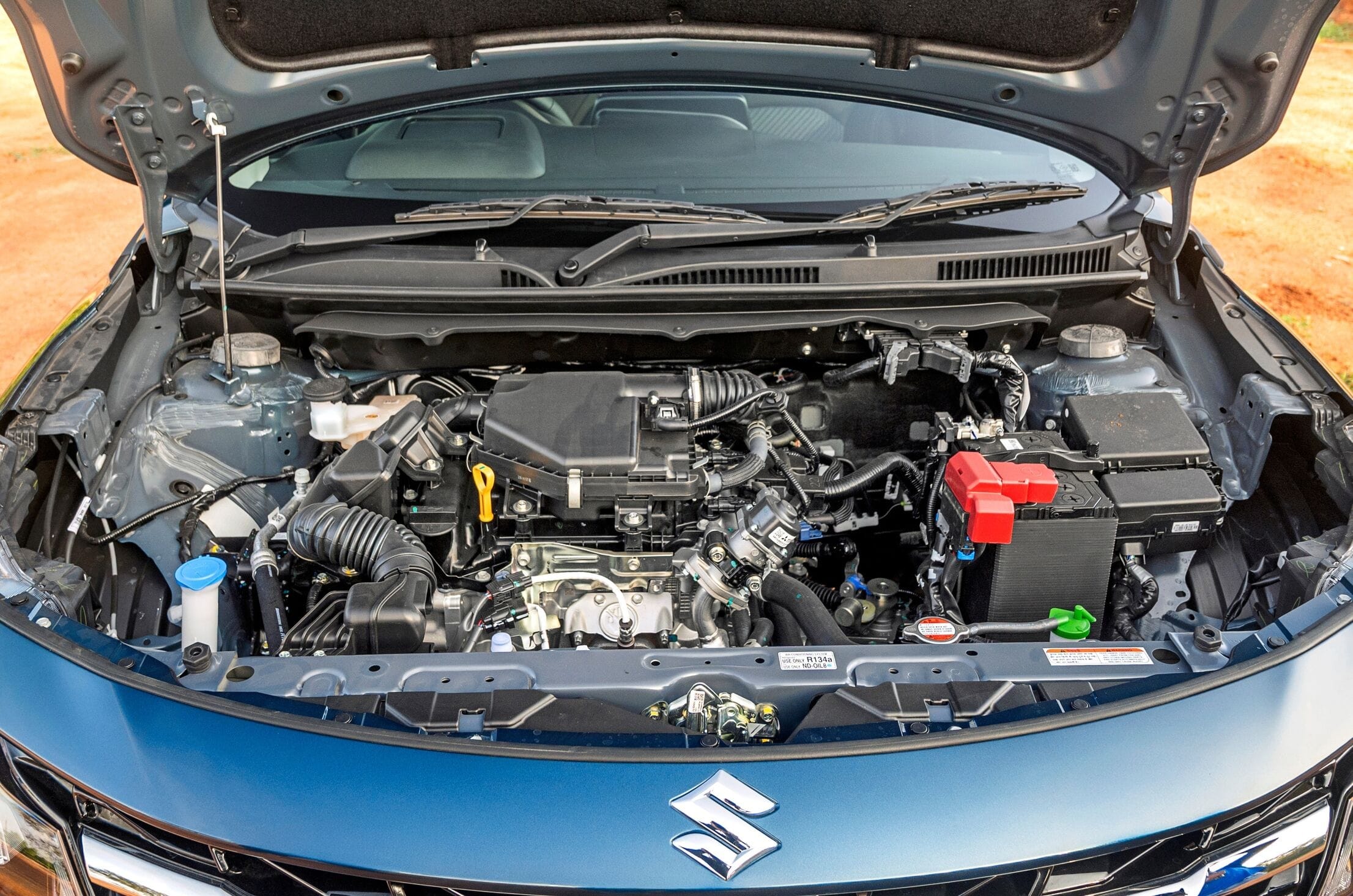
By far the biggest change with the facelift comes under the hood and it’s rare that we get to see a new engine with a facelift. Out goes the 1.2-litre, four-cylinder, K-series engine and in comes the 1.2-litre, three-cylinder, Z-series engine from the likes of the Swift and the Dzire. Yes, the Baleno is down a cylinder and as such, down on output too. The Z12E engine makes 83hp and 112Nm, which is 7hp and 1Nm lower than the older K12N engine. Maruti has moved to this engine as it is newer, is less polluting, more efficient and also opens it up to the possibility of hybridisation in the future.
New Z-series engine impresses with its drivability, low end response and promises more efficiency
This Z-series naturally aspirated engine is one of the most refined three-cylinder engines around. There is some of that typical three-cylinder thrum at idle but that smoothens out as the revs climb. It’s fairly quiet too at idle and it’s only when you’re at the top of the rev range that it becomes audible inside the cabin.
As we’ve experienced in the Swift and Dzire, this Z-series engine impresses with its low-end response and drivability. Power builds in a smooth linear manner, it moves off the line cleanly and part-throttle responses are good too. However, it doesn’t feel as peppy as the older K-series engine and doesn’t feel as strong at the top of the rev range. And considering that it’s down on power and heavier than the outgoing car, it isn’t as quick in terms of outright acceleration. But for a daily urban runabout, this engine is up to the task. For reference, we managed a 0-100kph time of 13.03sec and 15.89sec for the Swift MT and Swift AMT, respectively and you can expect the Baleno to be slightly slower than this owing to its higher kerb weight.
Power builds in a smooth linear manner and part-throttle responses are good, too.
As was the case earlier, the Baleno facelift can be had with either a 5-speed manual or a 5-speed AMT automatic. The manual gearbox is particularly impressive with its effortlessness and our pick of the two. The clutch pedal is light and easy to modulate, while the gearbox is smooth and has nice, short throws and well defined gates.
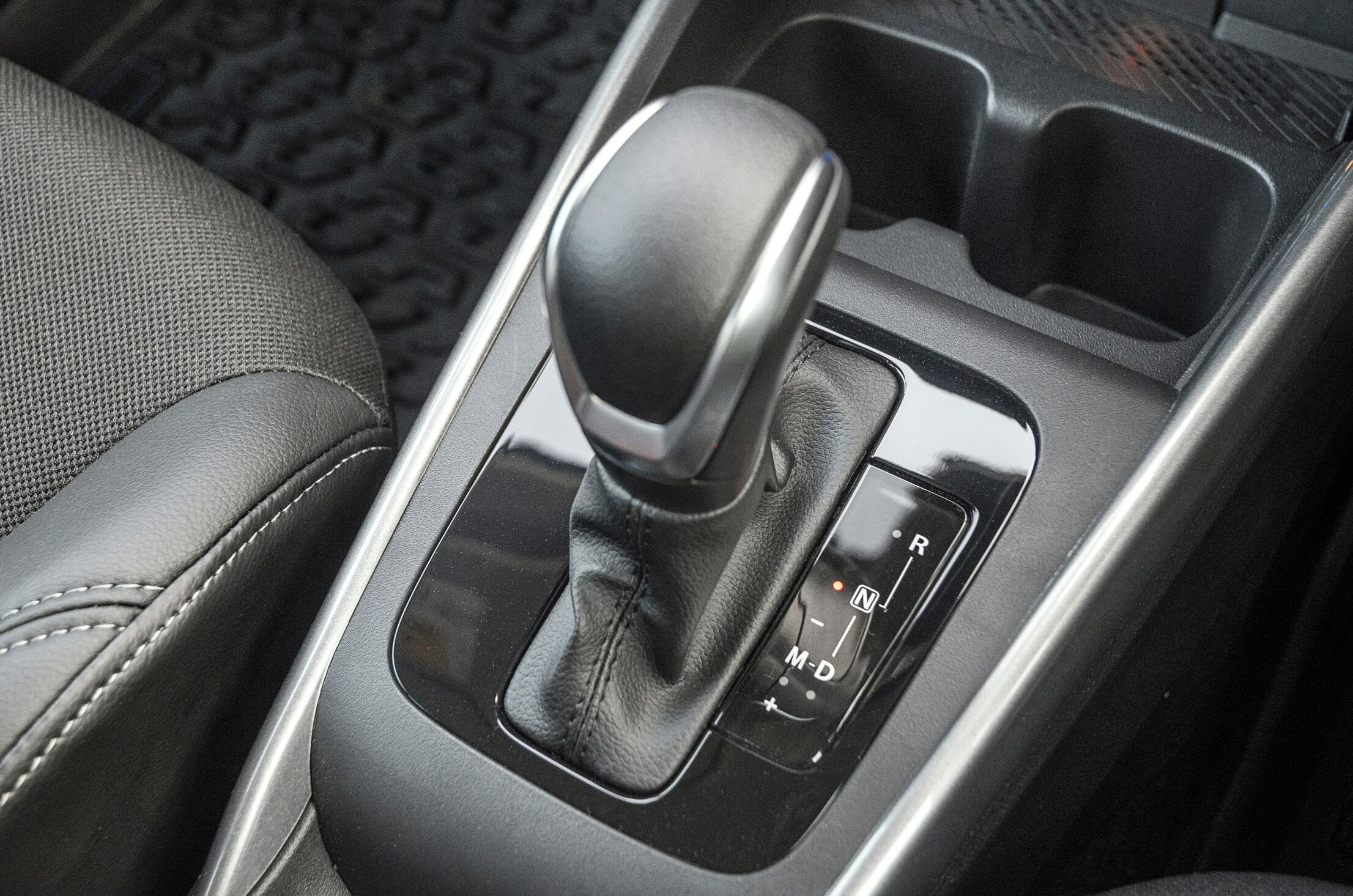
In comparison to its rivals, which offer more sophisticated automatics in the form of a CVT and a DCT, the Baleno only comes with a simpler, more cost-effective AMT. The AMT makes for a good option for those who wish for greater convenience and it’s smooth as far as AMTs go. There is still that noticeable headnod effect that you get between shifts and it is hesitant when you try to make a quick overtake, as it takes some time to downshift. That can be alleviated however, by shifting to manual mode via the gear lever and what’s nice is that it won’t auto upshift in this mode.
AMT adds a layer of convenience but feels hesitant when you try to make a quick overtake
A factory-fitted CNG option is also available with the Baleno facelift. It uses the same engine but power and torque outputs fall to 70hp and 102Nm, respectively, when run on CNG, and it can only be had with the 5-speed manual gearbox. However, we’re yet to experience the Baleno facelift CNG.
Maruti Baleno Mileage and Efficiency – 9/10
Both manual and AMT variants see an improvement in claimed efficiency with the new engine.
The biggest advantage with the move to the Z-series engine comes in the form of fuel efficiency. The Baleno petrol-manual is now claimed to return 23.80kpl (1.45kpl more), while the AMT is said to do 24.77kpl, which is a 1.83kpl improvement. The Baleno CNG meanwhile, sees an improvement of 3km/kg, with a claimed 33.61km/kg. As always, these are claimed figures tested in ideal conditions and expect real-world fuel efficiency to be lower. What’s interesting is that the Baleno has become more efficient despite becoming up to 30kg heavier than the outgoing version.
Maruti Baleno Ride Comfort and Handling – 8/10
As before, the Baleno continues to impress with its ride comfort. The suspension has a softness to it, which means low speed ride is excellent and it’s only the sharpest bumps and big potholes that manage to unsettle it. It also manages to iron out road imperfections with considerable ease and stays composed at higher speeds, with well-contained vertical and side-to-side movements.
Good body control with minimal roll and the steering weighs up nicely as you pick up the pace
Handling isn’t its strongest suit but the Baleno displays good body control with minimal roll around the corners. The steering, meanwhile, is light at low speeds, which aids city driving, but it adds some reassuring weight as you pick up the pace which is confidence-inspiring. It’s not particularly feelsome but that’s nothing to complain about, given its an urban premium hatchback. As for braking, it continues with the same discs up front and drums at the rear setup and the stopping power is more than adequate. On the whole then, the Baleno feels mature and composed on the move.
Maruti Baleno Value for Money – 8/10
The Maruti Baleno facelift is priced from Rs 6.10 lakh (ex-showroom, India), though this is a special festive price and Maruti is yet to disclose complete variant-wise pricing. It continues to get a 3 year/1,00,000km standard warranty and as before, rivals other premium hatchbacks in the Hyundai i20 and Tata Altroz, both of which are priced from Rs 6 lakh (ex-showroom, India).
The added features and the promise of greater fuel efficiency just further enhance the Baleno’s appeal
There are some drawbacks of course, like the hesitant AMT automatic and it doesn’t feel as peppy as the older K-series Baleno. But those pale in comparison to the Baleno’s inherent strengths of a spacious and comfortable cabin, an effortless drive thanks to its light controls, a refined engine and a good ride comfort and handling balance. The added comfort and safety features and the promise of greater fuel efficiency with the new engine just further enhance its appeal. As such, the Baleno is all set to retain its spot at the top of the premium hatchback chain.
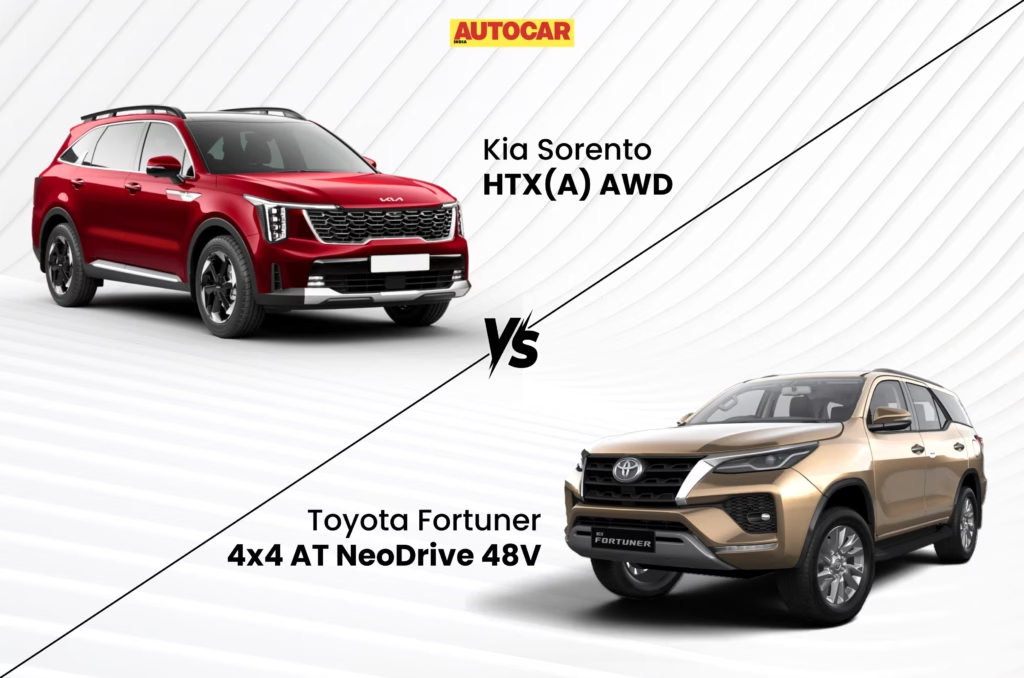
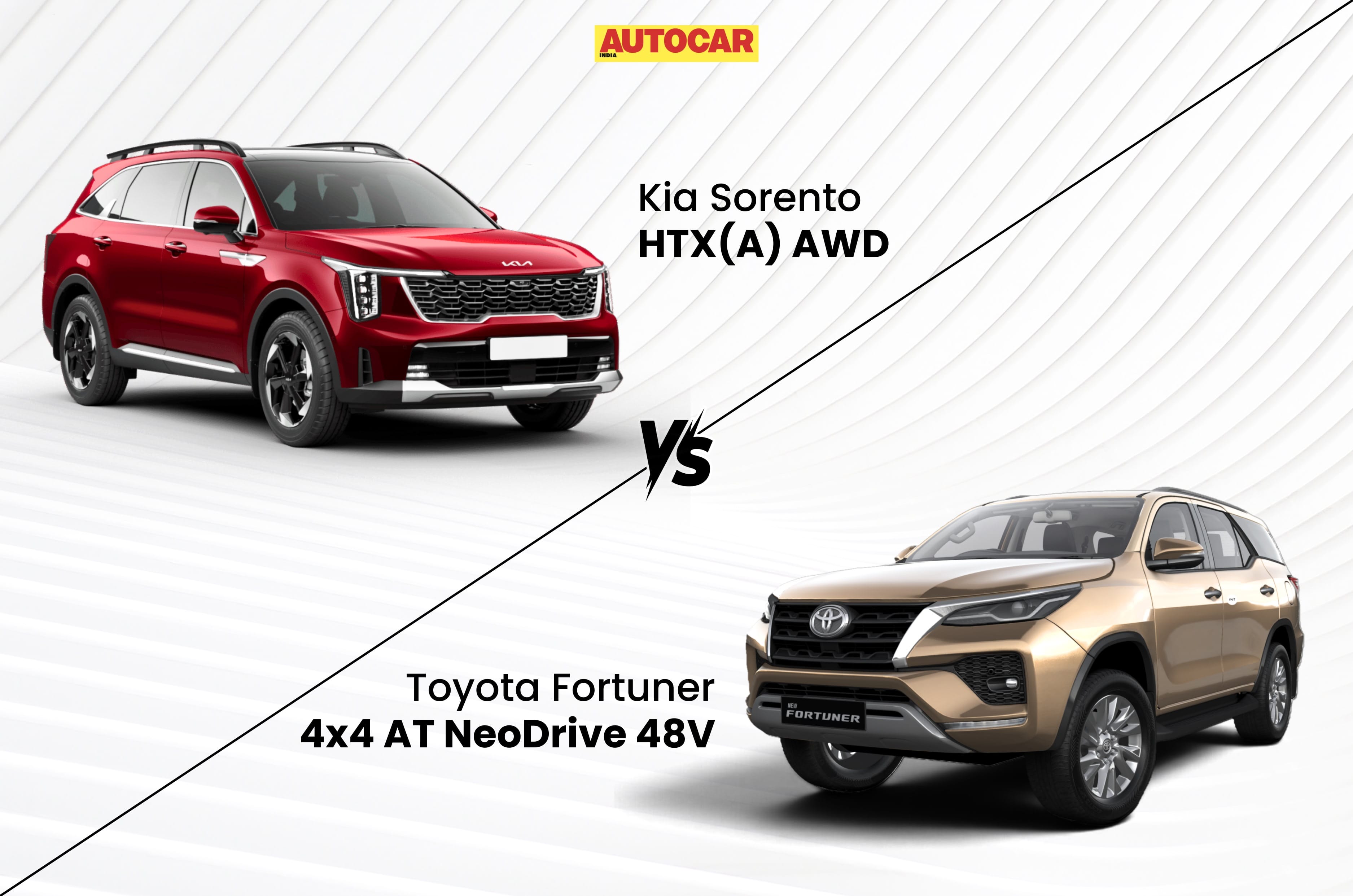
The Kia Sorento is now on sale in India as the Korean carmaker’s flagship ICE-powered SUV. It contends in the three-row premium SUV segment, directly rivalling the likes of the monocoque-based Skoda Kodiaq, Volkswagen Tayron, and Jeep Meridian. Additionally, the Sorento’s pricing overlaps with that of the ladder-frame-based Toyota Fortuner, which is one of the most popular SUVs in the Rs 30 lakh-50 lakh price bracket.
While the Fortuner isn’t as up-to-date or premium as the Sorento is, the Toyota SUV has accrued a reputation for toughness, reliability, and off-road prowess. Below, we’ve put together the top-spec diesel variants of the Sorento and Fortuner – the HTX(A) and 4×4 AT NeoDrive 48V, respectively – to see which one delivers more bang for your buck.
Kia Sorento vs Toyota Fortuner: Top-spec variant dimensions
Sorento is longer and wider, while Fortuner is taller
Sorento HTX(A)
Fortuner 4×4 AT NeoDrive 48V
Length (mm)
4,815
4,795
Width (mm)
1,900
1,855
Height (mm)
1,785
1,835
Wheelbase (mm)
2,815
2,745
Seating capacity
6/7
7
Wheel size (inches)
19
18
The Sorento is just 20mm longer than the Fortuner overall, but the Kia SUV’s wheelbase is 70mm longer. It’s also 5mm wider than the Fortuner, comes with larger wheels, and even offers a 6-seat layout with second-row captain’s chairs. However, the Fortuner does claw back some points on the height front, sitting 50mm taller than the Sorento.
Kia Sorento vs Toyota Fortuner: Top-spec diesel variant powertrains
Syros EV is quicker, e Vitara claims higher range and has a bigger battery
Sorento HTX(A)
Fortuner 4×4 AT NeoDrive 48V
Engine
2.2-litre, 4 cyls
2.8-litre, 4 cyls
Power (hp)
193
204
Torque (Nm)
442
500
Gearbox
8-speed DCT
6-speed AT
Mild hybrid system
No
Yes, 48V
Drive layout
FWD, AWD
AWD
The Fortuner undoubtedly has a larger and more powerful diesel engine than that of the Sorento, that too paired with a 48-volt mild hybrid system for functions like torque assist under load, engine start/stop, and brake energy recuperation. On the other hand, the Sorento comes with an 8-speed gearbox instead of a 6-speed one, which could enable better fuel efficiency on the highway. The top-spec Sorento diesel variant also offers a front-wheel drive layout for buyers who don’t need the enhanced go-anywhere capabilities afforded by all-wheel drive.
Kia Sorento vs Toyota Fortuner: Top-spec diesel variant exterior features
Sorento offers sequential indicators and more colours, while Fortuner gets more lighting
Sorento HTX(A)
Fortuner 4×4 AT NeoDrive 48V
LED auto headlamps
Yes
Yes
Front LED fog lamps
Yes
Yes
Rear fog lamps
No
Yes
LED tail-lamps
Yes
Yes
Puddle lamps
No
Yes
Roof rails
Yes
Yes
Powered ORVMs
Yes
Yes
Sequential indicators
Yes
No
Powered tailgate
Yes
Yes
Rear spoiler
Yes
Yes
Colour options
8, monotone
5, monotone
In this department, both SUVs are fairly well matched. The Sorento is uniquely equipped with sequential indicators, while the Fortuner is the only one here to offer rear fog lamps and puddle lamps. As for colour options, both are sold in monotone finishes only, with the Sorento offering two more than the Fortuner does.
Kia Sorento vs Toyota Fortuner: Top-spec diesel variant interior features
Sorento easily takes the win here
Sorento HTX(A)
Fortuner 4×4 AT NeoDrive 48V
Infotainment screen
12.3-inch
8-inch
Instrument cluster
12.3-inch digital
Analogue w/ MID
Heads-up display
Yes
No
Sunroof
Panoramic
No
Wireless charger
Yes
No*
Powered front seats
Yes
Yes
Ventilated front seats
Yes
Yes
Second-row ventilation
Yes
No
Dual-zone climate control
Yes
Yes
Ambient lighting
Yes
No
Sound system
12-speaker Bose
11-speaker JBL
Apple CarPlay & Android Auto
Wireless
Wired
Connected car tech
Yes
Yes
IRVM
Digital
Auto-dimming
Rear centre armrest
Yes
Yes
Sliding, reclining rear seats
Yes
Yes
*Available as an optional accessory.
The Sorento is majorly ahead of the Fortuner in terms of creature comforts. The Kia SUV has larger screens, a big sunroof, more speakers, wireless phone connectivity, rear-seat ventilation, ambient lighting, a fully digital IRVM, and more.
Kia Sorento vs Toyota Fortuner: Top-spec diesel variant driving features
Sorento gets more drive modes, adaptive cruise control, and auto park assist
Sorento HTX(A)
Fortuner 4×4 AT NeoDrive 48V
Drive modes
4
3
Terrain modes
3
6
Auto park assist
Yes
No
Paddle shifters
Yes
Yes
Cruise control
Adaptive
Yes
While the Sorento gets one additional drive mode (Eco, Sport, Smart, Normal) over the Fortuner (Eco, Normal, Sport), the latter signals its off-road focus by offering two more terrain modes (Mud, Sand, Rock, Dirt, Deep Snow) than the Kia SUV (Snow, Mud, Sand) does. However, the Sorento ups the convenience ante by including a smart park assist function, as well as adaptive cruise control, which can automatically adjust the car’s speed.
Kia Sorento vs Toyota Fortuner: Top-spec diesel variant safety features
Sorento packs several more safety features than the Fortuner does
Sorento HTX(A)
Fortuner 4×4 AT NeoDrive 48V
ADAS
Yes
No
Airbags
10
7
ABS w/ EBD
Yes
Yes
ESC
Yes
Yes
Hill hold control
Yes
Yes
TPMS
Yes
No*
360-degree camera
Yes
No*
Parking sensors
Front, rear, side
Front, rear
Built-in dashcams
Yes
No
Electronic parking brake
Yes
No
Rain-sensing wipers
Yes
No
ISOFIX child seat anchors
Yes
Yes
Disc brakes
Front, rear
Front, rear
*Available as an optional accessory.
Much like interior features, it’s a square win for the Sorento on the safety front. It not only packs side parking sensors and three more airbags over the Fortuner, but gets features completely missing from the Toyota SUV, like Level 2+ ADAS, rain-sensing wipers, an electronic parking brake with auto-hold, a tyre pressure monitoring system, a 360-degree camera, built-in dual-channel dashcam, and more.
Kia Sorento vs Toyota Fortuner: Top-spec diesel variant prices
Sorento is more affordable despite all the additional features
Sorento HTX(A)
Fortuner 4×4 AT NeoDrive 48V
Price (Rs, lakh)
38.49-38.69
43.12
Not only is the top-spec Sorento diesel much more feature-packed than the Fortuner, it’s cheaper by around Rs 4.5 lakh as well. The Fortuner is nearly a decade old, and it shows when compared to a more modern car like the Sorento. If you primarily drive on paved roads and want your car to be packed with bells and whistles, the Sorento is the obvious choice. However, if off-roadability, power, and outright durability are your main concerns, there’s still some merit in buying a Fortuner.
Who is IAS Sanjeev Khirwar: दिल्ली के त्यागराज स्टेडियम में अपना कुत्ता टहलाने के चक्कर में विवादों में आए और दिल्ली से सीधे लद्दाख ट्रांसफर कर दिए गए वरिष्ठ आईएएस अधिकारी संजीव खिरवार एक बार फिर सुर्खियों में हैं।
जनवरी 2026 में एमसीडी (MCD) कमिश्नर के रूप में दिल्ली वापसी करने वाले संजीव खिरवार अब दक्षिण दिल्ली के सत्य निकेतन में एक पांच मंजिला इमारत गिरने के हादसे के बाद चौतरफा घिर गए हैं। इस हादसे के बाद कई छात्र संगठनों ने नगर निगम की लापरवाही का आरोप लगाते हुए उनके इस्तीफे की मांग तेज कर दी है।
आइए आपको बताते हैं कि आखिर कौन हैं आईएएस संजीव खिरवार, क्या था उनका पुराना कुत्ता टहलाने वाला विवाद और अब वे नए विवाद में क्यों फंसे हैं।
कौन हैं संजीव खिरवार?
संजीव खिरवार 1994 बैच के AGMUT (अरुणाचल प्रदेश-गोवा-मिजोरम-केंद्र शासित प्रदेश) कैडर के वरिष्ठ आईएएस (IAS) अधिकारी हैं। उनके पास कंप्यूटर इंजीनियरिंग में B.Tech और इकोनॉमिक्स में मास्टर डिग्री है। उन्होंने अपने प्रशासनिक करियर की शुरुआत चंडीगढ़ में SDM के रूप में की थी। इसके बाद वे दिल्ली सरकार और केंद्र सरकार में कई महत्वपूर्ण पदों पर तैनात रहे।
साल 2022 का ‘डॉग-वॉकिंग’ विवाद, जिससे हुआ था लद्दाख ट्रांसफर
साल 2022 में संजीव खिरवार तब पूरे देश में चर्चा में आए थे, जब दिल्ली के त्यागराज स्टेडियम से एक तस्वीर वायरल हुई थी। स्टेडियम में प्रैक्टिस करने वाले एथलीटों और कोचों ने आरोप लगाया था कि उन्हें शाम 7 बजे तक ट्रेनिंग खत्म कर स्टेडियम खाली करने को कहा जाता था, ताकि आईएएस अधिकारी संजीव खिरवार वहां अपने पालतू कुत्ते को टहला सकें।
वैसे स्टेडियम प्रशासक ने आरोपों को खारिज करते हुए कहा था कि 7 बजे का समय ट्रेनिंग खत्म होने का आधिकारिक शेड्यूल था। लेकिन विवाद इतना बढ़ा कि केंद्र सरकार ने तुरंत एक्शन लेते हुए खिरवार का ट्रांसफर दिल्ली से सुदूर लद्दाख कर दिया था।
जनवरी 2026 में की दिल्ली वापसी और MCD चीफ का संभाला मोर्चा
लद्दाख में अपनी सेवाएं देने के बाद गृह मंत्रालय ने जनवरी 2026 में संजीव खिरवार को वापस दिल्ली बुला लिया। उन्हें अश्वनी कुमार की जगह MCD कमिश्नर की कमान सौंपी गई। दिल्ली वापसी के बाद माना जा रहा था कि उनके करियर का नया अध्याय शुरू होगा, लेकिन कुछ ही महीनों में वे एक बड़े नागरिक हादसे के केंद्र में आ गए।
सत्य निकेतन इमारत हादसे में क्यों मांगे जा रहे हैं इस्तीफे?
छात्रों के हॉस्टल और पीजी के लिए मशहूर सत्य निकेतन इलाके में एक 5 मंजिला इमारत ढह गई, जिसके बाद एमसीडी की बिल्डिंग सेफ्टी और अनधिकृत निर्माण पर सवाल खड़े हो गए हैं।
छात्र संगठनों ने एमसीडी मुख्यालय पर जोरदार विरोध प्रदर्शन किया और आरोप लगाया कि इलाके में अवैध निर्माण और जर्जर इमारतों पर एमसीडी ने कोई कार्रवाई नहीं की, जिससे यह हादसा हुआ। छात्र संगठन अब संजीव खिरवार के इस्तीफे पर अड़े हैं।
विवाद बढ़ता देख एमसीडी कमिश्नर ने नगर निगम के पक्ष का बचाव करते हुए कहा कि पिछले कुछ महीनों में एमसीडी ने अवैध निर्माण के खिलाफ कड़ा अभियान चलाया है, जिसके तहत सैकड़ों अवैध इमारतों को सील और ध्वस्त किया गया है।
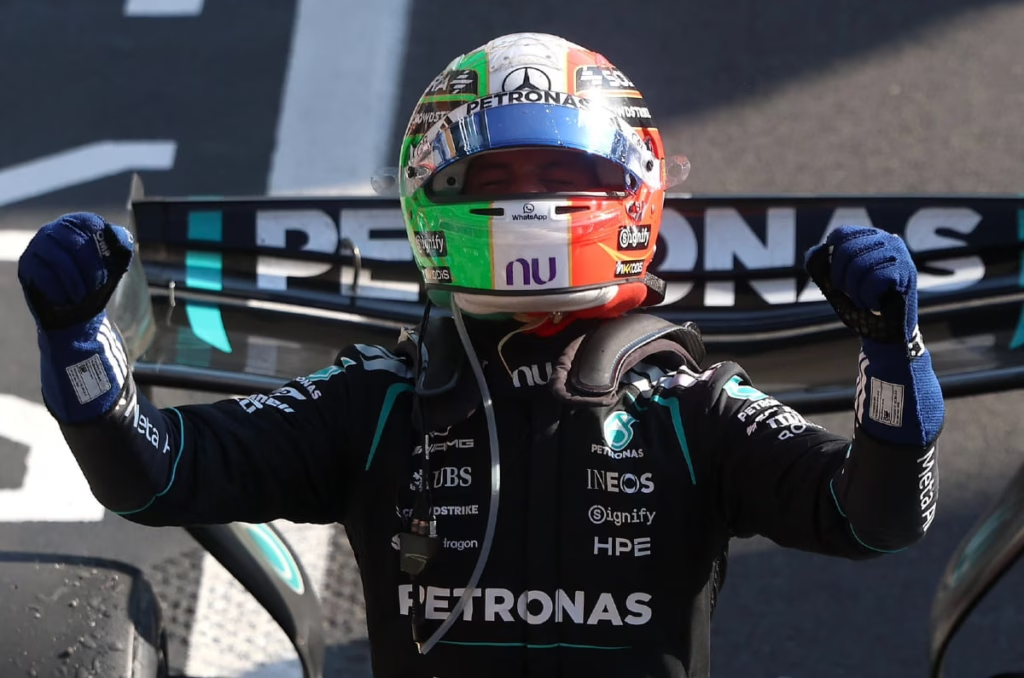
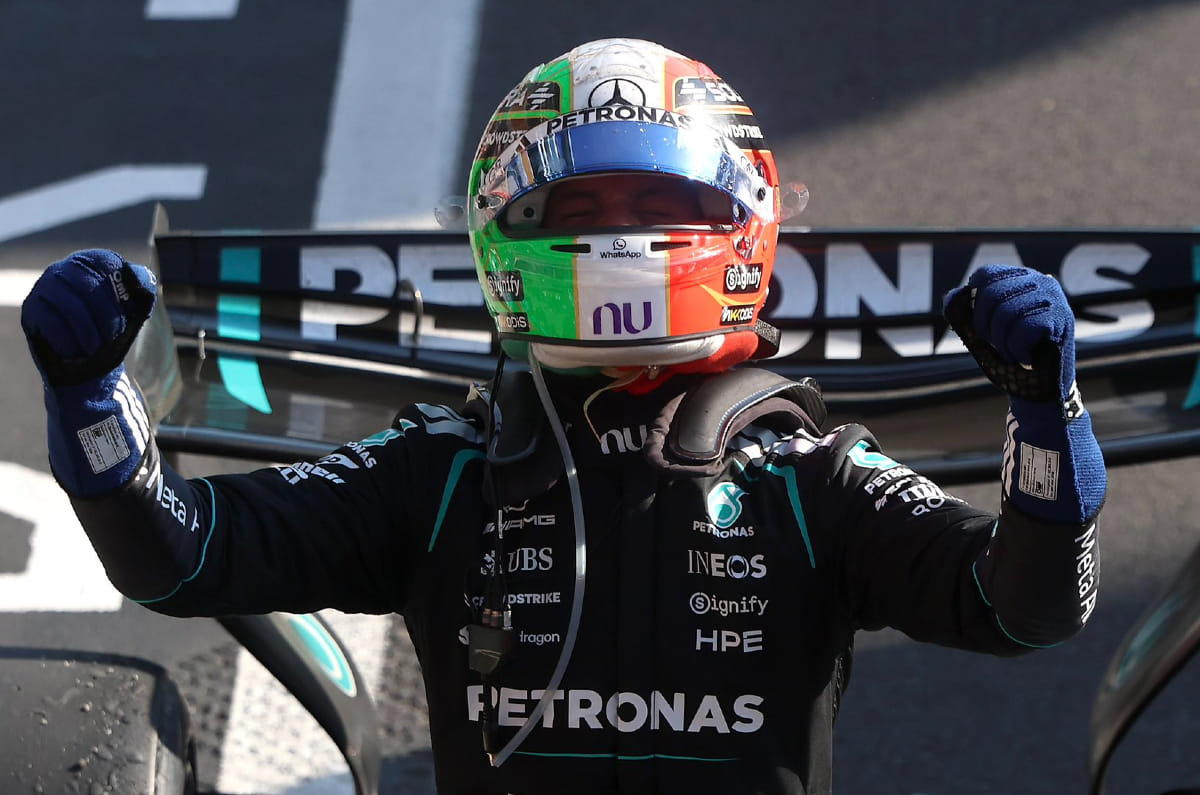
Kimi Antonelli stormed from P19 on the grid to win the Italian GP and further stretch his championship lead. With this, he becomes the first Italian F1 driver to win his home race since Ludovico Scarfiotti in 1966.
After staying in contention for victory for most of the race, George Russell had to settle for second place. Red Bull Racing’s Max Verstappen completed the podium in third place after some bold passes.
Antonelli wins, 3.857 sec ahead of Russell
First Italian driver to win home race in 60 years
Verstappen P3 for Red Bull
Antonelli defeats Russell to win Italian GP
Leclerc crashes out
Antonelli had to start the race from 19th on the grid after taking new power unit components. He’d already climbed to P12 when the race was red flagged as Charles Leclerc crashed into the barriers on Lap 2. This played into Antonelli’s favour and he quickly climbed his way up the order after the re-start.
On Lap 18, Antonelli passed his Mercedes teammate Russell to move up to P1. But the lead changed hands several times as the two Mercedes drivers battled it out. A mid-race safety car ended up being pivotal as Antonelli stopped for medium tyres, while Mercedes opted to keep Russell out. The Italian used his fresher tyres to catch and eventually pass his teammate to take victory.
“I could never have imagined to be here today, but we managed to pull it off. It’s a dream coming true. What an incredible day,” Antonelli said. “I couldn’t do it without my team, family and everyone who supports me. Still a few races to go, so we’re going to keep our head down, but now we’re going to enjoy today.”
Russell finished 3.857 seconds behind in second place, followed by Verstappen. The McLaren duo of Lando Norris and Oscar Piastri crossed the chequered flag P4 and P5, respectively, followed by Ferrari’s Lewis Hamilton.
Polesitter Pierre Gasly enjoyed a strong start, but dropped down the field as the race progressed and ended up P7. Both the Racing Bulls drivers finished in the top 10, with Arvid Lindblad ninth and Yuki Tsunoda tenth. Franco Colapinto split the two Racing Bulls drivers in ninth place.
2026 F1 championship standings
Antonelli now leads the championship by 66 points from Russell. Hamilton holds on to third place in the standings, just 10 points behind Russell.
F1 will next head to an all-new venue, with the Madring making its debut for the Spanish GP on September 11-13.
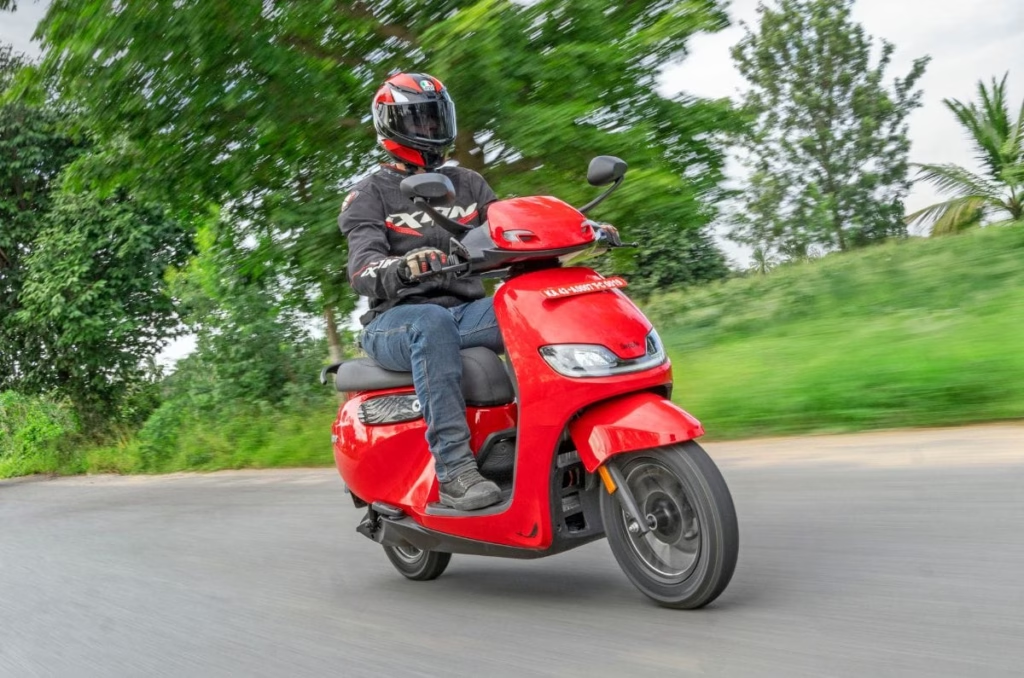
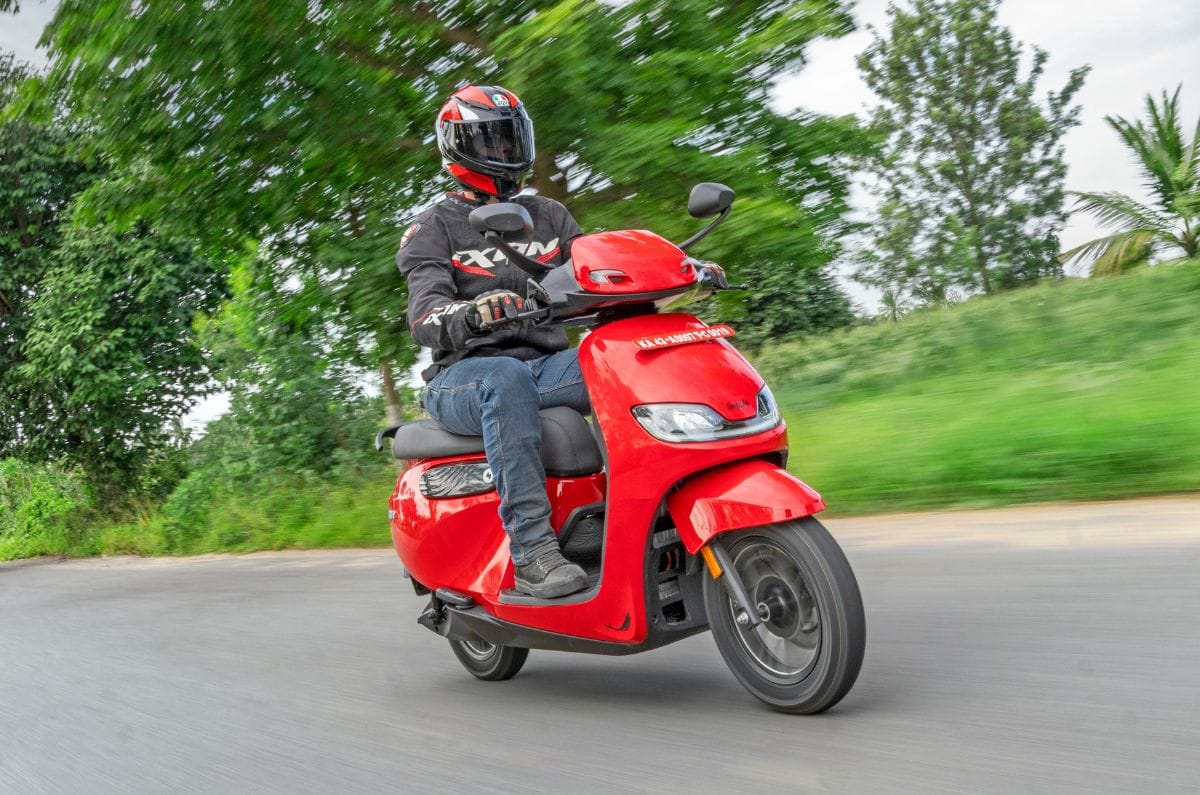
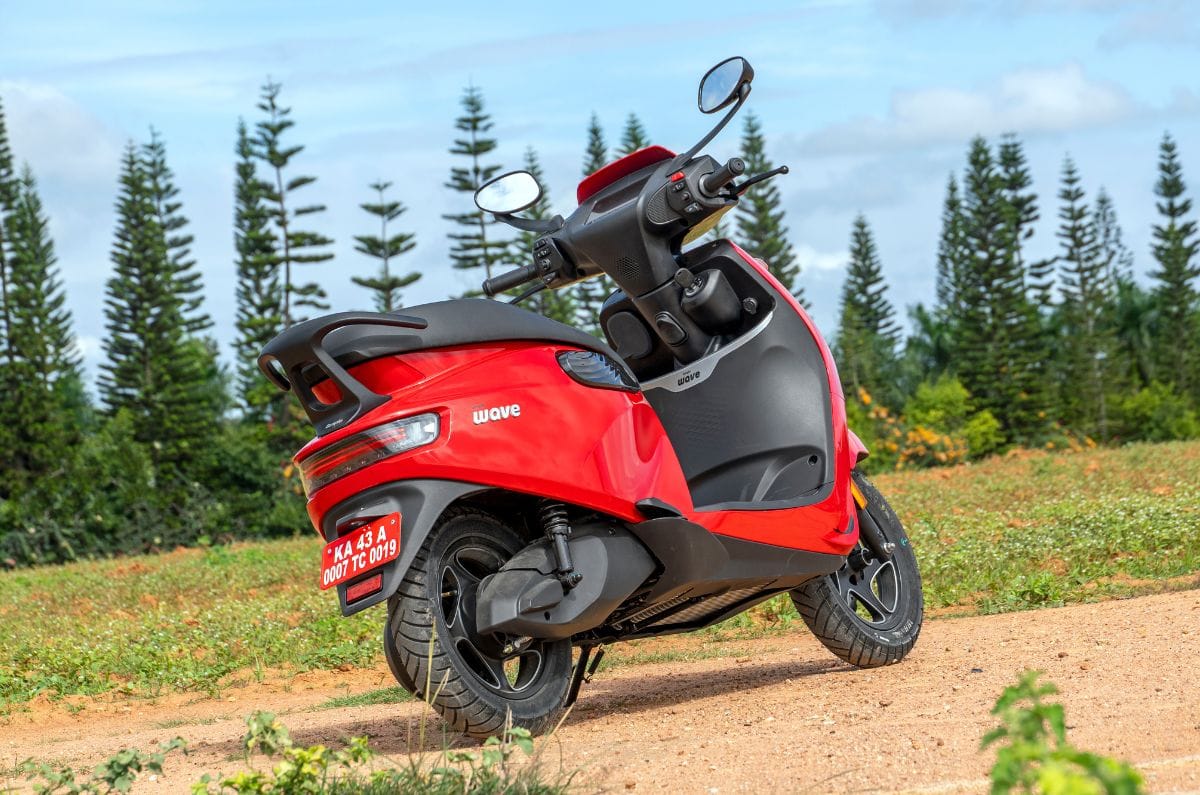
The Simple Wave is an interesting proposition in the increasingly crowded electric scooter space. Its rounded, smooth looks certainly grab attention and, as we found out, it is comfortable, spacious and offers brisk performance. There’s plenty to like here, so let’s dive right in.
Simple Wave Design and quality – 8/10
Looks unique and features many chassis changes over the One
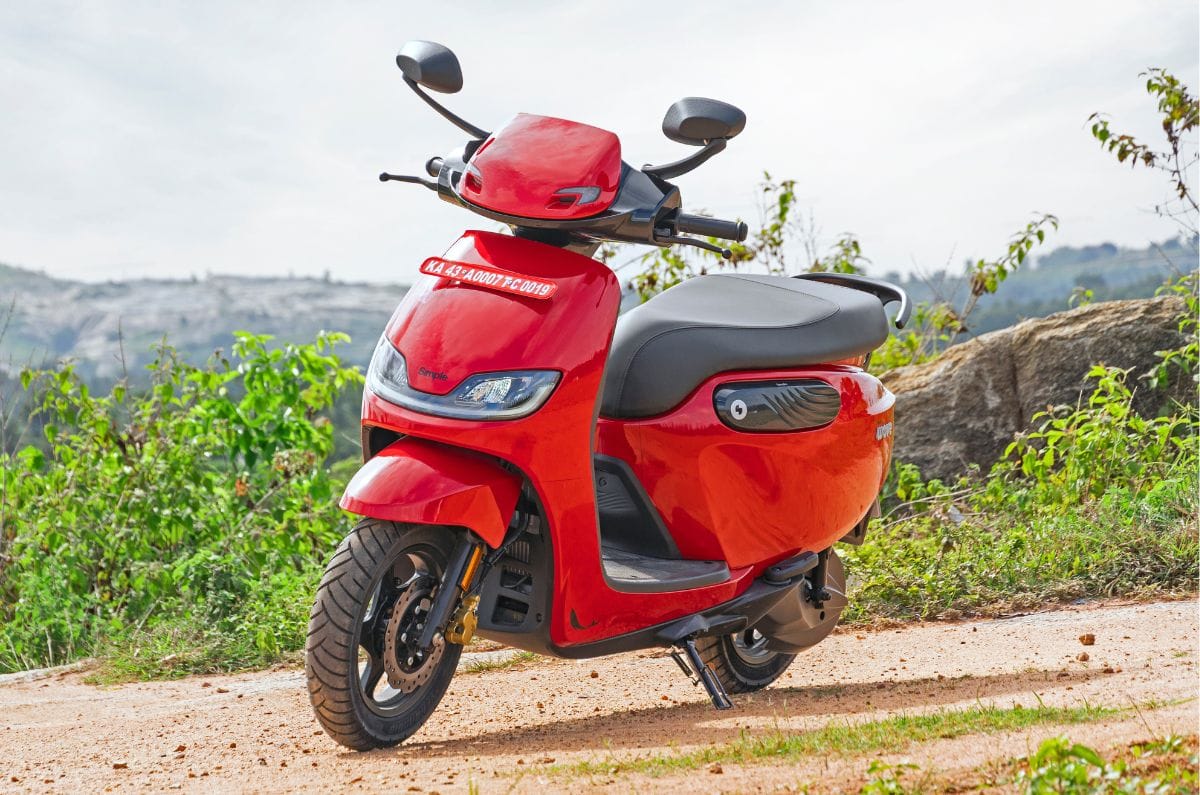
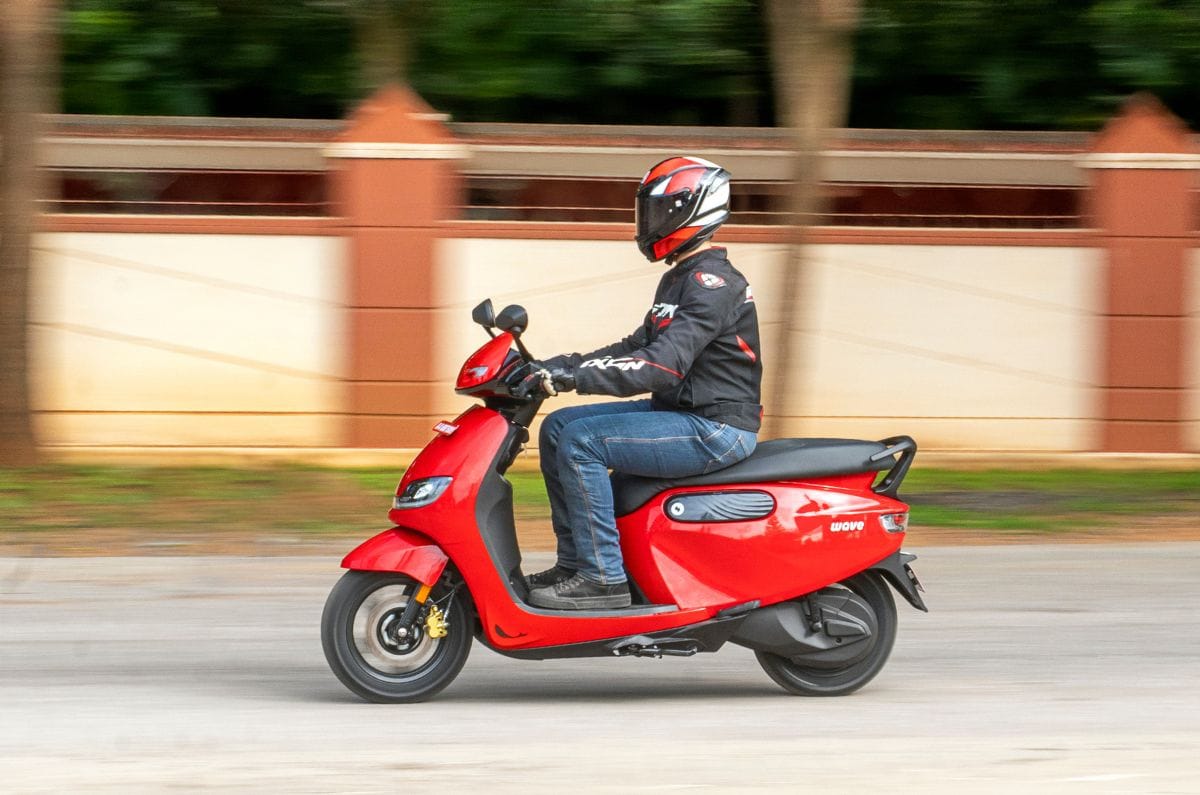
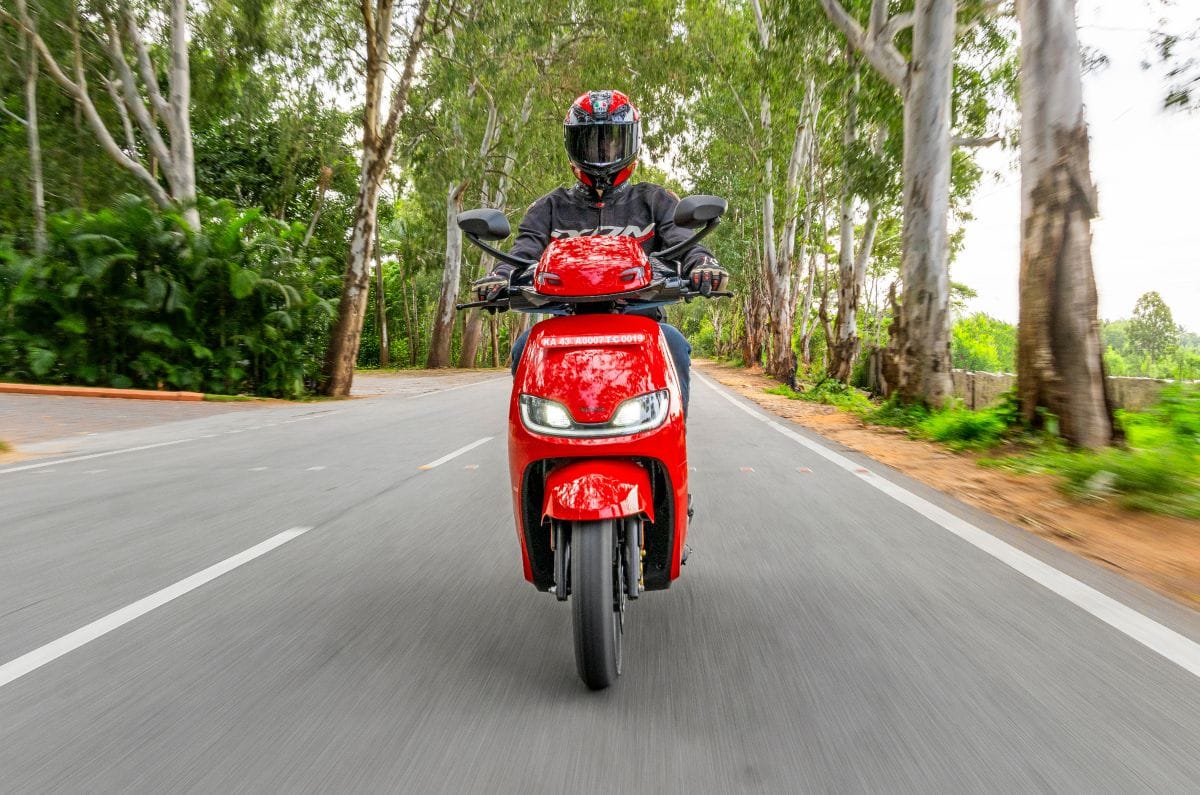
Design is subjective, of course, but the Wave looks good to my eyes with its smooth, rounded edges and distinctive silhouette. It’s got a good level of finish too, and the brighter colour options – red and blue – help it stand out. Simple has designed the Wave as a more accessible, family-oriented scooter, without making it look or feel built down to a cost.
It has a quirky design and surely stands out, especially in the brighter colour options.
Compared to the sporty Simple One, the Wave’s chassis is quite different. The rear subframe has been reworked to accommodate the bigger boot and twin shocks (which replace the One’s monoshock). The Wave also uses a simpler, more cost-effective tubular swingarm instead of the cast unit on the One.
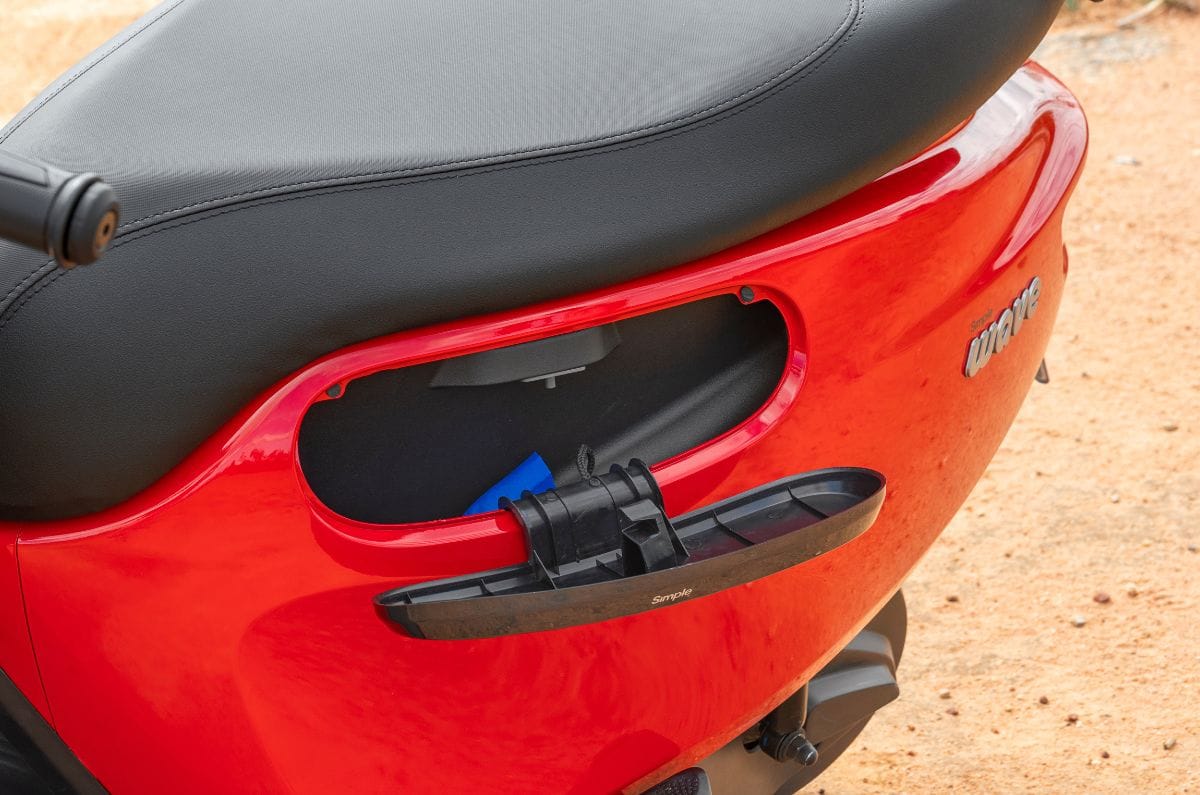
Lockable and weatherproof 4L“Pill” storage cubbies are a thoughtful touch, RH cubby is an accessory.
Simple Wave Ergonomics and comfort – 9/10
Offers a supple ride and ample space for two people
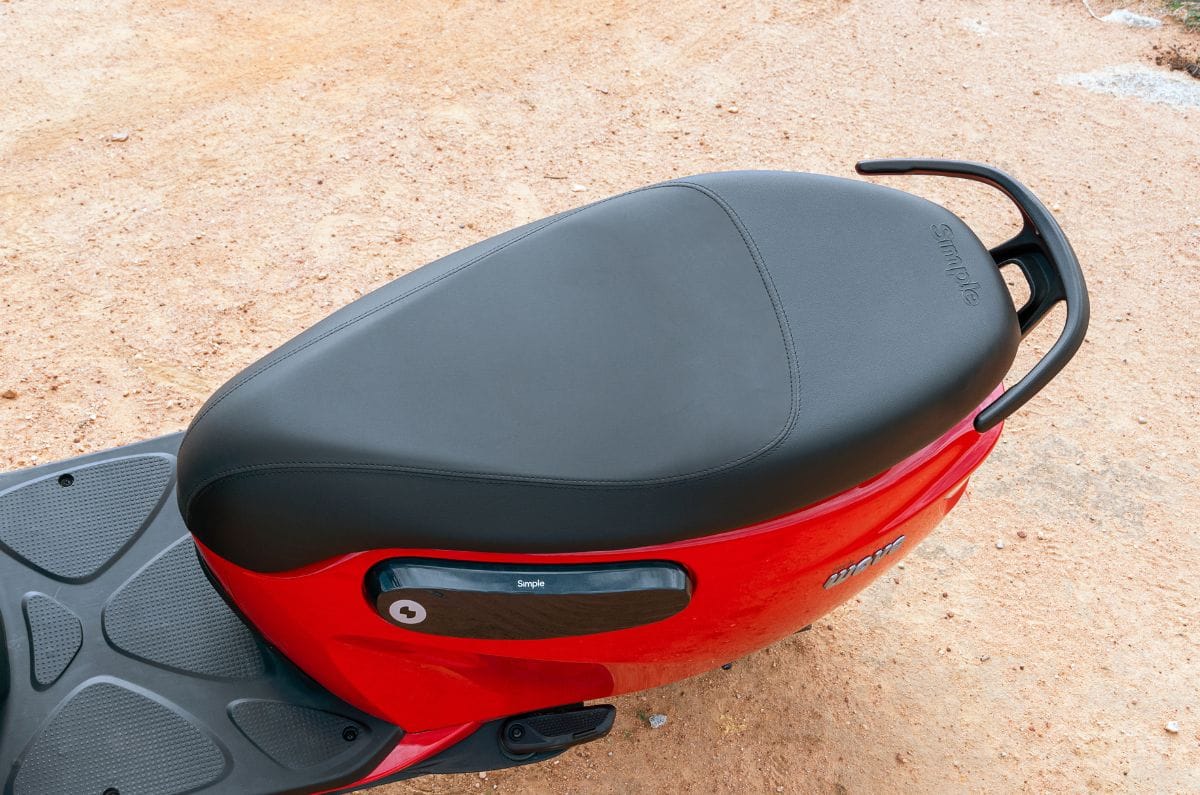
The differences only get more pronounced once you sit on the Wave. Its seat is long, wide and will easily accommodate two full-size adults, while its relatively low 775mm seat height makes it friendly for shorter riders.
That low seat height is no accident either; Simple took feedback from customers who had the One and incorporated it into the Wave. This is why the Wave also has a lower handlebar to make it more approachable for shorter and female riders. This has a trade-off, however. Taller riders will find the handlebar fouls their knees during tight, lock-to-lock U-turns.
Riding position is spot-on and ride comfort too is excellent.
Other than that, the Wave is rather sorted ergonomically. Ride comfort is excellent for a scooter, and that isn’t a surprise given that the Simple One itself was quite comfortable. The Wave builds on that with a composed and plush ride that suits its intended role.
Depending on the variant, the Wave weighs between 121-128kg with the 3.7kWh TFT variant provided to us sitting roughly in the middle of that range (124.5kg). We found the Wave handled predictably, without any unwelcome surprises, feeling stable and sure-footed without compromising agility expected of a scooter.
Spacious, well-paded seat can comfortably seat 2 full-size adults.
Simple Wave Performance and range – 9/10
Performance is more than sufficient, Eco mode truly usable
Like the One, the Wave offers really brisk performance, but still feels approachable enough for everyday use. The 3.7 version gets three riding modes – Eco, Ride and Sport – and both Ride and Sport offer more than enough performance for everyday use, which isn’t really a surprise. In Ride the top speed is 75kph, whereas Sport takes it up to 90kph (speedo-indicated, not actual).
The real surprise, however, is Eco mode. Yes, it feels duller than the other two modes, but it isn’t crippled in the way Eco modes on other EVs. The Wave can still get up to around 50-55kph quite respectably and overtake traffic, making Eco genuinely usable even on faster roads or in a big city.
It handles predictably and surefootedly in all scenarios.
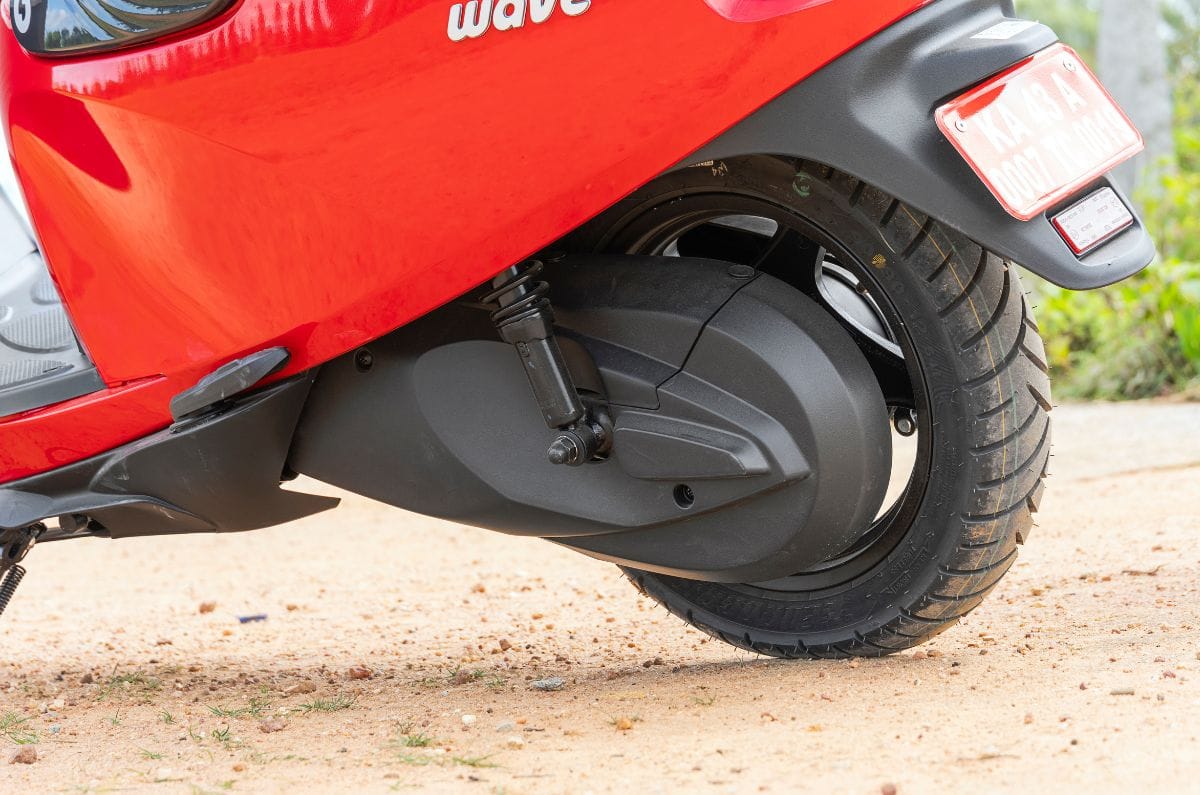
Given that the Wave uses the same motor as the OneS making 6.4kW and 52Nm, this performance is no surprise. However, on the Wave, the motor drives the rear wheel via a chain drive, not a belt as seen on the One models.. While a chain will be more maintenance-intensive than a belt, replacing it should be more affordable. Simple has worked to reduce powertrain noise with measures such as a rubber-damped sprocket, but there is still some motor noise. However, it’s much quieter than an Ather Rizta or 450, although far from dead silent like an Ather Konarc or TVS iQube.
Another welcome change to the One is the throttle response. Unlike the older One models we tested, where the scooter could continue accelerating briefly after the throttle was closed, the Wave’s accelerator behaves much more intuitively. It also gets traction control, although the throttle calibration is so smooth, you’re unlikely to need it in dry conditions but it will be a useful safety net in the wet.
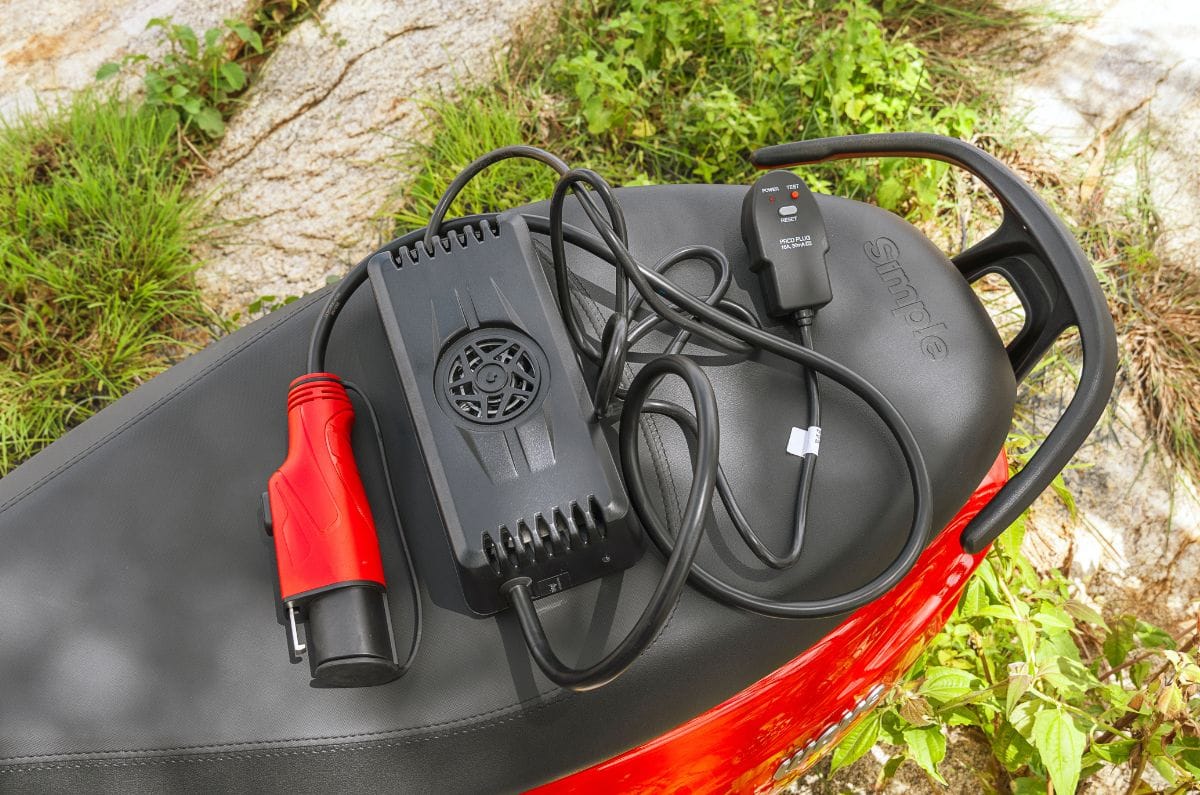
Fast 750W charger is standard on all variants.
Powering the Wave are four battery packs, depending on the variant you choose: 2.2kWh, 2.7kWh, 3.7kWh and 5kWh. The IDC ranges Simple claims are 110km, 132km, 171km and 243km, respectively. The first two use LFP (Lithium Ferrous Phosphate) chemistry, while the larger batteries use NCA (Nickel Cobalt Aluminium) cells.
The range indicator also appears to be quite trustworthy although we’ll reserve final judgement on real-world range until we can conduct a full test back in Mumbai. What is also nice is that all variants of the Wave come with a fast 750W charger which enables a pretty quick 0-80 percent claimed charging time of 3hr30min on the 3.7kWh version we were riding.
The standard warranty on the Wave is three years/30,000km, with five years/50,000km and 15 years/2 lakh km extended options also available. The price of these optional longer warranties has not been shared with us.
The Wave’s motor feeds power to the rear wheel via a chain, not a belt like on the One.
Simple Wave Features – 9/10
Massive 63L boot and Pill storage cubbies are very useful
While range without sacrificing usable performance is surely valuable on an EV, practicality is an important consideration as well. Storage is one of the Wave’s big strengths. There’s a useful front cubby, while the two “Pill” storage boxes on either side of the body panels are particularly nifty allowing you quick access to essentials you may need to reach for without having to get off the scooter. Each offers 4 litres of lockable weatherproof storage; the left one is standard, while the right is an accessory.
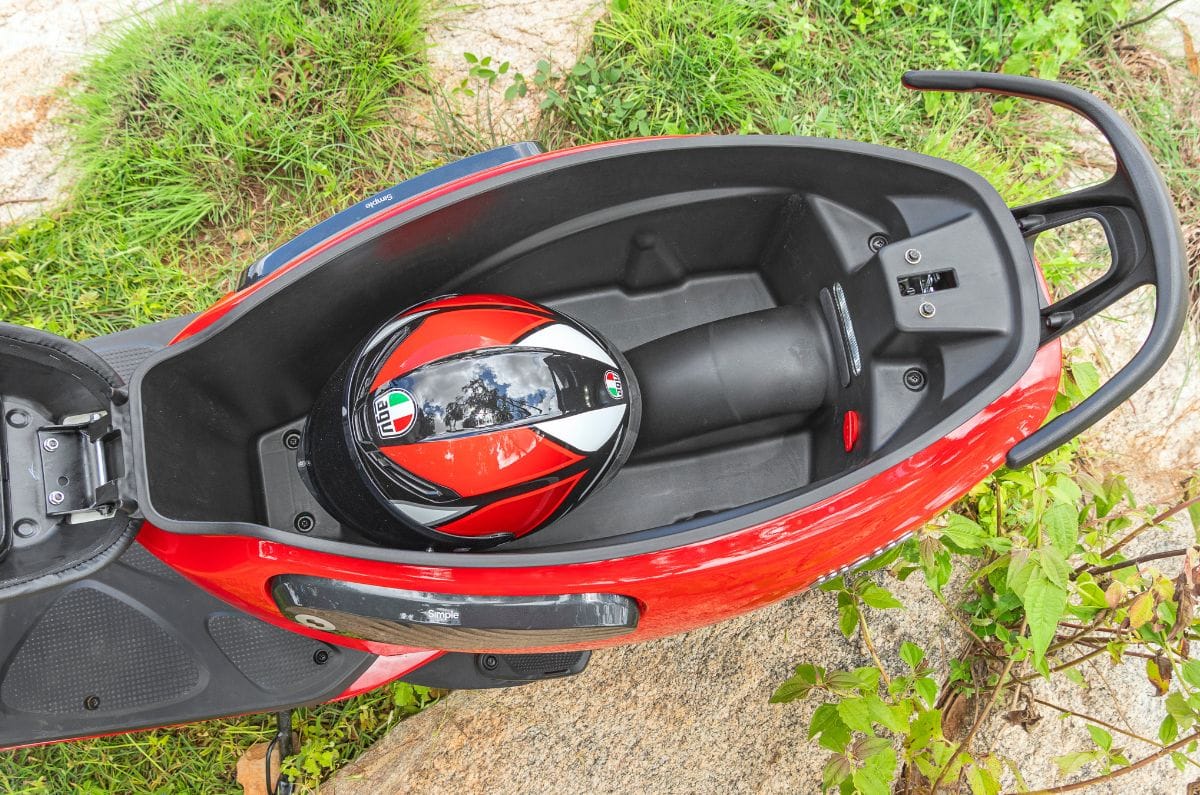
An undoubtedly big USP on the Wave is its cavernous 63L boot, the largest on any Indian scooter to date.
What is also an undoubtedly big USP on the Wave is its cavernous 63 litre boot, which is the largest on any Indian scooter to date. This should prove to be more than enough for everyone in the family! That being said, 63 litres is an enormous number and while this boot is undoubtedly big, I’m do find myself struggling to comprehend how it is nearly 50 percent bigger than the already cavernous 43 litre boot in the River Indie.
There’s plenty of technology too, including hill hold, drop-safe functionality, theft alerts and Bluetooth connectivity to your phone via the app. The TFT-equipped versions bring even more tech, while the brake-lock clasp is a small but useful touch.
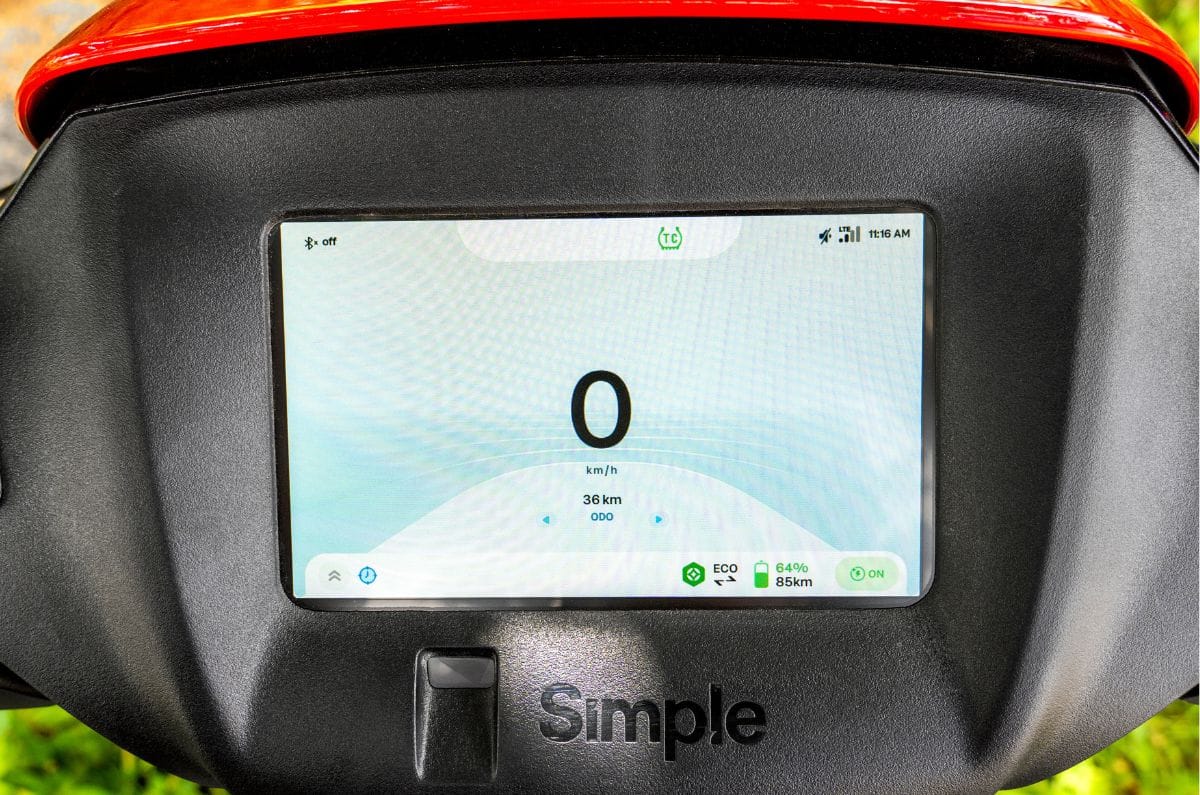
TFT display is well laid-out and has a lot of tech but misses touch functionality.
Simple Wave Price and verdict – 8/10
Scooter has a lot of strengths but is pricey; company yet to prove itself
There isn’t a lot to dislike about the Wave as a scooter. It’s comfortable, spacious, well finished and quick enough to serve its intended purpose very well. However, for all its accomplishments, the Wave doesn’t come cheap. Sure, the Rs 1.10 lakh starting price is tempting, but as you climb the variants ladder, the Wave gets seriously expensive, topping out at Rs 1.90 lakh (ex-showroom, Bengaluru). That said, Simple is one of the few brands offering the option of a 5kWh battery in the family e-scooter space, which is commendable.
However, more than pricing, the bigger issue is that the company is yet to properly scale up its dealer network and establish an aftersales network that delivers the premium experience a buyer will expect after shelling out the money Simple is asking for. The Wave is a good product, but customers paying a premium for an electric scooter will expect not just a solid product but also dependable after-sales support.
The Wave has a lot of strengths but Simple is yet to prove itself in the market.
Ultimately, the Wave’s biggest challenge is that it comes from a start-up that has made plenty of big promises and statements over the past five years but still has a lot to prove. Its dealer network remains minuscule compared with the big players, and long-term reliability still remains unknown.
There’s a lot for Simple to do, but the good news is that the Wave is a genuinely likeable product. If the company can iron out the business side of things, the Wave has the potential to catapult Simple from just another niche start up to a much bigger player. Of course, doing so is a huge challenge and not an overnight process. Simple has a long road ahead of it, but the good news is that it finally has a convincing product to aid in that journey.
दिल्ली के सत्य निकेतन में रविवार दोपहर को एक 5 मंजिला बिल्डिंग गिर गई। हादसे में अब तक कम से कम तीन लोगों की मौत की खबर है। वहीं कई छात्रों के मलबे में दबे होने की आशंका है। इस इमारत का इस्तेमाल छात्रों के लिए PG के तौर पर किया जा रहा था। वहीं इस हादसे के बाद से राहत-बचाव काम जारी है। इसी बीच प्रधानमंत्री नरेंद्र मोदी ने दिल्ली के सत्य निकेतन में इमारत गिरने की घटना पर दुख जताया है। उन्होंने हादसे में जान गंवाने वाले लोगों के परिवारों के प्रति संवेदना व्यक्त की और घायलों के जल्द स्वस्थ होने की कामना की। प्रधानमंत्री ने रविवार को X पर पोस्ट कर इस घटना को बेहद दुखद बताया।
पीएम ने जताया दुख
प्रधानमंत्री ने कहा कि, हादसे से प्रभावित लोगों की मदद के लिए अधिकारी मौके पर राहत और बचाव कार्य में जुटे हुए हैं। सोशल मीडिया X पर किए पोस्ट में पीएम ने लिखा, “दिल्ली के सत्य निकेतन में एक बिल्डिंग का गिरना दुखद है। जिन लोगों ने अपने प्रियजनों को खो दिया है, उनके प्रति संवेदना। घायलों के जल्दी ठीक होने की प्रार्थना। अधिकारी मौके पर काम कर रहे हैं और हादसे में प्रभावित लोगों की मदद कर रहे हैं।”
The collapse of a building at Satya Niketan, Delhi is distressing. Condolences to those who lost their loved ones. Praying for the speedy recovery of the injured. Authorities are working at the site and assisting those affected in the mishap: PM narendramodi
जानकारी के अनुसार, दिल्ली के सत्य निकेतन मार्केट में इमारत गिरने की घटना में अब तक तीन लोगों की जान जा चुकी है। वहीं नौ लोगों को मलबे से सुरक्षित बाहर निकाला गया है। हादसे के बाद राहत और बचाव टीमें लगातार मौके पर काम कर रही हैं और प्रभावित लोगों को निकालने की कोशिश जारी है। इसी दौरान प्रधानमंत्री नरेंद्र मोदी ने भी घटना पर दुख जताया और घायलों के जल्द ठीक होने की कामना की।
40-50 साल पुरानी है इमारत
दिल्ली पुलिस ने बताया कि, साउथ कैंपस थाने में दोपहर करीब 1:34 बजे इमारत गिरने की सूचना मिली थी। जानकारी मिलते ही पुलिस, NDRF, दिल्ली फायर सर्विस और DDMA की टीमें फायर टेंडर और एंबुलेंस के साथ मौके पर पहुंच गईं। इसके बाद मलबे में फंसे लोगों को बाहर निकालने के लिए तुरंत राहत और बचाव अभियान शुरू किया गया। वहीं जांच के दौरान सामने आया कि सत्य निकेतन की यह इमारत करीब 40 से 50 साल पुरानी थी और इसमें बेसमेंट के अलावा पांच मंजिलें थीं। बिल्डिंग का इस्तेमाल PG के रूप में किया जा रहा था और हादसे के समय बेसमेंट में मरम्मत का काम चल रहा था।
जहाँ पढ़ाई आसान नहीं थी, वहाँ भगवती जी ने पढ़ाना आसान कर दिया।
बिहार के छोटे से गाँव शिवनगर में रहने वाली भगवती जी घर और अपने दो बच्चों की जिम्मेदारी संभालने के साथ गाँव के बच्चों को पढ़ाती हैं।
बच्चों को चीज़ें रटने के बजाय आसान Tricks और मज़ेदार तरीकों से समझाती हैं। आज वह इसी कोशिश को Social Media के जरिए दूसरे बच्चों तक भी पहुँचा रही हैं। कई बच्चों को अपनी Coaching में मुफ्त में भी पढ़ाती हैं। क्योंकि एक अच्छा शिक्षक सिर्फ पढ़ाता नहीं, पढ़ाई को आसान और दिलचस्प भी बनाता है।
@xmartsrishtisingh
[Teaching in rural India, Women Teacher in Rural India, Teachers Who Changed students lives, Education for Village Children, Teacher’s Day Special Story]
गाँव के बच्चों के लिए पढ़ाई आसान बना रही
ये महिला टीचर | Teacher’s Day special | Bihar |