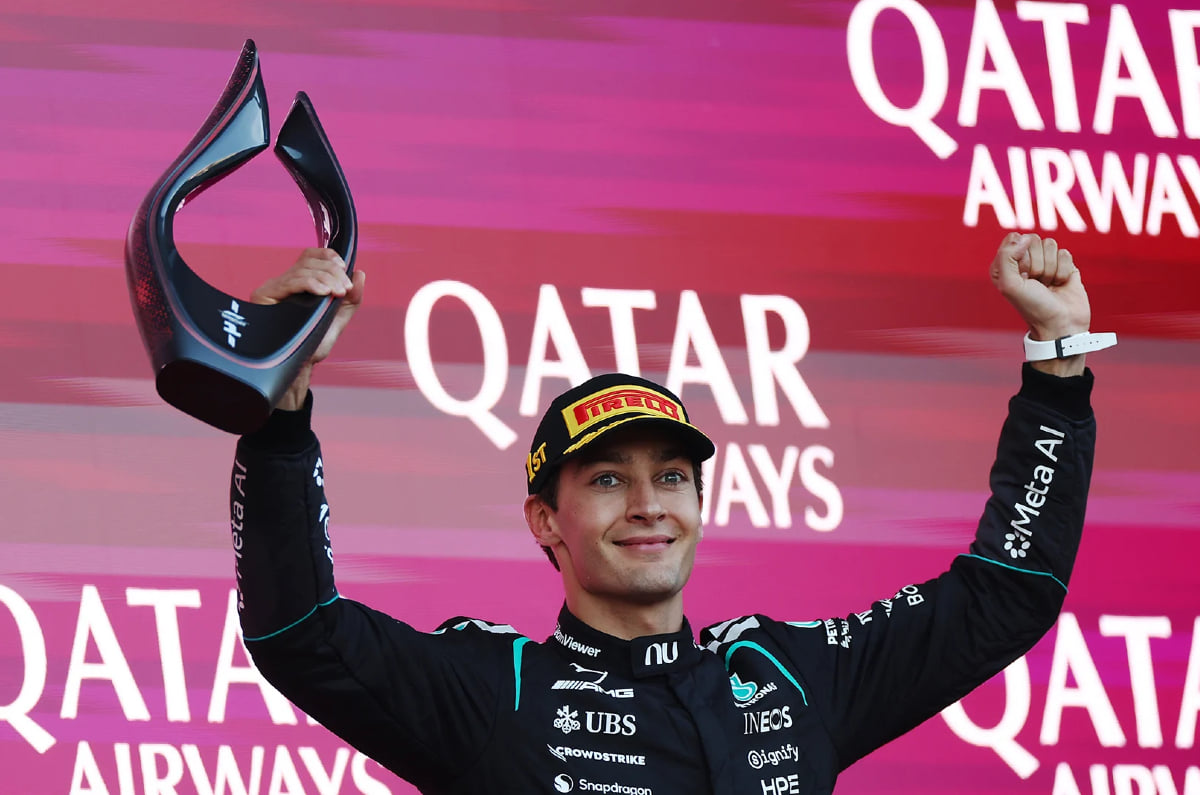
George Russell secured his third win of the 2026 F1 season after fending off a late charge from Max Verstappen. The Mercedes driver survived two Safety Car re-starts to secure his first win since the Austrian GP in June.
After spending six weeks out of action due to a fractured wrist, Isack Hadjar made a strong comeback at Baku with a P3 finish.
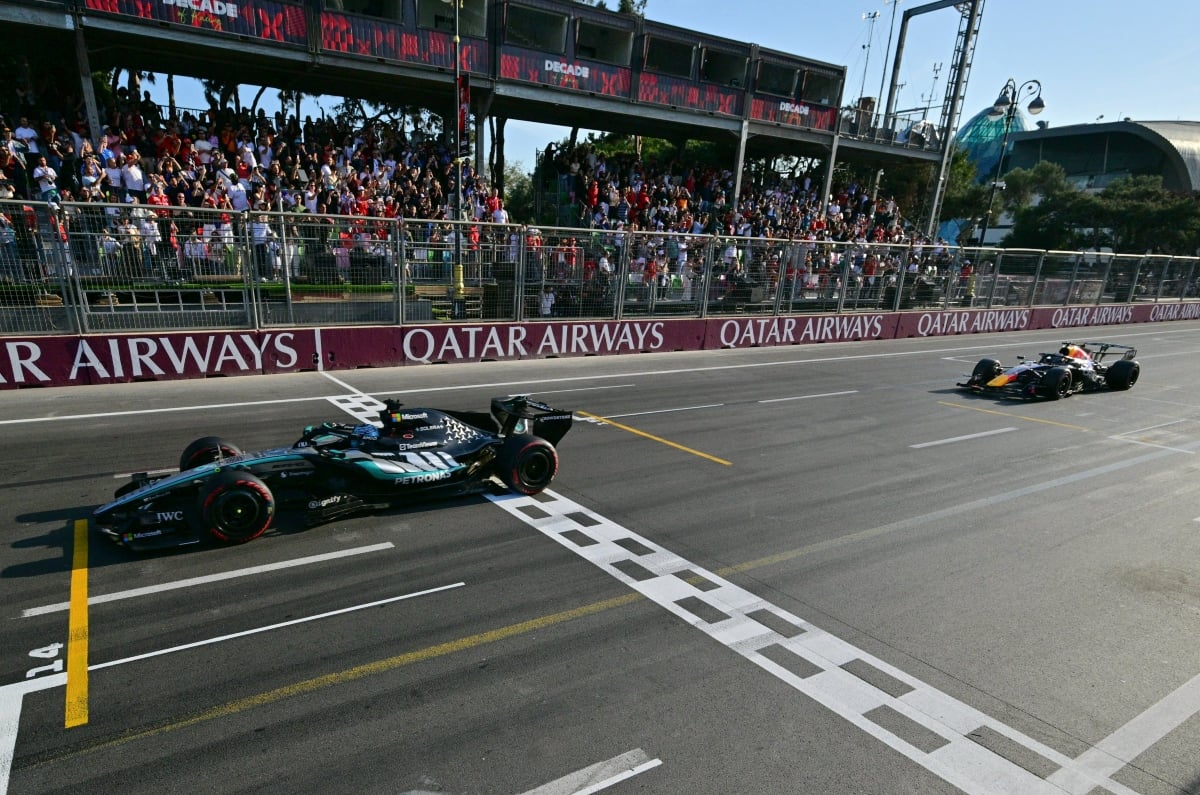
Russell wins at Baku, 0.196 sec ahead of Verstappen
Antonelli goes from P16 to P5
Colapinto handed five-place grid penalty for Malaysia
Russell wins Azerbaijan GP
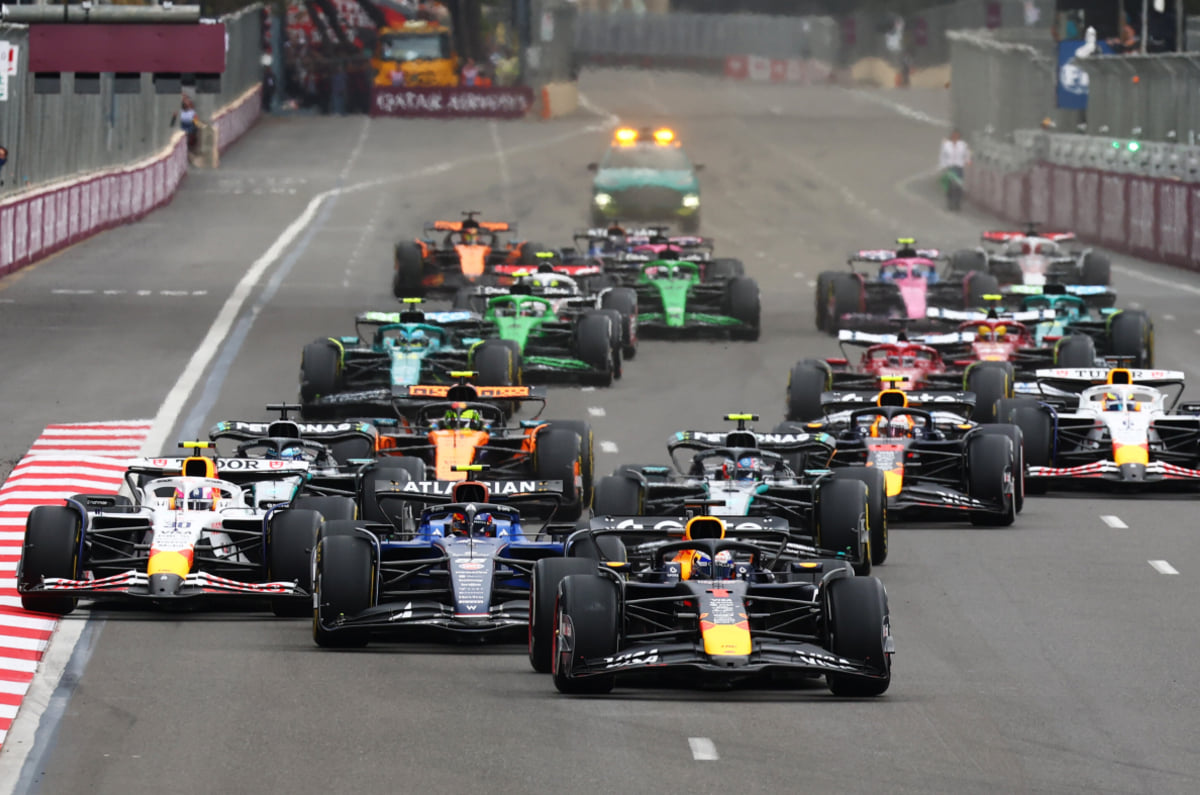
Starting from pole position, Russell enjoyed a great launch at the start and extended his lead in the early stages. He had a buffer of over 10 seconds when the Safety Car was brought out on Lap 31 after Alex Albon’s crash.
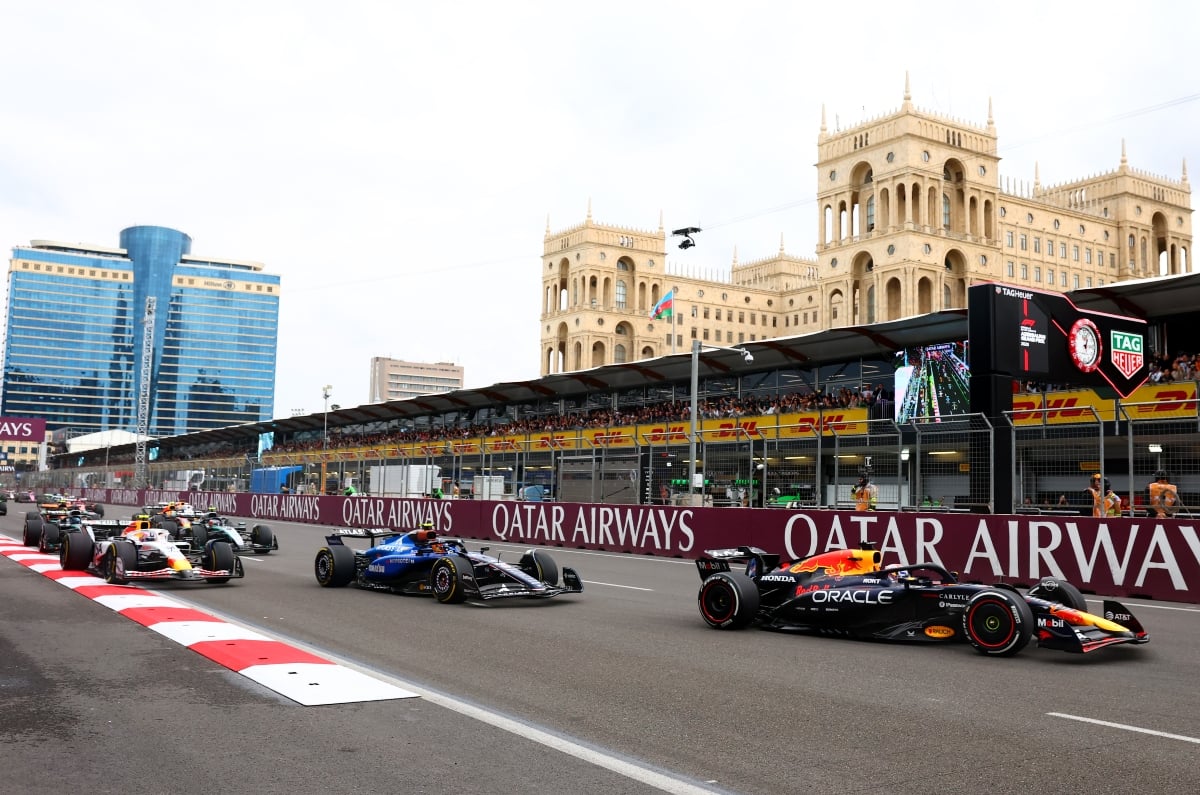
Russell aced the re-start as behind him, Verstappen used the slipstream to pass Oscar Piastri to move up to second place. But the race was neutralised once again as Franco Colapinto locked up into the Turn 1 braking zone, taking out his Alpine teammate Pierre Gasly and McLaren’s Lando Norris. This set the stage for a thrilling duel as Verstappen piled the pressure on Russell.
The Mercedes driver ended up crossing the chequered flag just 0.196 sec clear of Verstappen. “It’s been an incredible weekend and probably one of the strongest of my career so far. I really enjoyed that race and that final stint was some of the most fun I’ve had in a Formula 1 race. We had strong pace throughout and were able to build a good gap, so when the Safety Car came out it was a little frustrating, but around a circuit like Baku that’s always a possibility,” said Russell.
“The restart was probably the most stressful moment of the afternoon with Max right behind me, but I managed it well and from there it was all about staying focused and not making any mistakes. In the final stint we were both pushing hard, and whilst it was intense in the car, those are the moments you enjoy as a driver. I’ve felt comfortable all weekend, and at the moment things seem to be coming naturally behind the wheel. We’re in a good place, but Formula 1 changes very quickly so you have to keep pushing. The aim is to keep working hard, keep building this momentum and hopefully continue fighting at the front over the races ahead.”
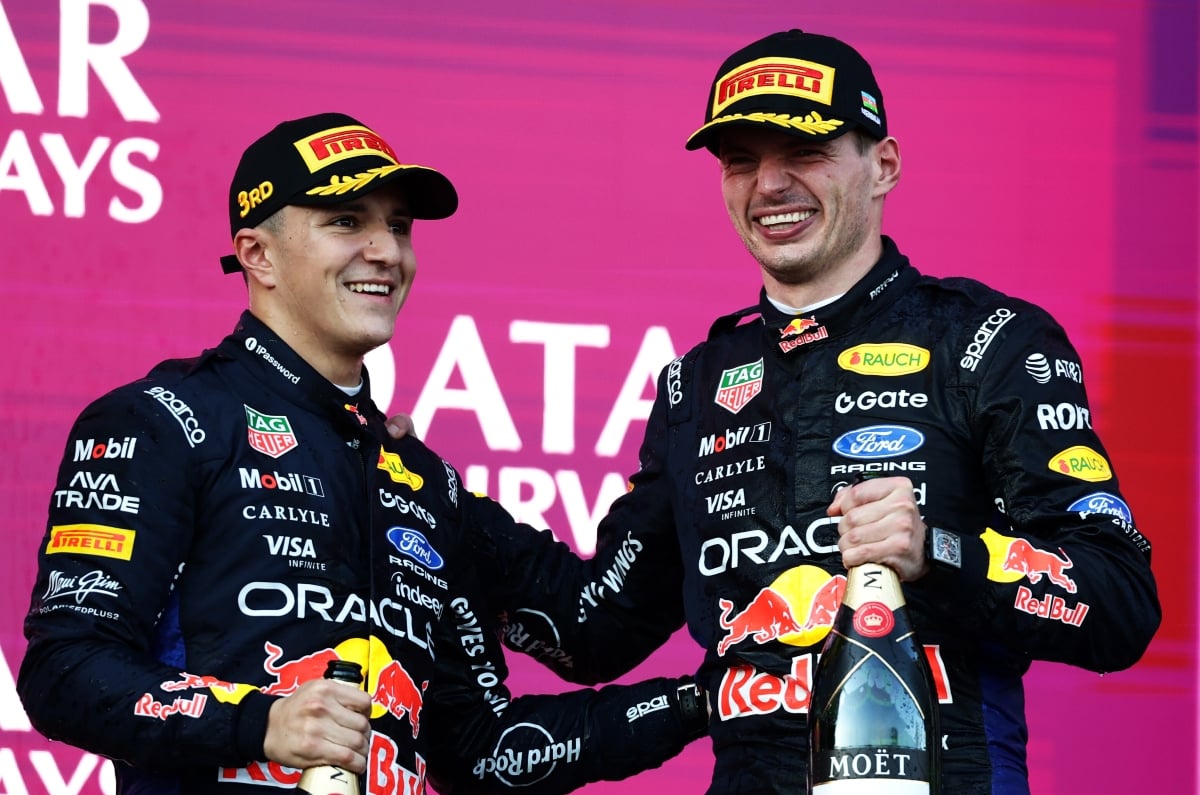
Red Bull earns double podium
Red Bull celebrated its first double podium this season as Hadjar finished third. It topped off an impressive comeback round for the Frenchman, who missed the last three races as he recovered from a wrist injury sustained while training.
“You can’t really ask for a better comeback than that. The car has been competitive throughout the week and all over the track, so we had the pace to really challenge and be exactly where we wanted to be. Our approach was key to a strong week; taking it step-by-step allowed me to build confidence and then the lap time comes with that. Ending it with P3 is a really pleasing result,” Hadjar shared.
Ferrari’s Charles Leclerc and Lewis Hamilton finished P4 and P6 respectively. Championship leader Kimi Antonelli split the two Ferrari drivers in fifth place, battling his way up the order after starting P16 on the grid.
Racing Bulls’ Arvid Lindblad defeated Haas’ Esteban Ocon and Oliver Bearman to finish P7. Williams’ Carlos Sainz rounded out the top 10.
No points for McLaren
The Baku race ended up being a chaotic affair with seven drivers retiring. It was an especially disappointing weekend for McLaren, as the team walked away from the race with zero points.
Colapinto’s error forced Norris to retire, prompting the reigning world champion to later comment that “some drivers shouldn’t be in F1”. Colapinto has been handed a five-place grid penalty for next weekend’s race in Malayasia for the incident. Despite the Baku circuit not playing to McLaren’s strengths, Piastri spent a good portion of the race firmly in the top three. But a lock up at Turn 1 dropped him all the way down to P15. While he did gain a position after Valtteri Bottas’ late crash, he still ended up P13.
2026 F1 championship standings
Heading into the Azerbaijan GP, Antonelli held an advantage of 81 points on top of the standings. Russell has cut that gap to 66 points after his victory. Hamilton holds on to third place overall, 37 points behind Russell and 13 points ahead of Norris.
F1 will next return to Malaysia for the first time since 2017. Interestingly, the event (scheduled for October 2-4) will be held as the Bahrain GP, with the Middle Eastern kingdom funding the race.
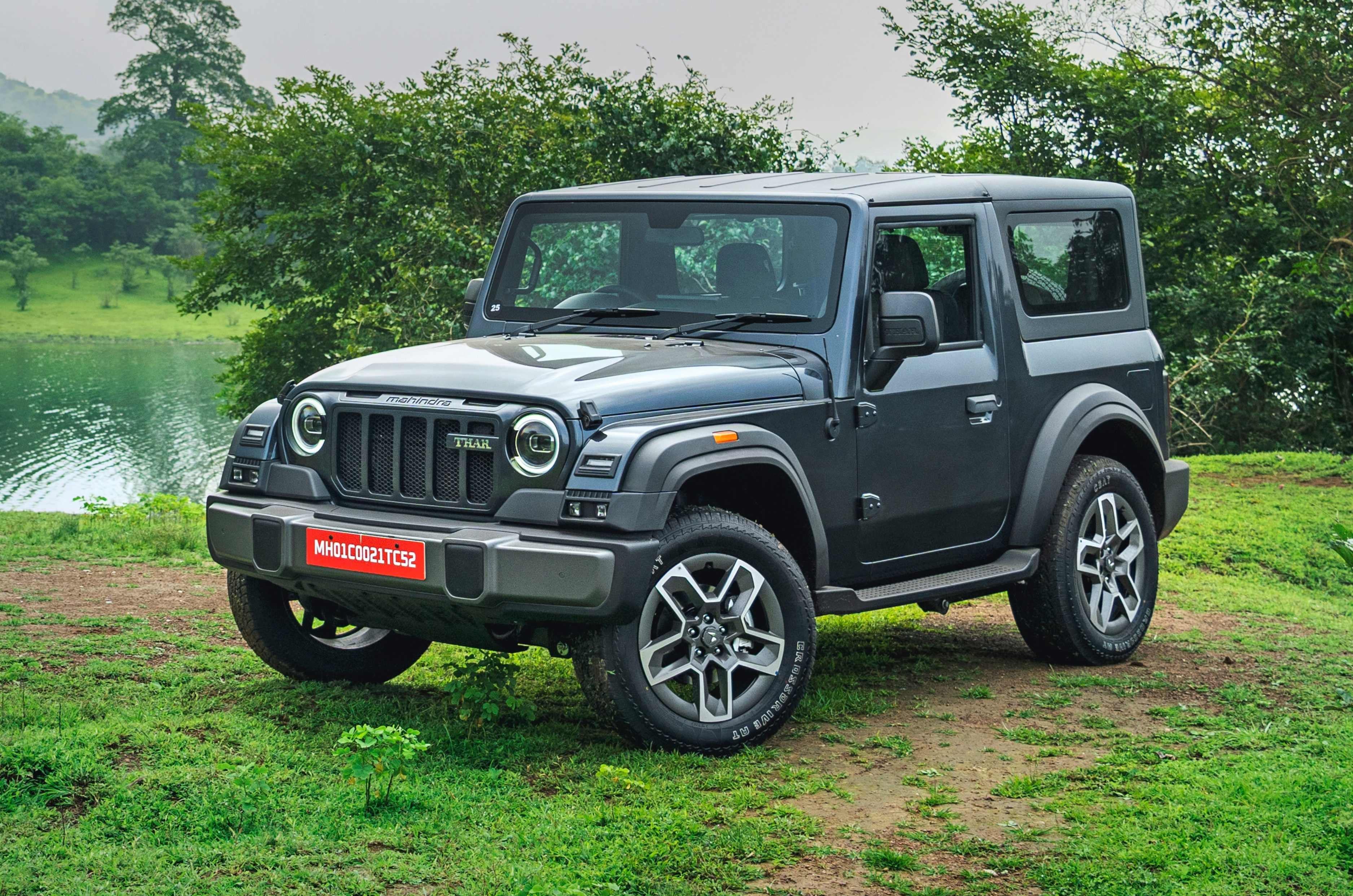
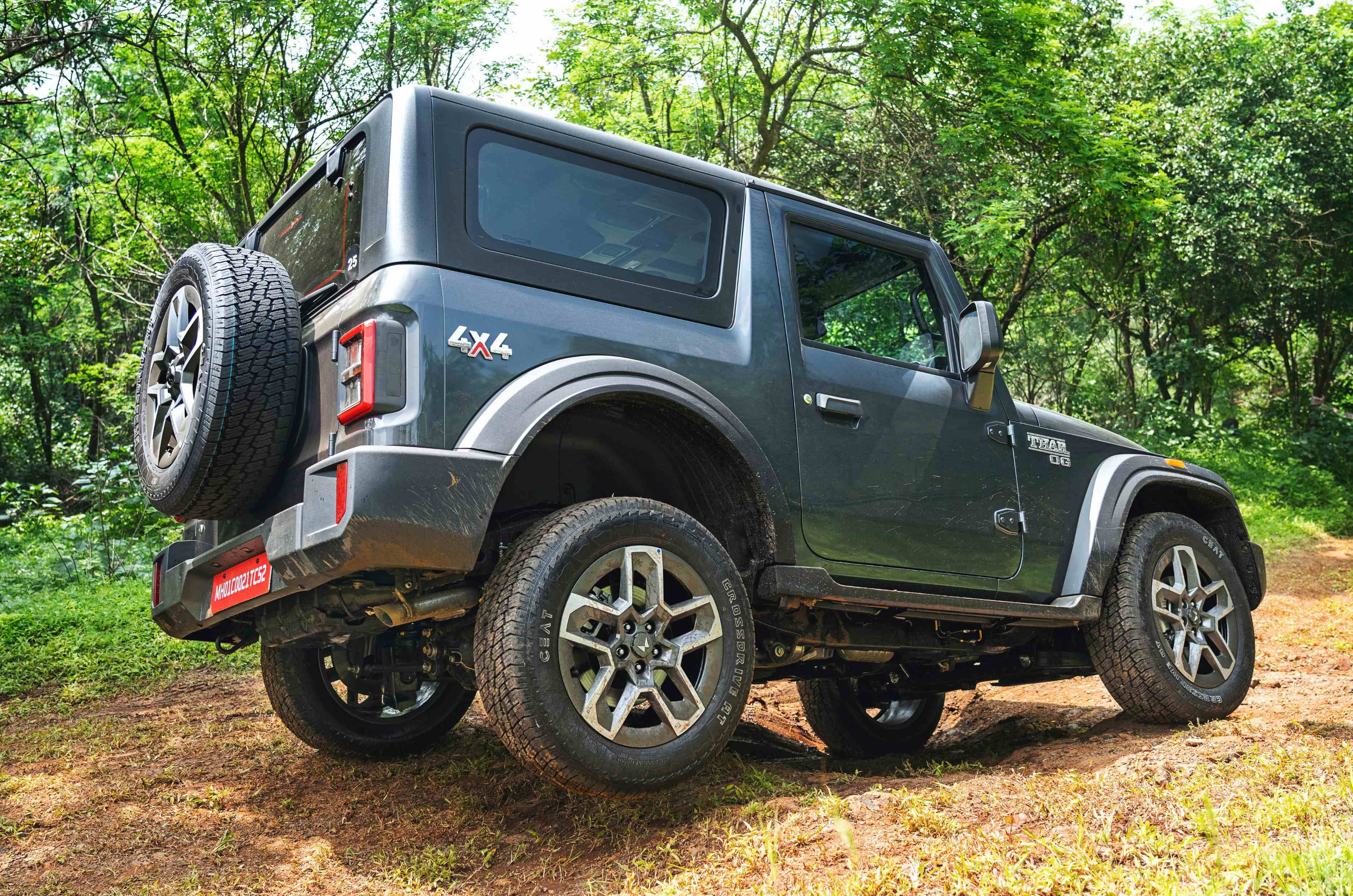
The Mahindra Thar OG was launched in September 2026 and marks the second update to the 3-door SUV in just over a year. Along with the new ‘OG’ suffix, it gets a host of changes to the design, interior and under the skin, along with several new features. If you are considering adding the Thar OG to your garage, here are three reasons to buy it and two reasons why it may not be for you.
Pros
Off-roading capability
The Thar OG remains a hardcore body-on-frame SUV, and its off-roading ability has been further enhanced with new Snow, Sand and Mud terrain modes. These work with ESP, throttle control and steering input for maximum assistance while off-roading. The electronic locking differential is also more convenient to use. For someone who enjoys off-roading, there is nothing like the Thar OG under Rs 65 lakh.
Light steering
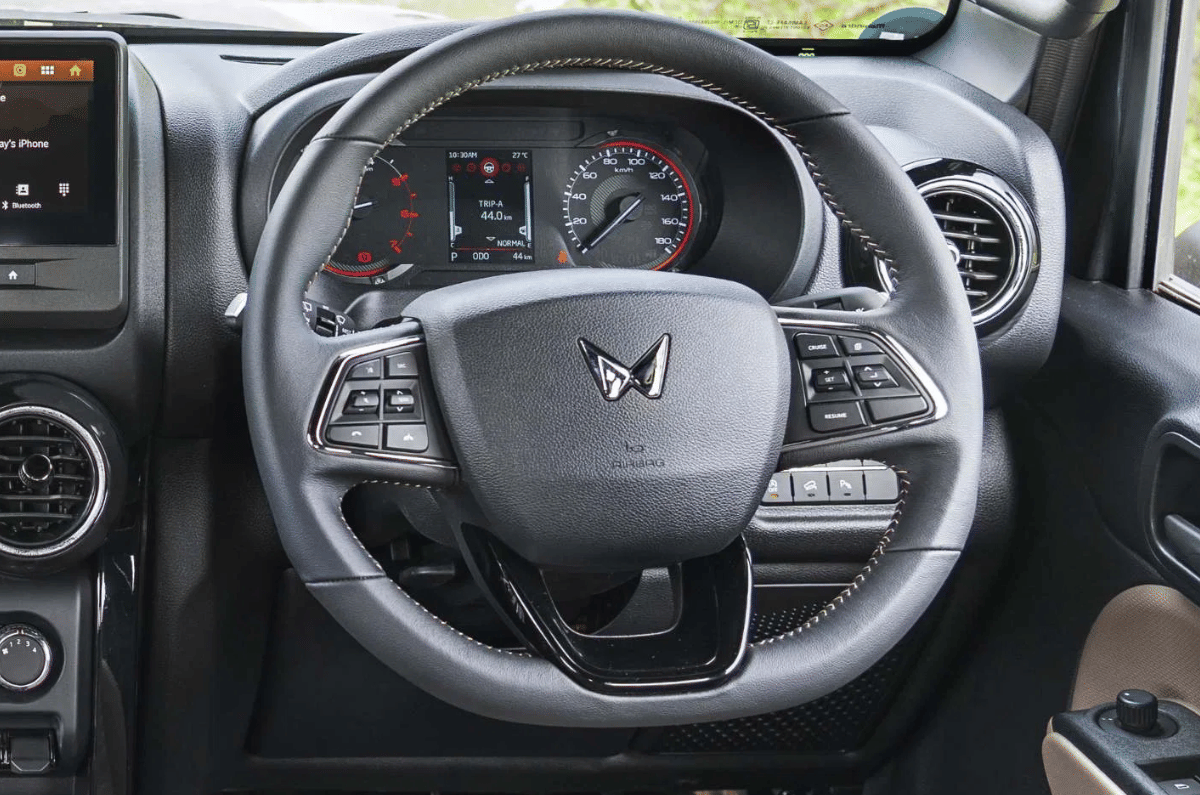
The Thar OG gets electric power steering (EPS) instead of the previously-on-offer hydraulically assisted unit, and as a result, much less effort is needed to steer and turn the Thar. Below 20kph, it’s light enough to turn with just one finger. As the speed increases, it gains heft so it does not feel uncomfortably light. As a result, you no longer need to wrangle with the steering to make a three-point turn.
Improved stability
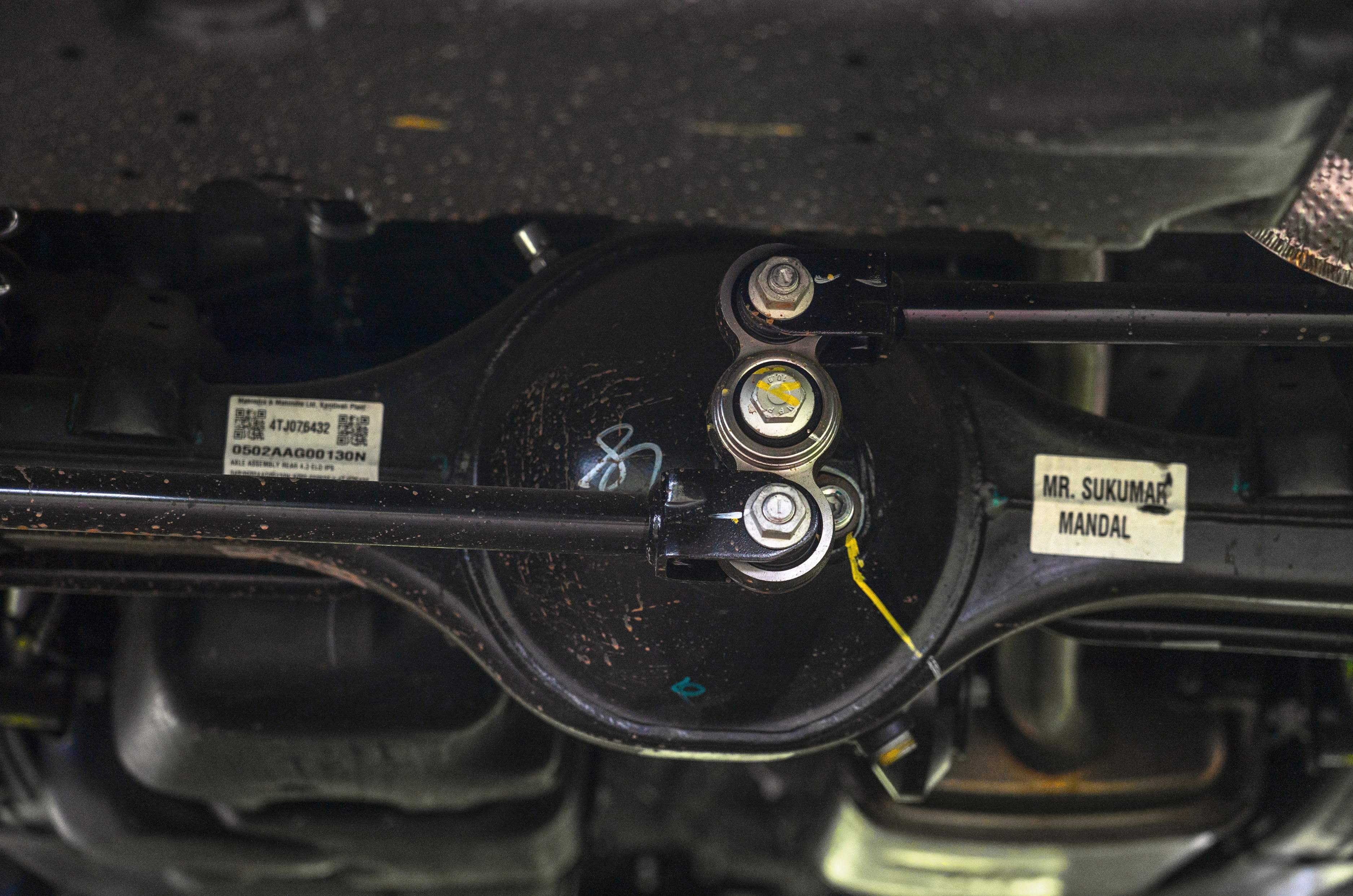
The Watts linkage at the rear adds stability by keeping the axle centred as it moves up and down. This means there is less bouncing over uneven highways and bad patches. The track has also been widened, which further improves stability, even at highway speeds.
Then there is the DaVinci damping setup. Sharp, low-speed bumps no longer send harsh thuds into the cabin. To improve comfort with the larger 19-inch wheels, the ZXT trim also gets frequency-dependent dampers alongside the DaVinci setup.
Cons
Lack of space
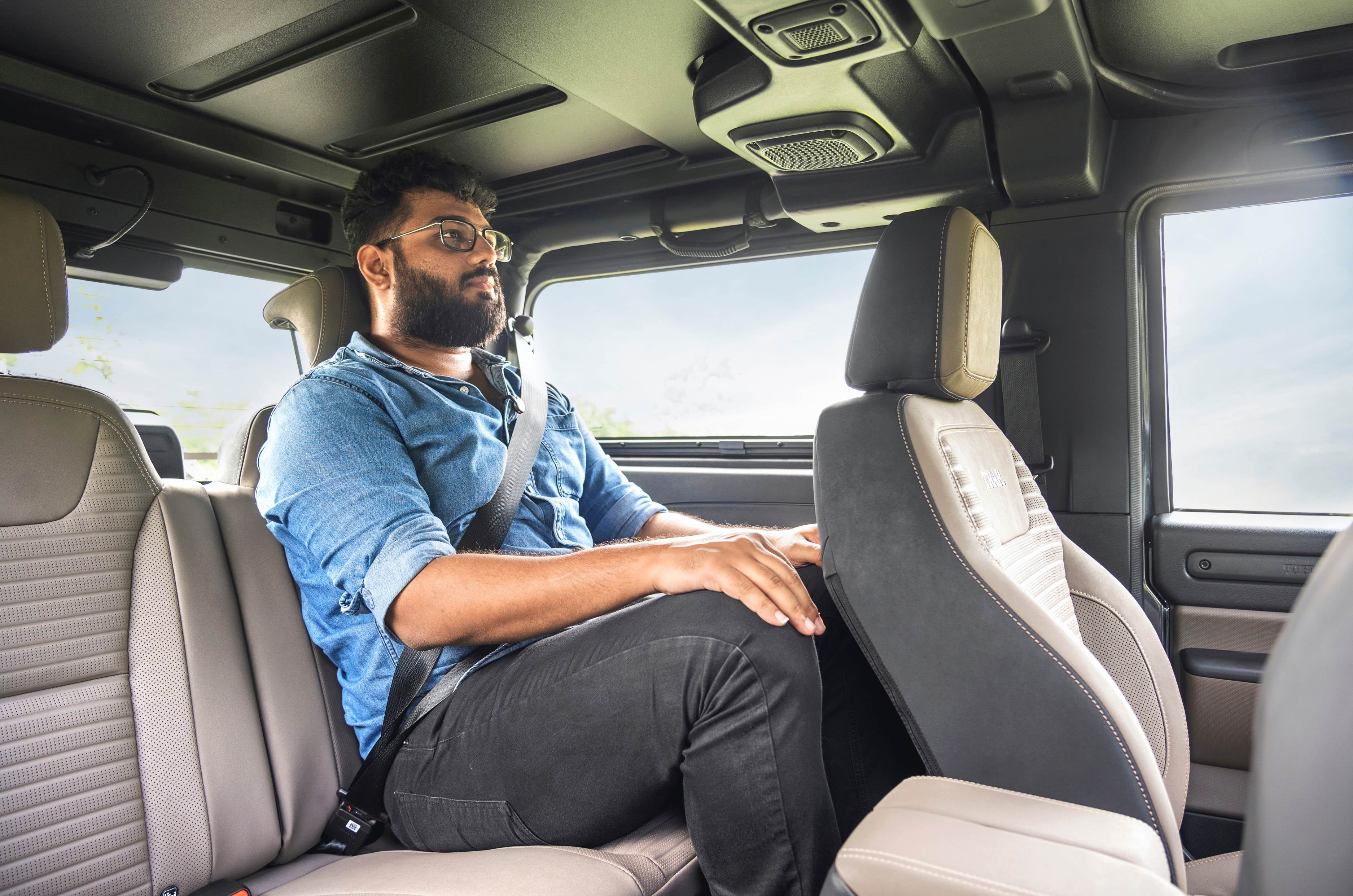
The Thar’s cabin remains short on space, especially at the rear. It continues to be a strict two-seater at the back. Accessing the rear seats could also be difficult for older adults. Boot space is a weak point as well, with barely enough room for an airport run. Carrying large suitcases will require folding down the rear seats.
Interior plastic quality
Unlike the soft-touch materials used in the Thar Roxx’s cabin which give it a more premium feel, the Thar OG’s hard plastics feel low rent. This becomes more noticeable when compared with rivals in the same price bracket. At the time of writing, the Thar OG is priced between Rs 10.32 lakh and Rs 17.75 lakh, ex-showroom.
While the Indian manufacturers have been quick to capitalise on the EV boom, the Japanese have been rather more measured in their approach. Honda arrived in 2025 with not one but two in-house electric scooters, though both had unique limitations that prevented them from succeeding.
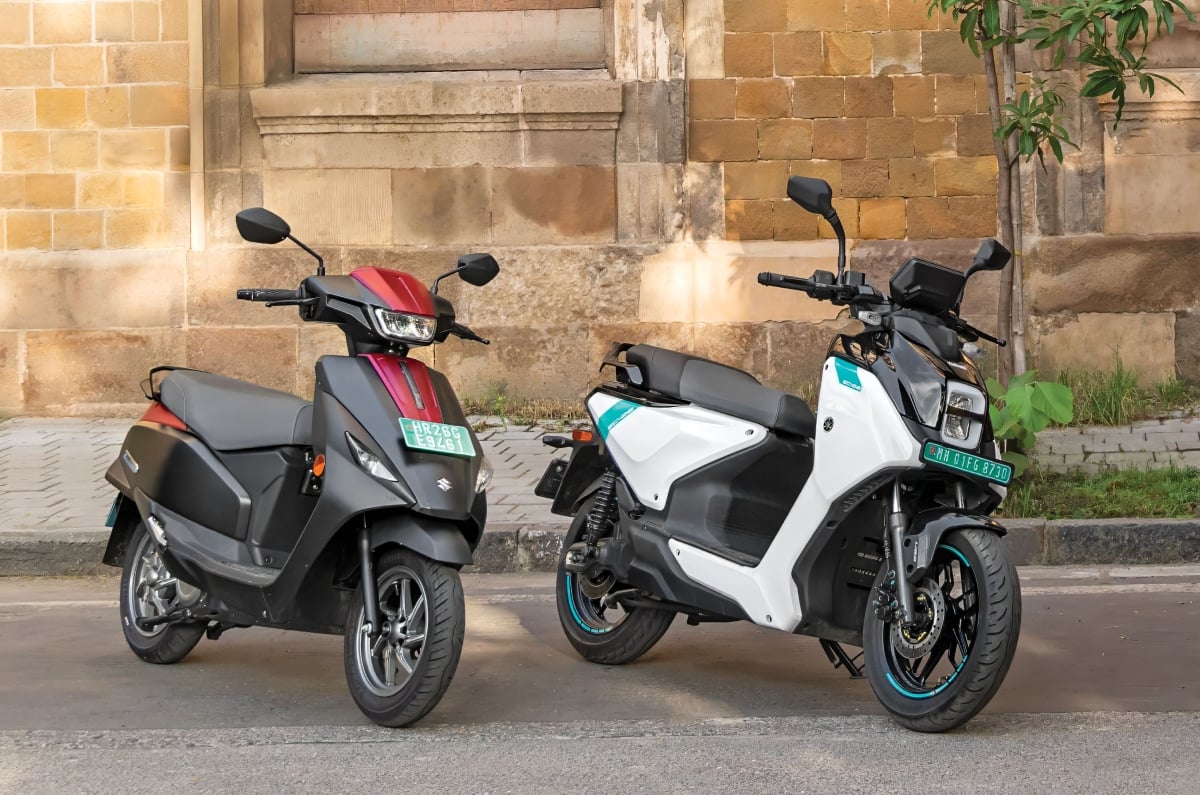
Suzuki, like Honda, chose to develop its own platform from scratch, but its e-Access appears expensive for what it offers. Yamaha, meanwhile, took a markedly different route for its more affordable offering and partnered with an Indian startup. The EC-06 is, in essence, a more expensive River Indie in sharper clothes.
So if you’ve been waiting for a Japanese e-scooter, you now have two choices, but like their very different inceptions, both also offer you two very different flavours of electric scooter. The question, then, is which one deserves your money – and whether either deserves it over the competition.
Not hiding in plain sight
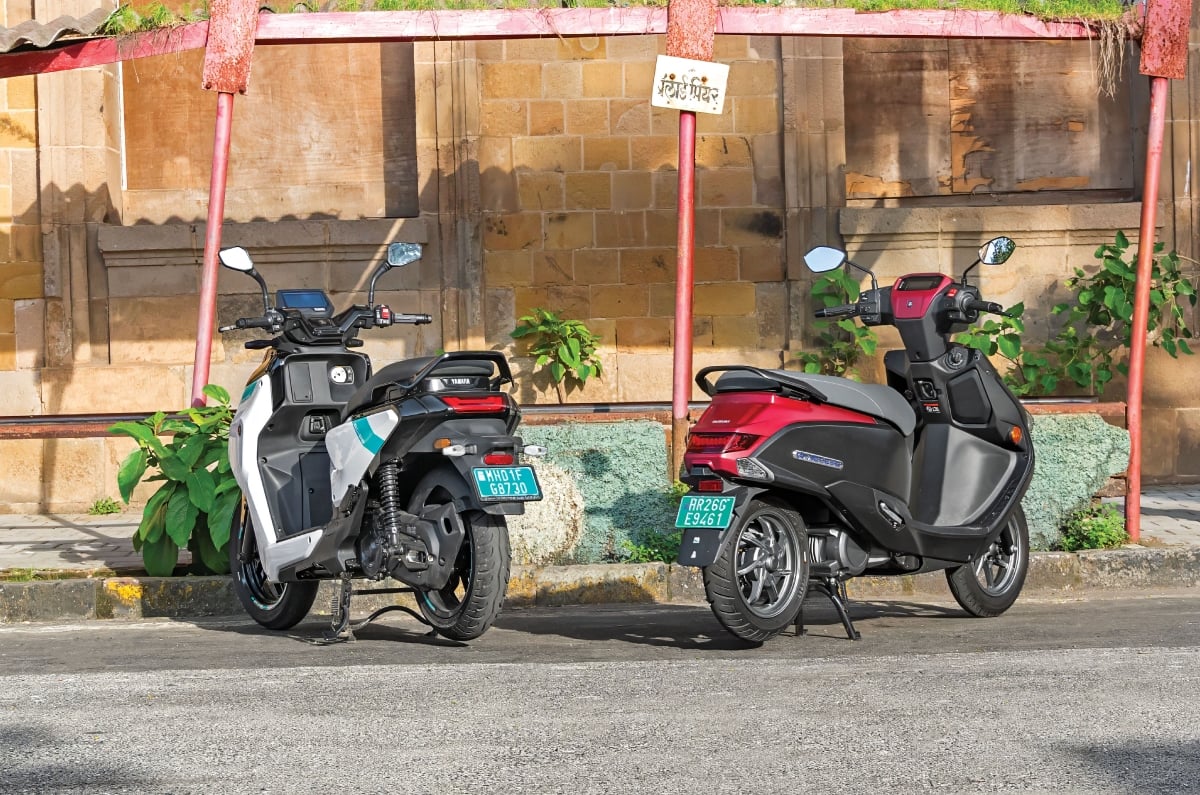
Subtle, these scooters are not. Both take distinctly left-field approaches to styling and will stand out from the crowd. Over the fortnight we spent with them, the EC-06 consistently drew more positive attention thanks to its chunky, squared-off proportions. The e-Access found its niche too, though its double duck-bill nose, flowing front panels with a contrastingly boxy tail make it more of an acquired taste.
Yamaha EC-06
Suzuki e-Access
Kerb weight
132kg
122kg
Seat height
770mm
765mm
Underseat storage
24.5 litres
17 litres
Ground clearance
145mm (laden)
160mm (unladen)
Climb aboard and their personalities diverge further still. The e-Access feels more like a conventional scooter. Despite its compact dimensions, it never feels cramped, even for taller riders, while its 765mm seat height makes it instantly approachable for shorter ones.
The EC-06, by comparison, feels a size larger. Its riding triangle is noticeably roomier, which taller riders will appreciate in a segment that seldom caters to them. Yet, with a friendly 770mm seat height, it remains fairly unintimidating for shorter riders. In fact, tall riders will want a higher seat.
Different strokes
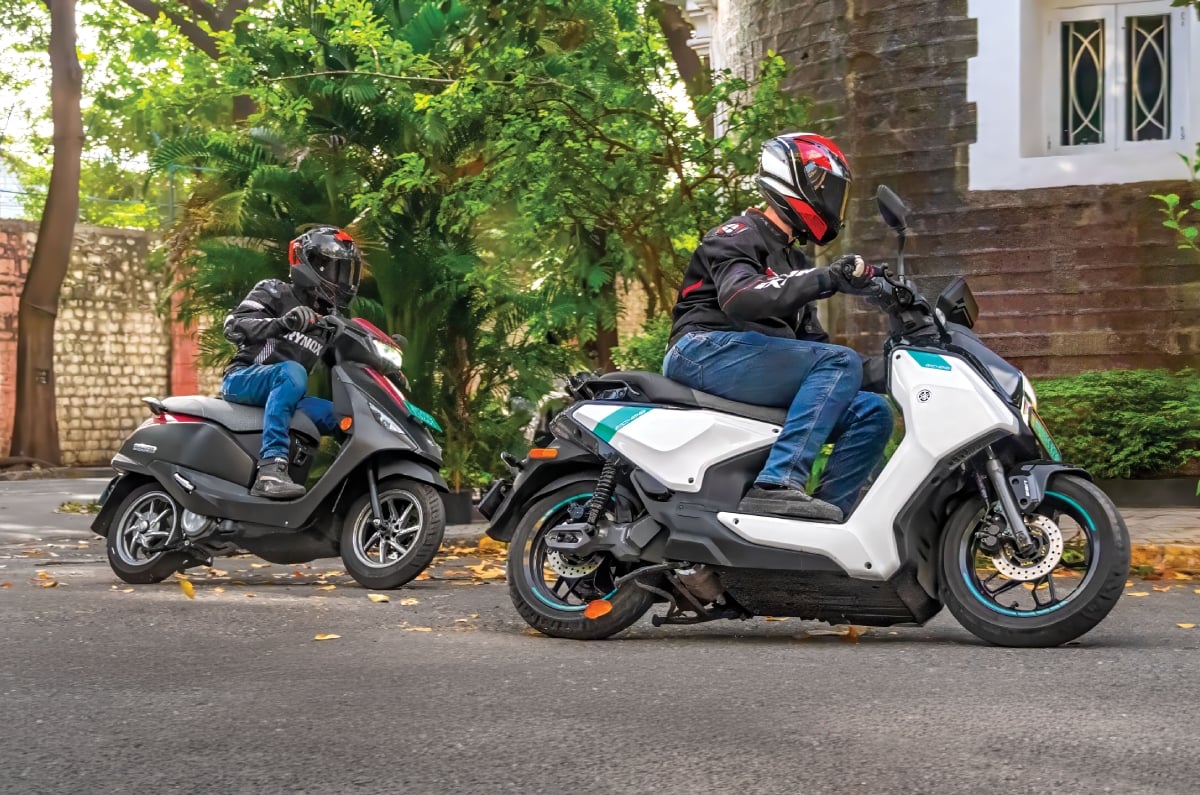
The riding experience of both also reflects two very different engineering philosophies. The 122kg e-Access feels exceptionally light on its feet; whether wheeling it around a parking space or flicking it into a bend, it responds eagerly – actually, a bit too eagerly. Some of that can be attributed to Suzuki mounting the battery pack vertically beneath the seat, a decision that, as you will read further on, has implications elsewhere too.
Yamaha EC-06
Suzuki e-Access
Battery capacity / chemistry
4kWh / NMC
3.072kWh / LFP
Motor
Permanent Magnet Synchronous
Permanent Magnet Synchronous
Power
6.7kW
4.1kW
Torque
26Nm
15Nm
Like the latest Burgman, its ride also errs towards the firmer side rather than the plush feel of a TVS iQube. It isn’t uncomfortable by any means, but it is something worth paying attention to on a test ride. Taller riders will also discover the Suzuki’s compactness during full-lock U-turns, where their knees will foul the handlebar.
On the flip side, the EC-06 is relatively heavier and slower to steer, but it’s a small tradeoff. That’s because its larger 14-inch wheels lend it greater stability at faster speeds and also help it dismiss broken roads with admirable composure. Its absorptive suspension also factors in here, though particularly sharp impacts can provoke a slight judder in the fork.
E-Access has the more flighty, energetic demeanour, whereas the EC-06’s handling is more sure-footed.
The Yamaha’s seat, however, leaves quite some room for improvement. Its forward-sloping shape constantly makes you slide forward, necessitating frequent shuffling about. The padding is also too soft, and after just 30 minutes or so, you find yourself sinking into the seat pan. This results in a gradually more knees-up riding position, which might sound like a trifling problem at first but one that becomes increasingly apparent over longer journeys.
Neither one gets ABS, which feels like quite an egregious oversight considering their price points. Nevertheless, the Yamaha’s brakes inspire greater confidence because they are powerful without being overly aggressive, and its wider tyres also provide better traction. The Suzuki’s brakes, conversely, are almost too sharp. On Mumbai’s slippery concrete roads, they demand a more measured touch when coming to a halt quickly.
Not that you’ll often rely heavily on them. That’s partly down to the well-calibrated regenerative braking system and partly because the e-Access’ performance is quite unremarkable. Not only is it much slower than the EC-06, but it also feels noticeably less eager than the petrol-powered Access. It’s perfectly usable in the city, but on faster roads, overtakes require planning. Unsurprisingly, the Yamaha feels considerably livelier. It accelerates with genuine enthusiasm in its top Power mode, the regenerative braking is seamlessly calibrated in all 3 modes (Standard and Eco being the other two) and, despite using chain drive, its drivetrain is remarkably silent – akin to a hub-mounted motor.
Feel Good (?) Features
Build quality on both is reassuringly solid and exactly what one expects from the Japanese. At these prices, however, there are a few omissions that are difficult to overlook.
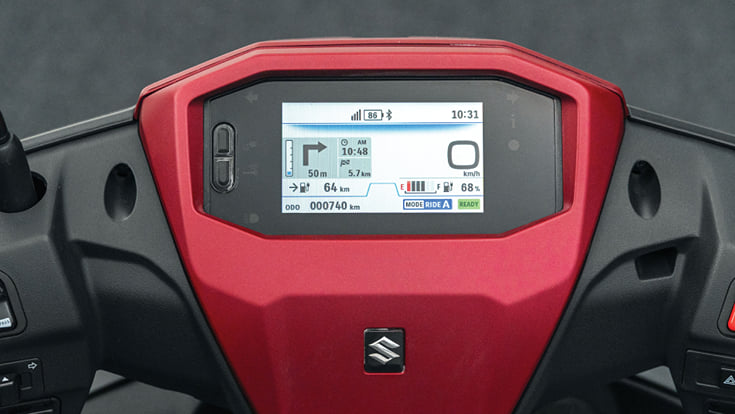
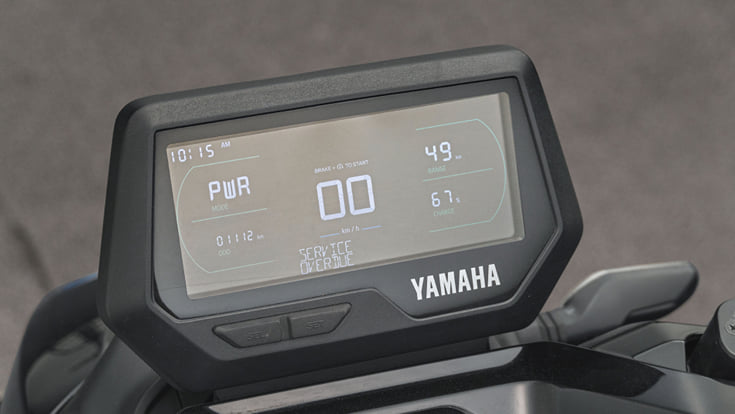
The e-Access employs the same TFT display found on the ICE Access 125 and Burgman, both of which cost substantially less. Yamaha, meanwhile, supplies only the slower 480W charger, despite the considerably more affordable River offering a faster 750W unit as a Rs 3,000 option.
Same TFT as ICE Access; EC’s negative LCD is simpler but well laid out.
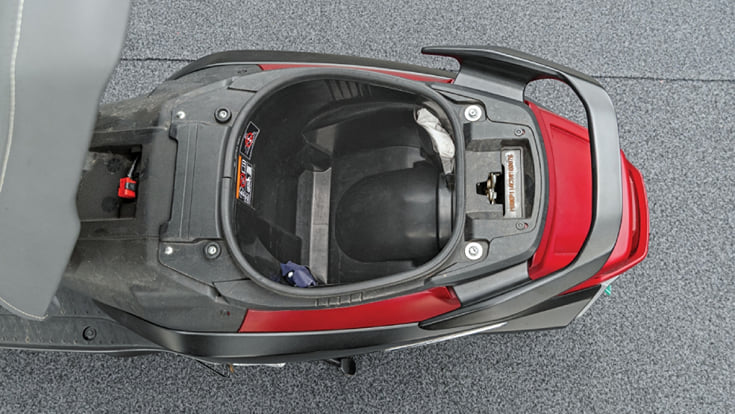
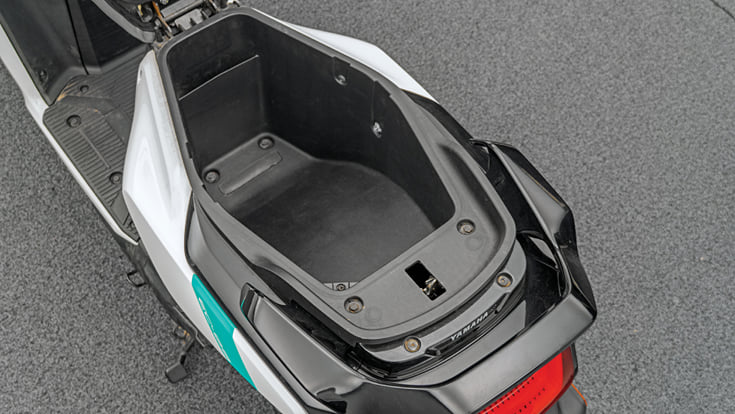
The EC-06 also sacrifices a lot of storage compared to the Indie. Its 24.5-litre under-seat boot is far short of the latter’s enormous 43-litre boot and trails established rivals such as the iQube, Rizta and Chetak. The River’s lockable 12-litre glovebox has been omitted too, though Yamaha has used this to reposition the charging port to a more convenient location.
e-Access’ 17L boot far too small and oddly shaped; Yamaha’s 24.5L boot is more usable but not segment-leading.
If the Yamaha’s storage is merely average, the Suzuki’s is positively outclassed. The battery’s position beneath the seat results in just 17 litres of bootspace – roughly half what you’ll find on rivals like the Rizta and Chetak. In fact, even the ICE Access 125 offers you quite a bit more storage space. The e-Access’ boot is also shaped quite awkwardly, and unless the charger’s cables are folded with almost Victorian precision, it simply refuses to fit.
Range Rovers?
An electric scooter ultimately needs to deliver one thing above all else – promising range to reduce your running costs. In Ride A mode, which delivers full performance and max regen, the e-Access covered a little over 88km in our range test. Given its smaller 3kWh battery and its use of safer, but less energy-dense, LFP chemistry, the result is respectable in isolation; however, compared to the market’s front-runners, it falls far short.
Yamaha EC-06
Suzuki e-Access
0-40kph
3.46s
4.94s
0-60kph
6.82s
11.93s
Roll-on Acceleration
20-50kph
3.31s
5.46s
30-70kph
7.34s
17.01s
50-80kph
10.96s
–
Our test on the EC-06 was conducted in its middle Standard mode, which retains full performance but softens throttle response compared to Power mode. It covered 114km, comfortably exceeding the distance initially predicted. Both scooters deserve praise here, as their range indicators proved refreshingly honest, not indulging in optimistic guesswork.
Yamaha EC-06
Suzuki e-Access
60-0kph
22.87m
24.64m
Using Eco mode will naturally extend the range on both, though with reduced acceleration and lower top speeds. Thankfully, neither becomes painfully slow. Even in Eco, both climb flyovers and keep up with city traffic without reducing themselves to rolling roadblocks.
While the Yamaha’s range is undoubtedly more impressive, its charging time is a rather different story. The supplied 480W charger requires a glacial ten hours to replenish a flat battery. Meanwhile, the Suzuki’s 600W unit requires around six hours to do the same, although its battery pack is also smaller.
One thoughtful detail both manufacturers deserve credit for is the inclusion of a dedicated charger bag. It is a small touch, but one that should help protect the charger from spending years rattling around inside the boot.THE BIGGER PICTURE
Judged purely against each other, the result is straightforward – the EC-06 clearly wins. It offers superior performance, greater comfort, longer range and also costs much less than the e-Access.
Yamaha EC-06
Suzuki e-Access
Price (ex-showroom, Bengaluru)
Rs 1.71 lakh
Rs 1.92 lakh
However, if you zoom out and look at the broader market, the context changes. At Rs 1.71 lakh, the Yamaha is hardly inexpensive, and the Suzuki, which is knocking on the door of Rs 2 lakh, is even worse off. When proven alternatives from TVS, Ather, Bajaj, Vida and River offer similar or even superior alternatives for substantially less money, the Japanese appear more like fringe players and less like mainstream contenders.
There will undoubtedly be a small demographic of buyers for whom a Japanese badge carries enough cachet to justify this big premium. However, for the rest of us, the more keenly priced and proven homegrown contenders are the better bet.
AFGvsNEP कुशल भुर्तेल (चार विकेट) और ललित राजवंशी (तीन विकेट) के बेहतरीन गेंदबाजी के बाद रोहित पॉडेल (नाबाद 33) रन और संदीप जोरा (34) रन के शानदार प्रदर्शन की बदौलत नेपाल ने एशियाई खेलों की पुरुष क्रिकेट प्रतियोगिता में अफगानिस्तान को 16 गेंदें शेष रहते पांच विकेट से शिकस्त दी।
103 रनों के लक्ष्य का पीछा करने उतरी नेपाल ने शुरुआत अच्छी नहीं रही और उसने मात्र 12 रन पर अपने दो विकेट गवां दिये। इसके बाद कुशल मल्ला और संदीप जोरा ने पारी को संभालने का प्रयास किया। दोनों के बीच 19 रनों की साझेदारी हुई। सातवें ओवर में कुशल मल्ला (नौ) के रनआउट होने पर यह साझेदारी टूटी।
इसके बाद 10वें ओवर में संदीप जोरा भी रनआउट हो गये। संदीप जोरा ने 35 गेंदों में तीन चौके और एक छक्का लगाते हुए (34) रनों की पारी खेली। 18वें ओवर की पहली गेंद पर कप्तान दीपेंद्र सिंह ऐरी (15) रन बनाकर आउट हुये। उन्होंने रोहित पॉडेल के साथ पांचवें विकेट के लिए 46 रन जोड़कर नेपाल की जीत सुनश्चित की। नेपाल ने 17.2 ओवरों में पांच विकेट पर 103 रन बनाकर मुकाबला पांच विकेट से अपने नाम कर लिया। रोहित पॉडेल ने 32 गेंदों में चार चौकों की मदद से (नाबाद 33) रन बनाये। अफगानिस्तान की ओर से फरीदून दावूदजई, अब्दुल्लाह अहमदजई और अरब गुल ने एक-एक बल्लेबाज को आउट किया।
इससे पहले आज अफगानिस्तान टॉस जीतकर कर पहले बल्लेबाजी करते हुए निर्धारित 20 ओवरों में सात विकेट पर 102 रनों का स्कोर बनाया। फैसल खान अहमदजई (30), नजीबउल्लाह जदरान (30) और नांगेलिया खरोटे (17) रनों का योगदान दिया। नेपाल के गेंदबाजी आक्रमण के आगे अफगानिस्तान के पांच बल्लेबाज दहाई आंकड़े तक भी नहीं पहुंच सके। नेपाल के लिए कुशल भुर्तेल ने 21 रन देकर चार विकेट लिये। ललित राजवंशी ने 13 रन देकर तीन विकेट झटके।
PhonePe Rural India Plan: डिजिटल भुगतान प्लेटफॉर्म फोनपे ने गुरुवार को अगले साल भारत के छोटे शहरों और गांवों में अपने बुनियादी ढांचे को और गहराई तक पहुंचाने की योजना की घोषणा की। इसके तहत डिजिटल पेमेंट कंपनी अपने मर्चेंट नेटवर्क को बढ़ाने के लिए 20,000 ऑन-रोल सेल्स कर्मचारियों की भर्ती करेगी। कंपनी अगले 12 महीनों में 50 लाख से अधिक पेमेंट डिवाइस भी लगाएगी। इनमें स्मार्टस्पीकर और पीओएस डिवाइस शामिल होंगे। इनमें से करीब 50% डिवाइस ग्रामीण भारत में लगाए जाएंगे। इससे टियर-6 कस्बों और ग्रामीण क्षेत्रों में डिजिटल भुगतान स्वीकार करने की सुविधा और गहराई तक पहुंचेगी।
वॉलमार्ट के समर्थन वाली कंपनी फोनपे का यह कदम भारत के एनपीसीआई के उस फैसले के बाद आया है जिसमें चुनिंदा यूपीआई मर्चेंट ट्रांजैक्शन पर 0.4% शुल्क लगाने का फैसला किया गया है। इसका एक हिस्सा कम सेवा वाले इलाकों में छोटे व्यापारियों के बीच डिजिटल पेमेंट की स्वीकार्यता बढ़ाने के लिए रखा जाएगा। फोनपे ने कहा, “हाल ही में घोषित एमडीआर ढांचा कंपनी को लंबे समय का नजरिया रखने और मर्चेंट बढ़ाने में निवेचश करने की इजाजत देता है।” अगस्त तक, फोनपे के भुगतान नेटवर्क में 72 करोड़ से अधिक पंजीकृत यूजर और 5 करोड़ से ज्यादा मर्चेंट शामिल थे।
पिछले साल लागू किए गए नए श्रम संहिताएं भी कंपनी को प्रक्रियाओं को सरल बनाकर तेजी से भर्ती करने में सक्षम बना रही हैं। इससे बड़ी संख्या में ऑन-रोल कर्मचारियों को आसानी से कंपनी में शामिल करने में मदद मिल रही है। भारत ने दुनिया के सबसे बड़े डिजिटल भुगतान इकोसिस्टम में से एक तैयार किया है। इस यात्रा के अगले चरण में देश के हर हिस्से के छोटे कारोबारियों को डिजिटल अर्थव्यवस्था में भाग लेने में सक्षम बनाने वाले मर्चेंट पेमेंट इंफ्रास्ट्रक्चर में लगातार निवेश की जरूरत होगी।
फोनपे का प्रस्तावित विस्तार इसी अवसर को ध्यान में रखकर किया जा रहा है। काफी बड़े फ्रंटलाइन ऑन-रोल कार्यबल की मदद से फोनपे छोटे कस्बों और गांवों में कारोबारियों तक पहुंच सकेगा, उन्हें डिजिटल भुगतान से जोड़ सकेगा, केवाईसी प्रक्रिया पूरी कर सकेगा, पेमेंट डिवाइस लगा सकेगा और कारोबारियों को लगातार सहायता प्रदान कर सकेगा।
इस विस्तार से लाखों छोटे कारोबारियों को औपचारिक वित्तीय व्यवस्था से और अधिक जोड़ने में भी मदद मिलेगी। डिजिटल रूप से सक्रिय और केवाईसी-अनुपालन वाला मर्चेंट नेटवर्क कारोबारी गतिविधियों को अधिक स्पष्ट रूप से सामने ला सकता है और पात्र कारोबारियों को औपचारिक वित्तीय सेवाओं की व्यापक रेंज तक पहुंच उपलब्ध करा सकता है। इसमें ऋण देने वाली संस्थाओं द्वारा प्रदान किए जाने वाले कर्ज भी शामिल हैं।
NEET PG 2026 Result: नीट पीजी 2026 में शामिल 2.5 लाख से अधिक उम्मीदवारों के लिए आज अहम दिन है। नेशनल बोर्ड ऑफ एग्जामिनेशन इन मेडिकल साइंसेज (NBEMS) ने NEET PG 2026 का रिजल्ट घोषित कर दिया है। पोस्टग्रेजुएट मेडिकल प्रवेश परीक्षा में शामिल परीक्षार्थी अब एनबीईएमएस की आधिकारिक वेबसाइट natboard.edu.in पर जाकर अपना रिजल्ट देख सकते हैं। यह परीक्षा एमडी, एमएस, डीएनबी और डीआरएनबी तथा पीजी मेडिकल डिप्लोमा पाठ्यक्रमों में प्रवेश के लिए आयोजित की गई थी।
एनबीईएमएस द्वारा नीट पीजी 2026 रिजल्ट जारी करने की अनुमानित तारीख पहले 30 सितंबर थी। लेकिन बोर्ड ने तकरीबन एक हफ्ते पहले ही आज 24 सितंबर को नीट पीजी 2026 रिजल्ट जारी कर दिया। नीट पीजी 2026 परीक्षा का आयोजन एनबीईएमएस करता है। इस साल यह परीक्षा 30 अगस्त को आयोजित की गई थी। बाद में जयपुर के दो सेंटर पर प्रभावित कैंडिडेट के लिए दोबारा 5 सितंबर को एग्जाम हुआ था। इसमें 2.54 लाख परीक्षार्थियों ने हिस्सा लिया था।
परीक्षा में शामिल उम्मीदवार एनबीईएमएस की वेबसाइट पर नीट पीजी सेक्शन के जरिए नीट पीजी 2026 का रिजल्ट देख सकते हैं। आधिकारिक नीट पीजी पेज 2026 एग्जाम सेक्शन का एक्सेस देता है, जिसमें रिजल्ट लिंक भी शामिल है। कैंडिडेट को अपना रिजल्ट और स्कोरकार्ड चेक करते समय अपने एग्जाम क्रेडेंशियल और एप्लीकेशन डिटेल्स तैयार रखने चाहिए। नीट पीजी की उत्तर कुंजी और व्यक्तिगत स्कोरकार्ड 1 अक्तूबर 2026 को वेबसाइट पर अपलोड होंगे।
नीट पीजी 2026 रिजल्ट: डाउनलोड करने के स्टेप्स
कैंडिडेट्स नीट पीजी 2026 रिजल्ट डाउनलोड करने के लिए यहां बताए गए स्टेप्स फॉलो कर सकते हैं:
NATBOARD.EDU.IN पर ऑफिशियल एनबीईएमएस वेबसाइट पर जाएं।
परीक्षा सेक्शन खोलें।
परीक्षा की सूची से नीट पीजी चुनें।
नीट पीजी 2026 सेक्शन में जाएं।
रिजल्ट्स लिंक पर क्लिक करें।
नीट पीजी 2026 रिजल्ट लिंक खोलें।
रिजल्ट डाउनलोड करें और अपने रोल नंबर के आगे दी गई डिटेल्स चेक करें।
नीट पीजी रिजल्ट में परीक्षार्थियों के प्रदर्शन और रैंक का विवरण होता है। उम्मीदवारों को अपने रिजल्ट की जानकारी ध्यान से चेक करनी चाहिए और काउंसलिंग प्रक्रिया के लिए एक कॉपी रखनी चाहिए।
नीट पीजी 2026 कटऑफ
सामान्य/ईडब्ल्यूएस के लिए कटऑफ 50वां पर्सेंटाइल (262 अंक) है।
सामान्य दिव्यांग श्रेणी के लिए कटऑफ 45वां पर्सेंटाइल (244 अंक) है।
एससी/एसटी/ओबीसी और इन वर्गों के दिव्यांग उम्मीदवारों के लिए कटऑफ 40वां पर्सेंटाइल (226 अंक) है।
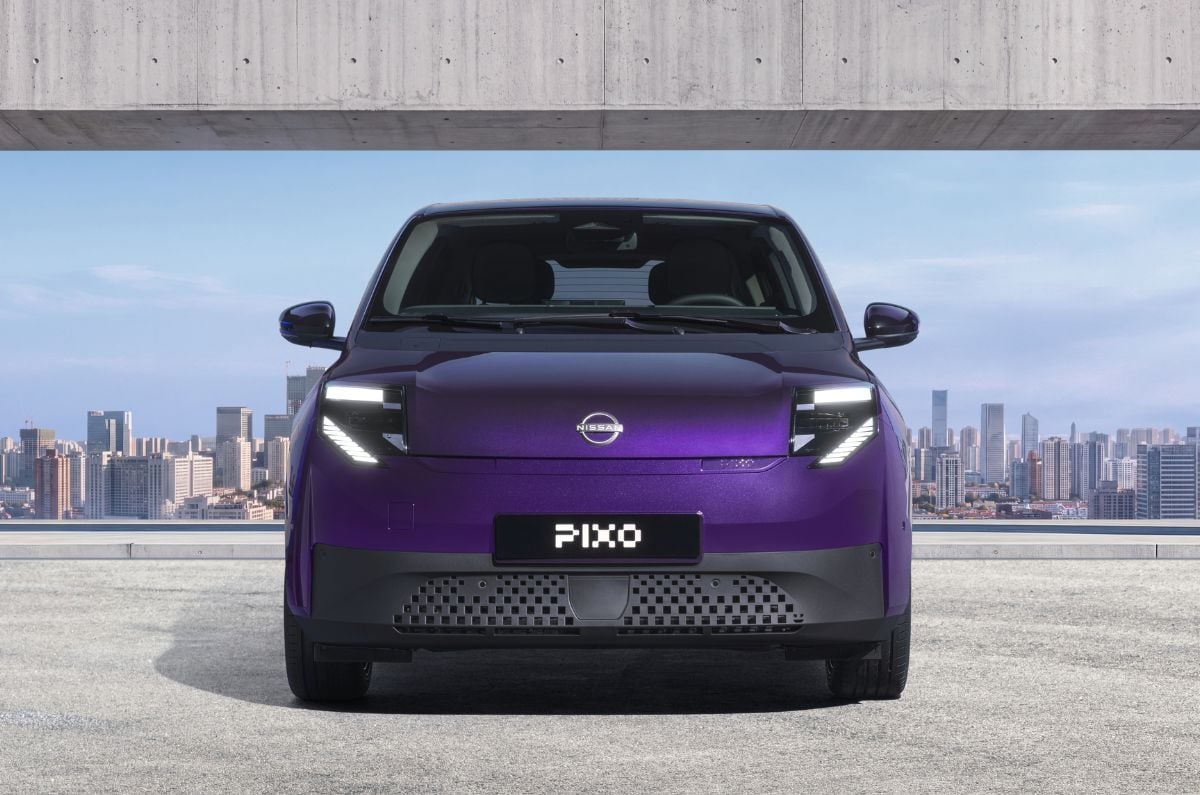
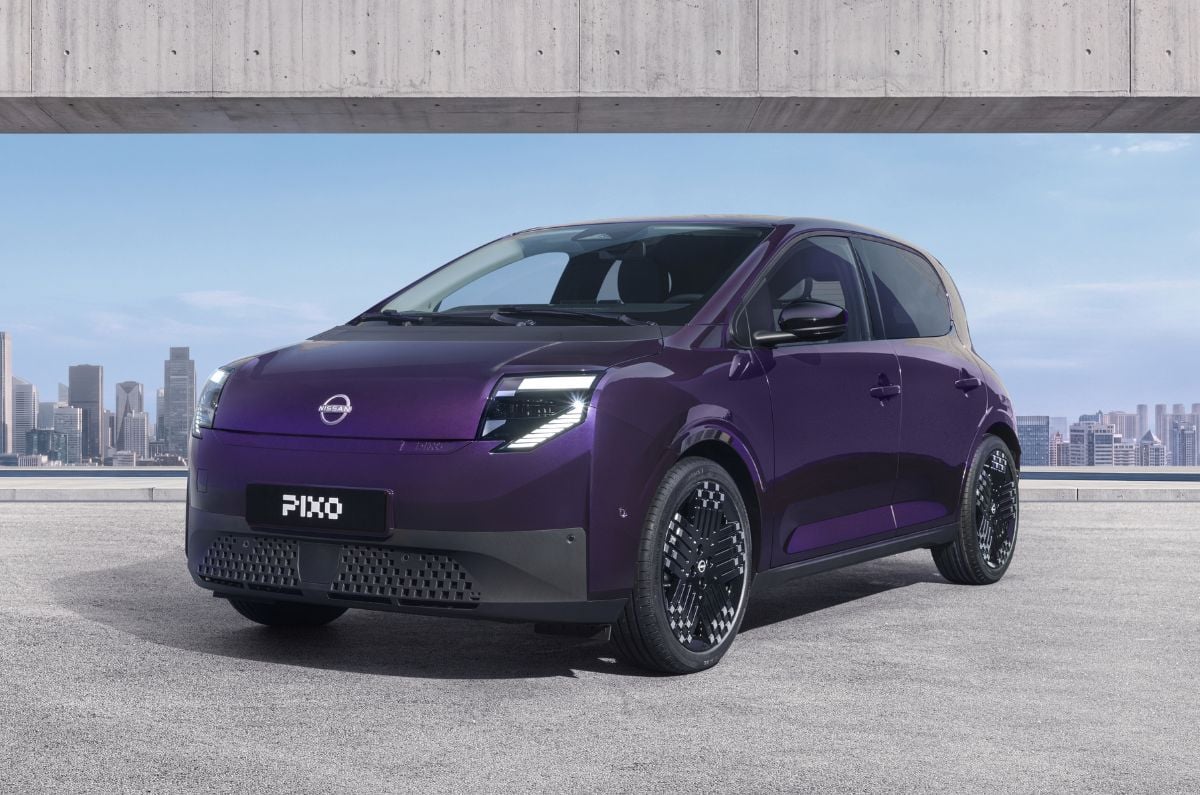
Nissan has pulled the covers off the Pixo, which is an A-segment EV specifically meant to cater to the urban buyer in Europe, according to the automaker. The Pixo is the result of a collaboration between NDE (Nissan Design Europe) and alliance partner Renault, and is manufactured at the latter’s Novo Mesto facility in Slovenia.
Design highlights include pixel-inspired lighting and “robot face” front bumper.
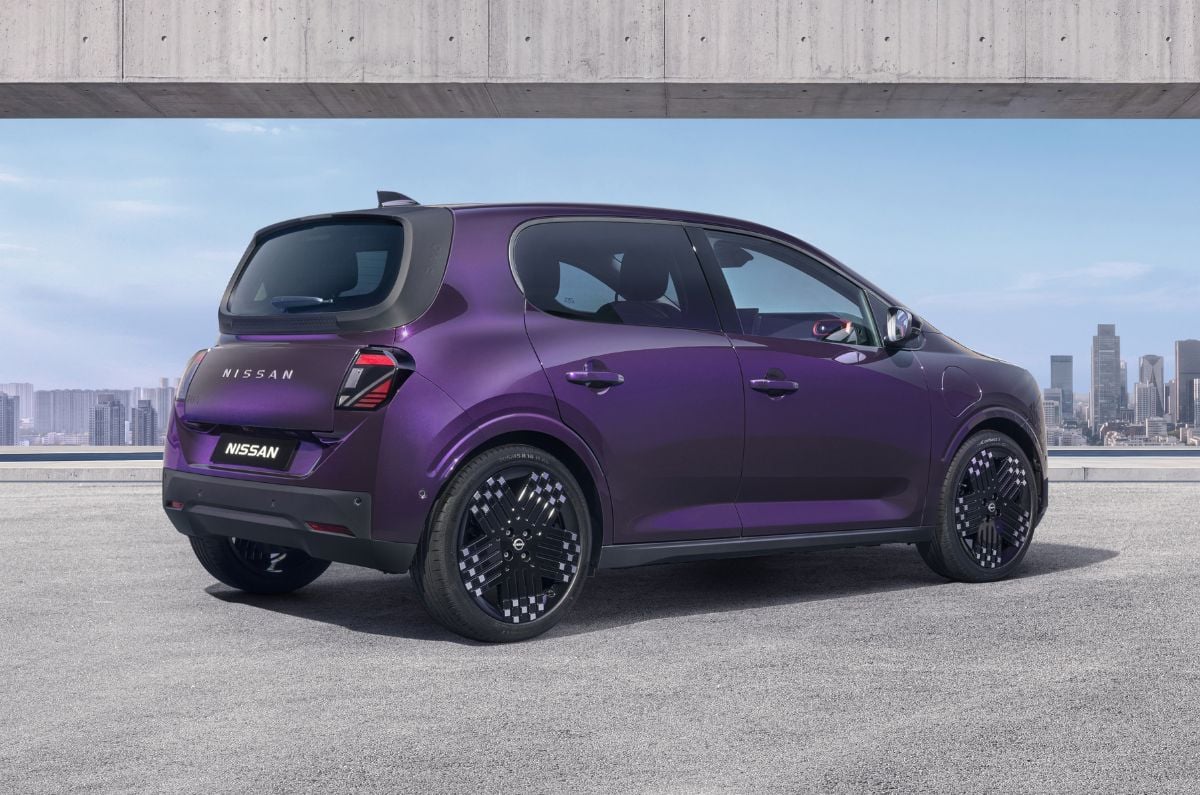
3,796mm long, 1,790mm wide and seats up to four adults.
Sliding rear seats, 10-inch touchscreen, Google built-in, ADAS and more.
27.5kWh battery, 82hp motor and up to 259km WLTP range.
Nissan Pixo exterior and dimensions
The Pixo features striking colour options and cube-inspired proportions
The Nissan Pixo features the Japanese brand’s latest design language meant specifically for EVs. The cube-inspired proportions of the Pixo are accompanied by what the brand says are pixel-inspired lighting and a “robot face” front bumper. ‘Pixo’ lettering aside, there are also ‘2-3’ markings to denote ‘Ni-San’ in Japanese. There are pixel-like highlights on the 18-inch wheels, while ‘Nissan’ is spelled out on the tailgate.
Nissan says that the Wonder Purple and Gear Blue paint options are meant to reinforce the Pixo’s youthful urban character, and these striking colours are contrasted by black trim bits on select surfaces. At 3,796mm long and 1,790mm wide, Nissan claims that the Pixo’s dimensions are specifically meant to fit European cities without compromising space on the inside. Meanwhile, it has a 9.9-meter turning circle.
Nissan Pixo interior design and features
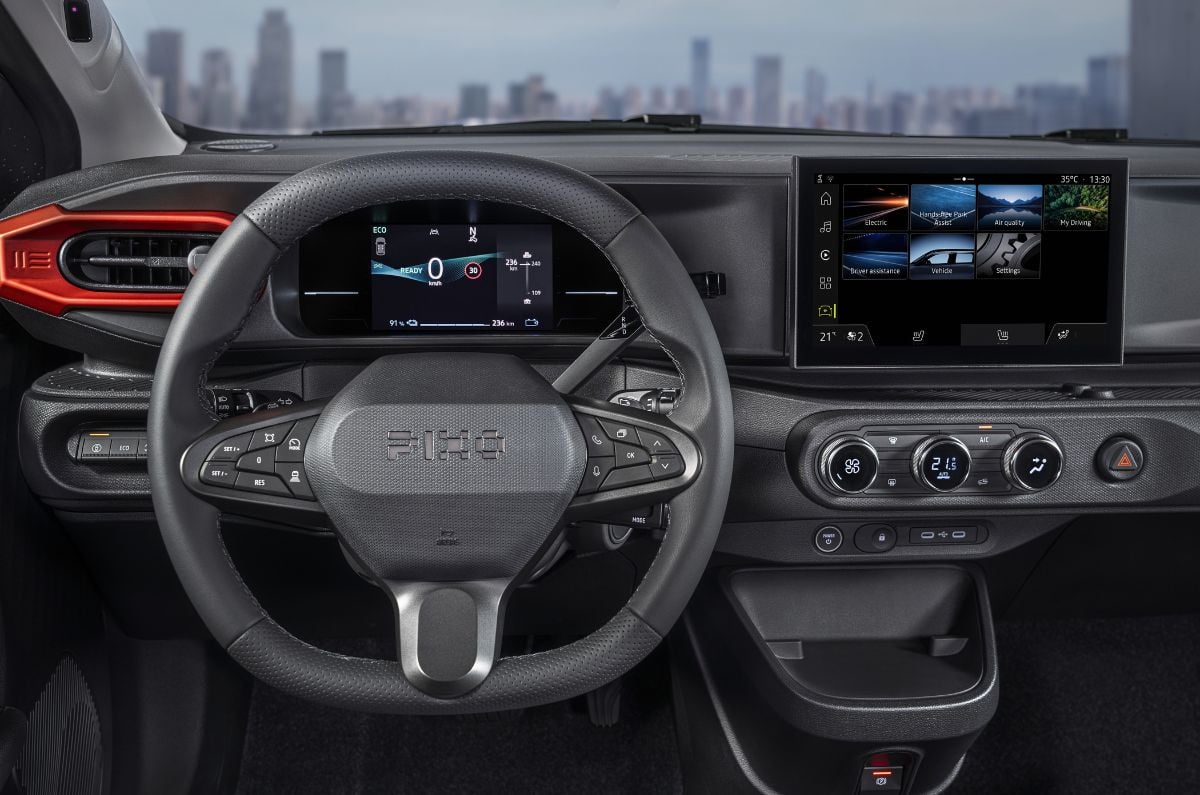
This EV has been designed to carry up to four adults and sports a vertically stacked dashboard
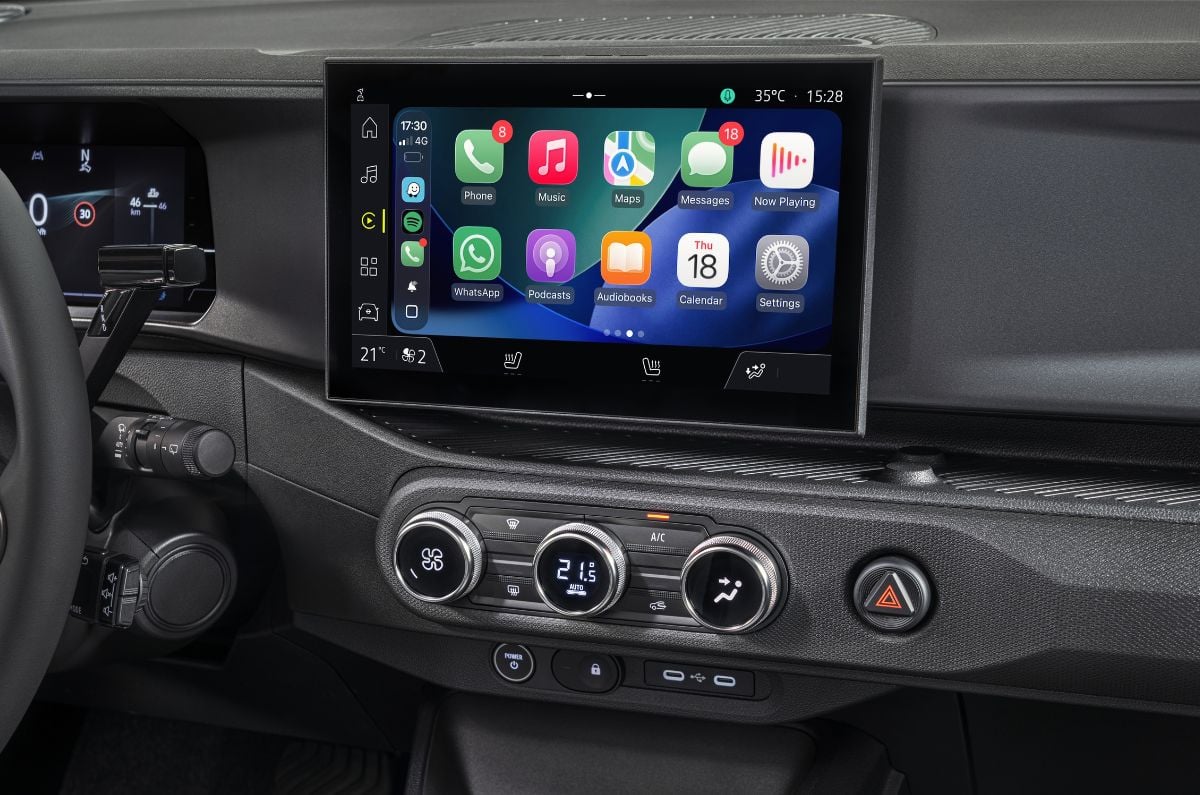
The Nissan Pixo has a relatively modern but simple-looking interior. However, it does get a vertically stacked dashboard with a textured finish and orange accents around the AC vents. There are physical buttons and dials to control the automatic climate control system, with a large drive-selector stalk behind the steering wheel. The dash also integrates a 7-inch digital driver’s display and a tablet-style 10-inch touch-infotainment screen.
Equipment highlights of the Nissan Pixo include Google Gemini, which the brand claims is ‘first-in-segment’ and that it will be offered in 16 languages and dialects. Adding to this list will be Google built-in features, MyNissan app and Face ID with the capability of recognising different drivers and remembering their personalised settings. The Nissan Pixo will be available with ADAS (advanced driver assistance systems), integrating adaptive cruise control, lane-departure warning and ‘Hands-Free Parking’.
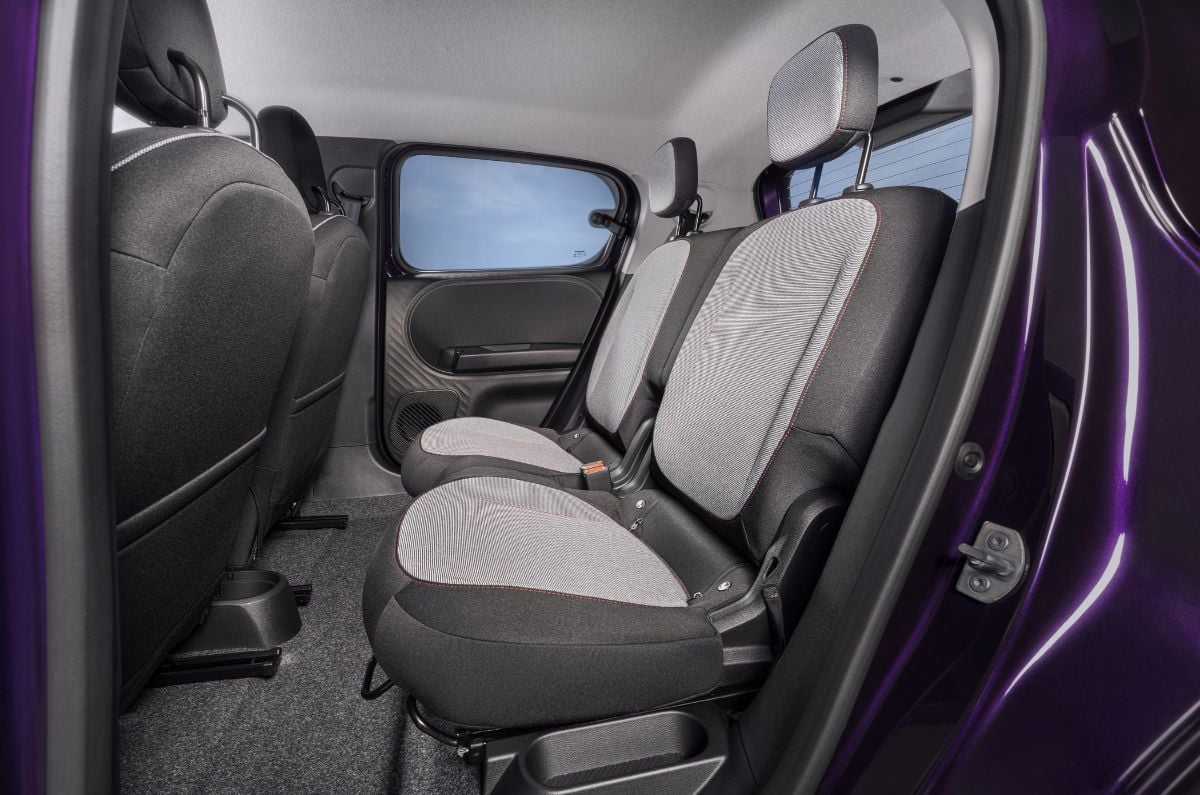
There are dual-tone fabric seats that look simple, and there’s enough space to carry four adults, with the rear units capable of being individually slid forward or backward based on cargo-space requirements. Nissan says that the Pixo can accommodate up to 356 litres of cargo in the boot – out of which 50 litres is taken up by the charging cable. “We’ve worked hard to maximise the space within the Pixo’s compact dimensions, creating a cabin that feels open, practical and surprisingly roomy,” said Masato Koyama, Lead Exterior Designer at Nissan Global Design.
Nissan Pixo powertrain and charging
This electric powertrain comprises a lithium iron phosphate battery and a single electric motor
The Nissan Pixo is equipped with a 27.5kWh lithium iron phosphate (LFP) battery pack, which energises a single electric motor capable of producing 82hp. While Nissan hasn’t released torque or performance figures of the Pixo yet, it does claim a WLTP range of 259km on a full charge.
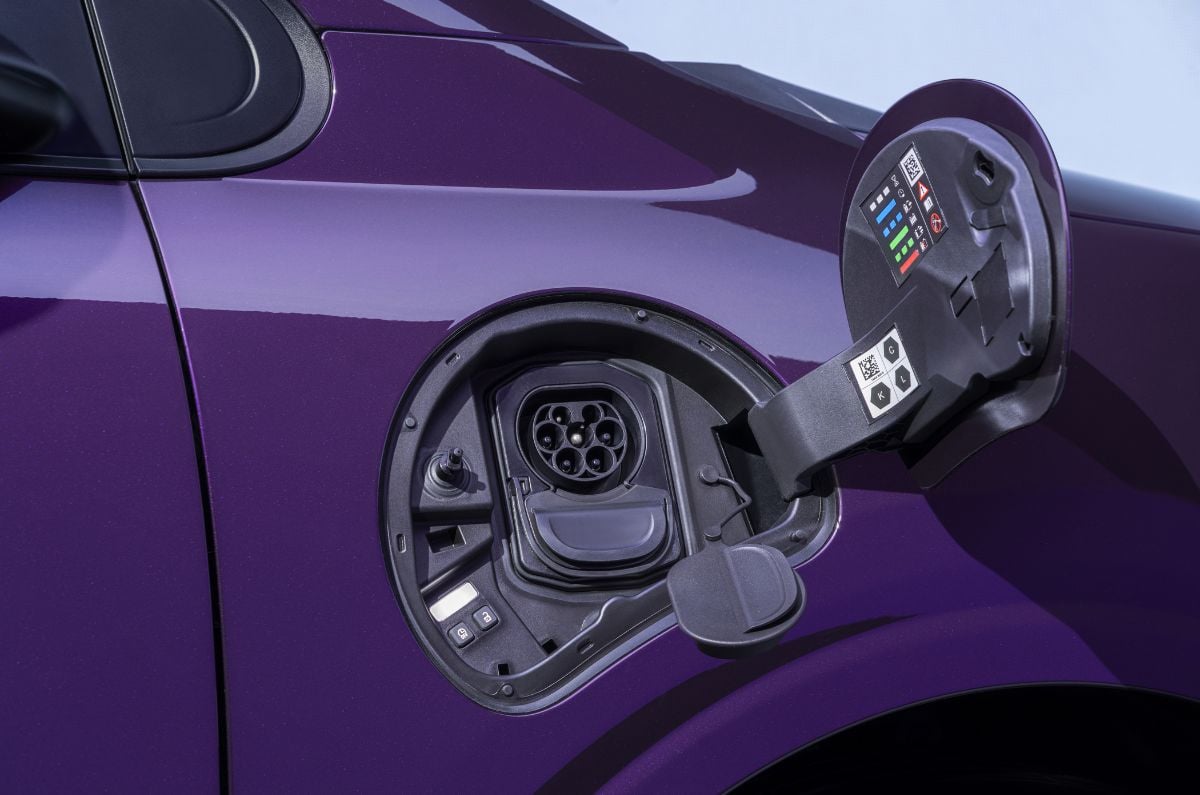
The Pixo supports DC fast-charging at up to 50kW, which the brand says can take the state of charge from 15-80 percent in around 28 minutes. The Nissan Pixo also supports bi-directional AC charging of 11kW. Nissan is yet to announce the price of the Pixo, though customer deliveries in Europe are scheduled start in early 2027.
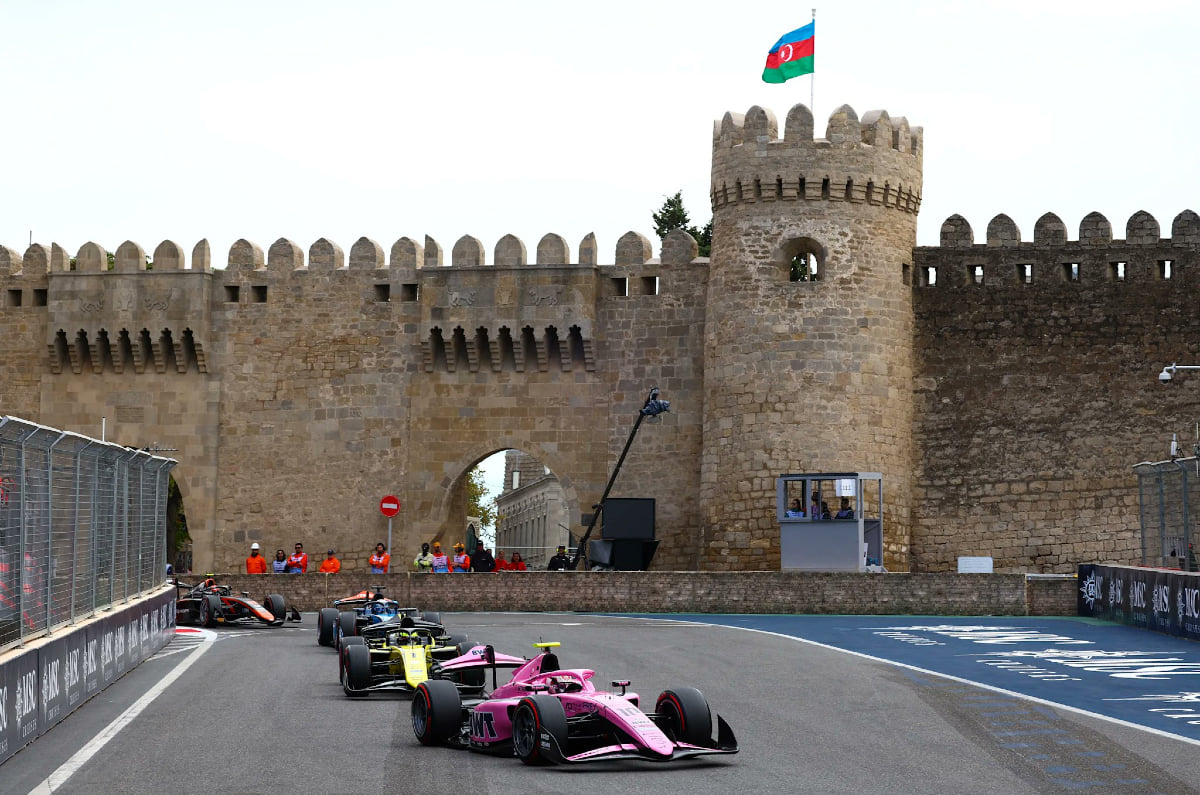
F1 heads to Azerbaijan for Round 15 of the 2026 world championship. Action at the Baku City Circuit will take place a day early, which means the race itself will be held on Saturday instead of Sunday. The venue will also host a new format for F2 this week, which will feature race races.
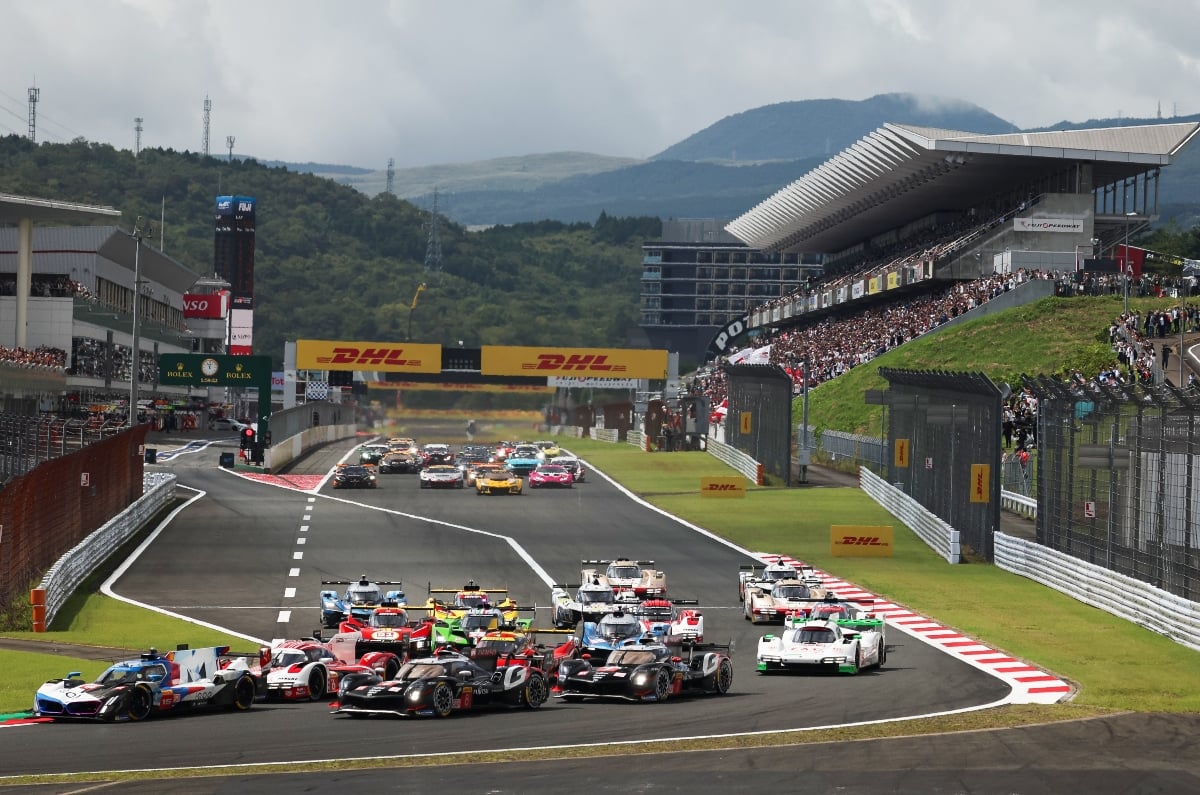
Over in the World Endurance Championship, the title battle will continue at the iconic Fuji Speedway. Here is your complete guide on when and where to tune in from India:
F1 Azerbaijan GP schedule
The Azerbaijan GP kicks off F1’s flyaway triple-header, with the next stops at Malaysia and Singapore. The race will be held a day earlier this year to accommodate Azerbaijan’s annual Remembrance Day on Sunday, September 27. This means the practice sessions will run on Thursday, followed by qualifying on Friday and the race on Saturday.
After picking up his eighth win of the season at Madrid, Kimi Antonelli has now extended his championship lead to 81 points over his Mercedes teammate George Russell. Despite his Spanish GP retirement, Lewis Hamilton holds on to P3 overall, but Lando Norris has chipped away at Hamilton’s advantage and is now just five points behind.
Azerbaijan will see Isack Hadjar making his racing return as well. The Red Bull driver fractured his wrist while training during the summer break and was forced to miss the last three rounds as a result. It’s also going to be a crucial race for Williams, with the team bringing a long-awaited upgrade package to Baku.
F1 Azerbaijan GP: Where to watch?
All F1 Azerbaijan GP races will be streamed live on the FanCode and F1 TV apps.
2026 F1 Azerbaijan GP schedule IST
Date
Day
Session
Time
September 24
Thursday
FP1
2pm
September 24
Thursday
FP2
5:30pm
September 25
Friday
FP3
2pm
September 25
Friday
Qualifying
5:30pm
September 26
Saturday
Race
4:30pm
F2 Azerbaijan GP schedule
Formula 2 will run an action-packed new schedule at Azerbaijan, featuring two Qualifying sessions, one Sprint Race and two Feature Races.
The top two contenders for this year’s F2 title – Nikola Tsolov and Rafael Camara – are separated by just seven points. Gabriele Mini, meanwhile, is 24 points behind Tsolov, which places him within a race victory of the lead. India’s Kush Maini is eighth overall, just two points behind Joshua Durksen.
F2 Azerbaijan GP: Where to watch?
All F2 Azerbaijan GP races will be streamed live on the FanCode and F1 TV apps.
2026 F2 Azerbaijan GP schedule IST
Date
Day
Session
Time
September 24
Thursday
Practice
11:30am
September 24
Thursday
Qualifying 1
3:30pm
September 24
Thursday
Qualifying 2
4pm
September 25
Friday
Sprint Race
9:45am
September 25
Friday
Feature Race 1
3:45pm
September 26
Saturday
Race
12:30pm
WEC 6 Hours of Fuji
Toyota missed out on victory last time out at COTA after suffering a hydraulic issue barely 10 minutes from the end. The #50 Ferrari ended up winning the race, setting the stage for a three-way title battle.
Heading into the 6 Hours of Fuji, Toyota still holds the overall lead in the teams’ championship, but BMW us just nine points behind.The Japanese carmaker will be looking to bounce back at its home race, where it also boasts an impressive track record with nine previous wins. Ferrari, meanwhile, has gained some ground and is now 26 points off the lead in third place.
WEC 6 Hours of Fuji: Where to watch?
All sessions for the 6 Hours of Fuji will be streamed live on FIAWEC+. The single-round pass costs 9.99 euros (approximately Rs 1,100), while the annual pass costs 49.99 euros (around Rs 5,500). Fans in India can also catch limited coverage on Eurosport.
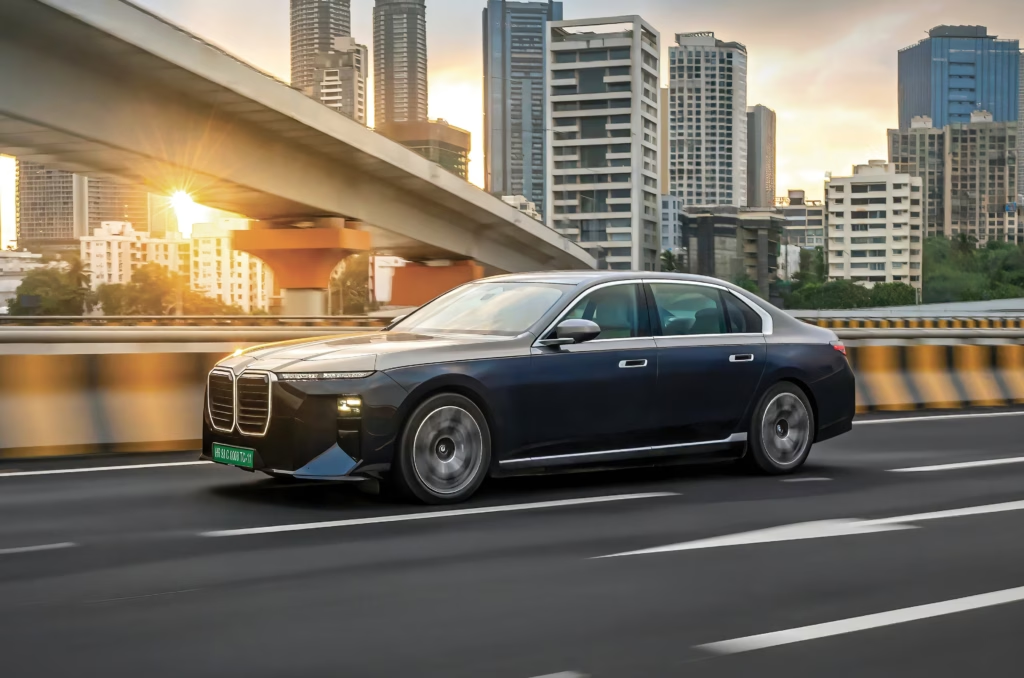
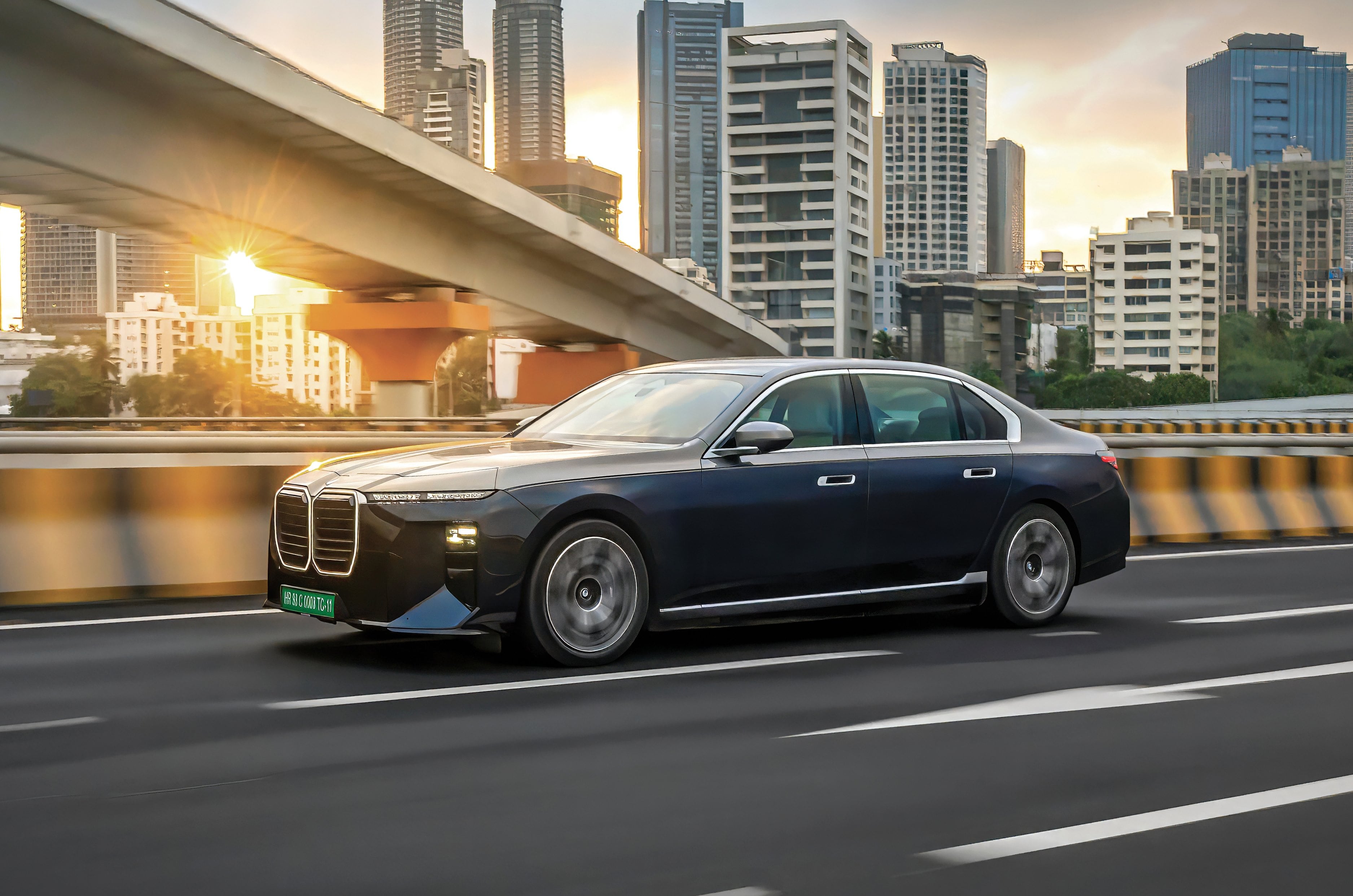
The BMW i7 has been embraced wholeheartedly by India’s ultra-high-net-worth buyers. Since its launch in 2023, it has dominated the high-end luxury sedan space, and interestingly, has consistently outsold its own petrol sibling. In fact, around 60 percent of 7 Series buyers have opted for the EV. With the 2026 i7 now being locally assembled in India and the i7 50 xDrive priced at Rs 1.95 crore, exactly at par with the petrol 740, BMW expects the scales to tilt even further in favour of the electric version.
BMW has also introduced the significantly more powerful i7 M70 xDrive. However, as a full import priced at Rs 2.65 crore, it commands a substantial Rs 70 lakh premium, which is likely to limit its appeal. For most buyers then, the locally assembled i7 50 xDrive is expected to remain the sweet spot of the range.
BMW i7 50 xDrive Exterior Design and Engineering – 8/10
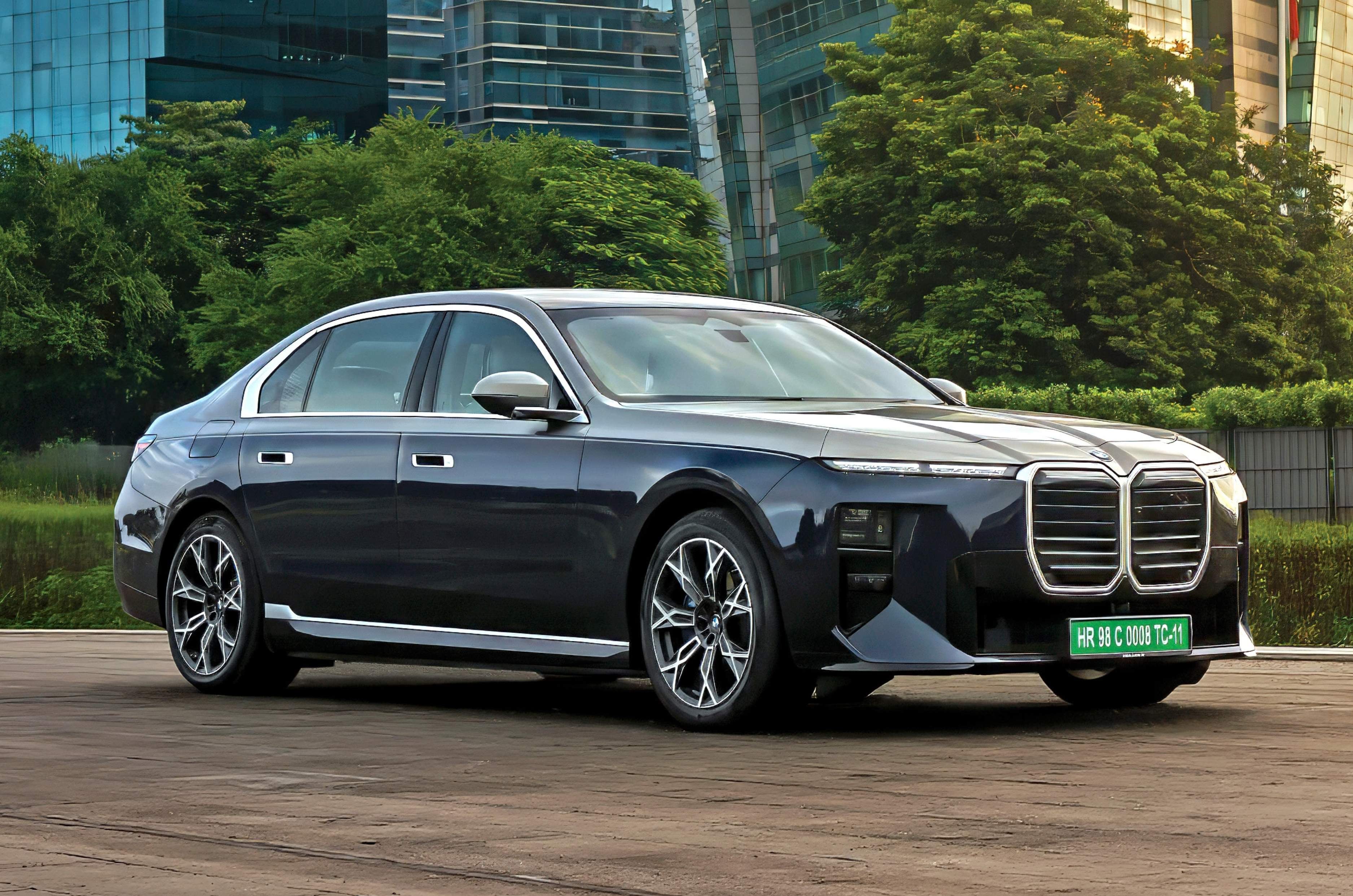
The cleaned-up styling looks significantly more palatable than its predecessor.
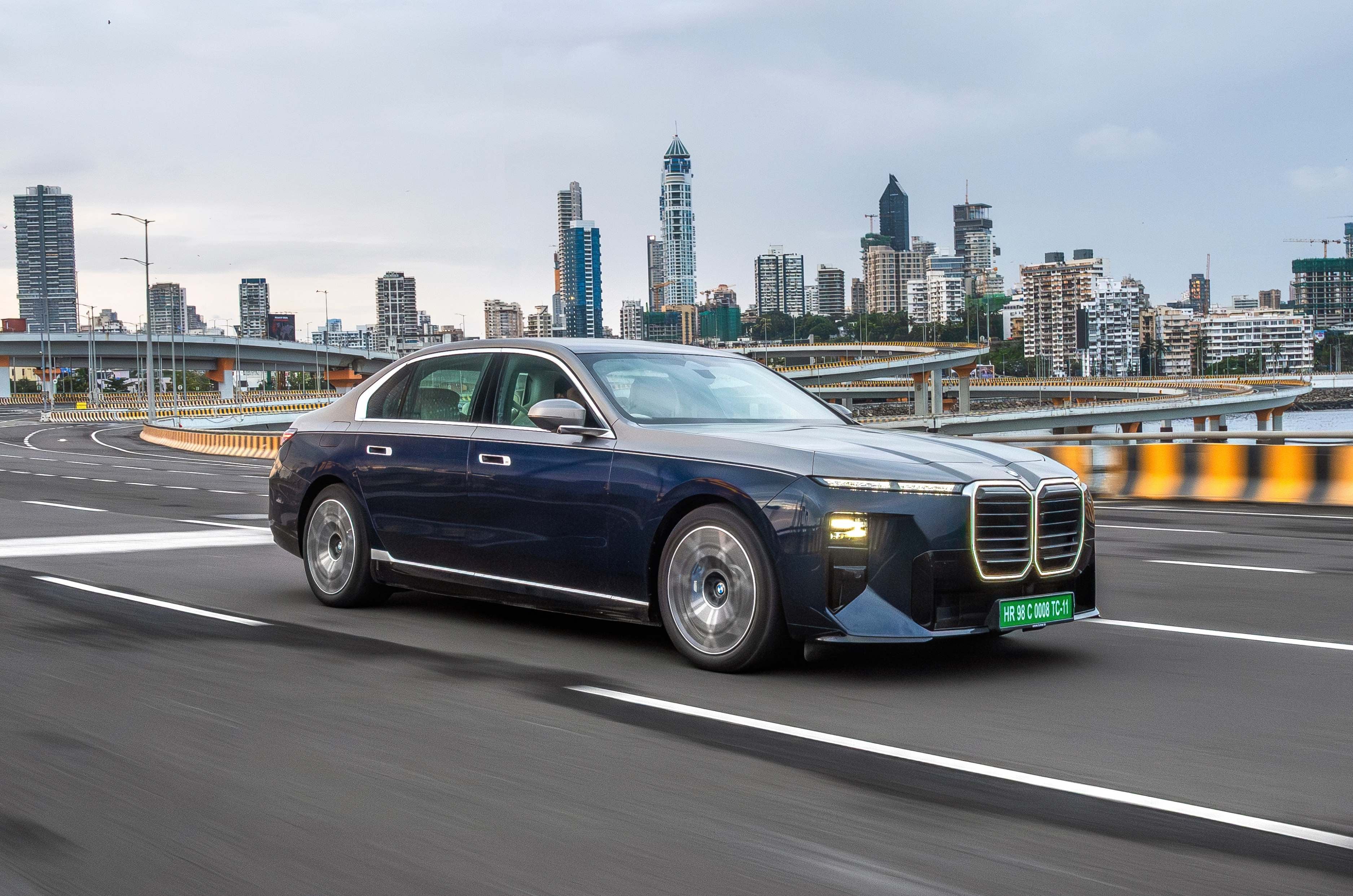
BMW has made substantial changes to the i7’s styling. The DRLs are now longer and slimmer, and feature a crystalline effect that looks absolutely stunning up close. The oversized kidney grille has also been redesigned and, like before, remains illuminated. The air dam adopts a more rectangular design, the headlamps are vertically oriented, and the excessive black treatment has been done away with completely.
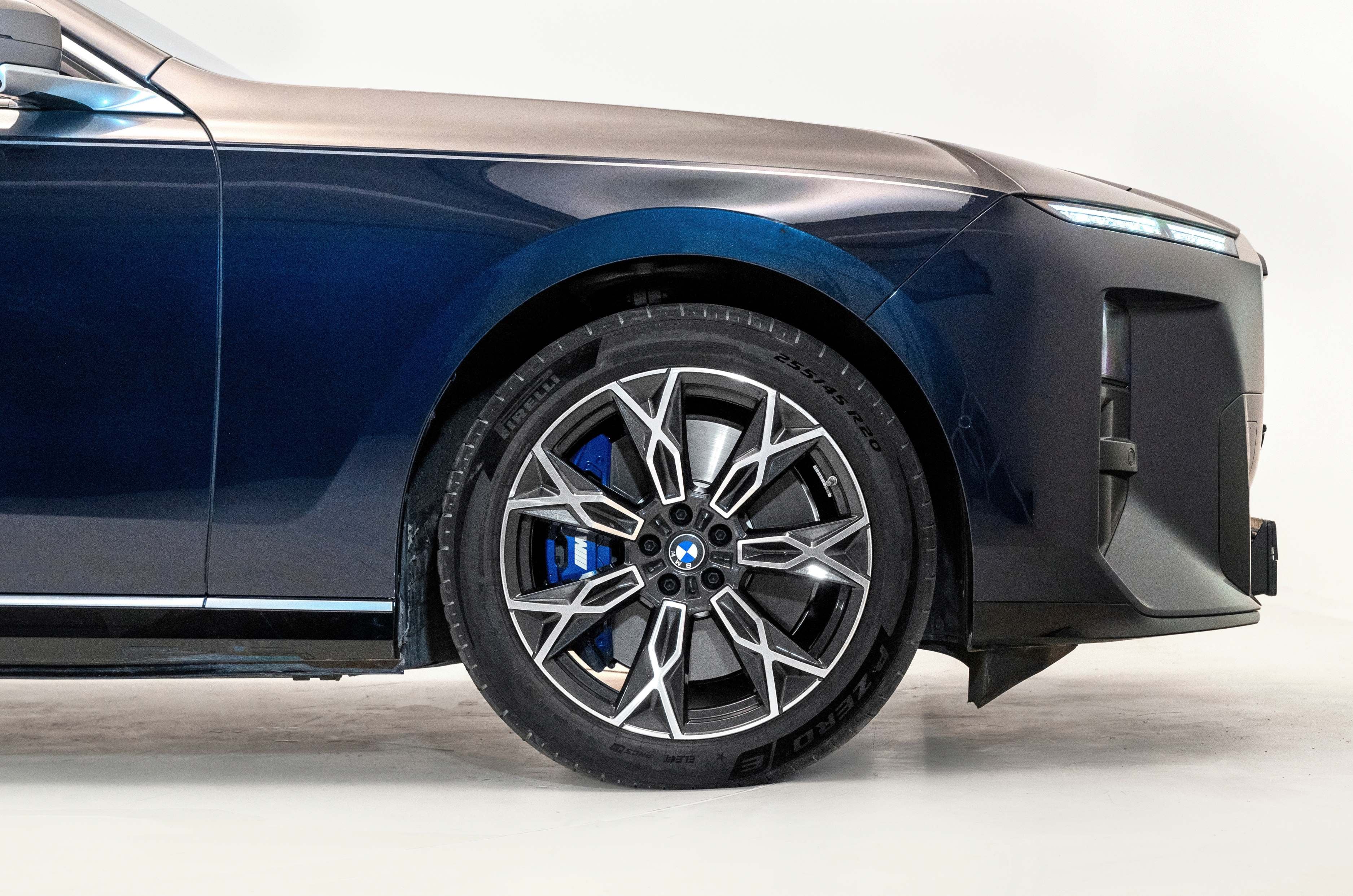
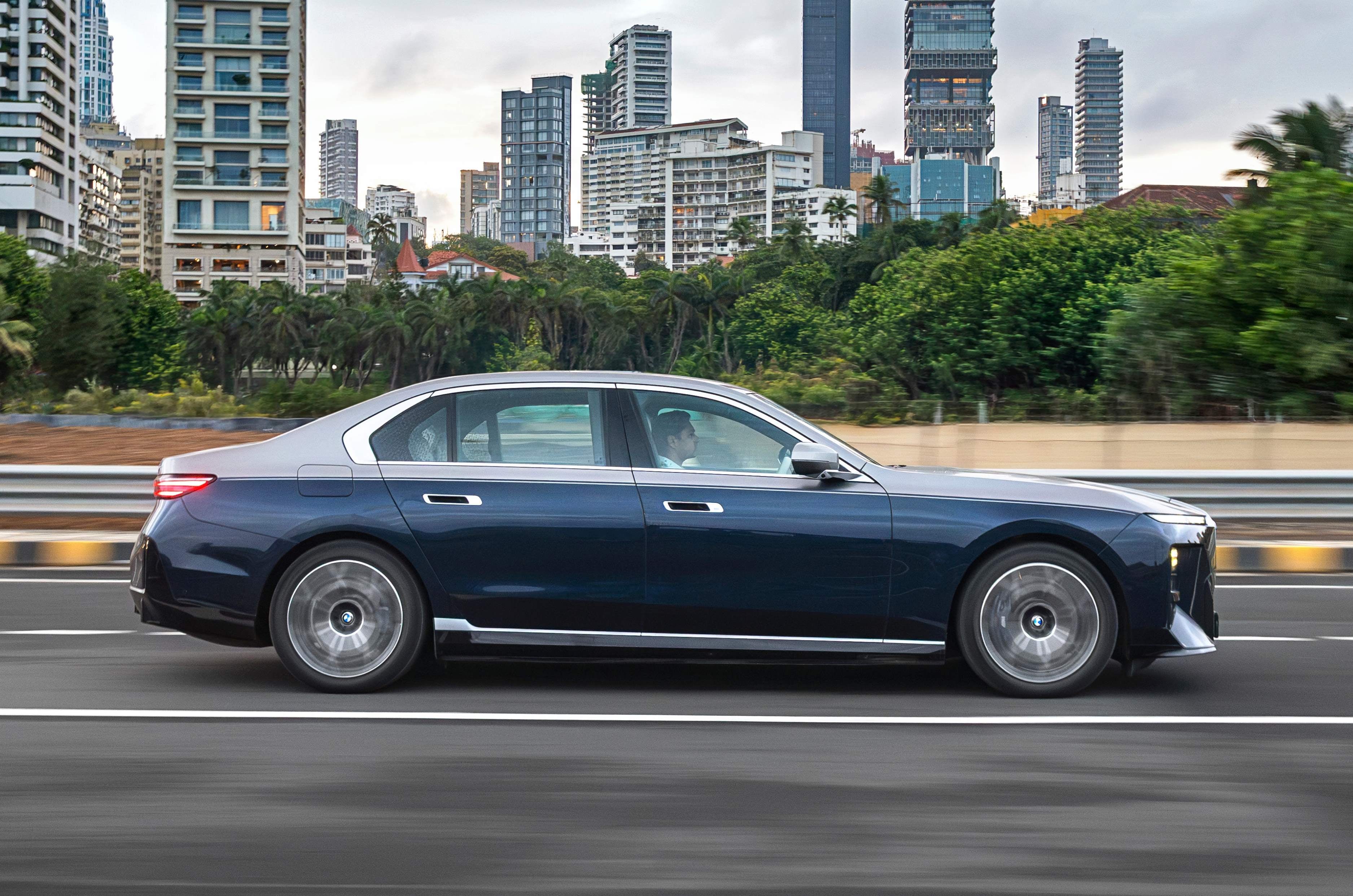
The tyres appear undersized but owners are unlikely to complain given the ride comfort benefits that come with the higher-profile tyres.
New 20-inch alloy wheels replace the outgoing version’s 21-inch units. While some might argue they appear slightly undersized, owners are unlikely to complain given the ride comfort benefits that come with the higher-profile tyres.
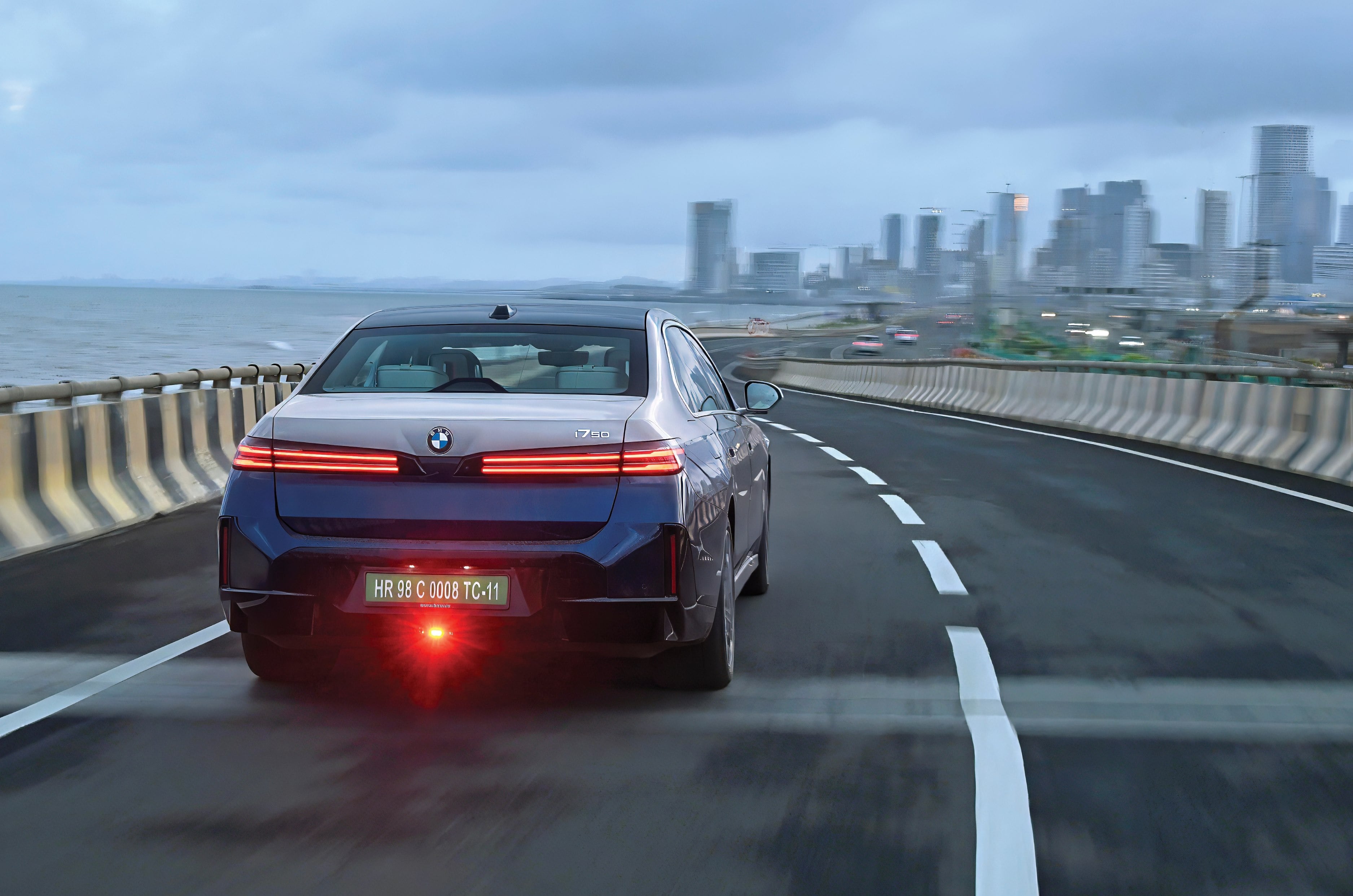
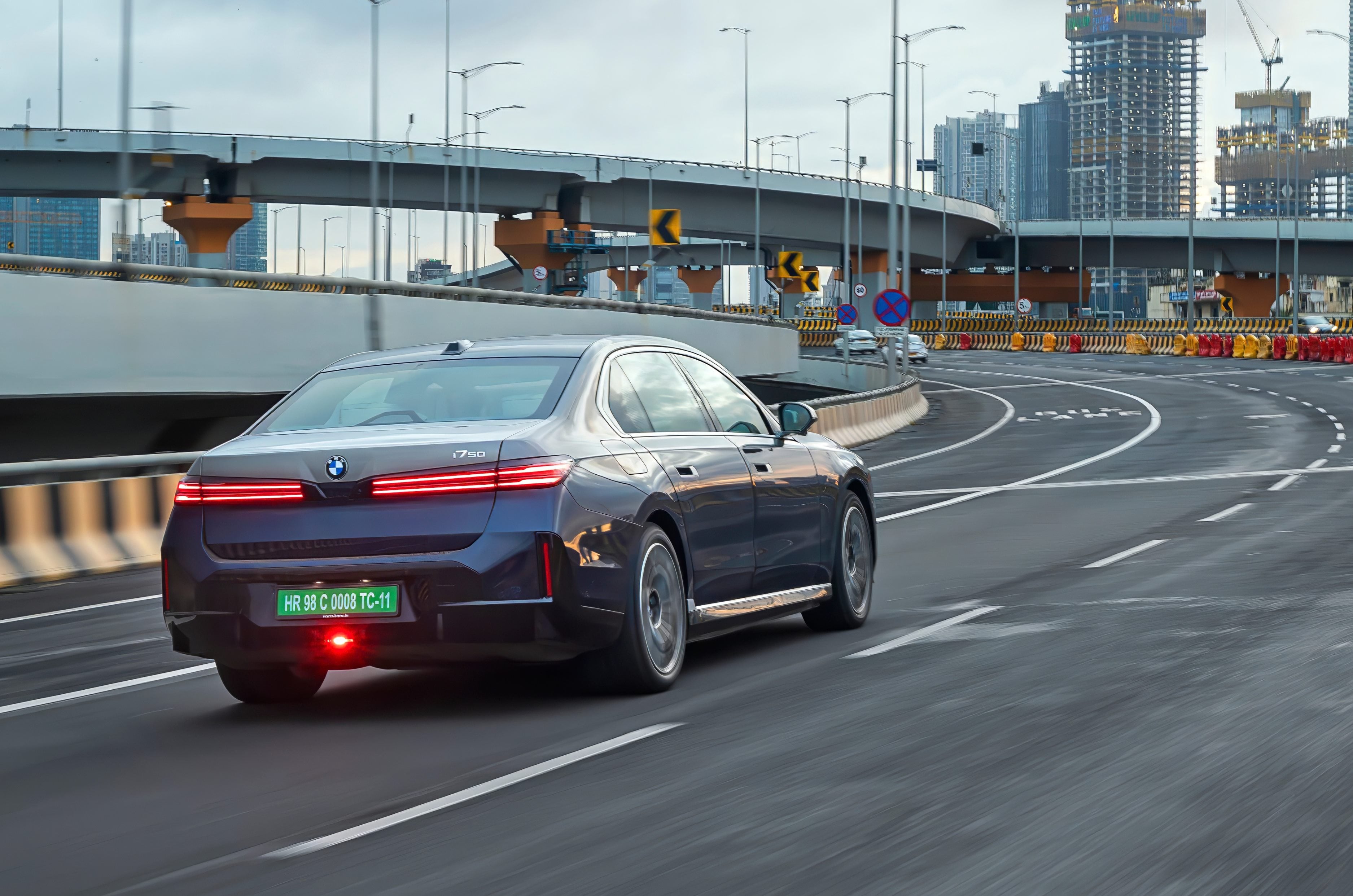
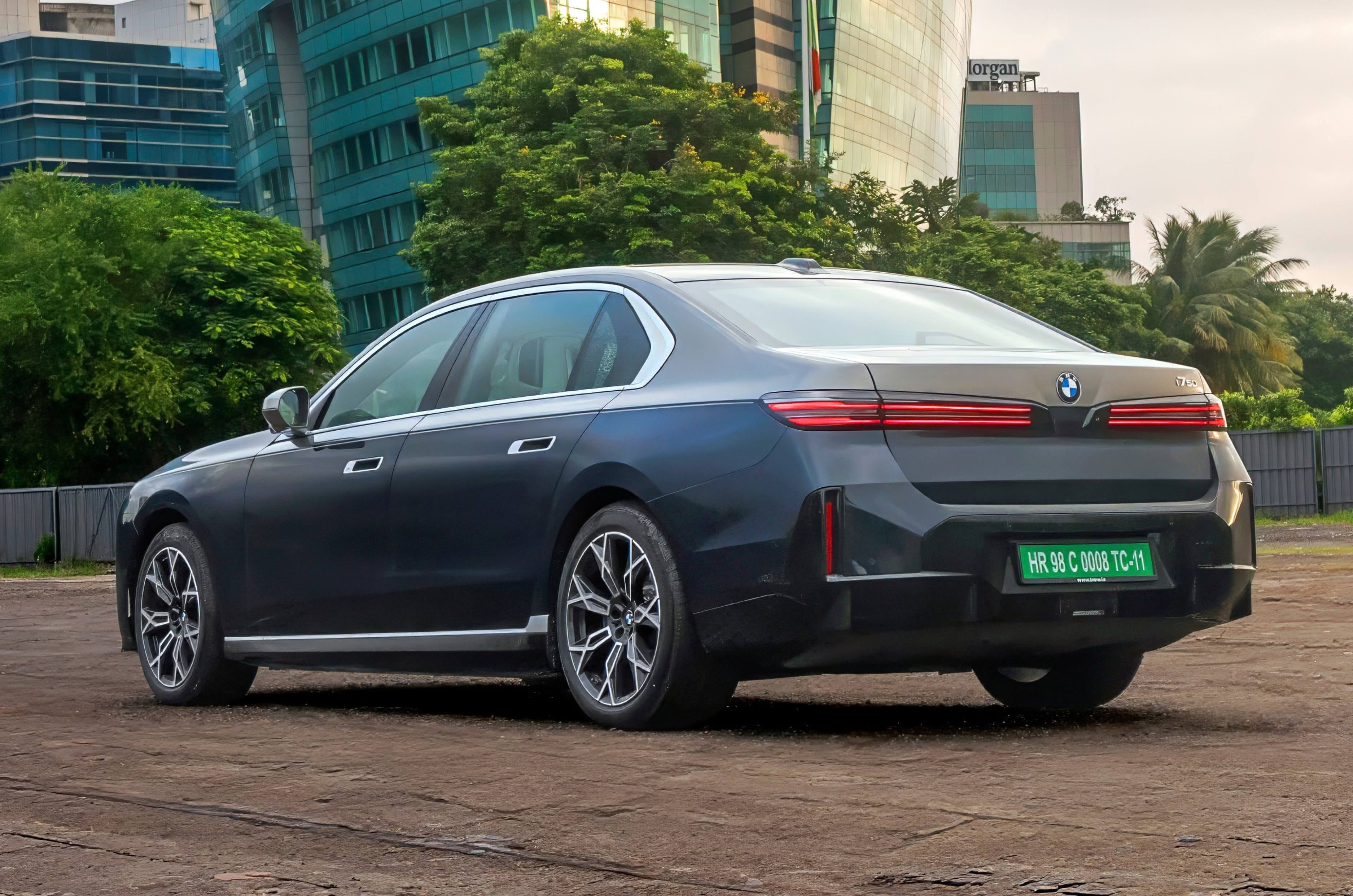
Like the front, the rear has also been cleaned up. There’s a new diffuser, broader tail-lamps, and a neater bumper design. Overall, this iteration looks significantly more palatable than its predecessor, and in the optional two-tone paint finish of our test car, road presence was immense.
BMW i7 50 xDrive Interior Space and Comfort – 9/10
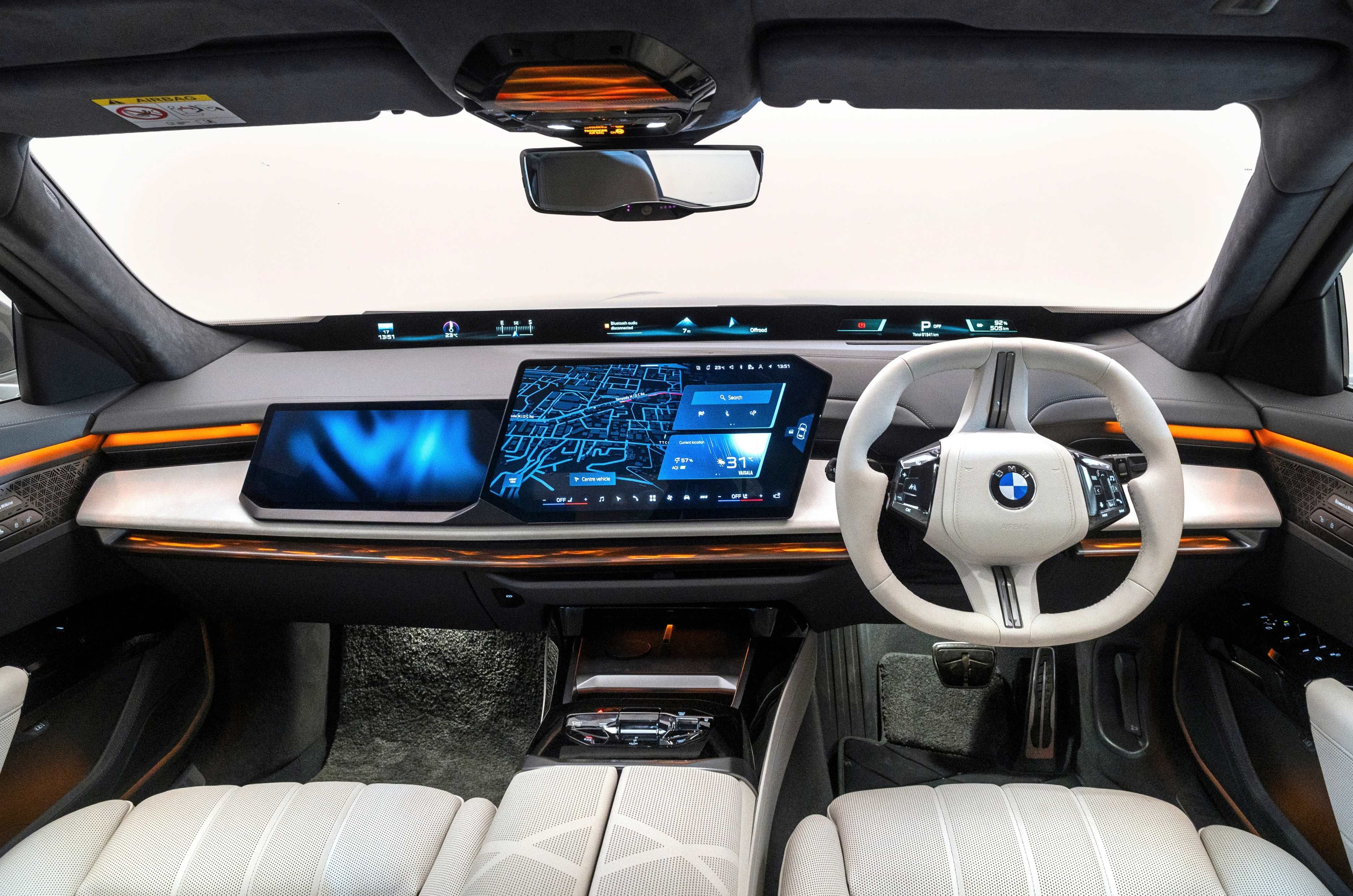
The redesigned dashboard adds freshness and previews the direction BMW’s future interiors are expected to take.
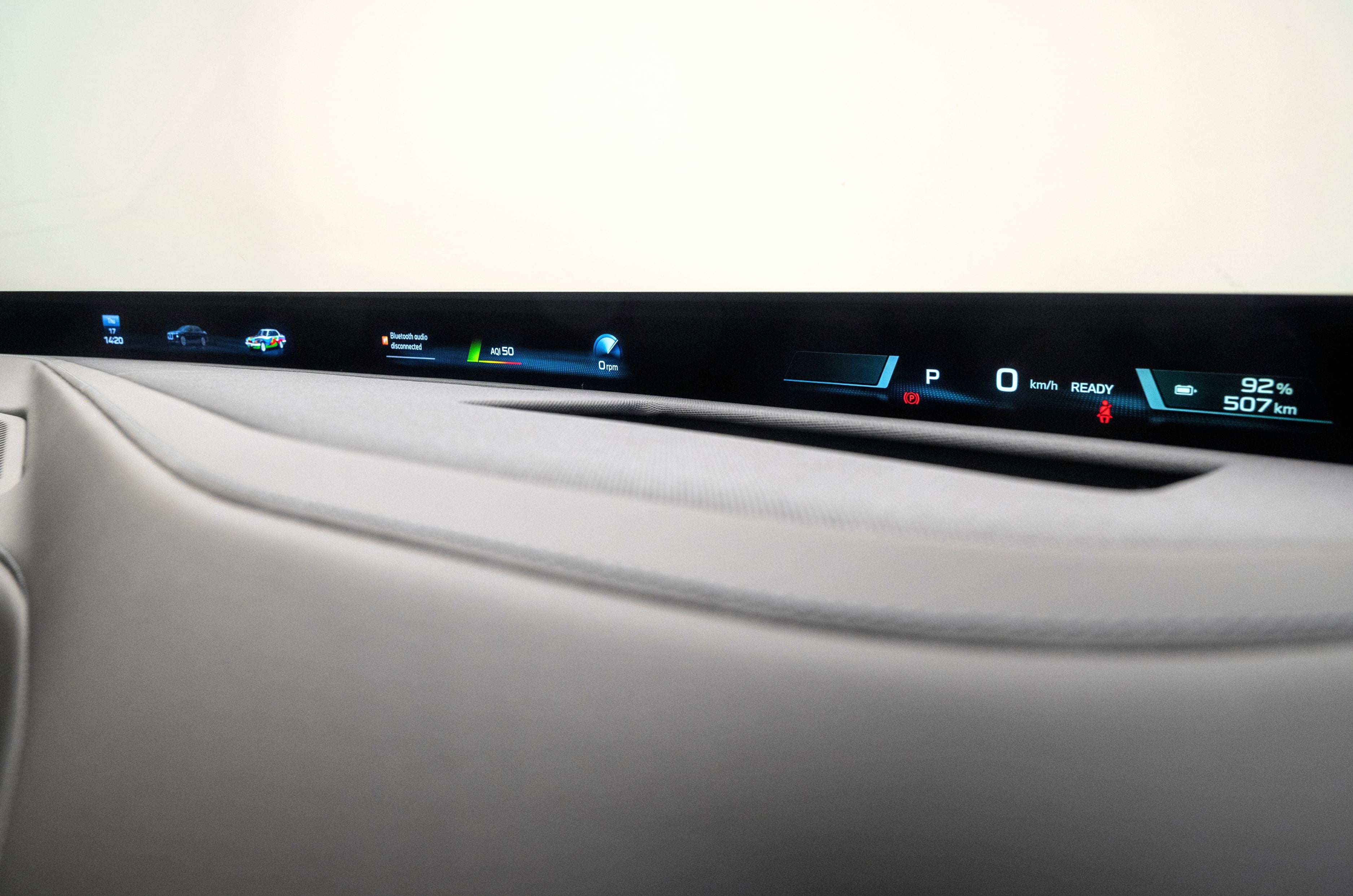
The i7’s dashboard has been completely redesigned, adding much-needed freshness while also previewing the direction BMW’s future interiors are expected to take. The biggest talking point is the deletion of the conventional instrument cluster. In its place sits a new panoramic head-up display positioned right at the base of the windscreen, projecting a wealth of information. It is highly customisable and, besides essentials like speed, charge status and warnings, can display motor speed, navigation, compass information, audio details, date and time, outside temperature, air quality, or even one of BMW’s Art Cars as a decorative element in the remaining six slots. The display is sharp, brilliantly executed, and sits naturally within your field of vision without becoming distracting.
A panoramic head-up display projects a wealth of information, it’s highly customisable and the display is sharp and brilliantly executed.
As for design, the new steering wheel is far more divisive. Its octagonal shape, combined with spokes extending from the horn boss at the 12 and 6 o’clock positions, makes it look unconventional. The light-coloured finish is also likely to be difficult to keep clean — you may even find yourself asking your chauffeur to wear gloves. On the plus side, it feels pleasant to hold, and the controls, though limited in number and not individual buttons, are satisfying to use.
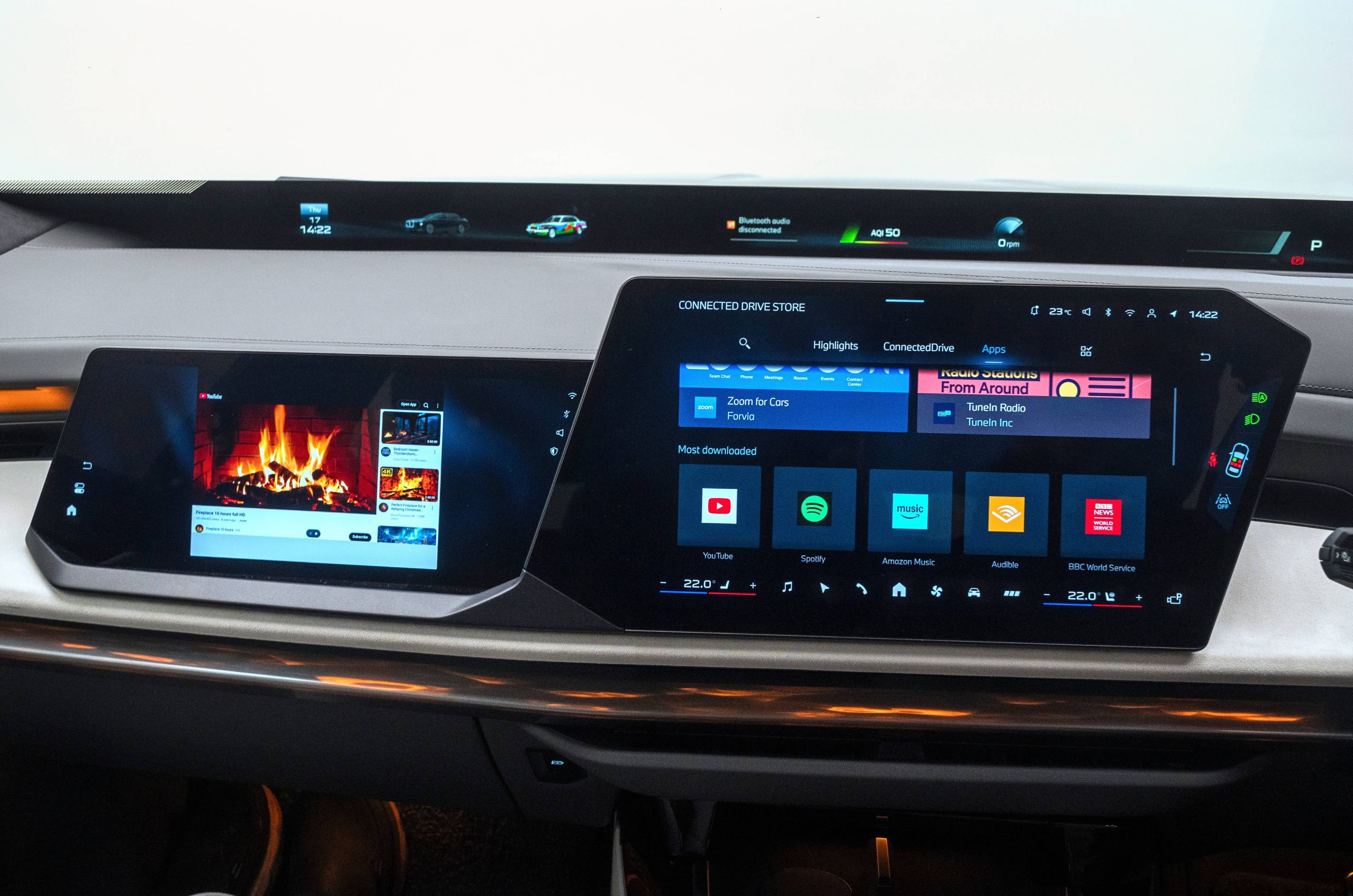
There’s also a new 17.9-inch free-standing touchscreen along with a smaller passenger display, both adopting a parallelogram shape. Curiously, the top-right corner of the central screen appears as though it has been chipped off, although that isn’t actually the case. Generous ambient lighting, crystalline detailing for the drive selector, volume controller and start-stop button, silver speaker grilles, and an overall light-coloured cabin theme further elevate the sense of luxury.
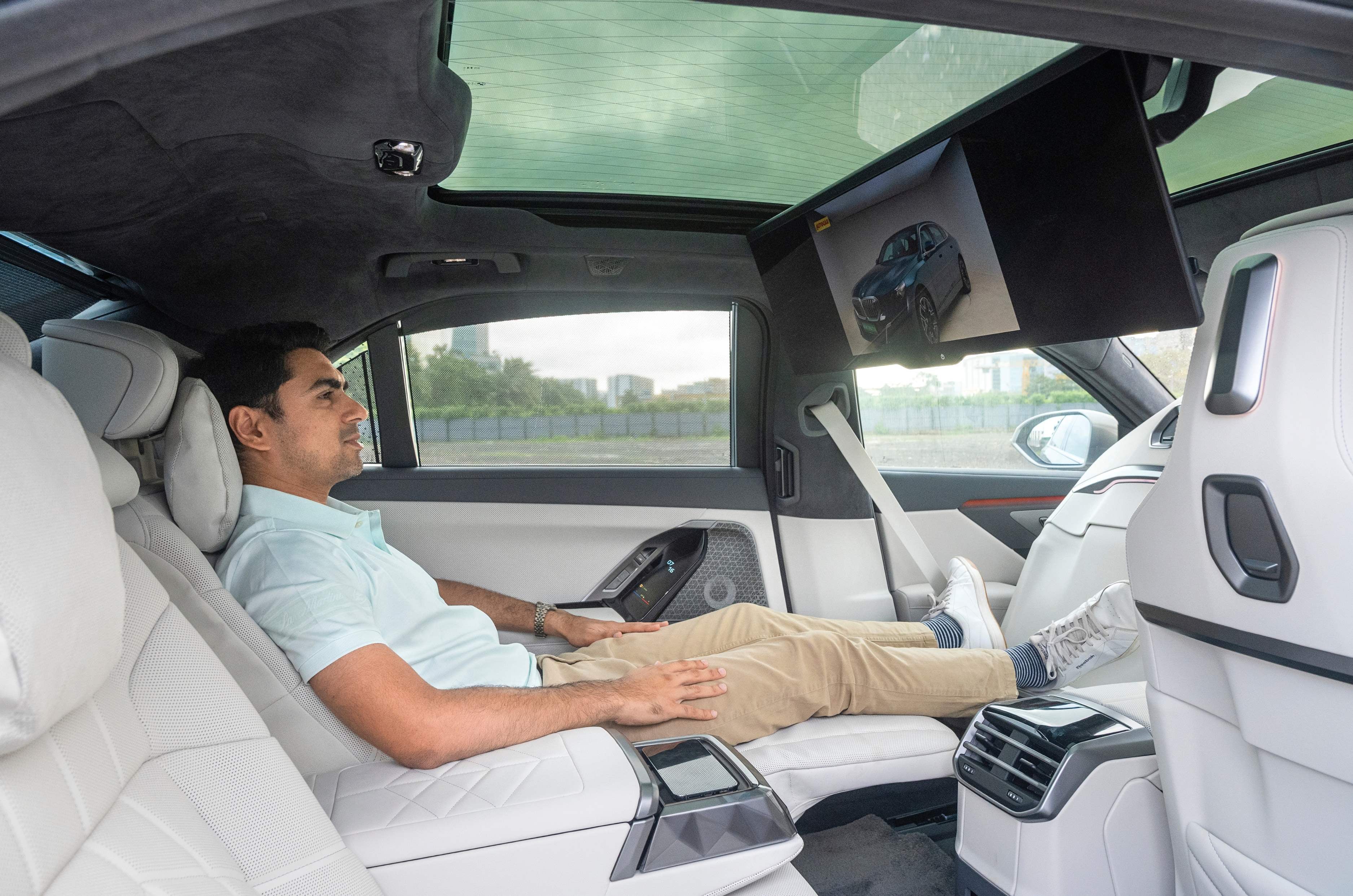
A one-touch relaxation mode transforms the rear seat into a lounge-like position. Updated 8K theatre screen is still part of the package.
Expectedly, the seats are supremely comfortable. All four seats get heating, ventilation and massage functions. Additionally, the rear-left seat features a one-touch relaxation mode that transforms it into a lounge-like position, complete with a raised ottoman, a fully-forward front passenger seat, and a fold-down footrest. Sadly, like the outgoing model, the spare wheel remains mounted on the boot floor, significantly compromising luggage capacity.
BMW i7 50 xDrive Features and Safety – 10/10
The i7 50 M Sport comes loaded with virtually every feature luxury sedan buyers could ask for. The new panoramic end-to-end head-up display replaces the conventional instrument cluster and is not only unique and highly customisable, but also exceptionally well executed. The 17.9-inch touchscreen is new too, and now benefits from additional shortcut keys in addition to permanently displayed climate-control functions, making it marginally easier to operate than before. However, the user interface still feels somewhat overwhelming, with an abundance of functions buried within multiple sub-menus.
The central screen is marginally easier to operate than before. The new front passenger entertainment display is likely to be of limited relevance to most owners.
Also new is a front passenger entertainment display, though we suspect it will be of limited relevance to most owners. The new 31.3-inch 8K rear theatre screen, on the other hand, is likely to see much greater use, particularly on longer journeys.
Carried over from the outgoing version and continuing to add a sense of occasion are the powered doors, which open and close at the touch of a button.
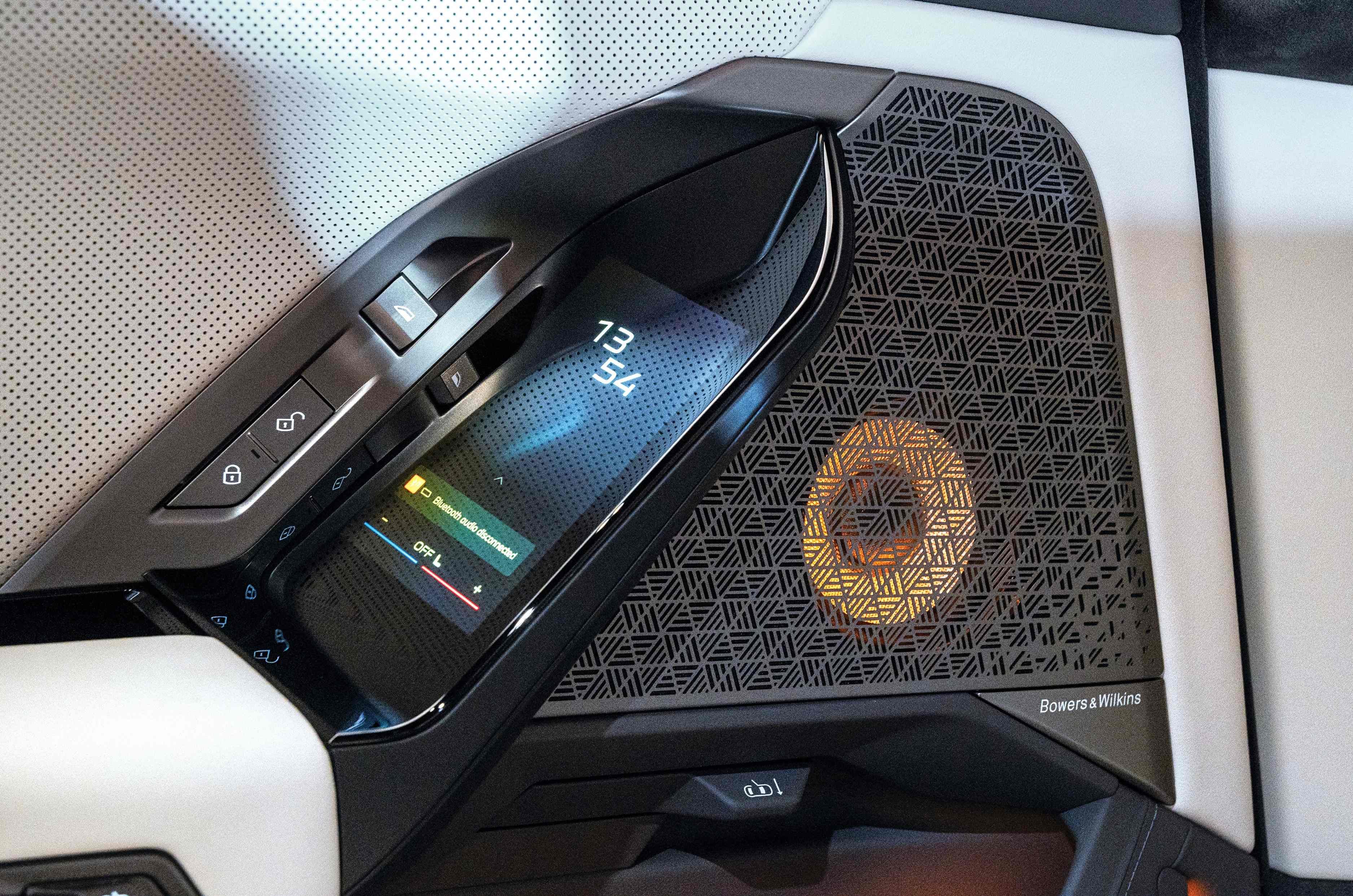
Its Bowers & Wilkins Diamond Surround Sound System with Dolby Atmos delivers an incredibly immersive audio experience.
The highlight, however, is the outstanding Bowers & Wilkins Diamond Surround Sound System with Dolby Atmos and a whopping 35 speakers. It even delivers a 4D experience, with a pronounced thump felt through all four seats. The result is an incredibly immersive audio experience that is sure to impress even the most discerning audiophile.
BMW i7 50 xDrive Performance and Refinement – 9/10
Its performance feels effortless and reassuring, while the accelerator calibration is smooth and progressive for everyday driving.
The i7 50 xDrive uses a dual-motor setup producing a combined 483hp and 660Nm, which is more than adequate for a luxury sedan of this nature. There’s rarely any need to switch out of Efficient mode because there is always a vast reserve of torque available. The effortless performance feels reassuring, while the accelerator calibration is smooth and progressive during everyday driving.
Press the accelerator beyond the halfway mark and the i7 takes off like a scalded cat. Acceleration is rapid, with this 2.8-tonne luxury sedan sprinting from 0-100kph in just 5.5 seconds and reaching 200kph in a shade under 19 seconds. Owners can also choose to activate synthetic motor sounds that play through the speakers, adding a dramatic, sci-fi soundtrack to acceleration. These can be switched off entirely for a completely silent experience.
There are multiple regenerative braking settings, including Adaptive, High, Mid and Low. Of these, Adaptive stands out for its excellent calibration, intelligently varying regeneration and coasting based on traffic and road conditions. There’s also a dedicated one-pedal ‘B’ mode selectable via the drive selector. It delivers regeneration similar to the High setting but, unlike it, can bring the car to a complete stop without any brake pedal input.
BMW i7 50 xDrive Range and Efficiency – 9/10
The i7 50 xDrive gets a larger 112.5kWh battery pack with NMC cell chemistry, replacing the outgoing version’s 101.7kWh unit. As a result, this version claims a WLTP range of up to 728km. Although we haven’t yet subjected it to our range tests, we expect it to comfortably deliver over 500km in real-world conditions, which is more than sufficient for most users. BMW claims the battery can charge from 10-80 percent in 28 minutes using a 250kW (or higher) DC fast charger. On a 22kW AC charger, a full charge takes approximately six hours.
BMW i7 50 xDrive Ride Comfort and Handling – 10/10
What’s truly impressive is the pillowy ride quality. It shrugs off badly broken roads with ease, and maintains excellent body control.
Piloting the i7 may initially seem intimidating given its considerable dimensions, but its light steering and rear-axle steering significantly aid manoeuvrability. The latter allows the rear wheels to turn either with or against the fronts by up to 3.5 degrees, helping the car feel remarkably agile for its size.
What’s truly impressive is the pillowy ride quality. The thick, high-profile tyres add another layer of cushioning, allowing the i7 to shrug off even badly broken roads with ease. It absorbs potholes effortlessly, keeps road shocks well isolated, and maintains excellent body control. Passengers are also spared the uncomfortable side-to-side movements over unusually rough patches.
Selecting Sport mode does firm things up slightly, but while the air suspension becomes tauter and body control improves further, ride comfort never suffers. Handling feels predictable and, thanks to xDrive all-wheel drive, the i7 feels exceptionally planted and offers impressive grip when tackling corners. Rear-wheel steering also does a remarkable job of disguising its size.
In short, the i7 can be driven surprisingly enthusiastically, and for a luxo-barge, it drives exceptionally well. We would, however, recommend leaving the steering in Comfort mode, as it feels unnecessarily heavy in Sport.
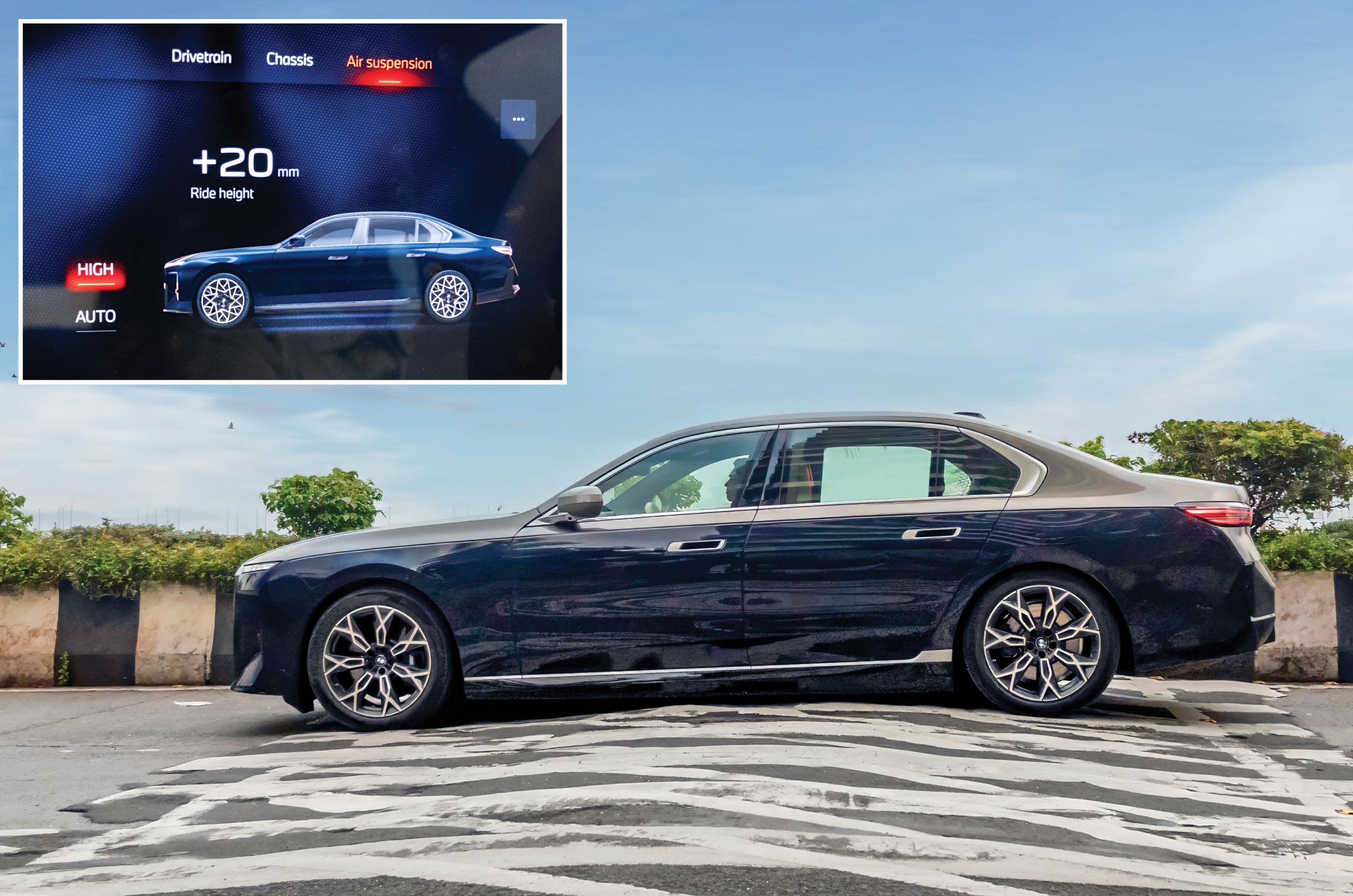
The suspension raises by 20mm over the 136mm standard setting, allowing it to clear all but the most poorly designed obstacles.
Sport mode also lowers the ride height by 10mm from the standard 136mm setting. While beneficial for dynamics, it makes the underbody vulnerable even on relatively small speed breakers. Thankfully, two taps on the touchscreen raise the suspension by 20mm over the standard setting, allowing it to clear all but the most poorly designed obstacles. Cabin insulation is outstanding too, keeping road, wind and ambient noise effectively isolated from occupants.
BMW i7 50 xDrive Price and Verdict – 9/10
At Rs 1.95 crore, the locally assembled i7 50 xDrive is priced exactly at par with the petrol-powered 740 and is even a few lakhs more affordable than its chief rival, the Mercedes-Benz S-Class. Yet pricing alone isn’t what makes the i7 such a compelling proposition.
What truly sets it apart is the sheer sense of occasion it delivers. Its styling is bold, the cabin feels genuinely special, ride comfort is exceptional, and the level of technology on offer significantly elevates its desirability. Add to that an extraordinary audio system and the effortless refinement that only a luxury EV can deliver, and the i7 feels every bit the flagship it is.
Yes, luggage space remains compromised by the spare wheel placement, and the touchscreen interface isn’t quite as intuitive as that of its chief rival. But in this segment, neither is likely to be a deal-breaker.
The bigger takeaway is that BMW has successfully made the electric version of its flagship sedan the more desirable one. For buyers seeking luxury, comfort and technology, the i7 50 xDrive isn’t merely an excellent EV, it’s quite simply all the luxury car you’ll ever need.
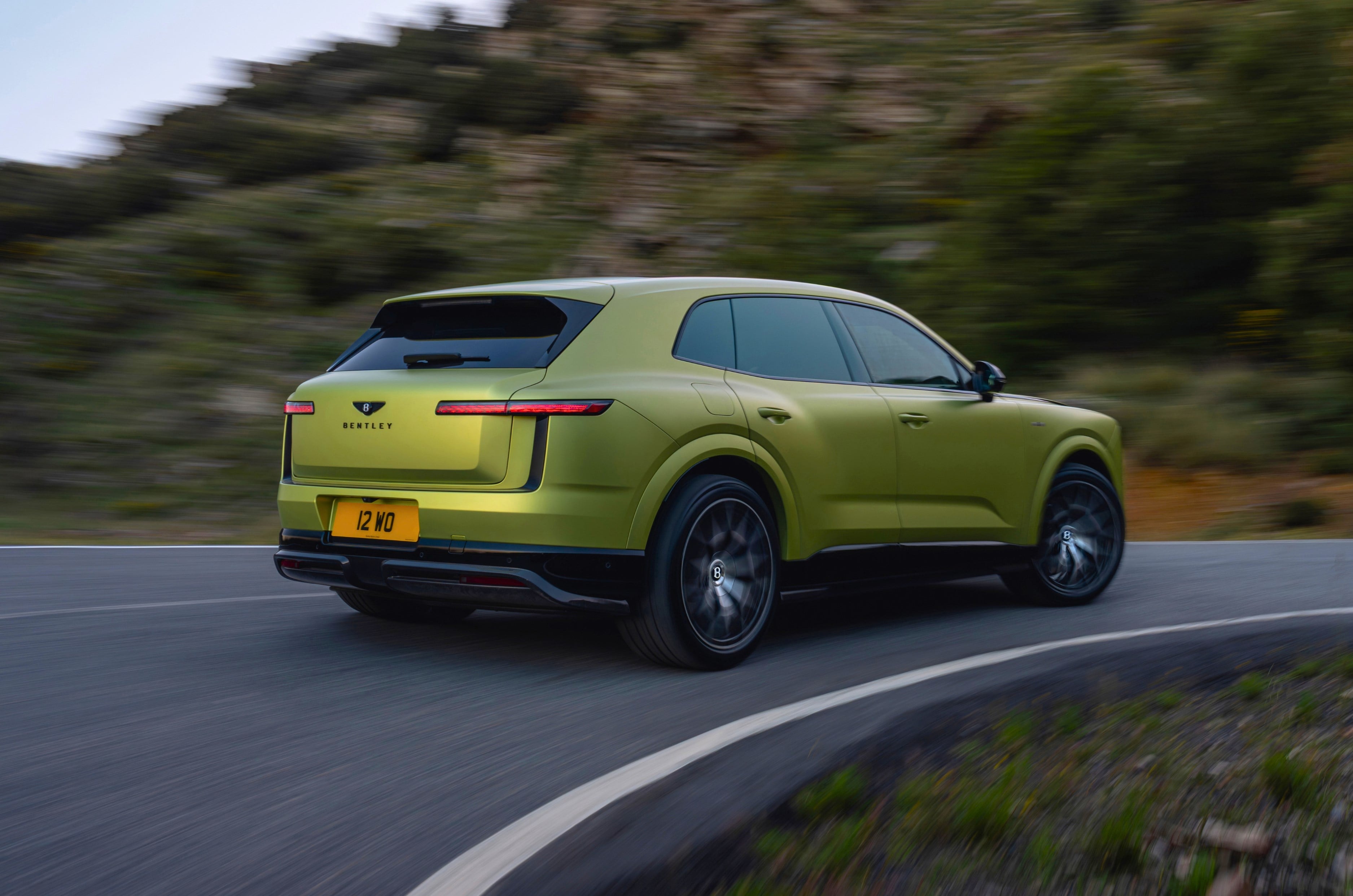
For 107 years, Bentley has been defined by what sits under the bonnet: supercharged Blowers, mighty W12s and thundering V8s. The Torcal has none of that. It’s Bentley’s fourth model line and its first electric car. It slots in below the Bentayga, and it will never get a petrol engine. Bentley also calls it the template for every Bentley that follows, whatever the powertrain.
Like many modern Bentleys, the Torcal is named after a natural wonder. El Torcal de Antequera is a dramatic landscape of weathered limestone in southern Spain. The car is also the first Bentley to wear the brand’s redesigned, modernised emblem, which was revealed last year. That leaves one question that matters. Take away the engine, and is it still a Bentley? We haven’t driven it yet, so the full answer will have to wait. After a close look at the First Edition, the fully loaded launch car, there’s plenty to go on.
Bentley Torcal exterior design: light is the new chrome
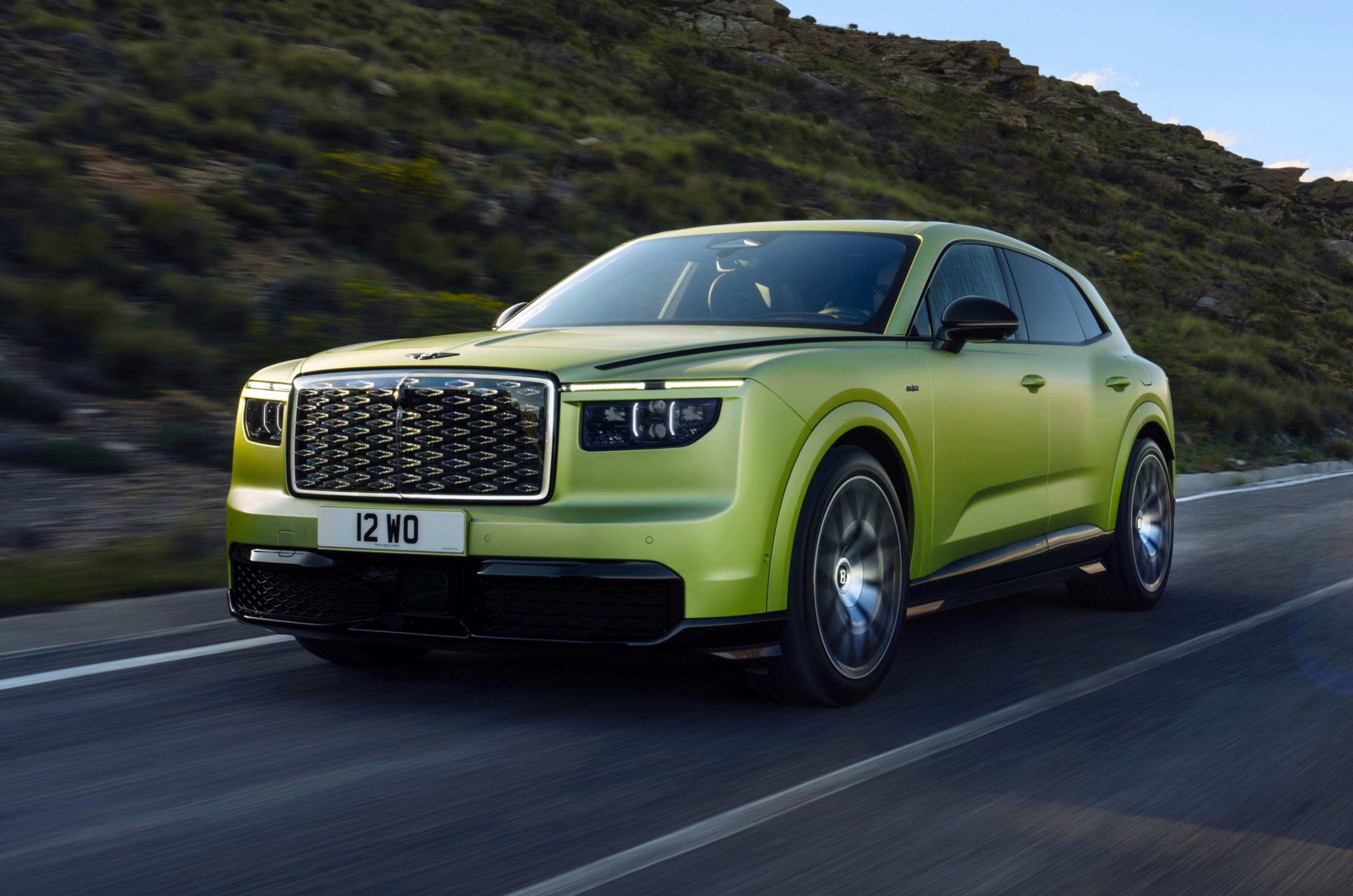
Designing an EV for a brand with this much pedigree was never going to be easy, but Robin Page’s in-house team at Crewe has done a fine job. The Torcal sits 50mm lower and is 120mm shorter than a standard-wheelbase Bentayga, yet it looks the better proportioned of the two. The wheelbase is just over three metres, the car is about five metres long, and the overhangs are short. Bentley’s signature ‘endless bonnet’ does much of the visual heavy lifting.
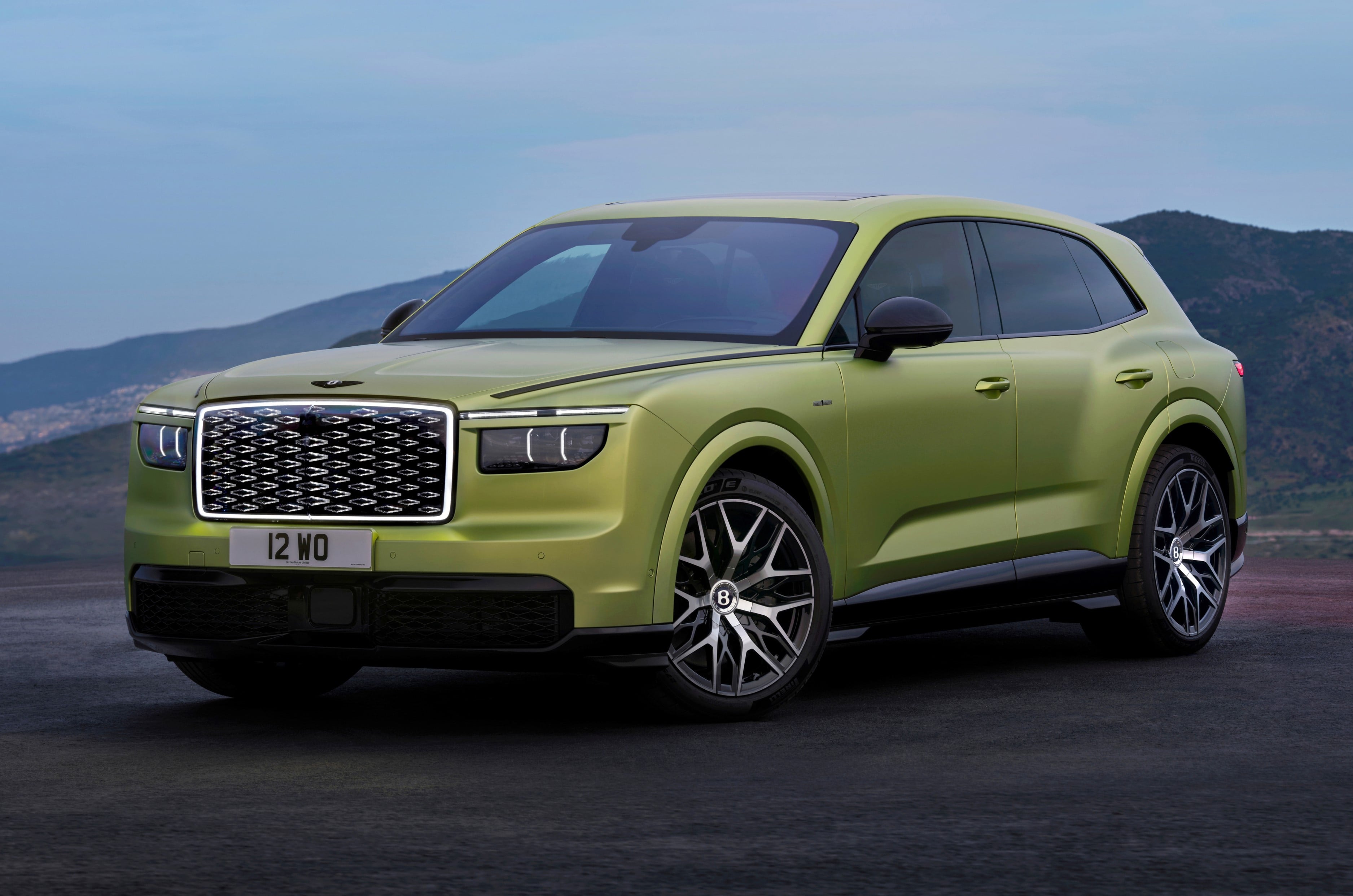
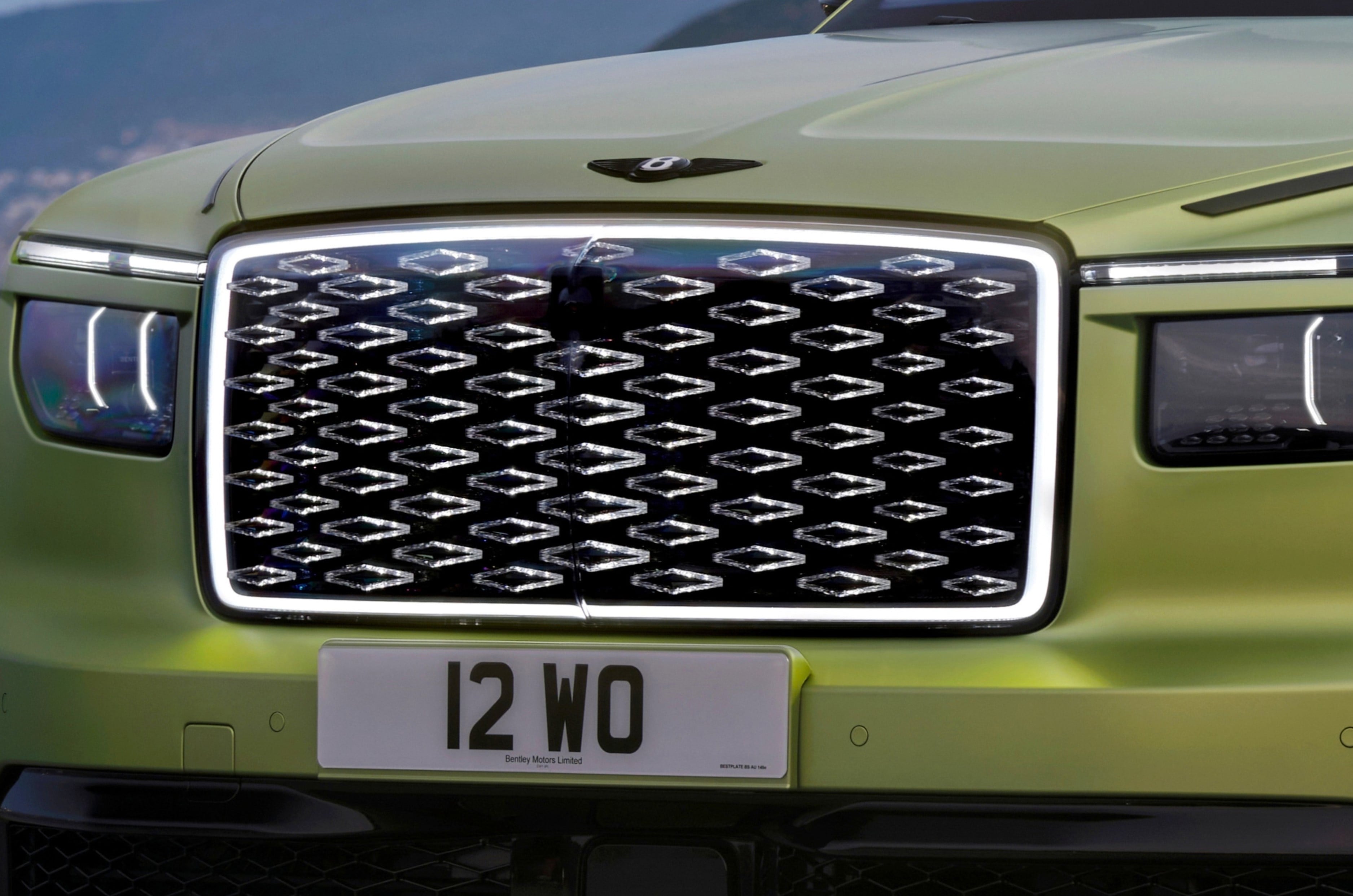
The Torcal gets a clear polycarbonate panel with diamond-like elements for a grille.
An EV doesn’t need a grille for cooling, but Bentley argues that a car without one is faceless. The Torcal’s solution is an illuminated one with crystal-effect, diamond-like elements set behind a clear polycarbonate panel. It’s the car’s signature piece, and it will look spectacular filling someone’s rear-view mirror. The face echoes the Continental T, reinterpreted through slim, high-tech lighting.
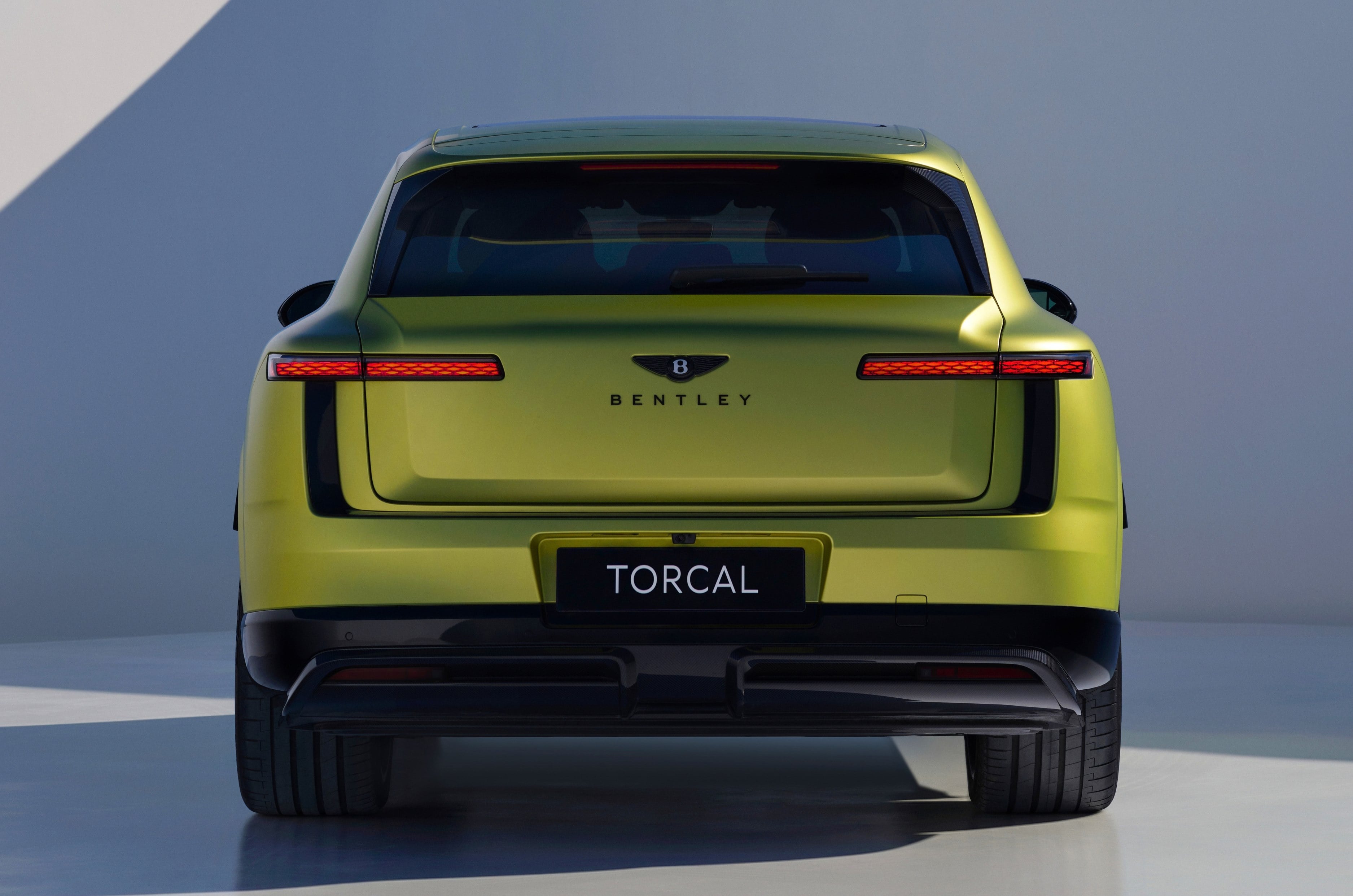
The flanks are deliberately free of fussy creases. The cabin tapers towards the rear so the body can swell over the back wheels, a look the designers call the ‘resting beast’. At the back, Bentley claims are some of the slimmest tail-lamps in the industry. A U-shaped motif ties them together and emphasises the car’s width.
U-shaped motif at the rear ties the tail lamps together.
Our car rode on 22-inch wheels. The core car gets 21s as standard, and India-spec cars may well get the smaller, higher-profile rim. Other neat touches include a charging flap that slides open when you wave a hand over it, and a 90-litre frunk under that long bonnet. The 460-litre boot isn’t especially generous, and there’s no spare wheel, only a puncture repair kit. On Indian roads that could be an issue, though most owners will simply leave a flat to the chauffeur to fix
Bentley Torcal interior: Screens, with restraint
The cabin is completely new, and the tricks start before you’re inside. All four doors are powered and radar-controlled. The driver shuts theirs by pressing the brake pedal, and passengers can close theirs simply by buckling up.
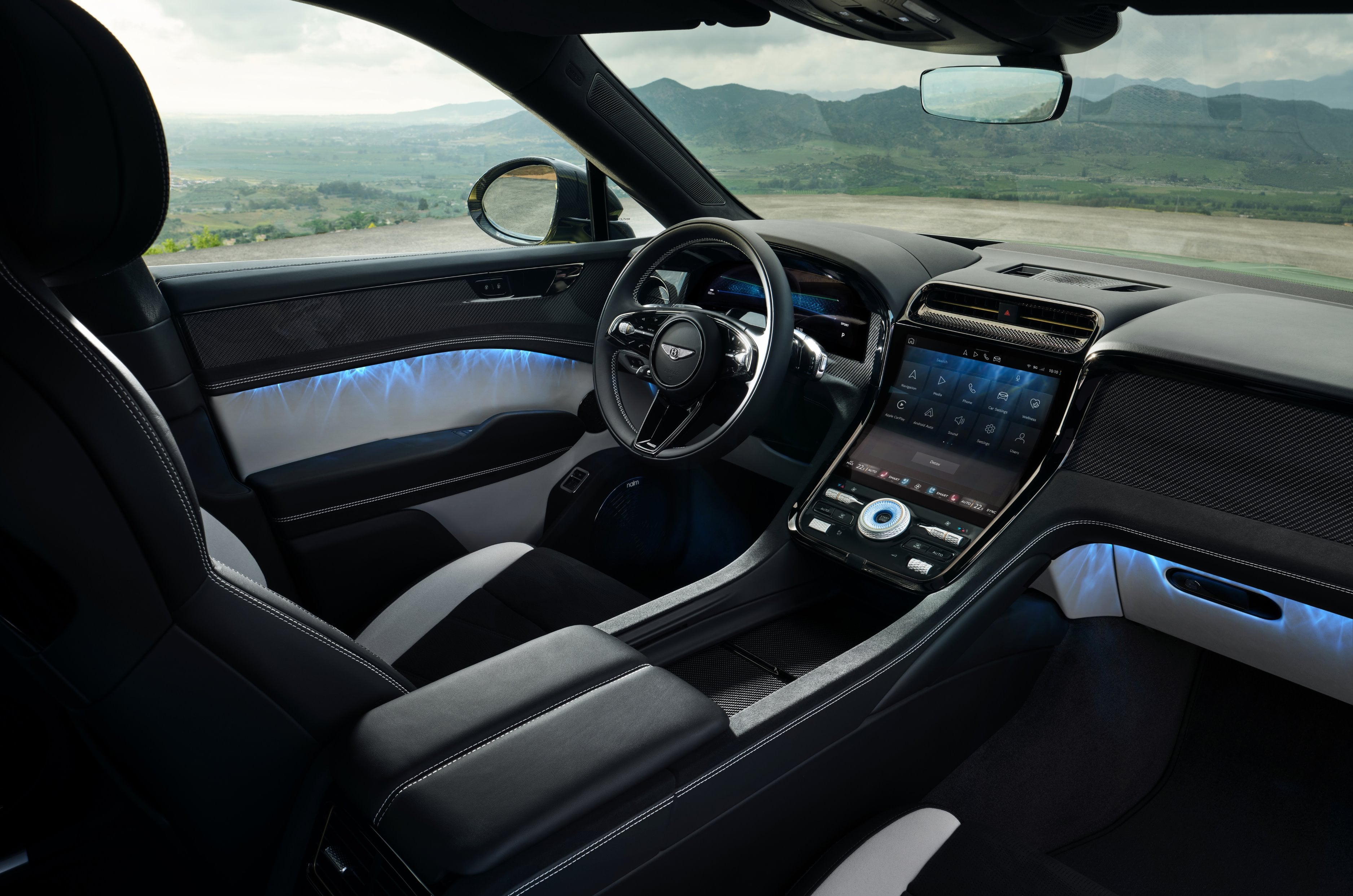
The first thing you notice is that Bentley hasn’t turned the Torcal into an iPad showroom. The centrepiece is the curved OLED centre screen. It doesn’t perch on the dash like a tablet; it sweeps down and flows into the centre console as one continuous form, and nothing else in the class looks quite like it. The OLED panel gives deep blacks and rich colours, and the curve brings every corner of the display within easier reach. Crucially, physical controls haven’t been binned. The switches have a beautiful knurled finish and satisfying, precise clicks, and purists will love them.
A curved OLED touchscreen infotainment is the centrepiece of the interior.
There’s one gripe. The direction of the front air vents is set through the touchscreen, a trend creeping into many luxury cars, and a physical slider would have been far nicer. Otherwise, we haven’t seen any car balance digital and physical controls better.
The tech runs deep. A facial-recognition camera in the rear-view mirror identifies the driver and loads their seat, steering and ADAS settings. An augmented-reality head-up display projects navigation arrows and hazard markers into the driver’s line of sight.
Curated experience
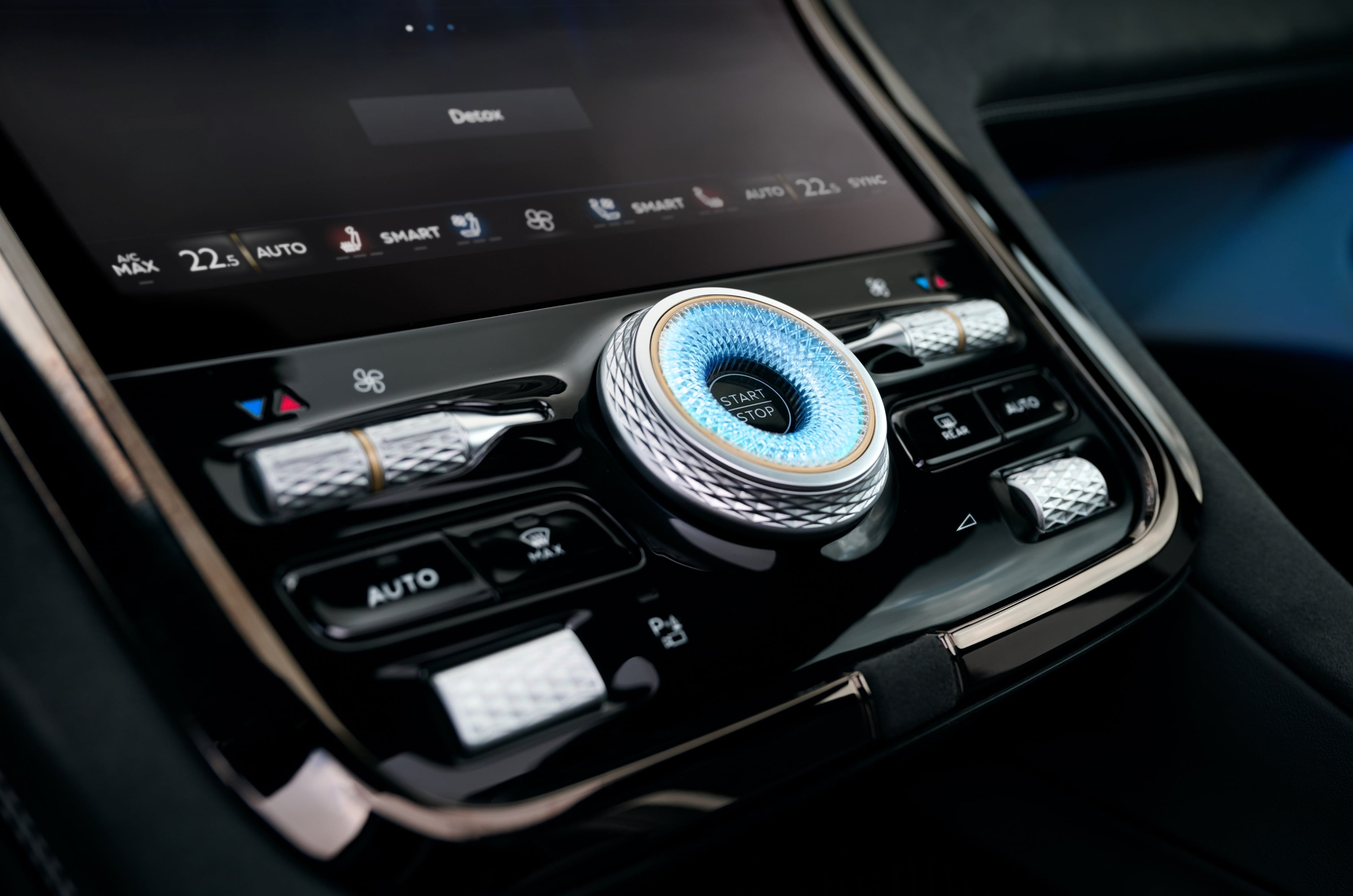
Twist the rotary collar around the starter button and you cycle through four Experience Modes. Each one changes the cabin’s lighting, sound, climate and displays as well as the car’s dynamics.
Rotary dial around the starter button can be used to cycle through four Experience modes.
Sport bathes the cabin in blue rather than the expected red. Bentley’s reasoning is that red signals anger while blue signals focus, which makes it a better colour for driving fast. Bentley mode balances performance and comfort. Comfort mode calms things down and offers a ‘digital detox’ that hides all but essential information. Refresh ups the fresh-air flow and brightens the lighting.
Drumming up character
The hardest thing about an electric Bentley is making it feel like a Bentley. For traditional owners, that means sound. The 6¾-litre V8 is iconic, but it was never a perfect engine. Bentley’s view is that its flaws, like in humans, give it emotion and character. So rather than synthesising a flawless digital imitation, Bentley recorded real musicians on drums, viola and bass guitar. The result is the ‘Dynamic Symphony’, complete with tiny imperfections. It responds to torque demand and speed, grows louder in Sport, and can be switched off entirely.
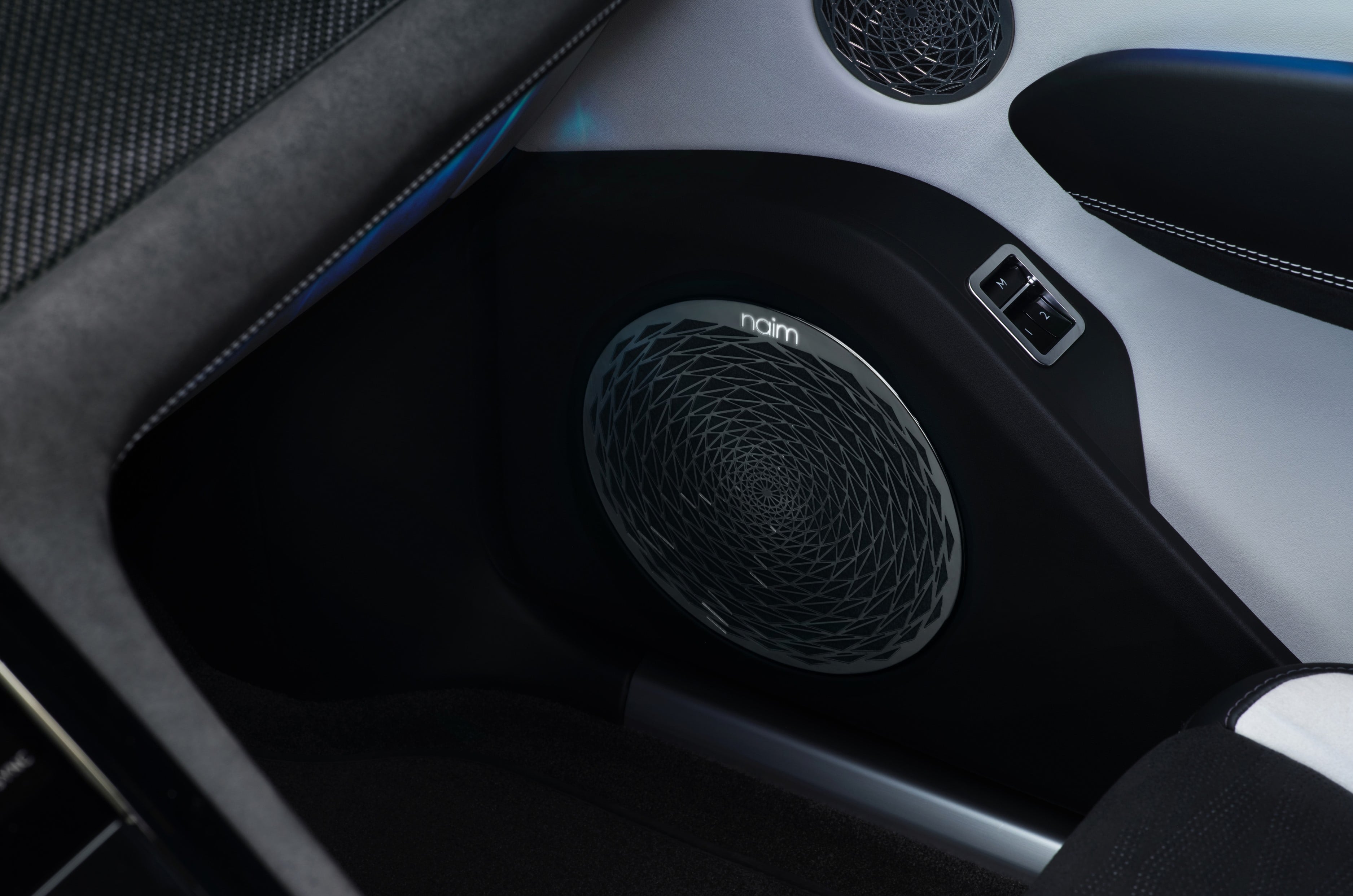
Optional Naim audio brings 28 speakers with Dolby Atmos 7.1
The attention to sound goes further. The indicator tick is a recording of a hammer striking leather in Bentley’s upholstery workshop, and the touchscreen chime comes from a crystal glass. Standard audio is a 620W, 16-speaker system. The Naim option runs to 1,780W and 28 speakers, with headrest speakers, seat shakers and Dolby Atmos 7.1
Material world
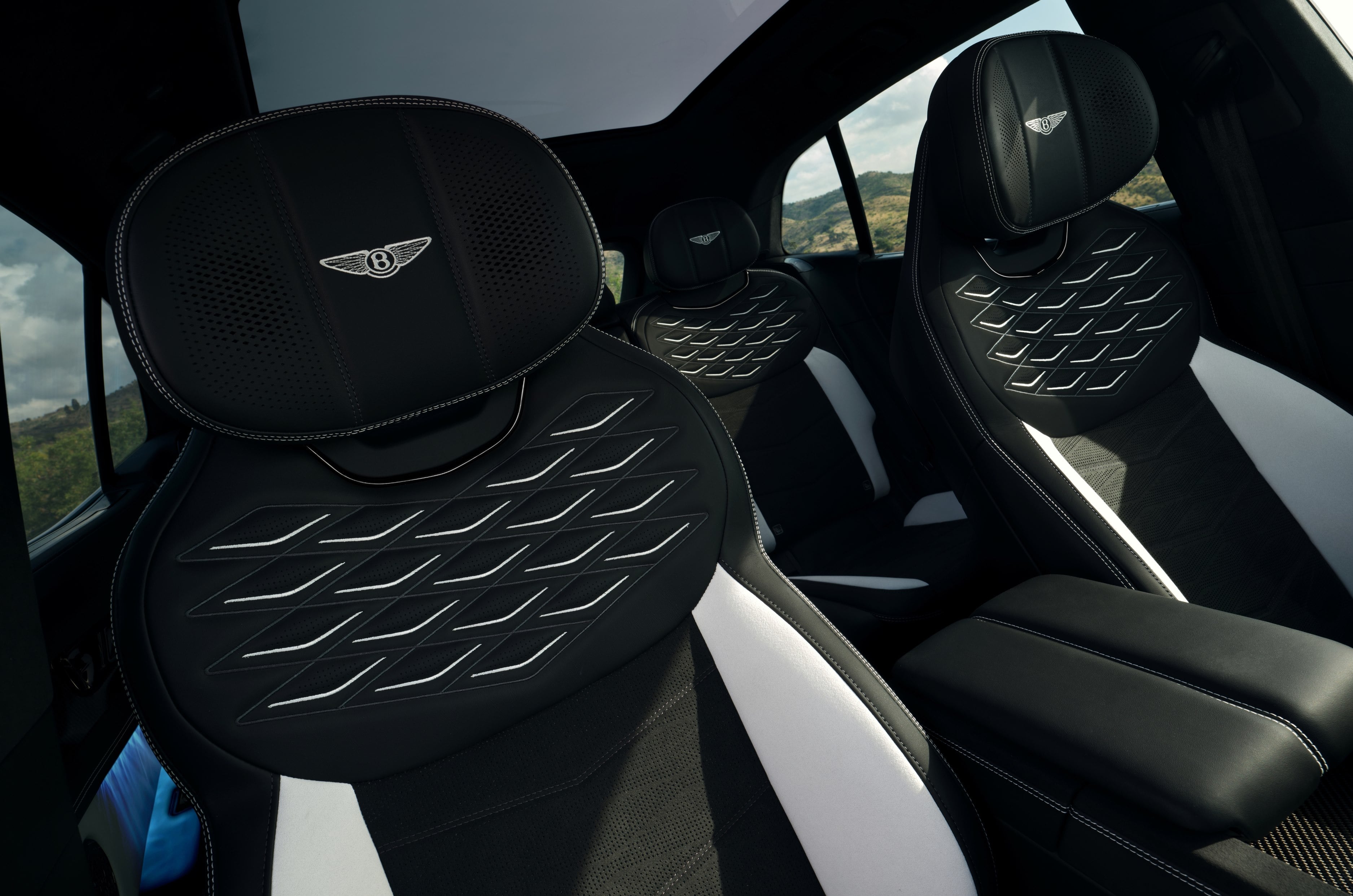
Materials are traditional Bentley, pushed further. There are wood veneers less than a millimetre thick, crisp aluminium and a deep piano black. Leather comes in 15 shades. The real headline is the world’s first 100 per cent Merino wool automotive fabric, developed with Somerset weavers Fox Brothers.
Scope for personalisation is vast, with 15 different shades just for the leather.
New Mulliner finishes include Ombré Walnut, which presses up to 1,000 layers of walnut off-cuts and recycled paper into a veneer that fades from black to smoke. Sunburst Aluminium reinterprets the engine-turned dashboards of old Bentleys. Overhead, the Frosted Diamond sunroof uses switchable glass, so you decide how much light floods in. The scope for personalisation is vast. A second car we saw, trimmed in lighter upholstery with far more brushed aluminium, felt like a different interior altogether.
Bentley Trocal back seat experience
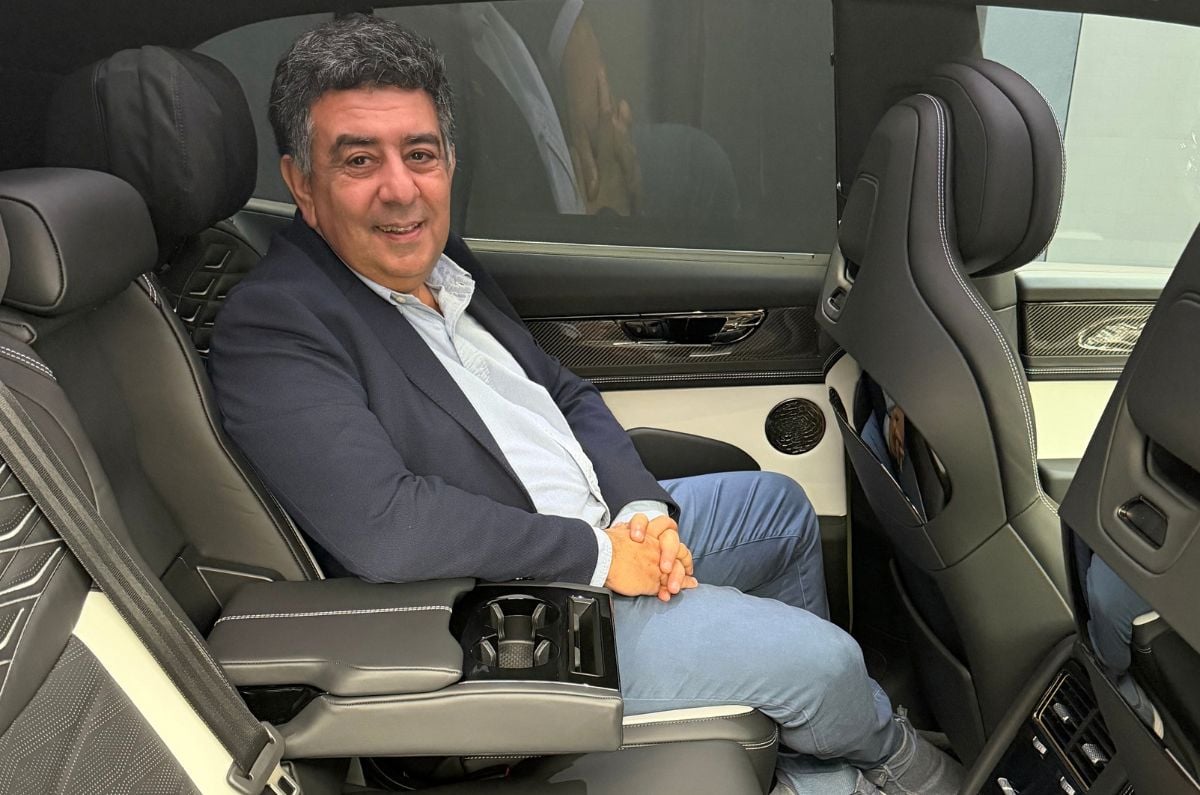
Legroom and headroom at the back are quite decent.
The rear seat matters most for Indian buyers, many of whom will be chauffeured. It’s impressive for a car smaller than a Bentayga. Under-thigh support is genuinely good, which is rare in an EV, where the battery usually pushes the floor up. Legroom and headroom are decent, though this is ultimately a car to be driven.
The rear climate vents get the physical controls the front vents lack. There are heated and cooled seats, and three USB-C ports, one of them rated at 100W for charging a laptop. The rear bench is also the first in a Bentley to power-fold.
Bentley Torcal specs, battery and range
The Torcal gets a 113kWh battery for a claimed WLTP range of 600km.
The Torcal rides on the PPE platform that underpins Porsche’s Cayenne Electric. The Cayenne tops 1,100hp in its most potent form, but Bentley has deliberately stopped short. The flagship makes 888hp and 1,350Nm, the most torque of any Bentley ever and has launch control which I doubt will ever be used!That’s enough to take a roughly 2.7-tonne SUV from 0-100kph in 2.9 seconds. Bentley’s research found that most customers find anything more violent uncomfortable.
Two permanent-magnet motors draw from a 113kWh (net), 800V battery, which carries a 10-year, 100,000-mile warranty. Claimed range is 600km WLTP. This is a continent-crosser, so charging speed was a priority. On a 400kW charger, a 10-80 per cent top-up takes 16 minutes, and around 160km of range goes in during a seven-minute coffee stop. India currently has no such high-speed chargers, yet.
It also gets fully active suspension and rear-wheel steering.
The chassis is Bentley’s most advanced yet. Fully active suspension replaces anti-roll bars altogether, and five degrees of rear-wheel steer shrink the turning circle to 11.1m. Carbon-ceramic brakes with 440mm front discs are optional. The ADAS suite uses 25 radars, sensors and cameras. It can reverse the car along the last 50 metres of its route, and it can park itself in a designated space up to 200 metres away.
Bentley Torcal India launch plans
The Torcal arrives in India in the second half of 2027. It’s a smidgen smaller than the Bentayga but will be substantially pricier, because EVs don’t get the same customs-duty benefit under the new UK-India FTA. Expect around Rs 4.5 crore, ex-showroom. Is it worth it? We’ll tell you once we’ve driven it. Standing still, at least, the Torcal makes a convincing case that a Bentley without an engine is still a Bentley.