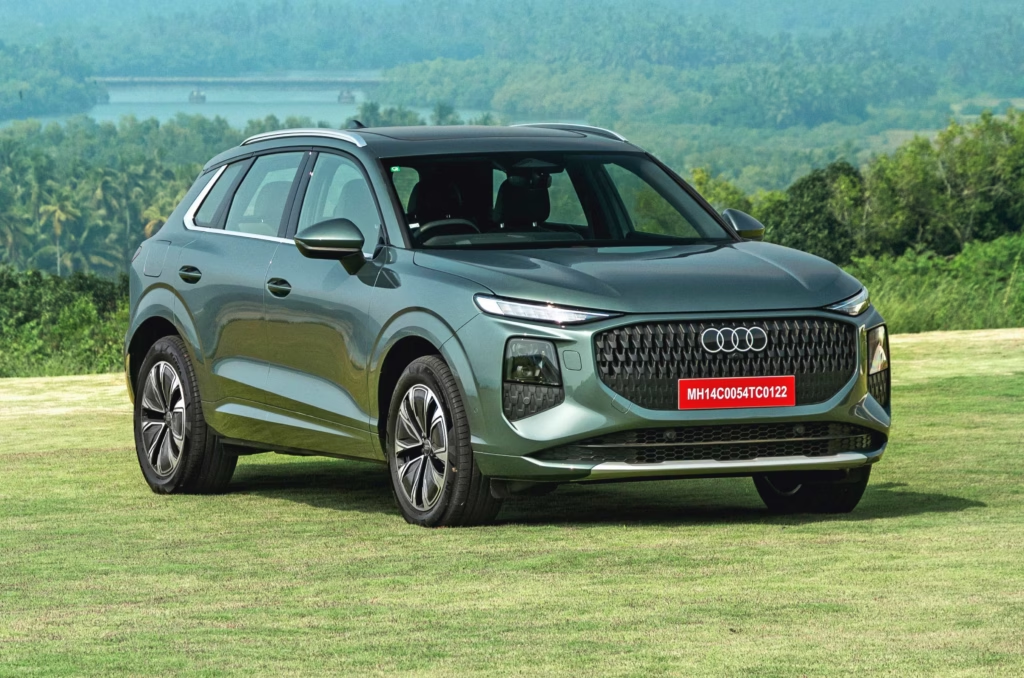
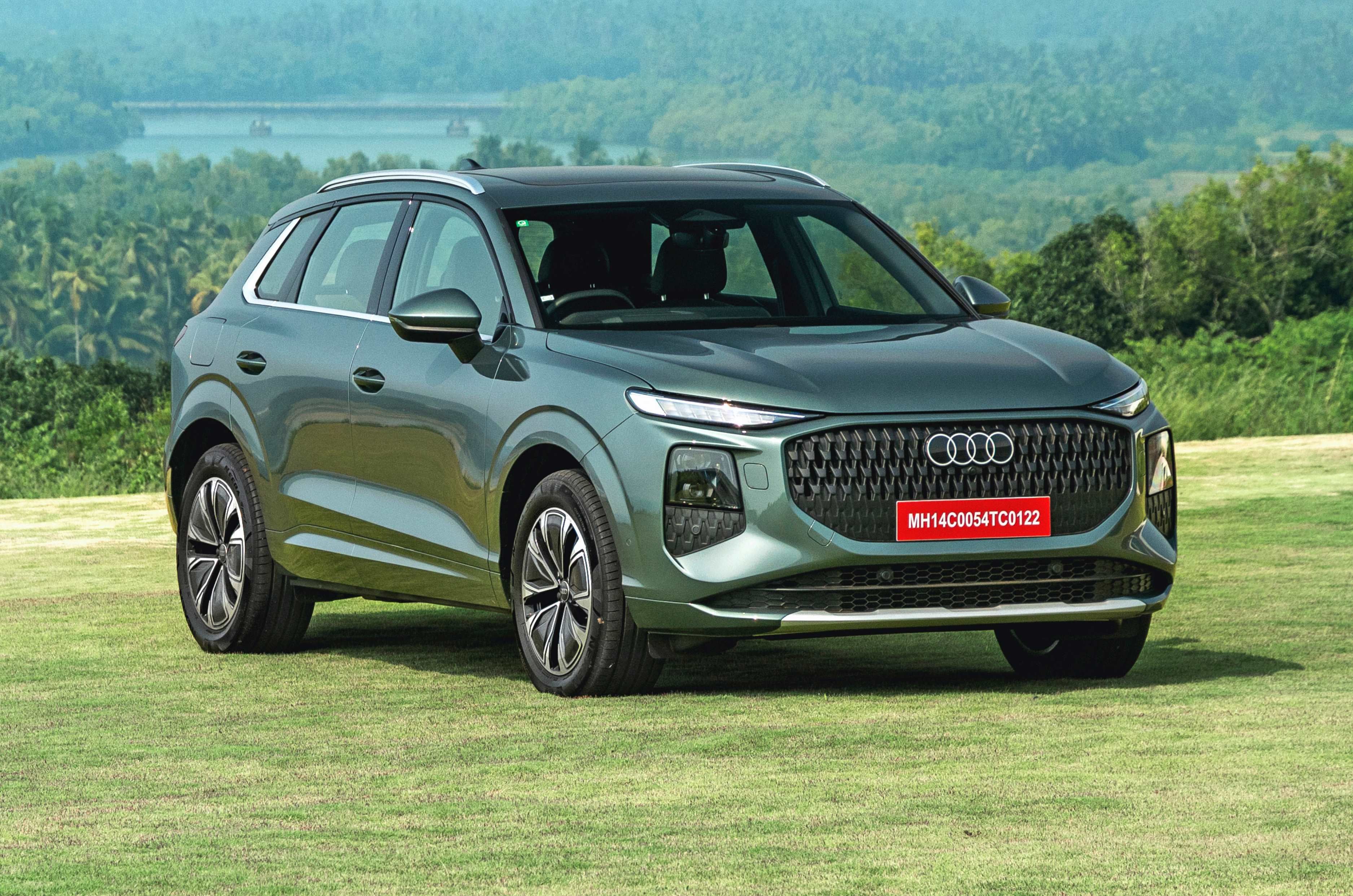
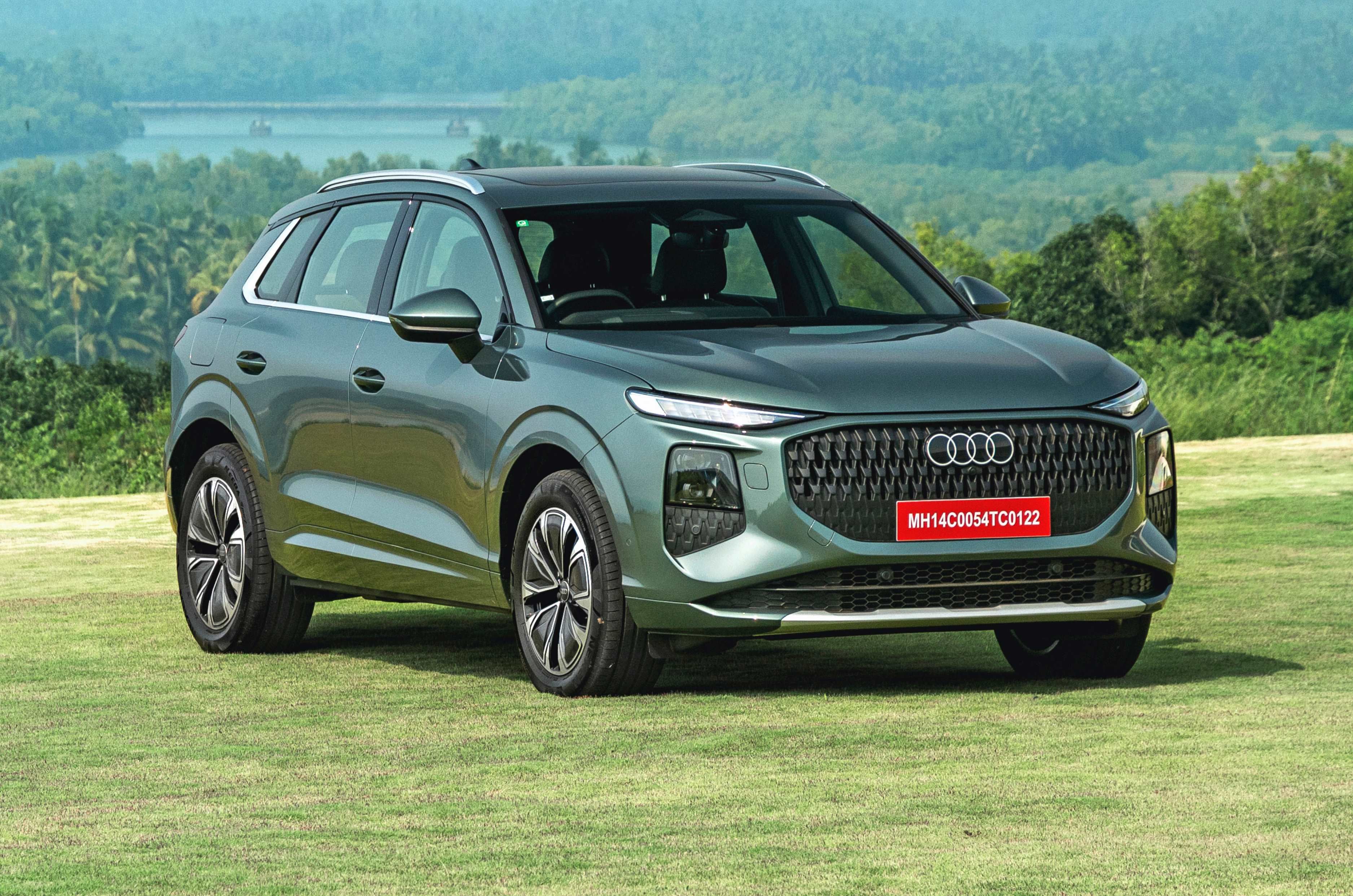
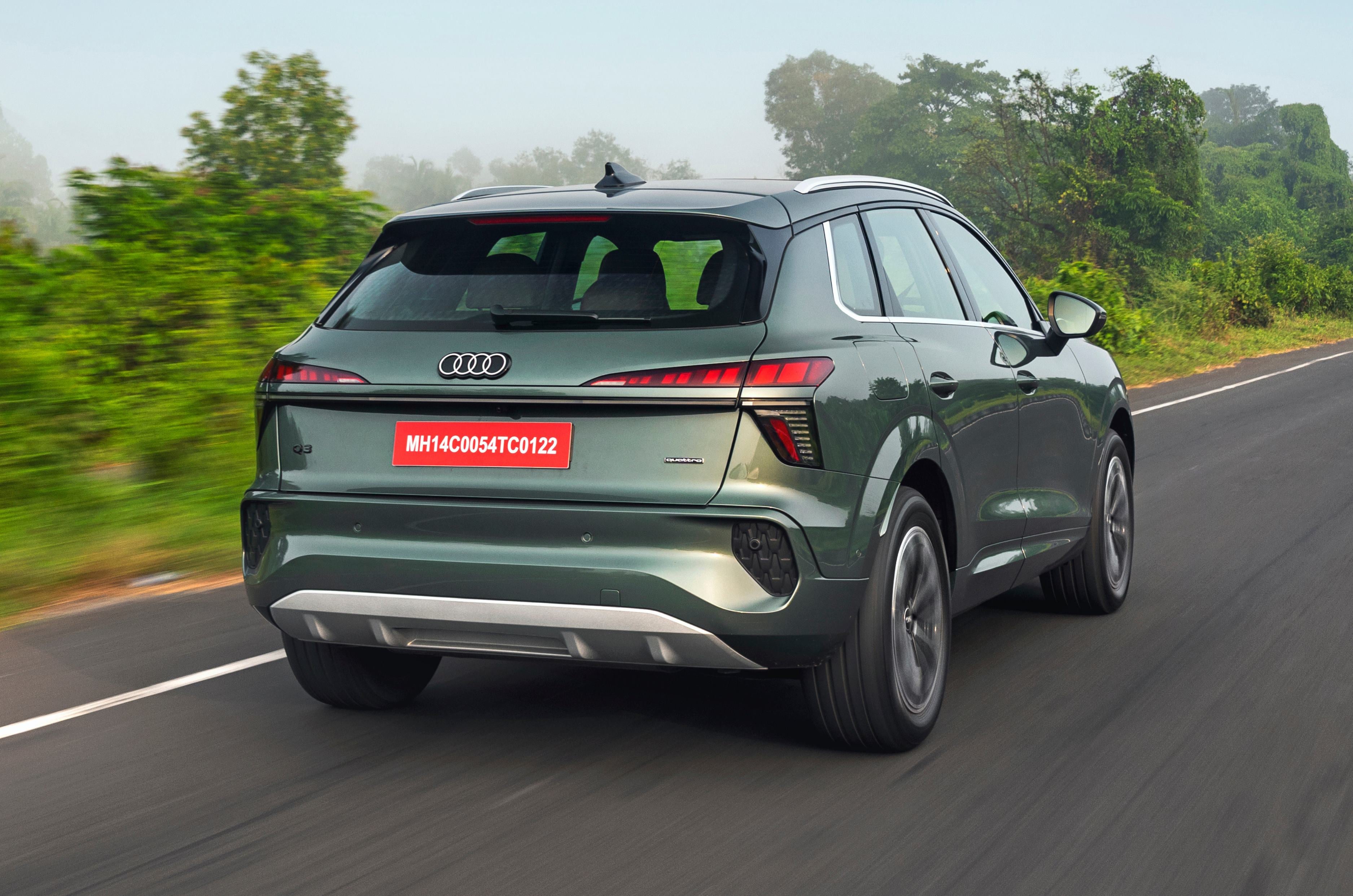
Audi India is set to launch the third-gen Q3 on Friday, 16 October. It will replace the current Q3, which has been around for quite a while, as Audi India’s entry-level SUV. More importantly, the third-gen Q3 will usher in some of the latest tech that Audi offers, which should make the SUV much more competitive against rivals like the Mercedes-Benz GLA and BMW X1. But will it? Now that we’ve reviewed the new Q3, here are three reasons why you should consider it over rivals, and two reasons why you may want to think twice about buying one.
Pros
Punchy turbo-petrol engine
Like its predecessor, the third-gen Q3 is powered by a 2.0-litre four-cylinder direct-injection turbo-petrol engine developing 204hp and 320Nm. It’s the biggest and strongest engine in its segment, and save for some brief hesitation at low revs, remains a gem. As soon as the turbo is on song, this engine is eager and free-revving, responding promptly in the city and building speed easily on the highway. Audi claims a 0-100kph time of 7.1 seconds for the new Q3 – a segment-best figure.
The Q3’s engine continues to be paired with a 7-speed dual-clutch automatic, which is a great companion. Downshifts are quick and easy, and engaging Sport mode or flicking the paddle shifters will give you full control. Audi’s Quattro all-wheel drive system is standard fit for the Q3 as well, giving you more confidence when driving on slippery surfaces.
Excellent ride and handling balance
Audi has tuned the new Q3’s suspension very well. The setup has the typical firmness you expect from a European car, but it’s never uncomfortable and absorbs potholes and broken roads with great composure. Part of the credit goes to the 55-profile tyres too, as their thick sidewalls soak up much of the shock before it reaches the suspension.
The handling of the new Q3 is surprisingly good too, with the variable-ratio steering effectively loosening at low speeds and weighing up as you increase the pace. There’s a slight amount of slack around the straight-ahead position, but the steering remains very accurate and direct regardless. Despite its quick steering, the Q3 also remains stable at highway speeds and changes lanes with ease and agility.
Well-built interior
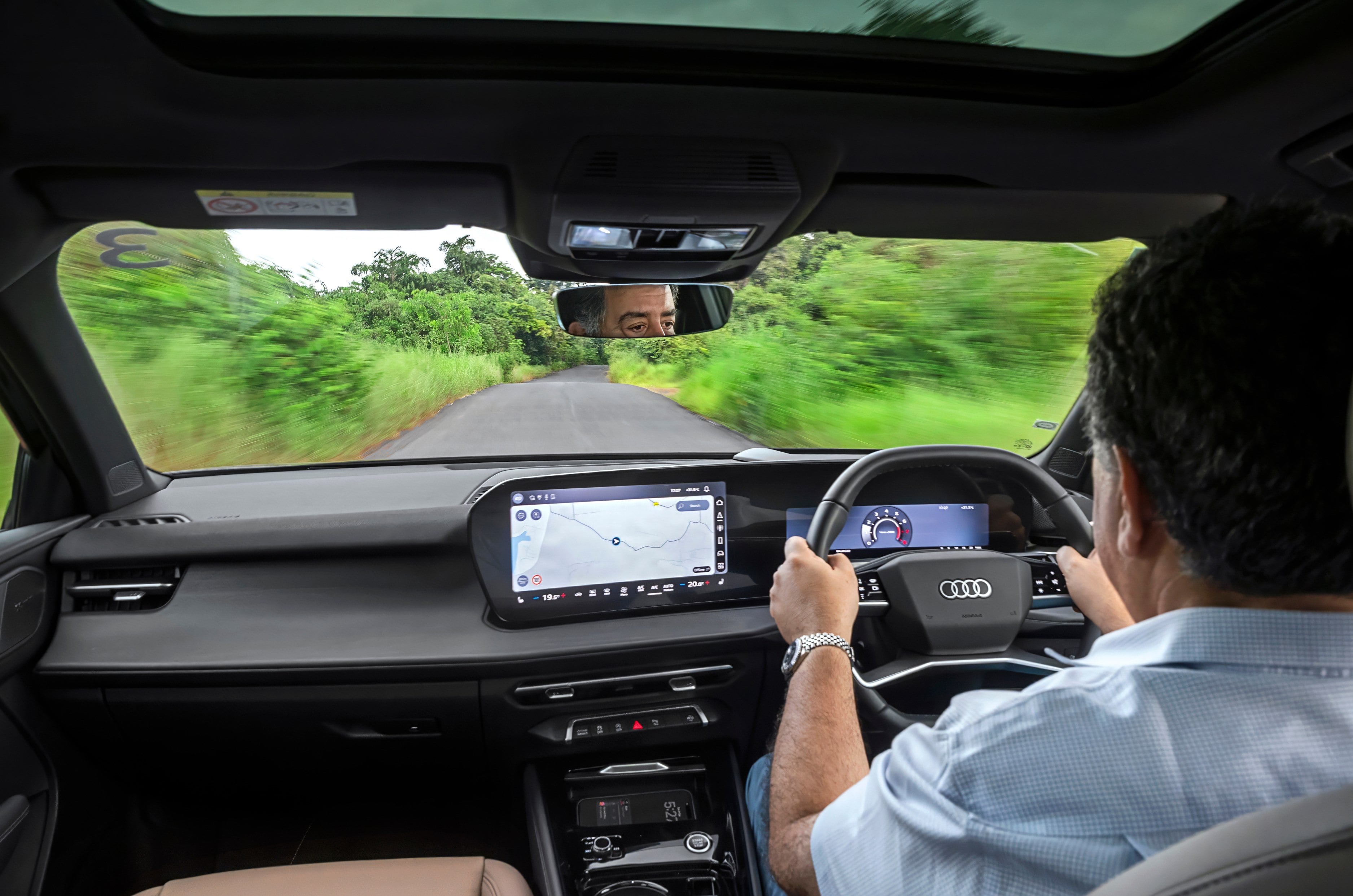
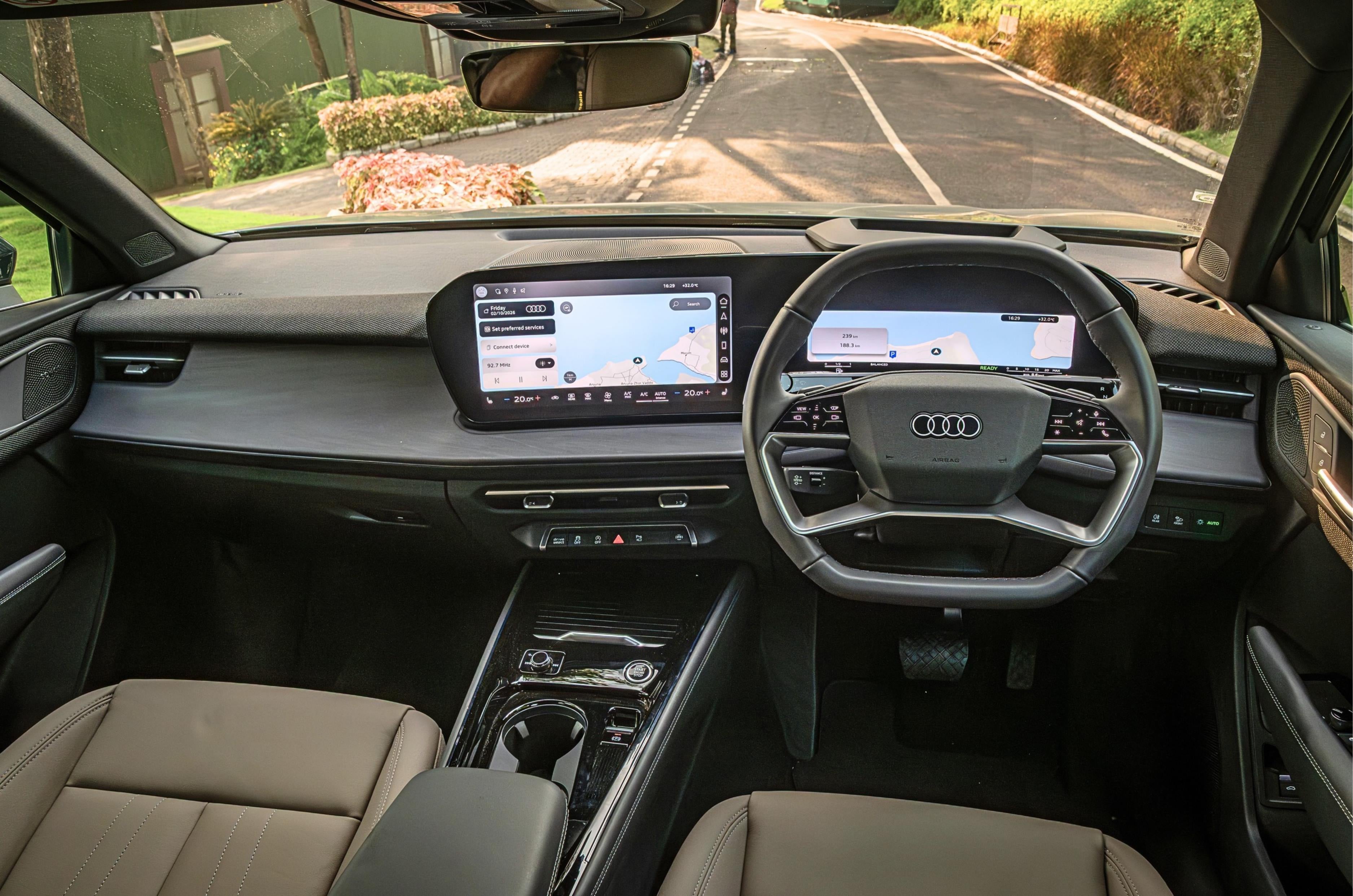
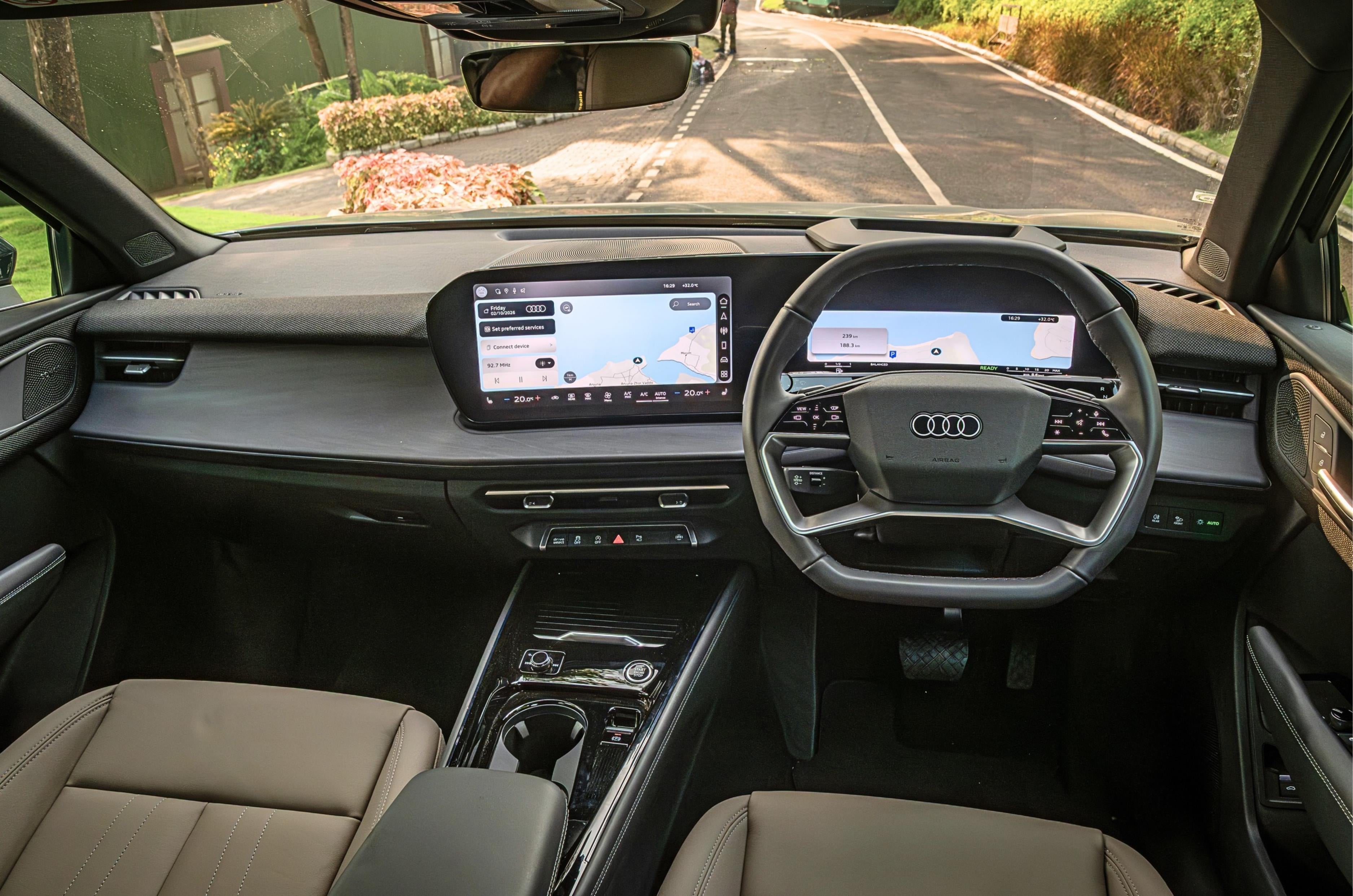
Among the most noticeable leaps of the new Q3 over the outgoing model is on the inside. The dashboard sports a cleaner and more modern layout, housing an 12.8-inch infotainment touchscreen and 11.9-inch digital driver’s display. Much of the leather in the cabin has been ditched in favour of fabric, and plastic quality isn’t that great in the lower regions, but even so, the Q3’s interior feels well put-together and more robust than those of its rivals.
Cons
Lack of powertrain options
The Q3’s turbo-petrol engine is undoubtedly lovely, but that’s about it as far as powertrain options go. There will be no diesel, hybrid, or electric versions of the India-spec Q3, at least at launch. This puts the Audi SUV at a disadvantage, since the GLA and X1 can be had with diesel engines – the BMW is available as a long-wheelbase EV too (iX1 LWB). Offering Quattro as standard may also drive up the price of the new Q3, which could dissuade buyers who prefer a lower price tag over all-wheel drive.
Some features still missing
While the Q3 has a decent list of equipment, including a 12-speaker Sonos sound system, a panoramic sunroof, powered and heated front seats, dual-zone climate control, adaptive cruise control, auto-park assist, and more, there are still some features that Audi missed out on.
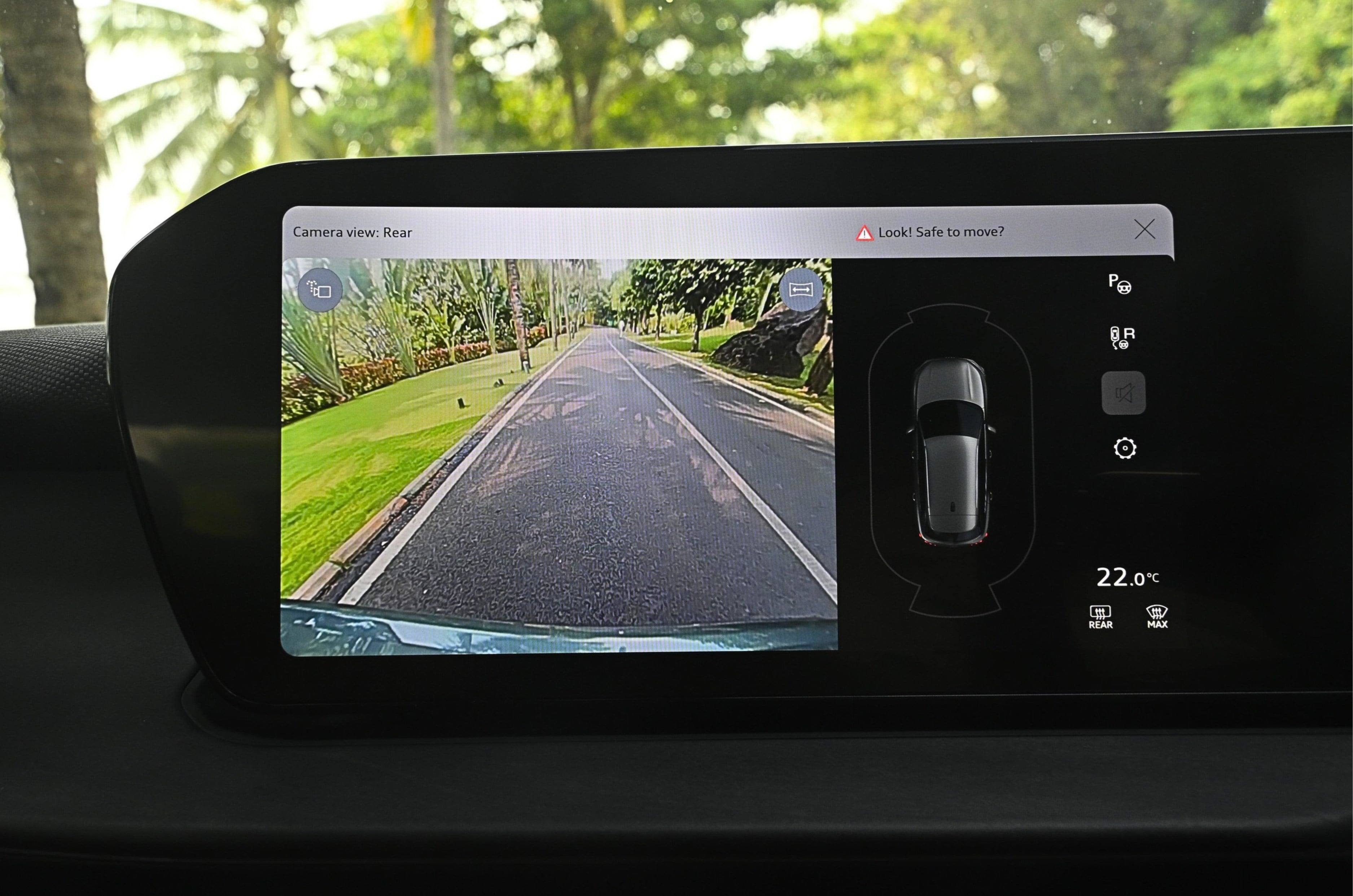
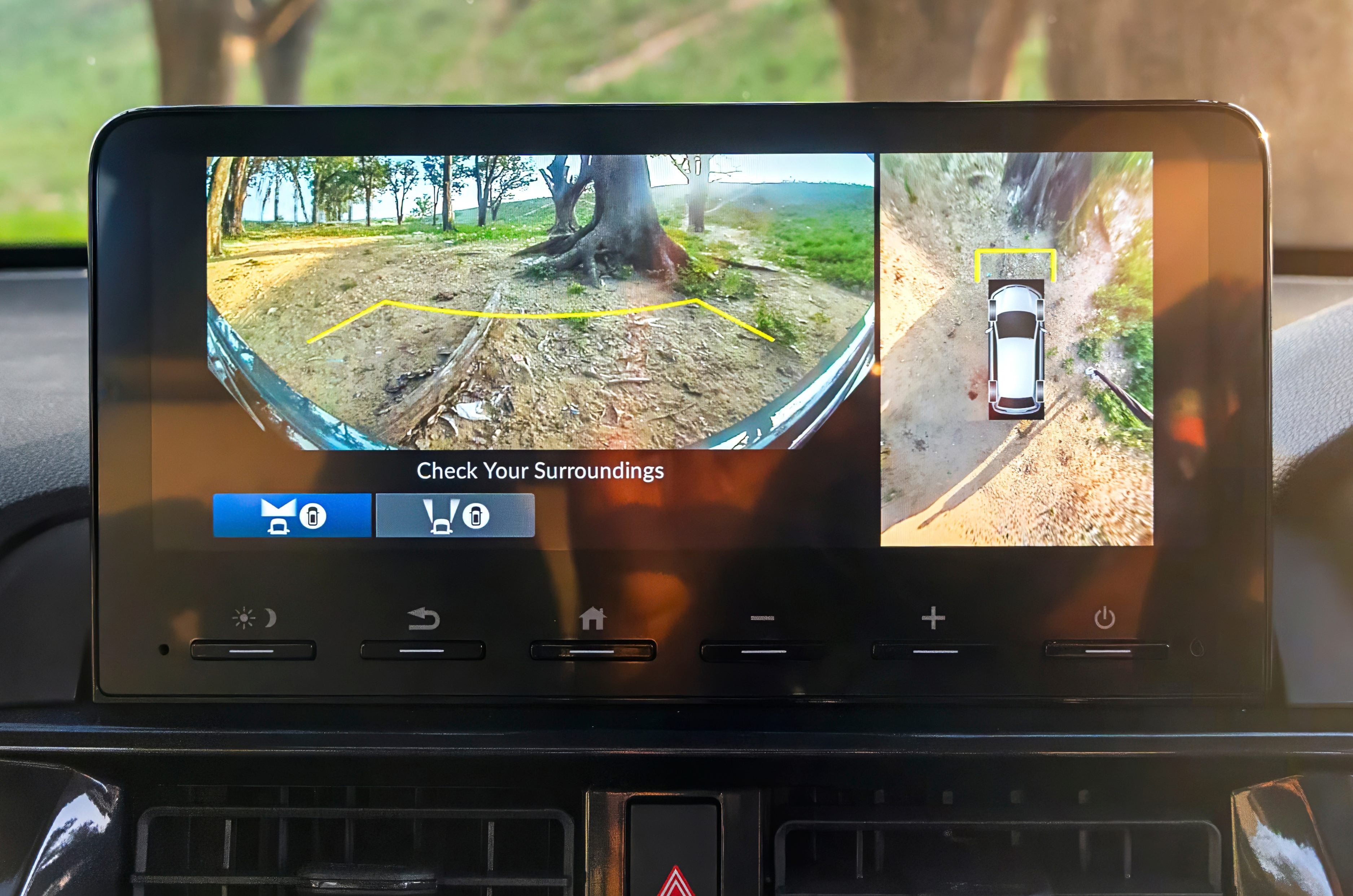
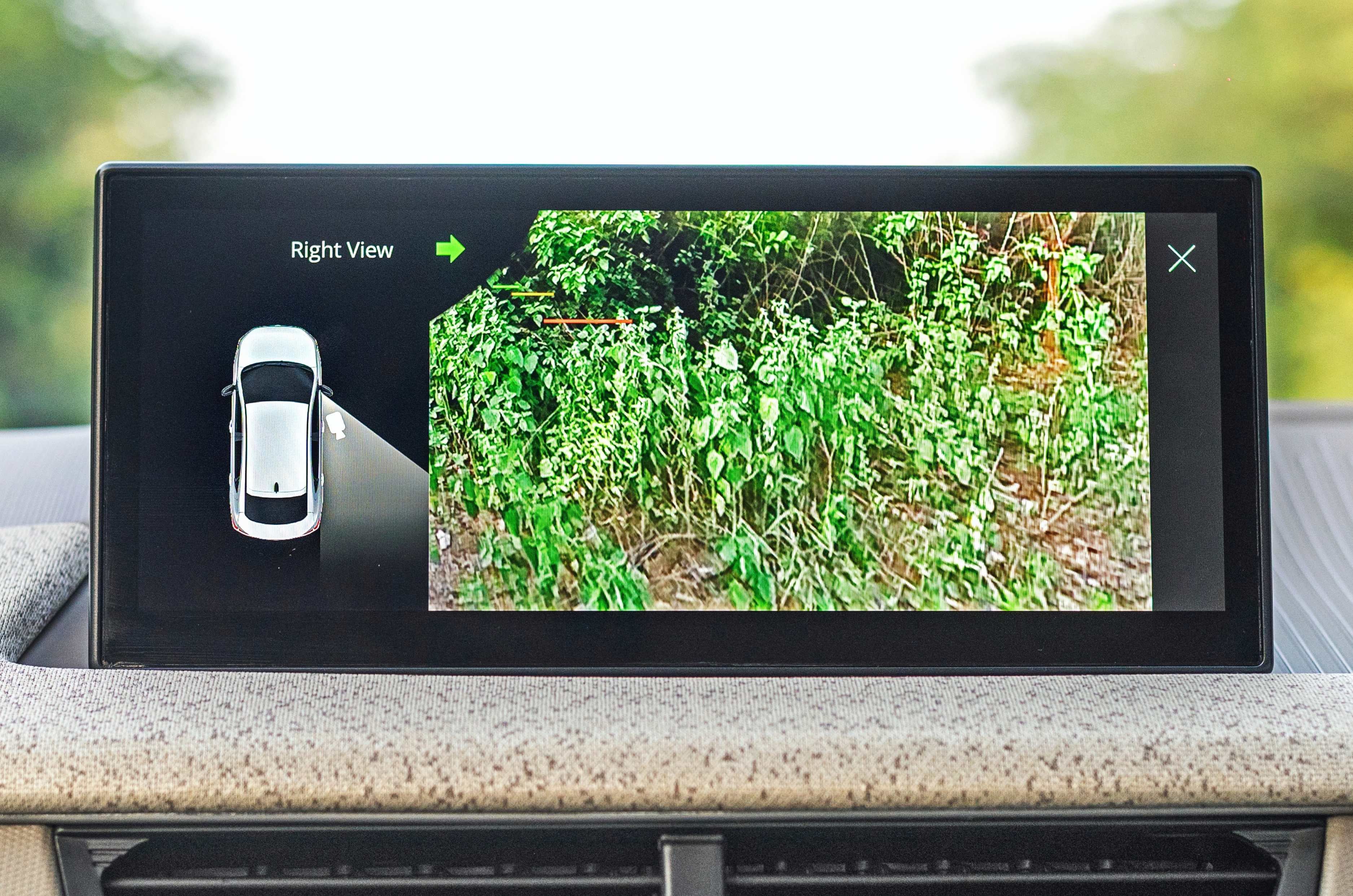
Chief among them is seat ventilation, which makes much more sense than heated seats in our climate conditions. Another big miss is a 360-degree camera, as it greatly helps with maneuovring and parking in tight spaces. The included rear camera’s resolution (pictured above) is disappointing too. Lastly, there are no ADAS features aside from adaptive cruise control – lane-keep assist and blind-spot monitoring would’ve come in handy.
It would be easy to file the third-generation Q3 as just another new model but it isn’t. For Audi India, this is closer to a reset. The brand has spent the past few years soldiering on with ageing, outdated products and its showroom traffic has paid the price for this freeze in new products. But that’s all changed now. With fresh investment pouring in from its headquarters, Audi is on a new product offensive which has been kicked started with the Q3. This compact SUV is also the entry point into the brand, so it carries the burden of deliveringthe maximum sales. There’s a lot riding on the Q3’s gentle shoulders and Audi is hopeful that this will model will mark the turning point for the brand. But first, Audi has to convince customers. Is the new Q3 a quantum leap over the past Q3? We drove it in Goa to find out.
Audi Q3 Exterior Design and Engineering – 8/10
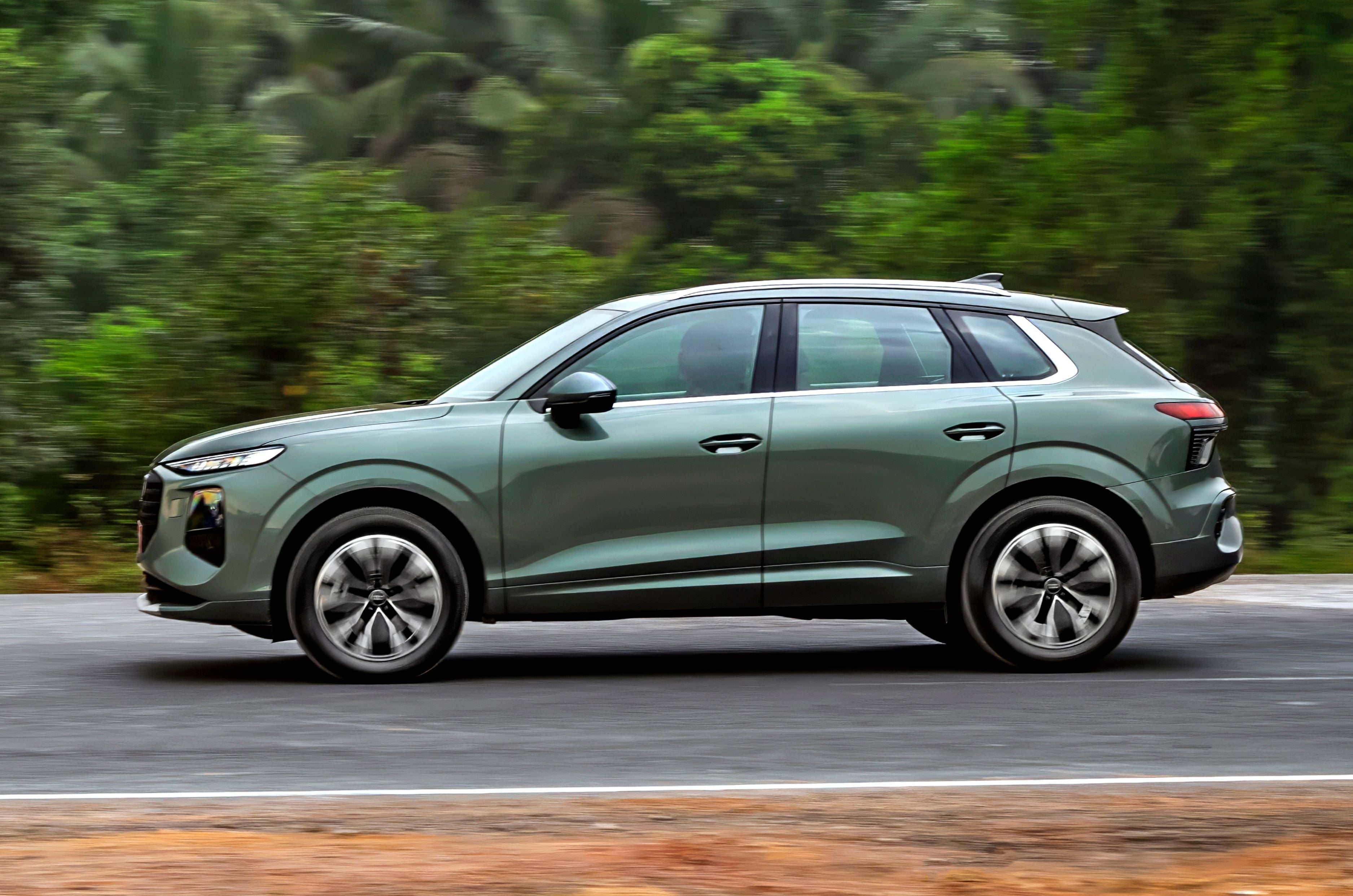
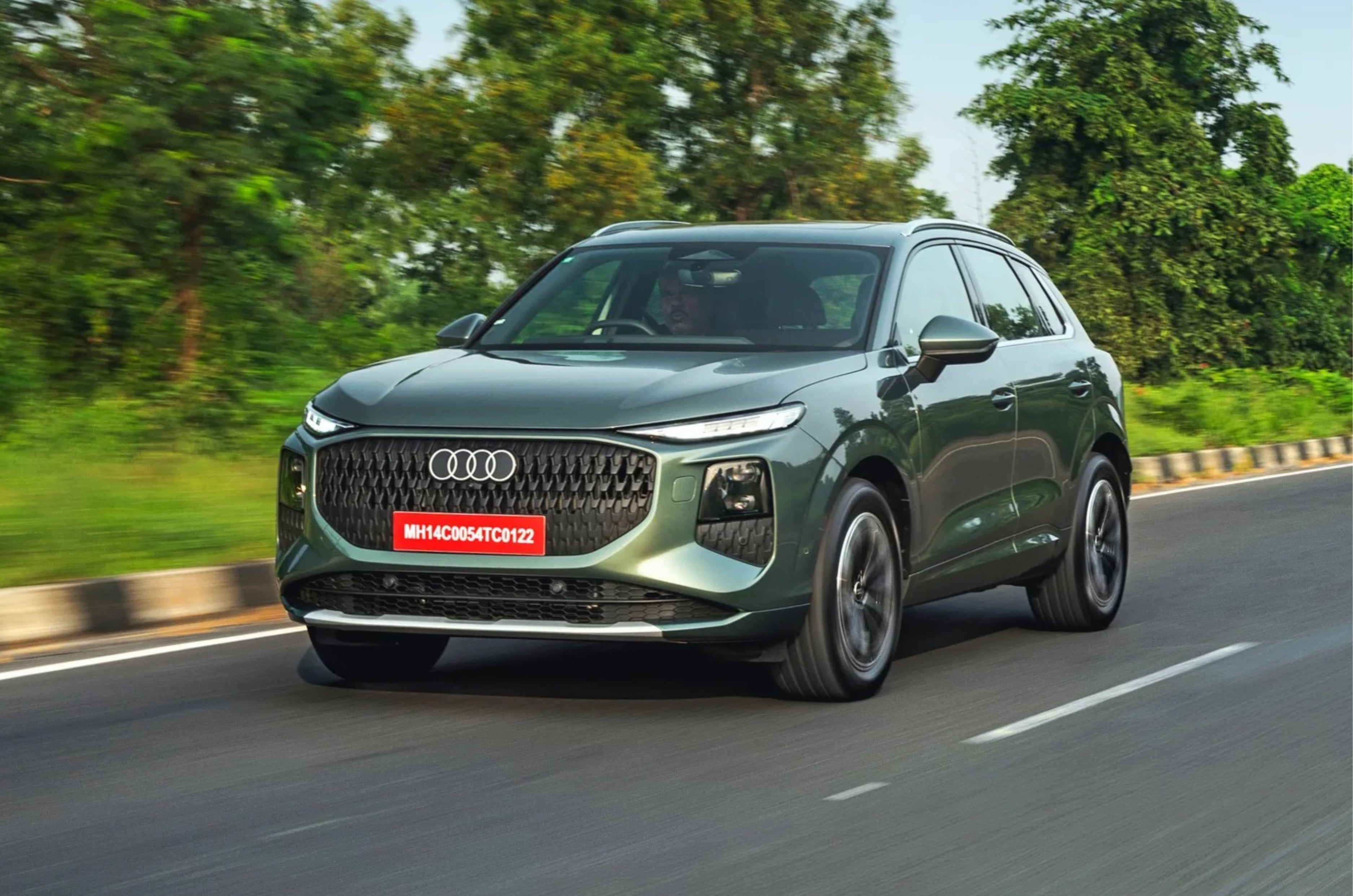
The crisp, edgy lines of the old car have made way for something more fluid and flamboyant. The new Q3 has grown marginally in every dimension, but the 2,681mm wheelbase is unchanged, so it keeps the compact footprint its urban buyers like.
A fluid and flamboyant new design language replaces the edgy styling of the old car
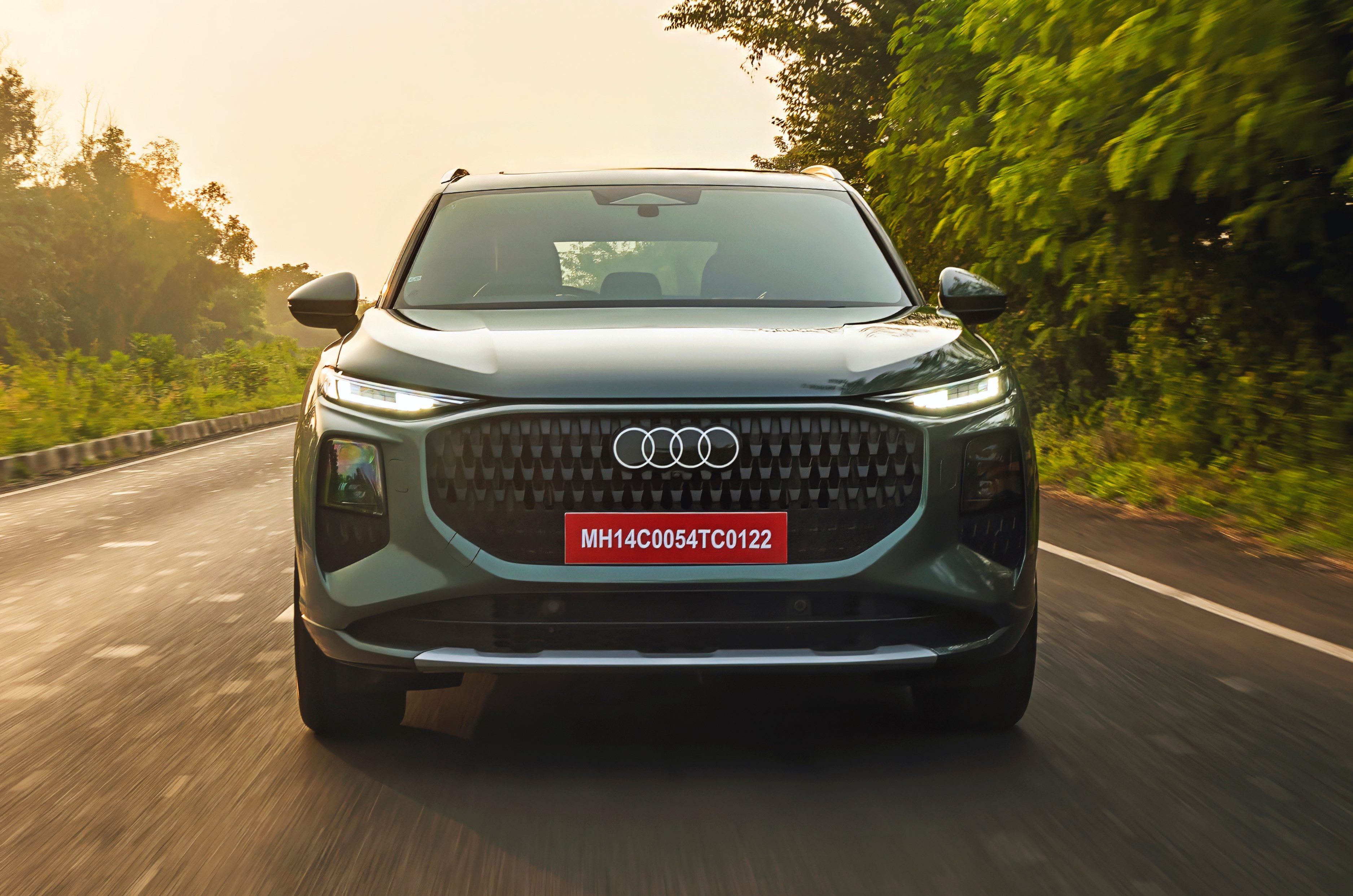
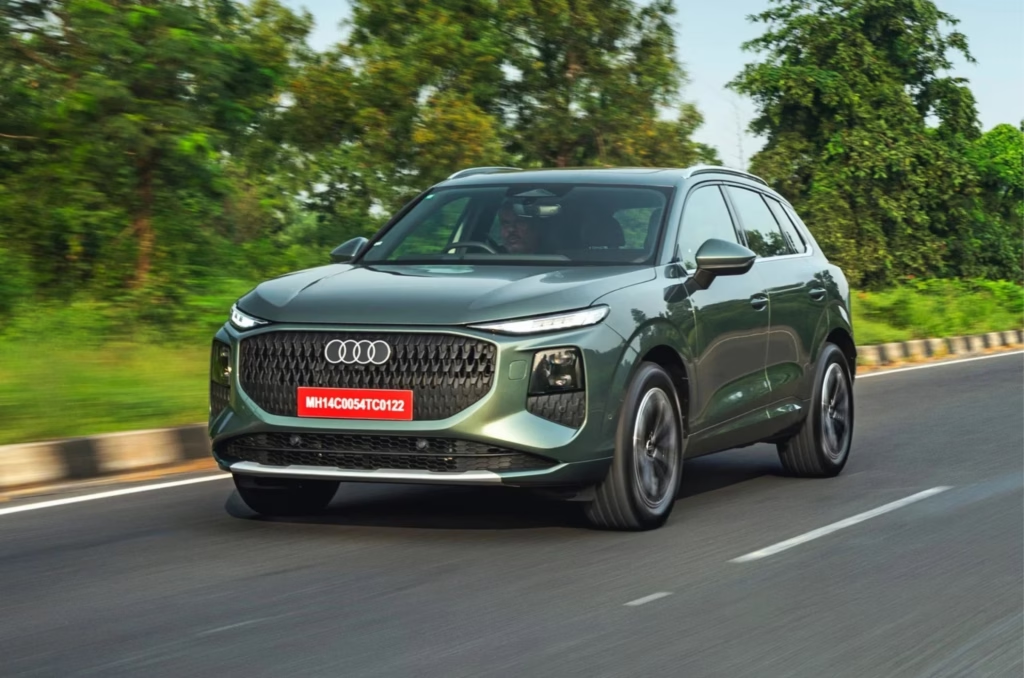
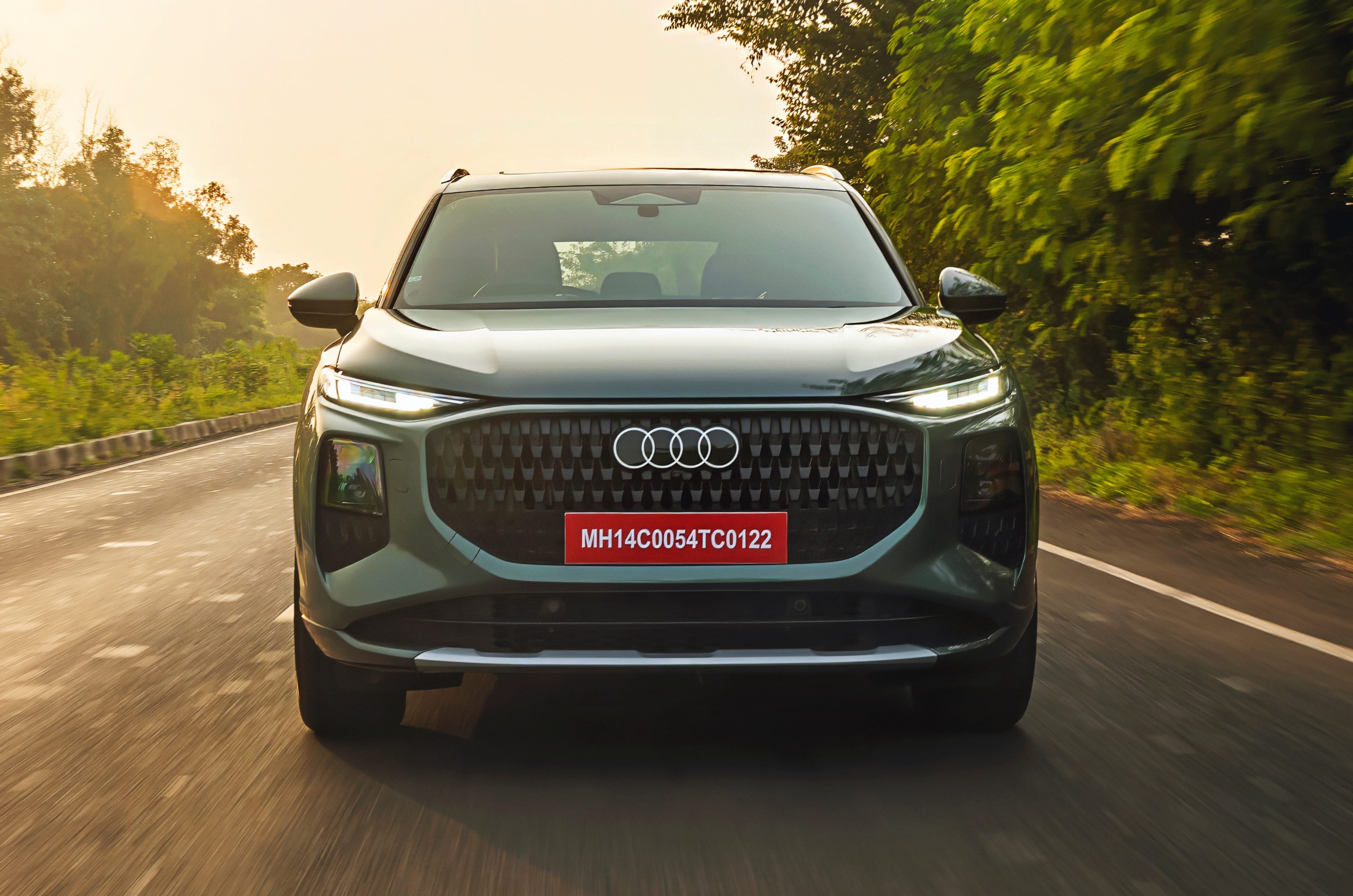
The face is split in two. Slim LED daytime running lights sit up top and double as dynamic indicators, while the main headlamps are stacked below. The wide honeycomb grille certainly makes a statement, and its flat 2D logo hides the ADAS radar. Up close, though, the grille’s finish looks a touch plasticky for a car wearing four rings.
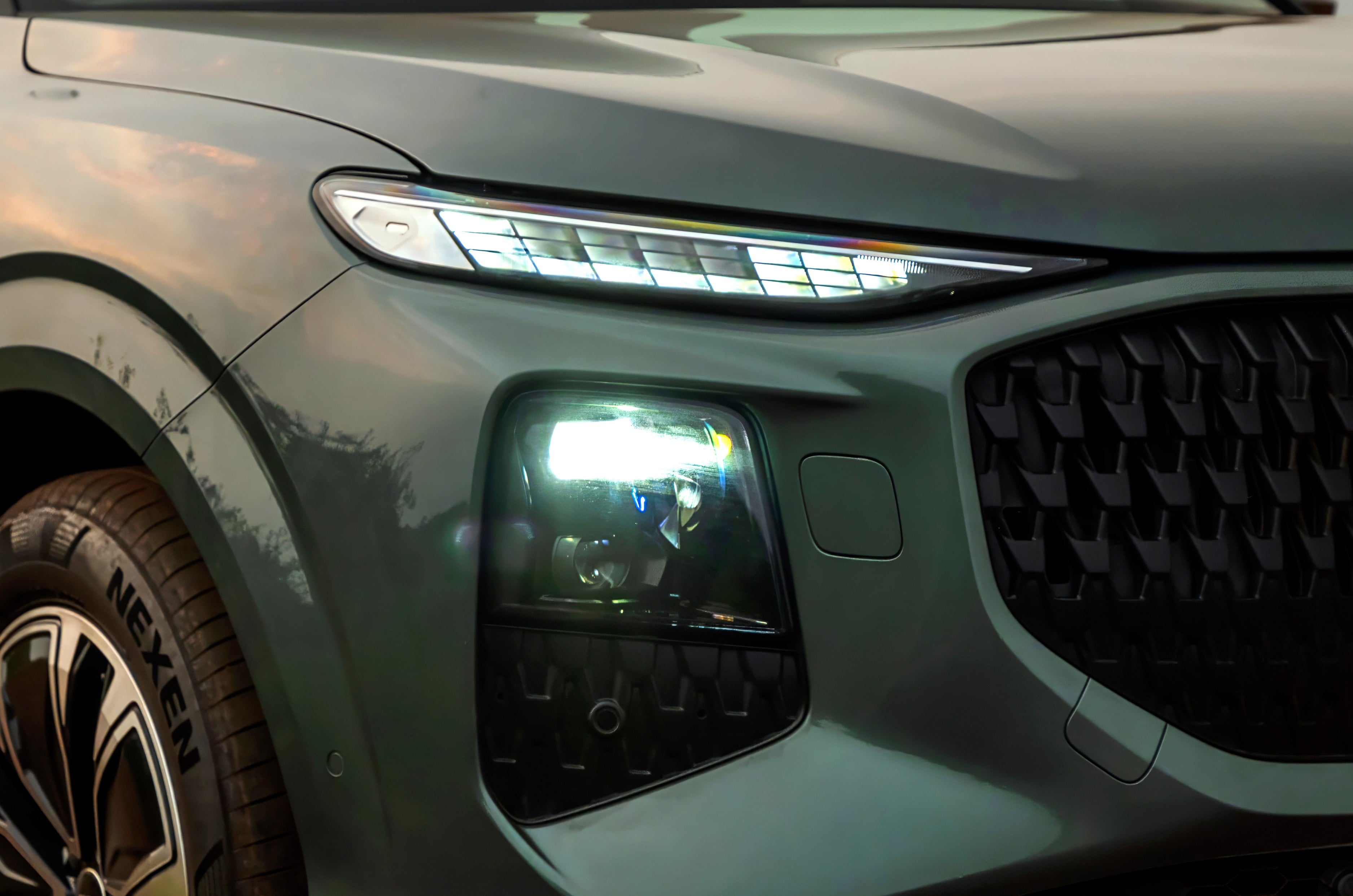
Lighting is the real party piece. The Digital Matrix LED units use micro-LED technology, with some 25,600 individually controlled pixels per headlamp. That lets them do far more than dip and glare-free high beam. They can project a carpet of light in your own lane, and when you flick the indicator, the beam stretches across to illuminate the lane you are moving into. It’s a clever way to flag your intent and place the car on dark, unlit roads. The DRLs also offer four selectable light signatures via the touchscreen. There is a caveat. The projection tricks are at their best on pitch-black roads; with streetlights around, the effect is largely lost.
Trick Digital Matrix LED headlights use 25,600 individually controlled pixels per side
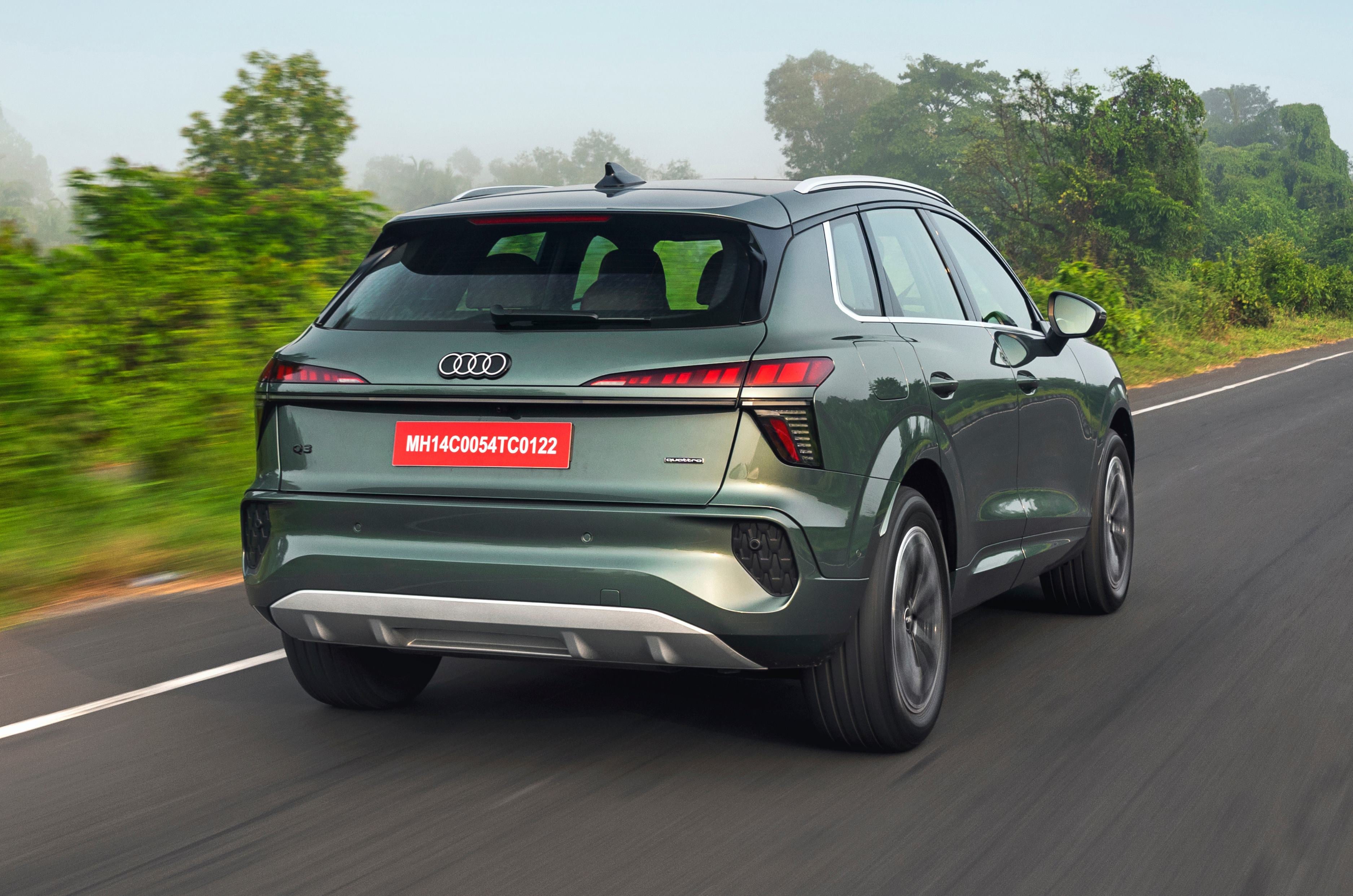
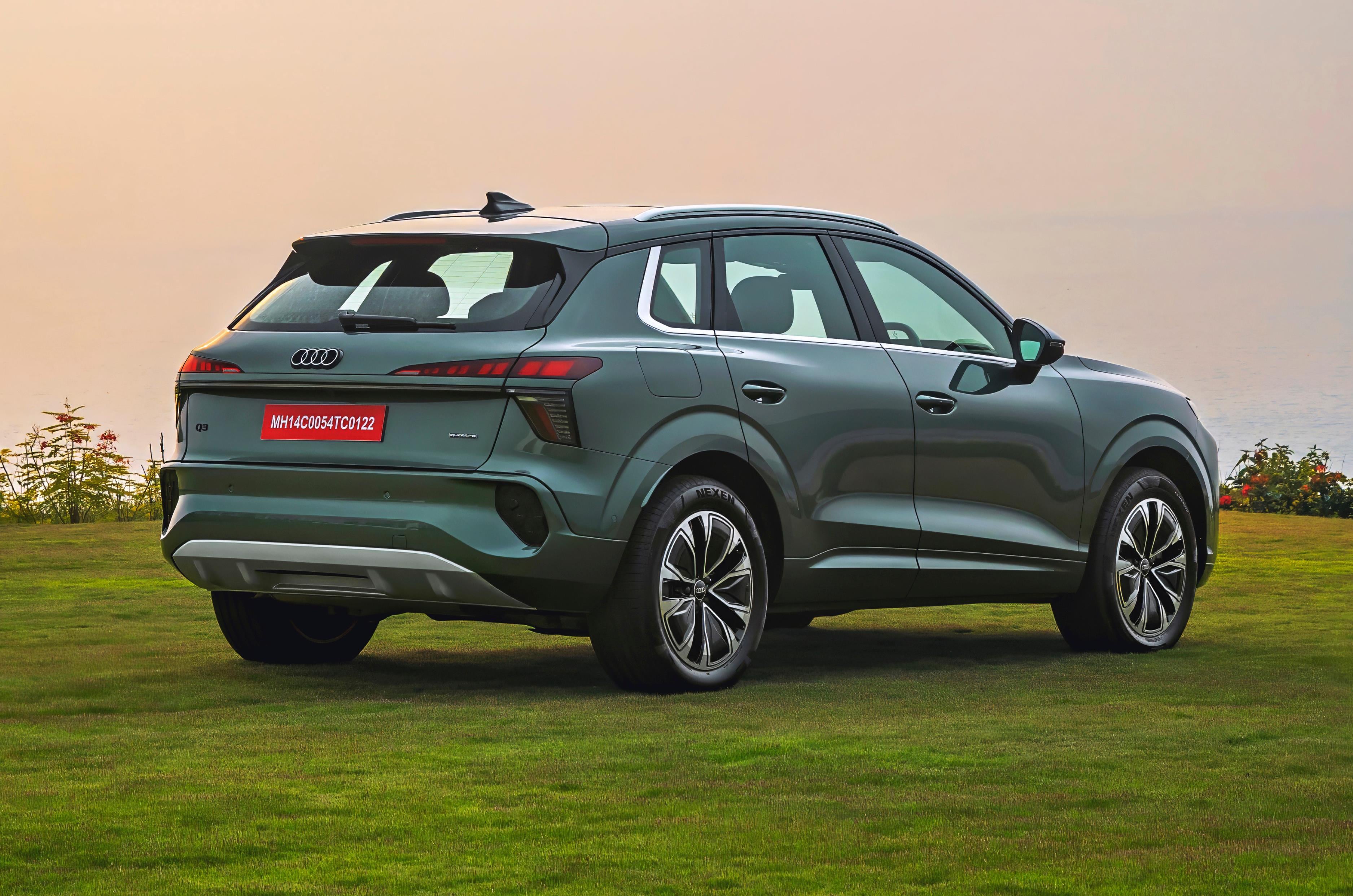
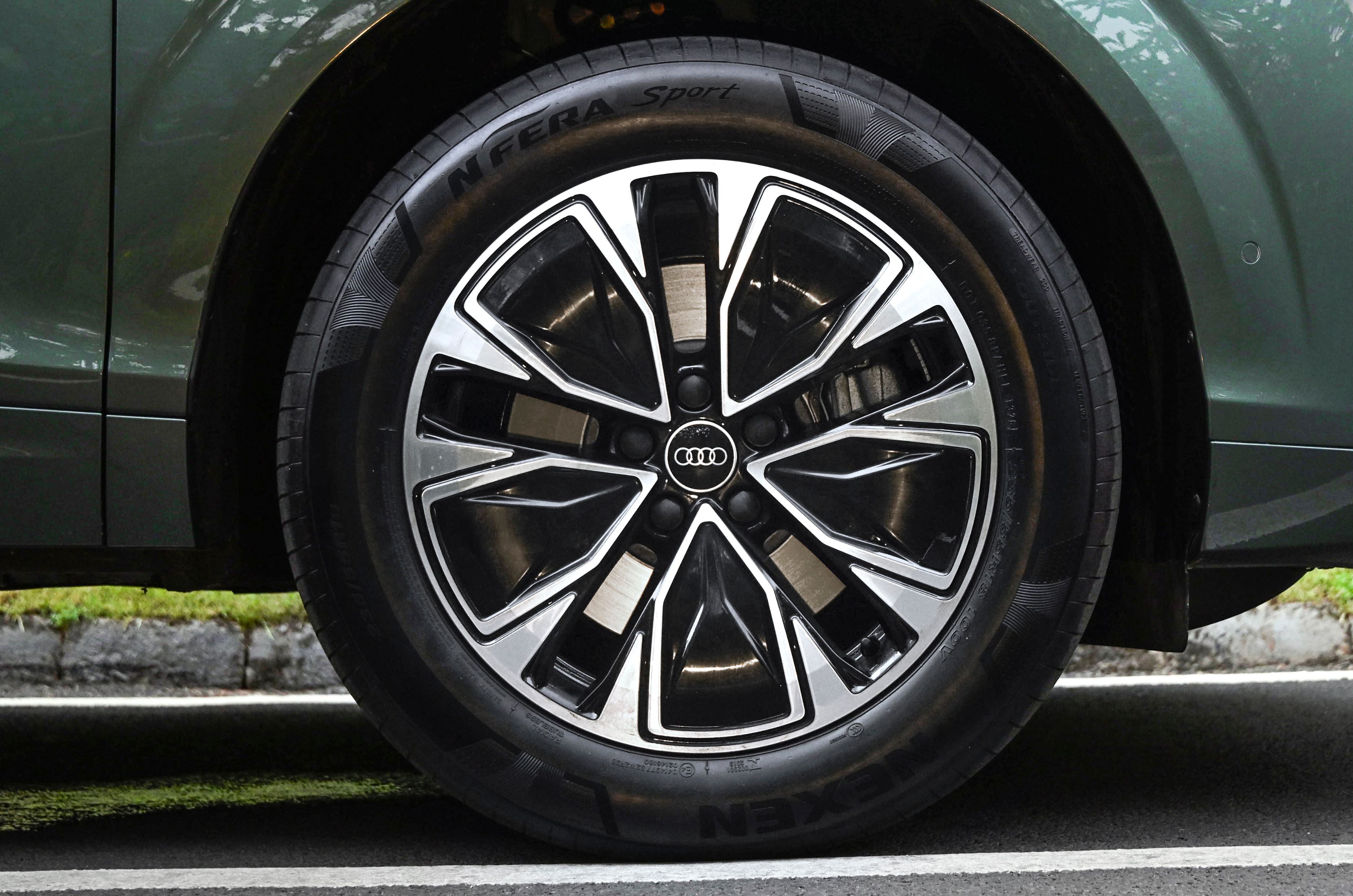
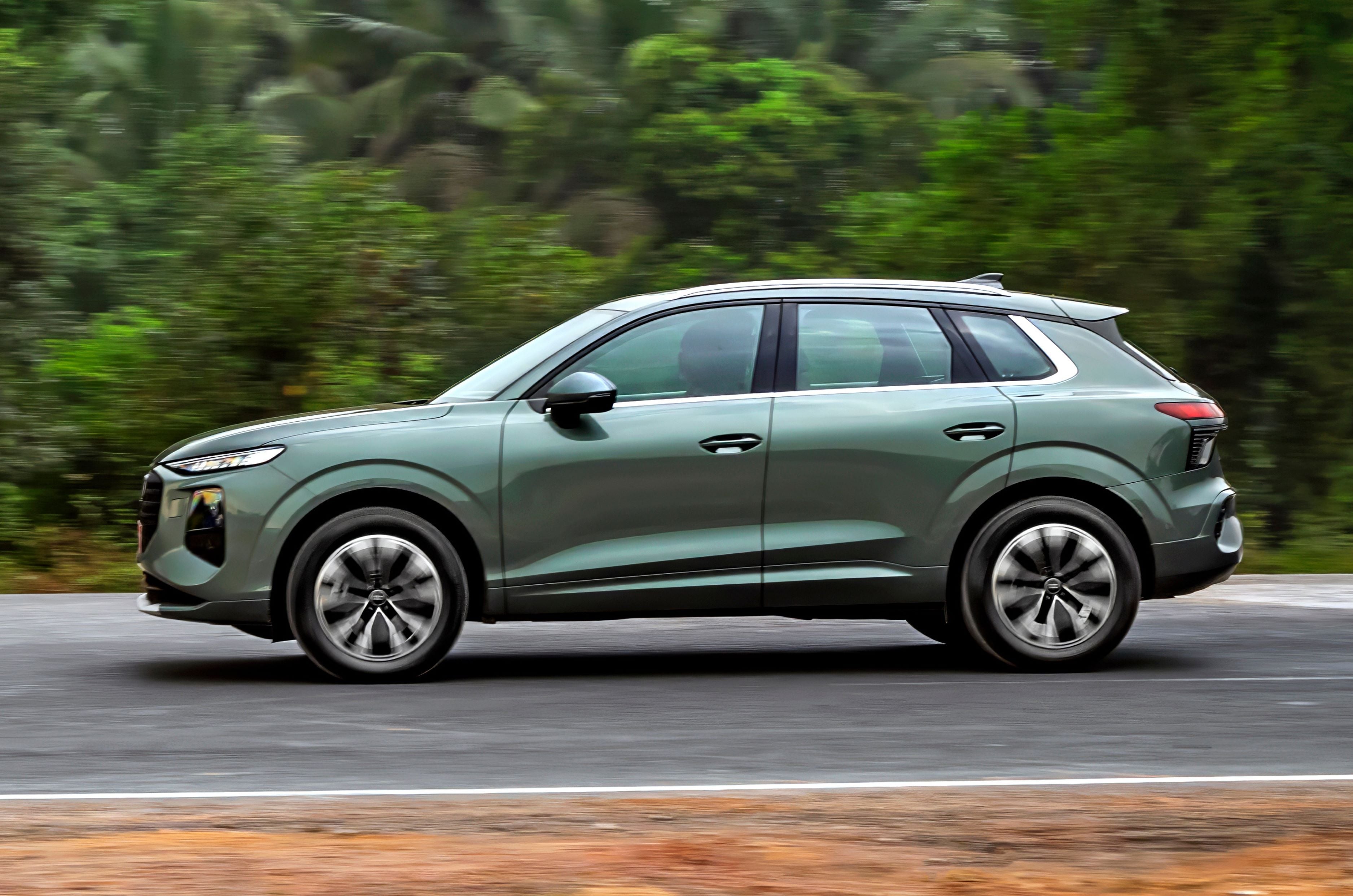
In profile, brushed aluminium below the windows and gloss black above create a floating-roof effect, and the rear haunches add a hint of muscle. For once, the wheels deserve a mention too. Audi has rarely nailed its alloy designs, but these are genuinely striking, wrapped in chunky, high-profile rubber. At the back, split LED tail-lamps are joined by a slim light bar and an illuminated Audi logo, and the tailgate is powered.
Stunning 18-inch alloys get self-leveling centre caps and are wrapped in high-profile tyres
Audi Q3 Interior Space and Comfort – 8/10
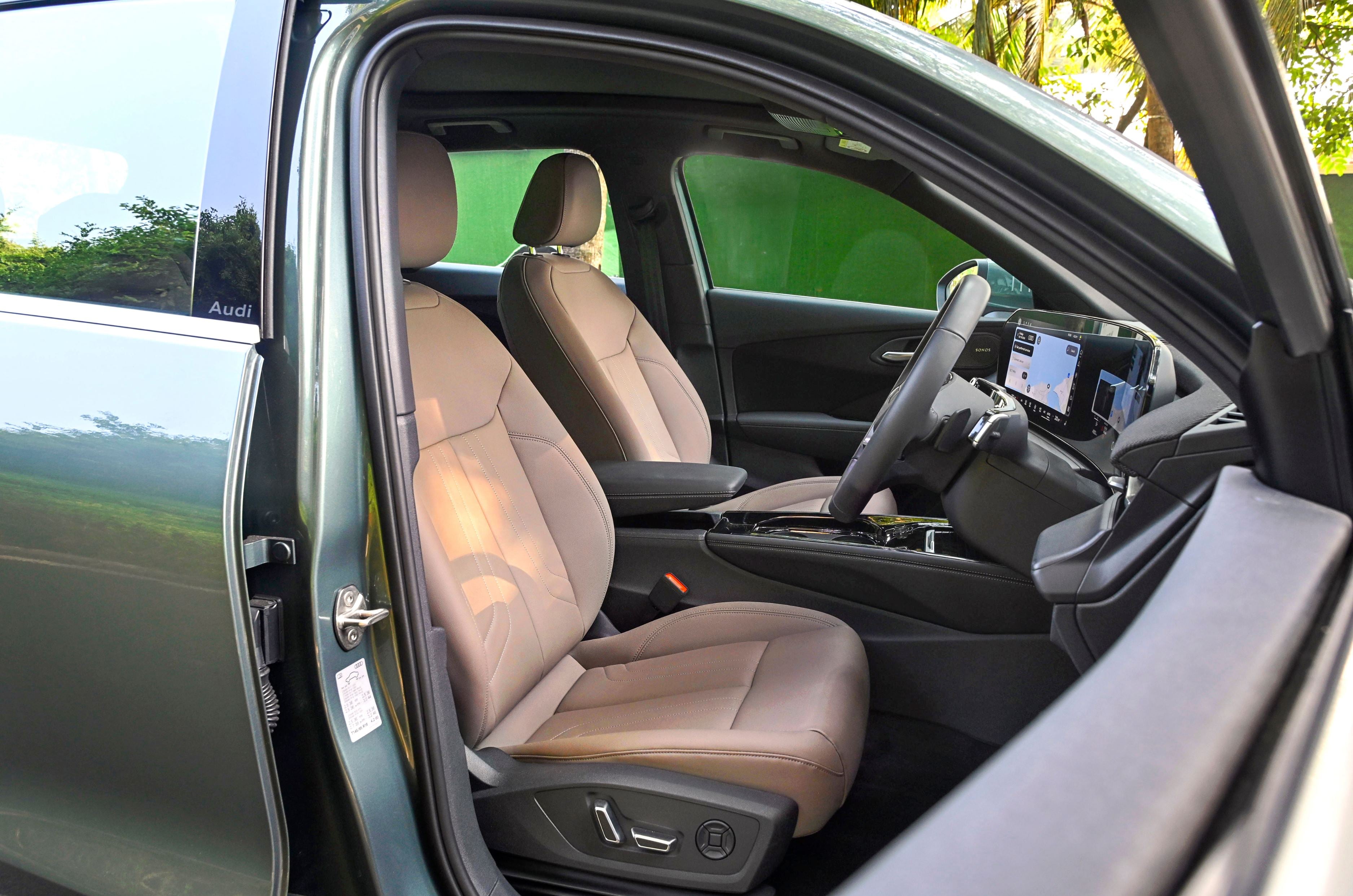
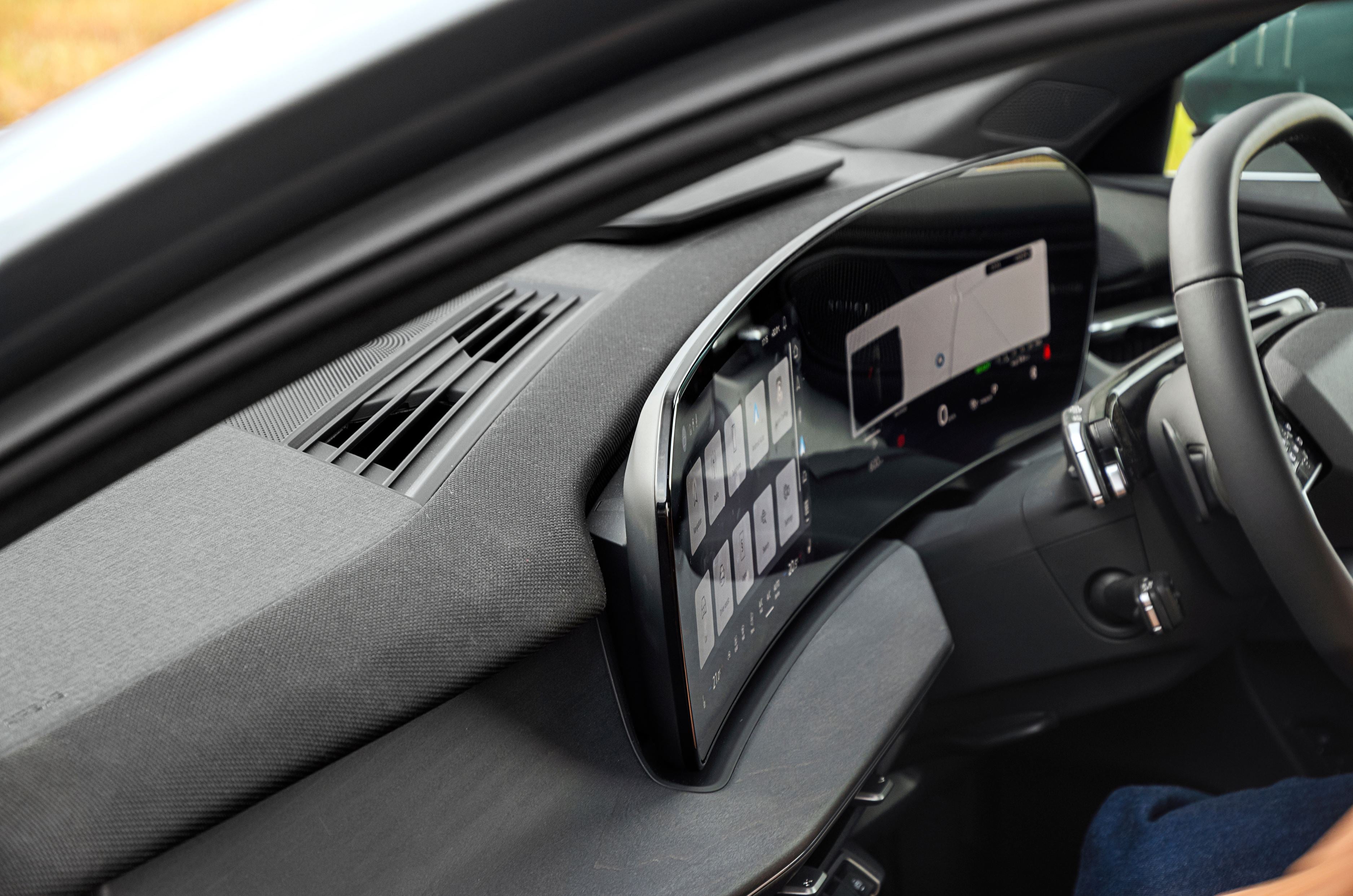
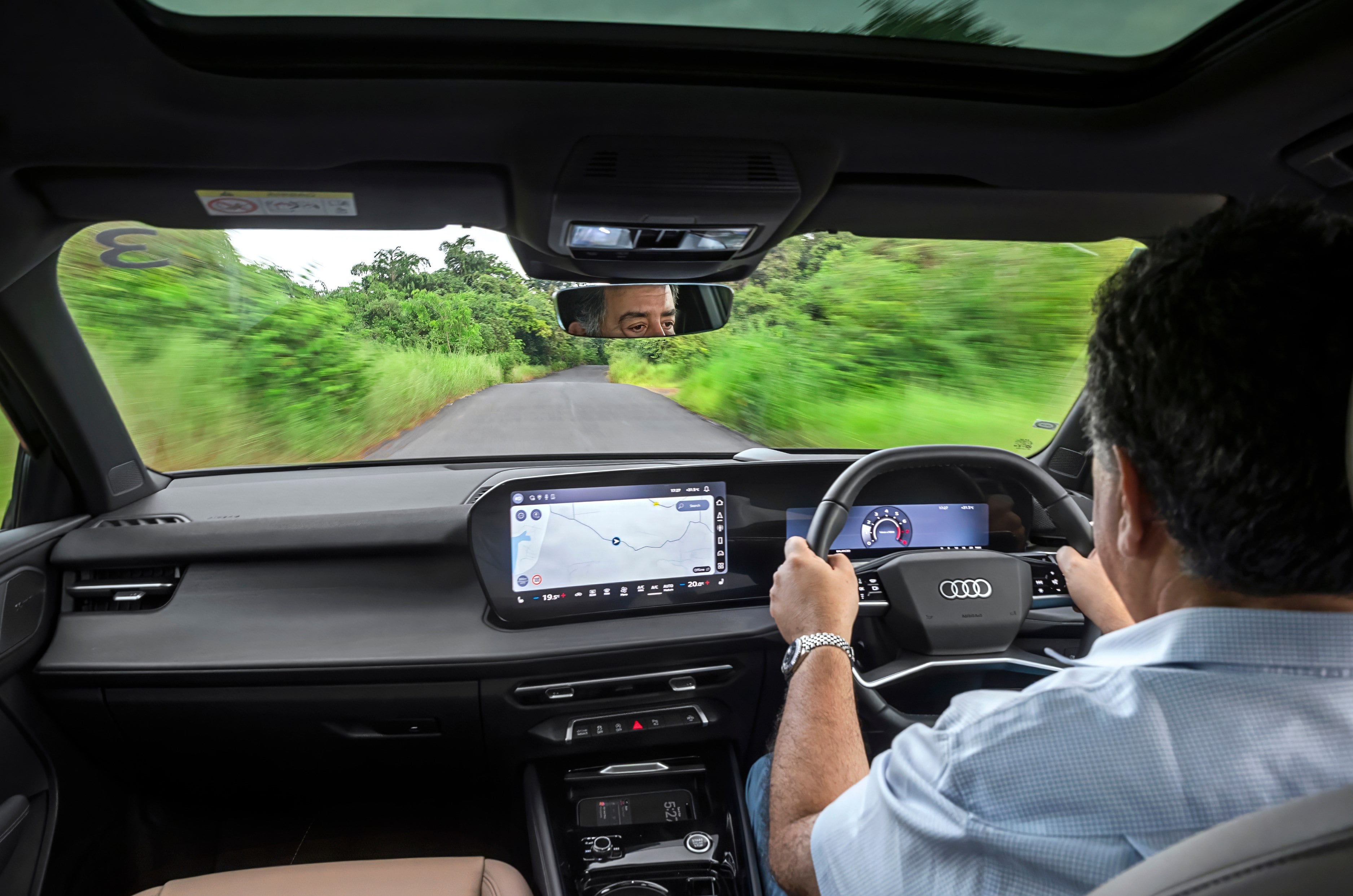
Step inside and the leap over the old Q3 is obvious. The dashboard is clean and contemporary, anchored by a curved panel that houses an 11.9-inch driver’s display and a 12.8-inch touchscreen. Fabric replaces leather across much of the cabin and the lower plastics are on the hard side. Yet the overall impression is of a cabin that’s solidly screwed together, and it feels more robust than its German rivals. Small details help: the fat tabs that adjust the air-con vents have a reassuringly substantial action.
New interior is a big leap over the last model and feels better built than its German rivals
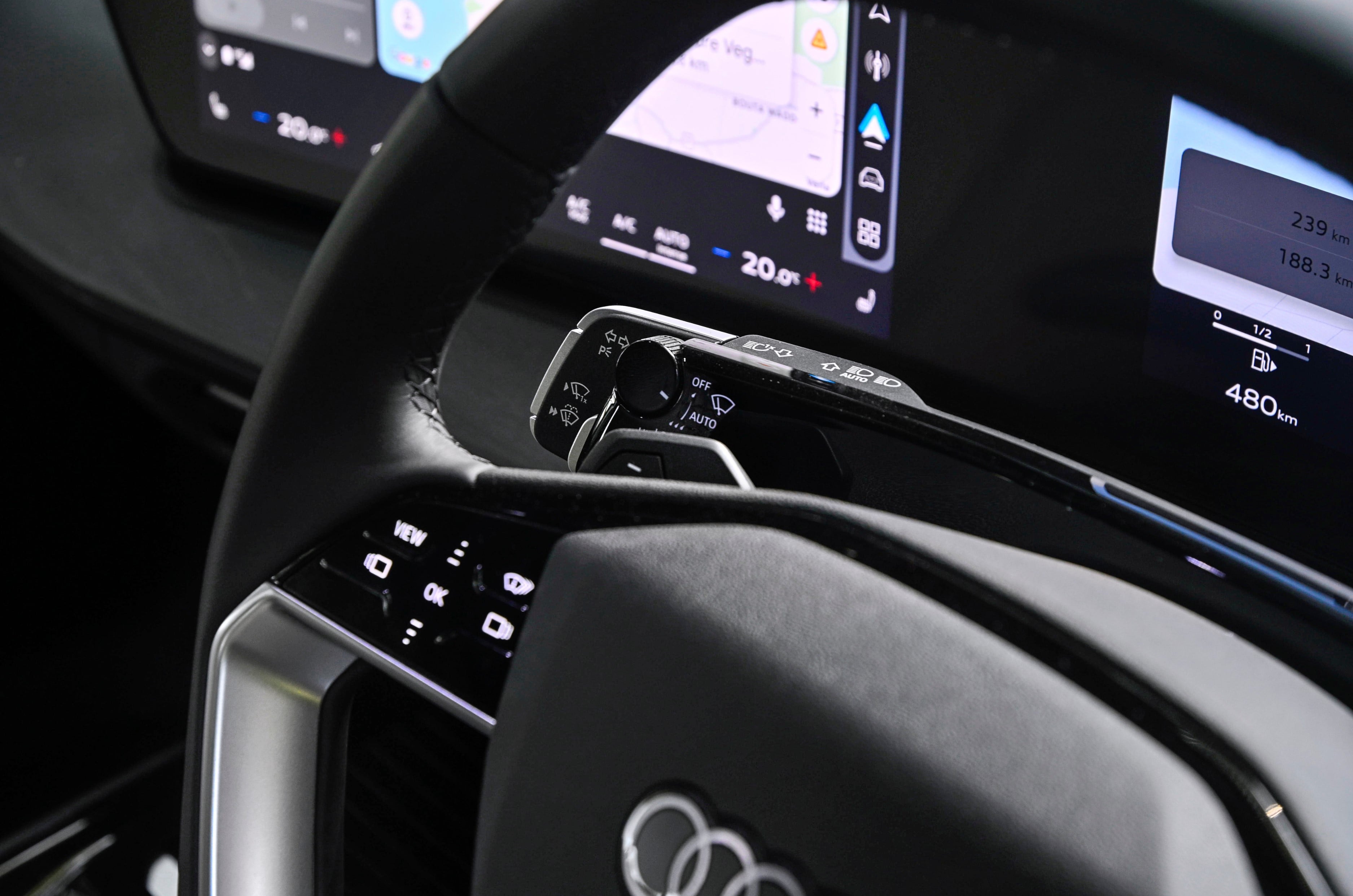
The hexagonal steering wheel takes some getting used to. So does the new control stalk, which Audi has loaded with an astonishing number of jobs: indicators, front and rear wipers and headlamp controls all live on one chunky lever. The gear selector moves to a stalk of its own on the other side. It feels awkward at first, but within a day it becomes second nature.
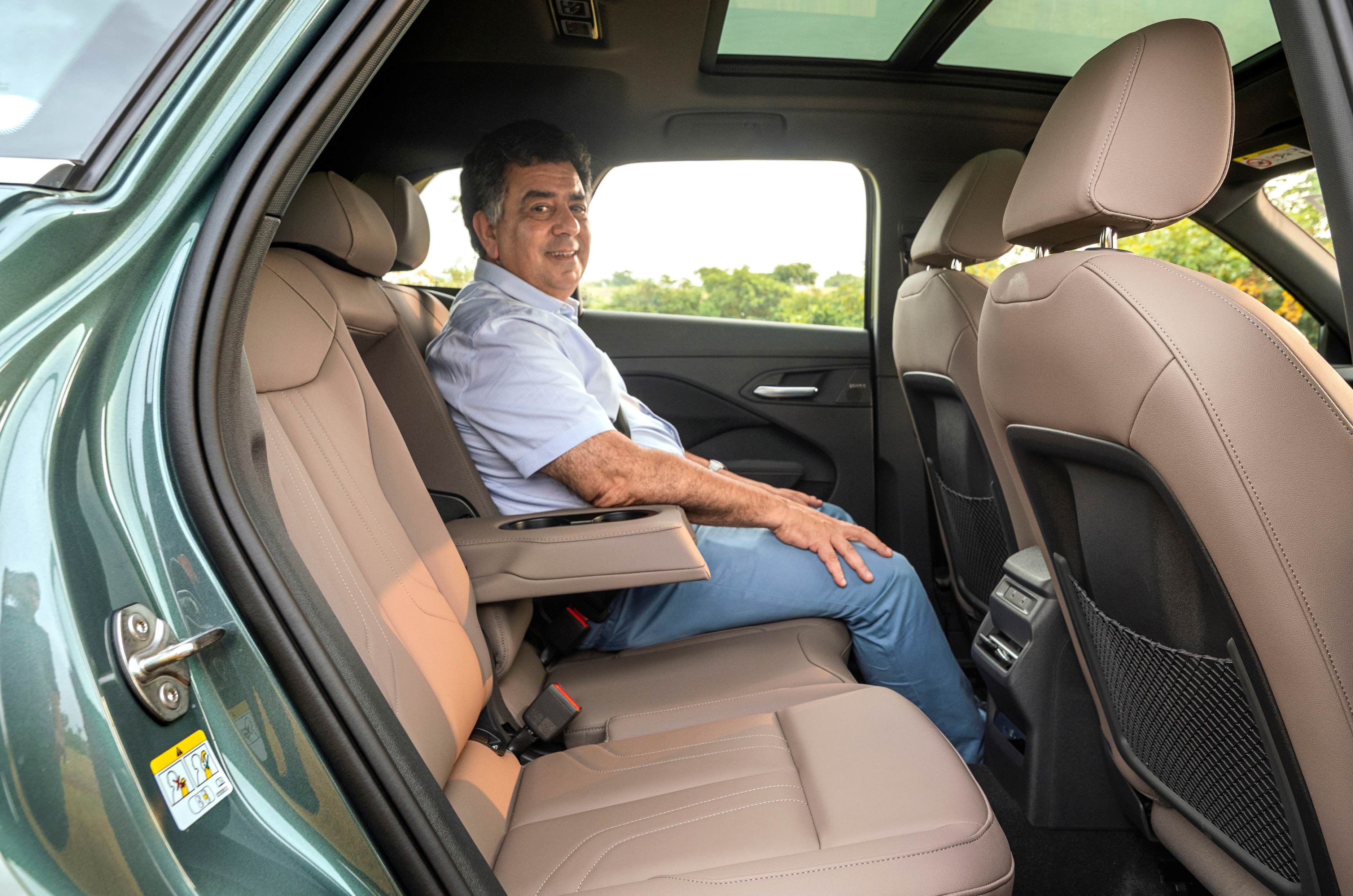
Two adults will be comfortable in the back seat, but a third will feel like a sqeeze
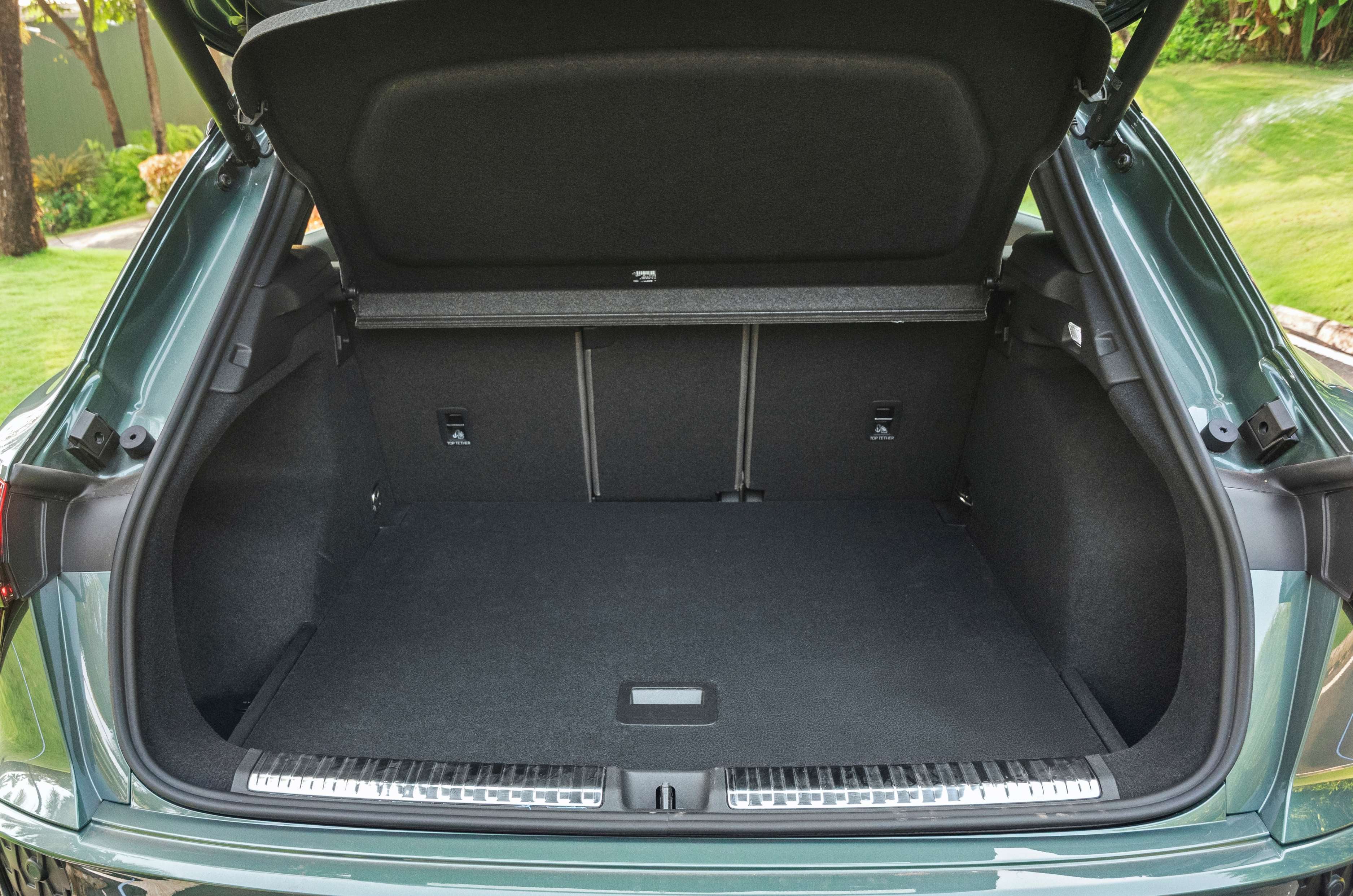
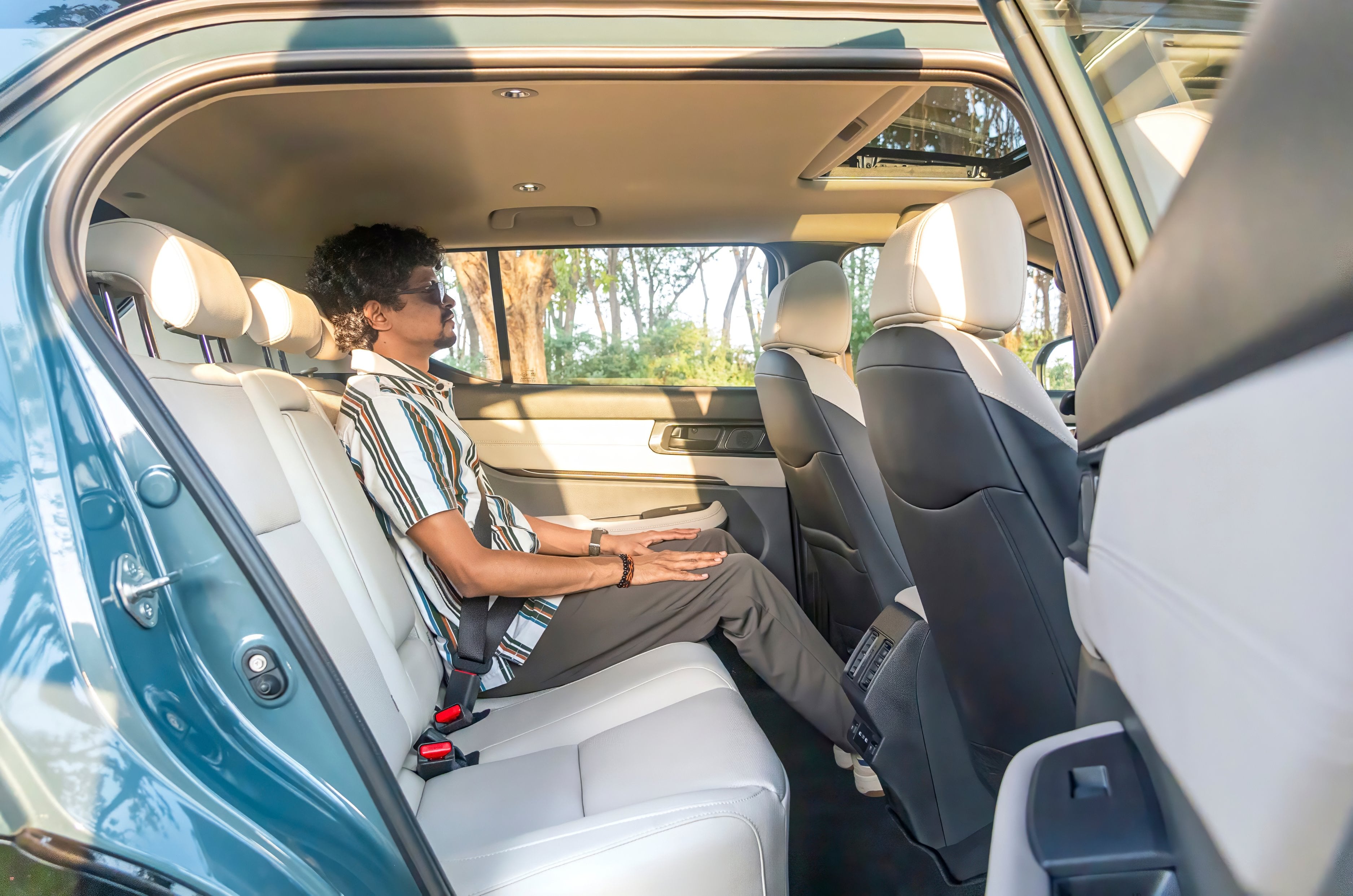
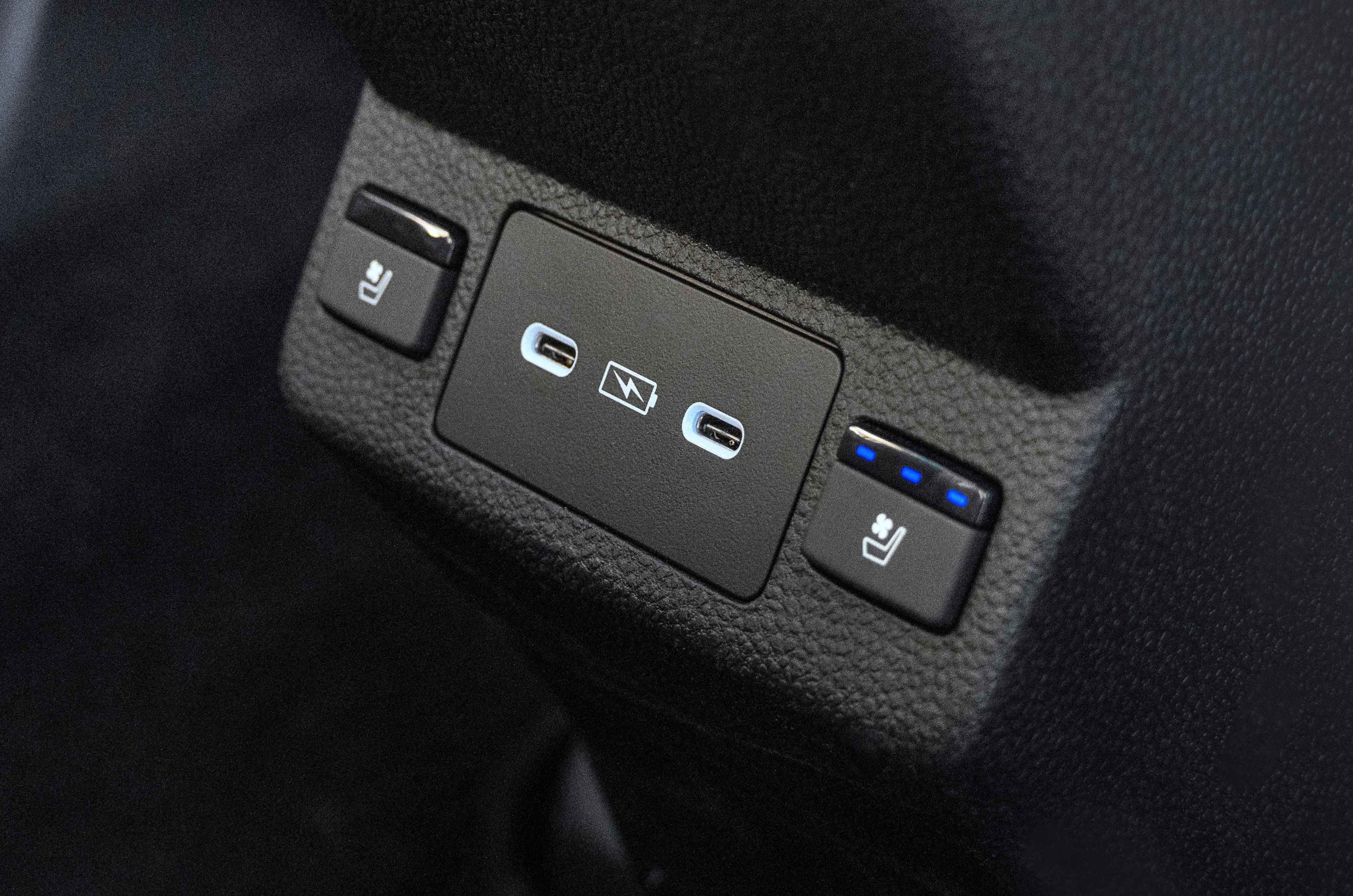
The front seats are generous, well bolstered and very comfortable over long stints. The rear hasn’t moved on much from the old car. Two large adults will be fine, but three is a squeeze; think of it as a four-seater with an occasional fifth. Rear passengers do get a third climate zone and two USB-C ports. The boot is spacious, and it’s good to find a space-saver spare under the floor.
Powered tailgate opens to a large 488-litre boot; seats split 40:20:40 for longer items
Audi Q3 Features and Safety – 7/10
The curved touchscreen works well, and the curvature itself cuts out glare and reflections. Response is smooth and quick, though the icons are, in typical Audi fashion, a bit subdued and not instantly distinguishable. Physical buttons are fewer, but the climate controls sit permanently at the base of the screen, so you never dig through menus to change the temperature or blower speed.A head-up display brings key information into your line of sight and the fonts are crisp and sharp.
Curved display cuts out glare and reflections
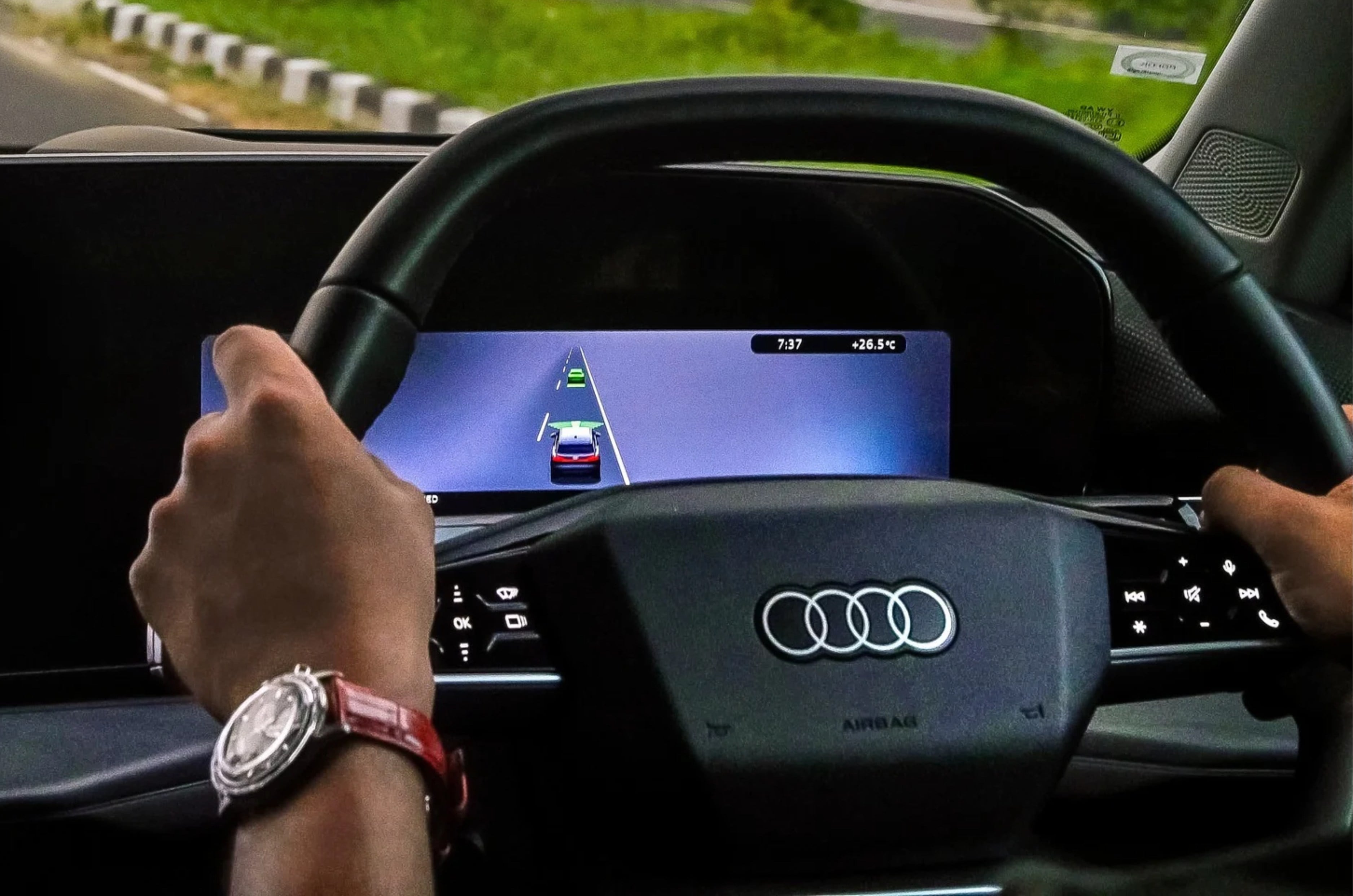
Audi’s own navigation is good, but integrated Google Maps, increasingly the benchmark, is expensive to licence and hence missing. The instrument cluster is surprisingly basic too, with little configurability and minimal choice of layouts and that’s a let-down from the brand that pioneered the virtual cockpit.
We also hit a software glitch with our iPhones. Wireless phone mirroring connected initially, then dropped out and refused to reconnect, prompting a switch to USB. It’s the sort of bug an over-the-air update should fix.
Lighting and wiper controls are odd at first but easy to get used to
The equipment list isn’t thin. There’s a superb-sounding 12-speaker Sonos system, a large panoramic sunroof, powered and heated front seats with driver memory, nine airbags and adaptive cruise control. That cruise works well, too. But for a car costing over Rs 50 lakh and launching in 2026, there gaps that are hard to overlook.
There is no lane-keep assist, so the ADAS suite stops at adaptive cruise. A full Level 2+ package is now table stakes in this class, all the more so when far cheaper mass-market cars offer one. There are no ventilated seats either, near-essential in our climate. The biggest miss, though, is a 360-degree camera, something a great many buyers actively look for. The reversing camera’s resolution is disappointing, although there is an auto-park function.
ADAS kit limited to auto emergency braking and adaptive cruise control
None of this is unusual for its rivals. But as the newest kid on the block, the Q3 should have moved the game on, and here it hasn’t.
Audi Q3 Performance and Refinement – 9/10
The engine is the star of the show. Audi’s 2.0 TFSI makes 201bhp and 320Nm, and it is smooth, strong and refined. That alone hands the Q3 a massive edge over the underwhelming, smaller-capacity motors in the X1 and GLA.
Strong and refined 2.0 TFSI makes 204hp and 320Nm, enough for 0-100kph in 7.1 seconds
It isn’t flawless. At low revs there’s a brief hesitation before it gathers itself and pulls smartly, which is why we left it in Dynamic mode most of the time. Once on the boil, though, it is eager and free-revving, a reminder of why this is the best 2-litre turbo-petrol in the business. Around town it feels responsive; on the highway it builds pace effortlessly. Audi claims 0-100kph in 7.1sec, which puts the Q3 at the top of its class.
The 7-speed dual-clutch remains a fine partner, eager to drop a gear to keep the engine in its powerband. Flick it into Sport or reach for the paddles if you want to take charge. Quattro all-wheel drive is now standard on every Q3, not an option, and there’s a range of drive modes including an off-road setting to make the most of it. It’s good insurance on slippery surfaces and gives the Q3 an edge over rivals when conditions turn tricky. Whether many owners need it, or more importantly will pay extra for it, is another question.
Strikes a great balance of ride and handling; gets Quattro all-wheel drive as standard
Audi Q3 Ride Comfort and Handling – 9/10
The big surprise is the handling. The variable-ratio steering adjusts its response to both speed and lock, so its light and effortless at parking speeds, then quicker and more direct as you wind on more lock. Barring a touch of slack around the straight-ahead, it is accurate and weights up superbly.
Quick steering often makes a car nervous at speed. Not here. The Q3 stays stable and reassuring when the needle climbs, yet changes direction with an agility you simply don’t expect from an Audi SUV.
New Progressive Steering is light at parking speeds, but gets sharper and more direct as speeds rise
What you do expect from an Audi is a good ride, and the Q3 delivers. It is on the firm side but never uncomfortable, soaking up potholes and broken patches with real composure. A big help is the 55-profile tyres. Their roughly 130mm sidewall is the first line of defence, absorbing much of the shock before it reaches the suspension and, ultimately, the cabin.
Audi Q3 Value for Money – 8/10
The new Q3 is a superbly engineered car, and its mechanical package sits well ahead of its rivals. The cabin is a big step up too, but given its timing, the Q3 doesn’t quite leapfrog the competition here; it lands a little short on equipment.
What it does do is drive brilliantly. It is by far the nicest car to drive in its class, and that matters, because Audi says 84 percent of Q3 owners drive themselves.
Easily the nicest car to drive in its class, but doesn’t leapfrog the competition in terms of features
A lot now rides on price. At around Rs 65 lakh on-road, it is steep. Not because the car isn’t worth it, but because buyers may balk at paying so much more than the outgoing Q3, whose transaction price had slipped to around Rs 40 lakh.
On the product front, though, Audi has come back with a bang. A brilliant powertrain, a superb blend of ride and handling and a genuinely classy feel make the Q3 the enthusiast’s pick of the class. If this is the opening act, Audi’s reset is off to a promising start.
Six months after our report on the development of the Mahindra XUV 3XO CNG first surfaced, a test mule has been spied on public roads. The spotting comes just days before the car’s official debut on October 15, 2026, giving us a first look some of its design details.
The exterior holds few tells to set it apart from the non-CNG variants
The test mule spotted was almost entirely undisguised, as seen in these spy images. However, they mainly show us the rear of the XUV 3XO CNG. A few design elements shared with the non-CNG variants of the XUV 3XO include the ‘XUV 3XO’ branding, roof rails, rear spoiler, connected tail-lamps, and the chunky black bumper with a silver skid plate and static reflectors. What’s new here, though, is the ‘CNG’ sticker on the rear windscreen.
Following the Elevate facelift, Honda’s next launch for India will be the all-new 0 Alpha electric SUV – the brand’s first all-electric vehicle for our market. Honda is expected to reveal the official name later this year and also perhaps showcase the production-spec model before it goes on sale by early 2027. Ahead of its launch, a heavily camouflaged prototype of 0 Alpha SUV has recently been spied testing on our roads.
India-built model planned for global markets, including Japan
To be manufactured at the Tapukara plant in Rajasthan
No technical details available as of yet
Honda 0 Alpha SUV spied: what to expect?
The Honda 0 Alpha was first preview by a concept about exactly a year ago at the Japan Mobility Show 2025. And looking at these camouflaged spy shots, the radical shape doesn’t seem to have changed at all. It looks nothing like any existing Honda, with the characteristic design element being the near-vertical rear end with a thick C-pillar area, almost reminiscent of an MPV. It gets a large rear windscreen that’ll likely be wrapped around by an LED light bar, while the lower section gets a protruding bumper and is expected to feature a diffuser like element.
Image Credit: Ferrarirules86 via X.
At the debut of the concept, Honda had said the design was already near production-ready, so much of the details, including the lighting signatures and the glass panels could be seen on the final model. The front ‘grille’ area is expected to sport an illuminated Honda logo and a charging port, framed on the side and above by the headlights.
A previous sighting of a camouflaged test mule has also given us a look at the interior of the upcoming electric SUV. The most prominent element in the cabin is a massive central infotainment touchscreen mounted atop the dashboard. To its right sits a much smaller digital driver’s display, ahead of which there’s a three-spoke flat-bottomed steering wheel with paddleshifters for regeneration. The 0 Alpha’s interior incorporates an array of buttons on the centre console, seemingly for functions such as climate control and ventilated seats.
Image Credit: pxrtth.gpt via Instagram
The Honda 0 Alpha SUV is expected to have a wheelbase of about 2700-2800mm, with the priority being maximising interior space. The upright rear tailgate also hints at good luggage space and interior room.
Honda 0 Alpha technical details
Technical details on the 0 Alpha are quite scarce at the moment, but the brand has previously confirmed that it will be offered with two battery pack options. Both will be LFP batteries, likely ranging in the size of 65kWh-75kWh units. At launch, the Honda 0 Alpha SUV is expected to use a single-motor, front-wheel-drive layout.
The upcoming electric SUV will be manufactured in India, with Honda’s Tapukara plant in Rajasthan expected to serve as the production base. It’s expected to go on sale by early 2027, with India and Japan among the initial markets. The 0 Alpha will rival electric midsize SUVs such as the Mahindra BE 6, MG ZS EV, Hyundai Creta Electric, Tata Sierra EV, Maruti Suzuki e Vitara and Toyota Urban Cruiser Ebella.
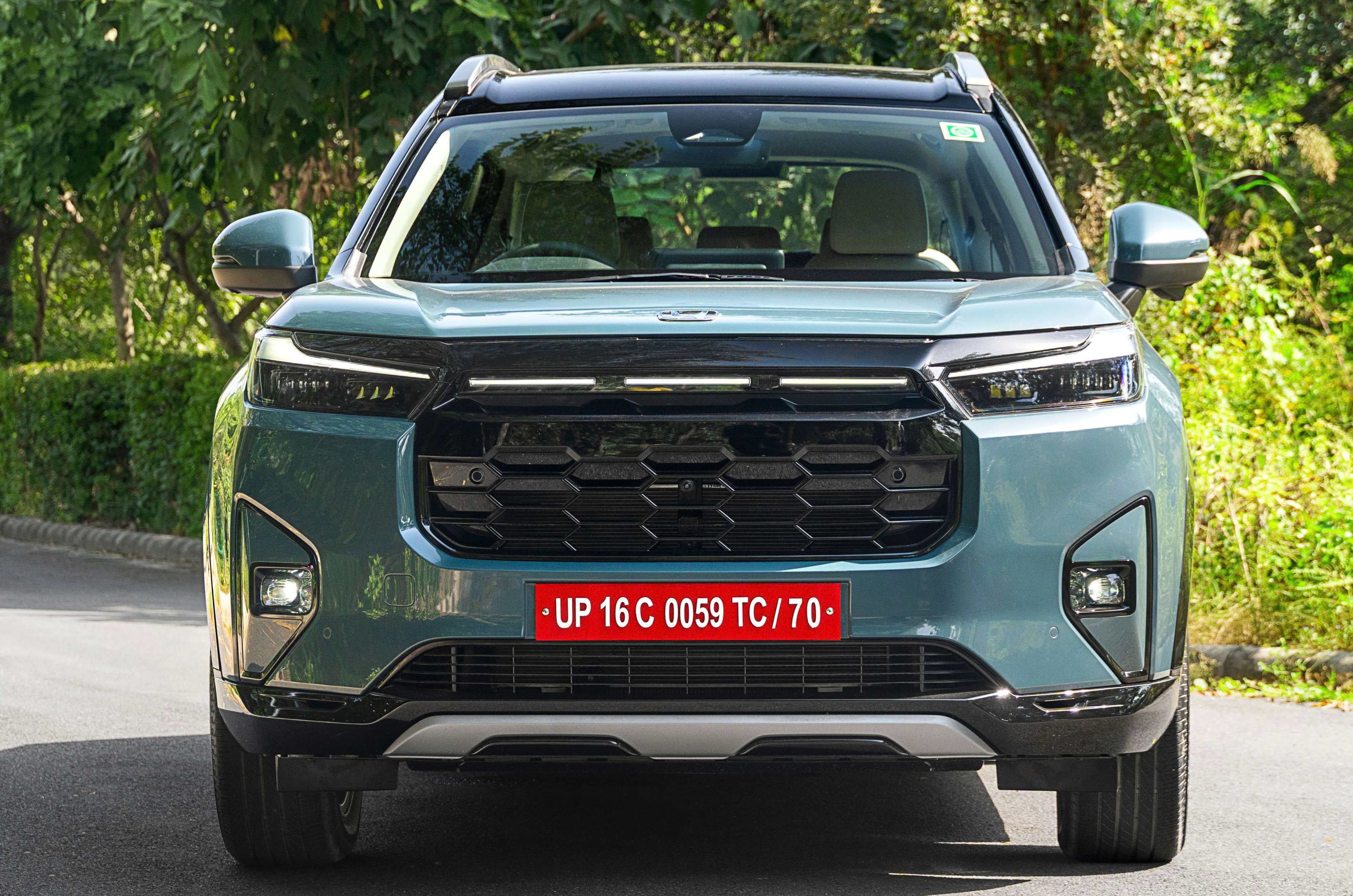
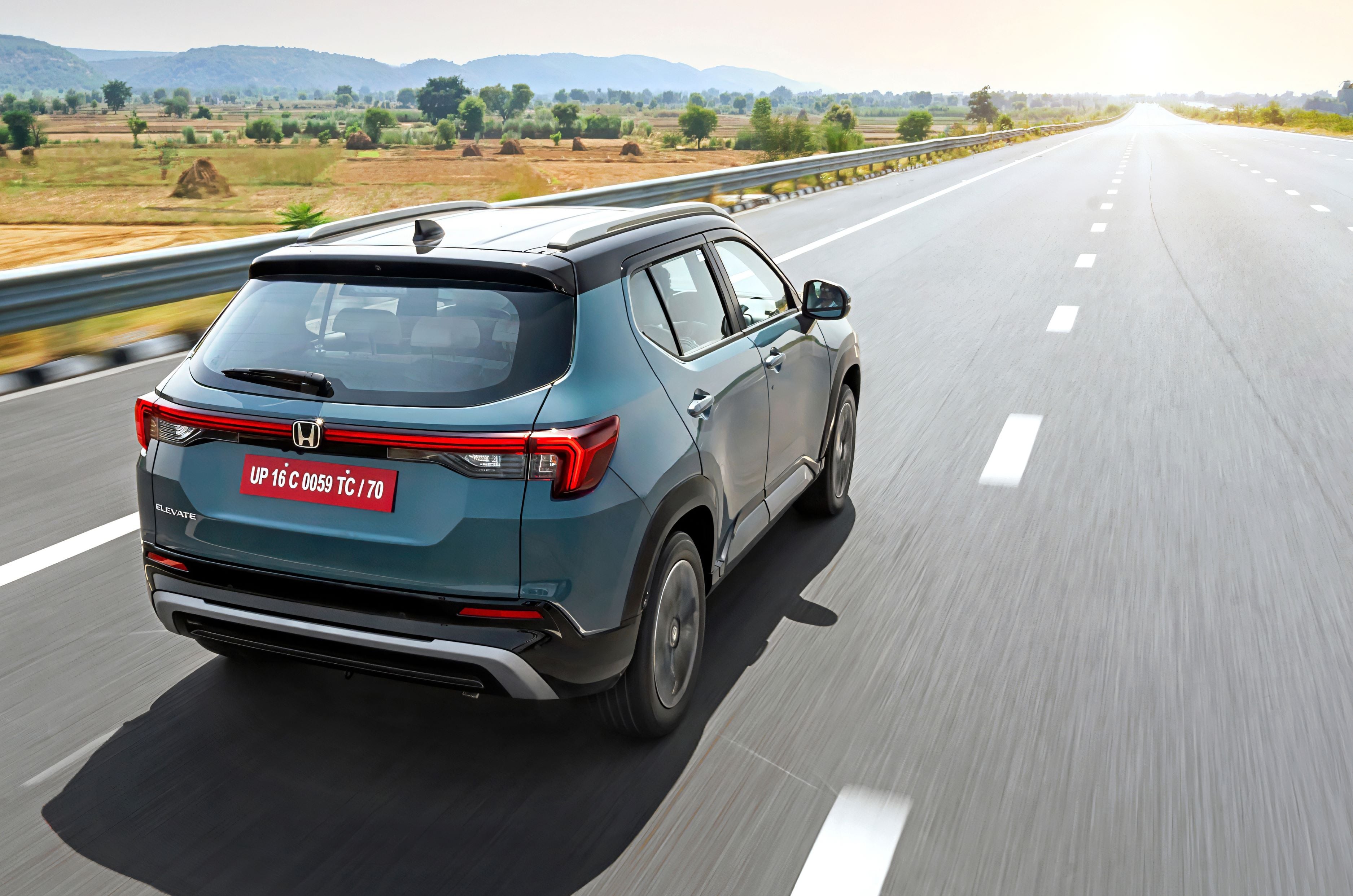
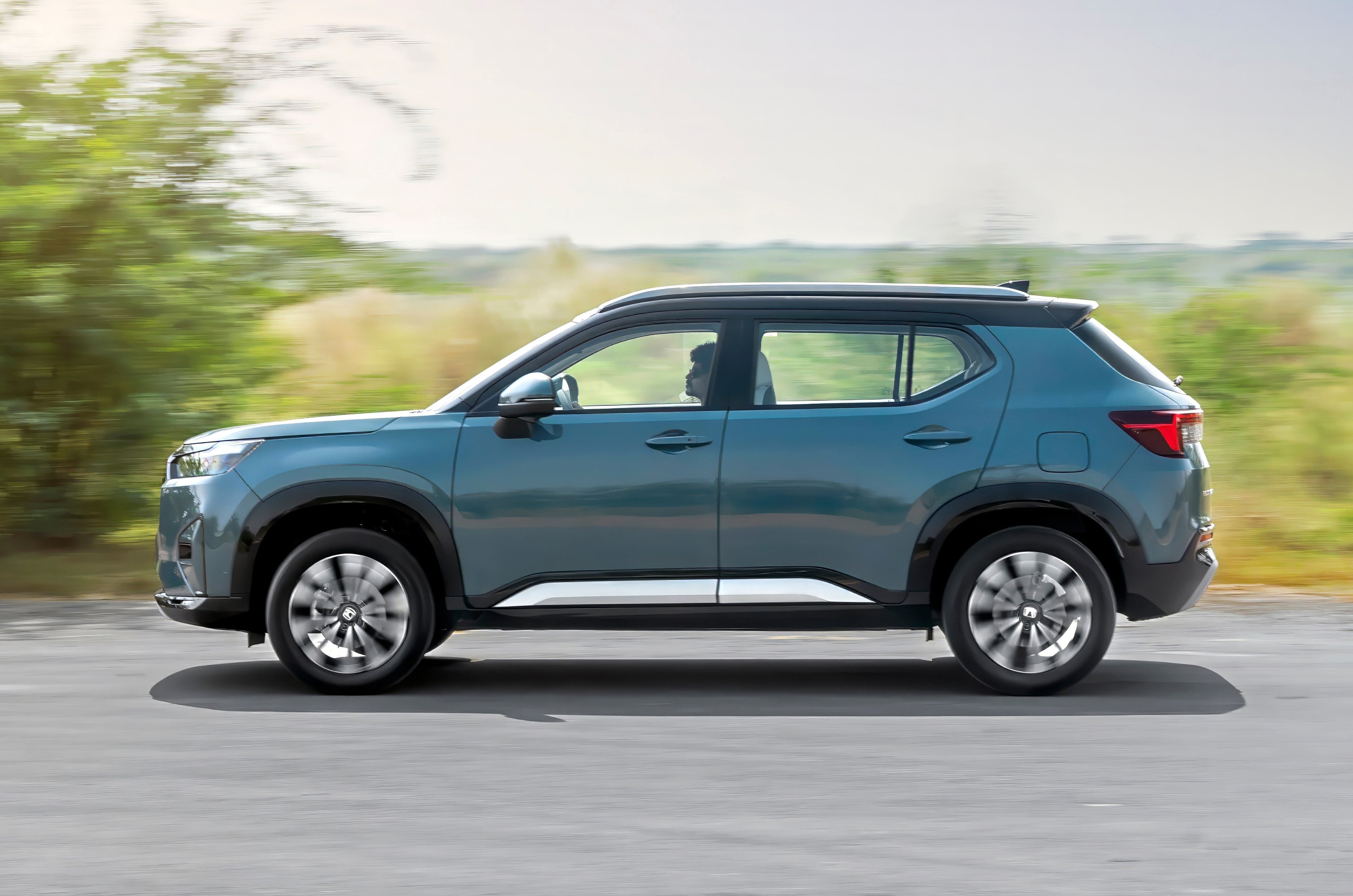
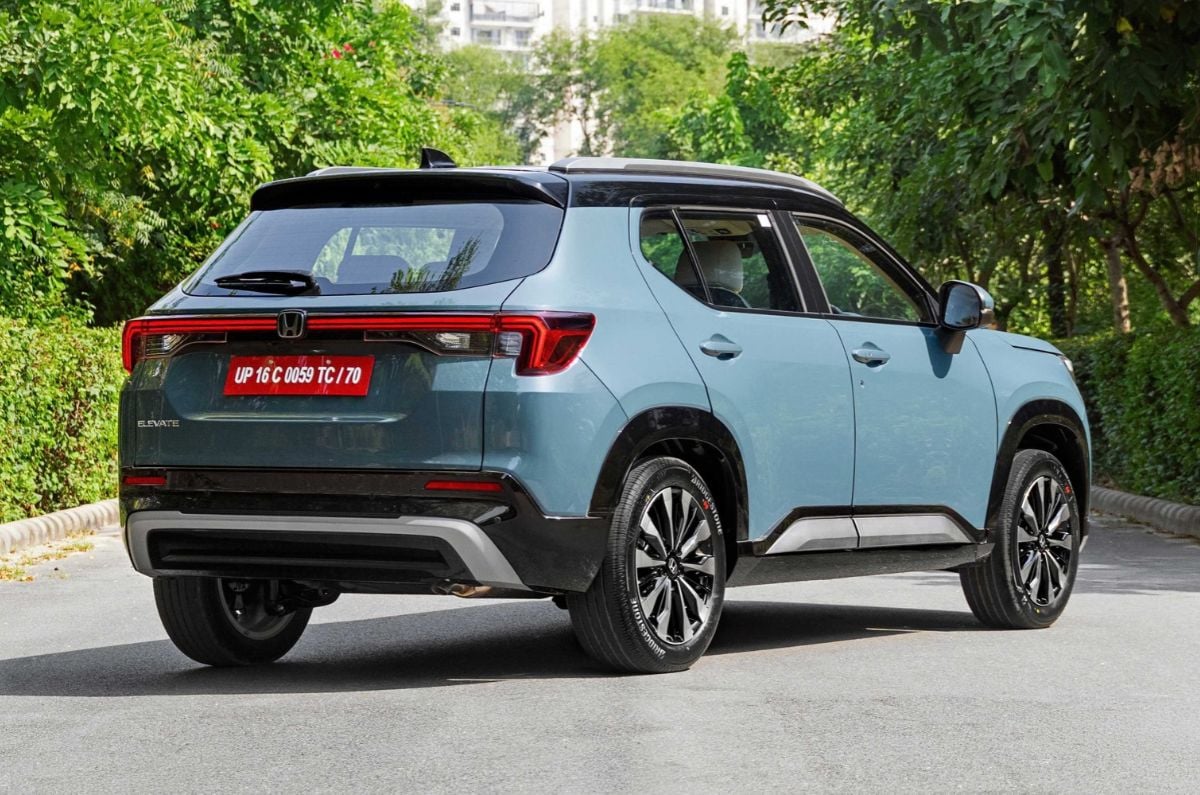
Honda has priced the 2026 Elevate facelift from Rs 11.80 lakh to Rs 18.58 lakh (ex-showroom). Its list of midsize SUV rivals is pretty long, and includes the Hyundai Creta, Kia Seltos, Tata Sierra, Renault Duster, Nissan Tekton, Volkswagen Taigun and Skoda Kushaq. The Elevate is underpinned by the City’s platform, and comes with a single 1.5-litre petrol engine with a choice of manual and CVT gearboxes. Here’s what works in the updated Elevate’s favour, and what doesn’t.
Reasons to buy the 2026 Honda Elevate facelift
Eager engine and confident road manners
A lively engine, tidy handling and strong brakes are among the Elevate’s fortes
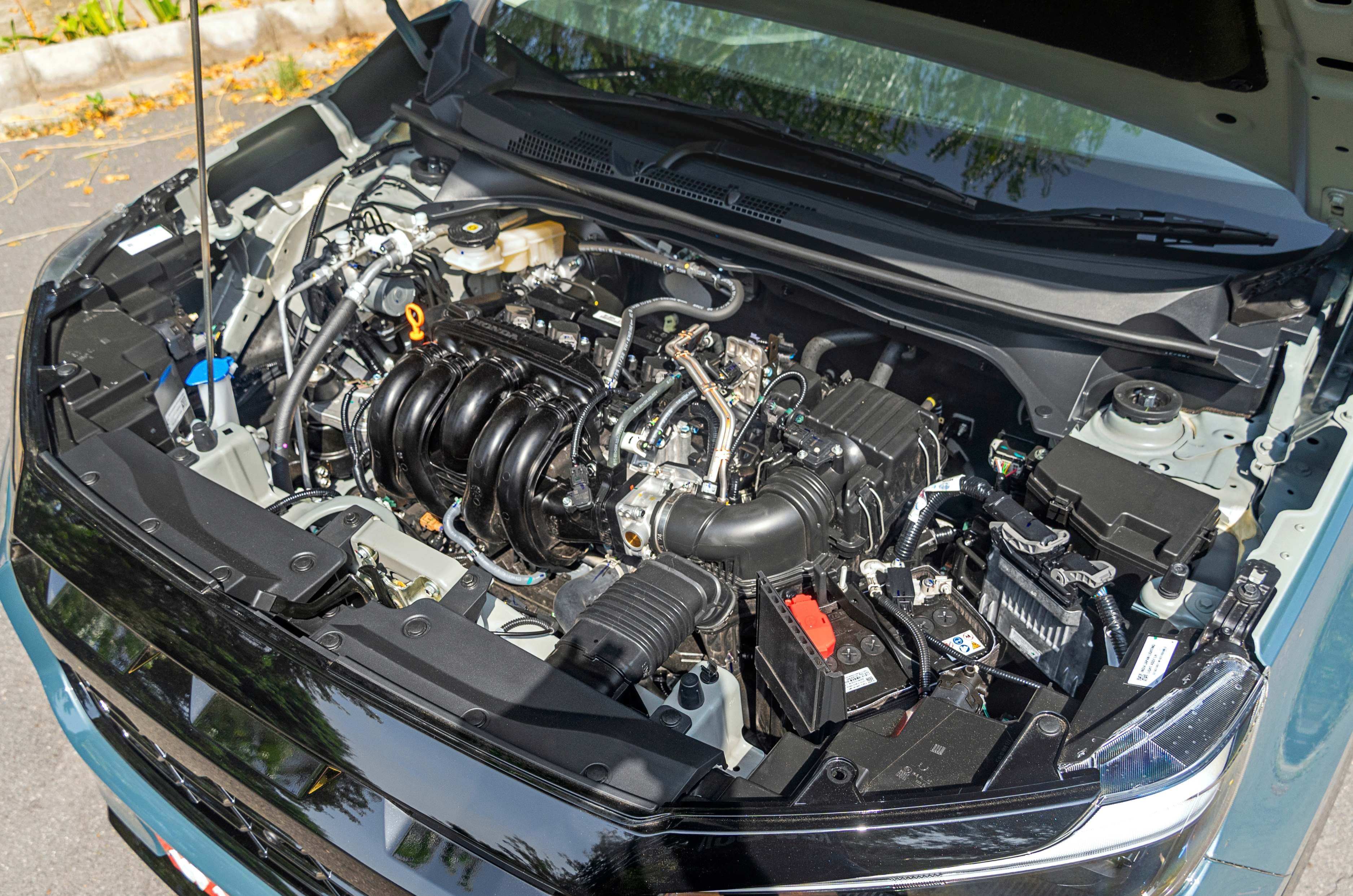
The Elevate’s i-VTEC engine provides strong performance, while high-speed stability is good too.
The 2026 Elevate continues with the same 1.5-litre four-cylinder i-VTEC petrol engine of its predecessor, but it’s now WLTP emissions norms compliant. The smooth and eager unit produces 121hp and 145Nm of torque, delivering this power cleanly and progressively all through its rev range. The throttle response is sharp, too. For those looking for a hassle-free urban commuter, the smooth CVT (continuously variable transmission) does the job well. It also gets paddle shifters so you can move through pre-set ratios, offering that extra sense of control.
The Elevate feels planted and offers a good balance between handling and ride quality.
The Elevate has always been an easy car to drive around town, courtesy of a light yet responsive steering that makes parking manoeuvres easy. The steering weighs up progressively as speeds rise, and the Elevate also feels planted out on the open highway, inspiring confidence. A good control on body roll means that, despite its tall SUV stance, the Honda Elevate corners neatly without much drama. The brakes are strong and feel progressive, further inspiring driver confidence. The ride feels firm but the Elevate manages to smooth out surface imperfections with relative ease.
Premium and comfy cabin
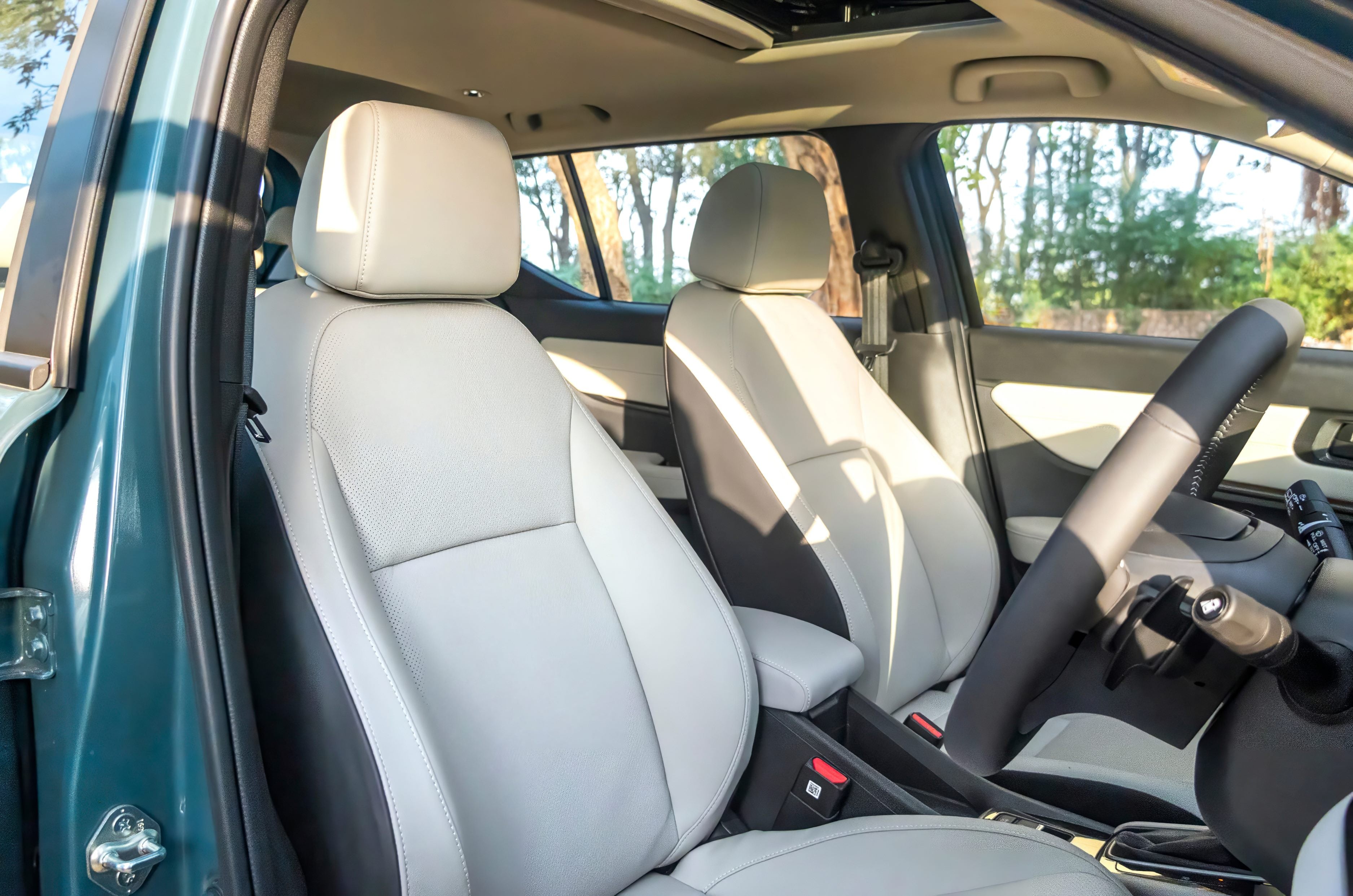
Interior retains the model’s practicality quotient while upping the premium experience
The 2026 update has made this interior feel more premium.
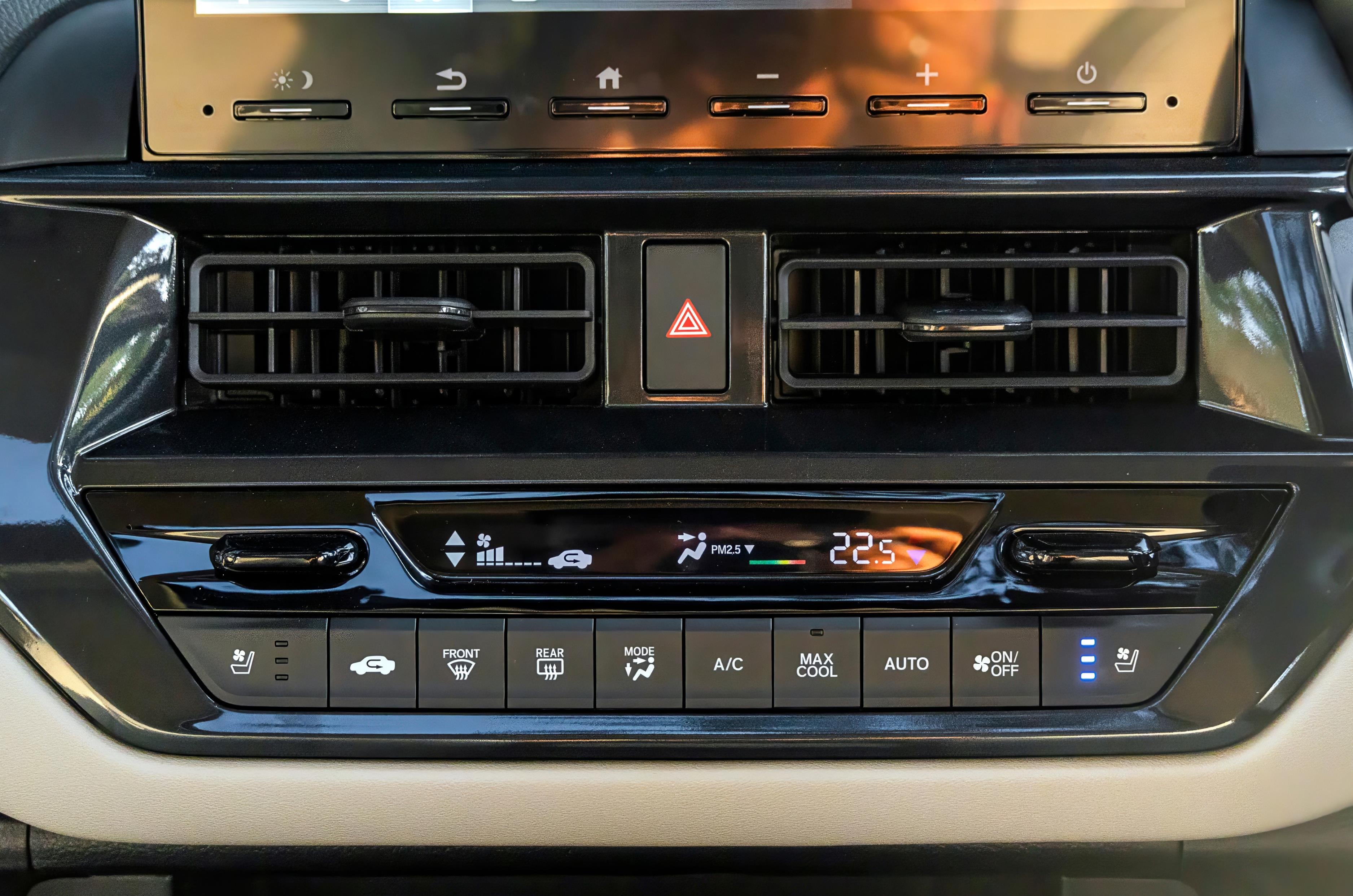
The Elevate has been known for providing an ergonomically sound cabin – this hasn’t changed with the 2026 update. The front seats remain nice and supportive, while finding a comfortable driving position is easy. There’s now lighter leatherette padding and stitching on the dashboard, a revised headliner that looks and feels more premium, and an updated HVAC panel with buttons for the front-seat ventilation feature.
Headroom and kneerom for back-seat passengers is good.
It is easy to get comfortable in the back of the Honda Elevate facelift. There’s plenty of headroom and kneeroom for two adults, while conveniences like a centre armrest with cupholders, dedicated AC vents and USB charging ports add to the overall experience. There’s also no shortage of cubbies to store your knick-knacks, plus a roomy 458-litre boot. You also get a spare tyre under the boot floor, further boosting the Elevate’s practicality.
Better equipped than before
Honda has added more features to the Elevate’s equipment list
The Honda Elevate now gets segment-first rear-seat ventilation.
The back seats of the 2026 Elevate facelift are also where you will see the new touch-operated LED reading lamps. The Elevate now offers rear-seat ventilation, which is a first for the segment. Features such as orange ambient lighting, multi-way powered front seats, wireless charging, auto climate control with a built-in PM2.5 air purifier, wireless Apple CarPlay & Android Auto, an 8-speaker audio system, a 7-inch MID, and a 360-degree camera are available too.
A 360-degree camera is now a factory-fit option on the top-spec trim.
There’s enough on the safety front, too. The 2026 Elevate facelift is available with front parking sensors, Honda’s LaneWatch camera, and a camera-based ADAS (advanced driver assistance systems) suite. This ropes in adaptive cruise control, auto-emergency braking, lane-keep assist and more. The CVT variants get a new low-speed follow function for the adaptive cruise control to tackle stop-and-go traffic conditions, along with rear disc brakes and an electronic parking brake with auto hold. Standard equipment includes 6 airbags, stability & traction control, rear parking sensors, adjustable headrests and three-point seatbelts for all occupants.
Reasons not to buy the 2026 Honda Elevate facelift
Cabin has its shortcomings
Lacklustre noise insulation aside, the Elevate’s cabin still has a few niggles
Some may find the front lumbar support to be excessive.
While the 2026 facelift has made the Honda Elevate more competitive, there’s still room for improvement. For starters, the lumbar support up front can feel intrusive for some, and taller occupants will find the under-thigh support underwhelming. Seating a third passenger in the back wouldn’t be easy, due to the narrower cabin width of the Elevate over some rivals. The raised centre seat doesn’t make this better, either.
Rear occupants will notice vertical movements at higher speeds over undulating roads.
The cabin is quieter than before, but engine and road noise can be heard quite easily at highway speeds. Those at the back will also notice a fair bit of vertical movement over undulating highways at triple-digit speeds.
Only one engine option
The Elevate still doesn’t get a diesel, turbo-petrol, hybrid or CNG option
Lack of engine choices even with the latest update is a definite con for the Honda Elevate.
In a segment where rivals offer multiple engine options (even across fuel types), the 2026 Honda Elevate facelift continues with just the one naturally aspirated petrol unit. This limits its appeal when compared to other offerings in the hotly contested midsize segment. While we are yet to test its mileage, the lack of an automatic engine stop-start system and ‘Eco’ drive mode won’t help boost fuel efficiency.
Latest features reserved for the top trim
Most of the headline features are offered only with the new range-topping ZX+
Only the range-topping ZX+ gets all of the newly introduced features.
If you want all the new bells & whistles that the 2026 Honda Elevate facelift has to offer, you’ll have to stretch your budget to accommodate the new top-spec ZX+ trim. This is where niceties like rear seat ventilation, powered front seats, a 360-degree camera and front parking sensors reside. However, this also means a price tag of between Rs 16.88 lakh and Rs 18.58 lakh (ex-showroom).
The ZX+ trim still misses features like two-zone climate control, a panoramic sunroof and rear sunblinds.
Despite the ZX+’s higher price, it still misses out on a panoramic sunroof, powered tailgate, a fully digital driver’s display, rear sunblinds and dual-zone climate control. Some similarly priced rivals offer a more comprehensive feature set, more cabin space and multiple powertrain options.
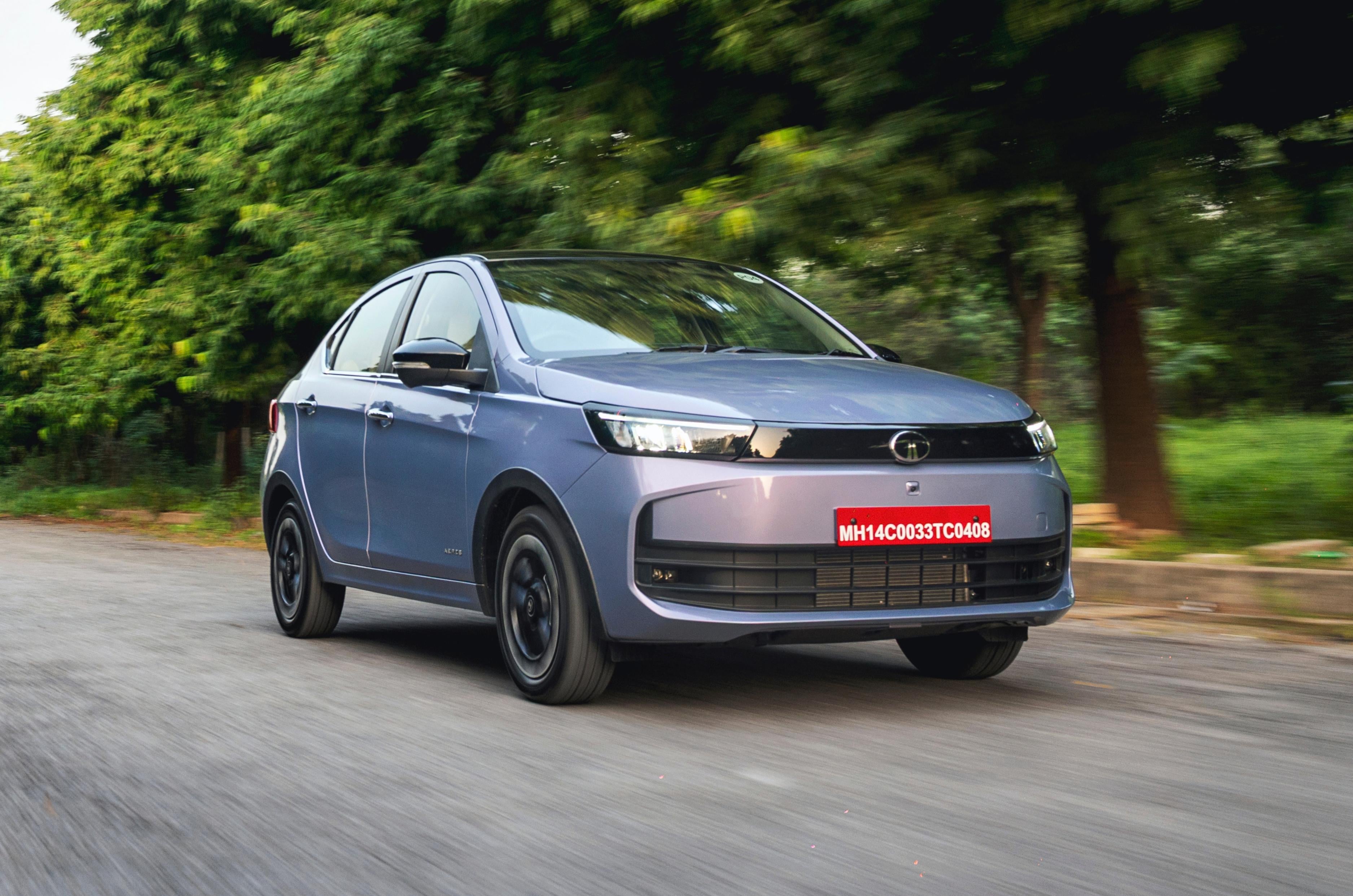
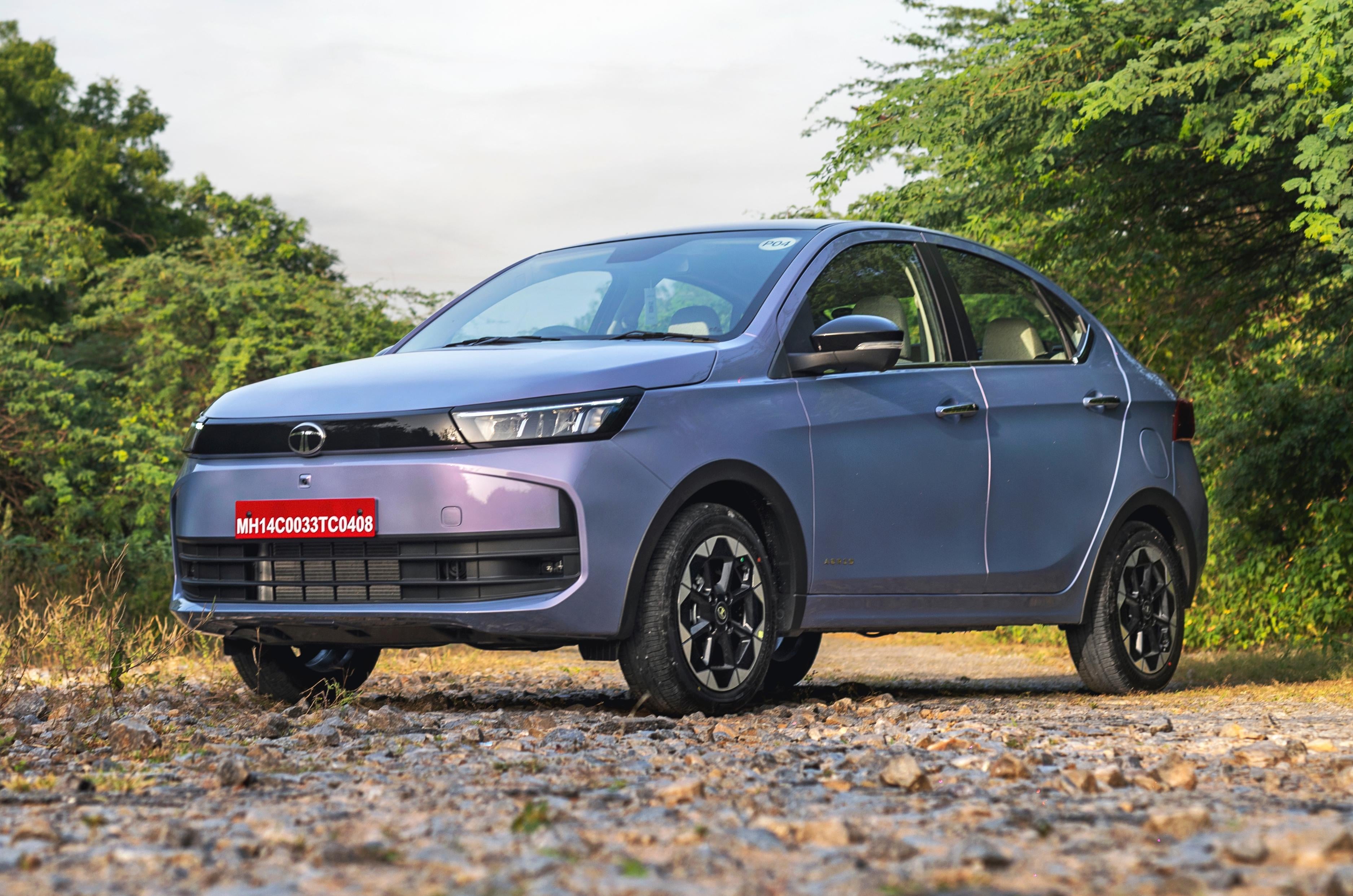
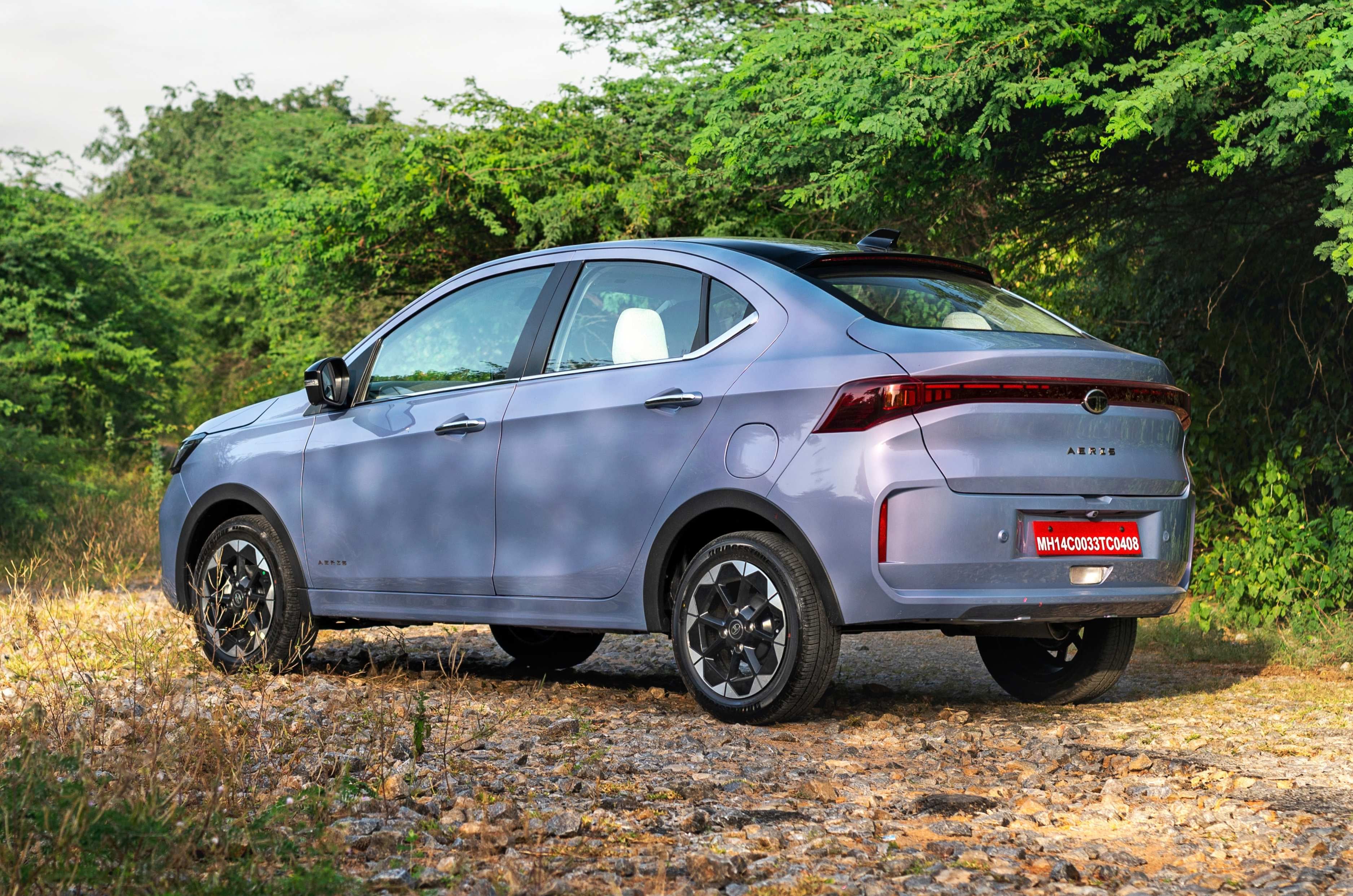
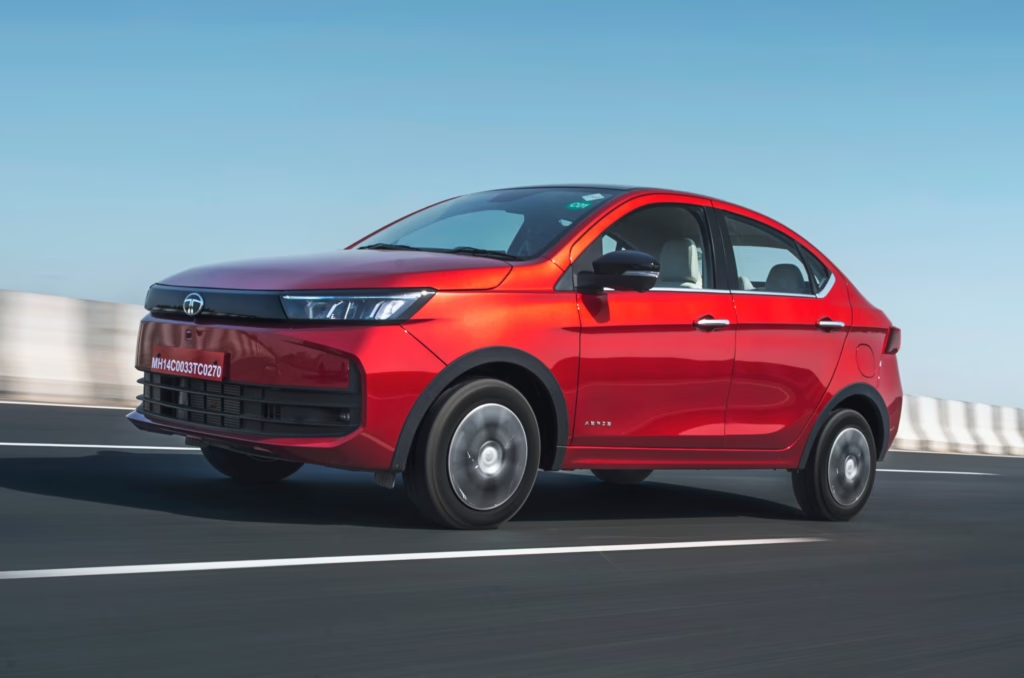
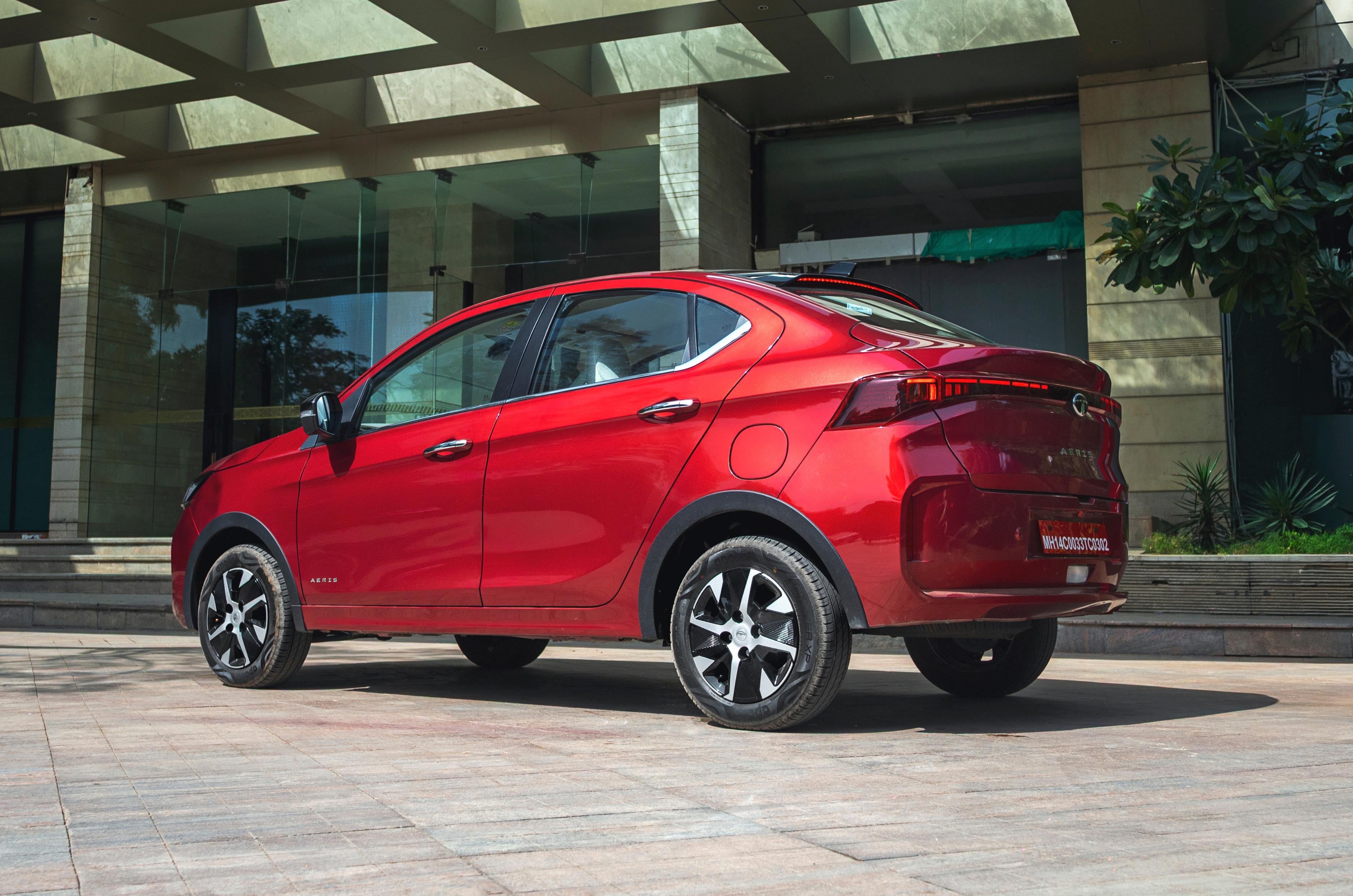
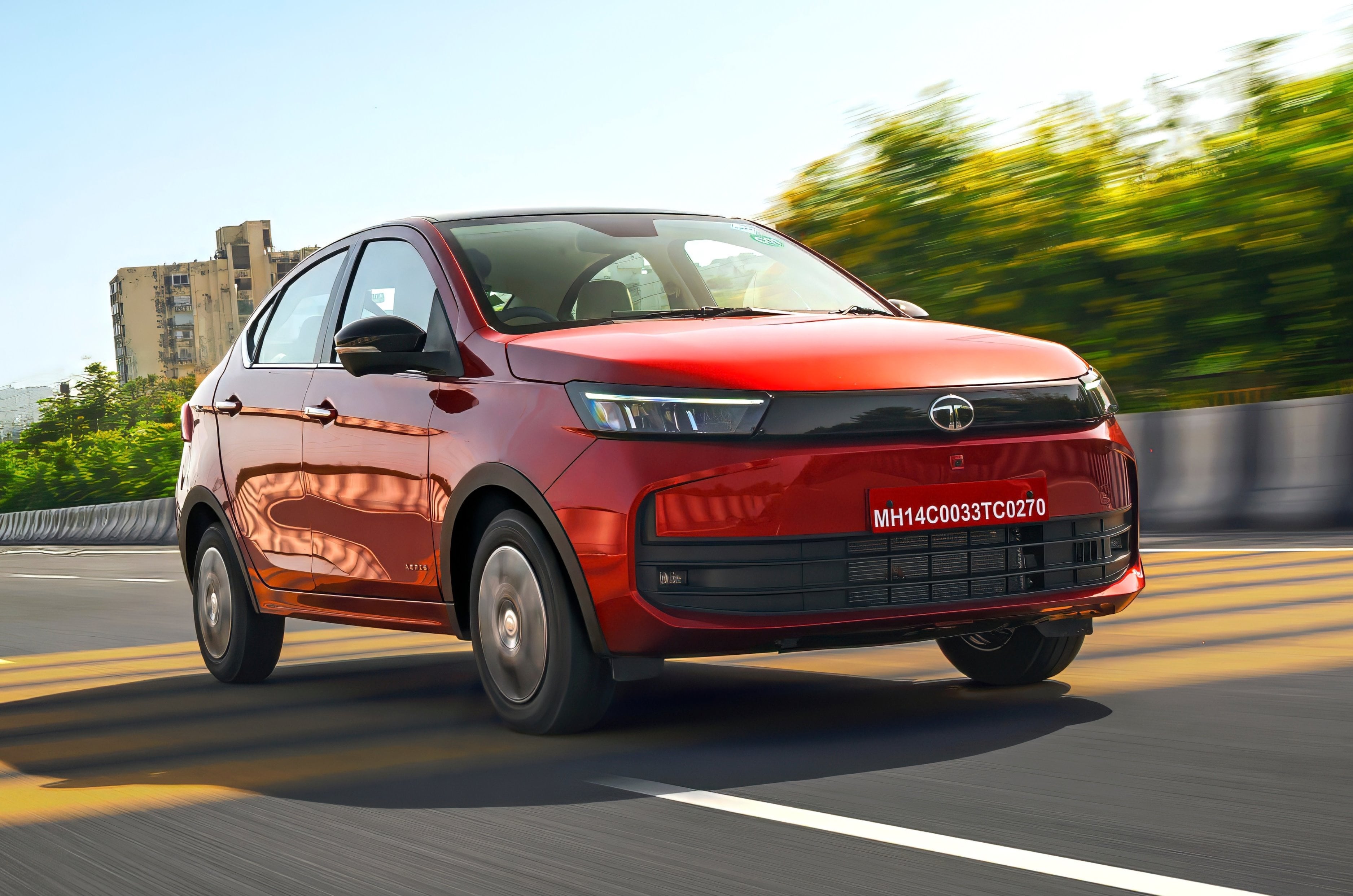
Tata has introduced the Aeris as a successor to the Tigor to strengthen its presence in the compact sedan segment. Apart from a new name, the Aeris is a heavily updated version of the discontinued Tigor, with sheet metal updates, a revamped cabin, and feature additions. If you’re considering buying the Aeris, we list two reasons to go for it and two reasons to look elsewhere based on our experience behind the wheel.
Spacious and well-equipped interior
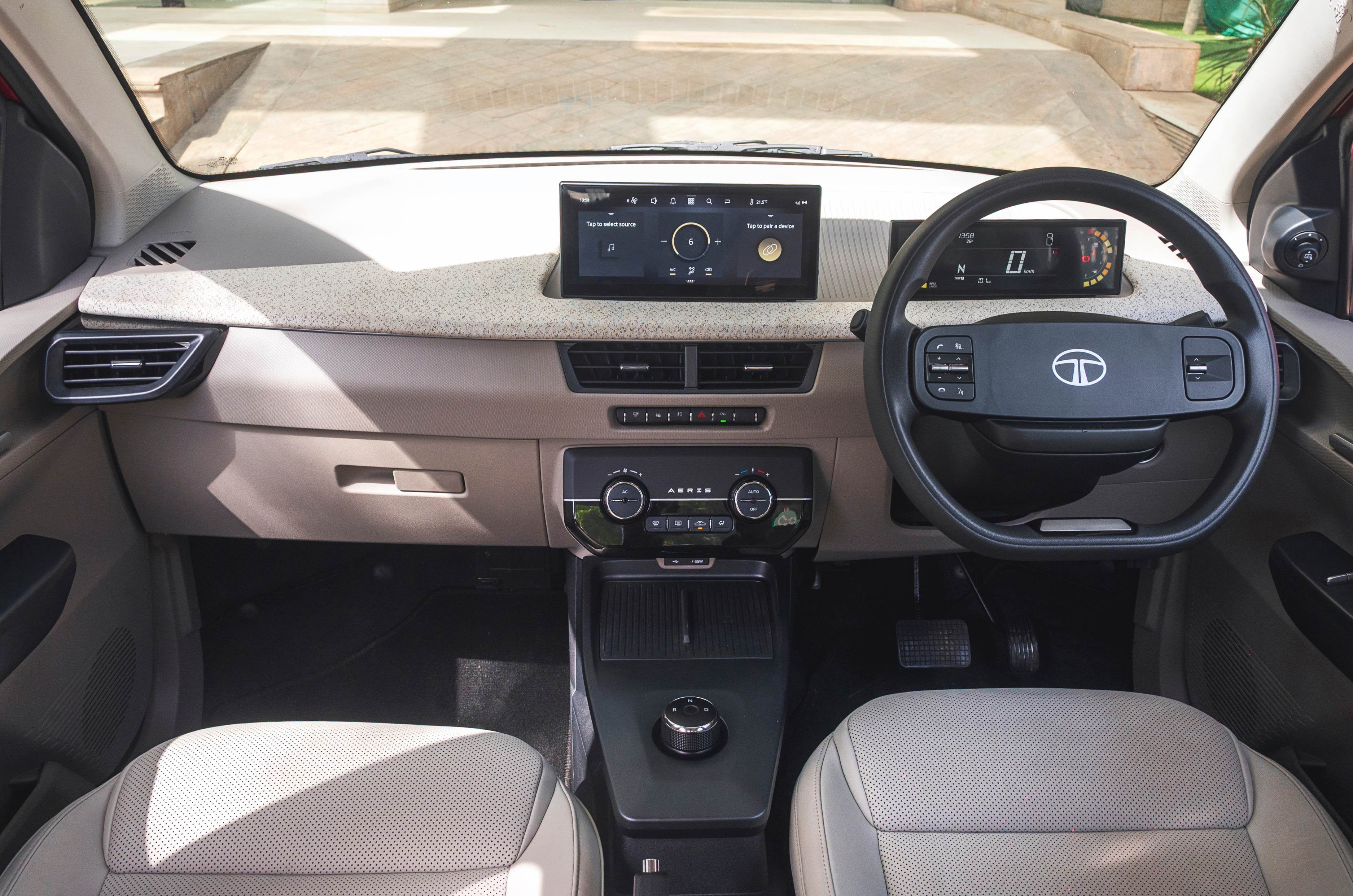
The Aeris’ cabin is well laid out; the beige theme gives it an airy feel, while the fabric trim on the dashboard adds a premium touch. You get a plethora of physical buttons, which have a solid feel, and floating door handles from the Sierra, which have a sturdy build. Space at the back is plenty, with good legroom, knee room, adequate thigh support and comfortable seat cushioning. The boot at 419 litres is the largest in its segment. Additionally, the boot lid uses gas struts for its opening for more usable space, unlike rivals that use a hinge mechanism.
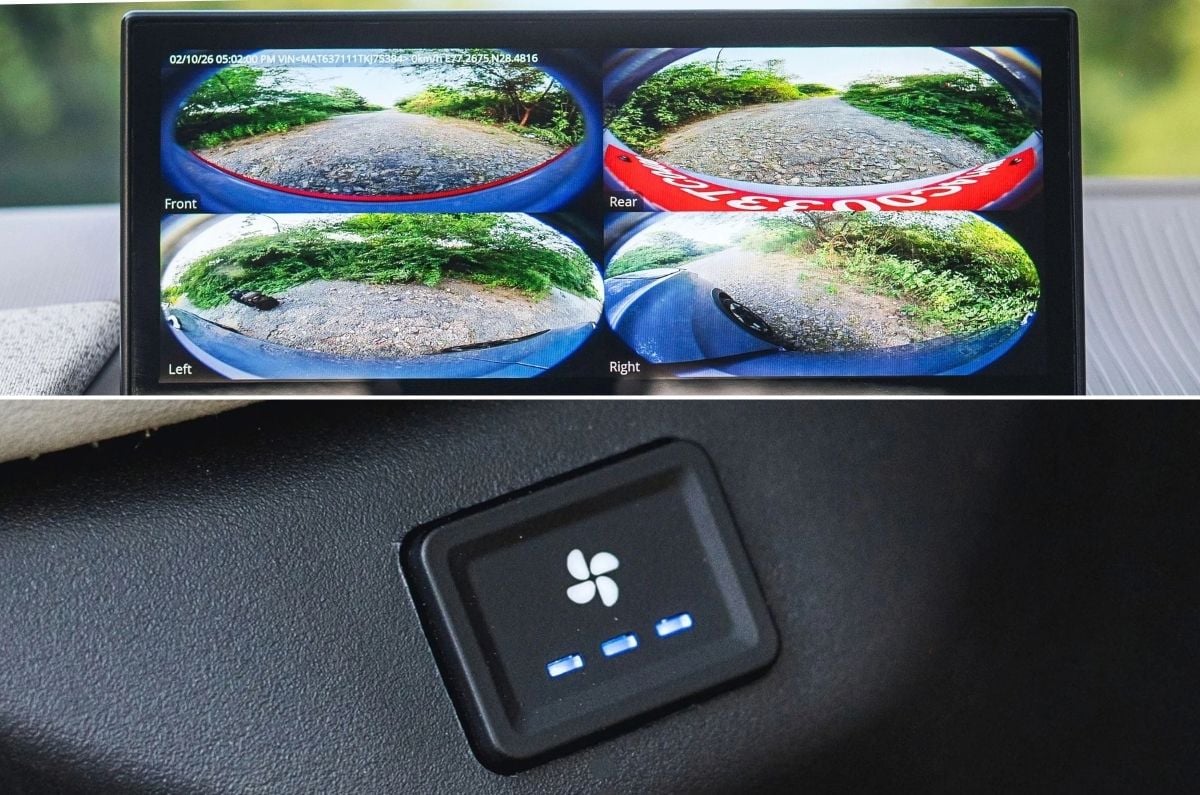
Equipment levels of the Aeris are among the best in its segment. It’s the only model to come with front seat ventilation and a dashcam recording. Additionally, it packs a 10.25-inch infotainment system with Apple CarPlay and Android Auto, a 360-degree camera, and blind spot monitoring.
Plush ride quality
Like other Tata models, the Aeris is well judged in terms of ride and handling. Ride comfort is supple over broken roads, as its suspension does a great job of absorbing bumps. Additionally, its high 170mm ground clearance helps it clear large speed breakers with ease. At higher speeds, its suspension is stiff enough to maintain its stability even during quick lane changes.
Reasons not to buy the Aeris petrol
Lacklustre engine and gearbox
Powering the Aeris petrol is a 1.2-litre, 3-cylinder, naturally aspirated unit producing 86hp and 113Nm. Overall, the engine lacks the smoothness that rivals offer, and it lacks grunt out on the highway, taking time to reach triple-digit speeds. Shifts feel jerky with the AMT, while manual versions lack the slickness that competitors from Honda, Hyundai and Maruti provide.
Poor NVH levels
Apart from the not-so-smooth operation, the Aeris’ petrol unit is quite noisy. Vibrations filter through the cabin at idle and low speeds, and the gruff engine note causes discomfort over time. Additionally, as speeds rise, engine vibrations get much louder, and wind and road noise become more audible. This hinders the overall driving experience when out on the highway.
Kawasaki has teased a new four-cylinder tall and upright sport tourer on its UK social media handle, which we expect is to be the new Versys 900. The presence of a windscreen resembling the one on the Versys 650 and 1100 models and an inline-four cylinder soundtrack both reinforce our claim.
4-cyl motor sounds unstressed, not peaky and high-revving
Bike shown tackling varied road conditions in teaser
It has a tall adjustable windscreen, like 1100 and 650 Versys models
Will a new Z900-based model supplement the Versys range soon?
There are quite a few signs in the teaser which point to this fact
There are some primary points to pay attention to on the teaser shared by Kawasaki UK. Firstly, the four-cylinder soundtrack immediately reminds one of the smooth and refined hum of the unstressed, torque-rich, big-bore 948cc four-pot motor on the Z900 complete with the exhaust pops as if a bidirectional quickshifter (a feature on the latest-gen Z900) is being used to shift between gears. Second, what looks like an adjustable windscreen shown at the end of the teaser (pictured in the lead image) is very similiar in style to that of a tall rounder motorcycle like the Versys range. Another indication that this is going to be a road-biased machine is that while different road conditions are shown, never once does the bike in question leave the tarmac – another Kawasaki Versys hallmark.
Last but not least, the motorcycle in question is shown tackling different sorts of roads including wide and fast sweeping corners, a tight and slightly bumpy surfaced road as well as a tunnel on a highway – all factors pointing to this bike being geared toward handling long-distance travel comfortably.
Then there is also the fact that many reputed international publications had pictured a fully production-ready – but partially obscured by a cover – Versys model – which was presumably out on an advertisement/promo shoot – with a four-cylinder engine some months ago. Given that shoehorning a supersport-derived engine from its own lineup (like the ones on the ZX-4R, 6R or 10R) wouldn’t suit the sport touring nature of a Kawasaki Versys model, this automatically leaves only the Z900’s four-cylinder engine to be used on this machine.
Some other factors which would lend more credence to our claim of this being a Versys 900 are that the middleweight tall-rounder segment has grown quite large internationally with entrants from big marques like Yamaha, Triumph, Ducati, BMW and Moto Guzzi fielding at least 1 contender in this burgeoning class. Against these bikes, the Versys 650 is far too simple and slow while the Versys 1100 is a bit too heavy and big, making a 900 the perfect option to plug this gap. Kawasaki hasn’t officially confirmed any of this and this model will be revealed on October 10.
The Tata Aeris may be a new name, but its roots lie in the Tigor, which has enjoyed considerable popularity since 2017 for its distinctive styling, practical cabin, comfortable ride and decent powertrains. The Aeris builds on that foundation with a sharper design, a more upmarket cabin and an even more generous equipment list while retaining the same basic mechanical package underneath. Having already driven the iCNG version, we now get behind the wheel of the petrol Aeris to see how it fares as an everyday sedan.
Tata Aeris petrol performance and refinement – 7/10
The petrol engine gives it slightly better cruising capability than the CNG
3-cylinder engine is so-so on refinement and sounds coarse when revved hard
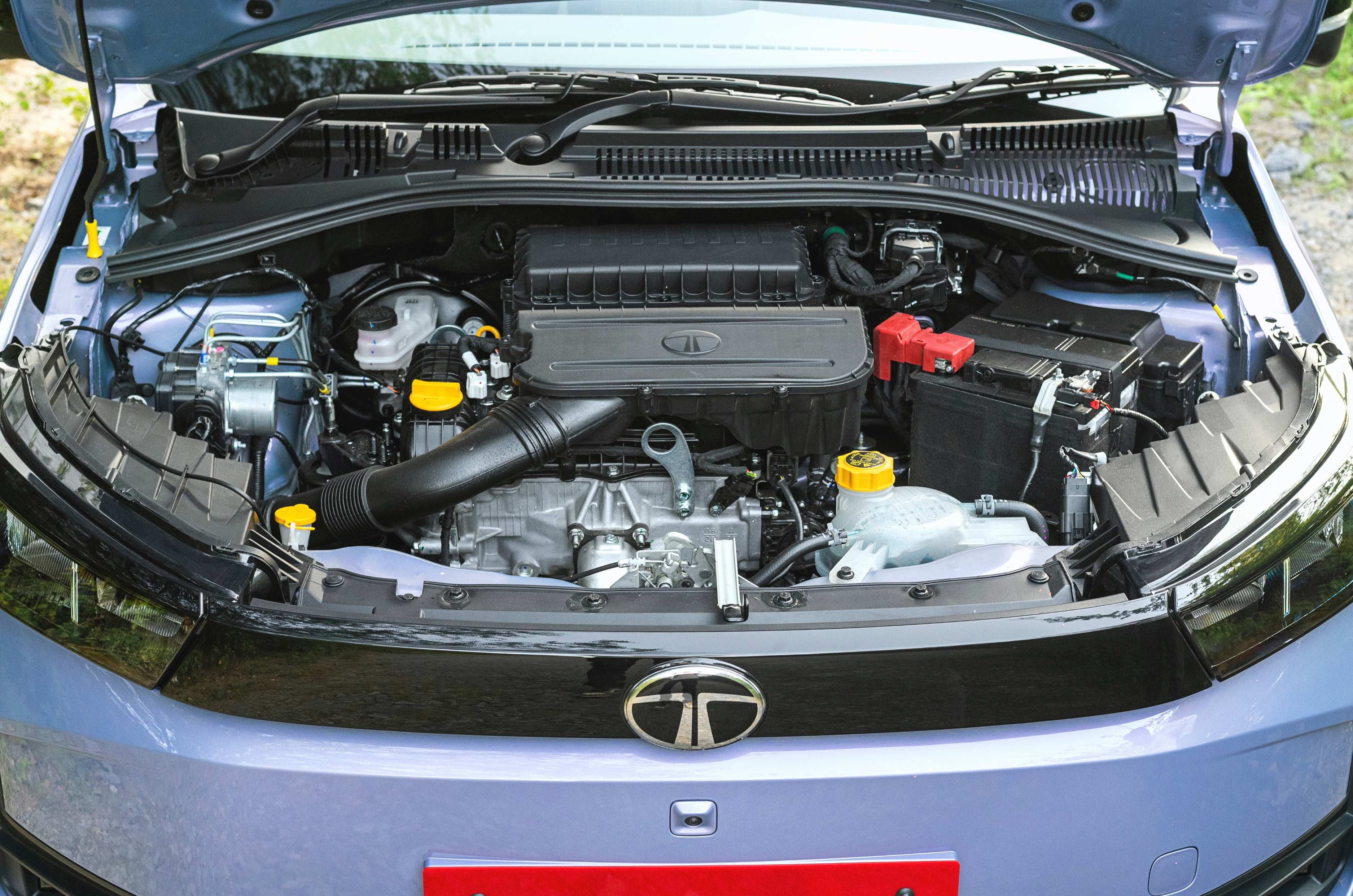
The Tata Aeris comes with a 1.2-litre 3-cylinder naturally aspirated engine that produces 86hp and 113Nm in its petrol guise and is offered with a choice between a 5-speed manual and a 5-speed automated manual transmission (AMT). The three-cylinder engine isn’t the smoothest in the segment, while the sound insulation also has room for improvement. There are noticeable vibrations at idle and low speeds, though these settle down once you’re on the move. However, they make a comeback beyond 2,500rpm, accompanied by a coarse engine note that can get intrusive and tiring on longer high-speed drives.
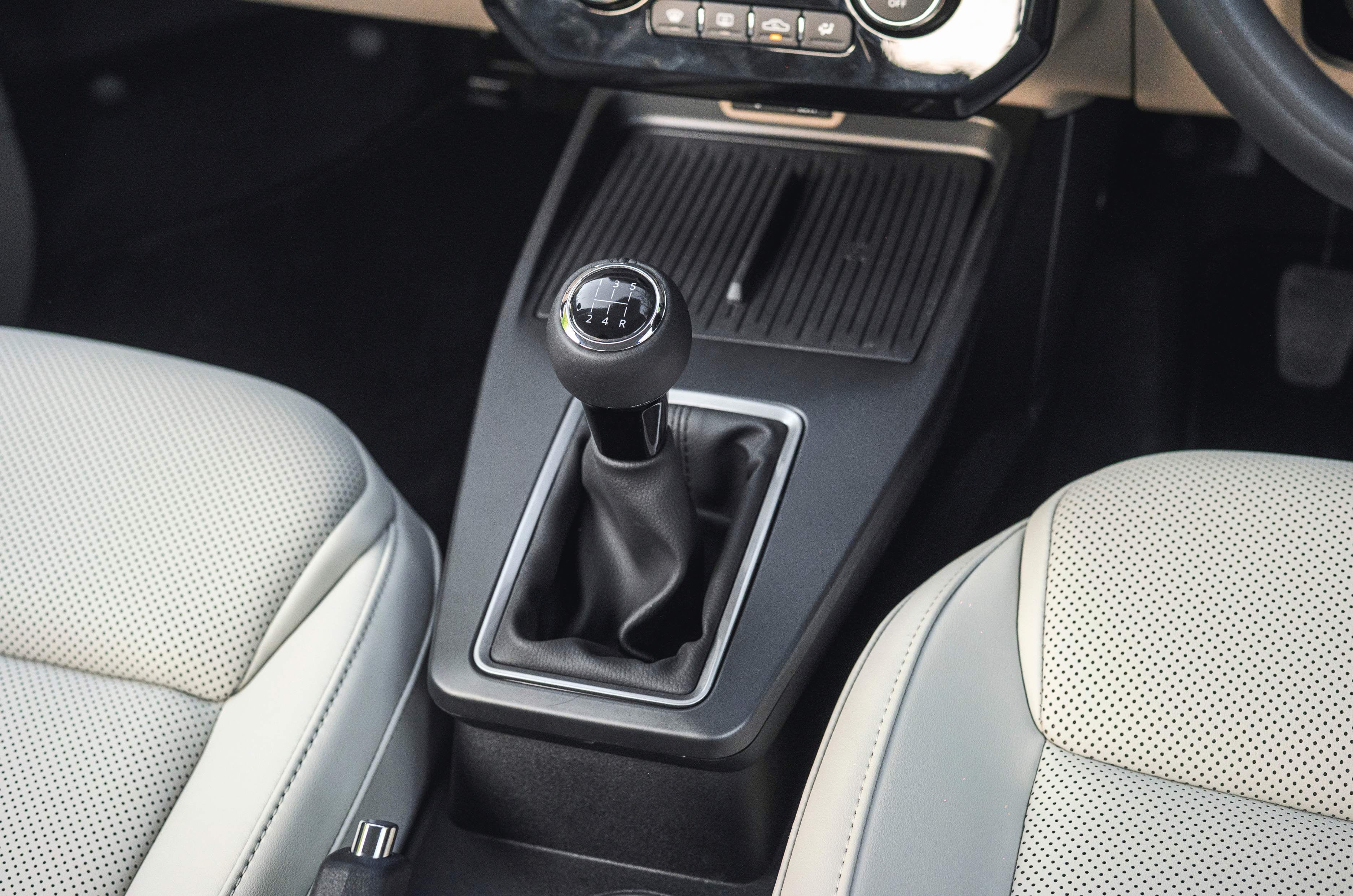
Manual lever looks premium for the price, offering short throws and defined gear gates.
The petrol version’s output figures are 10hp and 16Nm higher than the CNG version, which may look modest on paper, but the difference is discernible out on the road. We drove the petrol-powered Aeris with a 5-speed manual gearbox and noticed it offers short shift throws and well-defined gear gates. While it is not the slickest gearbox compared to its Maruti, Honda and Hyundai rivals, it is still a step up from the Tigor’s in terms of smoothness.
Aeris’ petrol version feels adequate for the city and is fine for gentle highway cruises too.
The performance in city speeds is adequate, and the powertrain is peppy enough for everyday driving. The clutch is light and has a predictable bite point, meaning you do not strain your left foot even in bumper-to-bumper traffic. There’s a dead pedal too, but it feels narrower than what we would have liked.
It is fairly quick to reach 80kph, but takes some time to reach triple-digit speeds. However, the petrol-powered Aeris maintains these speeds with relative ease, which makes it a decent highway cruiser. Unlike the CNG, the Aeris petrol does not feel out of breath when overtaking, and as long as you are in the right gear, it maintains good momentum.
AMT adds convenience for city drives but doesn’t like being rushed; the manual gearbox is easy to use.
We got a taste of the AMT during our earlier stint with the Aeris iCNG, when we switched to petrol mode, and found that the gearbox offered reasonable acceleration with measured inputs. Push the accelerator aggressively, though, and the typical AMT hesitation became evident, meaning overtakes need to be planned well. The AMT also gets a creep function, which comes in handy in bumper-to-bumper traffic.
All of this makes the AMT a good option for city driving, but for high-speed highway cruising, we recommend the manual gearbox, which offers greater control and a more engaging experience. That said, opting for the manual in the city is not a compromise either.
Tata Aeris petrol ride comfort and handling – 8/10
It allows for a confident drive at both low and high speeds
Like other Tata offerings, ride quality is one area where the Aeris excels. It takes broken roads in its stride, with the suspension absorbing rough patches well and keeping most surface irregularities from filtering into the cabin. The 170mm ground clearance is also adequate for tackling large speed breakers without much concern. That said, the CNG version has an edge in this department, thanks to its 14-inch steel wheels with taller sidewalls, which offer a more cushioned ride than the 15-inch alloys on the top-spec petrol version. Notably, lower Aeris trims get 14-inch wheels.
Well-tuned suspension keeps the Aeris comfortable and confident on all roads.
At high speed too, the suspension stiffens enough to keep the Aeris composed through quick lane changes, without feeling floaty. On the highways, it remains stable and inspires confidence at higher speeds. The steering, however, could do with more precision, as it feels slightly vague around the centre. While it weighs up nicely as speeds rise, a sharper response around the centre would have further enhanced the Aeris’ high-speed confidence.
Tata Aeris petrol mileage and efficiency
We expect the Aeris petrol to have similar fuel efficiency as the Tiago
Tata has yet to reveal the official fuel-efficiency figures for the petrol-powered Aeris. But it gets the same powertrain as the pre-facelift Tiago we tested in 2022. In that test, it returned 13.30kpl in the city and 16.60kpl on the highway. The Aeris could have similar fuel efficiency. However, we will be able to give you a more definitive assessment once we put the Aeris through our standard fuel-efficiency tests.
Tata Aeris petrol exterior design and engineering – 8/10
Has a sleeker and more modern exterior design and comes with LED lights all around
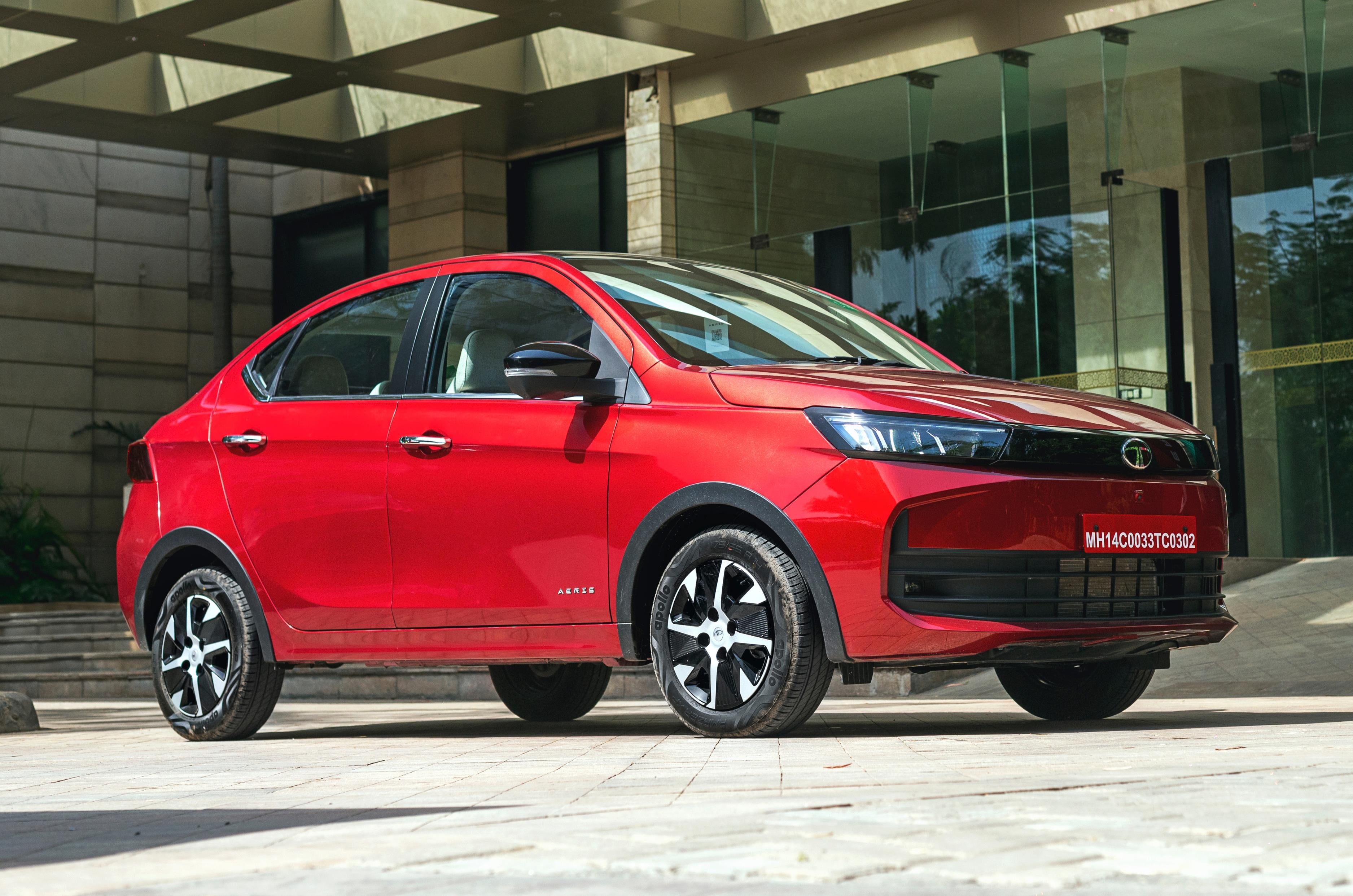
Save for the new bumper, the fascia is similar to the Tiago’s and looks very modern.
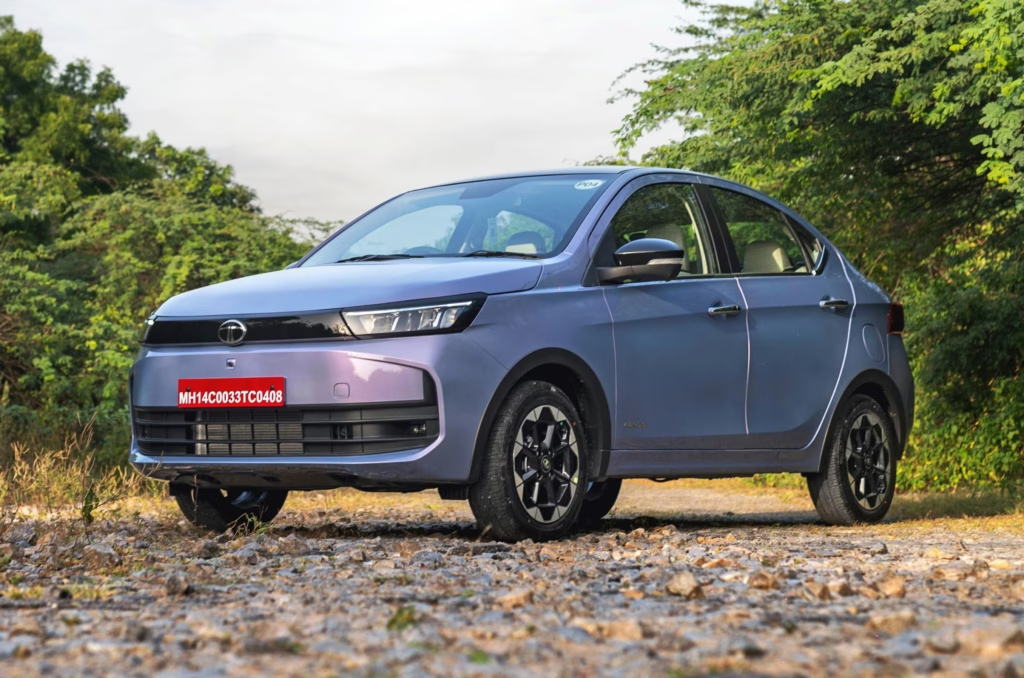
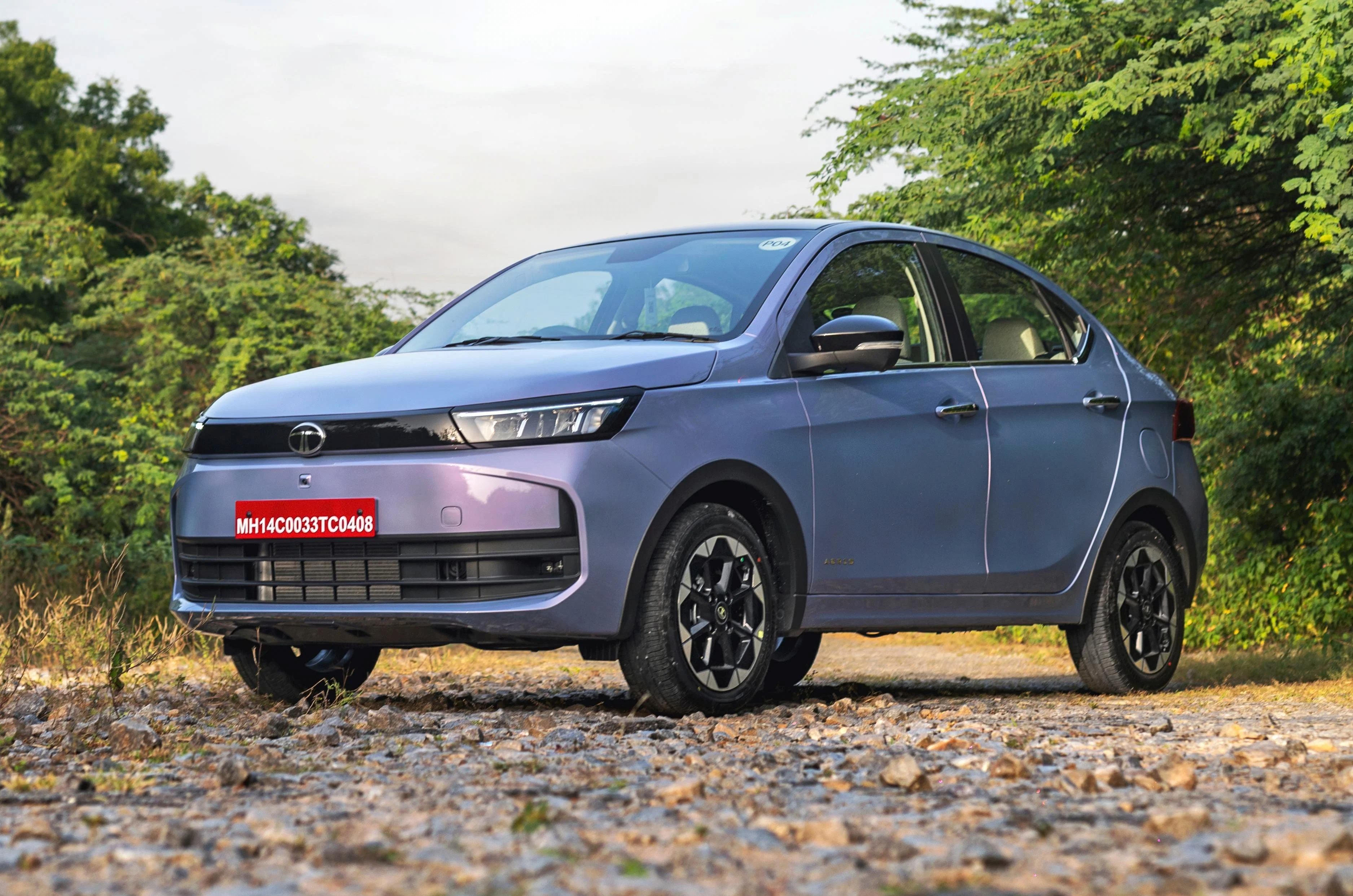
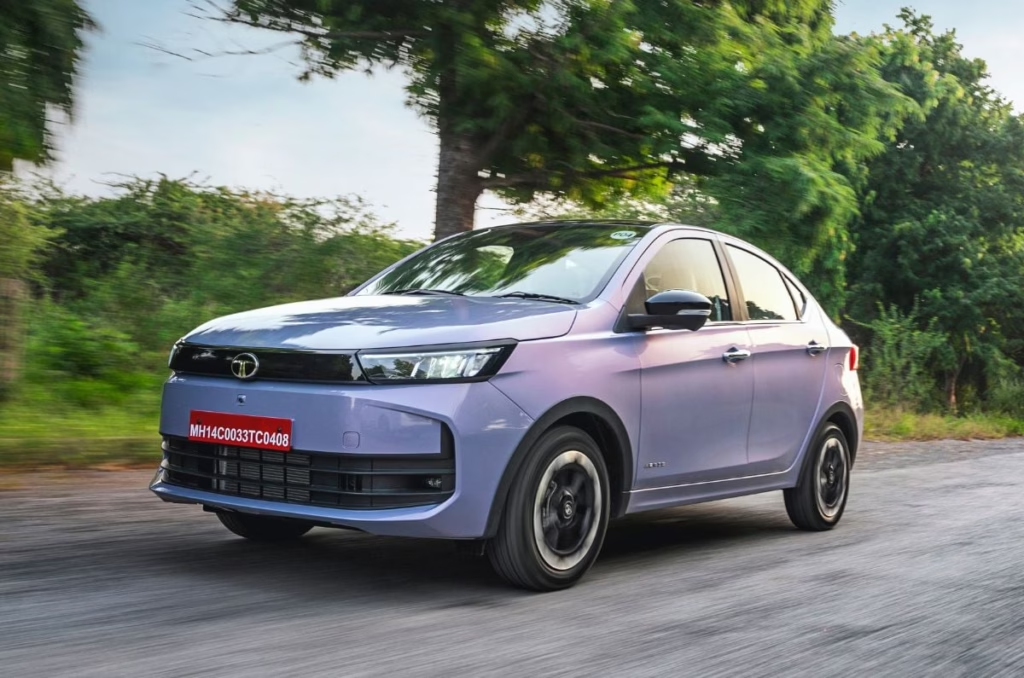
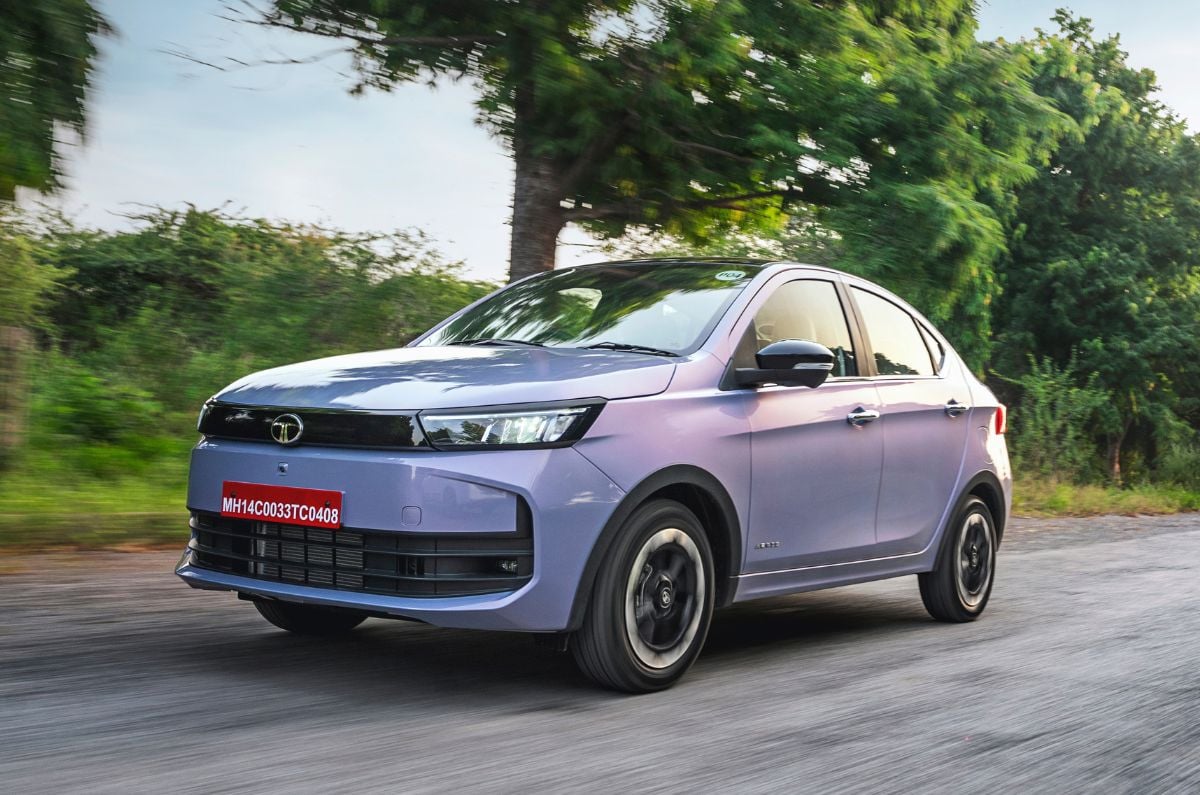
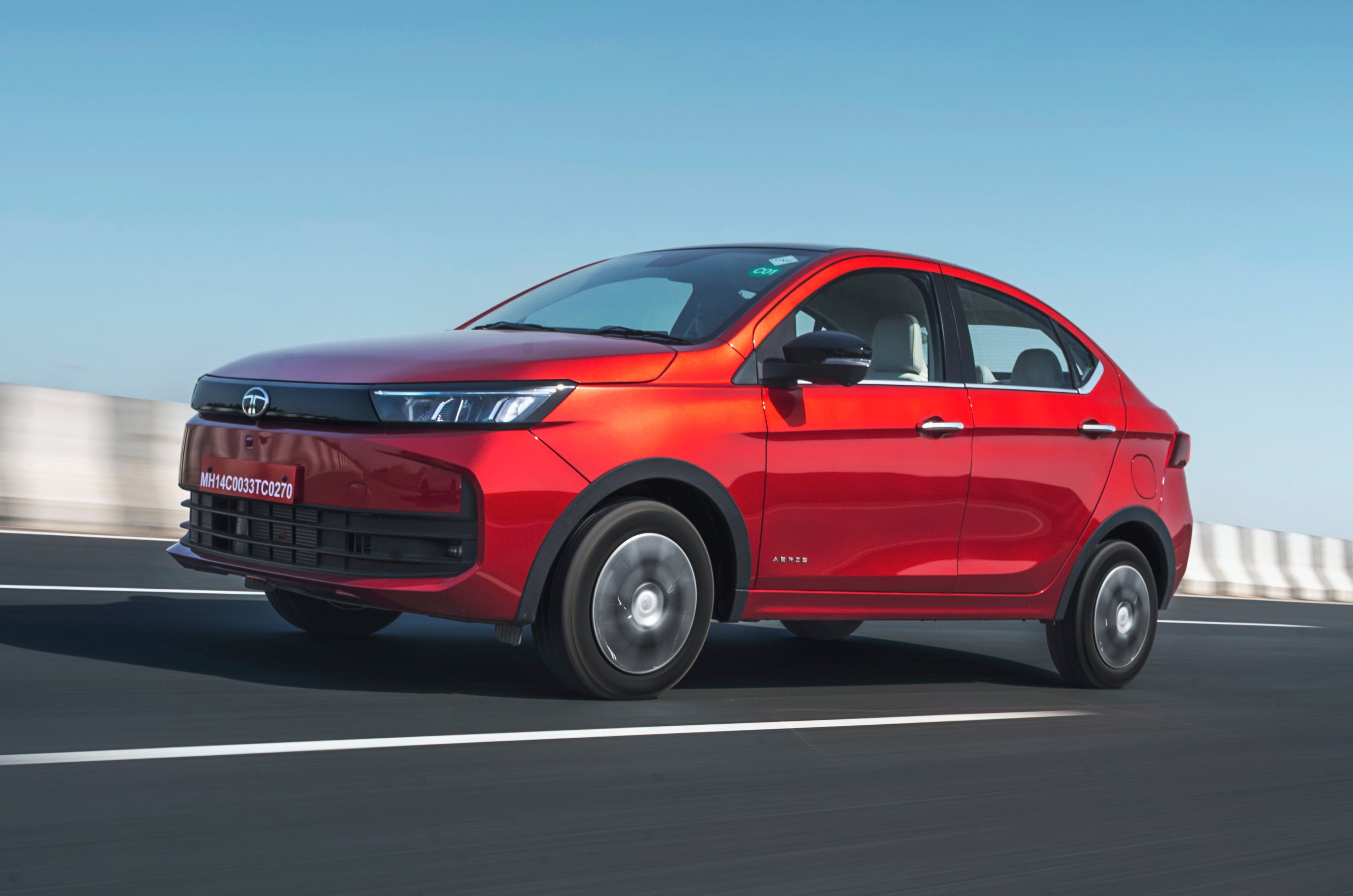
The Tata Aeris looks sleeker than before, with its design now closely aligned with the Tiago hatchback, something we have seen previously with the Tigor. Another factor that could work in the Aeris’ favour is Tata’s decision to offer it exclusively to private buyers, while retaining the Xpres, the fleet version of the Tigor, for commercial customers. This should help the Aeris steer clear of the ‘taxi’ tag often associated with rival compact sedans.
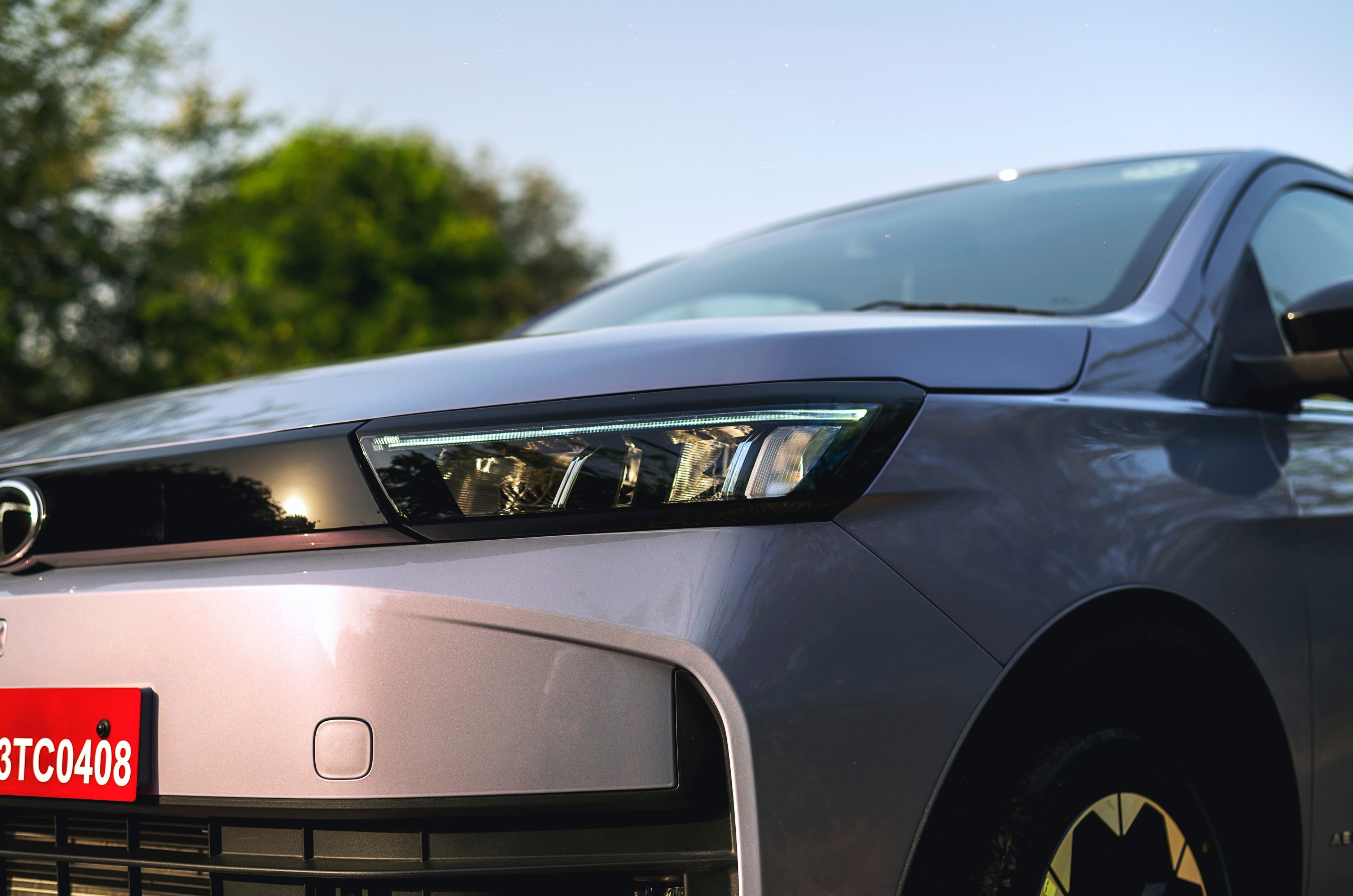
LED headlights with LED DRLs, which are connected by a black trim, make it look sleeker.
Up front, the new clamshell bonnet leads into slim LED headlights with thin LED DRL strips integrated into them. The headlights are connected by a gloss-black trim. The front bumper is also new, featuring wider air intakes and LED fog lamps, a welcome upgrade over the Tigor’s halogen units.
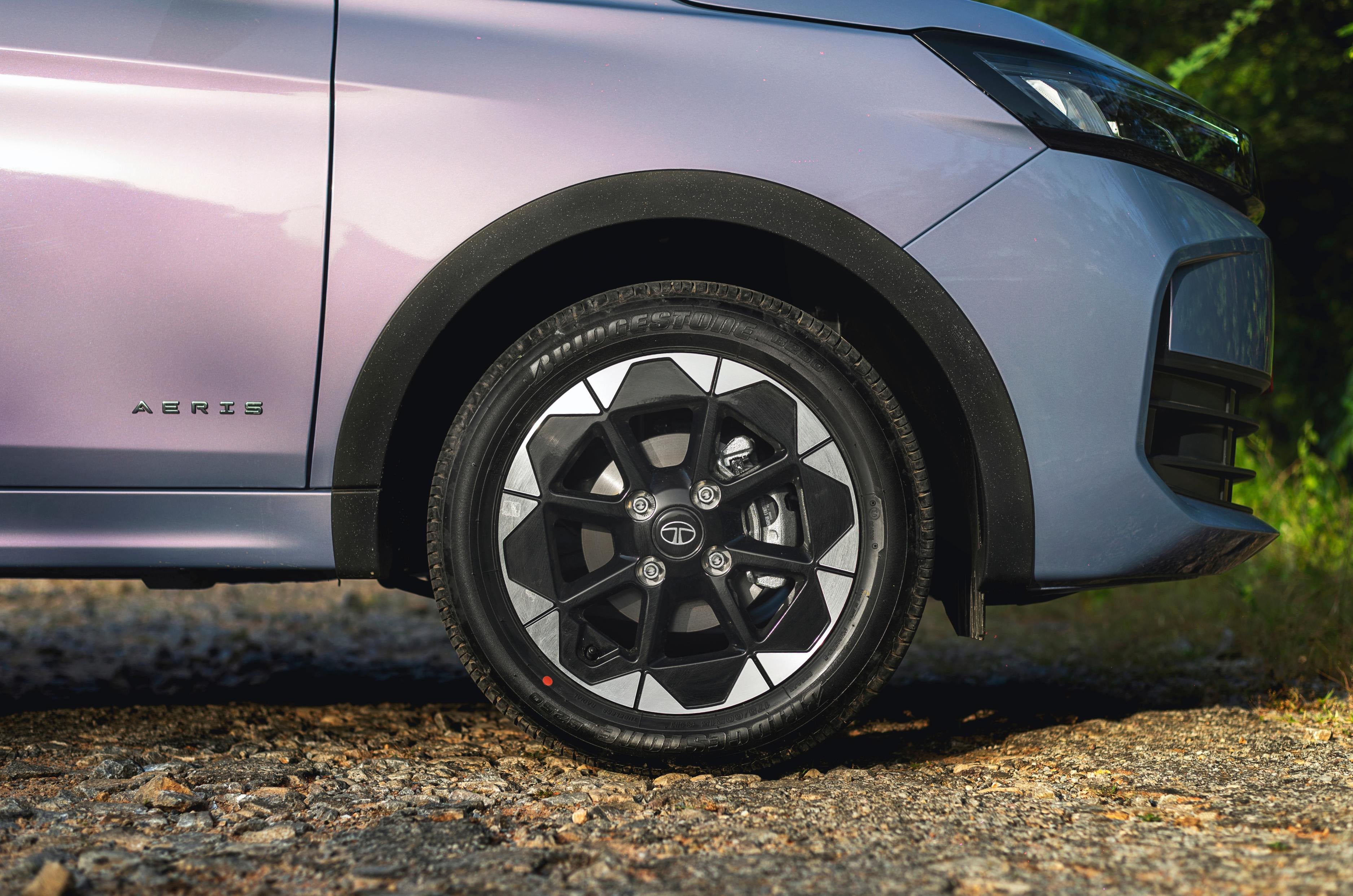
Top versions get 15-inch alloy wheels; 14-inch wheels on other variants appear undersized.
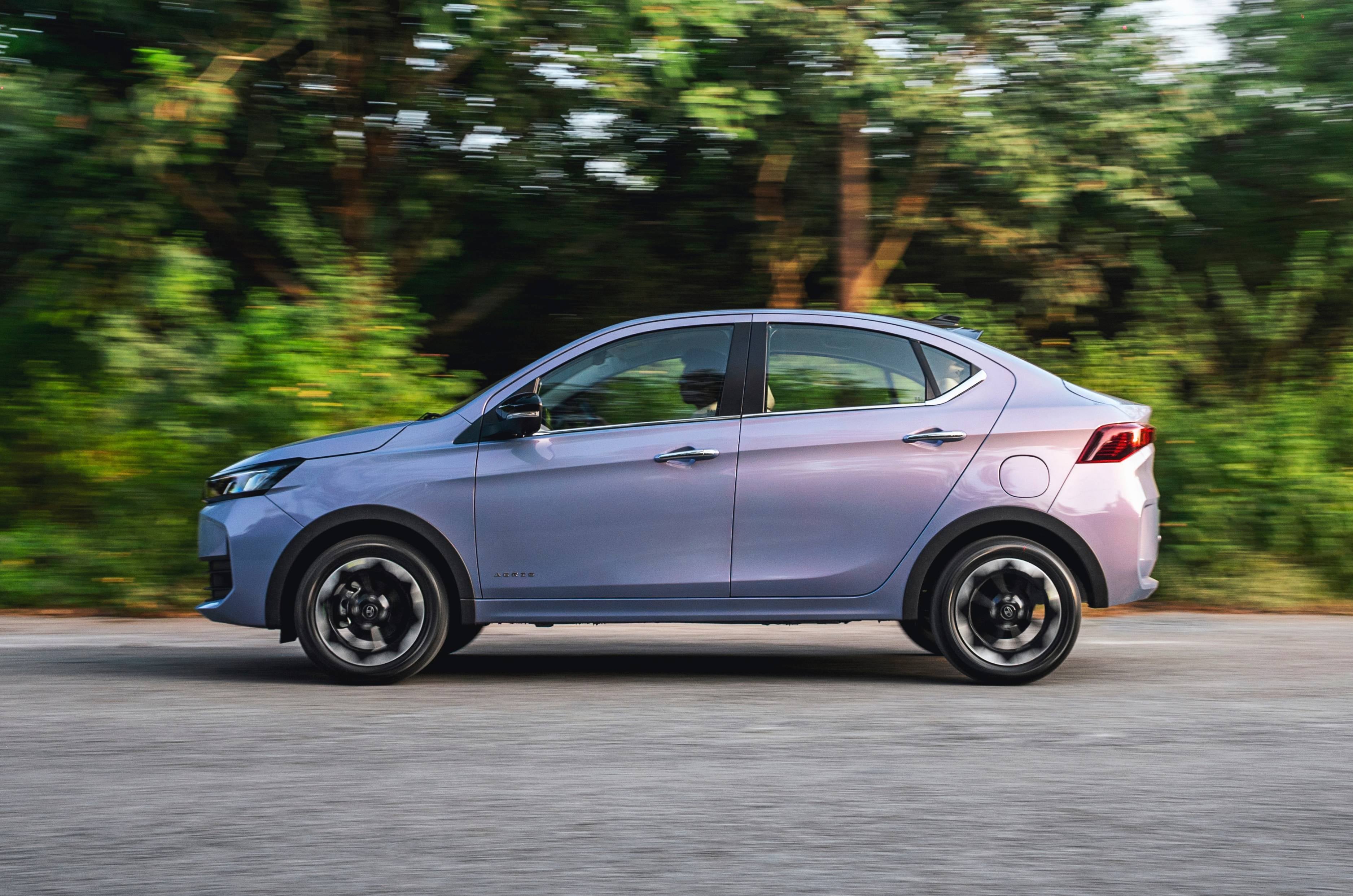
In profile, the 15-inch dual-tone alloy wheels fill the wheel arches nicely, and their contrasting finish looks particularly appealing when the Aeris is on the move. The wheel arches get slim cladding, which Tata says is made from recycled materials and features a distinctive speckled texture. Like the Tigor, the Aeris also gets chrome door handles and a chrome strip along the window line, adding some contrast to the otherwise clean design.
Fastback-like roofline remains a distinctive design element.
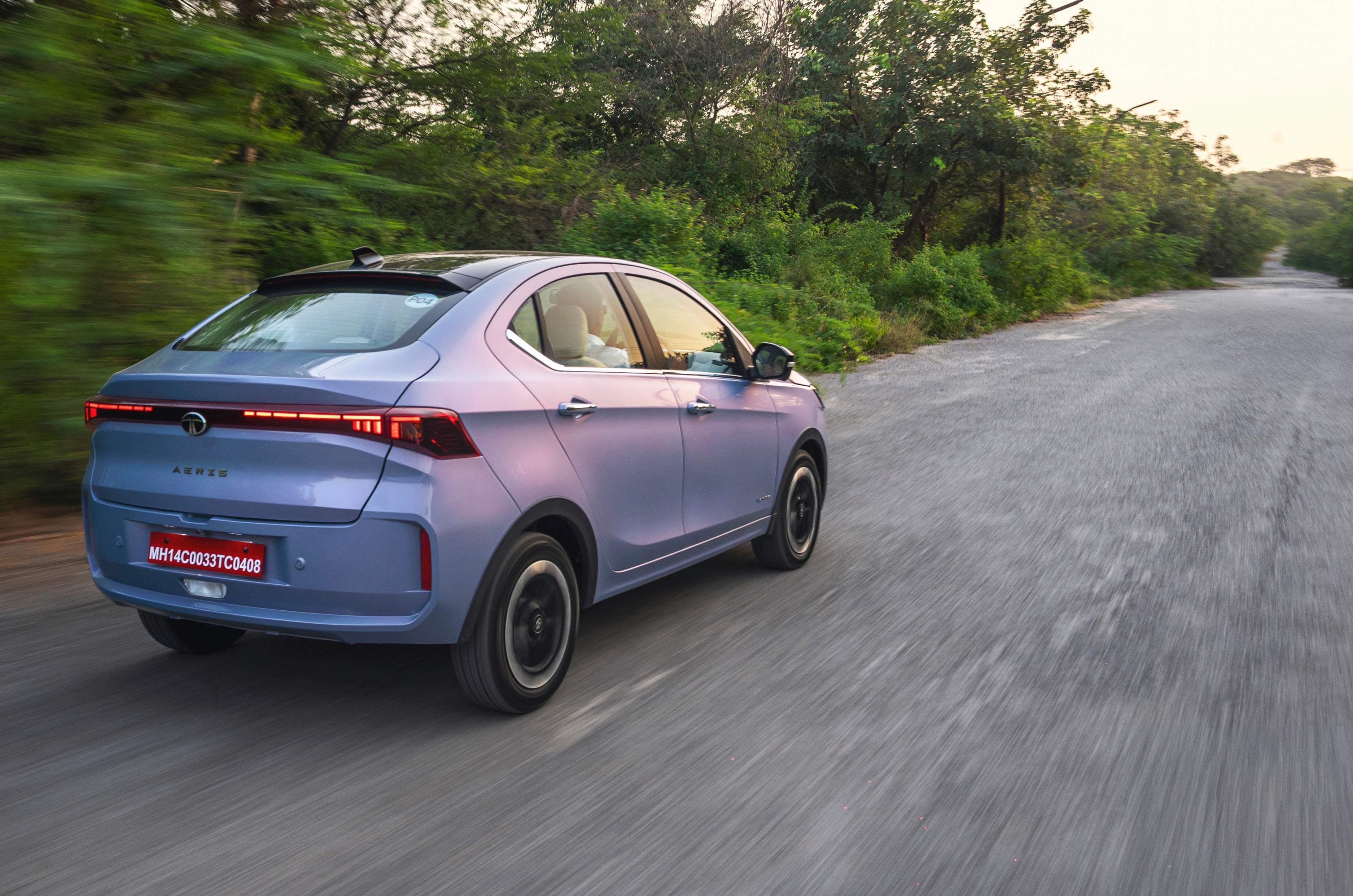
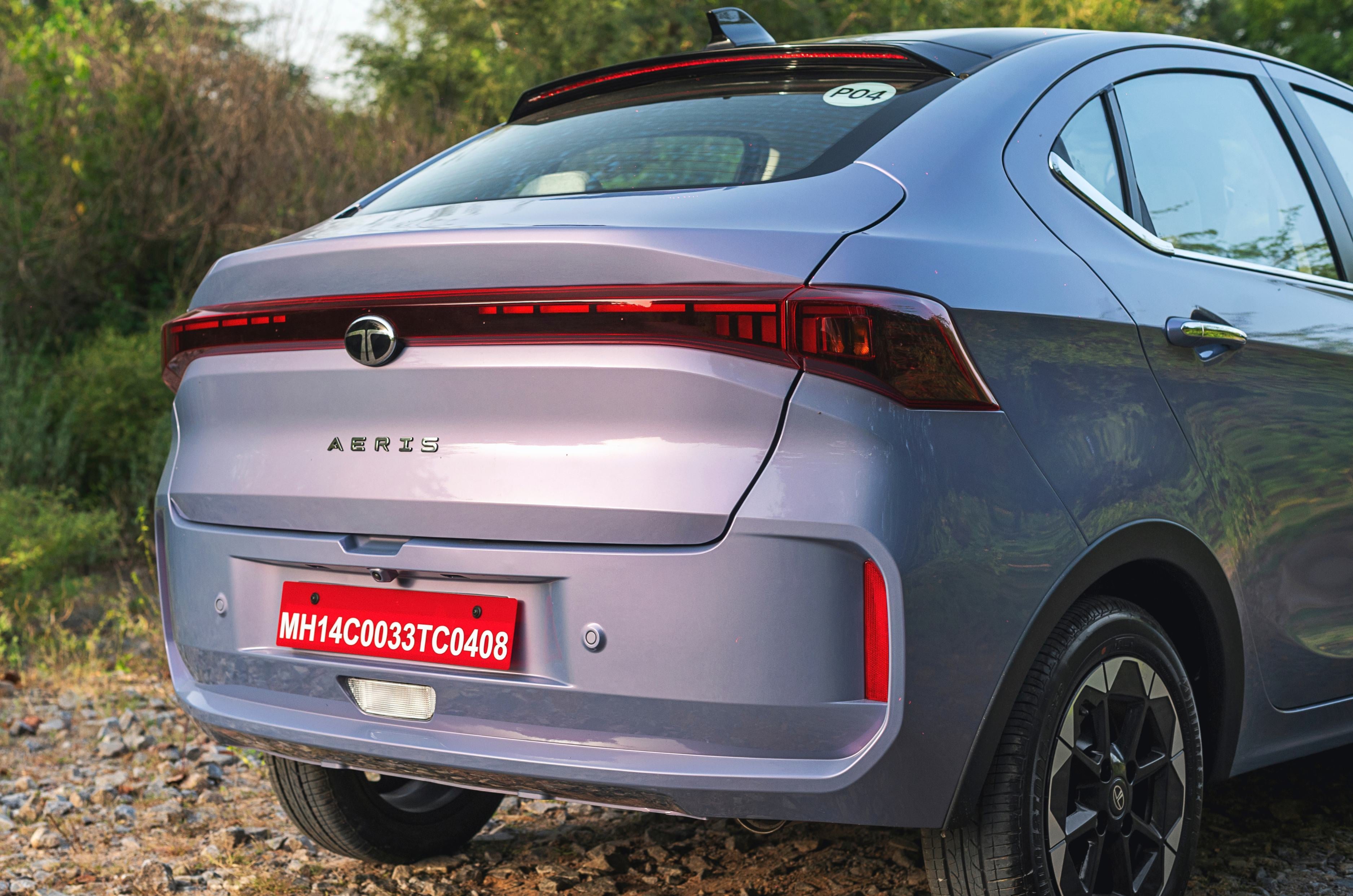
The coupe-like, tapering roofline remains unchanged from the Tigor, and continues to make the Aeris’ overall design cohesive. At the rear, the new taillights give the sedan a more modern appearance, while the red trim connecting them visually makes the Aeris appear larger than it is. The rear bumper is cleanly styled, with the reverse light neatly positioned in the centre.
The Aeris measures 3,995mm in length, 1,684mm in width and 1,532mm in height, and has a 2,450mm wheelbase.
Tata Aeris petrol interior space and comfort – 8/10
Beige theme makes the interior feel airy, and everything is nicely laid out in the cabin
Beige theme lends the cabin an airy feel; dashboard is neatly laid out.
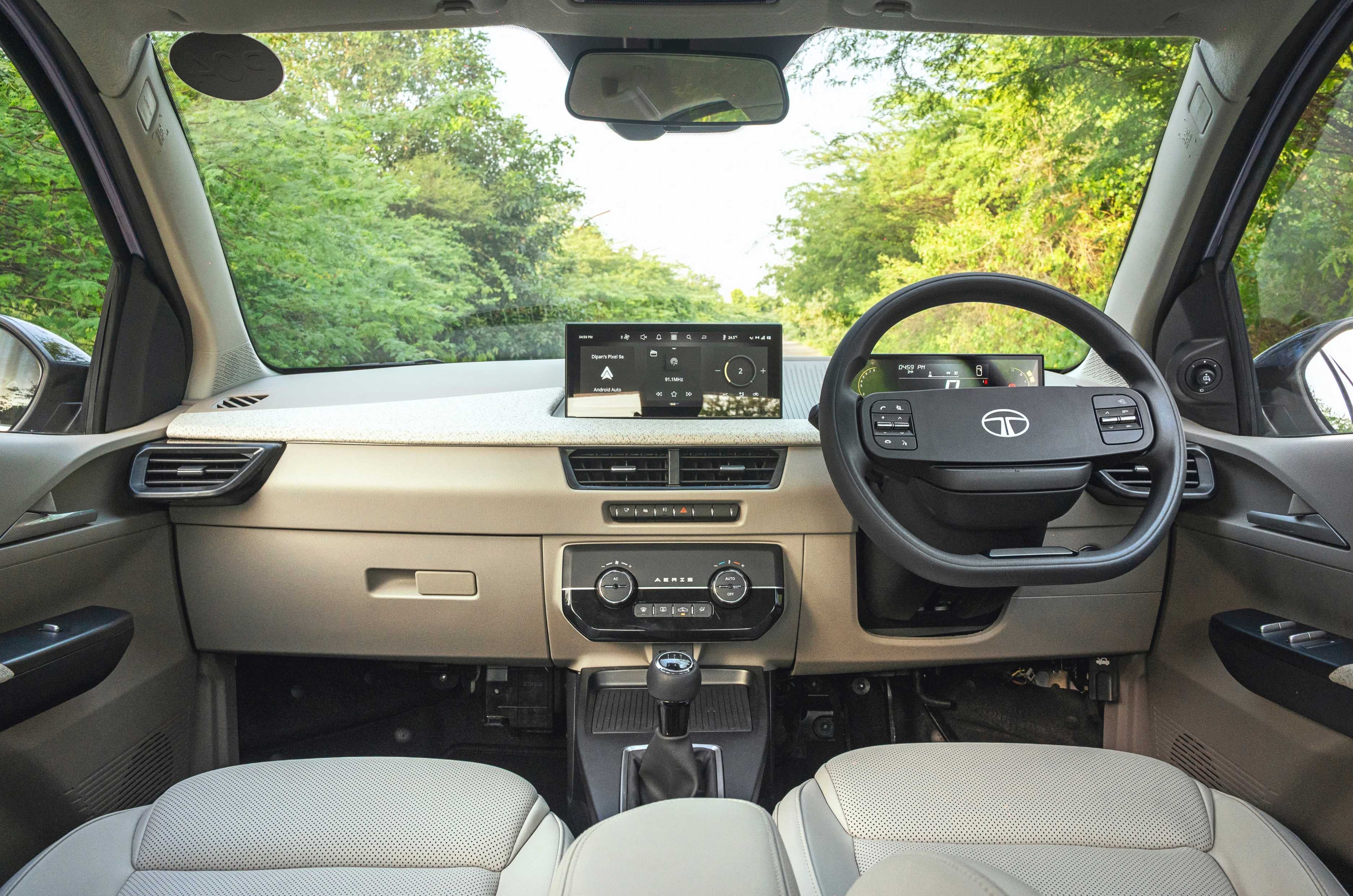
The Aeris’ interior is neatly laid out and looks fairly modern. The cabin gets a beige colour scheme, which makes it feel airy and gives the sedan a greater sense of space. However, the light shade could prove difficult to keep spick and span, especially with regular use.
The dashboard houses a 10.25-inch infotainment touchscreen, a free-standing semi-digital instrument cluster and a revised two-spoke steering wheel. The latter retains physical buttons and, thankfully, does away with the scratch-prone gloss-black finish seen on the Tigor. The door handles look floating like the Sierra and feel sturdy. Lower down, Tata has retained rotary dials and physical buttons for the climate control. They feel solid and do not come across as flimsy.
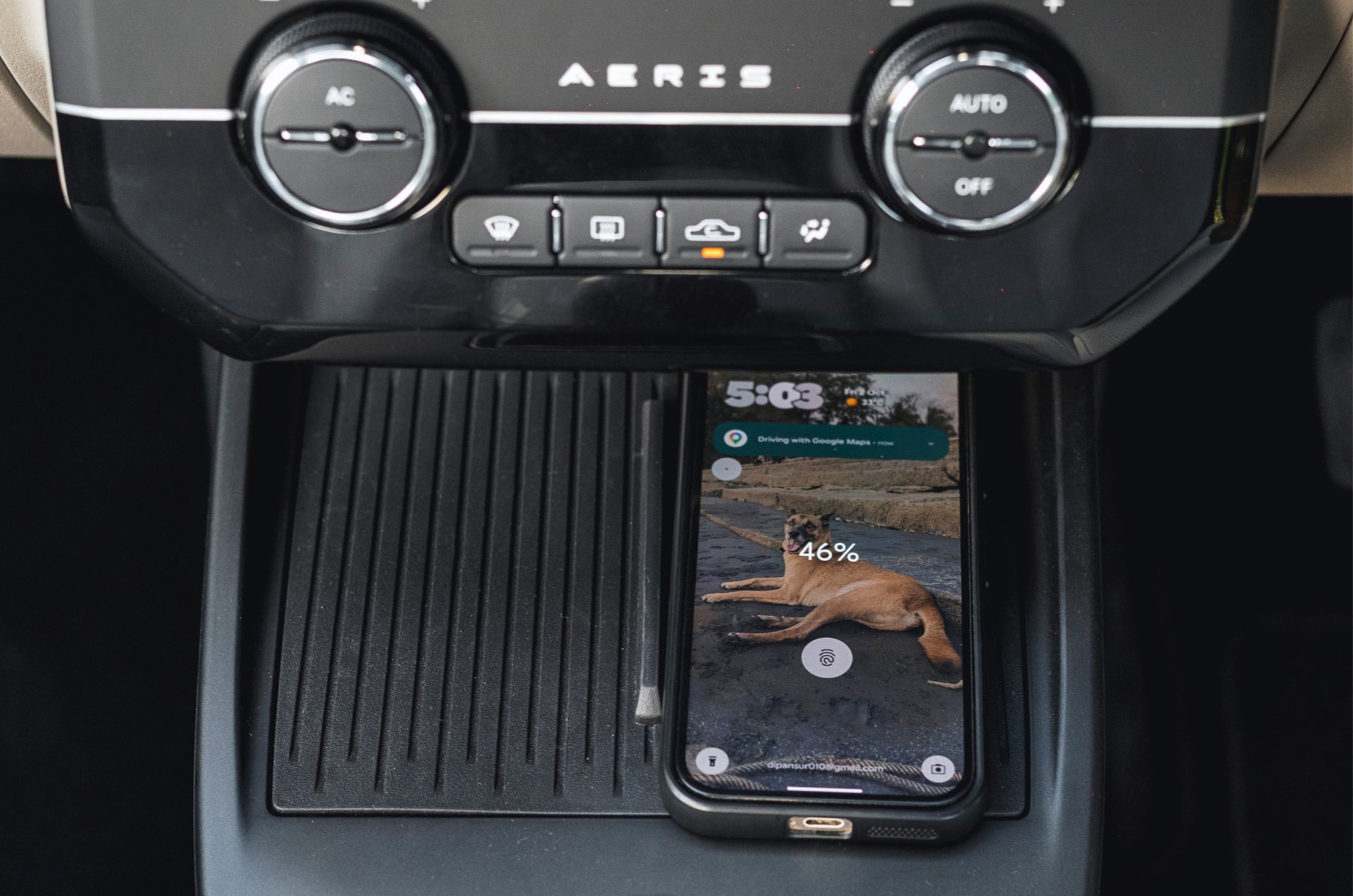
The wireless charger works well but tends to make the phone hot during prolonged use.
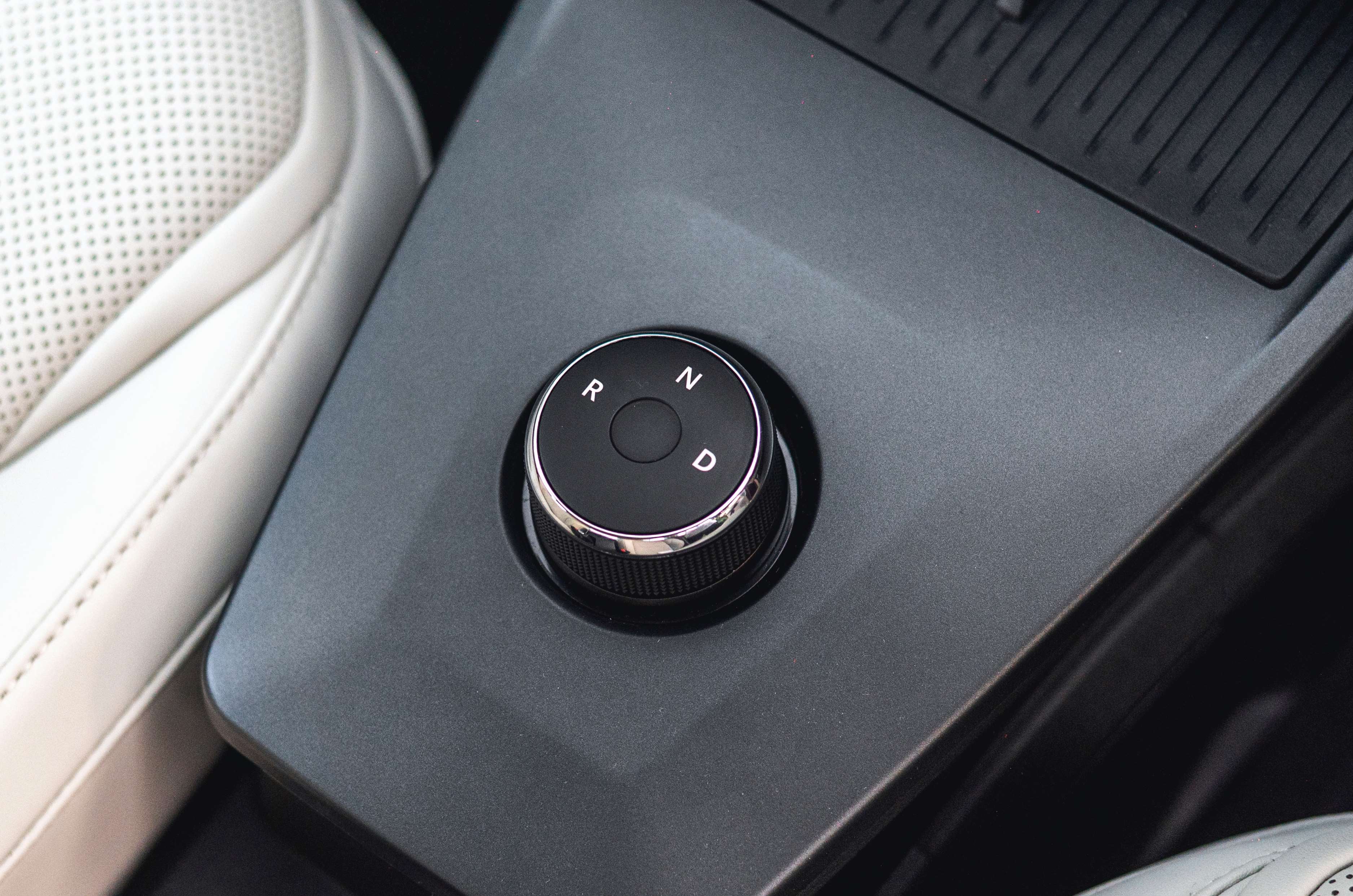
The centre console has been thoroughly redesigned and looks neat. The manual gear lever looks premium and feels good to hold, while the AMT gets a rotary dial that also feels solid and operates seamlessly. Two rubberised phone holders on the console keep phones from sliding around, and the top-spec Accomplished trim offers wireless charging in one slot. The centre console also gets two cupholders and a leatherette-wrapped centre armrest with integrated storage space underneath.
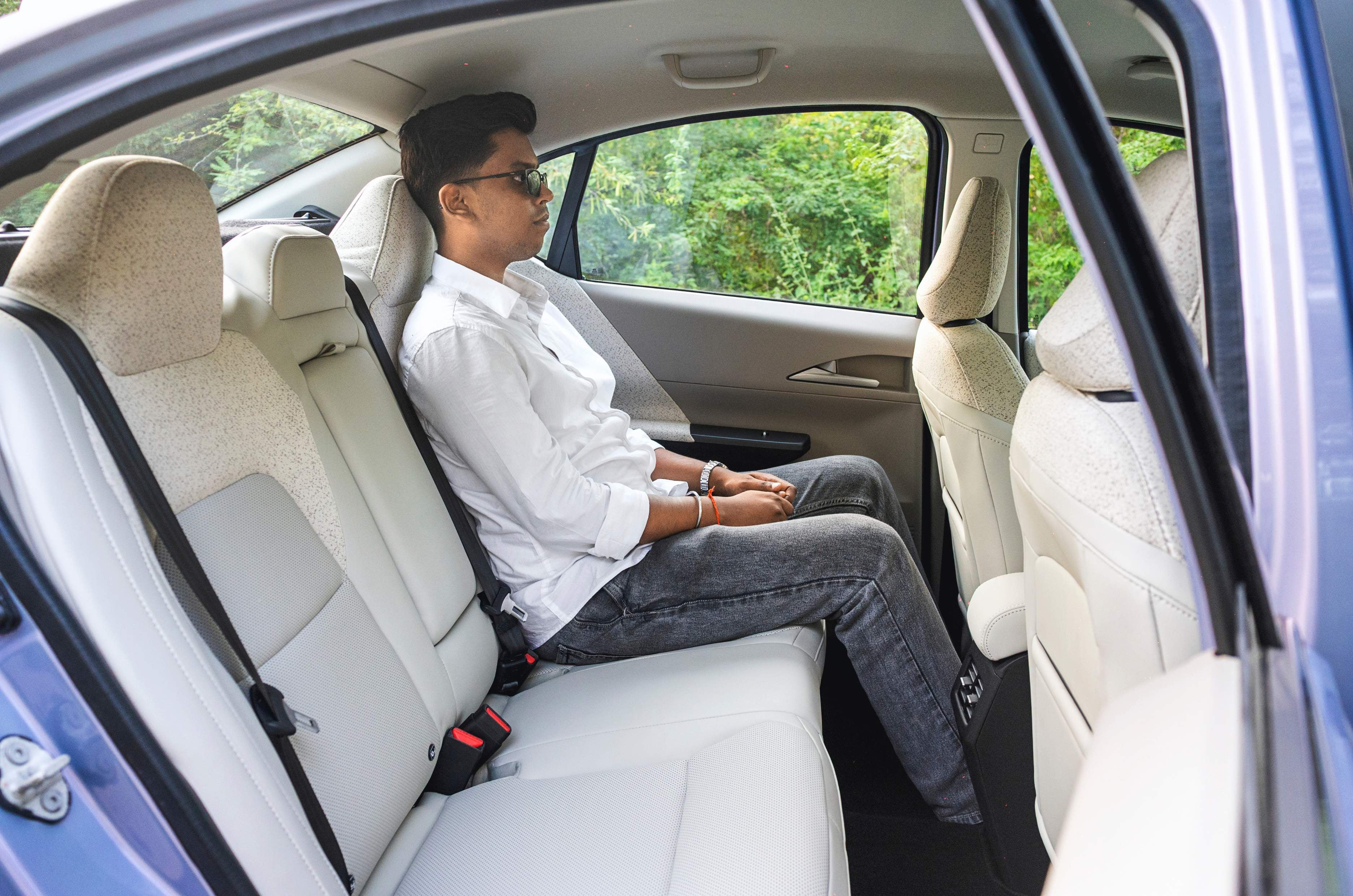
The rear seat offers good kneeroom and legroom, while headroom can be tight for taller passengers.
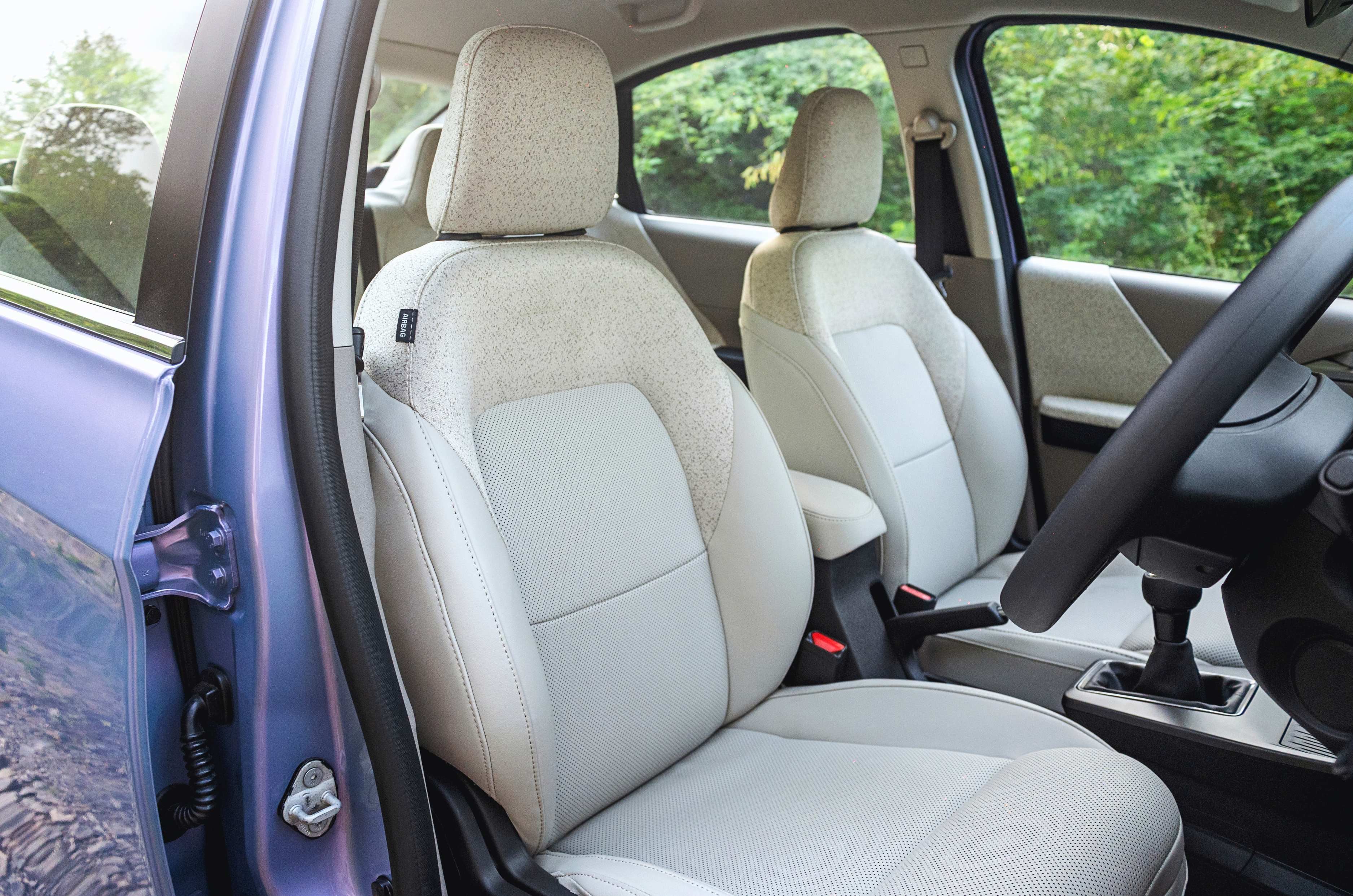
Tata offers part-leatherette upholstery and has revised the cushioning and bolstering, ensuring comfort even on long journeys. They also get a segment-first ventilation function. The rear seats are comfortable too, with good legroom and kneeroom, although headroom is a little tight for passengers over six feet tall. Under-thigh support is adequate.
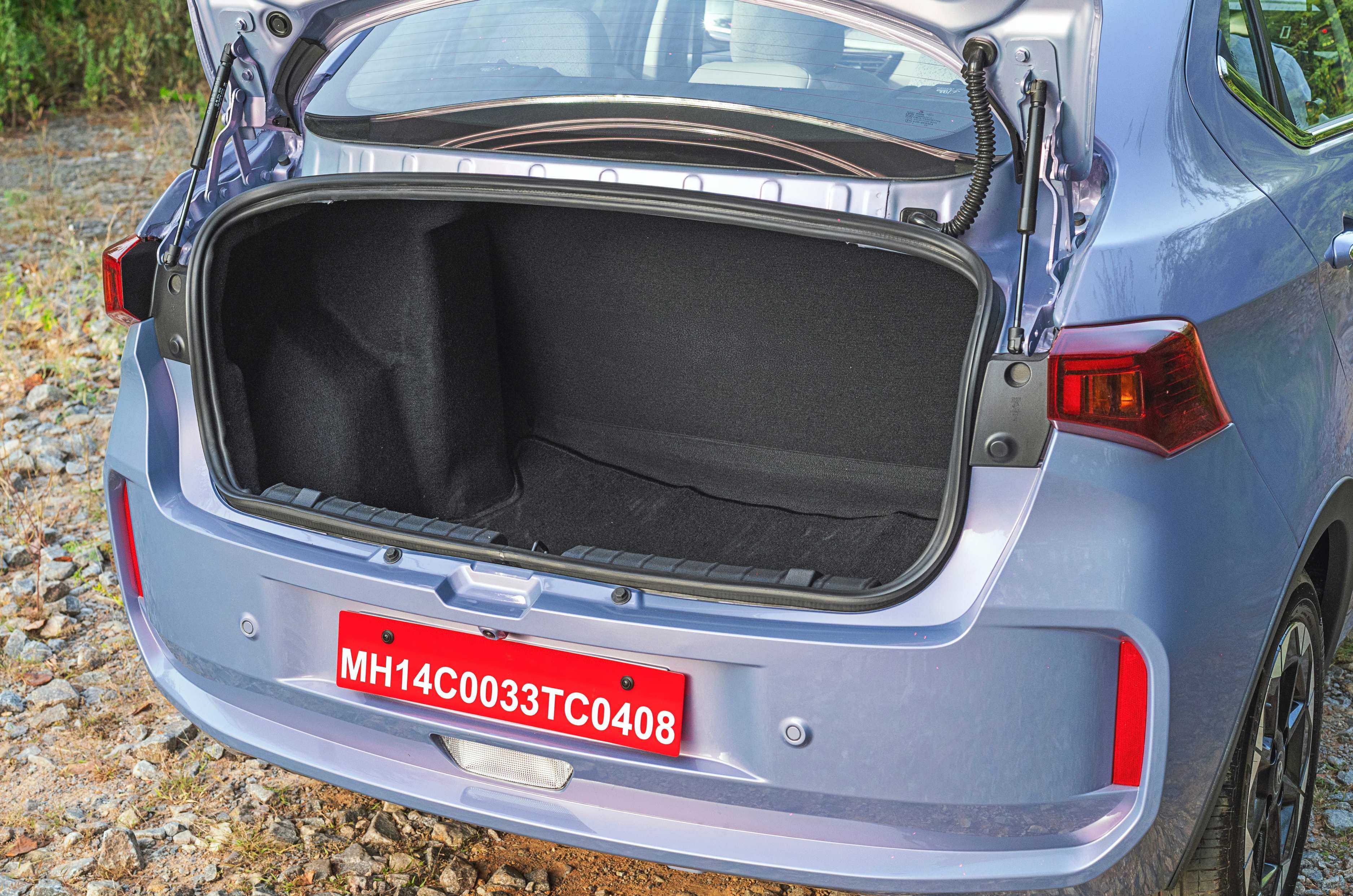
The 419-litre boot is handily large, but the aperture makes loading tricky. Struts free up more usable space.
The Aeris offers 419 litres of boot space, marginally more than the Amaze’s 416 litres and comfortably ahead of the Dzire’s 382 litres and Aura’s 402 litres. The boot itself is large and can swallow a substantial amount of luggage. The use of mechanical struts instead of conventional hinges is a clever touch, as they do not eat into the available boot space. Despite the large boot, the Aeris gets a 14-inch underbody-mounted spare wheel, which is always more promising than a puncture repair kit.
Tata Aeris petrol features and safety – 9/10
Loaded with features to the brim, most of which are well integrated
Blind-spot monitor is very useful but takes up the full screen and hides the map display.
Like other Tata cars, the Aeris is packed with features. The 10.25-inch infotainment touchscreen is slick to use and remains responsive even when navigating through multiple menus. It also displays the 360-degree camera feed, which is lag-free, although the image quality isn’t the best. Tata has also added a new DVR function that allows the surround-view cameras to record the car’s surroundings, ensuring you do not shell out extra for a dashcam. The infotainment screen automatically switches to the blind-spot monitor when indicators are used, which is useful. However, this can be annoying when you are using navigation, although there is an option to disable the view completely.
Revised cushioning and bolstering, and a new ventilation function on the front seats improve overall comfort.
The front-seat ventilation function works well too. During our time with the car, it proved effective at keeping us cool in Faridabad’s near 40deg C ambient temperature. However, the infotainment screen or driver’s display shows nothing when the ventilation is on or the level is adjusted, which can be a little inconvenient.
Part-digital Instrument cluster includes screen flanked by rev counter and fuel gauge.
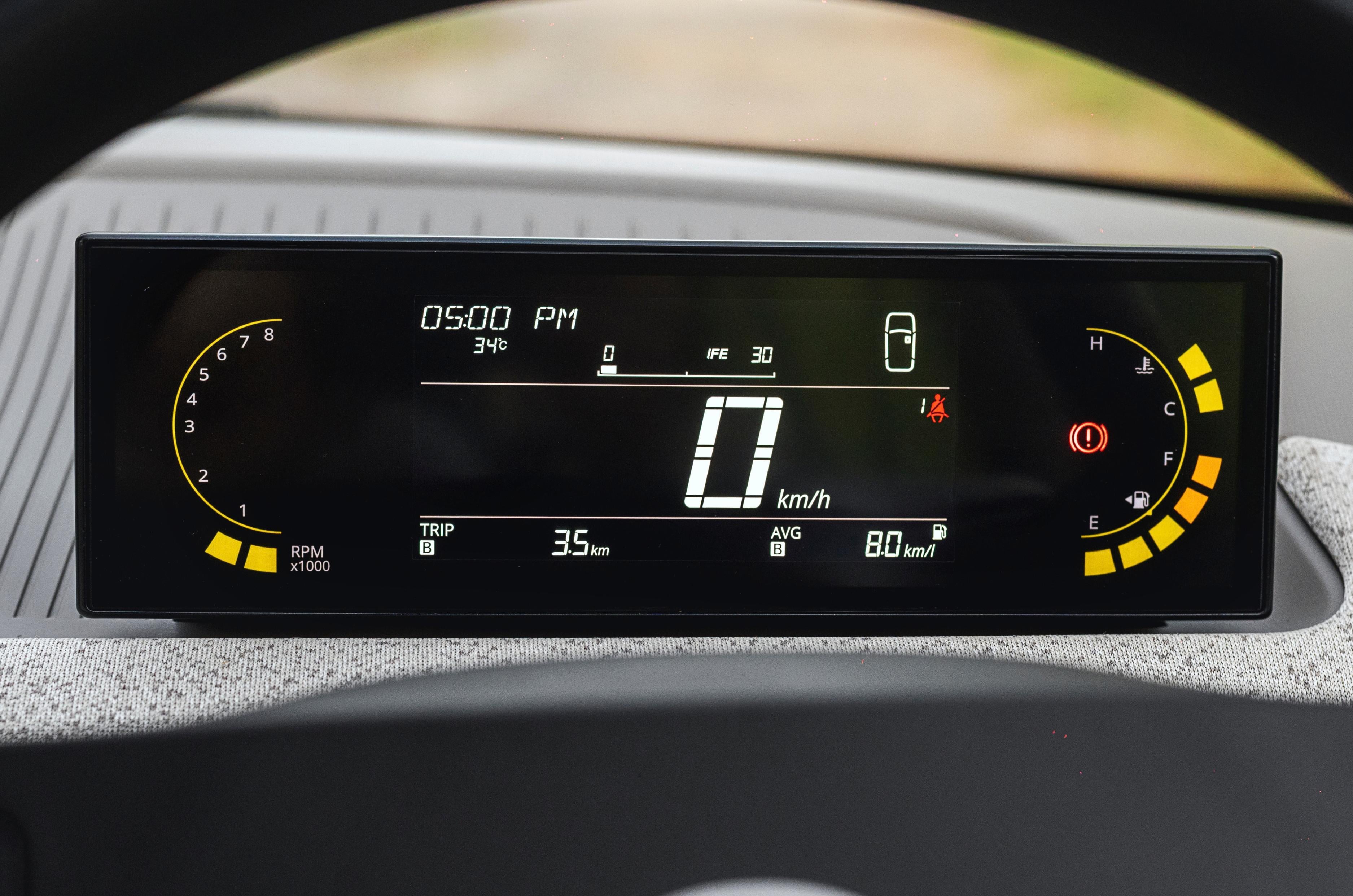
The instrument cluster itself is fairly basic, with analogue dials for the fuel level and rev counter, while a digital display handles the speed and other general information. Depending on the steering wheel’s tilt angle and the driver’s seating position, some of this information can occasionally be obscured.
The four-speaker, two-tweeter audio system is a step down from the Tigor’s four-speaker, four-tweeter setup, although sound quality remains good enough for the segment. The rear seats lack pressure sensors, meaning the seat-belt warning will sound until the belts are fastened.
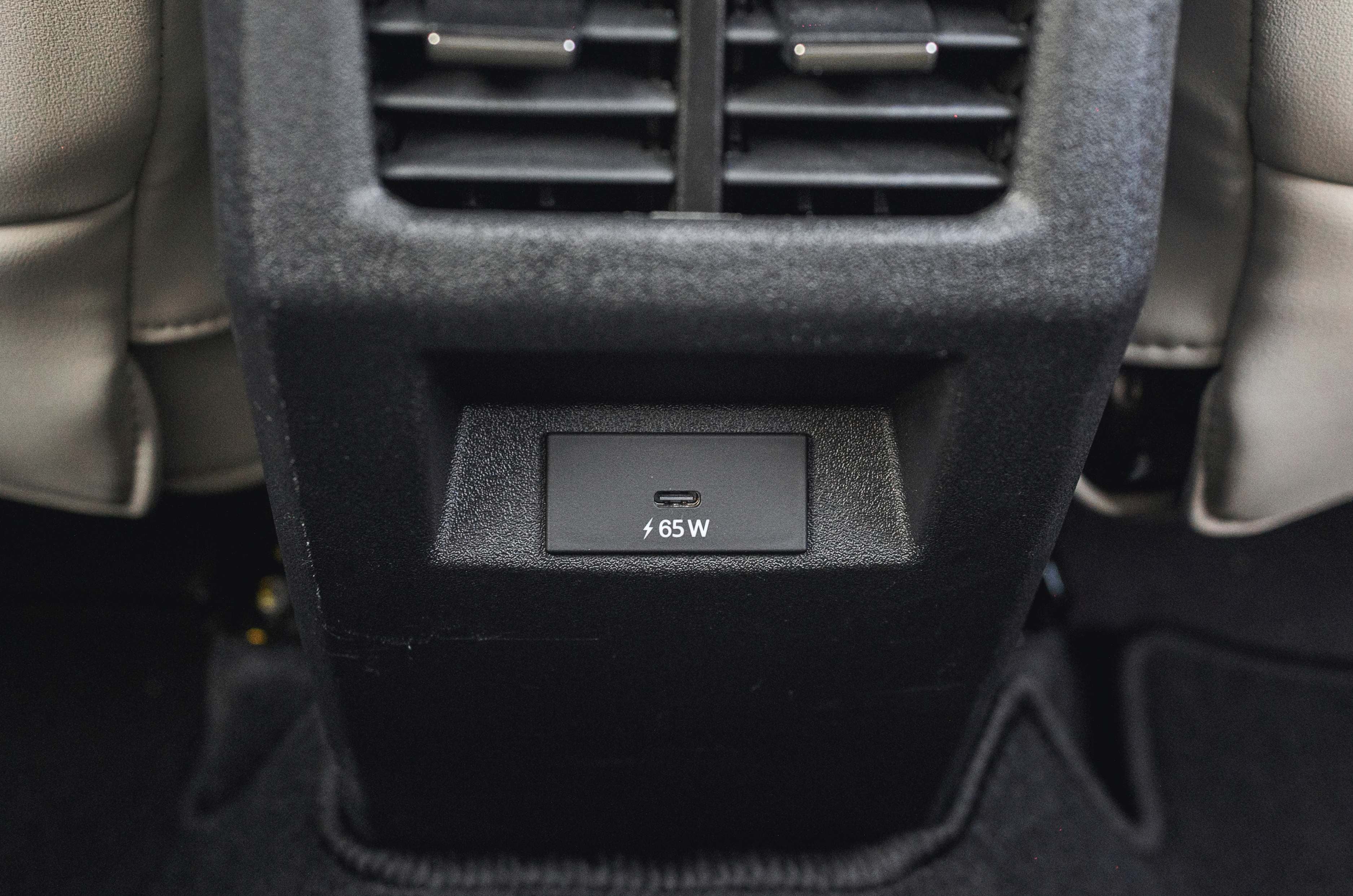
AC vents and a 65W Type-C charging port are among the additions at the back.
On the safety front, the Aeris gets six airbags, Isofix child-seat anchorages for the rear seats, rear parking sensors and three-point seat belts with reminders for all occupants as standard. Higher variants add a 360-degree camera, a day/night inside rear-view mirror, rain-sensing wipers, a rear defogger, a tyre pressure monitoring system (TPMS) and ESP with traction control. The pre-facelift Tigor scored four stars in Global NCAP testing in 2020, but a Bharat NCAP test for the Aeris is due.
Tata Aeris petrol value for money and verdict – 8/10
A well-rounded compact sedan, with the petrol engine making it more versatile
Priced from Rs 5.29 lakh, it offers strong value in a segment where affordability matters.
The Tata Aeris is a much more appealing proposition than the Tigor it replaces. Its fresh design, well-equipped cabin, generous boot and comfortable ride make it easy to live with, while the petrol engine gives it enough performance for both city and high-speed highway cruising. The manual gearbox is light and easy to use, while the AMT is better suited to relaxed city driving than enthusiastic highway use. The long list of features adds further appeal to the package.
There are some shortcomings too, including a coarse engine and poor cabin insulation. However, the Aeris’ biggest strength is its pricing. The petrol variants are priced from Rs 5.29 lakh to Rs 8.74 lakh (ex-showroom), and it undercuts rivals by a fair margin, making a strong case for itself in a segment where value for money remains a key consideration.
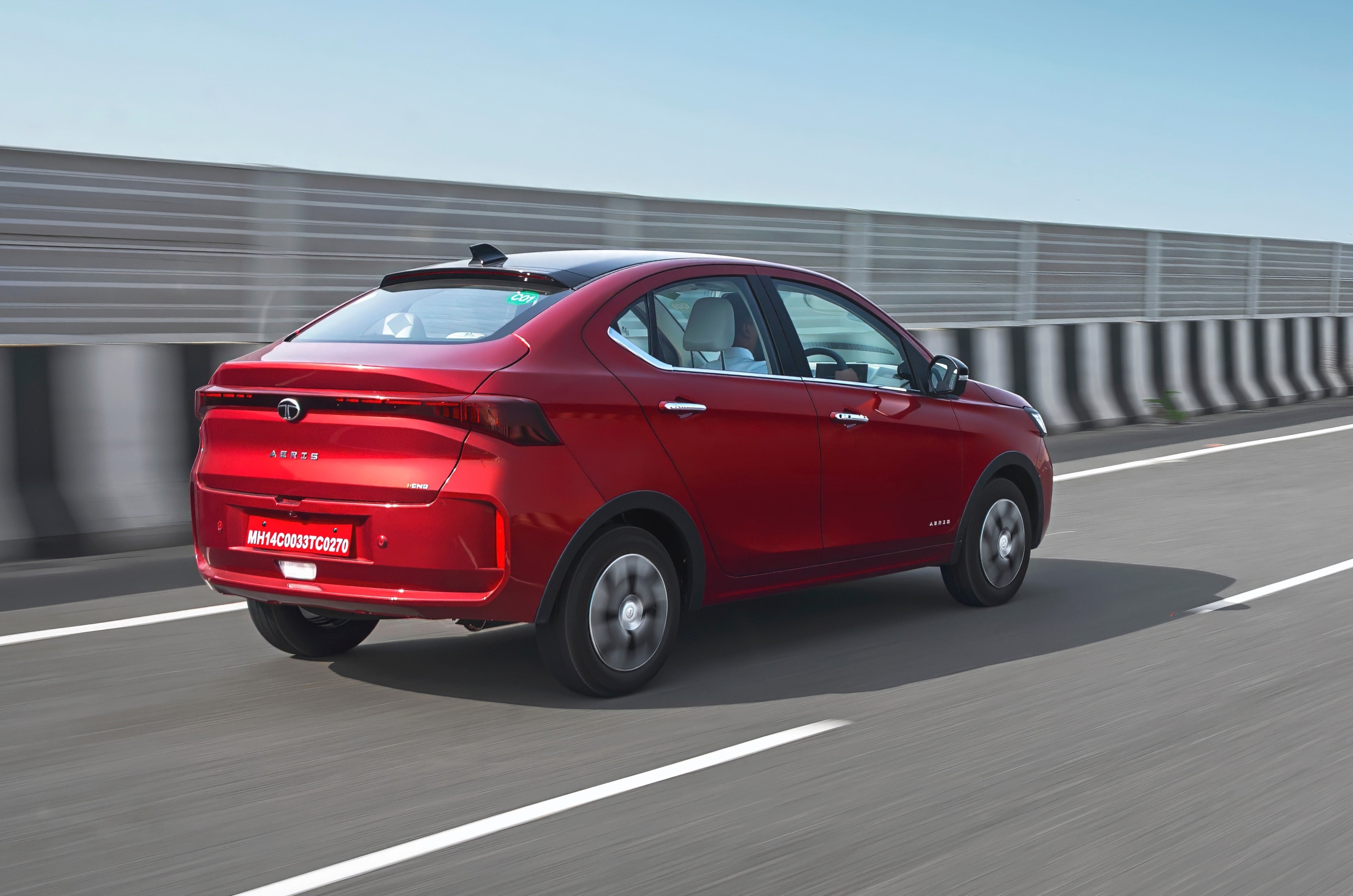
The Tata Aeris was launched recently as a facelifted and reworked version of the Tigor, with a fresh and modern exterior look and a minimalistic interior brimming with features. The powertrain options, however, are the same as those of the Tigor. We recently drove the Aeris iCNG, and here are three reasons why you should consider buying it and two reasons that could deter you.
Reasons to buy the Tata Aeris CNG
Modern exterior design and well-equipped interior
The Tata Aeris is clearly a step up from the Tigor and looks modern. It gets slim LED headlights with integrated LED daytime running lamps (DRLs) joined by a gloss-black trim, all of which give it a clean look. Some contrast is added via the front bumper, which features a black section around the wide air inlets. The new LED fog lamps and the clamshell bonnet also look good.
In profile, the CNG variants’ 14-inch stylised steel wheels look undersized, particularly against the prominent wheel-arch cladding. Chrome elements on the door handles and window line add contrast. The Aeris retains the Tigor’s distinct coupe-like roof that flows into the tail. The tail-lights wrapped within a red trim make the Aeris feel bigger and nicer.
Inside, the Aeris looks minimalistic and modern. It gets two free-standing screens – a 10.25-inch infotainment touchscreen and a semi-digital driver’s display. The infotainment screen particularly has a pleasant UI and crisp graphics. The Aeris also debuts premium-looking part-leatherette seat upholstery and ventilated front seats that add to the comfort. Other features include automatic climate control with rear vents, a 360-degree camera with a blind-spot monitor and a 6-speaker sound system.
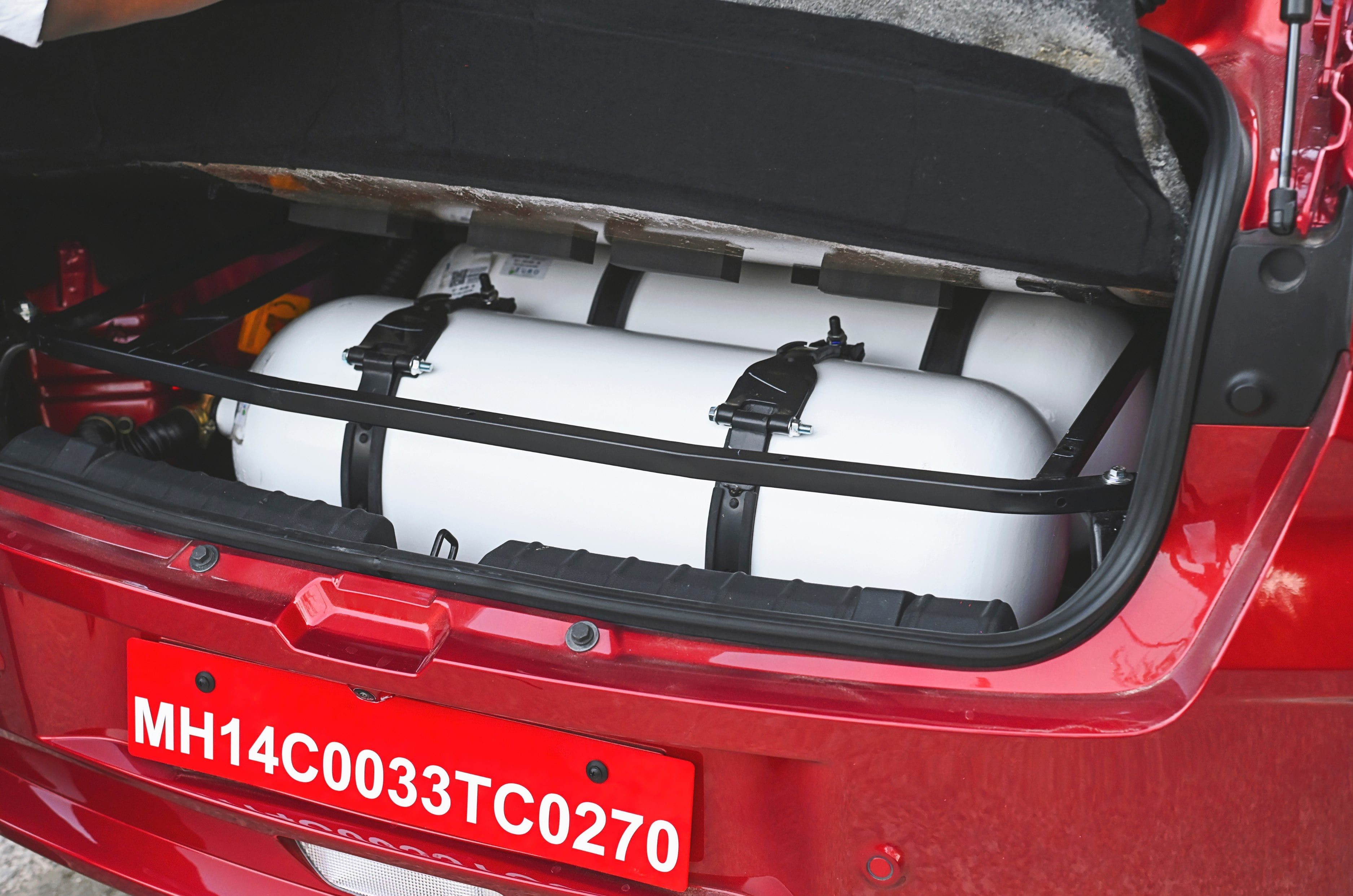
Practical dual-cylinder CNG setup
Instead of a single CNG tank that eats up all the boot space in its rivals, the Aeris is offered with dual CNG cylinders, enabling space for a couple of backpacks and a cabin-sized trolley. While Tata has yet to reveal the official figure, with a similar dual-cylinder setup, the Tigor offers a 227-litre boot. Other than this, the Aeris offers bottle holders and cubby space on all doors, a storage space underneath the front centre armrest, cup holders in the centre console and rear centre armrest, and a large glove box, all adding to its practicality.
Excellent ride quality and handling manners
Like other Tata cars, the Aeris has a suspension that is well-tuned for Indian conditions, and it offers a commendable ride quality on both rough roads and highways. Over poor roads, the suspension comfortably absorbs broken surfaces without unsettling the car. The ground clearance figure is yet to be revealed, but in our test, we found it adequate for tackling rough roads and large speed breakers.
Out on the highway, the Aeris is equally composed. It stays planted at triple-digit speeds and does not feel floaty or nervous when driven quickly. The steering also offers decent feedback, weighing up nicely as speeds increase. However, there is some vagueness around the centre that hampers confidence a little.
Reasons not to buy the Tata Aeris CNG
Slow and jerky AMT responses
The CNG-AMT is easy to use in slow-moving traffic thanks to its smooth creep function, which makes crawling through traffic and manoeuvring in tight spaces fairly effortless. However, things get less polished once you press the accelerator. There is a noticeable pause before the powertrain responds, followed by a head-nod as the car picks up, making acceleration feel jerky. The delayed response is particularly noticeable when you need to accelerate quickly, and overtaking on the highway requires some planning as a result.
Poor NVH and cabin insulation
The Aeris is reasonably quiet when driven gently around town, but the engine gets noticeably louder and harsher once the revs climb beyond 2,500rpm. Vibrations also make their way into the cabin, while wind and road noise become increasingly noticeable as speeds rise. This takes away from the otherwise comfortable nature of the car, particularly on longer highway drives where the engine and tyre noise can become tiring.
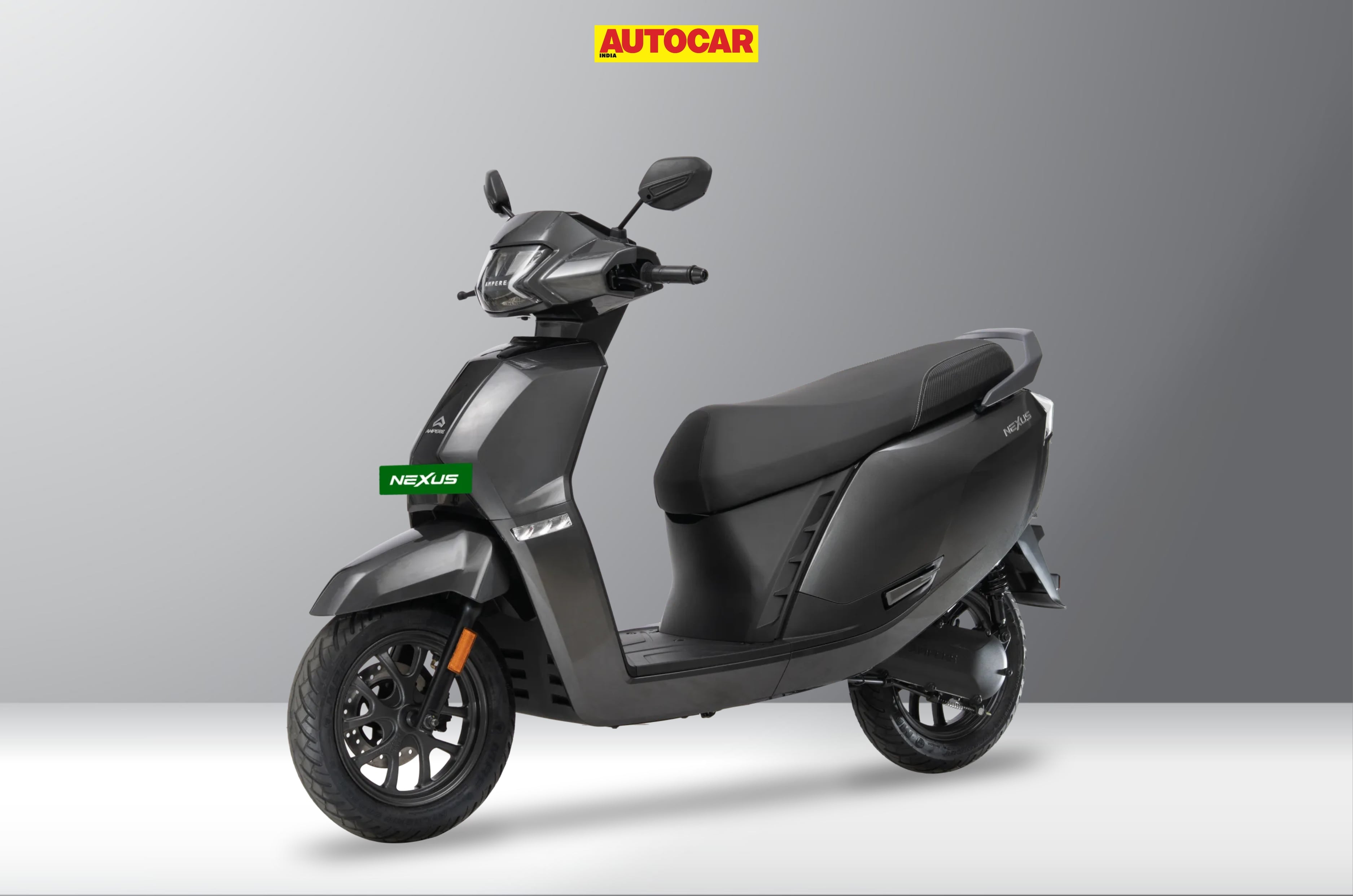
Ampere has launched the Nexus EX+ at Rs 1.30 lakh, the electric scooter’s updated version, featuring a more powerful 5kW motor and an IP65-rated water-resistant charger. The e-scooter is available in two variants, with the higher-spec variant adding Ampere’s Intellipack connected technology, which brings features such as turn-by-turn navigation, geofencing, call alerts and more.
EX+ gets a 5kW motor compared to the previous 4kW motor
Now comes with an IP65-rated 750W charger
Intellipack-equipped variant costs Rs 6,000 more
Ampere Nexus EX+: What’s new?
Now gets a powerful motor, IP65-rated charger and an optional Intellipack
The 5kW motor now produces 202Nm of peak torque at the wheel (bear in mind, the multiplication factor of the gearing on EVs always exaggerates torque numbers), which allows the scooter to accelerate from 0-40kph in 4.5 seconds (claimed). It is also claimed to improve the gradeability on steep climbs, flyovers and hilly roads. The scooter also gets an IP65-rated water-resistant 750W charger, which should give some peace of mind when charging out in open spaces or for those who don’t have shaded parking.
The Intellipack equipped version uses Ampere’s Connect App to provide more than 30 connected features. These include turn-by-turn navigation, geo fencing, call alerts, live location sharing, real-time charging status, find my scooter and many more. The standard Nexus EX+ is priced at Rs 1.30 lakh, while the Nexus EX+ with Intellipack costs Rs 1.36 lakh.
The scooter uses a 3kWh LFP battery with a claimed IDC range of 136km. The Nexus EX+ also gets a five-year/75,000km warranty for the battery and three-year/30,000km warranty for the rest of the scooter. The new Nexus EX+ and Nexus EX+ with Intellipack are available through Ampere dealerships across India.
Earlier, the Nexus was available in two variants EX and ST with their primary differences being the instrument clusters, connected features, and price points. Now, Ampere seems to have streamlined the portfolio and the two EX+ variants are the only way to buy a Nexus.
The Nexus EX+ is positioned in the mid-to-high segment of family electric scooters, where it competes with other major players like the TVS iQube 3.1kWh, Ather Konarc, Vida VX2 and the Chetak C3001, making it one of the compelling option for buyer prioritizing range and features.