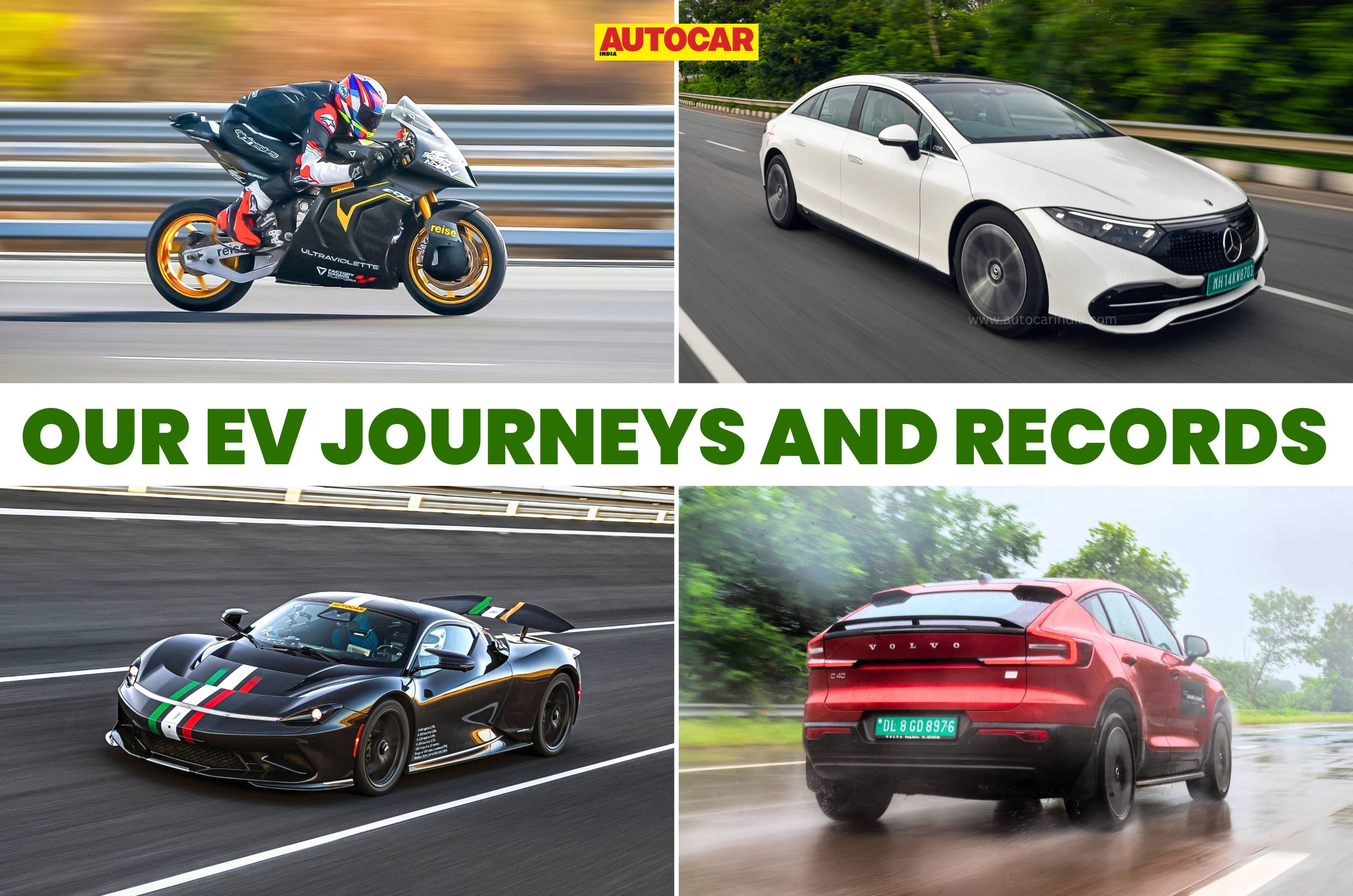
World EV Day special: Epic electric features by Autocar India

World EV Day special: Epic electric features by Autocar India
world ev day 2026 autocar india

Electric vehicles have skyrocketed in significance over the past decade, particularly in light of global issues like climate change and pollution. EVs require no fossil fuels to run, and therefore emit zero harmful pollutants into the atmosphere. To promote the adoption of EVs, September 9 was designated ‘World EV Day’ six years ago by sustainability-focused companies Green.TV and ABB Group, and is recognised worldwide.

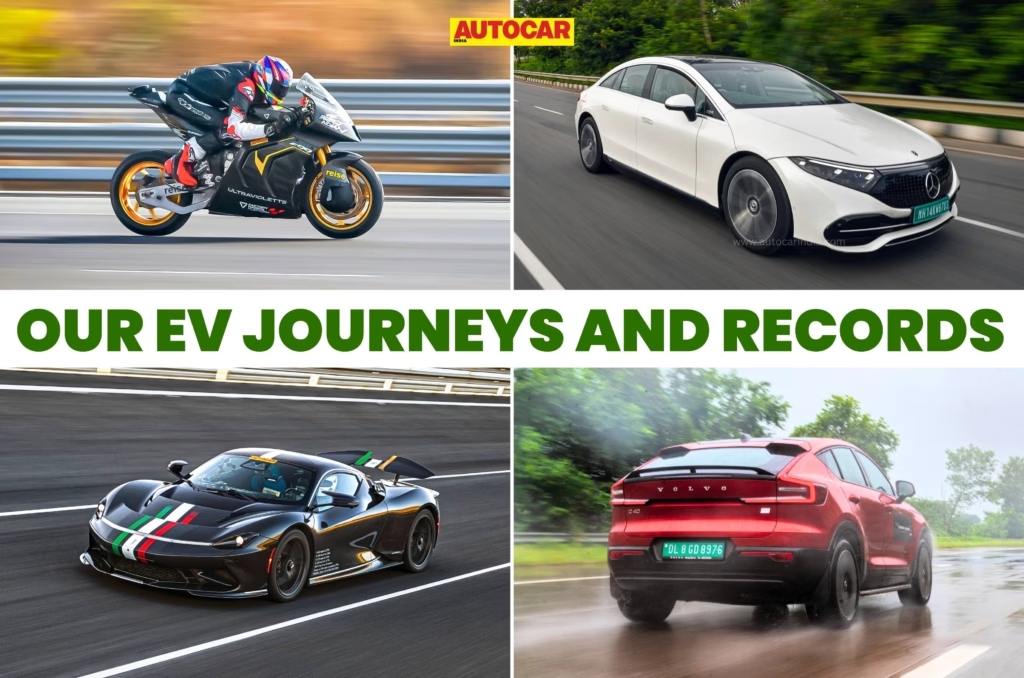
On the sixth iteration of World EV Day, let’s take a look at some of Autocar India’s most notable achievements in the all-electric mobility space.

1. Mercedes Benz EQC clean energy charging

Hydro, wind and solar energy were the only means of charging we used

In 2021, we set out on a journey in the Mercedes-Benz EQC to explore how truly “green” EVs can be when powered by renewable energy only; at present, coal is the primary source of energy production. We departed from the Mercedes-Benz facility in Chakan with a full charge, heading to Tata Power’s Khopoli hydroelectric plant, Agaswadi wind farm and Mulshi solar farm.
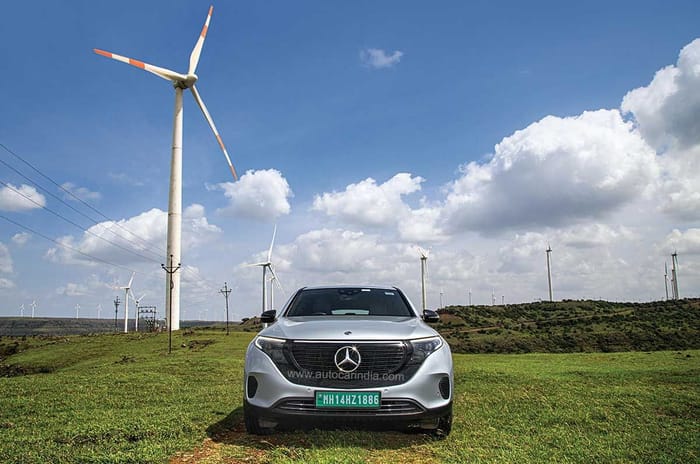
Along the way, we investigated clean power sources – hydro, wind and solar – that could sustainably fuel EVs in India. While the EQC couldn’t be charged directly from the hydro grid since it mixes with the main grid, we were able to charge the SUV via a 15A plug at Tata Power. However, we did tap charging power directly from wind turbines and solar panels for the EQC. Ultimately, this trip showed us that our EVs could soon be truly emissions-free – not just at the tailpipe, but across the entire power chain.

2. Green Mumbai Drive 2021

30 EVs quietly trundling through the Sanjay Gandhi National Park

We achieved a rare feat by bringing together every EV that was on sale in India at the time and driving them across Mumbai and through the protected Sanjay Gandhi National Park in Borivali. 30 EVs were part of the drive, including the Hyundai Kona, Tata Nexon EV, MG ZS EV, Mercedes-Benz EQC, Jaguar i-Pace, Audi e-tron GT, and even a Tesla Model X.
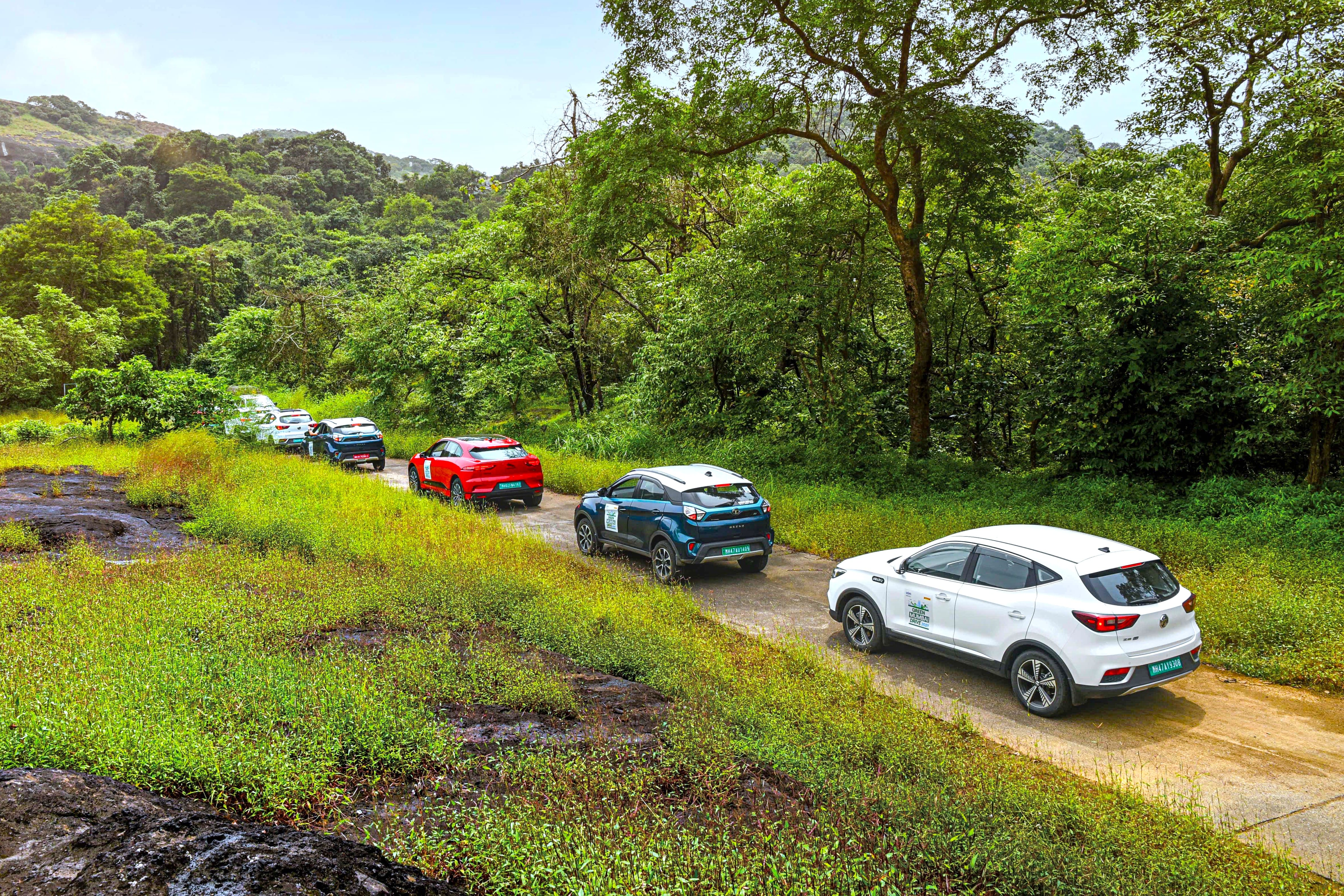
The Green Mumbai Drive was flagged off from the Mahalakshmi Racecourse by Aditya Thackeray, MoS for Tourism, Environment and Protocol, and Jeet Adani, director of Adani Electricity. Notable auto industry executives like Santosh Iyer (Mercedes-Benz India), Balbir Singh Dhillon (Audi India), Rohit Suri (JLR India), and Amit Suri (Volvo India) were also part of the event.

3. Debuting EVs in two different national parks

Tata Nexon EV in Satpura Tiger Reserve, Audi e-tron in Gir National Park

In 2021, we were the first to drive an electric car (specifically, the Tata Nexon EV) into Madhya Pradesh’s Satpura Tiger Reserve. The roughly 140km drive from Bhopal to Forsyth Lodge was completed with around 30km of range remaining, despite starting with the battery at 92 percent. With no fast-charging infrastructure nearby, the Nexon EV had to be charged overnight using a 15A socket. During the safari, the torquey and compact EV performed well on steep inclines and narrow forest trails, and its silent operation allowed it to approach wildlife like sambars, gaurs, wild pigs, and even a leopard without the noise of an idling engine – no tiger, though.
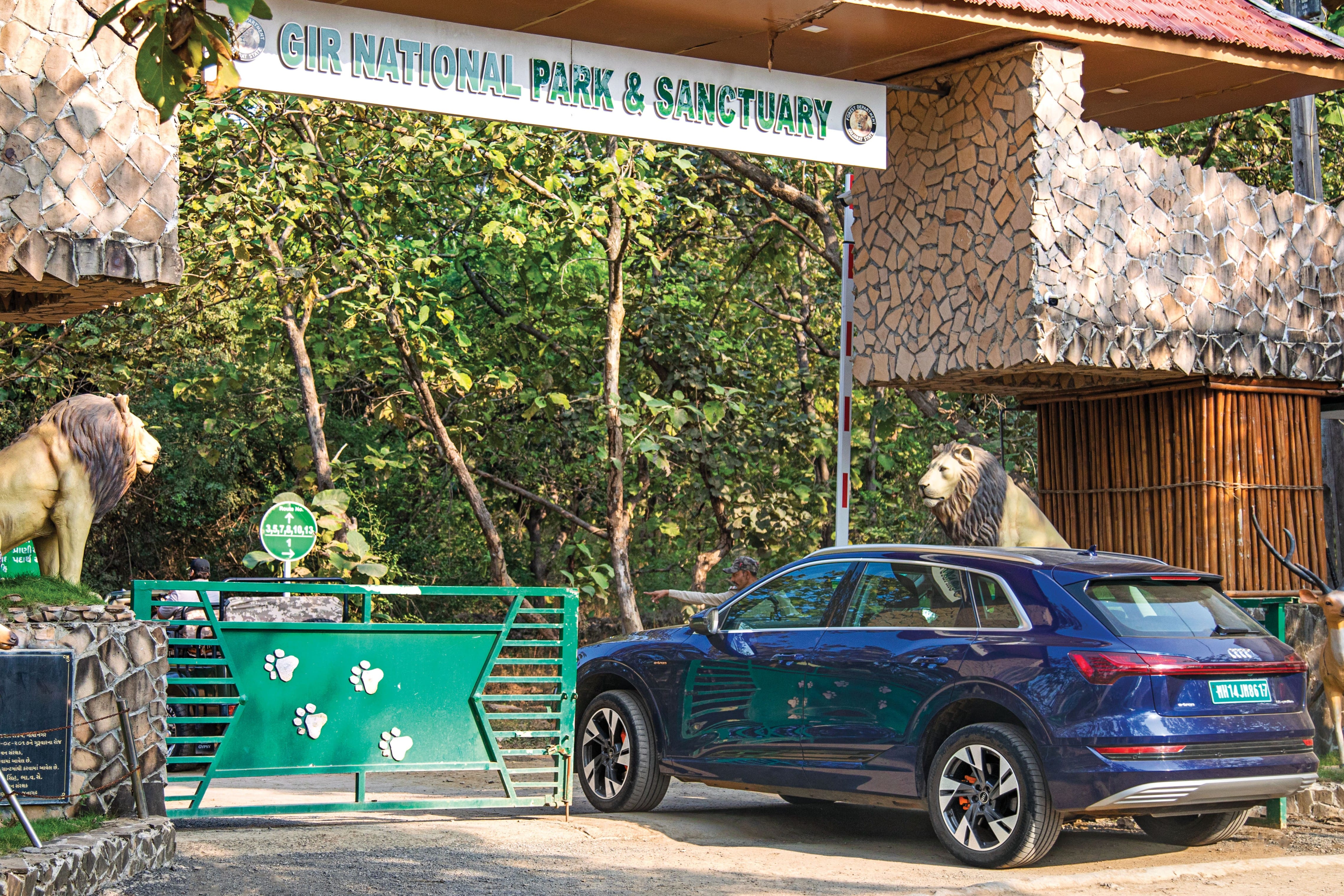
Then, in 2022, we were yet again the first to drive an EV into Gujarat’s Gir National Park, this time in an Audi e-tron. Reaching our accommodation induced a great deal of range anxiety due to faulty chargers along the way, but we managed to get there with around 20 percent of charge remaining. Once we reached, the e-tron was an excellent companion to tour the park with, helping us spot wildlife like chital, crocodiles, lions, and more.

4. Porsche Taycan Kashmir to Kanyakumari road trip

Nearly 4,500km in a performance EV

2022 saw us take one of our most ambitious roadtrips to date: 4,467km from Kashmir to Kanyakumari in a Porsche Taycan. Despite challenges like landslides in Jammu, flooded roads in Punjab, and power outages at certain charging spots, the Taycan handled the journey with ease. On one of the most efficient legs, the Porsche EV delivered 7.1km/kWh, working out to an indicated range of 475km.
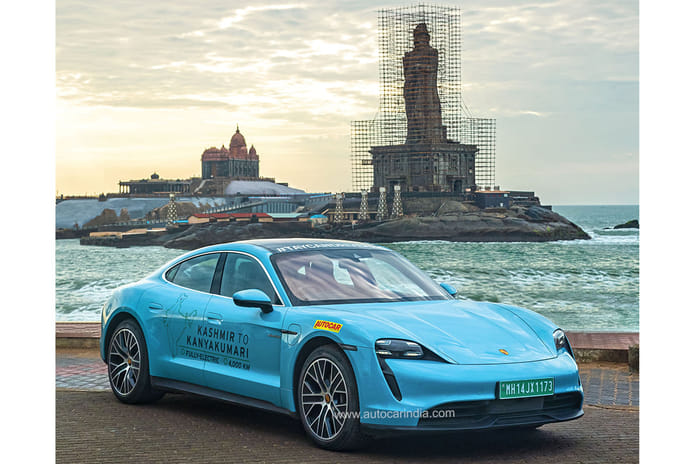
Comfort mode was the default setting, but we did have lots of fun in some stretches courtesy of the Taycan’s Sport Plus drive mode. Up to 225kW of fast charging bolstered convenience, and total charging expenses tallied up to just Rs 15,422 – cheaper than fuel for an equivalent petrol car. More than just distance, the trip proved that combining sports car-like performance with electric efficiency works perfectly in real-world conditions, and that the Taycan is more durable than you may think.

5. Pininfarina Battista India top speed record

1900hp, quad-motor hypercar achieved a 358.03kph top speed

Back in early 2023, we set a new Indian top-speed record with the 1,900hp Pininfarina Battista electric hypercar at the NATRAX high-speed oval near Indore. Achieving an impressive v-max of 358.03kph, the Battista blitzed past the previous record of 332.20kph, which was also set by us in 2016 in an Audi R8 V10 Plus.
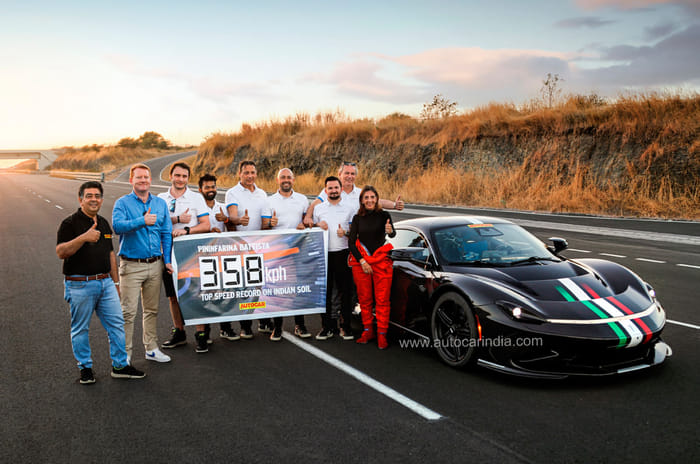
The Battista top-speed run also ended up establishing new world records for a production car: 0-300kph in 10.49 seconds and a quarter-mile time of 8.55 seconds, all verified by the Federation of Motor Sports Clubs of India (FMSCI).

6. Hero Vida V1 Pro longest distance in 24 hours record

The e-scooter travelled just shy of a whopping 1,800km

We teamed up with Hero MotoCorp in 2023 to set a new Guinness World Record for the longest distance travelled by an e-scooter in 24 hours. Using the Vida V1 Pro with easy-to-swap removable batteries, we covered a whopping 1,780km at Hero’s Centre of Innovation and Technology near Jaipur.
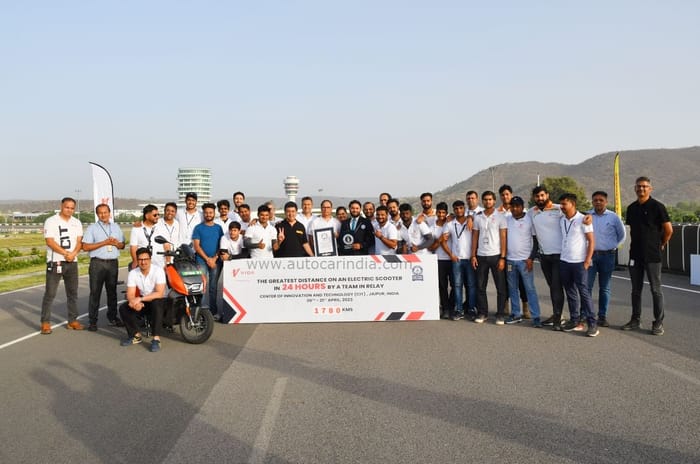
The endurance challenge relied on swift battery swaps and flawless coordination, with the pit crew achieving 38 battery changes in under 20 seconds – quite impressive considering the extreme heat, rider fatigue, and complexity involved. Moreover, the Vida V1 Pro ran flawlessly throughout, handling the gruelling conditions with ease and maintaining performance consistently.

7. Volvo EC40 Jaisalmer to Mawsynram road trip

From India’s driest region to its wettest

In 2024, we took the Volvo EC40 (formerly known as the C40 Recharge) on a roughly 3,000km road trip from Jaisalmer in Rajasthan – one of India’s driest locations – to Mawsynram in Meghalaya, widely recognised as the country’s wettest. The route included a detour to Ghaziabad’s Volvo Reverse Project, a former dumping ground where around 10,000 trees had been planted as part of the company’s reforestation initiative.
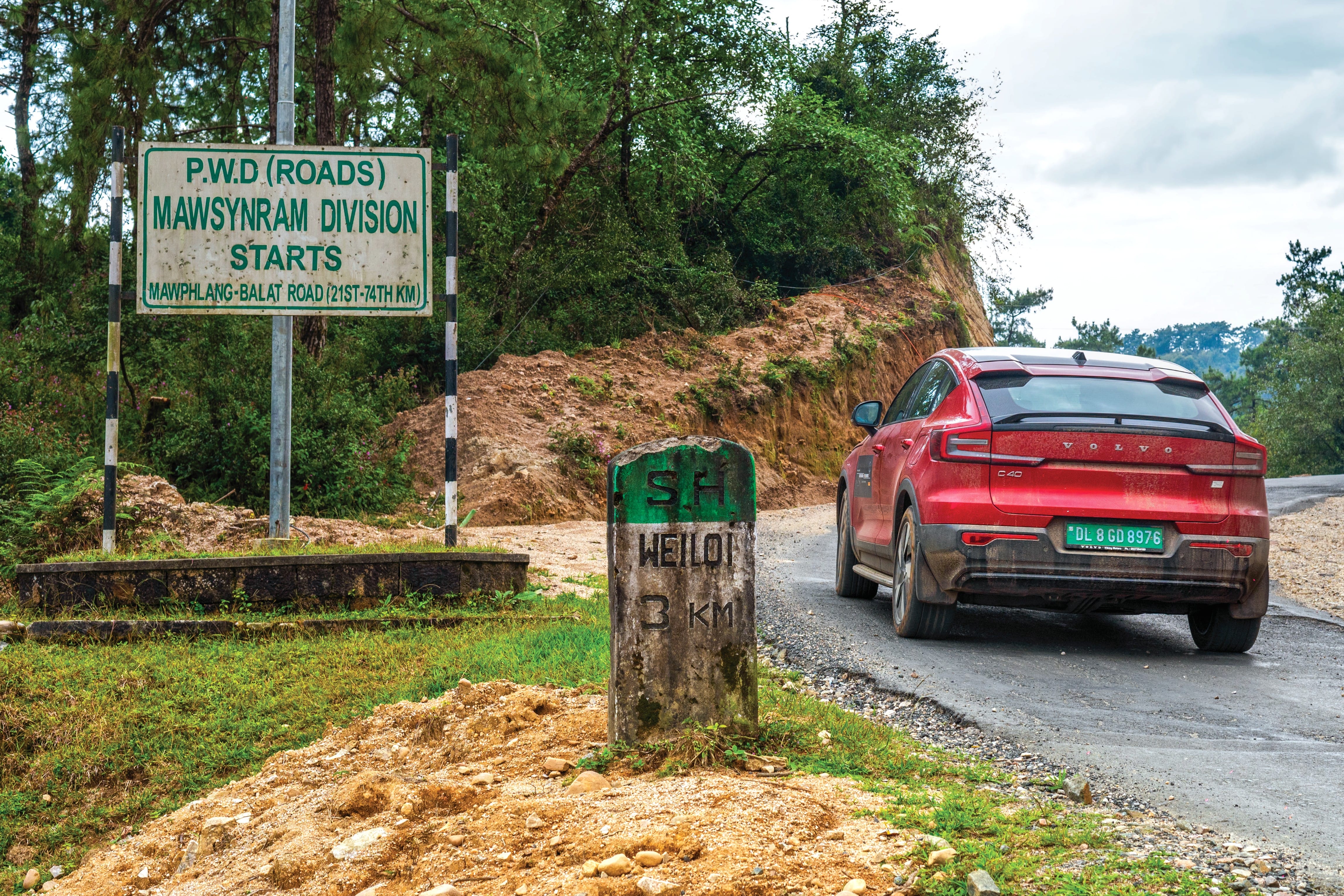
Charging was carried out mainly overnight with DC fast chargers also used along the route, and the EC40 posed no issues during the journey. Ironically, we encountered heavy rain and waterlogging in Jaisalmer but surprisingly little rainfall in Mawsynram.

8. Mercedes Benz EQS sedan longest distance world record

949km travelled on a single charge

Though we’ve racked up quite a lot of Guinness World Records over the years, eking out the longest journey travelled by an EV on a single charge in the Mercedes-Benz EQS 580 sedan remains one of our best, especially since it coincided with our 25th anniversary in 2024, too.
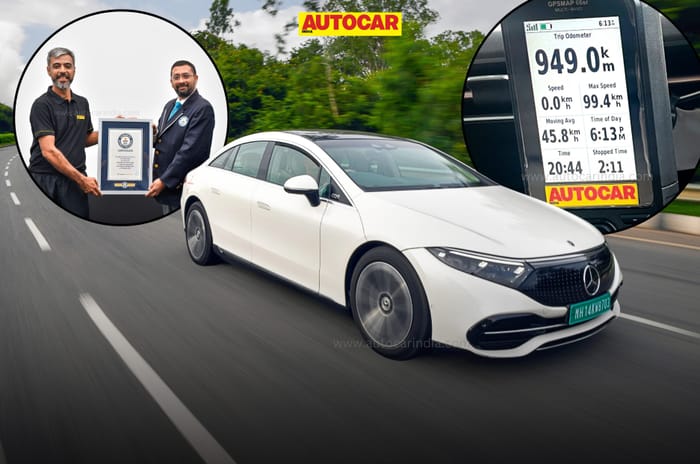
Setting off from Bangalore on a full charge, the EQS 580 covered a distance of 949km when it reached its destination in Navi Mumbai, beating the previous Guinness World Record for the same by 32.26km. Impressively, the 949km real-world range exceeds EQS 580’s claimed range of 817km by just over 16 percent. It’s also worth mentioning that the two-day journey was completed under arduous conditions like heavy rainfall, lots of traffic, broken roads, and even a flat tyre.

9. Porsche Taycan BIC EV lap record

2:10.313 lap time makes the Taycan the fastest EV around BIC so far

At the Buddh International Circuit in Greater Noida, we lapped a Porsche Taycan Turbo S and clocked a time of 2:10.313 minutes – the first-ever EV lap record around the 5.125km track. Despite its rather portly kerb weight of 2,370kg, the Taycan delivered unexpectedly sharp performance at BIC thanks to 761hp and 1,050Nm, a low centre of gravity (aided by the heavy 93.4 kWh battery), precise steering, and superb balance.
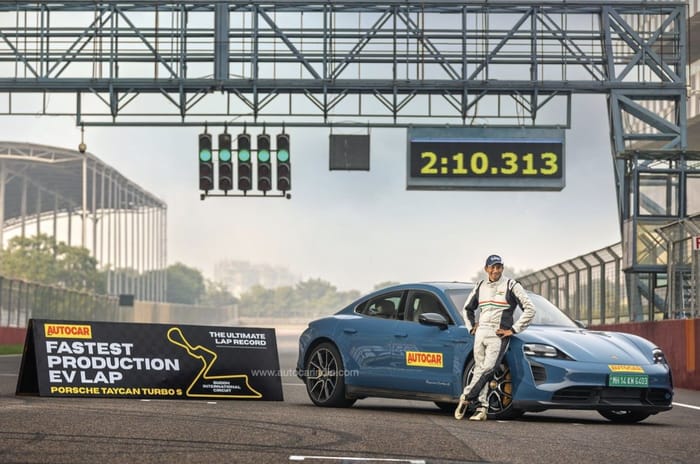
Upon hitting the apex and pinning the throttle, the Taycan belied physics the way it propelled out of corners with explosive speed, and despite weighing 845kg more, the EV achieved nearly the same top speed as the 911 GT3 RS at the end of BIC’s main straight.

10. Ultraviolette F99 India top speed record

258kph around NATRAX and a 100-200kph run of 6.2 seconds

One of our more recent records entailed setting a new benchmark for made-in-India two-wheelers by hitting a top speed of 258kph on the Ultraviolette F99 at the NATRAX oval. Designed around a 400V architecture with a liquid-cooled powertrain, the purpose-built F99 packs 120hp and an astounding 972Nm (measured at the rear wheel).
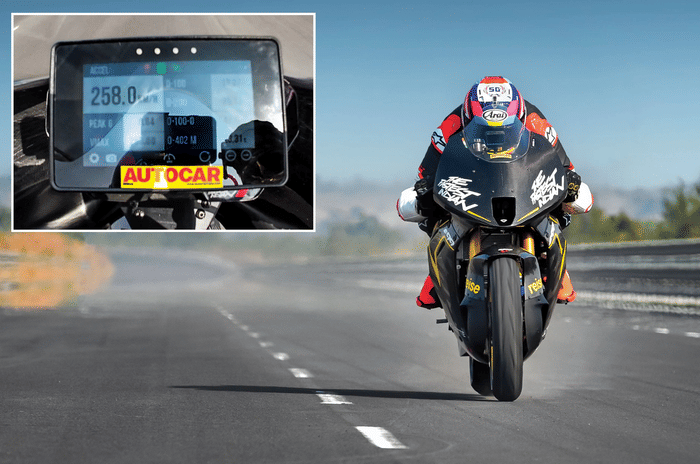
The F99’s custom trellis frame, forged carbon-fibre bodywork, Brembo brakes, and Ohlins suspension helped the bike remain stable at high speeds, culminating in a clean record run captured via precision V-Box data. It also achieved a blistering 0-200kph run in under 10 seconds and 100-200kph in just 6.2 seconds, smashing previous Indian motorcycle speed records.

11. Mercedes Benz EQS SUV temperature change record

From the sweltering heat of Rajasthan to the sub-zero chill of Ladakh

Our 2025 Guinness World Record saw us achieving the greatest temperature change endured by a production EV. We accomplished this using the Mercedes-Benz EQS 450 SUV, driving from the scorching heat of 47.5 deg-C in Rajasthan to the below-freezing chill of -3.7 deg-C in Ladakh, for an impressive overall temperature swing of 51.2 deg-C.

The journey tested the limits of the EQS 450 SUV, especially its 122kWh battery’s thermal management system. Despite extreme variations in temperature, the climate control and battery systems kept the EQS 450 SUV performing smoothly and safely.
QJMotor patents single-cylinder ‘V-Twin’ Engine

QJMotor patents single-cylinder ‘V-Twin’ Engine
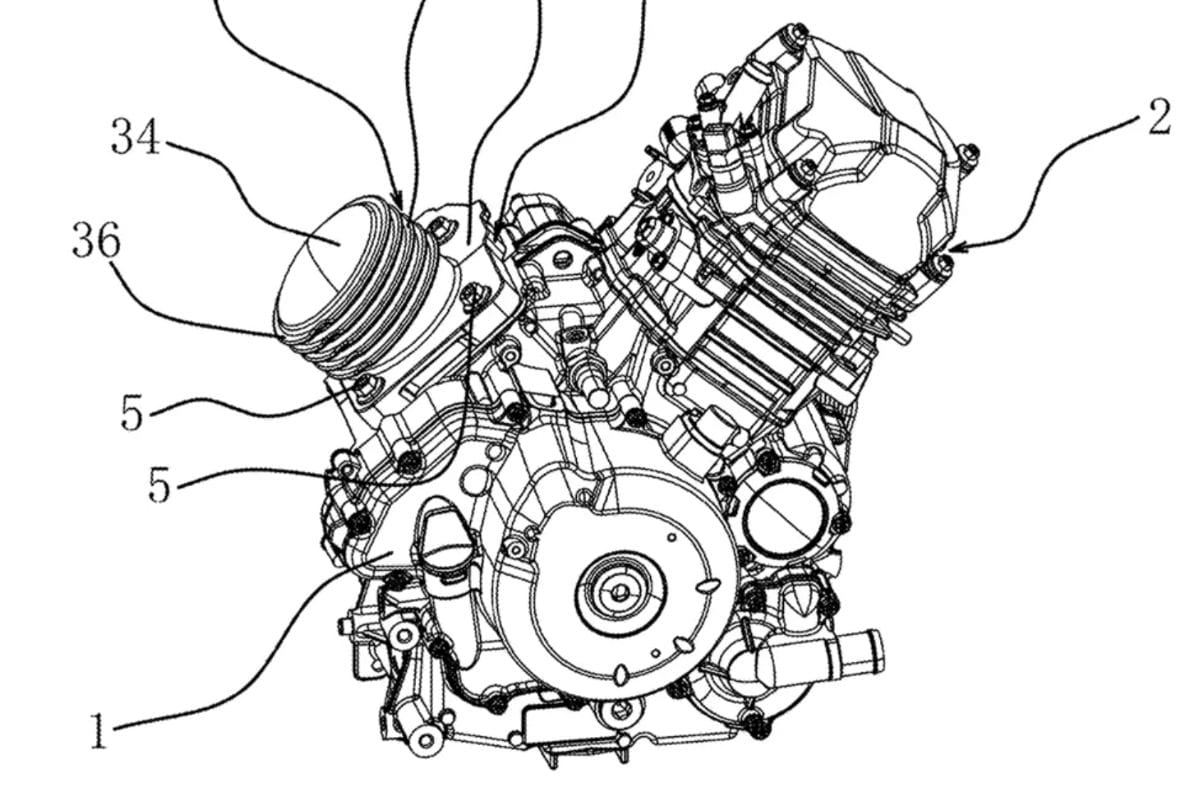
QJMotor single-cylinder ‘V-Twin patent image

One of the biggest drawbacks of single-cylinder engines, especially higher displacement ones is widely agreed to be the vibrations. Until now, companies have mostly stuck to using counter balancer shafts as the preferred way to keep them under check but with QJMotor’s latest patent in the US, we might just have a more interesting and, potentially, more affordable way to deal with them.

  1. Uses a smaller ‘dummy’ cylinder as a counterweight
  2. More cost-effective than gear operated counter balancer shafts

Single-cylinder engine with a V-Twin-like configuration

A dummy piston in the second cylinder only cancels out vibrations

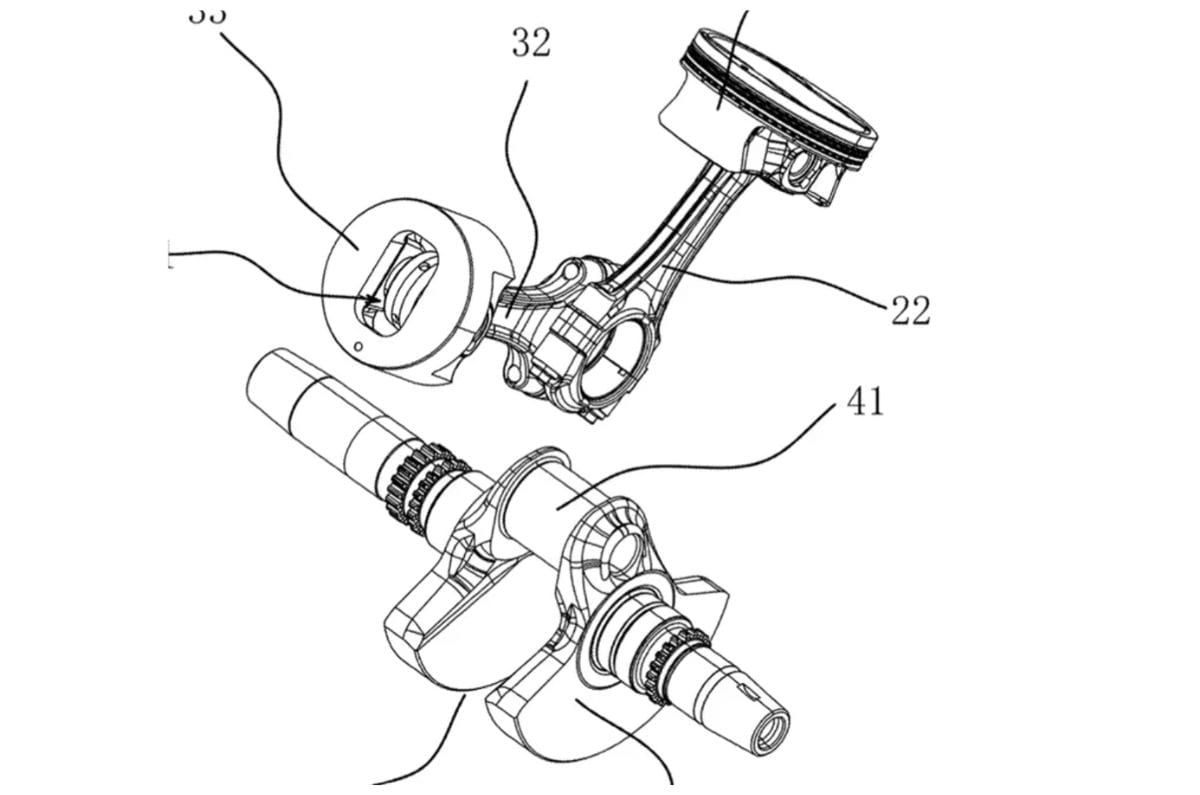
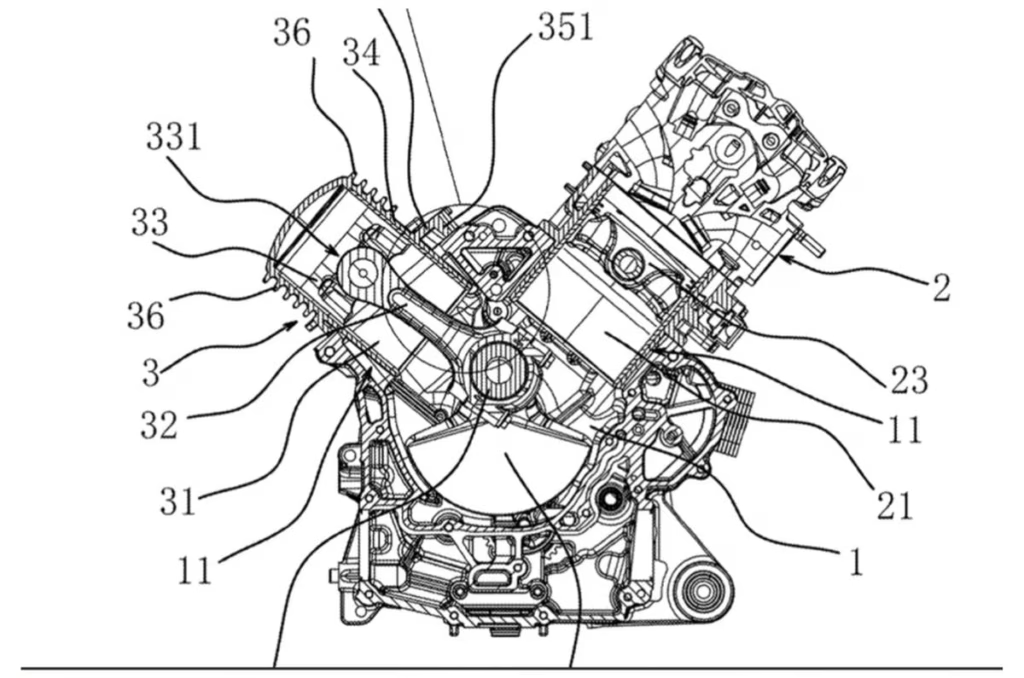
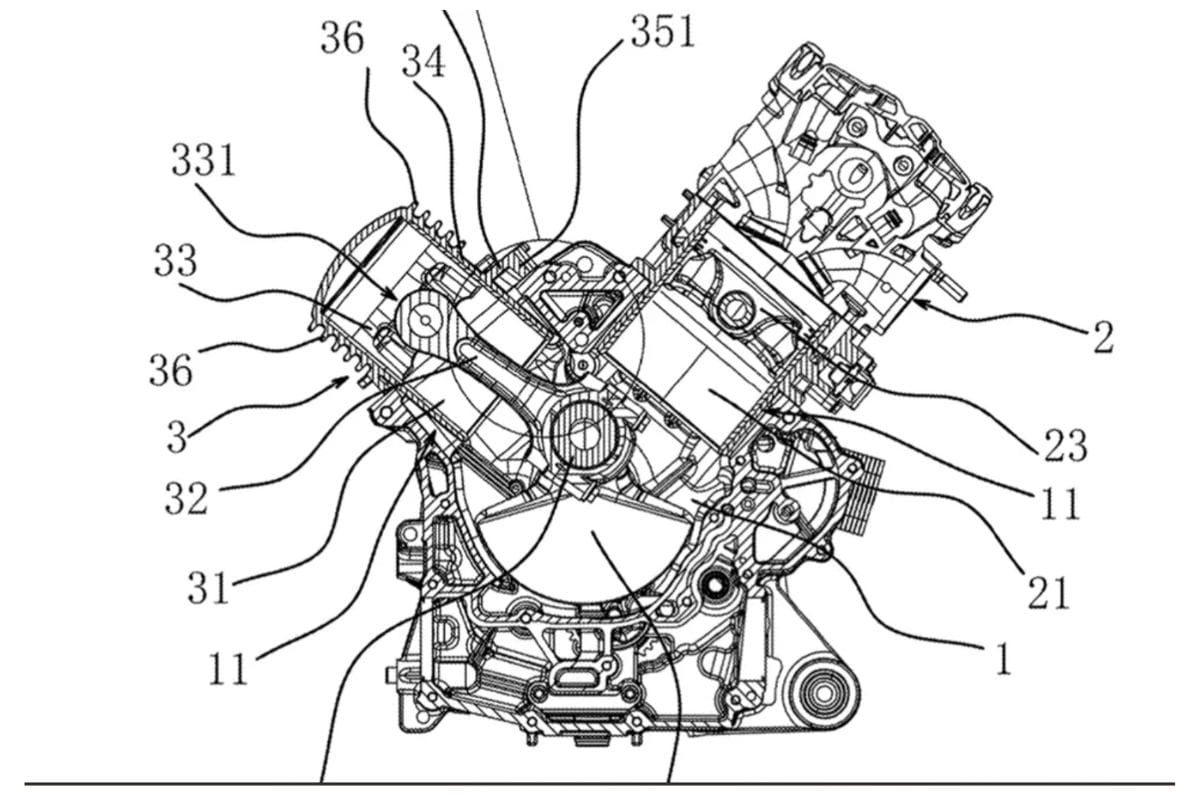
Technically speaking, the patent has been filed by QJMotor’s parent firm, Geely Auto Group, and it demonstrates an innovative approach to controlling engine vibrations in a single-cylinder mill. The patent drawing shows an engine crankcase with two cylinder bore holes at an 80 degree angle, visually resembling a V-twin engine. In the patent images, the larger bore on the right contains the actual combustion cylinder with a standard piston performing the four stroke (intake, compression, combustion, and exhaust) action. The dummy cylinder on the left bore has a piston that is connected to the same crankshaft via a connector rod. However, this piston has an air vent, meaning this cylinder does not act as a combustion chamber. It simply moves up and down as a counterweight through the crankshaft’s rotation, canceling out the vibration produced by the ‘real’ cylinder.

Lack of piston rings underlined as the major improvement

Cylinders and the pistons are cleverly offset too

The second piston lacks piston rings since it’s not sealing a combustion chamber, which removes friction and drag. The source also underlines that the presence of the piston rings (and the friction and drag they produced) were the main flaw in earlier attempts at this configuration. Both connecting rods share the same crankpin as well, to minimise the size of the entire assembly.
The cleverer part is that despite the cylinders themselves being angled at 80 degrees, the pistons are angled at 90 degrees. This wider angle is made possible by housing the balancing cylinder in a separate component that’s bolted onto the crankcase with a flange, rather than being machined directly into the block. And because this cylinder offers some clearance against the bore, the piston can travel along its offset path. This allows the effective angle between the two cylinders to be wider than that of the casing itself. Lastly, since the balancer piston has no conventional intake or exhaust valve, it gets cooling fins to reduce heat build up.

The patent details the goal behind the design to achieve a proper balance-shaft system, but at a lower cost and less complex design. The patent was published by the United States Patent and Trademark Office on August 27, and there’s no indication that it’ll make its way onto a production motorcycle anytime soon. 

Source: MCN
 

Maruti Suzuki Baleno facelift review: Change of heart

Maruti Suzuki Baleno facelift review: Change of heart
Maruti Suzuki Baleno front quarter tracking

The Maruti Suzuki Baleno has proven to be hugely successful, with the premium hatchback going home to 1.9 million buyers since its introduction in 2015. And in a time when compact SUVs are all the rage, the Baleno continues to buck the trend and bring in the numbers for the brand. And now in a bid to keep it fresh and relevant, Maruti Suzuki has updated it with a tweaked design, new comfort and safety features and even a new petrol engine.

Maruti Baleno Exterior Design and Engineering – 7/10

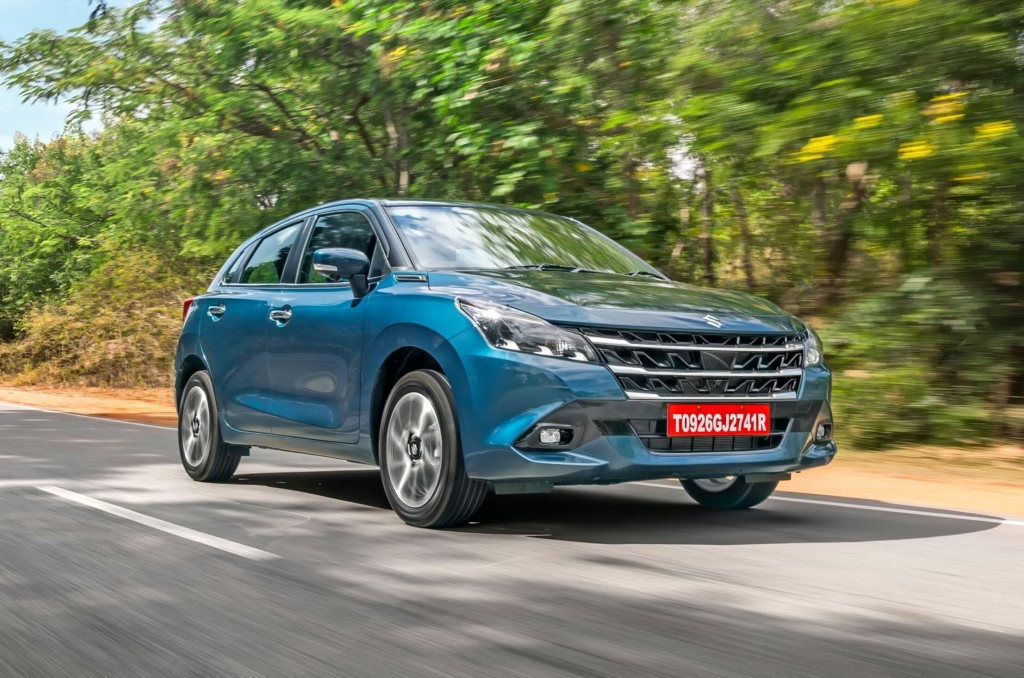
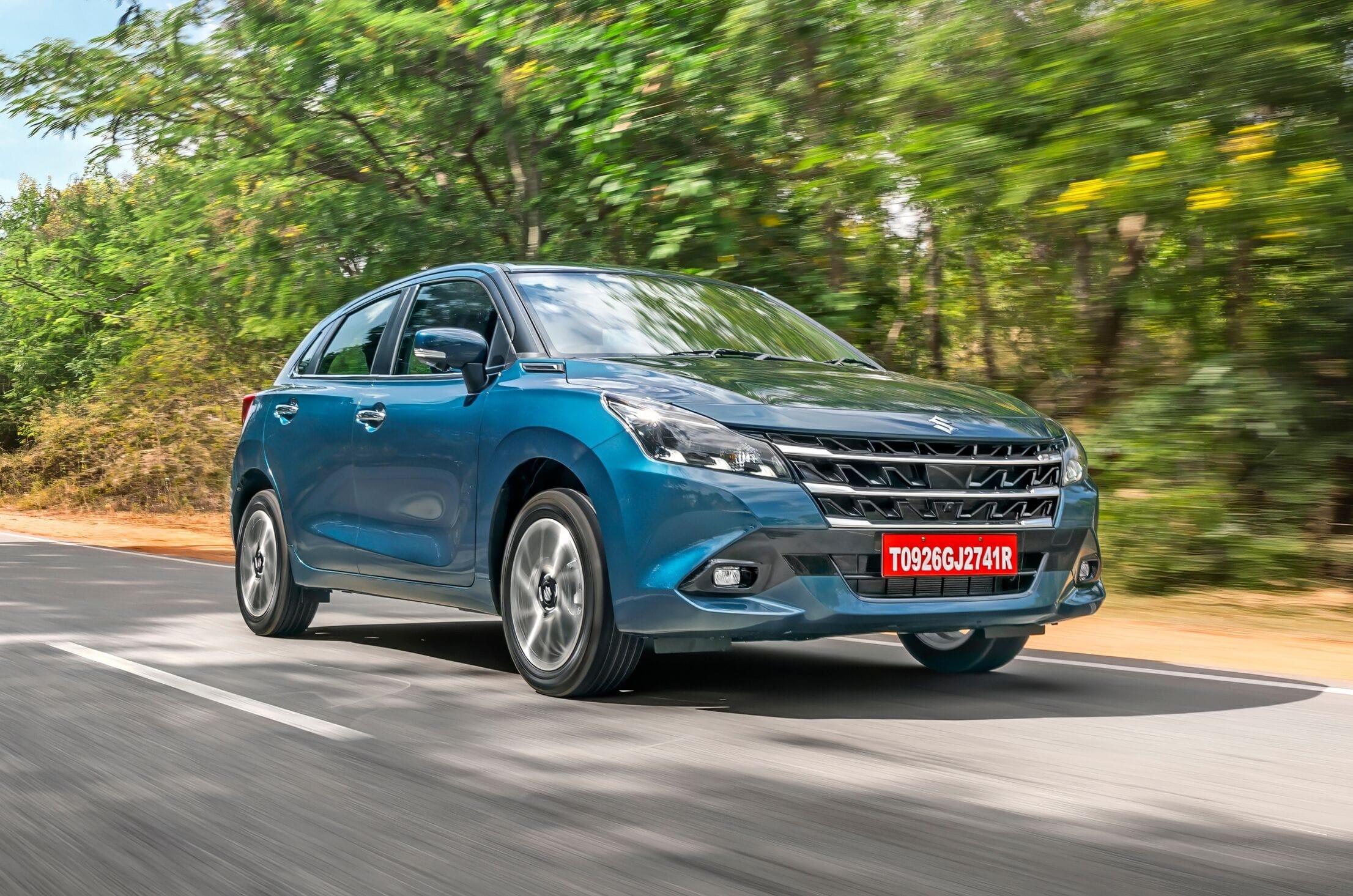
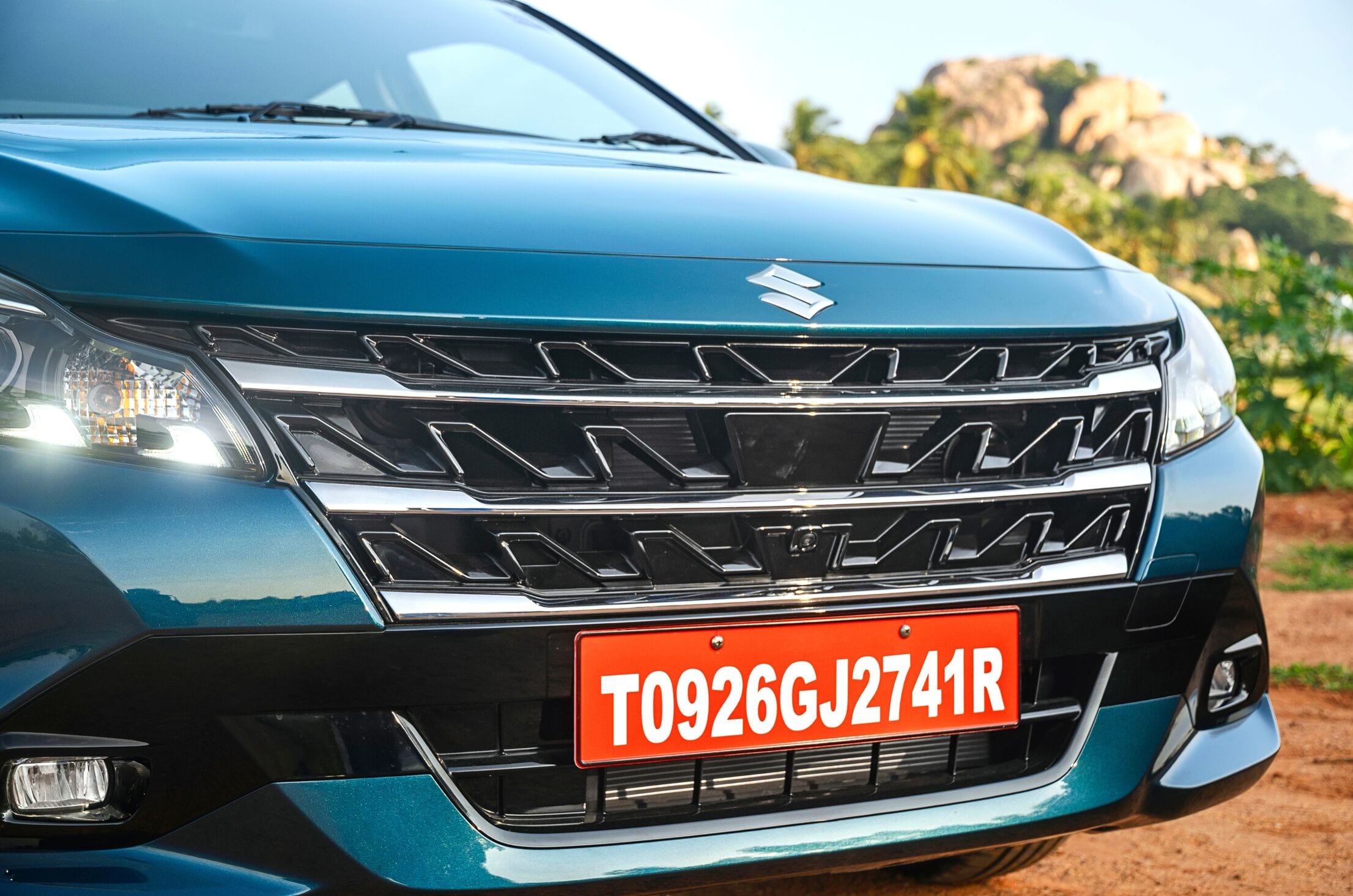
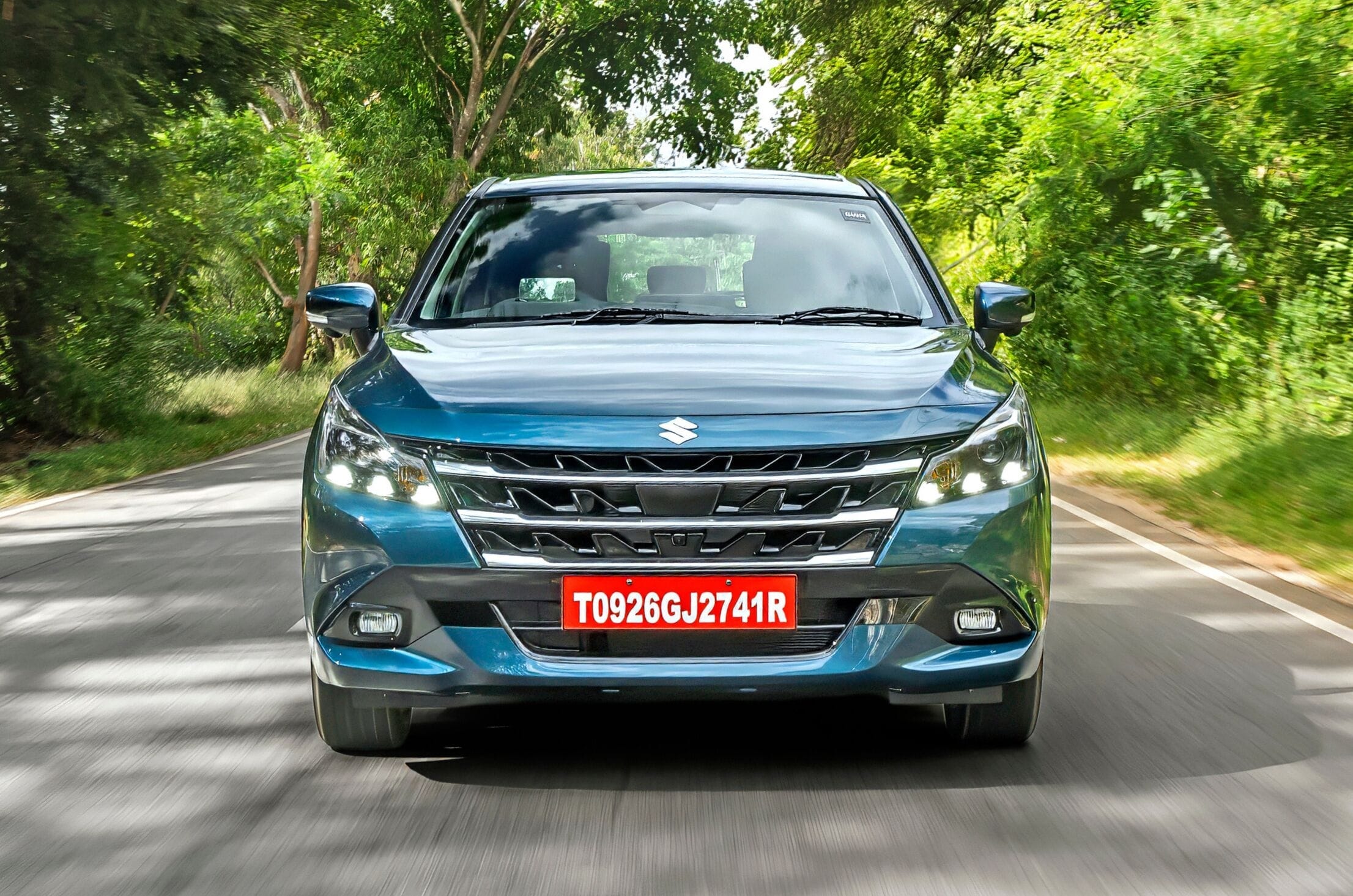
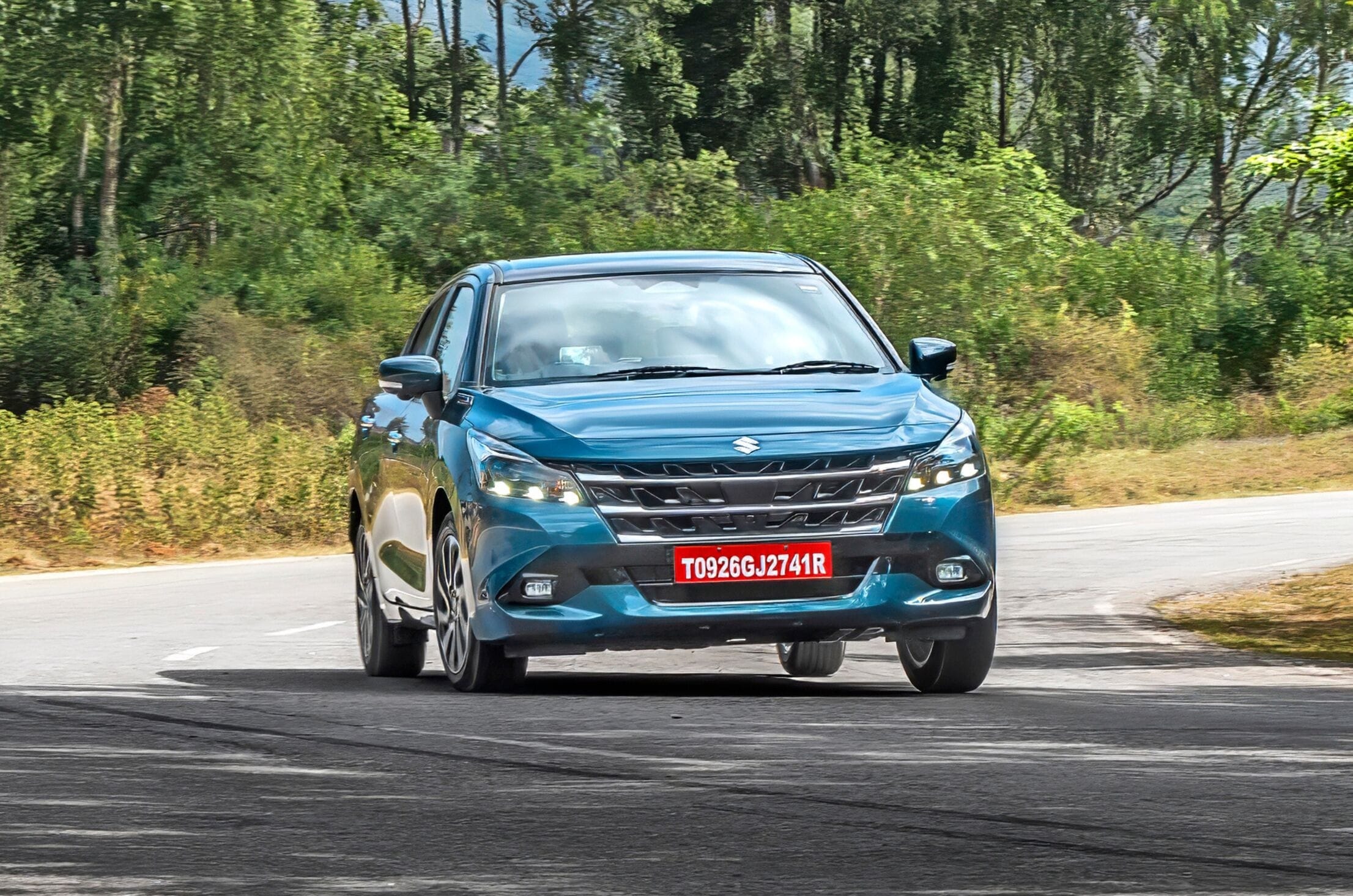
Being a mid-life-cycle update, the Baleno doesn’t get a design overhaul but rather tweaked styling with the bulk of the design changes concentrated at the front end. The grille is now much larger than before with three horizontal chrome slats and gloss black detailing, with a radar module in the centre for the new ADAS tech. The bumper is new too and features a gloss black trim that links the new LED fog lamps and the Suzuki logo has also been moved above the grille. Otherwise, the clamshell bonnet with the two character lines and the LED headlamps with the three-block DRL signature are carried over unchanged.

Gets a new larger grille with chrome slats, a new bumper and new fog lamps. 

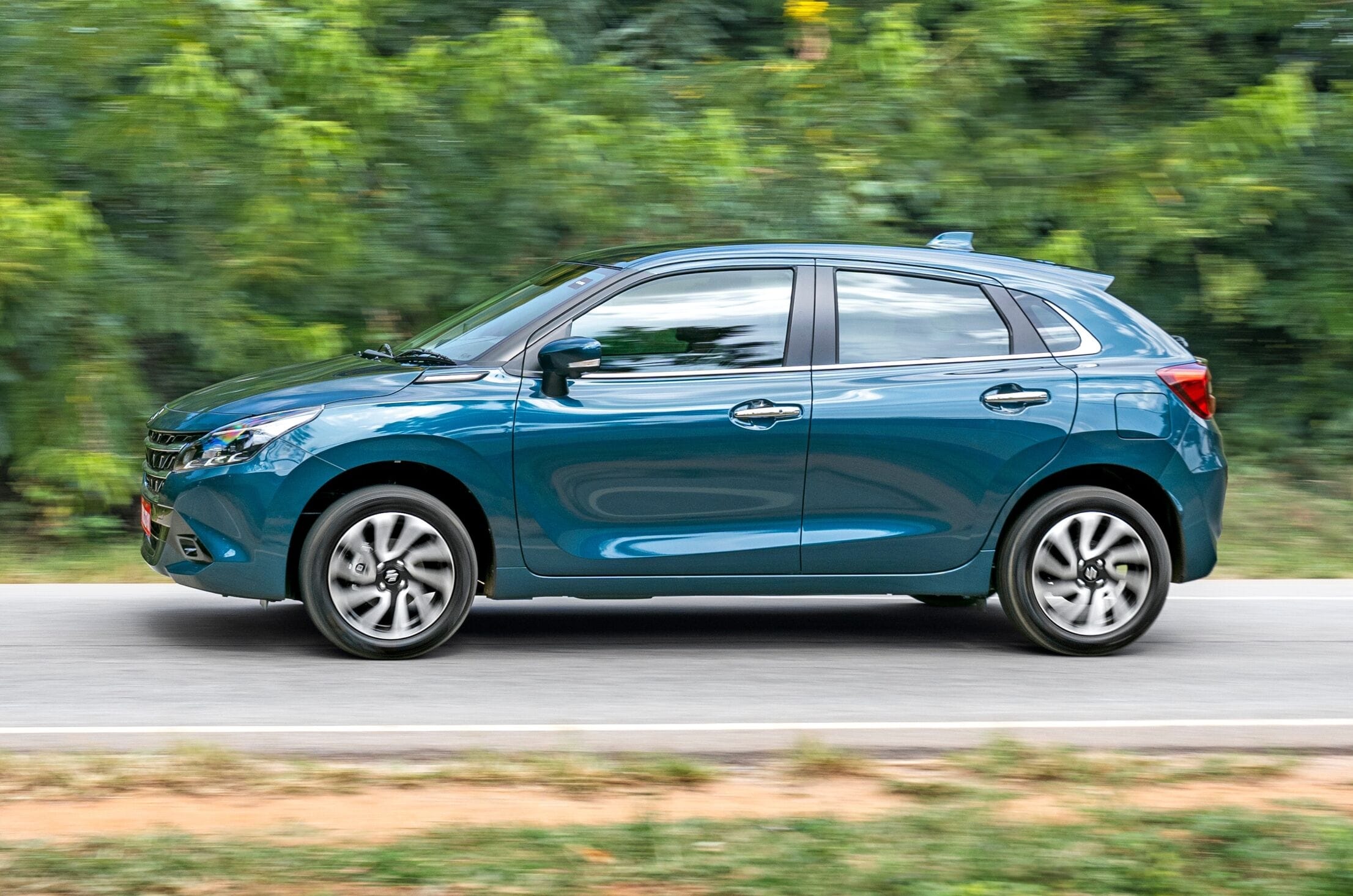
Changes along the sides are minimal, with the only distinguishing factors being a chrome garnish on the front fender and a shark fin antenna on the roof. The facelift retains the older Baleno’s chrome lining under the windows that extends up till the C-pillar, chrome door handles and the dual-tone 16-inch alloy wheels on this top-spec Alpha (O) variant.

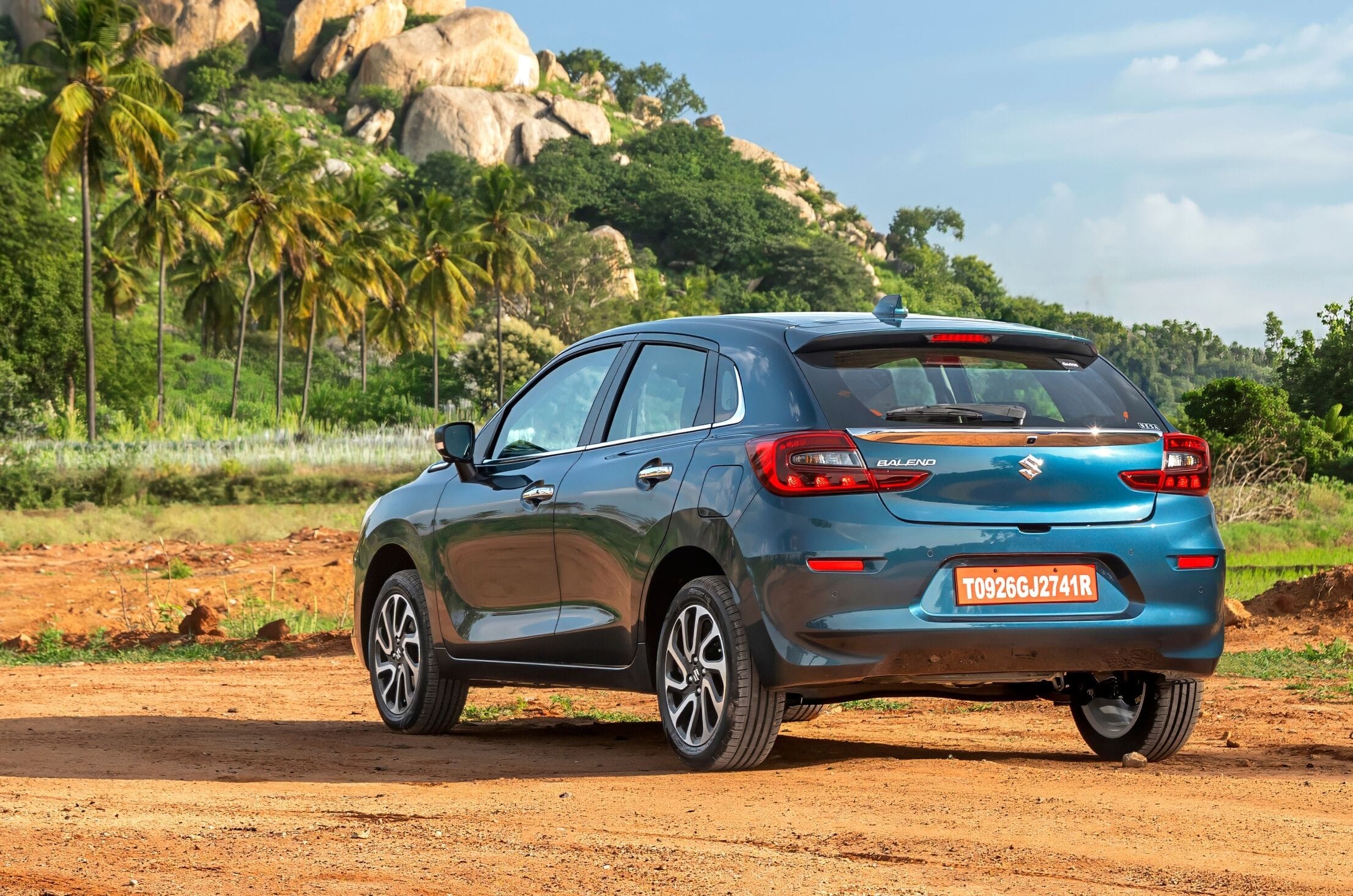
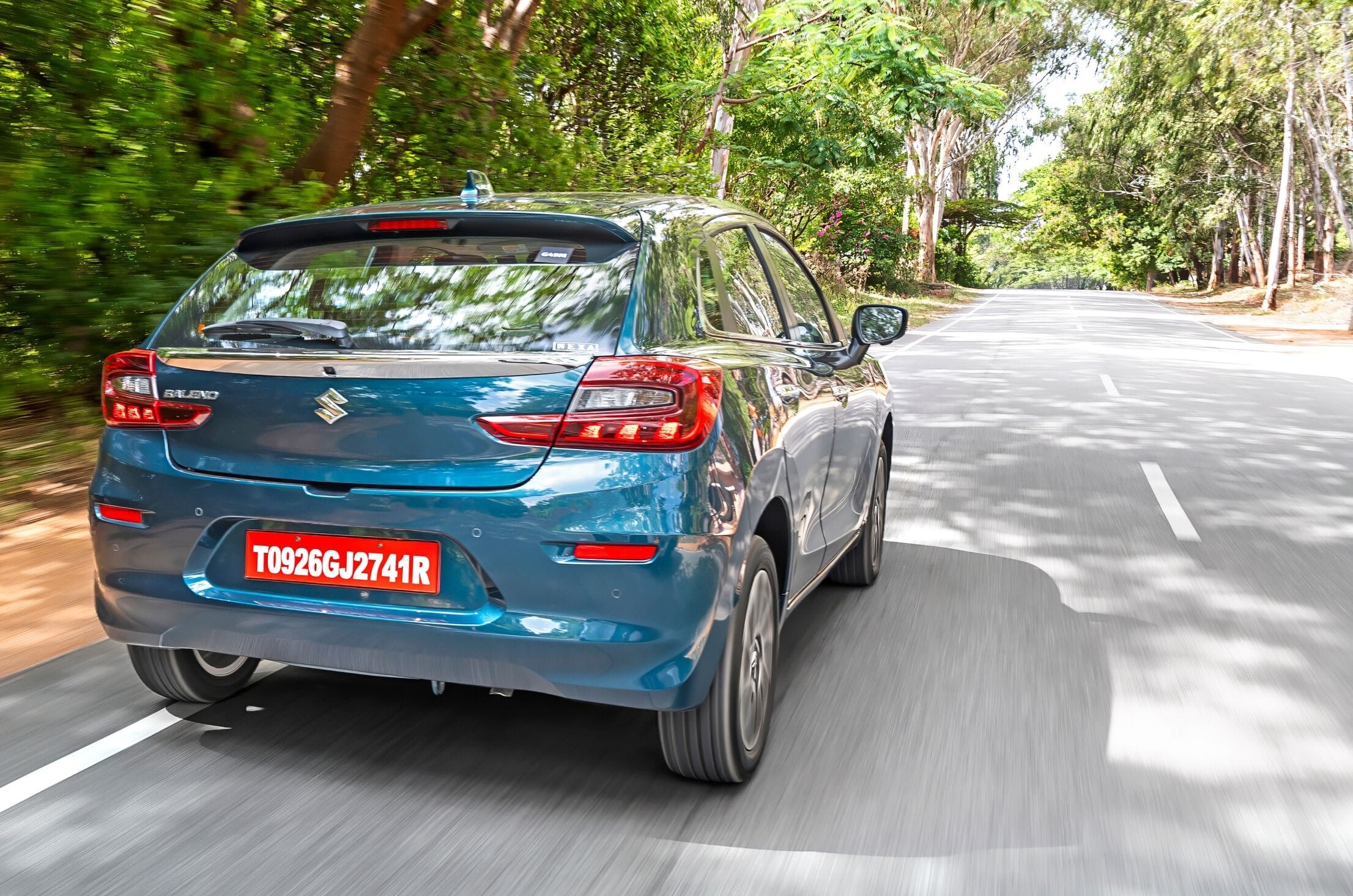
The rear however, stays identical to the pre-facelift Baleno with its C-shaped LED taillamps that also feature the three-block pattern, a chrome band running across the tailgate and a small, roof-mounted spoiler. There’s also a new Enigmatic Teal Green paint shade as seen in the pictures here. Overall, the Baleno sticks to the formula that’s made it as successful as it is with minor tweaks in order to keep it fresh. The front grille, though, splits opinion and certainly doesn’t appear as cohesive as the one on the model it replaces.

Rear stays identical to the pre-facelift model, with the same dual-tone alloys as well

Maruti Baleno Interior Space and Comfort – 8/10

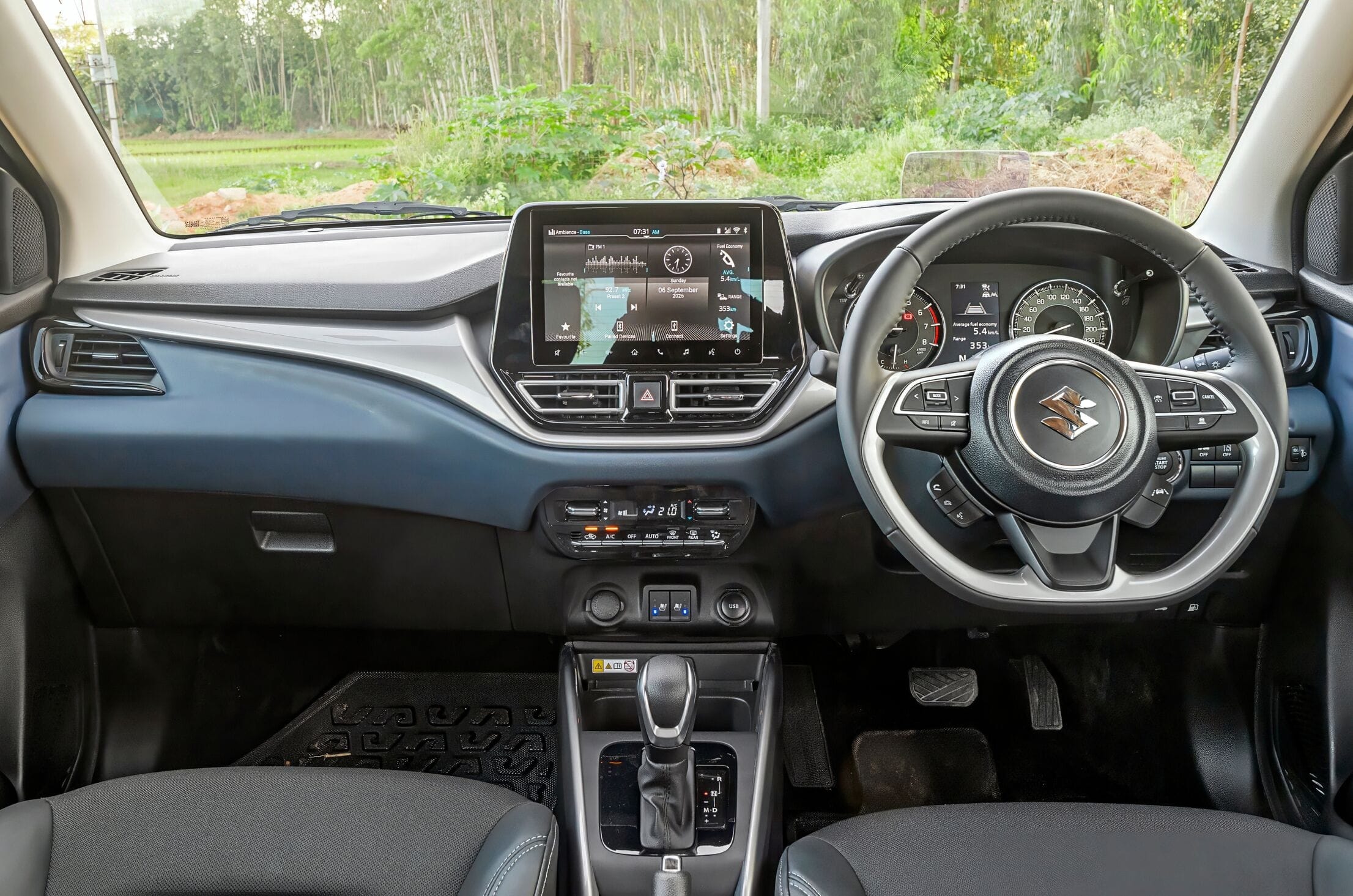
The interior of the Baleno facelift stays near-identical, with the same layered, V-shaped dashboard, flat-bottom three-spoke steering wheel and dual-tone black and blue colour scheme. There have been some tweaks however. The steering now features buttons on the right side for the adaptive cruise control and lane keep assist, there are more buttons on the right of the steering too (near the start/stop button) to turn off certain ADAS features and the seats now feature part-leatherette upholstery. The seats still majorly feature fabric upholstery but the outer edges are now finished in leatherette, which helps up the premium feel.
Layered dashboard with a dual-tone black-and-blue interior theme is carried over unchanged

Otherwise, this cabin is made up of good quality materials, particularly the soft touch leather wrapped steering and the padded elbow rests on the doorcards. The only sore points are the hard plastics and the simple woven roofliner. It’s a practical place too, with big door pockets, a decent-sized glovebox and storage in the centre console, with big cupholders and a small bin under the centre armrest.

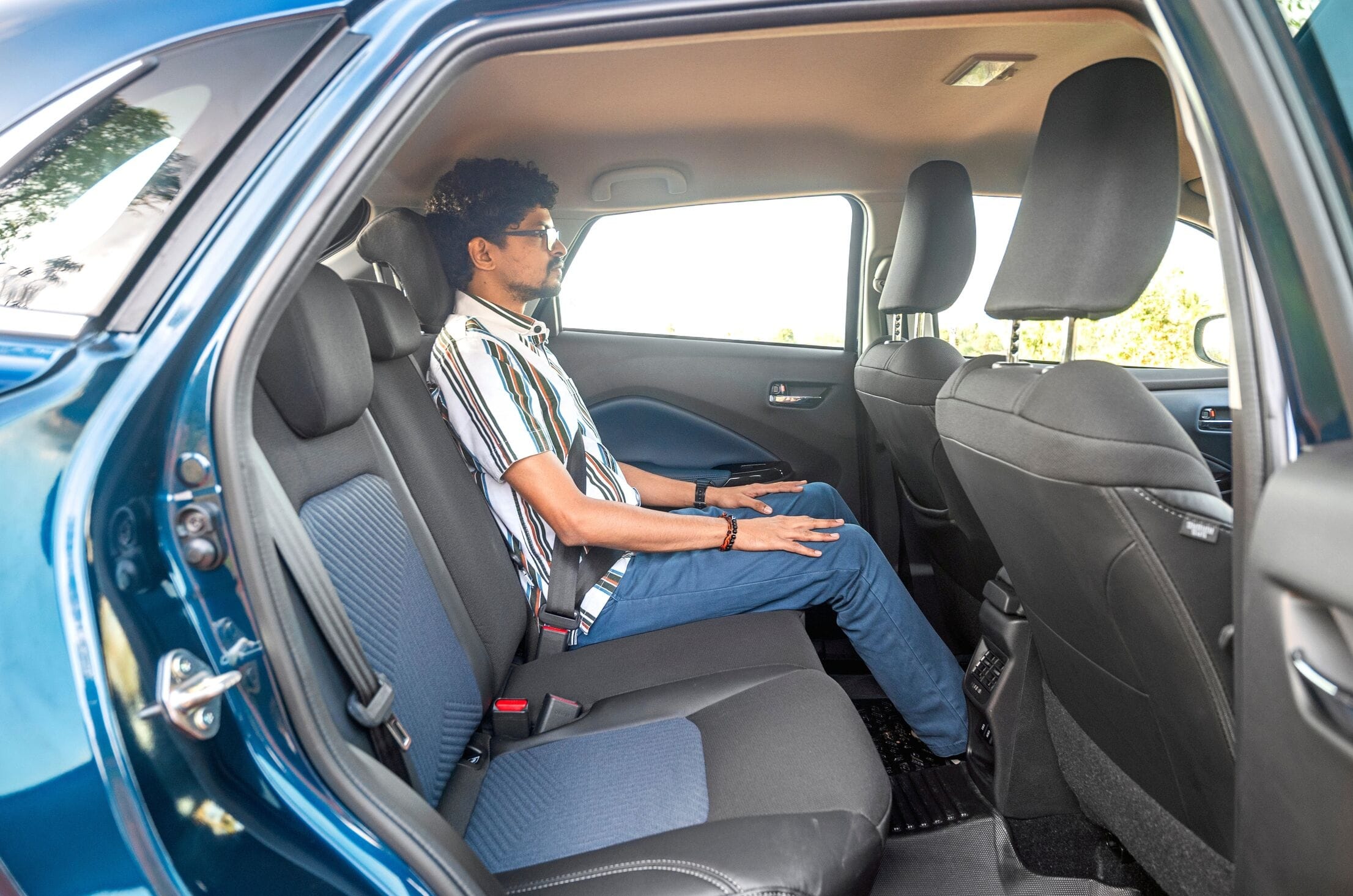
The front seats are unchanged and that’s a good thing as they are accommodating, supportive and offer nice cushioning. Thanks to the height adjustable driver’s seat and tilt/telescopic steering, finding an ideal driving position is an easy affair. Space at the rear is excellent, and even tall passengers won’t find a shortage of headroom or legroom. There’s good underthigh support, the seat cushioning is on point and on the whole, this is a comfy place to be. A welcome addition is an adjustable headrest and three-point seatbelt for the rear centre passenger. Rear passengers also get dedicated AC vents and USB charging ports.

Rear seat space is excellent and even tall passengers won’t find a shortage of headroom or legroom

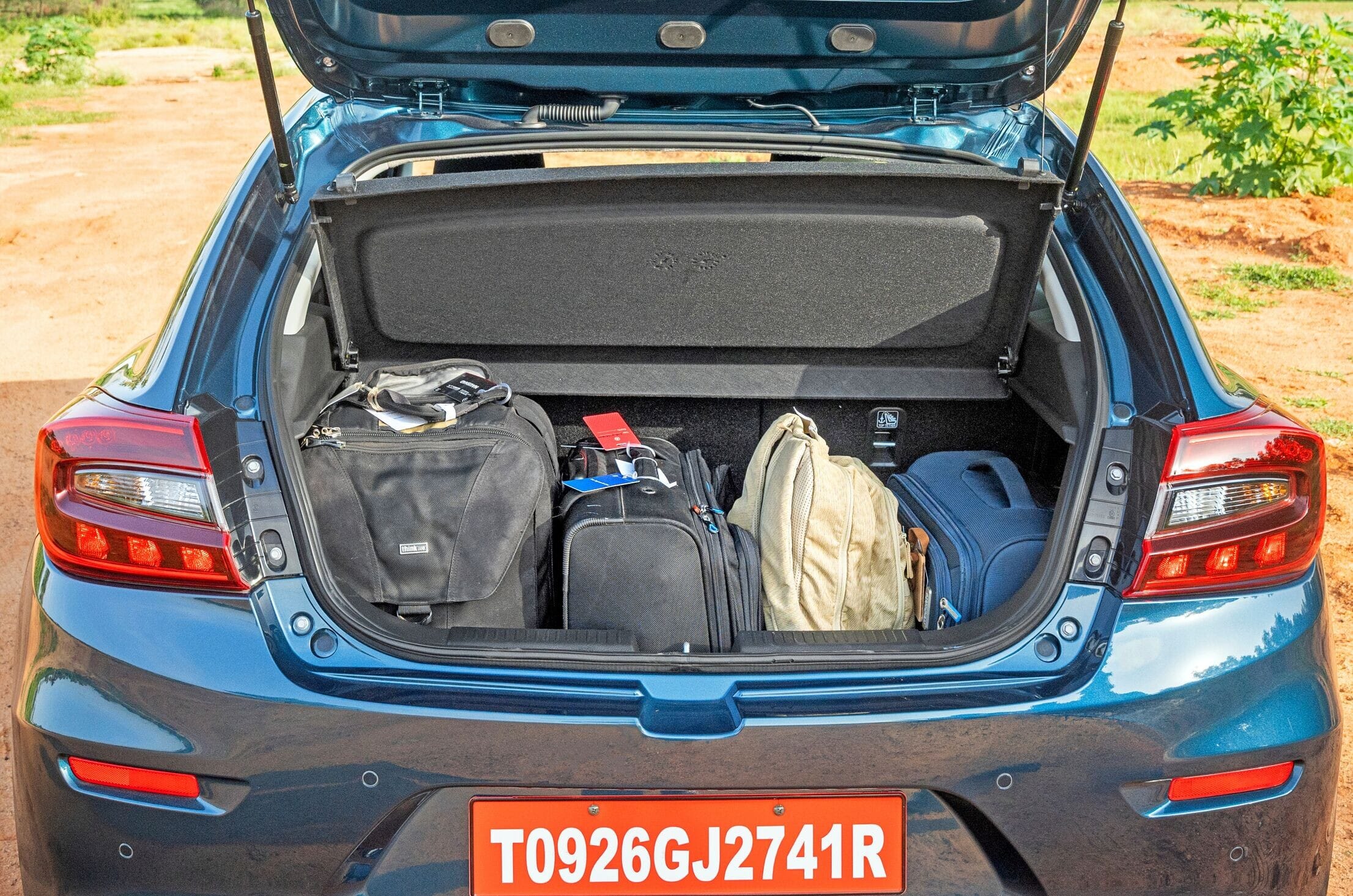
What further enhances overall comfort are the UV-cut glasses, which helps keep the heat out. As for boot space, it’s a sizable 318 litres, though the loading lip is quite high. It’s also nice to see that it retains a spare tyre under the boot floor, when many modern cars are pivoting to puncture repair kits.

Boot is a sizeable 318-litres though the loading lip is quite high; continues to get a spare tyre

Maruti Baleno Features and Safety – 9/10

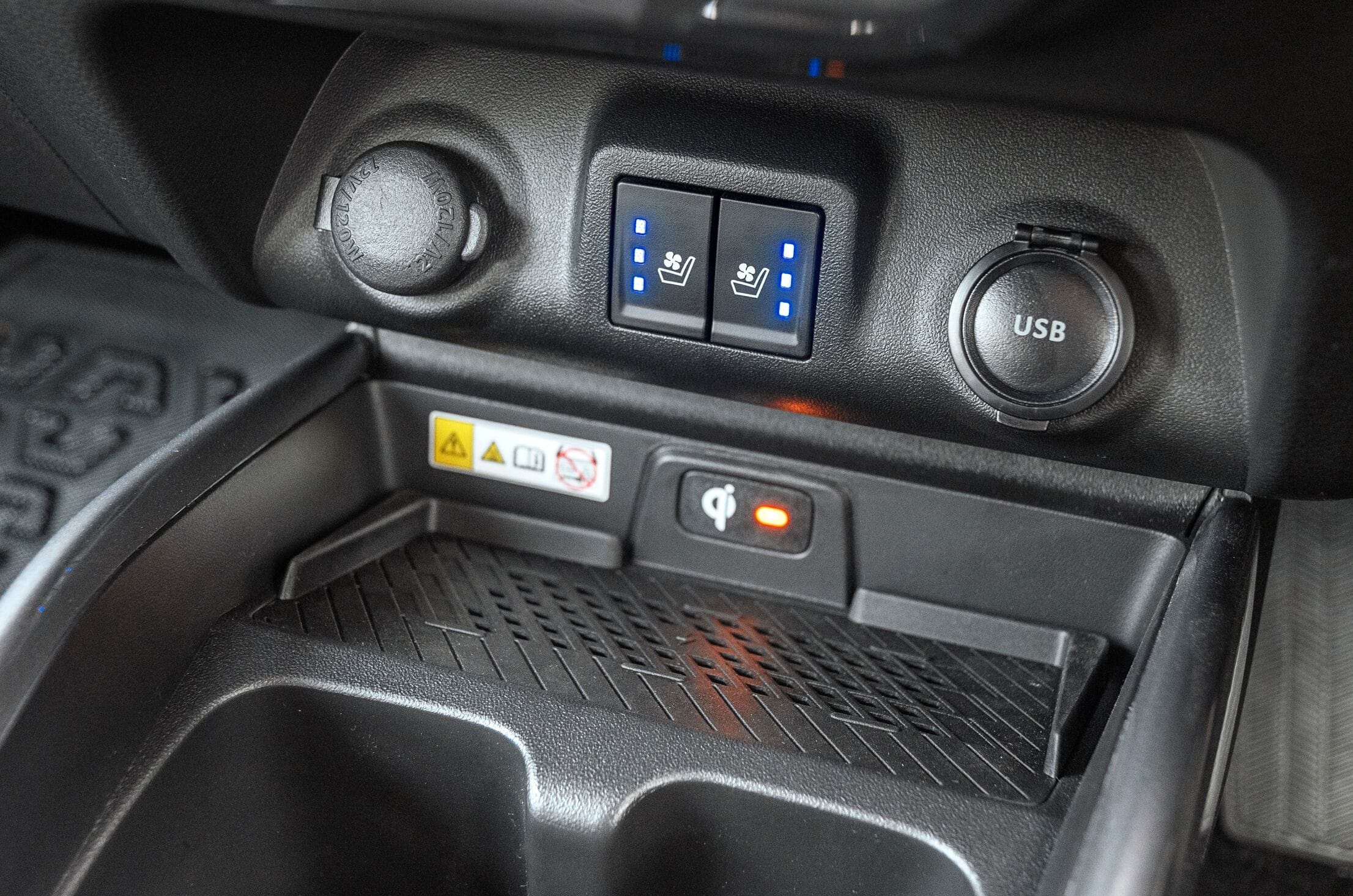
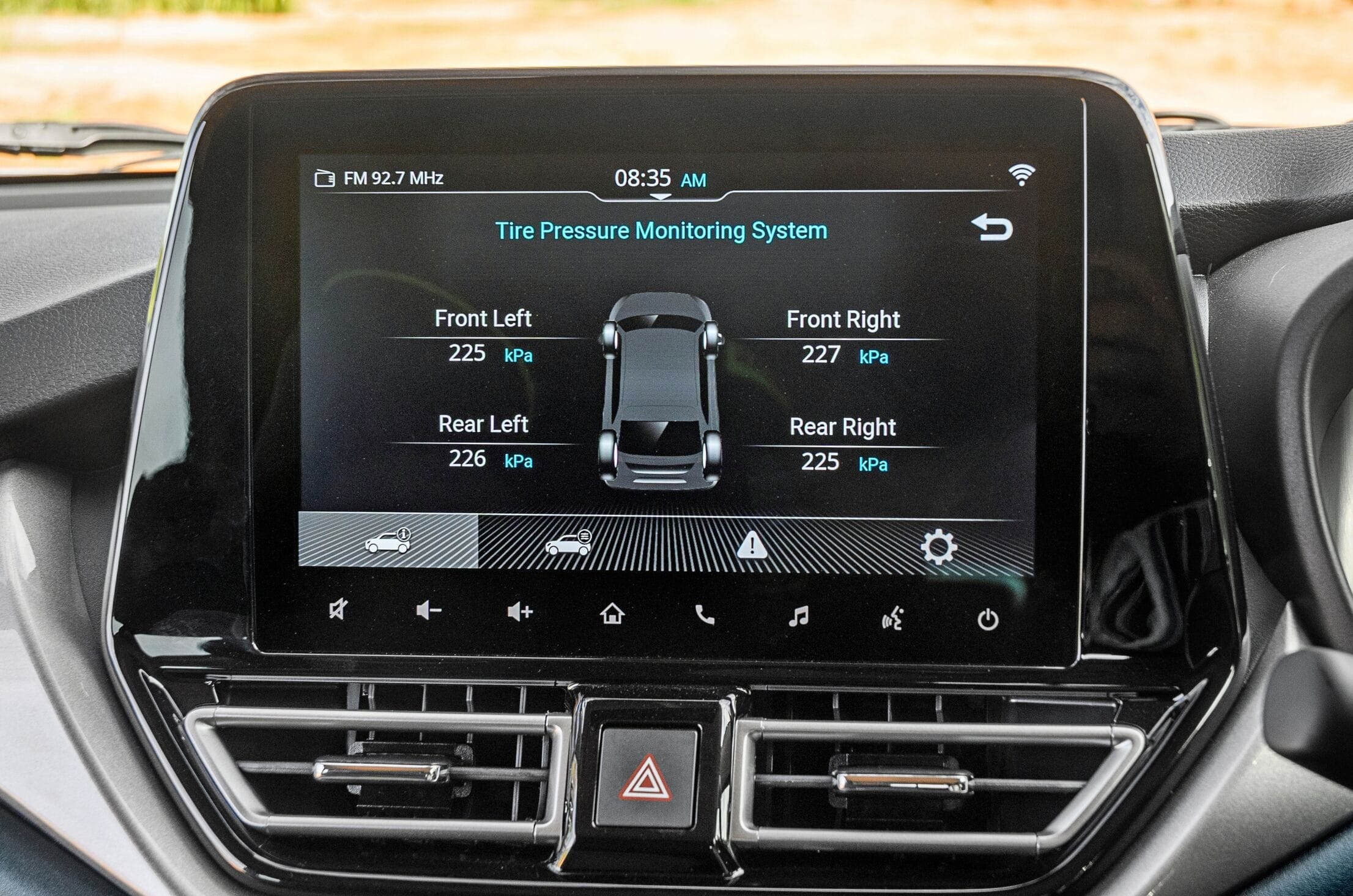
There have been some important additions when it comes to features, as the Baleno now gets ventilated front seats, a cooled wireless phone charger, a tyre pressure monitoring system, a Clarion sound system, and perhaps most importantly, segment-first ADAS Level 2 features.

Ventilated front seats and a cooled wireless charging pad are among the new additions

Other than that, the features list was fairly expansive as is, with this top-spec Alpha (O) also getting a 9-inch infotainment touchscreen with wireless smartphone integration, auto climate control, a heads-up display, colour MID, auto headlamps, auto-dimming IRVM, keyless entry and go, rear wiper/washer, connected car tech and more. Safety kit includes 6 airbags as standard, traction control, a 360-degree parking camera (its quite low res though) and ISOFIX child seat mounts. The outgoing Baleno had a 4-star crash safety rating from Bharat NCAP and that should be the case for this one as well.

9-inch touchscreen has been retained; now features a TPMS

Of the newer features, the ventilated front seats work effectively though the blower is quite audible while the wireless charger charges your phone’s battery at a good rate without overheating it. The TPMS too worked as intended, while the Clarion audio system is better than the outgoing model’s it still falls short of what rivals offer.

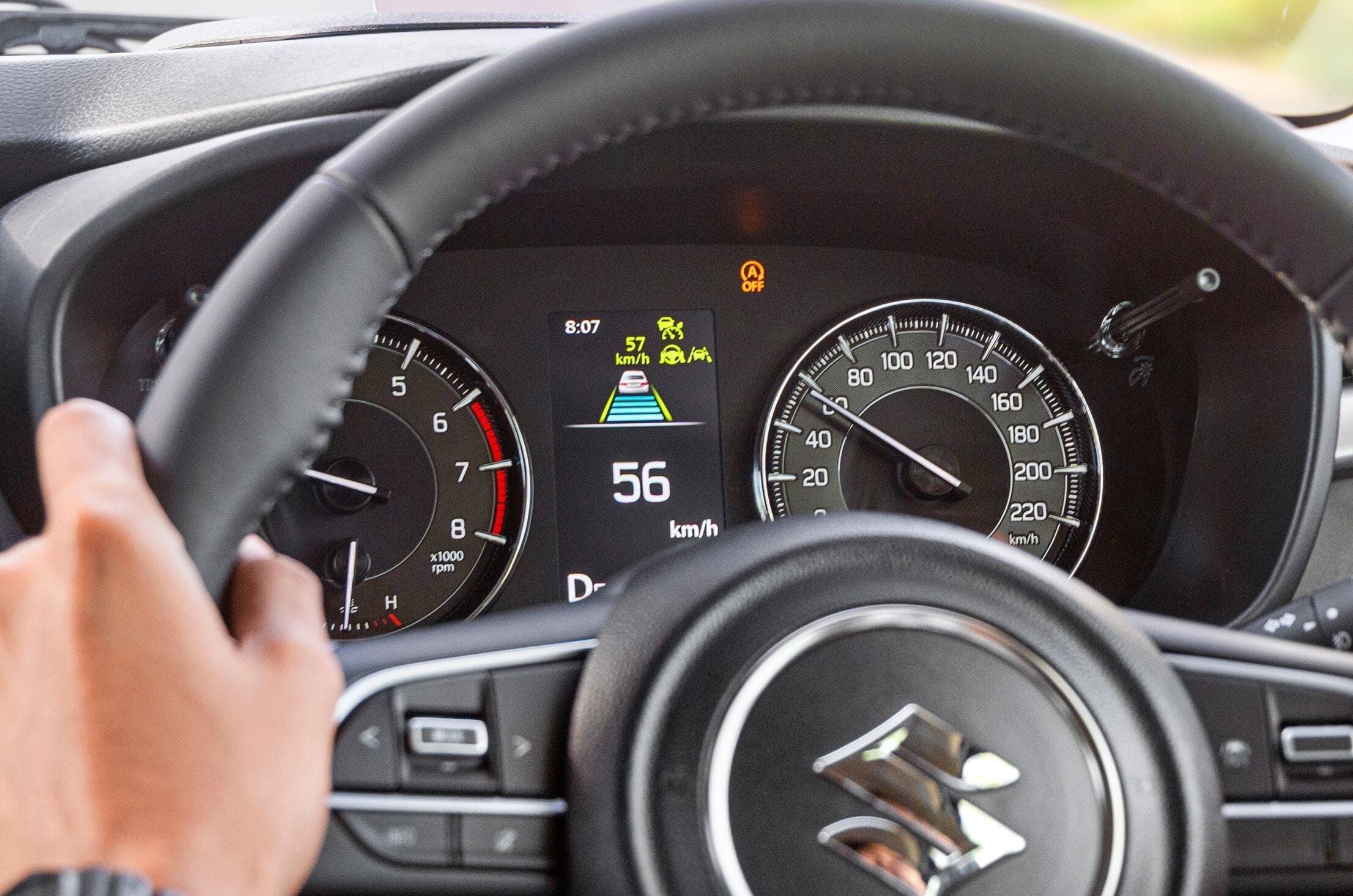
The addition of Level 2 ADAS tech however, greatly boosts the Baleno’s safety quotient. It’s a camera and radar-based system that brings in features like auto emergency braking, adaptive cruise control, lane keep assist, lane departure warning and more. On our brief test drive, the ADAS features worked as intended and seemed well calibrated as they weren’t overly intrusive. However, if you turn off the ADAS features they will automatically switch back on everytime you start the car.

Gets segment-first Level 2 ADAS features which seemed well calibrated for our conditions

As for features then, the Baleno facelift takes a step up and almost has all bases covered. Only things missing are a rear centre armrest and a sunroof, both of which its rivals offer.

Maruti Baleno Performance and Refinement – 8/10

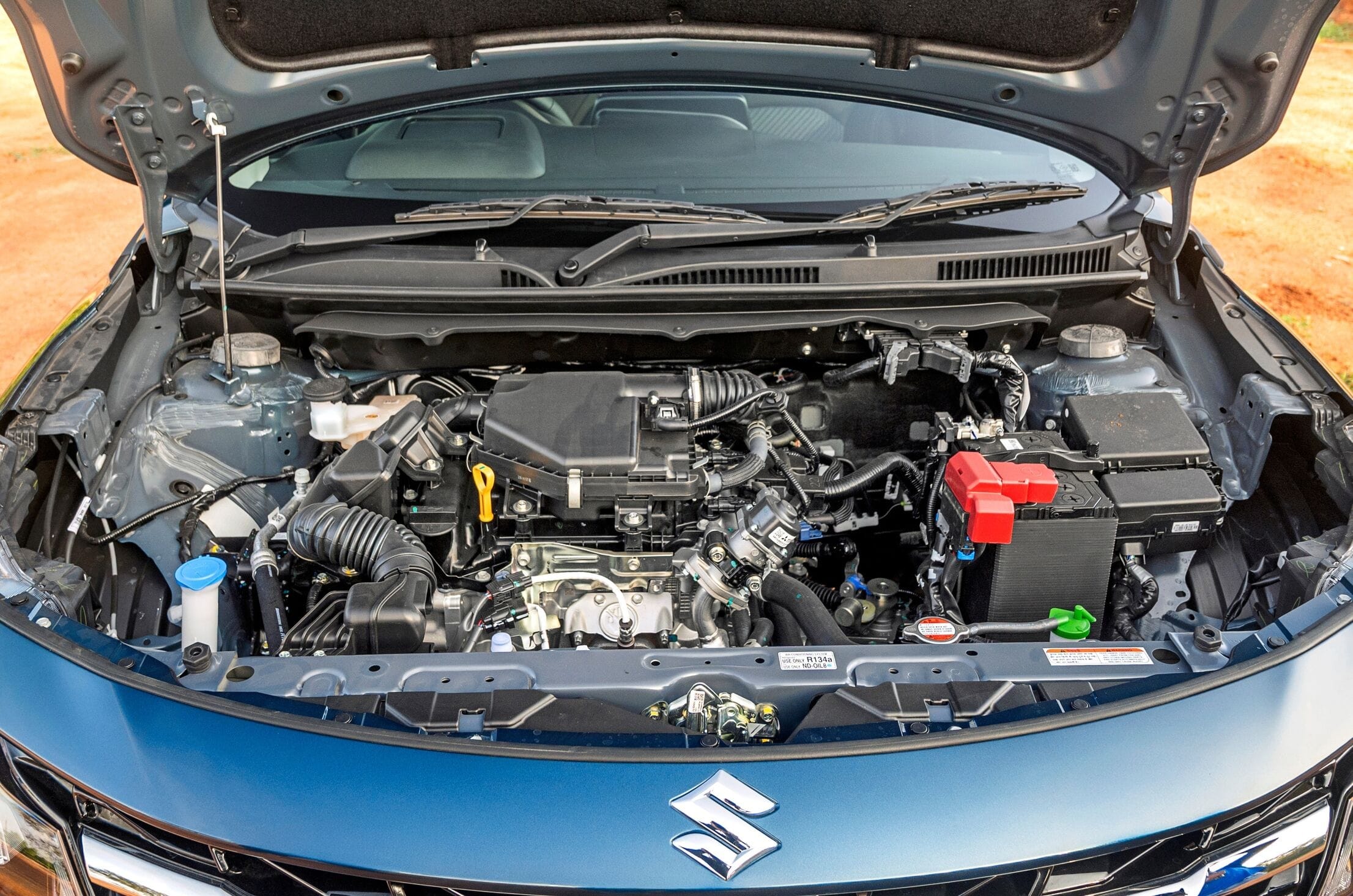
By far the biggest change with the facelift comes under the hood and it’s rare that we get to see a new engine with a facelift. Out goes the 1.2-litre, four-cylinder, K-series engine and in comes the 1.2-litre, three-cylinder, Z-series engine from the likes of the Swift and the Dzire. Yes, the Baleno is down a cylinder and as such, down on output too. The Z12E engine makes 83hp and 112Nm, which is 7hp and 1Nm lower than the older K12N engine. Maruti has moved to this engine as it is newer, is less polluting, more efficient and also opens it up to the possibility of hybridisation in the future.

New Z-series engine impresses with its drivability, low end response and promises more efficiency

This Z-series naturally aspirated engine is one of the most refined three-cylinder engines around. There is some of that typical three-cylinder thrum at idle but that smoothens out as the revs climb. It’s fairly quiet too at idle and it’s only when you’re at the top of the rev range that it becomes audible inside the cabin.

As we’ve experienced in the Swift and Dzire, this Z-series engine impresses with its low-end response and drivability. Power builds in a smooth linear manner, it moves off the line cleanly and part-throttle responses are good too. However, it doesn’t feel as peppy as the older K-series engine and doesn’t feel as strong at the top of the rev range. And considering that it’s down on power and heavier than the outgoing car, it isn’t as quick in terms of outright acceleration. But for a daily urban runabout, this engine is up to the task. For reference, we managed a 0-100kph time of 13.03sec and 15.89sec for the Swift MT and Swift AMT, respectively and you can expect the Baleno to be slightly slower than this owing to its higher kerb weight. 

Power builds in a smooth linear manner and part-throttle responses are good, too.

As was the case earlier, the Baleno facelift can be had with either a 5-speed manual or a 5-speed AMT automatic. The manual gearbox is particularly impressive with its effortlessness and our pick of the two. The clutch pedal is light and easy to modulate, while the gearbox is smooth and has nice, short throws and well defined gates.

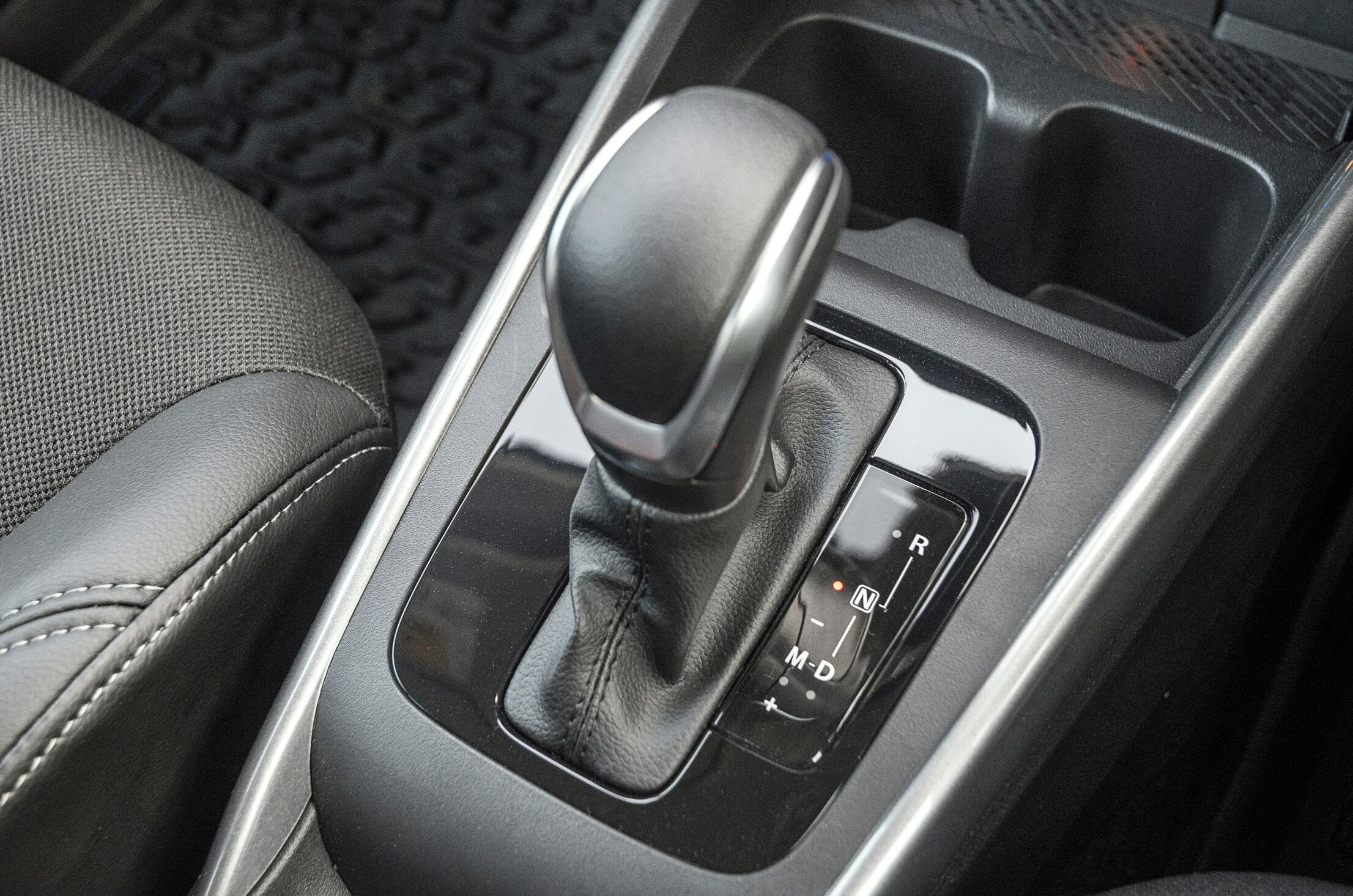
In comparison to its rivals, which offer more sophisticated automatics in the form of a CVT and a DCT, the Baleno only comes with a simpler, more cost-effective AMT. The AMT makes for a good option for those who wish for greater convenience and it’s smooth as far as AMTs go. There is still that noticeable headnod effect that you get between shifts and it is hesitant when you try to make a quick overtake, as it takes some time to downshift. That can be alleviated however, by shifting to manual mode via the gear lever and what’s nice is that it won’t auto upshift in this mode.

AMT adds a layer of convenience but feels hesitant when you try to make a quick overtake

A factory-fitted CNG option is also available with the Baleno facelift. It uses the same engine but power and torque outputs fall to 70hp and 102Nm, respectively, when run on CNG, and it can only be had with the 5-speed manual gearbox. However, we’re yet to experience the Baleno facelift CNG.

Maruti Baleno Mileage and Efficiency – 9/10

Both manual and AMT variants see an improvement in claimed efficiency with the new engine. 

The biggest advantage with the move to the Z-series engine comes in the form of fuel efficiency. The Baleno petrol-manual is now claimed to return 23.80kpl (1.45kpl more), while the AMT is said to do 24.77kpl, which is a 1.83kpl improvement. The Baleno CNG meanwhile, sees an improvement of 3km/kg, with a claimed 33.61km/kg. As always, these are claimed figures tested in ideal conditions and expect real-world fuel efficiency to be lower. What’s interesting is that the Baleno has become more efficient despite becoming up to 30kg heavier than the outgoing version.

Maruti Baleno Ride Comfort and Handling – 8/10

As before, the Baleno continues to impress with its ride comfort. The suspension has a softness to it, which means low speed ride is excellent and it’s only the sharpest bumps and big potholes that manage to unsettle it. It also manages to iron out road imperfections with considerable ease and stays composed at higher speeds, with well-contained vertical and side-to-side movements.

Good body control with minimal roll and the steering weighs up nicely as you pick up the pace

Handling isn’t its strongest suit but the Baleno displays good body control with minimal roll around the corners. The steering, meanwhile, is light at low speeds, which aids city driving, but it adds some reassuring weight as you pick up the pace which is confidence-inspiring. It’s not particularly feelsome but that’s nothing to complain about, given its an urban premium hatchback. As for braking, it continues with the same discs up front and drums at the rear setup and the stopping power is more than adequate. On the whole then, the Baleno feels mature and composed on the move.

Maruti Baleno Value for Money – 8/10

The Maruti Baleno facelift is priced from Rs 6.10 lakh (ex-showroom, India), though this is a special festive price and Maruti is yet to disclose complete variant-wise pricing. It continues to get a 3 year/1,00,000km standard warranty and as before, rivals other premium hatchbacks in the Hyundai i20 and Tata Altroz, both of which are priced from Rs 6 lakh (ex-showroom, India).

The added features and the promise of greater fuel efficiency just further enhance the Baleno’s appeal

There are some drawbacks of course, like the hesitant AMT automatic and it doesn’t feel as peppy as the older K-series Baleno. But those pale in comparison to the Baleno’s inherent strengths of a spacious and comfortable cabin, an effortless drive thanks to its light controls, a refined engine and a good ride comfort and handling balance. The added comfort and safety features and the promise of greater fuel efficiency with the new engine just further enhance its appeal. As such, the Baleno is all set to retain its spot at the top of the premium hatchback chain.

शेफाली वर्मा को हाथ से इशारा करना फातिमा सना को पड़ा भारी (Video)

Pakistan women cricketer Fatima Sana (Credit: X)

पाकिस्तान की कप्तान फातिमा सना पर शनिवार को दुबई में भारत के खिलाफ उनकी टीम के महिला एशिया कप मुकाबले के दौरान आईसीसी आचार संहिता के लेवल 1 के उल्लंघन के लिए मैच फीस का 10 प्रतिशत जुर्माना लगाया गया है और एक डिमेरिट अंक दिया गया है।

फातिमा को अनुच्छेद 2.5 के उल्लंघन का दोषी पाया गया, जो “ऐसी भाषा, कार्यों या इशारों का उपयोग करने से संबंधित है जो अपमानजनक हैं या जो आउट होने पर बल्लेबाज की आक्रामक प्रतिक्रिया को भड़का सकते हैं।”

यह अपराध शैफाली वर्मा को आउट करने के बाद हुआ, जब फातिमा ने कैच पूरा करने के बाद पवेलियन की ओर इशारा किया। 24 महीने की अवधि के भीतर फातिमा का यह दूसरा अपराध था, जिससे उसके Demerit Point  की संख्या दो हो गई। उन्हें इससे पहले 6 अगस्त, 2025 को डबलिन में आयरलैंड के खिलाफ टी20 के दौरान एक डिमेरिट अंक मिला था।

फातिमा ने भारत से पाकिस्तान की भारी हार के बावजूद गेंद से अहम भूमिका निभाई थी,उन्होंने पाकिस्तान के 55 रन पर आउट होने के बाद भारत के तीन विकेट झटके थे। शैफाली, जिन्होंने आक्रामक रूप से भारत का पीछा करना शुरू किया था, फातिमा का पहला विकेट थीं, उन्होंने गेंदबाज को एक आसान कैच दिया।इसके तुरंत बाद उन्होंने इस ही ओवर में प्रतिका रावल को बिना खाता खोले कीपर मुनीबा के हाथों कैच आउट करवा दिया। वहीं अगले ओवर में स्मृति मंधाना को पगबाधा आउट कर दिया।

फातिमा ने अपराध स्वीकार कर लिया और मैच रेफरी सुप्रिया दास द्वारा प्रस्तावित मंजूरी को स्वीकार कर लिया, जिसका अर्थ है कि किसी औपचारिक सुनवाई की आवश्यकता नहीं थी। लेवल 1 के उल्लंघनों में न्यूनतम जुर्माना आधिकारिक फटकार और खिलाड़ी की मैच फीस का अधिकतम 50 प्रतिशत, साथ ही एक या दो Demerit Point होते हैं। पाकिस्तान के पास भारत से मिली हार पर ध्यान देने के लिए बहुत कम समय है, एशिया कप में उसका अगला मुकाबला सोमवार को हांगकांग से होगा। एक जीत उन्हें सेमीफाइनल में ले जाएगी।

IND vs PAK: अपनी हरकतों से बाज नहीं आ रहे PAK खिलाड़ी! बुरी तरह से हारने के बाद भी नहीं कर हो रही हेकड़ी

IND vs PAK: भारत और पाकिस्तान के बीच खेले गए विमेंस एशिया कप के मुकाबले में भारत ने शानदार प्रदर्शन करते हुए एकतरफा जीत दर्ज की है। हरमनप्रीत कौर की कप्तानी में भारतीय टीम ने शुरुआत से ही मैच पर पकड़ बनाए रखी। पाकिस्तान की टीम भारतीय गेंदबाजों के सामने ज्यादा देर नहीं टिक सकी और बेहद कम स्कोर पर ही सिमट गई। वहीं इस मैच के दौरान पाकिस्तान की कप्तान फातिमा सना अपने एक एक्शन को लेकर चर्चा में हैं। पाकिस्तानी कप्तान फातिमा सना ने भारतीय बल्लेबाज शेफाली वर्मा को सेंडऑफ दिया, जो अब काफी विवादों में है।

शेफाली को किया ये इशारा

विमेंस एशिया कप 2026 में भारत-पाकिस्तान मुकाबले के दौरान शेफाली ने फातिमा की गेंद पर चौका लगाया था, लेकिन अगली ही गेंदों में पाकिस्तान की कप्तान ने वापसी करते हुए उन्हें कैच एंड बोल्ड कर दिया। शेफाली वर्मा को 6 गेंदों पर 12 रन पर आउट होने के बाद फातिमा ने उनकी ओर इशारा करते हुए पवेलियन जाने का इशारा किया, जिसके बाद उनके इस अंदाज को लेकर सोशल मीडिया पर बहस शुरू हो गई। फैंस का कहना था कि पाकिस्तान पहले ही मुकाबले में काफी पीछे था, ऐसे में इस तरह का गुस्सा दिखाना ठीक नहीं था।

कैसा था भारत-पाकिस्तान का मुकाबला

टॉस जीतकर पहले बल्लेबाजी करने वाली पाकिस्तान की टीम भारतीय गेंदबाजों के सामने ज्यादा देर नहीं टिक सकी और 18.1 ओवर में 55 रन पर ऑलआउट हो गई। यह महिला T20 इंटरनेशनल में पाकिस्तान का सबसे कम स्कोर है। मुनीबा अली और शवाल जुल्फिकार को छोड़कर कोई भी बल्लेबाज 10 रन तक नहीं पहुंच सकी। वकप्तान फातिमा सना भी खाता नहीं खोल पाईं और दीप्ति शर्मा की गेंद पर LBW आउट हो गईं।

भारत ने आसानी से हासिल किया लक्ष्य

शनिवार को दुबई इंटरनेशनल स्टेडियम में भारतीय स्पिन गेंदबाजों ने पाकिस्तान की पारी को सस्ते में समेट दिया। इसके बाद लक्ष्य का पीछा करने उतरी भारतीय टीम ने बिना ज्यादा समय गंवाए 8.4 ओवर में मुकाबला अपने नाम कर लिया। भारत के सामने जीत के लिए सिर्फ 56 रन का छोटा लक्ष्य था, लेकिन शुरुआत में टीम ने कुछ विकेट जल्दी गंवा दिए। पाकिस्तान की तेज गेंदबाज फातिमा सना ने दो ओवर में तीन विकेट लेकर भारतीय बल्लेबाजों पर दबाव बना दिया। लेकिन, इसके बाद हरमनप्रीत कौर और दीप्ति शर्मा ने मोर्चा संभाला और टीम को जीत के करीब पहुंचा दिया।

भारत ने टूर्नामेंट के शुरुआती दोनों ग्रुप मैच जीतकर पहले ही सेमीफाइनल में अपनी जगह बना ली थी। पाकिस्तान के खिलाफ मिली इस जीत ने टीम का आत्मविश्वास और बढ़ा दिया है। अब भारतीय महिला टीम की नजर अपने अगले मुकाबले पर है, जो गुरुवार को खेला जाएगा।

Duleep Trophy: इधर गेंदबाजों की कुटाई उधर वैभव सूर्यवंशी से भिड़े कप्तान तिलक वर्मा, फाइनल में दिखा हैरान करने वाला नजारा

Aftermarket CNG conversions decoded: installation, legality and costs

Aftermarket CNG conversions decoded: installation, legality and costs

While aftermarket CNG conversions are not new, with the rise in fuel prices, there has been a noticeable spike in interest surrounding them. Although there are more factory-fitted CNG cars on the market than ever before, several models still do not give you the option. Not to mention, existing car owners are increasingly looking to convert their cars to CNG to reduce running costs.

Naturally, this increased interest brings up several questions about the technology, the installation, the legalities and more. We thus teamed up with Lovato CNG’s authorised distributor in Maharashtra, Blue Drive Traders, as well as Lets Go CNG and its authorised installer in Mumbai, M.S Motors, to answer questions about CNG conversions.

Know your CNG kit

There are three broad types of kits available on the market today. The oldest is the Venturi type, typically used for cars that are Bharat Stage 3-compatible and older. These use a Venturi mixer, similar to a carburettor, that mixes CNG with air before it is injected into the intake manifold. They are the most affordable, usually costing between Rs 30,000 and Rs 40,000, including installation and registration, but they are not the most efficient and bring a significant drop in performance. Since the cars they are compatible with are also reaching the end of their lifecycle, these kits are gradually being phased out.

Modern naturally aspirated MPFI cars require a sequential type kit. These use individual injectors that inject CNG directly into the intake manifold and feature their own ECU that controls timing, volume and other parameters based on RPM and driver inputs. These are much more fuel-efficient, and the drop in performance is nominal in everyday driving conditions. Like the older Venturi kits, these too require the car to be started on petrol before switching over to CNG. However, they automate the process by making the switch once a certain engine temperature is reached. Prices vary depending on the manufacturer and the specifications of each kit, ranging from Rs 40,000-Rs 50,000 for older BS4 cars, to Rs 50,000-Rs 65,000 for smaller BS6 cars, stretching to Rs 70,000-Rs 75,000 for larger cars that require an eight-injector kit.

The newest type of kit to hit the market is the direct-injection kit, used for cars with direct petrol injection. Like sequential kits, these too inject CNG into the intake manifold. However, direct-injection engines cannot run purely on CNG. The fuel injectors in a DI engine sit within the combustion chamber, so to prevent them from overheating, a small amount of petrol still needs to be injected through them even when running on CNG. Therefore, a turbocharged direct-injection engine can only run on a maximum 80:20 ratio of CNG and petrol. As a result, fuel efficiency gains are not quite as high as with a naturally aspirated engine, and kit prices range from Rs 1 lakh to Rs 1.5 lakh, thus pushing the breakeven point further away.

What’s in the box?

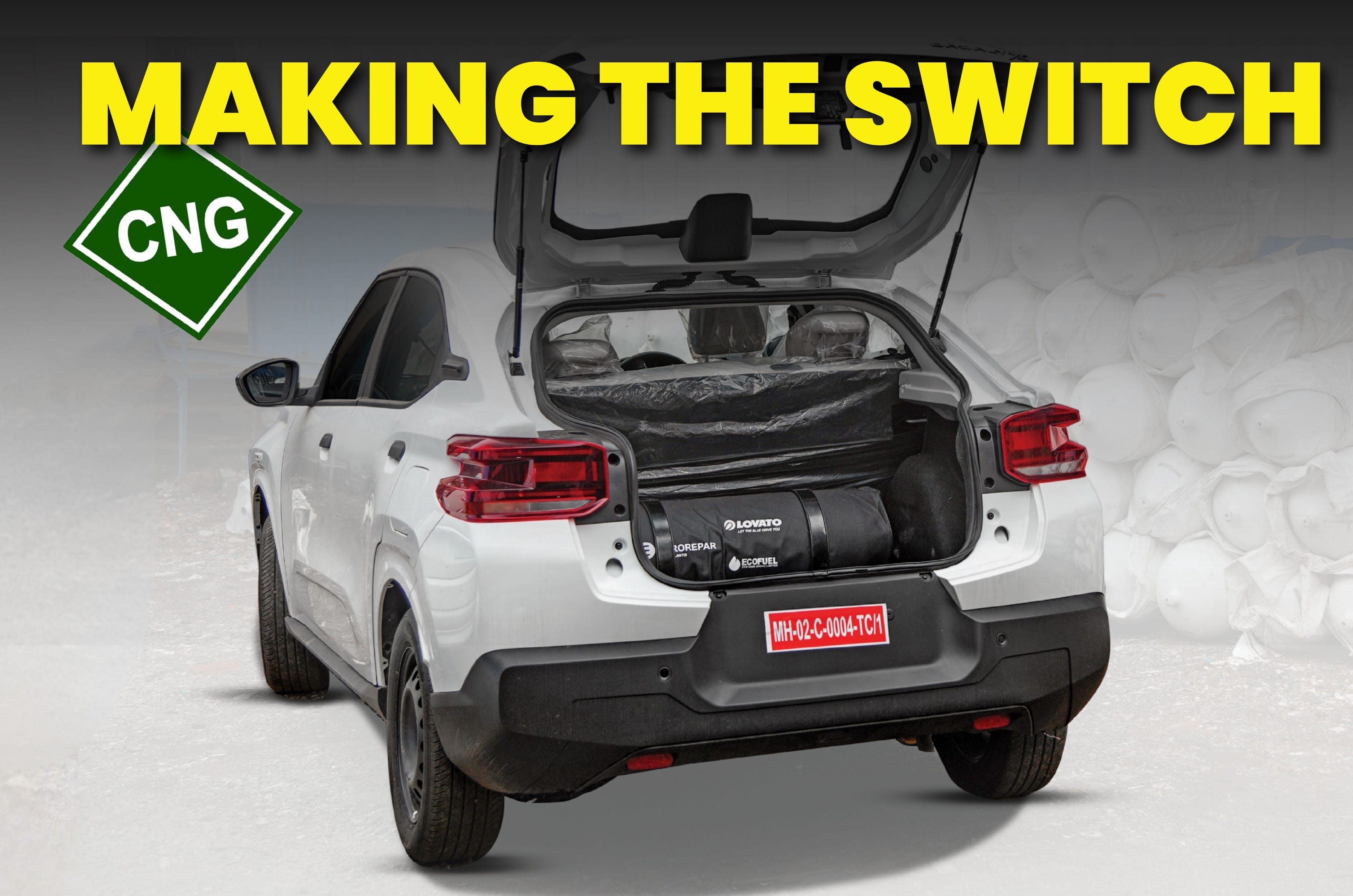
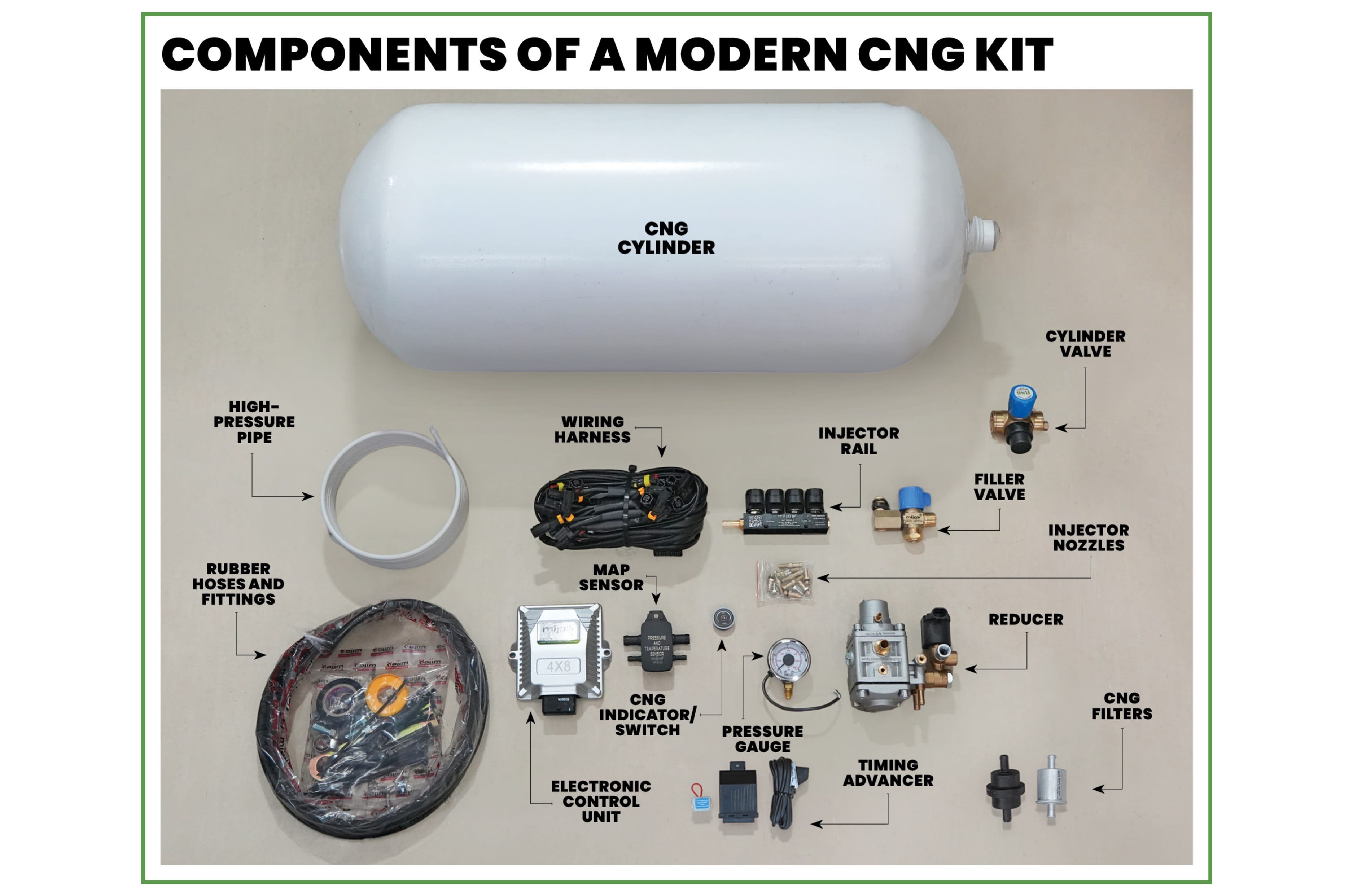
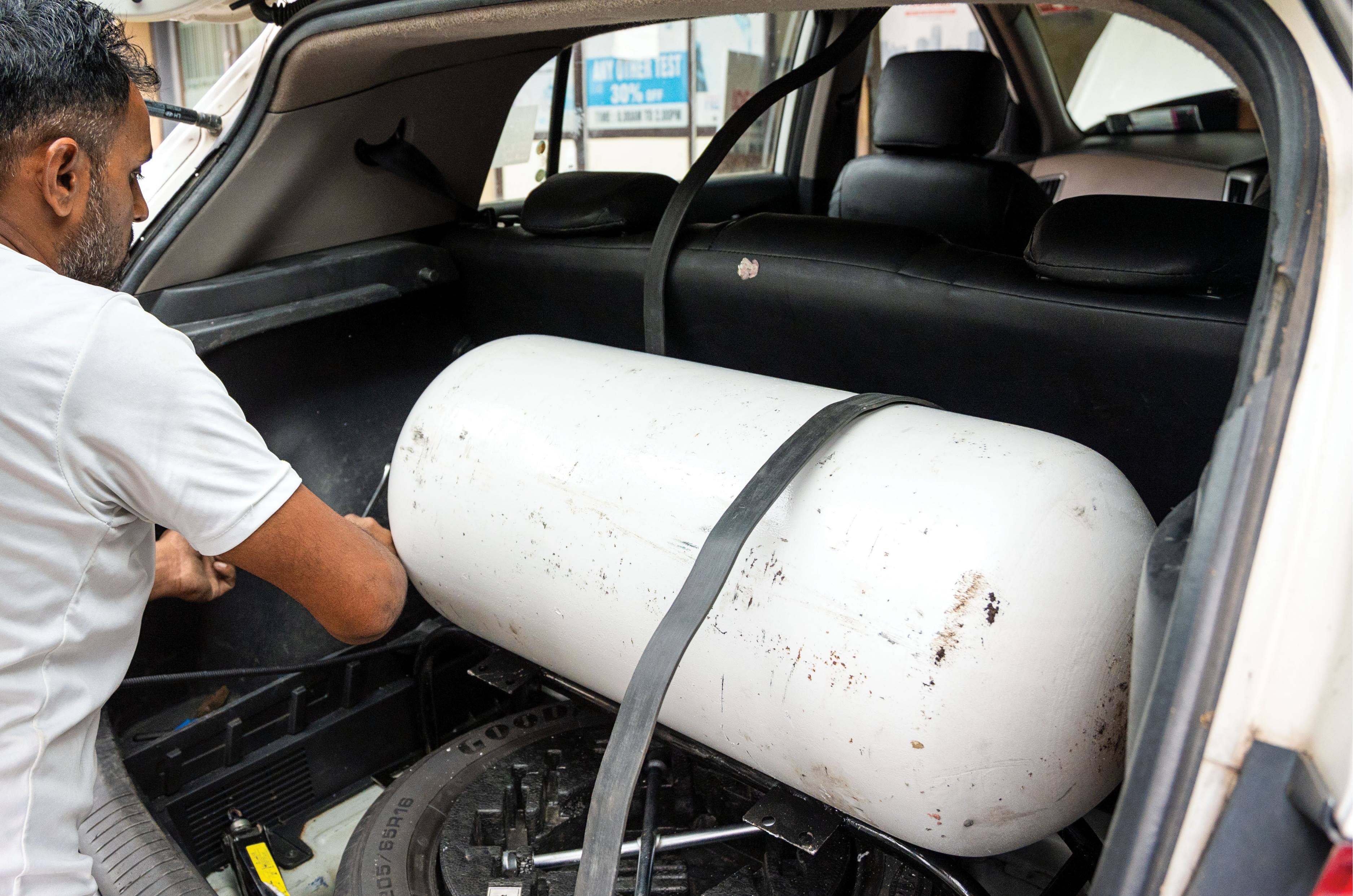
The largest and heaviest component of a typical CNG kit is the tank itself. Made from seamless steel, these can weigh close to 70kg empty, with volumetric capacities ranging from 60 to 65 litres. Metal-lined composite cylinders and carbon fibre-reinforced plastic cylinders are also now available, and while they are significantly lighter, they usually cost two or three times more. Attached to the tank is a valve with a manual shut-off.

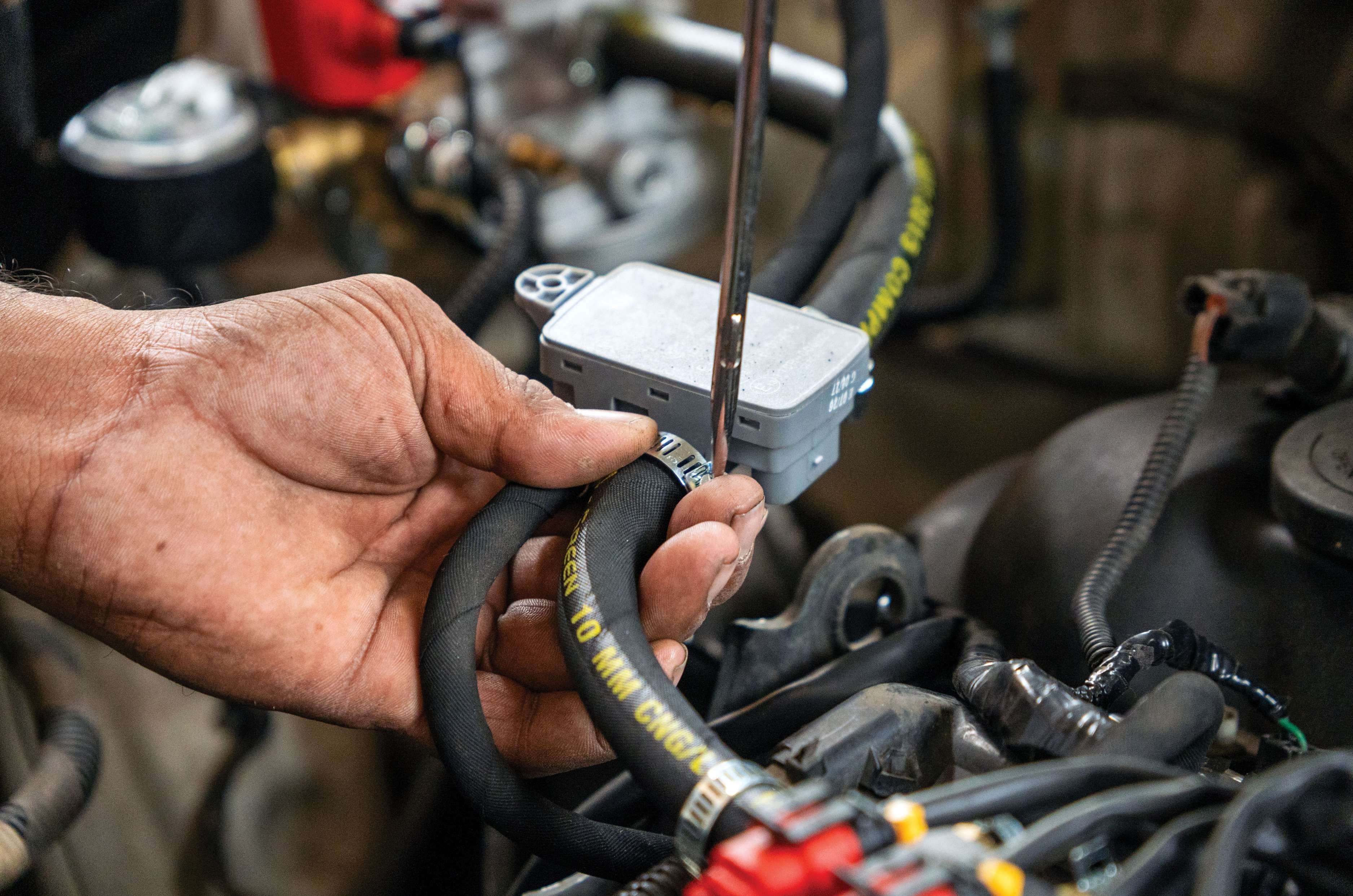
The filling valve, through which CNG is filled, can either be placed under the bonnet or beside the petrol filler cap, depending on the vehicle. Transporting the gas from the tank to the pressure reducer under the bonnet is high-pressure tubing made from carbon steel and coated in polymers. The reducer has a pressure gauge and lowers gas pressure from about 200bar in the tank to a manageable 2-3 bar. From here, the gas is routed to the injector rail that sits atop the engine, which further distributes it to nozzles drilled into the intake manifold via reinforced rubber hoses. Between the reducer and the injector rail sits a Manifold Absolute Pressure (MAP) sensor to measure the pressure as well as the temperature of the gas. There is also an optional filter to remove any impurities in the line.

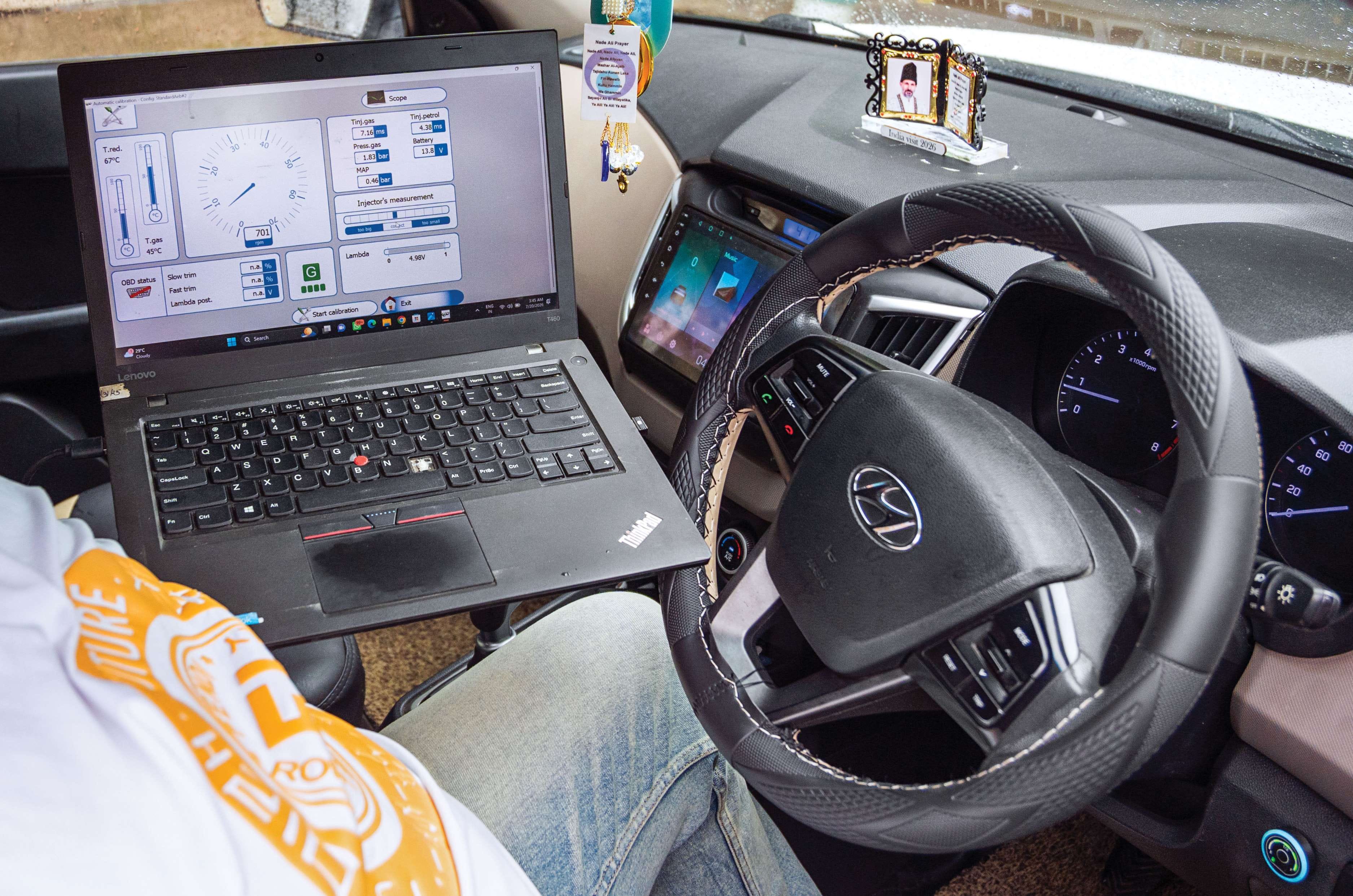
Controlling the injector rail is an Electronic Control Unit (ECU) that uses signals from the MAP sensor and communicates with the car’s original ECU to dictate the amount of CNG being injected and the timing. Modern kits also come with a comprehensive wiring harness that can plug into the car’s original wiring via OBD connectors. Older pre-BS6 cars, however, may require some wire splicing. Optionally available is an Advancer, which advances ignition timing when running on CNG and negates some of the power loss, particularly on smaller-capacity engines. Some sedans and hatchbacks also require a rear coil spring spacer to compensate for the added weight of the tank in the boot.

How a CNG kit is installed

A professional CNG installation takes around 4 to 5 hours to complete. Here’s what happens behind the workshop doors.

Health check

The engine is inspected to ensure it’s suitable for CNG conversion. A basic service is performed if required, with spark plugs and ignition coils replaced as needed and the throttle body cleaned.

Components positioned

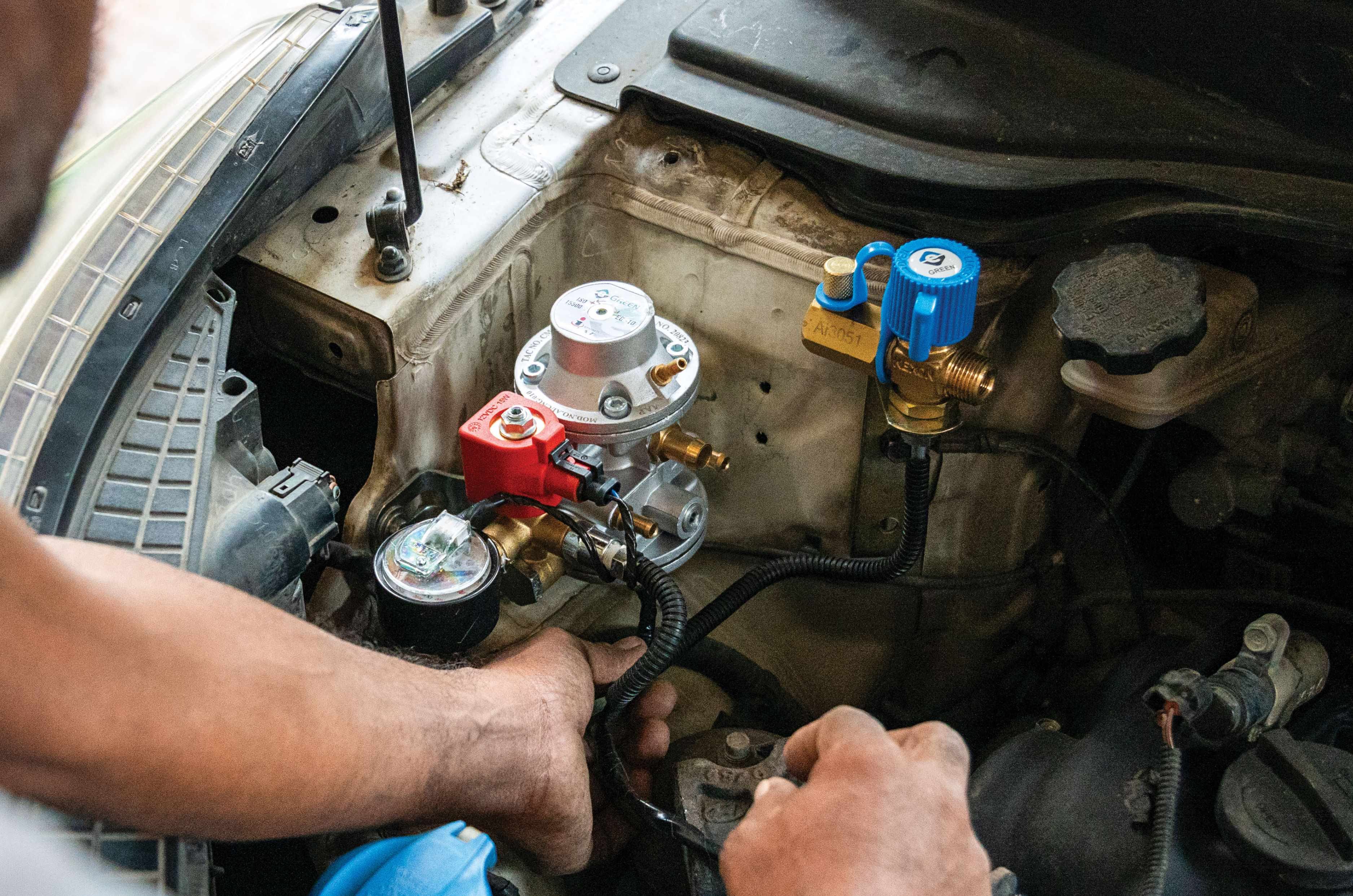
The reducer and its pressure gauge are mocked up in the engine bay before mounting points are marked and drilled. The filler valve may be located alongside them or next to the petrol filler cap, depending on the vehicle.

Injectors installed

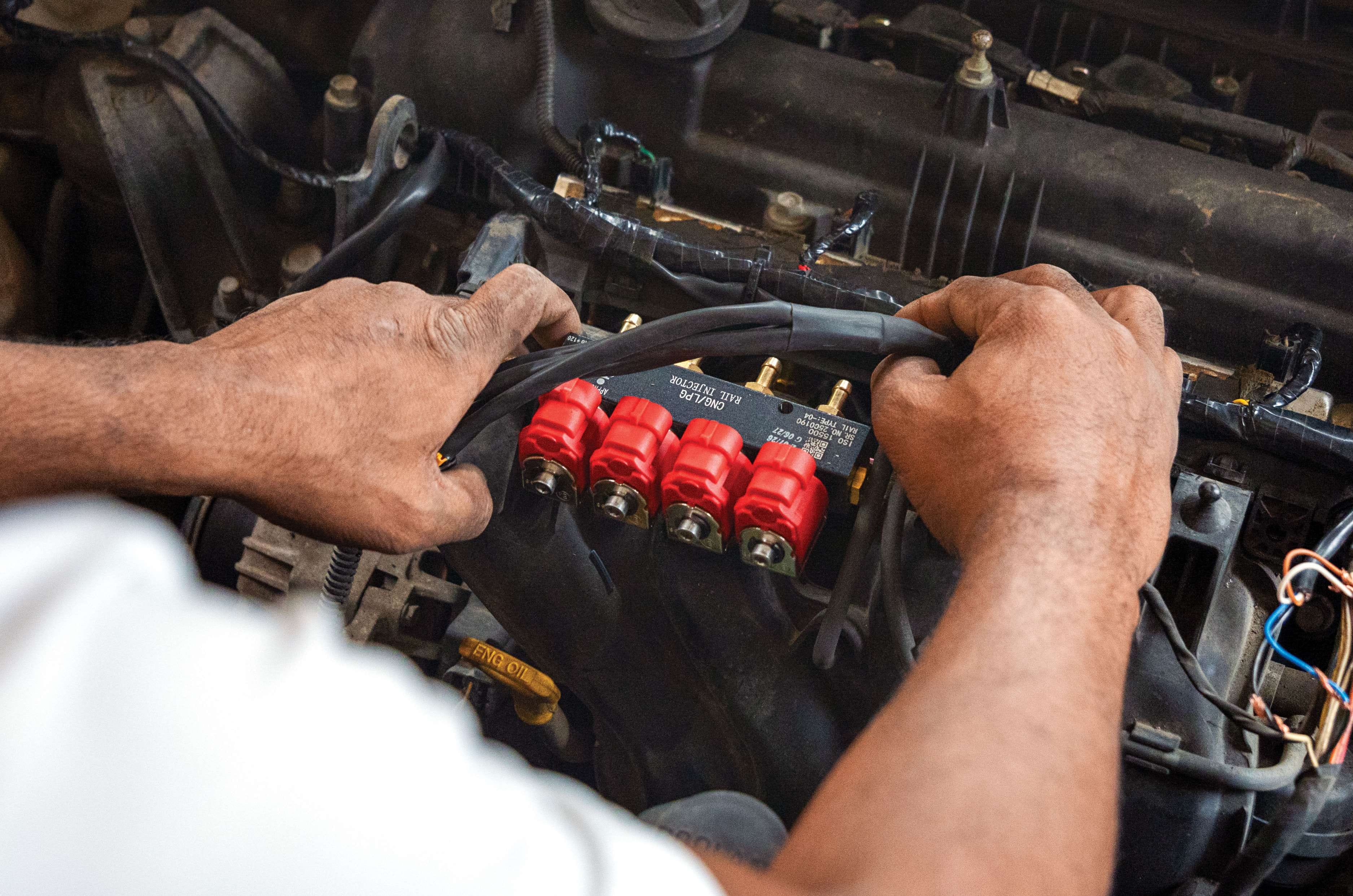
The CNG injector rail is mounted on its dedicated bracket close to the petrol injectors. This will send CNG to corresponding nozzles that are drilled and fitted into the vehicle’s plastic intake manifold.

ECU wired in

The CNG ECU is mounted alongside the factory ECU and connected to the vehicle’s wiring loom. The harness is neatly routed and secured away from heat and moving parts.

Plumbing completed

Reinforced rubber gas hoses are cut to length and connected between the reducer, injector rail and the intake manifold. A MAP sensor and a filter are also installed as part of the system.

Tank prepared

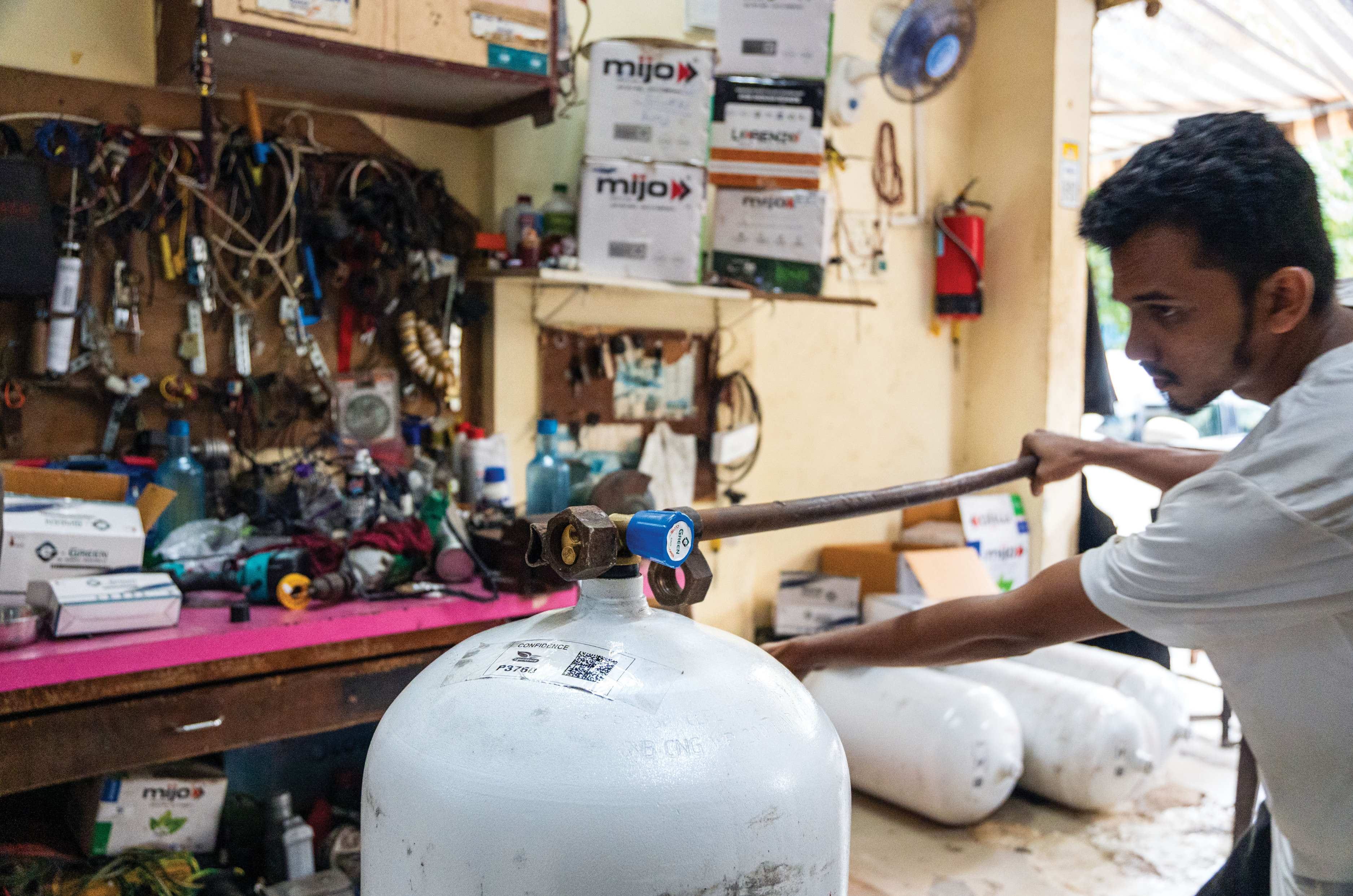
The CNG tank is temporarily mounted to a rig that holds it in place while the shut-off valve and associated fittings are installed before everything is torqued down.

Tank frame installed

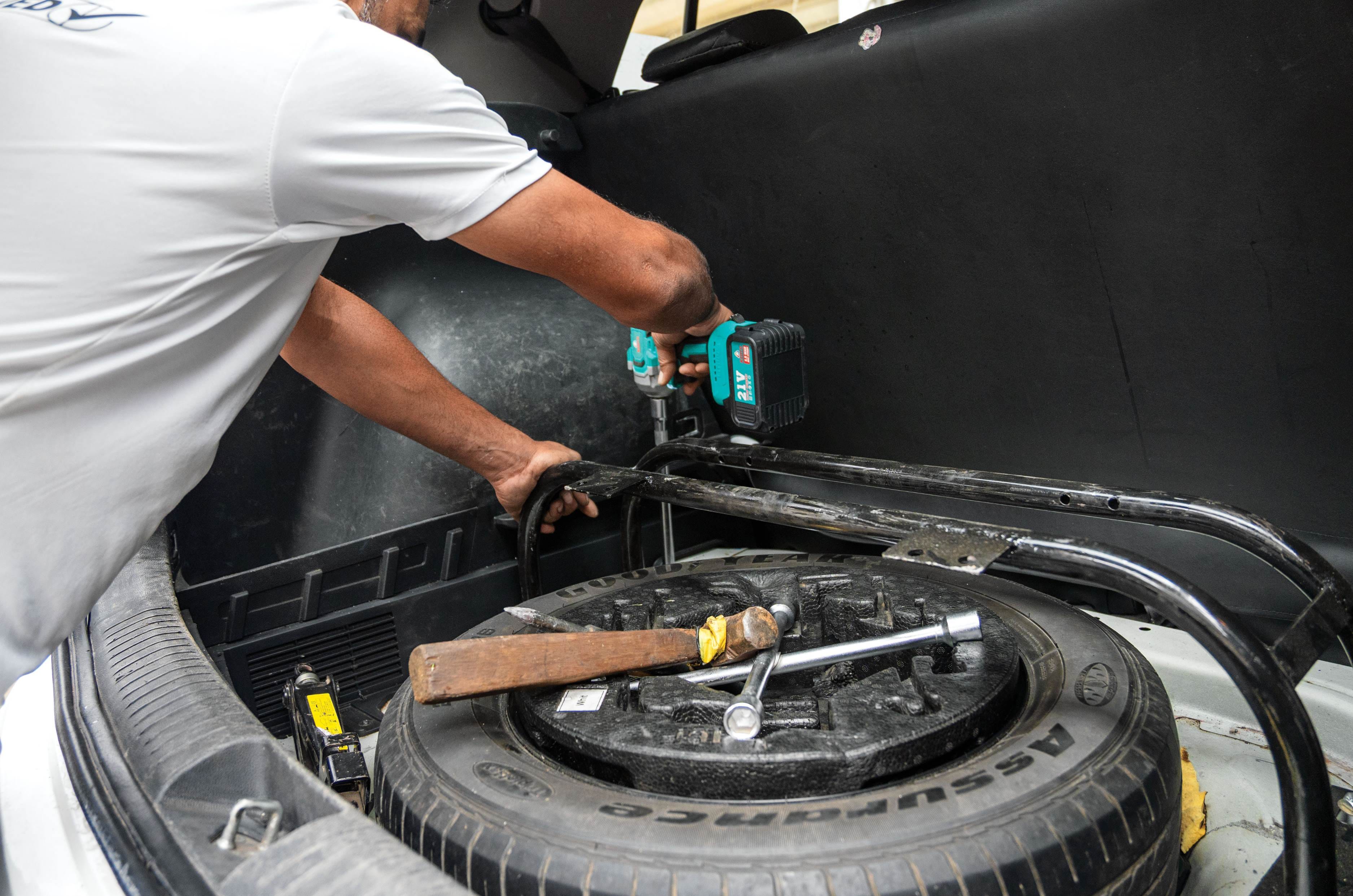
The mounting frame is positioned inside the boot, holes are drilled through the floor, and reinforced brackets securely bolt it to the vehicle’s structure.

Tank fitted

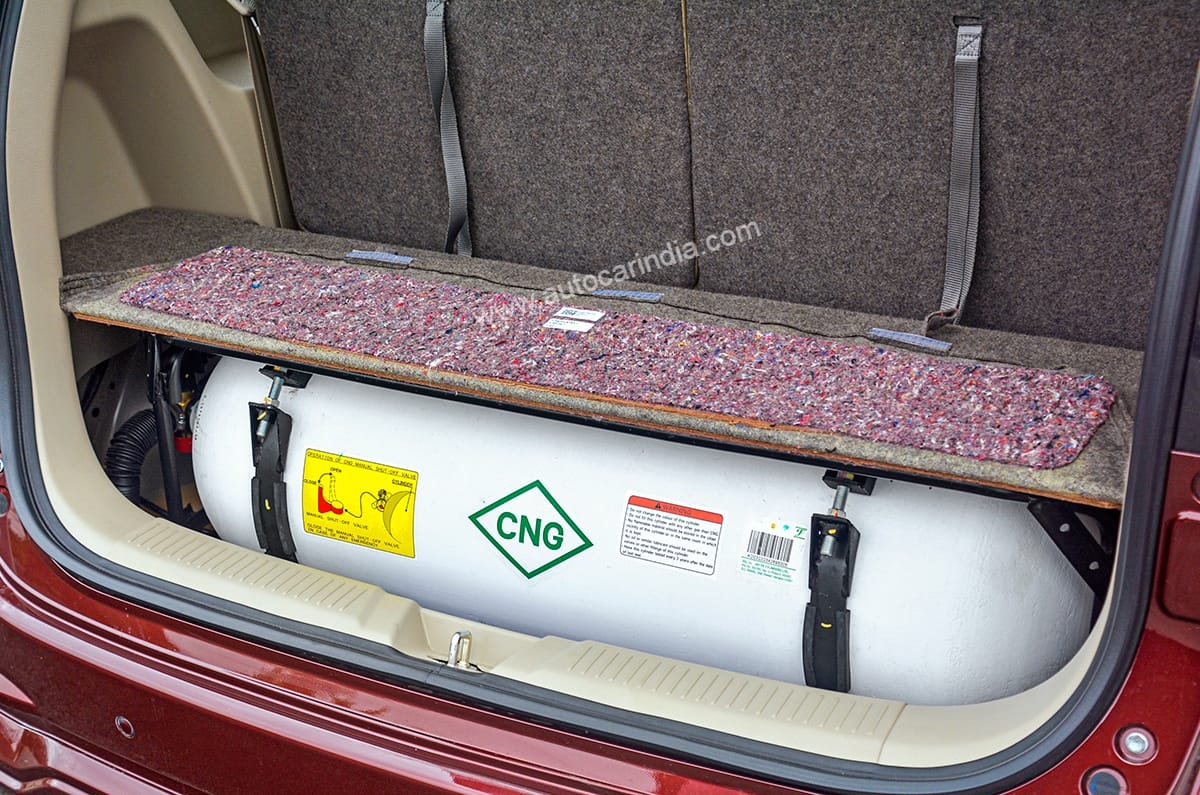
The CNG cylinder is secured to the frame using heavy-duty metal straps and bolts before being covered with a carpeted shroud for a neat factory-like finish.

High-pressure line routed

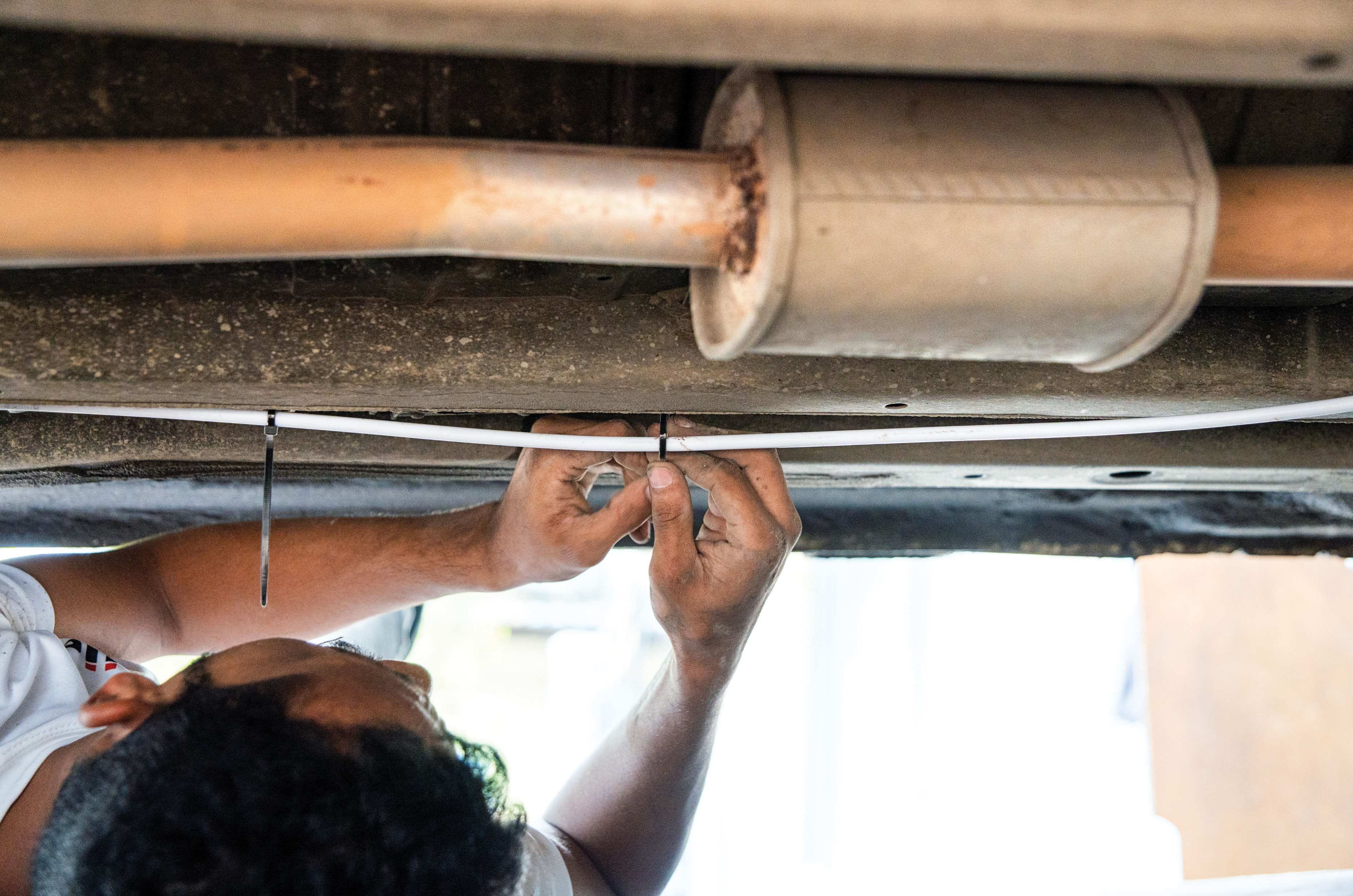
Polymer-coated steel high-pressure pipes are routed beneath the car, connecting the CNG filler valve, the tank and the reducer under the bonnet.

Electrical connections

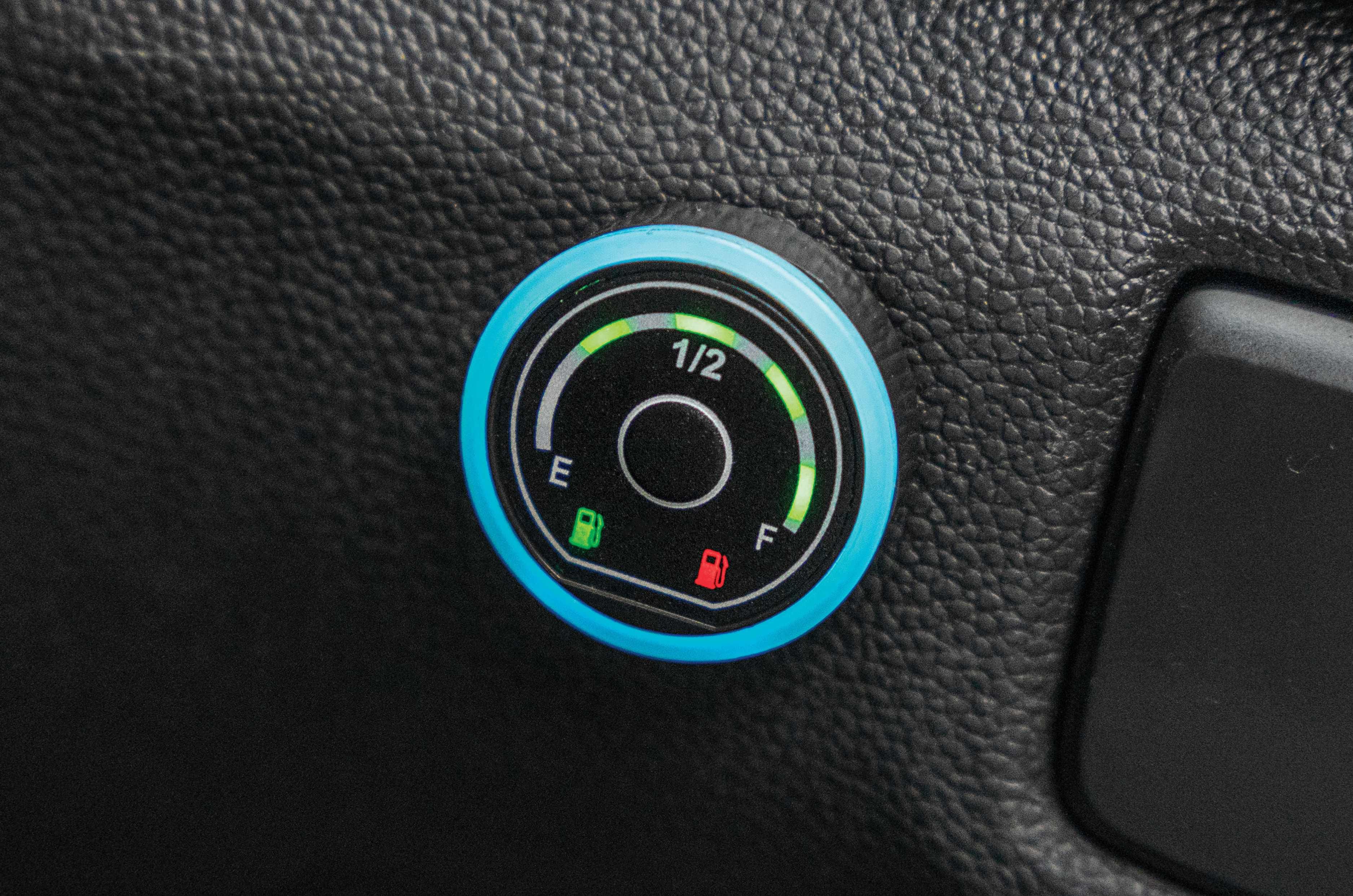
The remaining wiring is completed and a dashboard-mounted CNG switch is installed, allowing the driver to monitor fuel level and switch between petrol and CNG.

Leak test

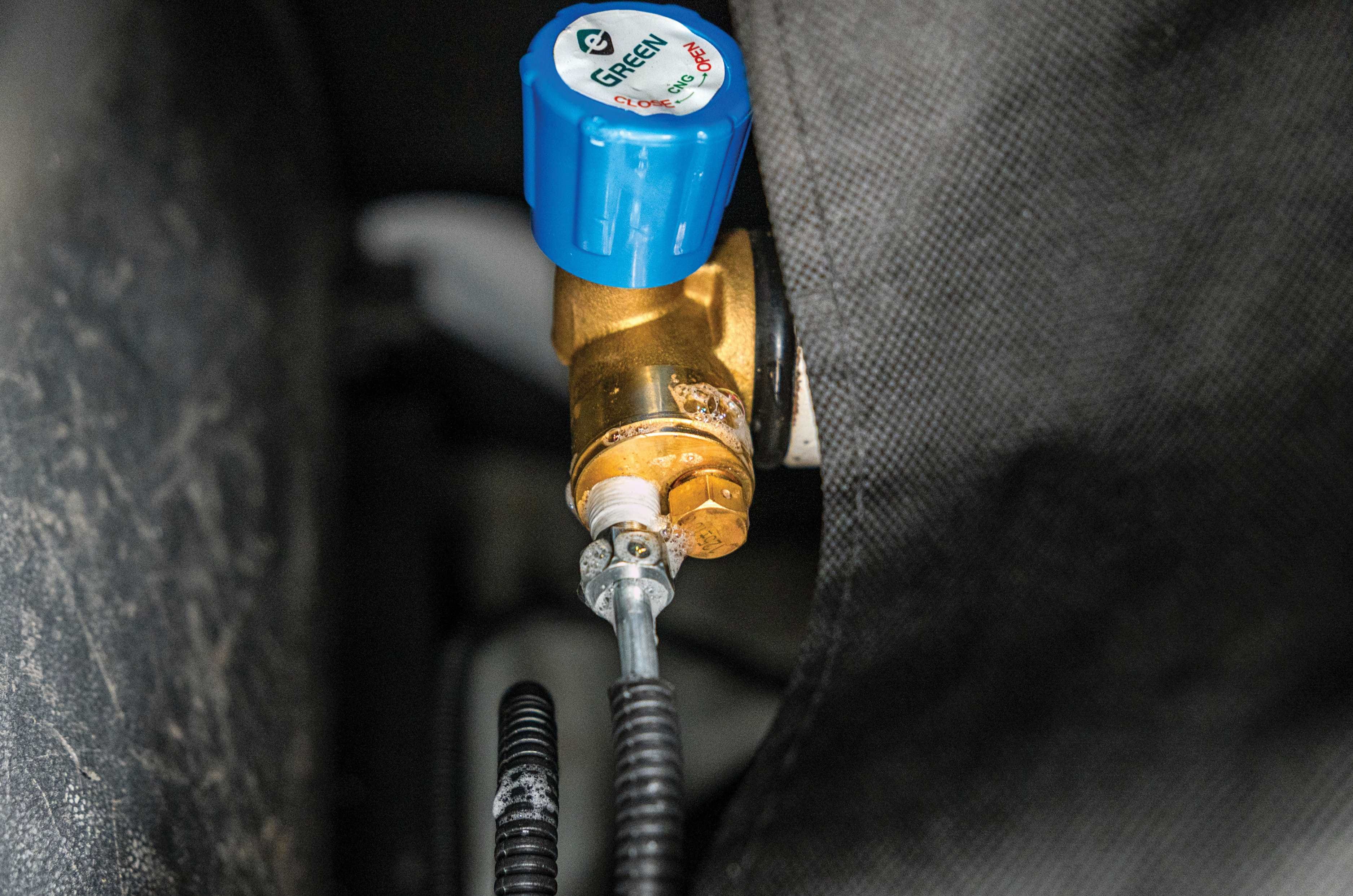
Around 2kg of CNG is added and every connection is checked using an electronic gas detector and good old-fashioned soap solution to ensure the entire system is leak-free.

Calibration and road test

The system is calibrated using dedicated software to optimise fuel delivery and switchover settings. A final road test confirms performance before the vehicle is delivered to the customer.

Why go aftermarket?

On average, an aftermarket CNG installation costs around 25 to 30 percent less than the premium a factory-fitted CNG variant commands over its petrol counterpart. However, this alone is not enough to swing the scales in favour of the aftermarket due to the disadvantages we will get into later. The bigger advantage the aftermarket holds is the ability to convert models or variants that do not come with a CNG option. For instance, Maruti Suzuki only offers its factory-fitted CNG cars with a manual transmission, so if you want one with an automatic, an aftermarket CNG kit is your only option.

Similarly, popular SUVs like the Hyundai Creta and Kia Seltos are not available in CNG guise, which leads many owners to turn to the aftermarket. Owners of older cars, or those buying used cars, can also convert them to CNG for a fairly affordable price and enjoy significantly lower running costs. CNG is spark-ignited, thus only petrol cars can be converted to run on the gas. Since diesel cars use compression-ignition, they would need far too many modifications to make this possible. Strong hybrids are also not recommended for conversions, as here, the engine keeps switching on and off too often, which makes CNG calibration complex. Cars that are not in good mechanical shape should also not be converted to CNG, as the conversion can take a toll on the overall engine health.

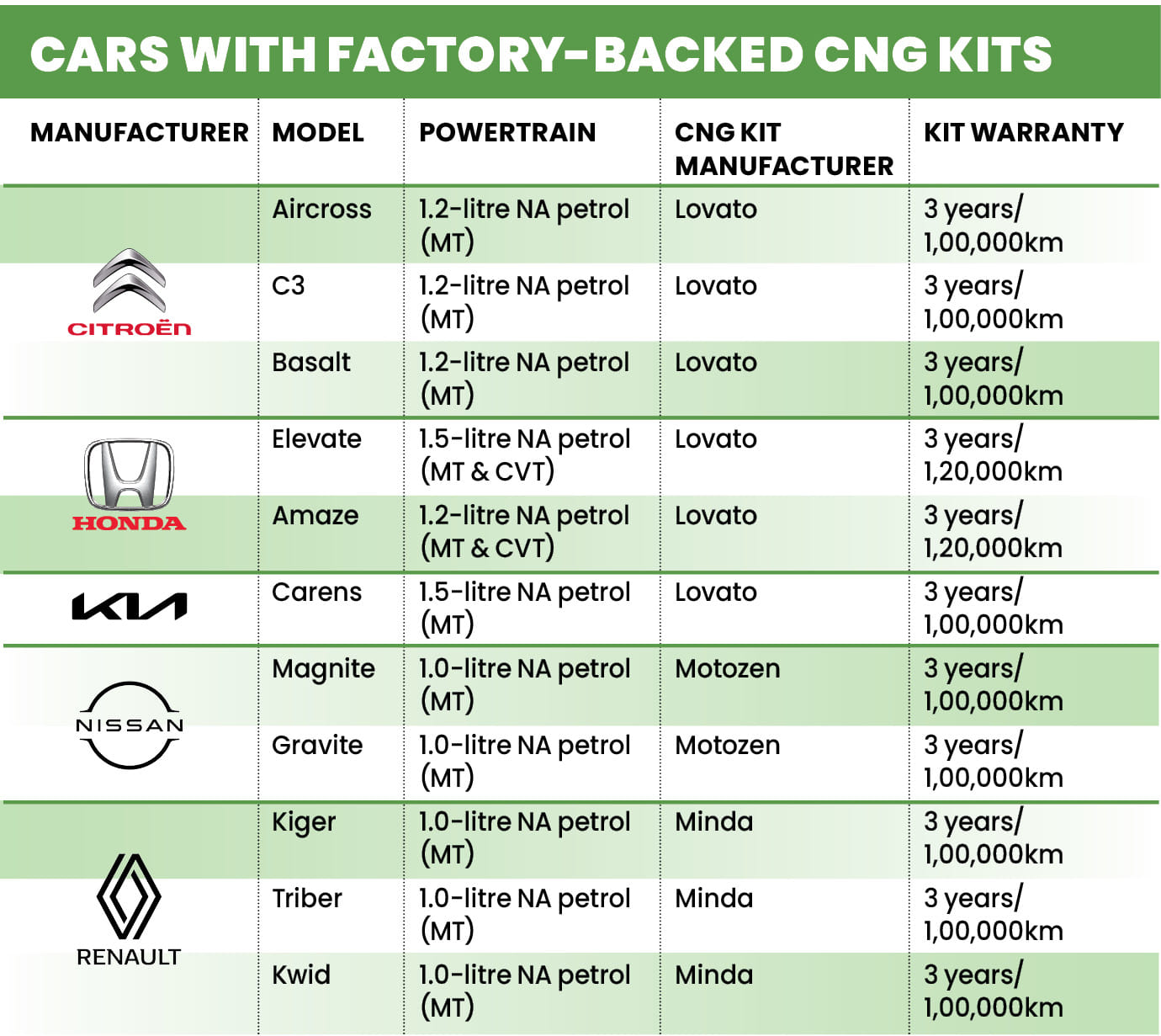
For a car in generally good shape, aftermarket kits are proving to be reliable in the long run, provided they are well maintained. Most modern sequential kits from brands like Lovato and Mijo are also comparable in quality to OEM systems, and reputed, authorised installers are able to achieve near-OEM levels of fitment.

The catch

Fitting an aftermarket CNG kit – even if it is government-approved and fitted by an authorised installer – is grounds for the manufacturer warranty to be voided. While some brands may still honour warranty claims that are unrelated to the powertrain, it remains a grey area. Some dealer-fitted CNG kits do retain the factory warranty, while others provide a third-party warranty in its place.

Aftermarket installers have also begun offering third-party warranties in collaboration with insurance companies to provide coverage in place of the factory warranty. This, however, is in addition to the cost of the CNG kit. The kits themselves generally come with a warranty ranging from one to two years.

Packaging is also one area where the aftermarket trails OEMs. While Maruti, Tata and Hyundai are now offering underbody and dual-tank setups to retain a usable boot, the aftermarket still largely uses larger single tanks that take up more space.

Staying fit

As per law, any CNG tank – aftermarket or OEM fit – must be hydrotested every three years. For this, the tank must be removed from the vehicle and sent to a dedicated facility. While the process itself takes only a couple of hours, hydrotesting facilities are usually located outside major cities, adding transport time to the process. A hydrotest typically costs around Rs 3,000 per tank.

The CNG filter should also be replaced at the same three-year or 10,000km interval, whichever comes first. This typically costs under Rs 1,000 and is fairly straightforward. It is also recommended to drive on petrol at least 10 percent of the time to keep the fuel system healthy. Finally, it is important that the engine’s service schedule is strictly followed.

The legal bit

Aftermarket CNG installations are legal as long as the kit is government-approved, fitted by an approved installer and the registration certificate (RC) is updated accordingly. Most approved installers will handle the RC update at the Regional Transport Office (RTO) as part of the service. Once this is complete, the owner must also update the insurance provider.

The verdict

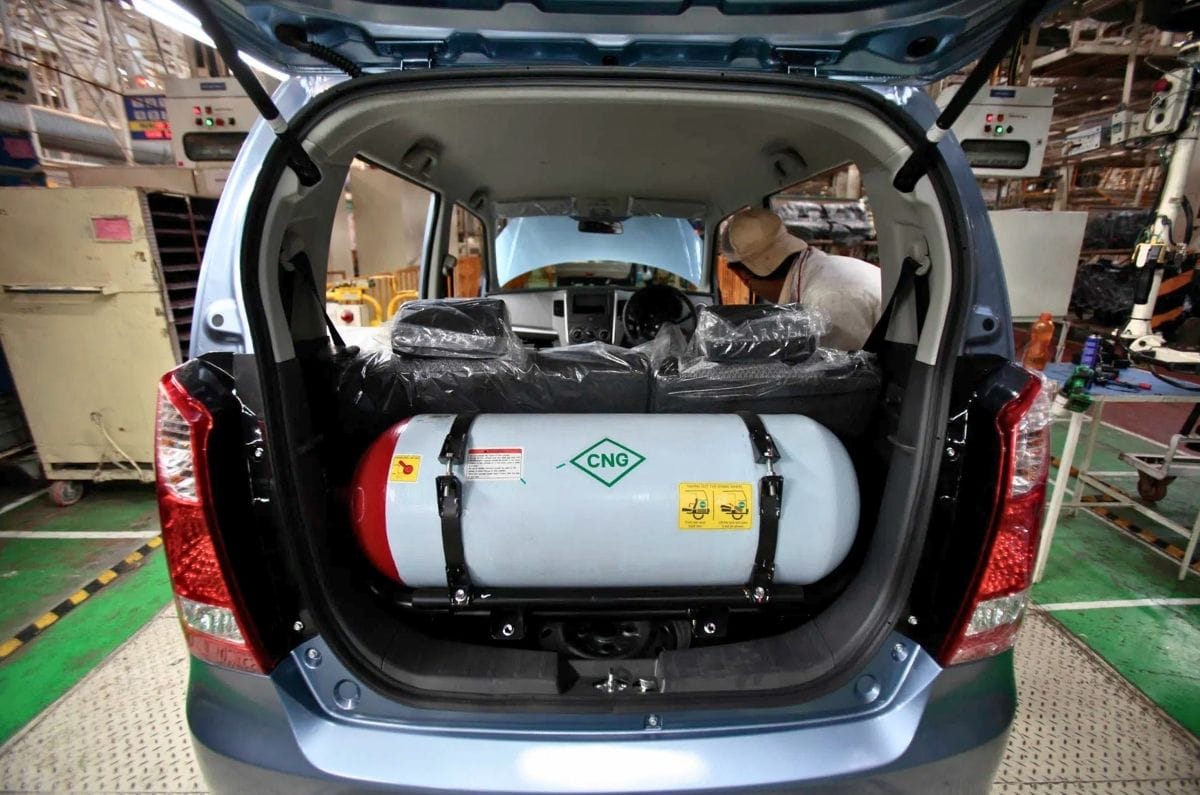
Maruti Ertiga’s factory-fitted CNG tank shown for representative purposes only. 

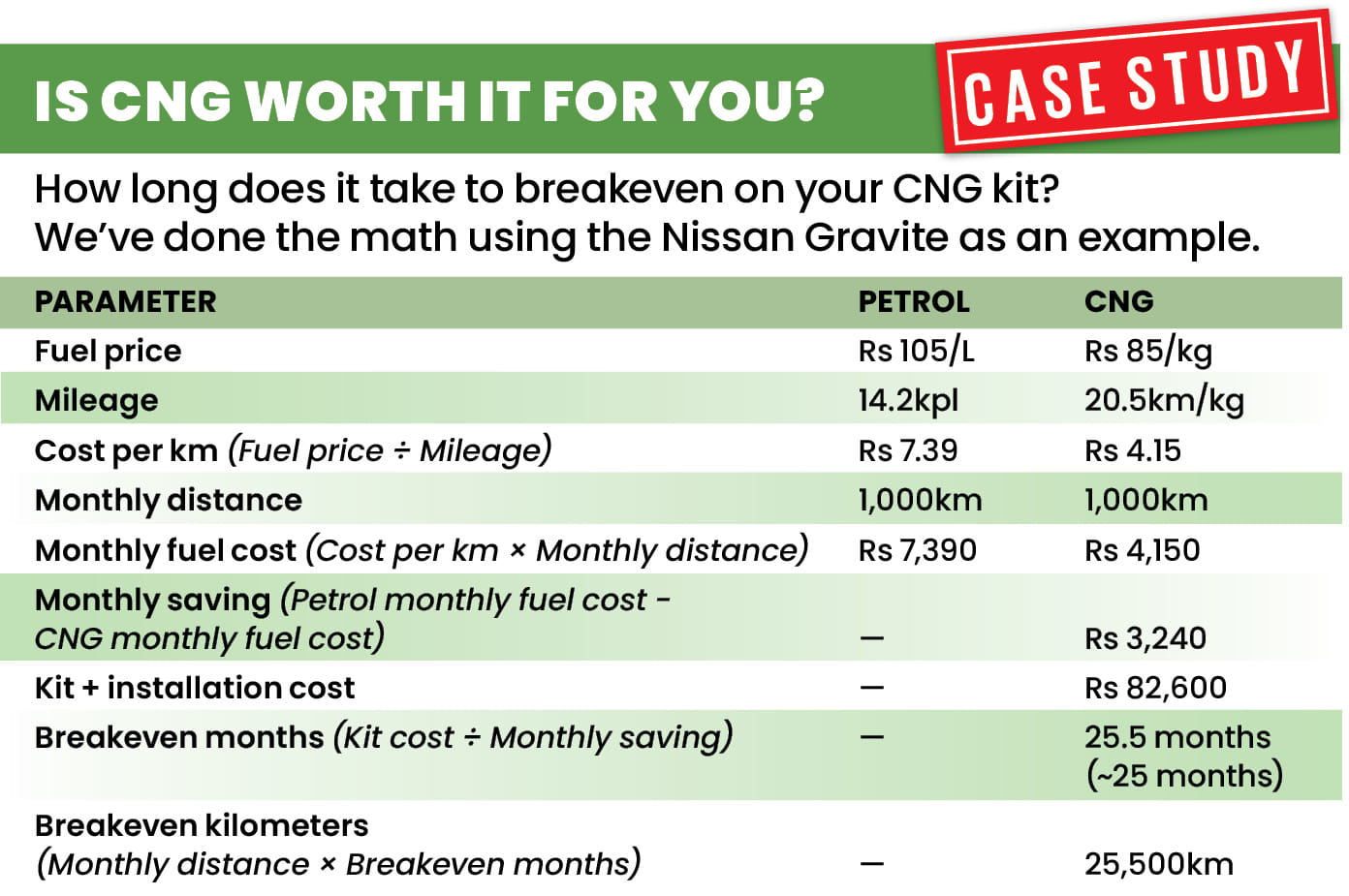
There is no denying the running cost advantage that CNG provides. However, when buying a brand-new car, a factory-fitted CNG version is still preferable to an aftermarket conversion simply because of the peace of mind. Once a car is out of warranty, though, a CNG conversion makes a great deal of sense. In most cases, the cost of the kit can be recouped within a couple of years, even with an average monthly running of around 1,500km.

However, the installer is just as important as the kit. Always opt for government-approved kits installed by approved installers with a strong reputation. Wherever possible, insist the installation is carried out without splicing into the original wiring and follow the recommended service schedule to ensure your car stays reliable.

GMA S1 reinterprets iconic McLaren F1 for the modern era

GMA S1 reinterprets iconic McLaren F1 for the modern era
GMA S1 front quarter

After debuting the track-focused S1 LM exactly a year ago, Gordon Murray Automotive (GMA) showcased the road-biased S1 at this year’s Monterey Car Week. While the S1 LM paid tribute to Gordon Murray’s Le Mans-winning F1 GTR, the S1 in similar vein is pitched as a modern-day interpretation of the road-going McLaren F1. Built by GMA’s Special Vehicles division, the SM will be less exclusive than the five-off S1 LM, with 64 units planned for production. 

  1. S1 is fundamentally based on GMA T50 
  2. It’s powered by a 4.2-litre Cosworth V12 with a manual gearbox  
  3. More road-biased, touring-focused version of the S1 LM 

Speaking about the S1, Gordon Murray, Group Executive Chairman, says, “It is exclusive, analogue and deeply driver focused, while also being more elegant, refined and usable over distance.” 

GMA S1 exterior design 

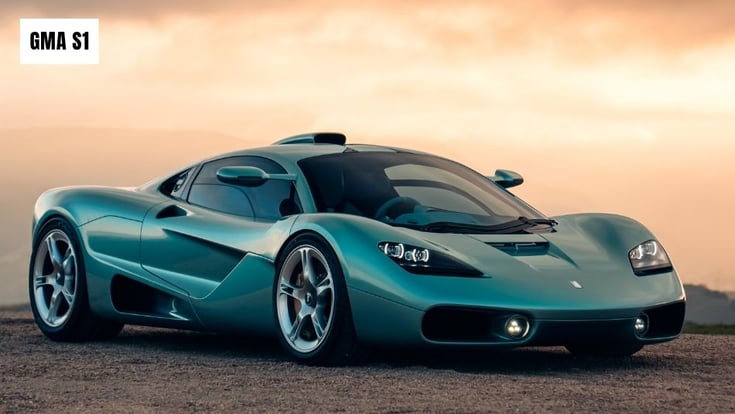
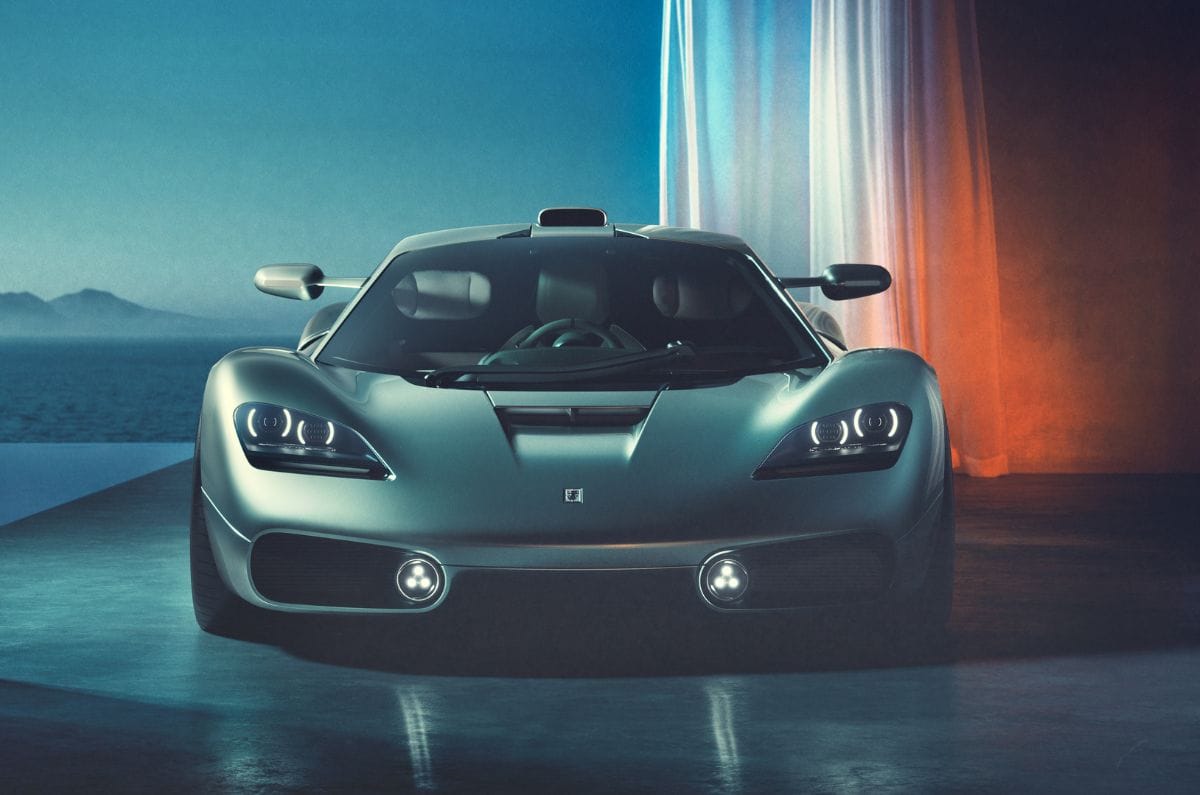
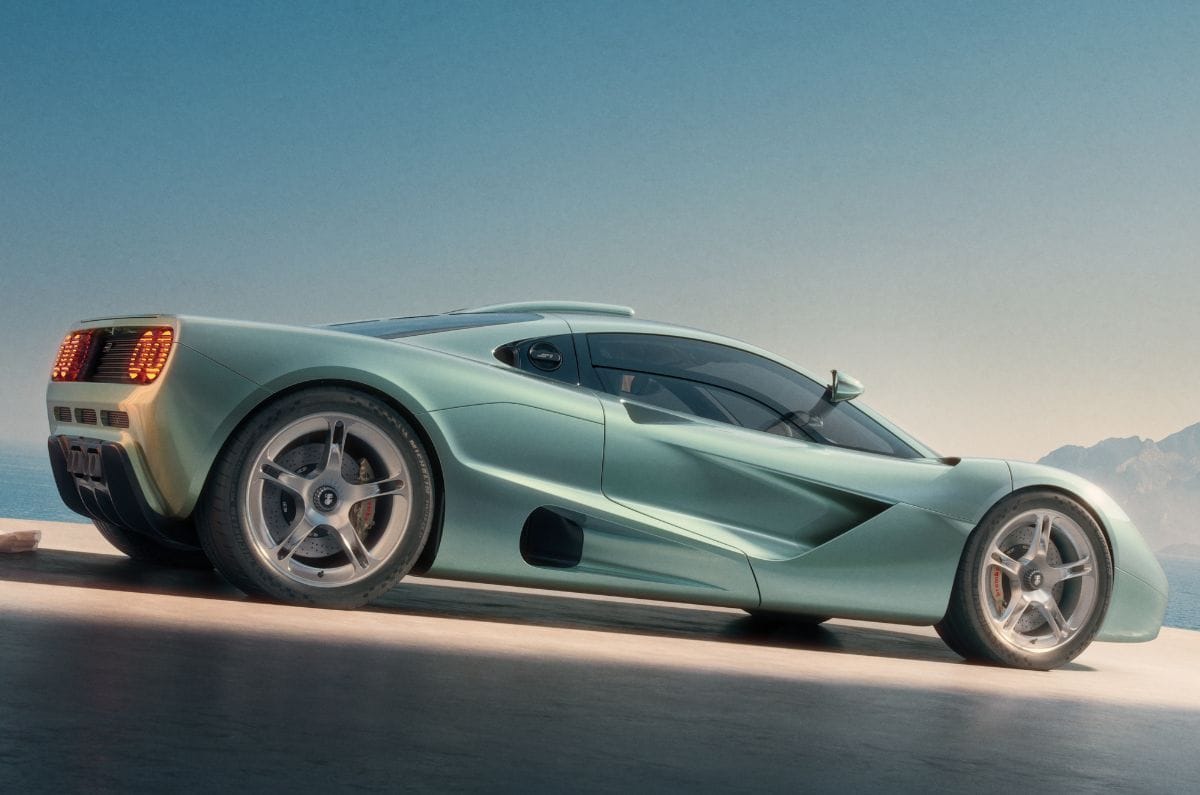
Just a glance at the SM is enough to trace its roots back to the original F1. It does away with many of the aggressive aero elements seen on the S1 LM, such as the massive rear wing, the race-style front splitter and also the deep side skirts. What’s left behind is a shape that’s quintessentially a sportscar in its purest form. Murray says every single panel on the S1 is unique to this vehicle. 

GMA S1
1992 F1 Concept

GMA S1 vs 1992 McLaren F1 Concept (Image Credit: Collector Studio)

Details such as the dual-pod headlamps, the bonnet scoop and the quad tail lamps at the rear immediately connect it to the F1, all while appearing properly contemporary. The circular lights positioned at the leading edges of the front air intakes and the five-spoke alloy wheels are a direct nod to the 1992 McLaren F1 concept car, as are the A-pillar-mounted wing mirrors – these elements did not make it to production on the original F1. 

The side profile is characterised by pronounced wheel arches and a rising beltline, while the scoops on the doors and sills are a lot more pronounced here. At the rear is a classic quad exhaust setup and a diffuser that features an active aero system. GMA says the S1 has been “optimised for mechanical grip, rather than high downforce”.  

GMA S1 interior

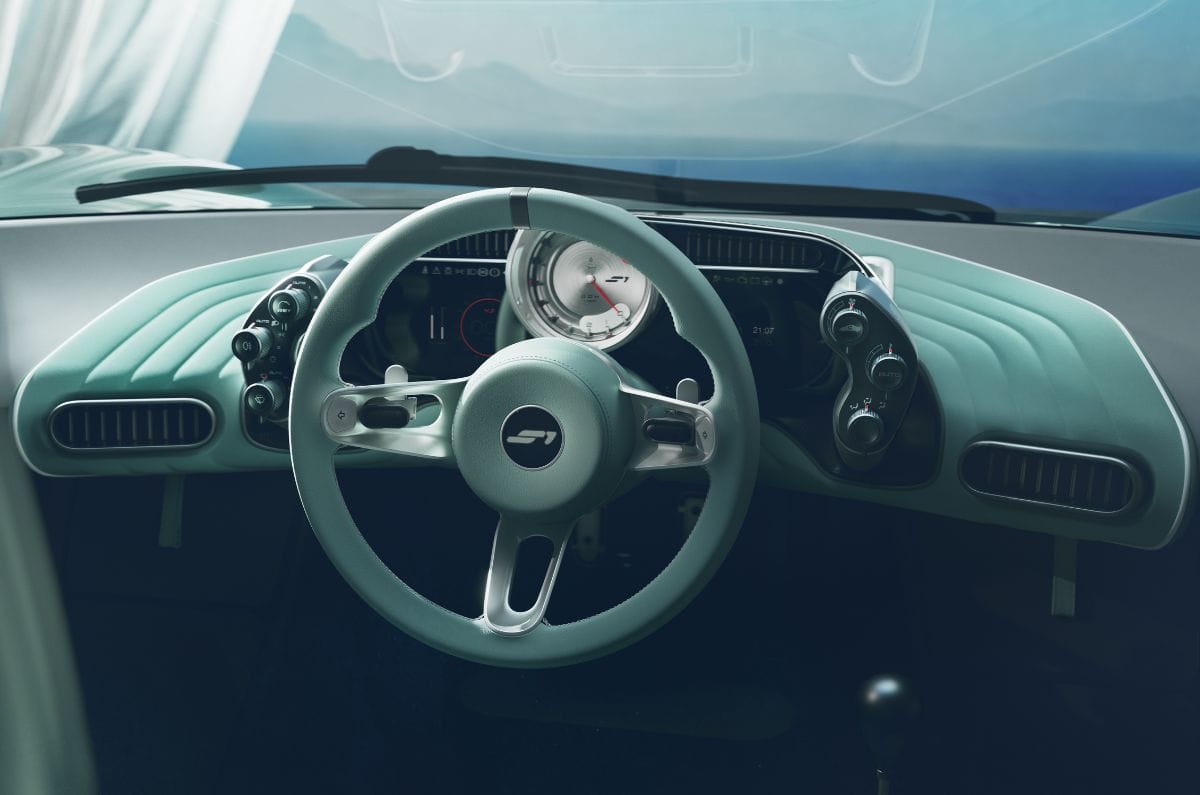
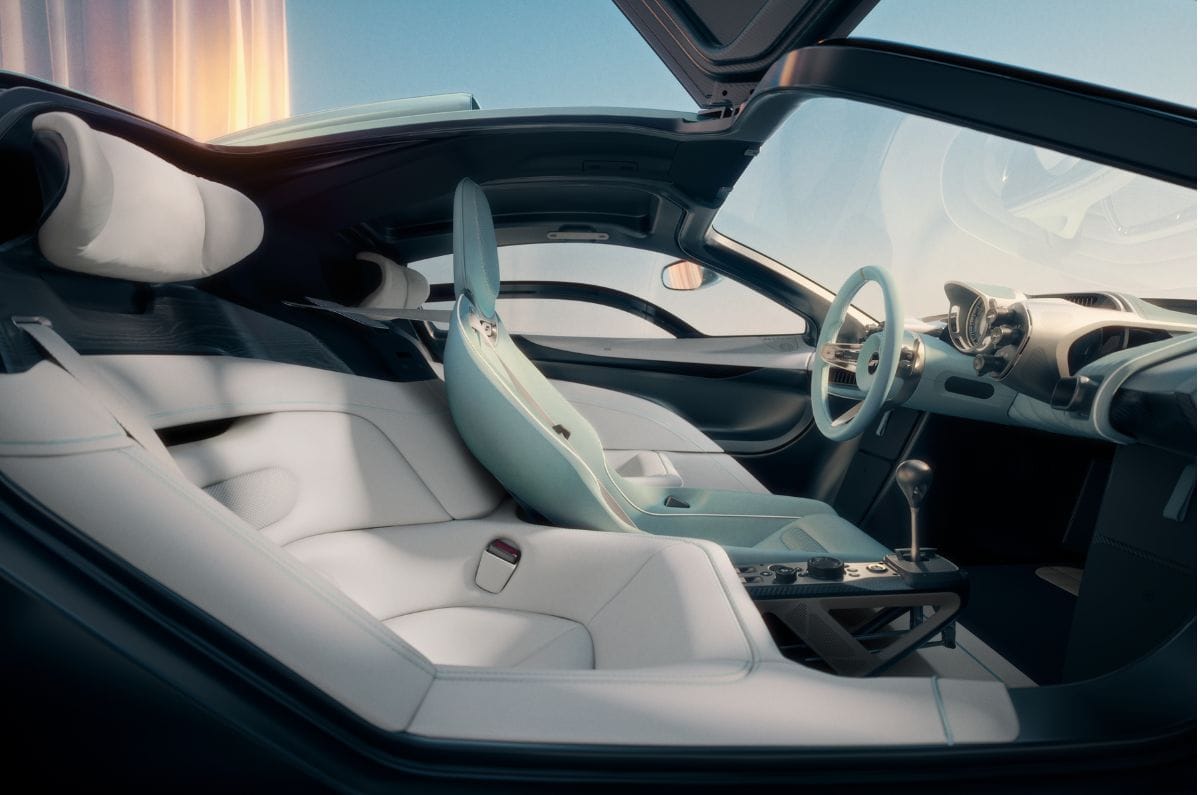
Characteristic of most GMA models, just as the original F1, the interior features a 3-seat layout with a central driving position and a low scuttle height. It’s, however, more luxuriously trimmed in leather and bespoke fabrics, and also features more sound deadening in keeping with its road-biased positioning. The dashboard panel housing the instruments and all the controls also appear more richly intricate. It also features a bespoke lightweight audio system and a touring-focused seat to make it better suited for long distance use. 

The real talking point is that there are no touchscreens – all interior controls are completely analogue. There are, however, two displays flanking the gorgeous analogue tachometer – the left screen is for infotainment and phone-related functions, while the right screen is for all vehicle related function. Murray says “Everything here is analogue and rotary. I don’t see that’s something we’ll ever move away from.”  

GMA S1 engine and specifications 

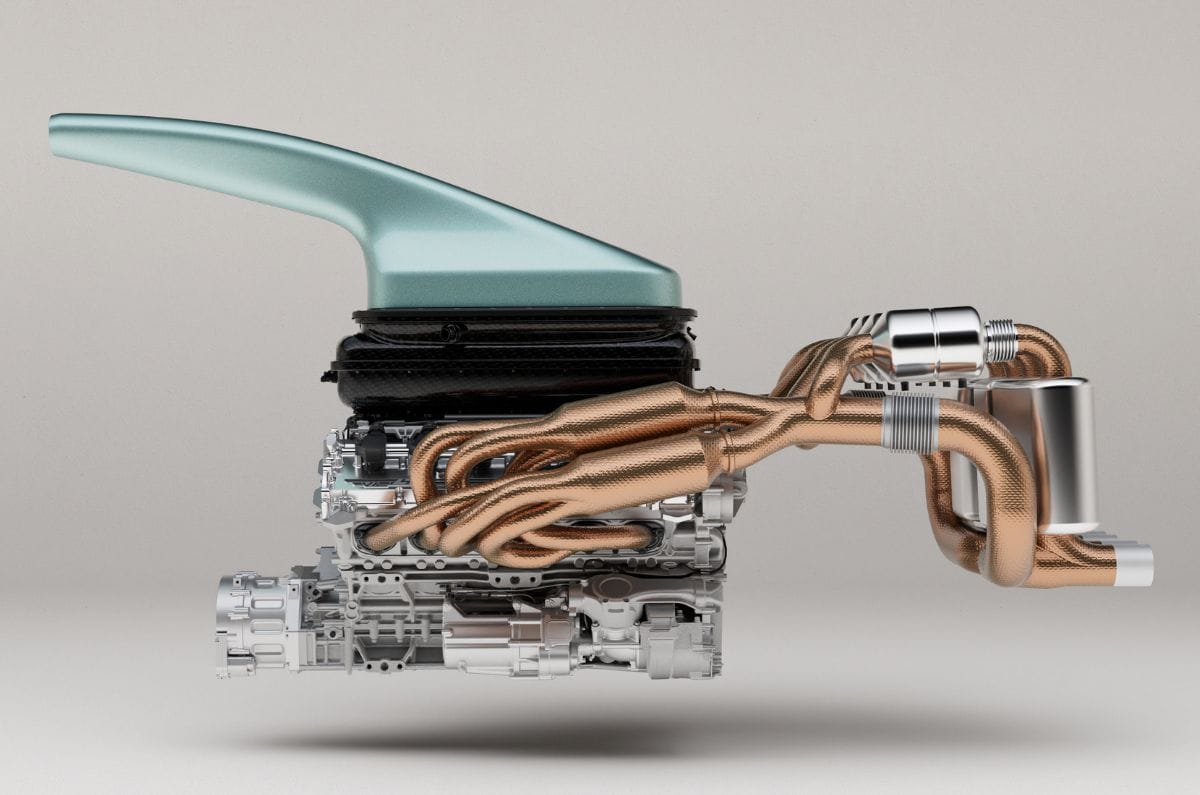
Powering the S1 is a 4.2-litre, naturally aspirated Cosworth V12 engine that revs to a manic 12,100rpm. This is slightly larger than the 4.0-litre V12 used in the T50 (the car it is based on), but smaller than the 4.3-litre unit seen on the S1 LM. And just like in the original F1, this one too gets a 24-carat gold-plated heat shielding. There’s also an air intake on the roof that feeds air directly into the engine. 

The engine produces 690hp and 500Nm of torque – quite modest figures for current times – with 80 percent of peak torque being available from as low as 2500rpm. For perspective, the McLaren F1 from three decades ago produced 627hp and 650Nm of torque from a 6.1-litre, naturally aspirated V12. 

The gearbox is a 6-speed manual unit with a longer sixth ratio for touring, sending drive to the rear wheels. GMA says it is targeting a weight of less than 997kg (lesser than even the T50) with extensive use of carbon fibre body panels, a carbon fibre monocoque and also carbon fibre suspension components. The S1 has the same suspension geometry and track width as the S1 LM, but it rides 10mm higher than the track-focused S1 LM and also gets more compliant dampers. It also gets a switchable power steering that lets one alter the steering feel depending on the use case.  

Production of the S1 will be limited to 64 units worldwide. Each car will be individually commissioned and specified by its owner, although pricing remains undisclosed.

Mukul Agrawal Portfolio: स्टार निवेशक का बदला मूड, पोर्टफोलियो में एक स्टॉक की एंट्री तो दूसरी ओर 3 की विदाई

Mukul Agrawal Portfolio: दिग्गज निवेशक मुकुल अग्रवाल के पोर्टफोलियो में पिछली तिमाही अप्रैल-जून 2026 में बड़े बदलाव हुए। एक तरफ उन्होंने अपने पोर्टफोलियो में एरिसइंफ्रा सॉल्यूशंस को शामिल किया तो दूसरी तरफ उन्होंने लक्ष्मी फाइनेंस समेत तीन स्टॉक्स का वजन और बढ़ाया। उन्होंने सिर्फ खरीदारी ही नहीं की बल्कि कुछ मुनाफा भी बुक किया। जून तिमाही में उनके पोर्टफोलियो से रेमंड लाइफस्टाइल समेत पांच स्टॉक्स का वजन हल्का हुआ तो तीन स्टॉक्स ऐसे रहे, जिनमें उनकी होल्डिंग या तो जीरो हो गई या 1% से नीचे आ गई। सेबी के नियमों के मुताबिक कंपनियों को सिर्फ 1% या इससे अधिक की होल्डिंग वाले शेयरहोल्डर्स के नाम का खुलासा करना अनिवार्य है।

इन स्टॉक्स में की और खरीदारी और एक की हुई एंट्री

मुकुल अग्रवाल के पोर्टफोलियो में जून 2026 तिमाही में एरिसइंफ्रा सॉल्यूशंस की एंट्री हुई। उन्होंने इसके 13 लाख शेयर खरीदे जो कंपनी में 1.6% होल्डिंग के बराबर है। इसके अलावा जून तिमाही में उन्होंने लक्ष्मी फाइनेंस में अपनी हिस्सेदारी 0.8 पर्सेंटेज प्वाइंट्स बढ़ाकर 4.6% (24 लाख शेयर), वेलर एस्टेट में 0.1 पर्सेंटेज प्वाइंट्स बढ़ाकर 1.6% (85 लाख शेयर) और लक्स इंडस्ट्रीज में 0.1 पर्सेंटेज प्वाइंट्स बढ़ाकर 1.6% (4,65,246 शेयर) कर ली।

इन स्टॉक्स में की बिकवाली तो ये हुए बाहर

मुकुल अग्रवाल ने जून तिमाही में कुछ स्टॉक्स में अपनी होल्डिंग हल्की की। उन्होंने जे कुमार इंफ्राप्रोजेक्ट्स में अपनी होल्डिंग 0.1 पर्सेंटेज प्वाइंट्स घटाकर 2.6% (19,30,920 शेयर), केआरएन हीट एक्सचेंजर में 0.1 पर्सेंटेज प्वाइंट्स कम कर 1.5% (10 लाख शेयर), इंटेलेक्ट डिजाइन एरेना में 0.2 पर्सेंटेज प्वाइंट्स बेचकर 1.3% (17.90 लाख), विधि स्पेशल्टी फूड में 0.2 पर्सेंटेज प्वाइंट्स घटाकर (6,90,924 शेयर) और रेमंड लाइफस्टाइल में 0.2 पर्सेंटेज प्वाइंट्स घटाकर (7 लाख शेयर) कर ली। वहीं दूसरी तरफ रेडिको खेतान, सूर्या रोशनी और विक्रान इंजीनियरिंग के इतने शेयर बेचे कि उनकी होल्डिंग या तो जीरो हो गई या 1% से कम हो गई। इससे पहले मार्च 2026 तिमाही में रेडिको खेतान में उनकी होल्डिंग 1.1%, सूर्या रोशनी की 1.0% और विक्रान इंजीनियरिंग की 1.4% थी।

समरी

स्टॉक जून तिमाही के आखिरी में होल्डिंग बदलाव (पर्सेंटेज प्वाइंट) शेयरों की संख्या शेयर का मौजूदा भाव 52 हफ्ते का निचला स्तर (तारीख) 52 हफ्ते का हाई लेवल (तारीख)
Arisinfra Solutions1.6%नया13,00,000₹134.09₹82.18 (09/02/26)₹178.30 (23/10/25)
Laxmi Finance4.6%0.824,00,000₹124.38₹71.06 (30/03/26)₹180.90 (18/09/25)
Valor Estate1.6%0.185,00,000₹111.91₹83.50 (30/03/26)₹187.05 (13/08/25)
Lux Industries1.6%0.14,65,246₹1,188.10₹824.05 (30/03/26)₹1,823.35 (24/04/26)
J Kumar Infraprojects2.6%(-)0.119,30,920₹497.65₹425.00 (30/03/26)₹685.40 (18/08/25)
KRN Heat Exchanger1.5%(-)0.110,00,000₹1,468.30₹589.80 (27/01/26)₹1,468.30 (14/08/26)
Intellect Design Arena1.3% (-)0.217,90,000₹700.60₹595.20 (30/03/26)₹1,244.60 (03/11/25)
Vidhi Specialty Food1.4%(-)0.26,90,924₹309.90₹258.60 (30/03/26)₹410.00 (04/09/25)
Raymond Lifestyle1.2%(-)0.27,00,000₹741.20₹677.00 (03/08/26)₹1,350.00 (16/09/25)
Radico Khaitan–1% के नीचे–₹4,650.00₹2,500.00 (02/03/26)₹4,675.20 (13/09/26)
Surya Roshni–1% के नीचे–₹222.98₹187.35 (30/03/26)₹320.15 (13/08/26)
Vikran Engineering–1% के नीचे–₹62.22₹51.10 (30/03/26)₹118.40 (20/11/25)

4 नियम पड़े रिटेल इंवेस्टर्स पर भारी, SEBI ने लाया था खास वजह से और पड़ा ऐसा असर

Share Market New Rule: सिर्फ 3 दिनों के लिए शेयर दें किराए पर, बिना बेचे कमाई, खास स्टॉक्स के लिए आए रहा नया सिस्टम

डिस्क्लेमर: यहां मुहैया जानकारी सिर्फ सूचना के लिए दी जा रही है। यहां बताना जरूरी है कि मार्केट में निवेश बाजार जोखिमों के अधीन है। निवेशक के तौर पर पैसा लगाने से पहले हमेशा एक्सपर्ट से सलाह लें। मनीकंट्रोल की तरफ से किसी को भी पैसा लगाने की यहां कभी भी सलाह नहीं दी जाती है।

Skoda Kylaq long-term review, 3,800km report

Skoda Kylaq long-term review, 3,800km report
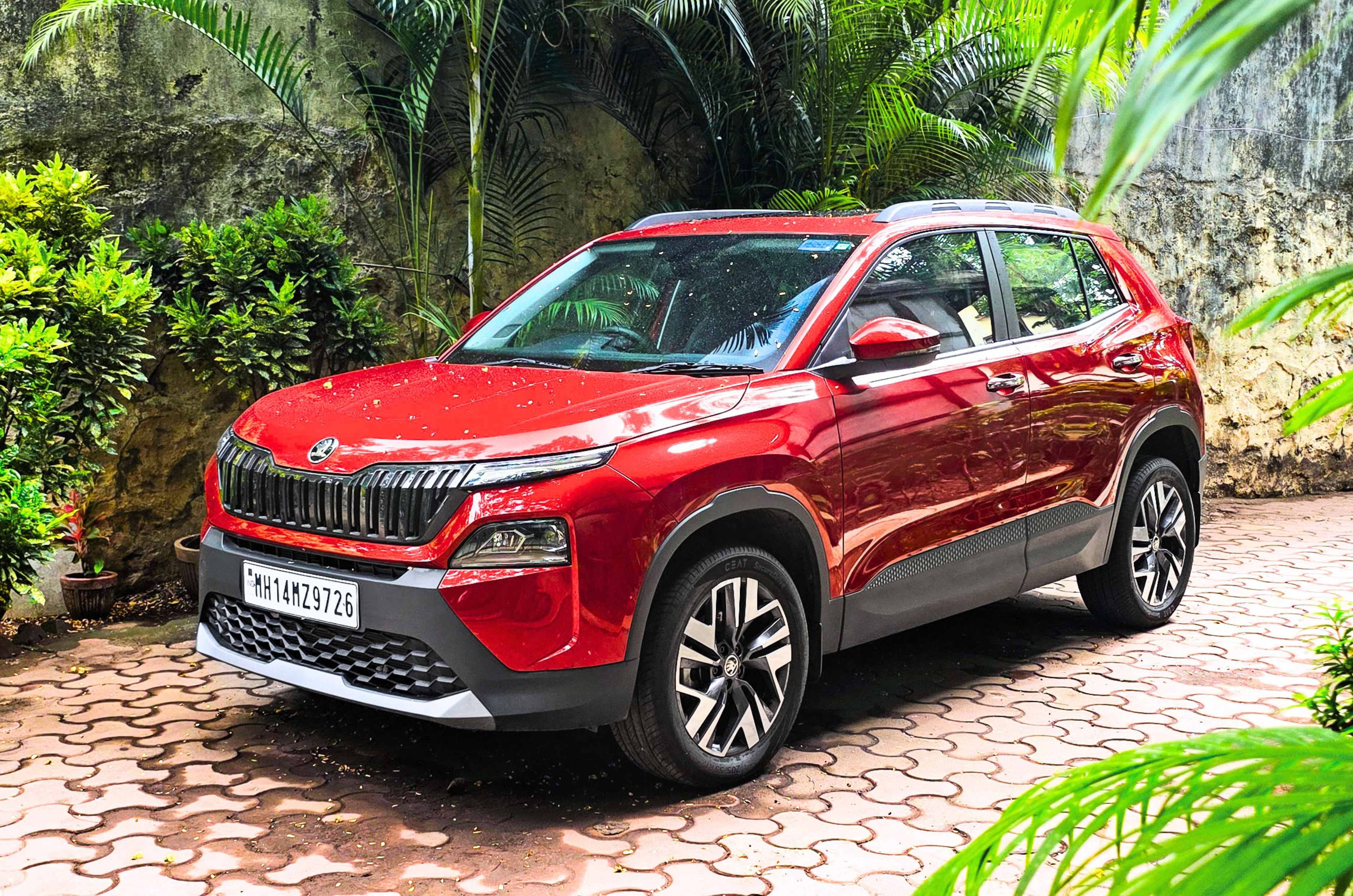
Skoda Kylaq in red colour

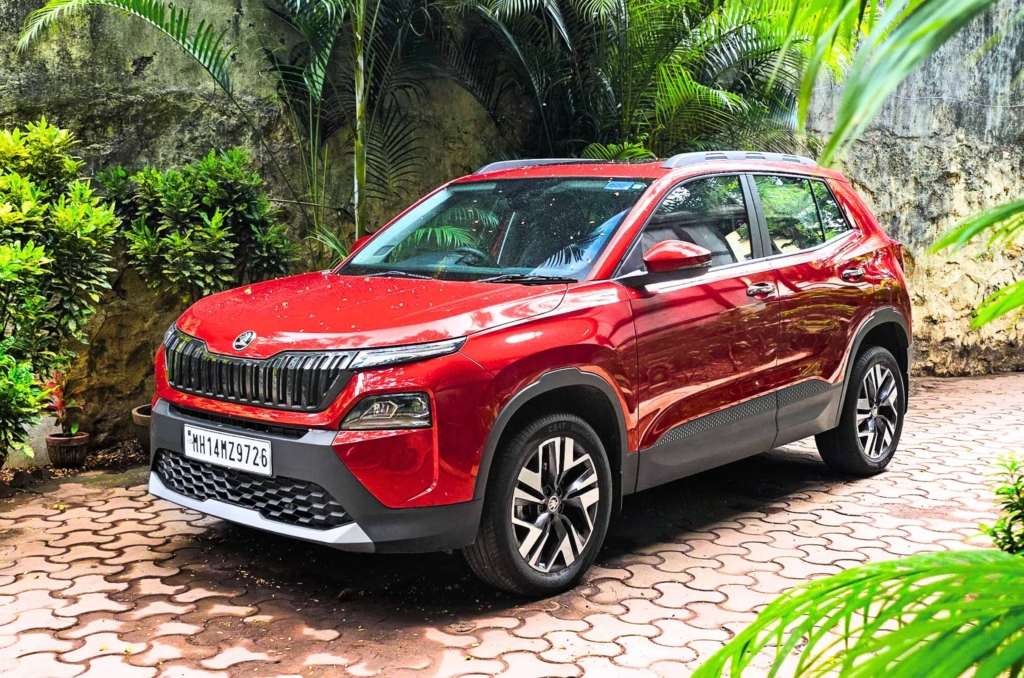
You could argue there was no better long-term test for the Skoda Kylaq than being driven 19,351 kilometres from India to Czechia. However, for those of us who can’t go on a two-month-long adventure full of culture, cuisine and continent-crossing, here’s what it’s been like trudging through Mumbai traffic for the last few weeks.

I’ve been fascinated by the Kylaq since its launch in early 2025, and apart from a few quick peeks at it when it came in for other shoots, I had never really driven one before this. So, now that it’s finally joined the Autocar India fleet, I’ve been more than happy to take it on for its first couple of weeks. And just as a proposition alone, I’m amazed that Group partner Volkswagen didn’t immediately jump on this idea and do a compact SUV in parallel. Guess we’ll just have to wait until 2027.

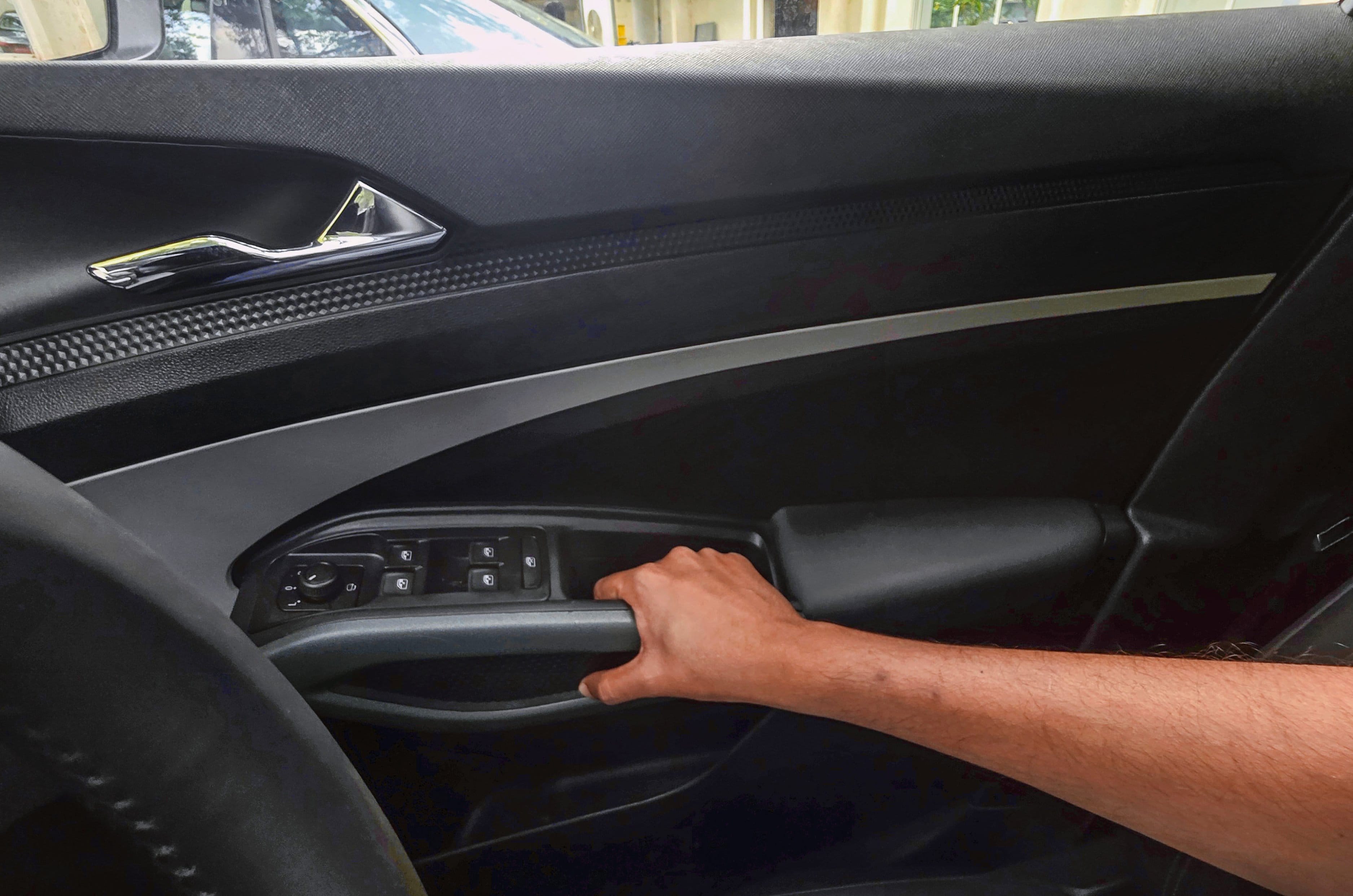
Skoda Kylaq interior door handle
Feels reassuringly solid, from the door shut to the driving dynamics.

The formula is simple enough – a Kushaq, but slightly smaller and using only the lesser 1.0-litre engine. But the more time I spend in here, the more I wonder if there’s any need for a Kushaq 1.0 TSI at all – this thing offers pretty much everything it does. At no moment does it feel lesser in any way – same step up into the cabin, same solid slam on door shut, same high-set driving position. And features? Apart from the Kushaq’s newly added panoramic sunroof, bigger driver’s display and rear massaging seats, it has everything else!

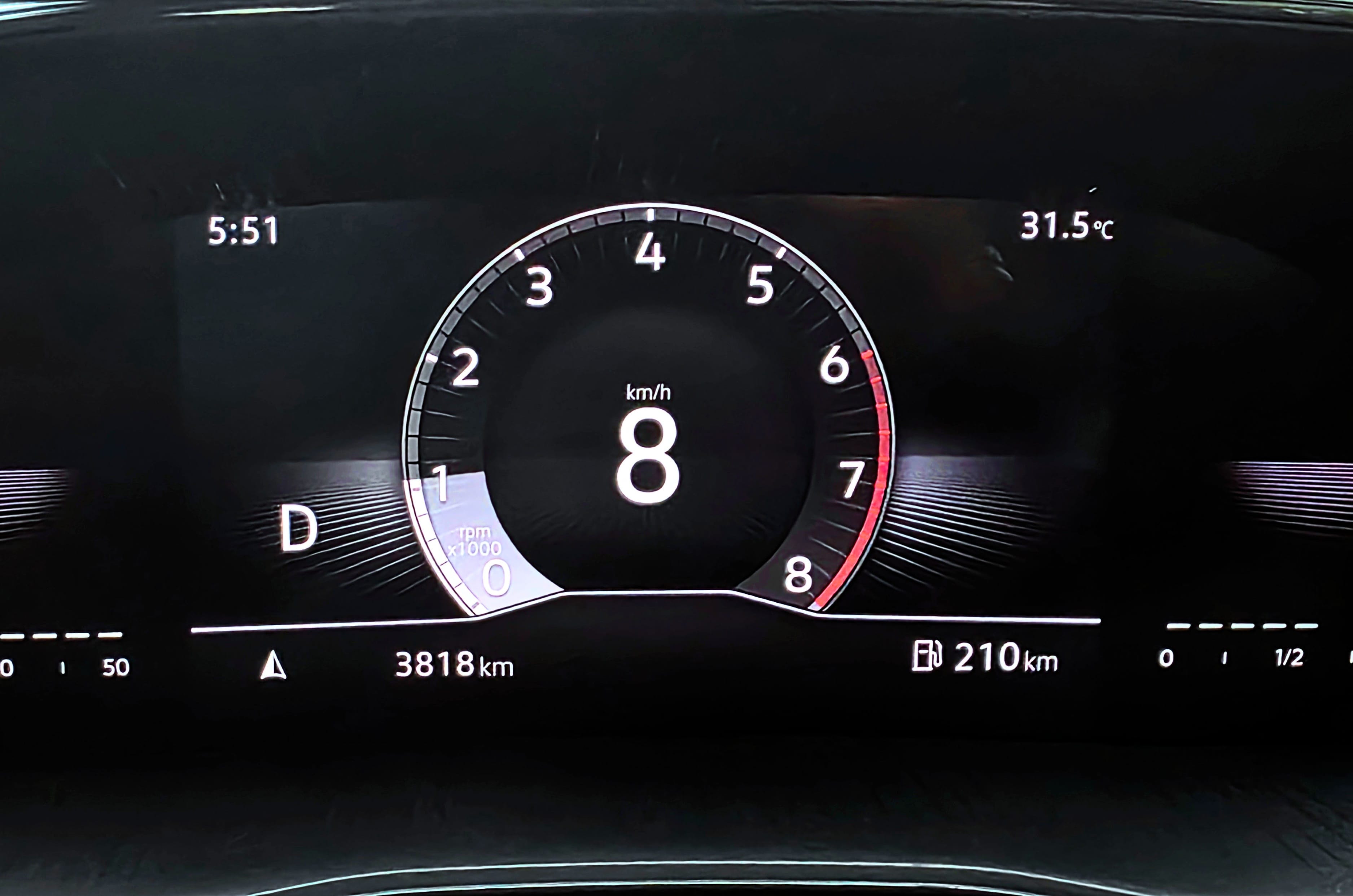
Skoda Kylaq driver's display
Severe turbo lag followed by sudden burst of power frustrating in stop-go traffic.

There are two mechanical changes that I hope make their way to the Kylaq soon, though. The first is the 8-speed gearbox, which should help mask one of this car’s shortcomings – turbo lag. The older 6-speed AT in our Kylaq may be smooth while you’re on the move, but at crawling speeds, where I spend most of my time, it can never figure out if it needs to be in first or second, and sometimes changes its mind at the worst possible moment. If it chooses first, it will lurch you forward aggressively, but if it chooses second, it traps you in the dreaded lag zone. Off boost, this 999cc engine feels overwhelmed by the Kylaq’s 1,255kg.

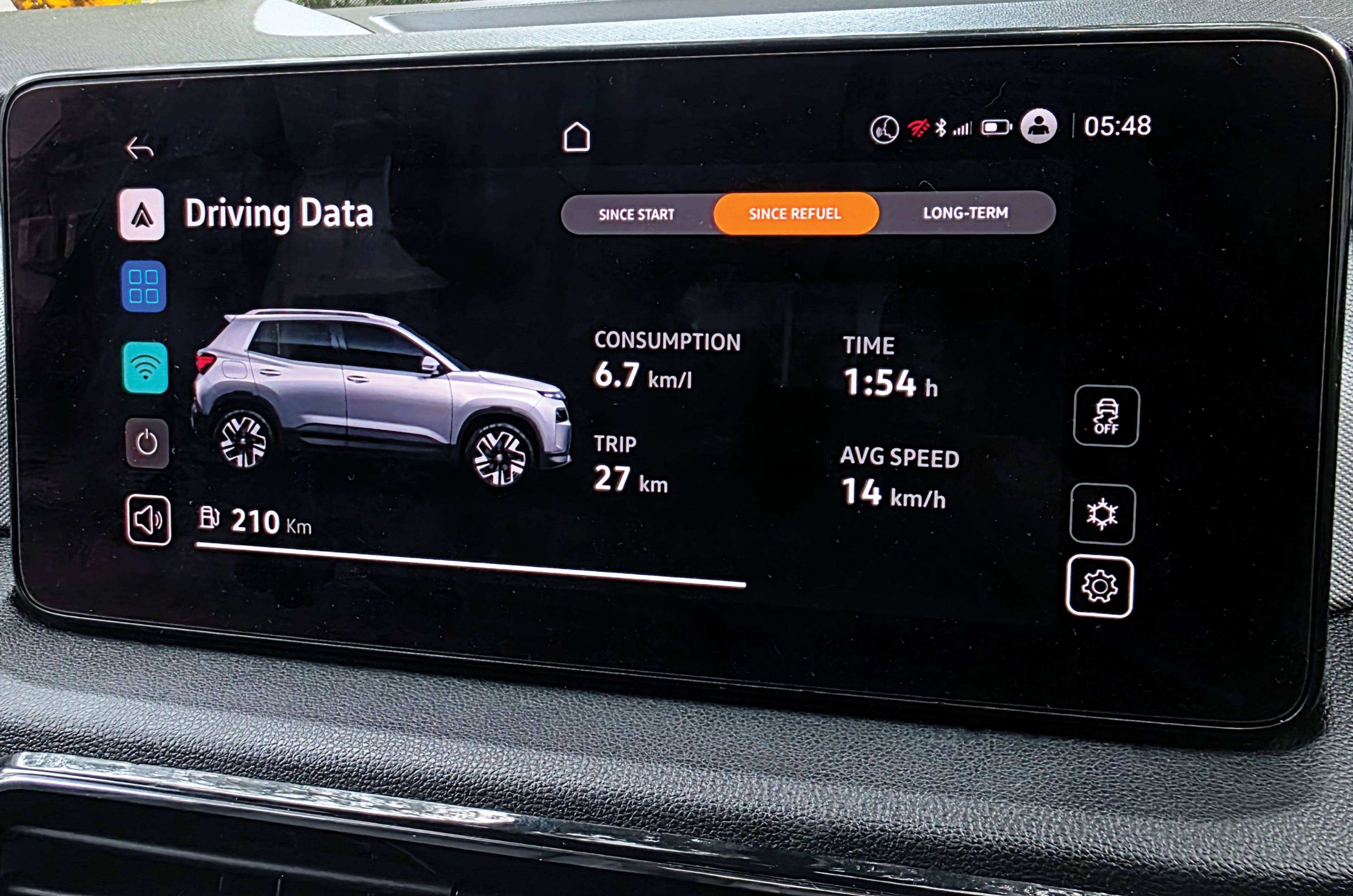
Skoda Kylaq touchscreen
Single-digit fuel economy unexpected, unacceptable in a compact car.

Frustratingly jerky movement aside, where this indecisiveness has really hurt more is my wallet. The constant shifting, switching on and off boost and general inconsistent progress have hit the fuel economy very hard, and I struggle to get past 8kpl on my admittedly slow daily commute. Some of it might be down to the sudden advent of E20 fuel, but eight kilometres per litre in a compact car is criminal. I used to average 10kpl in our 1.5-litre TSI DSG Slavia a few years ago, and the team has been getting more out of our 2.0-litre TSI VW Tayron. So, it’s really down to an overstressed engine and a clumsy gearbox.

The other mechanical change is far less of a problem, and that’s the AC. While this still uses the fixed-geometry compressor from the original Kushaq, it’s a smaller car, so cooling the cabin is rarely an issue, and I drove it through at least one week of our awful heat wave. The thing is, you can feel it’s working overtime to keep the cabin cool, and when set to auto mode, the fan stays on full blast for most of my journey. I often find myself turning it down to have a conversation or enjoy my music.

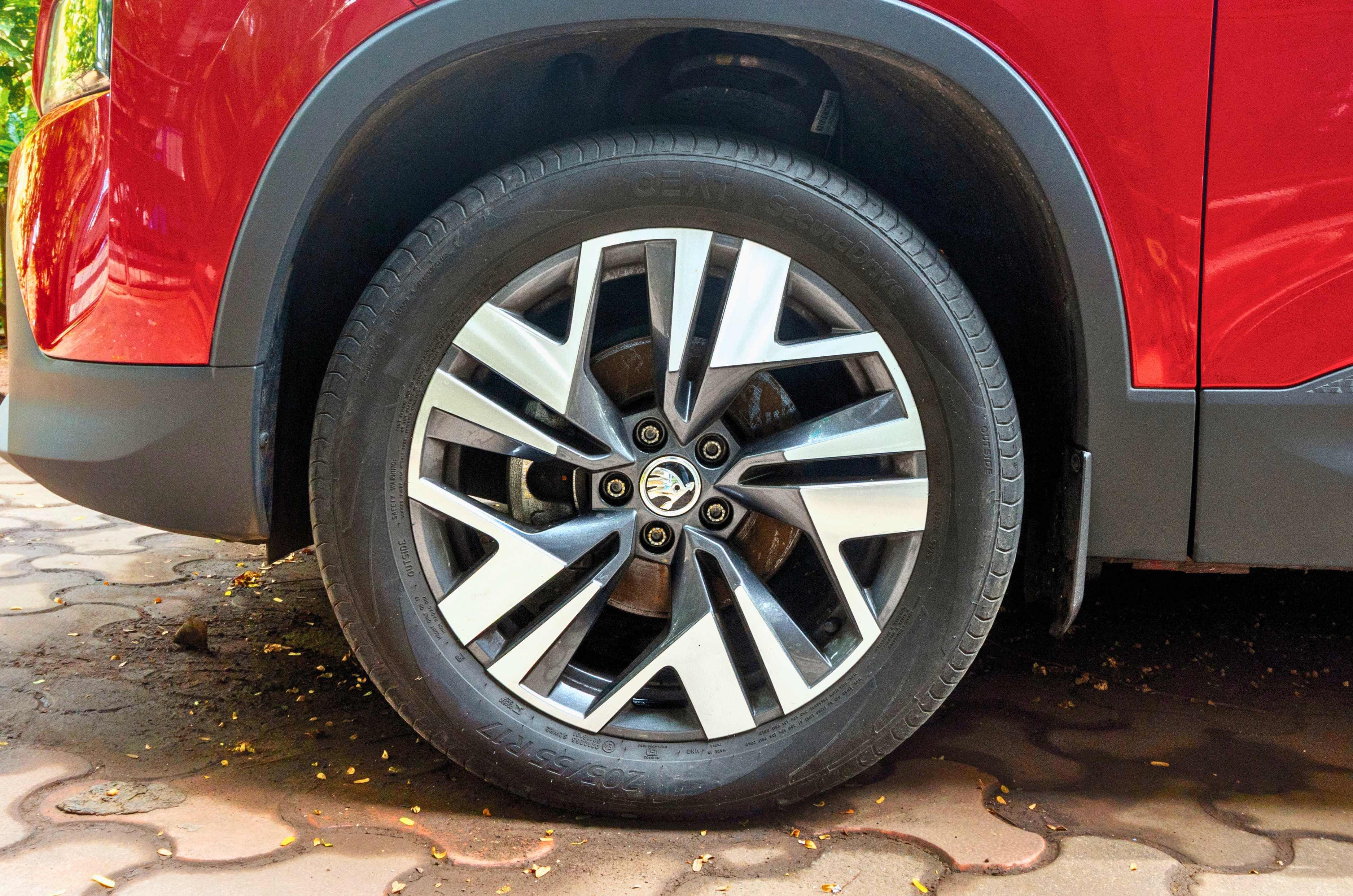
Skoda Kylaq alloy wheel
Large, shiny 17-inch alloy wheels do well to enhance Kylaq’s road presence.

These two niggles aside, it’s a very pleasing experience, as you might expect from a slightly smaller Kushaq. There’s a certain toughness to it you don’t find in cars from this segment that almost encourages you to seek out potholes and slam through them. There’s a similar firmness to the ride, but I actually like that; it suits my driving style better than something overly soft and rolly. And I’m also willing to forgive a lot for how good those 17-inch wheels look; a bold choice when most of the segment is still running 16s.

I’ll delve more into the interior, tech and other things in a future update, but in this short first experience, I can see how the Kylaq made it to Prague so comfortably and without incident. It’s compact only in size and is a uniquely European addition to the compact SUV segment.

Lamborghini Revuelto SV debuts as supercar’s track-focused version

Lamborghini Revuelto SV debuts as supercar's track-focused version
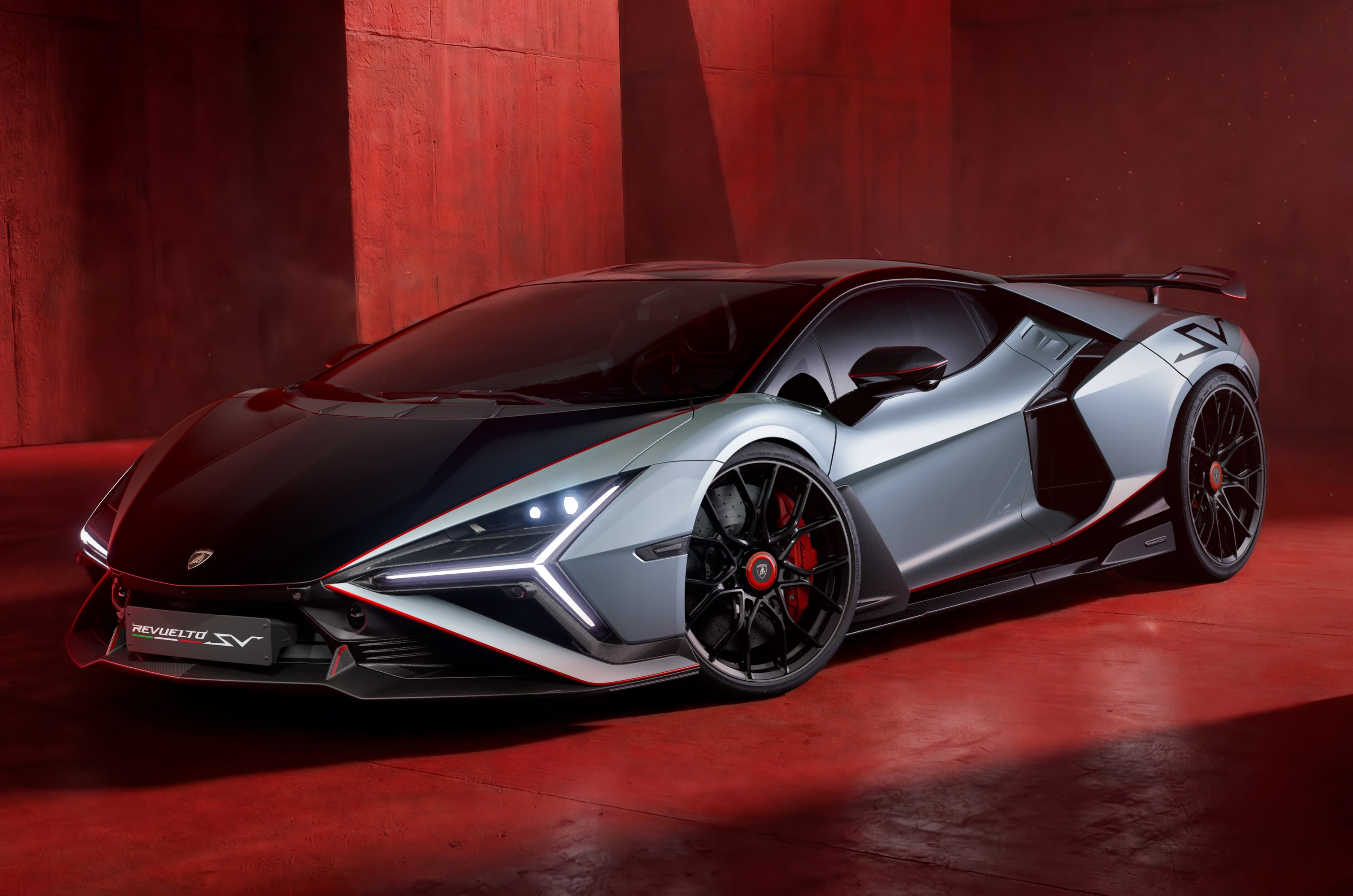
Lamborghini Revuelto SV in studio

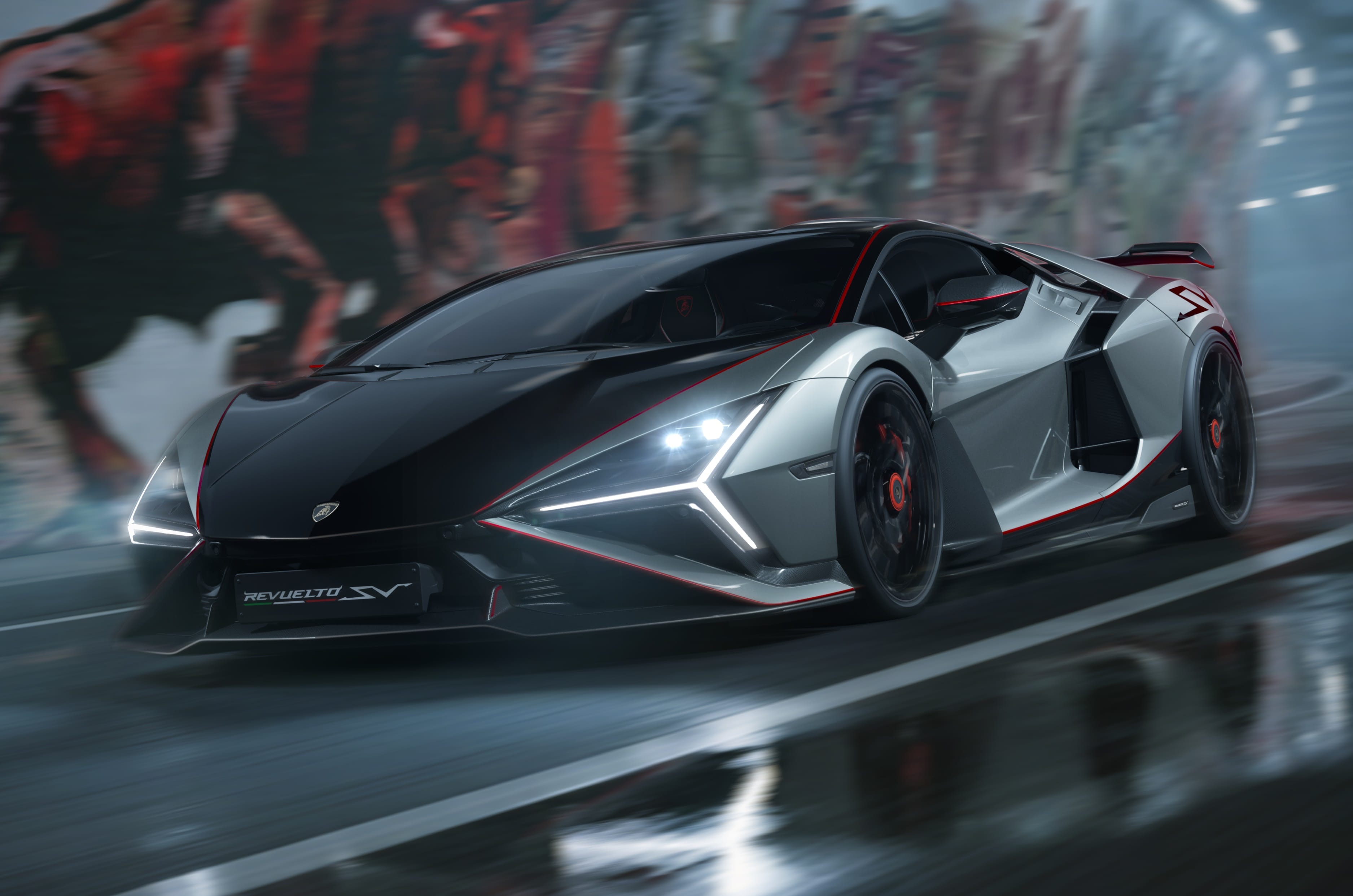
Lamborghini has unveiled the Revuelto Super Veloce (SV), a more extreme version of the Italian marque’s flagship series-production supercar. Only 1,963 units of the Revuelto SV will be built – a reference to Lamborghini’s founding year – and that too for the brand’s “most loyal customers and collectors.” Pricing has not been disclosed yet, but the SV is expected to command a significant premium over the vanilla Revuelto, which costs Rs 8.89 crore before options. 

Lamborghini Revuelto SV powertrain and performance

Makes 50hp more than the standard Revuelto

The Revuelto SV carries forward the standard model’s 825hp 6.5-litre naturally aspirated V12 (which revs to a wailing 9,500rpm), 7.3kWh battery pack, and trio of electric motors, but the latter’s output has been uprated from 190hp to 299hp. Combined output for the Revuelto SV’s V12 PHEV powertrain stands at 1,065hp – up 50hp over the standard version. The 8-speed dual-clutch automatic gearbox and AWD layout remain unchanged.

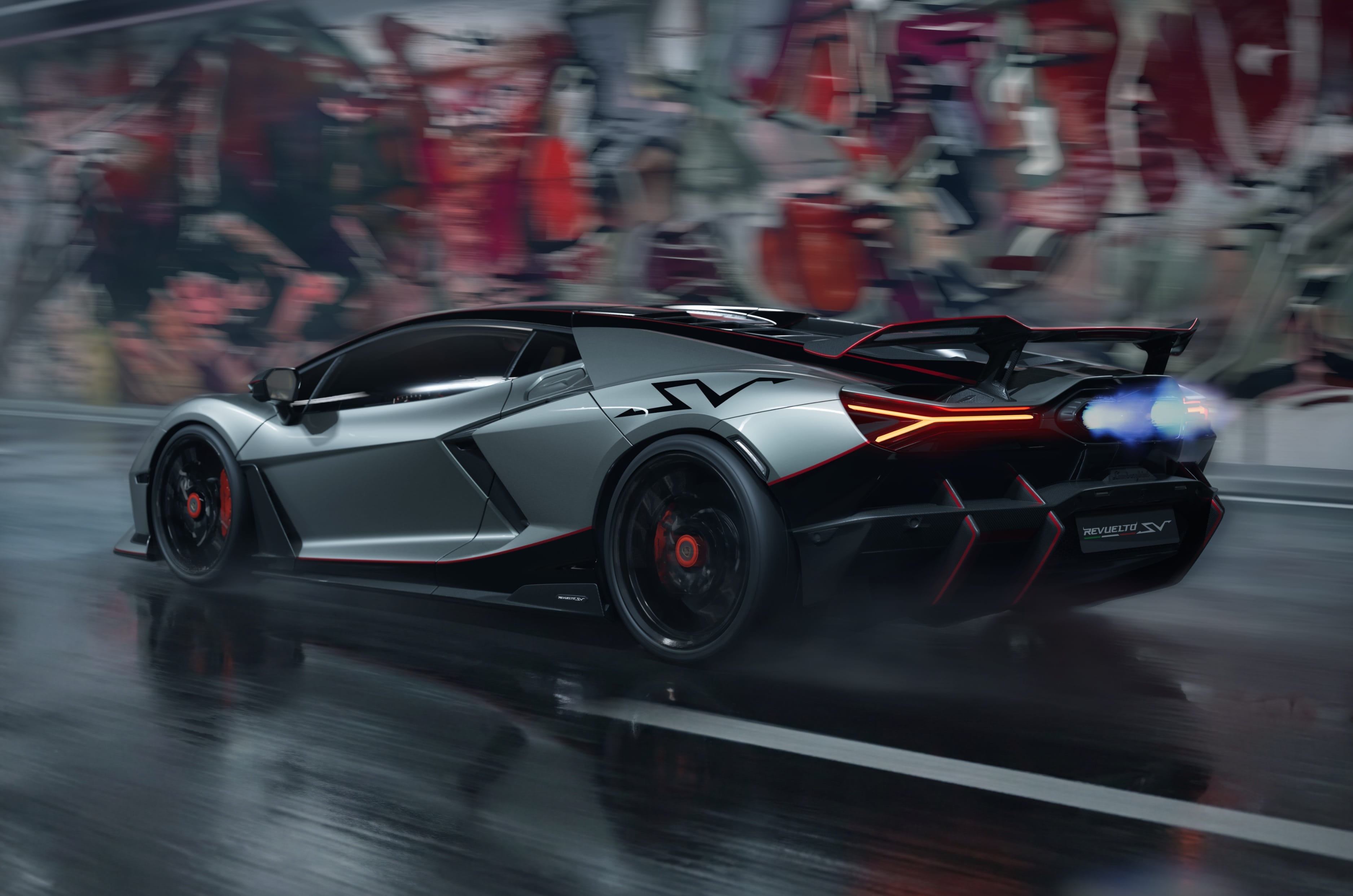
0-100kph flashes by in a brisk 2.4 seconds (claimed) for the Revuelto SV, with 0-200kph taking just 6.7 seconds. The top speed, meanwhile, remains in excess of 345kph. A new sports exhaust system is part of the package, and thanks to weight savings, the Revuelto SV boasts a power-to-weight ratio of 602.4hp/tonne, which is up from the standard version’s 571.4hp/tonne. A new ‘Pilota’ drive mode has been introduced too, unlocking a custom motorsport-derived state of tune built around a bespoke five-stage traction control system that adapts to track conditions and tyre wear.

Enhanced suspension damping and braking system

On the dynamics front, Lamborghini has upgraded the Revuelto SV’s suspension with manually adjustable dampers derived from GT3 racing, which promise a 17 percent increase in agility and a 10 percent bump in lateral grip over the Revuelto. The SV also packs a revised braking control system and new CCM-R carbon-ceramic brake discs (420mm up front, 410mm at the rear), claiming an 11 percent higher peak deceleration, 23 percent better heat dissipation, and a 12 percent drop in brake disc temperatures.

Thanks to all of the aforementioned mechanical improvements, the Revuelto SV clocked a lap time of 1:41.6 around Hockenheimring, making it the second-fastest car to be officially timed at the German circuit.

Lamborghini Revuelto SV exterior updates

More menacing body kit

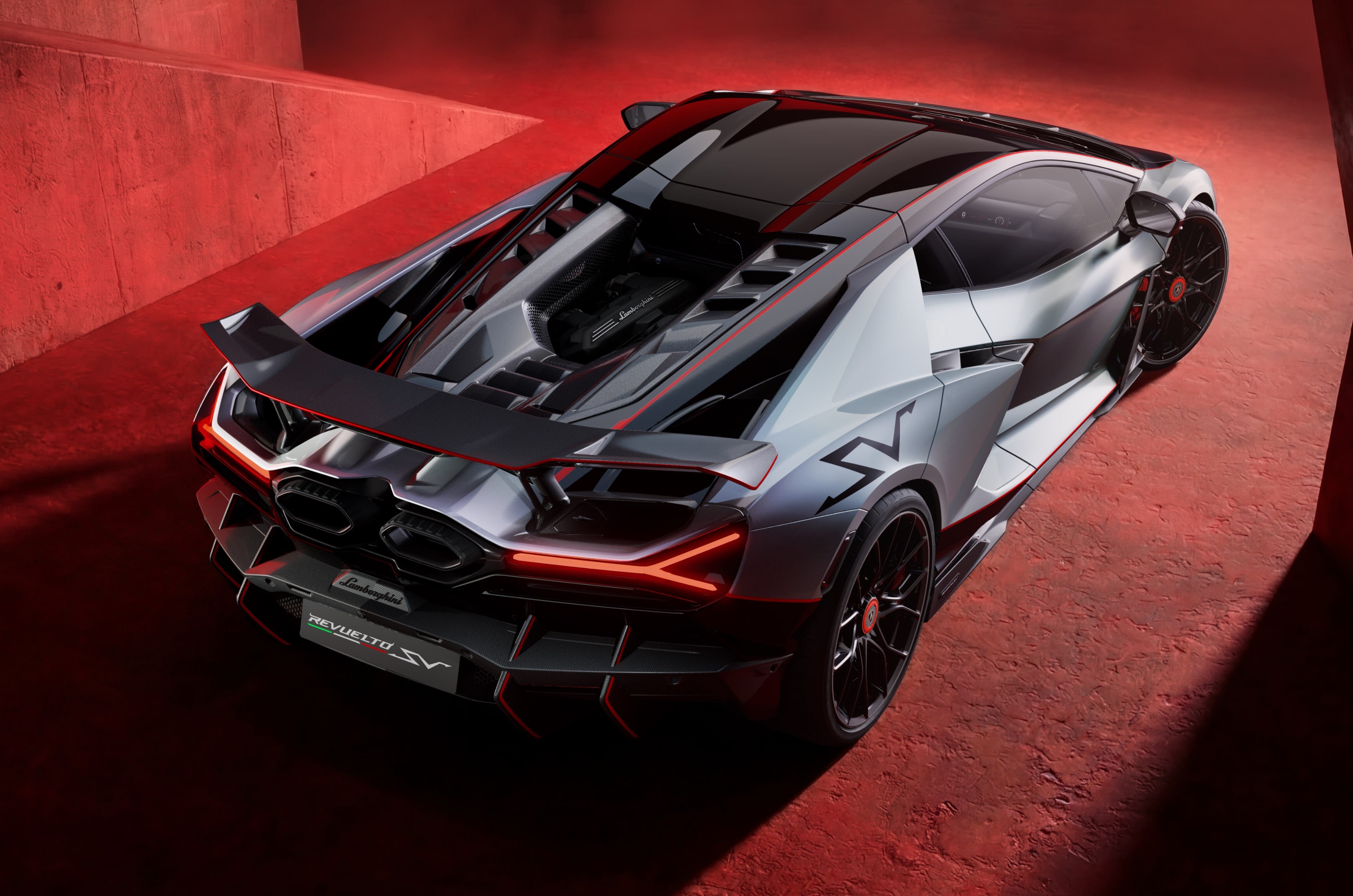
On the outside, the Revuelto SV looks much more aggressive than the standard version, courtesy of a new front diffuser with red accents, a revised rear diffuser, a massive rear wing, exclusive SV liveries and badging, contrast accents, and extensive use of carbon-fibre trim pieces. It also features a fresh set of lightweight centre-lock alloy wheels (20 inches front, 21 inches rear) shod in bespoke Bridgestone Potenza Race R tyres.

Lamborghini Revuelto SV interior updates

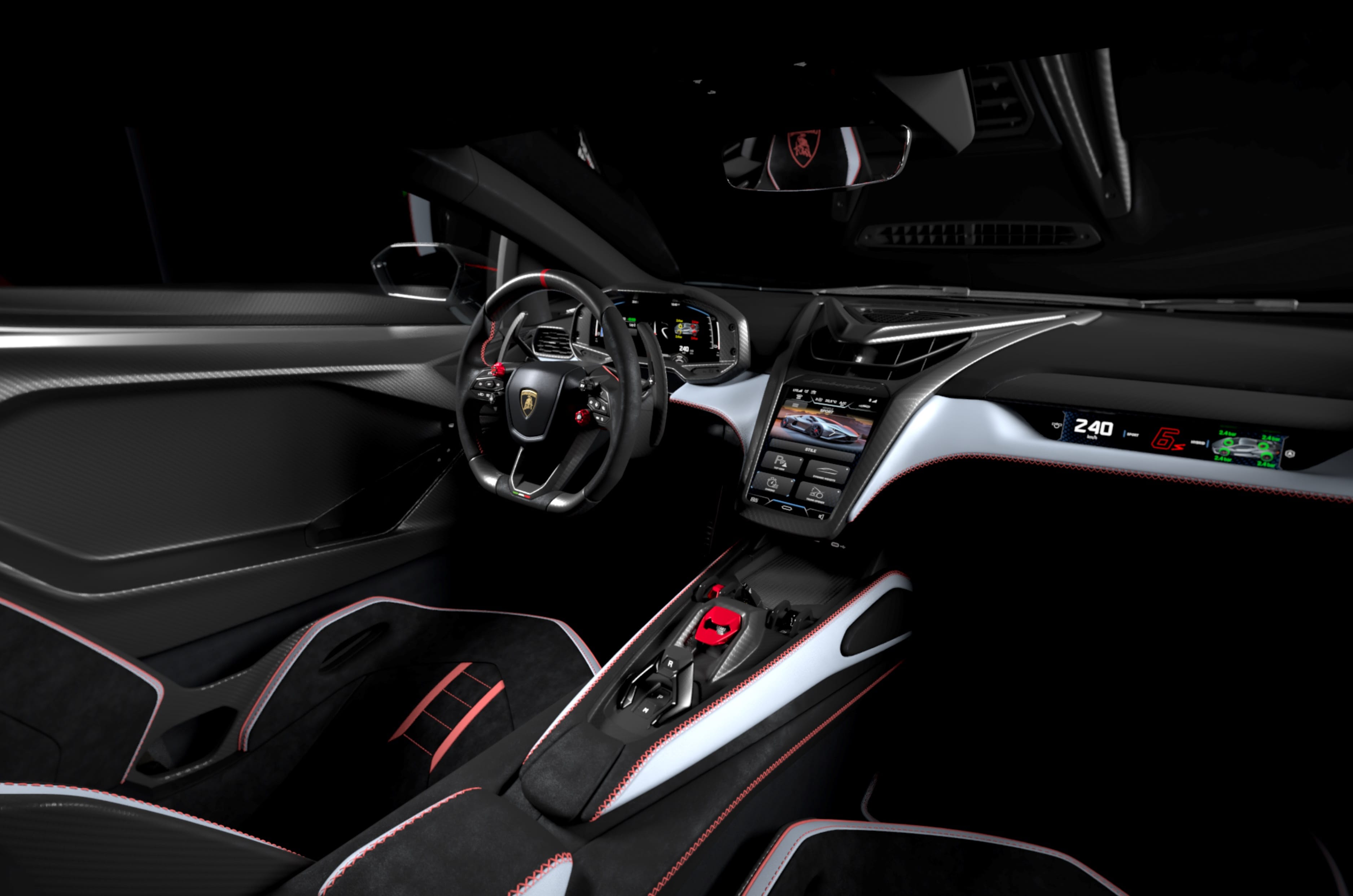
Bucket seats and new interior finishes

The Revuelto SV’s interior layout is largely unchanged from that of the standard version, but you do get new racing bucket seats, SV badging, and an expanded roster of upholsteries and colour options.