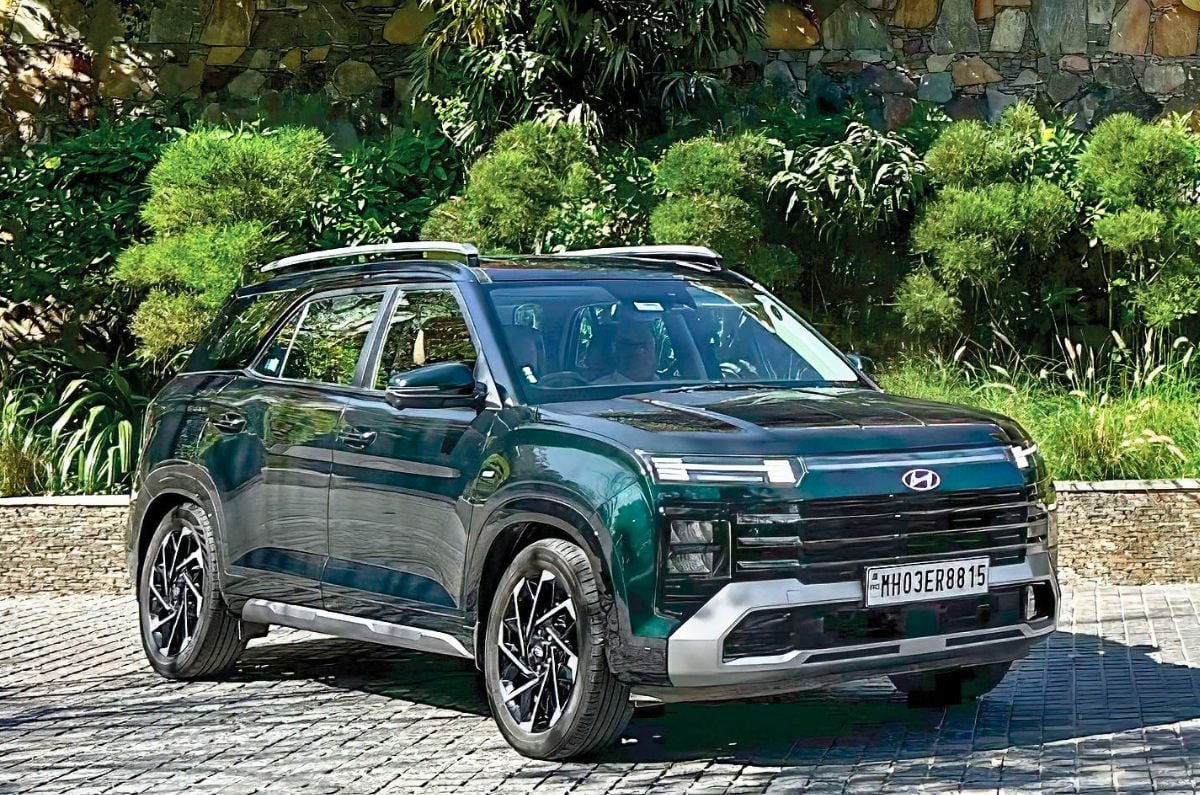
Our long-term Alcazar has done all sorts of jobs since it joined the fleet. City runs, airport pickups, the odd weekend getaway. But nothing quite like what it was asked to do recently. It had to play support car for our camera crew shooting a feature on the Delhi-Mumbai Expressway, and that meant a 2,700km round trip between Mumbai and Delhi with barely a day’s rest in between.
I wasn’t driving the entire way myself, and the Alcazar was only handed over to me in Delhi by one of our drivers. His enthusiasm to ask me if we needed him to drive it back to Mumbai was a testament of how impressed he really was with the Alcazar.
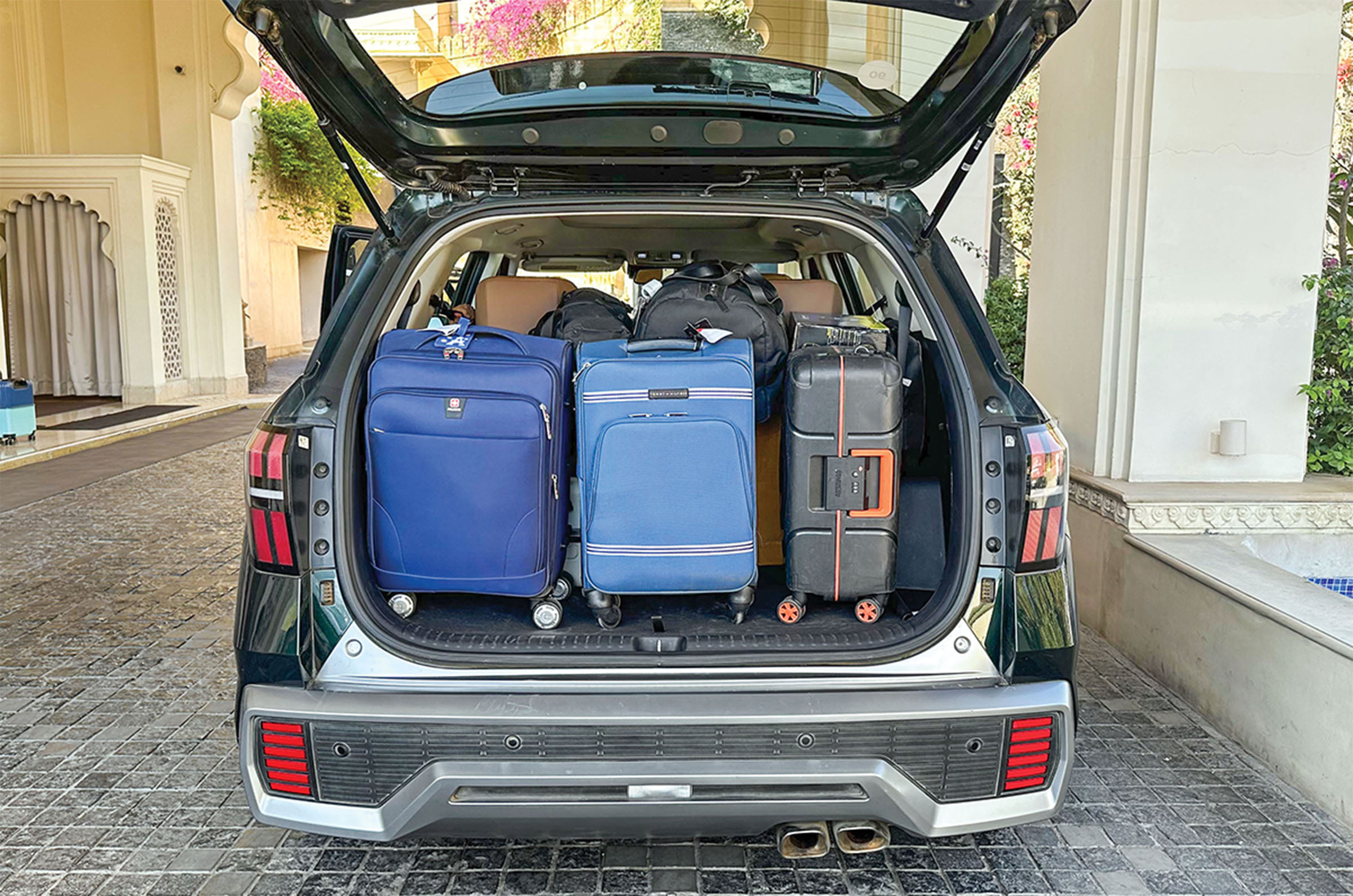
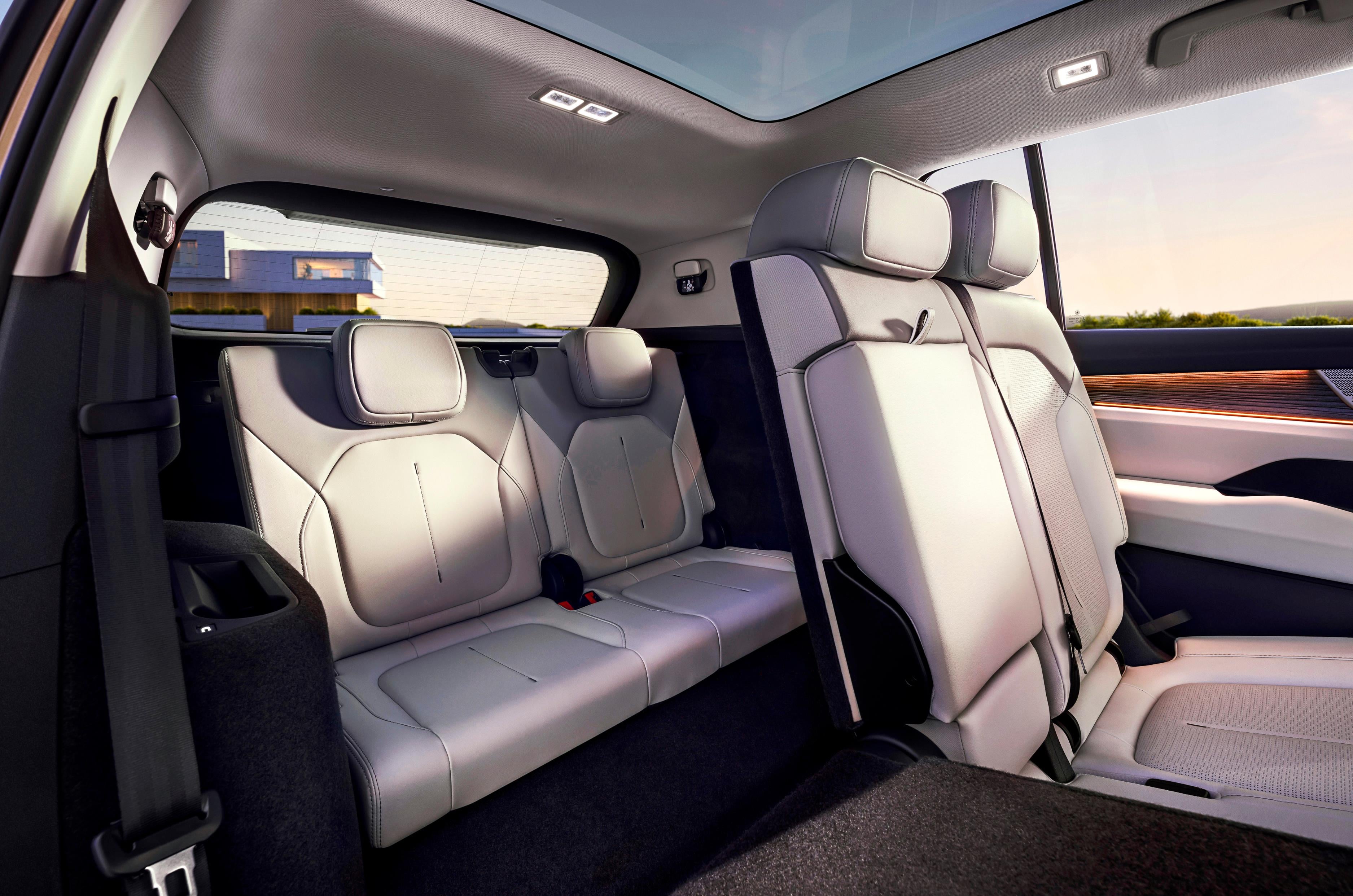
Folded third row frees up a lot of space for luggage.
The brief was simple. The Alcazar had to carry three crew members and all their camera gear along with all our luggage. This is exactly the kind of job our Alcazar has proven good at before, and it didn’t disappoint this time either. With the third row folded flat, the boot swallowed almost everything.
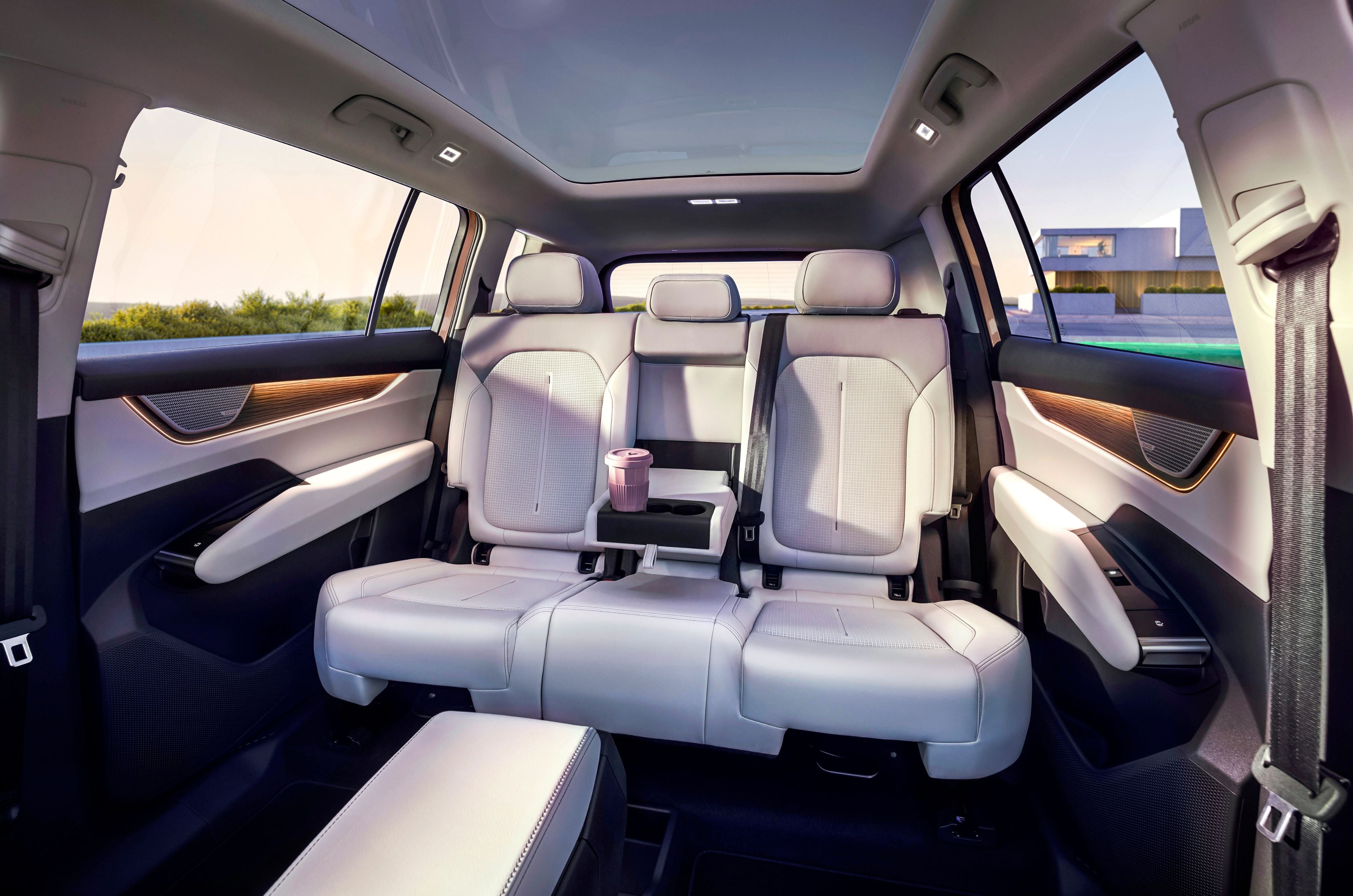
The captain seats in the second row turned out to be a real boon, especially for the camera crew – super comfy during a long day of shooting. The foldable tray table was handy for the laptop to copy and work on footage, and the fact that it was steady enough says a lot about the good build quality.
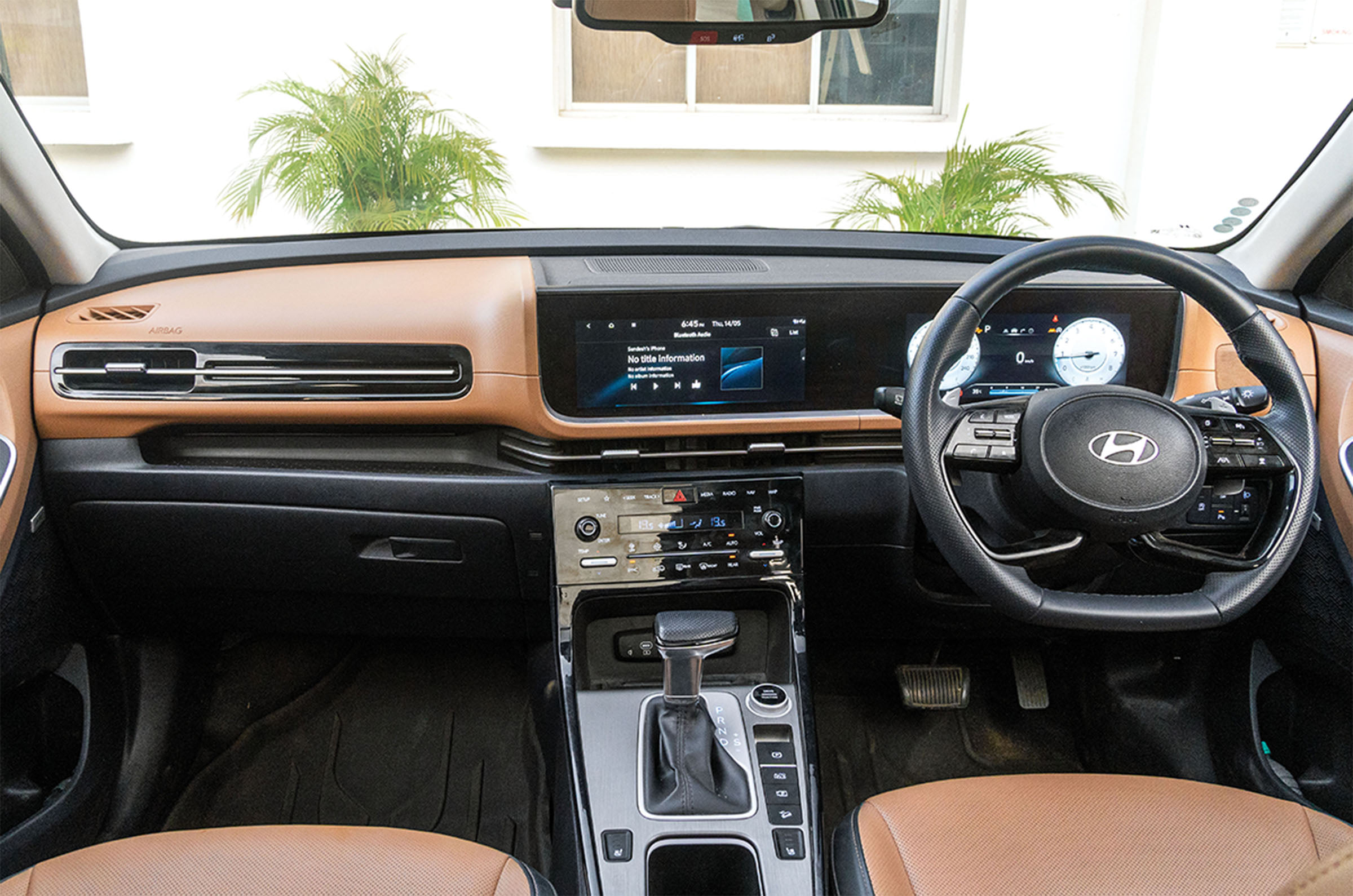
Design is simple yet ergonomic. Dark-coloured interiors help it look clean.
The Delhi-Mumbai Expressway is where this car was always going to shine, and it did. Long, arrow-straight sections let the 1.5-litre turbo-petrol settle into an easy cruise. At 100kph in top gear, the engine barely feels stressed, and wind noise is well contained for a car this size. We clocked long hours driving in a single day on the way back, stopping only for fuel and food, and nobody complained of fatigue by the end of it.
The DCT, which I’ve spoken of before, is jerky in bumper-to-bumper traffic, but was not an issue here. Once you’re past 40kph and holding a steady throttle, it’s smooth and quick to respond. It’s really only the crawl through Mumbai and Delhi outskirts where its low-speed hesitation showed up.
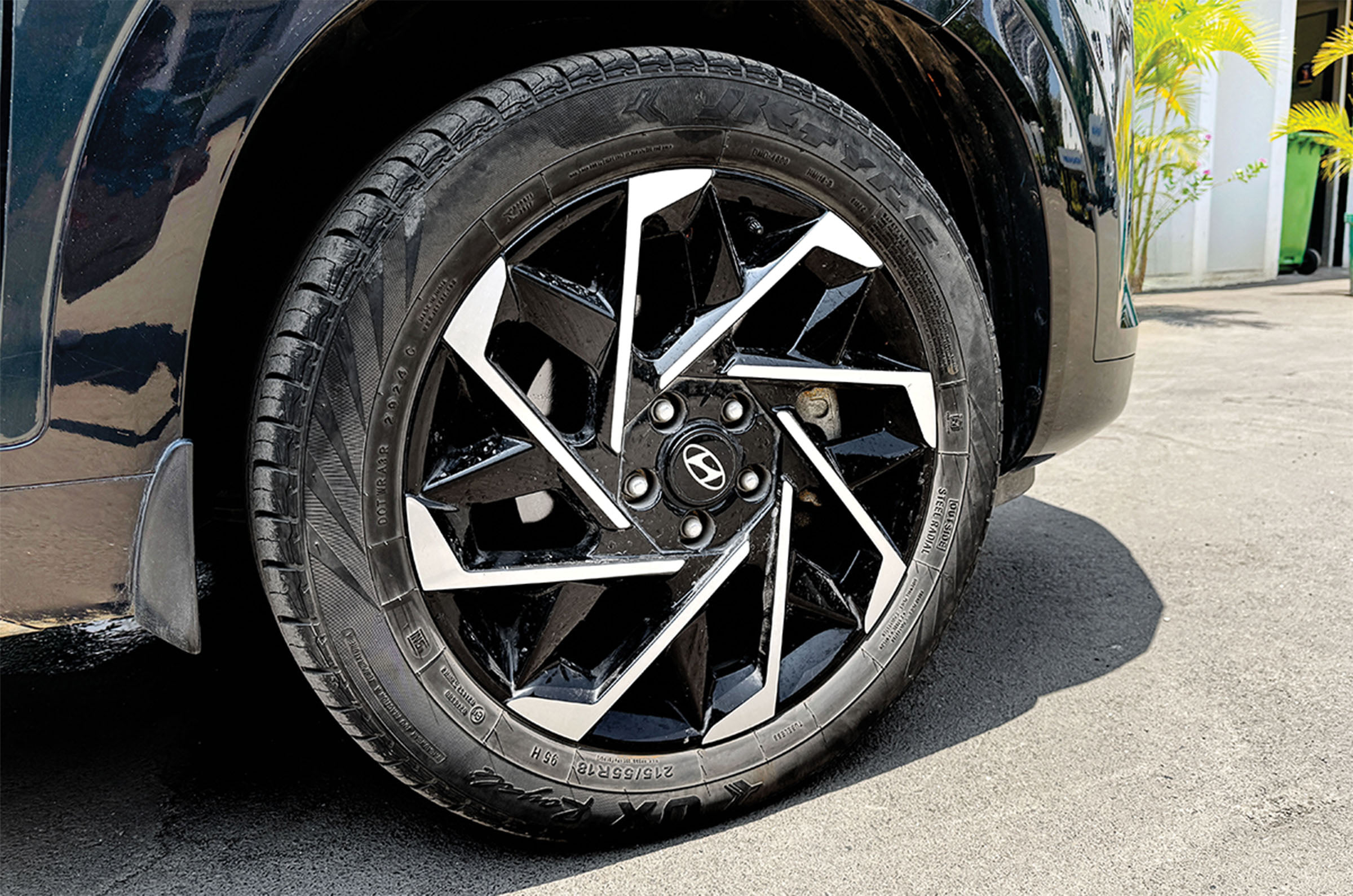
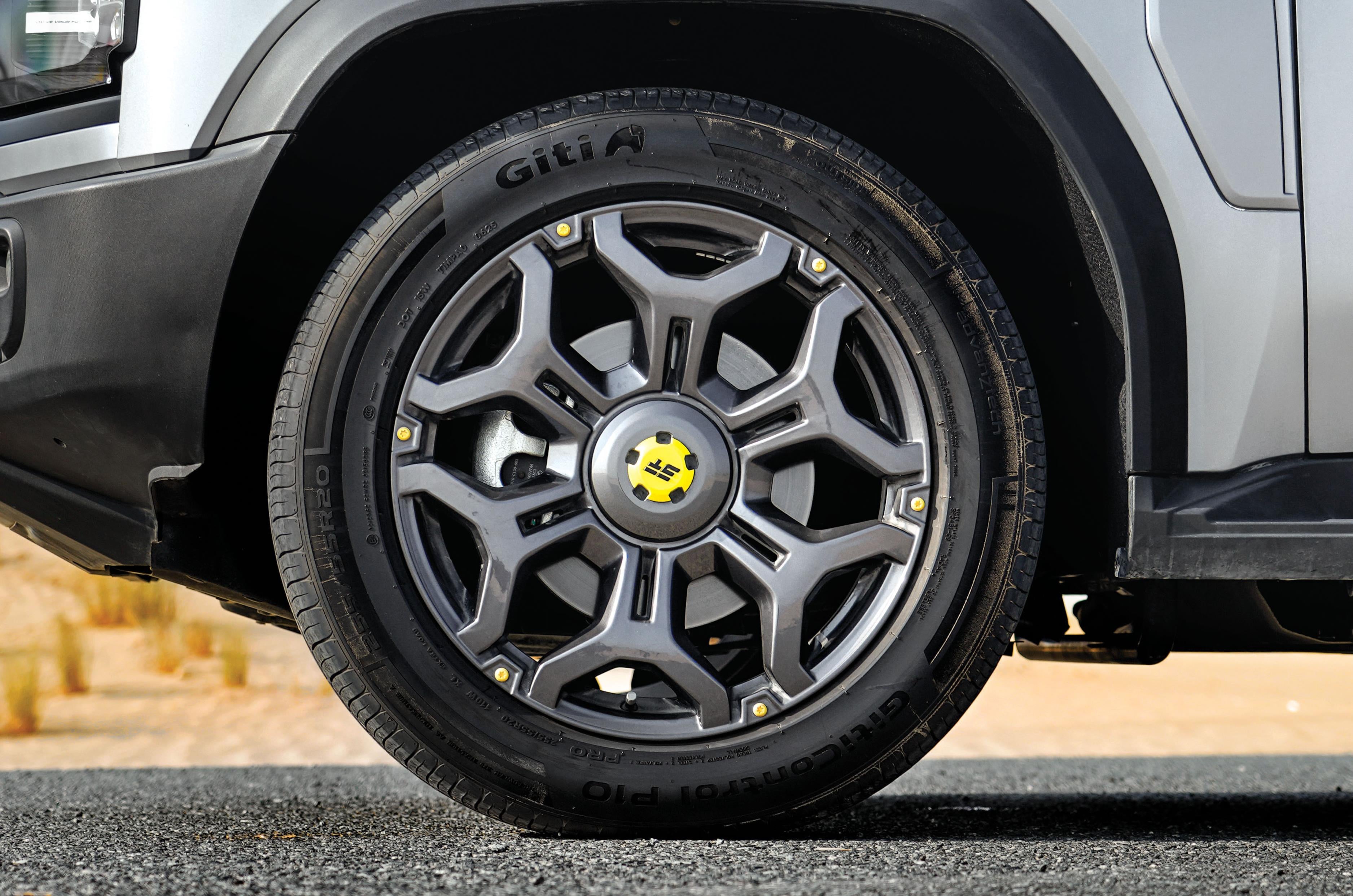
Large 18-inch wheels look stylish, but they don’t help the Alcazar’s ride quality.
The return leg we took had some patchy sections in Maharashtra, where the NE4 Expressway ends and connects to the old Golden Quadrilateral section of the highway. The Alcazar’s ride, tuned more for comfort on good surfaces, felt busy over broken patches. Nothing alarming, but the ride did feel slightly firmer than I expected from a car this size.
This stretch also penalised fuel efficiency. Loaded up with gear, four adults, and running the air conditioning at full blast through most of the drive, the trip computer settled at 12.8kmpl. That’s respectable for a heavy petrol SUV doing this kind of duty, but it’s definitely not the frugal numbers our diesel Alcazar managed, doing the same duty on the Kashmir-to-Kanyakumari run a few years back.
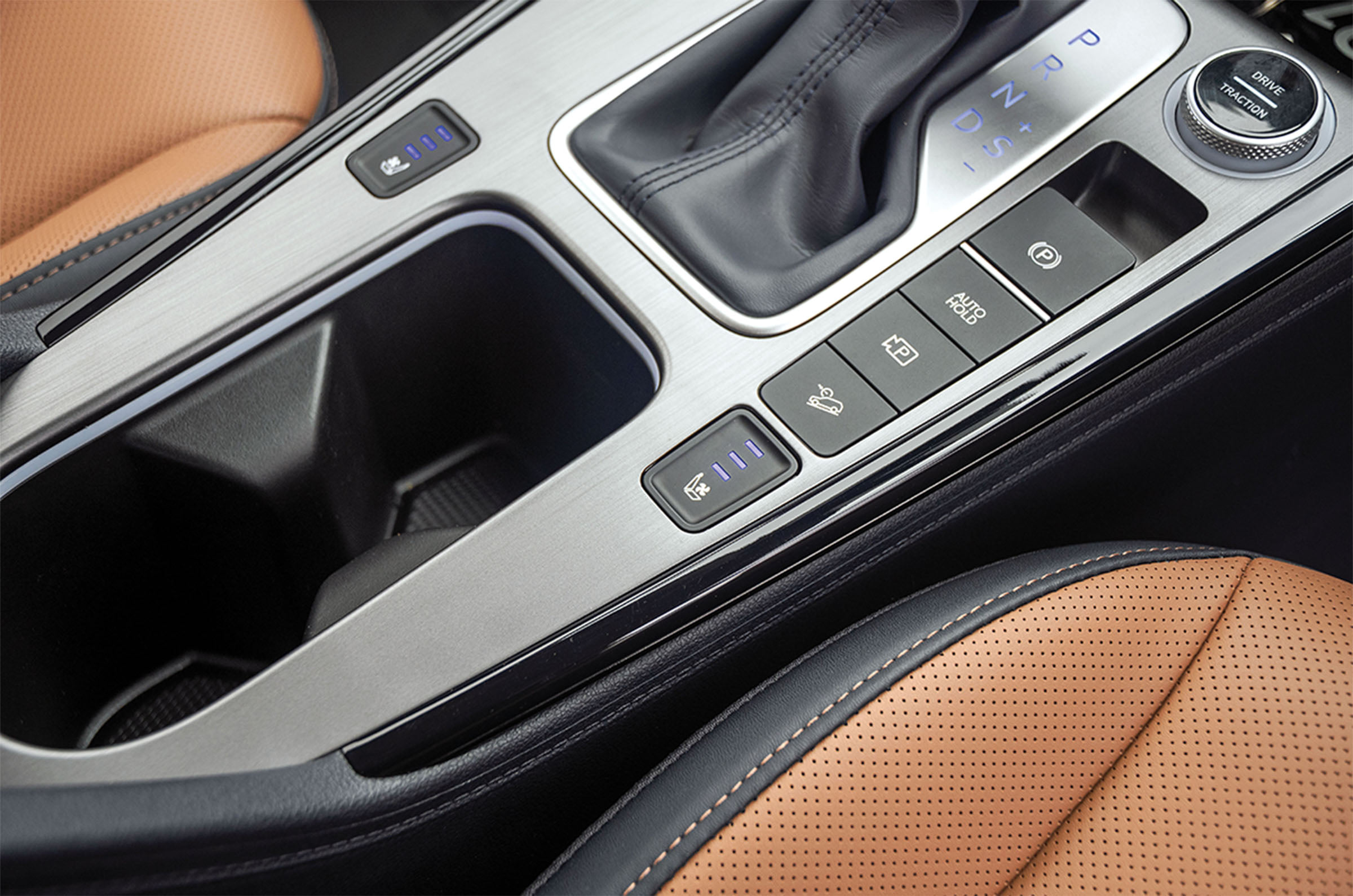
Ventilated driver and passenger seats are a boon on a hot, sunny afternoon.
A few other bits we did appreciate. The ventilated seats made the long hours of driving through the heat a lot more comfortable. The adaptive cruise control also was genuinely useful on the Expressway stretch, taking a lot of the fatigue out of long, straight sections. The absence of wireless Android Auto or Apple CarPlay was an irritant, as it meant connecting to the Infotainment using the cable and having a fully charged phone constantly plugged in for a long period of time.
Another observation on this trip: the plasticky bits on the dashboard picked up a fair bit of dust, especially with four people living out of the car for five days. To be honest, though, the camera crew kept the windows rolled down for a fair amount of time shooting. Thankfully, nothing a wipe down couldn’t fix.
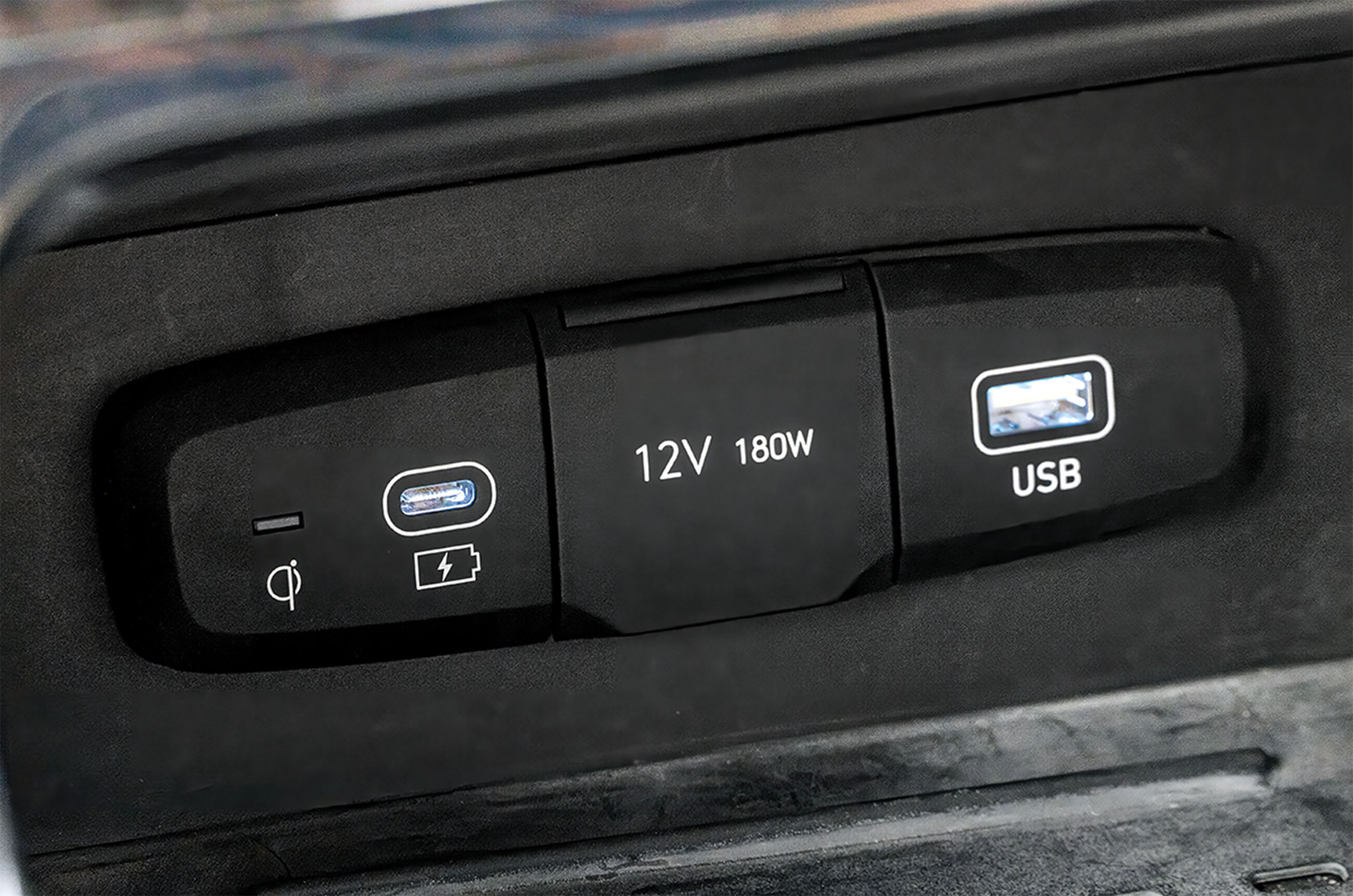
Type-A USB for smartphone interface needed. Type-C only works for charging.
At the end of it all, the Alcazar clocked close to 2,750km in five days absolutely fuss-free. No warning lights, no rattles that weren’t there before. It’s exactly the kind of trip that reminds you why a car like this earns its place in our long-term fleet. Not glamorous, not the fastest thing on the road, but dependable when you need it most. As it happens, this Mumbai-Delhi-Mumbai run turned out to be its last big assignment with us. With this report, our time with the Alcazar comes to a close, and it’s headed back to Hyundai. It leaves the fleet the same way it arrived, quietly capable, and it’s fitting that its final outing was spent doing what it always did best, hauling people and gear over long distances without a fuss.
Hyundai Alcazar Petrol DCT Signature 6-seater test data
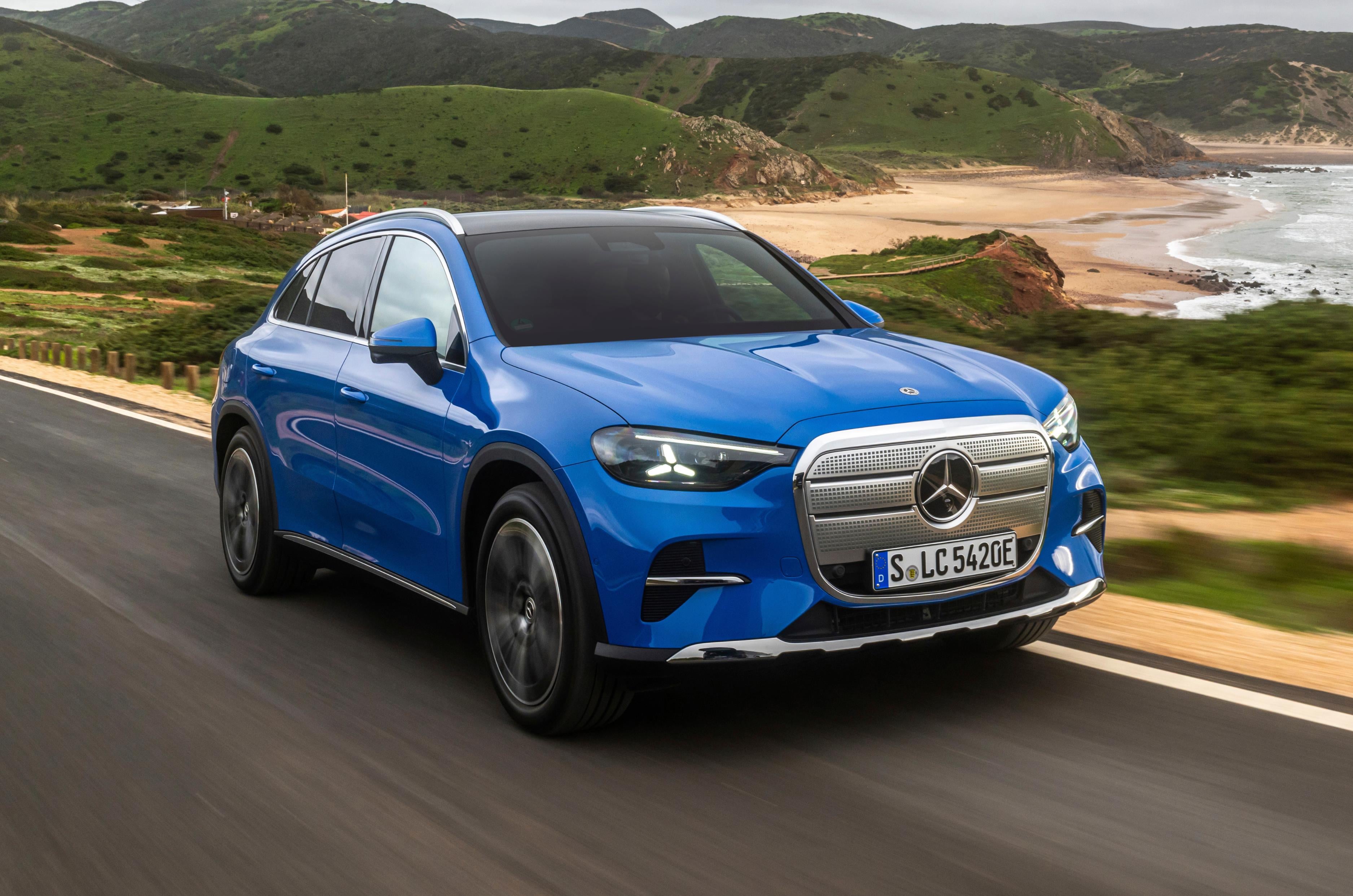
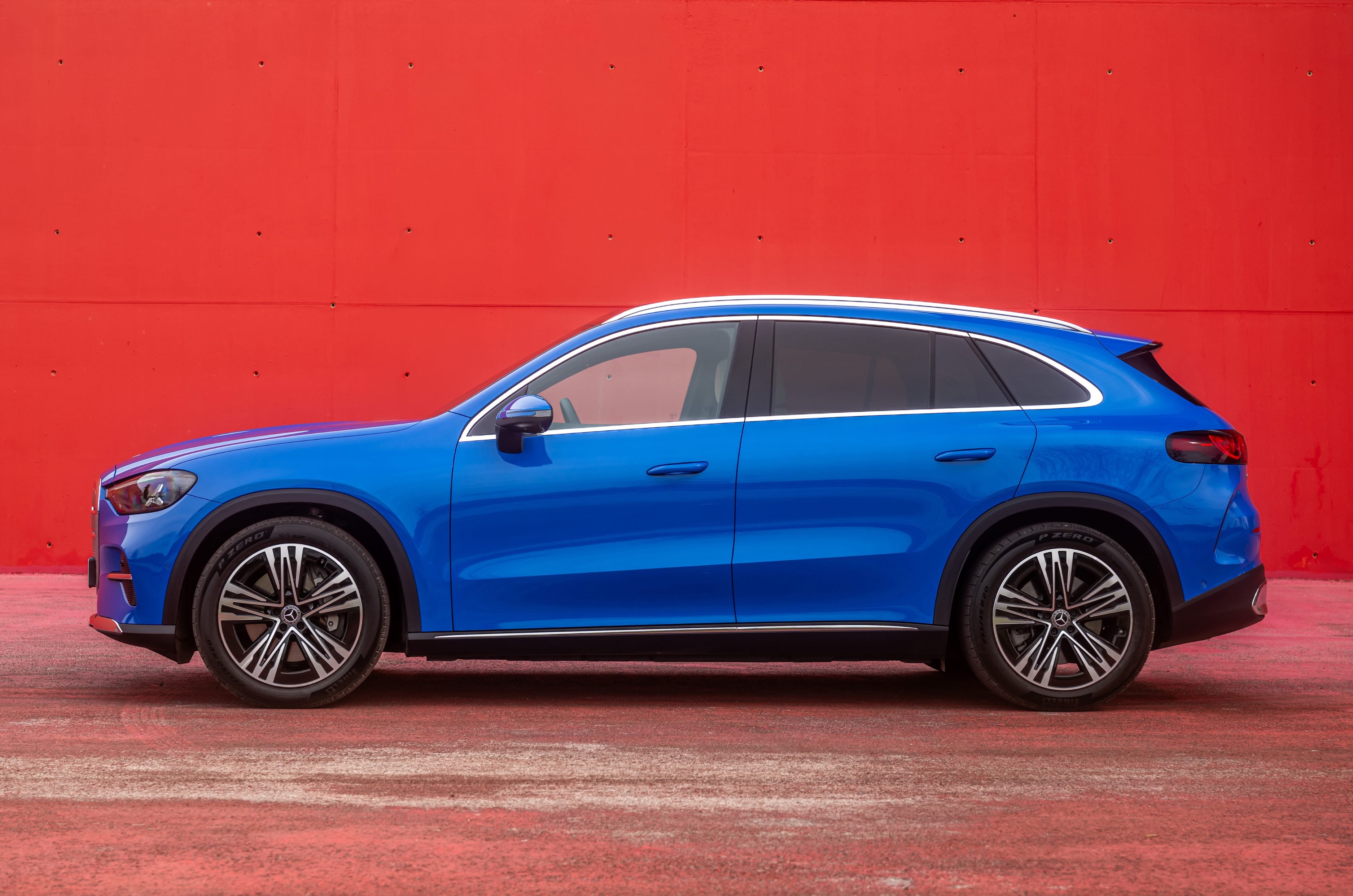
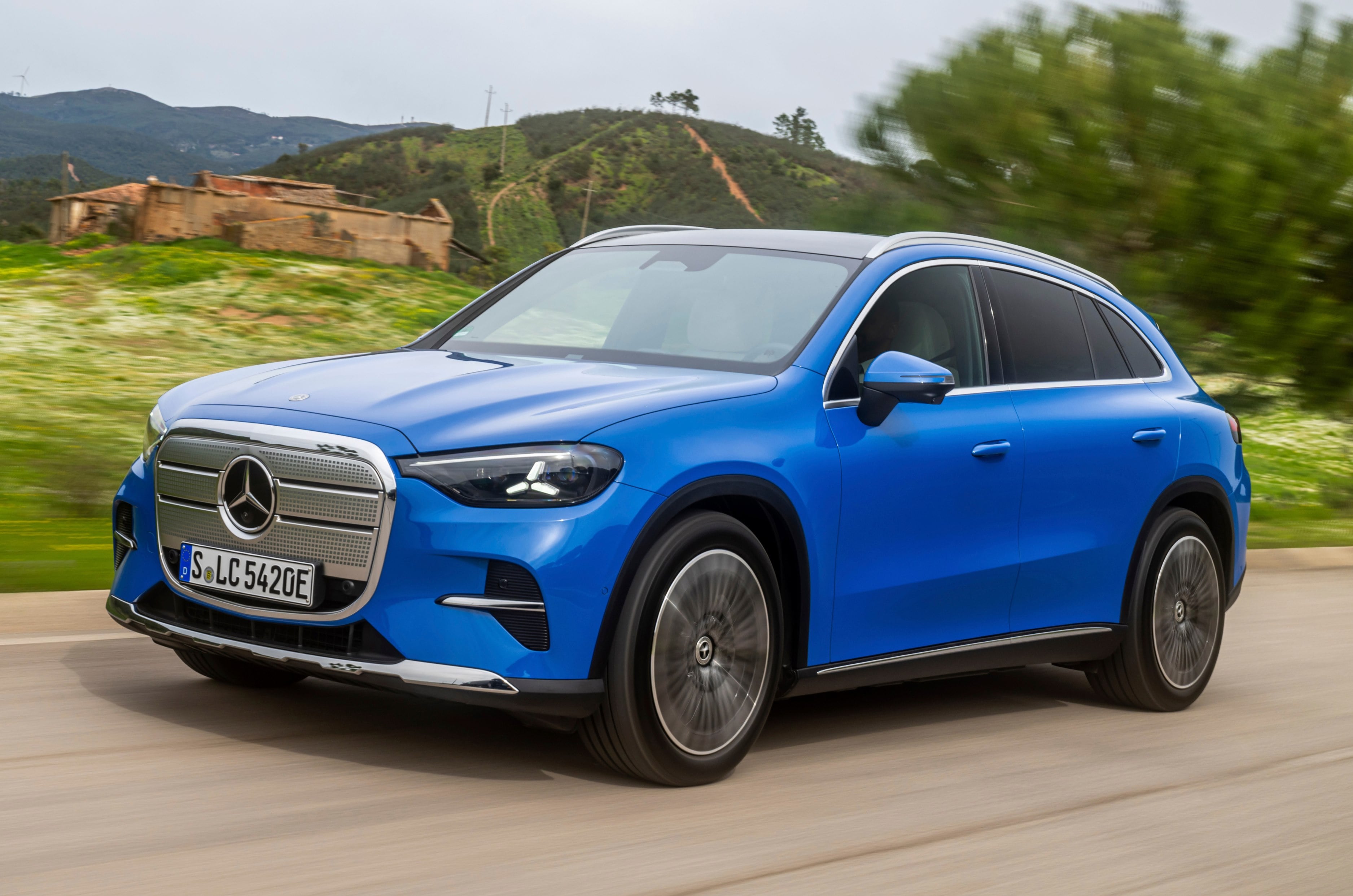
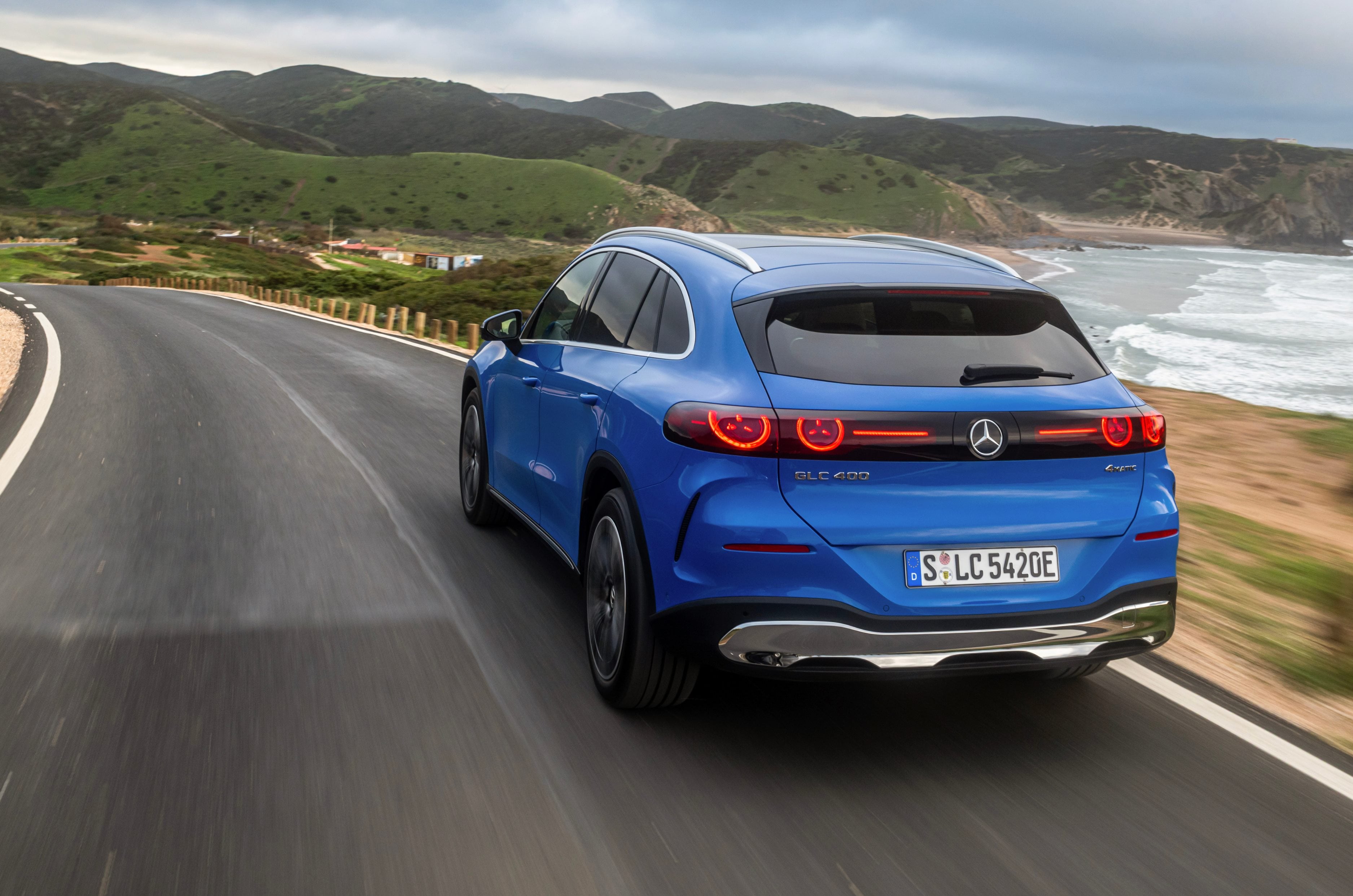
The Mercedes-Benz GLC EV you see here is not merely an electric derivative of the GLC you and I are familiar with. It’s built on an all-electric platform, and it’s longer, wider, and built on a slightly larger wheelbase than the GLC. And it also does 0-100kph in just 4.3 seconds.
The big news is that it’s coming to India by the end of the year. There’s lots to talk about, so let’s go one by one.
Mercedes-Benz GLC EV Exterior Design and Engineering – 8/10
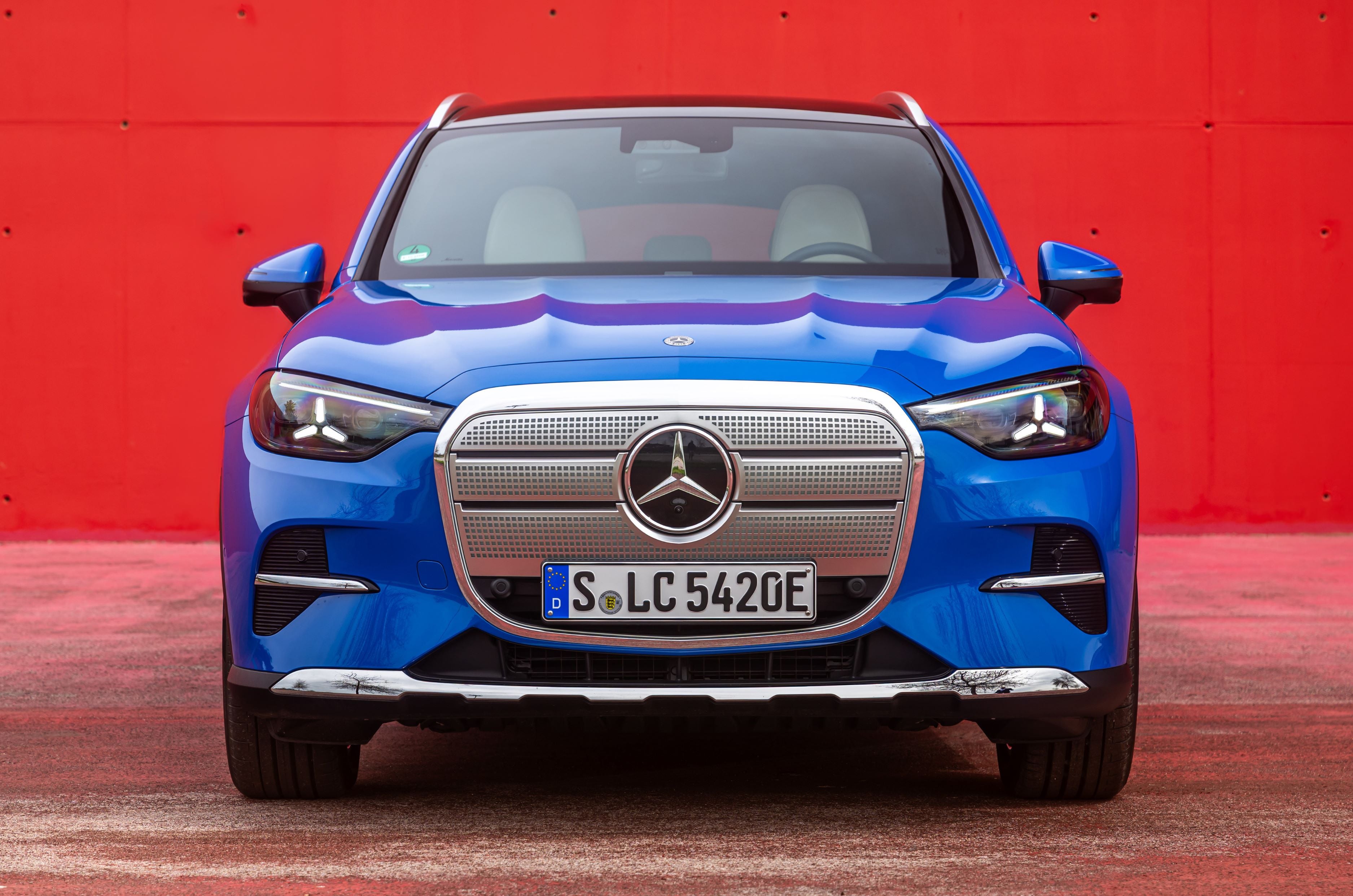
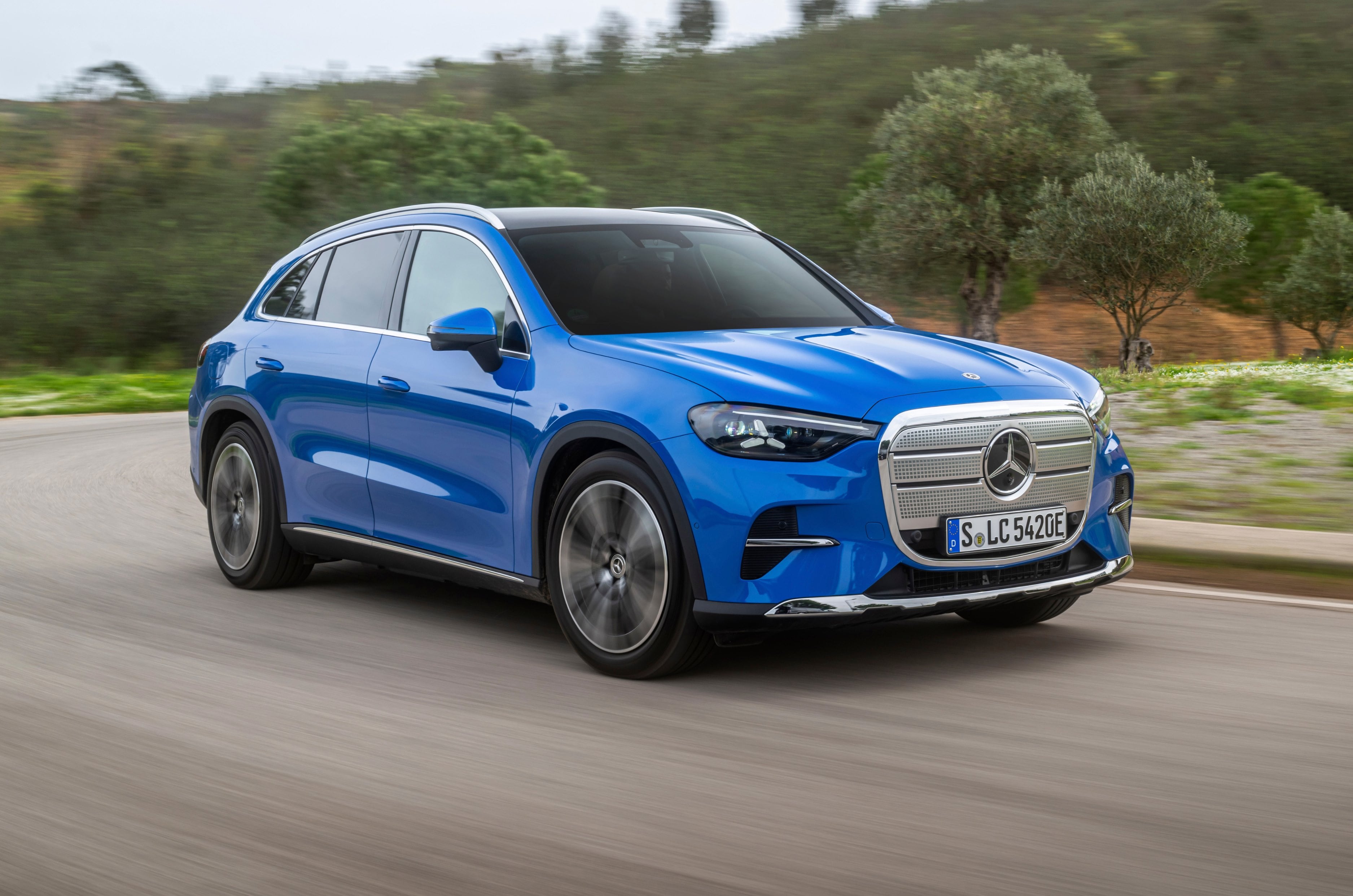
Large new grille reminiscent of older Mercs
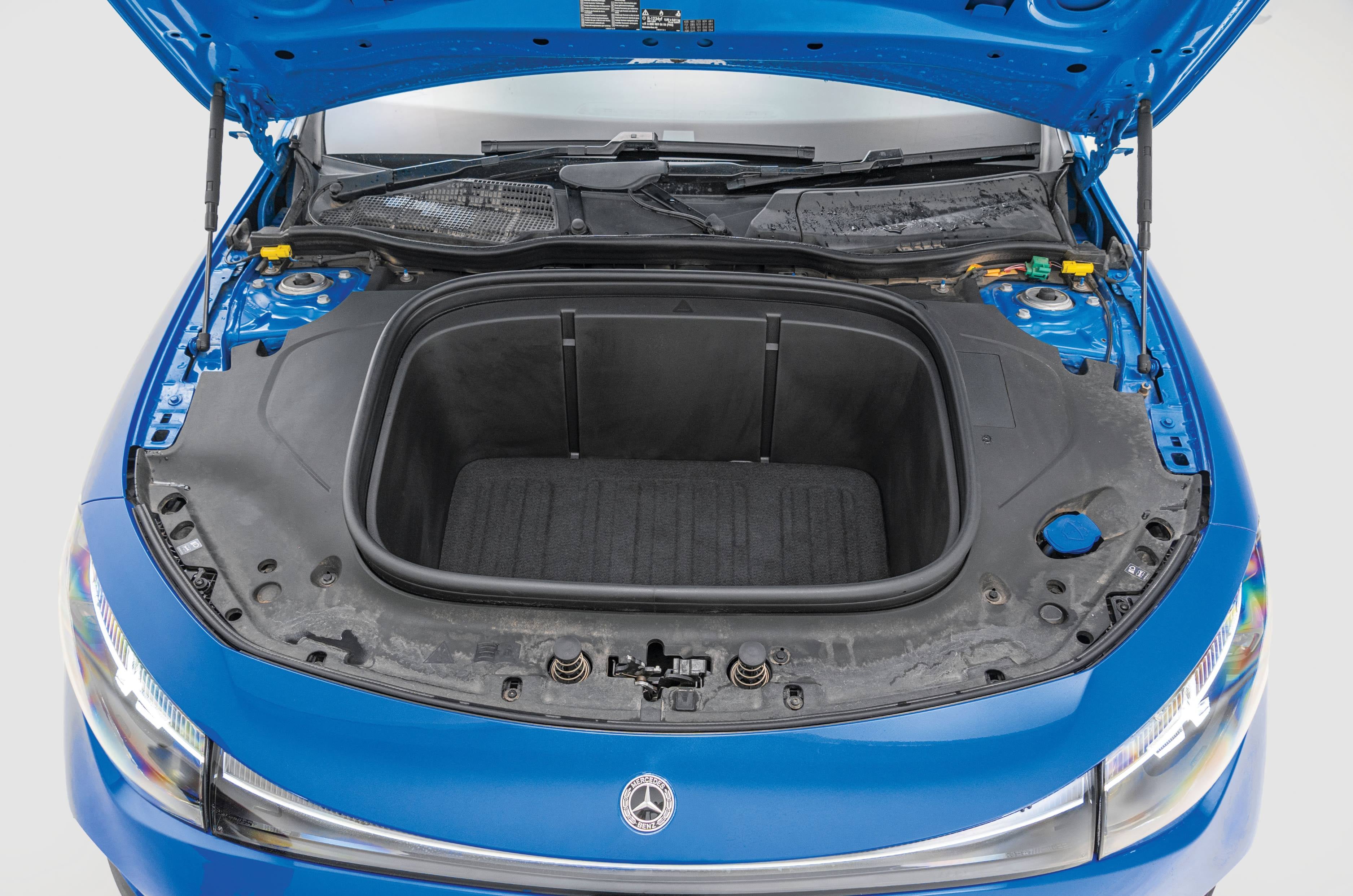
Let’s talk styling first, and what catches your attention up front is this large new grille. It’s very different from what we’ve seen of Mercs of late, but it actually has a link to Mercs of old. The upright grille is styled to look like the one on iconic models like the W112 S-Class, but there’s a lot of modernity built into it as well. There are 942 lighting elements in it! Talking of lighting, the three-pointed star on the nose glows and there’s a tri-star DRL pattern in the headlights too. And unlike other Merc EVs from the (recent) past, there is a functional frunk with a handy 129 litres of space.
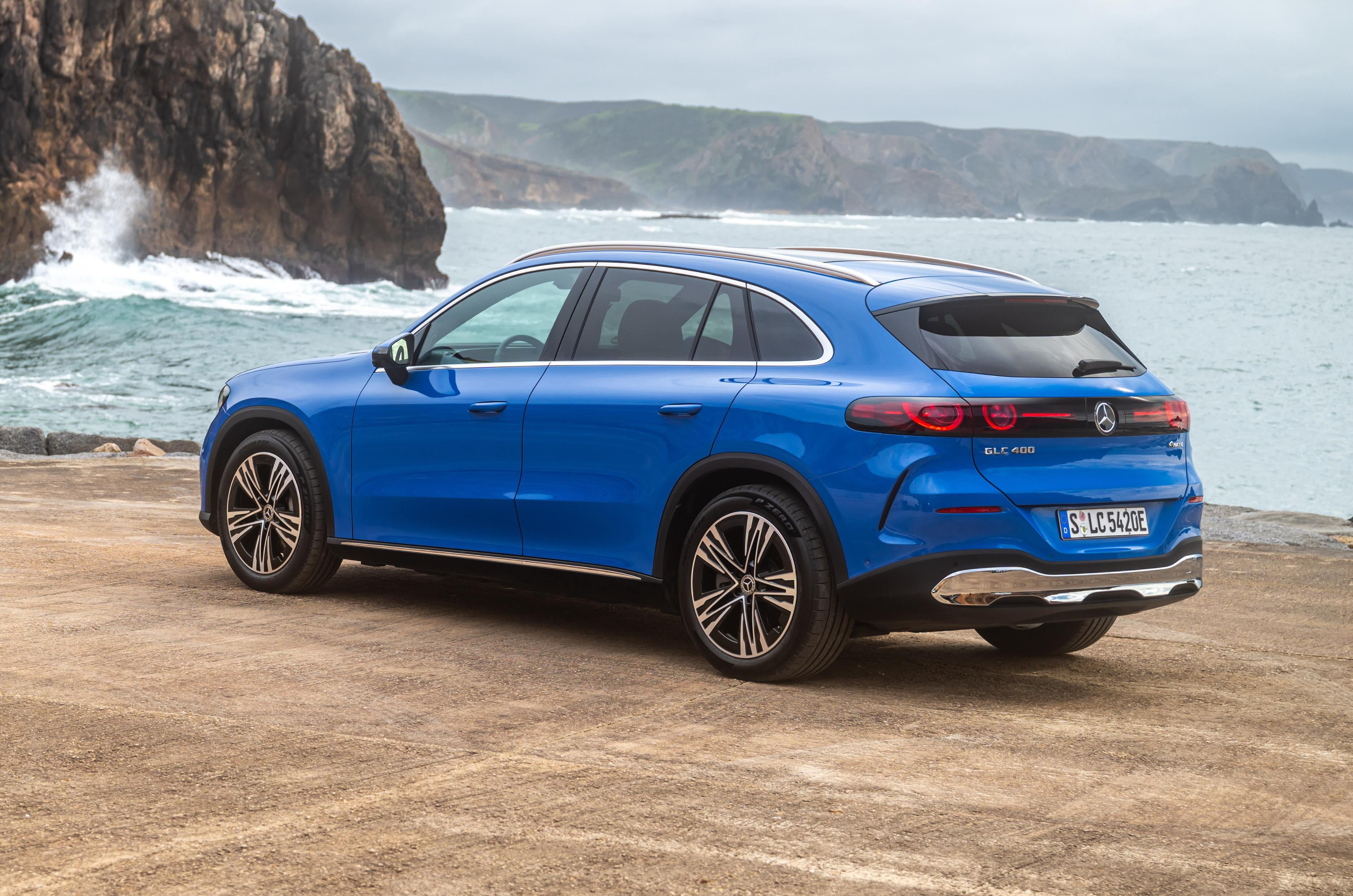
Gets an 84mm longer wheelbase than the ICE version.
The GLC EV doesn’t look all too different to the ICE GLC in profile. Which is to say it is not an upright SUV but curvy, low-slung and aerodynamic. What is noticeably different is the wheelbase, which is a full 84mm longer. Mind you, this is the standard wheelbase GLC EV. There’s a long-wheelbase version sold in markets like China. India will get the GLC with 20-inch rims and flush-fitted door handles that pop out when the doors are unlocked.
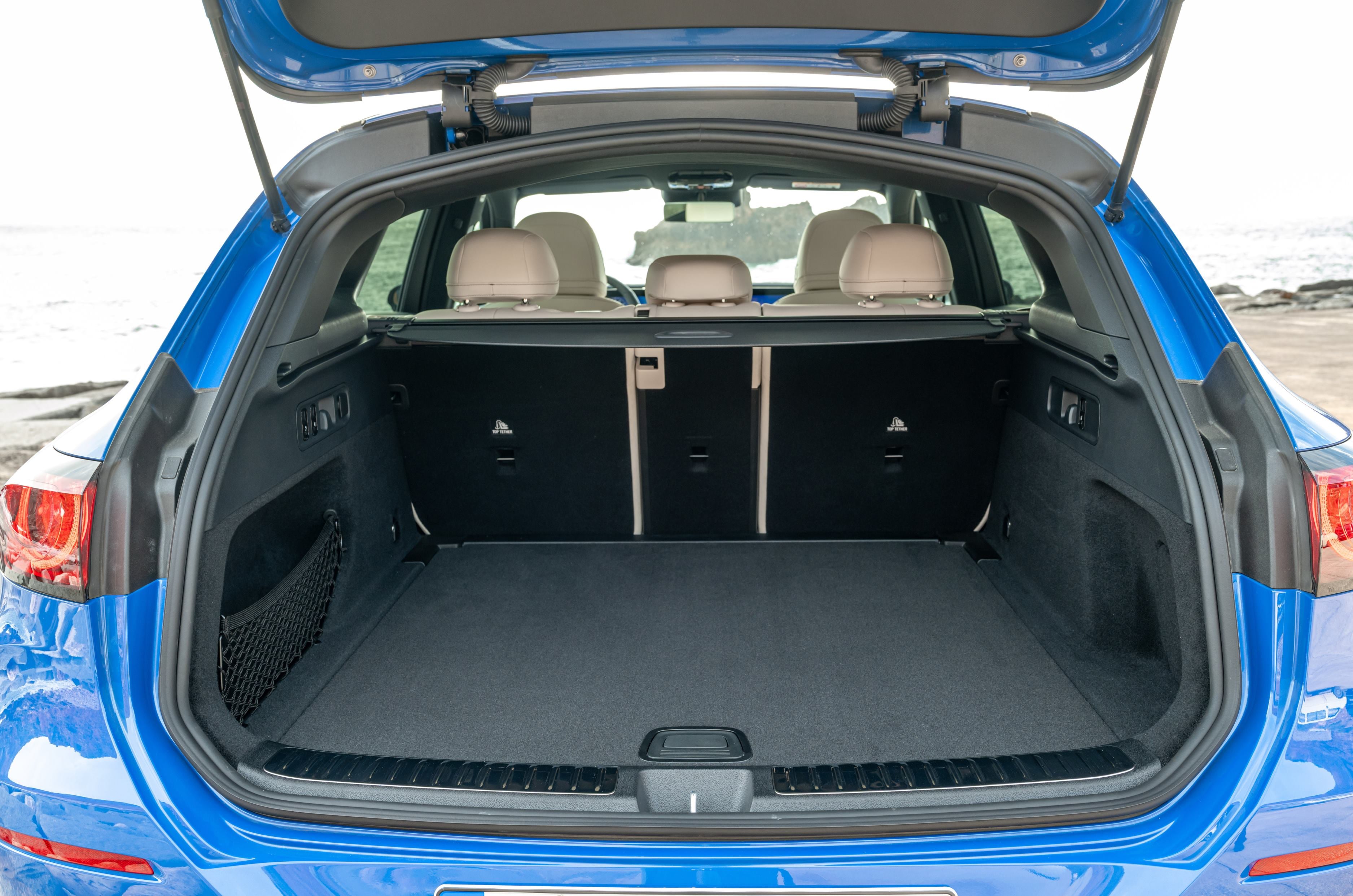
570-litre boot is spacious, but a caveat is the absence of a spare wheel.
Styling at the back is quite distinct from the other lot of Mercedes SUVs, and that’s thanks to a band of black that runs the width of the tailgate. There’s full-LED lighting at the back replete with three-pointed star light signatures.
The powered tailgate opens up to a 570-litre luggage area, which is quite sizable. The only catch is that there’s no space for a spare tyre. Mercedes India will probably have to provide one to sit on the boot floor, which means not much space will be left for luggage.
Before we proceed, I have to admit, I didn’t like what I saw of the GLC EV in pictures. In reality, it is eye-catching, and in a very good way.
Mercedes-Benz GLC EV Interior Space and Comfort – 8/10
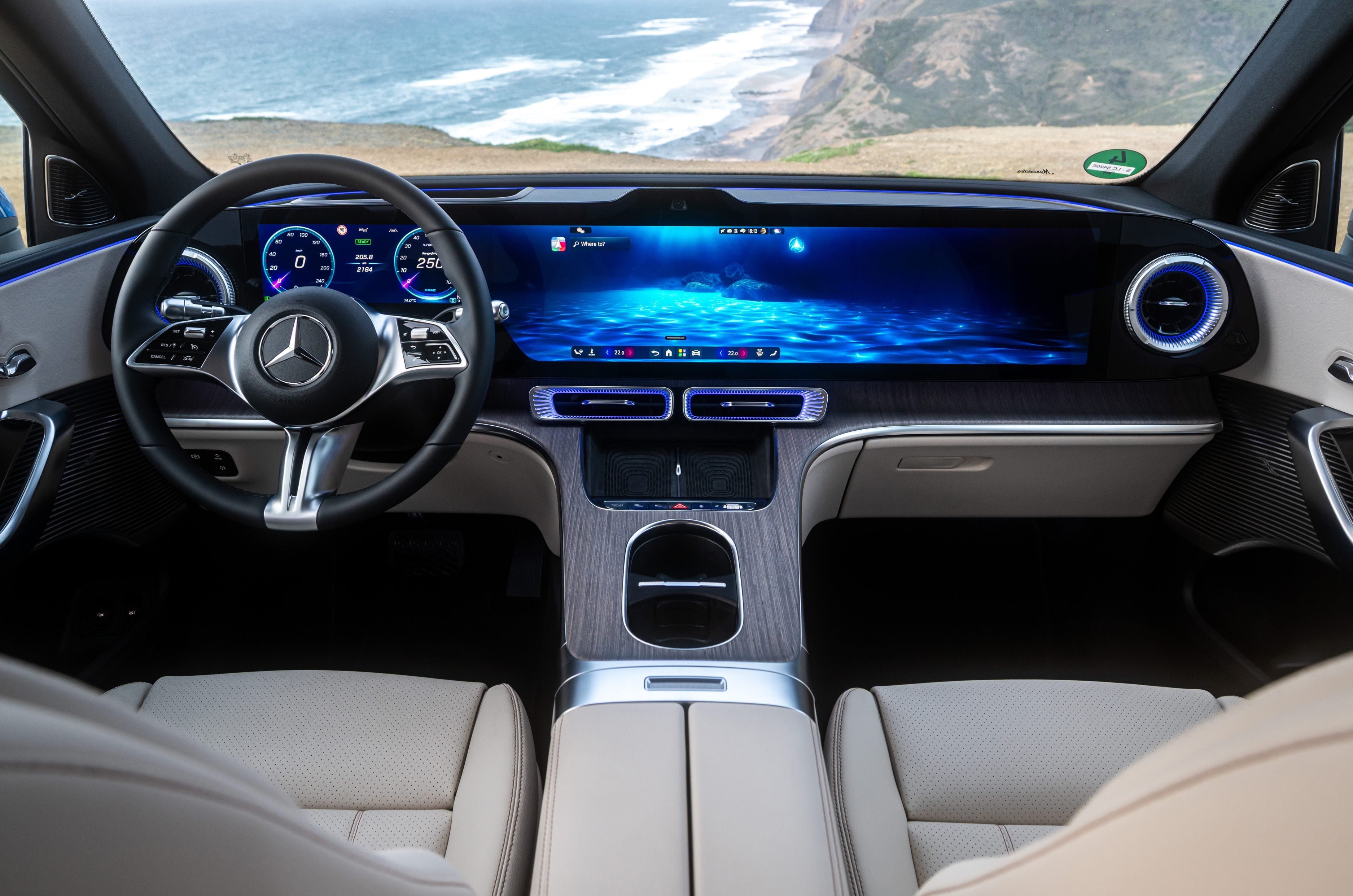
Interior quality is impressive, with open-pore wood trim while physical steering knobs and AC vents have a tactile feel
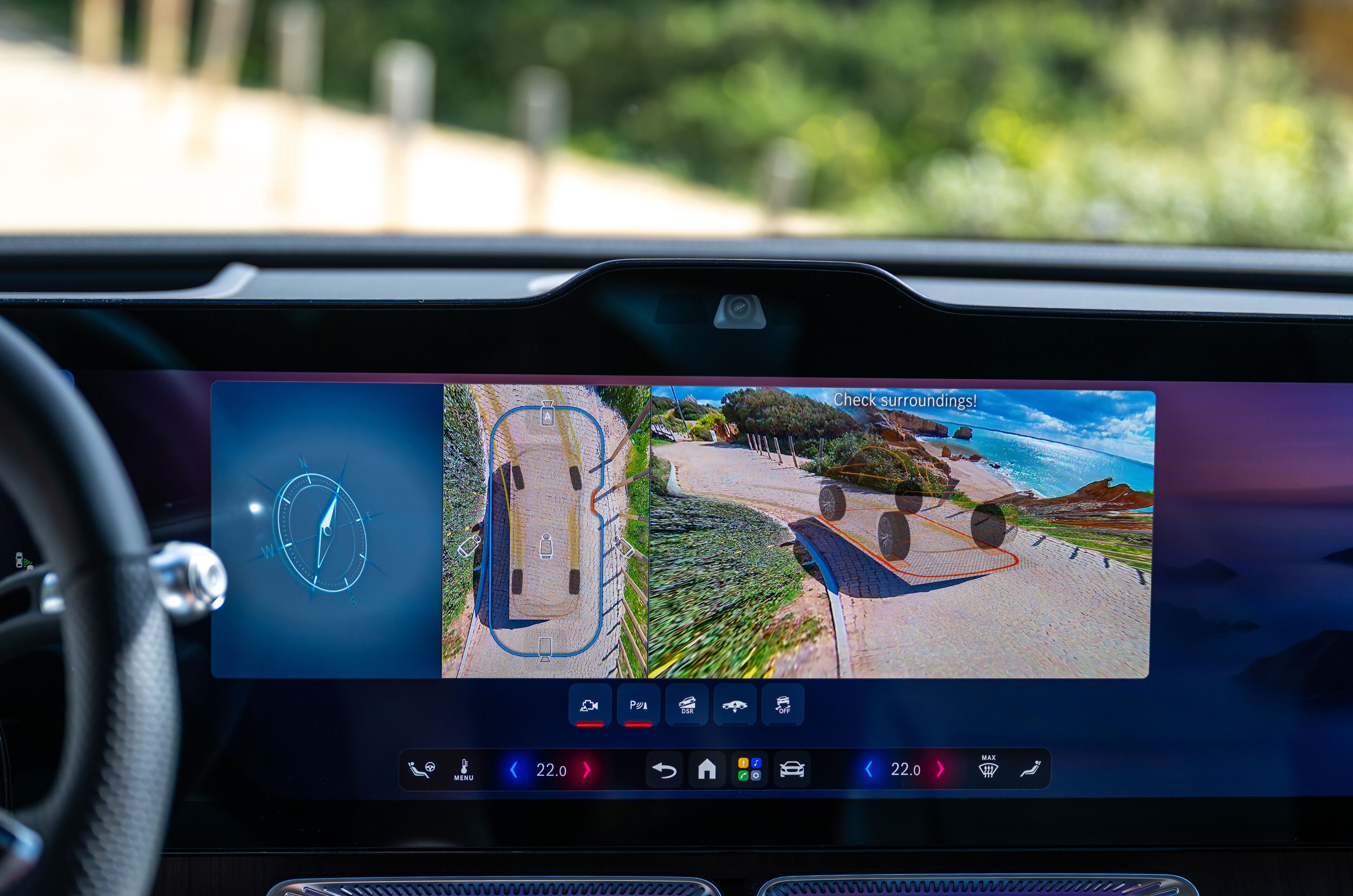
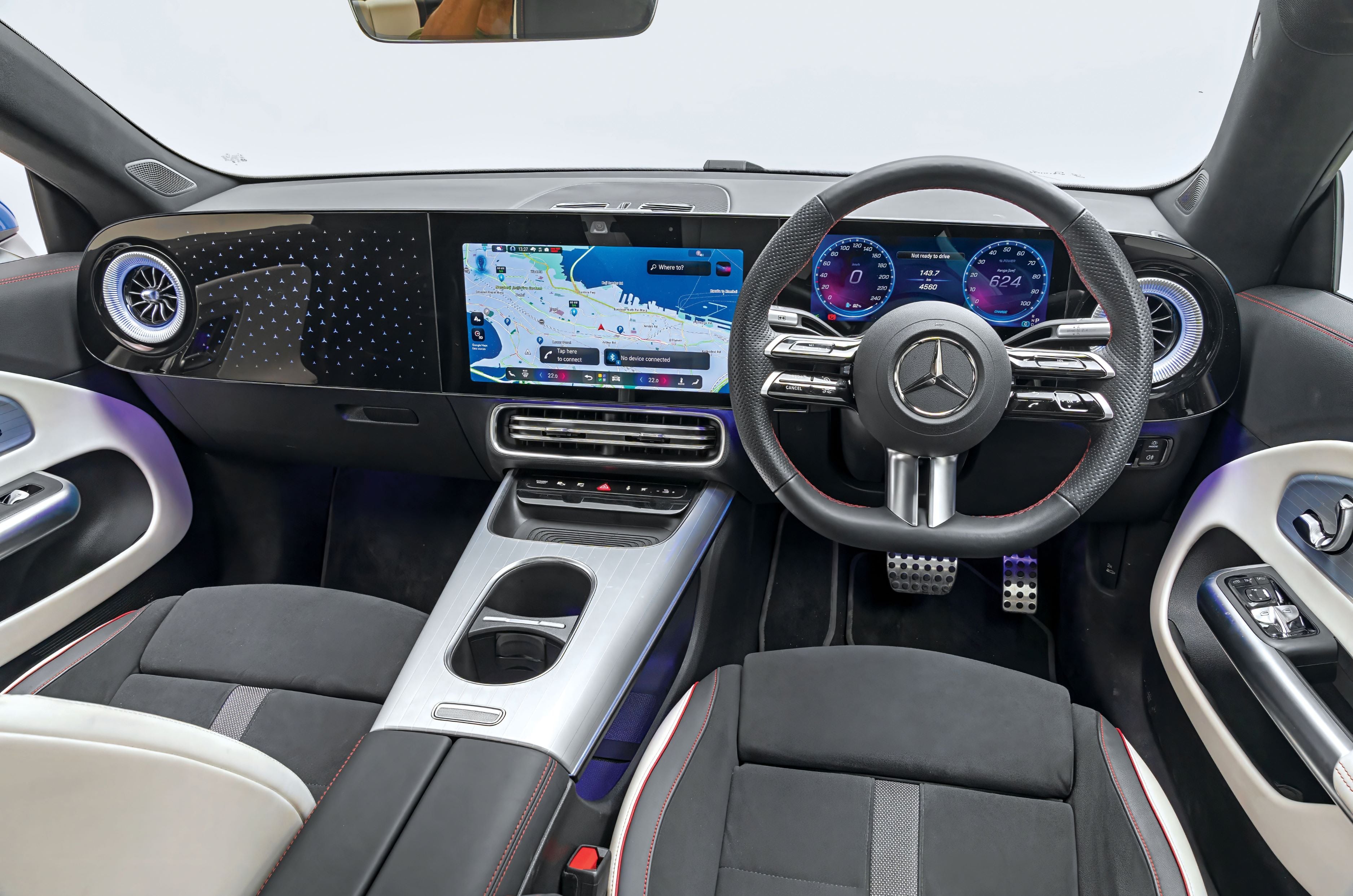
That new-age Mercedes vibe continues inside too, and that feeling is all thanks to a 39-inch Hyperscreen that extends nearly the entire width of the dash. There’s a seamless connection between the digital instrument cluster, the centre touchscreen and front passenger display, and it does look really impressive. That being said, the screens have taken away some of the warmth that you’d expect in a Merc.
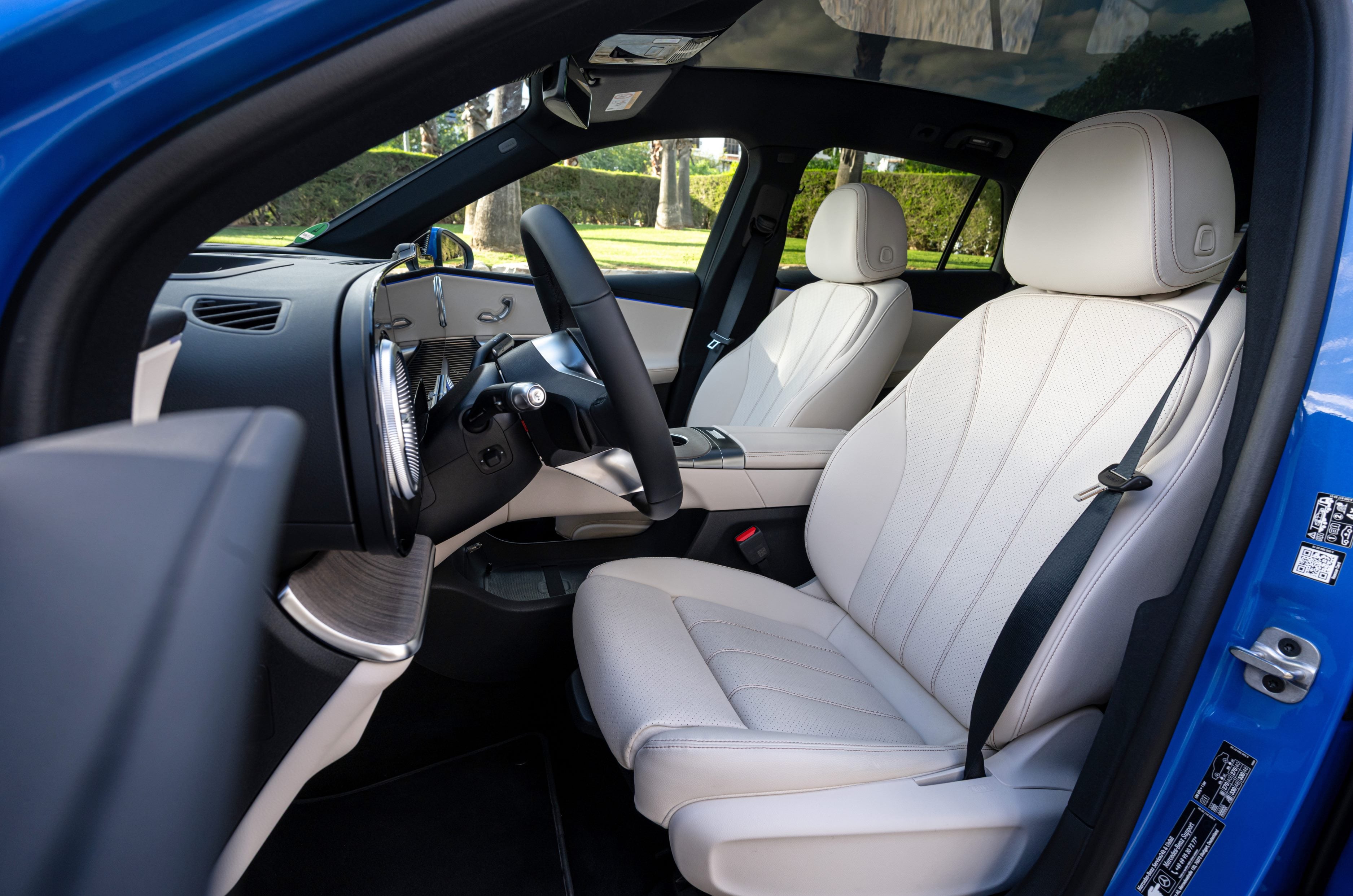
Comfy front seats come with various levels of adjustment, massage and heating. India-spec model expected to come with a cooling function.
In terms of quality, though, the GLC EV feels like an expensive Mercedes. There’s open-pore wood, the AC vents operate with very satisfying clicks and clacks, and physical rotary controllers make a welcome comeback to the steering wheel.
The front seats are as comfy as they look, with multi-way powered adjustment, massage and heating. We expect the model for India to pack in ventilation as well.
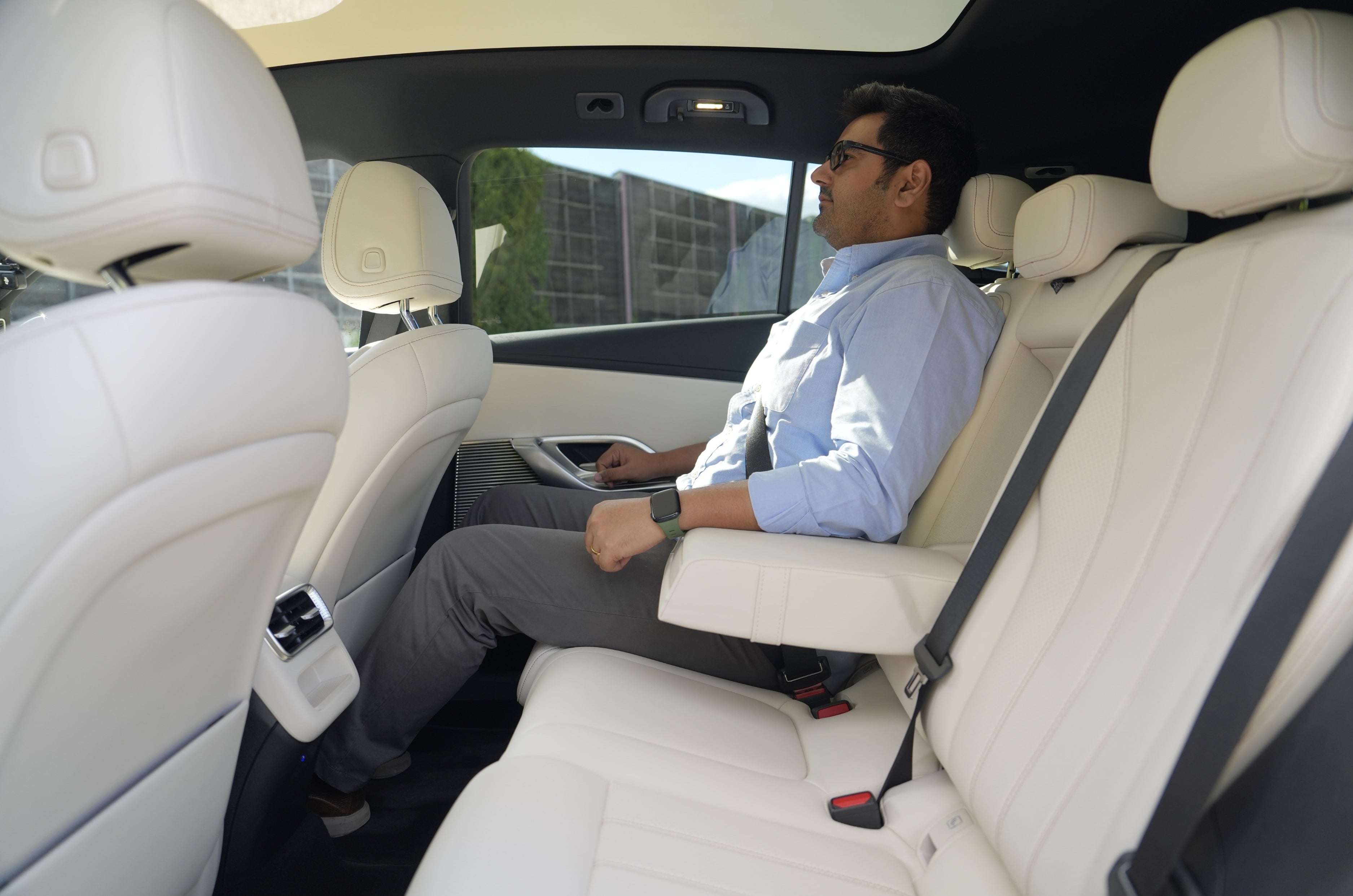
You get more space than the standard GLC, and unlike some EVs, you do get good foot room. However, it’s best suited for two.
It’s at the back where things get really interesting for buyers confused between a GLC and a GLC EV. Rear seat space is a bit more generous than the standard GLC. There’s also good foot room under the front seats, which is not something you can say about all EVs, and even the seating position isn’t the typical knees-up that we’ve come to associate with EVs. A longer seat squab would have upped the experience. Also, the rear seat is best for two. A middle passenger will have to contend with a high centre tunnel.
Mercedes-Benz GLC EV Features and Safety – 9/10
The Hyperscreen is the focal point of the dash and delivers brilliant graphics across the entire display. The digital dials, centre touchscreen and passenger screen appear to be part of a seamless display and look terrific. There are themes for the screen too that also adjust other functions for the full effect. For instance, a bonfire on the screen will be accompanied by the seat heating coming on.
Massive 39-inch hyperscreen has a good UI and seamlessly integrates with other in-car displays but packs in too many functions.
The thing is, there’s just too much packed onto the centre touchscreen. The UI is good but more physical controls would just make life easier. The passenger display is slick in its own right but only blanks out if it detects the driver looking at it (a camera on the dash monitors the driver’s gaze). A privacy glass would have just been better.
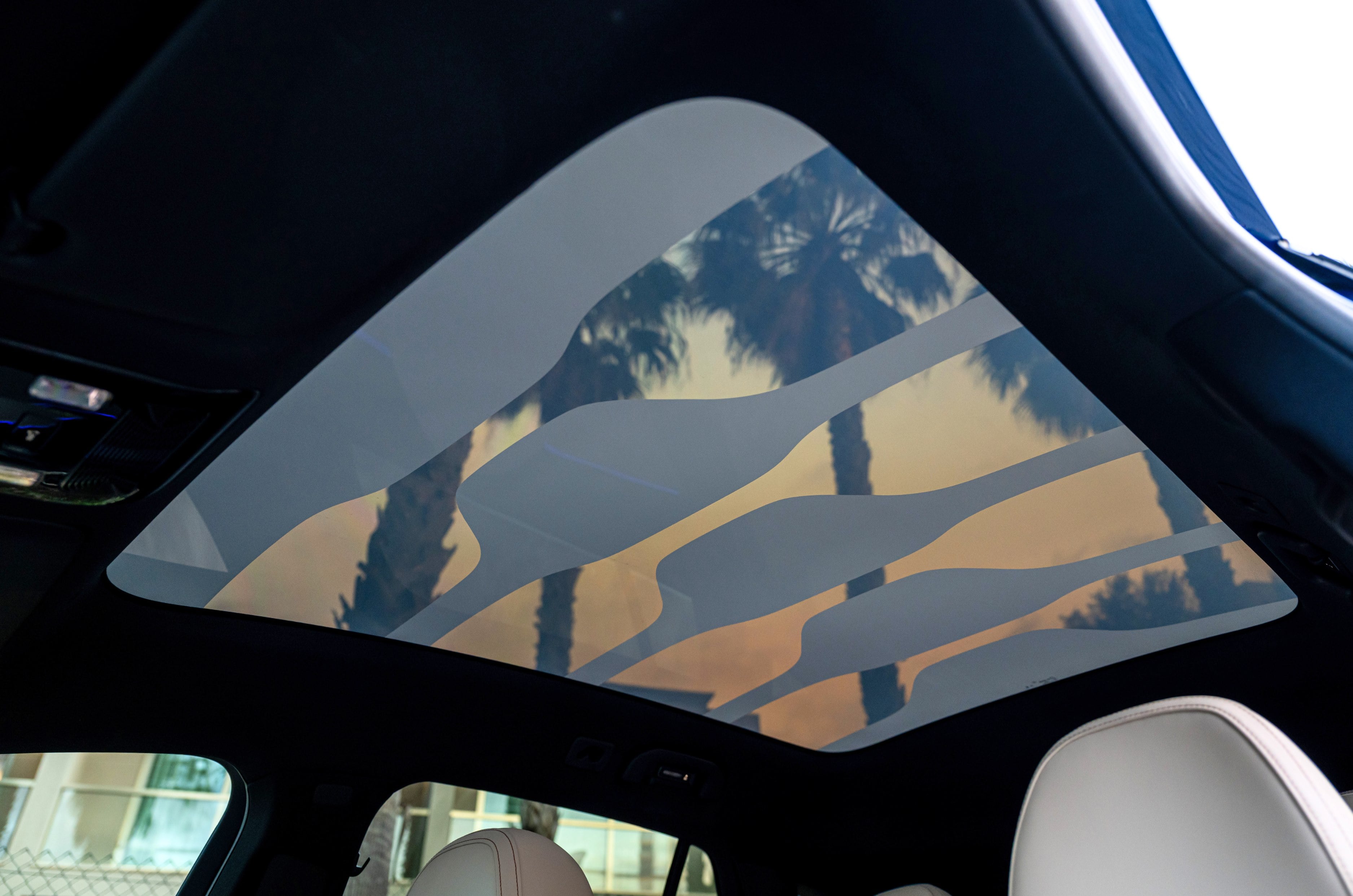
Among the other features, the panoramic glass roof is made up of nine segments which can be individually controlled for transparency. You can make them completely opaque, and they did a surprisingly good job of keeping the heat out. You could even have the glass roof specced with 162 stars that change colour with the ambient lighting.
Panoramic glass roof comprises nine individually configurable segments to control transparency.
Features-wise, aside from the screens and glass roof, the other highlight is the Burmester 4D sound system with exciters in the seat, so you can actually feel the bass. The head-up display and cameras are also top-class, while the AI integration doesn’t feel like a tick-mark item. You can actually converse with your car for restaurant recommendations or even abstract general knowledge.
The safety suite includes 9 airbags, ESC and a full suite of ADAS features.
Mercedes-Benz GLC EV Performance and Refinement – 9/10
Your friendly Mercedes salesperson will only be too happy to run you through the GLC 400’s big numbers: 489hp, 800Nm and a 4.3 sec 0-100kph time. The figures are made possible by front and rear permanently excited motors that draw power from a 94kWh battery pack.
489hp from its dual motors makes the GLC EV feel like an AMG compared to its ICE counterpart.
How does it all come together? The first thing that gets you is the silence. The drive experience is just what you’d expect in a plush Mercedes electric car. So it’s really quiet, and you don’t hear much of the world outside. There is a bit of wind noise if you really pay attention, but honestly, with some music piping out of the Burmester sound system, it’s not something that will catch your attention in the least.
What’s also clear is that the GLC EV is the strong and silent type. The performance makes the GLC EV feel like an AMG compared to the standard GLC petrol and diesel. A two-speed gearbox ensures quick getaways when needed, as well as the long legs for a more relaxed drive. Stomp down on the accelerator from a steady cruise, and you can feel the kickdown.
You won’t need to drive like a hoon to enjoy the GLC EV. Performance, no surprises, is very brisk when you put some weight on the accelerator pedal, with easy access to power. You can make the GLC EV feel a bit more urgent when you play around with the drive modes, but honestly, you won’t really need to because of how friendly the power feels and how ready the GLC EV feels at all times.
Power is easily accessible and is ready to push further when you put your foot down.
You’ll also take very naturally to the regen braking levels. One-pedal driving is included, and there’s the option of an intelligent mode too that reads the driving environment and optimises regen force.
The GLC EV also gets sound profiles, and we have to say they’re a bit unusual. They’re not trying to mimic the sound of a V8 or a V6 or any kind of ICE engine. The sounds are more on the sci-fi spectrum, so if you accelerate hard, you’d get the feeling of being in a UFO, which is disconcerting, if we can be honest. We’d rather enjoy the quiet inside.
Mercedes-Benz GLC EV Range and Efficiency – 8/10
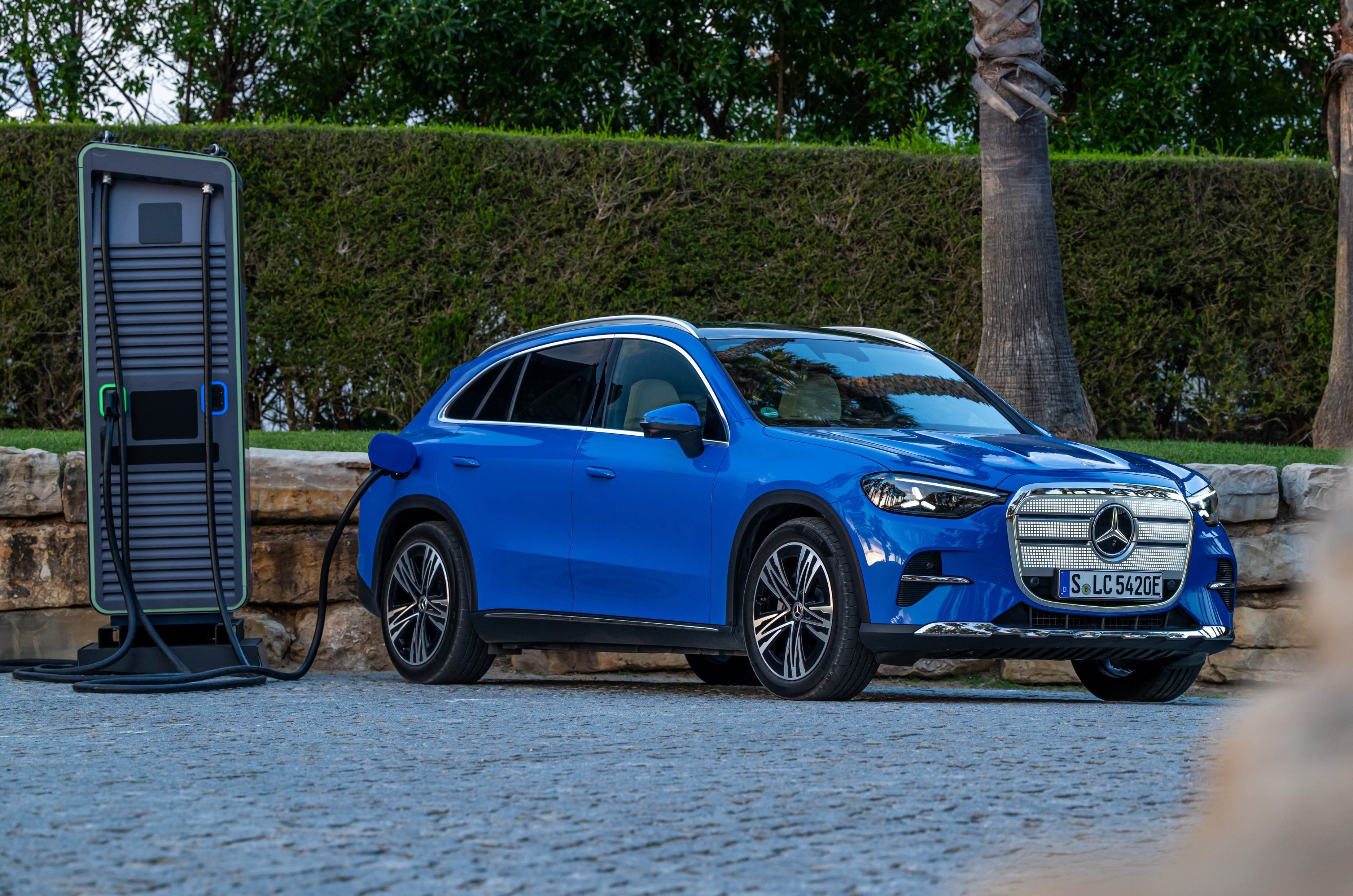
Its large 94kWh battery can be charged from 10-80 percent in 22 minutes with a 330kW DC fast charger.
Now, on to the matter of range. Mercedes claims a 715-kilometre range on the WLTP cycle. Even if you account for real-world Indian conditions, you’re looking at a comfortable range of over 550 kilometres. Drive with a bit of care, and you could see that figure go past 600 kilometres. We really have come a long way in just a few years, haven’t we?
Of course, the go-to charging solution for most owners will be home charging. There’s up to 22kW AC support. The GLC can also be charged at up to 330kW using DC charging. Theoretically, at max speed, the GLC EV’s 94kWh battery can be juiced up from 10 to 80 percent in 22 minutes. A 10-minute charge alone can give you 300 kilometres of range.
Mercedes-Benz GLC EV Ride Comfort and Handling – 8/10
We can’t give a definitive verdict on cornering ability, as the bulk of our route was on the Autobahn outside Stuttgart, which has the gentlest of curves.
At Autobahn speeds, the GLC EV feels really planted and drives like a proper German car should. There’s pleasant weight at the steering wheel as well.
In terms of high-speed ride comfort, the GLC EV doesn’t come across as softly sprung as something like an EQS SUV, which really feels a bit roly-poly. There is still some vertical movement even when you switch to Sport mode, but it’s not to the point of being an irritant.
Feels planted out on the Autobahn and the steering is well-weighted
We’ll reserve judgement on the air suspension’s bump absorption till we drive the GLC EV on our roads, but on the sole patch of broken road on our route, the GLC EV didn’t feel entirely plush. Perhaps that’s something for Mercedes India to have on their list of things to do for the version headed our way.
A cool feature on the GLC’s suspension is its use of Google Maps to identify the vehicle’s environment and adjust ride height. For instance, the car automatically lowers on a highway. Also cutting-edge is how the suspension preps damping force in advance of a bump based on Car2X information from a Mercedes vehicle driving ahead. The systems better be up for the challenge of our roads.
Bundled in with air suspension is rear-axle steer, and the 4.5 degrees of movement does help greatly at parking speeds.
Mercedes-Benz GLC EV Should You Buy Now or Wait – 9/10
Bookings for the GLC EV open in early October, and the model will be launched in India within 2026.
It’s a big deal because the GLC EV comes to India within just six months of its European rollout. What makes the timeline even more impressive is the fact that the GLC EV won’t be an import, but will be assembled in India. Local assembly points at keen pricing.
The GLC EV will be locally assembled 6 months after its European version goes on sale.
We expect the model to be priced at about Rs 85-90 lakh (estimated, ex-showroom), which wouldn’t be all too far from the ICE GLC’s price. Factor in the registration benefits on EVs, and the price gets more tempting still.
As a product, the GLC EV does have lots going for it. It’s got the power, the refinement and the tech you’d expect on a luxury EV. Importantly, it doesn’t feel like your dad’s Mercedes, and that new-age cool is something many buyers will resonate with.
BMW’s iX3 Long Wheelbase and Audi’s Q6 e-tron are alternatives to watch out for in 2027, but in the near future, the GLC EV looks set for a clean run.
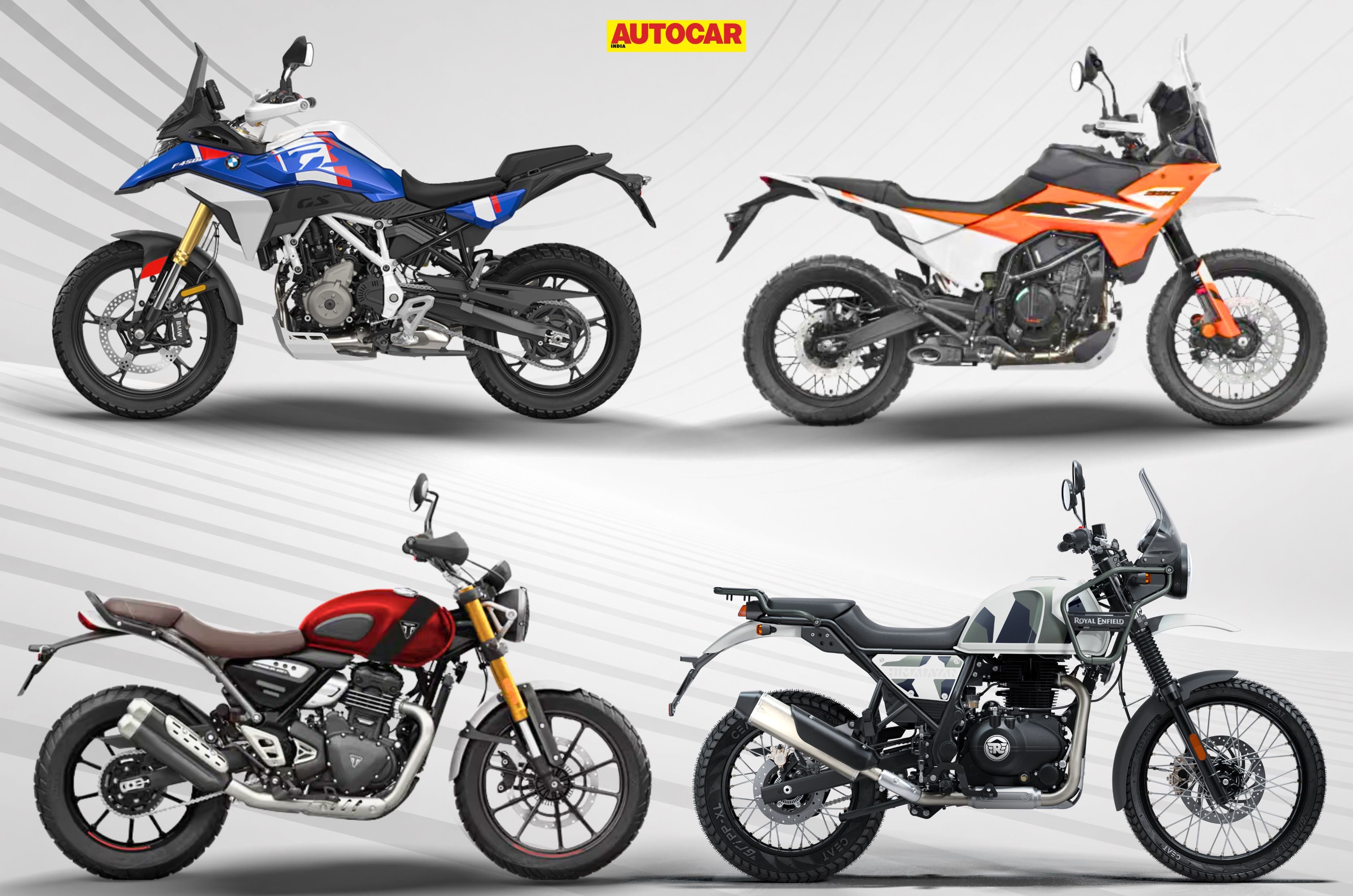
Ten years ago, Royal Enfield made adventure tourers mainstream with the original Himalayan 411 and the segment has slowly, but surely grown since. As with any other thing that gains popularity, this segment also has gained different kinds of options. On the one hand, we have the V-Strom that’s effectively a Gixxer 250 on stilts, and on the other, we have the KTM 390 Adventure S that looks to strike a fine balance between both adventure and touring capabilities. Admittedly, this can get a bit overwhelming, so here are all the adventure touring motorcycles you can buy in India right now between Rs 2-5 lakh.
All prices mentioned are ex-showroom, Delhi.
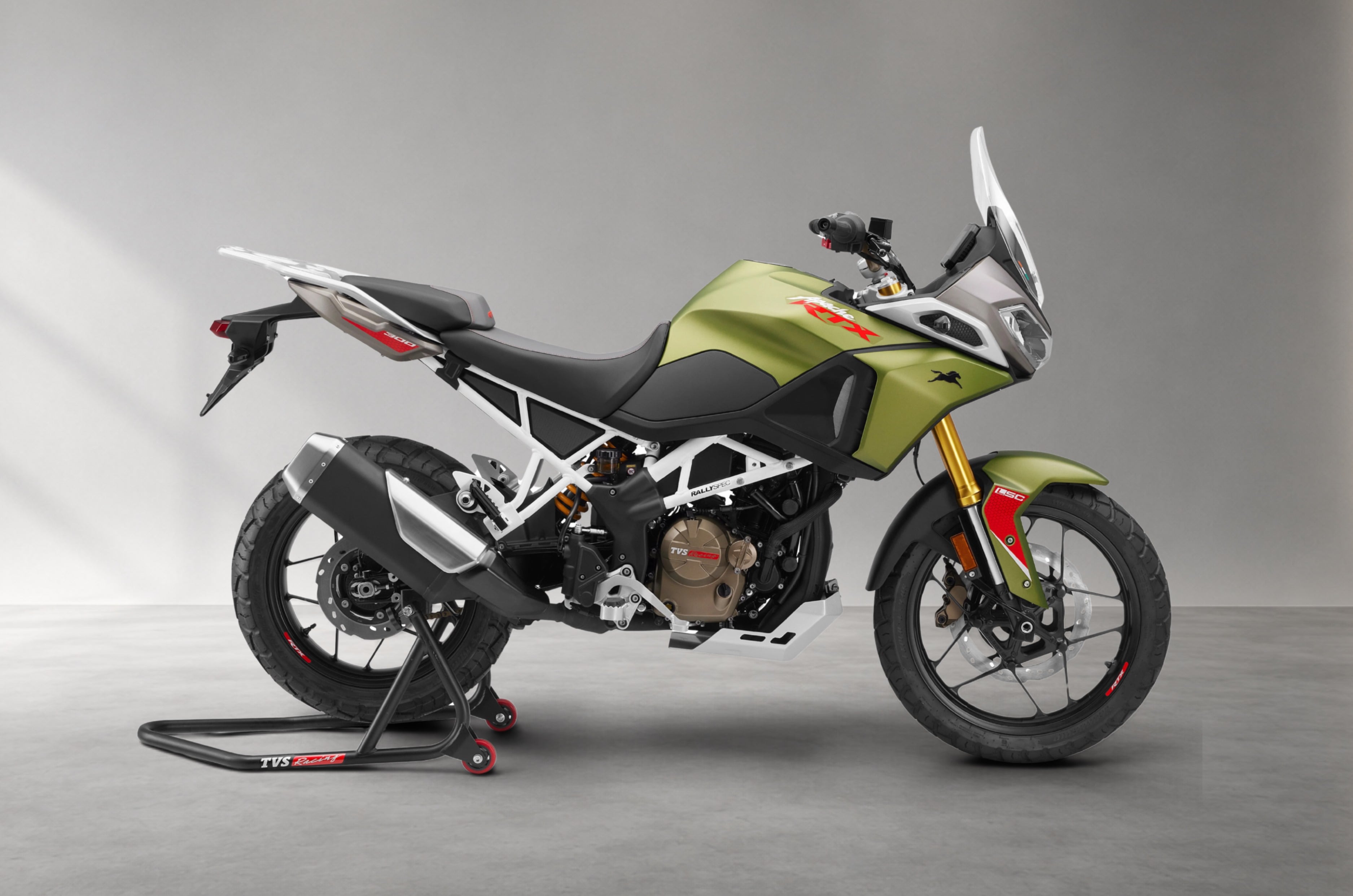
11. TVS Apache RTX 300
Starts at Rs 1.99 lakh
TVS is the most recent (new) entrant into the segment, with the Apache RTX 300 redefining how many features you can pack into on a relatively affordable budget. The RTX’s 299.1cc single-cylinder, liquid-cooled engine with 36hp and 28.1Nm of torque isn’t the most exciting but has the ability to keep going as long as you’re willing to, except for the oddly small 12.5-litre fuel tank. The TVS sticks to a 19/17 front/rear wheel setup and only comes with alloy rims.
TVS offers four ride modes and cruise control as standard with the higher variants stepping that up to a bi-directional quickshifter, traction control, and Google Maps mirroring on the 5-inch TFT screen. It also has a very good headlight as standard, and the top BTO variant adds adjustable suspension too, both aimed at increasing the sense of safety and comfort. The 835mm seat height and 180kg kerb weight combo might look daunting on paper, but they aren’t a big hindrance in practice.
The TVS Apache RTX 300 spans Rs 1.99 lakh for the Base variant and Rs 2.39 lakh for the BTO variant.
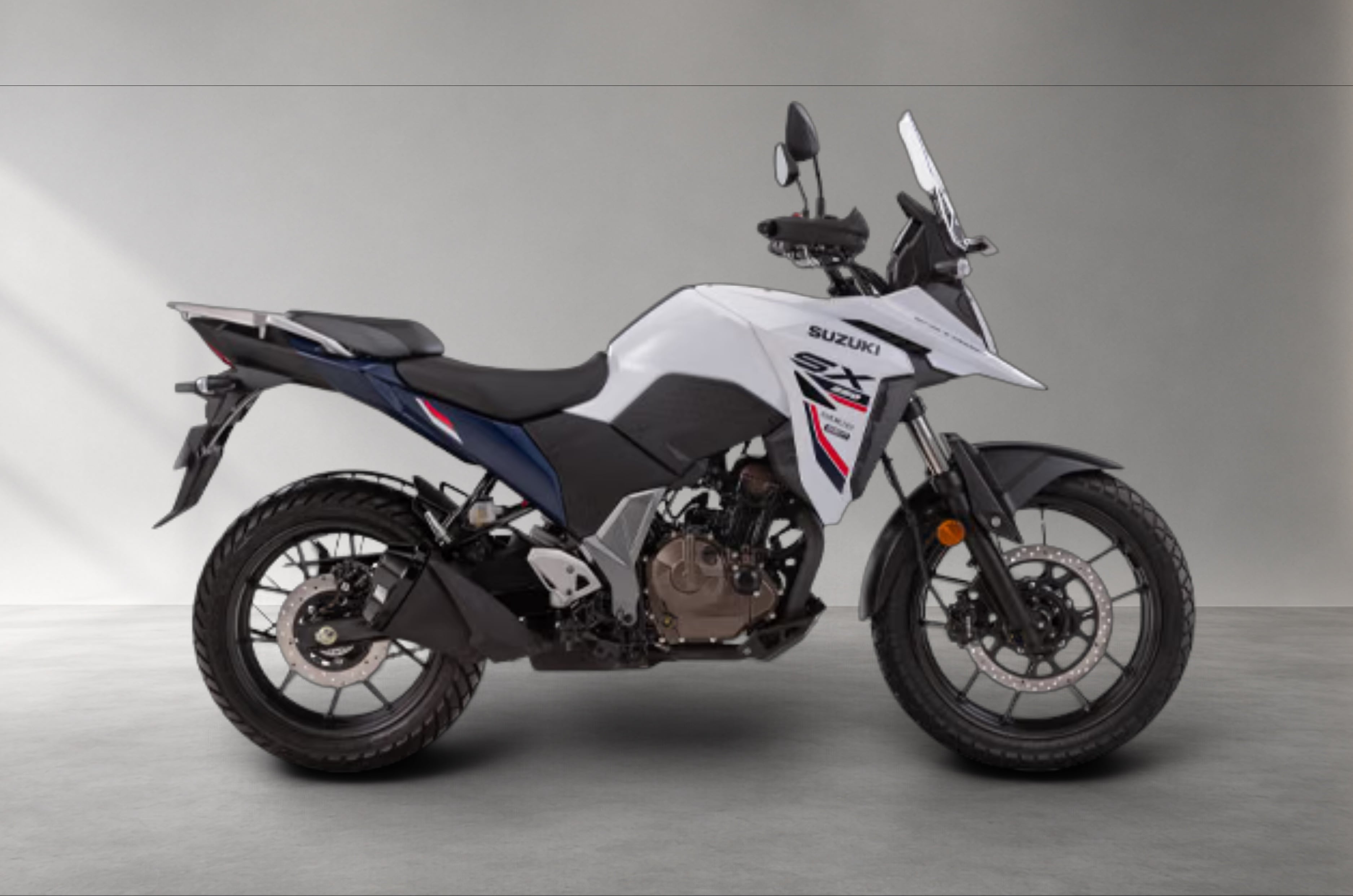
10. Suzuki V-Strom SX
Rs 2.01 lakh
Suzuki’s adventure tourer is mostly a tourer because it is a re-engineered Gixxer 250 with a taller stance. But, don’t let that stop you from considering it seriously because its 249cc engine with 26.5hp and 22.2Nm of torque has more than enough to make long days seem effortless. The 12-litre fuel tank capacity seems small on paper, but it is possible to make the Suzuki quite efficient. It has a 835mm seat height, but the 167kg kerb weight softens that blow.
As is typical for Japanese products in this class, the V-Strom SX is light on features, with dual-channel ABS the only rider aid on offer. However, it also makes a great case for reliability, helped further by Suzuki’s brand cachet. The Suzuki runs on 19/17 front/rear wheels and only gets alloy rims.
The Suzuki V-Strom SX has a single variant and costs Rs 2.01 lakh.
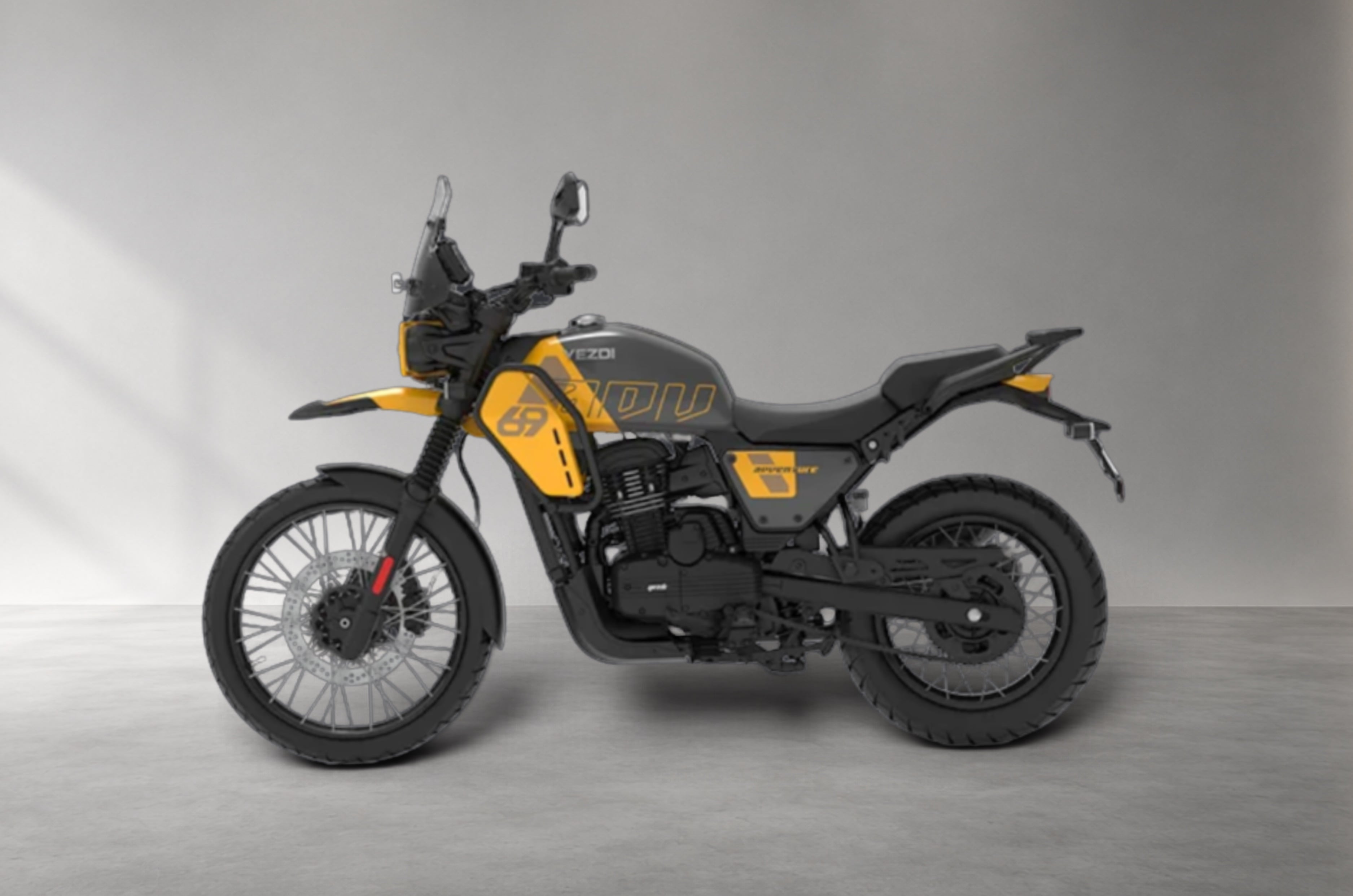
9. Yezdi Adventure
Starts at Rs 2.06 lakh
Classic Legends’ Yezdi had comprehensively upgraded their adventure tourer earlier this year. The 334cc engine is now liquid-cooled and makes 29.6hp and 29.8Nm of torque. The fuel tank capacity is a healthy 15.5 litres and the Yezdi Adventure has a 815mm seat height and weighs about 198kg.
Along with an updated design, the Adventure gained features like an asymmetrical dual headlamp, all LED lighting, three ABS modes, traction control and a rerouted exhaust for better heat management. Yezdi also offers tubeless, cross spoke wheels as accessories for Rs 20,000 extra, if you’d like to embrace the adventure look with the convenience of tubeless tyres. Standard fitments are 21/17 front/rear tubed, wire-spoke wheels.
The Yezdi Adventure starts at Rs 2.06 lakh for the base Nebula Blue White colour and goes up to Rs 2.13 lakh for the top Yellow Falcon colour.
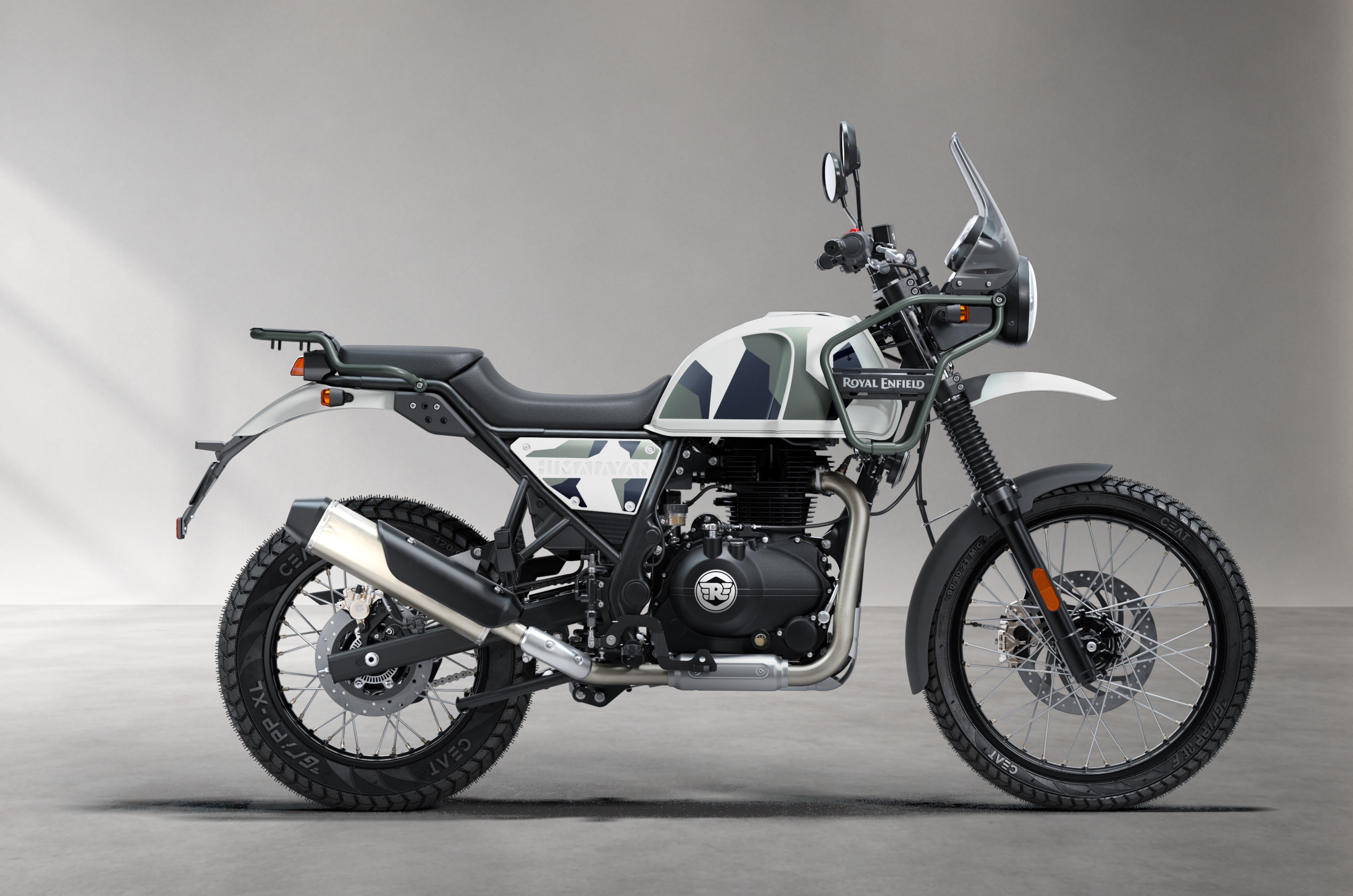
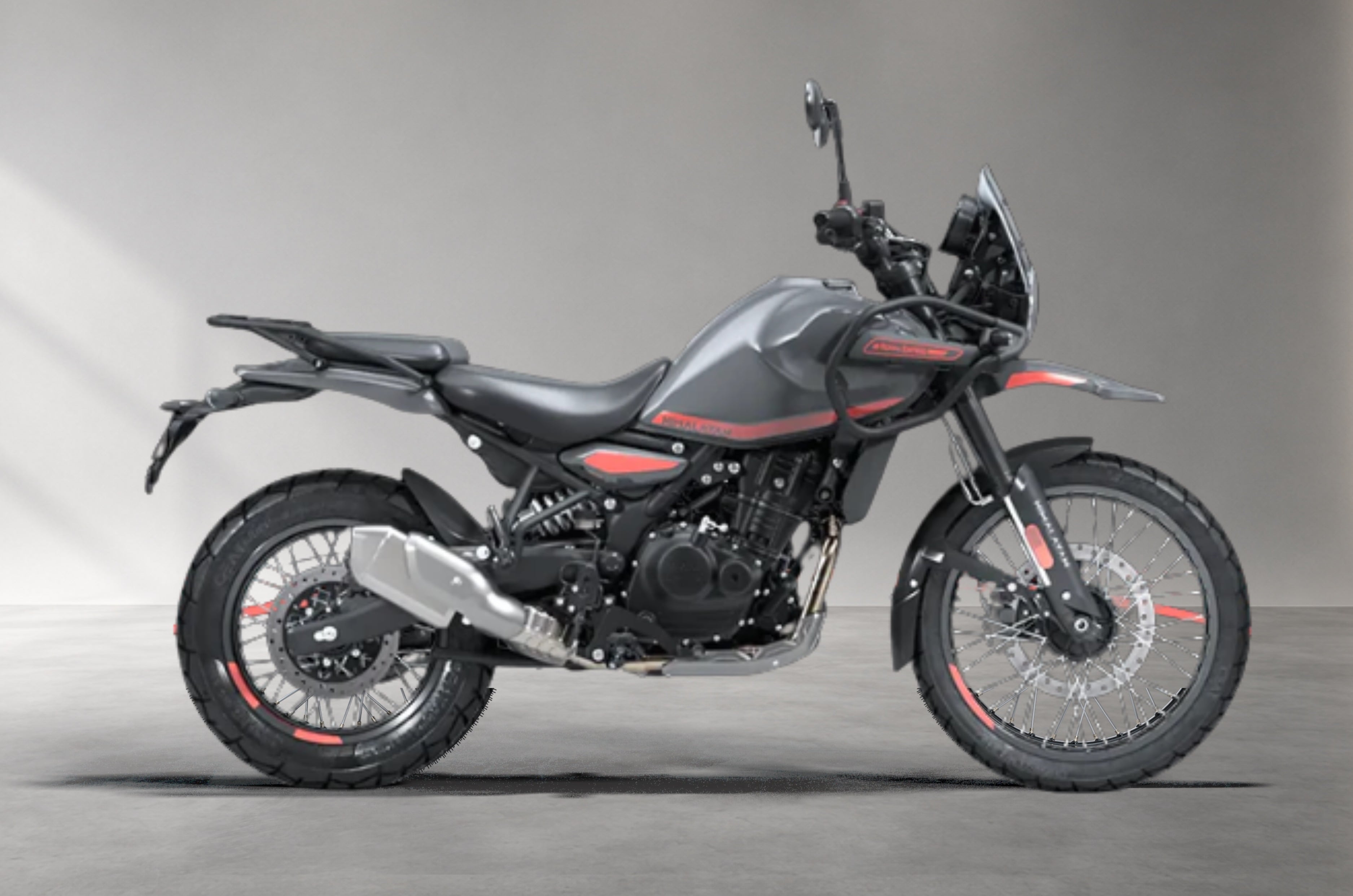
8. Royal Enfield Himalayan 440
Rs 2.29 lakh
Royal Enfield has resurrected the air/oil-cooled Himalayan 440 for 2026. The 443cc engine (shared with the Scram 440) makes 25.4hp and 34Nm of torque and the Himalayan stays true to its roots by only offering switchable dual-channel ABS and the Tripper navigation pod as notable features. The seat height remains at 800mm, as does the fuel tank capacity at 15 litres; which also means the weight remains unchanged at 199kg as well. Royal Enfield has stuck to a tubed 21/17 wheel setup on the Himalayan 440.
Most of the mentioned specifications, are common to the Scram 440. Its base variant starts lower at Rs 2.25 lakh for wire spoke rims, and the higher variant offers alloy rims at Rs 2.32 lakh.
Uncharacteristic for Royal Enfield, all three colours of the Himalayan 440 cost the same Rs 2.29 lakh.
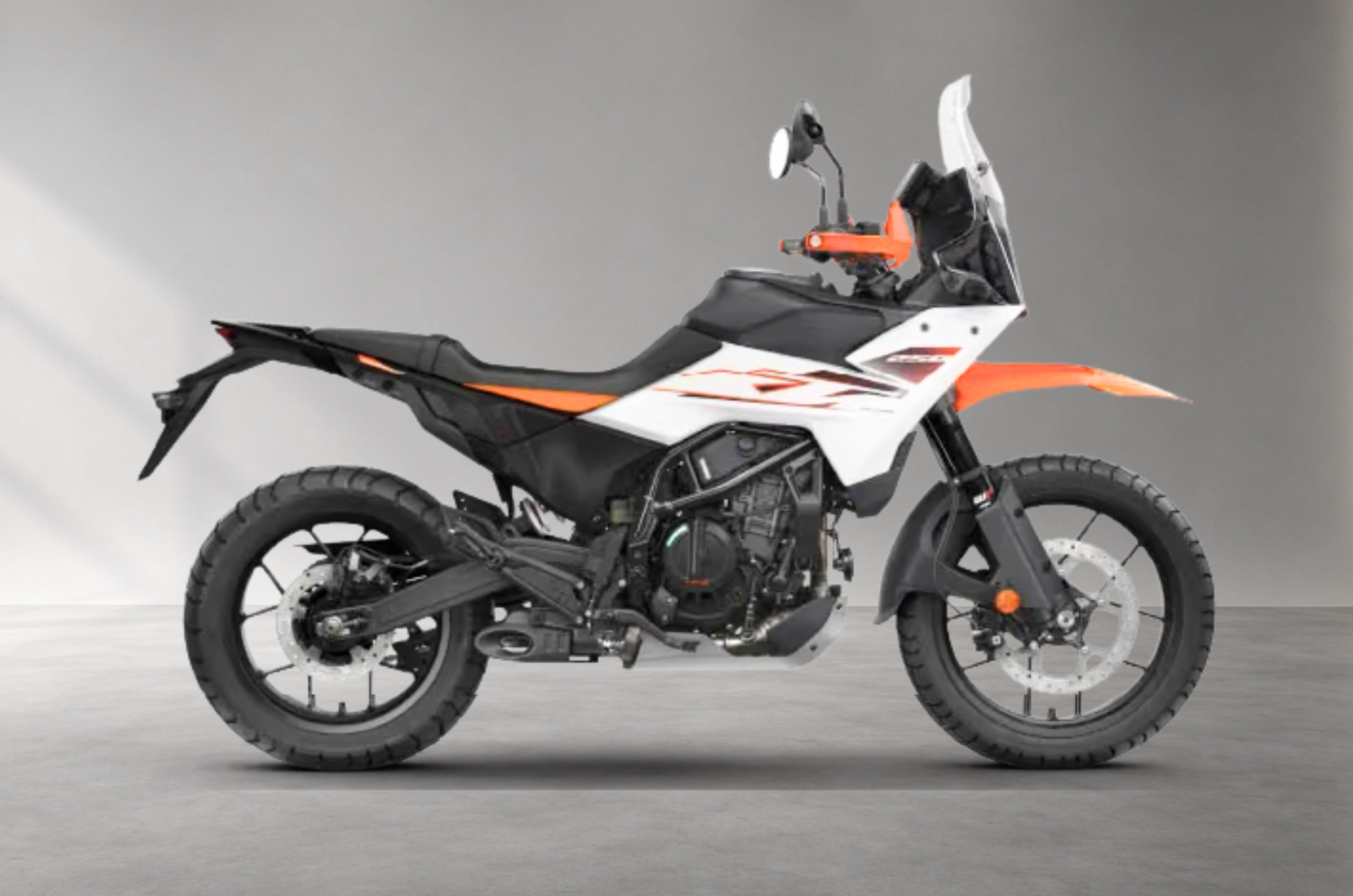
7. KTM 250 Adventure
Rs 2.53 lakh
KTM’s entry-level adventure tourer is the 250 Adventure, which shares its engine with the 250 Duke and its platform with the bigger brothers. Its 249.07cc engine makes 31hp and 25Nm of torque. The fuel tank capacity is 14.5 litres, seat height is at 825mm, and kerb weight is 176kg.
Being the entry-level opinion, KTM has kept things simple in terms of features. It gets a bi-directional quickshift, a slip-and-assist clutch, and two ABS modes. For fancy features like ride modes, cruise control etc., you’ll have to step up the 390 Adventure with the 350cc engine (also on this list). The 250 Adventure runs on 19/17 front and rear wheels with alloy rims.
KTM offers a single variant for the 250 Adventure and has priced it at Rs 2.53 lakh.
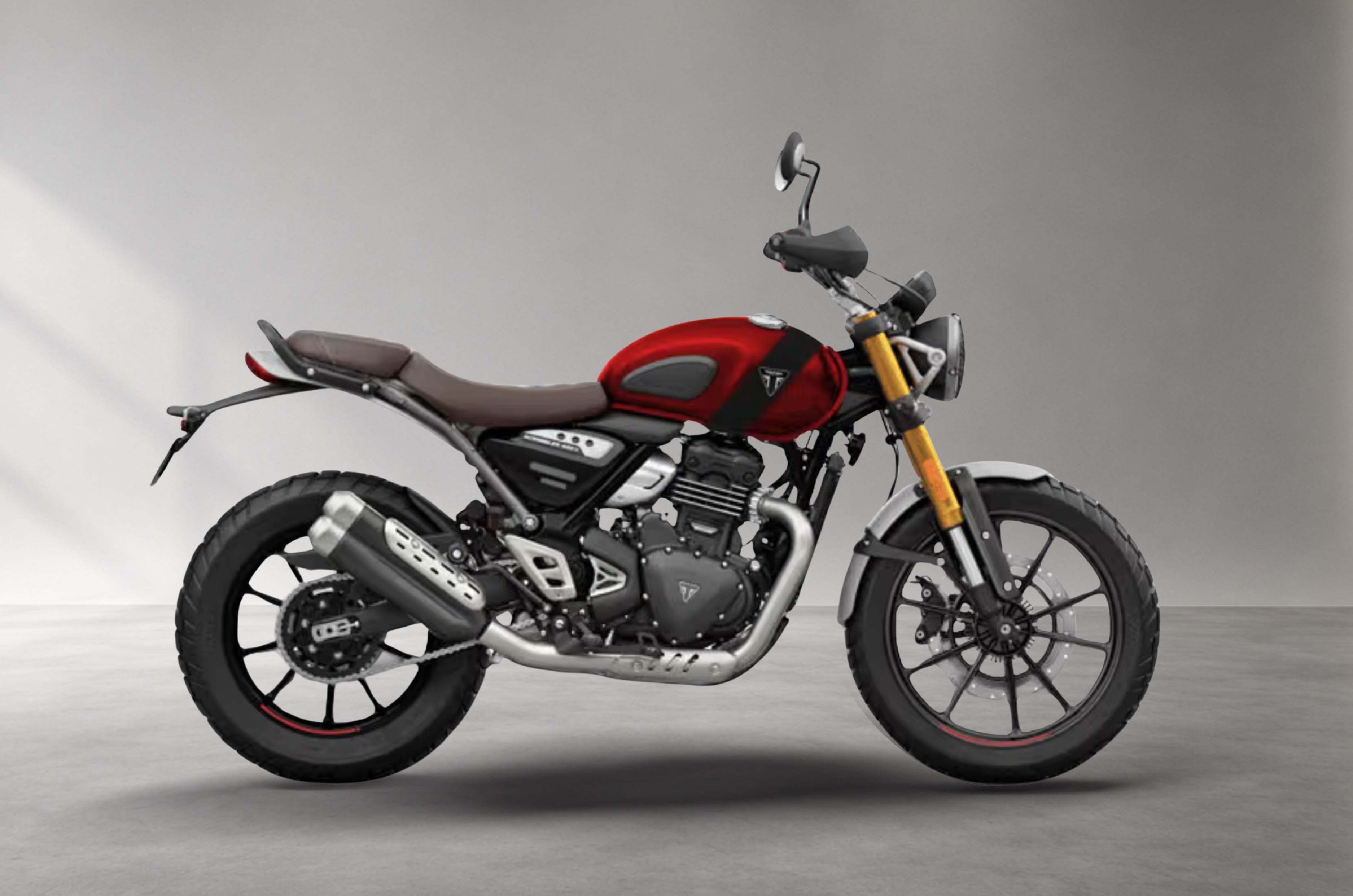
6. Triumph Scrambler 400 X
Rs 2.65 lakh
Technically, the Scrambler 400 X isn’t an adventure tourer, but in the absence of a Tiger 400 (so far), it is the closest Triumph (and Bajaj) offers to one in India. With the downsizing, the Scrambler’s 349cc liquid-cooled engine makes 37hp and 32Nm of torque. The Scrambler 400 X has a 13-litre fuel tank, seat height is at 835mm and kerb weight is 185kg.
The Scrambler offers switchable dual-channel ABS, a slip-and-assist clutch, and traction control as standard rider aids. It comes with 19/17 front/rear wheels and only offers alloy rims in the X guise.
Triumph Scrambler 400 X is priced at Rs 2.65 lakh, but if you want to turn up the ADV look, there’s also a Scrambler 400 XC with tubeless cross spoke wheels and more accessories as standard for Rs 2.99 lakh. However, for all intents and purposes, the X and XC are near-identical.
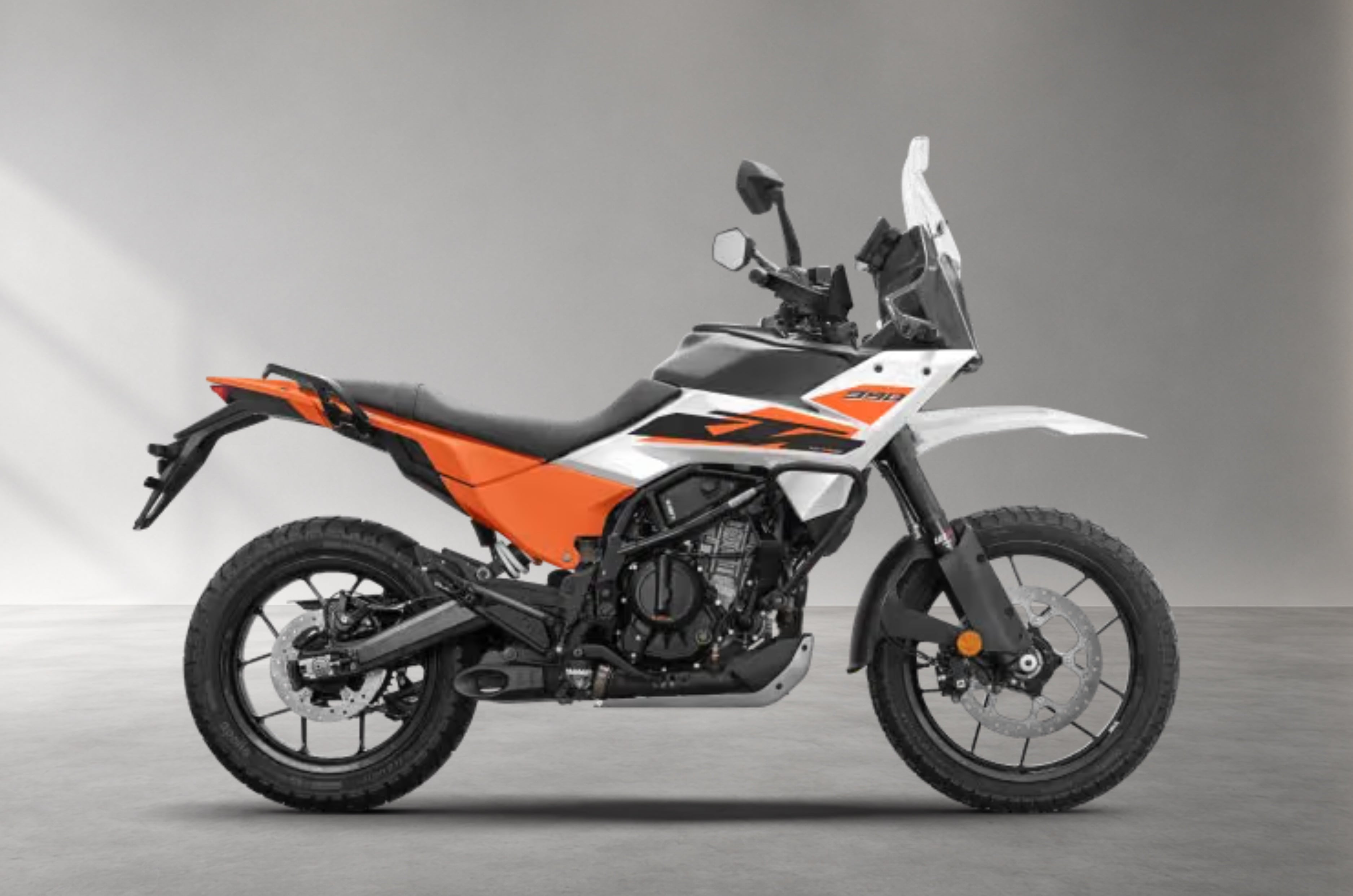
5. KTM 390 Adventure (350cc)
Rs 2.87 lakh
KTM’s downsizing brought down the 399cc Adventures into 349.32cc, with the smaller engine making 41.5hp and 33.5Nm of torque. In terms of specification, the 350cc Adventure is pretty middle ground with a 14.5-litre fuel tank, 181kg kerb weight and 825mm seat height.
Besides the RTX 300, this is the only other motorcycle on this list under 3 lakh to offer cruise control as standard. It gets three ride modes, a bi-directional quickshifter, traction control, a 5-inch TFT screen, among other things. This version of the Adventure comes exclusively with 19/17 front/rear wheels and alloy rims.
The KTM 390 Adventure has a single variant with two colours and is priced at Rs 2.87 lakh.
4. Royal Enfield Himalayan (450)
Starts at Rs 3.08 lakh
Royal Enfield’s Himalayan (450) gets quite a bit over its older/younger brother. Its engine is liquid-cooled (vs air-cooled on the 440) with 40.02hp and 40Nm of torque. Built on a completely new platform, the Himalayan 450 is three kilos lighter than the 440 at 196kg, and gets a markedly larger 17-litre fuel tank. The standard seat height ranges between 825-845mm, but it’s possible to drop that to 805mm with an accessory low seat.
On the features side too it offers a lot more than the 440, with a 4-inch TFT display with Google Maps powered navigation, two ride modes, and a slip-and-assist clutch. The Himalayan 450 comes with 21/17 front/rear wheels with tubed, wire-spoke rims as standard on the lower variants. However, on the top Mana Black variant Royal Enfield bundles tubeless, cross spoke rims as standard.
The Royal Enfield Himalayan starts at Rs 3.08 lakh for the base Kaza Brown colour and goes up to Rs 3.39 lakh for the Mana Black colour.
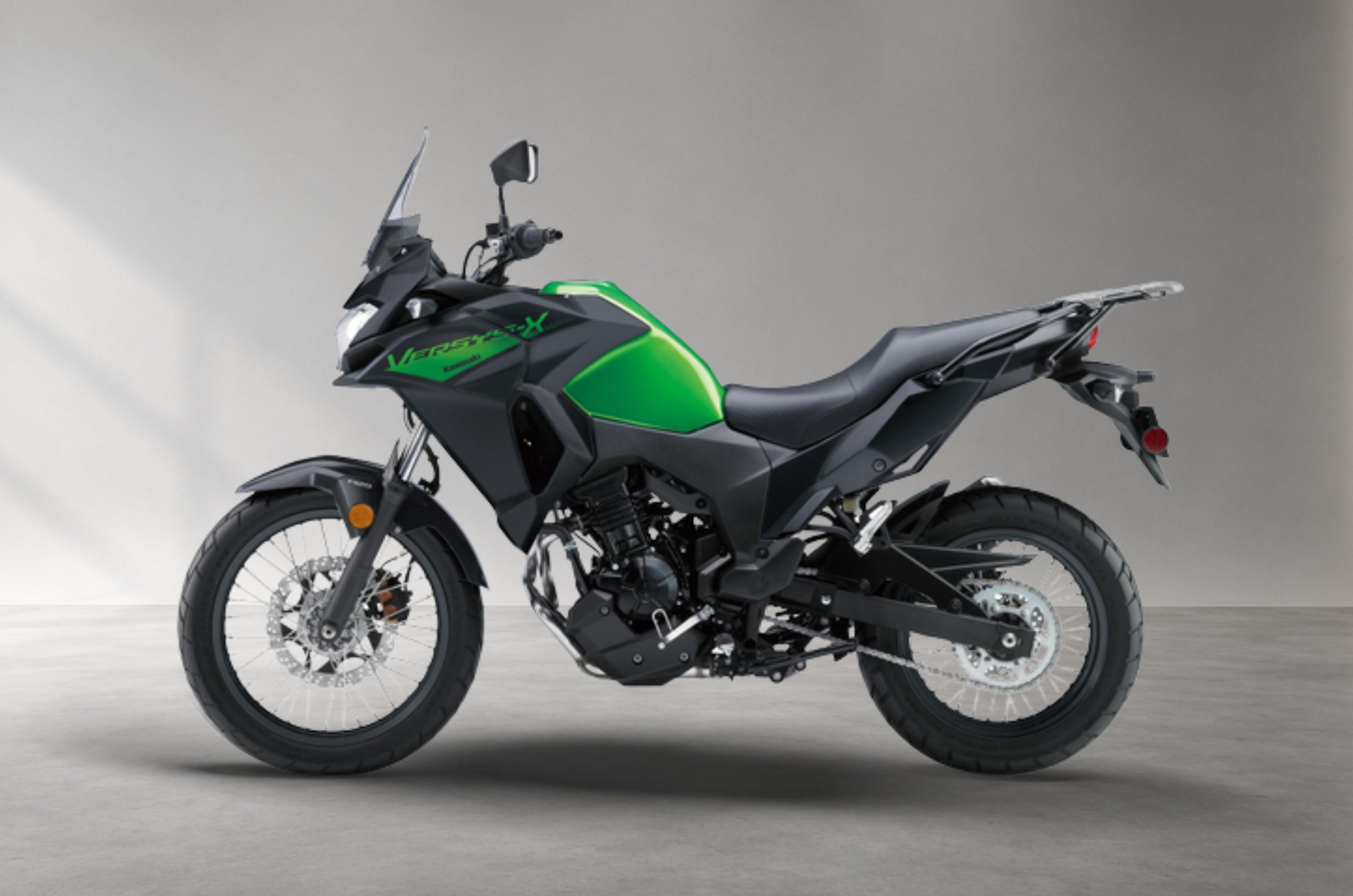
3. Kawasaki Versys-X 300
Rs 3.49 lakh
The Kawasaki Versys-X 300 is one of two twin-cylinder options in this list. Its 296cc parallel-twin makes 39hp and 26Nm of torque and it’s liquid-cooled as well. It might just be the most accessible motorcycle on this list with a 175kg kerb weight, and an 815mm seat height.
Similar to the V-Strom 250 SX, the Versys-X 300 also maintains a slim list of features, dual-channel ABS and a slip-and-assist clutch. It has a 17-litre fuel tank (only one here to match the Himalayan 450), and Kawasaki only offers it with 19/17 front/rear wheels with wire-spoke rims running tubed tyres.
The Kawasaki Versys-X 300 is offered in one variant in a single Green/Black colour at Rs 3.49 lakh.
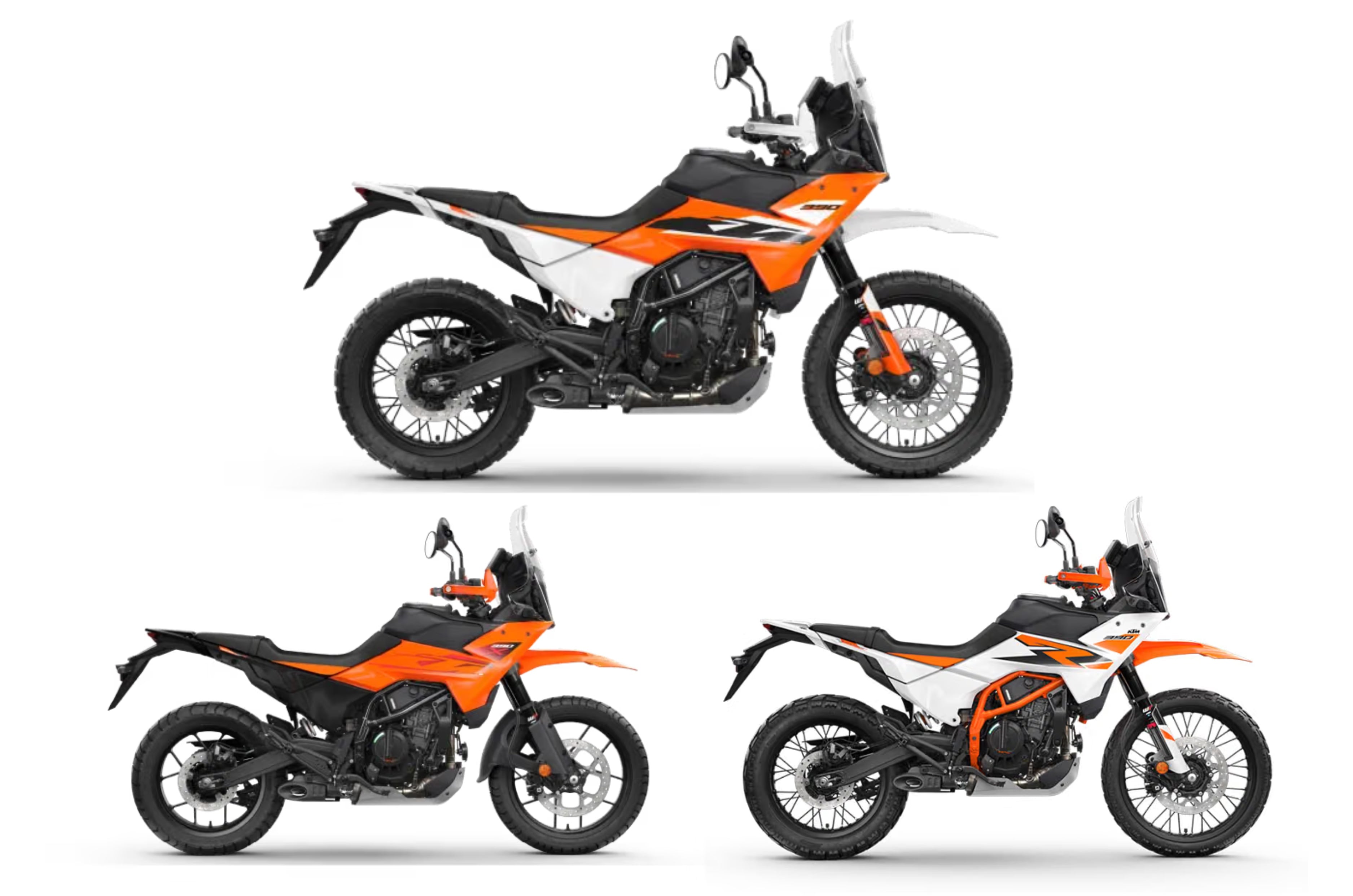
2. KTM 390 Adventure (S, X, R)
Starts at 3.50 lakh
These are the full scale 399cc engine versions of the KTM Adventure. They all make 46hp power and 39Nm of torque (4.5hp and 5.5Nm more than the 350cc engine). Fuel tank capacity is identical to the 350cc Adventure at 14.5 litres, as is the seat height at 825mm. However, the kerb weight varies across variants; the X weighs 181kg, S 182kg, and the R is the heaviest at 183kg.
The X gets an identical feature set as the 350cc Adventure, with the S stepping that up to adjustable front and rear suspension along with 21/17 front/rear wheels with tubeless spoke rims. The more off-road focussed R does not get the tubeless spoke rims, swaps the rear 17-inch wheel for an 18-inch one and runs on Mitas Enduro front and rear tyres.
The KTM 390 Adventure X is the most affordable of these three at Rs 3.45 lakh, with R taking a big step to Rs 3.86 lakh. The S is the most expensive of the bunch at Rs 4.04 lakh.
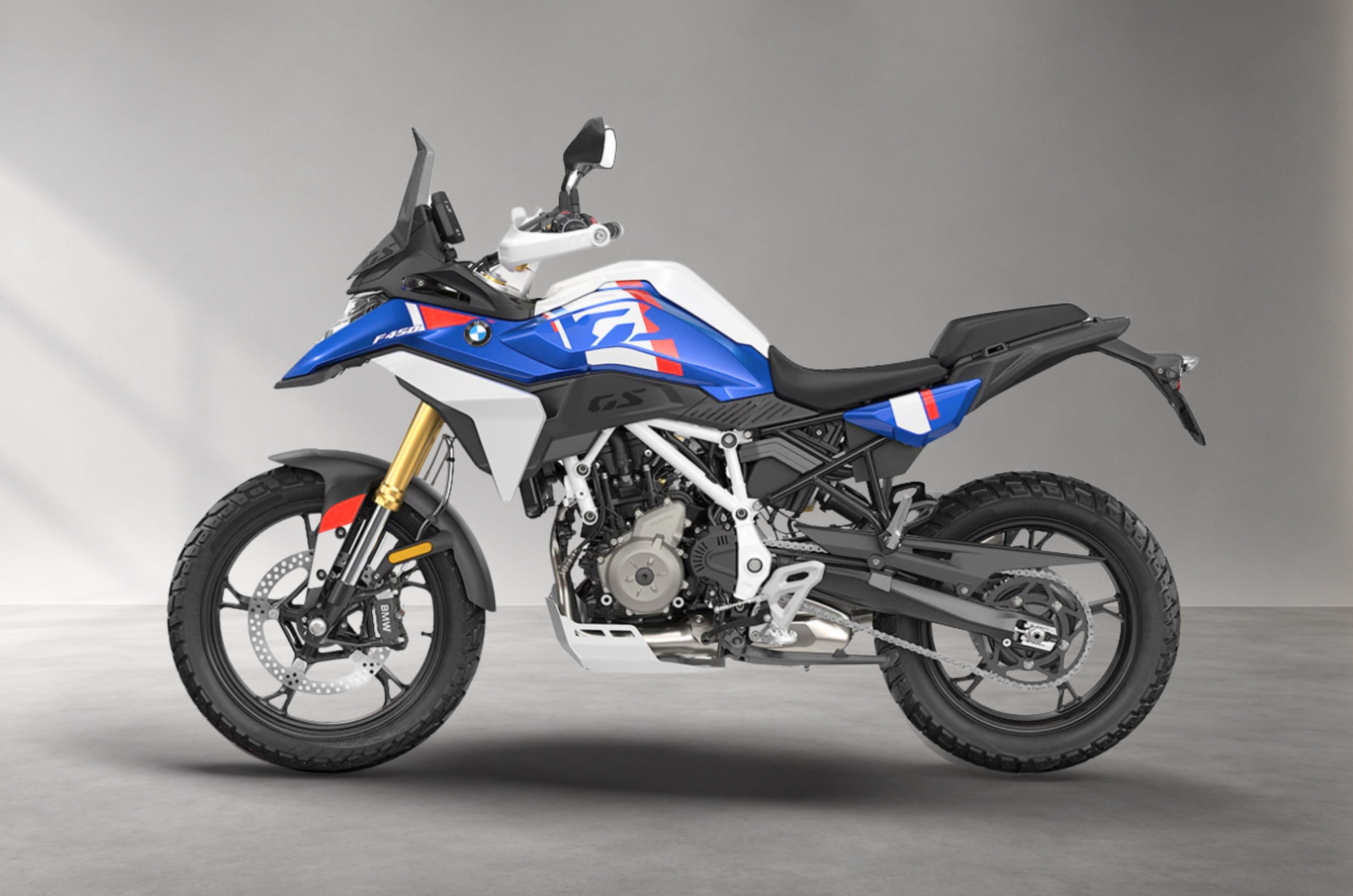
1. BMW F 450 GS
Starts at Rs 4.95 lakh
BMW launched the F 450 GS in April this year at Rs 4.70 lakh and increased the prices for the model recently. The motorcycle gets a 420cc parallel-twin engine with 48hp of power and 43Nm of torque. The fuel tank capacity is 14 litres and the kerb weight is second lightest at 178kg, but the standard seat height is 845mm (the tallest in this list!).
Standard features are an 6.5-inch TFT display, three ride modes, slip-and-assist clutch, traction control, ride modes, and heated grips. On the higher variants, BMW offers a bi-directional quickshifter, an integrated windshield, ERC (Easy Ride Clutch), and adjustable suspension.
The BMW F 450 GS starts at Rs 4.95 lakh for the Base variant, Rs 5.15 lakh for the Exclusive variant, and Rs 5.60 lakh for the top GS Trophy variant.
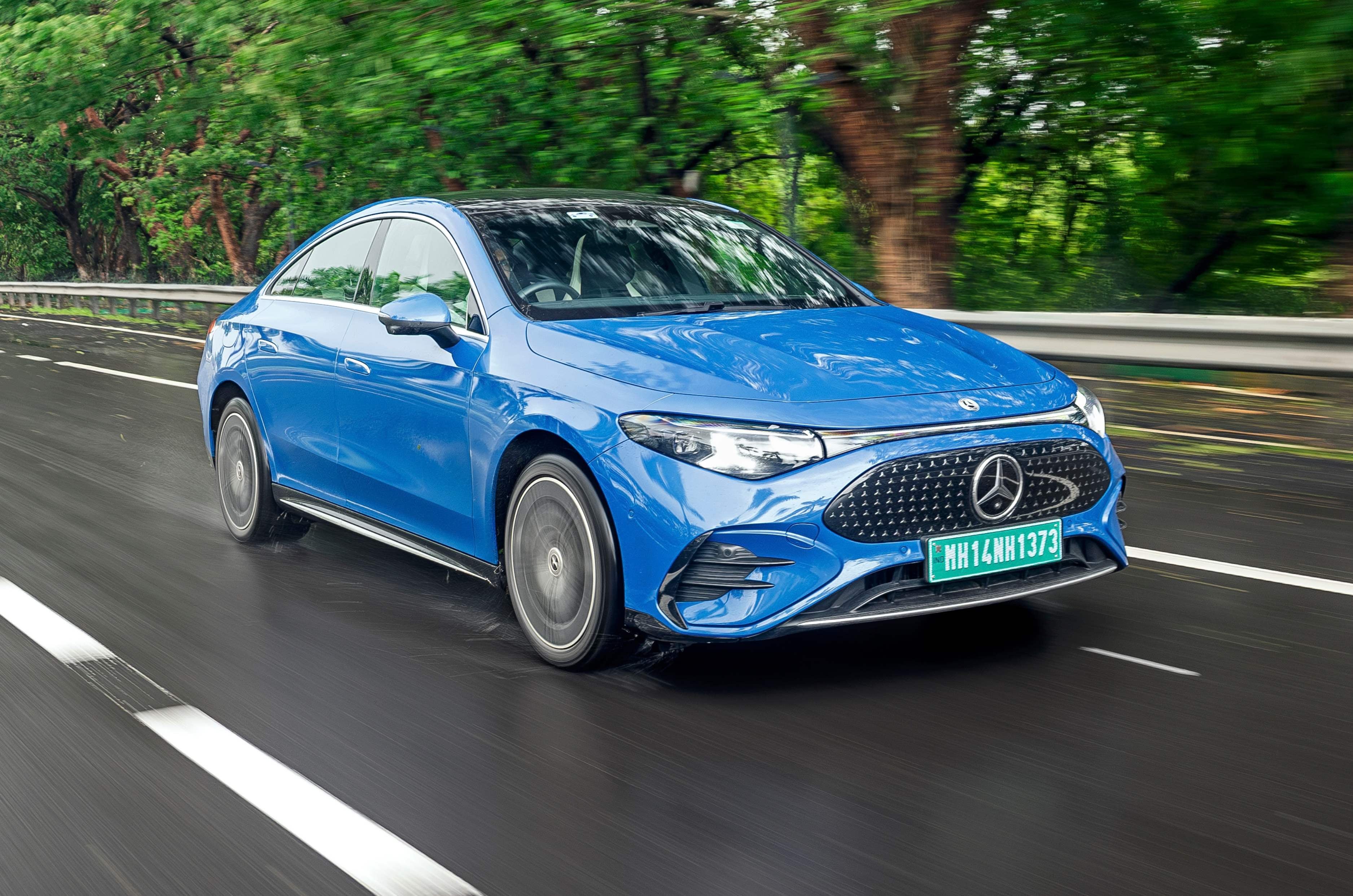
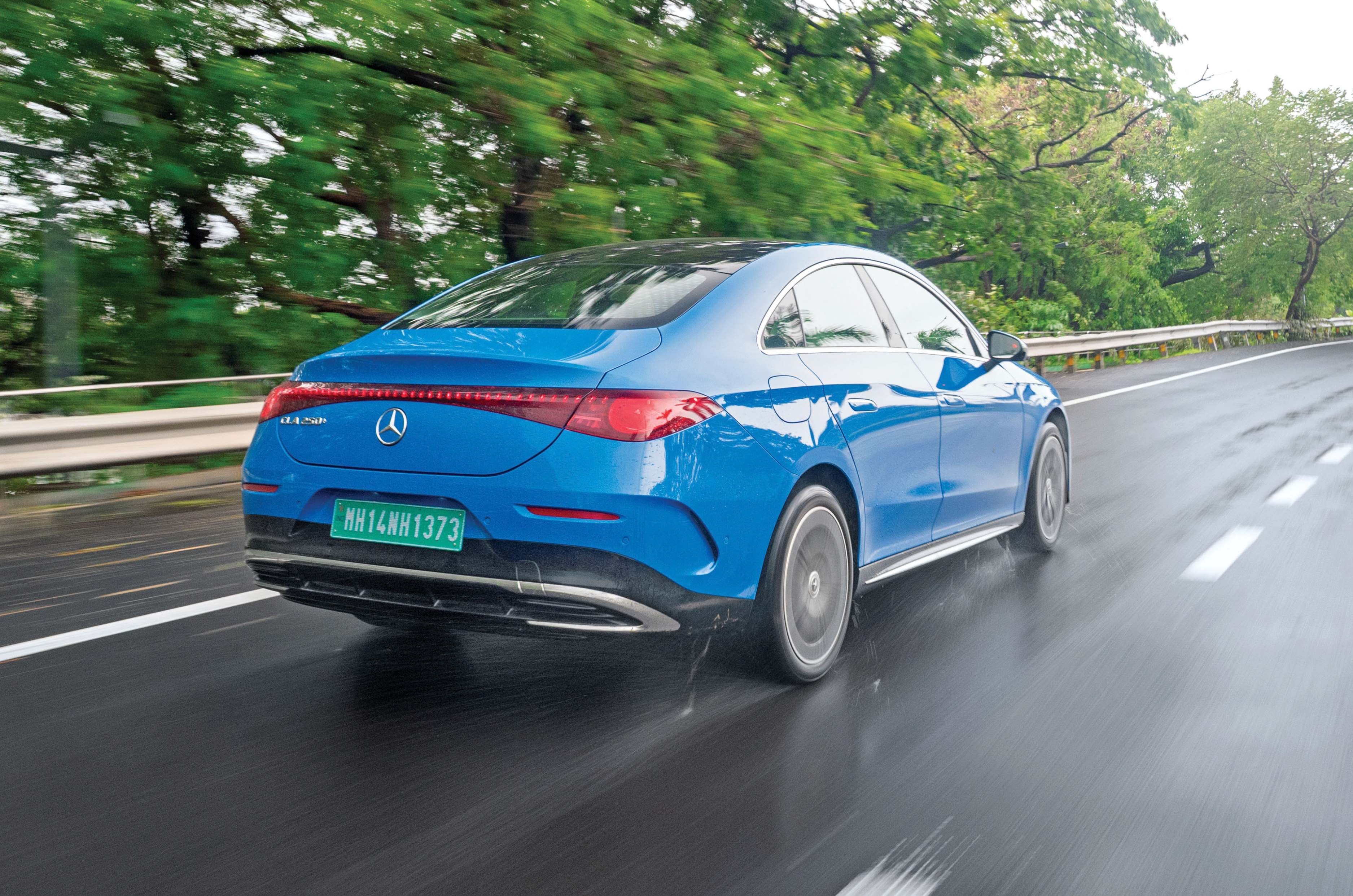
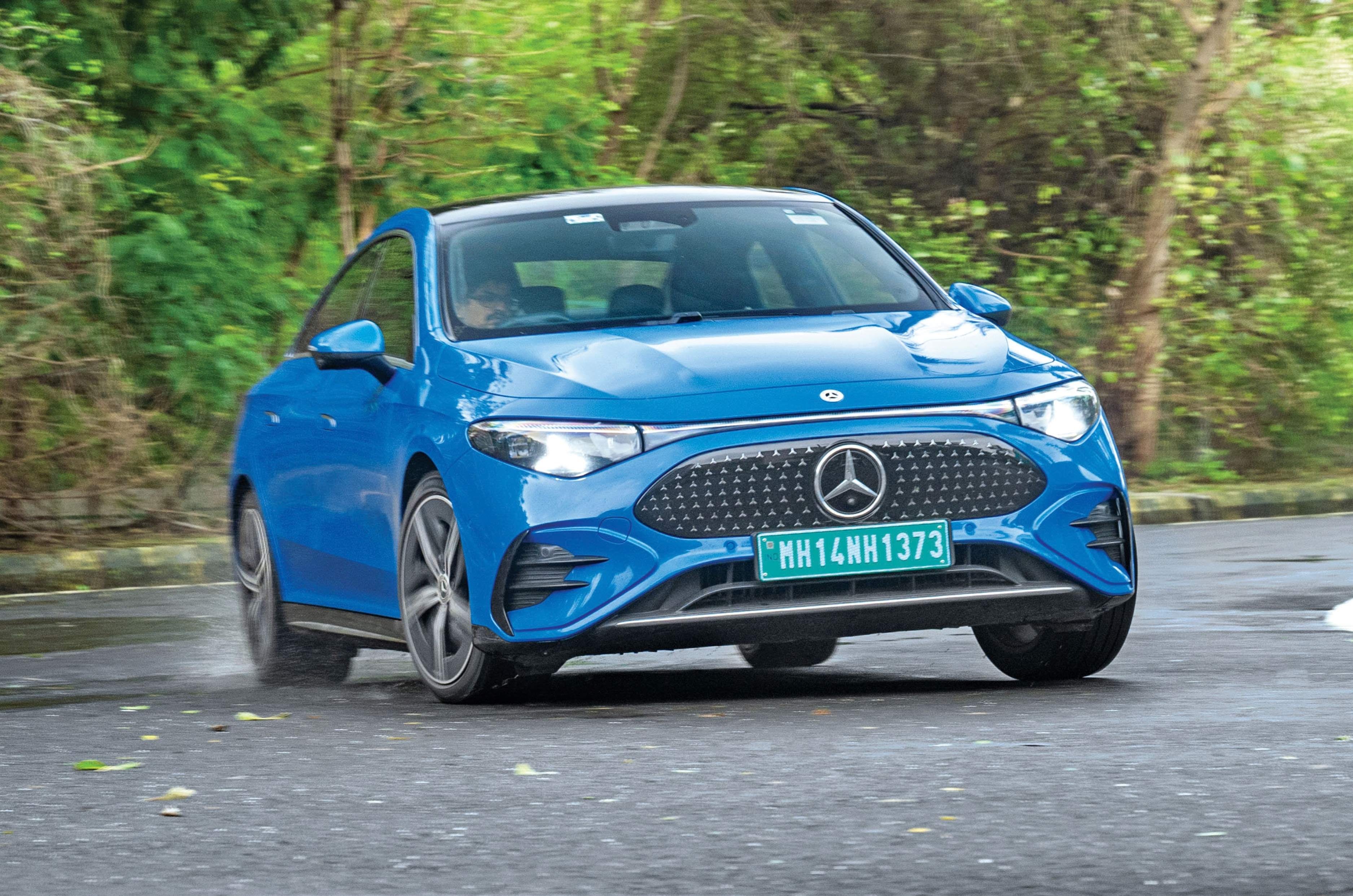
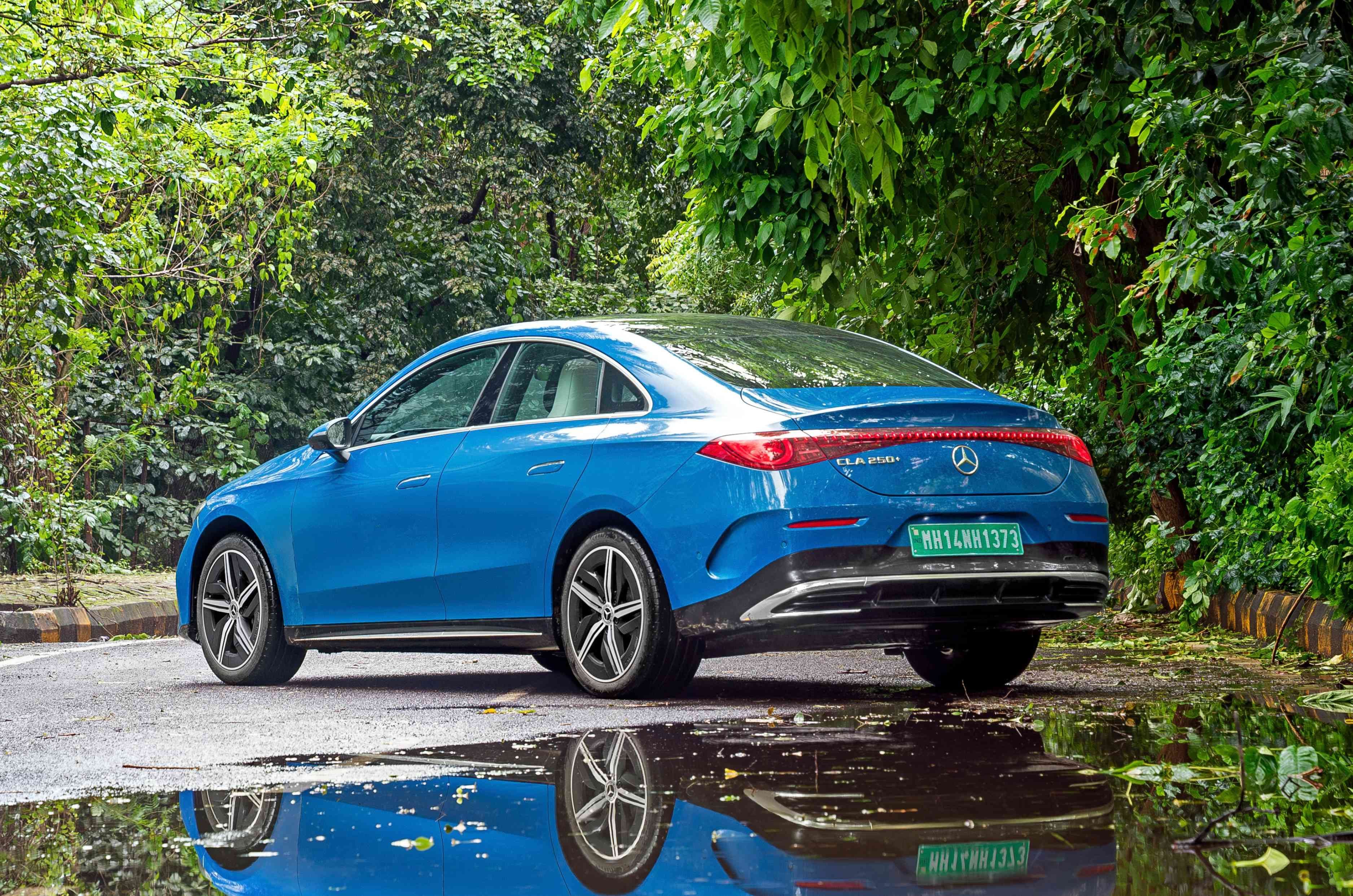
When we first drove the all-new, all-electric Mercedes-Benz CLA, we came away impressed with its smooth powertrain and its promise of a substantial real-world range. We’ve now subjected it to our real-world performance and efficiency tests to see if it delivers on that promise.
Mercedes CLA 250+ exterior design and engineering – 8/10
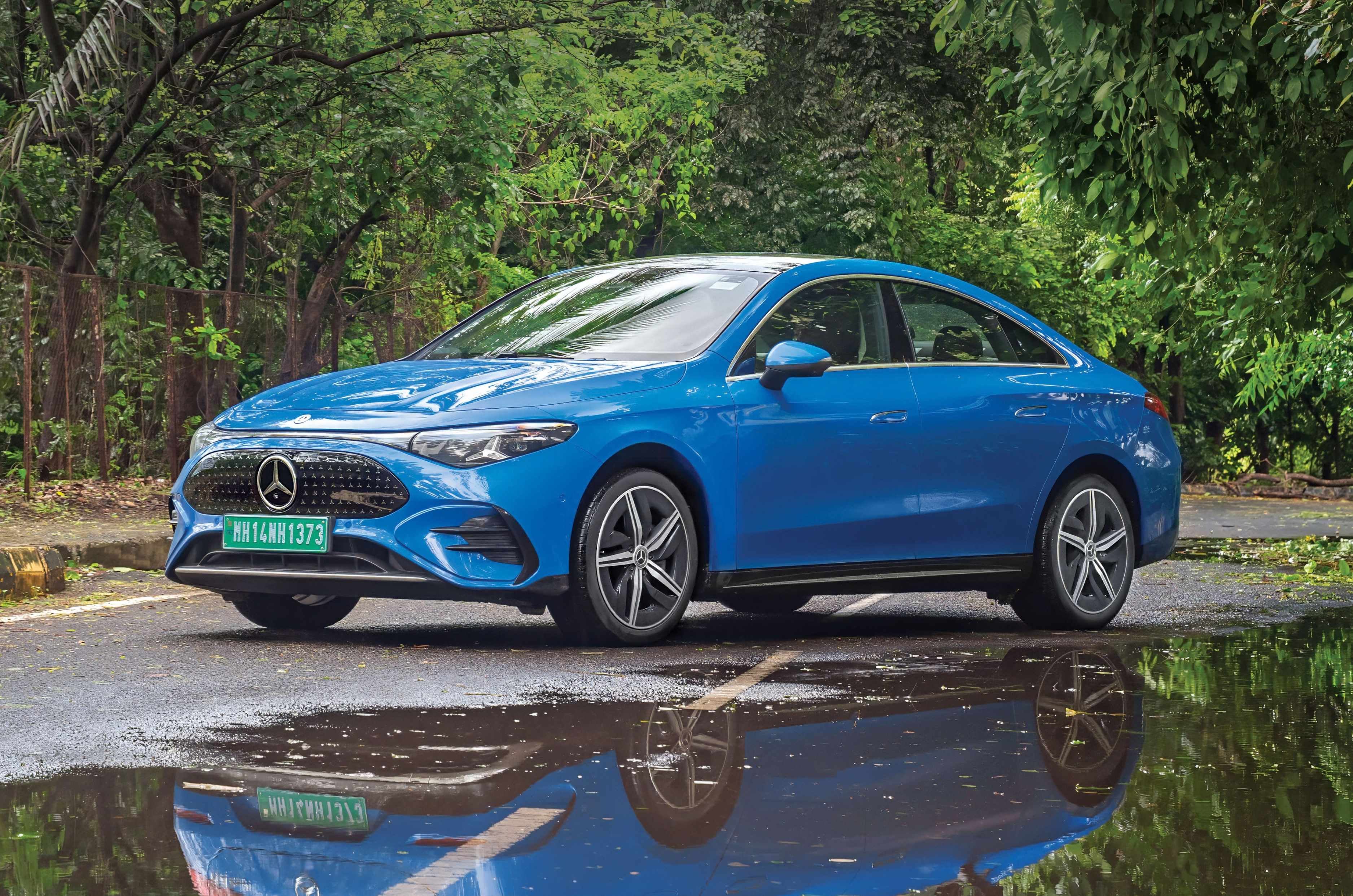
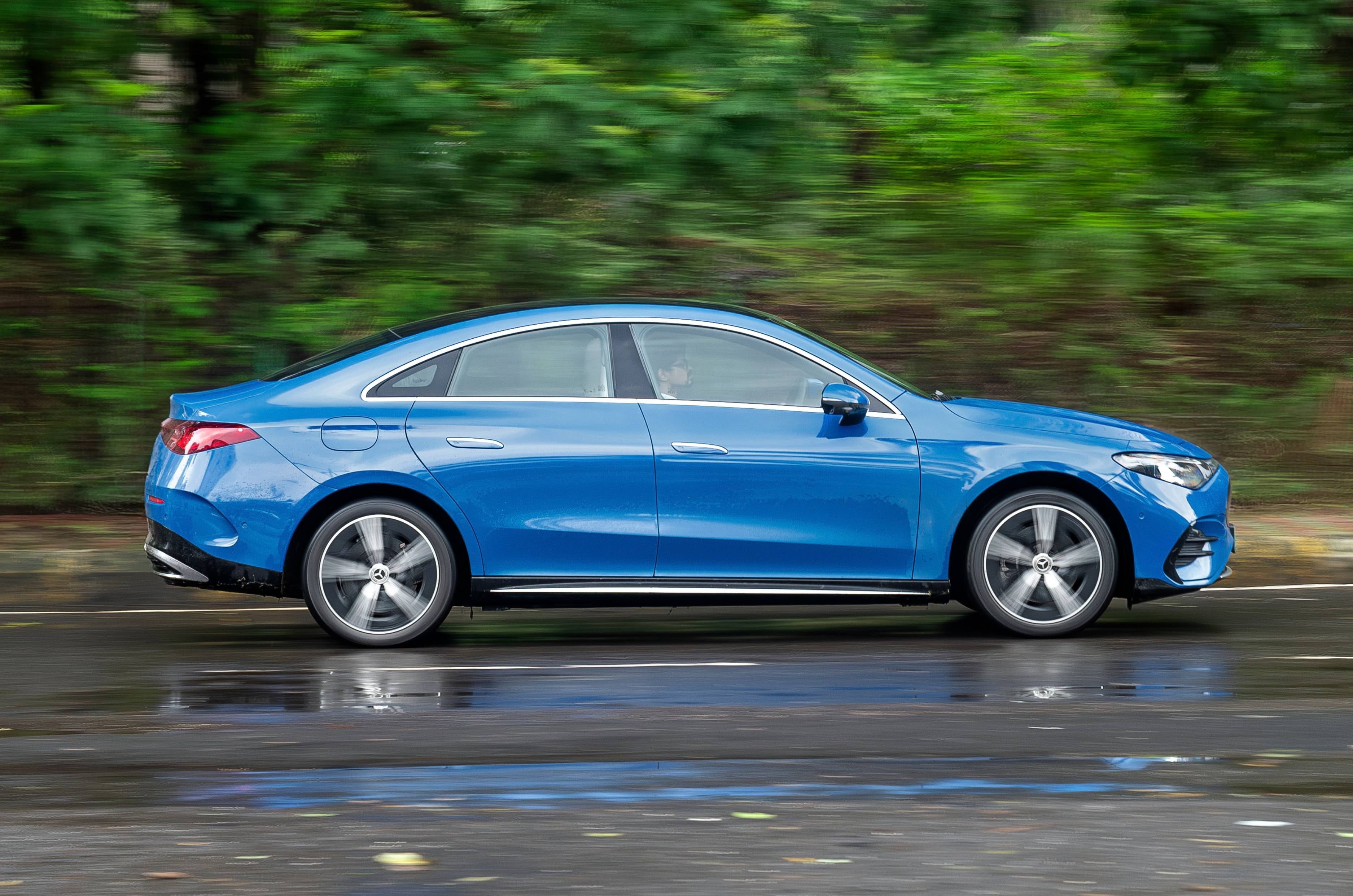
Polarising, aero-efficient design; based on new MMA platform.
The new CLA has been designed with efficiency very much in mind, but Mercedes hasn’t completely abandoned the visual character that made the original car appealing. Its smooth, rounded silhouette is familiar from other Mercedes EVs, yet the low-slung, coupé-like roofline and frameless doors give it a distinct identity. Flush-fitting door handles, a sealed-off grille, aero-optimised 18-inch AMG alloys and a fully sealed underbody all contribute to an exceptionally slippery shape, with a drag coefficient of just 0.21Cd.
Mercedes’ three-pointed star features prominently across the CLA, appearing on the bonnet, grille, headlamps and tail-lamps. The grille itself gets 142 illuminated stars, which might sound excessive on paper, but they do give the CLA a distinctive look and, in person, seem to work rather well.
More significant, however, is what lies underneath. The CLA EV is the first Mercedes to use the new Modular Architecture (MMA) skateboard platform, which will also underpin future models. At over 4.7m long, more than 1.8m wide and over 1.4m tall, with a wheelbase approaching 2.8m, it is roughly the same size as a BYD Seal.
Mercedes CLA 250+ interior space and comfort – 7/10
Impresses with tech and quality; cramped rear with high floor.
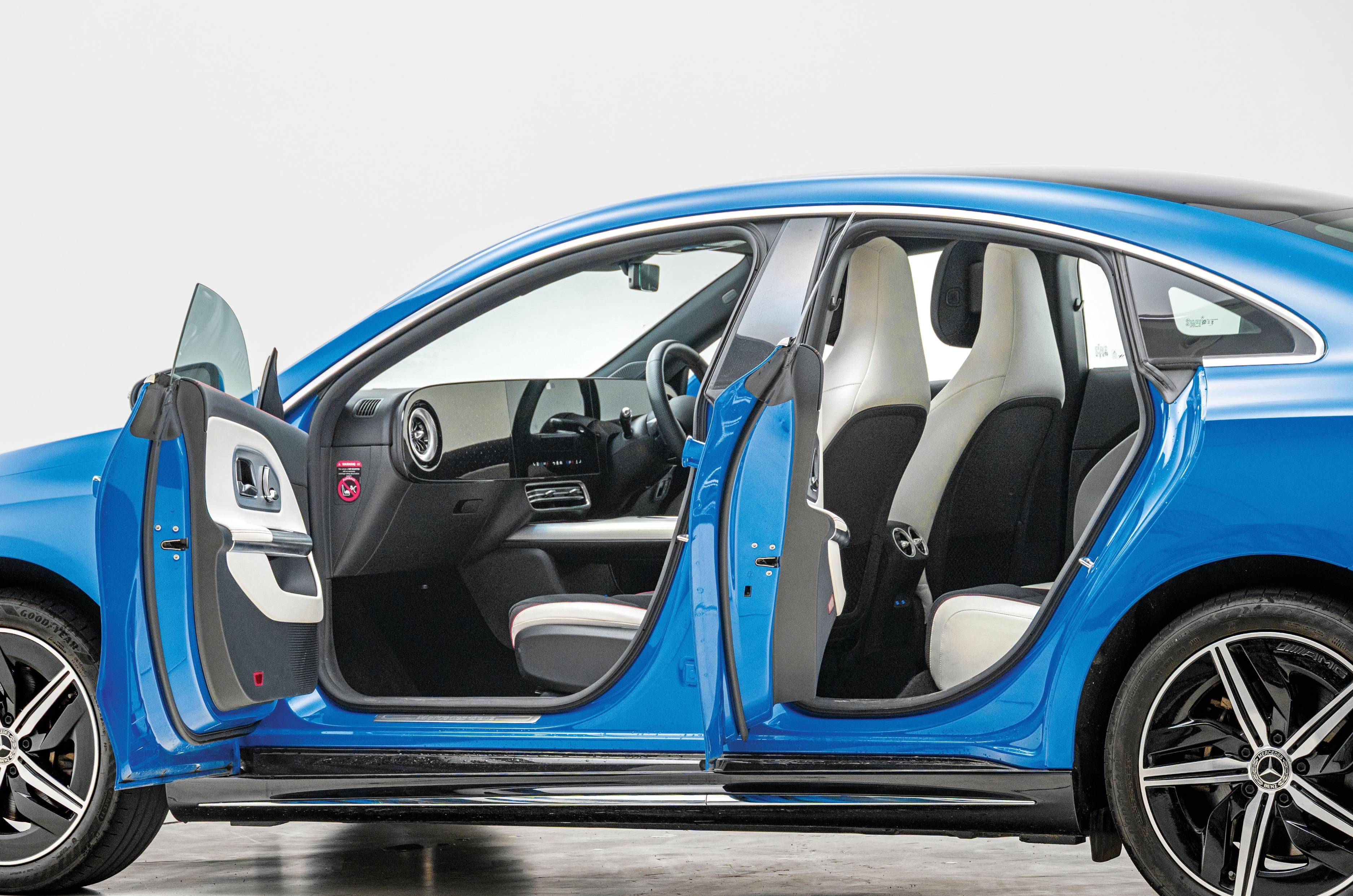
The CLA makes a good first impression inside. Its doors open wide for easy access, while the cabin combines smart design with good materials and build quality. The CLA 250+ is offered in AMG Line trim, so you get a flat-bottomed AMG steering wheel, sporty metal pedals and AMG-spec upholstery.
Doors open wide to aid access to the cabin; retains the stylish frameless doors.
The dashboard is dominated by a large gloss-black panel housing the digital displays. The graphics are sharp, the interface is clean, and the system is easy to navigate. What isn’t quite as convincing is the near-total absence of physical controls. Apart from a few capacitive shortcuts for functions such as volume and drive modes, most functions are accessed through the touchscreen, which isn’t ideal while on the move.
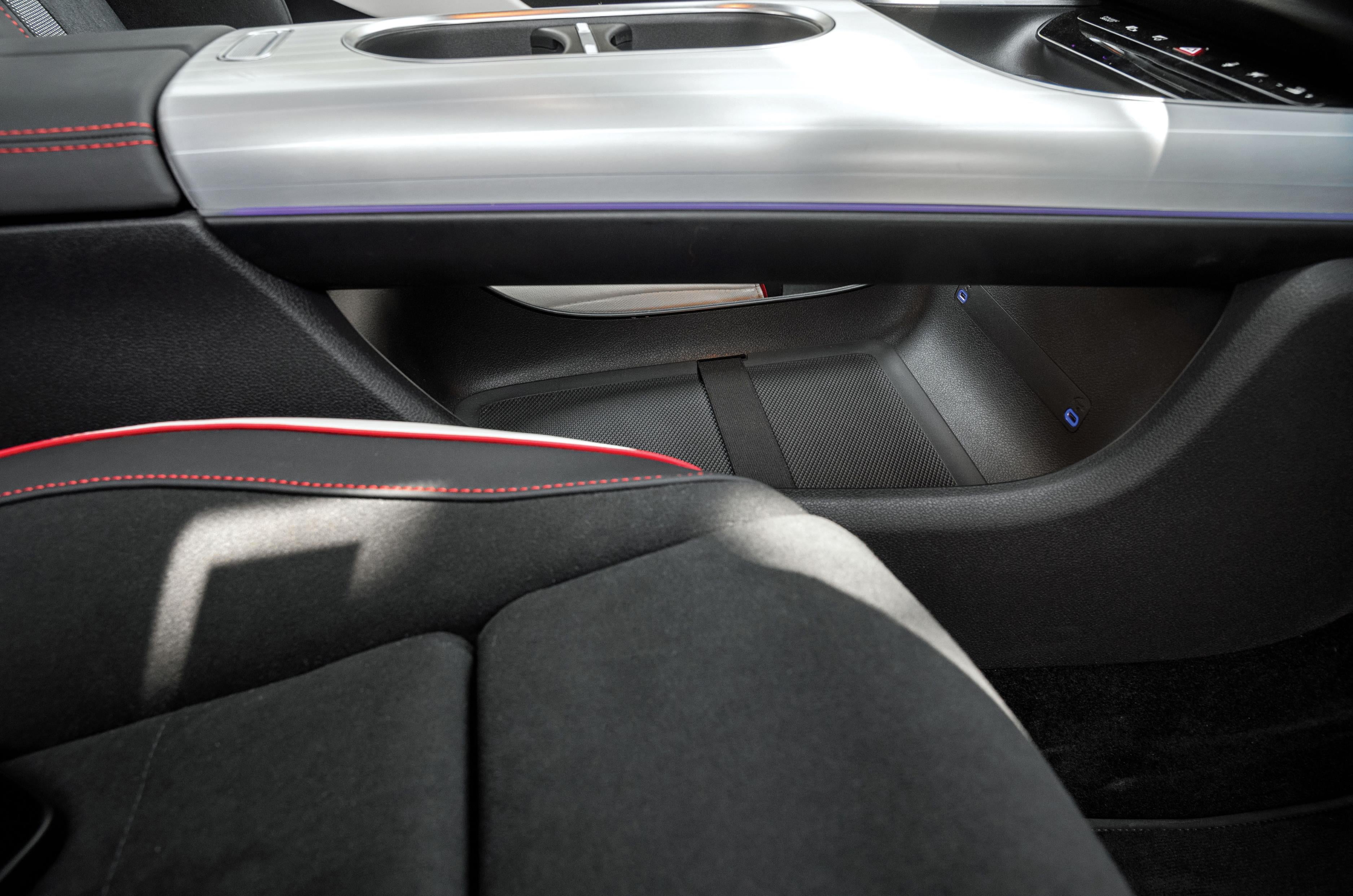
Centre console has two levels, with the top featuring cupholders and a wireless charger, and a large cubby space below.
The third passenger display offered in the 250+ Launch Edition has been omitted here, with its place taken by a gloss-black panel featuring illuminated Mercedes stars. The turbine-style air vents at either end of the dashboard are a nice touch, though, and are particularly satisfying to operate.
There is decent storage, too. You get a large glovebox, storage beneath the centre armrest, bottle holders in the doors and a floating centre console with cupholders and a wireless charger on top, along with a large storage area underneath.
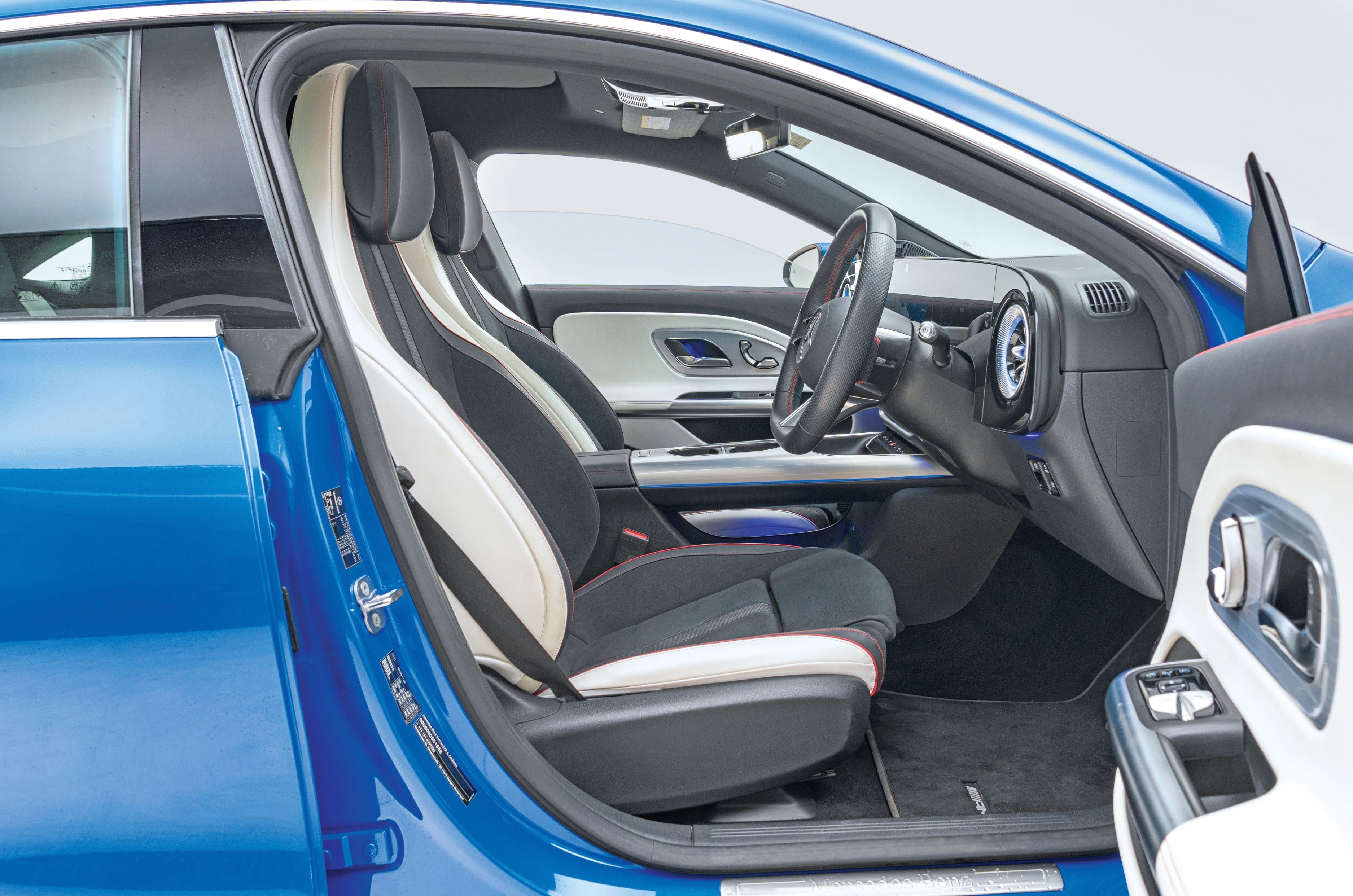
AMG Line brings Alcantara and leather trim for the snug and supportive seats; relatively knees-up seating here too.
The front seats are supportive and well padded, although larger occupants might find them a little snug. More importantly, the relatively high floor means you sit with your knees raised even in the front. At the rear, this issue is more pronounced.
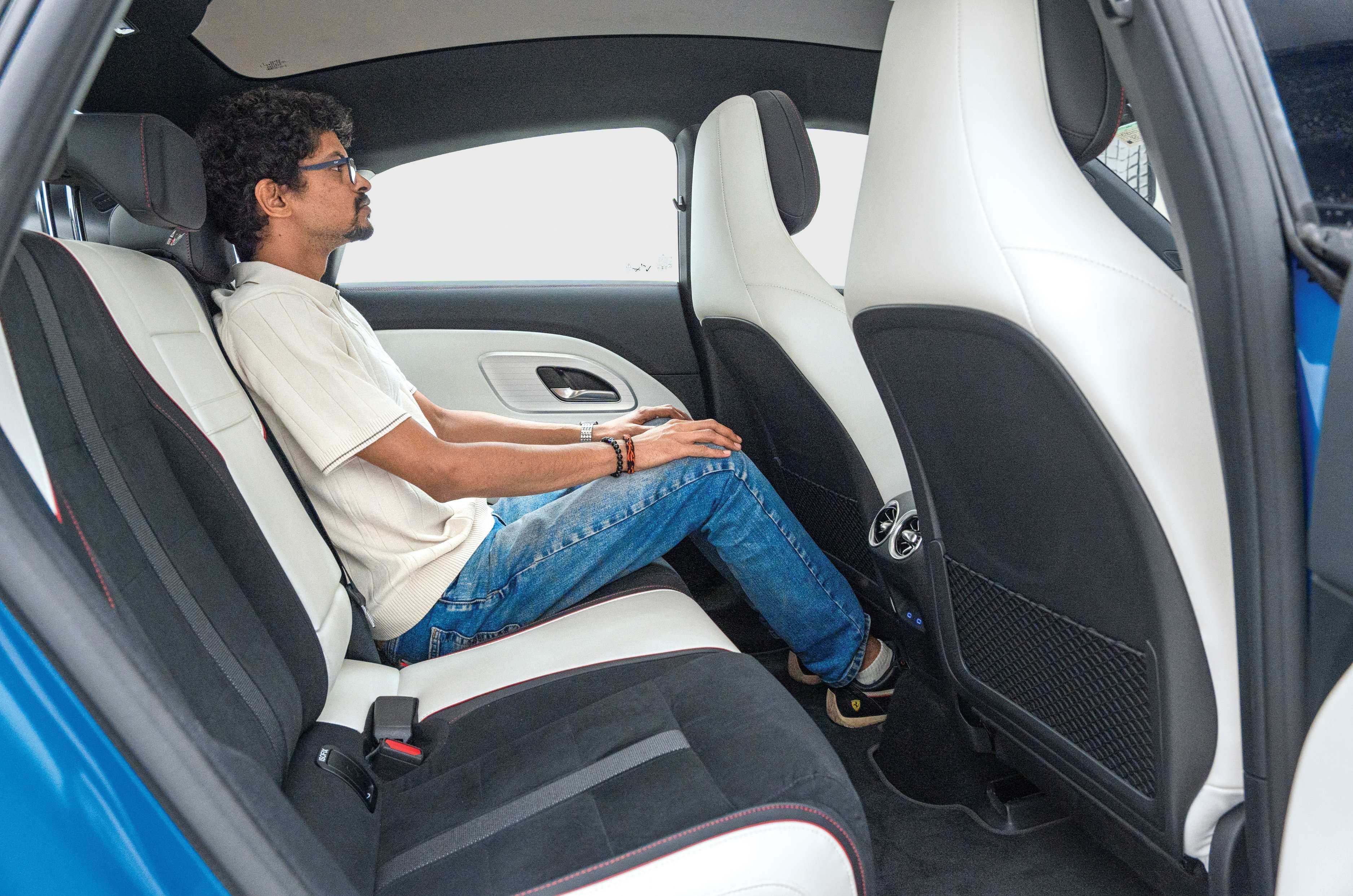
High floor results in knees-up seating, upright backrest and sloping roof further compromise rear seat’s comfort.
Although the CLA has a longer wheelbase than its predecessor, which improves knee room, the battery beneath the floor eats into under-thigh support and results in a knees-up seating position. The upright backrest and sloping roofline further compromise comfort, particularly for taller passengers. There is a centre armrest with cupholders and dedicated rear AC vents, but this still isn’t a car we’d recommend for regular chauffeur-driven use.
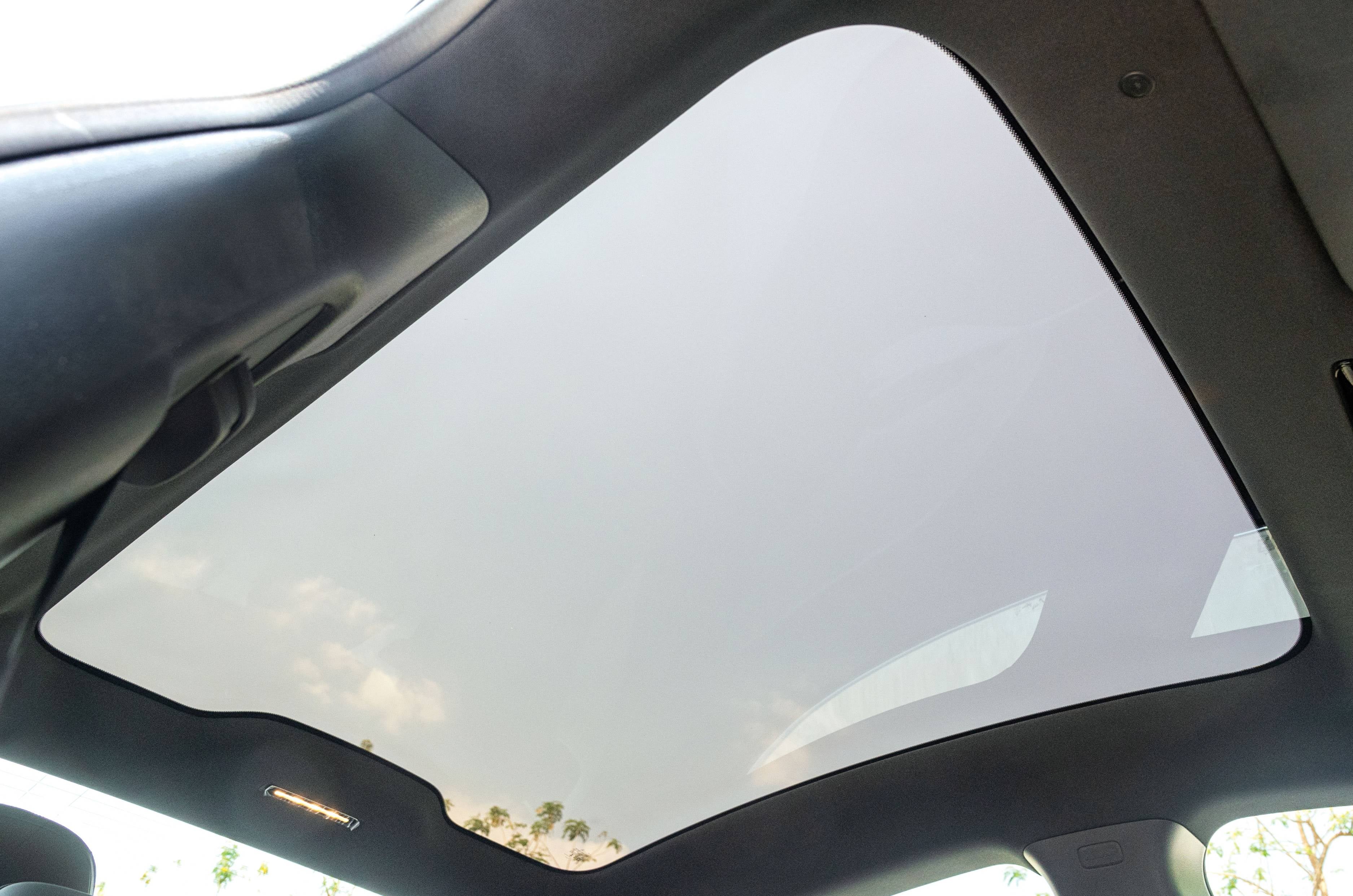
There is a large fixed panoramic glass roof that does make the cabin feel more spacious. Mercedes says the glass is heat-insulated, but a sunshade would have been welcome, particularly in our climate. It also misses sunblinds for the rear windows, meaning the rear AC has to work particularly hard to keep the back of the cabin cool.
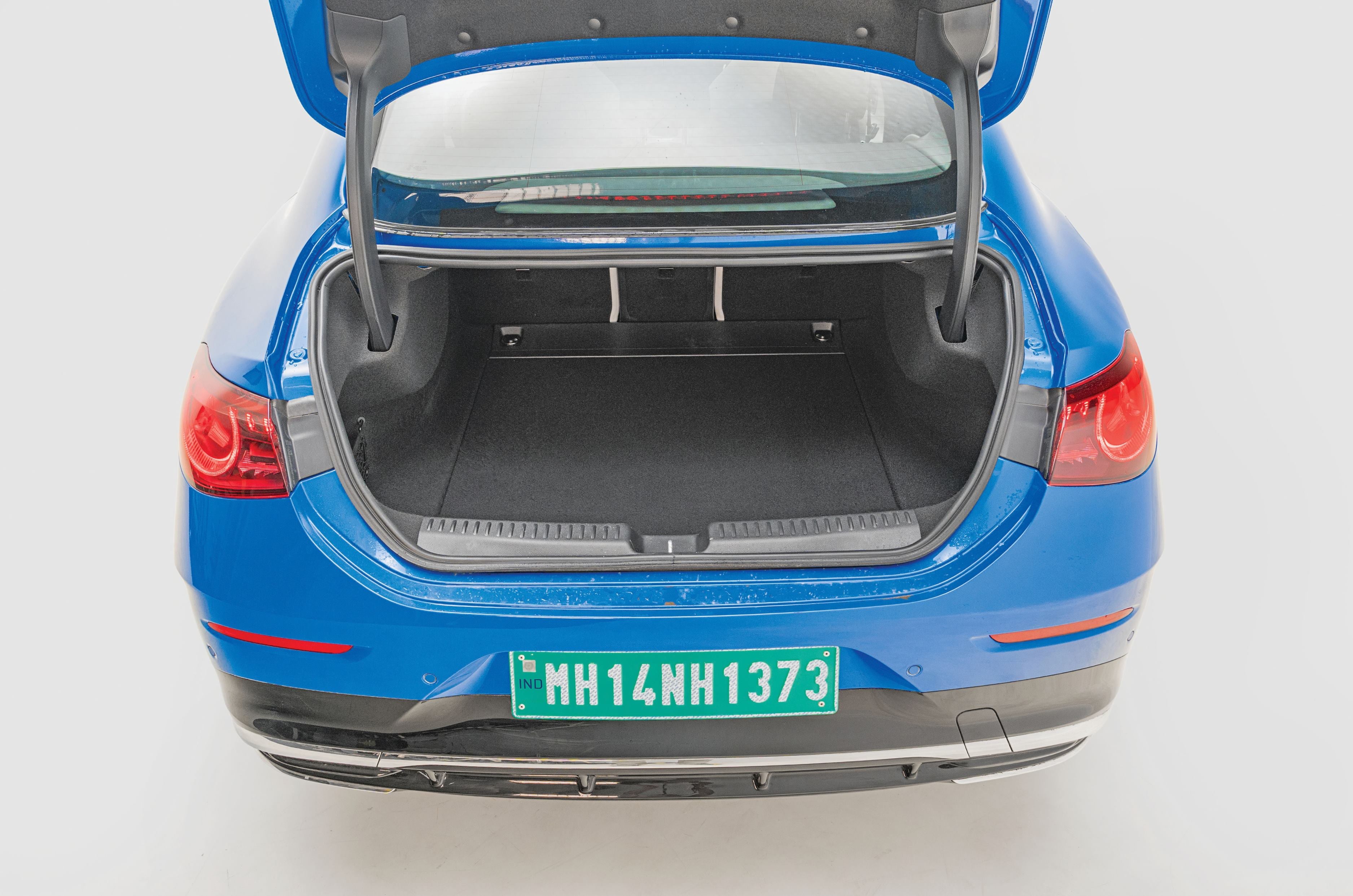
Cargo space is a useful 405 litres; boot opening isn’t large, though.
Boot space stands at a useful 405 litres. More interestingly, the CLA gets a 101-litre front trunk – the first time Mercedes has offered a frunk on one of its EVs.
In a first for Mercedes-Benz EVs, there’s a convenient 101-litre front trunk.
Mercedes CLA 250+ features and safety – 9/10
Packed with cutting-edge tech and features; no seat ventilation.
The CLA is a showcase for Mercedes’ latest technology. Four supercomputers provide the computing power, which Mercedes says is more than 200 times that of the previous CLA. It is also the first Mercedes to use the company’s new MB.OS infotainment operating system.
With the AMG Line styling package, the 250+ gets a flat-bottomed AMG steering, metal pedals and AMG seat upholstery; third passenger screen is reserved for the Launch Edition; cabin is practical with loads of storage, and overall fit/finish is good.
An Nvidia processor allows for quick responses, while over-the-air updates mean the system can be updated without a visit to the workshop. There’s also a new MBUX Virtual Assistant, which learns about the driver, including their language, accent and mood. It uses AI tools, including ChatGPT, Gemini and Bing, to further make your life easier, and you can ask them to do just about anything from setting navigation to changing the AC and so much more.
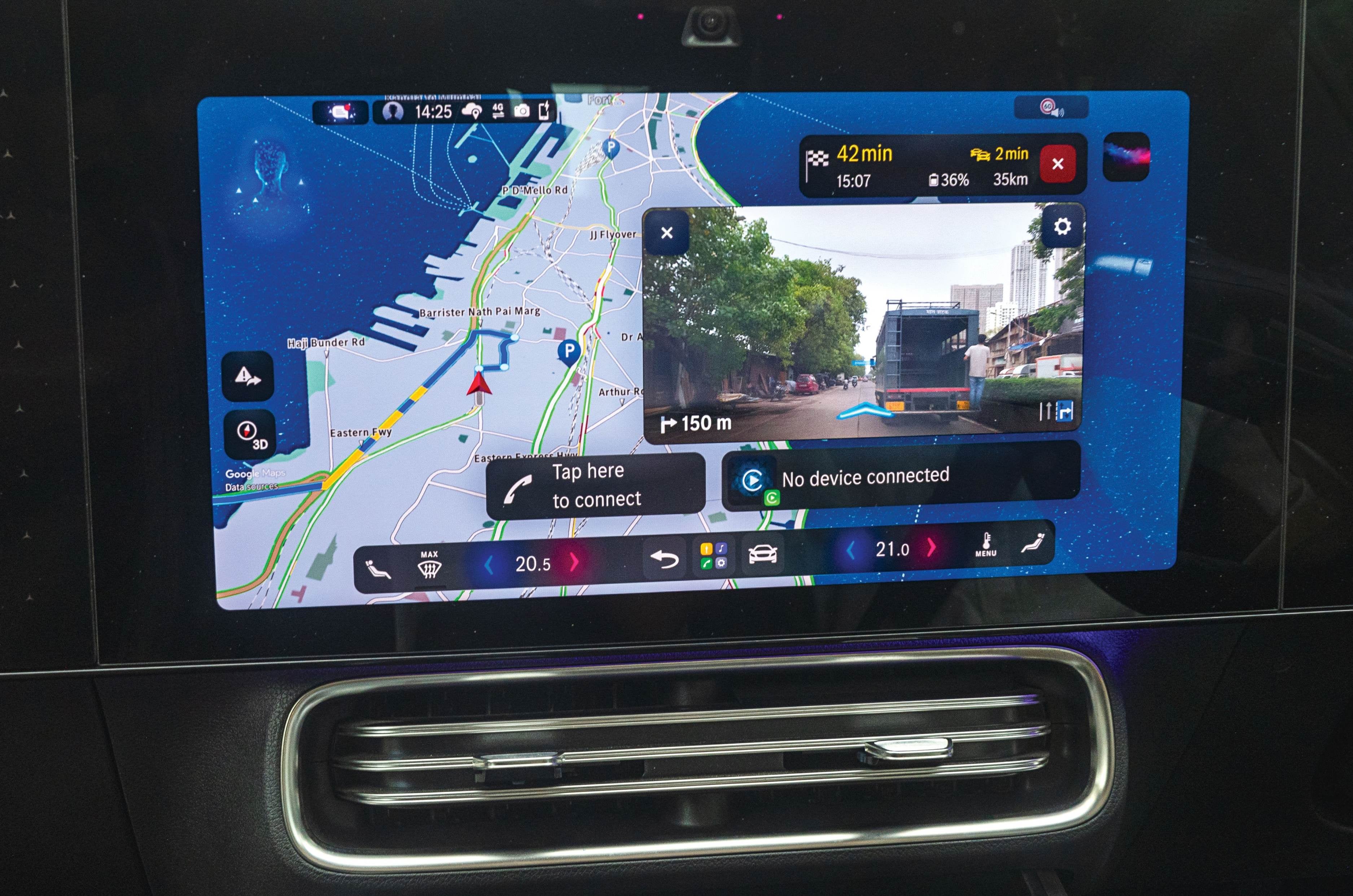
Screen is slick, has sharp graphics and native maps, which show directions in real-time using the camera feed.
The CLA also gets the new MB.Charge app, which brings charging providers together in one place. It can locate chargers, show their real-time availability, help plan a journey and even handle payment for a charging session.
The feature list is extensive. Highlights include a 14-inch central touchscreen, 10.25-inch digital driver’s display, powered, heated and massaging front seats, dual-zone climate control, configurable ambient lighting, a panoramic glass roof, Burmester 3D audio, wireless phone charging and auto parking. Ventilated front seats, however, aren’t offered.
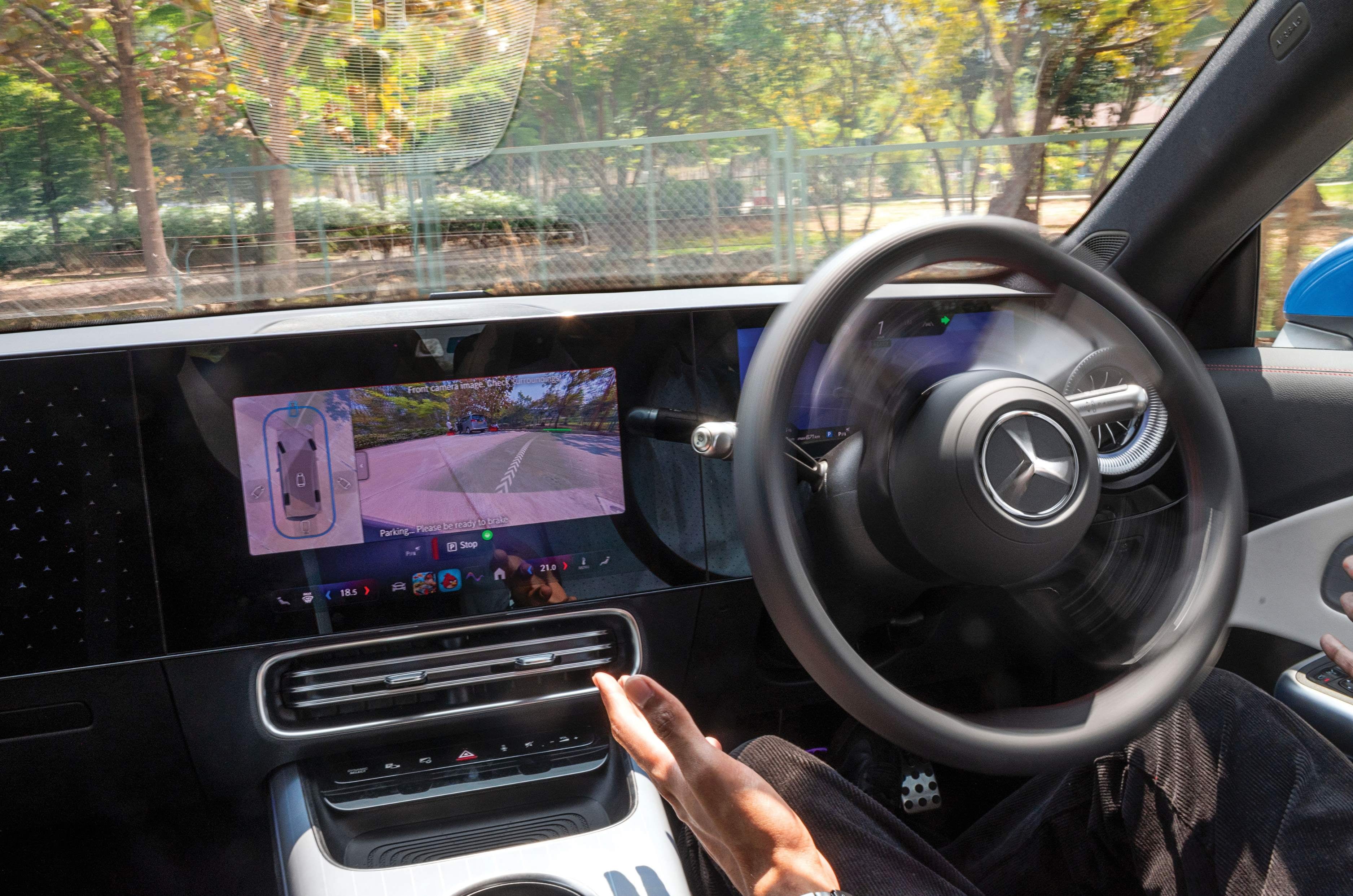
CLA 250+ packs in an auto park feature, which works very well in unmarked spaces too.
Safety equipment is comprehensive, with six airbags, a 360-degree camera and Level 2+ ADAS, which Mercedes calls MB.Drive. It includes adaptive cruise control, lane-keep assist, blind-spot monitoring, autonomous emergency braking and semi-autonomous driving functions. The system uses a combination of radar sensors and cameras and didn’t feel overly intrusive; better than previous Mercs, which feel trigger-happy with emergency braking. The CLA was also the safest car tested by Euro NCAP in 2025.
Mercedes CLA 250+ performance and refinement – 9/10
Smooth, progressive powertrain; refinement is impressive.
The CLA 250+ uses a rear-mounted electric motor producing 272hp and 335Nm. Performance is brisk, but what stands out more than outright acceleration is the way it delivers its performance.
Unlike some performance EVs that deliver power aggressively from the moment you bury the accelerator, the CLA builds speed in a smooth, progressive manner. The power delivery is linear, and there’s always enough performance on tap. Sport mode sharpens the response, while synthesised sounds played through the speakers add a little more theatre.
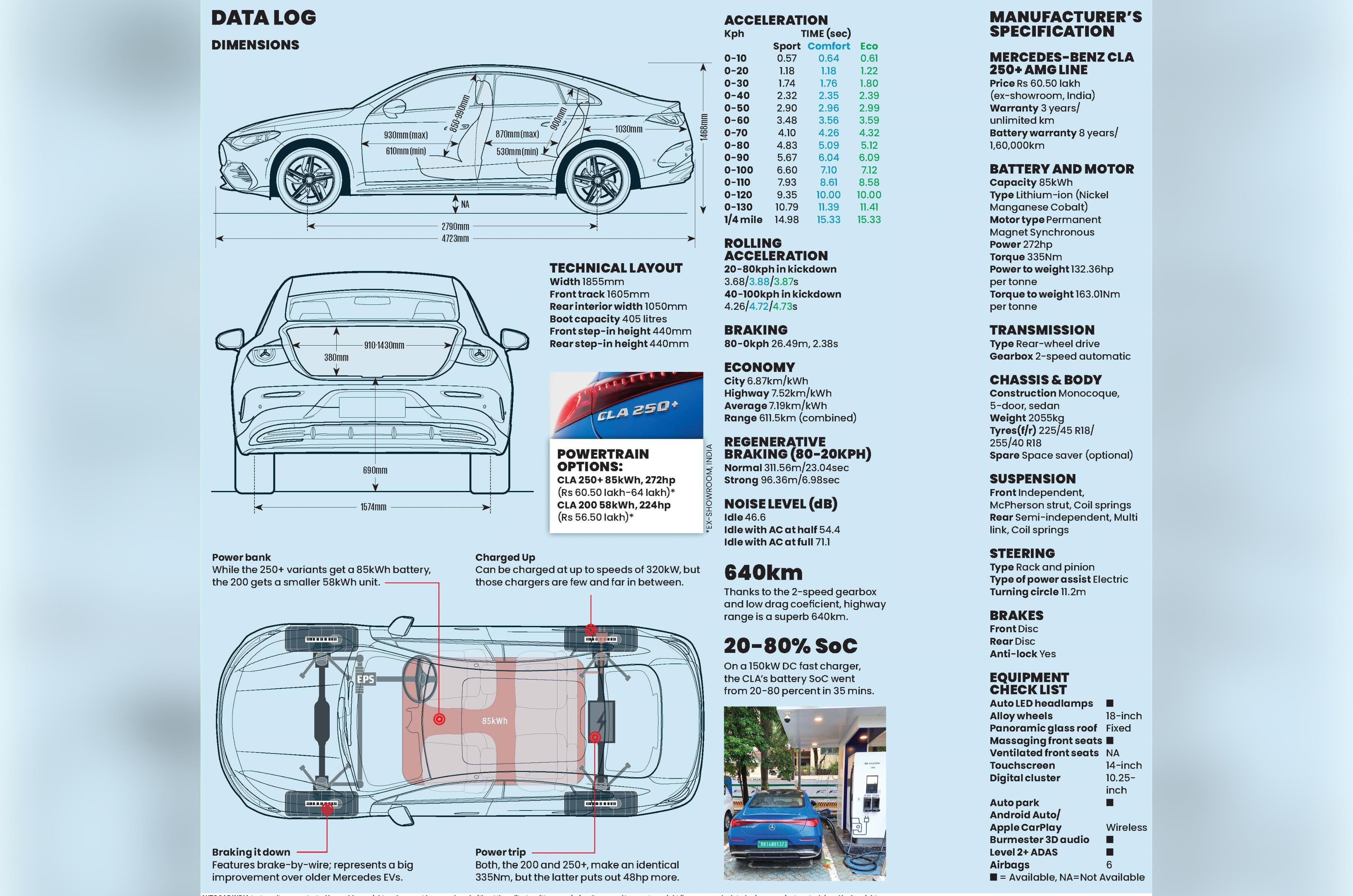
In our performance tests, it managed a 0-100kph time of 6.6sec in Sport mode, narrowly beating the claimed time of 6.7sec. Rolling acceleration is impressive too, with 20-80kph in Sport taking 3.68sec, and 40-100kph being dealt with in 4.26sec. Naturally, performance in the Comfort and Eco drive modes is more sedate than Sport, with the difference between the former two being almost negligible.
Mercedes has also opted for a two-speed gearbox, which is unusual for an EV, but makes sense here. The short 11:1 first gear helps with initial acceleration, while the taller 5:1 second gear is intended to improve efficiency at higher speeds. And from behind the wheel, you can feel when it shifts gears. Mercedes claims a drivetrain efficiency of 93 percent, and that plays an important role in the CLA’s impressive range.
The new brake-by-wire system is another area where the CLA makes a big improvement over older Mercedes EVs. Brake response is reassuring, with a good bite and a natural, consistent feel. In our braking test, the CLA came to a halt from 80kph in 26.49m despite it being on a damp surface.
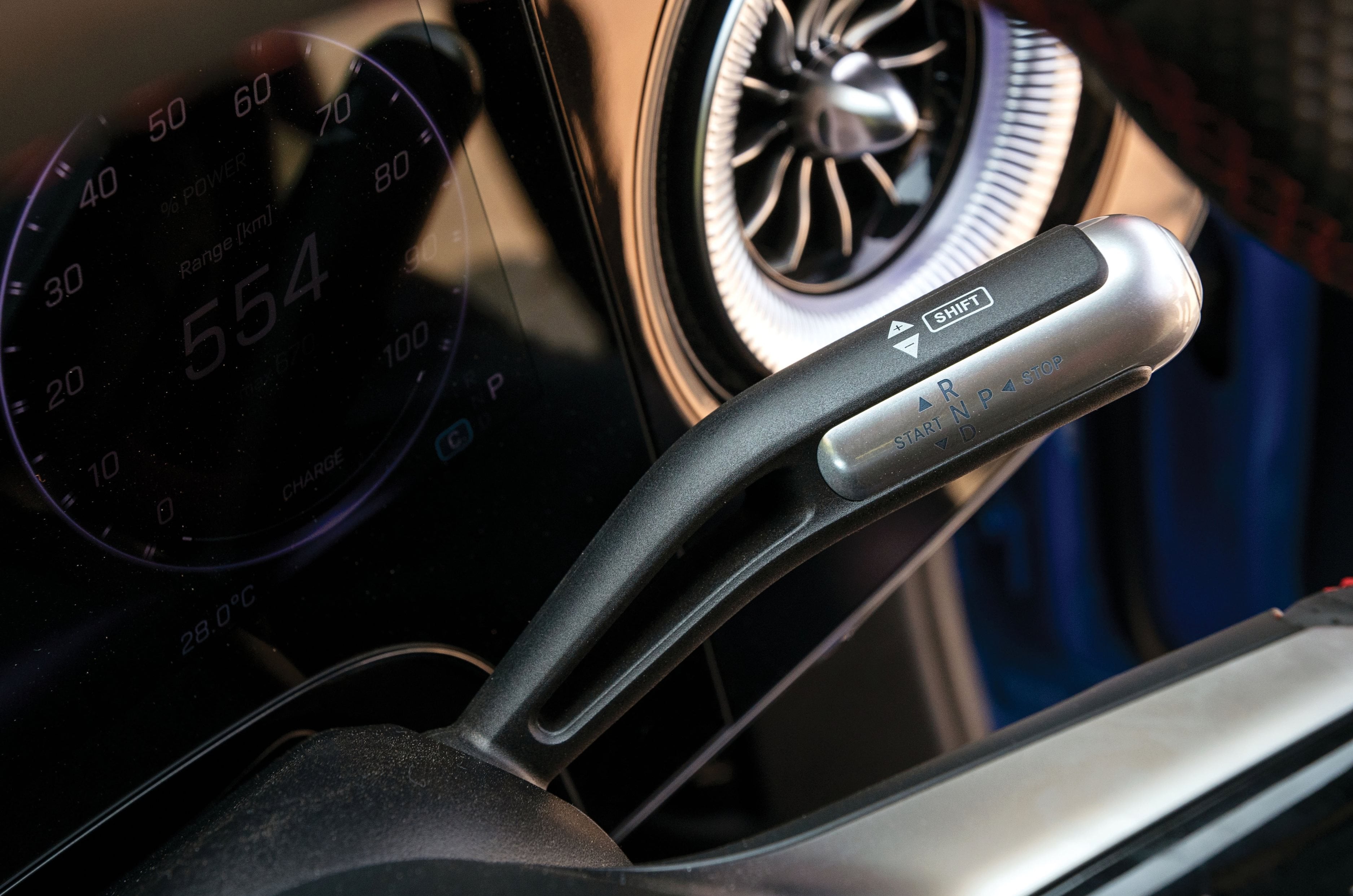
Control stalk now houses the start/stop button, the drive selector, and is also used to toggle between regen braking modes.
There are four levels of regenerative braking, including a one-pedal mode and an adaptive setting. They work well, with the Normal setting bringing it from 80-20kph in 311.56m, while the Strong setting takes 96.36m for the same. It’s worth noting, however, that Mercedes has moved the controls for the regen from the steering-mounted paddles used on some EVs to the gear selector stalk. You push or pull the stalk to change the regen level, and this isn’t quite as intuitive. The same stalk also incorporates the start/stop button.
Where the CLA really impresses is refinement. The absence of an engine obviously helps, but Mercedes has also done an excellent job of keeping wind and road noise out. At speed, the cabin remains remarkably quiet. A CLA 200 variant is also available in India, using the same rear-mounted motor layout but producing a lower 224hp and 335Nm. However, we’re yet to test this version.
Mercedes CLA 250+ tested acceleration times (sec)
Sport
Comfort
Eco
0-10kph
0.57
0.64
0.61
0-20kph
1.18
1.18
1.22
0-30kph
1.74
1.76
1.80
0-40kph
2.32
2.35
2.39
0-50kph
2.90
2.96
2.99
0-60kph
3.48
3.56
3.59
0-70kph
4.10
4.26
4.32
0-80kph
4.83
5.09
5.12
0-90kph
5.67
6.04
6.09
0-100kph
6.60
7.10
7.12
0-110kph
7.93
8.61
8.58
0-120kph
9.35
10
10
0-130kph
10.79
11.39
11.41
1/4 mile
14.98
15.33
15.33
20-80kph (rolling)
3.68
3.88
3.87
40-100kph (rolling)
4.26
4.72
4.73
Mercedes CLA 250+ range and efficiency – 9/10
Low drag, efficient powertrain mean superb real-world range.
Mercedes claims a WLTP range of 792km from the 85kWh (net) NMC battery, although, predictably, the real-world range is lower. In the city, with the regen set to the strongest mode, it delivered an efficiency of 6.87km/kWh that translates to a range of 584km. On the highway, with the regen set to ‘Normal’, it delivered an efficiency of 7.52km/kWh for a 640km range. With an average efficiency of 7.2km/kWh, you can expect a real-world range of 612km on a single charge, which is very impressive.
In the city, the strongest regen setting enabled it to recoup energy effectively, which helped boost efficiency, while the two-speed gearbox, with its taller 5:1 second gear, enabled greater efficiency at higher speeds and thus contributed to the EV’s highway efficiency. Combined with the low 0.21Cd drag coefficient and the normal regen mode that allows for more coasting, it proved even more efficient on the highway, which isn’t usually the case with EVs.
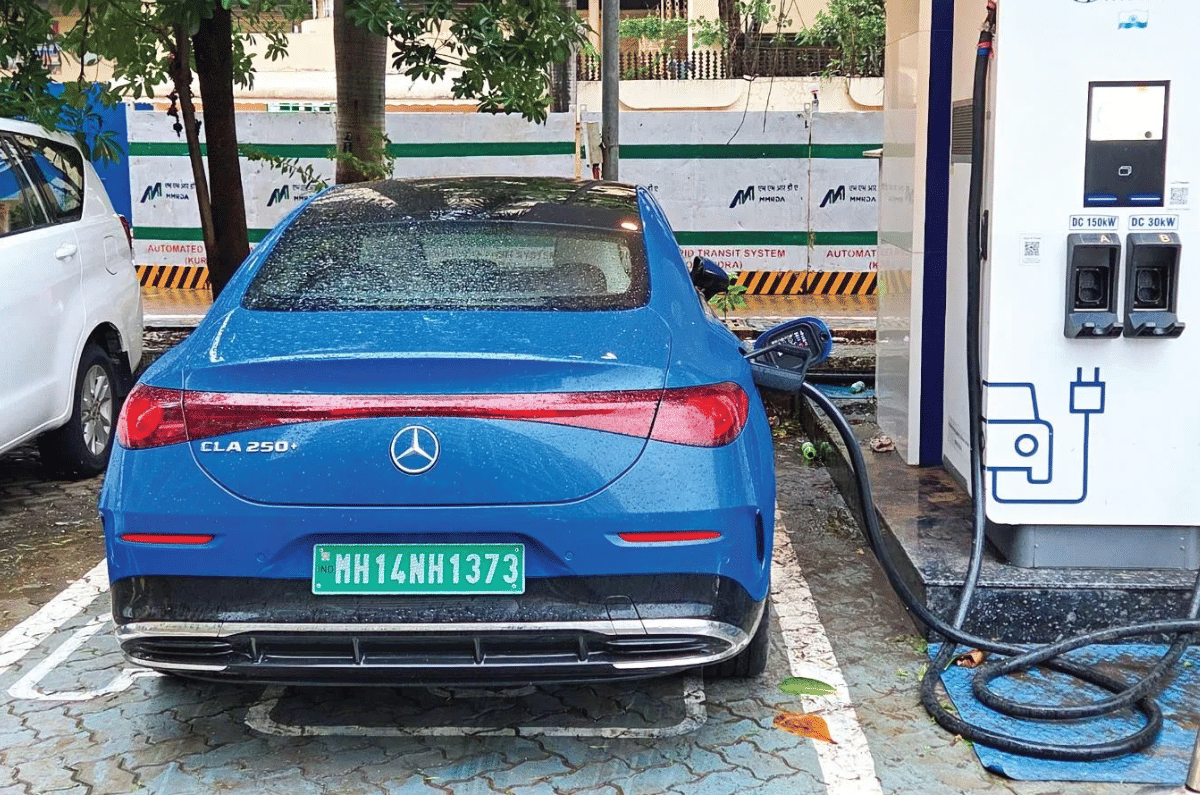
The CLA 250+ uses an 800V electrical architecture and supports charging at up to 320kW, but chargers capable of delivering that output remain few and far between in India. In our charging test using a 150kW DC fast charger, we saw an average charging speed of around 92kW with a peak charging speed of 125kW. To charge from 20-80 percent, it took 35 minutes and consumed 53.89kWh in total. This, combined with the efficiency and large real-world range, should make long-distance driving relatively stress-free.
Mercedes CLA 250+ tested range
City (km/kWh)
6.87
Highway (km/kWh)
7.52
Average (km/kWh)
7.19
Range (km)
611.5
Mercedes CLA 250+ ride comfort and handling – 8/10
Strikes a mature balance between ride and handling.
The CLA’s rear-wheel-drive layout gives it an enjoyable character on a winding road, and the steering is one of its stronger points. With no drive being sent through the front wheels, it feels precise, building up weight progressively with speed. It’s light enough at low speeds to make manoeuvring easy, yet gains enough weight as you go faster.
Thanks to the CLA’s rear-wheel-drive setup and precise steering, it feels agile and good fun around corners.
Mercedes has increased the Euro-spec CLA’s 107mm ground clearance for India and made suspension changes to better suit our roads, and both have worked. There’s enough clearance to deal with regular-sized speed breakers, while the additional height hasn’t really compromised the car’s handling or comfort. Around corners, the CLA remains agile, and body roll is well controlled. The ride does have a hint of firmness to it, but it deals with road imperfections without fuss and feels composed at both low and high speeds. Overall, it’s a mature combination of ride comfort, stability and handling.
Mercedes CLA 250+ value for money – 8/10
Refined and efficient powertrain, long range and sorted ride and handling make it Merc’s best EV yet.
Priced at Rs 60.50 lakh (ex-showroom), the CLA 250+ is a fairly compelling proposition, considering what it brings to the table. There are shortcomings, most notably the cramped rear seat, knees-up seating even at the front, and the absence of sunshades for the panoramic roof and rear windows. But if you’re going to drive yourself and want a luxury EV that’s distinctive, the CLA makes a strong case for itself.
Its powertrain is smooth and refined, its efficiency is excellent, it has an impressive real-world range of over 600km, and it strikes a very good balance between ride comfort and handling. Add to that a cabin packed with cutting-edge tech, and the new CLA emerges as one of the company’s most accomplished EVs yet.
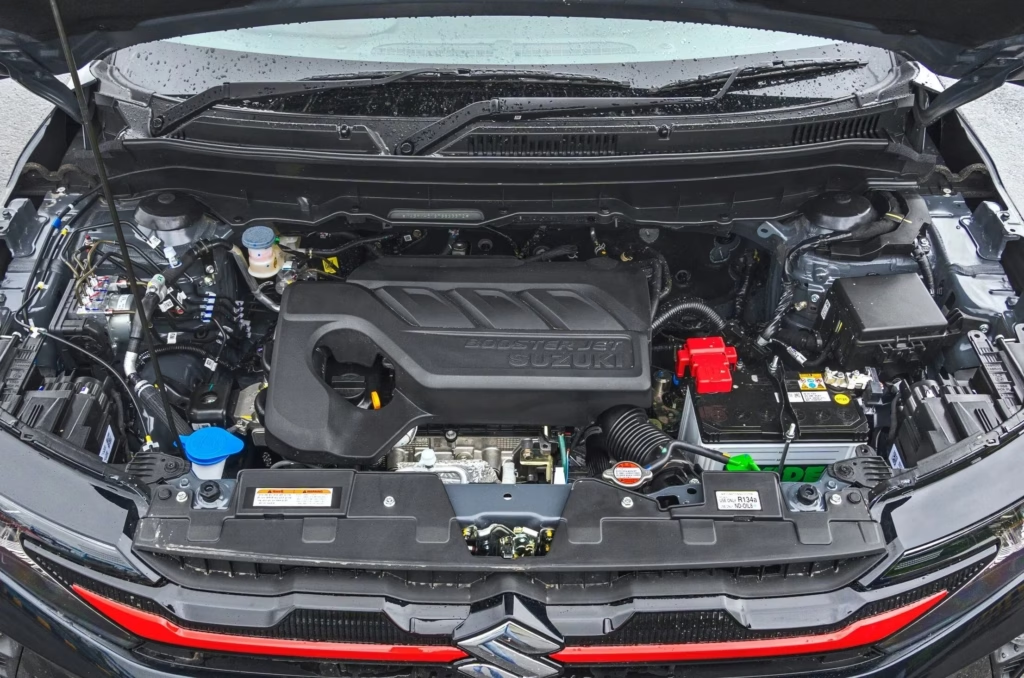
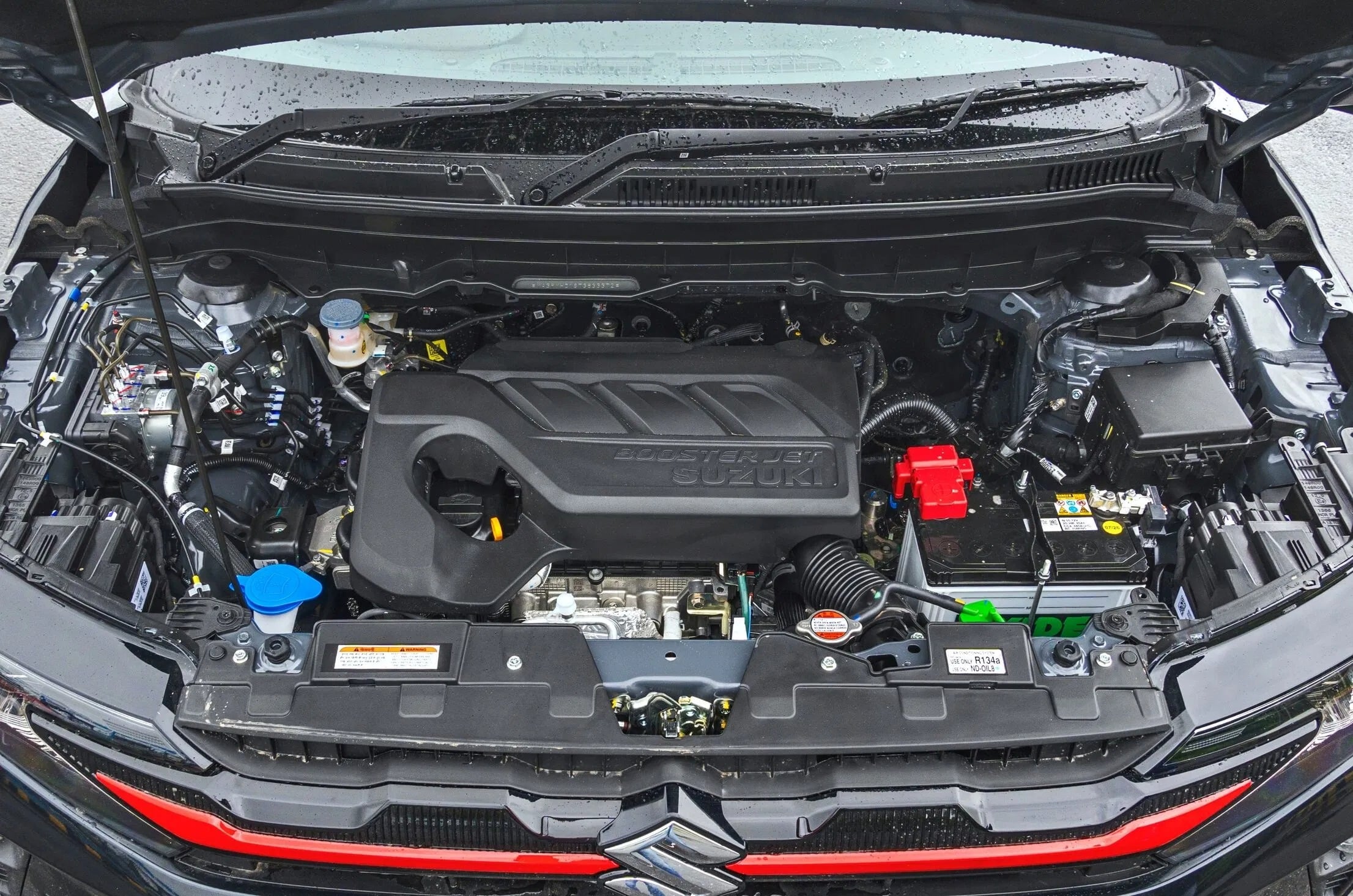
Suzuki Motor Corporation is developing a new direct-injection turbocharged engine for growth markets, including India, with the aim of combining stronger performance with lower fuel consumption.
New-gen turbo-petrol engine to prioritize performance and efficiency.
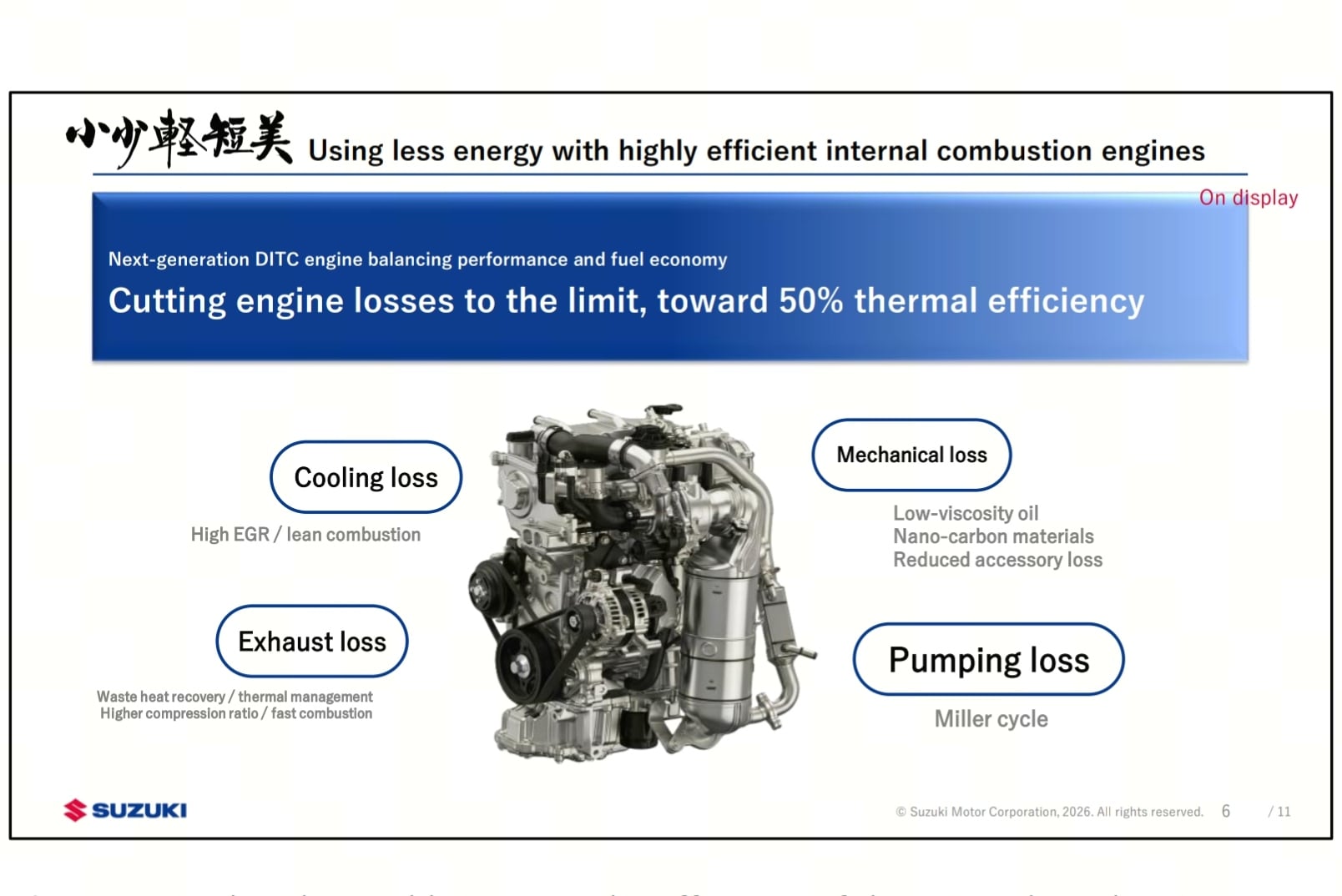
Automaker aiming to improve ICE thermal efficiency to 50 percent.
Suzuki direct-injection turbo-petrol engine: Additional info
Suzuki identified the engine, referred to as DITC in its technology briefing, as one of the technologies it is preparing for future vehicles. India is among the markets it specifically named for the project. The company has not disclosed the engine’s size, power output, or first model application.
Suzuki powertrain expansion plans
The decision to develop another combustion engine comes as Suzuki widens its work on hybrids and electric vehicles. Its strategy calls for different powertrains in different markets, according to local energy supply, infrastructure, and customer needs. For India, where Suzuki is also investing in CNG and biogas, improving the efficiency of petrol engines remains part of that approach.
Suzuki’s research goal aims to improve ICE thermal efficiency to 50 percent
Separately, Suzuki outlined a broader research goal for its combustion engines: moving beyond the current range of around 40 percent thermal efficiency and working towards 50 percent. Thermal efficiency measures how much of the energy in fuel an engine converts into useful power. That research draws on work done for the Z12E engine and examines ways to reduce heat lost through cooling and exhaust, friction within the engine, and the energy needed to draw air in. Suzuki cited lean combustion, waste-heat recovery and lower-viscosity oil among the measures under study. It did not say which of these would feature in the production DITC engine.
An India-focused turbo engine project could provide another powertrain option for Maruti Suzuki as it widens its product portfolio here.
भारतीय पुरुष कबड्डी टीम ने सोमवार को एशियाई खेल 2026 में ग्रुप ए के मुकाबले में मेजबान जापान को 49-24 से हराकर अपने खिताब को बचाने की शुरुआत की। टोकाई सिटिजन जिम्नेजियम में खेले गये इस मैच में भारत के लिए आशु मलिक और देवांक दलाल शानदार खिलाड़ी रहे।
आशु मलिक की शुरुआती सुपर रेड ने पहले हाफ का माहौल बना दिया; भारत ने इस दौरान दबदबा बनाए रखा और ब्रेक तक 31-9 की बढ़त बना ली। जापान, जो इस हाफ में दो बार ऑल-आउट हुआ, ने अपने चार पॉइंट बोनस से हासिल किए।
भारत ने दूसरे हाफ में बड़े बदलाव किए और मैच शुरू करने वाले सात खिलाड़ियों में से पांच को बदल दिया। अनुभवी पवन सहरावत, अर्जुन देशवाल और असलम इनामदार उन खिलाड़ियों में शामिल थे जिन्हें कुछ समय खेलने के लिए मैट पर उतारा गया। इस दौरान मेजबान टीम ने अधिक आक्रामक रुख अपनाया और एक समय तो भारत के केवल दो खिलाड़ी ही मैट पर बचे थे।
Asian Games 2026, Kabaddi – Men’s Team | Group A, India secured a convincing 49–24 victory over Japan in their group-stage match.
India dominated the contest with 36 points from outs, 3 bonus points, 8 all-out points and 2 Super Tackle points.
खेल दोबारा शुरू होने के कुछ ही देर बाद, भारत ने जापान को मैच में तीसरी बार ऑल-आउट करके 40-12 की बढ़त बना ली। हालांकि, जापान ने वापसी की और उस पॉइंट के बाद भारत से अधिक पॉइंट हासिल करके हार के अंतर को कम किया। भारत मंगलवार को इसी जगह अपने अगले ग्रुप ए मैच में दक्षिण कोरिया का सामना करेगा। आइची-नागोया 2026 एशियाई खेलों में पुरुषों का कबड्डी टूर्नामेंट 10 टीमों के बीच खेला जा रहा है, जिसमें टीमों को दो बराबर ग्रुप में बांटा गया है। भारत को ग्रुप ए में बंगलादेश, दक्षिण कोरिया, चीनी ताइपे और जापान के साथ रखा गया है।
RAID. BONUS. ALL-OUT. REPEAT.
India’s Women’s Kabaddi team turned up the heat on Day 5, overpowering Bangladesh 42–21 in Group A clash!
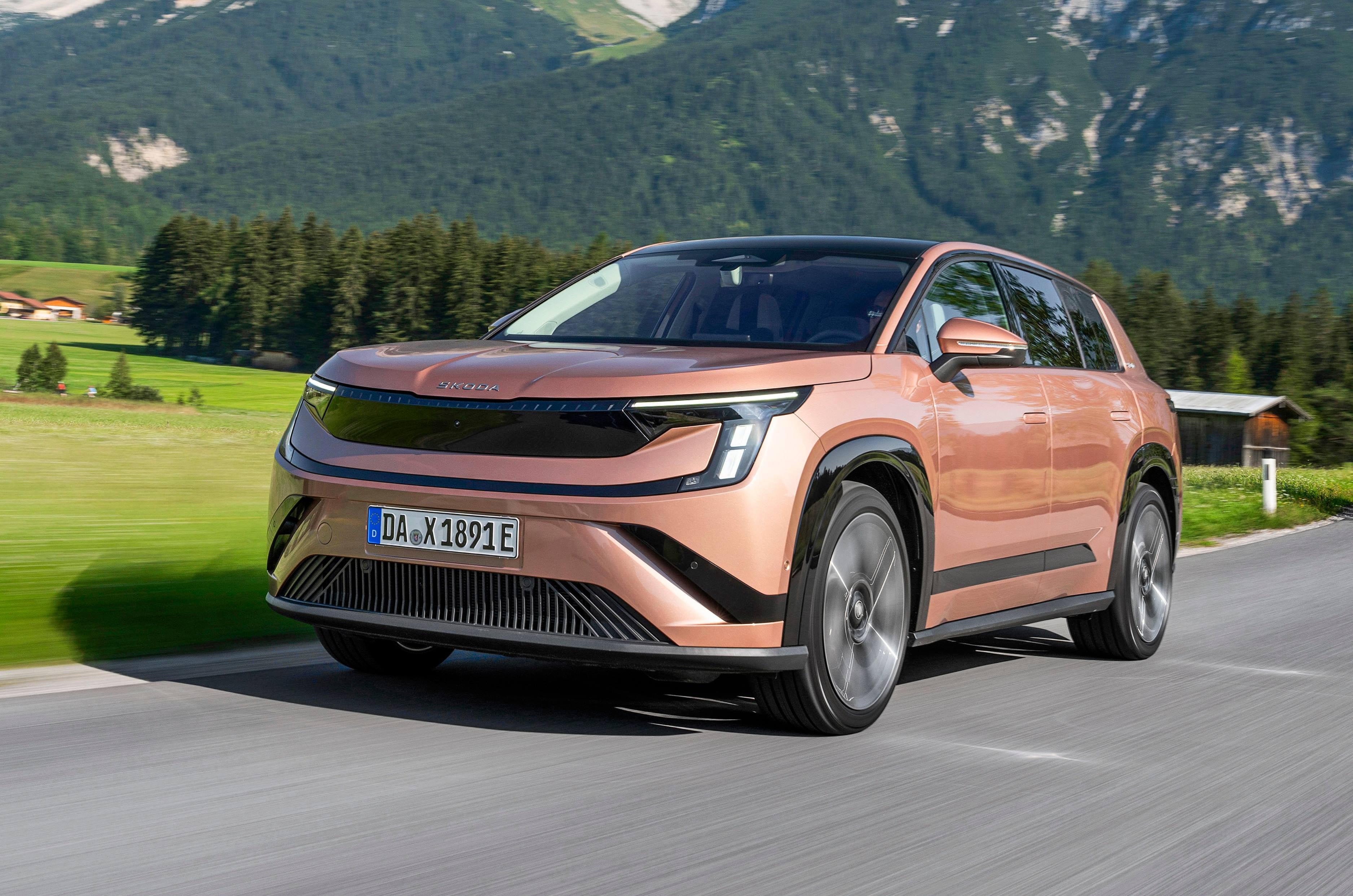
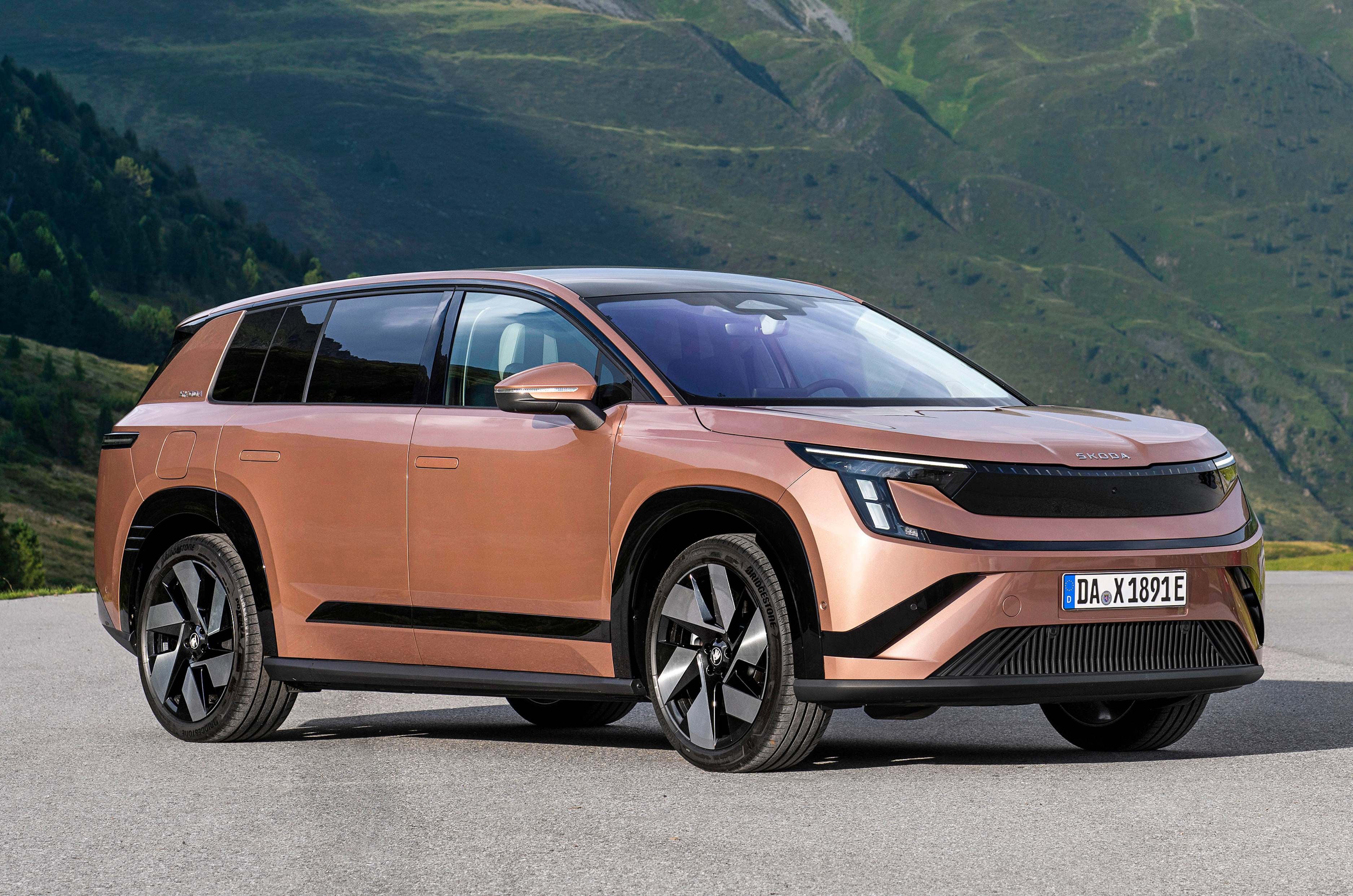
Epiq, Elroq, Enyaq, it’s pretty clear to see the nomenclature every electric Skoda SUVs follows, not so here though. You see this is Skoda’s new flagship or its peak as the company says, ergo we have the Peaq.
Skoda Peaq Exterior Design and Engineering – 9/10
Doubles down on minimalist style but looks premium, classy and has good presence.
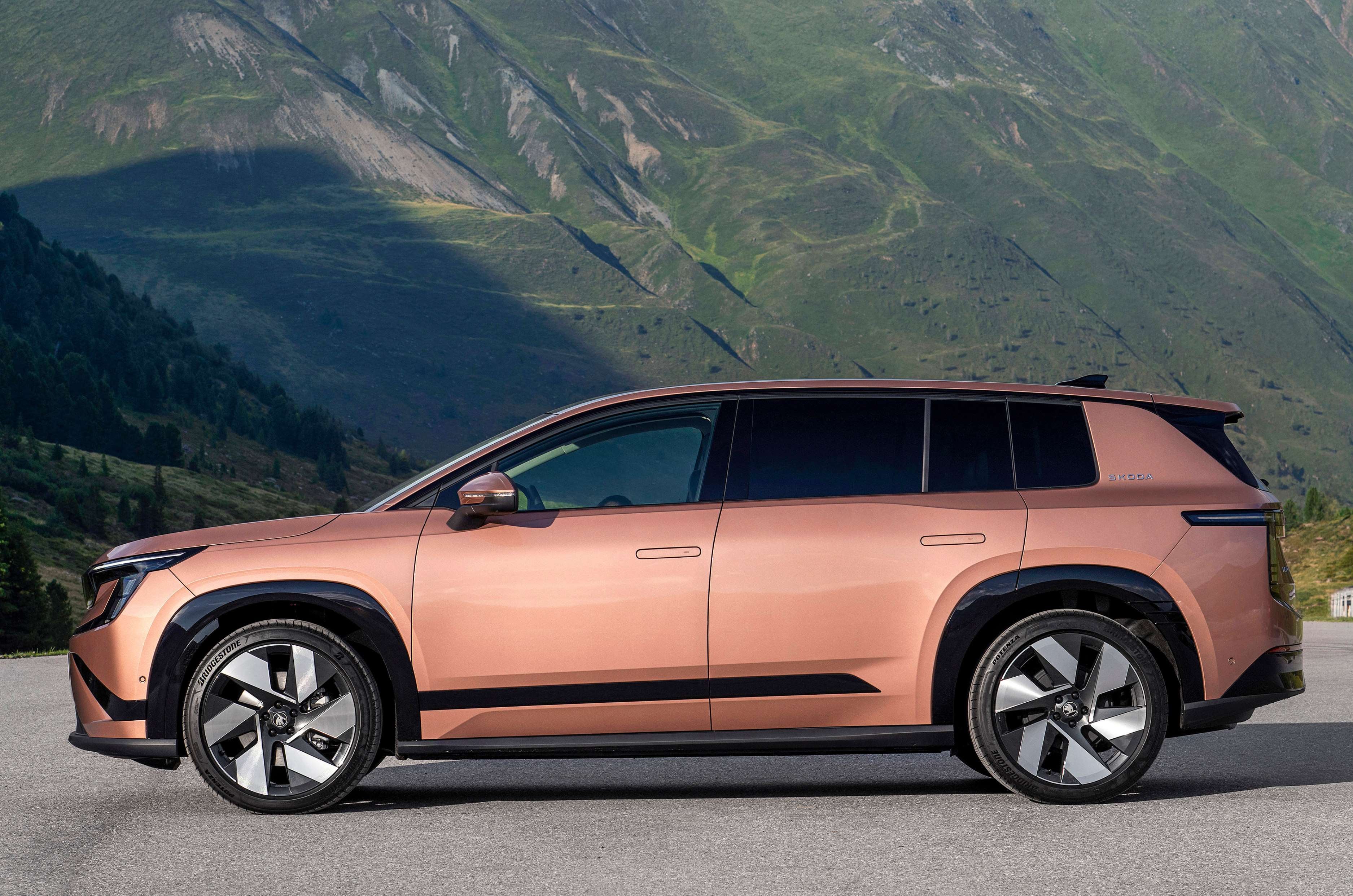
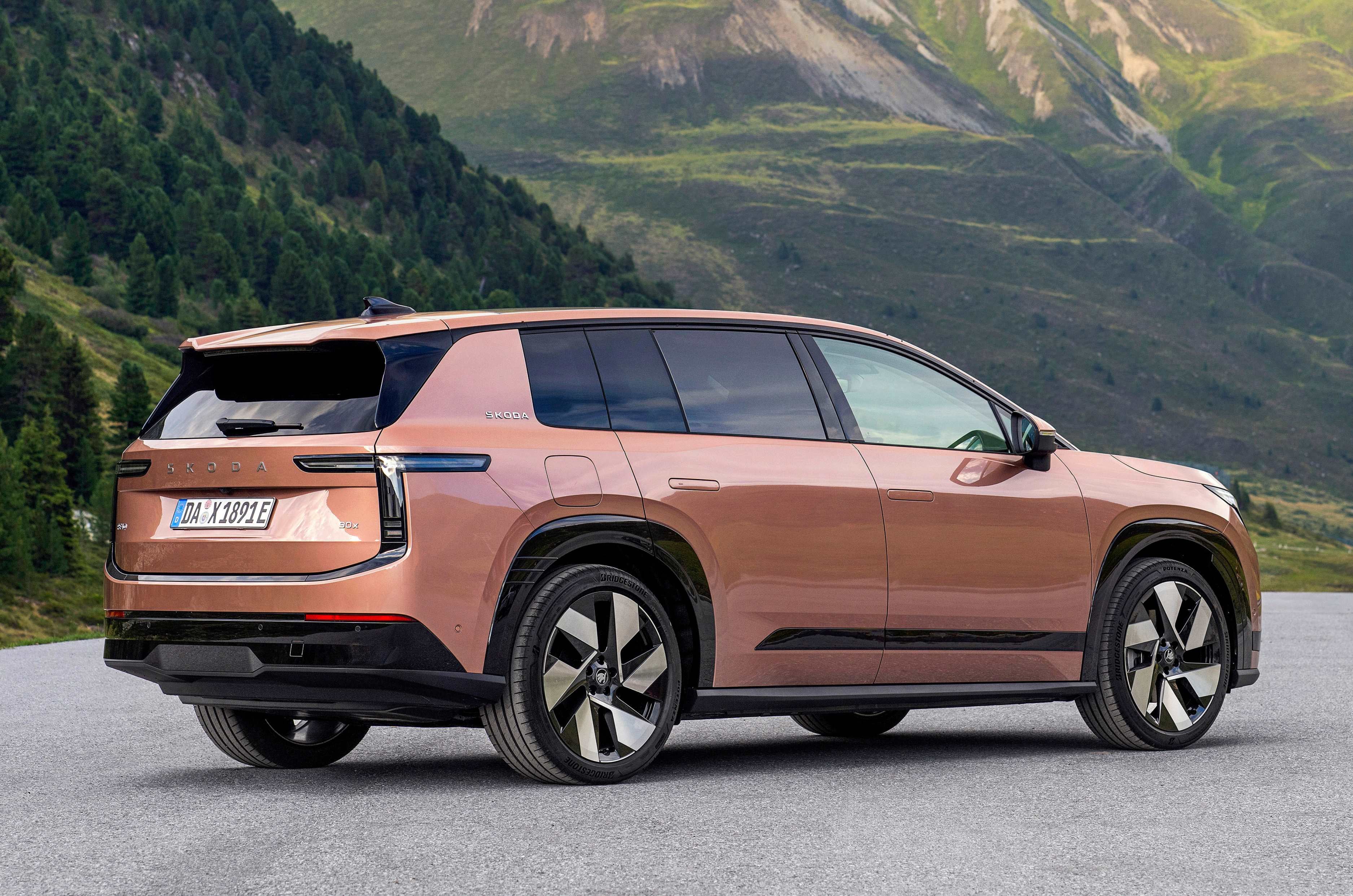
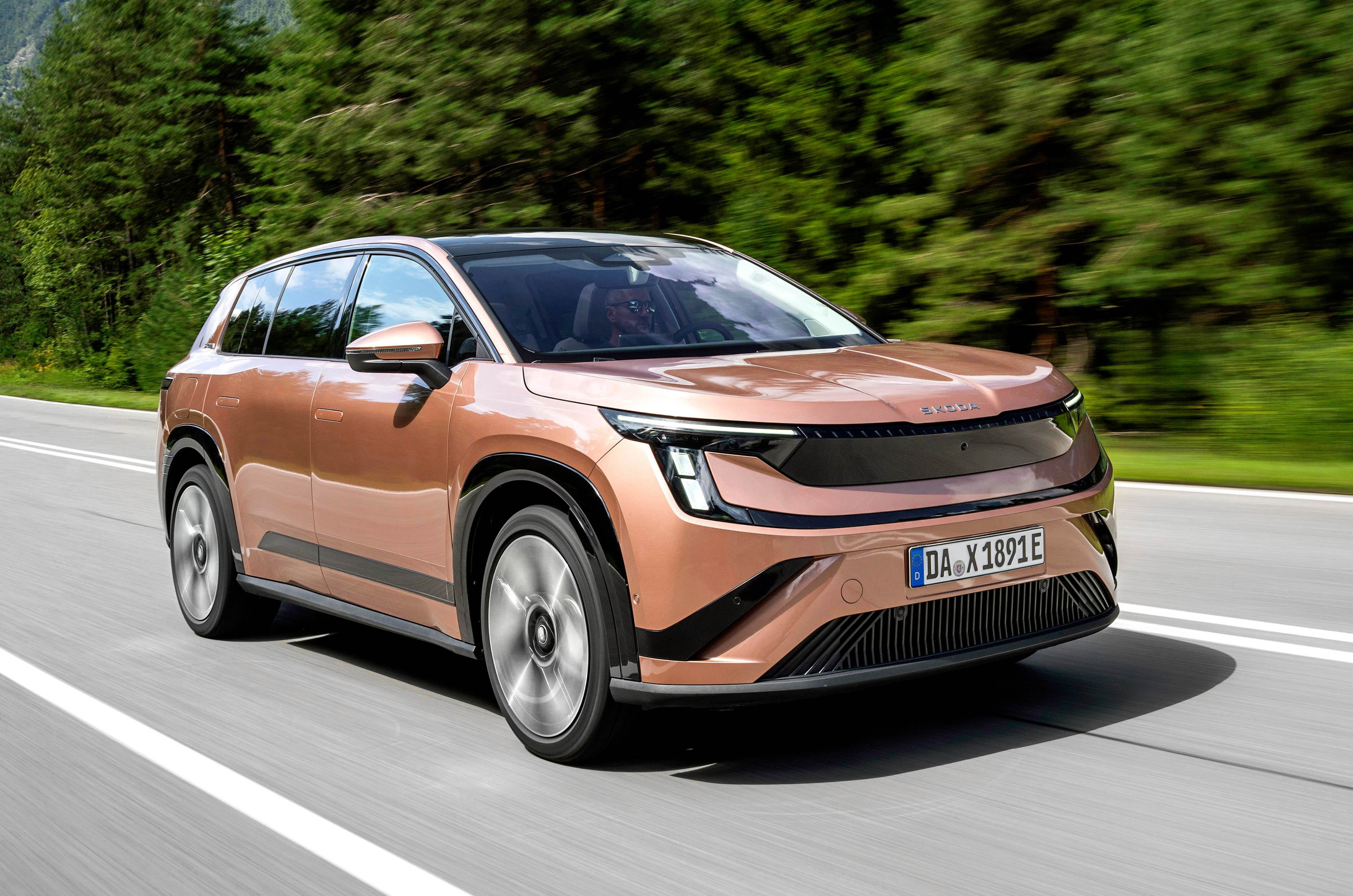
At 4.87 meters, the Peaq is the largest Skoda SUV yet.
While the entry level model, the Epiq, utilizes the front wheel driven MEB+ platform, the Elroq, Enyaq and the Peaq are all built on the MEB platform which is primarily rear wheel driven with the option of AWD, which the Peaq does offer. At 4.87 meters the Peaq is the largest Skoda SUV and sports Skoda’s largest boot, battery and sunroof, too.
Despite its size it doesn’t look brutish like most large SUVs seem to be leaning towards these days. Thanks to Skoda’s new ‘Modern Solid’ design language, which is all about minimalism the Peaq looks premium and classy and the bodywork is quite aero efficient too with a 0.249 drag coefficient.
The black panel houses all the tech bits like the cameras, radars and lidar.
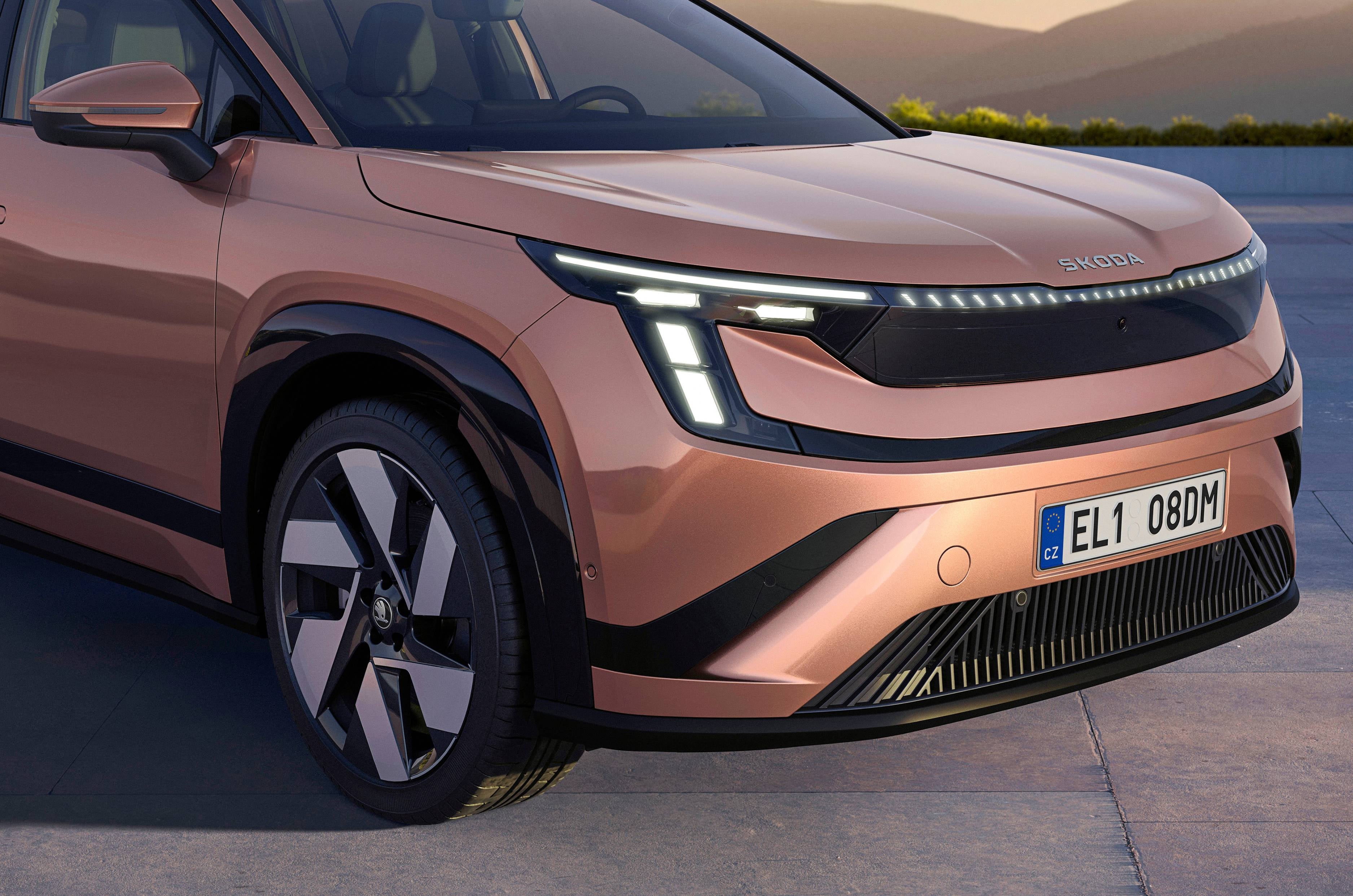
At the front the lines are simple and clean. The fascia sports the company’s T-shaped DRL and headlight signature and the rather clever Tech Deck; the black panel which hides all the tech bits like the cameras, radars and lidar and mimics a grille thus avoiding that faceless look many EVs sport. Skoda has even hidden LED lights behind it that – to a small extent – mimic grille slots. Notably the Skoda emblem is missing, the company is in the process of moving away from it and the Peaq carries the new Skoda letter mark instead.
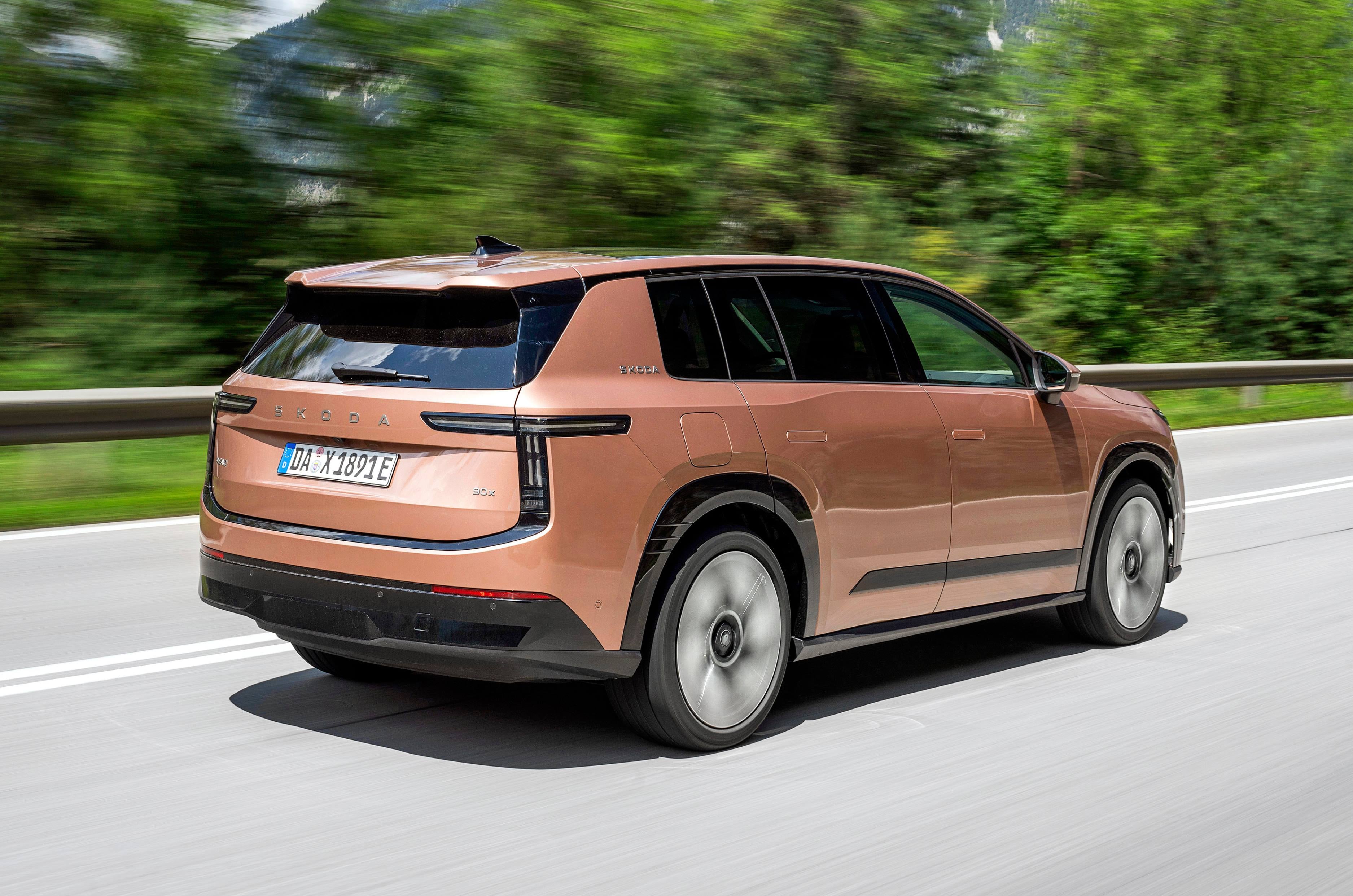
Over at the sides the clean lines continue with flush door handles, these can also be pressed in at the edge to manually operate them. The alloy wheels on our car were the 21 inchers and have a neatly balanced sporty and classy look. A defining styling element in profile is the C pillar which is body coloured and looks like a reversed fin and carries the Skoda lettering.
T-shaped tail lights are connected by a stylistic loop running at the bottom of the tail gate.
Like the headlights, the taillights too are T-shaped and are connected to each other via a stylistic loop running at the bottom of the tailgate. A roof integrated spoiler and a shark fin antenna complete the rear look and here too it’s just the Skoda lettering spelled out across the boot lid.
Skoda Peaq Interior Space and Comfort – 7/10
Minimalism carries on inside but cabin could do with a dash of flair.
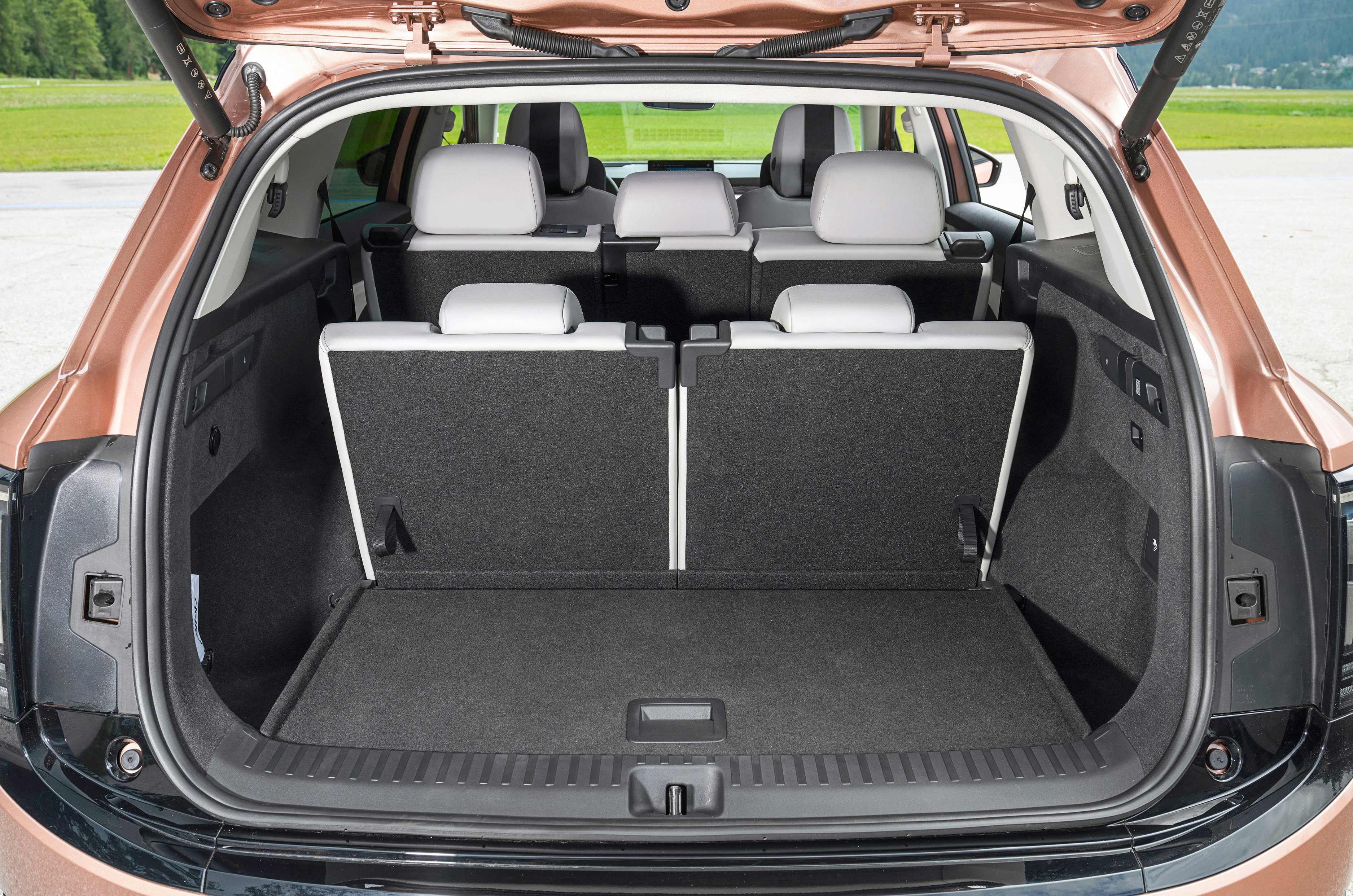
Peaq’s boot is the largest on a Skoda so far; offers 299-litres of space with all rows up.
With a near three-meter wheelbase there’s plenty of space inside, beginning with the boot which is the largest on a Skoda so far; 935 litres without the third row, but even in the 3-row version and with the third-row seats in place, there’s 299 litres which is more than enough for a few small bags. A handy little bit is a motorised cargo cover that rolls open or close with the boot opening and closing. At the front there’s also a 37-litre frunk.
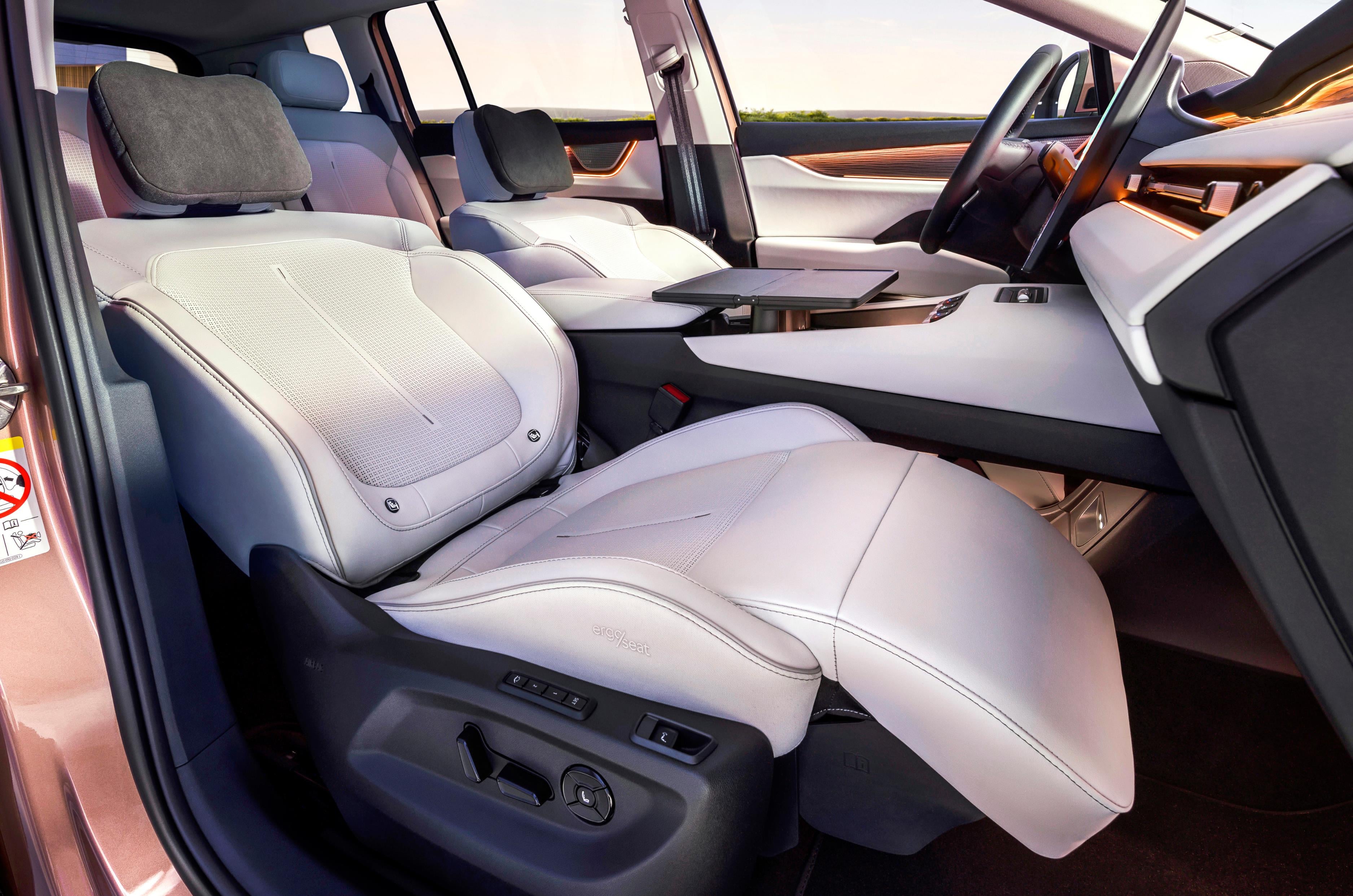
Front seats feature a ‘zero-gravity’ position allowing one to fully stretch out.
Passengers are well catered too, especially at the front two rows. The front seats offer plenty of space and will suit broader frames quite nicely. They also offer a ‘zero-gravity’ position wherein at the touch of a button the seat base dips, the seat back reclines and an ottoman style leg rest extends upward. They also offer heating, ventilation and a massage function. There’s an app too – which new EV does not have one these days – and that can configure the cabin lighting, seats, climate and other elements in six modes from a relaxing to an energizing ambience. On our drive in the cold Austrian mountains, we had a lot of rain and the ‘warm feet’ HVAC setting proved to be very handy and welcome.
Three people can sit abreast in the second row; one doesn’t sit in a knees-up position like in most EVs.
There’s plenty of space in the second row, legroom is good as is shoulder room. We did sit three abreast and didn’t have too much of shoulder overlap. Headroom is very generous and what’s nice is that you don’t sit in a knees-up position as is the case in some EVs. The third row is decent, there should have been more room given the length of the car, but on its own its quite useable and more than enough for kids or short journeys. Like the second row, headroom here is also good.
In terms of styling the cabin follows on with the exterior minimalist theme and all the lines are simple and clean, with very little flair about. A bit of panache would have been nice and in keeping with the flagship positioning of the Peaq.
Third row is decent enough for kids or for short journeys.
Skoda Peaq Features and Safety – 8/10
Well equipped and with a healthy does of Skoda’s ‘Simply Clever’ details.
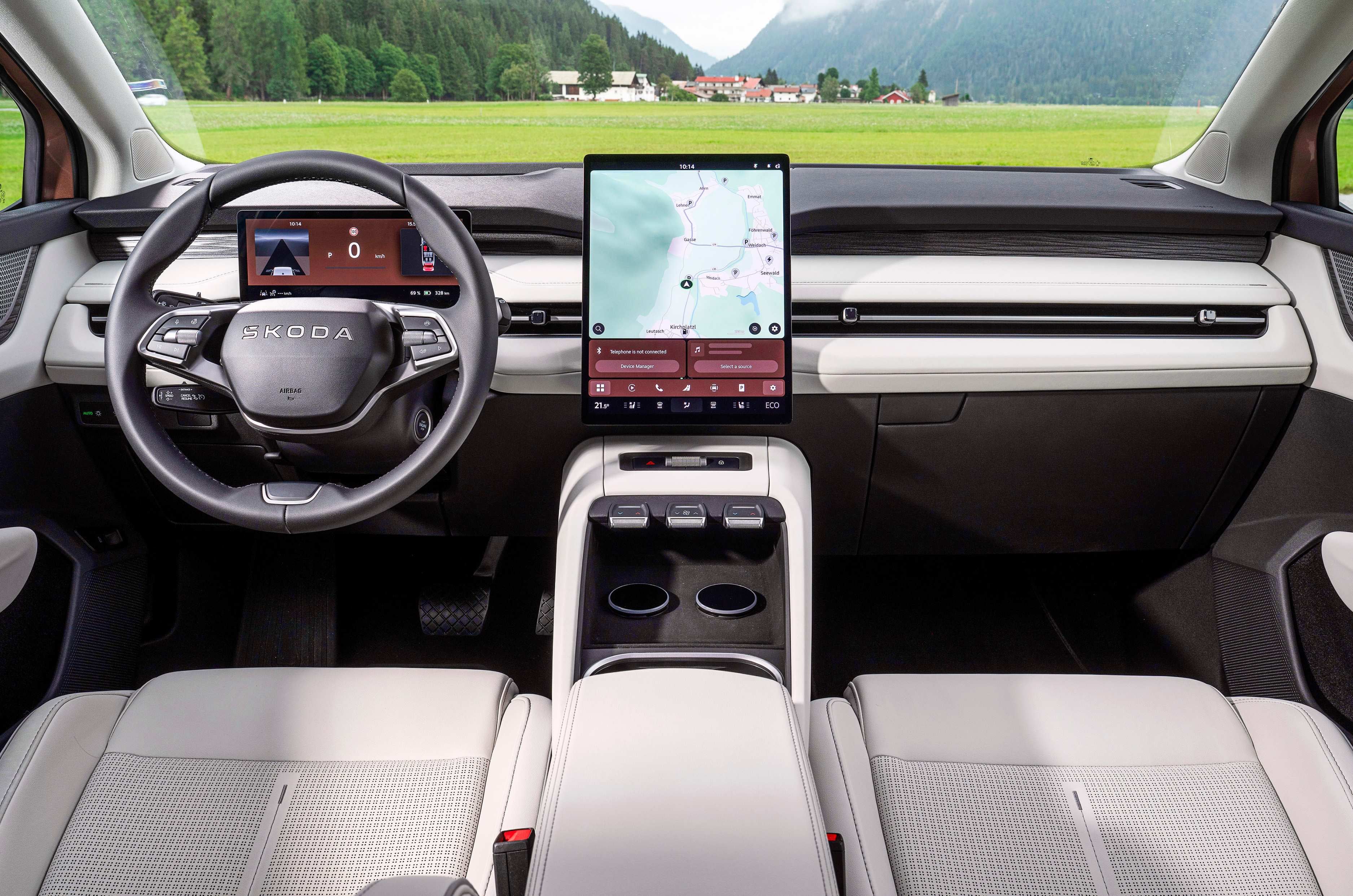
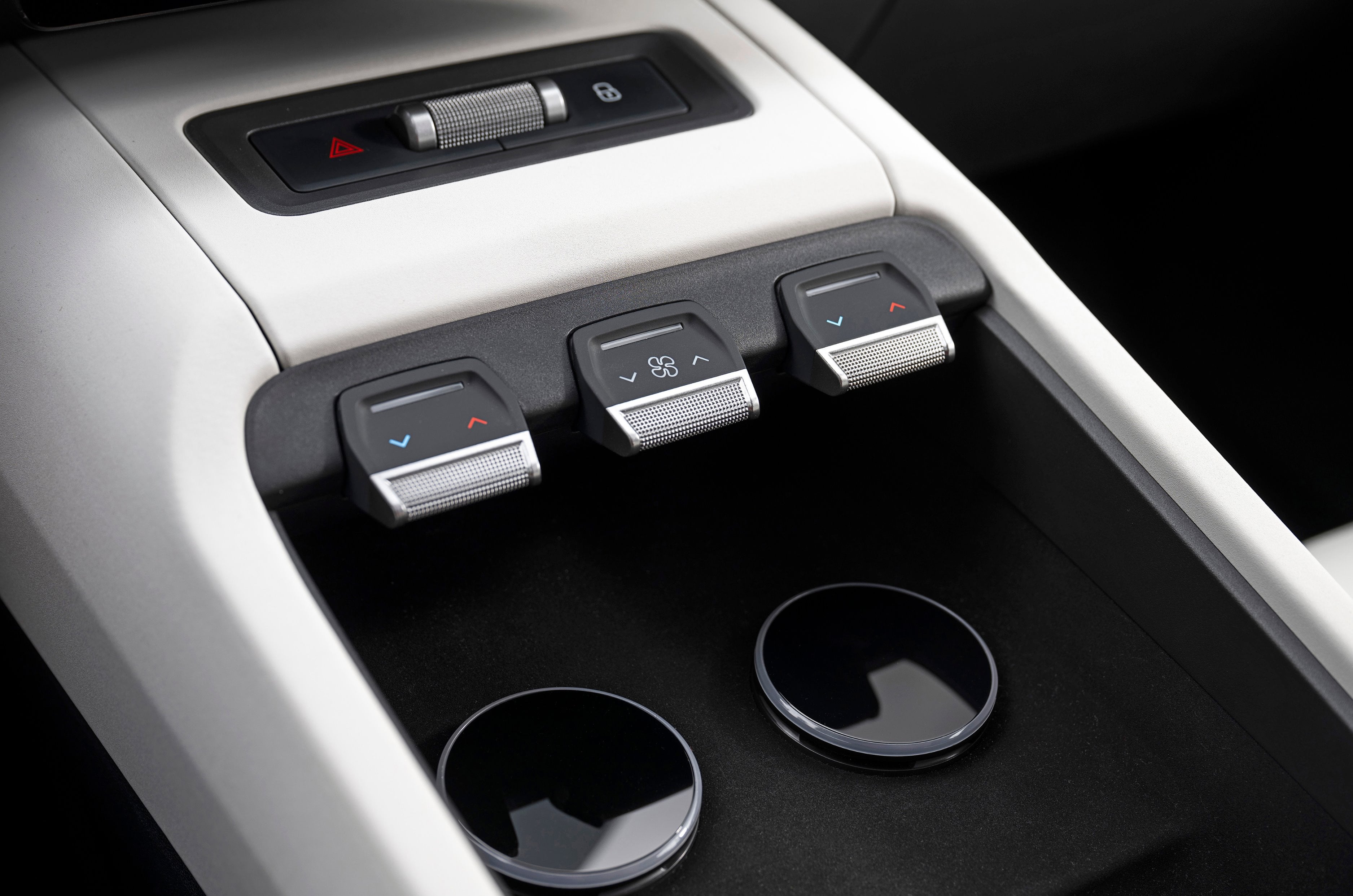
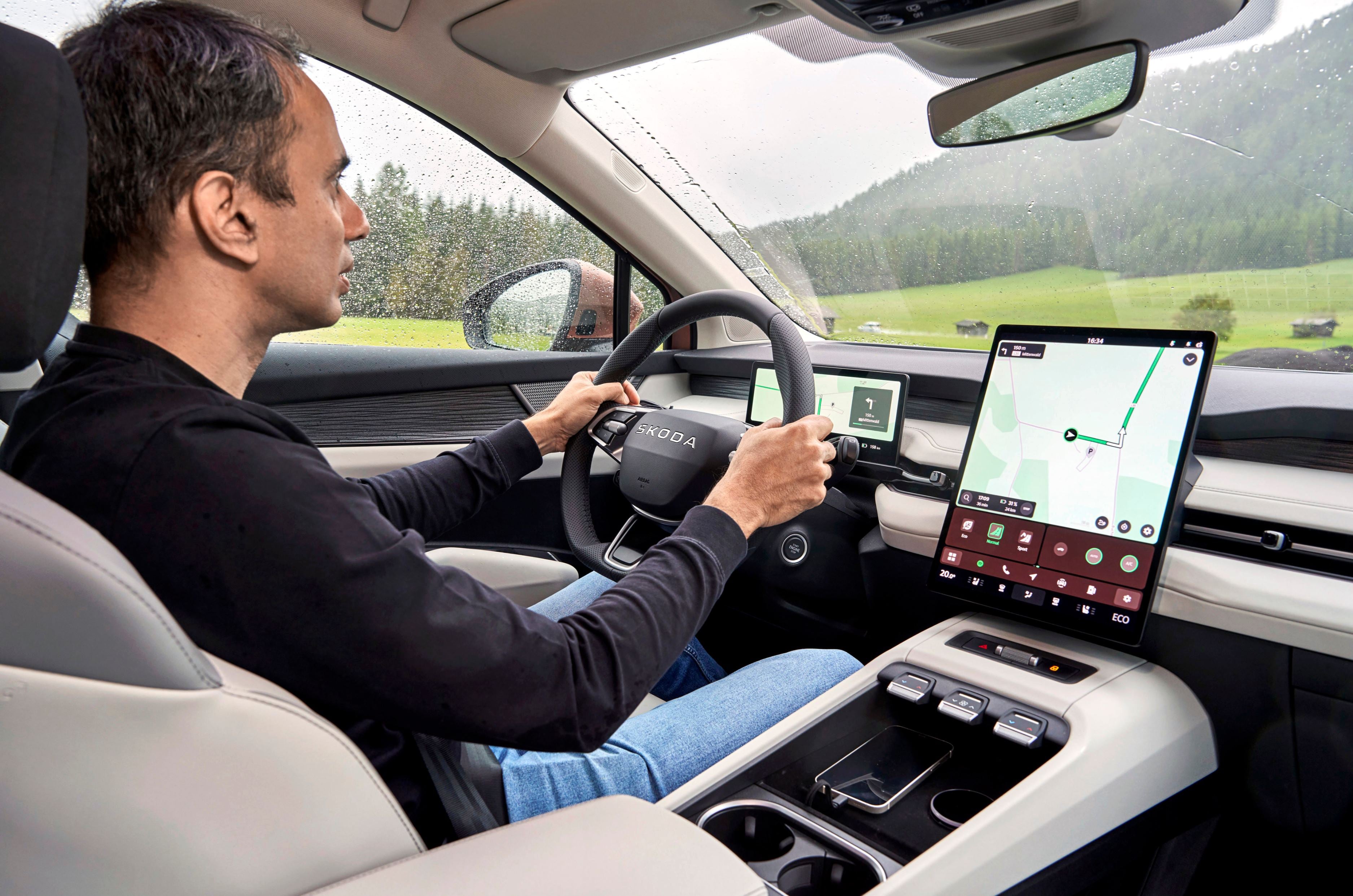
Sitting at the very top of the Skoda range the Peaq is well equipped. The dash carries a 13.6-inch, portrait-oriented touch screen – a first for Skoda – which runs a new UI. There’s a hard baked area for certain controls and thankfully physical controls are retained for main entertainment and HVAC functions, the latter being large toggle switches that are easy to use. These sit on top of an open charging box that has two illuminated magnetic Qi2 wireless charging disc with active cooling, and have a max speed of 25W. The rest of the center console is made up of many storage spaces and cubbies with a neat pass-through slot for charging cables from the lower to the upper console.
A portrait-oriented touchscreen is a first for a Skoda, and runs a brand-new UI.
Ahead of the driver is a 10-inch digital instrument panel which sounds large but has a slim aspect ratio, and there’s also an HUD. The steering wheel is the familiar Skoda unit with the letter mark on the boss and the buttons and scroll wheels on the two wings and as expected the operate with a satisfying click feel.
Thankfully, there are large toggle switches for HVAC controls which are easy to use.
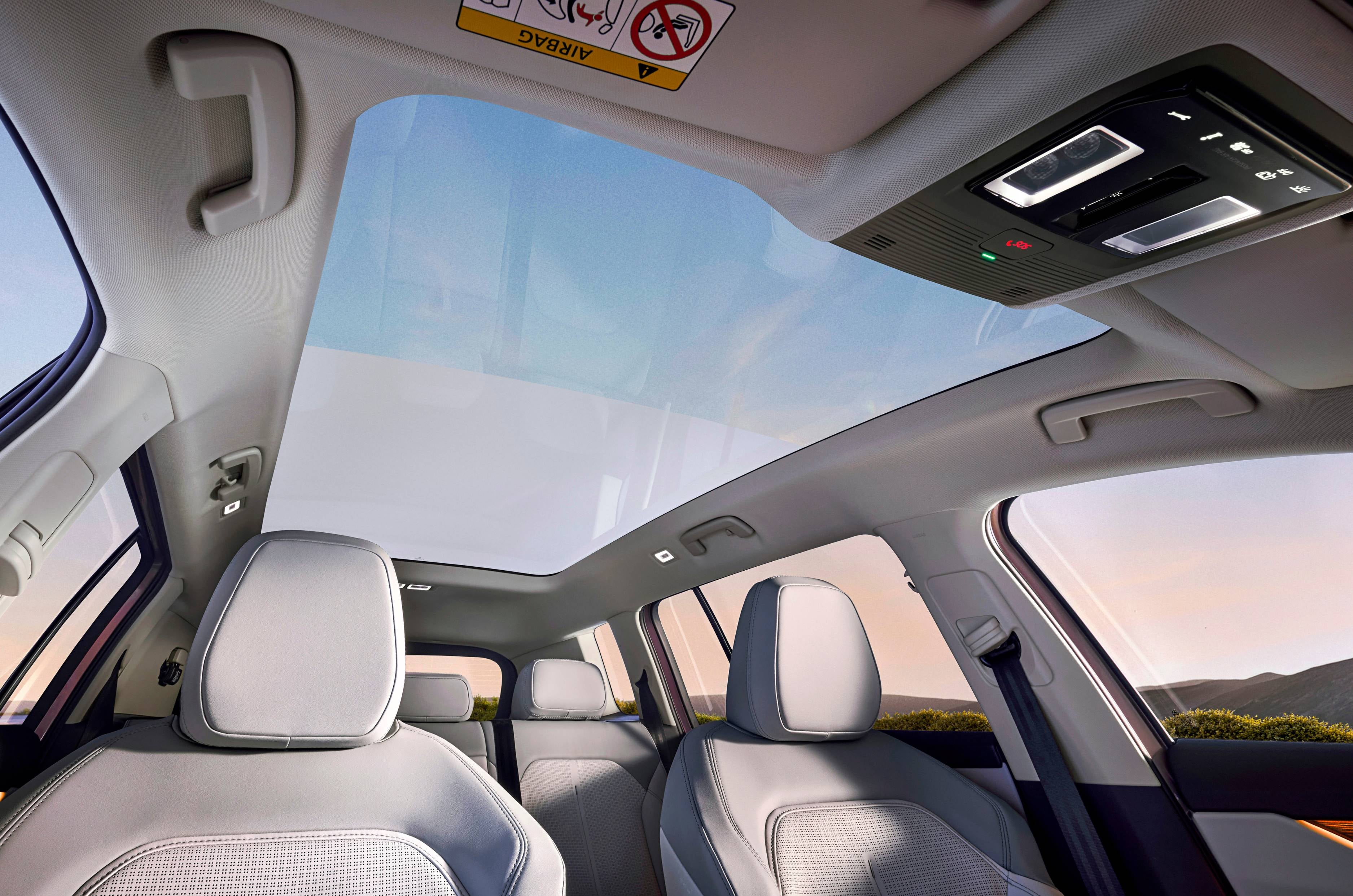
Other features include a 360-degree camera with a transparent 3D body on the display that helps in positioning the car, a 16-speaker SONOS sound system, park assist, a full connectivity suite, 10-airbags and ADAS and of course a healthy dose of Skoda’s ‘Simply Clever’ details like a fold out table for the front passengers that’s tucked away in the center console and umbrella holders in the doors. And topping things off is a large panoramic glass roof, which does not have a sunscreen, instead there’s 9 electrochromic panels that can be darkened to keep out the light and heat says Skoda. We’ll reserve that judgement for when we test it here in our hot climate though.
Panoramic glass roof doesn’t have a sunscreen but features 9 electrochromic panels to keep sun and heat out.
Skoda Peaq Performance and Refinement – 8/10
Strong performance that does not feel characterless like most EVs
There are three powertrain versions on offer starting with the 60-variant, power for which comes from a 63kWH (gross) NMC battery that drives a 204 hp rear motor. Next is the 90 trim which has a 91kWh (gross) NMC battery – the largest on a Skoda –power is courtesy a 286hp rear motor, and the range topper is the 90X which is also powered by the same battery as the 90 but driving a dual motor AWD set up that puts out a combined 300hp. Either of the 90 series cars is what Skoda will bring to India and for our drive today we had the 90X version.
Throtlle response feels quite ICE-like, building speed progressively.
As expected, power delivery is strong and acceleration is brisk, the claimed 0 – 100kph time stands at 6.7 seconds which is plenty quick for a large seven seat family SUV. What’s nice though is that the delivery isn’t typically EV like, which is to say power dumped in an instant and then linear all through. On the Peaq, throttle response feels quite ICE like, it’s fed in progressively and build nicely as you explore deeper regions of the throttle pedal. Top speed is limited to 180kph which is very easy to get too, on the unrestricted section of the German autobahns we hit an indicated 185kph. Wind and tyre noise is well controlled especially over the smooth tarmac sections and even at high triple digit speeds the cabin was silent enough.
Wind and tyre noise are well contained even at triple digit speeds.
Skoda Peaq Ride Comfort and Handling – 7/10
Very stable at speeds, but Normal mode sees some body float over undulations.
The 90X comes with Skoda’s dynamic chassis control and the adjustable dampers do alter the ride character noticeably. In Normal mode is very comfy and could do well over potholes and ruts, however at highway speeds and over undulations that we did see on some section there is some body float. A switch to the Sport setting however tides this up quite nicely and was the default setting I used for most of the drive. Being an AWD, there’s also a few off-road modes though we didn’t get to try these out and I suspect most owners won’t either.
Depending on the mode, adjustable dampers noticeably alter the ride quality.
In terms of handling this isn’t what you would call light on its feet, you do know you are driving a large SUV but its never cumbersome and through the mountain passes we did have a bit of fun, not sporty then but enjoyable enough if how I’d describe the handling character.
Skoda Peaq Range and Efficiency – 7/10
Charging speeds and range are par for course
The Peaq 60 battery capacity stands at 63kWh (59kWh net) and that’s good for a range of 450kms says Skoda. Max charging speed is 160kW on a DC fast charger and that can take the battery from 10 to 80 percent in 27 minutes.
A 160kW DC fast charger can top up the battery from 10 to 80 percent in 27 minutes (claimed).
The 90 cars are powered by a larger 91kWh (86kWh net) battery, max charging speed stands at 199kW and a 10 to 80 percent charge on a DC fast charger takes 28 mins. On the 90X range stands at 610kms while the two wheel drive 90 version sees a slightly longer range at 640 kms. We’ll know the real-world range once we put it through our standard test cycle back home.
Skoda Peaq Expected price and Verdict – 8/10
Priced at Rs 60 lakh it would be a tempting option and it does more than enough to call this peak Skoda.
Skoda is really doing a fine job with its EVs, we liked the Enyaq, were superbly impressed with the Elroq and the flagship Peaq does not disappoint too. Yes, the ride does feel soft and the interiors do lack flair, something you would expect on a flagship and we’ll of course have to wait and see how Skoda price this when it comes to India some time mid next year. Skoda says it will arrive as a CBU and we expect it to be priced at around Rs 60 lakh ex-showroom where it will be able to compete with rivals like the Tesla Model Y L, above that though and Skoda will face some heat from premium brands like BMW and Mercedes that are also expanding their electric SUV portfolio.
The Peaq will arrive in India as a CBU and is expected to be priced around the Rs 60 lakh mark.
The Peaq though does provide a very well-turned-out product, it looks classy and premium and that’s important at this price point, there’s a good amount of space inside, especially for the front two rows, it’s well equipped with typically Skoda clever bits and the drive experience is mature and enjoyable. All typical highlights that we’ve come to expect of the brand. All in all, then, the Skoda Peaq does more than enough to safely call this, peak Skoda.
JSW Group, one of India’s largest conglomerates, is preparing to significantly expand its automotive ambitions. Having already established a presence through JSW-MG Motor India, its joint venture with China’s SAIC, the company is now gearing up to enter the market with an all-new brand of its own, JSW Motor.
Rather than taking the conventional route of developing products from the ground up, JSW is leveraging global partnerships to fast-track its entry into the industry. Its first product for India will be a large plug-in hybrid SUV based on the Chery Jetour T2, which is expected to be assembled at JSW’s upcoming facility in Chhatrapati Sambhajinagar, and we hear it will be called the Combat.
With its rugged styling, imposing road presence and the promise of combining EV-like efficiency and long-distance touring ability, the SUV is expected to be positioned in the Rs 30-50 lakh segment and take on established players head-on.
Ahead of its India launch later this year, we got an early drive of the SUV to find out whether JSW Motor’s debut offering is ready for combat.
Jetour T2 Exterior Design and Engineering – 8/10
A handsome SUV that oozes character and rugged appeal.
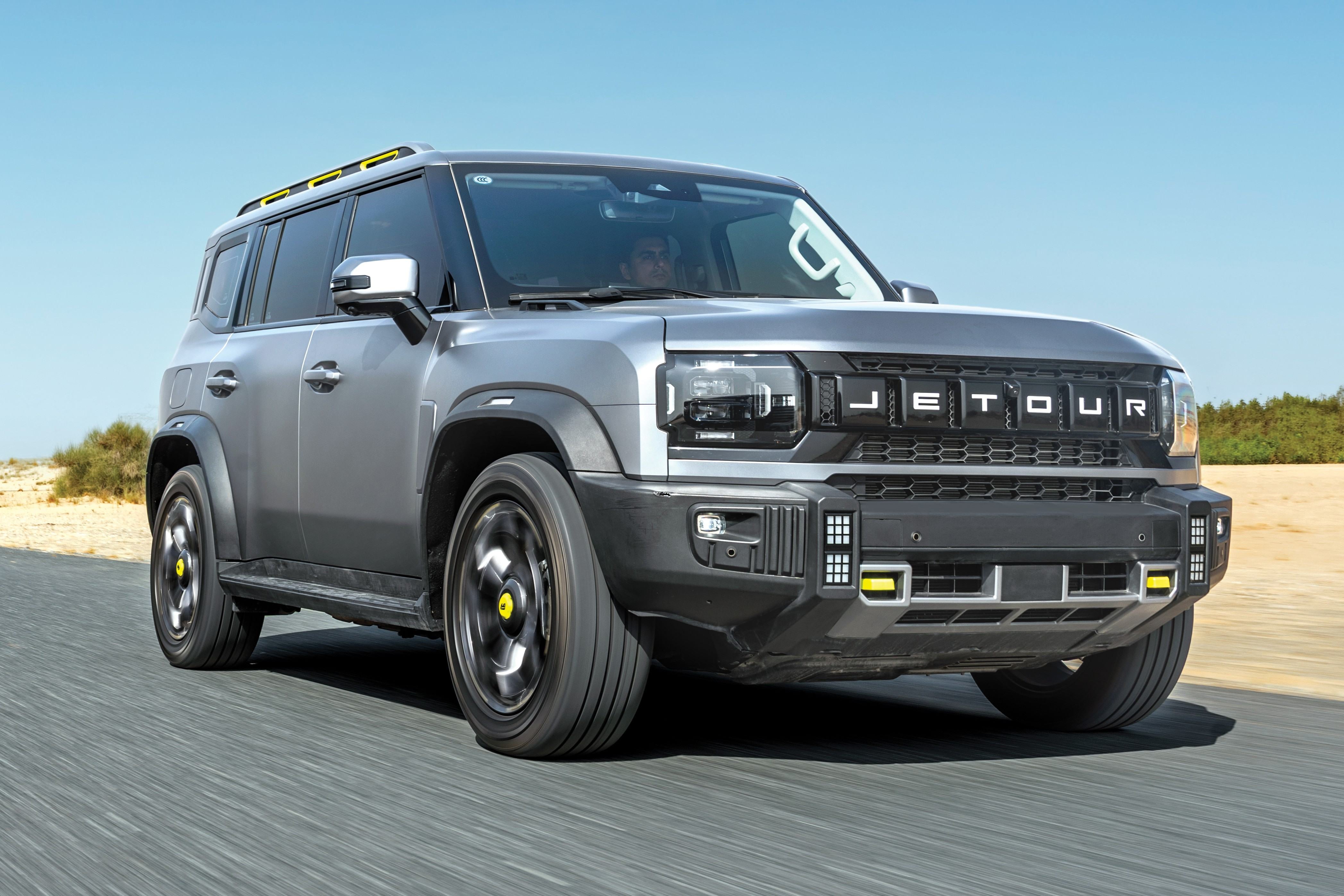
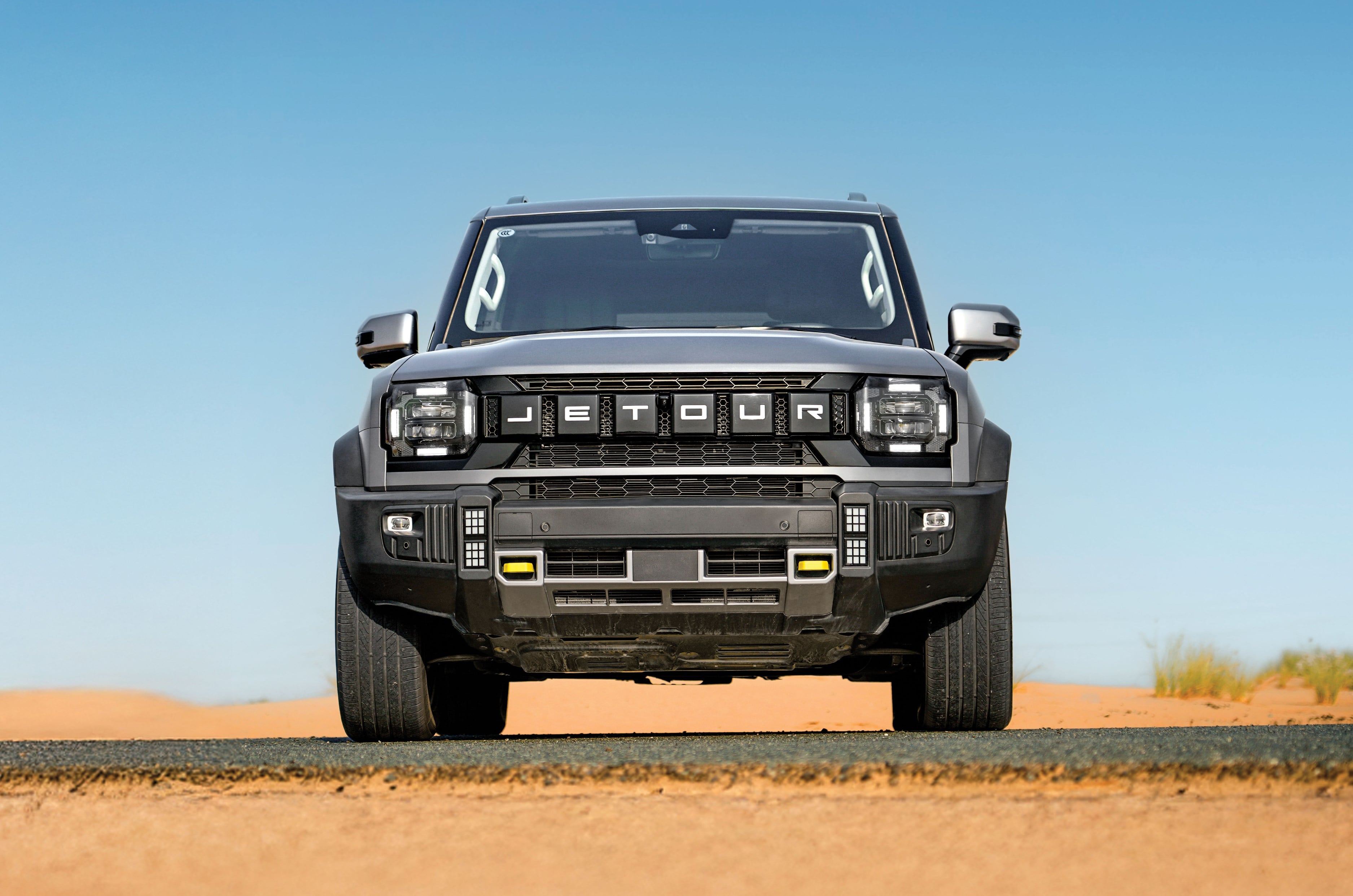
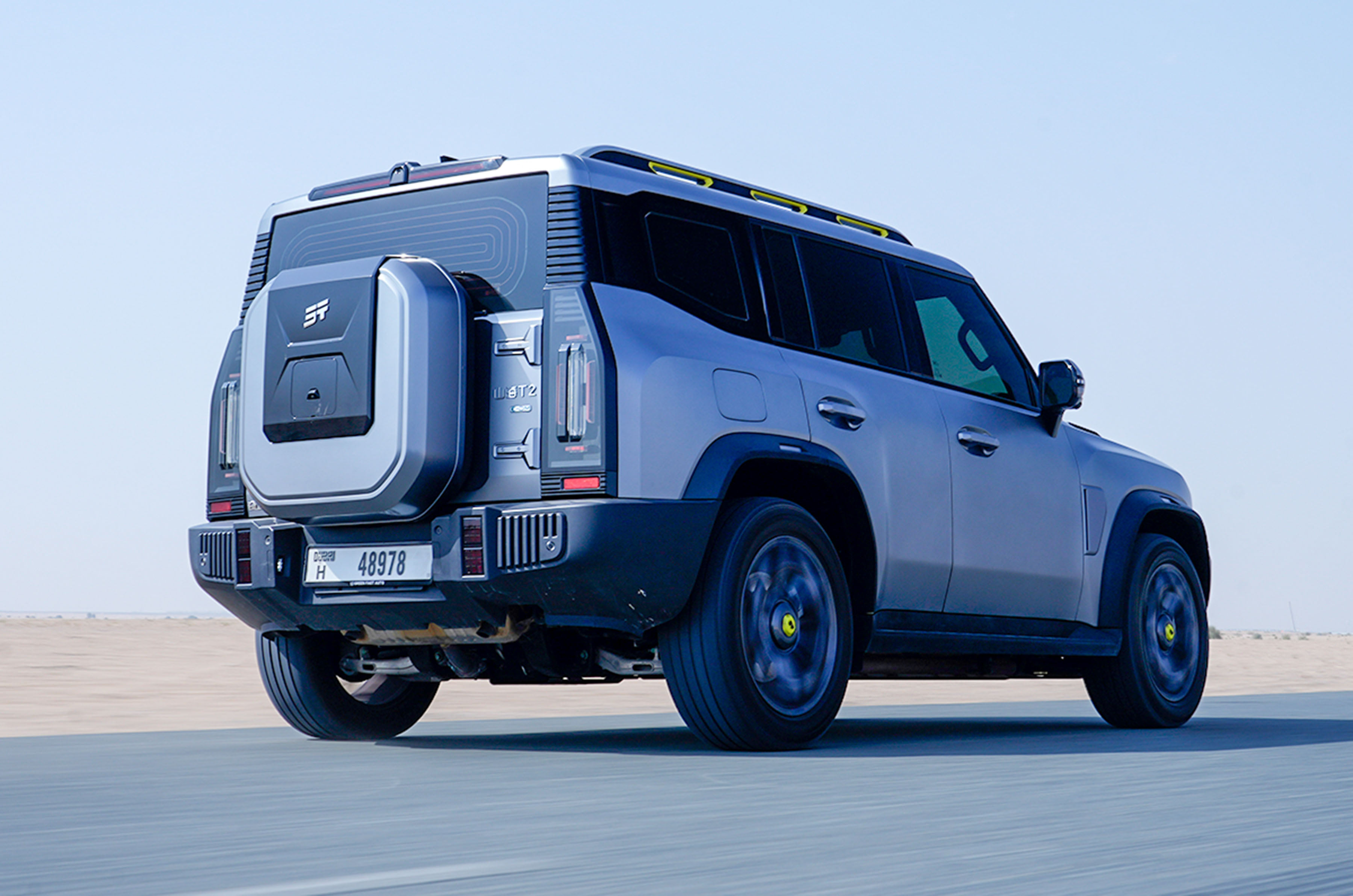
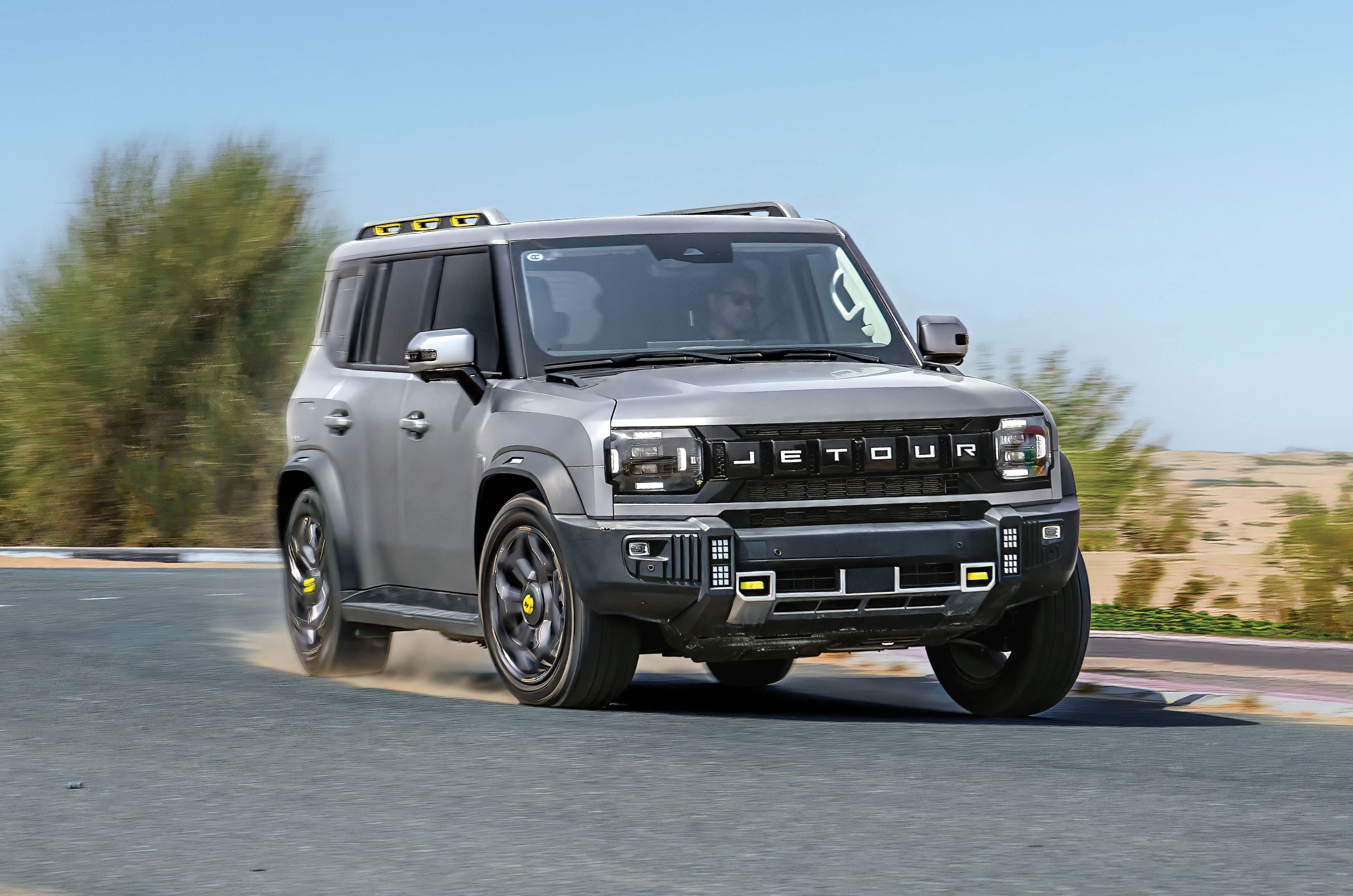
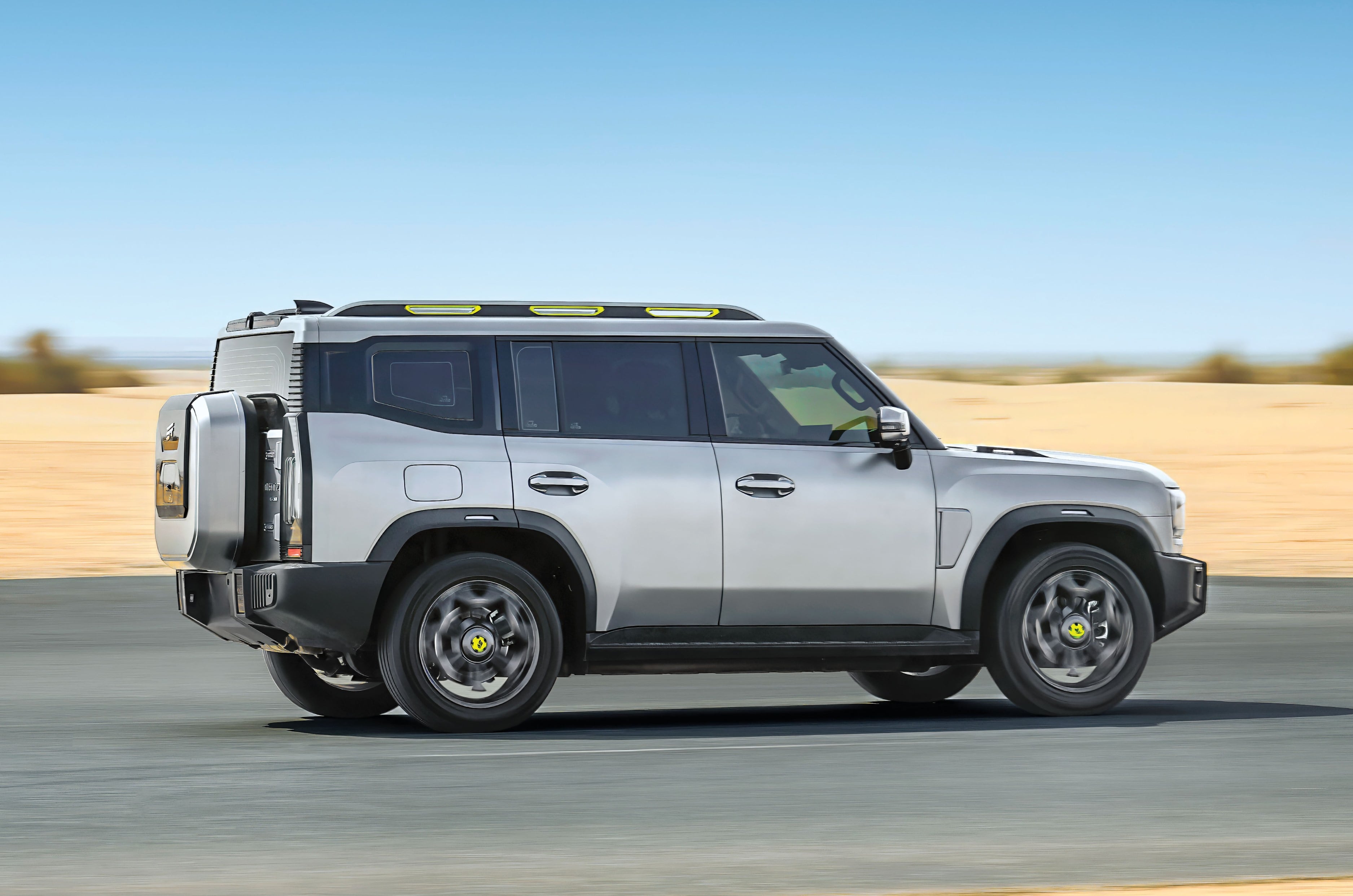
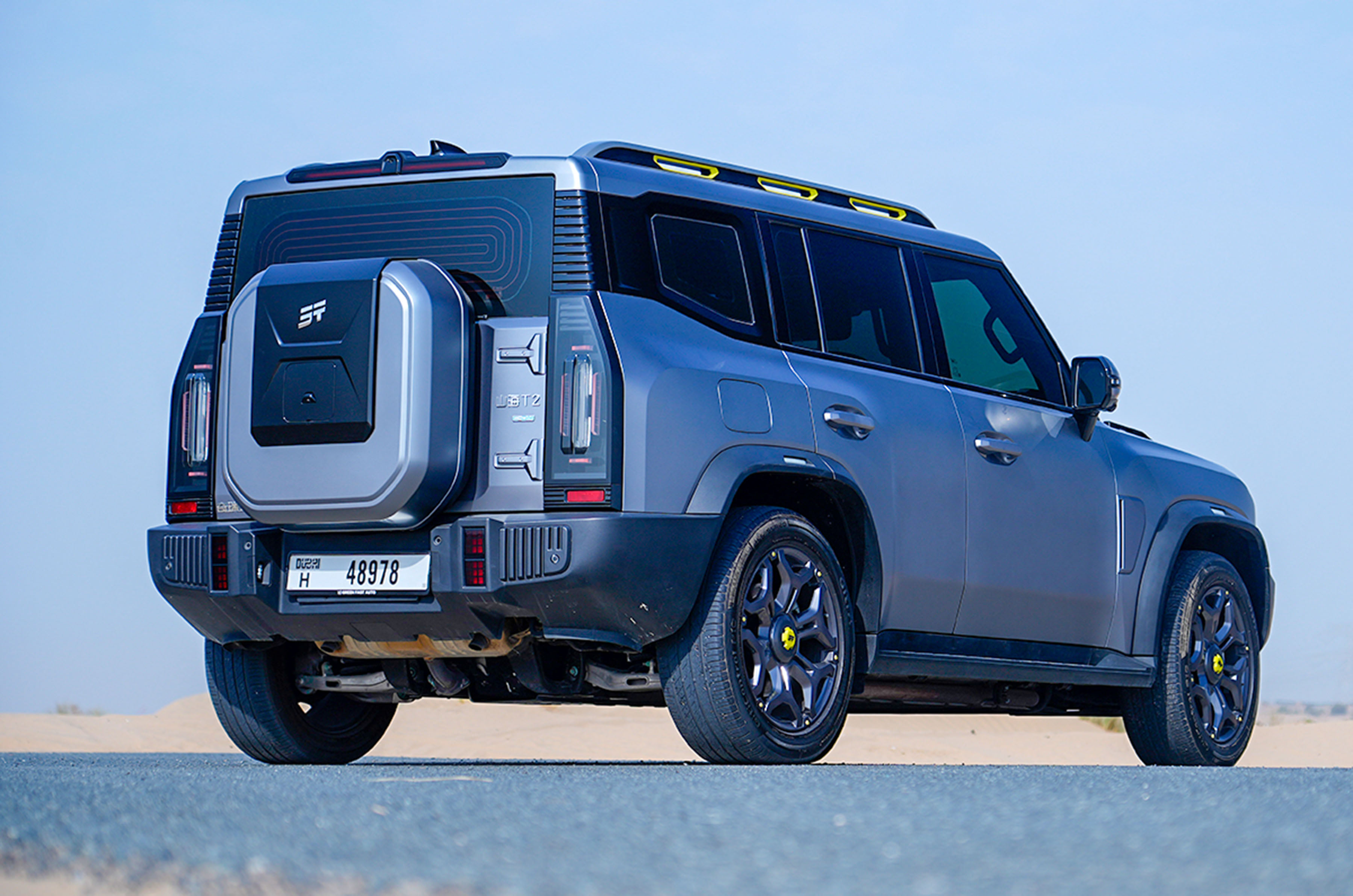
The Jetour T2 delivers on the SUV template to the T – flat bonnet, upright stance, raised ride height, chunky tyres, rugged body cladding, and, as the icing on the cake, a spare wheel mounted on the tailgate. It looks imposing and highly desirable, and while its silhouette bears a resemblance to the Defender, the T2 still manages to carve out a distinctive identity. JSW is likely to make a few changes to the headlamps, grille and bumpers to further differentiate the Combat, but the overall shape, clean surfacing and most of its defining design elements are expected to remain unchanged.
Attractive 20-inch wheels; 201mm of laden clearance.
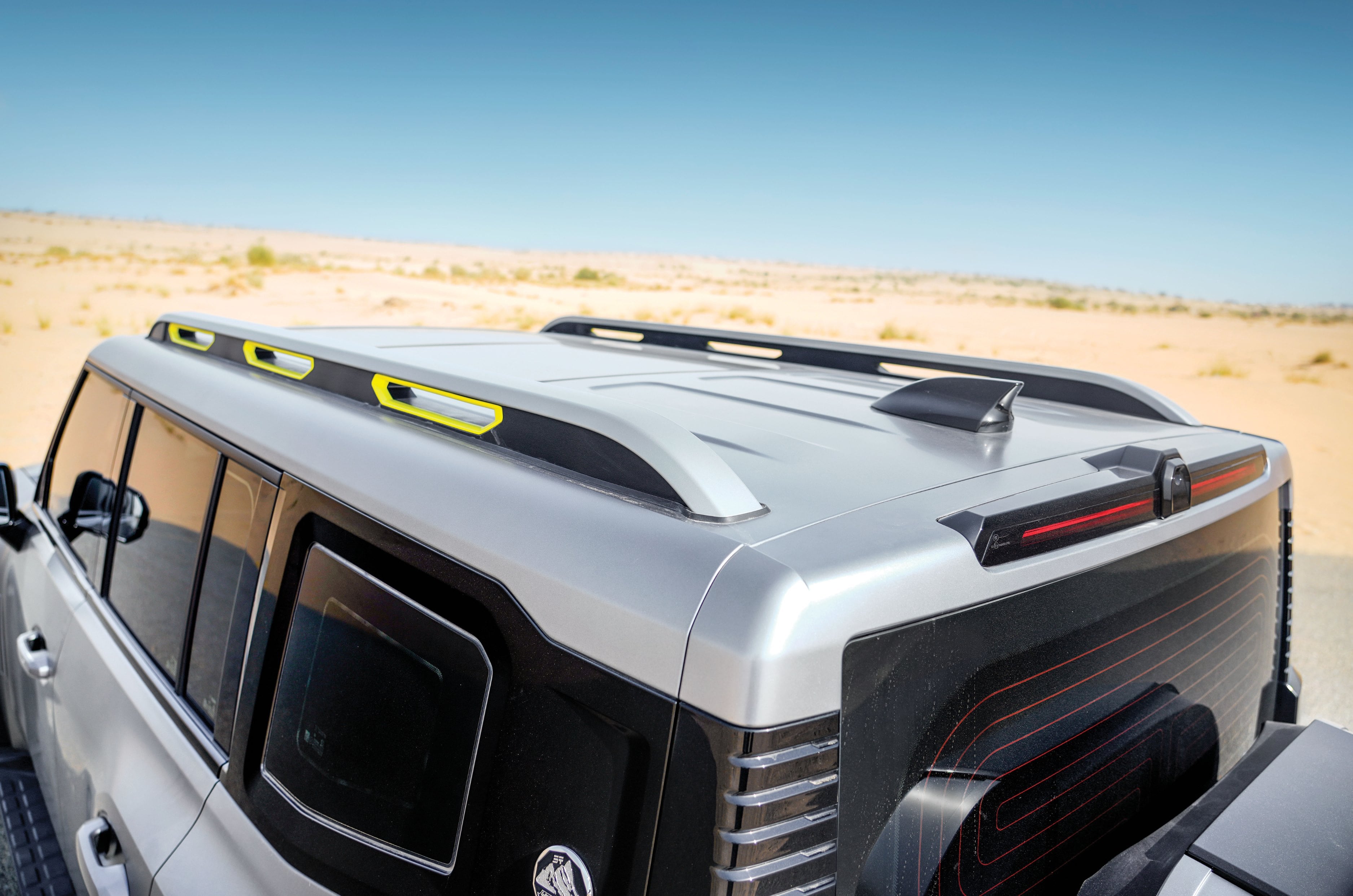
The massive 20-inch wheels suit the T2’s stance perfectly, and the clean bodywork, free of unnecessary cuts and creases, is particularly appealing. It also gets functional roof rails capable of carrying up to 100kg of luggage, while the side steps feel reassuringly sturdy and genuinely useful.
The T2’s space-saver spare wheel sits within a squircle-shaped cover, although accessing it involves a multi-step process that could prove frustrating if you ever need to change a tyre on a deserted road late at night.
Functional roof rails can take up to 100kg of load.
In terms of dimensions, it is longer (including the spare wheel), wider and taller than the Toyota Fortuner. Ground clearance, too, is an impressive 190mm in laden condition. However, don’t let its rugged appearance fool you – the version destined for India will remain front-wheel drive.
Jetour T2 Interior Space, Comfort, and Features – 8/10
Solidly built, well-designed cabin with some clever detailing and plenty of storage areas.
Climb aboard using the sturdy side step and handy grab handles, and the T2 immediately impresses with its sense of solidity. The cabin feels built to last, with numerous thoughtful design details lending it plenty of character. Nearly upright windows, a steeply raked windscreen and a dashboard pushed far forward create a tremendous sense of space, further amplified by the panoramic sunroof.
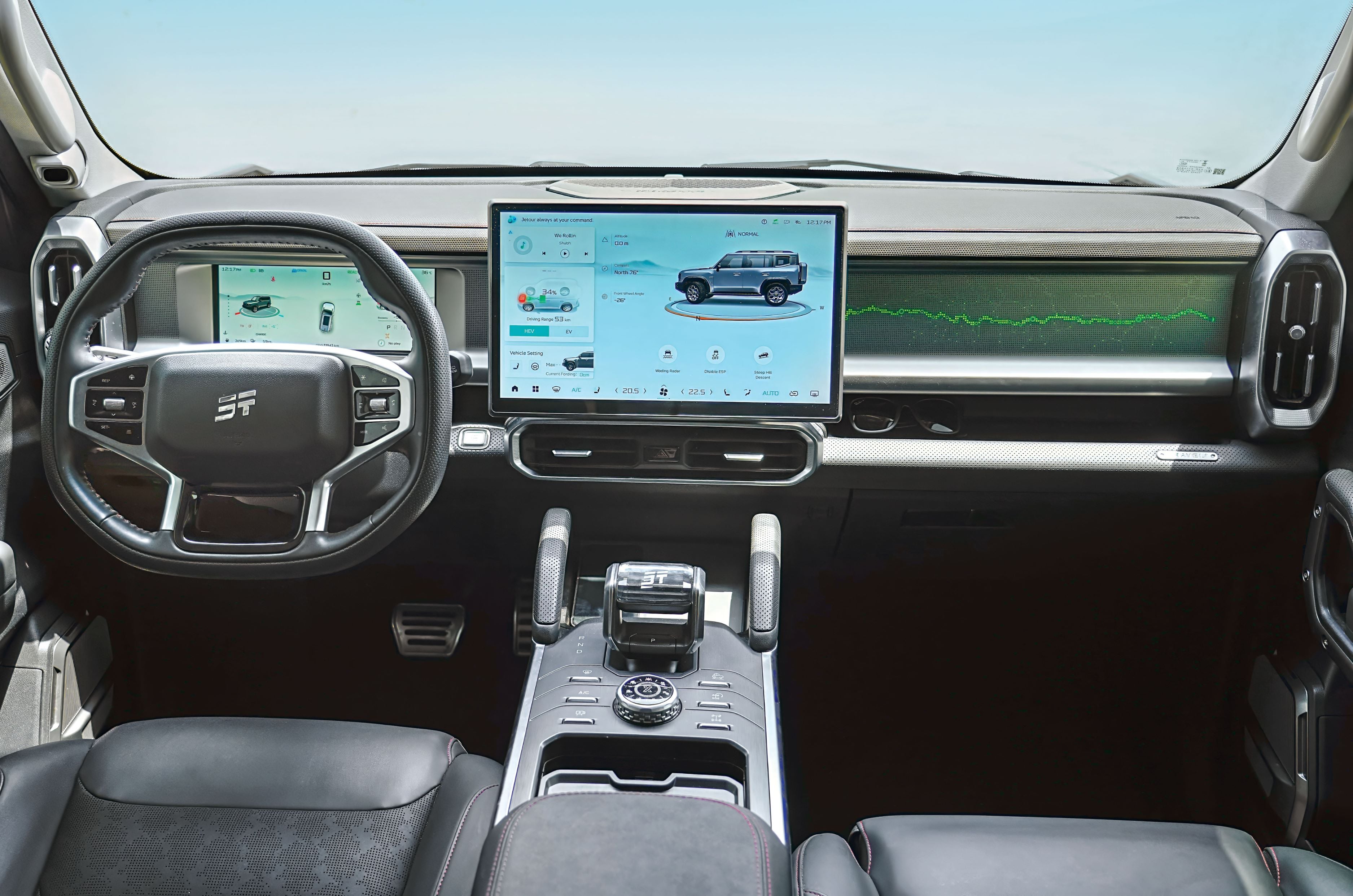
The dashboard itself has a distinctive design, with an illuminated pattern across the fascia adding a unique touch. Several layers are wrapped in dimpled leatherette padding, a theme that extends to the steering wheel and centre console.
Dominating the cabin is a massive 15.6-inch touchscreen that houses numerous vehicle functions, including mirror adjustment, climate control and seat ventilation/heating settings. Wireless Android Auto and Apple CarPlay are included, while the 12-speaker Sony audio system delivers impressive sound quality. Even the 540-degree camera system offers excellent image clarity. The downside is that the interface isn’t slick or responsive.
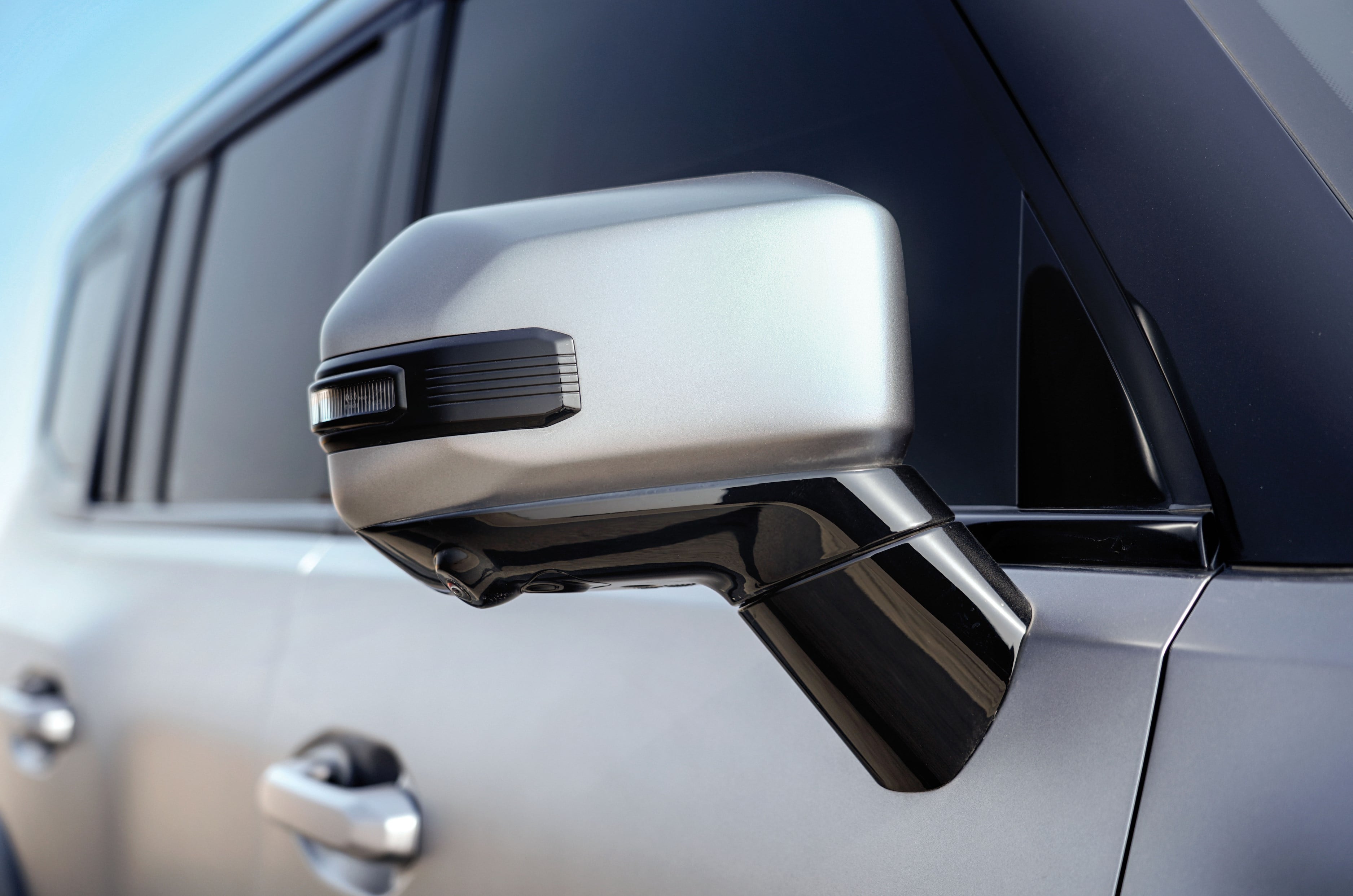
Chunky, door-mounted mirrors. Sadly, controls via touchscreen.
Ahead of the driver sits a 10.6-inch digital instrument cluster, a unit we’ve previously seen in some MG and BYD models. While it displays a wealth of information, the fonts and icons are rather small, making them difficult to read at a glance.
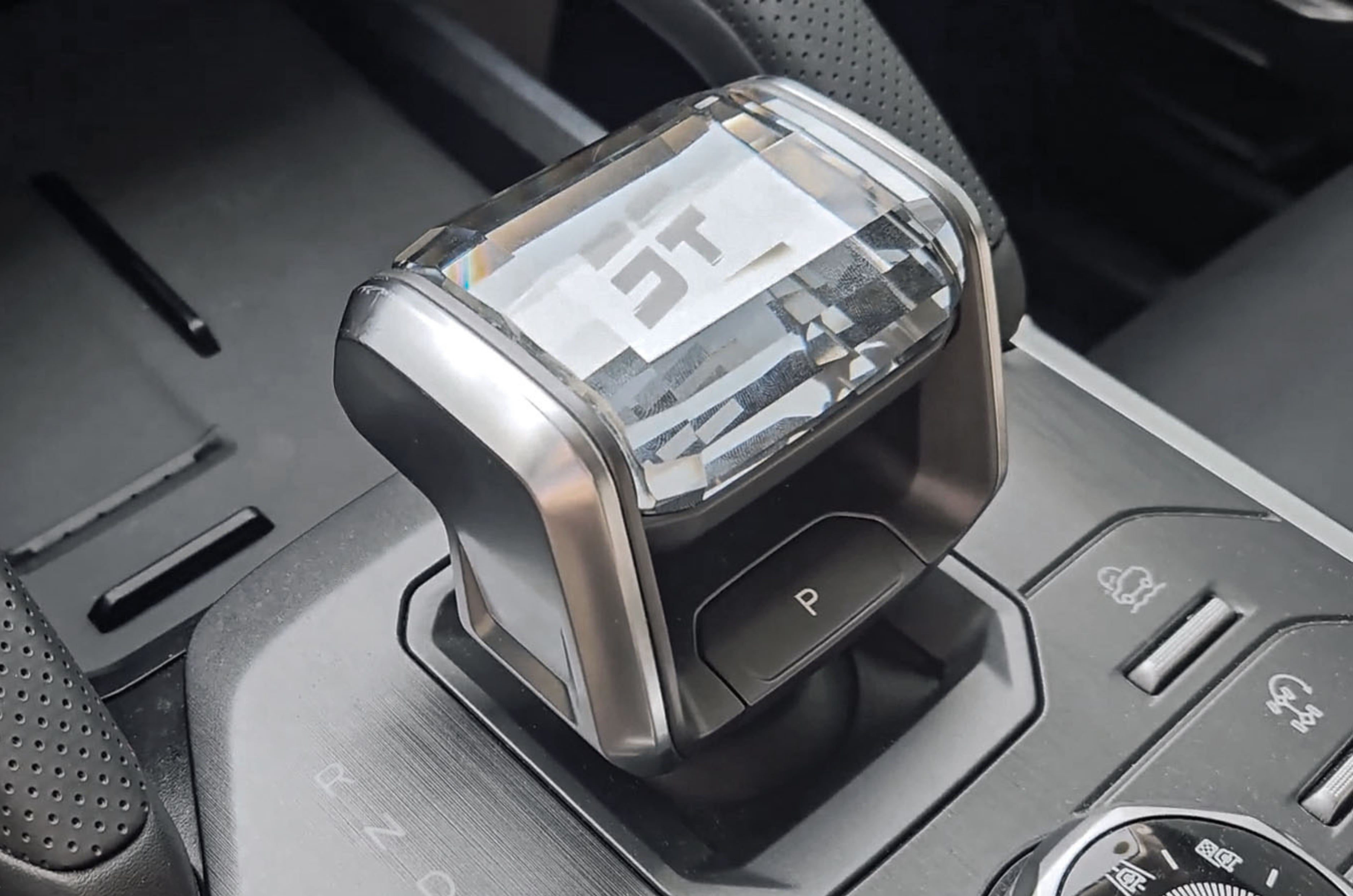
Material quality is generally impressive. The stalks and window switches feel robust and premium, while the jewel-like gear selector features an attractive diamond-cut effect. However, under harsh sunlight, it becomes highly reflective and can prove distracting. Reflections from the dashboard on the front windows are also noticeable.
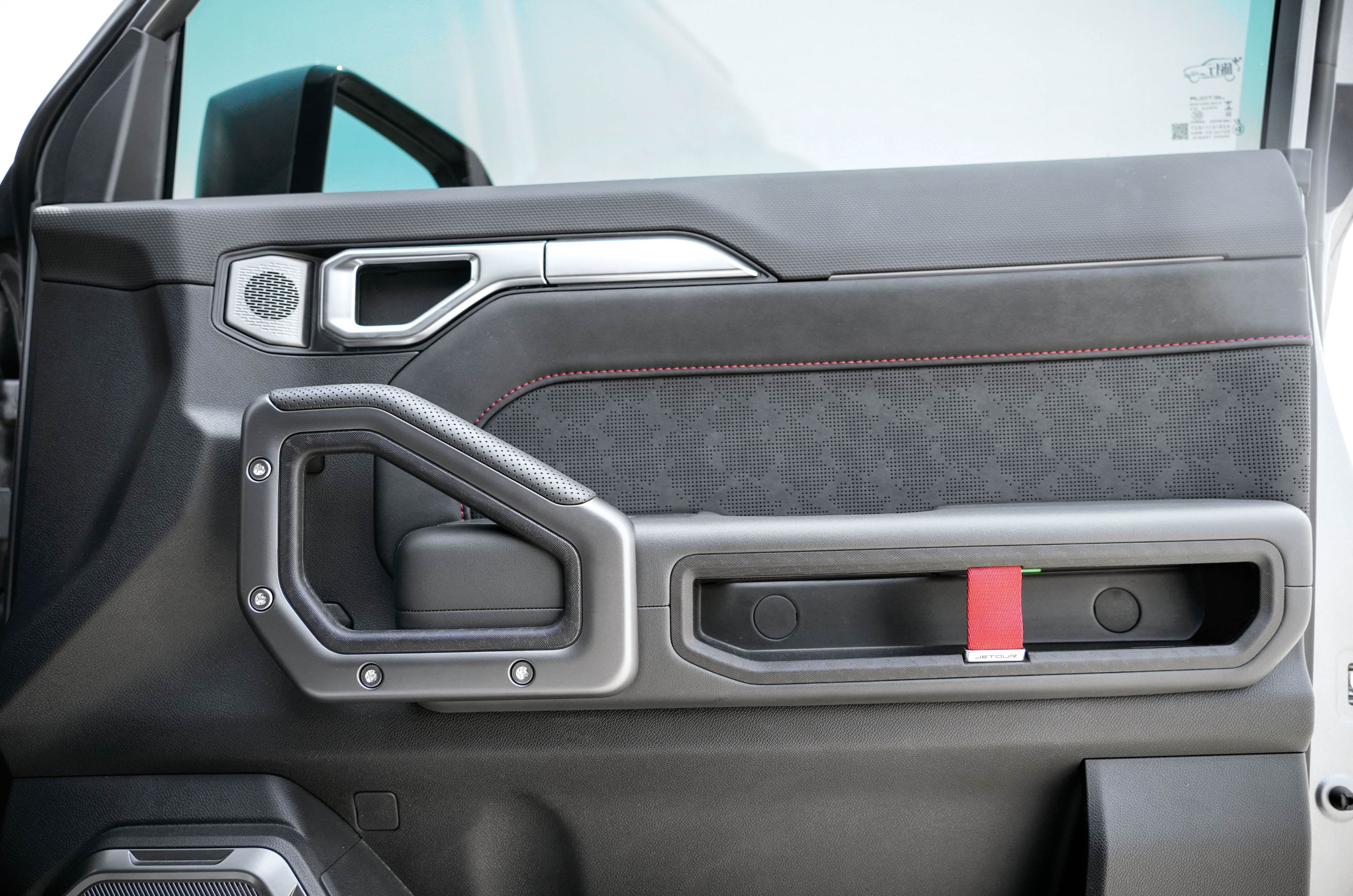
Rugged-looking door pads with nice detailing.
Notably, its dual-zone climate control struggled to cool its large cabin quickly despite the heavily tinted windows. While our test vehicle was a China-specific version, we hope the version we’re going to get in India has an upgraded air-con compressor. Its seat ventilation didn’t seem very effective either, even at its maximum setting.
Diamond-like chunky gear selector is illuminated.
The sculpted front seats, finished in black leatherette with contrasting red stitching, look suitably sporty. They provide excellent support, though the cushioning feels slightly overstuffed, and the absence of lumbar adjustment is disappointing.
Practicality is a strong point. There are large door bins, two phone storage areas (one incorporating a wireless charger), cupholders, a deep-cooled centre console, a large glovebox and even a hidden storage tray beneath the front seat.
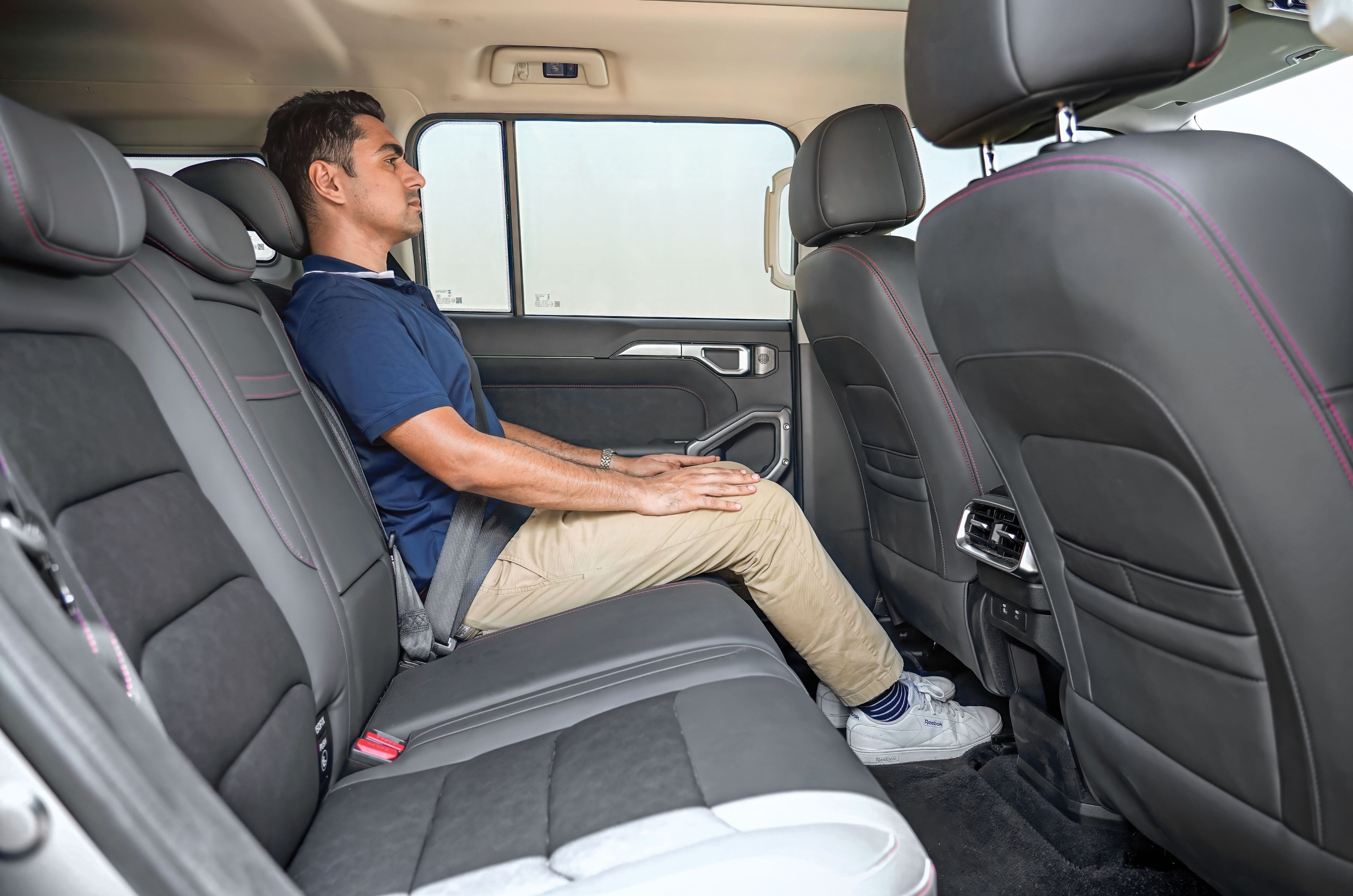
Albeit a bit low-set, rear seat is spacious. Flat floor, wide bench make it comfy for three adults.
The rear seat is equally spacious. A wide bench and completely flat floor make it comfortable for three adults, while the boxy cabin ensures generous headroom and overall space. The seat base is positioned slightly low, but comfort levels remain good.
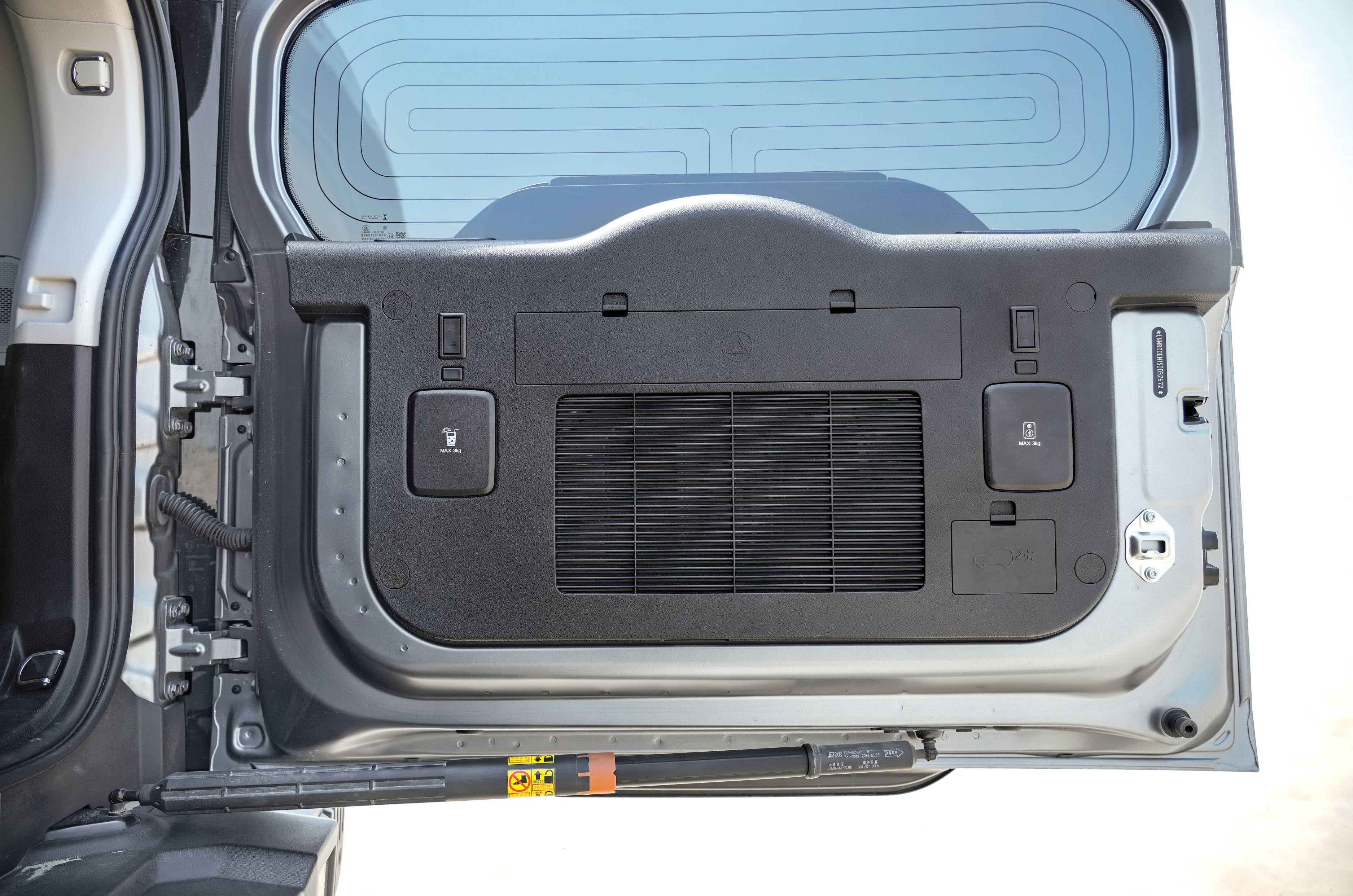
Cupholders, luggage hooks, bottle opener on its tailgate.
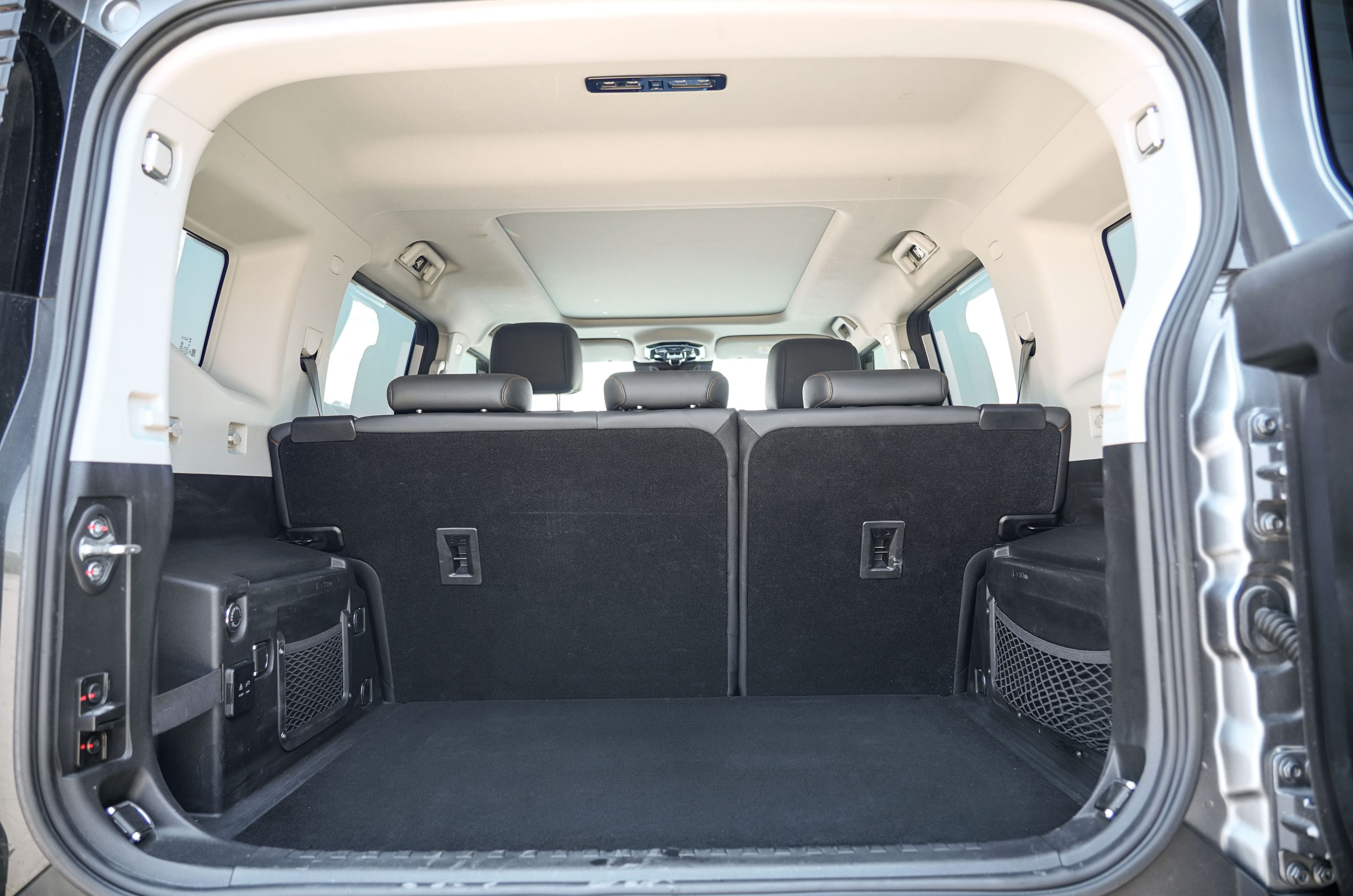
The side-hinged tailgate opens to reveal a cavernous 580-litre boot. Despite carrying the spare wheel, the tailgate itself requires surprisingly little effort to open. Thoughtful touches include a locking mechanism that prevents it from swinging shut unexpectedly, and there are cupholders, luggage hooks and even a bottle opener integrated into the inner panel. The boot area also features clever luggage nets and charging provisions, while a soft-close function further enhances convenience.
Humongous 580L boot. 60:40 rear seat split for added flexibility.
Besides the features already mentioned, it gets one-touch-down power windows, powered front seats with memory, LED lights all around, ambient lighting, a frameless inside mirror, autonomous emergency braking, lane-assist, adaptive cruise control, blind-spot monitoring, front and rear cross-traffic alert, six airbags, hill-start assist, hill descent control and ESP, to name a few more.
Jetour T2 Performance, Refinement and Efficiency- 8/10
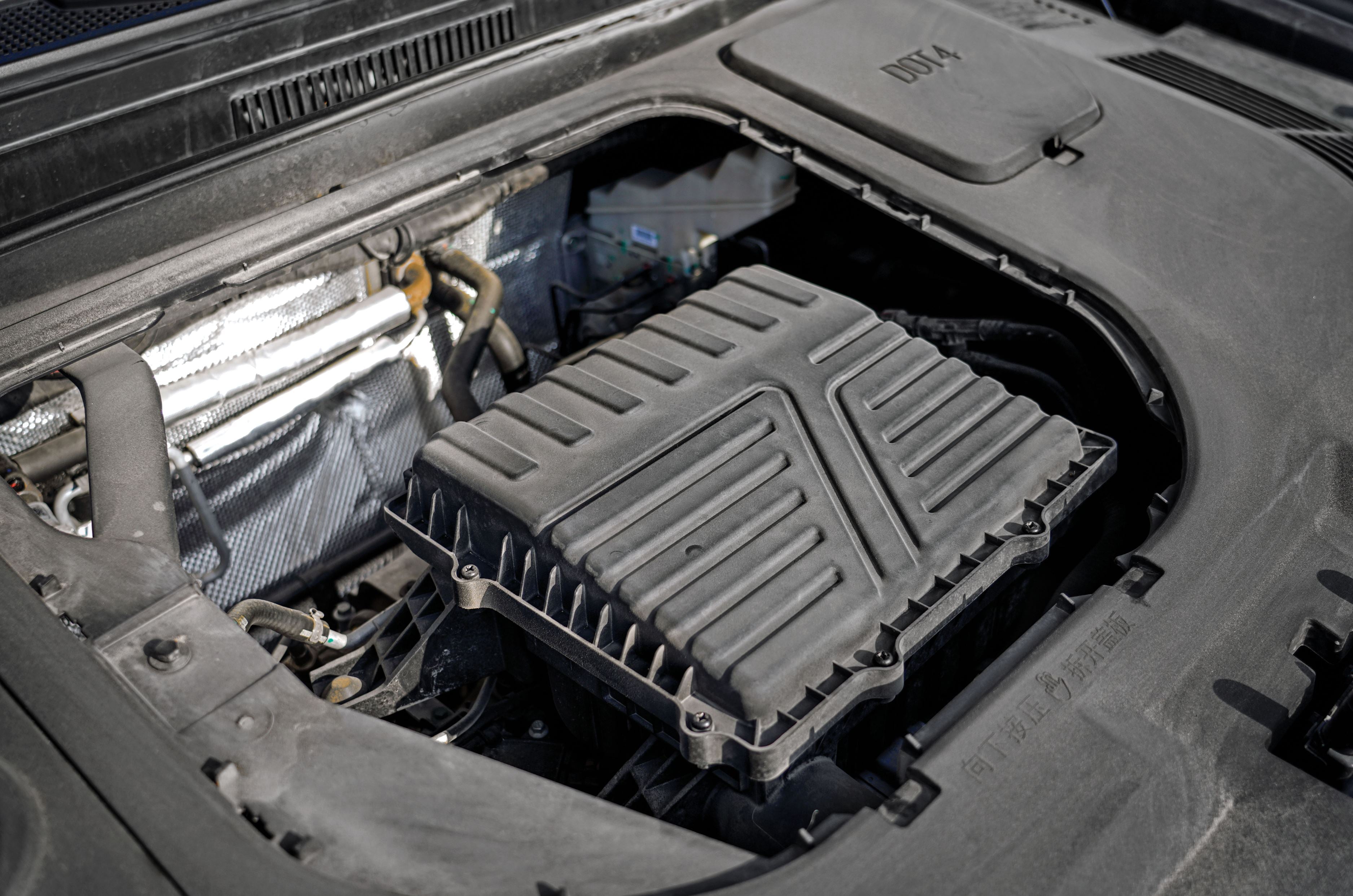
The T2 version we’re driving today is a plug-in hybrid, which combines a 156hp/220Nm 1.5-litre direct-injection turbo-petrol engine, a 43.24kWh LFP battery pack, and three electric motors. Together, the three motors produce 462hp and 700Nm of torque, with power sent to all four wheels. India will also see the plug-in tech, but in front-wheel-drive guise only, with two electric motors instead of three and a smaller 18.4kWh battery.
Powered by a 1.5 turbo along with 3 electric motors.
While the engineering sounds complex, the driving experience is refreshingly straightforward. The four-cylinder engine is refined, although when it operates primarily as a generator to charge the battery, a faint and distant hum does filter into the cabin.
The SUV can be driven either in pure EV mode or in hybrid mode. In EV mode, Jetour claims a range of up to 211km, and performance feels smooth and relaxed rather than outright brisk. Switch to hybrid mode, and the system automatically alternates between EV operation and combined petrol-electric drive, depending on throttle inputs, road conditions and battery charge levels, among other factors.
In this mode, performance feels remarkably effortless, with the T2 gathering speed with surprising urgency as speeds rise. Under full throttle, acceleration is initially measured up to around 40kph, after which there is a noticeable surge in performance as the powertrain delivers a much stronger pull.
Multiple drive modes are available, including Eco, Normal and Sport. In both Normal and Sport, we noticed the vehicle continuing to accelerate momentarily even after lifting off the throttle, which can feel unnerving. Throttle response in these modes is also a touch too aggressive. Eco mode offers a more natural and polished throttle calibration.
In our testing conducted in 40-degree heat, the T2 accelerated from 0-100kph in just 6.35 seconds in its sportiest setting – quick for its size. Flat out, it will reach a claimed top speed of 200kph.
The T2 also offers three levels of regenerative braking. Impressively, all three feel natural in operation, bringing the SUV down to a crawl smoothly and predictably. The brake pedal itself inspires confidence, with the transition between regenerative and friction braking being almost imperceptible.
Jetour T2 Ride Comfort and Handling – 6/10
Soft suspension and tall ride height mean driving dynamics aren’t anything to write home about.
The T2 rides on MacPherson struts at the front and a multi-link independent rear suspension setup. Its suspension tuning leans towards comfort, but this results in a degree of bounce over speed breakers and undulating surfaces.
The chunky, high-profile tyres do an excellent job of smothering smaller imperfections, while the 201mm laden ground clearance provides ample confidence over rough roads. At higher speeds, however, the ride never feels quite as settled or composed. One positive is that it remains well controlled under heavy braking, resisting excessive pitch.
Dynamic prowess is clearly not the priority here. The tall body exhibits a fair amount of roll, noticeable during quick lane changes. Push harder through a series of bends, and this two-tonner T2 understeers quite readily. Combined with its light and somewhat disconnected steering, it is clear that this SUV prefers a more relaxed driving style.
A light steering, smooth hybrid and excellent visibility make it surprisingly easy to drive.
Driven at a gentler pace, the T2 proves extremely easy to live with. The steering offers three weight settings, though it feels best in its lightest mode. Combined with excellent visibility and a smooth, responsive hybrid powertrain, it makes piloting this large SUV remarkably effortless.
Jetour T2 Should You Buy Now or Wait – 8/10
The Jetour T2 plug-in hybrid appears to have all the ingredients needed to establish the JSW brand in India and perhaps even challenge the Toyota Fortuner, despite offering only five seats. It is spacious and practical, it is expected to come loaded with technology and features, and its rugged styling gives it immense road presence and desirability.
The plug-in hybrid powertrain adds further unique appeal, offering the flexibility of pure EV driving and an impressive mileage figure with the hybrid tech. Better still, the system is smooth, refined and delivers strong performance.
It’s larger than a Fortuner, looks imposing, and stays true to the SUV formula.
Yes, it is not without flaws. The touchscreen experience and throttle calibration need refinement, the air-conditioning needs to be more effective, and the ride and handling would benefit from further fine-tuning for Indian conditions. These are areas we hope JSW addresses before launch.
On the whole then, the T2 is certainly ready for combat. Will it win, though, will also depend on JSW pulling off an aggressive pricing strategy and, importantly, backing it up with a reliable ownership and service experience too. That latter is why Toyota rules the roost. The battle lines, then, are drawn.
A lot can change in three years, as it turns out. Back in October 2023 at the Himalayan 450 launch, I would have confidently told you that the older Himalayan’s 411 time was up and that the 450 served as a fitting replacement. Fast forward to 2026 and I will now willingly concede that there is very much a place for the new Himalayan 440 in this market.
What’s new and why is it back?
A tempting price as well as meaningful improvements
Price plays a big role behind this change in reasoning. 3 years ago, the entry level 450 was about Rs 40,000 more than the top 411 – a not insignificant, but justifiable increase . Today that gap has nearly doubled thanks to the agonizingly short-sighted new GST policy that levies a brutal 40 percent tax rate on motorcycles that use engines bigger than 350cc. RE is clearly feeling the heat from the new wave of sub 350cc competition because the reborn 440 is priced super aggressively. In fact, at 2.29 lakh ex-showroom Chennai, it costs exactly the same as the top 411 did in 2023, despite packing significant improvements. Beyond the price, it’s those very improvements that have convinced me that this bike has earned its return in 2026.
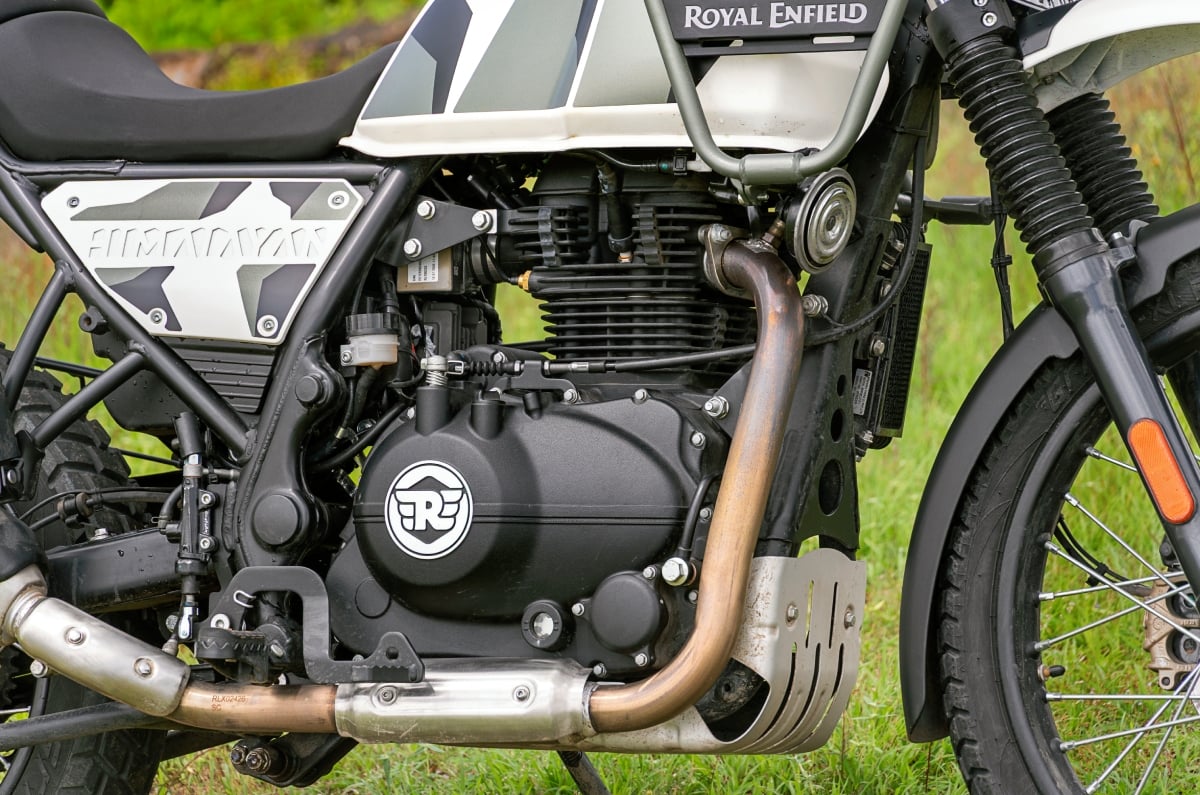
The Himalayan 440 is based on the Scram 440 and it brings in the same improvements we saw there last year. The oil-cooled single has been bumped up to 443cc and RE has also strived towards increasing the refinement. An added 6th gear and as well a lighter clutch lever increase the bike’s appeal on the highway and in the city. Work has also been put into improving braking performance and feel.
Himalayan 440 Design and Style – 7/10
New colours, but familiar design
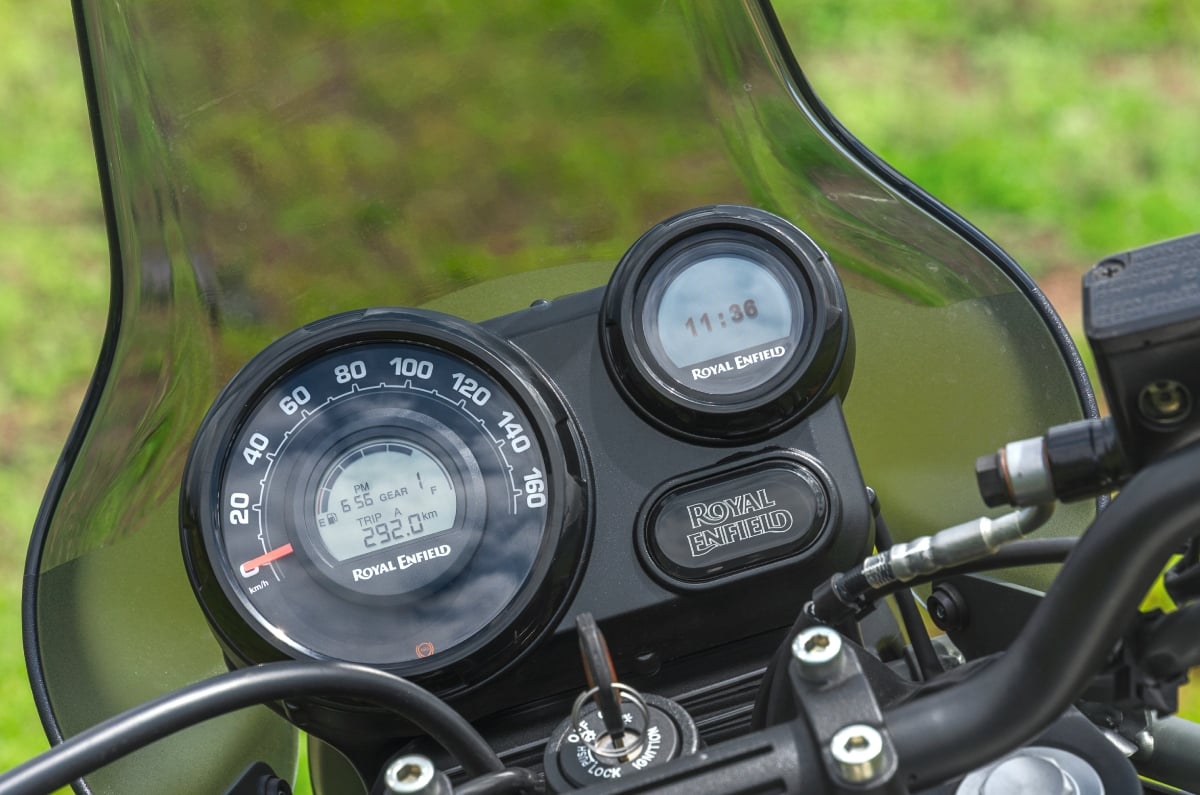
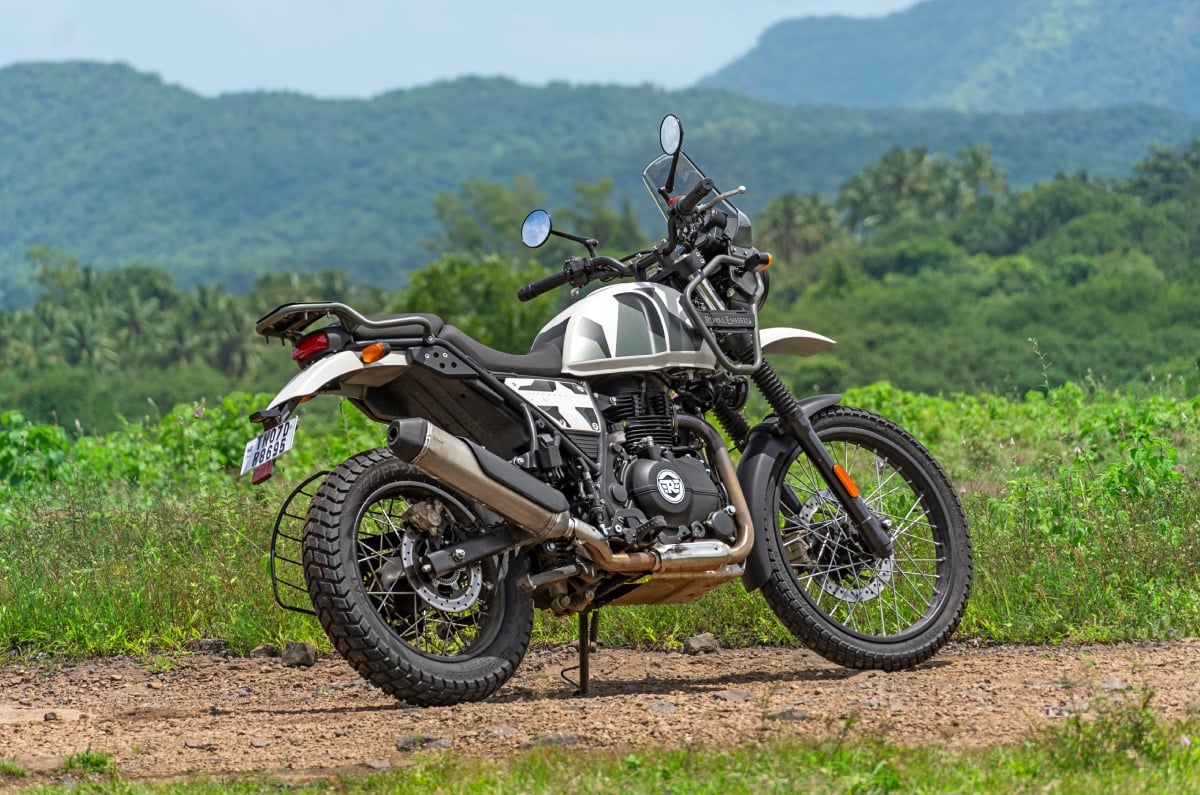
There are three new colour schemes as well, but beyond that, the bike retains its quirky oddball styling, although it does gain a new (average at best) LED headlamp and an updated instrument cluster based on the Scram 440.
Gets an updated instrument cluster based on the Scram 440.
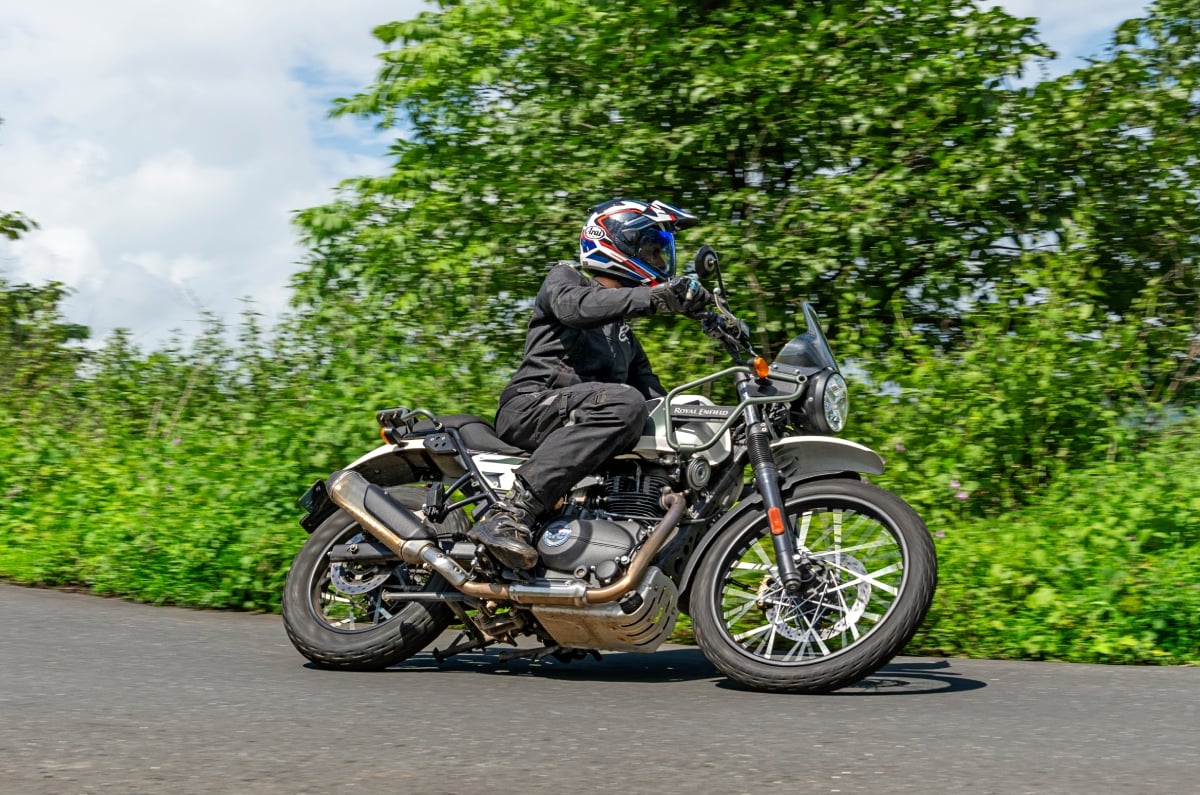
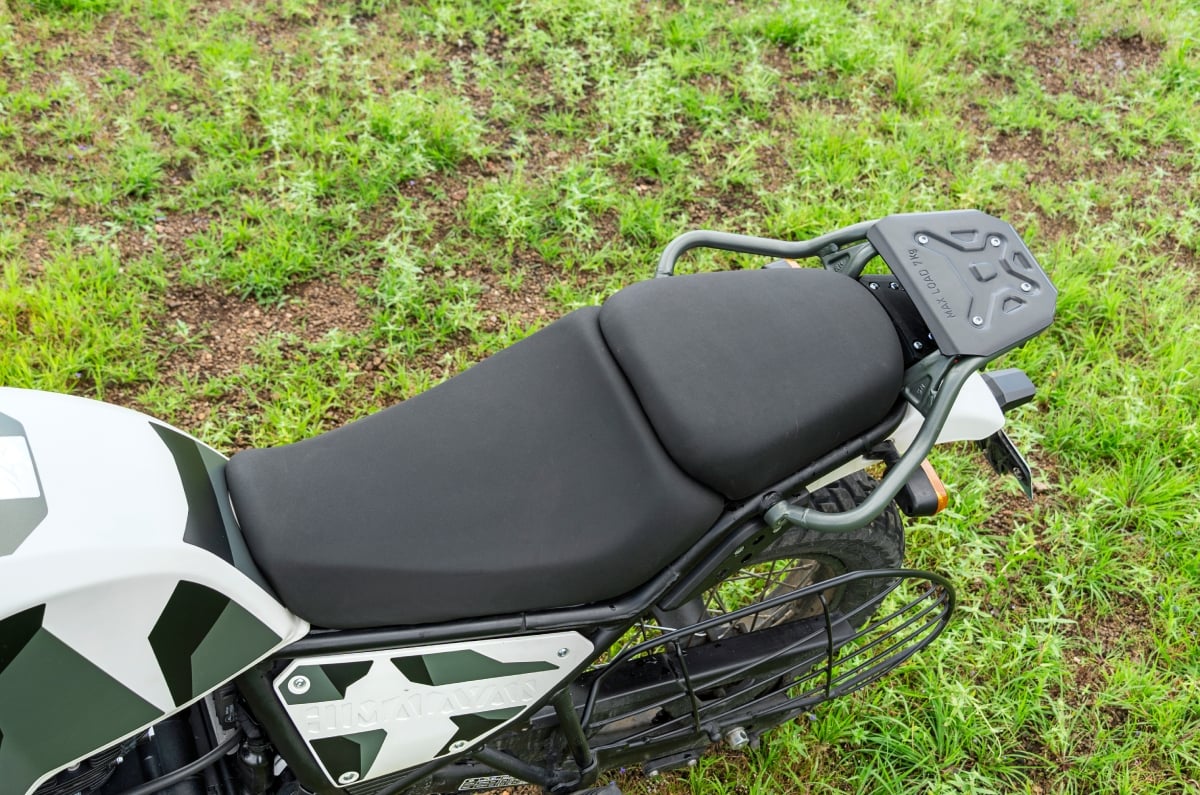
Hopping onto the Himalayan 440 after all these years is like being re-acquainted with an old friend. It more or less looks the same and also feels the same to sit on. The low 800mm seat height in particular is one of the biggest appeals with this bike and it brings back some of the short rider accessibility that was sacrificed by the Himalayan 450.
Himalayan 440 Engine and performance – 8/10
A smooth and characterful engine brimming with torque, but it’s not about speed
The engine retains that same relatively slow thump as its predecessor, but there is certainly an improvement in refinement. You can very much hear and feel the engine through the entire bike, but there are no intrusive vibrations until you build the revs quite high. Unfortunately, the Himalayan no longer has a rev counter so I can’t tell what rpm it starts to feel stressed at, but peak power comes in at just 6250rpm, so the number isn’t that high.
Nevertheless, with this improved vibration control as well as the added 6th gear, a 100kph cruise is now a smooth and stressfree affair. You can stretch that up to about 110kph before the engine’s discomfort starts to become apparent. Top speed is around an indicated 130kph, but this is not the bike’s happy place.
Our performance and efficiency test revealed numbers that you would expect and while this Himalayan is certainly not a fast bike, it’s not slow either. That being said, the 440 is an absolute joy when ridden at a sedate pace. The new-found smoothness, dialed-in throttle connection and oodles of torque make it one of the nicest bikes at this price point to calmly explore the great outdoors. Its 25.4hp power figure is on par with many rivals in the class, but the 34Nm of torque is what makes the difference to the riding experience – as well as the pleasing exhaust sound that occasionally includes loud pops on deceleration. Then again, its 199kg kerb weight is an equally big differentiator to the rest of the segment.
Himalayan 440 comfort, handling and off road – 7/10
Welcoming to short riders and decently capable, but feels its age
The chassis is pretty much unchanged and that means that the Himalayan 440 is very similar to the 411 in terms of dynamics. This is where you become aware that the 440 feels more like a refined version of an old motorcycle, rather than an all new one. It can carry a decent pace on or off road, but it doesn’t appreciate being ridden fast. The main stand starts to scrape at lean on road – or when you land it with some conviction off road – which serves as a reminder to ease off. Keep pushing and you’ll realise that the chassis doesn’t have the same composure as more modern rivals and the suspension certainly doesn’t come anywhere close to the lofty standards set by the 450.
Over normal roads, suspension comfort is good. However, the 440 did not isolate me as well as I’d have liked from the incessantly bumpy concrete surfaces that now sadly snake across large parts of Maharashtra. After an 8-hour ride over mostly concrete roads at highway speeds, I returned home with a slightly sore back. If absolute comfort is a priority, bikes like the Xpulse 210 or Himalayan 450 are where you want to look. As for braking, it is by no means outstanding, but the 440 gets the job done and there is switchable ABS, which is nice.
Himalayan 440 Features and Safety – 7/10
It’s a simple bike but provides most of the essentials
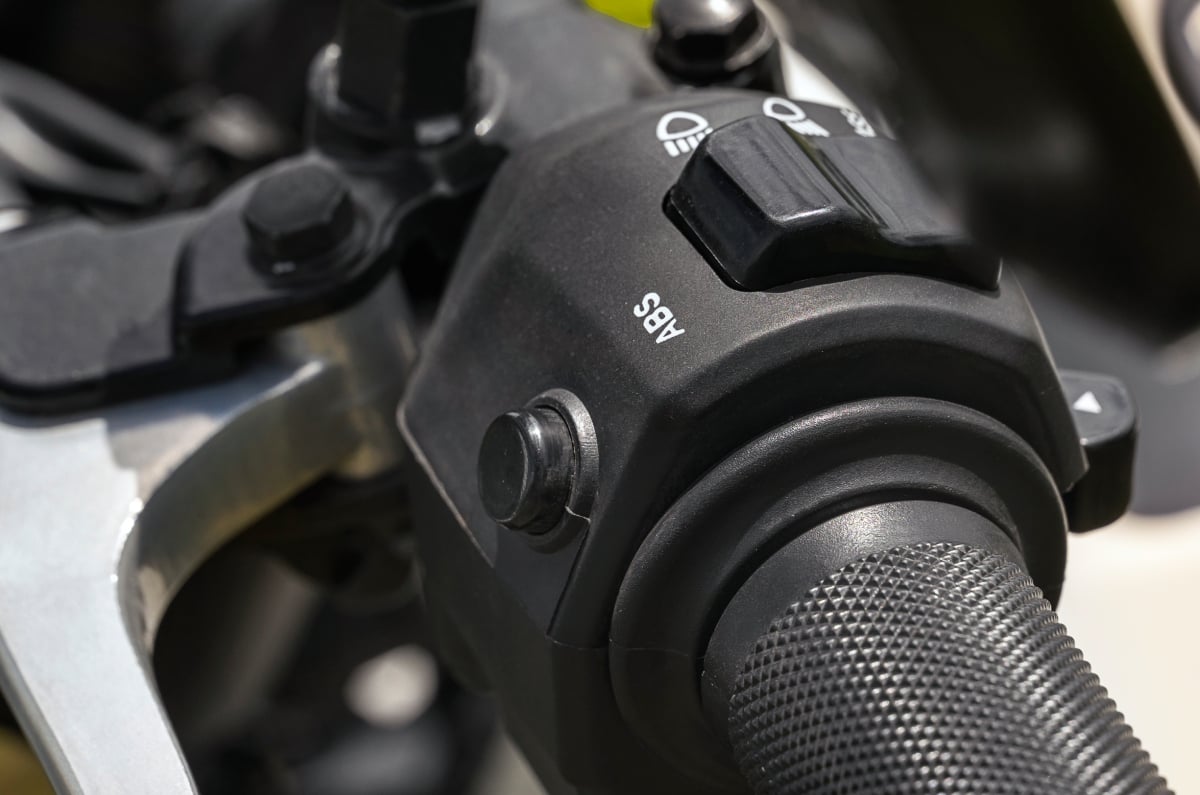
The Himalayan 440 retains its original identity as a rugged, go anywhere, yet simple and basic motorcycle. In terms of features, you get a USB C port, RE’s Tripper navigation display and the aforementioned switchable ABS. Compared with most rivals, it does have fewer frills, but the only real ‘luxury’ that I miss is tubeless tyres. It would be nice to have the option of paying extra for them like you can on the Himalayan 450.
Himalayan 440 Price and verdict – 8/10
Well priced and a unique riding experience
Essentially, this is a back to basics motorcycle and it feels that way in person. If maximum bang for your buck is what you’re after, then the TVS Apache RTX will completely outdo the 440 in nearly all parameters for similar, if not less money. The same goes for speed and aggression – there are better options at this price point. However, if you want a gentle, well-mannered and characterful motorcycle that makes for a convincing travel partner at a reasonable price, then the new 440 definitely packs genuine appeal.
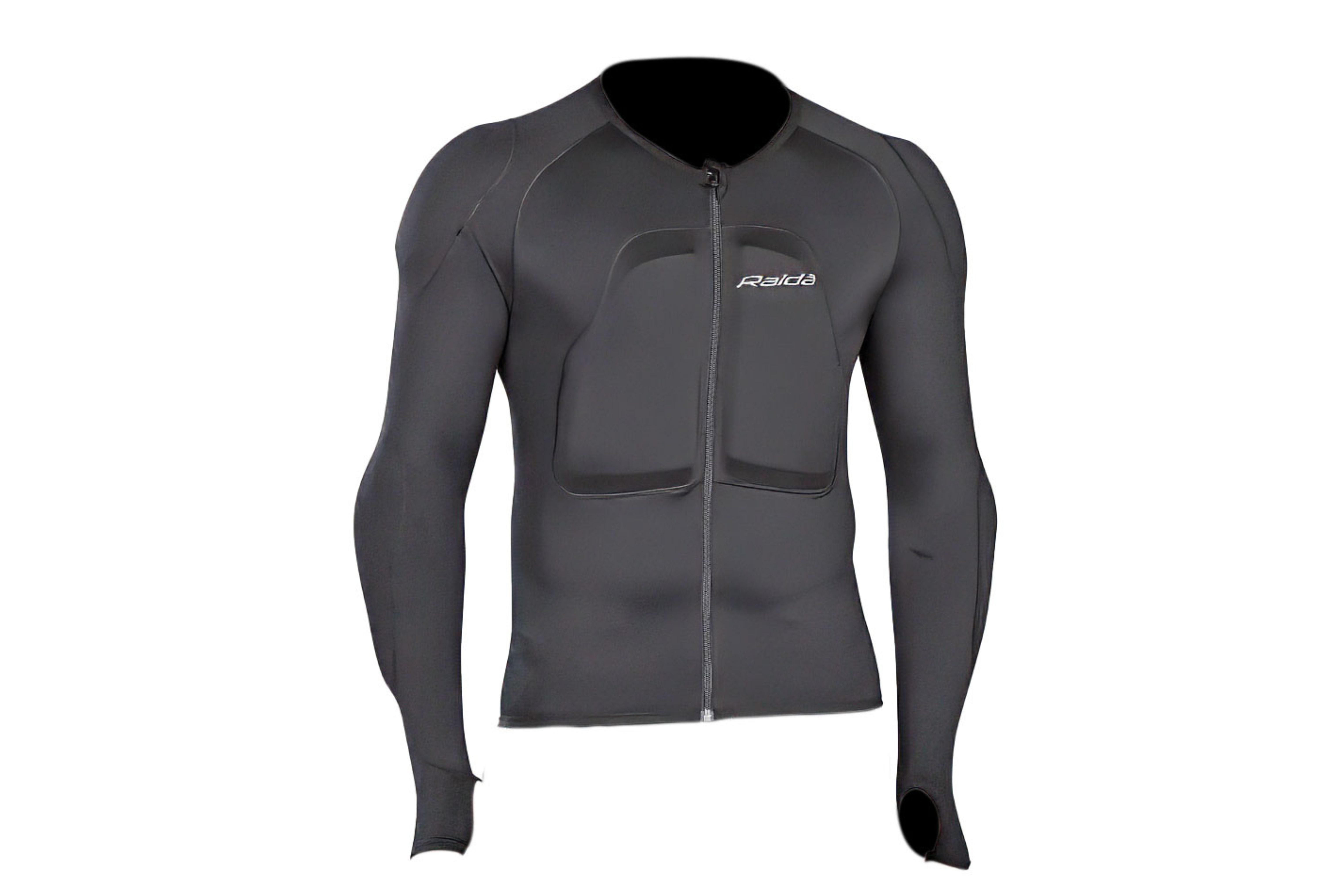
Off-road riding is physically demanding, requires a lot of stamina, and a conventional riding jacket often becomes more of a hindrance than help. It traps heat, feels bulky and restrictive, and can leave you feeling fatigued much sooner than expected.
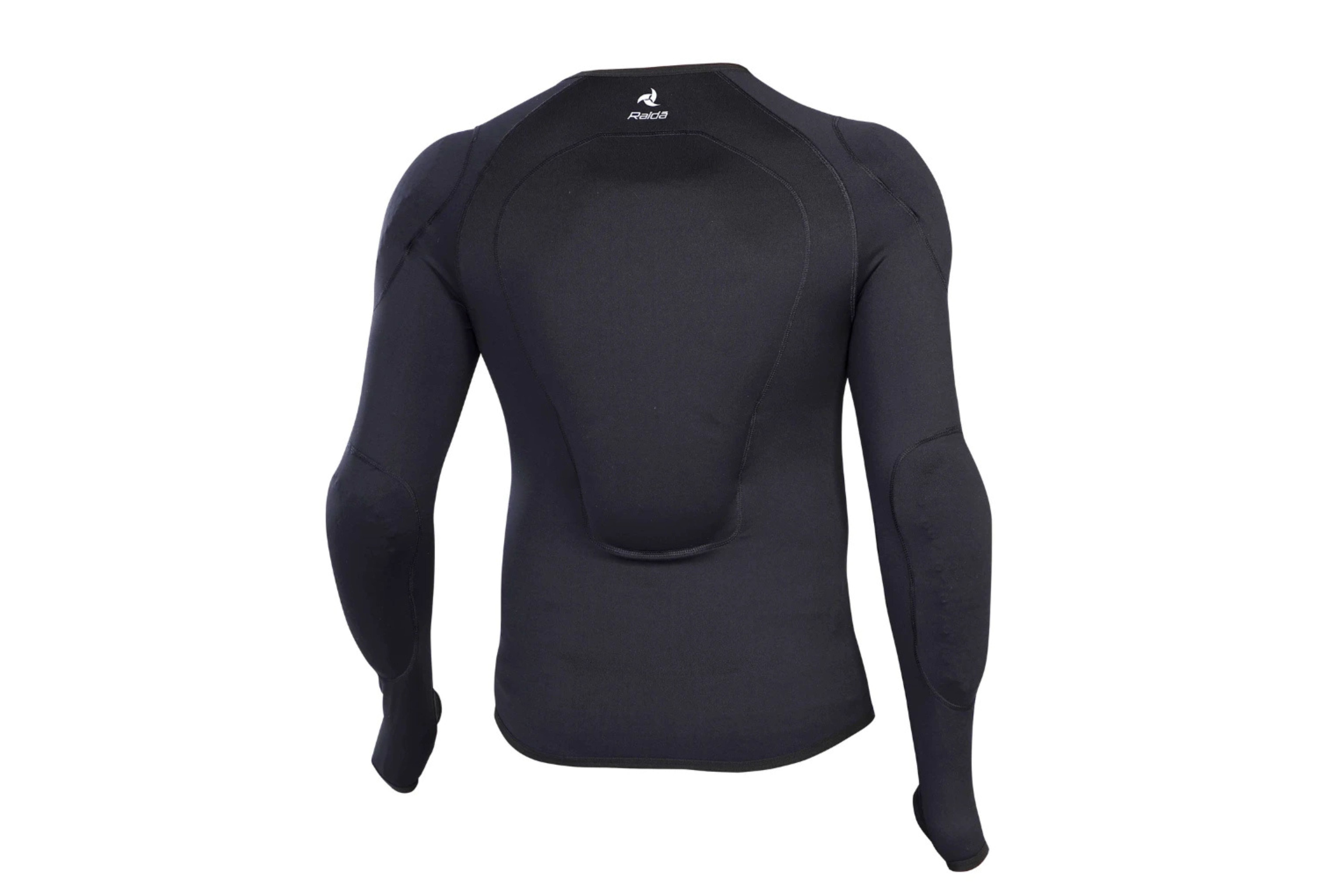
This layer is designed to address that problem, offering a combination of protection and breathability that you can wear under an MX jersey for trail or off-road riding. Essentially, it is a lightweight, zippered base layer with impact protection (CE Level 2 armour at the elbows, shoulders, back, and CE Level 1 chest protectors). It is available in six sizes, ranging from S to 3XL. Like most riding jackets, a size S fit me perfectly, and it paired seamlessly with a size M Raida jersey.
What immediately stood out was the material. It allows for plenty of airflow and feels much lighter than a conventional riding jacket. More importantly, it offers a greater range of movement, which is useful when standing on the pegs or shifting your body weight.
Another advantage is its versatility. It can be worn under an MX jersey for trail riding or used as a base layer beneath a riding jacket with its original armour removed. Additionally, removing the armour from this layer to wash it requires less effort, thanks to the stretchable fabric. This adaptability makes it a practical addition to any rider’s gear collection.
Comfort is surely one of the main highlights of this TrailCraft base layer. The lightweight construction and breathable fabric contribute to a pleasant riding experience, especially while riding through trails on a hot, sunny day. Airflow through the material keeps you cool, and that ultimately gets you less tired. Like most armoured base layers, however, it can still feel warm when stationary, particularly in traffic or during breaks.
In terms of fit, the back, chest and shoulder protectors remained securely in place, while integrated thumb loops helped keep the sleeves positioned correctly. The elbow protectors did require occasional adjustments, although that is partly down to my slim arms.
It has quickly become my go-to choice for hot, sunny days on the trails. At Rs 5,699, it delivers a really good combination of protection, comfort and practicality without breaking the bank. But do keep in mind, it won’t serve much abrasion protection on the road if worn without a riding jacket. But for beginner and intermediate off-road/trail riders looking for a lightweight and versatile protective solution, the TrailCraft is easy to recommend.