Sugar-based ethanol has been left out of India’s ethanol tender for the 2026-27 supply year, according to a Reuters report. Citing the tender issued on October 16, the report states that the government has instructed state-run oil marketing companies (OMCs) to ensure no sugar is diverted towards ethanol production for this period. No bids have therefore been invited for ethanol produced using sugarcane juice, sugar or sugar syrup, or B-heavy molasses, the report adds.
Oil firms invited bids for 11 billion litres of ethanol for 2026-27
Tender allows bids for ethanol made from corn, broken rice and surplus FCI rice
Incentive for corn-based ethanol cut from Rs 5.79/litre to Rs 2.79/litre
Tender details
It seeks 11 billion litres for the supply year starting in November 2026
The tender comes from Indian Oil, Bharat Petroleum and Hindustan Petroleum. “The Government of India has issued directions that sugar diversion for ethanol be reduced to zero for ethanol supply year 2026-27,” the tender document said, according to the report.
The companies are looking to procure 11 billion litres of ethanol for the supply year, which kicks off in November 2026. Distillers can submit bids for ethanol produced from corn, broken rice and surplus FCI (Food Corporation of India) rice. Corn-based ethanol will also fetch less this time. Its incentive has dropped by Rs 3 per litre to Rs 2.79 per litre, taking the procurement price from Rs 71.86 per litre to Rs 68.86 per litre, as per the report.
Ethanol blending and sugar supply
India is trying to rein in high sugar prices
Surplus sugar has been a key contributor to India’s ethanol-blending programme for several years. India also consumes more sugar than any other country, and has been trying to increase local production while easing prices.
Reuters had reported in August 2026 that limits on the use of sugarcane for ethanol were being considered for the season starting October 2026. Weaker rains in Maharashtra and Karnataka had already cast doubt on this year’s sugar production at the time.
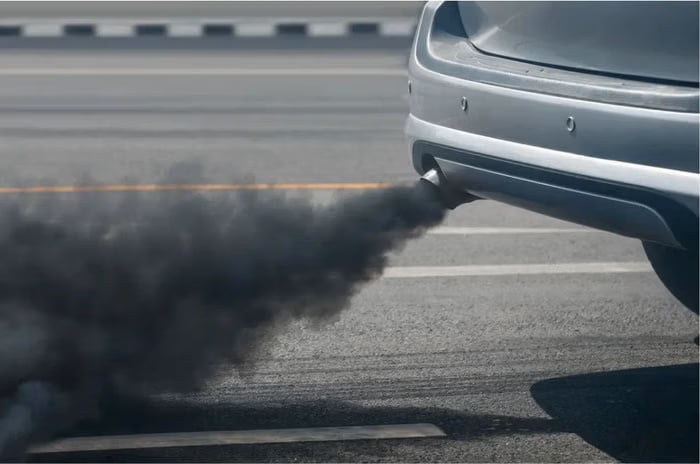
Ethanol blending is aims to reduce India’s oil imports. E20 petrol, which became compulsory nationwide earlier this year, was introduced to cut emissions as well as the country’s dependence on imported crude. However, diverting sugarcane juice, sugar syrup and B-heavy molasses towards ethanol can lead to a reduction in the amount of sugar produced.
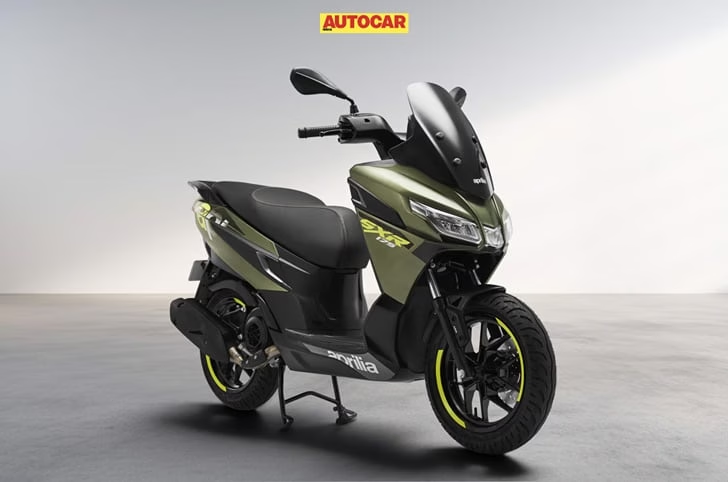
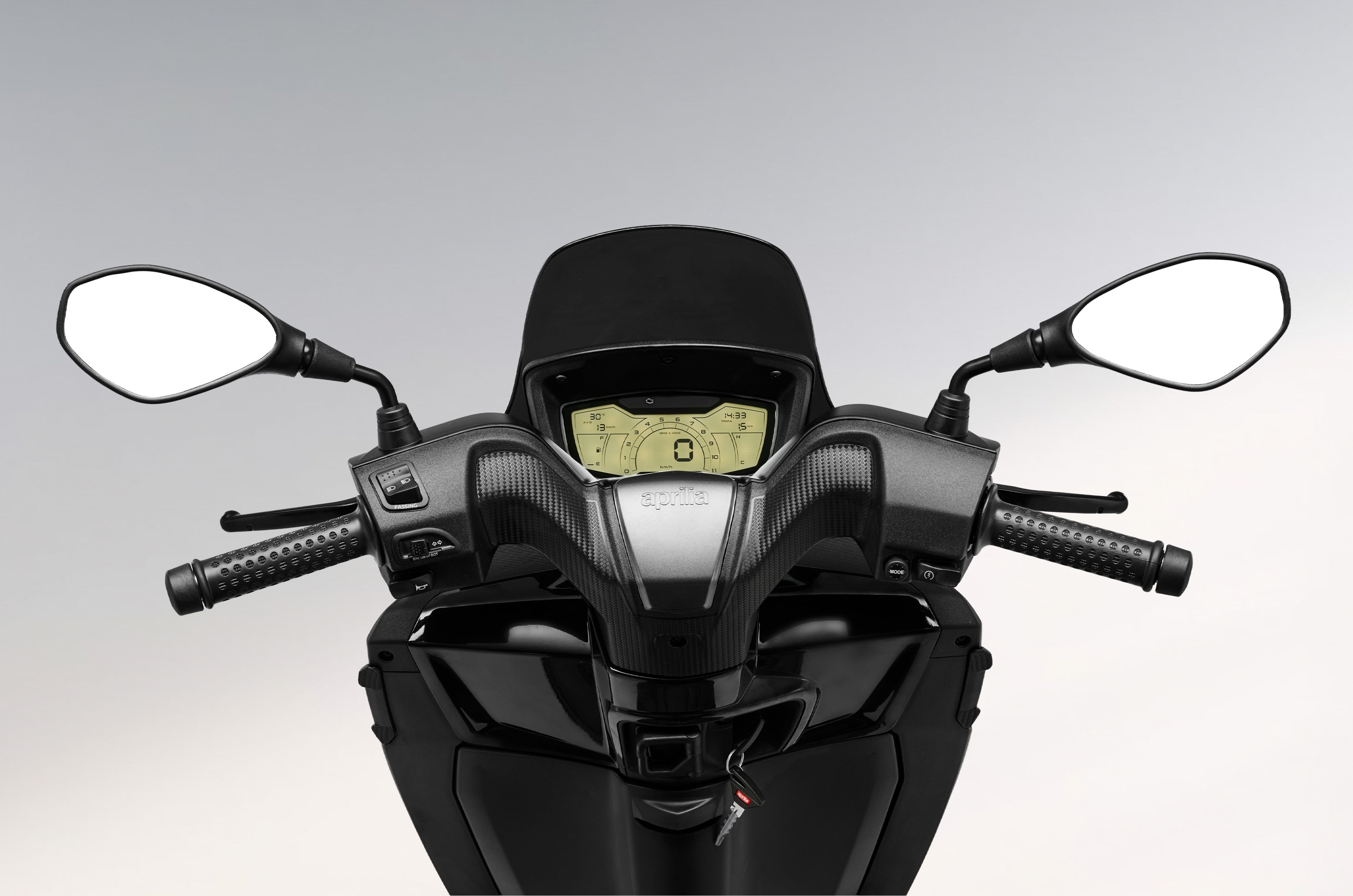
The Aprilia SXR GT 125 is the successor to the SXR 125, which was quietly discontinued in May this year. It shares its platform with the SR 125 hp-e and brings larger wheels and some additional features. Here are answers to some of the most commonly asked questions about it.
What is the difference between the SXR GT 125 and the SXR 125?
The SXR GT 125 replaces the now-discontinued SXR 125 as the brand’s entry-level maxi-scooter in our market. The most notable change is the move to 14-inch wheels, up from the 12-inch wheels on the older model. The SXR GT 125 also uses an updated 124.5cc engine and shares its platform with the current SR 125 hp-e.
What does the SXR GT 125 engine offer?
The SXR GT 125 is powered by a 124.5cc single-cylinder engine producing 10.6hp at 7,400rpm and 10.4Nm of torque at 6,200rpm. It meets BS6 OBD-II Stage B norms and is compatible with E20-blended fuel.
What features does the SXR GT 125 have?
The SXR GT 125 gets a 5-inch LCD instrument cluster and a combined braking system (CBS). In comparison, the SXR GT 175, which was launched alongside it, gets a TFT display with Bluetooth connectivity, turn-by-turn navigation and single-channel ABS.
What are the SXR GT 125 colour options?
The Aprilia SXR GT 125 is available in three colour options – Matte Black, Glossy Azzurro and Glossy White.
What is the SXR GT 125 price?
The Aprilia SXR GT 125 is priced at Rs 1.10 lakh and should be available at Aprilia dealerships nationwide. At this price point, the new SXR is about Rs 5,000 more expensive than the similarly styled Suzuki Burgman Street, which is priced at Rs 1.06 lakh.
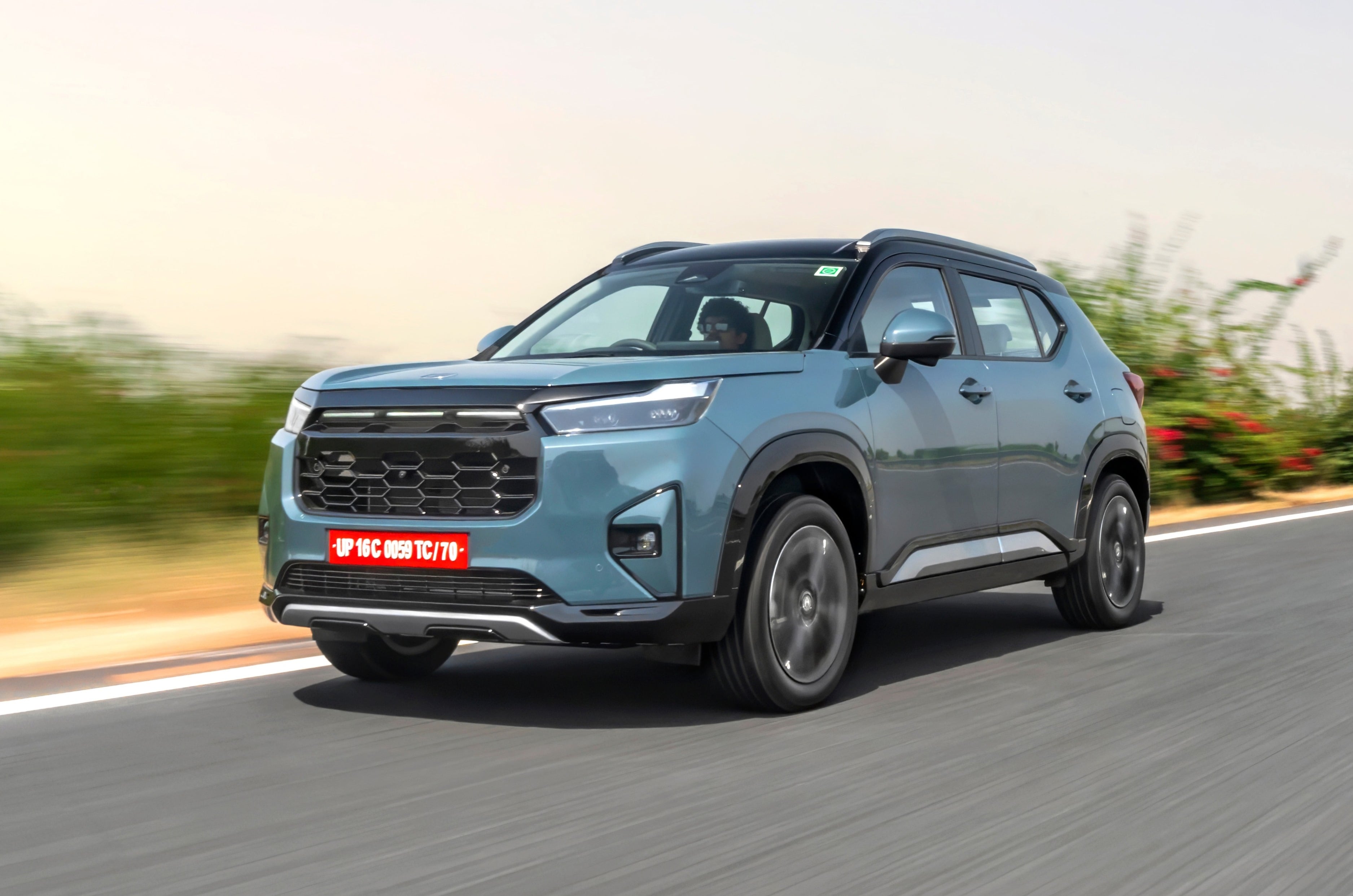
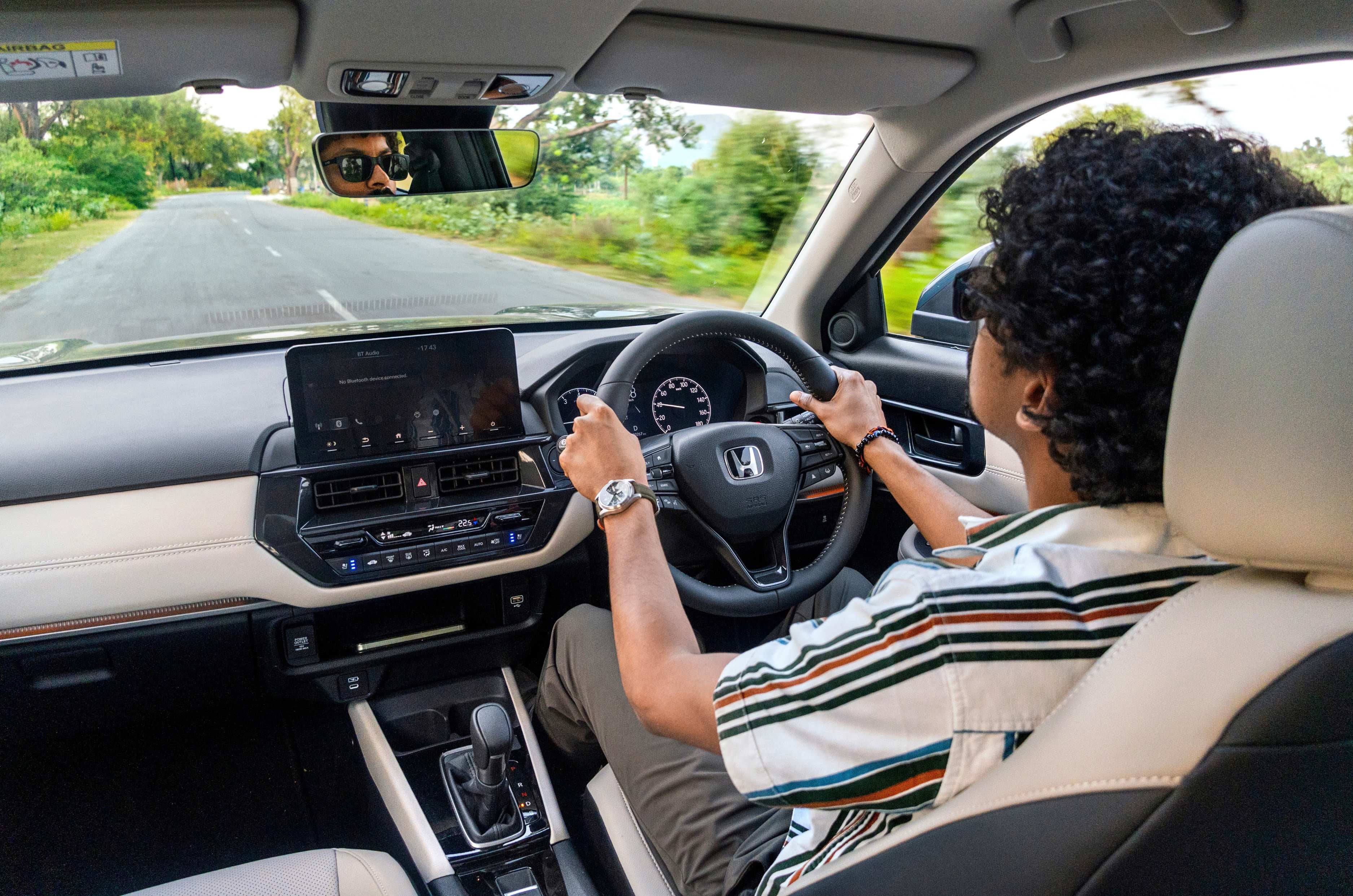
The midsize SUV space is now more competitive than ever. Just the last few months have seen new launches in the form of the Tata Sierra, Renault Duster, Nissan Tekton and the facelifts of the Volkswagen Taigun and Skoda Kushaq. Then there are the venerable Kia Seltos and the Hyundai Creta, the latter of which is set to receive a new-gen model next year, and an all-new entrant, the Hyundai Bayon, is about to join the ranks.Powertrain choices have been expanding too; diesel continues to be popular, turbo petrols add a dose of excitement, CNG is fast becoming the high-mileage option and there’s electrification in the form of hybrids and full EVs.So in a bid to keep it relevant, Honda has updated its midsize SUV contender, the Elevate, and here’s how it all comes together.
Design and engineering – 8/10
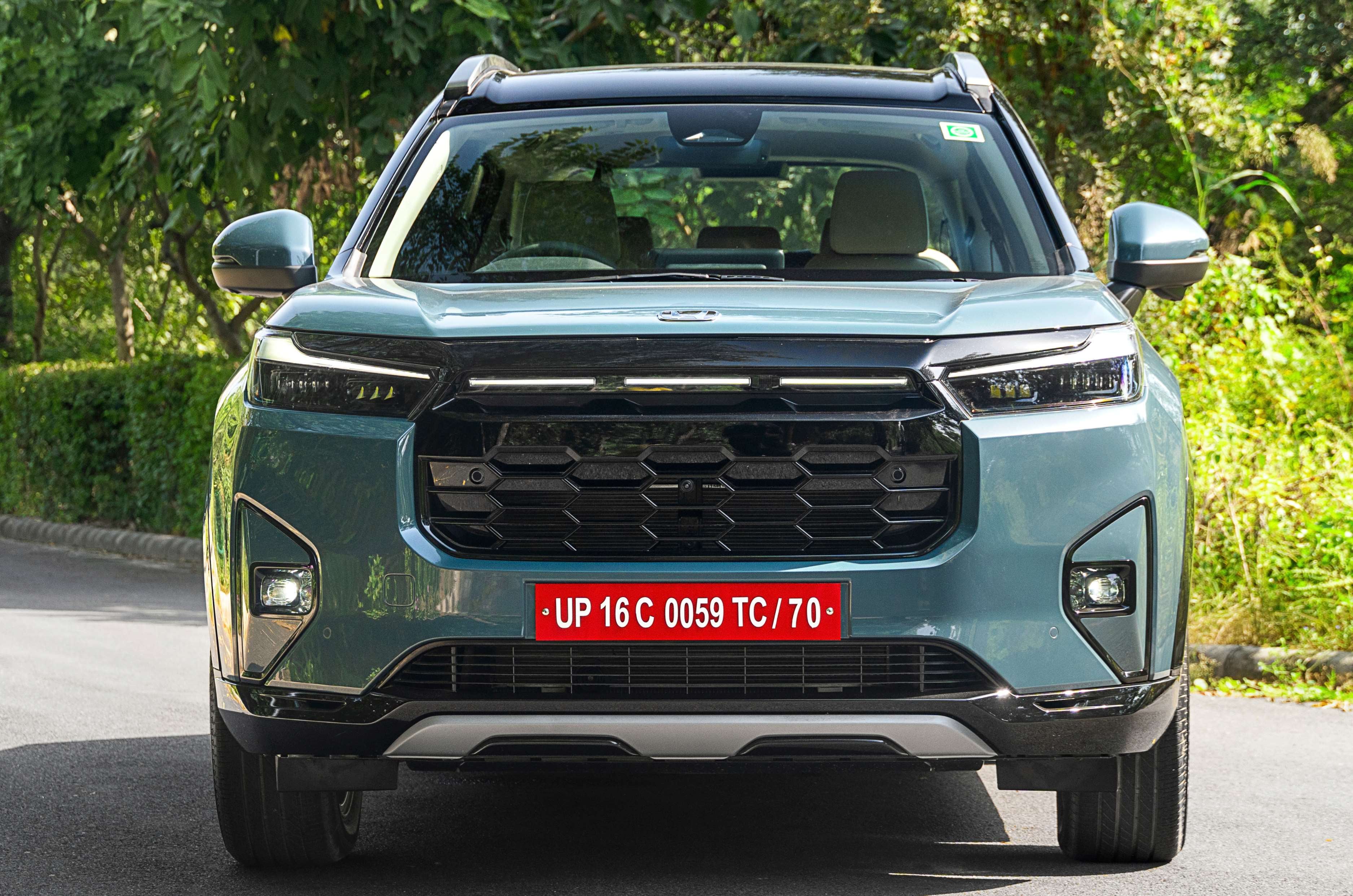
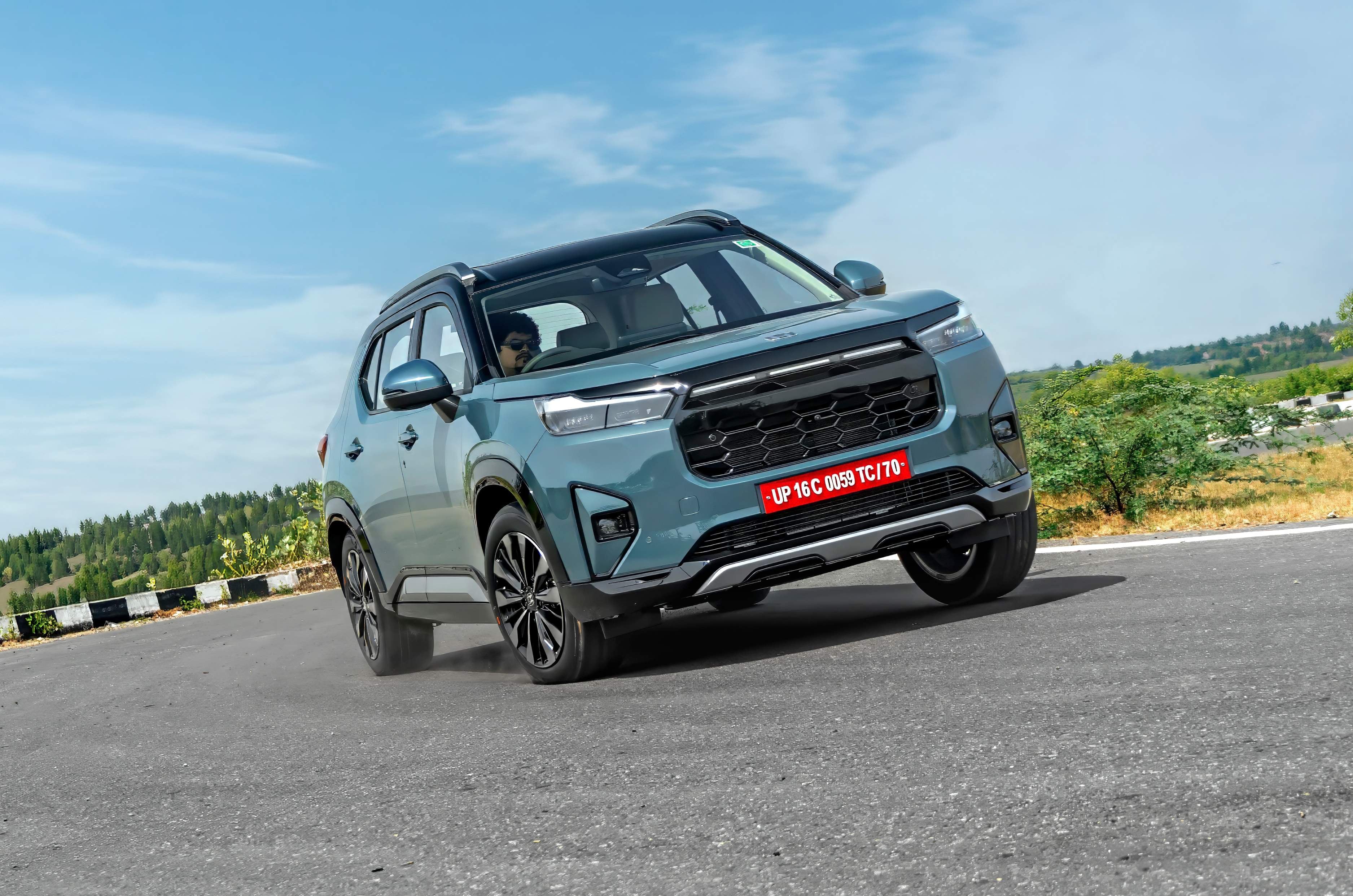
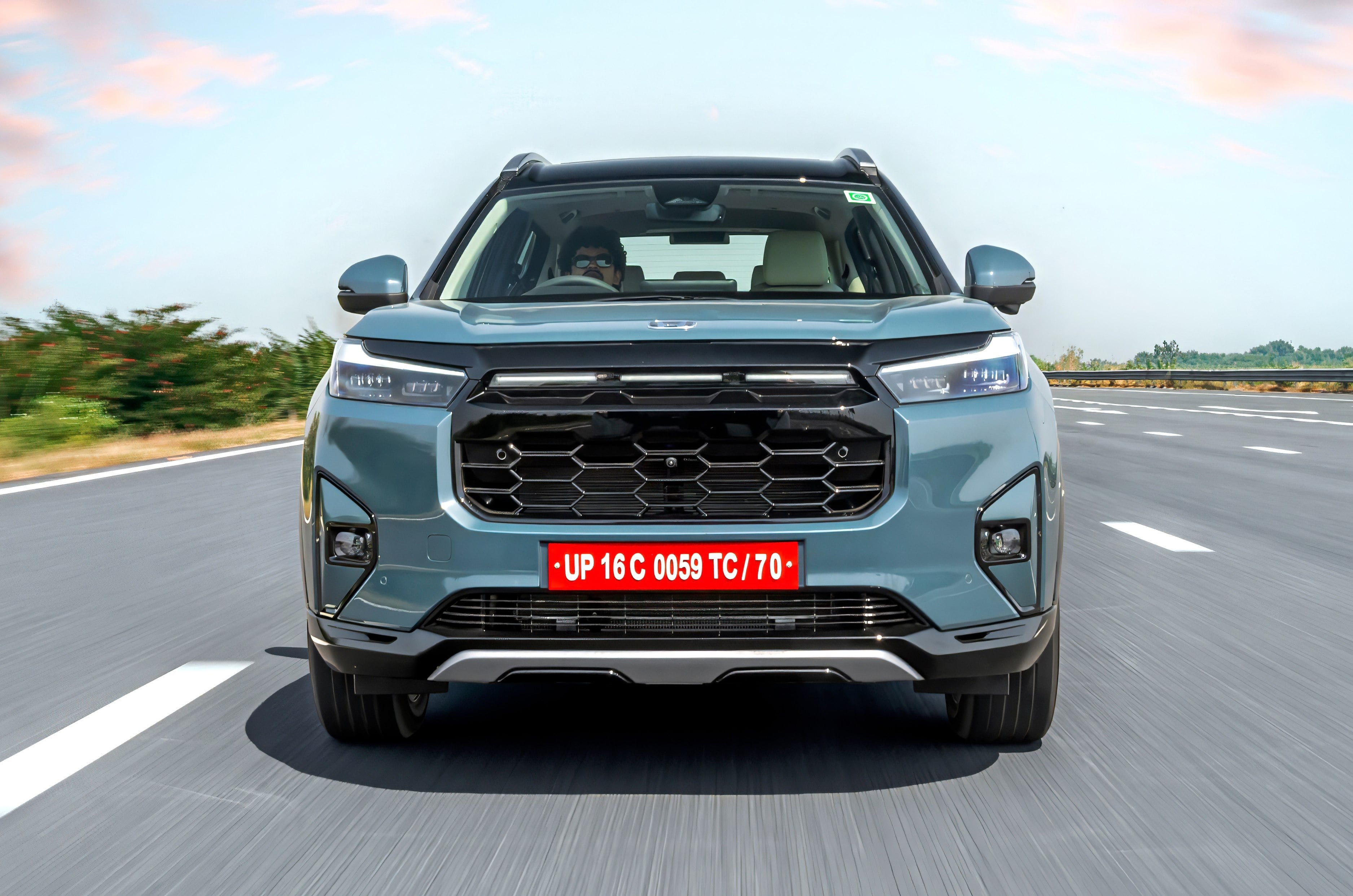
Features a new gloss black grille with a honeycomb pattern and a segmented LED light bar.
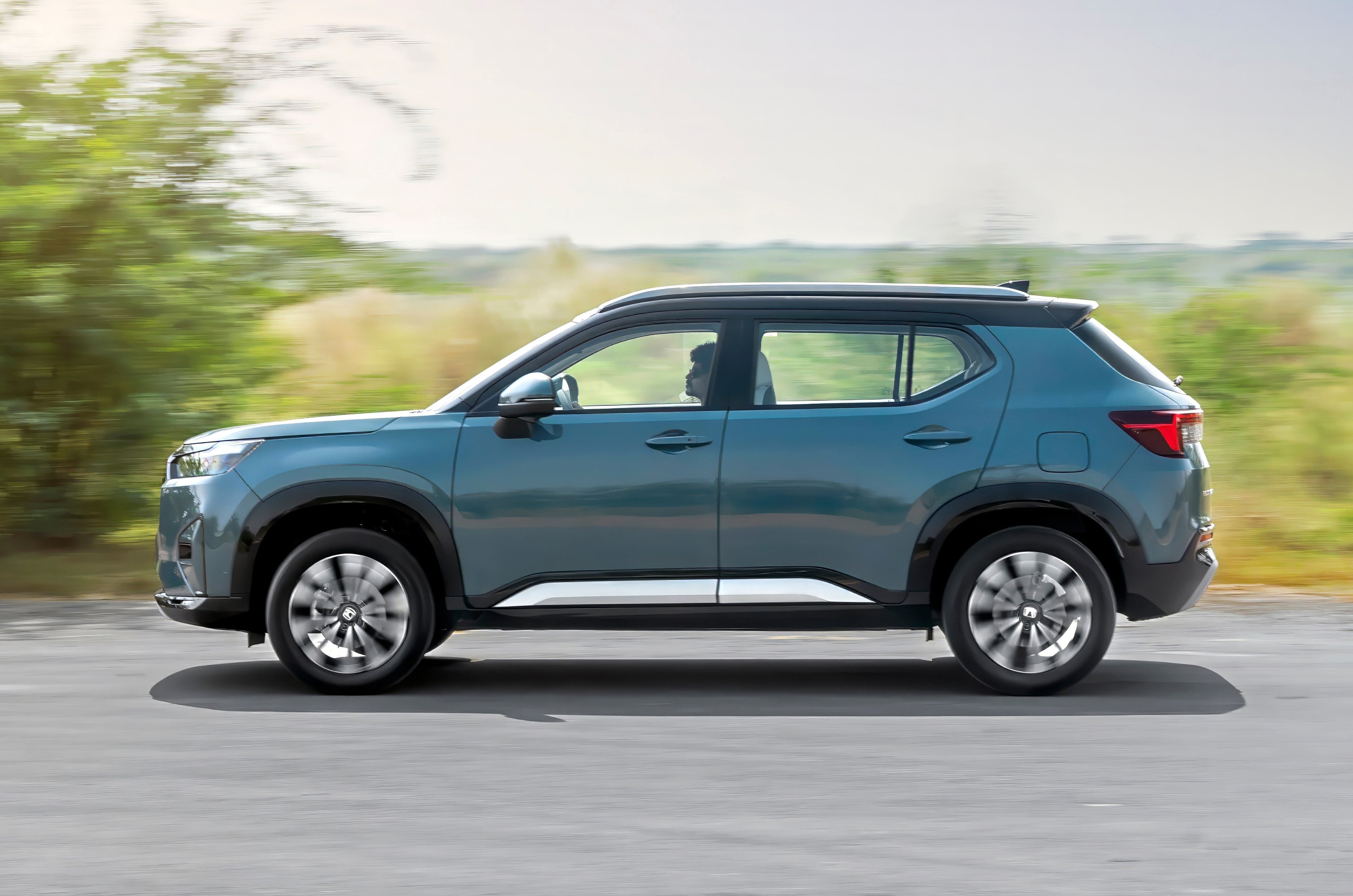
Honda has given the Elevate a subtle design update, but the changes are effective enough to give the SUV a fresher, more contemporary look without straying far from the original design. The biggest revisions are concentrated at the front end, where a new segmented LED light strip links the LED headlamps and the thick chrome band above them has been replaced with gloss black trim. The front grille gets a revised mesh pattern and a gloss-black finish, lending the front end a slightly sportier, more butch appearance. The Honda badge now sits on the bonnet rather than within the grille, while the fog-lamp housings are now finished in body colour instead of black for a cleaner look.
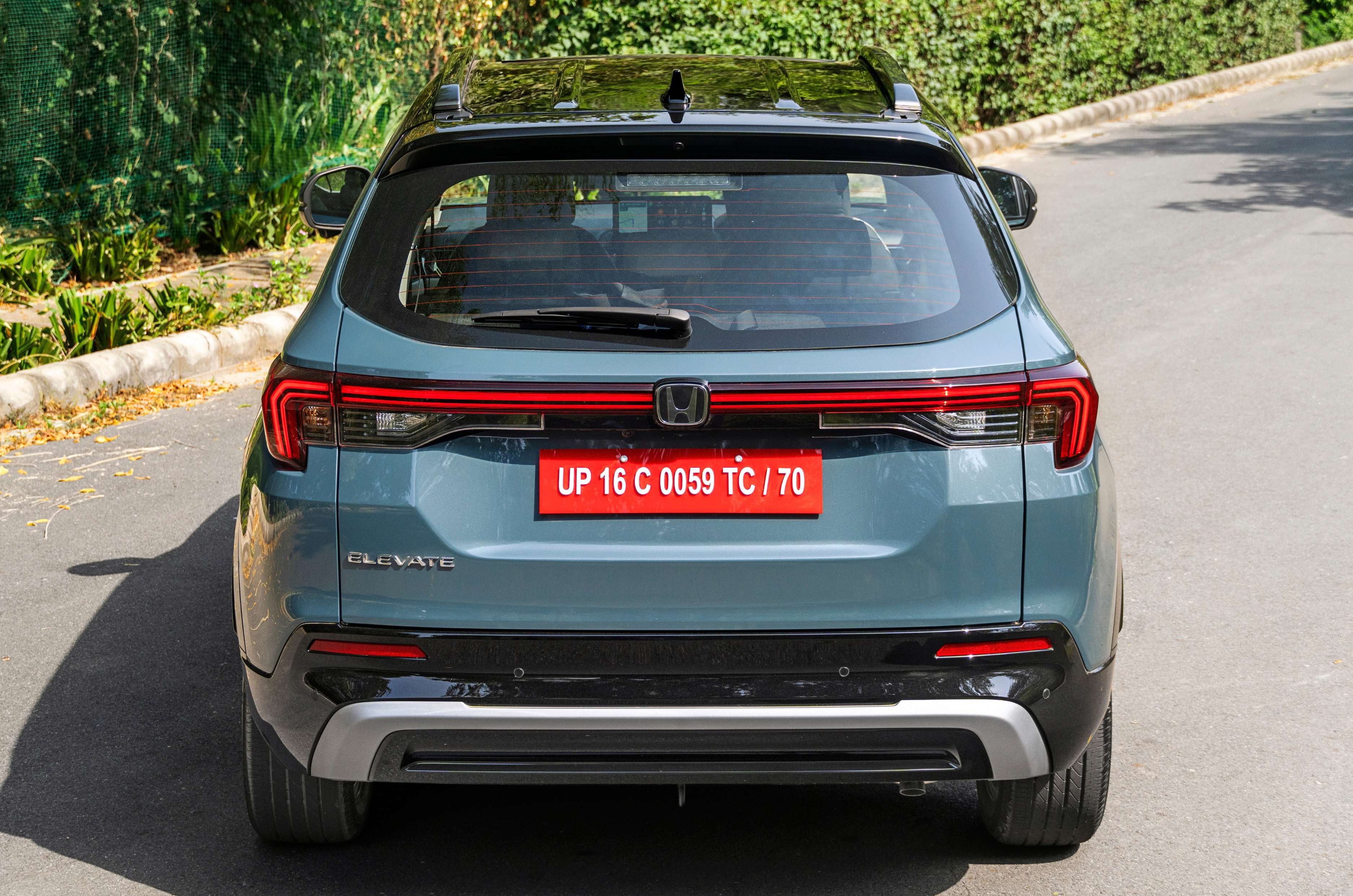
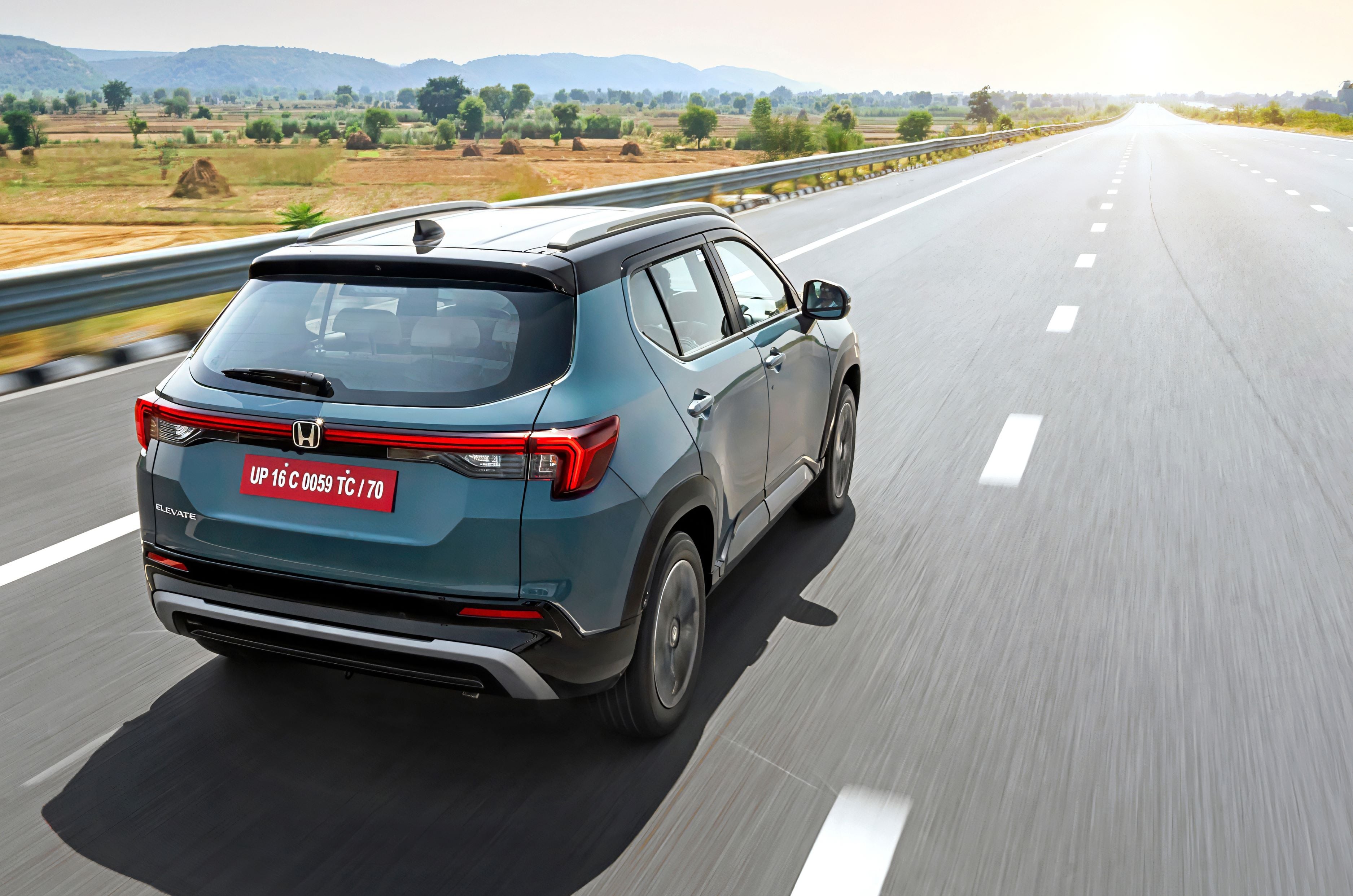
New LED light bar now connects the tail-lamps, giving it a more cohesive appearance.
It’ll take a keen eye to spot the changes along the sides as they’re limited to a new gloss black body cladding instead of a matte finish, silver coloured inserts in the cladding on the doors instead of body colour and a darker finish for the 17-inch alloy wheels which continue with the same design. At the rear, the facelift introduces a new LED light bar that connects the tail-lamps, giving the tailgate a wider, more cohesive appearance, particularly after dark. Rounding off the updates is a new Nordic Forest Pearl paint shade, as you can see in the pictures here.
As for dimensions, it continues to measure 4.3 metres in length, nearly 1.8 metres in width and just over 1.6 metres in height. It’s based on the City platform, but gets a stretched 2650mm wheelbase, wider tracks front and rear and a substantial 220mm of ground clearance.
Interior space and comfort – 8/10
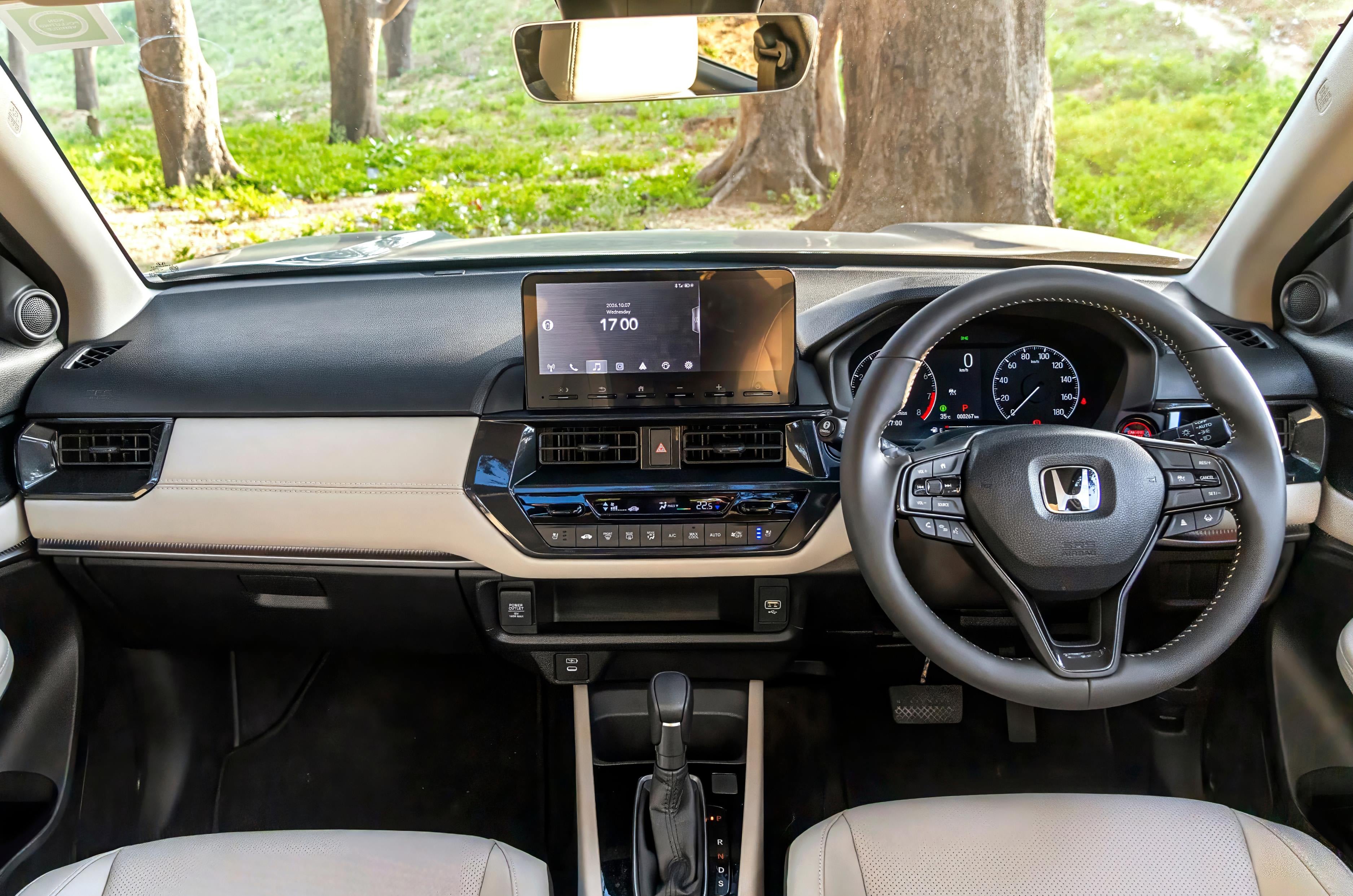
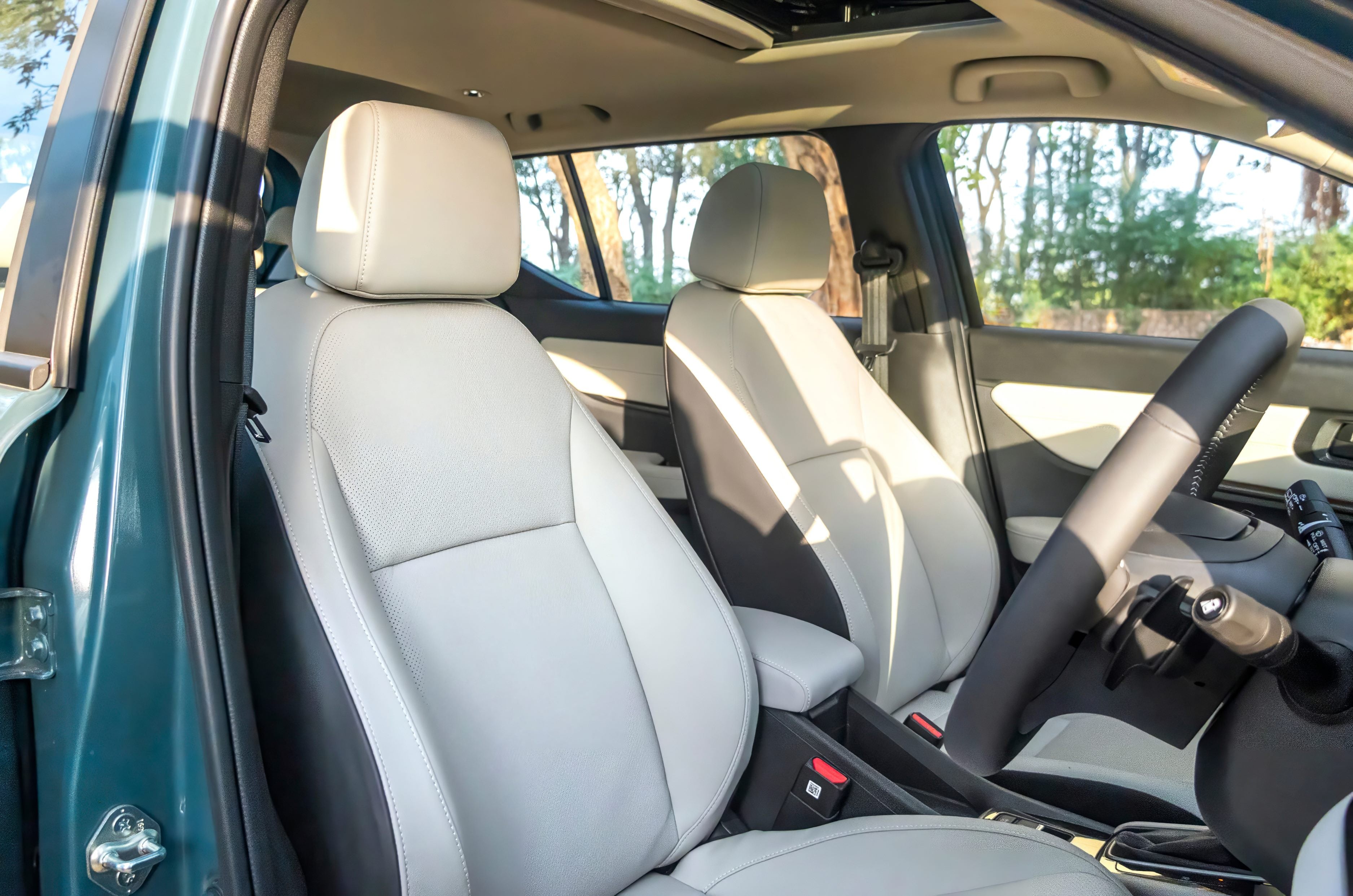
The cabin gets more substantial updates than the exterior, with the changes aimed at improving comfort and perceived quality. To start off, there’s a new ivory and black dual-tone upholstery theme that enhances the sense of space inside and is perhaps more neutral than the tan upholstery earlier. It will be tough to clean though, thankfully there is the option of all-black upholstery with the ‘Black’ edition Elevate.
Upholstery is now ivory and black with a new leatherette panel on the dash; cabin remains practical and feels well-built.
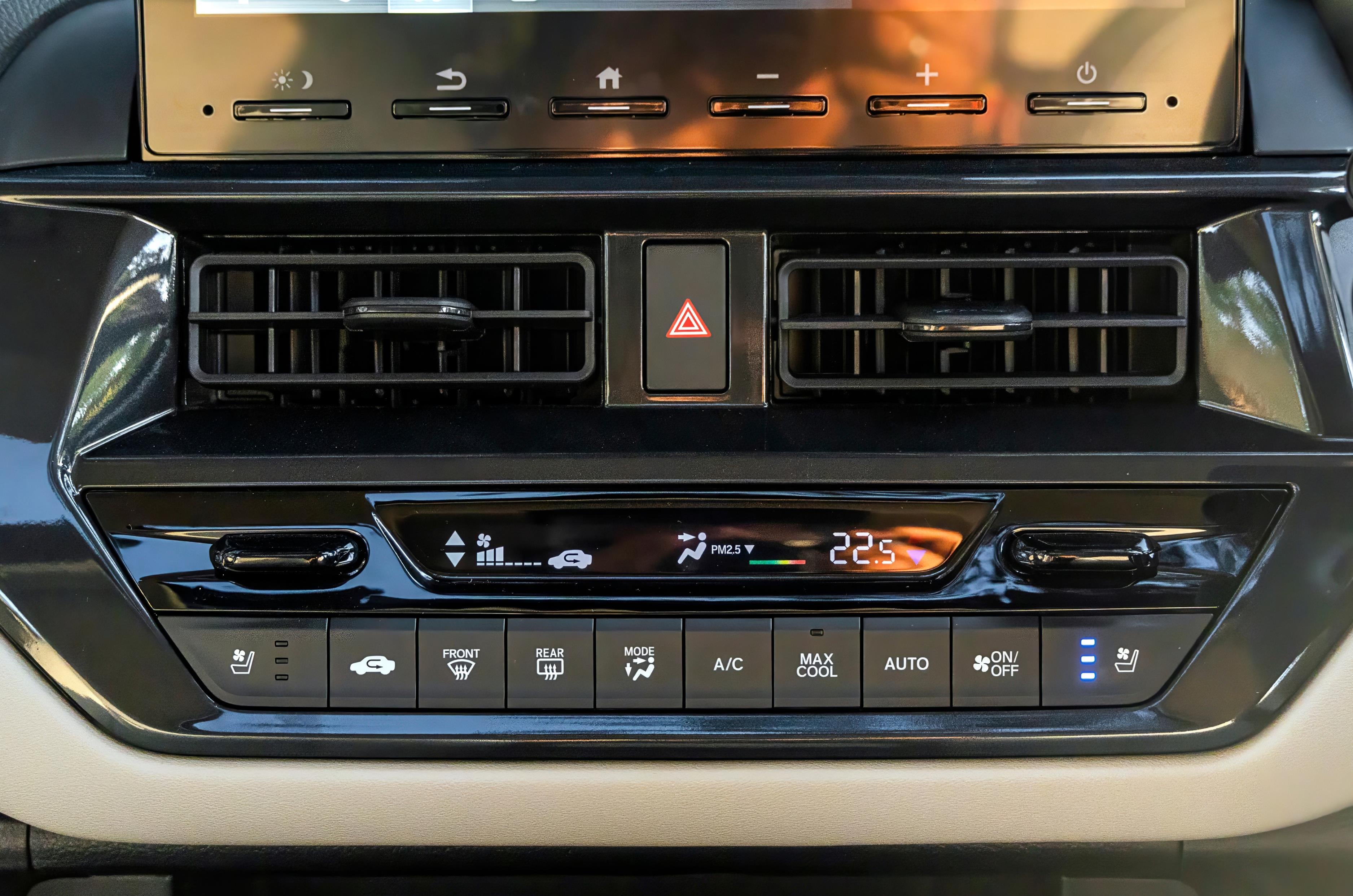
The dashboard has been revised too, with more white leatherette padding and stitching replacing the outgoing model’s faux wood trim, and the AC controls have been revised, now housing the seat ventilation buttons. Honda has even updated the roofliner fabric which looks and feels much nicer than the older woven roofliner. All of this gives the cabin a fresher look, although the overall layout remains familiar.
Front seats remain comfortable and now feature ventilation and power adjustment.
Ergonomics remain a strong point, with the Elevate offering a commanding driving position and supportive front seats that make it easy to get comfortable behind the wheel. The lumbar support, however, might feel excessive for some and taller people may find underthigh support a bit lacking.
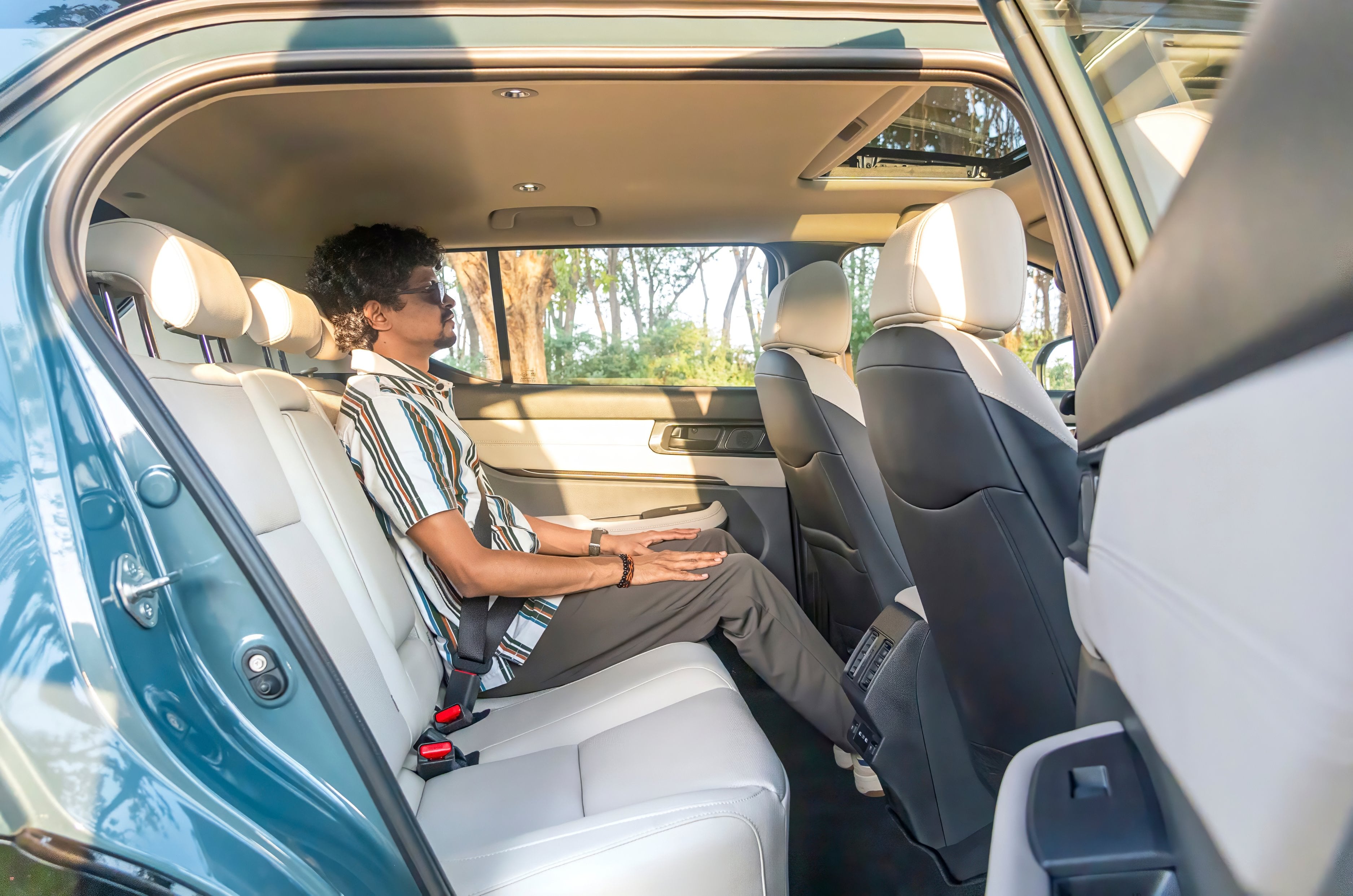
Ample headroom and kneeroom but best for two adults thanks to the narrow width and raised centre seat.
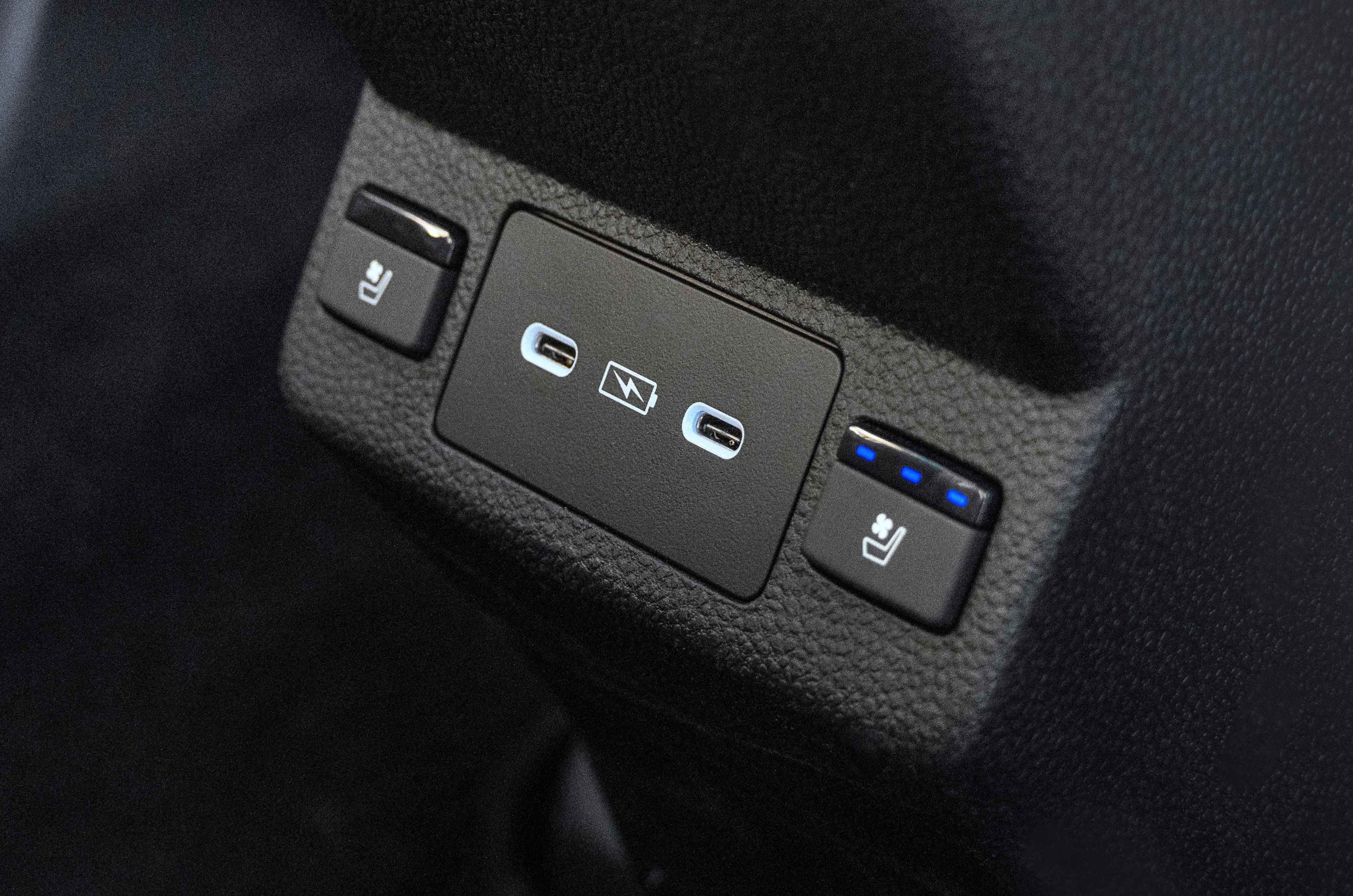
At the rear, space is generous, with plenty of kneeroom and headroom making it a very comfy place for two adults. However, fitting a third passenger will be tight thanks to the cabin’s limited width and raised centre seat. There are no sunblinds either, but Honda has added an adjustable headrest and a three-point seatbelt for the centre passenger, which was an omission earlier. Features back here include dedicated AC vents, USB charging ports, a fold down centre armrest with cupholders, new capacitive-touch LED reading lamps and the most prominent, seat ventilation.
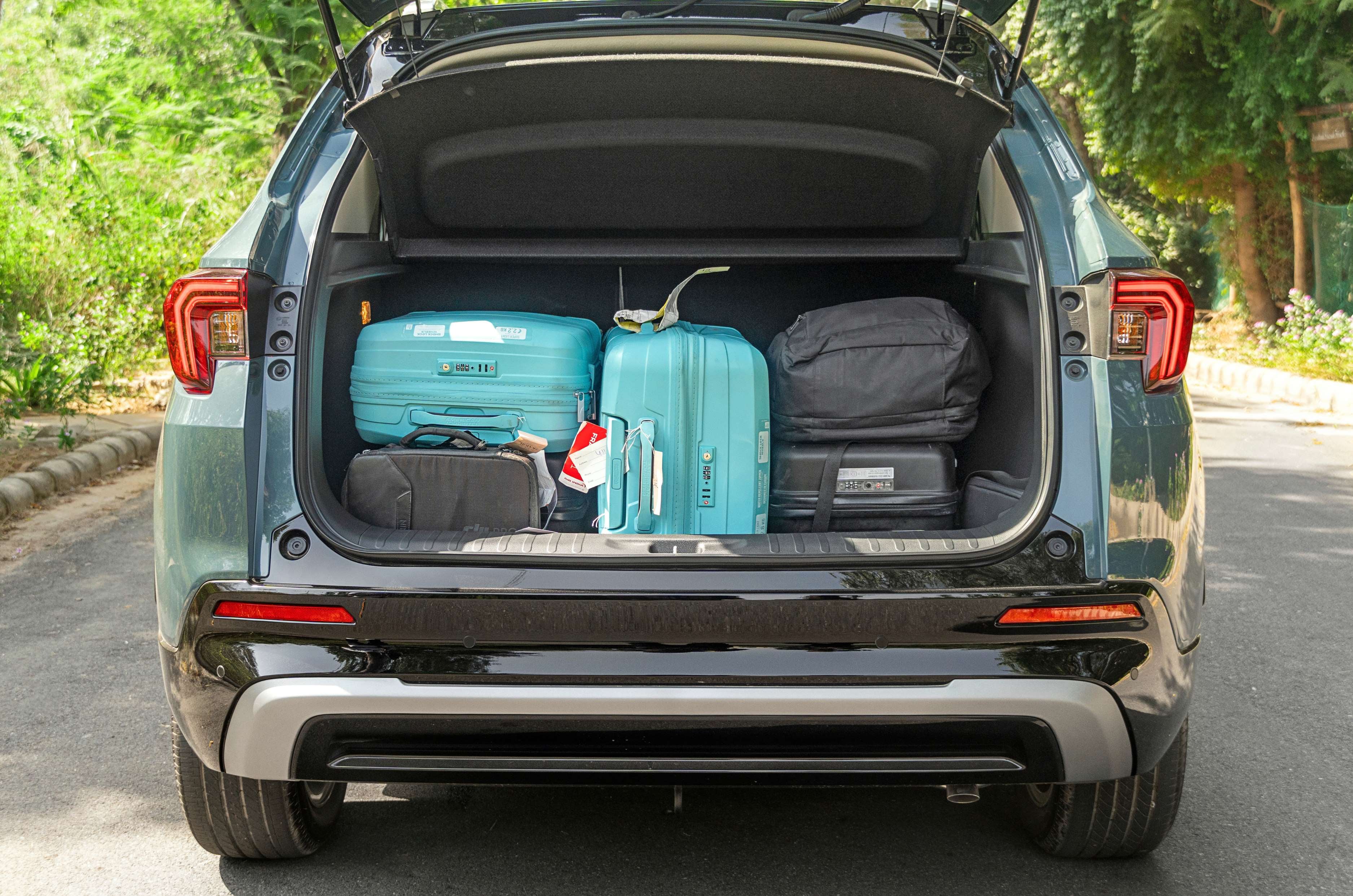
428-litre boot can fit in more than the number suggests; continues to feature a spare tyre under the boot floor.
Practicality, meanwhile, remains a strength, with the Elevate offering ample storage spaces throughout the cabin. The boot is also a substantial 458-litres and can pack in much more than the number would suggest. What’s also nice is that it continues to get a spare tyre under the boot floor.
Features and safety – 8/10
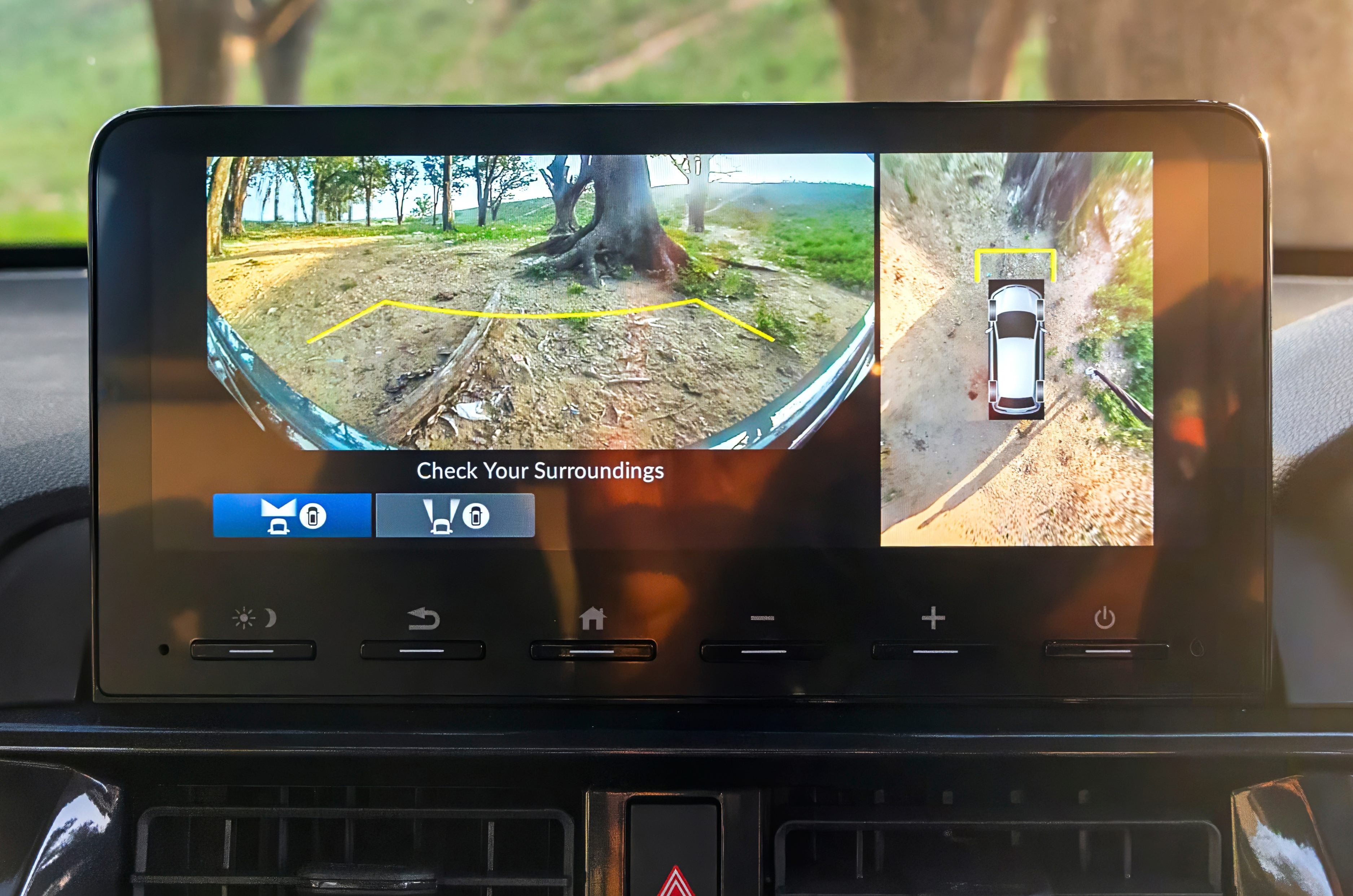
360-degree parking camera is a helpful addition but has limited angles of view and a small display on the screen.
The Elevate facelift addresses some of the key equipment gaps in the outgoing model, bringing a more comprehensive feature set to the table. In terms of safety features, there’s now a 360-degree camera (its display on the screen is quite small though, with limited angles of view), which works alongside the existing ‘LaneWatch’ camera, though curiously this feature is still only for the left hand side.
ADAS suite now packs in a useful low-speed follow function for the adaptive cruise control.
Front parking sensors have also been added to make parking and manoeuvring in tight gaps easier. However, the CVT variants get even more safety kit in the form of an electronic parking brake with auto hold function, rear disc brakes and the addition of a low-speed follow function for the adaptive cruise control, which is useful in stop-and-go traffic.
Rear-seat ventilation is a first-in-segment, but it’s only available in the top-spec ZX+ trim.
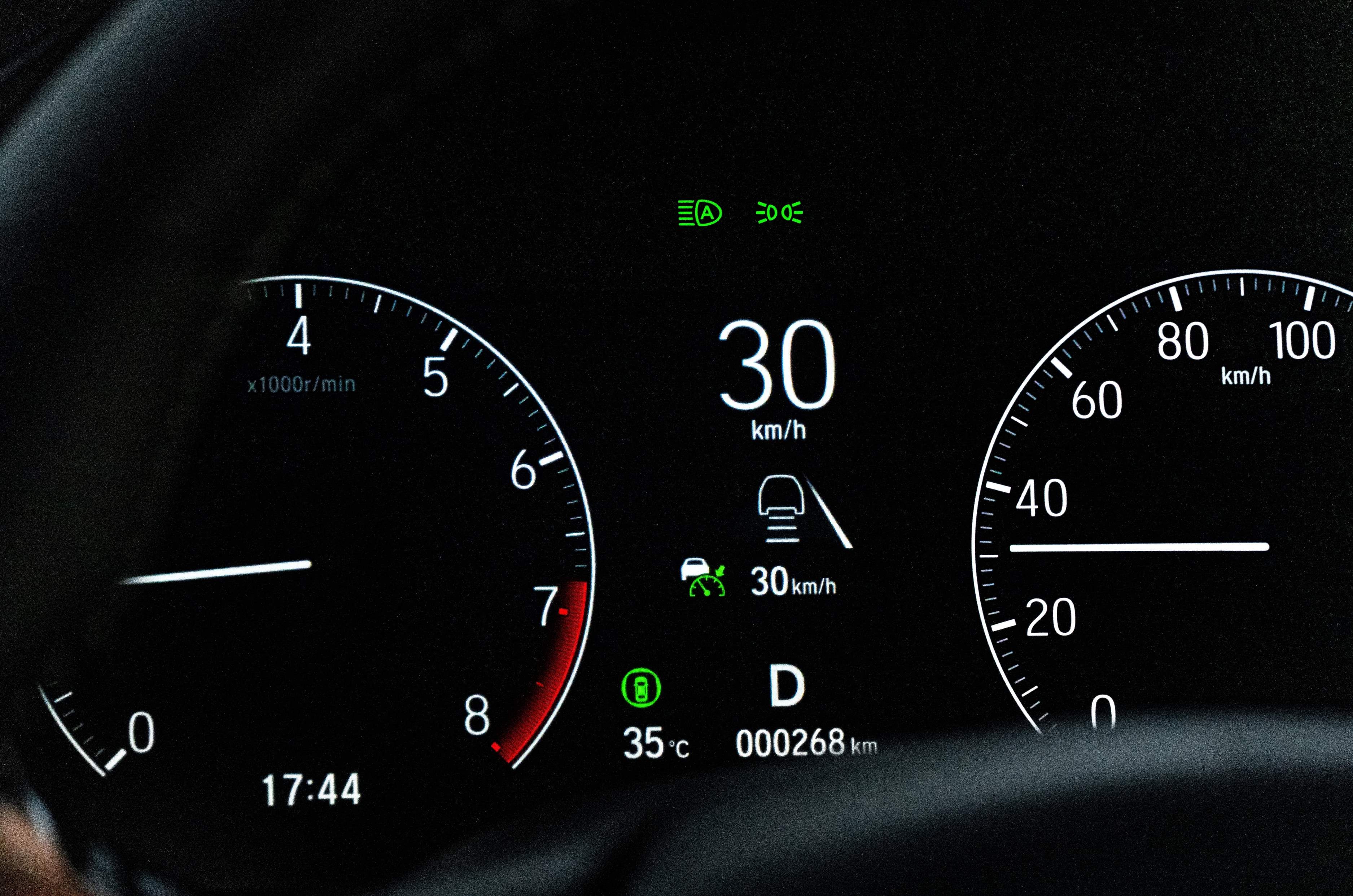
As for comfort and convenience features, the most important additions are the ventilated front and rear seats, the latter which is a segment-first. Though they take some time to cool effectively, it has enhanced the Elevate’s cabin comfort. Then there’s powered front seats – 8-way for the driver and 4-way for the passenger – ambient lighting and a PM2.5 air purifier. Other than that, much of the existing equipment has been carried over unchanged.
AC controls have been revised with new buttons for seat ventilation; now features an air purifier too.
There’s a 10.25-inch infotainment touchscreen with wireless smartphone integration (though its software and feature set still feel basic at best), semi-digital instrument cluster, a single-pane sunroof, wireless phone charger, six airbags, ESC, traction control, camera-based ADAS tech including auto emergency braking, lane keep assist and more. Still however, there are some features missing that rivals offer like a dual-zone for the auto climate control, panoramic sunroof and powered tailgate.
Powertrain and refinement – 8/10
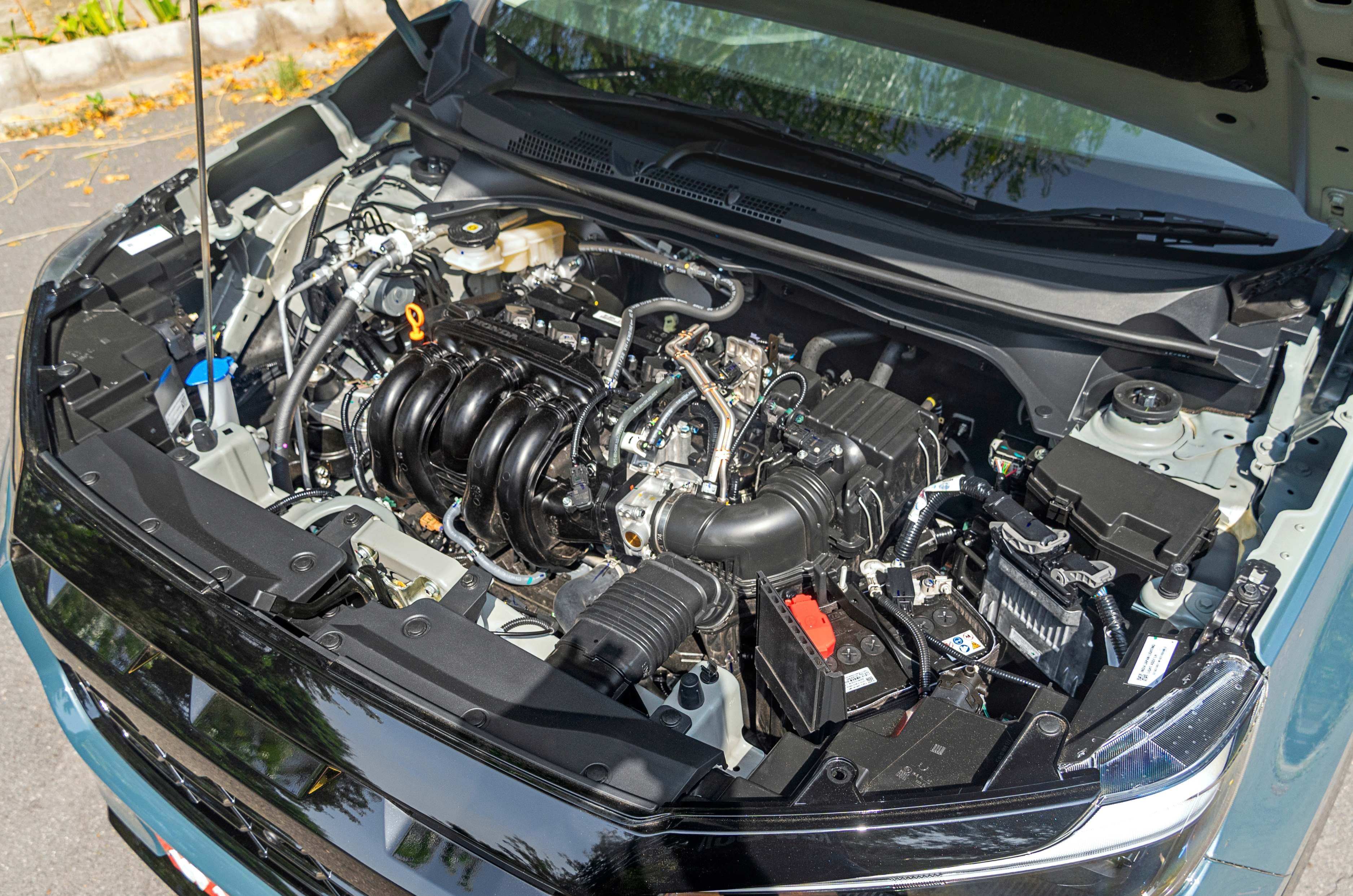
121hp, free-revving, naturally aspirated 1.5 petrol remains the only engine option with the Elevate.
There have been no changes under the hood of the Honda Elevate. It still continues to be powered by a 1.5-litre, four-cylinder, naturally aspirated petrol engine that produces 121hp and 145Nm. Gearbox options remain unchanged too, with a 6-speed manual and a 7-step CVT automatic, and we got to sample the latter. However, the engine has been future-proofed and is now WLTP emissions norms compliant while already being E20 fuel compatible.
This i-VTEC engine still impresses however. Throttle response is immediate, with no noticeable delay, making the engine feel sharp and eager. As before, the naturally aspirated motor pulls cleanly from idle all the way to the redline, in a smooth and progressive manner. However, it feels most energetic higher up the rev range, where it feels at its most potent too.
The 7-step CVT works well as an automatic, making light work of everyday commuting with its smooth operation. Paddle shifters with pre-set ratio points also give it some resemblance to a conventional automatic, allowing you to have greater control. However, push the throttle hard and the familiar ‘rubber band’ effect becomes apparent, with the engine holding on to high revs for extended periods, which doesn’t make for a relaxed driving experience. In this respect, Hyundai and Kia’s chain-driven CVT feels a bit smoother and more responsive than this belt-driven one.
As for performance, we managed a 0-100kph time of 11.89sec with the pre-facelift Elevate CVT and you can expect this facelifted model to be in the same ballpark. Expectedly, the manual does a quicker 10.82sec time to 100kph.
However, like before the lack of powertrain options is disappointing. In a time when rivals are offering diesels, turbo petrols, strong hybrids and CNGs, the Elevate has to soldier on with a solitary, naturally-aspirated petrol engine which restricts its appeal.
It feels quieter than before but there’s still prominent engine and road noise filtering into the cabin, especially on highways.
Honda has also worked on improving the Elevate’s noise insulation, an area where the existing model lacked. The company claims better isolation from both engine and road noise, but that has worked only to a small extent, in our experience. It feels quieter than before but there’s still prominent engine and road noise filtering into the cabin, especially at highway speeds, and there’s definitely more room for improvement here.
Fuel efficiency – 7/10
Given our short test drive, we didn’t subject the Elevate facelift to our real-world mileage tests. For reference though, the pre-facelift Elevate CVT did 8.60kpl in the city and 13.10kpl on the highway while the Elevate MT managed 8.7kpl in the city and 13.30kpl out on the highway. The Elevate CVT misses out on an Eco drive mode and auto start/stop, which certainly affects its fuel efficiency.
Ride comfort and handling – 8/10
Despite being a high-riding SUV, the Elevate feels remarkably composed on the move.
As before, the Honda Elevate continues to impress with its ride and handling balance. Despite being a tall riding SUV, it feels remarkably composed on the move. Suspension damping, though on the firmer side, is well judged and does a good job of ironing out road imperfections. It’s only when you’re travelling at triple digit speeds on an undulating highway is where you’ll notice quite a bit of vertical movement in the rear seat. But apart from that, the Elevate feels planted on the road.
Body roll is also well contained for a tall SUV, making it predictable around bends.
The steering is accurate and light at slow speeds, which helps with manoeuvrability, but it picks up weight progressively which is reassuring. Body roll is also well contained for a tall SUV and as such, it’s predictable around bends. As for the brakes, the CVT has gained rear discs but that hasn’t made a noticeable difference. Braking performance, like before, remains strong with a nice, progressive feel.
Value for money and verdict – 7/10
With this facelift, Honda has addressed some of the Elevate’s earlier shortcomings with some much-needed features and the updated look and feel inside the cabin. However, some drawbacks still remain like the lack of powertrain options and the below-par sound insulation.
It remains a sensible, practical midsize SUV that continues to prioritise the essentials over outright novelty.
What the Elevate continues to get right, though, are the fundamentals. It continues to offer a comfortable and practical cabin, a responsive engine and a well-sorted ride and handling package. Add to that the design refresh and the fairly expansive features list, and the Elevate facelift feels more rounded than before. Priced from Rs 11.80 lakh to Rs 18.40 lakh (ex-showroom), it’s still very competitively priced, though the new top ZX+ variant is up there with the heavy hitters.
Ultimately, the Elevate remains a sensible, practical midsize SUV that continues to prioritise the essentials over outright novelty. As a result, the Elevate facelift represents a great option for buyers who value comfort, everyday usability, reliability and the peace of mind associated with the Honda badge.
Aprilia India ने SXR GT 125 और SXR GT 175 स्कूटर को भारत में लॉन्च कर दिया है। इनकी शुरुआती कीमत क्रमशः ₹1.10 लाख और ₹1.30 लाख (एक्स-शोरूम, महाराष्ट्र) रखी गई है। दोनों स्कूटर में अब नए 14-इंच के व्हील्स और अपडेटेड इंजन दिए गए हैं। ध्यान देने वाली बात यह है कि ये दोनों शुरुआती कीमतें हैं। कंपनी आगे चलकर इनमें बदलाव कर सकती है। इसलिए अगर आप इनमें से कोई स्कूटर खरीदने का प्लान बना रहे हैं, तो अभी की कीमत आपके लिए खास हो सकती है। दोनों के बीच ₹20,000 के अंतर पर आपको बड़ा इंजन और ABS मिलता है, जबकि 125 मॉडल में सिर्फ कंबाइंड ब्रेकिंग सिस्टम (CBS) मिलता है। ये दोनों स्कूटर अब पूरे भारत में अप्रैलिया डीलरशिप पर बिक्री के लिए उपलब्ध हैं। आइए जानते हैं कि इनमें क्या बदलाव हुए हैं, दोनों में क्या अंतर है और बुकिंग से पहले ऑन-रोड कीमत के बारे में किन बातों का ध्यान रखना चाहिए।
SXR GT 125 vs SXR GT 175
फीचर
SXR GT 125
SXR GT 175
एक्स-शोरूम कीमत
₹1.10 लाख
₹1.30 लाख
इंजन
124.45cc, एयर-कूल्ड सिंगल
174.7cc, एयर-कूल्ड सिंगल
पावर
करीब 10.5 bhp
करीब 13 bhp
टॉर्क
10.4 Nm
14.14 Nm
फ्रंट ब्रेक
220mm डिस्क + CBS
220mm डिस्क + ABS
रियर ब्रेक
140mm ड्रम
140mm ड्रम
व्हील्स
14-इंच
14-इंच
कलर ऑप्शन
Matte Black, Glossy Azzurro, Glossy White
Metallic Blue, Matte Black, Matte Green
Aprilia SXR GT 125, SXR GT 175: क्या नया है?
इसकी स्टाइलिंग पुराने SXR160 मैक्सी-स्कूटर जैसी ही है, इसलिए जो बदलाव दिखते हैं, वे हैं नए ग्राफिक्स, नए रंग और बड़े पहिए। SXR GT 125 Matte Black, Glossy Azzurro और Glossy White कलर में आती है, जबकि SXR GT 175 Metallic Blue, Matte Black और Matte Green कलर में उपलब्ध है। Aprilia India का कहना है कि 14-इंच के पहिए स्टेबिलिटी और राइडिंग के आराम को बेहतर बनाने के लिए लगाए गए हैं।
Aprilia SXR GT 125, SXR GT 175: इंजन की जानकारी
prilia SXR GT 125 में 124.45cc का एयर-कूल्ड सिंगल-सिलेंडर इंजन दिया गया है। यह इंजन करीब 10.5 bhp की पावर और 10.4 Nm का टॉर्क जनरेट करता है।
वहीं, SXR GT 175 में 174.7cc का इंजन मिलता है, जो करीब 13 bhp की पावर और 14.14 Nm का टॉर्क देता है। यानी 175cc मॉडल में 125cc के मुकाबले करीब 2.5 bhp ज्यादा पावर और 3.7 Nm ज्यादा टॉर्क मिलता है। ज्यादा टॉर्क की वजह से ओवरटेकिंग और दो लोगों के साथ स्कूटर चलाने में बेहतर परफॉर्मेंस मिलने की उम्मीद है।
दोनों स्कूटर BS6 OBD-II Stage B नॉर्म्स को पूरा करते हैं और E20 फ्यूल के साथ भी चल सकते हैं।
Aprilia SXR GT 125, SXR GT 175: ब्रेक, सस्पेंशन
दोनों स्कूटर में आगे 220mm का डिस्क ब्रेक और पीछे 140mm का ड्रम ब्रेक दिया गया है। सस्पेंशन की बात करें तो आगे टेलिस्कोपिक फोर्क और पीछे 5-स्टेप एडजस्टेबल शॉक एब्जॉर्बर मिलता है।
हालांकि, ब्रेकिंग सिस्टम में दोनों मॉडल के बीच बड़ा अंतर है। SXR GT 175 में ABS दिया गया है, जबकि SXR GT 125 में CBS (कंबाइंड ब्रेकिंग सिस्टम) मिलता है। अगर आप अक्सर बारिश में या हाईवे पर स्कूटर चलाते हैं, तो खरीदारी के समय इस अंतर को जरूर ध्यान में रखें।
ऑन-रोड कीमत में इन बातों का रखें ध्यान
स्कूटर की फाइनल ऑन-रोड कीमत राज्य के टैक्स, इंश्योरेंस और अन्य चार्ज के आधार पर अलग-अलग हो सकती है। इसके अलावा, दोनों मॉडल की कीमत अभी इंट्रोडक्टरी है। इसलिए बुकिंग से पहले डीलर से यह जरूर पूछ लें कि बुकिंग के समय बताई गई कीमत आगे भी फिक्स रहेगी या नहीं।
इसके अलावा, अपने शहर में स्कूटर का वजन, सीट की ऊंचाई, फ्यूल टैंक की क्षमता और डिलीवरी की संभावित तारीख के बारे में भी जानकारी जरूर ले लें।
The Sorento is a big bet for Kia India, and you can tell. Six trims, two powertrains, front- and all-wheel drive, six or seven seats and 32 versions in all. This is not a toe in the water exercise but a full-blooded dive into the deep end of the executive SUV pool. More than that, it is a case study in how to launch a product in India, because Kia has got the basics right before it has even started talking about features.
Start with the powertrains, which for this class of SUV could hardly be better judged. There is a strong 2.2-litre diesel for diesel die-hards and there are still plenty of those. And then there is a 1.6-litre turbo-petrol strong hybrid whose timing couldn’t be more perfect. Petrol prices are climbing, E20 has quietly eaten into real-world efficiency, and buyers want diesel-like running costs from a smooth, quiet powertrain without lying awake worrying about diesel’s long-term future. The Sorento hybrid is pitched squarely at that anxiety.
The strategy behind the car is just as interesting. This fourth-generation (MQ4) Sorento arrives in India towards the end of its global life cycle. It is still a current product, but one due to be replaced internationally next year, while India will carry on with this one. That is actually a very smart move. A car this late in its life has its development costs largely amortised, and Kia India can bring some of the tooling here, which slashes the investment.
And this is a properly localised car, not a screwdriver job. The body is stamped and welded at Kia’s Anantapur plant, and the dashboard and seats are made here too. That is what makes the Rs 27.99 lakh starting price possible. The catch is that localisation on this scale only pays off with volume, and Kia wants to sell around 40,000 Sorentos a year. That is a big number for a Rs 30-40 lakh SUV. Can it get there?
Kia Sorento exterior design and engineering
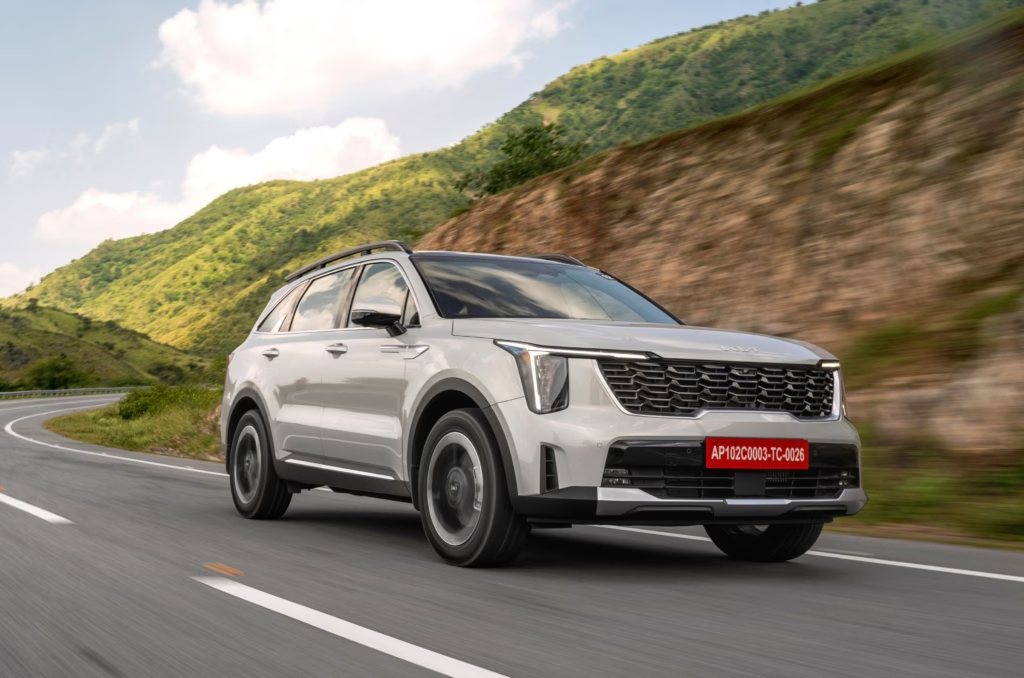
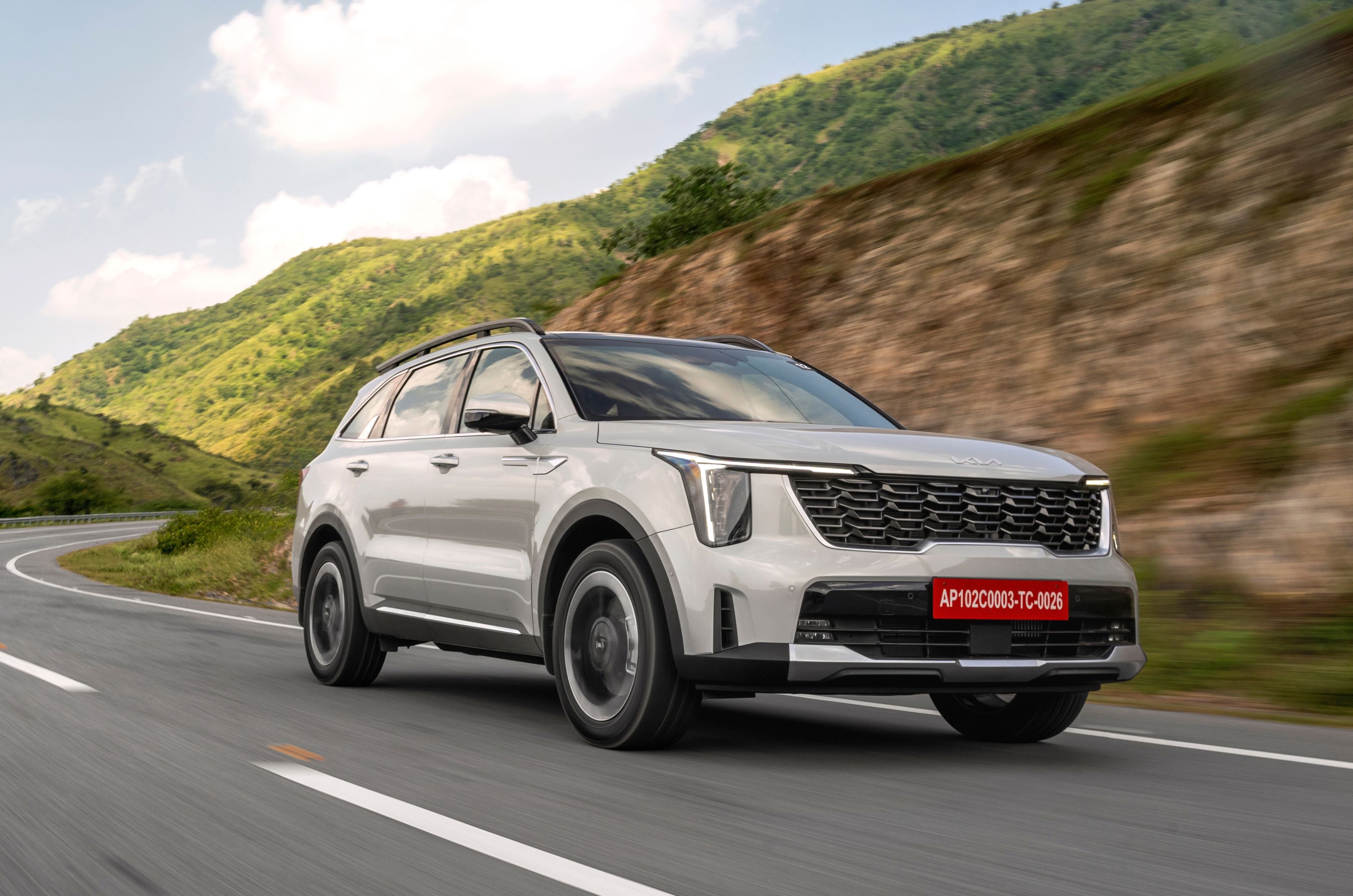
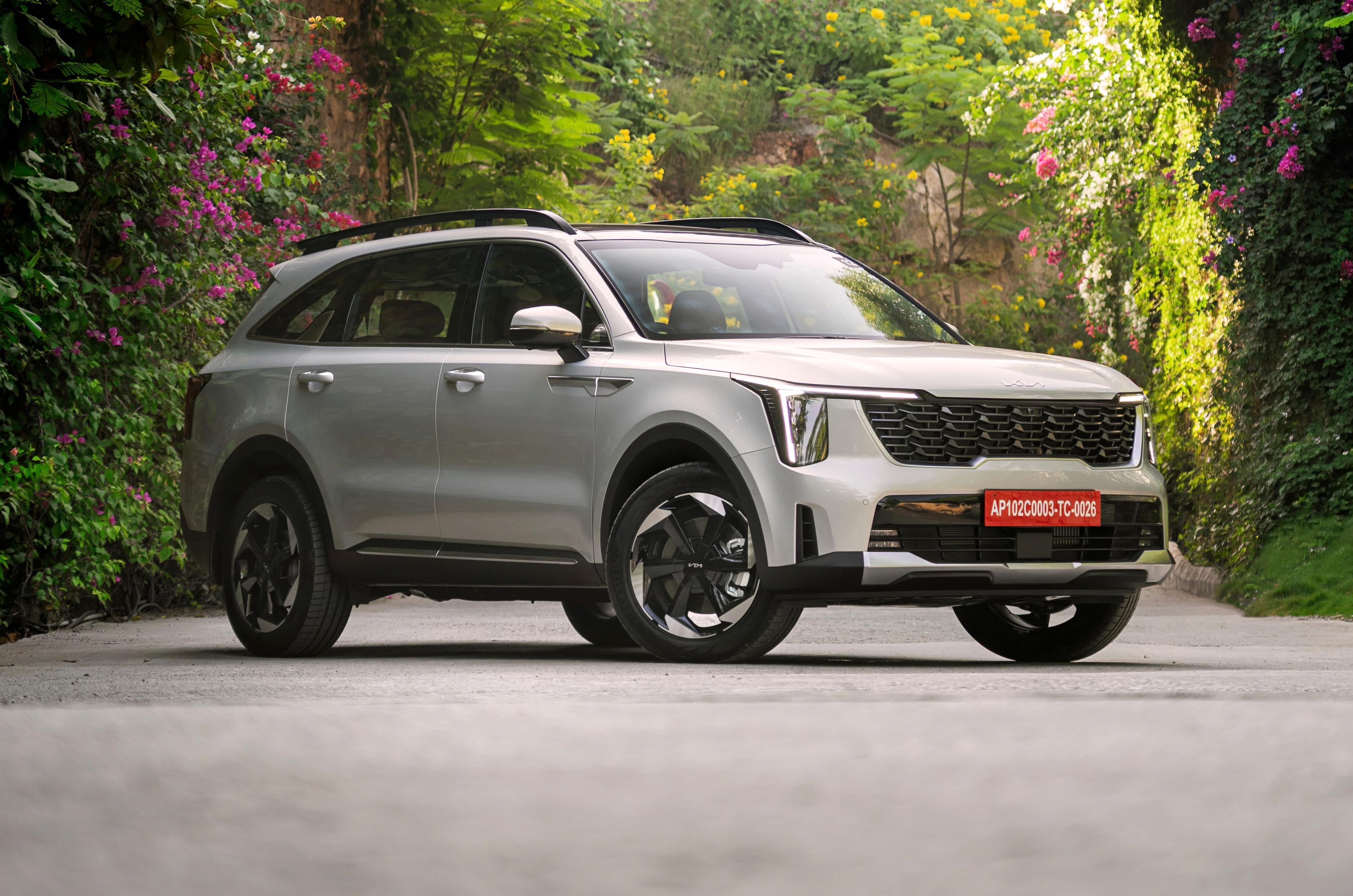
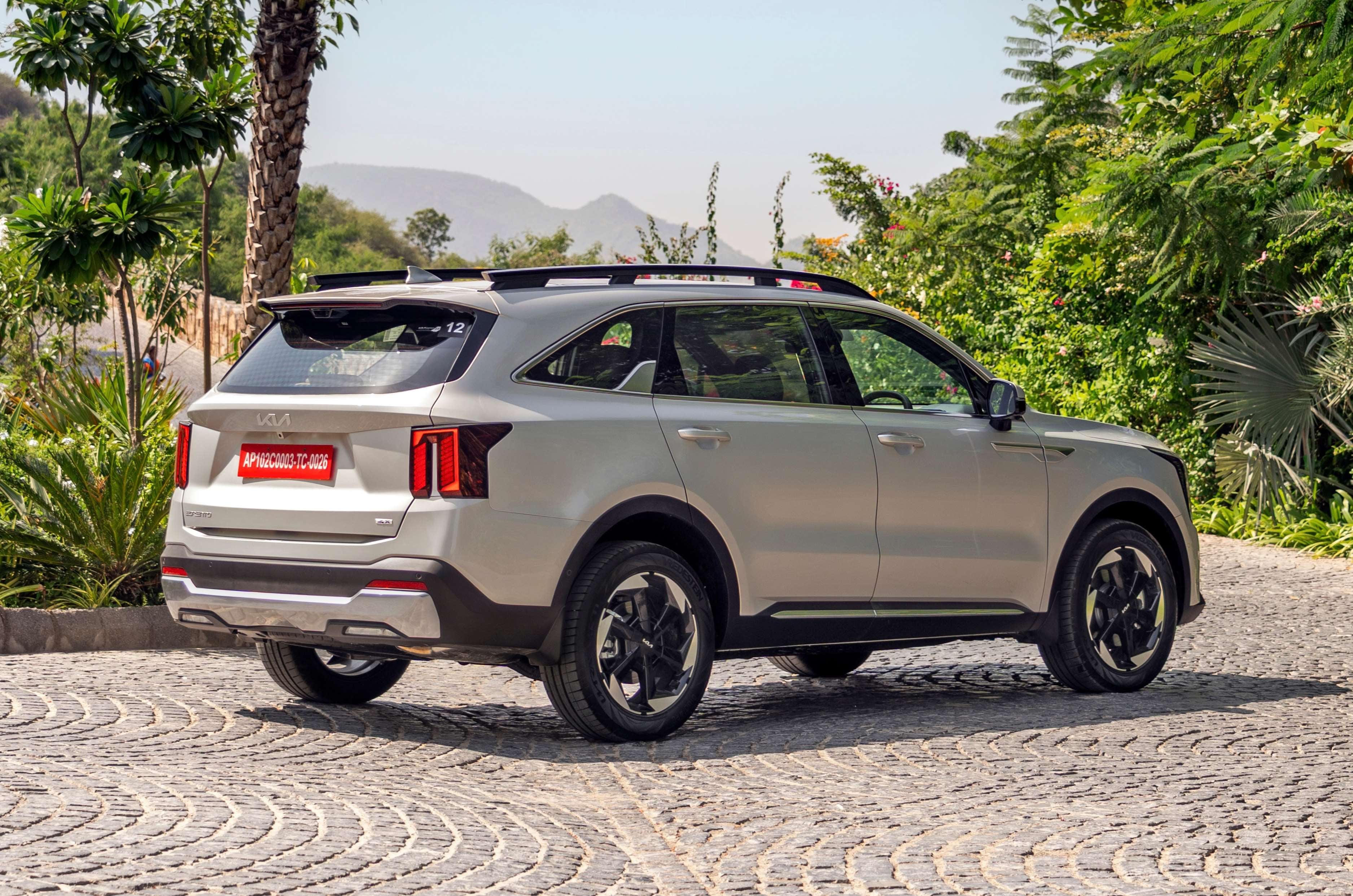
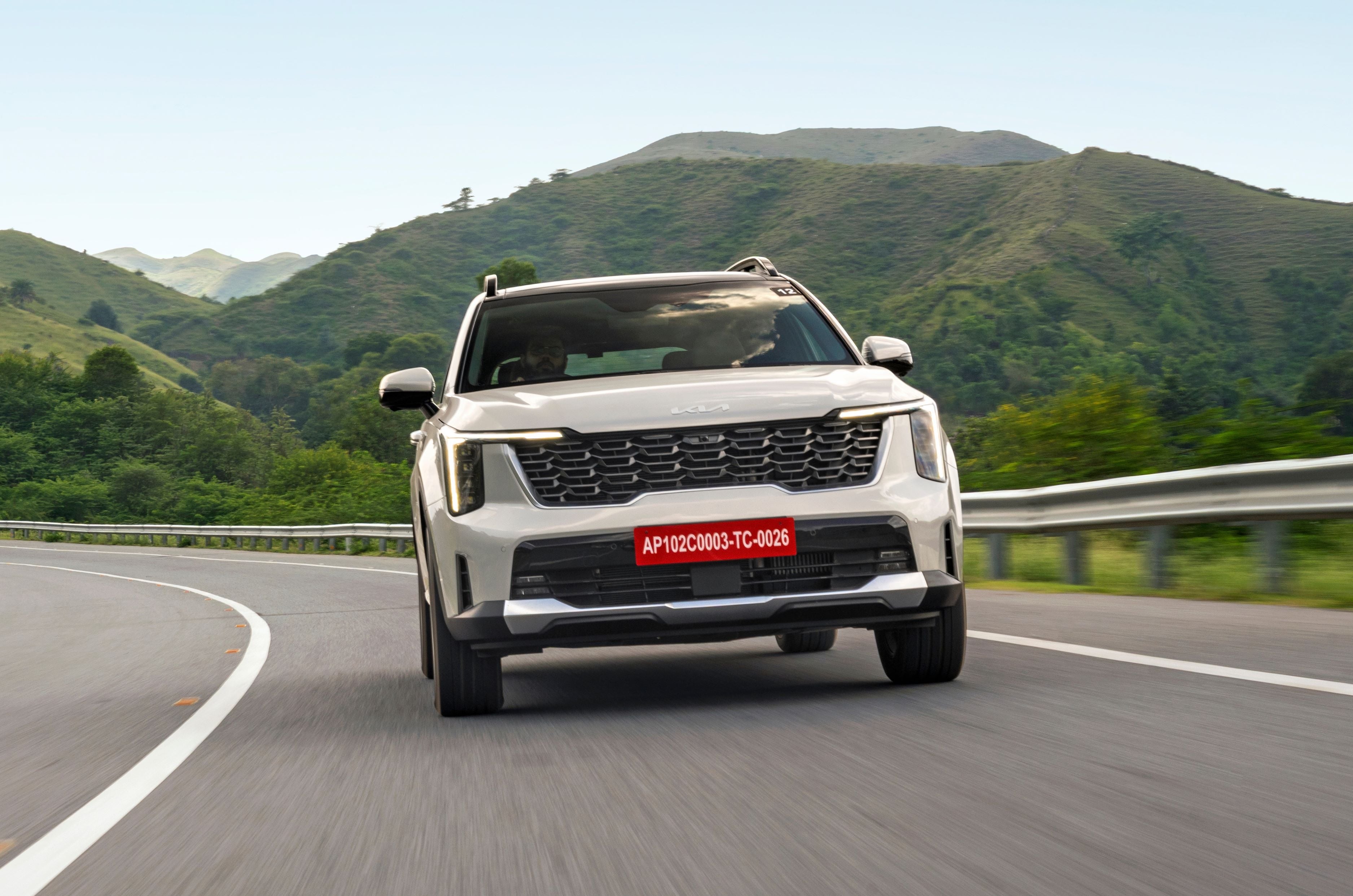
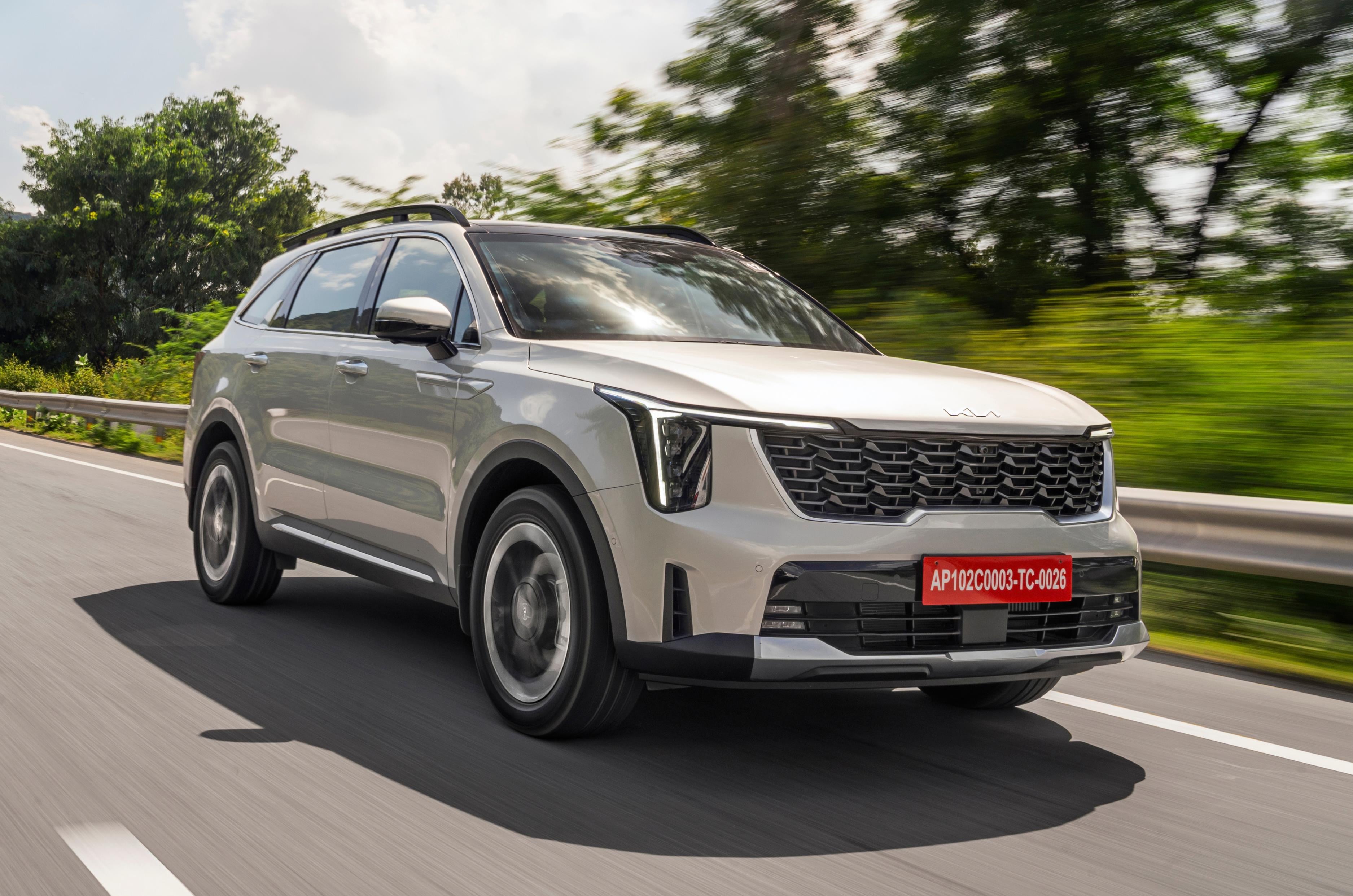
Based on the gen 4 Sorento, it carries over the older and more palatable design language.
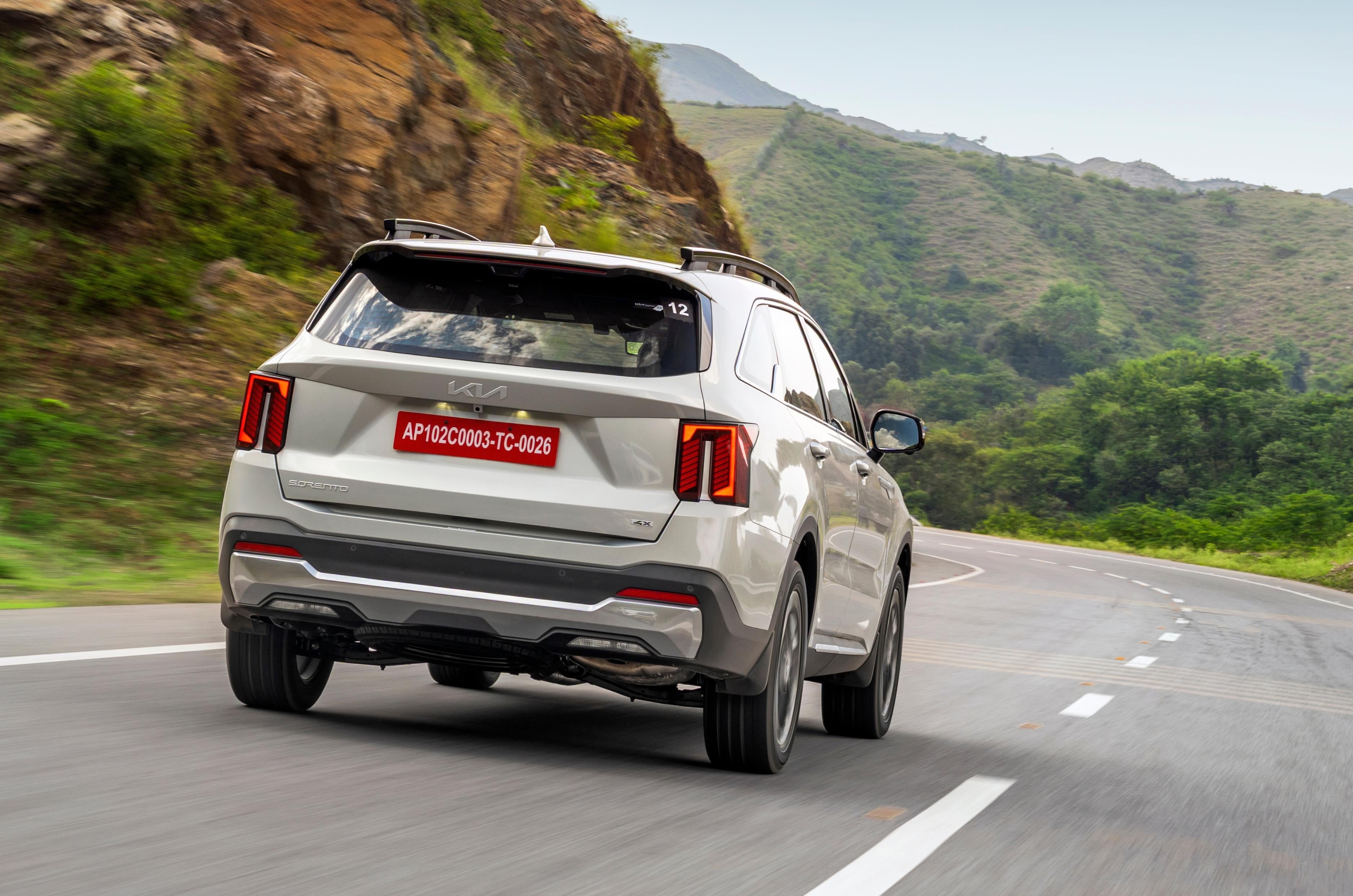
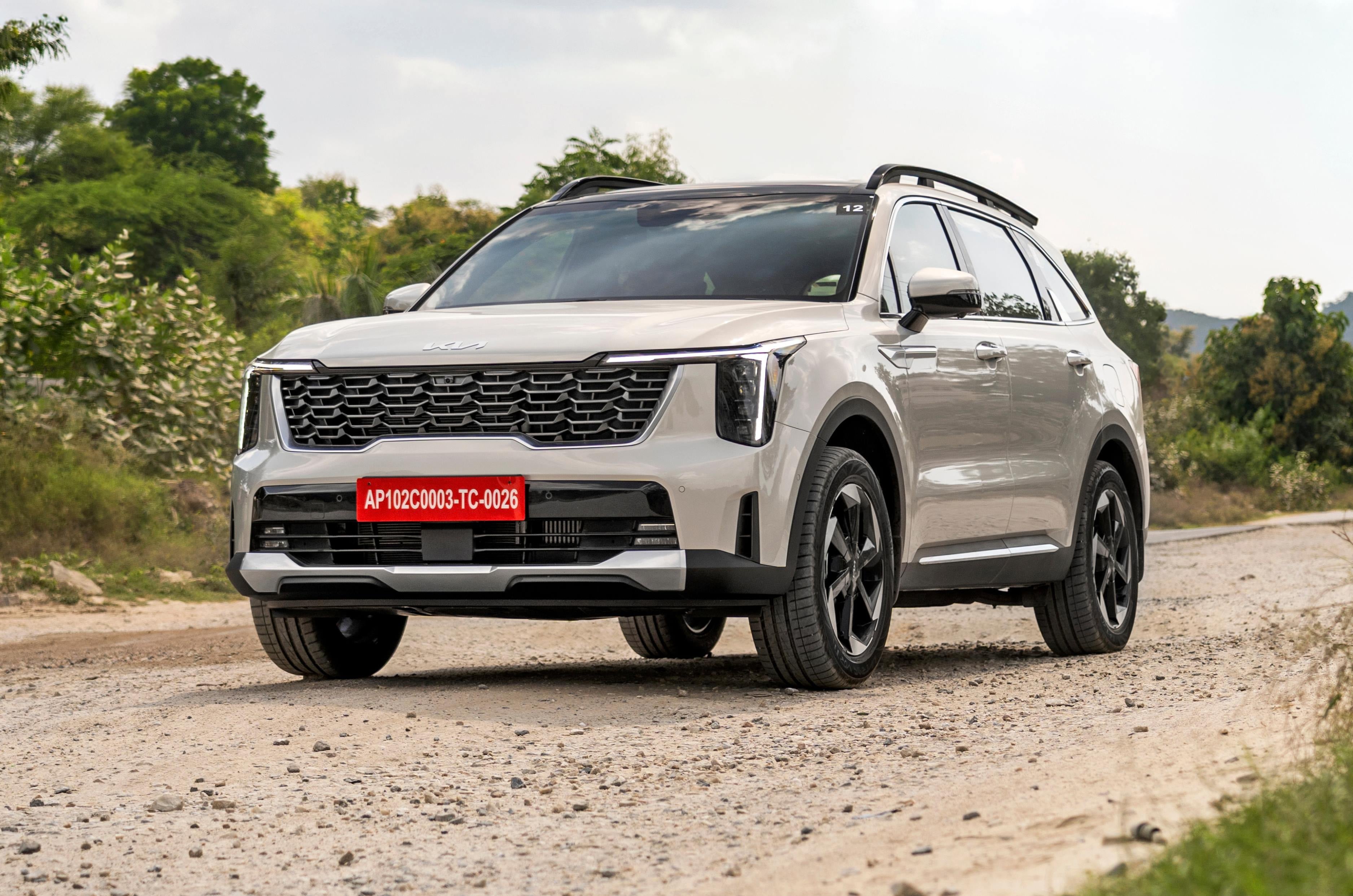
The Sorento sits on Hyundai-Kia’s MQ4 platform, the freshest architecture in its class, and it has already had a mid-life update to keep it looking current. The 2024 facelift brought the nose in line with the design language Kia kicked off with the EV9, so you get vertically stacked LED headlights, Y-shaped daytime running lamps and an aggressive looking bumper with wide intakes. At the back are L-shaped wraparound tail-lamps, and thankfully no light bar stretched across the tailgate.
Beats the rivals in length, width, and wheelbase.
Kia’s stated aim was a more technical, precise look, one meant to signal tight build quality and engineering sophistication. It is a trick the German premium brands have used for years, and Kia has clearly taken a leaf out of their book. The Sorento looks crisp and expensive rather than flashy, and is likely to age well too.
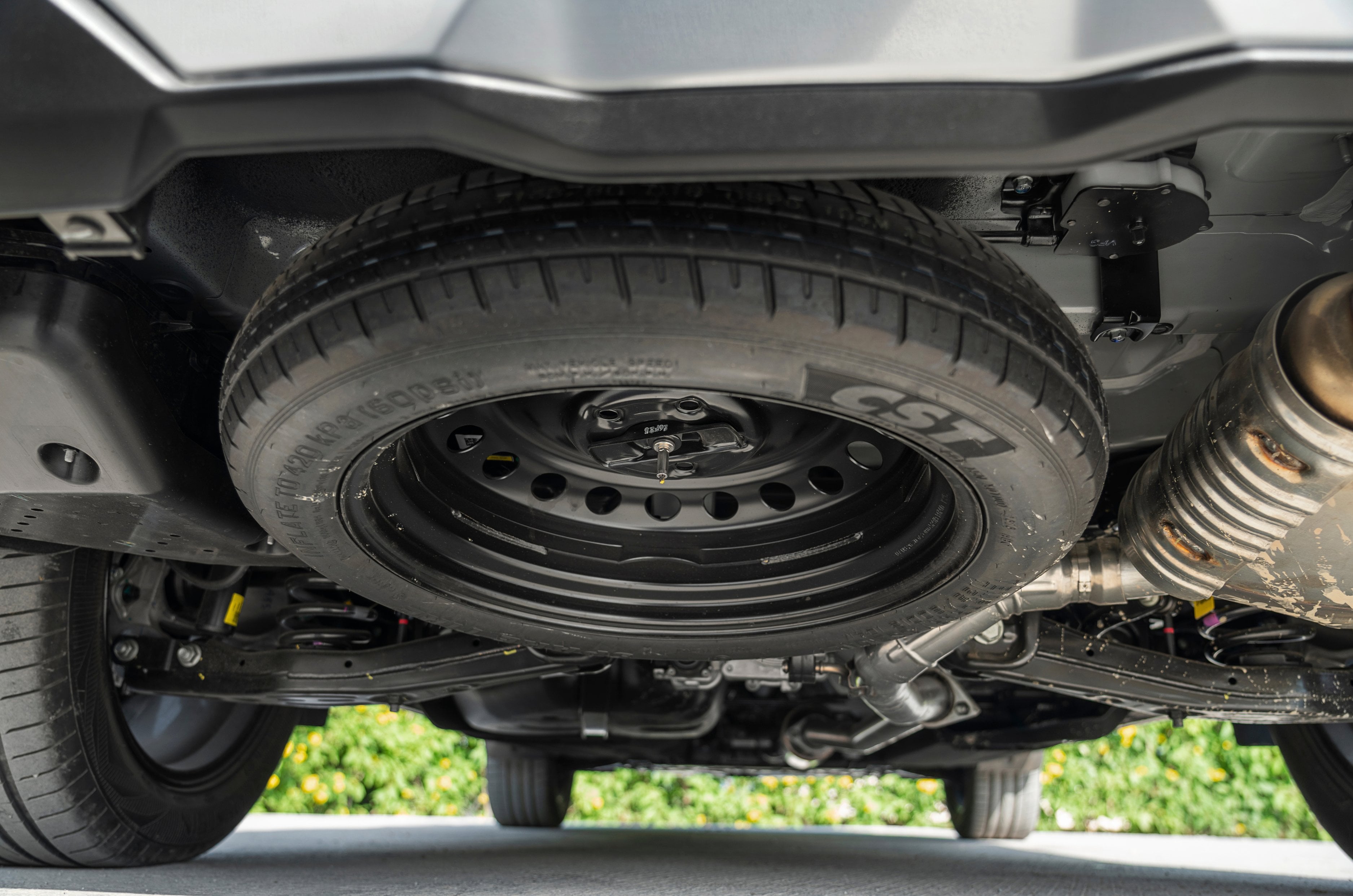
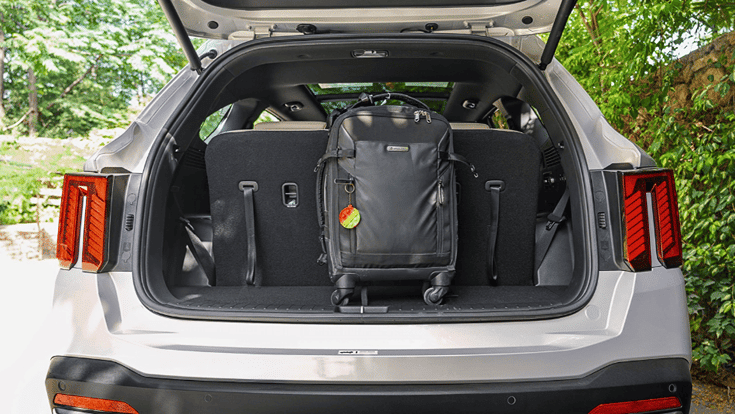
Spare wheel mounted under the floor frees up room in the boot.
What it does not have is brute presence. Despite being the longest, widest and tallest SUV in its segment, at 4,815mm long, 1,900mm wide and 1,785mm tall on a 2,815mm wheelbase, it does not loom in your mirrors the way a Fortuner does. The sloping roofline at the rear softens the silhouette and lends it a hint of crossover, and some will see it as a big Seltos rather than a junior Land Cruiser. Clearly this is not an SUV that looks like it can bully its way through traffic.
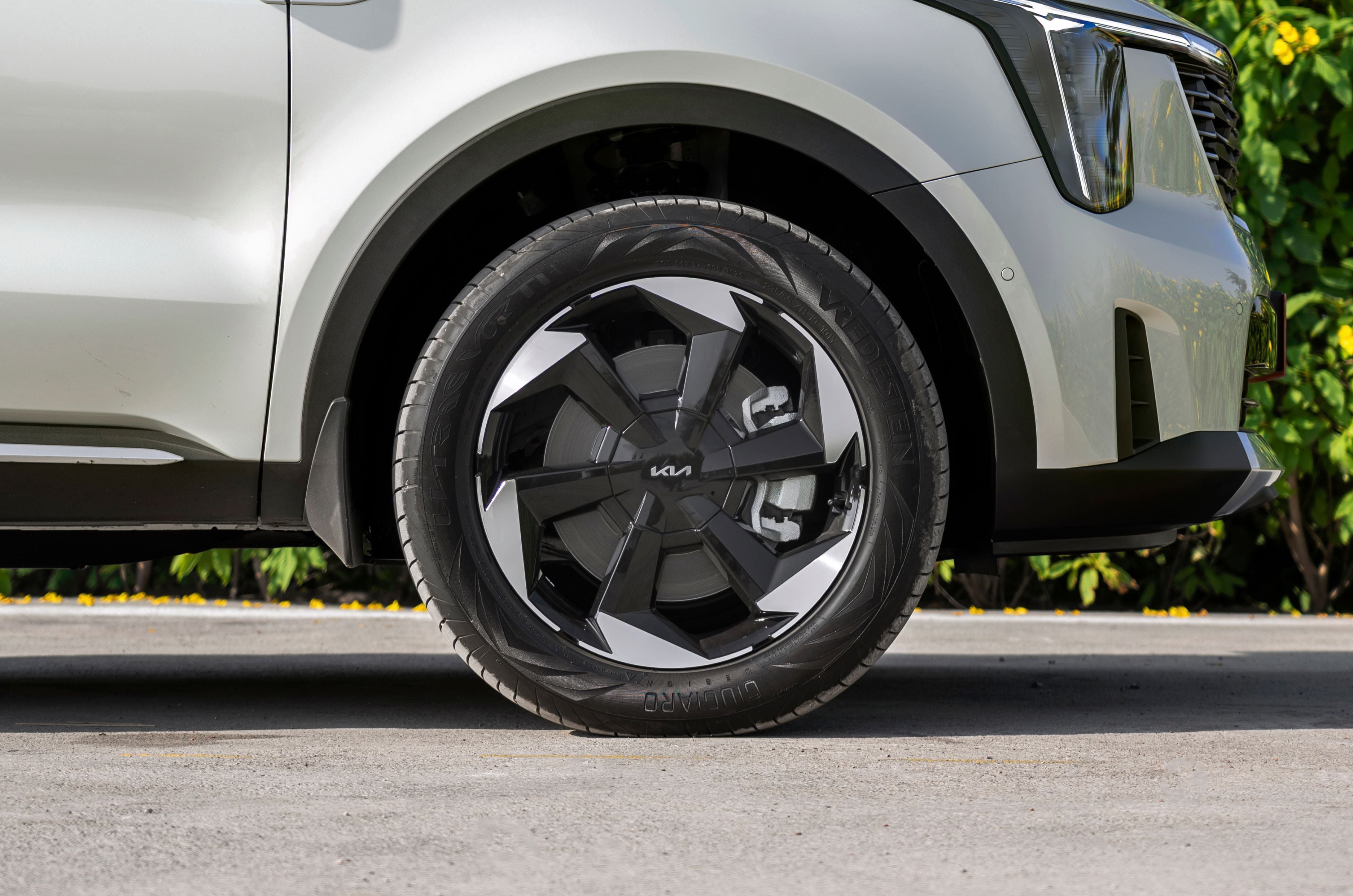
A more unique design could’ve been used for the 19-inch alloys.
The 19-inch dual-tone alloys could have been more distinctive, too an effect exaggerated by the chunky 235/55 R19 tyres. Those tall sidewalls, though, are not a styling misstep so much as an engineering choice, and they play a big part in how this car rides. More on that later.
Kia Sorento interior space and comfort
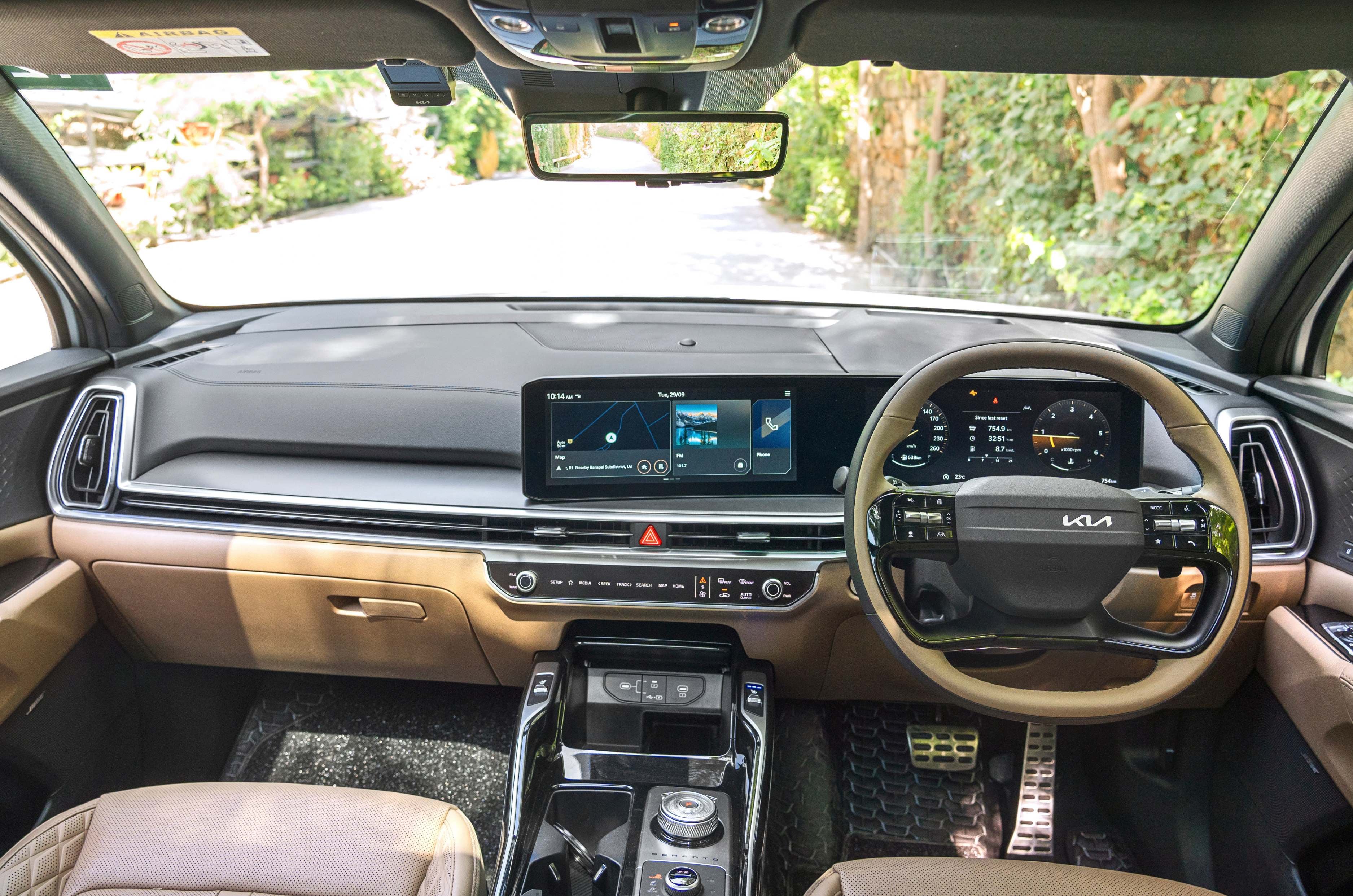
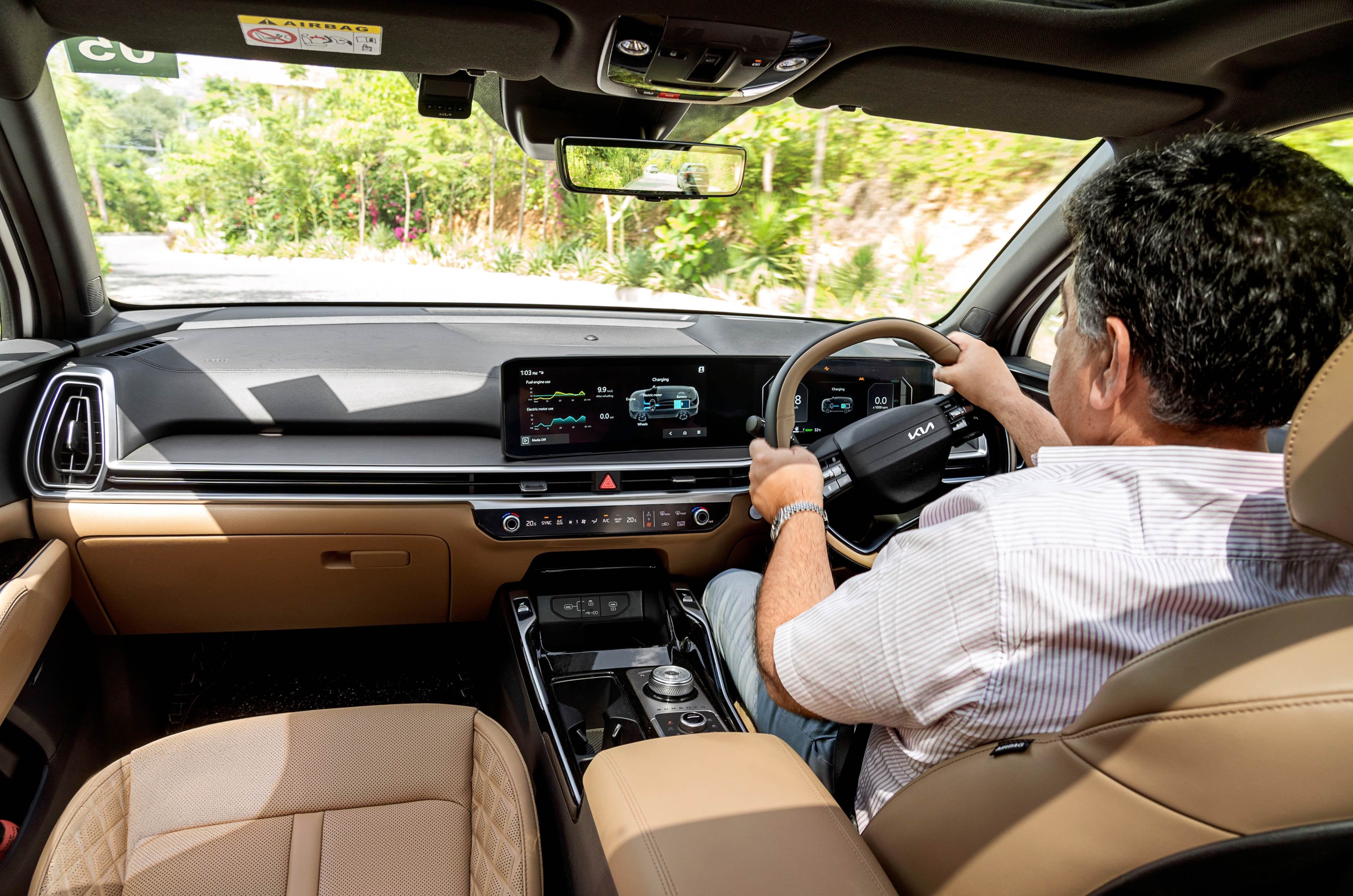
Clutter-free dashboard with solid build and plush feel.
If the exterior is quietly effective, the cabin is where Kia has truly aced it. The Sorento offers a mix of quality, equipment and ergonomics that nothing at this price can match. Soft-touch materials cover everything you are likely to touch, including the spots where your knee rests against the centre console. There is a healthy count of physical buttons, and they click with a precision that feels engineered rather than sourced. The knurled finish on the rotary drive selector and the switchgear adds a tactile richness you normally pay German money for.
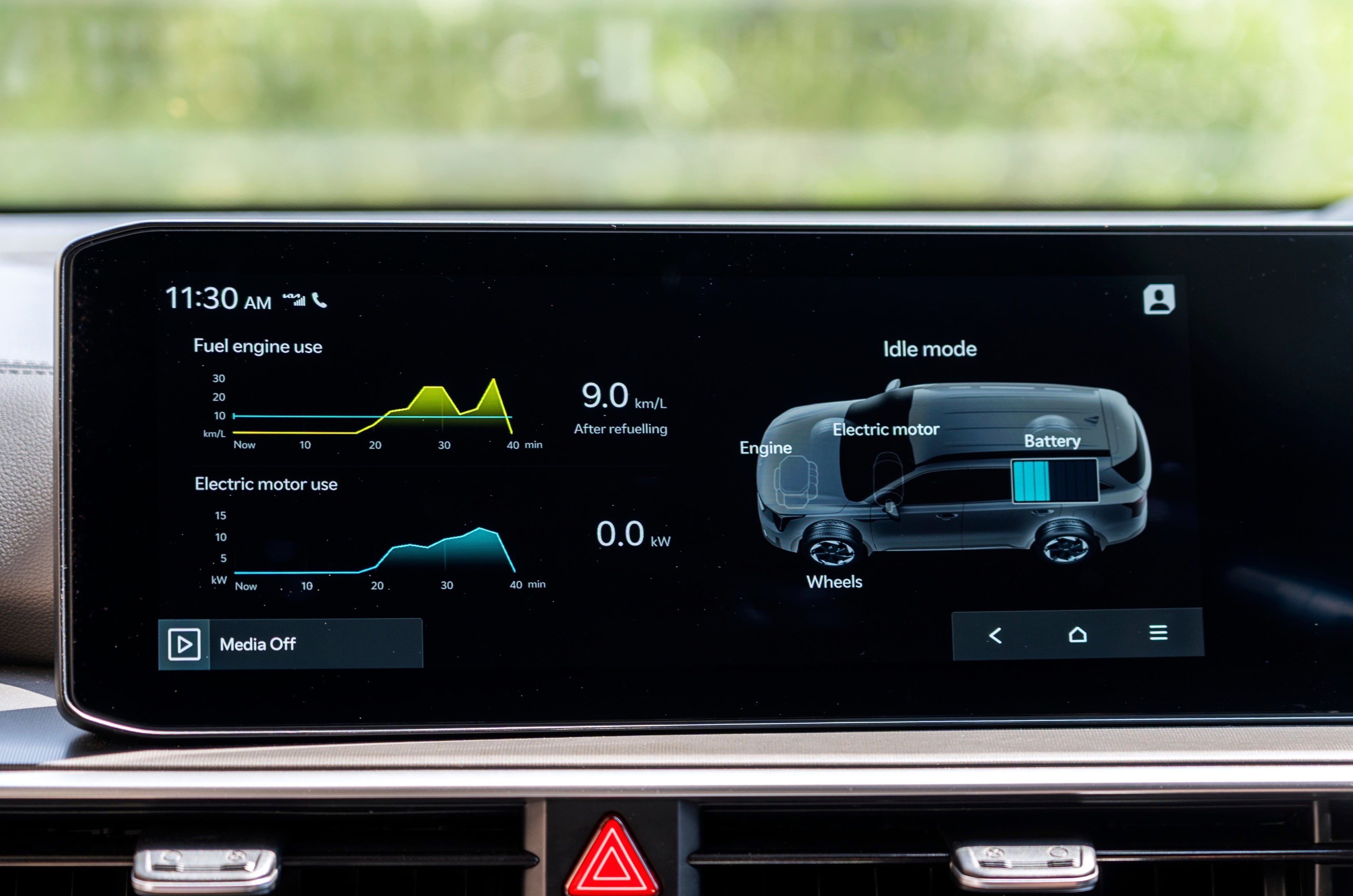
Hybrid variant gets exclusive data for power flow and efficiency.
As with its Hyundai cousins, the real ace is the software. The 12.3-inch infotainment system is logically laid out, menus are where you expect them to be, and getting to a feature takes a tap or two rather than a treasure hunt. Kia has also kept the climate controls off the main screen. They live on a touch-sensitive bar below it, with scrollers and a button that toggles the bar between air-con and infotainment shortcuts. It is a clever, space-saving solution, though you will occasionally find it in the wrong mode just when you need it.
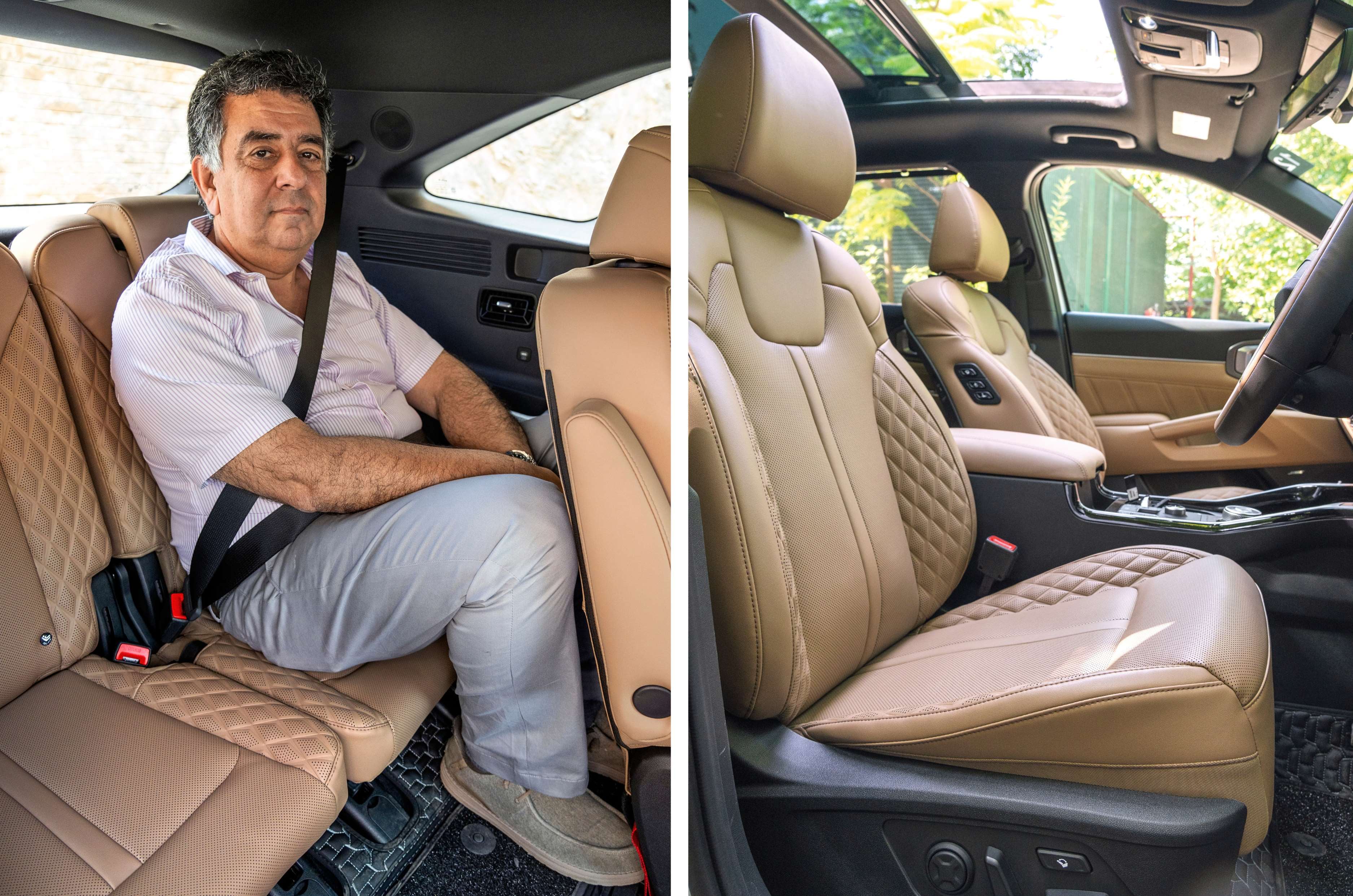
L: Third row seat placed on floor results in knees-up seating; best for children. R: Broad, supportive and well-cushioned front seats are electric and also get ventilation.
The front seats are fully powered, with 10-way adjustment, lumbar support and ventilation, and the passenger seat gets a boss mode so whoever sits behind can push it forward. Coming to the third row, access is easy. You can either walk through the gap between the captain chairs or press a button on the seat, which electrically slides and tilts it forward. Once there, the news is mixed. Legroom is better than you expect, but the seat base is mounted almost flat on the floor, so there is no under-thigh support and your knees point at the roof. Treat it as a space for children or short hops. At least the third row gets its own blower controls and USB ports.
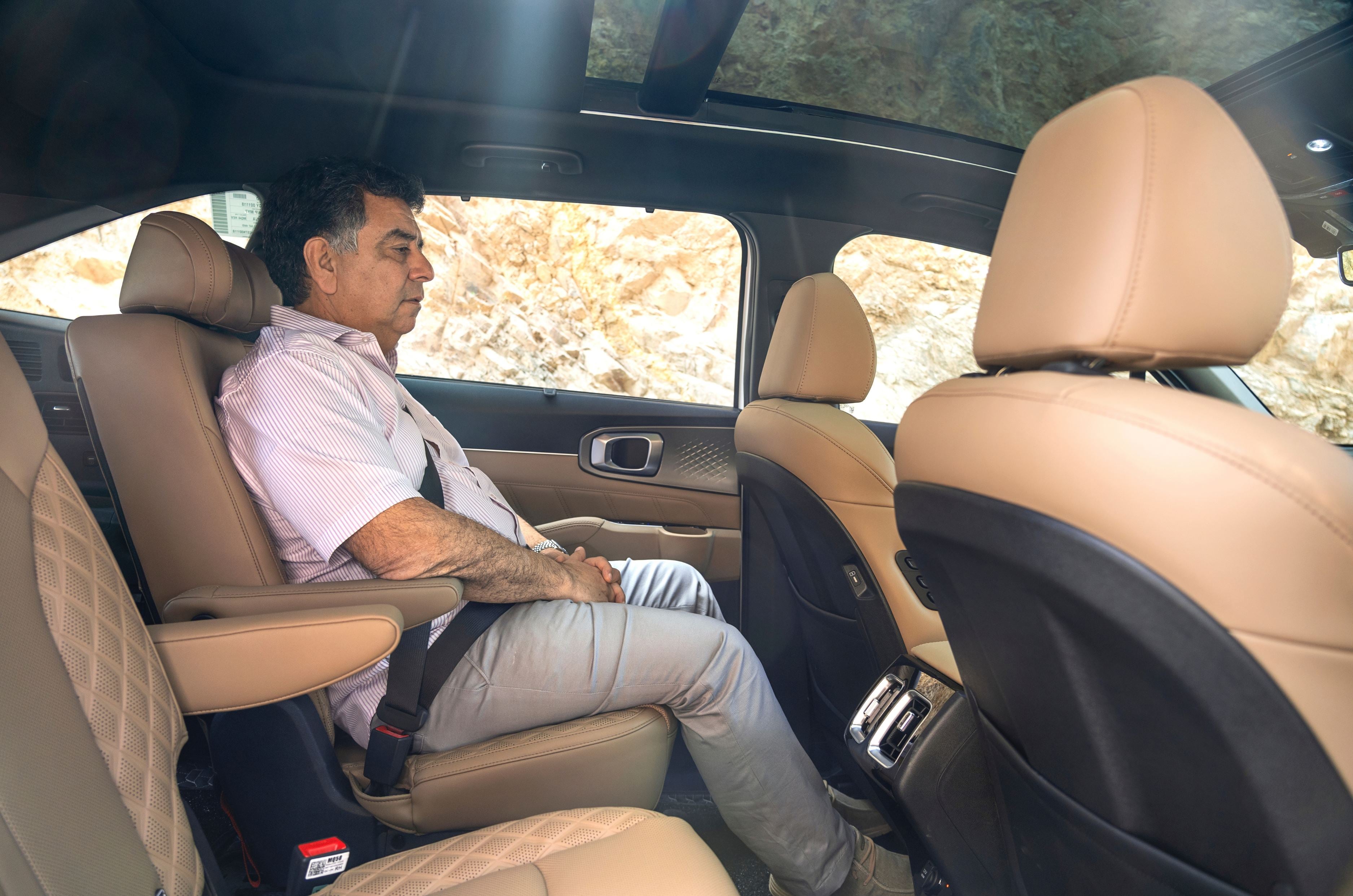
Spacious middle-row with ventilated and adjustable captain chairs; bench seat version also available.
One of the Sorento’s highlights, however, is the second-row experience. Our test car was the top HTX with six seats, and its second-row captain chairs are ventilated too, a rarity in this class. They are the best seats in the house. There is lots of legroom, a commanding view out and good under-thigh support, comparable to the Innova Hycross’s middle-row captain chairs, though the Toyota seats you a touch higher. A neat detail is the cupholder moulded into the door, up near the handle, where it is actually easy to reach.
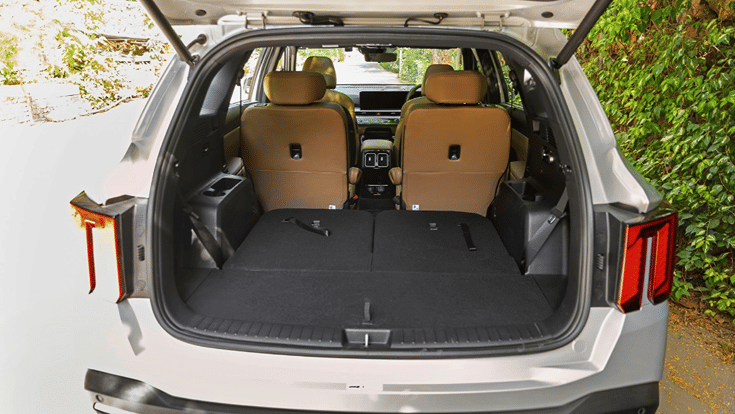
With all three rows up, the boot is a modest 179 litres; fold the third row and that grows to 813 litres. A full-size spare is welcome, but it is slung under the body, which is not the most convenient place to reach. Overhead, the massive panoramic roof floods the cabin with light and adds to the sense of space.
Kia Sorento features and technology
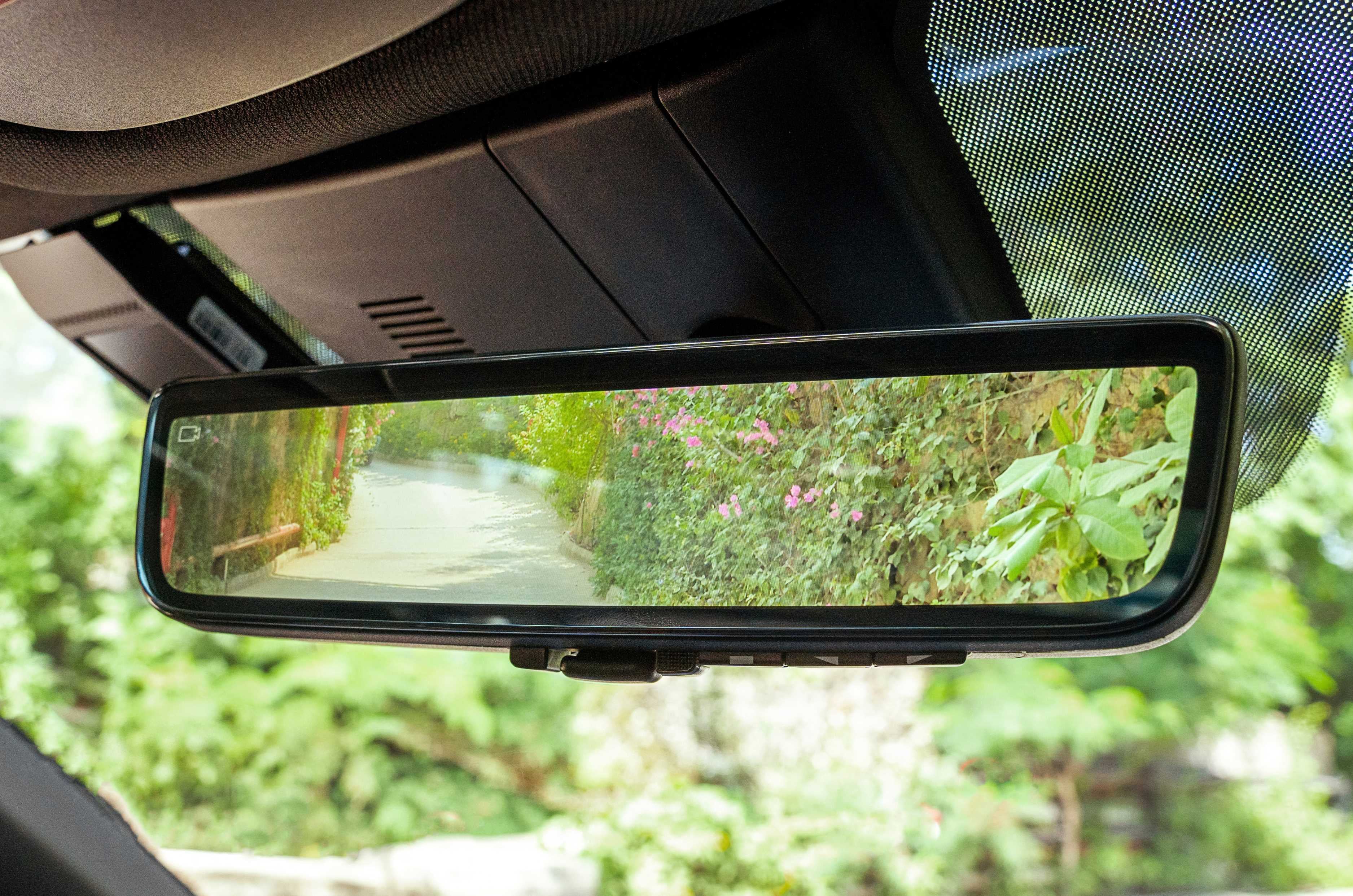
Digital IRVM offers excellent resolution and can be adjusted for level and brightness.
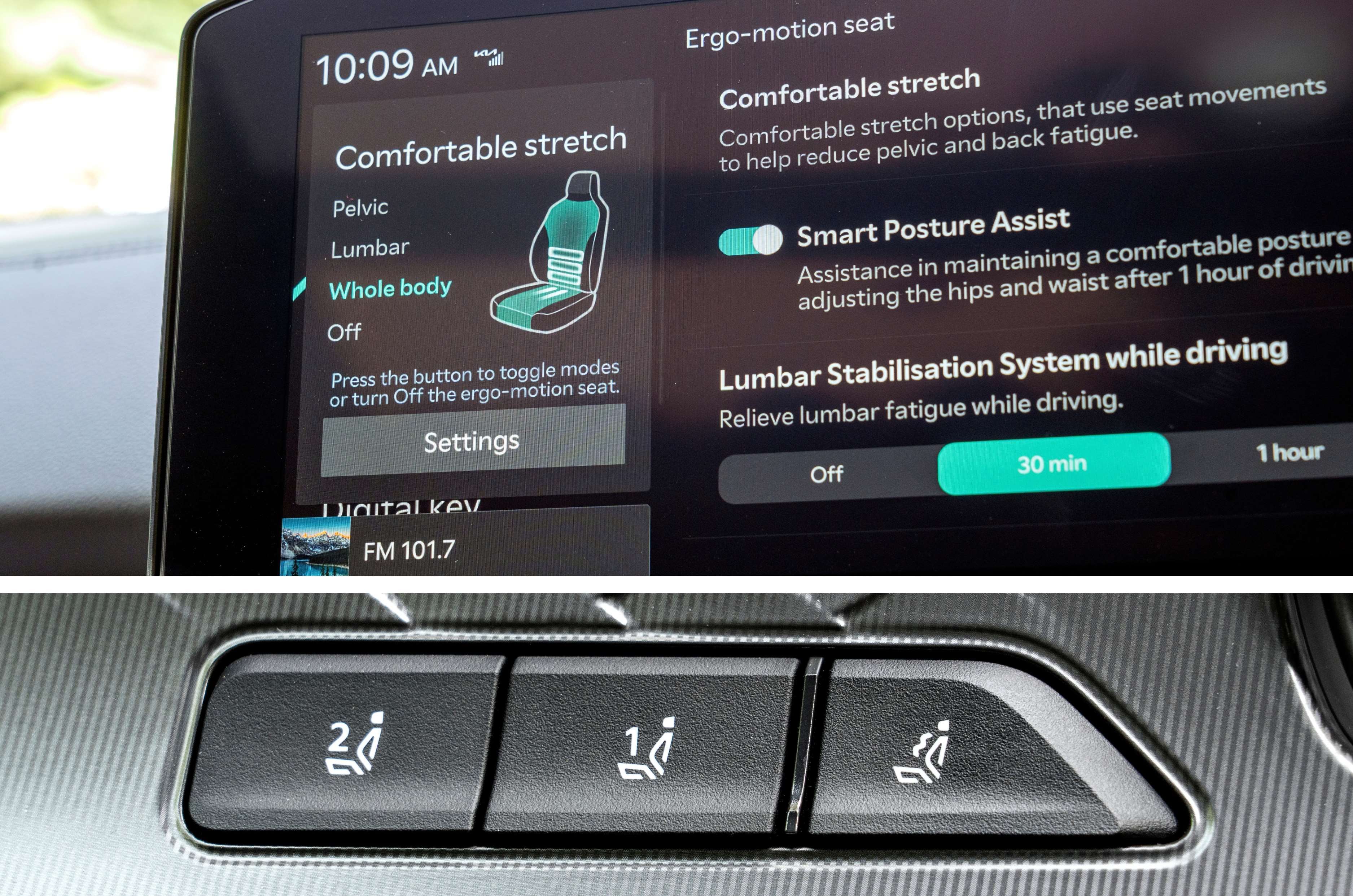
The equipment list is huge. In addition to the aforementioned 12.3-inch touchscreen, powered front seats, ventilated captain’s chairs, and panoramic sunroof, the Sorento comes packed with a 12.3-inch digital driver’s display, a head-up display, a 12-speaker Bose system, dual-zone climate control, a powered tailgate, rear-window sunshades, 64-colour ambient lighting and a digital rear-view mirror that flips back to a conventional one at the turn of a knob. The driver’s seat even gets an ‘ergo-motion’ mode that simulates a massage function by shifting the contours around.
Ergo mode for driver seat acts like a massage by moving the contours to avoid a stiff back on a long trip.
Safety is just as thorough, with 10 airbags, a 360-degree camera, front and rear dashcams, remote parking assist, TPMS and Level 2+ ADAS on the (A) trims. There is even real-time generative AI, a first for any Sorento globally.
Kia Sorento performance and refinement
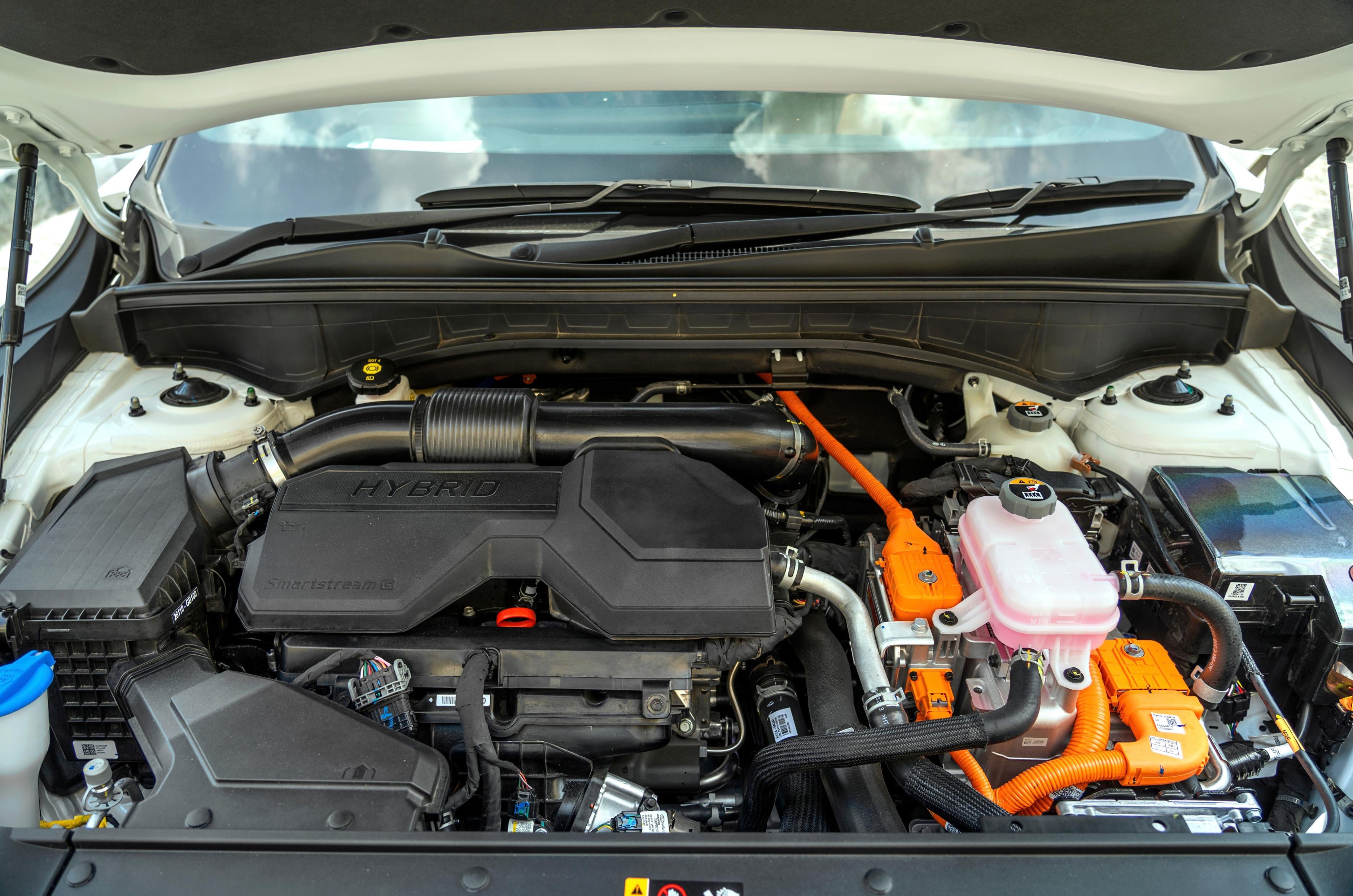
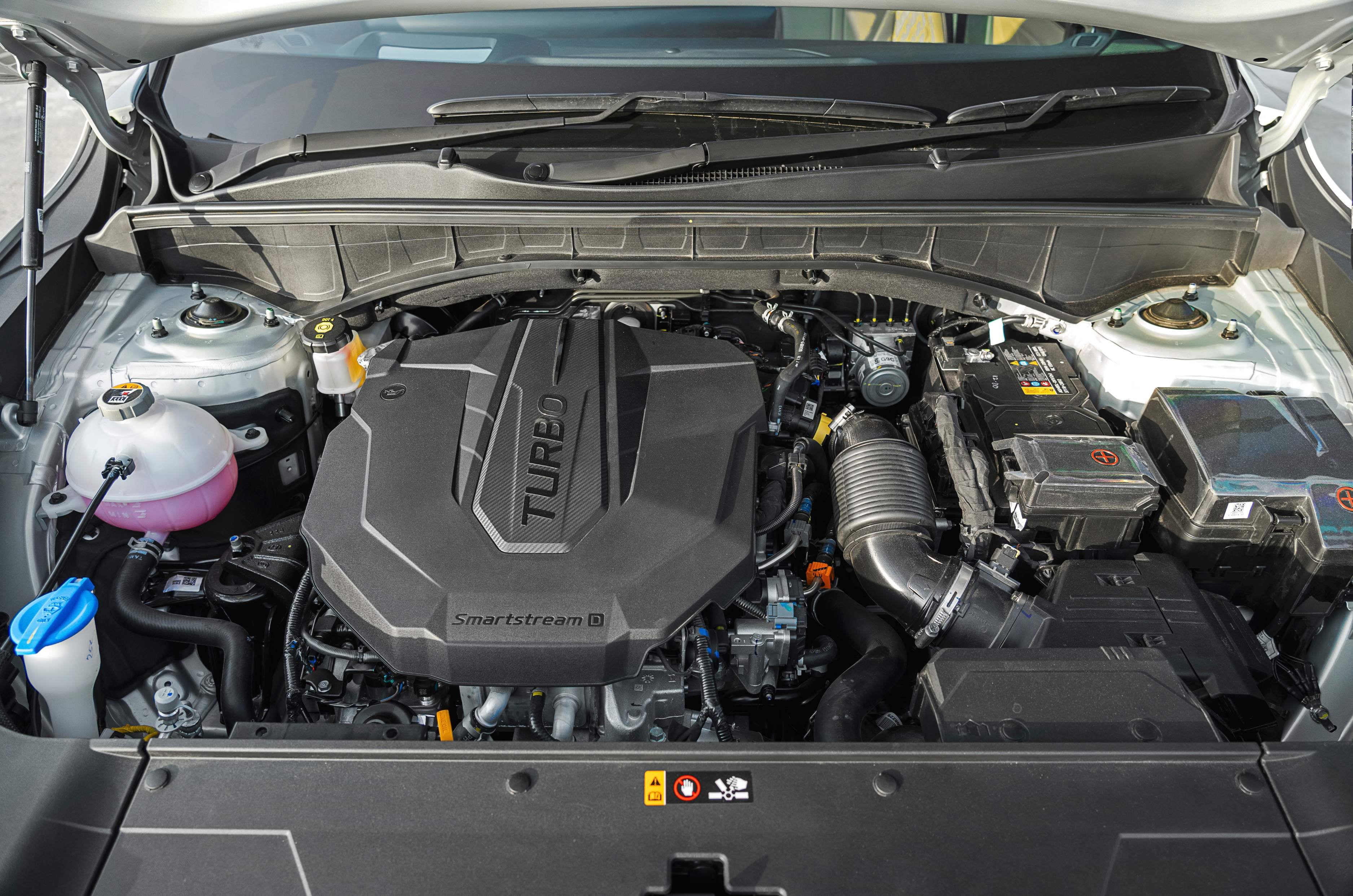
1.6-litre turbo-petrol engine paired with an electric motor and 6-speed torque converter automatic.
First up, the hybrid. Its 1.6-litre turbo-petrol makes 180hp and 265Nm, and the electric motor adds 65hp and 264Nm. The combined figure rating is 230hp and 380Nm of torque You can tell this the hybrid is the one for the city the moment you pull away, because the response is instant. It is well mated to the 6-speed torque-converter automatic, and the handover from electric to petrol power is close to seamless.
Hybrid variant is smooth in the city but gets noisy on the highway especially during overtakes.
The 1.49kWh battery lets it run in EV mode for a decent stretch at crawling speeds, and in stop-go traffic the hybrid makes eminent sense. Power delivery is refined, seamless and relaxing, and efficiency should be strong; The limitation is the motor itself. With only 65hp to shift a car weighing over two tonnes, it cannot do the heavy lifting on its own, so when you want to make quick progress the engine kicks in early. Push hard on the highway and the four-cylinder gets noisy and starts to run out of steam.
2.2-litre diesel engine makes 193hp mated to an 8-speed DCT and is the same unit seen on the Carnival.
Which is where the diesel comes in. The 2.2-litre is familiar from the Carnival, but it feels a lot sprightlier in the lighter Sorento. Its 193hp and 442Nm arrive in a strong, linear surge, and this is a fantastic, long-legged cruiser. Settle into eighth gear on an open highway and it simply lopes along, the engine barely working. It is also more tractable at low speeds than you might expect, pulling cleanly at part throttle from very low revs, so it can double as a city car, although its low-end response does not come close to the hybrid’s. It’s only when you floor it to dart through traffic that you experience a bit of hesitation, and its hear that you can use the paddle shifts to be in the right gear at the right time of the 8-speed DCT which comes as a pleasant surprise.
The diesel‘s strong torque and effortless cruising makes it perfect for long trips.
Rather than the snappy, slightly jerky shifts typical of dual-clutch boxes, this DCT slurs its changes almost like a torque converter, which adds to the smoothness of the whole package. The reason is that it is a wet-clutch unit, which also bodes well for durability in Indian traffic. The diesel is quite refined for the most part and its only when pushed hard that it gets audible and takes on a gruff note.
Both get drive modes; You can play with the Eco, Normal, Sport and Smart (or auto) modes in the diesel which alters the power delivery. In Sport, the throttle response is sharper and the default mode we liked whilst in Eco you can feel the response a bit dulled down. The Sorento Hybrid gets just Eco, Sport and Smart modes and in Eco mode EV running is prioritised. In addition, the AWD versions get Snow, Sand and Mud terrain modes which we didn’t a get chance to fully experience.
Kia Sorento mileage
In terms of fuel efficiency, the hybrid is rated at a highly frugal 19.60kpl with front-wheel drive and 17.70kpl with AWD, while the diesel returns 17.66kpl and 15.79kpl respectively on the Indian test cycle. In real-world city driving the gap between the hybrid and diesel could be bigger, depending on traffic. On long cross-country runs, though, with extended stints of cruising in high gears, the diesel could well be the more frugal of the two.
Kia Sorento ride and handling
The Sorento’s ride comfort is simply outstanding, and it comes as a pleasant surprise. That’s because Kias have traditionally been stiffer sprung than their Hyundai cousins, but here Kia has clearly prioritised comfort over sportiness, and the suspension is on the soft side. The way it smothers bad roads at speed is remarkable. Around Udaipur, where several stretches are properly broken, we never once had to lift off for a bad patch. The car just soaked it up and kept going.
Ride quality is segment best and it is unfazed over broken roads.
The isolation it gives its passengers is shockingly good, and those tall-sidewall tyres deserve part of the credit. They do a fine job of rounding off sharp jolts and filtering out the high-frequency shocks that a suspension alone cannot fully absorb. At highway speeds there is a bit of body movement on the undulating bits but its not disconcerting and both versions feel stable and planted at high speeds, which matters in a car this tall.
Our HTX test cars came with AWD as standard. We did not get a chance to test its off-road ability properly, but on dirt roads it felt sure-footed and secure. A proper off-road test will reveal how capable the all-wheel-drive system, though we doubt owners will really want to test the Sorento’s off-road capability.
Steering is light but lacks consistency and sharpness of European rivals.
The steering is less impressive. There is a dead zone around the straight-ahead position, and it does not feel as fluid or progressive as its European rivals’. The Volkswagen Tayron and Skoda Kodiaq are both dynamically sharper. One reason is because the Sorento rides taller too, as ground clearance has been raised from the global car’s 176mm to 208mm, and there is a touch of body roll when you push hard through corners.
But that misses the point. On balance, the Sorento’s ride and handling are superbly judged for the people who will buy it. Kia has done a fine job of understanding what a premium SUV buyer in India wants, and it has tailored the car accordingly.
Kia Sorento price and verdict
As a package, the Sorento hits it out of the park; rivals have a lot of catching up to do.
If the product does not win you over, the pricing certainly will. A starting price of Rs 27.99 lakh has set the cat amongst the pigeons, putting the Sorento within striking distance of the Mahindra XUV 7XO. And with its size, features and overall polish, the Sorento will not just nibble at the top end of the 7XO’s pie but with the Hybrid could also tempt a few Innova Hycross buyers. As for the Volkswagen Tayron and Skoda Kodiaq, the Sorento makes them look overpriced and underequipped.
The lower and mid variants are exceptional value. The top-end HTX, at Rs 37.49-40.19 lakh depending on fuel and seating, is pricey by comparison, around Rs 5 lakh more than an equivalent HTK, because it comes with AWD as standard. Here Kia has missed a trick. An HTX with two-wheel drive, a few lakh cheaper, would have been a far easier sell to the many buyers who want all the features and ventilated rear seats but will never leave the tarmac. That however is a small quibble that Kia can easily correct.
The lasting impression is that the Sorento feels premium, bordering on luxury. It is fantastically equipped, it rides beautifully, and it offers a choice of two powertrains that are each right for a distinct type of buyer. Most of all, it fits what the Indian SUV buyer actually wants with uncanny precision. Will Kia hit its target of 40,000 sales a year? That could be a tall order. But what there is no doubt about is that Kia has built another winner.
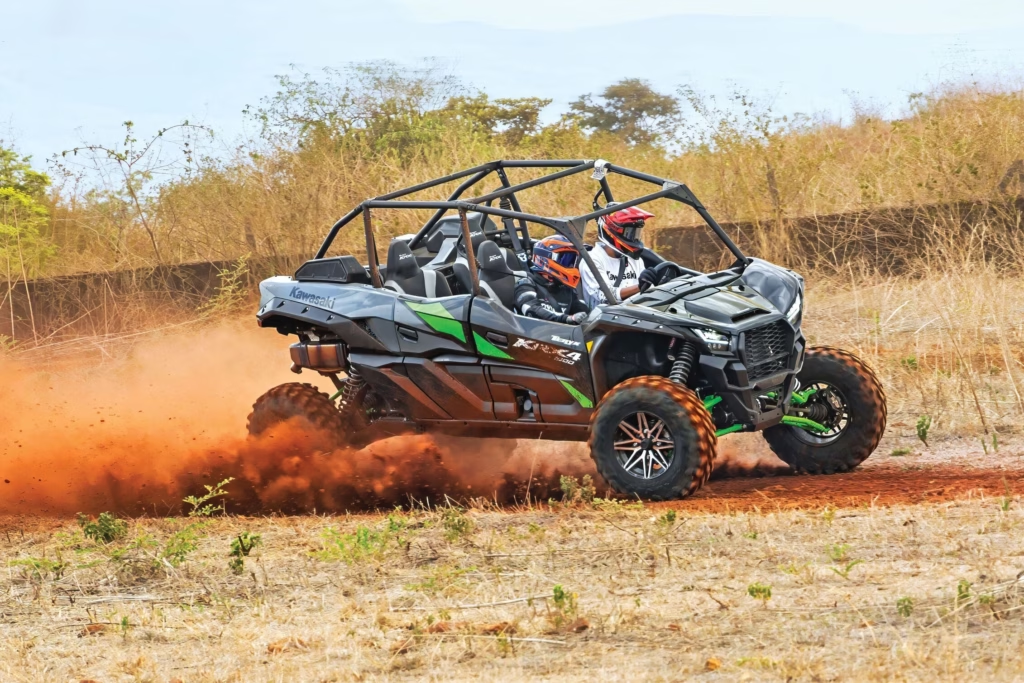
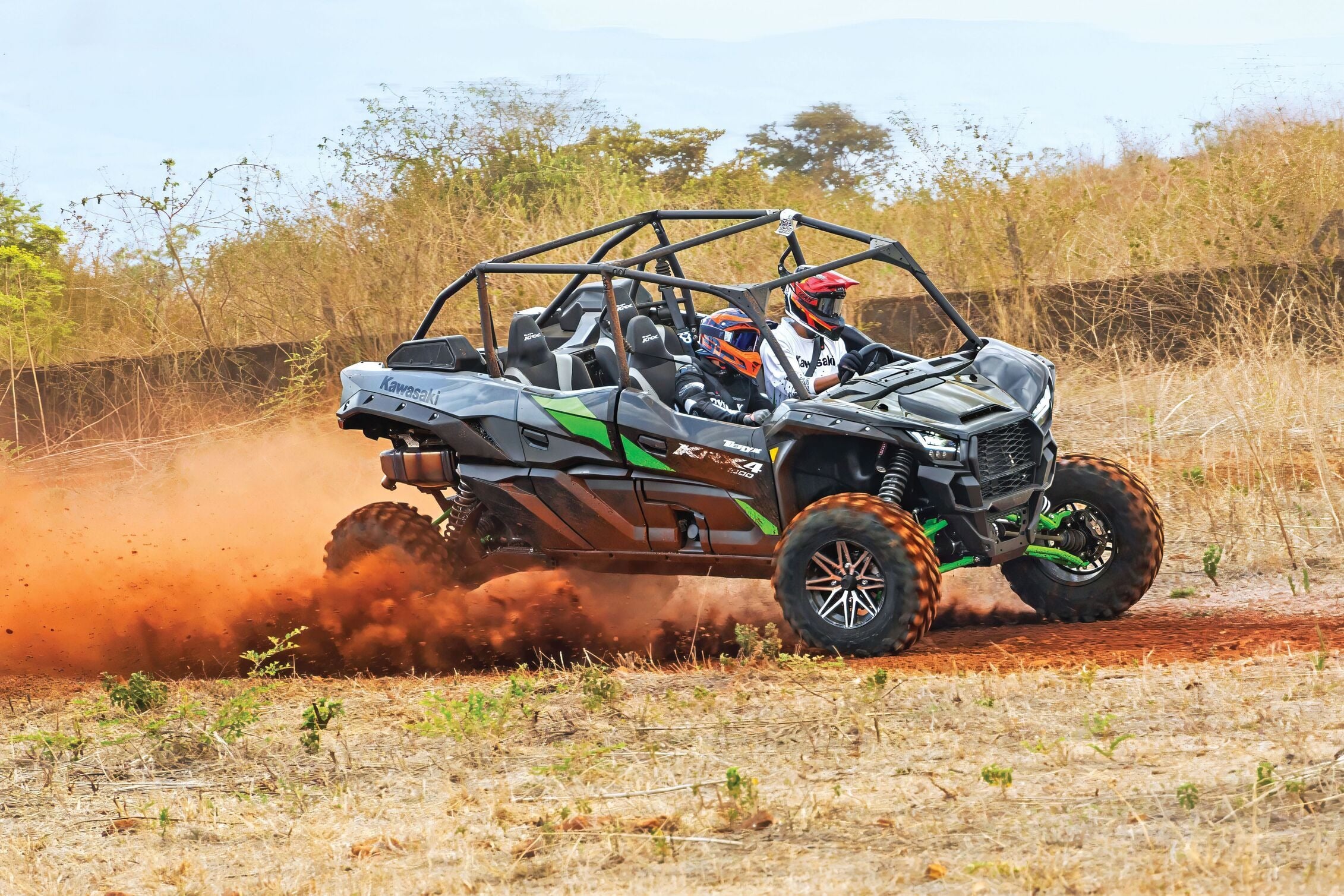
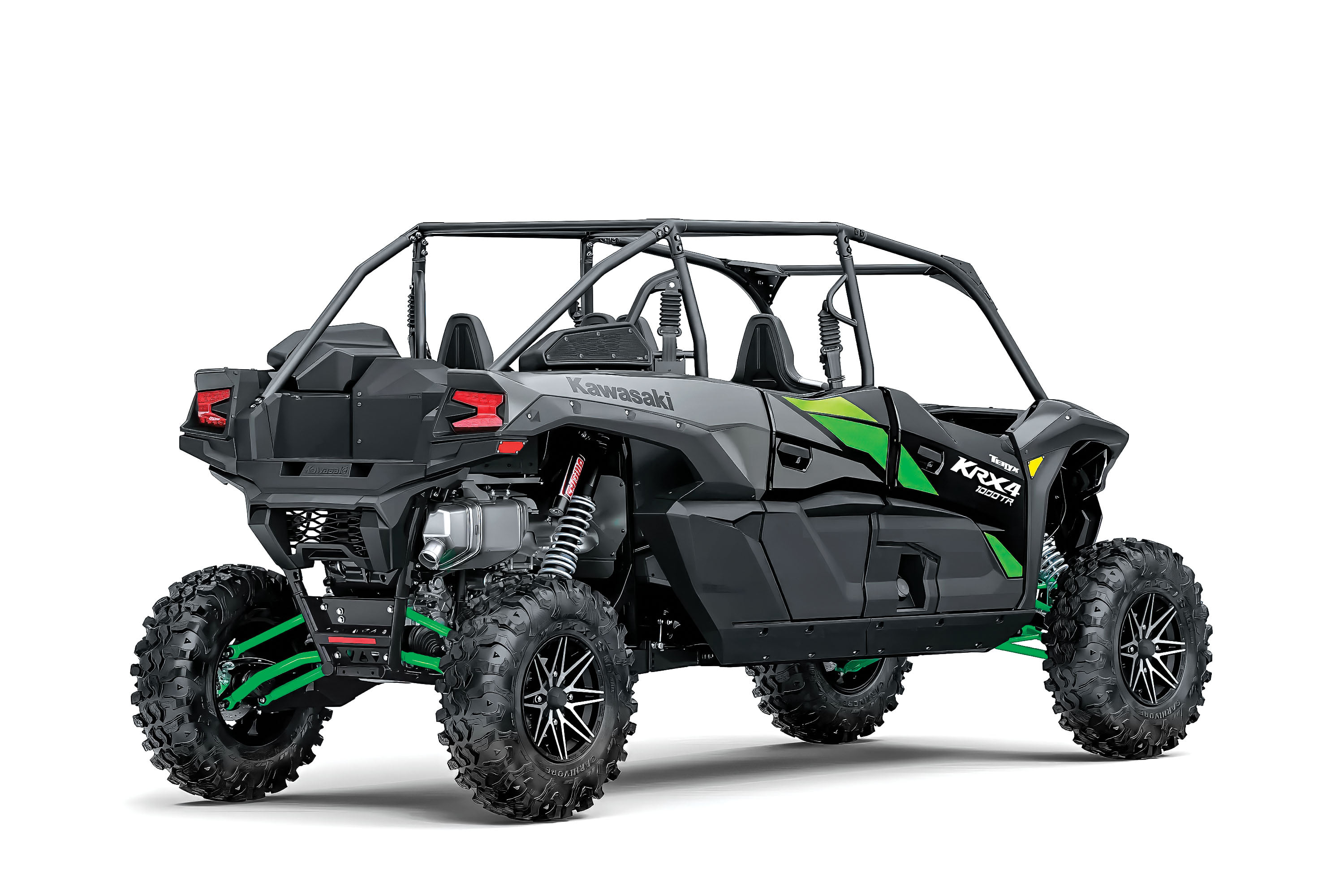
Kawasaki has officially brought its range of side-by-side vehicles (SxS) to India, and it’s a line-up that caters to vastly different applications. At one end are workhorses designed for agriculture, utility duties and passenger transport, while at the other are machines built purely for adventure. The range includes the Teryx 4 H2, Teryx KRX 1000, Teryx KRX4 1000, Ridge Crew and Mule Pro-FXT 1000 LE. We got the opportunity to spend a short time behind the wheel of the Teryx KRX4 1000, a four-seat performance-focused buggy designed to tackle the roughest of terrain.
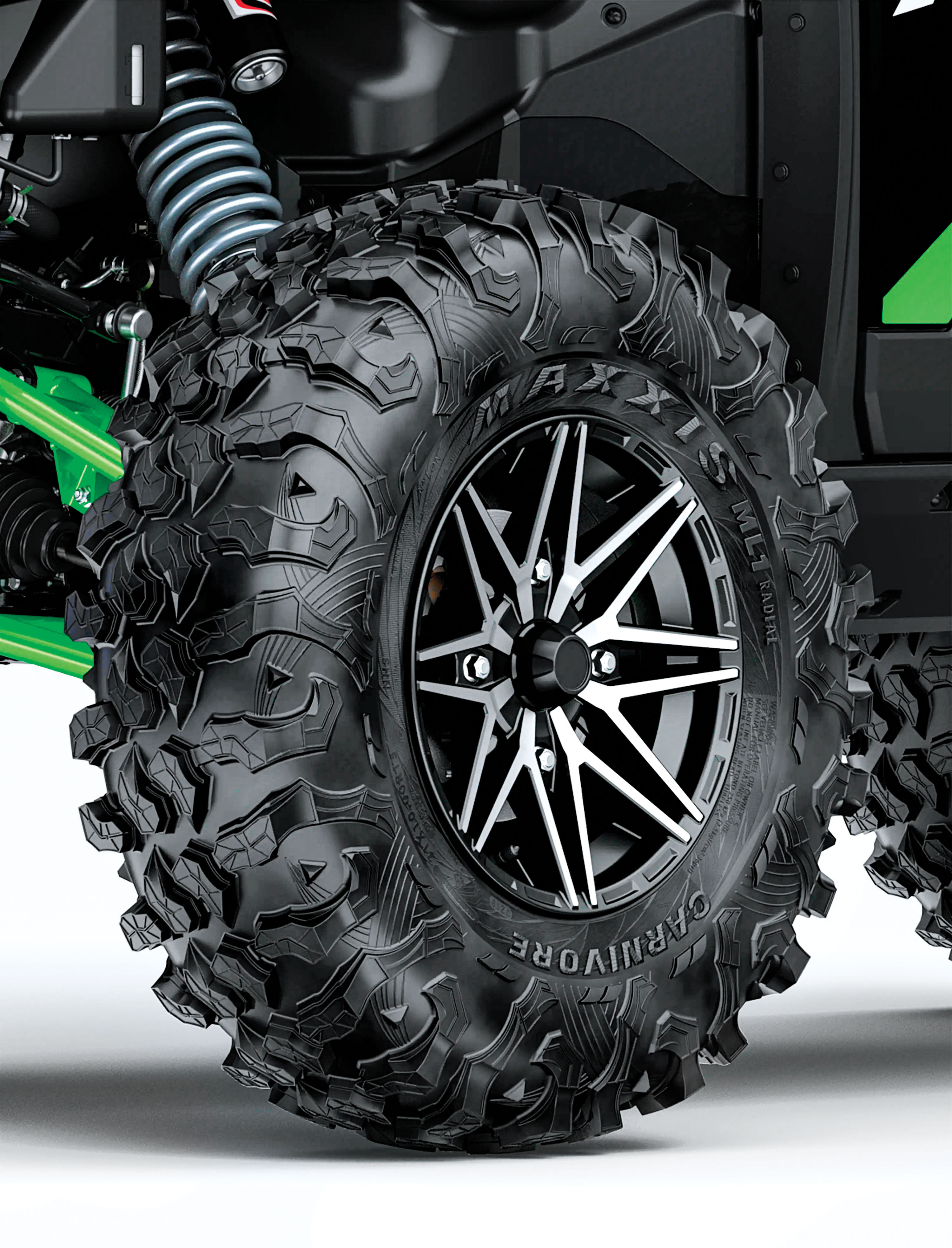
Think of it as an oversized, highly capable off-road buggy. Power comes from a 999cc parallel-twin engine producing 110hp at 8,300rpm and 102Nm at 7,000rpm. It rides on 15-inch wheels wrapped in chunky Maxxis Carnivore tyres, gets long-travel Showa suspension with adjustable damping, Electric Power Steering (EPS), selectable two- and four-wheel drive, and a CVT transmission. So, on paper, it has all the ingredients required for serious off-road exploration.
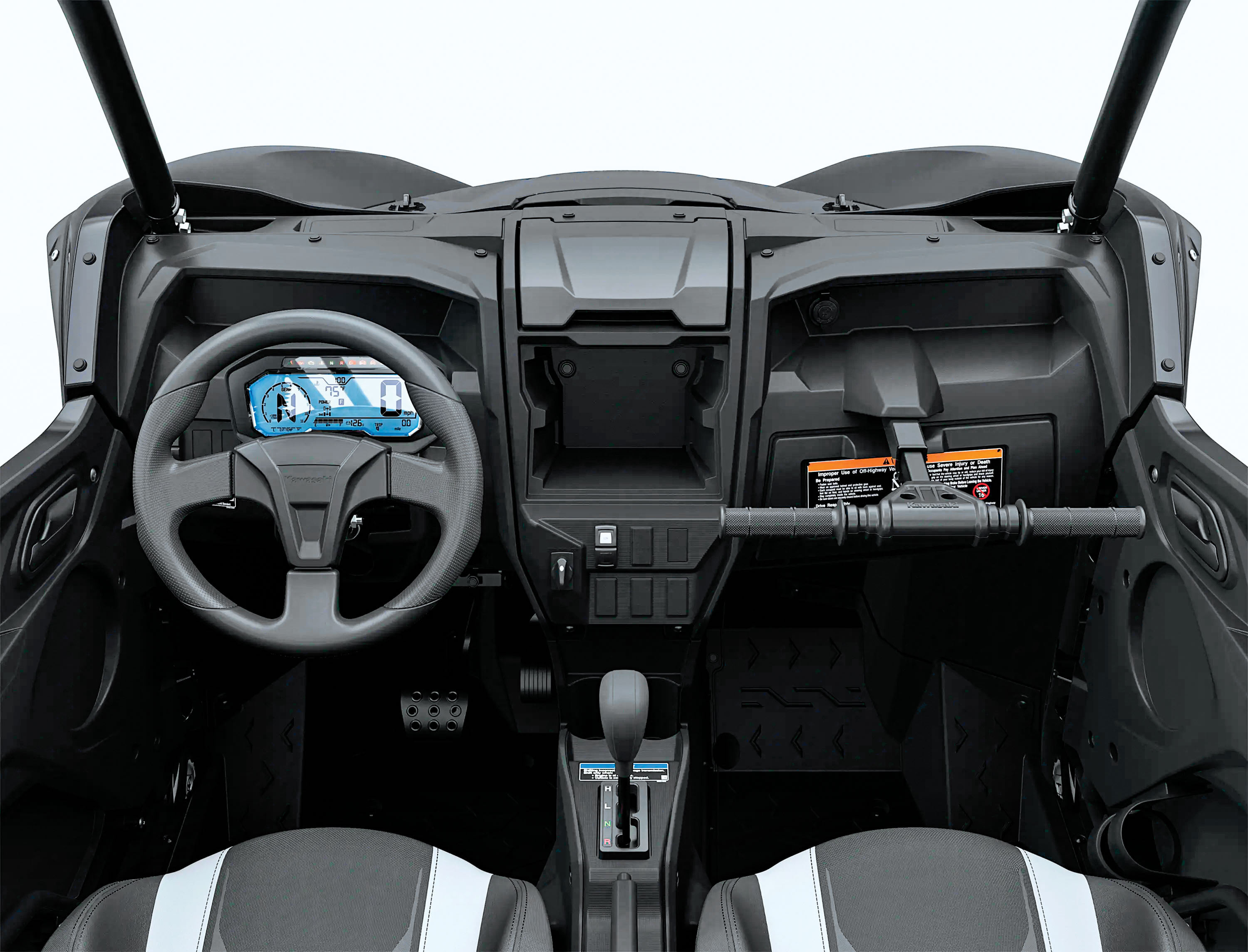
Hoseable interiors that don’t mind getting dirty.
Our short drive took place on the course at Pro Dirt Adventure, and my allocated two laps weren’t much, but they were enough to understand what makes the KRX4 such an interesting machine. The first thing to note is that it is a left-hand-drive vehicle, but it’s not street legal anyway, so on dirt trails and farms, this is ok. The CVT transmission keeps things simple, select High, Low or Reverse, choose between 2WD or 4WD, release the brake and you’re off. Given the steep climbs, descents and loose surfaces on the course, I kept it in 4WD throughout.
Initially, the KRX4 creeps forward gently, but push the throttle pedal harder and it suddenly comes alive once it hits the mid-range rpms. The acceleration isn’t neck-snapping, but it is strong enough to make the buggy feel lively. The CVT keeps the power flowing smoothly and removes the stress of gear changes or stalling, allowing you to focus entirely on picking your line.
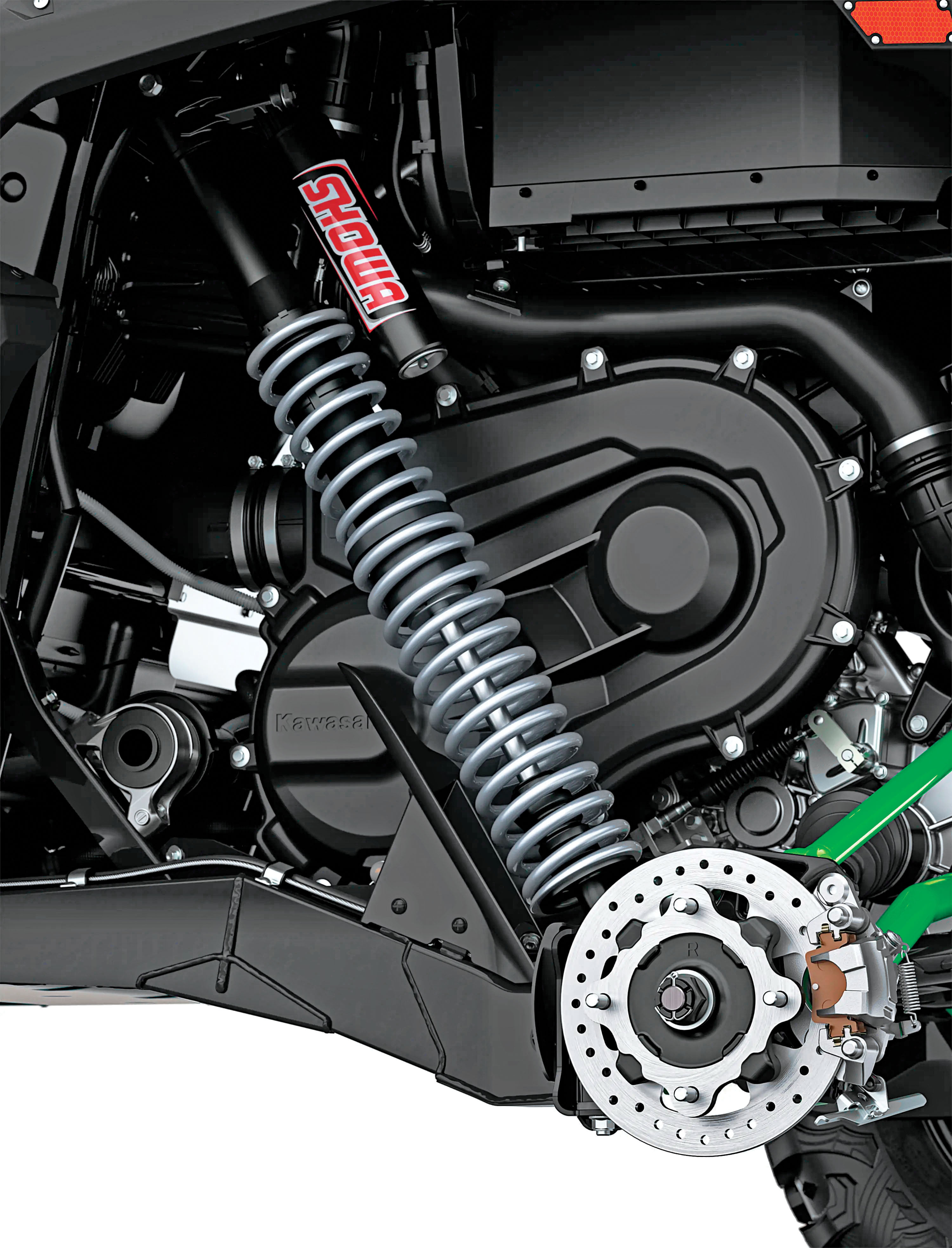
Showa long-travel suspension to tackle the roughest of terrain.
What impressed me the most, however, wasn’t the engine. It was the suspension. The amount of abuse this chassis can absorb is remarkable. Mounds that would stop a bona fide SUV are dismissed with ease. It simply plows through and carries on. I also got the chance to ride as a passenger while one of the lead drivers tackled a rocky section that looked completely impossible from the outside. Large boulders that would have most drivers second-guessing their route barely seemed to faze the buggy. It constantly gives you the impression that you’re nowhere near its limits. The Maxxis Carnivore tyres deserve equal credit. Designed specifically for aggressive off-road terrain, they claw into loose dirt with confidence. Of course, because the cabin is completely open, every burst of throttle also means mud, dirt and stones are being flung towards the occupants. It’s all part of the experience, and oddly enough, it adds to the fun.
One section of the course featured a small jump where you could really commit to the throttle. The KRX4 launched cleanly, landed with complete composure and simply carried on as if nothing had happened. It’s difficult not to come away impressed by just how confidence-inspiring the suspension package is.
15-inch wheels with chunky Maxxis tyres.
That said, the motorcycle-oriented track did expose one limitation. The hairpin corners were simply too tight for something this large. During my first lap, I actually had to reverse a couple of times just to negotiate the sharpest turns. With more seat time, experienced drivers would no doubt learn to slide it through these corners, but as a newcomer, there was always the thought of tipping it over if I got my steering or throttle inputs wrong. The learning curve, however, is surprisingly short. By the beginning of my second lap, I already felt significantly more comfortable. I carried more speed, trusted the suspension more and found myself driving much more naturally. It’s one of those machines that becomes less intimidating with every passing minute.
The Teryx KRX4 1000 has the raw, playful nature of riding an enduro motorcycle, but combines it with the ease, security and practicality of four wheels. You’re strapped into a proper roll cage, splashing through mud, climbing impossible-looking terrain and jumping over obstacles that would stop most vehicles in their tracks. It feels familiar to anyone who enjoys off-road motorcycles, while also offering an entirely different perspective on the same adventure.
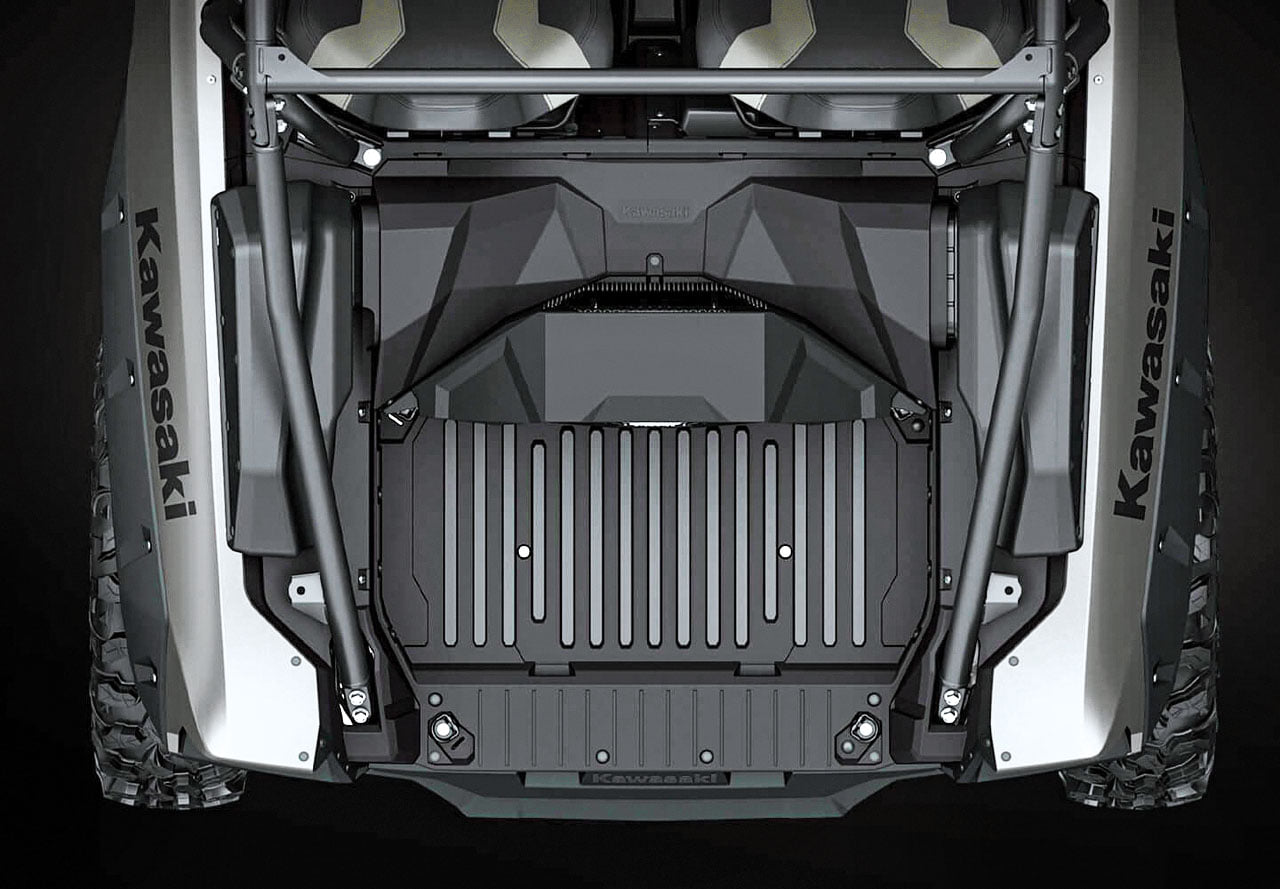
Storage space for when you aren’t going full send.
Of course, ownership in India won’t be entirely straightforward. These side-by-sides aren’t road legal, so they’ll largely live at private properties, farms or dedicated off-road parks. There’s also the issue of fuel. Since they aren’t E20-compatible, sourcing the right petrol in remote locations, exactly where owners are likely to use them, could require a bit of planning. Kawasaki says it will support customers with maintenance, but the logistics of ownership are certainly something prospective buyers will need to consider.
Then comes the price. Kawasaki’s side-by-side range starts at Rs 38 lakh and stretches all the way to Rs 78.90 lakh, firmly placing these machines in niche territory, with this model costing Rs 52.9 lakh. The Teryx KRX4 1000 isn’t something you buy because you need it. You buy it because it unlocks a type of adventure that few other machines can offer. After just two laps, I walked away wanting more, and after experiencing it, I can only imagine how wild the 250hp supercharged Teryx 4 H2 must feel like.
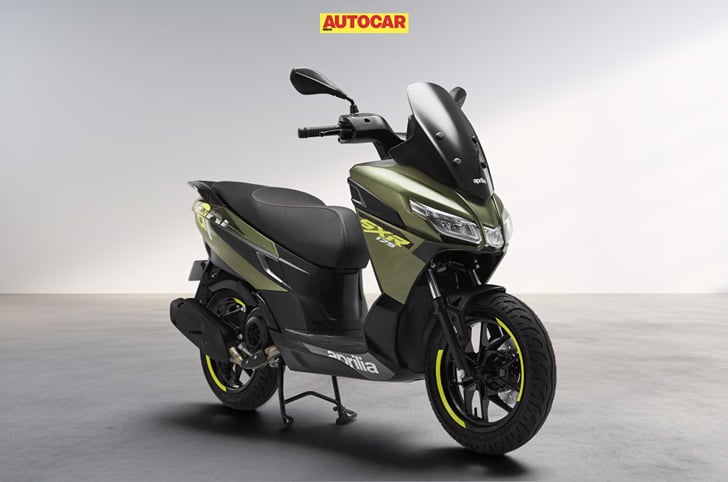
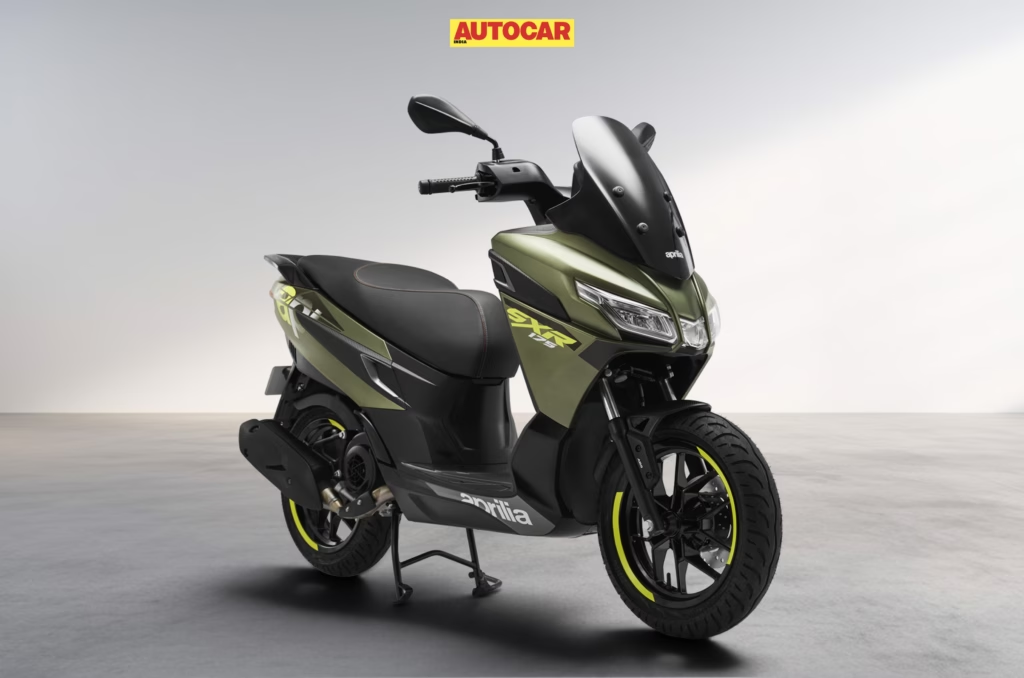
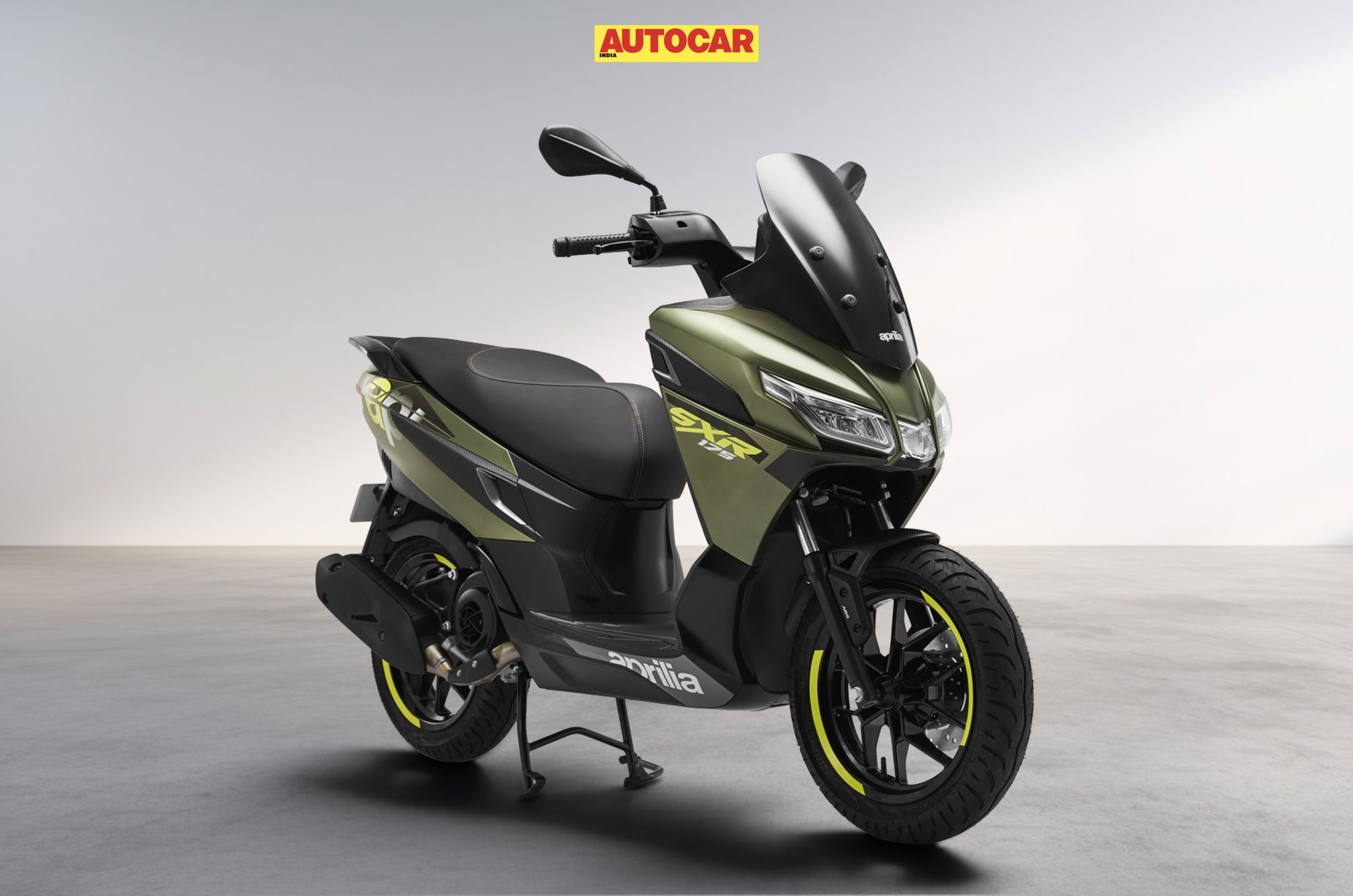
Aprilia has launched the SXR GT range, a repositioned version of its SXR maxi-scooter lineup with some notable updates. The SXR 125 and SXR 160 were discontinued in May without any formal announcement or replacement confirmed at the time. The SXR GT now fills that gap, available in 125cc and 175cc variants, using the updated engines introduced on the SR 125 and SR 175.
Built on the same platform as the SR 125 and SR 175
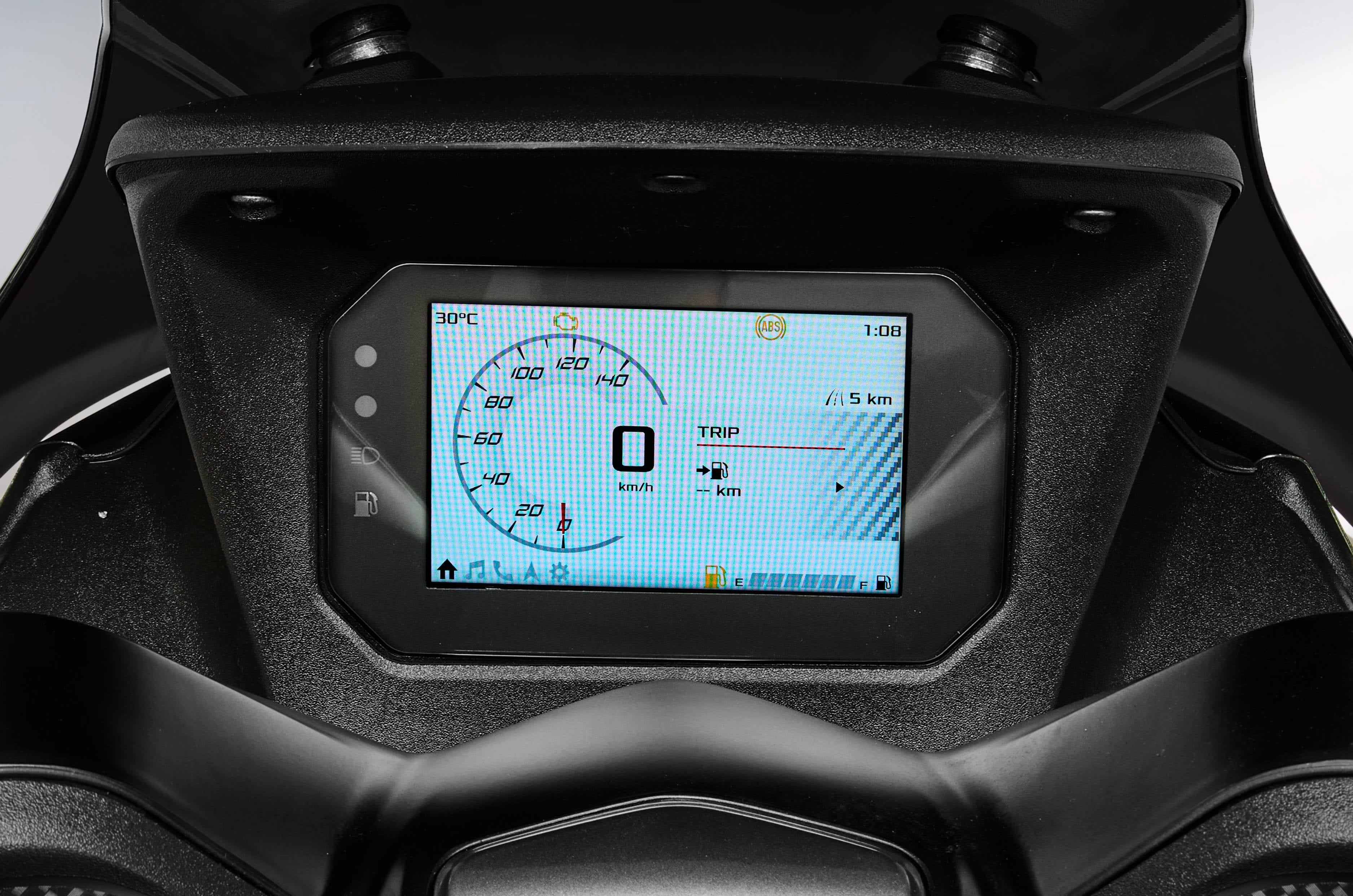
SXR GT 175 gets 5-inch TFT and single-channel ABS
Both scooters get 14-inch wheels
Aprilia SXR GT scooter details
The SXR scooters featured 12-inch wheels, while these new SXR GT variants come with 14-inch units
The new SXR GT 125 hp-e and SXR GT 175 hp-e are based on the same platform as their corresponding SR siblings that were introduced last year. The SXR GT 125 is powered by a 124.5cc single-cylinder engine that makes 10.6hp at 7,400rpm and 10.4Nm at 6,200rpm. On the other hand, the SXR GT 175 gets a 174.7cc air-cooled single that makes 13.3hp at 7,200rpm and 14.1Nm at 6,000rpm. Aprilia has also confirmed that both engines are BS6 OBD-II Stage B compliant and E20 fuel compatible.
Both scooters retain the overall silhouette of the now-discontinued SXR scooters, but now run on larger 14-inch wheels, which should translate to better stability and comfort. In terms of features, the 175cc variant gets a 5-inch TFT display with Bluetooth connectivity for music and call management, turn-by-turn navigation and additional handlebar-mounted controls. It also features single-channel ABS and a new exhaust end pipe with a heat shield. The 125cc variant gets a 5-inch LCD instrument cluster and CBS.
Aprilia has said bookings have opened nationwide, with the SXR GT 125 priced at Rs 1.11 lakh and the SXR GT 175 priced at Rs 1.31 lakh.
The government has notified the third phase of its Corporate Average Fuel Economy norms, setting progressively tighter fuel-efficiency requirements for passenger vehicle manufacturers from April 2027 while giving them several routes to comply, including higher weightage for electric and hybrid vehicles, benefits for alternative fuels, efficiency-technology credits and trading of compliance credits.
The final CAFE III framework will apply to M1 category passenger vehicles manufactured or imported for sale in India from April 1, 2027 to March 31, 2032, according to a Ministry of Power notification. The standards will continue to be calculated at the manufacturer level using the sales-weighted average fuel consumption of its vehicle portfolio.
CAFE III targets tighten through FY2032
Year
Permitted fleetwide fuel economy average*
FY28
3.996 litres/100kms
FY29
3.860 litres/100kms
FY30
3.7585 litres/100kms
FY31
3.5313 litres/100kms
FY32
3.3273 litres/100kms
*For a manufacturer with a reference fleet weight of 1,229kg
The permitted fleet-average fuel consumption will become progressively lower each year. The standard will be calculated using the formula a×(W−1,229)+c, where W represents the weighted average unladen mass of all eligible vehicles manufactured or imported for sale by an OEM.
For a manufacturer with a reference fleet weight of 1,229kg, the target falls from 3.996 litres of petrol equivalent per 100km in FY2028 to 3.3273 litres per 100km in FY2032. This corresponds to about 94.8g CO2/km in FY2028 and 78.9g/km in FY2032.
The targets are calculated across the manufacturer’s eligible fleet, meaning sales of more efficient vehicles can offset higher-consuming models within the same portfolio. Small-volume manufacturers with annual eligible vehicle volumes below 1,000 units are exempt from meeting the specific CAFE target, although they will still have to report their average fuel-consumption performance.
EVs gain biggest advantage
EVs get the biggest compliance boost
Battery electric vehicles and range-extended electric vehicles will receive a 3.0 super credit multiplier under CAFE III. Plug-in hybrids and flex-fuel strong hybrids get 2.5 super credit multiplier, strong hybrids get 1.6 and flex-fuel ethanol vehicles get 1.1 super credit multiplier.
Vehicle type
Multiplier
Battery electric
3.0
Range-extended electric
3.0
Plug-in hybrids
2.5
Flex-fuel strong hybrids
2.5
Strong hybrids
1.6
Flex-fuel ethanol
1.1
The final rules do not include the additional 3g CO2/km benefit for certain sub-four-metre petrol cars that had been proposed in an earlier draft of CAFE III.
CNG and ethanol also get benefits
CAFE III also gives carmakers another route through what the government calls a Carbon Neutrality Factor for alternative-fuel vehicles. Cars running on E20 or higher notified ethanol-petrol blends, including strong and plug-in hybrids, get an 8 percent carbon-neutrality factor on tailpipe CO2.
Flex-fuel ethanol vehicles get a 22.3 percent carbon-neutrality factor, while CNG vehicles get 5 percent or the notified CBG blending percentage, whichever is higher. Diesel vehicles receive a benefit linked to the notified biofuel blending level.
The provision gives manufacturers another compliance route alongside electrification, with the benefits extending to CNG, ethanol and other alternative-fuel vehicles.
Carmakers can trade fuel-efficiency credits
One of the bigger structural changes under CAFE III is the formalisation of a credit-and-debit system that allows compliance performance to carry financial value. Manufacturers whose fleet performs better than their prescribed target will generate credits, while those exceeding their permitted fuel-consumption level will accumulate debits. These will be maintained in a manufacturer-specific compliance “passbook”.
Surplus credits can be traded between manufacturers on mutually agreed terms. Carmakers can also buy credits from the Bureau of Energy Efficiency (BEE) to offset outstanding debits. The price rises from Rs 2,500 per g CO2/km in FY2028 to Rs 4,500 per g CO2/km in FY2032. The escalating price increases the incentive for companies to improve their underlying fleet performance.
The five-year CAFE III period will be split into two compliance blocks: FY2028-FY2030 and FY2031-FY2032. Credits and debits can be carried forward within each block, while unused credits will lapse at the end of the block.
Efficiency technologies also carry benefits
CAFE III allows manufacturers to claim a 1g CO2/km reduction for each eligible efficiency technology, subject to a maximum benefit of 9g CO2/km. The 12 eligible technologies include start-stop systems, tyre-pressure monitoring, regenerative braking, six-speed or higher transmissions, efficient alternators, motor-generators, LED exterior lighting, advanced glazing, electric water pumps and high-efficiency air-conditioning systems.
CAFE III introduces WLTP reporting
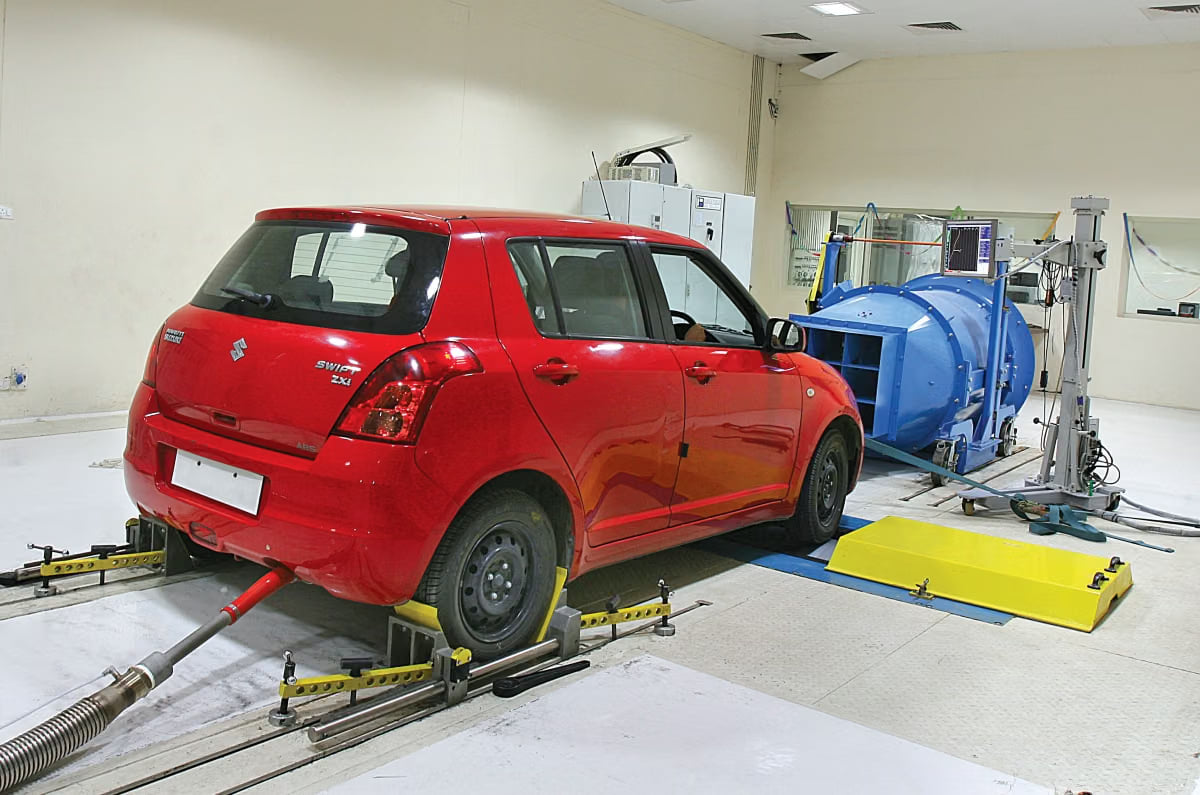
CAFE III also begins India’s transition towards using the Worldwide Harmonised Light Vehicles Test Procedure (WLTP) for corporate efficiency calculations. Manufacturers will have to declare the CO2 performance of models sold from April 1, 2027 under both the existing Modified Indian Driving Cycle (MIDC) and WLTP.
The conversion factor for translating the CAFE target from MIDC to WLTP will be notified separately by the Ministry of Power in consultation with the BEE. That leaves an important part of the implementation framework to be finalised despite the five-year CAFE III regime now being notified.
After achieving a 20 percent ethanol blend in petrol, the focus is now on flex-fuel vehicles and increasing the ethanol blend in petrol beyond 20 percent, according to PMO advisor, Tarun Kapoor. Kapoor made the comments in his address at the India Sugar and Bio Energy Conference organised by the India Sugar Manufacturers Association.
He said the E20 programme has been successful, while acknowledging criticism over its impact on vehicles that are not compatible with E20. His comments come as the government looks to move towards higher ethanol blends through flex-fuel vehicles. “Up to E20 it’s been very successful. Now our focus is on going into flex-fuel vehicles and allowing blending at a percentage which should be higher than E20, and it has to be on flex-fuel vehicles.”
Ethanol production now exceeds blending needs
Isobutanol is being studied for potential diesel biofuel use
Government is exploring non-transport uses for ethanol
Automakers preparing flex-fuel vehicles
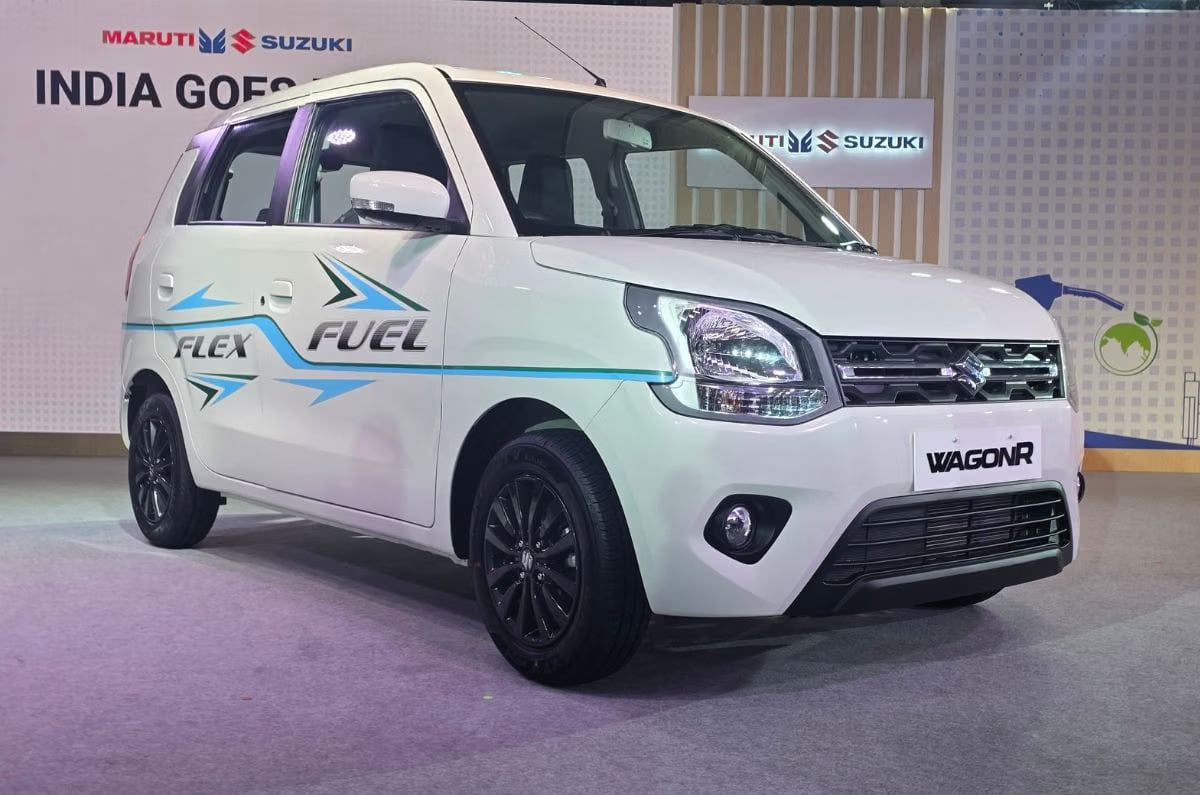
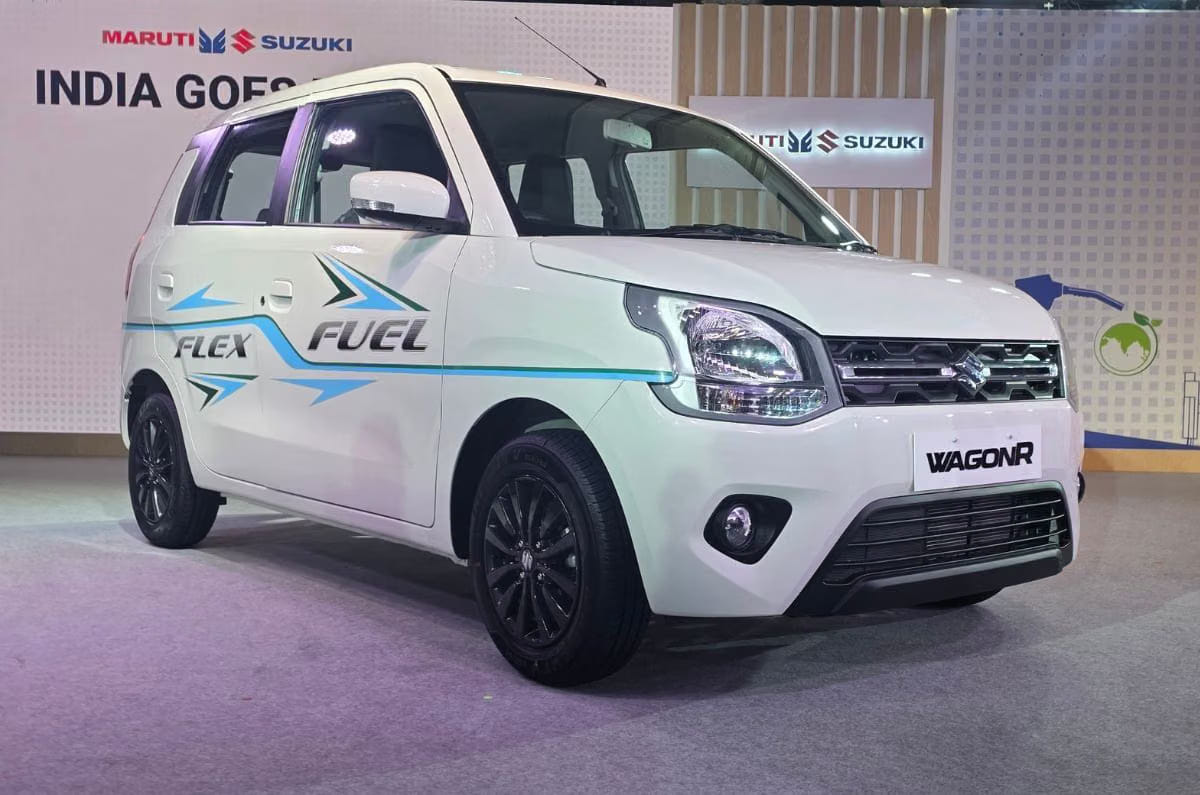
Maruti Wagon R flex fuel.
Kapoor said several motor vehicle manufacturers have announced plans to introduce flex-fuel vehicles soon, and their launch could help drive higher use of ethanol. “I am happy to learn that several motor vehicle companies have announced that they are going to come out with flexible vehicles very soon and so we should see good numbers in the market.”
He also said the availability of higher ethanol blends or pure ethanol at petrol stations would need to expand alongside the rollout of flex-fuel vehicles. Some stations already have such fuel, but Kapoor said its availability needs to expand. “Supply of pure ethanol or whatever, maybe some additive has to be added to it, should also happen quite soon. There are some petrol stations where it is already available, but it has to be expanded now, but it has to go hand in hand with availability of flexible vehicles.”
Kapoor said India also needs biofuel products that can be blended with diesel and pointed to experiments involving isobutanol as a potential route for deploying biofuels on a larger scale.
E20 compatibility remains a point of concern
While Kapoor called the E20 programme successful, he acknowledged criticism over vehicles that are not compatible with the blend. He said studies and experiments had found that E20 works well, although fuel efficiency may decline to some extent. “E20 is quite good and works very well, maybe a little bit of fuel efficiency declines somewhere, but it gets compensated with higher octane,” he said.
Ethanol production exceeds blending requirement
Kapoor said ethanol production has exceeded what is currently required for blending, prompting the government to explore additional uses for the fuel. Kapoor said, “Now the production is more than that, probably it’s more than what we actually need for blending, but then probably we have to look for more uses of ethanol in various forms.”
The government is looking at uses beyond transportation, including cooking and industrial applications, to expand demand for ethanol. “We are very keen that we are able to expand the market as much as possible so that this overcapacity issue is resolved at the earliest time,” he added.
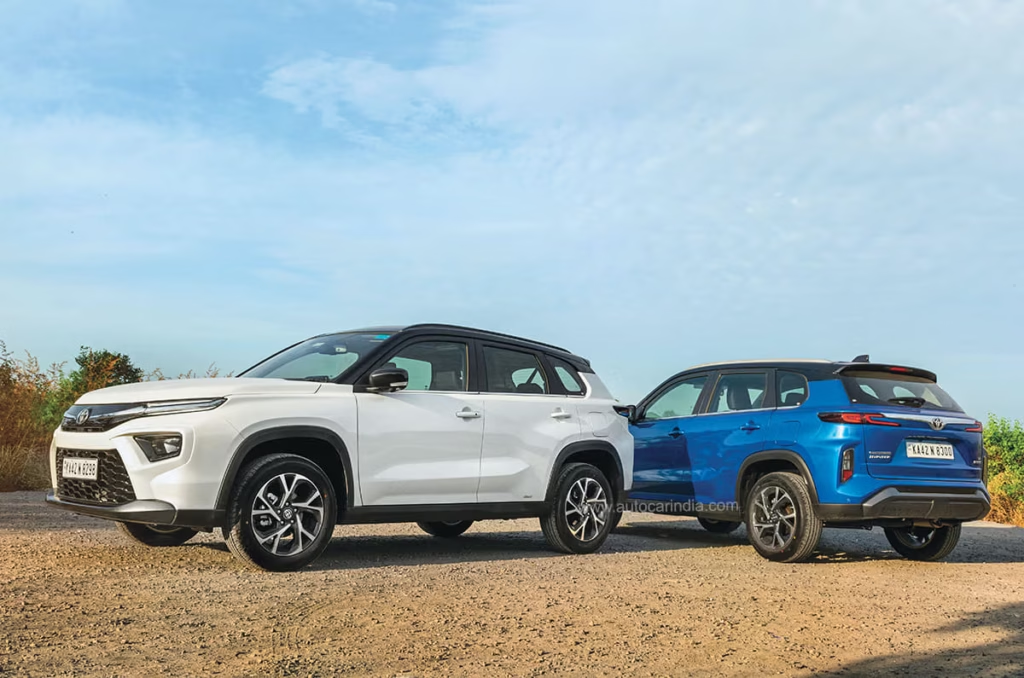
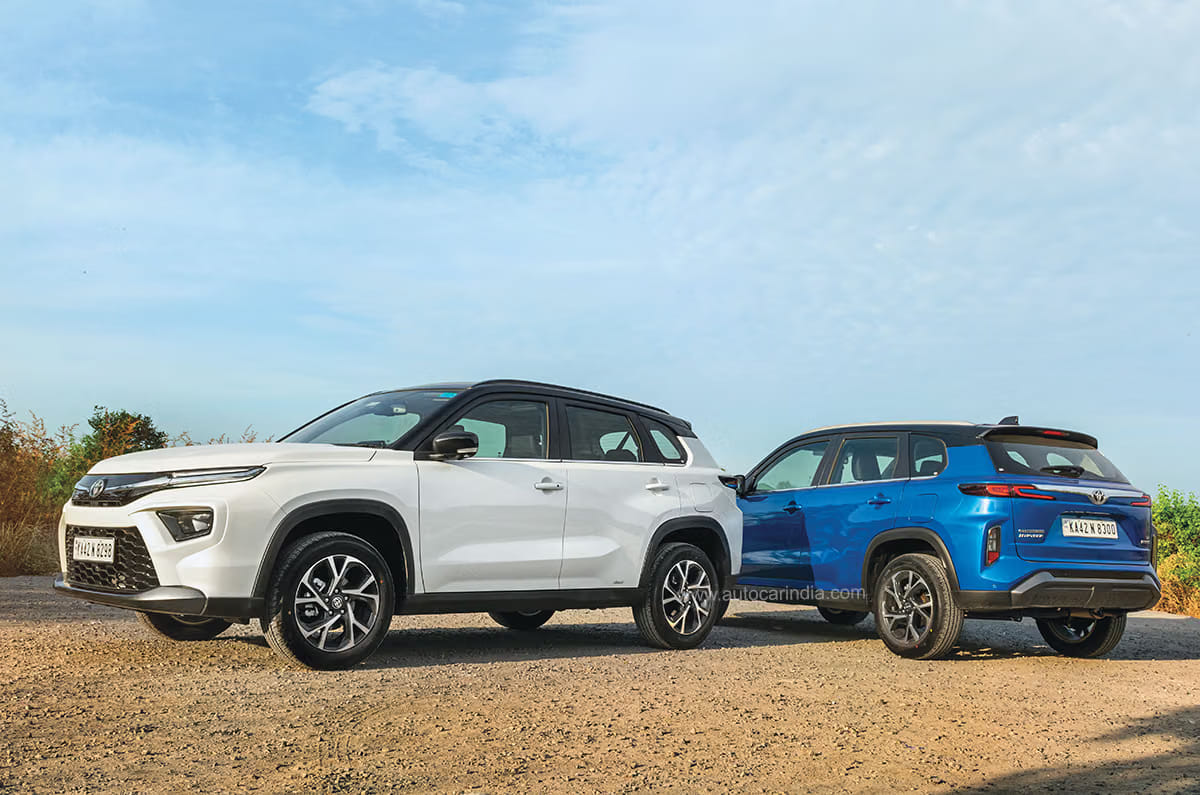
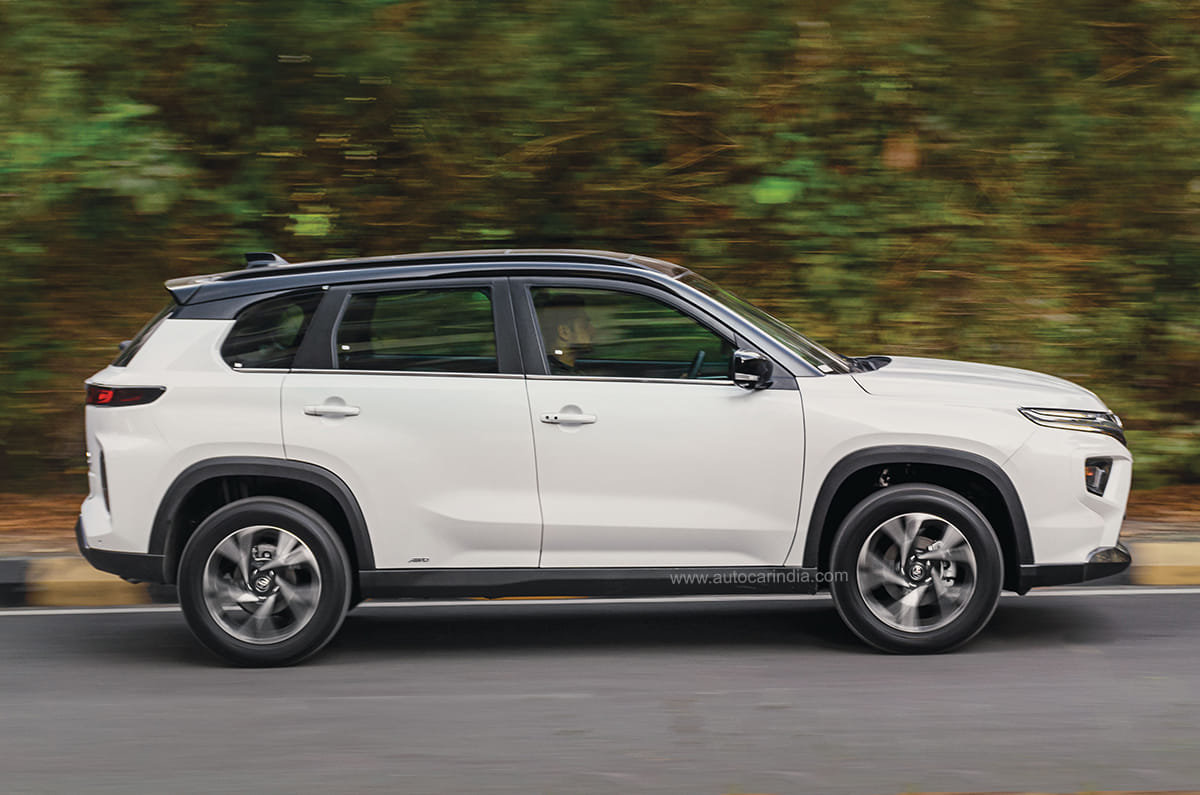
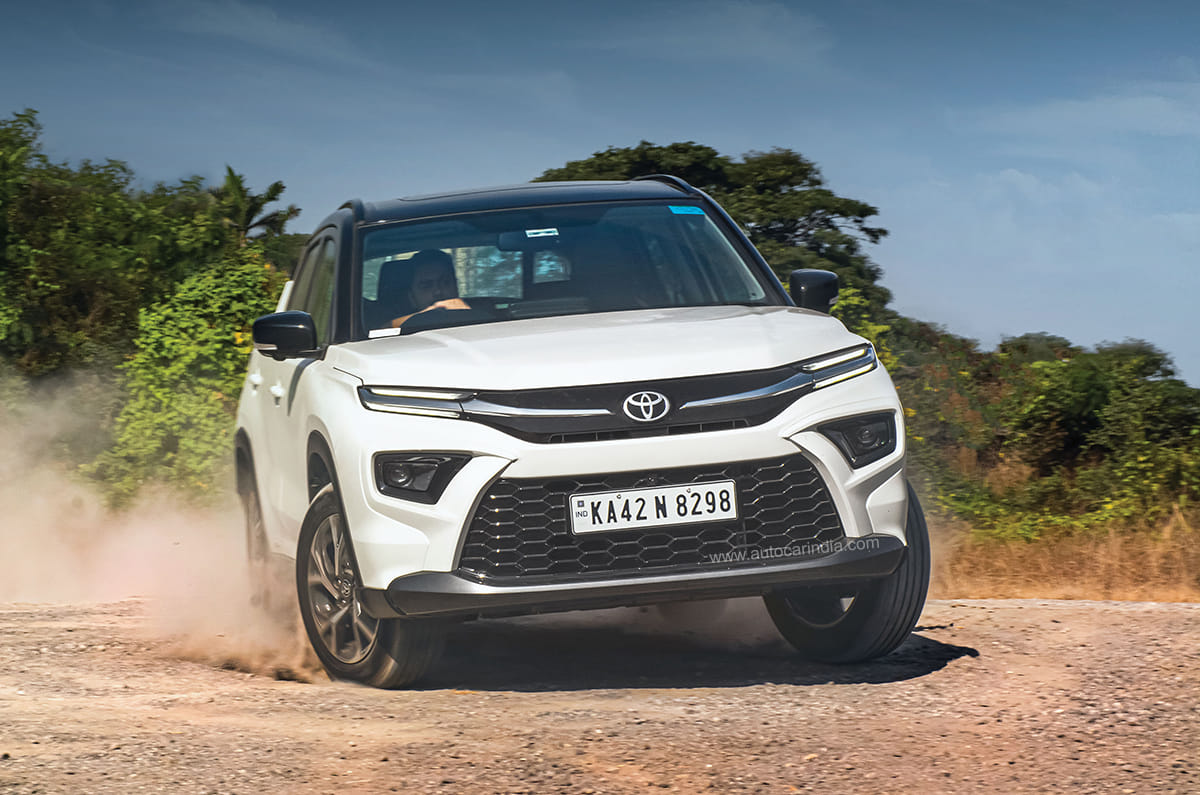
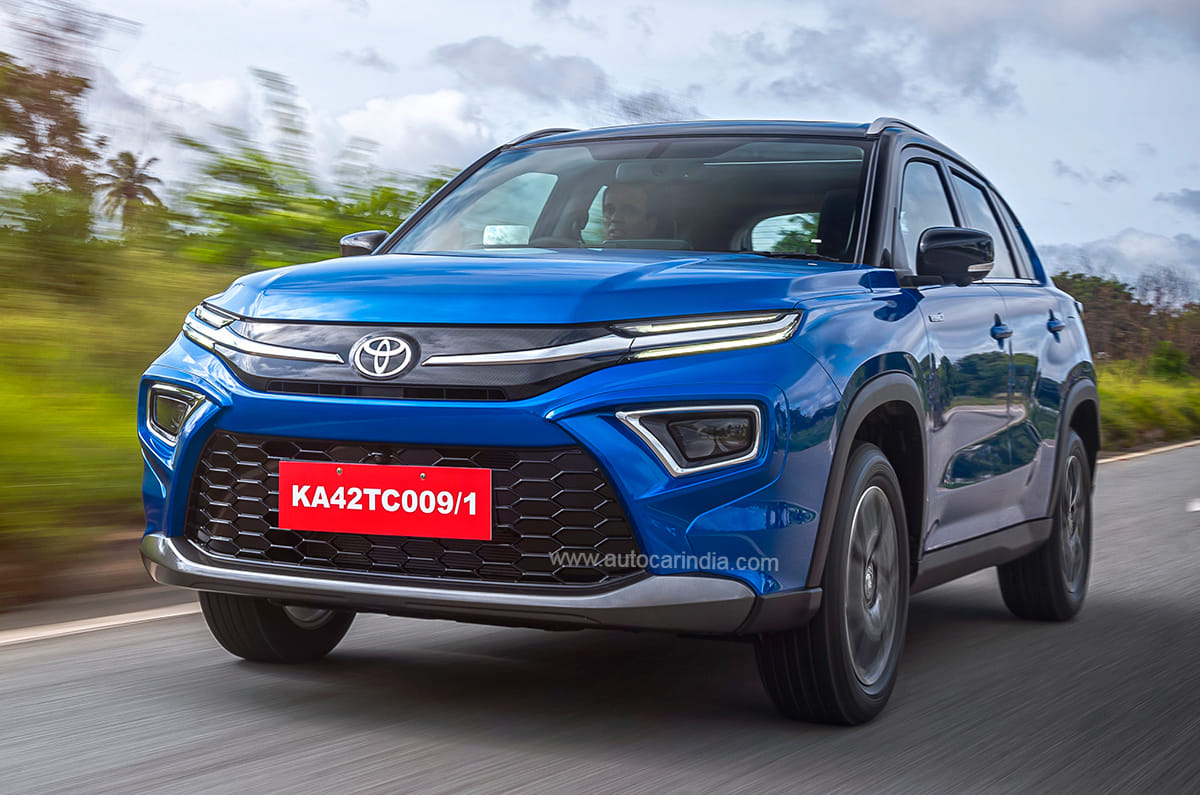
Introduced in 2022, the Urban Cruiser Hyryder and Maruti Grand Vitara were the first products co-developed through the partnership between Toyota and Maruti Suzuki. Currently, the Hyryder is Toyota’s bestselling SUV in India, averaging 7,000-9,000 units a month. If you are considering the Hyryder, we will help you decide whether this midsize SUV is suitable for you or whether you should look elsewhere.
Reasons to buy the Toyota Hyryder
Efficient strong hybrid engine
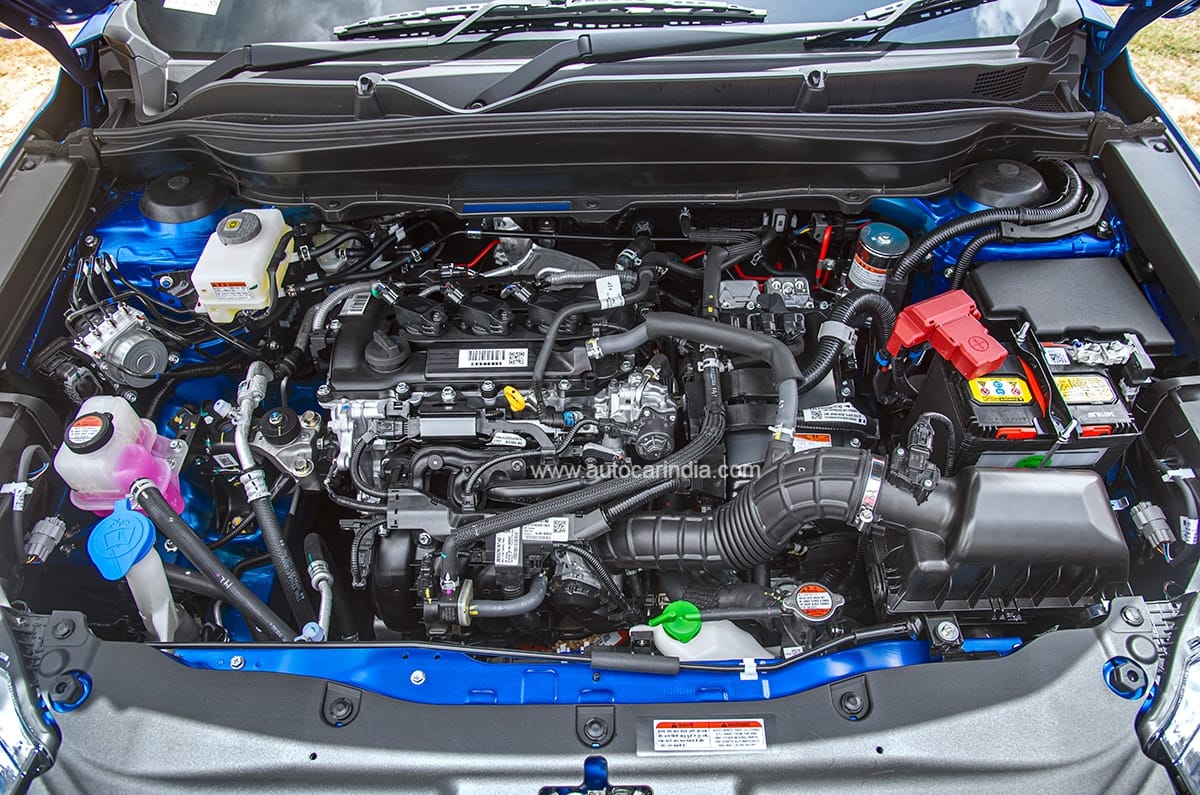
The petrol engine in the strong hybrid version runs on the Atkinson cycle that prioritises efficiency. Coupled with the battery and motor, the Hyryder can run temporarily on pure electric power, which helps curb fuel consumption. In our real-world fuel efficiency tests, the Hyryder strong hybrid delivered much higher efficiencies than the mild hybrid petrol automatic version: 20.28kpl in the city and 22.85kpl on the highway compared to 10.83kpl and 15.67kpl, respectively. Do note that this test was done before the rollout of E20 fuel.
Well-judged ride and handling
A combination of tough underpinnings and well-judged suspension helps the Hyryder have a balanced ride and handling setup. It handles tough roads with ease, and even the sharp surfaces are absorbed quite well. At higher speeds, the Hyryder remains glued to the road and composed, while direction changes and cornering abilities are predictable. Even when cornering, body roll is kept to a minimum despite its high 210mm ground clearance, which is remarkable.
AWD availability
The Hyryder is among the few models in the very crowded midsize SUV space to offer AWD. Available solely with an automatic gearbox, it comes with Suzuki’s AllGrip Select all-wheel-drive system, bringing decent off-road capability for the Hyryder, especially for those who regularly drive in snowy or slushy conditions. With the help of terrain modes and the ability to send 50 percent of its power to the rear wheels, it can tackle challenging roads.
Reasons not to buy the Toyota Hyryder
Engines lack outright performance
Strong-hybrid versions of the Hyryder are optimised for fuel efficiency over outright performance. Thus, drivers looking for a turbo-petrol-like exhilaration won’t be satisfied, as it lacks midrange punch. Apart from the strong hybrid, there’s also a mild hybrid version that utilises a 103hp, 139Nm 1.5-litre naturally aspirated petrol engine. Though it has enough pep in the city, as with the strong hybrid, you’ll find yourself longing for more power on the highway. Overtakes will require careful planning and working your way through the gears. At 14.01 seconds, the mild-hybrid’s 0-100kph time is slow by segment standards.
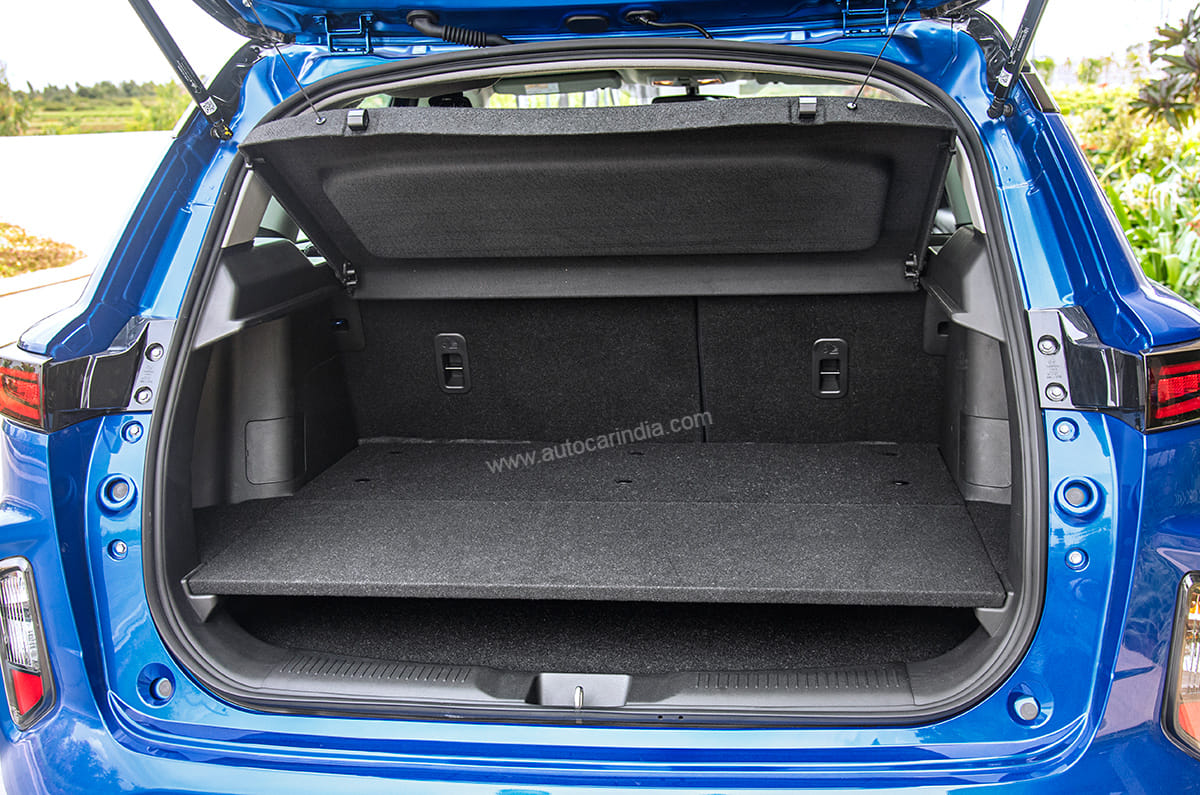
Limited boot space
With a capacity of 355 litres, the mild hybrid-powered Toyota Hyryder has one of the smallest trunks in the segment. Additionally, the Hyryder strong hybrid’s high fuel efficiency comes at the cost of boot space, which is reduced further to 255 litres because of the lithium-ion battery pack placed beneath it. This could be a dealbreaker for those who carry large suitcases on road trips.