Development in Noida-Greater Noida: यमुना एक्सप्रेसवे औद्योगिक विकास प्राधिकरण (YEIDA) क्षेत्र में औद्योगिक विकास को नई रफ्तार देने की तैयारी तेज हो गई है। नोएडा इंटरनेशनल एयरपोर्ट के दक्षिणी क्षेत्र में करीब 8,000 हेक्टेयर क्षेत्रफल में इंडस्ट्रियल नोड विकसित करने की दिशा में काम किया जा रहा है। प्राधिकरण की ओर से तैयार की जा रही महायोजना और औद्योगिक विकास की योजनाओं में इसे महत्वपूर्ण परियोजना के तौर पर आगे बढ़ाया जा रहा है। इंडस्ट्रियल नोड के विकसित होने से क्षेत्र में औद्योगिक निवेश, रोजगार और लॉजिस्टिक्स इंफ्रास्ट्रक्चर को बढ़ावा मिलने की उम्मीद है।
एयरपोर्ट के आसपास औद्योगिक विकास को मिलेगी गति
YEIDA की ओर से नोएडा इंटरनेशनल एयरपोर्ट के दक्षिणी क्षेत्र में करीब 8,000 हेक्टेयर में इंडस्ट्रियल नोड विकसित करने की दिशा में काम किया जा रहा है। प्राधिकरण के निदेशक मंडल की ओर से भी इस प्रस्ताव का अवलोकन किया गया है। इसके लिए महायोजना तैयार करने की दिशा में कंसल्टेंट के चयन की कार्रवाई की जा रही है।
प्राधिकरण के मुताबिक, इंडस्ट्रियल नोड के विकसित होने से क्षेत्र में औद्योगिक निवेश और रोजगार के अवसर बढ़ेंगे। इसके साथ ही लॉजिस्टिक्स इंफ्रास्ट्रक्चर को भी मजबूती मिलने की उम्मीद है। एयरपोर्ट के आसपास योजनाबद्ध तरीके से औद्योगिक गतिविधियां विकसित होने से क्षेत्र में कारोबार के लिए बेहतर माहौल तैयार करने का प्रयास किया जा रहा है।
इंटरनेशनल ट्रेड सिटी की भी तैयारी
YEIDA क्षेत्र में औद्योगिक विकास के साथ-साथ इंटरनेशनल ट्रेड सिटी विकसित करने की दिशा में भी पहल की जा रही है। प्राधिकरण की योजना Yiwu International Trade City की तर्ज पर अंतरराष्ट्रीय व्यापार केंद्र विकसित करने की है। प्रस्तावित ट्रेड सिटी में क्षेत्र के औद्योगिक उत्पादों की प्रदर्शनी, बिक्री और निर्यात के लिए बाजार उपलब्ध कराने की परिकल्पना की गई है।
इससे स्थानीय उद्योगों को नए बाजारों तक पहुंच बनाने और वैश्विक व्यापार के अवसर हासिल करने में मदद मिल सकती है। एयरपोर्ट, औद्योगिक क्षेत्र और लॉजिस्टिक्स सुविधाओं के साथ ट्रेड सिटी को जोड़ने की योजना क्षेत्र के कारोबारी ढांचे को विस्तार देने की दिशा में महत्वपूर्ण मानी जा रही है।
295 औद्योगिक भूखंडों में तेजी से बढ़ रहा काम
YEIDA क्षेत्र में औद्योगिक निवेश को जमीन पर उतारने के लिए भूखंड आवंटन के बाद निर्माण और उत्पादन की प्रक्रिया को भी तेज किया जा रहा है। प्राधिकरण के मुताबिक 4,000 वर्गमीटर से अधिक आकार के 295 औद्योगिक भूखंडों में 181 भूखंडों के लीज डीड का निपटारा हो चुका है। इनमें 152 आवंटियों को कब्जा दिया जा चुका है। जबकि 69 भूखंडों पर निर्माण कार्य शुरू हो गया है। वहीं 13 इकाइयों में उत्पादन भी शुरू हो चुका है।
सेक्टर-28 के मेडिकल डिवाइस पार्क में भी औद्योगिक गतिविधियों को आगे बढ़ाया जा रहा है। यहां 203 भूखंडों के सापेक्ष 123 भूखंड आवंटित किए गए हैं। इनमें 75 भूखंडों पर कब्जा दिया जा चुका है और 28 पर निर्माण शुरू हो गया है।
आधुनिक सुविधाओं पर भी जोर
मेडिकल डिवाइस पार्क में 3D Prototype Lab, Electronics Assembly Facility, IoMT, Biomaterial, Common IT Facility और Tooling Room जैसी आधुनिक सुविधाओं के विकास पर भी काम चल रहा है। इसका उद्देश्य औद्योगिक इकाइयों को जरूरी तकनीकी और साझा सुविधाएं उपलब्ध कराना है।
इसके अलावा सेक्टर-29 के अपैरल पार्क में 159, एमएसएमई पार्क में 503 और हैंडीक्राफ्ट पार्क में 188 भूखंडों का आवंटन हो चुका है। अपैरल पार्क में 110 और हैंडीक्राफ्ट पार्क में 83 आवंटियों को कब्जा भी मिल चुका है। सेक्टर-33 के टॉय पार्क में 148 भूखंड आवंटित किए गए हैं।
महायोजना से तय होगी भविष्य की दिशा
YEIDA की ओर से आगरा-अर्बन सेंटर की महायोजना-2041 को अंतिम रूप देने की प्रक्रिया भी जारी है। संशोधित महायोजना रिपोर्ट प्राधिकरण की 88वीं बोर्ड बैठक में प्रस्तुत की गई थी, जिसके बाद आम लोगों से आपत्तियां और सुझाव मांगे गए। प्राप्त सुझावों की जांच के बाद उनके निस्तारण की संस्तुति की गई है। संशोधित ड्राफ्ट महायोजना तैयार की जा रही है, जो क्षेत्र के भविष्य के भूमि उपयोग और विकास की दिशा तय करेगी।
साथ ही औद्योगिक भूखंडों पर निर्माण और उत्पादन की गति बढ़ाने के लिए साप्ताहिक समीक्षा व्यवस्था के माध्यम से लीज डीड, कब्जा, मानचित्र स्वीकृति, निर्माण और पूर्णता प्रमाण-पत्र से जुड़े लंबित मामलों का समयबद्ध निस्तारण किया जा रहा है।
पूर्व IAS अधिकारी दिव्या मित्तल ने प्रशासनिक सेवा के बाद अब राजनीति की राह चुनने का ऐलान किया है। करीब 13 साल तक IAS के तौर पर काम करने के बाद उन्होंने उत्तर प्रदेश से अपनी राजनीतिक शुरुआत करने की बात कही है। सोशल मीडिया पर जारी वीडियो में उन्होंने लोगों से जुड़ने और उनके मुद्दों को उठाने की बात कही। दिव्या मित्तल के राजनीति में आने की खबर के साथ उनकी पढ़ाई और अब तक के सफर को लेकर भी चर्चा शुरू हो गई है। आखिर IAS बनने से पहले उन्होंने क्या पढ़ाई की और उनका करियर कैसा रहा? आइए जानते हैं।
IIT दिल्ली से शुरू हुई पढ़ाई
दिव्या मित्तल ने IIT दिल्ली से Engineering Physics में BTech किया। उनके LinkedIn प्रोफाइल के मुताबिक, उन्होंने 2001 से 2005 के बीच यह पढ़ाई की। ग्रेजुएशन में उनका CGPA 9.07/10 था और वह अपने विभाग में दूसरे स्थान पर रही थीं। इसके बाद उन्होंने IIM बेंगलुरु से MBA किया। 2005 से 2007 के बीच की गई इस पढ़ाई में भी उनका प्रदर्शन अच्छा रहा। उपलब्ध प्रोफाइल जानकारी के अनुसार, वह अपनी MBA बैच के टॉप 5 फीसदी छात्रों में शामिल थीं।
पढ़ाई के बाद लंदन में नौकरी
MBA पूरा करने के बाद दिव्या मित्तल ने विदेश में कॉर्पोरेट करियर शुरू किया। उन्होंने लंदन में JP Morgan में Associate के तौर पर काम किया। अप्रैल 2007 से जुलाई 2008 तक उन्होंने वहां नौकरी की। इसके बाद उन्होंने कॉर्पोरेट करियर छोड़कर भारत लौटने और UPSC की तैयारी करने का फैसला किया।
UPSC में सफलता और IAS का सफर
दिव्या मित्तल ने UPSC सिविल सेवा परीक्षा पास की। रिपोर्टों के मुताबिक, अपने पहले प्रयास में वह IPS के लिए चुनी गईं और बाद के प्रयास में ऑल इंडिया रैंक 68 हासिल कर IAS बनीं। वह 2013 बैच की उत्तर प्रदेश कैडर की अधिकारी रहीं। IAS के तौर पर उन्होंने उत्तर प्रदेश में कई अहम जिम्मेदारियां संभालीं। वह संत कबीर नगर, मिर्जापुर और देवरिया की जिलाधिकारी रह चुकी हैं। इसके अलावा उन्होंने NITI Aayog और उत्तर प्रदेश सरकार में भी अलग-अलग पदों पर काम किया।मिर्जापुर में उनके कार्यकाल के दौरान एक पहाड़ी गांव तक पाइपलाइन के जरिए पानी पहुंचाने की पहल भी चर्चा में रही।
MIT से भी की पढ़ाई
दिव्या मित्तल ने नौकरी और प्रशासनिक जिम्मेदारियों के बीच अपनी पढ़ाई जारी रखी। उन्होंने 2019 से 2020 के बीच MITx से Data, Economics and Development Policy में MicroMasters किया। यानी उनकी शैक्षणिक यात्रा इंजीनियरिंग से शुरू होकर मैनेजमेंट, डेटा और डेवलपमेंट पॉलिसी तक पहुंची।
IAS के बाद अब राजनीति में एंट्री
अगस्त 2026 में दिव्या मित्तल ने करीब 13 साल की IAS सेवा के बाद इस्तीफा दे दिया। अब उन्होंने साफ कर दिया है कि उनकी अगली पारी राजनीति में होगी।
उन्होंने कहा है कि वह उत्तर प्रदेश से राजनीतिक शुरुआत करेंगी और किसी राजनीतिक पार्टी के साथ नहीं जाएंगी। अपने वीडियो संदेश में उन्होंने शिक्षक, डॉक्टर, किसान, मजदूर, वकील और छात्रों से जुड़ने की अपील की है।
IIT दिल्ली की पढ़ाई, IIM बेंगलुरु का MBA, लंदन की नौकरी, UPSC में सफलता और करीब 13 साल की प्रशासनिक सेवा के बाद दिव्या मित्तल अब अपने करियर का एक नया अध्याय शुरू करने जा रही हैं।
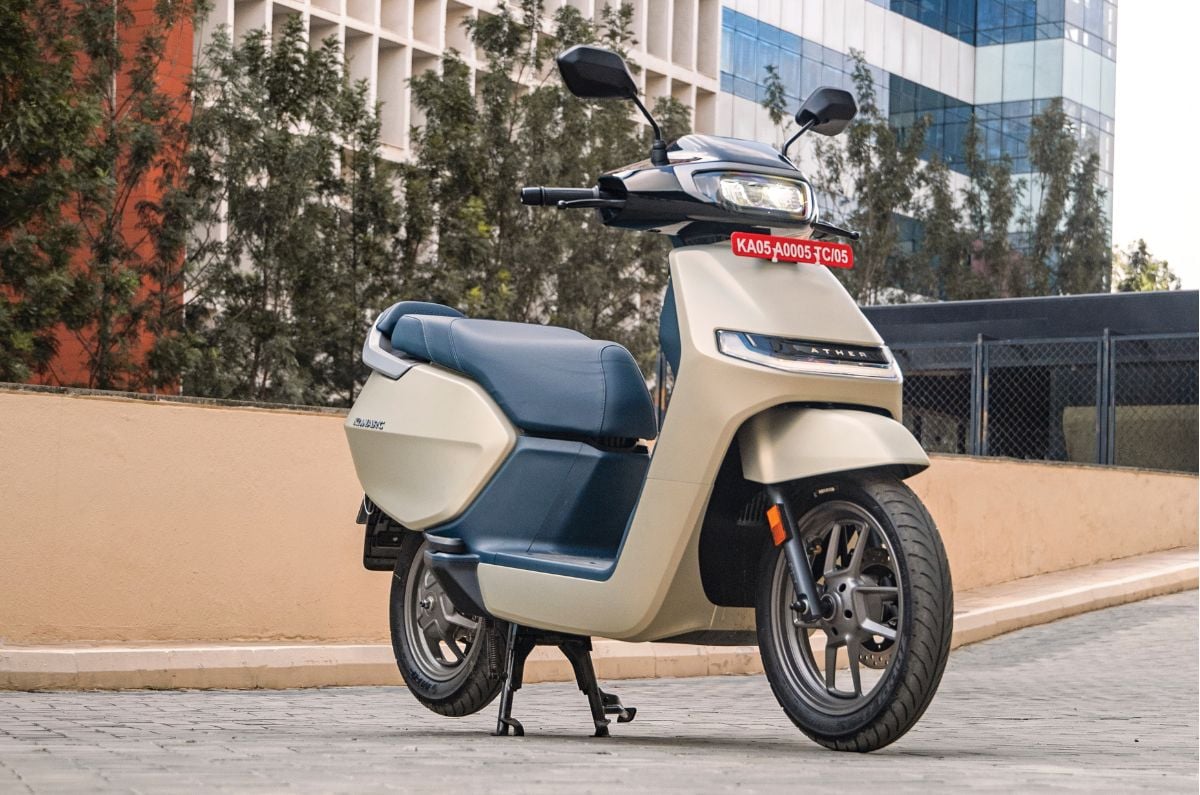
Bengaluru-based EV maker Ather expects its newly launched Konarc electric scooter to drive more than half of its sales over the next two years. The company is positioning Konarc as a key product in its attempt to take electric scooters mainstream, with the focus less on taking customers from rival EV makers and more on converting buyers who would otherwise remain with internal-combustion engine scooters.
Konarc has five variants, four of which are priced close to the Rizta
Manufacturing and availability set to ramp up after the festive season this year
Konarc is expected to make (Ather) EVs mainstream
Konarc has higher profit margins than Rizta despite a lower price
“The role of Konarc is to take EVs mainstream, which, by definition, means that we’re looking at weaning people away from ICE,” said Ather’s chief business officer Ravneet Phokela. “This is not about getting market share from somebody else. It’s really about getting share from the ICE world.” For these customers, he added, Ather first needs to address fundamental considerations around comfort, safety and battery life before features and technology become the differentiators.
Despite a lower starting price of Rs 99,999, the Konarc also has better margins than the Rizta, according to Phokela. It is currently available in five variants (three S and two Z), with four positioned around price points similar to the Rizta’s. Ather has moved from an aluminium chassis for the 450/Rizta to a tubular steel chassis on the Konarc and from a two-stage belt transmission to a gearbox. The charger and motor controller have also been combined into a single unit.
The EL platform has allowed Ather to incorporate learnings from the 450 platform that couldn’t be introduced into that architecture. Phokela described the 450 platform as appropriate for the performance-oriented 450 but “overkill” for the family-focused Rizta, which had to use the existing architecture to meet its development timeline. The EL platform, in contrast, was conceived from the outset as a simpler architecture with a fundamentally lower cost structure.
Konarc is currently being supplied only in parts of North India, with Ather yet to open bookings across central and southern markets. Ather expects this constraint to ease after its new manufacturing facility is commissioned in December, although Phokela said it would take a few months thereafter to ramp up production. More markets are expected to be added progressively as supplies improve. The supply situation has also led Ather to pause showroom expansions for now. It currently has around 750 outlets, with expansion expected to gather pace again after the festive period. Over the next 18-24 months, Phokela sees around 2,000 stores as a target while maintaining that expansion will be calibrated to ensure dealers remain viable and profitable.
With inputs from Mukul Yudhveer Singh and Stephen Raj Antony
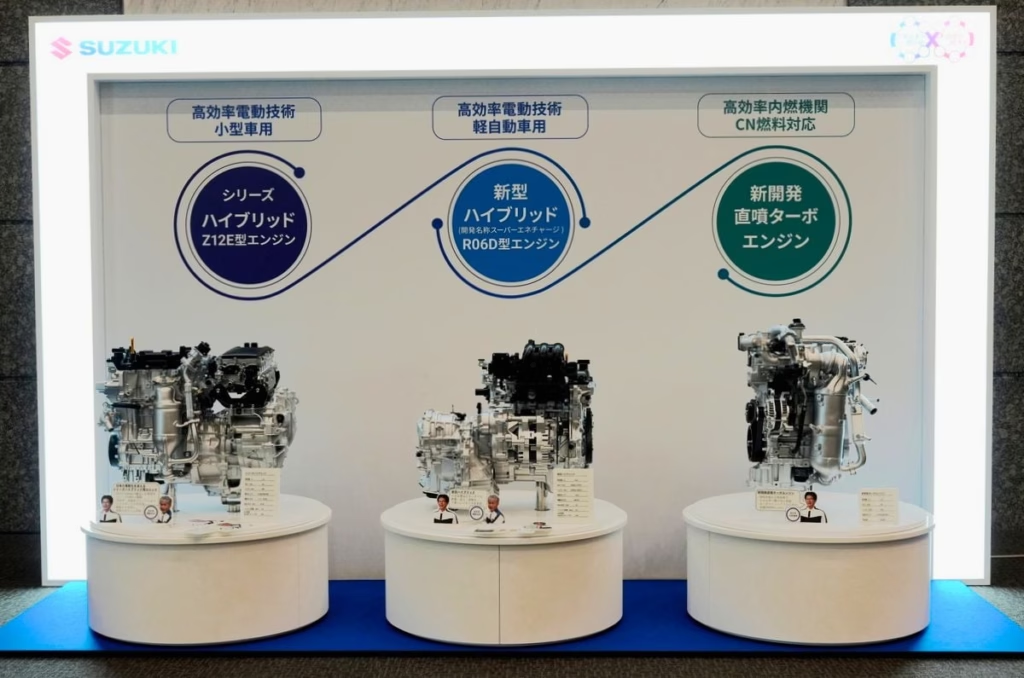
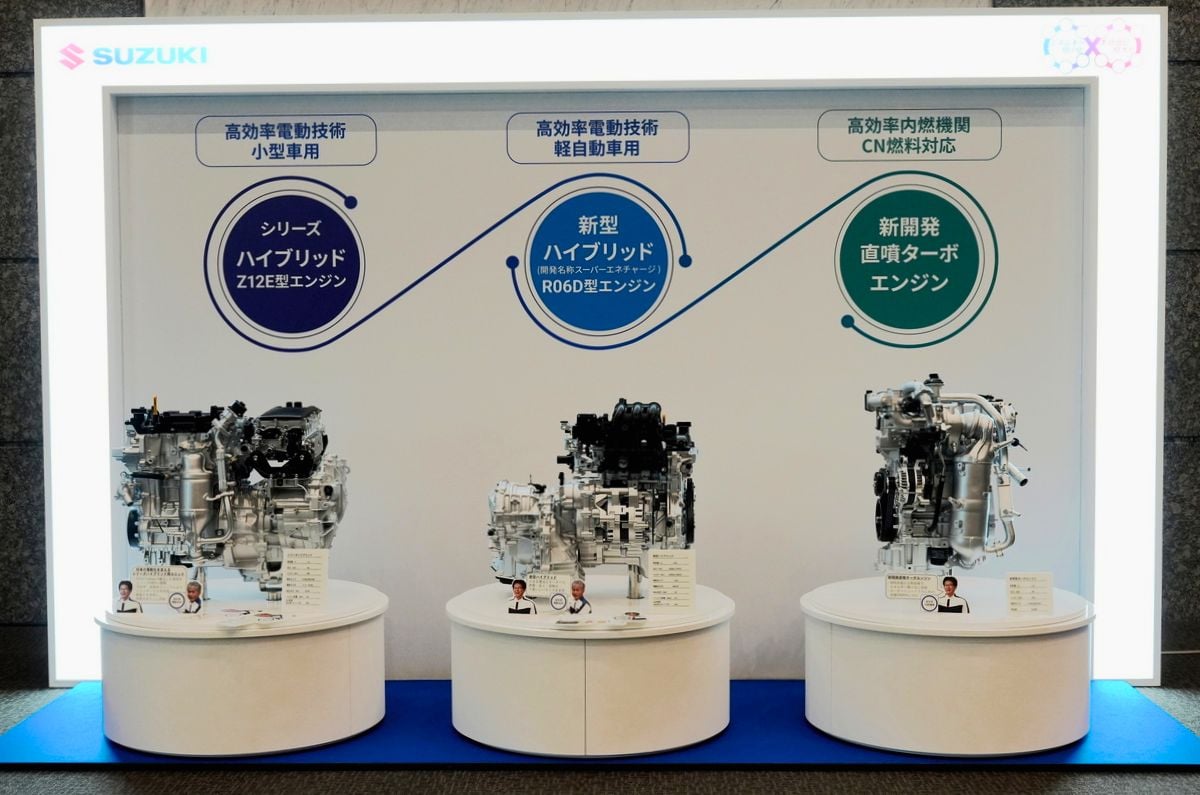
Suzuki recently revealed plans to develop a new direct-injection turbocharged (DITC) engine for growth markets, including India, as part of its ‘Technology Strategy 2026: Looking 10 Years Ahead’ roadmap. The manufacturer has also revealed specifications for a 1.2-litre 3-cylinder turbo-petrol engine prototype in Japan, which is being developed for compatibility with E100, CNG (compressed natural gas) and CBG (compressed biomethane gas). While not confirmed by the manufacturer, this engine is likely to eventually be offered in India.
1.2-litre turbo-petrol engine prototype produces up to 126hp and 230Nm
This engine is being developed to achieve up to 40 percent thermal fuel efficiency
Alongside the turbo-petrol engine, Suzuki has also showcased a series-hybrid powertrain based on the Z12E 3-cylinder engine and a smaller 0.66-litre engine for kei cars. Specifications of a 1.5-litre direct-injection turbo-petrol engine were also revealed.
Suzuki’s new engine prototypes: More details
1.2-litre 3-cylinder turbo-petrol engine is based on Z12E, as per a media report
Image source: Autocar Japan (text translated into English)
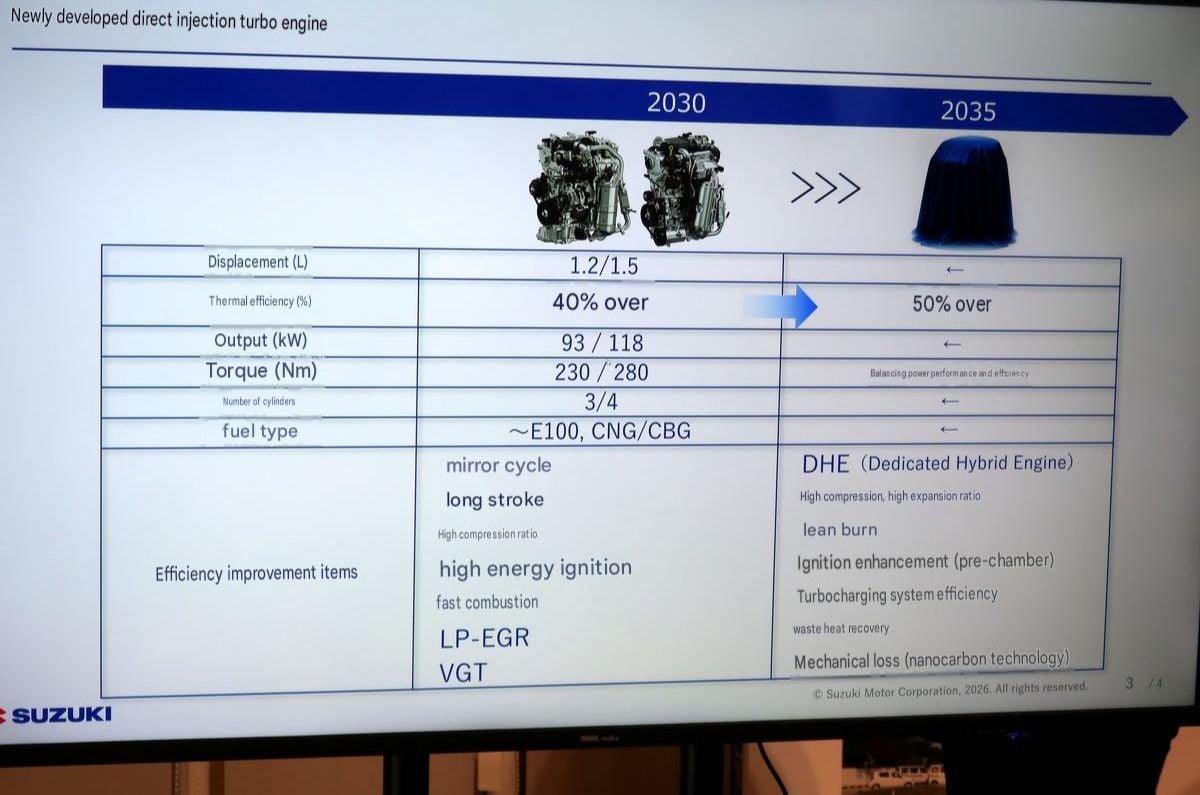
The showcased prototype is a 1.2-litre direct-injection turbo-petrol engine, aimed at producing up to 126hp and 230Nm, with thermal fuel efficiency targeted at up to 40 percent at launch and up to 50 percent by 2035. The engine is being developed for compatibility with E100 (100 percent ethanol), CNG and CBG.
According to a report by Japan’s MotorFan, the engine is based on Suzuki’s Z12E 3-cylinder unit and features a variable-geometry (VG) turbocharger and a water-cooled intercooler. The Z12E is offered in a naturally aspirated avatar in the Swift, Baleno and Dzire. While not confirmed by the manufacturer, the new turbocharged engine could eventually be offered in sub-4m cars in India.
Z12E engine to also form the basis of a series-hybrid powertrain
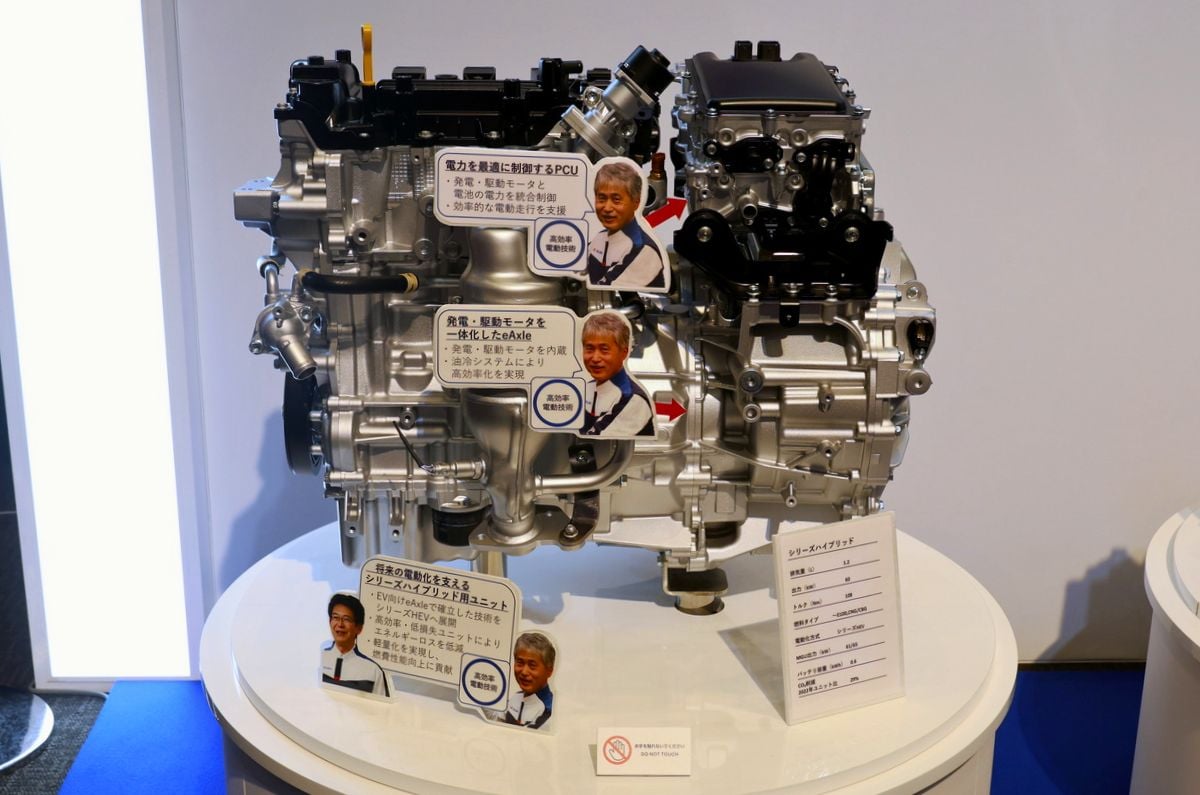
Suzuki is also developing the 1.2-litre Z12E 3-cylinder engine for use in a series-hybrid powertrain. In this setup, the engine generates electricity, while an electric motor drives the wheels. The system uses two motors – one for generating electricity and another for driving the wheels. In this application, the Z12E engine produces up to 82hp and 108Nm, while the generator motor has a maximum output of 83hp and the drive motor produces up to 88hp. The system uses a 0.6kWh battery.
Series hybrid system combining a 1.2L engine and two electric motors. (Image source: Autocar Japan)
Suzuki is also considering combining this series-hybrid system with its new 1.2-litre direct-injection turbo-petrol engine in a future plug-in hybrid setup. The proposed combination could deliver a total system output of up to 177hp.
1.5-litre turbo-petrol engine and a 0.66-litre engine (for kei cars) also in development
As per Autocar Japan, Suzuki is also developing a 1.5-litre 4-cylinder, aimed at producing up to 160hp and 280Nm. Like the smaller 1.2-litre engine, the 1.5-litre turbo-petrol engine is also being developed for compatibility with E100, CNG and CBG fuels.
Suzuki also showcased a smaller 0.66-litre 3-cylinder engine in Japan. The engine is being developed in both naturally aspirated and turbocharged forms for kei cars.
Notably, all the engines showcased by Suzuki are designed for transverse-mounted, front-wheel-drive (FWD) vehicles, with no mention of powertrains for longitudinally mounted, rear-wheel-drive (RWD) models such as the Jimny. However, powertrains for RWD models are also understood to be under development and could be revealed at a later date.
भारत के सर्वेश कुशारे और एंसी सोजन ने रविवार को एशियाई खेलों में क्रमश: पुरुष ऊंची कूद और महिला लंबी कूद फाइनल में अधिकांश समय बढ़त बनाए रखी लेकिन अंत में उन्हें रजत पदक से संतोष करना पड़ा जबकि पारुल चौधरी ने महिला 3000 मीटर स्टीपलचेज में कांस्य पदक जीता।
सर्वेश स्पर्धा में काफी समय तक शीर्ष पर रहे लेकिन 2.25 मीटर की ऊंचाई को पहली कोशिश में पार नहीं कर पाने के बाद दूसरे स्थान पर खिसक गए। चीनी ताइपे के चाओ शुआन फू ने यह ऊंचाई अपनी पहली कोशिश में पार कर ली।
हालांकि कुशारे ने दूसरी कोशिश में 2.25 मीटर की ऊंचाई पार कर ली।महिला लंबी कूद फाइनल में एंसी ने 6.53 मीटर का सर्वश्रेष्ठ प्रयास किया और दूसरे स्थान पर रहीं। चीन की हुआंग यिंगयिंग ने आखिरी प्रयास में 6.55 मीटर की कूद लगाकर भारतीय खिलाड़ी को पीछे छोड़ते हुए स्वर्ण पदक जीत लिया।इससे पहले भारत की हरिता भद्रा ने महिला 200 मीटर में 23.20 सेकेंड के समय के साथ कांस्य पदक जीता। भद्रा तीसरे स्थान पर रहीं। वह जापान की इडो अबिगेइरुफुका से मामूली अंतर से आगे रहीं जिन्होंने 23.21 सेकेंड का समय निकाला।
हालांकि एंसी की हमवतन शैली सिंह के लिए महिला लंबी कूद फाइनल में निराशा हाथ लगी। चीन की मेंगयी तान ने 6.46 मीटर की कूद लगाकर भारतीय खिलाड़ी को पीछे छोड़ दिया जिससे शैली कांस्य पदक से चूक गईं।एंसी ने पांचवें प्रयास में 6.53 मीटर की कूद लगाई थी लेकिन यिंगयिंग ने 6.55 मीटर की कूद के साथ अंतिम प्रयास में उन्हें पीछे छोड़ दिया।
ONTO THE PODIUM!
Asian Games 2026 | Athletics
Men’s High Jump – Final
Sarvesh Anil Kushare (TOPS Core Athlete) cleared 2.25m to win Silver , narrowly missing Gold on countback.
Adarsh Ram Jothi Shankar finished 13th with 2.05m before retiring.
शैली का दिन का सर्वश्रेष्ठ प्रयास 6.42 मीटर रहा।महिला 200 मीटर फाइनल में सिंगापुर की शांति परेरा ने सत्र का सर्वश्रेष्ठ 22.78 सेकेंड का समय निकालकर स्वर्ण पदक जीता जबकि चीन की चेन युजी ने 22.93 सेकेंड के समय के साथ रजत पदक हासिल किया।
फाइनल में शामिल एक अन्य भारतीय उन्नति अयप्पा बोलैंड 23.48 सेकेंड के समय के साथ छठे स्थान पर रहीं।पिछले एशियाई खेलों में कांस्य पदक जीतने वाली पारुल ने नौ मिनट 8.67 सेकेंड के व्यक्तिगत सर्वश्रेष्ठ समय के साथ लगातार दूसरी बार कांस्य पदक अपने नाम किया।
BRONZE WITH A NATIONAL RECORD!
Asian Games 2026 | Athletics
Women’s 3000m Steeplechase – Final
Parul Chaudhary (TOPS Development Athlete) secured Bronze with a National Record timing of 9:08.67!
Ankita (NCoE Athlete) finished 4th with a Personal Best of 9:19.24.… pic.twitter.com/S12mO3PzPT
बहरीन की विनफ्रेड यावी ने नौ मिनट 4.36 सेकेंड के समय के साथ स्वर्ण पदक जीता जबकि कजाखस्तान की नोराह जेरुतो तनुई ने नौ मिनट 06.82 सेकेंड के समय के साथ रजत पदक अपने नाम किया।स्पर्धा में हिस्सा लेने वाली एक अन्य भारतीय एथलीट अंकिता नौ मिनट 19.24 सेकेंड के अपने व्यक्तिगत सर्वश्रेष्ठ प्रयास के साथ चौथे स्थान पर रहीं।
Mercedes-Benz’s 140 Years, 140 Places odyssey is a celebration of the carmaker’s origins in 1886. Spanning six continents, covering over 60,000 kilometres, it is as massive in significance as it is in scale. The tour kicked off at the Mercedes-Benz Museum in Stuttgart on the 29th of January, the same day Carl Benz received the patent for his first car 140 years ago! The cars then went to the Daimler house in Bad Cannstatt, they tracked the original route of Bertha Benz’s historic 1888 drive and drove the iconic Spa-Francorchamps racetrack in Belgium in wheel tracks of the W109 ‘Red Pig’ that made such a splash in 1971. The cars then went to the US, visiting the first plant in the US started by William Steinway (of Steinway & Sons, the famous German Piano makers), South America, Australia, Japan, Korea and Japan.
Legacy and history
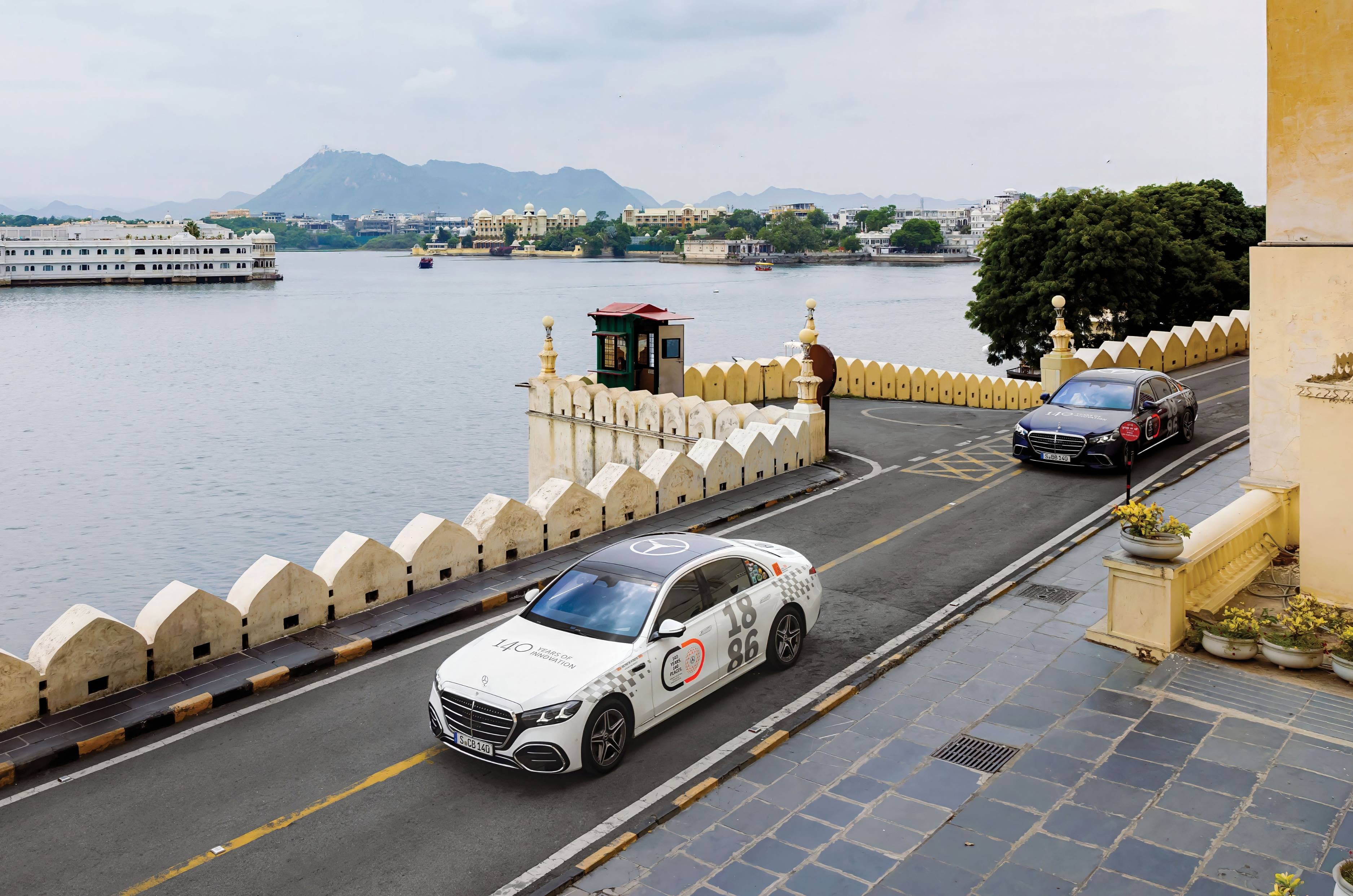
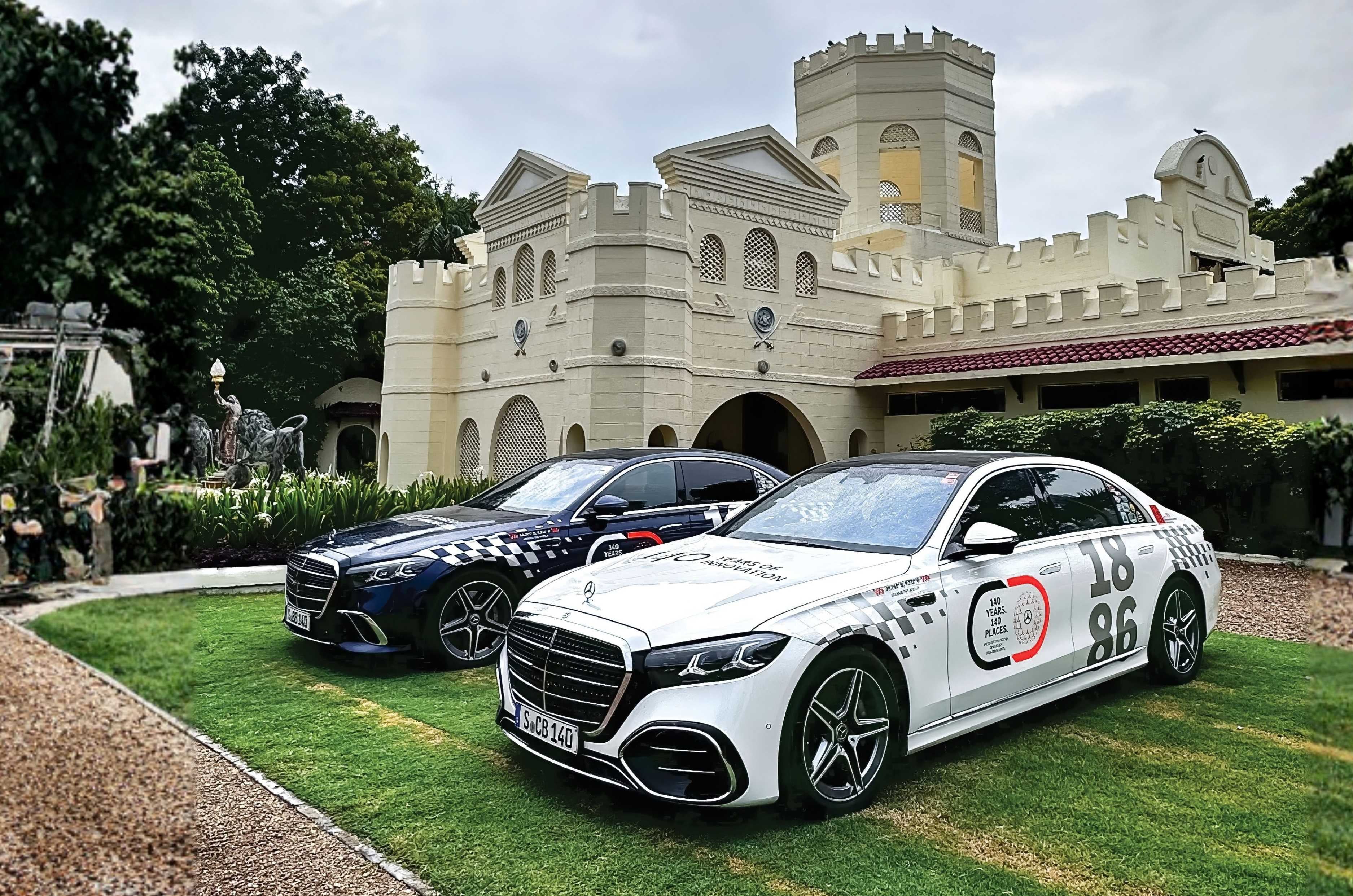
With their royal and regal air, the S-Classes feel right at home in Udaipur.
Part of the 140 Years, 140 Places expedition, Udaipur is one of the more stunning locations the Mercedes drive will visit on this India leg, and what’s incredible is that we have been chosen to be a part of it. What a privilege. The lake city of Udaipur also has tremendous historical significance. Home to one of the longest-serving dynasties, one that spans 1,500 years, this leg sees a coming together of the world’s oldest carmaker and one of the oldest dynasties. And while this trans-continental excursion is called 140 Years, 140 Places, it could also easily have been called 140 Years of Automotive Technology. With these S-Class pre-production cars dripping with both mechanical and electronic tech, what we are also celebrating is the journey of the car from a three-wheeler with a single-cylinder engine to this technological marvel. The company that invented the motorcar is still widely regarded as the one that makes ‘the best car in the world’.
Luxe Supreme
Everything is perfectly still. Not a gauge in the car is moving, and there’s no real sensation of speed. I must have dozed off. Blame it on the incredibly comfortable back seats and the sensory isolation. This car just shuts you off from the rest of the world. Then I discover we are cruising at 100kph, and not just 30 or 40. Up ahead is the lake city of Udaipur. Ahh.
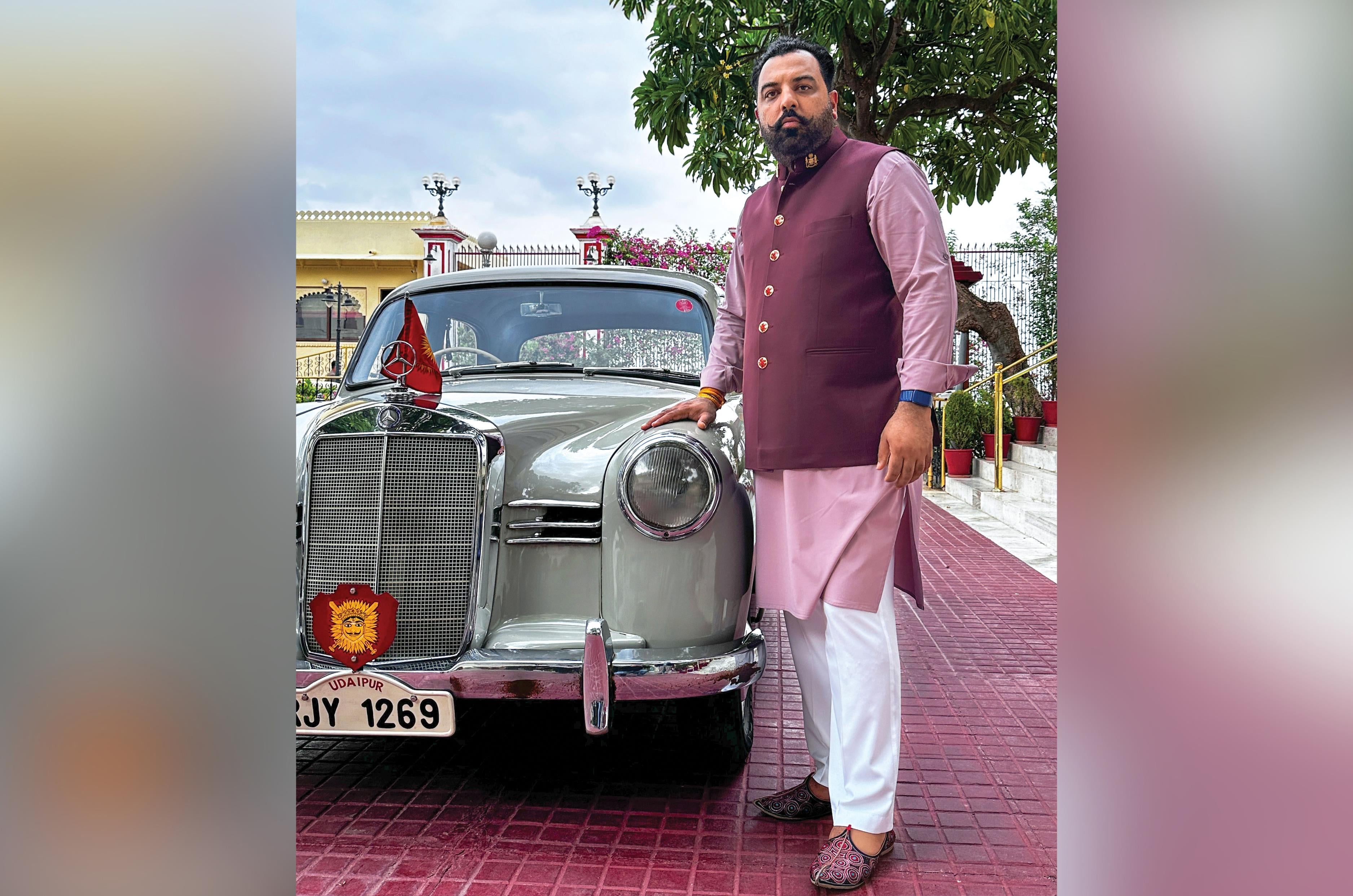
The Maharana of Udaipur with a car that has been in his family for three generations.
We start our journey on this leg from a very significant place, the palace situated on the lakeside at Udaipur. And not only does Lakhsyaraj, the 77th Custodian of the House of Mewar (formally Shriji Huzoor Dr Lakshyaraj Singh of Udaipur), play the perfect host, but he also parks an olive-green 180D in the foyer, a car that has been used by three generations of his family. The symbolism is rich; two legacies converging in a place that embodies the spirit of grandeur and continuity.
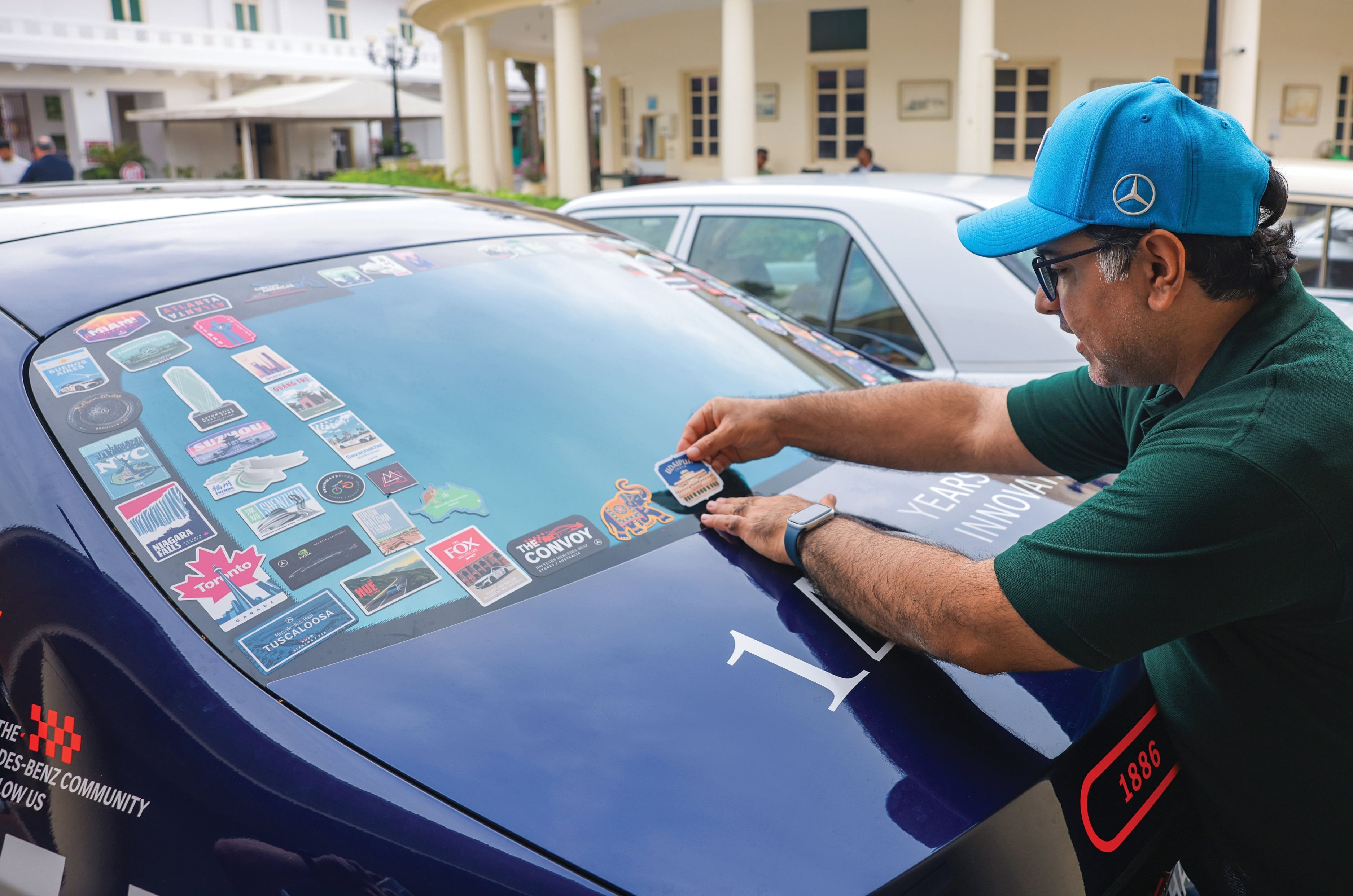
Perseus places the sticker on ‘Bertha’ in Udaipur.
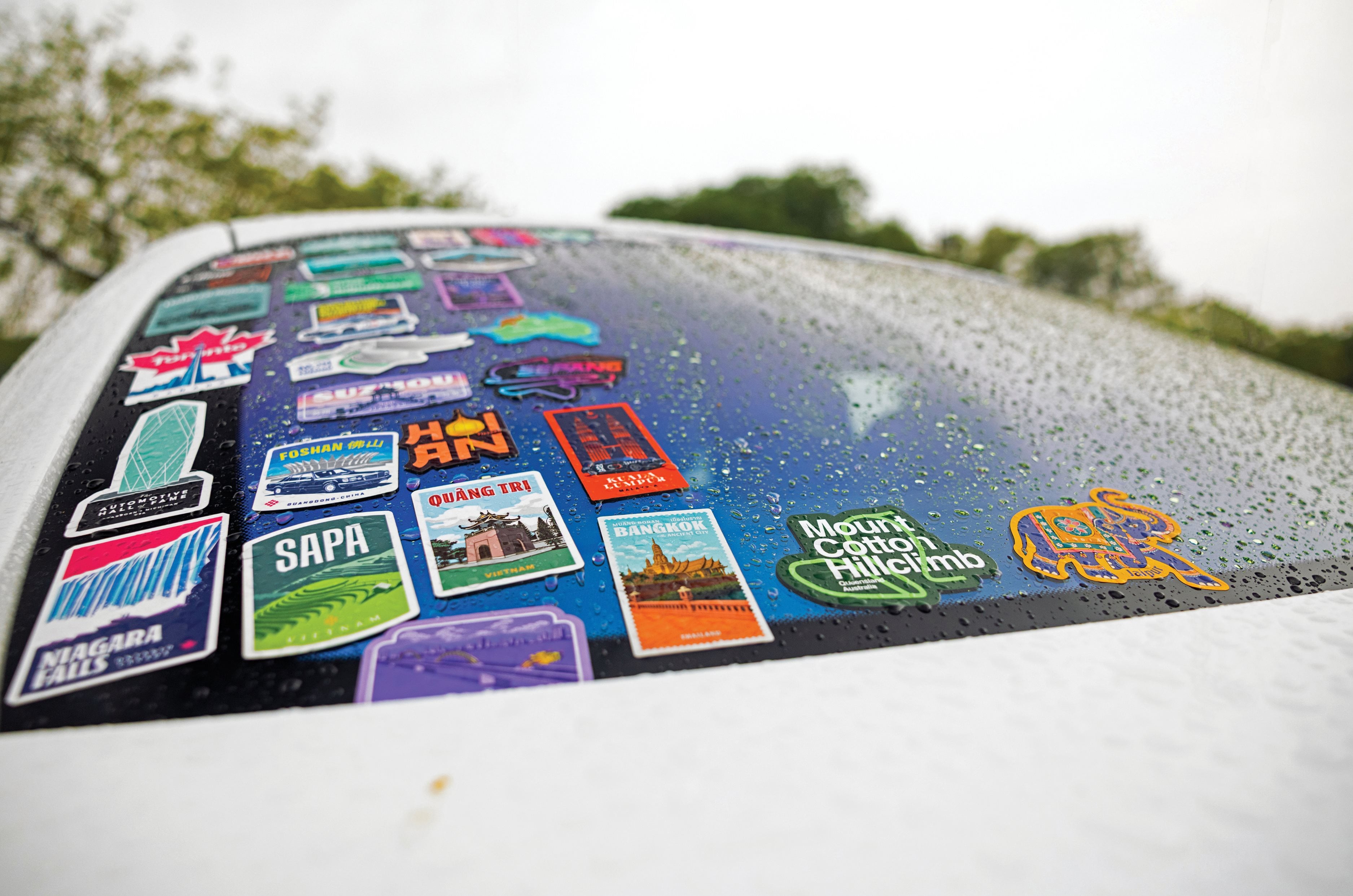
Since Udaipur is one of the 140 iconic destinations on the drive, Mercedes asks him to place an Udaipur sticker on the rear of the car; fitting. These cars, all three (the third is on another leg elsewhere in India), will eventually be housed in the Mercedes museum in Stuttgart, and what’s cool is that you can trace their journey via the stickers. Lakshyaraj then takes one of the cars for a brief drive. He wants to see just how much better this new version, with all its 2,700 new bits, is over his pre-facelifted car. And yes, he loves driving. I’d bumped into him earlier in the day at the airport, where his S-Class had come to pick him up, flags flying and uniformed driver and assistant in tow. But instead of climbing into the rear, he’d gotten straight behind the wheel. Tells you a lot.
Still at the top
Late prototypes of the New S-Class made the journey.
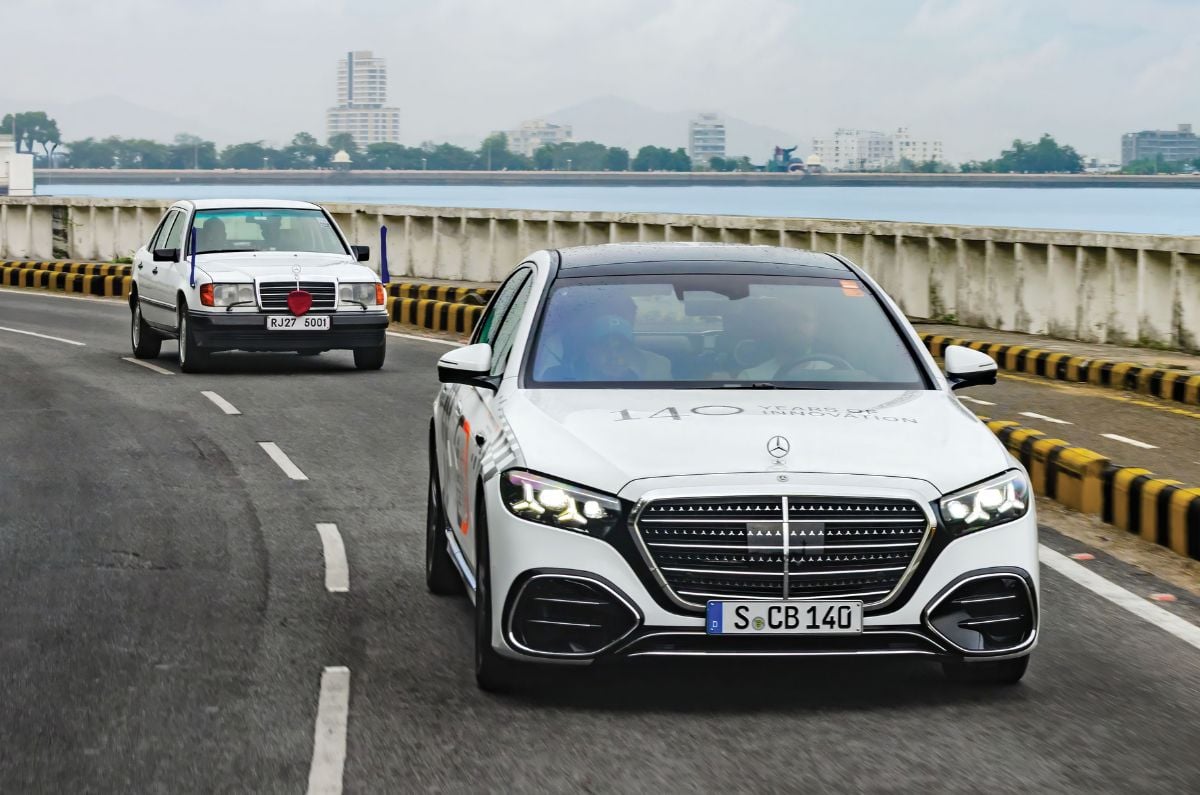
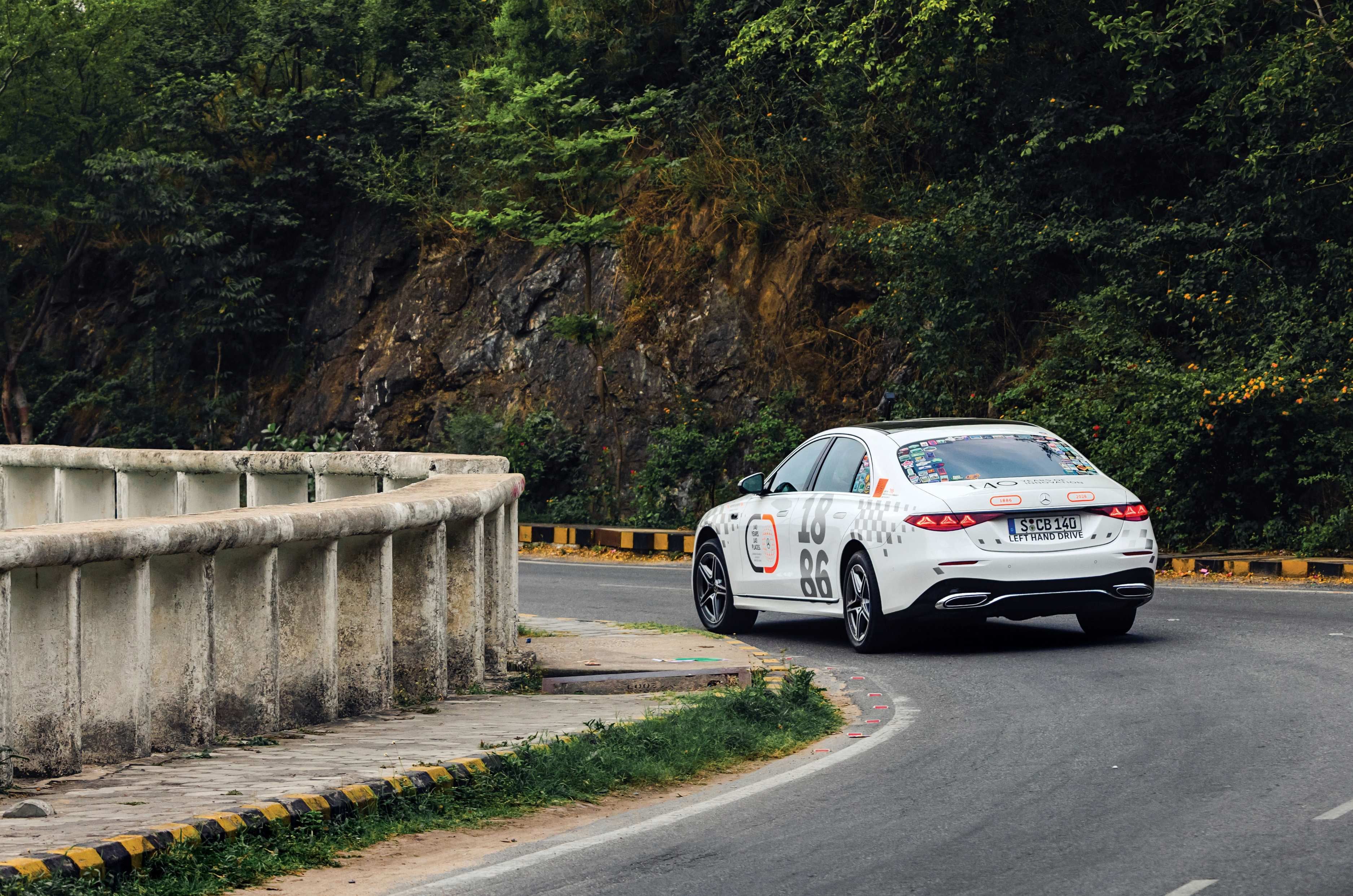
Later in the day, I get another demonstration of why the S-Class is so special. We decide to drive around the lake for the cameras, the orange glow of the setting sun adding to the drama of this once James Bond film set. Sitting in the back feels almost magical, as the S-Class slips forward effortlessly, the sun glistening off the lake. It skips over cratered roads, glides silently through noisy bazaars and intersections and then, as the road around the lake opens out, I barely hear it even though Mercedes’ test driver is pulling the torque-y straight-six hard. This car is named Bertha, after Carl Benz’s wife, the one who undertook the world’s first long-distance drive; quite a story that. And the other, the white one, is Carl; BB and CB, both on Stuttgart number plates.
Hello Grandpa
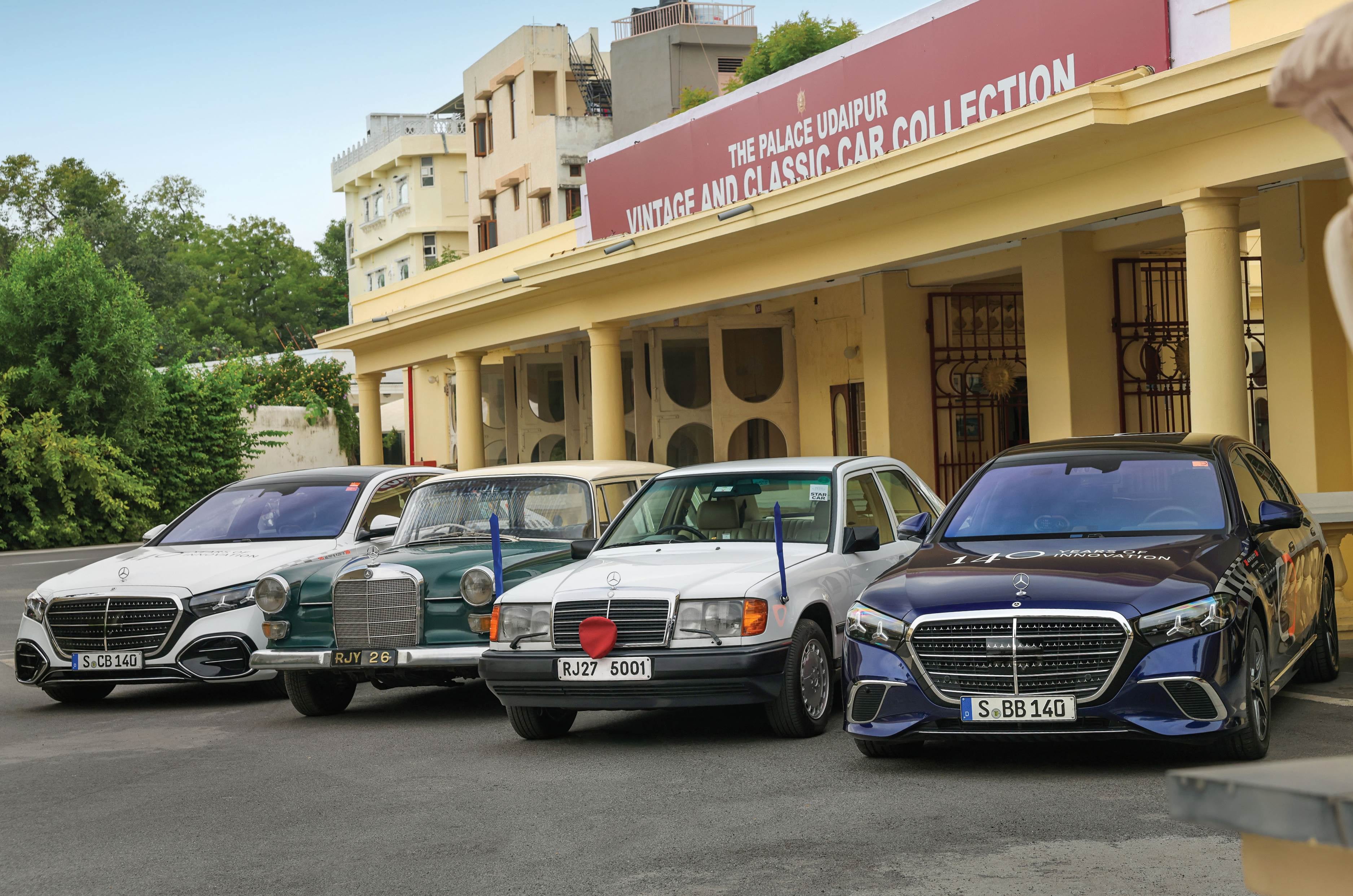
The S-Classes, along with the fin-tail and the 300D.
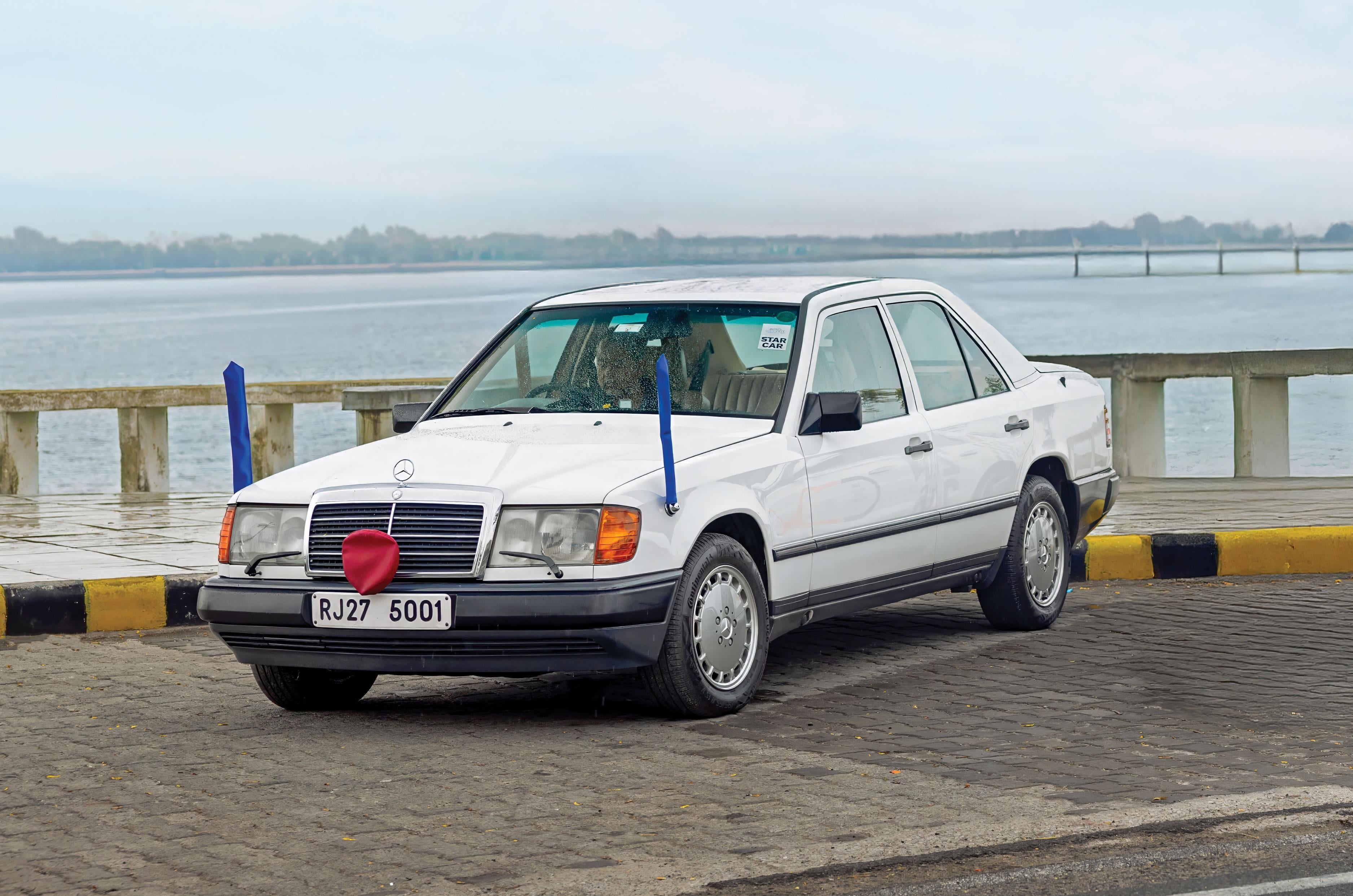
The next day, we set off to see the Udaipur Royal Garage, where we are met by other Mercedes cars. There’s a fin-tail that was used to pick up and drop off guests of the Royal family from neighbouring ‘states’ and a very special W124 300D. The latter, an import rather than a locally assembled W124, stands out from Indian-assembled cars with its black bumpers, headlamp wipers and amber indicators. This six-cylinder diesel with more than 2,00,000km on the clock was used by Shri Arvind Singh Mewar, the earlier Maharana, to cover long distances like Ahmedabad or Jodhpur. Recently restored, it was presented at the Mercedes-Benz Classic Car Rally in Mumbai. The 300D is in such fine nick, I can’t resist a quick spin around another of Udaipur’s stunning lakes, Fateh Sagar.
Why the 300D is such a legend
The W124 300D is an import.
On the outside, the 300D looks sort of underwhelming. Starting up the straight-six diesel is relatively straightforward, although I have to wait for the glow plug to heat up (remember those?). While the roughly 110hp engine doesn’t feel responsive, it feels smooth and refined for a diesel, especially after 2,500rpm. And though it is slow by today’s standards, it doesn’t feel like you’re dragging anchor either. The chunky 300D also feels as tough as a Godrej safe.
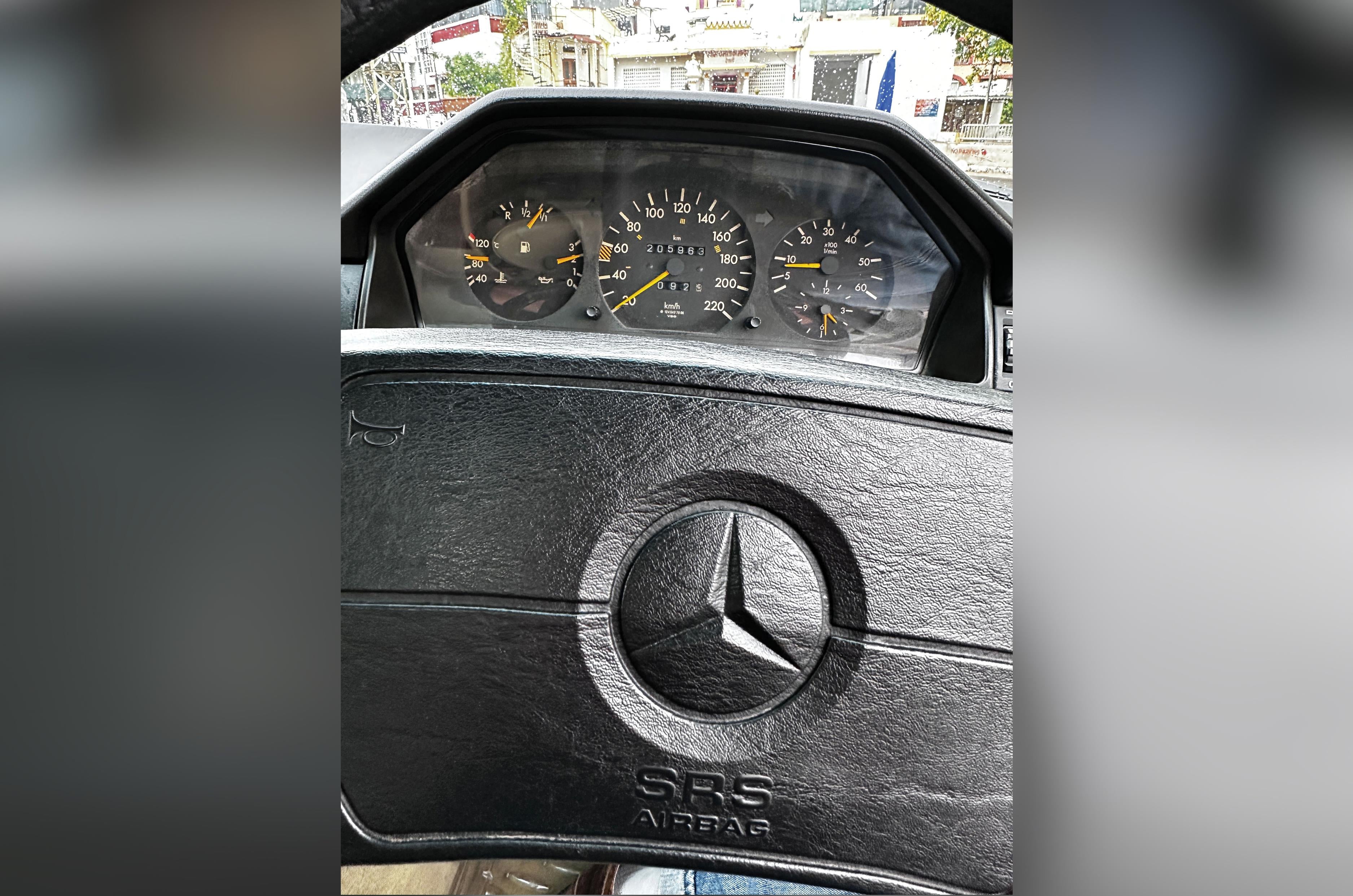
It has 2,00,000km on the odo, but hardly feels like it.
Then I catch a glimpse of the odometer; it reads in excess of 2,00,000 kilometres! Surely my eyes are playing tricks on me. Yes, this car has been recently refurbished, and the suspension has been tightened up, but this thing feels like it has just rolled out of the showroom only recently. It tracks straight, the steering is well weighted and, when I plonk my foot down, it even generates a reasonable amount of torque. This ‘OM603’ straight-six uses indirect injection and a pre-chamber, and has a simple two-valve-per-cylinder setup. Legend has it, it can do a million miles with only basic care. And what of turbo lag, you ask? It doesn’t have one.
Performance tech
The next morning, I get straight behind the wheel of CB or Carl Benz. I’m particularly excited because Carl has a V8 under the hood. What makes this V8 different is that it has some unique tech. This new S-Class is fitted with the ‘M177 Evo’ V8 engine that uses a flat-plane crankshaft! Made popular by Ferrari, a flat-plane crank is used on sportscars to help bunch up the firing order of the cylinders, so you get more of a kick from overlapping strokes. These engines, however, are not as smooth. So why has Mercedes used it in the S-Class, an out-and-out luxury car? Simple: it delivers better efficiency and lower emissions, as the crankshaft is lighter and there’s less reciprocating mass. And what of the vibrations? Mercedes says it has thrown tech at the problem.
V8-equipped S-Class feels effortlessly quick.
Initially, the going is slow as we exit the city. But once we get onto the wide highway, a small tap on the throttle releases a swell of torque just off 2,000rpm. And with 537hp propelling the limousine forward, it just shrinks the long straights on the highway. What’s cool is that the engine never feels brutish or AMG-like; the V8 soundtrack and rumble are superbly muted. The tech works. The new engine, in fact, is so well behaved that I have to check if it is indeed the one with the flat plane crank. At the next stop, I turn around and ask Mario Schneider, head of development for all Mercedes-Benz sedans, who just happens to be in the rear seat.
Also along for the drive is Perseus Bandrawalla, Autocar India’s curator of classic and modern classic events. Five minutes behind the wheel and he is waxing lyrical about the Mercedes V8 engines of days gone past – the M100, the M119 that powered the SL and others. It brings into perspective just how many great V8s Mercedes has had over the years, the 6.3 AMG V8, of course, included.
Cruise control
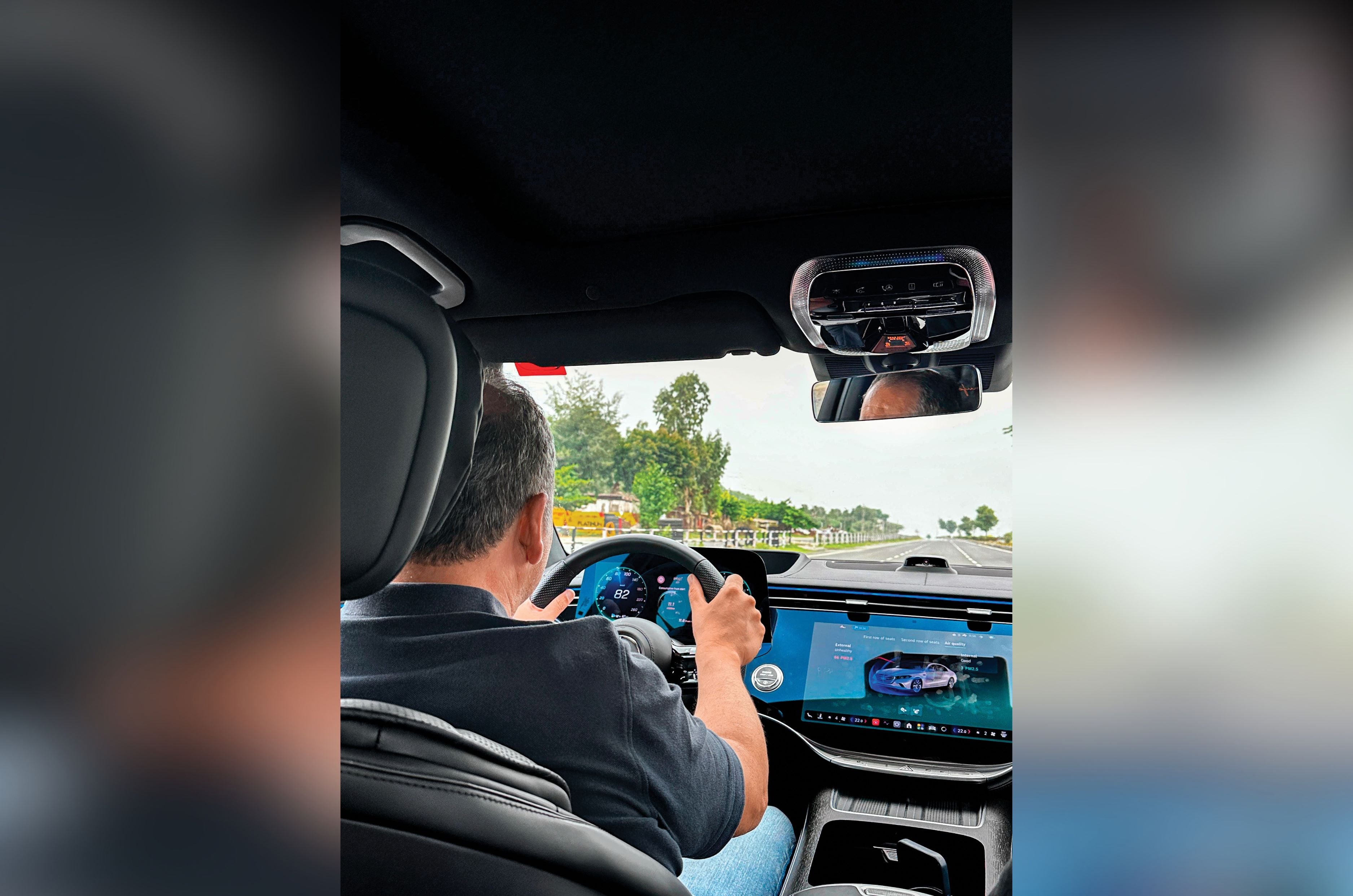
The three screens and updated cabin created a futuristic setup in a traditional environment.
Further up, we get to a ghat section. Not only does the ride on this updated air suspension and adaptive dampers feel a bit more supple, it also feels at home on the winding road, the rear-wheel steering helps it into corners neatly. Even cooler, despite all the tech, it retains a natural fluidity and a sense of mechanical harmony, which make long drives feel just effortless. Are city-bound S-Class owners missing what’s best about this car? Absolutely! Talking about tech, this car also gets Level 3 autonomous driving (in places where it’s allowed), where the driver can be hands off, and even eyes off, with Mercedes Drive Pilot taking responsibility for safety. It is only one of two cars to get this globally.
As we get into traffic, what I notice is that the updated cabin, with its three screens and ambient lighting, creates an environment that is both futuristic and traditional. The seats, with massage and cooling functions, are thrones in their own right. And it’s not just the size, specifications and features it has; it’s how well everything is executed, from the solid build of the cabin to the new phone-like remote controls in the rear.
Collector’s edition
Streamlined Maybach SW38 four door could do 160kph
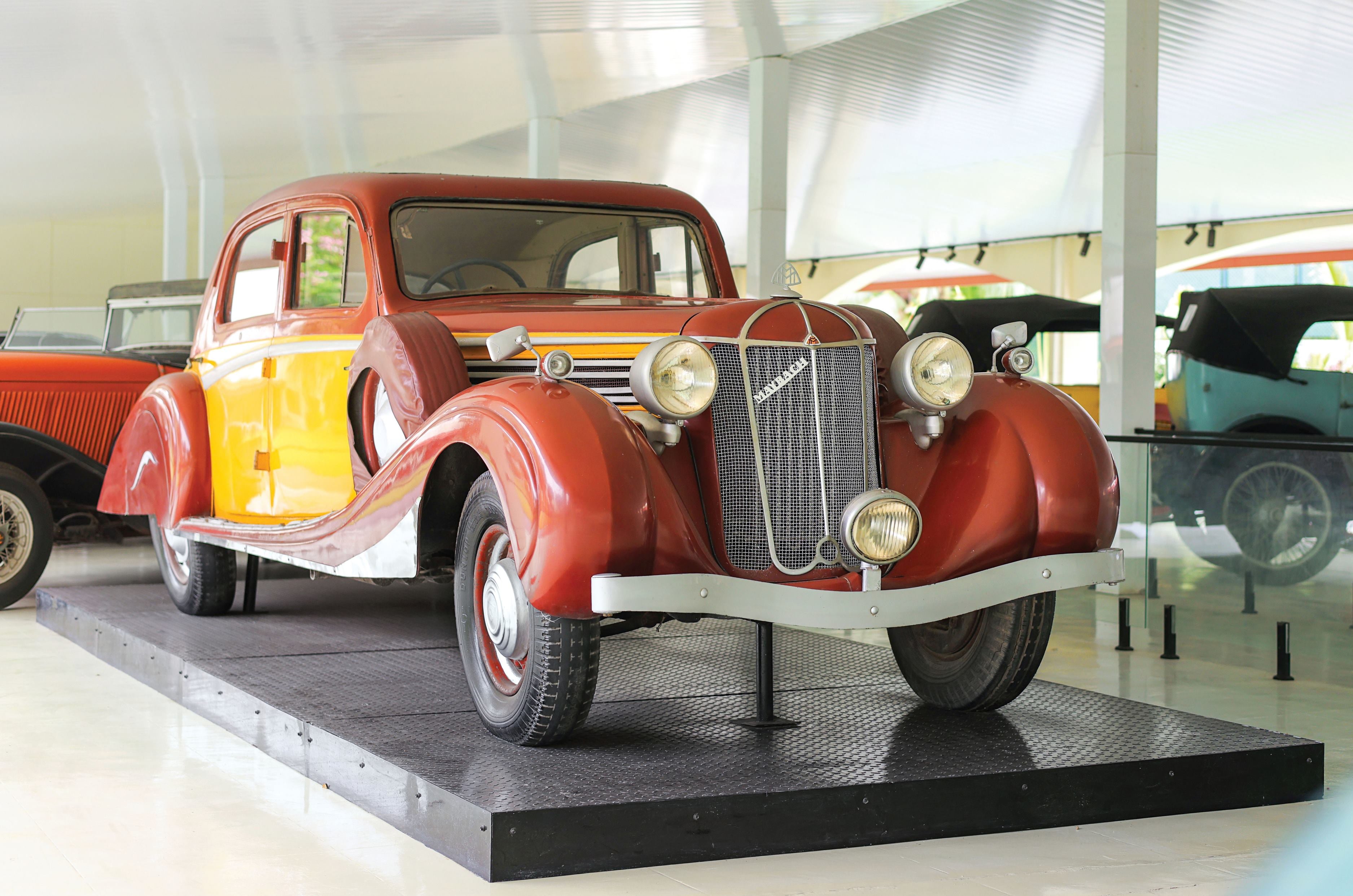
As we get to Ahmedabad, we turn into another historical location, Dastan Auto World – collector extraordinaire Pranlal Bhogilal’s collection, where the modern S-Classes met some more of their ancestors. A Maybach SW38, ordered by Maharaja Umaid Singh of Kota, draws admiring stares from the German members of the Mercedes crew, especially its aerodynamic profile. Capable of nearly 160kph, it was one of the fastest four-doors of its time. Equally captivating are Mercedes’ post-war comeback cars – the 300S ‘Adenauers’. Named after Germany’s first Chancellor, who famously rode in one with his hat on, this limousine is what eventually evolved into the S-Class.
Heritage and high tech
You can trace the journey via the stickers on the cars.
The 140 Years, 140 Places drive captured the duality of Mercedes perfectly; the brand embodies both heritage and innovation in equal measure, both streams converging seamlessly. As the convoy continues its odyssey, what’s clear is that this is a celebration not only of Mercedes’ past, but also the brand’s ability to connect eras, cultures and people through the universal language of the automobile.
भारत की तिलोत्तमा सेन, विदर्सा विनोद और आशी चौकसी की तिकड़ी ने एशियाई खेलों में शनिवार को महिलाओं की 50 मीटर राइफल थ्री पोजिशंस में रजत पदक जीता और तिलोत्तमा व्यक्तिगत स्पर्धा में चौथे स्थान पर रही।भारतीय टीम ने 1763 अंक बनाकर दूसरा स्थान हासिल किया। चीन ने 1773 अंक लेकर खेलों के रिकॉर्ड के साथ स्वर्ण पदक जीता जबकि कजाखस्तान को कांस्य पदक मिला।
व्यक्तिगत फाइनल में तिलोत्तमा ने अहम मौके पर 9.4 स्कोर किया जिससे पदक करीब से हाथ से निकल गया। विदर्सा 327.4 अंक लेकर पांचवें स्थान पर रही।तिलोत्तमा फाइनल में पहले 25 शॉट के बाद आगे चल रही थी और 30 शॉट के बाद तीसरे स्थान पर खिसक गई। उनका स्कोर 337.3 रहा।
चीन की जिआयु हान ने 359. 0 के एशियाई चैम्पियनशिप रिकॉर्ड के साथ स्वर्ण पदक जीता। चीन की ही लियुआन झांग (358 . 8) को रजत और दक्षिण कोरिया की जियुन किम (348.4) को कांस्य पदक मिला।
फाइनल में नीलिंग पोजिशन के बाद तिलोत्तमा 102.4 अंक लेकर पांचवें और विदर्सा 102.1 अंक के साथ छठे स्थान पर थी। प्रोन में दोनों का प्रदर्शन औसत रहा लेकिन स्टैंडिंग में उन्होंने वापसी की जो पदक दिलाने के लिये काफी नहीं थी।
इससे पहले क्वालीफिकेशन में आशी और तिलोत्तमा शीर्ष तीन में रहे जिन्होंने 395.25 एक्स और 395.23 एक्स स्कोर किया।विदर्सा ने 588 स्कोर करके क्वालीफिकेशन में छठा स्थान हासिल किया।विश्व में 107वीं रैंकिंग पर काबिज तिलोत्तमा नीलिंग, प्रोन और स्टैंडिंग में कुल 590 अंक लेकर तीसरे स्थान पर रही। वहीं आशी ने 585 अंक बनाये।
SILVER FOR BHARAT!
Heartiest congratulations to Tilottama Sen, Vidarsa Vinod Kochalumkal and Ashi Chouksey on winning the Silver Medal in the Women’s 50m Rifle 3 Positions Team event at the Asian Games 2026.
आशी और तिलोत्तमा ने नीलिंग और प्रोन चरण में 395 स्कोर किया जिसमें आशी ने इनर 10 में 25 और तिलोत्तमा ने 23 निशाने लगाये।तिलोत्तमा ने स्टैंडिंग में बेहतर प्रदर्शन करके 590 स्कोर किया और शीर्ष तीन में पहुंच गई।विदर्सा ने भी फाइनल में जगह बनाई। 50 मीटर राइफल थ्री पोजिशंस में निशानेबाज नीलिंग, प्रोन और स्टैंडिंग पोजिशन में निशाने लगाते हैं।
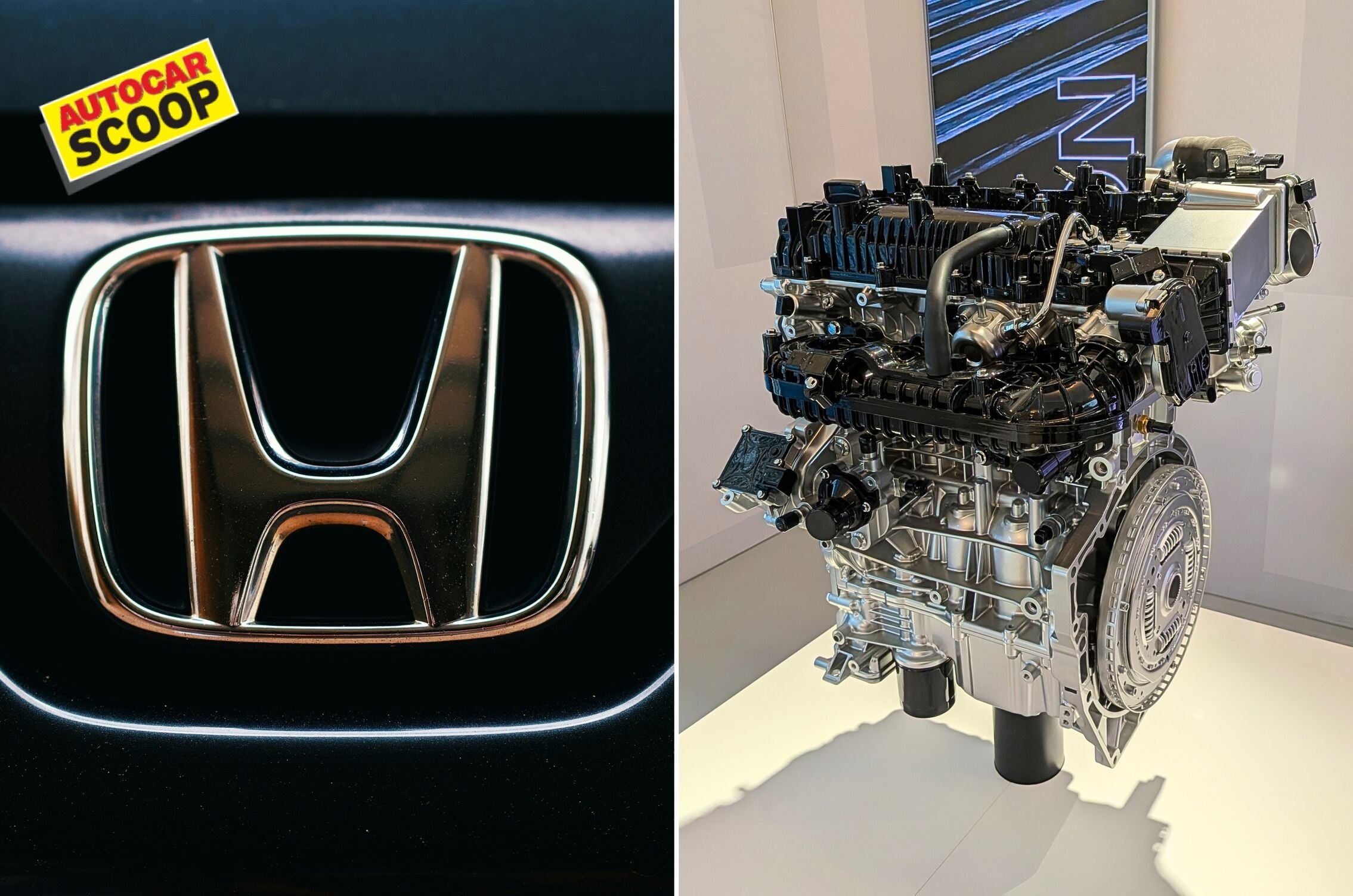
Honda Cars India is in talks with Horse Powertrain to outsource a 1.2-litre engine with petrol, hybrid and CNG options for an upcoming compact SUV, Autocar Professional, our sister publication, has learnt.
Horse Powertrain is a joint venture between Renault Group and Geely, with Saudi Aramco as a shareholder, and it specialises in combustion and hybrid powertrains. It already has a foothold in India: the new Renault Duster, due to launch on October 17, will use a Horse 1.8-litre hybrid. The company is keen to grow its customer base among Indian carmakers and is understood to be planning a local engine plant. Fully localised engines would give buyers like Honda a significant cost advantage.
For Honda, the move would be a major departure. Engines have long been the heart of its cars, and its reputation for performance, efficiency and reliability is built on them. Handing over this core component would once have been unthinkable.
However, Honda faces pressure on two fronts with its current 1.2- and 1.5-litre petrol line-up. It must meet tightening emission and fuel-efficiency norms, and it must offer the multiple fuel options Indian buyers increasingly want, especially CNG.
Developing all of that in-house for a price-sensitive segment is costly, and sourcing a ready multi-fuel engine family would solve both problems at once.
The upcoming compact SUV is understood to be under evaluation with an existing Honda platform used in Indonesia. A price range of Rs 9 lakh to Rs 12 lakh and an October 2028 start of production have been discussed as project targets. Honda has not confirmed the vehicle or its specifications.
A new way of working
The engine discussions are part of a radical change in Honda’s strategy to develop cars for India, with specialist partners taking on a larger share of the work from the outset.
Tata Technologies is being engaged for vehicle design and engineering execution, while TCS is expected to work on the infotainment system. Honda wants design, testing and supplier development to proceed in parallel, helping it bring new vehicles to market faster.
The company is targeting a reduction in the development cycle for a full model change from around 49 months to about 30 months. This is a target for its proposed development process, not a confirmed timeline for the compact SUV.
Honda’s new approach starts with the specifications and price required for India, rather than adapting a global product late in its development. The company would retain responsibility for overall vehicle performance targets and final validation, while engineering partners take a greater role in design, verification and supplier management.
Asked about the reported arrangements, Honda Cars India declined to confirm specific partners or programmes. “We work with a wide ecosystem of technology, engineering and supplier partners. However, we do not comment on specific partners, sourcing discussions or future powertrain programmes,” a company spokesperson told Autocar Professional.
“Honda is continuously strengthening its product development capabilities in India, with the objective of developing products that are increasingly relevant to Indian customers while also leveraging India’s growing engineering capabilities,” the spokesperson added.
Cost competitiveness is central to the plan. Honda intends to make greater use of Indian engineering and suppliers while retaining its vehicle performance and durability targets. It also sees an opportunity to attract customers moving from two-wheelers to their first car. Many of them currently choose rival car brands despite owning a Honda two-wheeler.
PF2 platform plan dropped
Separately, Autocar Professional understands that Honda has dropped the PF2 platform project, which had been expected to form the basis of the next-generation City sedan and Elevate SUV. The decision raises questions about which platform Honda will use for the successors to two of its key India models.
Honda Cars India declined to confirm the change. “We do not comment on speculation regarding specific future platforms or product-development programmes,” the spokesperson said.
The company stressed that the decision should not be read as a plan to discontinue either model. “City and Elevate are important models for Honda in India, and both will continue to play an important role in our business,” the spokesperson said. Details of their future generations, platforms and technologies will be announced at the appropriate time, the spokesperson added.
Honda declined to identify the architecture for future India-bound EVs. It said India would play an increasingly important role as a manufacturing and development base, with future products drawing on Honda’s global electrified technologies and local engineering capabilities.
Suzuki Motor Corporation aims to halve the time it takes to develop a new vehicle by 2030, as it changes how its engineering and manufacturing teams work together. The Japanese carmaker has also set targets to improve development efficiency by 30% and production efficiency by 50%. The development targets are measured against FY20; the production target uses its Manesar plant in India as the benchmark.
New Maruti Suzuki models and facelifts expected to arrive quicker.
Carmaker to bring nine new models including seven new SUVs over three years.
Company targeting annual production capacity of four million units from FY30.
How does Suzuki plan to halve new model development time?
The announcement comes as Maruti Suzuki works to speed up an unusually large product programme. Our sister publication Autocar Professional reported in June, that the company was targeting a reduction in its vehicle development cycle from 48 months to 36 months. It plans to introduce nine new models over three years, including seven SUVs, according to sources familiar with the programme. Maruti’s 36-month goal and Suzuki’s 2030 target have different baselines.
The number of vehicles is only part of the challenge. New models must be developed with a wider choice of powertrains, including petrol, CNG, hybrid, flex-fuel and electric options. Each powertrain adds work for engineering, validation, procurement and suppliers before production can begin.
Suzuki plans to bring those functions into a vehicle programme earlier. Planning, design, production, quality and procurement teams will work in parallel, supported by more digital engineering and greater use of shared modules. The aim is to find problems sooner and reduce the time lost when work has to be passed back between teams. Maruti Suzuki has been moving in the same direction. Autocar Professional also reported that it was expanding simulation and virtual testing, seeking earlier supplier involvement and working to develop components, tooling and manufacturing processes concurrently.
Suzuki develops core technologies in Japan and shares them with Maruti Suzuki, which adapts products for Indian customers and prepares them for production. That arrangement will face a heavier workload as India grows as a manufacturing and export base. Suzuki is targeting annual production capacity of about four million vehicles in the country from fiscal 2030 onward.The company has not disclosed the current group-wide development period against which its 2030 target will be measured.
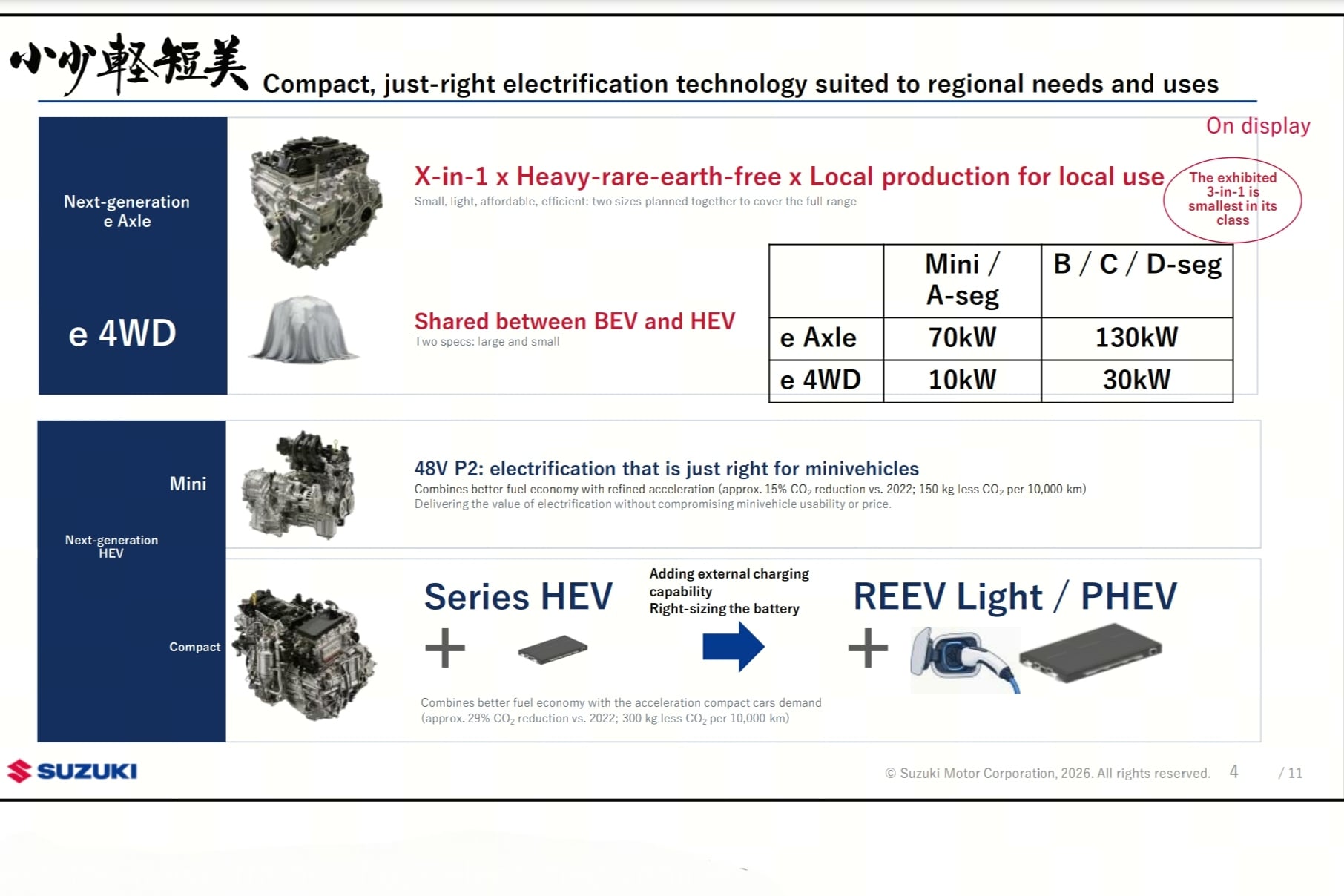
Suzuki Motor Corp has confirmed plans to develop a range extender for compact cars, taking its in-house series hybrid programme towards a vehicle that can also be charged externally. The announcement follows our exclusive scoop from over two years ago wherein we reported that Maruti Suzuki’s is working on an in-house series hybrid system.
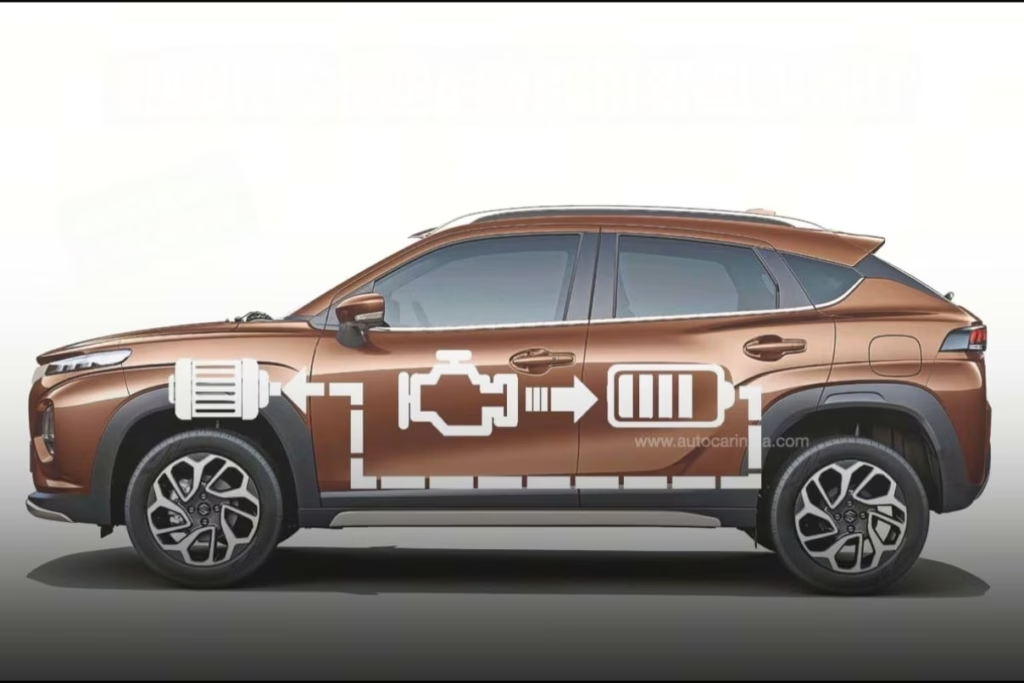
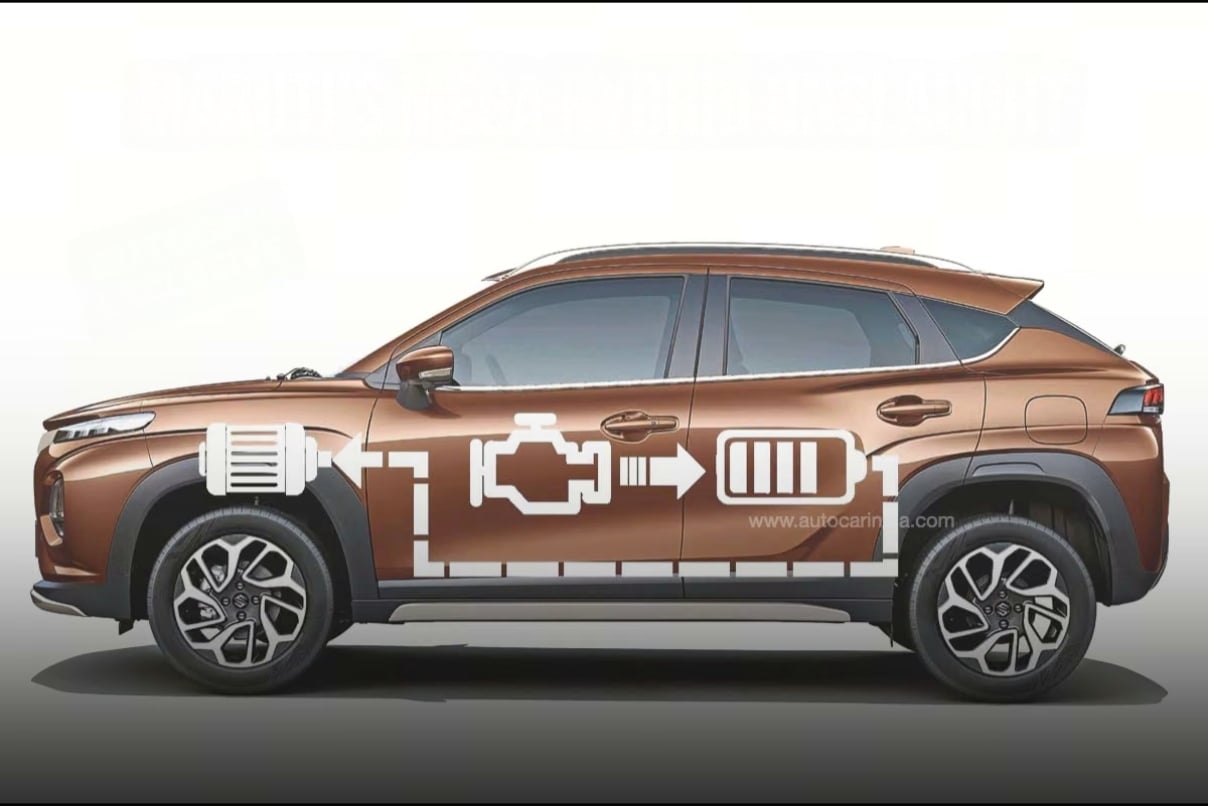
‘REEV light’ system uses an e-motor to drive wheels while engine acts as a generator.
Suzuki aims to reduce CO₂ emissions by about 29% with its compact-car series hybrid.
The proposed system, called “REEV Light”, would use an electric motor to drive the wheels and an engine to generate electricity when needed. Suzuki plans to add a charging connection and a battery sized for the vehicle’s intended use, allowing drivers to plug in without depending solely on charging for longer journeys.
Suzuki range-extender hybrid with plug-in capability: What is it?
“For compact cars, we are preparing a series HEV that generates electricity from fuel and drives on the motor, and we will further evolve this series by adding external charging capability and a right-sized battery to create a light range extender,” the Japanese company said. “It will become a ‘REEV Light’ that does not carry an oversized battery yet lets you drive without worrying about the remaining charge,” Suzuki stated.
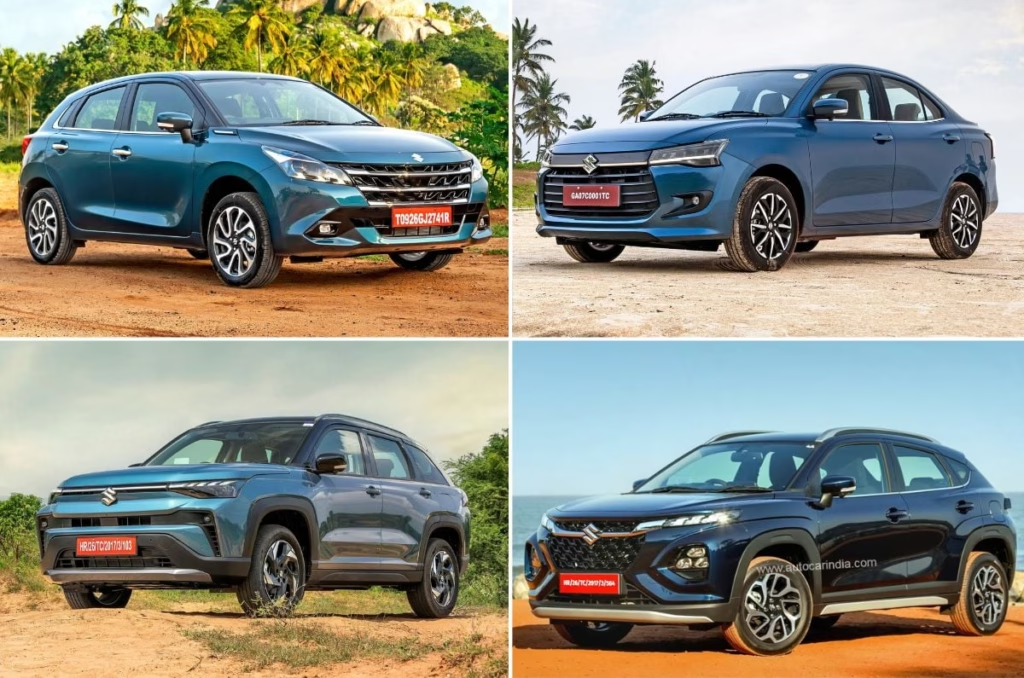
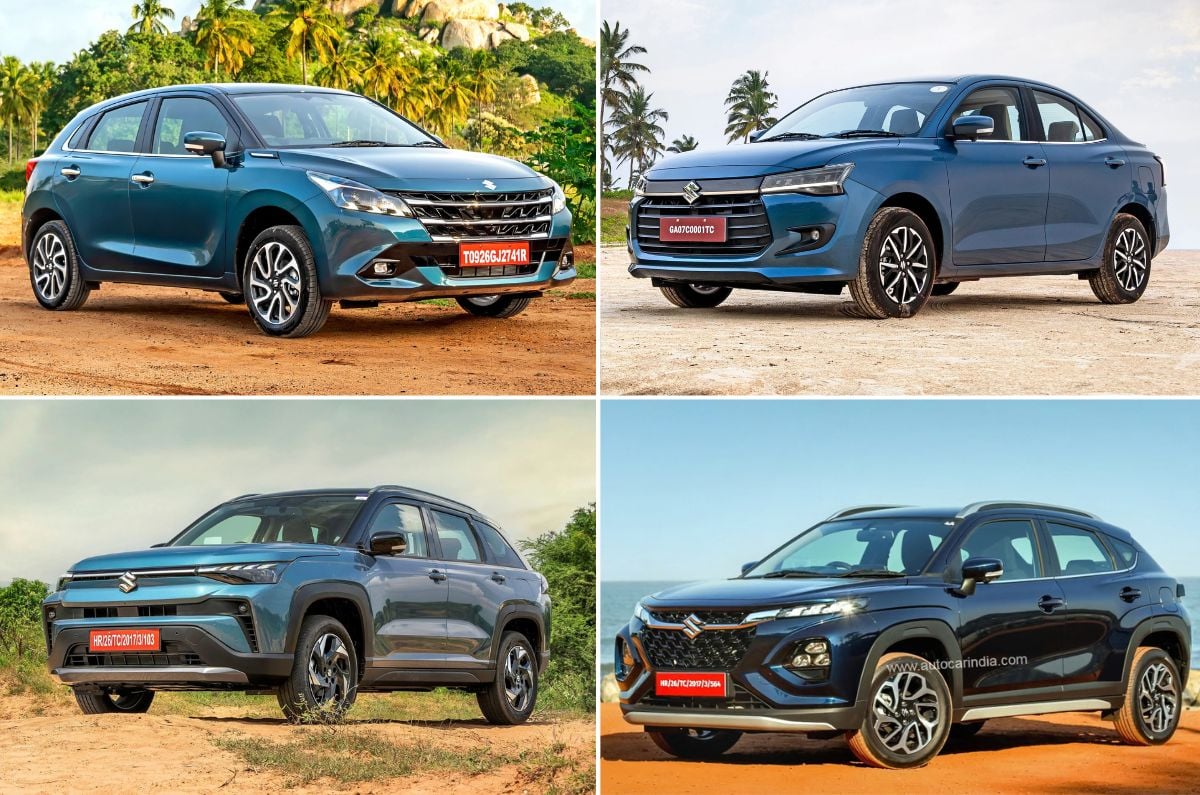
The report identified the Fronx and Baleno among the smaller models planned for the system and said the 1.2-litre, three-cylinder Z12E engine would serve as a generator. Suzuki subsequently confirmed development of its own strong hybrid powertrain for lower and mid-level models.
REEV Light is a further development of that series hybrid concept. The series hybrid can generate its own electricity from fuel and does not need to be plugged in; the proposed range extender would give owners the additional choice of external charging. Suzuki has not said whether REEV Light will use the Z12E engine or be fitted to either model named in Autocar India’s earlier report.
Suzuki intends to develop both systems together, sharing core platforms and basic designs. For smaller vehicles, the cost of adding an engine, motor and battery is a central challenge. Autocar India reported that Maruti Suzuki chose the series hybrid layout partly because it could cost less to produce than a system in which both the engine and motor can drive the wheels. Maruti Suzuki uses Toyota-supplied series-parallel hybrid technology in higher-end vehicles; its own series hybrid is aimed at smaller models.
Battery size is also shaping Suzuki’s approach. The company says vehicles should carry the capacity their customers need without the weight and material cost of an oversized pack. In REEV Light, external charging would supply electricity for trips within the battery’s range, while the engine could generate power for longer journeys.
Suzuki estimates that its compact-car series hybrid could reduce CO₂ emissions by about 29% against its stated 2022 reference, or roughly 300 kg over 10,000 km. It has not released an equivalent estimate, battery capacity or electric-only range for REEV Light.
The development could broaden Maruti Suzuki’s options as it expands beyond petrol and CNG into more hybrid and electric models. Whether the plug-in range extender joins its India line-up, and which vehicle would receive it, remains open.