MG Hector Tomahawk PHEV vs Toyota Innova Hycross Hybrid specs, features compared

MG Hector Tomahawk PHEV vs Toyota Innova Hycross Hybrid specs, features compared
MG Hector Tomahawk PHEV vs Toyota Innova Hycross Hybrid

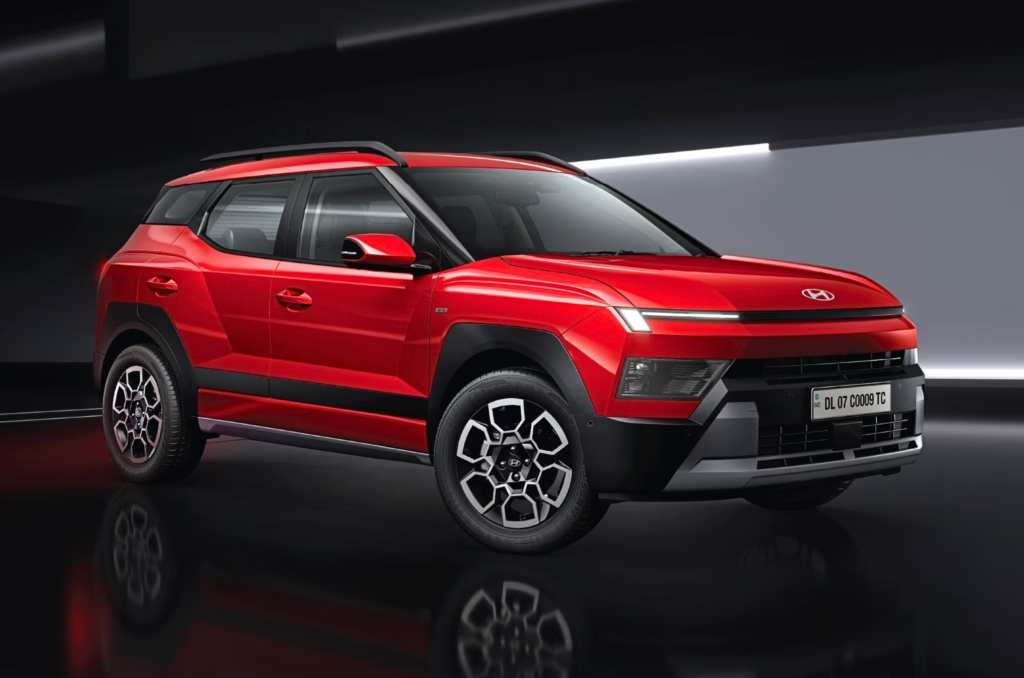
While both models here are hybrids and have 7 seats across three rows, they offer different hybrid technologies. With the ADAPT platform-based JSW MG Hector Tomahawk PHEV, India has its first-ever mass-market plug-in hybrid vehicle making its entry in the hugely popular SUV segment. On the other hand, the TNGA-C platform-based Toyota Innova Hycross is an MPV and offers a strong-hybrid powertrain. Here’s how they stack up in their fully loaded trims.

Explore full specs, features and a price breakdown in our Hector Tomahawk PHEV and Innova Hycross Hybrid comparison.

MG Hector Tomahawk PHEV Essence vs Toyota Innova Hycross Hybrid ZX (O): Dimensions

The Innova Hycross is larger and offers a slightly bigger boot with all seats in place

MG Hector Tomahawk PHEV Essence vs Toyota Innova Hycross Hybrid ZX (O) dimensions


MG Hector Tomahawk PHEV

Toyota Innova Hycross Hybrid

Length (mm)

4,745

4,755

Width (mm)

1,850

1,850

Height (mm)

1,770

1,790

Wheelbase (mm)

2,810

2,850

Boot space (litres)

192

239

Wheel size (inches)

18

18

The Innova Hycross Hybrid is 10mm longer and 20mm taller than the Hector Tomahawk PHEV. The Toyota MPV also has a wheelbase that’s longer by 40mm, while both cars have identical width figures and sport 18-inch alloy wheels in their top-spec trims. The Innova Hycross Hybrid’s luggage capacity with the third row in place is greater by 47 litres. One of the factors limiting the outright cargo volume of the Hector Tomahawk PHEV is its more space-consuming plug-in hybrid tech.

MG Hector Tomahawk PHEV Essence vs Toyota Innova Hycross Hybrid ZX (O): Powertrain

The plug-in hybrid powertrain of the MG SUV is more fuel-efficient and offers more power 

MG Hector Tomahawk PHEV Essence vs Toyota Innova Hycross Hybrid ZX (O) powertrain options


MG Hector Tomahawk PHEV

Toyota Innova Hycross Hybrid

Engine

1.5-litre naturally aspirated petrol

2.0-litre naturally aspirated petrol

Battery size

20.5kWh

1.6kWh

Electric motor type

Permanent magnet synchronous motor

Permanent magnet synchronous motor

Drive configuration

FWD

FWD

Total system output

198hp, 230Nm

184hp, 188Nm

Transmission

DHT

eCVT

0-100kph

9.0 seconds

10.69 seconds*

Claimed mileage

50kpl

22.16kpl

Fuel tank

52 litres

52 litres

AC charging

7.5 hrs at 3.3kW (10-100%)

DC fast charging

35 mins at 25kW (30-80%)

*Autocar India-tested 0-100kph time.

The strong hybrid powertrain of the Toyota Innova Hycross offers a couple of drive modes – including pure-electric and engine + electric. However, its compact nickel metal hydride (NiMH) battery means that the EV mode of the Innova Hycross Hybrid is understandably more limited than the MG Hector Tomahawk PHEV’s, requiring the 2.0-litre petrol engine to step in more often.

The claimed mileage figure of the Innova Hycross Hybrid is 27.84kpl worse than the MG plug-in hybrid SUV, and despite the same fuel tank size, the former’s combined range tops out at around 800km, as per our real-world test of the Toyota MPV. Meanwhile, the plug-in hybrid system of the MG Hector Tomahawk PHEV offers more flexibility and comes with four main drive modes. The larger 20.5kWh battery pack and 1.5-litre engine allow for a combined claimed range of over 1,100km.

The Hector Tomahawk PHEV not only offers a claimed pure-electric range of over 115km, but it can also have the engine charging the battery pack while the electric motor drives the front wheels. This is a drive mode that isn’t offered with the Toyota Innova Hycross Hybrid. To extract the highest possible efficiency from its hybrid system, the Hector Tomahawk PHEV needs to be plugged in to an AC or a DC charger in order to fully top up its battery pack.

Depending on the battery’s SoC, both cars can rely entirely on their petrol engine to drive the wheels. Compared to the Innova Hycross Hybrid’s e-CVT (electronically controlled continuously variable transmission), the Hector Tomahawk PHEV gets a DHT (Dedicated Hybrid Transmission) with an e-clutch. The combined output of the MG Hector Tomahawk PHEV is 14hp and 42Nm more than what the Toyota Innova Hycross Hybrid offers. 

MG Hector Tomahawk PHEV Essence vs Toyota Innova Hycross Hybrid ZX (O): Exterior features

Different body styles aside, both cars are similarly equipped on the outside

MG Hector Tomahawk PHEV Essence vs Toyota Innova Hycross Hybrid ZX (O) exterior features


MG Hector Tomahawk PHEV

Toyota Innova Hycross Hybrid

Auto LED headlamps

Yes

Yes

LED DRLs

Yes

Yes

Backlit logo

Yes

No

Sequential turn signals

Yes

Yes

Front fog lamps

No

Yes (LED)

Rear fog lamps

Yes (LED)

No

Welcome lights

No

Yes

Powered ORVMs

Yes (with auto-fold function)

Yes (with auto-fold function)

Body cladding

Yes

No

Roof rails

Yes

No

Rear spoiler

Yes

Yes

Powered tailgate

Yes

Yes

Radio antenna

Windscreen-integrated

Sharkfin

Colours

Mono-tone and dual-tone

Mono-tone

The MG Hector Tomahawk PHEV is offered in two dual-tone colour options and six mono-tone shades, including a couple of bolder choices. The Toyota Innova Hycross Hybrid is restricted to six simpler-looking colours. The  SUV body style aside, the Hector Tomahawk PHEV also sports a backlit ‘MG’ logo up front plus prominent roof rails and body cladding.

Where the Innova Hycross Hybrid gets the traditional sharkfin radio antenna, the Hector Tomahawk PHEV has its antenna embedded in the windscreen. The Toyota Innova Hycross Hybrid gets front LED fog lamps, whilst the MG Hector Tomahawk PHEV features rear LED fog lamps. While the top-spec trims of both cars get automatic LED headlamps and sequential turn indicators, it’s only the Toyota that offers ‘welcome’ lights.

MG Hector Tomahawk PHEV Essence vs Toyota Innova Hycross Hybrid ZX (O): Interior features

The Hector Tomahawk PHEV offers even more modern on-board tech than the Hycross

MG Hector Tomahawk PHEV Essence vs Toyota Innova Hycross Hybrid ZX (O) interior features


MG Hector Tomahawk PHEV

Toyota Innova Hycross Hybrid

Infotainment screen

15.6-inch (with swipe gestures)

10.1-inch

Digital driver’s display

8.8-inch

7.0-inch MID

Panoramic sunroof

Yes (dual-pane)

Yes (dual-pane)

Steering adjustment

Tilt & telescopic

Tilt & telescopic

Driver’s seat adjustment

6-way powered

8-way powered

Memory poweredYes (with ‘retreat’ function)Yes

Co-driver’s seat adjustment

4-way powered

4-way manual

Sliding & reclining second row

Yes

Yes (powered ottoman seats)

Split rear seats

Yes (second & third rows)

Yes (second & third rows)

Ventilated front seats

Yes

Yes

Leatherette upholstery

Yes

Yes

Rear sunblinds

Yes

Yes

Rear armrest

Yes (with cupholders)

Yes (individual armrests)

Wireless charger

Yes (50W)

No

Automatic climate control

Yes (dual-zone)

Yes (single-zone)

Ambient lighting

Yes (256 colours)

Yes (single-colour)

Audio system

10-speaker Infinity

9-speaker JBL

Wireless Apple CarPlay & Android Auto

Yes

Yes (CarPlay only)

USB ports

Yes (5 ports)

Yes (4 ports)

Connected car tech

Yes

Yes

Voice assistant

Yes (AI-powered & multilingual)

Yes

OTA updates

Yes

No

Multi-app support

Yes

No

The infotainment features of the top-spec MG Hector Tomahawk PHEV are more comprehensive. It comes with a larger touchscreen that supports swipe-gesture functionalities, along with an AI-powered voice assistant with six languages supported. MG’s tie-up with Jio means that there are plenty of apps offered – including gaming, streaming and more. The Hector Tomahawk PHEV also offers OTA software updates, wireless connectivity for both Apple CarPlay and Android Auto and a built-in 50-watt wireless charger.

The MG SUV’s convenience features further include a more comprehensive 256-colour ambient lighting system, a fully digital instrument panel, dual-zone AC, a powered front passenger seat, a ‘retreat’ function for the driver’s seat when the door is opened, armrest-integrated cupholders for the second row, and an additional USB port over the top-spec Toyota Innova Hycross Hybrid.

However, the latter offers individual & powered captain chairs for the second row with a fold-away ottoman function. The 7-seat capability of the Innova Hycross comes by way of a three-seat third bench. The minimalist interior of the Hector Tomahawk PHEV looks modern but the increased reliance on the touchscreen can come in the way of everyday usability, especially while on the move. The Innova Hycross Hybrid’s interior, meanwhile, offers plenty of physical switchgear that are much easier to use.

MG Hector Tomahawk PHEV Essence vs Toyota Innova Hycross Hybrid ZX (O): Safety features

Both cars are relatively well-equipped on the safety front

MG Hector Tomahawk PHEV Essence vs Toyota Innova Hycross Hybrid ZX (O) safety features


MG Hector Tomahawk PHEV

Toyota Innova Hycross Hybrid

Airbags

6

6

ABS with EBD

Yes

Yes

Electronic stability program

Yes

Yes

Traction control system

Yes

No

Hill-hold assist

Yes

Yes

TPMS

Yes

Yes

Parking sensors

Yes (front & rear)

Yes (front & rear)

360-degree camera

Yes

Yes

Electronic parking brake

Yes (with auto-hold function)

Yes (with auto-hold function)

Auto-dimming IRVM

Yes

Yes

Rain-sensing wipers

Yes

No

ISOFIX

Yes

Yes

Rear wiper and defogger

Yes

Yes

All-wheel disc brakes

Yes

Yes

ADAS

Yes

Yes

The fully loaded trims of both these cars offer all the basic passive and active safety aids that buyers at this price bracket expect. While both come with ADAS (Advanced Driver Assistance Systems), it’s the MG Hector Tomahawk PHEV that packs in more features within its ADAS suite. Its adaptive cruise control aid integrates Bend Cruise Assistance (BCA), which slows down the vehicle when approaching corners. There’s also Traffic Jam Assist, which works alongside other active lane-keeping measures.

MG Hector Tomahawk PHEV Essence vs Toyota Innova Hycross Hybrid ZX (O): Other features

The MG SUV adds a few nice-to-have features over the equivalent Innova Hycross

MG Hector Tomahawk PHEV Essence vs Toyota Innova Hycross Hybrid ZX (O) other features


MG Hector Tomahawk PHEV

Toyota Innova Hycross Hybrid

Drive modes

Yes (4)

Yes (3)

Paddle shifters

No

Yes

V2V and V2L

Yes

No

The MG Hector Tomahawk PHEV offers Eco, Normal, Sports and Custom drive modes, whereas the Toyota Innova Hycross Hybrid gets Eco, Normal and Power – one less than the MG. The latter also lacks Vehicle to Vehicle (V2V) and Vehicle to Load (V2L) functionalities that are available with the Hector Tomahawk PHEV.

Conclusion

MG Hector Tomahawk PHEV Essence vs Toyota Innova Hycross Hybrid ZX (O) prices


MG Hector Tomahawk PHEV

Toyota Innova Hycross Hybrid

Prices (In Rs, lakh)

27.79

31.84

While the prices of the MG Hector Tomahawk PHEV are currently introductory, the delta between the two cars here is steep. The top-spec Toyota Innova Hycross Hybrid ZX (O) is priced Rs 4.05 lakh more than fully loaded Essence trim of the MG plug-in hybrid SUV. Its affordability factor notwithstanding, the Hector Tomahawk PHEV Essence trim gets a more comprehensive & punchier hybrid powertrain that offers better mileage, along with a better-finished and more premium-looking interior. Moreover, if you prefer an SUV body style, the MG Hector Tomahawk PHEV would be worth a serious look.

Also read

MG Hector Tomahawk EV vs PHEV: Differences explained

Maruti Brezza ZXi+ vs Tata Nexon Fearless+ PS: Which should you buy?

Maruti Brezza ZXi+ vs Tata Nexon Fearless+ PS: Which should you buy?

Maruti Brezza ZXi+ vs Tata Nexon Fearless+ PS: Which should you buy?
Maruti Brezza vs Tata Nexon

The Maruti Brezza and Tata Nexon are among the bestselling compact SUVs in the Indian market. While the former received a comprehensive update that introduced cosmetic changes, more features and a powerful new turbo-petrol engine, the latter continues to attract consumers with a wide choice of powertrains. If you are looking to buy a compact SUV, we compare the Brezza’s top-spec ZXi+ trim and the Nexon Fearless+ PS to find out which offers better value for money.

Explore full specs, features and a price breakdown in our Brezza vs Nexon comparison.

Maruti Brezza vs Tata Nexon: Dimensions

Brezza is taller, while Nexon has a bigger boot

Maruti Brezza vs Tata Nexon: Dimensions


Maruti Brezza

Tata Nexon

Difference

Length (mm)

3,995

3,995

Width (mm)

1,790

1,804

-14

Height (mm)

1,685

1,620

+65

Wheelbase (mm)

2,500

2,498

+2

Ground clearance (mm)

198

208

-10

Boot space (litres)

328

382

-54

Only the length of both models is identical. Beyond that, the Brezza is taller and has a slightly longer wheelbase than the Nexon. On the other hand, the Nexon is wider, rides higher off the ground and has a larger boot.

Maruti Brezza vs Tata Nexon: Powertrain options

Brezza ZXi+ offers limited powertrain options

Maruti Brezza vs Tata Nexon: Powertrain options


Maruti Brezza

Tata Nexon

Powertrain

Naturally aspirated petrol | Turbo-petrol

Turbo-petrol | CNG | Turbo-diesel 

Engine configuration

1.5-litre, 4-cyl | 1.0-litre, 3-cyl

1.2-litre, 3-cyl | 1.2-litre, 3-cyl | 1.5-litre, 4-cyl 

Power (hp)

103 | 110 

120 | 100 |115

Torque (Nm)

139 | 170

170 | 170 | 260

Transmission

6MT | 6AT

6MT / 7DCT | 6MT / 6AMT | 6MT 

The Brezza ZXi+ is available only with the naturally aspirated petrol automatic and turbo-petrol manual powertrains. On the other hand, the Nexon Fearless+ PS offers a wide range of options: a turbo-petrol manual and automatic, a diesel manual and automatic, and a CNG manual. As for their turbo-petrol engines, the torque is identical, but the Nexon’s larger mill delivers more power.

Maruti Brezza vs Tata Nexon: Exterior features 

Nexon offers some feel-good features like welcome/goodbye animations

Maruti Brezza vs Tata Nexon: Exterior features 


Maruti Brezza

Tata Nexon

Headlights 

LED projector

LED projector

Tail-lights

LED

Connected LED

Welcome/goodbye animations

No

Yes

Sequential turn indicators

No

Yes

Daytime running lamps (DRLs)

Yes

Yes

Fog lamps

LED

LED

Wheels

16-inch

16-inch

Outside rearview mirrors (ORVMs)

Electrically adjustable, auto-folding

Electrically adjustable, auto-folding

Roof rails

Yes

Yes

Rear wiper, washer

Yes

Yes

Colour options

Monotone and dual-tone

Dual-tone

Both the Brezza and Nexon are similarly equipped on the exterior, with LED light setups, DRLs, fog lamps, electrically adjustable and auto-folding ORVMs and 16-inch alloy wheels. However, the Nexon gets some fancier features such as welcome/goodbye animations for the light setups, along with sequential turn indicators. As for colour options, the Nexon is limited to dual-tone schemes, whereas the Brezza offers monotone options as well.

Maruti Brezza vs Tata Nexon: Interior features 

Brezza not as well equipped as Nexon

Maruti Brezza vs Tata Nexon: Interior features


Maruti Brezza

Tata Nexon

Instrument cluster

Analogue dials with MID

10.25-inch display

Infotainment screen

10.1-inch

10.25-inch

Head-up display

Yes

No

Android Auto, Apple CarPlay

Wireless

Wireless

Sunroof

Single-pane

Panoramic

Audio system

6-speaker Arkamys Surround Sense

9-speaker JBL

Climate control

Automatic

Automatic

Rear AC vents

Yes

Yes

Driver seat adjustment

Manual

Manual

Front seat ventilation

Yes

Yes

Seat upholstery

Leatherette

Leatherette

Wireless phone charger

Yes

Yes

Air purifier

Yes

Yes

Connected car tech

Yes

Yes

Rear centre armrest

Yes

Yes

Rear sunshade

No

Yes

Ambient lighting

64-colour

No

60:40 split folding seat

Yes

Yes

Apart from multi-colour ambient lighting and a head-up display, the Brezza’s overall interior equipment falls short of the Nexon’s. The latter comes packed with features such as a digital driver’s display as opposed to analogue dials on the former, a panoramic sunroof, a slightly larger infotainment screen, more speakers and rear window sunshades.  

Maruti Brezza vs Tata Nexon: Driving tech

Brezza misses out on drive modes

Maruti Brezza vs Tata Nexon: Driving tech


Maruti Brezza

Tata Nexon

Drive modes

No

Eco, City and Sport

Paddleshifters

Yes

Yes

Cruise control

Yes

Yes

While paddleshifters and cruise control are available on both models, drive modes are offered only with the Nexon.

Maruti Brezza vs Tata Nexon: Safety features

Brezza comes equipped with more advanced safety tech 

Maruti Brezza vs Tata Nexon: Safety features


Maruti Brezza

Tata Nexon

BNCAP rating 

5 stars

5 stars

Blind-spot warning

Yes

No

Safe-exit warning

Yes

No

Rear cross-traffic alert

Yes

No

Airbags

6

6

Camera setup

360-degree

360-degree

Parking sensors

Front and rear

Front and rear

Disc brakes

Front only

Front only

Tyre-pressure monitoring system

Yes

Yes

Interior rearview mirror (IRVM)

Auto-dimming 

Auto-dimming

Hill-hold assist

Yes

Yes

ESC

Yes

Yes

Both the Brezza and Nexon have achieved a 5-star BNCAP crash-safety rating and are equally matched in terms of offering a basic safety kit, along with features such as a 360-degree camera and front parking sensor. But only the former comes with advanced safety systems such as rear cross-traffic alert and blind-spot and safe-exit warnings.

Maruti Brezza vs Tata Nexon: Price and verdict

Brezza’s more affordable, but Nexon’s powertrain range is hard to ignore

Maruti Brezza vs Tata Nexon: Prices


Maruti Brezza

Tata Nexon

NA petrol AT

13.54

Turbo petrol MT

11.16

12.34

Turbo petrol AT

12.55

Turbo diesel MT

13.45

Turbo diesel AMT

14.10

CNG MT

13.30

Comparing only the turbo-petrol manual powertrain, which is common to both, the Brezza is Rs 1.18 lakh more affordable than the Nexon. Notably, the Brezza ZXi+ NA petrol automatic costs almost a lakh rupees more than the Nexon Fearless+ PS turbo-petrol automatic. This is due to the higher tax on the 1.5-litre unit powering the Brezza. Moreover, the Nexon has a Fearless+ A PS trim that sits above the Fearless+ PS trim and brings Level 2 ADAS, but it is limited to the turbo-petrol automatic.

When it comes to choosing between the two, we’d recommend the Tata Nexon. Though the Brezza’s ZXi+ trim starts at a more affordable price point and is backed by Maruti’s widespread and hassle-free service experience, the Nexon’s multiple powertrain options are simply hard to ignore. Additionally, the Tata comes with more bells and whistles than the Maruti, and that’s why it’s our pick.

All prices are ex-showroom, India.

Which variant of the MG Hector Tomahawk PHEV should you buy?

Which variant of the MG Hector Tomahawk PHEV should you buy?

MG has launched the Hector Tomahawk PHEV as the first mass-market plug-in-hybrid (PHEV) car in India, priced from Rs 25.70 lakh (ex-showroom). It is offered in two trims: Exclusive and Essence, and like other MG cars, it is equipped with a plethora of modern-day features. If you are interested in the MG Hector Tomahawk PHEV, which variant should you choose? Let us find out.  

MG Hector Tomahawk PHEV powertrain options and prices

Both Hector Tomahawk PHEV variants get the same 1.5L engine and 20.5kWh battery

The MG Hector Tomahawk PHEV is offered with a 1.5-litre naturally aspirated petrol engine producing 102hp and 125Nm. It gets a 20.5kWh battery pack powering an electric motor producing 201hp and 237Nm. The battery pack has an indicative claimed range of 115km, and combined with the petrol engine, it could have a total range of around 1,100km. Both the Exclusive and Essence variants are offered with the same powertrain. 

MG Hector Tomahawk PHEV variant-wise BaaS, non-BaaS prices


Hector Tomahawk PHEV Exclusive

Hector Tomahawk PHEV Essence

Non-BaaS price

Rs 25.70 lakh

Rs 27.80 lakh 

BaaS price

Rs 21.79 lakh + Rs 3.2 per km*

Rs 23.89 lakh + Rs 3.2 per km*

*Rs 3.2 per km is charged as the battery rental fee for the battery-as-a-service (BaaS) scheme.

MG Hector Tomahawk PHEV variant-wise features

Exclusive

Price: Rs 25.70 lakh (or Rs 21.79 lakh + Rs 3.2 per km with BaaS)

  • Automatic LED projector headlights
  • LED taillights
  • LED DRLs
  • Rear LED fog lamps
  • Illuminated MG logo at the front
  • 18-inch alloy wheels
  • ORVM-mounted turn indicators
  • Glass antenna
  • Roof rails
  • Rear spoiler
  • Chrome finish on window beltline and door handles
  • Black body cladding on side and wheel arches
  • Brown and grey interior
  • Blue ambient lighting
  • 12.8-inch touchscreen infotainment system
  • 6-speaker sound system
  • Wireless Android Auto and Apple CarPlay support
  • 8.8-inch digital driver’s display
  • Panoramic sunroof
  • 6-way powered driver’s seat
  • 4-way powered co-driver’s seat
  • Ventilated front seats
  • Powered tailgate
  • 50W wireless phone charger
  • Leatherette seat upholstery
  • Leatherette materials on steering wheel and door pads
  • Drive modes: Eco, Normal, Sports, Custom
  • Rain-sensing wipers
  • PM2.5 air filter
  • Push-button start/stop
  • Powered ORVMs
  • Steering-mounted audio controls
  • Tilt and telescopic adjustable steering column
  • Cruise control
  • 2nd row features: 60:40 split, seat recline, one-touch tumble, centre armrest with cupholders
  • 3rd row features: 50:50 split
  • USB Type-A and Type-C chargers in 1st and 2nd rows
  • All four power windows with one-touch up/down and anti-pinch functions
  • Rear wiper and washer
  • Pet mode, Nap mode and Camp mode
  • Connected car technology
  • 6 airbags
  • 360-degree camera with under-bonnet and wheel views
  • Digital rearview monitor
  • Reverse parking sensors
  • All four disc brakes
  • Electronic parking brake with auto hold
  • TPMS
  • Front and rear defogger
  • ISOFIX child seat anchors
  • Hill hold control
  • Traction control
  • ESP
  • ABS+EBD


Essence (features over Exclusive)

Price: Rs 27.80 lakh (or Rs 23.89 lakh + Rs 3.2 per km with BaaS)

  • 15.6-inch touchscreen infotainment system
  • 10-speaker Infinity sound system
  • Rear window sunshades
  • Driver’s seat memory and welcome/exit retract functions
  • V2L, V2V and V2H charging support
  • Level-2 ADAS
  • Auto-dimming IRVM
  • Front parking sensors
  • 256-colour ambient lighting 
  • Red brake callipers
  • Sequential turn indicators

Which MG Hector Tomahawk PHEV variant should you buy?

We recommend the entry-spec Essence variant, as it is offered with a lot of modern-day features like a 12.8-inch touchscreen infotainment system, a panoramic sunroof, a powered tailgate and a 360-degree camera. It also costs Rs 2.10 lakh less than the top-spec Essence, making it the more value-for-money Hector Tomahawk PHEV variant. 

Prices are ex-showroom, India.

Exploring Utah in a Ford Expedition: Utah by the book

Exploring Utah in a Ford Expedition: Utah by the book
UTAH BY THE BOOK

In the analogue age, I planned road trips with paper maps, fluorescent highlighters and dog-eared guidebooks. Lately, however, Uncle Claude and Aunty Gemini have lured me into the world of artificial intelligence. When I asked them to suggest an adventurous drive through south Utah, they both recommended similar itineraries. It was like asking the chef at a dhaba to surprise me with something unusual and being served butter chicken instead. Zion, Bryce Canyon and Arches. Three magnificent National Parks connected by smooth highways and comfortable hotels.

Our search engine for Utah beyond the tourist trail. No signal required.

This route hits Utah’s greatest highlights, featuring soaring cliffs, towering hoodoos and delicate sandstone arches. However, the parks are often so busy that sedans circle overflowing car parks, rather like sharks patiently circling a lifeboat. I wanted roads that filtered out sedans and coaches, demanded preparation and delivered adventure, where the SUV became part of the journey rather than mere transport.

So, I turned my back on the algorithm and went analogue. While ordering the DeLorme Utah Atlas, Amazon suggested Freda J. Ryland’s Utah’s Best Kept Secrets, promising another Utah of mesas, switchbacks, unspoiled canyons, lonely dirt roads beyond the cellular umbrella and skies dark enough to make galaxies glow.

Her book was fuel for wanderlust; an invitation into a hidden Utah for those willing to stray off the tarmac. Though its typesetting suggested a clandestine hand-operated press during the Quit India movement, its content was pure gold. Paired with the DeLorme atlas and offline Gaia GPS, the trio was as dependable as egg, bacon and toast. Freda chose the destination, the atlas found the route, and Gaia confirmed where we were. What followed often felt like driving into a fairy tale.

Off-grid Utah demands a dependable 4×4. The Tremor waded rivers, shrugged off loose gravel, tenacious clay and steep gradients, and kept going long after the tarmac lost interest.

None of it would have happened without the Ford Expedition Tremor, our fairy godmother. A tad tubby at over two tonnes, it came with a locking rear differential instead of a magic wand. The twin-turbocharged 3.5-litre EcoBoost V6 dispatched highway miles effortlessly. Once the tarmac disappeared, the Tremor earned its keep, shrugging off clay, loose rock, river crossings and deeply rutted tracks with nonchalant competence.

Follow her gaze. A long-gone artist still finds an audience a thousand years on. Utah is peppered with petroglyphs.

We forayed deeper into Utah’s wild, unadulterated beauty, beyond the tourist grid. To secret trails and solitude, to dinosaur tracks in ancient rock and to petroglyphs spanning two millennia, many still a mystery. I couldn’t help wondering if some ancient scribbling was simply the 2 BC equivalent of ‘Vinod loves Veronica’.

The first road to justify Freda’s confidence was Utah Scenic Byway 12, climbing out of Escalante towards Boulder through the folded canyons of Grand Staircase-Escalante National Monument, among the last regions in the contiguous US to be properly surveyed. Past Calf Creek, the road narrowed onto a hogback, a ribbon of blacktop along a ridge, with the ground dropping hundreds of feet on both sides. Red rock canyons fell open left and right, and for a few minutes it felt like driving along the spine of the Earth.

The windscreen became Utah’s widescreen, live streaming breathtaking views with hardly a break. This is Scenic Byway 12 between Escalante and Boulder.

At Boulder, we turned onto the Burr Trail, first beaten into the landscape by cattleman John Burr in the mid 1800s. Soon the road slipped past Long Canyon, colloquially called Singing Canyon because its towering, tapering walls possess the sort of acoustics that could make a bathroom baritone believe he had missed his calling. I sang a few notes and was astonished when the sandstone tuned my discordant tone to the smoothness of Sinatra.

Then the scenery became rather more serious. In 1948, the Atomic Energy Commission arrived looking for uranium, widening the trail and blasting switchbacks that tumble nearly 800 feet in less than a mile into the Waterpocket Fold, a colossal wrinkle in the earth running nearly a hundred miles across southern Utah, its tilted rock exposed in great bands of colour. We descended towards Ticaboo as the Fold surrendered to open desert.

Morning coffee on the tailgate. The Expedition’s roomy interiors meant we could pull up and spend the night wherever we fancied.

We were hoping to camp at Muley Point, but we hadn’t accounted for Utah waylaying us with stupendous scenery, another slot canyon or lonely butte persuading us to stop every few miles. Around sunset, Muley Point was still hours away, so we turned into a secluded canyon and spent the night there, one of the trip’s happiest failures. We dropped the two rear seat rows into a flatbed, laid out a mattress, and slept under a sunroof full of stars and the Milky Way. We had camped at the base of the Henry Mountains, so remote that surveyors called them the Unknown Mountains until 1869.

The next morning, we pushed on to Muley Point through Bears Ears National Monument, named for a pair of buttes that really do resemble a bear’s ears poking above the treeline. An unmarked turn led to Muley Point, where the land simply stops a thousand feet above the San Juan River’s looping canyons, with views stretching to Monument Valley.

Look at the rocks above the Expedition. See anything? Someone did, and named it Lady in the Bathtub. Now try unseeing it. Welcome to the Valley of the Gods, where mesas and buttes come with wonderfully imaginative names.

Our next destination was the Valley of the Gods, the guidebook’s hidden Monument Valley twin. But first came the Moki Dugway, three miles of unpaved switchbacks blasted into Cedar Mesa in 1958 for trucks hauling uranium ore, dropping 1,100 feet at an 11 percent grade. The Tremor accepted the challenge with the calm assurance of a seasoned mountain guide.

At the bottom, a short detour brought us to Goosenecks State Park, where the San Juan River travels almost six miles in meanders to advance barely a mile and a half as the crow flies. From there, we turned into the Valley of the Gods, a dirt road meandering between sandstone monuments, nature’s own sculptures, with eccentric names. One was the Lady in the Bathtub. Had I not known the name, I might have seen only a rock. But once told, there she was, sitting bolt upright at one end of an enormous bath, her hair piled high and her back rather primly straight.

The Shafer Trail looked less like a road and more like a cartographer’s casual squiggle joining the top and bottom of a sandstone cliff. Then we drove it.

We slept another night in the car at the base of Rooster Butte, then rolled into urban Moab, our base for exploring the Needles and Island in the Sky districts of Canyonlands National Park, including the strange geological puzzle of Upheaval Dome. The highlight, though, was driving the Shafer Trail.

From the top, it was hard to believe vehicles drove down what looked like a pencil sketch etched onto a sandstone cliff.
The trail began as a foot route, widened for cattle by rancher John “Sog” Shafer, then again in the 1950s for the uranium trucks that shaped the Burr Trail and Moki Dugway.

The Needles, Canyonlands – a forest of red and white banded sandstone spires, stained by iron and carved improbably thin by water patiently working through every crack.

The Expedition tipped over the edge, and we were committed. The Tremor crept down in low range, engine barely above idle, brakes doing quiet, constant work as gravel skittered from under the tyres. Every switchback flung the door mirror out over open air, nothing but red rock and sky where the road should have been, and my stomach dropped a beat before the front wheels found the turn. The cabin stayed eerily composed, no lurch, no scrabble for grip, while everything outside the glass insisted we should be afraid. At the bottom, the Colorado River came into view, and I exhaled properly for the first time in twenty minutes.

The warning isn’t for broken roads, but for deep clay bogs that require the torque and traction of a 4×4 to escape.

The final road I want to tell you about is the 80-mile loop through Cathedral Valley. According to Ms Ryland, this was Capitol Reef at its most remote – towering monoliths, strange badlands and perfect seclusion. At the entrance, a sign minced no words: ‘Road Impassable for Most Vehicles. Travel at Your Own Risk’.

The dirt road climbs through the Bentonite Hills, bands of grey, purple and blue-green clay laid down eighty million years ago in an ancient inland sea, eroded into slopes that look lunar. Beyond them, the land opens onto a high bench where the Temples of the Sun and Moon stand, solitary honey-coloured monoliths like remnants of cathedrals of a long-lost civilisation.

What struck me most, standing before the Temple of the Sun, was how closely its silhouette echoed the thirteenth-century Temple of the Sun I knew well – still standing tall in Konark, Orissa. That was shaped by human hands wielding hammers and chisels, whereas this one by wind and water.

In the Cathedral Valley at The Temple of the Sun. Eighty million years in the making; no chisel required.

Most visitors run the Cathedral Valley Loop clockwise, meeting the Fremont River crossing at the start. We’d gone the other way, so it arrived at the very end, just short of Highway 24. Torrid brown water gushed across our path. Not crossing would mean backtracking 80 miles.

I waded in first to check for stone underfoot rather than clay, reading whether the current had strong opinions about being crossed. Satisfied, I waved the Tremor forward, and my partner drove it straight through, water climbing the doors. Then crossed again to pick me up, and once more just for fun, proof this was a vehicle built to encourage this kind of tomfoolery.

After Cathedral Valley, the long drive back to ordinary life began, the odometer past 1,300 miles. Looking back on those twelve days, I’m glad I chose the path not well trodden, as Robert Frost once suggested, in a digital age where it’s easiest to let the machines pick the route.

A badly printed, albeit meticulously researched book, an atlas, and a Ford that never once flinched had taken us somewhere far better than any algorithm would have dared suggest. Rather than a destination ticked off, Utah became one truly experienced, and that made all the difference.

The essentials

Self-sufficiency matters: A little preparation separates adventure from discomfort.

Water: Carry more than you think you need. We kept 20 litres in the Expedition.

Provisions: Stock up on energy bars, trail mix, fruit, chocolate, canned food, instant noodles, jerky and coffee. A camping stove is invaluable for hot meals in the middle of nowhere.

Fuel: Fill up whenever you can. Distances are vast and stations scarce.

Navigation: Download offline maps and carry a paper atlas. The DeLorme Utah Atlas and Gaia GPS worked well.

Clothing: Hot days, cold nights. Pack a warm layer and a sleeping bag.

Footwear: Sturdy hiking shoes.

Sun protection: A wide-brimmed hat, sunglasses, sunscreen and lip balm.

Vehicle: A high-clearance 4WD.

In-car essentials: First-aid kit, head torch, tyre gauge, air compressor and puncture repair kit.

Allow extra time. Utah ambushes you with one view after another, and the best memories happen at unplanned stops.

Skoda Superb diesel revealed in India ahead of 2027 launch

Skoda Superb diesel revealed in India ahead of 2027 launch
India-spec Skoda Superb front static image

Skoda has revealed the flagship fourth-generation Superb in India ahead of the sedan’s expected launch in the first half of 2027. The Czech manufacturer will bring the Superb’s range-topping Laurin & Klement (L&K) trim to India as a completely built unit (CBU) import. Customers can now register their interest in the Skoda Superb at dealerships, with deliveries slated to commence in the second quarter of 2027.

  1. Powered by a 150hp diesel engine, allowing a 9.2s 0-100kph claimed time
  2. Matrix LED headlights, LED tail-lights and 18-inch alloys to be offered
  3. Cabin gets a 12.9-inch infotainment unit, 3-zone AC and a 14-speaker sound system

Interestingly, the Superb was previously brought to India as a CBU import in 2024. However, this will be the first time the fourth-generation model is officially offered to Indian customers. Its arrival also marks the return of a diesel engine to the wider Volkswagen Group in India after a six-year absence. Diesel engines were last offered by the group in the country in 2020, before the BS6 emission norms came into effect.

Skoda Superb powertrain details

India-spec Superb will get a 150hp 2.0-litre diesel engine with a FWD setup

The India-spec Skoda Superb will be powered by a 2.0-litre diesel engine that produces 150hp and 290Nm. It will be mated to a 7-speed dual-clutch automatic transmission (DCT) that sends power to the front wheels (FWD). With this engine in the Superb, Skoda claims a 0-100kph sprint time of 9.2 seconds and an electronically limited top speed of 225kph.  

A more powerful 193hp version of this engine, paired with an all-wheel-drive (AWD) system, was showcased at the 2025 Auto Expo, but has now been ruled out for the final India-spec version.

The India-spec Superb will, however, be offered with Progressive Dynamic Steering and Dynamic Chassis Control (DCC) to automatically adjust the handling balance based on driving speed, road conditions and selected driving mode.

Skoda Superb exterior design

Matrix LED headlights, 18-inch alloy wheels and wraparound LED tail-lights

The fourth-generation Skoda Superb retains the elegant look usually associated with the model. Up front, it features the Skoda Signature grille with chrome slats and a chrome surround. The bumper has honeycomb mesh air inlets and a horizontal chrome bar in the centre. It gets Matrix LED headlights with a cornering function and LED daytime running lamps (DRLs) with welcome and goodbye animations.

Moving on to the profile, Skoda will offer the Superb with 18-inch dual-tone alloys as standard. The window surrounds have a chrome finish, and the front fenders have the ‘Laurin & Klement’ badge. At the rear are wraparound LED tail-lights with the same welcome animations as the front DRLs and a Skoda wordmark on the tailgate. 

Below are the dimensions of the Skoda Superb:

India-spec Skoda Superb dimensions and other specifications

Length

4,912mm

Width

1,849mm

Height

1,511mm

Wheelbase

2,841mm

Ground clearance

138mm (for UK-spec model)

Boot space

645 litres (for UK-spec model)

Skoda Superb interior design and features

Gets a cognac-hued cabin, two digital screens and a lot of convenience features

The interior, too, is as elegant as the exterior, featuring a dual-tone black-and-Cognac cabin theme and a simple dashboard with a 12.9-inch touchscreen infotainment system, a 10-inch digital driver’s display and a 3-spoke steering wheel with ‘Skoda’ wordmark. Like the Kodiaq SUV, it gets rotary dials with digital screens on the centre console to operate climate and audio controls. The seats have leatherette upholstery that matches the cabin’s colour scheme.

Other features include a 14-speaker Canton sound system, triple-zone climate control, a 25-Watt wireless phone charger, rear sunblinds and a powered tailgate with gesture support. The front seats are powered and offer features such as memory, heating, ventilation and massage. The Skoda Superb also comes with a ‘Sleep Package’ as standard, featuring adjustable headrests for the rear outboard seats and two blankets for added comfort.

Safety features include 10 airbags, a 360-degree camera, Level 2 advanced driver assistance systems (ADAS), an electronic parking brake, a tyre-pressure monitoring system (TPMS) and automatic parking assistance.

As a CBU import, the Skoda Superb is expected to have a premium positioning and be priced in the Rs 55 lakh-60 lakh range. However, with the India-EU Free Trade Agreement (FTA) set to come into force in 2027, reduced import duties could make the Superb more affordable. If Skoda manages to price it competitively, the Superb could be a fitting alternative to the Toyota Camry, currently the only other sedan in this premium segment.

Which variant of the Mahindra BE 6 Sporteq should you buy?

Which variant of the Mahindra BE 6 Sporteq should you buy?
Mahindra BE 6 Sporteq variants and features explained

Mahindra has rejigged the line-up of its entry-level born-electric SUV, the BE 6, and added a ‘Sporteq’ suffix to its name. The BE 6 Sporteq also gets some additional features, a new 70kWh battery option, and more. Let’s take an in-depth look at the BE 6 Sporteq line-up.

Mahindra BE 6 Sporteq price and powertrains

Mahindra BE 6 Sporteq price list* (Rs, lakh)

 59kWh70kWh79kWh
One19.45
Two20.95
Three21.9522.95
Three+23.9524.95
Four / Launch Edition26.95
FE24.45
FE Four26.95

*Exclusive of home charger and installation costs.

Pricing for the BE 6 Sporteq starts at Rs 19.45 lakh – a Rs 85,000 increase over the outgoing BE 6 – climbing all the way up to Rs 26.95 lakh. Seven BE 6 Sporteq variants are on offer, namely One, Two, Three, Three+, Four, FE, and FE Four. The ‘FE’ trims refer to the BE 6 Sporteq Formula E Freedom Edition, which gets sportier cosmetic tweaks. There’s a Launch Edition of the BE 6 Sporteq too, which is based on the top-spec Four variant and comes with unique exterior and interior finishes.

BaaS now available

Mahindra has also joined the BaaS (battery-as-a-service) bandwagon with the BE 6 Sporteq. With BaaS opted, the price of the lower-spec One and Two variants drops to Rs 11.45 lakh and Rs 12.95 lakh, respectively – a reduction of Rs 8 lakh – and the battery rental fee is pegged at Rs 3.75/km. BaaS pricing for other BE 6 Sporteq variants is yet to be revealed.

Mahindra BE 6 Sporteq powertrain details

 59kWh70kWh79kWh
Motor setupRearRearRear
Power (hp)231245286
Torque (Nm)380380380
Drive layoutRWDRWDRWD
MIDC-claimed range (km)548651683
10-100 percent 7.2kW AC charging (hrs)8.710.211.7
10-100 percent 11.2kW AC charging (hrs)678
20-80 percent DC charging time (mins)20 (120kW)20 (160kW)20 (180kW)

The BE 6 Sporteq retains the 59kWh and 79kWh battery options of the prior model, but adds the 70kWh pack that was introduced with the Mahindra XEV 9S. As before, all batteries are wired up to a single 380Nm rear-mounted (RWD) motor, outputting 231hp in 59kWh guise, 245hp in 70kWh spec, and 286hp in the 79kWh variants. MIDC-certified range stands at 548km, 651km, and 683km, respectively. All three batteries support 11.2kW and 7.2kW AC charging, while DC charging support is capped at 120kW for the 59kWh, 160kW for the 70kWh, and 180kW for the 79kWh units.

Mahindra BE 6 Sporteq colour options

Mahindra BE 6 Sporteq Formula E Freedom Edition in Rosso Impulso.

Seven exterior colours are available for the standard BE 6 Sporteq, specifically Deep Forest, Desert Myst, Everest White, Firestorm Orange, Ruby Velvet (new addition), Stealth Black, and Tango Red. The FE variants get an exclusive Rosso Impulso finish, but can’t be had with the Deep Forest, Desert Myst, Tango Red, and Ruby Velvet option. Meanwhile, the BE 6 Sporteq Launch Edition comes finished solely in Graphite Storm.

A total of four colour schemes are on offer for the cabin. The base BE Sporteq One variant gets a Sage Green and Grey interior finish, while the Two, Three, Three+, and Four variants are finished in Racing Tan and Black. FE variants offer a unique Black and Firestorm Orange colour scheme, while the Launch Edition gets a Racing Tan finish (pictured).

Mahindra BE 6 Sporteq variant-wise features

One

Battery options: 59kWh

  • 6 airbags
  • Rear-view camera with parking sensors
  • Tyre pressure monitoring system
  • Tyre inflator
  • Front and rear disc brakes
  • Rain-sensing wipers
  • ESP
  • Brake-by-wire technology
  • Electronic brake booster
  • Driver drowsiness detection system
  • Electronic parking brake
  • LED headlamps with DRLs
  • Automatic headlamps
  • Illuminated Mahindra emblems
  • LED tail-lamps
  • Height-adjustable driver’s seat
  • Push-button start/stop
  • Tilt and telescopic steering
  • 12.3-inch infotainment touchscreen
  • 12.3-inch digital driver’s display
  • Halo loop dashboard design
  • Wireless Android Auto and Apple CarPlay
  • Steering wheel with physical controls and illuminated Mahindra logo
  • Automatic climate control
  • Rear AC vents
  • PawPal, Keep, CampMe, and Valet modes
  • Charge scheduling function
  • Drive modes: Default, Range, Everyday, Race, Custom, Snow
  • Drift Mode
  • Revive emergency function (grants extra range at 0 percent battery to reach charging station)
  • Multi-level regenerative braking
  • Frequency-dependent dampers
  • Cruise control
  • Virtual engine sounds
  • Connected car tech
  • Tribe Drive function to keep track of friends/family while on road trips
  • 6-speaker sound system
  • OTA software updates
  • Cabin pre-cooling function
  • Electrically adjustable ORVMs with indicators
  • Three Type-C USB ports (15W and 65W up front, 65W rear)
  • Rear demister
  • Cooled console storage
  • 60:40 split second-row seats with two-step recline
  • Second-row armrest

Two

Battery options: 59kWh

Features over One

  • 16-speaker Harman Kardon sound system with Dolby Atmos
  • Digital Key and NFC card support
  • 12.3-inch passenger screen (triple-display setup)
  • Parental lock for passenger screen
  • Horizontal dashboard layout
  • Leatherette-wrapped instrument panel and door trims
  • Leatherette steering wheel
  • Leatherette gear selector
  • 540-degree camera (360 degrees + underfloor view)
  • Manual drive-video recording
  • TPMS with individual tyre monitoring
  • Front parking sensors
  • User profiles with automatic detection
  • Dual-zone climate control
  • Auto-dimming IRVM
  • Auto defogger
  • Wireless charging pad

Three / FE

Battery options: 59kWh, 70kWh, 79kWh

Features over Two

  • Fixed panoramic glass roof
  • LED DRLs with welcome/goodbye animations
  • Sequential front and rear indicators
  • Additional Type-C USB port in second row
  • Acoustic-laminated door glass
  • 6-way powered driver’s seat with memory (Three only)
  • Ventilated front seats (Three only)
  • ORVM reverse auto-dip function (Three only)
  • Adaptive suspension (FE only)
  • Dual 12.3-inch screens with halo dashboard (FE only)
  • Unique virtual engine sounds (FE only)
  • Carpet lamps  (FE only)

Three+

Battery options: 70kWh, 79kWh

Features over Three

  • Auto regen function
  • C-shaped front LED DRLs with animation
  • Front fog lamps
  • C-shaped LED tail lamps
  • Personalised messaging and animations in rear light bar
  • Cornering lamps
  • Auto Booster lamps
  • Passive keyless entry
  • Flush door handles
  • Powered tailgate with gesture control
  • Music and light show function
  • Ambient lighting
  • Carpet lamps
  • Level 2 ADAS (1 radar, 1 camera)
  • Second front wireless charging pad
  • Parcel shelf

Four / FE Four

Battery options: 79kWh

Features over Three+

  • Adaptive suspension
  • Knee airbag (7 airbags total)
  • Google Gemini integration in infotainment system
  • Gaming and karaoke suites
  • Private audio function (routes infotainment audio to Bluetooth device)
  • Dolby Vision
  • Heads-up display
  • Auto park assist
  • Cabin air purifier
  • Ambient lighting elements in panoramic glass roof
  • Level 2+ ADAS (5 radars, 1 camera)
  • Dashcam function with Intrusion Alert
  • Approach and walk-away lock/unlock
  • One-touch auto up/down driver window
  • Touch-capacitive start/stop button (FE Four only)
  • Touch-capacitive virtual engine sound button (FE Four only)
  • Dual 12.3-inch displays with halo dashboard (FE Four only)

Which Mahindra BE 6 Sporteq variant should you buy?

Three is our value pick

The BE 6 Sporteq Three variant offers the best value and most choice in the line-up. It gets all the crucial safety kit from the One and Two varants, you can choose from all three battery options, and the sportier-looking FE variant is available as an alternative too. Moreover, the BE 6 Sporteq Three packs nice-to-have goodies like a triple-screen setup, panoramic glass roof, ventilated front seats, a powered driver’s seat, welcome/goodbye sequences for the DRLs, and more.

All prices are ex-showroom, India.

Kia Syros EV vs MG Windsor EV top-spec: Specs, features and price compared

Kia Syros EV vs MG Windsor EV comparison

Basically a badge-engineered version of the Chinese Wuling Cloud EV, the MG Windsor is a midsize EV that sits between the brand’s Comet and ZS EV models. On the other hand, the Kia Syros EV is the Korean automaker’s most affordable electric car in India and is based on the Hyundai Motor Group’s K1 platform. Compared to the Windsor, the Syros EV is a compact (sub-4-metre) model. However, not only are the top-spec variants of these cars priced really close to each other, their battery sizes are quite comparable too.

Explore full specs, features and a price breakdown in our Syros EV and Windsor EV comparison.

Kia Syros EV X-Line ER vs MG Windsor EV Essence Pro: Dimensions

The Windsor EV undeniably has the size advantage over the smaller Syros EV

Kia Syros EV X-Line ER vs MG Windsor EV Essence Pro dimensions


Kia Syros EV

MG Windsor EV

Length (mm)

3,995

4,295

Width (mm)

1,805

1,850

Height (mm)

1,670

1,677

Wheelbase (mm)

2,550

2,700

Boot space (litres)

390

579

Frunk (litres)

16

Wheel size (inches)

17

18

The Windsor EV is 300mm longer and 45mm wider than the Syros EV – the MG offers 150mm more wheelbase than the Kia, too. While there isn’t much between them in terms of height, the Windsor EV’s boot is 189 litres larger than that of the Syros EV. The latter’s wheels are also an inch smaller. Interestingly though, the Kia EV offers a 16-litre frunk (front trunk) – the MG has no frunk at all.

Kia Syros EV X-Line ER vs MG Windsor EV Essence Pro: Powertrain

The top-spec Syros EV offers more range and a punchier electric motor setup 

Kia Syros EV X-Line ER vs MG Windsor EV Essence Pro powertrain options


Kia Syros EV

MG Windsor EV

Battery size (kWh)

51.4

52.9

Electric motor setup

Single, front (FWD)

Single, front (FWD)

Power (hp)

171

136

Torque (Nm)

255

200

Claimed 0-100kph

8.1 seconds

Claimed range (km)

526

449

AC charging

7.25 hrs at 7.4kW (10-100%)

9.5 hrs at 7.4kW (10-100%)

DC fast charging

39 mins at 100kW (10-80%)

50 mins at 60kW (20-80%)

The X-Line ER (Extended Range) variant of the Kia Syros EV gets a 51.4kWh lithium-ion battery pack, which is just 1.5kWh smaller than the unit powering the top-spec MG Windsor. Despite this capacity disadvantage, the Syros EV’s claimed range is actually higher, by 77km higher.

Compared to the top-spec MG Windsor’s 60kW DC fast-charging capability, the Syros EV’s DC fast-charging limit is 40kW higher. Unlike MG, Kia’s claimed DC fast-charging time accounts for a SoC (state of charge) of 10-80 percent and not 20-80 percent. Taking all this into account, the Syros EV can be unplugged from a DC fast charger 11 minutes sooner, which would benefit regular long-distance users.

While neither automaker has listed the kerb weight of their cars, the smaller Syros EV is likely to be lighter than the Windsor EV. The former’s front-mounted electric motor also offers 35hp and 55Nm more. These two factors combine to give the Syros EV a claimed naught to 100kph sprint time of 8.1 seconds.

Kia Syros EV X-Line ER vs MG Windsor EV Essence Pro: Exterior features

The Windsor gets a couple more useful features here; the Syros has some ‘feel-good’ ones

Kia Syros EV X-Line ER vs MG Windsor EV Essence Pro exterior features


Kia Syros EV

MG Windsor EV

LED headlamps

Yes (auto)

Yes (auto projectors)

Connected light bar

No

Yes

Front fog lamps

Yes

No

Rear fog lamps

No

Yes

Cornering lights

No

Yes

Welcome lights

Yes

No

Puddle lamps

Yes

No

Powered ORVMs

Yes (with auto-fold function)

Yes (with auto-fold function)

Flush door handles

Yes

Yes

Body cladding

Yes

No

Roof rails

Yes

Yes

Rear spoiler

Yes

Yes

Powered tailgate

No

Yes

Colours

Mono-tone

Mono-tone

Both these cars are reasonably well-equipped in their respective top-spec variants. However, there are some distinct differences between the features that are offered in each. The Syros EV comes with front fog lamps plus fancier ‘welcome’ lighting functions as well as puddle lamps that project the ‘Kia’ logo – these make for a more premium experience when approaching the car. The Syros EV also goes for a rugged look, featuring black plastic cladding on the wheel arches and bumpers.

Compared to the Syros EV’s stylish multi-reflector LED headlamps, the Windsor EV uses projector LED units. While it doesn’t get front fog lamps, the MG features cornering lamps that can prove useful when driving in the dark. At the back, the top-spec Windsor EV gains a powered tailgate – another handy feature especially when your hands are occupied.

Kia Syros EV X-Line ER vs MG Windsor EV Essence Pro: Interior features

If you like a minimalistic interior that’s also feature-packed, the MG Windsor won’t disappoint

Kia Syros EV X-Line ER vs MG Windsor EV Essence Pro interior features


Kia Syros EV

MG Windsor EV

Infotainment screen

12.3-inch

15.6-inch

Digital driver’s display

12.3-inch

8.8-inch

HVAC screen

5.0-inch

No

Panoramic sunroof

Yes

Yes (fixed)

Wireless charger

Yes

Yes

Driver’s seat adjustment

4-way powered

6-way powered

Co-driver’s seat adjustment

4-way manual

4-way manual

Ventilated seats

Yes (front & rear)

Yes (front only)

Leatherette upholstery

Yes

Yes

Split rear seats

Yes

Yes

Automatic climate control

Yes (single-zone)

Yes (single-zone)

Ambient lighting

Yes (64 colours)

Yes (256 colours)

Audio system

8-speaker Harman Kardon

9-speaker Infinity

Apple CarPlay & Android Auto

Yes (wireless)

Yes (wireless)

USB Type-C ports

Yes (5 ports)

Yes (5 ports)

Connected car tech

Yes

Yes

Voice assistant

Yes

Yes

OTA updates

Yes

Yes

Gaming

No

Yes

Rear sunblinds

Yes

No

Rear armrest

Yes (with cupholders)

Yes (with cupholders)

Both cars come with wireless charging, leatherette seats, connected-car tech, and multiple USB ports for added convenience. However, in its top-spec X-Line ER avatar, the Kia Syros EV offers a third screen specifically to control the HVAC (heating, ventilation and air-conditioning) system. That said, there are physical buttons to operate this system, too. The Kia EV also gets a larger driver’s display, a panoramic sunroof that opens, ventilation function for the front & rear seats, plus rear sunblinds. Furthermore, the Syros EV’s interior design, quality and layout of its switchgear, plus the overall usability remain easily sufficient.

As for the fully loaded Essence Pro variant of the MG Windsor EV, its pièce de résistance is the massive 15.6-inch infotainment screen. Given its minimalistic interior layout, almost every control or feature is integrated into this main display. While this screen can be distracting, it comes with multiple customisation options and integrates various games and streaming services. Compared to the Syros EV’s 64-colour ambient lighting system, the Windsor’s supports 256 colours. Its driver’s seat also gets 6-way power adjustment, while the Inifinity premium audio rig features 9 speakers instead of the Kia’s 8-speaker setup.

Kia Syros EV X-Line ER vs MG Windsor EV Essence Pro: Safety features

Neither car is missing out on much when it comes to their respective safety tech

Kia Syros EV X-Line ER vs MG Windsor EV Essence Pro safety features


Kia Syros EV

MG Windsor EV

Airbags

6

6

ABS with EBD

Yes

Yes

Electronic stability program

Yes

Yes

Hill-hold assist

Yes

Yes

Hill-descent control

No

Yes

TPMS

Yes

Yes

Parking sensors

Yes (front & rear)

Yes (front & rear)

360-degree camera

Yes

Yes

Dashcam

Yes

No

Electronic parking brake

Yes (with auto-hold function)

Yes (with auto-hold function)

Auto-dimming IRVM

Yes

Yes

Rain-sensing wipers

Yes

Yes

ISOFIX

Yes

Yes

Rear wiper and defogger

Yes

Yes (defogger only)

All-wheel disc brakes

Yes

Yes

Level 2 ADAS

Yes

Yes

Only the top-spec variants of these EVs get Level 2 ADAS (Advanced Driver Assistance Systems). Some of the ADAS features shared between the two include adaptive cruise control, forward collision warning, lane-departure alert with lane-keeping assistance, and automatic emergency braking. Where the Windsor EV gets hill-descent control, the Syros EV comes with a dashcam and a rear wiper.

Kia Syros EV X-Line ER vs MG Windsor EV Essence Pro: Other features

Neither car is missing out on much when it comes to their respective safety tech

Kia Syros EV X-Line ER vs MG Windsor EV Essence Pro other features


Kia Syros EV

MG Windsor EV

Drive modes

Yes (3)

Yes (4)

Terrain modes

No

No

Single-pedal driving

Yes

No

V2V and V2L

Yes

Yes

AVAS

Yes

No

The Windsor EV comes with Eco+, Eco, Normal and Sport drive modes, while the Syros EV only gets Eco, Normal and Sport. Neither car features variable terrain modes, but both support vehicle-to-load (V2L) and vehicle-to-vehicle (V2V) functions for better practicality during regular family outings, such as picnics and long-distance trips. The Syros EV also comes with a dedicated Virtual Engine Sound System (VESS) to caution other motorists and pedestrians of the vehicle’s presence.

Conclusion

Kia Syros EV X-Line ER vs MG Windsor EV Essence Pro prices


Kia Syros EV

MG Windsor EV

Prices (In Rs, lakh)

20.00

19.00

Apart from being less expensive, the Windsor EV is a larger car with plenty of room on the inside and in the boot, compared to the compact Syros EV. However, the Kia makes a solid case for itself by offering good interior space and build quality, better overall performance, plenty of features, plus a good blend of digital real-estate and intuitive physical controls. If you need the added perks that a bigger car offers without having to spend the ‘big car’ money, the MG Windsor EV will suit your needs just fine. Picking the top-spec Kia Syros EV won’t be a disappointment either as long as you can justify its bloated price tag.

Also read

Tata Sierra EV Empowered vs Hyundai Creta Electric Excellence LR: Which to buy?

Kia Syros EV vs Tata Nexon EV: Whose top trim offers better value?


Mercedes-AMG E53 Hybrid 4MATIC+ review: Current Affair

Mercedes-AMG E53 front quarter tracking

The Mercedes-AMG E53 Hybrid 4MATIC+ arrives at a time when performance cars are being asked to do more than simply go fast. It has to deliver the pace and character expected of an AMG while embracing electrification to meet increasingly stringent emissions norms and changing buyer expectations. The result is a plug-in hybrid performance sedan that combines a 3.0-litre turbo-petrol inline-six engine with an electric motor for a formidable system output of 585hp, while also offering enough electric-only range for mundane daily drives.

But this isn’t just an E-Class with a bigger battery and more power. The E53 gets AMG-specific chassis hardware, all-wheel drive, rear-wheel steering and a suite of performance-focused electronics designed to counter the added weight. Can this electrified AMG still deliver the thrills enthusiasts expect while remaining a genuinely usable luxury sedan every day?

Mercedes-AMG E53 Exterior Design and Engineering

Expectedly, the E 53 has put on quite a bit of muscle. The front bumper is sportier, with large air dams. The Panamericana grille gets illuminated surrounds and is wide enough to gulp massive amounts of air to cool the engine, while the power lines on the bonnet add more intent to its character.

The E53 has good amount of muscle with aggressive bumpers, big grille and power lines

The profile flaunts flared wheel arches, larger 20-inch wheels (the last-gen E 53 featured 19-inchers) and, like before, a standard wheelbase, giving it sportier proportions than the long-wheelbase E-Class.

At the rear, there’s an E 53 badge with red highlights, a quad-exhaust setup that isn’t actually connected to the exhaust pipes, a diffuser and a ducktail spoiler that’s large enough to be noticed but won’t do much for downforce.

Not being a long wheelbase gives it perfect proportions

Overall, it’s a handsome-looking car with just the right amount of restraint. However, if you’re looking for a bit more visual drama, you’ll have to pay extra for the MANUFAKTUR paint finishes, as the standard colour palette is more E-Class than AMG.

Mercedes-AMG E53 Interior Space and Comfort 

Inside, the E 53 strikes an appealing balance between luxury and sportiness. Instead of carbon-fibre or piano-black trim, Mercedes has used open-pore wood that feels rich and tactile. A large central MBUX touchscreen dominates the dashboard, while the passenger display found on the standard E is absent – not particularly bothersome given how good the main screen is.

Red and black upholstery looks racy while open pore wood adds luxe factor

The AMG sports seats offer plenty of support and adjustment, although ventilated and massage functions are missing. Likewise, the chunky AMG steering wheel feels superb in hand but is cluttered with touch-sensitive controls that remain frustrating to use.

Rear-seat space is naturally tighter than the long-wheelbase E-Class, but there’s still enough room for two adults to travel comfortably. Manual sunblinds and a panoramic sunroof add to the ambience, although the large transmission tunnel makes this a strict four-seater.

There’s good space in the rear despite this not being a long wheelbase

The boot, however, sees the biggest compromise. At 370 litres, it’s 170 litres smaller than the standard E-Class because the battery sits beneath the floor. There’s no spare wheel either, with its space instead occupied by the charging cable and puncture repair kit.

Mercedes-AMG E53 Features and Safety

The E 53 is a well-equipped sedan despite missing features such as ventilated seats. The centre screen is the brains of the operation and, unfortunately, many of the controls are routed through it, making them difficult to operate on the move.

We’ve praised the MBUX infotainment system for its clear interface and high-resolution display, but usability isn’t its strongest suit. The large screen makes it difficult to accurately select the desired function while driving.

Too many controls on the steering is distracting

The E 53 gets a comprehensive suite of driver assistance systems, including Lane Keep Assist, Automatic Emergency Braking, Rear Cross Traffic Alert and Blind Spot Monitoring. Thankfully, these systems can also be switched off manually if required.

The 360-degree camera is crisp and high-resolution, while the 17-speaker Burmester 4D audio system delivers an exceptional listening experience. As impressive as the sound system is, however, it ultimately plays second fiddle to the performance on offer.

Mercedes-AMG E53 Performance and Refinement

Like before, the new E 53 is powered by a 3.0-litre turbo-petrol straight-six engine. This time, however, it gets support from a 28.6kWh battery pack and an electric motor, taking the combined output to 585hp and 750Nm.

585hp six-cylinder engine makes 150hp more than before

Unlike the bigger PHEV AMGs, the E 53 isn’t an ‘E PERFORMANCE’ model, which means the electric motor is mounted within the gearbox housing rather than integrated into the rear axle. Power is sent to all four wheels via the familiar 9-speed automatic transmission, and the E 53 gets a host of drive modes that are noticeably different from one another.

‘Individual’ lets you tailor the engine, gearbox and suspension to your liking. ‘Battery Hold’ prevents the car from using the battery charge, saving it for when you truly need it. ‘EL’ is the full-electric mode, provided there’s sufficient charge in the battery. ‘Comfort’ offers a more relaxed setup, ‘Sport’ sharpens the responses, and ‘Sport+’ is the most aggressive setting.

Naturally, Sport+ is the mode you’ll spend most of your time in if you want the E 53 to feel like a proper AMG. The exhaust note, the urgency of the power delivery and the firmer suspension all come together beautifully. With the engine and electric motor working at full tilt, straight-line performance is genuinely rapid. Acceleration is smooth yet thrilling, as the engine piles on speed rapidly without the neck-snapping brutality of a powerful EV. Power delivery is strong and linear across the rev range, and the gearbox complements the aggressive character of Sport+ perfectly. 0-100kph takes just 4 secs with the ‘Race Start’ which is essentially launch control included in the AMG Dynamic Plus package as power jumps up to 612hp.

For greater driver involvement, you can also engage ‘M’ mode, which gives you full manual control of the gearbox. It will happily bounce off the limiter without automatically upshifting until you pull a paddle.

The exhaust note is a bit of a mixed bag. It’s genuine, but it’s also channelled into the cabin through the speakers and a subwoofer in the boot. It’s not the ideal solution because, outside the car, the engine and exhaust produce a genuinely enjoyable snarl. Still, in an era of synthesised, computer-generated soundtracks, a real exhaust note—even if it’s amplified through the speakers—is worth appreciation.

Switch to Comfort mode and the E 53 adopts an entirely different character. It’s calm, refined and smooth, with gentler power delivery that’s well suited to long-distance cruising.

Where the powertrain disappoints is in city traffic and slow stop-start driving. The gearbox is simply too eager and, even in Comfort mode, it feels a bit like walking an overexcited Rottweiler. It’s constantly trying to surge forward and grab the next gear before you’ve asked it to. The constant shuffling through the lower gears results in unnecessary jerks that spoil the experience.

The solution is to engage EL mode. It’s almost as if it was designed specifically for this scenario. In EL, the E 53 feels smooth and effortless. There’s very little noise apart from the drone generated by the Michelin Pilot Sport 4S tyres, which can be quite rumbly, especially on concrete surfaces.

Braking is less convincing, however. Despite massive 390mm front discs and regenerative braking, the pedal never delivers a natural or consistent feel. Stopping power is strong, but the spongy, inconsistent pedal detracts from an otherwise polished driving experience.

Mercedes-AMG E53 Mileage and Efficiency

One of the biggest talking points of the new E 53 isn’t its staggering performance, but the fact that it can deliver it without constantly visiting a fuel station. This plug-in hybrid marks a significant shift in AMG’s philosophy, combining electrification with a silky-smooth six-cylinder engine to create a performance sedan that’s as comfortable commuting as it is attacking a mountain road.

Charging via an 11kW AC charger will replenish the battery in 2.25 hrs; No DC charging option

The headline figure is a claimed electric-only range of up to 100km, courtesy a 28.6kWh battery pack. You can expect 75-90km on electric power alone making it entirely possible to complete daily urban commutes without firing up the engine. 

Once the battery begins to deplete, the turbocharged 3.0-litre inline-six takes centre stage. Even then, the hybrid system continues to contribute through regenerative braking and electric assistance, ensuring the E 53 feels responsive while reducing fuel consumption compared to a conventional performance sedan. Mercedes has also equipped the car with four regenerative braking modes, allowing drivers to maximise energy recovery or opt for a more natural driving experience. For owners with access to home or workplace charging, fuel stops could become surprisingly infrequent. Charging is equally convenient, with the 11kW AC onboard charger replenishing the battery in around three hours.

28.6kWh battery allows for an electric-only range of 100km

Mercedes-AMG E53 Ride Comfort and Handling

For those who enjoy being behind the wheel, the E 53 delivers in abundance. Despite carrying the additional weight of a sizable battery pack, it feels remarkably composed. In Sport and Sport+, the car tightens up noticeably. Body roll is kept firmly in check, the dampers become more alert, and the steering gains welcome heft. What impresses most is how well the chassis disguises its mass. The battery may add considerable weight, but it’s mounted low in the car, lowering the centre of gravity and lending the E 53 impressive stability through fast corners.

The rear-biased 4MATIC+ all-wheel-drive system plays a major role here. The rear wheels can turn up to 2.5 degrees, which isn’t a huge amount, as you’ll still find yourself making the occasional three-point turn. Above 60kph, however, they turn in the same direction as the front wheels, adding another layer of stability through corners.

It is over 400kg heavier than the last-gen model but you just can’t feel it from behind the wheel

The Michelin Pilot Sport 4S tyres aren’t the quietest, but they allow the driver to deploy the combined output with confidence, even when exiting slower bends. Turn-in is crisp, and while the steering isn’t overflowing with feedback, it’s accurate enough to place the car confidently on a winding road. 

At low speeds, the adaptive AMG Ride Control suspension does an admirable job of filtering out broken tarmac, expansion joints and sharp-edged potholes. It isn’t perfect, though. Compared with the last-generation E 53, which rode on smaller 19-inch wheels with taller-profile tyres, the new car’s 20-inch wheels have sacrificed a degree of ride compliance. As a result, the low-profile tyres transmit the occasional thud over particularly nasty potholes.

The adaptive dampers mated with the active engine mounts offer terrific stability

Ultimately, the Mercedes-AMG E 53 Hybrid 4MATIC+ isn’t as razor-sharp as a dedicated sports sedan, nor is it as pillowy as the standard E-Class. Instead, it strikes an impressive middle ground, blending everyday comfort with genuine driver engagement. It’s a car that feels just as at home soaking up kilometres on the expressway as it does carving through a series of fast, flowing corners.

Mercedes-AMG E53 Value for Money

Prices start at Rs 1.45 crore for the Performance Edition and Rs 1.48 crore for the Racing Edition. In this price range, there isn’t a direct rival to the E 53. The BMW M5 is both more powerful and considerably more expensive, while the BMW M4 is effectively rivalled by the Mercedes-AMG CLE 53 as a two-door coupe. The Audi RS5, meanwhile, hasn’t been launched in India yet.

The E 53 succeeds because it doesn’t try to be everything at once. It delivers the pace, handling and character expected of an AMG while introducing meaningful electric-only capability that genuinely enhances everyday usability. The brakes may lack the natural feel you’d expect from a performance sedan, and the gearbox can feel over-eager in slow-moving traffic, but these shortcomings do little to overshadow what is otherwise a remarkably accomplished package.

Fast, engaging and surprisingly efficient, the new E53 Hybrid is one of the most complete performance sedans on sale today. More importantly, it proves that electrification doesn’t have to dilute the AMG experience—it can make it even more usable.

Which variant of 2026 Toyota Hilux should you buy?

Toyota Hilux which variant to buy

Toyota has launched the ninth-generation Hilux in India with prices ranging between Rs 31.99 lakh and Rs 36.69 lakh (ex-showroom). As a pick-up truck, the Toyota Hilux caters to a very niche audience, with the only other alternative in the market being the Isuzu D-Max V-Cross. This latest-gen model brings a contemporary design and a more feature-packed interior, but under the skin, the Hilux has remained largely unchanged from its predecessor. 

The new Toyota Hilux is available in two trims – GX and VX – with a single engine and gearbox combination, but with both 4×2 and 4×4 drive configurations. Here in this article, we are taking a close look at exactly what you get in each trim and which ones worth your money. 

Toyota Hilux engine options, specifications 

Under the hood, both trims of the Hilux feature a 2.8-litre, four-cylinder diesel engine that produces 240hp and 500Nm. A 6-speed torque converter automatic gearbox is standard across the range, but there’s no manual gearbox option like there was on its predecessor. 

The base GX trim can be had in either 4×2 or 4×4 drive configurations, while the top VX trim comes solely in 4×4 configuration. Notably, this is the first time Toyota is offering the option of a 4×2 setup on the Hilux in India; the previous model came with 4×4 as standard. 

Toyota Hilux exterior and interior colour options 

Toyota is offering a total of six monotone colour options with the new Hilux, namely Sulphur Metallic, Platinum Pearl White Metallic, Attitude Black, Ash, Emotional Red and Super White – Sulphur Metallic and Attitude Black are only available on the top VX trim. The interior, irrespective of the trim, comes with an all-black finish for a rugged appeal.

Hilux GX interior pictured here. 

Now let’s take a closer look at exactly what features are available in each of the two trims:

Toyota Hilux variant-wise features explained 

GX – 2.8 diesel AT 4×2/4×4 

  • LED headlamps 
  • Integrated side and rear bed steps 
  • Electrically adjustable ORVMs 
  • Rear fog lamps 
  • Tailgate Assisted Rear Deck Door
  • Front and rear height adjustable headrests 
  • 6-way manually adjustable driver’s seat
  • 4-way manually adjustable co-passenger seat
  • 7.0-inch digital driver’s display 
  • 8.0-inch touchscreen infotainment 
  • 4-speaker audio system
  • Wired Apple CarPlay and Android Auto
  • Manual AC 
  • Steering mounted controls 
  • Front seats armrest
  • Tilt and telescopic steering adjust 
  • 7 Airbags 
  • Vehicle stability control 
  • Height adjustable front seat belts 
  • 3-point seatbelt with reminders for all seats 
  • Rear parking camera 
  • Day and Night inside IRVM 
  • Electronic drive control – 2WD/4WD (4×4 variant only) 
  • 4WD with high and low range (4×4 variant only)
  • Electronic differential lock (4×4 variant only)

VX – 2.8 diesel AT 4×4

Features over and above GX

  • LED headlamps with welcome function 
  • LED daytime running lamps 
  • Puddle lamps 
  • Hood ornament 
  • Wheel arch cladding 
  • Front and rear LED fog lamps 
  • LED tail lamps 
  • Auto-fold ORVMs
  • Sharkfin antenna 
  • Soft-touch material on dashboard 
  • Illuminated door scuff plates
  • Larger 12.3-inch touchscreen infotainment
  • 8-speaker sound system 
  • Wireless Apple CarPlay and Android Auto 
  • Wireless charger 
  • Drive modes (Eco, Normal and Sport)
  • Keyless entry and go 
  • Cruise control 
  • Rear centre armrest with cupholders 
  • Connected car tech 
  • PM 2.5 Air filter 
  • TPMS
  • 360-degree surround view camera 
  • Hill descent control (4×4 variant only)
  • Multi-terrain select traction control (4×4 variant only)

2026 Toyota Hilux: which variant should you buy?

Between the GX and VX, we’d recommend opting for the fully-loaded VX trim with the 4×4 system as standard. The base GX trim misses out on several convenience features, which particularly stick out at this price point. Moreover, if you are considering buying a Hilux, its best to opt it with the 4×4 system which will allow you to exploit the full breath of potential that this pickup truck offers. The fact that the top trim is rather well priced, costing just Rs 70,000 more than its predecessor, further sweetens the deal. 

2026 Toyota Hilux launched at Rs 31.99 lakh

Hilux

Toyota has launched the ninth-generation Hilux in India, starting at Rs 31.99 lakh (ex-showroom). The new pickup gets a redesigned exterior and cabin, additional technology and features, while retaining the IMV body-on-frame platform and Double Cab body style offered on the outgoing model.

  1. Gets bold ‘TOYOTA’ lettering, LED lighting and new 18-inch alloy wheels 
  2. Dual 12.3-inch displays and a 360-degree camera
  3. 2.8-litre diesel engine continues with automatic gearbox option

2026 Toyota Hilux exterior design

The new Hilux adopts a more upright front-end design with slim LED headlamps, a honeycomb-pattern grille and prominent ‘TOYOTA’ lettering replacing the conventional badge. On the front bumper are two quadrangle-shaped black air intakes on either side. Its lower section looks very aggressive with strong creases, wide air intakes, a silver skid plate and two LED fog lamps. In profile, the pickup gets black wheel arch cladding, roll bars, new 17-inch alloy wheels and a footboard for easier ingress and egress.

At the rear, the pickup gets vertically stacked LED tail-lamps  with C-shaped DRL signatures, ‘TOYOTA’ lettering across the tailgate and a redesigned bumper with an integrated step for easier access to the cargo bed.

The 2026 Toyota Hilux is offered in 6 colors, Sulphur Metallic, Platinum Pearl White Metallic, Attitude Black, Ash, Emotional Red and Super White.

2026 Toyota Hilux interior and features

Inside, the Hilux gets an all-new dashboard with 12.3-inch digital instrument cluster and 12.3-inch touchscreen infotainment displays, along with a new three-spoke steering wheel bearing the Toyota lettermark. The customisable driver’s display offers four design themes, whilst the infotainment unit uses the Toyota Smart Connect system. 

The cabin combines a mix of soft-touch leatherette and hard plastics, appearing equal parts contemporary and rugged. A welcome sight in the Hilux’s cabin is the abundance of physical controls for key functions, such as the climate control system and four-wheel-drive settings.

Feature highlights include wireless Apple CarPlay and Android Auto, wireless charging, dual-zone climate control, connected car technology, powered and ventilated front seats, multiple terrain modes, over-the-air (OTA) updates, a 360-degree camera and an ADAS suite.

2026 Toyota Hilux engine and gearbox

The Hilux continues with the familiar 2.8-litre four-cylinder diesel engine, which produces 204hp and 500Nm and is paired with a 6-speed torque-converter automatic. The Hilux is offered in 4×4 as well as 4×2 variants. There is no manual option available now, there was no 4×2 variants on offer before as well as it does not get the 48V ‘NeoDrive’ mild hybrid system, that was introduced with the Fortuner.

2026 Toyota Hilux price and rivals

VariantPrice (ex-showroom)
GX 4×2 ATRs 31.99 lakh
GX 4×4 ATRs 33.69 lakh
VX 4×4 ATRs 36.69 lakh

The 2025 Toyota Hilux is available in three variants, with prices ranging from Rs 31.99 lakh to Rs 36.69 lakh (ex-showroom). The entry-level GX 4×2 AT is priced at Rs 31.99 lakh, while the GX 4×4 AT sits in the middle of the range at Rs 33.69 lakh. The range-topping VX 4×4 AT is priced at Rs 36.69 lakh. The new Hilux continues to rival the Isuzu V-Cross in the lifestyle pickup segment.

Compared to the outgoing Hilux, which was priced between Rs 28.52 lakh and Rs 36 lakh (ex-showroom), the entry price has increased by Rs 3.47 lakh, while the range-topping variant costs Rs 69,000 more. Despite being a full generational update with a redesigned exterior and cabin and additional features, Toyota has kept the increase at the top end relatively modest.