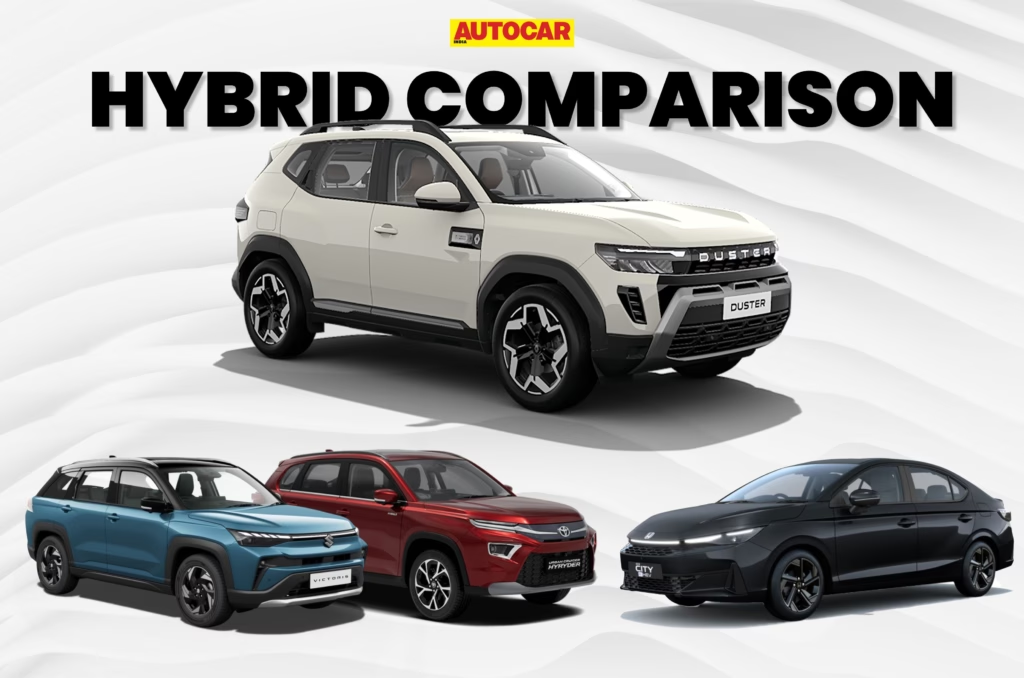
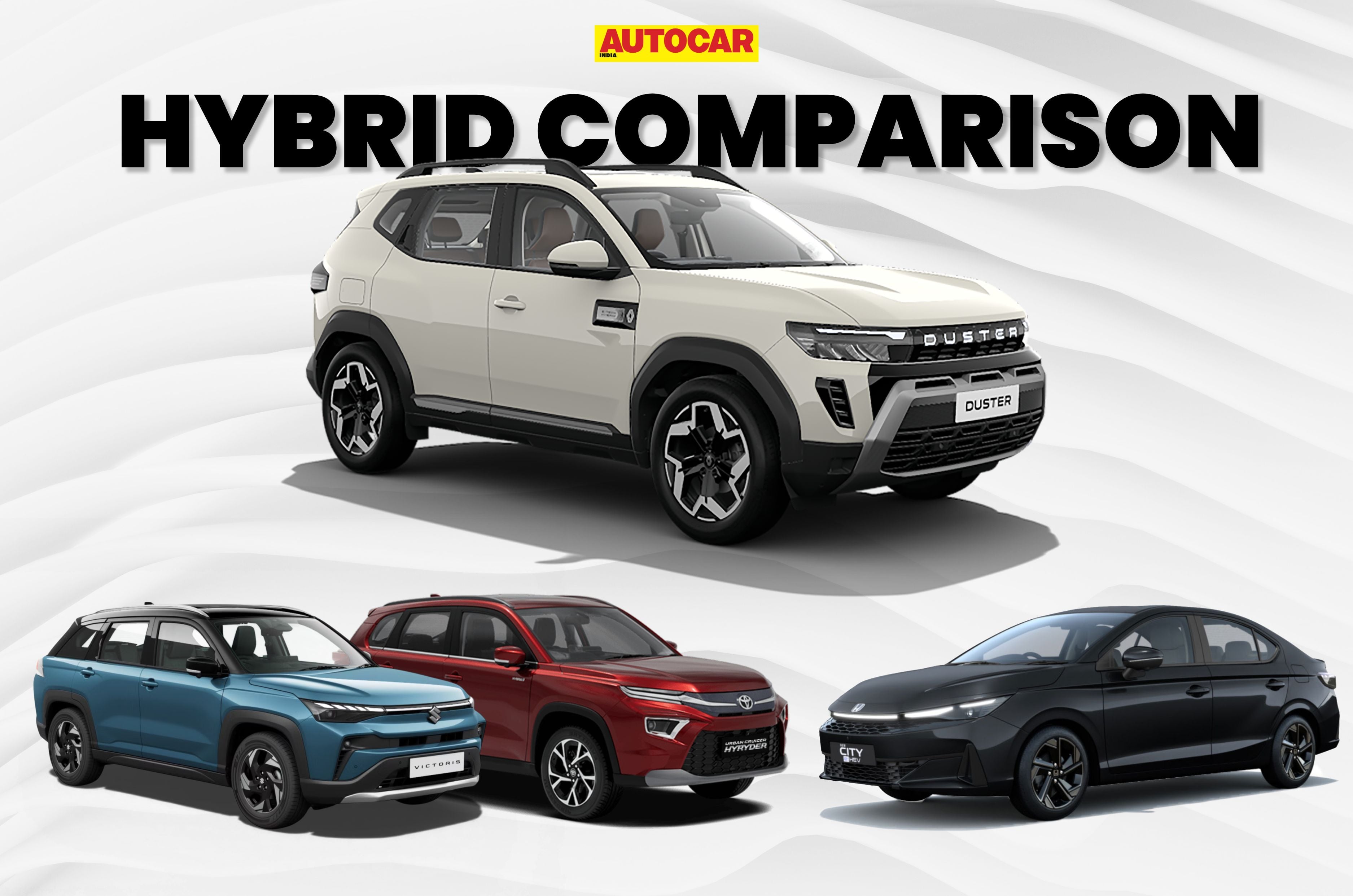
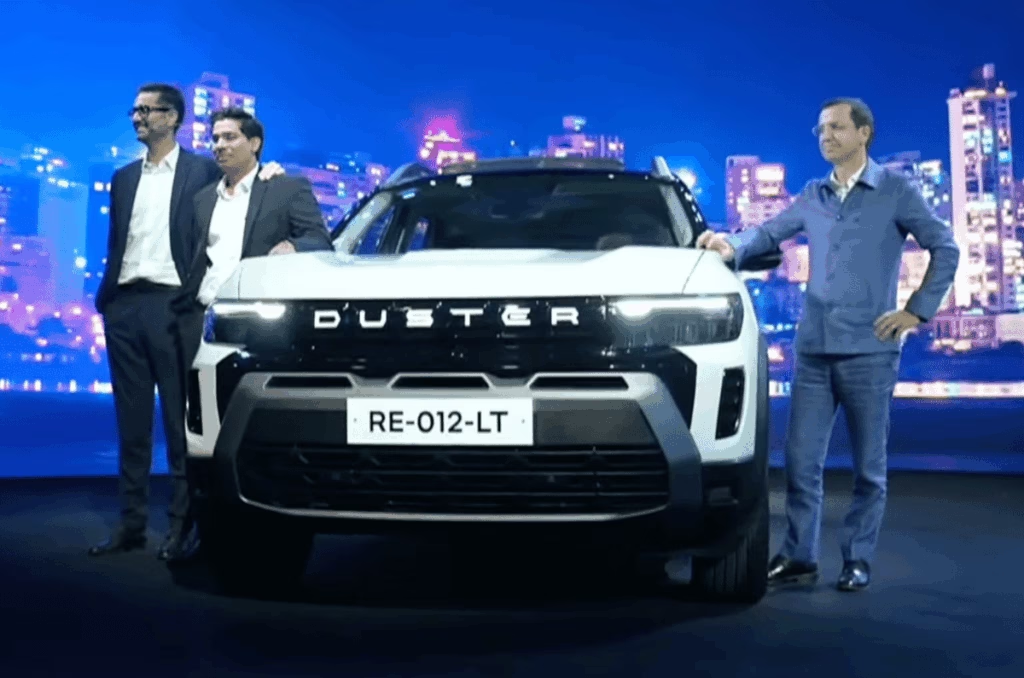
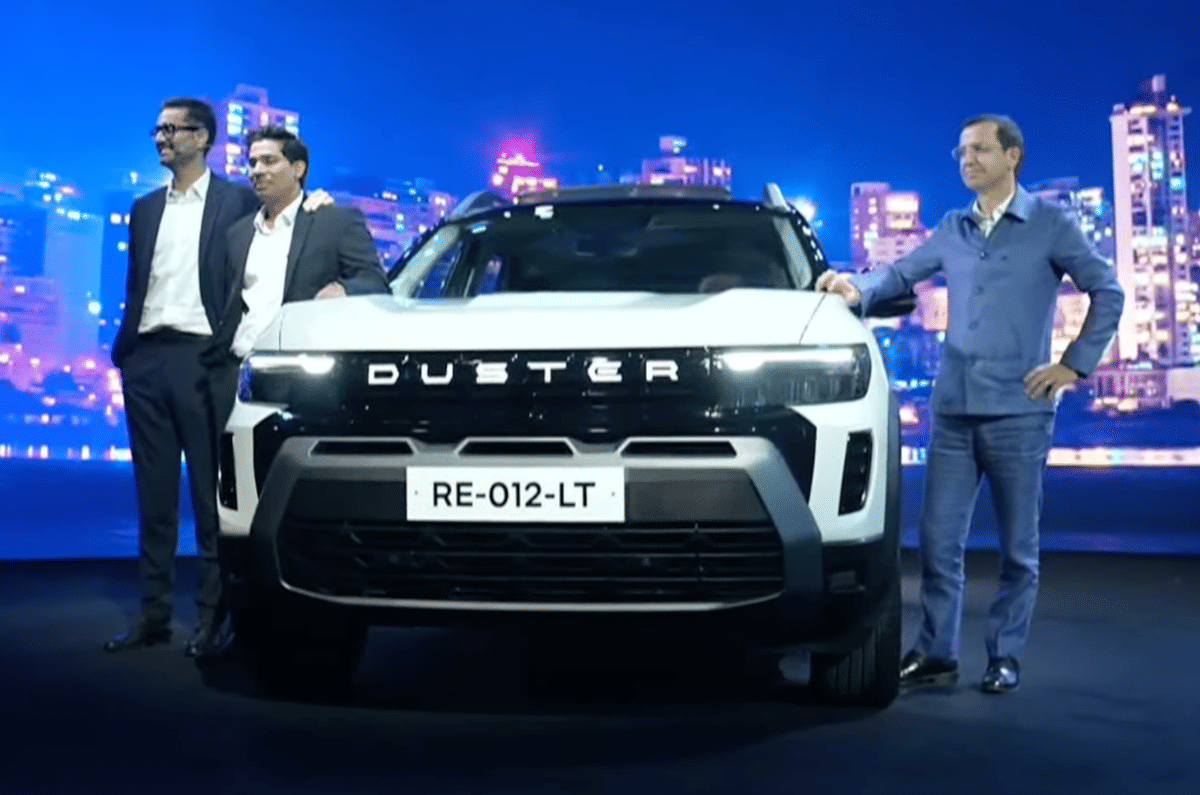
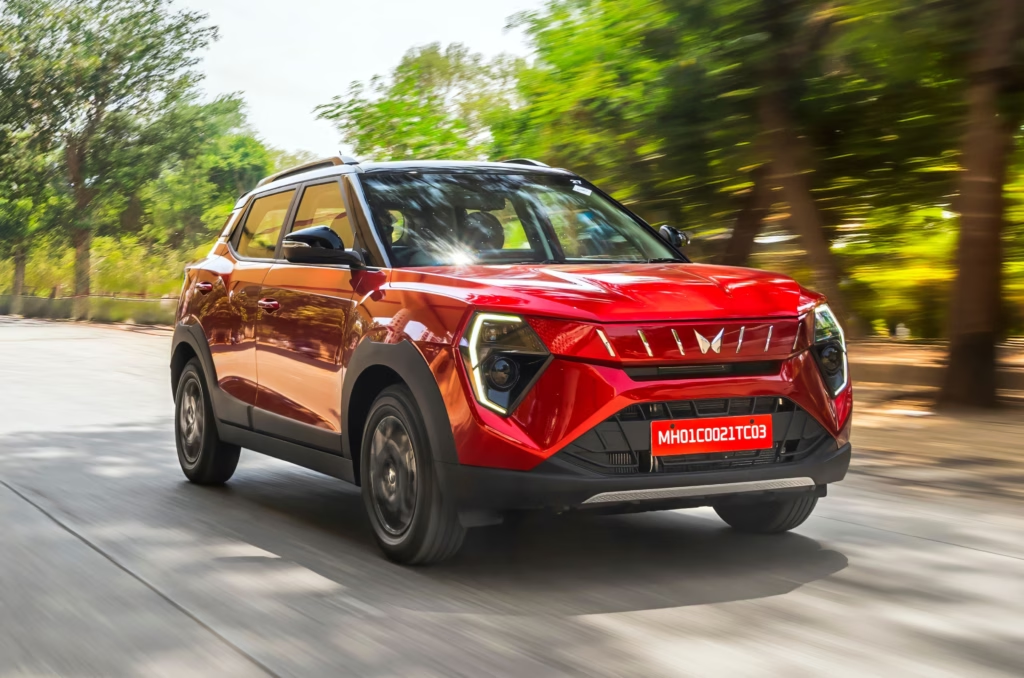
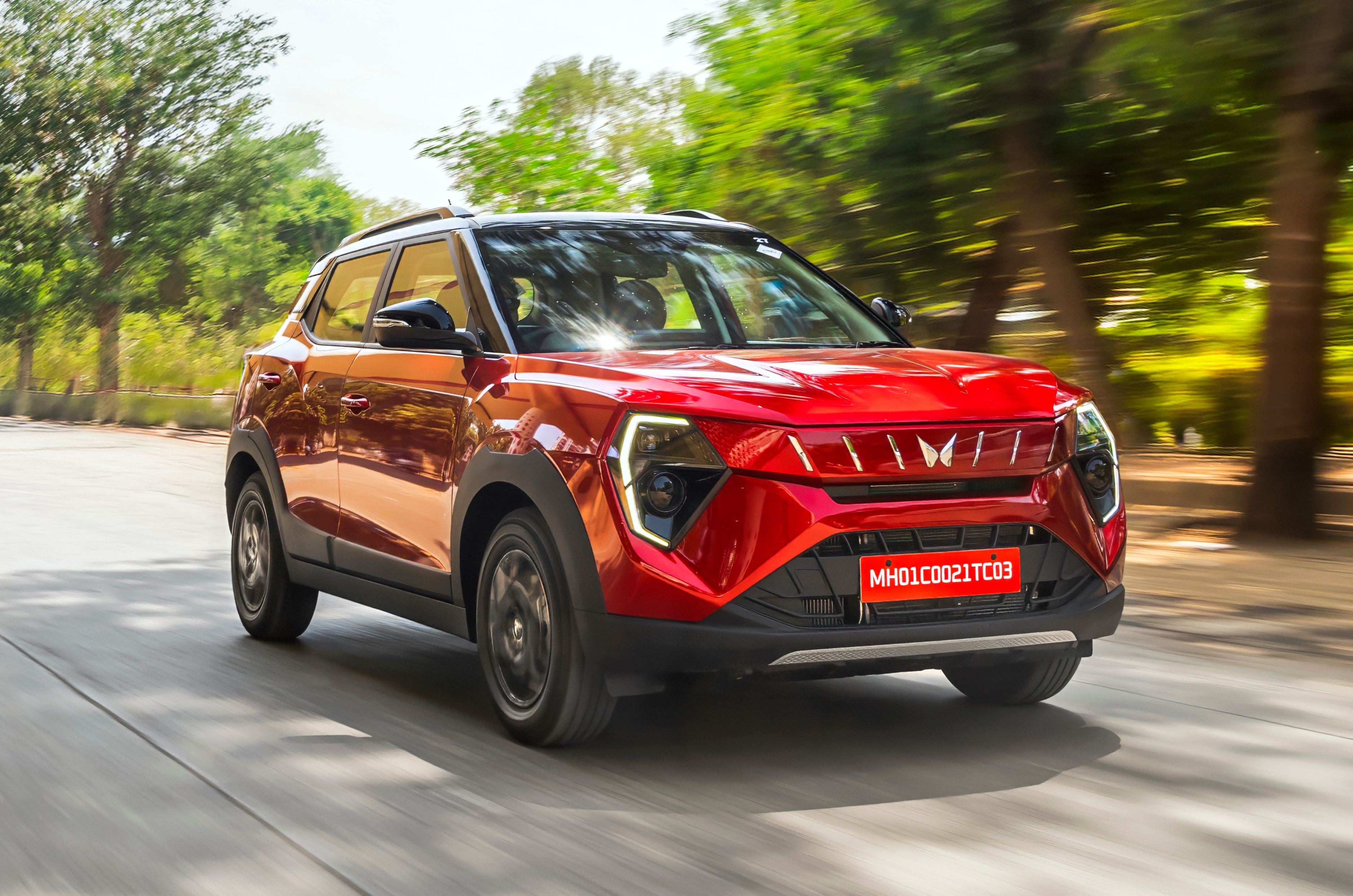
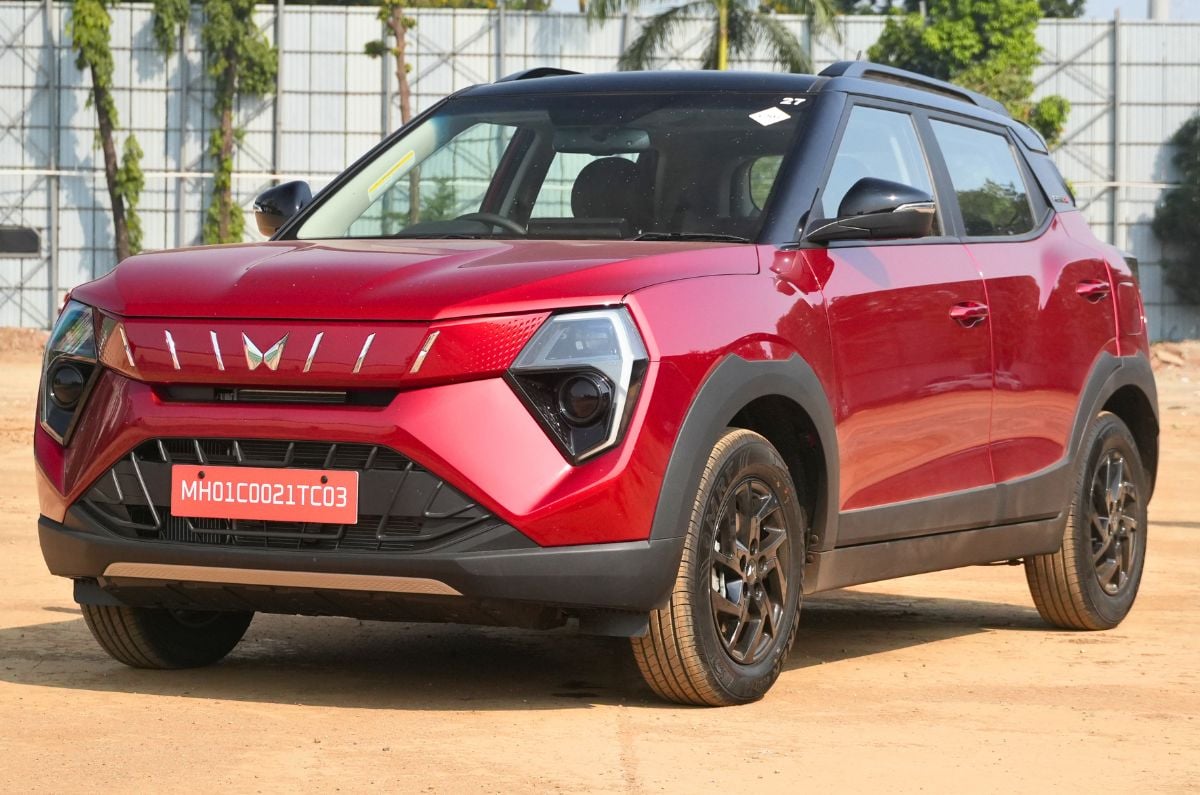
The new Renault Duster has been launched with a strong hybrid powertrain option, a first for the nameplate in India. The latest from Renault competes in the midsize SUV space, where only the Maruti Grand Vitara, Maruti Victoris and Toyota Hyryder currently offer a hybrid choice. Honda does not offer a hybrid setup with the Elevate at the moment, though the City midsize sedan has been equipped with one. But how do these vehicles stack up on paper when it comes to specifications? Let’s find out.
Renault Duster hybrid spec comparison
Duster has the highest power output
Renault Duster hybrid specs vs Grand Vitara, Victoris, Hyryder and City e:HEV
Hybrid system
Combined power
Combined torque
Transmission
Mileage
Battery size | Voltage
Duster
1.8L 4cyl + 2 e-motors
160hp
–
Multi-mode automatic
29kpl
1.4kWh | 247V
Grand Vitara
1.5L 3cyl + e-motor
116hp
141Nm
eCVT
27.97kpl
0.60kWh | 177.6V
Victoris
1.5L 3cyl + e-motor
116hp
141Nm
eCVT
28.65kpl
0.60kWh | 177.6V
Hyryder
1.5L 3cyl + e-motor
116hp
141Nm
eCVT
27.97kpl
0.60kWh | 177.6V
City e:HEV
1.5L 4cyl + e-motor
126hp
253Nm
eCVT
27.13kpl
Not available | 172.8V
While we are yet to sample the Duster hybrid in real-world conditions, the above specs table suggests it takes a more performance-led approach than the rest. Its four-cylinder naturally aspirated petrol engine is the largest by cubic capacity here, and paired with two electric motors, this hybrid setup delivers the highest peak power output. Renault claims a 0-100kph time of 9.61 seconds, which it says makes the Duster hybrid the quickest in the segment. The brand has not revealed a combined torque figure yet, though the Duster’s traction motor produces 208Nm on its own.
Renault SUV’s multi-mode gearbox stands out
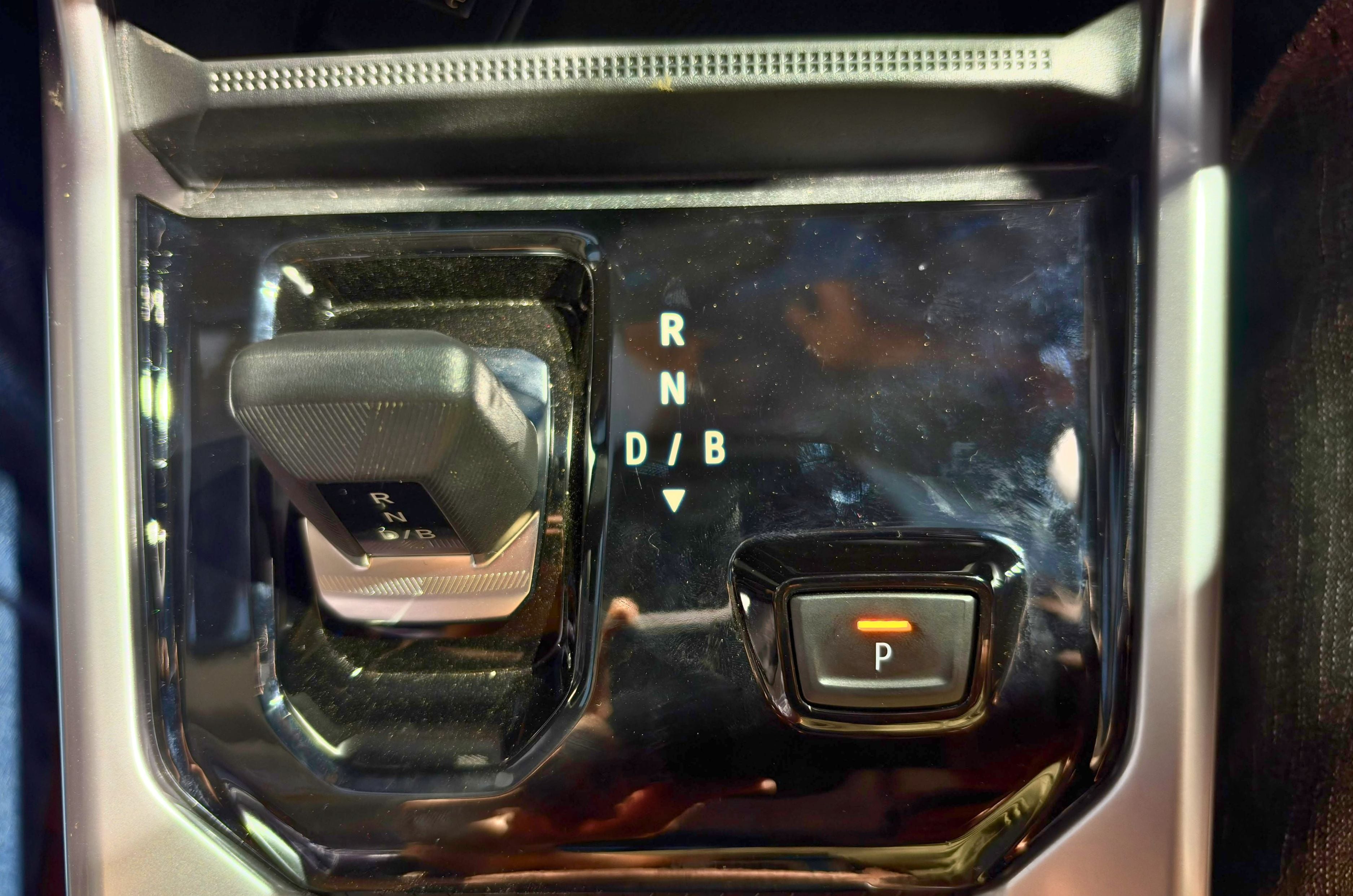
The Duster’s multi-mode automatic gearbox has two gears for the motor and four gears for the engine. Renault claims that this setup creates an 8-speed combination in hybrid mode, and it stands out as the others use an eCVT unit, which is known for a smooth driving experience. Moreover, the Duster hybrid’s larger, higher-voltage battery further points to more electric assistance than the rest. The French brand claims that 80 percent of city drives are possible in EV mode alone, while the Duster hybrid’s ARAI-certified mileage of 29kpl is the highest of all the cars here.
Midsize SUVs offer most powertrains
Only PHEV is missing
Save for plug-in hybrid, midsize SUVs offer almost every major powertrain choice, including petrol, CNG, diesel and electric. Hyundai Creta is expected to adopt a hybrid powertrain in its next generation, due in 2027, and its Kia Seltos sibling is also set to follow suit. The new Tata Sierra’s ARGOS platform is hybrid-ready, giving the homegrown carmaker the flexibility to introduce a hybrid version in the future. Volkswagen and Skoda are also working on hybrid midsize SUVs for the Indian market.
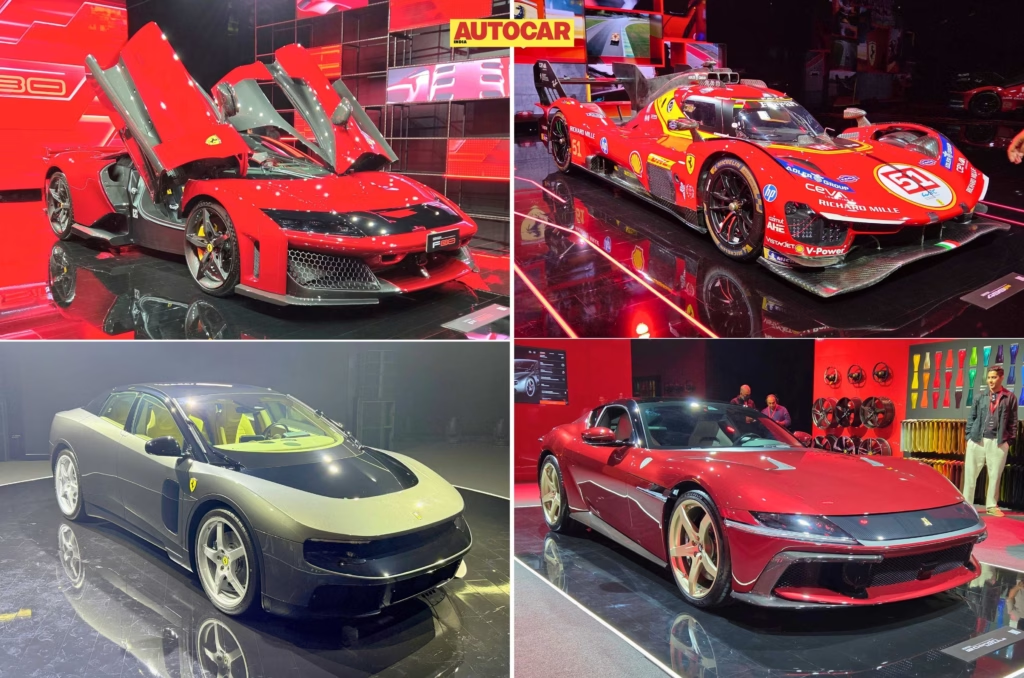
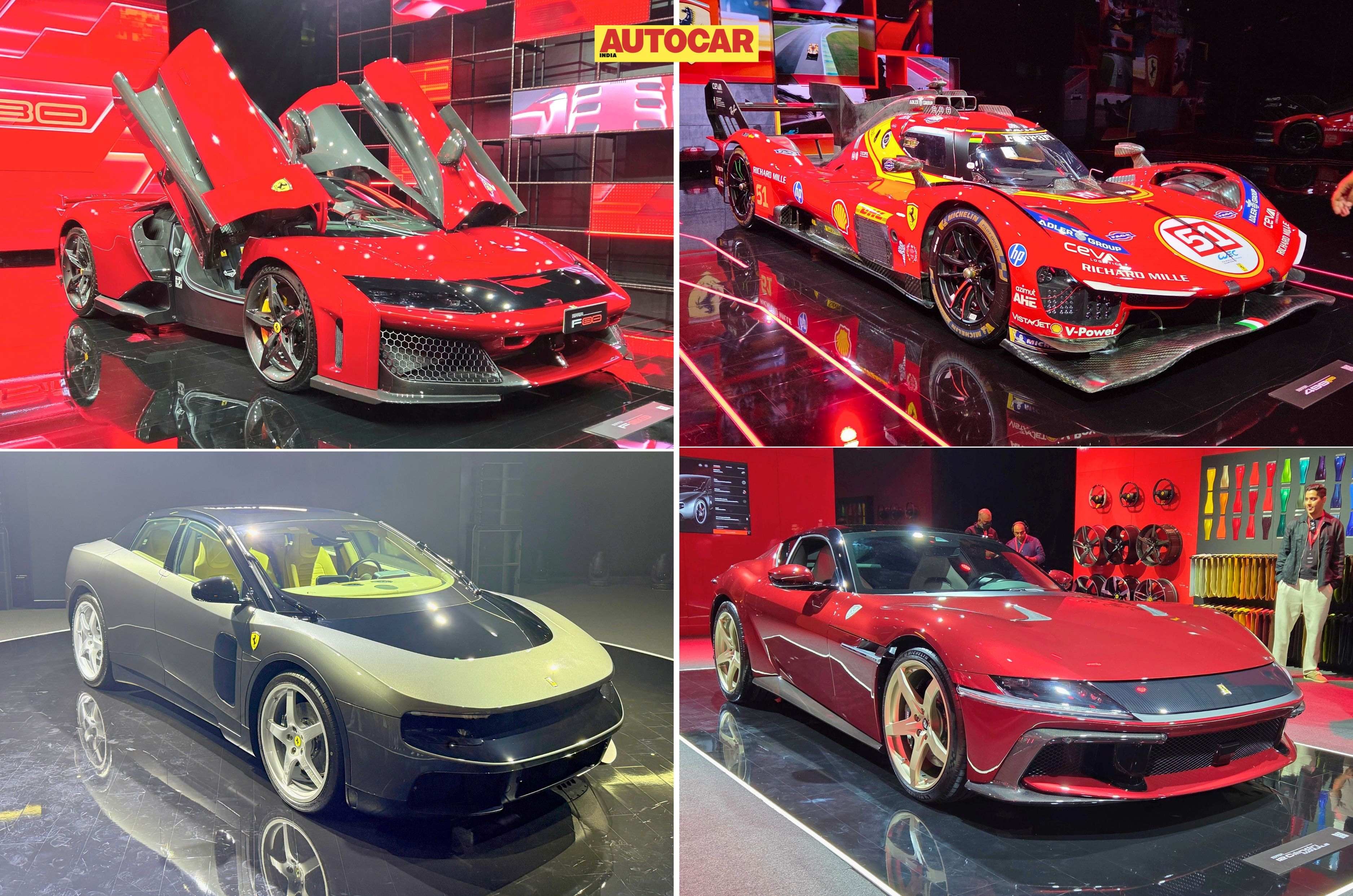
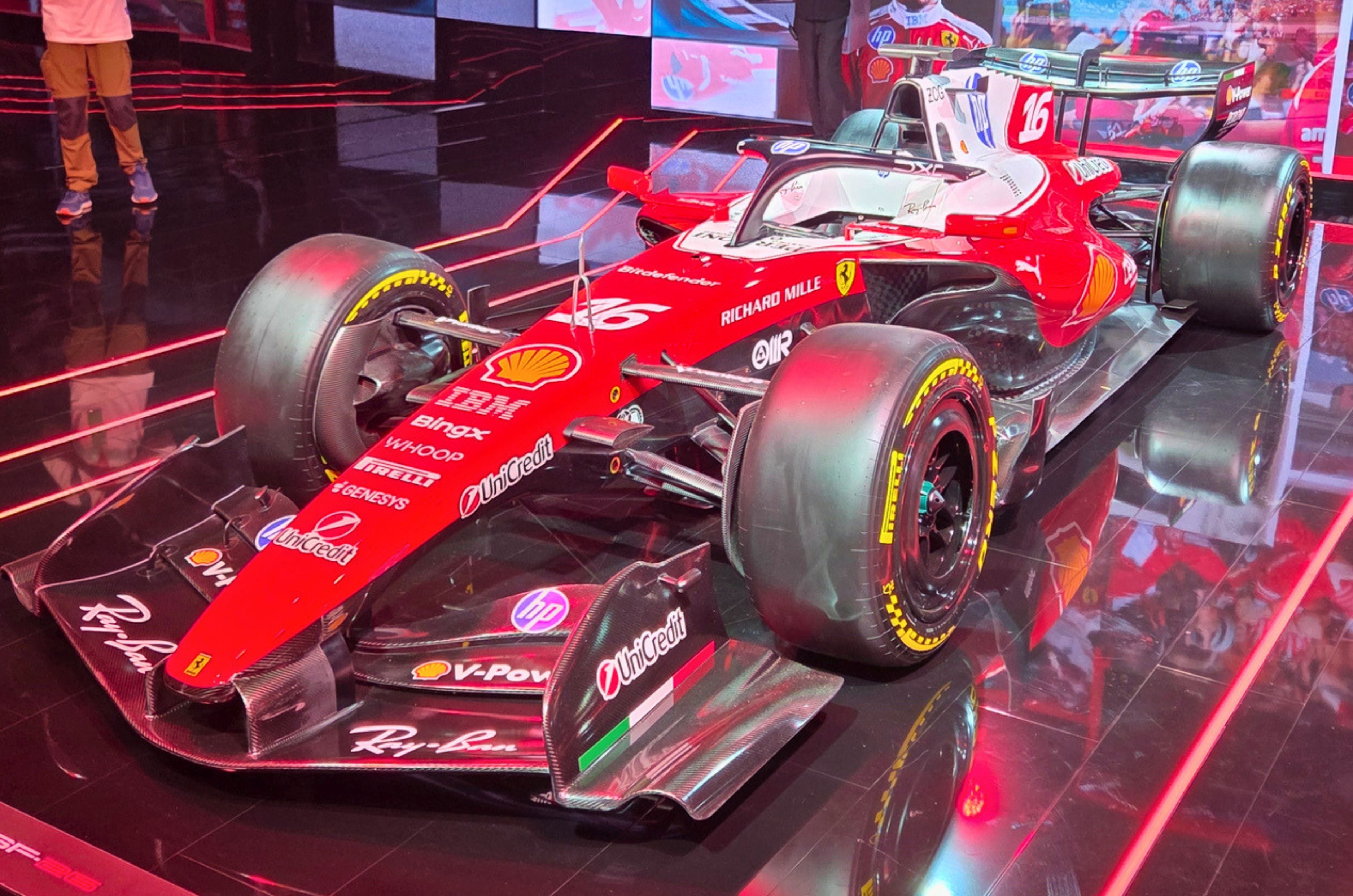
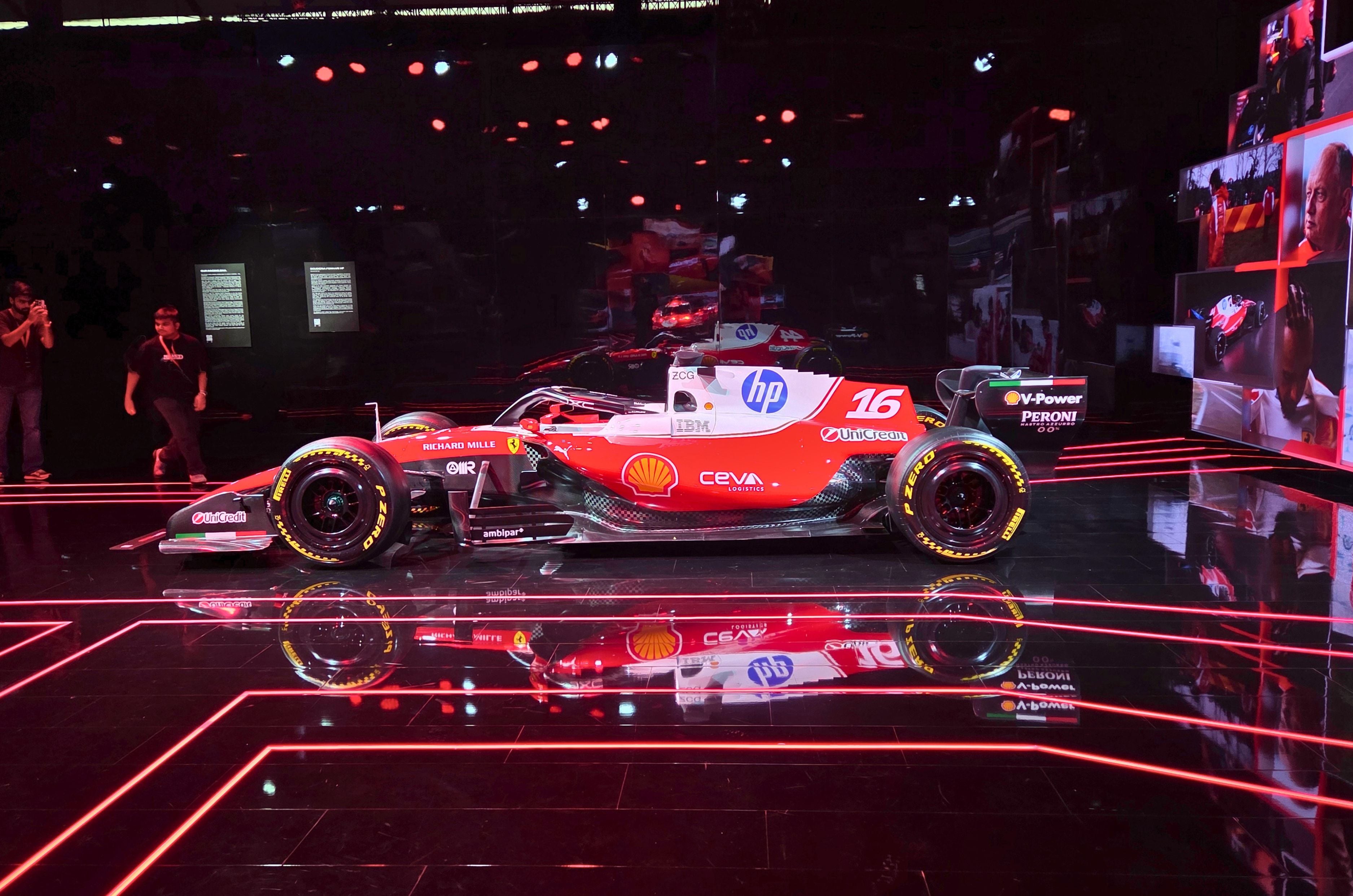
Ferrari has officially opened the doors to its first-ever Universo Ferrari exhibition in India. Held at Yashobhoomi, Dwarka in New Delhi from 17 October to 1 November, Universo Ferrari offers a comprehensive look at the Italian marque’s heritage, motorsport pedigree, technology, and craftsmanship. More pertinently, several exciting Ferraris are also on display at Universo Ferrari, some of them for the first time in India. Let’s have a look at the Ferrari cars that have debuted in India as part of Universo Ferrari.
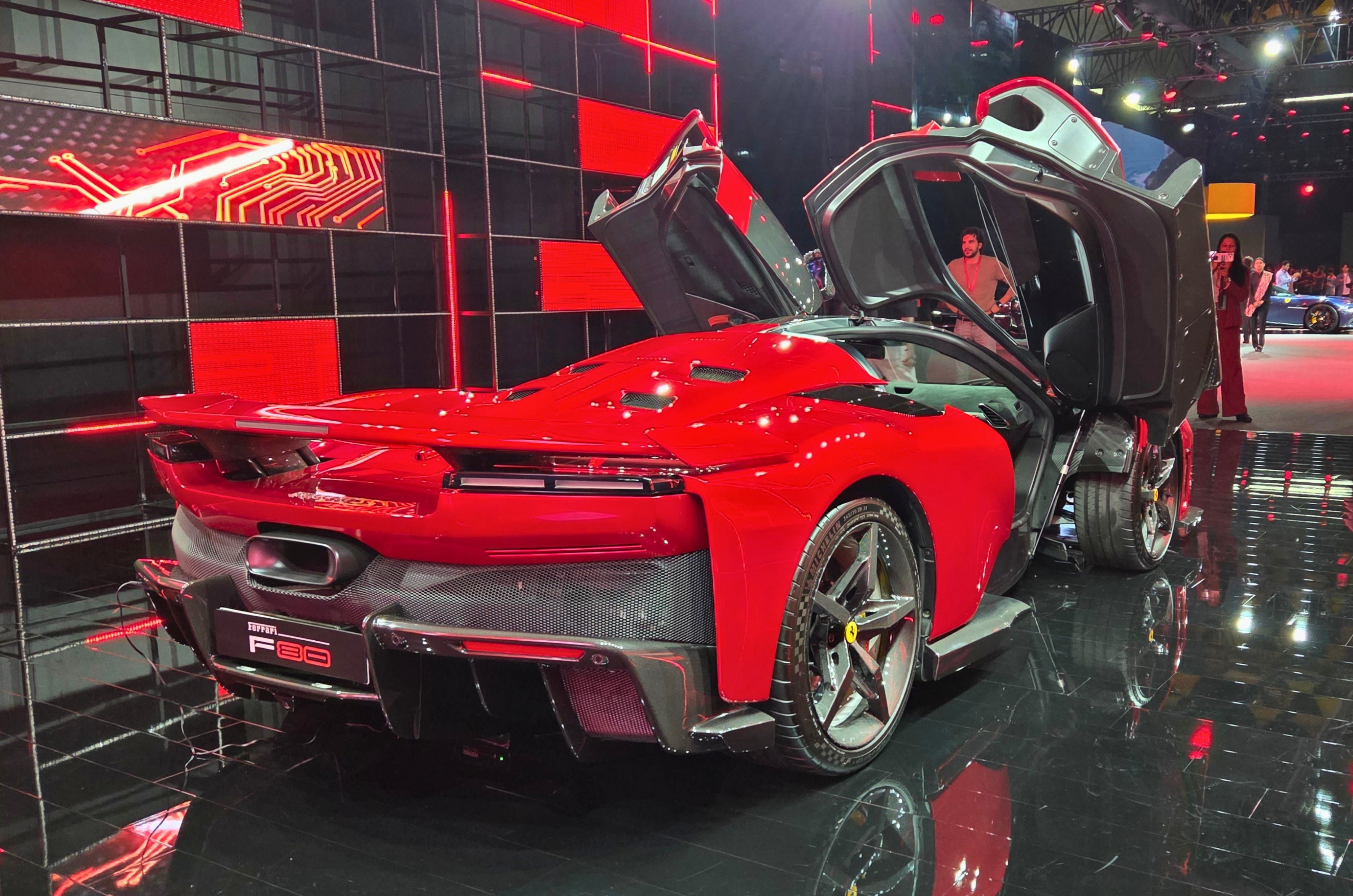
Ferrari F80
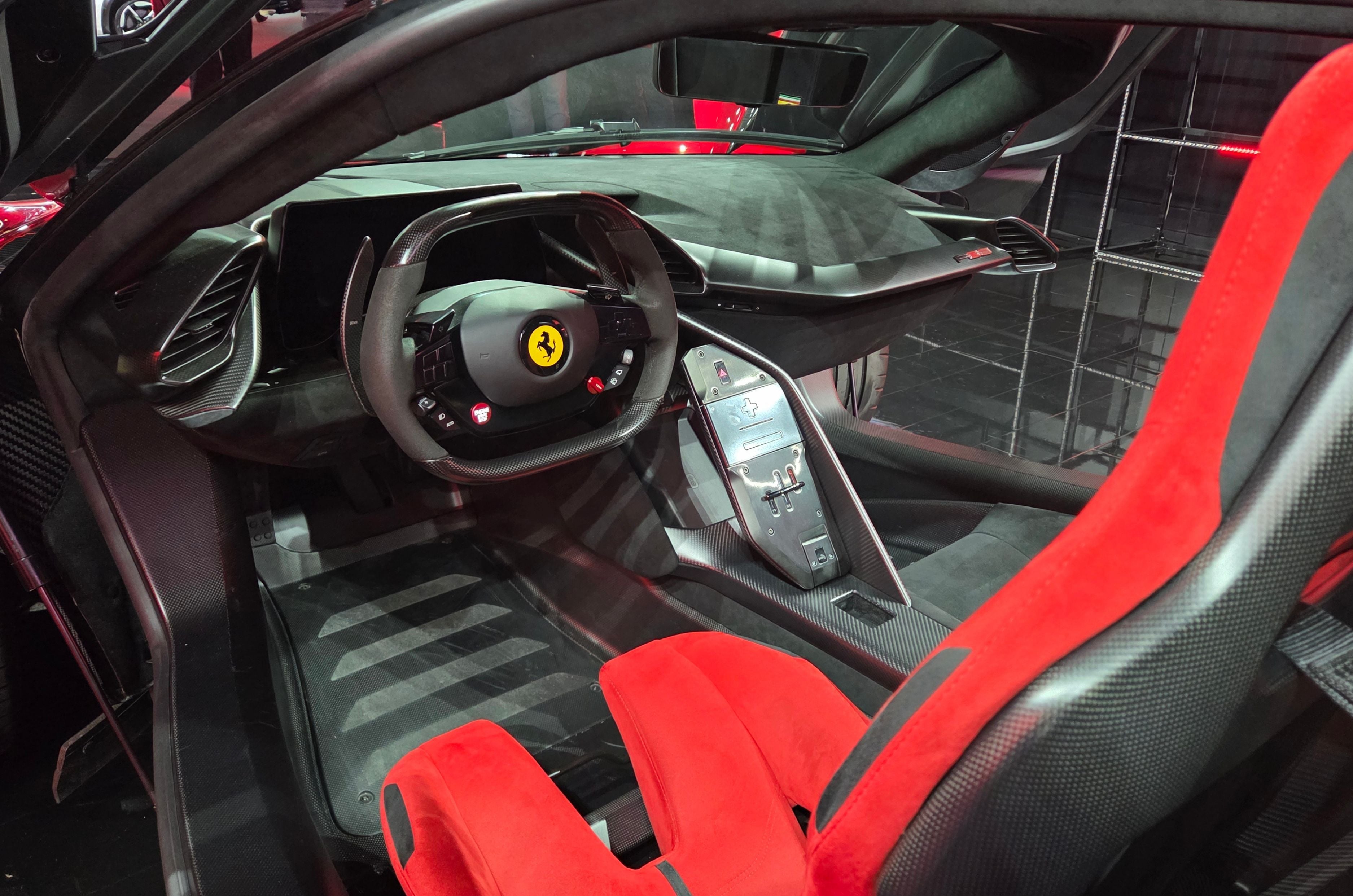
Revealed in 2024 as a successor to the LaFerrari, and to commemorate Ferrari’s 80th anniversary, the F80 is the brand’s most powerful road-going offering yet. Producing a combined 1,200hp from its 3.0-litre twin-turbo V6 hybrid powertrain, the F80 claims a ridiculous 0-100kph time of 2.15 seconds and a 0-200kph time of 5.75 seconds. All-wheel drive is fitted as standard, along with a slew of motorsport-derived tech like an MGU-K energy recovery system and electric turbos.
On the outside, the F80 matches the wildness of its powertrain with design elements like a slew of air ducts across the body, a black strip between the headlamps, an active rear wing, a central exhaust, and a massive rear diffuser. Inside, things are quite minimalistic and driver-focused – highlights include a motorsport-style ovoid steering wheel, a large digital driver’s display, an angled centre console, and bucket seats. Ferrari has sold through all 799 units of the F80, each retailing for €3 million (Rs 32 crore), before options.
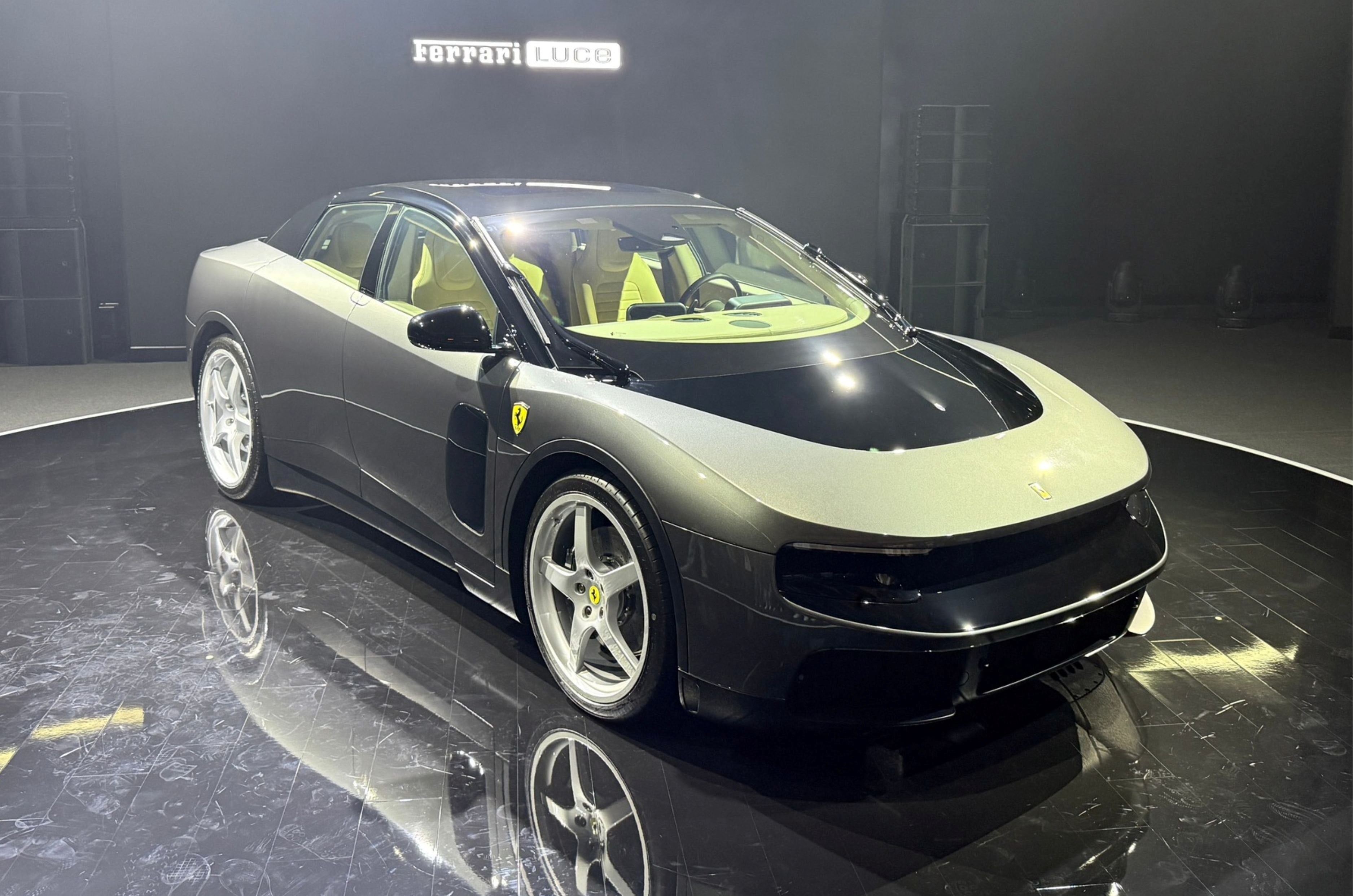
Ferrari Luce
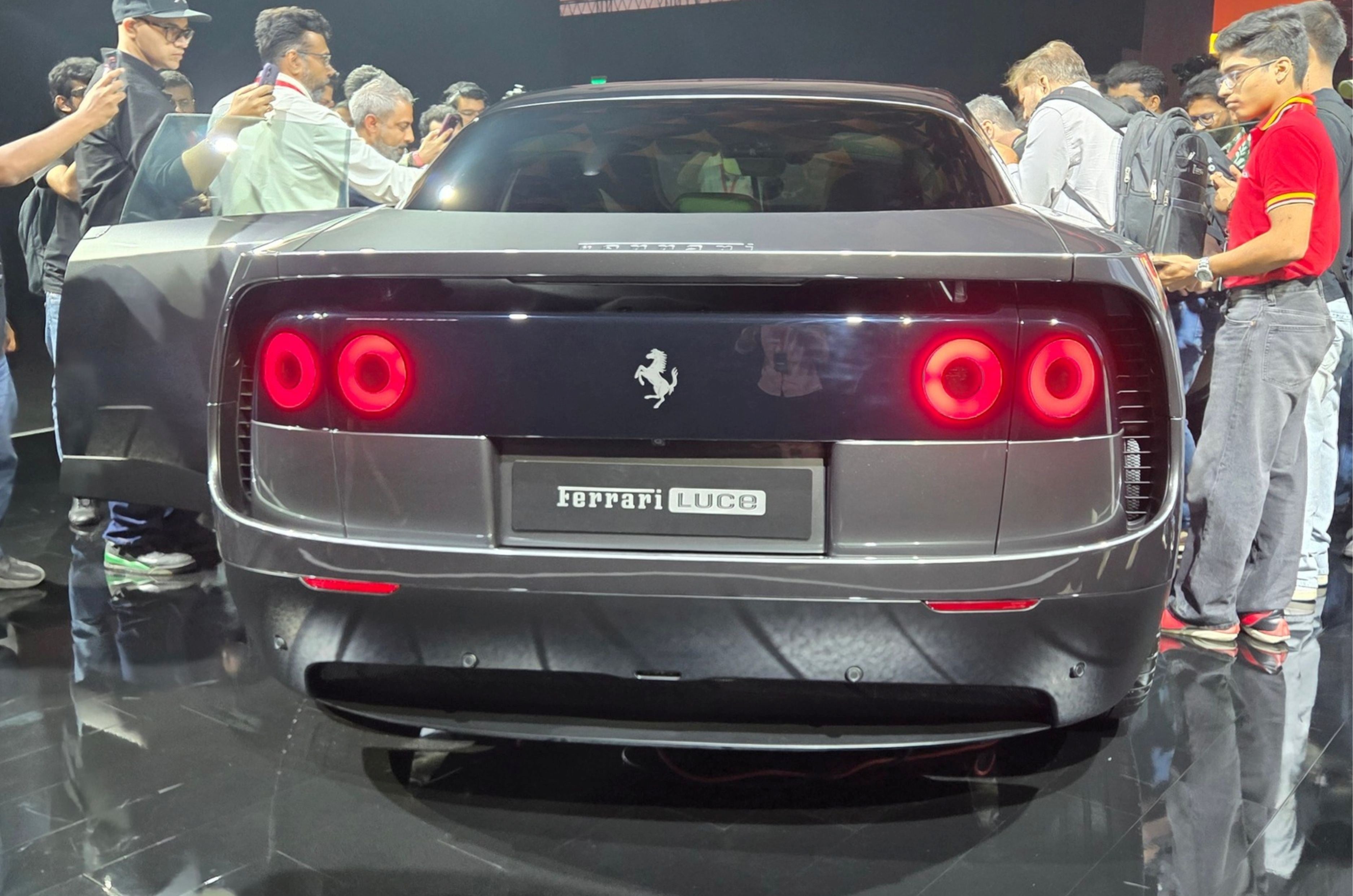
The Luce is Ferrari’s first EV, and perhaps its most controversial offering. Based on an all-new 800-volt architecture, the Luce features a 122kWh battery and four electric motors producing a combined 1,050hp and 990Nm. Ferrari claims a 0-100kph time of 2.5 seconds, a top speed of 310kph, and a range of up to 530km. Unlike other EVs, the Luce doesn’t pump artificial engine noises into the cabin via speakers – instead, the electric motors are tuned to emit a distinct, high-pitched sound.
Styled by LoveFrom, a firm co-founded by former Apple designer Jony Ive, the Luce features a distinctive two-piece body structure, with a gloss-black passenger cell enclosed within a coloured aluminium shell. It gets recessed LED headlamps, quad LED tail-lamps, suicide doors, and staggered 23-inch front and 24-inch rear wheels. At 5,026mm long, the Luce is the largest Ferrari yet, and its 0.254 drag coefficient is the lowest among road-legal Ferraris. The interior sports a retro-inspired design, with a 10-inch touchscreen, a 12.5-inch OLED driver’s display, and seating for five – a first for a Ferrari. Order books are open for the Luce in overseas markets, with prices starting at 550,000 euros (approximately Rs 6.1 crore) before options.
Ferrari 12Cilindri Manuale
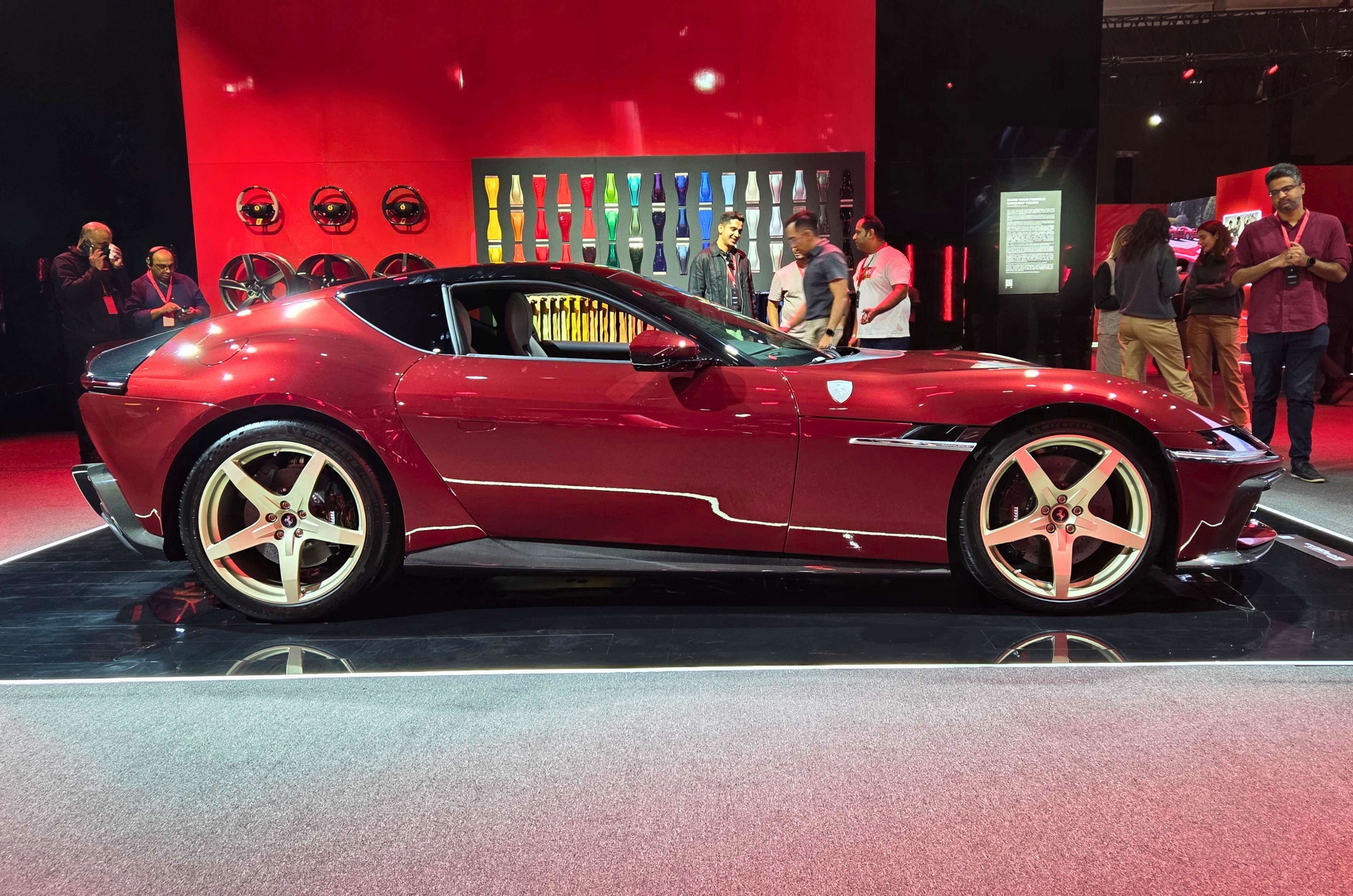
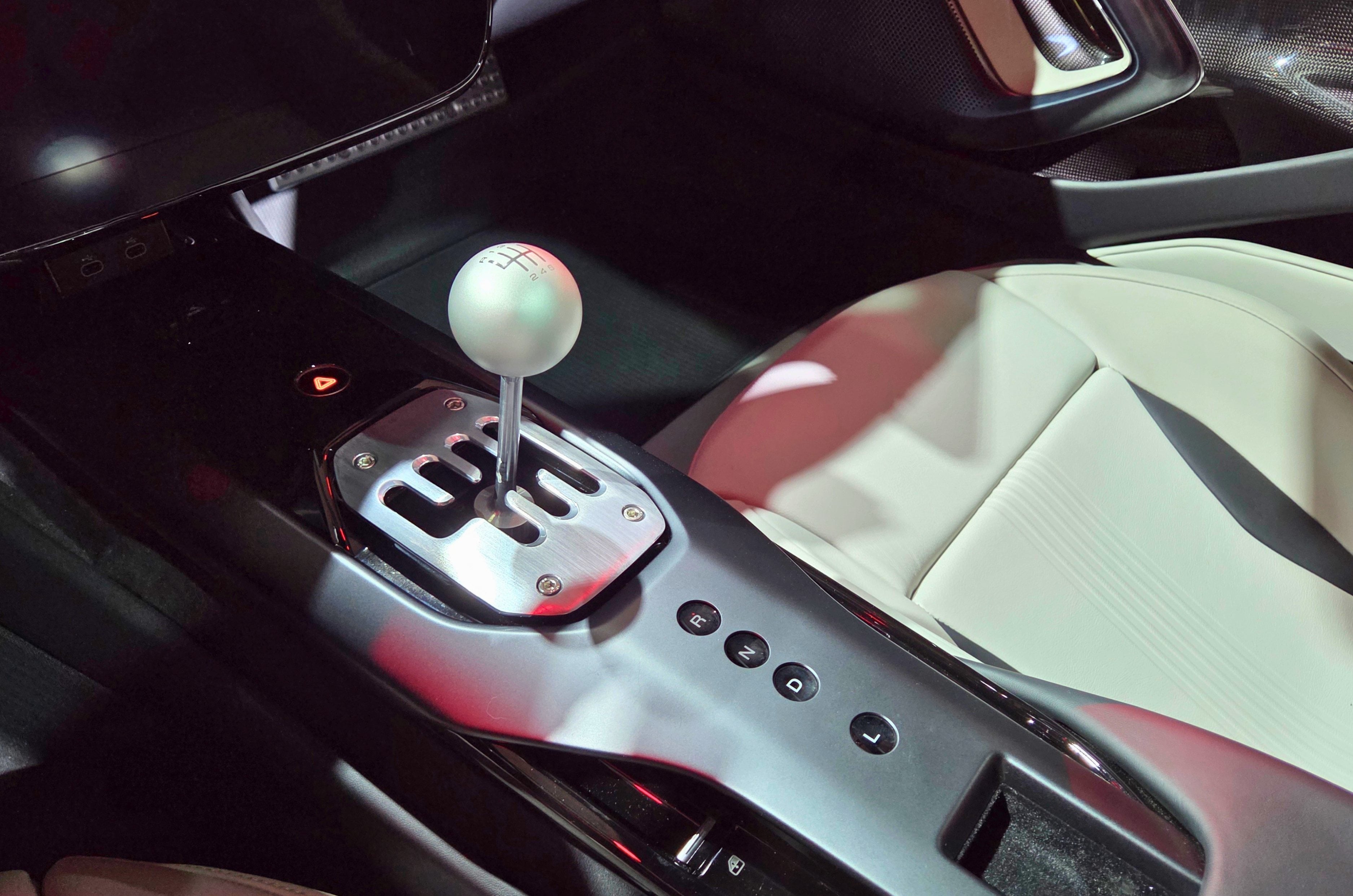
Unveiled a few months ago, the 12Cilindri Manuale is a limited-run special and the first Ferrari in 14 years to offer a manual gearbox. Only, this gearbox isn’t a true manual, but a simulated ‘Manuale By-Wire’ system based on the 12Cilindri’s 8-speed dual-clutch automatic. The experience is intact, however, with a clutch pedal, 6 speeds, a gated shifter, and the ability to stall and clutch-dump the car. If needed, you can even switch to automatic mode and let the DCT take over. Elsewhere, the Manuale retains the 12Cilindri’s 830hp 6.5-litre naturally aspirated V12, claiming a 0-100kph time of 2.9 seconds and a top speed of 340kph.
The exterior largely mirrors that of the standard 12Cilindri but gets exclusive Manuale badges, silver-finished Ferrari side logos, pinstripes on the front splitter and rear winglets, and bespoke five-spoke forged alloy wheels available in four finishes. Inside, the centre console has been redesigned to accommodate a rounded aluminium gear lever inspired by classic Ferrari gated shifters, available in silver or black. Buyers can also choose comfort or racing seats with six vertical grooves. Limited to 1,499 units, the 12Cilindri Manuale is priced from €590,000 (approximately Rs 6.42 crore), before options.
Ferrari 499P
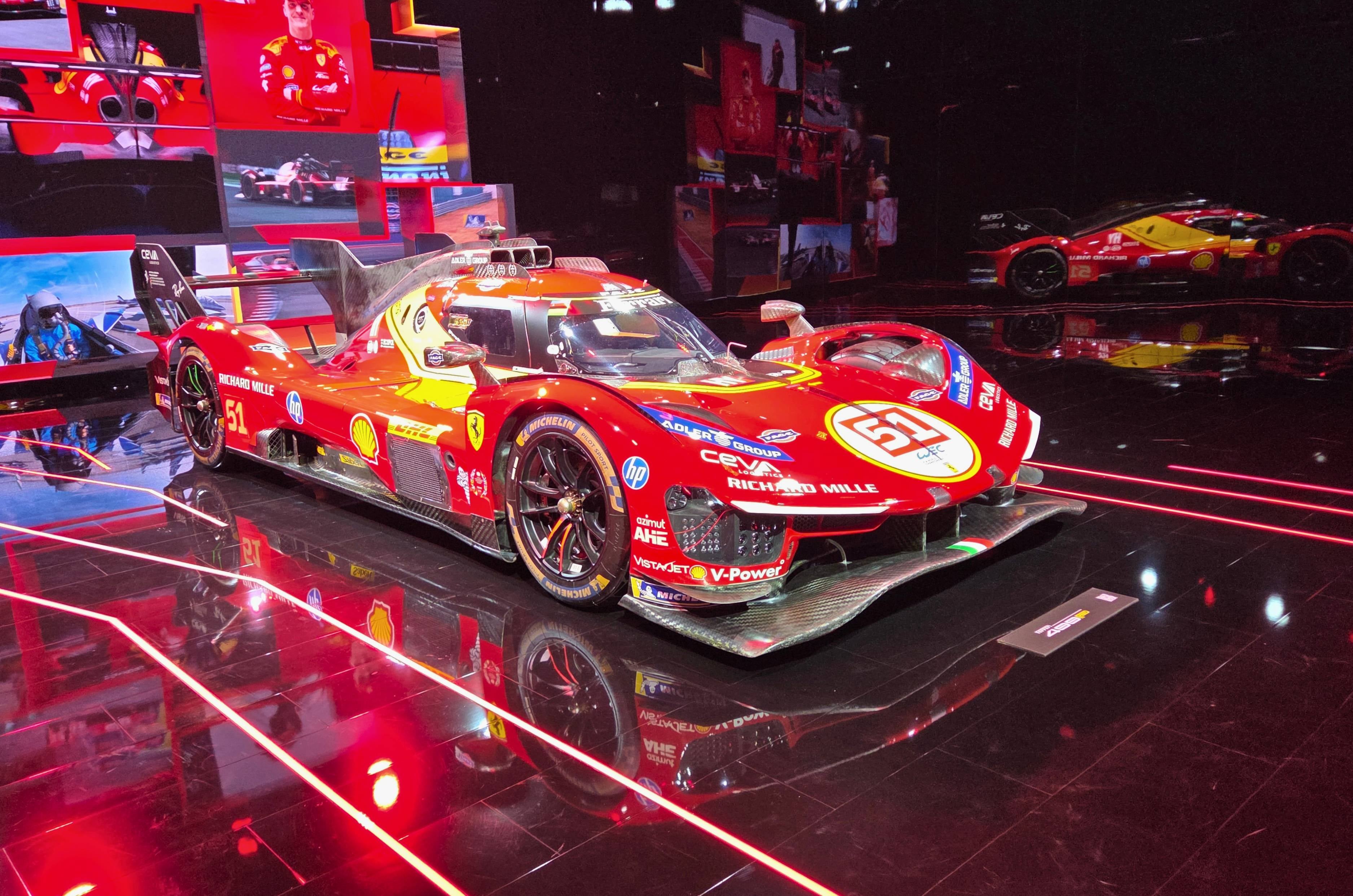
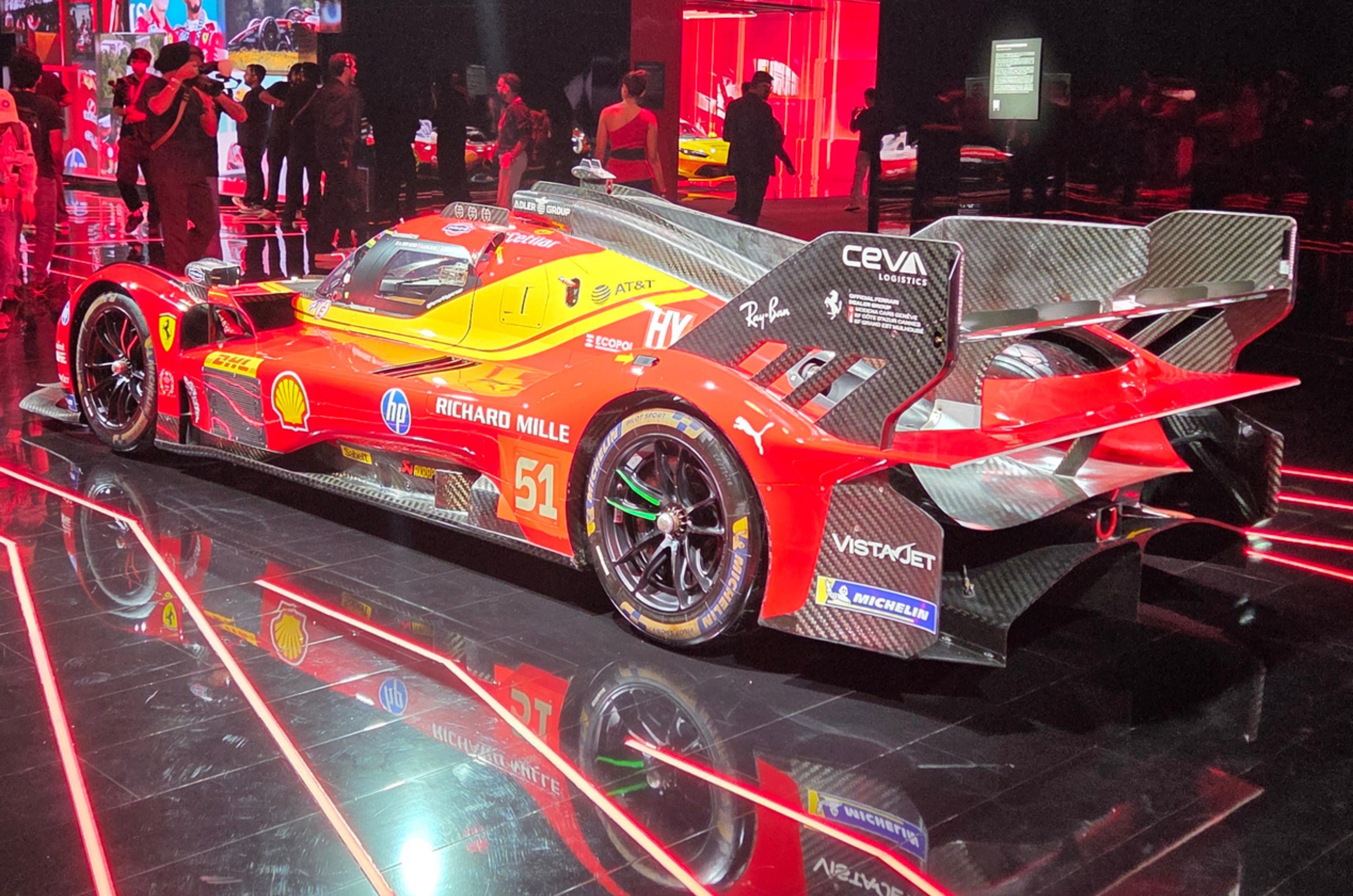
The 499P Le Mans Hypercar was revealed in 2022 as Ferrari’s return to the top class of endurance racing after 50 years. It’s powered by a twin-turbo V6 based on the architecture of the engine used in the 296 GT3, itself derived from the road-going 296 GTB. Developed specifically for racing, the 499P’s V6 works with a bespoke 900-volt, 200kW energy recovery system (ERS) connected to the front axle, forming a hybrid all-wheel drive layout. A brake-by-wire system recovers kinetic energy, while power is delivered through a 7-speed sequential gearbox. Balance of Performance regulations limit the 499P’s total output to 680hp.
The 499P’s design pays tribute to Ferrari’s endurance racing heritage, particularly the 312P prototype from 1973 – Ferrari’s last factory entry in the top class. Its name refers to the 499cc displacement of each cylinder, while ‘P’ stands for Prototype. A yellow stripe runs through the livery – another nod to the 312P – while carbonfibre construction allows for a 1,030kg baseline weight. The 499P brought home several accolades for Ferrari, such as three consecutive Le Mans victories (2023, 2024, and 2025), a complete sweep at the 2025 FIA World Endurance Championship, and more.
Ferrari SF-26
Ferrari pulled the wraps off the SF-26 racer back in January 2026. Built for F1’s 2026 technical regulations overhaul, the SF-26 is powering by Ferrari’s 067/6 power unit – a 1.6-litre turbocharged V6 that can run on sustainable fuel blends and is paired with a heavily bolstered 350kW MGU-K system, creating a near 50-50 performance split between combustion and electric power. Driven by Charles Leclerc and Lewis Hamilton, the SF-26 has compiled 11 Grand Prix podiums and 2 victories, with dramatic wins at the Spanish Grand Prix with Hamilton and the British Grand Prix with Leclerc.
The SF-26’s bodywork shifts away from the previous ground-effect era toward a lighter, more agile 770kg carbon-composite structure. It features advanced active aerodynamics with movable front and rear wings to minimise drag on straights while maximising cornering downforce. Visually, the SF-26 incorporates push-rod suspension on both axles and debuts a gloss Rosso Scuderia livery accented with white.
A vehicle’s Registration Certificate (RC) is an essential document that confirms its registration with the Regional Transport Office (RTO) and establishes its legal identity. In India, the RC for a private vehicle is generally valid for 15 years from the date of registration, after which it must be renewed every five years.
Owners can apply for renewal through the government’s Parivahan Sewa portal within 60 days before the RC expires, although a physical vehicle inspection may be required before approval. If the RC has already expired, they should follow the prescribed renewal process and check the applicable requirements with their RTO.
Driving with an expired RC is illegal and can attract penalties. It can also complicate insurance claims and the transfer of vehicle ownership. Here is how to renew an RC online, the documents required and the applicable fees.
Documents required for RC renewal
Before starting the application, vehicle owners should keep the following documents ready:
Form 25: The application form for renewal of registration.
Existing RC: The original or a copy of the expired registration certificate for verification.
Valid insurance certificate: Proof of active third-party or comprehensive insurance.
Pollution Under Control (PUC) certificate: A valid certificate confirming compliance with applicable emission standards.
Road tax receipt: Proof of payment of applicable road tax.
Identity proof: An Aadhaar card, PAN card, passport or another accepted government-issued document.
Address proof: An Aadhaar card, voter ID, utility bill or another accepted document.
Fitness certificate: Required for applicable vehicle categories, particularly commercial vehicles.
Chassis and engine number pencil print: This may be required as part of the application process.
Document requirements can vary depending on the vehicle category and the relevant RTO.
How to renew your RC online through Parivahan
The RC renewal application can be submitted through the government’s Parivahan Sewa portal by following these steps:
1. Visit the Parivahan Sewa portal
Open the official website at https://parivahan.gov.in/ and navigate to ‘Online Services’, followed by ‘Vehicle Related Services’.
2. Select the state and RTO
Choose the state in which your vehicle is registered and select the relevant registering authority.
3. Enter the vehicle details
Log in if required, and enter your vehicle’s registration number. The portal may also ask for the last five digits of the chassis number.
4. Select the renewal service
Choose ‘Renewal of Registration’ from the list of available vehicle-related services.
5. Fill in the application form
Verify the details of your vehicle, including its make, model, year of manufacture, engine number, and chassis number. Enter any other requested information accurately.
6. Upload the required documents
Submit scanned copies of the existing RC, insurance certificate, PUC certificate, identity proof, address proof, and other applicable documents.
7. Pay the renewal fee
Complete the online payment. The amount depends on your vehicle’s category and applicable charges.
8. Book a vehicle inspection
Schedule an appointment at the relevant RTO if required.
9. Take your vehicle for inspection
Present your vehicle and original documents for verification. The RTO will assess the application and your vehicle’s road-worthiness where applicable.
10. Receive the renewed RC
Once the application is approved, the renewed certificate will be processed. Depending on the applicable procedure, it may be dispatched to your registered address. Applicants can also check their application status online.
RC renewal fees in India
The registration renewal fees listed under Rule 81 of the Central Motor Vehicles Rules, 1989, vary according to the vehicle category.
Vehicle category
RC renewal fee (Rs)
Motorcycle
300
Medium passenger motor vehicle
1,000
Heavy passenger motor vehicle
1,500
Imported motorcycle
2,500
Imported motor vehicle
5,000
Invalid carriage
50
Three-wheeler, quadricycle, or light motor vehicle (non-transport)
600
Three-wheeler or light motor vehicle (transport)
1,000
Medium goods vehicle
1,000
Heavy-duty vehicle
1,500
Other vehicle categories
3,000
Additional charges may apply for delayed renewal, smart card issuance, inspection and other applicable services. The supplied fee schedule lists delayed-renewal charges of Rs 300 per month for motorcycles, and Rs 500 per month for passenger cars, along with a Rs 200 charge for smart card reissue or renewal. Owners should confirm the current charges on the Parivahan portal or with their RTO before making a payment.
How to check your RC renewal status
After submitting the RC renewal application, you can track its progress through the Parivahan Sewa portal. Navigate to the vehicle-related services section, select the relevant state, and enter your vehicle’s registration details. Open the applicable application or registration status option to check whether the renewal is being processed, has been approved or requires further action. The online application makes it easier to initiate the renewal process, but approval may still depend on document verification, payment of applicable fees, and a physical inspection where required.
Renault has launched the Duster hybrid in India at an introductory price of Rs 16.99 lakh for the entry-level Evolution trim, with prices going up to Rs 19.49 lakh for the top-end Emotion trim. Customer bookings are underway at Rs 21,000, with deliveries scheduled to begin in November. The Duster hybrid takes on the strong-hybrid versions of the Maruti Grand Vitara, Maruti Victoris and Toyota Urban Cruiser Hyryder.
1.8-litre petrol and two electric motors make a combined 160hp, with 0-100kph in a claimed 9.61sec.
1.4kWh battery pack, multi-mode automatic gearbox and a claimed 29kpl.
Features include ventilated seats, panoramic sunroof, dual-zone climate control and more.
Renault Duster hybrid prices
The Duster hybrid range is available in three trim levels
Renault Duster hybrid price list (Rs, lakh)
Trims
Prices (ex-showroom)
Evolution
16.99
Techno
18.99
Emotion
19.49
Renault is offering the Duster hybrid in three trims: Evolution, Techno and Emotion. These introductory prices apply to all deliveries until December 31, 2026, and R-Pass owners will get priority deliveries. Buyers can also opt for the Renault Protect 360 ownership package, priced from Rs 89,900, which bundles three years of comprehensive insurance, three years of scheduled maintenance and a three-year assured resale value.
Renault Duster hybrid powertrain and mileage
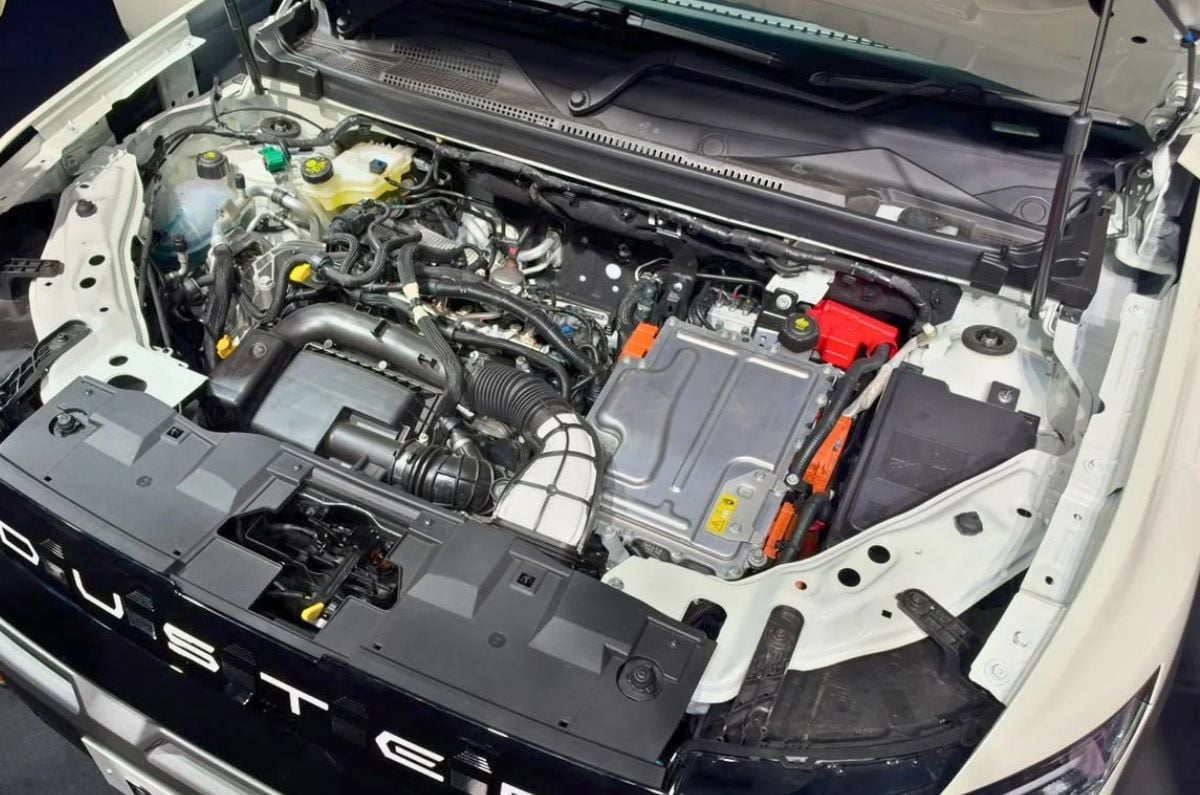
The E-Tech hybrid features a 1.4kWh battery pack and a multi-mode automatic transmission
The Duster is based on Renault’s RGMP platform, which the brand says can accommodate petrol, hybrid and CNG powertrains. The hybrid is equipped with the brand’s ‘E-Tech 160’ system, which pairs a 1.8-litre four-cylinder petrol engine with two electric motors. The Atkinson-cycle engine makes 110hp and 175Nm, and Renault claims it is the biggest engine in the segment, with a thermal efficiency of up to 41 percent. A high-voltage starter-generator mounted on the engine handles engine starts, smooths out gearshifts and charges the battery, including through regenerative braking. A separate 50hp traction motor, connected directly to the driveline, drives the front wheels and produces 208Nm. The combined system output stands at 160hp, which Renault says is the highest in the segment.
The hybrid system runs on a 1.4kWh, 247V NMC battery pack with direct refrigerant cooling. Transmission duties are handled by what Renault calls a “multi-mode automatic” gearbox, with two electric gears and four petrol gears. The system switches automatically between six operating modes, including all-electric, petrol-only, and series and series-parallel hybrid. The French automaker claims the hybrid can manage up to 80 percent of city driving in pure electric mode, and a 0-100kph time of 9.61sec, which it says is the quickest in the segment. The Duster hybrid also gets frequency-dependent dampers.
The ARAI-certified mileage of the Renault Duster hybrid is 29kpl, which the brand says makes it the most fuel-efficient hybrid in India, ahead of rivals such as the Maruti Victoris hybrid, Maruti Grand Vitara hybrid and Toyota Urban Cruiser Hyryder hybrid. Combined with a 50-litre fuel tank, Renault claims a total driving range of over 1,400km.
Renault Duster hybrid exterior design
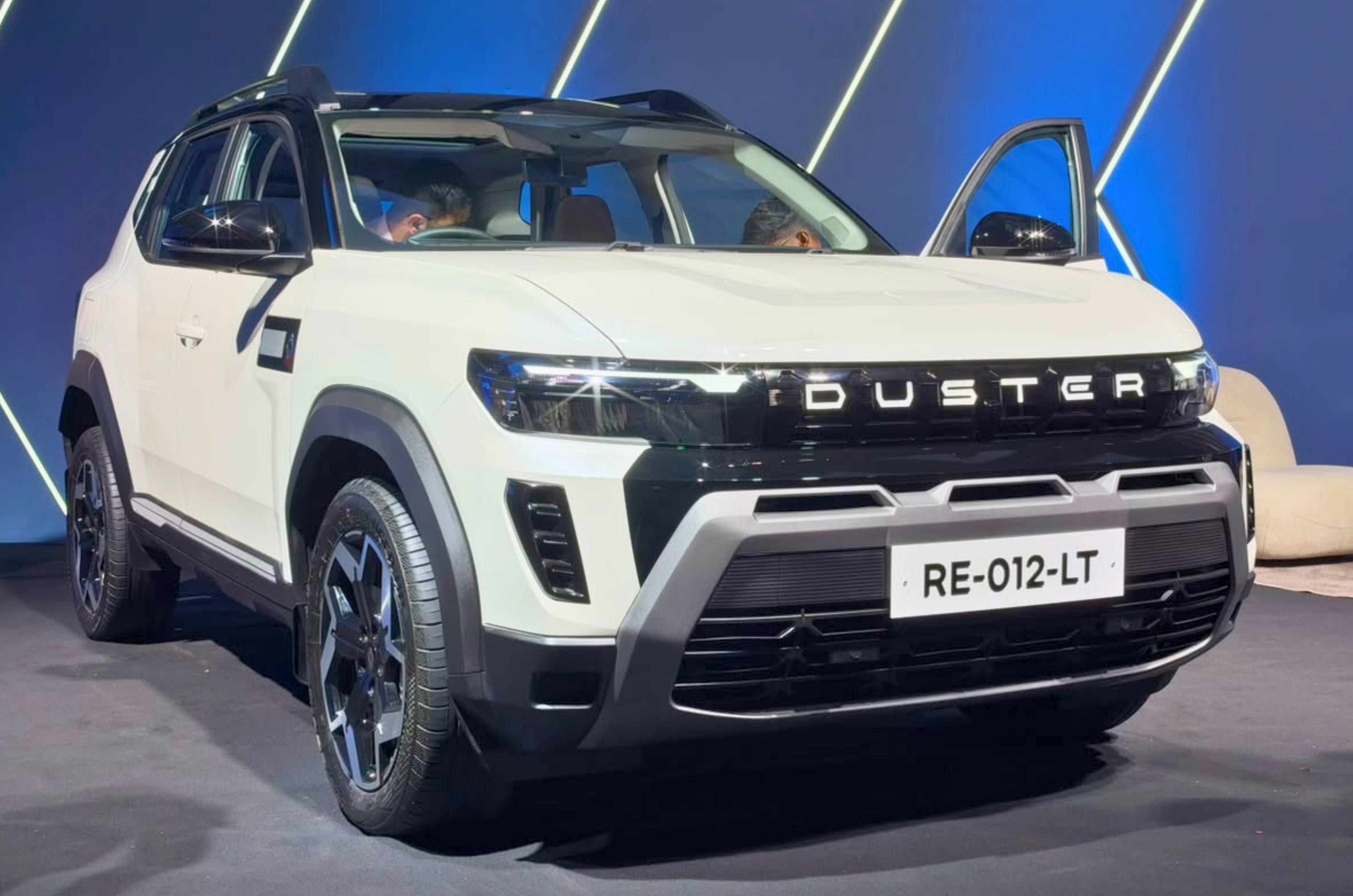
Overall styling is largely similar to the turbo-petrol Duster
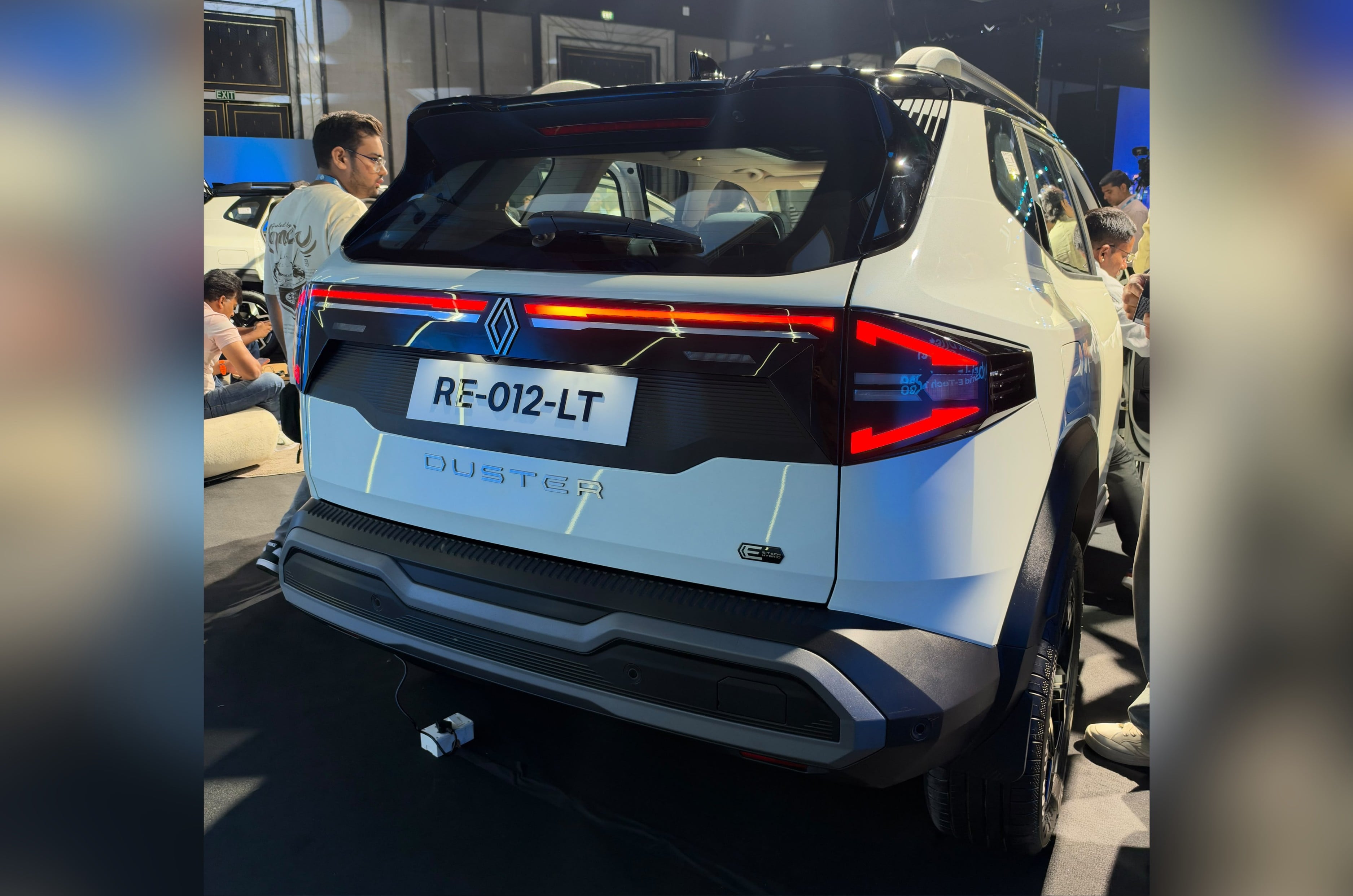
The Duster hybrid looks largely the same as the turbo-petrol versions, with chunky body cladding, C-pillar-mounted rear door handles, roof rails and eyebrow-style DRLs (daytime running lights). Up front, the signature grille gets an illuminated ‘Duster’ emblem, and full-LED headlamps are offered from the Techno trim onwards.
The base Evolution trim rides on 18-inch flex wheels, while the top-spec Emotion gets 18-inch diamond-cut alloys. At the rear is an LED horizontal light bar, while there are ‘E-Tech’ badges on the front doors and the tailgate. The Duster hybrid’s ground clearance stands at 212mm.
Renault Duster hybrid interior and features
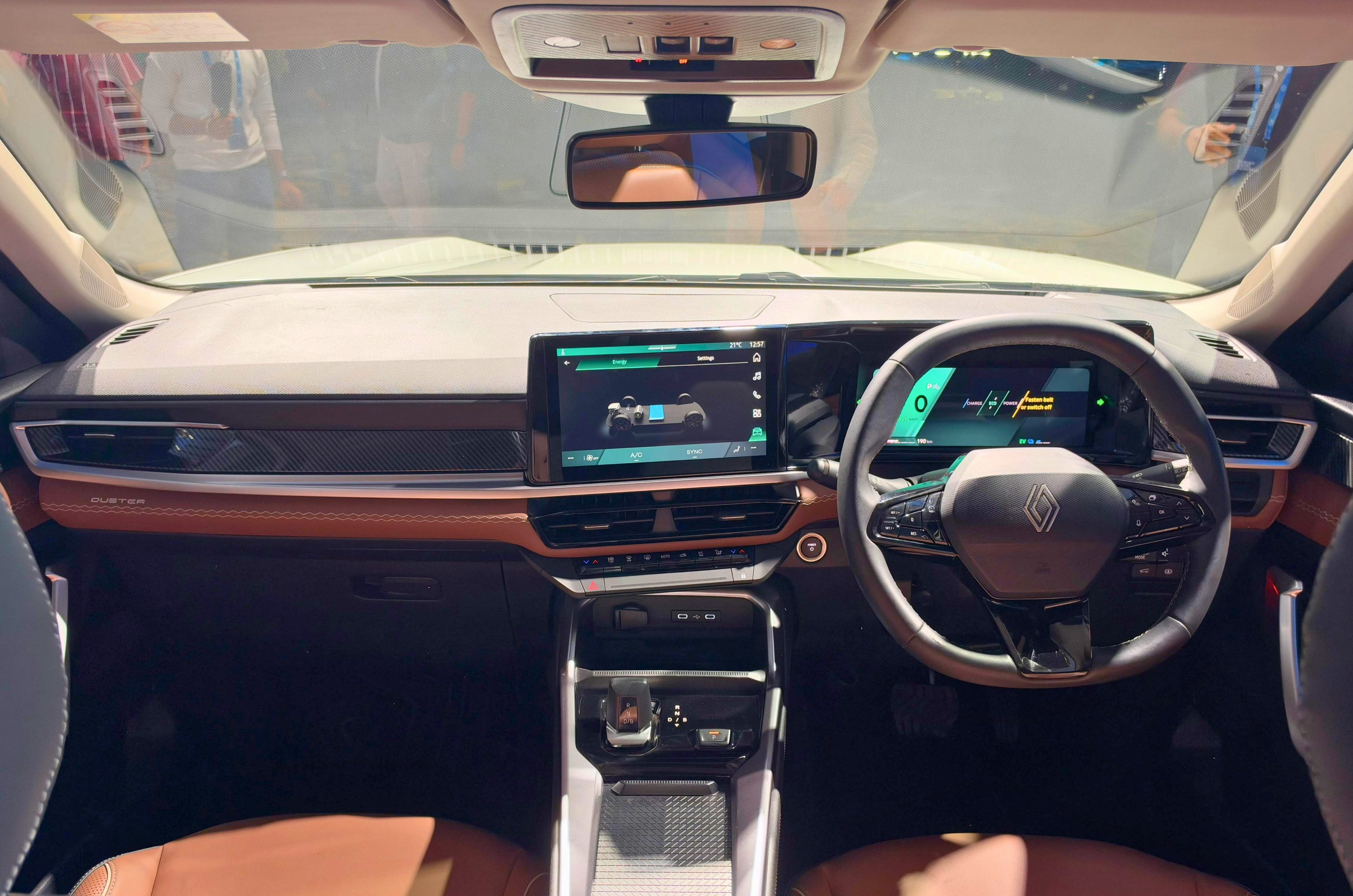
Feature highlights include a pano sunroof, ventilated seats and a 10.25-inch digital cluster
The Duster hybrid’s cabin follows the general design of the turbo-petrol versions, with a dual-screen layout. The mid-spec Techno gets Desert Beige semi-leatherette upholstery, while the top-spec Emotion gets Dune Brown leatherette upholstery.
Standard features on the base Evolution trim include a 10.1-inch touchscreen, a 7-inch digital driver’s display and dual-zone automatic climate control. The Techno adds an electric panoramic sunroof, keyless entry with push-button start and connected car tech via the ‘MyRenault’ (MYR) app. The range-topping Emotion trim gets a larger 10.25-inch digital driver’s display, 6-way electrically adjustable and ventilated front seats, and a powered tailgate.
Renault Duster hybrid safety features
A wide array of safety tech is on offer
Renault claims that the Duster hybrid’s entry-level Evolution trim gets 38 safety features as standard. These come in the form of 6 airbags, hill-start assist, cruise control, rear parking sensors and a rearview camera.
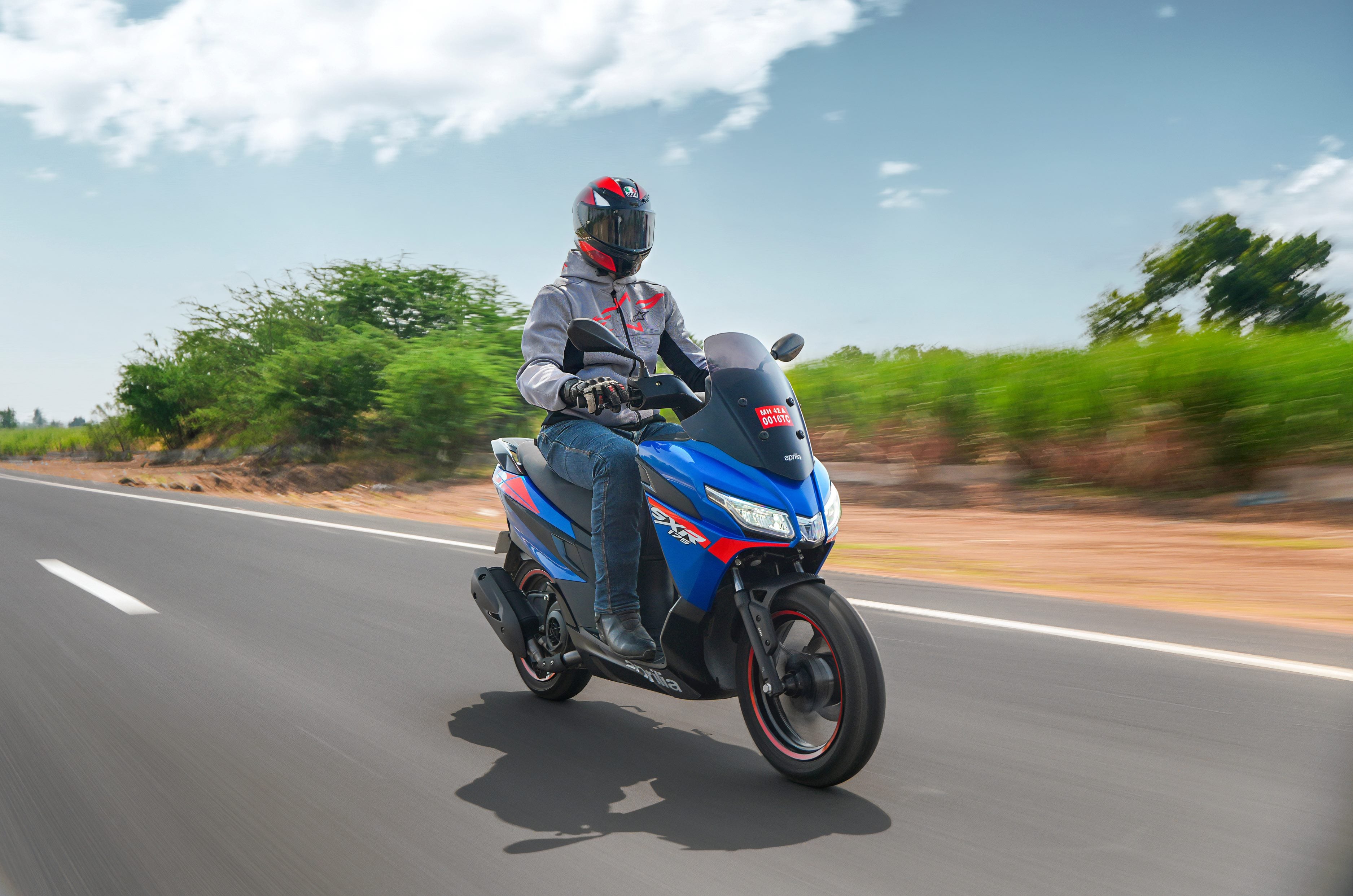
Aprilia may not be the biggest player in the Indian scooter market but it is certainly one of the most radical. It was the first to give us a taste of a true-blue affordable performance scooter with the SR 150 in 2015 and in 2020 the company then upped the ante and introduced India to a premium, yet attainable maxi-style scooter with the SXR 160.
However, six years is a long time and in this interim, the niche that Aprilia was the sole occupant of has now been infringed upon by TVS, Hero, Yamaha and more recently, even Honda! To counter, Aprilia has now taken the next step in the SXR’s evolution and has introduced two models with new engines (125cc and 175cc), more features and a GT suffix. We were given a chance to sample the larger 175cc version and here are our initial impressions.
Aprilia SXR GT 175 Design and features – 7/10
It’s an old design but still looks good; has received a good features upgrade
This design may be 6 years old, but it still manages to look good and turn heads
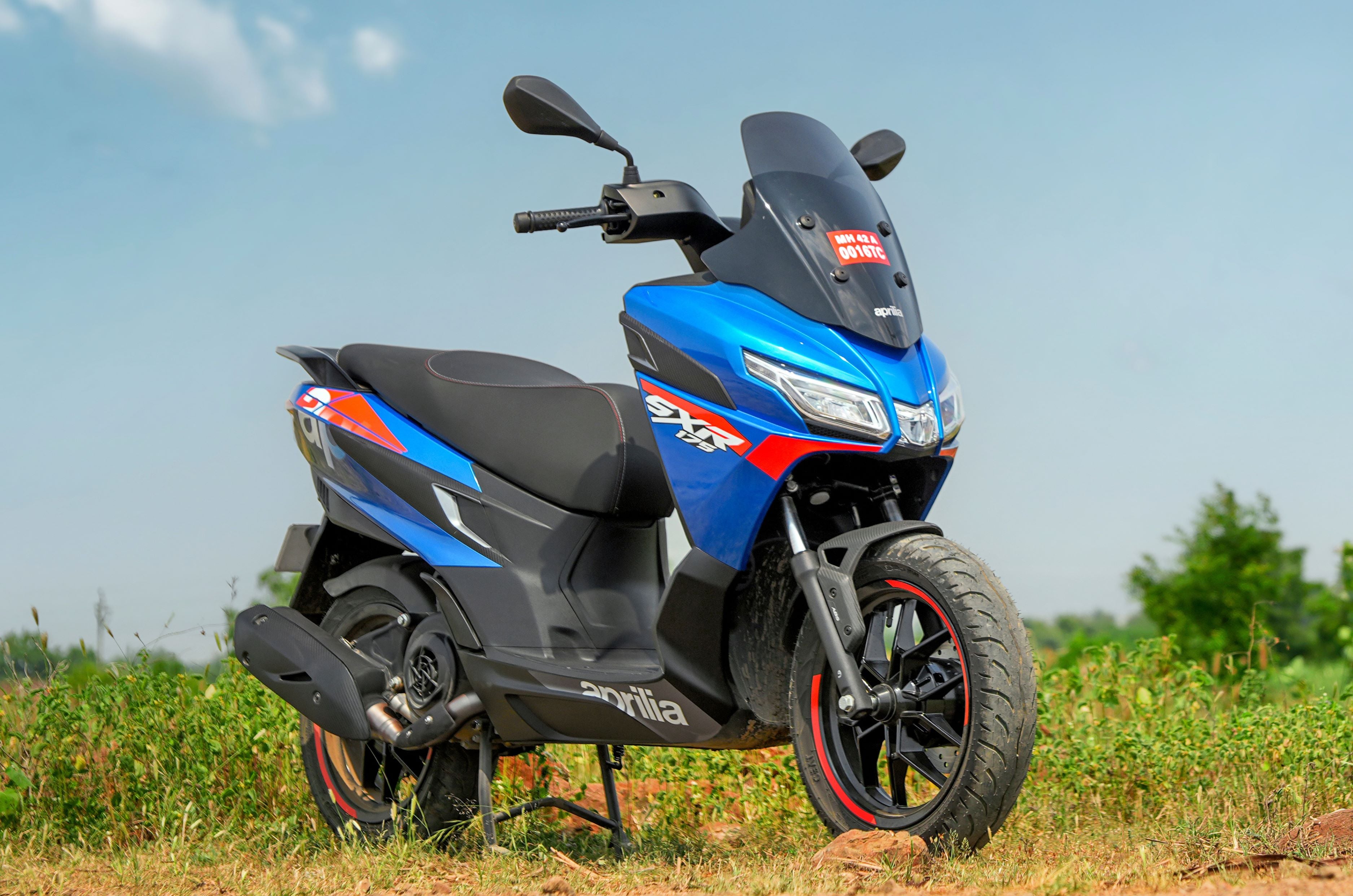
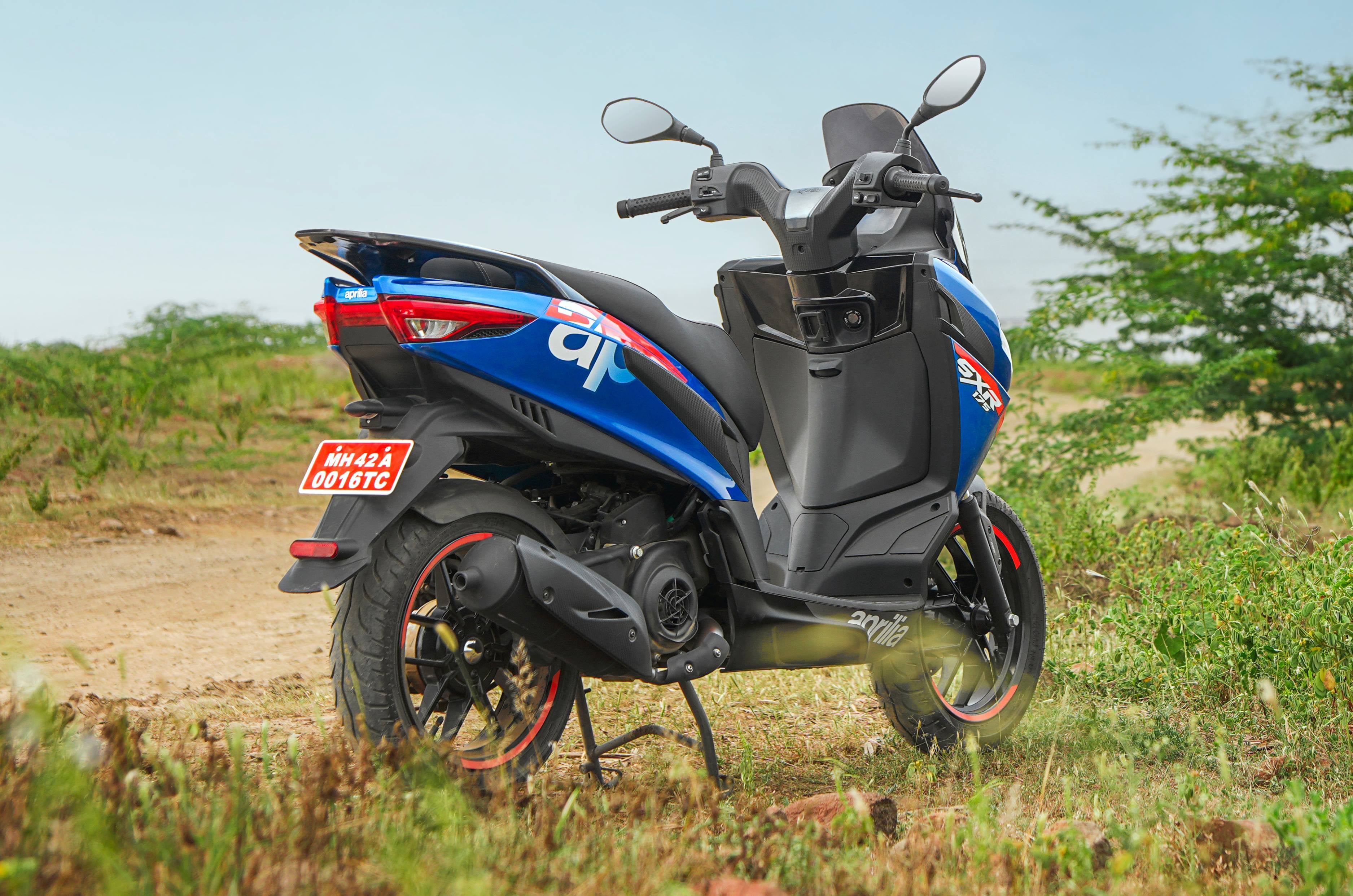
At this juncture, you’re probably wondering aside from the new colours and graphics, how different is the SXR GT 175 to the erstwhile SXR 160 it replaces? The answer to that question is, not very much. Aside from larger 14-in wheels, the SXR GTs look identical to the models they replace and you can certainly feel like it wouldn’t be unreasonable to expect more from the company. However, what you can’t deny is that the scooters still look handsome and striking without going over the top, despite looking nearly the same as they did 6 years ago – that’s Italian design brilliance for you! There are three new colours on offer – the vibrant blue you see here accompanied by a stealthy black and a camo army green scheme.
5-in TFT also shared with SR 175, is well laid out but UI isn’t entirely straightforward
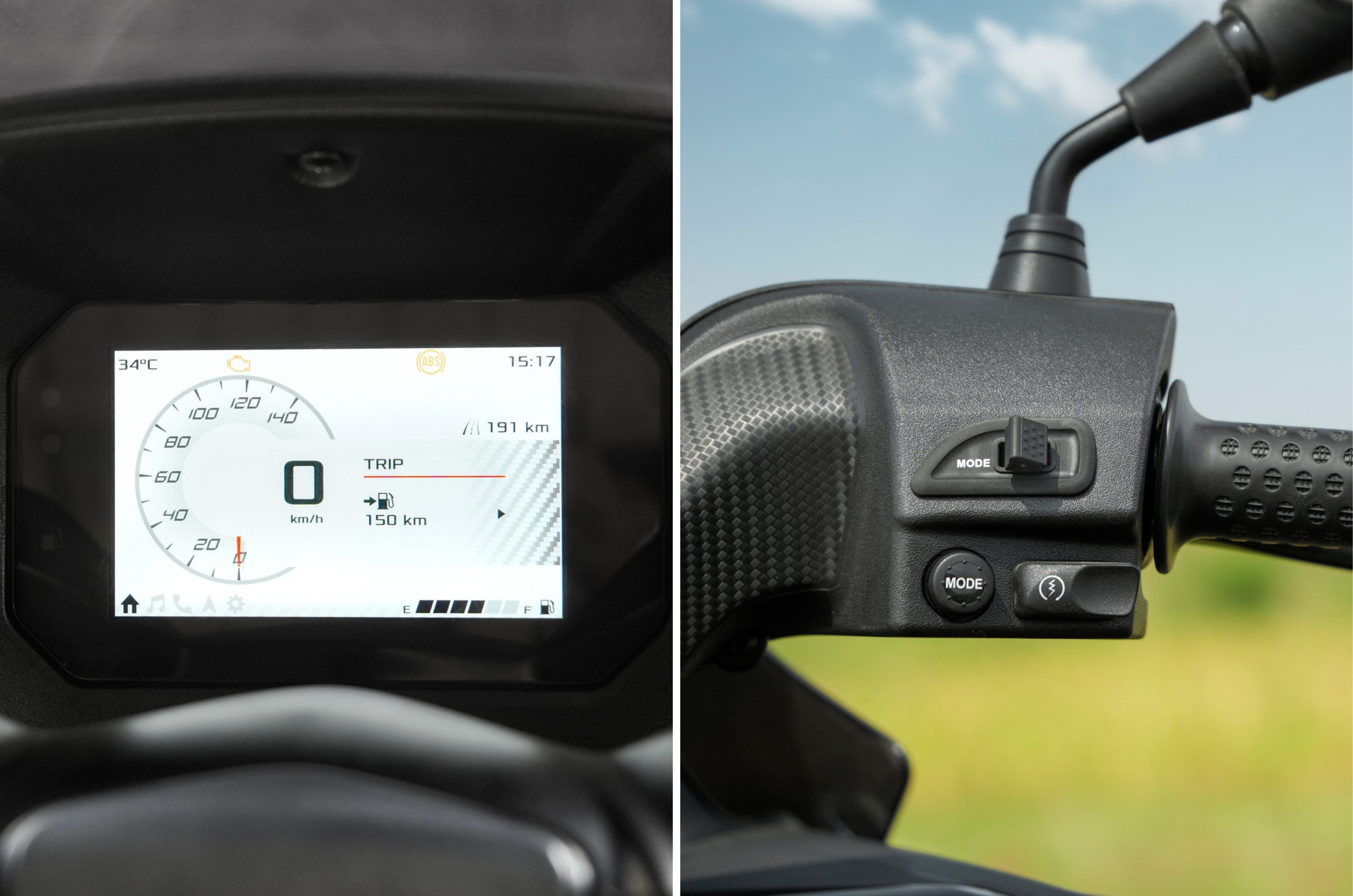
However, once you get astride, you’ll realise that there are a fair few changes going on. For starters, the SXR GT 175 uses the same bright and well laid-out colour TFT display as the SR 175 and this dash is replete with Bluetooth functionality which brings in call/notification alerts & navigation prompts. Like that scooter, the overall user interface is a bit complicated and you will need to learn some of the secret handshakes necessary to fully utilise it. Another gripe I have with this dash is that while it has a lot of tech, you have to make do with a single trip meter, which seems like a small but unnecessary omission.
Bootspace is nothing to write home about
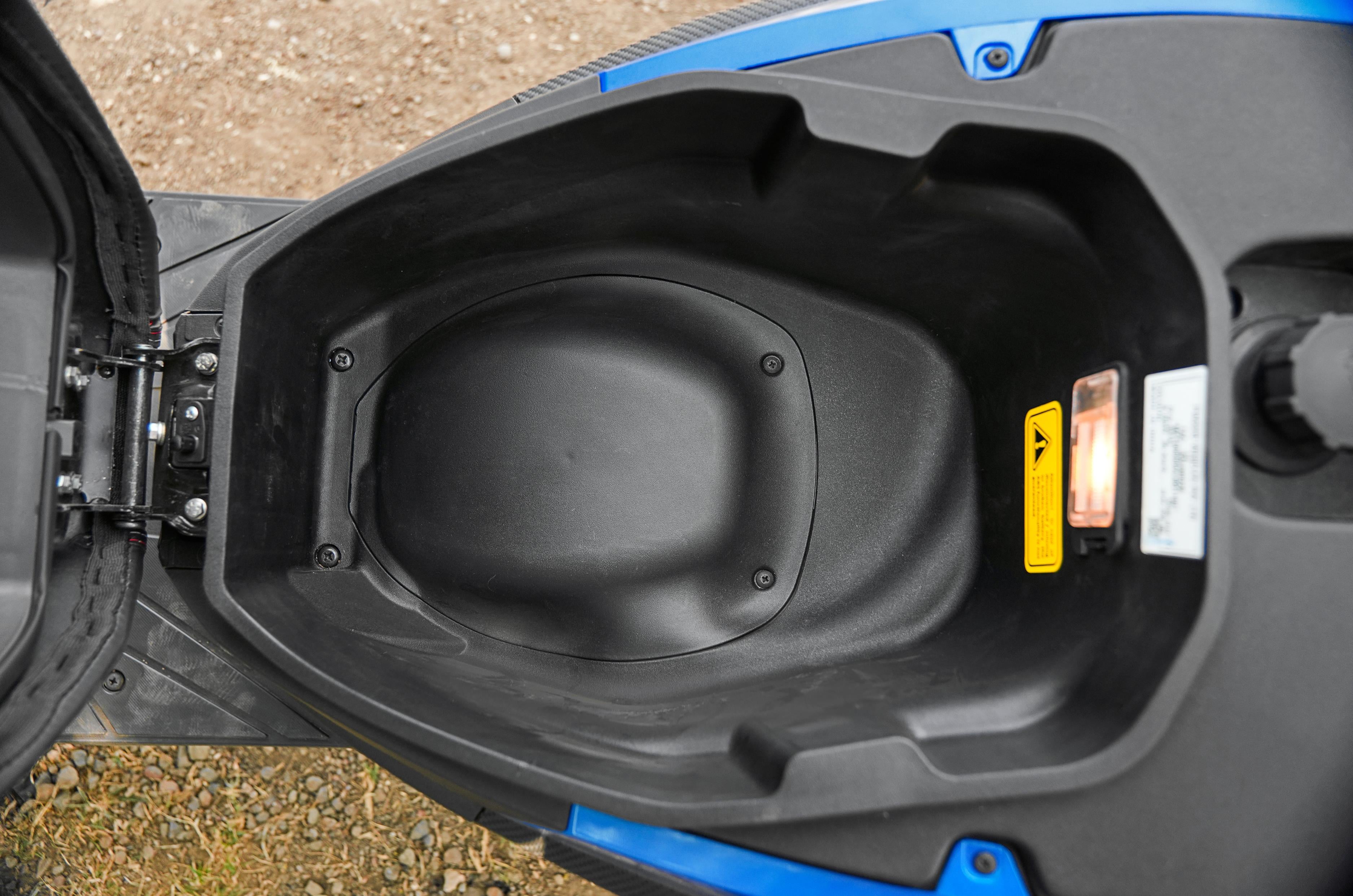
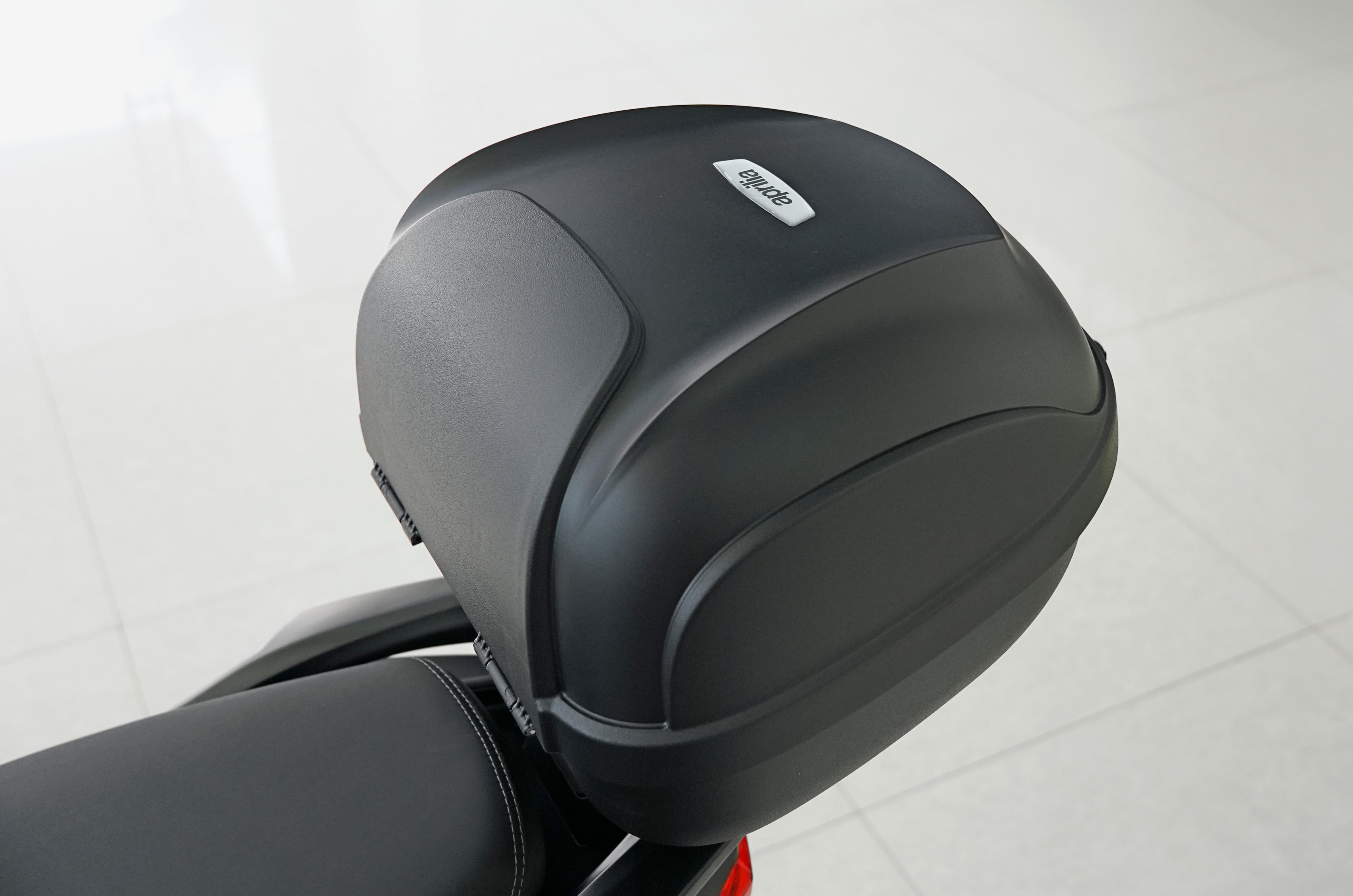
Another small omission is the absence of a multi-function ignition key slot, which means you need to remove the key and put it in its dedicated slot to open the seat and access the boot – something most smaller and cheaper scooters have long moved past. The underseat storage space here isn’t anything to write home about either. However, Aprilia will sell you a pretty spacious 32 litre accessory top box to alleviate that issue, although we don’t have a price for that yet.
But Aprilia will sell you an accessory 32L top box to alleviate that issue
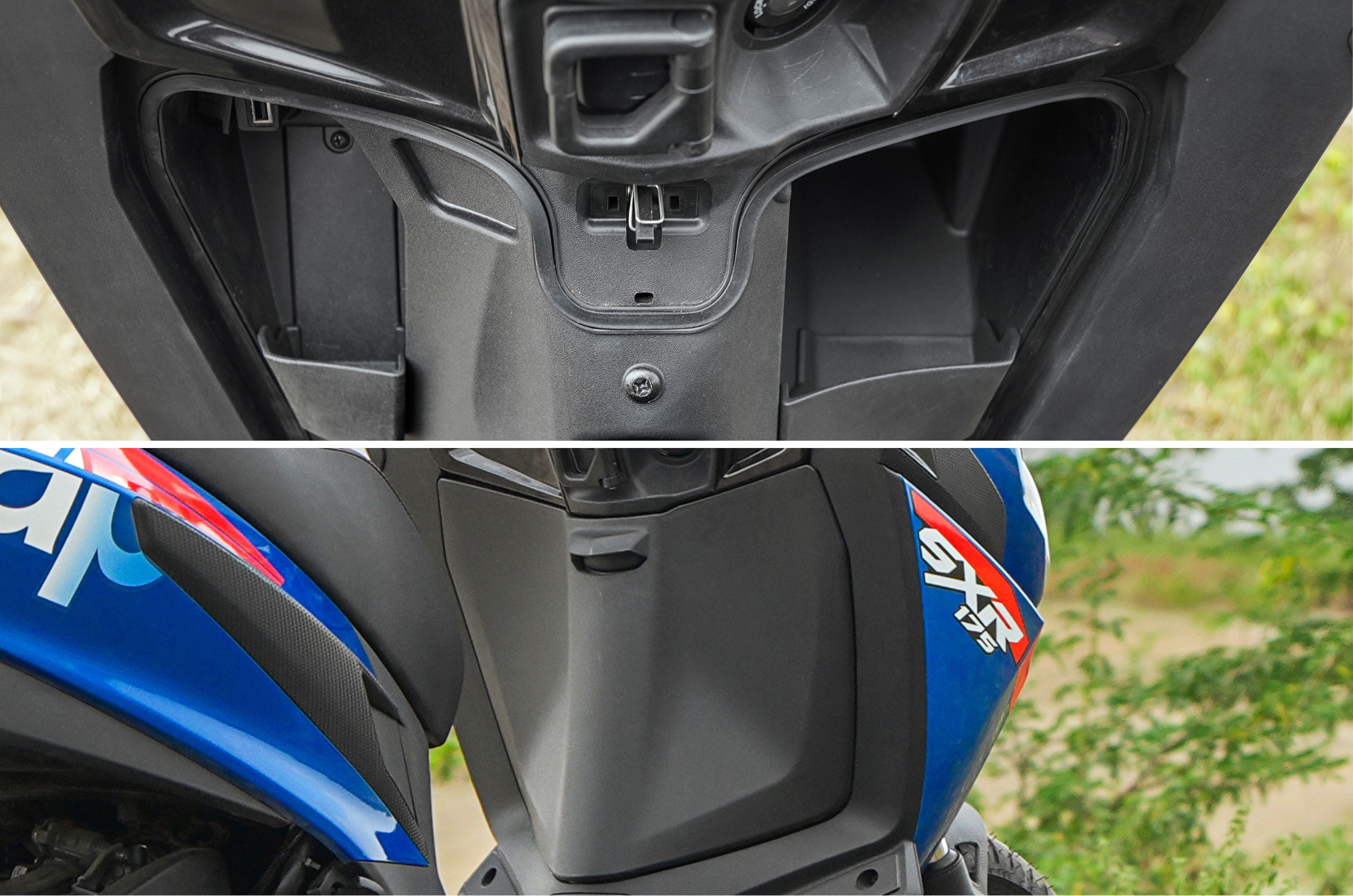
What is a nifty storage solution that comes as standard – carried over from the SXR 160 – are the fully enclosed cubbies on the front apron, and one of them even has a USB-A charging port. While this is surely a safe and practical storage area for your knick-knacks, it’s not the most convenient solution to access when on the move. That’s because you first need to come to a stop, then twist the key to its off position and press it inwards to unlock the cubby.
Enclosed, lockable area opens up to reveal 2 small cubbies; one of them has a USB Type-A charger
Aprilia SXR GT 175 Ergonomic – 7/10
Has one of the tallest seat heights in the scooter space; rider’s triangle is neutral
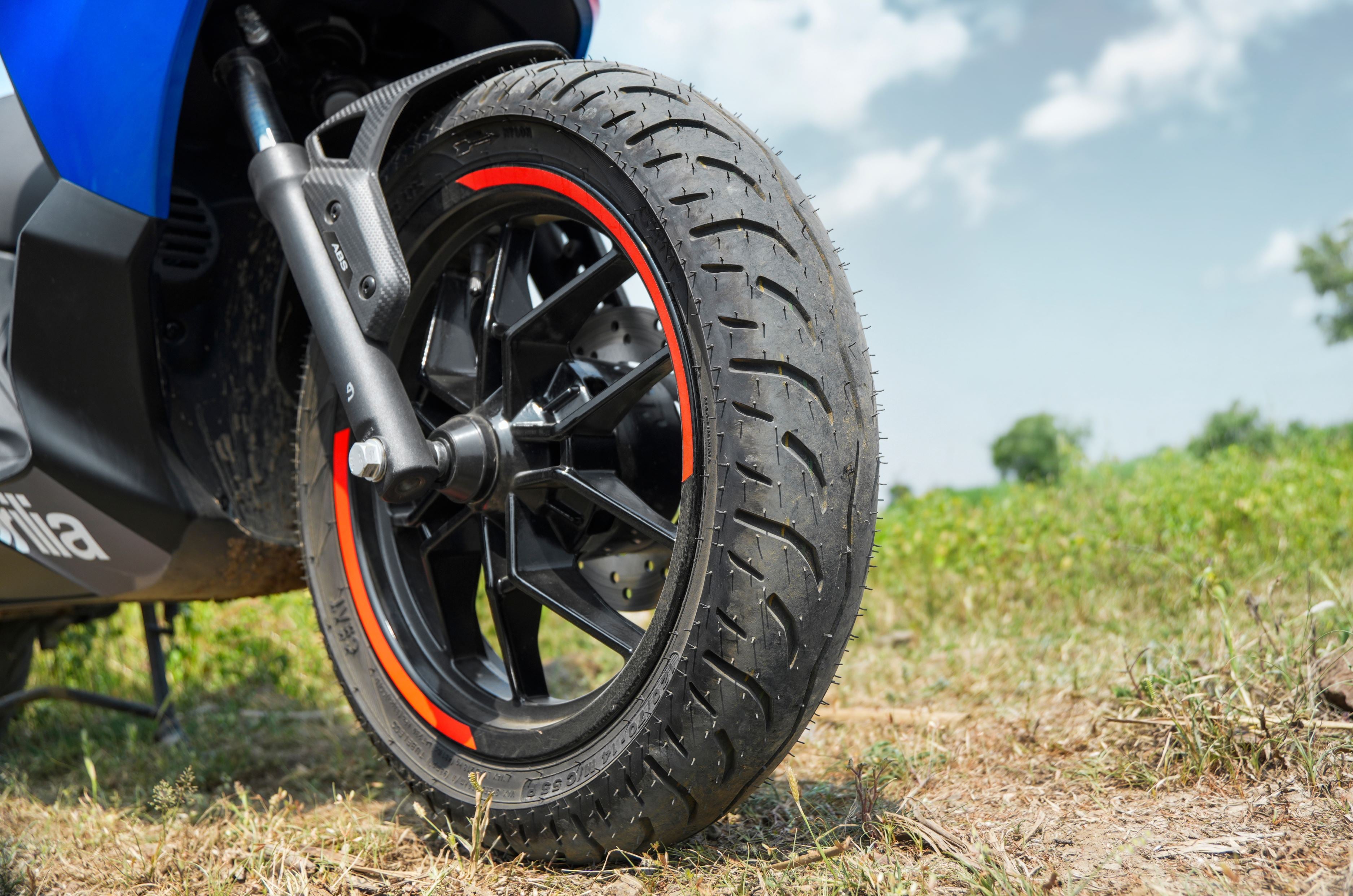
Of course, the new feature that is visible most prominently on the SXR GT is its new 14-inch wheel setup, which has its set of pros and cons. On the plus side, the proportions of the scooter are now better than ever before and its ground clearance has also now risen to 170mm – always a good thing on our unpredictable roads. However, because of the larger wheels, the SXR’s seat height has now risen to 800mm, which makes it the tallest seat height on any made-in-India petrol scooter.
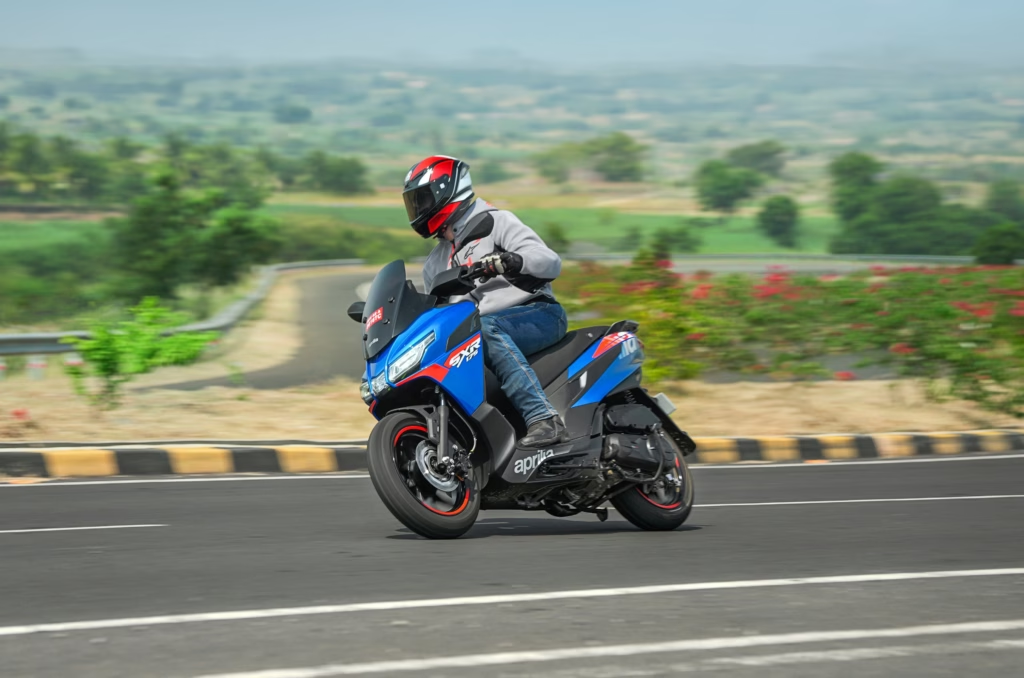
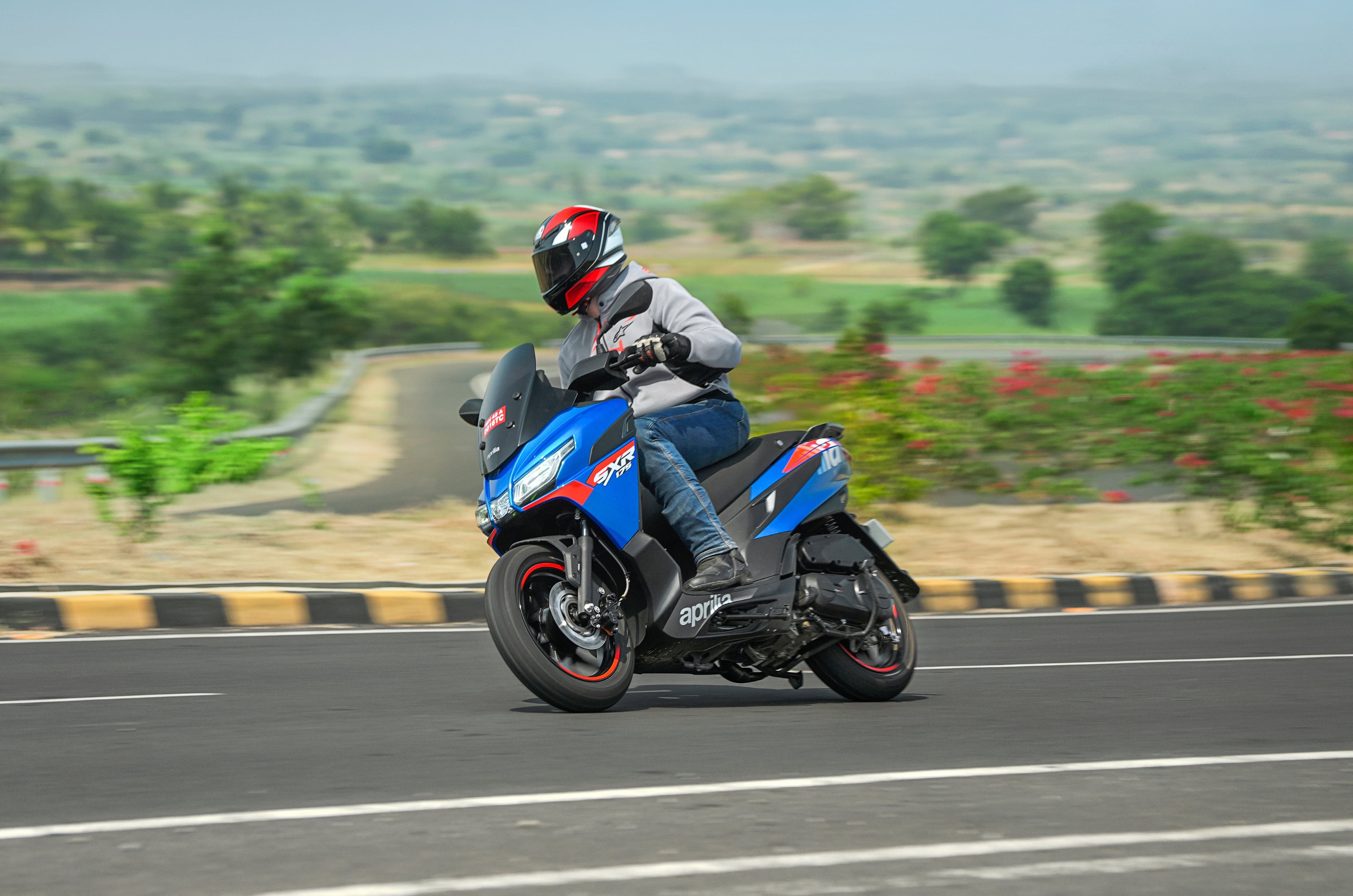
14-inch wheels bring in surefooted handling and high-speed stability but the trade-off is heavier steering at slower speeds demanding more effort
Credit where it’s due, this number may seem big on paper but in the real world its not an unapproachable machine. Our photographer Omkar (who’s 5’2) could move the scooter around at our shoot location while seated without too much trouble. However, for someone that wants a friendly and approachable machine, the 132kg SXR is not where you should be looking.
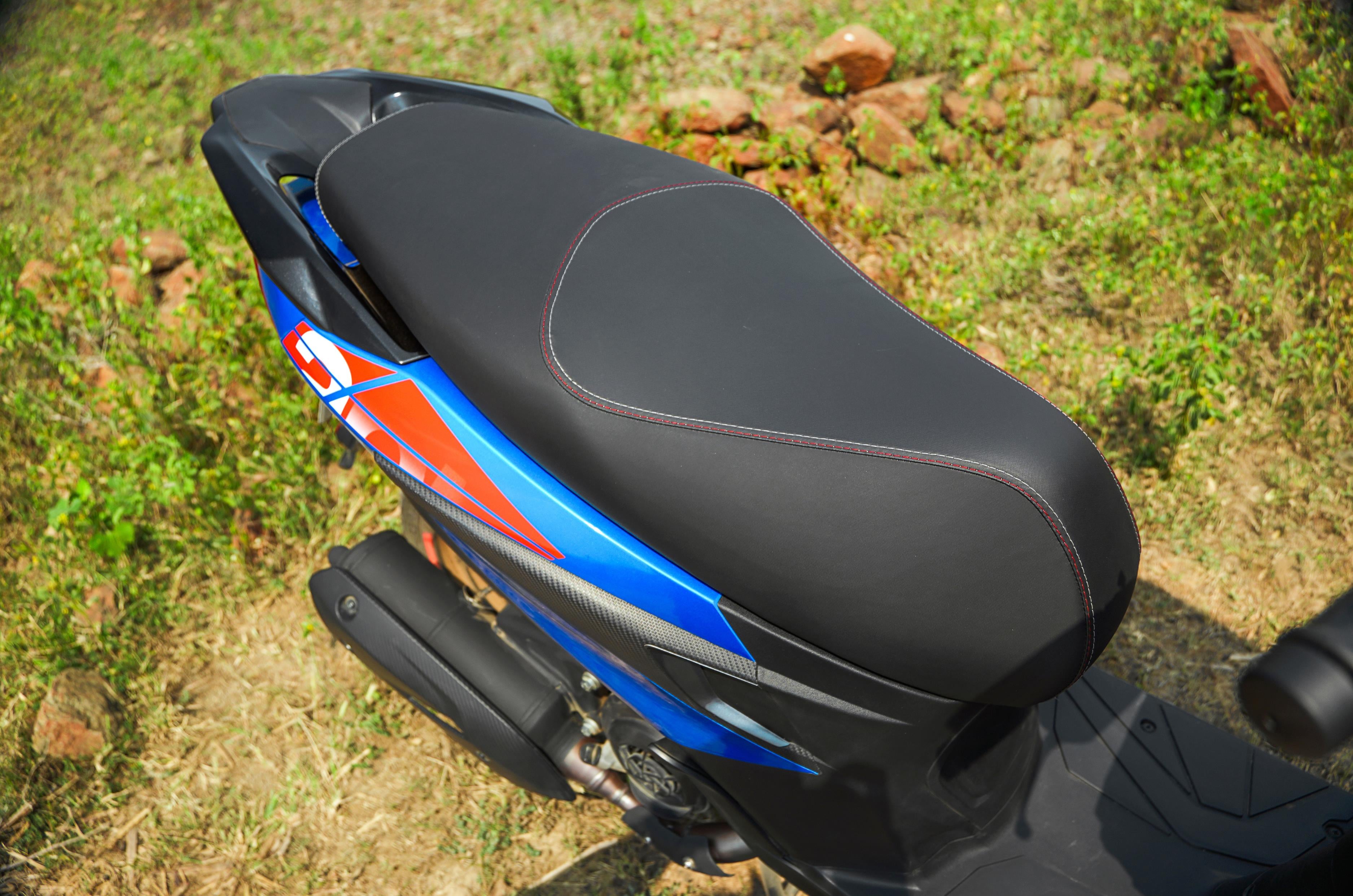
Aside from that, the SXR’s ergonomics haven’t changed and it retains the neutral and upright riding position from before. The seat’s padding is on the stiffer side, which will be especially noticeable on shorter trips but it works well for longer durations and for a person like myself that’s on the heavier side of the scale (80kg without gear). What, however, doesn’t work for a taller person like me (5’11) is that the handlebar is placed a tad low and fouls my knees when making lock-to-lock u-turns.
Neutral and upright ergonomics are unchanged from before; spacious seat’s padding is on the stiffer side
Aprilia SXR GT 175 Performance – 8/10
Engine provides sprightly performance, is smooth at high speeds
While practicality and convenience are one half of the story when it comes to a scooter like this, what plays an equally important role is how the scooter rides and handles. It will probably not come as any surprise to you when I say that this is surely a fun scooter.
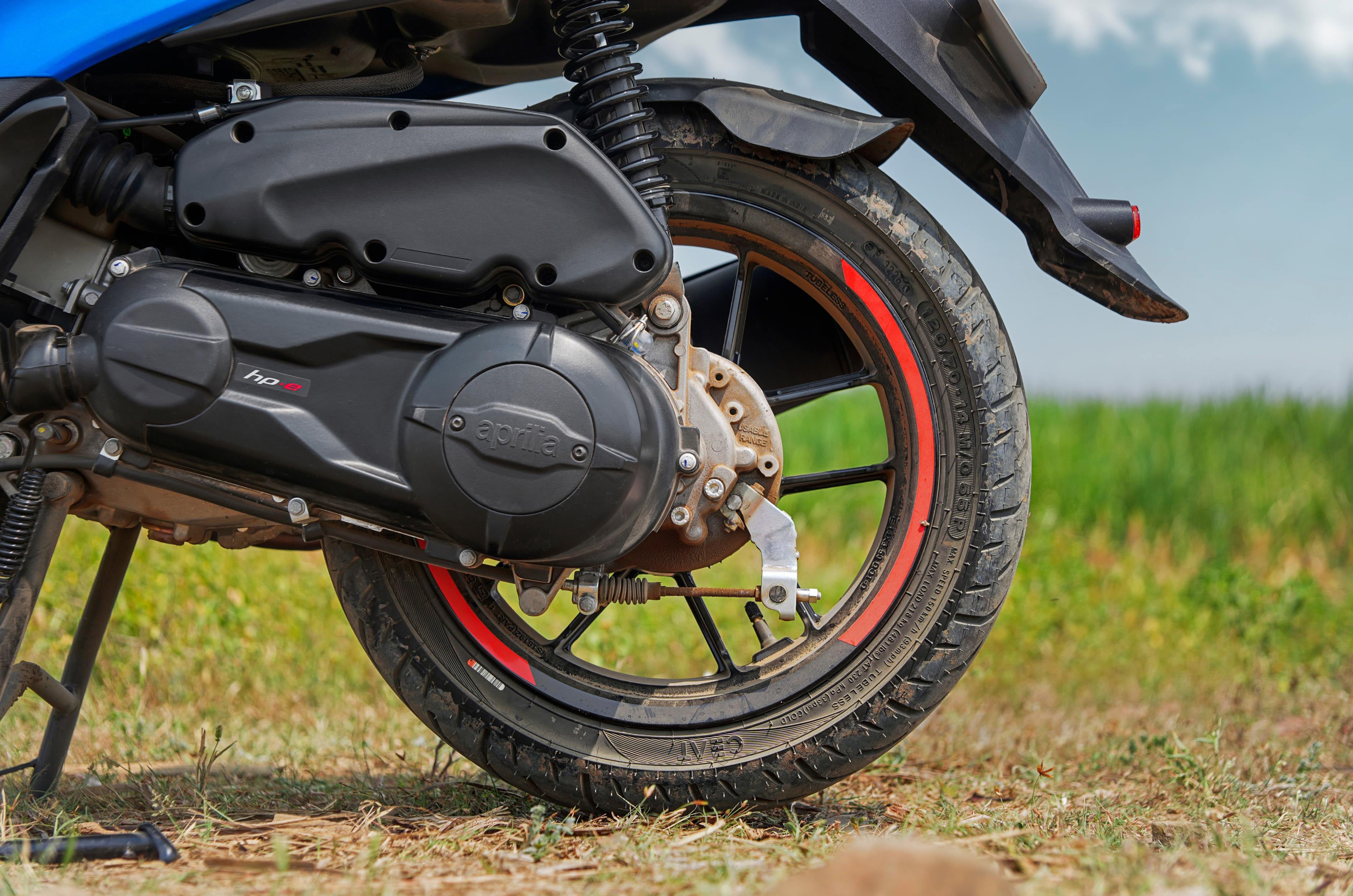
From the moment you thumb the starter and the motor settles into its gruff idle, the 174.4cc, 3-valve motor makes its intentions quite clear – it wants to be ridden quickly. While the vibrations do subside once you get going, the engine clearly rewards energetic riding because the faster you go, the smoother it seems to get! Not just 80kph, even at a speedo-indicated 100kph, it remains absolutely smooth at all the touch points with no signs of protest. For all you top speed nuts, we were able to see an indicated 110kph on the display before the rev limiter kicked in.
Sprightly 174.4cc engine shared with SR 175 has enough performance to placidly sustain 80-100kph
While the SXR is a quick scooter, from what I remember, it doesn’t feel as quick as the lighter and sportier SR. The 0-50kph dash is quite energetic but after that, acceleration becomes more measured. Nevertheless, this level of performance is more than acceptable for our environs and you’ll rarely wish for more power.
Aprilia SXR GT 175 Ride and Handling – 7/10
Planted and surefooted handler, but not the easiest to manage at slower speeds
Equally as enticing as its performance is the SXR GT 175’s handling. The new and bigger 14 inch wheels lend it a newfound sense of stability around corners and at higher speeds. To ride, this feels like a proper maxi scooter experience rather than just a styling exercise. However, the tradeoff is noticeably heavier steering at slower speeds which demands quite a bit more effort. If you’re going to spend a lot of time in dense stop and go traffic that you constantly need to manoeuvre around, the SXR GT is not the ideal machine for that task.
To account for these larger wheels, Aprilia has also tuned the SXR’s suspension differently to before. The damping and shock absorption are really quite composed at the rear but the fork feels stiff and jarring over rough roads and does bottom out over larger, sharper-edged bumps. Since Mumbai’s roads are dominated by these conditions, we’re not sure how comfortable the SXR GT will be there, but hope to find out soon.
It sticks to the Aprilia SXR formula of giving you a decently-priced, good-looking scooter with both functional practicality and zippy performance
Well-priced and stands out but its not for everyone
In the scooter segment, Aprilia operates in its own niche where people that really value style and performance continue to choose its offerings over mainstream options. We don’t see that changing with the SXR GT because even though it is more well-rounded than its sporty SR sibling, it still has some hurdles to overcome both on the product’s as well as the after-sales side and fresh styling would have helped increase the appeal after all these years. Nevertheless, the company assures us it is working on the after sales front and it aims to have 250 showrooms in India before the year ends, up from the current 230. Still, that’s vastly lower than the sales reach of Aprilia’s rivals.
To sum up, this latest iteration hasn’t really diverged from what has been the cornerstone of the Aprilia SXR formula – to give you a decently-priced, good-looking scooter with both functional practicality and zippy performance. Speaking of price, the SXR GT 175 is priced at Rs 1.30 lakh (introductory, ex-showroom, Maharashtra) which is a pretty decent price considering what it brings to the table. If you must have a stylish and fun scooter that stands out of the crowd without breaking the bank, the Aprilia SXR GT should be on your radar.
Kapil Sharma Show: सैफ अली खान और करीना कपूर जल्द ही कपिल शर्मा के शो ‘द ग्रेट इंडियन कपिल शो’ में नजर आने के लिए पूरी तरह तैयार हैं। अपनी शादी की 14वीं सालगिरह के मौके पर नेटफ्लिक्स ने आने वाले एपिसोड का एक प्रोमो जारी किया है, जिसमें दोनों एक दूसरे की आदतों के बारे में मजेदार खुलासे करते दिख रहे हैं।
‘द ग्रेट इंडियन कपिल शो’ में सैफ अली खान-करीना कपूर
प्रोमो में कपिल इस जोड़े से पूछते हैं कि शादी के 14 साल बाद भी वे इतने ‘हमेशा जवान और फ्रेश’ कैसे दिखते हैं, इसका राज क्या है। सैफ ने तुरंत इसका श्रेय घी को दिया। करीना ने आगे बताया कि वे घर पर काफी घी खाते हैं। करीना ने कहा, “हमारे पास घी है, हमारे बच्चे इसे खाते हैं।” लेकिन सैफ ने बीच में ही उनकी एक आदत के बारे में बहुत मजेदार बात बता दी। उन्होंने कहा, “वह इसे सिर्फ खाती ही नहीं है, बल्कि रात को अपने पैरों पर भी लगाती है।” करीना ने तुरंत कहा, “इससे बहुत फायदा होता है।”
इसके बाद सैफ ने दर्शकों को खूब हंसाया। उन्होंने कहा- “सोचिए कितना रोमांटिक माहौल है और रात को हमारे बेडरूम से ढाबे जैसी महक आ रही है।” फिर कपिल ने अर्चना पूरन सिंह के बारे में मजाक किया कि वह अपने पैरों पर घी लगाती हैं और बाद में उसी घी का इस्तेमाल अपनी चपाती पर भी करती हैं। यह एपिसोड इस शनिवार 17 अक्टूबर को नेटफ्लिक्स पर आएगा।
वहीं जब प्रोमो में करीना ने बताया की उन्होंने सैफ के प्रपोजल पर तुरंत हां नहीं कहा था, उन्होंने उन्हें तीन बार प्रपोज किया तब जाके मैंने हां बोला था। तब सैफ ने कहा कि पहली बार में हां कह देती तो मेरा खर्चा कम होता। वहीं दोनों ने एक दूसरे की सोने के समय खर्राटें लेने की आदतों का भी खुलासा किया।
फैंस ने आने वाले एपिसोड को लेकर अपना उत्साह जाहिर किया। एक कमेंट में लिखा था- “मुझे लगा था कि KBC पर सैफ का रिएक्शन ताना मारने वाला था, लेकिन अब मुझे सच में लगता है कि वह घी फिर से मिलने पर वाकई खुश थे, हाहा।” एक और फैन ने लिखा-“मैं इसे सैफ के मजाकिया अंदाज के लिए देखने जा रहा हूं।” एक तीसरे फैन ने कमेंट किया, “मुझे लगता है कि करीना एकदम देसी पत्नी हैं।” एक और ने लिखा, “ये दोनों बहुत पसंद हैं।”
अपनी सालगिरह के मौके पर इस कपल ने सोशल मीडिया पर दिल छू लेने वाली पोस्ट शेयर कीं। करीना ने इंस्टाग्राम पर सैफ के साथ कुछ अनदेखी तस्वीरें शेयर कीं और लिखा, “एक और साल बीत गया। आगे भी ऐसे ही साथ रहना है।” हाल ही में इंस्टाग्राम पर कदम रखने वाले सैफ ने भी करीना और अपने बच्चों के साथ तस्वीरें शेयर कीं और लिखा, “ये हुई ना बात, एकदम परफेक्ट!! सालगिरह मुबारक हो, लव।”
करीना और सैफ ने पांच साल तक एक-दूसरे को डेट करने के बाद 16 अक्टूबर 2012 को मुंबई में शादी कर ली थी। दोनों पहली बार फिल्म ‘टशन’ (2008) की शूटिंग के दौरान एक-दूसरे के करीब आए थे। इस कपल ने अपनी रजिस्टर्ड शादी को प्राइवेट रखा और यह समारोह बांद्रा स्थित सैफ के घर पर हुआ। अब उनके दो बेटे हैं – तैमूर और जेह।
करीना कपूर और सैफ अली खान की हालिया फिल्मों के बारे में
करीना को आखिरी बार मेघना गुलज़ार की फिल्म ‘दायरा’ में देखा गया था, जिसमें पृथ्वीराज सुकुमारन भी मुख्य भूमिका में थे। पुलिस ड्रामा पर आधारित इस फिल्म को क्रिटिक्स और दर्शकों से अच्छे रिव्यू मिले। वहीं सैफ फिल्म ‘हैवान’ में नज़र आए। प्रियदर्शन के निर्देशन में बनी इस फिल्म में अक्षय कुमार और सैयामी खेर भी अहम भूमिकाओं में थे।
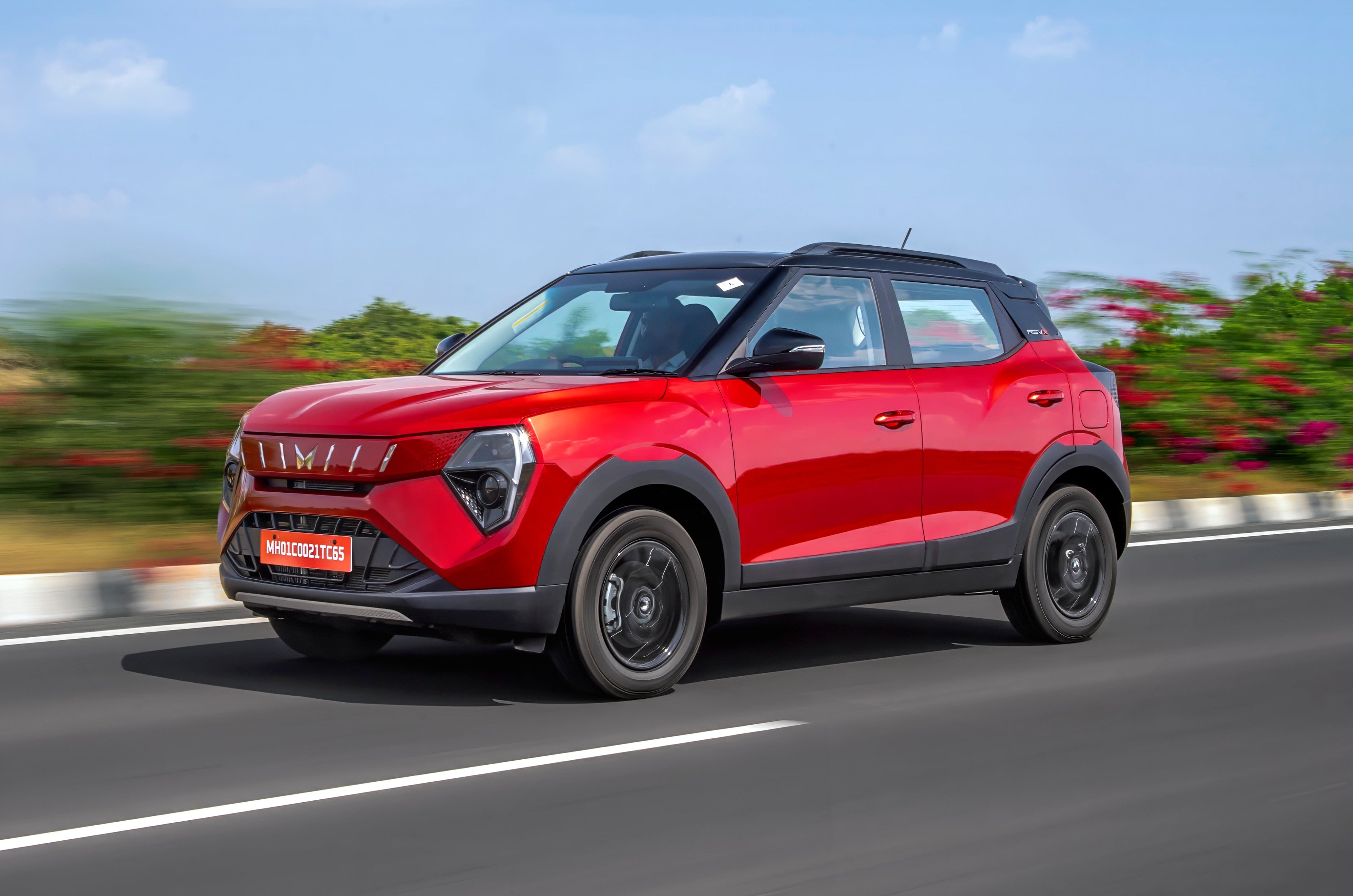
CNG is shaping up to be the new diesel. For the second year running, CNG passenger vehicles outsold diesels, accounting for 21.98 percent of the market compared to 18.08 percent for oil burners in FY2026. That is a very big deal. Big enough for Mahindra – traditionally a diesel-first brand – to sit up, take notice and want a piece of the action. Its first attempt – if you don’t count the fleet-only KUV100 CNG – is the Mahindra XUV 3XO ZNG. Read as Zee-NG and pronounced Zing. The headline is that it makes the same amount of power as the pure-petrol 3XO TCMPFi. We experienced it in Mumbai to see if it really has zing.
Mahindra XUV 3XO ZNG Exterior Design and Engineering – 7/10
Outside, there isn’t much to tell the ZNG apart from the regular XUV 3XO. Our test car is based on the REVX trim and gets a body-coloured grille, while other trims gloss black. LED lighting is present, though fog lamps are missing even on the top REVX A CNG trim.
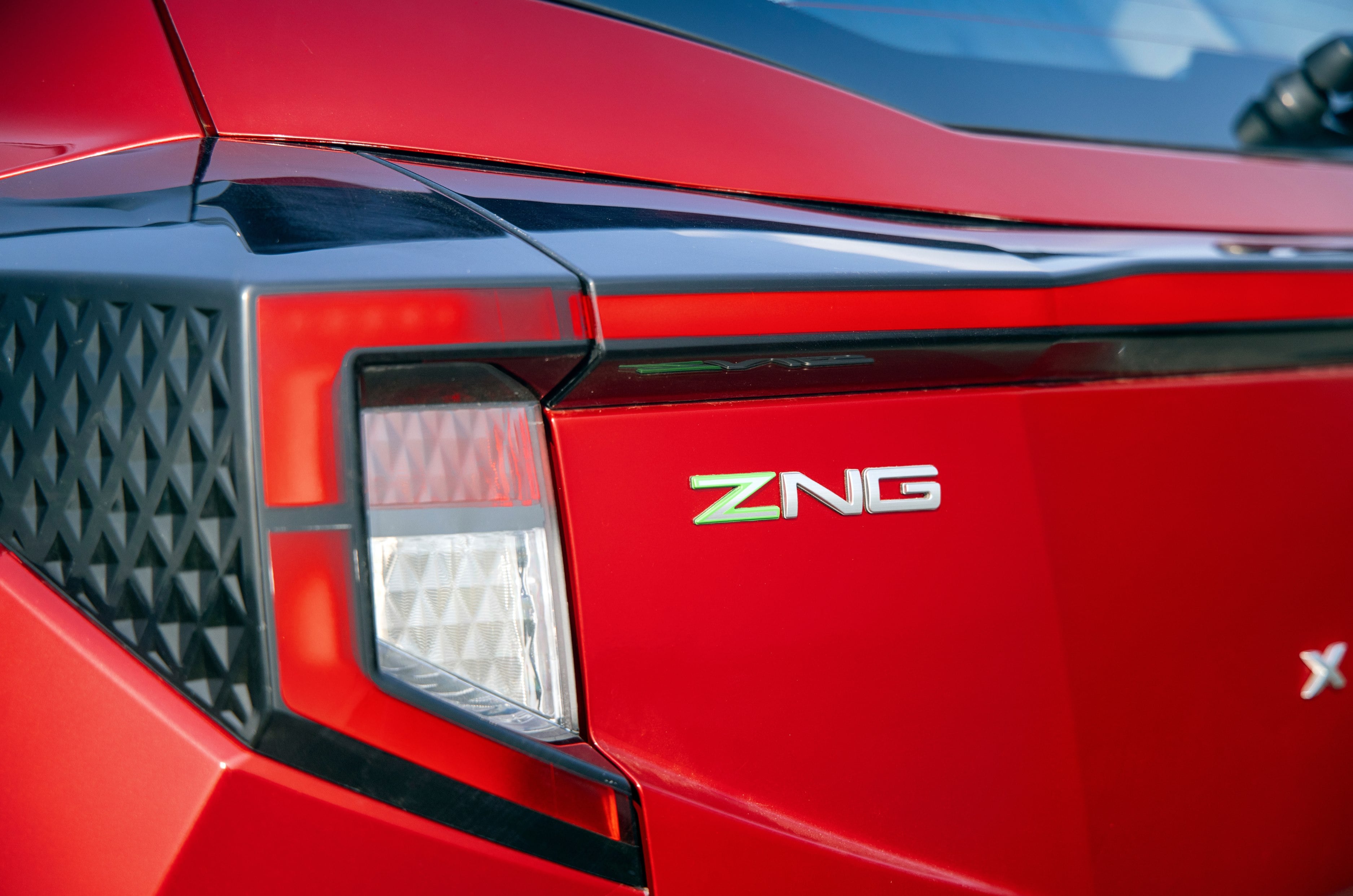
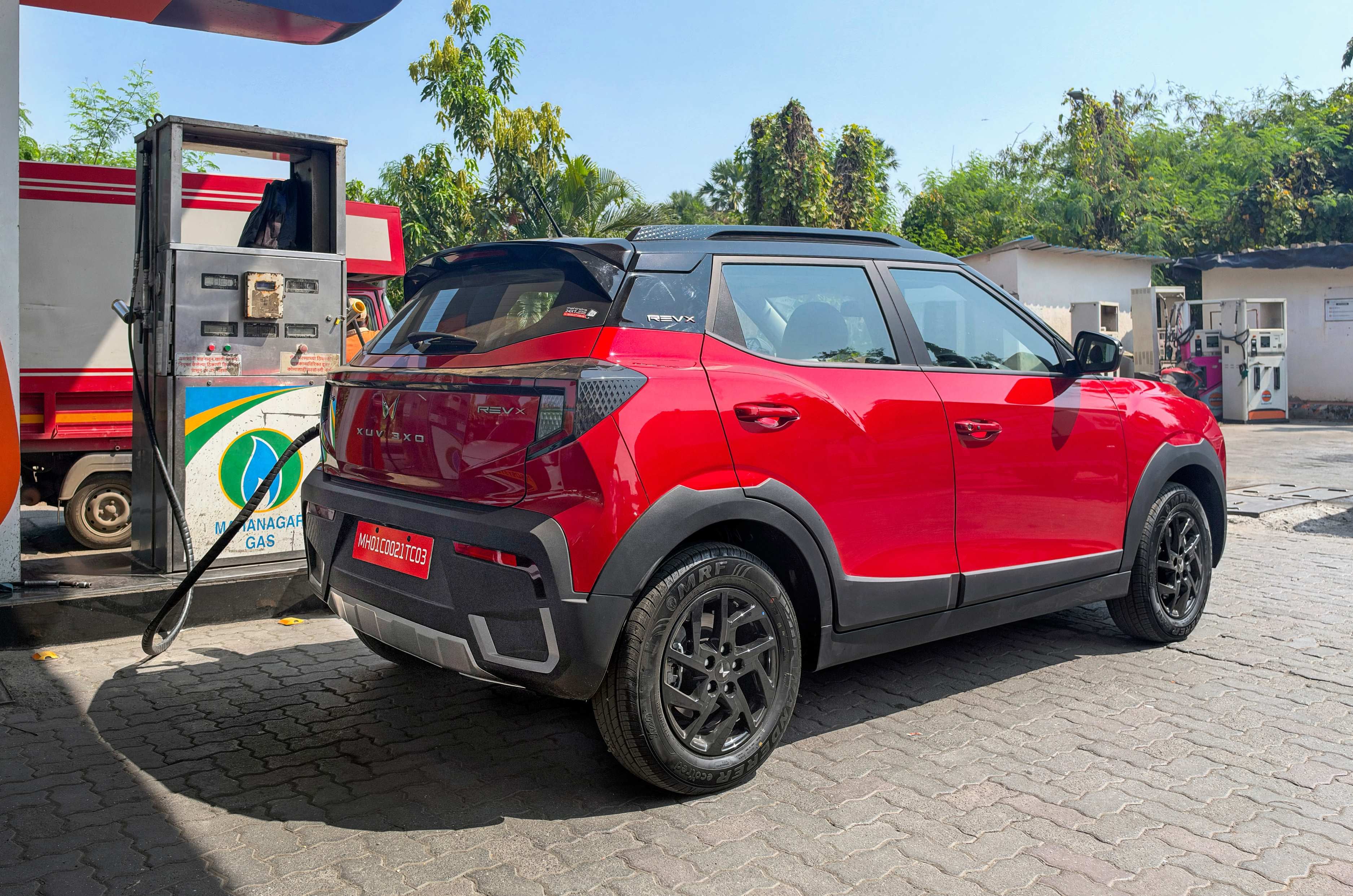
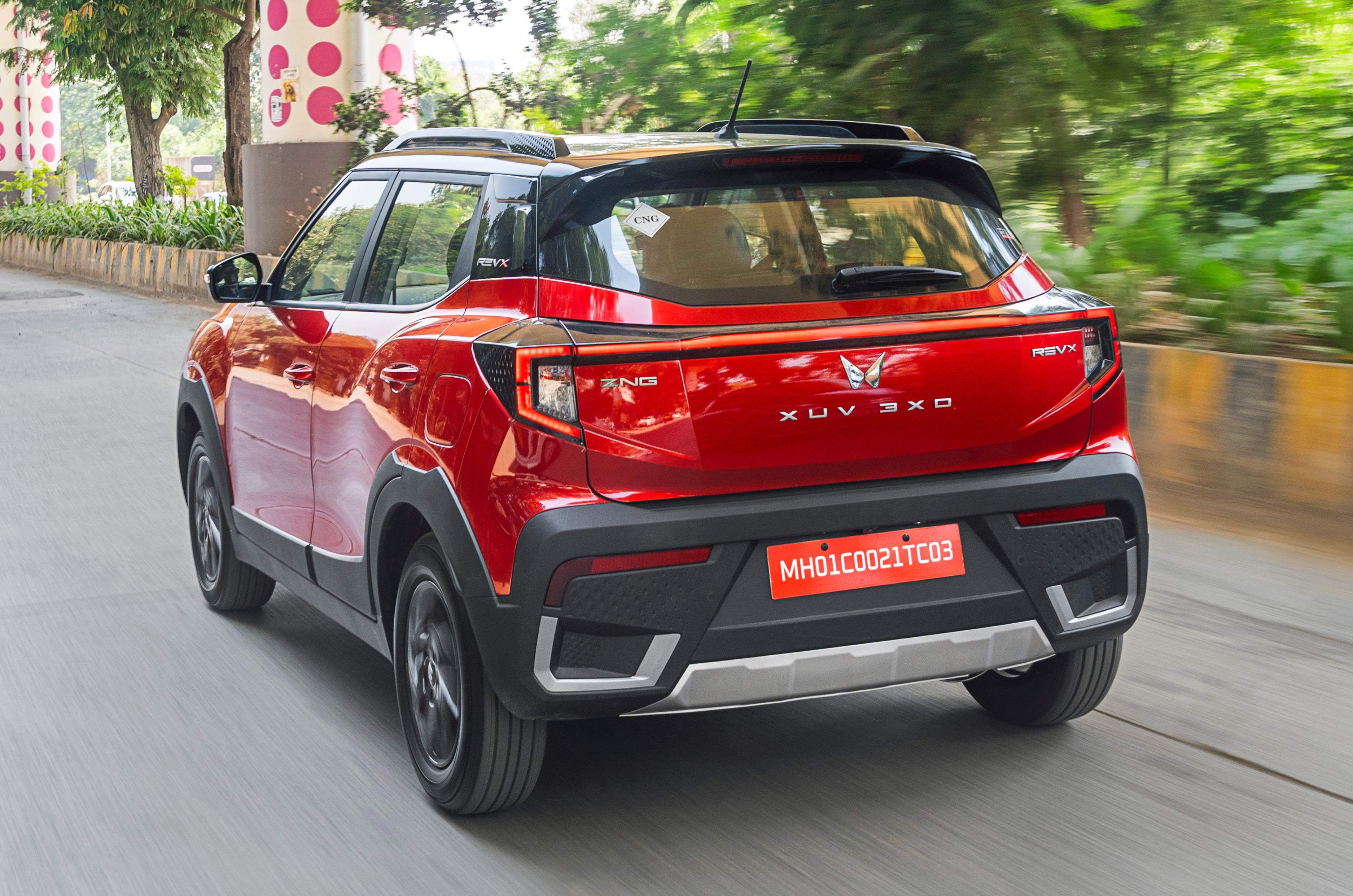
ZNG badge on the tailgate is the only exterior telltale of the CNG powertrain.
In profile, you’ll notice the gloss black 16-inch wheels – the largest size available on the ZNG, with 17s reserved for the pure-petrol TGDi. At the rear is the clearest giveaway of its CNG powertrain: a ZNG badge on the tailgate.
XUV 3XO ZNG Interior Space and Comfort – 8/10
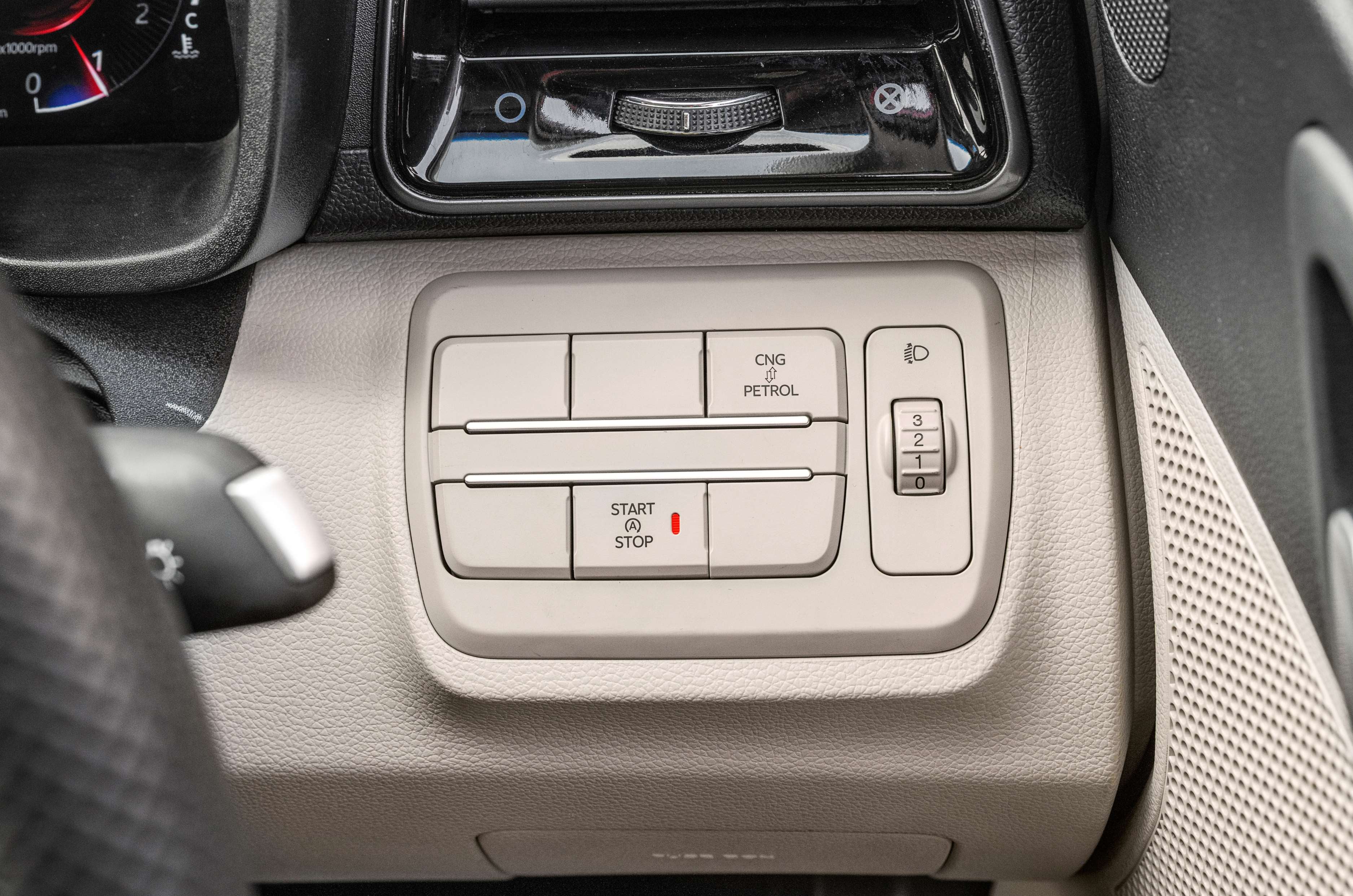
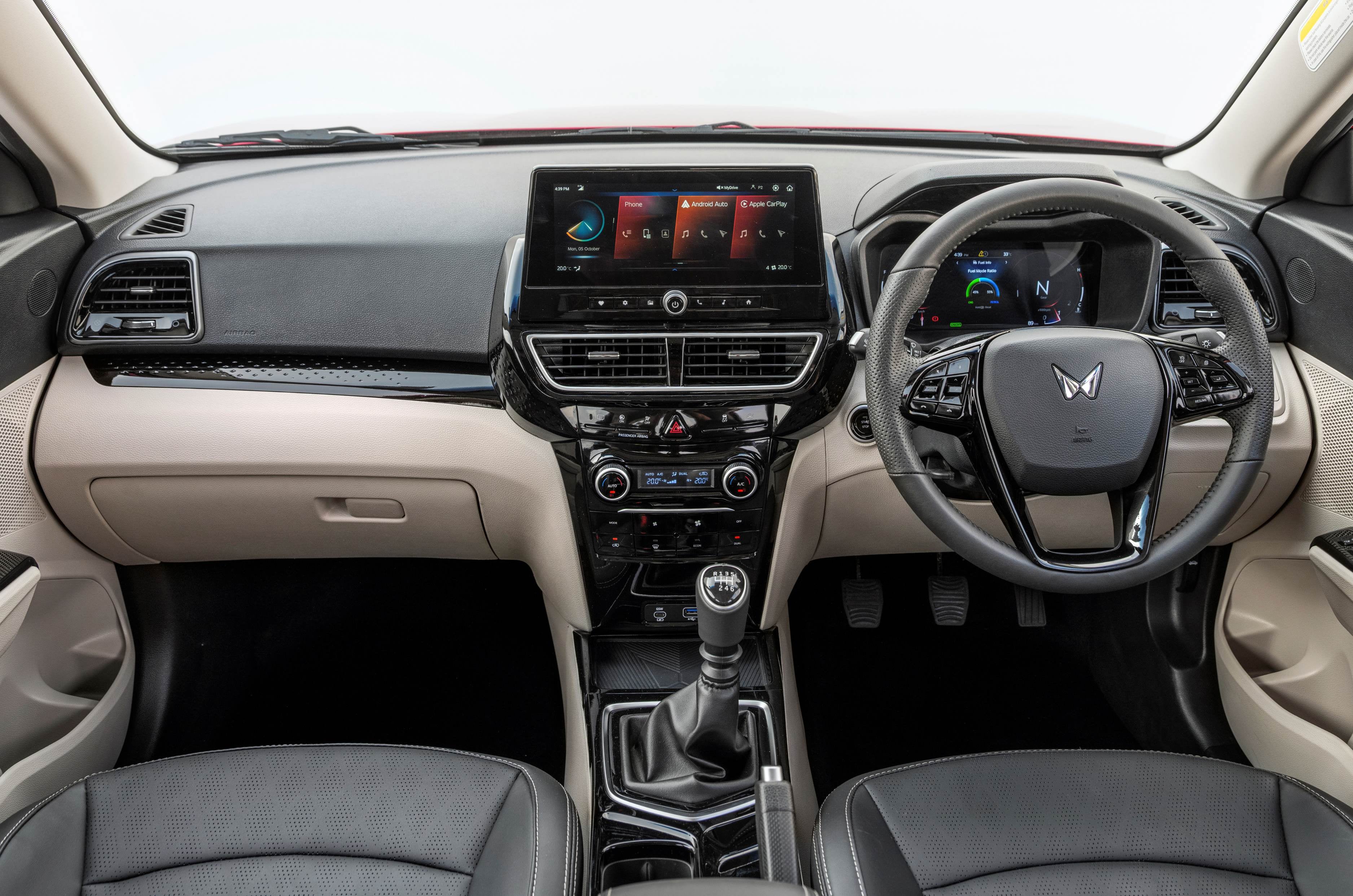
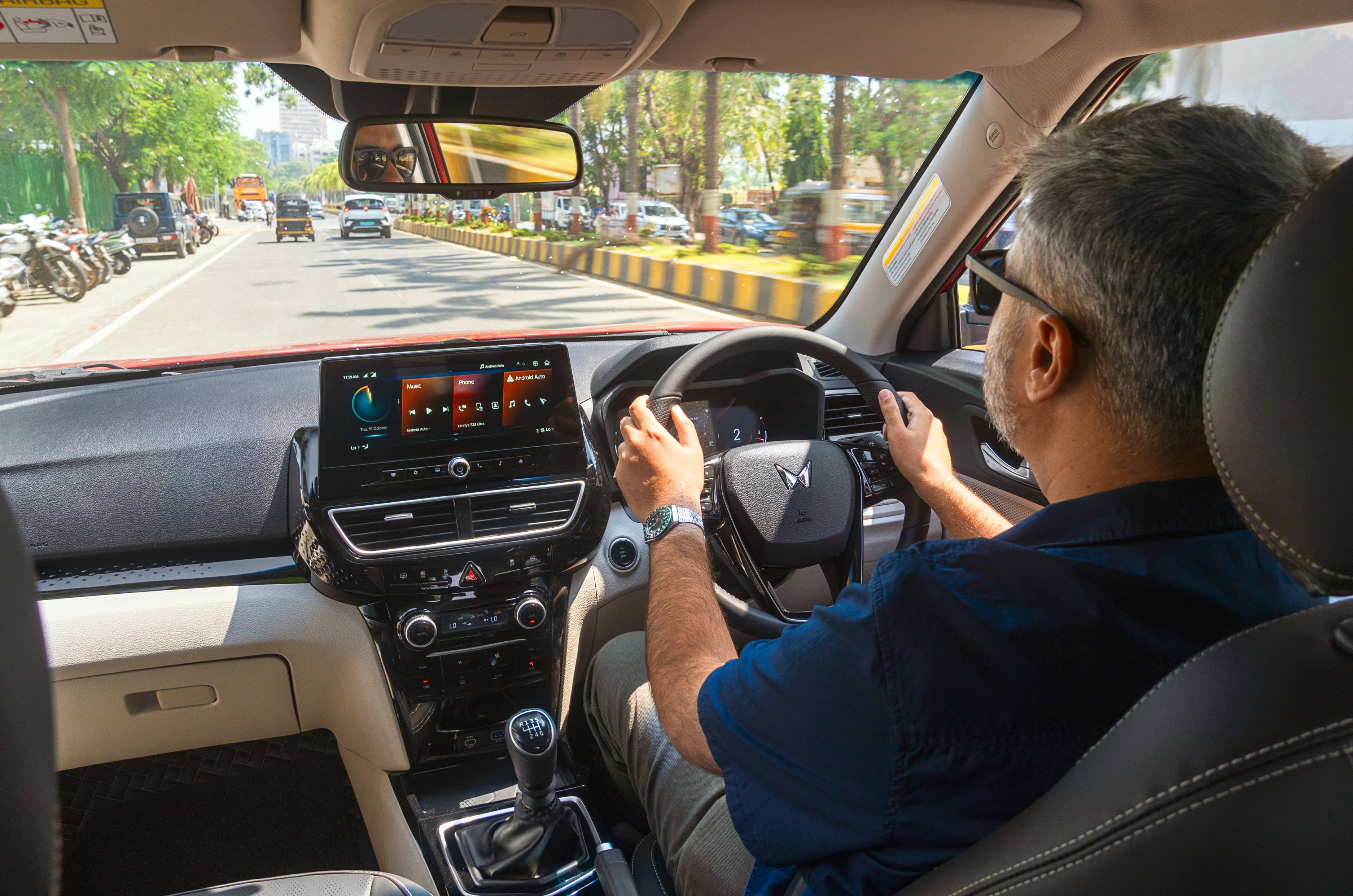
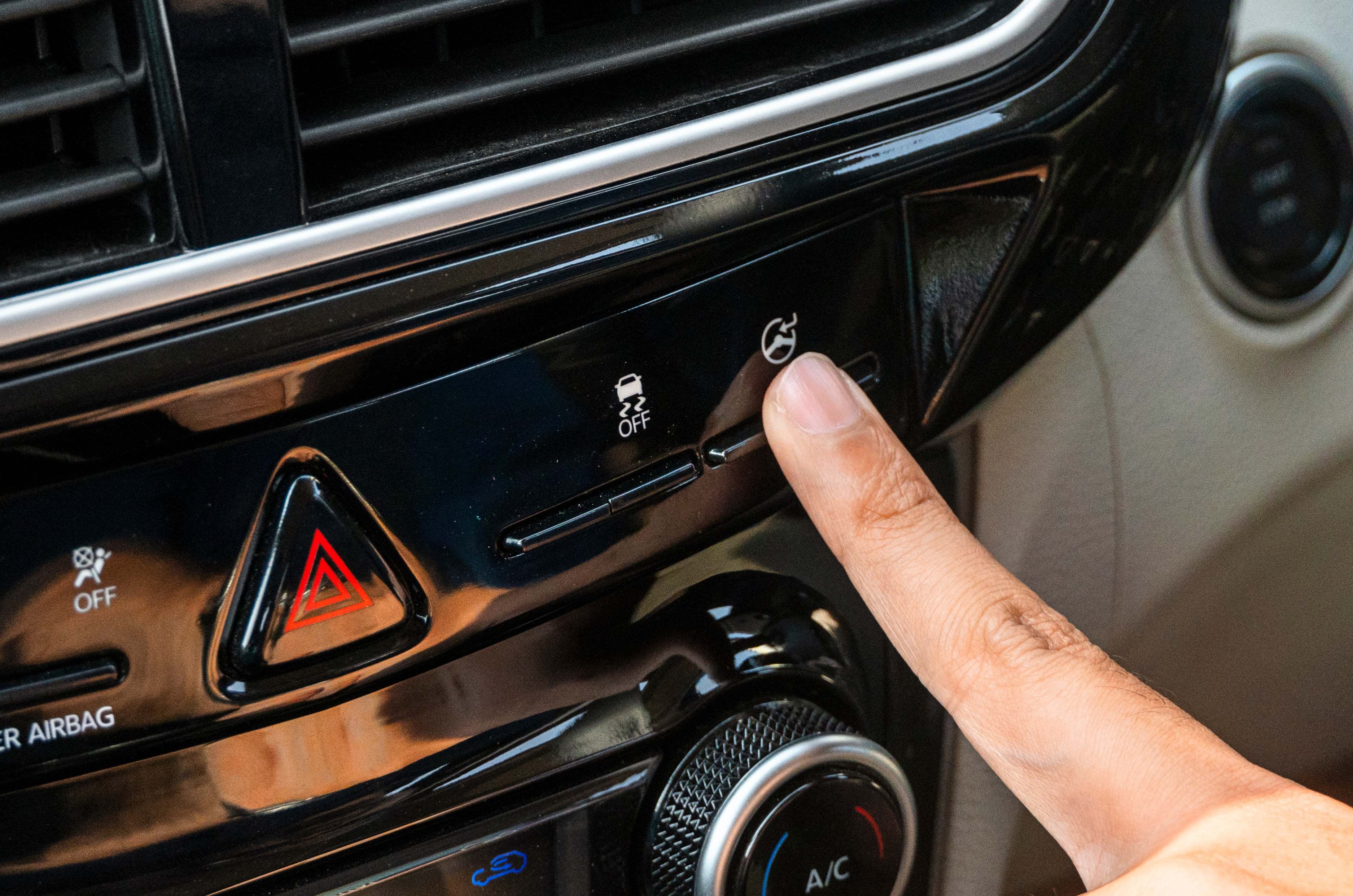
Inside, too, the ZNG is largely identical to its petrol and diesel counterparts, with a CNG switch to the right of the steering wheel being the only real giveaway. The dual-tone dashboard with lots of gloss black trim is otherwise carried over unchanged. Despite not being the top of the line variant, the cabin has an upmarket and well-trimmed air to it.
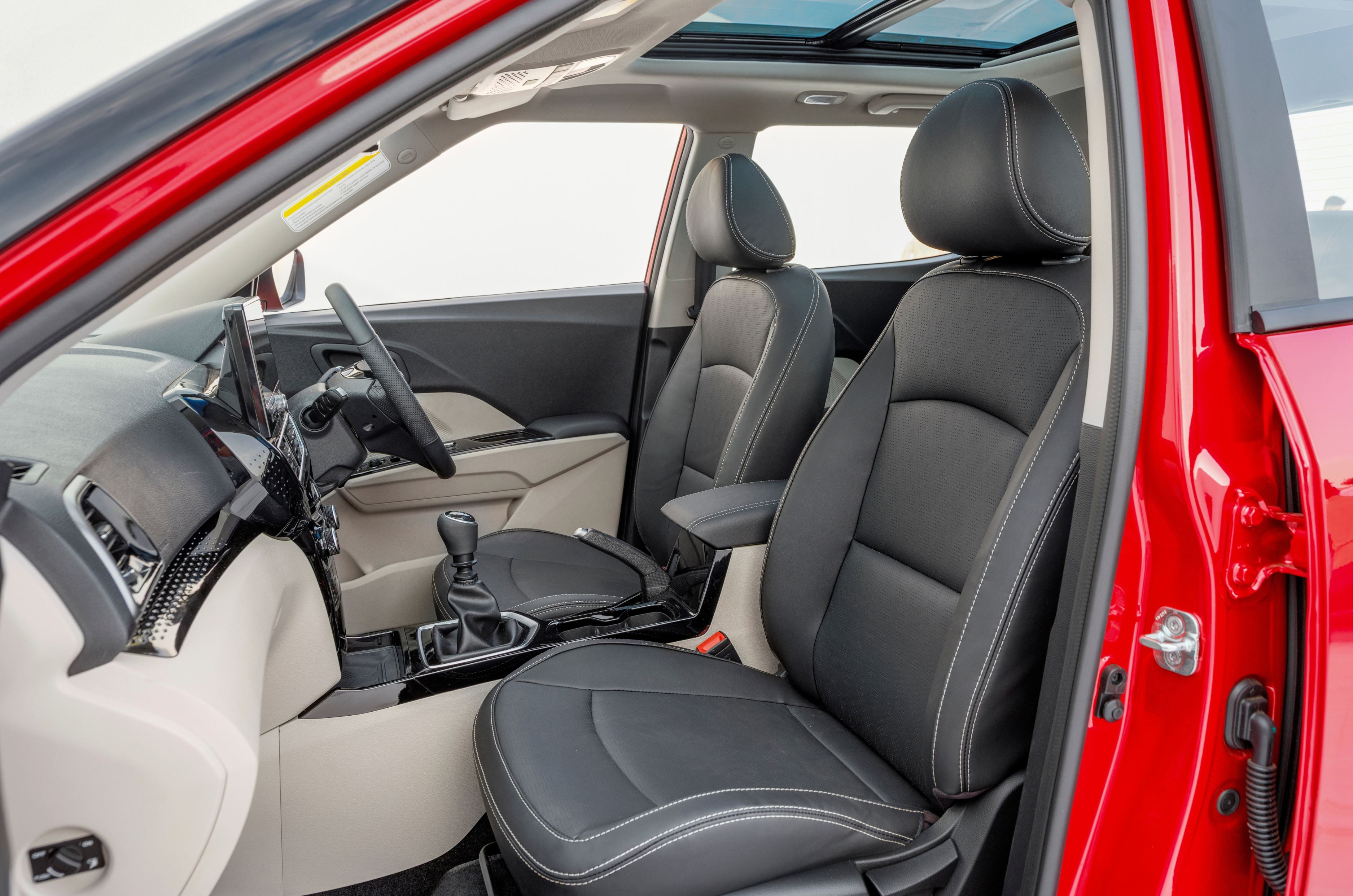
Our REVX A test car gets black leatherette seats, which can get quite hot, and they lack ventilation, just like the regular 3XO. The front seats are also a bit tight for larger frames, and the lack of a telescoping steering makes it hard to get comfy. Another ergonomic gripe is the tight driver’s footwell, with no dead pedal – pertinent as a six-speed manual is your only gearbox option.
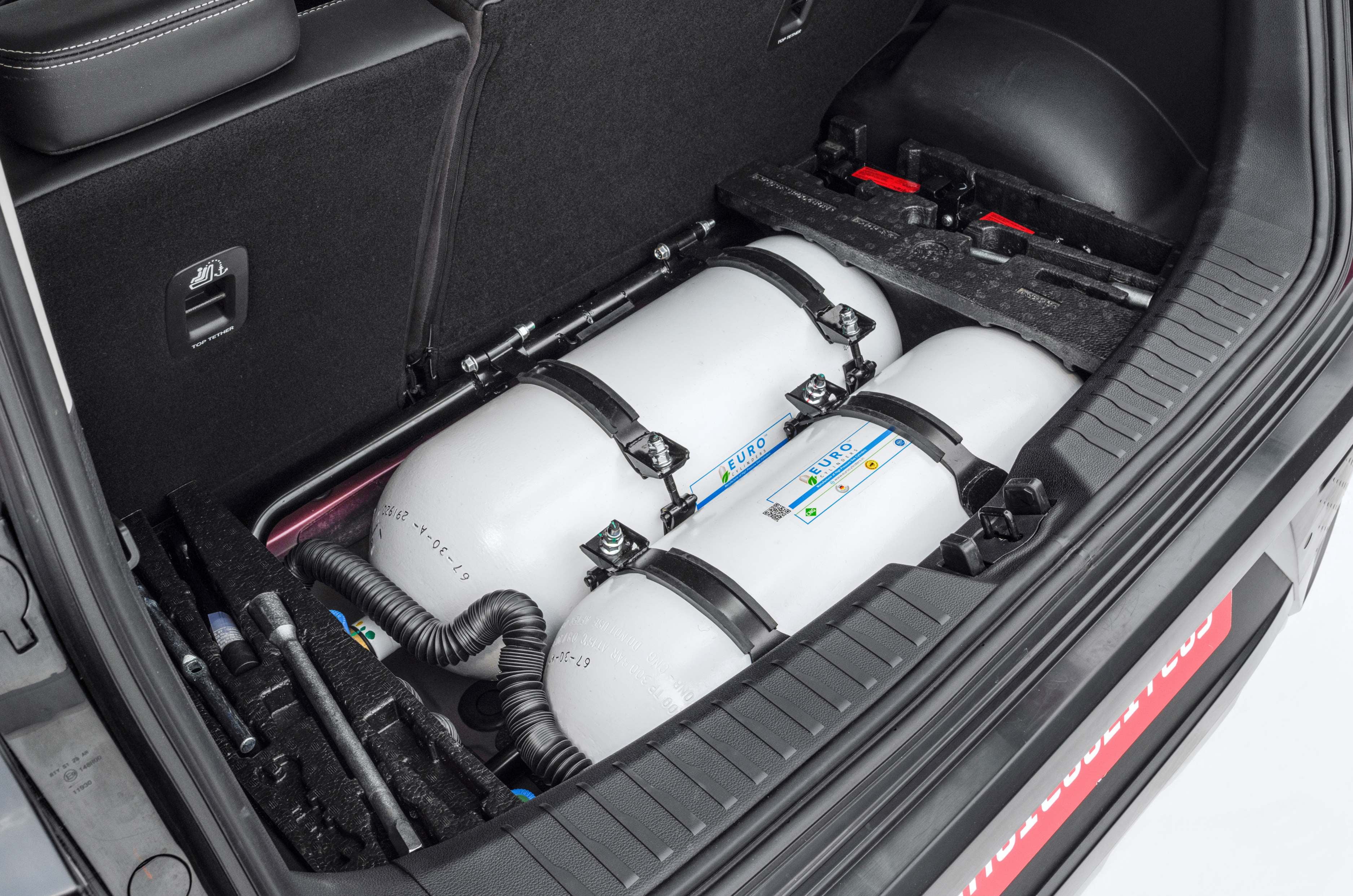
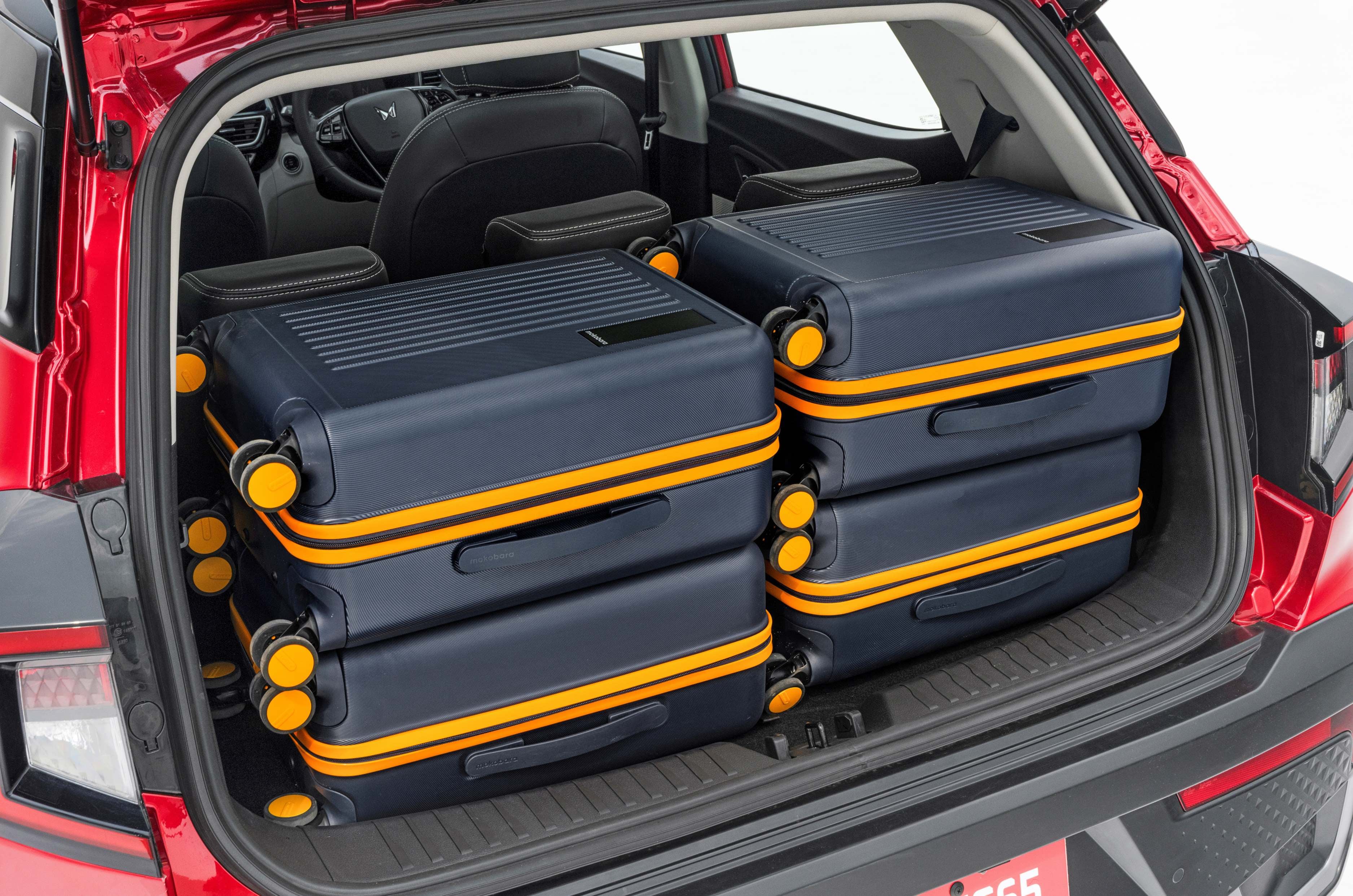
The rear seat remains spacious and comfortable for its segment, and accommodating three abreast is not an issue. One area where the 3XO fell short was boot space, measuring just 295 litres – the smallest in the segment. To keep as much of the boot intact as possible, Mahindra has moved the space-saver spare under the body and placed a dual-tank setup under the boot floor. The combined liquid capacity of the tanks is 60 litres, which translates to 10kg of CNG capacity.
Boot capacity has dropped to 270 litres, which is smallest amongst immediate rivals, however it remains fairly wide and can accommodate up to four cabin bags.
Mahindra XUV 3XO ZNG Features and Safety – 8/10
The 3XO ZNG is available in four trims, which offer the same features as their petrol and diesel counterparts. The highlights are a pair of sharp 10.25-inch screens for infotainment and instrumentation, a panoramic sunroof and a six-speaker audio system with Dolby Atmos.
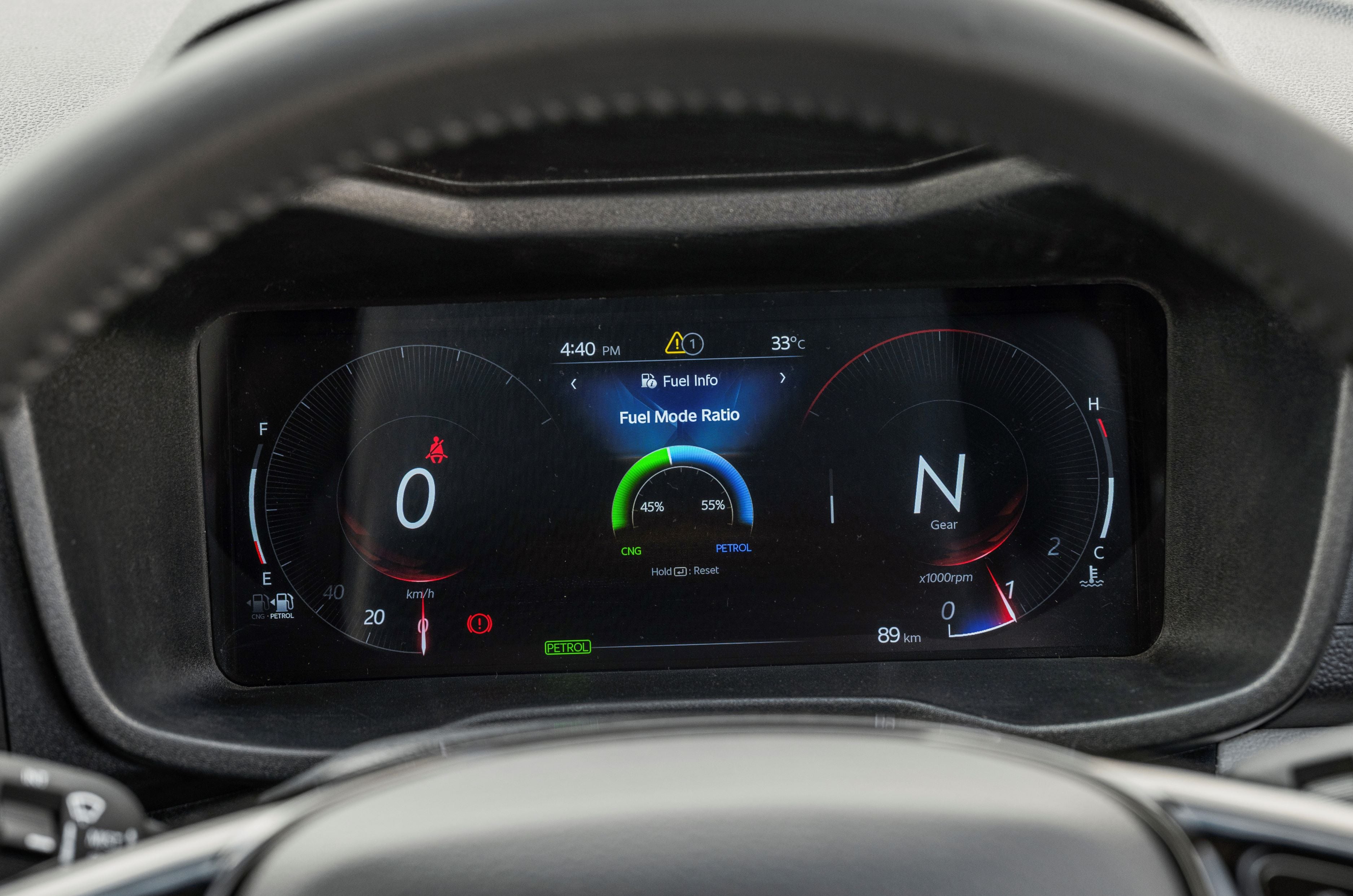
The digital instrument cluster has a few more CNG-related functions. Hit the CNG switch, and an indicator on the digital instrument cluster confirms the fuel you are using, while the fuel gauge changes to display the fuel level. The cluster can also show the ratio of time spent in each fuel mode and the corresponding fuel efficiency.
As such, the 3XO ZNG is reasonably well equipped compared to equivalent variants of its main rival, the Tata Nexon iCNG. However, the Nexon offers a wider choice of CNG variants, with top-spec versions getting features such as a 360-degree camera, ventilated front seats and a wireless charger, all of which the Mahindra misses out on.
The safety kit is quite comprehensive, featuring six airbags, ESC, ISOFIX mounts, a tyre pressure monitoring system and a reversing camera. The regular XUV 3XO is also a five-star Bharat NCAP safety-rated car, and Mahindra says the ZNG has been engineered to meet the same standards.
Mahindra XUV 3XO ZNG Performance and Refinement – 8/10
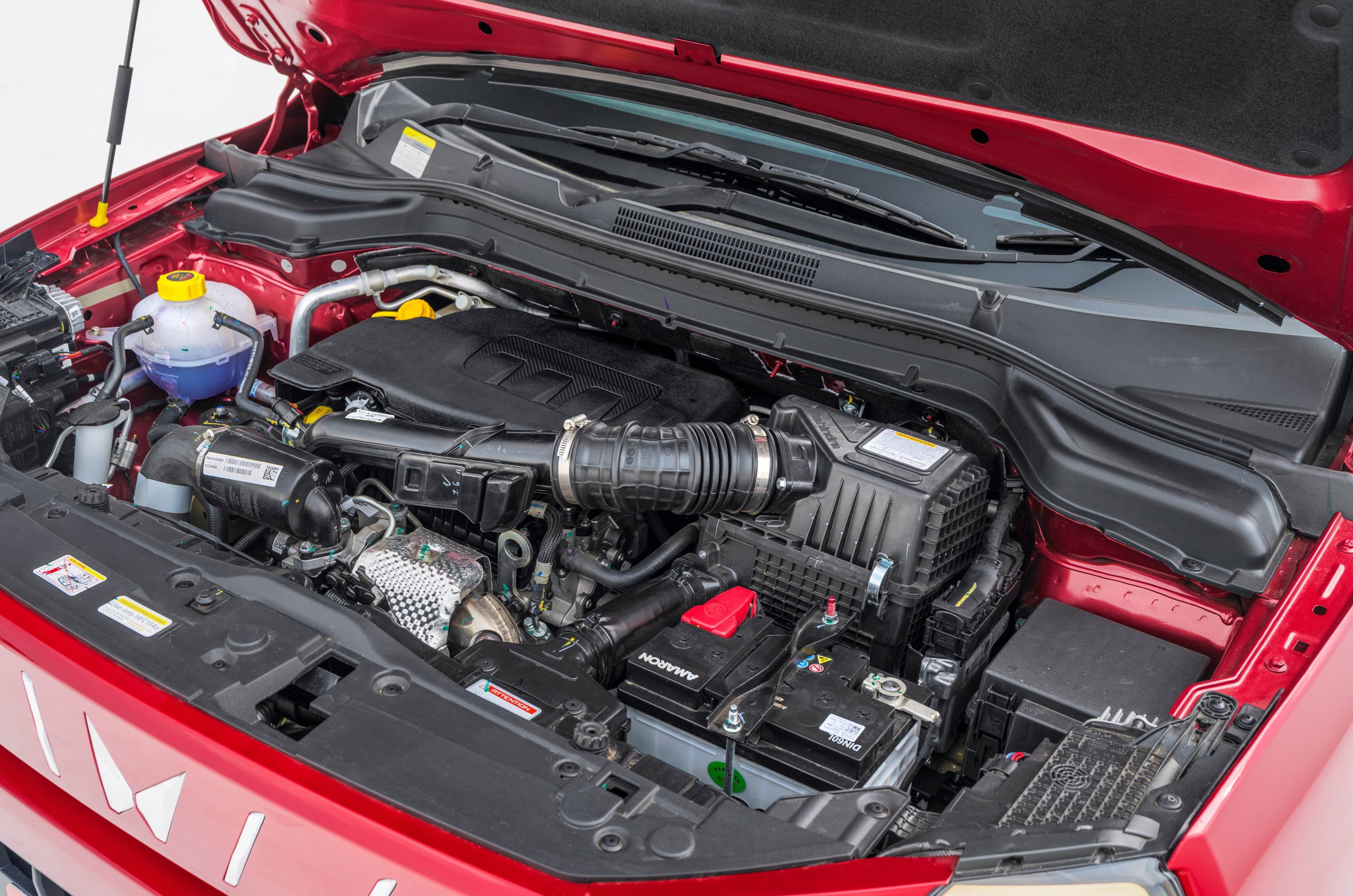
Powering the ZNG is the same 1.2-litre multi-point fuel injection (MPFi) turbo-petrol engine that does duty on the lower and mid-level trims of the 3XO. The kicker is that Mahindra quotes the exact same power and torque figures for CNG as for the pure-petrol version – 111hp and 200Nm. That is highly unusual, as a 10 to 15 percent drop in power figures is the norm. For comparison, its direct rival, the Tata Nexon iCNG, loses 20hp when switching from petrol to CNG. Mahindra says it has managed this with the use of a 10-bar CNG injection system. It also says the turbocharger and ECU calibration have been optimised to run on CNG, and initial impressions seem to back this up.
1.2-litre TCMPFI engine uses a 10-bar CNG injection system; Mahindra claims identical 111hp and 200Nm figures for petrol and CNG.
In everyday driving, the difference between CNG and petrol modes is barely noticeable. The engine feels smooth and refined in both, only becoming audible when extended. Performance, too, is very similar. Throttle response is good and the motor feels tractable, rarely requiring a shift into first when negotiating a speed breaker. There is a bit of turbo lag below 2,000rpm, but get past this and performance feels brisk.
The switch between modes is also quite seamless, with no apparent jerkiness or change in engine note. However, switch back and forth a few times, and you’ll notice the throttle response is ever so slightly duller in CNG mode, and there are times when it will hesitate on sudden throttle inputs. Overall, though, calibration in CNG mode is very good, and in everyday driving, there is very little to fault.
Performance feels brisk once you get past 2000rpm.
While the pure-petrol version of this engine can be had with a six-speed torque-converter automatic, the ZNG is only available with the six-speed manual. While its immediate rivals don’t offer an automatic with CNG either, Mahindra would have done well to offer at least an AMT. As it is, the manual is a smooth and easy-to-use unit, but not quite at the level of its Japanese or Korean competition. Its throws are a bit too long, and the clutch, while light, has a long travel.
In terms of outright performance, Mahindra claims an 11.8sec 0-100kph time for the ZNG. We conducted a quick performance test (not to Autocar India standards), which resulted in a 0-100kph time of 12.98s on petrol and 12.64s on CNG – a difference we put down to the launch. In-gear acceleration figures paint a clearer picture, where the ZNG was quicker in petrol mode by about 0.7 seconds in both 20-80kph and 40-100kph runs. Nevertheless, performance in either CNG or petrol is so close that most drivers would be hard-pressed to tell the difference.
Mahindra XUV 3XO ZNG Mileage and Efficiency – 8/10
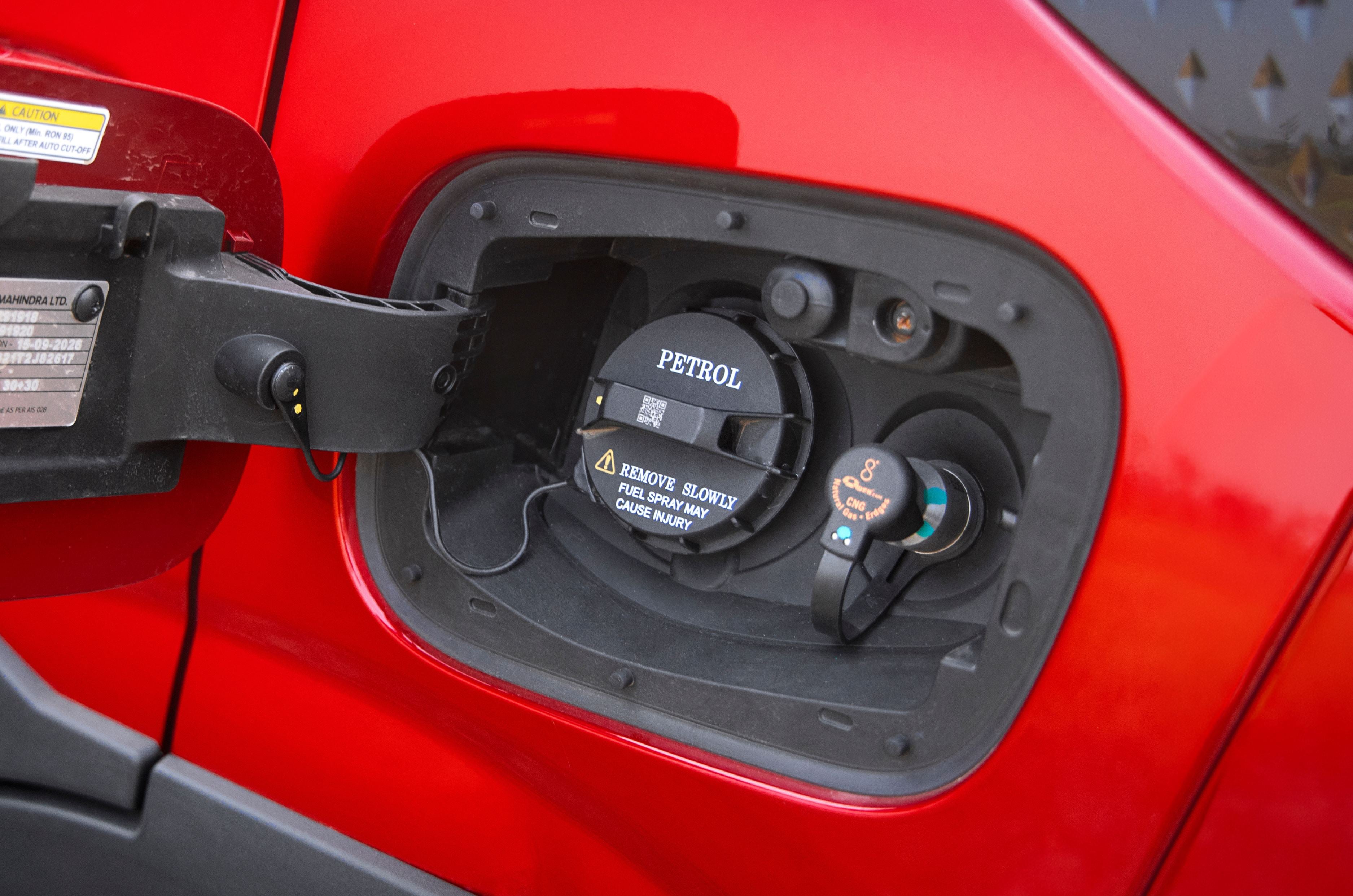
Mahindra claims an efficiency figure of 24.7km/kg for the XUV 3XO ZNG, which translates to a theoretical range of 247km from its 10kg CNG capacity.
CNG filler neatly positioned beside the fuel filler; fuel filler door still has a manual release in the cabin.
It also gets an idle-stop/start function, which should help efficiency. We will verify these claims with a real-world test soon.
Mahindra XUV 3XO ZNG Ride Comfort and Handling – 9/10
Light steering works well in town; steering modes dial up resistance but don’t offer better feel.
The switch to CNG adds around 100kg to the 3XO, most of it concentrated at the rear. To ensure this doesn’t affect ride or handling, Mahindra has tweaked the suspension to cope with the extra weight. The ZNG’s ride has a slightly firm edge, but overall it deals with bad roads very well.
16-inch wheels and tall tyres are better at absorbing sharper bumps than the 17s on higher petrol trims.
The smaller 16-inch wheels also play an important part here, as their taller-sidewall tyres absorb sharp edges before they make their way to the cabin. Overall, the ride remains amongst the best in the class.
Handling, too, remains tight and engaging, with a planted feel around the bends. The steering is light and direct, and while you can dial up the resistance using the three steering modes, this adds little in terms of feel or feedback.
Mahindra XUV 3XO ZNG Value for Money – 8/10
Overall, the Mahindra XUV 3XO offers good value for money and makes for a compelling entrant into the CNG compact SUV space. Prices for the Mahindra XUV 3XO ZNG start at Rs 9.99 lakh and go up to Rs 12.27 lakh, which is between Rs 1 lakh and Rs 1.2 lakh more than the equivalent petrol trims. Pricing is on par with comparable variants of the Tata Nexon iCNG. However, the Nexon has a wider range and also offers more features on the higher trims.
Mahindra has packaged the CNG tanks cleverly, minimising the impact on boot space. That said, the 3XO’s boot wasn’t particularly large to begin with, and that remains a drawback. What sets it apart is the driving experience. CNG calibration is very good, and performance in CNG mode is close enough to petrol for most people not to notice a real difference. For a first attempt, the XUV 3XO ZNG certainly ticks a lot of boxes.
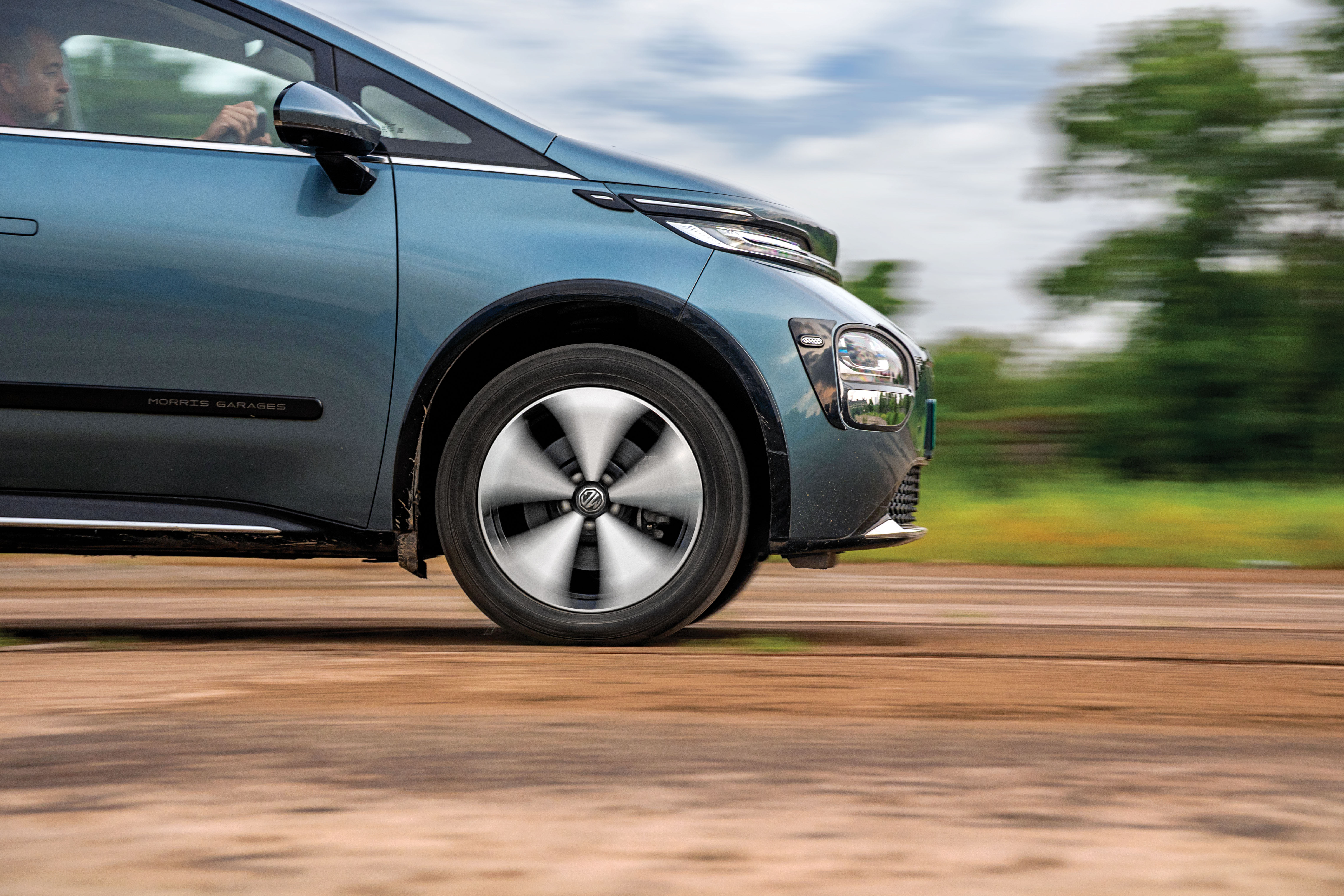
The MG Windsor EV is convenience Pro Max. You walk up to it, the doors unlock on their own, you slide into the driver’s seat, select ‘D’ on the gear-selector stalk, and pull away. Quick, simple, easy, and super convenient.
Over the weeks and months we’ve had the car, I’ve even found it to be well suited to our traffic, especially when the need to overtake quickly arises. The electric motor makes a healthy 200Nm of torque, and with near-instant responses, overtaking becomes almost therapeutic.
Overtaking slower cars is a breeze due to the strong and linear torque delivery
Squeeze down on the accelerator and a wave of torque helps you breeze past the car ahead. What’s nice is that the e-motor doesn’t overreact or deliver a massive spike of torque the moment you touch the pedal, it’s well metered and measured, and that makes all the difference. So, the Windsor feels surprisingly swift and fleet-footed; just what the doctor ordered for our fluid traffic, where gaps and opportunities open and close quickly.
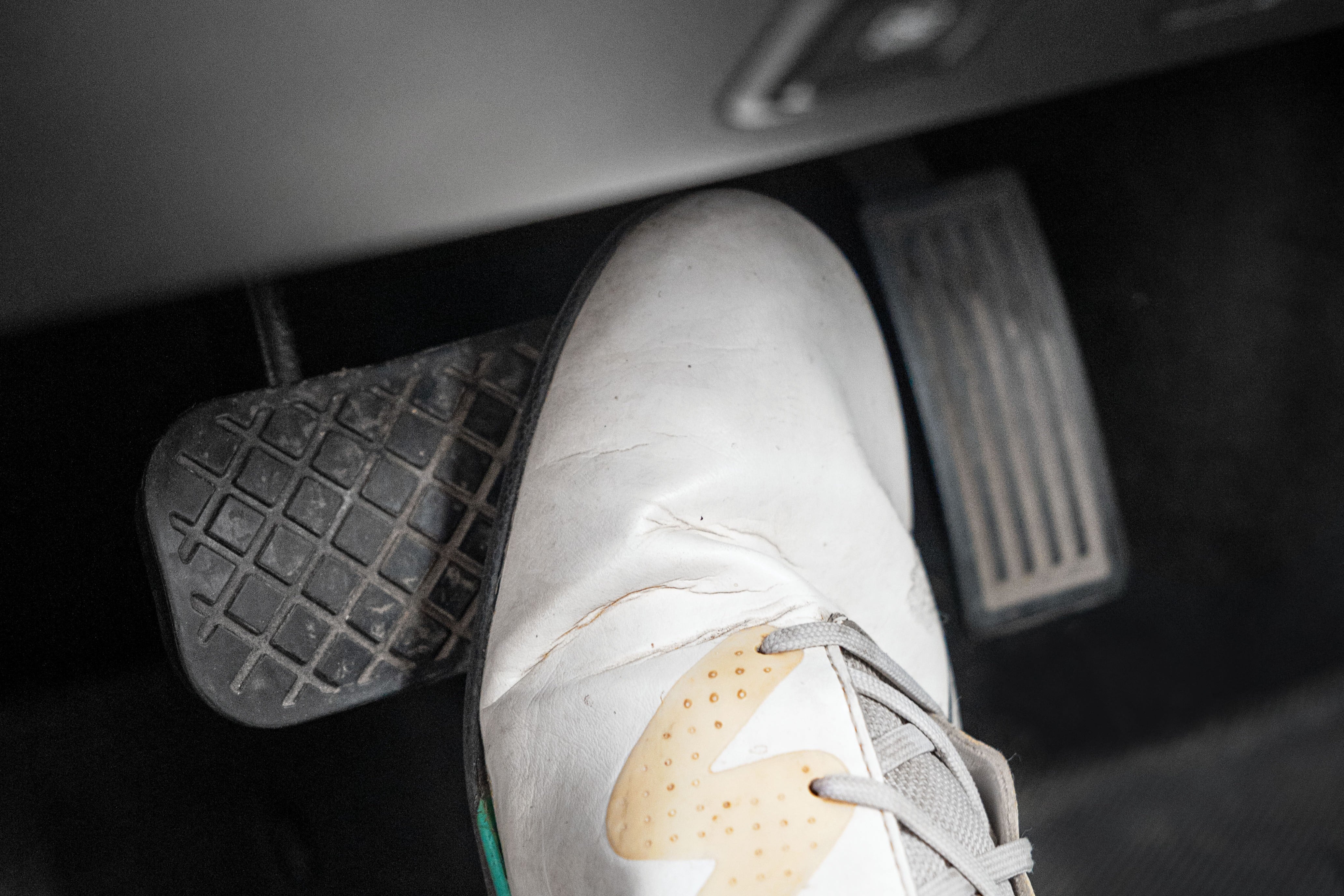
Strong brakes blend regenerative and friction braking quite seamlessly.
I even really like the strong brakes, especially how well they blend initial regeneration and later stronger action via the discs. Even the steering is light, direct and well-suited to urban use. Put all these factors together, and you can see why I found myself setting off to run a lot more errands in this car, with even long intra-city commutes handled with ease; podcasts on the clear audio system keeping me company.
What I’ve often found, however, especially when driving on a low battery, is that Eco mode is not as well calibrated. The responses are quite severely dulled down, and that means you need to keep using more and more throttle to get a move on. I soon switched back to Normal, almost every single time.
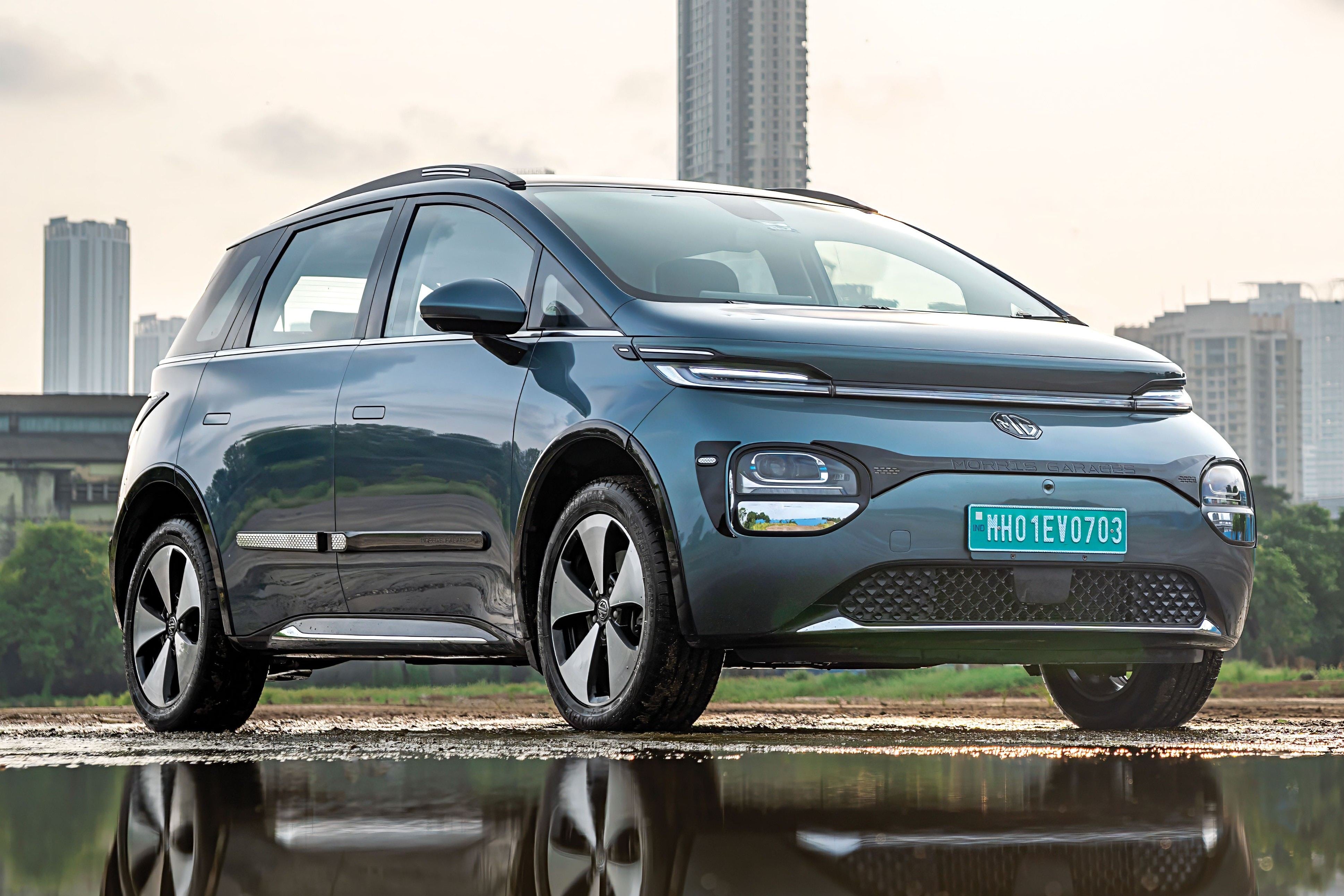
Where the Windsor also did well was that despite being a monovolume, the design has wide appeal. Sure, it has an unconventional profile, an unconventional cab-forward stance and an unconventional seating position. But the design works so well, first impressions from passengers are overwhelmingly positive. Many passengers commented on its modern looks and the spacious feeling in the rear. And doesn’t the stepped nose up front, with its chrome embellishments, work well?
MPV profile nicely packaged with modern details and look.
The MG Windsor, however, also has its fair share of issues and irritants. For one, insulation is very poor. It’s tolerable at lower city speeds, but past 70 or 80kph, road noise gets so prevalent, you start looking around for a commercial vehicle overtaking you. There is none. Then there’s the fact that the ride often gets brittle and unsettled, and go faster, such as on the Coastal Road in Mumbai, and stability at speed is also nowhere near as good as it should be. Some of this is down to the Windsor’s raised ride height and tall stance. But hey.
Over the time we’ve had the car, I’ve also come across a litany of questionable details in the cabin. To begin with, the seats have diamond-quilted covers that prod you in the back and feel unnecessarily ‘textured’. Then a lot of the plastics feel low-rent and cheap, especially the faux wood and the top of the dash. This includes some of the toggle switches used for the aircon and, especially, the gear selector stalk. Then there’s the fact that the screen is a size too large and in your face, and the left bottom of the windscreen is obscured by it; especially irritating when you are parking in a tight place.
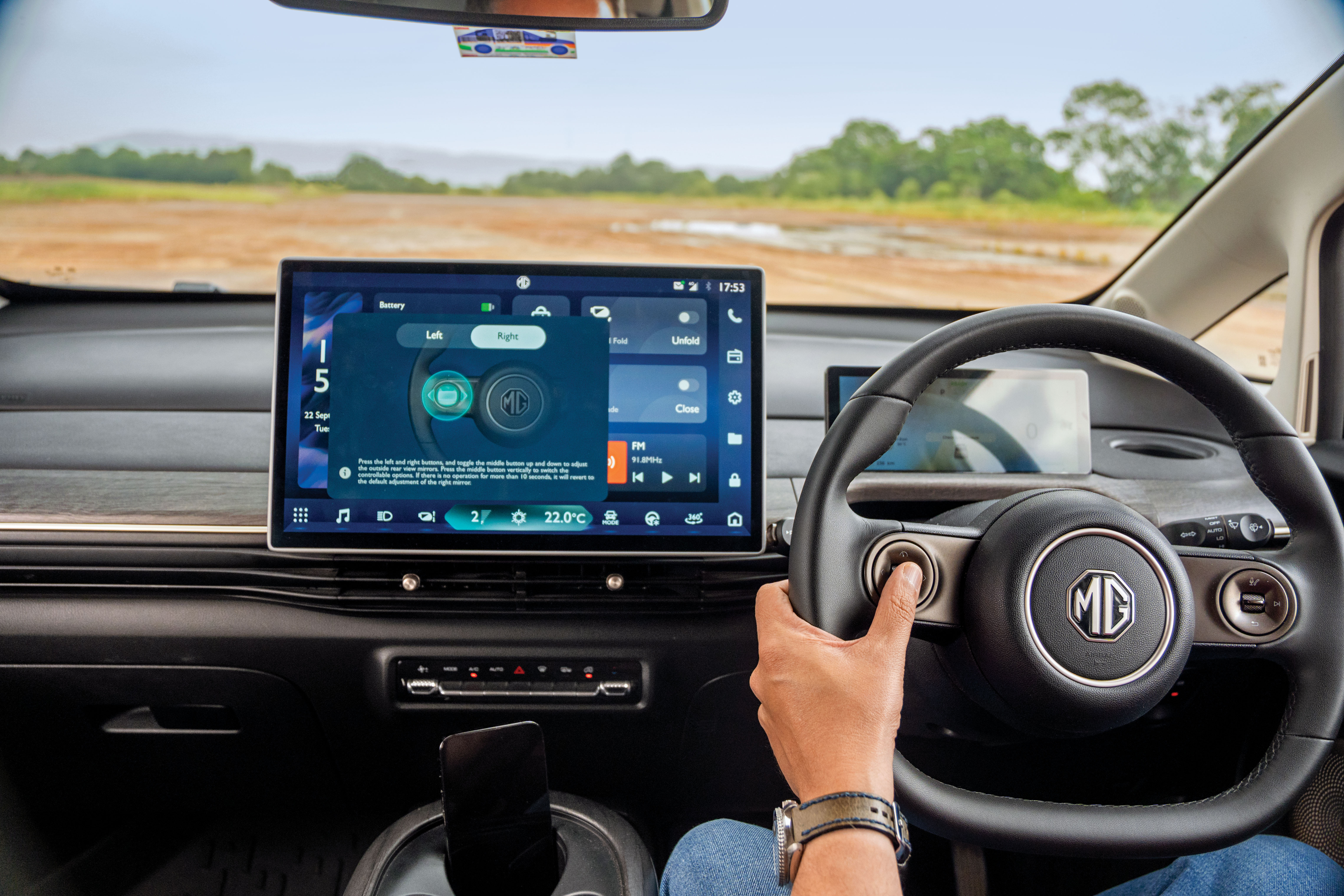
Even important functions like adjustments of the mirrors are on the screen
Then, of course, almost everything is controlled from the screen. This includes adjustment of mirrors, drive modes and regenerative braking, among others. So, often, you find yourself stopped on the side of the road, diving into a menu. And more often than not, the said feature is difficult to find. Too much of a good thing here, for sure. It’s only right that buttons are coming back.
Then there’s the fact that while the fonts on the massive screen are huge, those on the digital ‘instrument panel’ are tiny and often difficult to read in a moving car. There’s also no spare tyre, only a puncture kit, of no use if you get a sidewall cut, and this version of the car gets no parcel tray; annoying if you have to leave a bag or luggage.
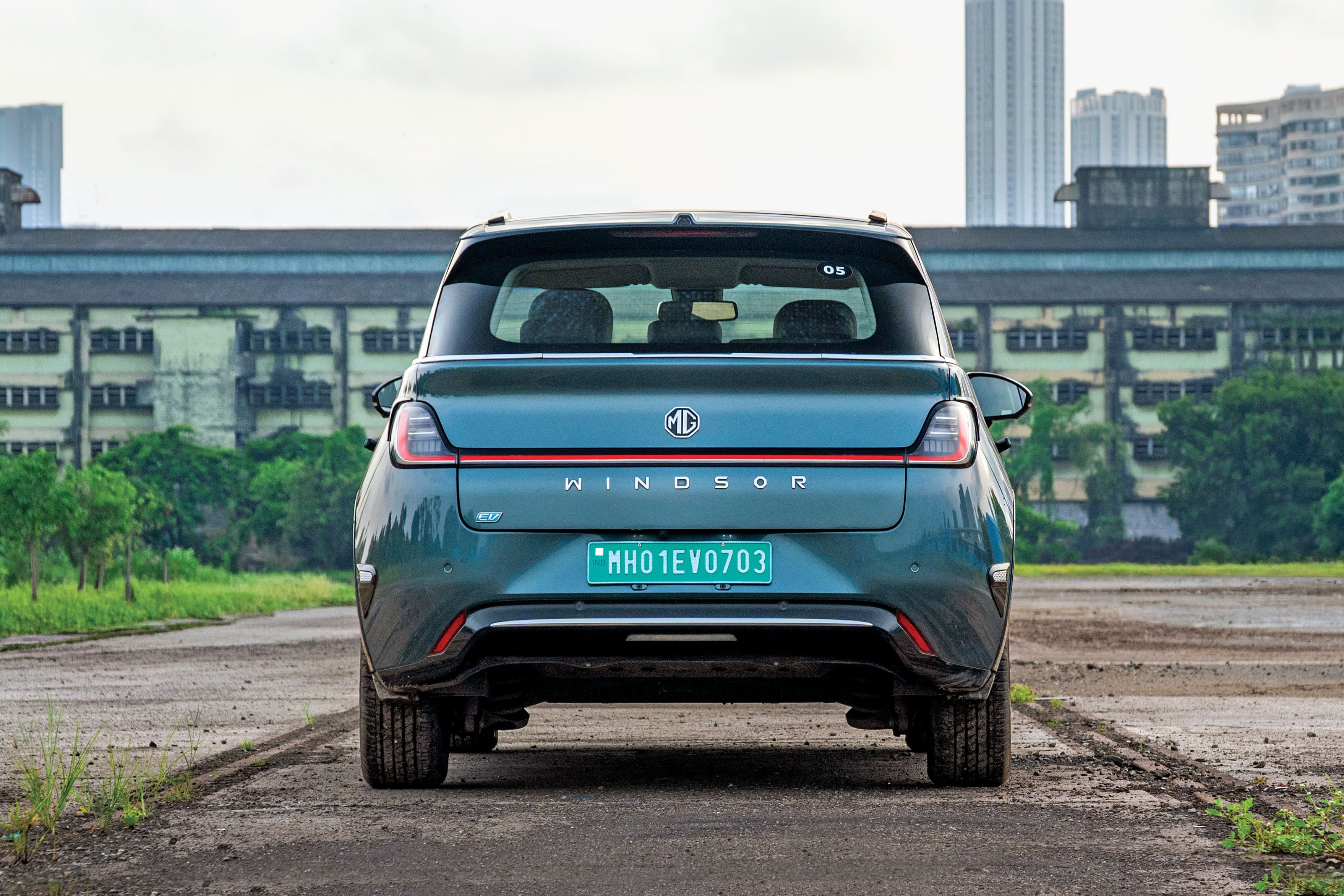
No spare or space to keep one; all you get is a puncture repair kit.
What of the battery and the range? The 37.9 kWh battery, charged for the most part at our office in Byculla, Mumbai, indicates a 100 percent battery range of around 320kms and has been delivering an average of around 6.5 kilometers per kW. So yes, while the MG Windsor is a lot of EV for the money and offers plenty of convenience, space and comfort, MG has a long to-do list for the facelift.
Hyundai’s upcoming compact electric SUV will debut in India in Q1 2027. The carmaker had initially outlined a debut by March 2027 at its 2026 CEO Investor Day, before Hyundai Motor India MD and CEO Tarun Garg told our sister publication Autocar Professional that the EV would arrive earlier, by the end of 2026. According to our sources, the Hyundai compact EV is now slated to debut in January 2027.
Hyundai compact EV: Platform and battery details
Image source: @joonsun_erin on Instagram
Codenamed HE1i, the upcoming compact electric SUV will use Hyundai’s E-GMP (K) platform, which also underpins the Inster EV sold overseas. The new model will be manufactured at Hyundai’s Sriperumbudur plant in Tamil Nadu and has been planned specifically for the Indian market.
It will be offered in two versions: Standard Range and Long Range. However, the exact specifications are under wraps. For reference, the Inster EV is offered with 42kWh and 49kWh battery packs, with claimed WLTP ranges of up to 300km and 355km, respectively. The Inster Standard Range produces 97hp and 147Nm, while the Long Range version produces 115hp and 147Nm.
The compact EV will initially use battery cells supplied by Svolt. Hyundai plans to shift to locally sourced cells through its association with Exide, following delays in the latter’s battery production.
Hyundai compact EV: Features and rivals
Hyundai has confirmed that the compact EV will feature Level 2 ADAS and a ‘next-generation infotainment system’, which could be the Pleos Connect system seen in some of the brand’s newer models.
For reference, the international-spec Hyundai Inster gets dual 10.25-inch displays for the instrument cluster and infotainment system, automatic climate control and a 360-degree camera with blind-spot monitoring. It remains to be seen which of these features will make it to the India-spec compact EV.
The Hyundai compact EV will rival the Tata Nexon EV, Mahindra XUV 3XO EV and Kia Syros EV in India.
INDvsNZ न्यूजीलैंड के खिलाफ दो टेस्ट मैचों की शृंखला के लिए भारतीय टीम में तेज गेंदबाज आकाश दीप और अंशुल कंबोज को शामिल किया गया है। चोट से उबरकर वापसी करने वाले आकाश दीप ने पिछली बार इंग्लैंड दौरे पर टेस्ट क्रिकेट खेला था, जहां उनका प्रदर्शन प्रभावशाली रहा था। वहीं, अंशुल कंबोज को इंग्लैंड में टेस्ट पदार्पण के बाद टीम से बाहर कर दिया गया था।
टेस्ट शृंखला 19 नवंबर से शुरू होगी। इससे पहले भारत और न्यूजीलैंड के बीच पांच वनडे मैचों की शृंखला खेली जाएगी, जिसका आगाज चार नवंबर से होगा।श्रीलंका दौरे से चोट के कारण बाहर रहने वाले जसप्रीत बुमराह को भी टेस्ट सीरीज में शामिल किया गया है।
India’s star pacer returns for the #WTC27 series against New Zealand https://t.co/Z2rQpXuKea