Tamil Nadu gold ring scheme: तमिलनाडु में आज से बहुत खास सरकारी योजना लॉन्च होने जा रही है। राज्य के मुख्यमंत्री सी जोसेफ विजय आज, सोमवार, 28 सितंबर, को थाईमामन थंगा मोथिरम थिट्टम लॉन्च करेंगे। यह राज्य सरकार की महत्वकांक्षी योजना है, जिसके तहत राज्य सरकार सरकारी अस्पतालों में पैदा होने वाले योग्य बच्चों को एक ग्राम, 22 कैरेट सोने की अंगूठी देगी। यह स्कीम मदुरै के सरकारी राजाजी हॉस्पिटल में लॉन्च की जाएगी, जहां विजय 25 नए जन्मे बच्चों को सोने की अंगूठियां देंगे। सीएम विजय मैटरनिटी वॉर्ड में आज जन्मे बच्चों को खुद अंगूठियां दे सकते हैं।
कौन योग्य है?
सरकार की ओर से दी गई जानकारी के अनुसार, इस स्कीम के तहत सोने की अंगूठी उन शिशुओं को दी जाएगी, जिनकी मांएं तमिलनाडु की स्थायी निवासी होंगी। इन बच्चों का जन्म राज्य के किसी सरकारी अस्पताल में होना चाहिए। योग्य लाभार्थियों को प्रेग्नेंसी एंड इन्फैंट कोहोर्ट मॉनिटरिंग एंड इवैल्यूएशन (PICME) सिस्टम के तहत पंजीकृत होना चाहिए और उनके पास रिप्रोडक्टिव एंड चाइल्ड हेल्थ (RCH) ID होनी चाहिए। सोने की अंगूठी तब दी जाएगी जब लाभार्थी को हॉस्पिटल से छुट्टी मिल जाएगी।
सरकार क्या देगी?
इस स्कीम के तहत हर योग्य नवजात शिशुओं को एक ग्राम, 22 कैरेट सोने की अंगूठी मिलेगी। सरकार के मुताबिक, अंगूठियों पर यूनिक सीरियल नंबर होंगे और इन्हें टैम्पर-प्रूफ पैकेजिंग में बांटा जाएगा। राज्य ने इस स्कीम के लिए सालाना ₹755.83 करोड़ का खर्च तय किया है। पहले चरण में, 1.28 लाख सोने की अंगूठियां तैयार की गई हैं। सोने की अंगूठियों की सप्लाई के लिए जोयालुक्कास और कल्याण ज्वैलर्स को वर्क ऑर्डर जारी कर दिए गए हैं।
यह स्कीम कहां लागू होगी?
यह स्कीम पूरे तमिलनाडु में लागू होगी, सिवाय मदुरंथकम और धारापुरम विधानसभा सीटों के इलाकों के, जहां 6 अक्टूबर को उपचुनाव होने हैं। हर जिले में संबंधित जिला कलेक्टर की अगुवाई में एक खास मॉनिटरिंग कमेटी बनाई गई है जो इसे लागू करने, इन्वेंट्री ट्रैकिंग और बांटने में ट्रांसपेरेंसी की देखरेख करेगी।
तमिलनाडु ने यह स्कीम क्यों शुरू की है?
इस स्कीम का नाम तमिल परंपरा के नाम पर रखा गया है, जिसमें मामा नए जन्मे बच्चे को तोहफे देते हैं। सरकारी सूत्रों ने कहा कि इस पहल का मकसद सरकारी हेल्थकेयर सेवाओं में लोगों का भरोसा बढ़ाना और अस्पतालों में सुरक्षित डिलीवरी को बढ़ावा देना है। सरकार के मुताबिक, तमिलनाडु में हर साल करीब 7.80 लाख बच्चे पैदा होते हैं। इनमें से करीब 4.20 लाख डिलीवरी, यानी 53%, सरकारी अस्पतालों में होती हैं।
सरकार ने नेशनल फैमिली हेल्थ सर्वे-6 के डेटा का भी जिक्र किया, जिसके मुताबिक तमिलनाडु में 99.9% जन्म हेल्थकेयर इंस्टीट्यूशन में होते हैं। करीब 90% सरकारी इंस्टीट्यूशनल डिलीवरी कॉम्प्रिहेंसिव इमरजेंसी ऑब्सटेट्रिक एंड नियोनेटल केयर (CEmONC) सेंटर पर होती हैं।
15 सितंबर को हुई थी स्कीम की घोषणा
यह स्कीम 15 सितंबर को पूर्व मुख्यमंत्री सी एन अन्नादुरई की जयंती पर लॉन्च होने वाली थी। लेकिन विजय के विदेश दौरे की वजह से इसे टाल दिया गया था। इस स्कीम को लागू करने के लिए एक सरकारी ऑर्डर 23 जून, 2026 को नोटिफाई किया गया था।
तमिलनाडु के नागरकोइल से सामने आई चोरी की एक घटना ने सोशल मीडिया पर अपनी संपत्ति दिखाने को लेकर सवाल खड़े कर दिए हैं। यहां एक YouTuber कपल के घर से कथित तौर पर करीब 1 करोड़ रुपये के सोने के गहने और नकदी चोरी हो गई। रिपोर्ट्स के अनुसार, विनोद कुमार और मधुमिता के घर को चोरों ने निशाना बनाया। इस घटना की चर्चा इसलिए ज्यादा हो रही है क्योंकि चोरी से कुछ दिन पहले सोशल मीडिया पर घर और कीमती सामान से जुड़े वीडियो शेयर किए गए थे। पुलिस ने मामला दर्ज कर जांच शुरू कर दी है और CCTV समेत दूसरे सुरागों की जांच की जा रही है।
118 सॉवरेन सोना चोरी होने की खबर
बताया जा रहा है कि कपल का घर नागरकोइल के थम्माथुकोणम इलाके के VIP Garden में है। चोरों ने कथित तौर पर घर के पीछे का दरवाजा तोड़कर अंदर प्रवेश किया और करीब 118 सॉवरेन सोने के आभूषण समेत अन्य कीमती सामान लेकर फरार हो गए। चोरी हुए सोने की अनुमानित कीमत लगभग एक करोड़ रुपये बताई जा रही है।
घर में CCTV, फिर भी चोर कैसे पहुंचे अंदर?
रिपोर्ट्स के अनुसार, घर एक गेटेड इलाके में स्थित है और वहां CCTV कैमरों की निगरानी भी है। इसके बावजूद चोर पीछे के रास्ते से घर में घुसने में सफल रहे। घटना गुरुवार रात की बताई जा रही है। पुलिस अब CCTV फुटेज और अन्य सुरागों की मदद से मामले की जांच कर रही है।
सोशल मीडिया पोस्ट ने खींचा ध्यान
इस मामले का सबसे ज्यादा चर्चा में रहने वाला पहलू सोशल मीडिया है। बताया जा रहा है कि चोरी से कुछ समय पहले मधुमिता ने ऐसा वीडियो पोस्ट किया था,जिसमें पूजा घर में मौजूद परिवार की संपत्ति दिखाई गई थी। वह सोने की खरीदारी, ज्वेलरी और नकदी से जुड़े वीडियो और Instagram Reels भी पोस्ट करती रही हैं। हालांकि, सोशल मीडिया पोस्ट और चोरी के बीच सीधे संबंध की पुष्टि जांच पूरी होने तक नहीं मानी जा सकती।
पुलिस ने शुरू की जांच
राजाकामंगलम पुलिस ने मामला दर्ज कर जांच शुरू कर दी है। अधिकारियों द्वारा इलाके के CCTV कैमरों की फुटेज खंगालने के साथ मोबाइल नेटवर्क से जुड़े रिकॉर्ड की भी जांच किए जाने की रिपोर्ट है। फिलहाल पुलिस चोरों की पहचान और चोरी हुए सामान को बरामद करने की कोशिश में जुटी है।
This Youtuber from KanyaKumari showed off her money & jewelry in the vlog.
Thieves broke the house & stole 1 Cr. worth of jewelry.
घटना सामने आने के बाद सोशल मीडिया यूजर्स ने महंगे सामान को सार्वजनिक रूप से दिखाने के संभावित जोखिमों पर चर्चा शुरू कर दी। कुछ लोगों ने इसे ऑनलाइन प्राइवेसी और सुरक्षा से जुड़ा मामला बताया,जबकि कुछ ने कपल के कंटेंट को लेकर आलोचनात्मक टिप्पणियां कीं।
तमिलनाडु के मुख्यमंत्री सी जोसेफ विजय ने सोमवार को ‘वेत्री पयानम’ की तैयारियों का जायजा लिया। यह महिलाओं के लिए राज्य की बढ़ाई गई फ्री बस यात्रा स्कीम है, जिसे 2 अक्टूबर को पूरे राज्य में लॉन्च किया जाएगा। सरकार की ओर से जारी आधिकारिक रिलीज में कहा गया है कि इस फ्लैगशिप स्कीम से हर दिन लगभग 84.32 लाख महिलाओं को फायदा होने की उम्मीद है।
इस स्कीम के तहत, महिलाएं 12,692 तय सरकारी बसों में फ्री यात्रा कर सकेंगी। मुख्यमंत्री जोसेफ विजय ने वेट्री पयनम योजना की घोषणा की थी। इसके तहत महिलाएं शहरों और कस्बों में डीलक्स और एक्सप्रेस बसों में मुफ्त यात्रा कर सकेंगी। यह योजना 2 अक्टूबर 2026 (गांधी जयंती) से नए रूप में लागू हो रही है, जिसके तहत इसका दायरा बढ़ाया गया है। तमिलनाडु की सभी महिलाओं और ट्रांसजेंडर इसके दायरे में आएंगे। अब साधारण बसों के अलावा एक्सप्रेस, एलएसएस, डीलक्स और मोफुसिल बसों में भी मुफ्त यात्रा की जा सकेगी। इस योजना में कोई आय सीमा या दैनिक यात्रा की दूरी/संख्या की कोई पाबंदी नहीं है।
इस योजना में 40 किलोमीटर से ज्यादा चलने वाली मोफस्सिल ऑर्डिनरी और घाट ऑर्डिनरी बसें भी शामिल होंगी। आधिकारिक घोषण के मुताबिक, ये तय बसें सात स्टेट ट्रांसपोर्ट कॉर्पोरेशन द्वारा चलाए जा रहे कुल फ्लीट का 69% हैं। ये बसें हर दिन 1,65,312 एक तरफ की यात्रा करेंगी, जो राज्य के कुल बस ऑपरेशन का 85% है। ऑपरेशनल साइड पर, तय बसों में इलेक्ट्रॉनिक टिकटिंग मशीनों का इंटीग्रेशन पूरा हो गया है। अधिकारियों को 25 सितंबर तक सिस्टम टेस्टिंग और वेरिफिकेशन पूरा करने के लिए कहा गया है, जिसके बाद 27 सितंबर को ट्रायल रन होगा।
विजय ने 24 अगस्त को तमिलनाडु विधानसभा में इस योजना का ऐलान किया था। इस योजना का मकसद यह सुनिश्चित करना है कि महिलाओं और लड़कियों को यातायात खर्च की वजह से नौकरी या पढ़ाई के मौकों से वंचित न होना पड़े। वे आसानी से काम की जगहों, कॉलेजों और जरूरी मेडिकल सुविधाओं तक पहुंच सकें।
राज्य के ट्रांसपोर्ट मिनिस्टर ए विजय थमिज़हन पार्थिबन, चीफ सेक्रेटरी एम साईकुमार, एडिशनल चीफ सेक्रेटरी (फाइनेंस) एम असिथिक, ट्रांसपोर्ट सेक्रेटरी इला निथिरमलराज और दूसरे सीनियर ब्यूरोक्रेट्स सेक्रेटेरिएट में हुई रिव्यू मीटिंग में शामिल हुए।
Stellantis India announced that it has acquired the remaining equity stake held by CK Birla Group firm Hindustan Motor Finance Corporation Ltd. (HMFCL) in Stellantis Automobiles India Private Limited (SAIPL), taking 100% ownership of the joint venture and its car assembly facility in Thiruvallur, Tamil Nadu.
With full ownership of the JV, it gains full control over its Thiruvallur facility.
The facility manufactures four Citroen models and exports to eight countries.
Stellantis aims to ramp up current production capacity and workforce.
The transaction, executed through foreign direct investment, concludes the joint venture established in 2017 between Stellantis and the CK Birla Group, which brought French carmaker Citroen to the Indian market. The plant manufactures four Citroen nameplates, including the C3, eC3, Aircross, and Basalt, and ships completely built units (CBUs) to eight export destinations across four continents.
What is Stellantis India planning after exercising full control?
With sole control established, Stellantis says it plans to raise annual output at Thiruvallur by more than 160%, targeting a ramp-up from 16,000 units in 2026 to upwards of 43,000 units by 2028. The expansion is projected to more than double the facility’s direct shopfloor workforce from its current level of 610 employees.
Shailesh Hazela, CEO and Managing Director, Stellantis India, said, “India remains a key pillar of Stellantis’ growth strategy. Having invested close to INR 11,000 crore in the country to build a strong manufacturing, engineering and export ecosystem, we continue to see significant opportunities ahead. This milestone will enable greater integration and enhance our ability to respond more quickly to customer and market needs.”
Tamil nadu gold ring scheme: तमिलनाडु की मुख्यमंत्री सी जोसेफ विजय की सरकार ने राज्य में जन्म लेने वाले नवजात शिशुओं को एक बहुमूल्य उपहार देने की घोषणा की है। सरकार नवजात शिशुओं के कल्याण के लिए उनके जन्म पर एक ग्राम सोने की अंगूठी देने की योजना शुरू कर रही है। सीएम विजय 28 सितंबर से इस योजना की शुरुआत करेंगे। राज्य सरकार ने शुक्रवार को एक आधिकारिक बयान जारी कर इसकी जानकारी दी।
सरकारी अस्पतालों में जन्म लेने वाले शिशुओं को मिलेगी अंगूठी
इस योजना के तहत राज्य के सरकारी अस्पतालों में जन्म लेने वाले सभी बच्चों को एक ग्राम सोने की अंगूठी दी जाएगी। अंगूठियों के वितरण में सुरक्षा और पारदर्शिता का पूरा ध्यान रखा जाएगा।
सरकार ने खरीदीं 1.28 लाख सोने की अंगूठियां
सरकार ने बताया कि पहली किस्त में वितरण के लिए 1.28 लाख सोने की अंगूठियां खरीदी जा चुकी हैं। सरकार के अनुसार, प्रत्येक सोने की अंगूठी पर एक विशेष सीरियल नंबर दर्ज होगा। इसे पूरी तरह सुरक्षित और छेड़छाड़-मुक्त (टैम्पर-प्रूफ) पैकेट में बंद करके दिया जाएगा।
राज्य के स्थानीय निवासियों को मिलेगा लाभ
राज्य सरकार ने स्पष्ट किया है कि इस योजना का लाभ उठाने के लिए कुछ शर्तें तय की गई हैं। योजना का फायदा लेने के लिए लाभार्थियों का तमिलनाडु का स्थायी निवासी होना जरूरी है। केवल राज्य के स्थायी निवासियों के बच्चों को ही यह उपहार दिया जाएगा।
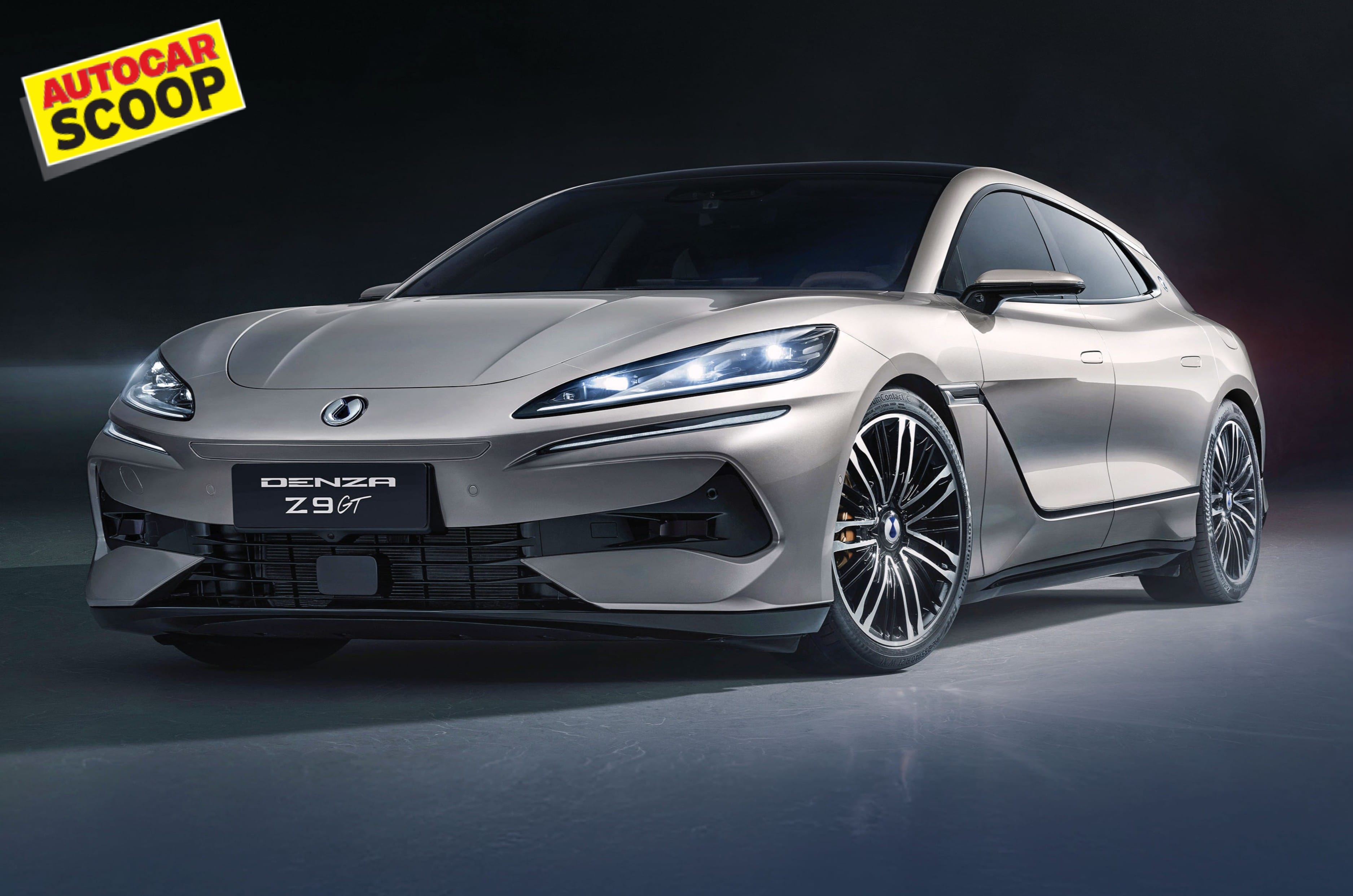
It’s not every day that a new brand enters the Indian market, but by the end of this year, we’ll have two – JSW and Denza. Last month, we exclusively reported on Denza’s intention to enter India, and now we bring you all the additional juicy details.
A little bit about the brand first. Founded in May 2010 as a joint venture between BYD and Daimler AG (now Mercedes-Benz Group AG), the company announced its brand name ‘Denza’ two years later. Mercedes has since exited the partnership, and in 2022, BYD repositioned the brand and is generally concentrating its efforts at the higher end of the market.
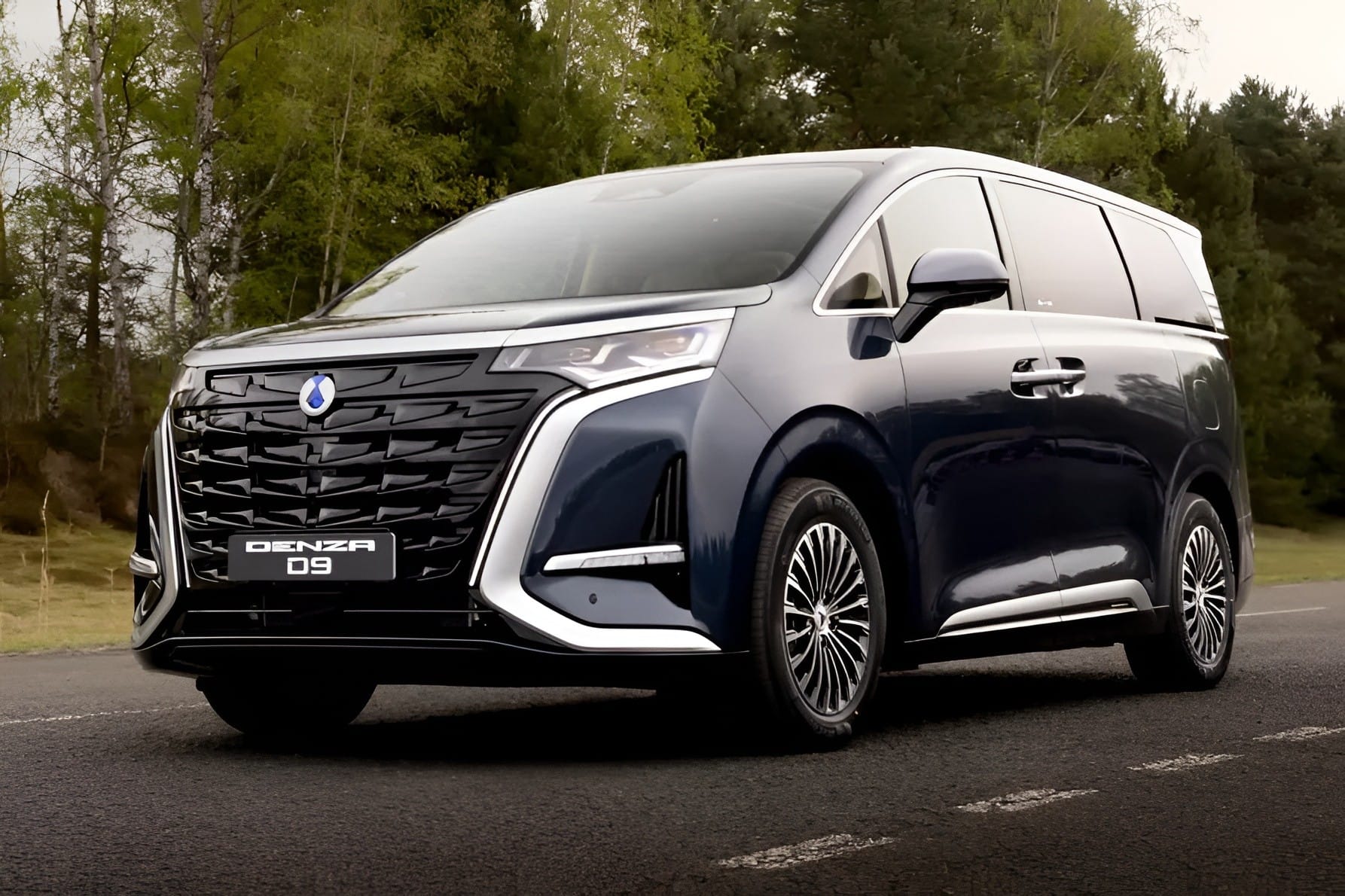
In India, Denza will be positioned above BYD’s existing portfolio, with products at around Rs 80 lakh and above, while BYD will occupy the Rs 20 to Rs 80 lakh space. Leading Denza’s charge will be two models, the Z9 GT high-performance fastback and the D9 luxury MPV. Both will be brought in as completely built-up units.
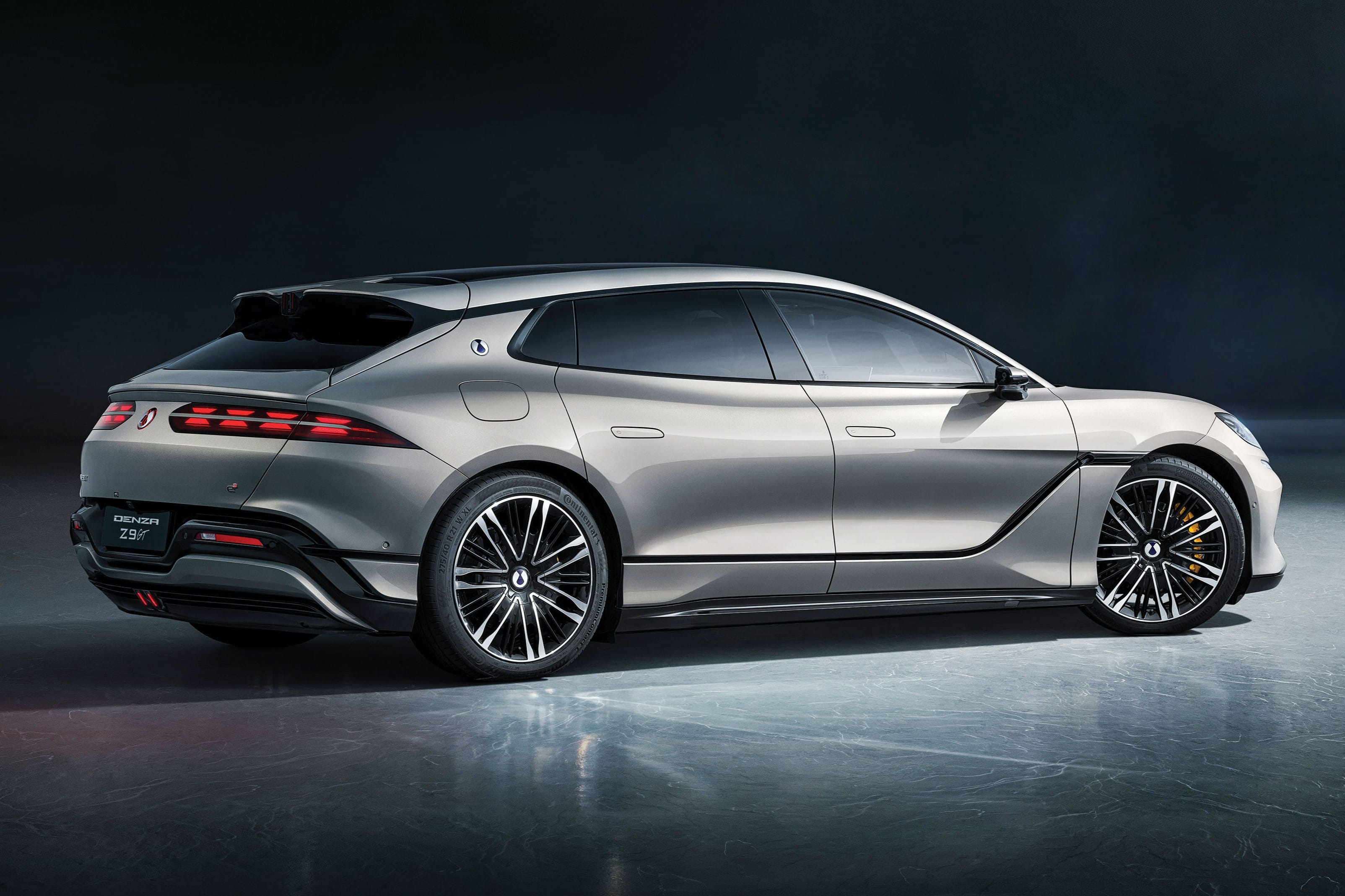
The Z9 GT is Denza’s take on a fastback or, as the company puts it, a shooting brake with four-door practicality. It has both EV and PHEV options globally, but for India, we’ll get just the electric version, and its numbers are staggering. It weighs 2.9 tonnes, puts out a colossal 1,156hp from three electric motors (one at the front and two at the rear), that propel it from 0-100kph in 2.7sec and on to a top speed of 270kph. The only modest number is the range, which stands at 600km on the combined WLTP cycle. Charging, though, is super quick, with the company’s 1,500kW Flash ultra-fast charging that can take the GT’s 122.5kWh battery from 10 to 97 percent in just nine minutes. It stops at 97 percent to preserve the life of the battery. Expect to pay premium pricing for this level of performance, though; the GT would retail in India somewhere in the Rs 1.2 to 1.5 crore mark.
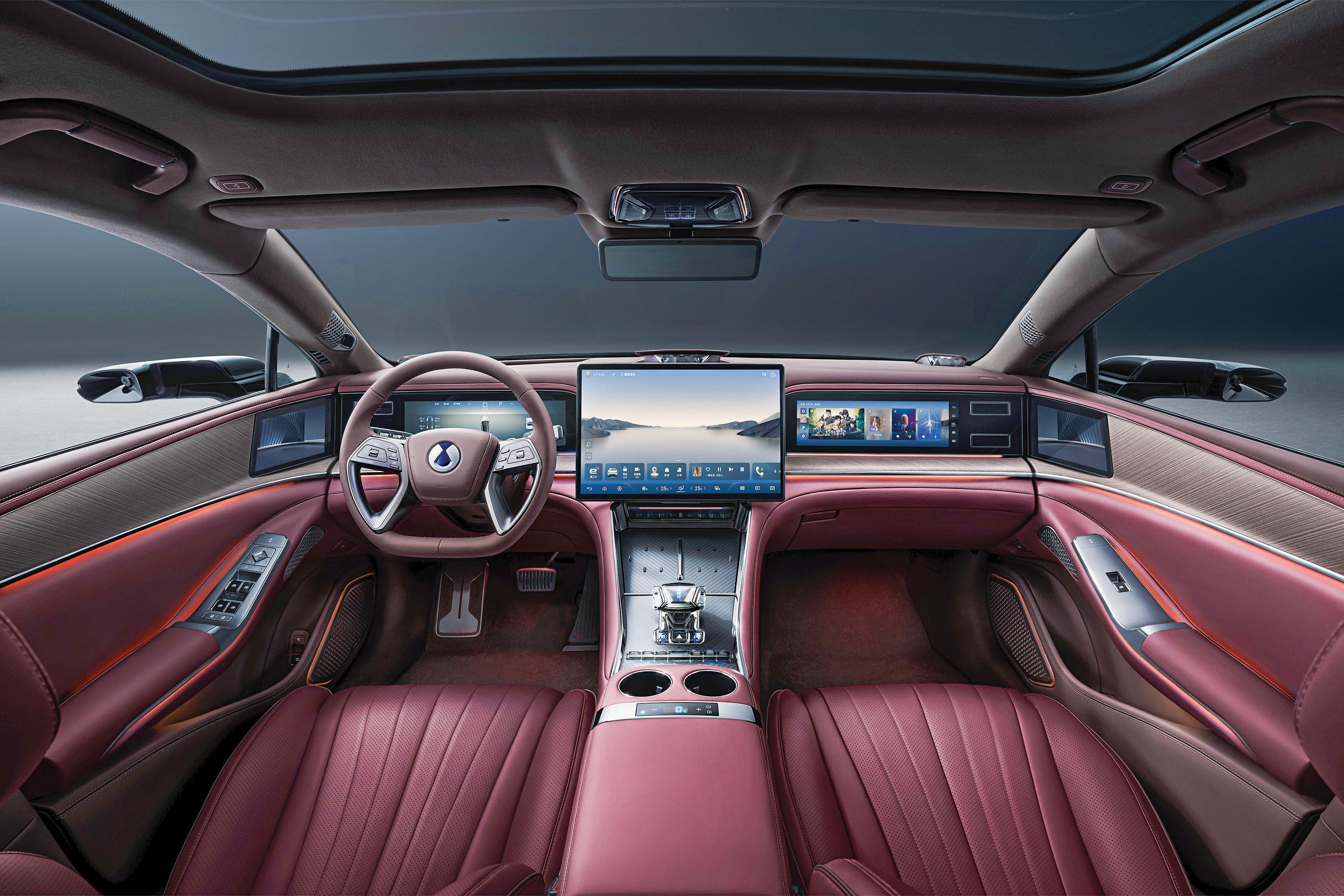
Five screens dominate dash; flank screens are for outside rear-view camera feed.
Here too, there’s a cell-to-body construction that integrates the blade cells directly into the vehicle structure, plus rear-wheel steering with a sideways crab-crawl ability, buttons to open and close power doors and, of course, Level 2+ ADAS. Inside, the GT seats five and pampers the four outer passengers with adjustable under-thigh support, heating, cooling, and massage functions, and the rear seats also recline. As with so many EVs today, the dashboard is dominated by screens, five in total, with two on the flanks for the outside rear-view ‘mirror’ camera feed.
Denza D9: Vellfire Challenger
The D9 MPV is available with electric or plug-in hybrid power globally too. For India, it’s the EV that will arrive, and in front-wheel-drive form. Expect prices at around the Rs 80 lakh mark, positioning the D9 above the MG M9 but below the Toyota Vellfire.
Power stands at 313hp and 360Nm of torque, and it’s fed by a 103kWh blade cell battery. Claimed range is 520km on the combined WLTP cycle, while charging speed peaks at 200kW on a DC fast charger.
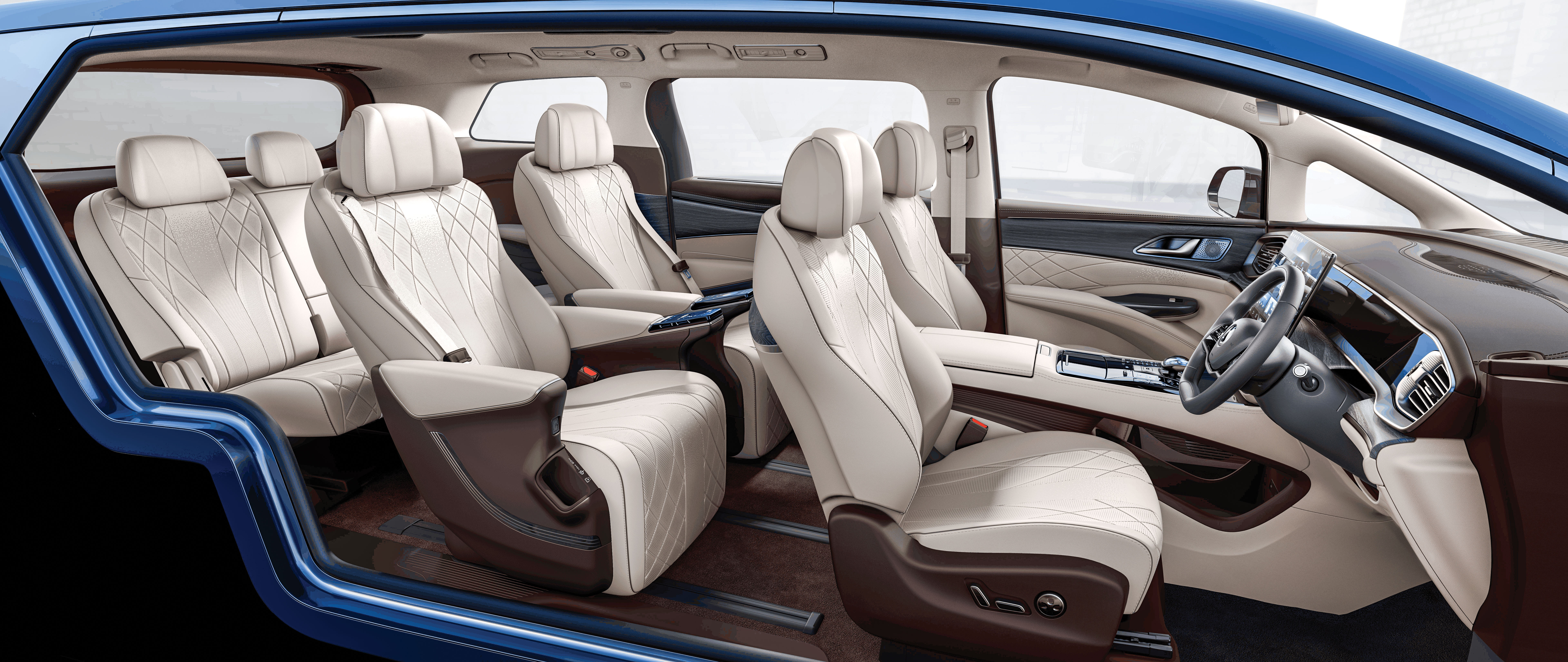
The seating configuration is 2+2+3 with the centre captain seats offering full power adjustment, heating, ventilation and massagers, along with armrest-integrated control pads. Middle-row occupants also enjoy fold-out tables and extendable leg-rests. Other creature comforts include a three-zone climate control, premium Dynaudio sound system and full leather upholstery.
Middle row the place to be with fully powered individual loungers that feature heating, ventilation, massagers, leg rests, and a fold-out table.
The D9 also features BYD’s cell-to-body construction that helps reduce weight and increase body rigidity. The luxury MPV also comes with an active body control system that, the company says, eliminates fore-aft pitching motion to keep the cabin flat during “nose-up” acceleration and “nose-down” braking forces.
Where does Denza fit in India’s automotive landscape?
The name Denza is an invented one and loosely translates to ‘rising power’ or ‘gathering momentum’, and that is what BYD will be hoping for in India. Hamstrung by the Indian government’s restrictions around Chinese investments, BYD – the world’s largest EV manufacturer – has not been able to grow. Its proposed $1 billion investment, along with a local partner, to scale up its small semi-knocked-down (SKD) plant in Tamil Nadu has been slowed by Press Note 3 – a 2020 policy that requires foreign investments from countries sharing a land border with India to get prior state approval.
Thus, given the limited playing field it’s been put into, getting into niches like luxury MPVs is a smart move from BYD. The segment accounts for about 2,000 units a year and is seeing rising customer interest and growth, attracting players like the Toyota Vellfire, the Lexus LM and Mercedes V-Class. The D9, then, has competitors to contend with, while the Z9 GT sits in a smaller niche, with just the Porsche Taycan as a similar rival. It’s likely to sell fewer numbers but will serve as a technology showcase and a brand shaper.
Interestingly, Denza will be retailed through exclusive showrooms separate from BYD. This may seem odd given the limited volumes, at least in the short term, but our sources tell us the company wants to provide Denza customers with a highly personalised shopping experience. The premium positioning will limit its network to larger cities; launch likely to be in the Delhi-NCR and Mumbai regions only. For BYD, though, it plans to scale up, thus keeping the two brands separated allow each to focus on their distinct goals.
So far, BYD India has managed a decent start and enjoys an awareness much higher than its actual market volume, enviable for a new brand. That’s all thanks to products that deliver consistently, with innovative tech like the famed blade cells. For Denza, though, the company also needs to build a high level of desirability, because at the upper end of the luxury spectrum, badge value accounts for nearly as much as, if not more than, engineering prowess itself, and that is what the company seems to be setting out to do.
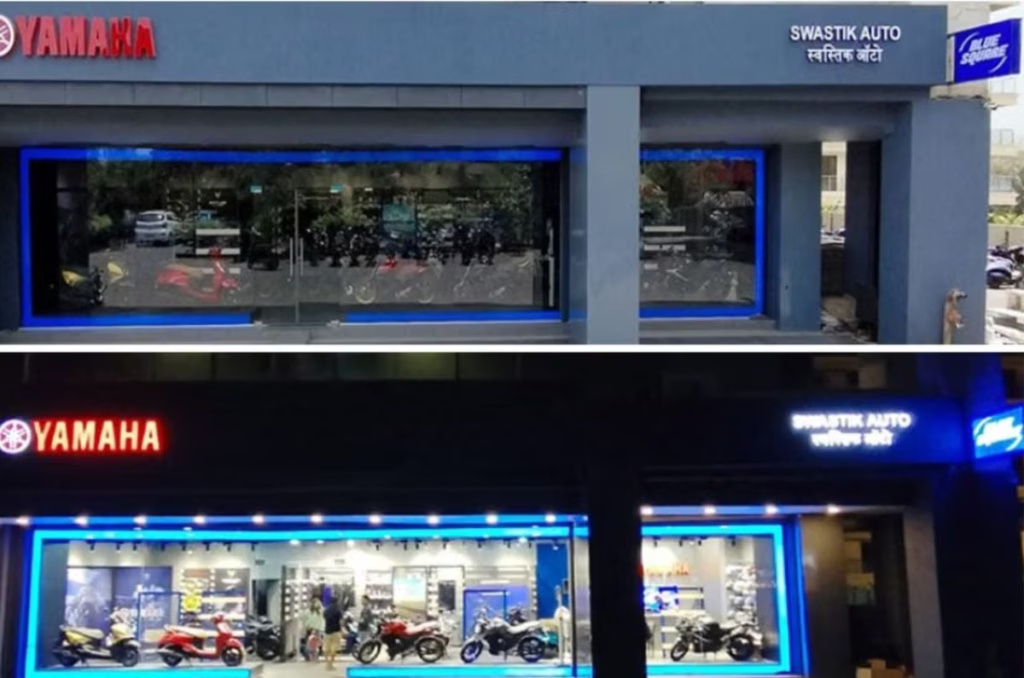
Yamaha has inaugurated its 600th Blue Square showroom in India, expanding its premium retail network across the country. The company said the network now has a presence across all four regions and supports sales, service and parts operations. The outlets are designed around Yamaha’s motorsports heritage and provide dedicated areas for accessories, merchandise and customer interaction.
Followed Yamaha’s ‘The Call of the Blue’ campaign in 2018
First one opened in 2019 in Chennai, Tamil Nadu
Also intended to be community hubs for brand-to-rider and rider-to-rider interactions
Yamaha Blue Square: Progress so far
Exclusive for premium Yamaha products
The Blue Square concept was introduced in 2019, following the launch of Yamaha’s ‘The Call of the Blue’ brand campaign in 2018. The very first Blue Square showroom was opened in Nandhanam, Chennai. The company had reached 300 showrooms back in March, 2024, indicating that the number has doubled in the last two and a half years. Mumbai got its first Blue Square showroom all the way back in 2022.
According to Yamaha, the 600-outlet network represents expansion across regions while maintaining a common retail format. The company also uses the outlets for customer engagement activities, including the Blue Streaks community initiative. Yamaha Motor India Group of Companies chairman Hajime Aota said the expansion is part of the company’s premium retail strategy and is intended to bring its riders together through the Blue Square and Blue Streaks networks.
The expanding network supports Yamaha’s motorcycle and scooter portfolio in India, including the R-Series, MT-15, AEROX 155, FZ Series, Fascino 125 FI Hybrid and RayZR FI Hybrid range. The company also lists the EC-06 and Aerox E electric scooters, along with the FZ-Blue Flex Fuel (E85 compatible) vehicle.
Yamaha currently manufactures motorcycles and parts at plants in Surajpur, Uttar Pradesh and Kanchipuram, Tamil Nadu, for domestic and overseas markets. The company said the outlets function as community hubs in addition to their retail role, with spaces for customers to interact with the brand and other riders.
With inputs from Eshisha Java and Stephen Raj Antony
जोहो के संस्थापक श्रीधर वेम्बू ने अमेरिकी राष्ट्रपति डोनाल्ड ट्रंप की ओर से अमेरिकी एडल्ट्स को $5000 देने के वादे की तुलना तमिलनाडु की चुनावी राजनीति से कर दी है। वेम्बू ने तंज कसते हुए कहा कि अमेरिकी राष्ट्रपति असल में भारत के तमिलनाडु की पार्टी द्रविड़ मुनेत्र कड़गम (DMK) की नकल कर रहे हैं। सोशल मीडिया प्लेटफॉर्म X पर एक पोस्ट में श्रीधर वेम्बू ने लिखा कि हमने इसका आविष्कार तमिलनाडु में किया और इसे पूरे भारत में फैलाया। राष्ट्रपति ट्रंप DMK की नकल कर रहे हैं।
क्या है डोनाल्ड ट्रंप का $5000 ट्रम्प डिविडेंड वादा?
श्रीधर वेम्बू का यह कमेंट डोनाल्ड ट्रंप के उस चुनावी वादे के बाद सामने आया है जिसमें उन्होंने कहा है कि अगर रिपब्लिकन पार्टी नवंबर में होने वाले मिडटर्म चुनावों में प्रतिनिधि सभा और सीनेट पर अपना कंट्रोल बनाए रखती है, तो वह हर अमेरिकी एडल्ट को $5000 भेजेंगे। ट्रंप के वादे को ट्रंप डिविडेंड नाम दिया गया है।
1 ट्रिलियन डॉलर से अधिक की लागत और भारी घाटा
ट्रंप के इस प्रस्ताव को लागू करने के लिए अमेरिकी कांग्रेस की मंजूरी की जरूरत होगी और इससे 1 ट्रिलियन डॉलर (1 खरब डॉलर) से अधिक का खर्च आ सकता है। यह स्थिति तब है जब अमेरिका पहले से ही लगभग 2 ट्रिलियन डॉलर के एनुअल बजट घाटे का सामना कर रहा है और उसका नेशनल कर्ज 40 ट्रिलियन डॉलर को पार कर चुका है। ट्रंप ने सुझाव दिया है कि टैरिफ से मिलने वाले रेवेन्यू की मदद से अमेरिकी लोगों को ये पैसा दिया जाएगा। वैसे रिपोर्ट्स के मुताबिक ट्रंप ने जितने का वादा कर दिया है वो टैरिफ से आने वाले रेवेन्यू से भी ज्यादा बैठ रहा है।
We invented this in Tamil Nadu, and spread it to rest of India. President Trump is copying the DMK
इस पर ‘कमिटी फॉर ए रिस्पॉन्सिबल फेडरल बजट’ के सीनियर पॉलिसी डायरेक्टर मार्क गोल्डवेन ने कहा कि ट्रंप कांग्रेस की मंजूरी के बिना यह भुगतान नहीं कर सकते। उन्होंने इस बात पर भी सवाल उठाया कि जब सरकार पहले से ही बड़े बजट घाटे में चल रही है तो ऐसे में डिविडेंड शब्द का इस्तेमाल कैसे किया जा सकता है।
आपको बता दें कि श्रीधर वेम्बू द्वारा DMK का जिक्र तमिलनाडु के दशकों पुराने राजनीतिक इतिहास को ध्यान में रखकर किया गया है। तमिलनाडु में वेलफेयर स्कीम्स को चुनावी राजनीति के साथ जोड़ने का इतिहास काफी पुराना है। यहां 1950 और 1960 के दशक में मद्रास राज्य के मुख्यमंत्री के रूप में के कामराज ने मुफ्त शिक्षा का विस्तार किया और स्कूली बच्चों के लिए मिड डे मील स्कीम शुरू की थी।
1967 के विधानसभा चुनाव में DMK के संस्थापक सीएन अन्नादुरई ने सार्वजनिक वितरण प्रणाली के जरिए रियायती दरों पर चावल देने का वादा किया था। DMK ने यह चुनाव जीता और इस योजना को लागू किया। बाद में फाइनेंशियल दिक्कतों की वजह से इसे सीमित करना पड़ा। 2006 के चुनाव में एम करुणानिधि की अगुवाई वाली DMK ने मुफ्त कलर टीवी, रियायती चावल, गैस चूल्हे और अन्य लाभ देने का वादा किया। इसी तरह 2011 के चुनाव में ये कंपीटिशन और तेज हो गया। तब DMK और AIADMK दोनों ने मिक्सर, ग्राइंडर, पंखे और लैपटॉप जैसे घरेलू सामान देने के वादे किए।
तमिलनाडु से निकलकर पूरे भारत में फैला यह मॉडल
तमिलनाडु से शुरू हुआ यह मॉडल बाद में देश के दूसरे हिस्सों में भी फैल गया। आम आदमी पार्टी ने 2015 में दिल्ली चुनाव प्रचार में मुख्य रूप से सब्सिडी वाली बिजली और मुफ्त पानी का वादा किया था। इसके बाद से भारत भर के राजनीतिक दलों ने मुफ्त बिजली, लोन माफी, मुफ्त सार्वजनिक परिवहन, कैश स्कीम, लैपटॉप और दूसरे डायरेक्ट फायदे देने शुरू कर दिए.
ट्रंप के पुराने वादे: DOGE डिविडेंड और टैरिफ रिफंड
ऐसा नहीं है कि ट्रंप कोई पहली बार कुछ इस तरह का वादा कर रहे हैं। इससे पहले उन्होंने एलन मस्क के डिपार्टमेंट ऑफ गवर्नमेंट एफिशिएंसी (DOGE) द्वारा की गई बचत को जनता में बांटने के लिए DOGE डिविडेंड का प्रचार किया था। इसके अलावा उन्होंने टैरिफ रिफंड का विचार भी पेश किया था। इसमें सुझाव दिया गया था कि इंपोर्ट फी से मिलने वाले रेवेन्यू को अंततः जनता को लौटाया जा सकता है।
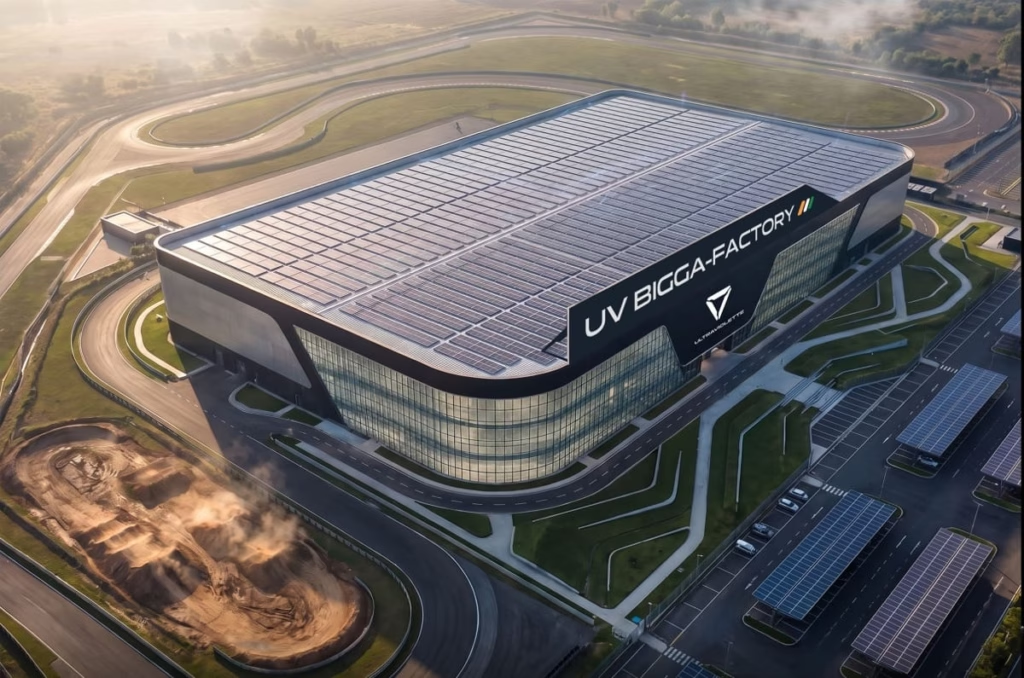
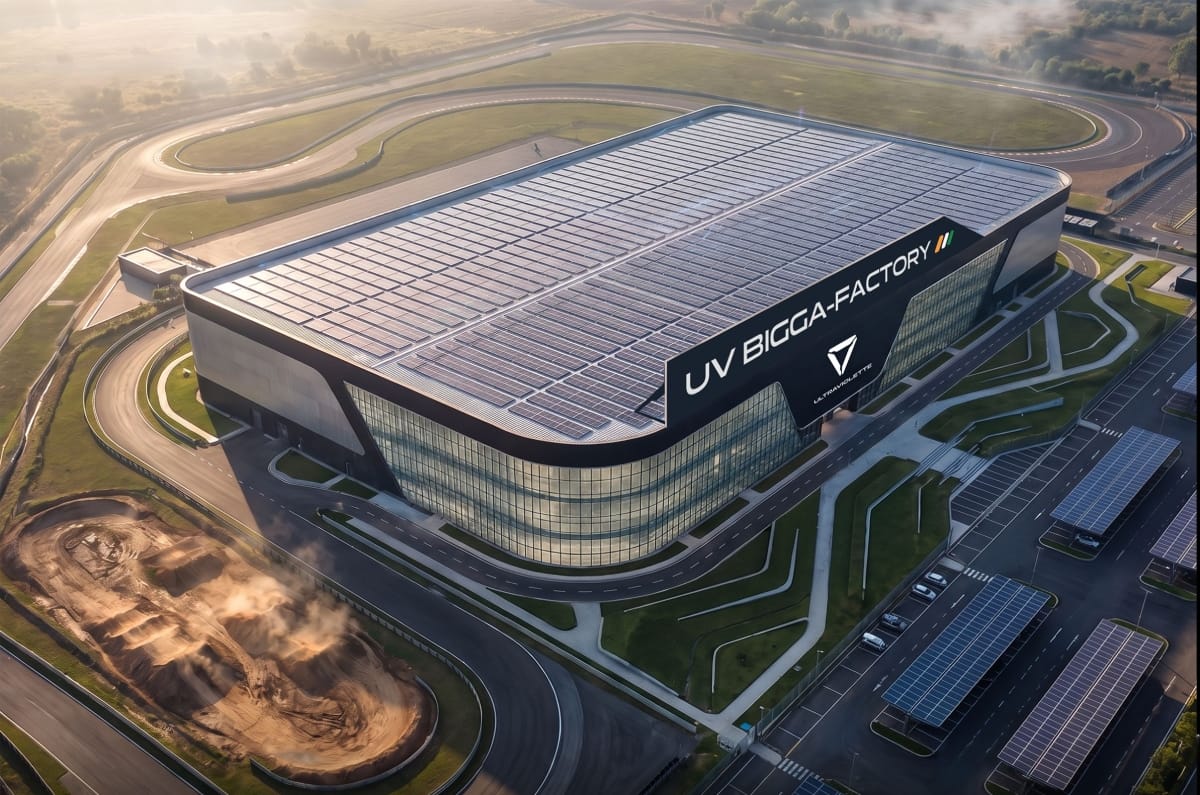
Ultraviolette has announced a new manufacturing facility in Hosur, Tamil Nadu. Named the BIGGA Factory (short for Big Global Ambition), the facility will initially produce the upcoming Tesseract scooter before expanding to support a broader product portfolio. It will begin with an annual capacity of 2.5 lakh units, with infrastructure designed for up to 5 lakh units per year.
BIGGA Factory to be located at SIPCOT Industrial Park, Hosur
Initial capacity of 2.5 lakh units per year, scalable to 5 lakh
Product roadmap image hints at a new X-47 variant and a family scooter for 2027
Ultraviolette BIGGA Factory details
Hosur chosen for its proximity to Bengaluru R&D base and supplier network
The facility will be located at the SIPCOT Industrial Park in Shoolagiri, Hosur, with the land facilitated by the Government of Tamil Nadu. Hosur’s established automotive ecosystem and its proximity to Ultraviolette’s Bengaluru R&D operations and supplier network were cited as key reasons for the location. The BIGGA Factory will operate alongside the company’s existing Bengaluru facility, which will continue its current operations.
Ultraviolette says the facility will use real-time production tracking, collaborative robots for sorting, welding and assembly, and vision-based inspection systems. A dedicated on-site test track will also be used to evaluate every vehicle before dispatch.
Product roadmap hints at new variants and models
Alongside the factory announcement, Ultraviolette shared a product roadmap image showing the silhouettes of two new products planned for 2027. One appears closely similar to the existing X-47, suggesting that a new variant could be in the pipeline. The other is a scooter with a markedly different silhouette compared to the upcoming Tesseract, featuring a more rounded, family-scooter-like profile.
If that is the direction Ultraviolette is taking, it would put the company alongside essentially every other significant EV manufacturer in India currently targeting the mainstream scooter segment. Ather has just launched the Konarc, and Simple Energy has introduced the Wave family scooter range, whereas established players such as TVS, Bajaj and Vida continue to see a majority of their EV sales volumes from models such as the iQube, Chetak and Vida VX2, respectively.
Ultraviolette has not shared any further information on either of the two new products, and the roadmap image remains the only indication of what may be coming. We’ll share further details once more information becomes available.
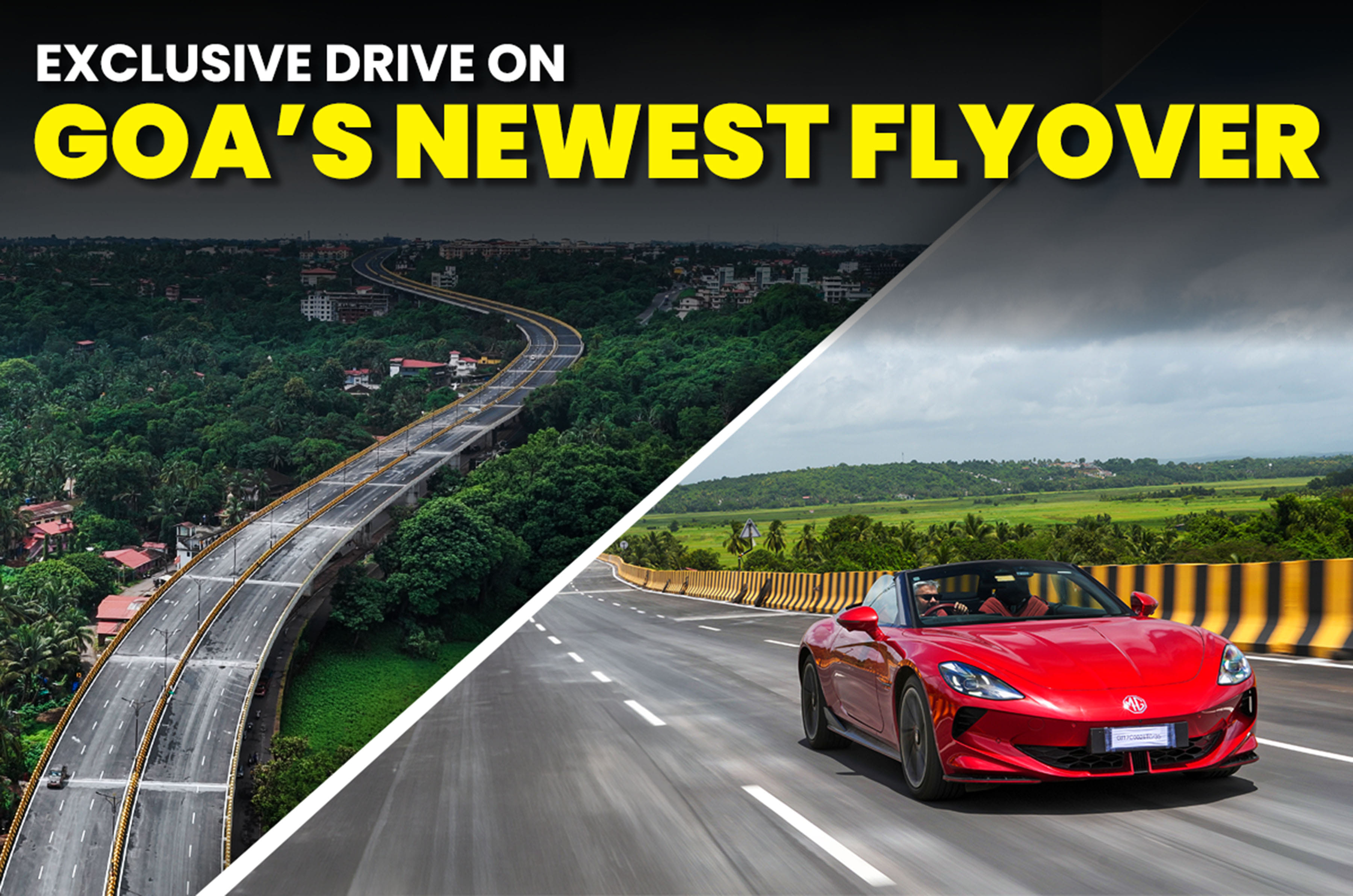
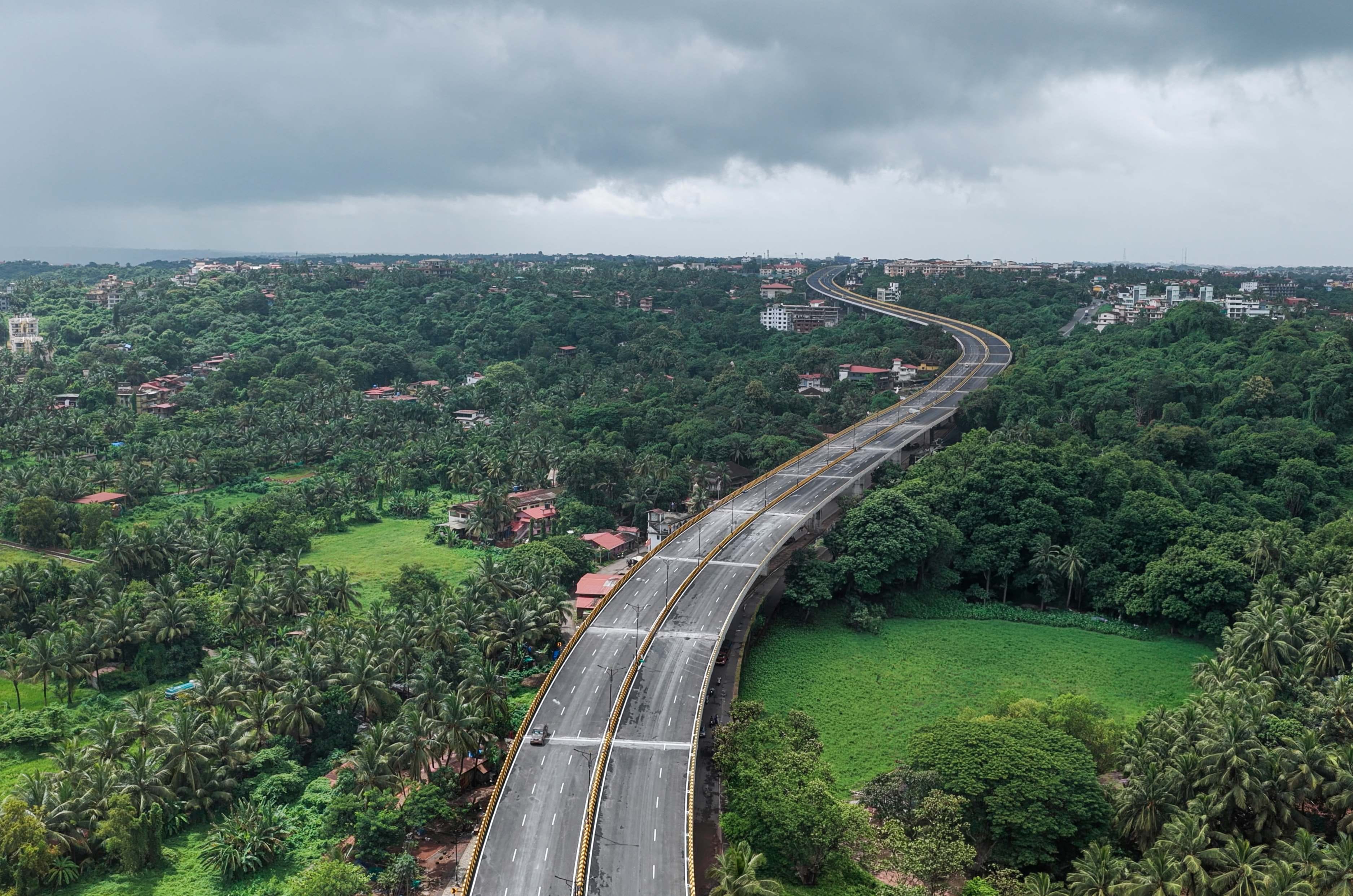
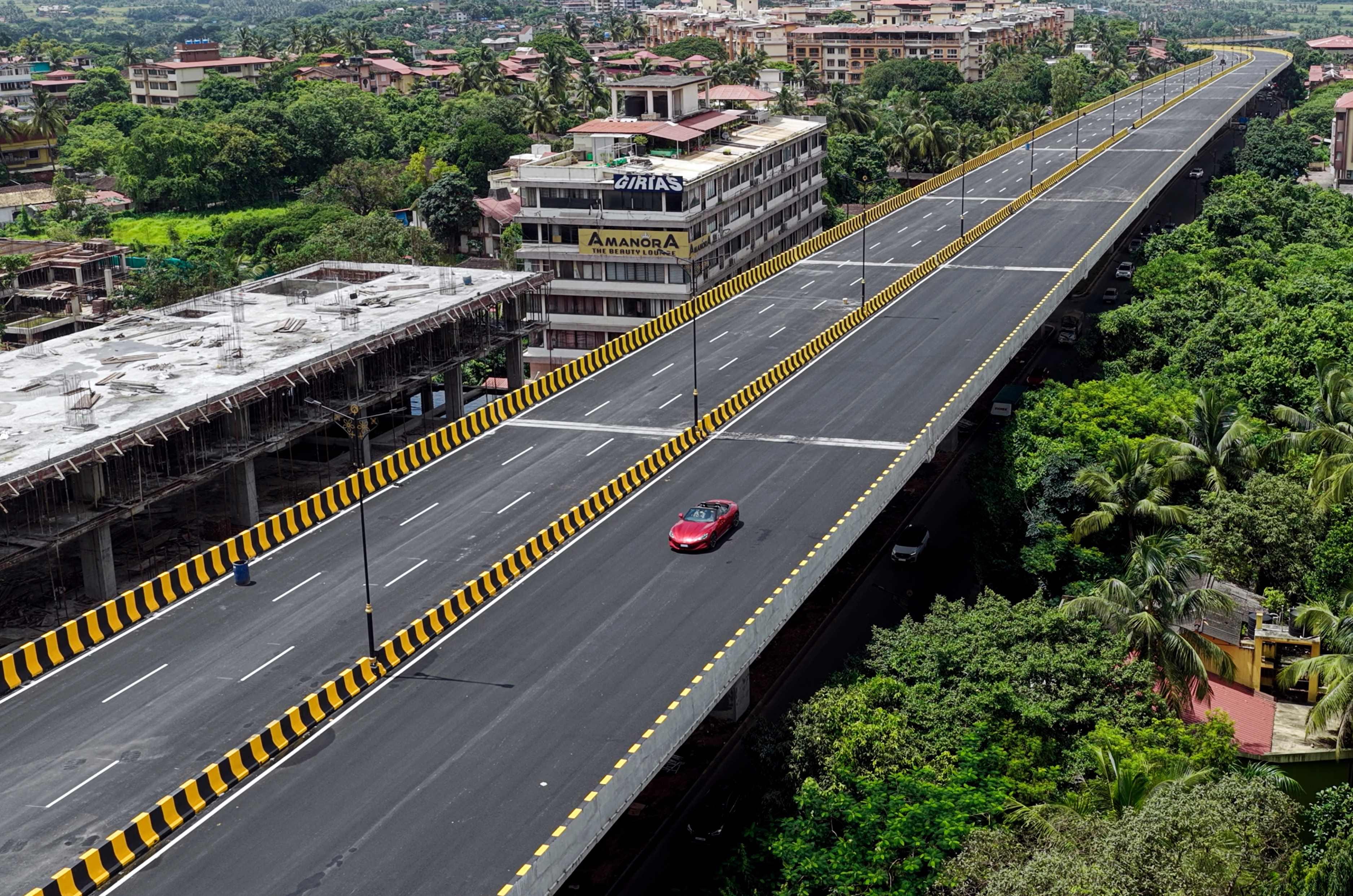
If a holiday in Goa is a fixture on your calendar, you will have noticed that the state has changed a fair bit in the last few years. There is a new airport to fly into, new bridges replacing the old, not to mention the wider highways. The latest upgrade to the state’s road network is the Porvorim Elevated Corridor, targeting a major bottleneck on NH66. We were given an exclusive opportunity to experience it for ourselves before the official inauguration on Sep 9, and we brought along a very ‘Goa’ car for the occasion – the MG Cyberster.
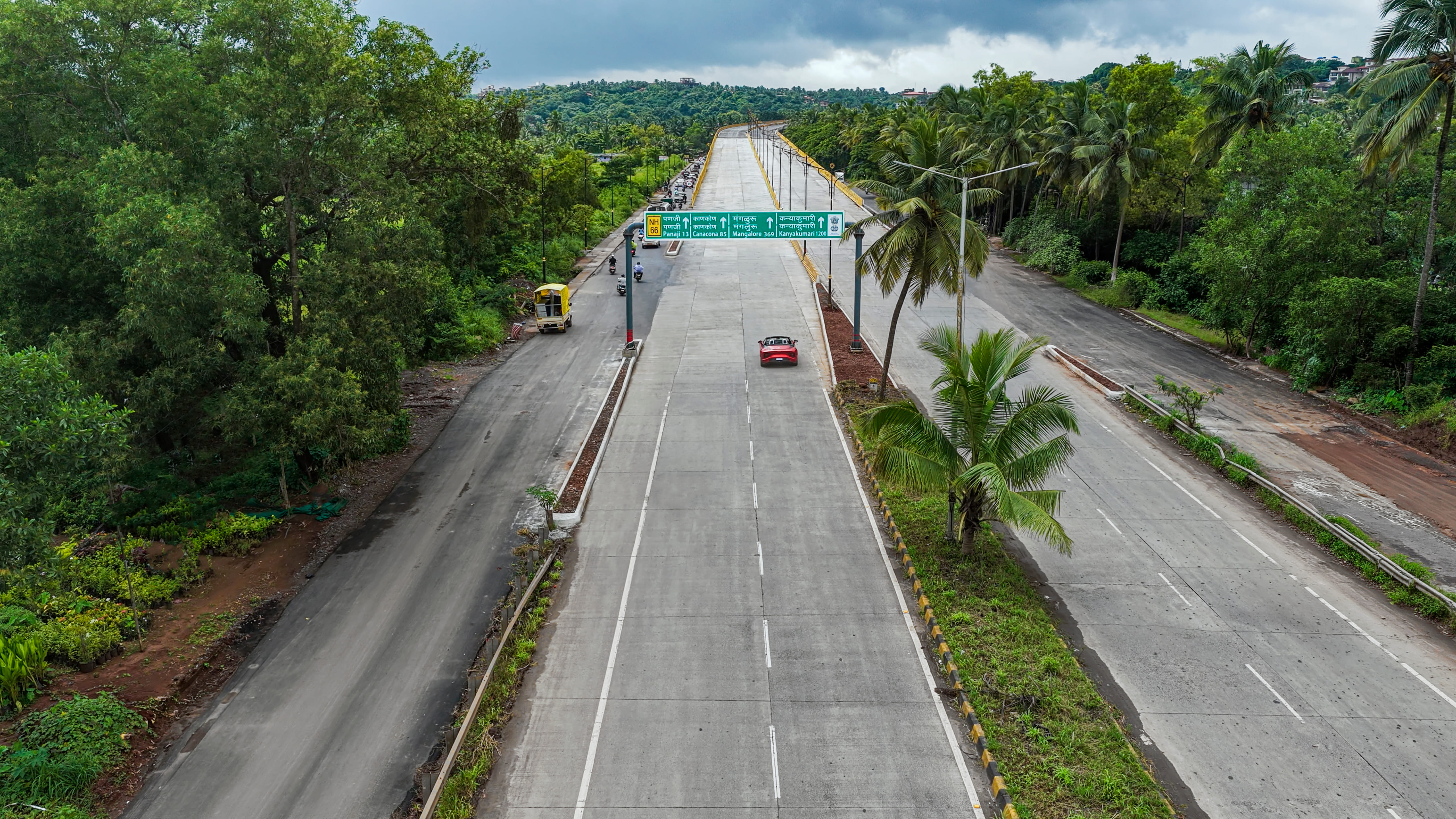
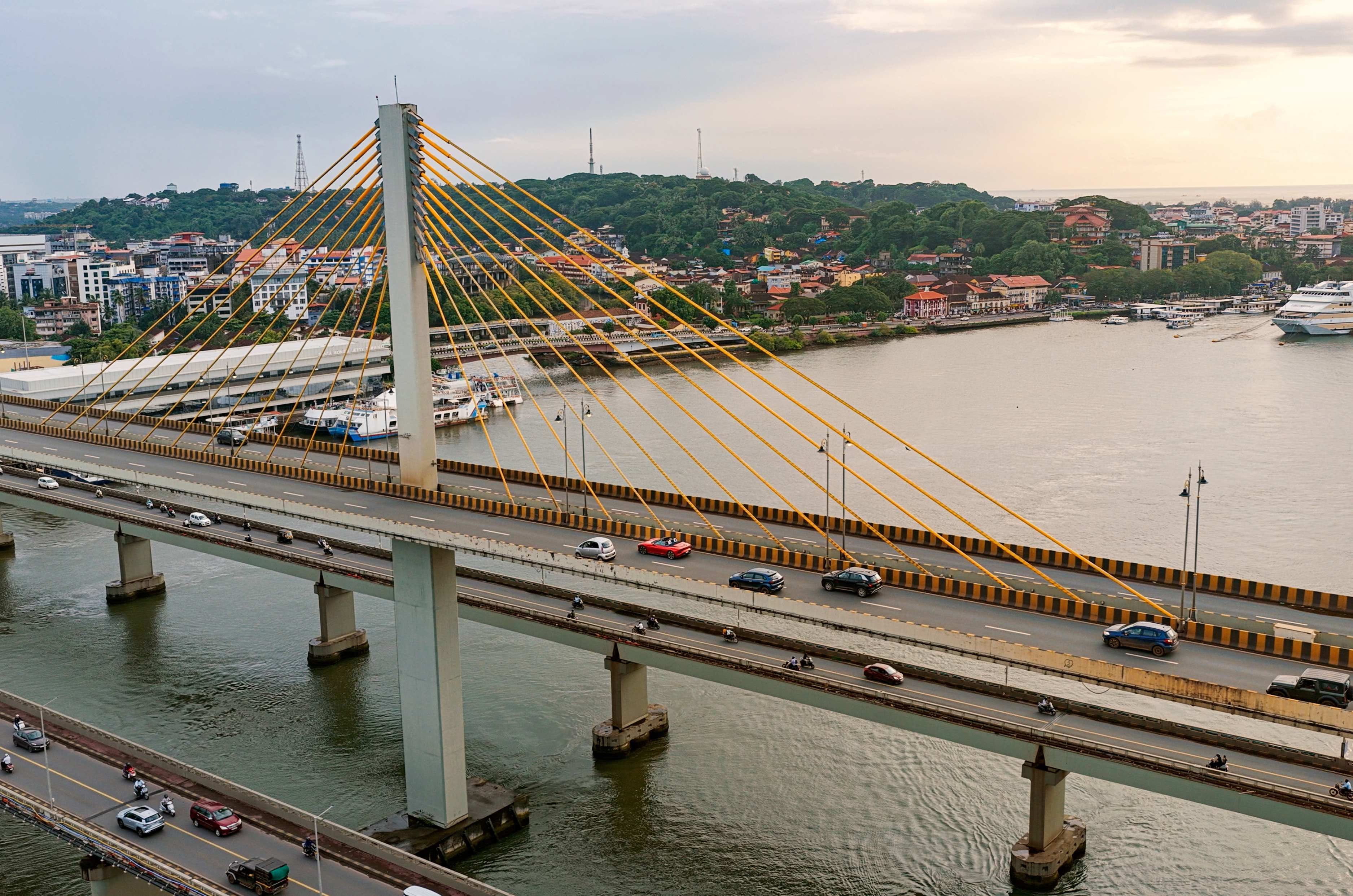
First, a bit of quick history and geography. National Highway 66 is a 1,640km arterial highway running from Panvel in Maharashtra to Kanyakumari in Tamil Nadu. 124km of NH66 is in Goa and, for years, Porvorim has been its most notorious bottleneck. The new 5.15km Porvorim Elevated Corridor lets traffic sail clean over all that congestion below, connecting directly to the Atal Setu bridge that crosses the Mandovi River. It promises to cut travel time between Mapusa in the north and the capital Panaji by up to 30 minutes – a claim we set out to test.
Six-laned Porvorim Elevated Corridor brings North Goa and Panaji closer than ever.
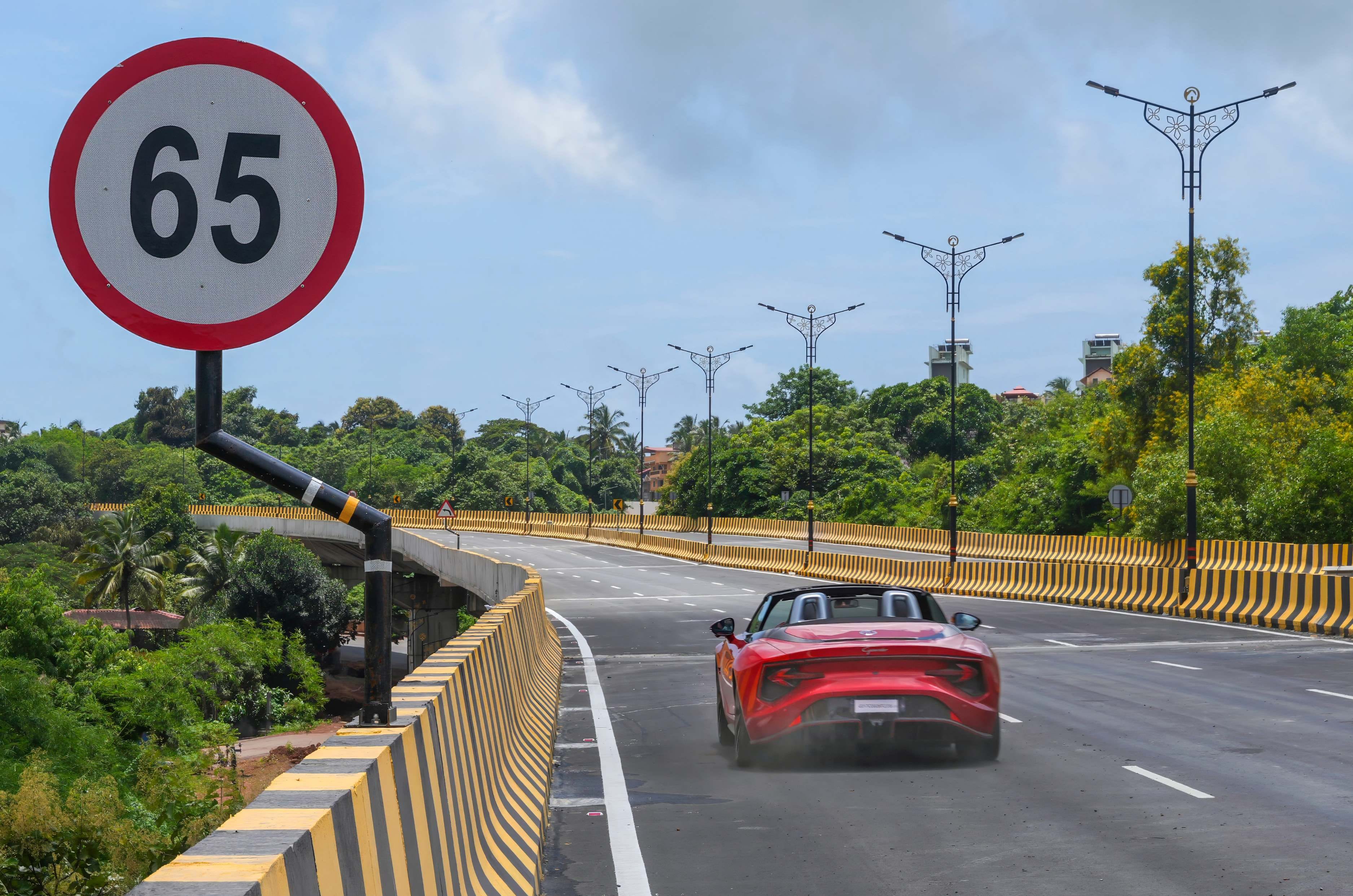
Our starting point was the north end of the corridor, a couple of kilometres away from Guirim village near Mapusa. We started our stopwatch on the concrete ramp leading up the PEC – one we would only stop once we crossed over the Atal Setu Bridge and entered Panaji. And even with 510hp and 725Nm on tap and the road all to ourselves, we would be sticking to the 65kph speed limit.
From the concrete on-ramp, it’s only a few metres until you drive onto the actual viaduct section, which is paved tarmac broken up only by expansion joints. It is not completely straight either – the north end has some lovely sweeping curves. In a car like the Cyberster, it is quite tempting to push through the bends but, exercising restraint, we instead indulged in the joys of open-top motoring. The Cyberster drops its top in 10 seconds at speeds up to 50kph, giving us superb views all around. Importantly, it also raises the top just as quickly, which comes in handy during sudden showers.
No more jams! 5.15km flyover sails over congestion at Porvorim junction.
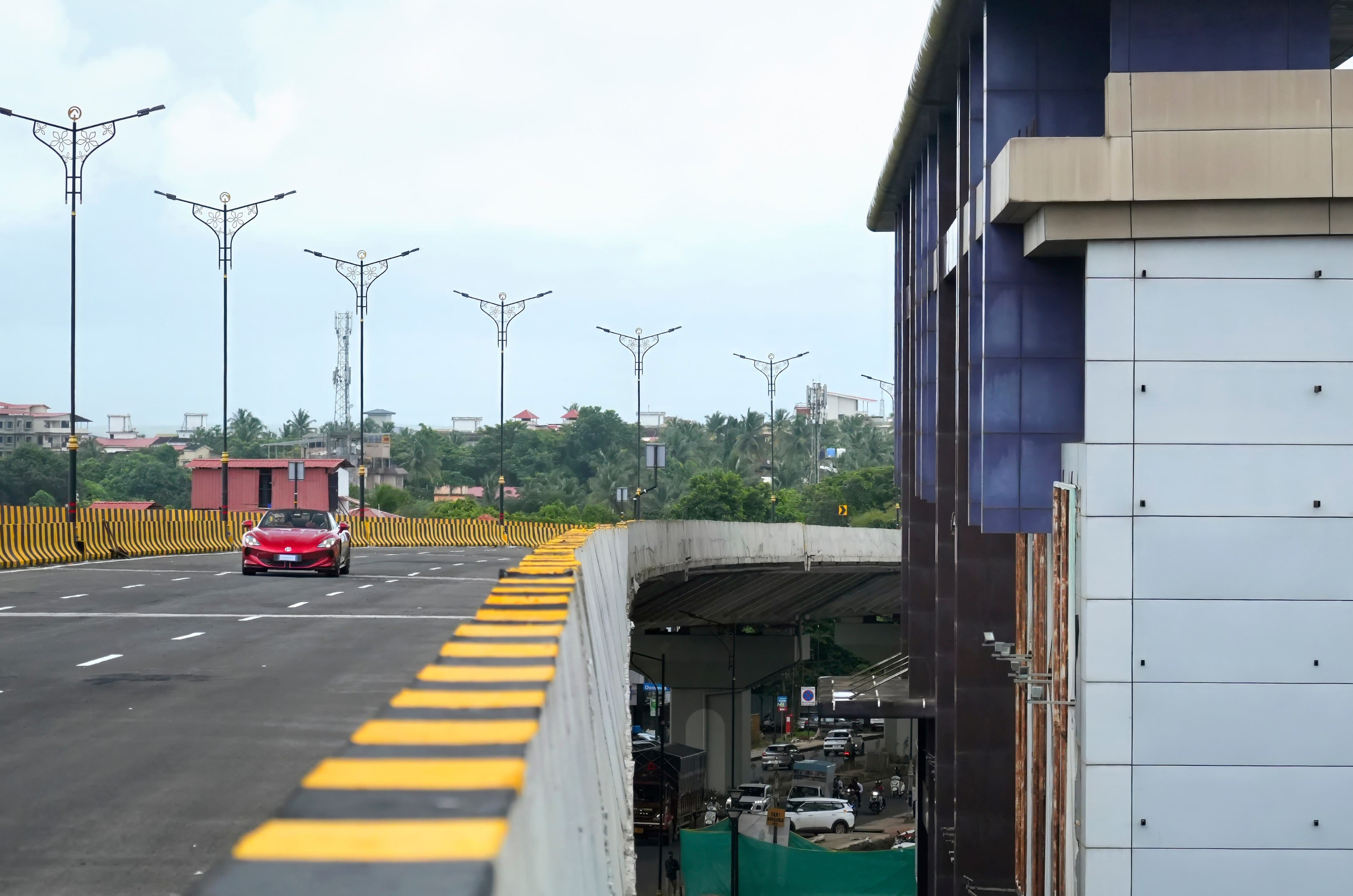
From the driver’s seat, the panoramic view of Porvorim’s greenery was quite stunning – something you would never notice stuck in traffic below. Drive on, and the road becomes arrow-straight, and you start to notice how close some of the buildings are to the corridor. This proximity to adjoining structures, along with the fact that NH66 had to stay operational below, were among the biggest challenges the engineers faced.
Some buildings were a little too close for comfort making construction quite challenging.
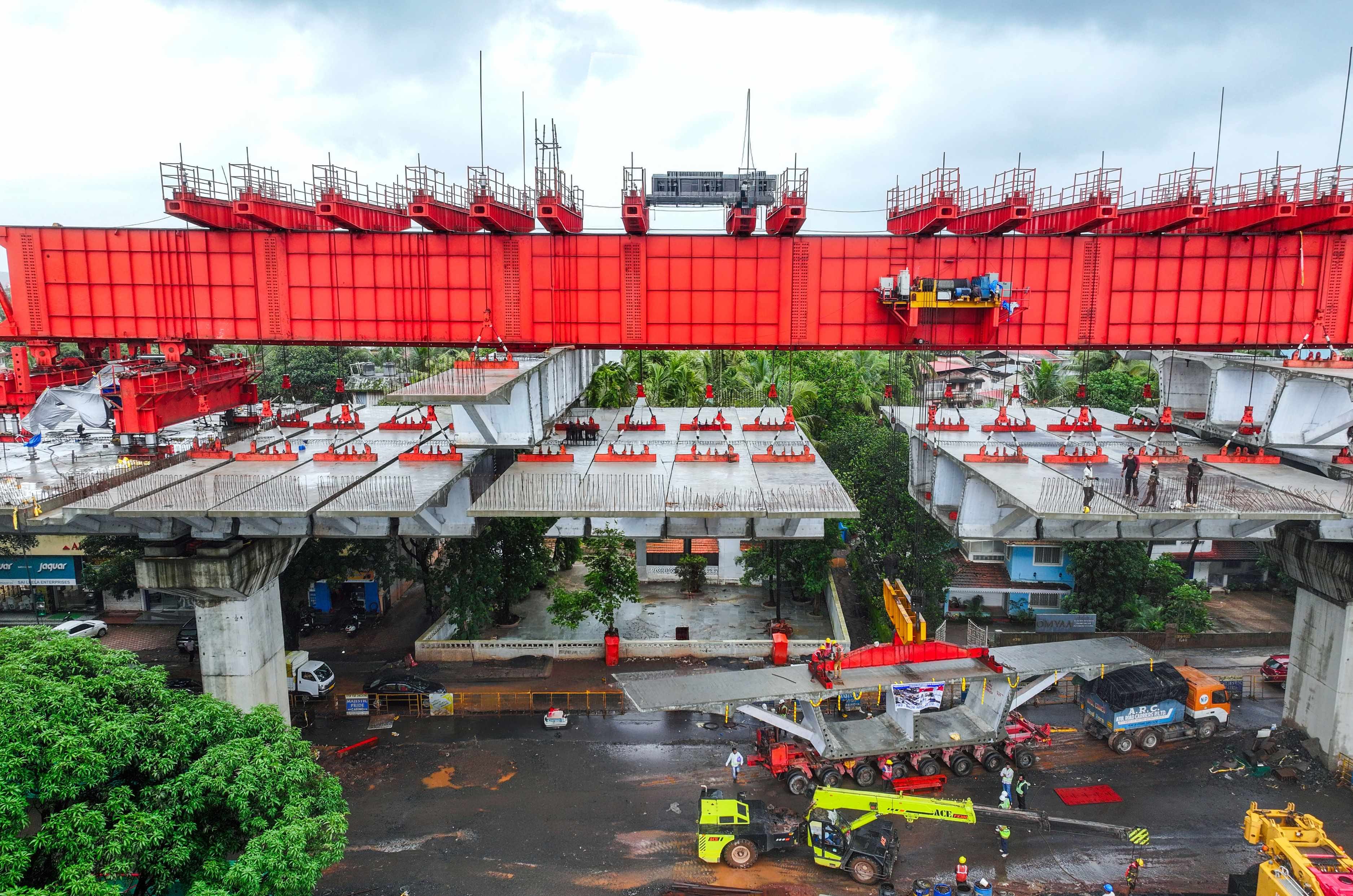
The 4.19km viaduct section is supported by 87 pillars. Each span running between two pillars requires between 13 and 17 individual pre-cast concrete sections. These sections are about 24 metres wide and weigh a whopping 120 tonnes each. They were cast in a yard down the road, trucked to the site, hoisted 11 metres high and installed in place – all in a narrow space between buildings with absolutely no room for error, while ensuring minimal traffic disruptions below.
Considering the challenges, it is quite remarkable that the Porvorim Elevated Corridor was completed in just two years and five months. Below the main structure, 10.30 kilometres of service roads and 28 minor junctions keep local traffic moving, while the corridor sails above it all. Also featured are eight box culverts and a rainwater harvesting system, so the monsoon doesn’t slow traffic down. A modern lighting setup with 515 streetlights has already been installed, while two high-mast lights and ten overhead gantries with cameras are to be put up soon. All constructed at a cost of Rs 641.46 crore.
New flyover part of NH 66 open to cars, two-wheelers and CVs. Speed limit 65kph.
Before long, we were passing the Mall de Goa – close enough to see the expressions on the faces of people in the food court, as they watched the bright red Cyberster whizz past their window. As we made our way down the off-ramp, the stopwatch showed that it had been just over four and a half minutes. Heading towards the Atal Setu, we merged with the dozens coming from the diversion and became part of regular traffic.
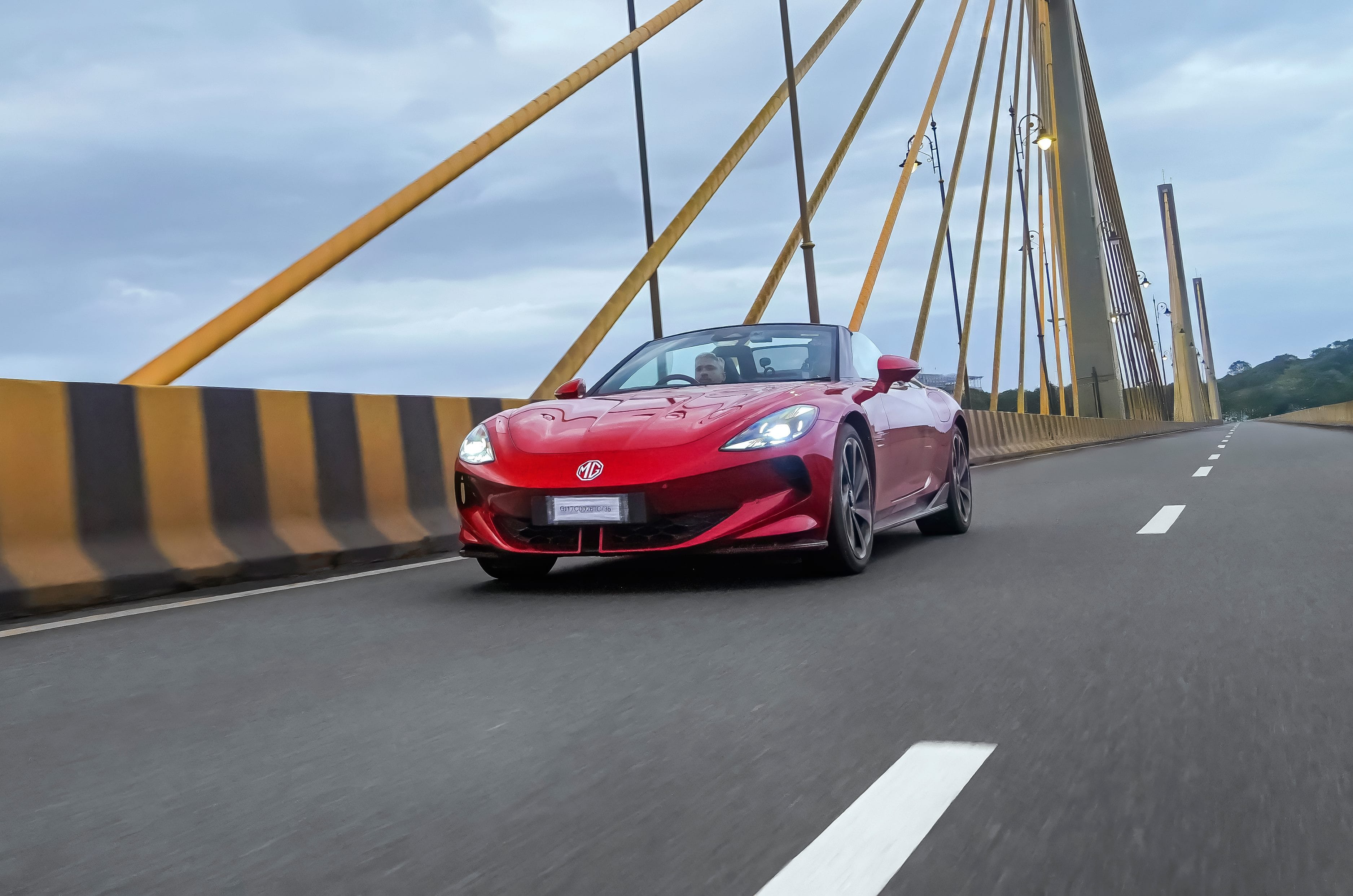
And just like that, we were climbing the Atal Setu bridge, which would take us across the Mandovi River and into Panaji. To the right, stunning views of Panaji city and Miramar beach in the distance, and to the left, Old Goa with its historic churches, while above me, through the open roof of the Cyberster, panoramic views of the bridge’s iconic pylons and yellow cable stays.
Drop top MG Cyberster a great match for Goa’s vibe
Coming down the Atal Setu into Panaji, our stopwatch read just under 10 minutes. Even if you factor in a couple of extra minutes for traffic once the PEC opens, it equates to a real-world saving of about 30 minutes in peak hours, which is quite significant. In fact, the PEC is said to have a capacity of 70,000 PCU, or passenger car units, per day, so traffic flow is expected to be quite swift. Simultaneously, it will reduce the burden on the service and other connecting roads below the corridor, improving flow for local traffic too.
Connects directly to (yet another) Atal Setu bridge and brings you closer to Goa’s historic sites.
The Porvorim Elevated Corridor, along with other recent infra projects such as the Atal Setu, the New Zuari Bridge and the widening of NH66, is expected to boost the economy by improving intra-state connectivity to Goa’s industrial hubs, as well as flow between the airports and ports. It should also make commutes easier for residents and change the way tourists experience Goa – less time spent travelling, more time to explore the beaches, the culture and everything Goa has to offer.
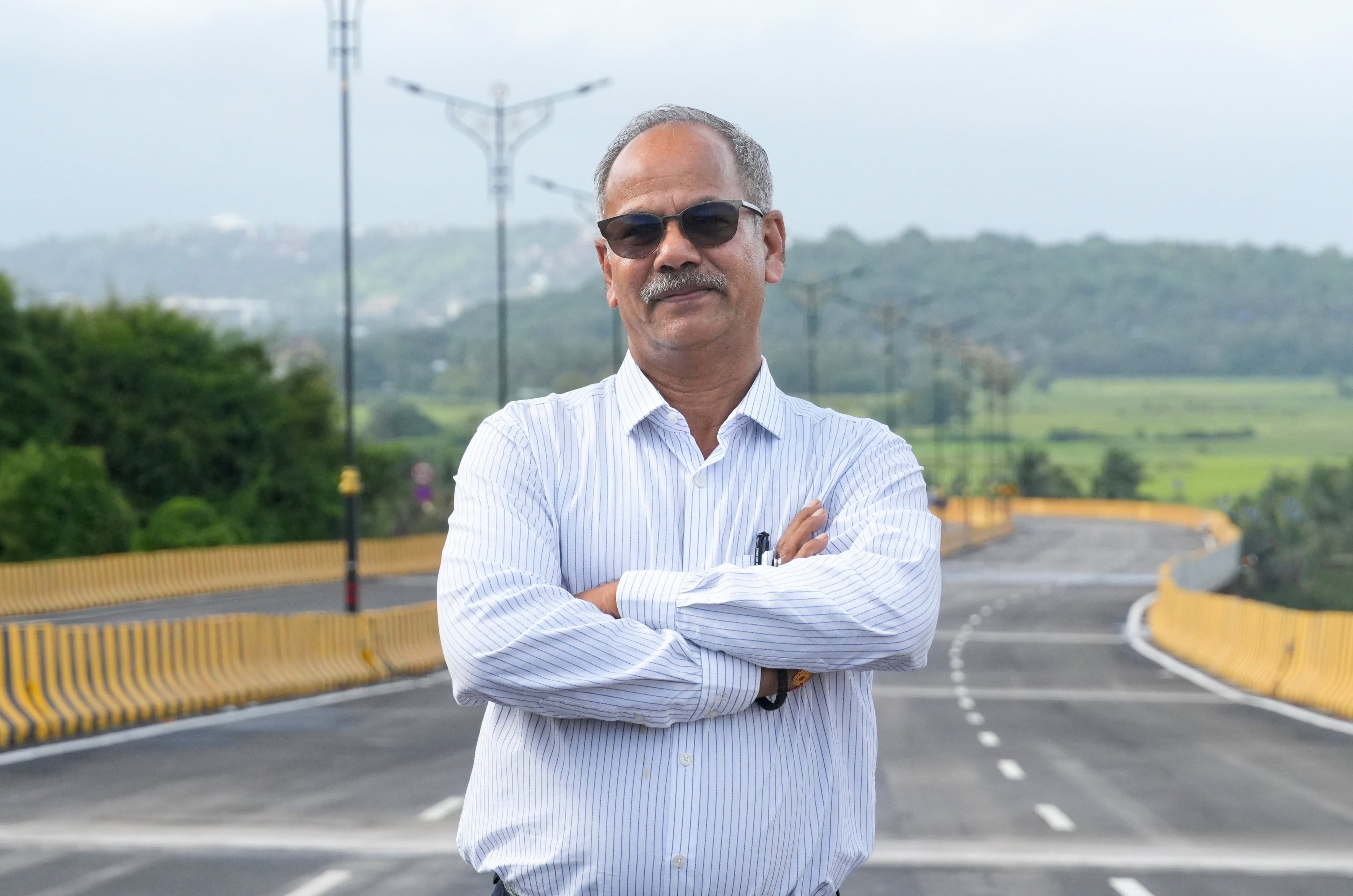
In conversation with Sandip Prabhu Chodnekar, Principal Chief Engineer, Goa Public Works Department (PWD)
On the challenges faced during construction
This bridge is about 24 metres wide, but the right of way is only 25 metres. Constructing such a wide structure when both sides are already fully developed was very challenging. One of the biggest challenges was lifting the segments. Each segment is nearly 24 metres wide and weighs around 120 tonnes. We could not divert the traffic, so we had to carry out most of the work at night. During the daytime, we stopped heavy traffic so that the segments could be lifted safely and normal traffic could resume quickly.
Lifting 25 metre wide sections that weigh 120 tonnes called for nerves of steel.
On other highlights of the project
We tried to harvest the rainwater to recharge the groundwater and increase the water table. There is a median between the service roads below, where we are also planting trees. The corridor’s rainwater harvesting system collects the water and directs it into this median. From there, the water flows into pits that we have dug and filled with aggregates and strainers, allowing the rainwater to percolate into the ground. This helps harvest the rainwater and increase the water table on the plateau during the monsoon.
On traffic and usage
Below the corridor, things will be quite different. Once around 50,000 PCUs of traffic are taken off the existing four-lane road, there could be a tendency for people to park on these lanes. So, we will have to manage parking as well. We have streamlined the junctions and completely reworked the at-grade traffic flow. Motorcycles are also allowed on the Porvorim Elevated Corridor.
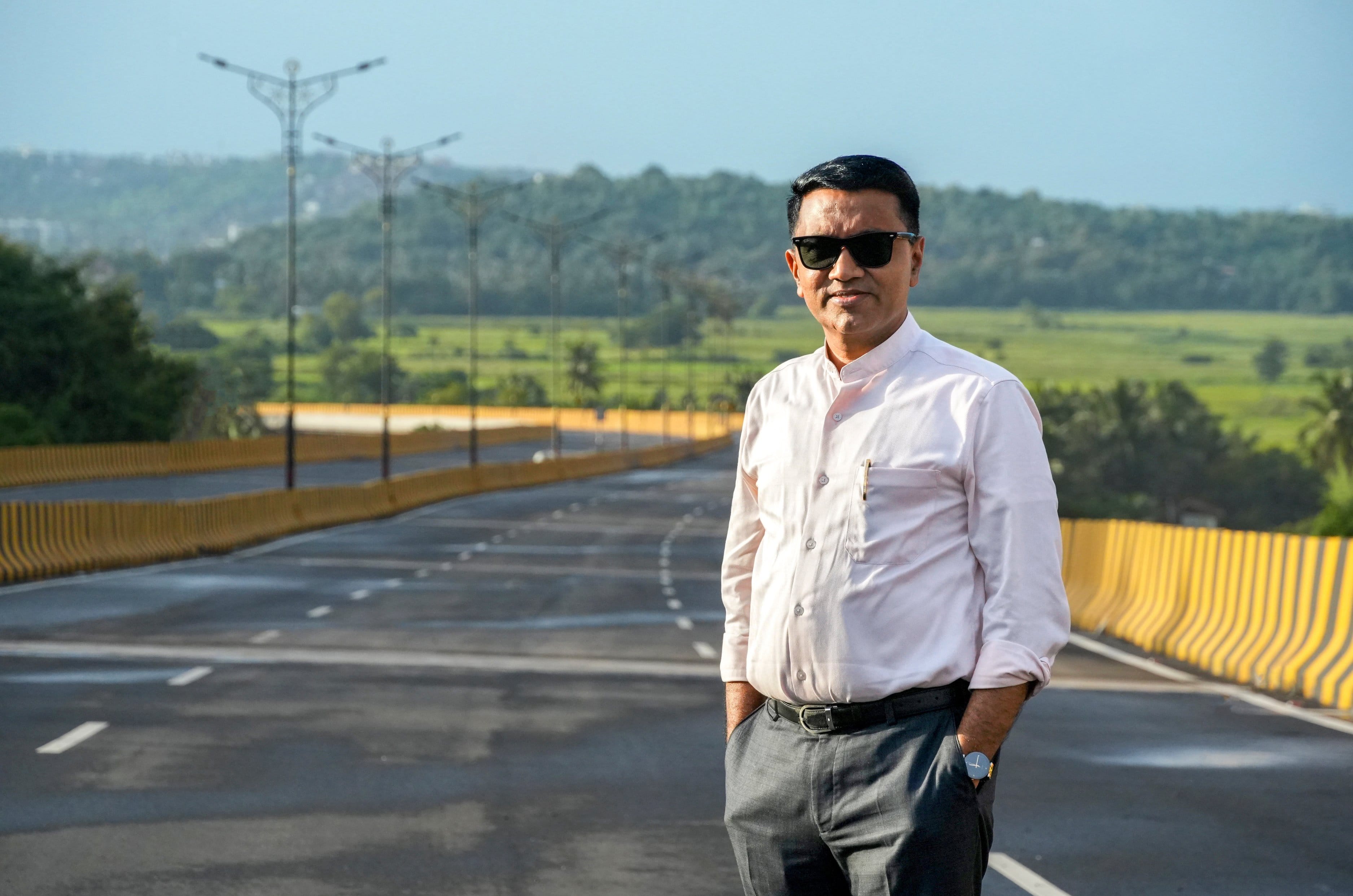
In conversation with Dr. Pramod Sawant, Chief Minister, Goa
On the importance of the project
The Porvorim Elevated Corridor is actually important not only for Goa but also for Maharashtra, Karnataka and Kerala. Porvorim had become a problem because it is a congested and newly developed city, with development on both sides of the road. Even after the road was widened, it was very difficult to manage, and it had become an accident-prone zone. That is why the Porvorim flyover was required, to ensure smooth traffic on NH-66.
Greater connectivity a boon for residents, tourists and businesses.
On the project’s wider connectivity benefits
With the opening of Manohar International Airport in North Goa, there was a need to improve connectivity towards South Goa. People arriving at Manohar International Airport and travelling towards South Goa were facing a lot of congestion. Now, that congestion will be reduced and this will definitely help tourism and vehicle movement in the state.
Furthermore, there will be better connectivity between the airports and ports, which will havea positive economic impact. It is also a very important project for the people of Goa. Especially those travelling between North Goa and the capital; they will save time and money, and their daily commute will become much easier.
On Goa’s future infrastructure plans
Almost all the projects on the National Highway network in Goa have been completed. One of the remaining projects is the Borim Bridge, which will connect the Ponda side. The tendering process for it will happen in the next few days.
We are planning to improve connectivity across rural Goa, from one end of Maharashtra towards Karnataka. We are considering a ring road for Goa, because traffic currently comes into the interior areas and cities. In the future, we want traffic to be able to move around the interior villages and across the state without having to enter the cities.