जाने-माने निवेशक आशीष कचोलिया ने सोमवार को ओपन-मार्केट ट्रांजैक्शन के जरिए, बिड़ला समूह से जुड़ी पॉलीमर प्रोसेसिंग और मैन्युफैक्चरिंग कंपनी ‘एक्सप्रो इंडिया’ में अपनी लगभग 1 प्रतिशत हिस्सेदारी बेच दी। नेशनल स्टॉक एक्सचेंज (NSE) द्वारा 19 अक्टूबर को जारी बल्क डील डेटा के मुताबिक आशीष कचोलिया ने 21.53 करोड़ रुपये मूल्य के 2.22 लाख इक्विटी शेयर बेचे हैं जो कंपनी की पेड-अप इक्विटी कैपिटल का 0.94 प्रतिशत है। ये शेयर 970.11 रुपये प्रति शेयर के औसत भाव पर बेचे गए हैं।
सितंबर 2026 तक,एक्सप्रो इंडिया में कचोलिया की 2.01 प्रतिशत हिस्सेदारी थी, जो 4.71 लाख शेयरों के बराबर है। हिस्सेदारी बेचे जाने के बावजूद, सोमवार को एक्सप्रो इंडिया के शेयरों में 1.79 प्रतिशत की तेजी आई और ये 995 रुपये पर बंद हुए। इसके साथ ही इसमें लगातार पांच दिनों से जारी गिरावट का सिलसिला भी थम गया।
हालांकि,बीच-बीच में आने वाली खरीदारी के बावजूद, सितंबर के अपने स्विंग हाई पर पहुंचने के बाद से ही यह स्टॉक दबाव में बना हुआ है। यह स्टॉक सितंबर 2026 में बने 1,408.70 रुपये के हाई से लगभग 31 प्रतिशत गिर चुका है।
ऋषि कजारिया ने स्वराज सूटिग में खरीदी 0.73% अतिरिक्त हिस्सेदारी
इस बीच एक दूसरे दिग्गज निवेशक ऋषि कजारिया ने स्वराज सूटिग में 0.73% अतिरिक्त हिस्सेदारी खरीदी है। हाई-नेट-वर्थ इंडिविजुअल (HNI) निवेशक ऋषि कजारिया ने स्वराज सूटिग में 1.94 लाख और इक्विटी शेयर खरीदे हैं, जो कंपनी की पेड-अप इक्विटी कैपिटल का 0.73 प्रतिशत है। ये शेयर 6.29 करोड़ रुपये में खरीदे गए हैं, जिनकी औसत कीमत 323.38 रुपये प्रति शेयर रही। सितंबर 2026 तक, स्वराज सूटिग में कजारिया की 1.24 प्रतिशत हिस्सेदारी थी,जो 3.26 लाख शेयरों के बराबर है। बता दें कि स्वराज सूटिंग सूती और सिंथेटिक कपड़े बनाती है।
FIIs ने की बिकवाली, DIIs से मिला सपोर्ट
उधर विदेशी संस्थागत निवेशकों (FIIs) ने सोमवार को भारतीय बाजारों में 1,148.64 करोड़ रुपये की बिकवाली की। यह इस महीने की उनकी सबसे कम नेट सेलिंग रही थी। यह 15 अक्टूबर को हुई 5,285.37 करोड़ रुपये की बिक्री से कम है। एक्सचेंज के प्रोविजनल आंकड़ों के मुताबिक घरेलू संस्थागत निवेशकों (DIIs) ने 3,201.19 करोड़ रुपये के शेयर खरीदे।
कल के सेशन में FIIs ने 11,240.64 करोड़ रुपये के शेयर खरीदे और 12,389.28 करोड़ रुपये के शेयर बेचे। DIIs ने 14,781.31 करोड़ रुपये के शेयर खरीदे और 11,580.12 करोड़ रुपये के शेयर बेचे। वहीं, शुक्रवार, 16 अक्टूबर को FIIs नेट बॉयर रहे थे और उन्होंने 1,165.92 करोड़ रुपये की खरीदारी की थी। यह इस महीने उनका एकमात्र ऐसा सत्र था जिसमें उन्होंने नेट बाइंग की। हालांकि, शुक्रवार DIIs ने 3,661.28 करोड़ रुपये की नेट सेलिंग की थी।
बाजार पर एक नजर
सोमवार को भारतीय बाजारों में गिरावट आई। निफ्टी257.20 अंक या 1.11% गिरकर 22,888.95 पर बंद हुआ। वहीं, सेंसेक्स 876.37 अंक या 1.17% की गिरावट के साथ 73,852.90 पर बंद हुआ। इस गिरावट में प्राइवेट बैंकों की अहम भूमिका रही। निफ्टी प्राइवेट बैंक इंडेक्स में 1.85% की गिरावट आई। FMCG में 1.44% और IT में 1.28% की गिरावट दर्ज की गई। वहीं, निफ्टी PSU बैंक इंडेक्स में लगभग 2.4% की तेजी आई।
निफ्टी मिडकैप 100 और स्मॉलकैप 100 इंडेक्स में 1.09% और 1.01% की गिरावट आई। सोमवार को FIIs ने अपनी बिकवाली काफी कम कर दी,लेकिन फिर भी बेंचमार्क सूचकांकों में 1% से ज़्यादा की गिरावट आई।
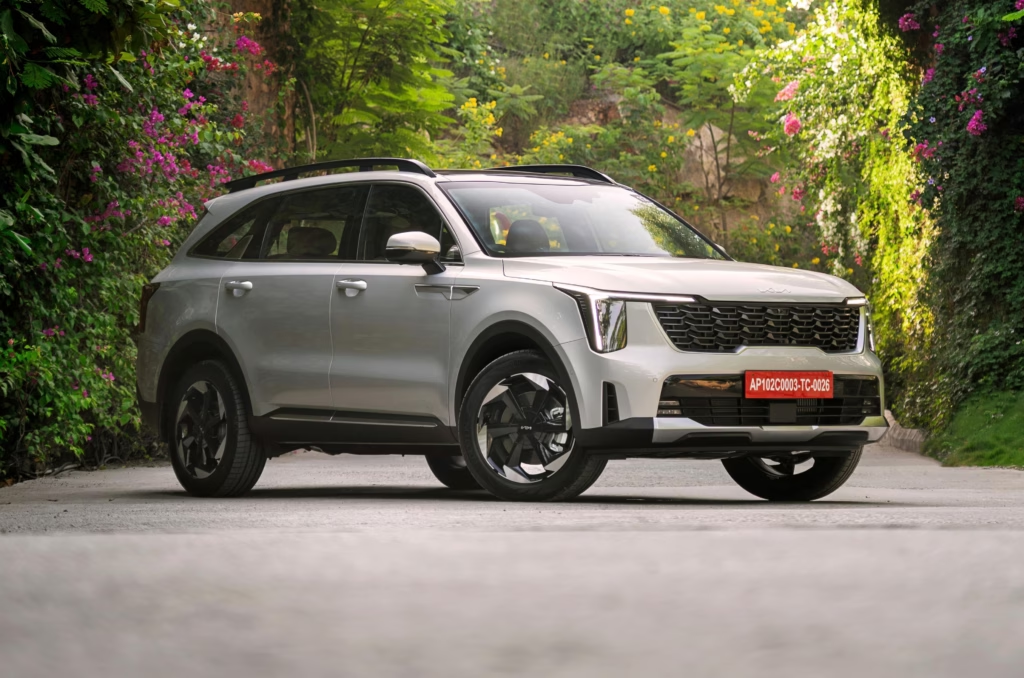
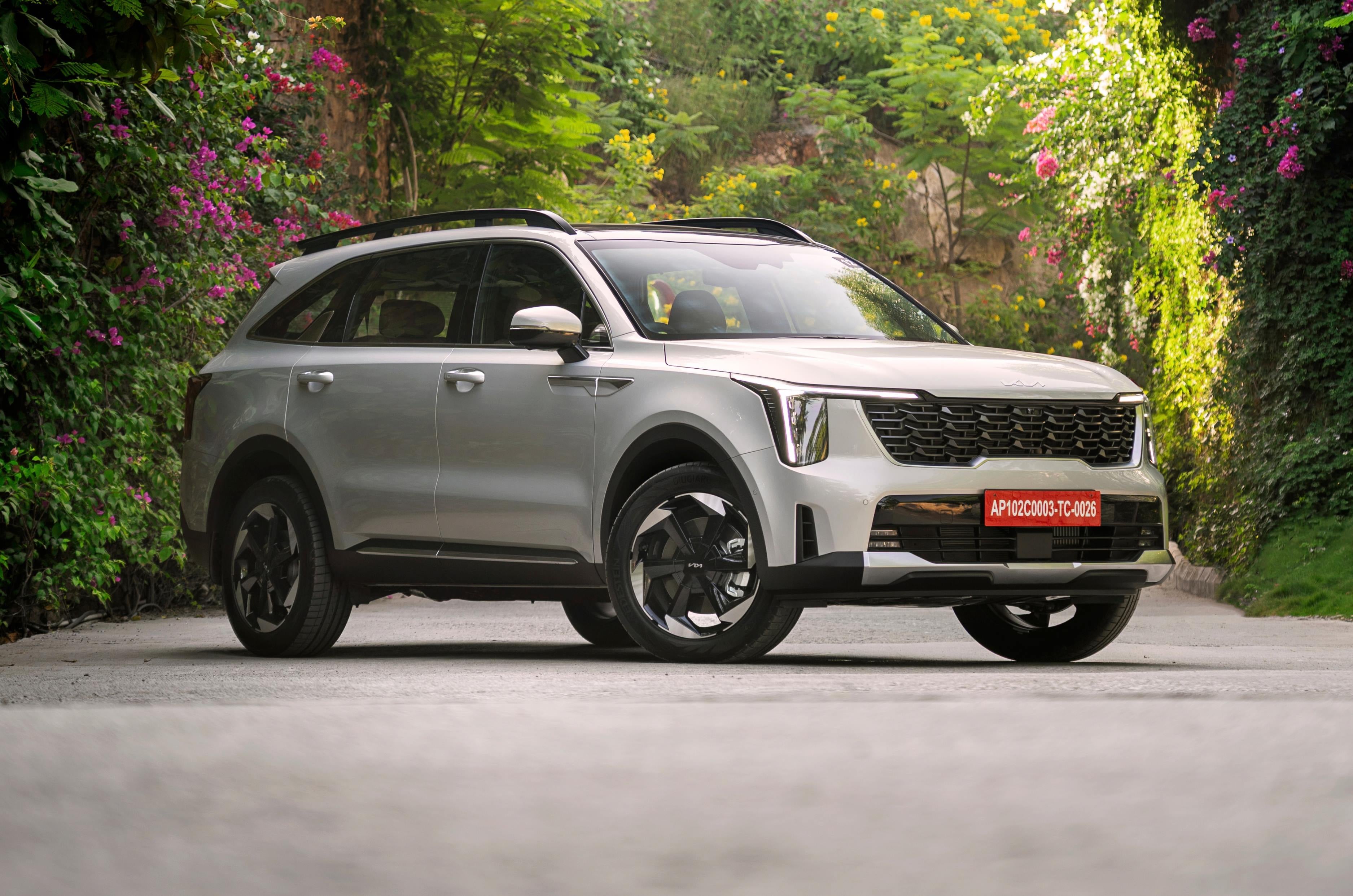
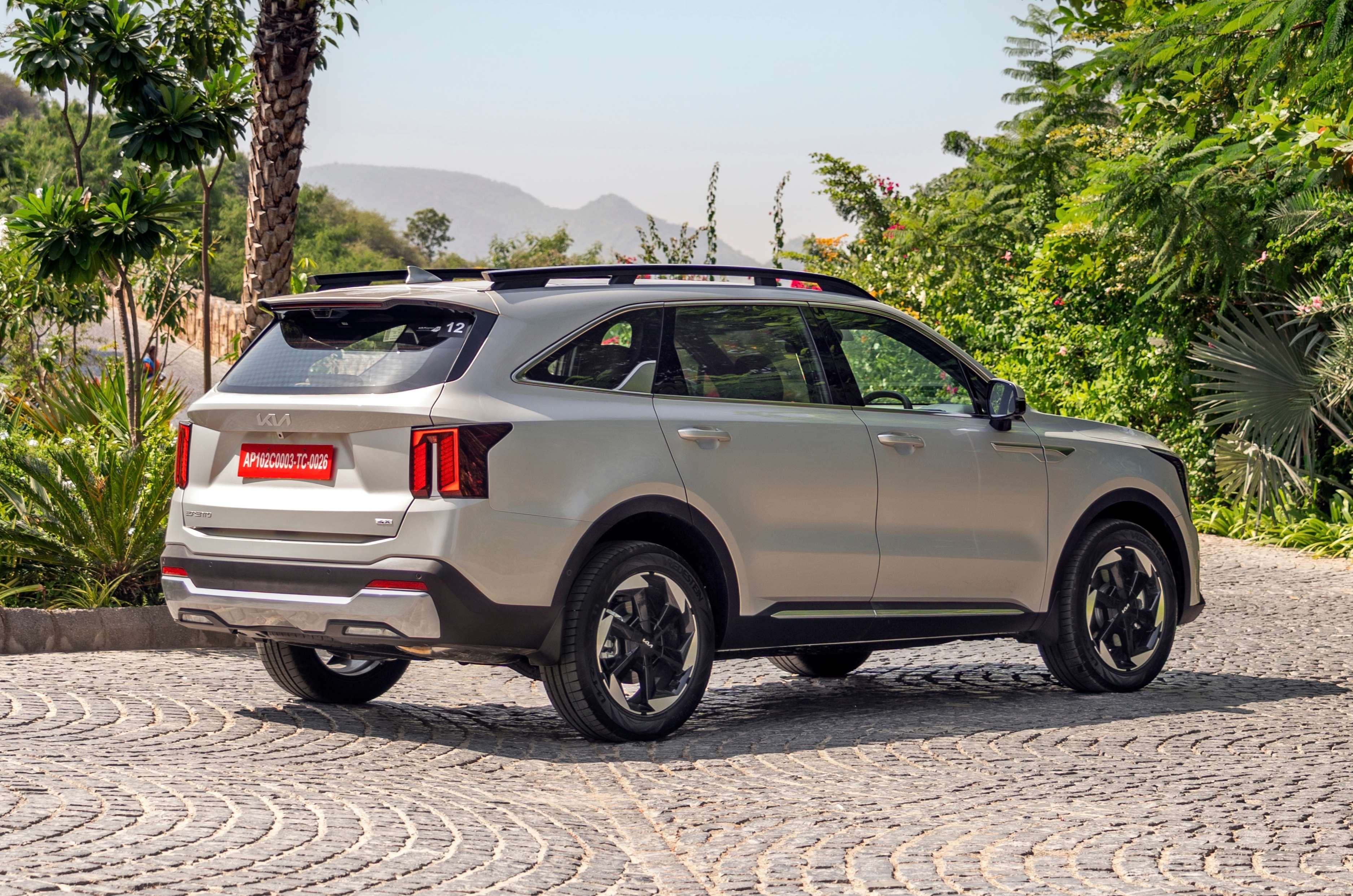
The Kia Sorento recorded 1,739 units in domestic wholesales in September 2026, its first month on sale after launching on September 4. It was Kia India’s fifth best-selling model that month. Including 365 units dispatched to dealers in August ahead of the launch, the Sorento’s total wholesales stood at 2,104 units.
Kia India recorded its highest-ever monthly wholesales of 32,017 units in September, up 41 percent year on year. This was the first time the company had crossed 30,000 units in a month, surpassing its previous record of 29,556 units in October 2025, which was the first month after the GST 2.0 rate cuts kicked in.
Kia Sorento: All you need to know
The Sorento is priced between Rs 27.99 lakh and Rs 40.39 lakh (ex-showroom). It is offered with a 1.6-litre turbo-petrol strong-hybrid powertrain or a 2.2-litre turbo-diesel engine. The hybrid setup pairs a 180hp, 265Nm petrol engine with a 65hp, 264Nm electric motor, while the diesel mill produces 193hp and 442Nm.
The SUV is available in six- and seven-seat configurations. Key features include dual 12.3-inch displays, a head-up display, ventilated front seats, a powered tailgate, a panoramic sunroof and second-row captain seats with ventilation. Safety equipment includes 10 airbags, a 360-degree camera, dual dashcams and Level 2+ ADAS.
The Kia Sorento rivals the Jeep Meridian, Skoda Kodiaq and Volkswagen Tayron.
Kia India sales up 29 percent in H1 FY2027
Kia India recorded wholesales of 1,68,683 units between April and September 2026, a 29 percent year-on-year increase. September wholesales stood at 32,017 units, up 41 percent year on year and the company’s highest monthly total since it entered India in 2019. In Q2 FY2027 (July-September 2026), sales grew 39 percent year on year to 89,259 units and were 12 percent higher than in Q1 FY2027.
The Seltos was Kia’s best-selling model in the first half of FY2027, with 67,667 units, up 99 percent year on year. It accounted for 40 percent of the company’s total wholesales during the period. The Sonet ranked second with 56,929 units, up 21 percent, contributing 34 percent of sales. The Carens range, including the Carens, Carens Clavis and Clavis EV, recorded 34,284 units, down 18 percent year on year.
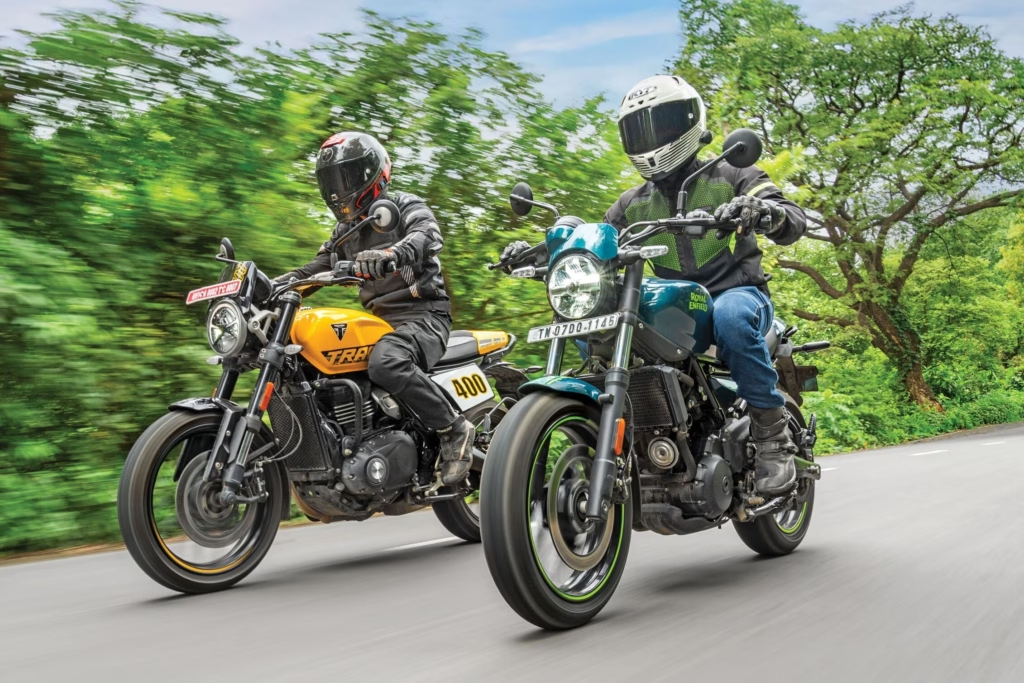
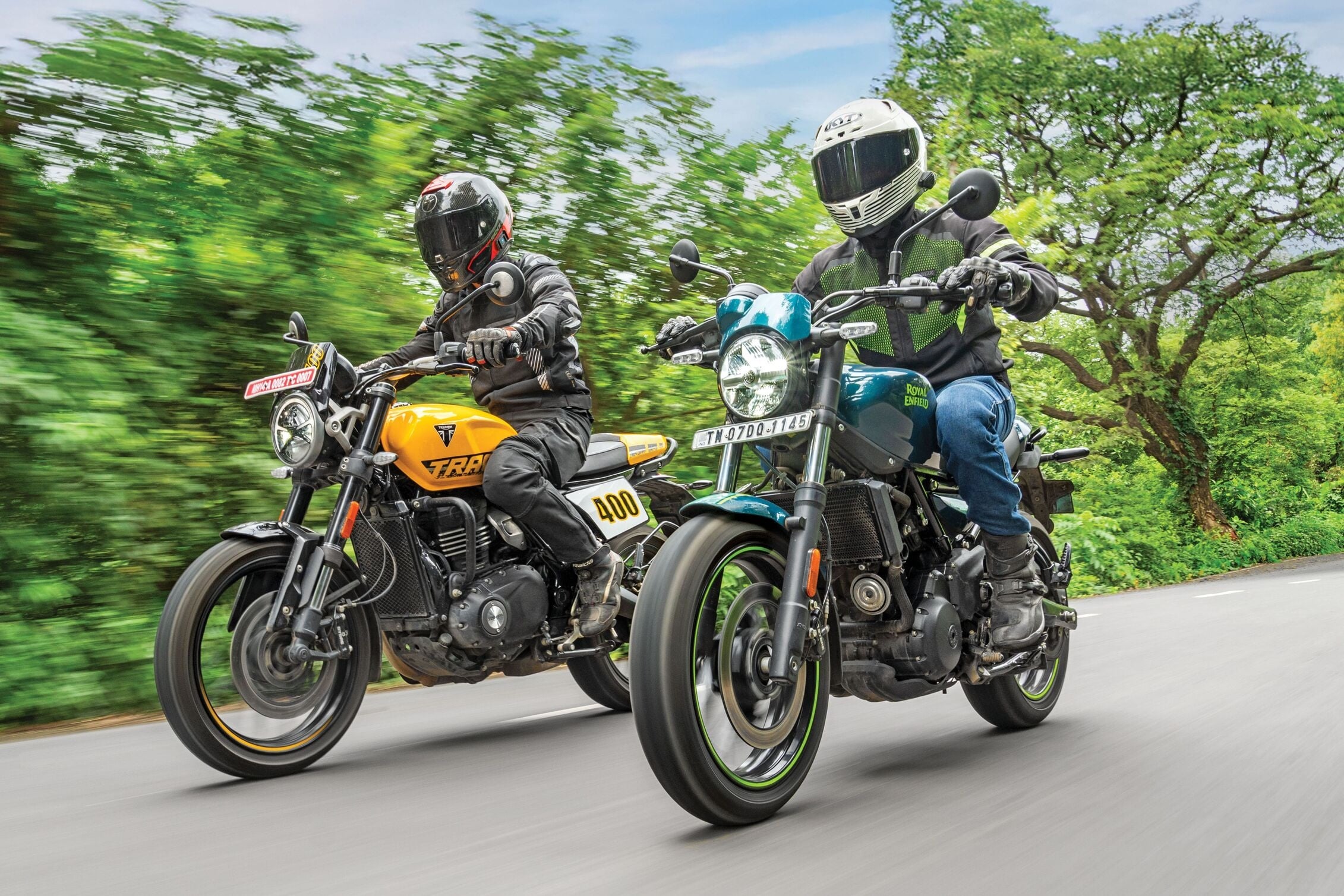
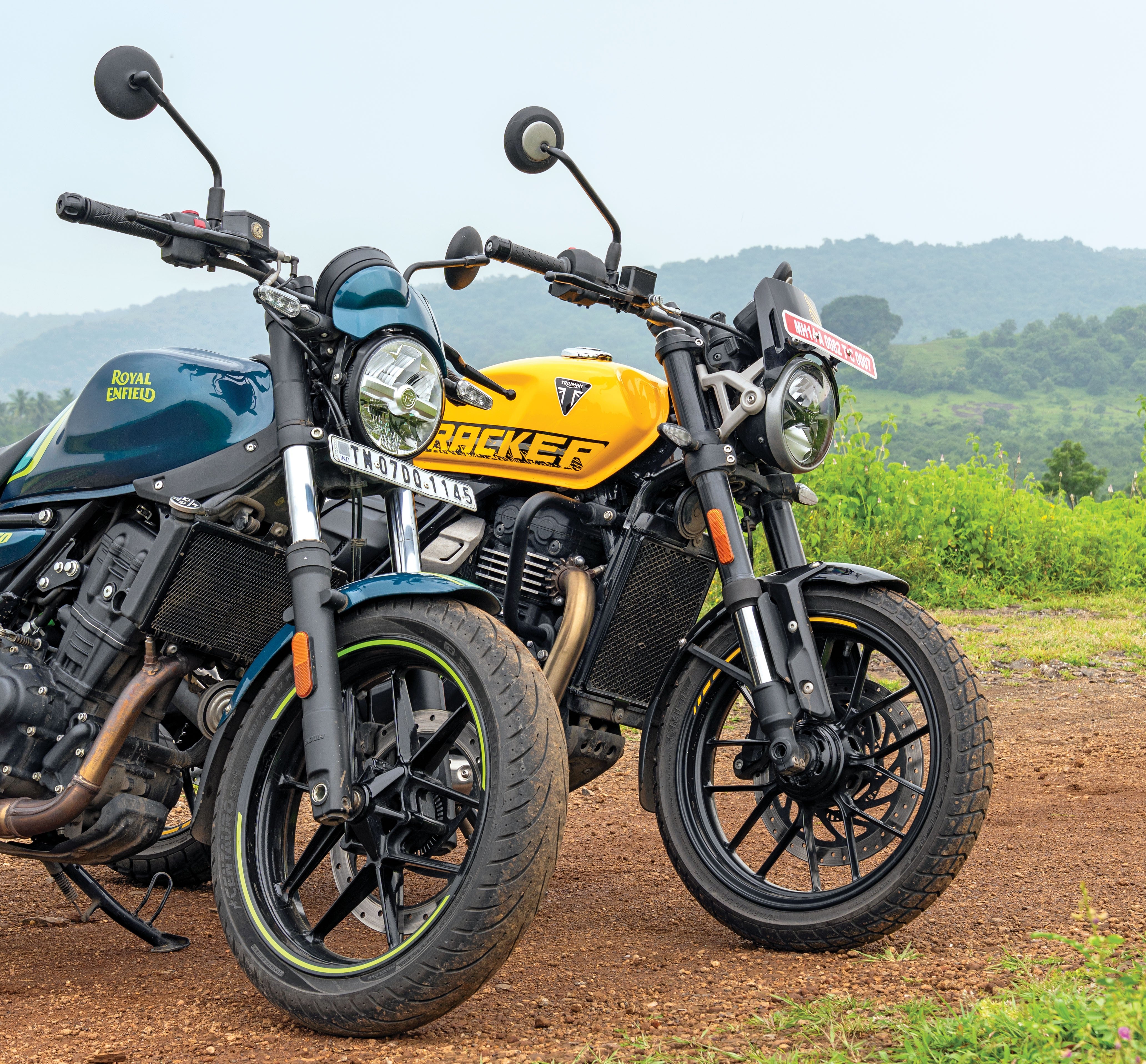
If you are considering either of these motorcycles, chances are you are also considering the other, especially since they both cost about the same. After the Triumph 400cc bikes were downsized, the Tracker 400 now uses a 349cc engine, while the Guerrilla 450 Apex is a sportier variant with more aggressive ergonomics and grippy, road-focused tyres, which I think suit the bike much better than those on the earlier variant.
On paper, the Tracker makes 40hp and 32Nm, while the Guerrilla produces 40.02hp and 40Nm. The Triumph is a lighter, more compact motorcycle, while the Royal Enfield has a larger engine with more torque and offers a stable, planted feel. So, which one makes more sense for someone looking for a sporty, entertaining roadster?
Design and Features
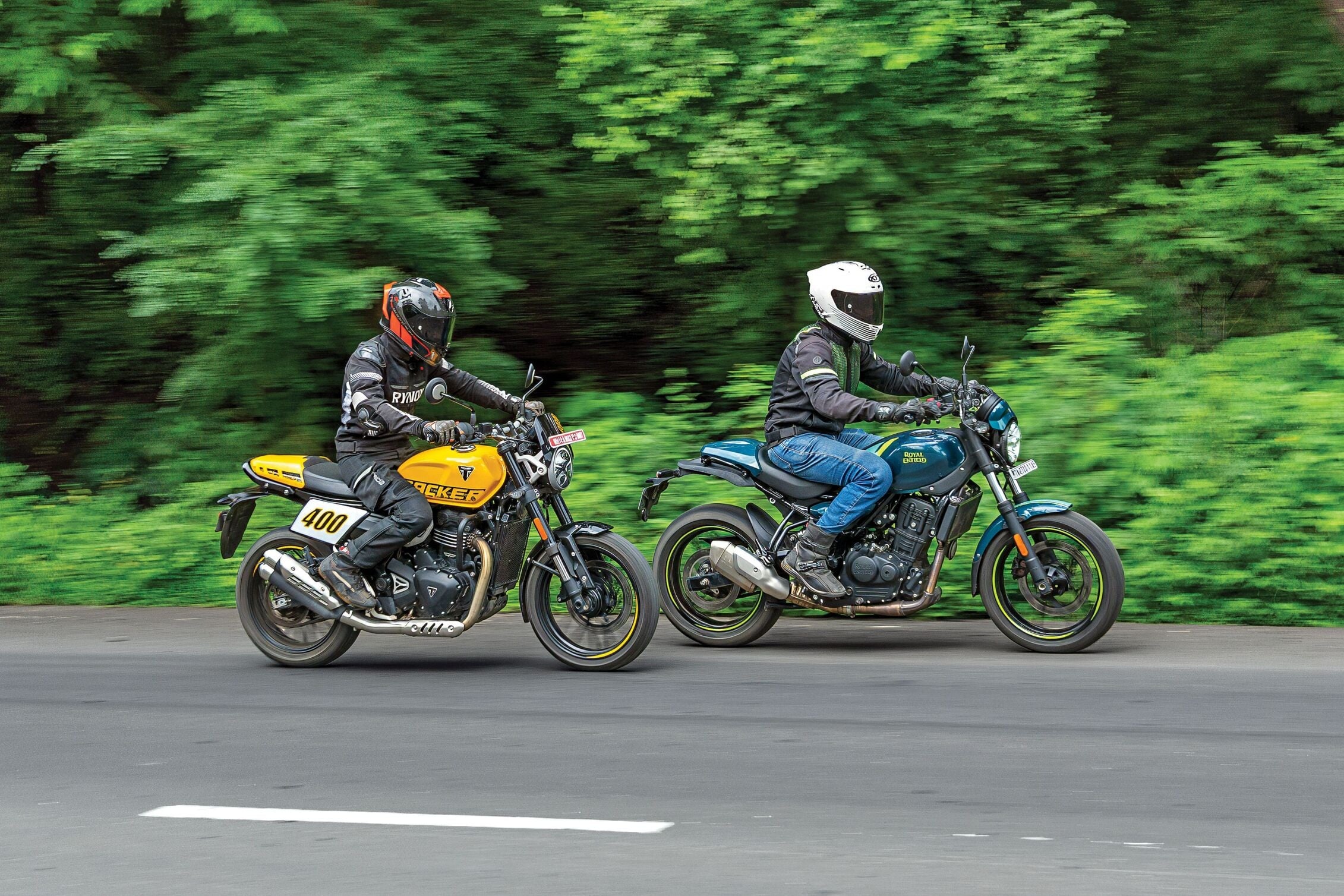
Both motorcycles have very different visual identities, and that is probably the first thing you’ll notice. The Tracker 400 is inspired by flat-track racers, with a flat seat, side number boards and a wide handlebar. But this isn’t really a dirt-track-focussed motorcycle underneath, as its ergonomics, chassis and suspension are properly road-oriented.
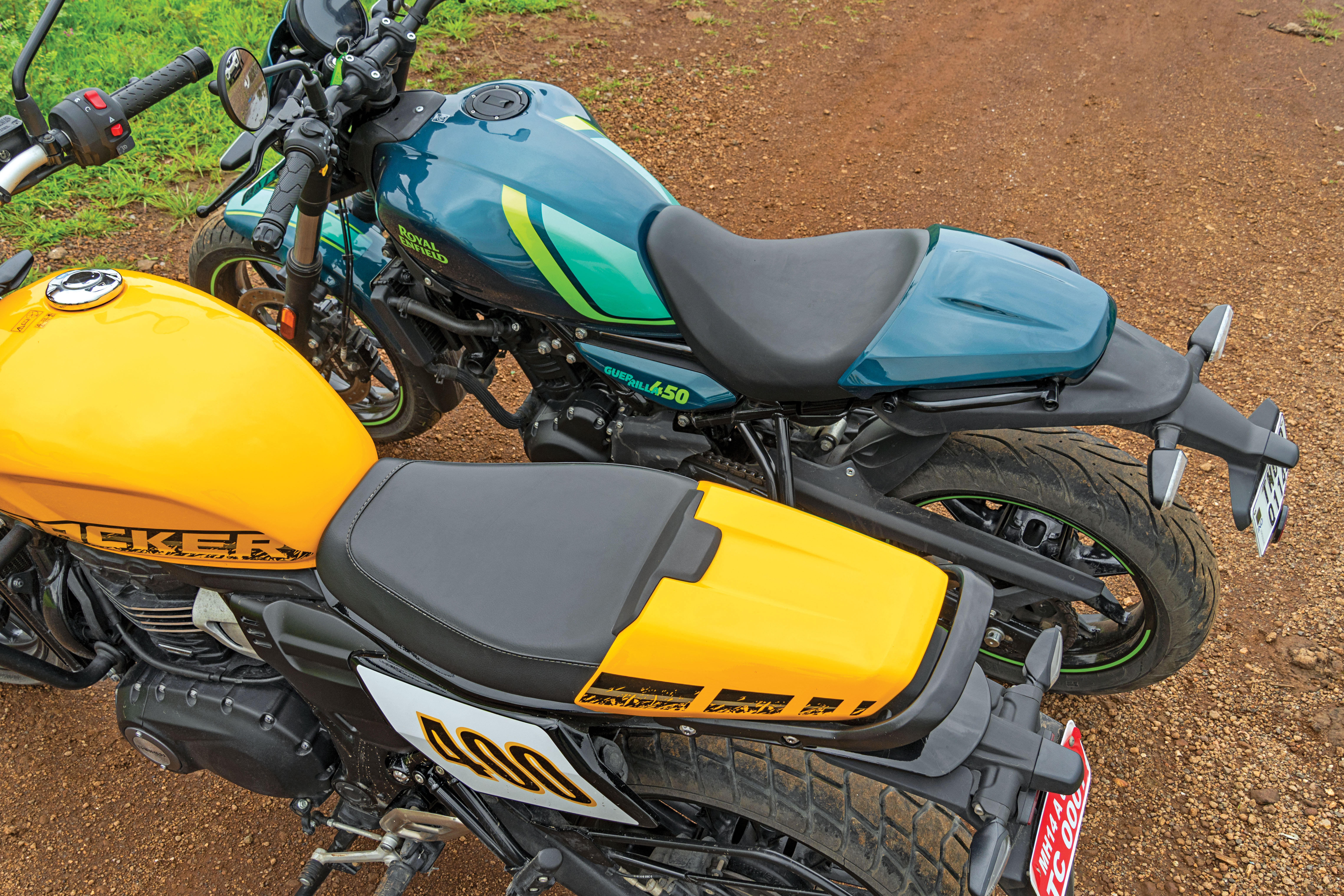
The Guerrilla 450 Apex, meanwhile, looks like a sporty and muscular roadster. Compared to the standard variant, it gets a small cowl over the headlight, a new aluminium handlebar, a removable rear-seat cowl and Vredestein Centauro ST+ tyres. The Apex also has a leaned-forward, more committed riding position compared with the standard Guerrilla.
The Tracker is a relatively compact motorcycle, while the Guerrilla’s longer 1,440mm wheelbase and broad 160-section rear tyre give it a more substantial stance. The Triumph gets a larger 13-litre fuel tank compared with the Guerrilla’s 11-litre unit, which can be tedious when long-distance touring.
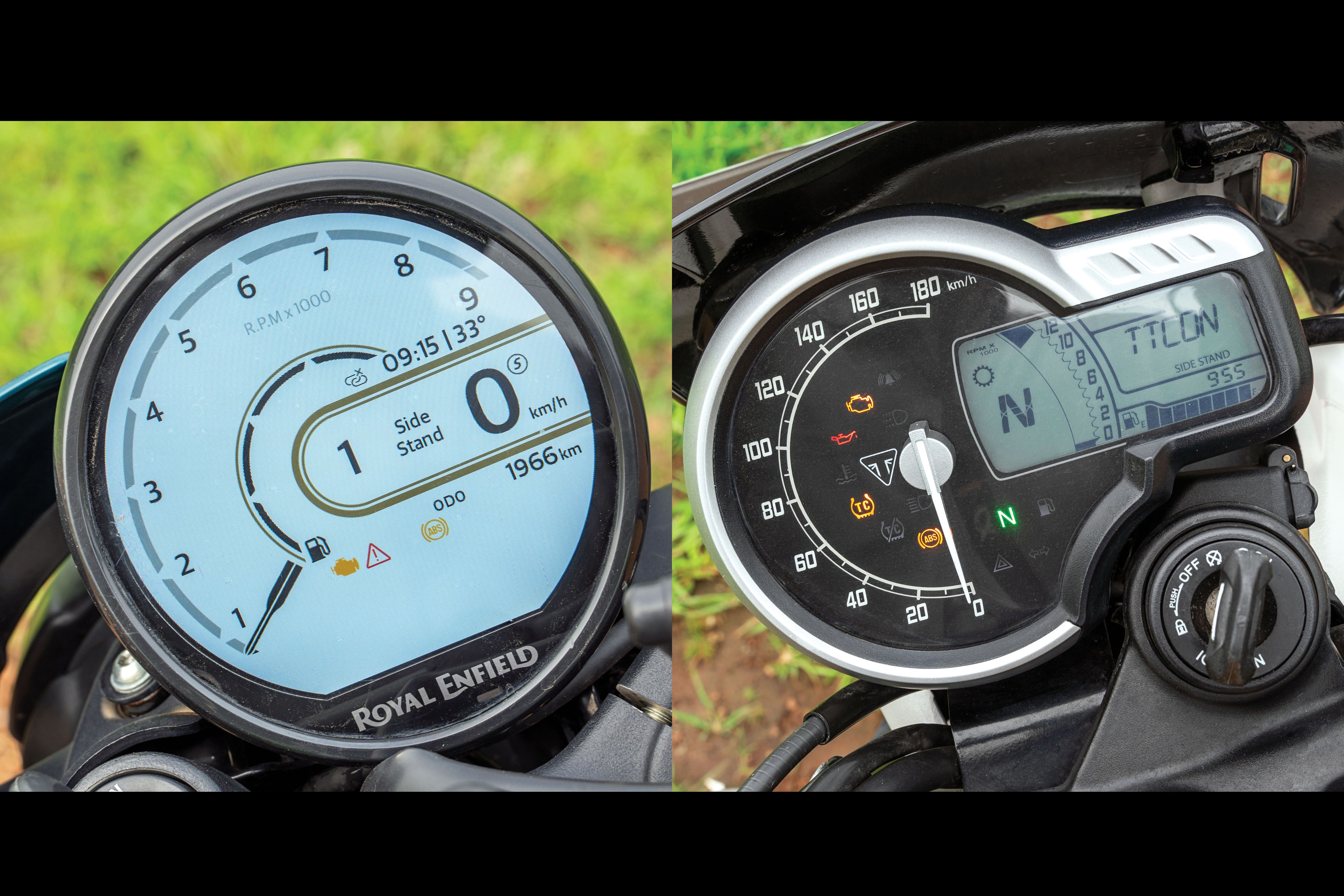
Both motorcycles are equally impressive when it comes to build quality and fit and finish. The Tracker features the same digi-analogue console we have seen on all the other Triumph 400 models, while the Guerrilla features the same TFT unit from the Himalayan. The Guerrilla gets two riding modes (Sport and Street), both of which feel quite similar. On the other hand, the Tracker gets a switchable traction control system that the Guerrilla misses out on. Neither has a quickshifter. In terms of convenience, the Guerrilla has a more accessible 780mm seat height and also gets a main stand, which aids in easier chain maintenance.
There is also a difference in ergonomics. The Tracker’s seat is flat and the riding position is relatively sporty, with rear-set footpegs that suit the character of the bike. The Guerrilla Apex has a lower and more accessible 780mm seat and roadster-like, neutral-set footpegs, along with a committed upper-body position. Between the two, you sit on top of the Tracker with its flat seat, while on the Guerrilla, you sit inside the curved seat, and it is also the more comfortable of the two.
Performance and Fuel Economy
This is where things get interesting because the Tracker 400’s 349cc engine is 103cc smaller than the Guerrilla’s 452cc unit, yet peak power is almost identical. The Triumph produces 40hp at 8,750rpm and 32Nm at 7,500rpm, while the Royal Enfield makes 40.02hp at 8,000rpm. Of course, the difference comes in torque, where the RE makes a much healthier 40Nm at 5,500rpm.
The difference in torque delivery is immediately noticeable. The Tracker’s engine likes to be revved out, but you still have to work it quite a bit. The Guerrilla’s Sherpa engine has a different personality. It doesn’t need to be worked as hard, and the additional 8Nm gives it much stronger roll-on performance. It feels more raw and powerful as soon as you open the throttle, and the surge in power after 6,000rpm makes it feel really exciting. After 7,000rpm, there are some vibrations, but nothing that really ruins the riding experience.
The Tracker’s shorter-stroke engine is very refined at moderate engine speeds, but once you start revving it harder, some buzz makes its way into the tank and footpegs at the top end of the rev range. It remains an entertaining engine, but considering I have ridden the older 398cc Thruxton 400, I feel like it misses out on that initial torque kick.
In our performance tests, the Guerrilla completed the 0-100kph sprint in 6.34 seconds, while the Tracker took 7.55 seconds for the same, marking a difference of 1.21 seconds. The real difference in performance was more visible in the roll-on acceleration tests where the Guerrilla 450 Apex was notably quicker.
Fuel efficiency was almost on par in our tests, where the Tracker delivered 24.1kpl in the city and 31.71kpl on the highway, while the Guerrilla gave us 25.23kpl in the city and 32.82kpl on the highway. The Triumph’s 13-litre tank will give it a better range despite the marginally lower highway efficiency.
Ride and Handling
The biggest difference between these two motorcycles becomes apparent once the road starts to twist. The Guerrilla feels longer and heavier and needs a bit of muscling around, but once in a corner, it is extremely stable and planted. The grip offered by the Vredestein tyres is superb and inspires a lot of confidence. The Tracker, on the other hand, feels light, nimble and very easy to flick into corners, thanks to its shorter wheelbase and the leverage offered by the wide handlebars. Its blocky MRF tyres work well, but given how it rides more like a sporty roadster rather than a tracker, stickier tyres would have been a better choice.
While many might be disappointed about the Guerrilla 450 Apex not getting a USD fork, the suspension does work much better than the Tracker’s over bad roads and undulations. The setup feels plusher than the Tracker, which has a quicker rebound that can toss you up if you hit potholes at higher speeds.
Despite the Triumph being the more compact motorcycle, I felt like it was easier to filter through traffic on the Guerrilla, and that is because the Triumph has slightly wider handlebars and mirrors that jut out slightly more. I do remember my time spent with the Guerrilla on a go-kart track, and it was genuinely a lot of fun. The tyres kept up with the performance that the engine offers, and it was a blast to exploit the full capabilities of the bike. The only limitation was the footpegs, which kept scraping when the bike was leaned over. That said, this was never a problem out on the road.
Braking hardware is strong on both. The Tracker gets a 300mm front disc with a four-piston radial ByBre caliper, while the Guerrilla uses a 310mm front disc and 270mm rear disc. The Guerrilla stopped marginally quicker in our braking test from 60-0kph, but I did notice that the ABS intervention can be strong when emergency braking from higher speeds.
Price and Verdict
These two motorcycles are closer than their engine capacities suggest. The Tracker proves that you don’t need a large engine to make for a fun roadster. Its 349cc motor makes almost as much peak power as the Guerrilla, and its compact dimensions, wide handlebar and sporty chassis make it an engaging motorcycle on a twisty road.
The Royal Enfield Guerrilla 450 Apex, however, takes a more muscular approach. Its 452cc engine has substantially more torque, the Vredestein tyres give it a level of grip that suits its performance, and the longer wheelbase also gives it a reassuring planted character, particularly when you’re riding quickly.
They offer two distinct interpretations of the sporty modern roadster. The Tracker’s biggest strength is its agility. It feels smaller, lighter and more eager to change direction quickly. The Guerrilla’s strength is the breadth of its performance. There’s more torque, more road presence and a greater sense of stability when you’re pushing it. And that is ultimately what separates them. The Triumph is the more playful motorcycle, thanks to its nimble nature, while the Guerrilla Apex feels like a more serious attempt at turning the standard roadster into a proper performance-oriented, corner-carving machine.
While it is difficult to pick between these two motorcycles, considering that they do things in different ways, you can’t look past the value that the Guerrilla offers. Despite falling into the 40 percent GST bracket, its starting price is just Rs 10,000 more than that of the Tracker. To put things into perspective, the KTM 390 Duke R, which used to be the benchmark for affordable and accessible performance when its Gen 1 model was launched in India, is now priced at Rs 3.45 lakh (ex-showroom), taking its on-road price upwards of Rs 4 lakh. So the way I see it, the Guerrilla 450 Apex is now the new benchmark when it comes to affordable performance in India. Who’d have ever thought that the crown would one day be worn by a Royal Enfield.
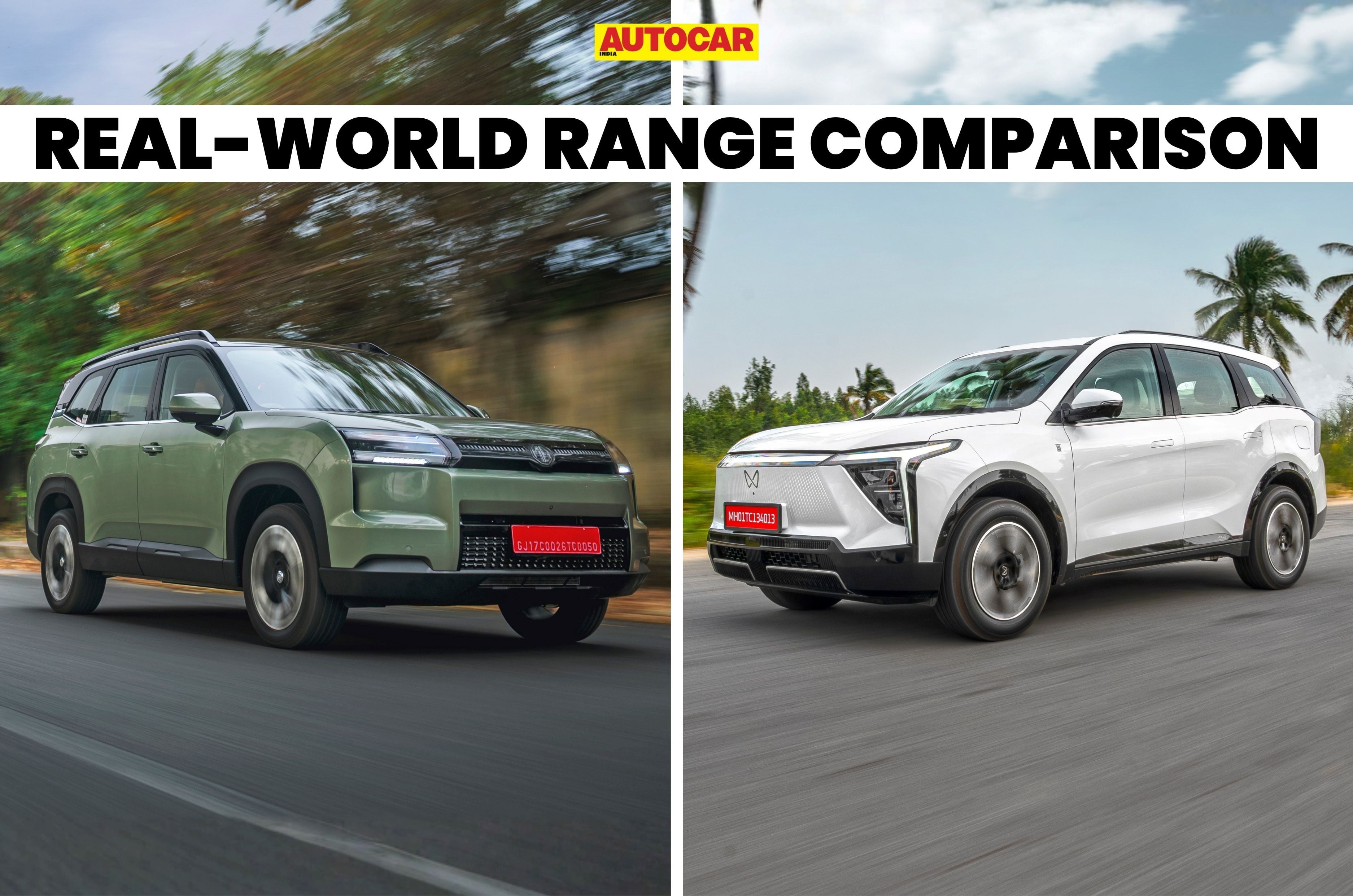
MG recently launched the Hector Tomahawk EV with a 69.2kWh battery, promising a claimed range of 517km. The 3-row electric SUV is positioned squarely against the Mahindra XEV 9S, which is one of the most popular EVs in its price range, and has a larger battery capacity and a higher claimed range of 679km. But in real-world conditions, does the Mahindra XEV 9S offer higher range than the MG Hector Tomahawk EV? We find out.
MG Hector Tomahawk EV vs Mahindra XEV 9S: Specifications, price
Tomahawk EV has a smaller battery, but weighs less than XEV 9S and is more affordable
MG Hector Tomahawk EV vs Mahindra XEV 9S: Specifications, price
MG Hector Tomahawk EV
Mahindra XEV 9S
Battery pack (kWh)
69.2
79
No. of motor(s)
1
1
Drivetrain
FWD
RWD
Power (hp)
204
286
Torque (Nm)
310
380
Kerb weight (kg)
1,908
Over 2,201*
Price (in Rs lakh)
19.50-23.50
22.65-30.15
*The XEV 9e has a kerb weight of 2201kg, so the XEV 9S, being a 3-row offering, will be heavier.
The MG Hector Tomahawk EV gets a smaller 69.2kWh battery compared to the XEV 9S’ 79kWh unit. It also gets a less powerful front motor that produces 82hp and 70Nm less than the XEV 9S’s rear-mounted motor. However, the Hector Tomahawk EV is the lighter electric SUV in this comparison, weighing over 250kg less than the Mahindra XEV 9S.
The MG Hector Tomahawk EV also asks a lower price, its base-spec variant costing Rs 3.15 lakh less and its top-spec variant costing Rs 6.65 lakh less than the XEV 9S’s 79kWh battery trims.
MG Hector Tomahawk EV vs Mahindra XEV 9S: Real-world range comparison
Although offering very different city and highway efficiencies, both eSUVs offer similar average range
MG Hector Tomahawk EV vs Mahindra XEV 9S: Real-world range comparison
MG Hector Tomahawk EV
Mahindra XEV 9S
Claimed range (ARAI)
517km
679km
Tested city range
495km
478km
Tested highway range
397km
477km
Tested average range
446km
477.5km
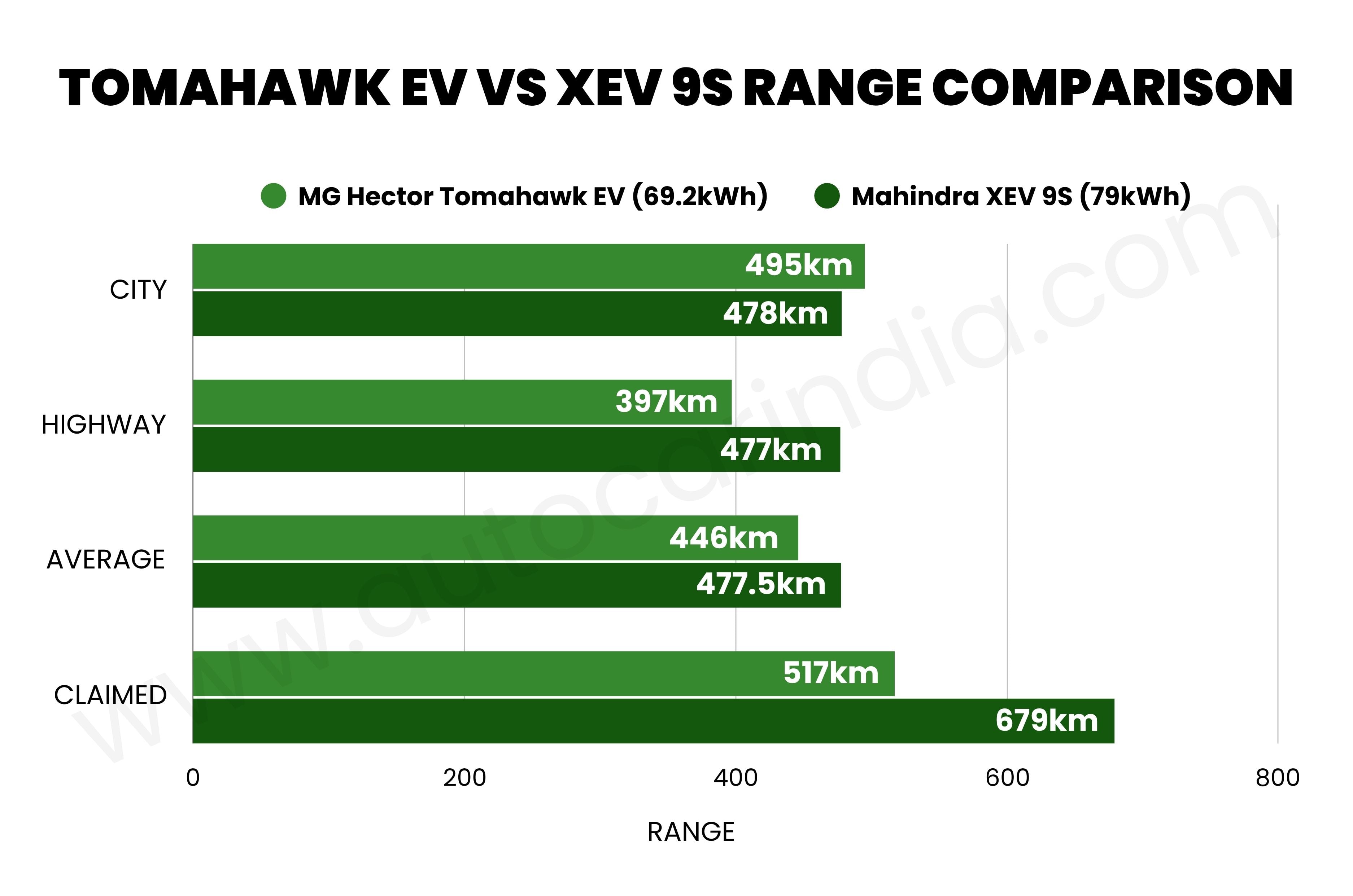
While the MG Hector Tomahawk EV has a claimed ARAI range of 517km, the Mahindra XEV 9S promises a higher range of 679km. However, in our real-world tests, the XEV 9S delivered a higher average range, despite the Hector Tomahawk EV performing better in city driving conditions.
In the city, the Tomahawk EV covered 495km on a full charge, which is 17km more than the XEV 9S. However, on the highway, the Mahindra managed 477km, going 80km further than the MG. As a result, the Mahindra achieved an average real-world range of 477.5km, which is 31.5km more than the Tomahawk EV’s 446km.
In our real-life tests, we found the Tomahawk EV’s relatively mild regenerative braking, even in its strongest setting, limits its potential for better city efficiency. Meanwhile, its bulky, upright design also works against it on the highway. The XEV 9S, on the other hand, weighs over 2.2 tonnes, which definitely affects its efficiency against the Hector Tomahawk EV.
Autocar India’s range testing
For our real-world range test, we begin with each car’s battery fully charged and tyre presures set as per the manufacturer’s recommendations. We drive the cars on a fixed loop covering both city and highway stretches while maintaining set average speeds. We then calculate the range based on the percentage of charge consumed. The AC is set to 22deg C in auto mode, and features such as the music system, lights and ventilated seats are used as needed, just as a regular user would. This approach ensures consistency and gives a clear idea of what to expect in daily use.
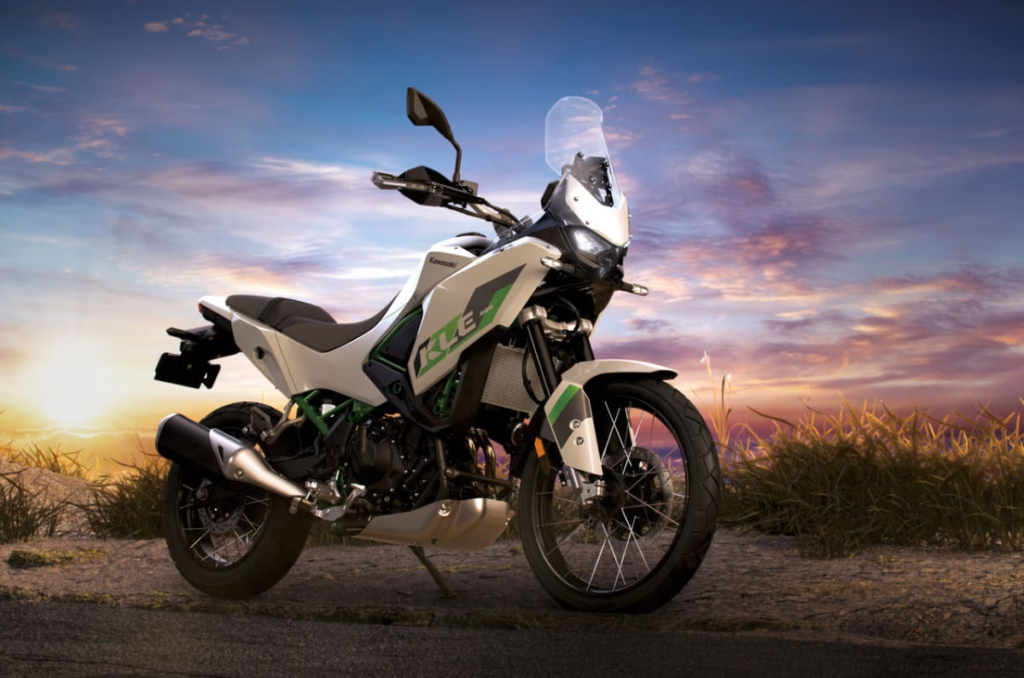
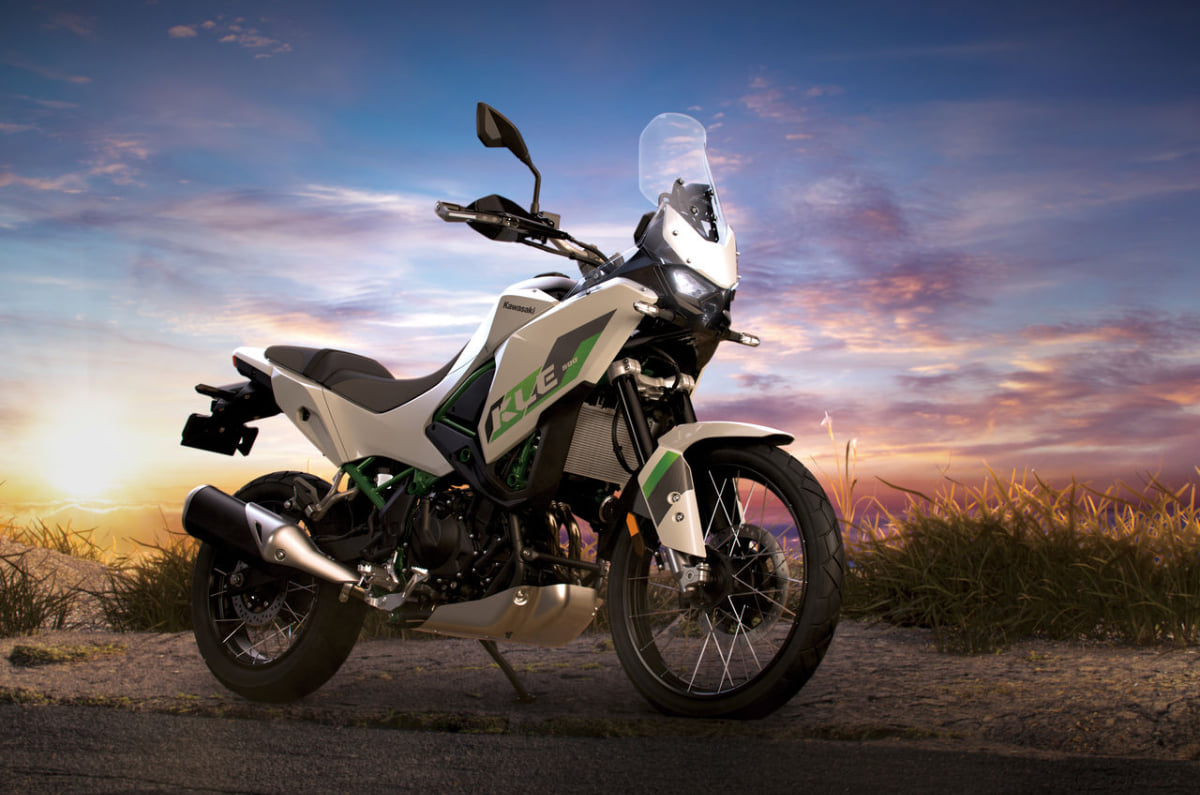
Kawasaki has expanded its 2027 KLE500 range with a new SE SmartRide variant, which adds a mechanical centrifugal clutch to the parallel-twin adventure motorcycle. The system allows riders to pull away and come to a stop without operating the clutch lever, while gear changes on the move still use the lever and pedal as normal.
KLE500 now has three variants
451cc parallel-twin engine produces 45hp and 42.6Nm
Kawasaki KLE500 SE SmartRide details
No other mechanical changes over the KLE500 SE, which debuted last year
The KLE500 lineup now comprises three variants – the base KLE500, the KLE500 SE and the new KLE500 SE SmartRide. At first, the SmartRide system may sound similar to Honda’s E-Clutch technology, but the two work quite differently. While both aim to simplify clutch operation, Honda uses an electromechanical actuator to automate clutch movement, whereas SmartRide relies on a purely mechanical centrifugal clutch.
Aside from the addition of the clutch technology, the SmartRide variant also gets tubeless tyres, replacing the tube-type setup on the standard SE. Otherwise, the two variants share the same hardware, including the 451cc parallel-twin engine producing 45hp at 9,000rpm and 42.6Nm at 6,000rpm.
The SE SmartRide is available in a single colour, Pearl Blizzard White. Following its international debut last year, we’d reported that Kawasaki India has the KLE500 in the pipeline for a launch here, which we expect to happen over the next few months.
When it goes on sale, the KLE500 will join a growing list of sub-500cc adventure bikes in our market. Given its potential CBU (Completely Built-Up) import route and the premium pricing that would entail, it will also see competition from upcoming India-made motorcycles such as the Royal Enfield Himalayan 750 and the Norton Atlas.
The Mahindra XEV 9S Pack Three Above and MG Hector Tomahawk EV are three-row electric SUVs that differ in their acceleration, driving range and charging capabilities. Here’s how the two compare on performance, specifications and price.
Mahindra XEV 9S vs MG Hector Tomahawk EV: Specifications
Specifications
Mahindra XEV 9S Pack Three Above
MG Hector Tomahawk EV
Battery capacity
79kWh
69.2kWh
Electric motor setup
Single, rear-mounted
Single, front-mounted
Power
286hp
204hp
Torque
380Nm
310Nm
Gearbox
Single-speed automatic
Single-speed automatic
Drive layout
Rear-wheel drive
Front-wheel drive
Claimed MIDC range
679km
517km
Maximum DC charging rate
180kW
90kW
Claimed DC charging time
20min (20-80 percent)
Around 35min (30-80 percent)
AC charging time
11.7 hours (7.2kW charger)
8 hours (11.2kW charger)
12.5 hours (10-100 percent)
The XEV 9S has a 82hp advantage over the Tomahawk EV and produces 70Nm more torque. The two SUVs also differ in their drive layouts. The XEV 9S sends power to the rear wheels, while the Tomahawk EV is front-wheel drive. Both use a single-speed automatic transmission.
The XEV 9S has a claimed MIDC range of 679km, which is 162km more than the Tomahawk EV’s 517km. It also supports DC fast charging at up to 180kW, compared with 90kW for the MG.
Mahindra claims the XEV 9S can charge from 20-80 percent in 20 minutes, while MG quotes around 35 minutes for a 30-80 percent charge. Since the quoted charging times cover different charging windows, they are not directly comparable. The AC charging figures also use different charging ranges. The XEV 9S supports an optional 11.2kW AC charger, in addition to the 7.2kW unit. The Tomahawk EV supports 7.4kW AC charging.
Mahindra XEV 9S vs MG Hector Tomahawk EV: Acceleration timings
Mahindra XEV 9S vs MG Tomahawk EV: Acceleration timings (seconds)
Mahindra XEV 9S
MG Tomahawk EV
0-20kph
1.39
1.47
0-40kph
2.73
2.84
0-60kph
4.17
4.25
0-80kph
5.62
5.93
0-100kph
7.54
8.23
0-120kph
9.98
11.28
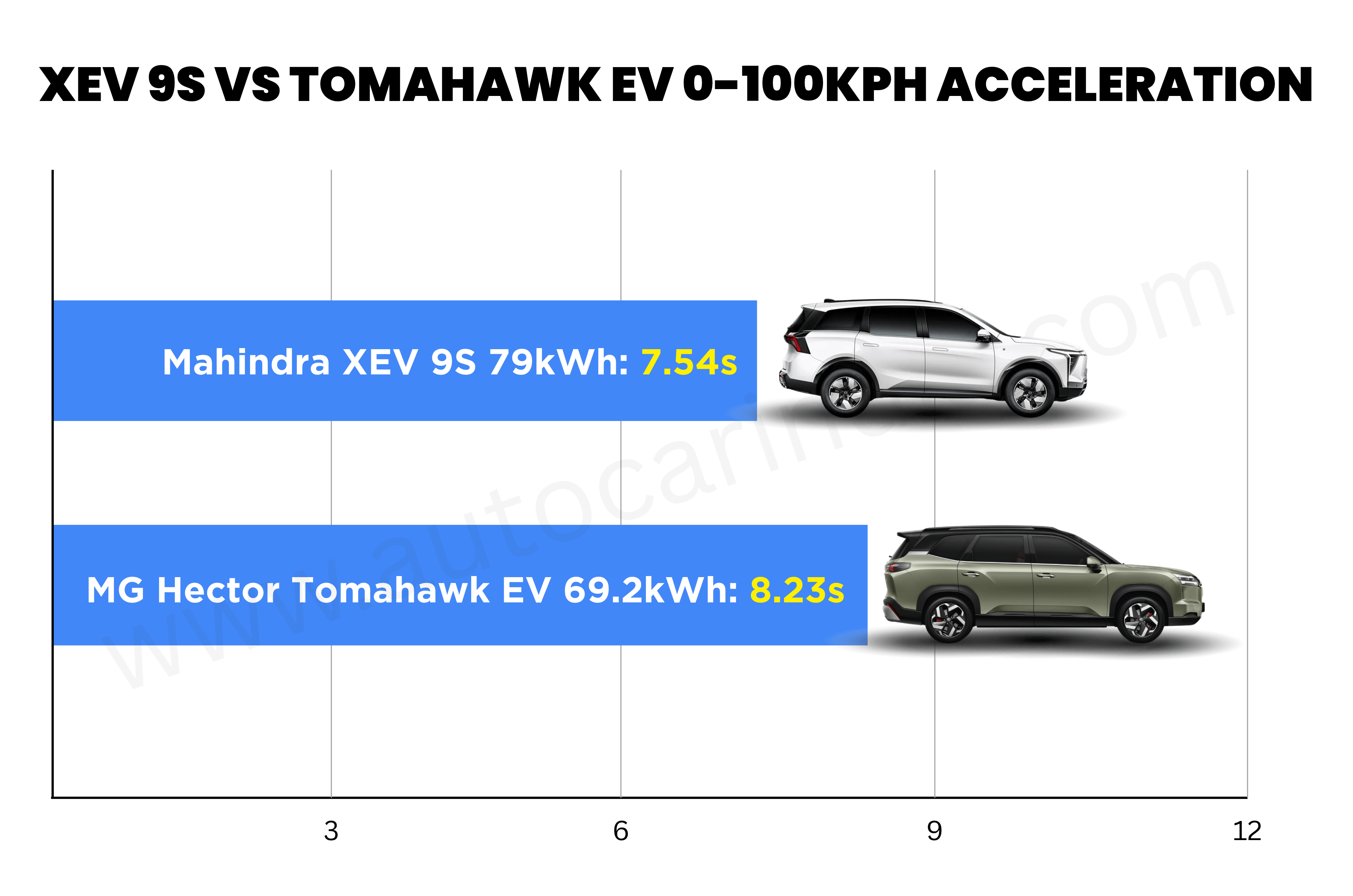
The XEV 9S gets off the line slightly quicker, reaching 20kph 0.08 seconds ahead of the Tomahawk EV. The gap remains narrow at 40kph and 60kph, with the Mahindra holding leads of 0.11 seconds and 0.08 seconds, respectively.
It begins to pull further ahead beyond 60kph, reaching 80kph 0.31 seconds sooner and 100kph 0.69 seconds sooner than the MG. By 120kph, the difference has widened to 1.30 seconds, with the XEV 9S completing the run in 9.98 seconds against the Tomahawk EV’s 11.28 seconds. The results show the Mahindra’s advantage growing at higher speeds, rather than coming solely from its initial launch.
Mahindra XEV 9S vs MG Hector Tomahawk EV: Rolling acceleration timings
Mahindra XEV 9S vs MG Hector Tomahawk EV: Rolling acceleration timings (seconds)
Rolling acceleration tests
Mahindra XEV 9S
MG Hector Tomahawk EV
20-80kph (in kickdown)
4.11
4.56
40-100kph (in kickdown)
4.74
5.45
The results show that the XEV 9S retains its lead across both rolling acceleration tests. It completes the 20-80kph run in 4.11 seconds, 0.45 seconds quicker than the Tomahawk EV’s 4.56 seconds. The gap widens in the 40-100kph test, with the Mahindra taking 4.74 seconds against the MG’s 5.45 seconds. This gives the XEV 9S a 0.71-second advantage in the higher-speed run, further underlining its stronger acceleration performance across both speed ranges.
Mahindra XEV 9S vs MG Hector Tomahawk EV: Braking tests
Mahindra XEV 9S vs MG Hector Tomahawk EV: Braking tests
Mahindra XEV 9S
MG Hector Tomahawk EV
80-0kph distance (m)
29.67
27.52
80-0kph time (seconds)
2.55
2.39
80-20kph L1 regen distance (m)
341.03
575.94
80-20kph L2 regen distance (m)
215.8
389.91
80-20kph L3 regen distance (m)
162.46
210.09
The Tomahawk EV has the advantage in the conventional braking test, stopping from 80kph in 27.52m and 2.39 seconds. The XEV 9S takes 29.67m and 2.55 seconds to come to a halt, requiring 2.15m more distance.
The results reverse under regenerative braking. In the 80-20kph tests, the XEV 9S covers a shorter distance at all three regeneration levels. At L1, it takes 341.03m to slow down, compared with 575.94m for the MG. At L2, the respective distances are 215.8m and 389.91m, while at L3, they are 162.46m and 210.09m. The difference is largest at L2, where the Tomahawk EV covers 174.11m more than the Mahindra before slowing from 80kph to 20kph.
Mahindra XEV 9S vs MG Hector Tomahawk EV: Prices
Model
Price (ex-showroom)
Mahindra XEV 9S Pack Three Above
Rs 29.95 lakh
MG Hector Tomahawk EV
Rs 19.49 lakh-23.49 lakh
The MG Hector Tomahawk EV is priced between Rs 19.49 lakh and Rs 23.49 lakh, while the Mahindra XEV 9S Pack Three Above costs Rs 29.95 lakh. The Tomahawk EV’s top variant is Rs 6.46 lakh cheaper than the XEV 9S. The Mahindra, however, gets a larger 79kWh battery and higher power and torque outputs, and was quicker in all three acceleration tests. The MG stopped in a shorter distance in our 80-0kph braking test.
Autocar India’s testing standards
Before conducting our performance tests, we check and maintain tyre pressure based on the manufacturer’s recommendation and ensure that the car is charged to 100 percent. The car is then tested in a controlled environment with two people on board, and the data is collected via highly accurate GPS-based timing equipment.
कॉकरोच जनता पार्टी (CJP) के फांउडर अभिजीत दिपके ने पार्टी के सदस्य आशुतोष रांका और सौरव दास के समर्थन में एक इमोशनल नोट लिखा है। आशुतोष रांका और सौरव दास सोमवार को लगातार छठे दिन न्यायिक हिरासत में रहे। सोशल मीडिया पर किए गए पोस्ट में अभिजीत दिपके ने बताया कि दोनों ही लंदन में लाखों की कमाई कर रहे थे। अभिजीत ने उनकी पुरानी जिंदगी, देश के लिए कुछ बेहतर करने के फैसले और दूसरों के हक में आवाज उठाने के जज्बे को याद किया। उन्होंने बताया कि कैसे दोनों ने अपनी आरामदायक जिंदगी छोड़कर उन लोगों के लिए लड़ने का रास्ता चुना, जिन्हें मदद की जरूरत है।
दिपके ने किया इमोशनल पोस्ट
X पर किए गए पोस्ट में अभिजीत दिपके ने लिखा, “कुछ साल पहले आशुतोष रांका लंदन में अच्छी सैलरी वाली कॉर्पोरेट नौकरी करते थे, जहां से उन्हें लाखों रुपये मिलते थे। वहीं, सौरव दास देश की कानूनी व्यवस्था पर लिख रहे थे और अपनी जिंदगी अच्छे से जी रहे थे। दोनों के पास सफल करियर, फाइनेंशियल सिक्योरिटी और अपनी बनाई हुई जिंदगी को आगे बढ़ाने के कई मौके थे।”
उन्होंने आगे लिखा, “लेकिन दोनों ने देश को बेहतर बनाने की उम्मीद में अपनी पुरानी जिंदगी छोड़ने का फैसला किया। उनके पास आरामदायक जीवन छोड़कर सड़कों पर उतरने, मुश्किलों का सामना करने और जेल जाने की कोई मजबूरी नहीं थी। इसके बावजूद, उन्होंने यह रास्ता चुना और देश के लिए कुछ बेहतर करने की कोशिश में जुट गए।”
A few years ago, Ashu had a high-paying corporate job in London, earning millions. Saurav was writing about the country’s legal system and living a great life. Both had successful careers, financial security and every reason to continue living the lives they had built for themselves.
But they chose to give it all up in the hope of making this country a better place. They had absolutely no reason to leave behind their comfortable lives, take to the streets, face uncertainty and eventually end up in jail. Yet they did.
What I admire most about these two is that despite coming from privileged backgrounds, they chose to fight for those who aren’t as fortunate. They could have easily looked the other way, enjoyed their lives and never bothered about the struggles of people they had never even met. Nobody asked them to make these sacrifices. Nobody expected them to. But they did, because they genuinely care about people beyond themselves.
And to me, that is the greatest quality a human being can have. To stand up for people you don’t know, to fight battles that aren’t your own, and to risk everything you have so that someone else might have a better life.
दिपके ने आगे लिखा, “इन दोनों की सबसे खास बात यह है कि अच्छी बैकग्राउंड से आने के बावजूद उन्होंने उन लोगों के हक में आवाज उठाने का फैसला किया, जिनके पास उनके जैसे मौके और सुविधाएं नहीं थीं। वे चाहते तो दूसरों की परेशानियों से दूर रहकर अपनी जिंदगी आराम से बिता सकते थे। वे उन लोगों की समस्याओं को भी नजरअंदाज कर सकते थे, जिन्हें वे जानते तक नहीं थे।”
यहीं है उनकी सबसे बड़ी खूबी
दिपके ने आगे लिखा, “उनसे किसी ने अपनी सुख-सुविधाएं छोड़ने या इतना बड़ा त्याग करने के लिए नहीं कहा था। इसके बावजूद उन्होंने ऐसा किया, क्योंकि वे सिर्फ अपनी नहीं, बल्कि दूसरों की जिंदगी की भी परवाह करते थे। मेरे हिसाब से, किसी इंसान की सबसे बड़ी खूबी यही होती है कि वह अनजान लोगों के लिए भी आवाज उठाए, ऐसी लड़ाइयां लड़े जिनका सीधा संबंध उससे न हो और दूसरों की जिंदगी बेहतर बनाने के लिए अपना सब कुछ दांव पर लगाने को तैयार रहे। आशु और सौरव भी ऐसे ही इंसान हैं।” बता दें इससे पहले भी अभिजीत दिपके ने आशुतोष रांका और सौरव दास के लिए इमोशनल पोस्ट डाला था।
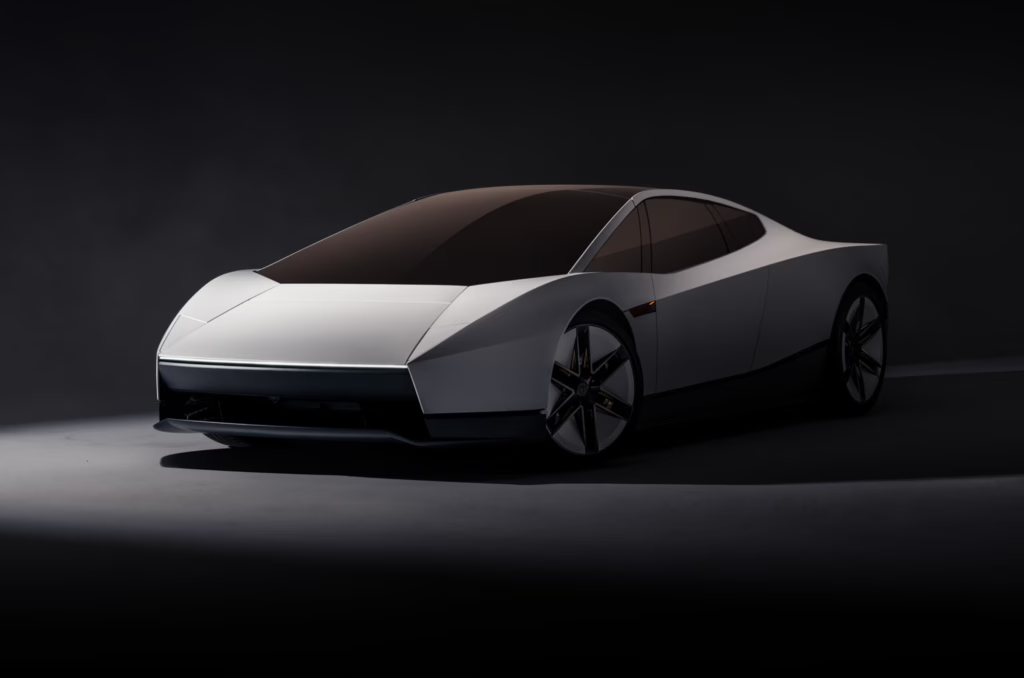
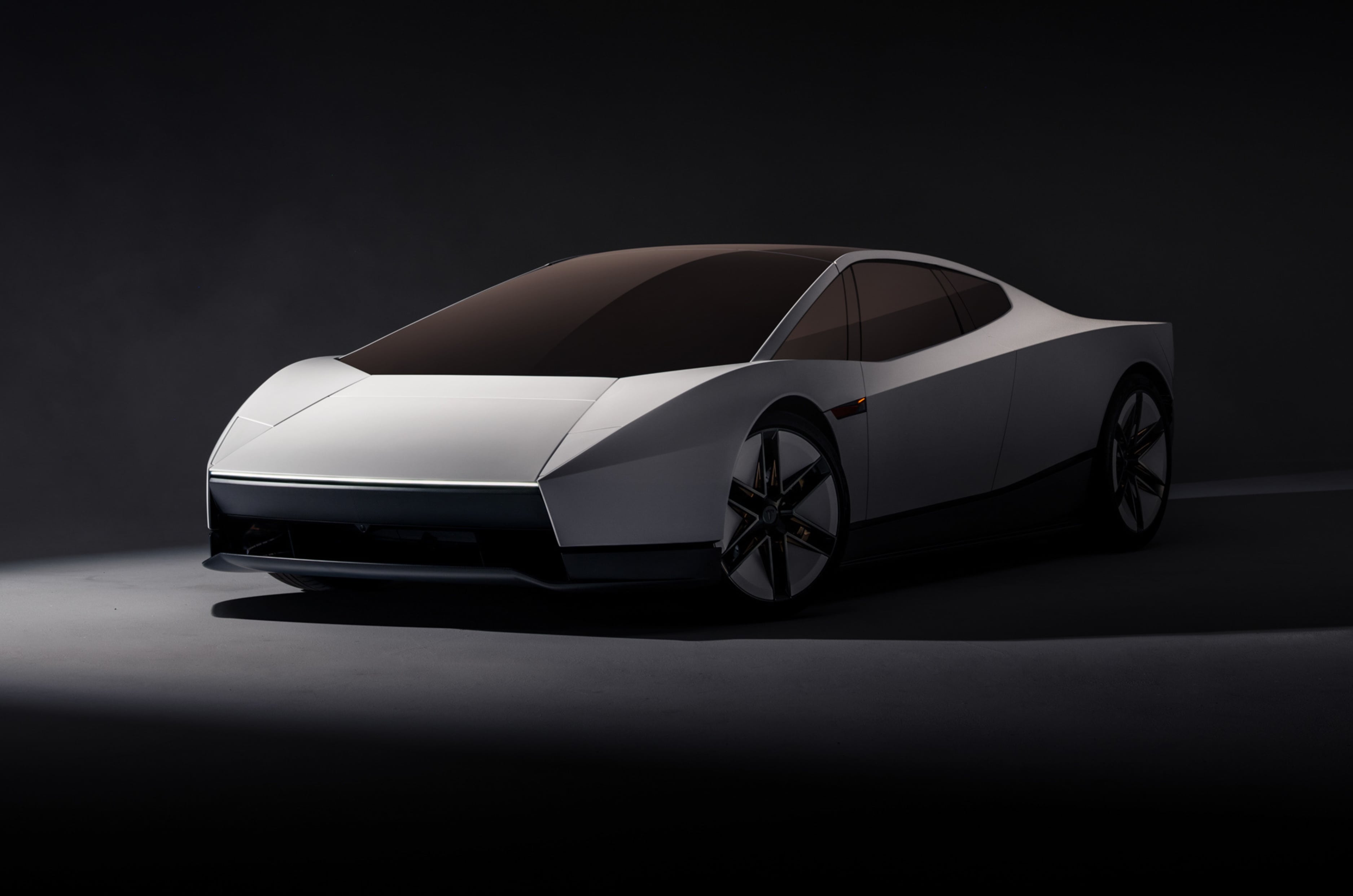
Tesla has unveiled its new Roadster EV, with production set to begin in 2028. It will be the second generation of the Roadster, whose first generation was discontinued in 2012. The new model will be offered in a standard Performance trim, along with Thrust and Rocket packages. Bookings for the Performance trim and Thrust package are open in India at Rs 5 lakh, while the Rocket package is available only by invitation.
Tesla claims the new Roadster can accelerate from 0-100kph in under a second. However, final powertrain details, including battery capacity, motor output and range, are yet to be revealed. The electric sports car also gets an underbody suction fan for extra grip. The Thrust package adds four rear-mounted thrusters, while the Rocket package adds 10 more, allowing the car to perform airborne manoeuvres.
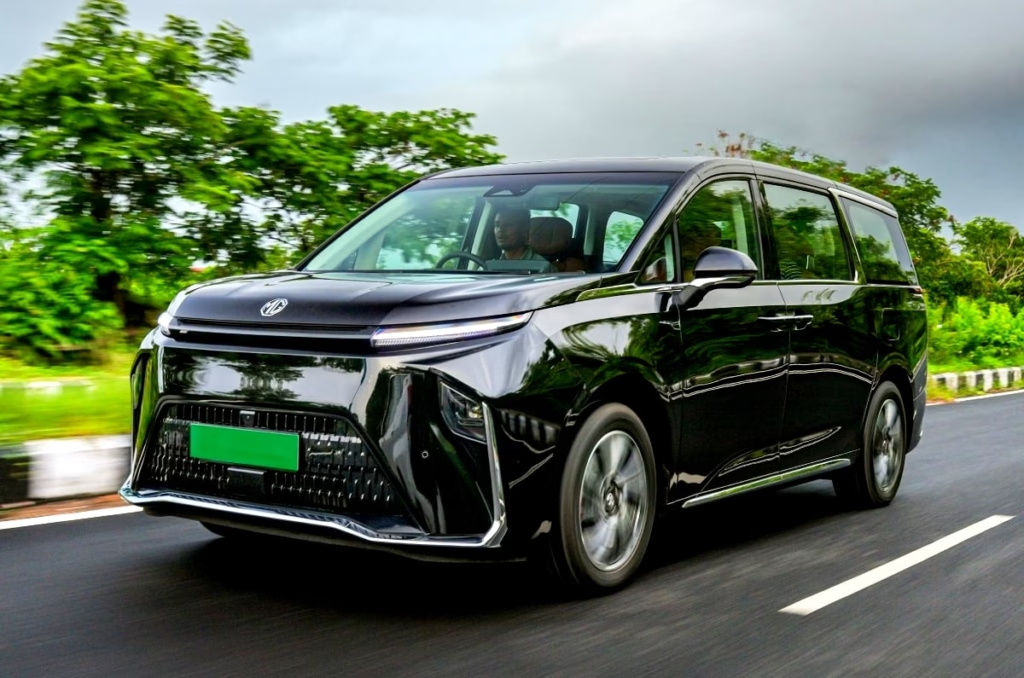
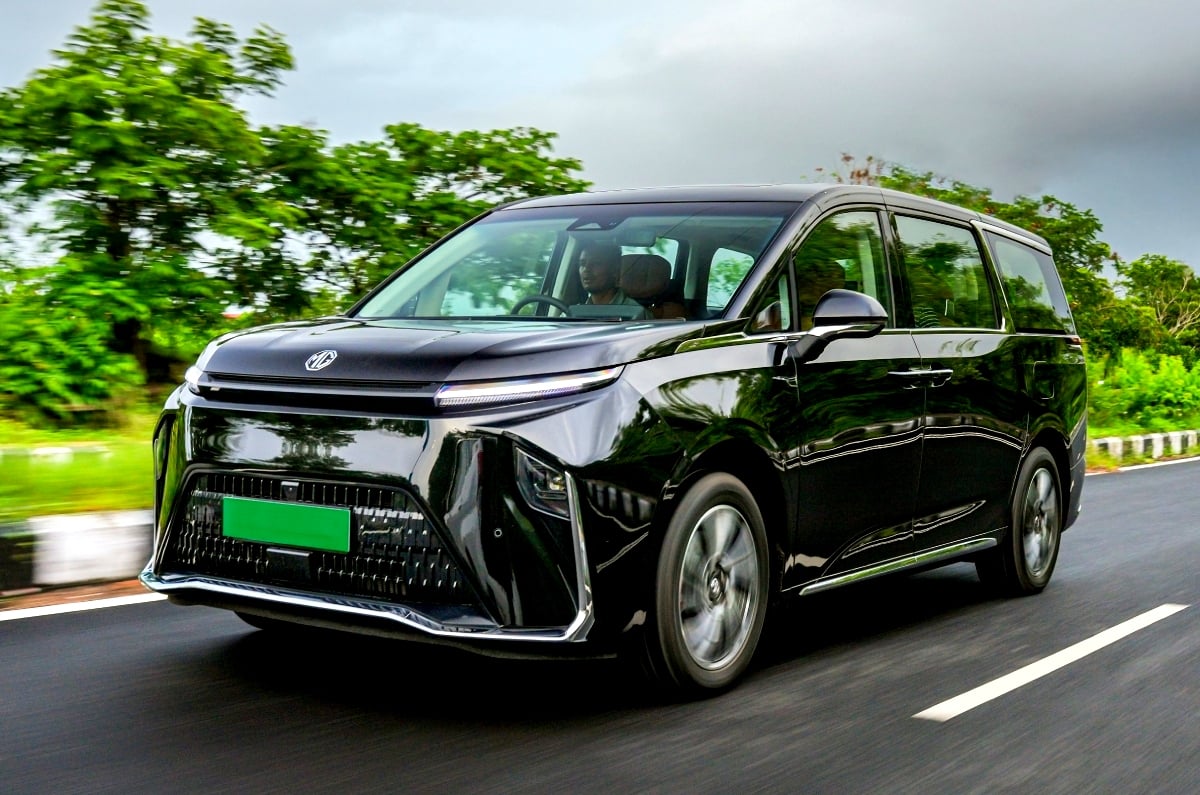
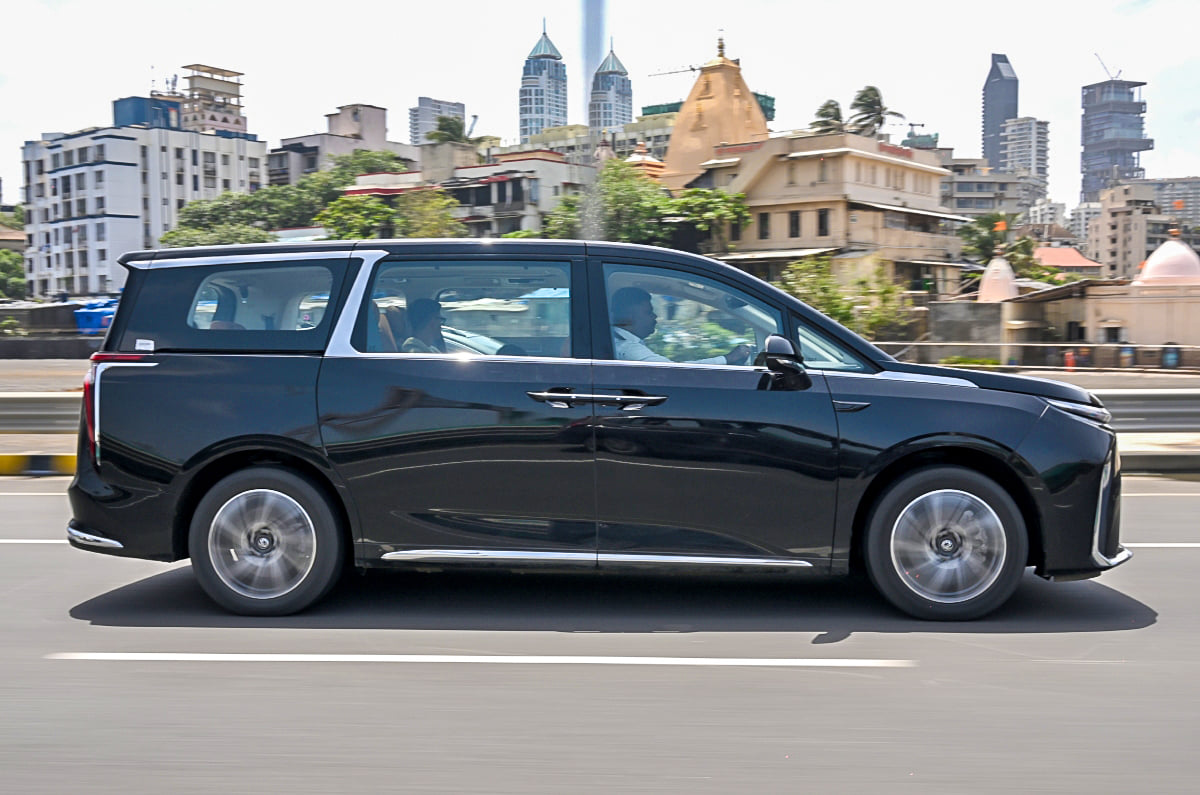
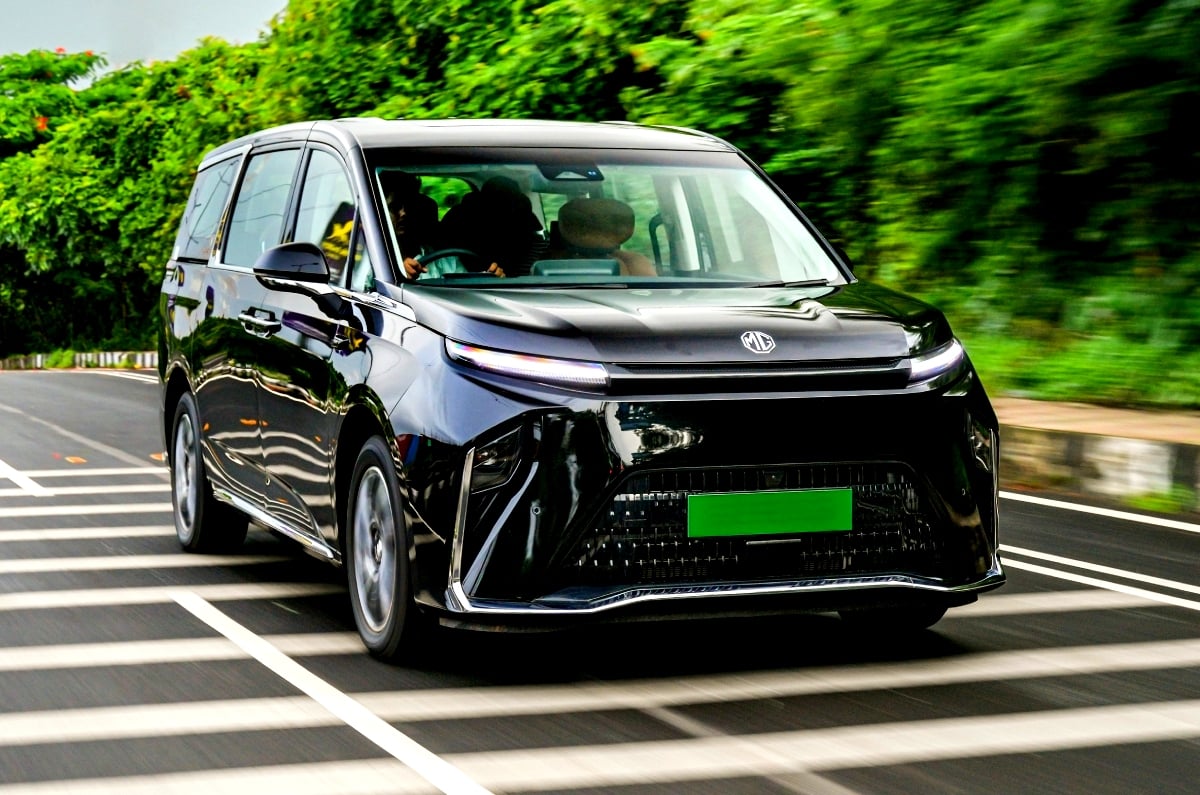
Luxury in an MPV is about more than having room for seven. It is about how that space is used, how effortlessly the occupants can settle in, and how much the car does to make every journey comfortable. The MG M9 brings together the practicality of a three-row MPV and the refinement of an electric powertrain, with a host of features that make time spent on the move feel a little more indulgent. Here are six highlights that make it stand out.
Lounge On Wheels
Massive wheelbase gives the M9 an imposing presence and liberates room in the cabin.
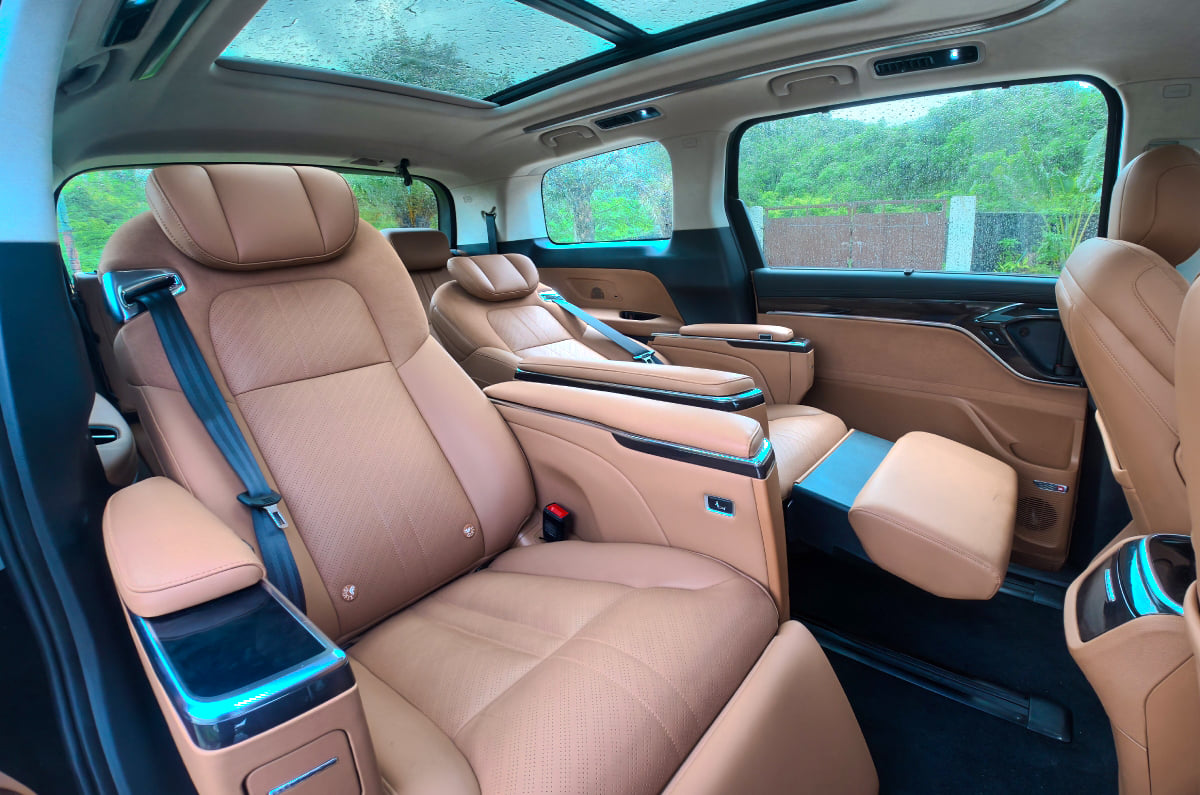
The M9’s 5.2-metre length, 2-metre width and 3.2-metre wheelbase give it the proportions to create a spacious, airy cabin. But it is the second row that makes the biggest impression. Two individual Presidential captain’s chairs offer 16-way electric adjustment, heating, ventilation, massage functions and extendable leg rests. The Boss Mode function moves the front passenger seat forward to create additional legroom, letting rear occupants stretch out and recline. It is a space designed for unwinding, not just getting from one place to another.
Space For Everyone
The aptly called Presidential captain’s chairs are even fit for a king.
While the second row gets the headline features, the M9 is designed to make all three rows usable. Its long wheelbase allows generous room for occupants, while second-row climate control, rear window sunshades and a panoramic dual sunroof enhance the feeling of comfort. The third row gets dedicated AC vents and USB connectivity, too. A premium Cognac Brown interior and 64-colour ambient lighting add to the cabin’s upmarket appeal, with the latter allowing occupants to tailor the atmosphere to their mood.
Electric Serenity
No matter the road surface, the M9 insulates its passengers from the outside world.
The M9’s 90kWh battery powers a front-mounted electric motor, producing 245hp and 350Nm, with an ARAI-claimed range of 548km. Beyond the performance and range figures, the electric powertrain brings a quality that matters particularly in a luxury MPV: refinement. With no engine noise and smooth, linear power delivery, the M9 makes for a more relaxed experience on the move. An acoustic windshield further helps keep the outside world at bay.
Quality Entertainment
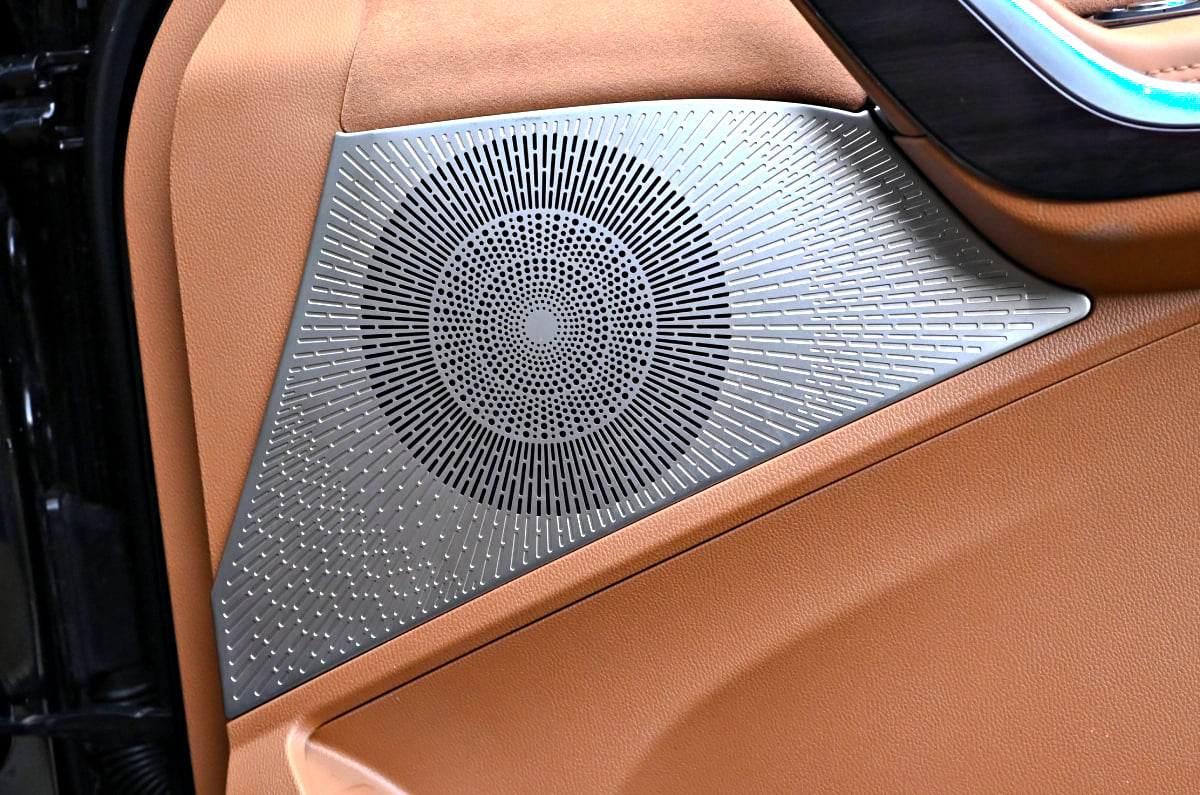
Superb 13-speaker JBL system enhances the cabin’s ambience.
A quiet cabin makes for a better listening environment, and the M9 builds on this with a 13-speaker JBL sound system, complete with an amplifier and subwoofer. Whether it is music on a long drive or a podcast during the daily commute, the system makes entertainment an integral part of the experience. The panoramic sunroof and ambient lighting add to the sense of being in a space designed around the occupants.
Tech-Suave
12.3-inch central touchscreen has all the controls you’ll need within easy access.
A 12.3-inch central touchscreen, digital instrument cluster, wireless smartphone connectivity and wireless charging bring everyday convenience within easy reach. The 360-degree camera is particularly useful when manoeuvring a vehicle of the M9’s size, helping the driver negotiate tight spaces with greater confidence. These features complement the M9’s focus on passenger comfort with technology that makes the car easier to live with.
Safety Assured
The M9 has received a 5-star Euro NCAP rating.
Luxury also means being able to travel with peace of mind. The M9 gets seven airbags and Level 2 advanced driver assistance systems, adding an extra layer of protection and driver support. Its five-star Euro NCAP safety rating provides further reassurance.
The MG M9’s appeal lies in how these elements come together. Generous space, thoughtful comfort features, electric refinement and modern safety technology give it a distinct identity in the luxury MPV segment. It’s no wonder that the M9 is the best-selling MPV in its class, with over 3,000 units sold since its launch last year. This is a vehicle that makes the journey itself something to look forward to, and that is what being on Cloud M9 is all about.
भारतपे के पूर्व को-फाउंडर अशनीर ग्रोवर अपने बेबाक अंदाज के लिए जाने जाते हैं, लेकिन इस बार वह खुद एक मजेदार सोशल मीडिया पोस्ट का हिस्सा बन गए हैं। गुरुग्राम के एक रियल एस्टेट कारोबारी ने उनकी प्रॉपर्टी विजिट पर चुटकी लेते हुए उन्हें नौकरी तक ऑफर कर दी। मामला गुरुग्राम के महंगे रिहायशी प्रोजेक्ट DLF Camellias का है, जहां अशनीर की विजिट के दौरान फ्लैट के बजाय क्लब, सुविधाओं और हरियाली को दिखाए जाने पर कारोबारी ने सवाल उठाए। उनकी पोस्ट अब सोशल मीडिया पर चर्चा में है।
फ्लैट देखने पहुंचे अशनीर
गुरुग्राम के रियल एस्टेट कारोबारी अभिषेक भारद्वाज ने X पर एक पोस्ट साझा करते हुए अशनीर ग्रोवर की साइट विजिट पर मजाकिया टिप्पणी की। उन्होंने बताया कि अशनीर की यह विजिट उनकी पत्नी के चैनल पर शेयर किए गए एक वीडियो में दिखाई गई थी, जिसका शीर्षक ‘Home Beyond the Price Tag’ है। अभिषेक के मुताबिक, फ्लैट में किरायेदार होने और दरवाजा नहीं खुलने की स्थिति में विजिट के दौरान क्लब, दूसरी सुविधाएं और हरियाली दिखाई गई। उन्होंने इस अनुभव की तुलना प्रॉपर्टी ब्रोकरों के उस आम तरीके से की, जिसमें फ्लैट नहीं दिखा पाने पर खरीदार को आसपास की सुविधाएं दिखाकर व्यस्त रखा जाता है।
‘क्लब दिखा दिया, हरियाली दिखा दी, फ्लैट की बात ही नहीं की’
200 से ज्यादा प्रॉपर्टी डील करने का अनुभव रखने वाले अभिषेक ने कहा कि गुरुग्राम के प्रीमियम रिहायशी प्रोजेक्ट्स में कई खरीदारों के लिए फ्लैट के साथ उसका पता और सोसायटी भी काफी मायने रखती है। ऐसी जगहों पर उपलब्ध फ्लैट कम होने के कारण खरीदार कई बार प्रॉपर्टी देखने से पहले ही उसमें दिलचस्पी दिखाने लगते हैं।
हालांकि, अभिषेक का मानना है कि अच्छी साइट विजिट में खरीदार को असली फ्लैट दिखाना जरूरी है। उन्होंने मजाक में कहा कि अगर किरायेदार दरवाजा नहीं खोल रहा हो, तो वह उसके साथ एक घंटे बैठकर चाय पीने को भी तैयार हैं, लेकिन खरीदार को फ्लैट दिखाए बिना वापस नहीं जाने देंगे।
अशनीर ग्रोवर को दे दी फील्ड एसोसिएट की नौकरी
अभिषेक ने अपनी पोस्ट में अशनीर पर तंज कसते हुए लिखा कि उन्होंने साइट विजिट बिल्कुल उसी अंदाज में की, जैसा प्रॉपर्टी इंडस्ट्री में कई बार देखने को मिलता है। उन्होंने कहा, ‘क्लब दिखा दिया, हरियाली दिखा दी, फ्लैट की बात ही नहीं की।’ इसके बाद कारोबारी ने अशनीर को फील्ड एसोसिएट की नौकरी का ऑफर दे दिया। उन्होंने बताया कि वह फिलहाल साइट विजिट के लिए लोगों की तलाश कर रहे हैं और अशनीर ने तो पहली विजिट में ही इंडस्ट्री का तरीका दिखा दिया।
Ashneer Grover did his first site visit in Gurugram yesterday, at DLF Camellias, and like every broker whose flat has a tenant inside who won’t open the door, he showed us the club, the amenities and the greenery instead.
Check out the video below.
I’ve done 200+ deals in this city, so let me do the commentary, because I know this script by heart.
The video is on his wife’s channel and it’s called “home beyond the price tag”, and that’s the first thing every broker learns; you put the price tag in the headline so the buyer feels it before he has seen anything.
Then he tells you the flat is leased out and he comes from Delhi only to use the club. That’s the second thing every broker learns. When the tenant won’t open the door, you still keep the visit on, and you take the buyer to the clubhouse, walk him slowly past the amenities, stop at the greenery for a minute so he can breathe in the Golf Course Road air, and keep him moving so he forgets to ask about the flat again.
In societies like this, that’s how the visit actually goes. You show the buyer the floor plan, you tell him the flat faces the internal greens or the golf course side, and after that there’s nothing left to see.
And the buyer doesn’t mind, because he wants the address. There are only a handful of flats in a society like this, so whichever one comes up, he just asks the size and that’s about it. The only question worth asking is what could be wrong with a flat in this society if you’re getting a good deal on it. A rare opportunity comes at a price only, if you are really interested; otherwise these flats will always look costly to someone like you.
If it was my buyer, he’d be seeing the flat, tenant or no tenant, even if I had to sit with the tenant over chai for one hour to get that door opened.
Ashneer, I’m hiring field associates for site visits right now, and you’ve already done your first one exactly the way the industry does it. Club dikha diya, greenery dikha di, flat ki baat hi nahi ki.
@Ashneer_Grover interview kab de rahe ho?
The full site visit is in the video below, check it out.
अभिषेक ने अपनी पोस्ट के आखिर में अशनीर से मजाकिया अंदाज में पूछा, ‘इंटरव्यू कब दे रहे हो?’ उनकी इस टिप्पणी ने प्रॉपर्टी विजिट के तरीके और महंगी सोसायटी में घर खरीदने के अनुभव को लेकर चर्चा छेड़ दी है। हालांकि, यह पूरा मामला कारोबारी की सोशल मीडिया पोस्ट में किए गए दावों और व्यंग्य पर आधारित है।