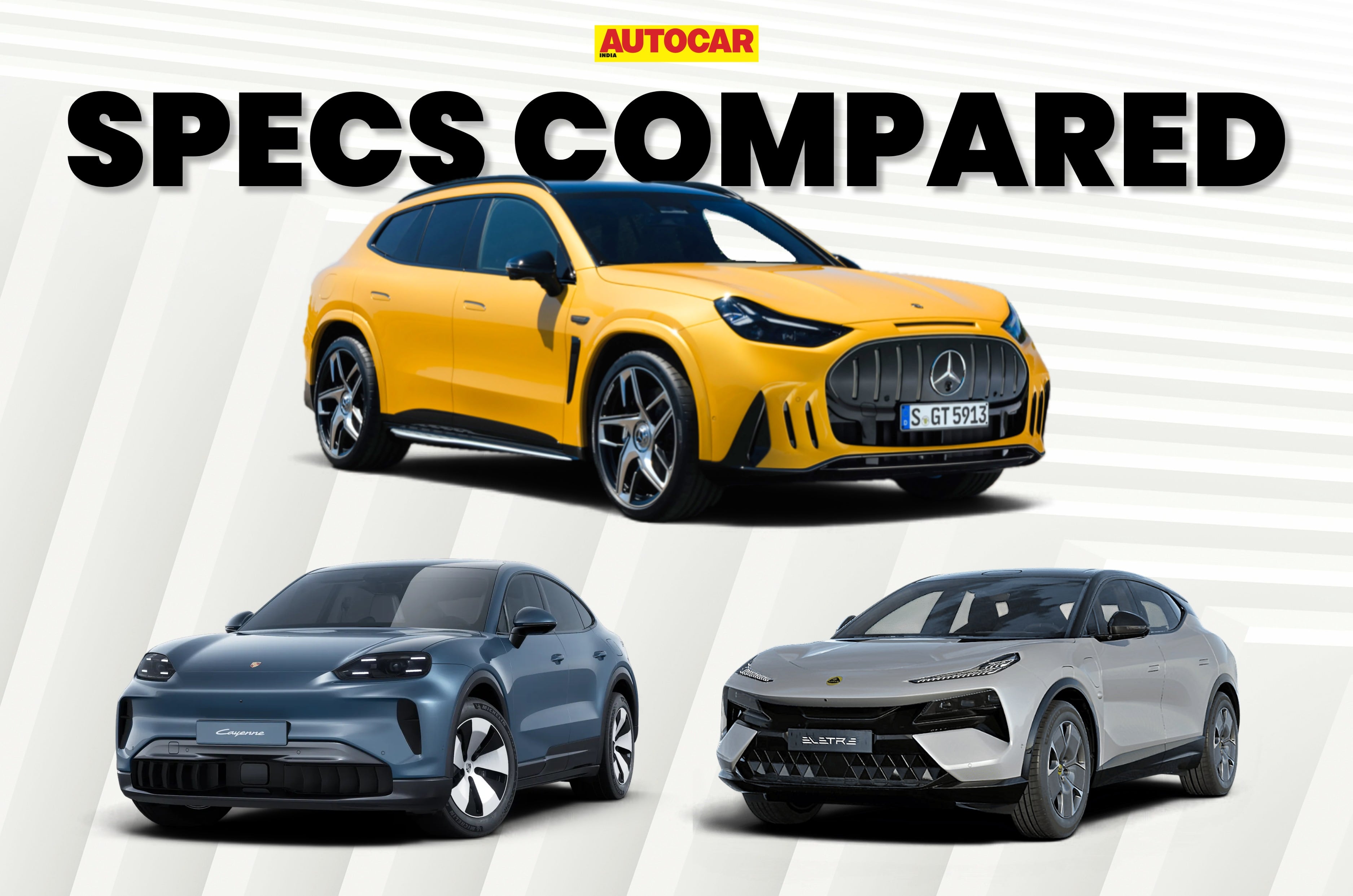
Mercedes-Benz recently unveiled its latest performance SUV, the all-electric AMG GT SUV. As the second model based on the 800-volt AMG.EA platform, the AMG GT SUV touts some serious numbers, particularly when it comes to power and performance. We take a look at how the AMG GT SUV stacks up on paper against its key rivals: the Porsche Cayenne Electric and Lotus Eletre. For this comparison, we’ve selected the top-spec, most potent versions of each electric performance SUV, specifically the AMG GT 63 SUV, Cayenne Turbo Electric, and Eletre 900 Sport.
Mercedes-AMG GT SUV vs rivals: Powertrain and performance
| AMG GT 63 SUV | Cayenne Turbo Electric | Eletre 900 Sport | |
| Battery capacity (kWh) | 106 / 128 | 113 | 112 |
| Motor layout | Triple | Dual | Dual |
| Power (hp) | 721 (up to 1,169) | 857 (up to 1,156) | 905 |
| Torque (Nm) | 2,000 | 1,360 (up to 1,500) | 985 |
| Gearbox | 2-speed automatic | 1-speed automatic | 2-speed automatic |
| Drive layout | AWD | AWD | AWD |
| Claimed 0-100kph time (sec) | 2.7 | 2.5 | 2.95 |
| Claimed top speed (kph) | 270* | 260 | 258 |
Both the AMG GT SUV and Cayenne Electric have boost functions to significantly raise the power output when launch control is engaged, during which the Merc is a touch more powerful. However, when comparing constant, non-launch-control outputs, it’s the Eletre that ranks as the most powerful one here, followed by the Cayenne Electric and then the AMG GT SUV. In terms of torque output, though, the AMG GT SUV’s 2,000Nm figure far outclasses its rivals.
The standard 106kWh battery pack of the AMG GT SUV is the smallest here, but the optional 128kWh unit turns the hierarchy around. The AMG GT SUV also has a triple-motor layout, while the Porsche and the Lotus SUVs have dual-motor setups – all three are all-wheel drive, however. An interesting aspect of the AMG GT SUV’s motors is that they feature an axial-flux design, which makes them more compact and energy-dense than the radial-flux motors used in the Cayenne Electric and Eletre.
Much like the Eletre, the AMG GT SUV comes fitted with a 2-speed gearbox, whereas the Cayenne Electric makes do with a single-speed transmission. Coming to performance, the Cayenne Electric boasts the lowest 0-100kph time in this company, coming in at 0.2sec quicker than the AMG GT SUV and 0.45sec quicker than the Eletre. The AMG GT SUV, however, carries the highest top speed (albeit only with the optional Driver’s Package), followed by the Cayenne Electric and the Eletre.
Mercedes-AMG GT SUV vs rivals: Range and charging
| AMG GT 63 SUV | Cayenne Turbo Electric | Eletre 900 Sport | |
| Battery capacity (kWh) | 106 / 128 | 113 | 112 |
| Max WLTP range (km) | 585 / 700 | 623 | 500 |
| Max AC charging wattage (kW) | 11 | 22 | 22 |
| Max DC charging wattage (kW) | 600 / 710 | 400 | 350 |
| 10-80 percent DC charging speed (minutes) | 11 / 12 | 16 | 20 |
The Eletre carries the lowest range figure, outpaced even by the 106kWh spec of the AMG GT SUV. Expectedly, the 128kWh version of the Merc sports the highest range among its rivals, coming in at 77km over the Cayenne Electric and a full 200km over the Eletre. Even DC charging speeds are a sweep for the AMG GT SUV. When it comes to AC charging, though, the AMG GT SUV can only accept a maximum of 11kW, which is half the wattage that the Cayenne Electric and Eletre are capable of charging at.
Mercedes-AMG GT SUV vs rivals: Dimensions
| AMG GT 63 SUV | Cayenne Turbo Electric | Eletre 900 Sport | |
| Length (mm) | 5,084 | 4,985 | 5,103 |
| Width (mm) | 2,001 | 1,980 | 2,019 |
| Height (mm) | 1,656 | 1,674 | 1,636 |
| Wheelbase (mm) | 3,040 | 3,023 | 3,019 |
| Kerb weight (kg) | 2,585 / 2,695 | 2,645 | 2,640 |
| Boot space (litres) | 670 | 747 | 688 |
| Frunk space (litres) | 111 | 90 | 46 |
The Eletre is the longest and widest SUV here, but the AMG GT SUV edges ahead of both its rivals on the wheelbase front. Height is a win for the Cayenne Electric, followed closely by the AMG GT SUV and then the Eletre. Interestingly, the AMG GT SUV is the lightest one here in its 106kWh guise, and the heaviest in its 128kWh spec. Boot space, however, is where the AMG GT SUV trails its rivals – the Cayenne Electric offers 77 litres more space. Looking at frunk space, though, the AMG GT SUV sports the largest capacity, while the Eletre has the smallest one.