McLaren has confirmed plans to build its first SUV in the UK as part of a GBP 500 million investment in its manufacturing and engineering operations. The unnamed performance SUV is in the early stages of development and is planned to launch before 2030.
The investment will also fund a second vehicle assembly facility in the UK, expand McLaren’s existing facilities and bring engine development and production in-house for the first time. The programme is expected to create at least 1,000 jobs within and around McLaren, with a further 3,000 jobs expected across its supply chain.
Speaking to Autocar UK, McLaren COO Michael Straughan said “there’s a roadmap for about the next 10 years that gives us real confidence. We’ve got a growth plan and a delivery perspective on how we can get to where we want to get to.”
McLaren SUV confirmed
McLaren had previously ruled out an SUV, with former CEO Mike Flewitt saying the company could not afford to develop one and that it “just doesn’t fit the brand”. The company is one the last supercar makers to add an SUV to its range, following rivals including Ferrari, Lamborghini and Aston Martin.
The SUV will use one of the company’s new hybrid powertrains. Straughan said the SUV remains in the early stages of development, although McLaren is targeting a launch before 2030. The company has not yet announced its name, technical details or exact launch date.
The SUV will be the first McLaren road car to move beyond the mid-engined supercar format that has defined the brand since its road-car business was established. “No longer will we be only rear-engined, rear-wheel-drive cars. There’s going to be front-engined, and either four-wheel drive or perhaps rear-wheel drive in the future. It’s very difficult off one assembly line, so we need another assembly line – wherever we decide to put that”, Straughan said.
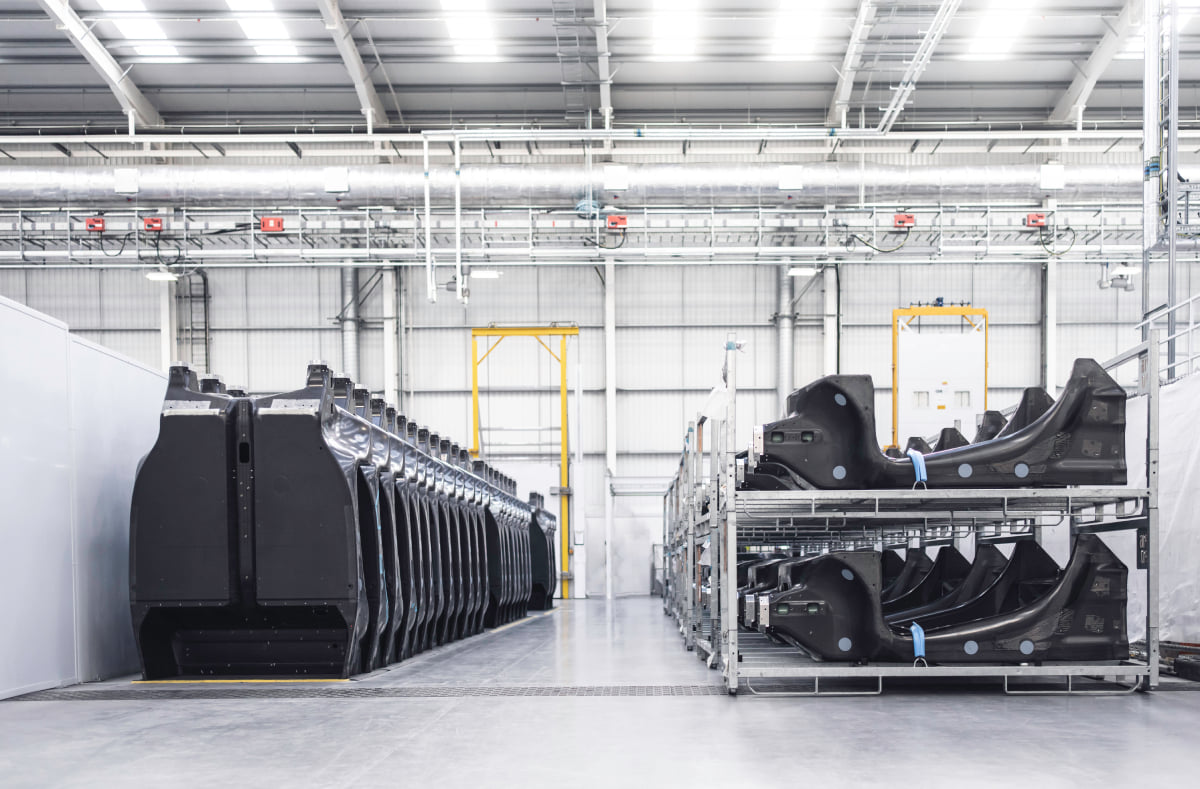
The SUV’s body structure is still being decided. McLaren is considering several options, including carbonfibre, drawing on its expertise in lightweight composite construction. “It’s one of the discussions we’re having at the moment, because nobody has ever done this before,” he said. “Every other SUV [of this type] has been aluminium, and we’ve got a number of options at the moment for what the body structure will be in the future. If we went that way, it would be the first. It would be incredibly special.” he added.
The SUV is the only new model McLaren has confirmed. However, the front-engined layout could support other models in future. Straughan said there are no firm plans for additional models, but that the layout “opens up other opportunities”. McLaren has not confirmed any further derivatives or changes to its existing supercar range.
New engines and gearboxes
McLaren will develop and manufacture future engines and gearboxes in-house for the first time. Its current V6 and V8 engines are supplied by Ricardo, which has powered all of McLaren’s core models since the company’s relaunch with the 12C in 2011. The engines are exclusive to McLaren.
McLaren hasn’t alluded to their technical specifications, but says they will support “the company’s hybrid engine strategy”. The company says they will be developed and tuned to maximise driver engagement. Asked about the technical make-up of these new engines, Straughan said: “Obviously it’s going to start with the current V8 products or the future generation of that, but once you start building engines there are lots of opportunities”.
Confirmation of plans for two distinct engine programmes suggests McLaren will offer different cylinder counts and capacities across its line-up going forward. McLaren’s partnership with Ricardo will continue for other engineering work, but future engines will be built by McLaren rather than shipped to Woking by Ricardo.
No immediate McLaren EV
McLaren has no immediate plans for a fully electric road car. COO Michael Straughan said the company will wait until customer demand is strong enough, although its integration with Forseven has provided experience in electric-vehicle development. Straughan said it was important that McLaren launched an EV “at the right time”.
“It’s inevitable – it will come, and we’ve got to be ready for when it does come. But the market reception to EVs in this space is not fantastic at the moment, so we can’t afford to make a mistake with the product, and therefore we will hold off until we’re certain that the customer demand is there”, he added.
Second UK factory planned
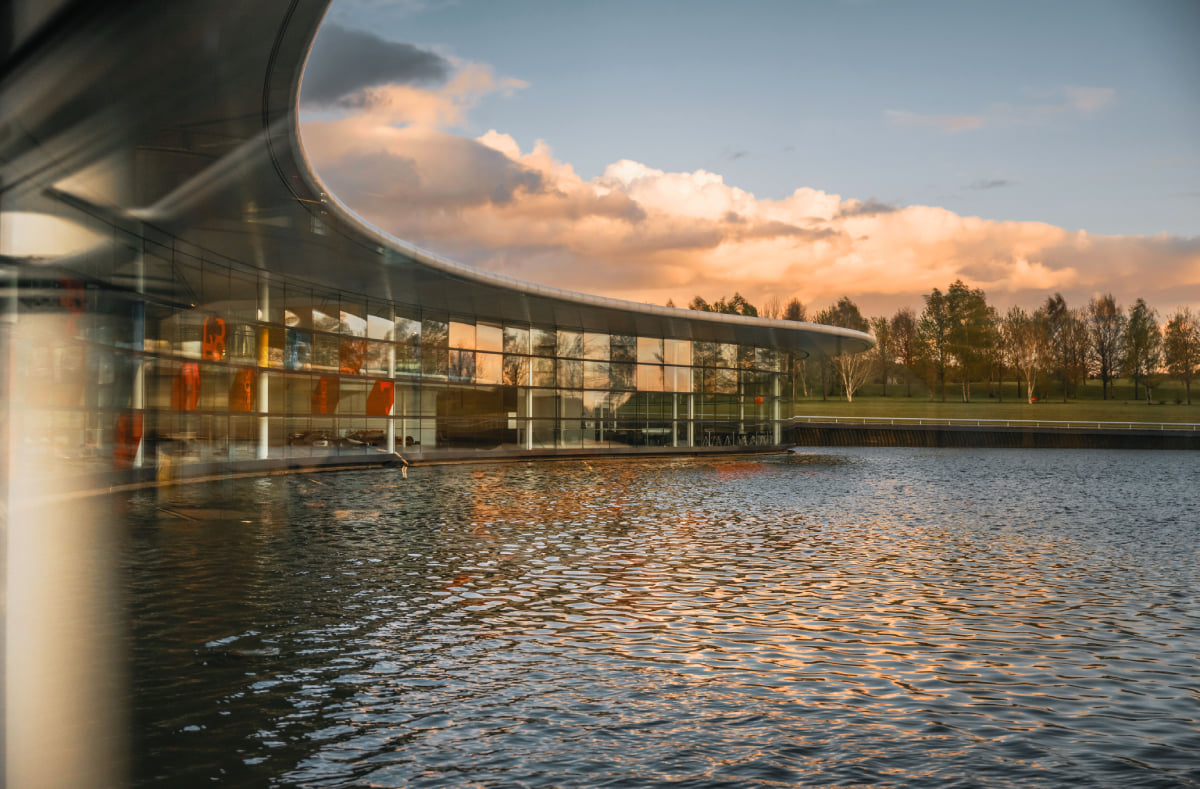
The new facility will supplement the McLaren Production Centre in Woking, although its location has not yet been confirmed. “We can’t build a front-engined car on the same line as a rear-engined car,” Straughan said. “We’re not going to use somebody else’s production line,” Straughan said. “We’ll build our own”, he added.
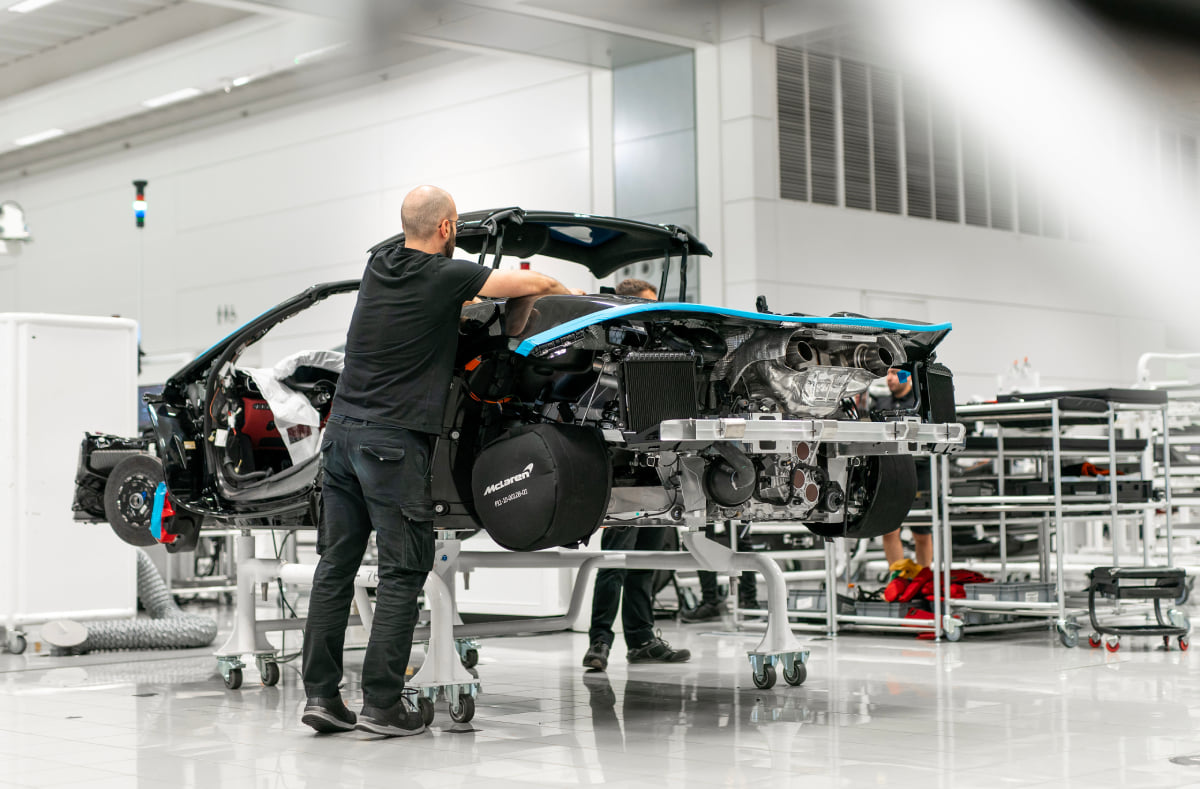
McLaren will also expand its existing production facility in Woking, which built around 2,000 cars in 2025, as well as its carbonfibre manufacturing and research centre in South Yorkshire. The company has recently opened a design and innovation centre in Bicester and a testing and vehicle development facility in the Midlands.
Together, these sites will support McLaren’s UK operations across design, engineering, vehicle development and manufacturing, increasing production capacity for its next generation of models. “We can’t stop making the cars we make today,” Straughan said. “We have to introduce the new products alongside them”, Straughan said.
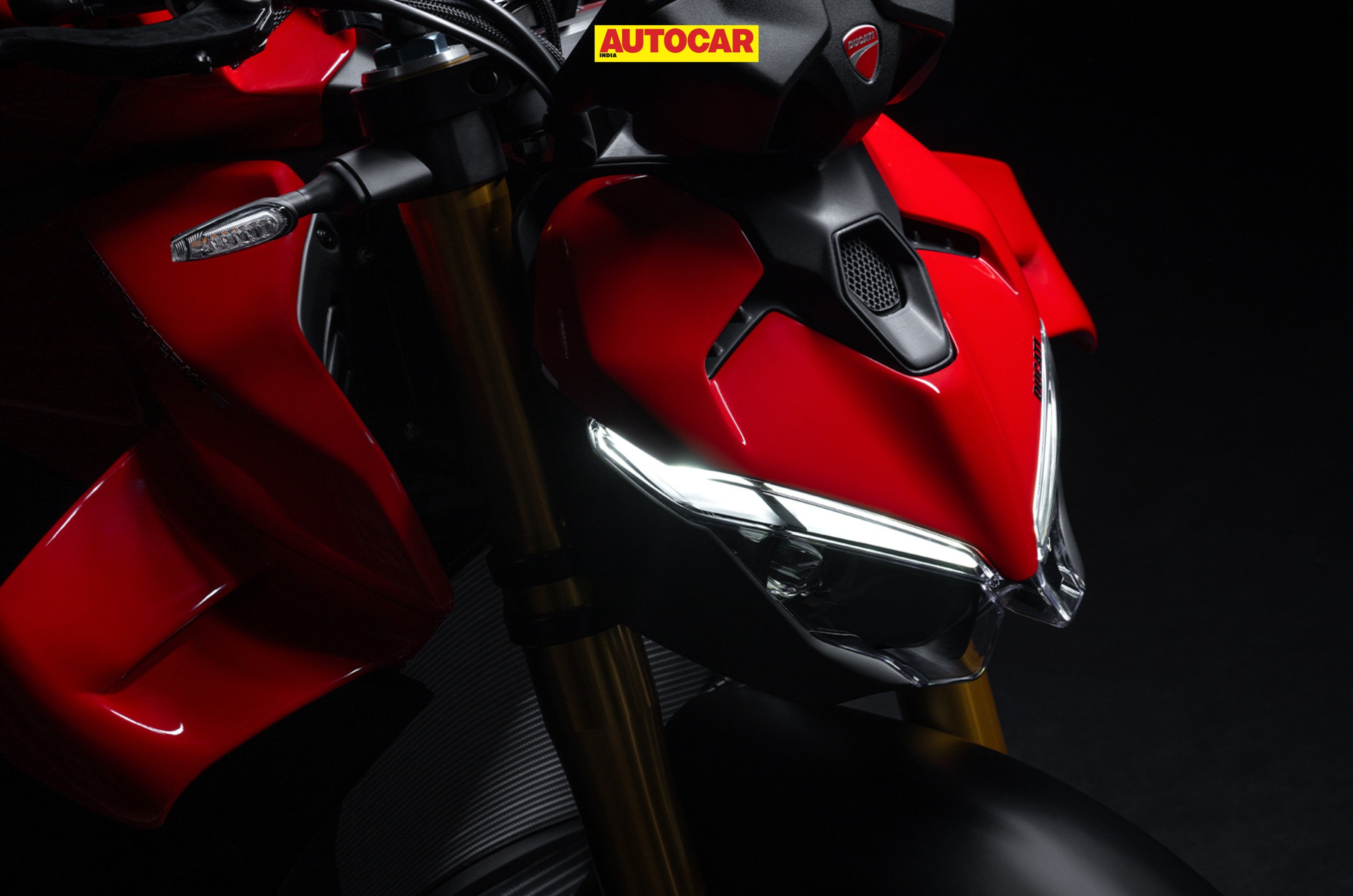
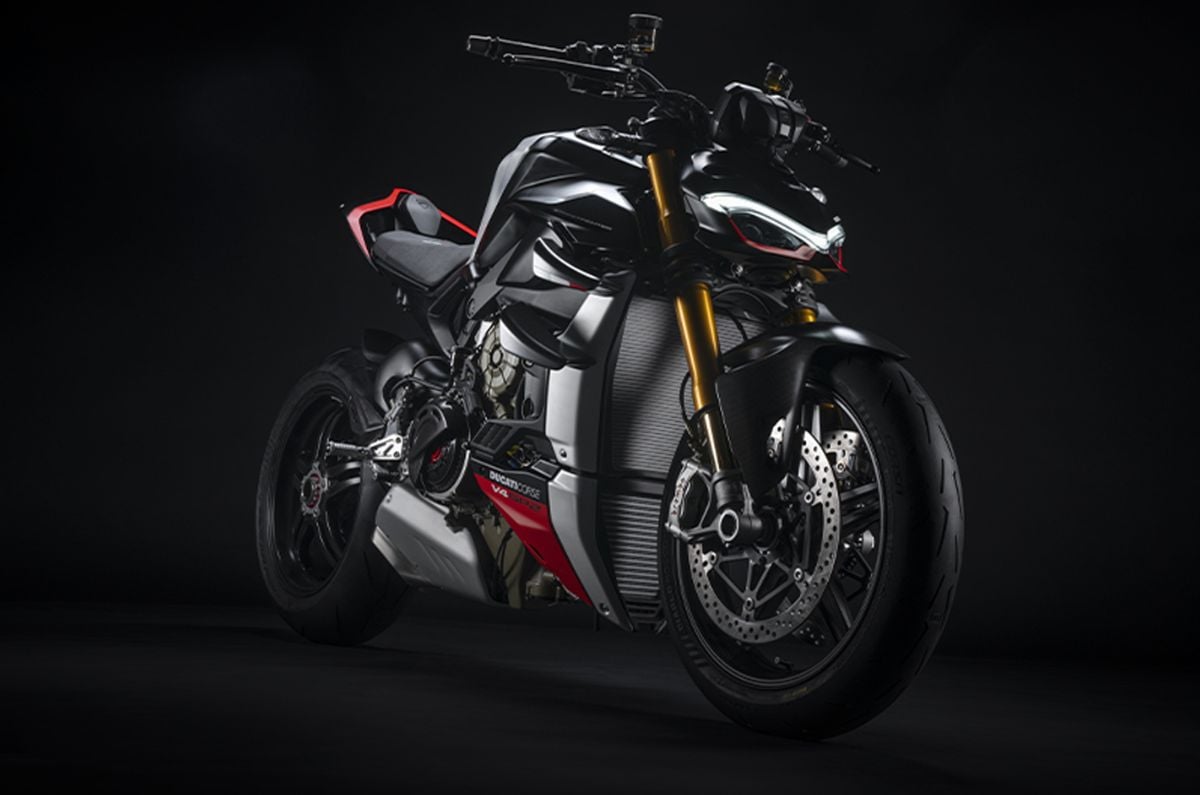
Ducati had updated the Streetfighter V4 with comprehensive upgrades to its engine and frame, a double-sided swingarm and new electronic rider aids. Shortly after, the Italian brand had discontinued the older, track-focused Streetfighter V4 SP2. Worry not, for the ‘Sport Production’ variant of the Streetfighter appears to be coming back.
The upcoming V4 SP will share the engine and weight with the V4
The previous SP had different wheels, suspension and foot pegs
Global unveil likely to be at EICMA 2026
Ducati Streetfighter V4 SP: What could change?
Track-focused changes to suspension, foot pegs and wheels
California Air Resources Board has recently updated the executive order for the Ducati Streetfighter V4 (and V4 S), adding a new SP variant. While the filing confirms that the SP will share the engine and emissions data, it doesn’t specify how the two models will differ. However, we can look at the previous SP versions to know what to expect.
2023 Ducati Streetfighter V4 SP2 image used for representational purposes only.
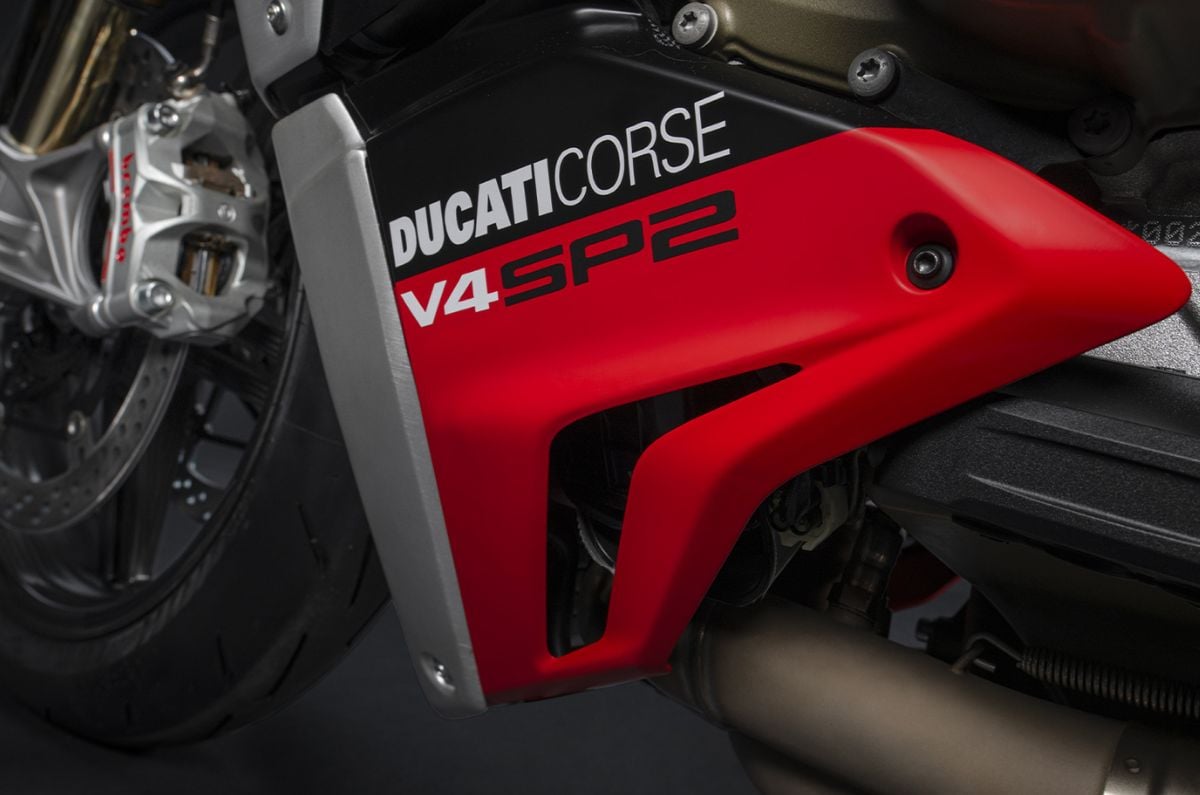
To recap, the Streetfighter V4 first got an SP variant in 2022, meant as a track-focused version of the performance street-naked. While the SP shared the same engine and power with the Streetfighter V4, it swapped the regular wet clutch for a dry clutch. It also received carbon fibre wheels to save on the weight, the Panigale’s firmer suspension tuning, further rearset machined aluminium foot pegs, Brembo Stylema R brake calipers and a Brembo 19/21 adjustable front master cylinder; all intended to make it a better track performer. In 2023, the SP2 followed, which had MotoGP- and WSBK-inspired livery called the “Winter Test”.
As mentioned earlier, the SP2 went away after the Streetfighter got its 2025 update, so we can expect the upcoming SP to share the basic platform with the latest Streetfighter while receiving similar, track-focused upgrades to the package. While Ducati hasn’t revealed a timeline for it, we can expect the Streetfighter V4 SP to show up at EICMA 2026, which will take place towards the end of the year.
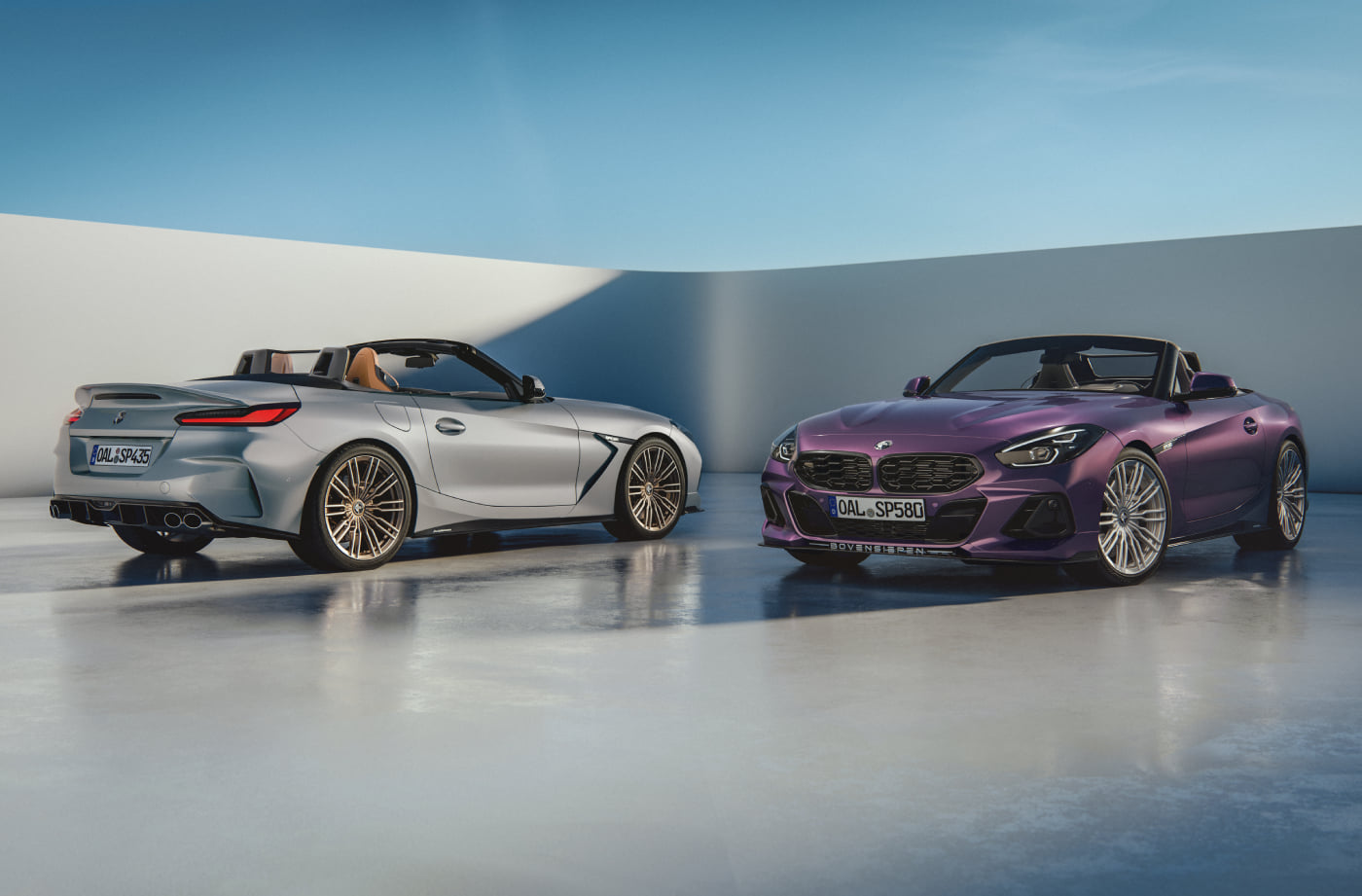
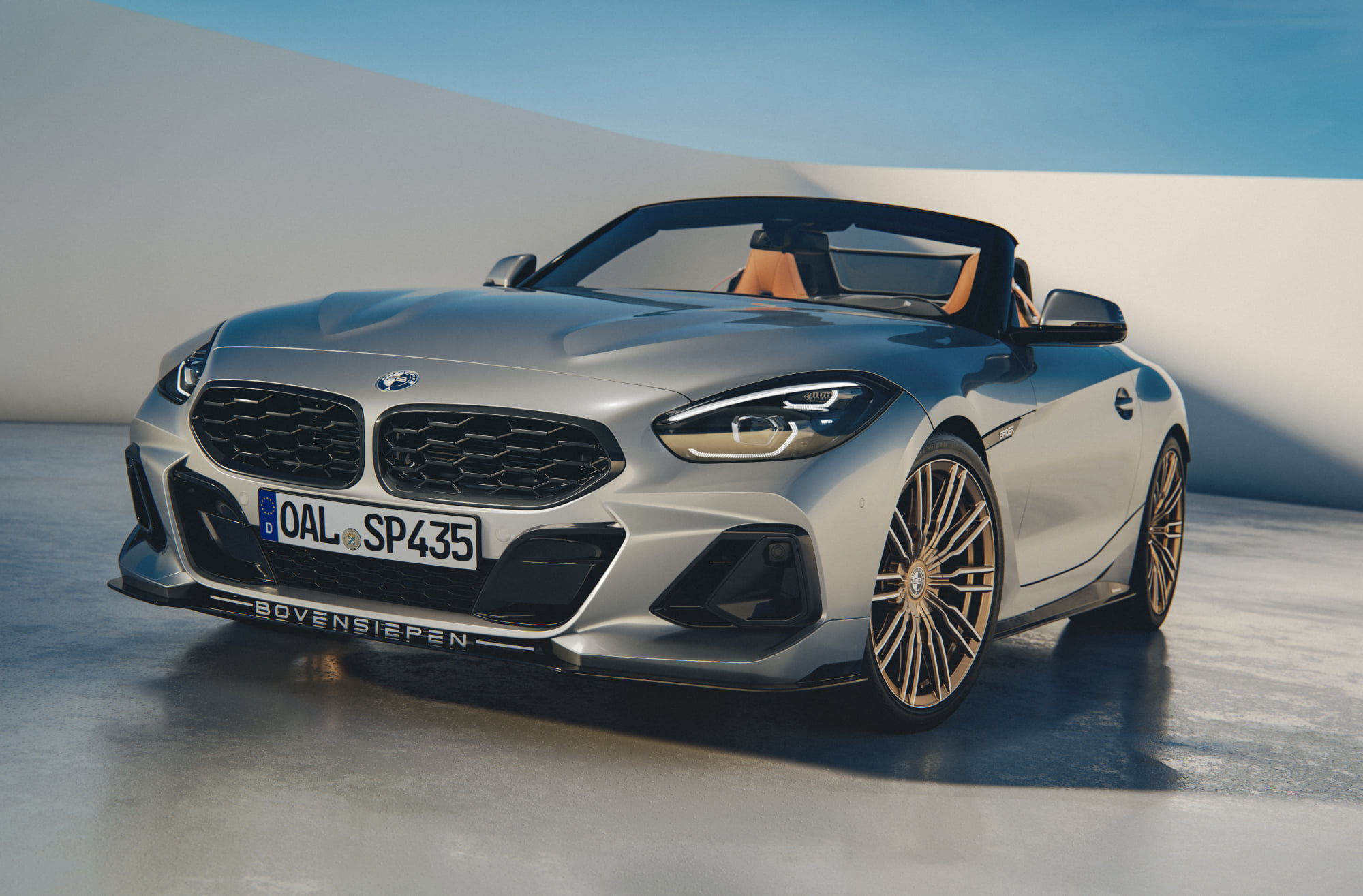
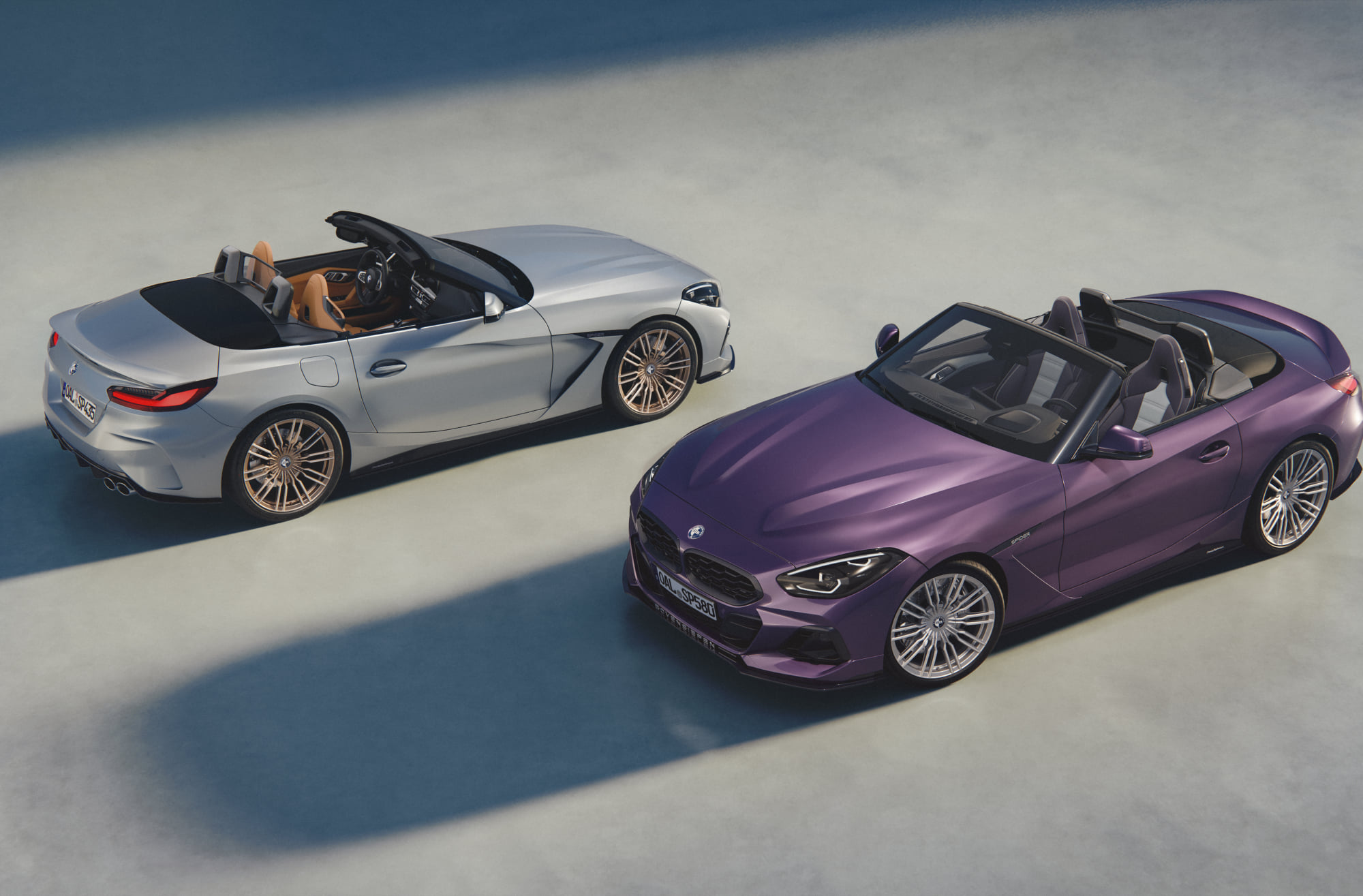
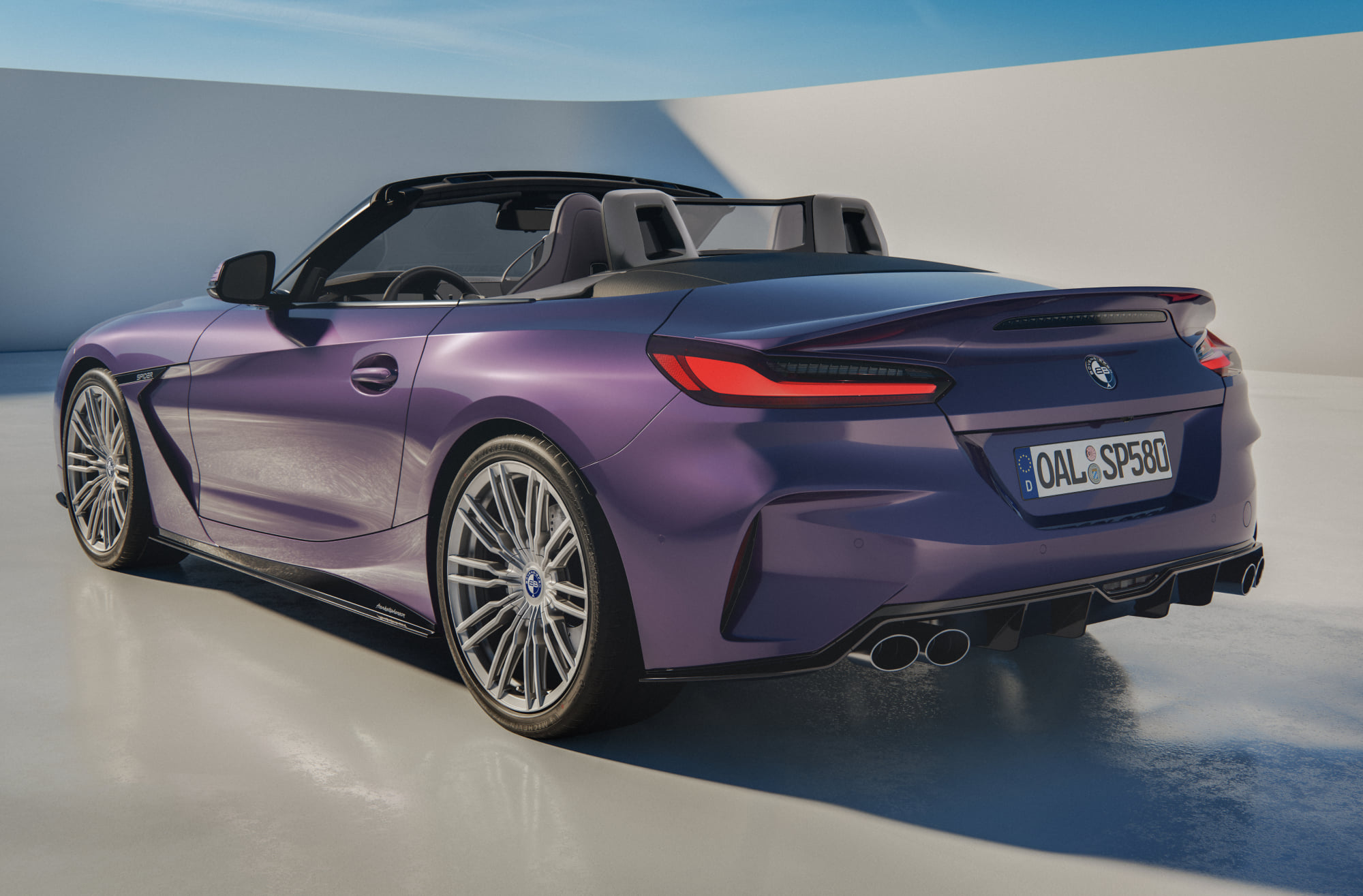
Bovensiepen has revealed the Spider, a limited-production two-seat roadster based on the BMW Z4 M40i. It is the third model from the Buchloe-based company and follows the Zagato and 05 GT, with production capped at 99 hand-built examples. The Spider gets bespoke exterior and interior changes, along with revisions to its suspension, cooling and exhaust systems. Orders are now open, with first deliveries scheduled for the end of the first quarter of 2027.
Bovensiepen Spider: Exterior
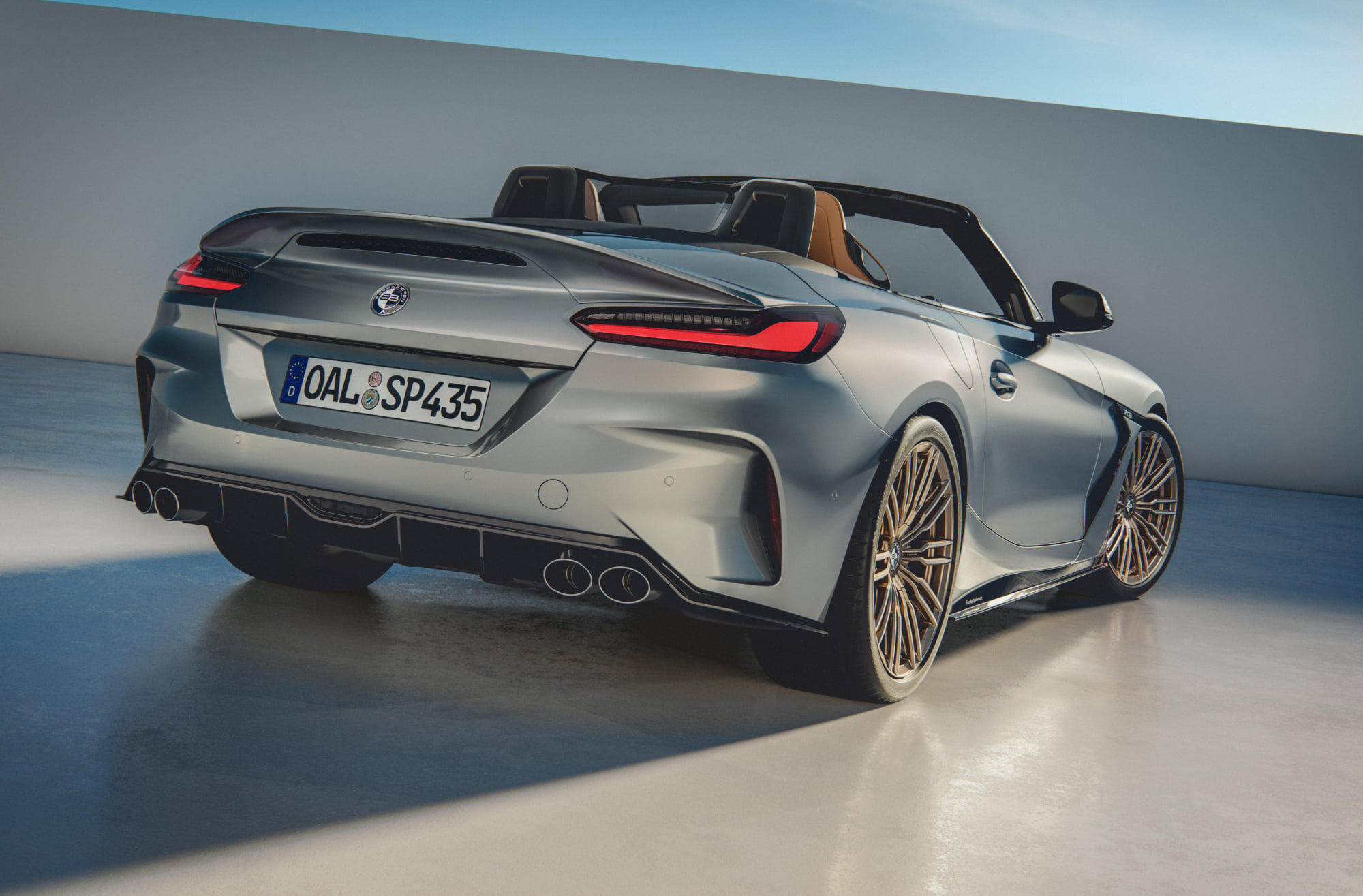
The Spider retains the Z4’s basic roadster proportions, with a long bonnet, rear-set cabin and short overhangs. Its exterior was developed with designer Frank Stephenson, who also worked on the Bovensiepen 05 GT. Changes include a gloss-black front splitter with twin tips, front-fender vents, side skirts, a rear diffuser and an integrated rear spoiler. It also gets 20-inch forged wheels.
The roadster measures 4,334mm long, 1,864mm wide and 1,304mm tall. It has a kerb weight of 1,585kg. Of the 99 Spider examples, 40 will be finished in Sapphire Black, 25 in Sanremo Green, 20 in Skyscraper Grey, nine in Thundernight and five in Frozen Grey II.
Bovensiepen Spider: Interior
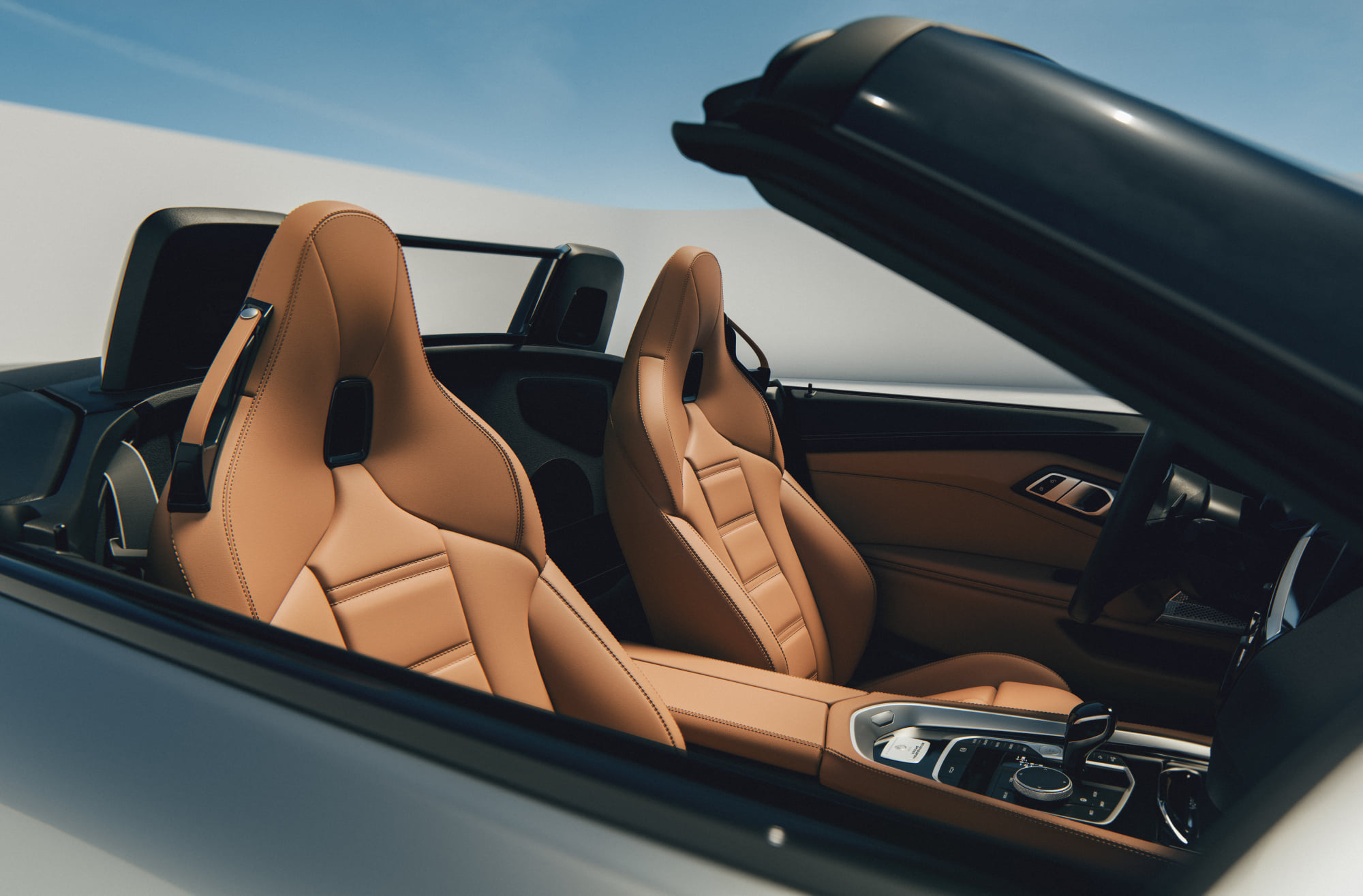
There are no major changes to the interior design compared with the BMW Z4, with the differences mainly focused on upholstery, trim and personalisation. The two-seat cabin gets Vernasca leather upholstery, Alcantara seat panels and a Lavalina leather steering wheel. A heated steering wheel, Comfort Access and a Harman Kardon surround-sound system are standard.
Optional interior upgrades include full-leather upholstery, a leather dashboard and Alcantara trim for the A-pillars, wind deflector and roll-bar cover. Bovensiepen’s in-house saddlery can also add personalised headrest embossing and embroidery. Each car gets a numbered production plaque, while boot capacity is 281 litres.
Bovensiepen Spider: Powertrain
The Spider is powered by a 3.0-litre turbocharged inline-six B58 engine producing 435hp and 580Nm, making 95hp and 80Nm more than the BMW Z4 M40i, which produces 340hp and 500Nm. Bovensiepen has revised the intake and exhaust systems, with the former gaining an additional ram-air channel and the latter receiving changes to improve flow. Power is sent to the rear wheels through an eight-speed ZF automatic gearbox.
The Spider takes 4.2sec to accelerate from 0-100kph and has a top speed of 260kph. The optional Performance Package increases the top speed to 295kph and adds a milled aluminium rear differential cover with larger cooling fins and an underbody V-brace. It also brings revised dampers and longer rear auxiliary springs.
The Spider marks Bovensiepen’s return to the roadster format, following the Alpina Roadster S based on the BMW Z4 (E85). The new model is based on the BMW Z4 (G29) M40i and is positioned as a two-seat sports car with limited, hand-built production. Bovensiepen says the Spider is aimed at enthusiasts of lightweight sports cars and roadsters.
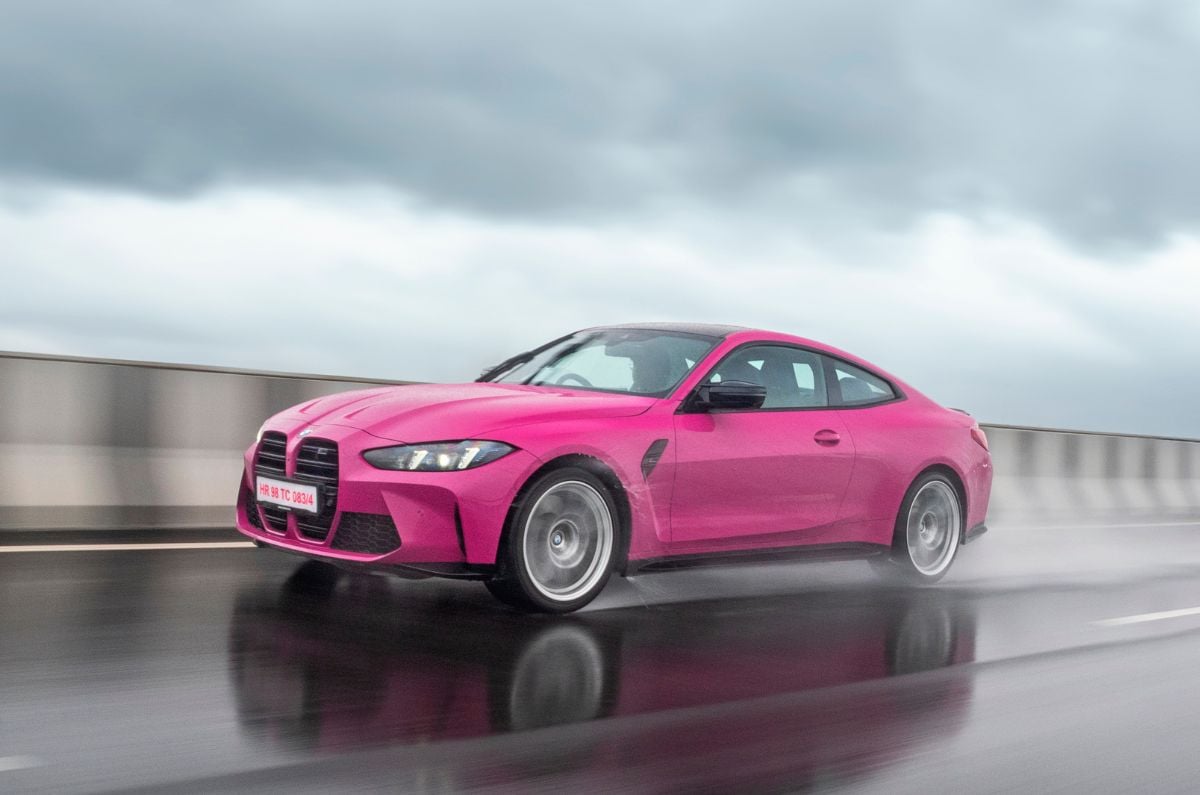
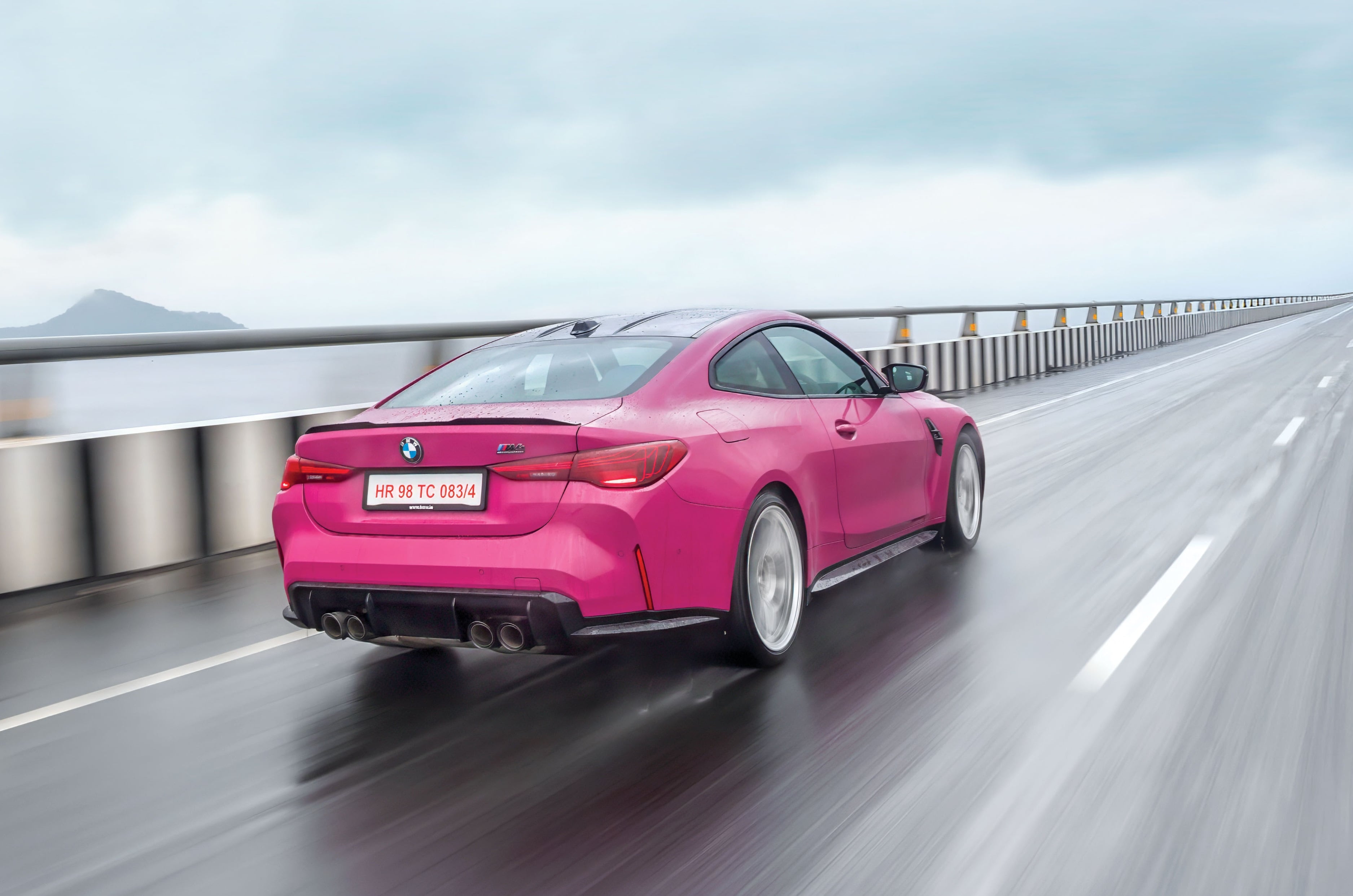
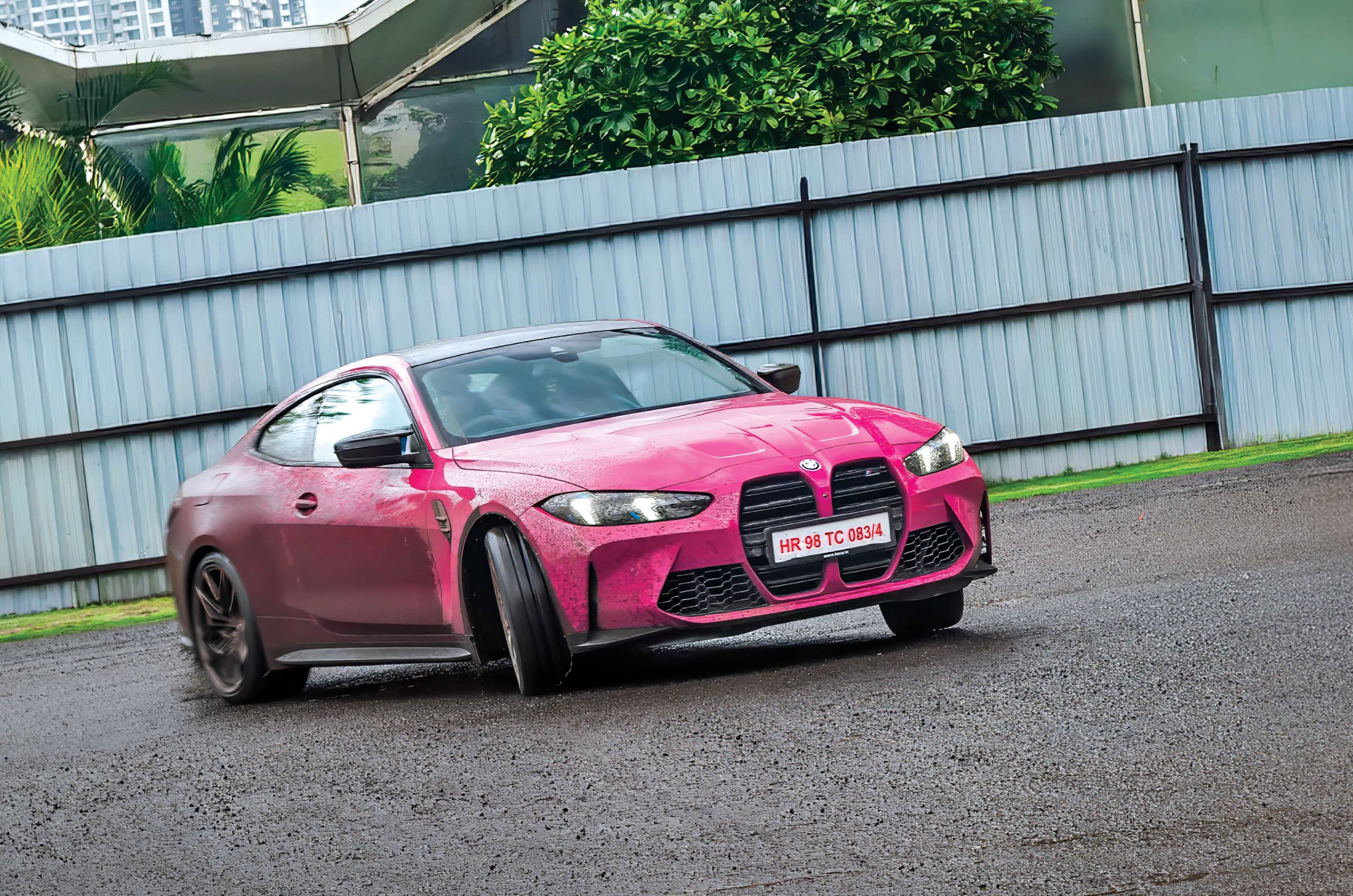
This G82-gen BMW M4 that you see has been on sale internationally since 2020, it came to India in 2022, and it even received a facelift (LCI or Life Cycle Impulse in BMW speak) a few years back. Yet, somehow, we never got a chance to drive it on Indian tarmac all these years. Now, however, we’ve finally spent some meaningful time with the BMW M4 Competition on home turf to see what it’s like.
BMW M4 Competition exterior design and engineering – 8/10
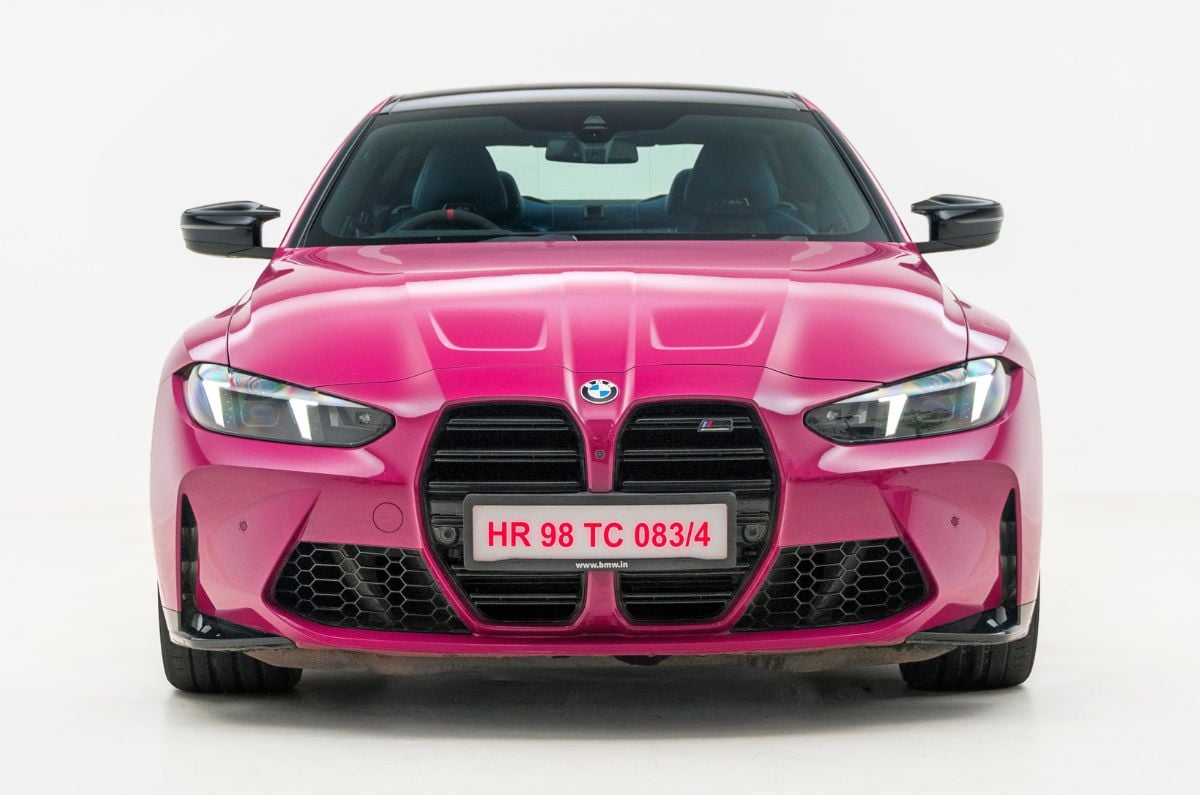
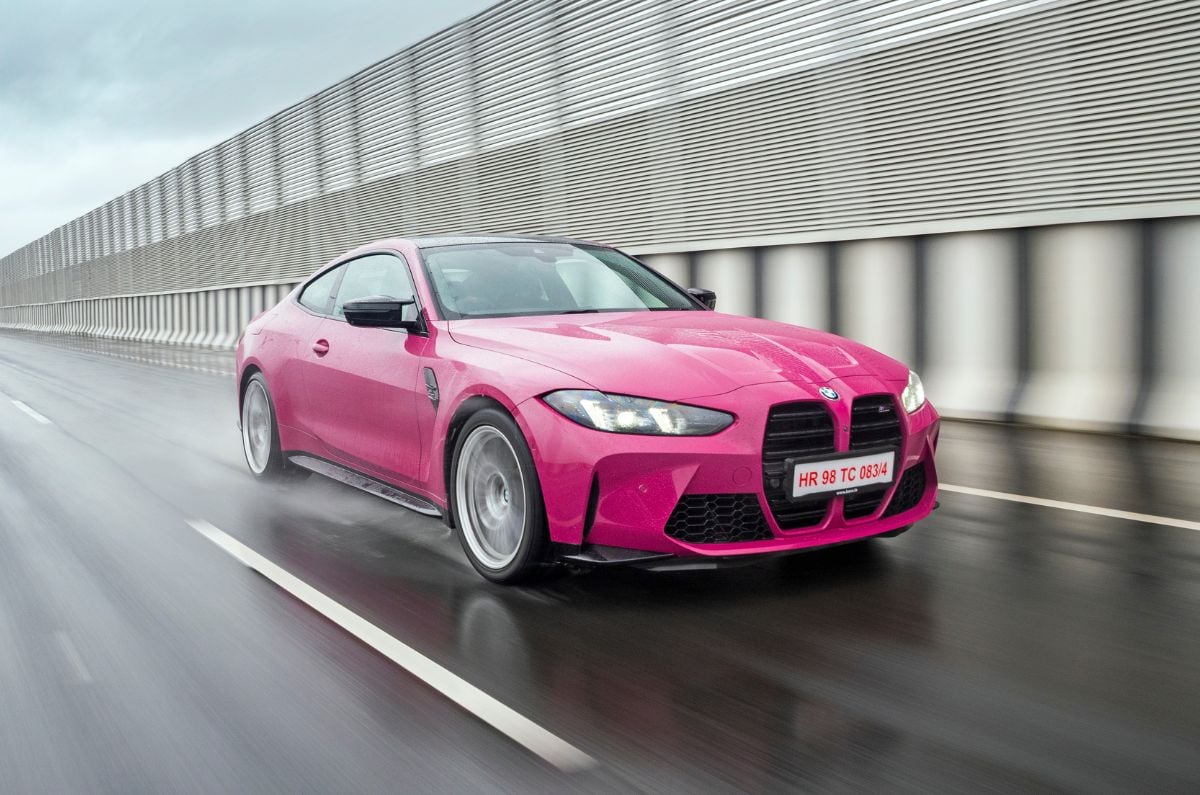
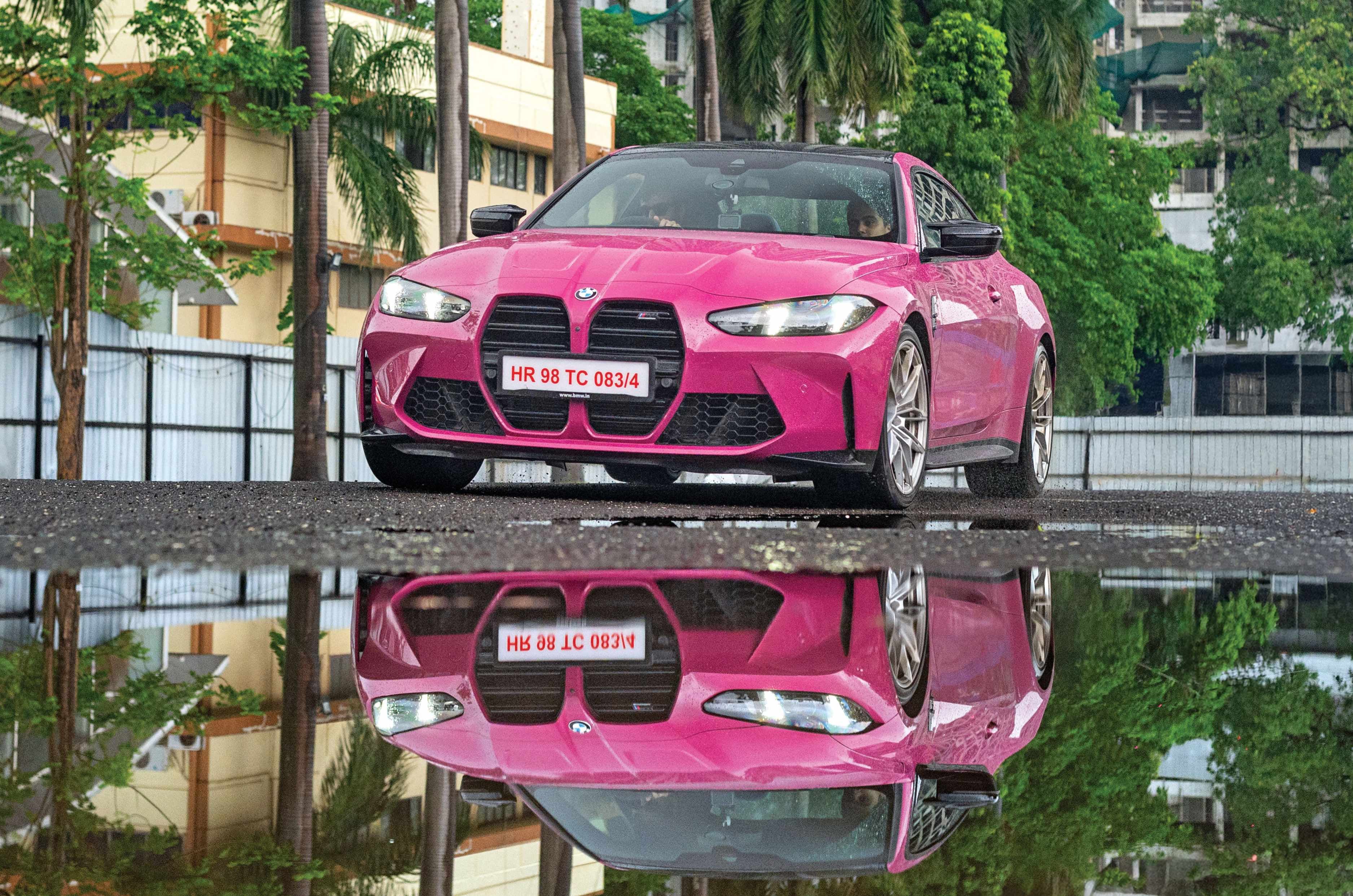
Whether you like it or not, the huge kidney grille gives it an imposing road presence.
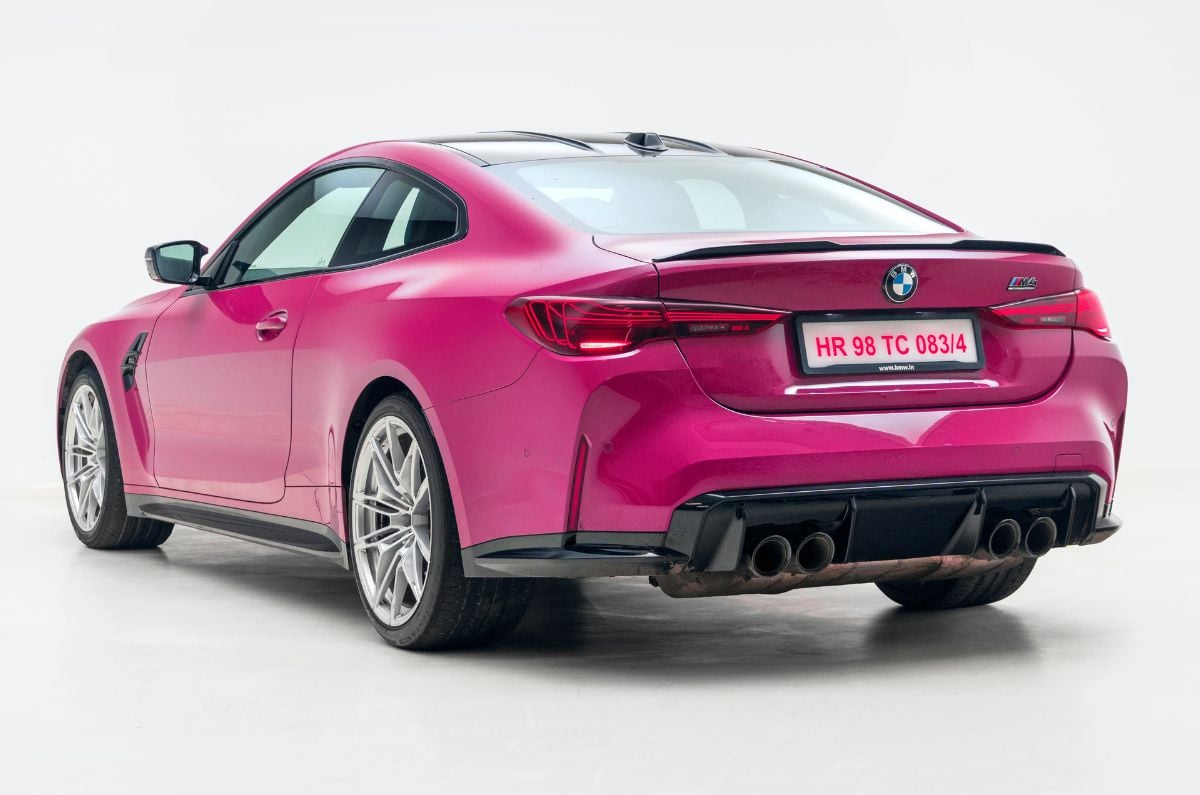
The BMW M4 Competition remains one of those cars that gets people talking before they’ve even heard it start. The enormous kidney grille is still the defining feature, and whether you like it or not, it gives the M4 a face that is impossible to mistake for anything else. The rest of the design is far more cohesive, with a long bonnet, heavily sculpted surfaces, flared wheel arches and a low, wide stance. At the rear, the quad exhausts, bootlip spoiler and prominent diffuser just add more drama to the design.
There’s serious engineering behind the visual drama, too. The M4 gets M-specific suspension hardware and aluminium suspension components, while the near-50:50 weight distribution helps give it the balance expected of an M car. And unlike all previous M3s and M4s, this one gets BMW’s M xDrive all-wheel-drive system, and it rides on staggered 19-inch front and 20-inch rear wheels.
Quad exhausts is an M signature and this LCI also gets beautifully detailed Laser LED taillights.
At 4,801mm long and 1,887mm wide, it’s a substantial car, and at 1,850kg, it’s certainly not light. But BMW has worked hard to keep the mass low and central, like with the use of a carbon-fibre roof, for example.
BMW M4 Competition interior space and comfort – 8/10
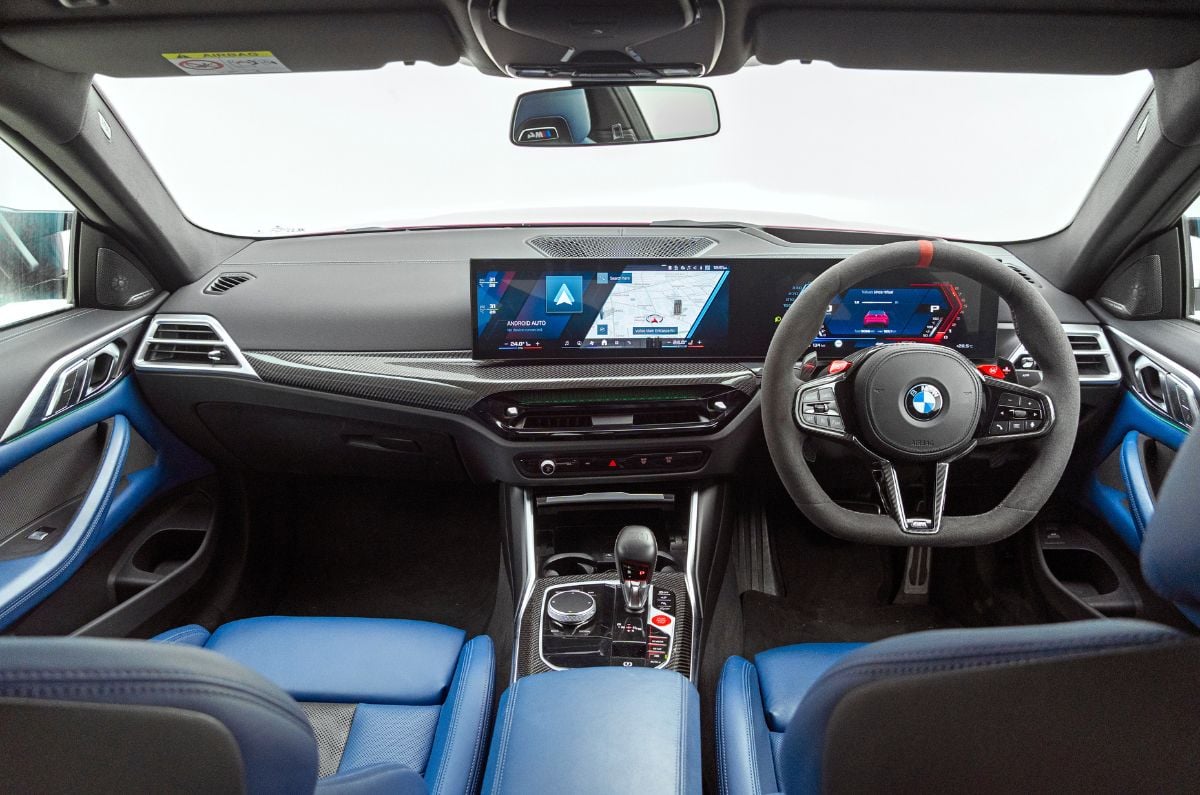
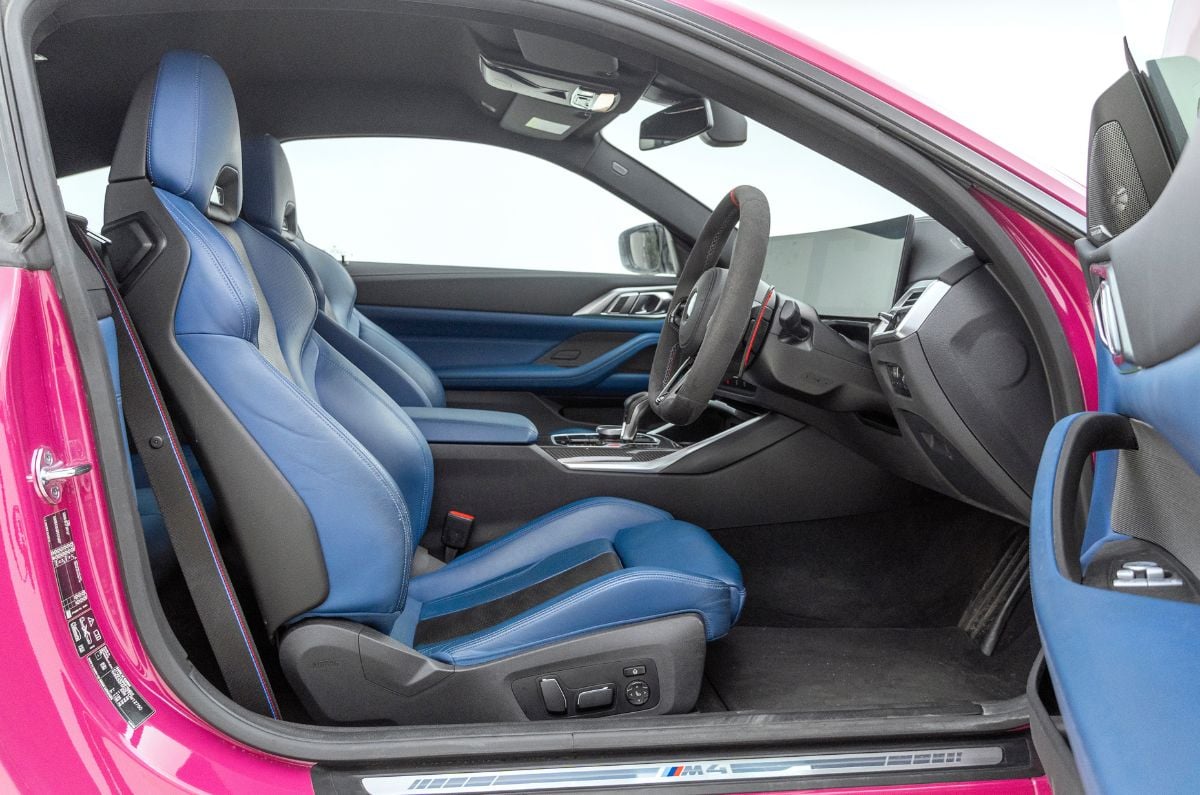
High-quality, driver-focused cabin is a mix of leather, carbon fibre and Alcantara.
The M4’s cabin is a good example of how far modern M cars have moved from being purely performance machines. There’s plenty of everyday usability here, but the driving position still feels special. You sit low, the steering wheel is perfectly positioned, and the large front seats are supportive and comfortable, and hold you securely when you start driving enthusiastically.
The dashboard follows BMW’s familiar layout, dominated by the curved display, while M-specific details like carbon-fibre trim throughout, M colours on the seatbelts and the red M1 and M2 buttons give the cabin enough visual distinction.
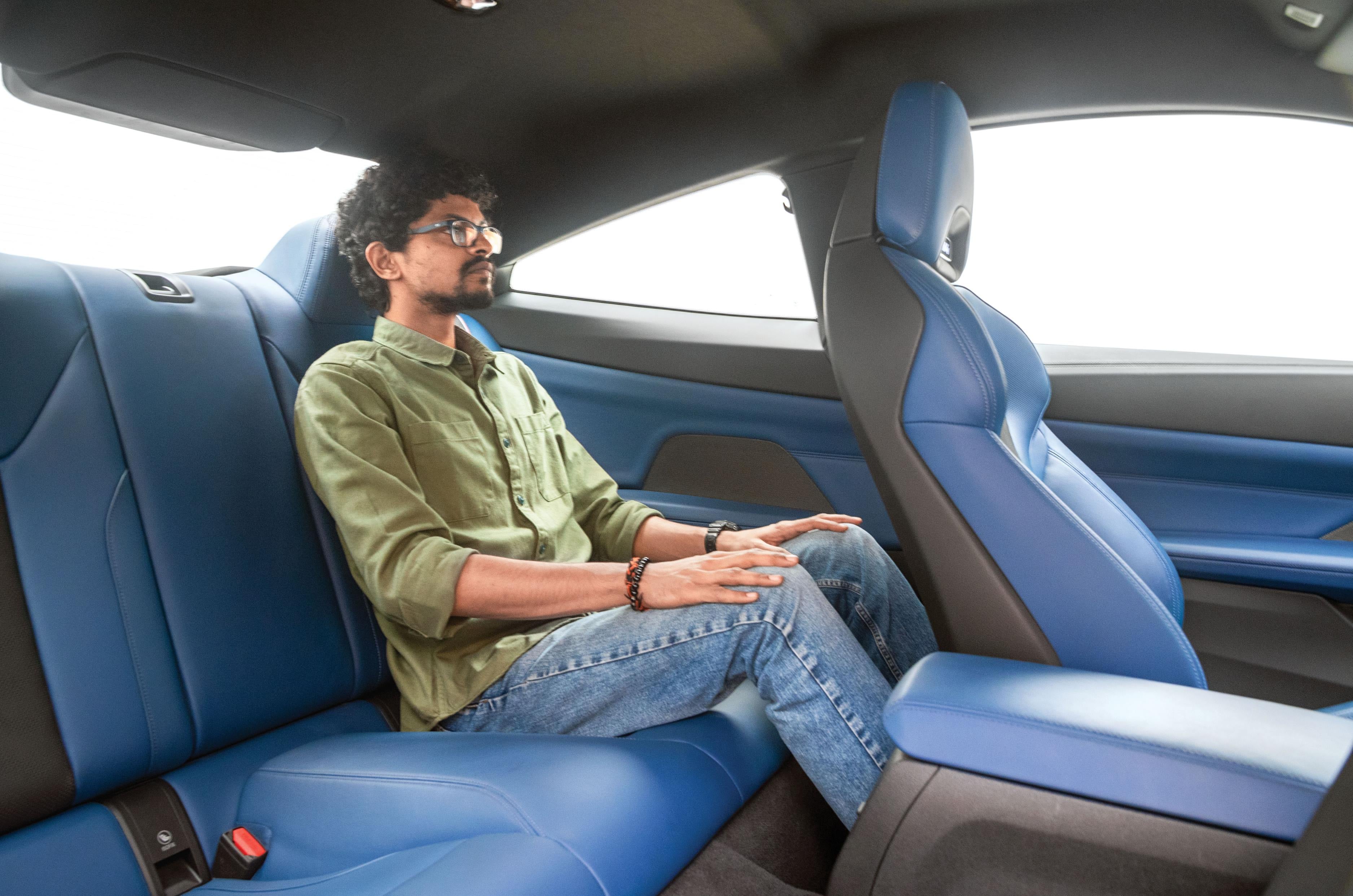
Access to the rear is tricky, though it’s a reasonably spacious place to be.
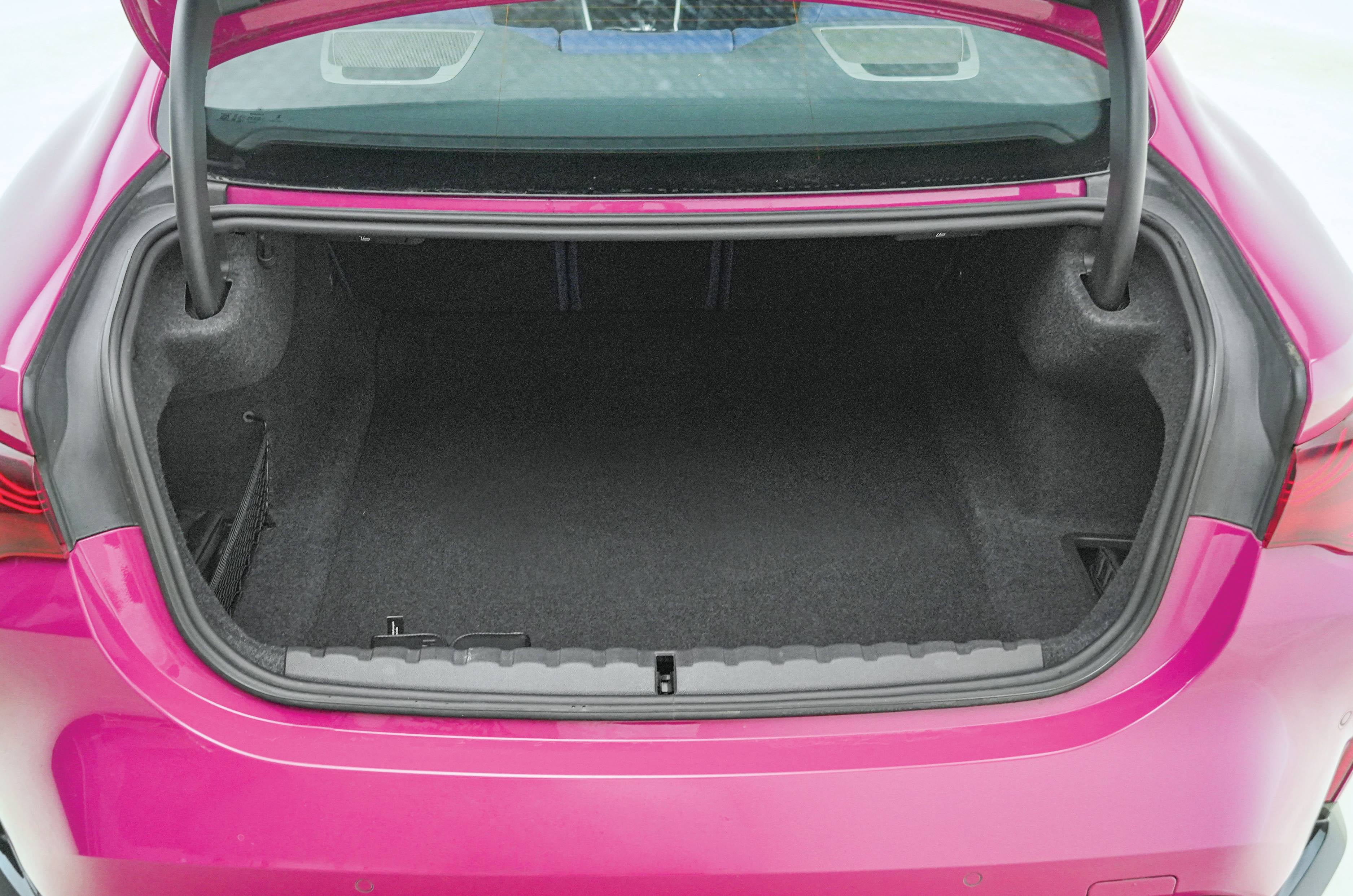
The coupe body does limit rear-seat access and space, but the back seats are still surprisingly usable, and not merely for show. There’s also a 440-litre boot, which means the M4 can manage luggage for a weekend away without too much hassle. That combination of usable cabin room and decent boot space is one of the car’s biggest strengths; very few cars with this level of performance are this practical.
440-litre boot can easily swallow up your luggage for the weekend.
It’s also relatively easy to live with in everyday conditions. The visibility is manageable, the controls are familiar and, at low speeds, the M4 is far more relaxed than its appearance suggests.
BMW M4 Competition features and safety – 8/10
The M4 Competition gets the technology expected of a modern BMW, but the really interesting equipment is the hardware and software designed to make its performance accessible.
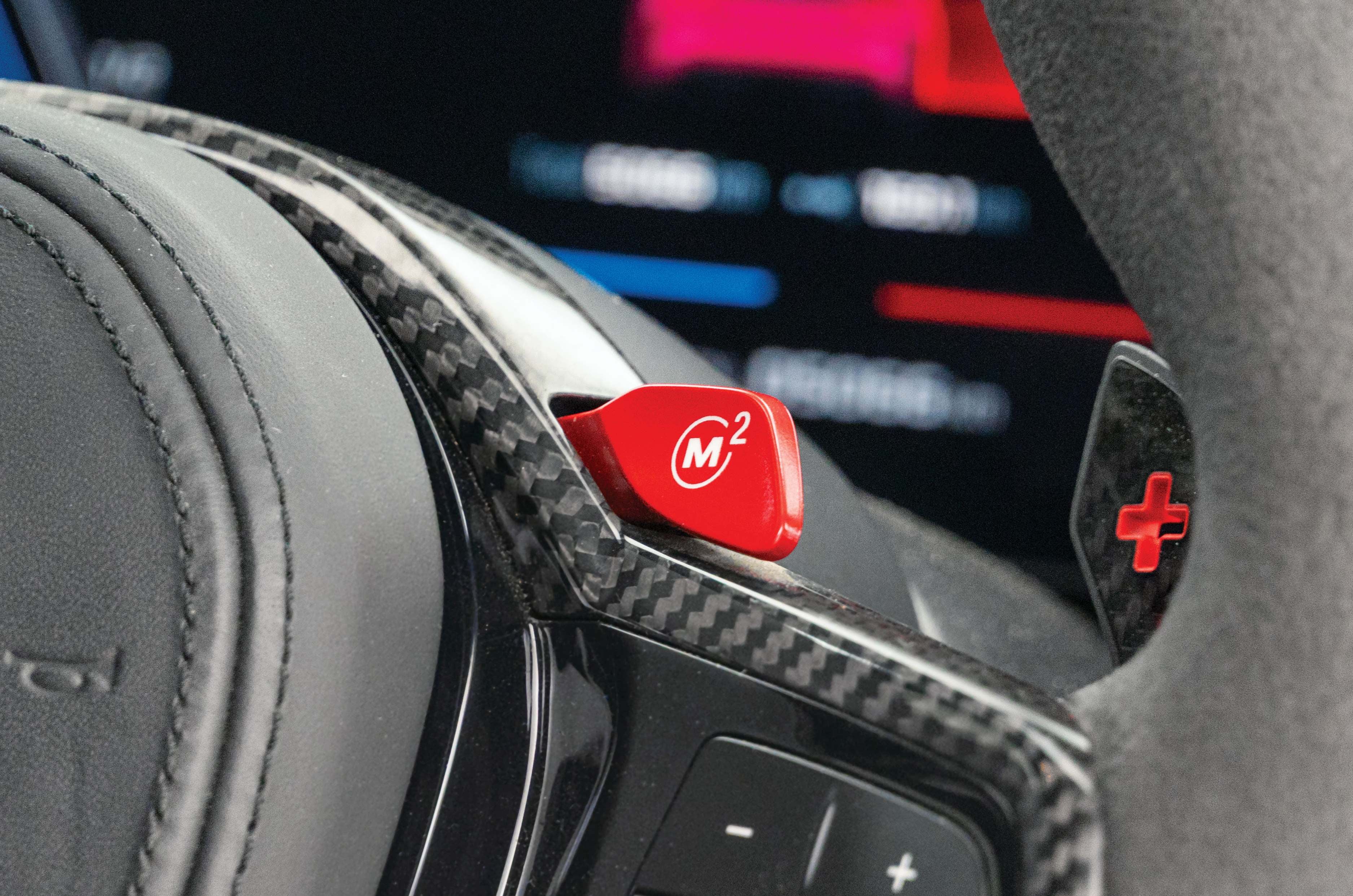
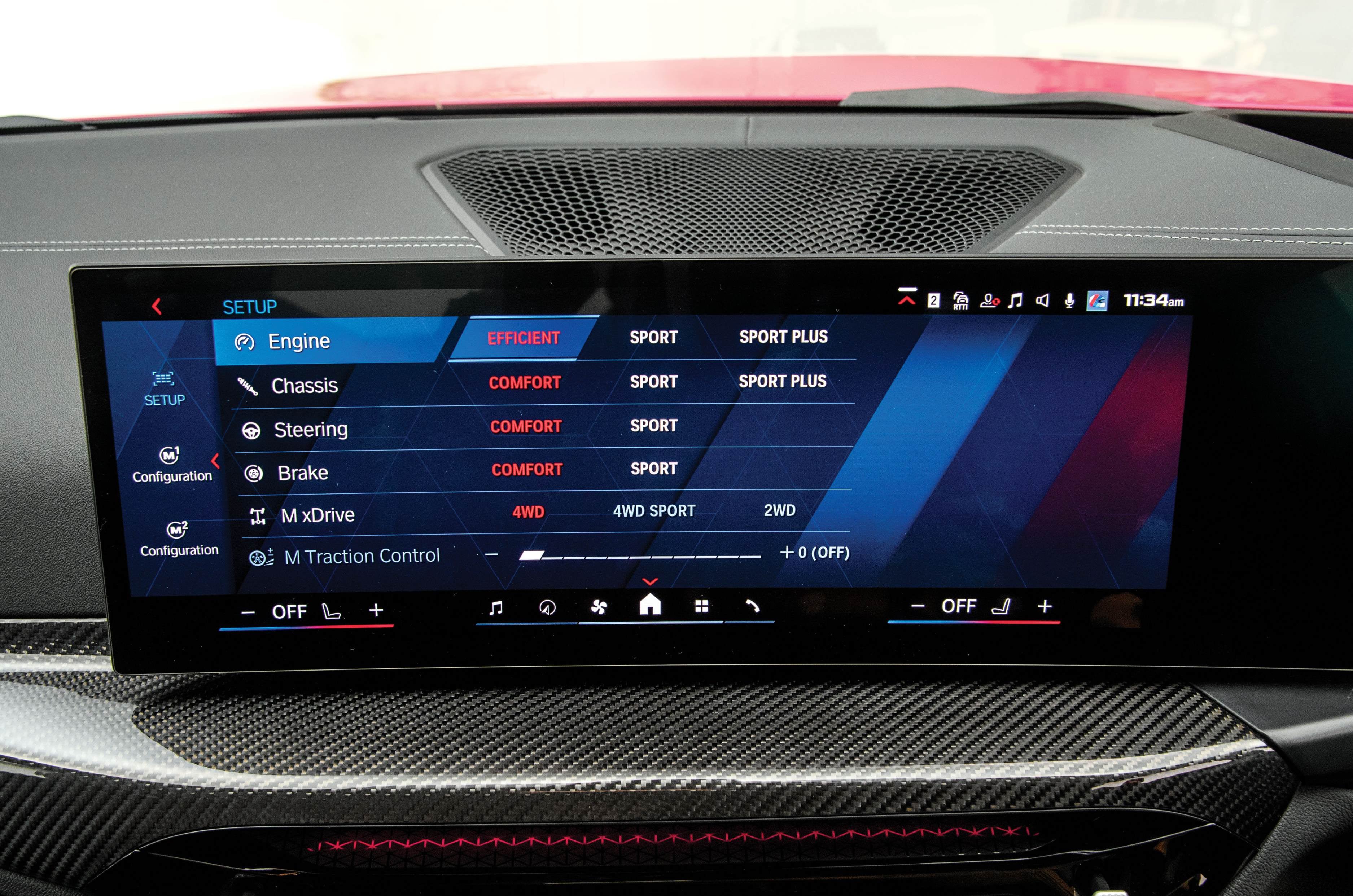
M1 and M2 buttons are shortcuts for your preferred, pre-selected drive settings.
The adaptive M suspension can be adjusted through Comfort, Sport and Sport Plus settings, allowing the car to switch between everyday usability and sharper responses. M Drive lets you save preferred combinations of chassis, steering, engine and transmission settings, and these preferred settings can be designated to the M1 and M2 buttons on the chunky steering wheel.
Then there’s the more serious performance tech. The M4 gets a selectable rear-wheel-drive mode, which essentially allows you to turn the all-wheel-drive M4 into a rear-driven machine, while the M Drift Analyser adds another layer of entertainment for those inclined to explore the car’s limits in a controlled environment. While it’s nice to have this level of customisation, some may find configuring it a bit too confusing and overwhelming.
The screen is crisp, but navigating through the sub-menus gets confusing.
And that’s the case with the touchscreen as well. It’s super-crisp, slick to the touch and has M-coloured themes, which look quite cool, but the myriad apps and sub-menus are confusing to operate, to say the least. And that problem is amplified when you’re trying to make adjustments on the move.
Front seats are large, supportive and feature ventilation too.
There’s a three-zone climate control, powered and ventilated front seats, a HUD, a Harman/Kardon sound system, wireless smartphone integration, a wireless charger, a curved display, and so much more. So, the M4 isn’t lacking in the areas that matter for everyday use.
As for safety, there are multiple airbags, ADAS tech, stability and braking systems and electronic assistance systems working in the background, although in a car like this, it’s the multiple drive modes and traction systems that are arguably the more important features.
BMW M4 Competition powertrain and performance – 9/10
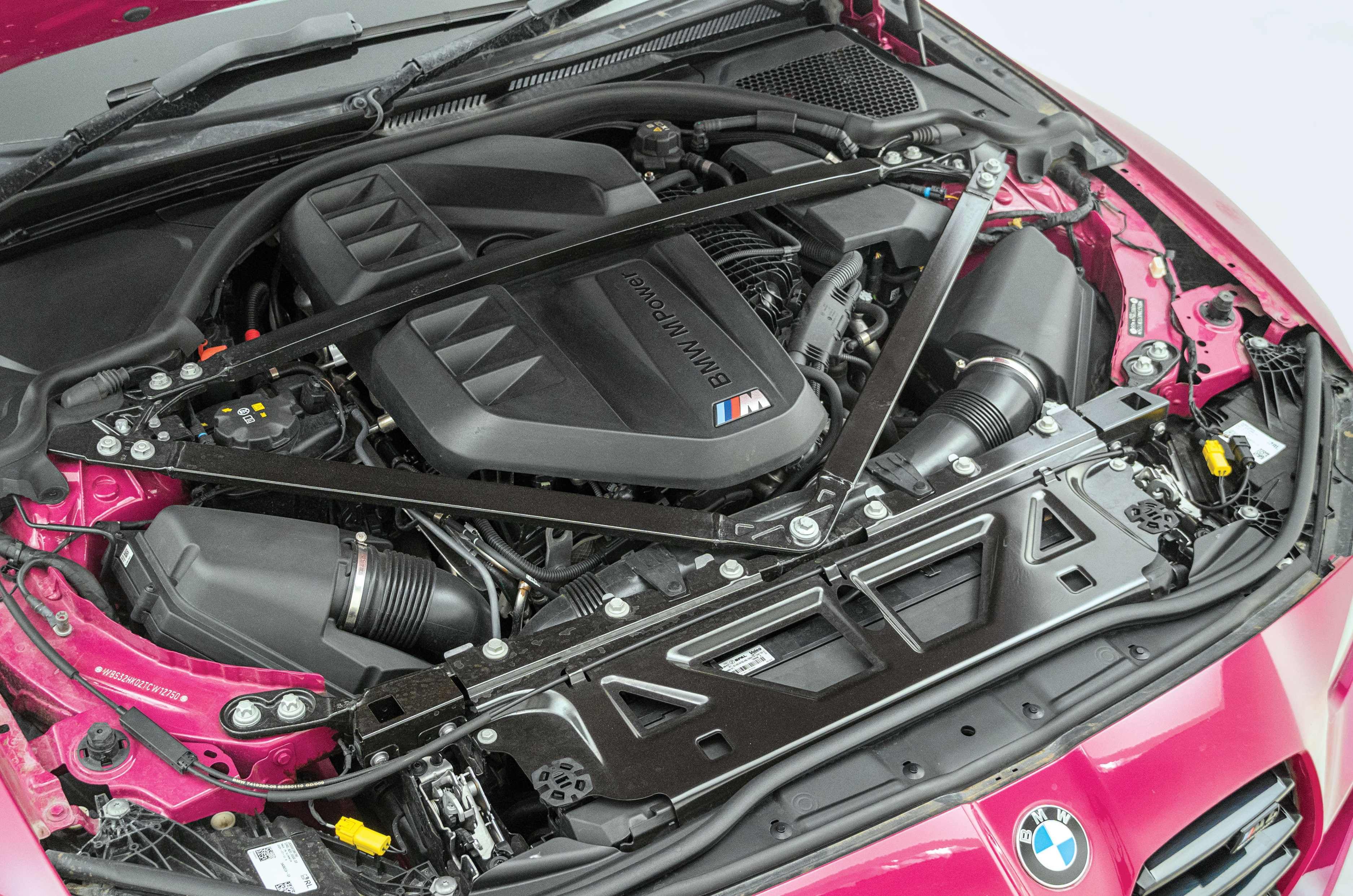
530hp, twin-turbo, straight-six pulls relentlessly and sounds good too.
The M4 Competition’s 3.0-litre twin-turbocharged S58 straight-six is the real star of the show, however. In this form, it develops 530hp and 650Nm and sends power through an 8-speed torque converter automatic to all four wheels, and BMW claims 0-100kph in 3.5sec.
What makes the engine so impressive isn’t just the numbers, but the way it delivers them. There’s almost none of the old-fashioned turbo lag here. Instead, power builds in an almost naturally aspirated fashion, with the engine pulling strongly through the rev range. It’s linear, responsive and keeps pulling hard all the way till the redline.
Be it drifting or touring, the M4 is up for both.
The gearbox is smooth when left to its own devices and can be calibrated to shift much more aggressively when you start driving harder. It can occasionally feel less urgent than you might expect, especially in comparison to the last-gen M4’s DCT, but the sheer performance of the engine means there’s never any shortage of pulling power.
The all-wheel-drive setup also makes it devastatingly effective when you have the space to exploit it, and it doesn’t scare you like the older rear-wheel-drive M4. The best part is that it doesn’t feel like a car that needs to be driven at ten-tenths to be entertaining. More importantly, the M4 doesn’t compromise everyday usability simply because it is so performance-focused. Driven gently, the drivetrain can be remarkably civilised.
The ride is compliant enough to make long distance travel feasible.
There’s also a pleasing authenticity to the engine note. It may not have the theatrical soundtrack of some older M cars, but the straight-six’s sound is sufficiently characterful without relying heavily on artificial enhancement.
BMW M4 Competition fuel efficiency – 6/10
Fuel economy, expectedly, isn’t the M4’s strongest suit, but the 59-litre fuel tank gives it enough range to be usable as a long-distance car, although enthusiastic driving will inevitably bring that figure down considerably.
BMW M4 Competition ride comfort and handling – 8/10
At city speeds, the M4 can be surprisingly subdued. The steering is light, and there’s little indication of the aggression that lies underneath. The ride, though, even with the adaptive dampers set to Comfort, is firm, and sharp bumps do filter through to the cabin.
What’s impressive is how effectively BMW disguises the M4’s 1,850kg mass. It is a heavy car, but it rarely feels unwieldy when you’re attacking a sequence of corners. There is a bit of understeer, but there’s virtually no body roll, making it feel agile. The M4’s grip is immense, and the xDrive system allows you to put down its considerable power remarkably effectively. Yet, it isn’t simply a point-and-shoot machine. The adjustable traction control and rear-wheel-drive mode (or even the semi-lenient ‘AWD Sport’ mode) allow considerably more freedom, revealing the car’s playful side that isn’t immediately apparent in normal driving.
Rear wheel drive mode and adjustable traction settings allow for some proper tail out fun.
The electric power steering isn’t as feelsome as the hydraulic-steering M cars of old, but the accuracy is excellent. The M4 goes precisely where you point it, and the chassis remains composed even when you begin to carry serious speed. It’s decently capable at dealing with speed breakers too, as long as you take them slow and the large ones at an angle. Road noise, however, does become apparent at higher speeds over concrete surfaces.
The M4 really has a dual personality. Around town, it can be relaxed and relatively easy to live with; on an open road, it becomes seriously fast and agile. The ride is not plush or comfy, but it is compliant enough to make long-distance driving feasible.
BMW M4 Competition value for money and verdict – 8/10
As far as fast, versatile coupes go, there’s few better than the M4 Competition.
At Rs 1.60 crore (ex-showroom, before options), the M4 Competition is a difficult car to categorise, with no real direct rivals, and that is precisely why it works so well. It has the performance to keep up with exotic sports cars, yet it retains usable rear seats, a decent boot, and it is easy enough to be driven every day.
The polarising styling remains subjective, the ride quality is stiff and the infotainment interface is unintuitive. But once you find an open road, those shortcomings simply melt away. What you’re left with is a very capable all-rounder. The 530hp straight-six provides devastating performance without being difficult to manage, the all-wheel-drive system provides great traction and a useful safety net, and it has enough adjustability to keep even the most experienced driver entertained. Fast, practical, hugely capable and remarkably usable, that versatility is ultimately what makes the M4 Competition such a compelling performance car.
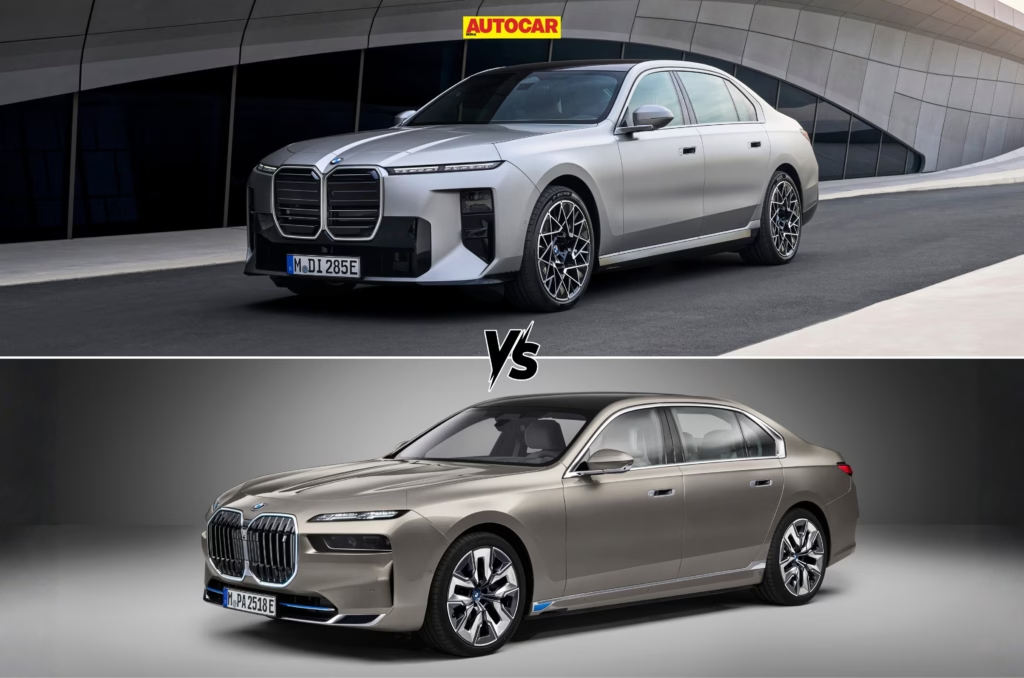
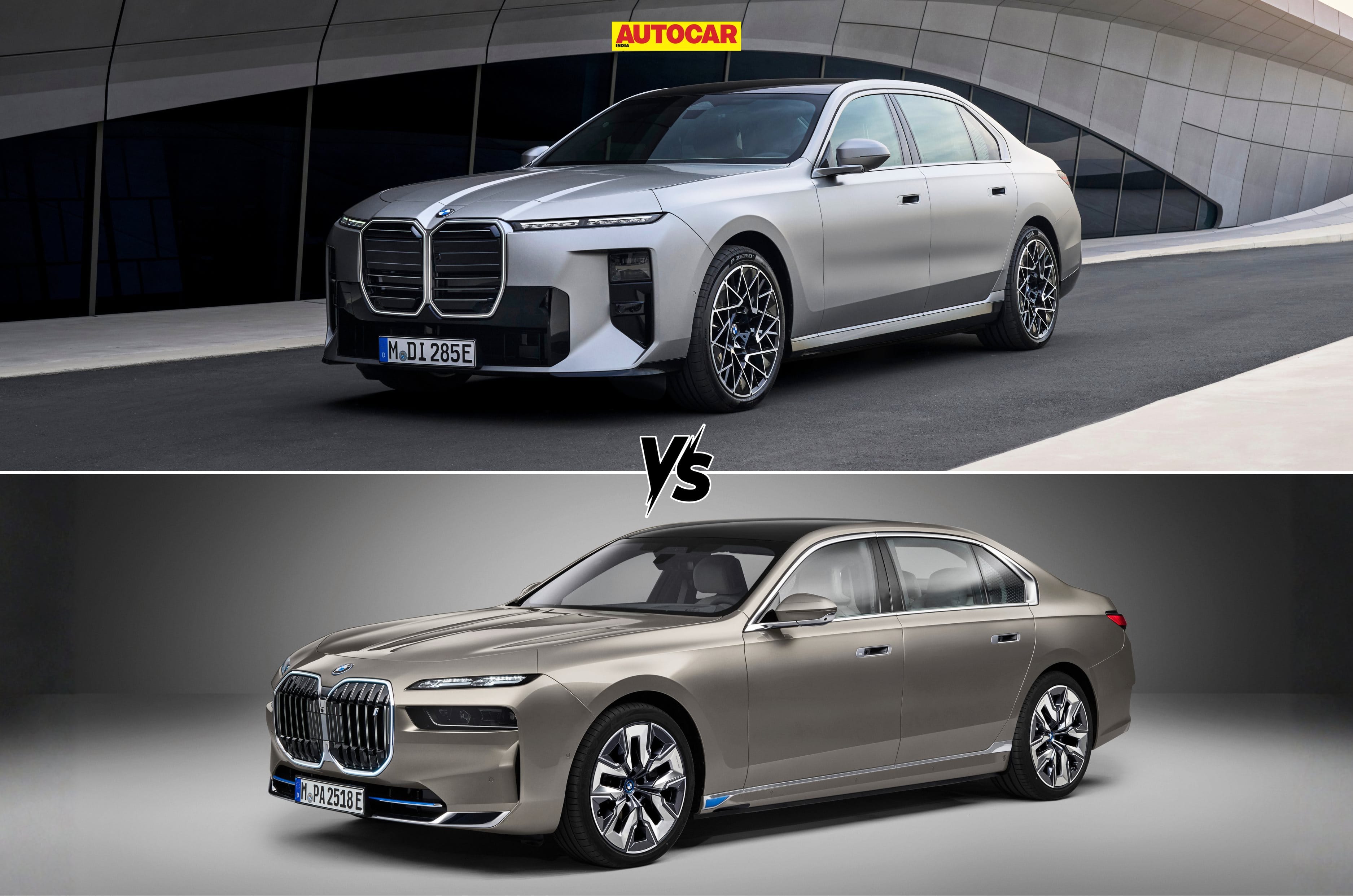
BMW has revealed the facelifted 7 Series, along with its electric counterpart, the i7. This mid-lifecycle update brings subtle changes to the exterior, but the bigger updates are inside, inspired by the brand’s latest Neue Klasse flair. There are also gains across powertrains, with improved outputs across the range. Here is a closer look at what has changed and how the updated BMW 7 Series compares with the outgoing model.
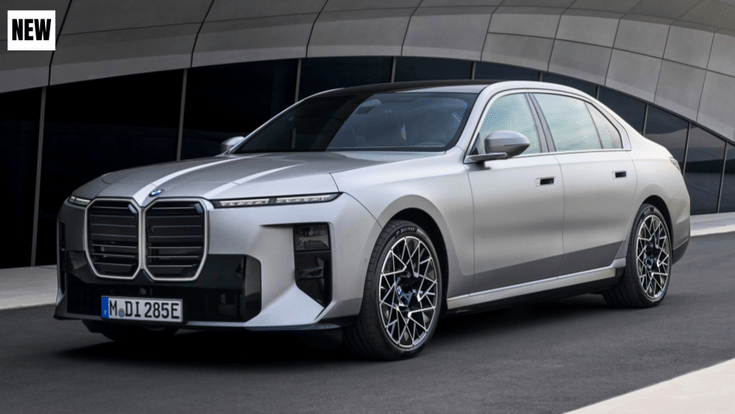
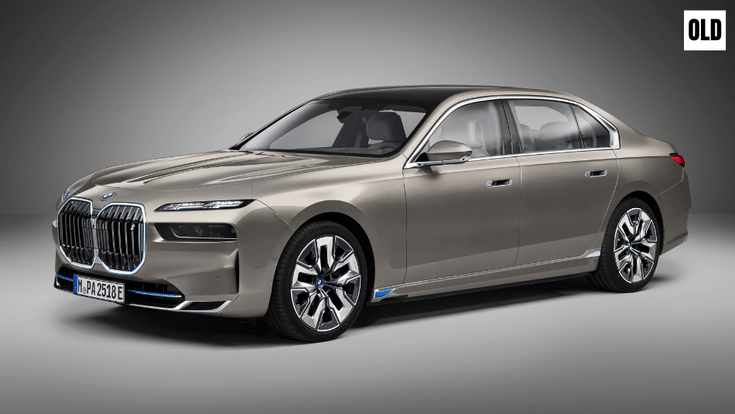
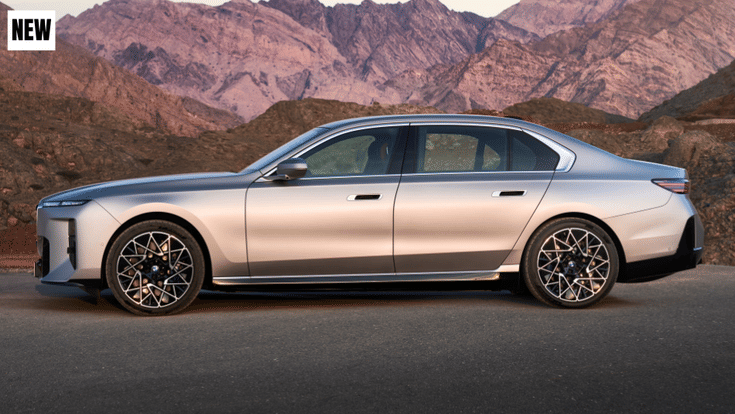
Disclaimer: The image sliders below feature global-spec BMW i7 models.
2026 BMW 7 Series vs old model: Exterior design
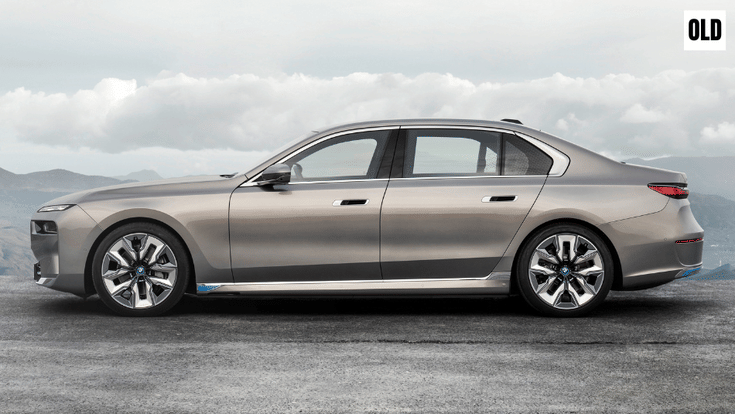
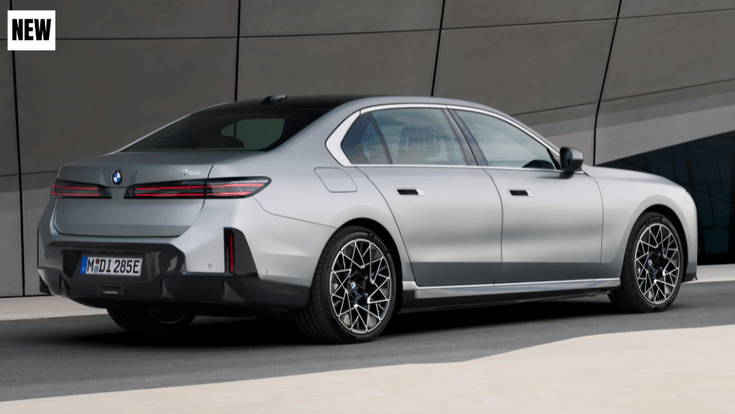
Unlike the predecessor that had the M-Sport package on certain variants, the 2026 7 Series gets it as standard. The facelifted 7 Series gets a much cleaner front end than the outgoing model. The biggest change is the updated illuminated kidney grille, which is now slimmer and more upright, and it also gets a new horizontal light graphic. While a split headlamp setup is carried over, the DRLs get a slimmer look, while the main headlamp units are now vertically stacked as opposed to the predecessor’s horizontal ones. The BMW badge on the bonnet is also new, larger, and finished in matte. BMW says the radar, camera, sensors, and washer nozzles are hidden inside the grille area, which helps keep the front uncluttered.
In profile, the facelift retains the clean and simple design. The door handles continue to be flush with the body, giving the surface a clean look. The trim around the handles is finished in Satin Aluminium, and the wheel design has been reworked. The B-pillar also has a visible embossed “7” when both doors on one side are opened.
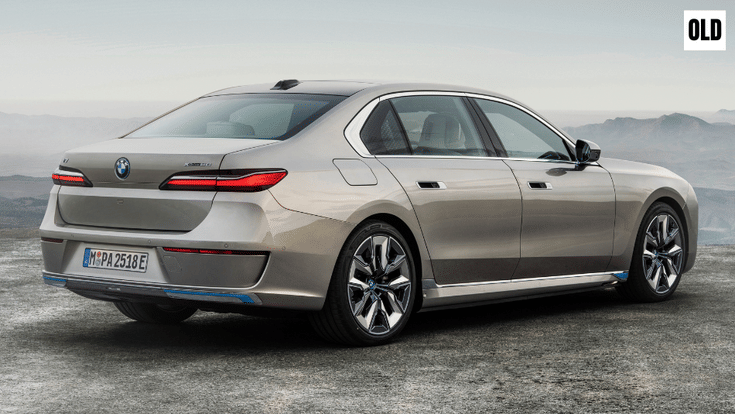
The rear gets new taillights, and this is one of the most obvious changes compared to the old model. They are slimmer, stretched further into the body, and give the car a wider look. BMW has also used chrome detailing inside the lamps and smoked glass for a darker finish. Like at the front, many of the technical bits, such as the boot release, rear camera, and washer nozzle, are tucked away. The rear bumper also gets a diffuser-like trim for a more modern look.
2026 BMW 7 Series vs old model: Interior and features
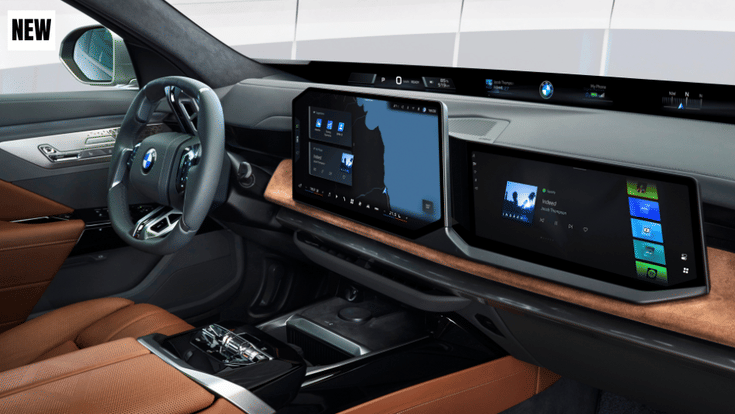
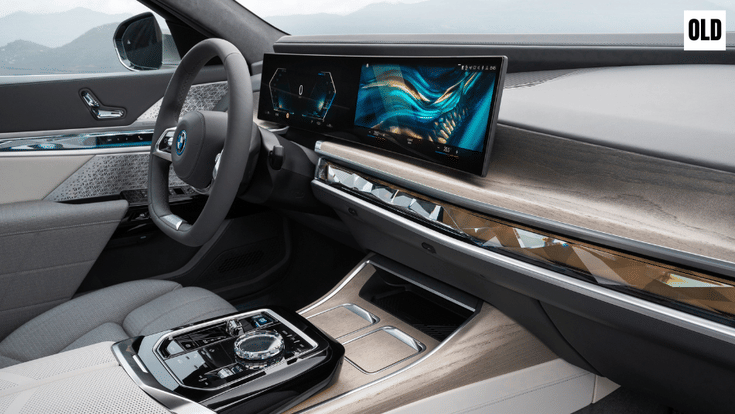
The facelifted 7 Series gets a 17.9-inch central touchscreen, a 14.6-inch front passenger display, and a projection across the full width of the windscreen’s base in contrast to its predecessor’s dual-screen setup. The touchscreen runs BMW’s Operating System X and supports over-the-air updates, wireless Apple CarPlay and Android Auto, and improved voice control. The four-spoke steering wheel is also new, inspired by classic BMW cars. The centre console has crystal-type controls for the engine start/stop button, gear selector, and volume control. There is also an illuminated cup holder and a smartphone tray with wireless charging.
The 2026 7 Series comes with a Bowers & Wilkins Diamond Surround Sound System as standard, 4D audio, and Dolby Atmos. The carmaker has added a new lighting setup inside the car. There is a full-width ambient light strip across the cabin, lighting elements behind the front seats, illuminated rear-door speaker covers, and extra reading lights in the back. The optional panoramic glass roof also gets LED lighting with a graphic pattern. As per BMW, the lighting changes with the selected driving mode.
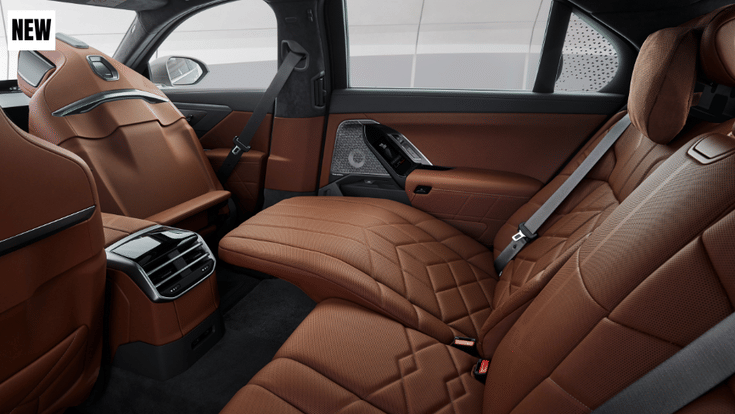
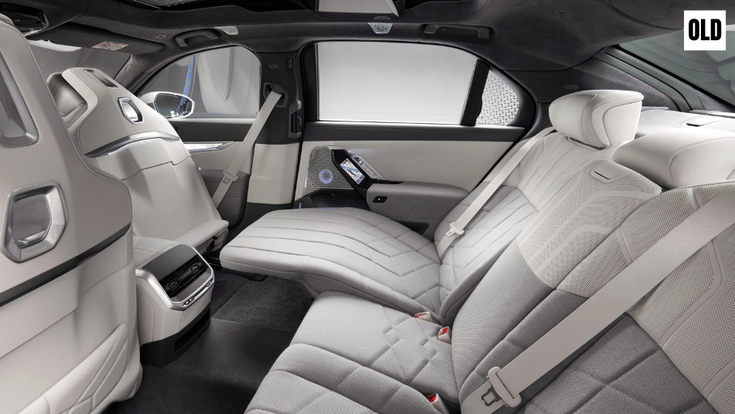
As for interior trim choices, the regular 7 Series models come standard with a fine oak wood trim and are available with either a black-and-brown or black-and-white theme with leather-upholstered seats. Other options include carbon-fiber and cashmere trims.
Standard seats come with electric adjustment, heating, massaging, armrest heating, lumbar support, and active ventilation. At the rear, BMW offers Executive Lounge Seating with a leg rest, a heated centre armrest and a more relaxed seating position. The front passenger seat can move fully forward to create more room for the rear passenger behind it. The rear gets a major update, too. The optional Theatre Screen is now a 31.3-inch 8K touchscreen and can be used for video calls, streaming, and gaming.
The rear doors get updated screens that let passengers move these units, change the viewing angle, and control other functions. The facelift also brings new automatic doors with better-placed open and close buttons. BMW says they work with a touch of the flush-fitting handles and can even be operated through the My BMW app or voice commands.
2026 BMW 7 Series facelift vs old model: Powertrains
7 Series petrol and diesel
7 Series old vs new: Powertrains
Variant
740i M Sport (old)
740 M Sport (new)
Engine
3L inline-6 + 48V
3L inline-6 + 48V
Power
381hp
400hp
Torque
520Nm
540Nm
Transmission
8AT
8AT
Drive layout
RWD
RWD
With the facelift, the ICE-powered 7 Series has dropped the diesel engine and is now a petrol-only model. The new 740 does without the ‘i’ suffix and now makes 400hp and 540Nm, which is up by 19hp and 20Nm over the outgoing car.
i7 EV
i7 old vs new: Powertrains
Variant
50 eDrive (old)
50 xDrive (new)
M70 xDrive (old)
M70 xDrive (new)
Battery
101.7kWh
112.4kWh
101.7kWh
112.4kWh
Motor power
449hp
455hp
650hp
680hp
Torque
650Nm
660Nm
1,015Nm
up to 1,100Nm
Drive layout
RWD
AWD
AWD
AWD
For the electric i7, the biggest change is at the entry point. The old rear-wheel-drive 50 eDrive is gone, and BMW now offers a 50 xDrive with all-wheel drive instead. That variant now gets a bigger 112.4kWh battery, up from 101.7kWh, while power has risen only slightly from 449hp to 455hp and torque has gone up by 10Nm to 660Nm. The M70 xDrive also gets a similar battery upgrade. Power has increased by 30hp, from 650hp to 680hp, while torque has climbed from 1,015Nm to up to 1,100Nm.
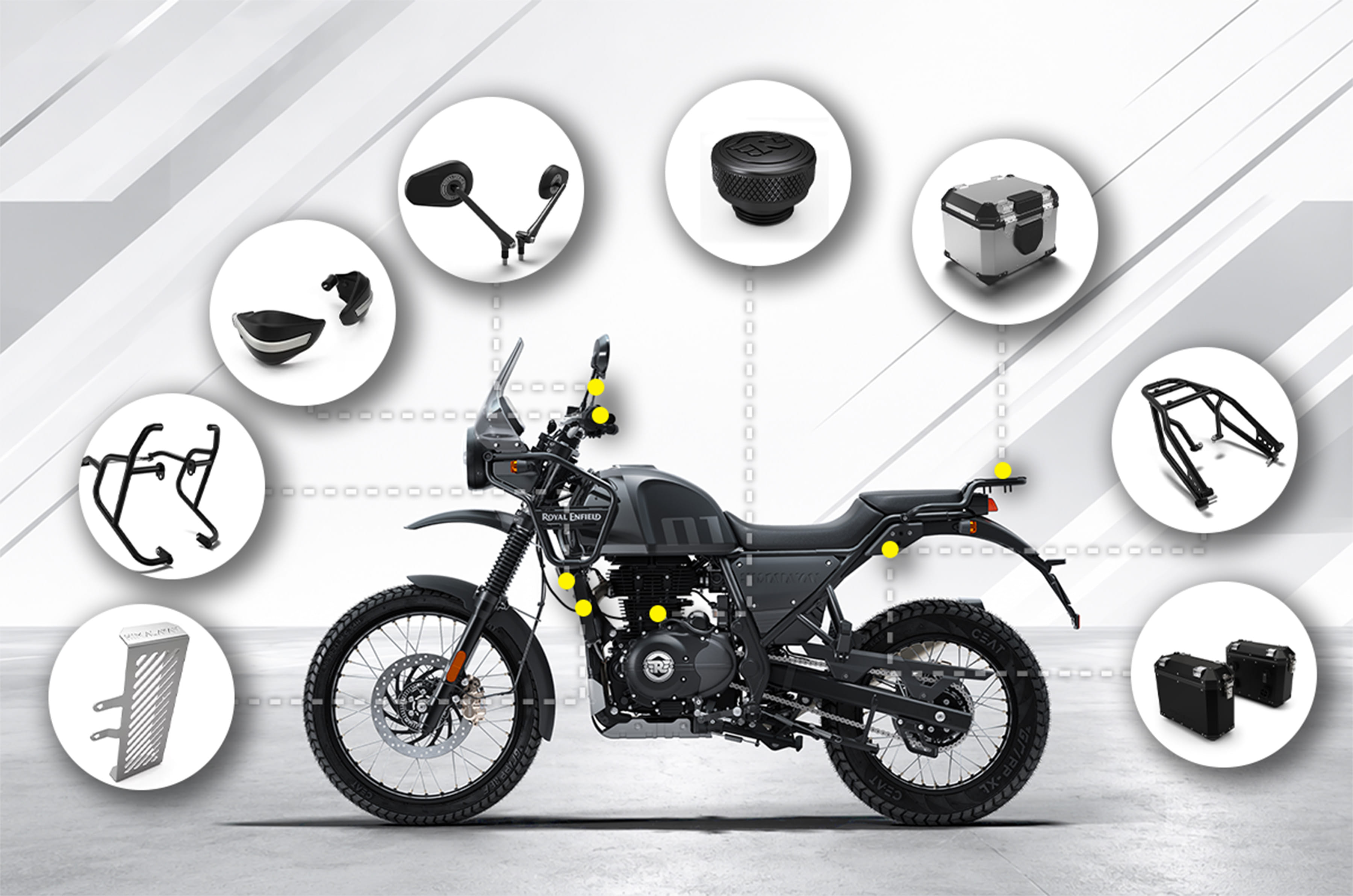
After launching the original air-oil/cooled Himalayan with an upsized 440cc engine at Rs 2.29 lakh, the brand has now revealed prices for the accessories of this adventure motorcycle and in typical Royal Enfield fashion – it’s quite an exhaustive accessory list.
The most affordable accessory is priced at Rs 1,010
Touring mirror is priced at Rs 4,500
A cumulative pricing of essential luggage carrying accessories comes up to Rs 62,070
Royal Enfield accessories list
Luggage carrying accessories
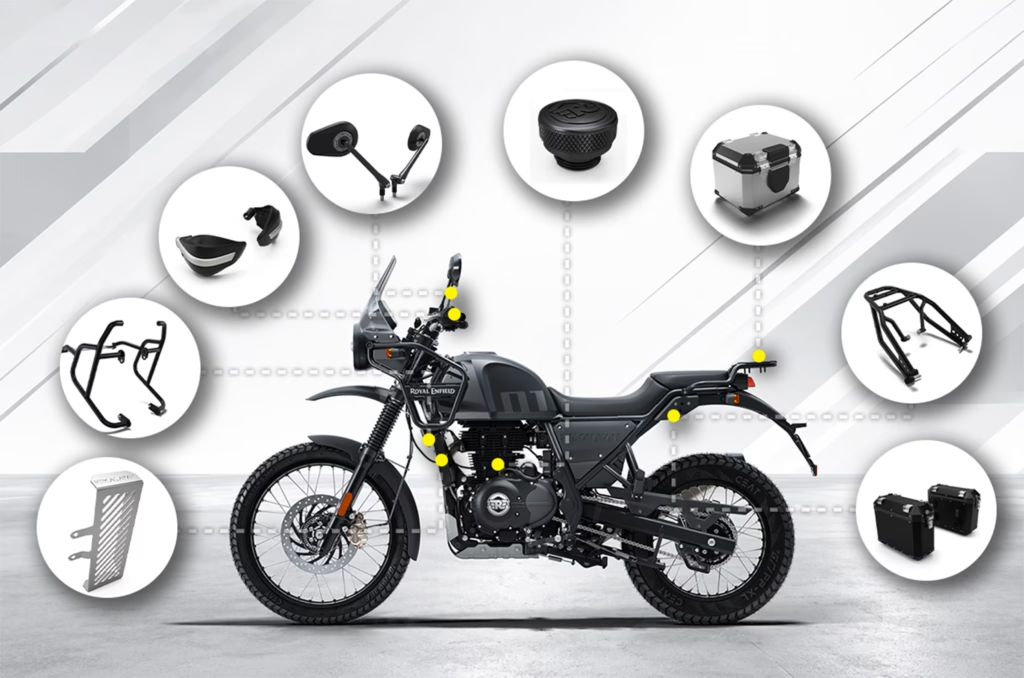
In most cases, a typical Himalayan owner aims to go the distance on this adventure motorcycle, and that generally requires carrying quite a lot of luggage. Royal Enfield offers a set of aluminium top boxes and panniers in silver and black. The former is priced at Rs 22,750, while the latter costs Rs 29,250.
In order to attach the pannier and top box, the bike requires a top-box rack and a side rack (Rs 3,750). The Himalayan comes standard with a top-box rack, but buyers can also opt for a more robust and larger top-box rack with additional plumbing to tether bungee cords. This is priced at Rs 3,900, while the top-box mount costs Rs 2,420.
The cumulative price of all the luggage-carrying accessories, including the robust top-box rack and pannier rack, adds up to around Rs 62,070.
Protective accessories
A tip-over on an adventure bike isn’t uncommon. After all, adventure riding involves taking your two-wheeler into uncharted territory. Protecting its components, and more importantly, the engine, is therefore important. Apart from the large, exaggerated aftermarket guards that the market is plagued with, Royal Enfield offers a few of its own. Thankfully, these are more utilitarian than ornate.
Starting with the most compact engine guard, this is one of the most discreet ways of protecting the engine. It attaches to the engine cover instead of jutting out like most guards do, and is priced at Rs 1,450. There’s another, larger engine guard (Rs 1,650) that juts out a bit more and will prevent the bike from dropping too low in the event of a fall.
Royal Enfield also offers an ‘Adventure’ engine guard that’s much larger and juts out quite a bit, offering more comprehensive protection. However, it looks visually bulky and will definitely add a few kilos to your Himalayan 450. It is priced at Rs 4,650.
Other protective accessories include an oil-cooler guard, available in two colours, priced at Rs 1,250. Royal Enfield also offers sliders (Rs 1,010), which are essentially 22mm tubes that can be fitted atop the guard, acting as the furthest point of contact. These can be easily replaced if scuffed, instead of having to replace the entire guard.
Convenience accessories
Stock Royal Enfield mirrors are notorious for coming loose over time. However, the touring mirrors are quite good and are available in two designs – round and tapered – priced at around Rs 4,500.
Another useful accessory is the touring rider and pillion seats, priced at Rs 1,995 and Rs 1,351, respectively.
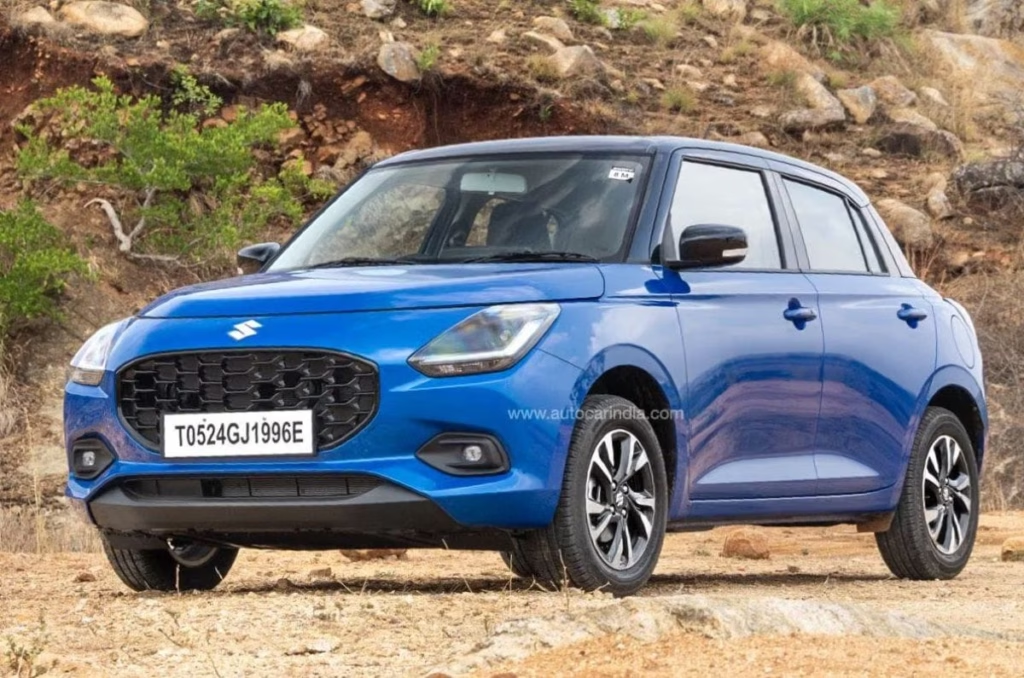
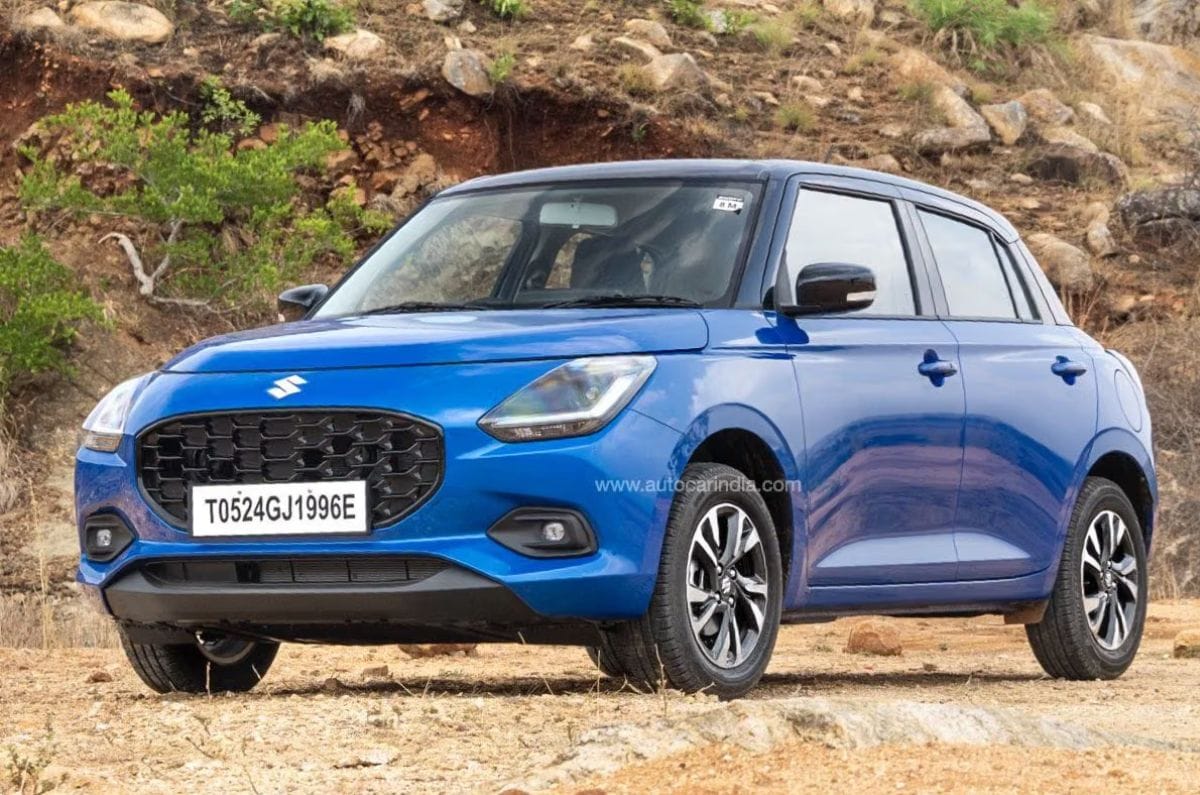
In a regulatory filing, Maruti Suzuki has announced that it will increase prices on selected vehicles by up to Rs 20,000, with the revision taking effect in September 2026. This will be the brand’s third price hike in this financial year, with the previous two having come in June and August, respectively.
Rising input costs cited as reason for hike
This is the third price hike from Maruti Suzuki this financial year
The move follows a period in which the company attempted to absorb rising costs internally through cost reduction measures. However, with inflationary pressures persisting, the company indicated it had reached a point where passing on a portion of those costs to the market became necessary. The filing noted that the increase being transferred to consumers represents only a part of the total cost burden absorbed by the company.
Input cost inflation has been a concern across India’s automotive sector for several years. Rising prices of raw materials such as steel and aluminium, combined with elevated commodity costs and currency movements that affect the price of imported components, have put pressure on vehicle manufacturers’ margins. Several automakers have responded with periodic price revisions, and Maruti Suzuki has followed this pattern on multiple occasions.
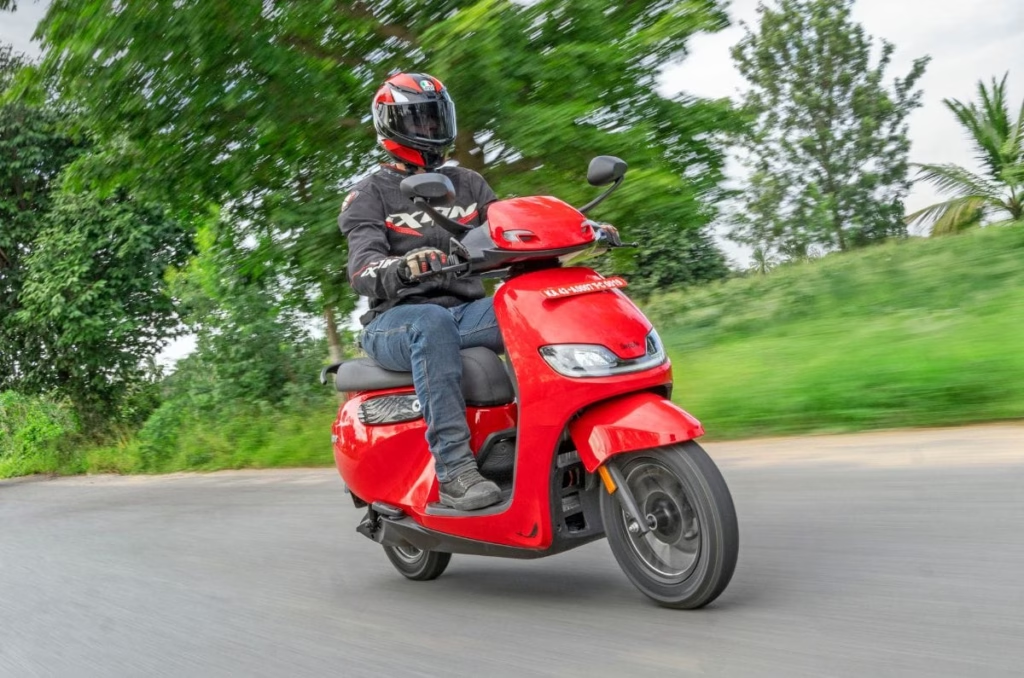
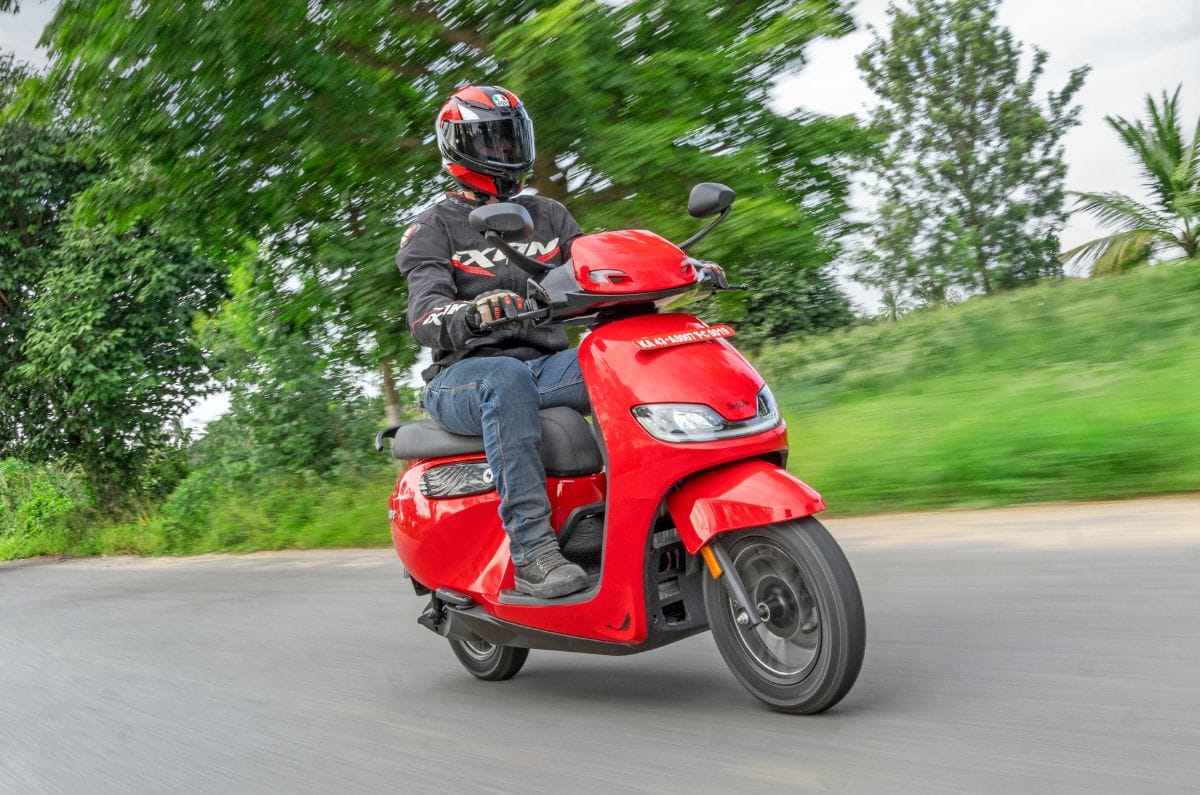
The Simple Wave is an interesting proposition in the increasingly crowded electric scooter space. Its rounded, smooth looks certainly grab attention and, as we found out, it is comfortable, spacious and offers brisk performance. There’s plenty to like here, so let’s dive right in.
Simple Wave Design and quality – 8/10
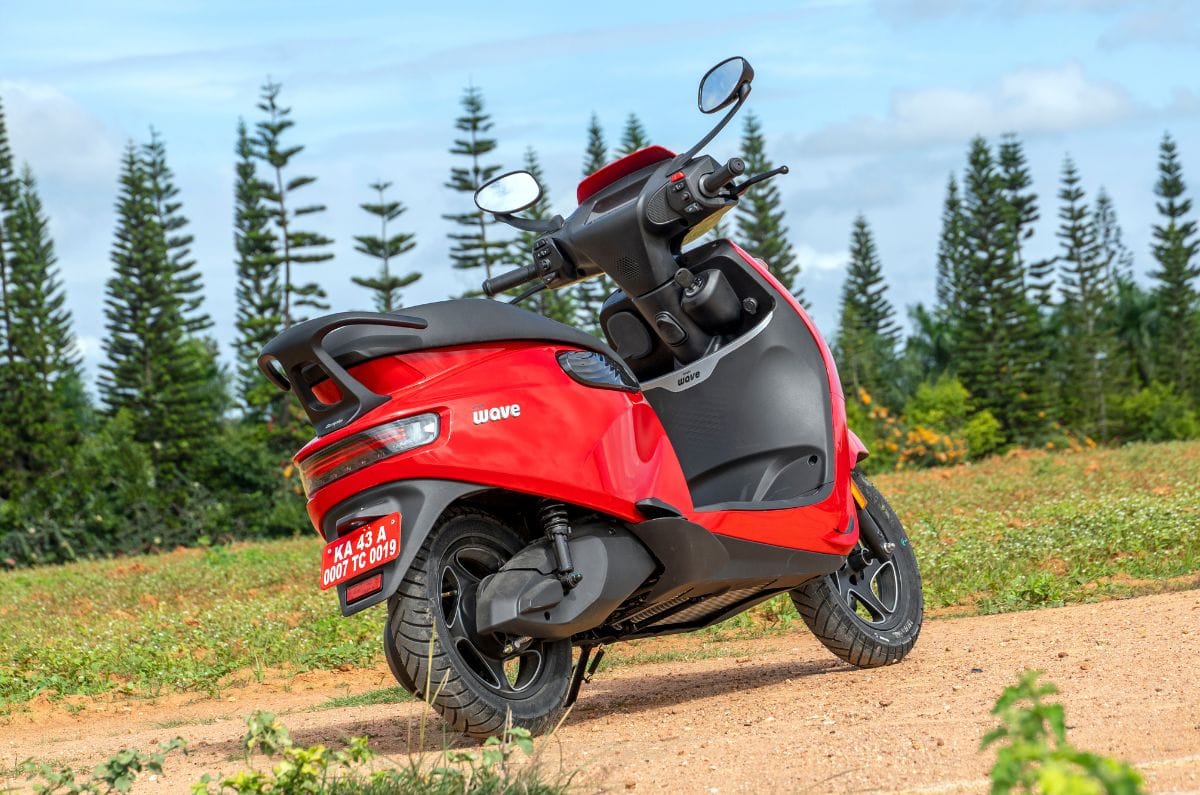
Looks unique and features many chassis changes over the One
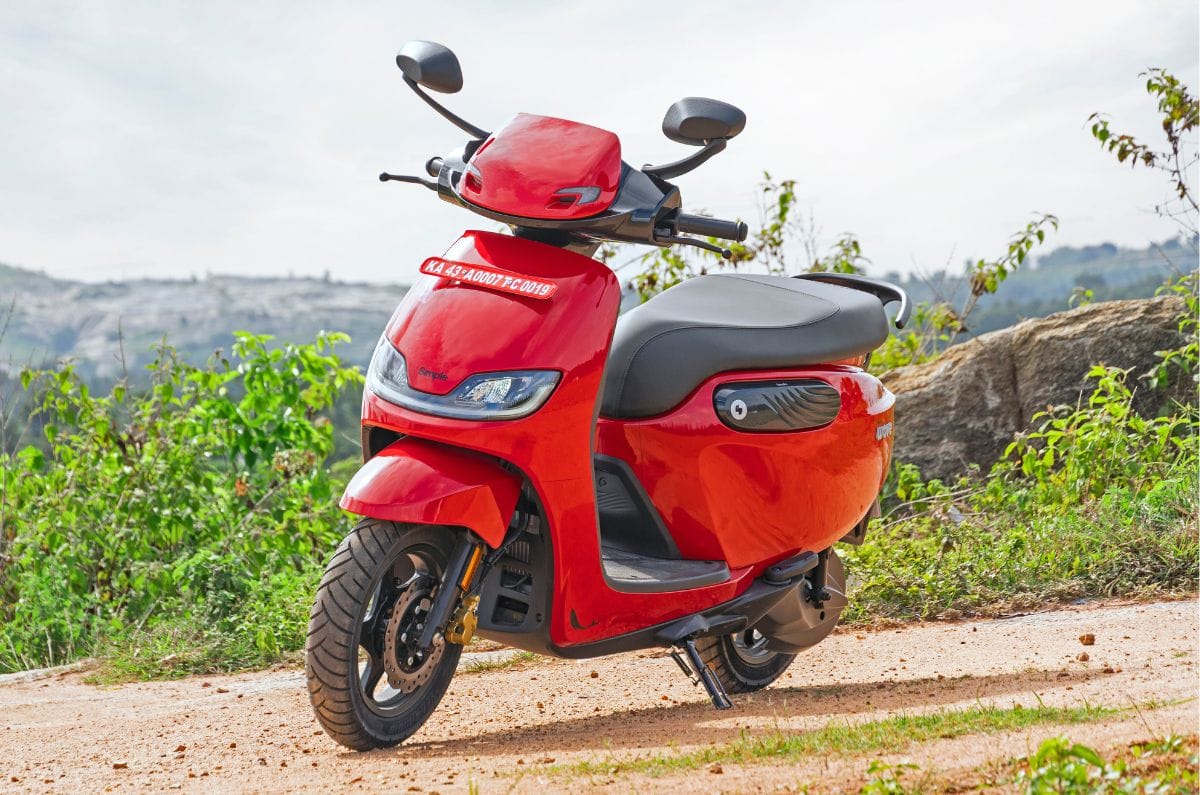
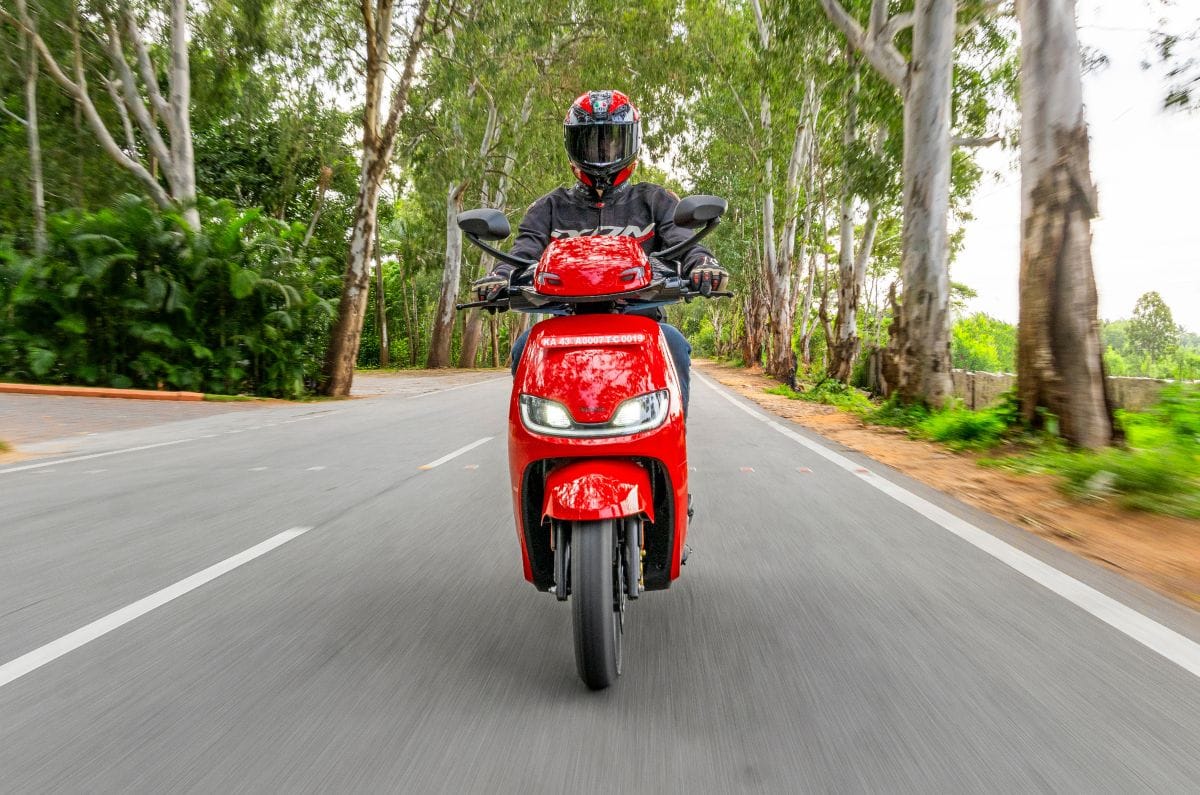
Design is subjective, of course, but the Wave looks good to my eyes with its smooth, rounded edges and distinctive silhouette. It’s got a good level of finish too, and the brighter colour options – red and blue – help it stand out. Simple has designed the Wave as a more accessible, family-oriented scooter, without making it look or feel built down to a cost.
It has a quirky design and surely stands out, especially in the brighter colour options.
Compared to the sporty Simple One, the Wave’s chassis is quite different. The rear subframe has been reworked to accommodate the bigger boot and twin shocks (which replace the One’s monoshock). The Wave also uses a simpler, more cost-effective tubular swingarm instead of the cast unit on the One.
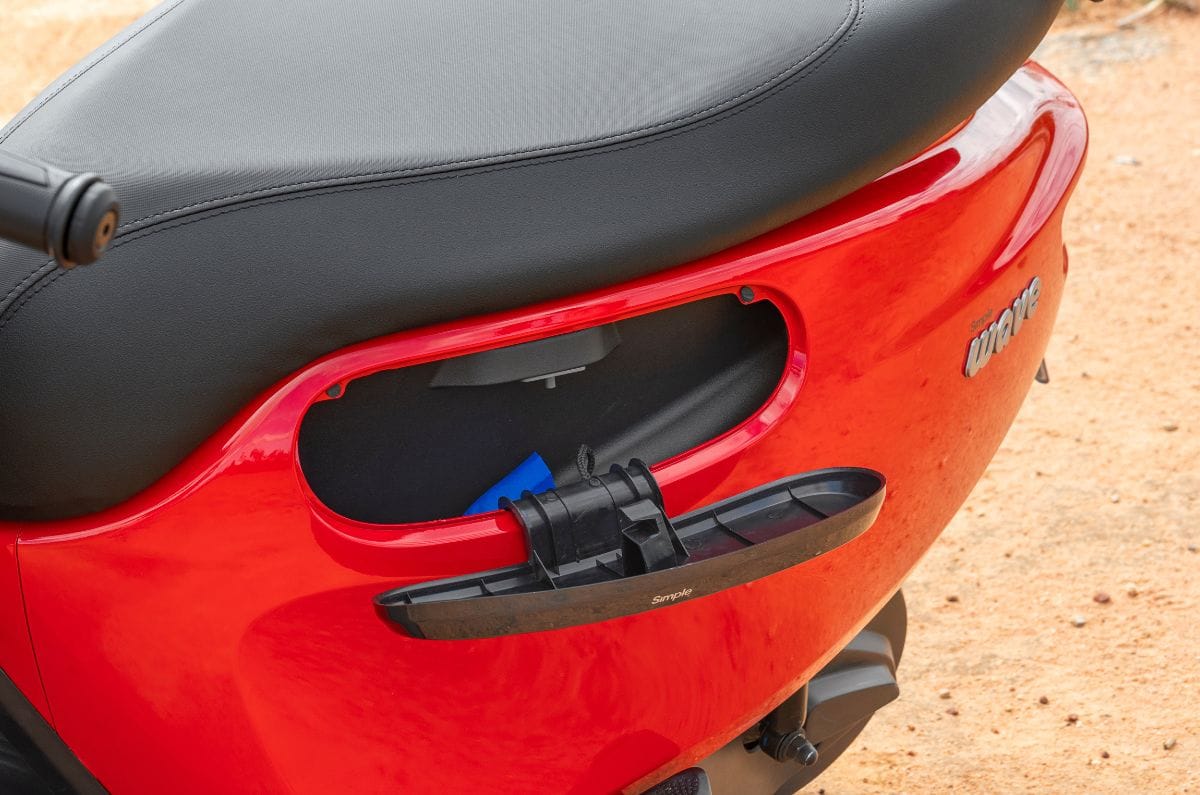
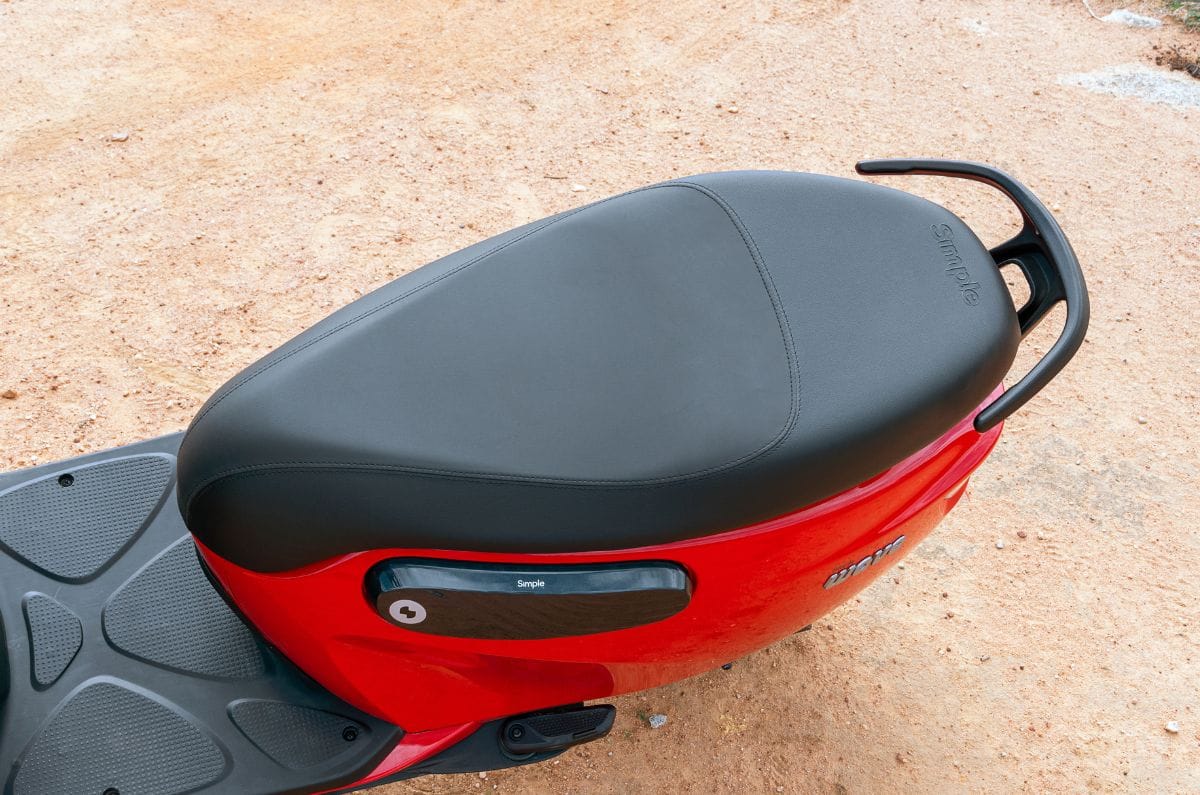
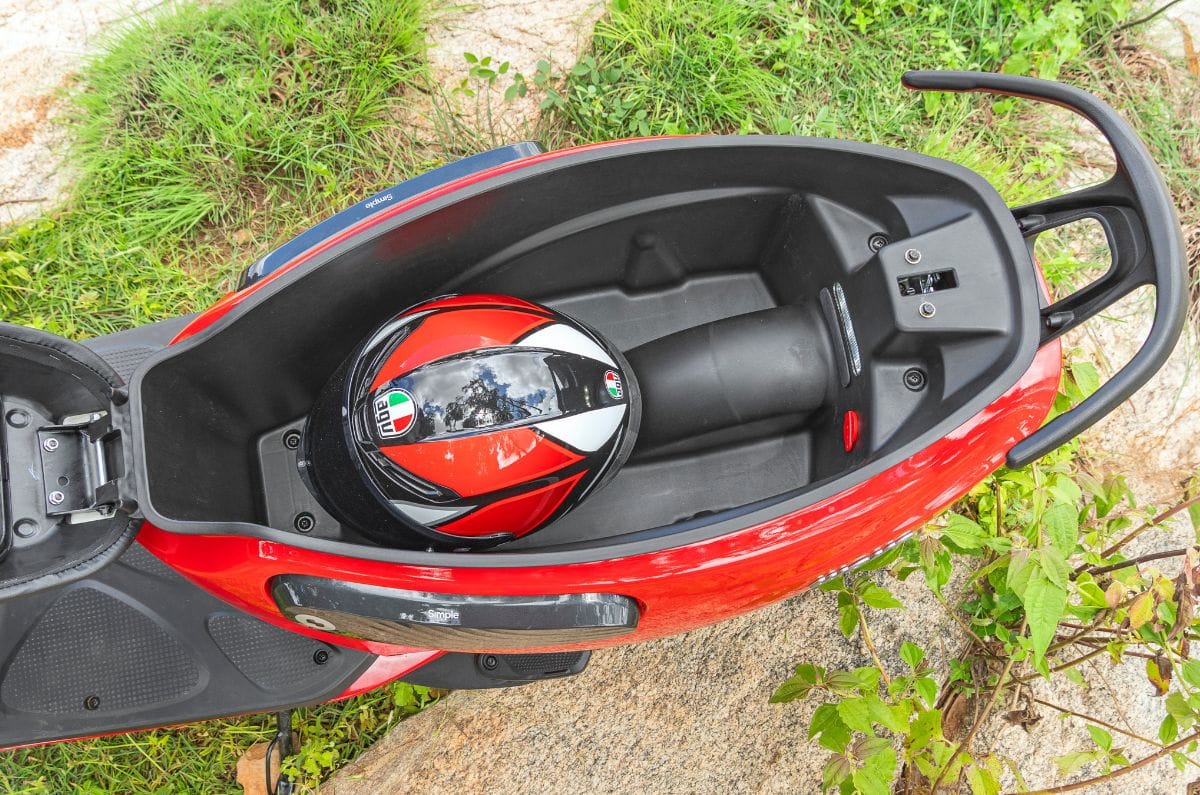
Lockable and weatherproof 4L“Pill” storage cubbies are a thoughtful touch, RH cubby is an accessory.
Simple Wave Ergonomics and comfort – 9/10
Offers a supple ride and ample space for two people
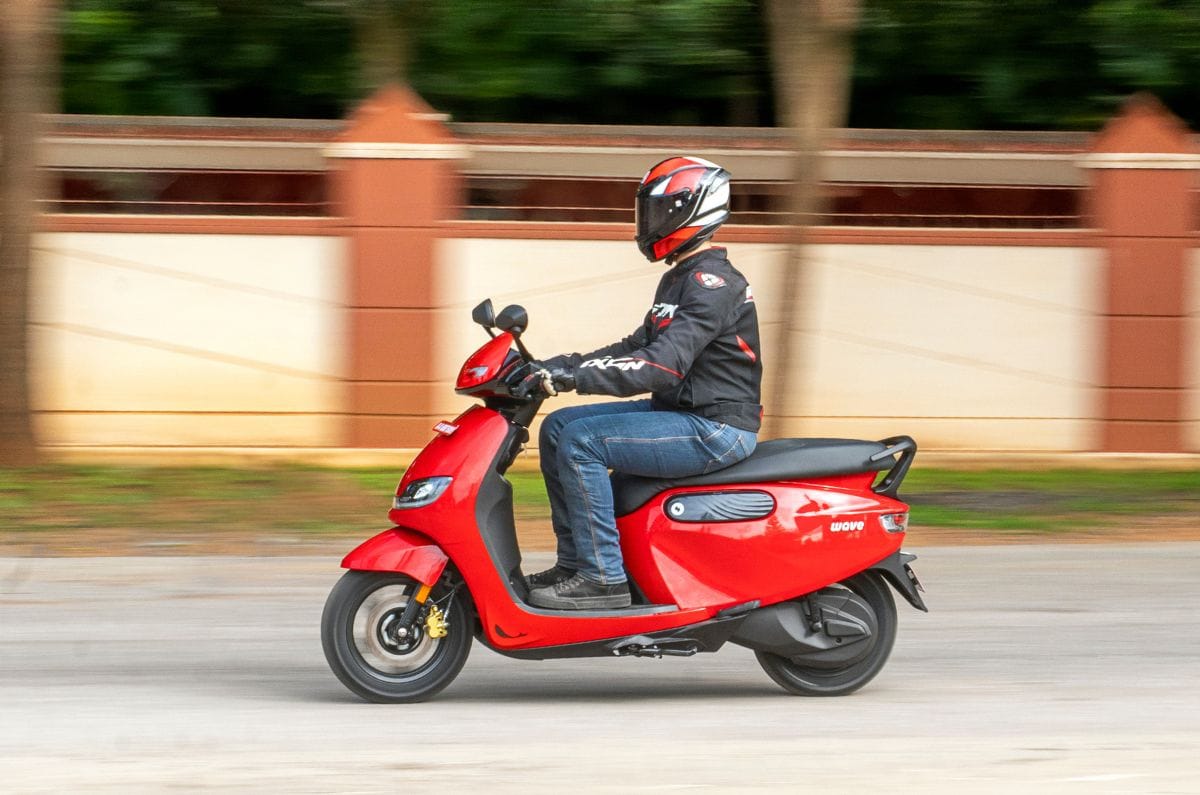
The differences only get more pronounced once you sit on the Wave. Its seat is long, wide and will easily accommodate two full-size adults, while its relatively low 775mm seat height makes it friendly for shorter riders.
That low seat height is no accident either; Simple took feedback from customers who had the One and incorporated it into the Wave. This is why the Wave also has a lower handlebar to make it more approachable for shorter and female riders. This has a trade-off, however. Taller riders will find the handlebar fouls their knees during tight, lock-to-lock U-turns.
Riding position is spot-on and ride comfort too is excellent.
Other than that, the Wave is rather sorted ergonomically. Ride comfort is excellent for a scooter, and that isn’t a surprise given that the Simple One itself was quite comfortable. The Wave builds on that with a composed and plush ride that suits its intended role.
Depending on the variant, the Wave weighs between 121-128kg with the 3.7kWh TFT variant provided to us sitting roughly in the middle of that range (124.5kg). We found the Wave handled predictably, without any unwelcome surprises, feeling stable and sure-footed without compromising agility expected of a scooter.
Spacious, well-paded seat can comfortably seat 2 full-size adults.
Simple Wave Performance and range – 9/10
Performance is more than sufficient, Eco mode truly usable
Like the One, the Wave offers really brisk performance, but still feels approachable enough for everyday use. The 3.7 version gets three riding modes – Eco, Ride and Sport – and both Ride and Sport offer more than enough performance for everyday use, which isn’t really a surprise. In Ride the top speed is 75kph, whereas Sport takes it up to 90kph (speedo-indicated, not actual).
The real surprise, however, is Eco mode. Yes, it feels duller than the other two modes, but it isn’t crippled in the way Eco modes on other EVs. The Wave can still get up to around 50-55kph quite respectably and overtake traffic, making Eco genuinely usable even on faster roads or in a big city.
It handles predictably and surefootedly in all scenarios.
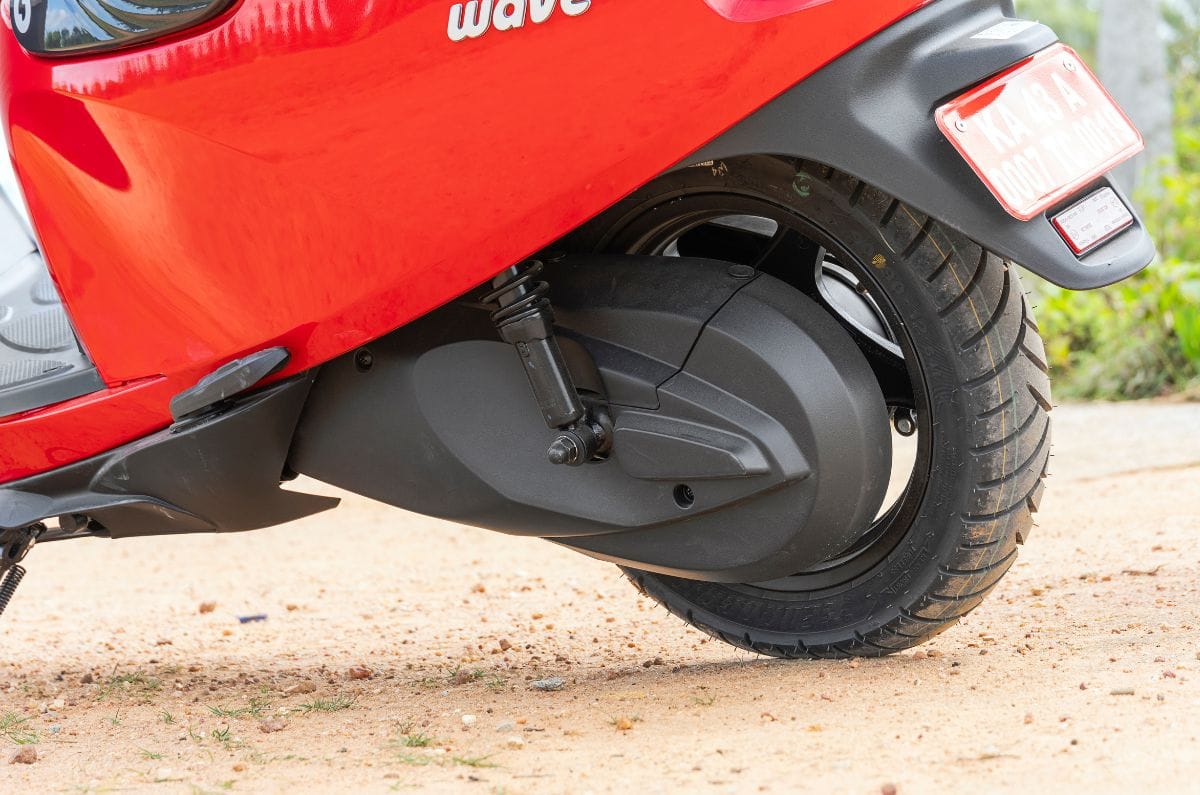
Given that the Wave uses the same motor as the OneS making 6.4kW and 52Nm, this performance is no surprise. However, on the Wave, the motor drives the rear wheel via a chain drive, not a belt as seen on the One models.. While a chain will be more maintenance-intensive than a belt, replacing it should be more affordable. Simple has worked to reduce powertrain noise with measures such as a rubber-damped sprocket, but there is still some motor noise. However, it’s much quieter than an Ather Rizta or 450, although far from dead silent like an Ather Konarc or TVS iQube.
Another welcome change to the One is the throttle response. Unlike the older One models we tested, where the scooter could continue accelerating briefly after the throttle was closed, the Wave’s accelerator behaves much more intuitively. It also gets traction control, although the throttle calibration is so smooth, you’re unlikely to need it in dry conditions but it will be a useful safety net in the wet.
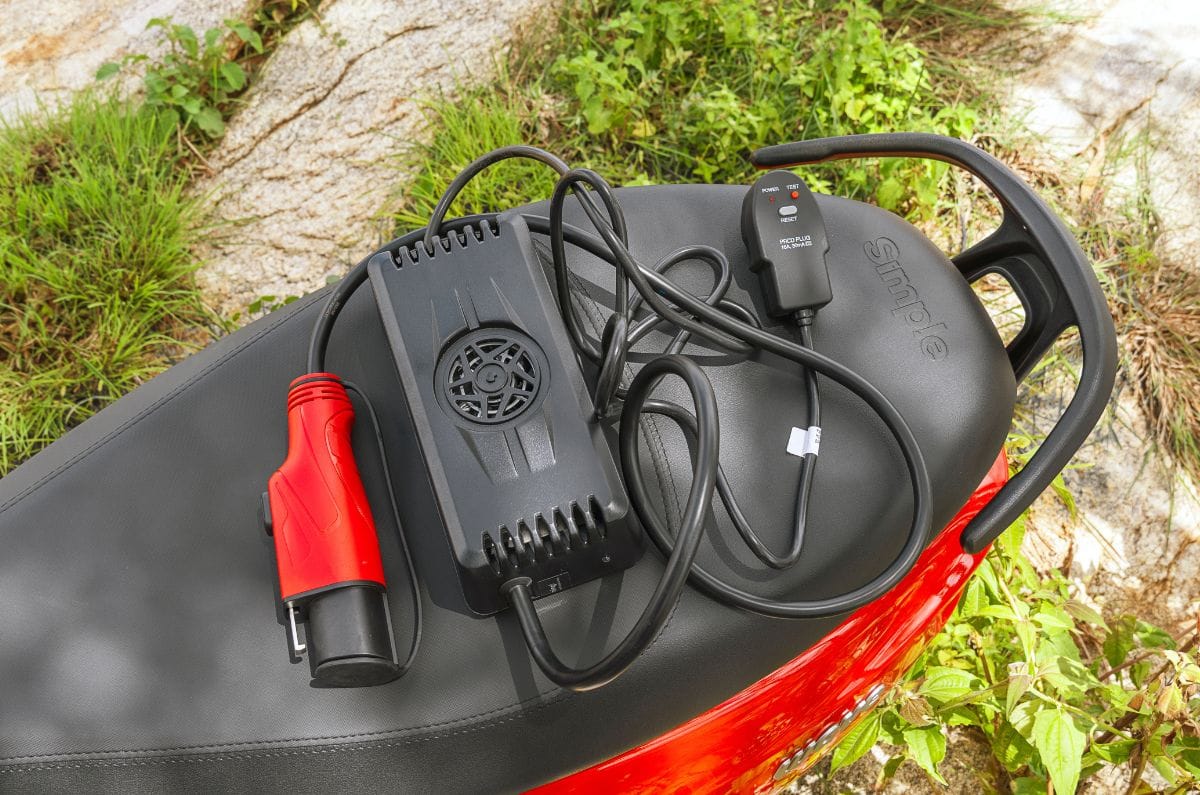
Fast 750W charger is standard on all variants.
Powering the Wave are four battery packs, depending on the variant you choose: 2.2kWh, 2.7kWh, 3.7kWh and 5kWh. The IDC ranges Simple claims are 110km, 132km, 171km and 243km, respectively. The first two use LFP (Lithium Ferrous Phosphate) chemistry, while the larger batteries use NCA (Nickel Cobalt Aluminium) cells.
The range indicator also appears to be quite trustworthy although we’ll reserve final judgement on real-world range until we can conduct a full test back in Mumbai. What is also nice is that all variants of the Wave come with a fast 750W charger which enables a pretty quick 0-80 percent claimed charging time of 3hr30min on the 3.7kWh version we were riding.
The standard warranty on the Wave is three years/30,000km, with five years/50,000km and 15 years/2 lakh km extended options also available. The price of these optional longer warranties has not been shared with us.
The Wave’s motor feeds power to the rear wheel via a chain, not a belt like on the One.
Simple Wave Features – 9/10
Massive 63L boot and Pill storage cubbies are very useful
While range without sacrificing usable performance is surely valuable on an EV, practicality is an important consideration as well. Storage is one of the Wave’s big strengths. There’s a useful front cubby, while the two “Pill” storage boxes on either side of the body panels are particularly nifty allowing you quick access to essentials you may need to reach for without having to get off the scooter. Each offers 4 litres of lockable weatherproof storage; the left one is standard, while the right is an accessory.
An undoubtedly big USP on the Wave is its cavernous 63L boot, the largest on any Indian scooter to date.
What is also an undoubtedly big USP on the Wave is its cavernous 63 litre boot, which is the largest on any Indian scooter to date. This should prove to be more than enough for everyone in the family! That being said, 63 litres is an enormous number and while this boot is undoubtedly big, I’m do find myself struggling to comprehend how it is nearly 50 percent bigger than the already cavernous 43 litre boot in the River Indie.
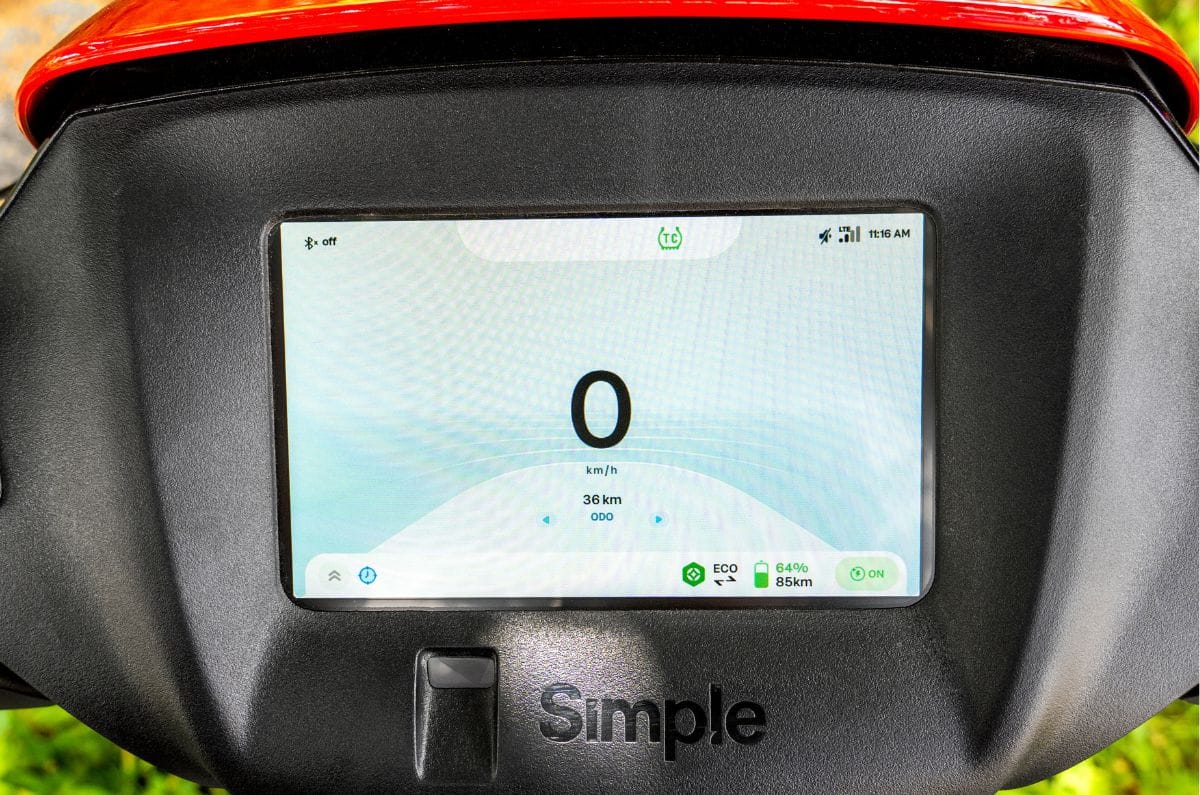
There’s plenty of technology too, including hill hold, drop-safe functionality, theft alerts and Bluetooth connectivity to your phone via the app. The TFT-equipped versions bring even more tech, while the brake-lock clasp is a small but useful touch.
TFT display is well laid-out and has a lot of tech but misses touch functionality.
Simple Wave Price and verdict – 8/10
Scooter has a lot of strengths but is pricey; company yet to prove itself
There isn’t a lot to dislike about the Wave as a scooter. It’s comfortable, spacious, well finished and quick enough to serve its intended purpose very well. However, for all its accomplishments, the Wave doesn’t come cheap. Sure, the Rs 1.10 lakh starting price is tempting, but as you climb the variants ladder, the Wave gets seriously expensive, topping out at Rs 1.90 lakh (ex-showroom, Bengaluru). That said, Simple is one of the few brands offering the option of a 5kWh battery in the family e-scooter space, which is commendable.
However, more than pricing, the bigger issue is that the company is yet to properly scale up its dealer network and establish an aftersales network that delivers the premium experience a buyer will expect after shelling out the money Simple is asking for. The Wave is a good product, but customers paying a premium for an electric scooter will expect not just a solid product but also dependable after-sales support.
The Wave has a lot of strengths but Simple is yet to prove itself in the market.
Ultimately, the Wave’s biggest challenge is that it comes from a start-up that has made plenty of big promises and statements over the past five years but still has a lot to prove. Its dealer network remains minuscule compared with the big players, and long-term reliability still remains unknown.
There’s a lot for Simple to do, but the good news is that the Wave is a genuinely likeable product. If the company can iron out the business side of things, the Wave has the potential to catapult Simple from just another niche start up to a much bigger player. Of course, doing so is a huge challenge and not an overnight process. Simple has a long road ahead of it, but the good news is that it finally has a convincing product to aid in that journey.
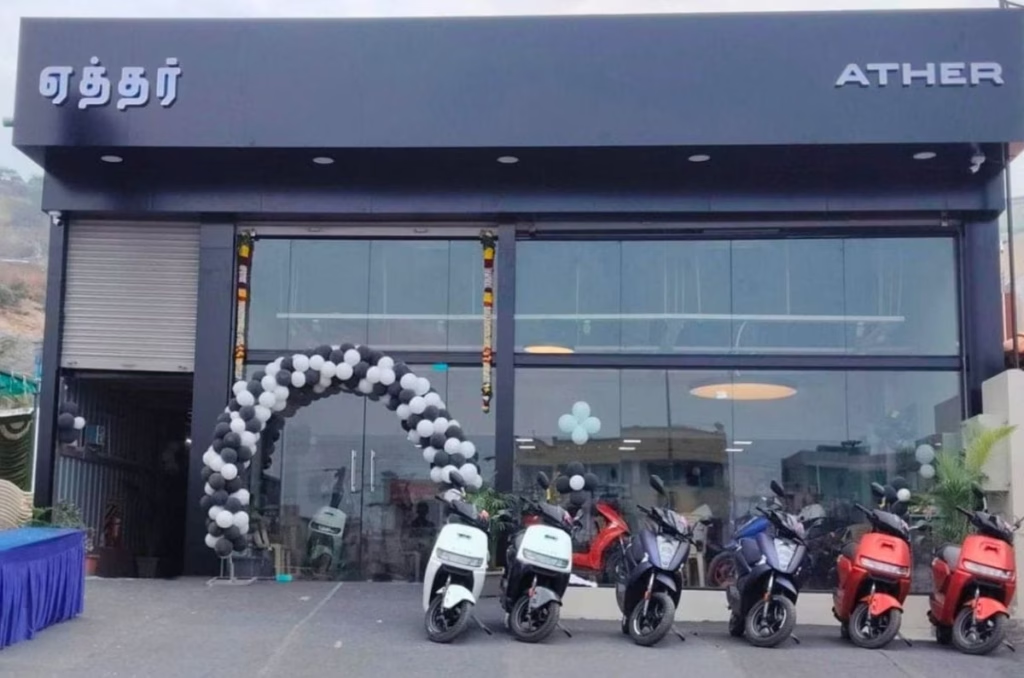
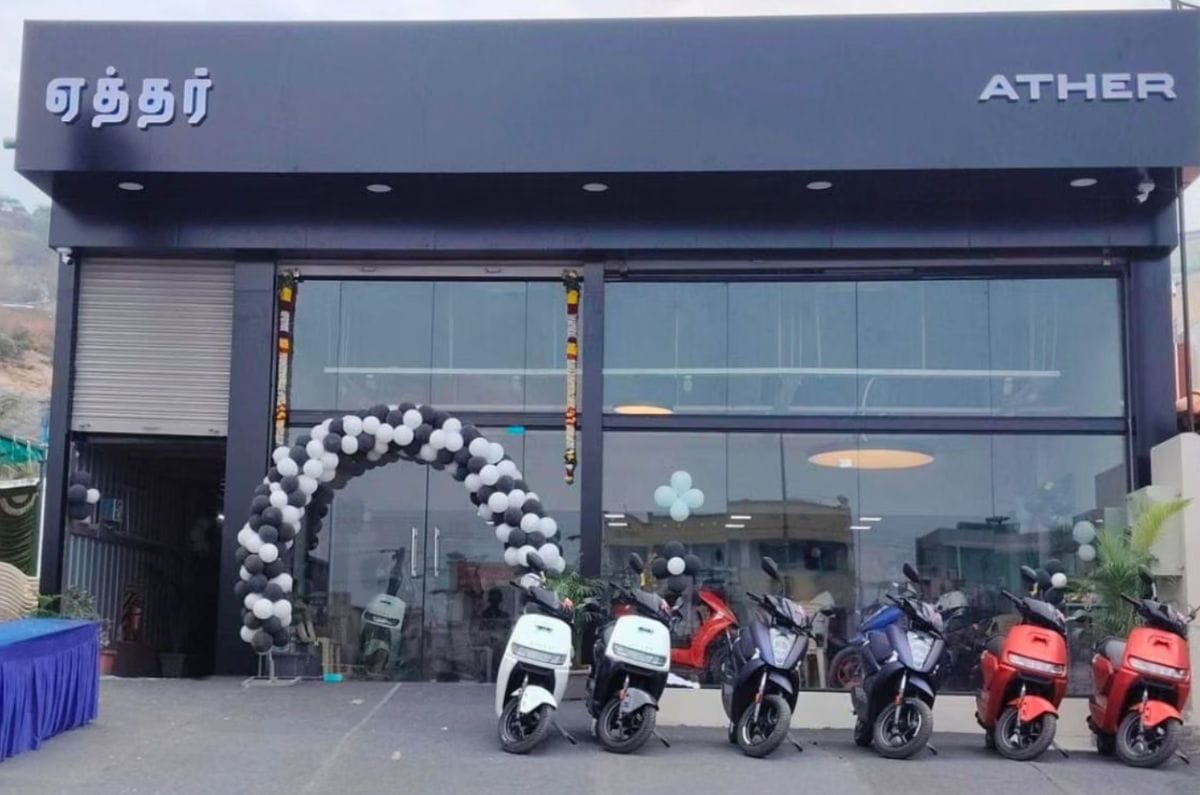
Ather is targeting to more than double its retail footprint to between 1,800 and 2,000 stores over the next two years as the EV maker rolls out its new family scooter Konarc and expands production capacity, according to a senior company official. The company currently sells the 450X and Rizta electric scooters, which are positioned in the premium and mass premium segments of the market across some 750 stores. The company plans to use its new EL platform to broaden its product range into the more affordable segment.
More scooters of different battery sizes expected from the EL platform
Ather EV motorcycle at least two years away
Production capacity to increase with the Aurangabad plant becoming operational
Number of retail stores and production to increase
More products expected from the Konarc’s EL platform
The newly unveiled Konarc will be available in two variants and six battery options at a starting ex-showroom price of Rs 99,999. The delivery of the first two battery options (S 125 and S 161) is set to commence in September 2026. “We are targeting 1,800 to 2,000 stores in the next 24 months,” Ather Energy’s Chief Business Officer Ravneet Phokela said. Phokela said the company expects the domestic market to remain its main focus for now, with exports only becoming important after a few years.
The EL platform, on which the Konarc is based, can produce different types of scooters, and it can also accommodate different battery sizes, wheel dimensions and dashboard designs. The company boasts that the platform helps launch more products while also reducing costs through changes like lower use of aluminium and simpler engineering. Ather has said it plans to launch multiple scooter products based on the platform first; and added that an Ather electric motorcycle is more than two years away.
Ather’s push into a wider range of scooters comes as the company looks to increase production capacity. Ather currently manufactures electric scooters at its Hosur plant, which has an annual production capacity of 4.20 lakh units. Its upcoming Aurangabad facility is expected to add another 5 lakh units of annual capacity when its first phase becomes operational later this year. The company said that it’s also considering whether to accelerate the second phase of the Aurangabad facility if demand continues to grow at its current pace.
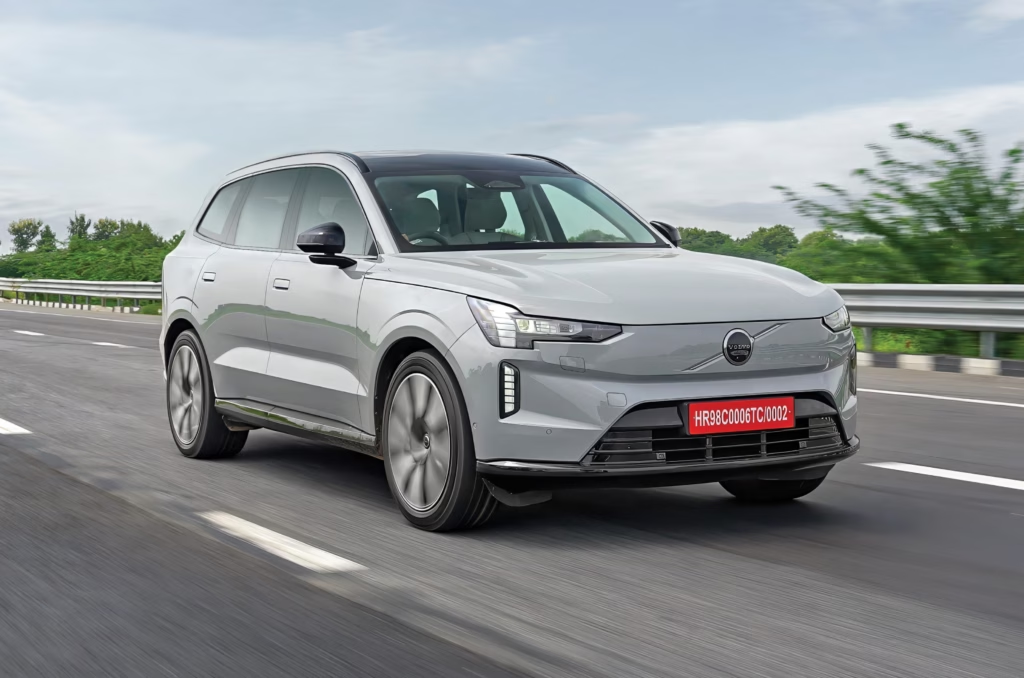
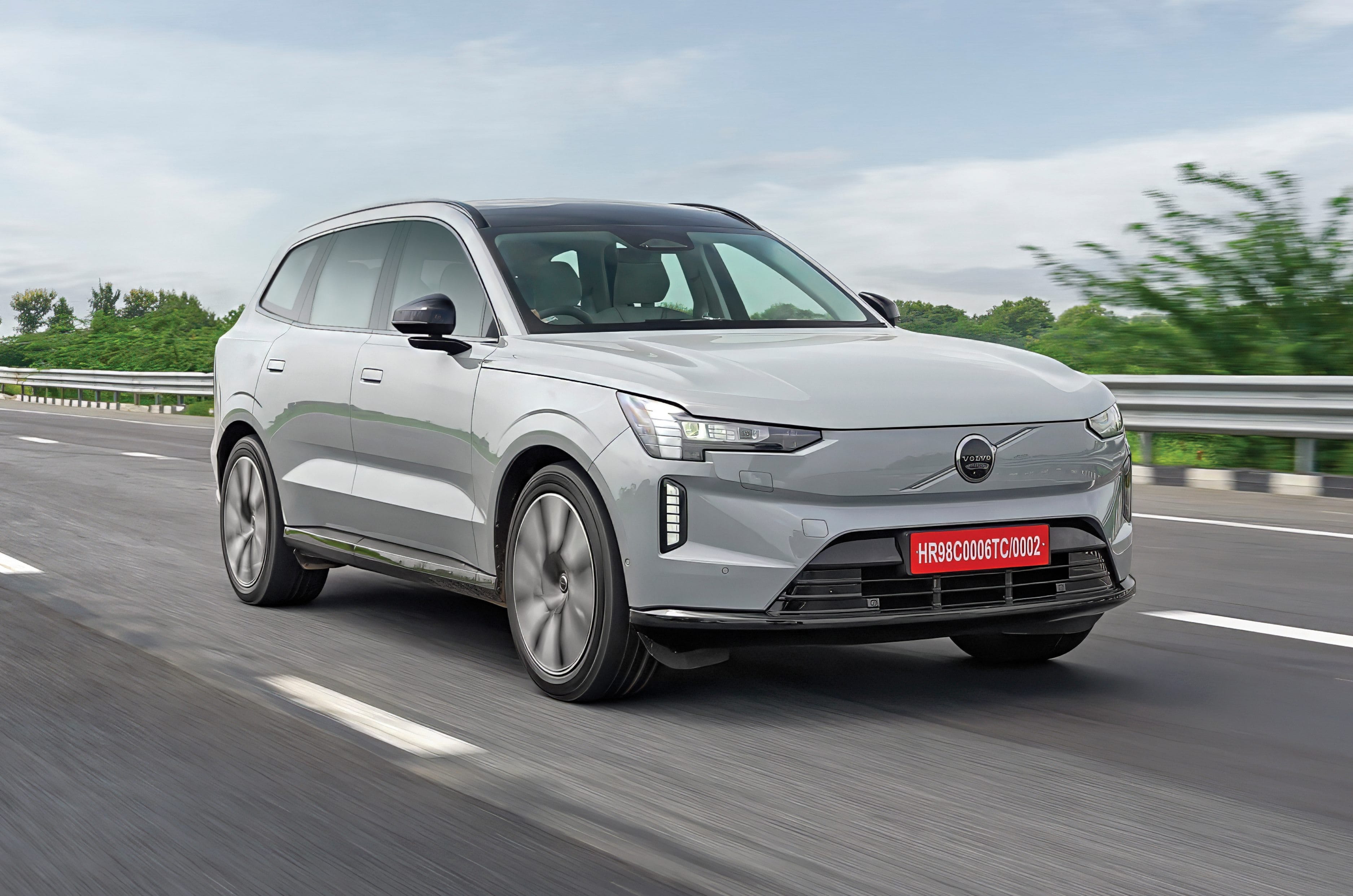
The EX90 is Volvo’s latest offering in India and also its most premium one. The EX30 and EC40 compete in the entry-level luxury EV segment, but the EX90 is the brand’s flagship electric SUV. It comes in a single, fully loaded variant with all the bells and whistles, along with a dual-motor setup and a claimed range of over 600km. Can it bring in a new audience or convert some XC90 customers? It certainly has the traits to do both.
EX90 Exterior Design and Engineering – 9/10
Built on Volvo’s SPA2 dedicated EV platform that has hints of the XC90.
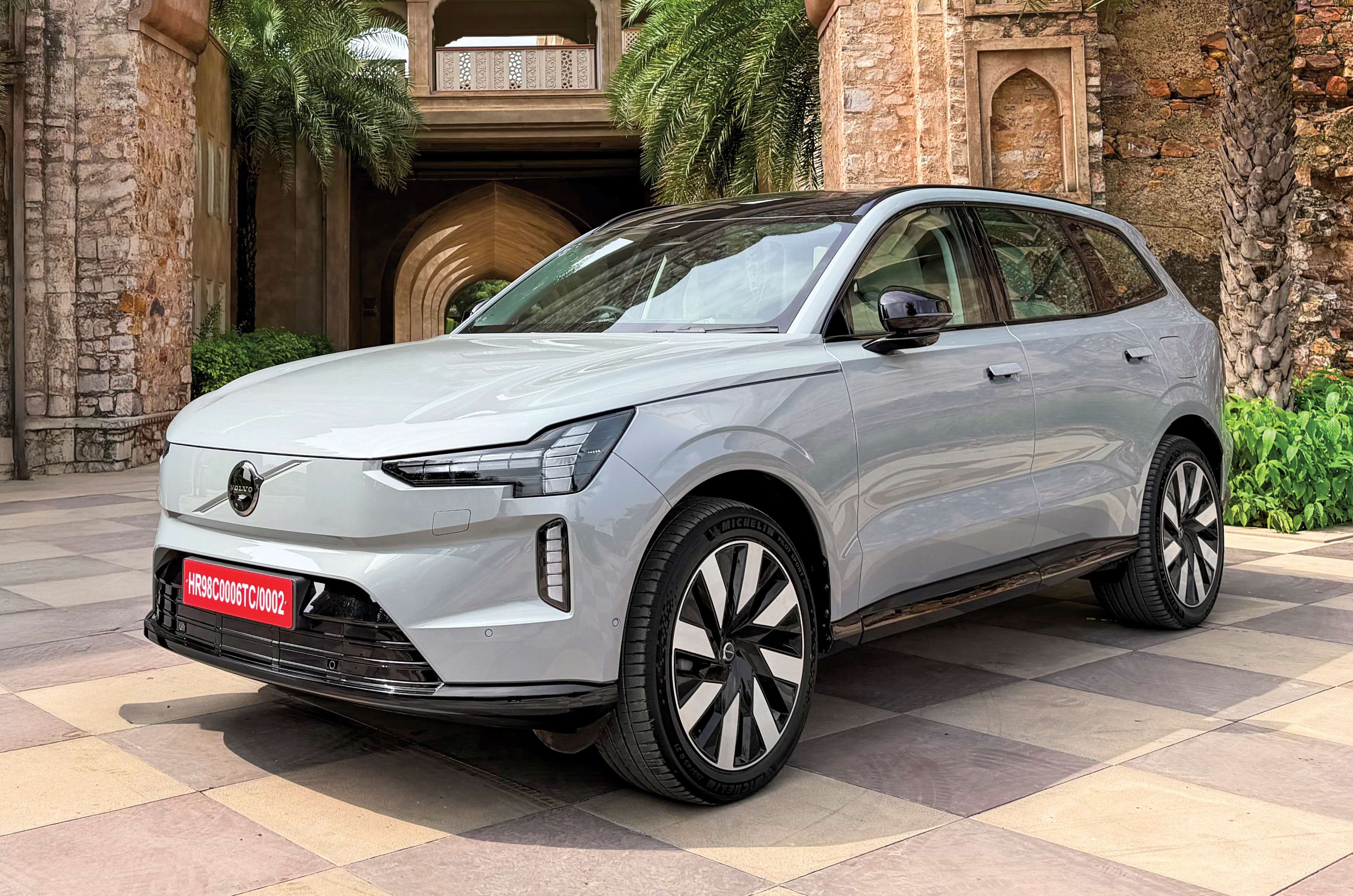
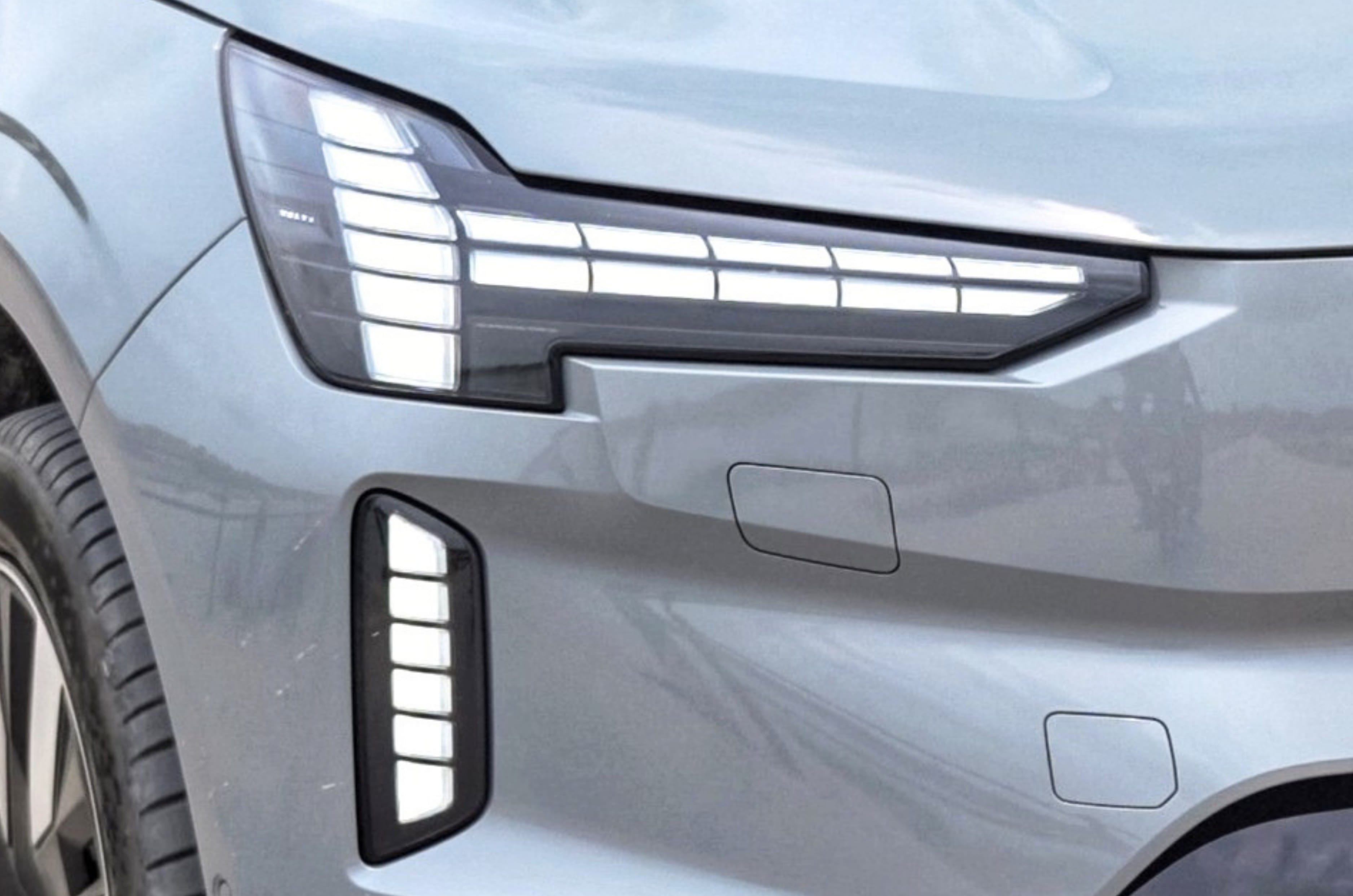
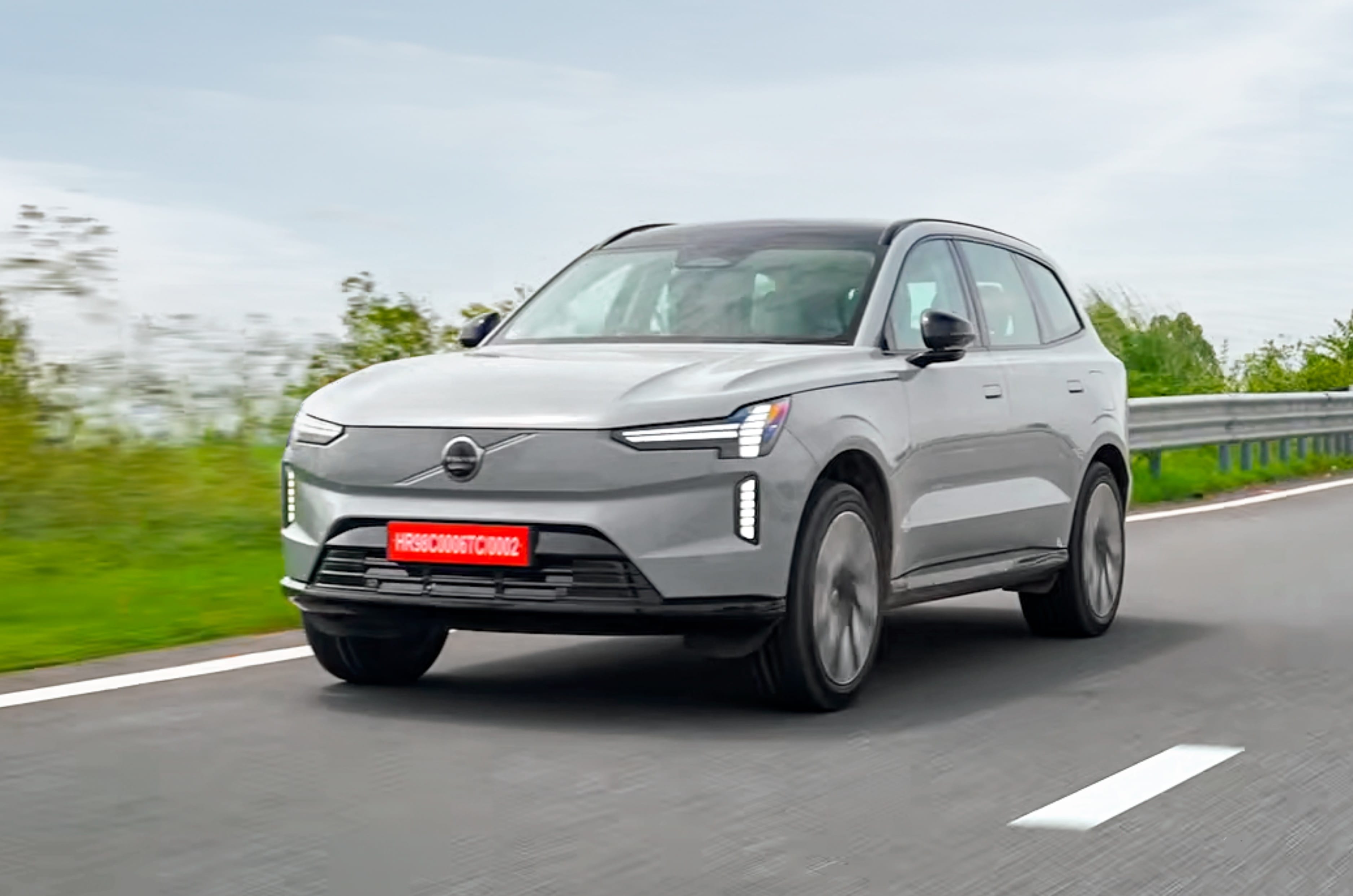
Based on the new SPA2 architecture, which has its roots in the previous SPA platform but is built specifically for EVs, the EX90 does share some resemblance to the XC90 in its shape and form factor. However, the details are different. As expected, the overall design is simple and far from outlandish or attention-seeking. This is in keeping with the brand’s image, and the restraint actually works. The flat, closed-off front end dismisses any chances of a blingy chrome grille, and what adds drama instead are the LED lights that split open to reveal the main headlamps behind. These, too, have an impressive party trick; with over a million pixels, they can individually light up or switch off and constantly shape a light beam to avoid dazzling oncoming traffic. Further down, you get some more DRL strips, one on each side, and a rather simple, fuss-free bumper.
DRLs that spilt open to reveal headlamps add drama.
Over to the side, the EX90 is slightly longer than the XC90, while the rest of its dimensions see a marginal bump. 21-inch wheels are standard, and the 210mm of ground clearance at its lowest setting is plenty. The air suspension also allows you to raise the car up to 250mm for off-road use. The door handles are pop-up, flip-up-style units, and you no longer get a key. Instead, you get a card that you need to tap at the right spot, with the Volvo logo facing the right way, for the handle to pop up. Alternatively, you can simply link your phone to the car and use it as a key. It seems convenient on paper, but the card system needs to be a lot more seamless to be hassle-free.
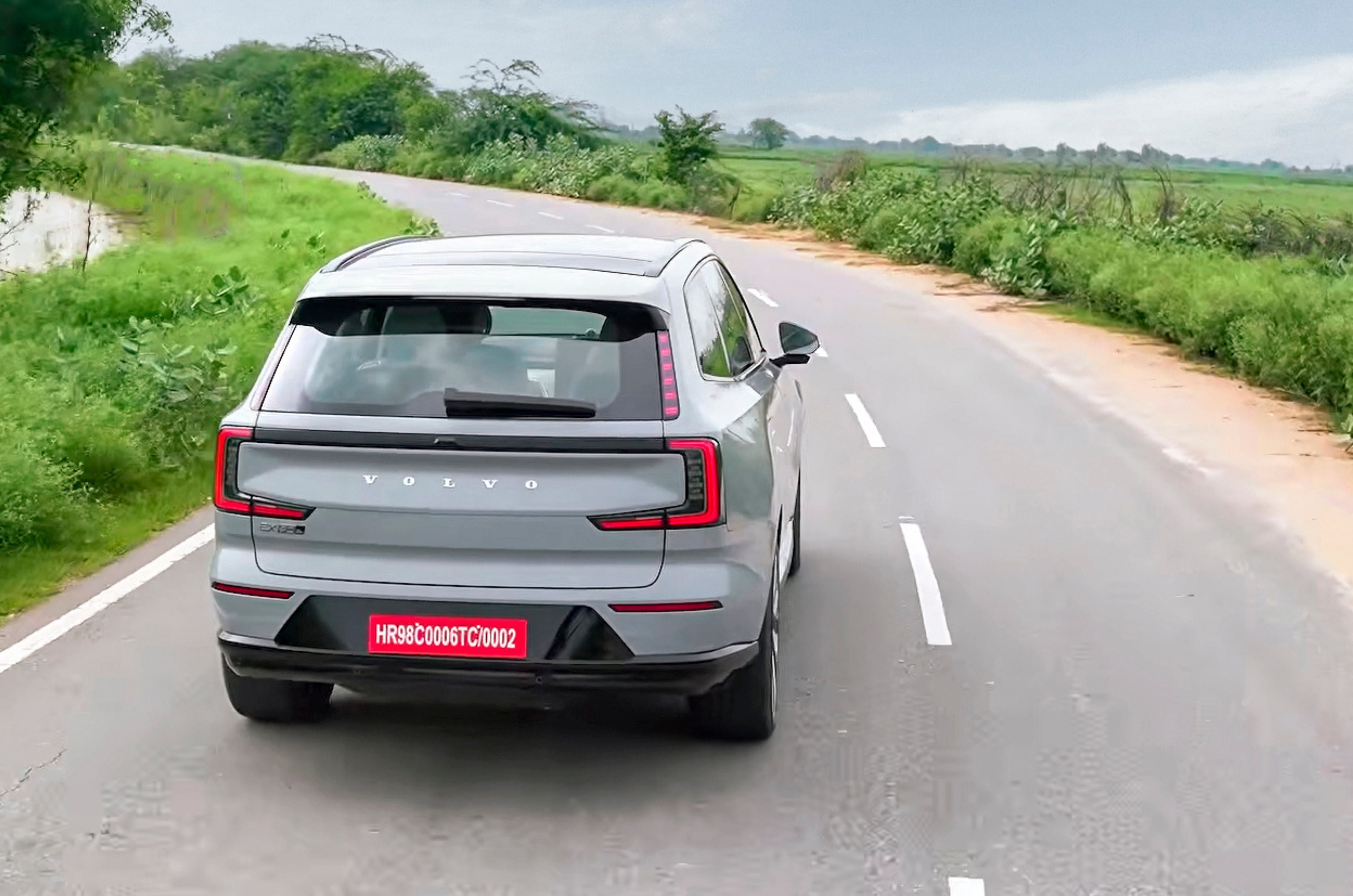
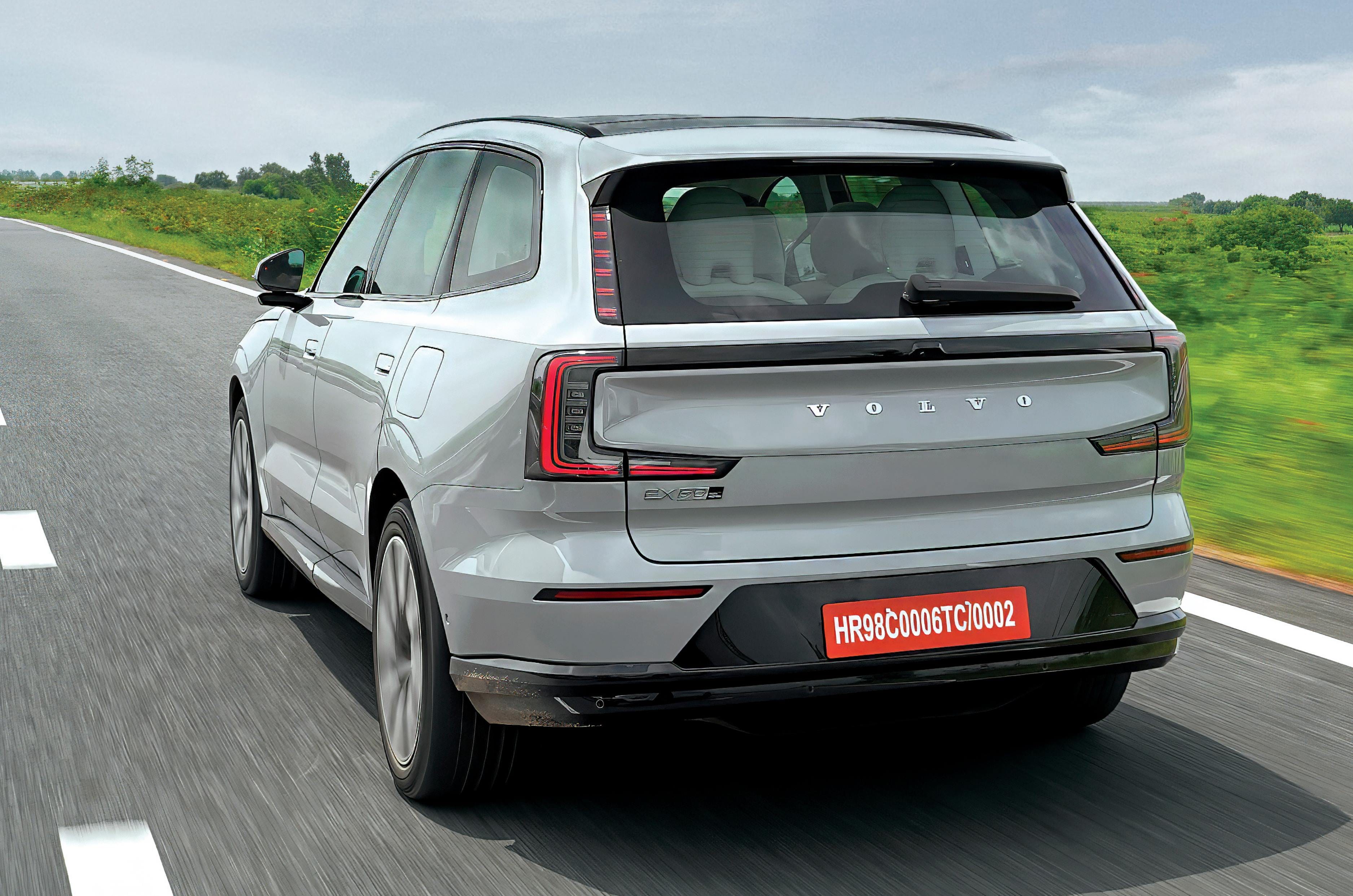
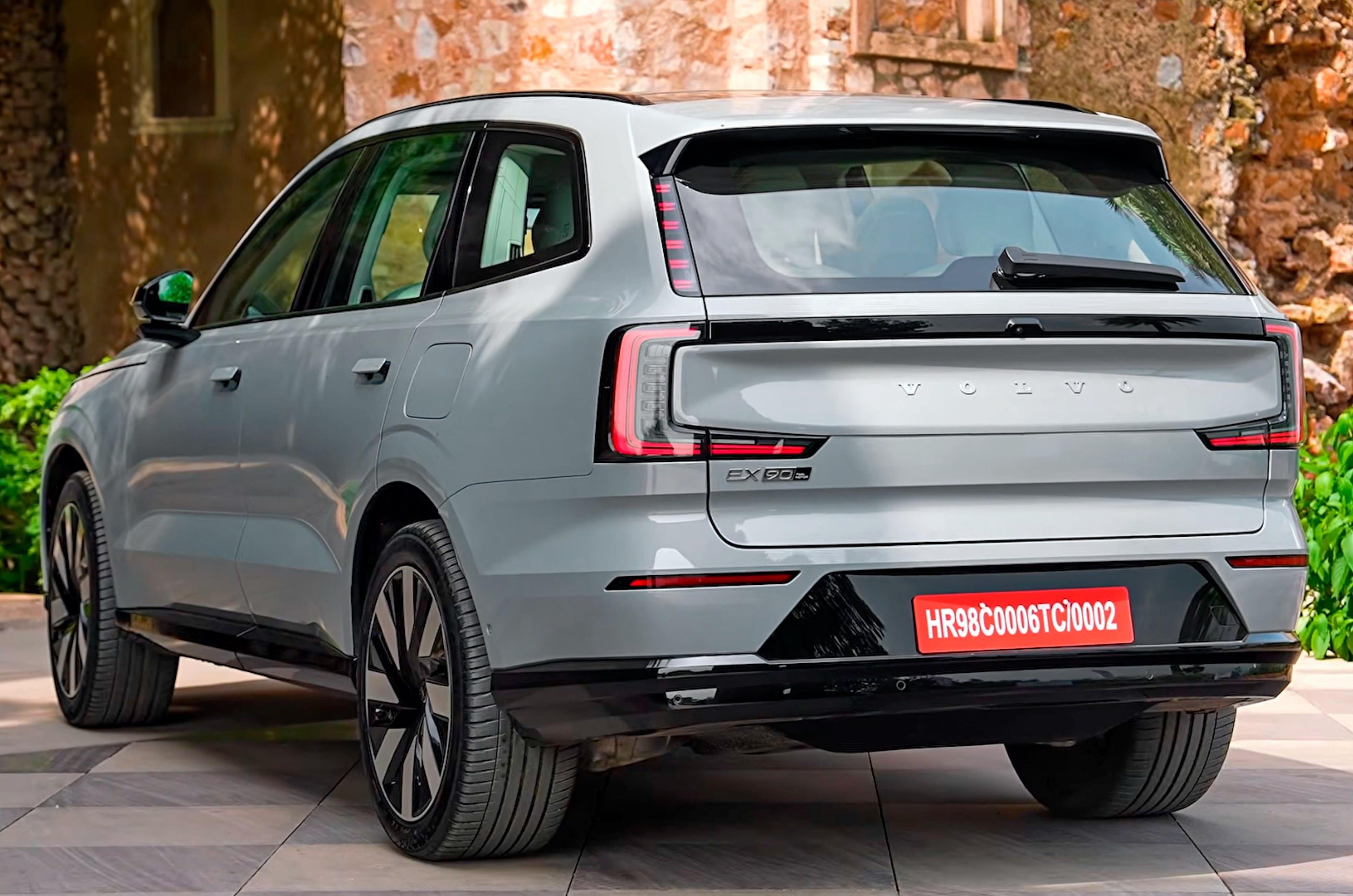
At the rear, it gets a split setup for the LED tail-lamps, with C-shaped LEDs on the lower half and vertically stacked LEDs in the D-pillar. There isn’t a single strip of chrome, and even the cladding is minimal. Subtlety is what Volvo aims for with its design, and the EX90 offers just that.
EX90 Interior Space and Comfort – 8/10
Two-tone upholstery looks rich and materials feel plush.
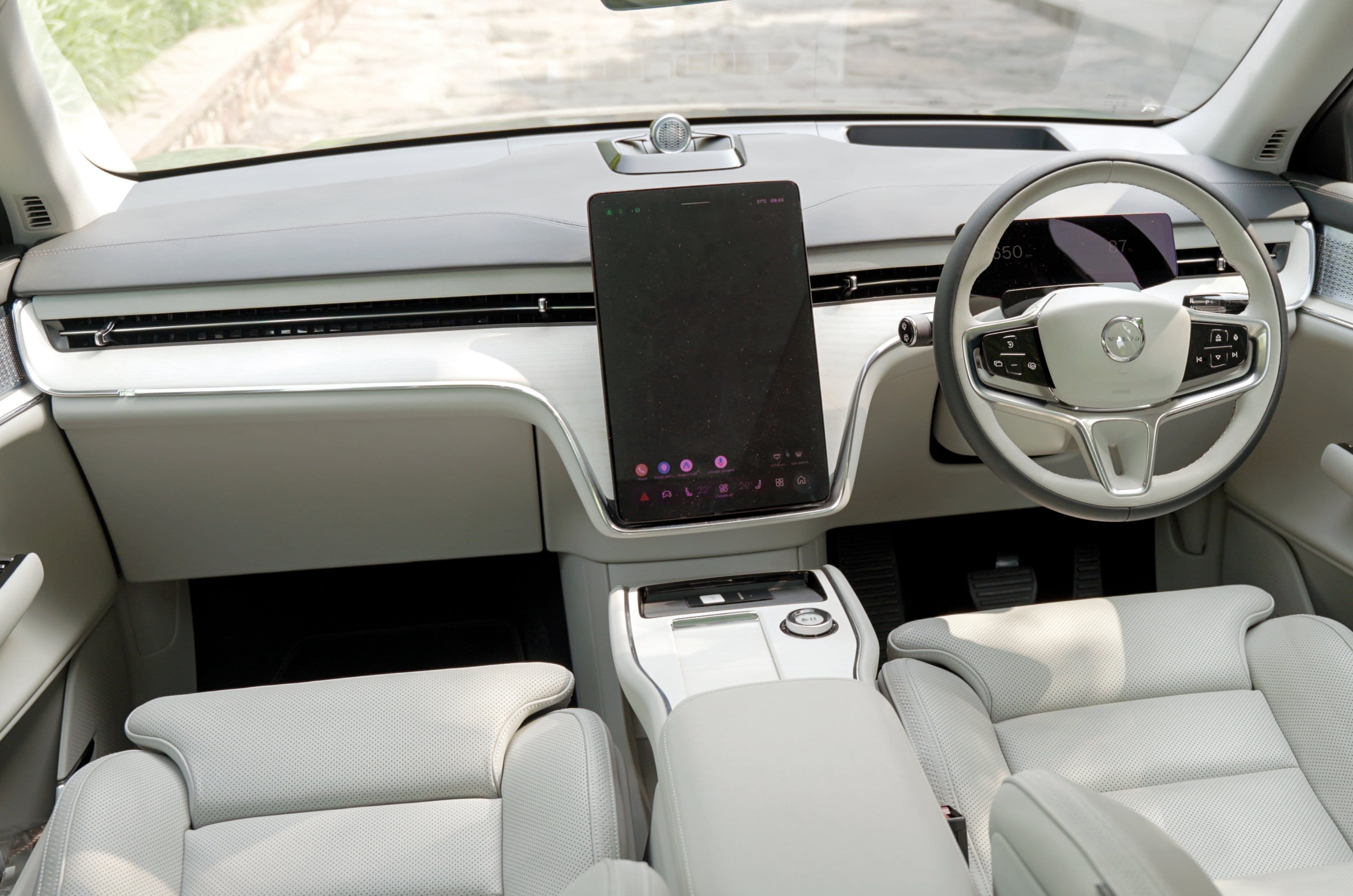
Inside, the minimalist approach continues and even takes precedence. The dashboard is devoid of any buttons whatsoever, and the majority of the real estate is taken up by the 14.5-inch touchscreen. However, the bright seats and upholstery, along with the bright open-pore wood, lift the cabin ambience significantly. There is generous use of brushed aluminium as well, and the Nappa leather is fantastic to the touch. The centre console also features wireless charging and a rotary knob for media control.
There is plenty in the front seats to pamper you. They offer excellent support, and feature heating, ventilation and a whole host of massage options. Plenty of electric adjustment also means finding an accurate driving position is easy, and all-round visibility is very good.
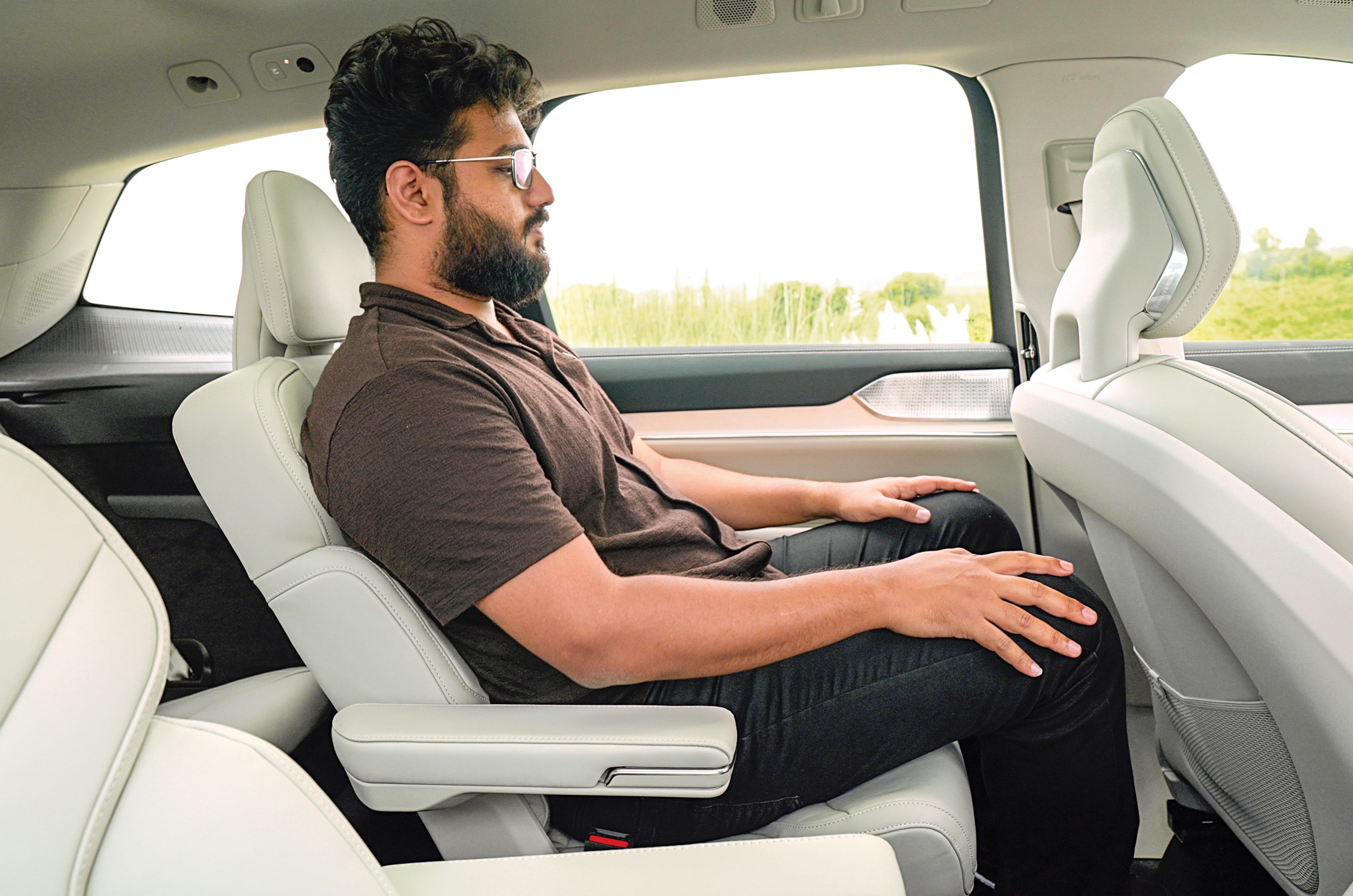
Exclusively a six-seater with good space and comfort.
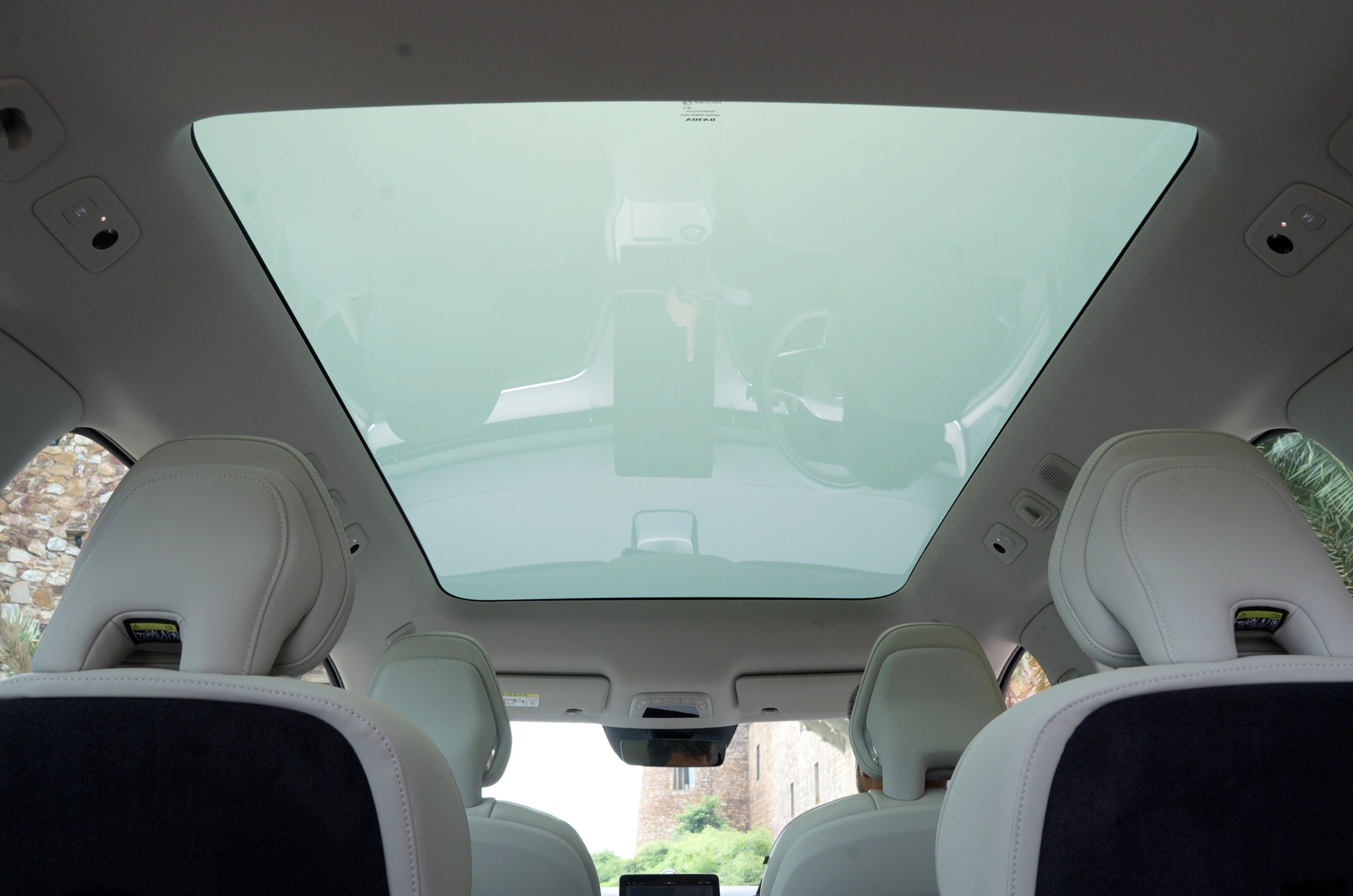
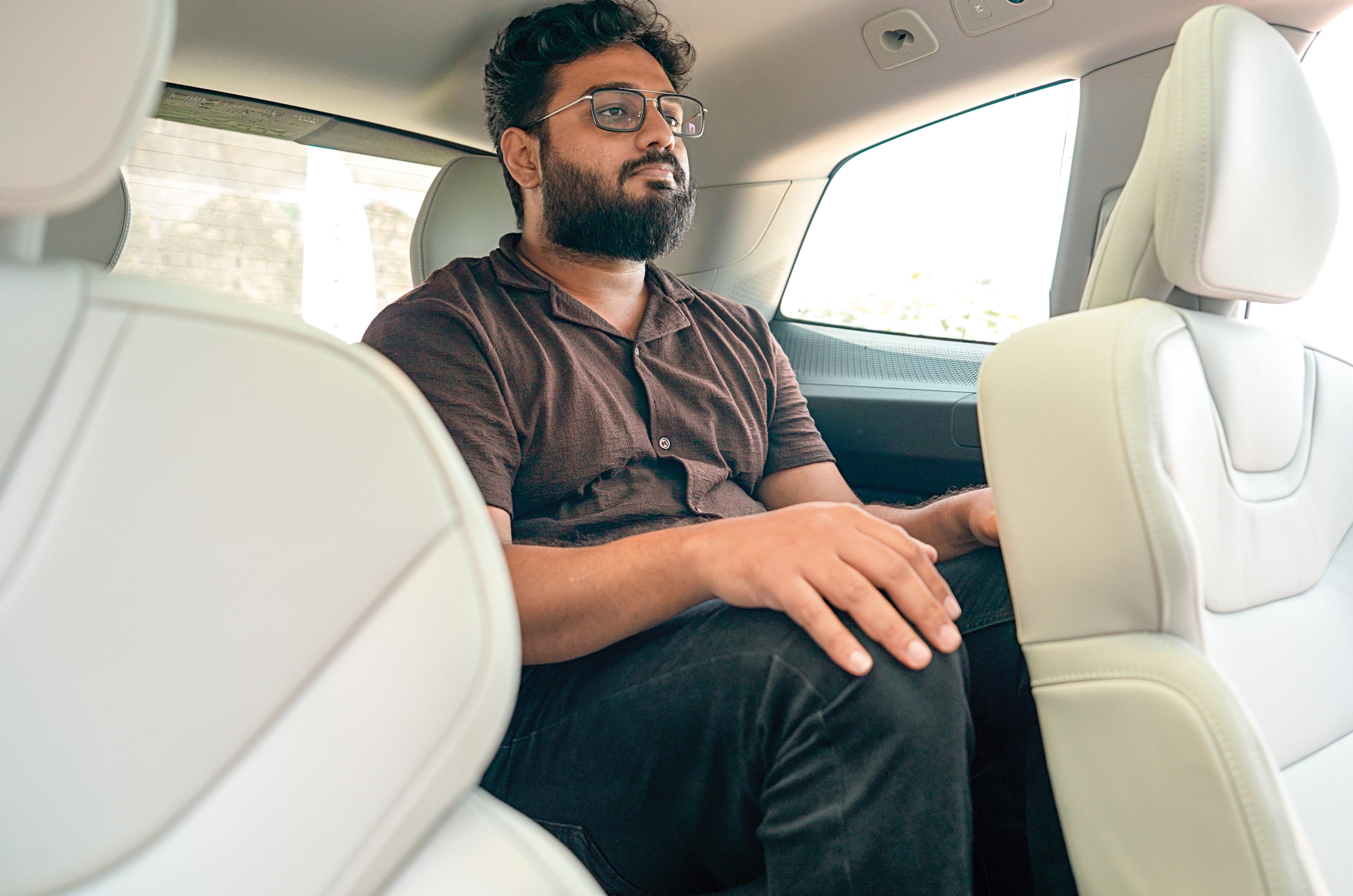
The EX90 is only available as a six-seater, so in the middle row you get captain’s chairs, but these would feel snug for some, and for a luxury car that would be chauffeur-driven, you don’t get the same level of pampering as in the front seats. There is no electric adjustment, heating, ventilation or massage either. There aren’t any sunblinds for the windows too, and even though the huge panoramic sunroof is electrochromic, at the tap of a button you get a bit of tint in the glass, on a hot day with the sun overhead, you will need more.
Massive panoramic glassroof gets electrochromic shade. Physical sunshade is an accessory.
The accessories list has a proper roof shade to protect you from that, and it is an extra we recommend you select. On the plus side, space is good, and the seats can be adjusted for legroom and recline too. You get four-zone climate control, with AC vents in the pillars that are a lot more effective, and cupholders stowed within the armrests. Also, being a modified platform, the floor is raised, and you notice this while getting in and out of the car.
Access to the third row is easy from between the captain’s chairs, thanks to the flat floor, but there is no tumble feature for the seats. Instead, they only slide forward, opening a cavity to get in. Room in the last row is at a premium for tall adults, but kids or shorter adults will do just fine with a little adjustment to the middle row.
Third row best suited for kids or short adults over quick drives.
With all three rows up, boot space stands at a healthy 324 litres, and with the third row folded away, it is a sufficient 690 litres. There is a 46-litre frunk too for stowing charging cables. Impressively, there is a full-size spare wheel as standard, which will eat up some boot space but is a huge relief given the low-profile tyres and our roads.
EX90 Features and Safety – 8/10
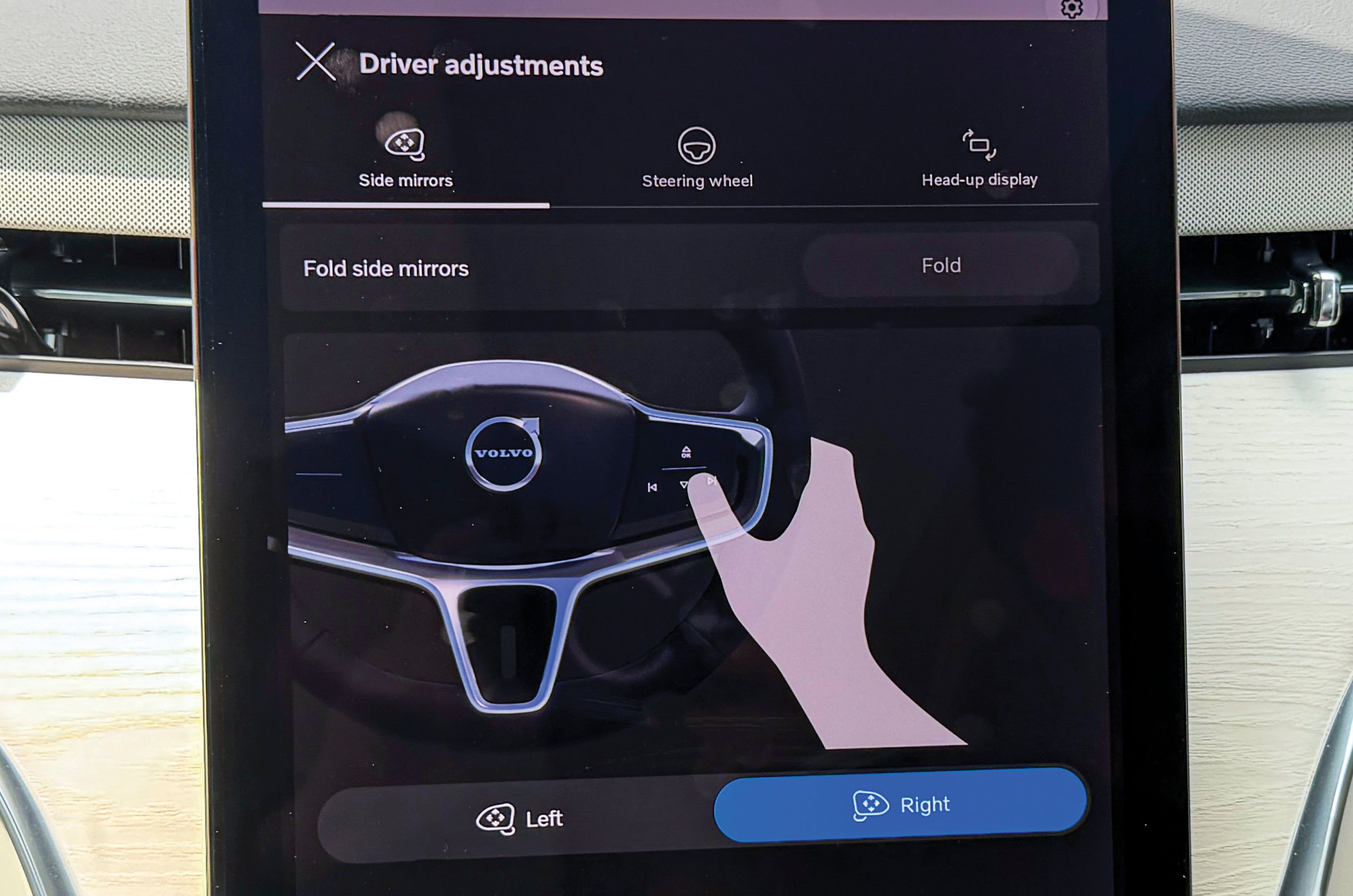
Annoyingly every control is within the 14.5-inch Google-powered screen.
Most of the EX90’s features are accessed through the massive, vertically oriented touchscreen. Being Google-powered, it runs a smooth OS, but simple tasks like adjusting the ORVMs require multiple inputs and navigation through the menus, which isn’t easy while on the move. There are some hard-coded functions at the bottom of the touchscreen, such as climate control, but you still need to focus on the screen and cannot operate them easily while driving. There is also a 9-inch driver display with nothing but the absolute necessary figures, such as range, speed and battery percentage. You can also load up the maps there, and it displays the traffic around you too. However, don’t expect multiple dials and a loaded, fighter-jet-like cockpit experience, the instrumentation is all minimal but feels sparse too.
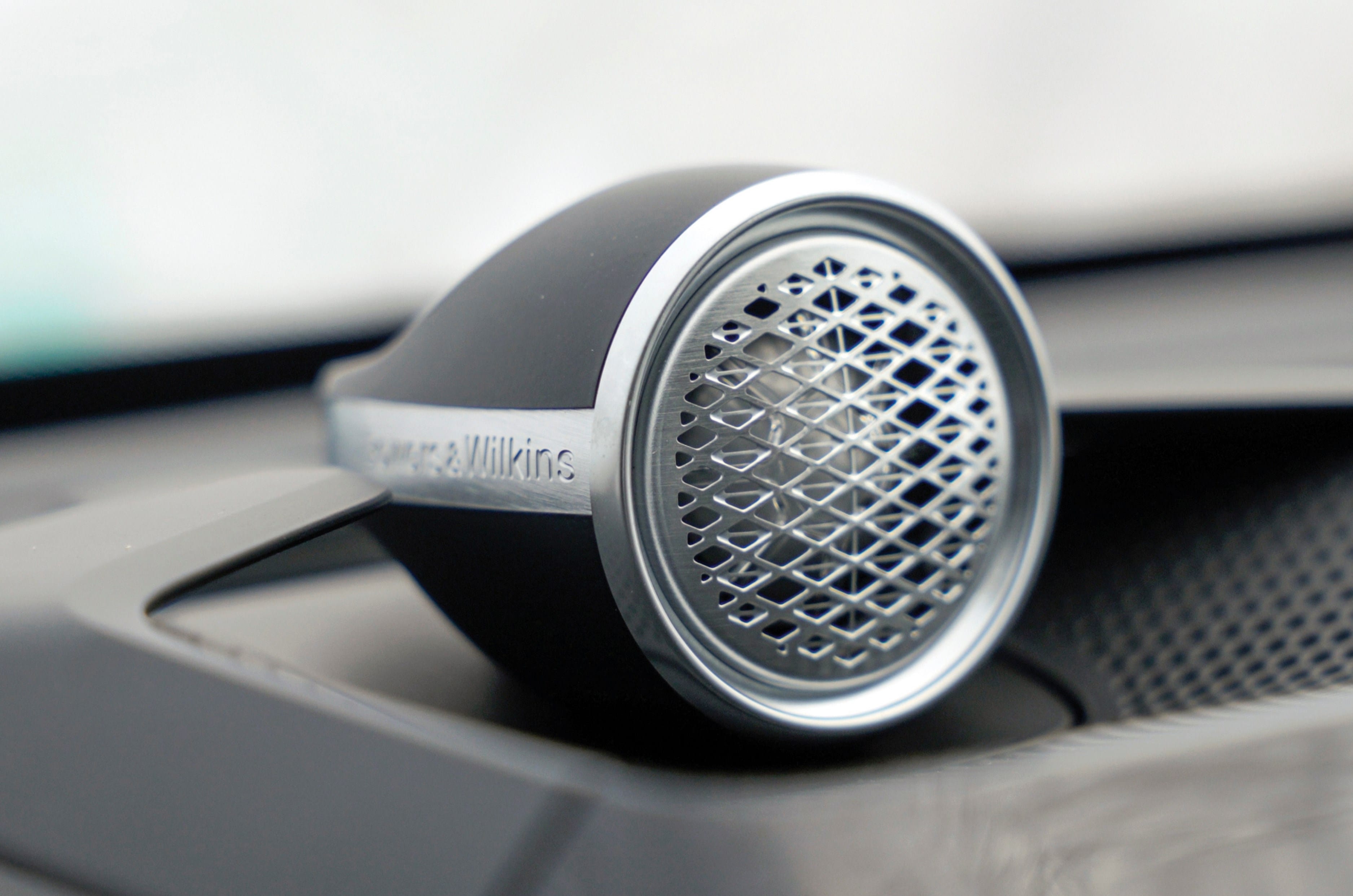
Bowers & Wilkins Hi-Fi audio system is epic.
What is excellent, however, is the music system: a 1,610W, 25-speaker Bowers & Wilkins Hi-Fi audio system with custom presets and modes that truly transform the cabin. If you enjoy your music, there are few cars in the world that offer something at this level or better. Safety is where Volvo excels, and the EX90, being the flagship, has all the bells and whistles – active and passive. Nine airbags, five cameras, five radars and 12 ultrasonic sensors, powering a full ADAS suite including door-opening alert and post-impact braking, make it exceptionally well equipped. Essentials like a 360-degree camera and auto-parking further make it easy to live with.
EX90 Performance and Refinement – 9/10
It is just as nice to drive as it is to be chauffeured in.
The EX90 comes in a single variant in India, with a dual-motor setup and a 106kWh battery pack. It develops 456hp and 670Nm, making it quick off the line. 0-100kph takes just 5.5sec, which, given its size and type, is pretty impressive. However, from behind the wheel, the experience aligns with its laid back character. You can alter the dynamics using the four drive modes. ‘Range’ prioritises efficiency, and power and torque are heavily restrained, although in bumper-to-bumper traffic, you will not notice the dip. There is a creep function too for peak-hour jams. ‘Standard’ is a balance that suits the car well for the most part, while ‘Performance’ is for that rare time when you want to add some enthusiasm.
Despite its strong power figures, performance feels more like an airliner than a fighter jet.
Don’t expect fighter-jet levels of reactions, though. Even in ‘Performance’ and with a heavy right foot, the EX90 builds pace gradually. It is almost like taking off in an aeroplane, where the speed rises in a strong and linear manner. This mode zaps power swiftly, so it is best to use the ‘Standard’ mode and get the best of all worlds. If you end up venturing off the tarmac, the ‘Off-road’ mode allows for more ground clearance (250mm), and it alters traction control and ESP settings to allow for more traction on loose surfaces.
Once on the move, what is extremely impressive is cabin refinement. With no engine sound to distract you, EV cabins amplify ambient sounds like wind and road noise, especially with large tyres, but the EX90 is a different story. Cabin insulation is top-notch, and it is near-silent on the inside. It also has a neat trick, microphones all around the car can relay conversations via the speakers clearly no matter where you are seated. You only have to talk in your natural tone for your voice to clearly go through the microphone and speakers. So passengers sitting at the first and third row can have a conversation without having to speak loudly.
EX90 Mileage / Range and Efficiency – 9/10
The 106kWh battery can eke out 625km according to the WLTP cycle. In our short test drive, we saw an efficiency of 5km/kWh in mixed driving conditions, resulting in a range of 530km. That is rather respectable, and considering a majority of our drive was on the highway, this number should only get better in the city.
The EX90 also has regenerative braking, and you can go from having it completely off to low or high, or just leave it in Auto, where it does all the thinking for you. Feel, though, leaves a lot to be desired, the pedal never feels consistent in its bite point. You get an 11kW AC charger for your home or office, which takes 11 hours for 0-100 percent. But being an 800V system, it can charge at up to 350kW on a DC charger, taking just 23 minutes for 10-80 percent. The car will also pre-condition the battery, meaning it gets the battery up to its optimum temperature to charge as quickly as possible.
EX90 Ride Comfort and Handling – 8/10
The EX90 rides on air suspension, which, over broken roads at medium or high speeds, is excellent. The car adjusts within microseconds, and you barely feel bumps inside. You can firm it up for the highway, so there is none of the wallowy feel associated with a softly sprung setup. Three modes to choose from give you flexibility depending on the road surface. ‘Standard’ offers the best balance, as it has the softness without feeling overly soft in the corners, while ‘Firm’ adds a layer of stability at speed and on fast bends. ‘Soft’ is a bit too soft, and the car ends up diving or rolling a tad more than necessary. In the city, there is none of the harshness over low-speed bumps, and the composed nature of the suspension is its highlight.
EX90 Value for Money – 8/10
The EX90 offers just about everything you need in a luxury EV
Prices for the EX90 will be out in October, and it will be the brand’s flagship SUV, sitting above the XC90. If you are looking for a chauffeur-driven luxury EV, it will tick the right boxes. That said, sunblinds would have been nice, and as a driver, it will frustrate you with an over-reliance on the touchscreen and a fiddly key card. On the whole, though, it does a lot to impress and allows you to forgive these shortcomings. You get everything you expect from a luxury EV, the cabin is plush and comfortable, the materials and feel are excellent, the design is subtle but svelte, and the ride comfort is truly impressive. It rivals the Mercedes-Benz EQS and BMW iX, and while it may not be as feature-loaded in the rear seat as the EQS or as powerful and fun to drive as the iX, it does find a very nice middle ground and would be top of the list for those looking for minimalist class and luxury.