किसान अगर कुछ नया करने की ठान ले, तो खेती से भी करोड़ों रुपये कमाए जा सकते हैं। महाराष्ट्र के सोलापुर के रहने वाले महेश असाबे ने इसे सच कर दिखाया है। उनके परिवार ने कुछ साल पहले सिर्फ 3 एकड़ जमीन पर ड्रैगन फ्रूट उगाना शुरू किया था। आज उनका फार्म 60 एकड़ तक फैल चुका है और सालाना कारोबार करीब 2 करोड़ रुपये पहुंच गया है। खास बात यह है कि महेश ने खेती को बेहतर बनाने के लिए नई तकनीक अपनाई और दूसरे देशों से भी सीख ली। उनकी यह कहानी उन किसानों के लिए खास है, जो खेती से अपनी आमदनी बढ़ाना चाहते हैं।
पिता ने शुरू की थी खेती
महेश असाबे महाराष्ट्र के सोलापुर जिले के अकोला गांव के रहने वाले हैं। उनका परिवार पहले मक्का जैसी पारंपरिक फसलों की खेती करता था। महेश ने एग्रीकल्चरल इंजीनियरिंग में बीटेक किया और इसके बाद एग्रीकल्चरल इंजीनियरिंग एंड फूड प्रोसेसिंग में एमटेक की पढ़ाई पूरी की।
साल 2013-14 में उनके पिता ने ड्रैगन फ्रूट की खेती करने का फैसला लिया। उन्होंने इस फल के बारे में पढ़ा था और जाना था कि इसकी खेती में अपेक्षाकृत कम पानी की जरूरत होती है। सूखे इलाकों में भी इसकी खेती की जा सकती है। यही बात उन्हें इस फसल की ओर खींच लाई।
बांग्लादेश से मंगाए 9,000 पौधे
ड्रैगन फ्रूट की खेती शुरू करना परिवार के लिए एक नया प्रयोग था। इसके लिए उन्होंने बांग्लादेश से करीब 9,000 पौधे मंगवाए। Startup Pedia के मुताबिक, पौधों पर शुरुआती निवेश करीब ₹9.9 लाख था। परिवार ने तीन एकड़ जमीन पर खेती शुरू की। साल 2015-16 में पहली फसल तैयार हुई और प्रति एकड़ करीब पांच टन उत्पादन मिला। उपज बेचकर परिवार को लगभग ₹5 लाख की कमाई हुई।
धीरे-धीरे ड्रैगन फ्रूट की मांग और कीमत बढ़ने लगी। साल 2017 तक परिवार इसे ₹150 से ₹250 प्रति किलो के भाव पर बेचने लगा। इससे खेती को बड़े स्तर पर ले जाने का हौसला मिला।
इजरायल और वियतनाम से सीखी खेती की नई तकनीक
महेश ने खेती को सिर्फ पारंपरिक तरीके तक सीमित नहीं रखा। पढ़ाई के दौरान वह 45 दिनों के प्रशिक्षण कार्यक्रम के लिए इजरायल गए। वहां उन्होंने पानी का बेहतर इस्तेमाल, आधुनिक कृषि तकनीक और उत्पादन बढ़ाने के तरीके सीखे। साल 2018 में उन्होंने वियतनाम का दौरा भी किया, जहां ड्रैगन फ्रूट की खेती के तरीकों को समझा। लौटकर उन्होंने अपने खेत में एक-एक एकड़ के अलग-अलग प्रदर्शन प्लॉट तैयार किए, ताकि खेती की विभिन्न तकनीकों को आजमाया जा सके।
3 एकड़ से 60 एकड़ तक पहुंचा फार्म
आज महेश असाबे Rukmini Farms and Nursery का संचालन करते हैं। उनके फार्म में ड्रैगन फ्रूट के अलावा अनार, सीताफल और अमरूद भी उगाए जाते हैं।
खेती में पानी बचाने के लिए ड्रिप इरिगेशन और तालाब जैसी सुविधाएं विकसित की गईं। निराई जैसे नियमित कामों में मशीनों का इस्तेमाल भी शुरू किया गया, जिससे खेती को संभालना आसान हुआ।
Startup Pedia के मुताबिक, महेश ड्रैगन फ्रूट की खेती से हर साल करीब ₹1.25 करोड़ कमाते हैं। उनके फार्म में सालाना लगभग 200 टन ड्रैगन फ्रूट का उत्पादन होता है। दूसरे फलों से होने वाली कमाई को जोड़ दें, तो उनके कारोबार का सालाना टर्नओवर करीब ₹2 करोड़ पहुंच जाता है।
महेश की कहानी बताती है कि खेती में नई तकनीक अपनाना, बाजार की मांग समझना और लगातार सीखते रहना कितना महत्वपूर्ण है। तीन एकड़ से शुरू हुआ उनका सफर आज दूसरे किसानों के लिए भी प्रेरणा बन सकता है।
Goat Milk Startup: अक्सर लोग पढ़-लिखकर नौकरी करना या अपनी पढ़ाई की स्किल से अपने लिए काम की तलाश करते हैं लेकिन जब जीवन में संकट का दौर आता है तो पढ़ाई लिखाई और स्किल भी धुंधली पड़ जाती हैं लेकिन संकट के बीच से निकलकर लोग अपने लिए नए रास्ता निकालते हैं।
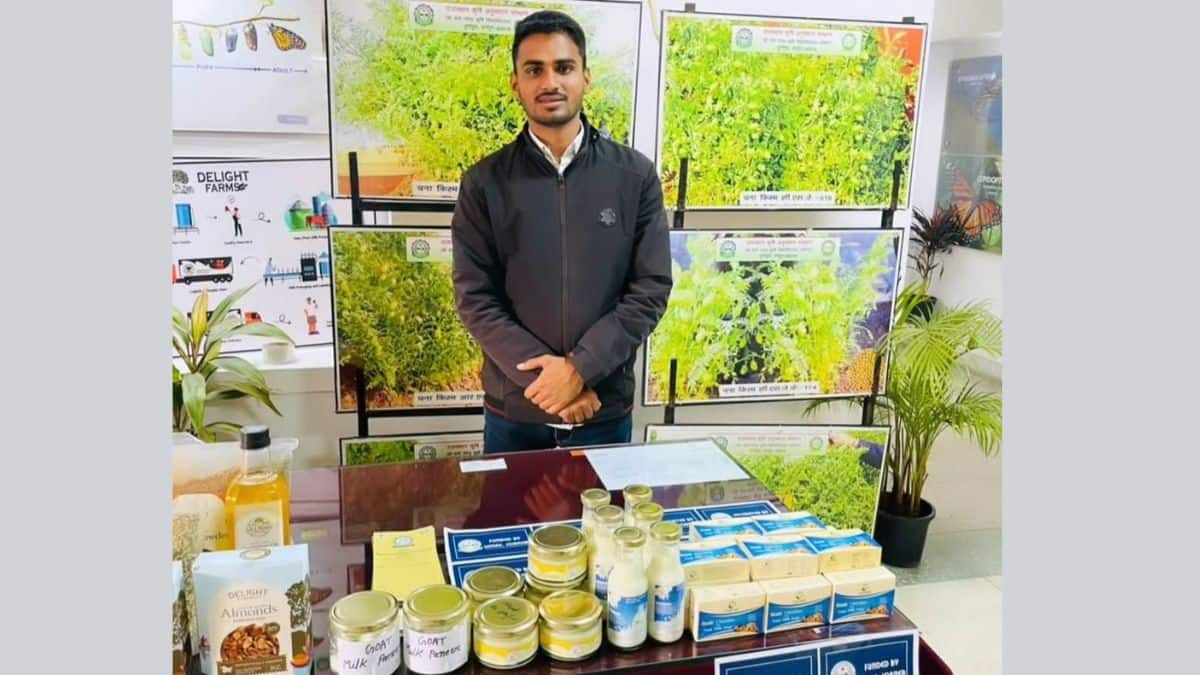
कुछ ऐसी ही कहानी जयपुर के युवा किसान और एंटरप्रेन्योर संदीप मीणा की है जिन्होंने अपने घर के बाड़े से 5 बकरियों से दूध और दूध से बने प्रोडक्ट्स के स्टार्टअप GoatVeda की शुरुआत की और आज इनकी कंपनी का टर्नओवर 18 लाख रुपए है। जयपुर के नजदीक जोबनेर कस्बे के डूंगरीकलां गांव के रहने वाले संदीप कुमार मीणा ने खेती और बकरी पालन के साथ अपने स्टार्टअप की ऐसी जर्नी शुरू की जो अब अन्य युवाओं को प्रेरित कर रही है।
संदीप एक सामान्य परिवार से आते हैं उनके जीवन में सबकुछ ठीक चल रहा होता लेकिन कोरोनाकाल में पिता का निधन और प्राइवेट नौकरी पर गहराए संकट ने संदीप कुमार मीणा के जीवन को अलग दिशा में मोड़ दिया जो आज युवाओं के लिए मिसाल है। संदीप मीणा के पिता राम मीणा पत्थर का काम करते थे और सिलिकोसिस बीमारी से पीड़ित थे। कोरोना काल में 2021 में उनका निधन हो गया।
पिता की असामयिक मृत्यु के बाद घर की जिम्मेदारी संदीप के कंधे पर आ गई। परिवार की आर्थिक स्थिति और प्राइवेट नौकरी को छोड़कर संदीप ने अपनी मां कमला देवी के साथ 2022 में वर्क फ्रॉम होम के साथ अपने स्टार्टअप की शुरुआत की।
संदीप ने 5 बकरियों से शुरू किया था ‘गोटवेदा’ स्टार्टअप
वेटरनरी में दो साल का डिप्लोमा और कुछ महीनों की नौकरी के बाद संदीप कुमार मीणा एक समय एग्रीकल्चर में बीएससी करना चाहते थे। लेकिन 4 साल का लंबा समय और परिवार की स्थिति को देखते हुए उन्होंने अपने घर के बाड़े से ही ‘गोटवेदा’ स्टार्टअप की शुरुआत की, कोरोनाकाल में लगातार दूध की डिमांड को देखते हुए संदीप को इस स्टार्टअप का आइडिया आया। जिसके बाद उन्होंने कुछ समय तक इस स्टार्टअप के वर्क और मार्केट को समझा और फिर बिल्कुल छोटे रूप में शुरुआत की।
आज संदीप के पास जयपुर की रजिस्टर्ड ब्रीड गुर्जर और सिरोही नस्ल की कई बकरियां हैं। बकरी पालन में अक्सर किसान और पशुपालक बकरियों को दो तरीकों से पालते हैं, एक बकरियों को फार्म में बांधकर ब्रीडिंग और मांस के लिए जिसके पालन में खर्च ज्यादा आता है, जबकि ग्रेजिंग में कम खर्च आता है।
संदीप ने ग्रेजिंग के अनुसार बकरियों के पालन की शुरुआत की जिसमें बकरियों के भोजन/चारे के लिए संदीप ने 100 अरडू के पौधे लगाए, जिनकी पत्तियों को बकरियां बड़े चाव से खाती हैं। इससे बकरियों में दूध भी बढ़ता है। इस प्रकार संदीप ने बकरी पालन के साथ पेड़ों से भी अतिरिक्त इनकम बनाना शुरू किया।
संदीप के इस स्टार्टअप का मुख्य आकर्षण यह है कि बकरी का दूध खास तौर पर उन बच्चों के लिए लिया जाता है, जिन्हें गाय, भैंस के दूध से एलर्जी होती है। इसलिए बकरी का दूध पचने में हल्का होता है और यह शरीर में रोग प्रतिरोधक क्षमता बढ़ाने में सहायक होता है इसलिए डेंगू जैसी बीमारियों में डॉक्टर भी बकरी का दूध पीने की सलाह देते हैं। इसी के चलते संदीप ने दूध के साथ दूध से ही कई प्रोडक्ट्स बनाए जिनकी अब मार्केट में खूब डिमांड रहती है।
ऑनलाइन मार्केट से ग्राहकों को जोड़ खड़ा किया लाखों का स्टार्टअप
संदीप कुमार मीणा ने अपने स्टार्टअप की शुरुआत भले ही छोटे रूप में की हो लेकिन दूध और दूध से बने प्रोडक्ट्स को मार्केट तक पहुंचाने के लिए संदीप ने अपनी शुरुआत जयपुर में चित्रकूट स्टेडियम के पास लगने वाले ऑर्गेनिक मार्केट में दूध की स्टॉल लगाकर की और यहां संदीप ने 250 रुपए लीटर के हिसाब से अपना दूध बेचा।
ऐसे धीरे-धीरे संदीप को शुरुआती दौर में ग्राहक मिले और उन्हें बाजार का अनुभव मिला। वैसे दूध महंगा होने के चलते शुरुआत में उनके दूध की डिमांड कम रही लेकिन संदीप ने अपने स्टार्टअप पर लगातार फोकस किया और धीरे-धीरे किसानों को अपने साथ जोड़ा और ऑनलाइन मार्केट तक पहुंचे।
आज संदीप एक बकरी से रोजाना करीब एक से डेढ़ लीटर दूध प्राप्त करते हैं तो हर दिन उनके पास लगभग 70 से 80 किलो दूध का उत्पादन होता है। साथ ही संदीप के इस स्टार्टअप से अब कई किसान और जुड़ गए हैं। संदीप अब अपने स्टार्टअप में दूध उत्पादन और प्रोडक्ट्स बनाने के अलावा गांवों में पशुपालन करने वाले किसानों को पशु चिकित्सा सेवाएं और बकरियों-भेड़ों के लिए खरीद/बिक्री, किसानों के लिए प्रशिक्षण कार्यक्रम और सहायता, ऋण, बीमा और एआई सेवाओं तक गोटवेदा सिर्फ एक ब्रांड नहीं है बल्कि एक सफल स्टार्टअप बन चुका है।
बकरियों के दूध से संदीप तैयार करते हैं ये खास प्रोडक्ट्स
संदीप अपने प्रोसेसिंग यूनिट में दूध से कई बेहतरीन प्रोडक्ट्स तैयार करते हैं, जिनकी ई-कॉमर्स मार्केट में भारी डिमांड रहती है:
पाउडर: 500 लीटर दूध से बल्क में पाउडर बनवाया जाता है, जिसकी रोजाना 25 से 30 लीटर बिक्री होती है।
साबुन: हर महीने करीब 300 साबुन बनाए जाते हैं, जिसकी कीमत 30 रुपए है।
पनीर: 2 लीटर दूध से 300 ग्राम पनीर तैयार किया जाता है, जिसकी डिलीवरी ऑर्डर्स के हिसाब से की जाती है।
अन्य प्रोडक्ट्स: दूध और घी की भी ग्राहकों के बीच खूब मांग रहती है।
Startup Success Story: दिल्ली के नजफगढ़ के रहने वाले लक्ष्य और अंजलि कालिया की कहानी उन लोगों के लिए अनोखी है जो नौकरी करते हुए अपना खुद का बिजनेस शुरू करने का सपना देखते हैं। इस कपल ने अपनी नौकरी छोड़ दी और अपना खुद का ब्रांड, लव लाइट शुरू किया। यह ब्रांड कई तरह के प्रोडक्ट बनाता है, जिसमें हाथ से बनी खुशबूदार मोमबत्तियां और क्रोशिया से बुने फूल शामिल हैं।
खास बात यह है कि इस बिजनेस से 50 महिलाओं को काम करने का मौका मिला है। अपना खुद का बिजनेस शुरू करना आसान नहीं है। इसके लिए सही आइडिया, कड़ी मेहनत और मार्केट की जरूरतों की समझ की जरूरत होती है। लक्ष्य और अंजलि ने नौकरी के बजाय अपना खुद का बिजनेस शुरू करने का फैसला किया। उनका बिजनेस हाथ से बने प्रोडक्ट पर आधारित है जो सुंदरता के साथ कड़ी मेहनत और हुनर को मिलाते हैं।
क्या है लव लाइट ब्रांड का बिजनेस
लव लाइट हाथ से बनी खुशबूदार मोमबत्तियां और क्रोशिया प्रोडक्ट बनाती है। खुशबूदार मोमबत्तियां खुशबूदार मोम होती हैं। क्रोशिया एक कला है जिसमें धागे का इस्तेमाल करके फूल और दूसरी सजावटी चीजें बनाई जाती हैं। ये हाथ से बने प्रोडक्ट आजकल घर की सजावट और गिफ्ट देने के लिए पॉपुलर हैं। इन प्रोडक्ट की खासियत यह है कि ये मशीन से बने होने के बजाय हाथ से बने होते हैं। इस काम के लिए स्किल और सटीकता की जरूरत होती है। लव लाइट का बिजनेस भी ऐसे ही प्रोडक्ट पर आधारित है।
50 महिलाओं को मिला रोजगार
लक्ष्य और अंजलि के बिजनेस की सबसे खास बात यह है कि इससे 50 महिलाओं को रोजगार मिल रहा है। दोनों ने अपने कारोबार को इस तरह आगे बढ़ाया कि इसमें दूसरी महिलाओं के लिए भी काम करने और कमाई करने का अवसर बना। हैंडमेड प्रोडक्ट्स बनाने के काम में हुनर की अहम भूमिका होती है। क्रोशिया से फूल और दूसरी चीजें तैयार करने के लिए धैर्य और बारीकी से काम करना पड़ता है। ऐसे में महिलाओं को इस तरह के काम से जोड़ना उनके हुनर को रोजगार में बदलने का एक तरीका भी है।
क्या-क्या बनाते हैं लक्ष्य और अंजलि
लव लाइट ब्रांड के तहत खुशबूदार मोमबत्तियां यानी सेंटेड कैंडल्स तैयार की जाती हैं। इनका इस्तेमाल घर की सजावट और गिफ्ट देने के लिए किया जाता है। इसके अलावा, क्रोशिया से बने फूल और दूसरी चीजें भी इस ब्रांड का हिस्सा हैं। हाथ से बने होने के कारण इनकी डिजाइन और कारीगरी इन्हें अलग पहचान देती है।
हैंडमेड प्रोडक्ट्स के बिजनेस में कितना हो सकता है मुनाफा
लक्ष्य और अंजलि के Love Light बिजनेस में कमाई हैंडमेड प्रोडक्ट्स की बिक्री और खर्च पर निर्भर करती है। उदाहरण के तौर पर, ₹1 लाख की मासिक बिक्री पर 15–25% मुनाफे के हिसाब से ₹15,000–₹25,000 बच सकते हैं। कपल ने बताया कि भले ही हमें 25% का ही मुनाफा हो रहा हो, लेकिन हमें खुशी है कि यह हमारा अपना पैसा है और हमारे पास वापस आ रहा है। हमें किसी का गुलाम बनने या किसी के लिए काम करने की जरूरत नहीं है।
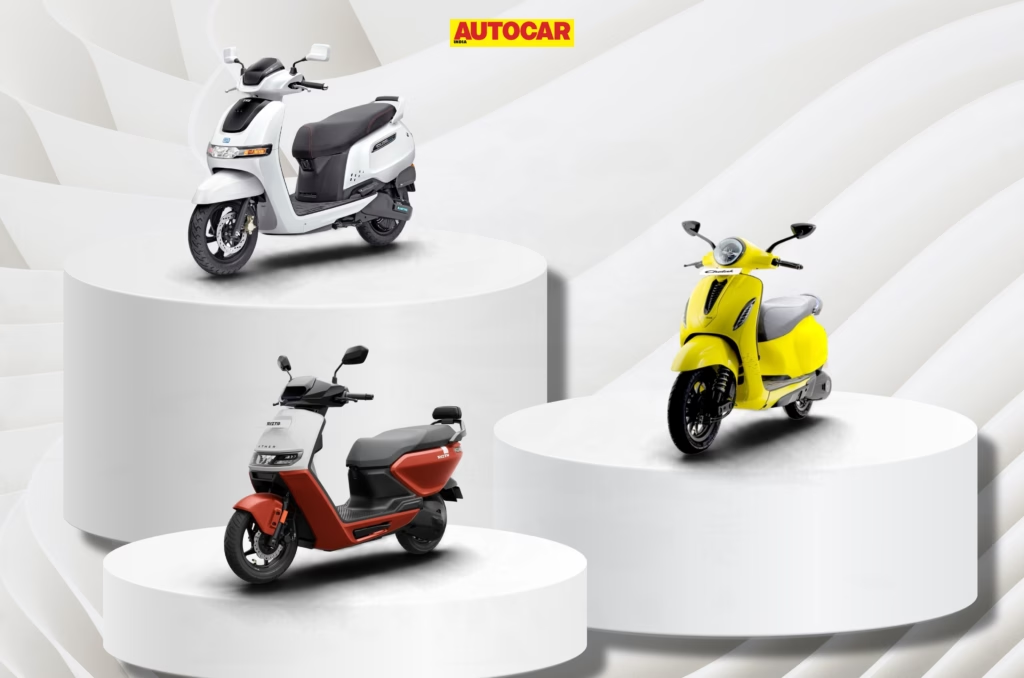
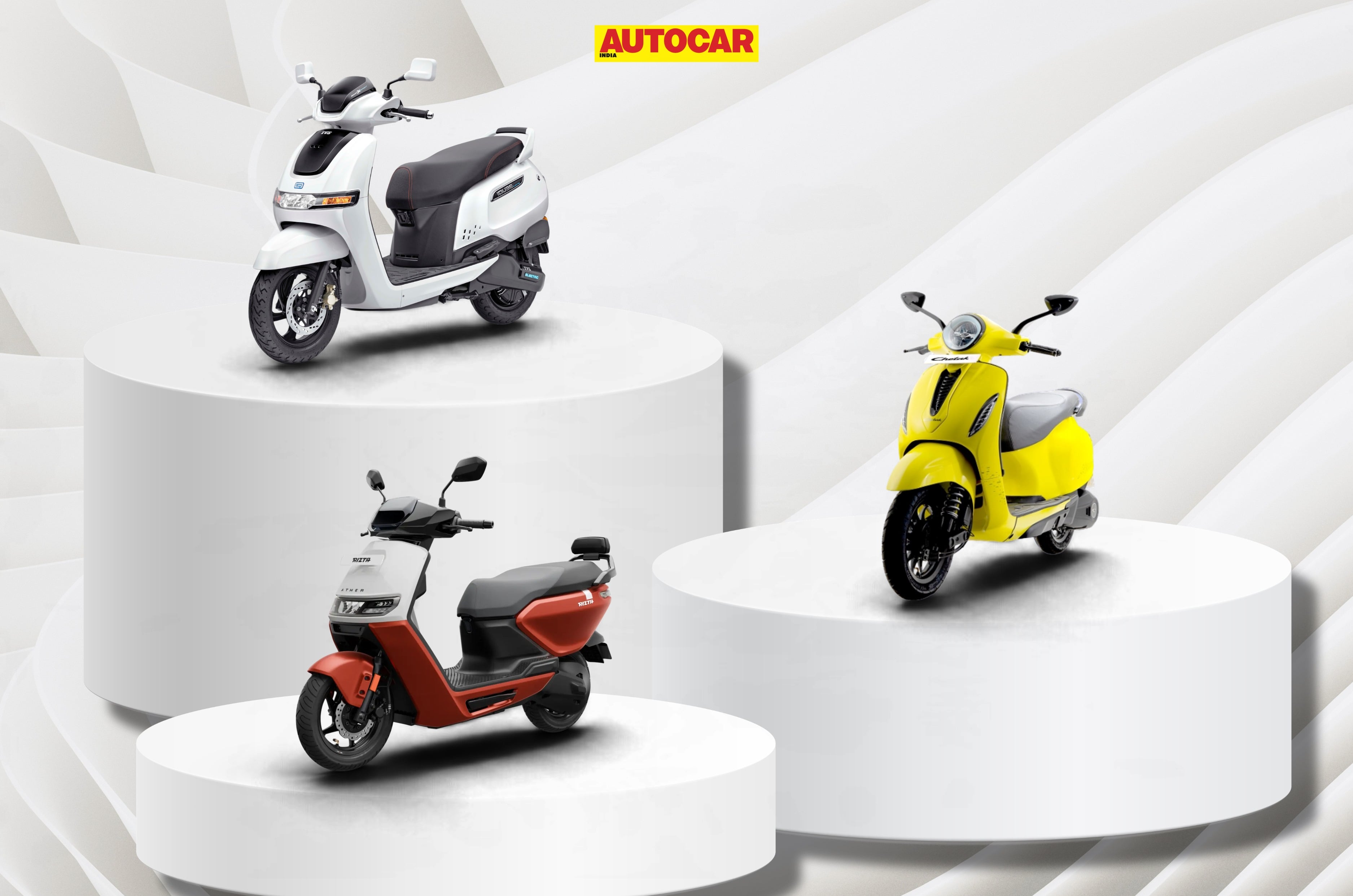
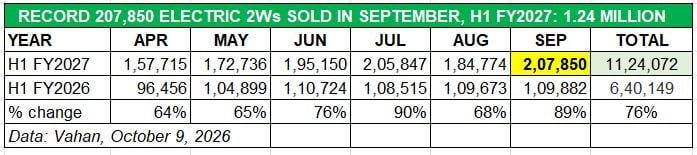
India’s electric two-wheeler market is on a roll and how. While January-September 2026 retail sales have already crossed 1.61 million units, e-2-wheeler customer deliveries in April-September 2026 increased 76 percent to 11.2 lakh units (versus 6.40 lakh units same time last year). The rapid pace of demand means that the industry is predicted to end the financial year with 22.6 lakh total sales. September 2026 was also the first time the industry sold 2.07 lakh units (highest yet), which is an 89 percent increase compared to 2025.
Besides the top-three, Bounce and River have improved the most
Ola has held on to fifth place, but lost 9 percent of its market share
September’s high sales numbers will likely be surpassed by the upcoming festive season
Indian e-2-wheeler industry sales: The trend so far
TVS and Bajaj continue to lead, with Vida steadily improving
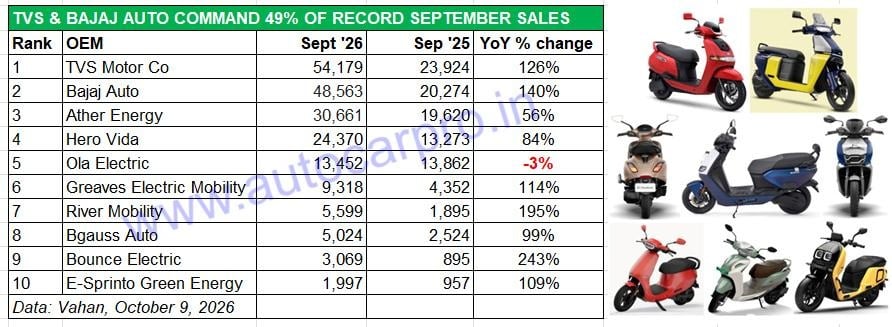
TVS and Bajaj, which have been the top two brands since Ola moved out of the top spot in April 2025, continue to register handsome gains. In September, both companies registered triple-digit growth, which ensured that they make up a 49 percent share of the record monthly retails. This is the highest monthly sales for Bajaj, beating March 2026 (47,755 units). Ather, in the third position, sold 30,661 units and marked 56 percent YoY growth. March 2026 continues to be Ather’s best month, sales-wise (36,634 units) with the Konarc expected to contribute to that number substantially soon. Vida, backed by Hero, sold its highest ever 24,370 units in September, crossing July’s number (22,996).
Brand-wise performance and market share in H1 FY2027
Besides the top two, River and Bounce improved the most
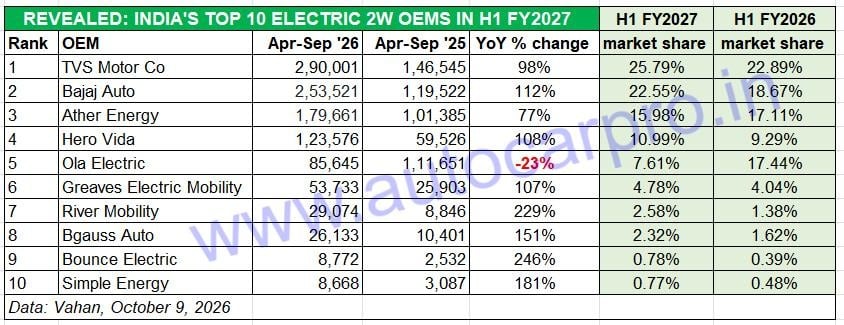
Electric 2W market leader TVS nearly doubled its first-half retail sales YoY to 2.90 lakh units, giving it a 26 percent market share. For TVS, EVs are now a key growth driver and every fifth scooter the company sells is now a zero-emission model. Bajaj, which sells multiple variants of the Chetak, has retailed 2.53 lakh units in the past six months. The strong performance gives it a current market share of 23 percent. Ather, in third position, has clocked retail sales of 1.79 lakh units in H1 FY2027. Ather crossed the 30,000 mark in three of the past six months, June, July and September. Its H1 FY2027 market share is 16 percent, one percentage less than H1 FY2026. A few days ago, cumulative Ather sales surpassed 8 lakh units, making it the fourth company after Ola, TVS and Bajaj to achieve that milestone.
Fourth-ranked Vida registered retail sales of 1.23 lakh units in first-half FY2027, up 107 percent YoY. Ola remains glued to the fifth rank with an 8 percent market share, considerably down from the 17 percent it had in H1 FY2026. Greaves Electric Mobility (GEM), manufacturer of Ampere e-scooters, has sold 53,733 units, comes in at sixth with a 107 percent YoY growth.
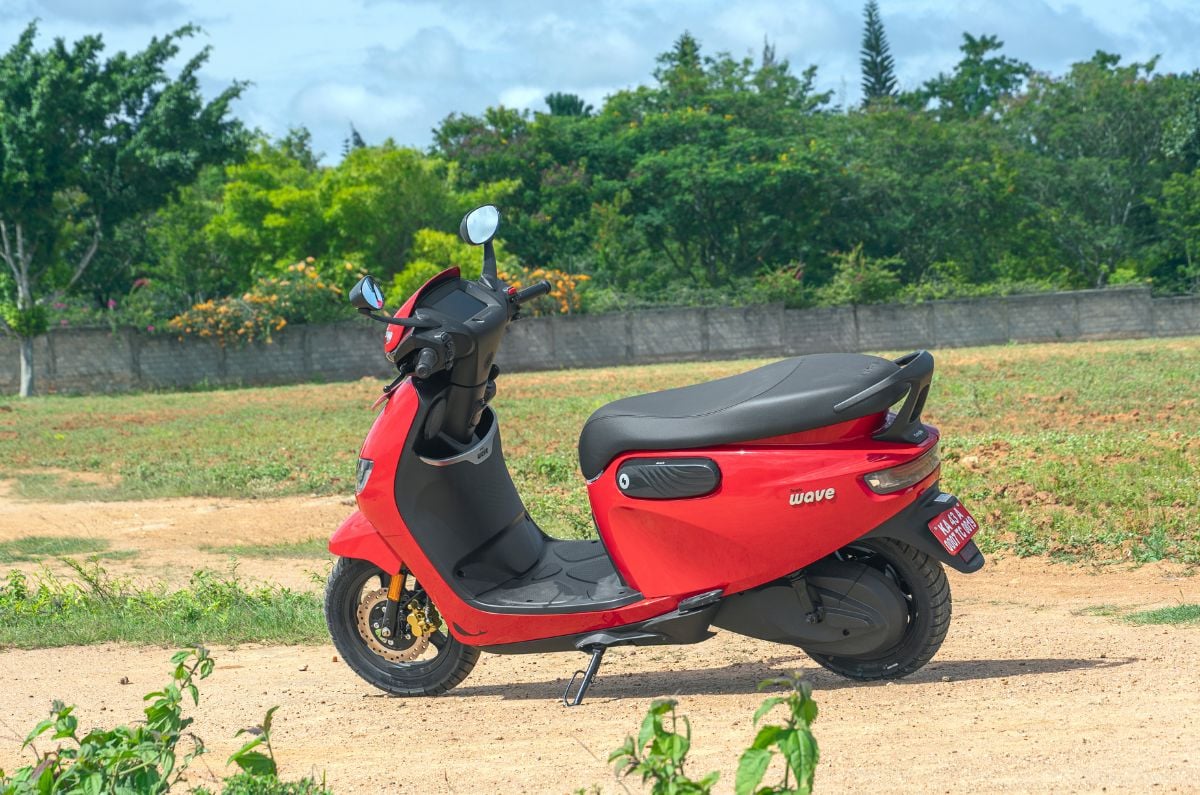
The Bengaluru-based River, which continues to impress month on month, has sold 29,074 units in H1 FY2027. The stellar performance sees River’s market share rise to 3 percent from 1 percent in H1 FY2026. The startup’s highest monthly sales came in July (6,044 units). In eighth place, the Mumbai-based BGauss has sold 26,133 units in H1 FY2027, registering a 107 percent growth compared to H1 FY2026. Bounce ranks ninth with 8,772 units, up 246 percent YoY. Simple, which has been a regular in the monthly top 10 e-2-wheeler sales listing since February 2026, has clocked cumulative six-month sales of 8,668 units, up 181 percent YoY. This momentum comes just as Simple launched its most affordable scooter yet, the Wave, starting at Rs 1.10 lakh.
India’s e-2-wheeler market with 200 players, is the largest contributor to India’s EV sales numbers with a 62 percent share of the total EVs sold in the April-September 2026 period. The market is currently led by TVS, Bajaj, Ather, Vida, Ola and GEM – who account for 88 percent share of the e-2-wheeler sales in H1 FY2027. Given its robust 76 percent growth so far, and the festive season having just begun, one can expect September’s record 2.07 lakh unit sales to be surpassed soon.
Jaipur Waste Management Startup: देशभर में आज स्वच्छता अभियान को लेकर शहरों में इंदौर से आगे निकलने की होड़ है, जिसके लिए प्रशासन और शहरों की संस्थाएं लगातार लोगों को कचरे और साफ-सफाई के प्रति जागरूक करती हैं। लेकिन कुछ लोग ऐसे भी होते हैं जो इस बीड़े को खुद उठाते हैं। ऐसे ही जयपुर के दो युवा हैं, जिन्होंने कचरे और वेस्ट मैनेजमेंट सिस्टम के स्टार्टअप से ₹250 करोड़ का साम्राज्य खड़ा कर दिया। आज यह सिर्फ एक सफल स्टार्टअप ही नहीं है, बल्कि ‘फोर्ब्स अंडर-30’ की लिस्ट तक इनके स्टार्टअप का डंका बज चुका है।
जयपुर के अभिषेक गुप्ता और अभिनव शेखर वशिष्ठ ने 2018 में ‘वीवॉइस लैब’ (WeVOIS Labs) कंपनी की शुरुआत की और आज उनका यह स्टार्टअप 25 से अधिक शहरों में काम कर रहा है। ‘वीवॉइस लैब’ के इस क्लीन-टेक स्टार्टअप की कहानी जयपुर के इन दोनों युवाओं के 2016 में कॉलेज कैंपस सफाई अभियान और वेस्ट अवेयरनेस कैंपेन से शुरू हुई थी। उस समय कॉलेज के इस सफाई अभियान को उन्होंने सिर्फ एक प्रोजेक्ट के रूप में नहीं देखा, बल्कि कचरे और सफाई के स्थाई समाधान पर विचार शुरू किया और यहीं से ‘वीवॉइस लैब’ स्टार्टअप की नींव पड़ी।
6 लाख टन से ज्यादा वेस्ट कचरा प्रोसेस करती है ‘वीवॉइस लैब’
आंकड़ों के अनुसार देश में हर साल 62 मिलियन टन कचरा निकलता है, जिसे या तो खुले में फेंक दिया जाता है या जला दिया जाता है। लेकिन जयपुर के अभिषेक गुप्ता और अभिनव शेखर की कंपनी ‘वीवॉइस लैब’ वेस्ट मैनेजमेंट सिस्टम के रूप में अपनी खास पहचान रखती है। इस कंपनी का सिस्टम पूरी तरह इंटरनेट ऑफ थिंग्स (IoT) पर आधारित है। इसमें हर घर, होटल और अस्पताल को ‘रेडियो फ्रीक्वेंसी आइडेंटिफिकेशन’ (RFID) टैग दिया जाता है, जिससे कचरा उठाने से लेकर प्रोसेस होने तक रियल-टाइम मॉनिटरिंग होती है। इसमें कचरा कब उठा, किसने उठाया, कितना उठा, वर्कर की उपस्थिति, परफॉर्मेंस और प्रोसेस पर खास निगरानी रखी जाती है।
जयपुर की इस ‘वीवॉइस लैब’ कंपनी के जरिए हजारों वर्कर्स को रोजगार भी मिल रहा है। फिलहाल वीवॉइस लगभग ₹250 करोड़ का क्लीन-टेक स्टार्टअप बन चुका है, जो 25 शहरों में काम कर रहा है और हर साल 6 से 7 लाख टन से ज्यादा वेस्ट प्रोसेस कर रहा है।
गांवों में भी शुरू किया ‘रूरल स्मार्ट विलेज सेंटर’
कचरे का निपटान और जागरूकता फैलाने का ‘वीवॉइस लैब’ का काम सिर्फ शहरों तक ही सीमित नहीं है, बल्कि यह गांवों में भी ‘रूरल स्मार्ट विलेज सेंटर’ के रूप में काम कर रहा है। यहां वेस्ट मैनेजमेंट सिस्टम के साथ-साथ लोगों को रोजगार और स्वच्छता की शिक्षा भी दी जा रही है। हाल ही में ‘वीवॉइस लैब’ ने बिसलेरी के साथ मिलकर जयपुर में हर महीने 30 टन प्लास्टिक वेस्ट उठाना शुरू किया है। साथ ही 300 टन क्षमता वाला टेक्सटाइल वेस्ट रीसाइकलिंग प्लांट भी शुरू किया है। आने वाले समय में 10 और शहरों को इस सिस्टम से जोड़ा जाएगा, ताकि 3 हजार टन प्लास्टिक वेस्ट को लैंडफिल में जाने से रोका जा सके।
लंबे समय से जयपुर के ये दो युवा टेक्सटाइल कचरे के वैज्ञानिक रीसाइक्लिंग से रोजगार और पर्यावरण संरक्षण को एक नई दिशा देने पर काम कर रहे हैं। कुछ ही दिनों में राजधानी जयपुर में ‘वीवॉइस लैब’ द्वारा टेक्सटाइल रीसाइक्लिंग यूनिट शुरू की गई है, जिसके बाद से कचरे के सस्टेनेबल डेवलपमेंट के लक्ष्यों पर काम किया जा रहा है।
‘वीवॉइस लैब’ के जरिए किस प्रकार होती है टनों कचरे की रीसाइकलिंग
‘वीवॉइस लैब’ खासतौर पर शहरों को स्वच्छ और पर्यावरण-अनुकूल बनाने में मील का पत्थर साबित हो चुकी है, जो अलग-अलग तरीकों से कचरे की रीसाइकलिंग करती है। ‘वीवॉइस लैब’ के वर्कर्स द्वारा एकत्रित कचरे का उपयोग अलग-अलग रूपों में किया जाता है; जैसे गीले कचरे को खाद बनाने के लिए भेजा जाता है, जबकि सूखे कचरे से कागज, प्लास्टिक, धातु, कांच और वस्त्र जैसी सामग्रियां बनाने के लिए उसे अलग-अलग छांटा जाता है।
कंपनी की ‘रीसूत्र’ यूनिट में अत्याधुनिक तकनीक का उपयोग किया जाता है, जो कपड़ा अपशिष्ट को ट्रैक, प्रोसेस और पुनः उपयोग योग्य उत्पादों में परिवर्तित करने में सक्षम है। आमतौर पर एकत्रित कचरे का अधिकांश भाग लैंडफिल स्थलों (कचरे के ढेरों) में डाल दिया जाता है, जिससे हानिकारक गैसों का उत्सर्जन होता है और पर्यावरण प्रदूषित होता है। लेकिन लैंडफिल स्थलों पर कचरे के ढेर को रोकने के लिए, ‘वीवॉइस लैब’ ने नगर निकायों की सहायता से प्रायोगिक परीक्षण भी किया है।
‘वीवॉइस लैब’ जनरेट कर रही है लोगों के लिए रोजगार
जयपुर की ‘वीवॉइस लैब’ एक अपशिष्ट प्रबंधन कंपनी है जो कचरे के संग्रहण, ट्रैकिंग, पृथक्करण और पुनर्चक्रण में सुधार के लिए तकनीक का उपयोग करती है। इसके साथ ही कंपनी का मुख्य फोकस टेक्सटाइल अपशिष्ट को पुनः उपयोगी संसाधनों में बदलकर सर्कुलर इकोनॉमी को बढ़ावा देने पर रहता है। इसके अलावा कंपनी अधिक से अधिक लोगों के लिए रोजगार उपलब्ध करा रही है, जो एक स्मार्ट सिस्टम के जरिए काम करता है।
कंपनी में एक खास ‘रूट मैनेजर सॉफ्टवेयर’ डिजाइन किया गया है, जो सहायकों के लिए आपके घर तक पहुंचने और समय पर सेवा प्रदान करने का मार्ग निर्धारित करता है। साथ ही, कंपनी का सुव्यवस्थित अलर्ट प्रबंधन प्रणाली वाला मोबाइल ऐप उपभोक्ताओं को निर्धारित पिकअप से पहले हर बार सूचना प्राप्त करने में सक्षम बनाता है।
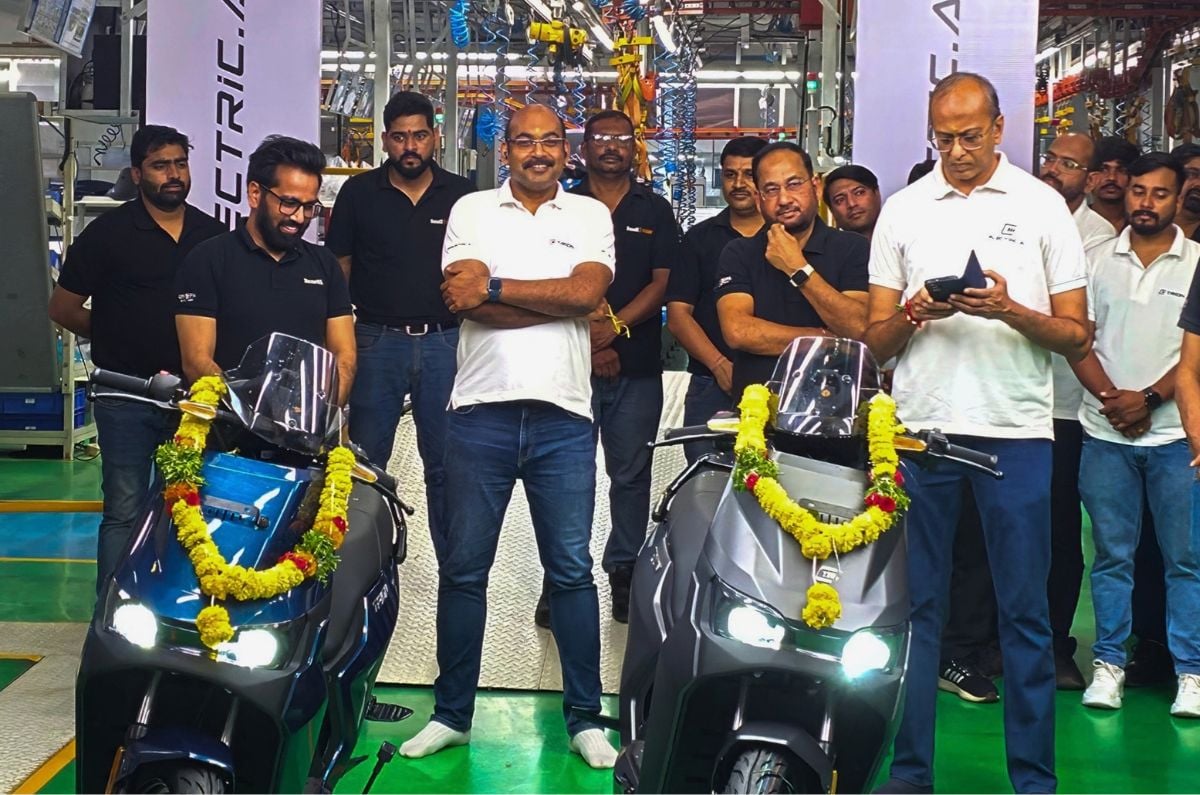
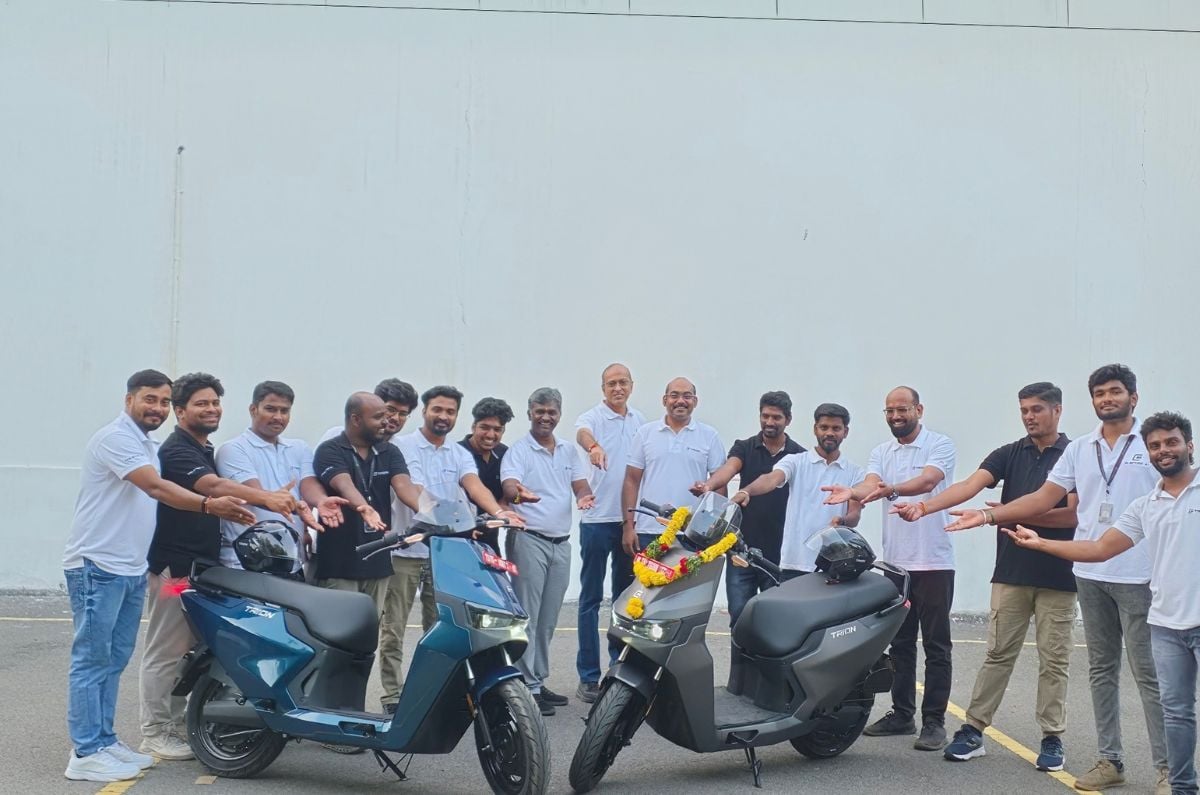
Bengaluru-based electric mobility startup E3 Electric.Ai has started production of the E3 Trion electric scooter at its Hyderabad manufacturing plant and it will begin deliveries from today onwards.
Available in two battery pack options across three variants
The first 100 customers will receive optional extended warranty at an additional cost
Prices start at Rs 1 lakh and go up to Rs 1.20 lakh (ex-showroom Bengaluru)
E3 Trion details
Offered in 2.3kWh and 3kWh battery packs, with up to 165km IDC range
The E3 Trion is offered in three variants: C1, C1X and C2 and deliveries for the variants will begin in a phased manner. Across the three variants, the scooter will be available in two battery pack options 2.3kWh and 3kWh. The base C1 is offered in the 2.3kWh battery pack which is removable, whereas the C1X and C2 will comprise the 3kWh fixed battery pack. The C1, C1X and C2 have a claimed IDC range of 108km, 165km and 128km respectively. The scooters will feature 14-inch wheels at both ends
The first 100 E3 Trion customers will receive an extended warranty covering the battery pack and specified key parts for eight years or 1 lakh kilometres, whichever comes first. They will also receive one year of E3 Wingman roadside assistance as well. The combined offering is valued at Rs 6,500 for the C1 with its 2.3kWh battery and Rs 8,500 for the C1X and C2, which uses a 3kWh battery.
With pricing starting at Rs 1 lakh for the base C1, Rs 1.10 lakh for the C1X, and Rs 1.20 lakh for the top-spec C2 variant, the E3 Trion goes head-to-head with established family scooters like the Bajaj Chetak, TVS Orbiter V2, TVS iQube 3.1kWh, Ampere Nexus EX+, and Ather Konarc.
Plastic Waste Startup: दिल्ली में प्लास्टिक कचरा एक बड़ी समस्या है, लेकिन पति-पत्नी की एक जोड़ी ने इसी कचरे को अपने बिजनेस के लिए रॉ मटीरियल में बदल दिया। सोनल शुक्ला और वैभव वर्मा ने 2020 में Econscious की शुरुआत की। प्लास्टिक कचरे को सिर्फ कूड़ा समझने के बजाय, उन्होंने इसे काम की चीज़ोंचीजों में बदलने का एक मॉडल तैयार किया।
आज उनकी कंपनी प्लास्टिक कचरे से पार्क बेंच, डस्टबिन, प्लांटर और आम लोगों के इस्तेमाल की दूसरी चीजें बनाती है। इस कंपनी की शुरुआत महामारी के दौरान प्लास्टिक कचरे की बढ़ती समस्या को देखते हुए की गई थी।
ट्रेक के दौरान आया आइडिया
पहाड़ी इलाकों में यात्रा करते समय, सोनल और वैभव ने देखा कि हर तरफ प्लास्टिक का कचरा फैला हुआ था। इस बात ने उन्हें यह सोचने पर मजबूर किया कि कचरे को लैंडफिल में फेंकने के बजाय किसी काम की चीज़ में कैसे बदला जा सकता है। अपनी टेक्निकल जानकारी का इस्तेमाल करते हुए, उन्होंने प्लास्टिक कचरे को रीसायकल करके नए प्रोडक्ट बनाने पर काम करना शुरू किया। बता दें कि सोनल शुक्ला और वैभव वर्मा, दोनों ने NIT कुरुक्षेत्र से M.Tech किया है।
घर और कंपनियों से आता है कच्चा माल
Econscious का मॉडल सिर्फ प्लास्टिक से सामान बनाने तक ही सीमित नहीं है। कंपनी प्लास्टिक कचरे को उसके स्रोत से इकट्ठा करने का काम भी करती है और दिल्ली-NCR इलाके में घर-घर जाकर प्लास्टिक कचरा उठाने की सर्विस देती है। इसके अलावा, यह कई कंपनियों और संगठनों के साथ मिलकर काम करती है।
इकट्ठा किए गए प्लास्टिक को प्रोसेस करके अलग-अलग डिजाइन वाले प्रोडक्ट बनाए जाते हैं। जहां आम तौर पर बिजनेस को नया कच्चा माल खरीदना पड़ता है, वहीं यहां प्लास्टिक जिसे आमतौर पर कचरा माना जाता है, प्रोडक्ट बनाने का आधार बनता है। यही बात इस मॉडल को सर्कुलर इकॉनमी से जोड़ती है।
प्लास्टिक से बन रही बेंच और डस्टबिन
कंपनी के प्रोडक्ट्स में बेंच, डस्टबिन, प्लांटर्स और दूसरी ऐसी चीजें शामिल हैं जिन्हें पार्क और सार्वजनिक जगहों पर इस्तेमाल के लिए बनाया गया है। Econscious ने P&G, जिलेट, नेस्ले, ITC, बिसलेरी और HCL फाउंडेशन जैसे संगठनों के साथ कई प्रोजेक्ट्स पर काम किया है। कंपनी के मुताबिक, बिसलेरी की बोतलों के ढक्कनों का इस्तेमाल करके रीसाइकल किए गए प्लास्टिक की बेंच बनाई गई हैं। साथ ही, HCL फाउंडेशन के लिए नोएडा में कई जगहों पर बेंच बनाकर लगाई भी गई हैं।
लाखों किलो प्लास्टिक को बनाया उपयोगी
इस बिजनेस का सबसे अहम पहलू इससे होने वाली कमाई है। सोनल शुक्ला ने बताया कि Econscious ने अब तक लगभग 3,50,000 किलोग्राम प्लास्टिक कचरे को रीसायकल किया है। साथ ही, कंपनी ने अपनी शुरुआत से अब तक ₹1 करोड़ से ज्यादा की कमाई की है।
सोनल के अनुसार, कंपनी की कमाई सिर्फ रीसायकल किए गए प्रोडक्ट्स को बेचने से ही नहीं होती, प्लास्टिक कचरा मैनेजमेंट, उसे इकट्ठा करना और अलग-अलग ऑर्गनाइजेशन के लिए कस्टमाइज़्ड प्रोजेक्ट्स भी इस बिजनेस का हिस्सा हैं।
कमाई का मॉडल सिर्फ एक प्रोडक्ट बेचने तक सीमित नहीं है। यह प्रोसेस कचरा इकट्ठा करने से शुरू होता है, फिर प्रोसेसिंग होती है, और आखिर में रीसायकल किए गए मटीरियल का इस्तेमाल करके ग्राहकों की ज़रूरतों के हिसाब से प्रोडक्ट्स बनाए जाते हैं। इस पूरे प्रोसेस के दौरान अलग-अलग स्टेज पर वैल्यू क्रिएट होती है।
ऑटोमोबाइल कंपनी टाटा मोटर्स पैसेंजर व्हीकल्स (PV) की गाड़ियों की कीमतें और बढ़ सकती हैं। कच्चे माल की लागत में काफी बढ़ोतरी के कारण कंपनी के प्रॉफिट मार्जिन को और झटका लगने की आशंका है। लिहाजा हो सकता है कि कंपनी को कीमतें बढ़ानी पड़ें। अमेरिका-ईरान युद्ध के कारण ऊर्जा, माल ढुलाई और कच्चे माल की लागत बढ़ गई है। इसके चलते कंपनियों को या तो बढ़ी हुई लागत का कुछ हिस्सा खुद सहना पड़ रहा है या बोझ ग्राहकों पर डालना पड़ रहा है।
न्यूज एजेंसी पीटीआई के मुताबिक, टाटा मोटर्स पीवी के मैनेजिंग डायरेक्टर और सीईओ शैलेश चंद्रा का कहना है कि कंपनी पैसेंजर व्हीकल्स की कीमतों में आगे चरणबद्ध ढंग से और बढ़ोतरी करने पर विचार कर रही है। कंपनी कमोडिटी की लागत में हुई बढ़ोतरी के एक बड़े हिस्से का बोझ अभी खुद ही उठा रही है और लागत घटाने की कोशिशें भी कर रही है।
उन्होंने कहा, ‘‘हम हर महीने इसकी समीक्षा कर रहे हैं कि गाड़ियों की कीमतों में एक निश्चित स्तर की बढ़ोतरी करने का अवसर कब मिलेगा। हालांकि, कीमतों में बढ़ोतरी छोटी-छोटी किश्तों में की जाएगी ताकि मांग पर तुरंत असर न पड़े।’’ चंद्रा के मुताबिक, “जिस तेजी से लागत बढ़ी है, उसी तेजी से इन बढ़ी हुई कीमतों का बोझ बाजार पर डालना संभव नहीं है…जिसके कारण मार्जिन पर भारी दबाव पड़ रहा है और लागत घटाने के प्रयासों पर अधिक ध्यान देना पड़ रहा है।”
पैसेंजर व्हीकल्स के बाद अब कमर्शियल व्हीकल्स भी होने वाले हैं महंगे
टाटा मोटर्स पैसेंजर व्हीकल्स लिमिटेड (TMPV) ने 1 सितंबर से अपनी सभी गाड़ियों की कीमतें 25,000 रुपये तक बढ़ा दी हैं। कंपनी ने बयान में कहा था कि बढ़ोतरी के तहत सभी सेगमेंट्स के इंटर्नल कंबंशन इंजन (ICE) व्हीकल्स और इलेक्ट्रिक व्हीकल्स (EVs) आएंगे। कीमतों में बढ़ोतरी मॉडल और वेरिएंट्स के आधार पर अलग-अलग होगी। इसके अलावा टाटा मोटर्स अपने कमर्शियल व्हीकल्स की कीमतें 1 अक्टूबर से 1 प्रतिशत तक बढ़ाने वाली है।
रॉयटर्स के मुताबिक, चंद्रा का कहना है कि सबसे बड़ी चिंता अनिश्चितता है। लागत इतनी ही बढ़नी थी, या कमोडिटी के मामले में आगे और दबाव आना बाकी है, इसे लेकर अभी कुछ भी स्पष्ट नहीं है। चंद्रा का यह भी कहना है कि टाटा मोटर्स पीवी ने अपनी इलेक्ट्रिक कार उत्पादन क्षमता को दोगुना करके प्रति माह 16,000 यूनिट से अधिक कर दिया है। कंपनी बढ़ती मांग को पूरा करने के लिए बढ़ोतरी जारी रखे हुए है। भारत में टाटा मोटर्स पीवी की कुल कार बिक्री में इलेक्ट्रिक कारों की हिस्सेदारी 21 प्रतिशत है।
While the Indian manufacturers have been quick to capitalise on the EV boom, the Japanese have been rather more measured in their approach. Honda arrived in 2025 with not one but two in-house electric scooters, though both had unique limitations that prevented them from succeeding.
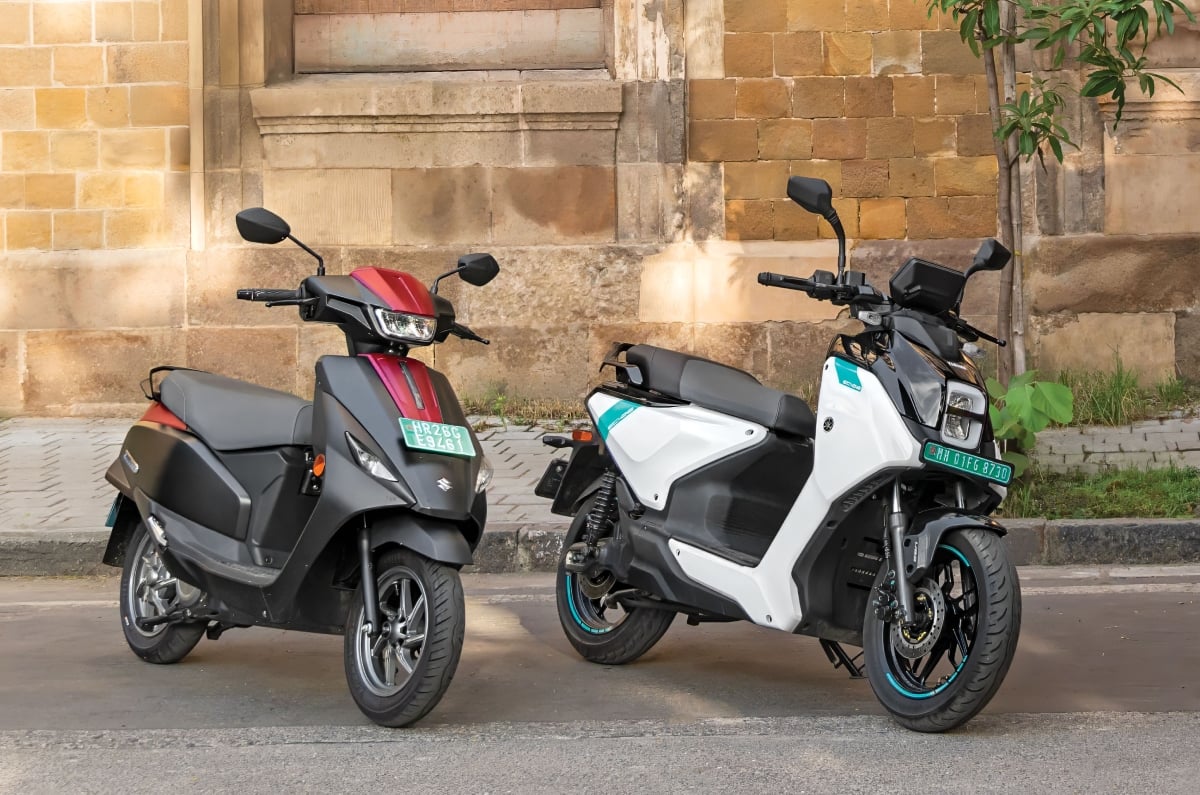
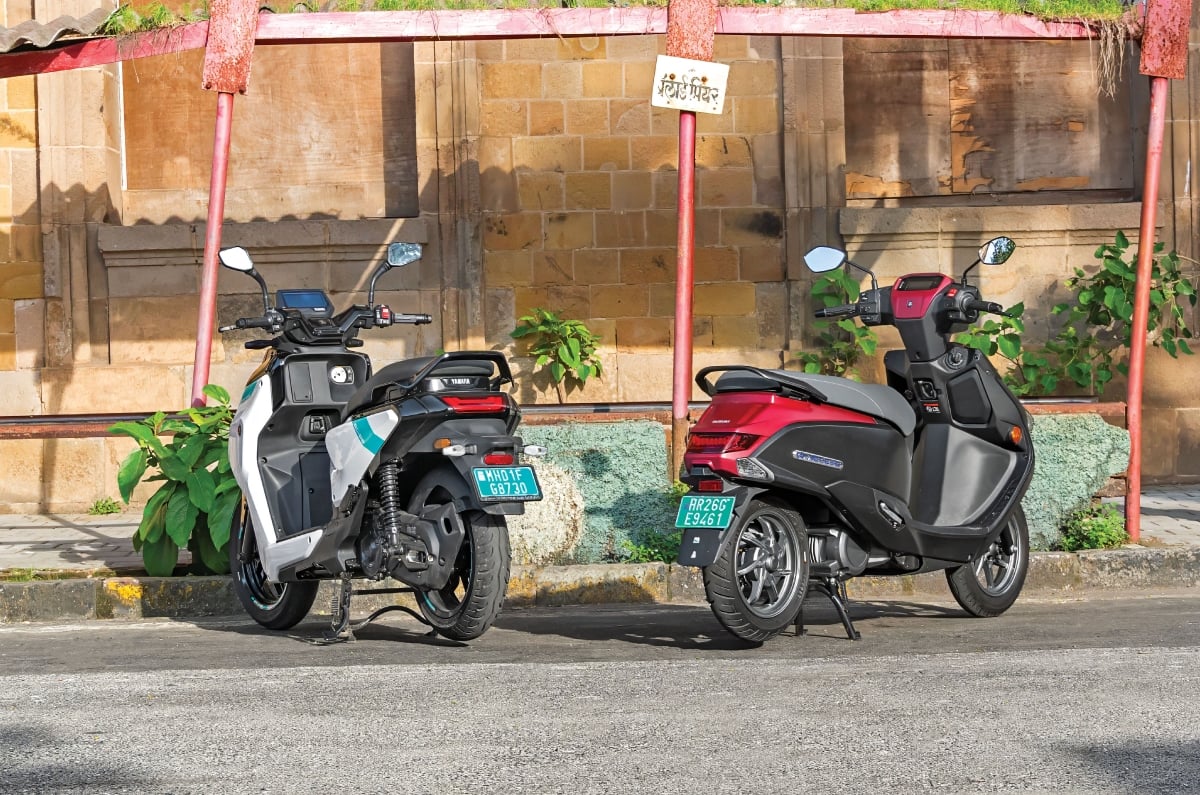
Suzuki, like Honda, chose to develop its own platform from scratch, but its e-Access appears expensive for what it offers. Yamaha, meanwhile, took a markedly different route for its more affordable offering and partnered with an Indian startup. The EC-06 is, in essence, a more expensive River Indie in sharper clothes.
So if you’ve been waiting for a Japanese e-scooter, you now have two choices, but like their very different inceptions, both also offer you two very different flavours of electric scooter. The question, then, is which one deserves your money – and whether either deserves it over the competition.
Not hiding in plain sight
Subtle, these scooters are not. Both take distinctly left-field approaches to styling and will stand out from the crowd. Over the fortnight we spent with them, the EC-06 consistently drew more positive attention thanks to its chunky, squared-off proportions. The e-Access found its niche too, though its double duck-bill nose, flowing front panels with a contrastingly boxy tail make it more of an acquired taste.
Yamaha EC-06
Suzuki e-Access
Kerb weight
132kg
122kg
Seat height
770mm
765mm
Underseat storage
24.5 litres
17 litres
Ground clearance
145mm (laden)
160mm (unladen)
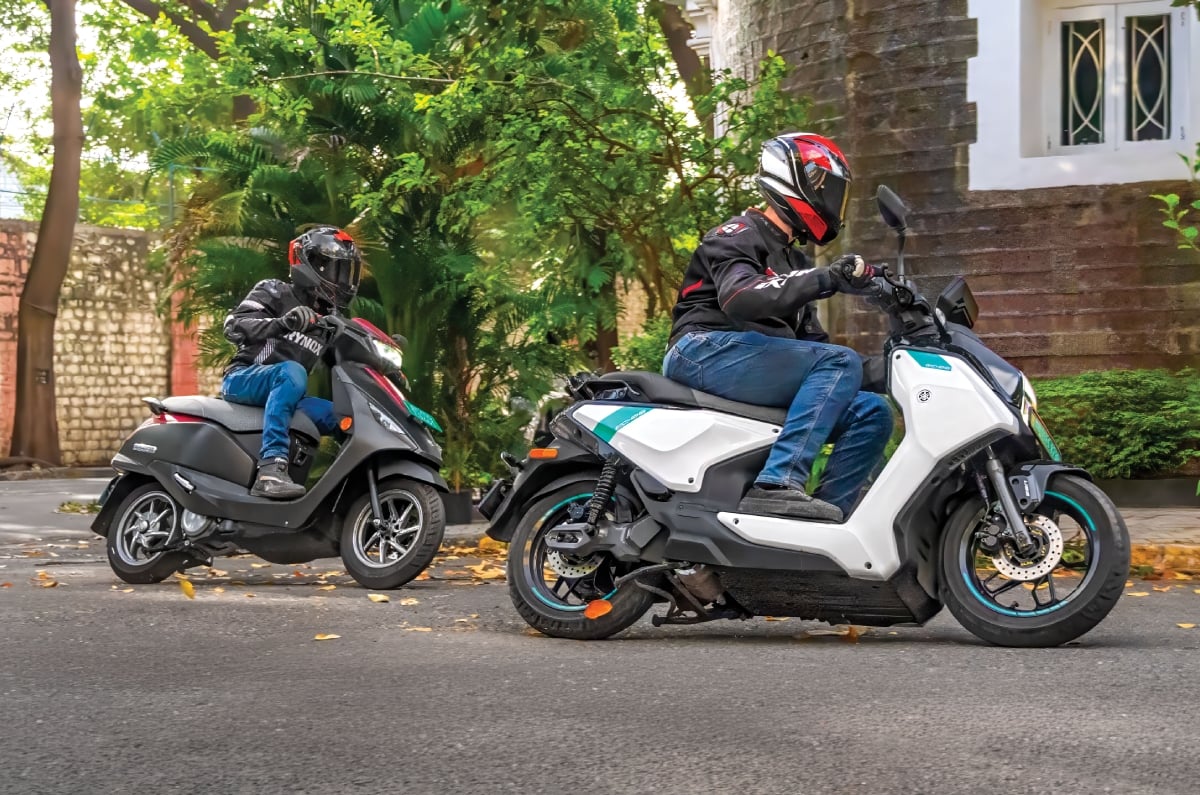
Climb aboard and their personalities diverge further still. The e-Access feels more like a conventional scooter. Despite its compact dimensions, it never feels cramped, even for taller riders, while its 765mm seat height makes it instantly approachable for shorter ones.
The EC-06, by comparison, feels a size larger. Its riding triangle is noticeably roomier, which taller riders will appreciate in a segment that seldom caters to them. Yet, with a friendly 770mm seat height, it remains fairly unintimidating for shorter riders. In fact, tall riders will want a higher seat.
Different strokes
The riding experience of both also reflects two very different engineering philosophies. The 122kg e-Access feels exceptionally light on its feet; whether wheeling it around a parking space or flicking it into a bend, it responds eagerly – actually, a bit too eagerly. Some of that can be attributed to Suzuki mounting the battery pack vertically beneath the seat, a decision that, as you will read further on, has implications elsewhere too.
Yamaha EC-06
Suzuki e-Access
Battery capacity / chemistry
4kWh / NMC
3.072kWh / LFP
Motor
Permanent Magnet Synchronous
Permanent Magnet Synchronous
Power
6.7kW
4.1kW
Torque
26Nm
15Nm
Like the latest Burgman, its ride also errs towards the firmer side rather than the plush feel of a TVS iQube. It isn’t uncomfortable by any means, but it is something worth paying attention to on a test ride. Taller riders will also discover the Suzuki’s compactness during full-lock U-turns, where their knees will foul the handlebar.
On the flip side, the EC-06 is relatively heavier and slower to steer, but it’s a small tradeoff. That’s because its larger 14-inch wheels lend it greater stability at faster speeds and also help it dismiss broken roads with admirable composure. Its absorptive suspension also factors in here, though particularly sharp impacts can provoke a slight judder in the fork.
E-Access has the more flighty, energetic demeanour, whereas the EC-06’s handling is more sure-footed.
The Yamaha’s seat, however, leaves quite some room for improvement. Its forward-sloping shape constantly makes you slide forward, necessitating frequent shuffling about. The padding is also too soft, and after just 30 minutes or so, you find yourself sinking into the seat pan. This results in a gradually more knees-up riding position, which might sound like a trifling problem at first but one that becomes increasingly apparent over longer journeys.
Neither one gets ABS, which feels like quite an egregious oversight considering their price points. Nevertheless, the Yamaha’s brakes inspire greater confidence because they are powerful without being overly aggressive, and its wider tyres also provide better traction. The Suzuki’s brakes, conversely, are almost too sharp. On Mumbai’s slippery concrete roads, they demand a more measured touch when coming to a halt quickly.
Not that you’ll often rely heavily on them. That’s partly down to the well-calibrated regenerative braking system and partly because the e-Access’ performance is quite unremarkable. Not only is it much slower than the EC-06, but it also feels noticeably less eager than the petrol-powered Access. It’s perfectly usable in the city, but on faster roads, overtakes require planning. Unsurprisingly, the Yamaha feels considerably livelier. It accelerates with genuine enthusiasm in its top Power mode, the regenerative braking is seamlessly calibrated in all 3 modes (Standard and Eco being the other two) and, despite using chain drive, its drivetrain is remarkably silent – akin to a hub-mounted motor.
Feel Good (?) Features
Build quality on both is reassuringly solid and exactly what one expects from the Japanese. At these prices, however, there are a few omissions that are difficult to overlook.
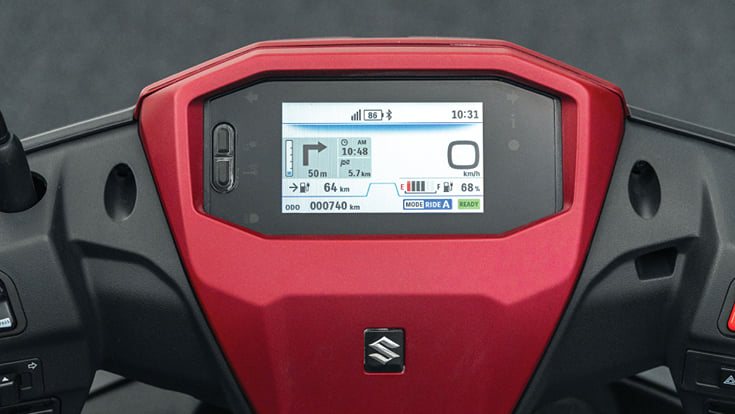
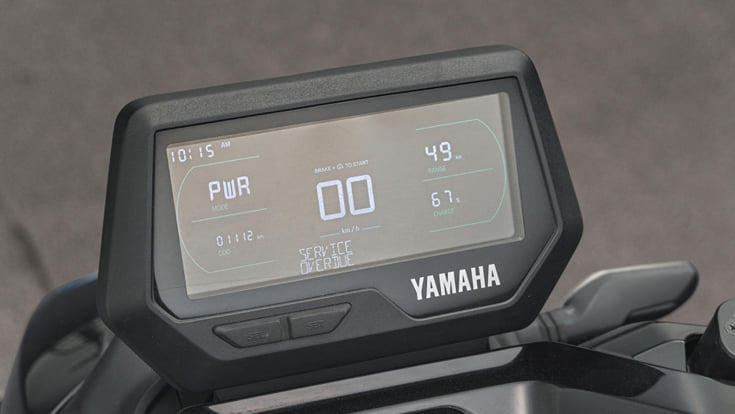
The e-Access employs the same TFT display found on the ICE Access 125 and Burgman, both of which cost substantially less. Yamaha, meanwhile, supplies only the slower 480W charger, despite the considerably more affordable River offering a faster 750W unit as a Rs 3,000 option.
Same TFT as ICE Access; EC’s negative LCD is simpler but well laid out.
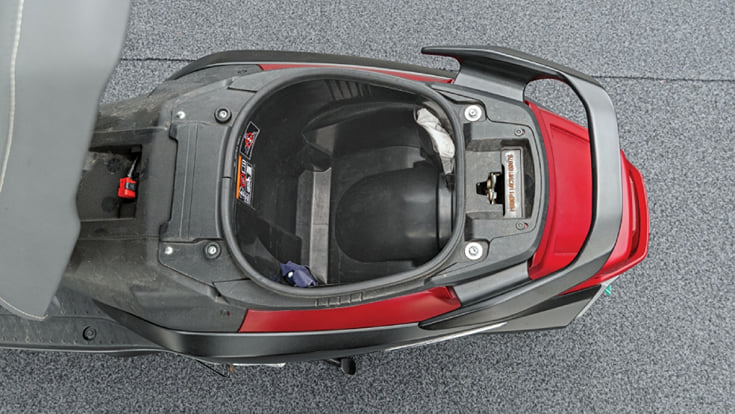
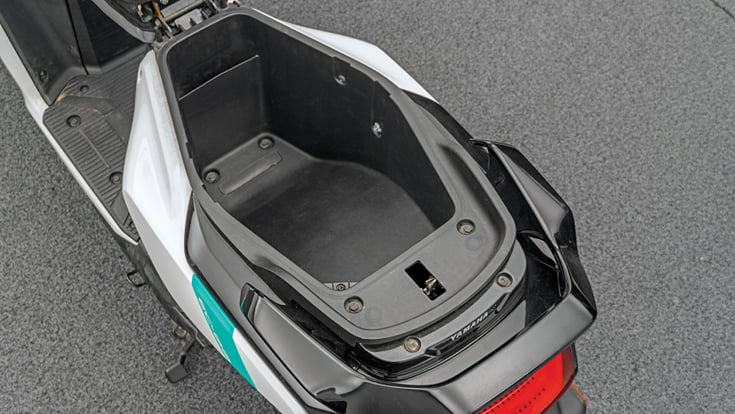
The EC-06 also sacrifices a lot of storage compared to the Indie. Its 24.5-litre under-seat boot is far short of the latter’s enormous 43-litre boot and trails established rivals such as the iQube, Rizta and Chetak. The River’s lockable 12-litre glovebox has been omitted too, though Yamaha has used this to reposition the charging port to a more convenient location.
e-Access’ 17L boot far too small and oddly shaped; Yamaha’s 24.5L boot is more usable but not segment-leading.
If the Yamaha’s storage is merely average, the Suzuki’s is positively outclassed. The battery’s position beneath the seat results in just 17 litres of bootspace – roughly half what you’ll find on rivals like the Rizta and Chetak. In fact, even the ICE Access 125 offers you quite a bit more storage space. The e-Access’ boot is also shaped quite awkwardly, and unless the charger’s cables are folded with almost Victorian precision, it simply refuses to fit.
Range Rovers?
An electric scooter ultimately needs to deliver one thing above all else – promising range to reduce your running costs. In Ride A mode, which delivers full performance and max regen, the e-Access covered a little over 88km in our range test. Given its smaller 3kWh battery and its use of safer, but less energy-dense, LFP chemistry, the result is respectable in isolation; however, compared to the market’s front-runners, it falls far short.
Yamaha EC-06
Suzuki e-Access
0-40kph
3.46s
4.94s
0-60kph
6.82s
11.93s
Roll-on Acceleration
20-50kph
3.31s
5.46s
30-70kph
7.34s
17.01s
50-80kph
10.96s
–
Our test on the EC-06 was conducted in its middle Standard mode, which retains full performance but softens throttle response compared to Power mode. It covered 114km, comfortably exceeding the distance initially predicted. Both scooters deserve praise here, as their range indicators proved refreshingly honest, not indulging in optimistic guesswork.
Yamaha EC-06
Suzuki e-Access
60-0kph
22.87m
24.64m
Using Eco mode will naturally extend the range on both, though with reduced acceleration and lower top speeds. Thankfully, neither becomes painfully slow. Even in Eco, both climb flyovers and keep up with city traffic without reducing themselves to rolling roadblocks.
While the Yamaha’s range is undoubtedly more impressive, its charging time is a rather different story. The supplied 480W charger requires a glacial ten hours to replenish a flat battery. Meanwhile, the Suzuki’s 600W unit requires around six hours to do the same, although its battery pack is also smaller.
One thoughtful detail both manufacturers deserve credit for is the inclusion of a dedicated charger bag. It is a small touch, but one that should help protect the charger from spending years rattling around inside the boot.THE BIGGER PICTURE
Judged purely against each other, the result is straightforward – the EC-06 clearly wins. It offers superior performance, greater comfort, longer range and also costs much less than the e-Access.
Yamaha EC-06
Suzuki e-Access
Price (ex-showroom, Bengaluru)
Rs 1.71 lakh
Rs 1.92 lakh
However, if you zoom out and look at the broader market, the context changes. At Rs 1.71 lakh, the Yamaha is hardly inexpensive, and the Suzuki, which is knocking on the door of Rs 2 lakh, is even worse off. When proven alternatives from TVS, Ather, Bajaj, Vida and River offer similar or even superior alternatives for substantially less money, the Japanese appear more like fringe players and less like mainstream contenders.
There will undoubtedly be a small demographic of buyers for whom a Japanese badge carries enough cachet to justify this big premium. However, for the rest of us, the more keenly priced and proven homegrown contenders are the better bet.
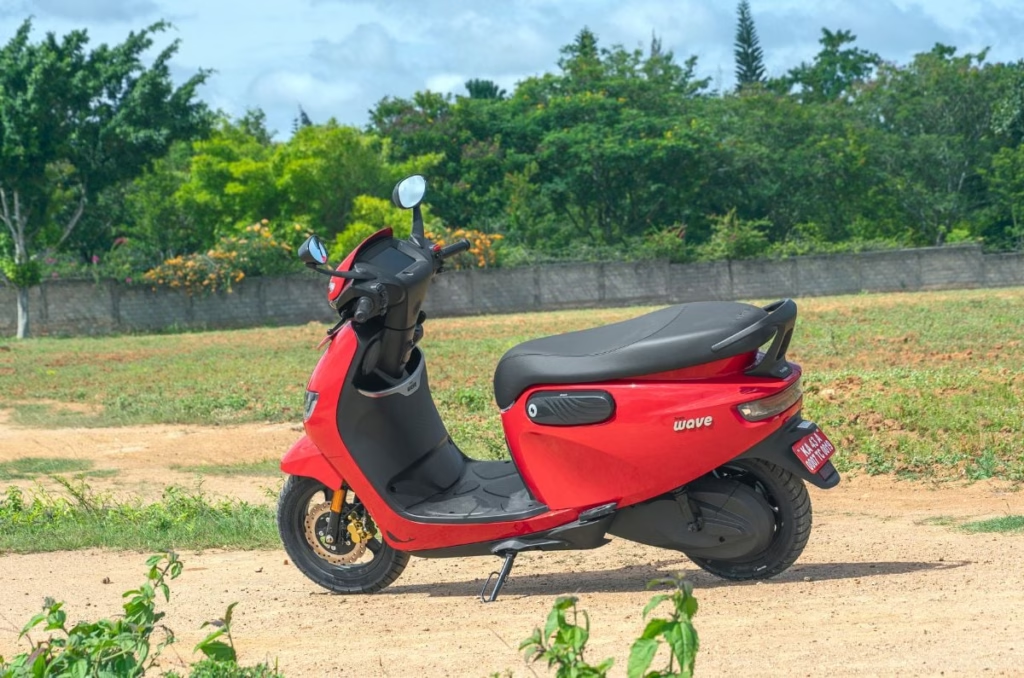
The Simple Wave is the family scooter from the Bengaluru-based startup. It offers a claimed IDC range of up to 243km, and Simple is looking to position it as a mass-market scooter compared to its sharp, performance-focused offerings, the One and One S.
The Wave is available in four variants as per the battery capacity. The base Wave S is offered in two battery capacities: 2.2kWh and 2.7kWh, with 110km and 132km of IDC range, respectively. The middle variant, Wave, has a 3.7kWh battery and 171km of IDC range, whereas the top Wave + variant has a 5kWh battery and is claimed to go 243km on a single charge, offering the highest range in its segment.
Dimensions-wise, compared to the One range, seat height has been lowered by 5mm to 775mm and ground clearance has been increased by 3mm to 175mm. The base Wave S weighs 124.5kg, the Wave weighs 121kg, and the Wave + weighs 128kg. The Simple Wave’s prices start at Rs 1.10 lakh (ex-showroom, Bengaluru), we’ve added all the prices below for easy reference. The company has announced that deliveries will commence on September 25.