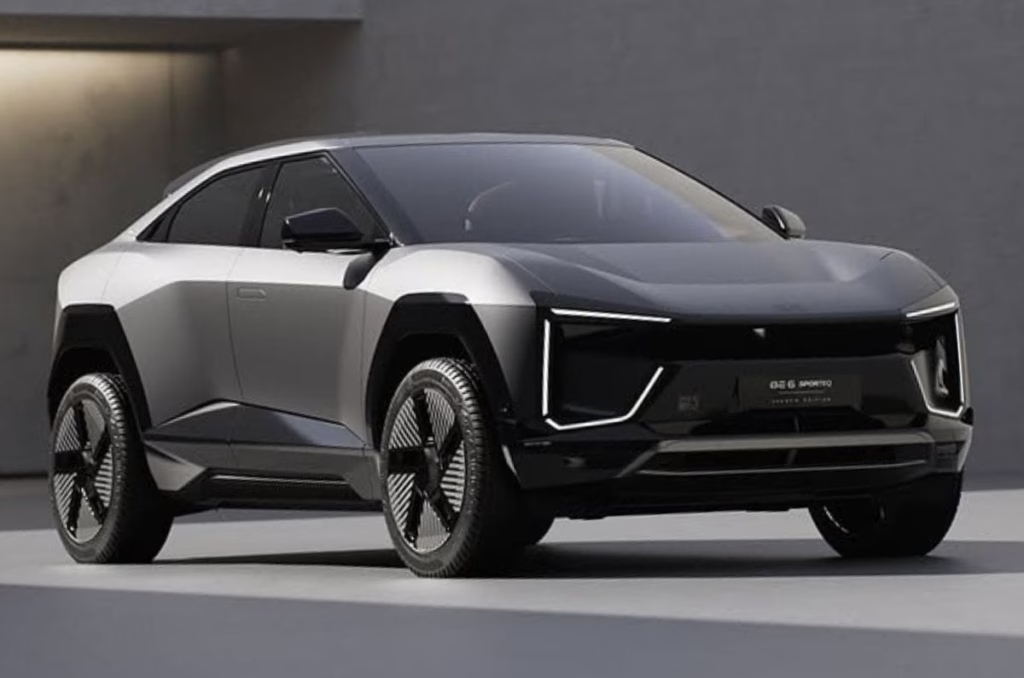
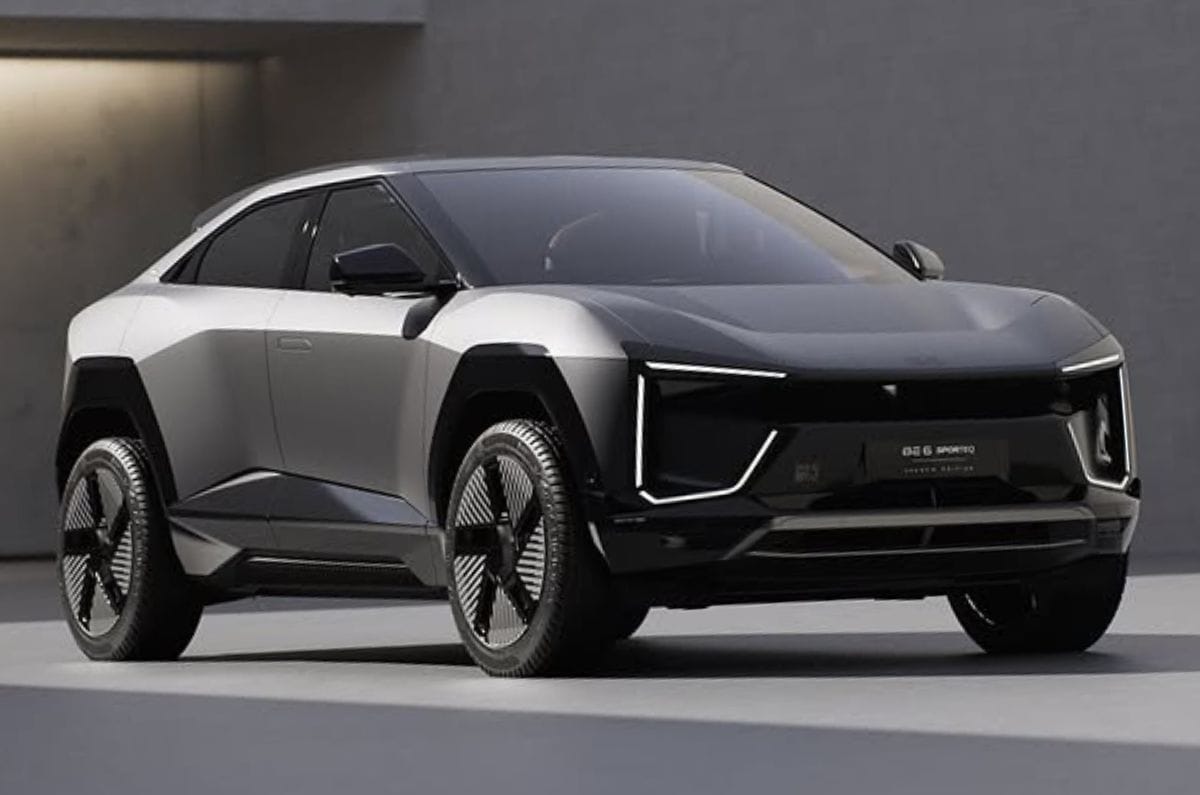
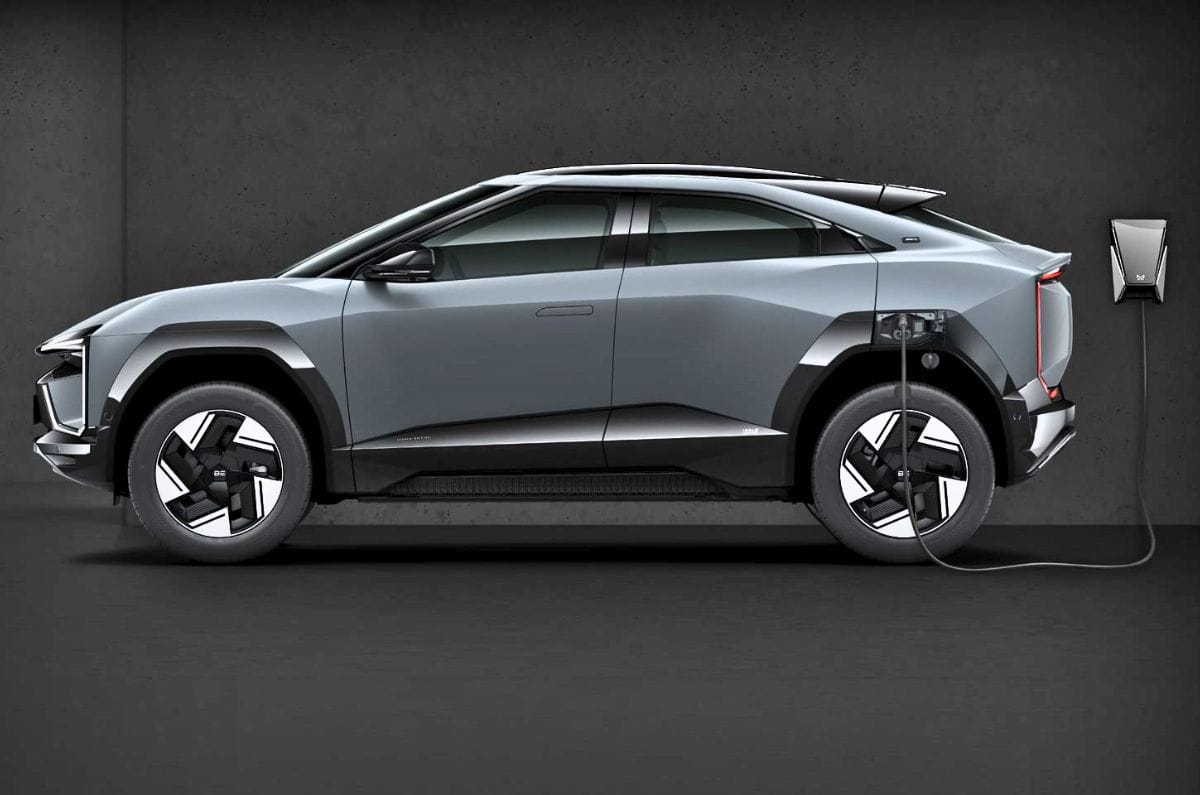
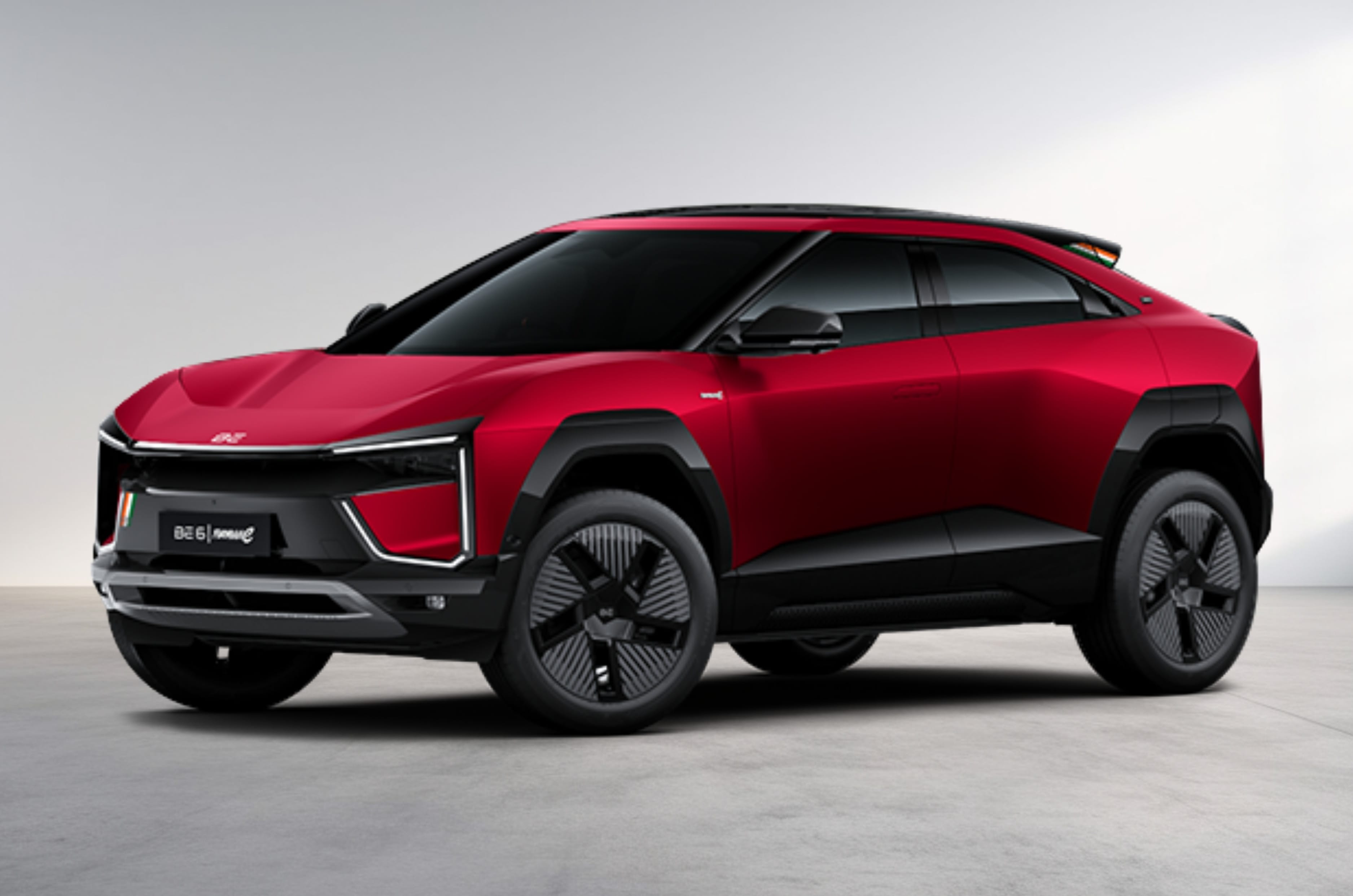
Mahindra launched the 2026 BE 6 recently, adding the ‘Sporteq’ moniker and pricing it from Rs 19.45 lakh to Rs 26.95 lakh (ex-showroom). Along with a new name, Mahindra has also introduced some updates to the midsize electric SUV to keep it modern in the segment. Here’s a detailed list of these updates:
New 70kWh battery pack
New battery pack offers 651km range and is mated to a 241hp rear motor
The 2026 Mahindra BE 6 Sporteq gets a new 70kWh battery pack in addition to the previously available 59kWh and 79kWh batteries. This new 70kWh battery offers an ARAI-claimed range of 651km and a rear-axle-mounted (RWD) electric motor that produces 241hp and 360Nm. It supports a 7.2kW AC, a 11.2kW AC and a 160kW DC charger. The DC fast charger recharges the battery pack from 20-80 percent in a claimed 20 minutes.
Mahindra is offering the 70kWh battery with the Three and Three+ trims, priced at Rs 22.95 lakh and Rs 23.95 lakh, respectively (ex-showroom).
Battery-as-a-Service (BaaS) scheme
Battery rental scheme makes the 59kWh battery variants Rs 8 lakh more affordable
Along with a new battery, Mahindra is also offering the BE 6 with a battery-as-a-service (BaaS) scheme, which is also a first for the brand. However, the BaaS scheme is offered only with the 59kWh battery pack available in the One and Two trims. The battery rental scheme essentially lowers the BE 6’s initial price by Rs 8 lakh, but requires a monthly subscription fee for the battery. Here are the details:
Mahindra BE 6 battery-as-a-service (BaaS) price vs standard price
Standard price
BaaS price*
Difference^
One
Rs 19.45 lakh
Rs 11.45 lakh + Rs 3.75/km
– Rs 8 lakh
Two
Rs 20.95 lakh
Rs 12.95 lakh + Rs 3.75/km
– Rs 8 lakh
Notes: BaaS scheme requires a minimum monthly payment of Rs 6,750, calculated assuming usage of 60km per day and an 8-year battery loan, as per Mahindra’s terms and conditions. The price difference calculated above is on the initial price and does not include the BaaS scheme’s battery subscription charges.
Triple-screen setup on dashboard
Offers an additional third screen for the front passenger now
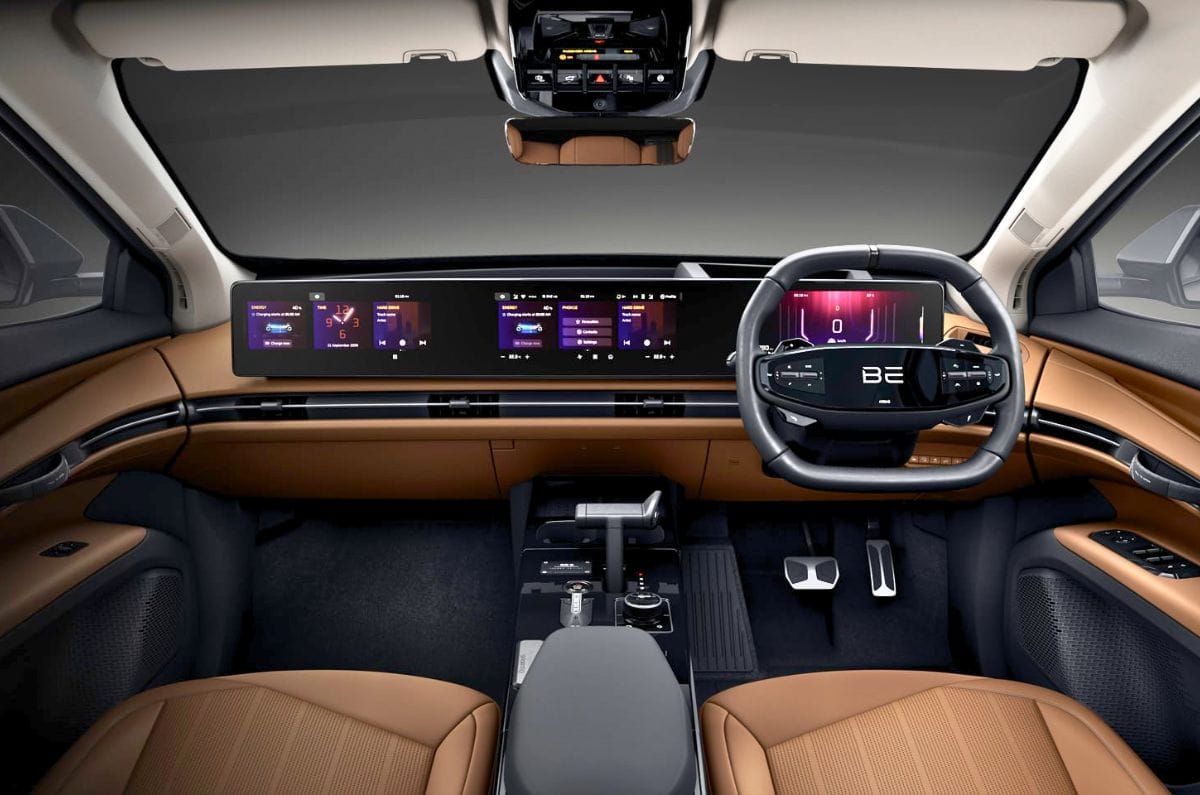
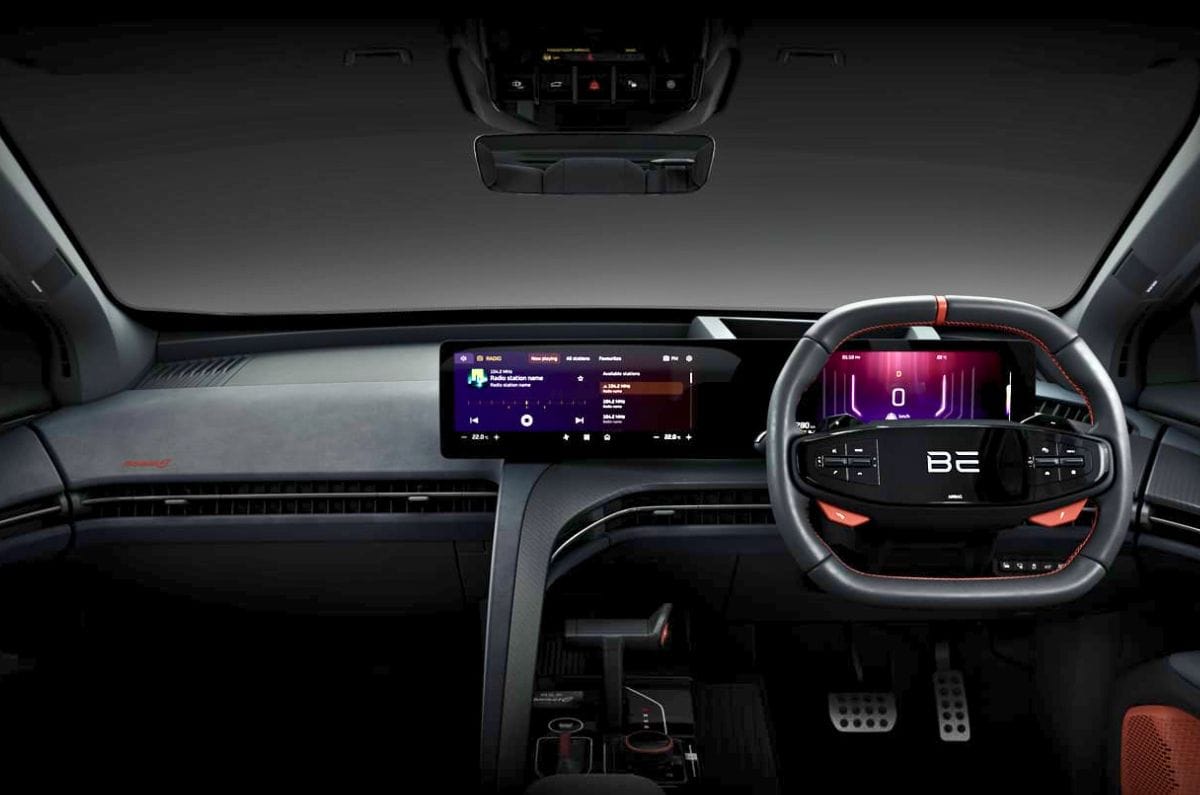
The 2026 update also brought a major redesign to the BE 6’s dashboard, now offered with an additional 12.30-inch screen for the front passenger, in addition to the similarly sized digital driver’s display and touchscreen infotainment system. The new front passenger display also removed the halo-like design element connecting the dashboard to the centre console, allowing the addition of two cupholders on the centre console, something that was sorely missing on the older model.
Mahindra is offering a triple-screen setup on all trims of the BE 6 Sporteq except the base-spec One and the sportier Formula E editions.
Redesigned Formula E edition
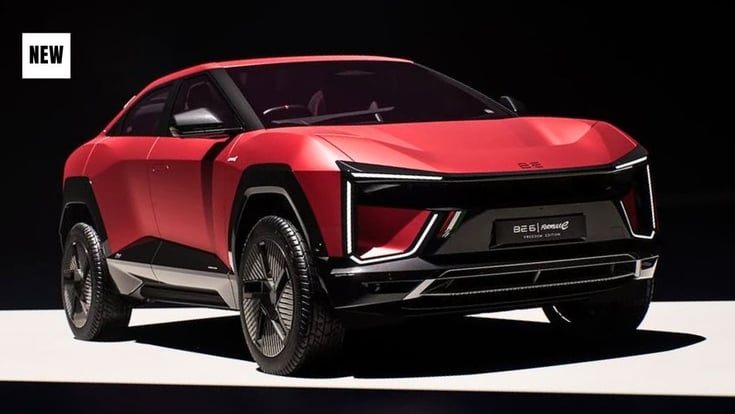
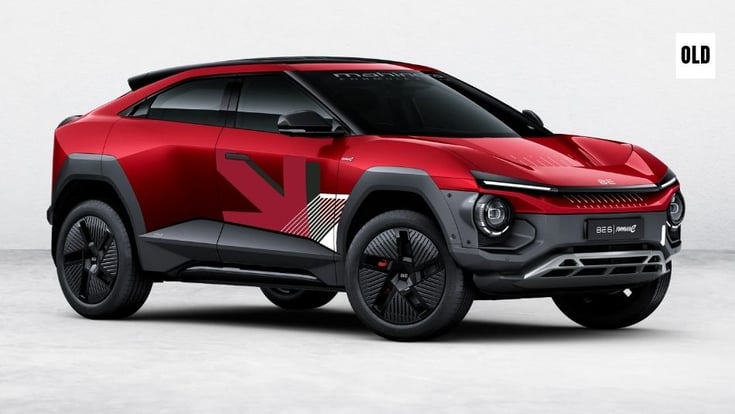
The 2026 Formula E Freedom looks nothing like the older Formula E edition
With the 2026 update, Mahindra has also rejigged the exterior design of the Formula E edition. Unlike the previous model, which had a different fascia from the standard model with circular-shaped LED headlights and a revised bumper, the 2026 Formula E Freedom edition gets the same design as the standard BE 6 Sporteq, with some Formula E badges and FIA decals. Moreover, the Formula E edition is only offered with the older model’s dual-screen dashboard and a halo design element for a sporty appeal.
Mahindra is offering the 2026 Formula E edition at the Three and Four trim levels, priced at Rs 24.45 lakh and Rs 26.95 lakh, respectively (ex-showroom).
Fresh exterior and interior colours
Both the BE 6 Sporteq and Formula E edition get new colour themes
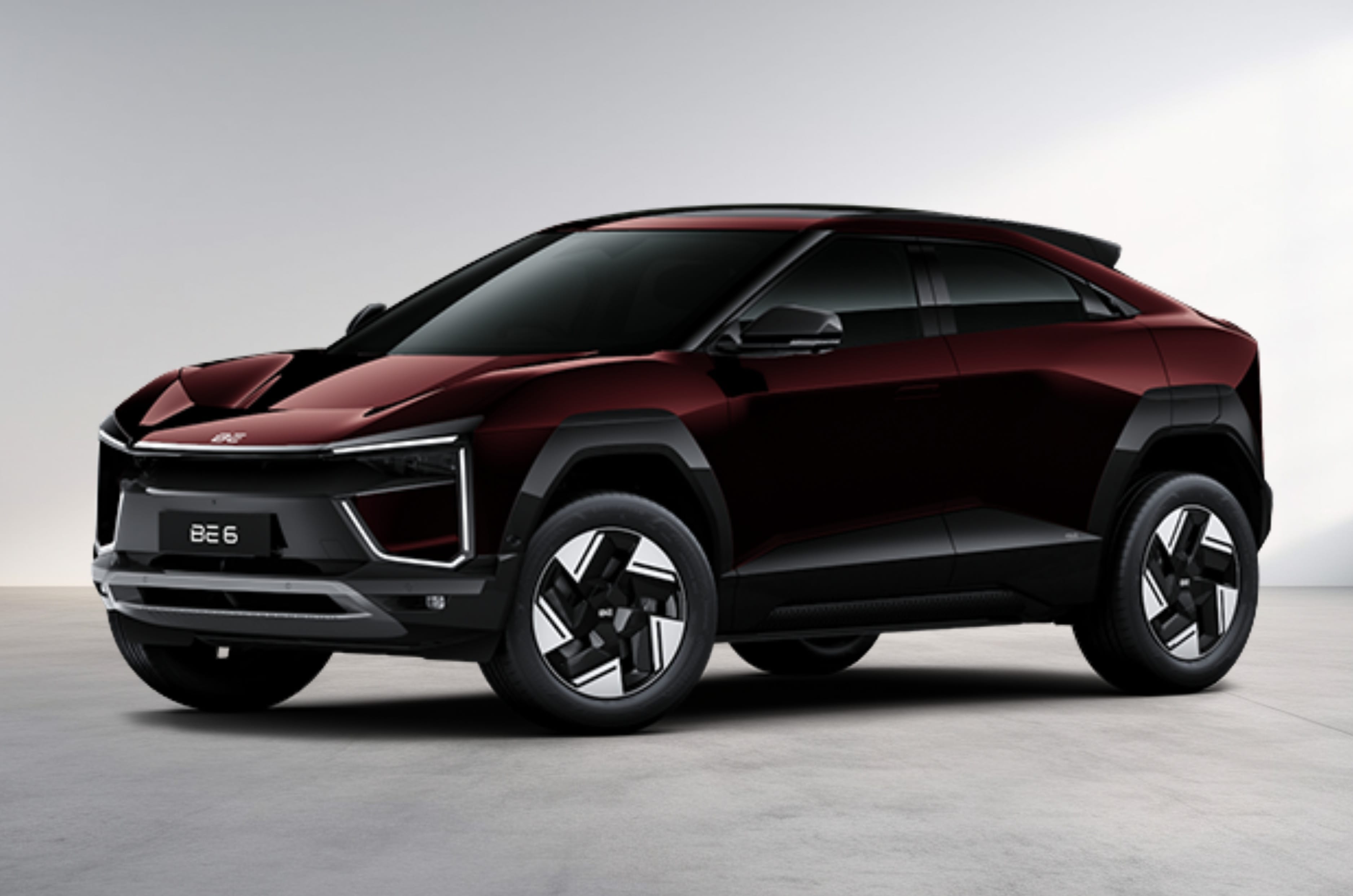
Mahindra BE 6 Sporteq Ruby Velvet exterior colour.
The 2026 Mahindra BE 6 Sporteq is being offered with fresh exterior and interior colour options. It is available in a new ‘Ruby Red’ exterior theme and new Racing Tan and Black interior hues for the Two, Three, Three+ and Four trims. The base-spec One is offered with the same Sage Green and Grey theme as before. A Sporteq Launch Edition, based on the fully loaded Four trim, is also available, which offers a new Graphite Storm exterior paint and Racing Tan interior theme.
Mahindra BE 6 Formula E Freedom edition Rosso Impulso exterior colour.
While the 2026 BE 6 Formula E edition is offered with a new Rosso Impulso exterior hue, the all-black interior with orange elements for contrast is the same as the outgoing model.
New ‘TEQ’ suite
The suite enables Gemini-based interactions, unlocks additional drive modes and Revive functionalities
Another addition to the BE 6 Sporteq is the new ‘TEQ’ suite, which Mahindra says is designed to make the vehicle more intuitive, engaging, secure and responsive to individual customer needs. At its core is a Gemini-based AI conversation assistant that allows natural voice interactions for functions such as vehicle controls, navigation and music. The suite also introduces a Karaoke mode, along with support for Dolby Vision and Dolby Audio.
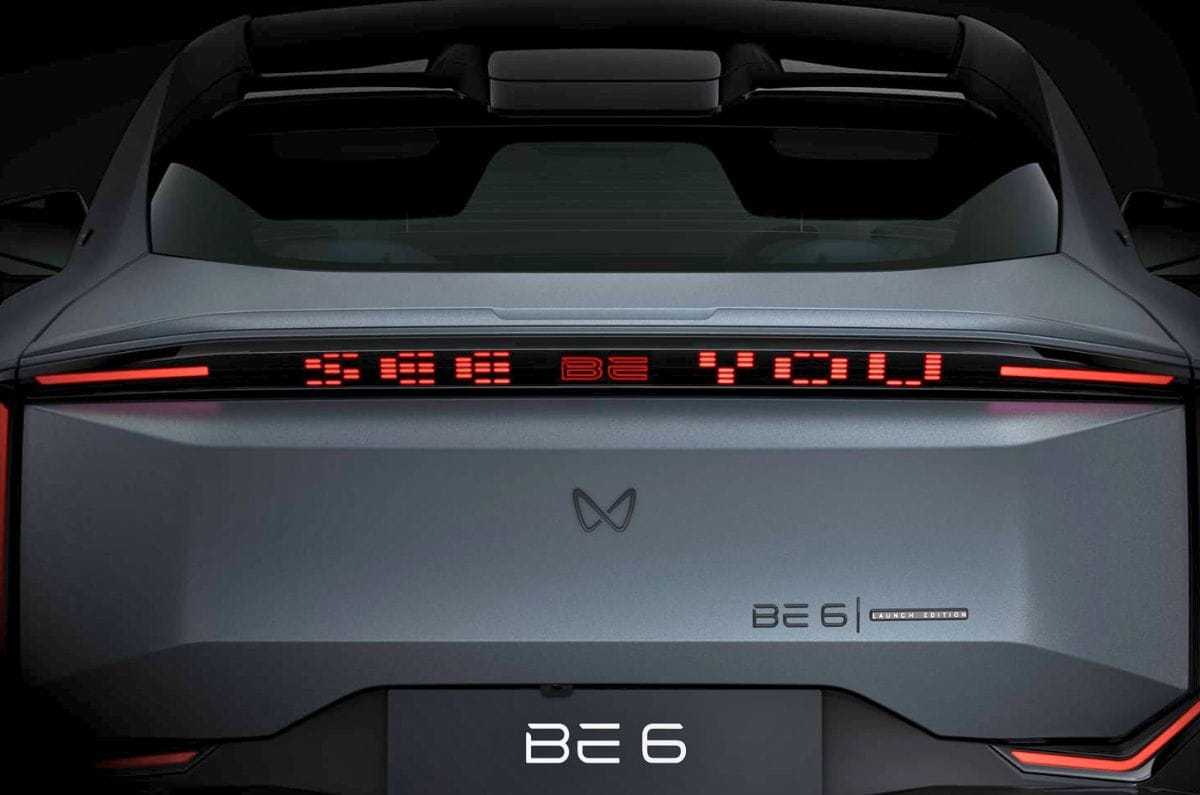
The TEQ suite also adds several performance and convenience features, including Custom Drive Mode, Drift Mode and an acceleration boost mode for the Formula E Freedom Edition, which enables a claimed 0-100 kph time of 6.44 seconds. It also includes Revive and Revive SOS, which can provide additional range even after the battery has run out. Another new feature is ‘TEQ_xting’, which lets owners display personalised messages on the vehicle’s tailgate.
The Mahindra BE 6 Sporteq is priced from Rs 19.45 lakh to Rs 26.95 lakh (ex-showroom), and it rivals the Hyundai Creta Electric, Tata Sierra EV, Tata Curvv EV, MG ZS EV, Maruti Suzuki e Vitara and Toyota Ebella.
Prices are ex-showroom, India, and do not include a wall charger or its installation cost.
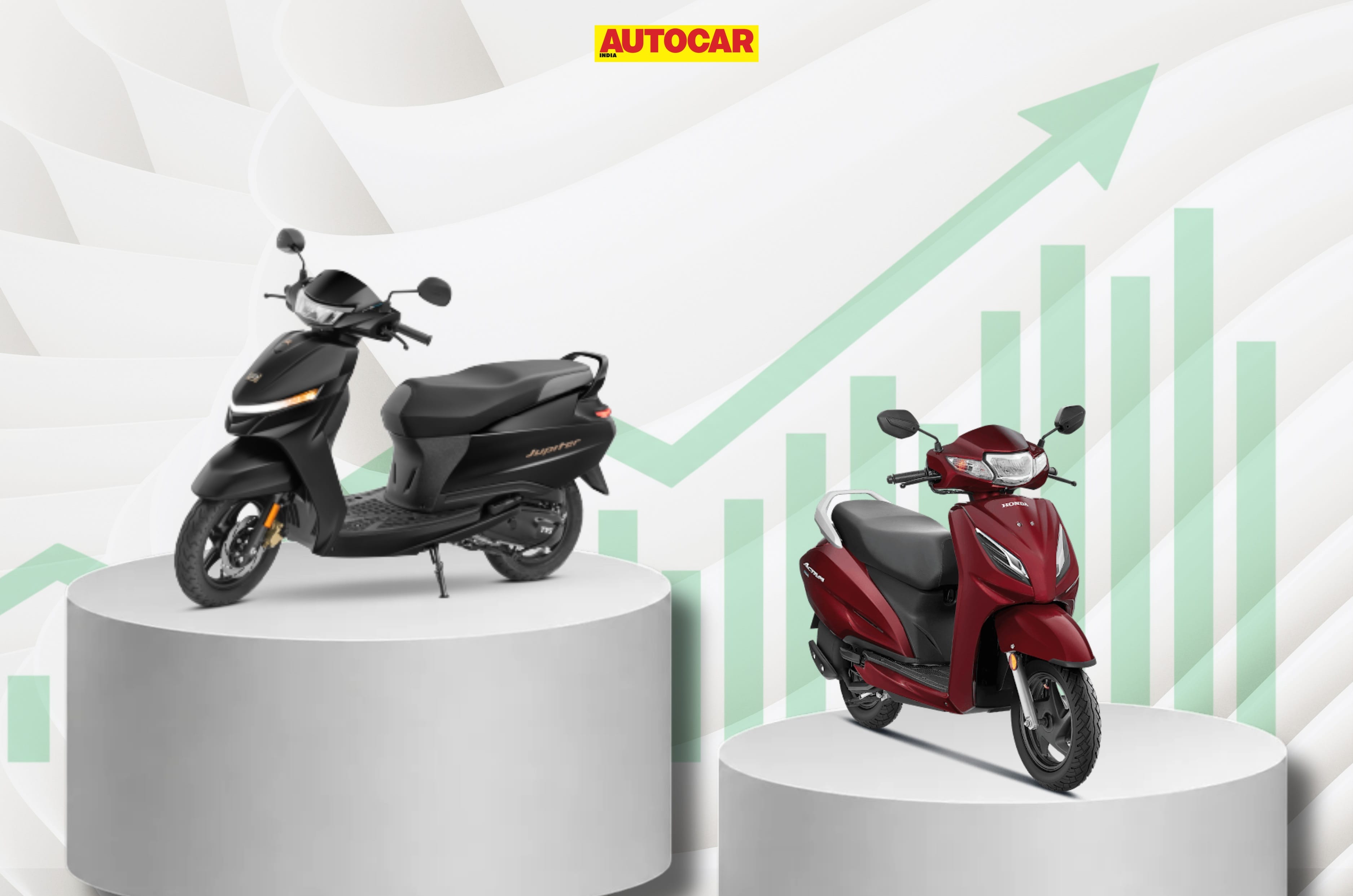
India’s scooter market came close to the 800,000-unit mark in July 2026, with nine OEMs dispatching 798,190 units, up 24 percent year on year. TVS Motor Co overtook Honda Motorcycle & Scooter India for the first time to lead the market for the month.
TVS scooter sales up 40 percent to 2,56,675 units
Honda sales fall 12 percent to 2,33,337 units
Electric scooters account for 21 percent of July wholesales
TVS overtakes Honda for the first time
TVS Motor Co has overtaken Honda Motorcycle & Scooter India (HMSI) to become India’s largest scooter manufacturer in monthly wholesales for the first time in July 2026. TVS dispatched 2,56,675 units, up 40 percent year on year, while Honda dispatched 2,33,337 units, down 12 percent. The difference between the two stood at 23,338 units.
July’s overall scooter wholesales of 7,98,190 units were just 1,810 units short of the 8 lakh mark. It was the second-highest monthly tally after October 2025, when over 8.24 lakh scooters were dispatched. July was also the sixth month in the past seven to cross 7 lakh units, with April falling short by just 8,007 units.
TVS’ scooter market share increased to 32 percent in July from 28 percent in the same month last year, while Honda’s share fell from 41 percent to 29 percent.
TVS’ EVs drive growth
TVS’ ICE scooter range, comprising the Jupiter, NTorq and Zest, accounted for 1,97,289 units in July, up 23 percent year on year. Its electric scooters, the iQube and Orbiter, contributed 59,386 units, up 158 percent.
Honda’s ICE scooters, comprising the Activa 110/125 and Dio 110/125, accounted for 2,32,073 units, down 12 percent from 265,364 units in July 2025. The company’s Activa-e and QC1 electric scooters together contributed 1,264 units, up 467 percent from 263 units a year ago.
HMSI unveiled its third electric scooter, the QC 3, on July 24. The company remains India’s largest scooter exporter, with 1,56,938 units shipped in July, up 36 percent year on year. TVS was second with 53,254 units, up 43 percent.
Suzuki, Hero and Bajaj follow
Suzuki Motorcycle India dispatched 1,20,998 scooters in July, up 28 percent year on year, taking its market share to 15 percent from 14 percent a year ago. The Access 125 remains its best-selling scooter, ahead of the Avenis and Burgman Street, which also use the same 125cc engine. The new e-Access contributed 825 units.
Hero MotoCorp dispatched 61,347 scooters, up 33 percent, giving it an 8 percent market share. Its ICE scooters, the Destini 125, Pleasure and Xoom, accounted for 38,640 units, up 11 percent, while Vida electric scooters contributed 22,707 units, up 102 percent.
Bajaj Auto dispatched 48,684 units, up 301 percent year on year from 12,134 units in July 2025. The tally comprised 47,184 Chetaks and 1,500 Yulu EVs. Its scooter market share consequently rose to 6 percent from 2 percent.
Yamaha and Ather continue to grow
India Yamaha Motor dispatched 36,783 scooters in July, up 53 percent year on year. The Fascino and Ray ZR together accounted for 31,945 units, up 46 percent, while the 155cc Aerox contributed 4,544 units, up 102 percent. Yamaha also dispatched 294 EC-06 electric scooters to its Blue Square dealerships.
Ather Energy dispatched 31,044 scooters in July, up 106 percent year on year, doubling its market share to 4 percent. The company is set to unveil its first EL platform-based scooter at Ather Community Day on August 29.
River Mobility dispatched a record 6,039 Indie electric scooters in July, up 226 percent year on year. Piaggio Vehicles, which sells the Vespa and Aprilia brands in India, dispatched 3,283 scooters, up 40 percent.
Electric scooters account for 21 percent of sales
Electric scooter wholesales reached 1,70,243 units in July, up 168 percent year on year from 63,560 units in July 2025. Volumes were also up 16 percent over June 2026, when 1,46,668 electric scooters were dispatched.
EVs consequently accounted for 21 percent of total scooter wholesales in July, compared with 10 percent a year ago.
TVS dispatched a record 59,386 iQube and Orbiter scooters in July, giving it an EV penetration of 35 percent for the month. Between January and July 2026, TVS has dispatched 1.52 million scooters, of which 314,104 were electric, meaning roughly one in every five scooters sold by TVS during the period was an EV.
Bajaj Auto’s 48,684-unit July tally included 47,184 Chetaks and 1,500 Yulu EVs, while Ather dispatched 31,044 units and Hero’s Vida range contributed 22,707 units.
The three Japanese electric scooter manufacturers – Honda, Suzuki and Yamaha – together dispatched 2,383 units in July.
Scooter sales on track for record CY2026
Cumulative scooter wholesales for January-July 2026 stood at 5.21 million units, up 32 percent from 3.95 million units during the same period last year. The seven-month tally already represents 69 percent of the record 7.52 million scooters sold in CY2025.
At the current pace, the scooter industry is on track to cross 9 million units in CY2026 for the first time.
Scooters accounted for 41 percent of India’s 1.92 million two-wheeler wholesales in July. Motorcycles accounted for 1.075 million units, or 56 percent, while mopeds contributed 50,497 units, or 3 percent.
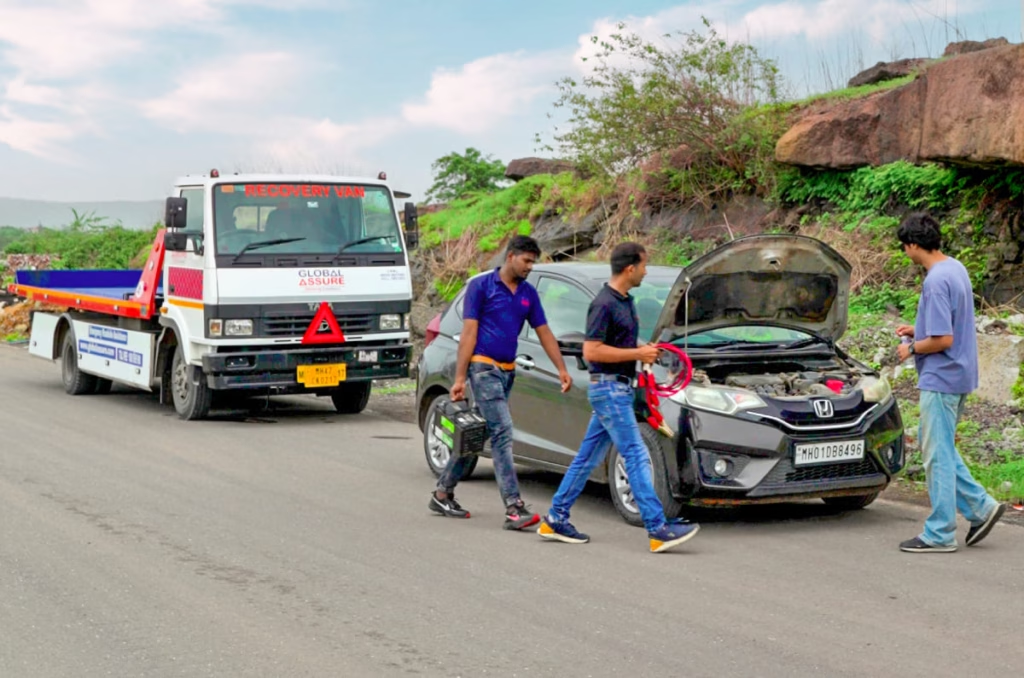
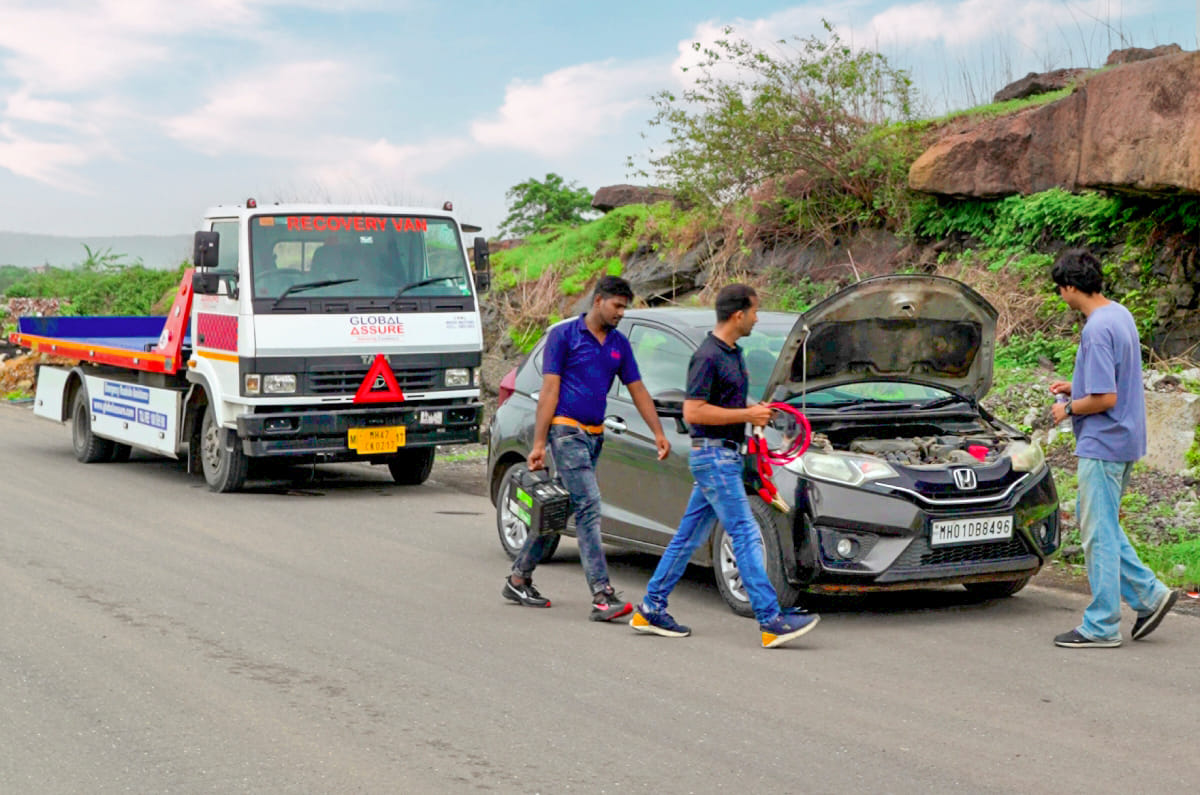
A car breaking down is inconvenient at the best of times. But on a busy commute, during a road trip or when you’re already running late, the problem isn’t simply that the car has stopped moving. It’s everything that comes next: finding help, waiting for it to arrive and wondering how long you’ll be stranded.
That’s where roadside assistance can make a real difference. And with its 30-Minute Service Assurance, Global Assure is putting a sharper focus on one of the biggest pain points of a breakdown: the wait.
Response Time
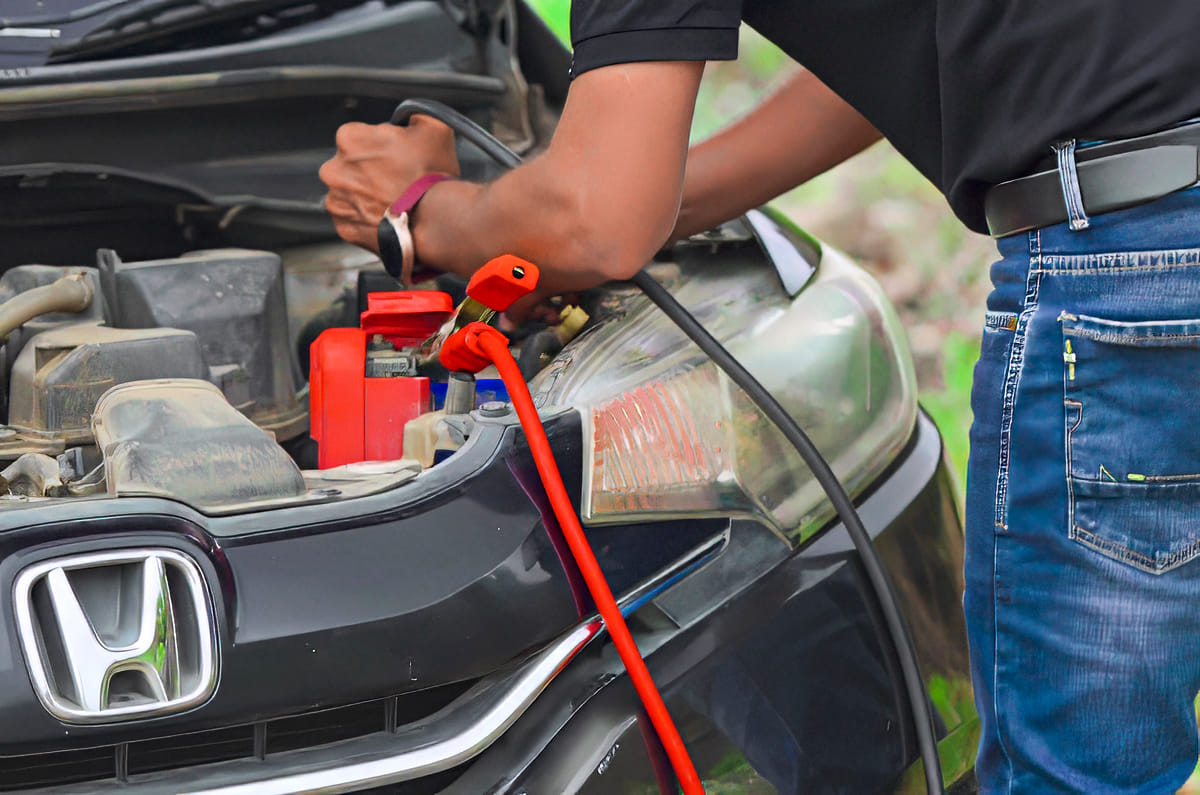
A flat tyre or drained battery might be relatively straightforward to address, but being stuck on the roadside can quickly become stressful. Plans get disrupted, schedules slip, and every additional minute spent waiting adds to the frustration.
Global Assure’s approach is built around reducing that uncertainty. Once roadside assistance is called, its own fleet of trained technicians is deployed, with the appropriate equipment to assess and address the problem. Its 30-Minute Service Assurance is supported by strengthened field operations, an expanded service footprint and real-time service tracking capabilities. The service is currently available in 15 cities including Delhi, Mumbai, Bengaluru, Chennai, Kolkata, Hyderabad, Jaipur, Lucknow, Vadodara, Ahmedabad, Indore, Pune, Surat, Dehradun, and Chandigarh.
30-Minute Service Assurance
The advantage of having dedicated technicians and service vehicles is that assistance isn’t simply about arranging a third party and hoping for the best. The aim is to get the right help to the vehicle and start resolving the problem as quickly as possible. Depending on the situation, this can include assistance for a flat tyre and drained battery, as well as fuel assistance, towing and vehicle recovery. Global Assure also offers support for EV-related breakdowns, recognising that the roadside assistance landscape needs to evolve alongside the changing vehicle market.
On Time, Everytime
The 30-Minute Service Assurance is ultimately about putting a tangible number against response time. For someone stranded at the roadside, knowing that help is expected within 30 minutes can make the experience considerably less uncertain. It also changes the role of roadside assistance. Rather than being something you think about only after a breakdown, it becomes part of the ownership experience. It’s like a safety net that is designed to help you get back on the move with minimal disruption.
Back On The Move
No roadside assistance can prevent a breakdown from happening. What it can do is reduce the impact when one happens. By combining its own trained technician fleet with a 30-minute service assurance, strengthened field operations, real-time service tracking and support across a range of common roadside emergencies, Global Assure is looking beyond simply fixing a stranded vehicle. The objective is to give motorists something just as valuable: their time back.
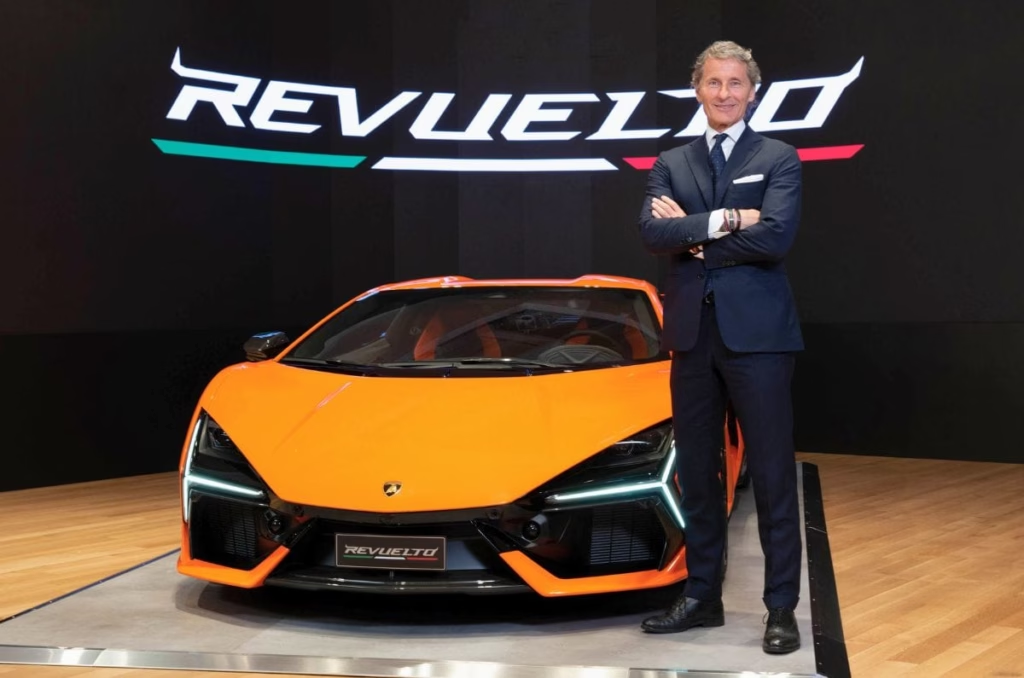
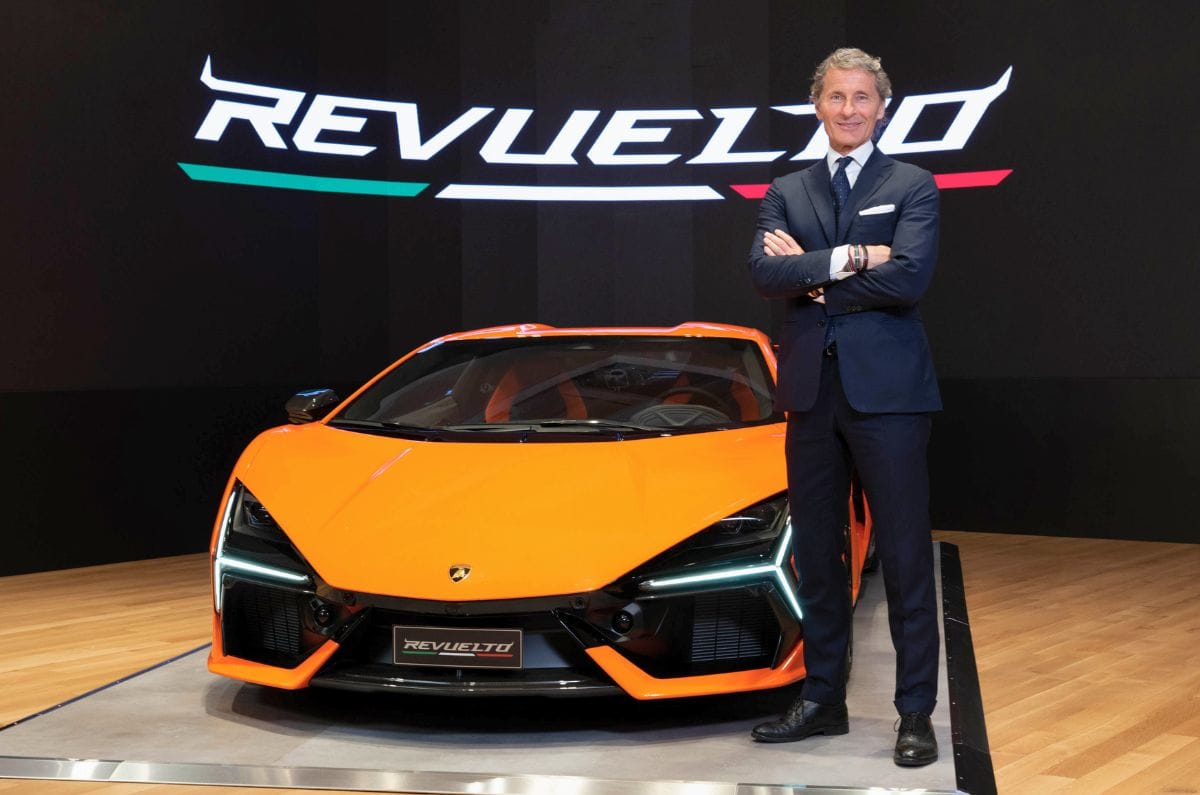
On the sidelines of the world premiere of the Lamborghini Revuelto SV, the brand’s president and CEO, Stephan Winkelmann, spoke to journalists about the new flagship hybrid supercar, the move away from EVs and even the Indian market.
India-EU FTA hybrid uncertainty could pose a problem
A hot topic at the moment is the India-EU free trade agreement (FTA) soon to come into effect, which promises to make imported cars a whole lot more affordable. While that’s great news for most super-sportscar brands, it’s not so for Lamborghini, as the India-EU FTA offers no clarity about benefits for hybrid cars, which make up the Italian brand’s entire range.
“The decision was made, I think, at the beginning of the year to lower the import taxes, but not for PHEVs,” said Winkelmann, responding to a question from Autocar India. “So, we see a drop in the market due to the uncertainty which is created by this. And there is still not enough clarity.”
While other brands do have some pure-ICE models, the prices of which are already being reduced ahead of the FTA’s introduction, at present, hybrid and EV models continue to attract the full import duty as before. Having moved away from pure-ICE models entirely, Lamborghini unfortunately bears the full brunt, at least for now.
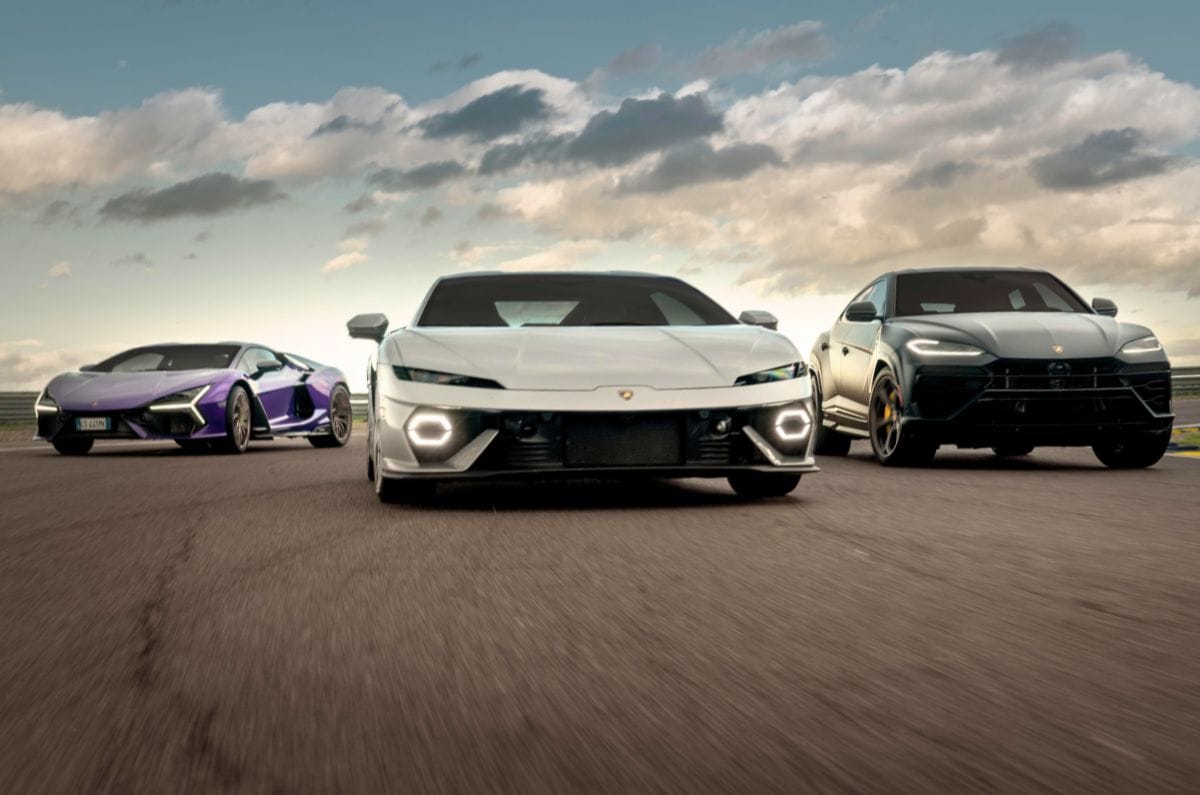
Lamborghini’s current line-up features only hybrid models.
“I think this will come only in four years’ time. And this, for sure, is not helping the decision to buy a plug-in hybrid car, which is coming from [Lamborghini].”
Can ethanol-blended petrol work in Lamborghinis?
Regarding another hot topic in our country at the moment, Winkelmann responded to another question from Autocar India, suggesting that given the uncertainty around traditional fuels, blended biofuels were not off the table for Lamborghini.
“In Europe, we are extremely positive about it and are going to make a decision on biofuels soon,” he said, highlighting that any decision around the matter would have to start from its home region. “For us, this is a very important market, as you might know.”
He was quick to point out that the quality of fuel is what’s most important for any of Lamborghini’s models and their high-performance plug-in hybrid powertrains. While ethanol blending does increase the RON (Research Octane Number) of the fuel, it also depends on the petrol it is being blended with, which varies from market to market.
“They already exist, those fuels, but it always depends on how good they are. If you have a low octane, then you cannot use them for our type of cars. You have to have a minimum of 95 octane, and this is sometimes, with the few fuels around the globe, not available,” he stated, reiterating that such a decision would have to be globally compatible. “I don’t know exactly how this is in India.”
Revuelto SV arrives before Revuelto Roadster
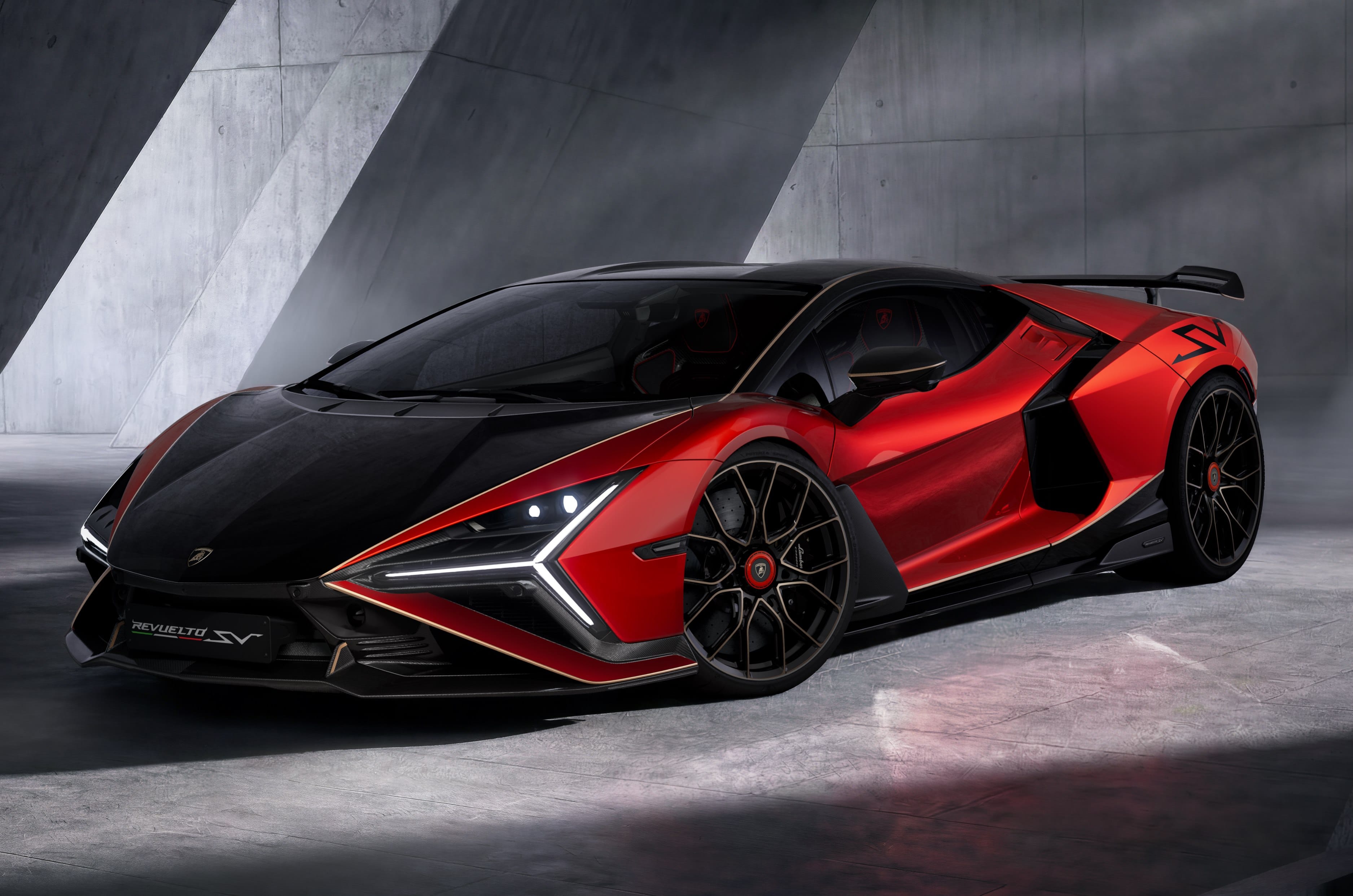
As for the main event, Lamborghini has just revealed the Revuelto SV, the hotter version of its flagship V12 PHEV supercar, limited to 1,963 units. With increased performance, redone suspension and far more advanced aerodynamics, its goal is to surpass the Revuelto to become the highest-performance Lamborghini of them all. SV models date all the way back to the Miura SV from 1971, but this is the first time an SV has been launched so soon after the standard model, arriving before even a convertible Roadster model.
“I have to tell you that the coupe was and is so successful that it was exceeding all our expectations, even the most positive ones,” Winkelmann said in response to Autocar India. “So, we decided to go immediately from Revuelto to Revuelto Superveloce. And the first feedbacks we are getting on the Superveloce are really outstanding.”
The additional 50hp is extracted from an upgraded battery and motor rather than from the V12 engine, which Lamborghini says was intentional, as it allowed for better control and faster distribution of the power.
“We use the battery to create more boost and a better distribution of power output than only with the internal combustion engine. Also, together with the torque vectoring, the feeling of driving a car at speed is very much improved in comparison with the [purely] internal combustion engine guise of the past generations,” Winkelmann said.
Lamborghini customers don’t want EVs
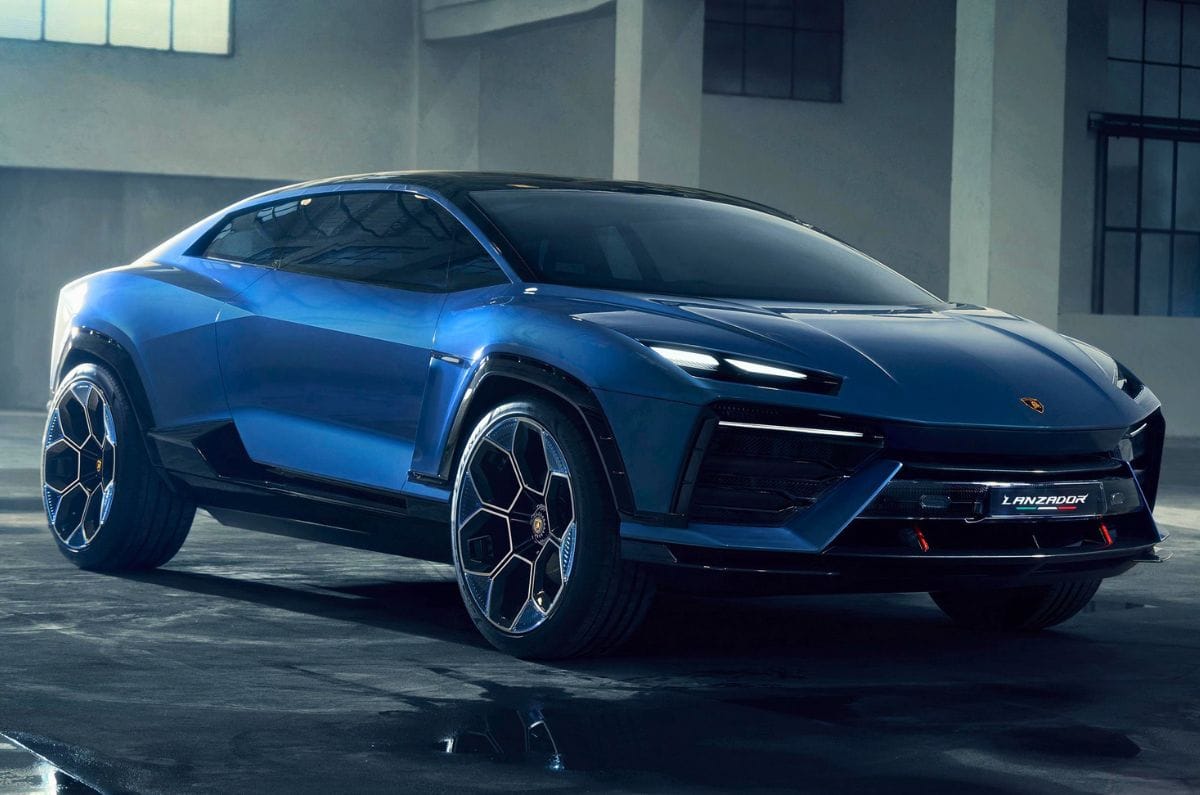
That said, the engine is essential. Not long before rival Ferrari unveiled its first EV, the Luce, Lamborghini announced its decision to delay its own first electric offering, the Lanzador, which was scheduled to launch before 2030. The Lanzador – also a low-slung four-seat crossover – will now get a hybrid powertrain instead, as an EV would simply not be emotional enough for Lamborghini customers.
“Why? Because the customer behaviour towards what we were proposing at the beginning of this decade has changed; they are not adopting electric cars,” said Winkelmann. “I’m talking about our type of customers, because you don’t buy a Lamborghini because you need a Lamborghini or you need a car; you buy it because you want to fulfil your dreams. We are not selling mobility; we are selling emotions.”
He also stated that, Indian regulations aside, the brand’s all-PHEV line-up has proven to be a successful approach, at once helping meet prevailing and upcoming emissions regulations while also retaining the emotional appeal of an ICE engine that’s core to the brand.
“You have the sound, the vibration of an internal combustion engine, but you also have all the advantages of the new technology,” he said. “The combination of battery and internal combustion engine for us is not a transition period, but it’s really something which is here to stay.”
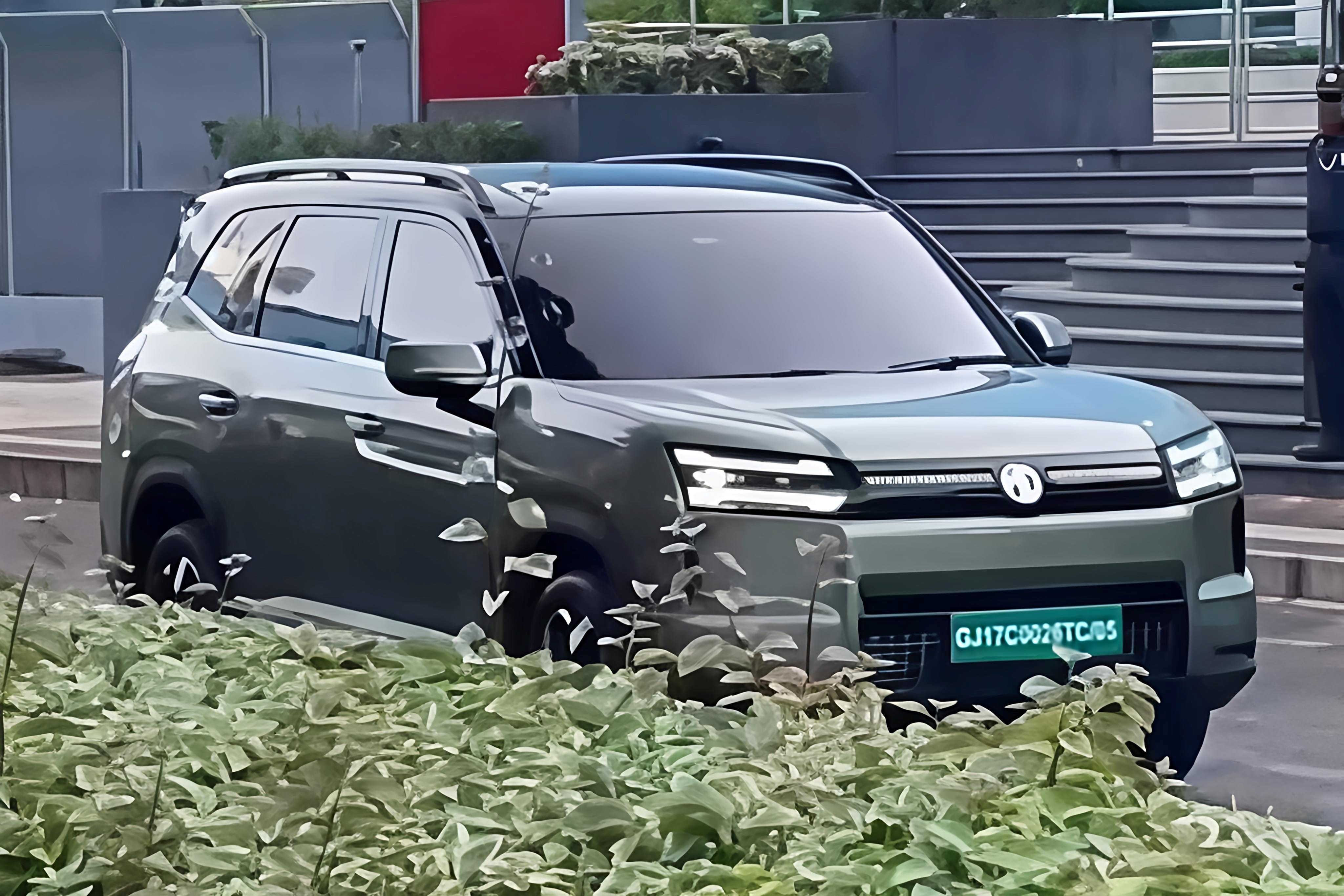
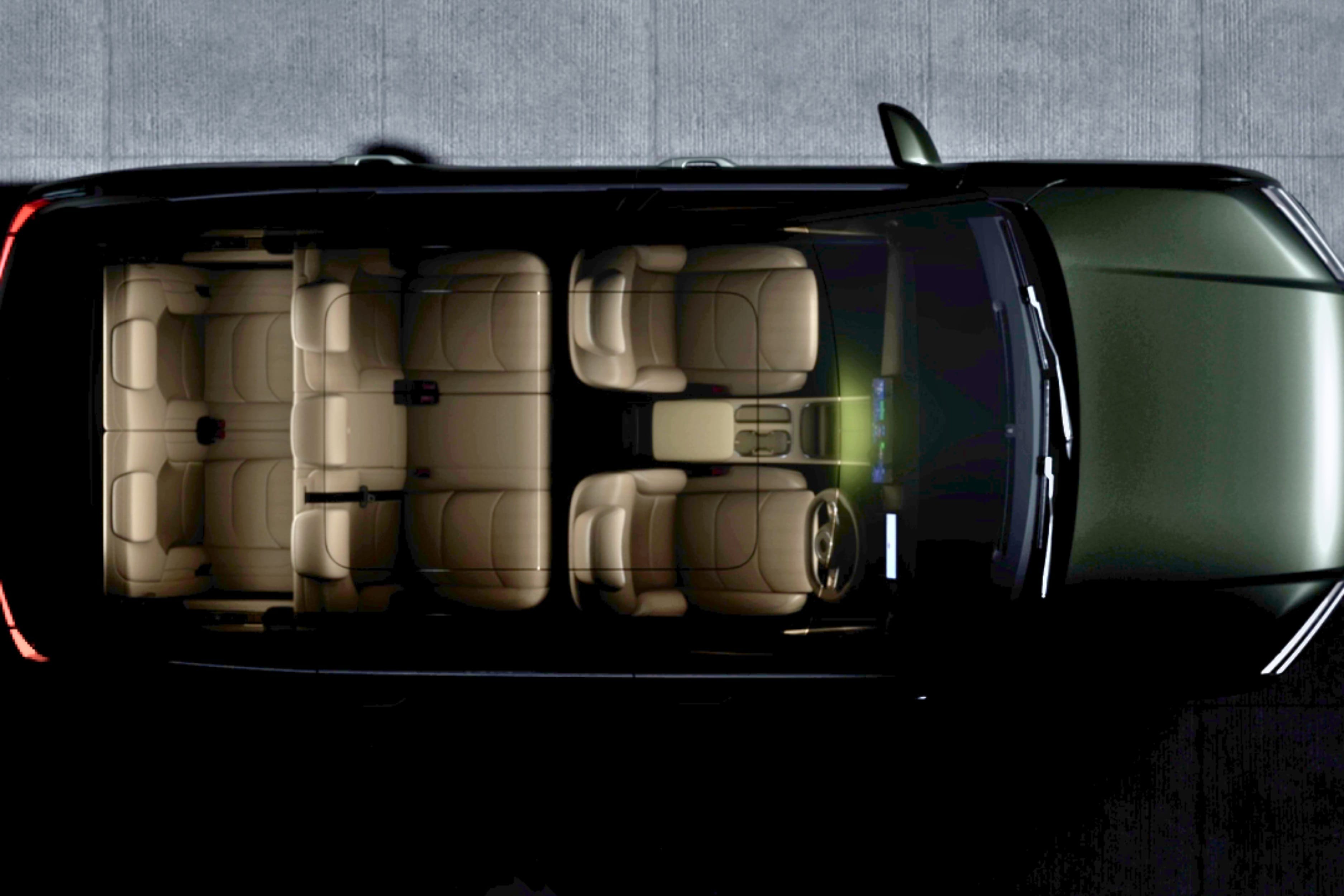
JSW MG’s upcoming Hector Tomahawk has been spied undisguised on our roads ahead of its launch. The new model will be the first in the brand’s portfolio to be underpinned by the ADAPT (Advanced Drive Architecture Platform Technology) platform. The carmaker has teased the SUV previously, giving a glimpse of its design details and its 7-seat capacity.
Hector Tomahawk to slot above the Hector in MG’s portfolio.
Likely to be powered by a 69.2kWh battery pack.
Expected to be priced between Rs 18 lakh and Rs 25 lakh.
JSW MG Hector Tomahawk EV: What was spied?
The undisguised test mule that was spied hinted at the Hector Tomahawk’s final design. The front end comes with LED headlamps with dual LED DRLs connected by a black trim that has two silver strips and the MG badge at the centre. Being an EV, it gets a blanked-off grille, with a rectangular air inlet lower down. The front bumper has a dual-tone design, with vertical air curtains on its sides. The bonnet has subtle ridges, while the car is finished in an olive green shade with a black roof and rails.
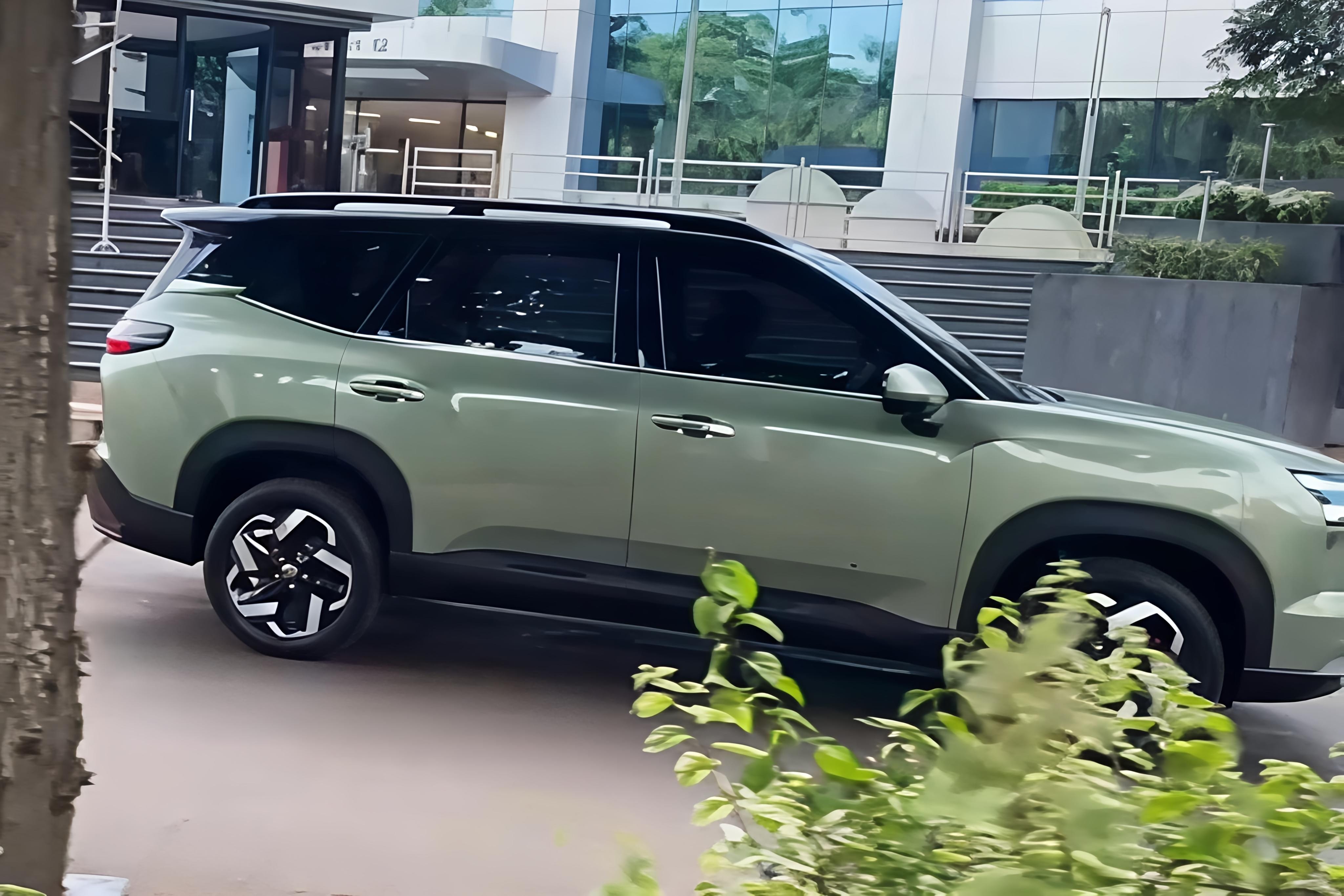
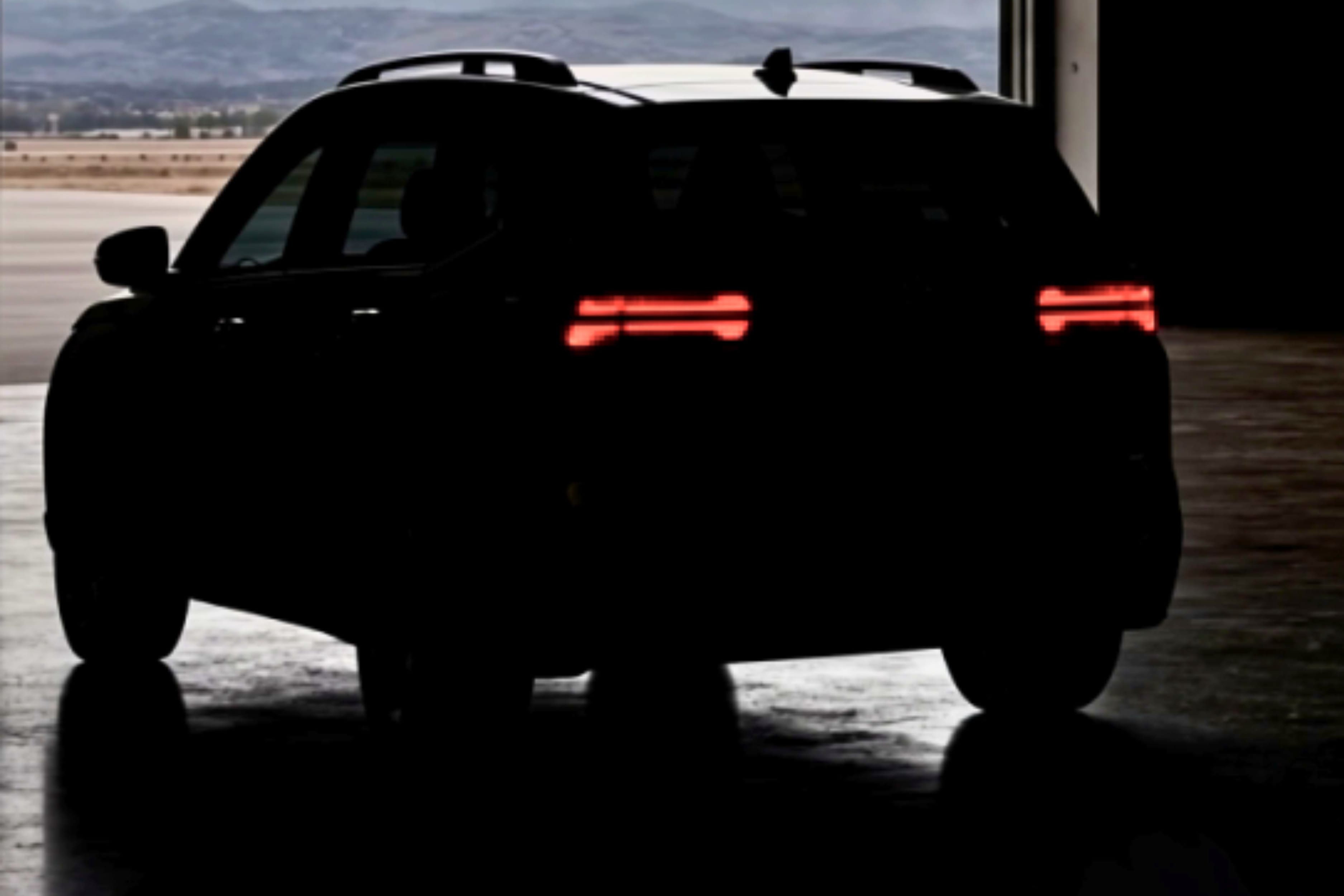
In profile, the sides look clean with chrome door handles, and the window line, finished in chrome, gets an upward kink at the back. Additionally, there’s plenty of black cladding for the squared-off wheel arches and door sills extending toward the rear bumper. The large alloy wheels were spotted with a dual-tone design. While the rear end was not spotted, it will likely come with wraparound tail-lamps and a dual-tone finish for the bumper.
JSW MG Hector Tomahawk EV: What to expect
The JSW MG Hector Tomahawk is based on the Wuling Eksion that’s sold in the Indonesian market. The former is expected to retain the latter’s dimensions of 4,745mm in length, 1,850mm in width, 1,755mm in height, and a wheelbase of 2,810mm. A previous teaser of the model confirmed a beige colour theme for the Hector Tomahawk’s cabin. While the dashboard is yet to be revealed, it is expected to retain the Eksion’s minimalistic layout. This includes screens for the driver’s display and infotainment system, a two-spoke steering wheel and a centre console with cupholders and storage spaces.
MG is yet to confirm the feature list it is expected to come with a powered tailgate, leatherette upholstery, powered and ventilated front seats, a 12.8-inch touch-infotainment head unit, an 8.8-inch digital driver’s display, a 50-watt wireless charger, automatic climate control with AC vents for the second and third rows, a 360-degree camera system, an electronic parking brake, six airbags, and an ADAS (Advanced Driver Assistance Systems) suite.
While exact powertrain specs of the Hector Tomahawk EV remain under wraps, the Eksion, for reference, is powered by a 69.2kWh LFP (Lithium Iron Phosphate) battery pack with a CLTC (China Light-Duty Vehicle Test Cycle) range of up to 530km. The battery is paired with a front-mounted motor delivering 201hp and 310Nm, and has a 160kph top speed.
As far as price is concerned, the MG Hector Tomahawk EV is expected to be priced between Rs 18 lakh and Rs 25 lakh. It will take on the likes of the Mahindra XEV 9S and the Kia Carens Clavis EV.
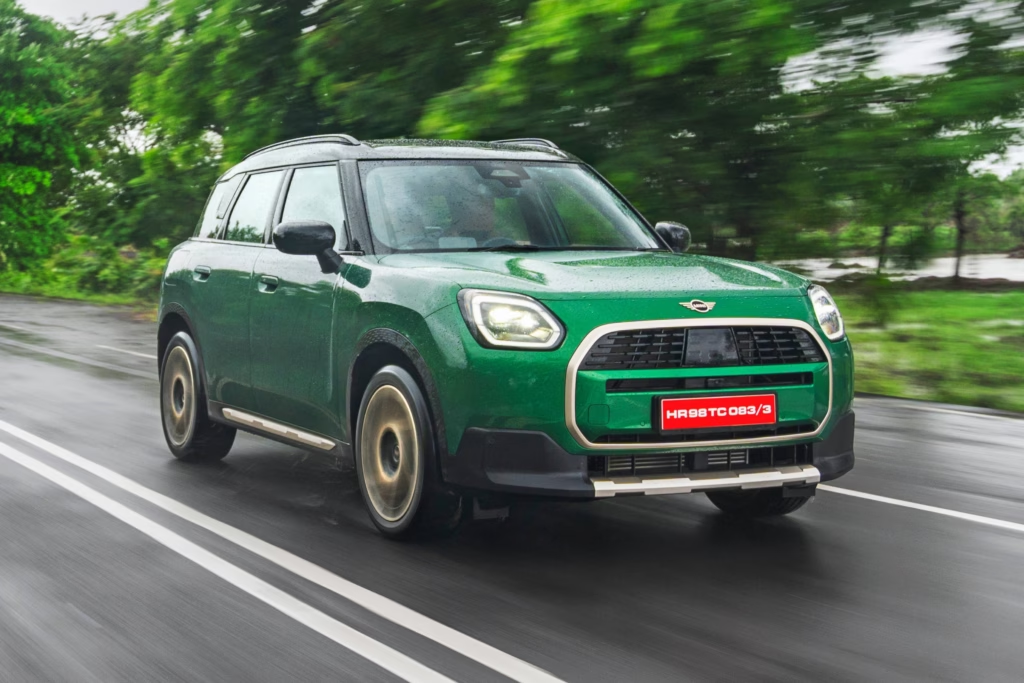
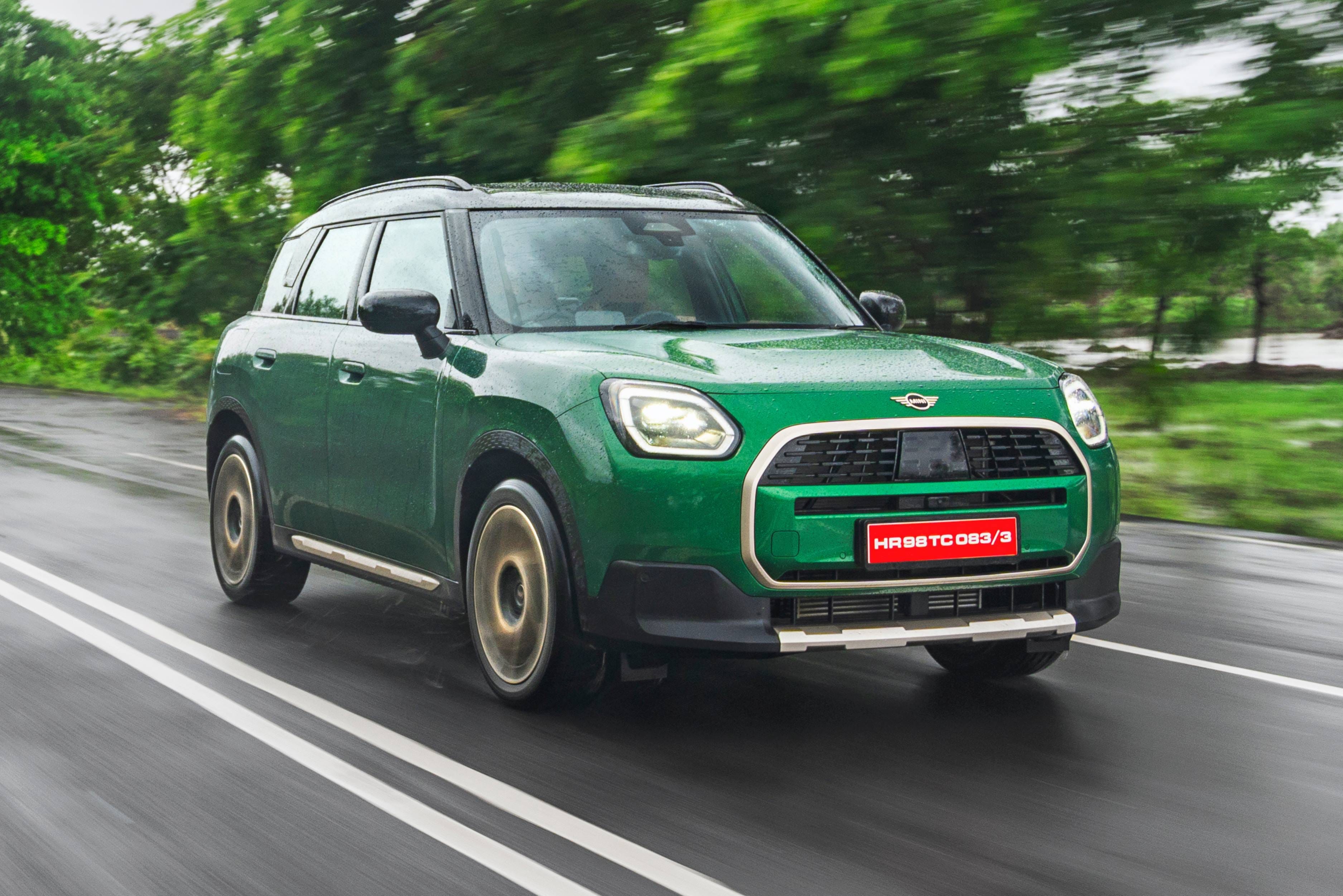
It’s all too easy to start every review of the Mini Countryman with some variation of the phrase ‘the Mini that’s not so mini’, because that’s always been true. The SUV of the Mini range, by definition, is always going to fit that description; the difference this time is that Mini itself is onboard with the idea. Where previously it was always marketed as a Mini first and an SUV second, this time the script has been flipped. No longer content with being a niche offering for the fashion forward, they want this to be your family car, or more specifically your first luxury SUV. You’ll see how the vehicle attempts to achieve that in the paragraphs ahead, but the intent is clear with the price of this locally assembled third-generation ‘U25’ Countryman C, which at Rs 47 lakh (ex-showroom), is bang on par with ‘conventional’ entry luxury SUVs, like the Mercedes-Benz GLA, Audi Q3 and even its own cousin, the BMW X1.
2026 Mini Countryman C Exterior Design and Engineering – 9/10
Clearly prioritises practicality more this time, but retains that Mini charm.
Looks sharper, boxier and visibly larger than before.
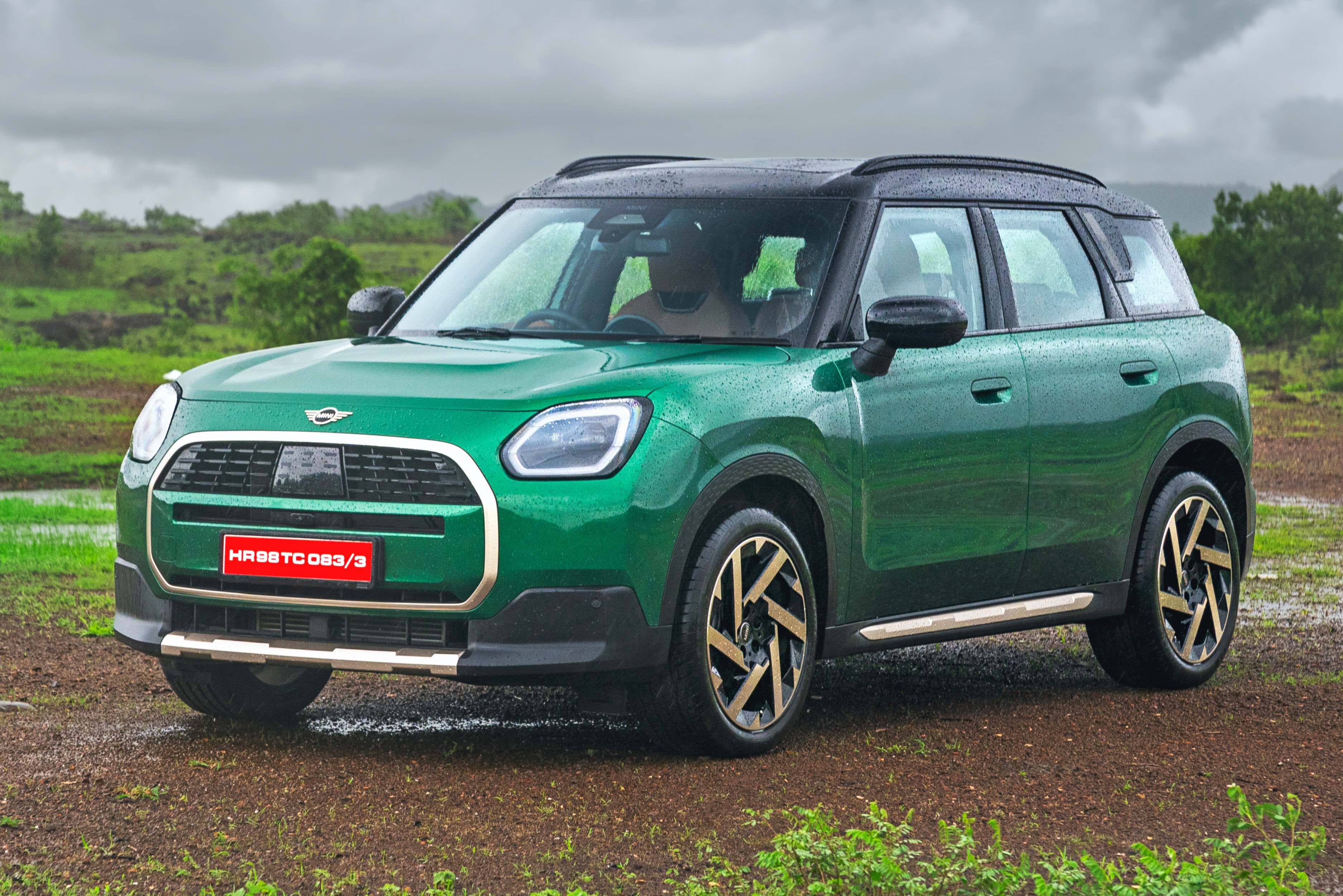
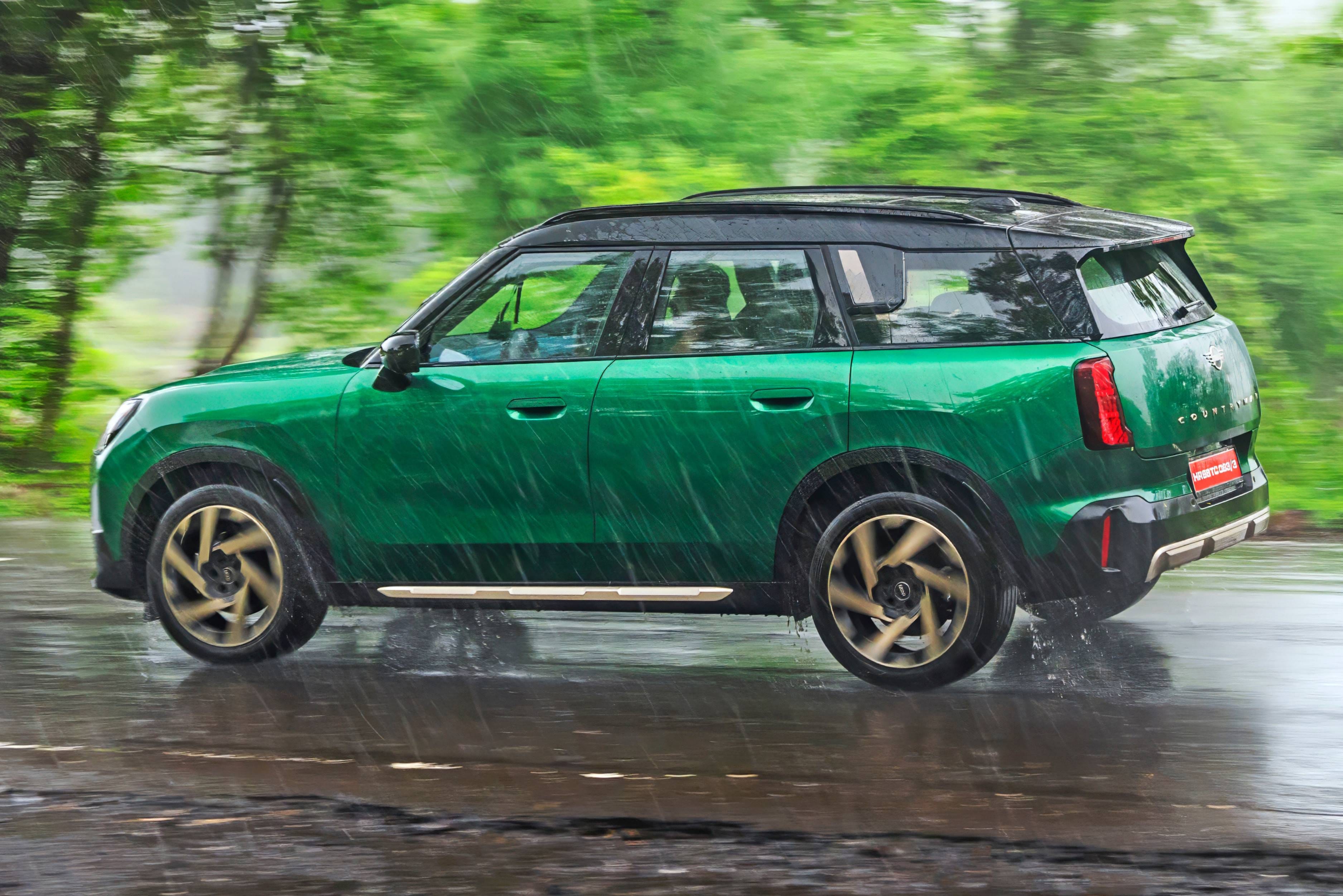
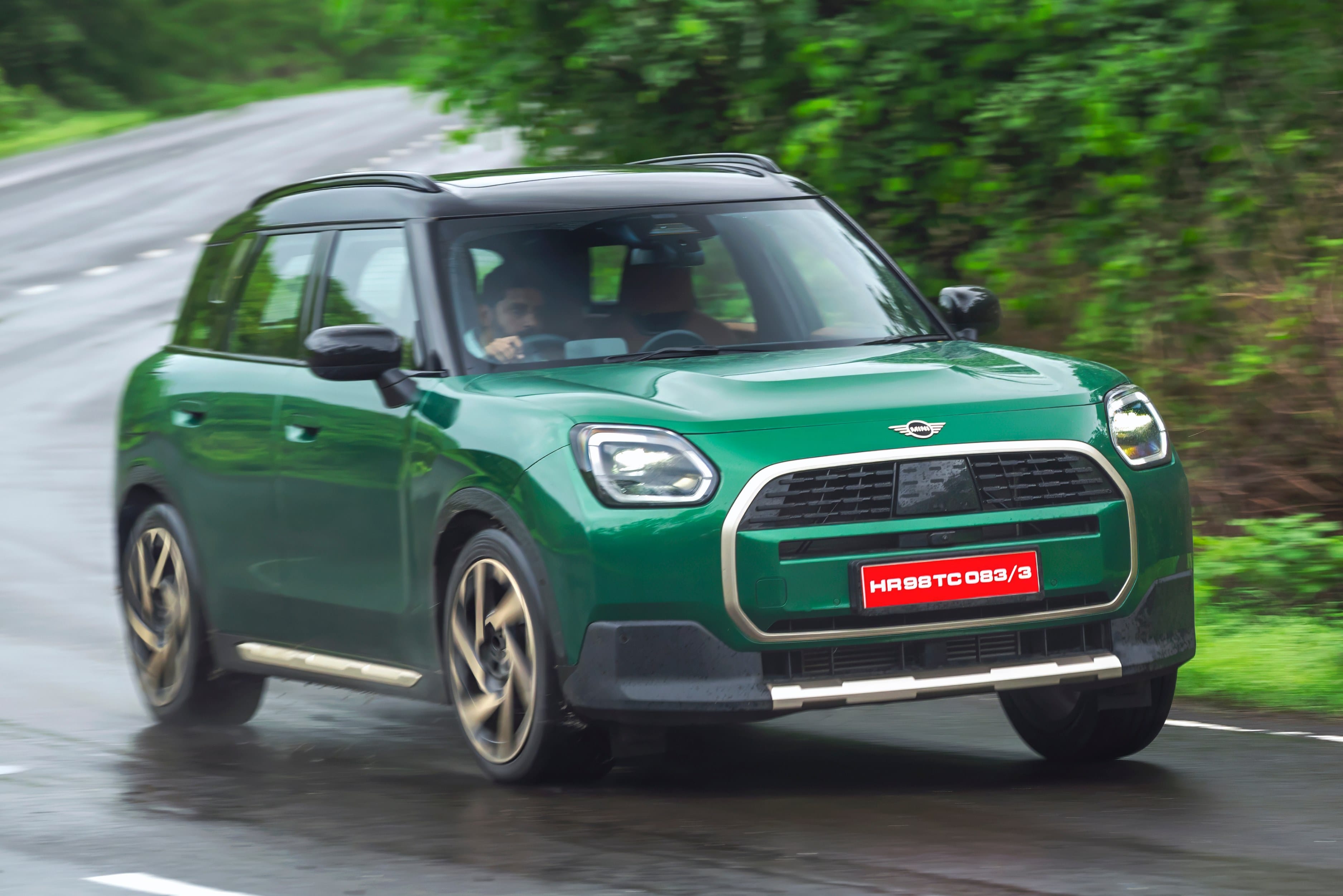
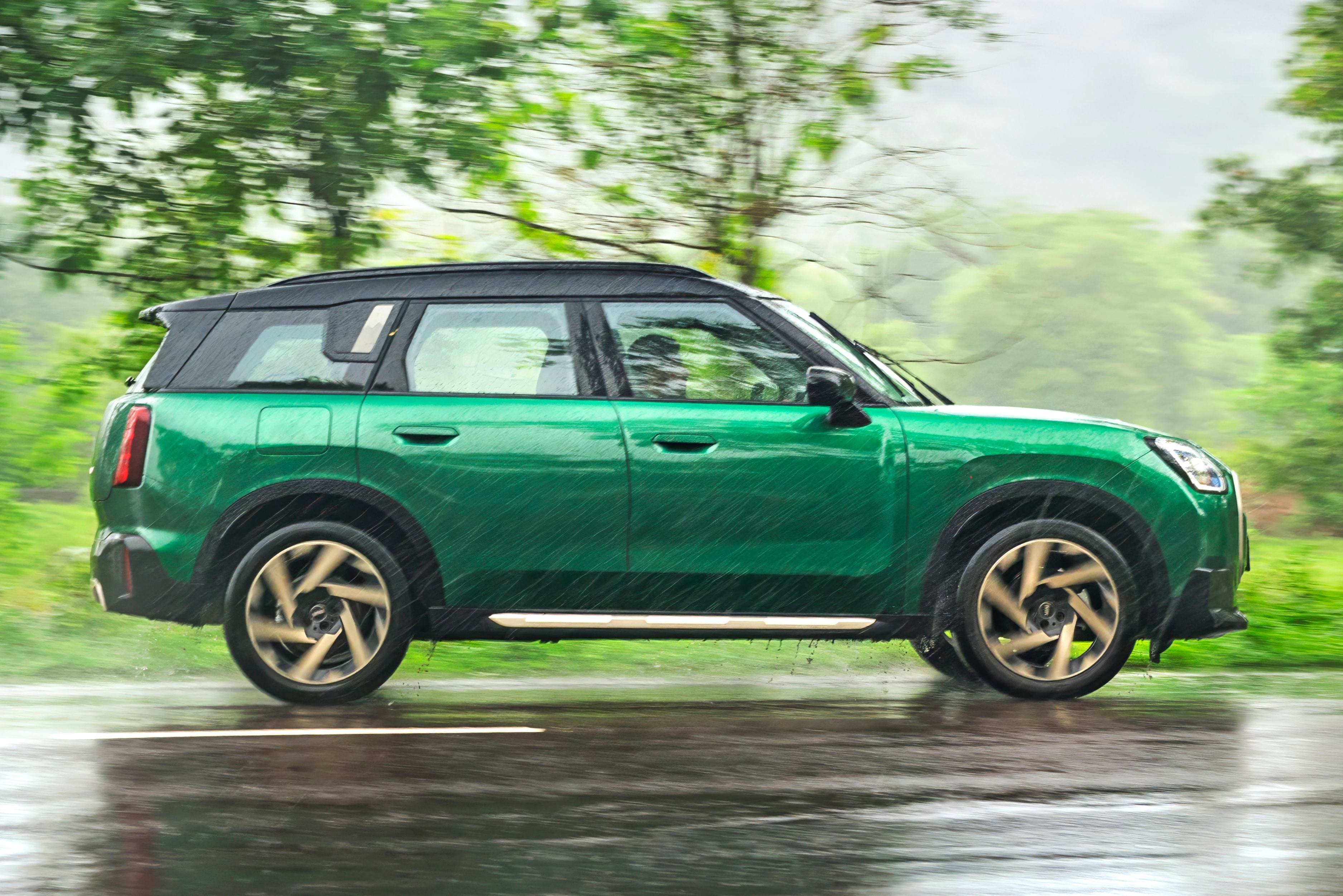
As with every successive generation, the new Countryman has grown (it’s now the tallest SUV in the class, with the highest ground clearance), but this time it has deliberately been made to ‘look’ large as well. Gone are the cartoonish and bulbous features of previous models, and in their place are smaller, sharper, more angular elements. The headlamps, grille and even the roofline have a boxier look, and this points to the greater space inside. It’s more recognisable as a Mini from the rear, where the familiar cues of a contrast roof, ‘Countryman’ lettering on the tailgate and Union Jack tail-lamps are easy to spot.
We’ve seen this look already in the Countryman Electric, and all that’s changed here is the grille that isn’t closed off. We’ve also already seen it on the CBU-imported Countryman JCW All4, which, apart from its more powerful engine and AWD, gets a sportier body kit.
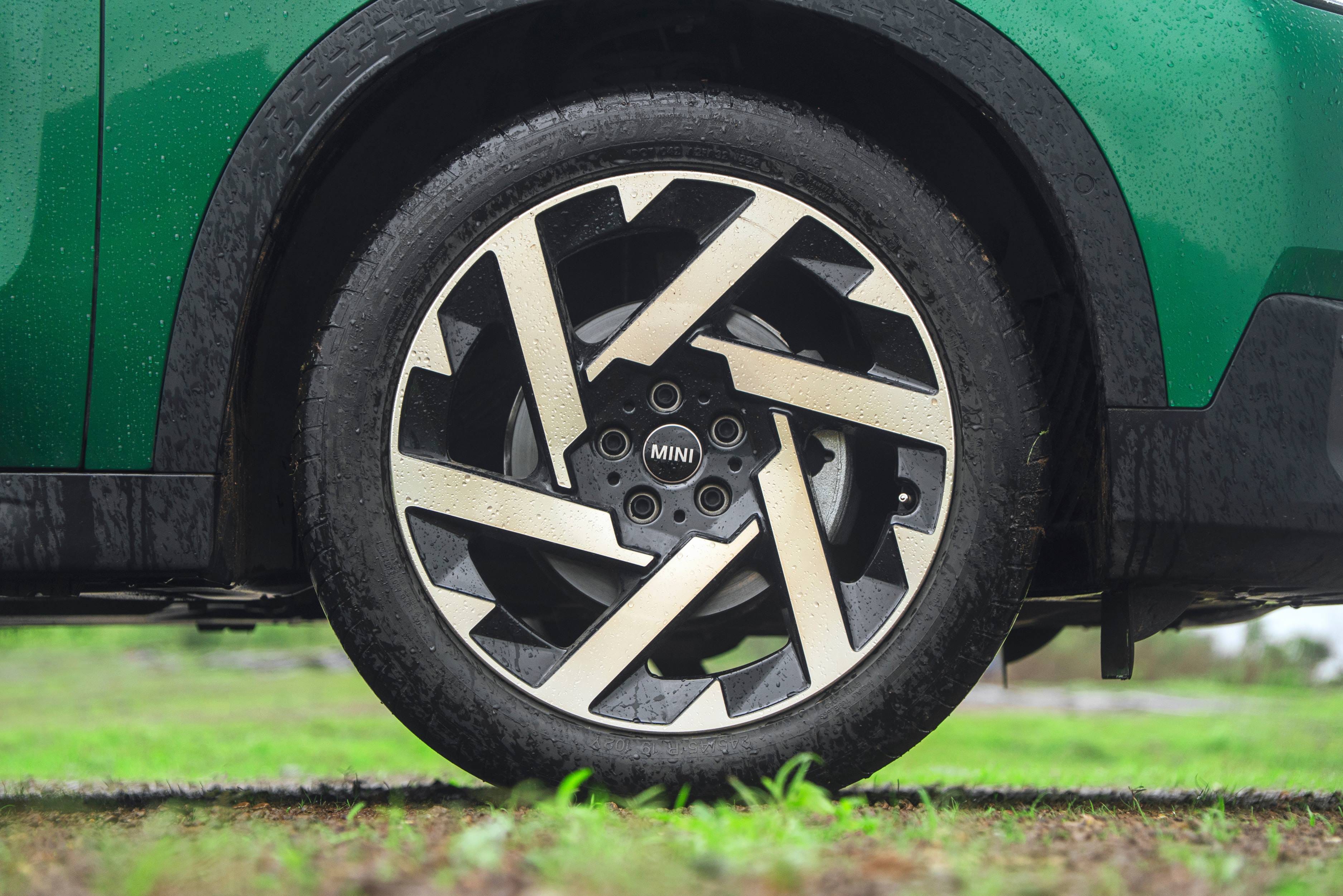
19-inch alloys look great, but they hurt ride quality.
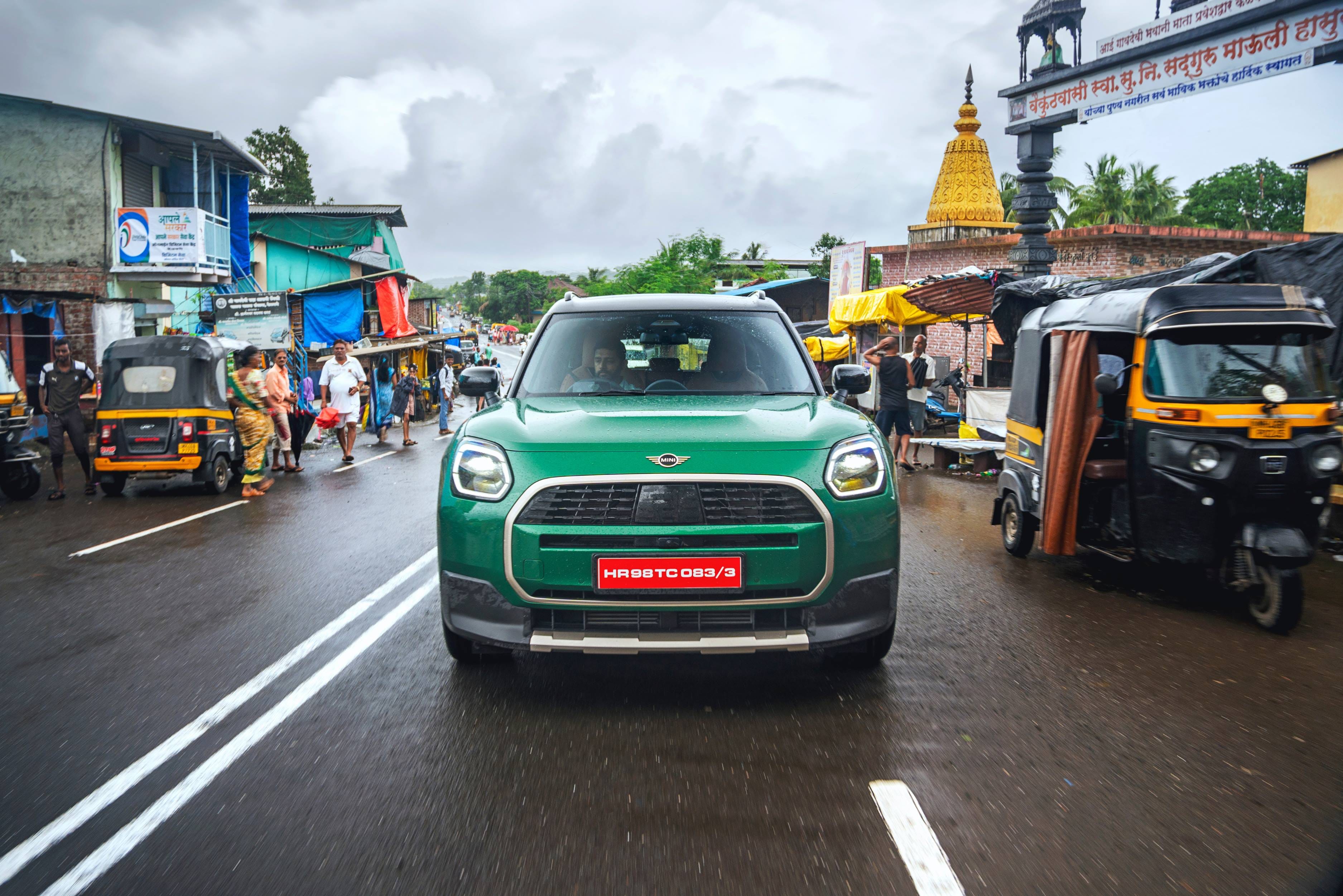
This one being a locally assembled model, however, it’s available in a single, fully loaded ‘Favoured’ spec with no optional extras, save for some accessories. It looks the business, however, with champagne-coloured accents all around, the contrast roof as well as huge 19-inch dual-tone alloy wheels. You get a choice of five colours, but Mini has been sure to pick more extroverted options than conventional luxury SUVs – British Racing Green is still the most popular Mini colour bought in India.
2026 Mini Countryman C Interior Space and Comfort – 8/10
Genuinely usable space and practicality make it feasible as a luxury SUV.
Generous headroom and legroom at the rear, though thigh support is not the best.
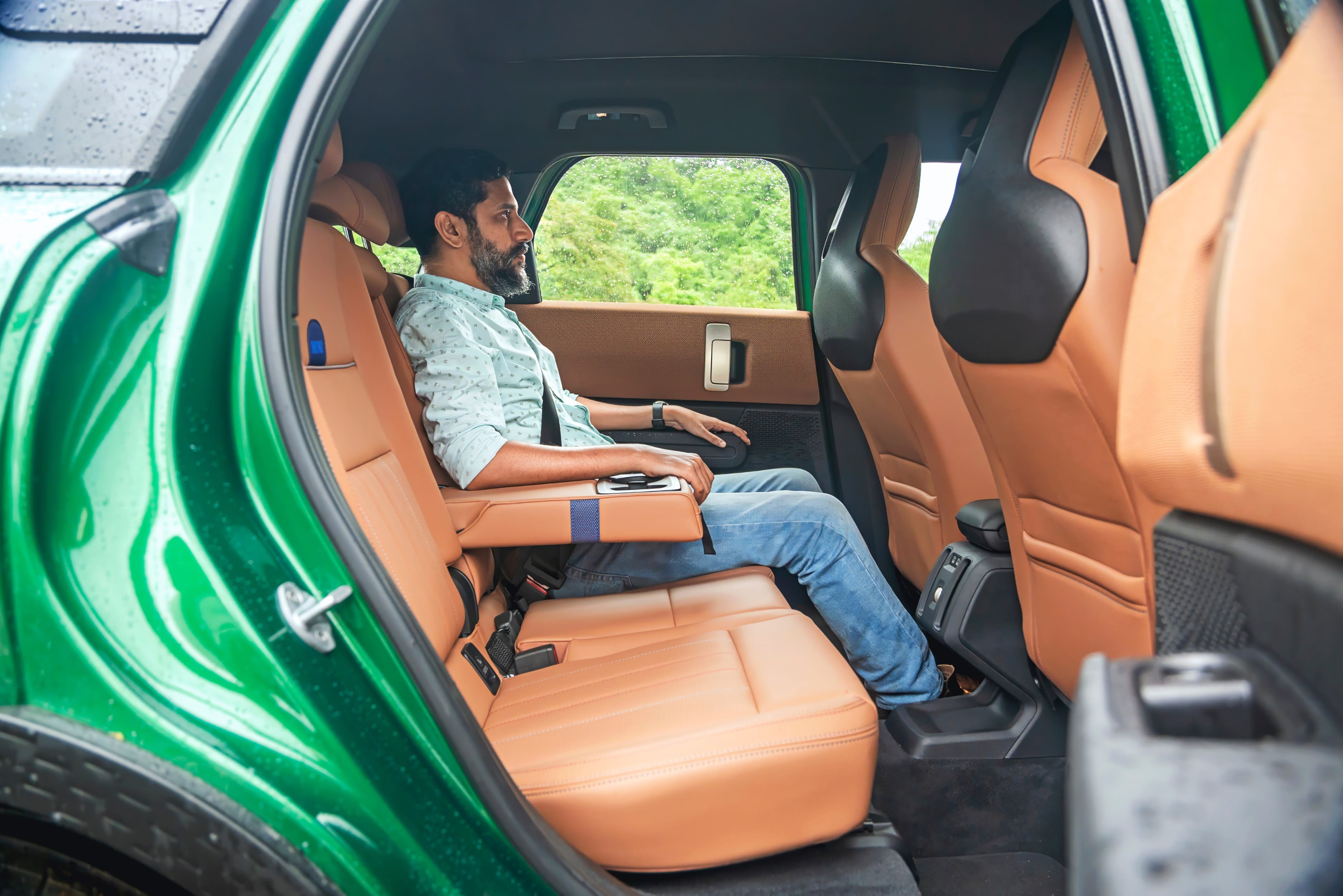
The results of the grown dimensions are immediately obvious in the greater interior space. It feels larger and airier than any Countryman before it, and betters some rivals in this regard. Without the battery of the EV, the floor is lower, giving a comfier seating position, though rear-seat thigh support is still not the best. And though the huge panoramic sunroof lets some light in, we wish the windows were a touch larger. Still, this can realistically be used as a chauffeur-driven car now.
The other area where it delivers more than the EV is the boot, whose volume has gone up by 50 litres to 505 litres. You can free up some more by sliding the rear seat forward on rails, and what’s more, they’ve even included a space-saver spare tyre, which you don’t get in the EV.
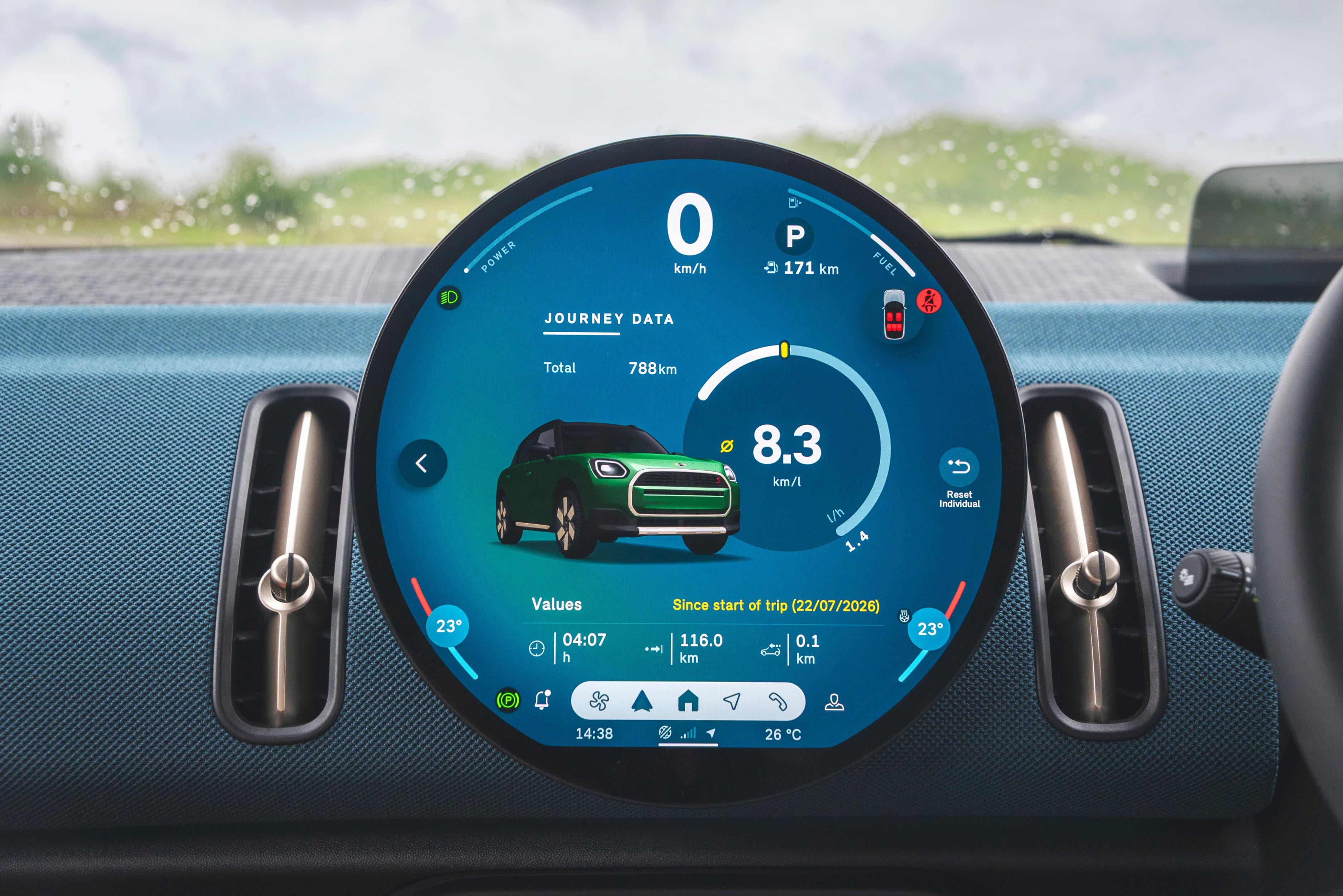
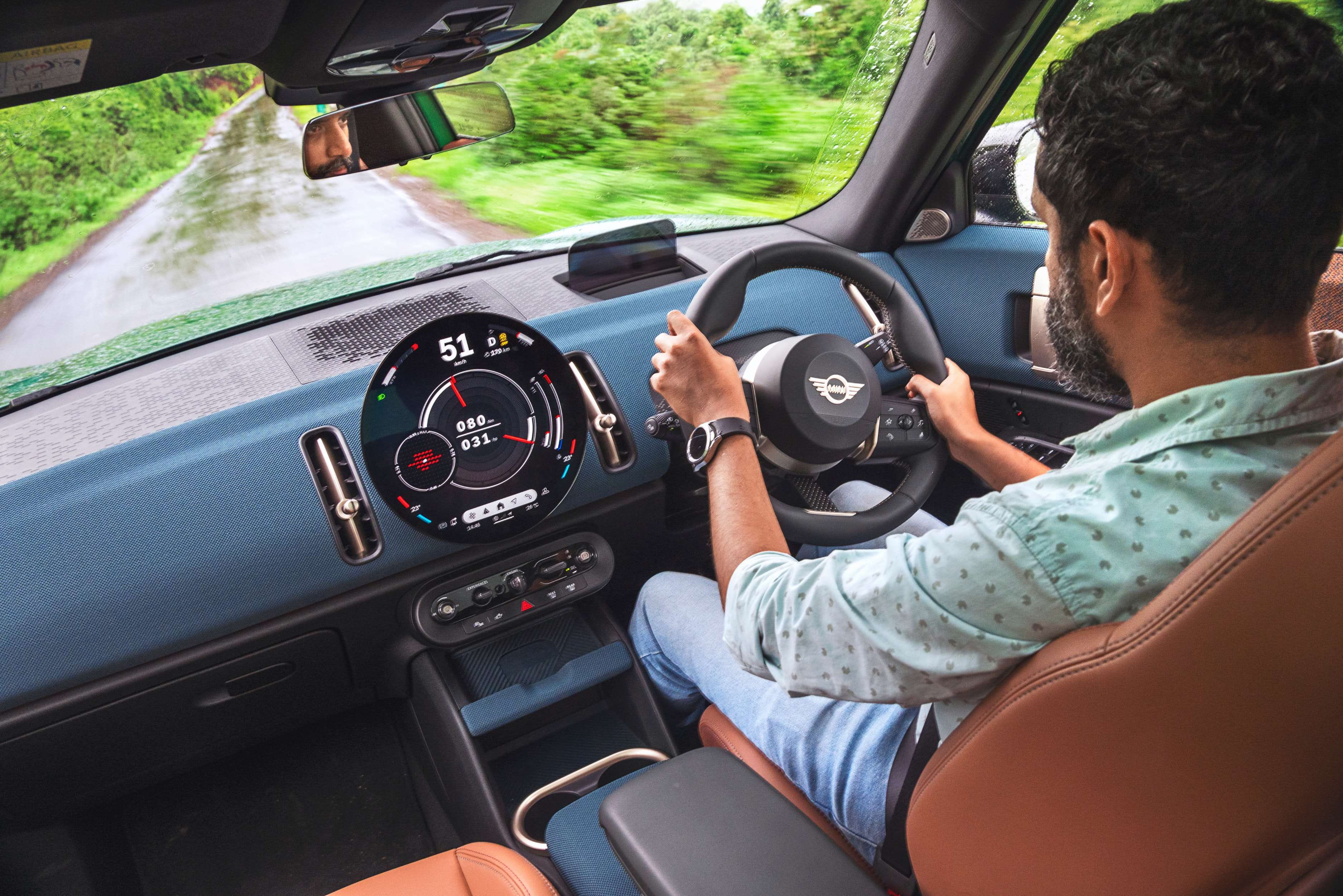
In the front seat, there’s no mistaking this for anything but a Mini, thanks to the clean dashboard with a big circular touchscreen at the centre. While this does function as the speedometer, a nod to the original Mini, there is also a flip-up HUD, which presents the info in your line of sight.
Knitted fabric on the door cards and dashboard lends the cabin an upmarket feel.
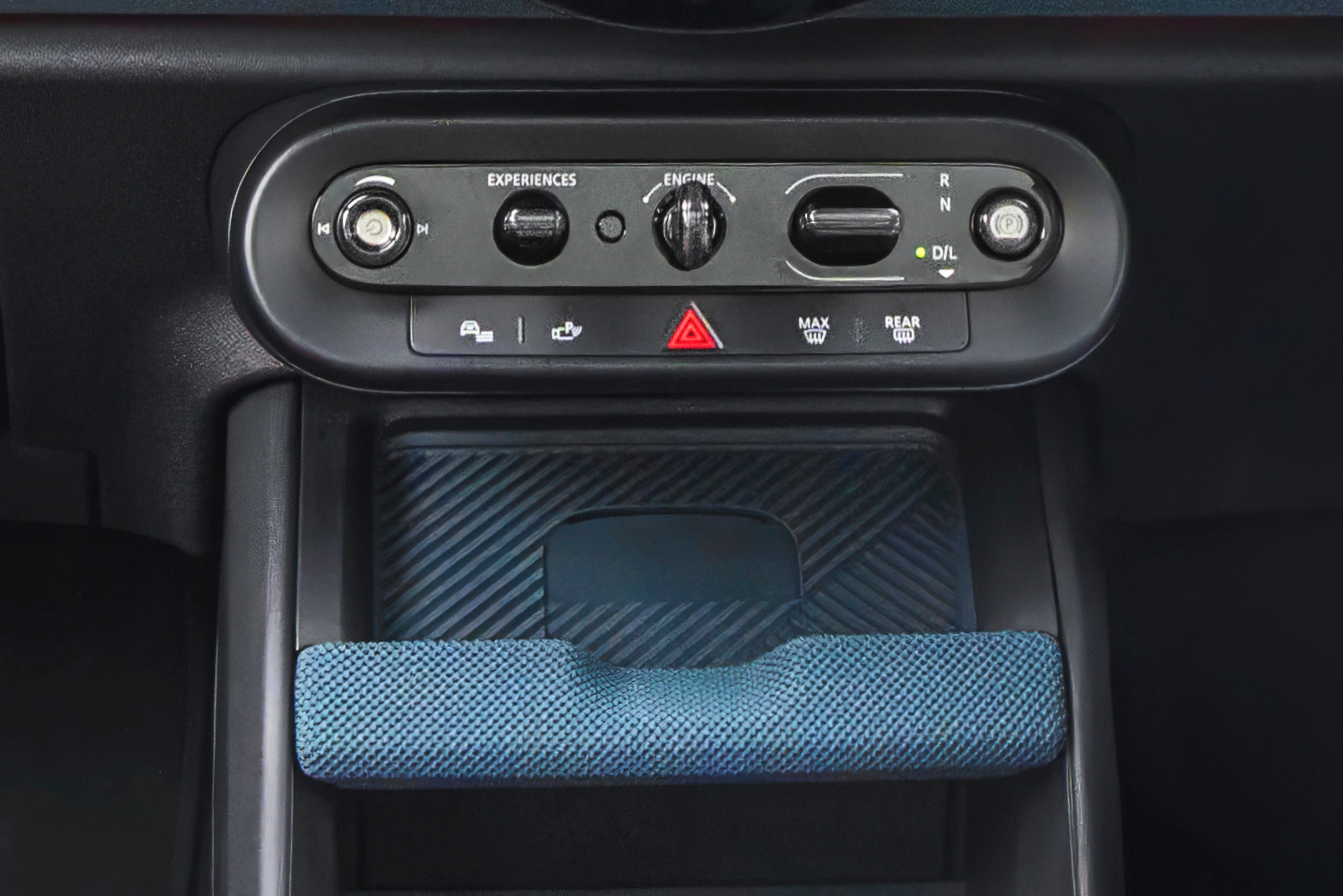
The dash is trimmed in an upmarket-feeling knitted fabric, which then extends onto the door cards, where it blends from blue to brown in colour. There are plenty of uniquely Mini touches, like slim, vertical AC vents, a row of toggle switches to start the car and change modes, more champagne gold trim and vertical inside door handles. But there is also more BMW switchgear than ever before, which, though high quality, looks a bit ordinary.
Storage space and ergonomics are well thought out, with an open centre console, a neat covered storage box and a sliding armrest. The front seats, meanwhile, are large and accommodating and give a commanding view outward.
2026 Mini Countryman C Features and Safety – 8/10
Generously kitted out with lots of standard equipment, on par with rivals.
Edge-to-edge circular screen is responsive, high-res and full of cutesy graphics.
As mentioned before, there is only one variant of the Countryman C, with a fixed features list and no optional add-ons. It’s a generous spec that features more than what some rivals offer, including wireless Apple CarPlay and Android Auto, powered front seats with memory and massage function for the driver, surround camera with auto park function, a Harman/Kardon audio system, heated steering wheel, panoramic sunroof, 13.7-inch diameter OLED touchscreen, heads-up display, voice assistant, wireless phone charging and a digital key system, to name a few.
As seen on all current-generation Minis, the dish-like circular touchscreen is a work of art. Where the previous generation housed a rectangular touchscreen within the circle, the new one is an edge-to-edge circular screen. It’s responsive, bright, high of resolution and full of Mini-typical cutesy graphics. Even the audio cues aren’t like normal cars, with cute ethereal chimes replacing boring warning beeps. There aren’t drive modes but Experience Modes (more on these later), which not only change the colour of the ambient lighting, but the screen display and can even activate certain features, like the seat massage.
Hard buttons only for few functions such as media controls and Experience Modes
However, once the novelty fades, you start to realise this circular design isn’t great ergonomically. While there, thankfully, are hard buttons for music volume and track control, as well as dri- sorry, Experience Modes, AC controls and all other functions are on the screen. With no bezel or edge to rest your hand on, and small, rounded graphics to tap, it is quite tricky to perform basic functions on the move. And as it’s based on BMW’s current i-Drive system, there are far too many sub-menus to go through.
2026 Mini Countryman C Performance and Refinement – 7/10
Downsized turbo-petrol engine lacks the zest associated with a Mini.
Performance feels merely adequate from the 156hp, 1.5-litre turbo-petrol engine.
This car shares its UKL1 architecture with the BMW X1, as well as its 1.5-litre three-cylinder direct-injection turbo-petrol engine. As in the BMW, it produces 156hp and 240Nm, sent to the front wheels via a 7-speed dual-clutch automatic gearbox, and as in the BMW, it feels merely adequate. While easier to digest in the X1, which has long since transitioned from ‘Ultimate Driving Machine’ to comfy family cruiser, the Mini’s go-kart intentions are still on display, and the expectation for more performance is higher.
Like in modern BMWs, the Experience Modes are mostly cosmetic, with only Green (Eco) and Go Kart (Sport) altering drive performance. Expectedly, the former dulls things down, while the latter primes the engine and gearbox to be more reactive, and they work as expected. There is, however, no scope to set individual parameters in any mode; for instance, ESC is off by default in Go Kart mode and you can’t turn it back on.
Gearbox is intuitive and quick, but there’s no manual control whatsover.
Also missed are paddle shifters, or in fact any means of shifting manually, though the gearbox is quite intuitive and quick to shift for the most part. It’s only at crawling speeds where this powertrain falls into the triple-whammy trap of turbo lag, gearbox hesitation and no off-boost power that’s typical of downsized engines. Things improve drastically in the mid-range, where the Countryman C feels most comfortable.
The engine also remains pretty refined for the most part, and it’s only if you absolutely stretch it out that you’re made aware it’s a three-cylinder unit.
2026 Mini Countryman C Mileage and Range – 8/10
Decent for a reasonably large turbocharged petrol luxury SUV.
Fuel economy is officially rated at 15.92kpl.
The advantage of the sizing-down is, of course, fuel economy, which will no doubt be better than with a larger 2.0-litre engine. It’s officially rated at 15.92kpl, which is not bad for a turbo petrol luxury SUV, and you realise that it’s because it’s not too heavy – clocking in at around 1,700kg. Other factors helping this include a quick-acting engine stop/start system and a good drag coefficient of just 0.26. Expect a real-world average comfortably in the two digits. And like all new BMW cars, this one is E25 compliant.
2026 Mini Countryman C Ride Comfort and Handling – 7/10
Still fun, but drives like a big car now; large wheels hurt ride quality.
Handling is a noticeable departure from the Go Kart feel that’s typified all modern Minis.
More so even than the powertrain, the Go Kart feel that’s typified all modern Minis comes from the chassis setup and handling, and this new Countryman represents the first noticeable departure. But that’s not necessarily a bad thing, and is in keeping with its new, more grown-up luxury-SUV persona.
The steering is much lighter and not as tightly wound as before, for a start, and that means despite the increased size, the Countryman is even easier to manoeuvre. What you lose in the process is some urgency in direction changes and some agility, but you don’t mind that thanks to the aforementioned benefits.
It feels reassuring and has great road-holding at highway speeds,
The good news is the suspension setup still allows it to handle corners tidily and with not too much body roll. And this despite being slackened off quite a bit to be noticeably comfier and more compliant than the previous Countryman. It also has great road-holding at high speeds and feels far more reassuring at highway speeds, and the overall sensation is that you’re commandeering a proper SUV rather than a high-riding hatchback. The only spoilsport here are the 19-inch wheels; while they look great, they crash hard through potholes and even over some steeper speed breakers.
2026 Mini Countryman C Price and Verdict – 8/10
Competitive pricing and big space make it a credible rival to other entry luxury SUVs.
The Mini Countryman C is priced at Rs 47.5 lakh (ex-showroom, India) which is incredibly competitive. It ducks under both, the Mercedes GLA and BMW X1, with only the entry-level version of the Audi Q3 being slightly cheaper. The best part is that, where previous locally assembled Countrymans (Countrymen?) felt stripped down compared to their CBU counterparts, here you get a well turned out and generously equipped luxury SUV that doesn’t leave you wanting.
It’s clear that Mini is on a war footing to break into the mainstream, and that’s something it certainly can’t do with its hatchbacks, which remain fun to drive and upmarket, but ultimately niche fashion statements. The Countryman C delivers on space, features, luxury and comfort that’s more than a match for others in the segment, and despite a slightly underwhelming engine, adds some much-needed pizzazz to the ranks of entry level luxury SUVs.
Royal Enfield ने भारत में अपनी अपडेटेड Continental GT 650 लॉन्च कर दी है। कंपनी ने इस बाइक के डिजाइन और फीचर्स में कुछ छोटे बदलाव किए हैं, जबकि इसके इंजन और बाकी मुख्य मैकेनिकल चीजों में कोई बड़ा बदलाव नहीं किया है। वहीं, इसकी कीमत कलर और स्पेसिफिकेशन के आधार पर 3.58 लाख रुपये से शुरू होकर 3.88 लाख रुपये (एक्स-शोरूम) तक जाती है।
बता दें कि अपडेटेड Continental GT 650 को चार कलर ऑप्शन में पेश किया गया है। Rocker Red वेरिएंट, जिसमें अब ब्लैक फिनिश वाला इंजन, एग्जॉस्ट और कास्ट-अलॉय व्हील मिलते हैं। इसकी कीमत 3.58 लाख रुपये है। वहीं, British Racing Green की कीमत भी 3.58 लाख रुपये है। इसमें पॉलिश्ड इंजन और स्पोक व्हील दिए गए हैं।
ब्लैक-आउट इंजन और कास्ट-अलॉय व्हील्स वाले Apex Grey की कीमत 3.81 लाख रुपये है, जबकि पॉलिश्ड इंजन और स्पोक व्हील्स वाले मिस्टर क्लीन वेरिएंट की कीमत सबसे ज्यादा, यानी 3.88 लाख रुपये है। ये सभी कीमतें एक्स-शोरूम हैं।
2026 Continental GT 650 में अब ब्लैक कलर का इंस्ट्रूमेंट काउल और नए LED इंडिकेटर्स दिए गए हैं। इसके अलावा, बाइक में USB Type-C फास्ट चार्जिंग पोर्ट भी जोड़ा गया है। इससे राइडर सफर के दौरान स्मार्टफोन और दूसरे डिवाइस आसानी से चार्ज कर सकेंगे।
वहीं, Rocker Red वेरिएंट में अब ब्लैक फिनिश वाला इंजन, एग्जॉस्ट और कास्ट-अलॉय व्हील दिए गए हैं। पहले यह सेटअप सिर्फ Apex Grey कलर में मिलता था। इस बदलाव के बाद British Racing Green और Mr Clean ही ऐसे वेरिएंट हैं, जिनमें स्पोक व्हील और पॉलिश्ड इंजन फिनिश दी गई है।
ये अपडेट मुख्य रूप से दिखावट से जुड़े हैं और इनसे मोटरसाइकिल के बेसिक डिजाइन या राइडिंग के अनुभव में कोई बदलाव नहीं आता है। मैकेनिकल तौर पर Continental GT 650 में कोई बदलाव नहीं किया गया है। इसमें अभी भी 648cc का एयर- और ऑयल-कूल्ड पैरेलल-ट्विन इंजन लगा है, जो 47hp की पावर और 52.3Nm का टॉर्क देता है। पावर को पिछले पहिये तक पहुंचाने के लिए छह-स्पीड गियरबॉक्स का इस्तेमाल किया गया है।
Royal Enfield की लाइनअप में Continental GT 650 की अपनी अलग पहचान है। यह बाइक क्लासिक कैफे रेसर लुक के साथ मॉडर्न और भरोसेमंद तकनीक का कॉम्बिनेशन देती है।
USB Type-C चार्जिंग पोर्ट और डिजाइन में किए गए छोटे बदलाव इसे मिड-वेट परफॉर्मेंस बाइक सेगमेंट में और बेहतर बनाए रखने में मदद करेंगे। वहीं, Royal Enfield आने वाले समय में ज्यादा बड़े इंजन वाली बाइक्स भी पेश करने की तैयारी कर रही है।
क्या आप नई इलेक्ट्रिक SUV लेने का प्लान बना रहे हैं? अगर हां, तो इस खबर को आपको जरूर पढ़ना चाहिए। दरअसल, Mahindra & Mahindra ने आज BE 6 Sporteq को भारत में लॉन्च कर दिया है। यह कंपनी की BE 6 इलेक्ट्रिक SUV पर आधारित नई सीरीज है। इसकी शुरुआती कीमत 19.45 लाख रुपये (एक्स-शोरूम) है और इसमें बैटरी की कीमत भी शामिल है।
कंपनी ने इसे Battery as a Service (BaaS) मॉडल के साथ भी पेश किया है। इस मॉडल में BE 6 Sporteq की शुरुआती कीमत 11.45 लाख रुपये (एक्स-शोरूम) है। इसके अलावा बैटरी इस्तेमाल करने के लिए 3.75 रुपये प्रति किलोमीटर का चार्ज देना होगा।
BaaS मॉडल में 3.75 रुपये प्रति किलोमीटर का बैटरी चार्ज रोजाना करीब 60 किलोमीटर की ड्राइविंग को ध्यान में रखकर तय किया गया है। बता दें कि BE 6 Sporteq की डिलीवरी 26 अगस्त 2026 से शुरू होगी।
इस नई सीरीज को आप 8 वेरिएंट में खरीद सकते हैं — One, Two, Three, Three+, Four, FE (फ्रीडम एडिशन), FE Four और लॉन्च एडिशन। ग्राहक अपनी जरूरत और वेरिएंट के हिसाब से 59kWh, 70kWh और 79kWh बैटरी पैक में से चुन सकते हैं।
Mahindra BE 6 Sporteq की कीमतें
59 kWh बैटरी वाले BE 6 Sporteq One की कीमत BaaS के तहत ₹11.45 लाख और बैटरी के साथ ₹19.45 लाख है। Two वेरिएंट की कीमत BaaS के तहत ₹12.95 लाख और 59 kWh बैटरी के साथ ₹20.95 लाख है।
Three वेरिएंट की कीमत 59 kWh बैटरी के साथ ₹21.95 लाख और 70 kWh यूनिट के साथ ₹22.95 लाख है। वहीं, Three+ की कीमत 70 kWh बैटरी के साथ ₹23.95 लाख और 79 kWh बैटरी के साथ ₹24.95 लाख है।
इसके अलावा, Four और ‘लॉन्च एडिशन’ (Launch Edition), दोनों ही 79 kWh बैटरी के साथ आते हैं और इनकी कीमत 26.95 लाख रुपये है। FE की कीमत 24.45 लाख रुपये है, जबकि FE फोर की कीमत 26.95 लाख रुपये है। फॉर्मूला E से प्रेरित इन दोनों ही वेरिएंट्स में 79 kWh की बैटरी का इस्तेमाल किया गया है।
ये सभी कीमतें एक्स-शोरूम हैं और इनमें वॉल चार्जर और उसके इंस्टॉलेशन का खर्च शामिल नहीं है।
तीन-स्क्रीन वाला डिजिटल कॉकपिट
Mahindra ने BE 6 Sporteq सीरीज को 12 एक्सटीरियर कलर ऑप्शन में पेश किया है। इनमें चार नए कलर भी शामिल हैं—Rosso Impulso, Ruby Velvet, Graphite Storm और Firestorm Orange Satin।
Two वेरिएंट से आगे के सभी मॉडल में तीन-स्क्रीन वाला कोस्ट-टू-कोस्ट डिजिटल कॉकपिट दिया गया है। हालांकि, Formula E से प्रेरित Freedom Edition खरीदने वाले ग्राहकों को पहले वाला दो-स्क्रीन कॉकपिट और खास ‘हेलो डिजाइन’ मिलेगा।
Sporteq रेंज में छह नए टेक्नोलॉजी सुइट्स भी पेश किए गए हैं — TEQ_Talk, TEQ_Play, TEQ_Drive, TEQ_Me, TEQ_Secure और TEQ_xting। ये सभी MAIA (महिंद्रा का आर्टिफिशियल इंटेलिजेंस आर्किटेक्चर) पर आधारित हैं, जो कंपनी की ‘सॉफ्टवेयर-डिफाइंड व्हीकल’ स्ट्रैटेजी का आधार है।
Google Gemini-पावर्ड वॉइस असिस्टेंट
TEQ_Talk को Google Gemini के साथ बनाया गया है और इसमें 17 खास AI एजेंट का इस्तेमाल किया गया है। Mahindra के अनुसार, यह सिस्टम 100 से ज्यादा मुख्य फंक्शन और 48 एप्लीकेशन को सपोर्ट करता है, जिनमें गाड़ी के कंट्रोल, नेविगेशन, म्यूजिक और न्यूज शामिल हैं।
TEQ_Play में एंटरटेनमेंट फीचर जैसे कि कराओके, ‘ब्रिंग-योर-ओन-डिवाइस’ (BYOD) मोड वाला इन-कार गेमिंग सुइट, प्राइवेट ऑडियो, Dolby Vision, Dolby Atmos और GrooveMe Party शामिल हैं। Mahindra का दावा है कि भारत में ऑटोमोटिव बनाने वाली कंपनियों में कराओके फ़ीचर और BYOD मोड में गेमिंग की सुविधा सबसे पहले इसी में दी गई है।
TEQ_Drive में परफॉर्मेंस से जुड़े फंक्शन जैसे कस्टम ड्राइव मोड, ड्रिफ़्ट मोड, ट्राइब ड्राइव, रिवाइव और रिवाइव SOS शामिल हैं। Formula E Freedom Edition में एक अतिरिक्त ‘एक्सेलरेशन बूस्ट’ फंक्शन भी मिलता है।
TEQ_Me में ऑटोमैटिक डिटेक्शन वाले यूजर प्रोफाइल की सुविधा है, जबकि TEQ_xting मालिकों को टेलगेट के लिए पर्सनलाइज्ड मैसेज बनाने की सुविधा देता है।
TEQ_Secure में Secure360 Pro शामिल है, जो ऑडियो रिले और घुसपैठ की चेतावनी (intrusion alert) के साथ लाइव व्यू देता है। इसमें iPhone, Apple Watch, Android और Samsung स्मार्टफोन के साथ-साथ NFC की-कार्ड के ज़रिए NFC और डिजिटल कार-की का सपोर्ट भी मिलता है।
महिंद्रा का दावा है कि वह पहली भारतीय ऑटोमोटिव कंपनी है जो कई डिवाइस इकोसिस्टम में ‘कार कनेक्टिविटी कंसोर्टियम’ (CCC) के नियमों के मुताबिक Digital Car-Key फंक्शनैलिटी देती है। इस सुइट में तीसरी स्क्रीन के लिए पैरेंटल लॉक भी शामिल है।.
मौजूदा महिंद्रा इलेक्ट्रिक SUV में अपडेट्स आएंगे
महिंद्रा ने कहा कि Sporteq सीरीज के साथ पेश की गई सभी नई टेक्नोलॉजी और सॉफ्टवेयर फीचर्स को मौजूदा BE 6, XEV 9e और XEV 9S गाड़ियों में धीरे-धीरे लाया जाएगा, हालांकि उपलब्ध फीचर्स मॉडल और वैरिएंट के हिसाब से अलग-अलग होंगे। यह रोलआउट जनवरी 2027 से चरणों में शुरू होगा।
Mahindra & Mahindra के ऑटोमोटिव बिजनेस के प्रेसिडेंट और महिंद्रा इलेक्ट्रिक ऑटोमोबाइल लिमिटेड के मैनेजिंग डायरेक्टर, आर वेलुसामी ने कहा, “इलेक्ट्रिक मोबिलिटी एक नए दौर में प्रवेश कर रही है। ग्राहक अब EV को सिर्फ उसकी रेंज या तेजी (एक्सेलरेशन) से नहीं आंकते हैं। वे उम्मीद करते हैं कि यह अपनी पूरी लाइफ-साइकिल के दौरान ज्यादा स्मार्ट, ज्यादा पर्सनल और ज्यादा काबिल बने। Sporteq इसी बदलाव को दिखाता है। MAIA से पावर्ड, यह AI, पर्सनलाइजेशन, परफॉर्मेंस और एंटरटेनमेंट को इस तरह से एक साथ लाता है कि हर सफर ज्यादा आसान और बेहतर (इंट्यूटिव) बन जाता है।”
लॉन्च एडिशन और फॉर्मूला E फ्रीडम एडिशन
रेंज के टॉप मॉडल के तौर पर BE 6 Sporteq Launch Edition को खास Graphite Storm एक्सटीरियर फिनिश के साथ पेश किया गया है। इसके केबिन में Racing Tan कलर की पूरी लेदर जैसी फिनिश वाली सीटें और इंटीरियर दिया गया है।
वहीं, Formula E Freedom Edition का डिजाइन Mahindra Racing के Formula E रेसिंग प्रोग्राम से प्रेरित है। इसमें BE 6 के पुराने हेडलैंप डिजाइन को बरकरार रखा गया है। इसके अलावा, कार में तिरंगे वाले एक्सटीरियर एक्सेंट, सैटिन पेंट ऑप्शन और नया Rosso Impulso कलर मिलता है।
इसके केबिन में Black और Firestorm Orange थीम दी गई है। साथ ही इसमें दो-स्क्रीन डिजिटल कॉकपिट और कंपनी का खास Halo डिजाइन मिलता है।
Acceleration Boost फीचर की मदद से Formula E Freedom Edition महज 6.44 सेकंड में 0 से 100 किमी/घंटा की रफ्तार पकड़ सकती है। यह कंपनी द्वारा बताया गया दावा किया गया आंकड़ा है।
Apollo Hospitals Share Price: अपोलो हॉस्पिटल्स का प्रदर्शन जून तिमाही में अच्छा रहा। इस दौरान कंसॉलिडेटेड रेवेन्यू साल दर साल आधार पर 21 फीसदी बढ़कर 7,044 करोड़ रुपये रहा। एबिड्टा 28 फीसदी बढ़कर 1,092 करोड़ रुपये हो गया। एबिड्टा मार्जिन भी बढ़कर 15.5 फीसदी हो गया। एक साल पहले की समान अवधि में यह 14.6 फीसदी था।
कंसॉलिडेटेड टैक्स बाद प्रॉफिट 581 करोड़ रुपये
जून तिमाही में Apollo Hospitals का कंसॉलिडेटेड टैक्स बाद प्रॉफिट साल दर साल आधार पर 34 फीसदी बढ़कर 581 करोड़ रुपये रहा। करीब सभी बिजनेसेज में अच्छी ग्रोथ दिखी। इनमें हेल्थकेयर सर्विसेज, अपोलो हेल्थको और AHLL शामिल हैं। सभी बिजनेसेज की रेवेन्यू ग्रोथ डबल डिजिट में रही।
एवरेज रेवेन्यू प्रति पेशेंट में 8 फीसदी इजाफा
हॉस्पिटल बिजनेस का रेवेन्यू जून तिमाही में साल दर साल आधार पर 22 फीसदी बढ़कर 3,567 करोड़ रुपये रहा। इसमें वॉल्यूम ग्रोथ में 11 फीसदी, प्राइसिंग में 4 फीसदी और केस और पेयर मिक्स में 3 फीसदी ग्रोथ का हाथ है। इनपेशेंट वॉल्यूम 13 फीसदी बढ़ा। ऑक्युपेंस 70 फीसदी बनी रही। एवरेज रेवेन्यू प्रति पेशेंट (ARPP) साल दर साल आधार पर 8 फीसदी बढ़ा।
मैनेजमेंट को रेवेन्यू ग्रोथ 20 फीसदी रहने का भरोसा
मैनेजमेंट को हॉस्पिटल बिजनेस की रेवेन्यू ग्रोथ FY27 में करीब 20 फीसदी रहने का भरोसा है। बेंगलुरु में 180 बेड के हॉस्पिटल्स में सेवाएं शुरू हो चुकी हैं। गुरुग्राम के हॉस्पिटल में इस वित्त वर्ष की तीसरी तिमाही में ऑपरेशन शुरू हो जाने की उम्मीद है। कंपनी ने FY31 तक बेड की संख्या बढ़कर 14,100 करने का प्लान बनाया है।
बेड की टैरिफ लिमिट तय होने से रेवेन्यू पर पड़ सकता है असर
अपोलो हॉस्पिटल्स की ग्रोथ आगे स्ट्रॉन्ग रहने की उम्मीद है। इसमें स्ट्रॉन्ग ऑक्युपेंसी, बढ़ती क्लिनिकल जटिलता, कपैसिटी विस्तार पर फोकस और डिजिटल बिजनेसेज में मुनाफा बनाने की बढ़ती क्षमता का हाथ होगा। हालांकि, हाल में संसदीय समिति ने हॉस्पिटल्स में बेड के टैरिफ की लिमिट तय करने की सलाह दी है। इसका असर अपोलो जैसे हॉस्पिटल्स के रेवेन्यू पर पड़ सकता है।
यह शेयर इस साल अब तक 25 फीसदी चढ़ चुका है। FY28 के अनुमानित EV/EBITDA के 24 गुना पर शेयरों में ट्रेडिंग हो रही है। इस पर हमने रेटिंग ओवरवेट से इक्वल-वेट कर दी है। Apollo Hospitals का शेयर 14 अगस्त को 3.71 फीसदी चढ़कर 8,919 रुपये पर बंद हुआ। इनवेस्टर्स इस शेयर में थोड़ा मुनाफावसूली कर सकते हैं।
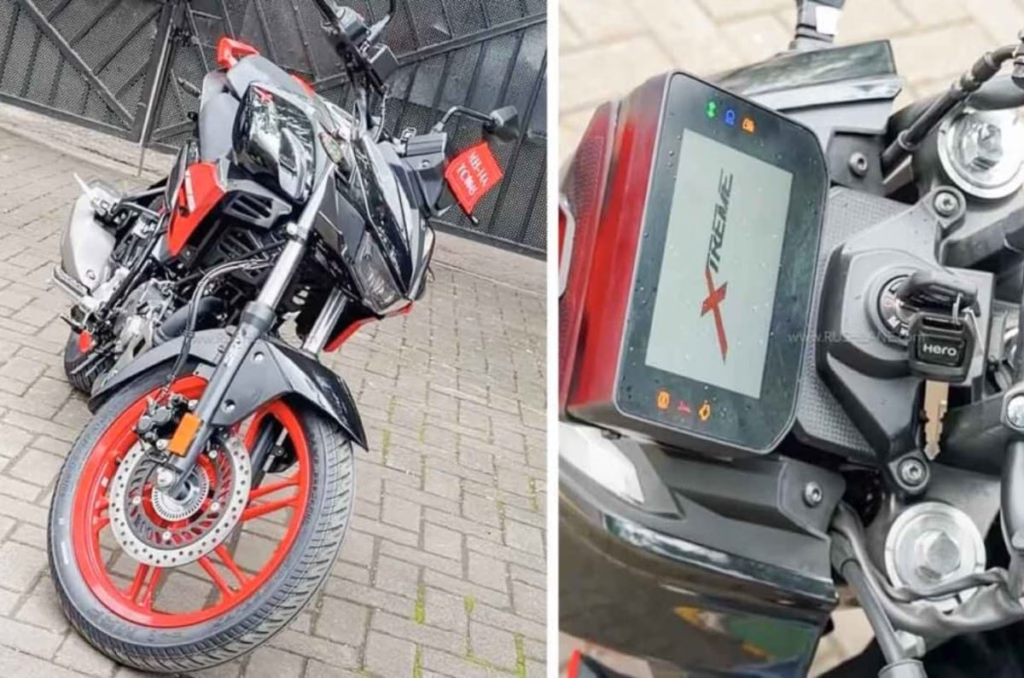
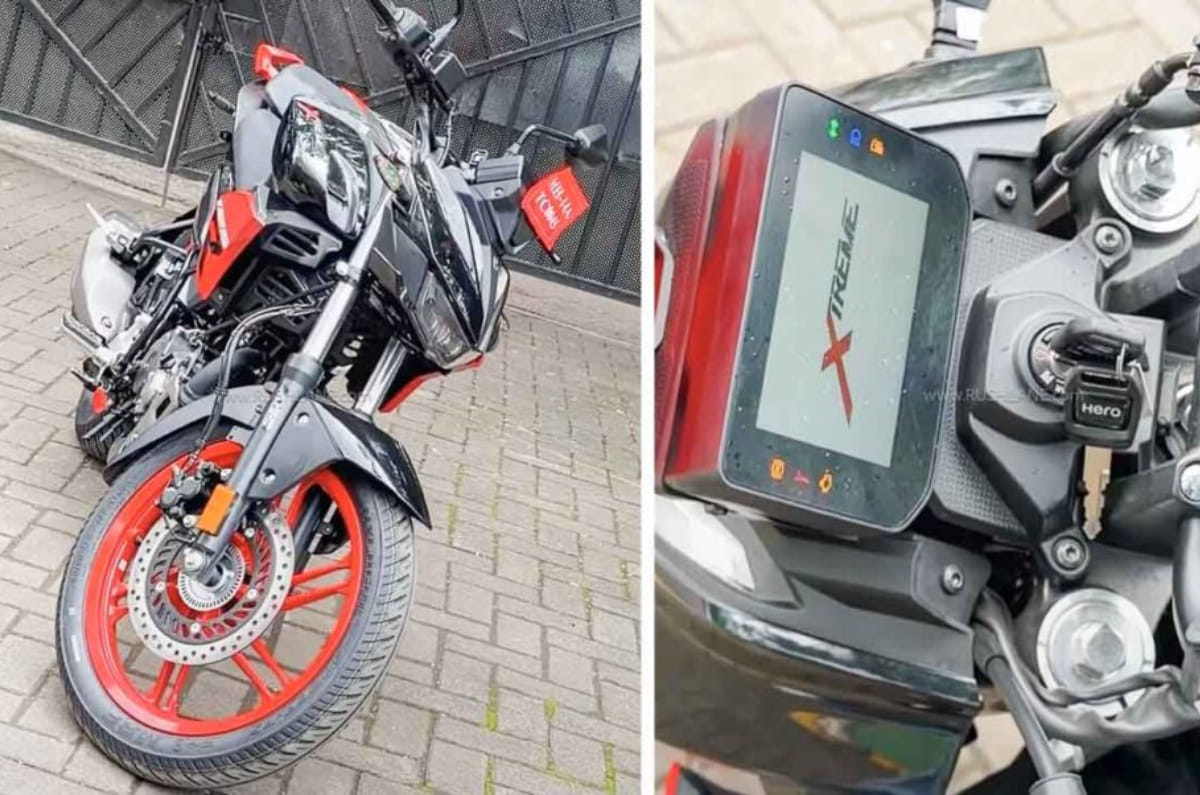
Hero Motocorp is hedging its bets against the yet-to-be-launched Bajaj Pulsar 125, TVS Raider, and Honda CB125 Hornet. Images of an upgraded Xtreme 125R with a TFT display have surfaced online, and some reports also suggest that it will feature a TPMS. While there is no official confirmation, it would be a segment-first feature if it did make its way onto the Xtreme 125R. It’s currently only offered on some EV scooters at this price point; otherwise limited to much more expensive motorcycles.
Updated Hero Xtreme 125R spotted at dealership
Already has cruise control, ride modes, and dual-channel ABS
The 125cc engine is expected to remain unchanged
Updated Hero Xtreme 125R: What’s not expected to change
Same engine, suspension as before
The current Xtreme 125R is already one of the most feature-rich motorcycles with dual-channel ABS, three ride modes, one section larger rear tyre than its segment rivals mentioned above, and cruise control. However, it used to have a 4.2-inch LCD cluster, shared with the Glamour X. The new instrument cluster with the TFT display and TPMS would take it further ahead of its direct rivals.
Currently, the Xtreme 125R is powered by a 124.7cc air-cooled unit that makes 11.2hp of power at 8,250rpm and 10.5Nm of torque at 6,500rpm. Visually, the engine looks unchanged, so we could see these figures carried forward as is. There appear to be no changes to the suspension either, with the Xtreme sticking to its front RSU telescopic fork and a rear monoshock. The only rival with a USD fork remains the Honda CB125 Hornet.
Since the motorcycle has already started reaching dealerships, we can expect an official announcement and deliveries to commence in the near future. The current top variant of the Hero Xtreme 125R costs Rs 1.08 lakh (ex-showroom, Delhi) and with these feature additions, we can expect this variant to come at a slight premium.