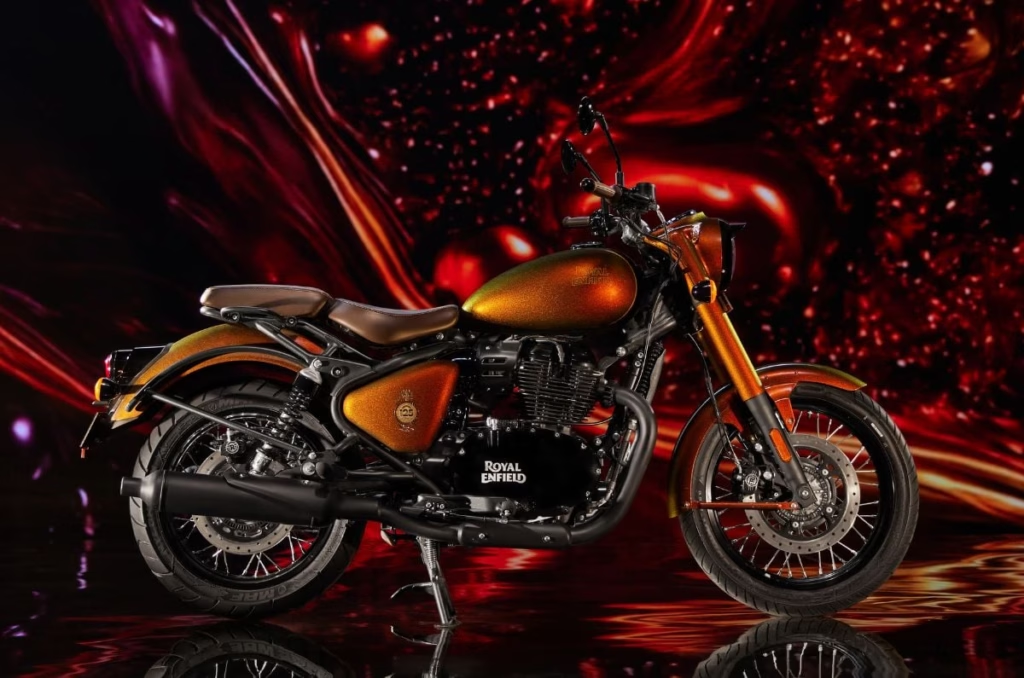
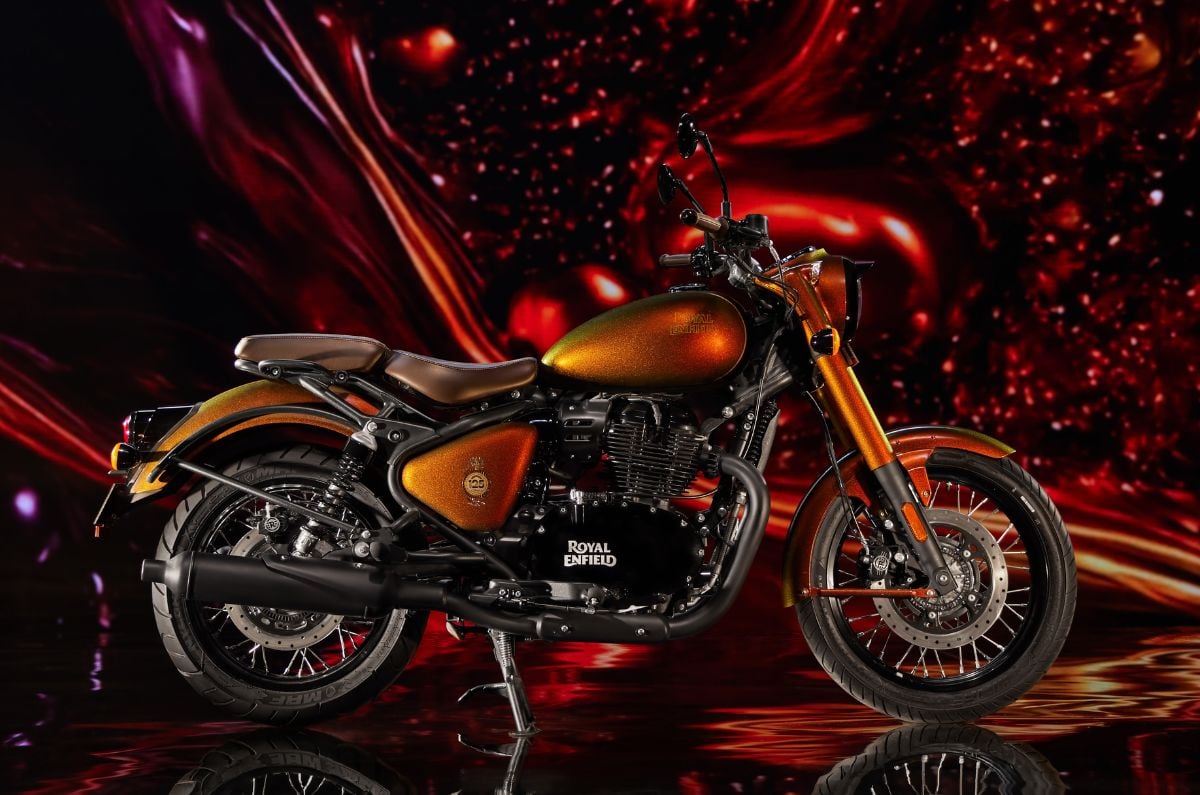
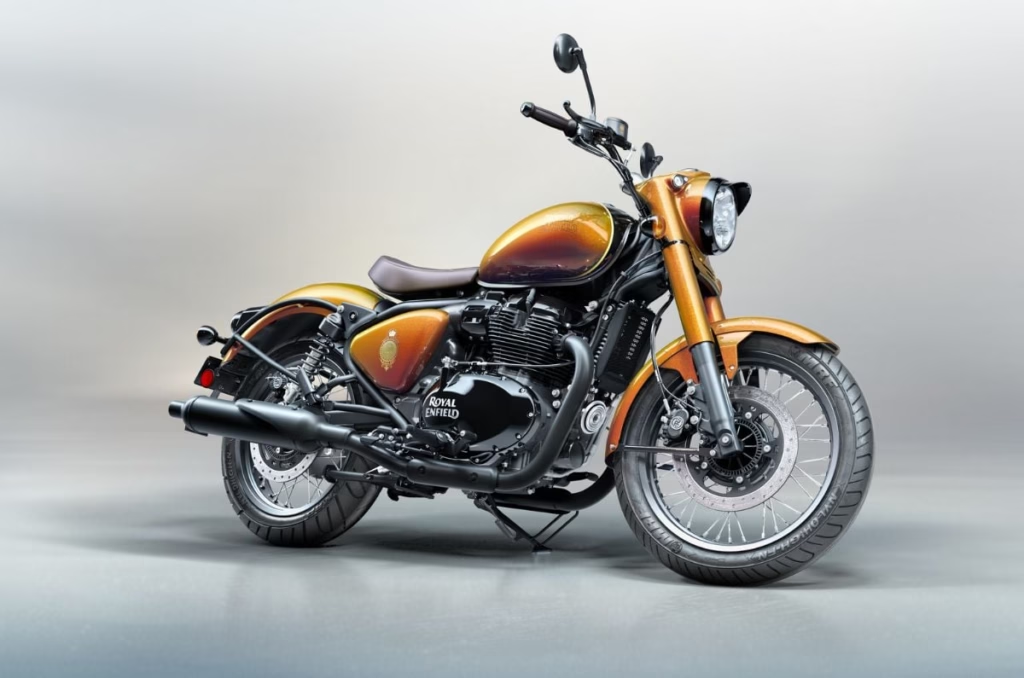
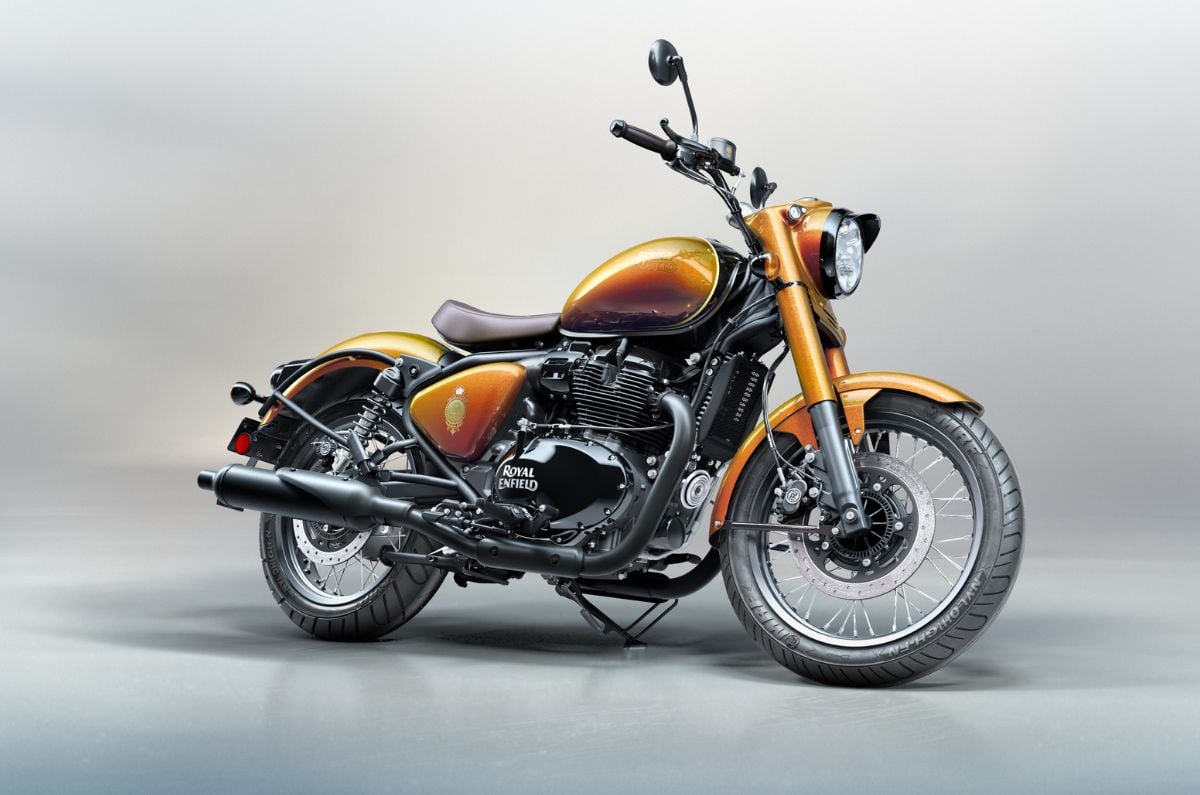
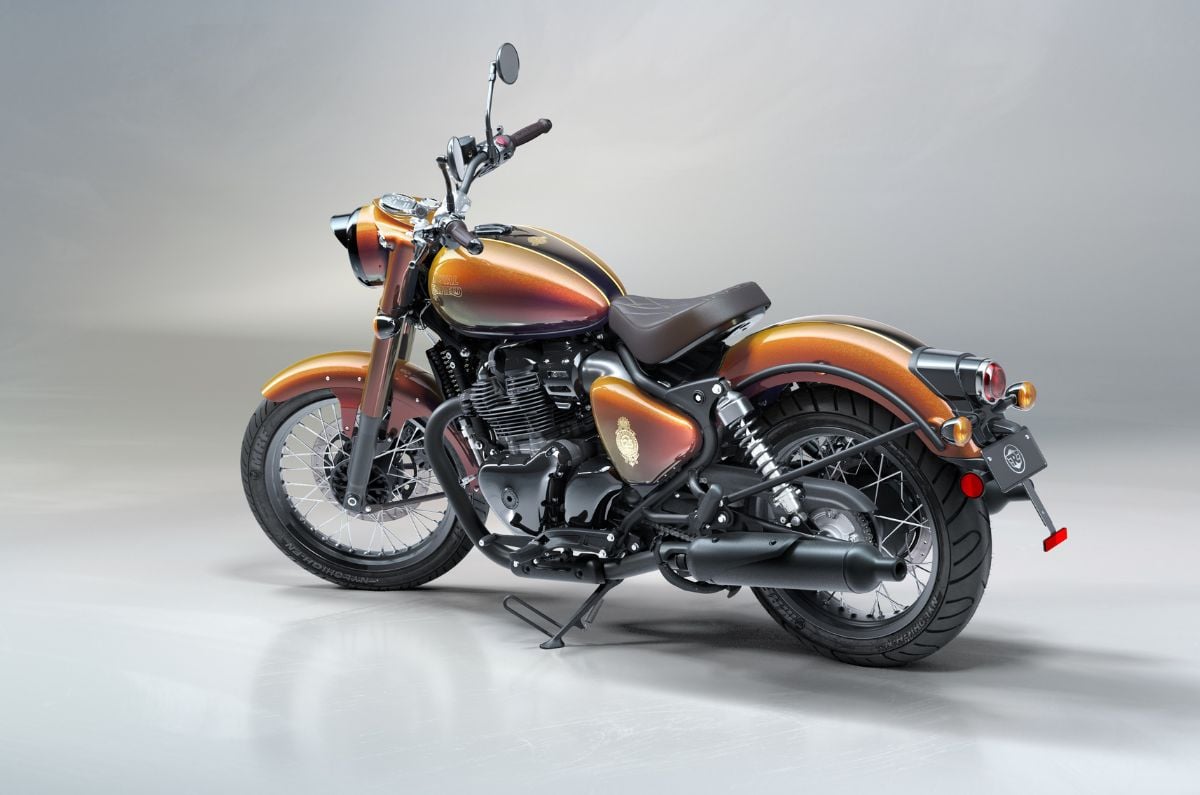
Royal Enfield has launched a special edition of the Classic 650, called the Hypershift, to commemorate the Chennai based manufacturer’s 125th anniversary. It is priced at Rs 4.26 lakh, and the company has clarified that it’s limited to 125 units in each of its key markets, including India. Hence, interested customers will need to register to buy one; registrations will be open until October 28, when sales will happen.
The Classic 650 Hypershift is mechanically identical to the production-spec Classic 650. There are no changes to the underlying design either. It has been priced at Rs 4.26 lakh, which is a Rs 58,000 premium over the base Vallam Red colour (Rs 3.68 lakh) and a Rs 43,500 premium over the top Black Chrome colour (Rs 3.82 lakh). For customers who are able to place an order for one of the 125 units on October 28, deliveries will begin in November.
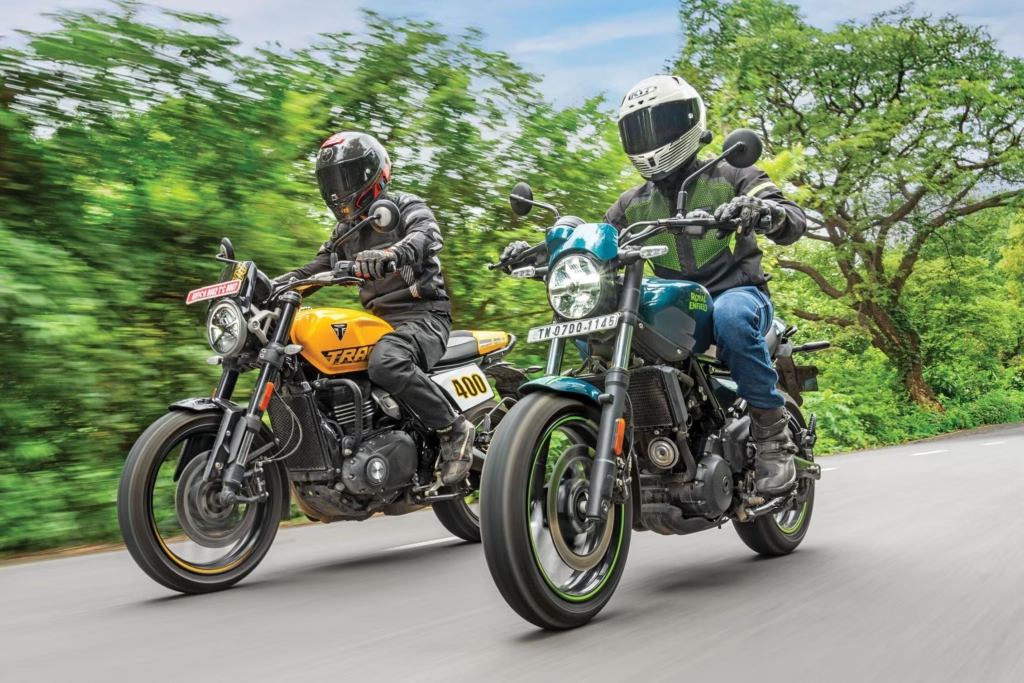
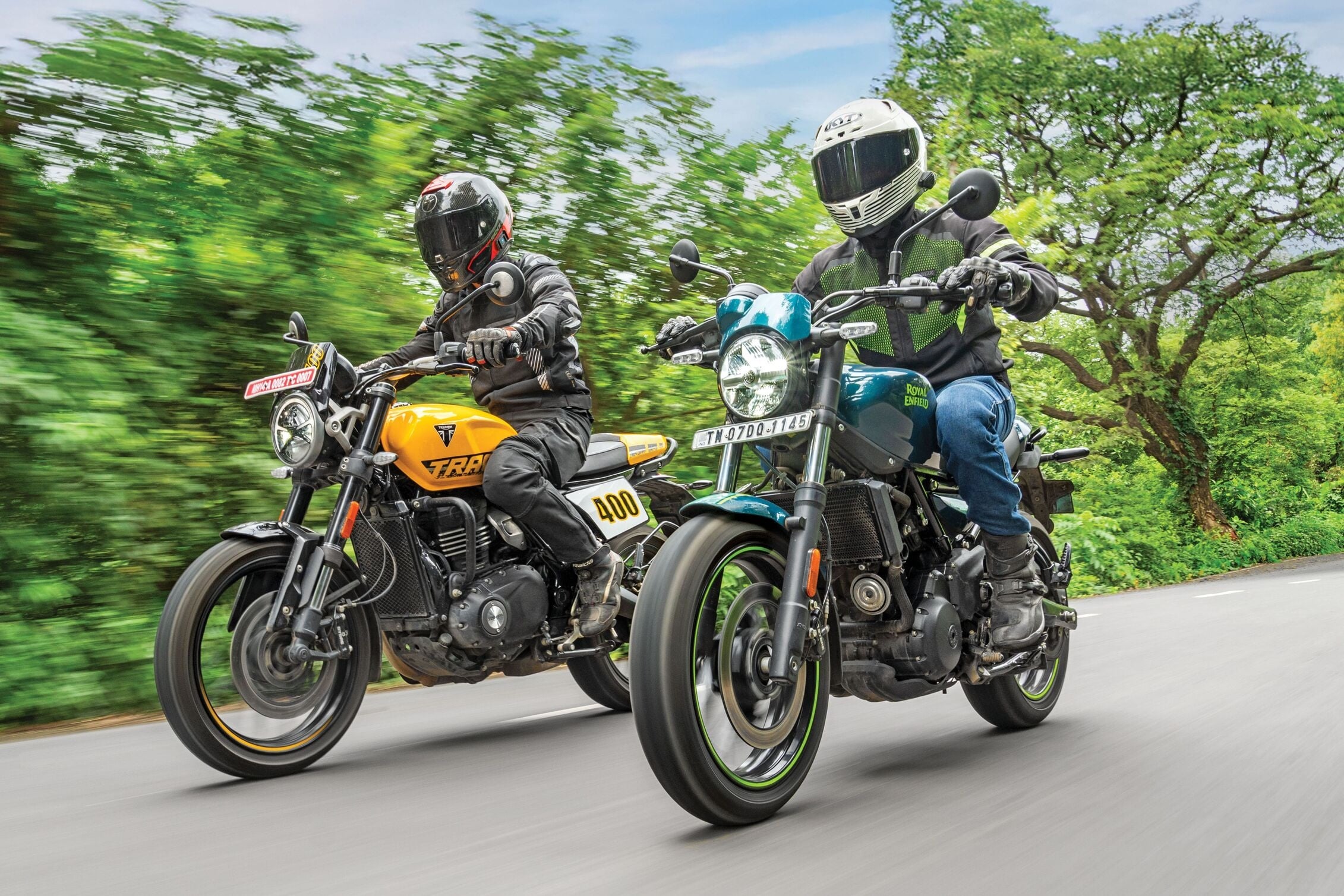
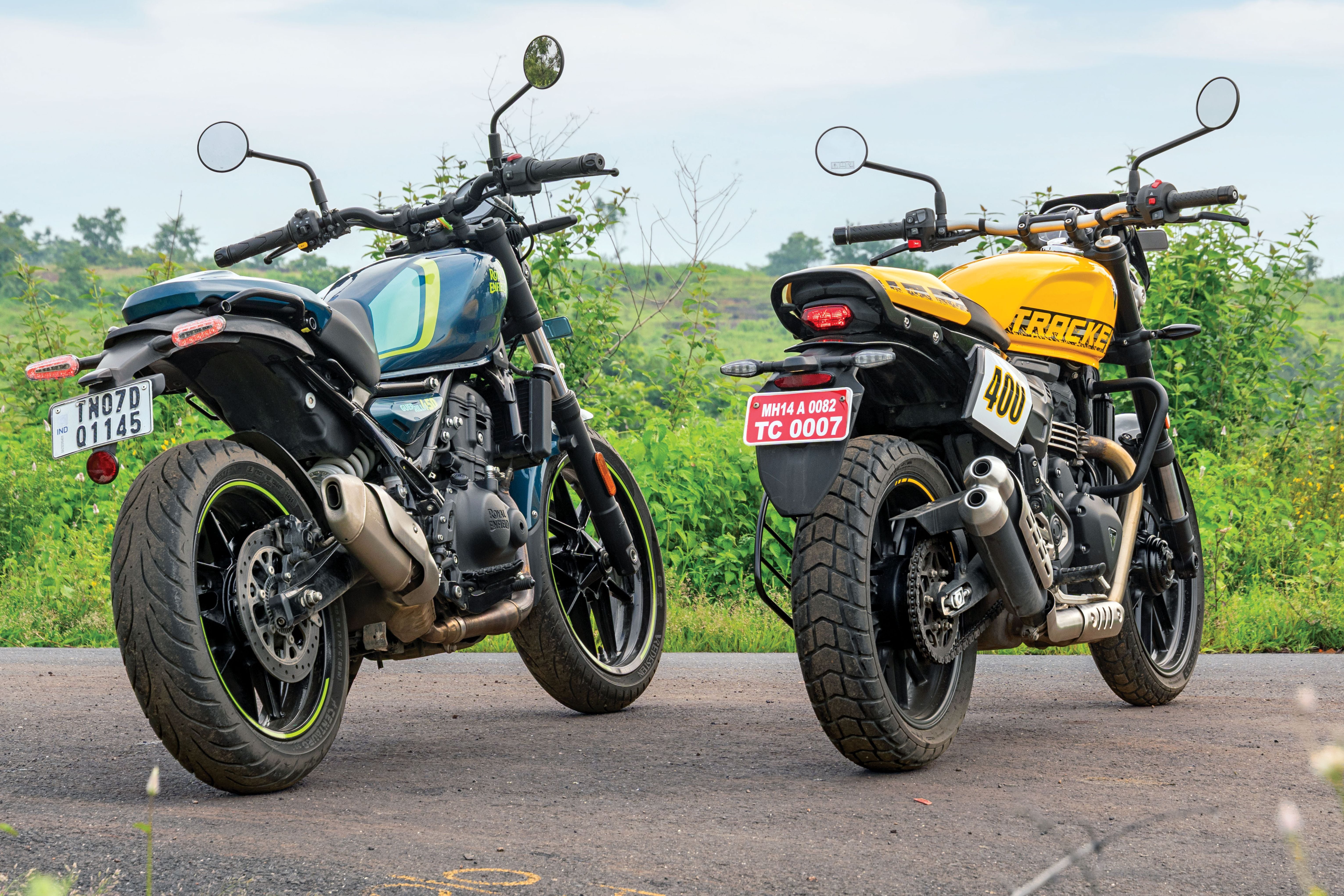
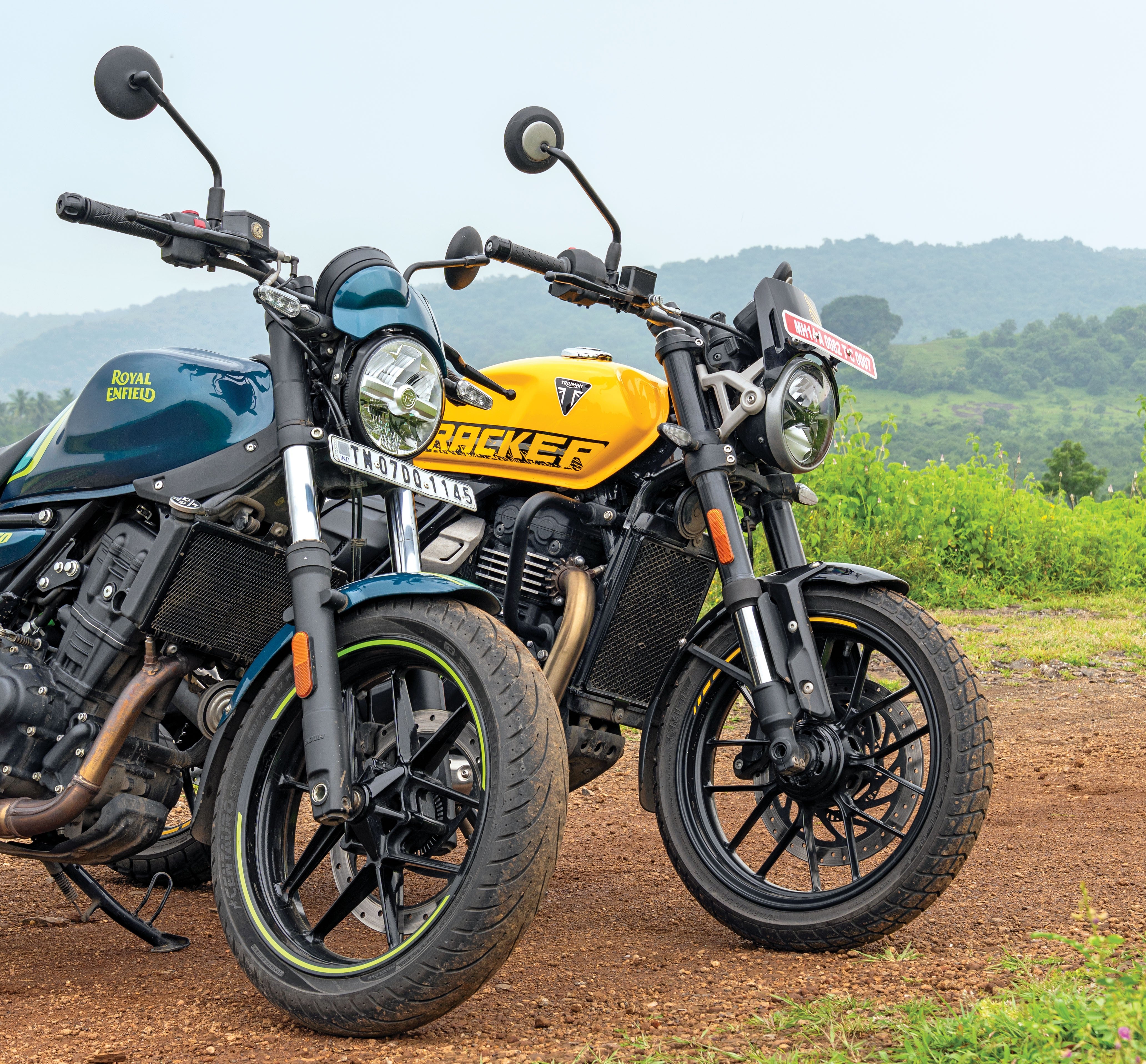
If you are considering either of these motorcycles, chances are you are also considering the other, especially since they both cost about the same. After the Triumph 400cc bikes were downsized, the Tracker 400 now uses a 349cc engine, while the Guerrilla 450 Apex is a sportier variant with more aggressive ergonomics and grippy, road-focused tyres, which I think suit the bike much better than those on the earlier variant.
On paper, the Tracker makes 40hp and 32Nm, while the Guerrilla produces 40.02hp and 40Nm. The Triumph is a lighter, more compact motorcycle, while the Royal Enfield has a larger engine with more torque and offers a stable, planted feel. So, which one makes more sense for someone looking for a sporty, entertaining roadster?
Design and Features
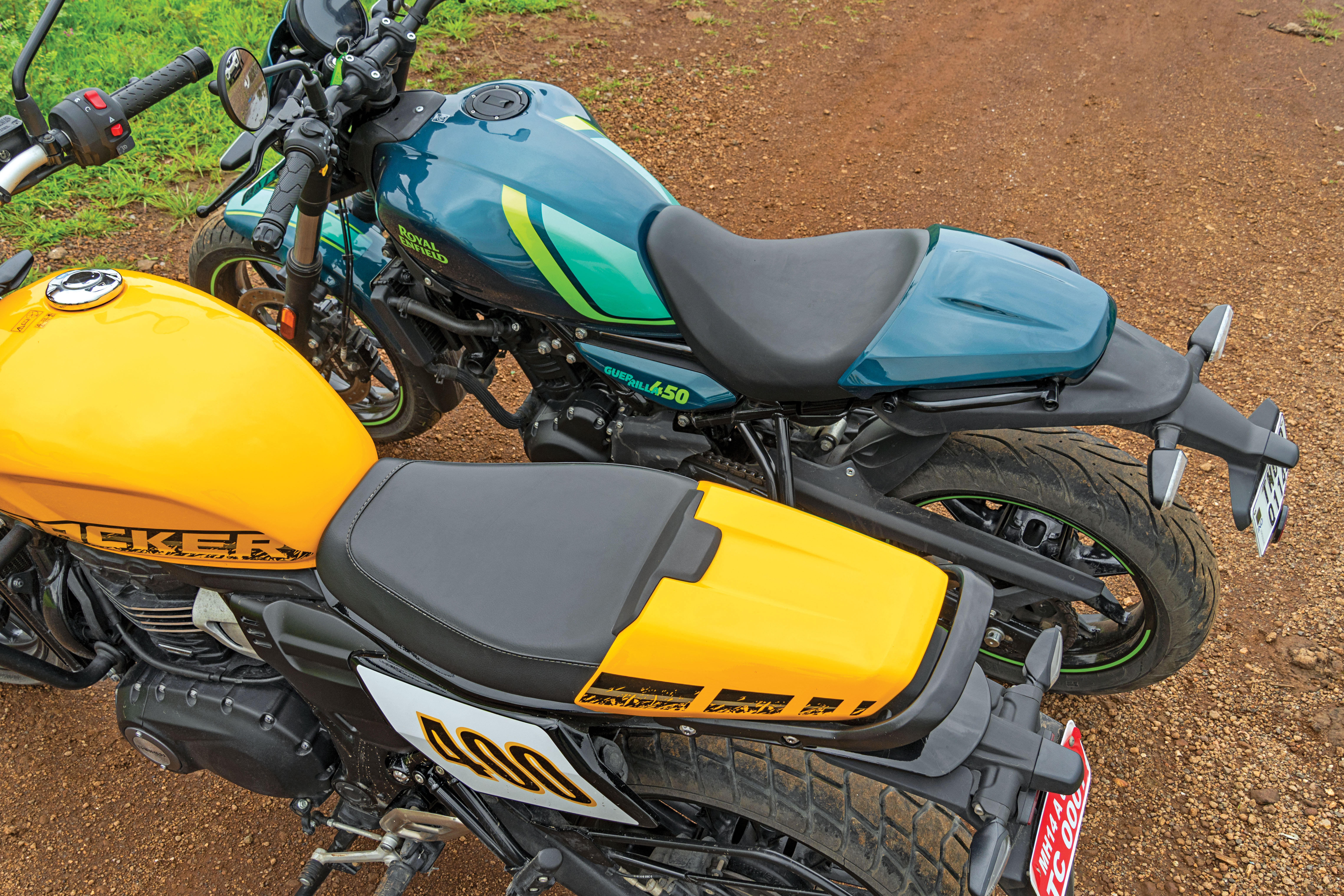
Both motorcycles have very different visual identities, and that is probably the first thing you’ll notice. The Tracker 400 is inspired by flat-track racers, with a flat seat, side number boards and a wide handlebar. But this isn’t really a dirt-track-focussed motorcycle underneath, as its ergonomics, chassis and suspension are properly road-oriented.
The Guerrilla 450 Apex, meanwhile, looks like a sporty and muscular roadster. Compared to the standard variant, it gets a small cowl over the headlight, a new aluminium handlebar, a removable rear-seat cowl and Vredestein Centauro ST+ tyres. The Apex also has a leaned-forward, more committed riding position compared with the standard Guerrilla.
The Tracker is a relatively compact motorcycle, while the Guerrilla’s longer 1,440mm wheelbase and broad 160-section rear tyre give it a more substantial stance. The Triumph gets a larger 13-litre fuel tank compared with the Guerrilla’s 11-litre unit, which can be tedious when long-distance touring.
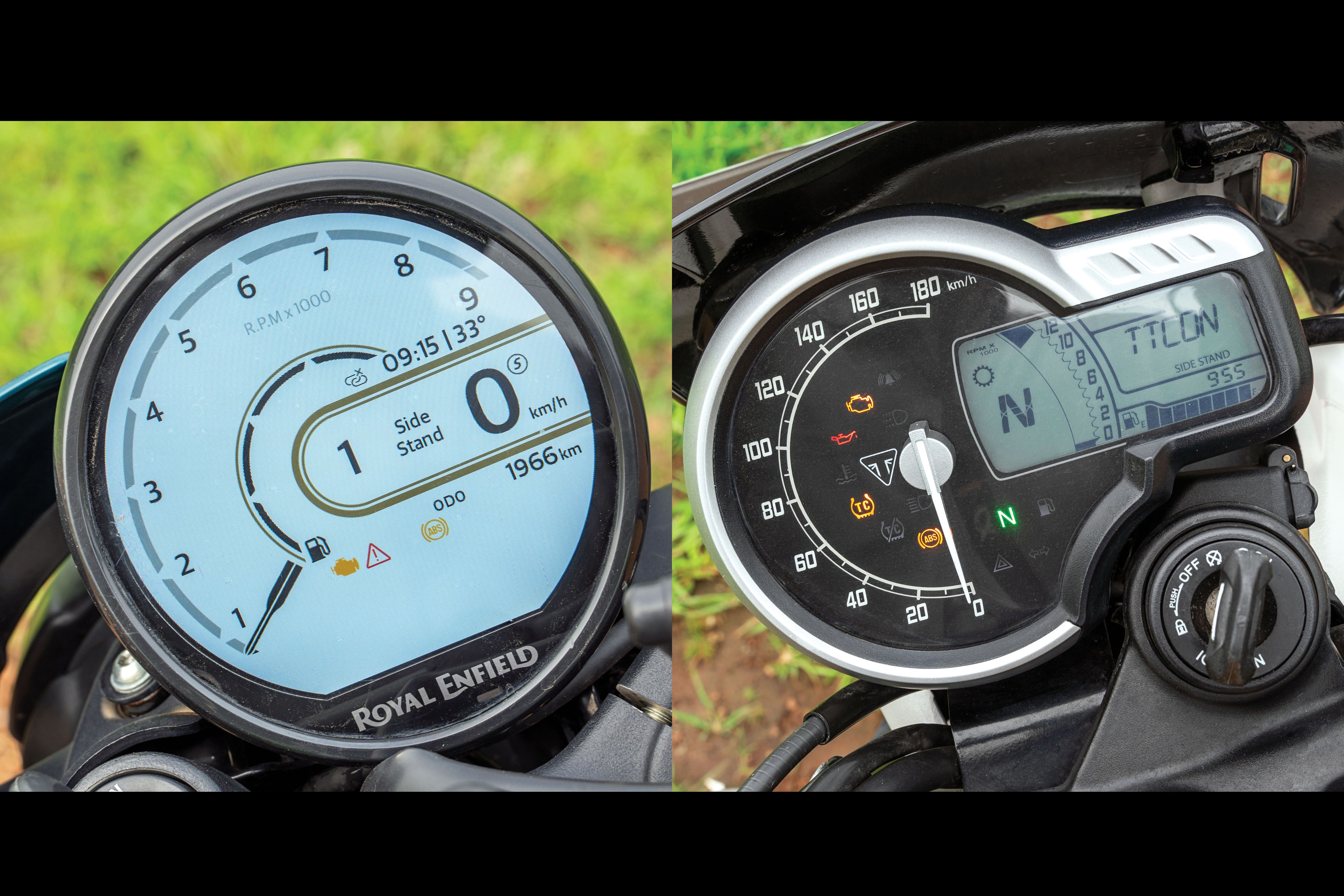
Both motorcycles are equally impressive when it comes to build quality and fit and finish. The Tracker features the same digi-analogue console we have seen on all the other Triumph 400 models, while the Guerrilla features the same TFT unit from the Himalayan. The Guerrilla gets two riding modes (Sport and Street), both of which feel quite similar. On the other hand, the Tracker gets a switchable traction control system that the Guerrilla misses out on. Neither has a quickshifter. In terms of convenience, the Guerrilla has a more accessible 780mm seat height and also gets a main stand, which aids in easier chain maintenance.
There is also a difference in ergonomics. The Tracker’s seat is flat and the riding position is relatively sporty, with rear-set footpegs that suit the character of the bike. The Guerrilla Apex has a lower and more accessible 780mm seat and roadster-like, neutral-set footpegs, along with a committed upper-body position. Between the two, you sit on top of the Tracker with its flat seat, while on the Guerrilla, you sit inside the curved seat, and it is also the more comfortable of the two.
Performance and Fuel Economy
This is where things get interesting because the Tracker 400’s 349cc engine is 103cc smaller than the Guerrilla’s 452cc unit, yet peak power is almost identical. The Triumph produces 40hp at 8,750rpm and 32Nm at 7,500rpm, while the Royal Enfield makes 40.02hp at 8,000rpm. Of course, the difference comes in torque, where the RE makes a much healthier 40Nm at 5,500rpm.
The difference in torque delivery is immediately noticeable. The Tracker’s engine likes to be revved out, but you still have to work it quite a bit. The Guerrilla’s Sherpa engine has a different personality. It doesn’t need to be worked as hard, and the additional 8Nm gives it much stronger roll-on performance. It feels more raw and powerful as soon as you open the throttle, and the surge in power after 6,000rpm makes it feel really exciting. After 7,000rpm, there are some vibrations, but nothing that really ruins the riding experience.
The Tracker’s shorter-stroke engine is very refined at moderate engine speeds, but once you start revving it harder, some buzz makes its way into the tank and footpegs at the top end of the rev range. It remains an entertaining engine, but considering I have ridden the older 398cc Thruxton 400, I feel like it misses out on that initial torque kick.
In our performance tests, the Guerrilla completed the 0-100kph sprint in 6.34 seconds, while the Tracker took 7.55 seconds for the same, marking a difference of 1.21 seconds. The real difference in performance was more visible in the roll-on acceleration tests where the Guerrilla 450 Apex was notably quicker.
Fuel efficiency was almost on par in our tests, where the Tracker delivered 24.1kpl in the city and 31.71kpl on the highway, while the Guerrilla gave us 25.23kpl in the city and 32.82kpl on the highway. The Triumph’s 13-litre tank will give it a better range despite the marginally lower highway efficiency.
Ride and Handling
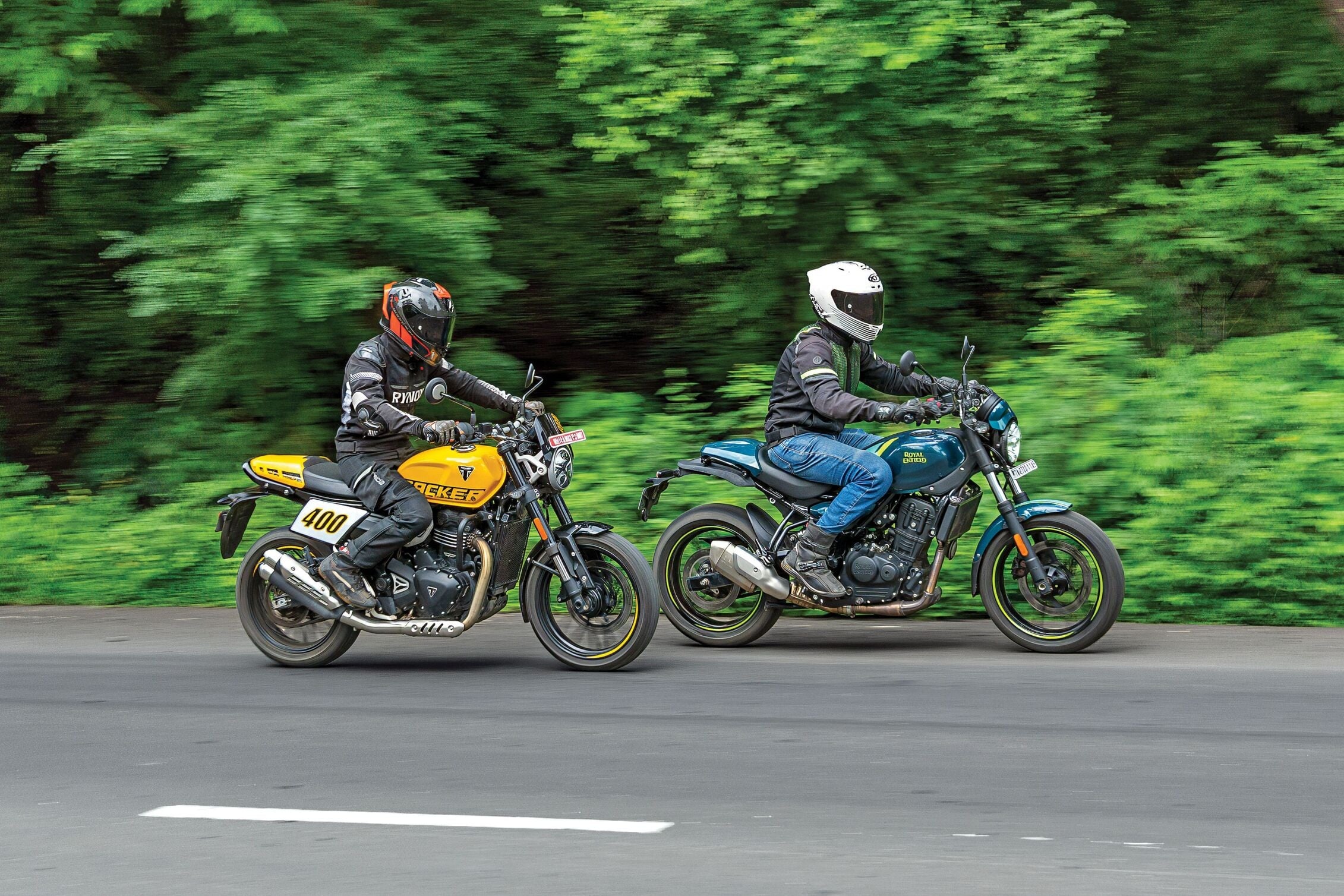
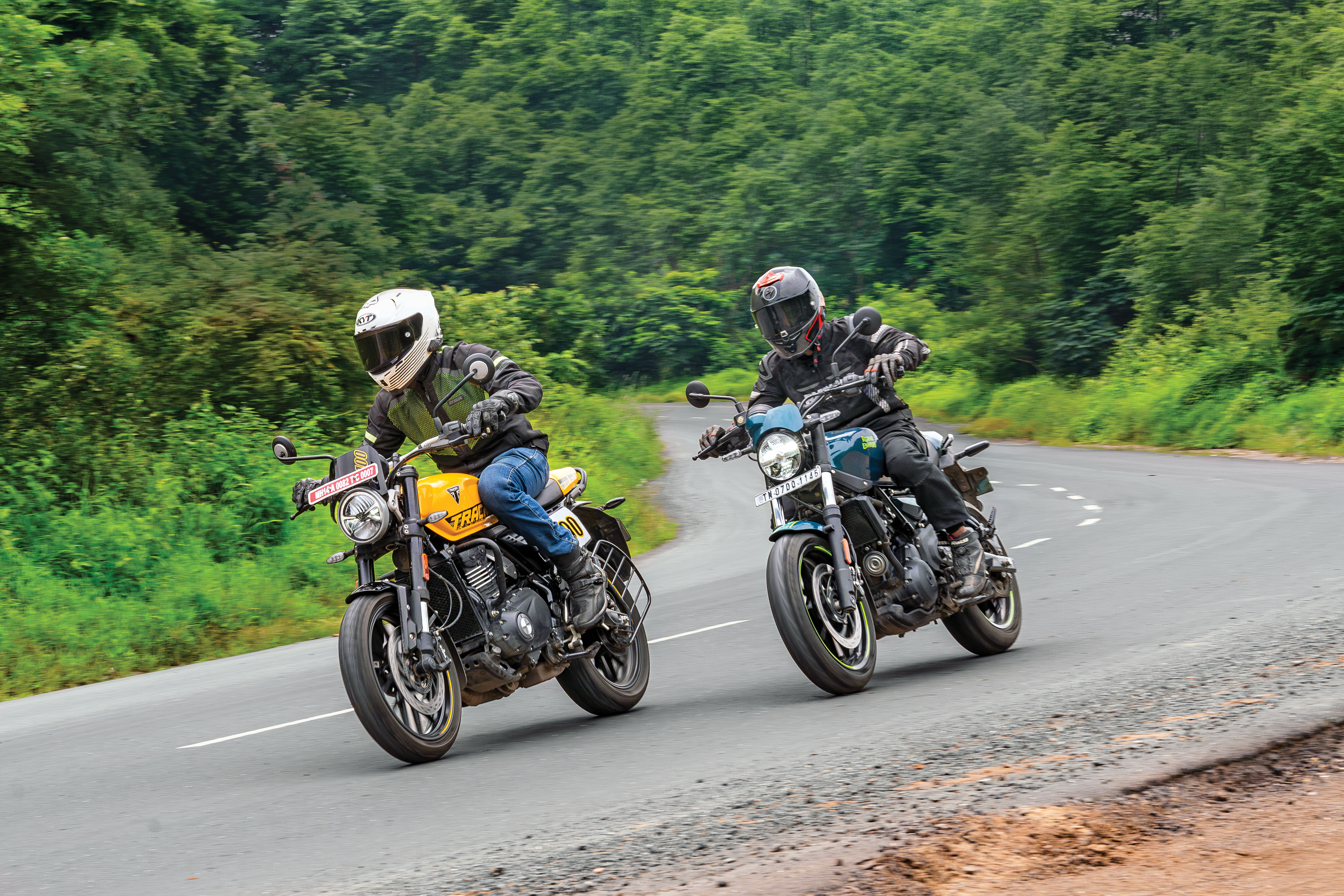
The biggest difference between these two motorcycles becomes apparent once the road starts to twist. The Guerrilla feels longer and heavier and needs a bit of muscling around, but once in a corner, it is extremely stable and planted. The grip offered by the Vredestein tyres is superb and inspires a lot of confidence. The Tracker, on the other hand, feels light, nimble and very easy to flick into corners, thanks to its shorter wheelbase and the leverage offered by the wide handlebars. Its blocky MRF tyres work well, but given how it rides more like a sporty roadster rather than a tracker, stickier tyres would have been a better choice.
While many might be disappointed about the Guerrilla 450 Apex not getting a USD fork, the suspension does work much better than the Tracker’s over bad roads and undulations. The setup feels plusher than the Tracker, which has a quicker rebound that can toss you up if you hit potholes at higher speeds.
Despite the Triumph being the more compact motorcycle, I felt like it was easier to filter through traffic on the Guerrilla, and that is because the Triumph has slightly wider handlebars and mirrors that jut out slightly more. I do remember my time spent with the Guerrilla on a go-kart track, and it was genuinely a lot of fun. The tyres kept up with the performance that the engine offers, and it was a blast to exploit the full capabilities of the bike. The only limitation was the footpegs, which kept scraping when the bike was leaned over. That said, this was never a problem out on the road.
Braking hardware is strong on both. The Tracker gets a 300mm front disc with a four-piston radial ByBre caliper, while the Guerrilla uses a 310mm front disc and 270mm rear disc. The Guerrilla stopped marginally quicker in our braking test from 60-0kph, but I did notice that the ABS intervention can be strong when emergency braking from higher speeds.
Price and Verdict
These two motorcycles are closer than their engine capacities suggest. The Tracker proves that you don’t need a large engine to make for a fun roadster. Its 349cc motor makes almost as much peak power as the Guerrilla, and its compact dimensions, wide handlebar and sporty chassis make it an engaging motorcycle on a twisty road.
The Royal Enfield Guerrilla 450 Apex, however, takes a more muscular approach. Its 452cc engine has substantially more torque, the Vredestein tyres give it a level of grip that suits its performance, and the longer wheelbase also gives it a reassuring planted character, particularly when you’re riding quickly.
They offer two distinct interpretations of the sporty modern roadster. The Tracker’s biggest strength is its agility. It feels smaller, lighter and more eager to change direction quickly. The Guerrilla’s strength is the breadth of its performance. There’s more torque, more road presence and a greater sense of stability when you’re pushing it. And that is ultimately what separates them. The Triumph is the more playful motorcycle, thanks to its nimble nature, while the Guerrilla Apex feels like a more serious attempt at turning the standard roadster into a proper performance-oriented, corner-carving machine.
While it is difficult to pick between these two motorcycles, considering that they do things in different ways, you can’t look past the value that the Guerrilla offers. Despite falling into the 40 percent GST bracket, its starting price is just Rs 10,000 more than that of the Tracker. To put things into perspective, the KTM 390 Duke R, which used to be the benchmark for affordable and accessible performance when its Gen 1 model was launched in India, is now priced at Rs 3.45 lakh (ex-showroom), taking its on-road price upwards of Rs 4 lakh. So the way I see it, the Guerrilla 450 Apex is now the new benchmark when it comes to affordable performance in India. Who’d have ever thought that the crown would one day be worn by a Royal Enfield.
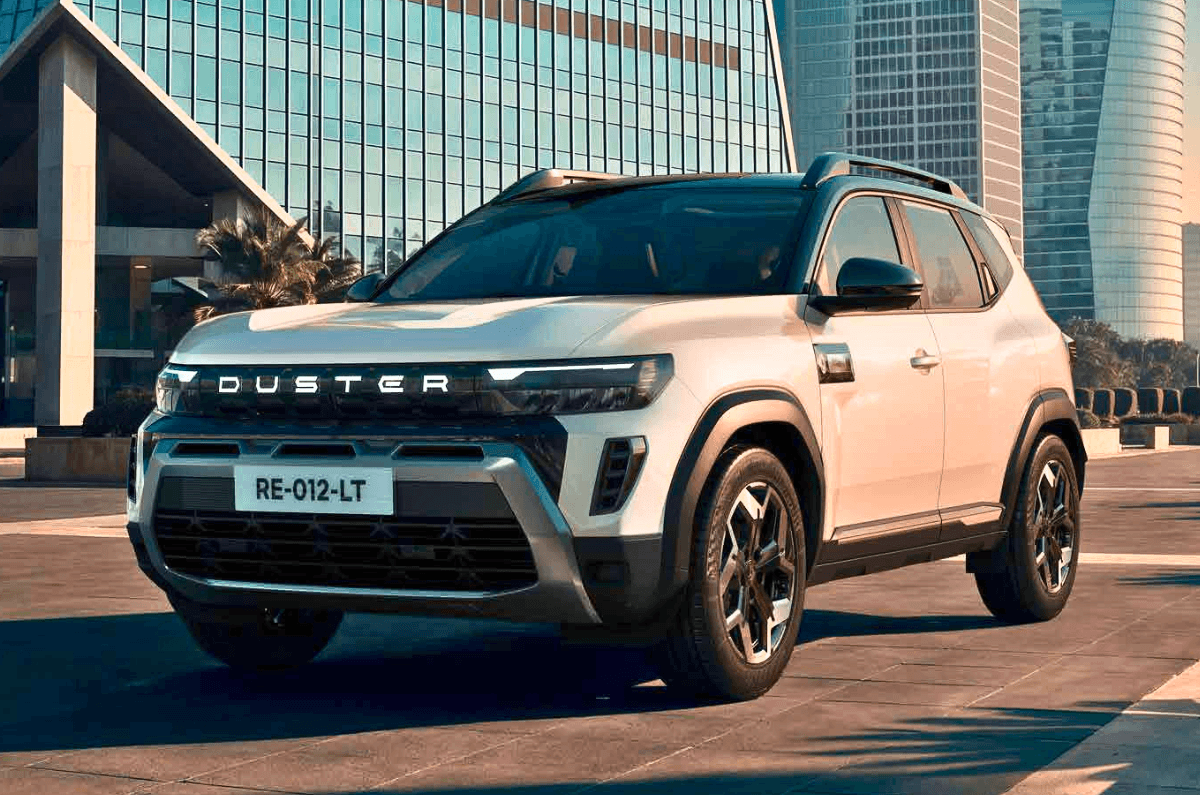
The Renault Duster is priced from Rs 10.49 lakh to Rs 19.49 lakh, ex-showroom. It recently added a hybrid powertrain, which is sold alongside the existing turbo-petrol engine options. The Duster is now available in seven trims: Authentic, Evolution, Adventure, Techno, Techno+, Iconic and Emotion.
If you want to know how much you need to pay to for the Renault Duster, here are its on-road prices across major Indian cities.
New Renault Duster turbo-petrol on-road prices in major Indian cities (in Rs lakh)
Trim
Mumbai
Delhi
Kolkata
Bengaluru
Chandigarh
Authentic 1.0 MT
12.38
12.17
12.17
12.91
11.75
Evolution 1.0 MT
13.80
13.57
13.57
14.38
13.10
Evolution 1.3 MT
15.33
15.07
15.07
15.98
14.55
Evolution 1.3 DCT
17.10
16.81
16.81
17.83
16.23
Adventure 1.0 MT
15.33
15.07
15.07
15.98
14.55
Adventure 1.3 MT
16.51
16.23
16.23
17.21
15.67
Adventure 1.3 DCT
18.17
17.86
17.86
18.94
17.24
Techno+ 1.3 MT
18.05
17.74
17.74
18.81
17.13
Techno+ 1.3 DCT
19.70
19.37
19.37
20.53
18.70
Iconic 1.3 MT
20.05
19.71
19.71
20.90
19.03
Iconic 1.3 DCT
21.82
21.45
21.45
22.75
20.71
New Renault Duster hybrid on-road prices in major Indian cities (in Rs lakh)
Trim
Mumbai
Delhi
Kolkata
Bengaluru
Chandigarh
Evolution 1.8 AT
20.05
19.71
19.71
20.90
19.03
Techno 1.8 AT
22.41
22.03
22.03
23.36
21.27
Emotion 1.8 AT
20.05
22.61
22.61
23.98
21.83
Note: On-road prices may vary based on city-specific registration charges and other cost components, including insurance, FASTag and RTO fees. Please check with your nearest Honda dealership for exact figures.
Among the major cities listed, the new Renault Duster’s on-road prices are the highest in Bengaluru and the lowest in Chandigarh. The entry-level Authentic 1.0 MT costs Rs 12.91 lakh in Bengaluru and Rs 11.75 lakh in Chandigarh, a difference of Rs 1.16 lakh. For the top-spec Iconic 1.3 DCT, the prices are Rs 22.75 lakh and Rs 20.71 lakh, respectively, a gap of Rs 2.04 lakh.
Speaking of the Duster hybrid’s on-road prices, they are also the highest in Bengaluru and lowest in Chandigarh. The most accessible variant, Evolution 1.8 AT, costs Rs 19.03 lakh in Chandigarh, while the top-spec Emotion 1.8 AT costs Rs 23.98 lakh in Bengaluru, a difference of Rs 4.95 lakh.
Prices mentioned above are as on October 18, 2026.
Royal Enfield has launched a special edition for the Classic 650, called Hypershift, to commemorate the Chennai-UK based manufacturer’s 125th anniversary. While there is a price, Rs 4.26 lakh, the company has clarified that it’s limited to 125 units in each of its key units, including India. Hence, interested customers will need to register to buy one; registrations will be open from today (October 16) at 2pm, till October 28, when sales begin.
All prices mentioned are ex-showroom.
Mechanically identical to the production-spec Classic 650
Costs Rs 58,000 more than the base Classic 650; Rs 43,500 more than the top
Royal Enfield Classic 650 125th anniversary edition: What’s special?
Strictly cosmetic, with exclusive Hypershift detailing
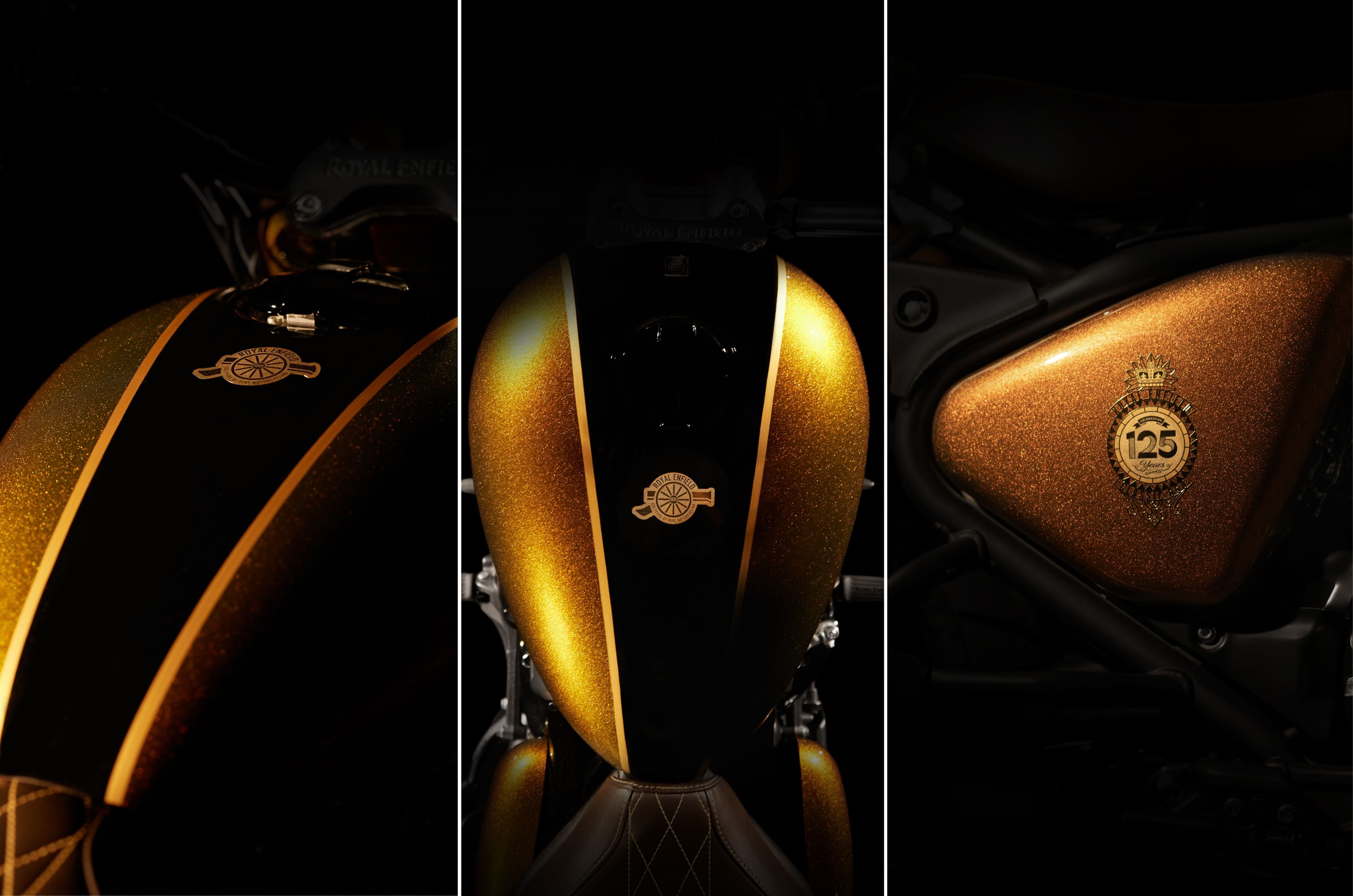
The Classic 650 Hypershift is mechanically identical to the production-spec Classic 650. There are no changes to the underlying design either. What sets it apart, primarily, is the bespoke Hypershift finish that transforms between shades of red, green and gold as light moves across the motorcycle. Complementing the finish are the additional 125-year crest on the teardrop tank, special badging on the sidepanels and of course, hand-painted pinstripes.
The Classic 650 was first launched in 2025, sharing the 648cc, air-cooled parallel twin with the Interceptor 650 and the likes, making 47hp and 52.3Nm. It has a chassis that’s derived from the Super Meteor 650, currently the most expensive Royal Enfield 650 at Rs 4.39 lakh. While the Super Meteor has a USD fork, the Classic swaps that for RSU (right side up) telescopic fork and reduces the twin-shock’s travel from 101mm to 90mm.
Classic 650 Hypershift
Classic 650 Black Chrome
Classic 650 Vallam Red/Bruntingthorpe Blue
Price (ex-showroom)
Rs 4.26 lakh
Rs 3.82 lakh
Rs 3.68 lakh
The Classic 650 Hypershift has been priced at Rs 4.26 lakh, which is a Rs 58,000 premium over the base Vallam Red colour (Rs 3.68 lakh) and a Rs 43,500 premium over the top Black Chrome colour (Rs 3.82 lakh). For customers who are able to place an order for one of the 125 units on October 28, deliveries will begin in November.
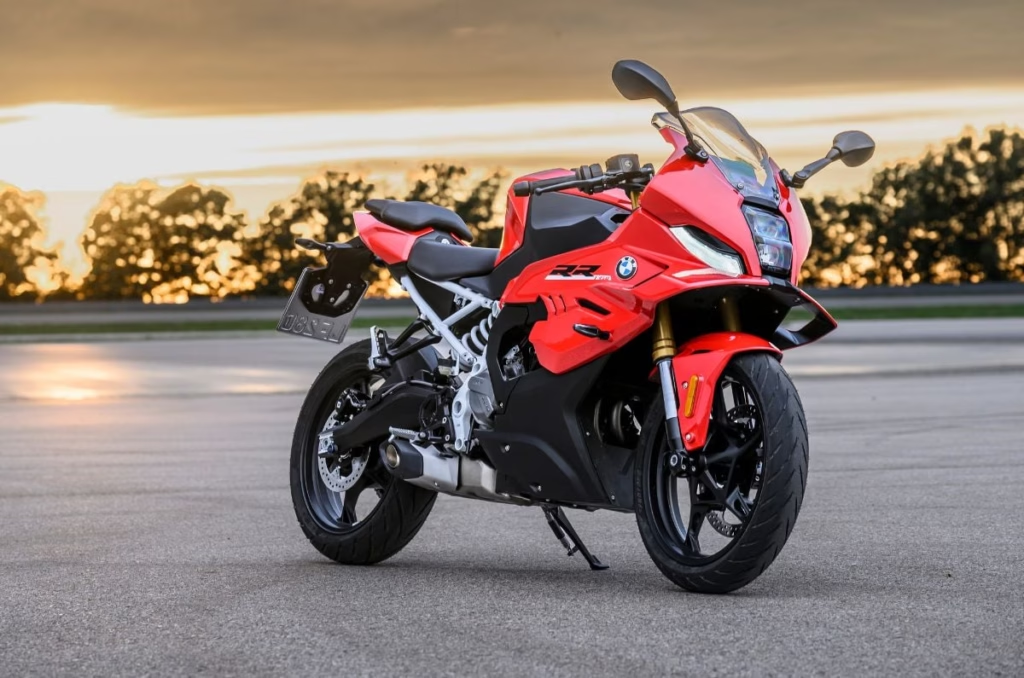
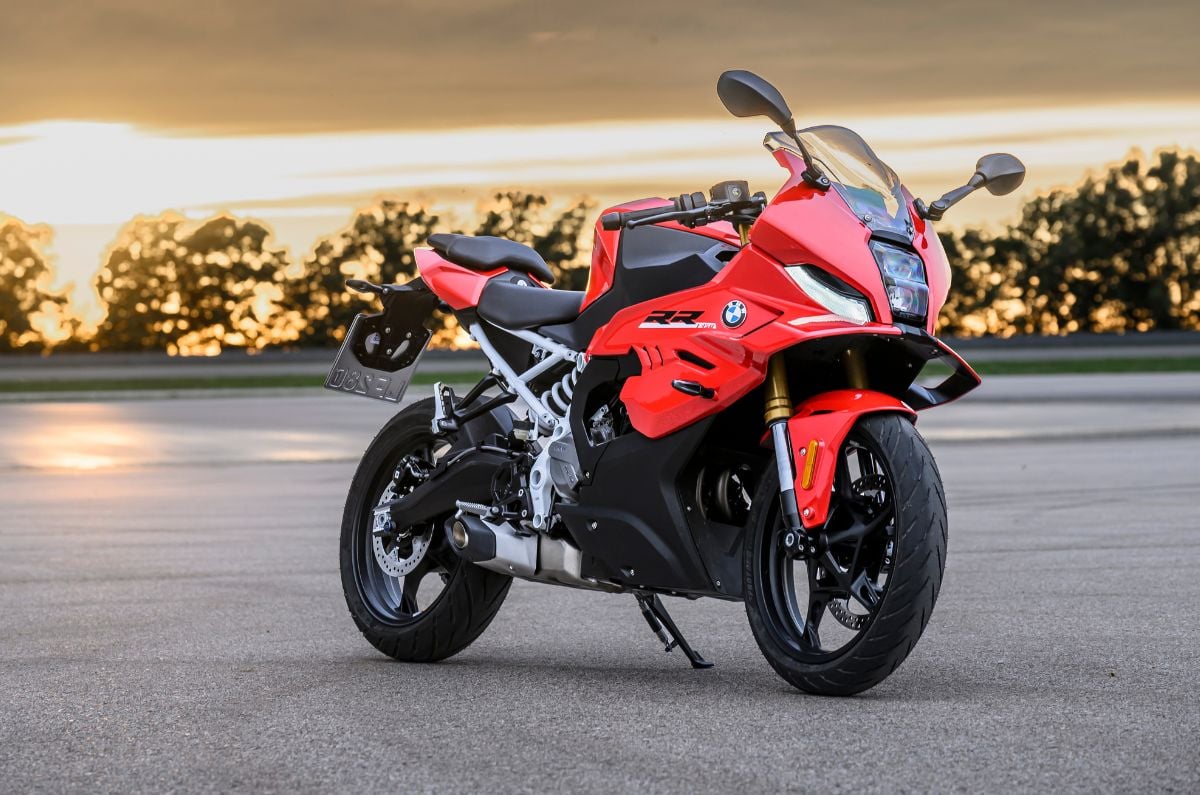
BMW has revealed the third motorcycle based on its 420cc engine platform, the F 450 RR. This follows the F 450 GS which was revealed last November and the F 450 R, which debuted as recently as two weeks ago. These trio of motorcycles are manufactured by TVS in Hosur.
F 450 RR shares the same 420cc engine and chassis with the other two BMW 450s
Total of three colour options available across four variants
No prices or an Indian launch timeline, just like the F 450 R
BMW F 450 RR: What you should know
A familiar engine and chassis, fine-tuned for track use
BMW’s newest entry to its entry-level motorcycle segment shares its engine and steel tubular chassis that carries said engine as a stressed member, similar to its other two 450s. Its 420cc, twin-cylinder, liquid-cooled mill continues to mete out 48hp at 8,750rpm and 43Nm at 6,750 rpm. Other technical aspects such as the suspension, brakes and kerb weight are closer to its sport-naked sibling, the F 450 R, with sportbike-like design details like winglets and a full fairing, of course.
The F 450 RR has 17-inch tyres at both ends, KYB-supplied 43mm USD fork and monoshock suspension units – the latter offers rebound and preload adjustability as standard. The standard seat height is 790mm and BMW offers two seat options, to either increase it to 810mm, or drop it down to 775mm. Brakes are the same as the R, a 310mm front disc with a Brembo four-piston monobloc caliper and a ByBre 240mm rear disc. The base variant of the F 450 RR has a kerb weight of 177kg.
The F 450 RR has four variants, Base, Exclusive, M Sport and M Sport with Innovation Package. As standard, all four get the exact same rider aids as the R, some of which are, dual-channel and lean-sensitive ABS, a 6.5-inch TFT display with smartphone connectivity, and three ride modes (Rain, Road and Race). The Base gets a single Cosmic Black colour. Stepping up to the Exclusive variant gets you the Racing Red colour, a bi-directional quickshifter and Sport suspension that adds rebound and compression adjustability to the USD fork. The third M Sport variant gives you an additional user-customisable Race Pro ride mode and an Snaefell white/M Motorsport color scheme. The top variant, M Sport with Innovation Package, cinches down the package with ERC (Easy Ride Clutch) – BMW’s take on clutchless riding that we first saw on the F 450 GS.
BMW hasn’t revealed prices for the F 450 RR, or a timeline for an Indian launch, like the F 450 R. For context, the F 450 GS reached our shores six months after its international reveal, which means that the R and the RR could be expected in the first quarter of 2027. Once they get here, we anticipate the F 450 R to be the most affordable option with the F 450 RR sitting between it and the F 450 GS. Currently, the F 450 GS Base starts at Rs 4.95 lakh. BMW has another built-by-TVS sportbike in its line-up, the G 310 RR listed on the BMW Motorrad India website. The G 310 R and G 310 GS were discontinued last year, leaving the future of the G 310 RR uncertain.
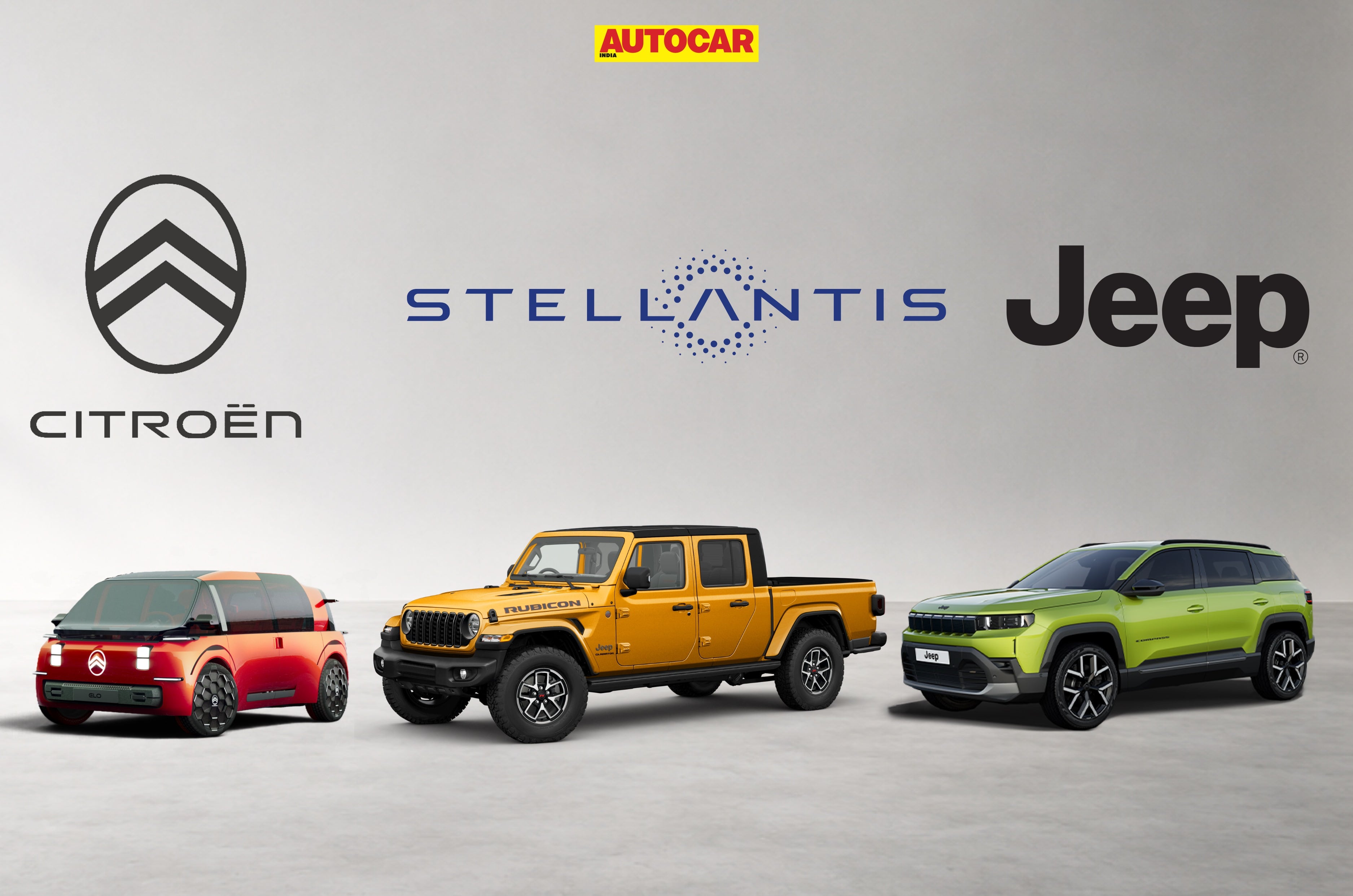
Stellantis has confirmed 12 Citroen and Jeep launches for India by 2030 as part of a roadmap dubbed ‘FaSTLAne 2030’. Speaking to Autocar India at the 2026 Paris Motor Show, Tianshu Xin – the head of Stellantis China and Asia-Pacific – confirmed a new investment of Rs 4,000 crore for the Indian market and said, “The plan is to introduce 12 new models in the next three years…seven of them will be new models and five are upgrades.”
Stellantis India lines up a dozen launches across Citroen and Jeep
Multiple SUVs inbound, along with an MPV, an entry-level car, and a premium pickup
The first model under FaSTLAne 2030 is scheduled to go on sale in India by the second quarter of 2027. This influx of new Citroen and Jeep launches will cover the compact, midsize, and premium SUV segments, and include a new MPV, an entry-level car, and a premium pickup truck. Of the 12 launches, seven will be from Citroen and five from Jeep.
Brand footprints to be expanded in India
Stellantis says these brands will play “distinct but complementary roles” in its line-up – Jeep will bolster its current position in the premium SUV arena, and Citroen will do the same in the mass-market segments. Expanding the customer reach of Citroen and Jeep is crucial, and Stellantis has committed to growing the brands’ retail and service networks, especially in Tier 2, 3, and 4 cities, along with increasing parts availability.
More Stellantis EVs coming, hybrids also confirmed
Additionally, Stellantis has confirmed a new multi-fuel strategy for the Indian market, which will span “efficient internal combustion engines, hybrid, plug-in hybrid (PHEV), and battery-electric (BEV) technologies.” These are already offered by Stellantis brands globally, and it should be interesting to see the specific powertrains that make it to India. As it stands, the majority of Stellantis India’s powertrain offerings are petrol; Citroen and Maserati also offer EVs, while Jeep additionally offers diesel in entry-level models.
Localisation target of 90 percent
According to Xin, the new models under FaSTLAne 2030 will be produced in India, so localisation will play a key role for competitive pricing. In light of that, Stellantis has set a target of 90 percent localisation across Jeep and Citroen, and will bank on its Indian R&D and manufacturing facilities, along with its supplier ecosystem, to achieve this. Moreover, India-developed FaSTLAne 2030 models will be exported to overseas markets.
Stellantis India’s two major brands, Citroen and Jeep, haven’t been very successful at attracting buyers in recent years. Citroen’s cars, despite recent updates, have struggled to gain traction in India due to their rivals being more aspirational and feature-rich. Jeep India, meanwhile, hasn’t launched any new models or facelifts in several years, turning prospective buyers away to more updated offerings. FaSTLAne 2030 is looking to be the shot in the arm that Stellantis India needs to pique buyer interest again.
What about Leapmotor?
Xin also provided an update on the long-overdue India entry of Stellantis’s Chinese EV brand, Leapmotor. Stellantis had planned to bring Leapmotor to India in 2025, but that evidently didn’t pan out. Xin noted that Leapmotor’s India entry is still being studied, and that there has to be enough “volume potential to justify the business case.” Therefore, a decision on Leapmotor entering India will only be made when the business case is ‘proven and solid.’
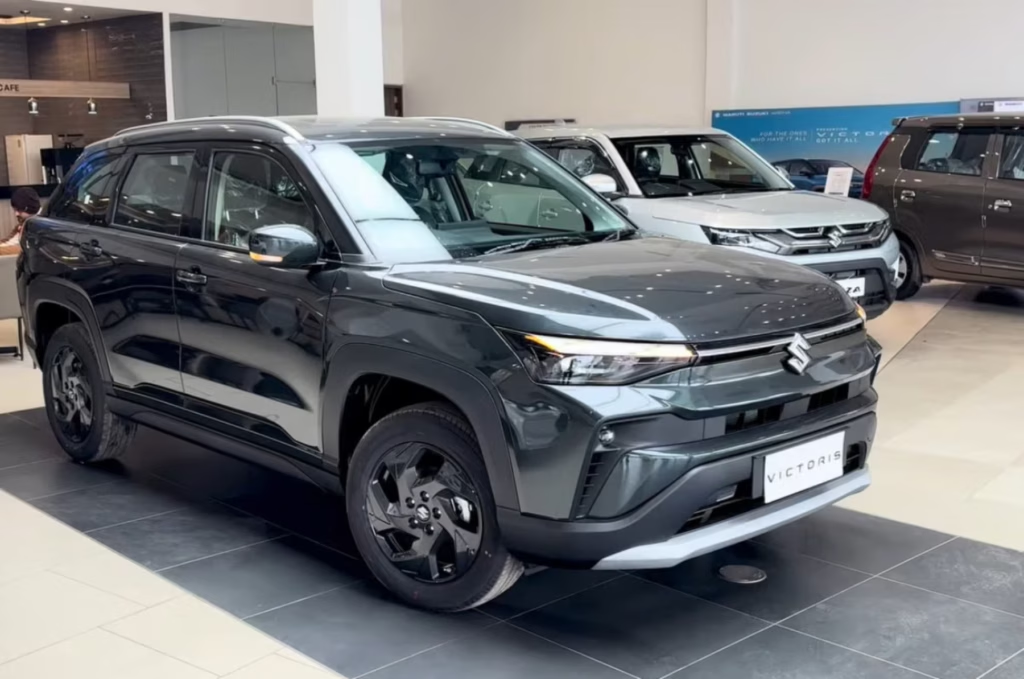
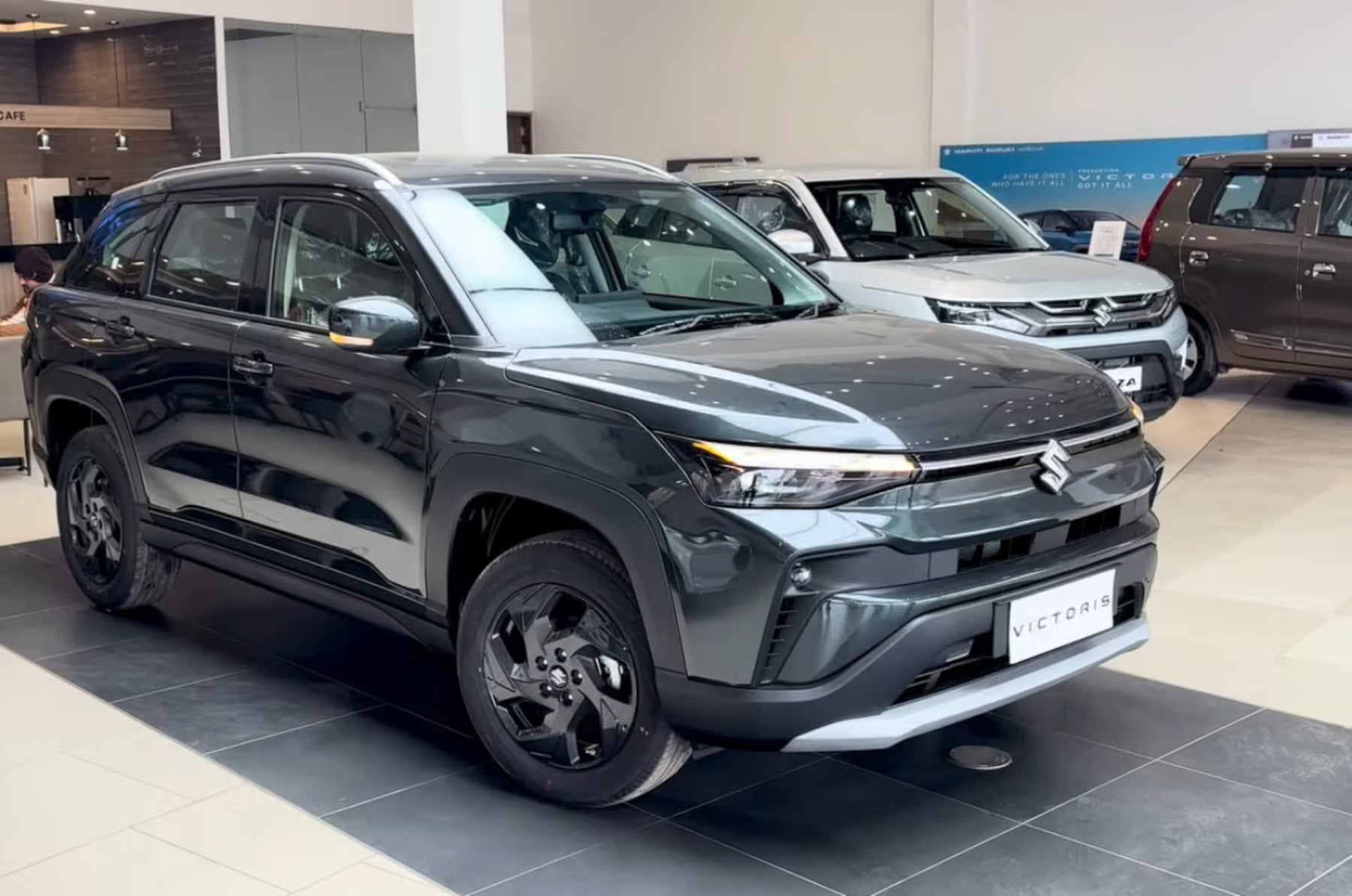
Maruti Suzuki is offering discounts on the Victoris, Swift, Wagon R, Alto K10, Celerio, S-Presso and Eeco in October 2026. The highest benefits are available on the Victoris strong hybrid, at up to Rs 1.65 lakh. These offers include cash discounts, exchange or scrappage bonuses, loyalty benefits and additional offers, depending on the model and variant.
Disclaimer: Offers may vary by city and are subject to stock availability. Check with your nearest dealer for exact details.
Maruti Victoris discounts in October 2026
Up to Rs 1.65 lakh off
The Maruti Victoris strong hybrid gets benefits of up to Rs 1.65 lakh, comprising a Rs 40,000 cash discount, a Rs 30,000 loyalty upgrade bonus and an exchange bonus of up to Rs 95,000. A scrappage bonus of up to Rs 45,000 is available as an alternative to the exchange bonus. The petrol variant gets benefits of up to Rs 1.10 lakh, while the CNG variant gets benefits of up to Rs 95,000. Both variants are available with exchange or scrappage benefits, alongside other applicable offers.
The Victoris is priced between Rs 10.50 lakh and Rs 19.99 lakh and rivals the Hyundai Creta, Kia Seltos, Tata Sierra and Honda Elevate.
Maruti Swift discounts in October 2026
Up to Rs 71,000 off
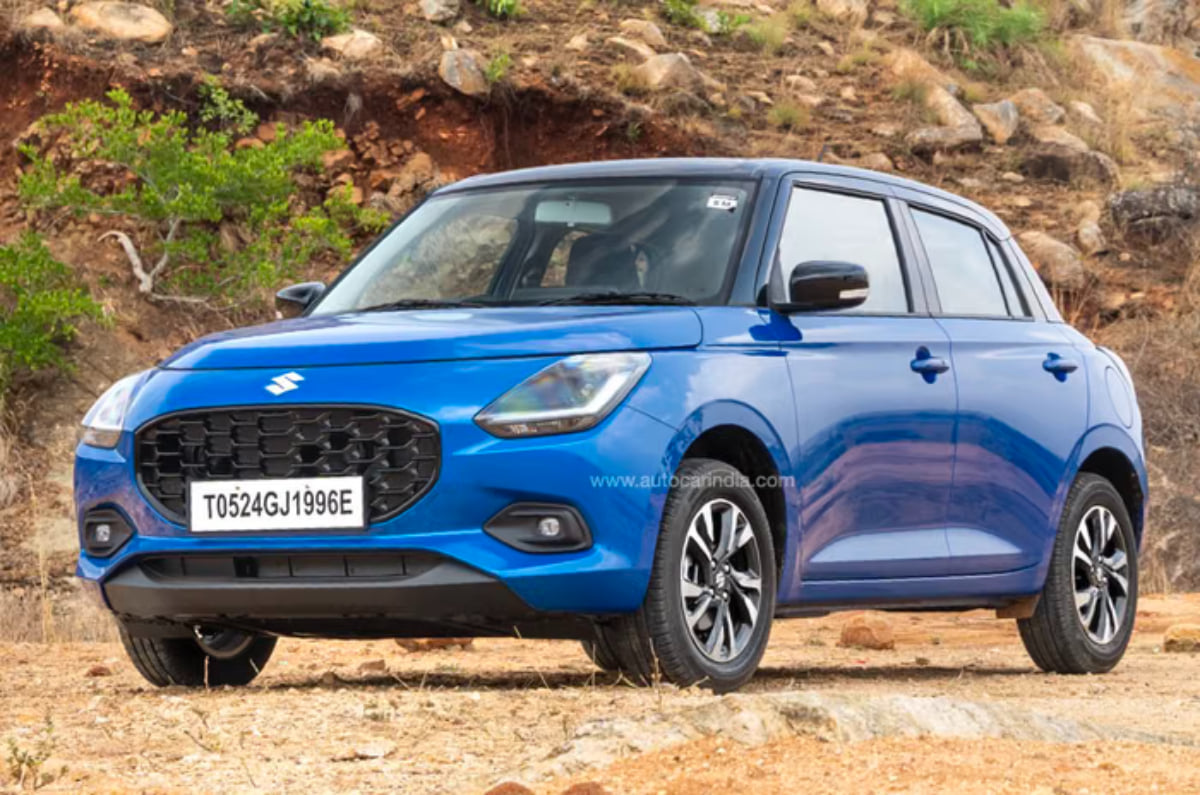
The Swift Blitz Edition petrol variants are available with benefits of up to Rs 71,000, including discounted accessory kits. Other petrol variants get benefits of up to Rs 40,000, comprising a Rs 10,000 cash discount, a Rs 25,000 exchange bonus and a Rs 5,000 additional discount. The CNG variants get benefits of up to Rs 30,000, including an exchange bonus of Rs 25,000 and an additional discount of Rs 5,000. The Swift is priced between Rs 5.84 lakh and Rs 8.74 lakh and rivals the Hyundai Grand i10 Nios and Tata Tiago.
Maruti Celerio discounts in October 2026
Up to Rs 67,500 off
The Maruti Celerio petrol variants get benefits of up to Rs 67,500, comprising a Rs 40,000 cash discount, a Rs 25,000 exchange bonus and a Rs 2,500 additional discount. The CNG variants get benefits of up to Rs 47,500, including a Rs 20,000 cash discount, a Rs 25,000 exchange bonus and a Rs 2,500 additional discount. The Celerio is priced between Rs 4.70 lakh and Rs 6.75 lakh and rivals the Tata Tiago and Renault Kwid.
Maruti Wagon R discounts in October 2026
Up to Rs 67,000 off
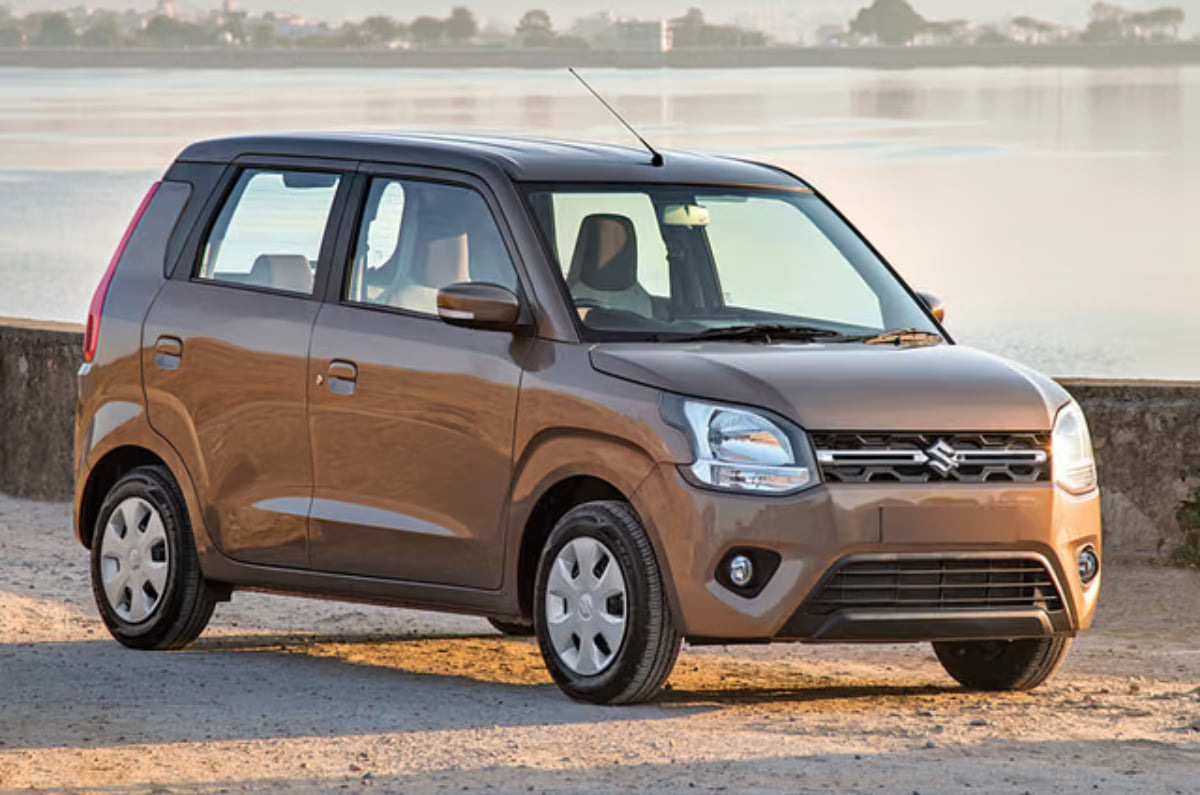
The Wagon R Waltz Edition petrol variants get benefits of up to Rs 67,000, including a free accessory kit worth Rs 38,000 and an additional offer of Rs 1,900. Other petrol variants get benefits of up to Rs 57,500, comprising a Rs 30,000 cash discount, a Rs 25,000 exchange bonus and a Rs 2,500 additional discount. The CNG variants get benefits of up to Rs 52,500, including a Rs 25,000 cash discount, a Rs 25,000 exchange bonus and a Rs 2,500 additional discount. The Wagon R is priced between Rs 4.99 lakh and Rs 7.24 lakh and rivals the Tata Tiago and Citroen C3.
Maruti Alto K10 discounts in October 2026
Up to Rs 57,500 off
The Alto K10 LXi petrol variant gets benefits of up to Rs 57,500, comprising a Rs 30,000 cash discount, a Rs 25,000 exchange bonus and a Rs 2,500 additional discount. Other petrol variants get benefits of up to Rs 47,500, while the CNG variants are available with benefits of up to Rs 37,500. A scrappage bonus of up to Rs 10,000 is available as an alternative to the exchange bonus. The Alto K10 is priced between Rs 3.70 lakh and Rs 5.45 lakh and rivals the Renault Kwid.
Maruti S-Presso discounts in October 2026
Up to Rs 37,500 off
The S-Presso petrol variants get benefits of up to Rs 37,500, comprising a Rs 10,000 cash discount, a Rs 25,000 exchange bonus and a Rs 2,500 additional discount. The CNG variants get benefits of up to Rs 27,500, including an exchange bonus of Rs 25,000 and an additional discount of Rs 2,500. The S-Presso is priced between Rs 3.50 lakh and Rs 5.27 lakh and rivals the Renault Kwid and Alto K10.
Maruti Eeco discounts in October 2026
Up to Rs 37,500 off
The Eeco petrol variants get benefits of up to Rs 37,500, comprising a Rs 10,000 cash discount, a Rs 25,000 exchange bonus and a Rs 2,500 additional discount. The CNG variants get benefits of up to Rs 32,500, with a lower cash discount of Rs 5,000, while the exchange bonus and additional discount remain unchanged. The Maruti Eeco is priced between Rs 5.28 lakh and Rs 6.46 lakh.
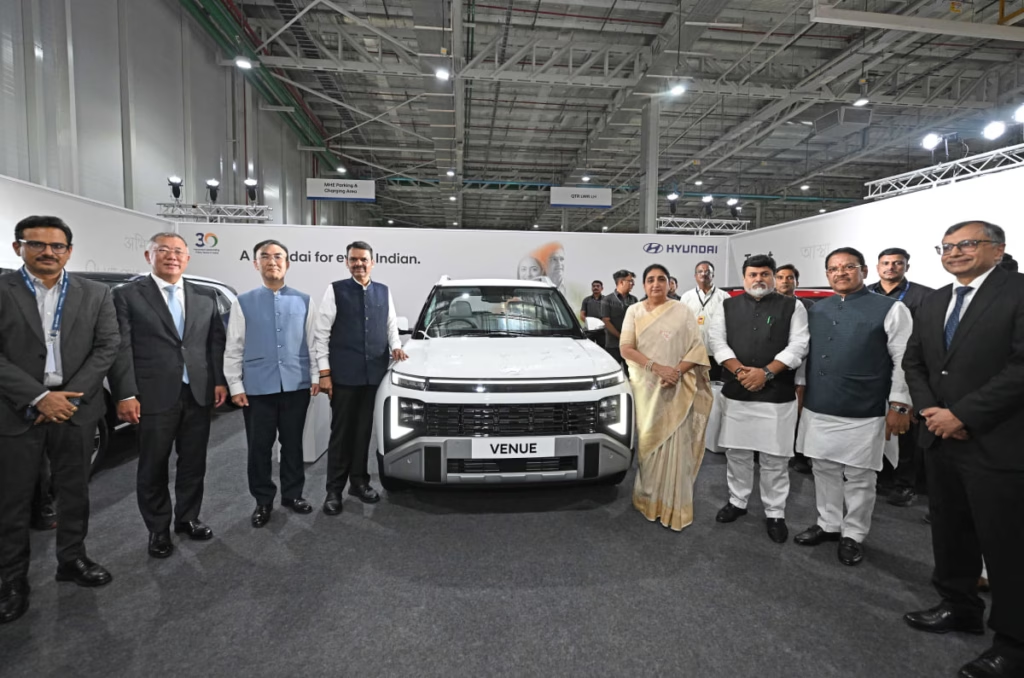
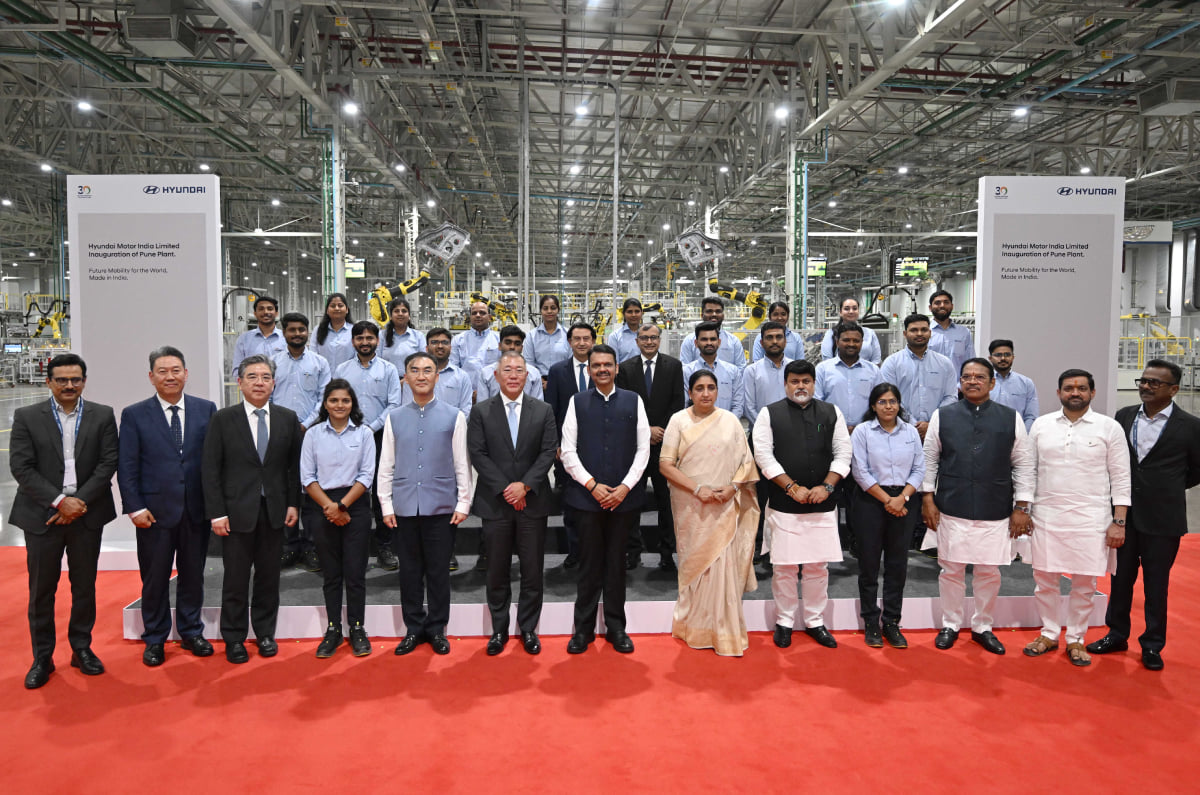
Hyundai Motor India has inaugurated its manufacturing plant in Talegaon, Pune, marking its first major manufacturing expansion outside Tamil Nadu. The facility currently has an installed annual production capacity of 1.7 lakh units, which is planned to increase to 3.2 lakh units by 2030. Managing director and CEO Tarun Garg announced that the company will invest Rs 11,000 crore in phases at the plant.
Hyundai Pune plant: Capacity and investment
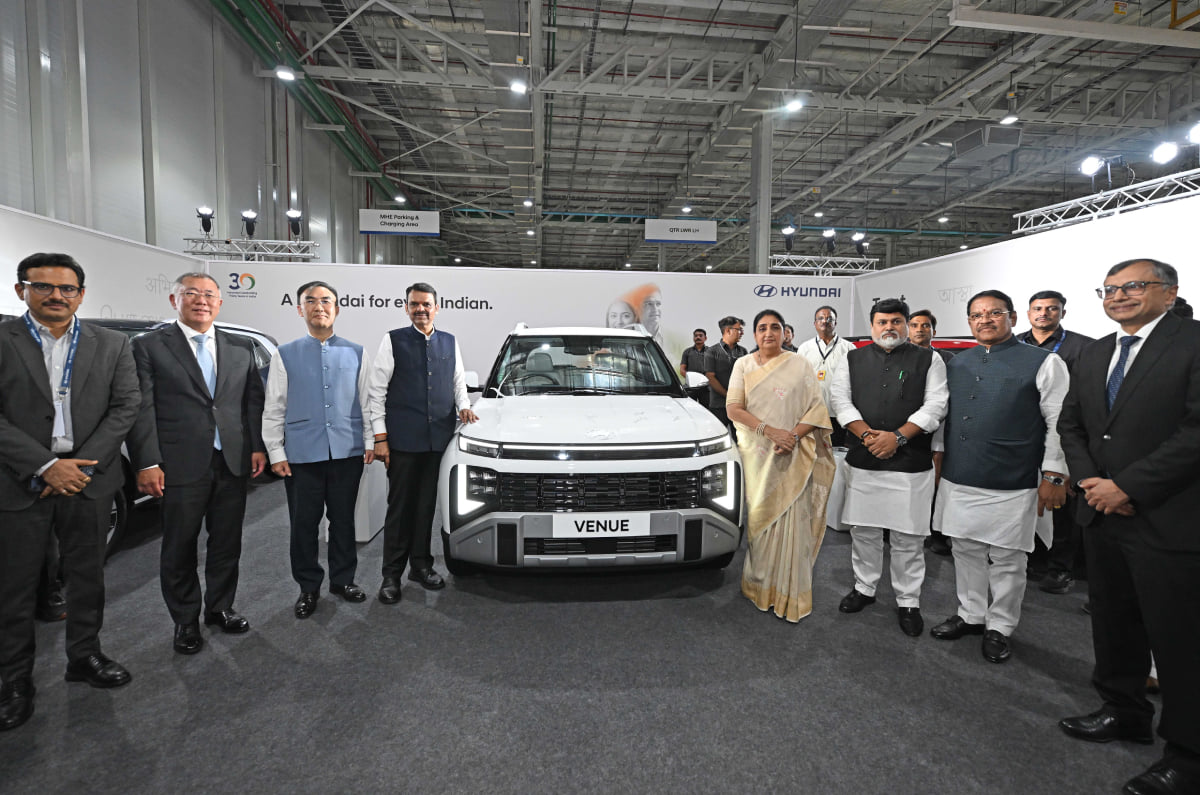
Maharashtra Chief Minister Devendra Fadnavis inaugurated the plant on October 14, 2026. Hyundai Motor Group executive chair Euisun Chung and Hyundai Motor Company president and CEO Jose Munoz were also present.
Garg said, “We will invest INR 11,000 crore in phases at this facility. Beyond expanding manufacturing capacity, the facility will drive industrial development, innovation and employment generation in the region.”
The expansion will take Hyundai Motor India’s combined annual production capacity at its Pune and Chennai plants to nearly 11.4 lakh units by 2030, according to the company. The Pune facility also has an engine shop with an annual capacity of 1.5 lakh units.
The plant uses Hyundai’s E-FOREST digital factory platform, with AI-based quality checks, predictive maintenance, digital simulations and augmented reality-based worker training. Its production lines can support multiple internal combustion engine and hybrid models.
Hyundai Venue to be made at Pune plant
The Hyundai Venue will be manufactured exclusively at the Pune plant and exported to global markets. Hyundai plans to expand exports of the model to more than 35 countries.
The inauguration coincided with Hyundai Motor India marking cumulative exports of 40 lakh passenger vehicles since 1999 and domestic sales of nearly 1 crore passenger vehicles over its 30 years in India.
Chung said, “India remains one of Hyundai’s most important and strategic markets globally.” He added that the Pune plant reflected the group’s long-term commitment to India and that the export milestone highlighted the role of Indian manufacturing in its global operations.
Hyundai said 55 Tier-1 suppliers have invested nearly Rs 4,600 crore in Maharashtra. Nearly half of its supplier network is located within 50km of the plant. The combined Tier-1 and Tier-2 supplier network has generated more than 18,000 employment opportunities in the state, according to the company.
Hyundai also cited nearly 40 ongoing research projects with seven Indian academic institutions, covering battery technology, electrification and future mobility.
दिल्ली सरकार ने राज्य में बिजली सब्सिडी योजना के तहत लाभार्थियों की बढ़ती संख्या और सरकारी खजाने पर बढ़ते बिल को देख कर बड़ा फैसला लिया है। राज्य सरकार ने बिजली सब्सिडी योजना का फायदा उठाने वाले उपभोक्ताओं के लिए आधार सत्यापन अनिवार्य करने का फैसला किया है। आधिकारिक आंकड़ों के मुताबिक, फरवरी 2026 तक, दिल्ली सरकार का बिजली सब्सिडी के लिए आवंटन Rs 4,037.63 करोड़ तक पहुंच गया था। मौजूदा वित्तीय वर्ष (2026-27) के लिए, सरकार ने इस मकसद के लिए Rs 3,500 करोड़ का बजट रखा है।
पिछले दस सालों में दिल्ली में बिजली उपभाक्ताओं की संख्या लगभग 40% बढ़ी है, जो अभी 73 लाख से ज्यादा है। आधिकारिक आंकड़ों के मुताबिक, 2024-25 में, दिल्ली में 73 लाख घरेलू उपभोक्ताओं में से लगभग 84% (52.3 लाख) ने बिजली सब्सिडी का फायदा उठाया, जो 2025-26 में बढ़कर 87% (55 लाख) हो गया। दिल्ली सरकार की स्कीम के तहत, उपभोक्ताओं को हर महीने 200 यूनिट बिजली मुफ्त दी जाती है। जो लोग 201 से 400 यूनिट बिजली इस्तेमाल करते हैं, उन्हें हर महीने 50% सब्सिडी (अधिक से अधिक 800 रुपये) मिलती है।
बिजली विभाग के हाल में जारी एक नोटिफिकेशन के मुताबिक, बिजली सब्सिडी स्कीम दिल्ली डिस्कॉम, यानी BSES राजधानी पावर लिमिटेड (BRPL), BSES यमुना पावर लिमिटेड (BYPL), टाटा पावर दिल्ली डिस्ट्रीब्यूशन लिमिटेड (TPDDL), नई दिल्ली म्युनिसिपल काउंसिल (NDMC) और मिलिट्री इंजीनियर सर्विसेज (MES) के जरिए उनके इलाकों में चलाई जाती है। दिल्ली सरकार सब्सिडी का फायदा पाने की शर्त के तौर पर बेनिफिशियरी की पहचान बताना “ठीक समझती है”। इसमें कहा गया है कि ऐसा बेनिफिशियरी “असली आधार नंबर होने का सबूत” देगा।
आधार एक्ट, 2016 के सेक्शन 7 के तहत, दिल्ली के उप राज्यपाल ने नोटिफाई किया कि स्कीम का फायदा उठाने के लिए, लोगों को वेब पोर्टल पर या सरकार द्वारा तय किए गए किसी दूसरे तरीके से अपना आधार नंबर देना होगा। दिल्ली में जिन उपभोक्ताओं का आधार एनरोलमेंट नहीं है, उन्हें इसके लिए आवेदन करना होगा और 14-डिजिट के एनरोलमेंट ID नंबर के साथ सब्सिडी पाने के लिए जरूरी डिटेल्स जमा करनी होंगी।
आधार नंबर का इस्तेमाल करके पक्की पहचान बनाने से लोग आसानी से सब्सिडी, फायदे और सेवा पा सकते हैं, पहचान बनाने के लिए कई दस्तावेजों की जरूरत नहीं पड़ती, प्रक्रियाएं आसान हो जाती हैं और निष्पक्षता और कार्यक्षमता बढ़ती है।
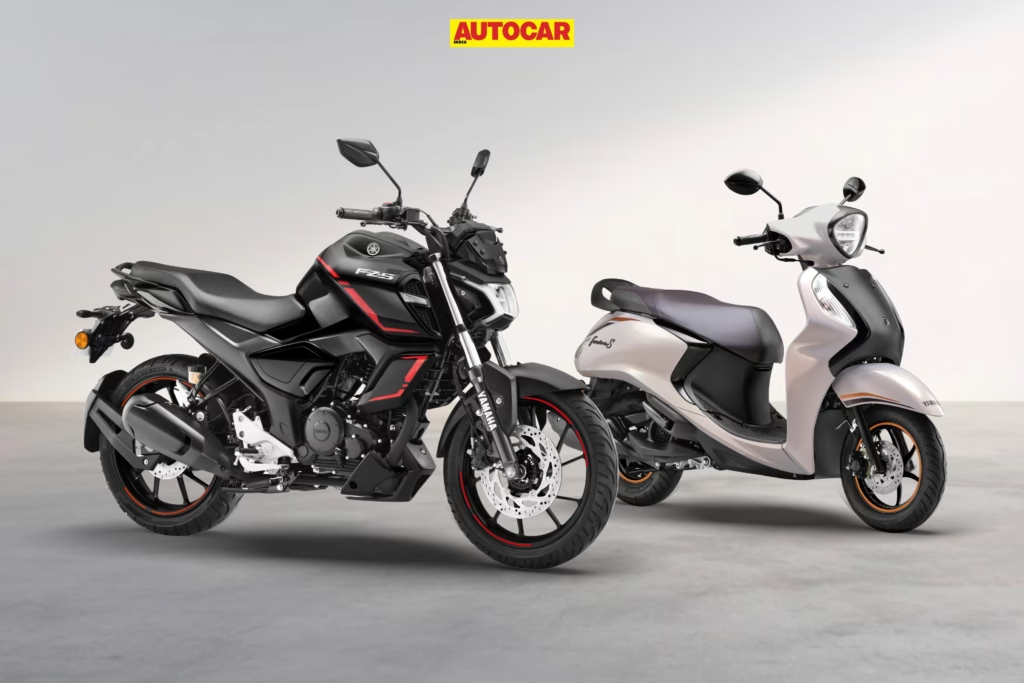
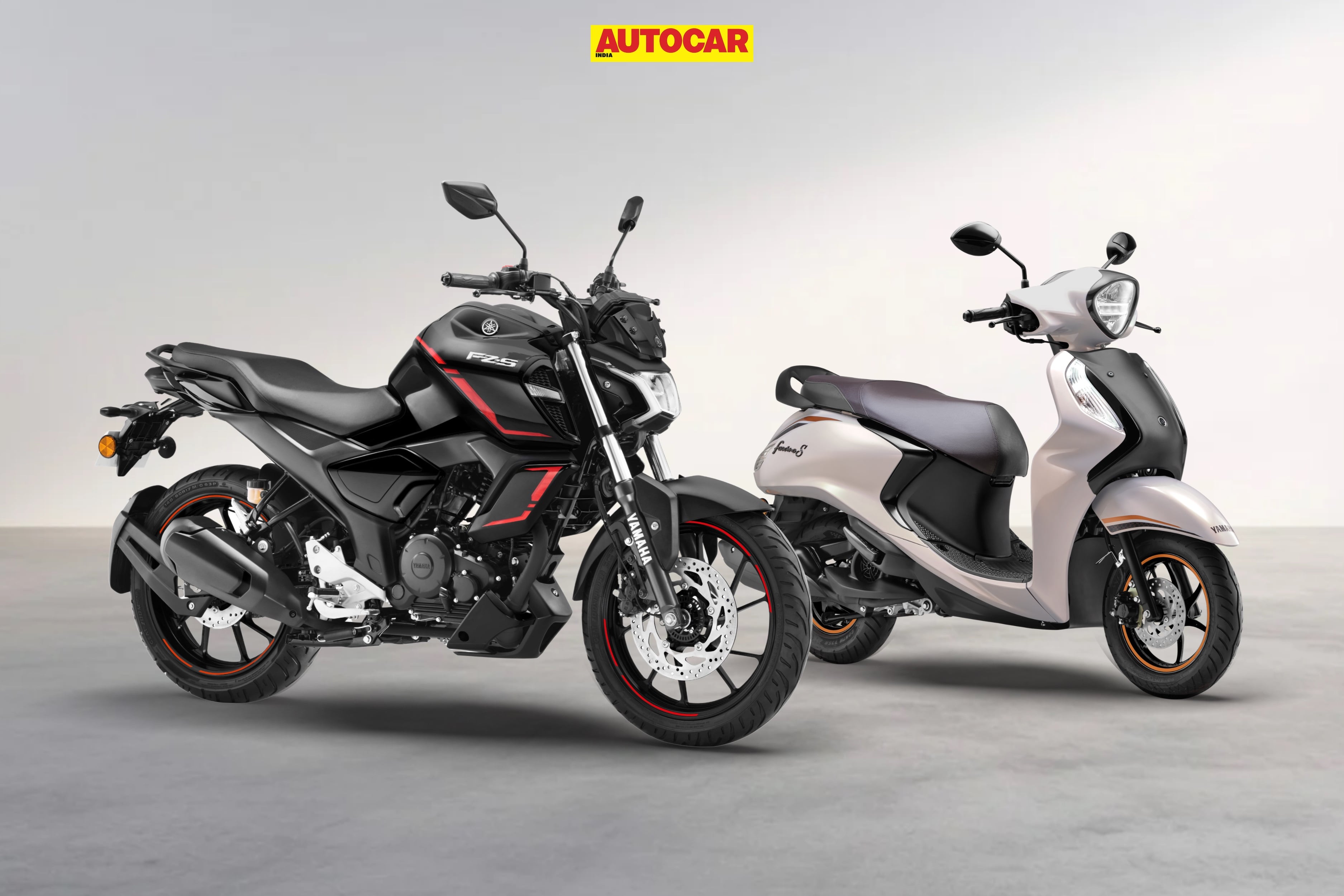
Yamaha Motor India has announced the beginning of its festive season offers, covering most of its popular motorcycles and scooters. The offers come in the form of insurance premium benefits, low down payment with flexible finance schemes, or both. Yamaha has told us that the insurance benefits mentioned here is the minimum amount customers can expect to get on their premiums.
Yamaha R15 and MT-15 don’t get any discount benefits
FZ series get the highest offer of the bunch
Yamaha festive offers: The breakdown
Aerox, R15S and EC-06 are completely exempted
The Fascino and RayZR 125, both recently updated, get the least amount of offers. The 125cc scooter duo, besides sharing the same platform, also share the same Rs 3,399 benefit for the insurance and a lowered down payment of Rs 2,499. The FZ series, now consisting of seven different variants, get Rs 5,999 as insurance benefit and Rs 3,900 as the down payment. The R15 and the MT-15 do not get any insurance benefits, just a lowered down payment of Rs 4,999. The XSR155, on the other hand, gets Rs 5,555 worth of insurance benefit and the same lowered down payment amount.
Type
Product/Variant
Insurance Benefit*
Low down payment*
Yamaha Hybrid scooter range
Fascino 125, RayZR 125
Rs 3,399
Rs 2,499
Yamaha FZ series
FZ-S (FZ-S Fi Hybrid, FZ-S Fi, FZ-S Fi V4 DLX and FZ-S Fi V4)
FZ (FZ Rave, FZ-Fi and FZ Blue Flex)
Rs 5,999
Rs 3,900
Yamaha 155cc motorcycles
XSR155
Rs 5,555
Rs 4,999
Yamaha 155cc motorcycles
R15 and MT-15
NA
Rs 4,999
The recently launched Yamaha R2 does not get any offers at this time, nor do the Aerox, R15S and Yamaha’s first electric scooter, the EC-06. The Japanese manufacturer has specified that the offers are currently not applicable in the states of Keralam and Tamil Nadu. Elsewhere in the country, the insurance benefits have been effective from October 1 (October 10 in Maharashtra) to November 15. The lowered down payment and finance schemes have been effective since October 1 and will remain so until the end of November.
*Terms and conditions apply. Insurance benefits based on the applicable insurance cost, excluding add-ons.