


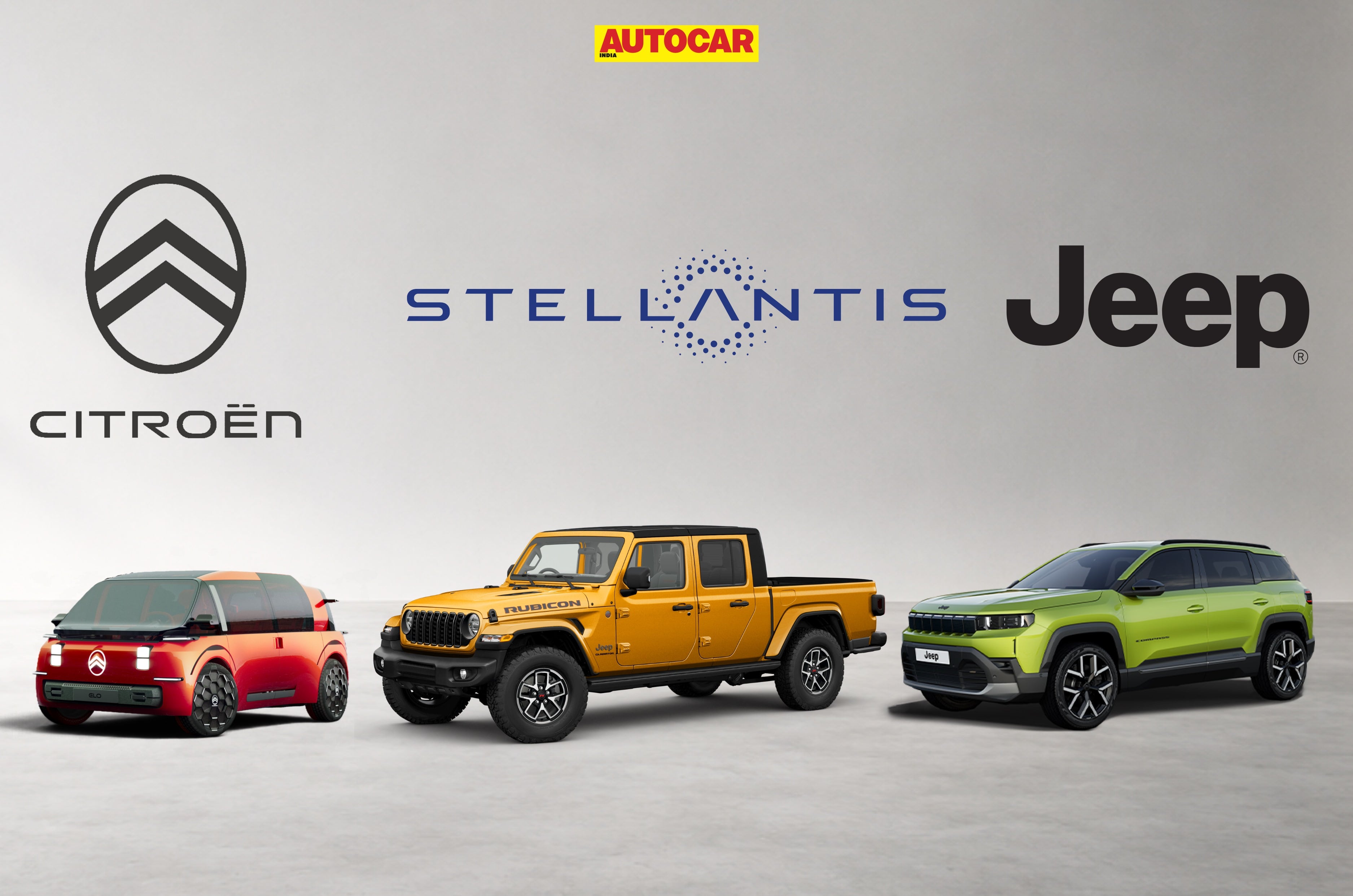
Stellantis has confirmed 12 Citroen and Jeep launches for India by 2030 as part of a roadmap dubbed ‘FaSTLAne 2030’. Speaking to Autocar India at the 2026 Paris Motor Show, Tianshu Xin – the head of Stellantis China and Asia-Pacific – confirmed a new investment of Rs 4,000 crore for the Indian market and said, “The plan is to introduce 12 new models in the next three years…seven of them will be new models and five are upgrades.”
Stellantis India lines up a dozen launches across Citroen and Jeep
Multiple SUVs inbound, along with an MPV, an entry-level car, and a premium pickup
The first model under FaSTLAne 2030 is scheduled to go on sale in India by the second quarter of 2027. This influx of new Citroen and Jeep launches will cover the compact, midsize, and premium SUV segments, and include a new MPV, an entry-level car, and a premium pickup truck. Of the 12 launches, seven will be from Citroen and five from Jeep.
Brand footprints to be expanded in India
Stellantis says these brands will play “distinct but complementary roles” in its line-up – Jeep will bolster its current position in the premium SUV arena, and Citroen will do the same in the mass-market segments. Expanding the customer reach of Citroen and Jeep is crucial, and Stellantis has committed to growing the brands’ retail and service networks, especially in Tier 2, 3, and 4 cities, along with increasing parts availability.
More Stellantis EVs coming, hybrids also confirmed
Additionally, Stellantis has confirmed a new multi-fuel strategy for the Indian market, which will span “efficient internal combustion engines, hybrid, plug-in hybrid (PHEV), and battery-electric (BEV) technologies.” These are already offered by Stellantis brands globally, and it should be interesting to see the specific powertrains that make it to India. As it stands, the majority of Stellantis India’s powertrain offerings are petrol; Citroen and Maserati also offer EVs, while Jeep additionally offers diesel in entry-level models.
Localisation target of 90 percent
According to Xin, the new models under FaSTLAne 2030 will be produced in India, so localisation will play a key role for competitive pricing. In light of that, Stellantis has set a target of 90 percent localisation across Jeep and Citroen, and will bank on its Indian R&D and manufacturing facilities, along with its supplier ecosystem, to achieve this. Moreover, India-developed FaSTLAne 2030 models will be exported to overseas markets.
Stellantis India’s two major brands, Citroen and Jeep, haven’t been very successful at attracting buyers in recent years. Citroen’s cars, despite recent updates, have struggled to gain traction in India due to their rivals being more aspirational and feature-rich. Jeep India, meanwhile, hasn’t launched any new models or facelifts in several years, turning prospective buyers away to more updated offerings. FaSTLAne 2030 is looking to be the shot in the arm that Stellantis India needs to pique buyer interest again.
What about Leapmotor?
Xin also provided an update on the long-overdue India entry of Stellantis’s Chinese EV brand, Leapmotor. Stellantis had planned to bring Leapmotor to India in 2025, but that evidently didn’t pan out. Xin noted that Leapmotor’s India entry is still being studied, and that there has to be enough “volume potential to justify the business case.” Therefore, a decision on Leapmotor entering India will only be made when the business case is ‘proven and solid.’