Around seven months after launching the new-gen Duster in India, Renault is now getting ready to bring the hybrid version of its midsize SUV. Featuring what the French brand calls “strong hybrid E-Tech 160” powertrain, this version of the Duster is aimed at buyers who want good mileage without sacrificing performance. Having said that, let’s see how the Renault Duster hybrid compares in terms of claimed fuel efficiency when compared to segment rivals.
Renault Duster hybrid vs rivals: Claimed mileage
The Duster hybrid’s ARAI mileage of 29kpl gives it an upper hand among its strong-hybrid rivals
Renault Duster hybrid vs rivals: ARAI claimed mileage (kpl)
Renault Duster hybrid
29
Maruti Suzuki Grand Vitara strong hybrid
27.97
Maruti Suzuki Victoris strong hybrid
28.65
Toyota Urban Cruise Hyryder strong hybrid
27.97
The Renault Duster hybrid’s ARAI-claimed mileage of 29kpl, which is 1.03kpl higher than what its Maruti Grand Vitara strong hybrid and Toyota Urban Cruise Hyryder strong hybrid rivals claim. It is only the Maruti Victoris with its strong-hybrid powertrain that comes close to matching the claimed figure of the Renault SUV, with a margin of just 0.35kpl between the two cars.
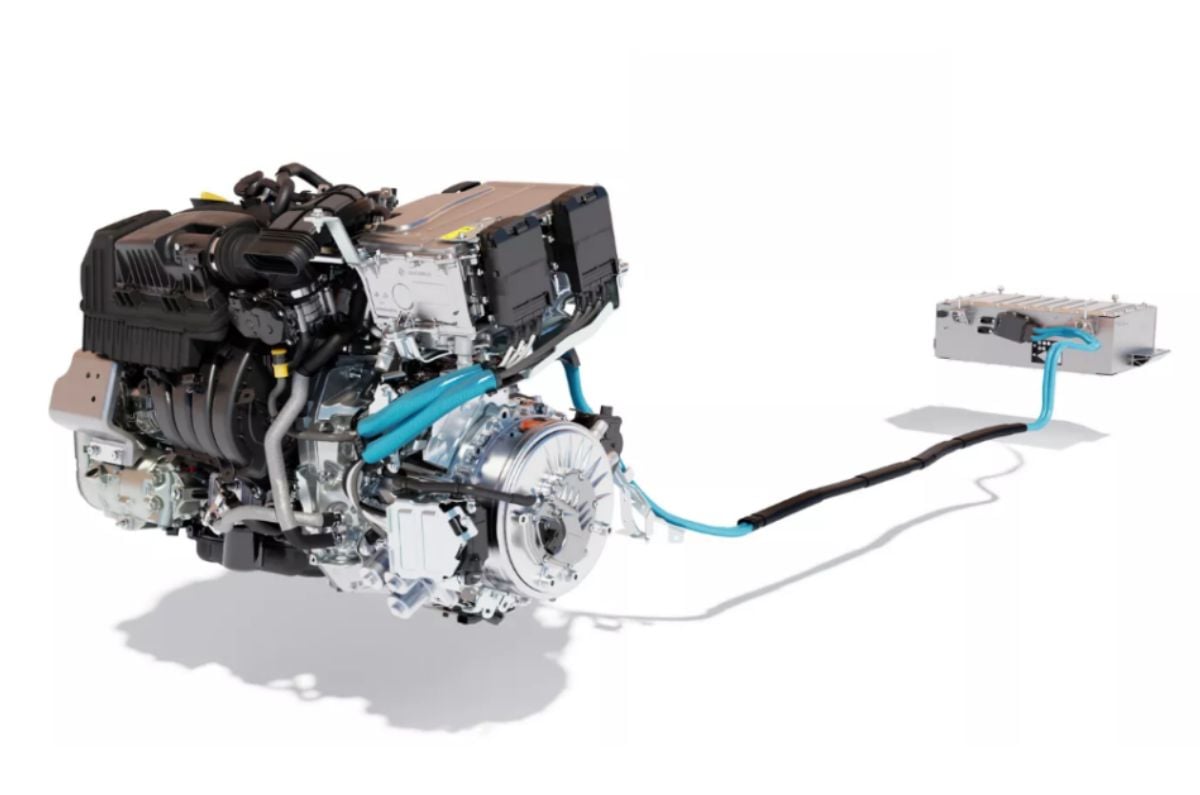
The Renault Duster’s strong hybrid powertrain comprises a 1.8-litre four-cylinder petrol engine that’s assisted by two electric motors and a 1.4kWh battery pack, resulting in a combined output of 160hp and 172Nm. According to Renault, the electric motors of the Duster hybrid include a 20hp unit that acts as a generator and a 49hp motor that drives the front wheels. While all models here offer an automatic transmission, the Duster hybrid features what Renault calls an “intelligent multi-mode transmission”. The rest come equipped with an e-CVT (electronically controlled continuous variable transmission).
The battery pack of the Renault Duster hybrid is larger than what the Urban Cruiser Hyryder strong hybrid offers. Considering the latter shares its underpinnings with the Grand Vitara strong hybrid, their battery packs would be the same too. For reference, the Toyota Urban Cruiser Hyryder’s strong-hybrid version is equipped with a 0.60kWh lithium-ion battery, which makes it less than half the size of the battery pack fitted to the Duster hybrid. This capacity advantage also likely explains the Renault SUV’s higher claimed range.
Renault India has opened the Duster hybrid’s bookings for Rs 21,000, ahead of its launch on October 17. This will be the third powertrain option for the Renault Duster, adding to the existing 1.0-litre and 1.3-litre turbo-petrol engines. Called the E-Tech system, it draws from the carmaker’s experience and expertise in Formula 1. Renault has also revealed that the Duster hybrid has an ARAI-rated fuel efficiency figure of 29kpl.
Renault Duster hybrid powertrain details
The Duster hybrid combines a naturally aspirated 1,789cc four-cylinder petrol engine with two electric motors, a 20hp unit acting as a generator and a 49hp motor powering the wheels. Combined, the system produces 160hp and 172Nm, and it is supported by a 1.4kWh battery pack. The Duster’s hybrid combines a petrol engine with electric drive and a battery, and it sends power to the wheels through a multi-mode automatic gearbox. The transmission uses fixed gear ratios and can shift between them. This means engine rpm is expected to rise and fall more like a conventional automatic, and you may notice gear engagements as it switches between electric drive, engine drive and a combination of both.
Renault’s 160hp E-Tech hybrid powertrain.
As with any full hybrid, the efficiency gains come from low-speed electric running, regenerative braking and the ability to keep the petrol engine off when it is not needed. However, real-world fuel economy will still depend on traffic conditions, speed, ambient temperature and driving style. That said, Renault claims the engine will enable 80 percent of city drives to be done in EV mode.
The choice of a hybrid powertrain is expected to help make up for the absence of a diesel option on the new Duster. This will also directly compete with the Maruti Grand Vitara, Victoris and Toyota Hyryder, all of which currently offer a hybrid powertrain option.
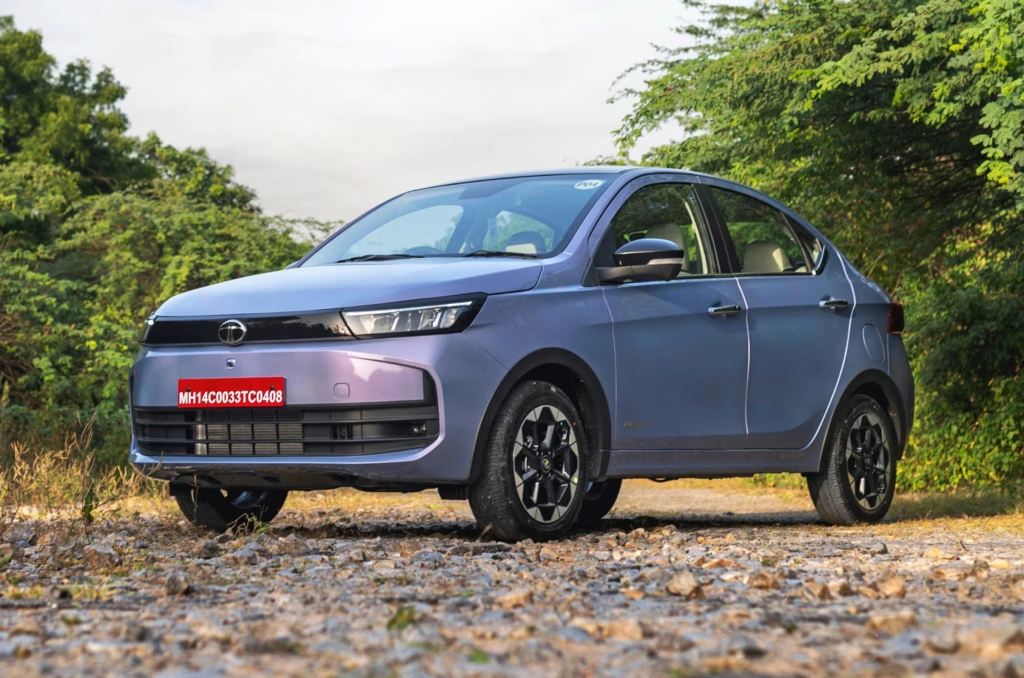
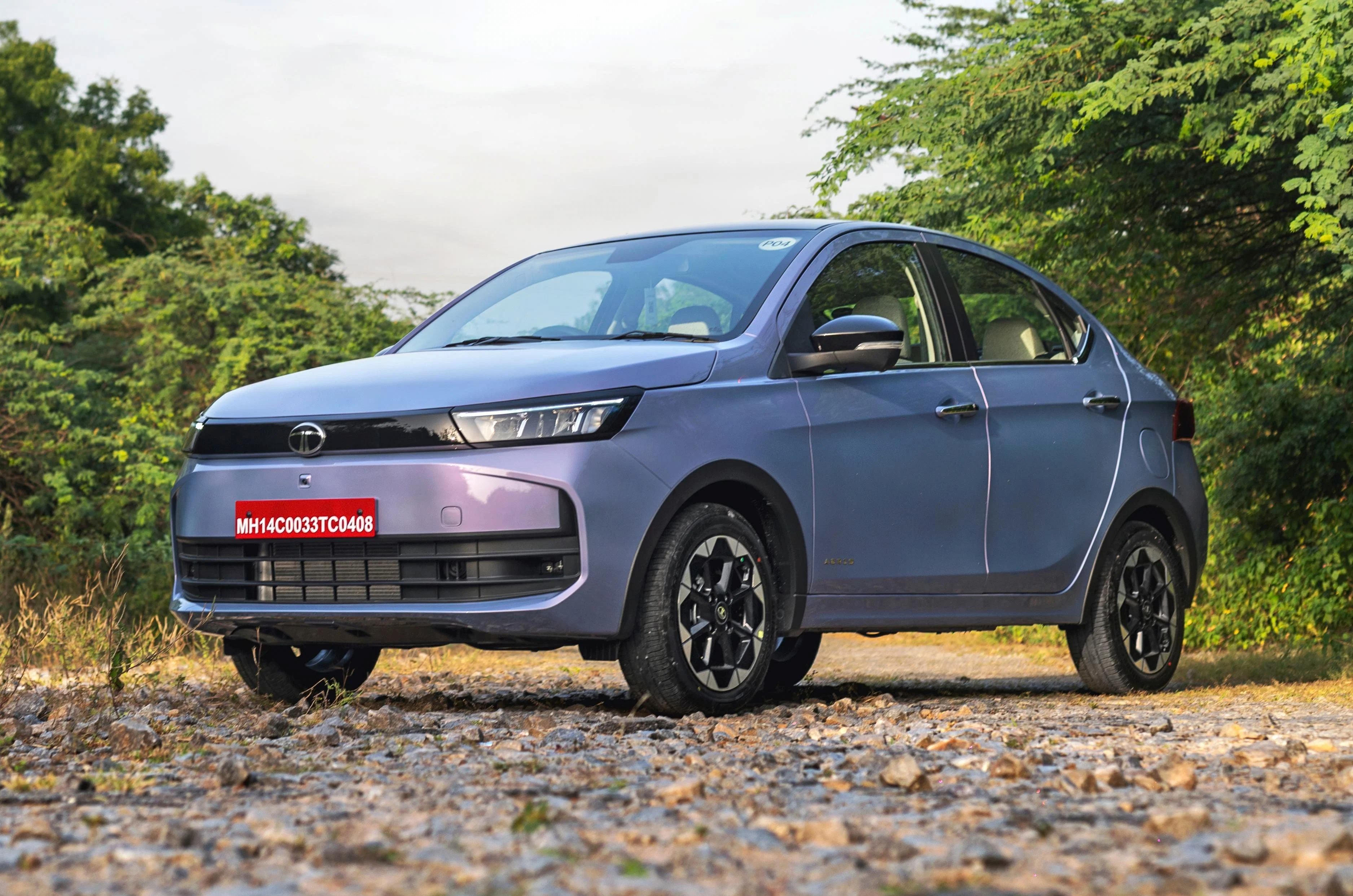
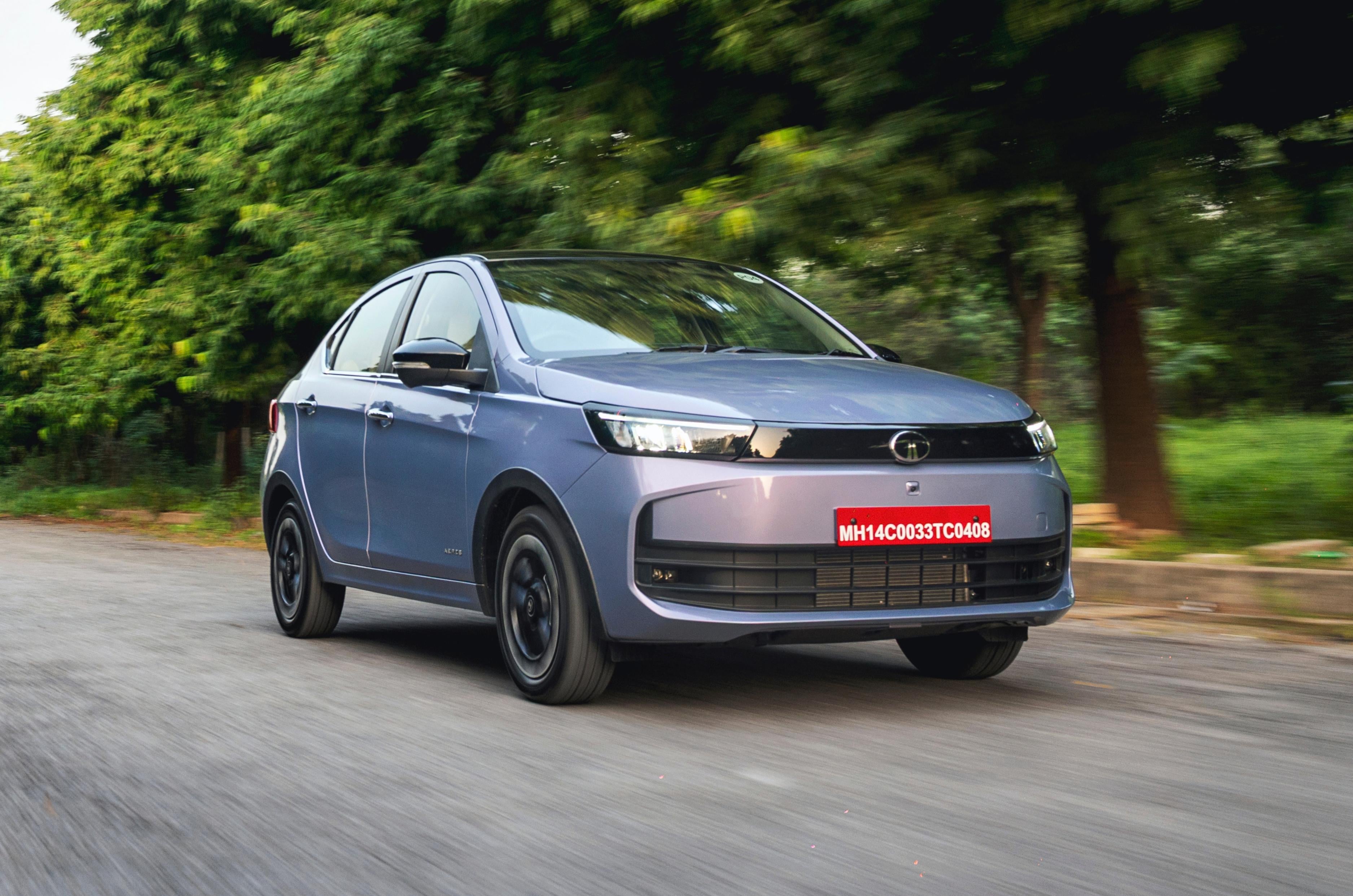
Tata has introduced the Aeris as a successor to the Tigor to strengthen its presence in the compact sedan segment. Apart from a new name, the Aeris is a heavily updated version of the discontinued Tigor, with sheet metal updates, a revamped cabin, and feature additions. If you’re considering buying the Aeris, we list two reasons to go for it and two reasons to look elsewhere based on our experience behind the wheel.
Spacious and well-equipped interior
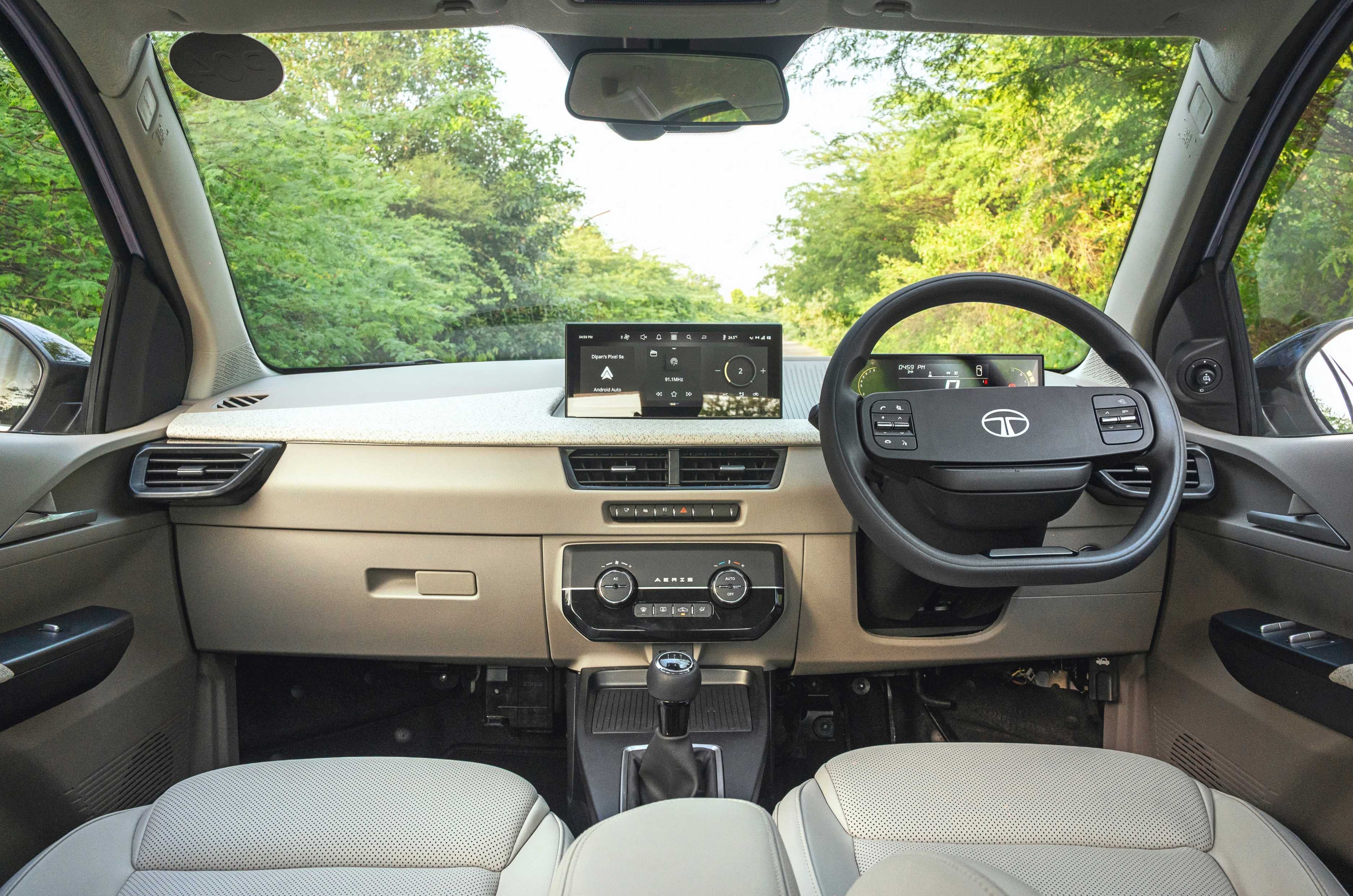
The Aeris’ cabin is well laid out; the beige theme gives it an airy feel, while the fabric trim on the dashboard adds a premium touch. You get a plethora of physical buttons, which have a solid feel, and floating door handles from the Sierra, which have a sturdy build. Space at the back is plenty, with good legroom, knee room, adequate thigh support and comfortable seat cushioning. The boot at 419 litres is the largest in its segment. Additionally, the boot lid uses gas struts for its opening for more usable space, unlike rivals that use a hinge mechanism.
Equipment levels of the Aeris are among the best in its segment. It’s the only model to come with front seat ventilation and a dashcam recording. Additionally, it packs a 10.25-inch infotainment system with Apple CarPlay and Android Auto, a 360-degree camera, and blind spot monitoring.
Plush ride quality
Like other Tata models, the Aeris is well judged in terms of ride and handling. Ride comfort is supple over broken roads, as its suspension does a great job of absorbing bumps. Additionally, its high 170mm ground clearance helps it clear large speed breakers with ease. At higher speeds, its suspension is stiff enough to maintain its stability even during quick lane changes.
Reasons not to buy the Aeris petrol
Lacklustre engine and gearbox
Powering the Aeris petrol is a 1.2-litre, 3-cylinder, naturally aspirated unit producing 86hp and 113Nm. Overall, the engine lacks the smoothness that rivals offer, and it lacks grunt out on the highway, taking time to reach triple-digit speeds. Shifts feel jerky with the AMT, while manual versions lack the slickness that competitors from Honda, Hyundai and Maruti provide.
Poor NVH levels
Apart from the not-so-smooth operation, the Aeris’ petrol unit is quite noisy. Vibrations filter through the cabin at idle and low speeds, and the gruff engine note causes discomfort over time. Additionally, as speeds rise, engine vibrations get much louder, and wind and road noise become more audible. This hinders the overall driving experience when out on the highway.
Petrol Diesel Price Today: हर दिन की शुरुआत सिर्फ सूरज की किरणों से नहीं होती, बल्कि पेट्रोल और डीजल की नई कीमतों से भी होती है, जो आम आदमी की जेब पर सीधा असर डालती हैं। सुबह 6 बजे देश की तेल विपणन कंपनियां (OMCs) ताजा दरें जारी करती हैं, जो अंतरराष्ट्रीय बाजार में कच्चे तेल की कीमतों और डॉलर-रुपए की विनिमय दर में आए बदलावों पर आधारित होती हैं। ये बदलाव रोजमर्रा की जिंदगी को प्रभावित करते हैं, चाहे वो ऑफिस जाने वाला व्यक्ति हो या फल-सब्जी बेचने वाला व्यापारी।
ऐसे में हर दिन की कीमतों की जानकारी रखना सिर्फ जरूरी ही नहीं, बल्कि समझदारी भी है। सरकार की यह प्रणाली पारदर्शिता सुनिश्चित करती है ताकि उपभोक्ताओं को किसी तरह की भ्रमित जानकारी न मिले।
आपके शहर में आज का पेट्रोल-डीजल का भाव
ये रहे 09 अक्टूबर 2026 के प्रमुख शहरों के पेट्रोल-डीजल के ताजा रेट
नई दिल्ली: पेट्रोल ₹102.12 प्रति लीटर और डीजल ₹95.20 प्रति लीटर।
मुंबई: पेट्रोल ₹111.18 और डीजल ₹97.83 प्रति लीटर।
कोलकाता: पेट्रोल ₹113.47 जबकि डीजल ₹99.82 प्रति लीटर।
चेन्नई: पेट्रोल ₹107.77 और डीजल ₹99.55 प्रति लीटर।
गुरुग्राम: पेट्रोल ₹102.77 तथा डीजल ₹95.44 प्रति लीटर।
नोएडा: पेट्रोल ₹102.12 और डीजल ₹95.56 प्रति लीटर।
बेंगलुरु: पेट्रोल ₹110.93 जबकि डीजल ₹98.80 प्रति लीटर।
भुवनेश्वर: पेट्रोल ₹109.92 और डीजल ₹100.92 प्रति लीटर।
चंडीगढ़: पेट्रोल ₹98.10 तथा डीजल ₹86.09 प्रति लीटर।
हैदराबाद: पेट्रोल ₹115.69 और डीजल ₹103.82 प्रति लीटर।
जयपुर: पेट्रोल ₹112.66 जबकि डीजल ₹97.78 प्रति लीटर।
लखनऊ: पेट्रोल ₹102.05 और डीजल ₹95.55 प्रति लीटर।
पटना: पेट्रोल ₹113.35 तथा डीजल ₹99.36 प्रति लीटर।
तिरुवनंतपुरम: पेट्रोल ₹115.49 और डीजल ₹104.40 प्रति लीटर।
पिछले दो साल से स्थिर क्यों हैं कीमतें?
मई 2022 के बाद से केंद्र और कई राज्यों द्वारा टैक्स में कटौती की गई, जिसके बाद पेट्रोल-डीजल की कीमतों में स्थिरता देखी जा रही है। हालांकि अंतरराष्ट्रीय बाजार में उतार-चढ़ाव होता रहता है, फिर भी भारतीय उपभोक्ताओं के लिए कीमतें तुलनात्मक रूप से स्थिर बनी हुई हैं।
किन कारणों से तय होती हैं ईंधन की कीमतें?
कच्चे तेल की कीमतें:
पेट्रोल और डीजल का उत्पादन मुख्य रूप से कच्चे तेल से होता है। जब अंतरराष्ट्रीय स्तर पर कच्चे तेल की कीमतें बढ़ती हैं, तो इसका असर सीधे भारतीय बाजार पर पड़ता है।
डॉलर के मुकाबले रुपया:
भारत अधिकतर कच्चा तेल आयात करता है, और यह डॉलर में खरीदा जाता है। यदि रुपया कमजोर होता है, तो ईंधन महंगा हो जाता है।
सरकारी टैक्स और शुल्क:
केंद्र और राज्य सरकारें पेट्रोल-डीजल पर भारी टैक्स लगाती हैं, जो खुदरा मूल्य का बड़ा हिस्सा होते हैं। यही कारण है कि राज्यों में कीमतों में अंतर होता है।
रिफाइनिंग की लागत:
कच्चे तेल को इस्तेमाल लायक बनाने की प्रक्रिया (रिफाइनिंग) में भी खर्च होता है। ये लागत कच्चे तेल की गुणवत्ता और रिफाइनरी की क्षमता पर निर्भर करती है।
मांग और आपूर्ति का संतुलन:
बाजार में ईंधन की मांग अगर बढ़ जाती है, तो कीमतें भी ऊपर जाने लगती हैं। खासकर त्योहारों, गर्मी या सर्दी के मौसम में ईंधन की खपत ज्यादा होती है।
कैसे करें अपने शहर की कीमतें SMS से चेक?
अगर आप मोबाइल से ईंधन की कीमत जानना चाहते हैं, तो ये प्रक्रिया आसान है:
Indian Oil ग्राहक: अपने शहर का कोड टाइप करें और उसे “RSP” के साथ 9224992249 पर भेजें।
BPCL ग्राहक: “RSP” लिखकर 9223112222 पर भेजें।
HPCL ग्राहक: “HP Price” लिखकर 9222201122 पर भेजें।
Mini India has commenced pre-bookings of the Cooper Oxford Edition. This limited-run edition of the hatchback pays homage to the brand’s hometown of Oxford, UK, the brand says. It will arrive here in ‘S’ guise, getting the same 2.0-litre direct-injection turbo-petrol engine as the standard Cooper 3-door hatchback.
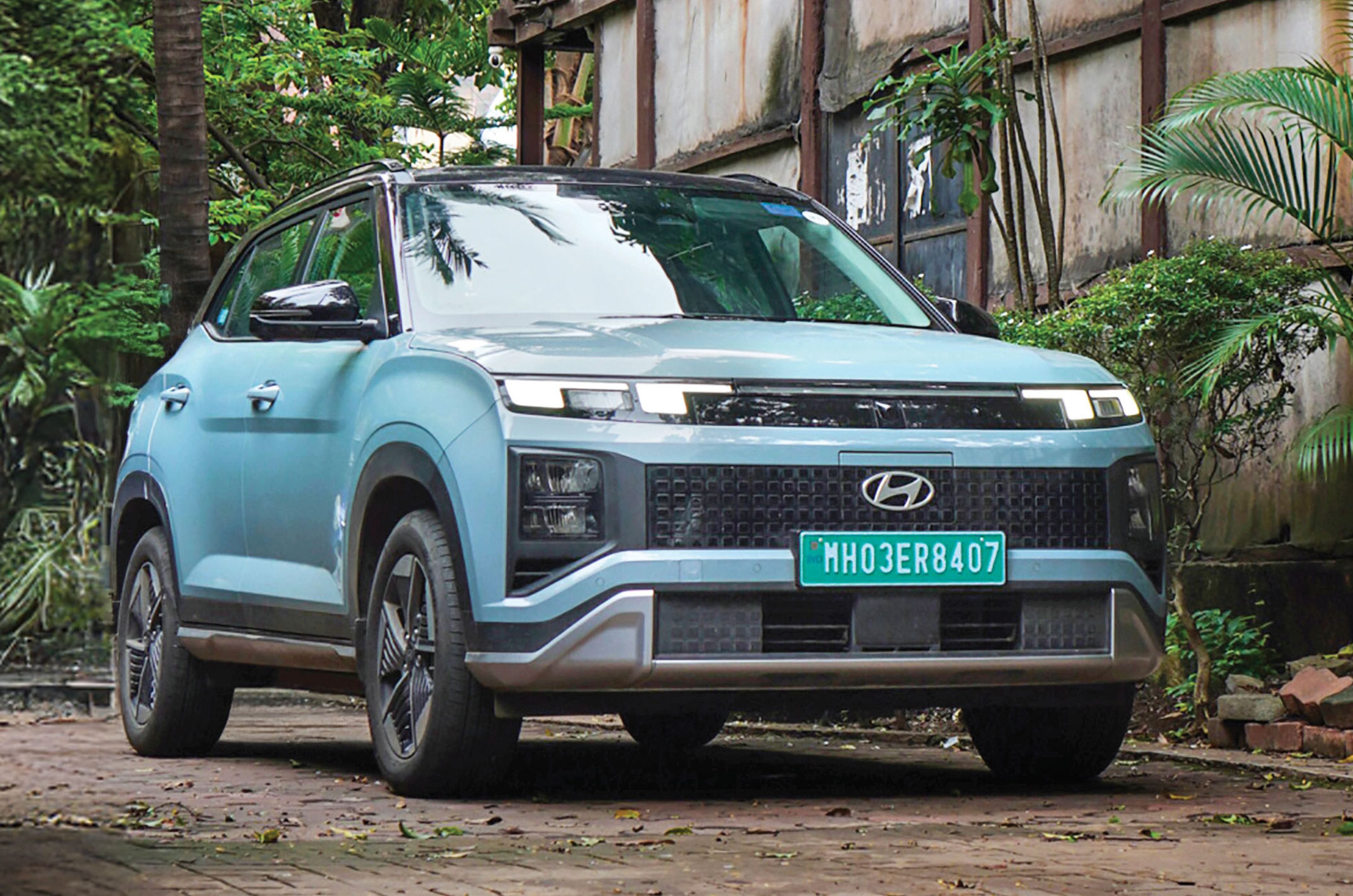
Hyundai is offering almost its entire line-up in October 2026 with various benefits. With the festive season around the corner, the Korean automaker is also providing customers discounts for Navratri. That said, the offers listed here are only applicable for the period of October 1 to October 31, 2026.
Disclaimer: Offers/benefits may vary by city and are subject to stock availability. Buyers are advised to check with their local dealer for exact figures.
Hyundai Creta N Line offers in October 2026
Benefits up to Rs 1.25 lakh
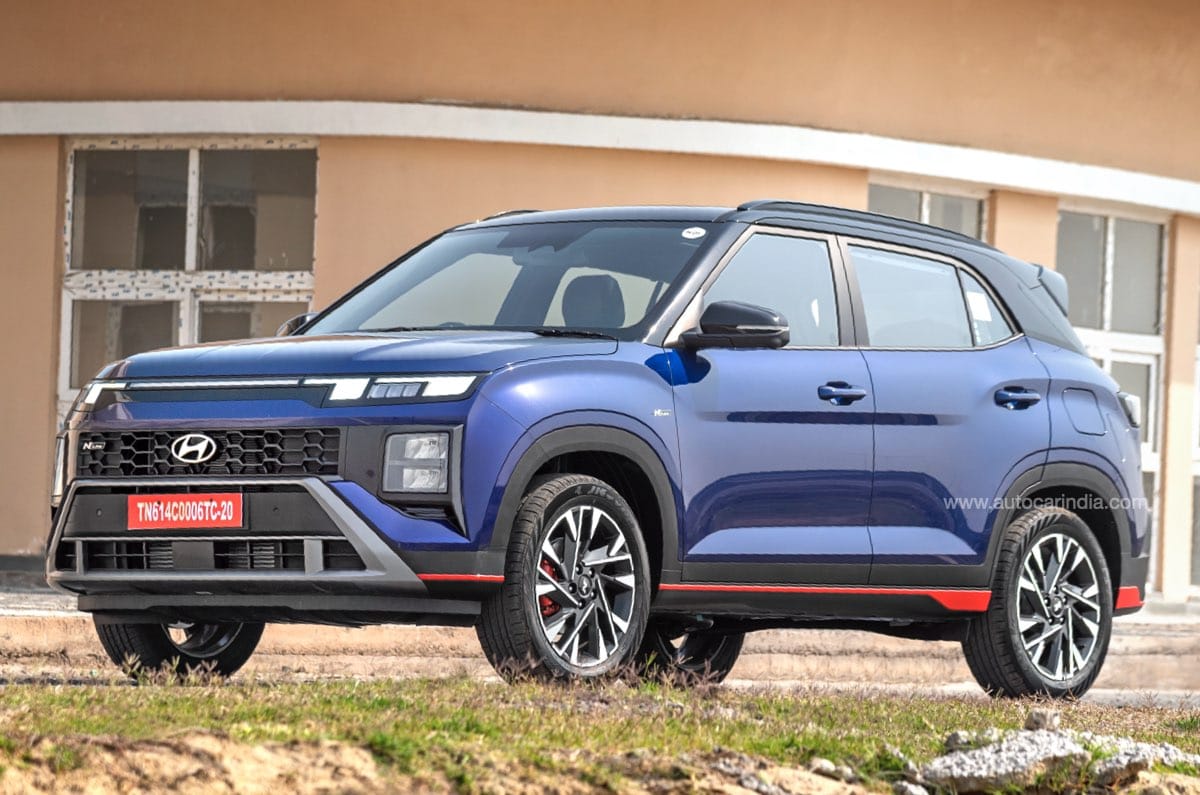
The Hyundai Creta N Line is available this month with a cash discount of Rs 20,000 and a Navratri bonus of Rs 25,000. There’s also scrappage benefits amounting to Rs 50,000 or an exchange offer of Rs 30,000, among a couple more customer-benefit schemes. Combined, one can expect to shave off up to Rs 1.25 lakh on a Creta N Line this month. The price of the Creta N Line ranges between Rs 19.03 lakh and Rs 19.95 lakh.
Hyundai Creta offers in October 2026
Benefits up to Rs 1.15 lakh
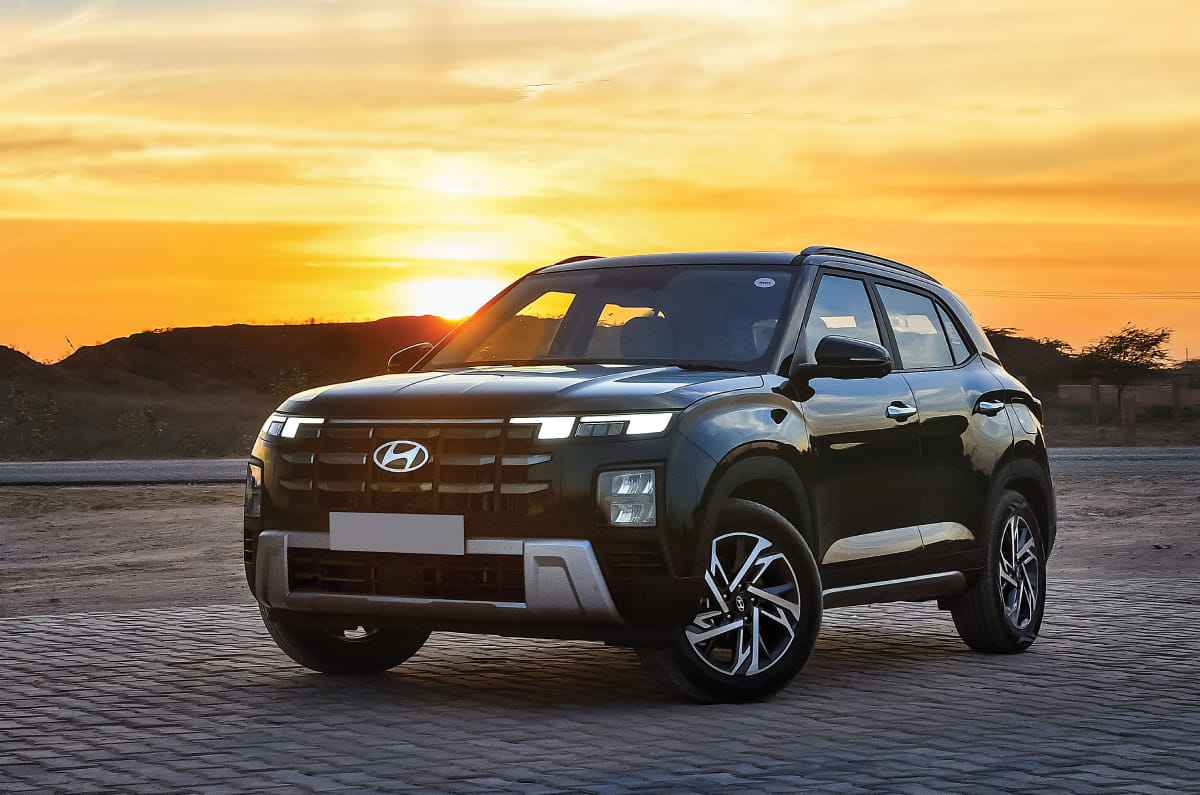
Select petrol variants of the Hyundai Creta have offers amounting to Rs 1.15 lakh. These are similar to what’s available with the Creta N Line, which means cash discounts, scrappage/exchange benefits, and a Navratri bonus. Hyundai is also providing benefits on diesel variants of the Creta, though these amount to just Rs 10,000. The Hyundai Creta range is priced from Rs 10.91 lakh to Rs 20.31 lakh.
Hyundai Verna offers in October 2026
Benefits up to Rs 1.05 lakh
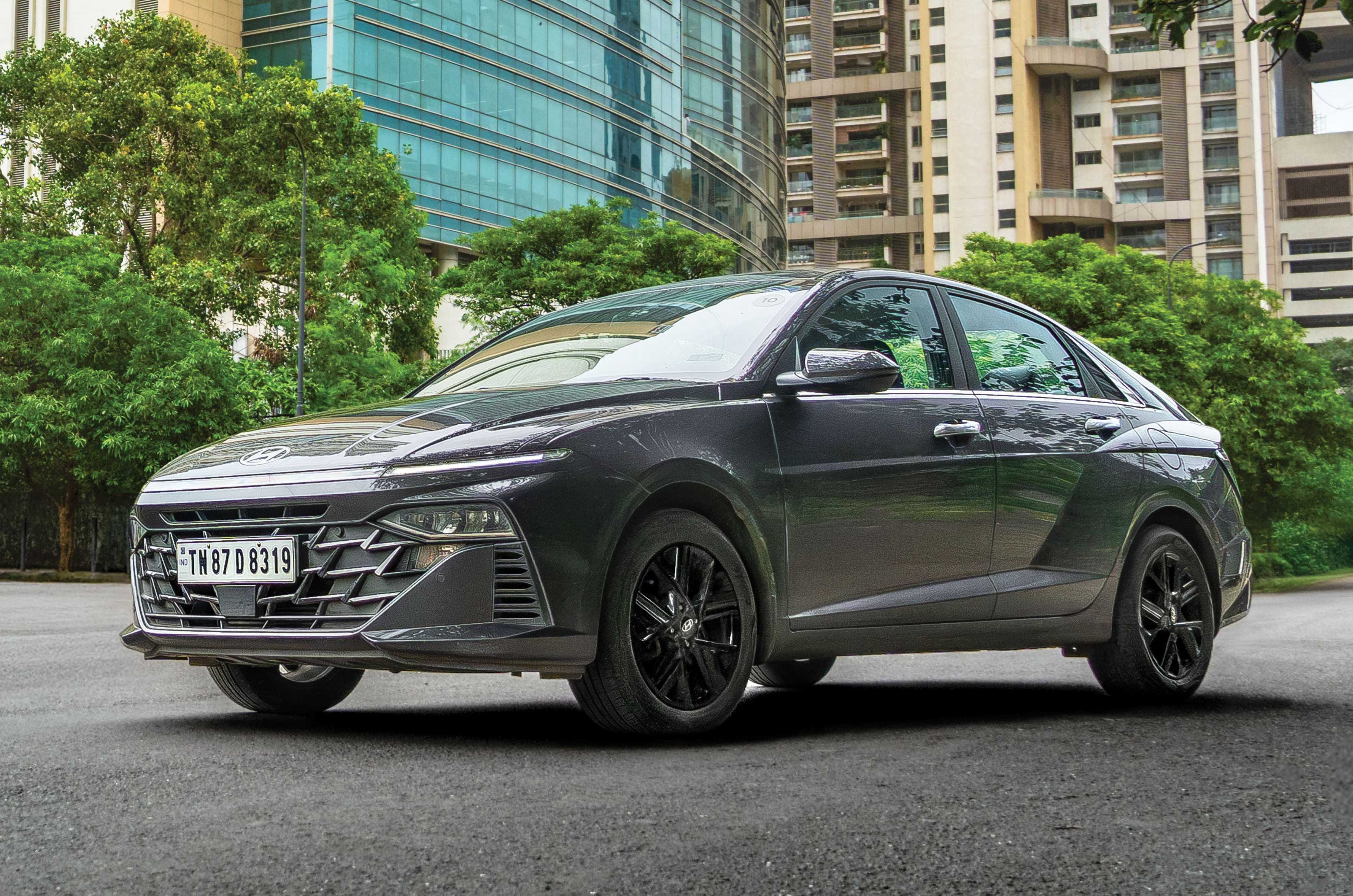
Older stock of the Hyundai Verna is being offered this month with benefits totalling Rs 1.05 lakh. This includes a cash discount of Rs 35,000, an upgrade bonus of Rs 15,000 and a Navratri incentive of Rs 25,000. Scrappage benefits amount to Rs 20,000, while the exchange offer is Rs 15,000. Eligible customers will also be offered other benefits. New stock of the Verna also come with discounts of up to Rs 80,000, depending on the variant. The list price of the new Hyundai Verna is between Rs 10.99 lakh and Rs 18.31 lakh.
Hyundai Alcazar offers in October 2026
Benefits up to Rs 90,000
Petrol variants of the Hyundai Alcazar are available with a cash discount of Rs 30,000, scrappage or exchange benefits of up to Rs 25,000, and a Navratri incentive of Rs 25,000. Including other applicable offers, Alcazar petrol buyers can save up to Rs 90,000 – discounts on the Alcazar diesel are up to Rs 45,000. The Hyundai Alcazar line-up costs between Rs 14.51 lakh and Rs 21.81 lakh.
Hyundai Grand i10 Nios offers in October 2026
Benefits up to Rs 75,000
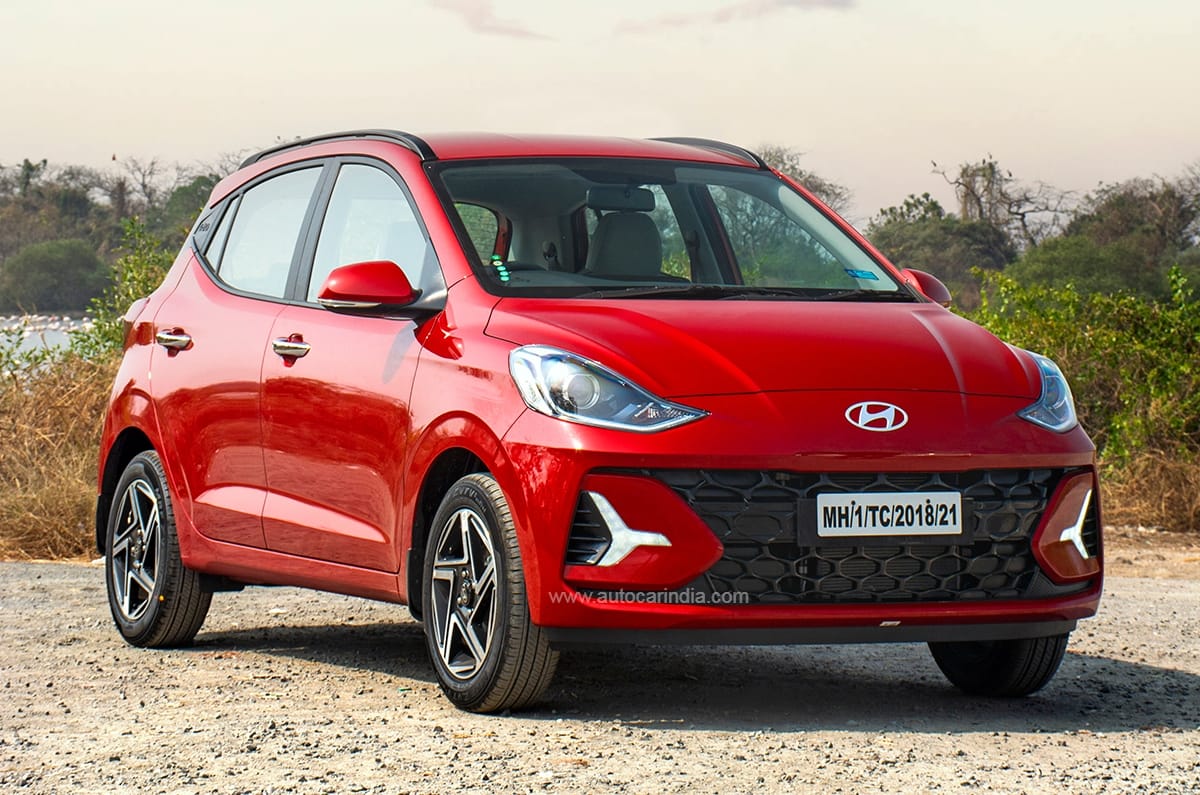
Select variants of the Hyundai Grand i10 Nios can be had with discounts amounting to Rs 75,000 this month. This involves a Navratri incentive of Rs 15,000, a cash discount of Rs 20,000, a scrappage/exchange bonus of up to Rs 20,000, and other benefits. The Grand i10 Nios CNG is available with benefits of up to Rs 70,000. In terms of its price, the Hyundai Grand i10 Nios is listed between Rs 5.60 lakh and Rs 8.09 lakh.
Hyundai Creta Electric offers in October 2026
Benefits up to Rs 65,000
The Hyundai Creta Electric is being offered with discounts amounting to Rs 65,000, though this is only applicable for select variants. The remaining variants get benefits of up to Rs 50,000. The price of the Hyundai Creta Electric ranges between Rs 18.03 lakh and Rs 25.07 lakh.
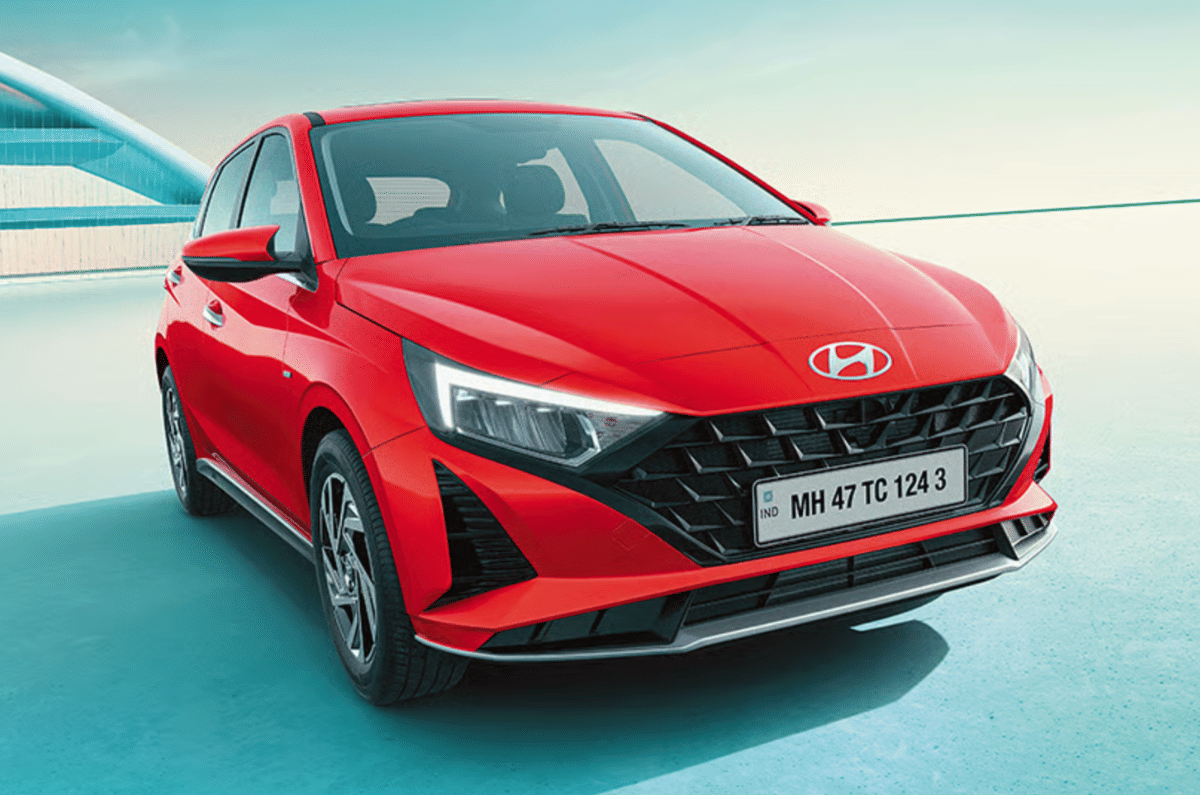
Hyundai i20 offers in October 2026
Benefits up to Rs 65,000
Select variants of the Hyundai i20 line-up (including the N Line) are being offered with a Navratri incentive of Rs 10,000, a cash discount of Rs 15,000 and scrappage/exchange benefits of up to Rs 20,000, among other schemes. In all, customers of the i20 can avail offers totalling up to Rs 65,000 this October. The Hyundai i20 is priced from Rs 6.00 lakh to Rs 10.44 lakh, while the i20 N Line costs between Rs 9.32 lakh and Rs 11.64 lakh.
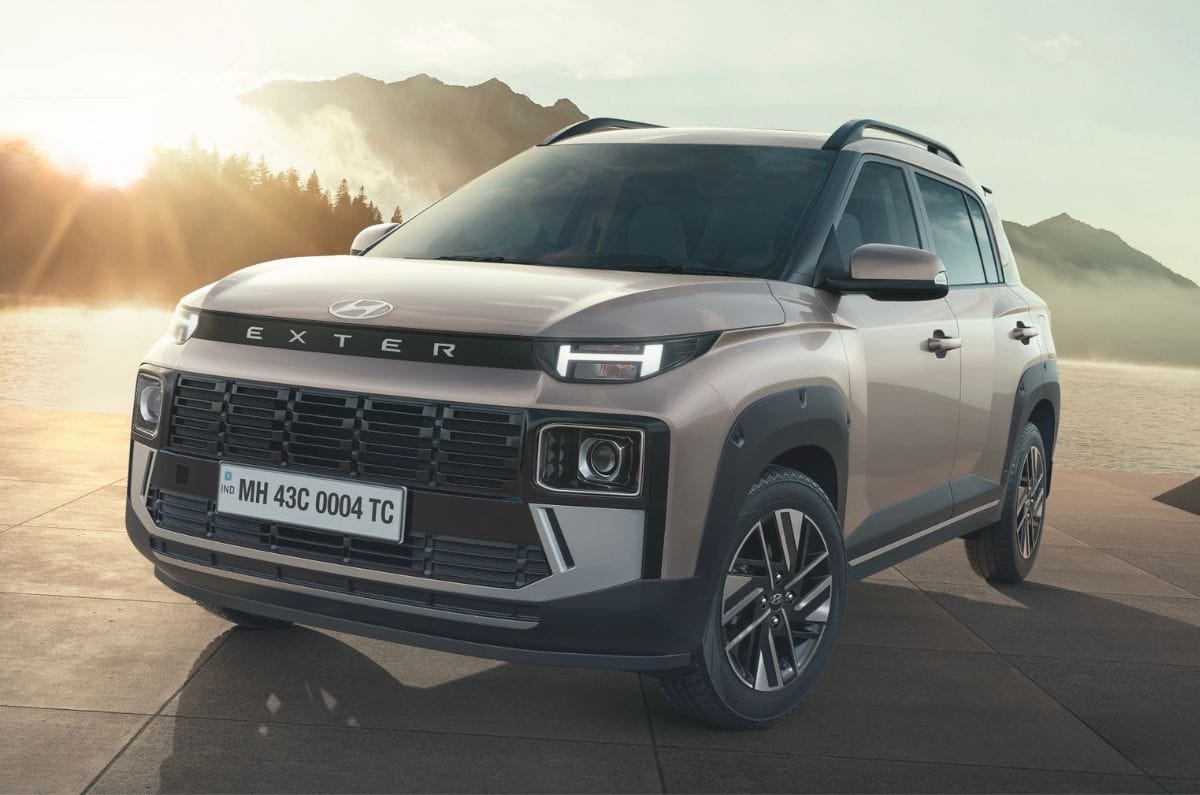
Hyundai Exter offers in October 2026
Benefits up to Rs 55,000
Older stock of the Hyundai Exter can be had this month with discounts that amount to Rs 55,000, while the new Exter is available with schemes that bring its price down by up to Rs 50,000. Note that these incentives are only applicable on select variants, regardless of the model year. The new Hyundai Exter is priced between Rs 5.81 lakh and Rs 9.50 lakh.
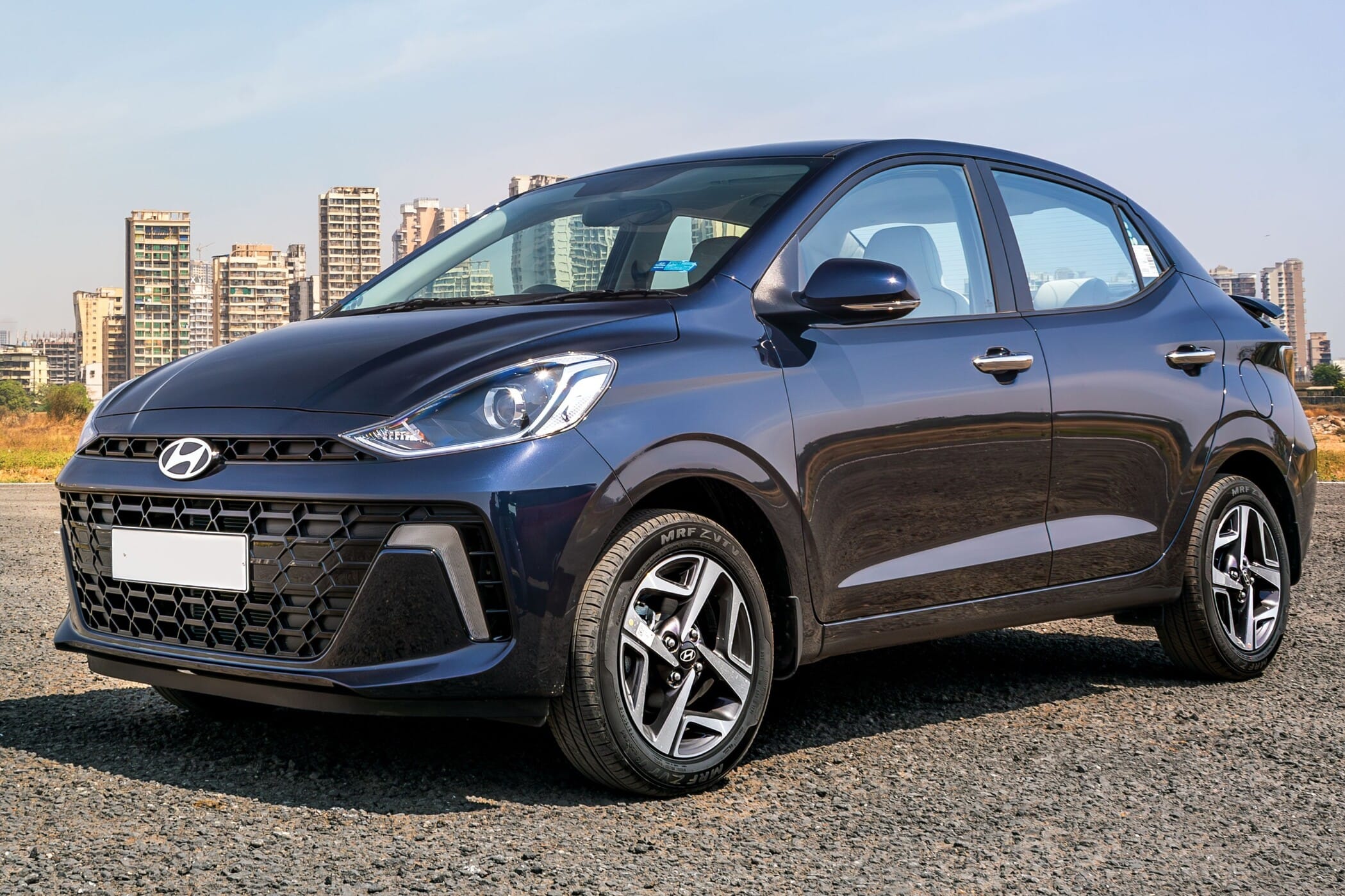
Hyundai Aura offers in October 2026
Benefits up to Rs 40,000
Customers buying select trims of the Hyundai Aura CNG in October 2026 can avail discounts of up to Rs 40,000. Meanwhile, select petrol variants of this Hyundai sedan is being offered with benefits of up to Rs 25,000. The Hyundai Aura range is priced from Rs 6.00 lakh to Rs 8.67 lakh.
Hyundai Venue offers in October 2026
Benefits up to Rs 5,000
The Hyundai Venue line-up (including the N Line) is available with the lowest discounts this month, amounting to just Rs 5,000. As for its price, the Hyundai Venue is listed at between Rs 8.00 lakh and Rs 15.65 lakh, while the Venue N Line costs from Rs 10.66 lakh to Rs 15.49 lakh.
Honda has introduced the Elevate facelift, bringing it up to speed with the competition. It gets refreshed styling, mild interior changes, and several enhancements to its feature suite. However, it remains unchanged mechanically, retaining its 1.5-litre naturally aspirated petrol engine from its predecessor. The carmaker has also revealed the Elevate facelift’s claimed mileage figures, and we compare it against rivals to see how it fares.
Honda Elevate vs rivals: Claimed mileage
Elevate’s claimed figures are among the lowest in the segment
Honda Elevate vs rivals: Claimed mileage (kpl)
Manual
Automatic
Honda Elevate
15.31
16.61
Kia Seltos
16.50
16.50
Tata Sierra
17.40
16.90
Hyundai Creta
17.40
17.70
Maruti Grand Vitara
21.11
20.58 | 19.20 (AWD)
Toyota Hyryder
21.12
20.58 | 19.39 (AWD)
Maruti Victoris
21.18
21.96 | 19.07 (AWD)
The Honda Elevate’s 1.5-litre naturally aspirated engine delivers 121hp and 145Nm, and is mated to either a 6-speed manual or CVT gearbox. Rivals like the Hyundai Creta and Kia Seltos come with the same gearbox options as the Elevate, whereas the Toyota Hyryder, Maruti Victoris and Grand Vitara offer a 5-speed manual and 6-speed torque converter automatic. Meanwhile, the Sierra naturally aspirated petrol is offered with a 6-speed manual and 7-speed DCT gearbox options. Because the Elevate offers only a naturally aspirated petrol engine, we’ve compared it only with rivals that offer this mill.
Honda claims that the new Elevate delivers 15.3kpl and 16.62kpl for its manual and automatic versions, respectively. But compared to the pre-facelift version, the new Elevate automatic’s mileage is 0.31kpl lower. Compared to the segment, the Elevate’s claimed mileage figures are among the lowest. It delivers the least fuel efficiency in manual guise but outranks the Seltos in automatic guise, albeit by a narrow margin.
Rivals like the Tata Sierra and Hyundai Creta claim to deliver up to 18kpl. Meanwhile, the same-engine-powered Toyota Hyryder, Maruti Victoris and Grand Vitara breach the 20kpl mark, with the Victoris delivering the highest figures in manual guise. Interestingly, even in AWD automatic guise, the Toyota and Maruti SUVs claimed figures are higher than rivals equipped with a manual gearbox.
The Tata Aeris may be a new name, but its roots lie in the Tigor, which has enjoyed considerable popularity since 2017 for its distinctive styling, practical cabin, comfortable ride and decent powertrains. The Aeris builds on that foundation with a sharper design, a more upmarket cabin and an even more generous equipment list while retaining the same basic mechanical package underneath. Having already driven the iCNG version, we now get behind the wheel of the petrol Aeris to see how it fares as an everyday sedan.
Tata Aeris petrol performance and refinement – 7/10
The petrol engine gives it slightly better cruising capability than the CNG
3-cylinder engine is so-so on refinement and sounds coarse when revved hard
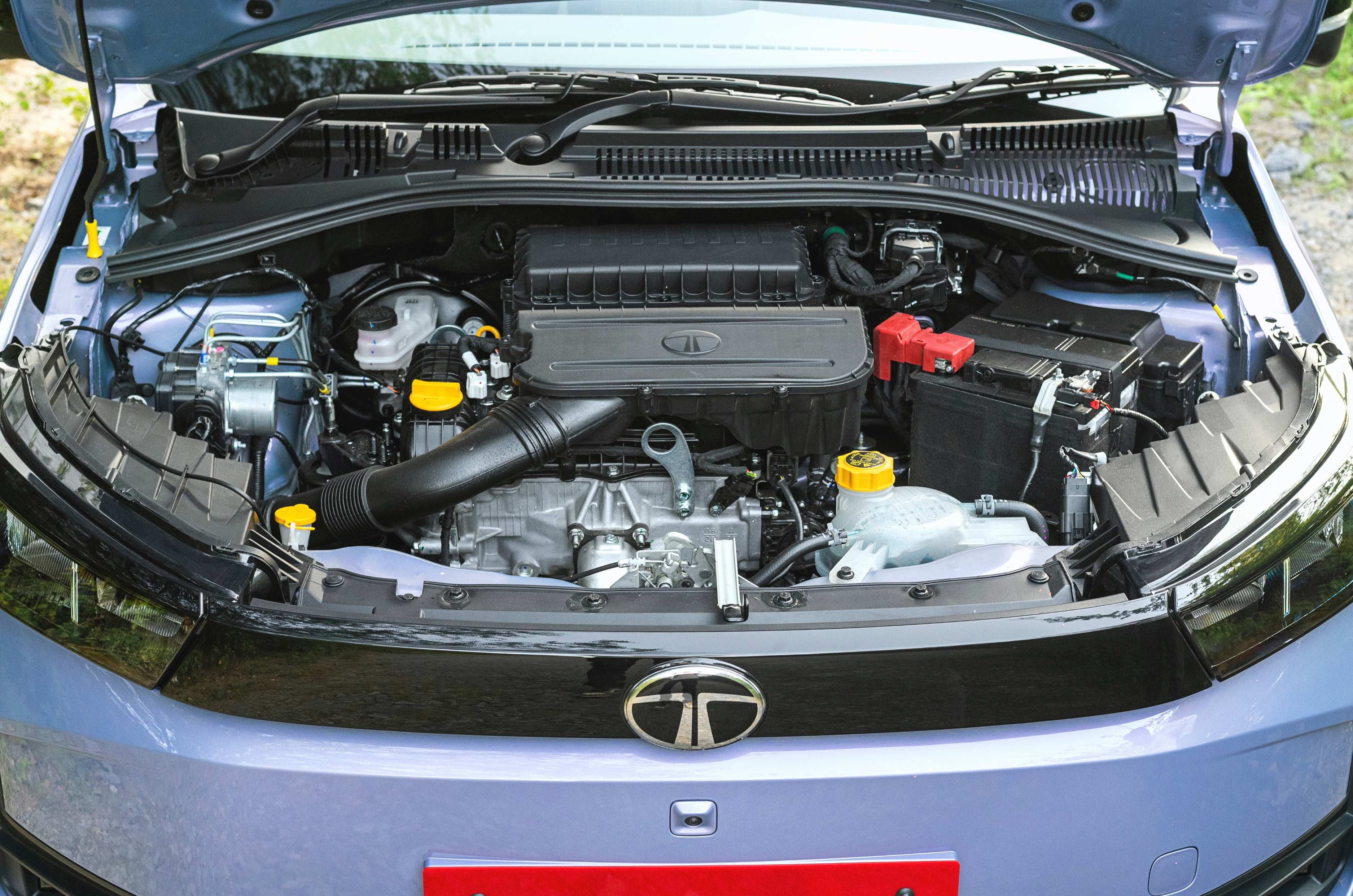
The Tata Aeris comes with a 1.2-litre 3-cylinder naturally aspirated engine that produces 86hp and 113Nm in its petrol guise and is offered with a choice between a 5-speed manual and a 5-speed automated manual transmission (AMT). The three-cylinder engine isn’t the smoothest in the segment, while the sound insulation also has room for improvement. There are noticeable vibrations at idle and low speeds, though these settle down once you’re on the move. However, they make a comeback beyond 2,500rpm, accompanied by a coarse engine note that can get intrusive and tiring on longer high-speed drives.
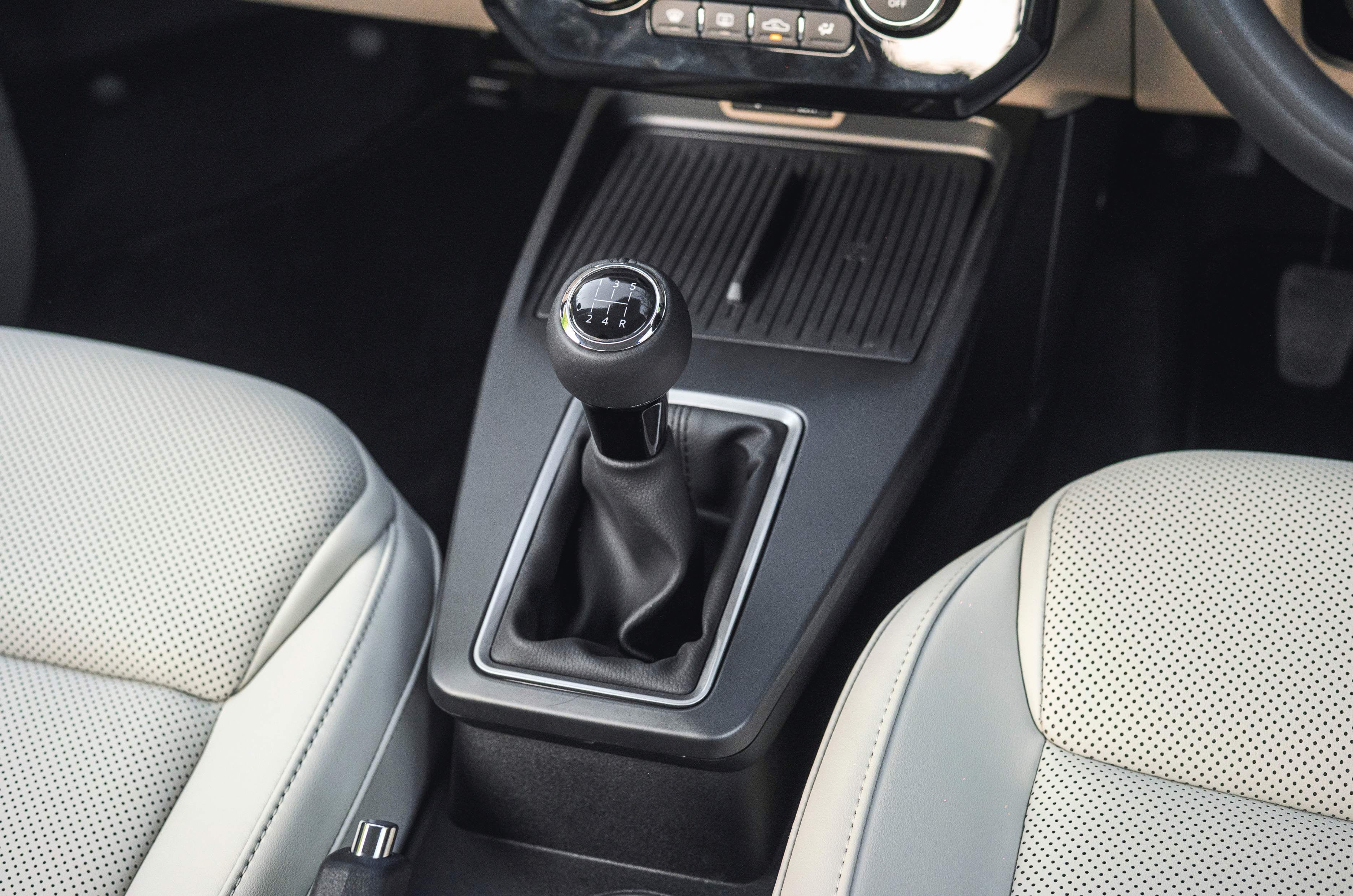
Manual lever looks premium for the price, offering short throws and defined gear gates.
The petrol version’s output figures are 10hp and 16Nm higher than the CNG version, which may look modest on paper, but the difference is discernible out on the road. We drove the petrol-powered Aeris with a 5-speed manual gearbox and noticed it offers short shift throws and well-defined gear gates. While it is not the slickest gearbox compared to its Maruti, Honda and Hyundai rivals, it is still a step up from the Tigor’s in terms of smoothness.
Aeris’ petrol version feels adequate for the city and is fine for gentle highway cruises too.
The performance in city speeds is adequate, and the powertrain is peppy enough for everyday driving. The clutch is light and has a predictable bite point, meaning you do not strain your left foot even in bumper-to-bumper traffic. There’s a dead pedal too, but it feels narrower than what we would have liked.
It is fairly quick to reach 80kph, but takes some time to reach triple-digit speeds. However, the petrol-powered Aeris maintains these speeds with relative ease, which makes it a decent highway cruiser. Unlike the CNG, the Aeris petrol does not feel out of breath when overtaking, and as long as you are in the right gear, it maintains good momentum.
AMT adds convenience for city drives but doesn’t like being rushed; the manual gearbox is easy to use.
We got a taste of the AMT during our earlier stint with the Aeris iCNG, when we switched to petrol mode, and found that the gearbox offered reasonable acceleration with measured inputs. Push the accelerator aggressively, though, and the typical AMT hesitation became evident, meaning overtakes need to be planned well. The AMT also gets a creep function, which comes in handy in bumper-to-bumper traffic.
All of this makes the AMT a good option for city driving, but for high-speed highway cruising, we recommend the manual gearbox, which offers greater control and a more engaging experience. That said, opting for the manual in the city is not a compromise either.
Tata Aeris petrol ride comfort and handling – 8/10
It allows for a confident drive at both low and high speeds
Like other Tata offerings, ride quality is one area where the Aeris excels. It takes broken roads in its stride, with the suspension absorbing rough patches well and keeping most surface irregularities from filtering into the cabin. The 170mm ground clearance is also adequate for tackling large speed breakers without much concern. That said, the CNG version has an edge in this department, thanks to its 14-inch steel wheels with taller sidewalls, which offer a more cushioned ride than the 15-inch alloys on the top-spec petrol version. Notably, lower Aeris trims get 14-inch wheels.
Well-tuned suspension keeps the Aeris comfortable and confident on all roads.
At high speed too, the suspension stiffens enough to keep the Aeris composed through quick lane changes, without feeling floaty. On the highways, it remains stable and inspires confidence at higher speeds. The steering, however, could do with more precision, as it feels slightly vague around the centre. While it weighs up nicely as speeds rise, a sharper response around the centre would have further enhanced the Aeris’ high-speed confidence.
Tata Aeris petrol mileage and efficiency
We expect the Aeris petrol to have similar fuel efficiency as the Tiago
Tata has yet to reveal the official fuel-efficiency figures for the petrol-powered Aeris. But it gets the same powertrain as the pre-facelift Tiago we tested in 2022. In that test, it returned 13.30kpl in the city and 16.60kpl on the highway. The Aeris could have similar fuel efficiency. However, we will be able to give you a more definitive assessment once we put the Aeris through our standard fuel-efficiency tests.
Tata Aeris petrol exterior design and engineering – 8/10
Has a sleeker and more modern exterior design and comes with LED lights all around
Save for the new bumper, the fascia is similar to the Tiago’s and looks very modern.
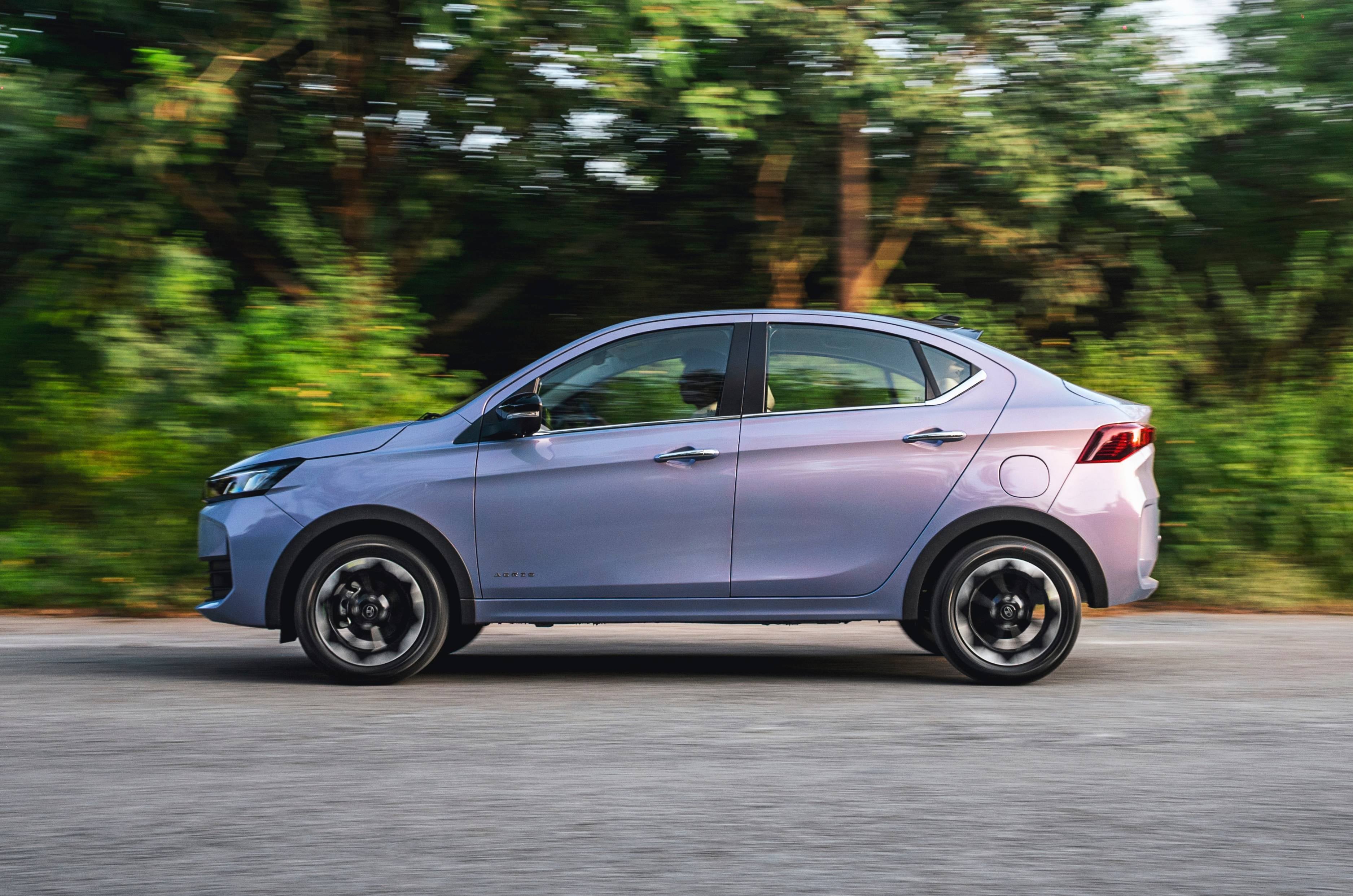
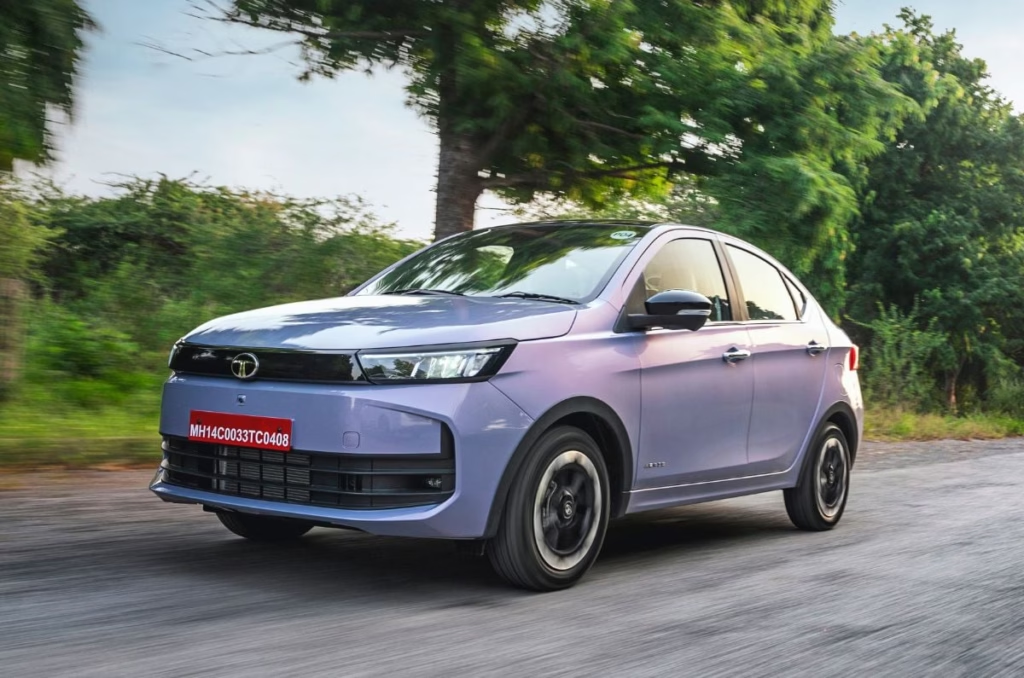
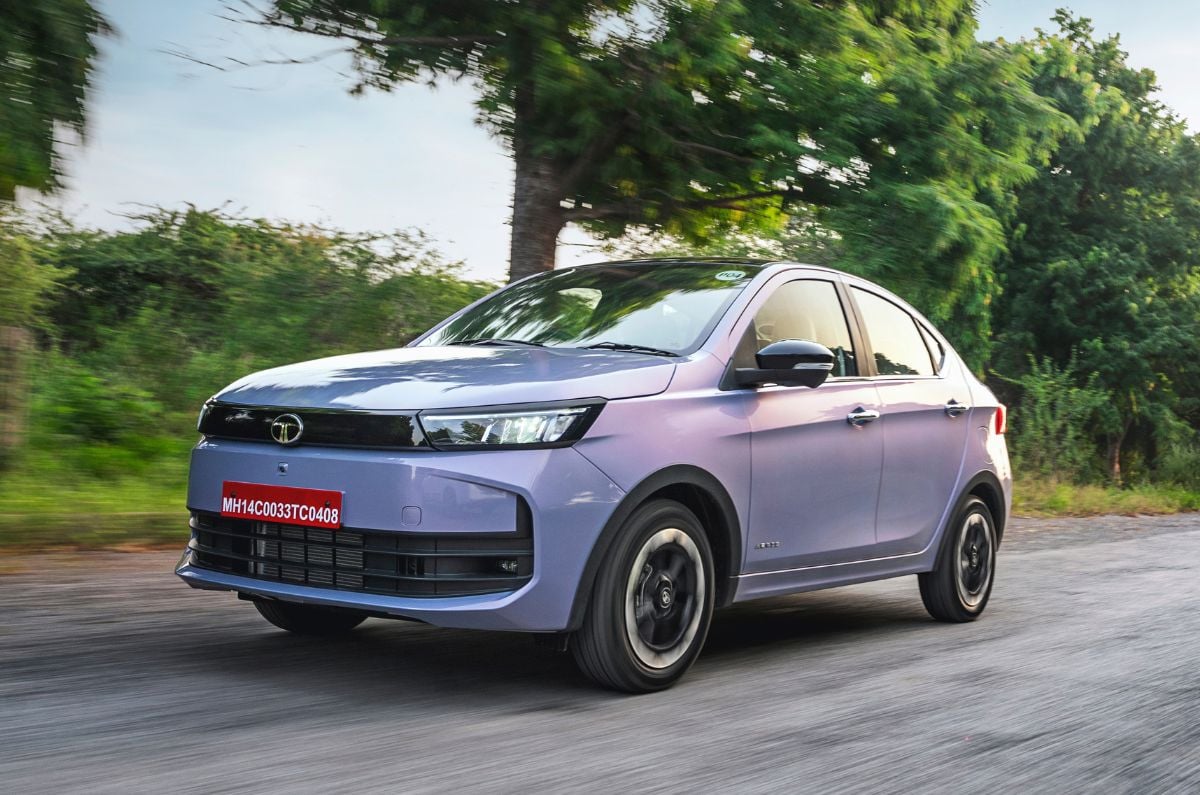
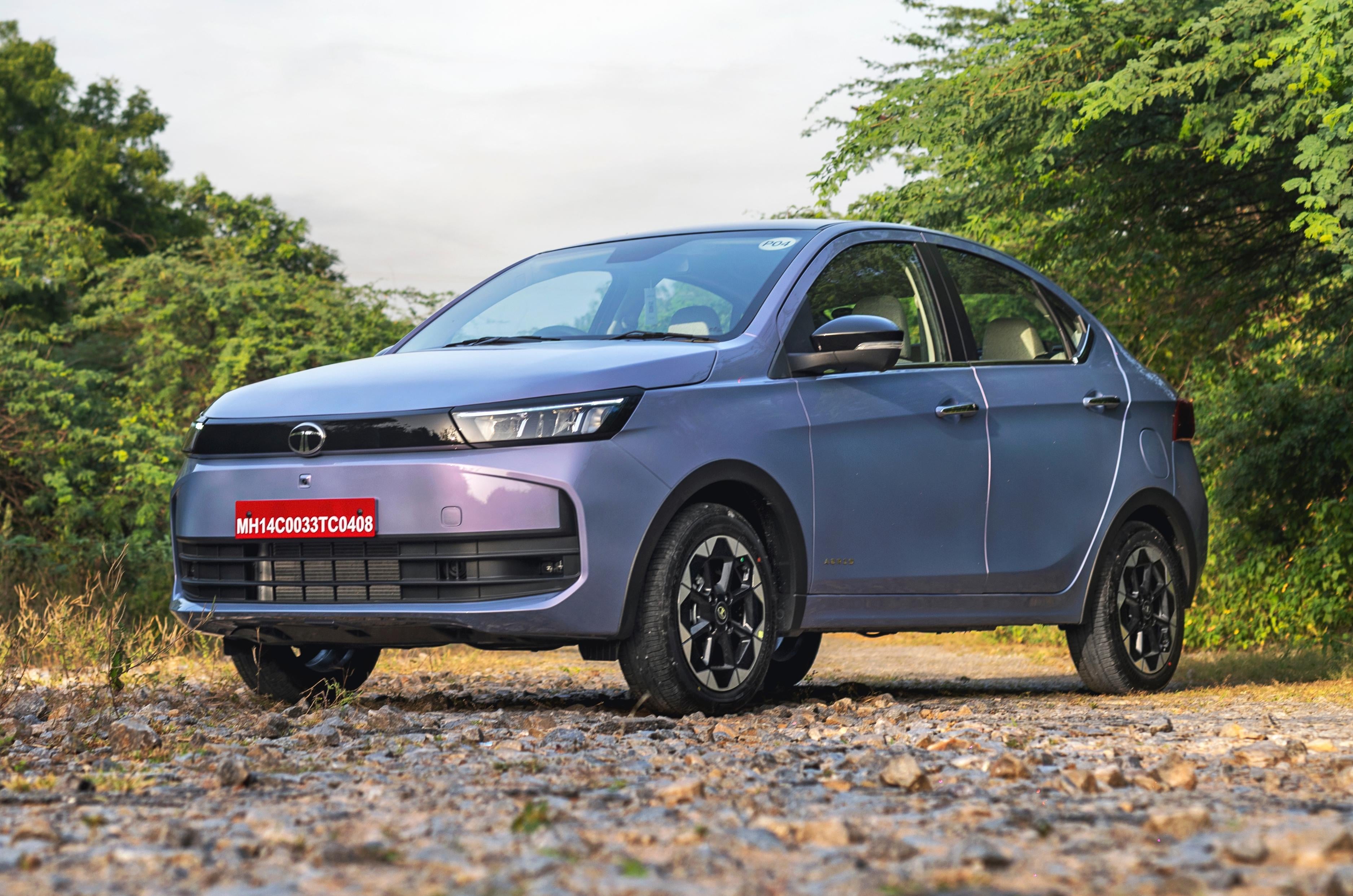
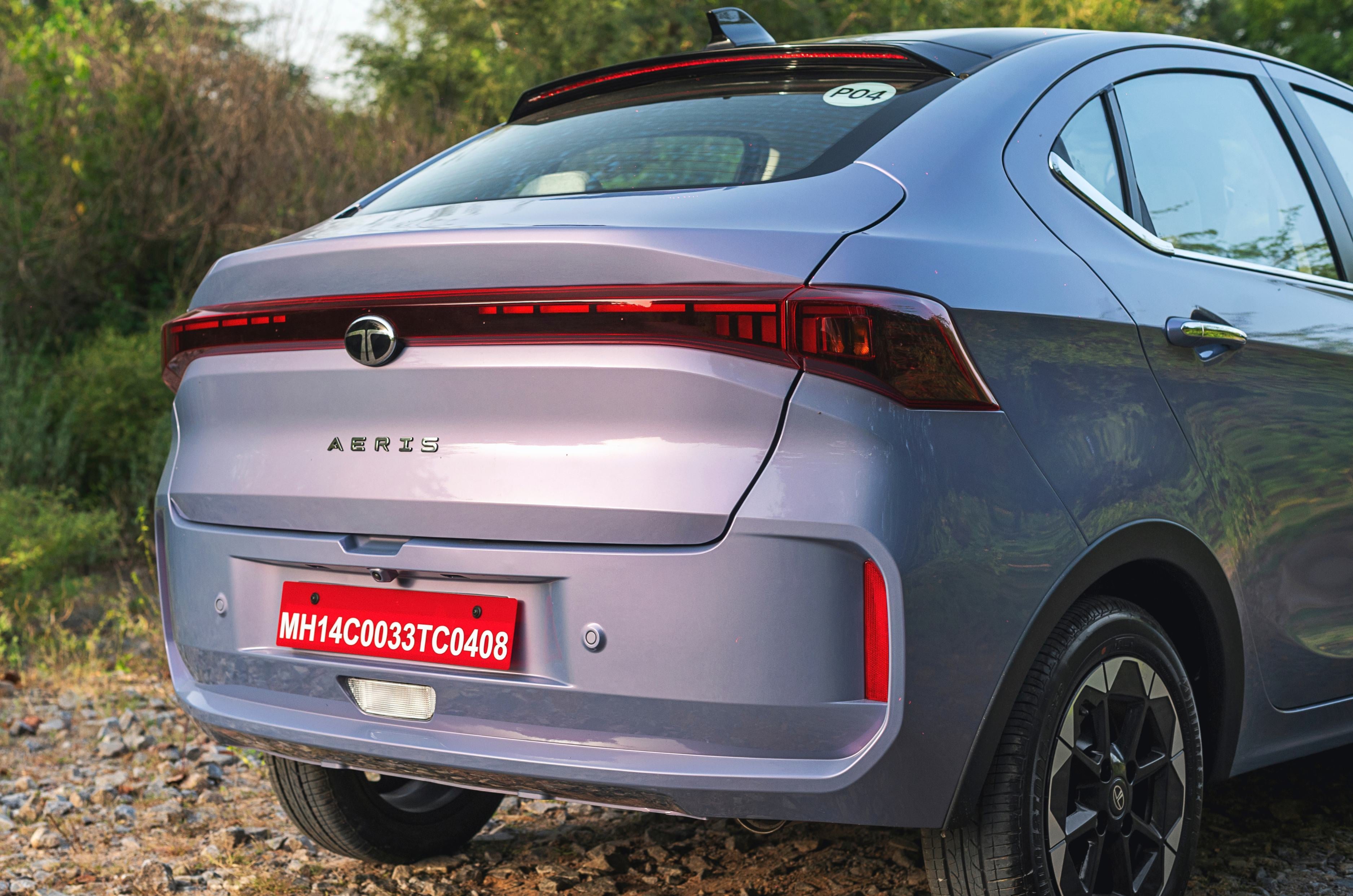
The Tata Aeris looks sleeker than before, with its design now closely aligned with the Tiago hatchback, something we have seen previously with the Tigor. Another factor that could work in the Aeris’ favour is Tata’s decision to offer it exclusively to private buyers, while retaining the Xpres, the fleet version of the Tigor, for commercial customers. This should help the Aeris steer clear of the ‘taxi’ tag often associated with rival compact sedans.
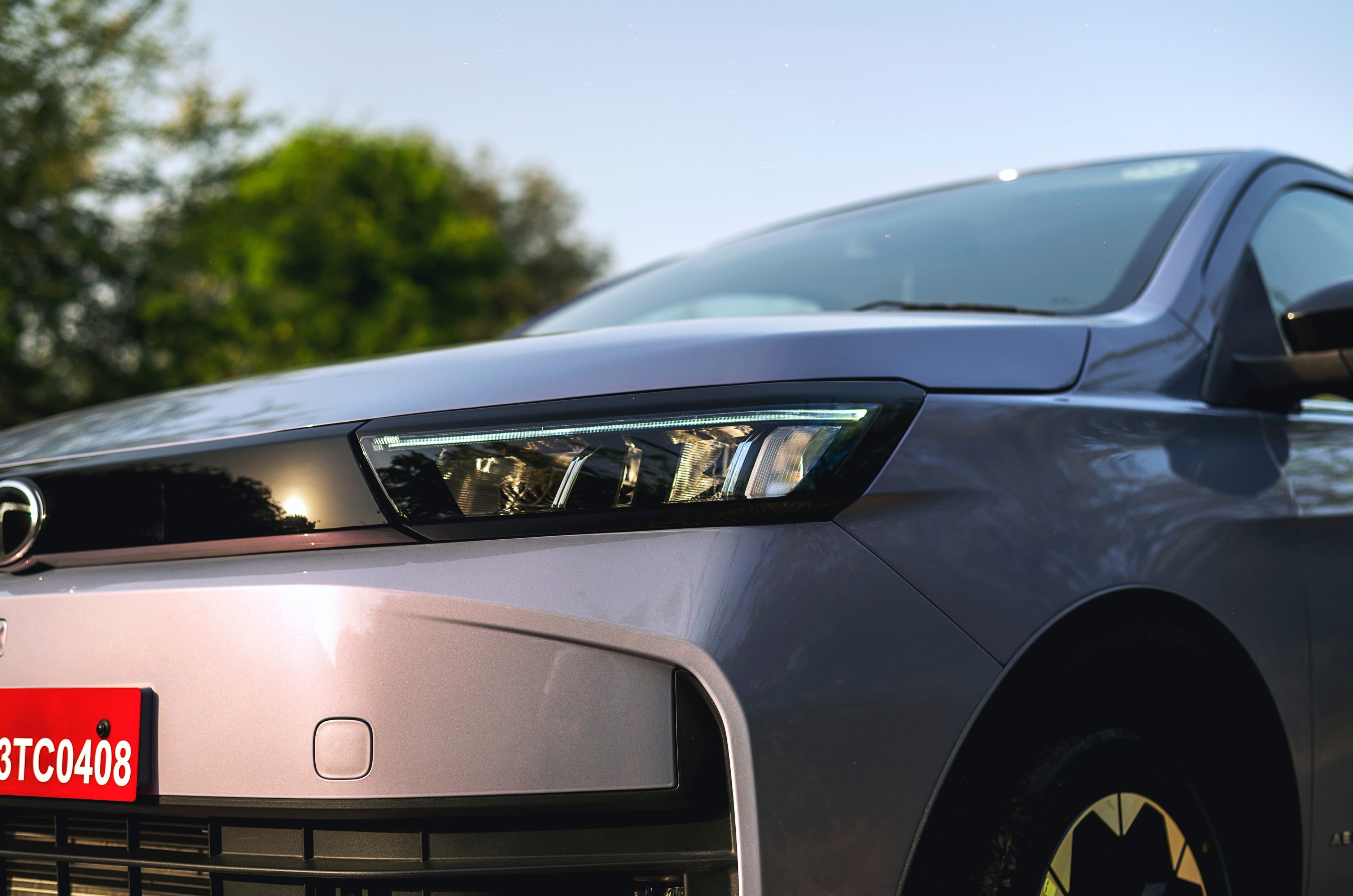
LED headlights with LED DRLs, which are connected by a black trim, make it look sleeker.
Up front, the new clamshell bonnet leads into slim LED headlights with thin LED DRL strips integrated into them. The headlights are connected by a gloss-black trim. The front bumper is also new, featuring wider air intakes and LED fog lamps, a welcome upgrade over the Tigor’s halogen units.
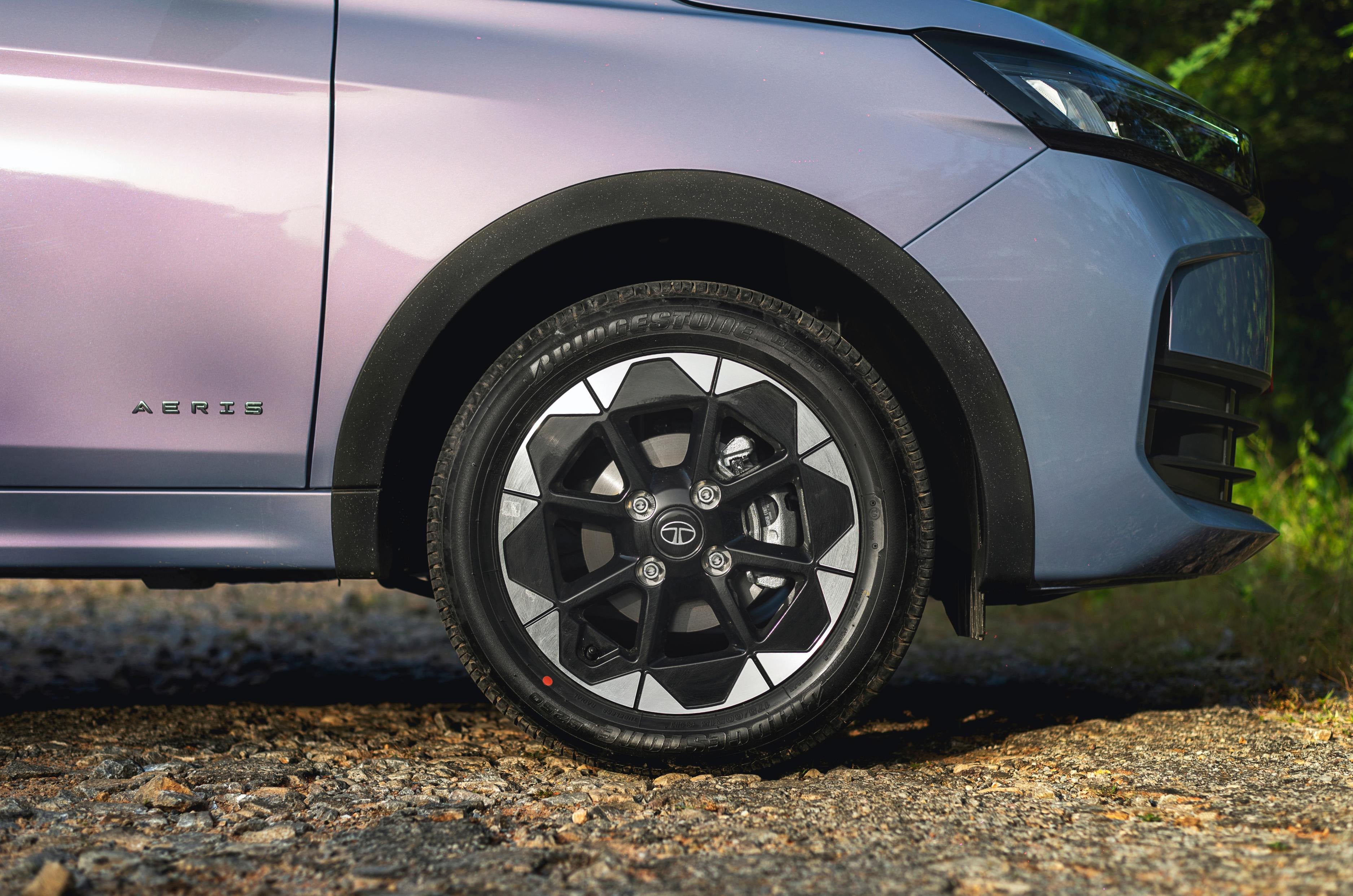
Top versions get 15-inch alloy wheels; 14-inch wheels on other variants appear undersized.
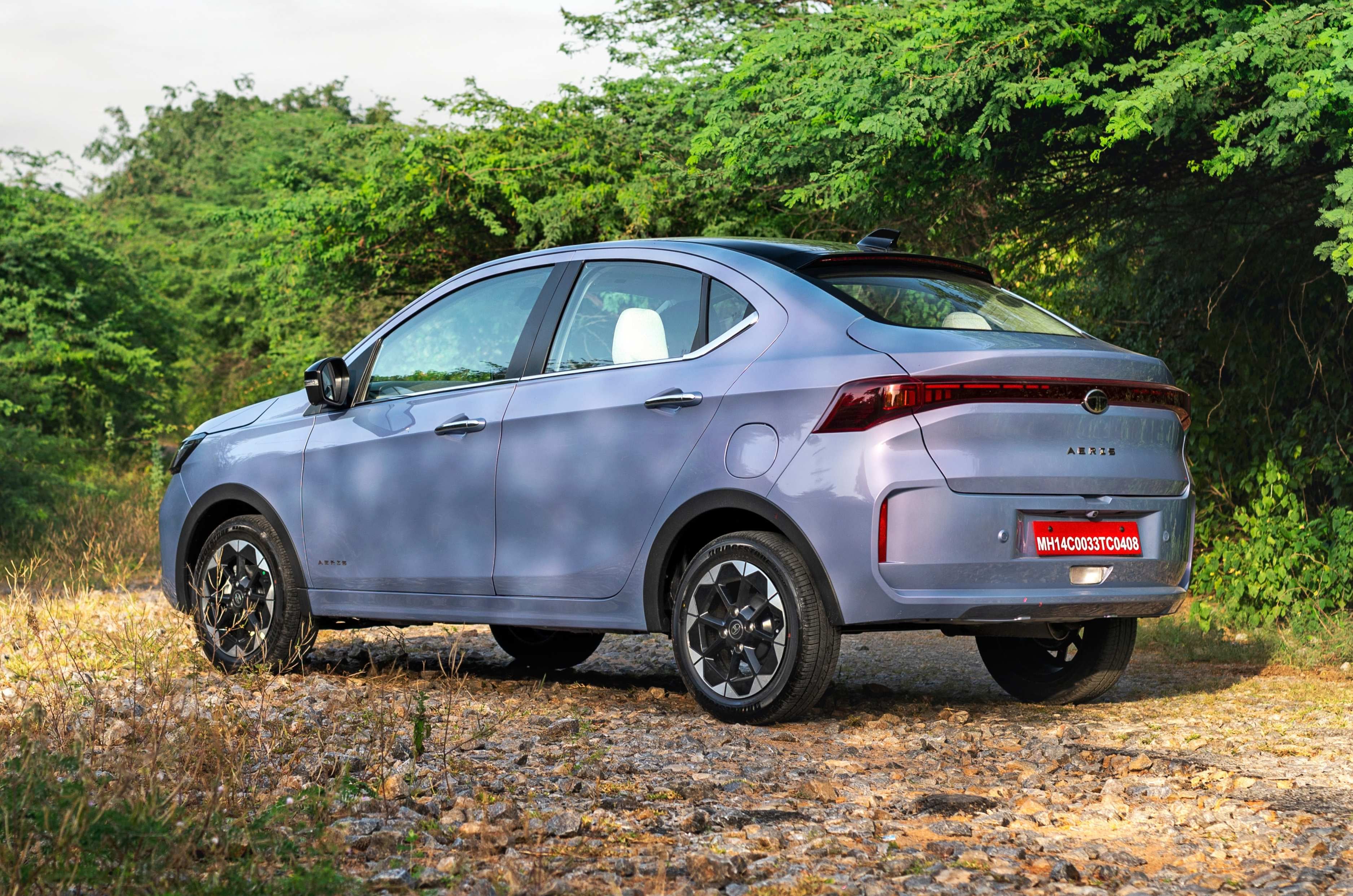
In profile, the 15-inch dual-tone alloy wheels fill the wheel arches nicely, and their contrasting finish looks particularly appealing when the Aeris is on the move. The wheel arches get slim cladding, which Tata says is made from recycled materials and features a distinctive speckled texture. Like the Tigor, the Aeris also gets chrome door handles and a chrome strip along the window line, adding some contrast to the otherwise clean design.
Fastback-like roofline remains a distinctive design element.
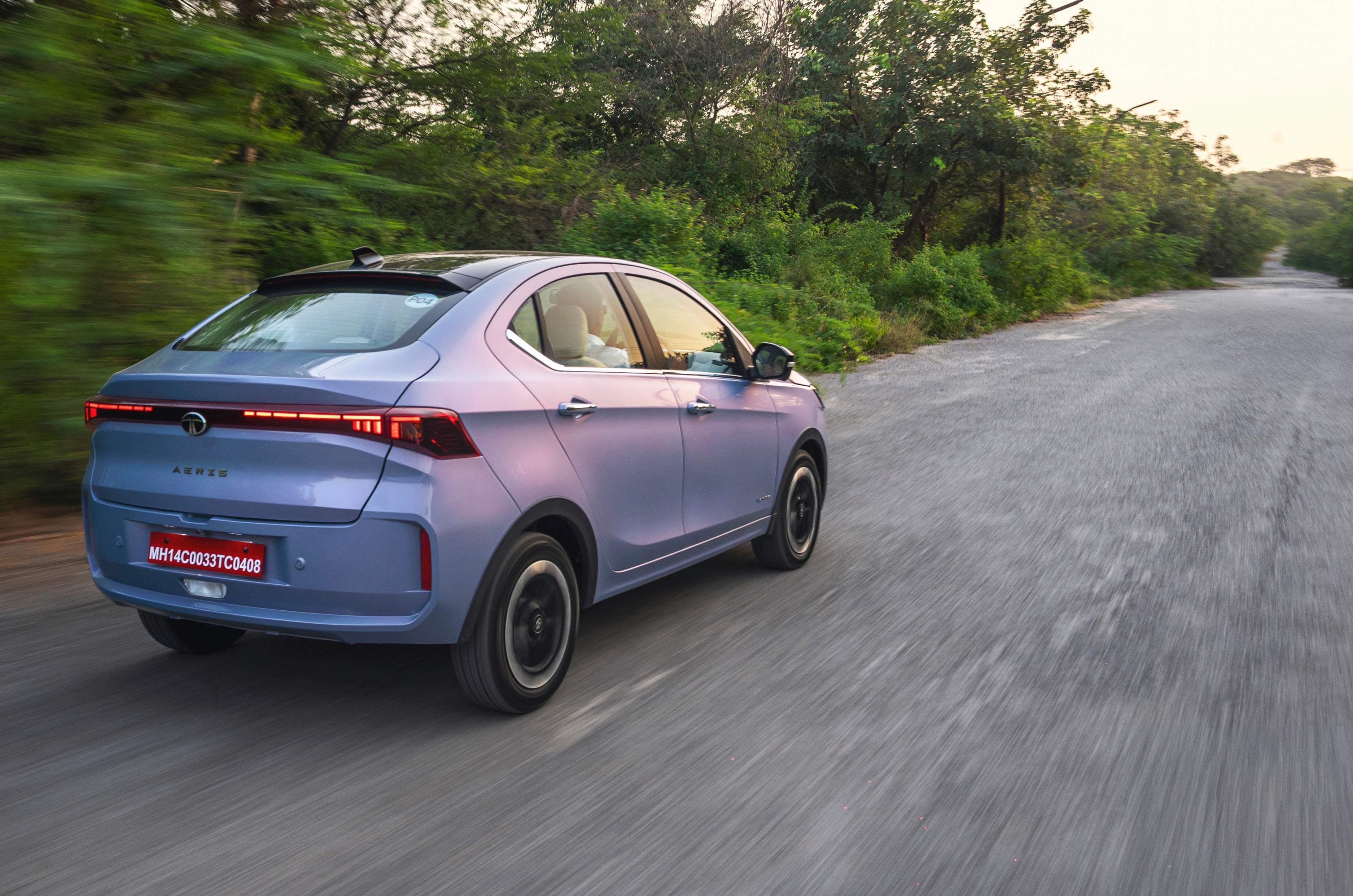
The coupe-like, tapering roofline remains unchanged from the Tigor, and continues to make the Aeris’ overall design cohesive. At the rear, the new taillights give the sedan a more modern appearance, while the red trim connecting them visually makes the Aeris appear larger than it is. The rear bumper is cleanly styled, with the reverse light neatly positioned in the centre.
The Aeris measures 3,995mm in length, 1,684mm in width and 1,532mm in height, and has a 2,450mm wheelbase.
Tata Aeris petrol interior space and comfort – 8/10
Beige theme makes the interior feel airy, and everything is nicely laid out in the cabin
Beige theme lends the cabin an airy feel; dashboard is neatly laid out.
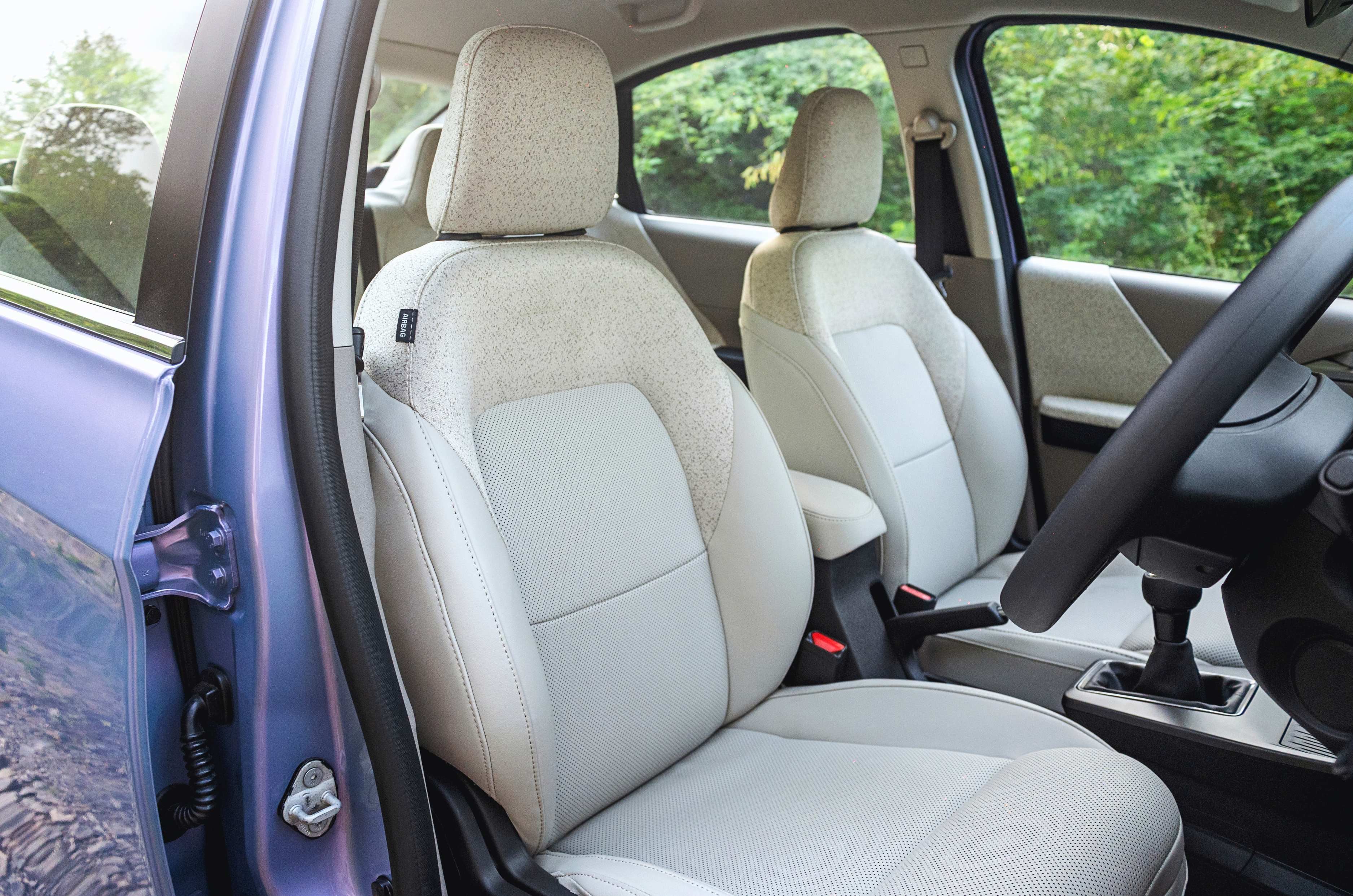
The Aeris’ interior is neatly laid out and looks fairly modern. The cabin gets a beige colour scheme, which makes it feel airy and gives the sedan a greater sense of space. However, the light shade could prove difficult to keep spick and span, especially with regular use.
The dashboard houses a 10.25-inch infotainment touchscreen, a free-standing semi-digital instrument cluster and a revised two-spoke steering wheel. The latter retains physical buttons and, thankfully, does away with the scratch-prone gloss-black finish seen on the Tigor. The door handles look floating like the Sierra and feel sturdy. Lower down, Tata has retained rotary dials and physical buttons for the climate control. They feel solid and do not come across as flimsy.
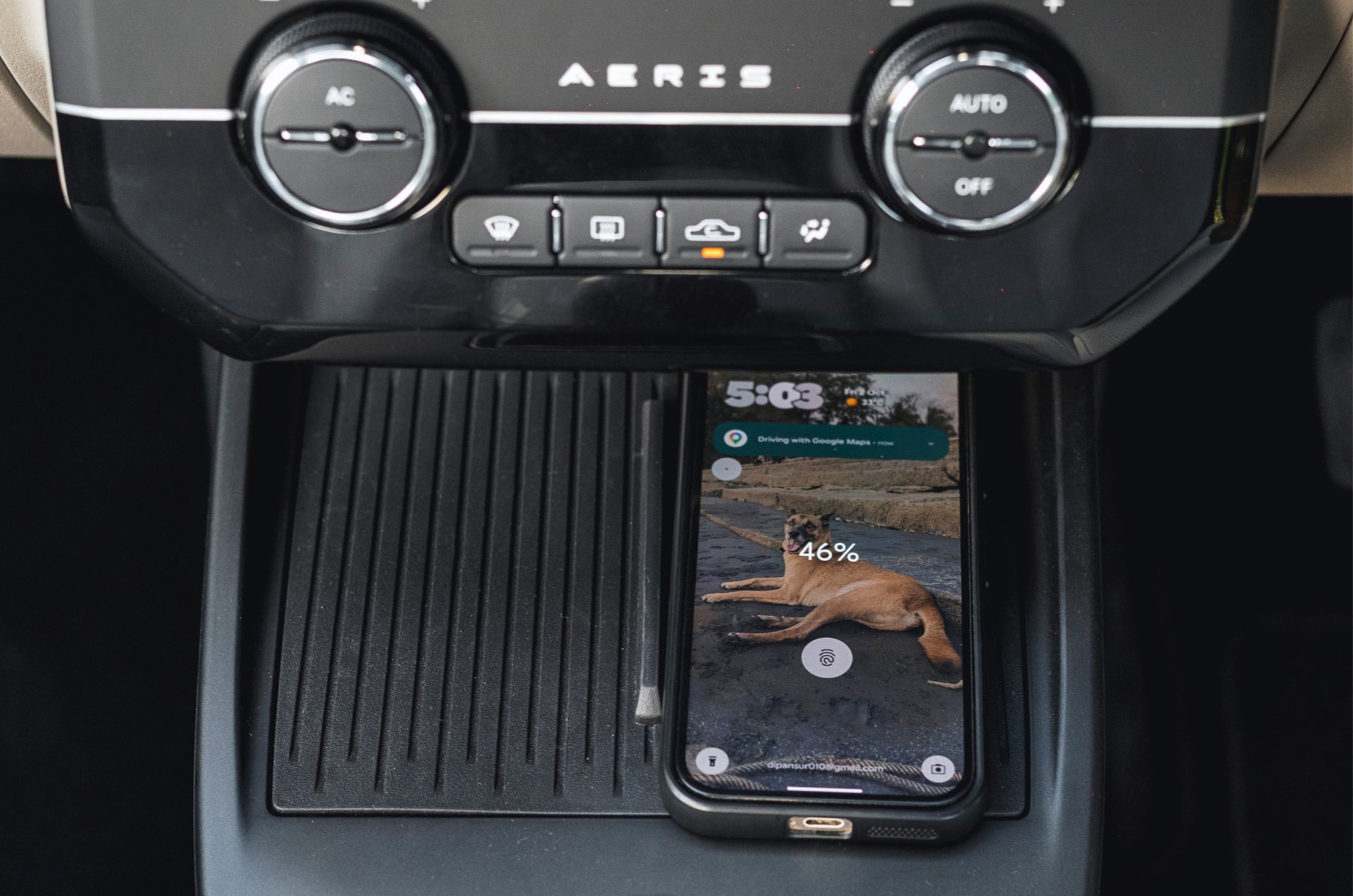
The wireless charger works well but tends to make the phone hot during prolonged use.
The centre console has been thoroughly redesigned and looks neat. The manual gear lever looks premium and feels good to hold, while the AMT gets a rotary dial that also feels solid and operates seamlessly. Two rubberised phone holders on the console keep phones from sliding around, and the top-spec Accomplished trim offers wireless charging in one slot. The centre console also gets two cupholders and a leatherette-wrapped centre armrest with integrated storage space underneath.
The rear seat offers good kneeroom and legroom, while headroom can be tight for taller passengers.
Tata offers part-leatherette upholstery and has revised the cushioning and bolstering, ensuring comfort even on long journeys. They also get a segment-first ventilation function. The rear seats are comfortable too, with good legroom and kneeroom, although headroom is a little tight for passengers over six feet tall. Under-thigh support is adequate.
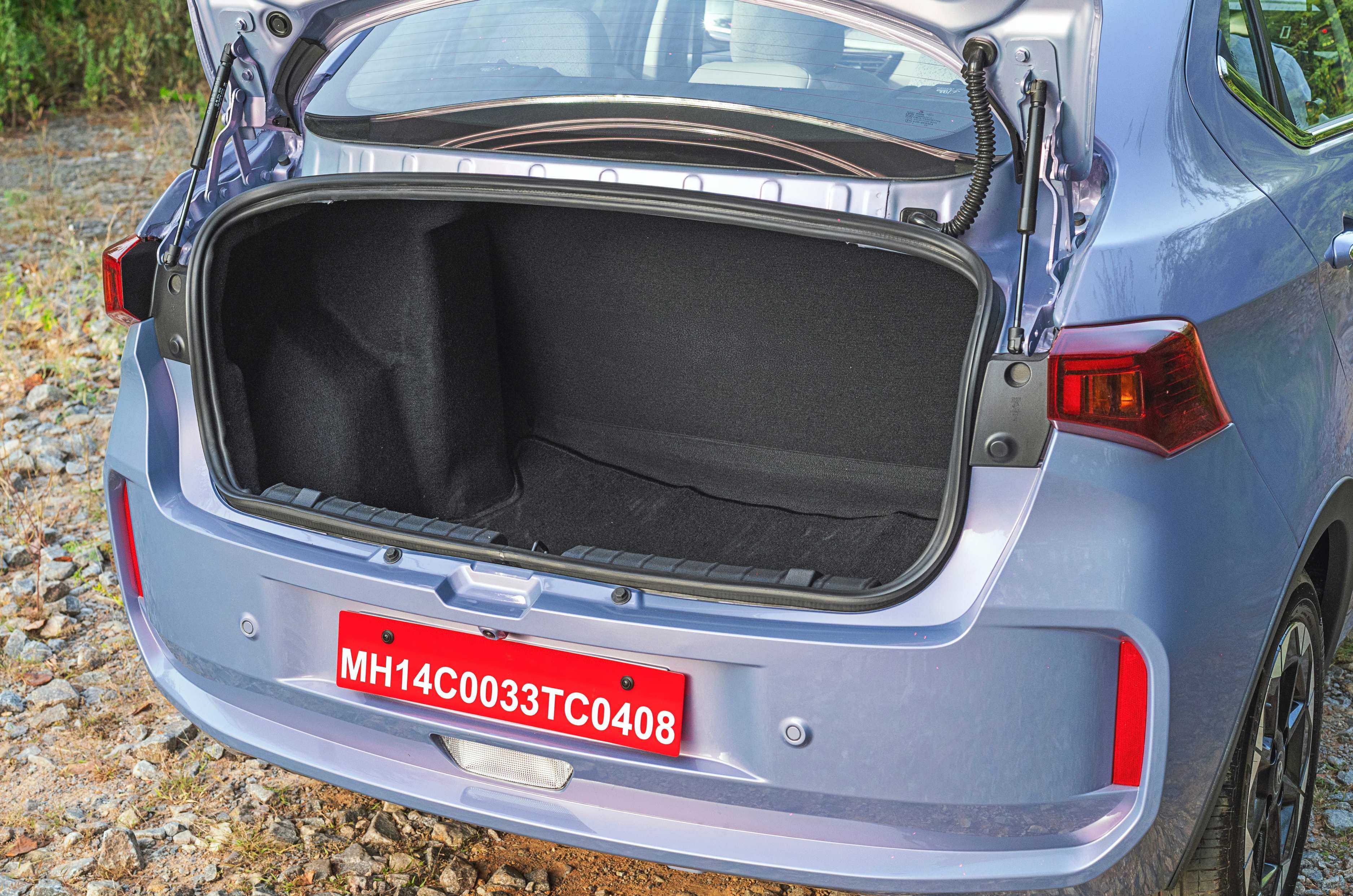
The 419-litre boot is handily large, but the aperture makes loading tricky. Struts free up more usable space.
The Aeris offers 419 litres of boot space, marginally more than the Amaze’s 416 litres and comfortably ahead of the Dzire’s 382 litres and Aura’s 402 litres. The boot itself is large and can swallow a substantial amount of luggage. The use of mechanical struts instead of conventional hinges is a clever touch, as they do not eat into the available boot space. Despite the large boot, the Aeris gets a 14-inch underbody-mounted spare wheel, which is always more promising than a puncture repair kit.
Tata Aeris petrol features and safety – 9/10
Loaded with features to the brim, most of which are well integrated
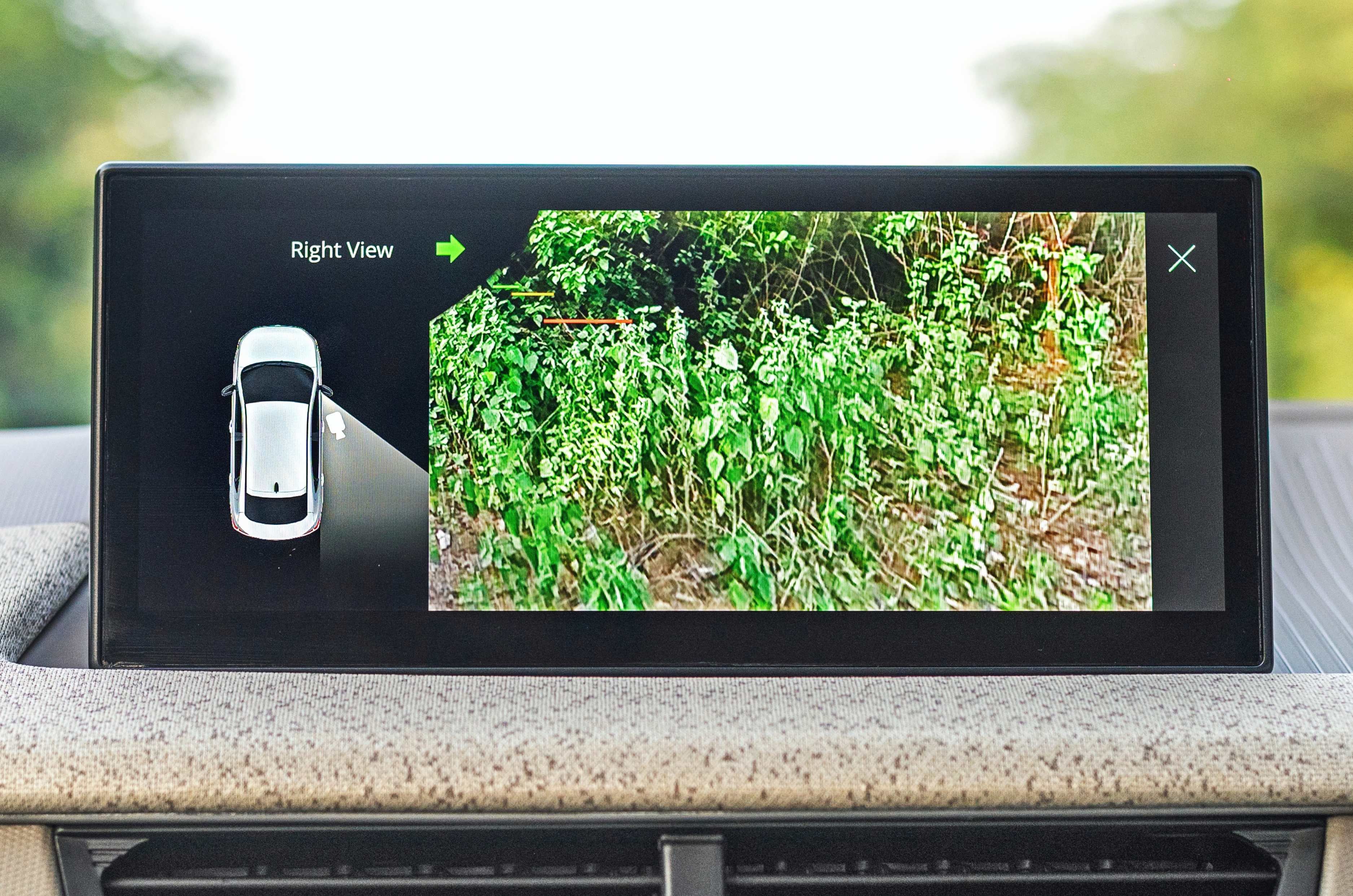
Blind-spot monitor is very useful but takes up the full screen and hides the map display.
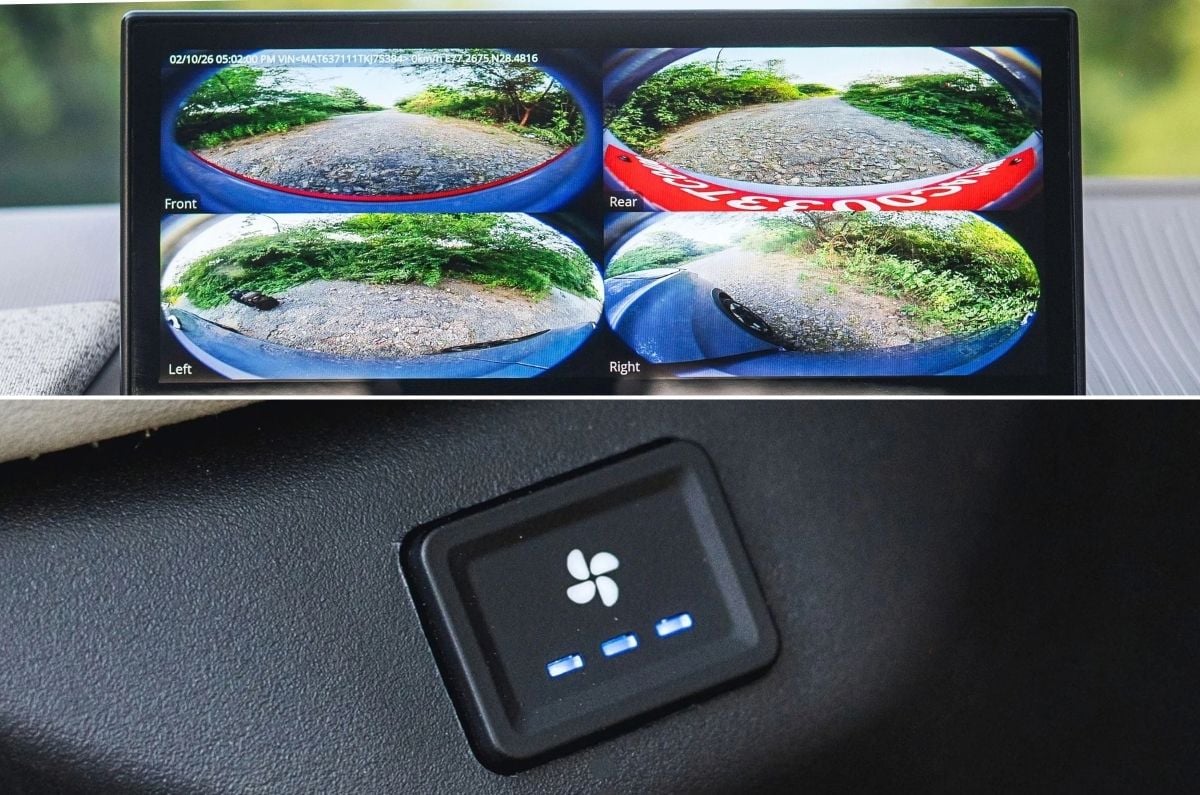
Like other Tata cars, the Aeris is packed with features. The 10.25-inch infotainment touchscreen is slick to use and remains responsive even when navigating through multiple menus. It also displays the 360-degree camera feed, which is lag-free, although the image quality isn’t the best. Tata has also added a new DVR function that allows the surround-view cameras to record the car’s surroundings, ensuring you do not shell out extra for a dashcam. The infotainment screen automatically switches to the blind-spot monitor when indicators are used, which is useful. However, this can be annoying when you are using navigation, although there is an option to disable the view completely.
Revised cushioning and bolstering, and a new ventilation function on the front seats improve overall comfort.
The front-seat ventilation function works well too. During our time with the car, it proved effective at keeping us cool in Faridabad’s near 40deg C ambient temperature. However, the infotainment screen or driver’s display shows nothing when the ventilation is on or the level is adjusted, which can be a little inconvenient.
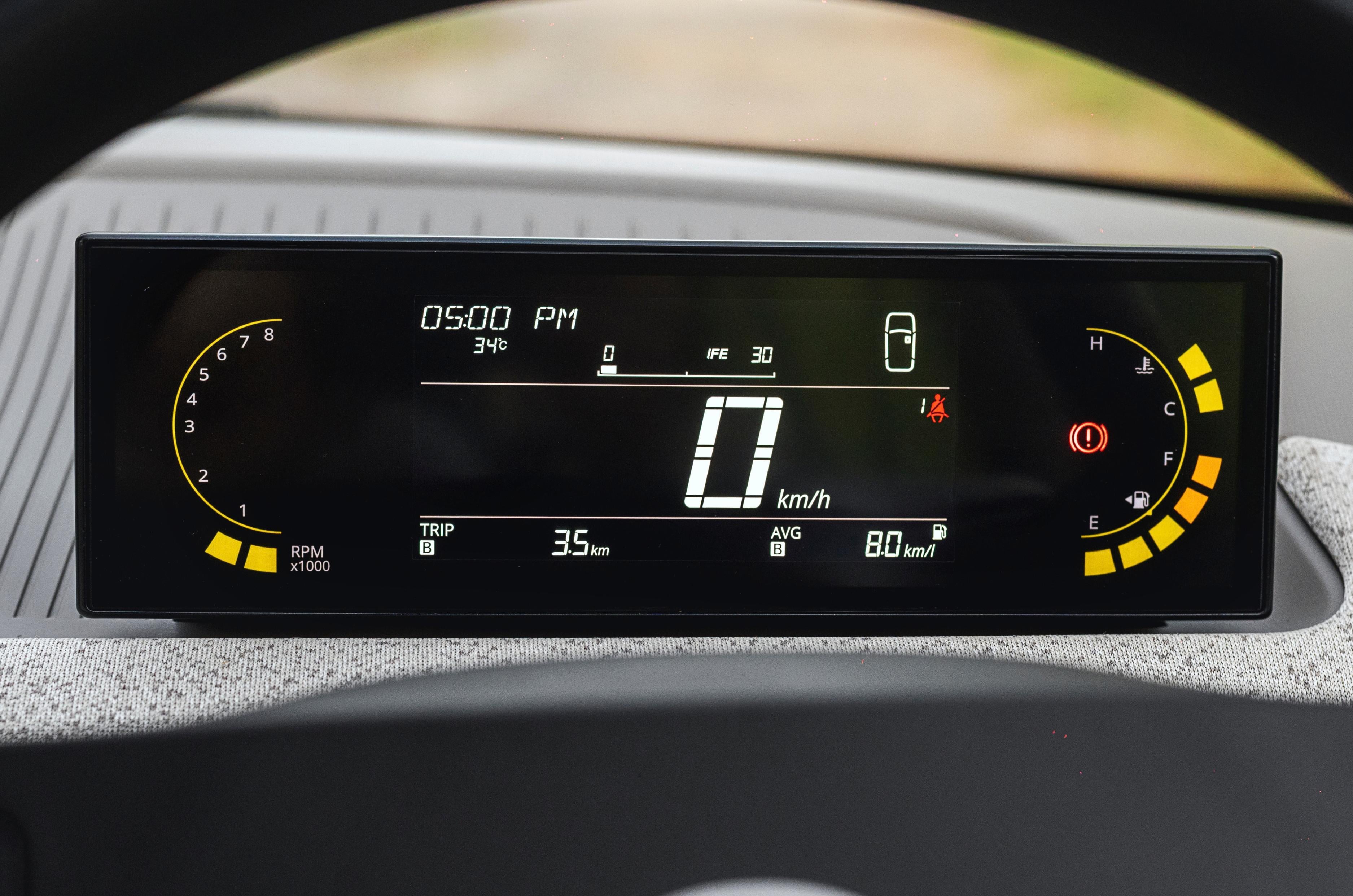
Part-digital Instrument cluster includes screen flanked by rev counter and fuel gauge.
The instrument cluster itself is fairly basic, with analogue dials for the fuel level and rev counter, while a digital display handles the speed and other general information. Depending on the steering wheel’s tilt angle and the driver’s seating position, some of this information can occasionally be obscured.
The four-speaker, two-tweeter audio system is a step down from the Tigor’s four-speaker, four-tweeter setup, although sound quality remains good enough for the segment. The rear seats lack pressure sensors, meaning the seat-belt warning will sound until the belts are fastened.
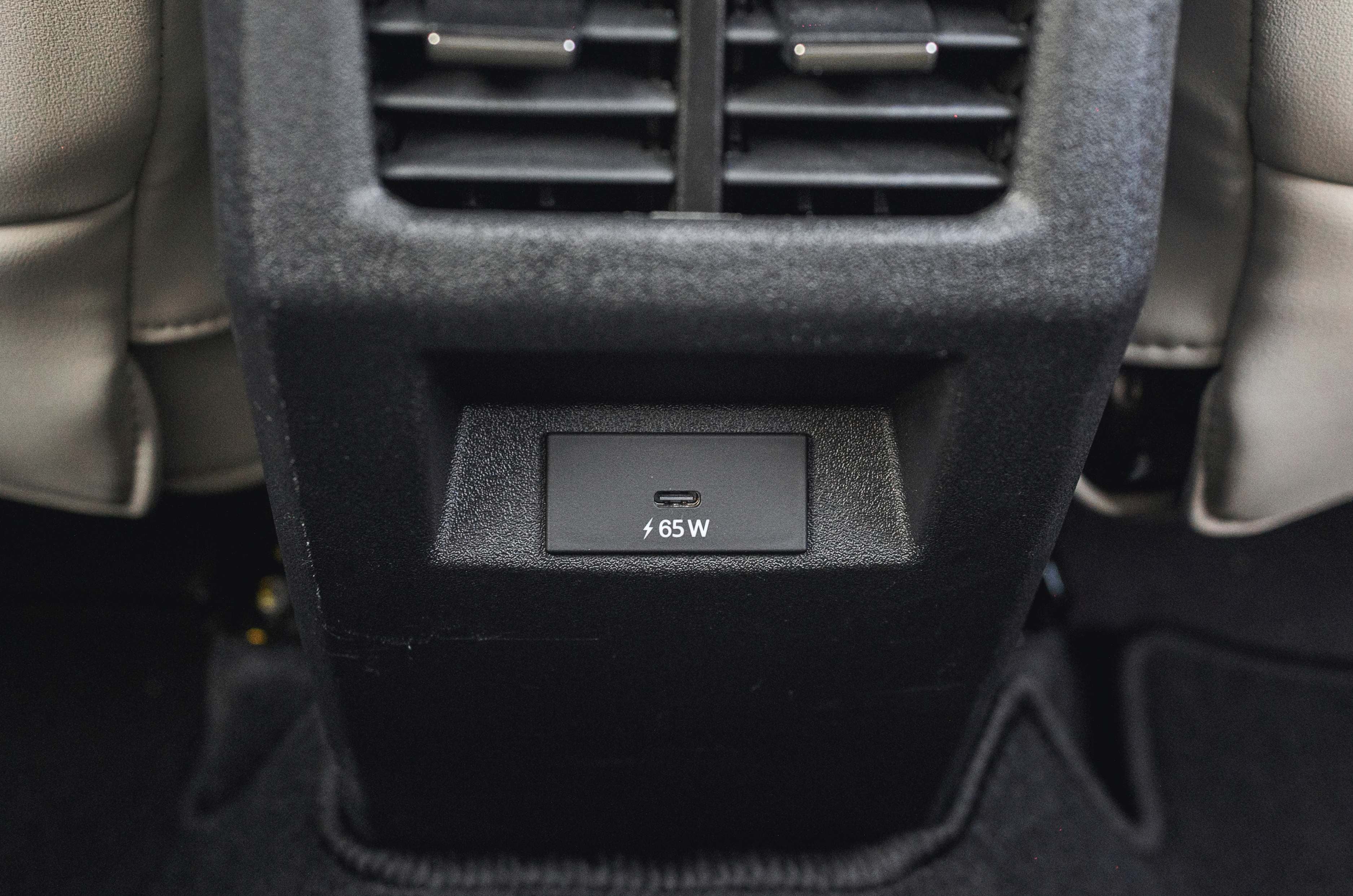
AC vents and a 65W Type-C charging port are among the additions at the back.
On the safety front, the Aeris gets six airbags, Isofix child-seat anchorages for the rear seats, rear parking sensors and three-point seat belts with reminders for all occupants as standard. Higher variants add a 360-degree camera, a day/night inside rear-view mirror, rain-sensing wipers, a rear defogger, a tyre pressure monitoring system (TPMS) and ESP with traction control. The pre-facelift Tigor scored four stars in Global NCAP testing in 2020, but a Bharat NCAP test for the Aeris is due.
Tata Aeris petrol value for money and verdict – 8/10
A well-rounded compact sedan, with the petrol engine making it more versatile
Priced from Rs 5.29 lakh, it offers strong value in a segment where affordability matters.
The Tata Aeris is a much more appealing proposition than the Tigor it replaces. Its fresh design, well-equipped cabin, generous boot and comfortable ride make it easy to live with, while the petrol engine gives it enough performance for both city and high-speed highway cruising. The manual gearbox is light and easy to use, while the AMT is better suited to relaxed city driving than enthusiastic highway use. The long list of features adds further appeal to the package.
There are some shortcomings too, including a coarse engine and poor cabin insulation. However, the Aeris’ biggest strength is its pricing. The petrol variants are priced from Rs 5.29 lakh to Rs 8.74 lakh (ex-showroom), and it undercuts rivals by a fair margin, making a strong case for itself in a segment where value for money remains a key consideration.
Petrol Diesel Price Today: पेट्रोल और डीजल की कीमतों में होने वाला थोड़ा सा भी बदलाव सीधे आम लोगों के बजट को प्रभावित करता है। तेल कंपनियां हर दिन सुबह 6 बजे पेट्रोल और डीजल के नए रेट जारी करती हैं। वहीं 8 अक्टूबर, गुरुवार को देश के प्रमुख शहरों में पेट्रोल और डीजल के दामों में कोई बदलाव नहीं हुआ। अंतरराष्ट्रीय बाजार में कच्चे तेल और पेट्रोलियम उत्पादों की कीमतों में बढ़ोतरी देखी जा रही है। अमेरिका-ईरान के बीच युद्ध की आशंका और तेल सप्लाई प्रभावित होने की चिंता के कारण वैश्विक बाजार में दबाव बढ़ा है। इसके बावजूद भारत में सरकारी तेल कंपनियों ने फिलहाल पेट्रोल और डीजल के दाम स्थिर रखे हैं।
ईंधन के दाम बढ़ने या घटने का असर सिर्फ वाहन चालकों पर ही नहीं, बल्कि रोजमर्रा की जरूरतों और सामान की कीमतों पर भी पड़ सकता है। इसलिए रोजाना पेट्रोल-डीजल के ताजा रेट जानना लोगों के लिए जरूरी है।
आपके शहर में आज कितनी है पेट्रोल, डीजल की कीमत
शहर पेट्रोल (₹/लीटर) डीजल (₹/लीटर)
नई दिल्ली 102.12 95.20
मुंबई 111.21 97.83
कोलकाता 113.51 99.82
चेन्नई 107.77 99.55
गुड़गांव 102.97 95.64
नोएडा 101.96 95.44
बेंगलुरु 111.68 99.56
भुवनेश्वर 108.97 100.68
चंडीगढ़ 101.54 89.47
हैदराबाद 116.15 104.23
जयपुर 112.66 98.25
लखनऊ 101.86 95.36
पटना 113.37 99.36
तिरुवनंतपुरम 115.49 104.40
इस कंपनी ने बढ़ाए थे दाम
इस बीच, देश की बड़ी निजी ईंधन कंपनियों में शामिल नायरा एनर्जी ने पेट्रोल और डीजल के दाम बढ़ा दिए हैं। कंपनी ने पेट्रोल की कीमत में 5 रुपये प्रति लीटर और डीजल में 3 रुपये प्रति लीटर की बढ़ोतरी की है। अंतरराष्ट्रीय बाजार में कच्चे तेल के दाम बढ़ने और ऊर्जा आपूर्ति पर असर पड़ने के बाद कंपनी ने यह कदम उठाया है। फरवरी के अंत में अमेरिका-ईरान युद्ध शुरू होने के बाद तेल की कीमतों में तेजी का असर ग्राहकों तक पहुंचाने वाली नायरा एनर्जी पहली भारतीय ईंधन खुदरा कंपनी बनी थी।
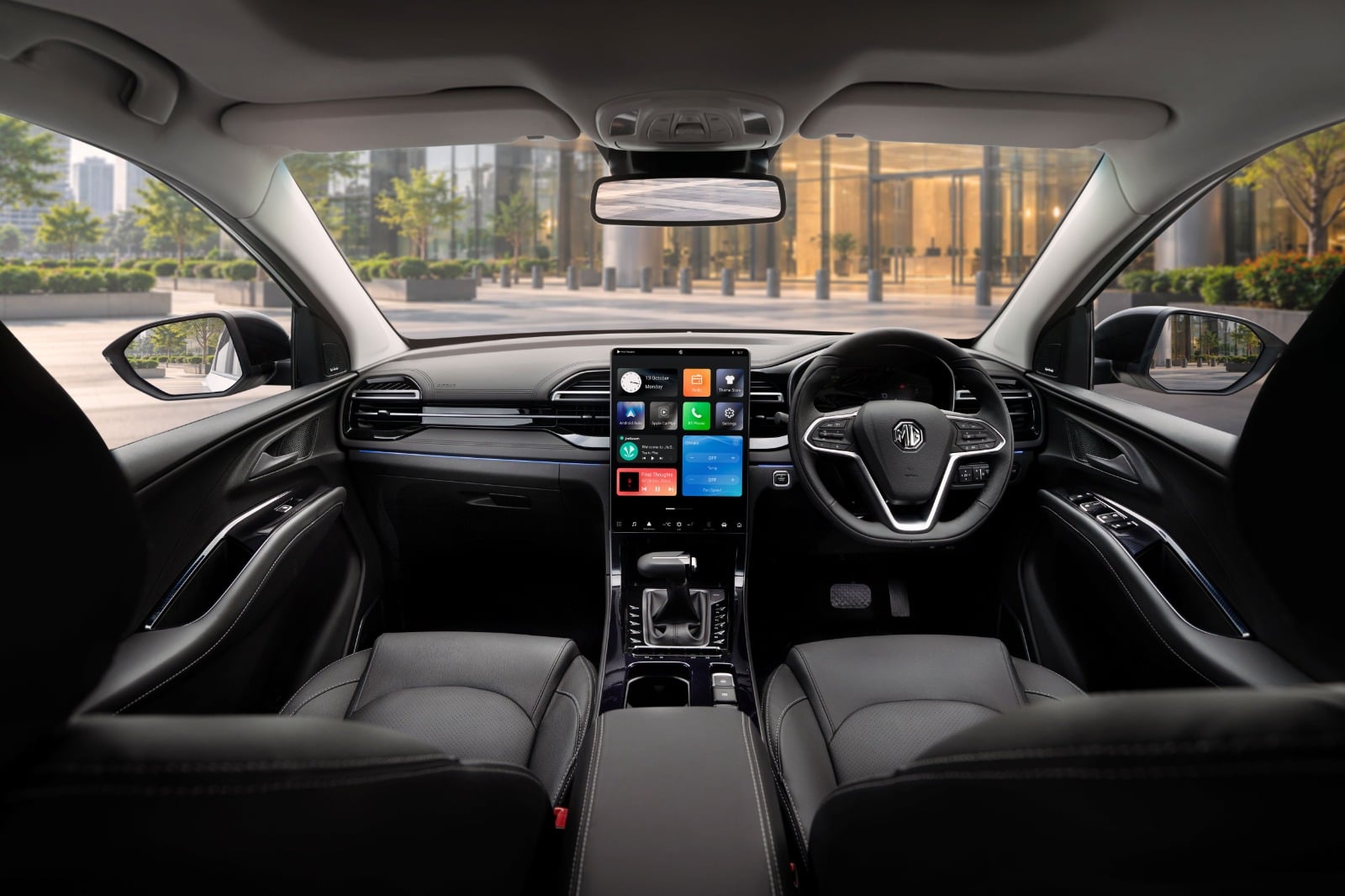
MG Motor India has launched new Hector Blackstorm and Snowstorm special edition SUVs, each priced at Rs 20 lakh (ex-showroom). These limited-run models get new exterior colour schemes, , dark-themed interiors, and edition-specific accessories. Both the Blackstorm and Snowstorm editions are only available with the 5-seater configuration and the 1.5-litre petrol-CVT powertrain. Compared to the top-spec Savvy Pro CVT variants, the Blackstorm and Snowstorm editions command a premium of Rs 35,000.
Hector Storm series carries a premium of 35,000 over the top-spec Savvy trim
Interior gets an all-black finish with edition name embossed on front headrests
Available only in a 5-seat configuration and 1.5-litre petrol-CVT powertrain
MG Hector Storm Series: what’s new?
As the name suggests, the Blackstorm Edition gets an all-black exterior finish while the Snowstorm gets a Pearl White exterior with a contrasting Starry Night finish for the roof. Both versions also get blacked-out alloy wheels with red brake callipers, a blacked-out grille and roof rails, and dark chrome accents on the logos, skid plates, tailgate accents, and body-side cladding. The LED headlamp bezels have also been blacked-out and the tail gate gets a new smoked effect.
On the inside, the black theme continues for the dashboard and seat upholstery, and the edition name is also embossed on the front seat headrests. Customers can also avail for a Storm Series package comprising edition-specific logos, a red tailgate accent, fog lamp garnish and ORVM protectors with red accents and side step boards. Otherwise, the equipment suite remains unchanged from the top-spec Savvy trim.
MG Hector Storm Series: powertrain options
The Hector Blackstorm and Snowstorm editions are only available with the 1.5-litre, four-cylinder turbocharged petrol engine with the CVT gearbox; no manual gearbox option here. The engine produces 143hp and 250Nm. It is also only available in a 5-seater configuration, missing out on the 7-seat layout.