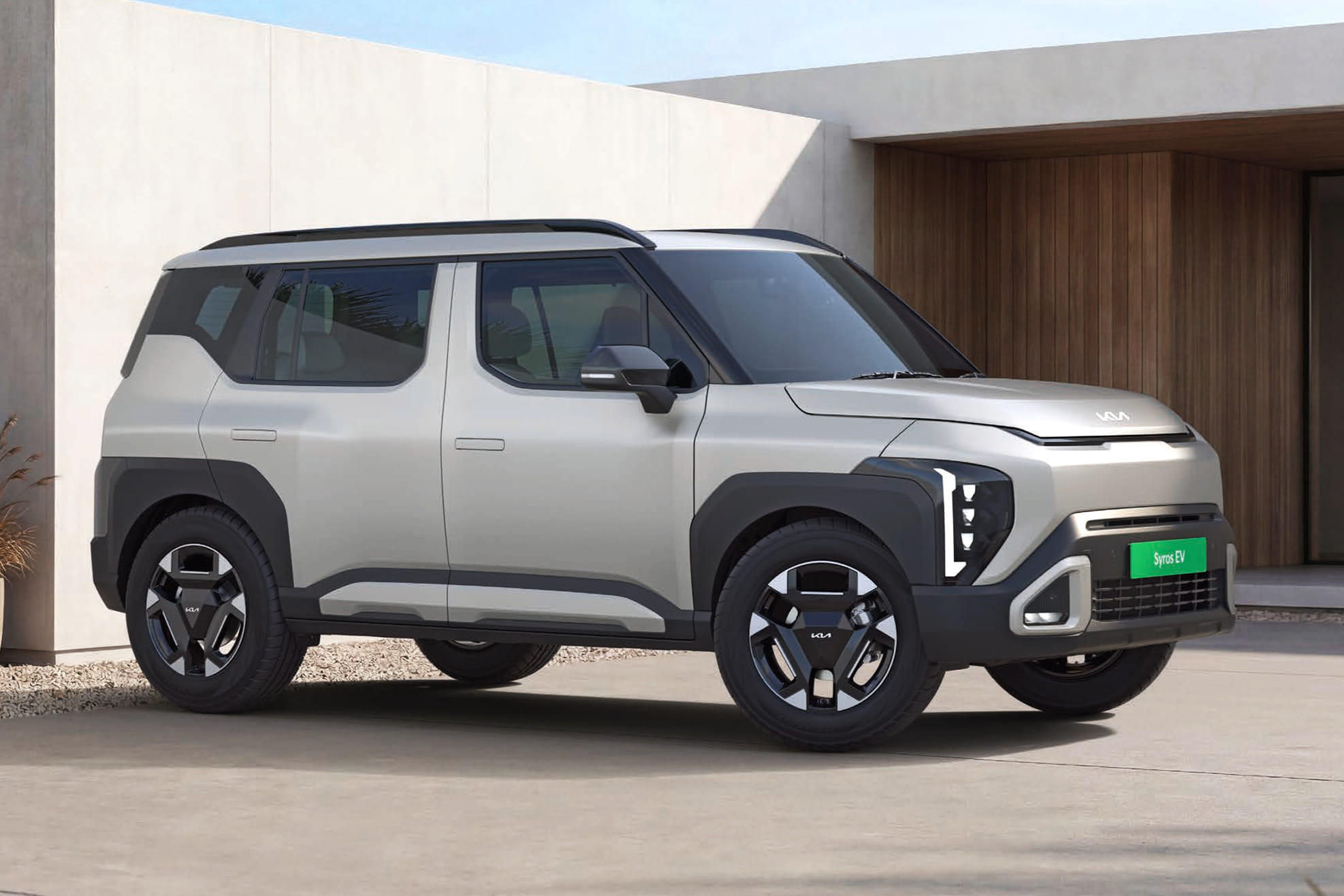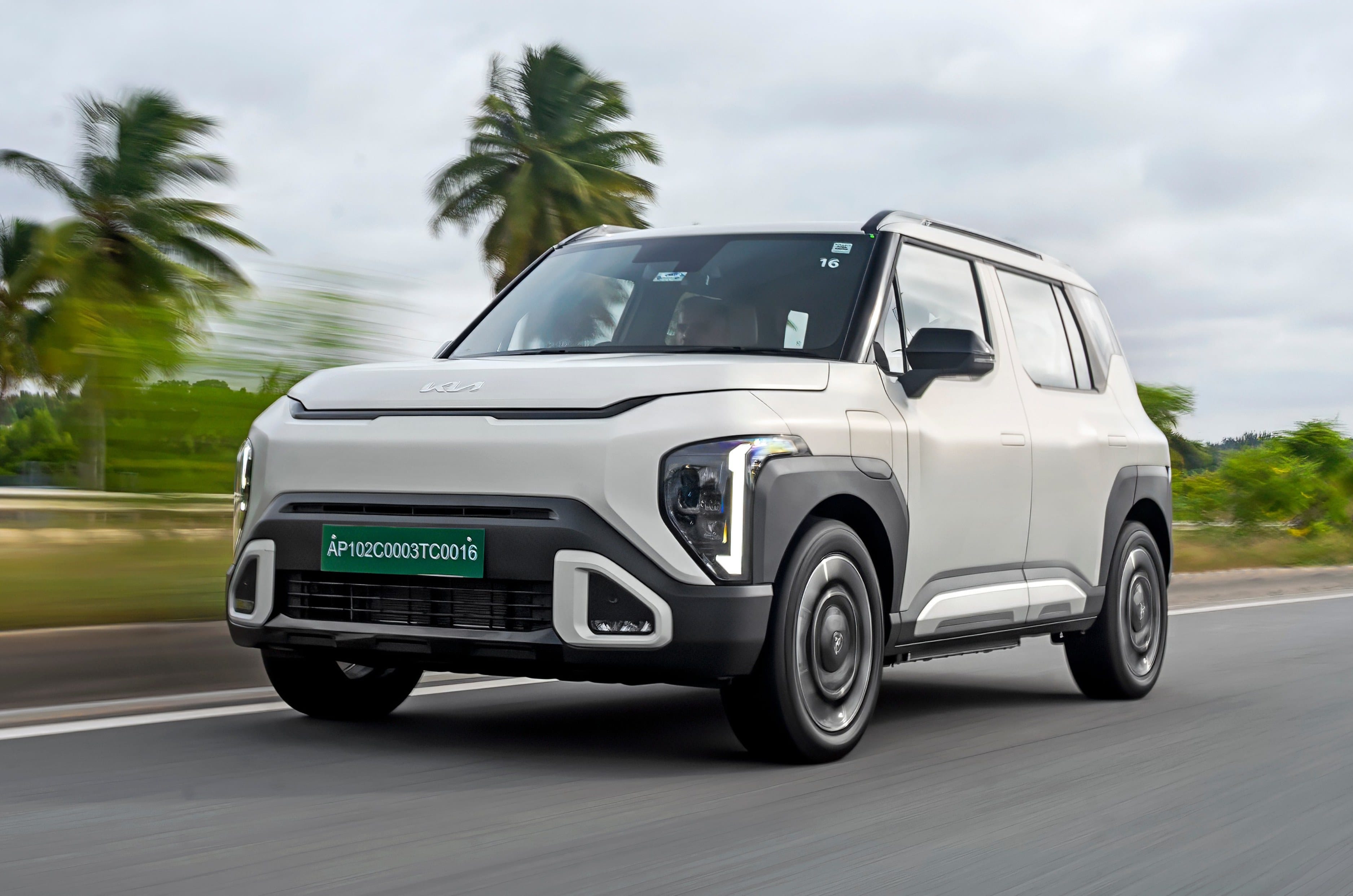
Kia Syros EV: Born to be electric

Kia Syros EV front quarter tracking

Kia has chosen the Syros to be its second mass market EV for the Indian market. Despite its superb packaging, oddball styling and high initial prices held back the original ICE version against traditional compact SUV rivals. However, EV customers are generally more accepting of avant-garde design, so can the Syros EV find success where the ICE version couldn’t? We drove it in Bengaluru to find out.

Kia Syros EV Exterior Design and Engineering – 7/10
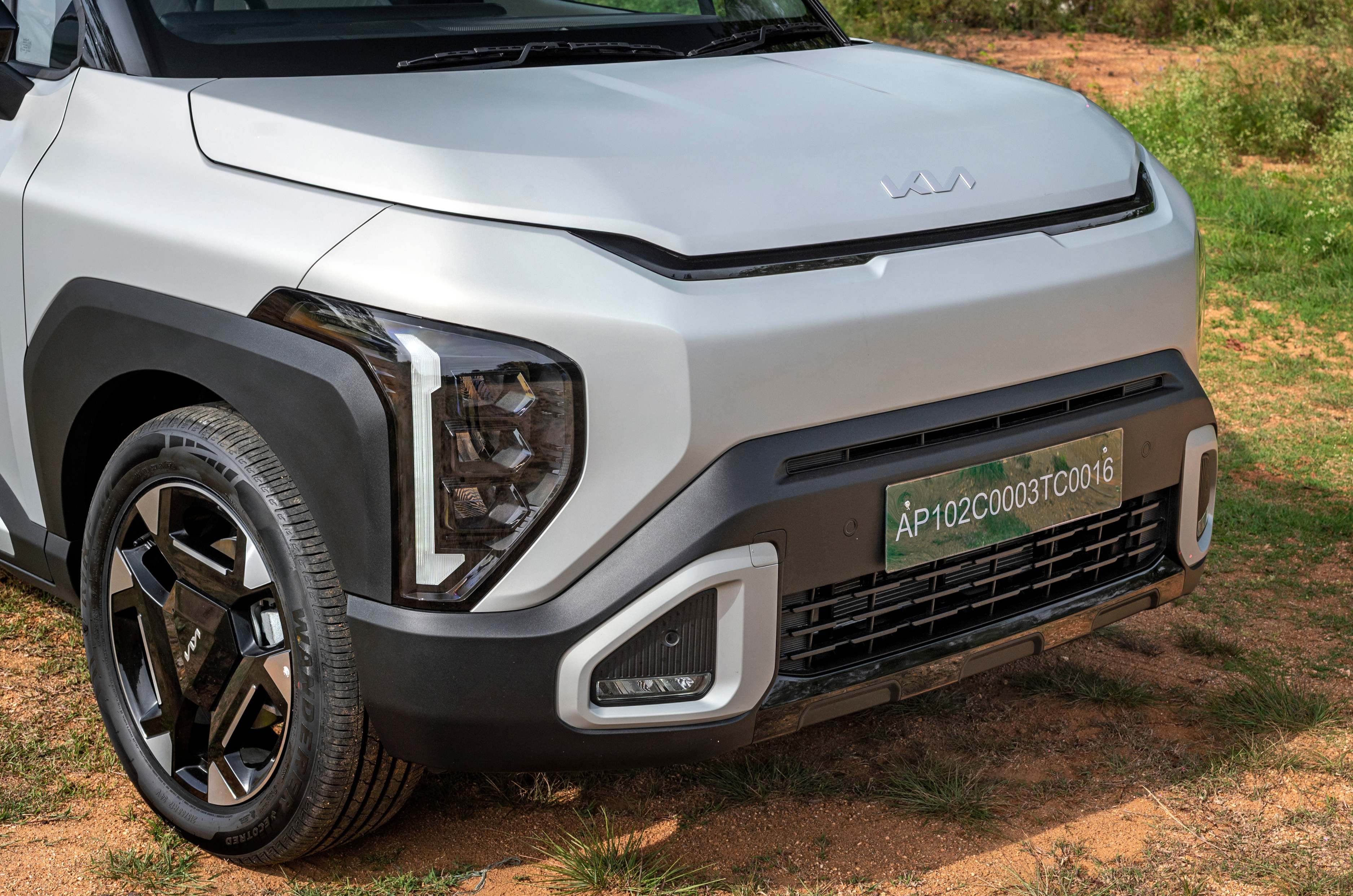
EV has a slimmer intake above the number plate and slightly different lower bumper

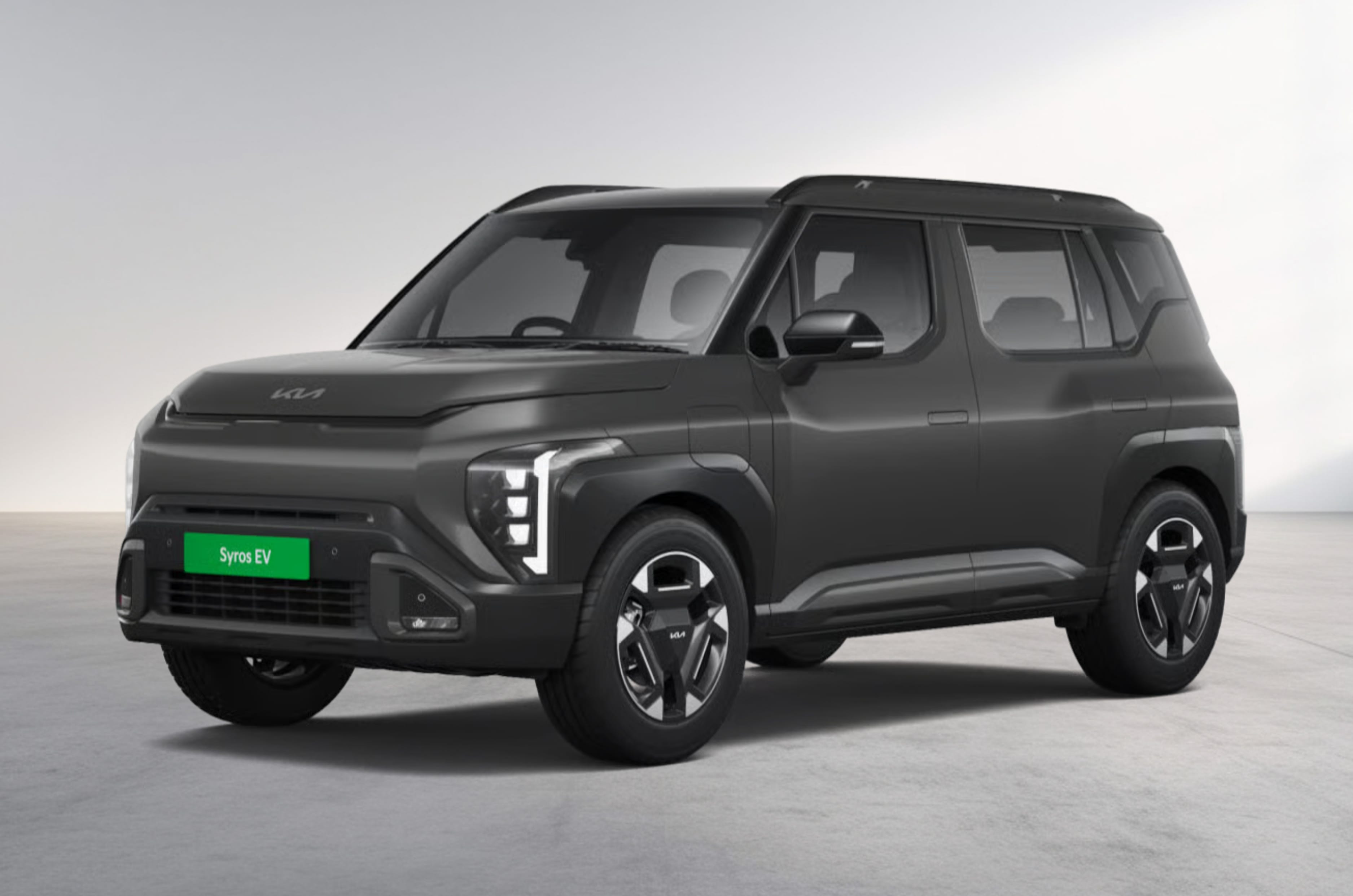
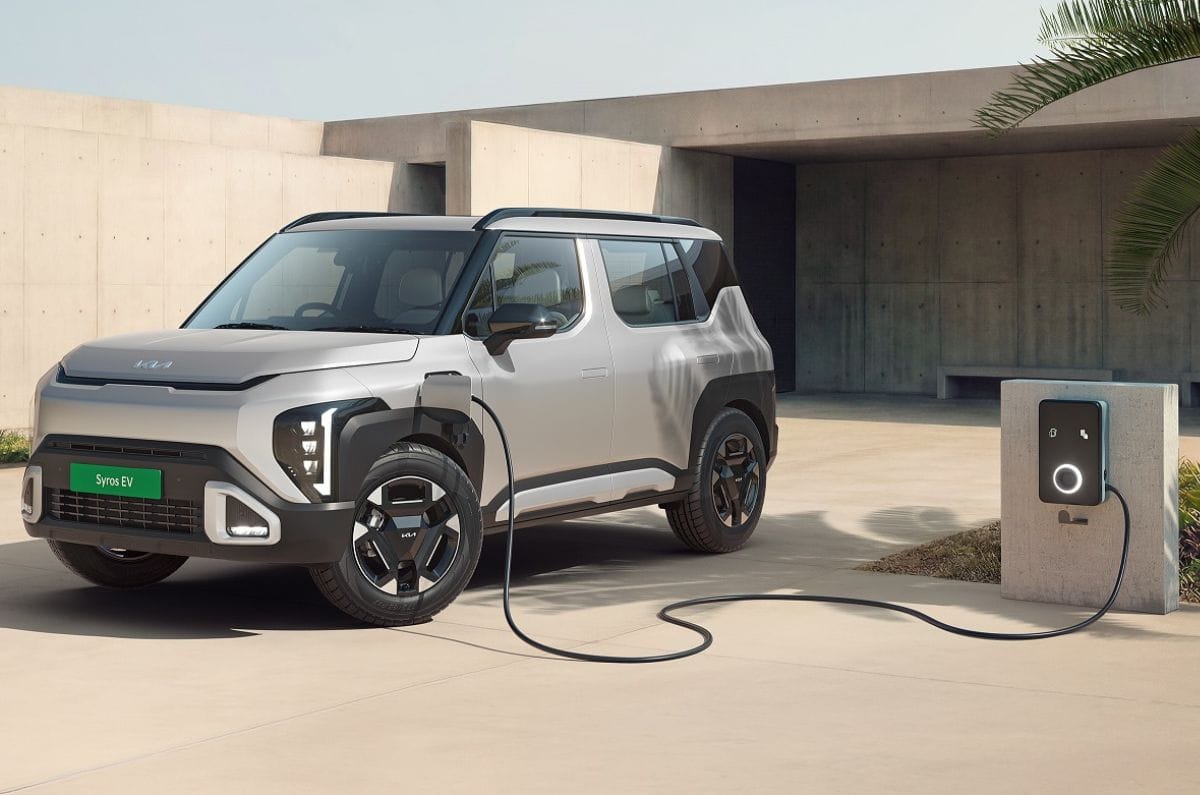
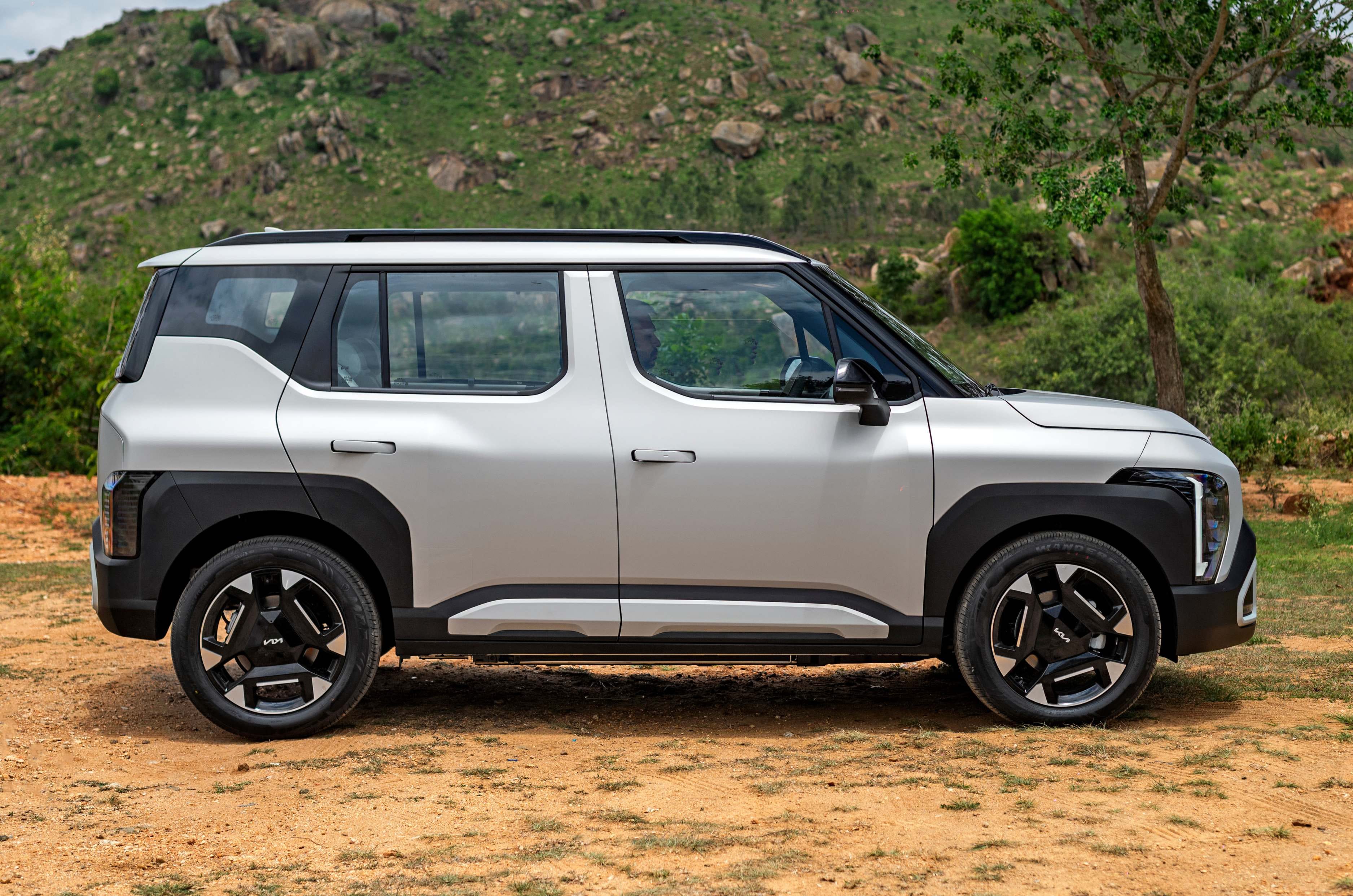
A game of spot the difference between the Syros EV and the ICE version would prove challenging for the casual observer, so here is the cheatsheet. Up front, the bumper is ever so slightly different, with a slimmer cooling slot above the number plate and minor tweaks to the body-coloured triangular pods that house the LED fog lamps. Apart from the charging port on the front left fender and the shorter roof rails, the profile is unchanged. Crouch down, though, and you’ll notice the battery pack is visible, like it is on the Hyundai Creta Electric. Kia claims ground clearance is 197mm which is 7mm more than the ICE version. The tri-spoke 17-inch alloys are the same ones that debuted on the ICE car but were discontinued with the facelift. No differences round the back either, save for an EV badge on the tailgate.
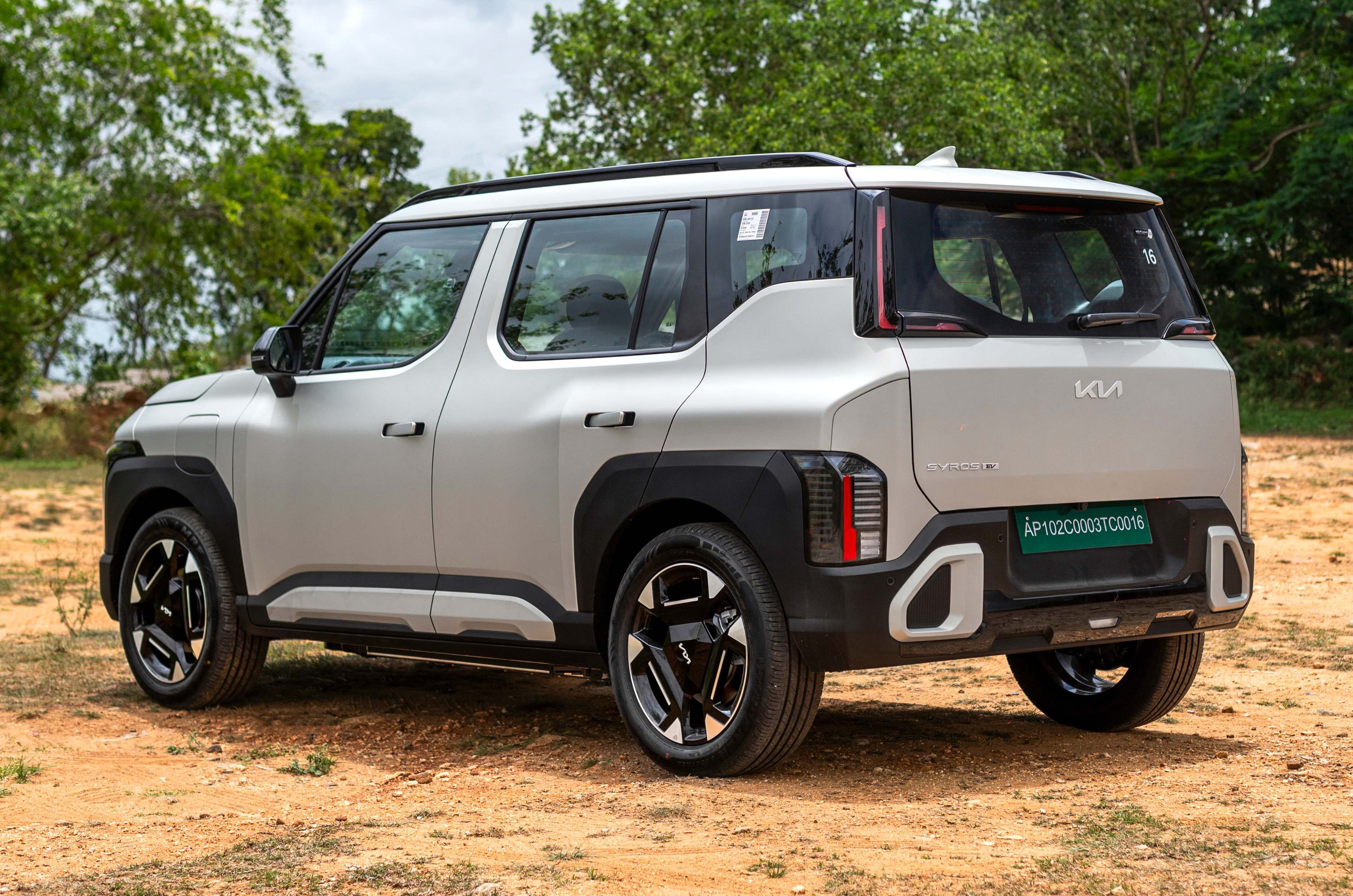
Split lighting lifts the otherwise bland rear

If you didn’t like the way the Syros looked, the EV isn’t going to change your mind. It is distinctive, though – like a Japanese kei car only larger, and Korean. Its blanked-off fascia looks appropriate on an EV, and the vertically oriented headlights give it a unique look. The cladding lower down on the bumper carries on to the wheel arches, doors and the rear, adding some muscle. Breaking up the large greenhouse are the pronounced B-pillar and the upward kink in the C-pillar, both of which are neatly done. And while the tailgate looks a bit blank, the split lighting – with L-shaped elements framing the rear windscreen and larger units at the edge of the bumper – looks great when lit up.

Syros EV Interior Space and Comfort – 10/10
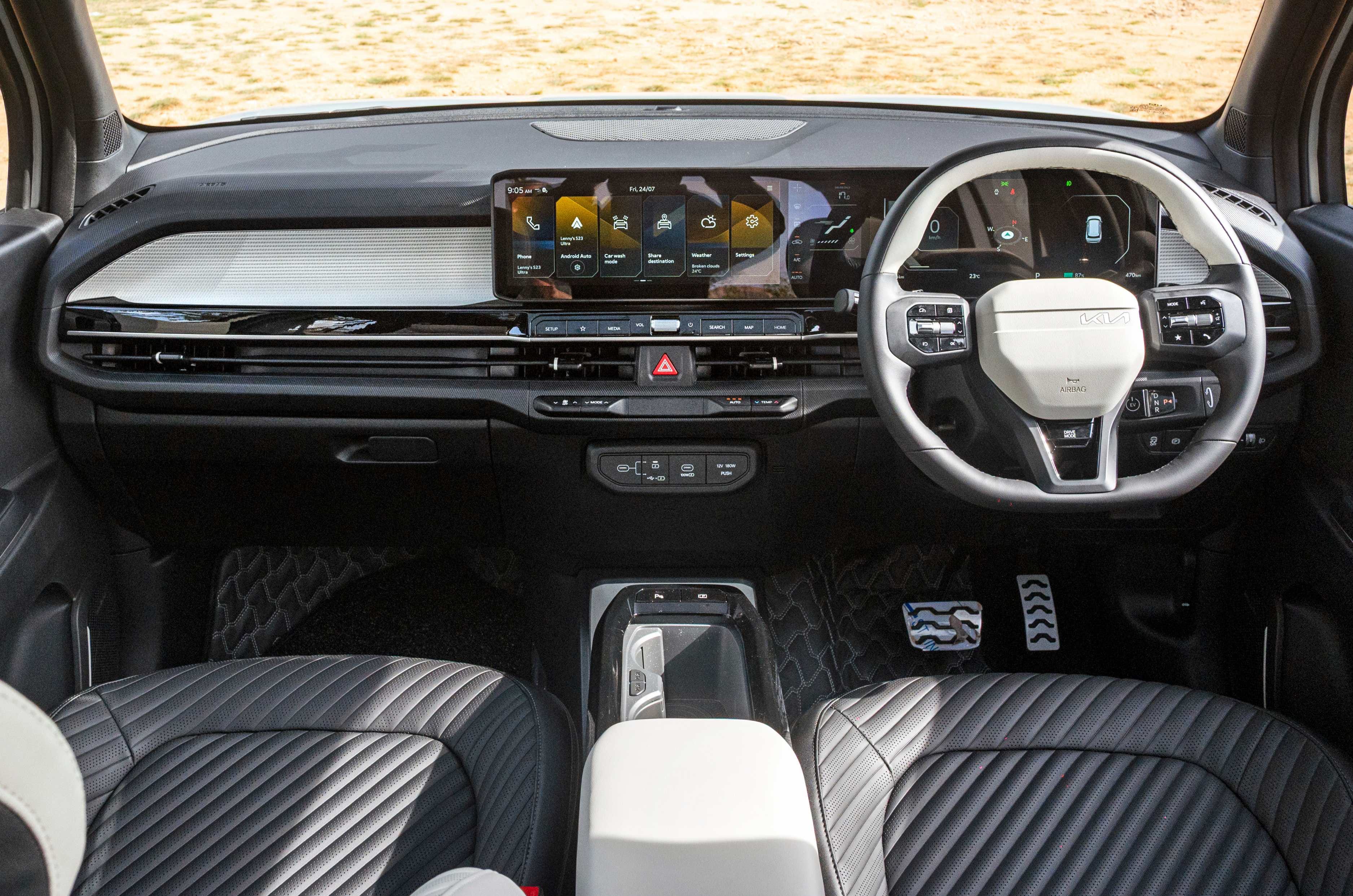
Dash layout is identical to the ICE version, but it gets the 3-spoke ‘wheel from the Seltos

Step inside and you start to understand why the Syros EV looks the way it does. Space for passengers, their knick-knacks and luggage is in abundance. With the EV’s drive selector positioned on the steering column, Kia has re-engineered the centre console to liberate a lot more storage. It now has two levels: the top floating portion has a small cubby under the armrest, along with two cupholders with their own sliding cover, while the lower level has a large storage area for a bag or such, another cupholder and a wireless charger. The front door pockets are just as accommodating, with room for a couple of bottles and an umbrella.
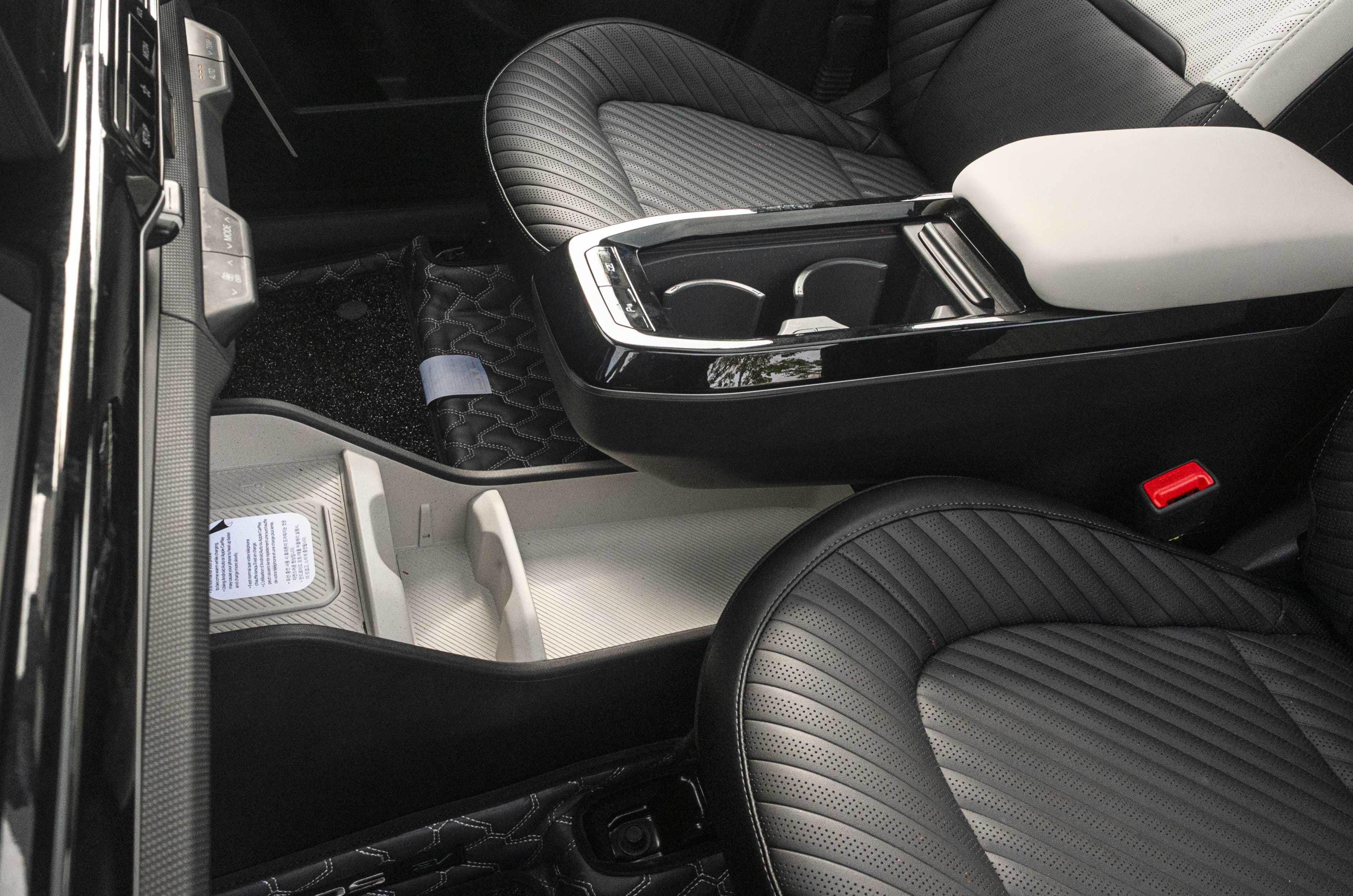
New center console has a lot of storage spaces

The front seats are supportive and comfortable, with heating and ventilation along with 4-way power adjustment for the driver. While the dash layout is unchanged, the EV gets the Seltos’ three-spoke steering wheel, but adjustment is still limited to rake and not reach. The EV uses a slightly different colour palette inside: our HTX+ test car gets a smart-looking black-and-off-white theme, the X-Line features a darker black-and-green ambience, while all other trims get an airy light grey and pastel blue theme. While most surfaces are hard plastic, the quality of the materials, fit and finish is top notch.
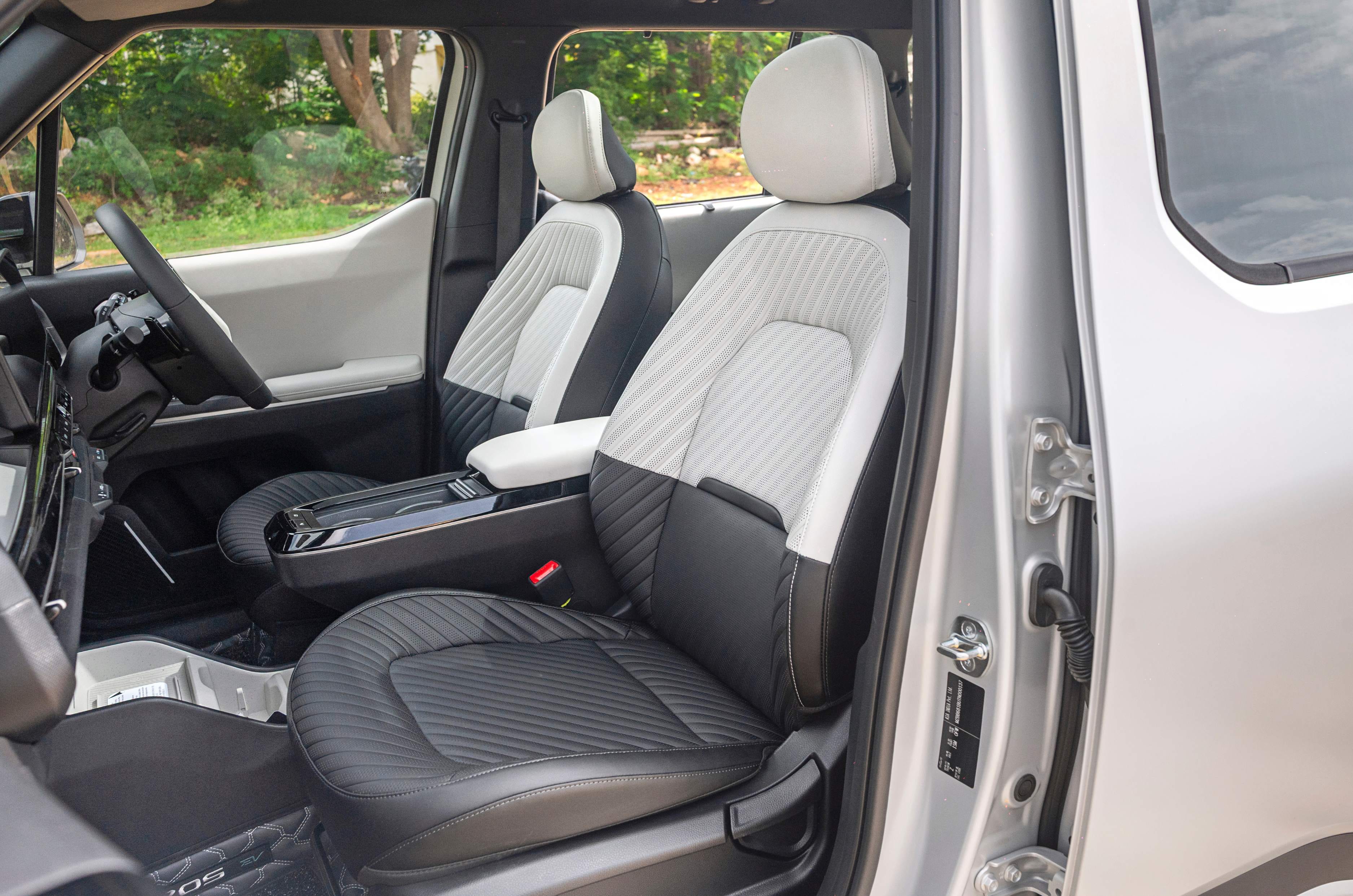
Front seats are comfy with heating, ventilation for both and power adjustment for the driver

The back seat remains a highlight, with plenty of room all around. The floor is slightly higher because of the battery pack, which means thigh support isn’t as good as in the ICE version. However, if you slide the bench back and stretch out, this isn’t much of an issue. A benefit of the raised floor is that it is now completely flat. Ventilation for the seat base carries over, but the backrest still misses out, as Kia says it would restrict its recline angle.
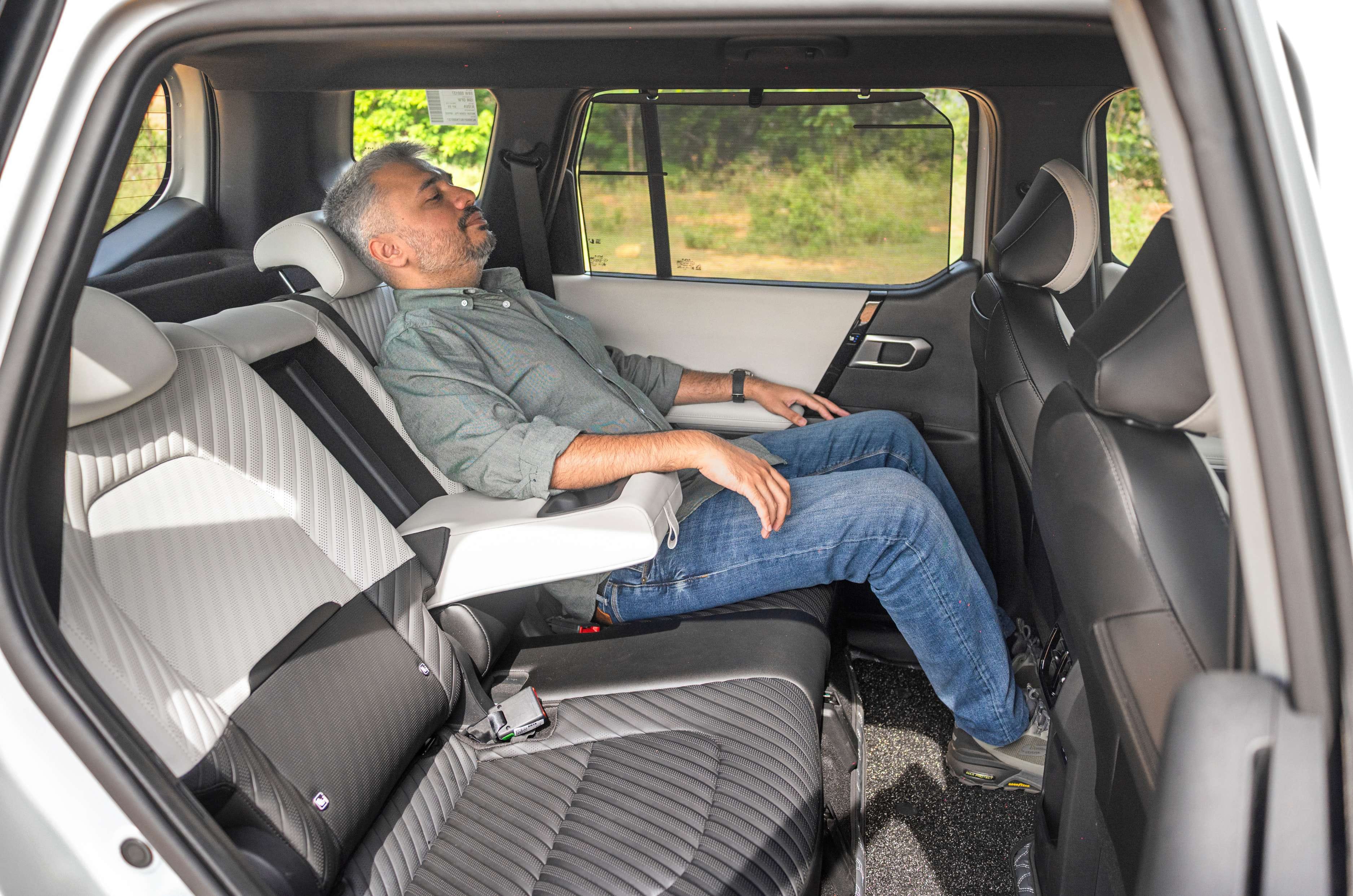
Higher floor slightly affects thigh support, but there’s ample room to stretch out

Boot space is identical to the ICE Syros at 390 litres with the seat all the way back, and 465 litres with it slid forward. The rear seats also split-fold – though not completely flat – to carry longer items. There is a 16-litre frunk too, though it is rather narrow.

Kia Syros EV Features and Safety – 9/10

Sitting proud on the dash is what Kia calls the Trinity Panoramic Display, comprising two 12.3-inch screens for the infotainment and driver’s display, with a 5-inch screen in between for the HVAC controls. The driver’s display is logically laid out, easy to read and offers some customisation, while the infotainment is sharp, snappy and has a clean UI. The EV gets a dedicated tab that shows several parameters related to the battery, range and energy consumption. It can also help find the nearest charger, condition the battery before charging, as well as set up charging schedules.
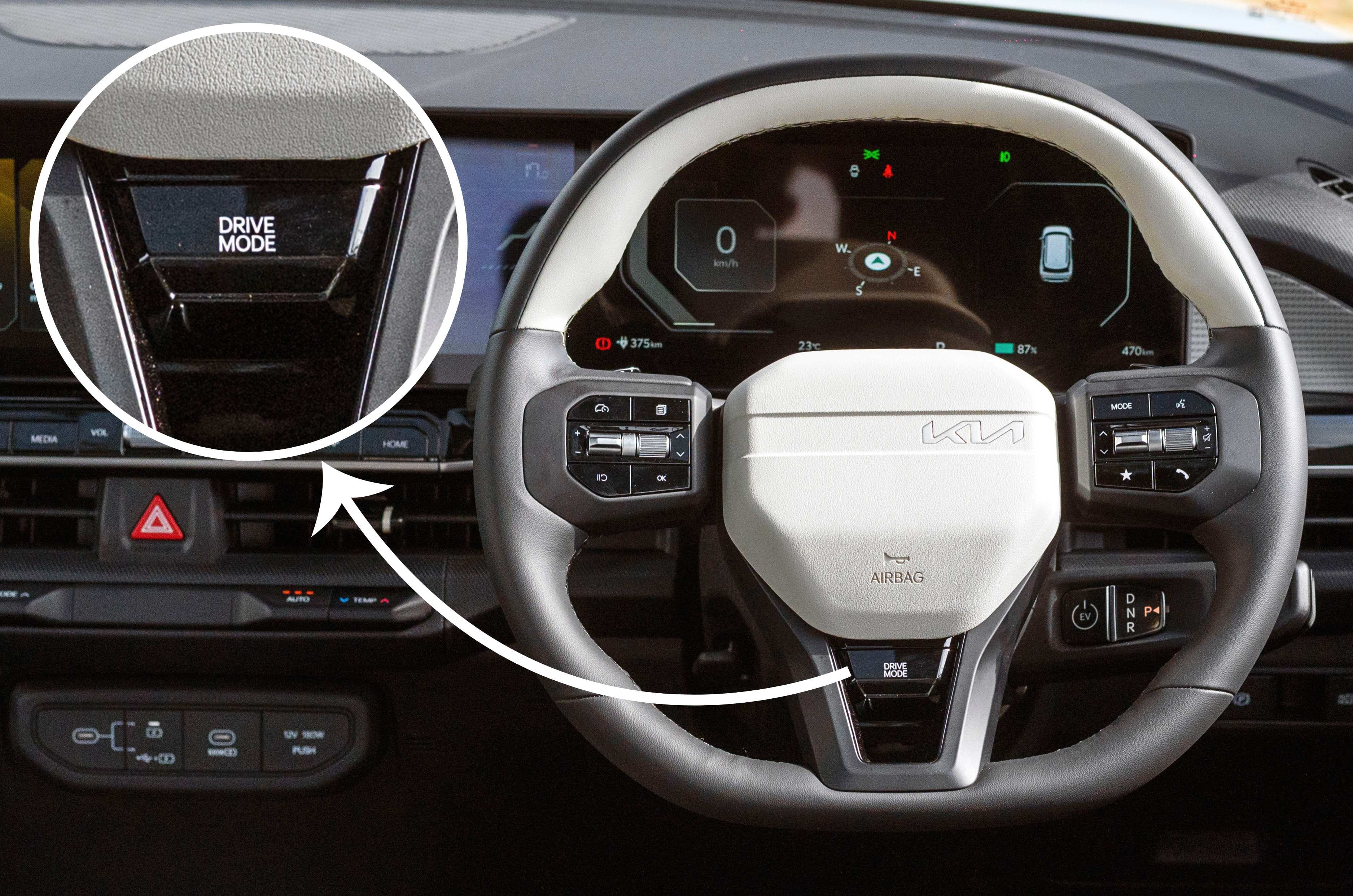
Handy drive mode button to cycle between Eco, Normal and Sport modes

The infotainment also offers wireless Android Auto and Apple CarPlay and, on the top trims, powers a superb Harman Kardon audio system with eight speakers, including one on the dash and a subwoofer in the boot. Sunblinds and rear AC vents are standard, while the massive panoramic sunroof features on all but the bottom two trims. Our second-from-top HTX+ also gets an integrated dashcam.
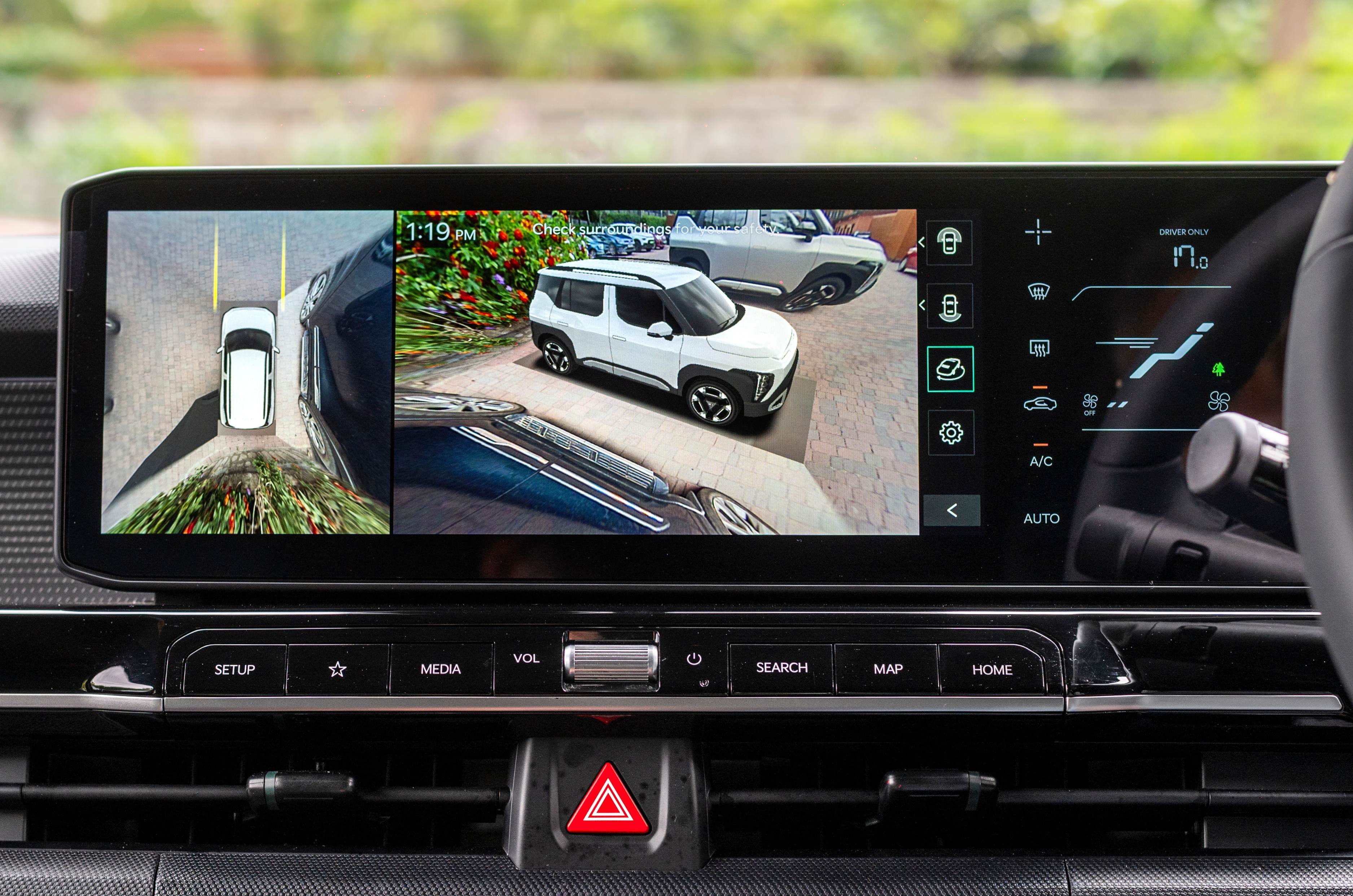
360-degree camera is sharp, but only available on top X-Line trim

Overall, the Syros EV is very well equipped, but some features are available only on the top X-Line variant, including Level 2 ADAS, ambient lighting, a 360-degree camera and a household-style three-pin socket in the back seat. Restricting features to the top trim isn’t unusual; however, the X-Line can only be had in Aurora Black Pearl or Matte Graphite, which might not be to all tastes.
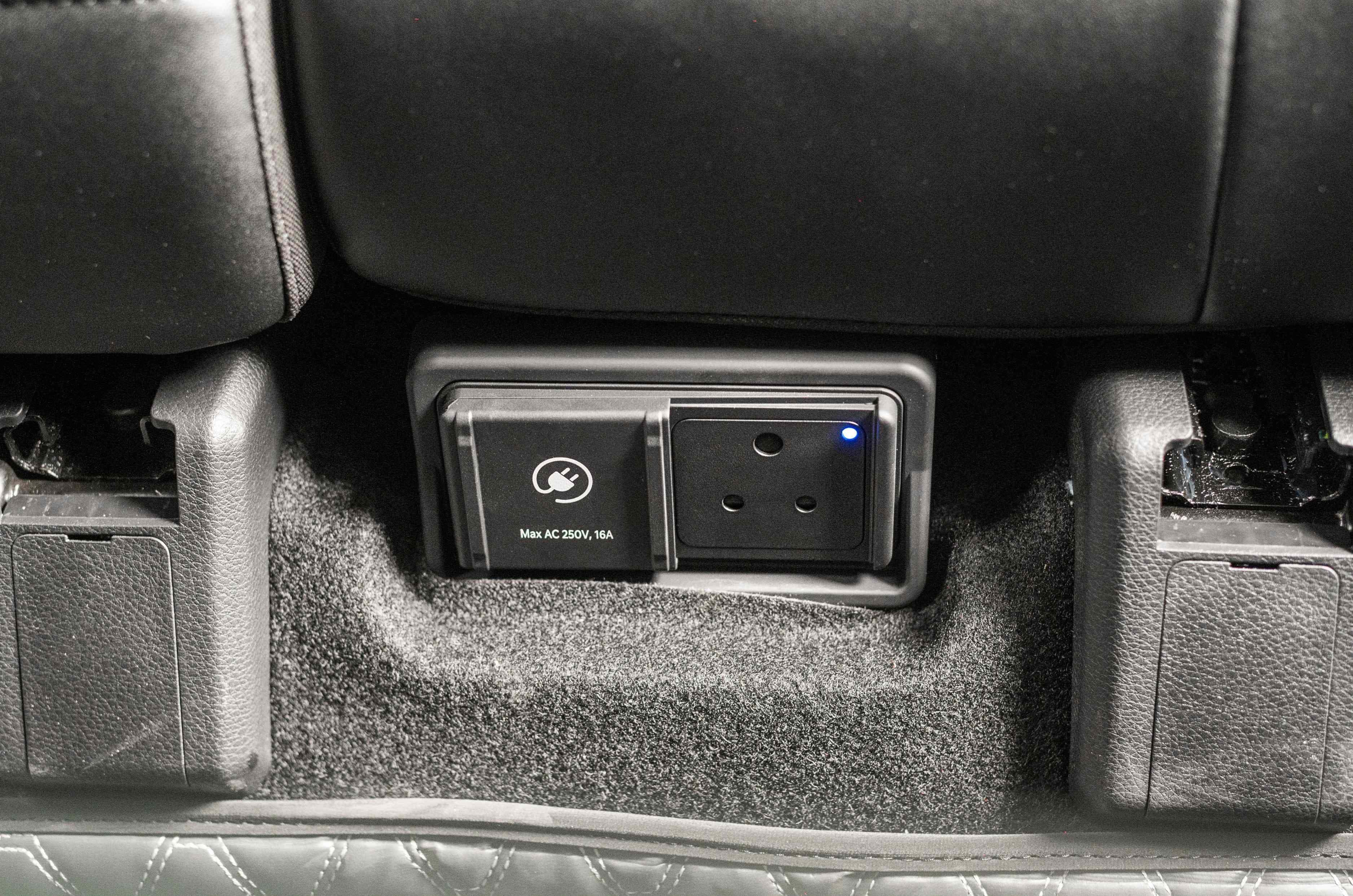
V2L power outlet under the rear seat

The standard safety suite is robust, including six airbags, all-wheel disc brakes, tyre pressure monitoring and ISOFIX mounts. The ADAS suite is also comprehensive, including adaptive cruise control with stop-and-go, lane keep assist, forward and rear collision avoidance, and a blind-spot camera. At the time of writing, the Syros EV does not yet have an official crash safety rating, but considering the ICE version has a five-star BNCAP rating, a similar result for the EV can be expected.

Kia Syros EV Performance and Refinement – 9/10

The Syros EV is available with the same 42kWh and 51.4kWh NMC battery packs as the Carens Clavis EV and the Hyundai Creta Electric. Here too, they power a single motor on the front axle producing 135hp with the smaller battery and 171hp with the extended-range version. Torque is identical on both at 255Nm.
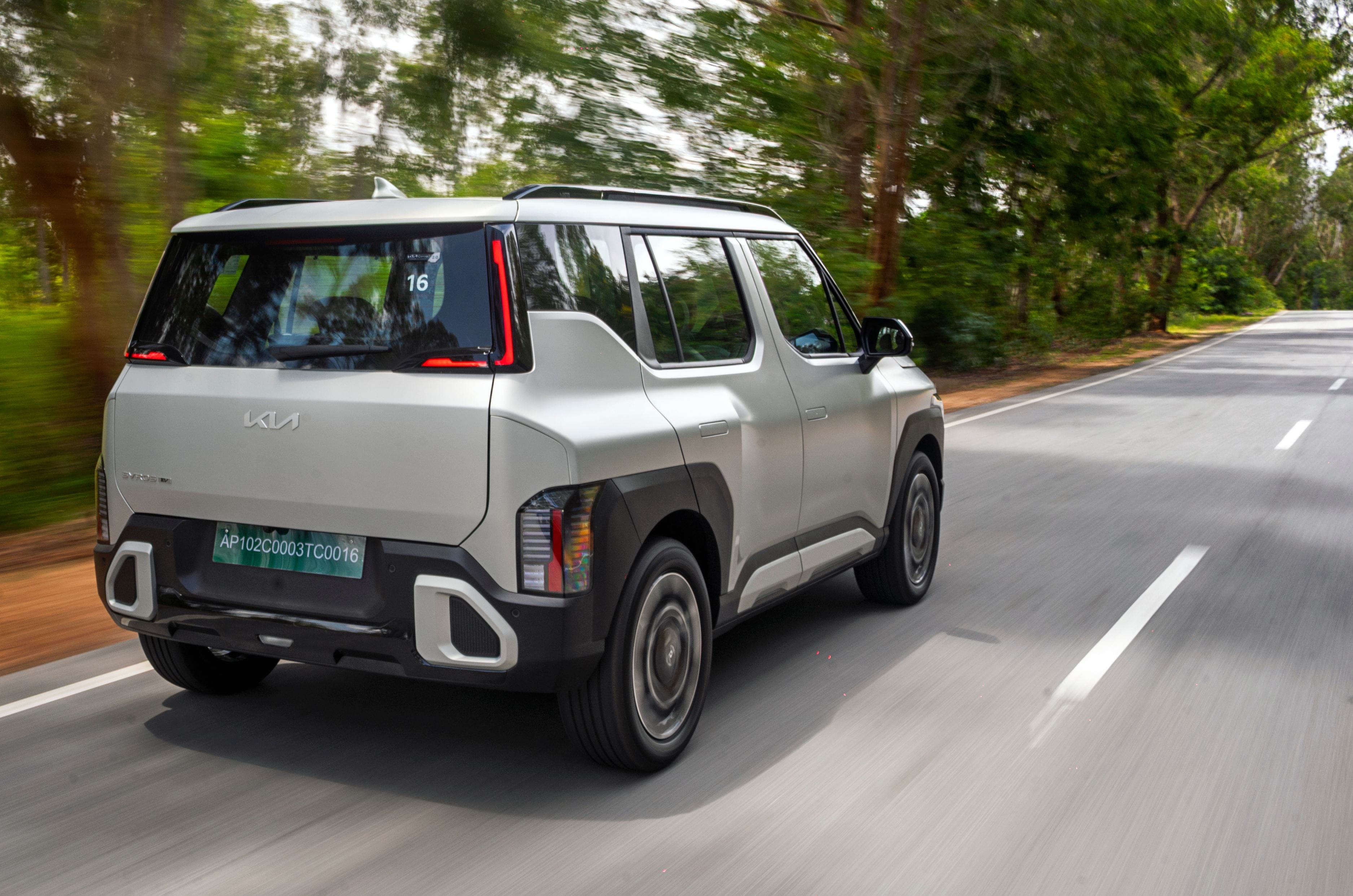
Borrows the 42 and 51.4kWh battery packs from the Carens Clavis EV

Performance was brisk on our 51.4kWh test car, with the 0-100kph sprint claimed to take 8.1 seconds. There are three drive modes to choose from – Eco, Normal and Sport – with each sharpening throttle response a little more than the last. Initial response in all modes is linear so as not to overwhelm those who aren’t used to the instant torque, but there is a strong shove as you get further into the throttle. Overtaking, then, is quite effortless, even in Eco and Normal, almost never needing a switch to Sport for a quick pass.
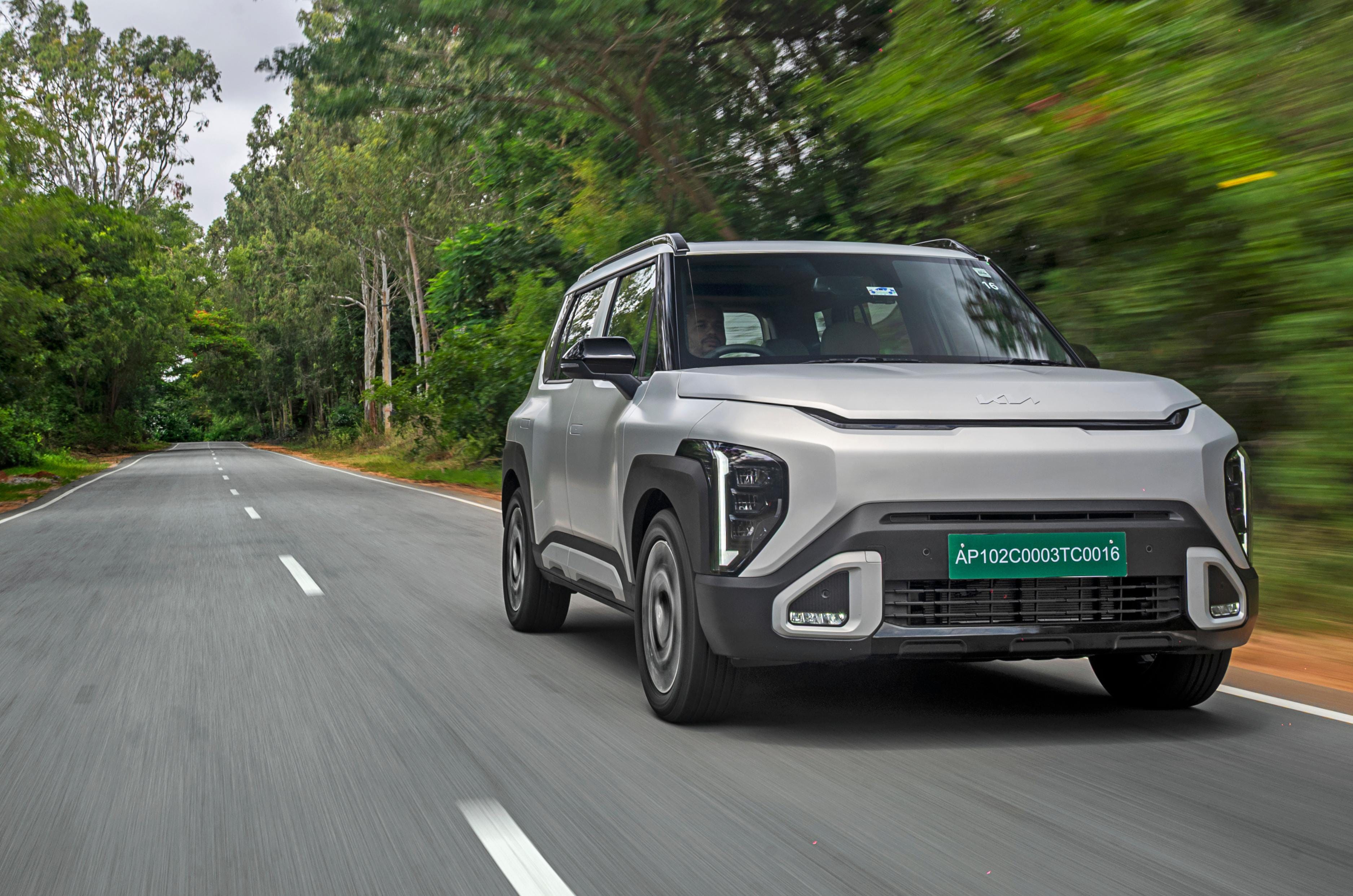
Initial acceleration is linear, but there is plenty of shove for quick overtakes

The regen braking modes – selected via the paddle shifters – are also very well calibrated, with a noticeable increase in resistance in each mode and the ability to turn it off completely. Holding the left paddle engages one-pedal driving, which uses regen to bring the car to a full stop. It works quite seamlessly and can be very convenient once you get used to it.
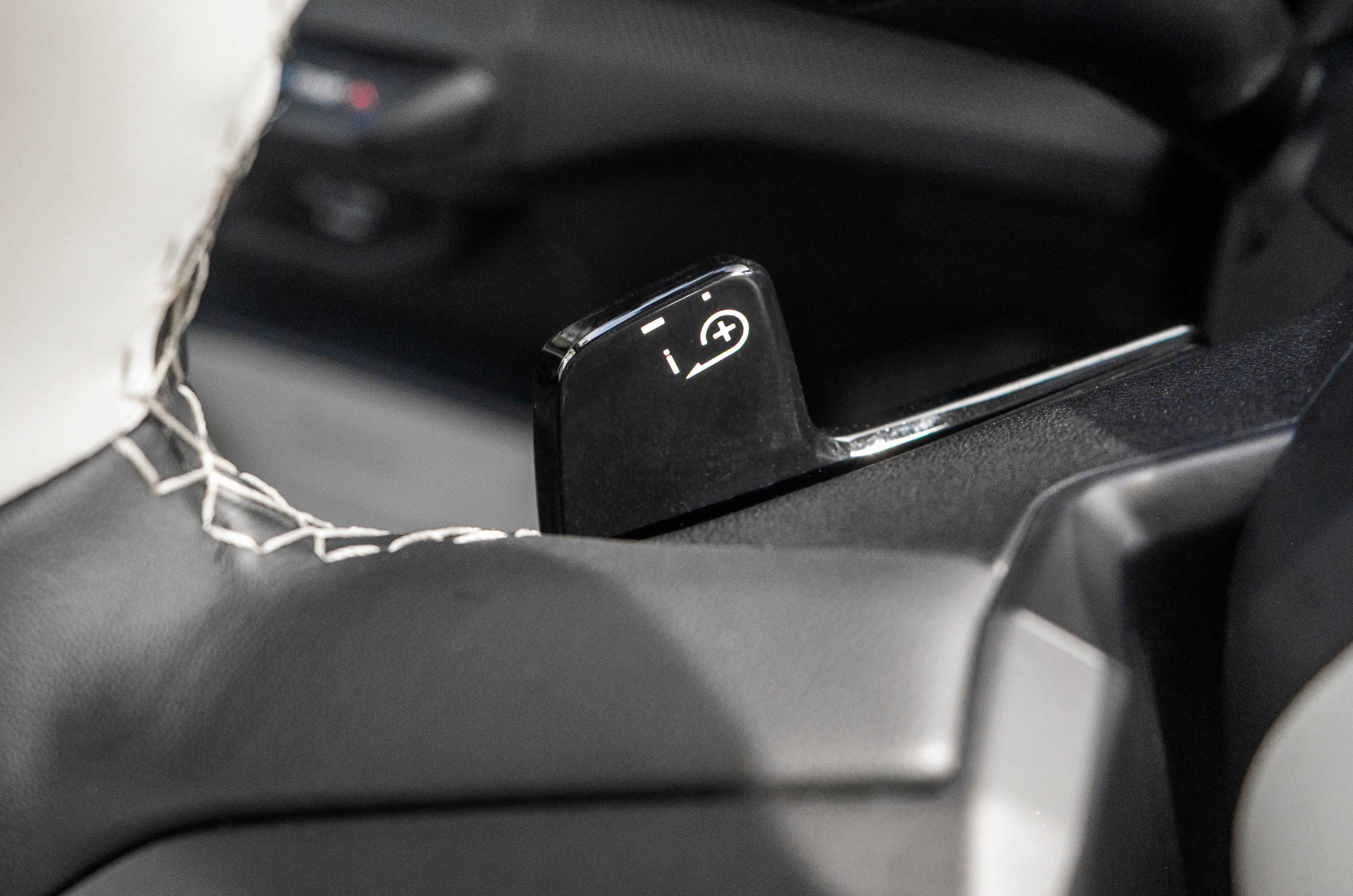
Regen modes are well calibrated and the i-Pedal function is handy in the city

Refinement is good too, with no noticeable motor whine making its way into the cabin. It’s so quiet, in fact, that Kia has added a virtual humming sound to warn pedestrians. Since there is no engine note inside the cabin, you do hear a bit more road noise, but at no point does it become intrusive.

Kia Syros EV Range and Efficiency – 8/10

Claimed MIDC range for the 51.4kWh battery is 526km, while the 42kWh unit claims 443km. Our short drive didn’t allow us to test these claims, but if the real-world range we achieved in the Clavis EV and Creta Electric is anything to go by, the Syros EV Extended Range should comfortably manage around 400km on a single charge. We will verify this when we have the car for longer.
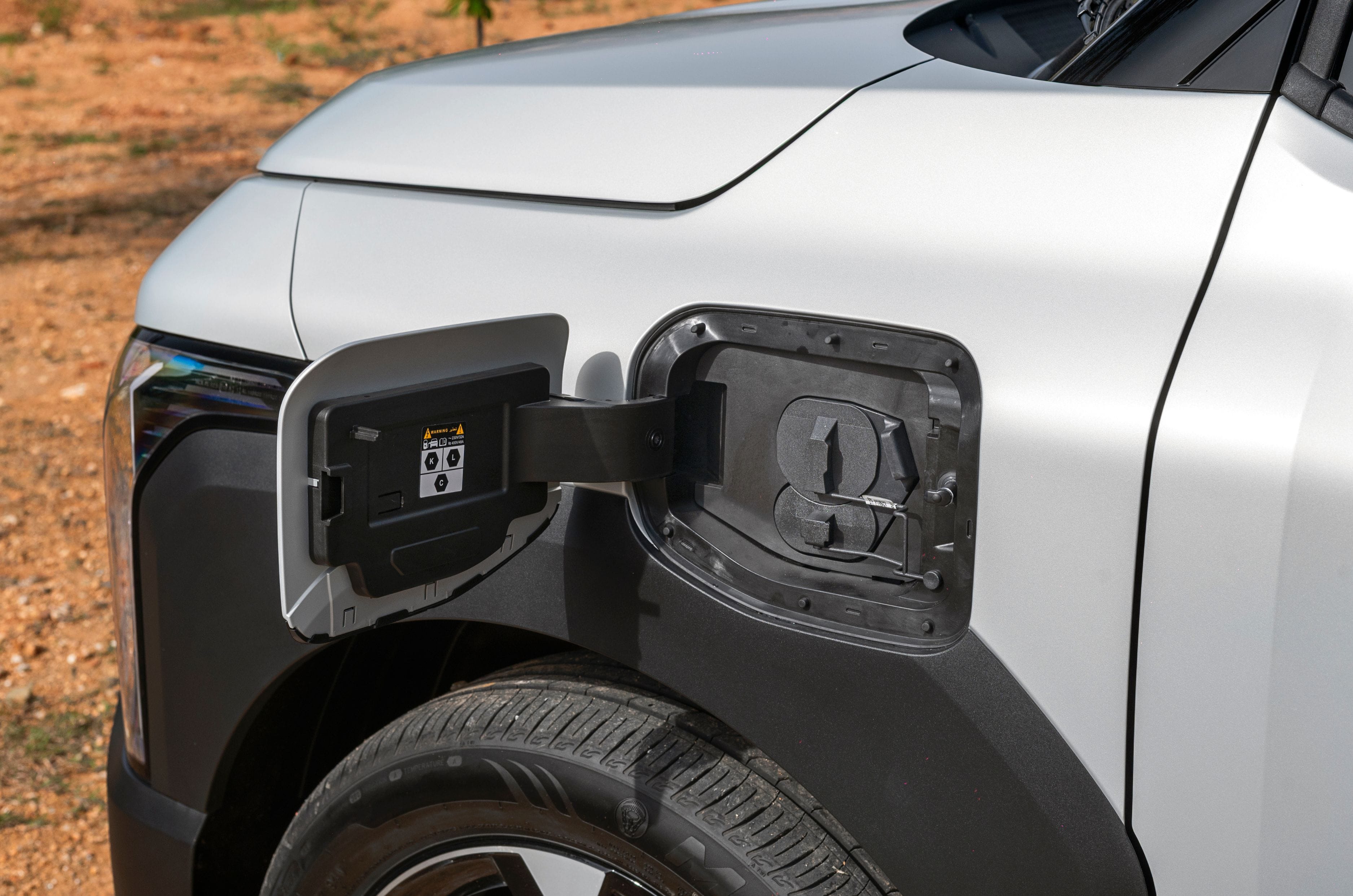
Capable of DC fast charging at up to 100kW

Topping up a depleted battery from 10 to 80 percent is said to take 39 minutes on a 100kW DC fast charger. The same charge using the optional 11kW wallbox charger, is said to take almost five hours for the Extended Range and four hours for the Standard Range.

Kia Syros EV Ride Comfort and Handling – 8/10

The ride on the Syros EV is a touch more absorbent than on its ICE counterpart. Sharp bumps don’t come through to the cabin as abruptly, but there is still an underlying firmness to it. This firmness is there to help body control, but being a tall, narrow car, there is still a fair bit of body roll through the corners. It does feel stable though, and overall grip is strong.
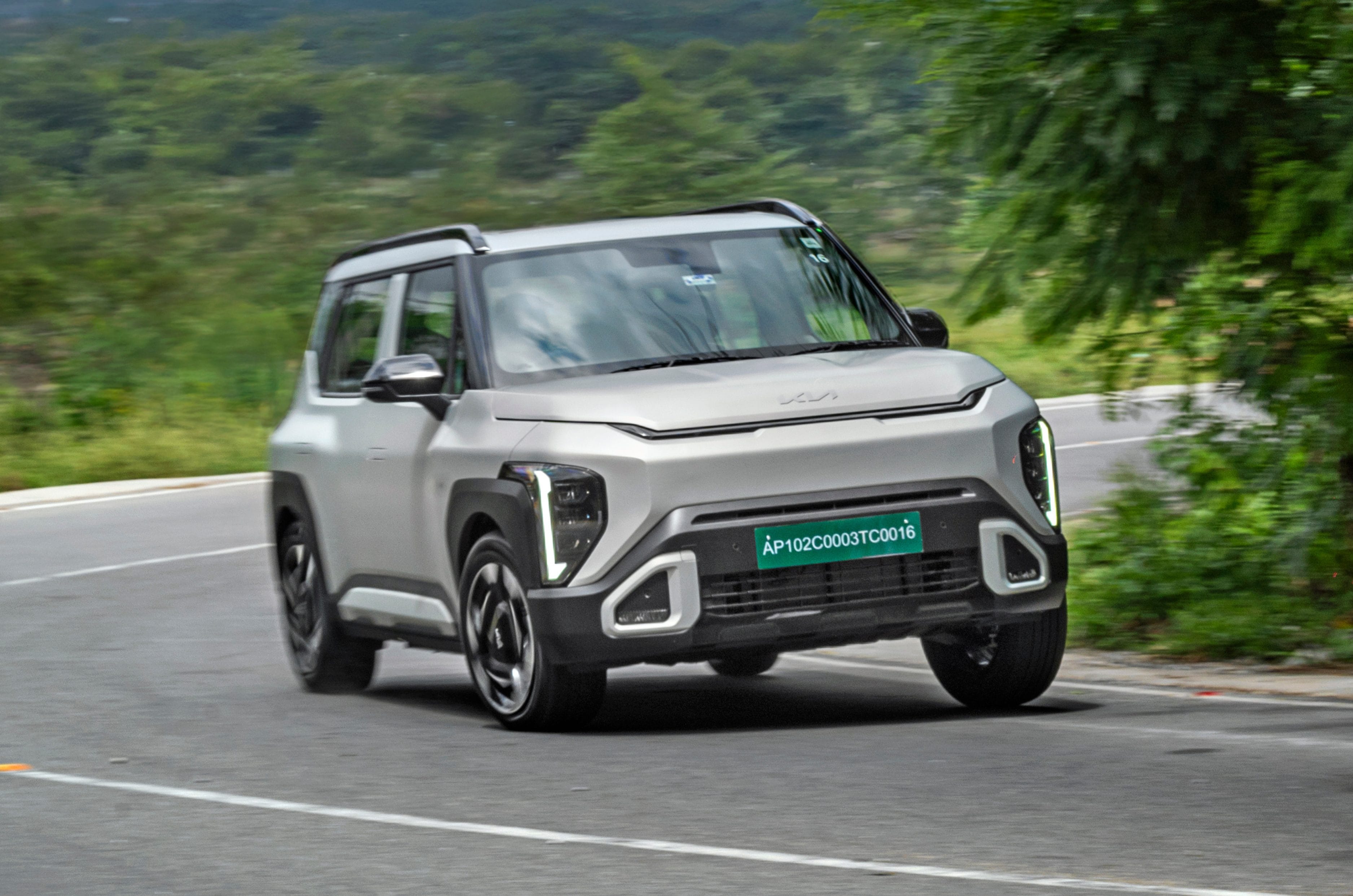
There’s plenty of body roll, but it remains stable through the bends

Steering feel is also good, and it weighs up as speeds rise, which helps with high-speed stability. The four-wheel disc brakes are strong too, bringing the Syros to a confident halt when you drop the anchors. Overall, it isn’t the most entertaining car to drive, but it feels stable and secure at speed while being easy to manoeuvre in tight spaces.

Kia Syros EV Value for Money – 7/10

Introductory prices for the Syros EV start at Rs 13.5 lakh for the 42kWh version and Rs 17 lakh for the 51.4kWh Extended Range. If you want the fully loaded X-Line, that’ll be a cool Rs 20 lakh. To reduce the upfront purchase cost, a BaaS scheme is available with prices starting at Rs 7.99 lakh, and battery rental costing Rs 3.3 per kilometre. To sweeten the deal, Kia is offering a 15-year/unlimited-kilometre HV battery warranty for the first owner, along with an assured buyback value of up to 80 percent after three years.
Its pricing means the Syros EV rivals the Tata Nexon EV and Mahindra XUV 3XO EV, as well as larger EVs like the MG Windsor and Maruti e Vitara. As such, the 42kWh Syros EV makes for a very compelling option, undercutting its rivals in the sub-four-metre EV space. It is easily the most spacious in this segment and is very well equipped even in the lower trims. However, its case weakens with the 51.4kWh Extended Range. It is significantly pricier than its immediate rivals, overlapping with the larger-battery versions of the Windsor and e Vitara. While the Syros EV has its merits and even outdoes them in some areas, buyers might find the allure of a bigger car for the same money too hard to resist.

Mahindra BE 6 to get three screens, updated dashboard

Mahindra BE 6 to get three screens and updated dashboard

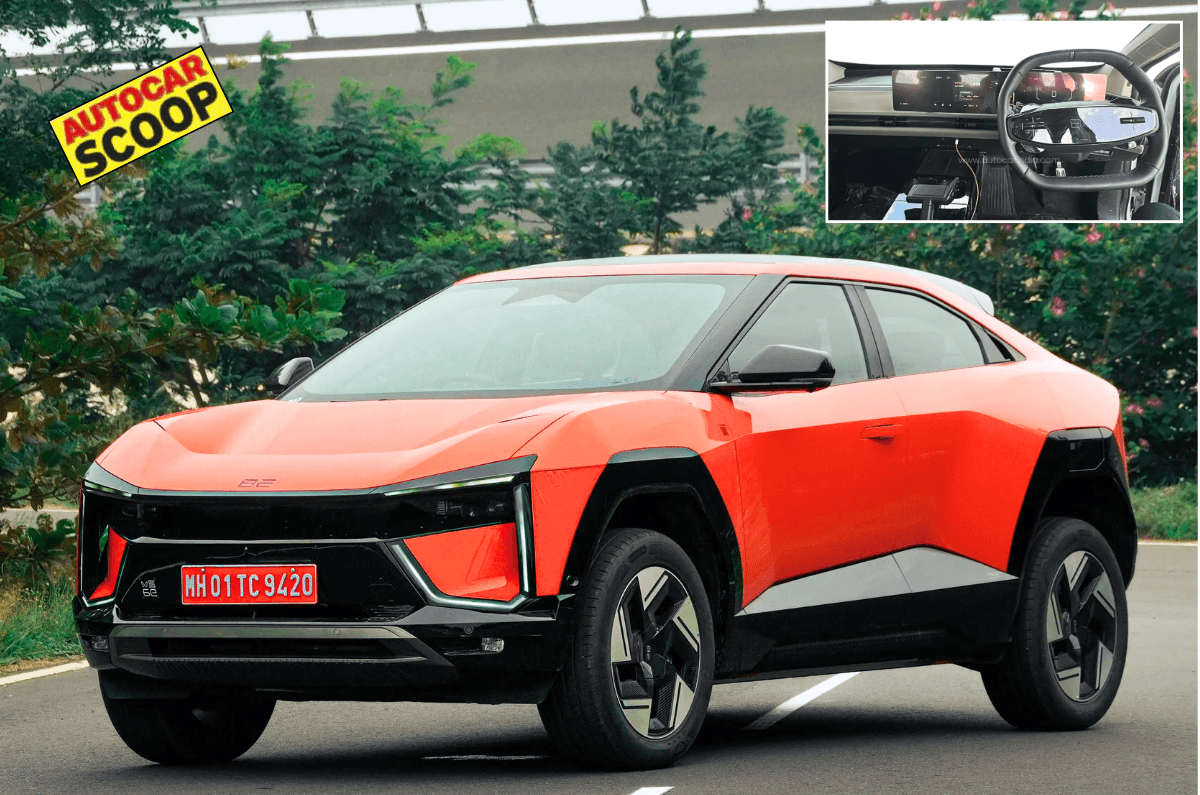
The Mahindra BE 6 is set to receive a passenger screen, a redesigned dashboard and a new upholstery colour, we can exclusively report. Since the Mahindra electric SUV was launched only in November 2024, a mid-lifecycle update is still some time away, and these changes could instead arrive with a model year update.

Updated Mahindra BE 6 interior details

Mahindra BE 6 interior

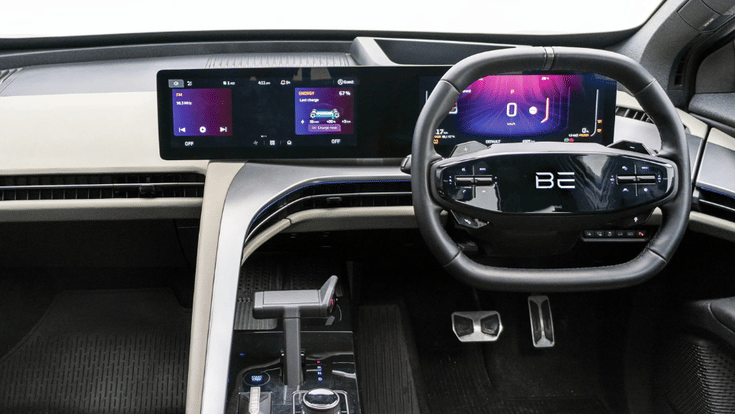
New BE 6 dashboard (left), current BE 6 dashboard (right).

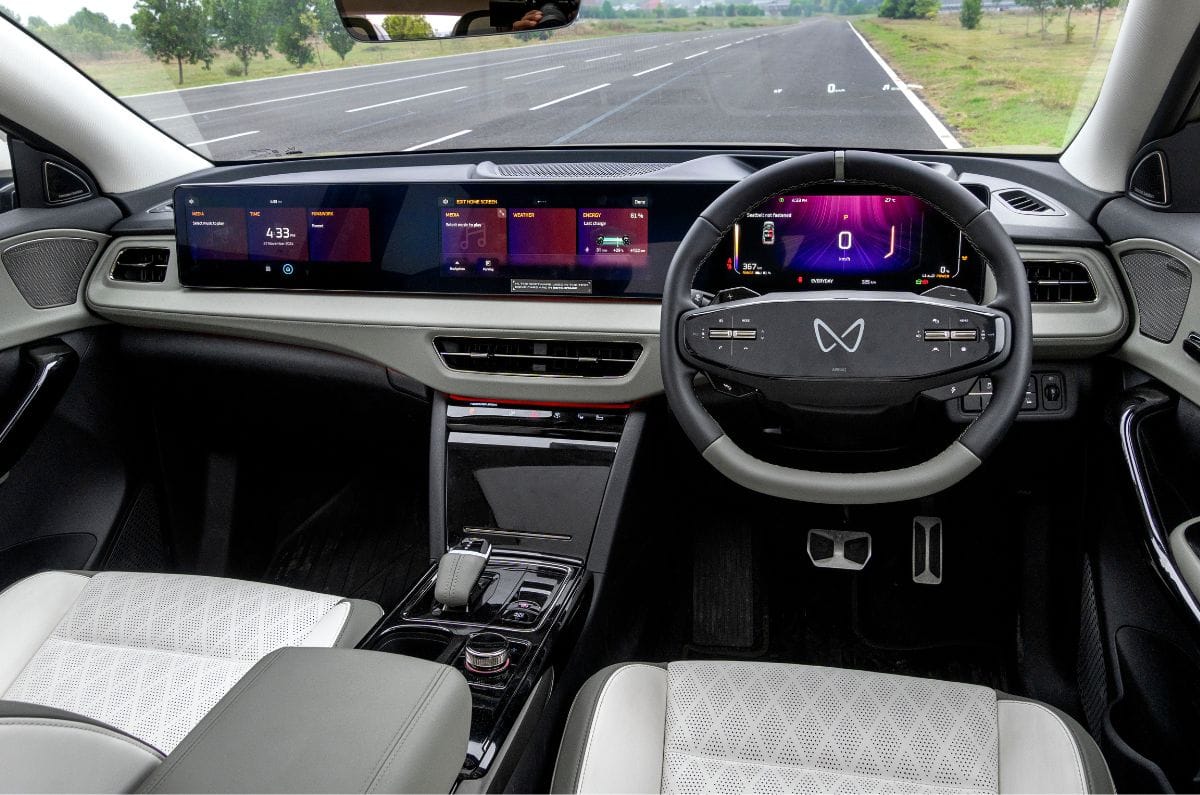
Mahindra already offers a three-screen setup in the XEV 9e and XEV 9S, and the same unit is expected to make its way to the BE 6. It’s not yet clear whether Mahindra will offer the three-screen setup across the line-up or limit it to the top-spec trims. Triple screens are becoming increasingly common, with even Tata Motors now offering them on some of its models. Adding the feature should help Mahindra keep the BE 6 competitive in the segment.

Mahindra XEV 9e screens
Mahindra XEV 9e’s interior shown here for representation.

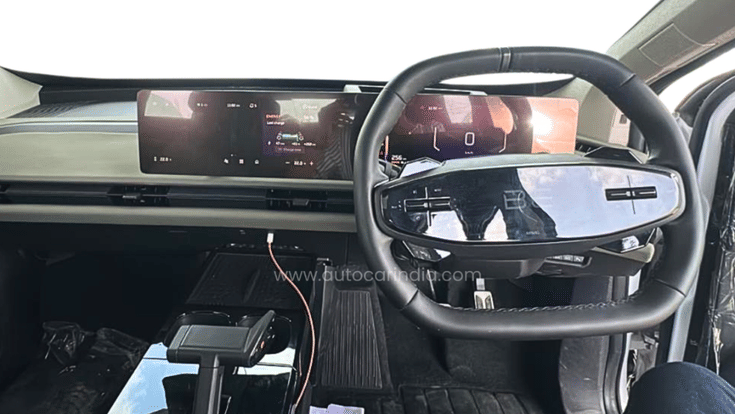
The carmaker is also readying a version with a more conventional dashboard layout, devoid of the halo-like loop around the driver’s area offered in the current EV. The loop doesn’t leave enough space for a second cupholder and also makes the wireless charger and USB Type-C ports difficult to access from the passenger side, issues we had pointed out in our BE 6 review. Whether this becomes the standard design or is offered alongside the current layout remains to be seen.

Instead of the current black-and-grey theme for the upholstery, the BE 6 is going to get a new black-and-tan colour combination. The BE 6 already offers an extensive feature list, and these updates should further strengthen its appeal against midsize SUV rivals like the Tata Sierra EV and Hyundai Creta Electric.

The Mahindra BE 6 is priced between Rs 18.90 lakh and Rs 26.90 lakh and a small price hike is likely once these updates are introduced. For reference, the Sierra EV is priced between Rs 18.79 lakh and Rs 25.99 lakh, while the Creta Electric costs between Rs 18.03 lakh and Rs 23.67 lakh. Mahindra is yet to announce a launch timeline for the updated BE 6.

Ex-showroom prices mentioned above are as of July 29, 2026.

नई Hyundai Creta में मिलेंगे बड़े बदलाव! 15+ इंच स्क्रीन, Level 2+ ADAS और HUD के साथ होगी लॉन्च

हुंडई अपनी लोकप्रिय मिड-साइज SUV Hyundai Creta की अगली जनरेशन को जल्द बाजार में उतारने की तैयारी कर रही है। नई Creta में सिर्फ नया प्लेटफॉर्म और नए पावरट्रेन ही नहीं, बल्कि पहले से कहीं ज्यादा आधुनिक फीचर्स भी देखने को मिल सकते हैं। माना जा रहा है कि कंपनी इस बार SUV के फीचर पैकेज को और मजबूत बनाएगी, क्योंकि यही इसकी सबसे बड़ी ताकत रही है।

मिलेगा एडवांस Level 2+ ADAS

मौजूदा Hyundai Creta में Level-2 ADAS के तहत 20 सेफ्टी फीचर्स दिए जाते हैं। हालांकि, नई जनरेशन मॉडल में Kia Seltos की तरह Level 2+ ADAS मिलने की उम्मीद है, जिसमें 28 तक एडवांस ड्राइवर असिस्टेंस फीचर्स शामिल हो सकते हैं।

संभावित नए ADAS फीचर्स में शामिल हैं:

  • Navigation-based Smart Cruise Control
  • Frontal Collision Warning
  • Junction Crossing Assist
  • अन्य एडवांस सेफ्टी और ड्राइविंग असिस्ट सिस्टम
  • मिलेगा नया PLEOS इंफोटेनमेंट सिस्टम


नई Creta के केबिन में सबसे बड़ा बदलाव Hyundai का नया PLEOS Infotainment System हो सकता है। कंपनी इस सिस्टम को पहले अपने कुछ अंतरराष्ट्रीय मॉडलों में पेश कर चुकी है। रिपोर्ट्स के मुताबिक, इसमें 15 इंच से बड़ी टचस्क्रीन मिलने की संभावना है। इसके जरिए कार के अधिकांश कंट्रोल और सेटिंग्स ऑपरेट किए जा सकेंगे।


इस सिस्टम की खासियत Over-the-Air (OTA) Updates होगी। यानी भविष्य में सॉफ्टवेयर अपडेट के साथ कुछ मैकेनिकल बदलाव, जैसे सस्पेंशन ट्यूनिंग, भी OTA के जरिए अपडेट किए जा सकेंगे। इसके अलावा मौजूदा डिजिटल ड्राइवर डिस्प्ले की जगह नया और ज्यादा स्लिम डिस्प्ले मिलने की संभावना है, जिसमें केवल जरूरी ड्राइविंग जानकारी दिखाई जाएगी। HUD और Wireless Android Auto-Apple CarPlay भी मिल सकते हैं


फिलहाल Hyundai Creta के टॉप वेरिएंट में Head-Up Display (HUD) और Wireless Android Auto एवं Apple CarPlay की सुविधा उपलब्ध नहीं है। वायरलेस कनेक्टिविटी के लिए अलग से एडेप्टर का इस्तेमाल करना पड़ता है।


नई जनरेशन Creta में यह कमी दूर हो सकती है। Kia Seltos में पहले से मौजूद इन फीचर्स को अब Hyundai Creta में भी शामिल किए जाने की उम्मीद है। साथ ही, वायरलेस Android Auto और Apple CarPlay को केवल लोअर वेरिएंट तक सीमित रखने के बजाय अधिकांश वेरिएंट्स में स्टैंडर्ड फीचर बनाया जा सकता है। हालांकि, कंपनी ने अभी तक नई Hyundai Creta के फीचर्स और लॉन्च टाइमलाइन को लेकर आधिकारिक घोषणा नहीं की है।

Maruti Suzuki Brezza’s cumulative sales cross 15 lakh units

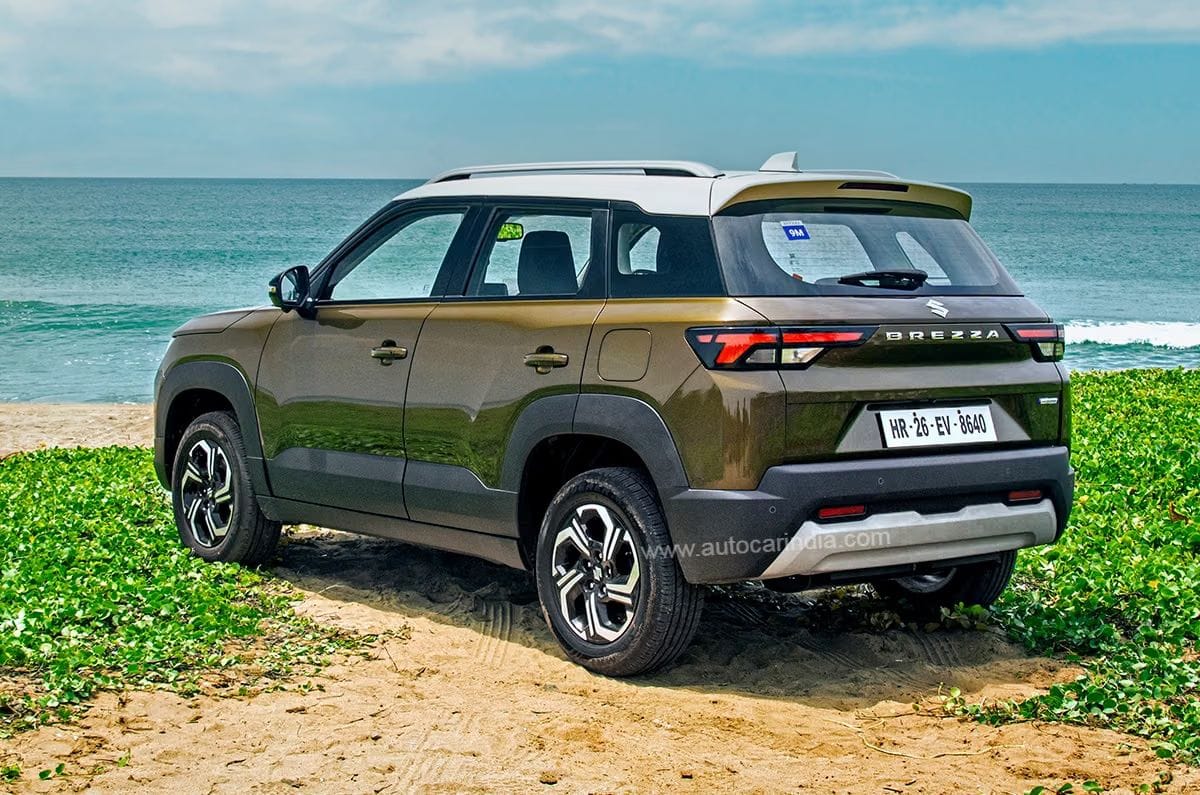
Maruti Brezza rear quarter static

Maruti Suzuki India has launched the 2026 Brezza at a starting price of Rs 7.40 lakh. This marks the first major update for the second-generation model introduced in 2022. Meanwhile, cumulative sales of the Brezza have surpassed the 15 lakh mark (15,14,717 units), and given the ongoing strong customer demand for compact SUVs – 3,97,609 units in Q1 FY2027 with 24% year-on-year (YoY) growth – Maruti will be looking to capitalise on this segment’s momentum with the updated model.

Maruti Brezza: 15 lakh units and counting

With domestic market sales of 14.6 lakh units (14,61,889 units) and exports of 52,828 units, the Maruti Brezza’s cumulative sales have surpassed the 15 lakh mark (15,14,717 units). The Brezza remains the best-selling compact SUV in India, with a yawning 422,478-unit lead over the Tata Nexon (10,92,239 units). The Tata Punch, which crossed the 800,000 milestone earlier this month, is the third highest-selling compact SUV.   

Maruti Brezza cumulative sales: 15.1 lakh units since launch

Launched on March 8, 2016


Fiscal year

Units

YoY% change

Brezza exports 

FY2016

5,563

0

FY2017

1,08,640

1,197

FY2018

1,48,462

36.65%

865

FY2019

1,57,880

6.34%

1,222

FY2020

1,10,641

-29.92%

546

FY2021

94,635

-14.46%

4,451

FY2022

1,13,751

20.19%

21,254

FY2023

1,45,665

28.05%

20,991

FY2024

1,69,897

16.63%

423

FY2025

1,89,163

11.33%

663

FY2026

1,80,104

-4.78%

1,111

FY2027*

37,488

-20.31%

105

Total

14,61,889


52,828

*April-June 2026


From diesel roots to multi-powertrain strategy

For the first four years of its existence, the Brezza was available only with a diesel engine – the Fiat-sourced 1.3-litre DDiS turbocharged 88hp powerplant, which was discontinued in April 2020 when Maruti Suzuki exited diesel. In February 2020, to comply with the BS VI emission norms, Maruti introduced the 1.5-litre K15B petrol engine in the new Brezza. The strategic move to have only diesel power in the initial years paid off, and the Brezza was India’s best-selling SUV for four straight years – FY2017 (1,08,640 units), FY2018 (1,48,462 units), FY2019 (1,57,880 units) and FY2020 (1,10,641 units).

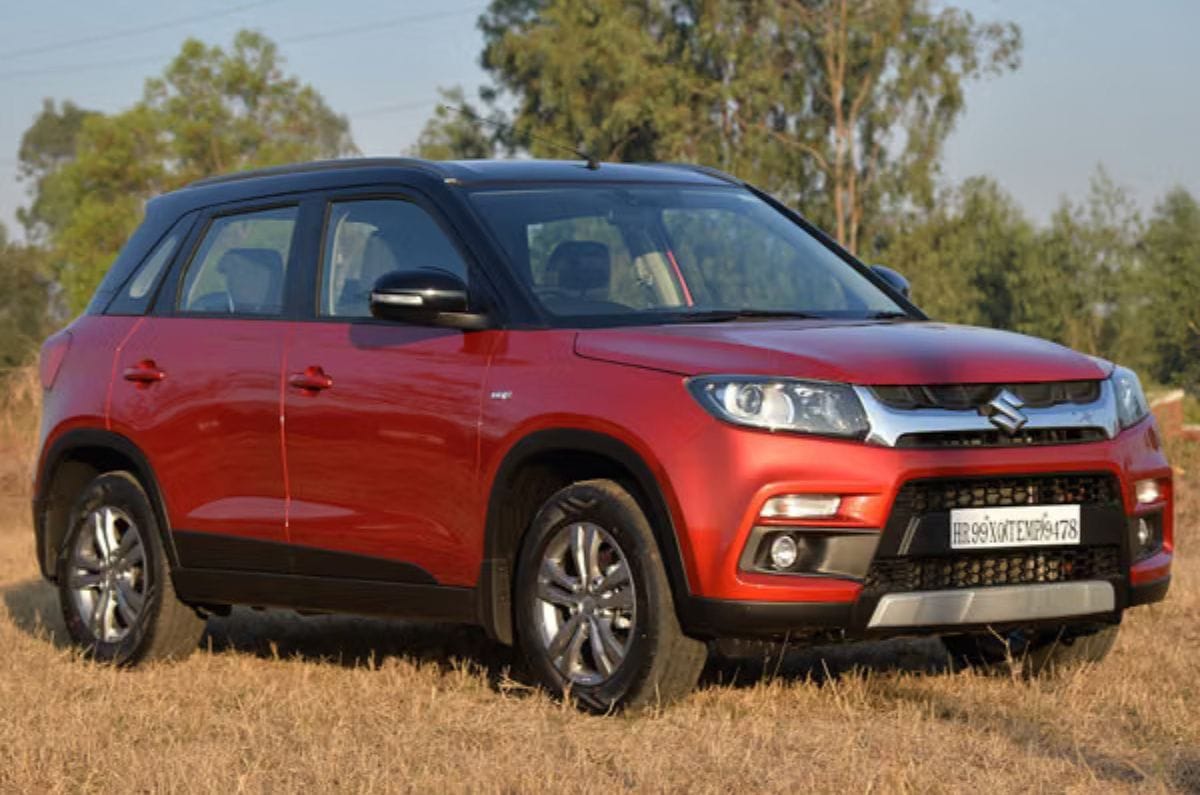
First-generation Brezza

In FY2021, sales dropped 14 percent YoY to 94,635 units, which also meant that the Brezza lost its No. 1 SUV title to the Hyundai Creta (1,20,035 units) that year and has not regained it since then. Despite registering double-digit growth in FY2022, FY2023, FY2024 and FY2025, the highest overall ranking the Brezza could manage since FY2020 was No. 2 in FY2021. 

Q1 FY2027 Dip and the Facelift Wait Effect

In FY2027’s first quarter (April-June 2026), the Maruti Brezza has sold 37,488 units, down 20 percent YoY (Q1 FY2026: 47,044 units), a decline which can be attributed to potential buyers awaiting the launch of the MY2026 Brezza, which gets exterior and interior updates, new features and an additional turbo-petrol engine option.

With 14.6 lakh units sold in the domestic market from launch till end-June 2026, the Brezza accounts for a third or 34 percent of Maruti Suzuki’s total UV sales of 42.7 lakh units (42,71,696 UVs) in the same period. Will the new MY2026 Brezza, which has received a 5-star Bharat NCAP crash safety rating, deliver new sales momentum for this popular SUV category remains to be seen.

3 reasons to buy the Nissan Tekton and 3 to avoid it

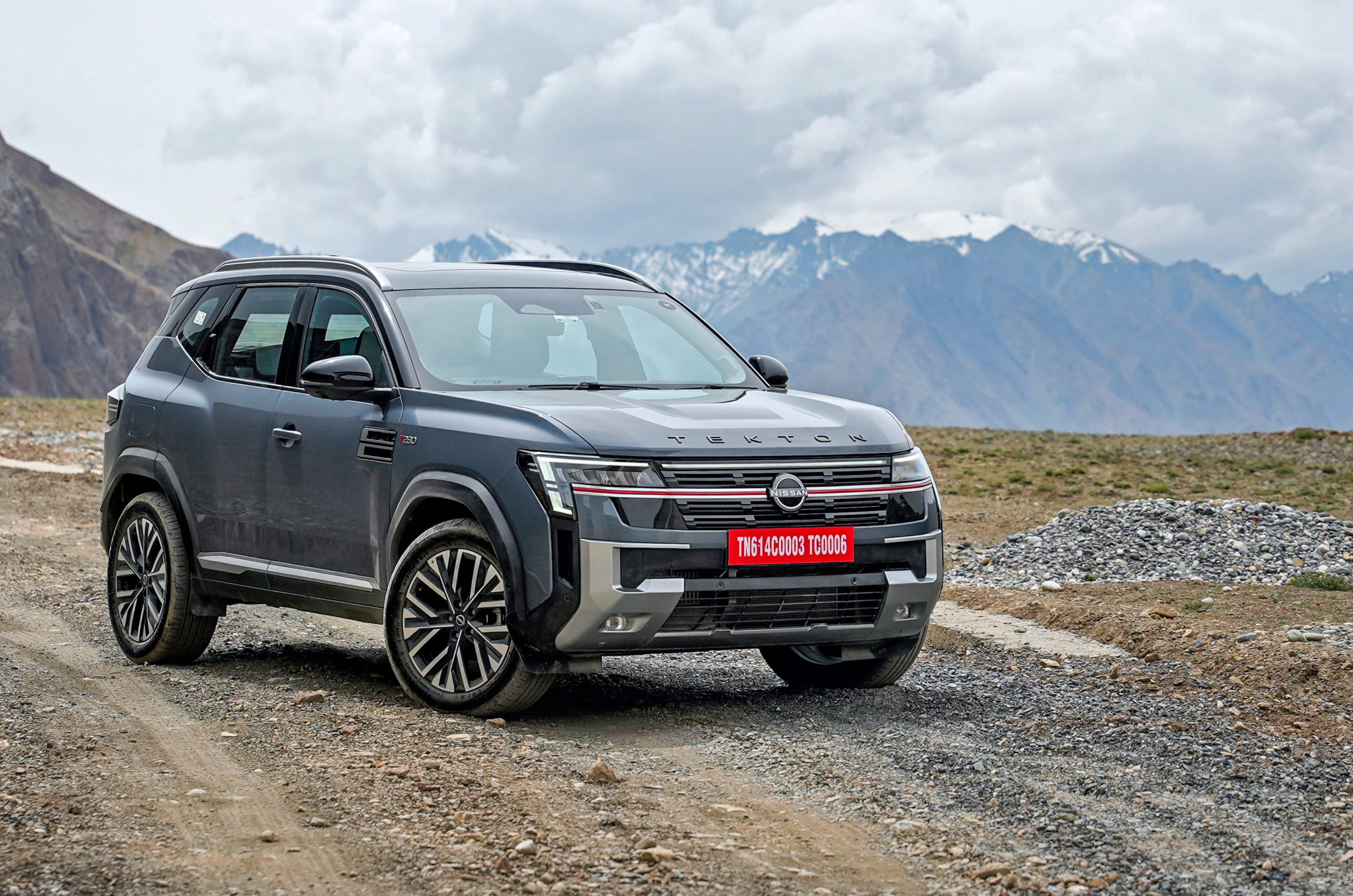
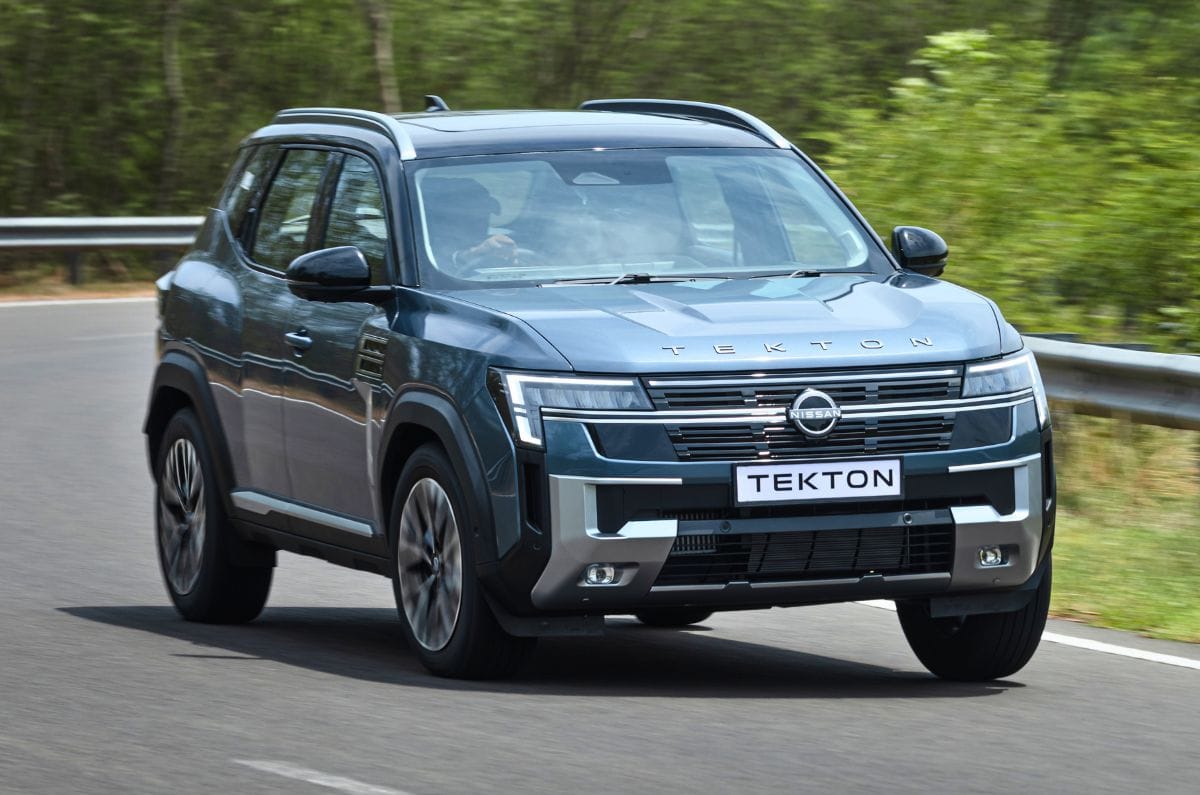
Nissan Tekton front three quarter

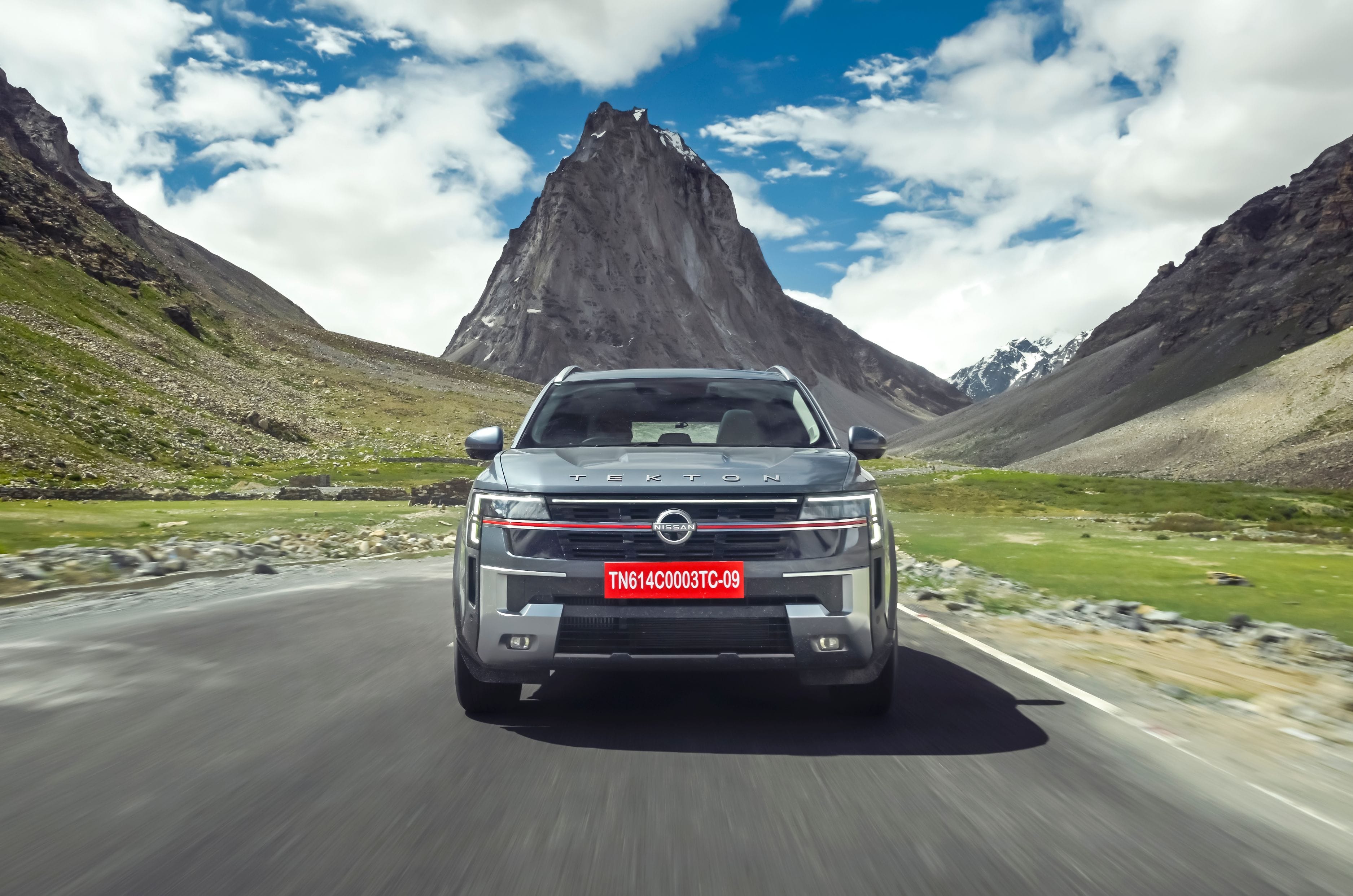
The Nissan Tekton joined the ever-ballooning midsize SUV segment in July 2026, becoming the third model in the Japanese brand’s India line-up. Priced between Rs 10.49 lakh and Rs 18.59 lakh (ex-showroom), the Tekton is Nissan’s flagship offering in the country. As a direct alternative to its platform sibling, the Renault Duster, does the Tekton offer compelling reasons for you to seriously consider it? Let’s find out.

Reasons to buy the Nissan Tekton

Polished dynamics

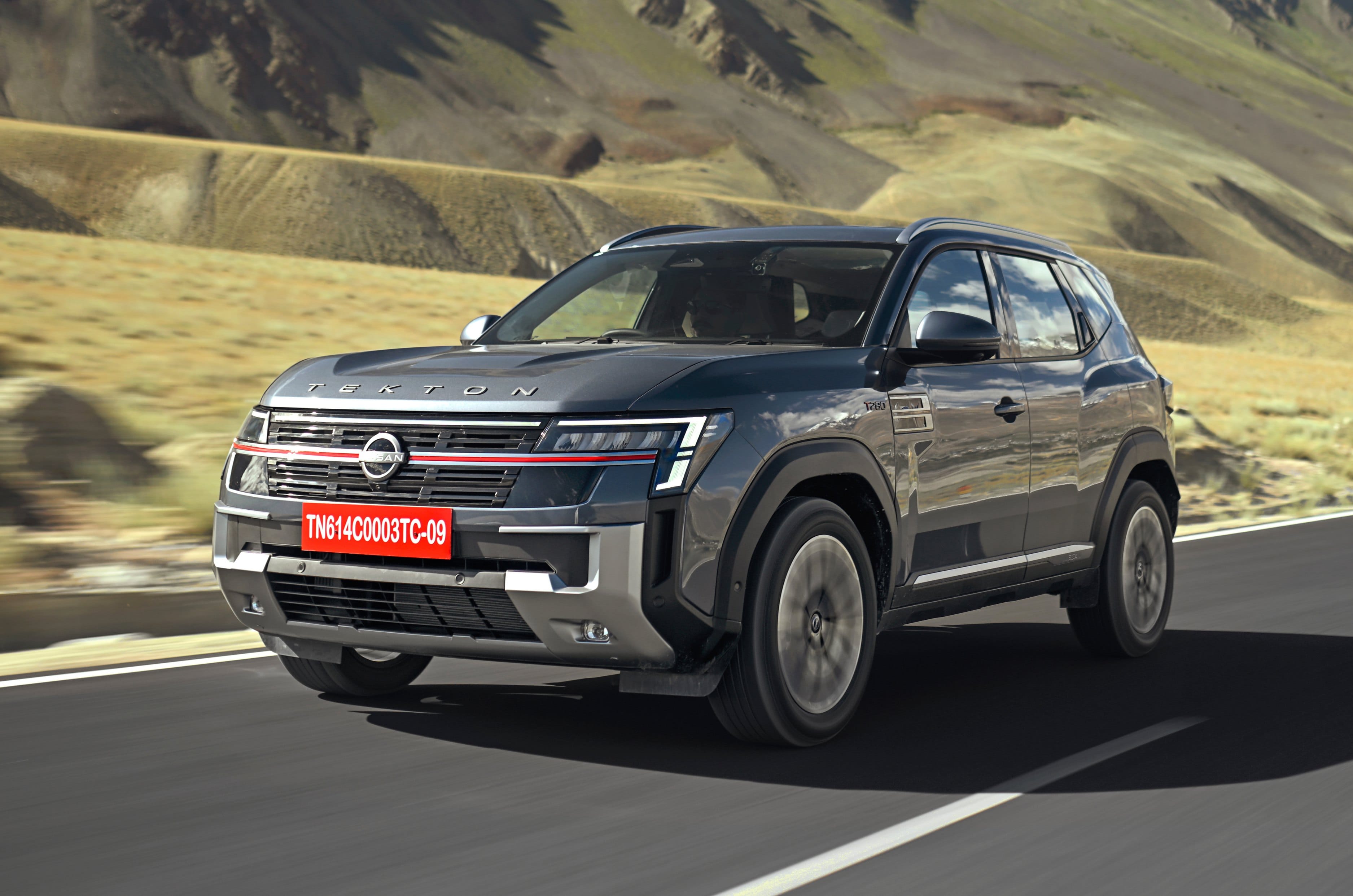
The Tekton strikes a great balance between ride and handling

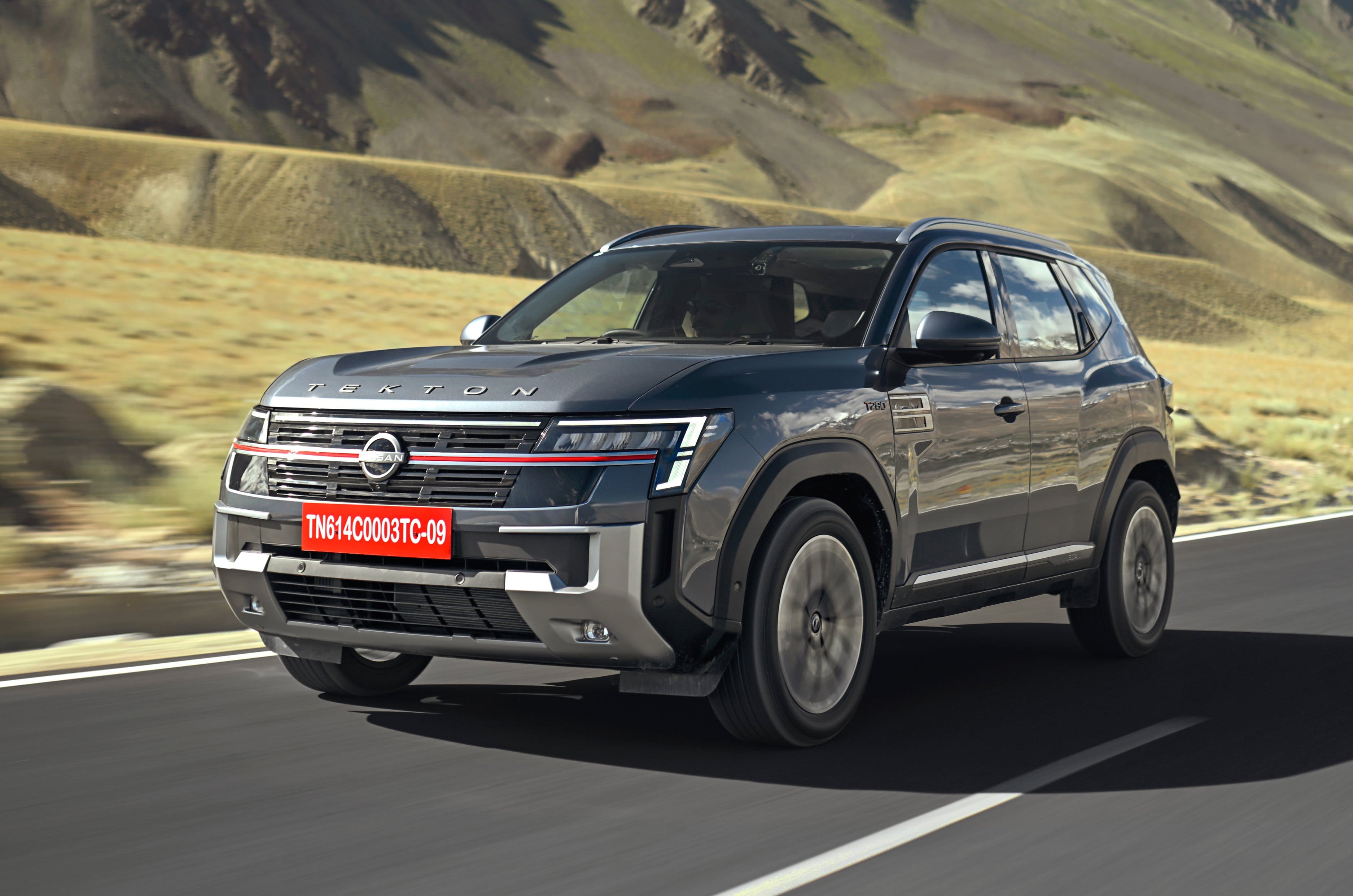
Nissan Tekton front three quarter tracking

If you are someone who loves getting behind the wheel of your midsize SUV but doesn’t want the ride quality to be compromised, the Nissan Tekton is a worthy candidate. Even hitting large potholes does not unsettle this SUV, merely registering in your ears. The ride remains supple and forgiving, absorbing road imperfections without complaints. There’s also no underlying, uncomfortable firmness to the Tekton’s ride at city speeds either.

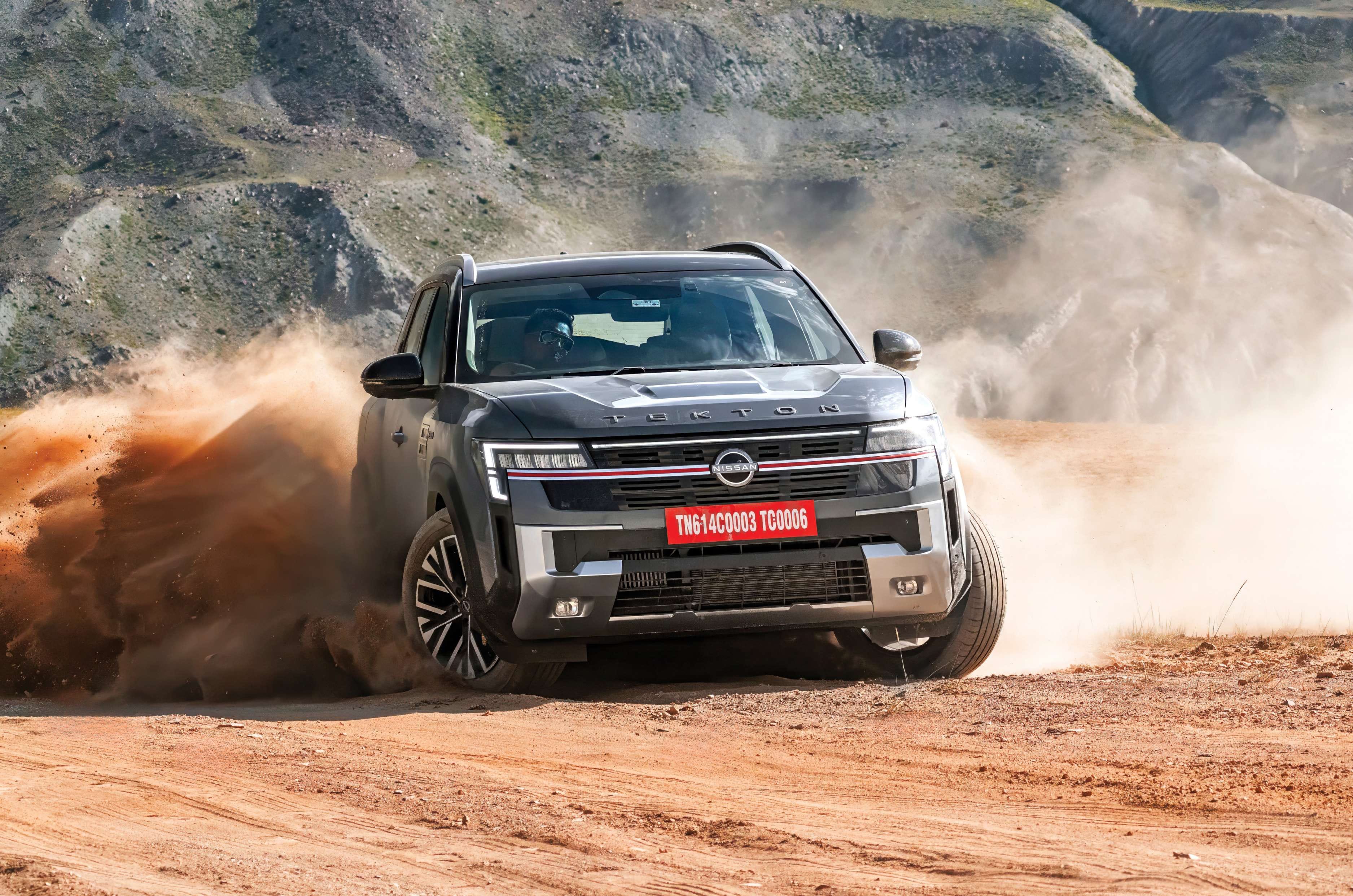
Nissan Tekton cornering

Once you get going, you realise that the Tekton likes changing directions – its eagerness to turn does not come at the cost of uncontained body roll. The ‘Light’ and ‘Heavy’ steering modes work as intended, making the wheel feelsome and precise. Then there are the brakes, which offer plenty of stopping power, while the pedal itself feels natural too. All of these factors inspire confidence and let you push the Tekton a bit more. 

Well-designed and tech-rich cabin

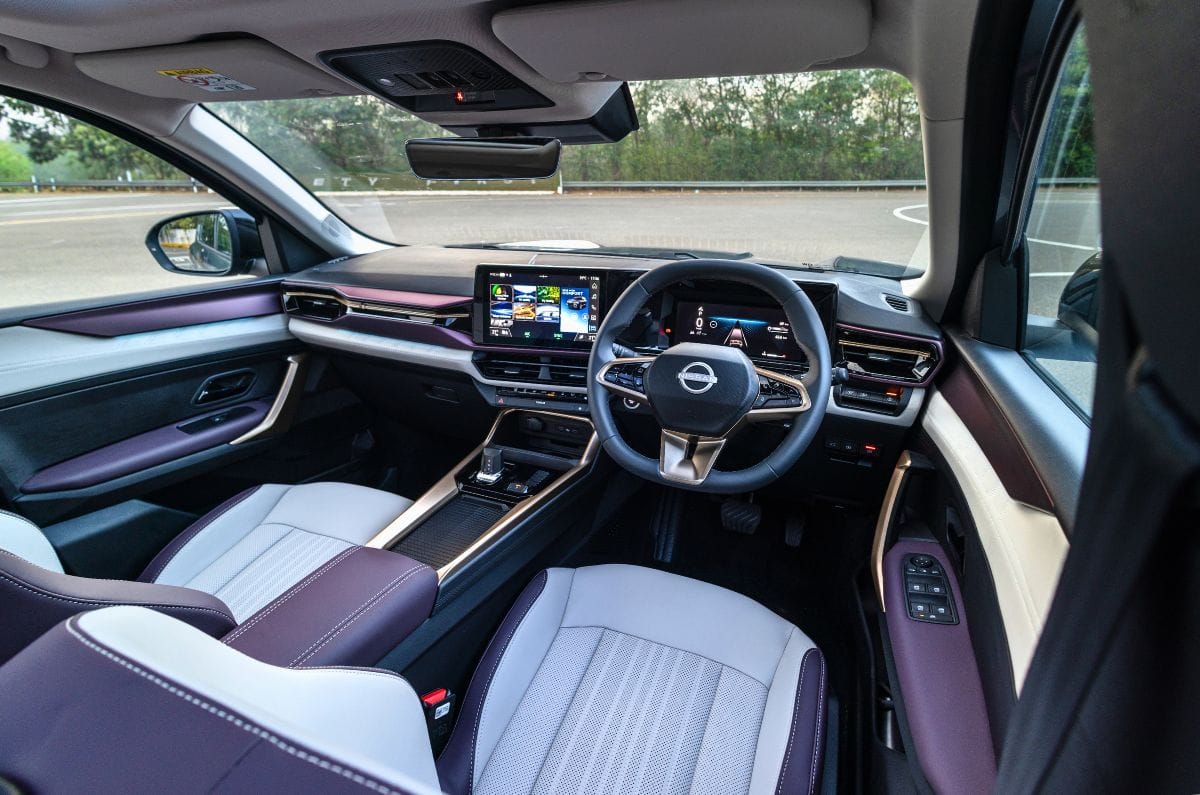
Stepping inside the Tekton reveals a premium-looking and well-equipped space

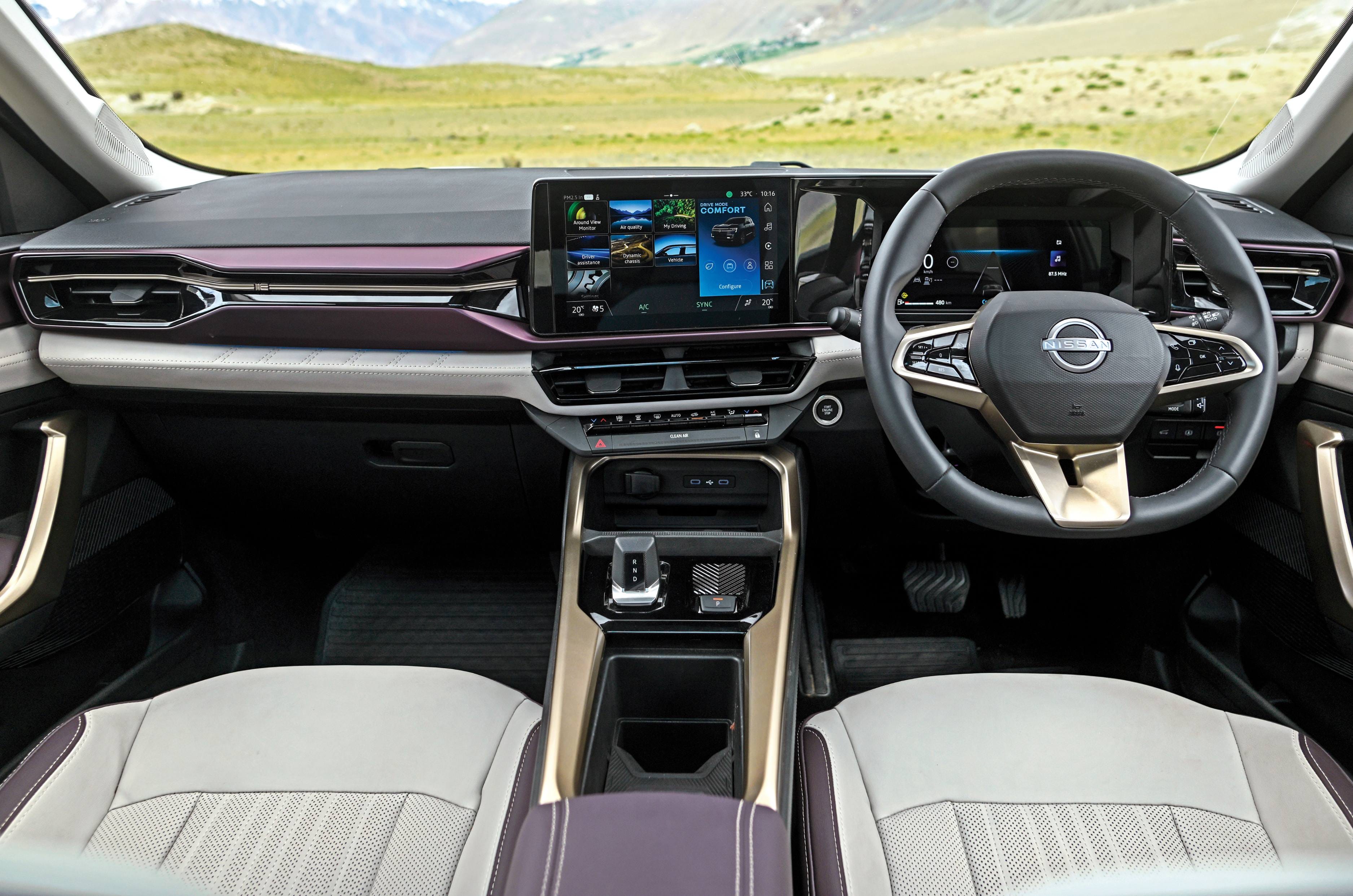
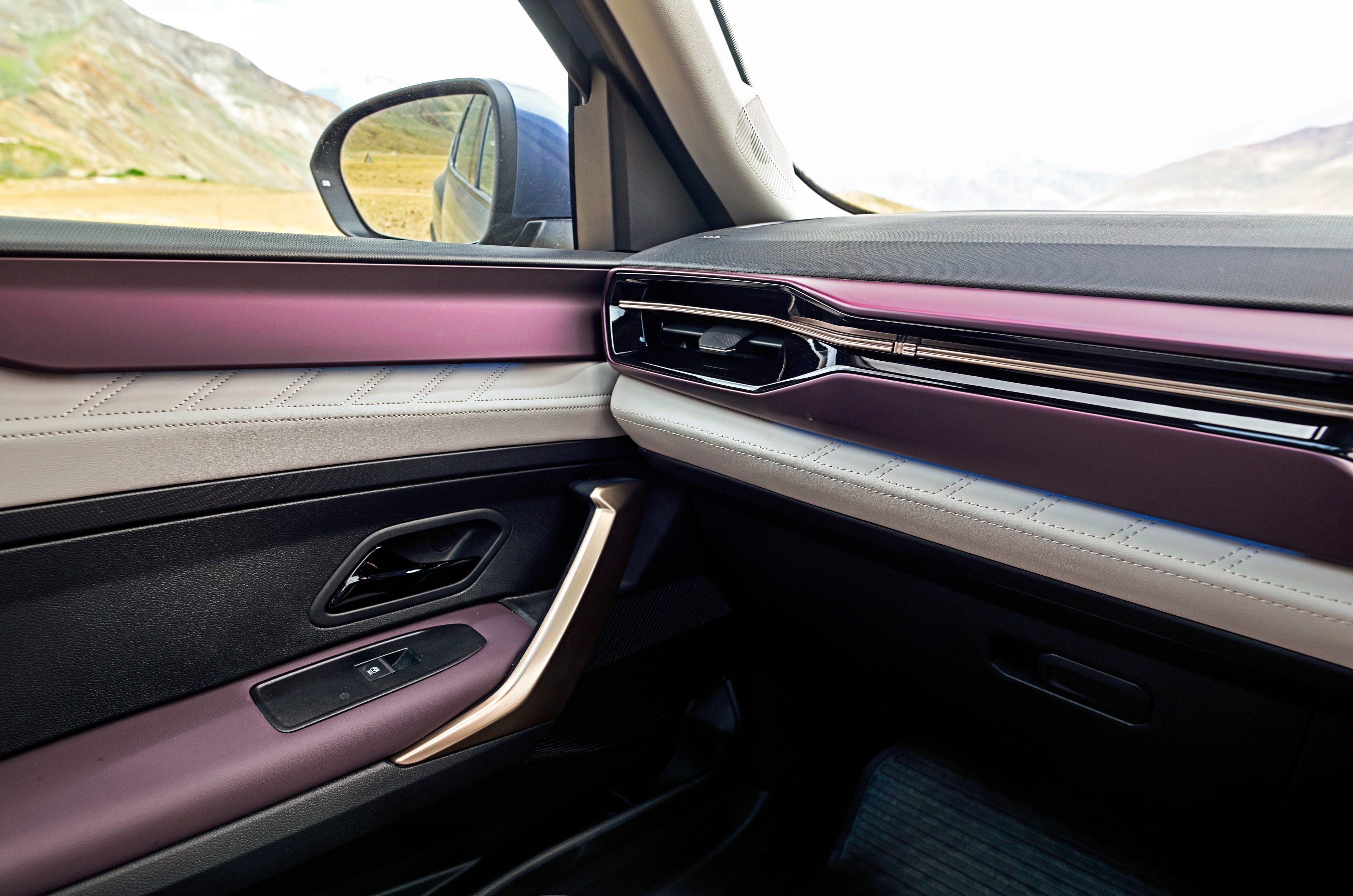
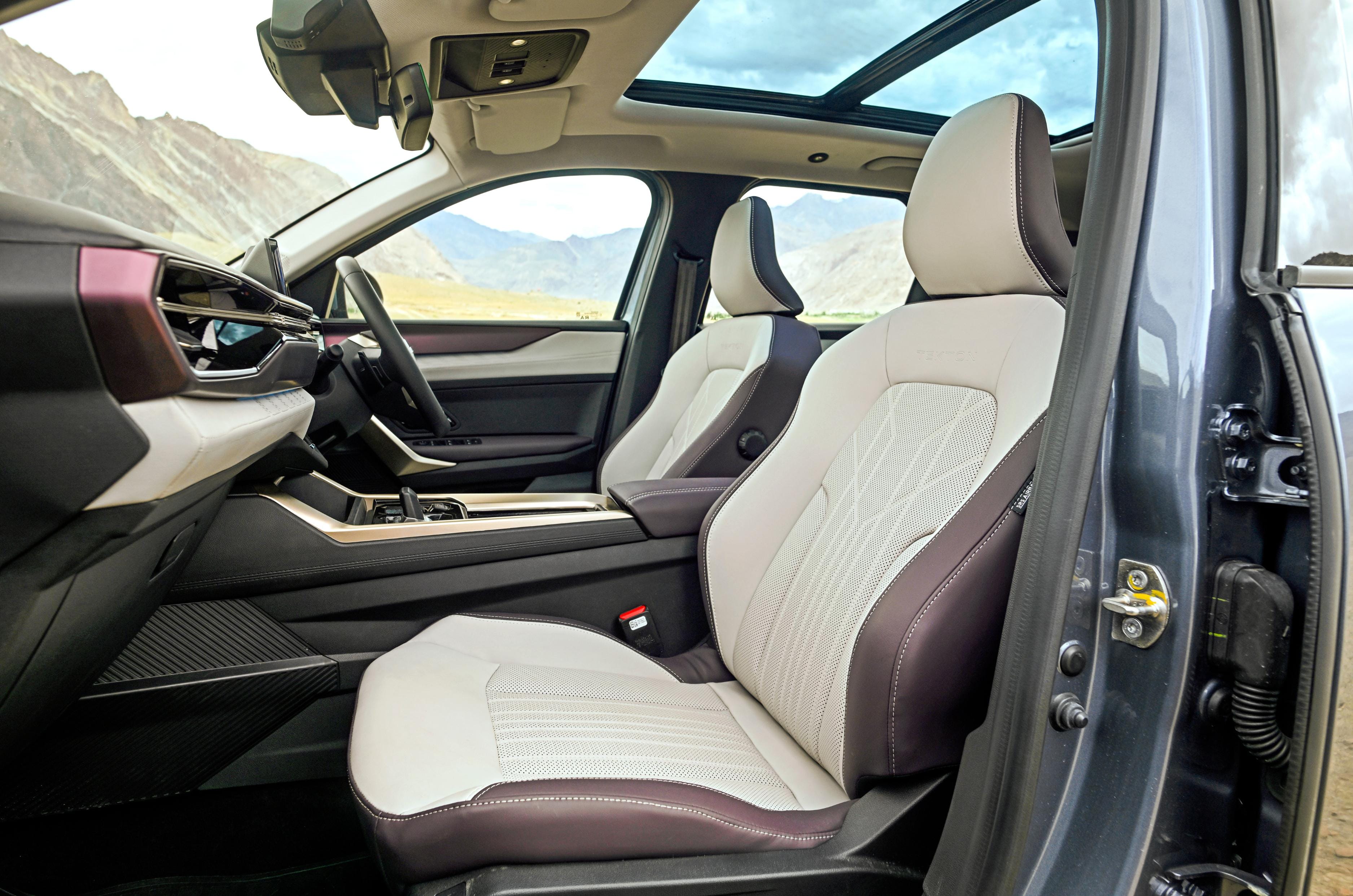
Nissan Tekton interiorCombined with the classy-looking leatherette padding on the dash and door pads, plus the burgundy, gold and light cream colour scheme, the interior of the top-spec Nissan Tekton looks upmarket. The driving position is great and provides excellent all-round visibility, while the seats themselves are comfy enough to be occupied even over long-distance drives.
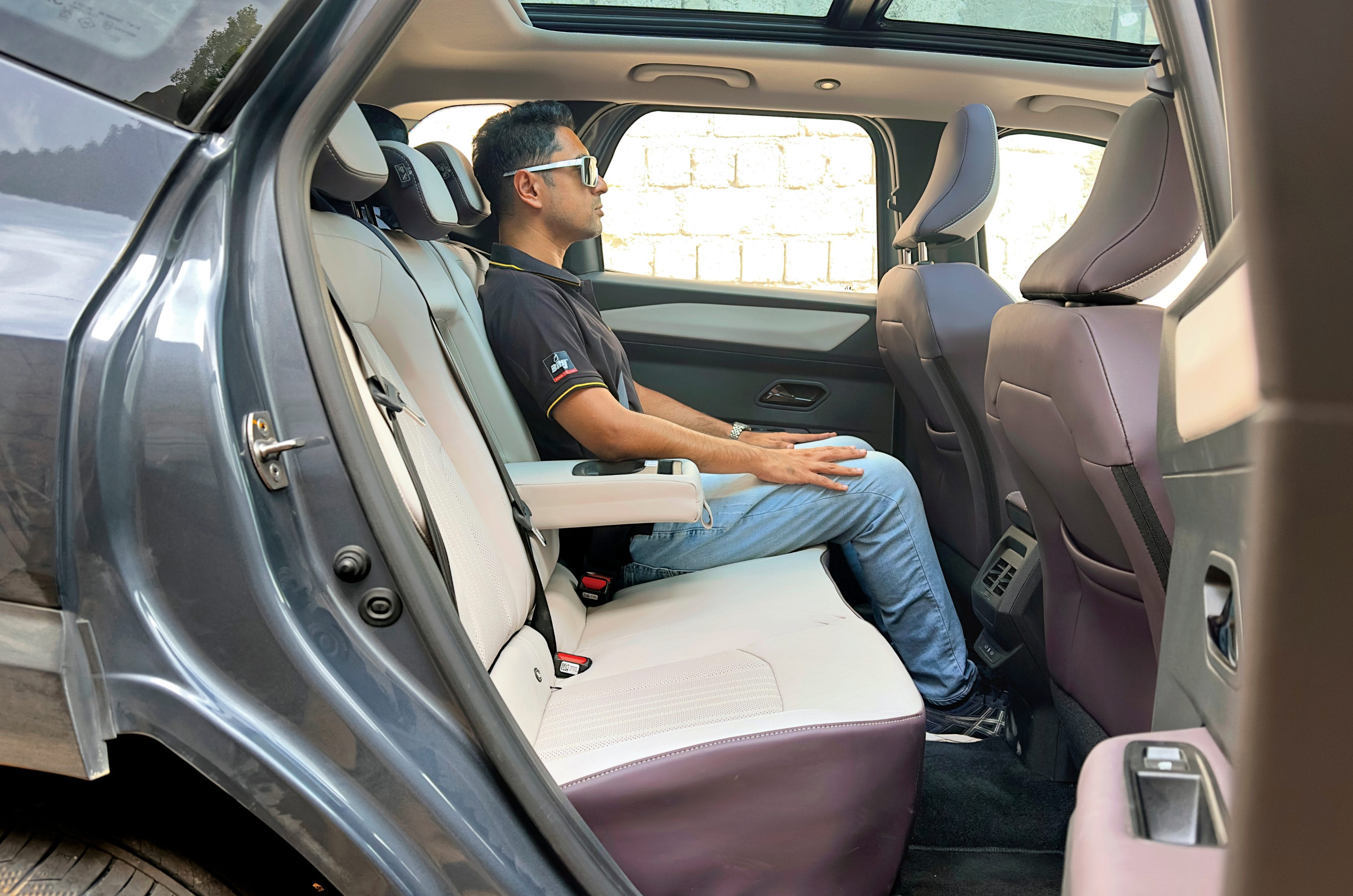
Nissan Tekton rear seats

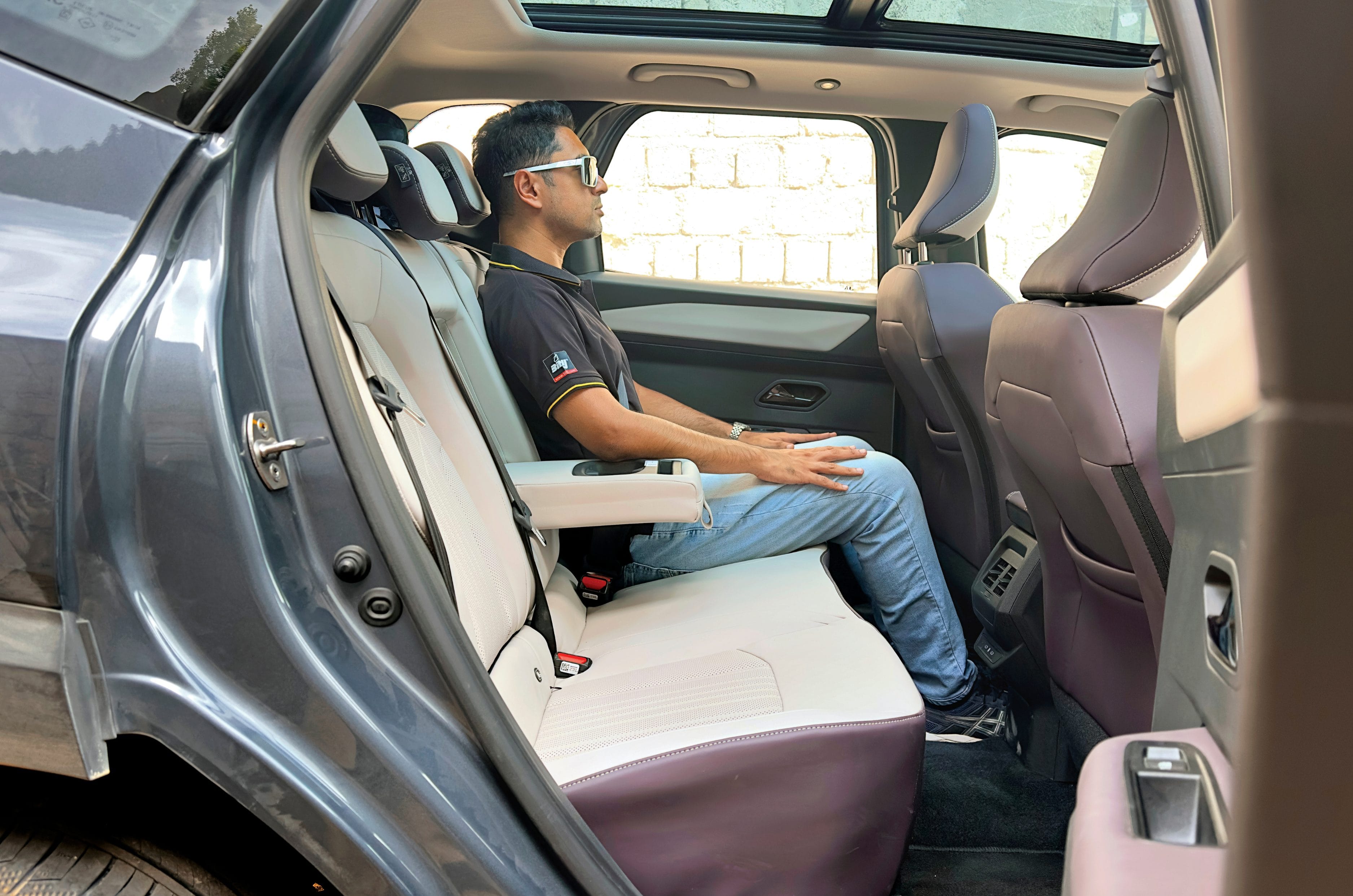
Apart from good under-thigh support and backrest angle, the rear seats offer plenty of space under the front seats, allowing the outer two occupants to stretch out and get comfortable. Furthermore, those at the back have access to USB charging ports, a centre armrest with cup holders and AC vents, with higher variants also benefiting from a panoramic sunroof.

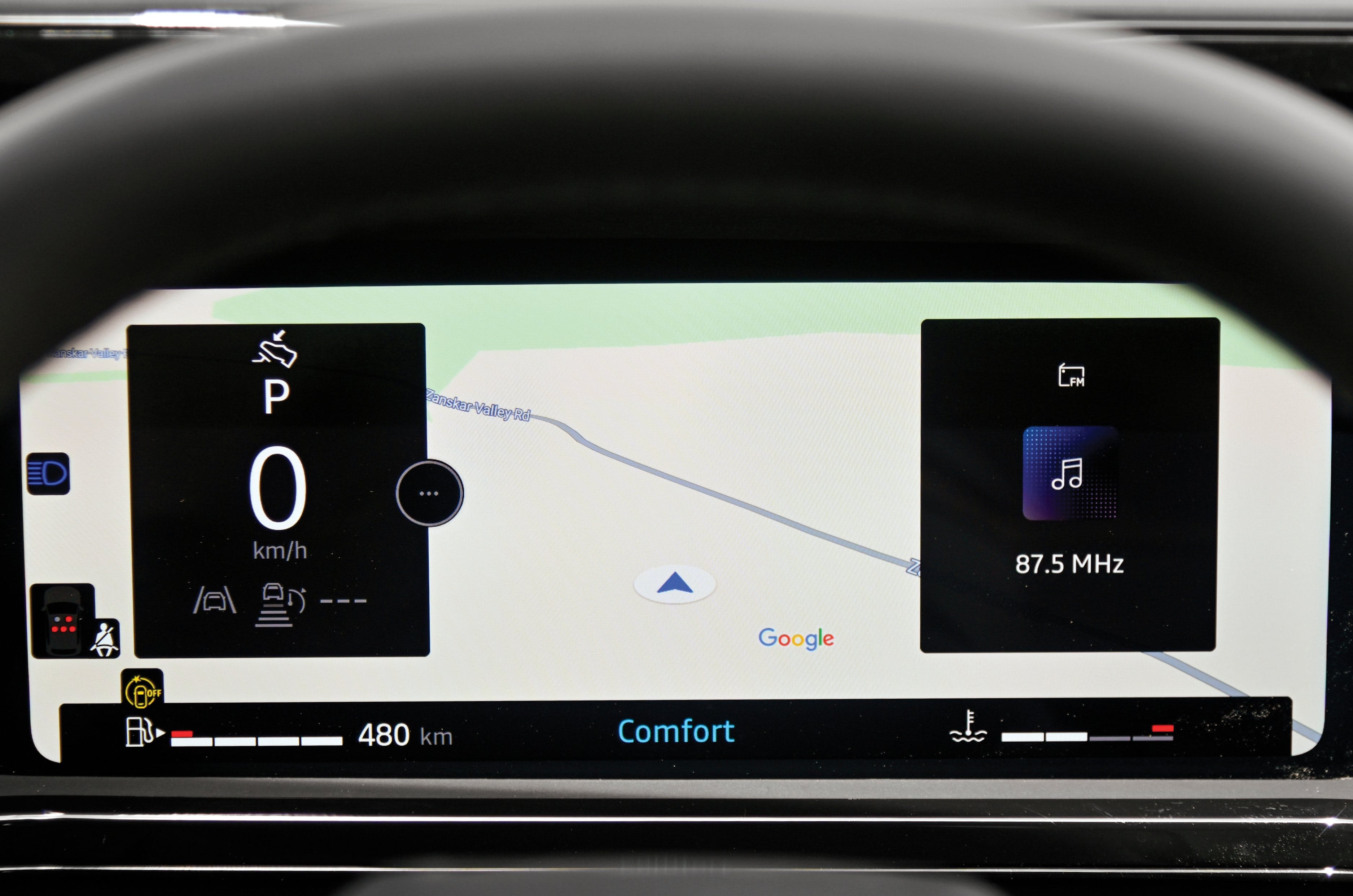
Nissan Tekton digital instrument cluster

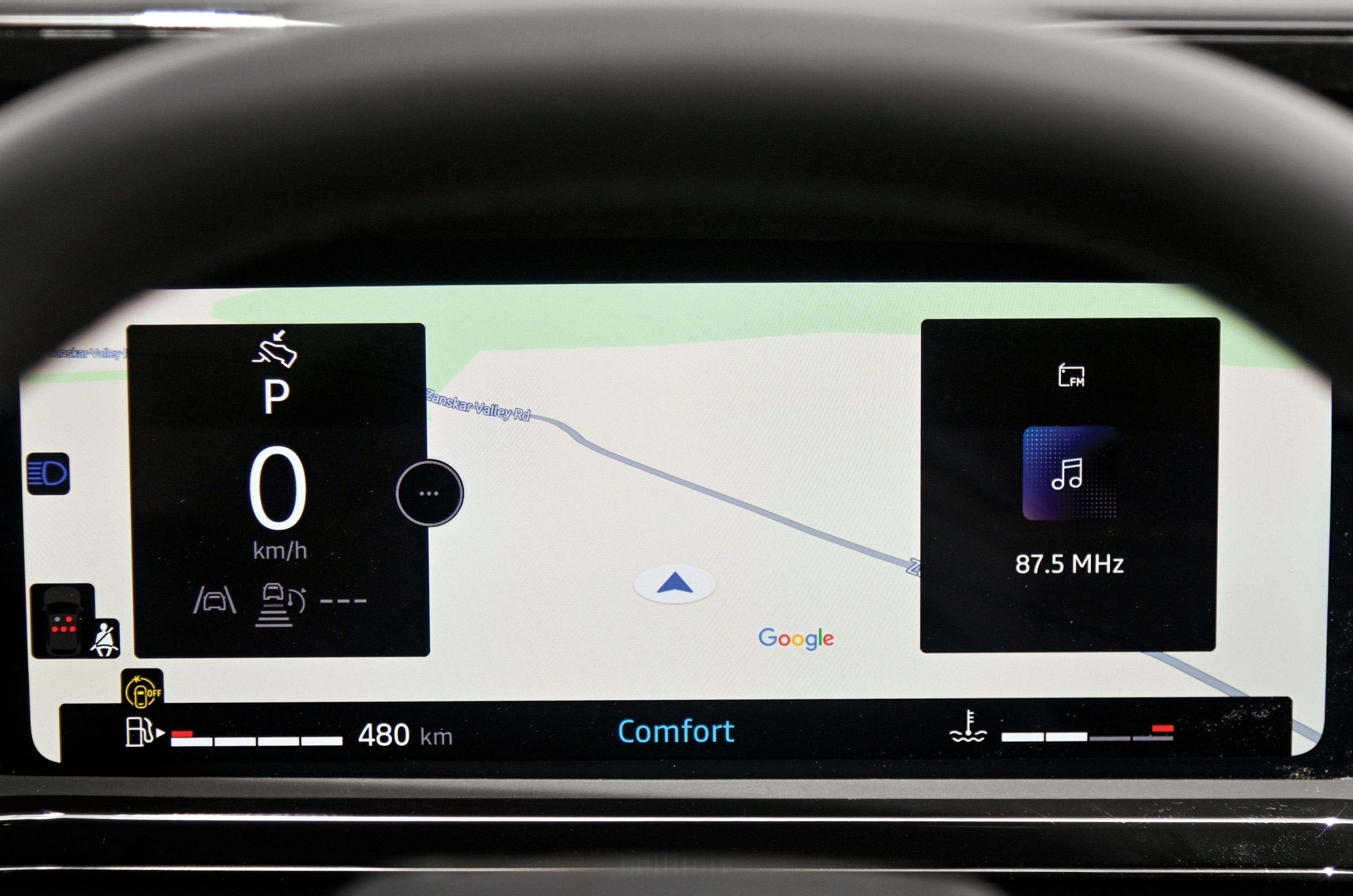
The well-designed digital instrument cluster with its multiple display modes is easy to figure out and use on the move. Coming in handy is tech such as powered front seats with ventilation, wireless Apple CarPlay and Android Auto, built-in Google apps and voice assistance, dual-zone climate control and Level 2 ADAS. Sorted ergonomics make reaching various switchgear and controls an easy affair. There are enough storage cubbies on offer, too.

Spacious boot

The Tekton’s boot can handle family outings or airport pickups

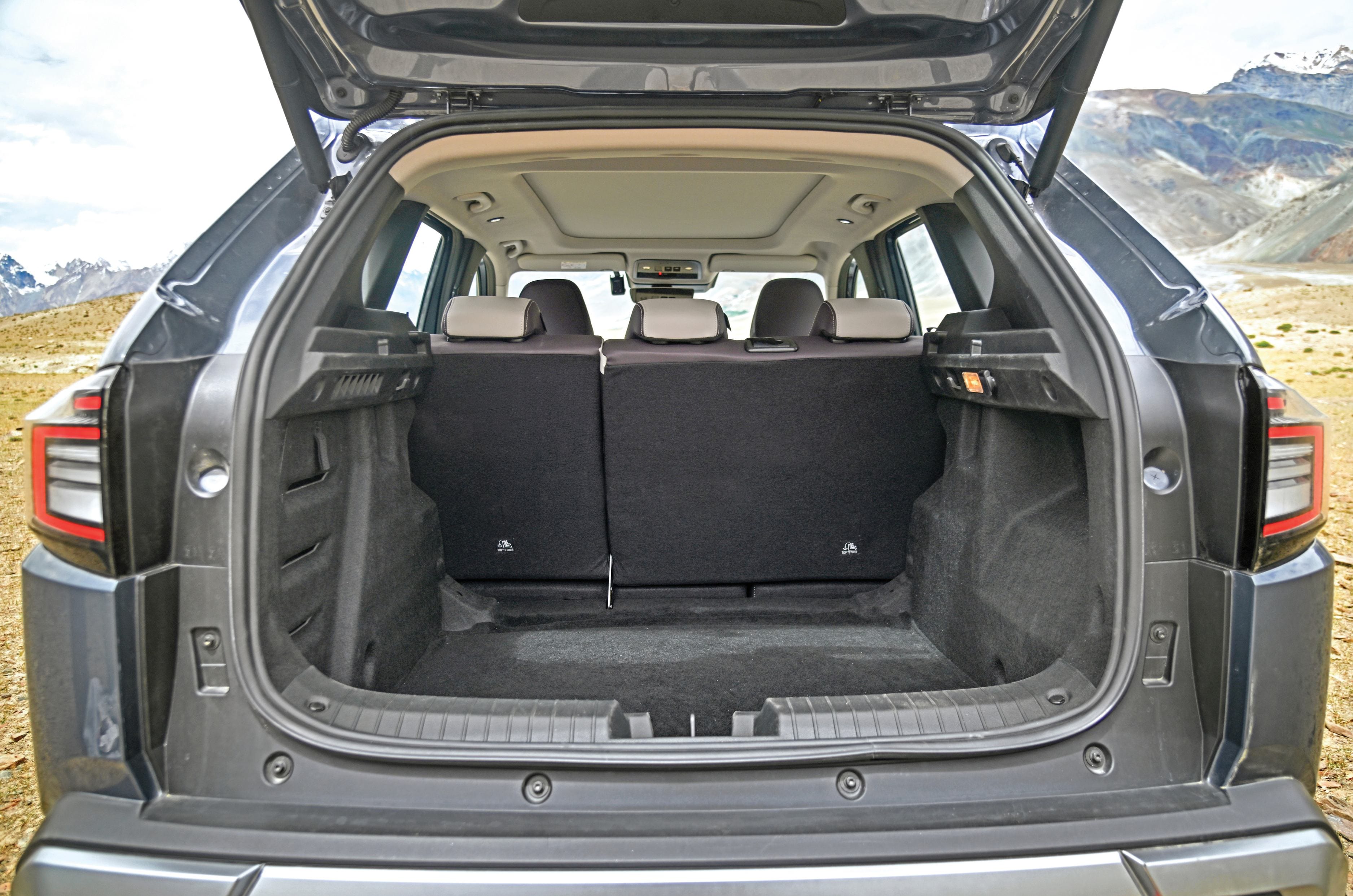
Nissan Tekton boot space

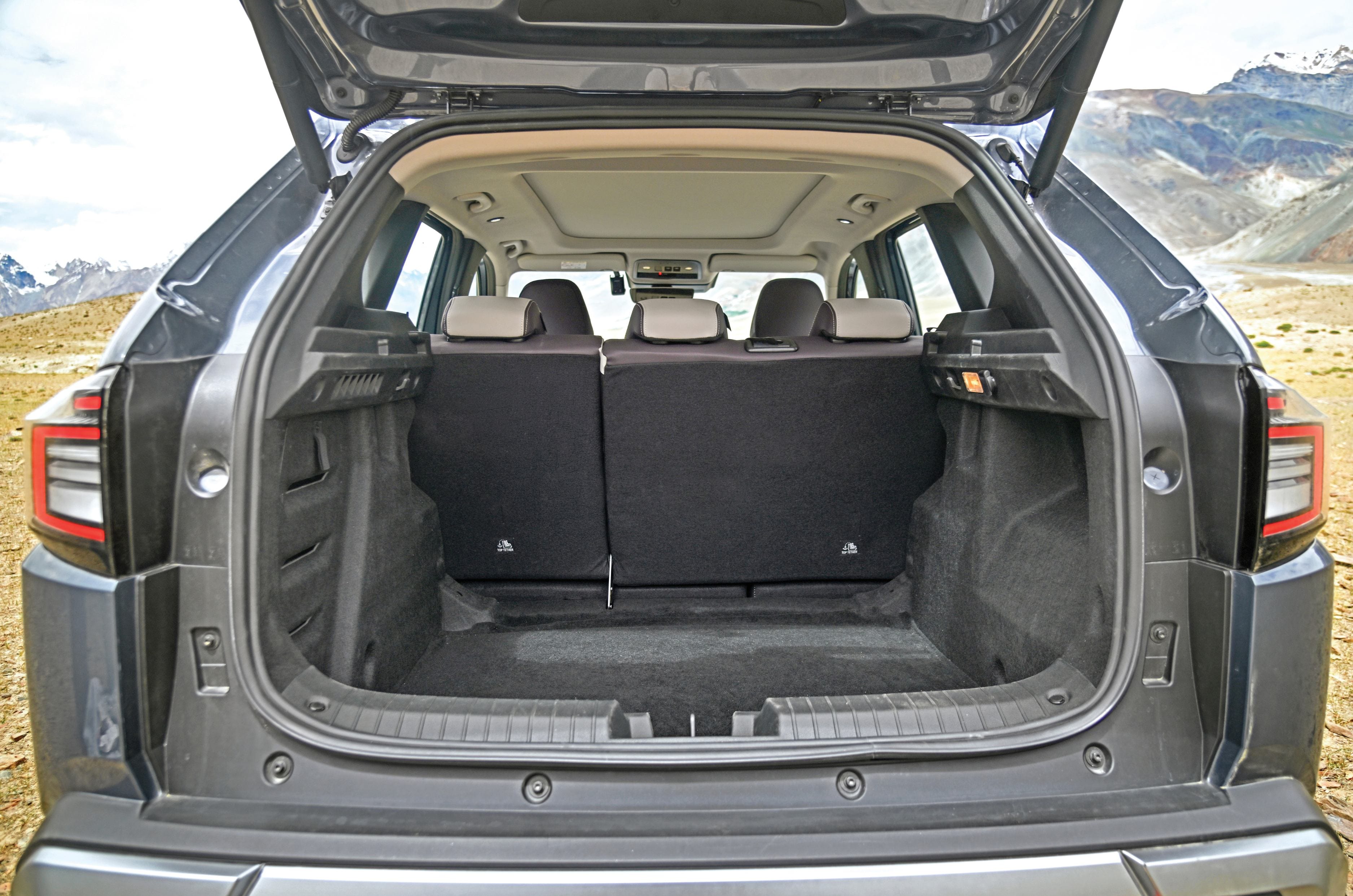
The square shape of the Nissan Tekton’s boot makes it easy to load cargo. Moreover, its 518-litre luggage capacity is the best in the segment – whether you are planning a long road trip or have to shuttle to and from the airport, space won’t be a constraining factor. What’s even more impressive here is that the Tekton’s boot also houses a full-size spare wheel. This alleviates concerns surrounding a flat tyre, should you encounter one.

Reasons not to buy the Nissan Tekton

Sub-par engine performance

Base engine isn’t apt enough, while the larger engine isn’t ideal either

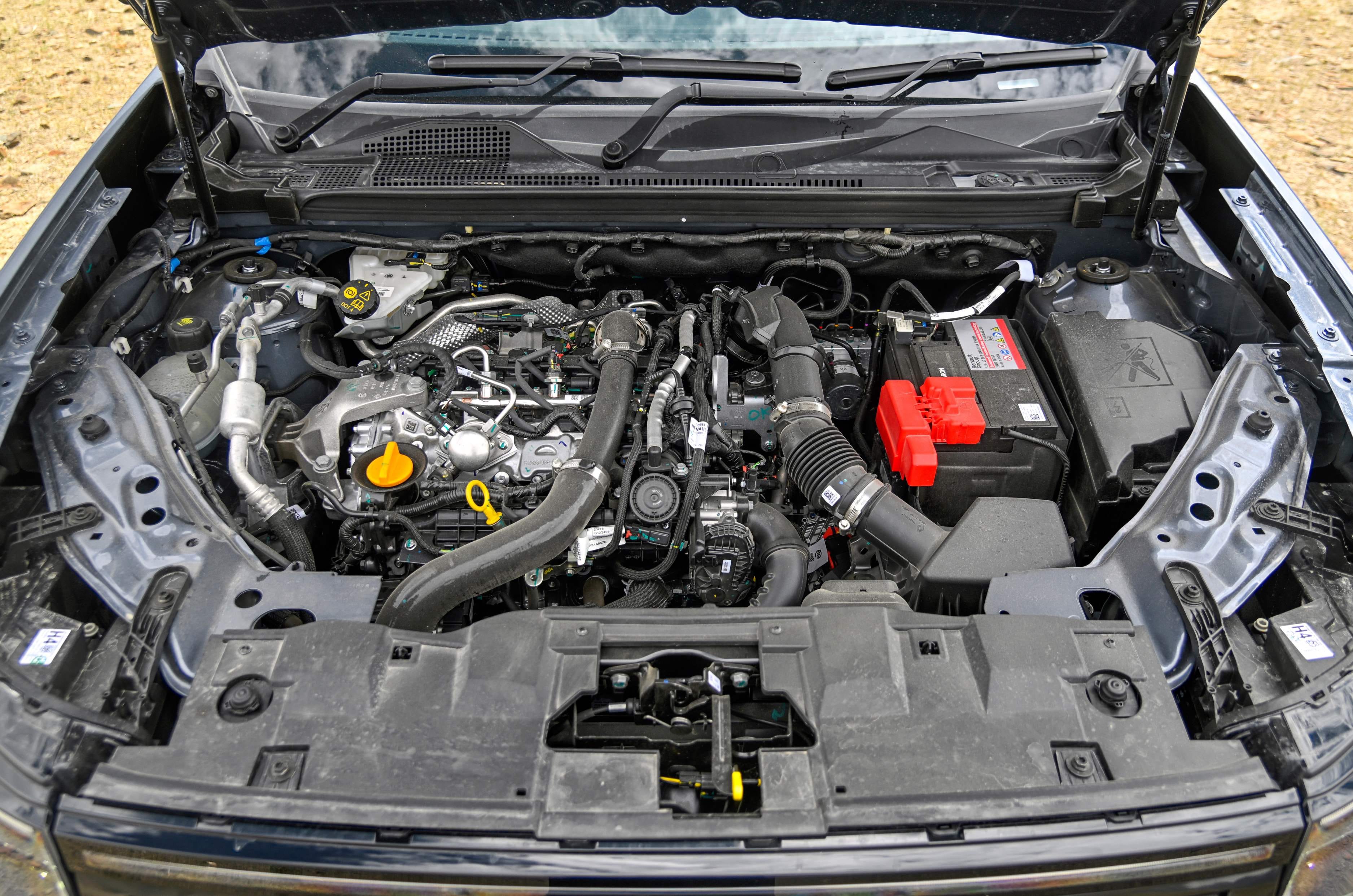
The base 100hp 1.0-litre turbo-petrol engine featuring multi-point fuel injection lacks grunt and isn’t particularly refined, with usable power only good enough for city commutes. The turbo lag is evident till you go past 3,000rpm, requiring the driver to shift gears regularly to keep the engine on the boil. The 6-speed manual transmission (MT) on duty gets shorter gearing to help matters, but you’ll need to slip the clutch to tackle steep inclines, which will be an inconvenience. The gear shifts aren’t as slick as those of a comparable Hyundai Creta or a Kia Seltos.
Nissan Tekton 1.3 engine

Moving up to the larger, 163hp 1.3-litre turbo-petrol engine with direct injection doesn’t alleviate all of the issues either. Despite this engine’s higher output than the smaller mill, its weak bottom end can leave the Tekton struggling to get up and go on steep inclines, especially with the engine stop-start function enabled. While it offers more refinement and performance, there’s still noticeable turbo lag below 2,500rpm.

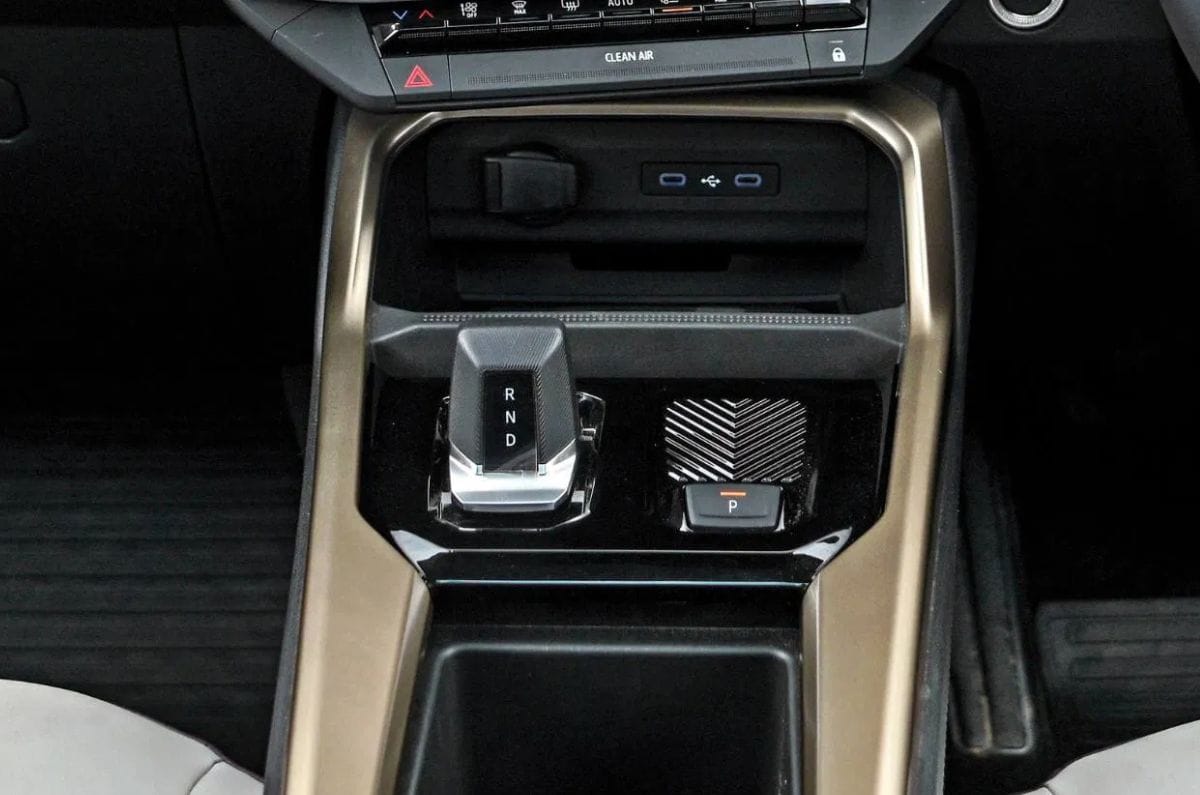
Nissan Tekton DCT gearbox

The 6-speed dual-clutch transmission (DCT) shifts between cogs smoothly, but its responses aren’t as quick as one might expect from the type. It upshifts early, perhaps in a bid to boost efficiency, but this makes it feel less responsive. This means you’ll have to take manual control by using the paddleshifters if you want to execute an overtake in a hurry. There’s also no Sport mode to quicken gear shifts – only Comfort and Eco modes are provided. While we are yet to put the Tekton through our rigorous performance tests, the performance on hand is unlikely to impress some buyers.

Lacklustre fuel economy

The Tekton will not be setting mileage benchmarks in the segment

Since the powertrain is mechanically identical to the Duster’s, the fuel economy of the Nissan Tekton in the real world is unlikely to impress. For reference, the Duster with the 1.0-litre engine and 6-speed MT returned 10.98kpl. Meanwhile, the 1.3-litre version recorded 10.47kpl and 10.64kpl with the DCT and MT gearboxes, respectively.

Some features lack execution

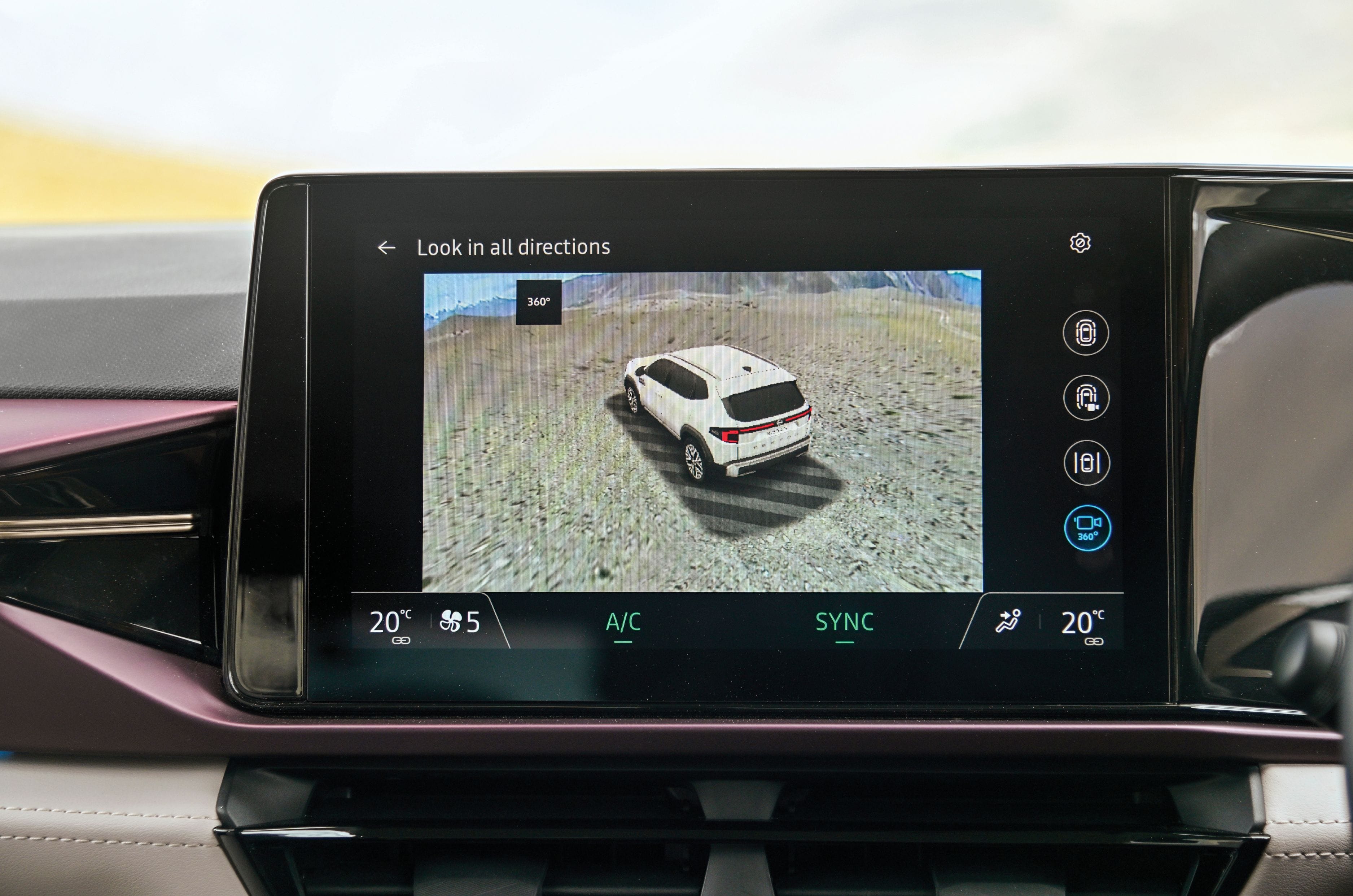
Nissan Tekton 360-degree camera

The Nissan Tekton has a few shortcomings when it comes to the quality of some of its features. The 360-degree camera system, for instance, is lacking in outright resolution, which hampers its usability under certain conditions. While the ADAS suite is comprehensive, the lane-keep assist isn’t good at keeping the SUV centred in a lane. Even the adaptive cruise control has its shortcomings – it doesn’t accelerate the Tekton back to its set speed once the traffic starts moving.

Also read

3 reasons to buy the Mahindra XUV 3XO and 2 to skip it

Tata Tiago vs Hyundai Grand i10 Nios performance compared

Nissan Tekton first drive review: Tough yet classy

Nissan Tekton dirt cornering

For our first drive of the all-new Tekton, Nissan organized an elaborate 700km plus test drive from Chandigarh to Leh, tackling everything from crowded city traffic and fast highways to mountain passes and broken roads. The aim was to find out whether Nissan’s new midsize SUV has what it takes to take on the Hyundai Creta, Kia Seltos and Maruti Victoris in the real world.

Nissan Tekton Exterior Design and Engineering – 9/10

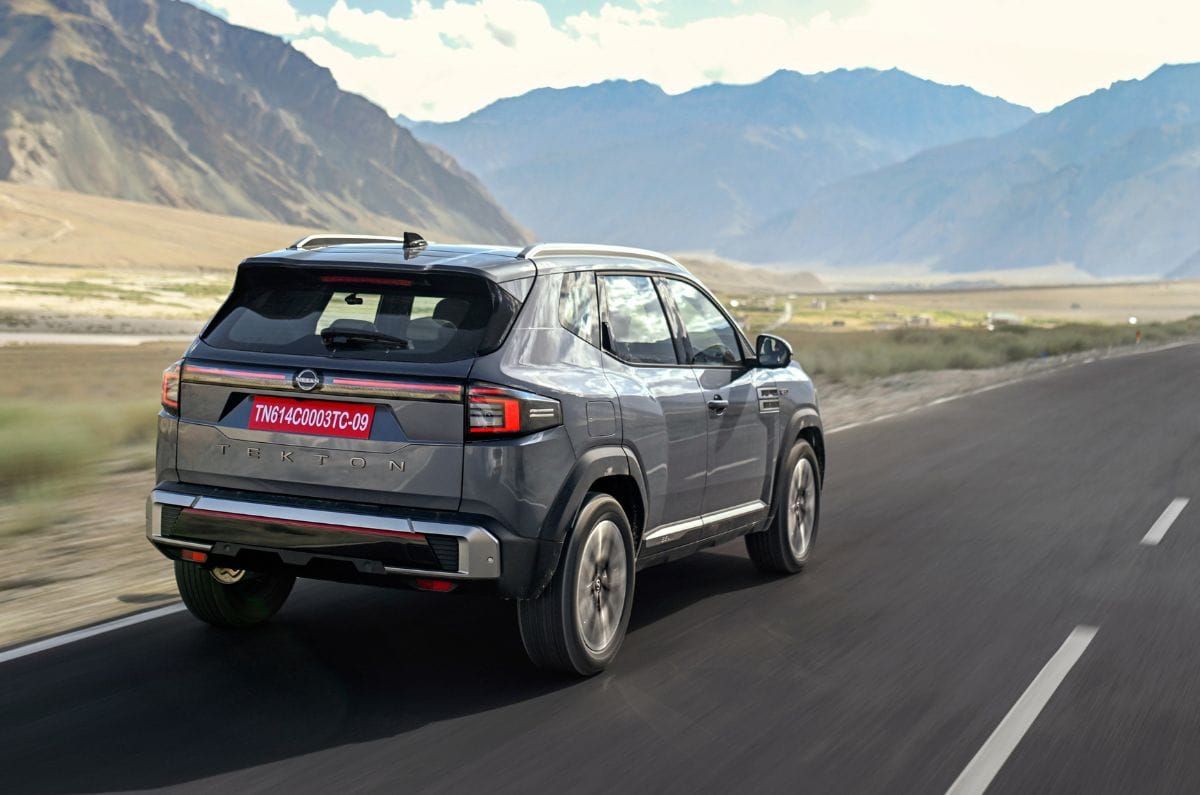
The Tekton is, in essence, a badge-engineered Renault Duster. It is built at the same plant, on the same assembly line, and shares its platform, powertrains and several components with its French sibling. Nissan, however, has worked hard to give it a distinct identity, drawing inspiration from its flagship Patrol SUV.

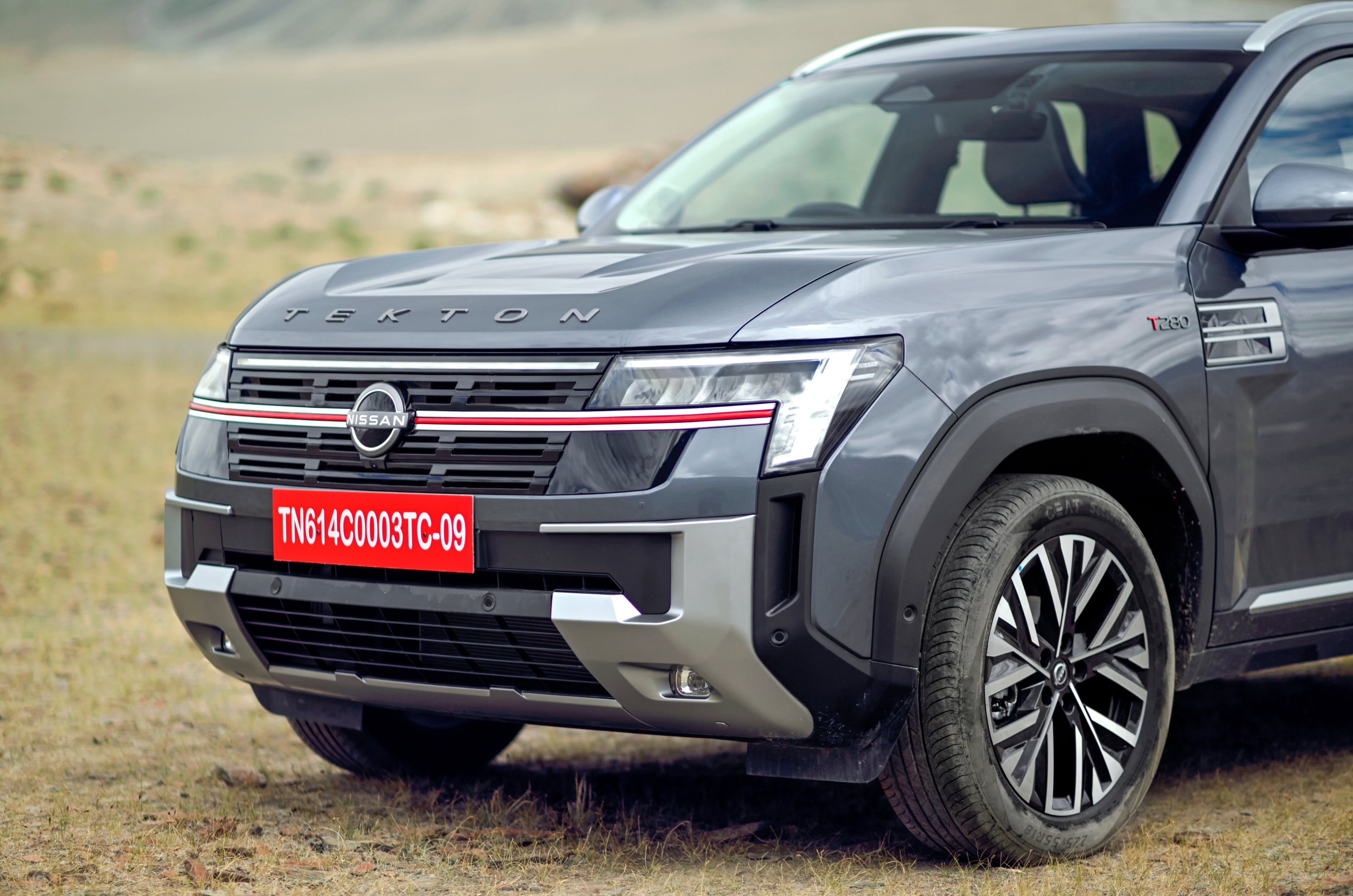
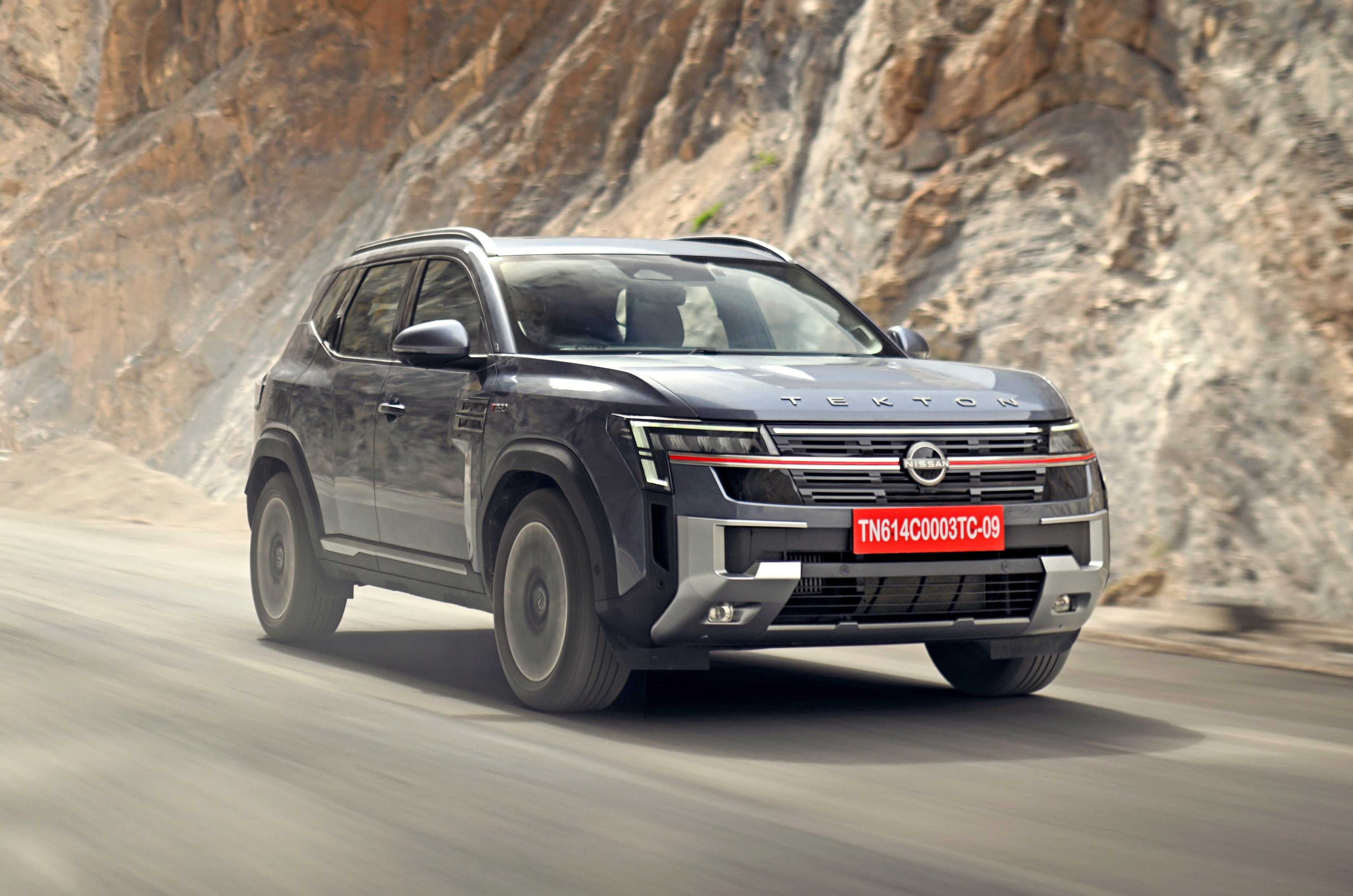
1.3 turbo variants can be identified by the red strip on the grille and T280 badge. 

The front end is undoubtedly the highlight. The grille, connected light bar and red accents on the 1.3-litre turbo variants lend it a bold and distinctive look. It even gets functional bumper air scoops and fog lamps, the latter being an increasingly rare feature in this segment. The sculpted bonnet adds plenty of visual muscle, while the side profile is enhanced by attractive 18-inch alloy wheels wrapped in chunky, high-profile tyres. 

Practicality extends beyond appearances. Ground clearance stands at an impressive 212mm, making the Tekton well suited to rough terrain. The T280 badge on the front fender denotes the 280Nm produced by the 1.3-litre turbo-petrol engine, while a unique applique depicting the Himalayas adds a touch of character. Its pillar-mounted rear door handles link ties to Nissan SUVs of yore like the Pathfinder and X-Terra. 

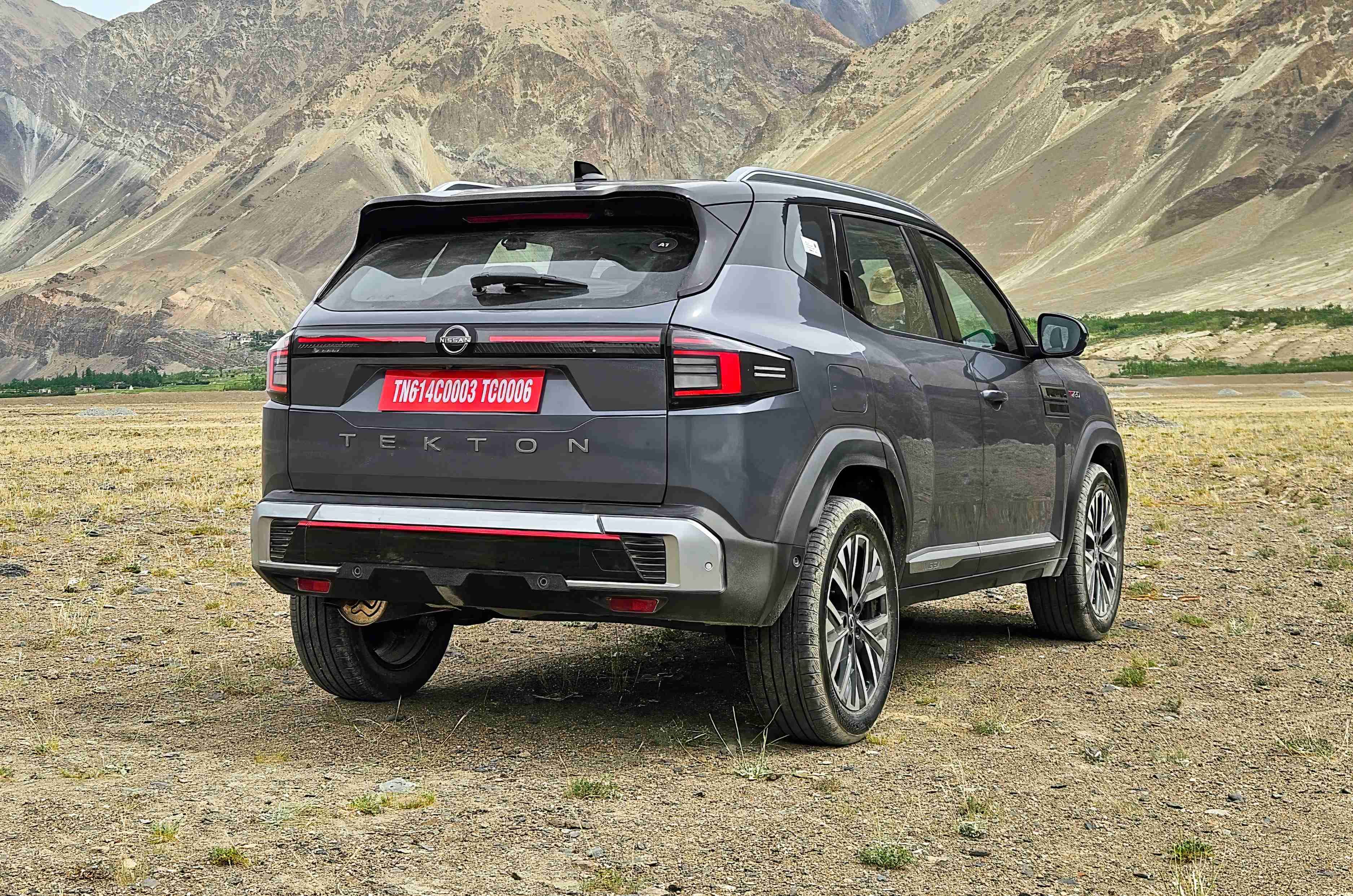
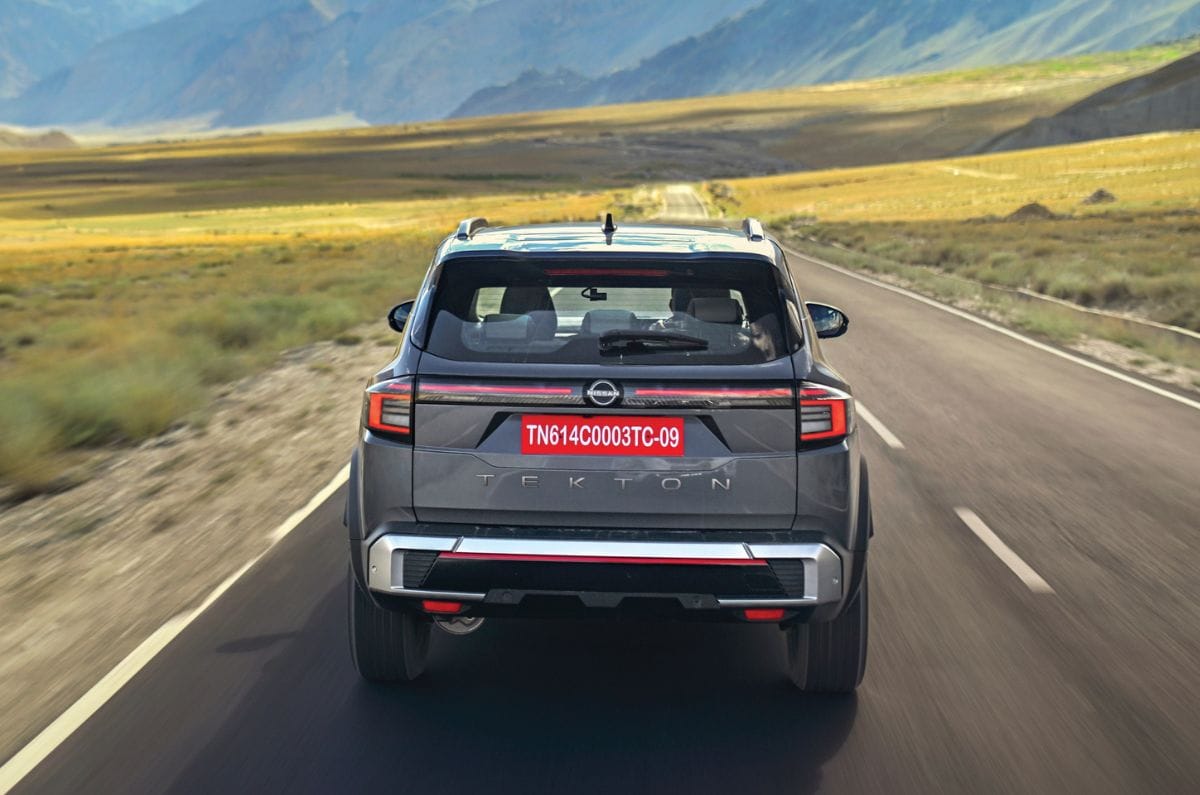
The execution of its tail-lamp design is spot on, looking most similar to the Patrol.

At the rear, the tail-lamp design bears the strongest resemblance to the Patrol and is executed rather well. While the Tekton isn’t the largest SUV in its class, it strikes a pleasing balance between road presence and urban friendliness. We suspect its styling is likely to be one of its biggest selling points.

Nissan Tekton Interior Space and Comfort – 8/10

Inside, Nissan has done a commendable job differentiating the cabin from the Renault Duster. The layout remains familiar, but the padded leatherette on the dash and doorpads look classy and along with the burgundy, gold and light cream colour scheme lends the interior a more premium ambience. There are also subtle Nissan-specific touches on the dash fascia, including an Easter egg inspired by Japanese numerals represented by 2 vertical lines (Ni) and three horizontal lines (san). 

Neatly dressed-up interior look and feel quite upmarket.

The driving position is excellent. Visibility is strong, the bonnet is clearly visible from the driver’s seat, and most controls fall easily to hand. Ergonomics are largely spot-on, though taller drivers who prefer a high seating position may find the large plastic panel near the A-pillar slightly intrusive. 

Burgandy, gold and light cream colour scheme, along with the soft leatherette paddings enhance the cabin’s premium feel.

One area where the Tekton needs improvement is air conditioning performance. Even at the lowest temperature setting, the cabin takes time to cool down. Thankfully, the ventilated front seats are highly effective and help offset this weakness. The seats themselves deserve praise for their excellent support and long-distance comfort. The digital instrument cluster is clear and easy to read, offering multiple display layouts, including a full-map view. Unlike the Duster’s less intuitive tachometer display, the Nissan gets a more conventional and user-friendly setup. Physical controls for climate functions, audio settings and ADAS shortcuts are particularly welcome in an era increasingly dominated by fiddly touch panels. 

Powered front seats are supportive and have a very effective ventilation function.

Storage solutions are generally well thought out. The cooled wireless charging pad prevents phones from overheating, while USB-C ports and a 12V socket are provided. However, 1-litre bottles cannot be stored vertically in the front door bins; although they can be placed vertically in the rear door bins. Useful storage spaces include deep cupholders and a large central armrest console. The glovebox is generous, though part of it is compromised by the fuse box, just as in the older-gen Duster. 

Cabin space is adequate for four adults; seats are very comfy. 

Accessing the rear seat requires a bit of effort due to the high step-in and narrow opening, but once seated, comfort levels are impressive. The seat backrest is well angled, under-thigh support is good, and there’s plenty of room beneath the front seats to stretch out. The rear bench is best suited to two adults rather than three, although all occupants get individual headrests and three point seatbelts. 

Rear-seat amenities include seatback pockets, rear AC vents, two USB charging ports, a centre armrest and a phone holder. The panoramic sunroof adds a real sense of occasion, especially on scenic drives through the mountains. That said a boss mode for the electrically adjustable front passenger seat and rear sunshades aren’t available. 

Cavernous 518-litre boot is ideal for road trips; gets a spare wheel too. 

Open the electrically operated tailgate and you’re greeted by a massive 518-litre boot. It comfortably swallows luggage and is the largest in its class, making it ideal for long-distance touring. There’s a full-size spare tyre too.

Nissan Tekton Features and Safety – 9/10

The Tekton is otherwise generously equipped with kit like panoramic sunroof, powered and ventilated front seats, 10.25-inch instrument cluster, 10.1-inch touchscreen which not only gets wireless Android Auto and Apple CarPlay, but it also gets native Google integration including Gemini voice assistant, among other notable features. The only real disappointment is the below par quality of the 360-degree camera system. 

With in-built Google, screen works well; 360-degree camera quality is below par. 

Safety credentials are strong. Along with a comprehensive ADAS suite, the Tekton has secured a five-star Bharat NCAP rating, just like its Renault sibling. The lane-keep assist didn’t seem to keep the vehicle properly centred within the lane, and it tended to weave between the lane markings. 

The adaptive cruise control system also performed well, maintaining safe distances and slowing progressively with traffic. Its acceleration back to the set speed, however, feels somewhat slow regardless of drive mode. 

10.25-inch instrument cluster is well executed; gets a full map view too. 

Nissan Tekton Performance and Refinement – 7/10

The entry-level powertrain is a 1.0-litre turbo-petrol shared with the Magnite. With some updates though that has taken torque higher to 166Nm – up from 160Nm, while power remains the same at 100hp. It is paired exclusively with a six-speed manual gearbox. 

To compensate for the Tekton’s weight and performance demands, Nissan has equipped this version with shorter gearing than the 1.3-litre variants. Around town, it feels perfectly adequate, but the small-capacity turbo engine suffers from noticeable turbo lag. Steep inclines often require clutch slip to get moving, and enthusiastic driving demands frequent gear changes to keep the engine in its power band. Peak boost arrives beyond 3,000rpm, while the gearbox itself lacks the slickness of some Korean and Japanese rivals. 

If you love to drive, this is one of those cars that you’re surely going to like.

The 1.3-litre turbo-petrol is significantly more appealing. Refinement levels are better, performance is considerably stronger, and overtaking requires much less planning. Turbo lag is reduced compared to the 1.0-litre, though it hasn’t been eliminated entirely. On steep gradients and under stop-start conditions, the engine occasionally struggles to build revs quickly enough, exposing a weak bottom-end response. 

Once past 2,500rpm, however, the turbo wakes up and the Tekton gathers speed with enthusiasm. The engine also produces an appealing turbo whoosh at higher revs, though some may find it intrusive. 

Enthusiasts are likely to yearn for a bit more responsiveness from both the engines.

This engine comes with a manual as well as a six-speed wet-clutch dual-clutch automatic transmission, which is the one we drove. Shifts are impressively smooth and seamless, but responses are slower than expected. The gearbox’s tendency to upshift early can make the Tekton feel less responsive than it actually is, often prompting the use of the paddle shifters for quick overtakes. 

There are two drive modes – Comfort and Eco – though enthusiasts will miss the absence of a Sport mode. Fortunately, manual mode allows greater control over the transmission and proved particularly enjoyable on mountain roads. In city traffic, however, the combination works well, with smooth low-speed behaviour and a well-calibrated creep function. 

Even though we didn’t get a chance to test the Tekton for outright performance and fuel efficiency, we have extensively tested its Renault sibling, and the numbers aren’t particularly impressive. Expectedly, the Duster’s performance testing revealed that the 1.3-litre manual is the quickest variant to 100kph (10.32 sec), , while the 1.3 DCT’s reluctance to allow aggressive launches affects its outright acceleration times  (11.33 sec). The 1.0-litre (13.26 sec) delivers acceleration comparable to the naturally aspirated 1.5-litre engines found in the Creta and Seltos.

Nissan Tekton Mileage and Efficiency – 6/10

Once again, taking the Duster’s figures for refence, average real-world fuel efficiency is quite weak too with the 1.0 version (10.98kpl) faring only slightly better than the 1.3 versions (10.47kpl for DCT, 10.64kpl for MT). Like the Duster, all variants of the Tekton get an Eco mode as well as an auto engine stop-start function to keep a check on fuel consumption.

Nissan Tekton Ride Comfort and Handling – 9/10

As with the Renault Duster, Nissan has absolutely nailed the ride-and-handling balance. Unlike many European cars, the Tekton does not feel overly firm at low speeds. Instead, it delivers a supple, absorbent ride that shrugs off poor road surfaces with ease. Even sharp potholes generate more noise than impact inside the cabin.

Unlike some rivals, its low speed ride doesn’t have the typical underlying firmness. 

Handling is equally impressive. The Tekton changes direction eagerly and inspires confidence, making it genuinely enjoyable to drive. Its electronic power steering offers Light and Heavy modes, though the lighter setting strikes the better balance between ease and precision. The steering feel is among the best in the segment. 

Braking performance is another strong point. Throughout our drive to Leh, the brakes consistently inspired confidence, delivering strong stopping power and natural pedal feel.

Nissan Tekton Value for Money – 8/10

Priced between Rs 10.50 lakh and Rs 18.5 lakh, the Tekton commands a premium of Rs 10,000-50,000 over an equivalent Renault Duster. The range consists of 12 variants: six powered by the 1.0-litre turbo petrol, two by the 1.3-litre manual and four by the 1.3-litre auto, indicating Nissan’s focus on the smaller engine.

The biggest drawbacks of the powertrains though are the lack of outright punch and responsiveness, as well as fuel efficiency that may not satisfy high-mileage users. Neither Renault nor Nissan offers a diesel option, and while the Duster is expected to receive a hybrid powertrain, Nissan has ruled out one for now. 

However after 700km behind the wheel, the Nissan Tekton leaves an overall positive impression. It is handsome, well equipped and comfortable, with a premium-feeling cabin and class leading 518-litre boot. The rear seat may not be the most spacious in the segment, but it comfortably accommodates four adults, while its ride-and-handling balance ranks among the very best in class. The Tekton then is a thoroughly competent midsize SUV. And in a segment packed with strong contenders, this one too deserves serious consideration.

Worried about E20 fuel? We answer all your burning questions

Ethanol

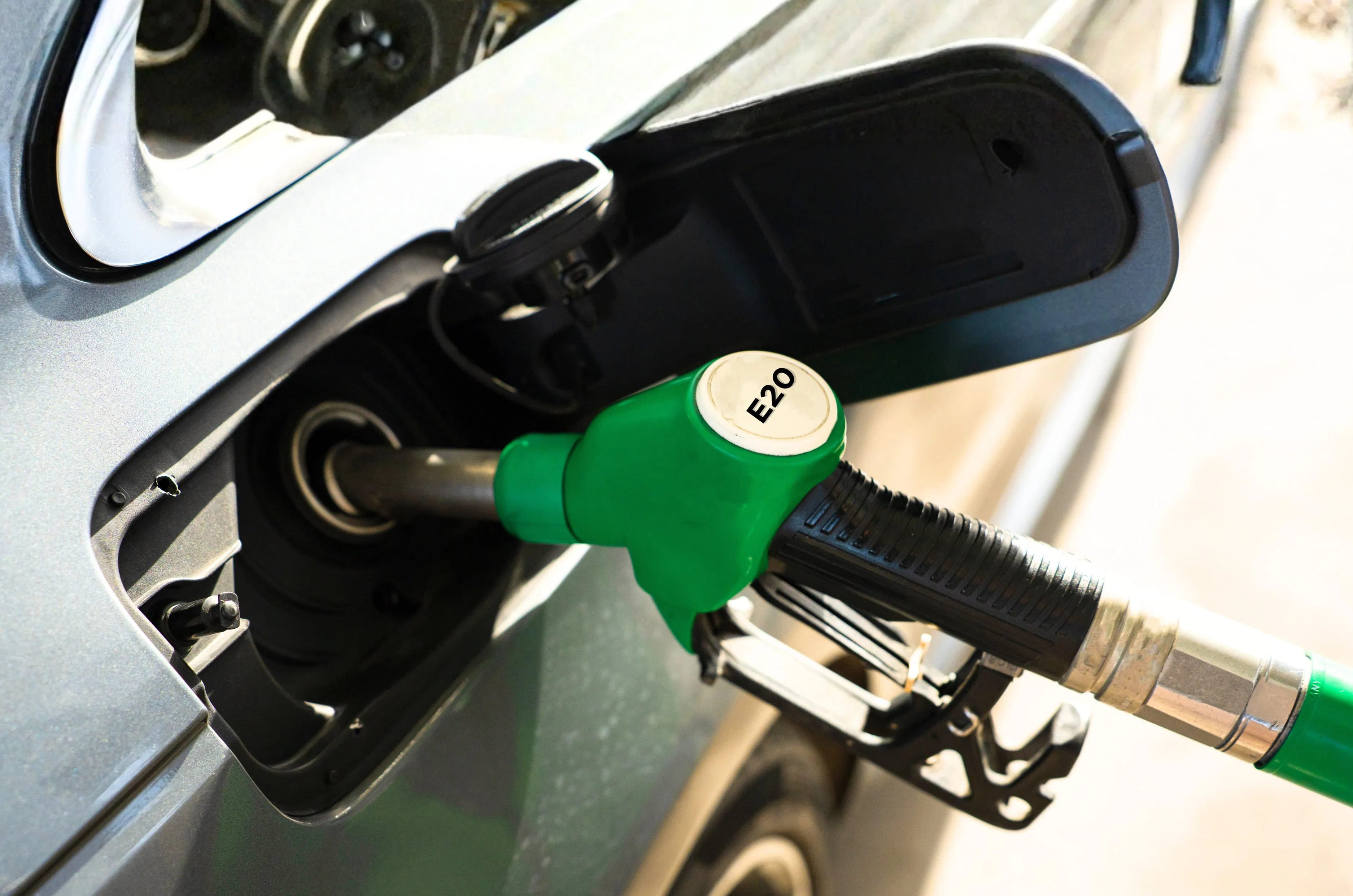
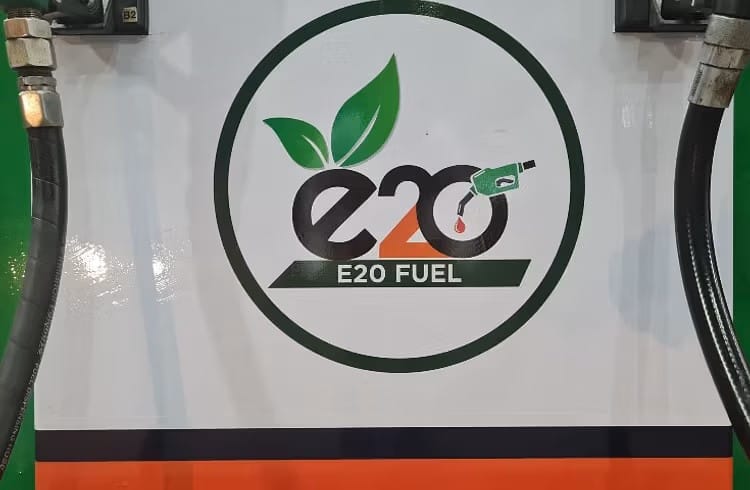
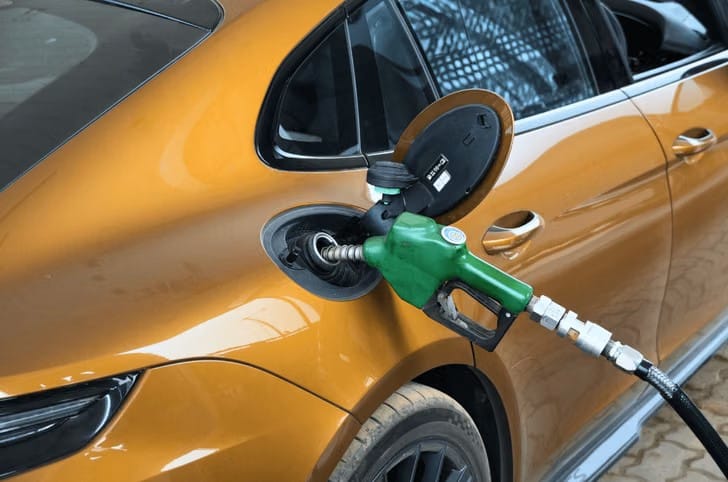
India completed the nationwide rollout of E20 petrol in April last year, making it the standard grade of petrol sold at fuel stations across the country. E20 contains 20 percent ethanol and 80 percent petrol, replacing the lower ethanol blends that were sold previously.

The transition has raised several questions among vehicle owners about compatibility, fuel efficiency, maintenance, warranties and long-term reliability. We separate the facts from the misconceptions and answer the key questions around E20.

1. What is E20 petrol and why has India switched to it?

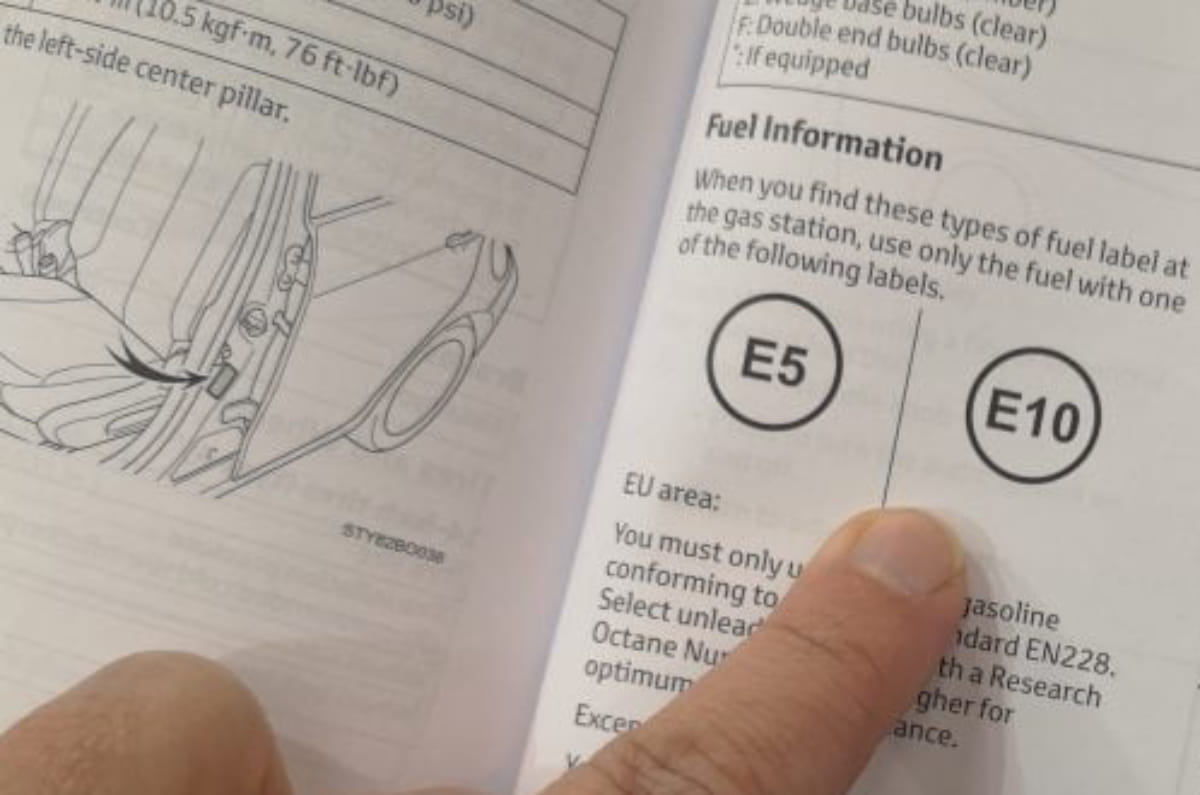
E20 is fuel blended with 20 percent ethanol and 80 percent petrol. Ethanol is a biofuel produced from agricultural feedstocks such as sugarcane, maize and surplus food grains. India introduced the Ethanol Blended Petrol (EBP) Programme in 2003 with E5 petrol, and while the blended percentage kept varying for a while, it was eventually increased to E10 before completing the nationwide rollout of E20 in 2025, five years ahead of the planned implementation. According to the government, the programme aims to reduce dependence on imported crude oil, improve energy security, lower emissions and create an additional market for agricultural produce.

2. Can I use E20 fuel in my car or bike?

New petrol cars and two-wheelers sold in India today are compatible with E20 petrol. Under the government’s roadmap, vehicle manufacturers were required to make new petrol models manufactured from April 2023 compatible with E20.

Vehicles manufactured before April 2023 were designed for lower ethanol blends, so compatibility may vary depending on the model and year of manufacturing. However, some brands state that they had E20 material compliance before 2023, for a list click here

3. How do I know if my car is E20 compatible?

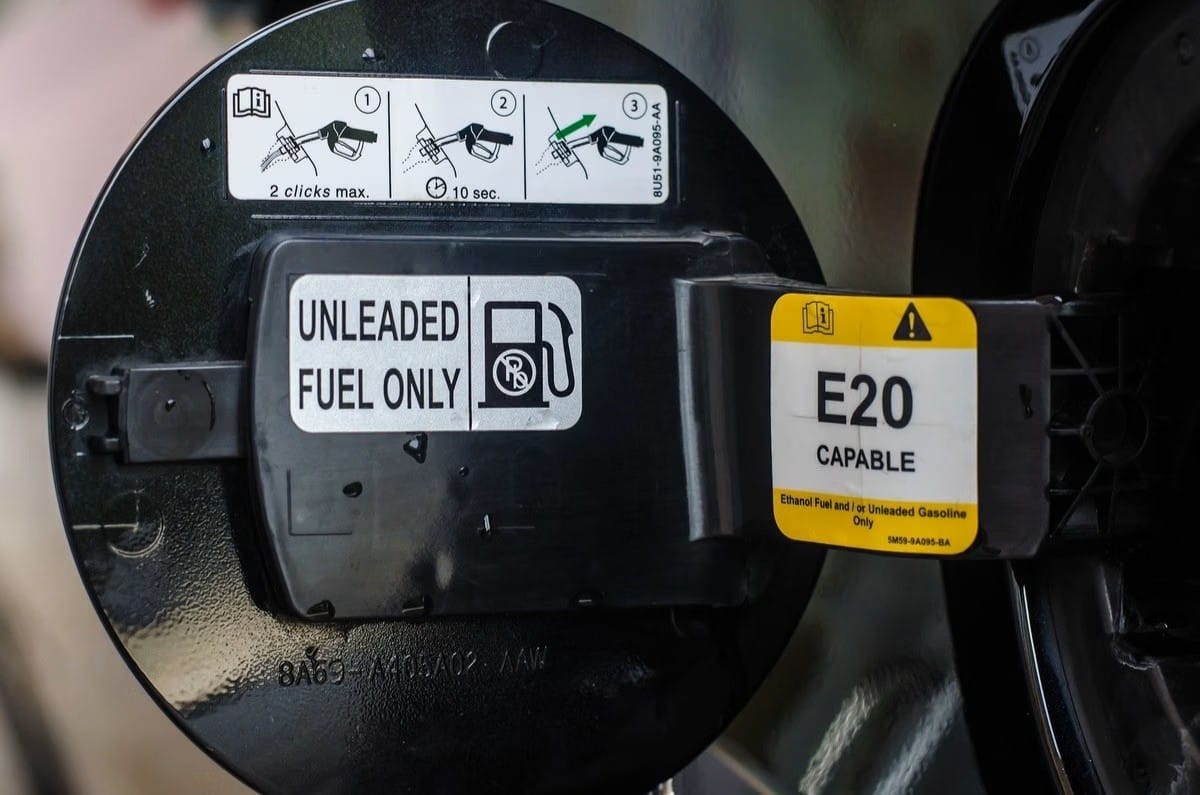
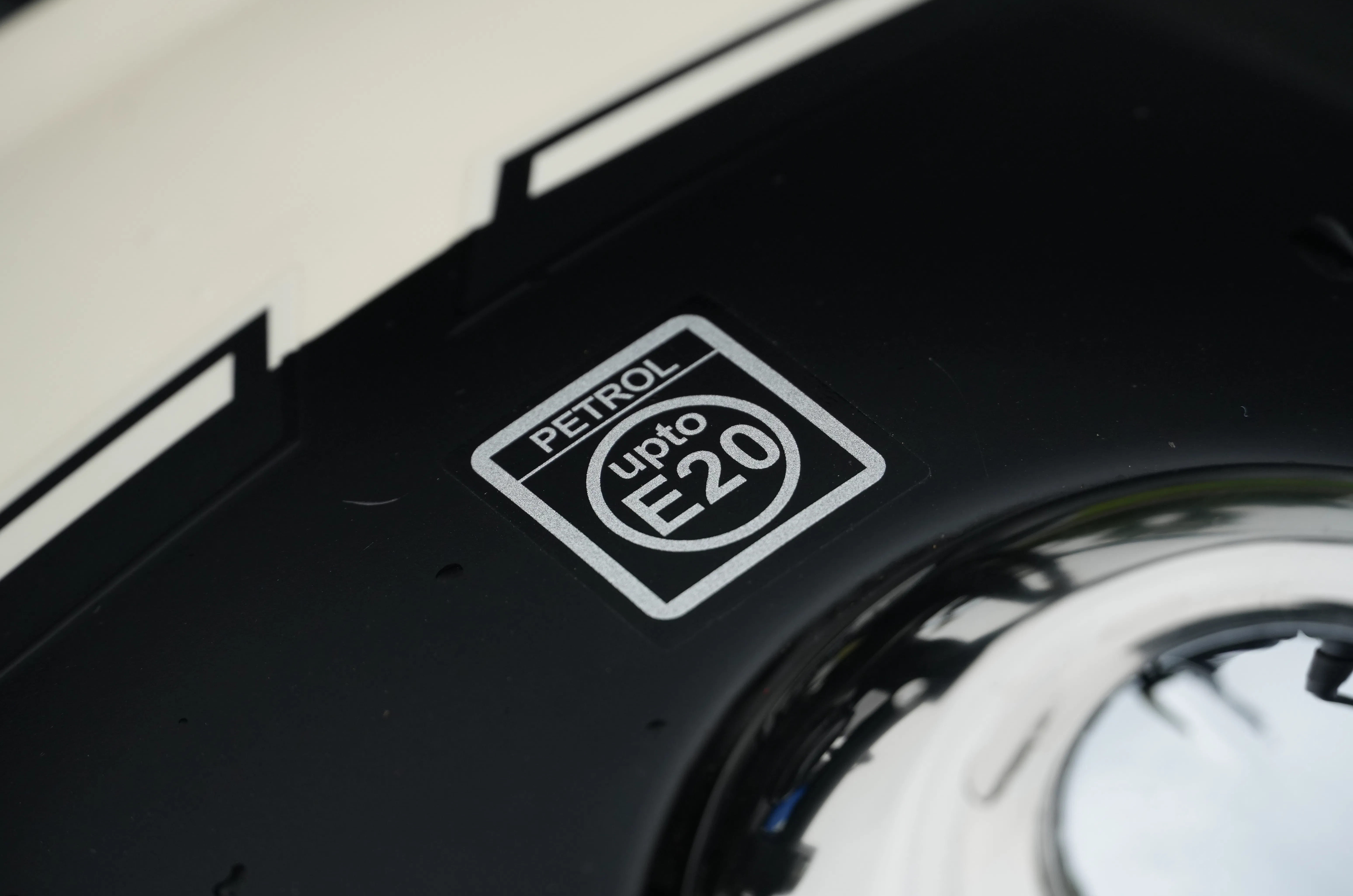
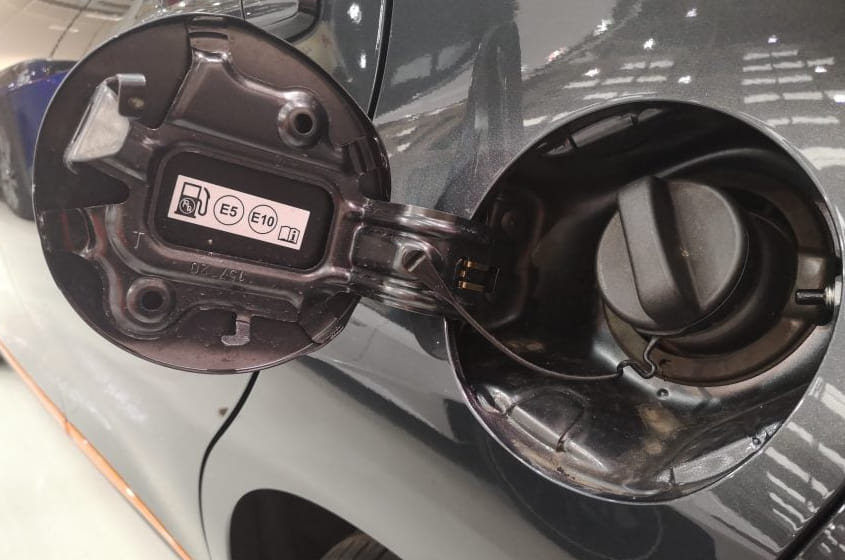
The easiest way is to check your vehicle’s fuel flap or the owner’s manual or contact the manufacturer’s authorised dealership. As part of the government’s E20 roadmap, manufacturers progressively introduced E20-compatible petrol vehicles from 2023 onwards. However, compatibility can vary depending on the model and year of manufacture, so owners should not assume that every petrol vehicle is fully E20-compatible. 

4. Can E20 damage older engines or fuel-system components?

Concerns about E20 mainly relate to older vehicles that were not originally designed for higher ethanol blends. While ethanol has not been found to significantly directly affect metal fuel-system components, prolonged exposure to E20 can accelerate wear in some older rubber and plastic parts such as fuel hoses, seals, O-rings, gaskets and certain fuel pipes if they are made from materials that are not ethanol compatible.

Before approving E20, ARAI tested metals, elastomers and plastics commonly used in fuel systems. The study found no significant corrosion of metal components, but certain rubber compounds and plastics used in older vehicles showed greater deterioration than with E10 fuel. These findings prompted manufacturers to use ethanol-compatible materials in newer vehicles. Thus, owners of older vehicles should keep up with regular servicing and follow the manufacturer’s recommended maintenance schedule, increasing the inspection frequency if damage is suspected. 

5. Does E20 reduce fuel efficiency?

Yes. E20 fuel generally returns lower fuel efficiency than petrol with a lower ethanol content because ethanol contains less energy than petrol. The exact reduction varies depending on the vehicle, engine and calibration.

E20 vs E10 mileage test results
 Creta N LineDzire (BS 6)Polo GT TSIDzire (BS 4)
Registration year202420242017 2016 
Average speed17.8kph20.25kph18.019.3
Kpl on E2010.5914.249.139.8
Kpl on E1012.1214.819.6311.19
Kpl variance1.530.570.501.39
% variance-12.62-3.84-5.19-12.42

ARAI estimates a fuel efficiency drop of 1-6 percent with E20, while some manufacturers put it closer to 7-8 percent. In Autocar India’s real-world testing, both newer E20-compatible cars and older pre-E20 vehicles recorded a measurable drop in mileage when compared with an equivalent E10 blend. Among the newer cars, the Maruti Suzuki Dzire recorded a 3.8 percent drop, while the Hyundai Creta N Line saw a 12.6 percent decline. 

Among older BS4-era cars, the Volkswagen Polo GT TSI posted a 5.2 percent drop, while the older Maruti Suzuki Dzire recorded a mileage drop of 12.4 percent.

The results also showed that there is no single figure applicable to every vehicle. Factors such as engine calibration and compression ratio all influence fuel efficiency, meaning some vehicles adapt better to E20 than others. 

6. Does E20 improve performance or reduce emissions?

Octane rating test results
Fuel typeRON result
Regular E20 petrol98.2 RON
XP9598.8 RON

Yes, but not in a way that most motorists are likely to notice. E20 has a higher-octane rating than regular petrol, which improves resistance to engine knocking and can benefit engines designed to take advantage of higher-octane fuel. 

The government says E20 aims to lower emissions by replacing a portion of petrol with domestically produced ethanol which is a renewable fuel. For most motorists, however, the most noticeable effect of switching to E20 is likely to be a small drop in mileage rather than a change in vehicle performance.

7. Is E20’s water contamination issue a real problem?

Image credit – Rushlane

Ethanol is hygroscopic, meaning it has the capability to absorb moisture. As a result, E20 is more susceptible to water contamination if excess moisture enters the fuel during storage or handling. In severe cases, this can lead to phase separation, where the ethanol and water separate from the petrol, affecting fuel quality.

Some petrol pump operators have raised concerns that existing underground storage tanks, particularly during the monsoon or in coastal areas, could be more prone to moisture ingress, increasing the risk of phase separation. However, the government and the Federation of Automobile Dealers Associations (FADA) says that there is no evidence linking E20 itself to widespread fuel contamination or vehicle failures.

8. Will using E20 affect my vehicle’s warranty?

For most owners, no. Vehicle manufacturers have said that using E20 petrol will not affect the warranty of their vehicles, and valid warranties will continue to be honoured. The government, SIAM and several manufacturers have stated that vehicles continue to be covered under their standard warranty terms when fuelled with E20, for a full list click here. SIAM has also said that OEMs will honour the warranty committed to customers for E20 usage, and that insurance claims will remain unaffected.

9. Why isn’t E20 petrol cheaper than regular petrol?

Although E20 contains 20 percent ethanol, it is not cheaper than regular petrol because ethanol currently costs more to procure and blend than petrol under prevailing market conditions. The cost of ethanol procurement, tax, transportation, blending and distribution offsets any potential saving from replacing a portion of petrol with domestically produced ethanol.

Any savings from lower crude oil imports are realised at the national level rather than by consumers through lower pump prices. 

10. Why can’t I still buy E10 or pure petrol?

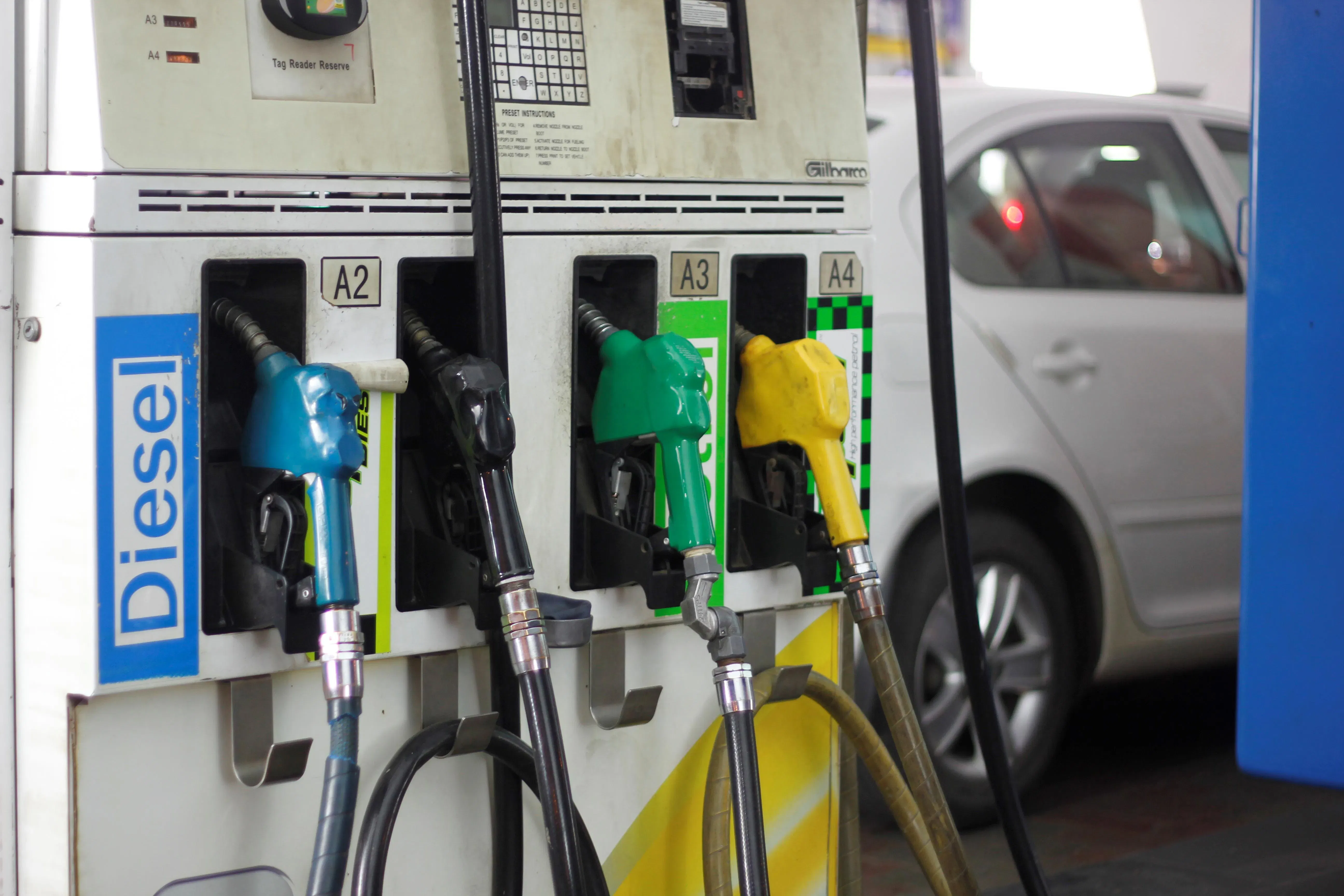
Because by policy E20 is now India’s standard petrol. Following the nationwide rollout of the Ethanol Blending Programme, oil companies have standardised regular petrol and premium 95-octane petrol to an E20 blend. Maintaining parallel supplies of E10 and E20 would require separate storage, transportation and dispensing infrastructure, making nationwide distribution significantly more complex.

As a result, motorists can no longer choose between E10 and E20 at regular fuel stations. The only exception is 100-octane petrol, such as IndianOil XP100 and HP Power100, which remains effectively ethanol-free because it is a niche fuel sold in limited volumes. For most vehicle owners, however, E20 is now the only petrol available.

11. Is the government planning to increase ethanol blending beyond E20?

Not yet, but the groundwork has begun. While the government has said no decision has been taken to mandate petrol with more than 20 percent ethanol, it has begun preparing the regulatory framework for higher blends.

In May 2026, the Bureau of Indian Standards (BIS) notified fuel quality standards for E22, E25, E27 and E30 petrol, indicating that the government is laying the groundwork for future adoption. It has also proposed recognising E85 and E100 fuels under the Central Motor Vehicles Rules. 

Separately, the government has tasked the Automotive Research Association of India (ARAI) with studying the impact of E25 petrol on existing E10- and E20-compatible vehicles, including its effect on fuel efficiency, durability, emissions and engine performance under long-term use.

However, any move beyond E20 will require extensive testing and consultation with vehicle manufacturers, fuel companies and research agencies to assess engine durability, emissions and fuel-system compatibility before it is introduced.

12. What should owners of older cars do now?

If your vehicle is not certified as E20-compatible, it does not necessarily mean it will experience immediate problems. However, owners should follow the manufacturer’s guidance, keep up with regular servicing and replace worn fuel-system components as required. It would also be prudent to increase the frequency of inspection of your vehicles fuel system to ensure there is no corrosive damage and catch it before it gets acute. 

If you own a classic car, an older imported vehicle or a high-performance model designed for lower ethanol blends, using ethanol-free 100-octane petrol may be worth considering.

13. Can I convert my vehicle to run on E20 fuel? 

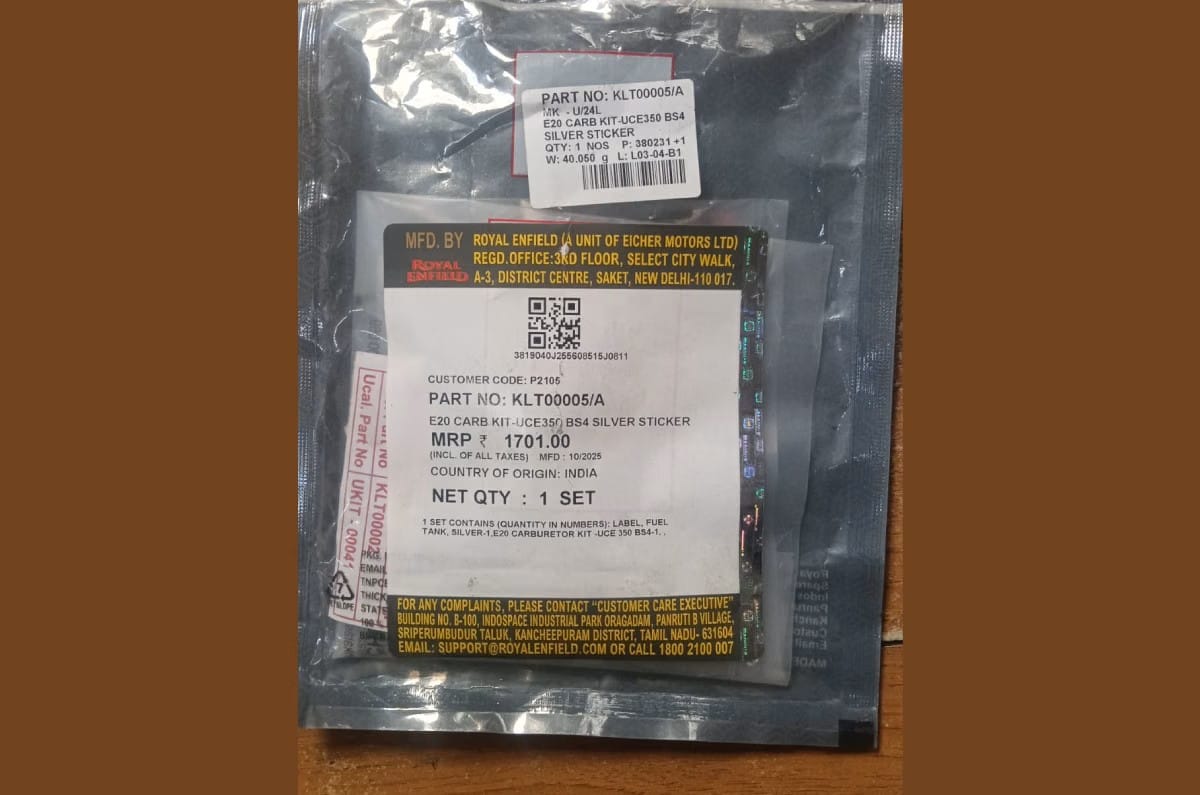
Yes, but official upgrade programmes are currently limited and while a few manufacturers, like Royal Enfield and Maruti Suzuki, had mentioned a plan for these earlier, they don’t have much to say for now. In a recent government press conference that aimed to quell the E20 backlash, Maruti stated that the kits are for R&D purpose only.

Theoretically, it’s possible to replace critical components susceptible to E20 damage with those designed to handle the fuel – especially if your vehicle is still in production – and if you feel the need to, you can go ahead and have parts like fuel lines, fuel pump and gaskets replaced but by your authorised workshops only. 

So, should you be worried about E20 petrol?

Not worried, but alert. Modern petrol cars and bikes designed or updated for E20 are engineered to run on the fuel without major issues, and extensive testing by the government, research agencies and manufacturers found no evidence of widespread reliability concerns.That said, E20 is not without trade-offs. Most motorists should expect a small reduction in fuel efficiency. 

For owners of older vehicles, it would be wise to pay closer attention to fuel-system maintenance. 

All you need to know about the upcoming Kia Syros EV

Kia Syros EV front quarter static

Kia is aiming at the growing compact electric SUV segment with the upcoming Syros EV, set to be its second mass-market electric model for India. The Syros EV utilises the same K1 platform as its ICE-powered counterpart. Bookings for the Syros EV are already open ahead of its launch, scheduled for the end of July 2026. In this article, we answer everything that you need to know about the Syros EV.

1. What battery pack options does the Kia Syros EV offer, and how much power does its motor produce?

The Kia Syros EV offers the same 42kWh and 51.4kWh battery packs that do duty in the Kia Carens Clavis EV and the Hyundai Creta Electric. Both are mated to a front-mounted motor. In the 42kWh guise, the motor delivers 135hp and 255Nm, but in the 51.4kWh guise, power is bumped to 171hp, while torque remains the same. The 51.4kWh battery pack and its 171hp motor make it the model with the largest battery pack and the most powerful motor in the class. Kia claims a 0-100kph sprint in 8.1 seconds with the 51.4kWh version.

2. What is the claimed range of the Kia Syros EV?

The ARAI-rated range is 443km for the 42kWh battery pack and 543km for the larger 51.4kWh unit. Not only does the Syros EV have a higher claimed range than the Clavis EV and the Creta Electric, but its 543km figure is also the highest in the compact electric SUV segment.

3. What charging speeds does the Kia Syros EV support, and how long does it take to charge?

The Kia Syros EV supports up to 11kW AC charging speeds, while DC charging is capped at 100kW. A 10-100 percent top-up for the 42kWh version takes 6 hours with the 7.4kW charger and 4 hours with the 11kW unit. In the 51.4kWh guise, the same takes 7 hours and 15 minutes with a 7.4kW charger and 4 hours and 50 minutes with an 11kW charger. Kia also claims that with a 100kW DC fast charger, both batteries can charge from 10 to 80 percent in 39 minutes.

4. How different is the Kia Syros EV from the ICE Syros on the outside and inside?

The Kia Syros EV may look largely similar to the ICE Syros, but it comes with a charging flap on the front fender, EV badging at the rear and a different set of alloy wheels that give it some distinction. Apart from these differences, it retains the overall tall-boy silhouette, front and rear bumper designs and lighting elements found on its combustion-powered counterpart.

Inside, the dashboard layout remains the same as the ICE Syros, but there are some revisions to the centre console, which is high-set and features storage spaces and retractable cup holders. Also, the drive select lever has shifted to the steering wheel column.

5. What features does the Kia Syros EV come with?

For starters, the Kia Syros EV retains its ICE counterpart’s unique sliding and reclining rear seat with a ventilation function for the seat base. It also gets features such as dual 12.3-inch screens, a 5-inch HVAC control screen, wireless Apple CarPlay and Android Auto, a wireless charging pad, an 8-speaker Harman Kardon sound system, a panoramic sunroof, 64-colour ambient lighting and rear sunshades.

6. What does the Kia Syros EV offer over the ICE-powered Syros?

Apart from having EV-specific features such as a 16-litre frunk, regenerative braking, a virtual engine sound system and vehicle-to-load (V2L) functionality, it gets Level 2 ADAS, automatic flush door handles, a 360-degree camera setup, a dual-camera dashcam, a digital key, puddle lamps, multi-colour ambient lighting and metal pedals over the ICE-powered Syros.

7. What is the expected price of the Kia Syros EV?

The Kia Syros EV is expected to be priced from Rs 15 lakh to Rs 20 lakh, ex-showroom. It will take on the Mahindra XUV 3XO EV and the segment-reigning Tata Nexon EV, among others.

Kia Syros EV image gallery

kia syros ev in studio

Ahead of its launch later this month, the Kia Syros EV has been unveiled in full. It follows a similar philosophy to the Kia Carens Clavis EV, wherein there are little to no exterior changes compared to the ICE-powered Syros. Even on the inside, the Syros EV is largely identical to its ICE counterpart, save for a three-spoke steering wheel instead of the latter’s two-spoke one, a floating centre console, and additional features like V2L functionality and virtual engine sounds. Under the skin, the Syros EV offers the same 42kWh and 51.4kWh battery options as the Carens Clavis EV and Hyundai Creta Electric.

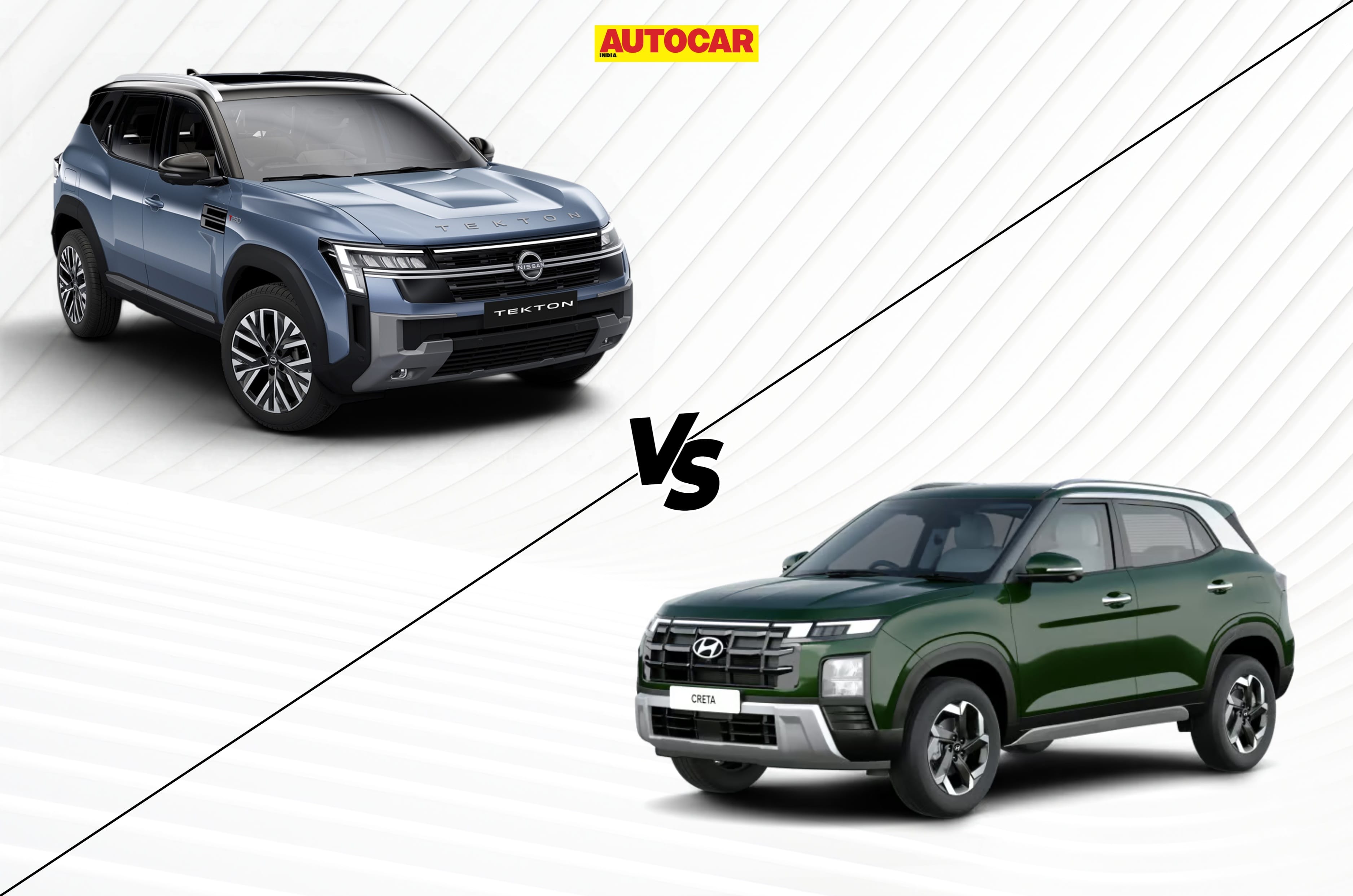
Nissan Tekton vs Hyundai Creta: Whose top trim offers more value?

Nissan Tekton vs Hyundai Creta

The arrival of the Tekton has helped Nissan make a much-needed comeback to the popular mid-size SUV segment. On the other hand, Hyundai has championed this space with the Creta, which continues to lead sales. But which of the two SUVs offers better value when you compare their top-spec versions on paper? We find out. For this comparison, we’ve chosen the Tekna+ and King trims of the Tekton and Creta, respectively.

Explore full specs, features, and a price breakdown in our Tekton vs Creta comparison.

Nissan Tekton vs Hyundai Creta: Dimensions

Tekton’s dimensions are higher than those of the Creta’s

Nissan Tekton vs  Duster: Dimensions 


Nissan Tekton

Hyundai Creta

Difference

Length (mm)

4,349

4,330

+19

Width (mm)

1,815

1,790

+25

Height (mm)

1,674

1,635

+39

Wheelbase (mm)

2,657

2,610

+47

Ground clearance (mm)

212

190

+22

Boot space (litres)

518

433

+85

As far as dimensions are concerned, the Tekton is the larger vehicle overall. It is 19mm longer, 25mm wider, and has a 47mm bigger wheelbase. Additionally, it rides 22mm higher off the ground, and its 518-litre boot is the largest in the segment.

Nissan Tekton vs Hyundai Creta: Engine specifications 

Tekton solely powered by turbo-petrol, while Creta gets diesel and NA petrol engines

Nissan Tekton vs Hyundai Creta: Engine specifications 


Nissan Tekton 

Hyundai Creta

Engine options

Turbo-petrol

Naturally aspirated petrol | Turbo-petrol | Diesel

Displacement 

1.0-litre | 1.3-litre 

1.5-litre | 1.5-litre | 1.5-litre

No. of cylinders

3 | 4

4 | 4 | 4

Power (hp)

100 | 163

115 | 160 | 116

Torque (Nm)

166 | 280

144 | 253 | 250

Gearbox 

6MT | 6DCT

6MT/CVT | 7DCT | 6MT/6AT

In top-spec guise, the Tekton is offered with two turbo-petrol engines, whereas the Creta has a diverse powertrain lineup comprising naturally aspirated petrol, turbo-petrol and diesel engines. The same is the case for gearbox options, as the Creta offers different automatic transmissions depending on the engine chosen. The Nissan Tekton’s 1.0-litre and 1.3-litre turbo-petrol units are the least and most powerful engines here, respectively.  

Nissan Tekton vs Hyundai Creta: Exterior features 

Only the Tekton comes with fog lamps

Nissan Tekton vs Hyundai Creta: Exterior


Nissan Tekton

Hyundai Creta

Headlights

Auto LED

Auto LED

Taillights

Connected LED

Connected LED

DRLs

Connected LED

Connected LED

Front fog lamps

LED

No

Rear fog lamps

LED

No

Puddle lamps

Yes

Yes

Wheels

18-inch

18-inch

Powered ORVMs

Yes

Yes

Roof rails

Yes

Yes

Colour

Monotone, dual tone

Monotone, dual tone, matte

On the exterior front, the Tekton and Creta’s top-spec versions come replete with connected LED light setups, 18-inch alloys, powered ORVMs and roof rails. However, front and rear fog lamps are found only on the Tekton. Monotone and dual-tone colour options are on offer with both models, but the Creta is also available with matte-finished paint jobs. 

Nissan Tekton vs Hyundai Creta: Interior and features

Tekton misses out on feel-good features that the Creta gets

Nissan Tekton vs  Hyundai Creta: Interior and features


Nissan Tekton

Hyundai Creta

Driver’s display

10.25-inch

10.25-inch

Infotainment screen

10.1-inch

10.25-inch

Android Auto, Apple CarPlay

Wireless

Wireless

Audio system

6-speaker Arkamys

8-speaker Bose

Sunroof

Panoramic

Panoramic

Climate control

Dual-zone automatic

Dual-zone automatic

Rear AC vents

Yes

Yes

Driver seat adjustment

6-way

8-way with memory

Front passenger seat adjustment

6-way

8-way

Front seat features

Ventilation

Ventilation

Boss mode

No

Powered

Powered tailgate

Yes

No

Seat upholstery

Leatherette

Leatherette

Reclining rear seats 

No

Yes

Steering wheel adjustment

Tilt, telescopic

Tilt, telescopic

Wireless phone charger

Front

Front and rear

Air Purifier

Yes

No

Sunshades

Magnetic (all windows optional)

Retractable (rear windows)

Connected car tech

Yes

Yes

Rear armrest

Yes

Yes

Ambient lighting 

Yes

Yes

USB ports 

4x type-C

4x type-C

The Tekton comes with an air purifier and a powered tailgate over the Creta, but the latter gets a slightly bigger infotainment screen, additional speakers, more adjustment for the powered front seats, driver seat memory, reclining rear seats, boss mode, and an additional wireless phone charger at the back.

Nissan Tekton vs Hyundai Creta: Driving Features

Tekton gets steering modes, while the Creta gets traction modes

Nissan Tekton vs Hyundai Creta: Driving Features 

Driving Features 

Nissan Tekton

Hyundai Creta

Drive modes

Eco, Comfort

Eco, Normal, Sport

Steering modes

Low effort, High effort

No

Traction modes

No

Snow, mud, sand

Paddle Shifters

Automatic only

Automatic only

Cruise Control

Adaptive

Adaptive

While the ‘Eco’ drive mode is common on both SUVs, the Tekton gets a ‘Comfort’ mode, while the Creta features ‘Normal’ and ‘Sport’ driving modes. Steering modes are present only on the Tekton, while the Creta gets traction control modes for different terrains. In top-spec guise, both SUVs have adaptive cruise control and paddle shifters with their automatic variants.

Nissan Tekton vs Hyundai Creta: Safety features

Both SUVs are equally matched with basic and advanced safety tech

Nissan Tekton vs  Kushaq Prestige: Safety features


Nissan Tekton

Hyundai Creta

Airbags

6

6

ADAS

Level 2

Level 2

Camera setup

360-degree

360-degree

Parking sensors

Front and rear

Front and rear

Electronic parking brake

DCT variant only

Yes

TPMS

Yes

Yes

IRVM

Auto-dimming

Auto-dimming

Rear wiper, washer

Yes

Yes

Rear defogger

Yes

Yes

Hill start assist

Yes

Yes

Hill descent control

DCT only

No

ESC

Yes

Yes

Traction control

Yes

Yes

When it comes to safety, both the Tekton and Creta come well-equipped with safety features including six airbags, parking sensors, TPMS, Level 2 ADAS suite and a 360-degree camera setup. The only difference is that while an electronic parking brake is common on both, the former gets it only on automatic versions, while the latter has it with manual gearbox variants as well. 

Nissan Tekton vs Hyundai Creta: Price and verdict

Nissan Tekton Tekna+ vs Kushaq Prestige: Ex-showroom prices 


Nissan Tekton Tekna+ (Rs lakh)

Hyundai Creta King (Rs lakh)


Turbo-petrol MT

16.49

Turbo-petrol DCT

18.59

19.91

Naturally aspirated petrol MT

17.27

Naturally aspirated petrol CVT

18.68

Diesel MT

18.85

Diesel AT

19.77

The only comparable variant between the Tekton and the Creta is their turbo-petrol automatic versions, where the Tekton is Rs 1.32 lakh cheaper. Between the newly launched Tekton and the reigning Creta, we recommend the former. Not only is the Tekton more affordable, especially when you consider turbo-petrol versions, but you also get more torque. While it does miss out on some feel-good features that the Creta gets, it’s not necessarily a deal-breaker. If your monthly usage consists mainly of highway runs, then the Creta diesel makes for a sensible choice.