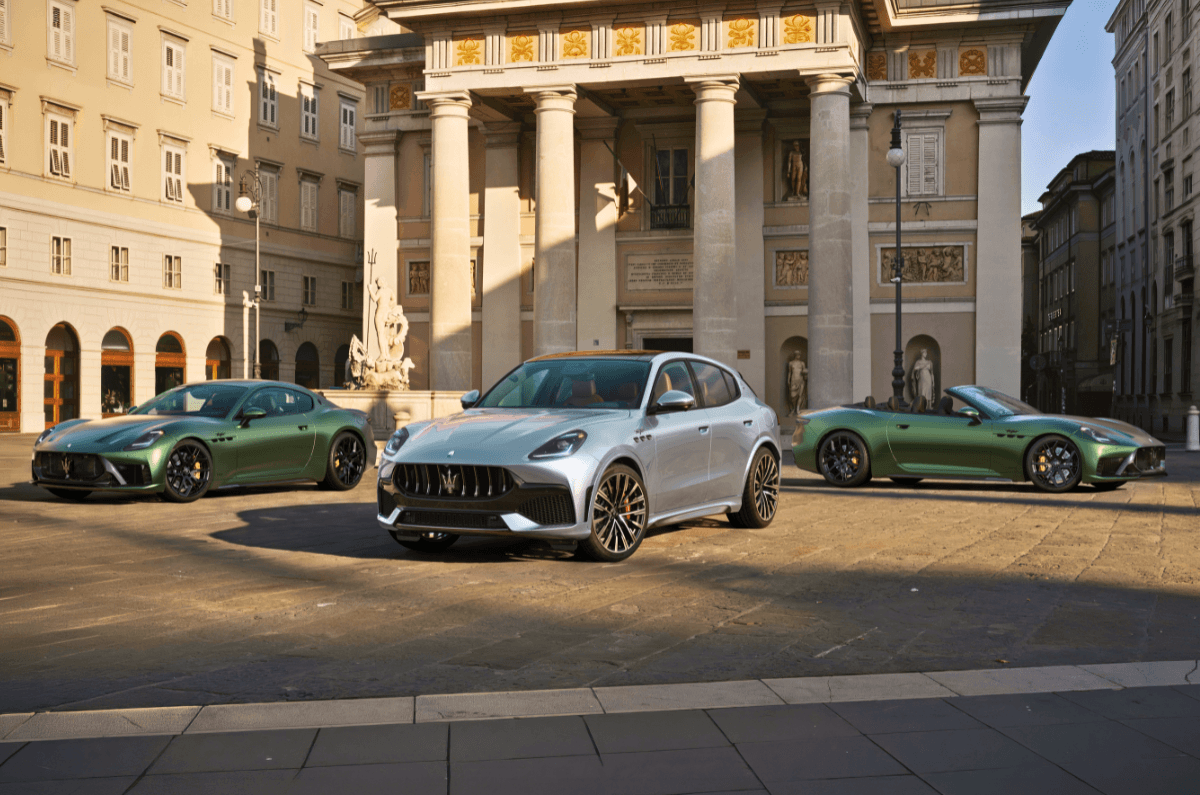
Maserati India will launch the updated Grecale SUV, GranTurismo coupe and GranCabrio convertible on October 30. The three cars will launch in the country a little over four months after their respective global debuts. All of them get powertrain updates, subtle exterior revisions and additional features. The track-focused Maserati GT2 Stradale will also be showcased alongside the three cars.
New Maserati GranCabrio, GranTurismo: Powertrains
ICE
Both the Maserati GranTurismo and GranCabrio continue to use the brand’s 3-litre twin-turbo Nettuno V6 engine, and depending on the variant, it develops 490hp (Modena) or 590hp (Trofeo). Notably, peak power output has gone up by 40hp in the top-spec Trofeo, thanks to an increase in turbo boost pressure with some minor modifications. Their respective 8-speed automatic gearboxes have been recalibrated for greater responsiveness.
EV
The electric-only Folgore versions of the GranTurismo and GranCabrio retain their 92.5kWh battery, along with a trio of motors – two at the back and one at the front. While the combined output remains 761hp for both, Maserati engineers have been able to increase the claimed range by 90km to 540km. This was achieved by adding a system that disconnects the front motor when not required, thereby reducing energy consumption. The GranTurismo Folgore reaches a top speed of 325kph, while the GranCabrio Folgore maxes out at 290kph.
All versions are equipped with all-wheel drive and air suspension as standard. Maserati has also given the two models a new ‘Country’ drive mode for use on rougher road surfaces, which raises the ride height by 25mm at speeds of up to 120kph.
When introduced originally, the Lamborghini Urus rewrote the playbook of what an SUV could be. Sharp to look at, ferociously fast and with a mighty V8 soundtrack, the Urus has become the benchmark of performance SUVs. Now though, thanks to ever tightening regulations, the Urus has had to pivot to hybridisation. But has that diluted the experience? We got behind the wheel of the Lamborghini Urus SE to answer that question.
Lamborghini Urus SE Exterior Design and Engineering – 9/10
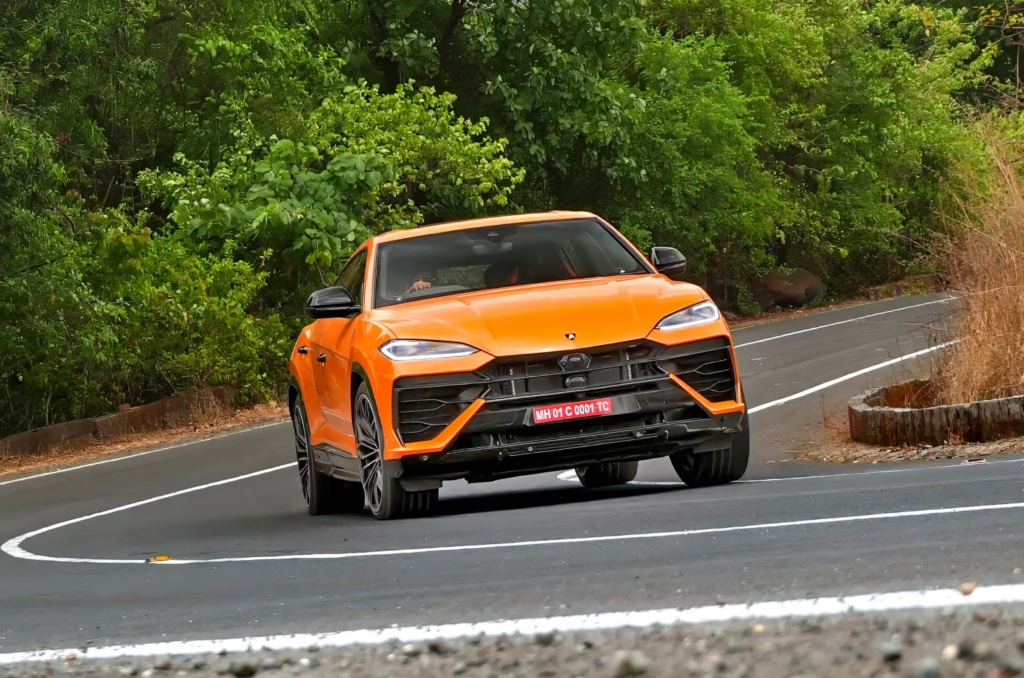
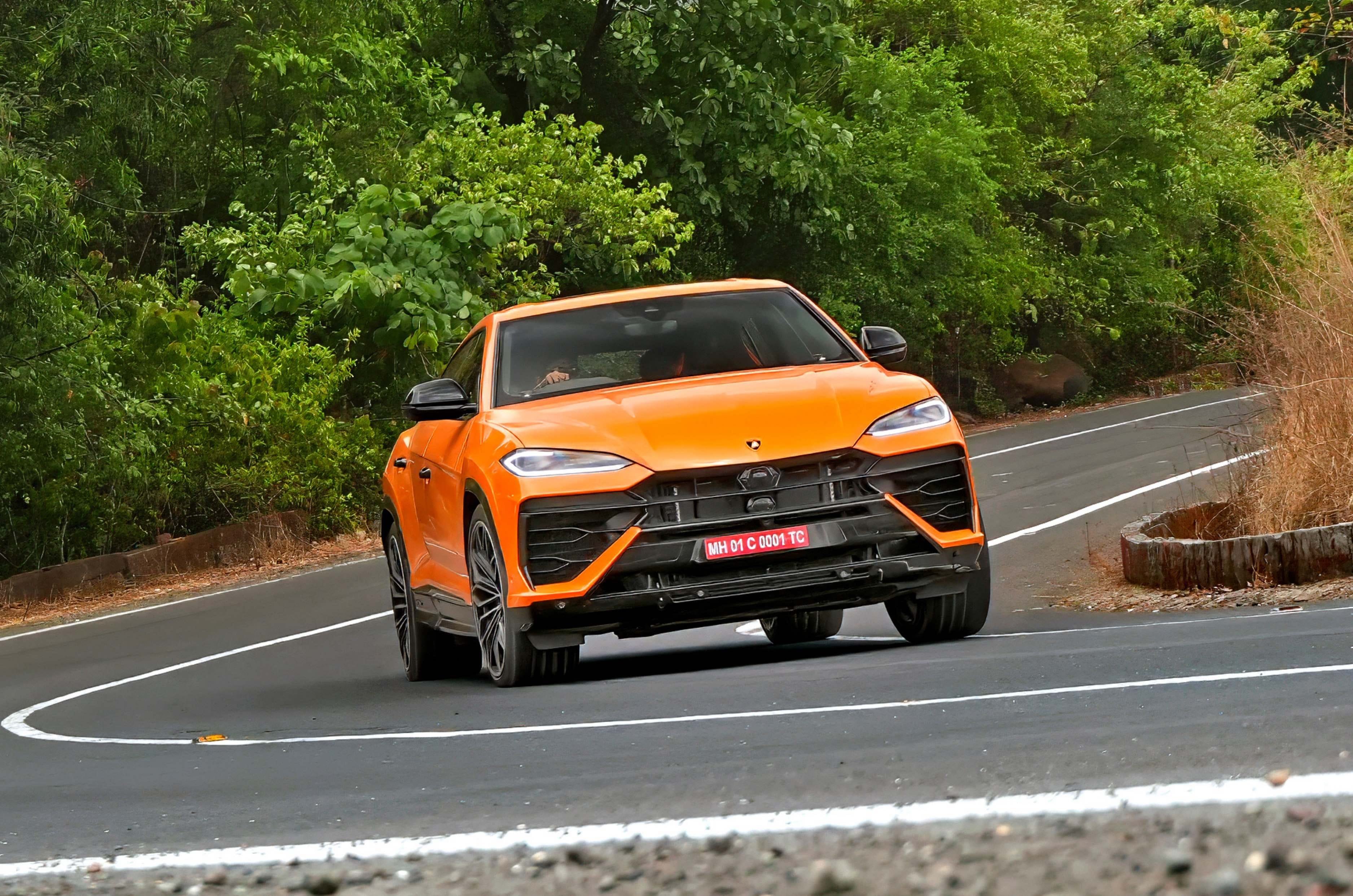
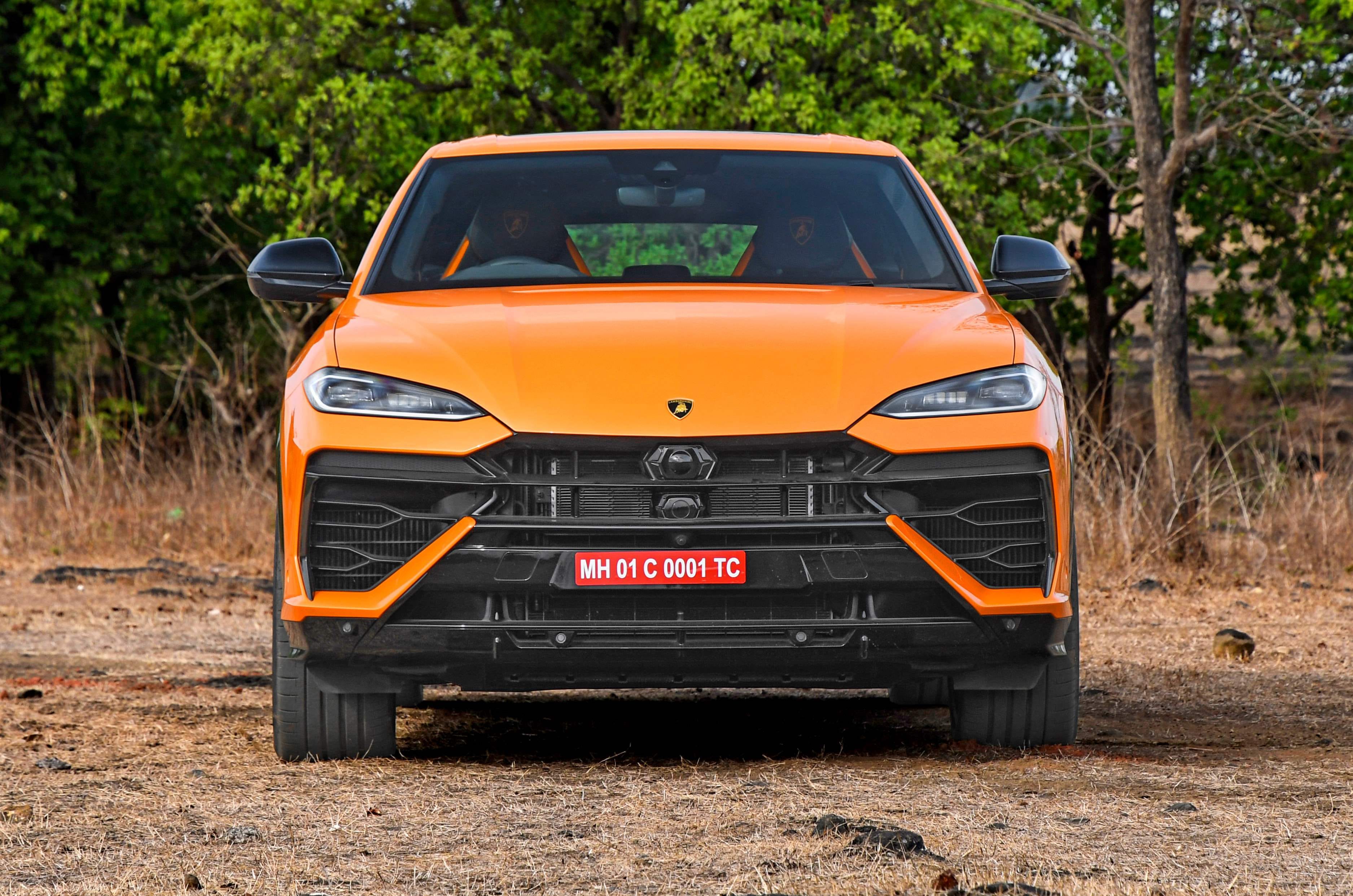
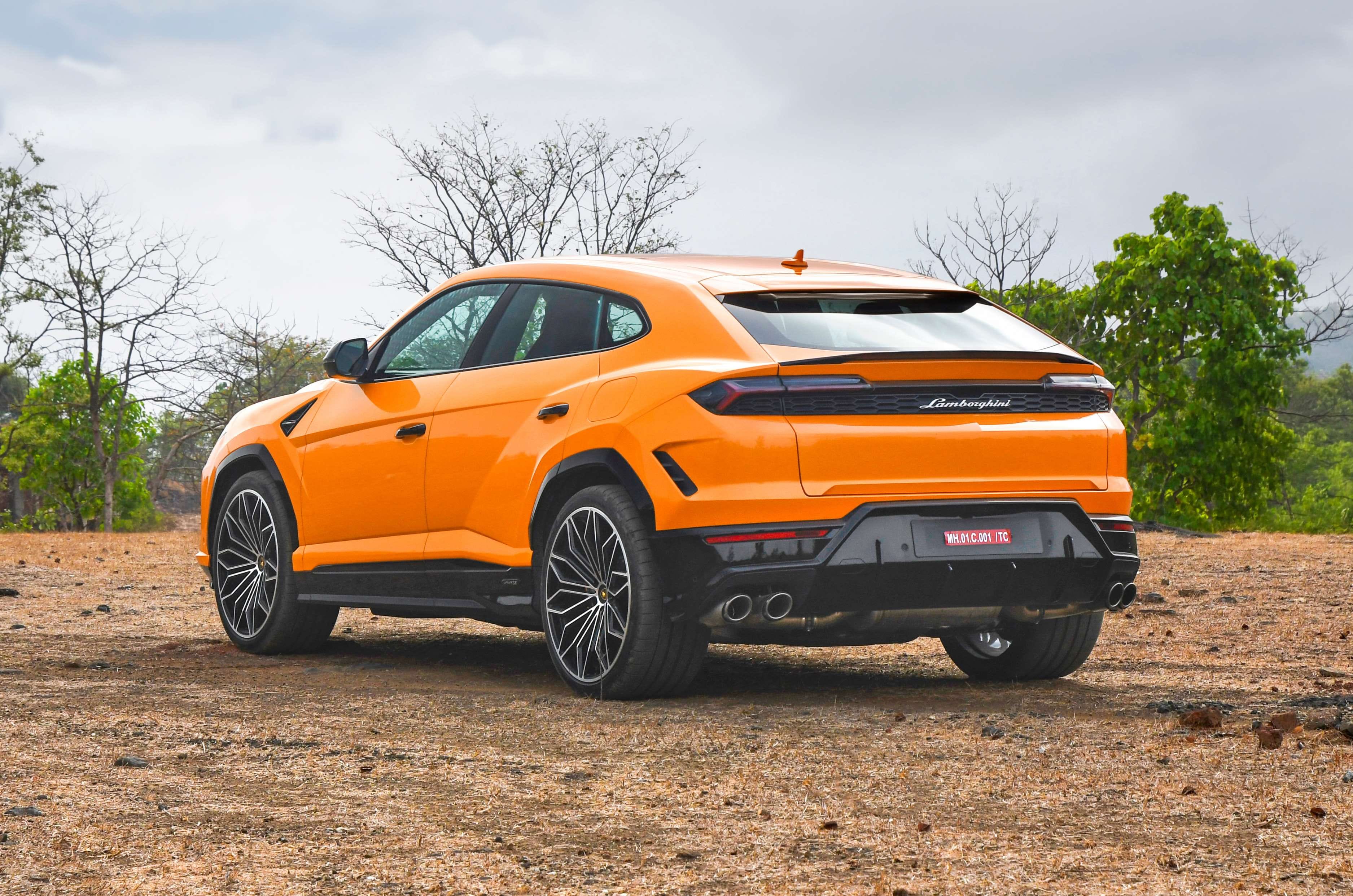
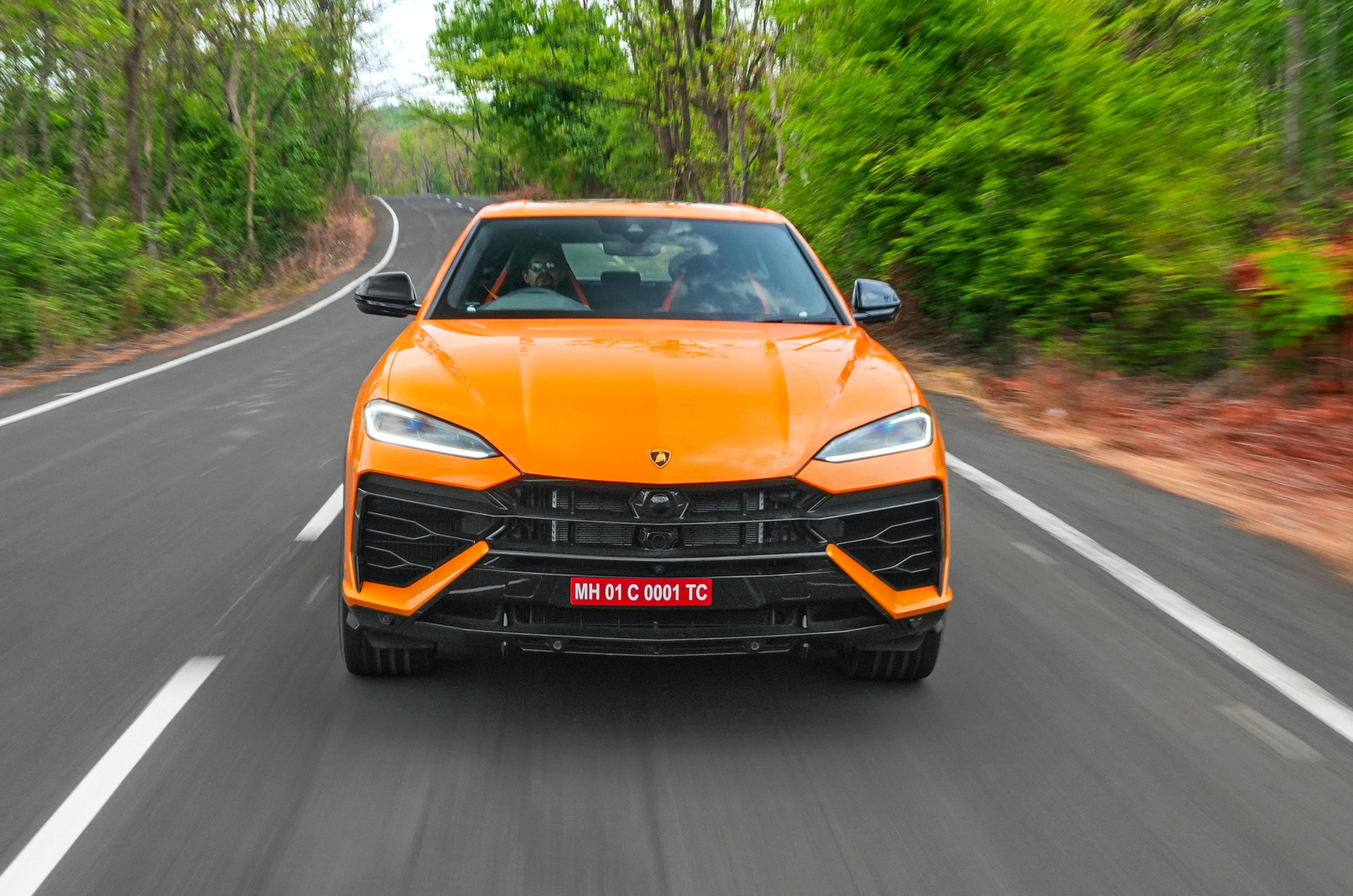
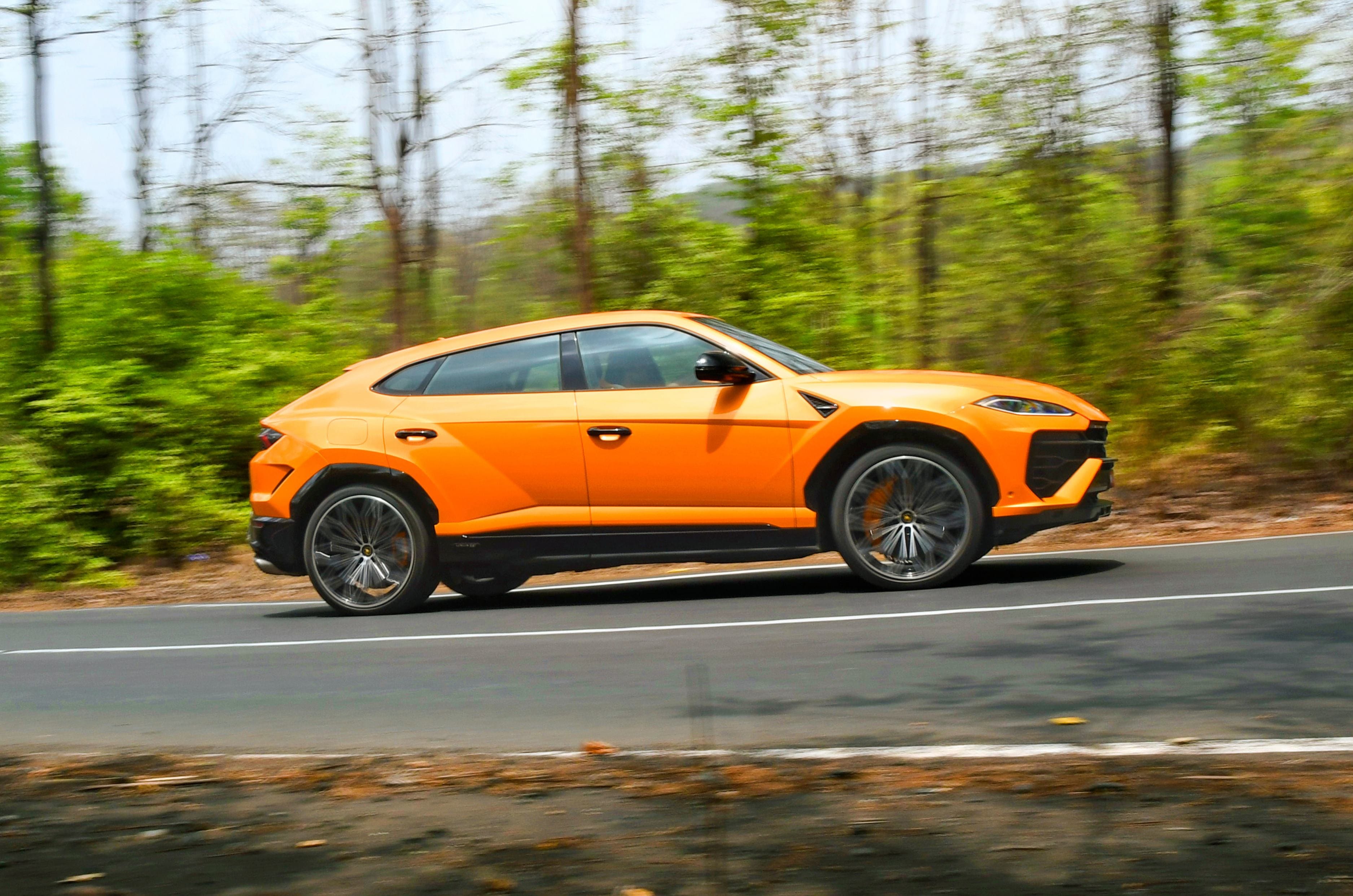
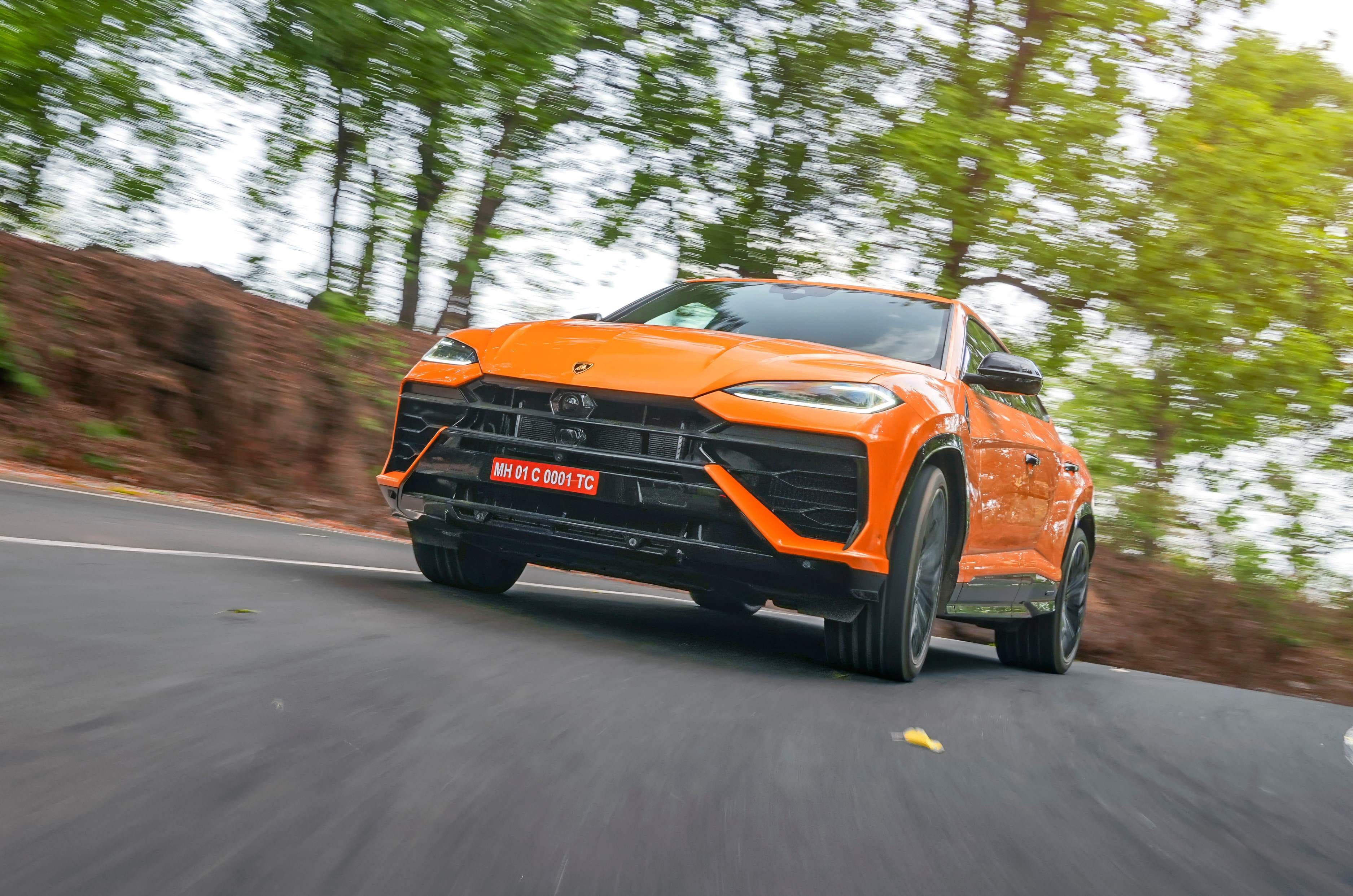
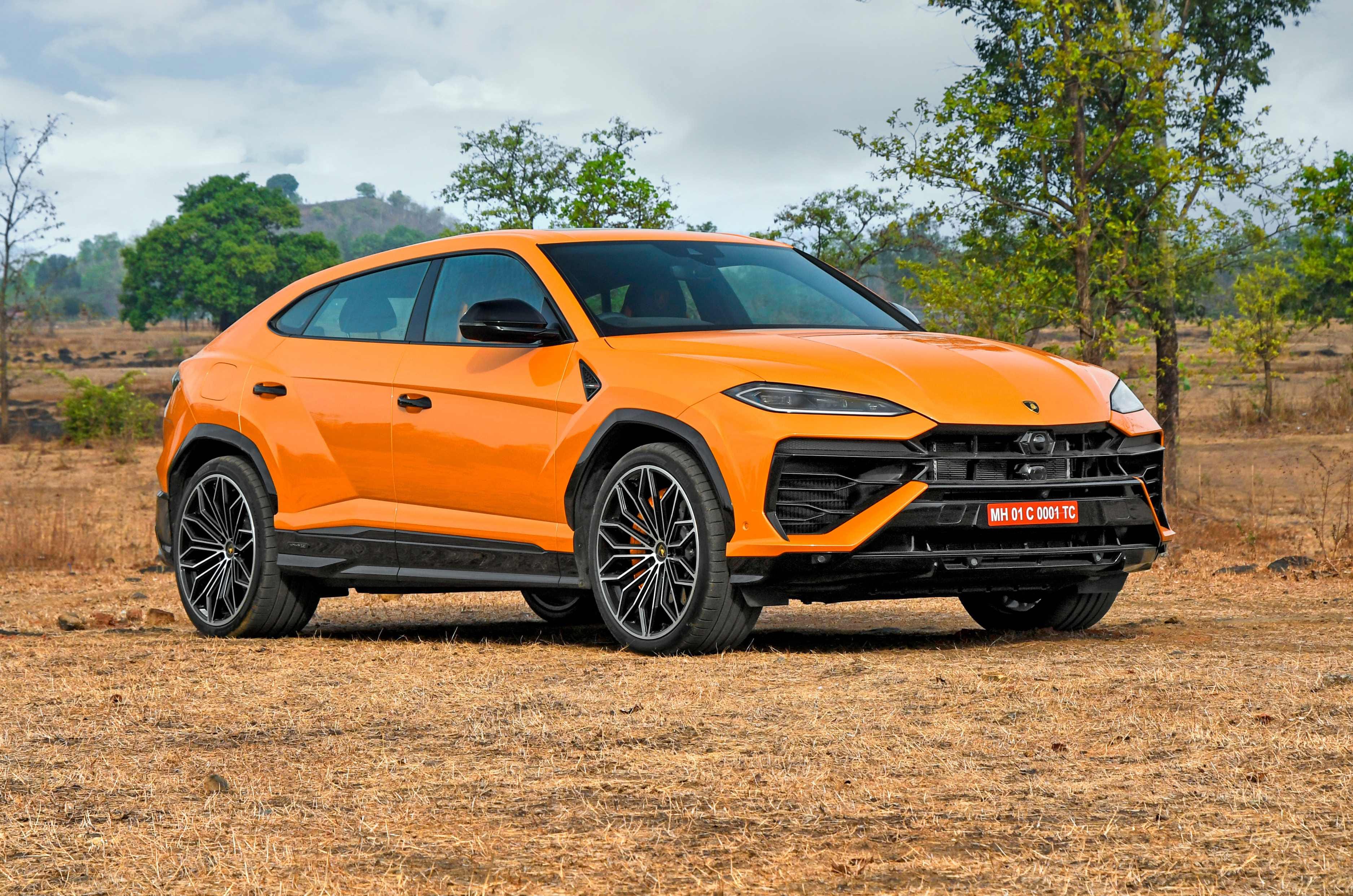
Urus SE has a more rounded-off design than its predecessor, but it’s no less menacing.
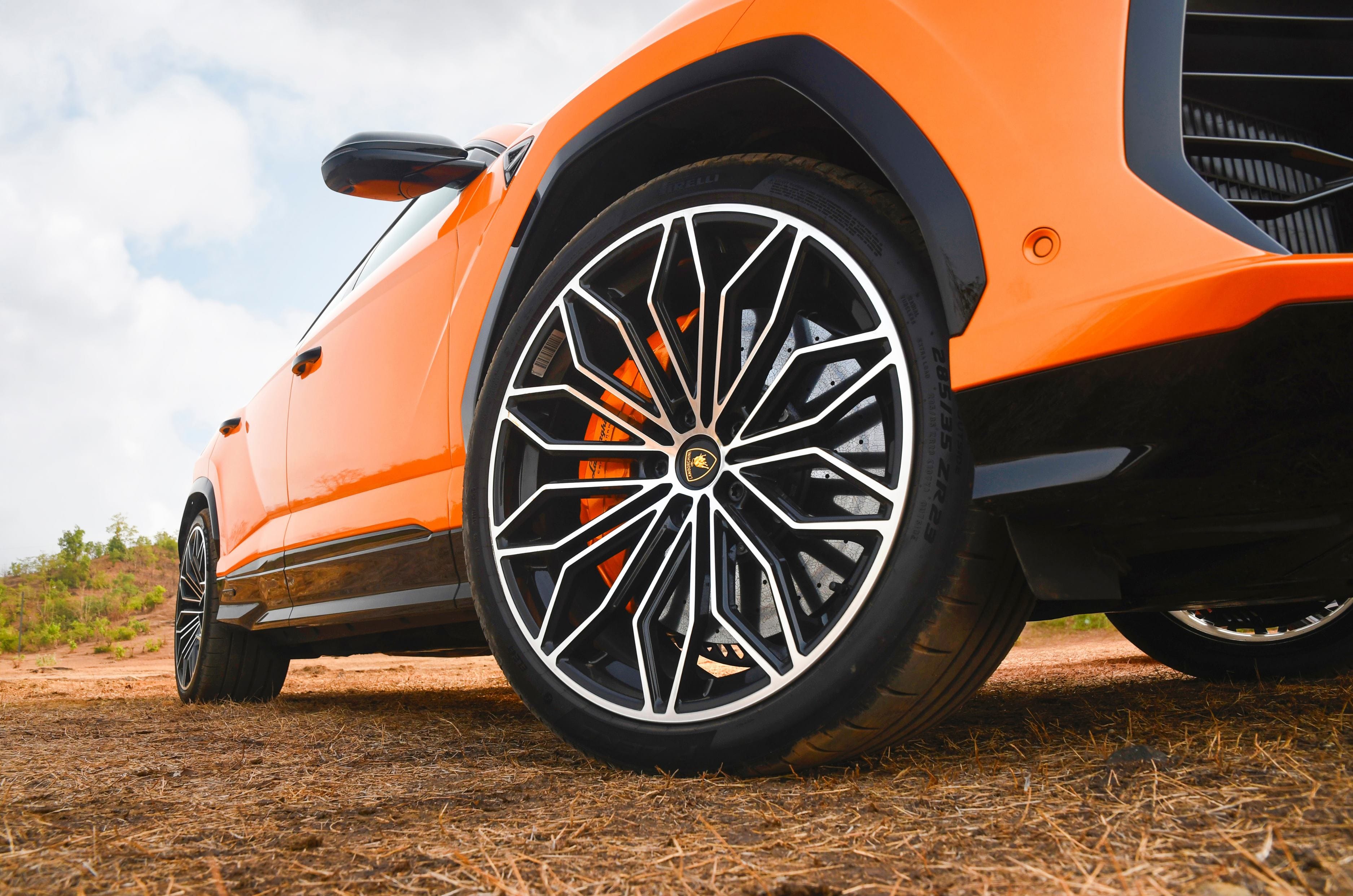
In comparison to the older Urus and the mad Urus Performante, the Urus SE does appear a bit softer and more rounded off. But that’s not to say it lacks presence by any means. It’s still full of sharp angles and surfaces, the Arancio Borealis optional paint on our test car looked stunning as did the diamond-cut, multi-spoke 23-inch alloy wheels. Up front, there’s a new bonnet, redesigned bumper and a larger front grille, while the slimmer headlights are now matrix LED units and a different DRL signature.
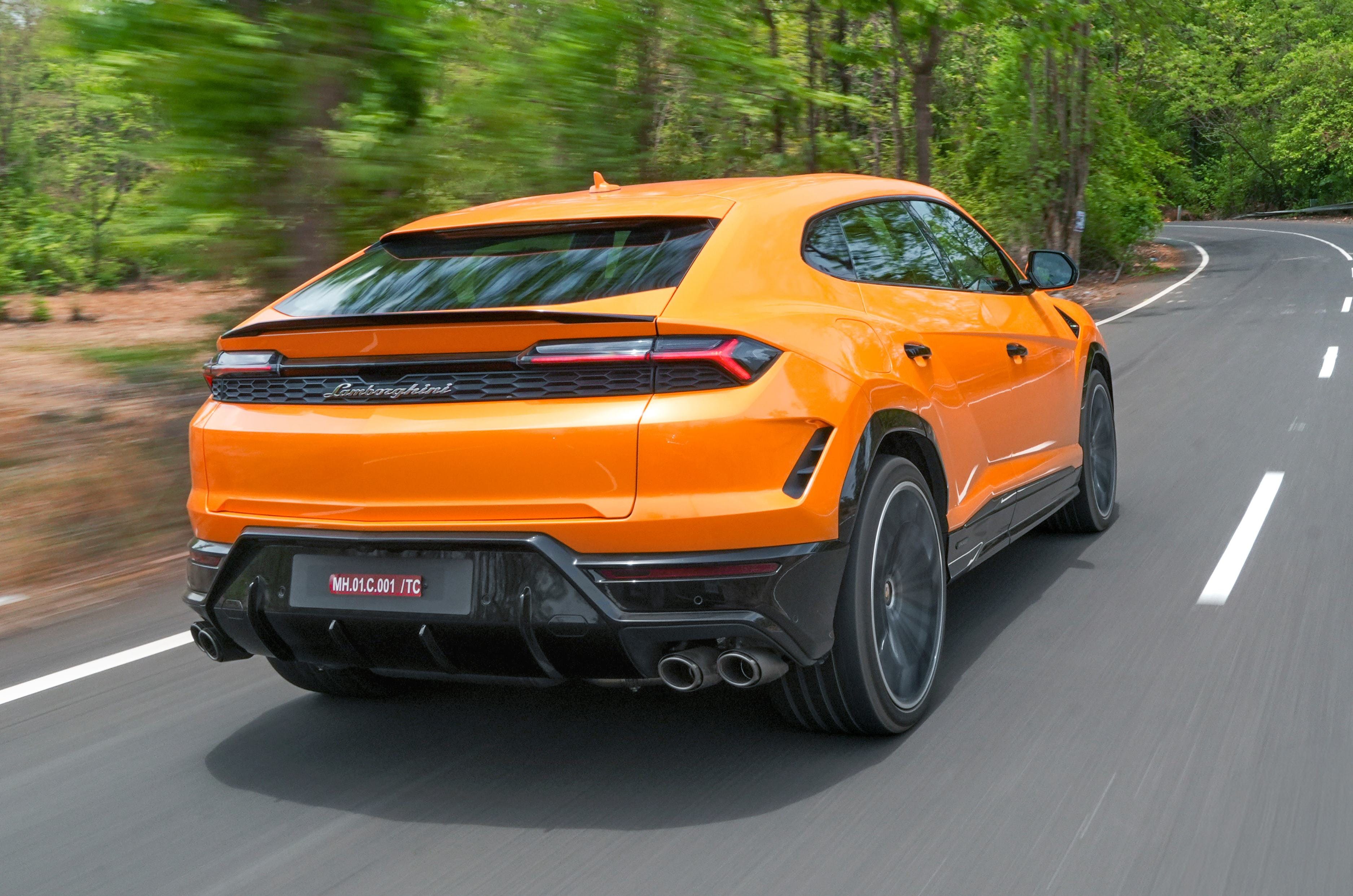
Rear end features quad-exhaust setup, sporty raked roofline, and a hexagon-patterned grille connecting the tail-lights.
The differences are immediately apparent at the rear too, with a new tailgate, rear bumper and a connecting tail-light grille. As always, Lamborghini’s Ad Personam personalisation programme offers an enormous scope for customisation, so buyers can tailor the Urus SE as per their needs. It remains a substantial machine, measuring 5.12m long and 2.02m wide, with a 3m wheelbase. Kerb weight is a hefty 2,505kg, which makes the fact that it can sprint from 0-100kph in just 3.4sec all the more impressive.
Lamborghini Urus SE Interior Space and Comfort – 8/10
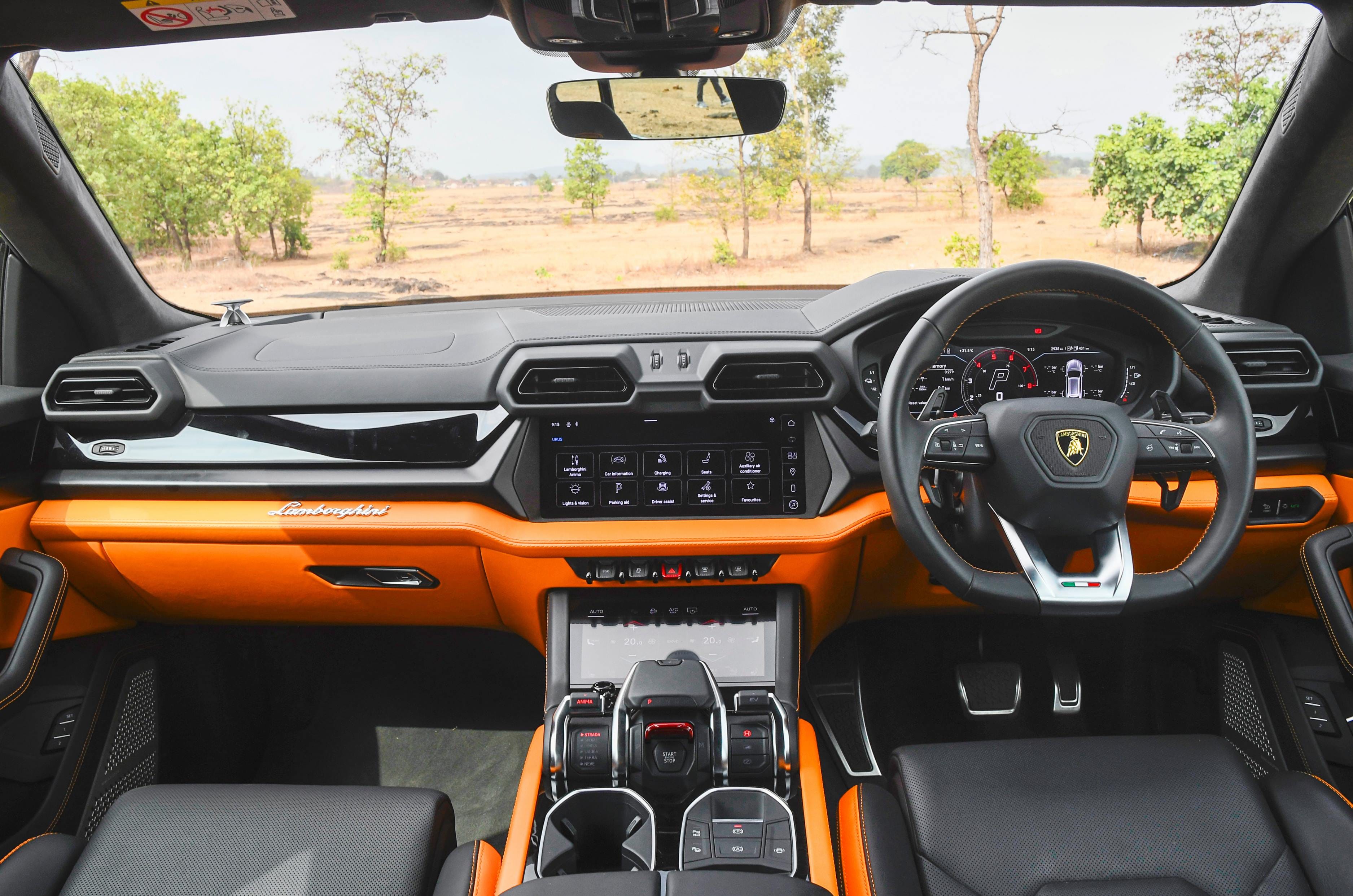
Dashboard layout is premium and feature-loaded, and gets a lot of Lamborghini theatrics.
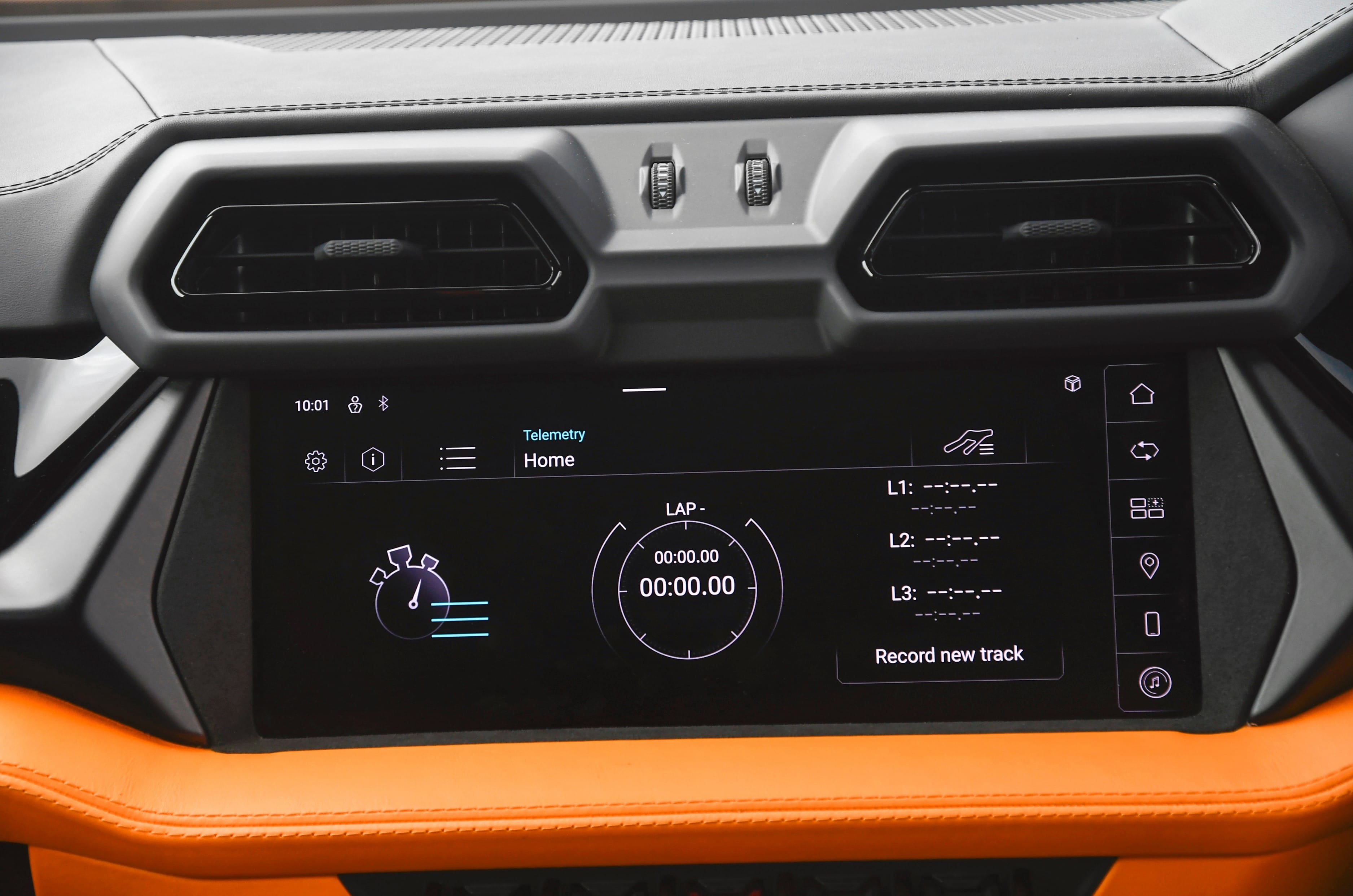
Inside, the Urus SE retains the familiar Lamborghini approach of combining the ambience of a supercar with the practicality expected of an SUV. However, the changes here are less apparent than those on the outside. The centre console is ever so slightly redesigned with a new array of toggle switches under the touchscreen. The touchscreen itself is larger than the earlier Urus, with updated graphics and a slicker user interface.
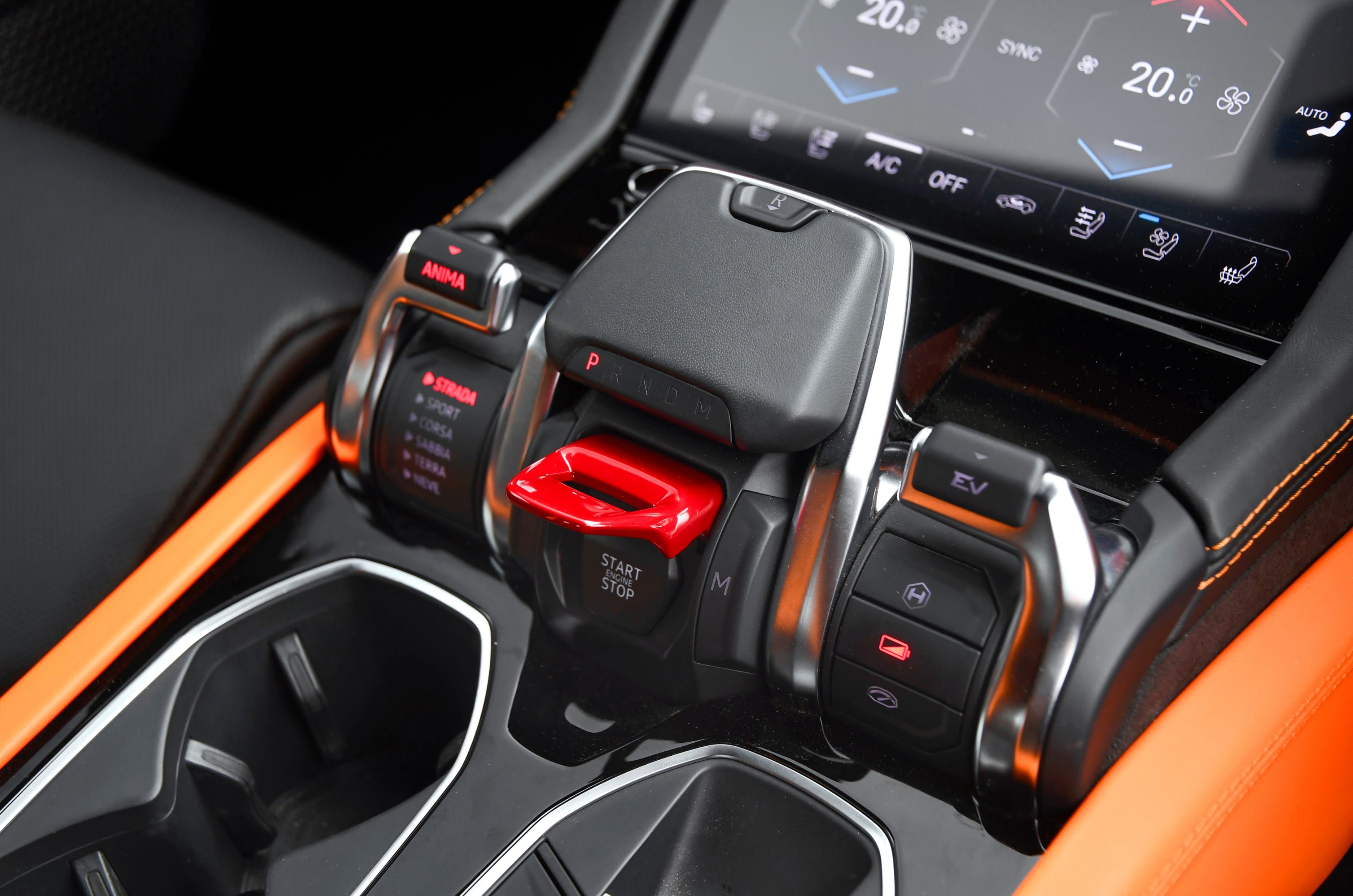
Lamborghini’s signature flip-up engine start/stop button is inspired by those of fighter jets.
There’s plenty of visual theatre, too, and it looks just as extroverted as the outside. Standout elements include the hexagonal AC vents, the Lamborghini badging on the dashboard, the aircraft-style levers for the drive modes and of course, the fighter-jet inspired flap-up engine start/stop button. Lamborghini has also introduced new colour and trim combinations with the SE, with our test car featuring the same predominantly orange theme as on the outside.
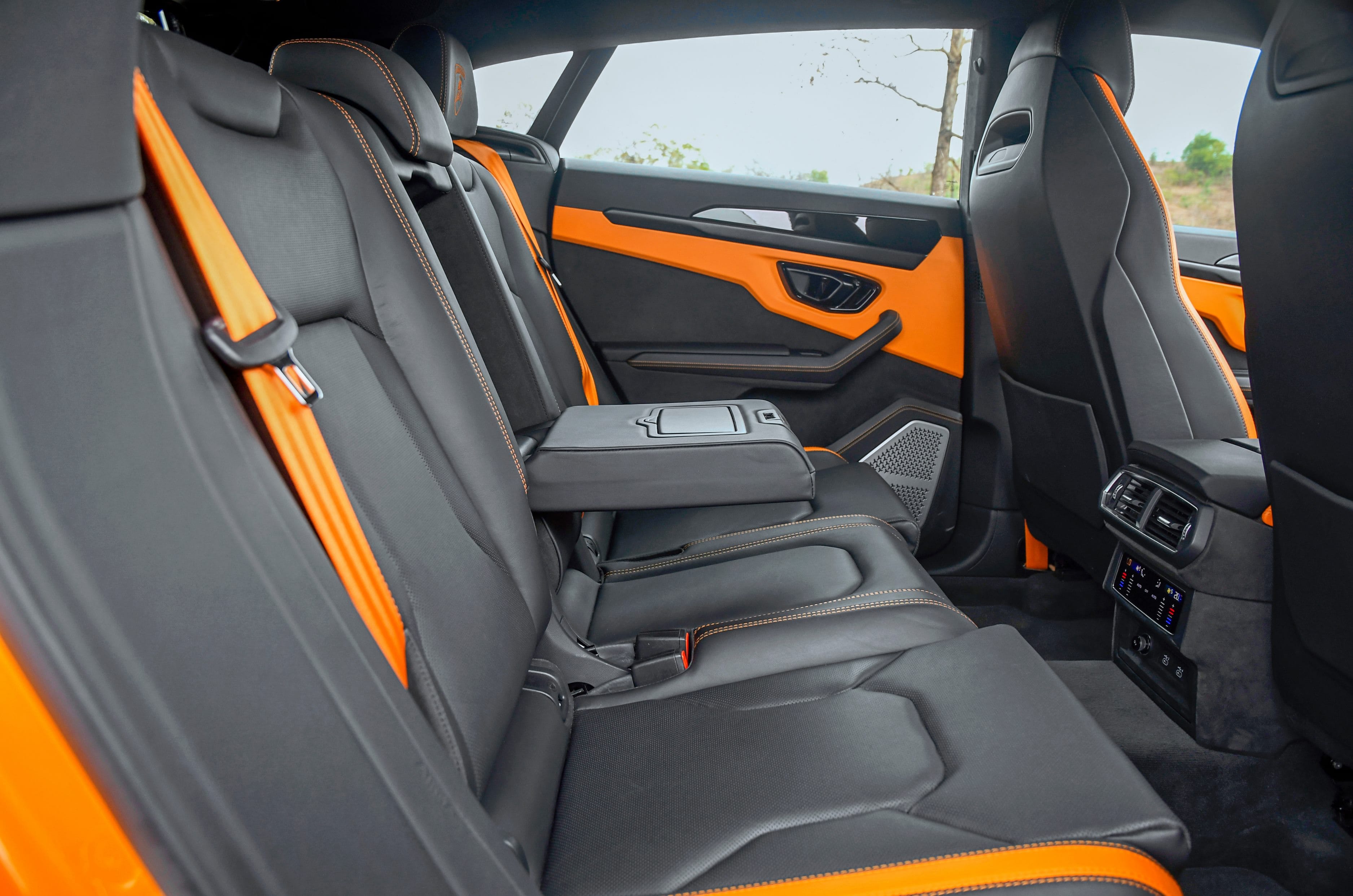
Rear space is surprisingly plentiful given the Urus SE’s sporty proclivities.
Despite all the drama, this remains a practical SUV. The long wheelbase means there’s plenty of legroom at the rear and it’s wide enough for three too, though taller passengers may find headroom a bit tight thanks to the tapering roofline. The front seats are large, well padded and the optional Lamborghini crest on the headrests just adds to the ambience. The glovebox is decent sized, there’s cupholders and the boot offers 454 litres of capacity.
Lamborghini Urus SE Features and Safety – 8/10
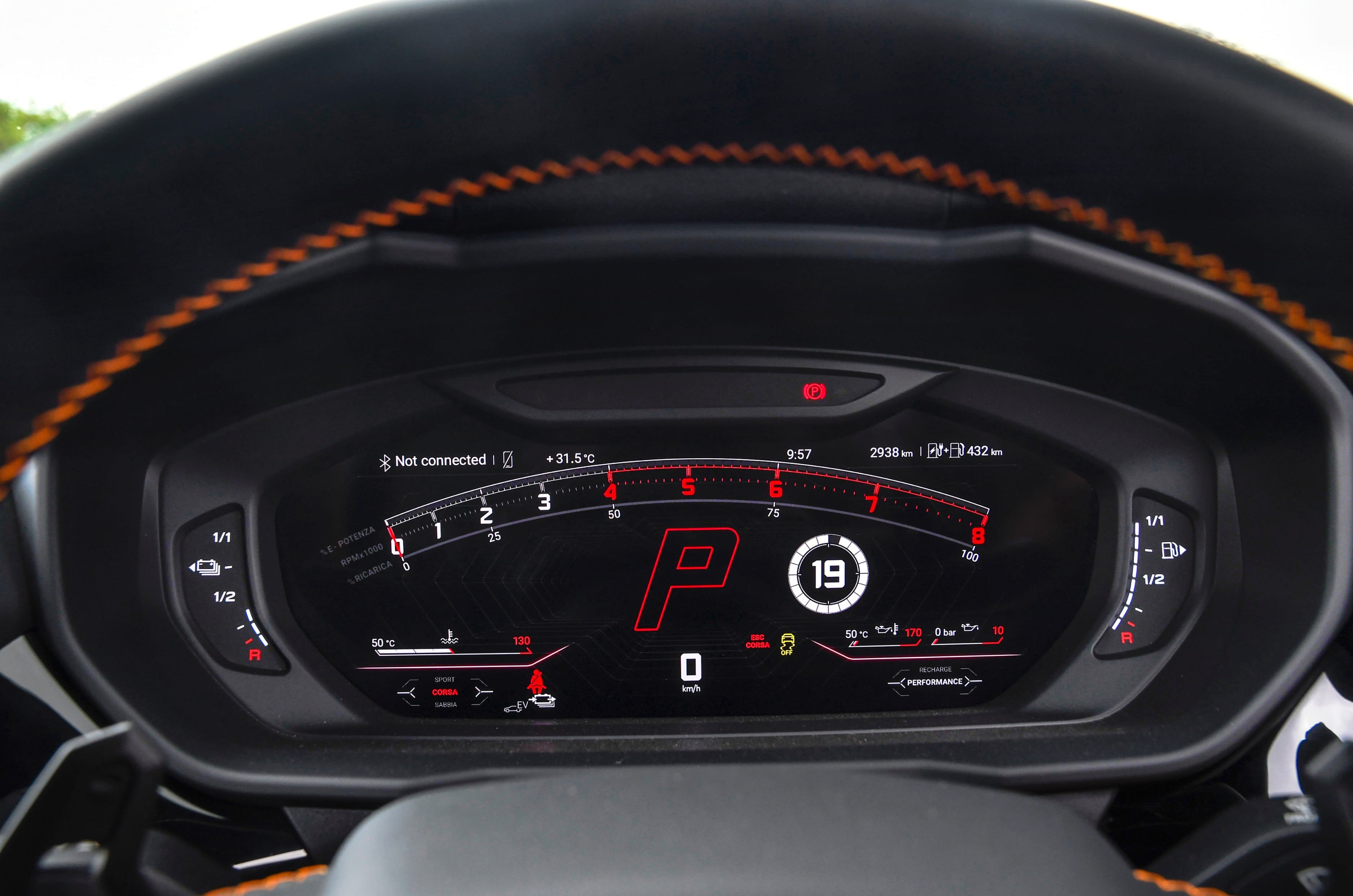
Info-packed driver’s display interface can get confusing at times.
As standard, the Urus SE gets plenty of features like the three screen setup – for the infotainment, AC system and driver’s display – wireless Android Auto and Apple CarPlay, LED matrix headlamps, four-zone auto climate control, leather upholstery, 360-degree camera, connected car tech and so much more.
The SE also gets a comprehensive technology upgrade, with the new user interface being one of the more significant updates. It features a carousel-style layout on the touchscreen to access the numerous sub-menus it packs in, while the driver’s display shows all sorts of data pertaining to the hybrid system, navigation, media and other car-related info. Navigating all the sub-menus can get confusing, however.
New Lamborghini Telemetry function comes with over 300 pre-loaded racetracks to record lap times on.
There’s also ‘Lamborghini Telemetry’ that can display lap times and sector information for more than 300 preloaded circuits, as well as record new tracks. Connected services extend to navigation, real-time traffic, remote locking, vehicle-status information, remote charging, remote cooling of the cabin and various safety and security alerts.
Also part of the package is ADAS tech like autonomous emergency braking, lane keep assist, adaptive cruise control and more. But there’s a lot that’s optional too, like a large panoramic sunroof, a Bang and Olufsen 3D audio system and a whole lot more, apart from the usual trim, material and stitching options. On the whole, the Urus SE is well-equipped but some of the optional extras really could have been standard fitment given the asking price.
Lamborghini Urus SE Performance and Refinement – 9/10
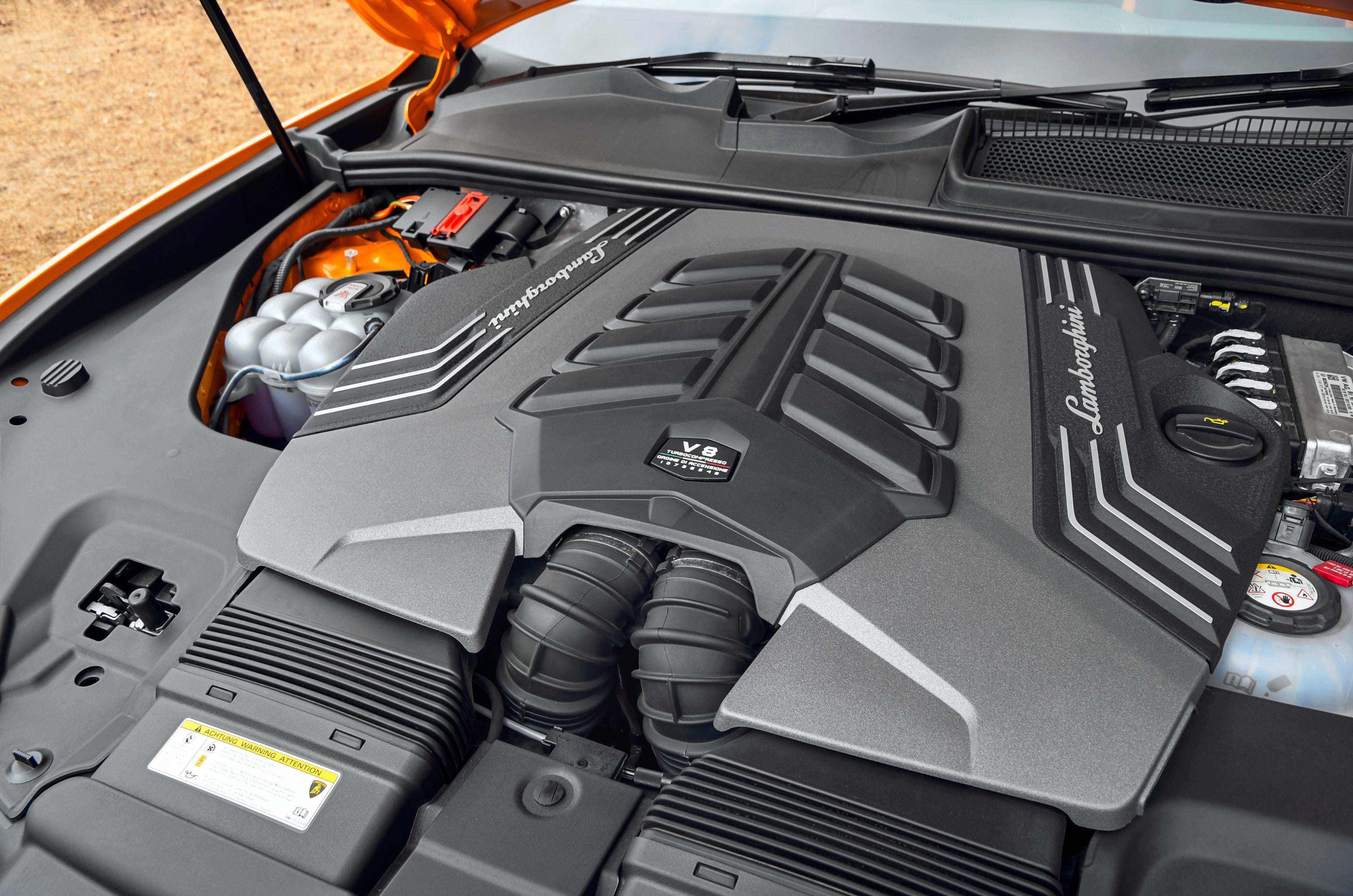
Twin-turbo V8 and electric motor develop a combined 800hp and 950Nm.
As for the numbers, they are, predictably, staggering. The Urus SE combines the familiar 4.0-litre twin-turbo V8 with a 25.9kWh lithium-ion battery and a permanent-magnet synchronous electric motor for an eye-watering combined output of 800hp and 950Nm. The result is 0-100kph in 3.4sec and 0-200kph in 11.2sec, with a claimed top speed of 312kph. Those figures put the Urus SE firmly in supercar territory, despite its size and weight.
And it does feel like one from behind the wheel too, especially in a straight line. Acceleration is relentless and it feels borderline scary on narrow, two-lane roads. The Urus SE always feels like it has power in reserve, especially when you’ve got the powertrain fully dialled up. There’s Strada mode for everyday driving, Sport for when you want to have a bit more fun and of course, Corsa for when you want a proper scare. Couple that with the hybrid system in its full performance mode, and the SE can really feel overwhelming. But if you don’t drive with a heavy foot, it’s surprisingly cordial and sedate. The SE really has a Jekyll and Hyde character about it.
Unrelenting acceleration can get scary on public roads.
What makes the SE more interesting than simply being a faster Urus is the way the electric motor has been integrated. Of course, it’s to help with emissions and meet regulations, but it’s also to boost performance. In EV mode, it can reach up to 135kph and go as far as 66km. But with a flick of a switch, it can turn from silent to violent.
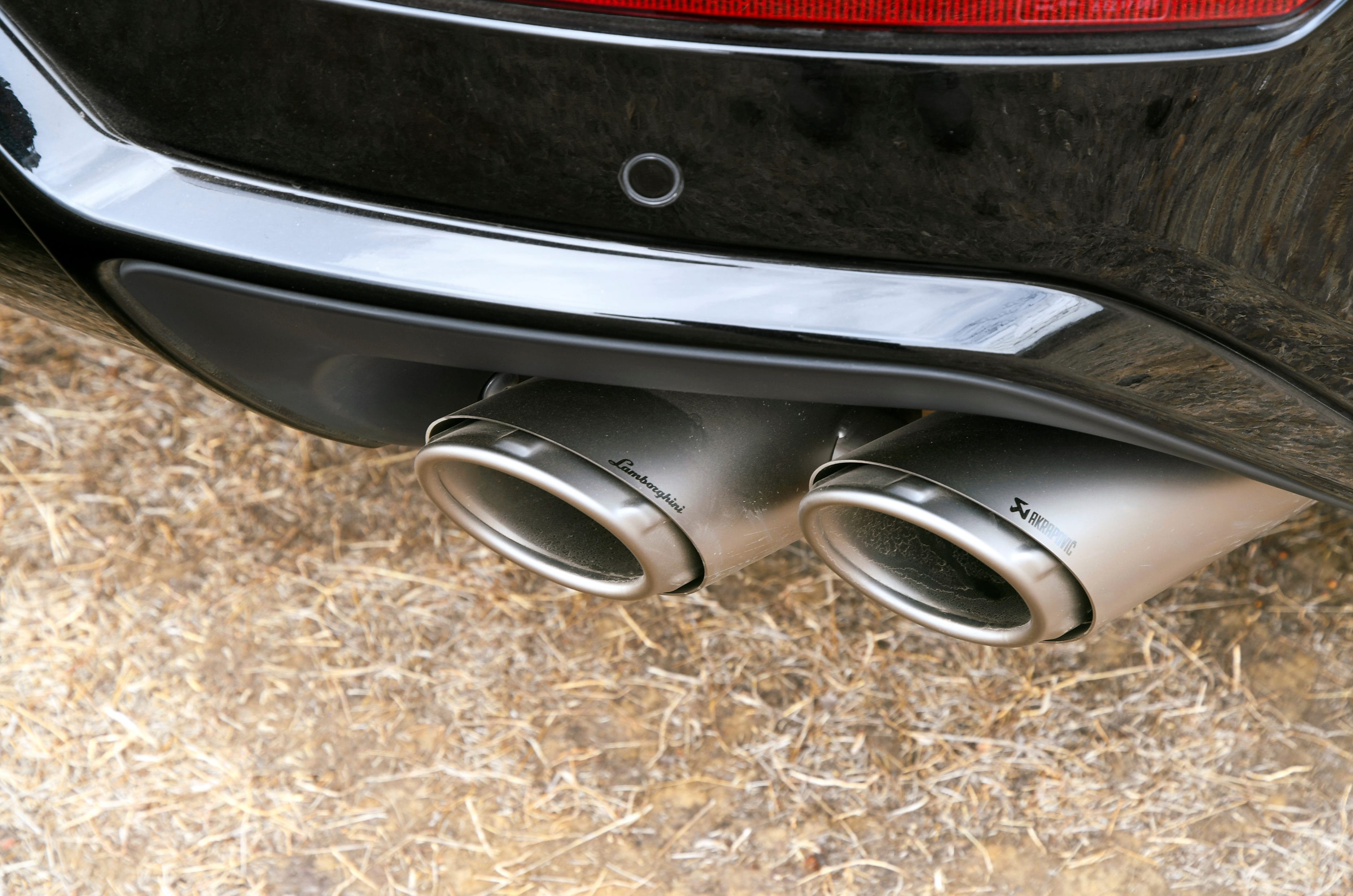
The V8 also hasn’t become anonymous with the hybridisation. It still makes its presence felt, especially through the optional Akrapovic exhaust our car came fitted with, but it does feel a bit subdued. It’s also piped through the speakers, which doesn’t feel entirely ethical but it does help its case.
Optional Akrapovic exhaust system helps enhance the V8’s aural character.
Lamborghini has also paid considerable attention to keeping performance consistent, with additional cooling for the powertrain and brakes. Not that we ever managed to push it so hard to test out that claim. And apart from the aforementioned drive modes, there’s even some off-road modes baked in, but how many buyers actually take their prized possession off the grippy stuff remains to be seen.
Lamborghini Urus SE Mileage and Efficiency – 7/10
This is where the Urus SE’s plug-in hybrid system makes a big difference. Lamborghini quotes a WLTP combined energy consumption of 4.67km/kWh plus 17.54kpl. With a discharged battery, however, combined claimed fuel efficiency falls to 7.75kpl.
Thanks to the 25.9kWh battery, the Urus SE claims a 66km all-electric range.
The headline figure therefore needs some context. The SE’s efficiency advantage is greatest when the battery is regularly topped up. With a claimed 66km of EV range, many shorter daily journeys can theoretically be completed without the V8 needing to fire up at all.
For longer journeys, the hybrid system allows the electric motor and V8 to share the workload. But once the battery is depleted, this remains a 2.5-tonne SUV with a twin-turbo V8, so expectations of conventional-SUV fuel economy would be unrealistic.
Lamborghini Urus SE Ride Comfort and Handling – 8/10
Ride isn’t all that absorbent due to the low-profile Pirelli P Zero tyres.
The Urus SE uses a multilink suspension setup front and rear with semi-active dampers, all of which make this large SUV feel engaging around corners without sacrificing comfort. There is a sense of pliancy at low speeds with the ride firming up as speeds rise. Of course, riding on 23-inch wheels means you can feel potholes and road imperfections, but still it isn’t uncomfortable by any means.
Rear-wheel steering, semi-active dampers, e-diff, and torque vectoring help make the Urus SE a keen handler.
It also gets rear-wheel steering, which helps make it more manageable at lower speeds while contributing to agility at higher speeds. The SE feels eager to change direction and the e-diff and clever torque vectoring system do their best to keep things tidy around bends. You also get a good sensation from the steering which has good heft to it and the Pirelli P Zero tyres it comes with are grippy too. Lamborghini has also worked on the aerodynamics, with a new rear aero lip and diffuser increasing rear downforce by 35 percent over the Urus S. Overall though, the SE feels agile enough but there’s no escaping its heavy kerb weight.
Giant carbon-ceramic brakes peek out from behind the 23-inch alloys.
You’re also backed by massive carbon-ceramic brakes, measuring 440mm at the front and 410mm at the rear, and they do take some time getting used to. They may not have the initial bite like with conventional steel brakes, but the stopping power is immense and they stay consistent despite repeated hard braking, which is essential in something as big and powerful as the Urus SE.
Lamborghini Urus SE Value for Money – 7/10
The Urus SE is arguably the most convincing expression yet of Lamborghini’s super-SUV. More importantly, it hasn’t sacrificed the characteristics that make a Lamborghini feel special in the pursuit of meeting ever tightening restrictions. There’s still a V8, it’s still outlandish inside and out, and it still delivers a driving experience that goes well beyond what you’d expect from something this large. All of that while adding the benefit of the plug-in hybrid system for performance and efficiency, as well as properly usable EV range.
The Urus SE is the all-in-one Lamborghini.
At Rs 4.47 crore (ex-showroom, before options), of course, the Urus SE is expensive. But that’s almost beside the point. The Urus SE isn’t for those who expect rational value; it is for those who want a vehicle that can combine supercar pace, SUV practicality, luxury, all-electric driving and aspirational brand value all in one package. As a technological statement and a performance SUV then, the Urus SE makes a compelling case for Lamborghini’s hybrid future.
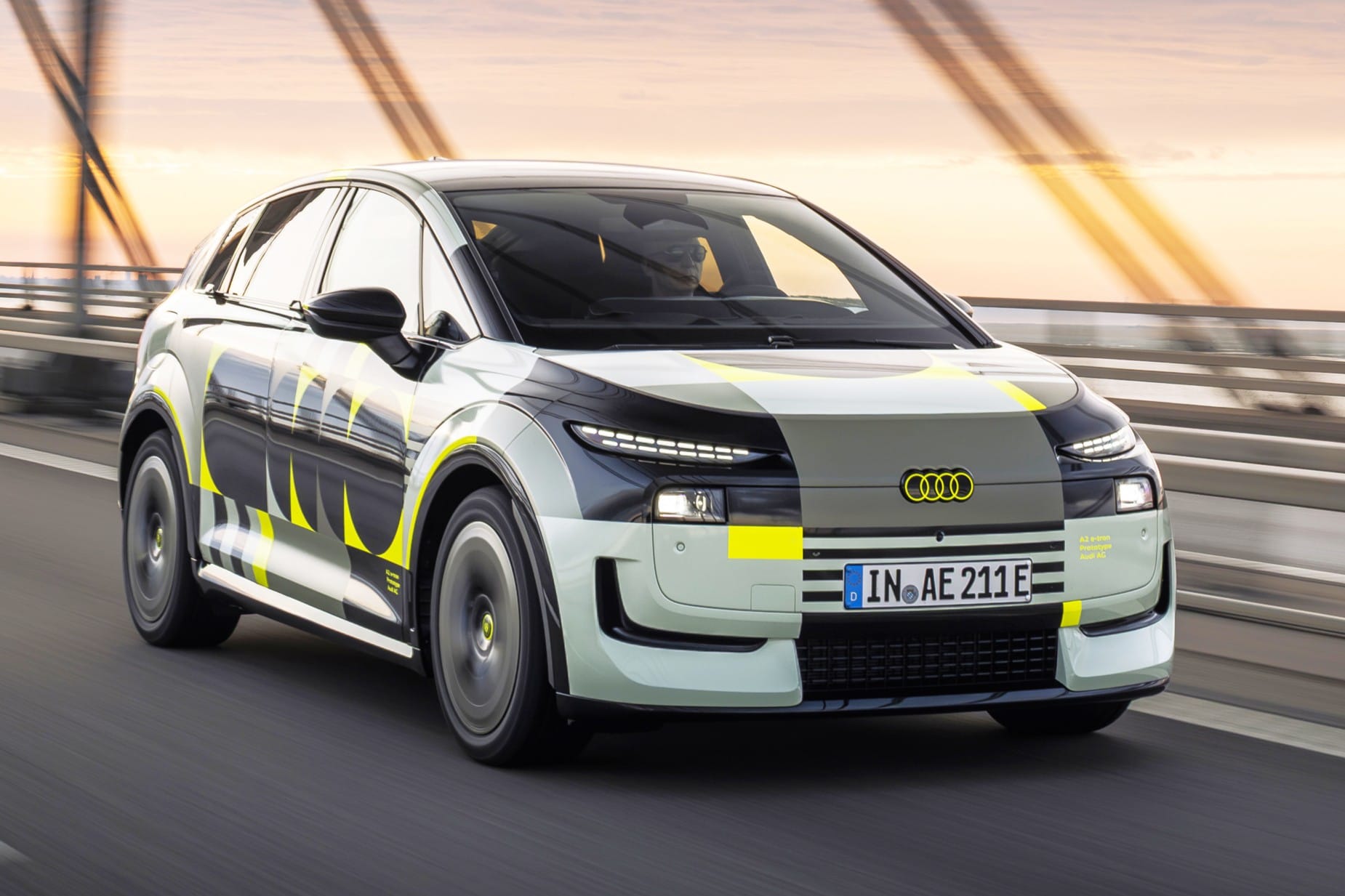
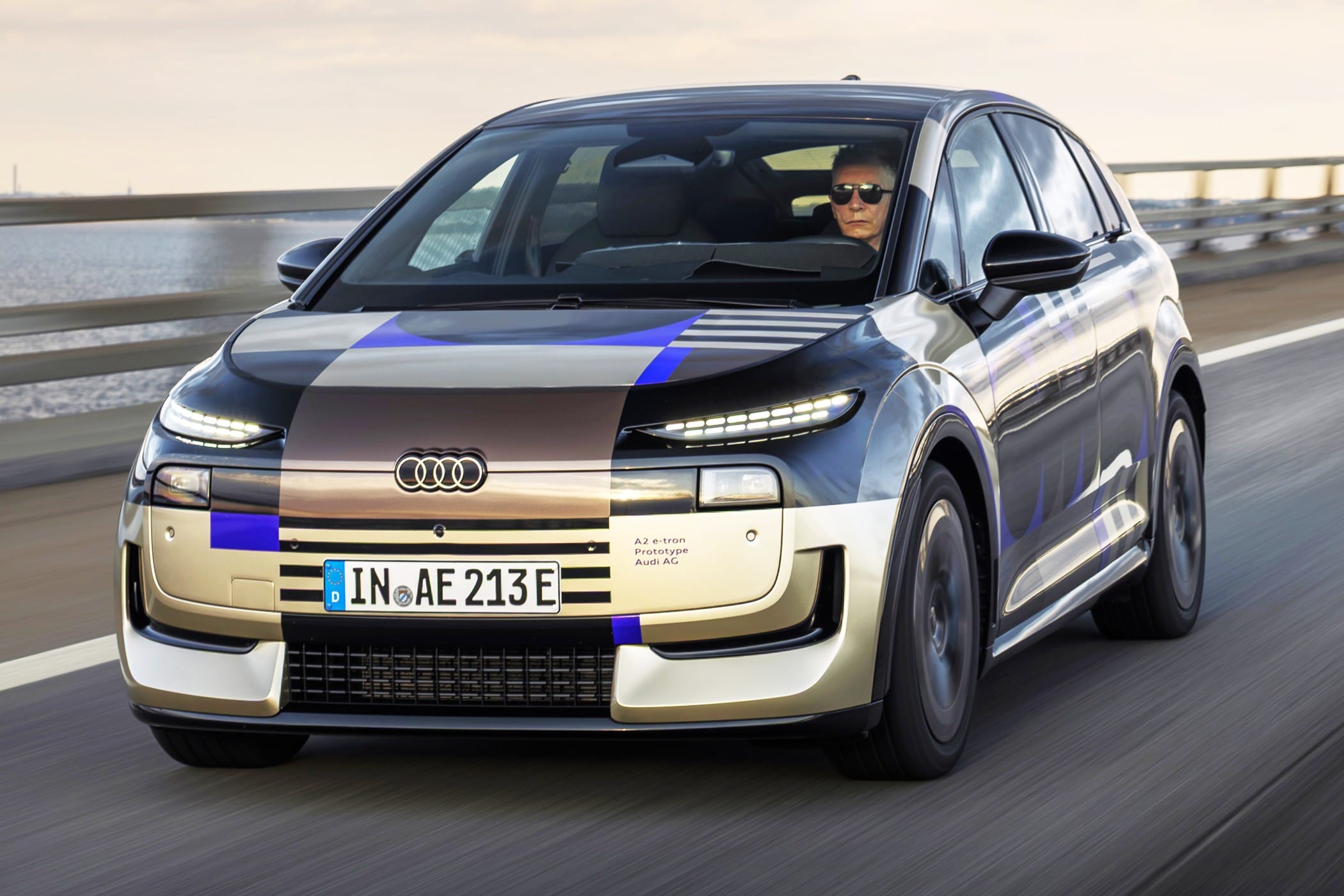
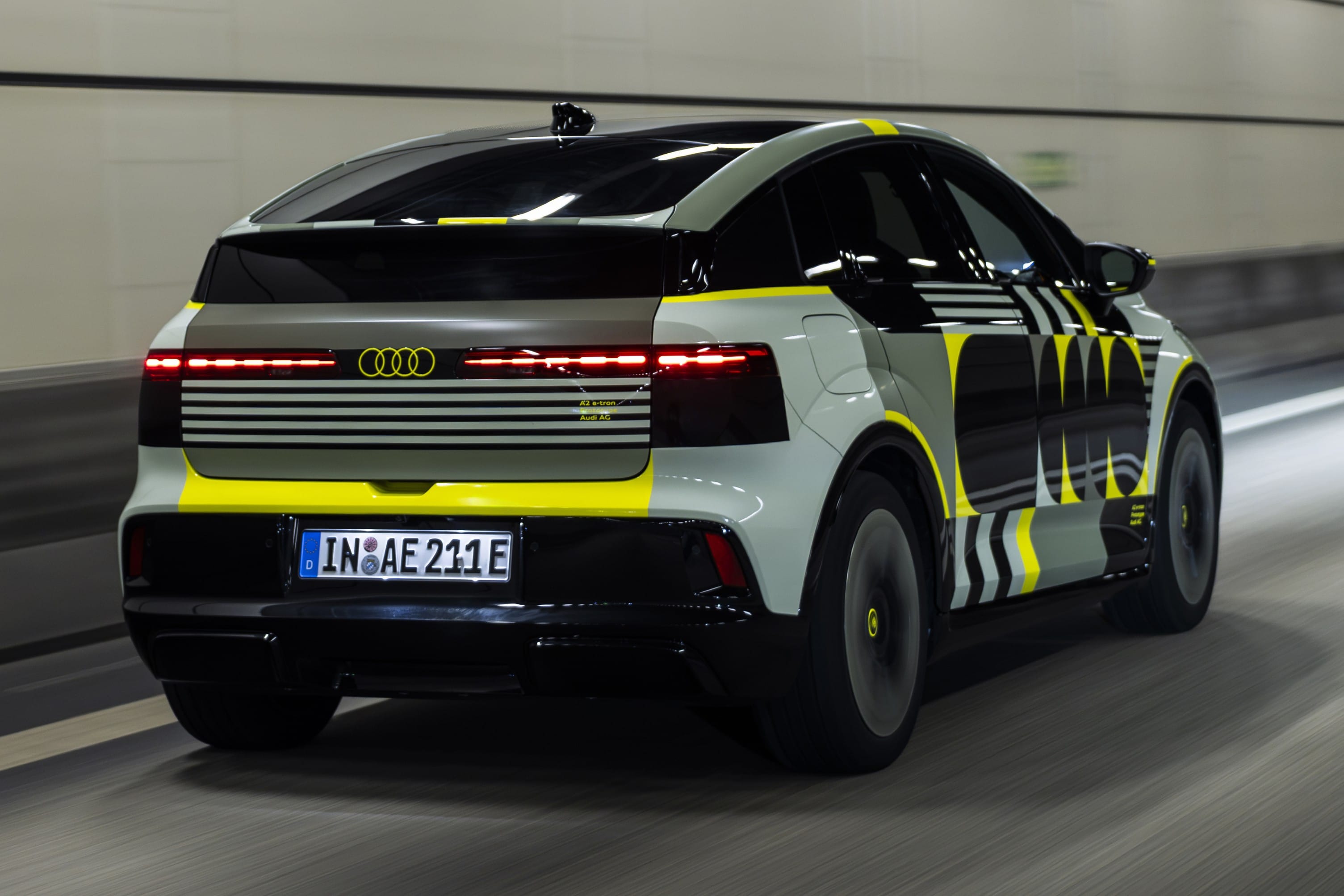
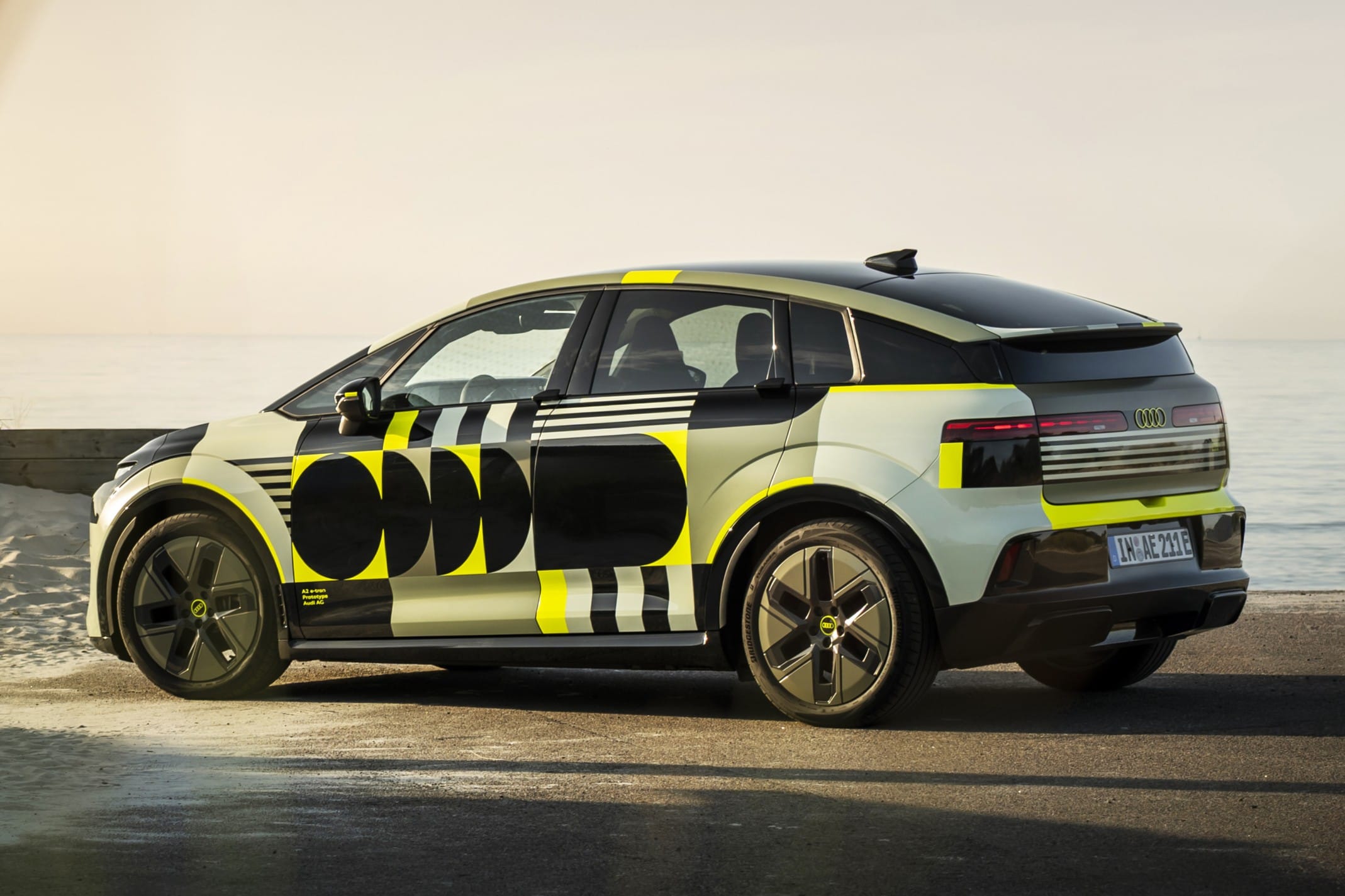
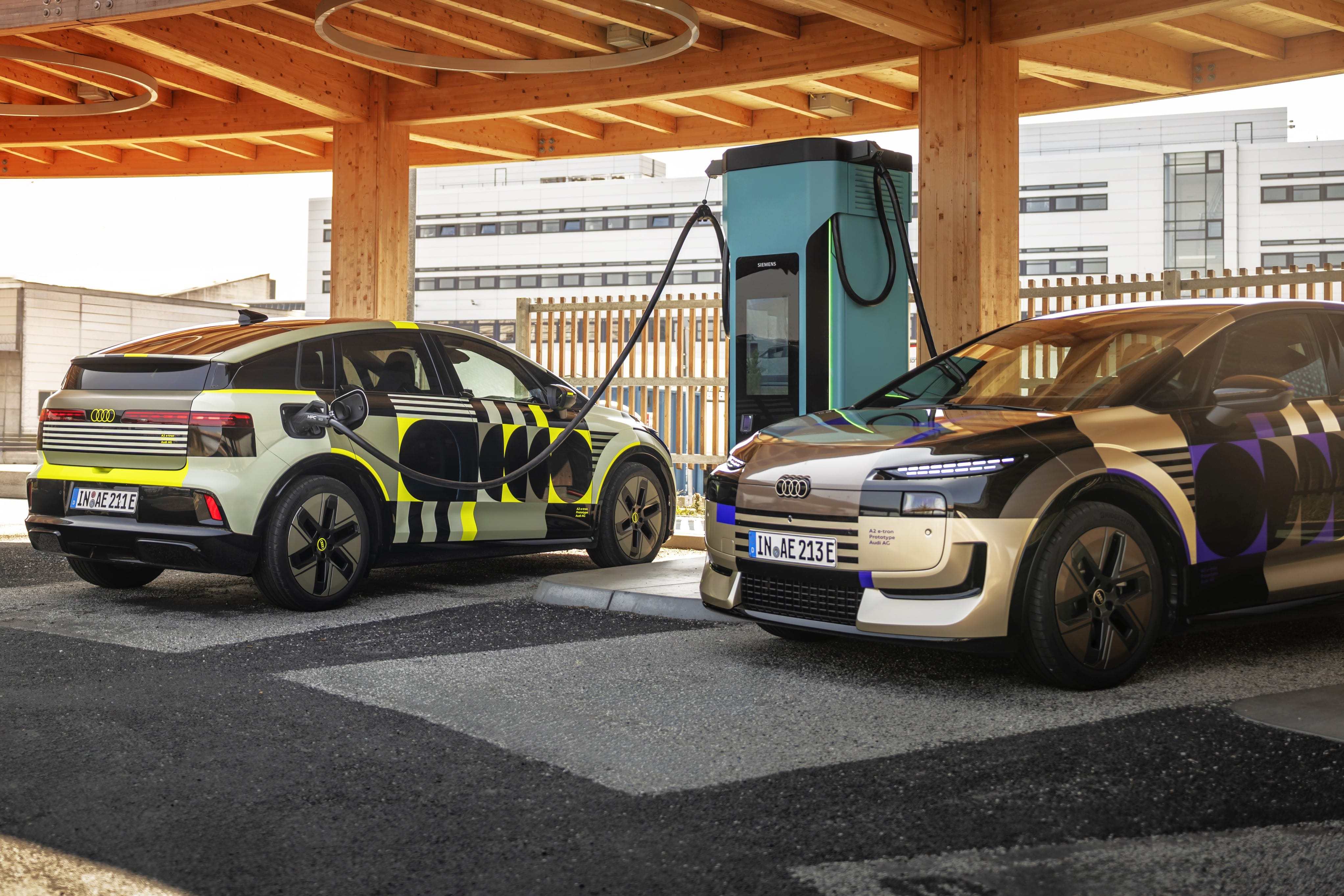
Audi has revealed fresh details and camouflaged prototype shots of the upcoming A2 e-tron, confirming that the electric hatchback will be the most efficient production car the brand has ever built. The A2 e-tron is expected to debut in full this fall, with European sales scheduled to begin in the end 2026 to early 2027 timeframe.
Reborn Audi A2 adopts the original’s efficiency-first ethos
Achieved 7.81km/kWh WLTP energy efficiency in preliminary testing
Equipped with the optional Efficiency Package, the A2 e-tron recorded a preliminary WLTP energy consumption figure of just 12.8kWh/100km (7.81km/kWh), making it the German carmaker’s most energy-efficient model to date. Notably, the original A2 (sold from 1999 to 2005) was built to deliver superb fuel economy, and its EV successor clearly adheres to the same efficiency-first principles.
Audi says the A2 e-tron achieves its impressive claimed efficiency via a combination of advanced aerodynamics, a highly optimised drivetrain, and a battery designed specifically for everyday use. The Efficiency Package lowers the A2 e-tron’s energy consumption by up to 0.9kWh/100km over the standard model.
The A2 e-tron also boasts a drag coefficient of 0.24, the lowest of any compact Audi to date. To achieve this, Audi has equipped the A2 e-tron with a rounded fascia, a flowing roofline, a fully enclosed underbody, air curtains, wheel arch gap reducers, an upright rear end, and an active front cooling intake that remains closed during normal driving to minimise drag. The intake automatically opens during rapid charging, heavy acceleration, or high ambient temperatures to provide additional cooling for the battery and power electronics.
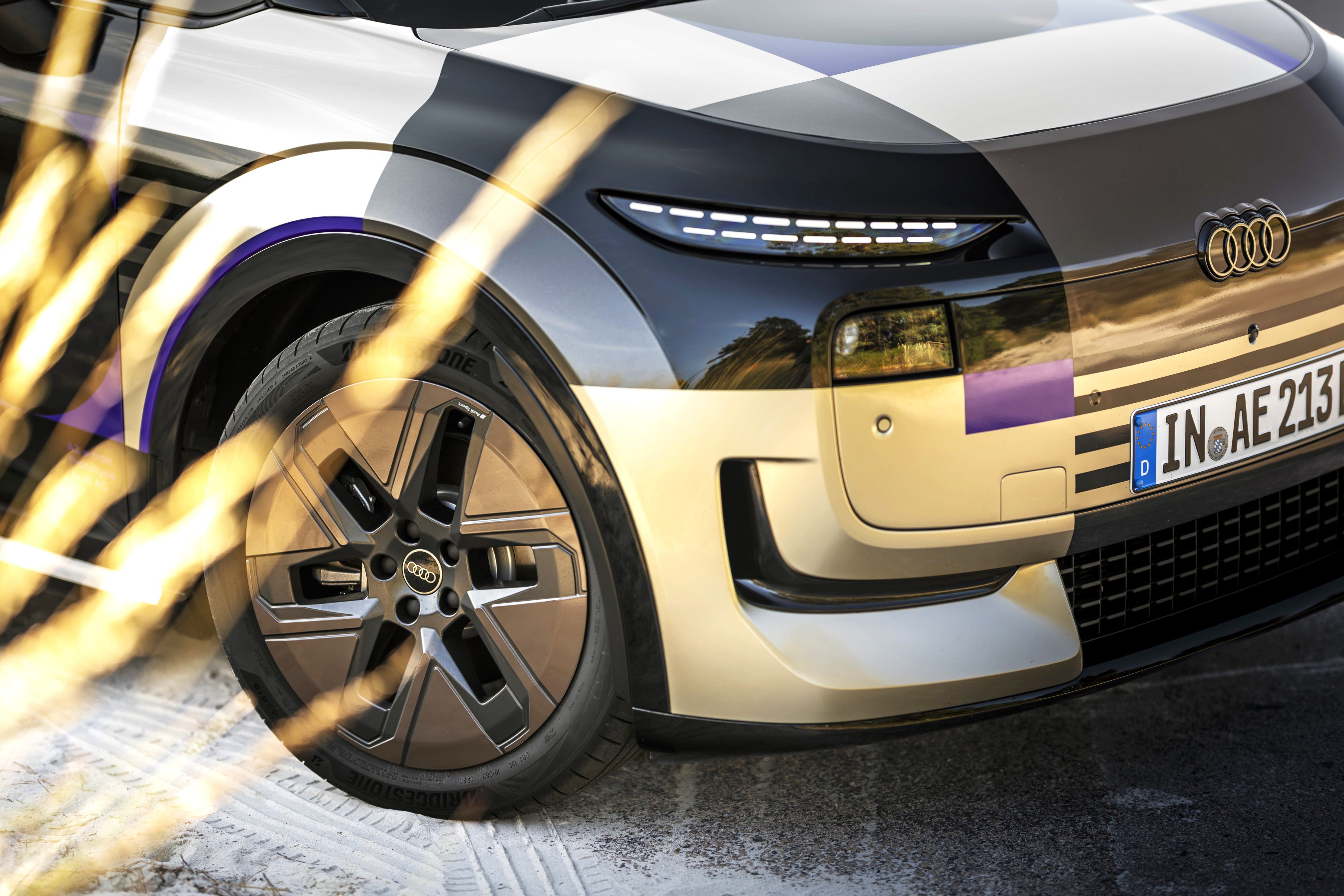
Other observable design highlights on the A2 e-tron prototype include a split-headlamp setup, L-shaped intakes up front, aero-optimised alloy wheels, wide rectangular tail-lamps, subtly flared fenders, and a silhouette that pays homage to the original A2 – the A2 e-tron actually looks quite similar to the Hyundai Ioniq 3 in profile.
Audi A2 e-tron to offer 61kWh battery in base spec
Estimated WLTP range of around 453km
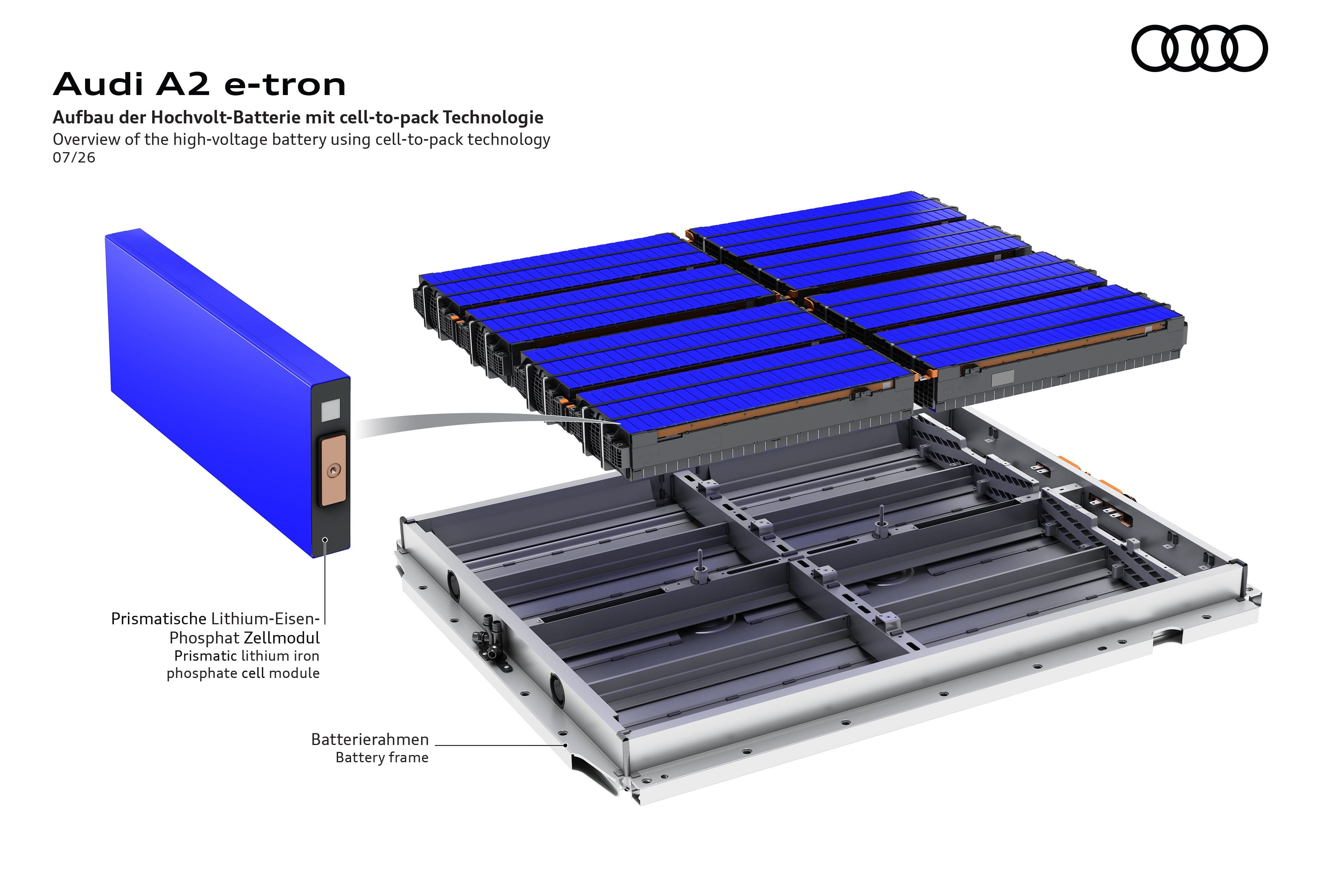
Entry-level versions of the A2 e-tron are confirmed to offer a 61kWh (58kWh usable) LFP battery that powers a rear-mounted 190hp electric motor dubbed APP350. Multiplying the usable battery capacity with the aforementioned 7.81km/kWh efficiency figure yields an indicative WLTP range of 453km.
The A2 e-tron’s battery uses a cell-to-pack design that improves packaging efficiency while eliminating conventional battery modules. It can even be routinely charged to 100 percent without the degradation concerns associated with other battery chemistries. A revised thermal management system also improves home wallbox charging efficiency to 89.6 percent.
According to Audi, the A2 e-tron’s electric drive system is around 10 percent more efficient than previous designs. Improvements include silicon carbide (SiC) power electronics, thinner motor laminations to reduce energy losses, revised stator windings, and a new low-friction transmission oil paired with a tall 10.2:1 gear ratio for improved highway efficiency.
The A2 e-tron will also support vehicle-to-load (V2L) functionality, allowing owners to power external appliances with up to 2.3kW of output, as well as a vehicle-to-home (V2H) feature that enables the vehicle to act as a home energy storage system when paired with compatible charging equipment.
While Audi has confirmed only the 140kW version of the A2 e-tron for now, more variants are expected to be part of the line-up. Since the A2 e-tron shares its underpinnings with the Volkswagen ID 3 Neo, which gets a 79kWh NMC battery option, the Audi hatchback could offer a similarly sized unit.
Kia has chosen the Syros to be its second mass market EV for the Indian market. Despite its superb packaging, oddball styling and high initial prices held back the original ICE version against traditional compact SUV rivals. However, EV customers are generally more accepting of avant-garde design, so can the Syros EV find success where the ICE version couldn’t? We drove it in Bengaluru to find out.
Kia Syros EV Exterior Design and Engineering – 7/10
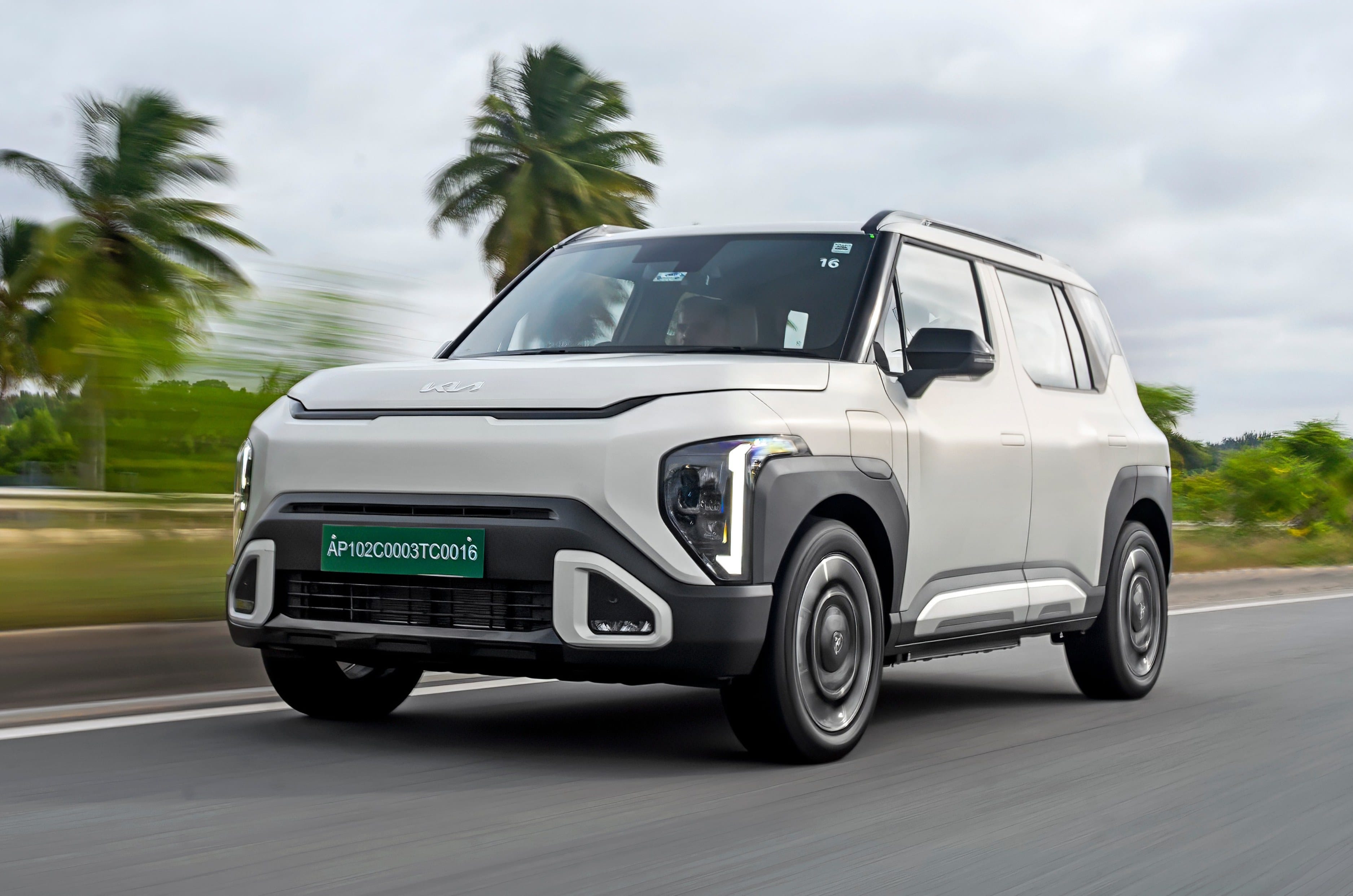
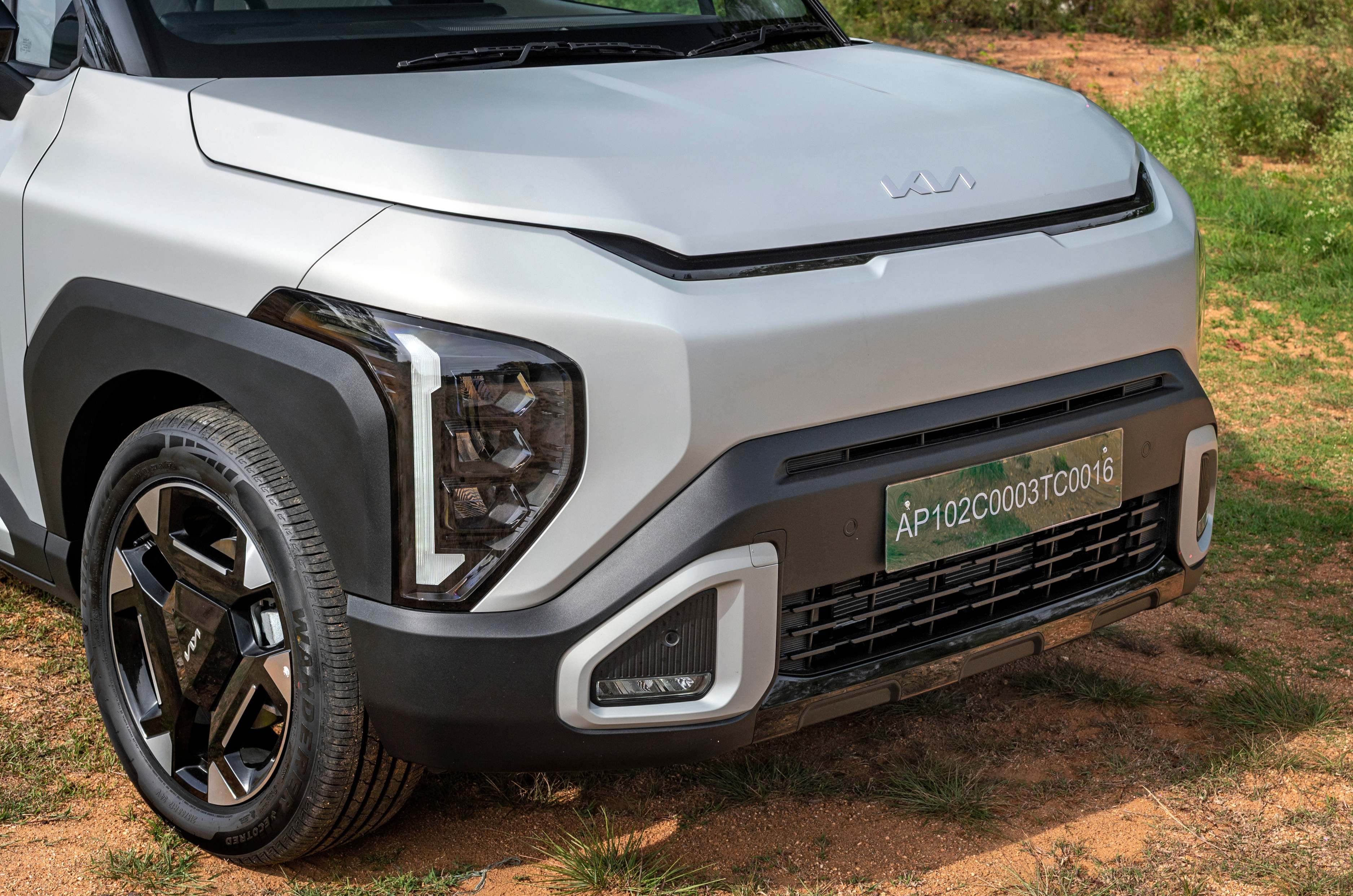
EV has a slimmer intake above the number plate and slightly different lower bumper
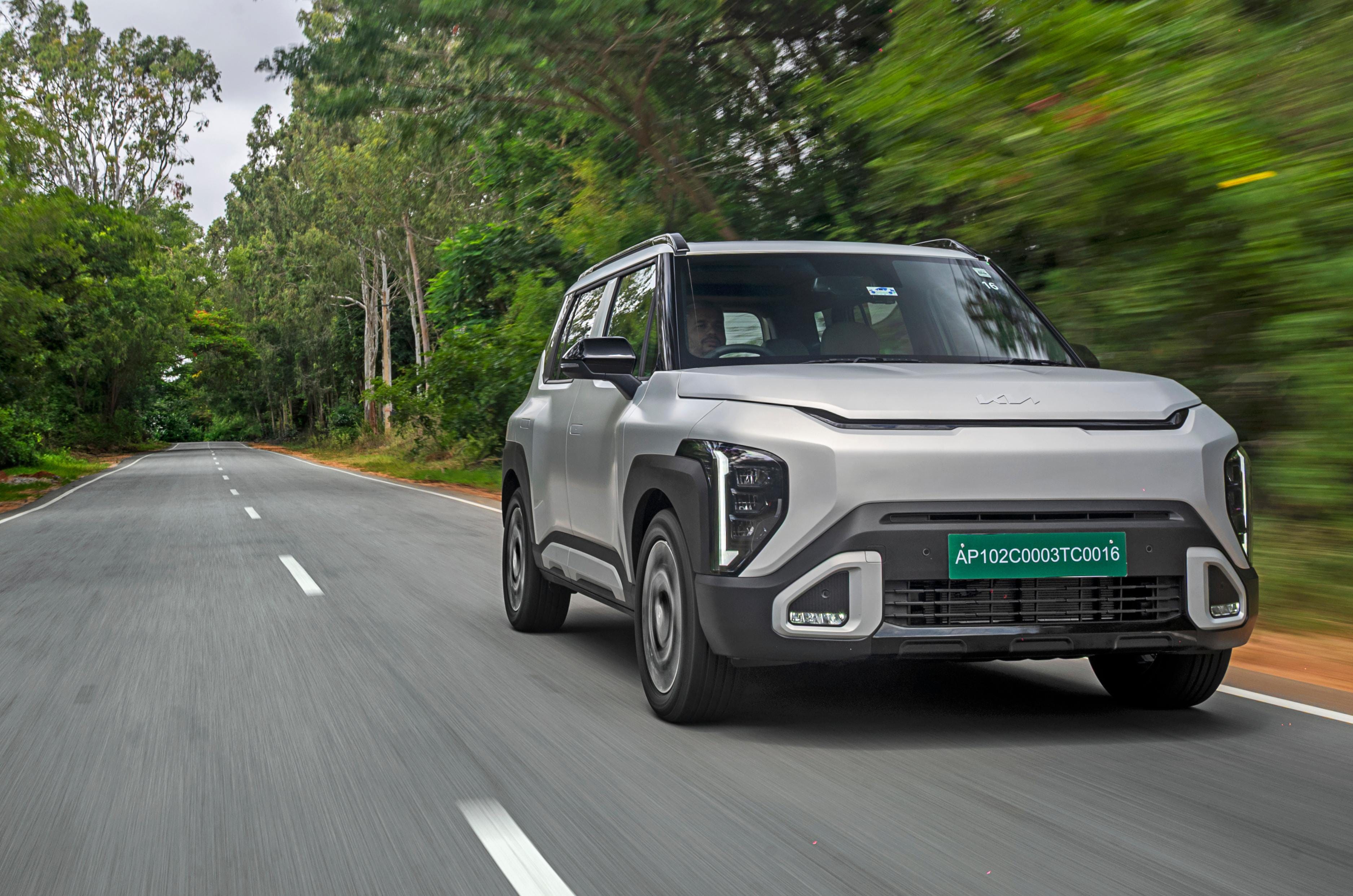
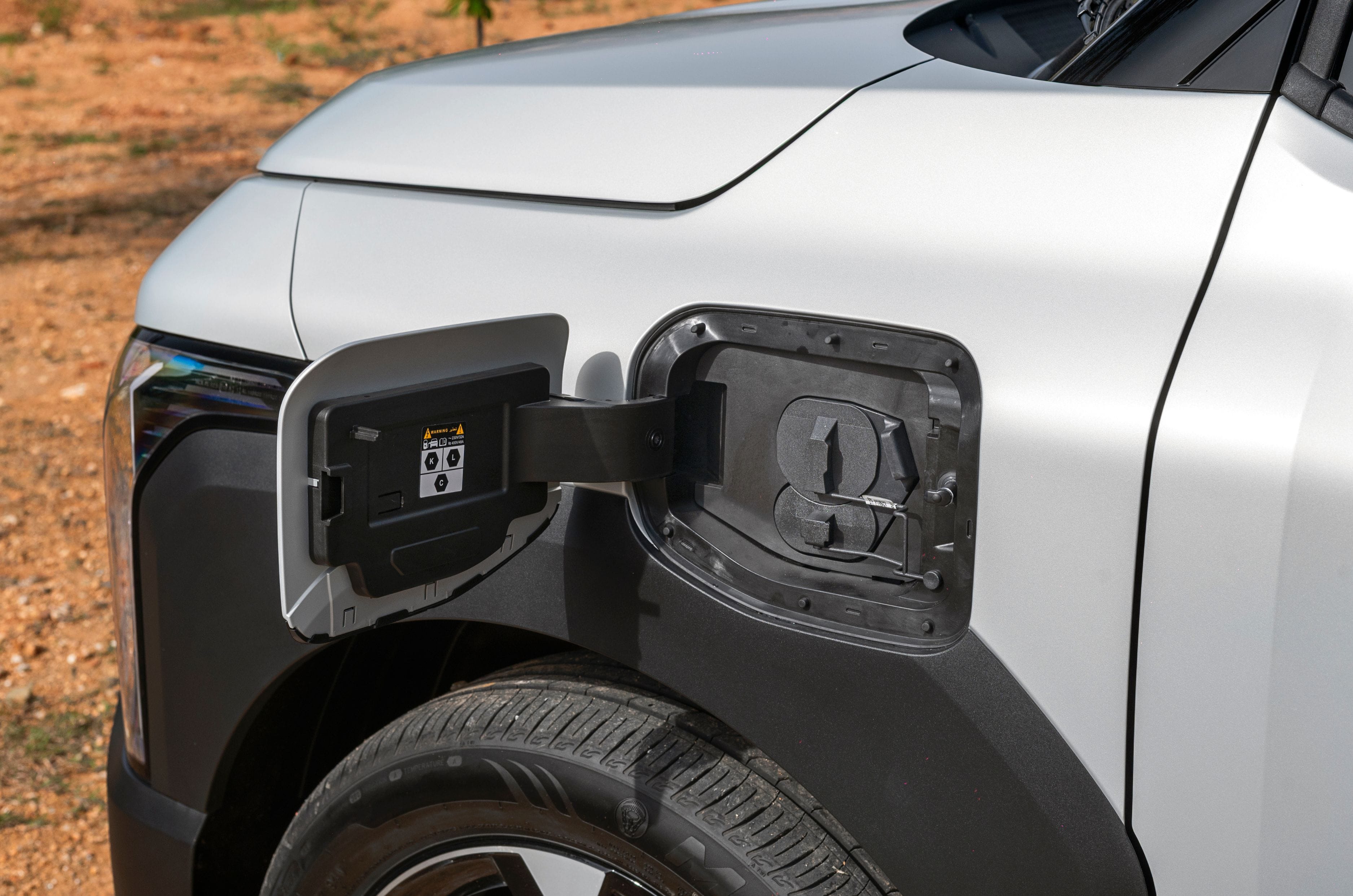
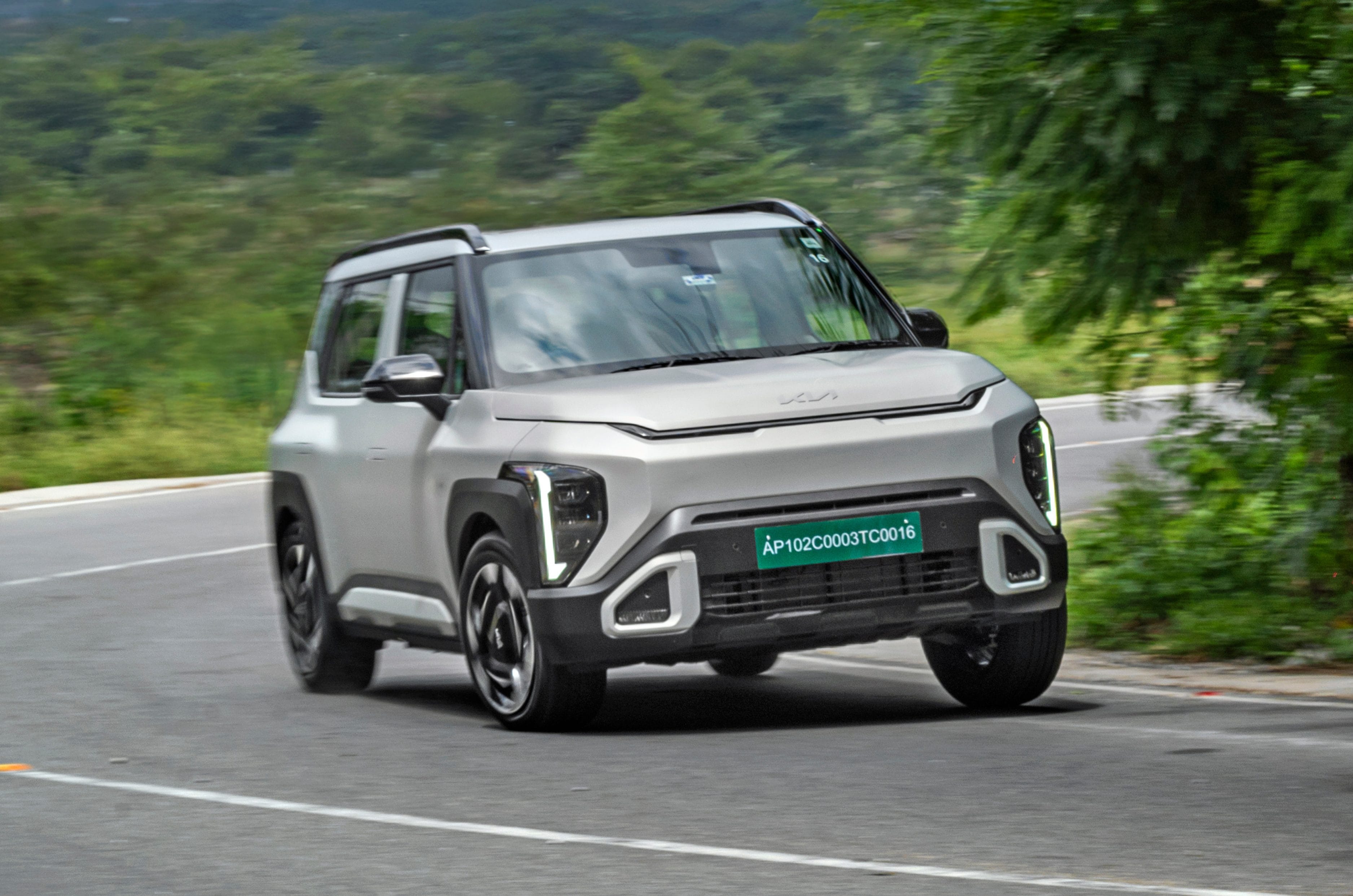
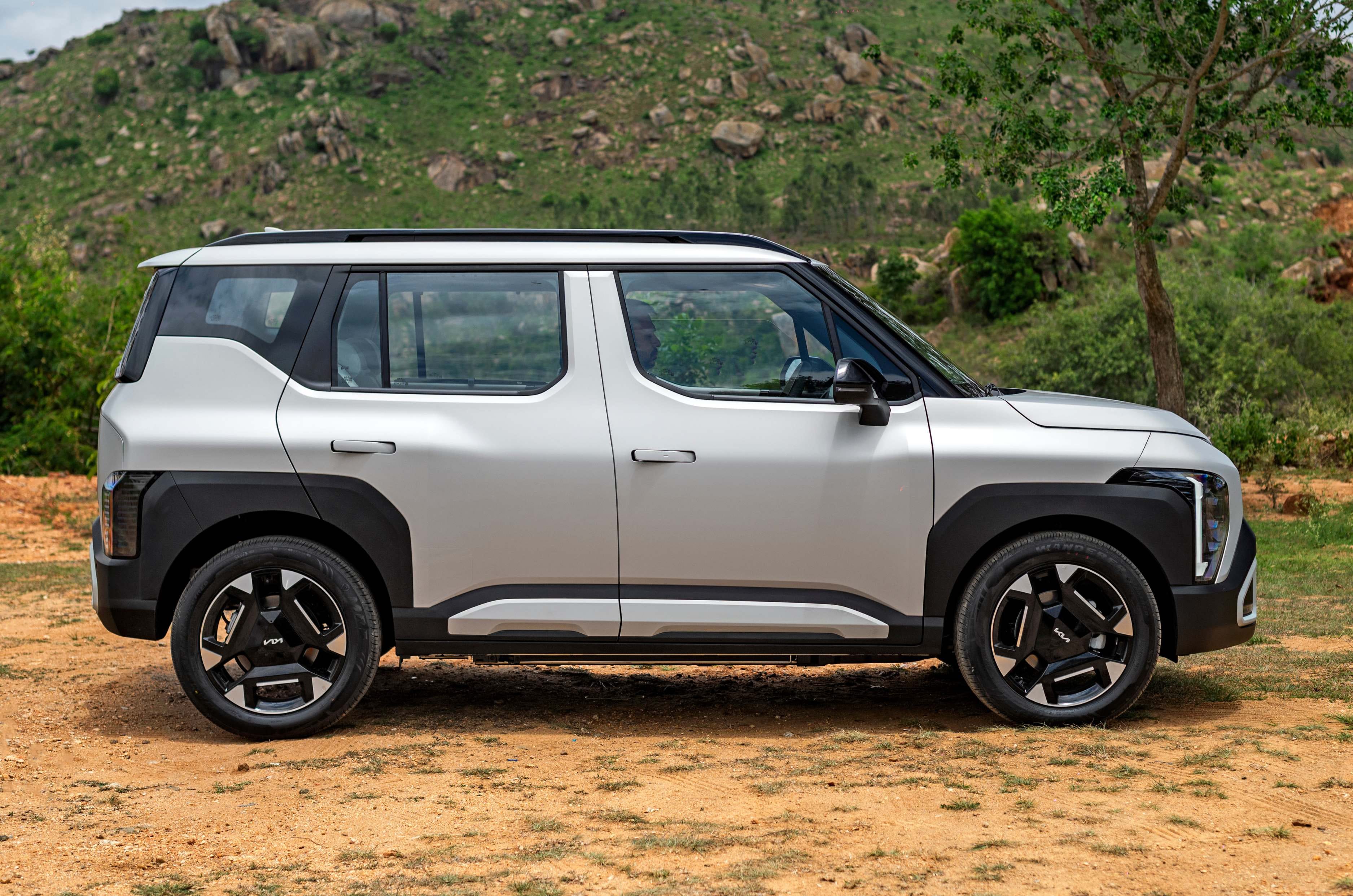
A game of spot the difference between the Syros EV and the ICE version would prove challenging for the casual observer, so here is the cheatsheet. Up front, the bumper is ever so slightly different, with a slimmer cooling slot above the number plate and minor tweaks to the body-coloured triangular pods that house the LED fog lamps. Apart from the charging port on the front left fender and the shorter roof rails, the profile is unchanged. Crouch down, though, and you’ll notice the battery pack is visible, like it is on the Hyundai Creta Electric. Kia claims ground clearance is 197mm which is 7mm more than the ICE version. The tri-spoke 17-inch alloys are the same ones that debuted on the ICE car but were discontinued with the facelift. No differences round the back either, save for an EV badge on the tailgate.
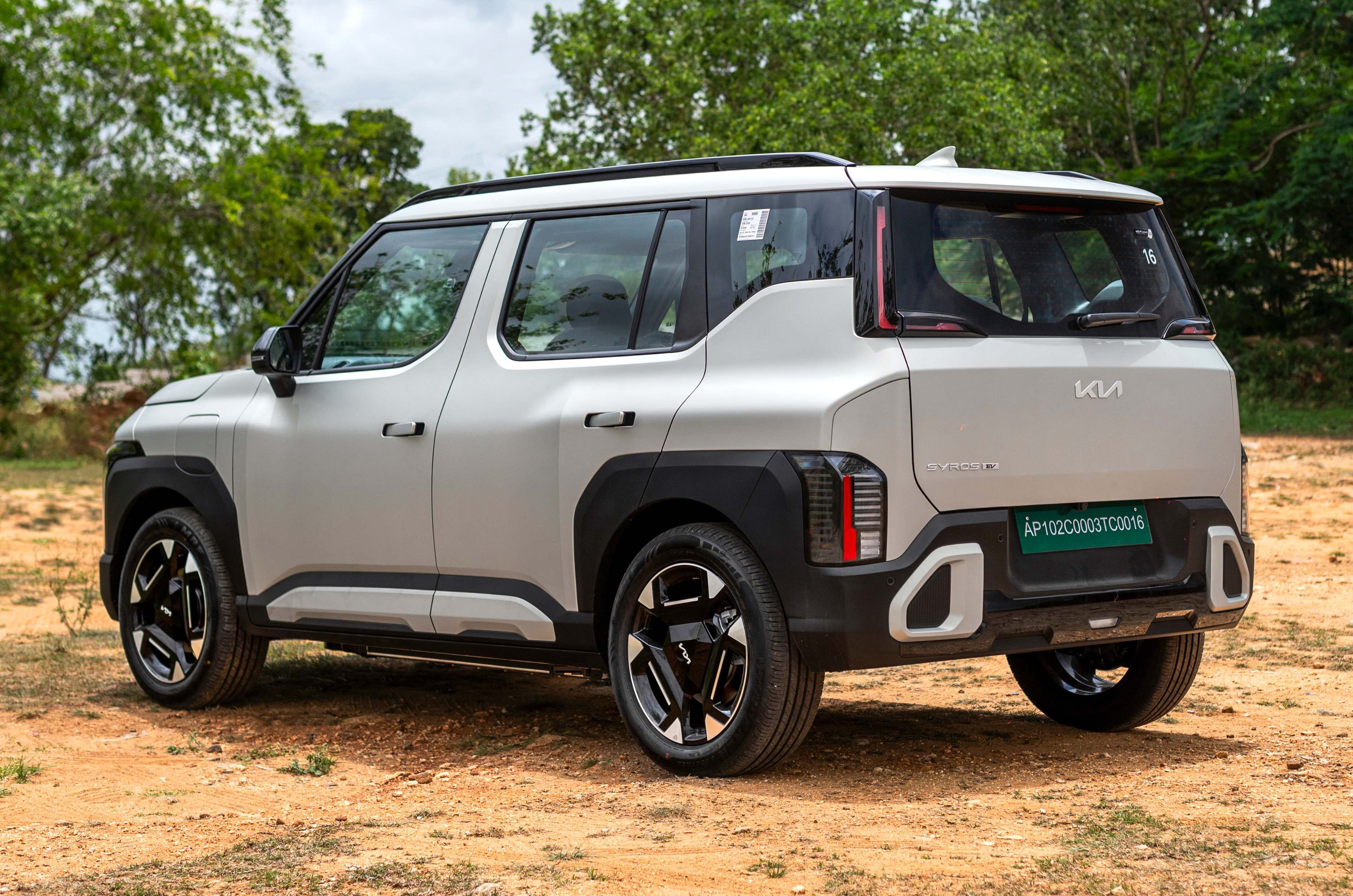
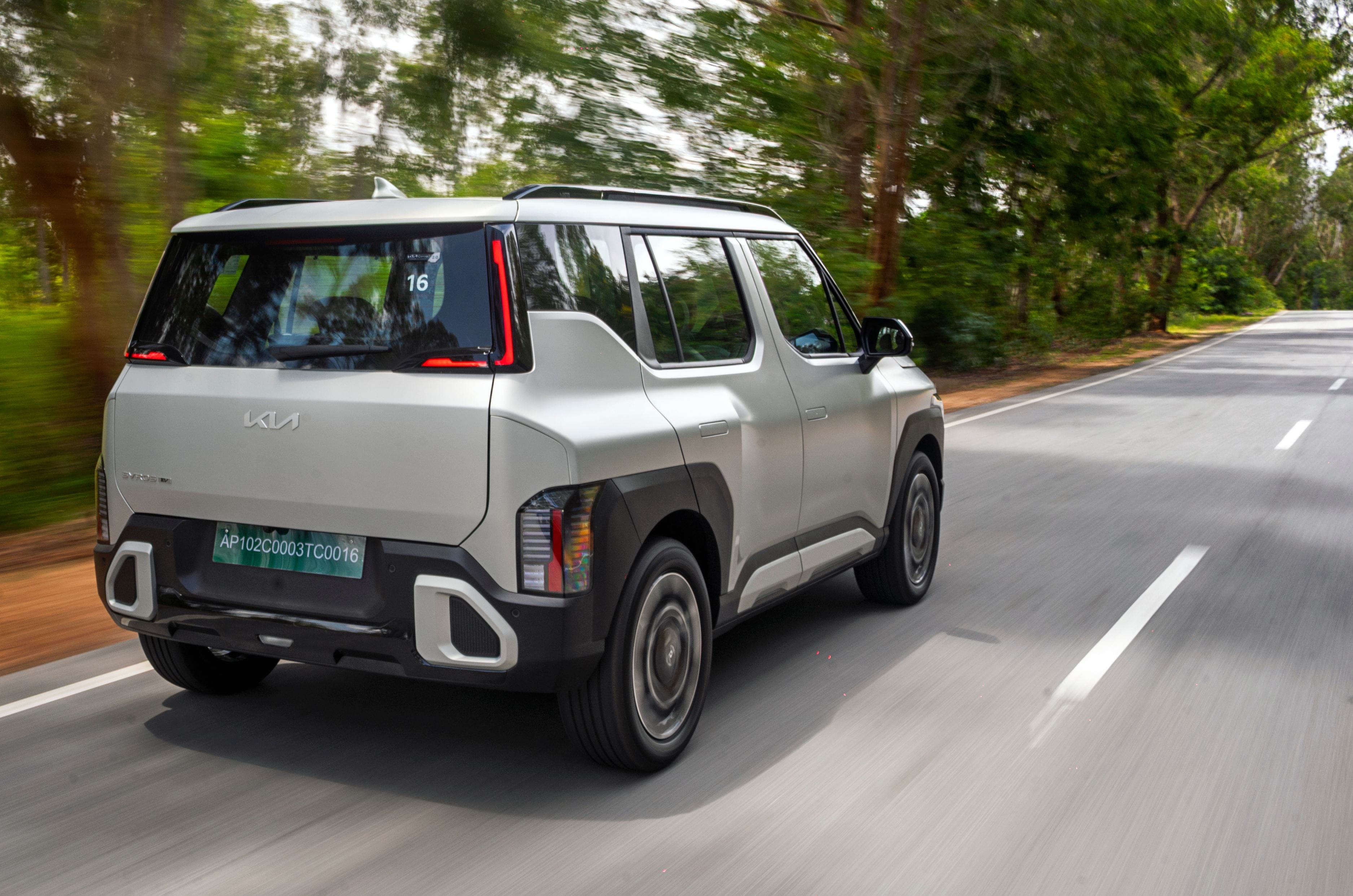
Split lighting lifts the otherwise bland rear
If you didn’t like the way the Syros looked, the EV isn’t going to change your mind. It is distinctive, though – like a Japanese kei car only larger, and Korean. Its blanked-off fascia looks appropriate on an EV, and the vertically oriented headlights give it a unique look. The cladding lower down on the bumper carries on to the wheel arches, doors and the rear, adding some muscle. Breaking up the large greenhouse are the pronounced B-pillar and the upward kink in the C-pillar, both of which are neatly done. And while the tailgate looks a bit blank, the split lighting – with L-shaped elements framing the rear windscreen and larger units at the edge of the bumper – looks great when lit up.
Syros EV Interior Space and Comfort – 10/10
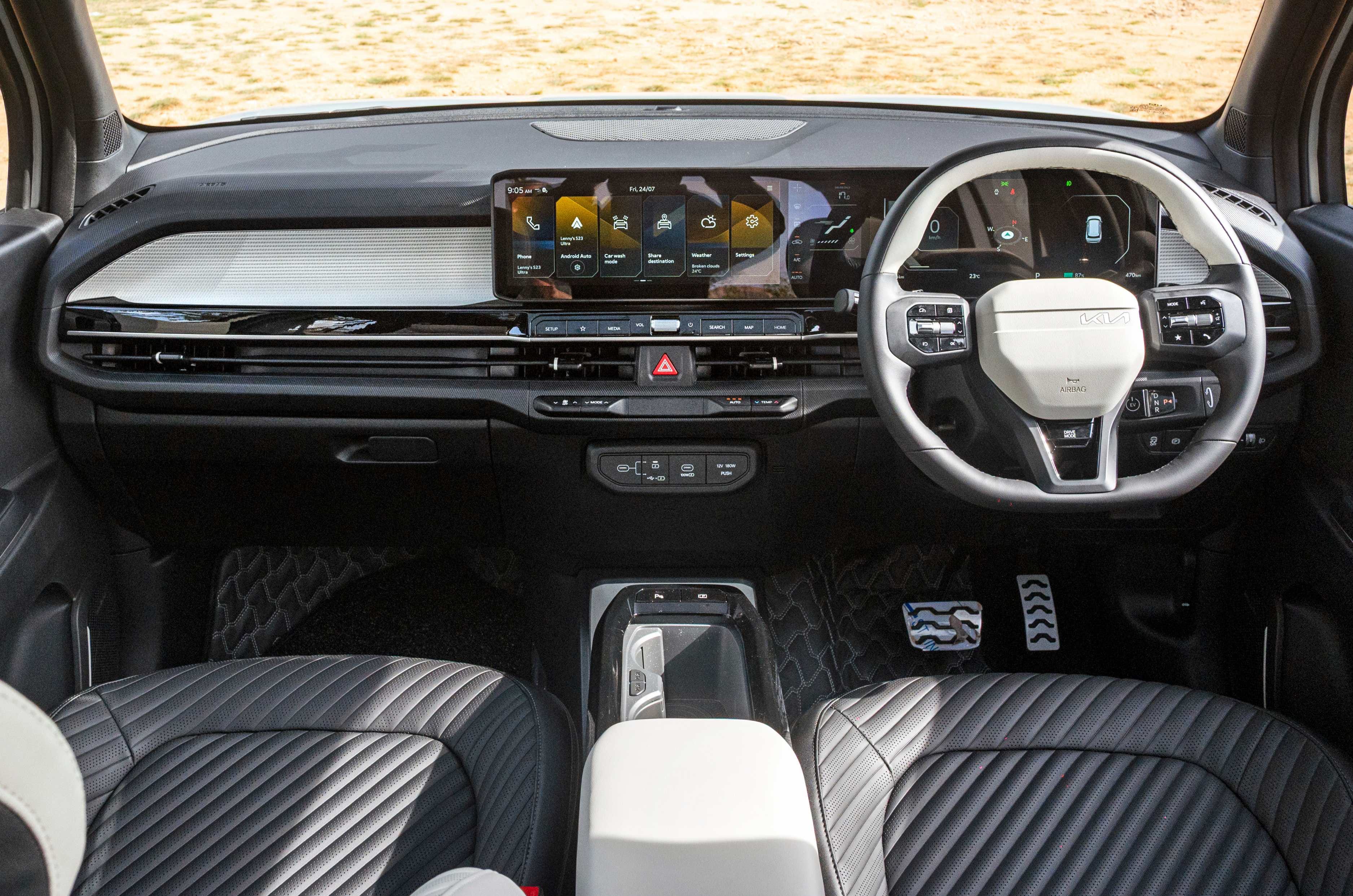
Dash layout is identical to the ICE version, but it gets the 3-spoke ‘wheel from the Seltos
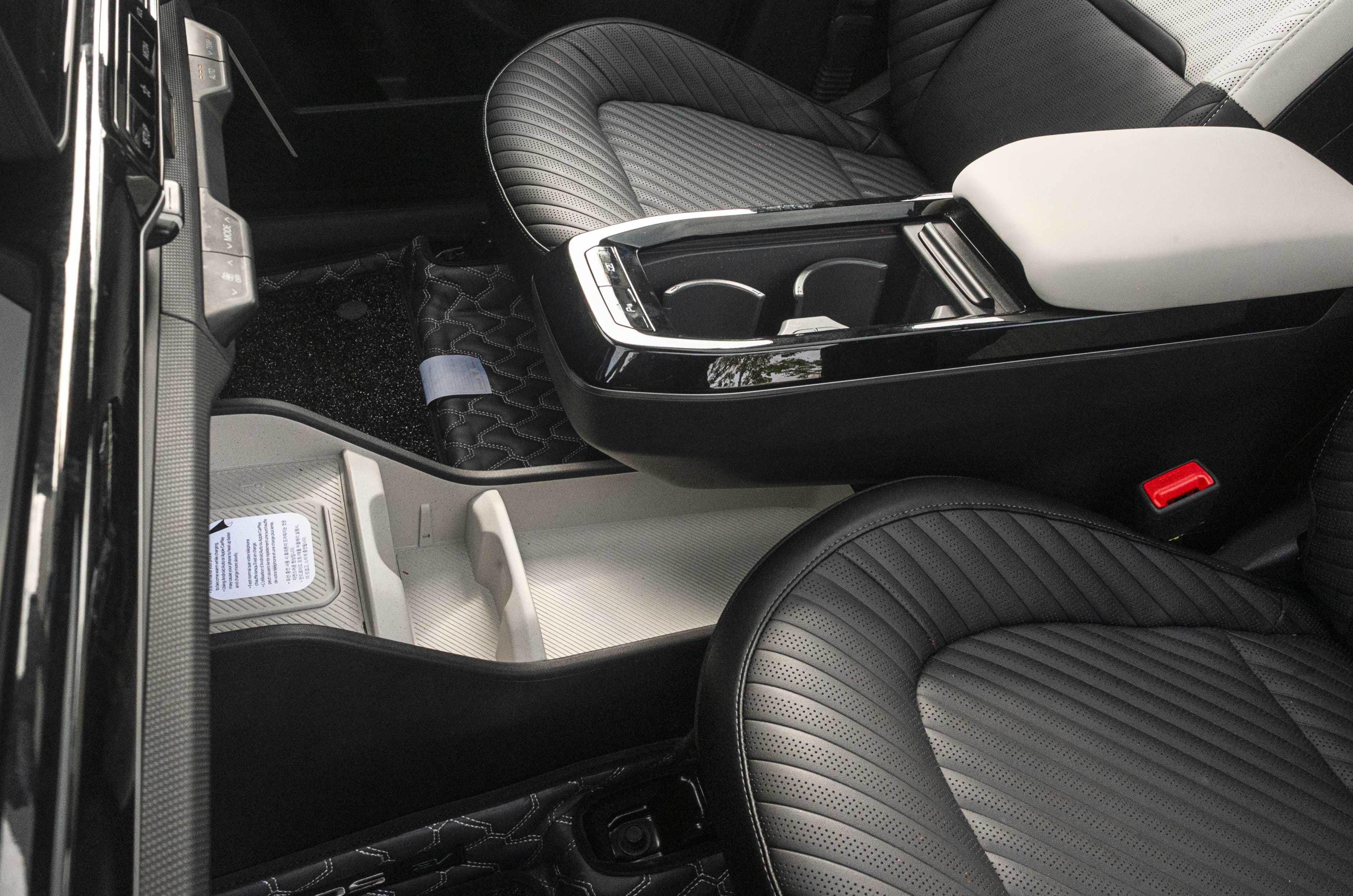
Step inside and you start to understand why the Syros EV looks the way it does. Space for passengers, their knick-knacks and luggage is in abundance. With the EV’s drive selector positioned on the steering column, Kia has re-engineered the centre console to liberate a lot more storage. It now has two levels: the top floating portion has a small cubby under the armrest, along with two cupholders with their own sliding cover, while the lower level has a large storage area for a bag or such, another cupholder and a wireless charger. The front door pockets are just as accommodating, with room for a couple of bottles and an umbrella.
New center console has a lot of storage spaces
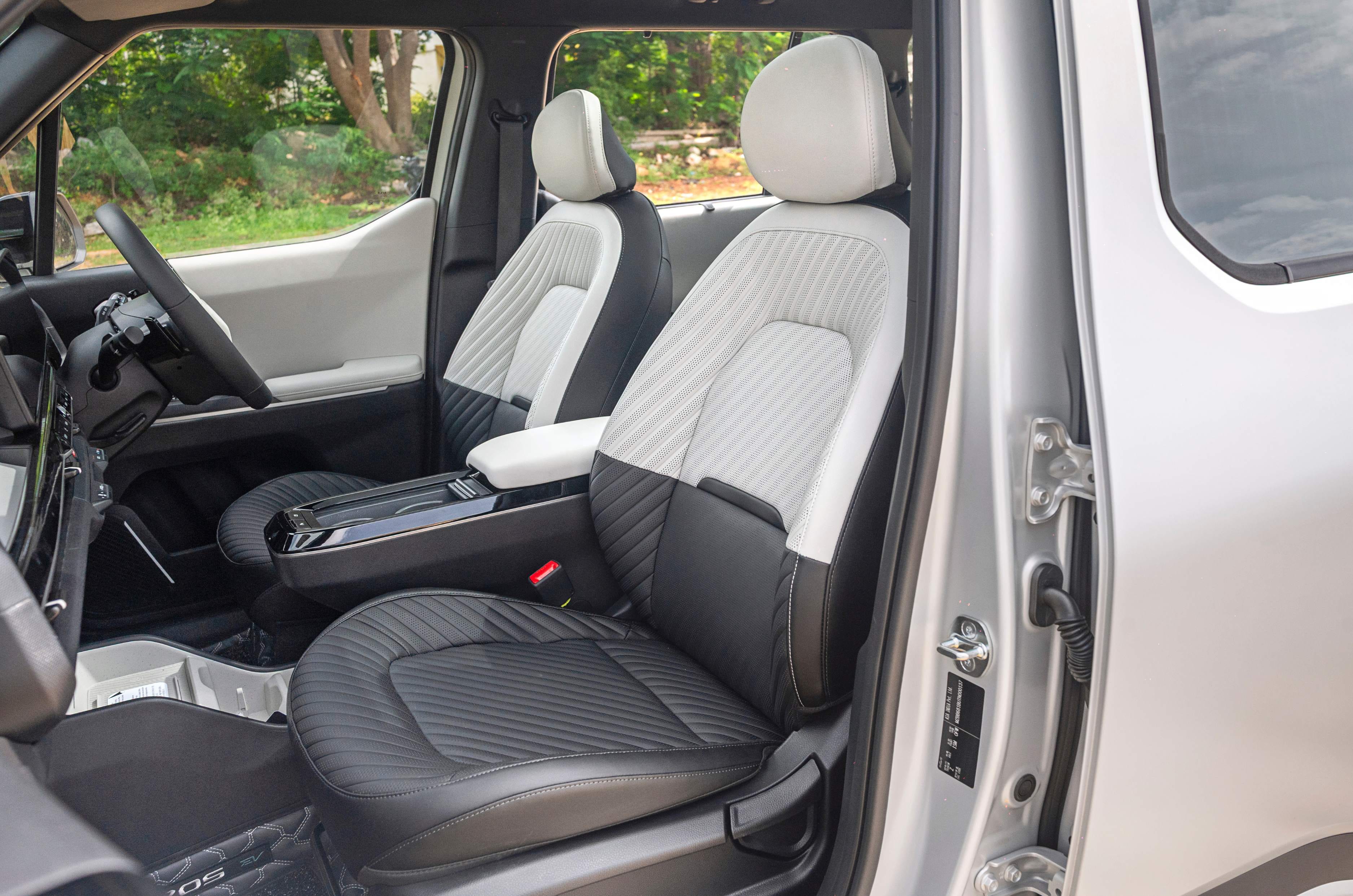
The front seats are supportive and comfortable, with heating and ventilation along with 4-way power adjustment for the driver. While the dash layout is unchanged, the EV gets the Seltos’ three-spoke steering wheel, but adjustment is still limited to rake and not reach. The EV uses a slightly different colour palette inside: our HTX+ test car gets a smart-looking black-and-off-white theme, the X-Line features a darker black-and-green ambience, while all other trims get an airy light grey and pastel blue theme. While most surfaces are hard plastic, the quality of the materials, fit and finish is top notch.
Front seats are comfy with heating, ventilation for both and power adjustment for the driver
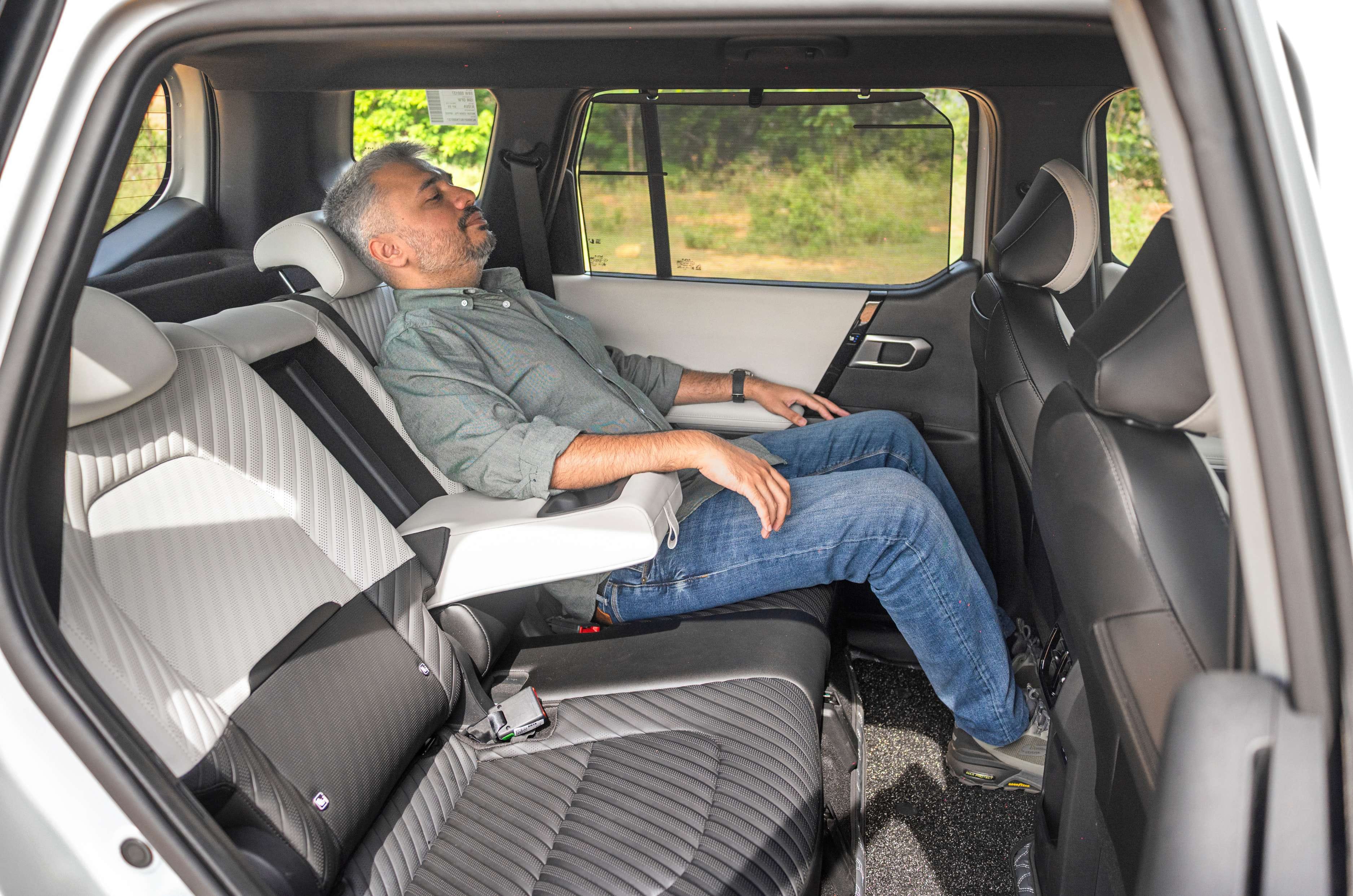
The back seat remains a highlight, with plenty of room all around. The floor is slightly higher because of the battery pack, which means thigh support isn’t as good as in the ICE version. However, if you slide the bench back and stretch out, this isn’t much of an issue. A benefit of the raised floor is that it is now completely flat. Ventilation for the seat base carries over, but the backrest still misses out, as Kia says it would restrict its recline angle.
Higher floor slightly affects thigh support, but there’s ample room to stretch out
Boot space is identical to the ICE Syros at 390 litres with the seat all the way back, and 465 litres with it slid forward. The rear seats also split-fold – though not completely flat – to carry longer items. There is a 16-litre frunk too, though it is rather narrow.
Kia Syros EV Features and Safety – 9/10
Sitting proud on the dash is what Kia calls the Trinity Panoramic Display, comprising two 12.3-inch screens for the infotainment and driver’s display, with a 5-inch screen in between for the HVAC controls. The driver’s display is logically laid out, easy to read and offers some customisation, while the infotainment is sharp, snappy and has a clean UI. The EV gets a dedicated tab that shows several parameters related to the battery, range and energy consumption. It can also help find the nearest charger, condition the battery before charging, as well as set up charging schedules.
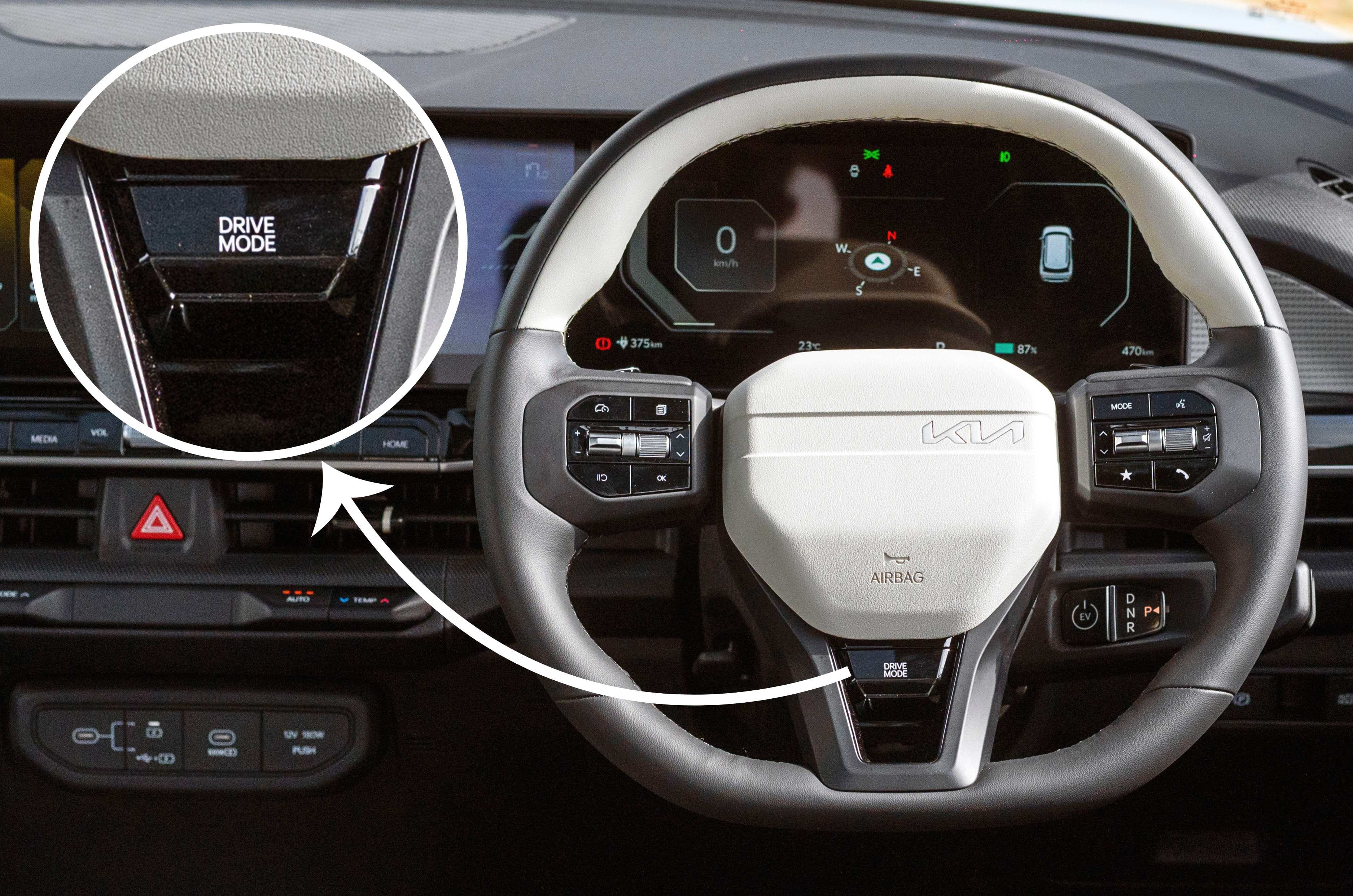
Handy drive mode button to cycle between Eco, Normal and Sport modes
The infotainment also offers wireless Android Auto and Apple CarPlay and, on the top trims, powers a superb Harman Kardon audio system with eight speakers, including one on the dash and a subwoofer in the boot. Sunblinds and rear AC vents are standard, while the massive panoramic sunroof features on all but the bottom two trims. Our second-from-top HTX+ also gets an integrated dashcam.
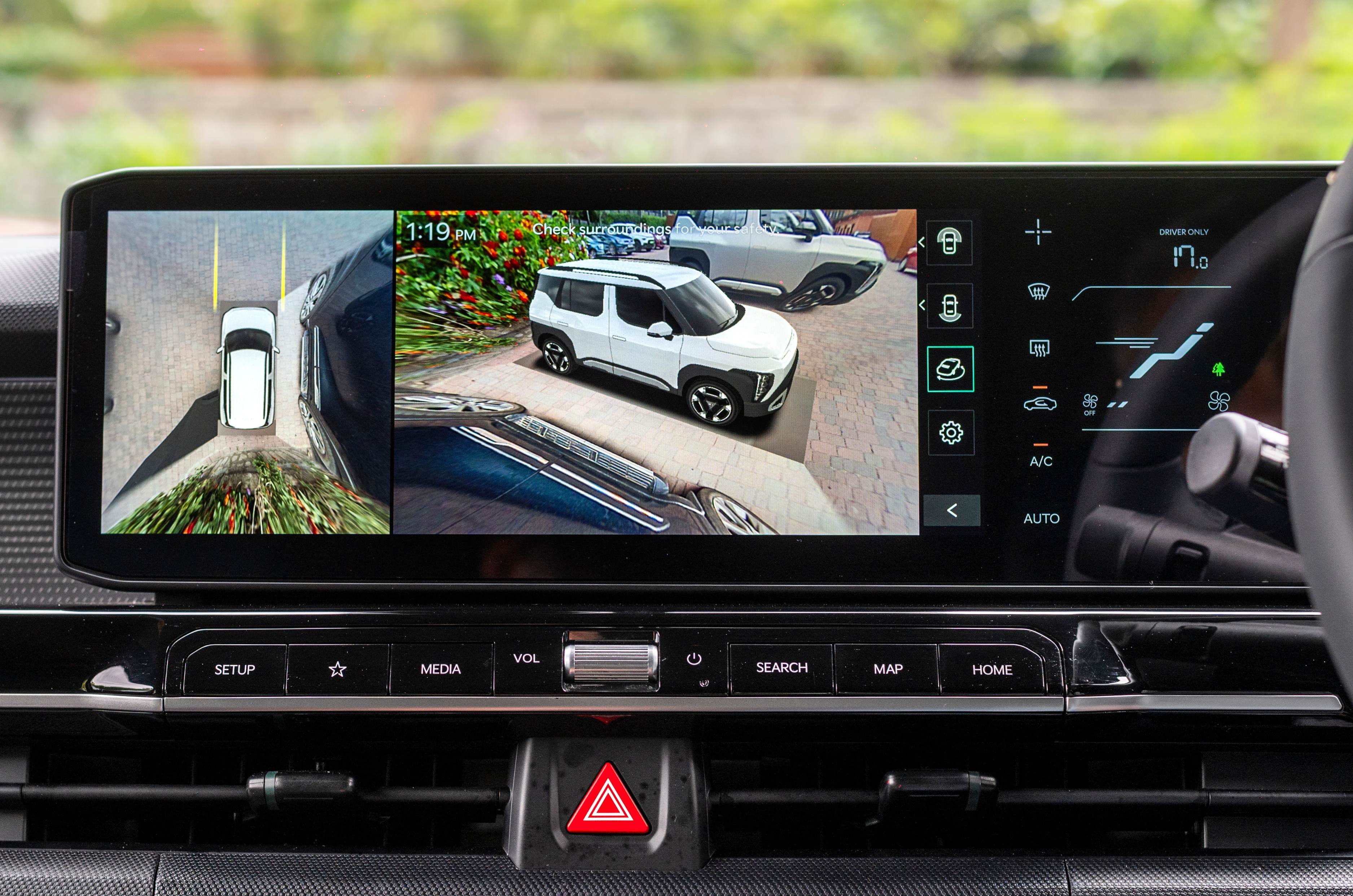
360-degree camera is sharp, but only available on top X-Line trim
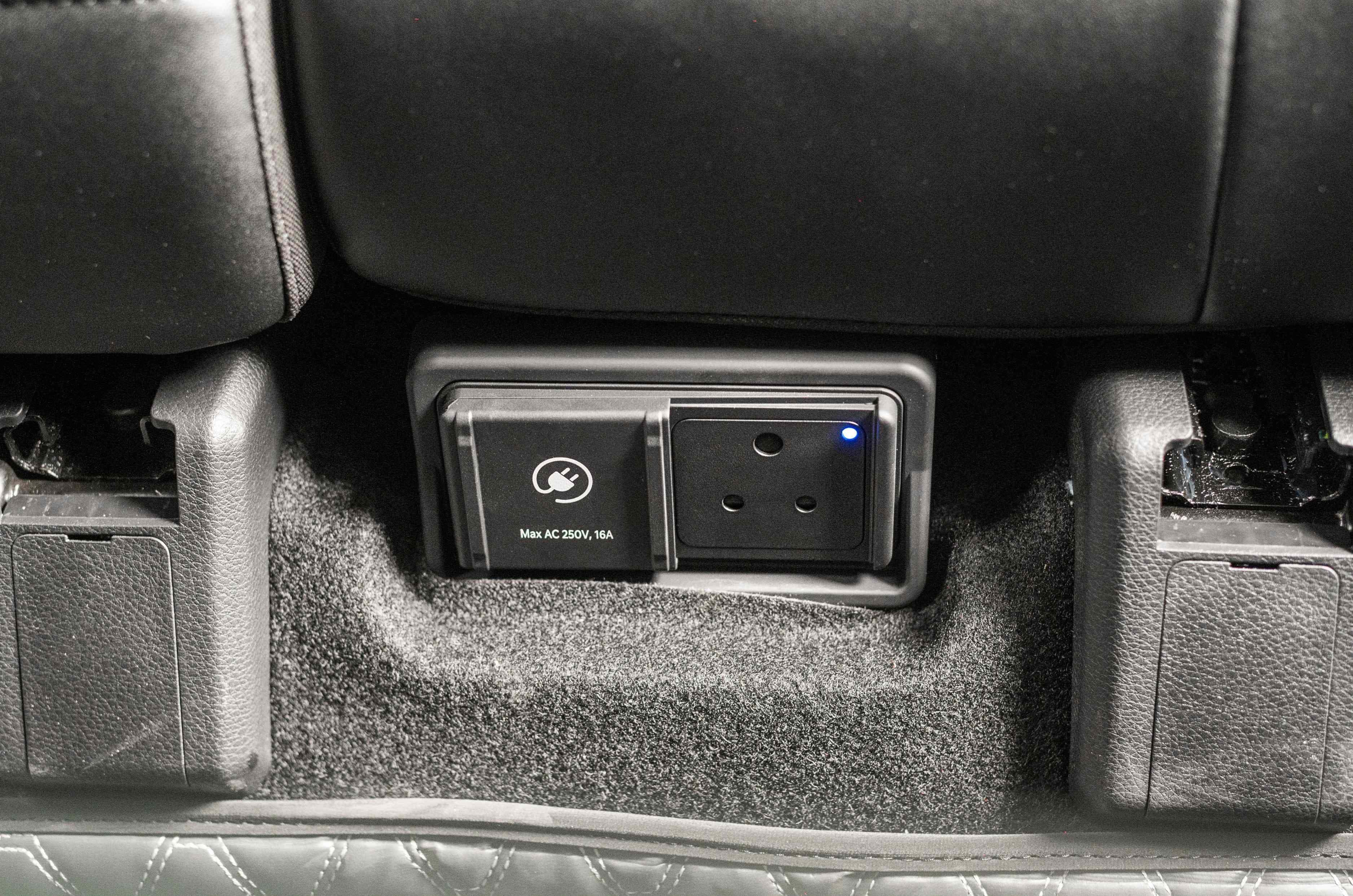
Overall, the Syros EV is very well equipped, but some features are available only on the top X-Line variant, including Level 2 ADAS, ambient lighting, a 360-degree camera and a household-style three-pin socket in the back seat. Restricting features to the top trim isn’t unusual; however, the X-Line can only be had in Aurora Black Pearl or Matte Graphite, which might not be to all tastes.
V2L power outlet under the rear seat
The standard safety suite is robust, including six airbags, all-wheel disc brakes, tyre pressure monitoring and ISOFIX mounts. The ADAS suite is also comprehensive, including adaptive cruise control with stop-and-go, lane keep assist, forward and rear collision avoidance, and a blind-spot camera. At the time of writing, the Syros EV does not yet have an official crash safety rating, but considering the ICE version has a five-star BNCAP rating, a similar result for the EV can be expected.
Kia Syros EV Performance and Refinement – 9/10
The Syros EV is available with the same 42kWh and 51.4kWh NMC battery packs as the Carens Clavis EV and the Hyundai Creta Electric. Here too, they power a single motor on the front axle producing 135hp with the smaller battery and 171hp with the extended-range version. Torque is identical on both at 255Nm.
Borrows the 42 and 51.4kWh battery packs from the Carens Clavis EV
Performance was brisk on our 51.4kWh test car, with the 0-100kph sprint claimed to take 8.1 seconds. There are three drive modes to choose from – Eco, Normal and Sport – with each sharpening throttle response a little more than the last. Initial response in all modes is linear so as not to overwhelm those who aren’t used to the instant torque, but there is a strong shove as you get further into the throttle. Overtaking, then, is quite effortless, even in Eco and Normal, almost never needing a switch to Sport for a quick pass.
Initial acceleration is linear, but there is plenty of shove for quick overtakes
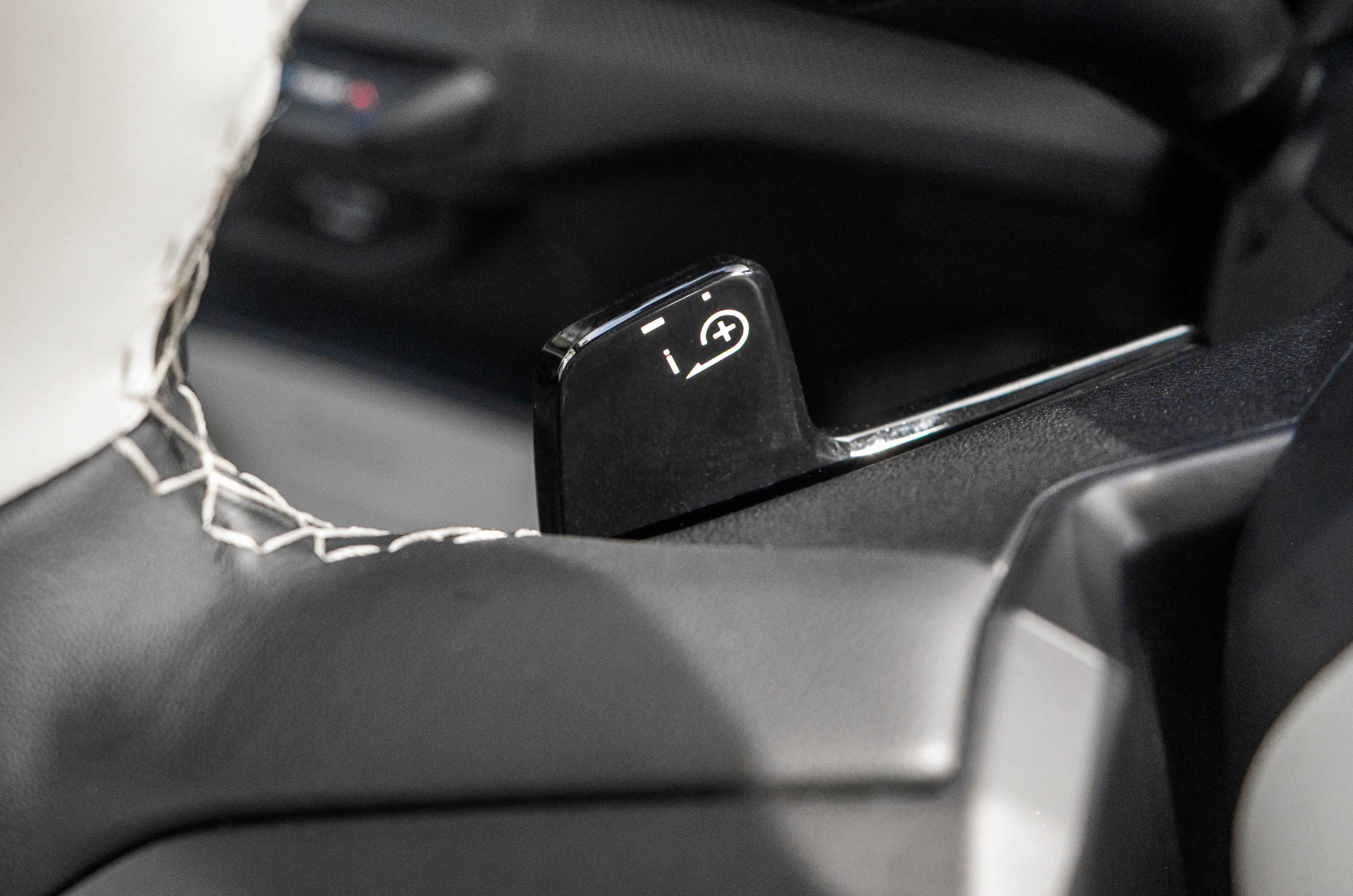
The regen braking modes – selected via the paddle shifters – are also very well calibrated, with a noticeable increase in resistance in each mode and the ability to turn it off completely. Holding the left paddle engages one-pedal driving, which uses regen to bring the car to a full stop. It works quite seamlessly and can be very convenient once you get used to it.
Regen modes are well calibrated and the i-Pedal function is handy in the city
Refinement is good too, with no noticeable motor whine making its way into the cabin. It’s so quiet, in fact, that Kia has added a virtual humming sound to warn pedestrians. Since there is no engine note inside the cabin, you do hear a bit more road noise, but at no point does it become intrusive.
Kia Syros EV Range and Efficiency – 8/10
Claimed MIDC range for the 51.4kWh battery is 526km, while the 42kWh unit claims 443km. Our short drive didn’t allow us to test these claims, but if the real-world range we achieved in the Clavis EV and Creta Electric is anything to go by, the Syros EV Extended Range should comfortably manage around 400km on a single charge. We will verify this when we have the car for longer.
Capable of DC fast charging at up to 100kW
Topping up a depleted battery from 10 to 80 percent is said to take 39 minutes on a 100kW DC fast charger. The same charge using the optional 11kW wallbox charger, is said to take almost five hours for the Extended Range and four hours for the Standard Range.
Kia Syros EV Ride Comfort and Handling – 8/10
The ride on the Syros EV is a touch more absorbent than on its ICE counterpart. Sharp bumps don’t come through to the cabin as abruptly, but there is still an underlying firmness to it. This firmness is there to help body control, but being a tall, narrow car, there is still a fair bit of body roll through the corners. It does feel stable though, and overall grip is strong.
There’s plenty of body roll, but it remains stable through the bends
Steering feel is also good, and it weighs up as speeds rise, which helps with high-speed stability. The four-wheel disc brakes are strong too, bringing the Syros to a confident halt when you drop the anchors. Overall, it isn’t the most entertaining car to drive, but it feels stable and secure at speed while being easy to manoeuvre in tight spaces.
Kia Syros EV Value for Money – 7/10
Introductory prices for the Syros EV start at Rs 13.5 lakh for the 42kWh version and Rs 17 lakh for the 51.4kWh Extended Range. If you want the fully loaded X-Line, that’ll be a cool Rs 20 lakh. To reduce the upfront purchase cost, a BaaS scheme is available with prices starting at Rs 7.99 lakh, and battery rental costing Rs 3.3 per kilometre. To sweeten the deal, Kia is offering a 15-year/unlimited-kilometre HV battery warranty for the first owner, along with an assured buyback value of up to 80 percent after three years.
Its pricing means the Syros EV rivals the Tata Nexon EV and Mahindra XUV 3XO EV, as well as larger EVs like the MG Windsor and Maruti e Vitara. As such, the 42kWh Syros EV makes for a very compelling option, undercutting its rivals in the sub-four-metre EV space. It is easily the most spacious in this segment and is very well equipped even in the lower trims. However, its case weakens with the 51.4kWh Extended Range. It is significantly pricier than its immediate rivals, overlapping with the larger-battery versions of the Windsor and e Vitara. While the Syros EV has its merits and even outdoes them in some areas, buyers might find the allure of a bigger car for the same money too hard to resist.
गर्मी बढ़ते ही जहां लोग राहत के लिए AC का सहारा लेते हैं, वहीं बिजली का बढ़ता बिल कई घरों की चिंता भी बढ़ा देता है। इसी बीच सोशल मीडिया पर एक महिला का मजेदार वीडियो चर्चा में आ गया है। महिला ने दावा किया है कि उसका पति बिजली बचाने के लिए ऐसा तरीका अपनाता है, जिसे सुनकर लोग हैरान भी हैं और हंस भी रहे हैं। उसके मुताबिक, पति ऑफिस जाते समय AC का रिमोट अपने साथ ले जाते हैं, ताकि घर पर उनकी गैरमौजूदगी में AC न चल सके।
महिला ने वीडियो में बंद AC और चलता हुआ पंखा दिखाते हुए अपनी बात साझा की। देखते ही देखते यह वीडियो वायरल हो गया और लोगों ने बिजली बचत, घरेलू खर्च और पति-पत्नी की नोकझोंक को लेकर तरह-तरह की प्रतिक्रियाएं देनी शुरू कर दीं।
वीडियो में दिखाया बंद AC और चलता पंखा
वीडियो में महिला कैमरा घुमाकर घर का बंद AC और चलता हुआ सीलिंग फैन दिखाती नजर आती है। स्क्रीन पर लिखे टेक्स्ट में वह बताती है कि उसे AC चलाने की अनुमति नहीं है, क्योंकि पति रिमोट अपने साथ ऑफिस ले जाते हैं। उनका मकसद बिजली की खपत कम रखना और बढ़ते बिल को नियंत्रित करना है।
The wife alleges that her husband takes the AC remote to the office with him so that she cannot use the AC during the day, all in an effort to save electricity?? pic.twitter.com/qJFkMU5avw
यह वीडियो सोशल मीडिया अकाउंट घर के कलेश (Ghar ke Kalesh) से शेयर किया गया, जिसके बाद लोगों ने इस पर जमकर प्रतिक्रियाएं दीं। पोस्ट के साथ मजाकिया अंदाज में लिखा गया कि पत्नी का आरोप है कि पति AC रिमोट ऑफिस लेकर जाते हैं, ताकि वह दिन में AC न चला सकें।
यूजर्स ने दिए मजेदार रिएक्शन
वीडियो वायरल होते ही कमेंट सेक्शन में लोगों ने अपने-अपने अंदाज में प्रतिक्रिया देनी शुरू कर दी। एक यूजर ने मजाक करते हुए लिखा कि पति ने बिजली बचाने के लिए रिमोट को ऐसे संभाल रखा है जैसे कोई गोपनीय दस्तावेज हो। वहीं दूसरे यूजर ने कहा कि आज के समय में मोबाइल ऐप से भी AC कंट्रोल किया जा सकता है।
कुछ ने पति को बताया सही
जहां कई लोगों ने इस घटना को मजेदार बताया, वहीं कुछ यूजर्स पति के पक्ष में भी नजर आए। उनका कहना था कि कई घरों में बिना जरूरत AC चलने से बिजली का बिल काफी बढ़ जाता है और खर्च संभालना मुश्किल हो जाता है।
बिजली बचत या रिश्ते की नोकझोंक?
इस वायरल वीडियो ने लोगों के बीच घरेलू बजट, बिजली की बचत और पति-पत्नी के बीच भरोसे को लेकर हल्की-फुल्की बहस छेड़ दी है। हालांकि, वीडियो को लोग मनोरंजन के तौर पर देख रहे हैं और इसकी वास्तविक परिस्थितियों की स्वतंत्र पुष्टि नहीं हुई है।