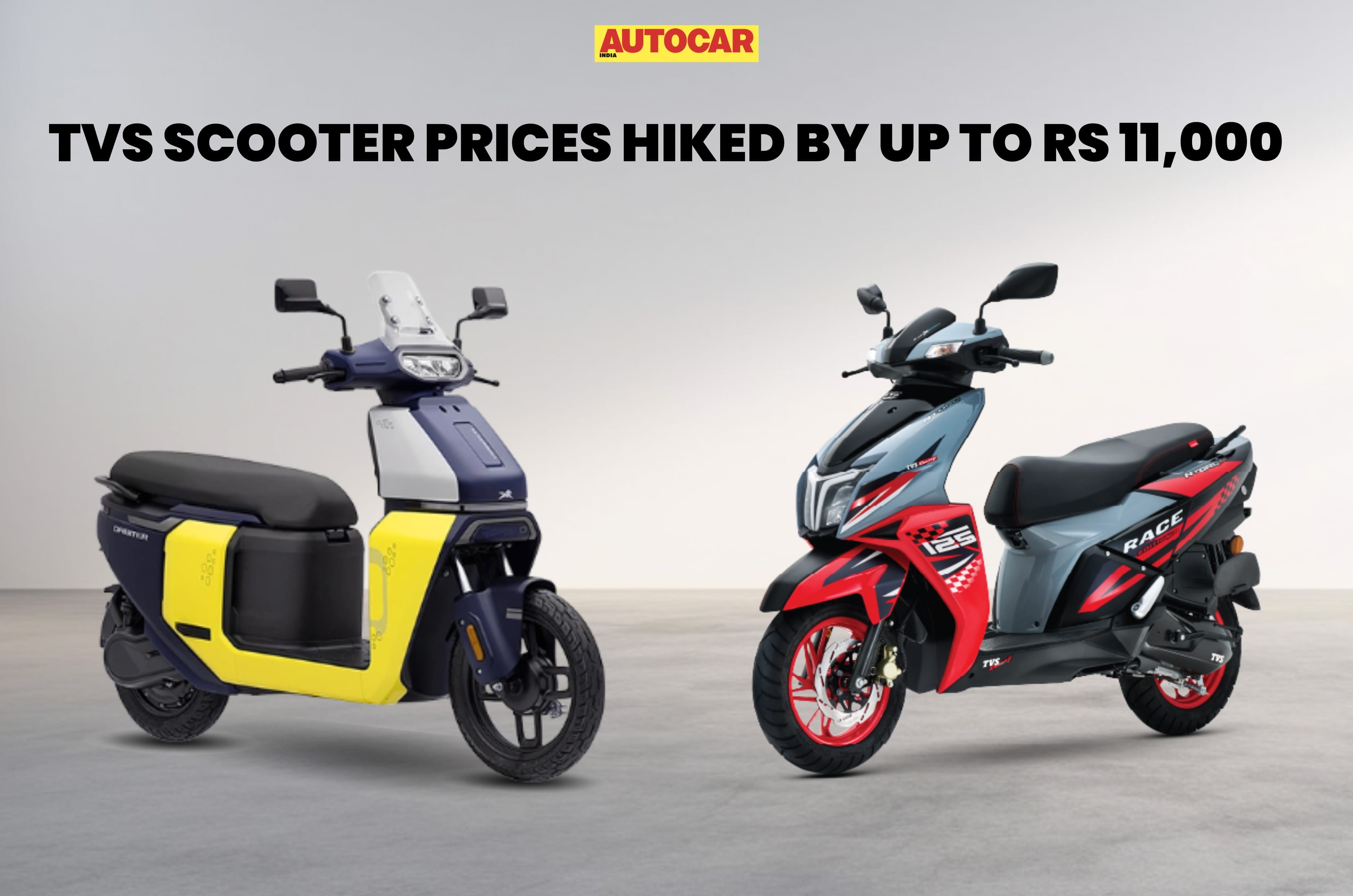
TVS Motor Company has recently revised prices across much of its scooter lineup. The electric iQube and Orbiter ranges have seen the largest increases, while the Jupiter 110, Jupiter 125 and Ntorq 125 have also become more expensive.
iQube range prices revised across most variants
Orbiter V1 gets the largest hike of Rs 11,000
Jupiter and Ntorq 125 prices also increased
TVS scooter updated prices
The electric scooter lineup has seen the biggest price revisions
Some reports have suggested that the iQube and Orbiter have seen particularly sharp price hikes. However, it’s worth noting that the current prices likely reflect multiple incremental revisions over the past few months rather than a single large increase. For reference, when we covered the Orbiter lineup in April, the V1 was priced at Rs 88,250 and the V2 at Rs 1.05 lakh. Likewise, with the iQube range, the base 2.2kWh variant started at Rs 1.11 lakh, while the range-topping iQube ST was priced at Rs 1.72 lakh.
Among the iQube variants, the 3.5kWh model sees the largest increase at Rs 9,000, while the 3.1kWh variant remains unchanged. The Orbiter V1 records the biggest increase across the entire lineup, rising by Rs 11,000.
The Ntorq 125 Disc is now priced at Rs 83,350, up Rs 850 from Rs 82,500 when the updated colours were introduced last month. The Race Edition has also gone up by Rs 850 and now costs Rs 88,800.
The Jupiter 110 range has received hikes ranging from Rs 575 to Rs 1,950 depending on the variant, with prices now spanning Rs 73,975 to Rs 88,850. The Jupiter 125 range sees increases of up to Rs 2,410, with prices now starting at Rs 81,110 and going up to Rs 89,935.
Model
Previous price
Current price
Difference
Jupiter 110
Rs 73,400 – Rs 86,900
Rs 73,975 – Rs 88,850
Rs 575 – Rs 1,950
Jupiter 125
Rs 78,700 – Rs 89,060
Rs 81,110 – Rs 89,935
Rs 875 – Rs 2,410
Ntorq 125 Disc
Rs 82,500
Rs 83,350
Rs 850
Ntorq 125 Race Edition
Rs 87,950
Rs 88,800
Rs 850
iQube 2.2kWh
Rs 1.11 lakh
Rs 1.16 lakh
Rs 5,000
iQube 3.1kWh
Rs 1.33 lakh
Rs 1.33 lakh
No change
iQube 3.5kWh
Rs 1.33 lakh
Rs 1.42 lakh
Rs 9,000
iQube S 4.7kWh
Rs 1.55 lakh
Rs 1.61 lakh
Rs 6,000
iQube ST 5.3kWh
Rs 1.72 lakh
Rs 1.75 lakh
Rs 3,000
Orbiter V1
Rs 88,250
Rs 99,250
Rs 11,000
Orbiter V2
Rs 1.05 lakh
Rs 1.14 lakh
Rs 9,000
All electric scooter prices ex-showroom, Bengaluru, excluding PM E-Drive subsidy.
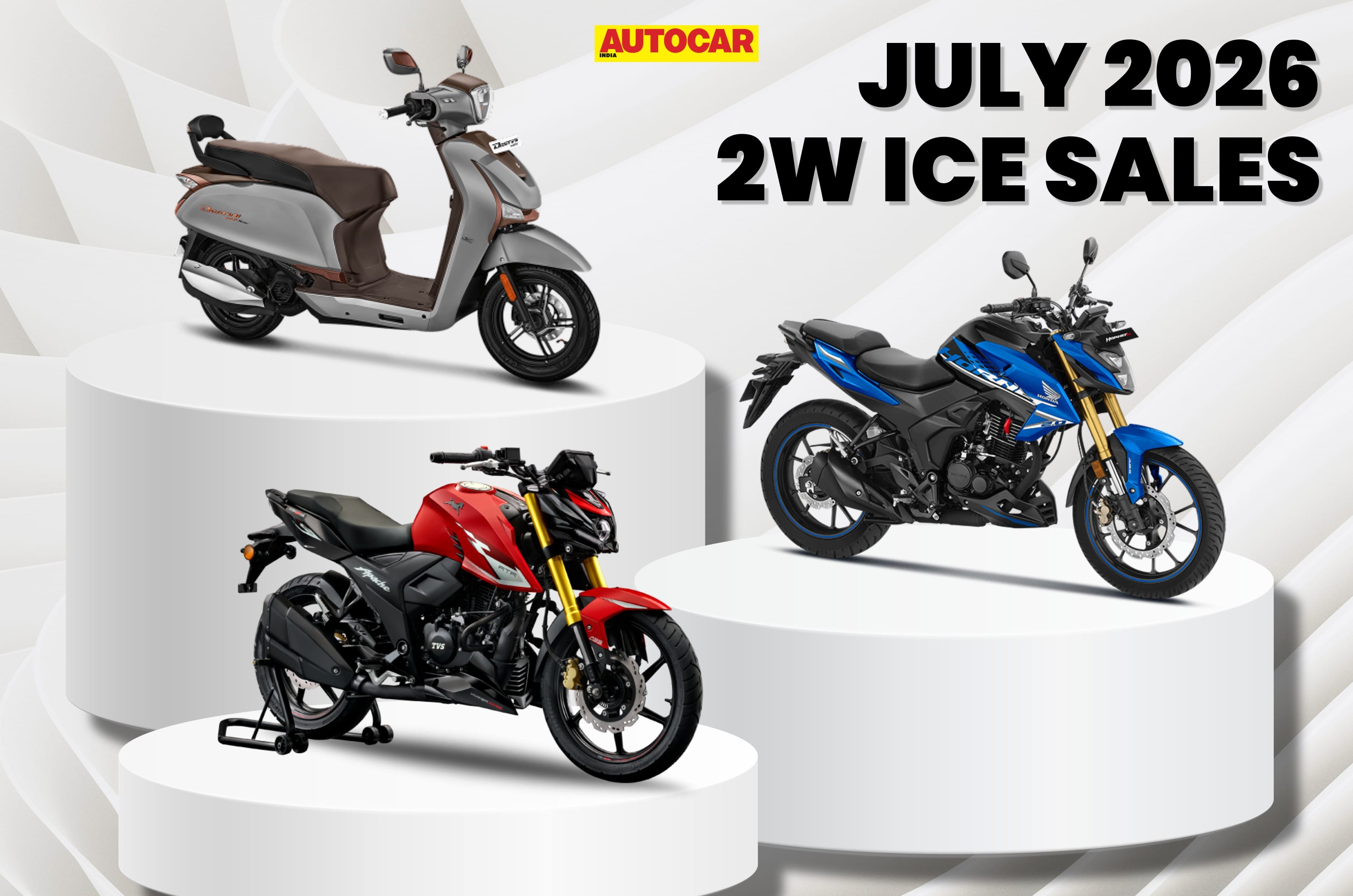
As India gears up to enter the festive season, ICE two-wheeler sales have started to report a small but noticeable uptick, for most manufacturers at least. Here’s how each of the big six two-wheeler heavyweights in the market performed in the month of July 2026.
Hero: 5,01,403 units
Hero MotoCorp continues to be at the top of this pile, albeit it reported a small 0.29 percent decrease compared to its sales in June 2026 (5,02,890 units). By contrast, the company reported a healthy 21.58 percent increase in comparison to its sales in July 2025 (4,12,397 units). It bears mentioning that Hero bundles the growing sales numbers of its electric subsidiary, Vida, which is now in the top 5 bestselling brands in the country.
Hero’s biggest adventure bike, the Xpulse 421, has been spotted testing for the first time up in the mountains and it seems quite close to being production ready. The company exported 32,013 units in July, which was a decrease compared to the 38,269 units in June.
Honda: 4,76,436 units
Honda Motorcycle and Scooter India (HMSI) is in its usual runner-up position behind Hero, and it reported a small 1.59 percent increase compared to its sales in June 2026 (4,68,956 units). Similarly, the company also reported an 2.17 percent increase in comparison to its July 2025 sales figure of 4,66,331 units.
Honda recently revealed a bevy of new made-in-India sub-500cc premium two-wheelers including the likes of the Rebel 300 and 500 bobbers, CB500 neo-retro single, ADV160 maxi-scooter and XR300 off-roader twins. Expect this push in the premium space from Honda to pose a significantly revamped threat to Hero’s longstanding #1 spot. HMSI exported 66,498 units in July, which was an increase over the 59,325 units it sent abroad in June.
TVS: 4,37,394 units
TVS Motor Company has cemented its #3 position in India and of late, its numbers have been much closer to Honda ahead of it than Bajaj trailing it. In July 2026, the company reported a 6.42 percent increase compared to the 4,11,014 units it sold in June 2026. In a similar vein, TVS also reported a substantial xx percent increase in comparison to its sales in July 2025 (3,08,720 units). It’s worth noting that TVS – India’s electric two-wheeler sales leader – doesn’t bundle in the sales of its electric scooter trifecta – iQube, Orbiter and X – into the number above.
TVS is working hard behind the scenes to set up its Paddock premium bike dealer network which will also sell the Norton range in India. The Hosur-based marque is India’s second largest two-wheeler exporter and it shipped 1,65,744 units overseas in July, up from 1,54,403 units exported in June.
Bajaj: 1,65,747 units
Bajaj Auto is in its usual number four spot and it reported a marginal 0.72 percent decline last month in comparison to its sales in June 2026 (1,66,956 units). However, it did report a 19 percent increase when compared to its July 2025 sales of 1,39,279 units. It bears mentioning that Bajaj bundles in the sales of the sub-400cc KTM and Triumph models it manufactures as well as those of the Chetak electric scooter – India’s second bestselling e-scooter – into the number above.
The Classic Pulsar models are due to be revamped in the coming weeks and expect Bajaj to ride a surging wave of demand for these as the festive season gets well and truly underway. Bajaj is India’s largest two-wheeler exporter and it sent 2,22,972 units overseas in July, a slight improvement over the 2,22,439 units it exported in June.
Suzuki: 1,23,216 units
Suzuki Motorcycle India Pvt. Ltd. (SMIPL) reported its best-ever monthly sales in July, and in doing so recorded a significant 35.01 percent increase over the 91,264 units it sold in June 2026. Even in comparison to its sales in July 2025 (96,029 units), Suzuki reported a 28.31 percent increase.
Suzuki shipped 19,769 units overseas in July, which was lower than the 23,766 units it exported in June.
Royal Enfield: 1,05,317 units
Royal Enfield sold more than 1 lakh units domestically in July and in doing so, it reported a 2.32 percent increase when compared to its sales in June 2026 (1,02,930 units). Even in comparison to its sales in July 2025 (76,254 units), the company reported a healthy 38.11 percent increment. Recently, RE expanded the reach of its Flying Flea electric brand to multiple locations across Bengaluru, after beginning sales of the C6 in the recent past.
The company exported 12,915 units in July, higher than the 11,102 units it sold abroad in June.
बेंगलुरु के कंटेंट क्रिएटर अक्षय सीएन ने लोगों का ध्यान बचत से जुड़ी एक अहम समस्या की ओर दिलाया है। उनका कहना है कि कम सैलरी नहीं, बल्कि रोजाना होने वाले छोटे-छोटे खर्च कई बार आर्थिक स्थिति को प्रभावित करते हैं। उन्होंने सोशल मीडिया पर एक वीडियो शेयर कर बताया कि फूड डिलीवरी, कैब राइड, गैरजरूरी शॉपिंग, बेकार सब्सक्रिप्शन और बिना प्लानिंग के वीकेंड खर्च जैसी आदतें धीरे-धीरे बड़ी रकम में बदल जाती हैं।
अक्षय के मुताबिक, ज्यादा कमाई करने वाले लोग भी अगर खर्चों पर नजर नहीं रखते तो बचत नहीं कर पाते। वहीं सीमित आय वाले लोग सही प्लानिंग के जरिए पैसे बचा सकते हैं। उनकी पोस्ट ने सोशल मीडिया पर लोगों के बीच खर्च करने की आदतों और बेहतर वित्तीय प्रबंधन को लेकर चर्चा शुरू कर दी है।
वायरल वीडियो में बताए पैसे खत्म करने वाले कारण
Instagram पेज @bangalore_viral चलाने वाले अक्षय सीएन ने एक वीडियो शेयर कर ऐसी 5 आदतों के बारे में बताया, जो धीरे-धीरे हर महीने की बचत को कम कर देती हैं। इनमें बार-बार ऑनलाइन फूड ऑर्डर करना, कैब पर ज्यादा खर्च, बेवजह खरीदारी, बिना इस्तेमाल वाले सब्सक्रिप्शन और बिना बजट के वीकेंड प्लान शामिल हैं।
अक्षय ने पोस्ट के कैप्शन में लिखा कि कई लोग सोचते हैं कि सैलरी बढ़ने के बाद बचत शुरू करेंगे। लेकिन उनके मुताबिक, असली फर्क कमाई से ज्यादा पैसों को लेकर जागरूकता का होता है। उन्होंने बताया कि कुछ लोग 40 हजार रुपये कमाकर भी बचत कर लेते हैं, जबकि लाखों की आय वाले लोग भी महीने के अंत में परेशान रहते हैं।
छोटे खर्च कैसे बन जाते हैं बड़ा बोझ
अक्षय ने उदाहरण देते हुए बताया कि एक बार का ₹300 का कैब राइड ज्यादा बड़ा खर्च नहीं लगता, लेकिन महीने में 20 बार लेने पर यही रकम काफी बढ़ जाती है। इसी तरह रोजाना फूड डिलीवरी, सेल के नाम पर खरीदारी और छोटे-छोटे डिजिटल पेमेंट लंबे समय में जेब पर भारी असर डाल सकते हैं।
सब्सक्रिप्शन और वीकेंड खर्च पर भी दी चेतावनी
उन्होंने कहा कि कई लोग ऐसे ऐप्स और सेवाओं के लिए पैसे देते रहते हैं, जिनका इस्तेमाल तक नहीं करते। वहीं हर वीकेंड बाहर जाने की आदत भी बिना प्लानिंग के बजट बिगाड़ सकती है। उनके अनुसार, समस्या बाहर जाने में नहीं बल्कि बिना हिसाब के खर्च करने में है।
30 दिन वाला सवाल बदल सकता है खर्च की आदत
अक्षय ने पैसे बचाने का एक आसान तरीका भी साझा किया। उन्होंने बताया कि कोई भी चीज खरीदने से पहले वह खुद से पूछते हैं,”क्या मैं 30 दिन बाद भी इस खरीदारी से खुश रहूंगा?” उनके मुताबिक, इस एक सवाल ने उन्हें बेहतर वित्तीय फैसले लेने में मदद की है।
सोशल मीडिया पर लोगों ने दी प्रतिक्रिया
अक्षय की पोस्ट पर कई यूजर्स ने सहमति जताई। कुछ लोगों ने कहा कि रोजमर्रा के खर्चों की वजह से महीने के अंत तक पैसे बचाना मुश्किल हो जाता है। वहीं कई यूजर्स ने माना कि बचत के लिए ज्यादा कमाई से ज्यादा खर्चों पर नियंत्रण जरूरी है।
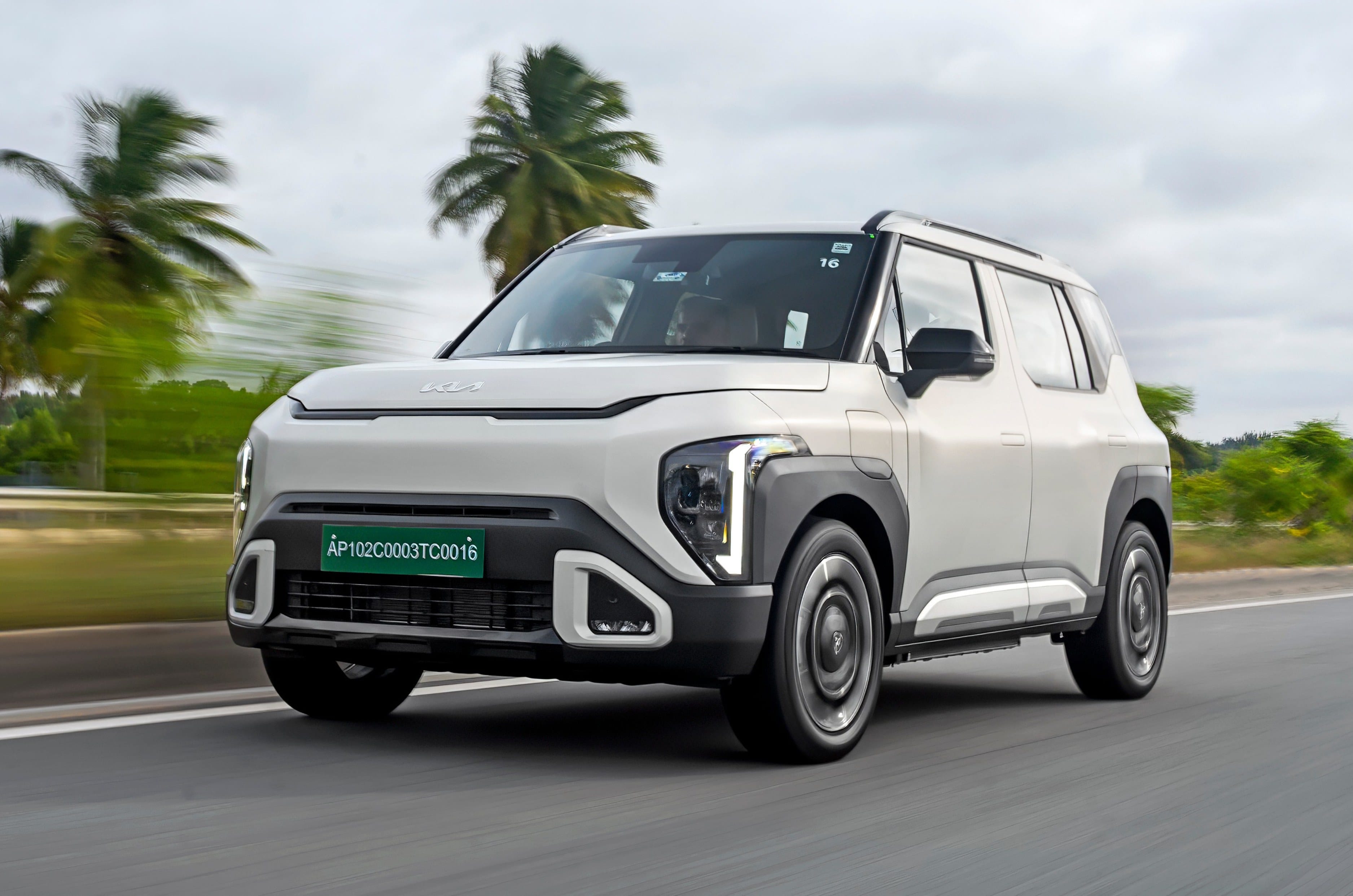
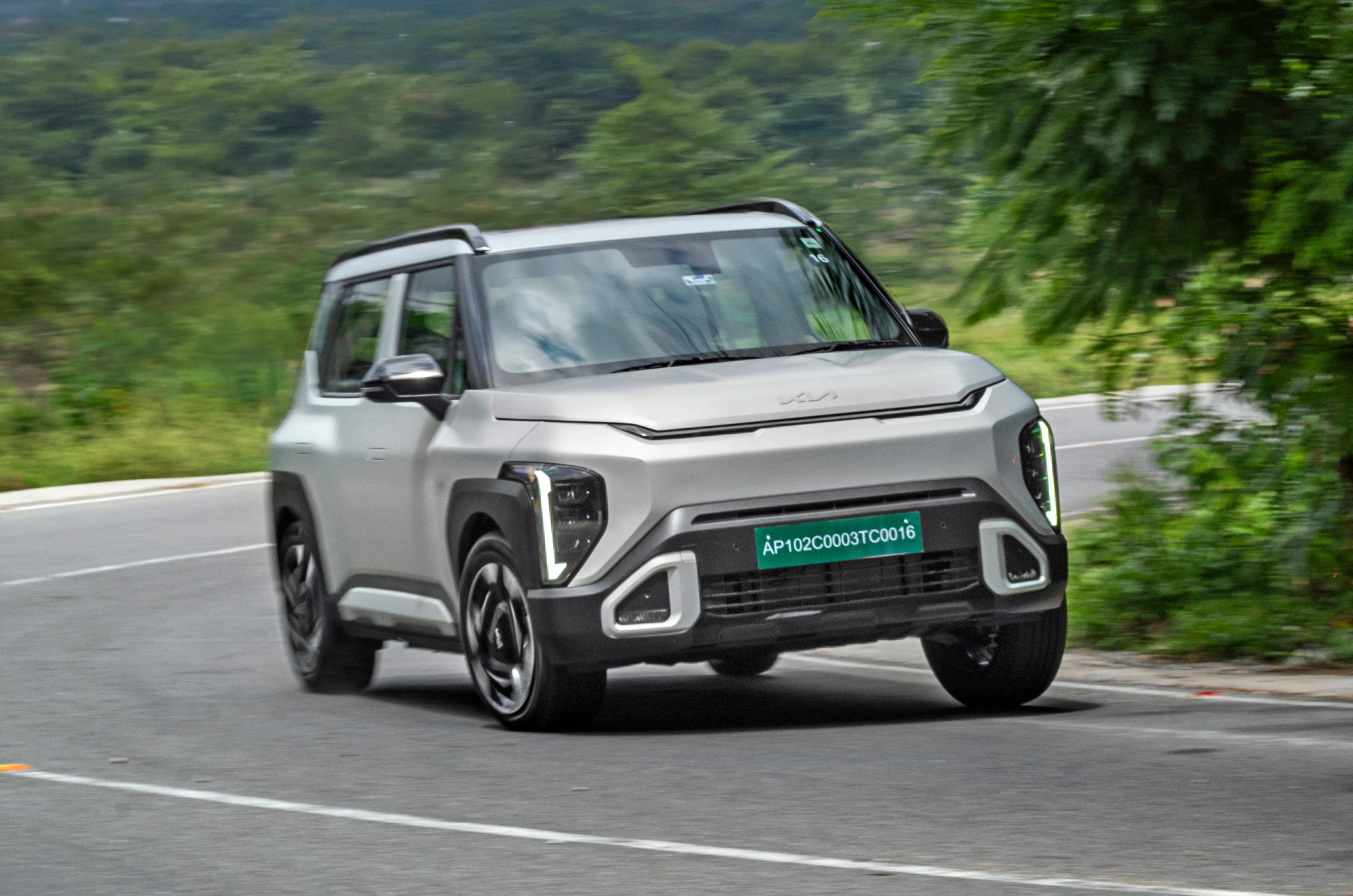
Kia has chosen the Syros to be its second mass market EV for the Indian market. Despite its superb packaging, oddball styling and high initial prices held back the original ICE version against traditional compact SUV rivals. However, EV customers are generally more accepting of avant-garde design, so can the Syros EV find success where the ICE version couldn’t? We drove it in Bengaluru to find out.
Kia Syros EV Exterior Design and Engineering – 7/10
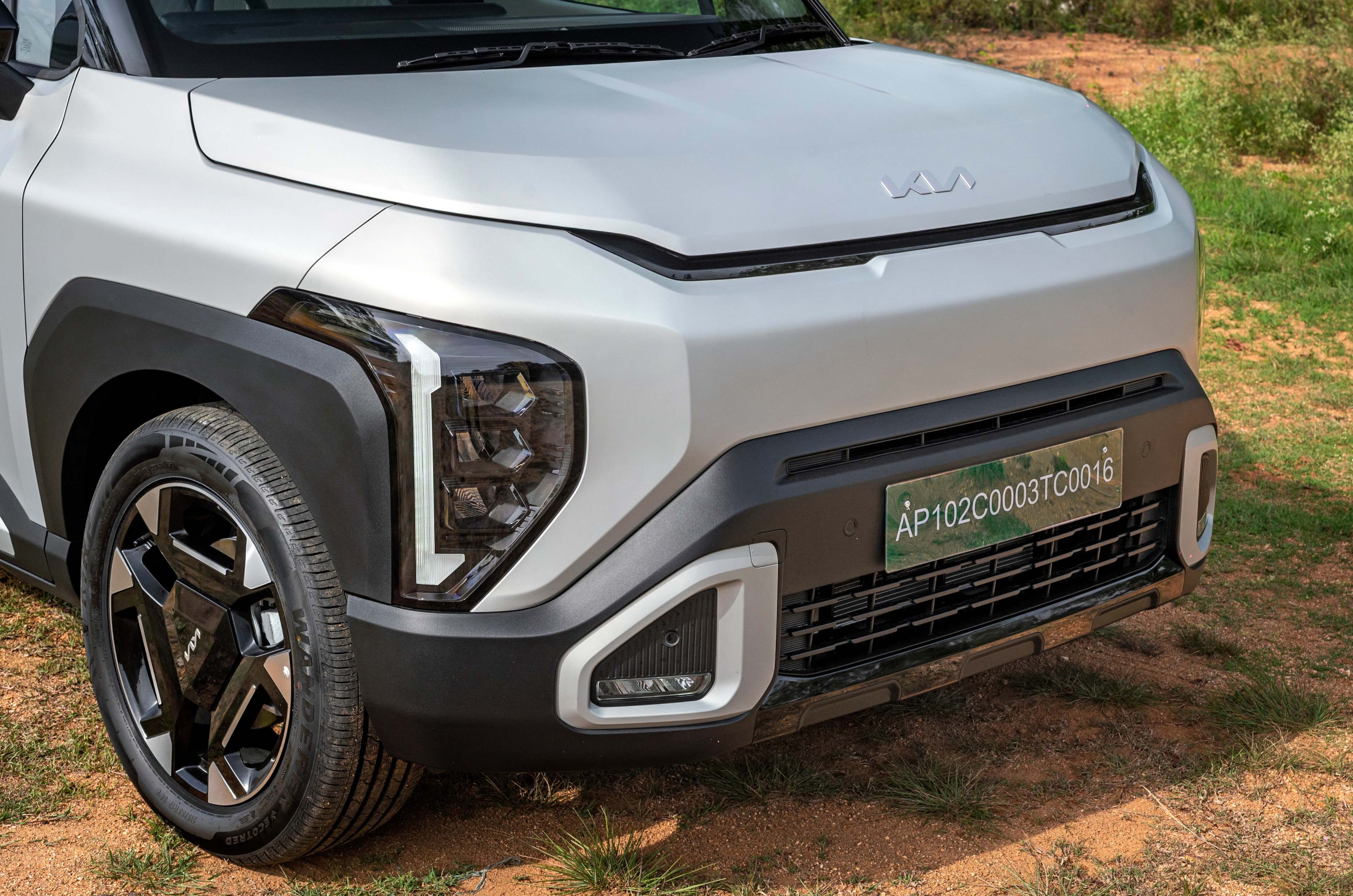
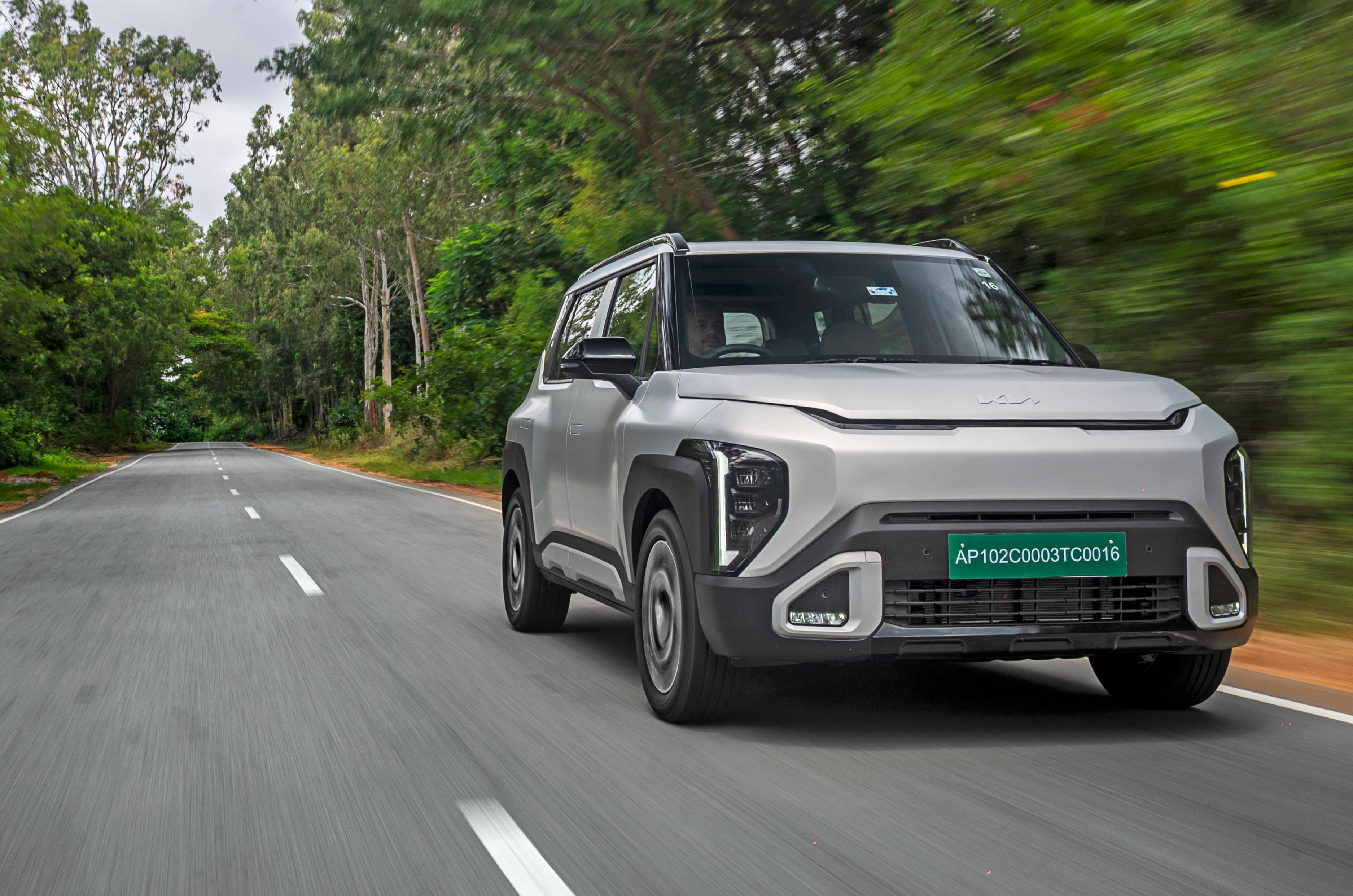
EV has a slimmer intake above the number plate and slightly different lower bumper
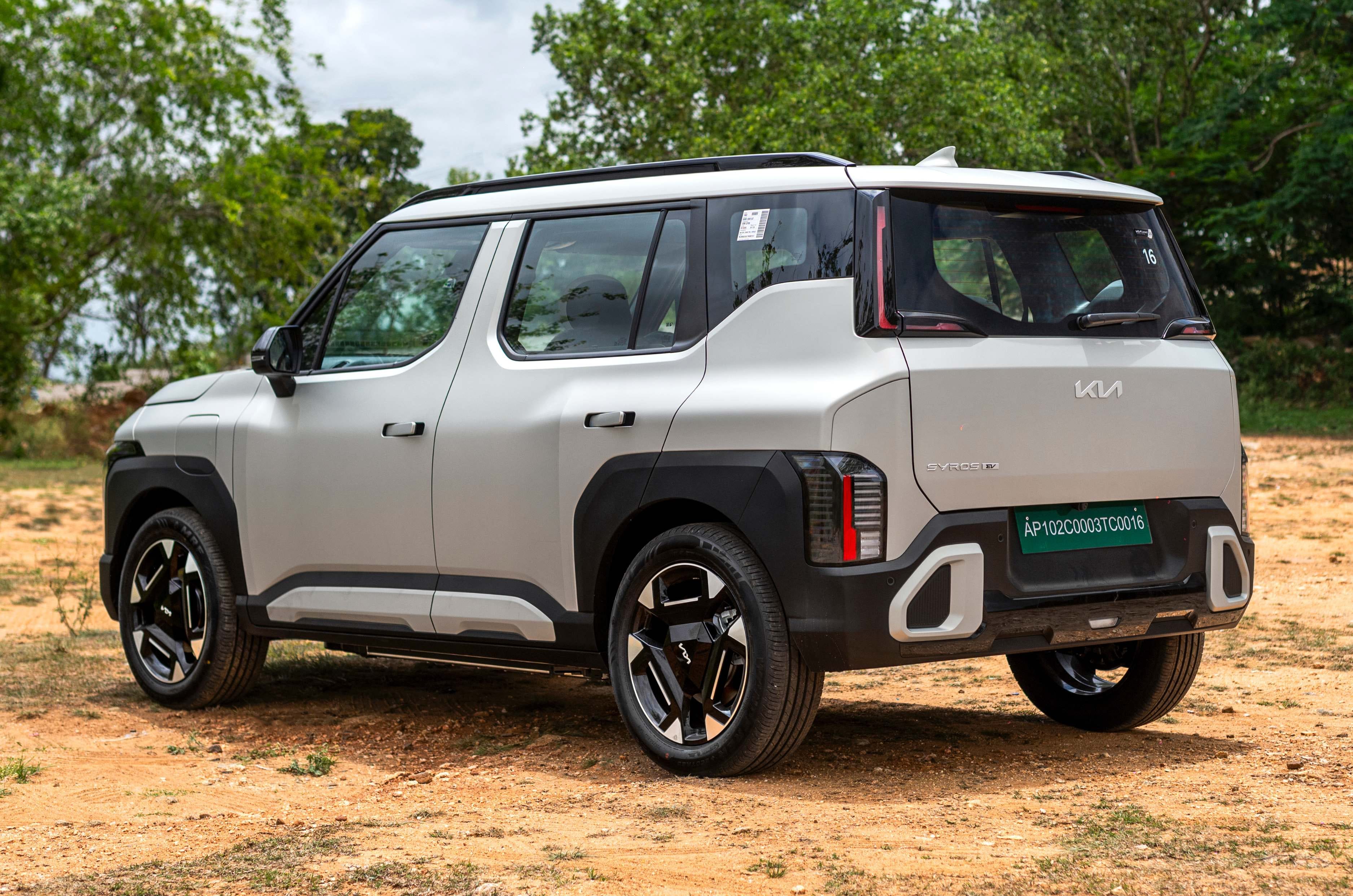
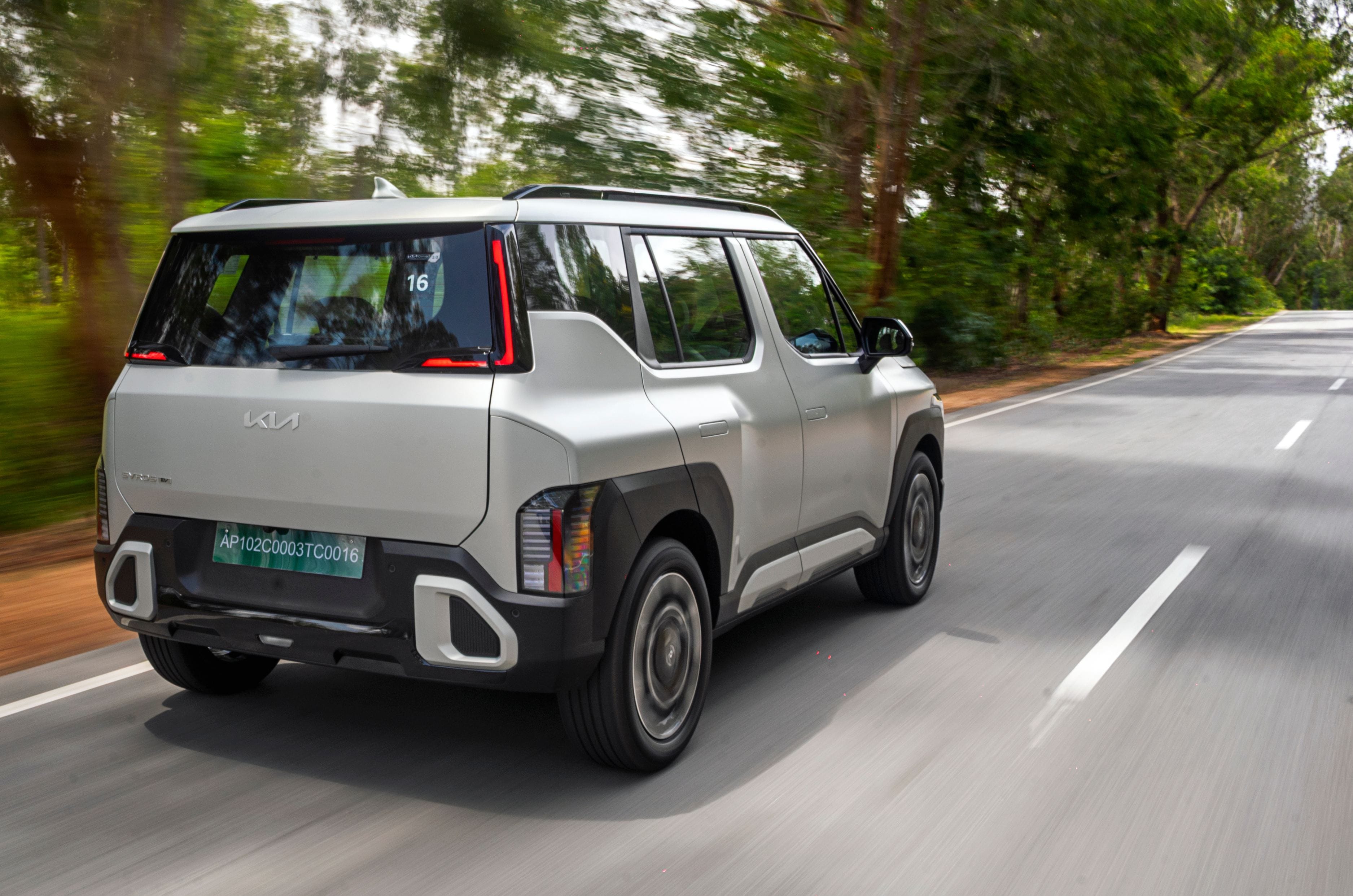
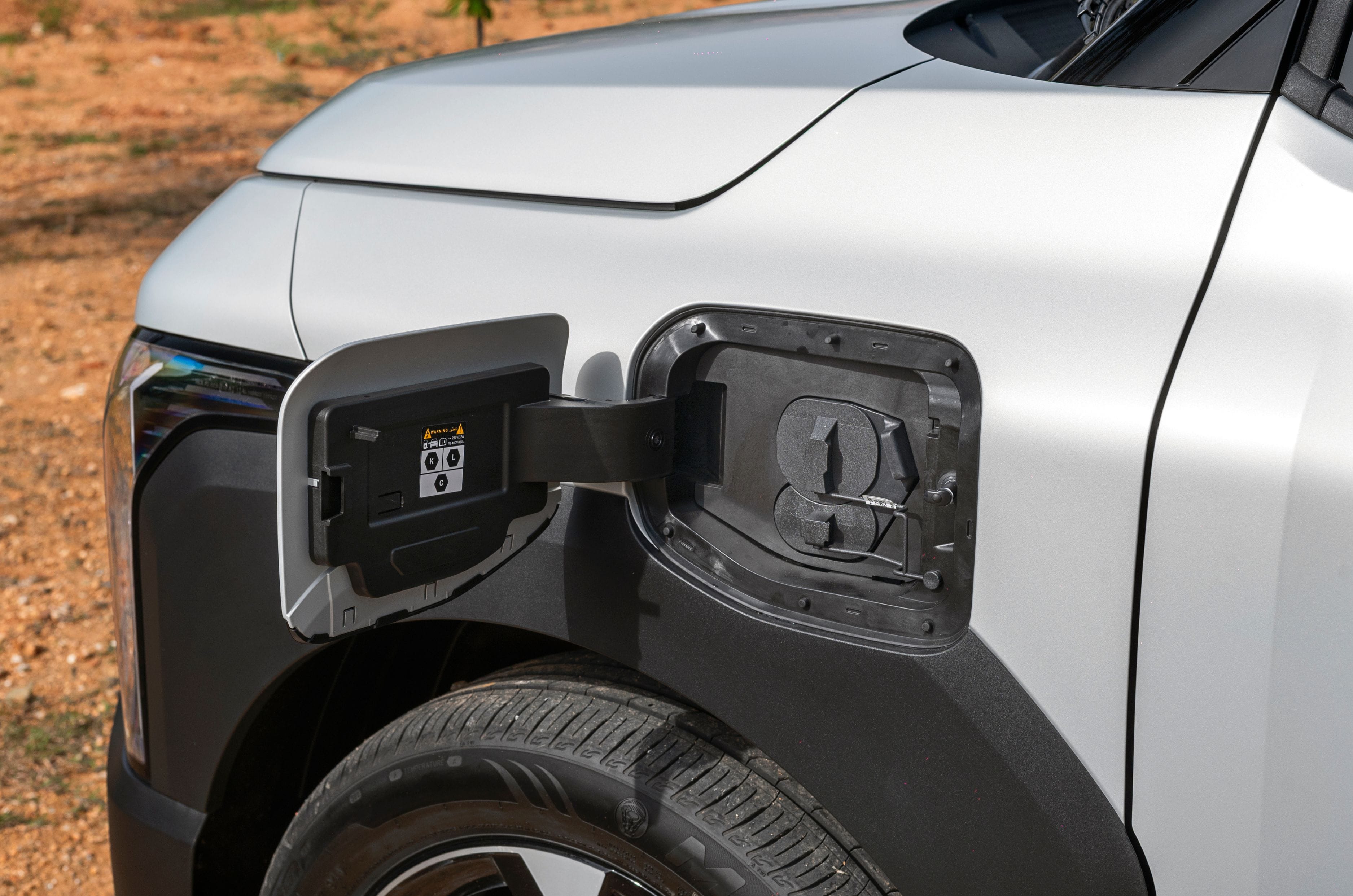
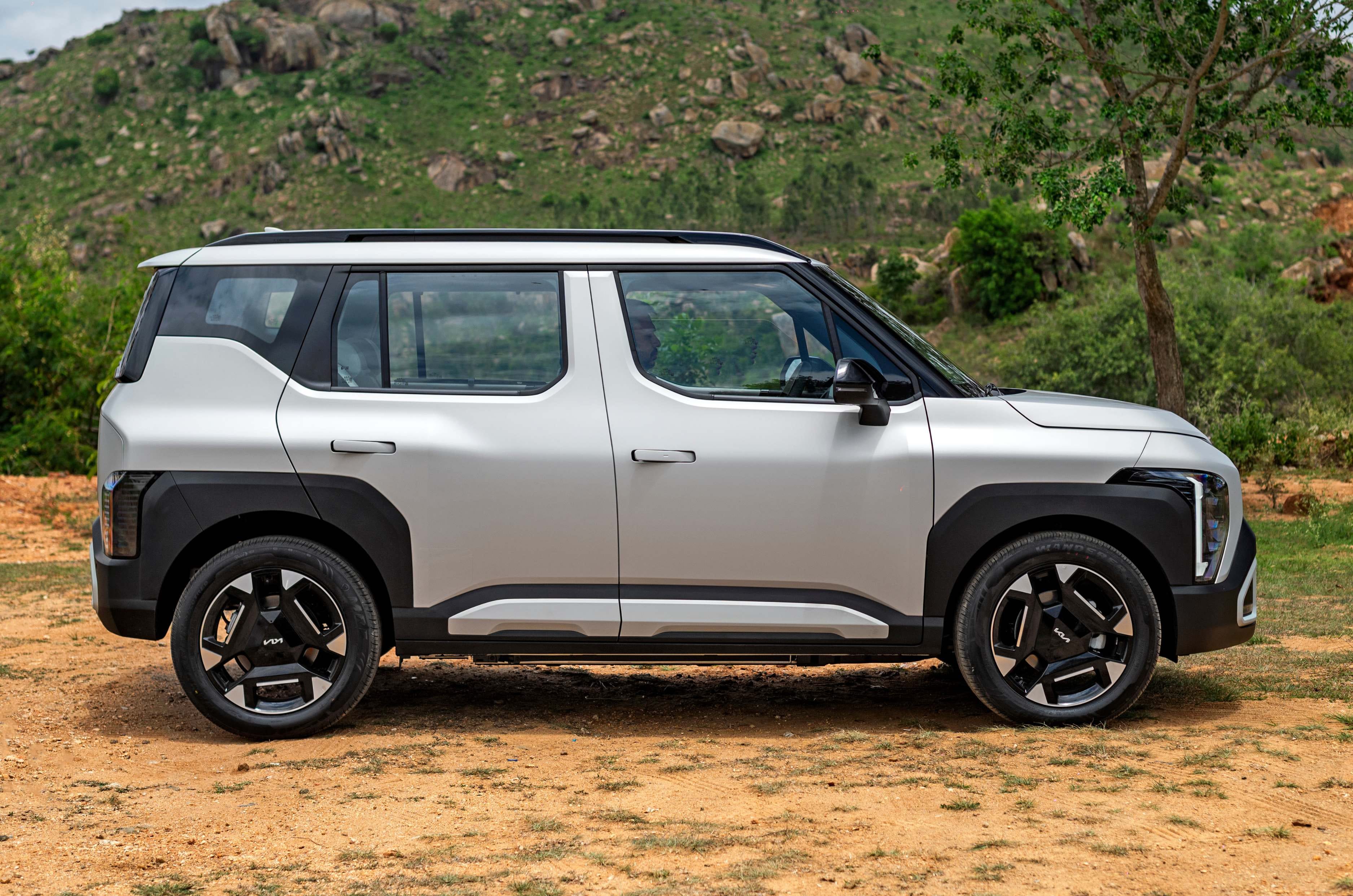
A game of spot the difference between the Syros EV and the ICE version would prove challenging for the casual observer, so here is the cheatsheet. Up front, the bumper is ever so slightly different, with a slimmer cooling slot above the number plate and minor tweaks to the body-coloured triangular pods that house the LED fog lamps. Apart from the charging port on the front left fender and the shorter roof rails, the profile is unchanged. Crouch down, though, and you’ll notice the battery pack is visible, like it is on the Hyundai Creta Electric. Kia claims ground clearance is 197mm which is 7mm more than the ICE version. The tri-spoke 17-inch alloys are the same ones that debuted on the ICE car but were discontinued with the facelift. No differences round the back either, save for an EV badge on the tailgate.
Split lighting lifts the otherwise bland rear
If you didn’t like the way the Syros looked, the EV isn’t going to change your mind. It is distinctive, though – like a Japanese kei car only larger, and Korean. Its blanked-off fascia looks appropriate on an EV, and the vertically oriented headlights give it a unique look. The cladding lower down on the bumper carries on to the wheel arches, doors and the rear, adding some muscle. Breaking up the large greenhouse are the pronounced B-pillar and the upward kink in the C-pillar, both of which are neatly done. And while the tailgate looks a bit blank, the split lighting – with L-shaped elements framing the rear windscreen and larger units at the edge of the bumper – looks great when lit up.
Syros EV Interior Space and Comfort – 10/10
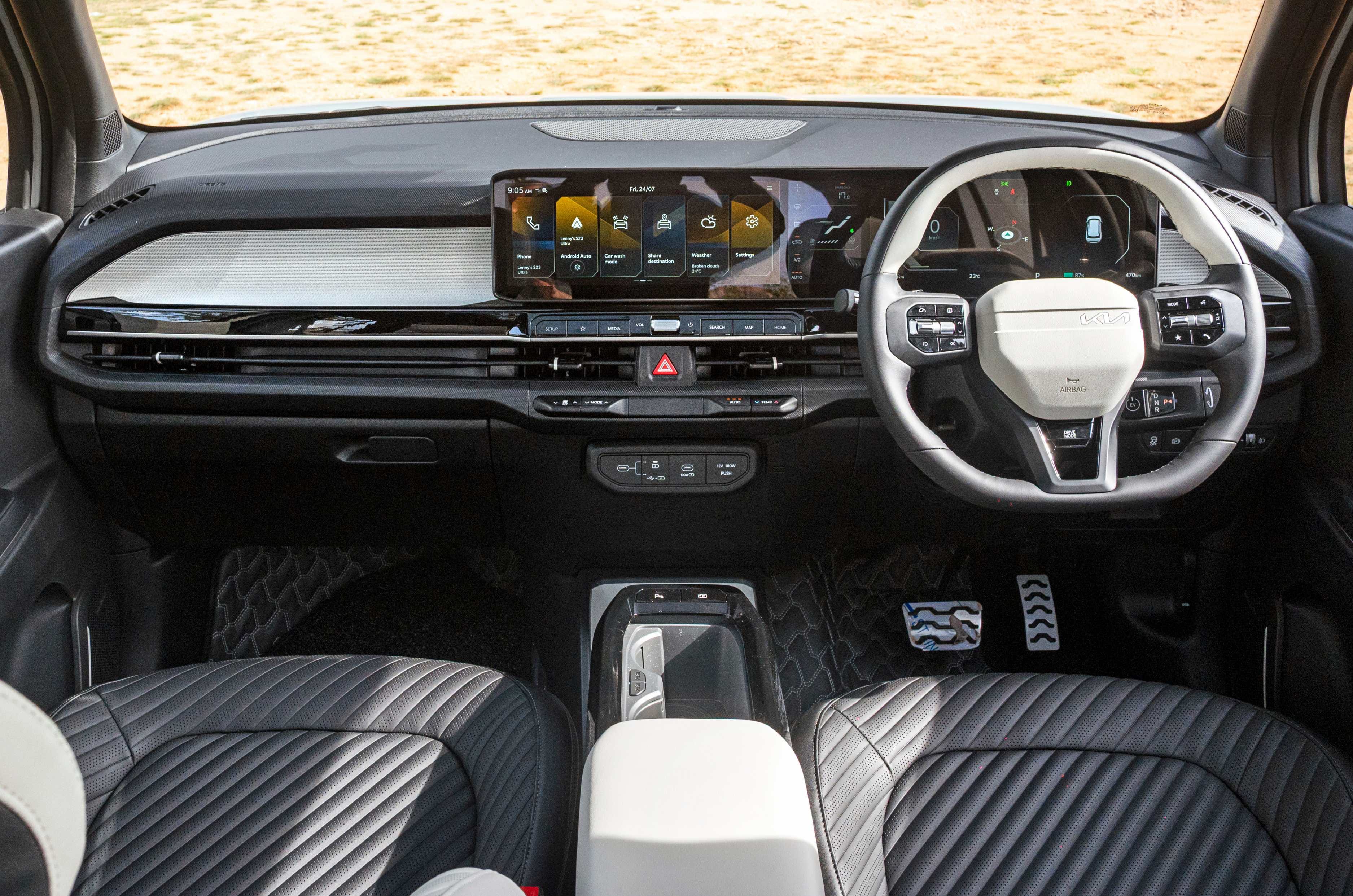
Dash layout is identical to the ICE version, but it gets the 3-spoke ‘wheel from the Seltos
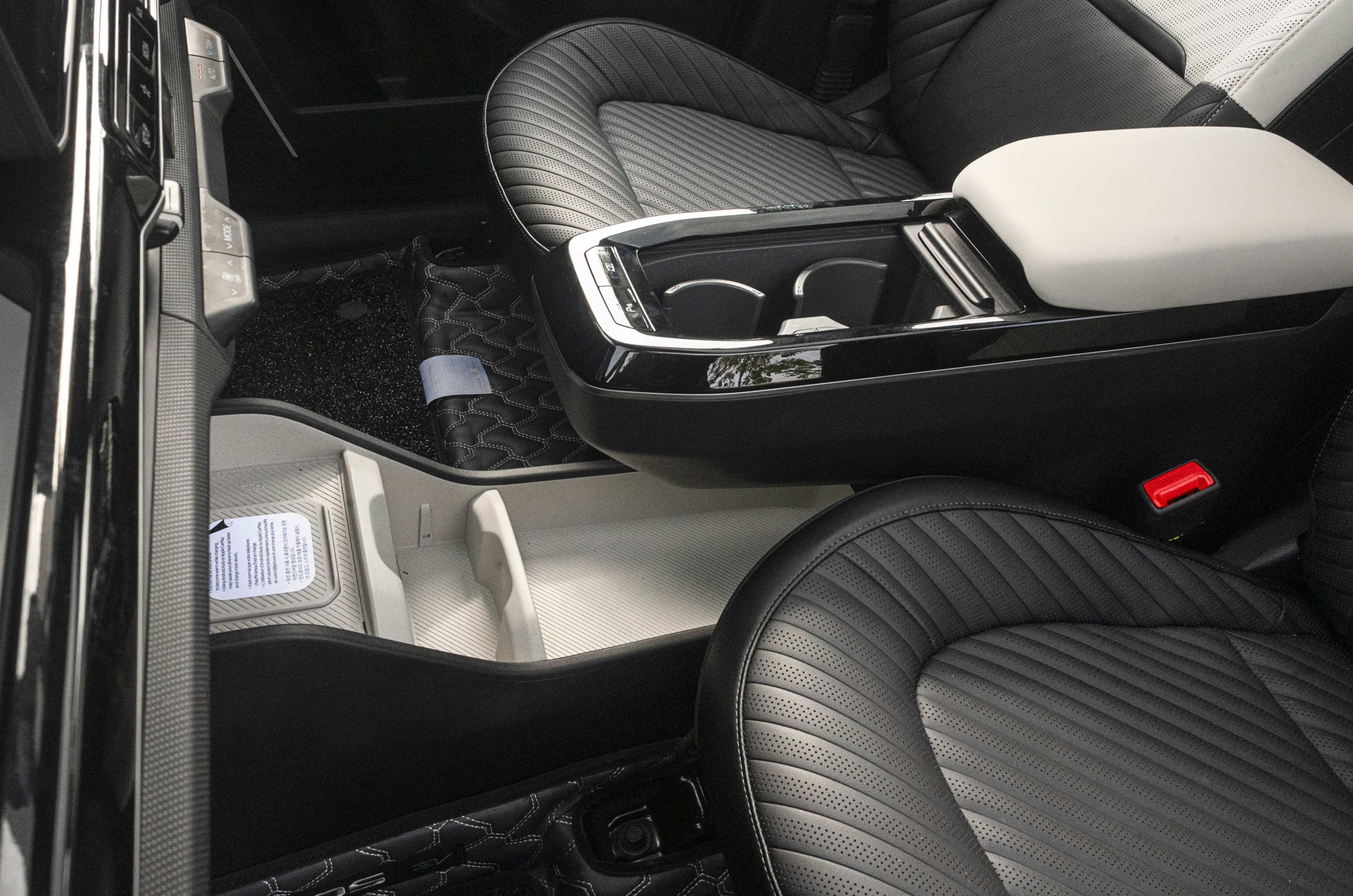
Step inside and you start to understand why the Syros EV looks the way it does. Space for passengers, their knick-knacks and luggage is in abundance. With the EV’s drive selector positioned on the steering column, Kia has re-engineered the centre console to liberate a lot more storage. It now has two levels: the top floating portion has a small cubby under the armrest, along with two cupholders with their own sliding cover, while the lower level has a large storage area for a bag or such, another cupholder and a wireless charger. The front door pockets are just as accommodating, with room for a couple of bottles and an umbrella.
New center console has a lot of storage spaces
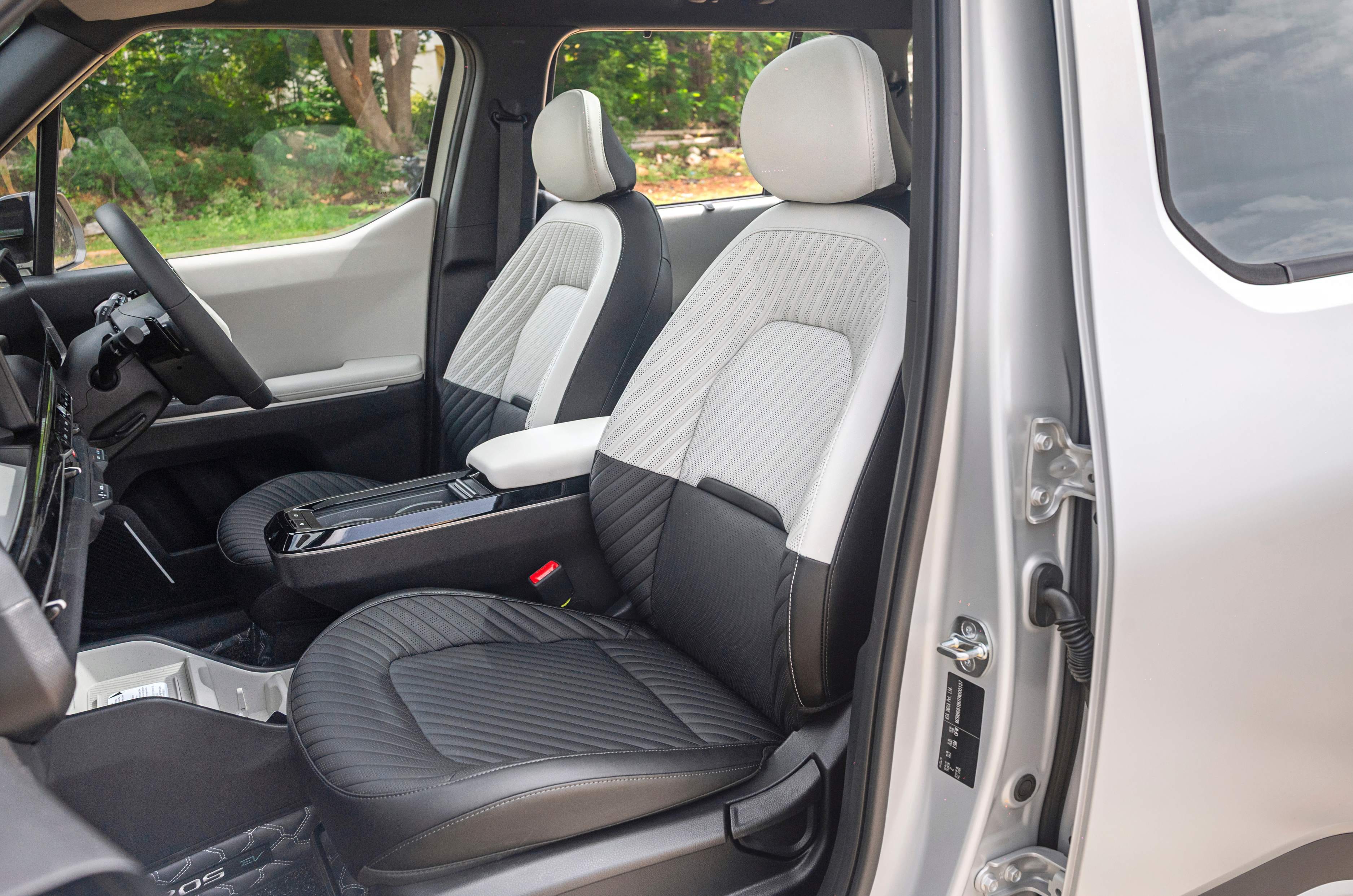
The front seats are supportive and comfortable, with heating and ventilation along with 4-way power adjustment for the driver. While the dash layout is unchanged, the EV gets the Seltos’ three-spoke steering wheel, but adjustment is still limited to rake and not reach. The EV uses a slightly different colour palette inside: our HTX+ test car gets a smart-looking black-and-off-white theme, the X-Line features a darker black-and-green ambience, while all other trims get an airy light grey and pastel blue theme. While most surfaces are hard plastic, the quality of the materials, fit and finish is top notch.
Front seats are comfy with heating, ventilation for both and power adjustment for the driver
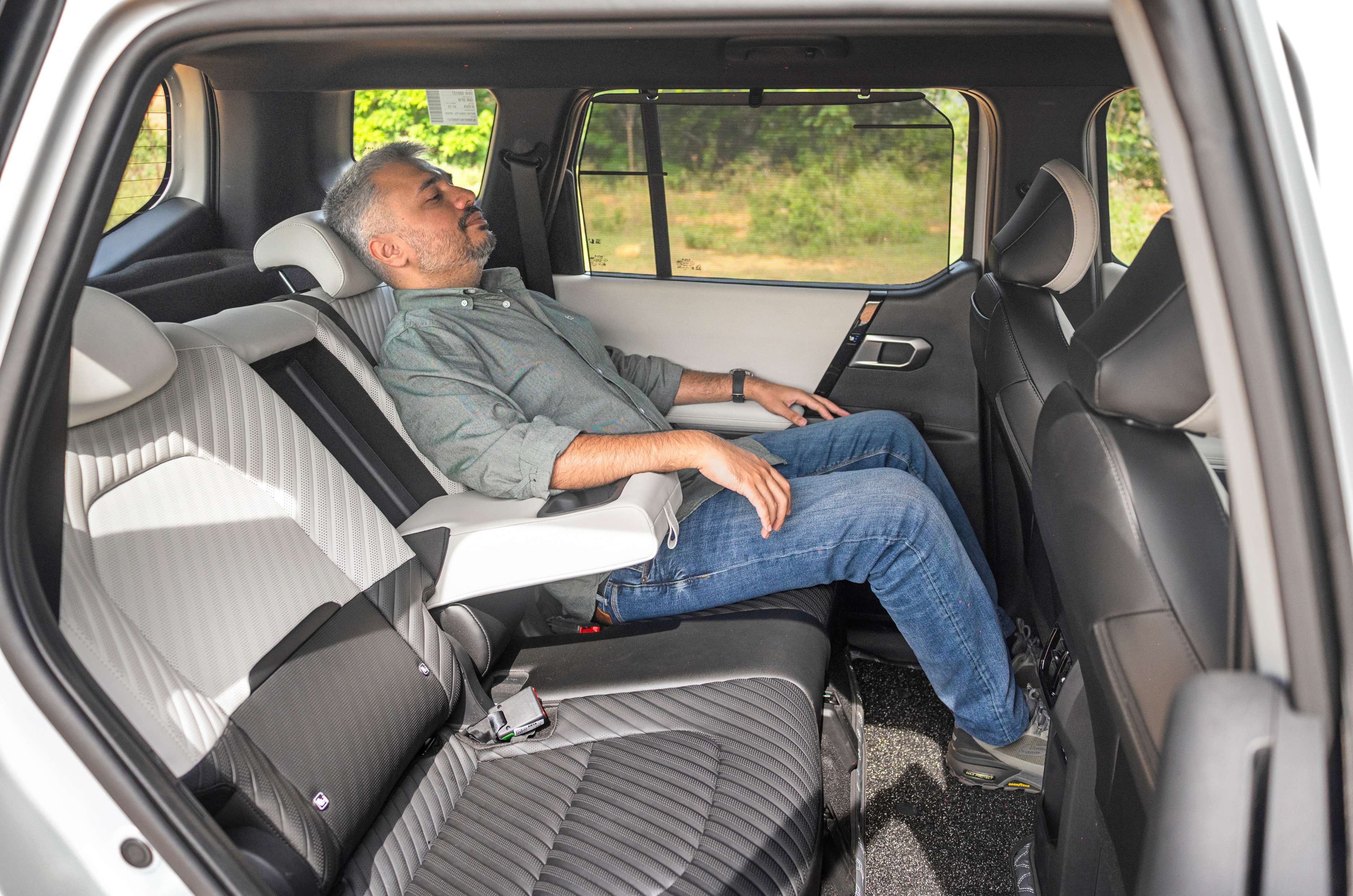
The back seat remains a highlight, with plenty of room all around. The floor is slightly higher because of the battery pack, which means thigh support isn’t as good as in the ICE version. However, if you slide the bench back and stretch out, this isn’t much of an issue. A benefit of the raised floor is that it is now completely flat. Ventilation for the seat base carries over, but the backrest still misses out, as Kia says it would restrict its recline angle.
Higher floor slightly affects thigh support, but there’s ample room to stretch out
Boot space is identical to the ICE Syros at 390 litres with the seat all the way back, and 465 litres with it slid forward. The rear seats also split-fold – though not completely flat – to carry longer items. There is a 16-litre frunk too, though it is rather narrow.
Kia Syros EV Features and Safety – 9/10
Sitting proud on the dash is what Kia calls the Trinity Panoramic Display, comprising two 12.3-inch screens for the infotainment and driver’s display, with a 5-inch screen in between for the HVAC controls. The driver’s display is logically laid out, easy to read and offers some customisation, while the infotainment is sharp, snappy and has a clean UI. The EV gets a dedicated tab that shows several parameters related to the battery, range and energy consumption. It can also help find the nearest charger, condition the battery before charging, as well as set up charging schedules.
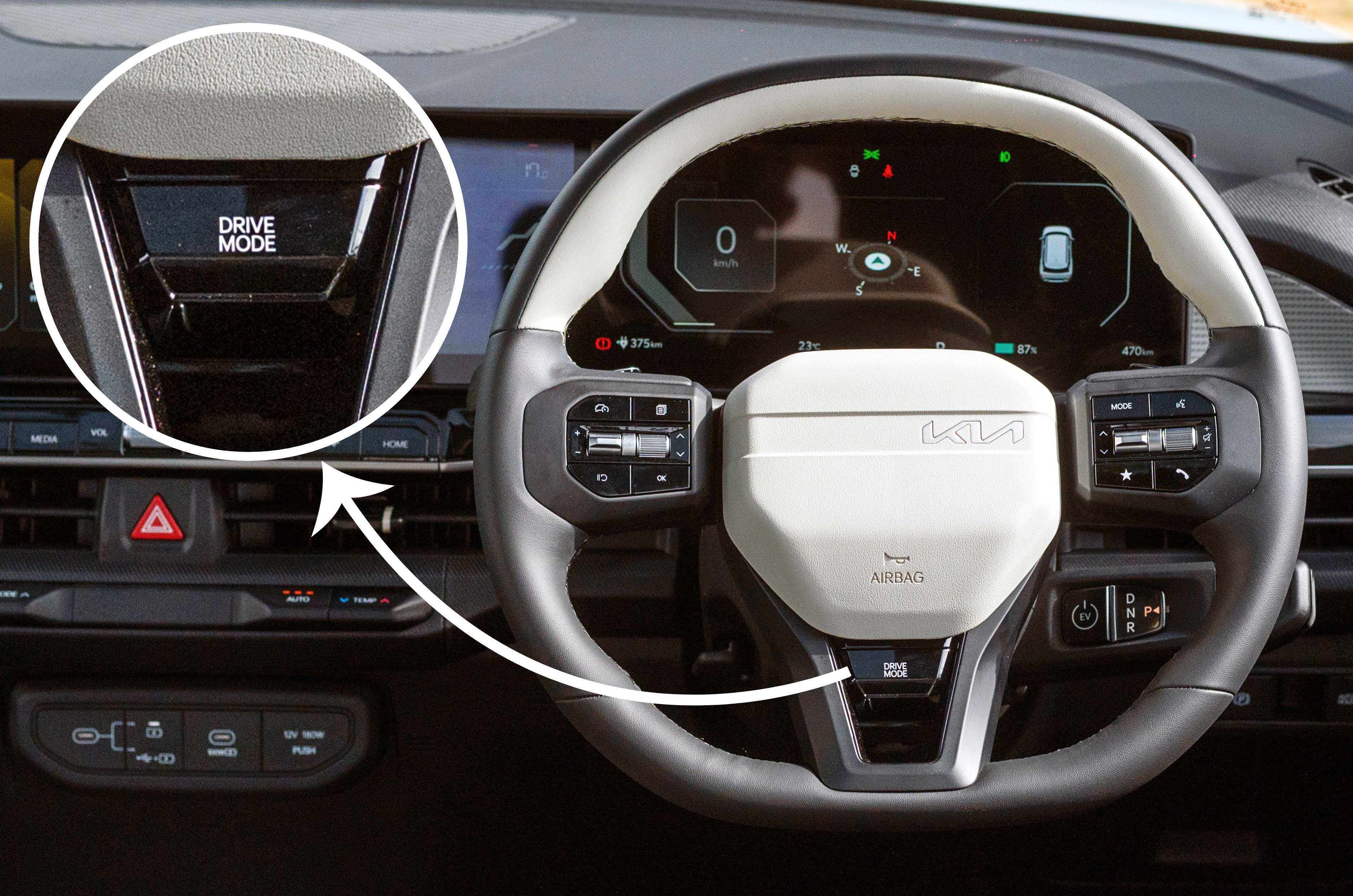
Handy drive mode button to cycle between Eco, Normal and Sport modes
The infotainment also offers wireless Android Auto and Apple CarPlay and, on the top trims, powers a superb Harman Kardon audio system with eight speakers, including one on the dash and a subwoofer in the boot. Sunblinds and rear AC vents are standard, while the massive panoramic sunroof features on all but the bottom two trims. Our second-from-top HTX+ also gets an integrated dashcam.
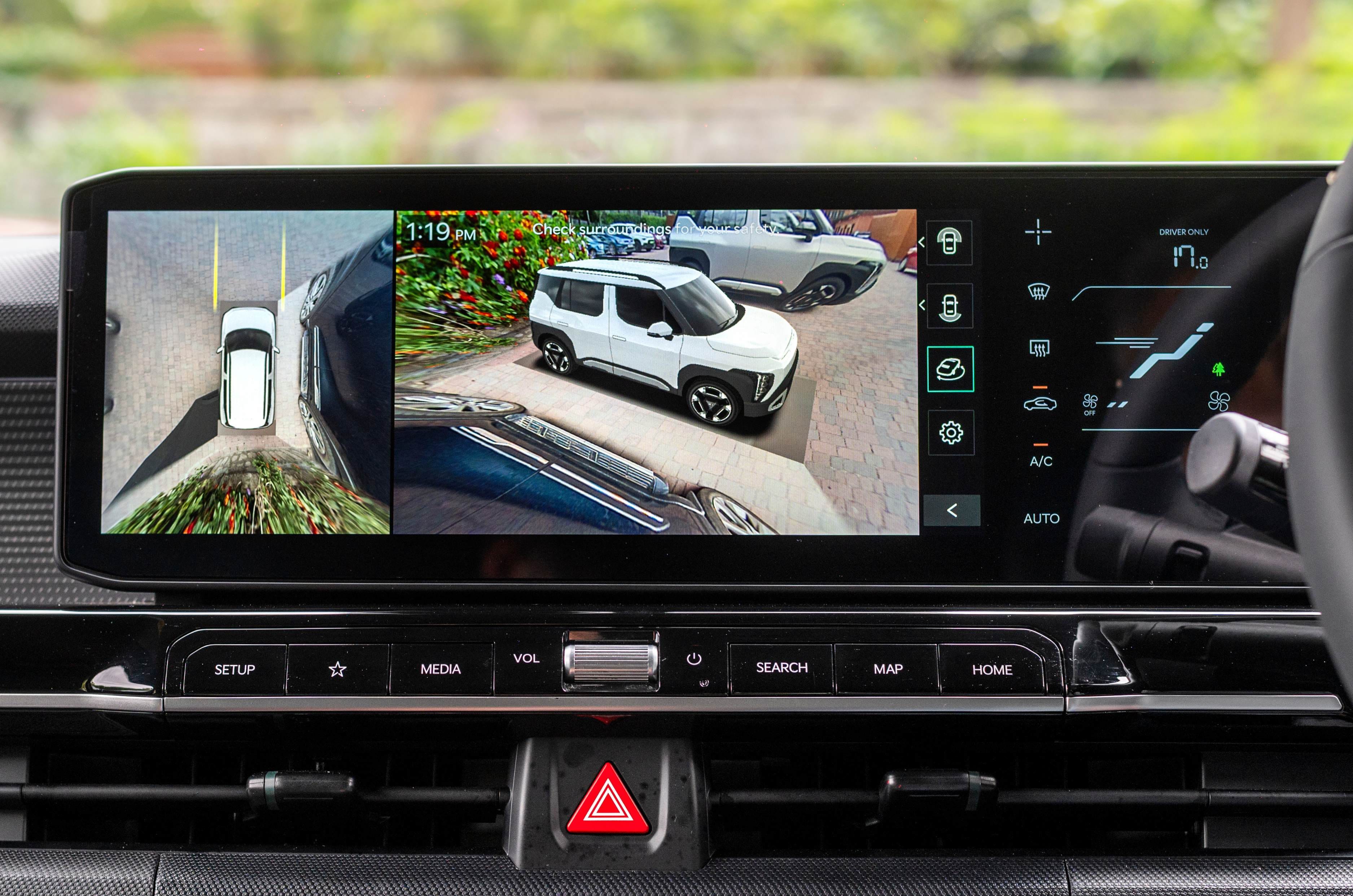
360-degree camera is sharp, but only available on top X-Line trim
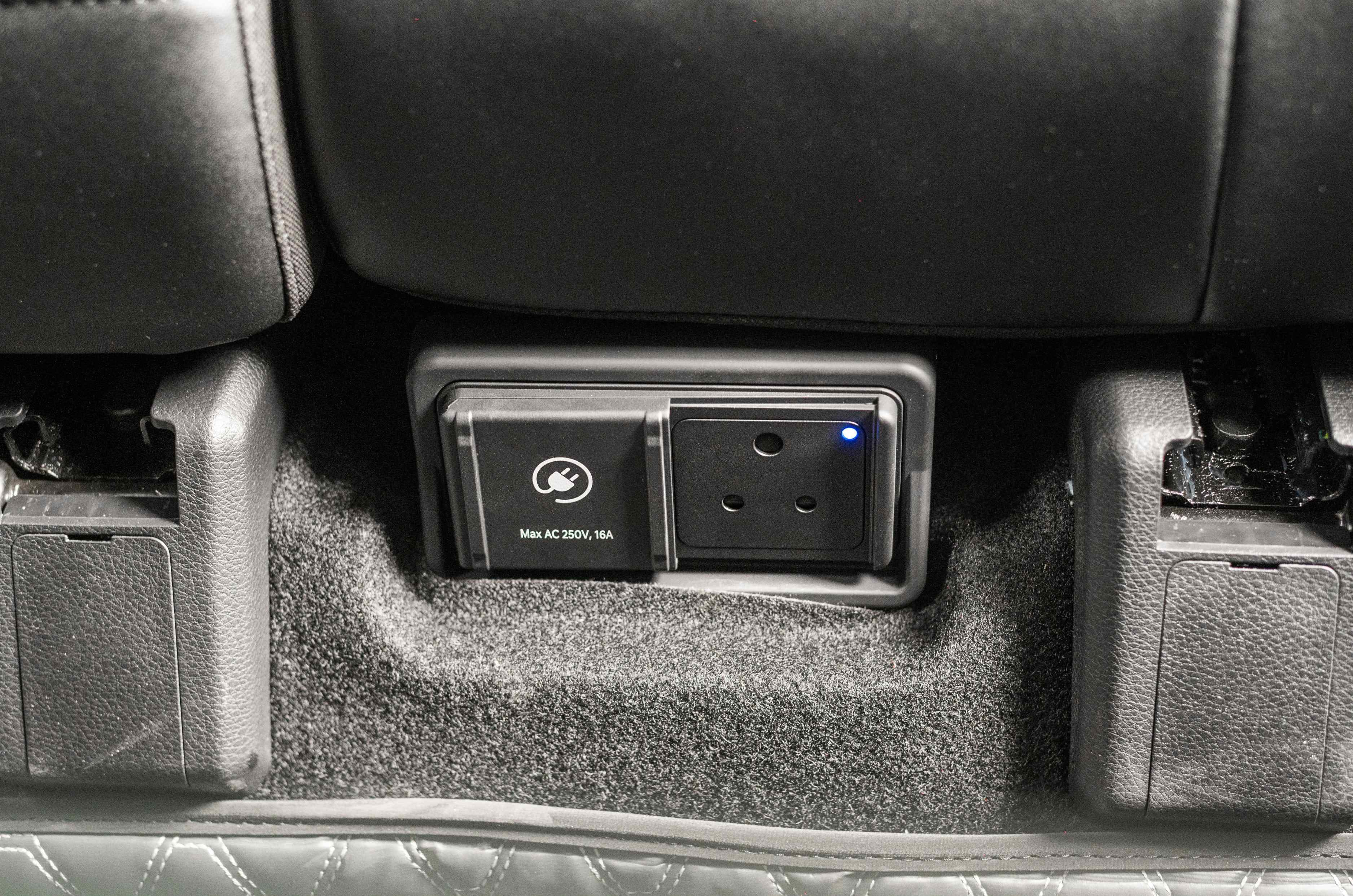
Overall, the Syros EV is very well equipped, but some features are available only on the top X-Line variant, including Level 2 ADAS, ambient lighting, a 360-degree camera and a household-style three-pin socket in the back seat. Restricting features to the top trim isn’t unusual; however, the X-Line can only be had in Aurora Black Pearl or Matte Graphite, which might not be to all tastes.
V2L power outlet under the rear seat
The standard safety suite is robust, including six airbags, all-wheel disc brakes, tyre pressure monitoring and ISOFIX mounts. The ADAS suite is also comprehensive, including adaptive cruise control with stop-and-go, lane keep assist, forward and rear collision avoidance, and a blind-spot camera. At the time of writing, the Syros EV does not yet have an official crash safety rating, but considering the ICE version has a five-star BNCAP rating, a similar result for the EV can be expected.
Kia Syros EV Performance and Refinement – 9/10
The Syros EV is available with the same 42kWh and 51.4kWh NMC battery packs as the Carens Clavis EV and the Hyundai Creta Electric. Here too, they power a single motor on the front axle producing 135hp with the smaller battery and 171hp with the extended-range version. Torque is identical on both at 255Nm.
Borrows the 42 and 51.4kWh battery packs from the Carens Clavis EV
Performance was brisk on our 51.4kWh test car, with the 0-100kph sprint claimed to take 8.1 seconds. There are three drive modes to choose from – Eco, Normal and Sport – with each sharpening throttle response a little more than the last. Initial response in all modes is linear so as not to overwhelm those who aren’t used to the instant torque, but there is a strong shove as you get further into the throttle. Overtaking, then, is quite effortless, even in Eco and Normal, almost never needing a switch to Sport for a quick pass.
Initial acceleration is linear, but there is plenty of shove for quick overtakes
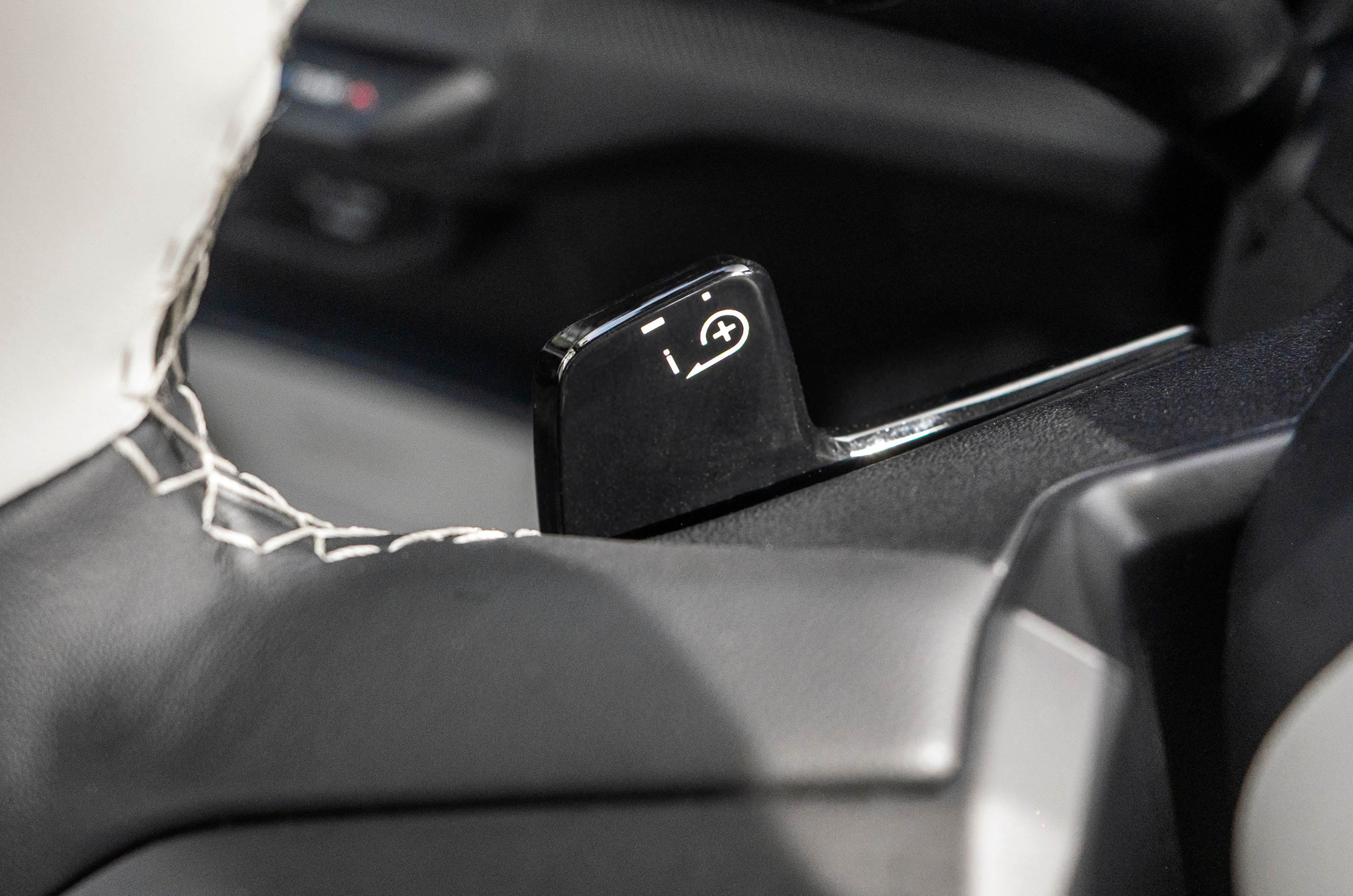
The regen braking modes – selected via the paddle shifters – are also very well calibrated, with a noticeable increase in resistance in each mode and the ability to turn it off completely. Holding the left paddle engages one-pedal driving, which uses regen to bring the car to a full stop. It works quite seamlessly and can be very convenient once you get used to it.
Regen modes are well calibrated and the i-Pedal function is handy in the city
Refinement is good too, with no noticeable motor whine making its way into the cabin. It’s so quiet, in fact, that Kia has added a virtual humming sound to warn pedestrians. Since there is no engine note inside the cabin, you do hear a bit more road noise, but at no point does it become intrusive.
Kia Syros EV Range and Efficiency – 8/10
Claimed MIDC range for the 51.4kWh battery is 526km, while the 42kWh unit claims 443km. Our short drive didn’t allow us to test these claims, but if the real-world range we achieved in the Clavis EV and Creta Electric is anything to go by, the Syros EV Extended Range should comfortably manage around 400km on a single charge. We will verify this when we have the car for longer.
Capable of DC fast charging at up to 100kW
Topping up a depleted battery from 10 to 80 percent is said to take 39 minutes on a 100kW DC fast charger. The same charge using the optional 11kW wallbox charger, is said to take almost five hours for the Extended Range and four hours for the Standard Range.
Kia Syros EV Ride Comfort and Handling – 8/10
The ride on the Syros EV is a touch more absorbent than on its ICE counterpart. Sharp bumps don’t come through to the cabin as abruptly, but there is still an underlying firmness to it. This firmness is there to help body control, but being a tall, narrow car, there is still a fair bit of body roll through the corners. It does feel stable though, and overall grip is strong.
There’s plenty of body roll, but it remains stable through the bends
Steering feel is also good, and it weighs up as speeds rise, which helps with high-speed stability. The four-wheel disc brakes are strong too, bringing the Syros to a confident halt when you drop the anchors. Overall, it isn’t the most entertaining car to drive, but it feels stable and secure at speed while being easy to manoeuvre in tight spaces.
Kia Syros EV Value for Money – 7/10
Introductory prices for the Syros EV start at Rs 13.5 lakh for the 42kWh version and Rs 17 lakh for the 51.4kWh Extended Range. If you want the fully loaded X-Line, that’ll be a cool Rs 20 lakh. To reduce the upfront purchase cost, a BaaS scheme is available with prices starting at Rs 7.99 lakh, and battery rental costing Rs 3.3 per kilometre. To sweeten the deal, Kia is offering a 15-year/unlimited-kilometre HV battery warranty for the first owner, along with an assured buyback value of up to 80 percent after three years.
Its pricing means the Syros EV rivals the Tata Nexon EV and Mahindra XUV 3XO EV, as well as larger EVs like the MG Windsor and Maruti e Vitara. As such, the 42kWh Syros EV makes for a very compelling option, undercutting its rivals in the sub-four-metre EV space. It is easily the most spacious in this segment and is very well equipped even in the lower trims. However, its case weakens with the 51.4kWh Extended Range. It is significantly pricier than its immediate rivals, overlapping with the larger-battery versions of the Windsor and e Vitara. While the Syros EV has its merits and even outdoes them in some areas, buyers might find the allure of a bigger car for the same money too hard to resist.
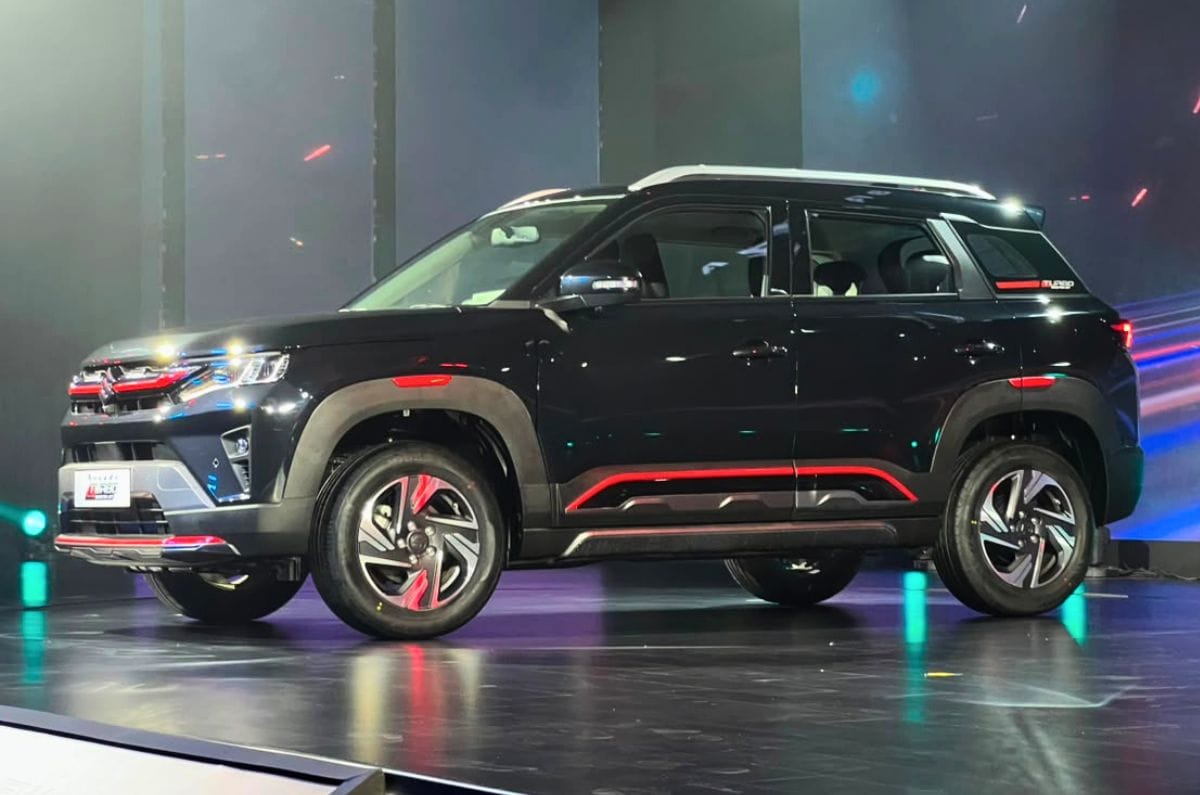
Maruti Suzuki recently launched the 2026 Brezza with prices ranging from Rs 7.40 lakh to Rs 13.55 lakh (ex-showroom). With the midlife update, Maruti has introduced a 1.0-litre direct injection turbo-petrol engine to the Brezza, while also offering a couple of new features and a few new design elements. The 2026 Brezza is being offered in four trims: LXi, VXi, ZXi and ZXi+, and alongside the turbo-petrol engine, a 1.5-litre naturally aspirated petrol mill is also available with a CNG option.
In case you want to know how much you need to pay to get your hands on one, here are the 2026 Maruti Brezza’s on-road prices across major Indian cities.
2026 Maruti Brezza on-road price range
On-road prices of the 2026 Brezza range from Rs 8.26 lakh to Rs 16.81 lakh in major cities
2026 Maruti Brezza price range in major Indian cities (in Rs, lakh)
1.0TP 6MT
1.5P 6MT
1.5P 6AT
1.5CNG 6MT
Ex-showroom
7.40-11.16
8.30-10.50
10.61-13.55
9.30-11.50
Delhi (on-road)
8.26-12.95
9.26-12.18
12.31-15.72
10.67-13.37
Kolkata (on-road)
8.48-12.95
9.51-12.18
12.31-15.72
10.65-13.34
Mumbai (on-road)
8.55-13.17
9.59-12.39
12.52-15.99
10.37-13.11
Bengaluru (on-road)
8.77-13.73
9.84-12.92
13.06-16.67
10.67-13.37
Chennai (on-road)
8.70-13.84
9.76-13.02
13.16-16.81
10.67-13.37
Note: On-road prices may vary based on city-specific registration charges and other cost components, including insurance, FASTag and RTO fees. Please check with your nearest Maruti Suzuki Arena dealership for exact figures.
The 2026 Maruti Suzuki Brezza’s on-road prices are the lowest in Delhi among all the mentioned cities. This is followed by Kolkata, Mumbai and Bengaluru, with Chennai having the highest ask. However, a CNG option on the Brezza is the most affordable in Mumbai. That being said, the difference in on-road price of the top-spec Brezza variants for the 1.0-litre turbo-petrol manual is Rs 89,000, the 1.5-litre petrol manual is Rs 84,000, 1.5-litre petrol automatic is Rs 1.09 lakh.
आप रातभर ट्रेन में सफर करते हैं और चाहते हैं कि जर्नी आरामदायक होने के साथ लग्जरी भी लगे, तो मुंबई-बेंगलुरु (Mumbai-Bengaluru) वंदे भारत स्लीपर ट्रेन (Vande Bharat Sleeper train) आपके लिए खास हो सकती है। इसका फर्स्ट AC कोच मॉडर्न डिजाइन, प्राइवेसी और प्रीमियम सुविधाओं के साथ तैयार किया गया है, जिसकी पहली झलक ने ही ट्रैवलर का ध्यान खींच लिया है:
First AC Cabin (फर्स्ट एसी केबिन)
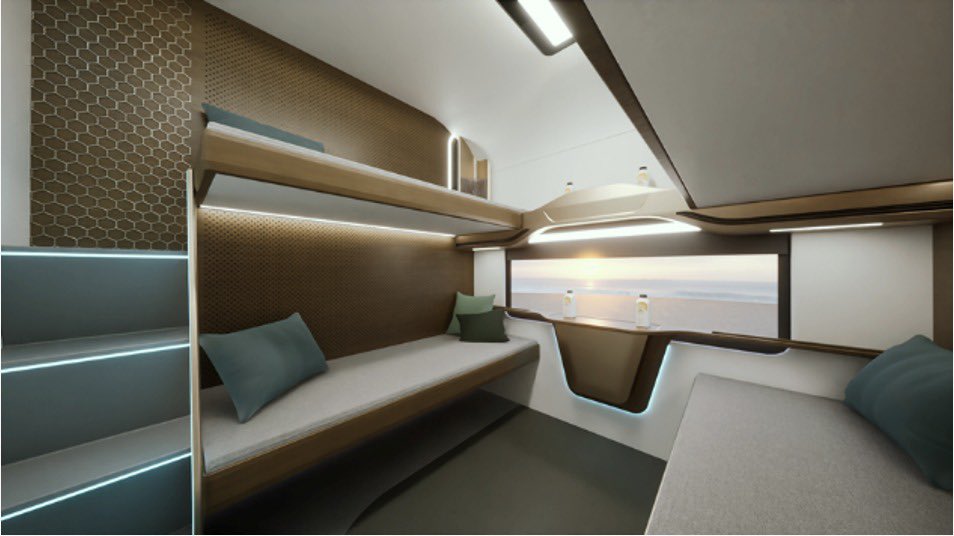
इस ट्रेन का फर्स्ट AC कोच सबसे बड़ा हाईलाइट माना जा रहा है। इसमें प्राइवेट केबिन (private cabin) दिए गए हैं, जिनमें स्लाइडिंग दरवाजे लगाए गए हैं। इससे पैसेंजर को पहले के मुकाबले ज्यादा प्राइवेसी और आराम मिल सकता है। केबिन का डिजाइन ऐसा रखा गया है कि सफर होटल (hotel-like travel) जैसा महसूस हो।
Premium Interior (प्रीमियम इंटीरियर)
कोच के अंदर का इंटीरियर मॉडर्न और अट्रैक्टिव बनाया गया है। लकड़ी जैसी फिनिश, सॉफ्ट LED लाइटिंग और खूबसूरत कलर थीम इसे स्टैंडर्ड ट्रेन कोच से अलग बनाती है। पूरा माहौल शांत और आरामदायक रखने की कोशिश की गई है।
Comfortable Journey (आरामदायक सफर)
ट्रेन में आरामदायक बर्थ, मजबूत सीढ़ियां (sturdy ladder) और हर सीट के पास चार्जिंग पॉइंट जैसी सुविधाएं दी गई हैं। लंबी दूरी (long-distance travel) की पैसेंजर को ध्यान में रखते हुए कोच को इस तरह डिजाइन किया गया है कि पैसेंजर आसानी से आराम कर सकें।
Smart Facilities (मॉडर्न सुविधाएं)
इस वंदे भारत स्लीपर ट्रेन में पैसेंजर इंफॉर्मेशन डिस्प्ले सिस्टम, मॉडर्न बायो-वैक्यूम टॉयलेट, बेहतर LED लाइटिंग, CCTV सुरक्षा और अन्य कई स्मार्ट सुविधाएं (smart feature) दी गई हैं। इनका उद्देश्य सफर (journey) को पहले से ज्यादा सुविधाजनक और सिक्योर बनाना है।
Better Overnight Travel (बेहतर ओवरनाइट यात्रा)
मुंबई (Mumbai) और बेंगलुरु (Bengaluru) के बीच रोज बड़ी संख्या में लोग सफर करते हैं। यह ट्रेन खासतौर पर रातभर की जर्नी को ज्यादा आरामदायक बनाने के लिए तैयार की गई है, ताकि पैसेंजर सुबह अपनी मंजिल पर फ्रेश होकर पहुंच सकें।
Ticket Booking (टिकट बुकिंग)
फिलहाल मुंबई-बेंगलुरु वंदे भारत स्लीपर ट्रेन की कमर्शियल सेवा शुरू नहीं हुई है और टिकट बुकिंग भी अभी शुरू नहीं हुई है। सोशल मीडिया के वीडियो ने इसकी शानदार झलक दिखाकर पैसेंजर की उत्सुकता जरूर बढ़ा दी है।
Royal Enfield has said that internal combustion engine (ICE) motorcycles will remain central to its business even after the launch of its first Flying Flea electric motorcycle. The company detailed its long-term strategy in its latest annual report under a new framework called RE-BALANCE.
Royal Enfield will continue investing in new ICE motorcycles alongside EVs.
Brazil is now the company’s largest and fastest-growing international market.
In the company’s annual report, Eicher Motors Executive Chairman Siddhartha Lal said Royal Enfield is committed to building its electric future but will continue investing in petrol-powered motorcycles for as long as possible. The RE-BALANCE strategy focuses on balancing investments in ICE and EVs, improving customer experiences, driving profitable growth and advancing sustainability.
While the company acknowledged that changing consumer preferences and dependence on ICE motorcycles pose long-term business risks, it said it will address these through product innovation, stronger brand relevance and deeper engagement with younger customers.
Royal Enfield said the RE-BALANCE strategy will guide its gradual expansion into electric mobility while continuing to invest in its established ICE portfolio. Its EV ambitions will be led by the Flying Flea brand, and Royal Enfield says that Flying Flea is designed to complement, rather than replace, its existing ICE lineup.
The C6, which is the first model under the brand, was showcased across several cities before its launch in India alongside the opening of the first Flying Flea store in Bengaluru. The motorcycle is priced at Rs 2.79 lakh (ex-showroom Bengaluru) and with Battery as a service (BaaS), the price comes down to Rs 1.99 lakh.
The annual report also highlighted Royal Enfield’s continued global expansion. Brazil emerged as its largest and fastest-growing international market, while the company further strengthened its overseas manufacturing footprint with new assembly facilities in Bangladesh and Thailand.
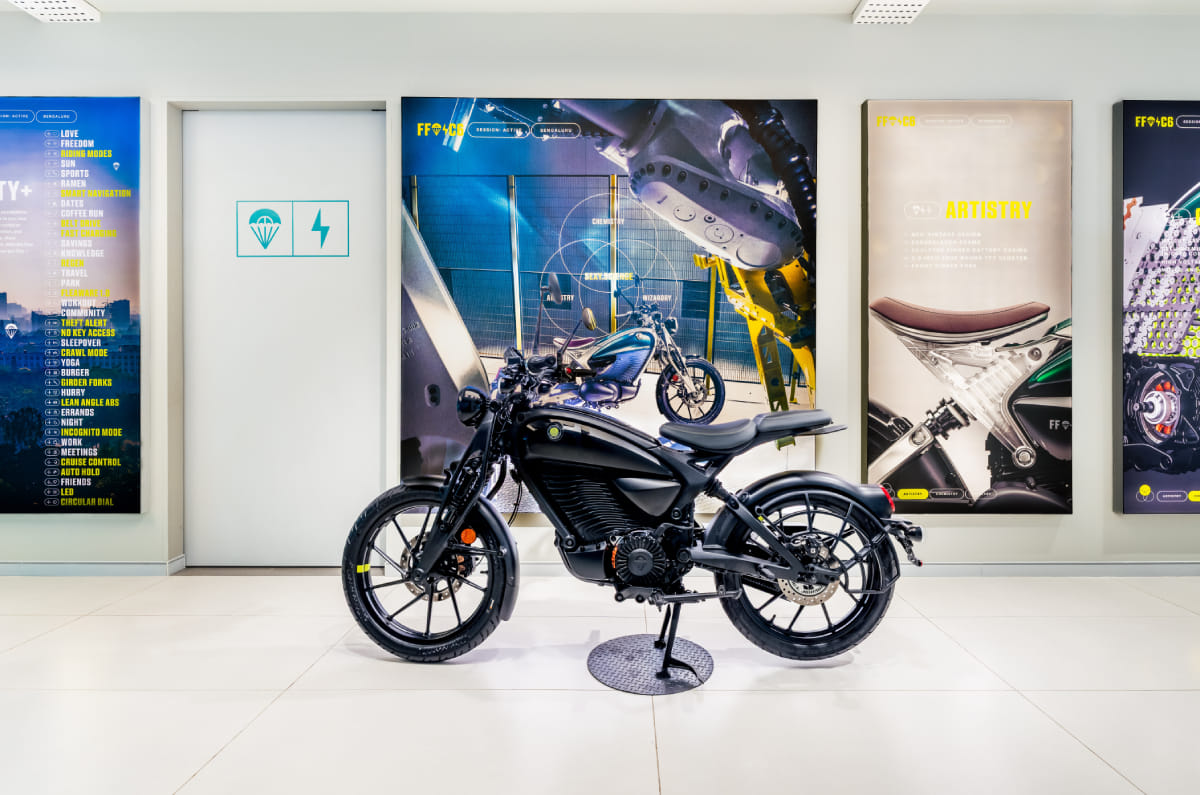
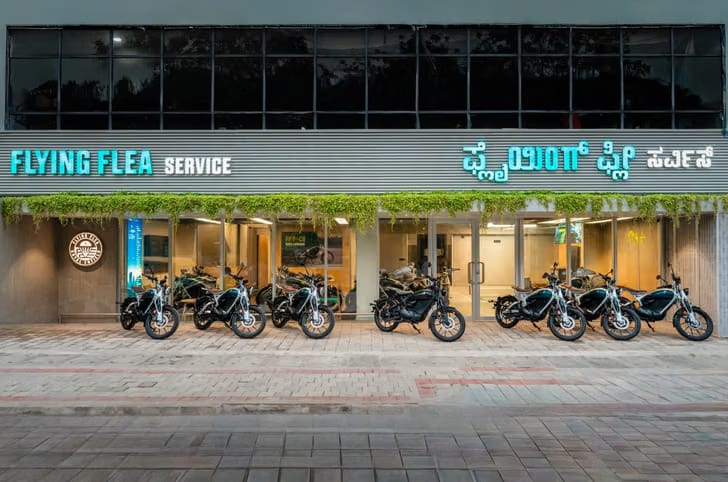
Flying Flea has expanded its retail presence in Bengaluru from a single store to 11 touchpoints across the city. The expansion follows what the brand describes as exceptional interest in its first product, the Flying Flea C6.
Flying Flea expands to 11 retail touchpoints in Bengaluru
C6 priced at Rs 2.79 lakh (ex-showroom, Bengaluru)
3.91kWh battery delivers a claimed IDC range of 154km
Flying Flea Bengaluru retail expansion: New touchpoints
Service network follows a hub-and-spoke model
The brand has confirmed that six of the new outlets are already operational, while the remaining five will open in the first week of August. The operational dealerships are located in Whitefield, Rajajinagar, Kalyan Nagar, Electronic City, Banashankari and Yelahanka. The upcoming outlets will be located in Marathahalli, Peenya, Nagarabhavi, B Narayanapura and Kengeri.
Flying Flea’s service network follows a hub-and-spoke model, with a dedicated service hub in BTM Layout handling specialised technical support and multiple spoke centres across the city catering to routine maintenance. All C6 owners also receive 24×7 roadside assistance as standard.
The Flying Flea C6 is priced at Rs 2.79 lakh (ex-showroom, Bengaluru), or Rs 1.99 lakh under the Battery-as-a-Service programme. It is powered by a 3.91kWh battery pack paired with a permanent magnet synchronous motor producing 15.4kW and 60Nm. Flying Flea claims an IDC range of 154km, a 0-60kph time of 3.7 seconds and a top speed of 115kph.
Flying Flea is following a city-by-city rollout strategy, with Bengaluru serving as its first market. The brand says it will progressively expand to other major metro cities as part of a phased rollout.
River Mobility has rolled out the 50,000th unit of its Indie electric scooter from its manufacturing facility in Hoskote, Karnataka, reaching the production milestone less than three years after the model’s launch in October 2023.
50,000th Indie rolled out from River Mobility’s Hoskote facility in Karnataka
Indie produces 6.7kW of peak power
Claimed IDC range of 160km
River Mobility production milestone: Key details
Retail network now spans over 75 stores across India
The company has simultaneously expanded its retail presence to more than 75 stores across the country. Both vehicle and battery pack assembly take place at the Hoskote facility.
The Indie is currently priced at Rs 1.55 lakh (ex-showroom, Bengaluru) and has been one of the standout growth stories in India’s electric scooter segment over the past year. The scooter recorded its highest-ever monthly retail sales in June 2026, with 4,436 units sold – up 234 percent year-on-year. Sales in CY2026 have already accounted for more than 54 percent of all Indie retail sales since the model’s launch.
River Mobility now ranks seventh among electric two-wheeler manufacturers in India by monthly retail volumes. At its current run rate, the company appears on track to cross 50,000 annual retail sales for the first time in 2026.
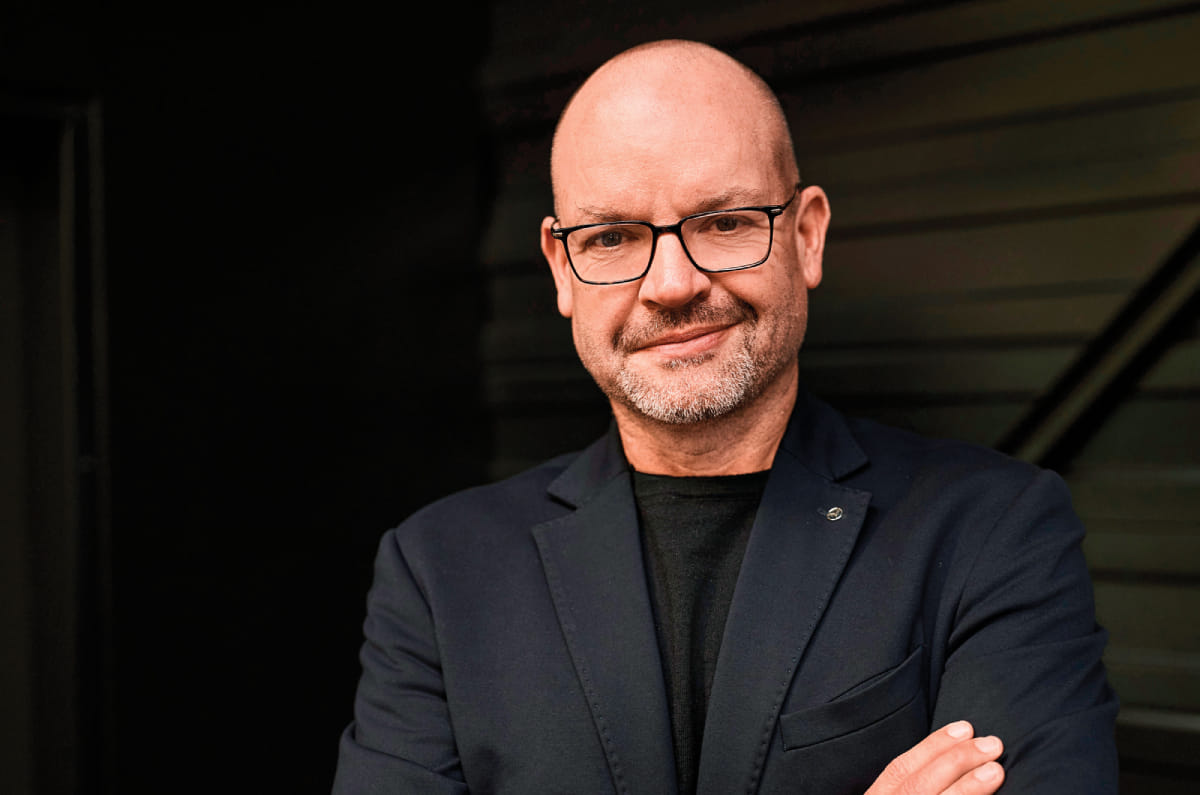
Mercedes-Benz’s Research and Development centre in Bengaluru has evolved from a hardware-focused engineering hub into one of the company’s key global R&D centres, with teams working across software, ADAS, electric powertrains and physical vehicle development. In this interview, Jörg Burzer, Member of the Board and Chief Technology Officer, Development & Procurement at Mercedes-Benz Group AG, discusses the centre’s expanding capabilities, the role of AI in vehicle development, the future of autonomous driving, and why he believes every Mercedes-Benz has “a bit of India” in it.
A lot of global auto OEMs have large R&D centres in India. Beyond cost, what are the benefits of having such large setups in India
Yes, it’s not only cost; you see, the competence level is so high. If you look at our centre, we will be celebrating its 30th anniversary here in India, and over these years, it has only grown in size and capability. We started with hardware, but now it’s massively into software, infotainment and autonomous driving. The team in India is contributing heavily on ADAS, for instance, and we are working on Level 3 and Level 4 with the team in India. So, all in all, I would say it’s competence, speed and agility that are good here.
Is the Mercedes development centre mainly a digital unit, or is physical development also being undertaken here?
Oh certainly, we have lots of hardware development. There are many test benches, and you’ll see lots of physical testing and development taking place here. Even beyond powertrain, there’s a lot of physical development taking place along with our vendors here too. And then, on electric vehicles, we’re working on the powertrains and batteries too. And yes, on the digital side, there’s lots of AI work, not just on the product, but also on process development. So yes, the centre is a full-scope R&D centre, a blend of the digital and physical. For example, we do a lot of work on the simulation of sheet metal forming and welding here.
Besides engineering, does the India centre also do design and styling work for your products?
On the design side, at Mercedes, we have this philosophy that we are creating a global product, and so we have a global design. This might change a little bit – obviously, we are adapting our design, which might be enriched by certain market trends – but for us, it’s very important that it is a global design, so we have one design hat. So, our styling team is based in Germany, where we have our design centre, and that’s important for us to maintain the global approach.
Software is today a leveller, even phone manufacturers can make a car today. Do you view this as a threat?
I see this as an opportunity because, for instance, you can develop a software stack for ADAS, but at the end you have to apply it to hardware. One interesting bit, to my knowledge, is that we are the only OEM doing a Level 2++ ADAS with a combustion engine, otherwise you only see this on EVs. To do this in a combustion engine environment, you know, with things like a transmission, it’s more complicated, so that’s where our expertise in traditional technologies, along with our developments in software, has an advantage. And of course, we have tremendous respect for our competitors and we are seeing what they are doing, but for me, I think if you do this mix right, you will be at the forefront of development.
Past Mercedes cars stood for robust engineering. What do you think a Mercedes 10 years from now would be all about?
Obviously there will be tech, but there will be more. I can give you a good example, one of the most important characteristics and values of a Mercedes-Benz is safety. We do plenty of crash tests every year for our cars that we launch, plus there’s a lot that we are doing with autonomous driving too, for instance, what we are doing with Nvidia. And here we have a lot of redundancy. We have a traditional software stack with massive amounts of info like what is a stop sign in every different market, for example. But there’s an end-to-end stack where the software is trained by the behaviour of the driver in traffic, but what we are doing is we have both stacks, so if the end-to-end system does not know what to do, then it can fall back to the classic system. So, we create a safety environment, where we know there is always a solution.
On redundancy, what is your view of a wide sensor stack like radars, lidars and cameras, or is AI with cameras only fine?
We are using AI, yes, but we have radars too. We have to use AI to create efficiency in the simulation and training, but you have to also think about the sensor set, and for me, I am convinced you have to have a multiple sensor set, not just one type. So, like on the S Class, we have multiple cameras, radars and ultrasonic sensors too.
Does the India R&D centre develop products or platforms independently of headquarters, or is it more synergetic?
For us, it’s very important that we do everything as a team. So, for me personally, it’s very important to have a global perspective in R&D because the innovations and technology solutions are so complex that you can only master them as a team. There are a lot of competencies, but there is not one single team in the world that can say, ‘I am the one that can create a platform.’ It’s always teamwork, and if you look at all industries, automotive engineering is the ultimate for teamwork. So for us, R&D is one big team. And with regards to the India centre, I love to say that in each and every Mercedes, there is a bit of India in it.