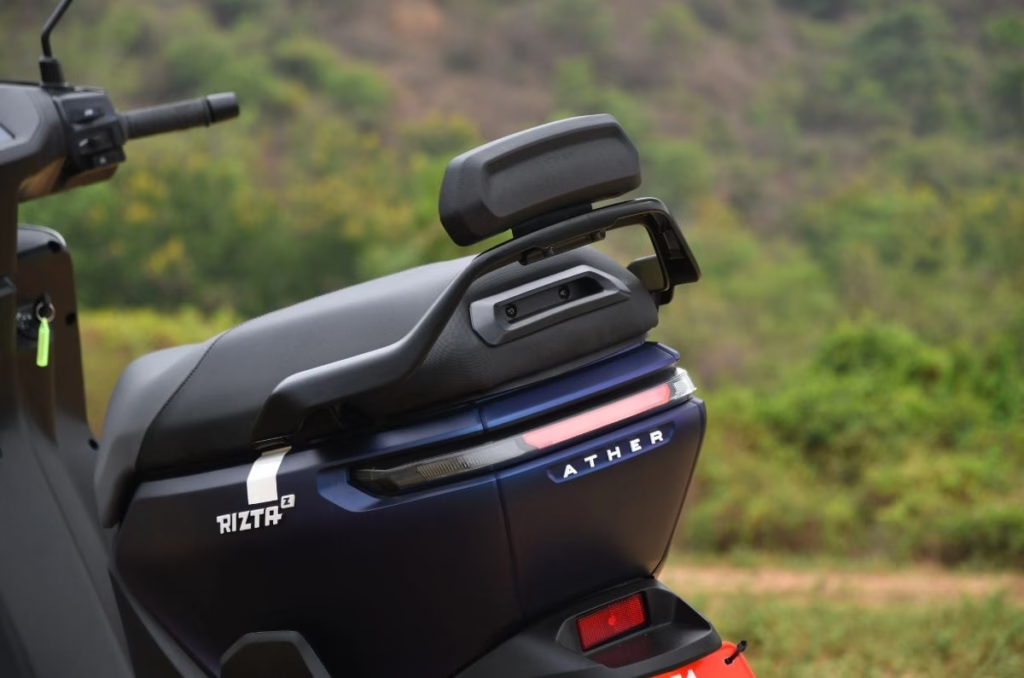
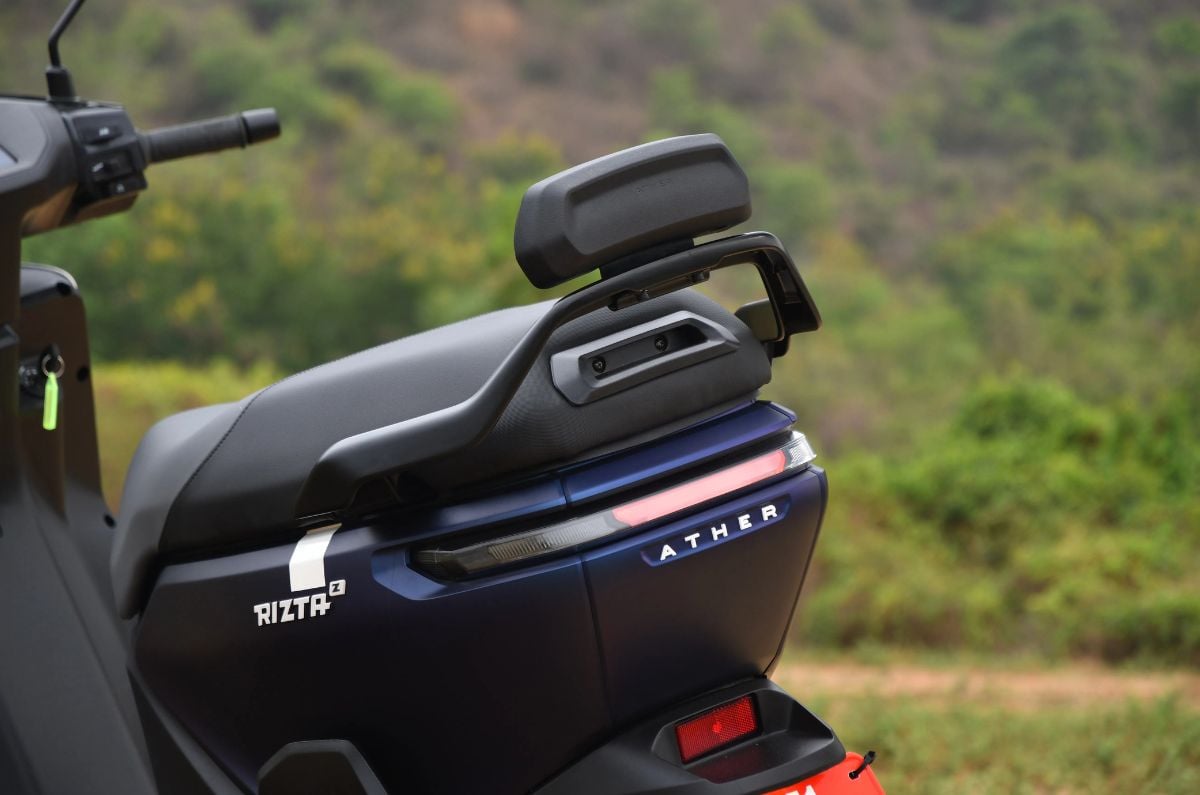
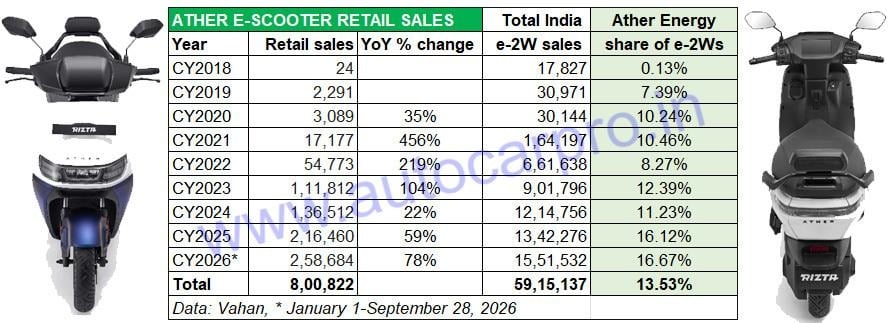
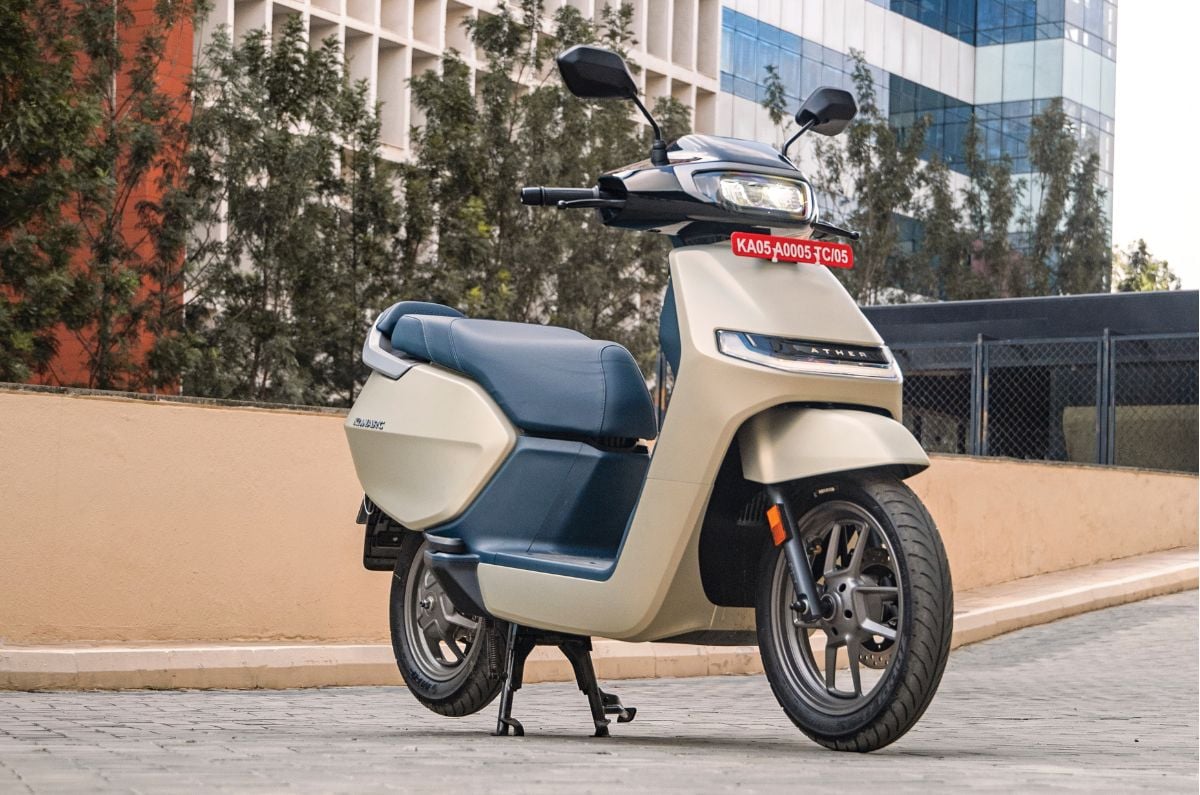
Ather has become the fourth Indian electric two-wheeler manufacturer to attain cumulative retail sales (customer deliveries) of over 8 lakh units. As per the data available on the Vahan portal, the Bengaluru-based company crossed the milestone on September 28, 2026.
Ather has delivered 4.75 lakh scooters since January 2025
217 units of the Konarc sold in its first month
Rizta currently leads Ather’s sales, but Konarc is expected to eat into it
Ather is the fourth Indian e2W maker to cross 8 lakh units in sales
59 percent of its sales came since 2025
Other EV manufacturers to sell over 8 lakh scooters are Ola, TVS and Bajaj via Chetak. While Ola crossed 10 lakh sales in March this year, TVS raced past Ola in August to become India’s second EV manufacturer to sell 10 lakh scooters. Bajaj crossed the 8 lakh sales milestone in June. Except Ola, the other three manufacturers mentioned above have maintained a steady pace of growth so far.
As the retail statistics reveal, Ather’s growth has taken off in the past four years, with sales accelerating since 2025. Between January 2025 and September 28, 2026, Ather delivered 4.75 lakh scooters, which means that 59 percent of the brand’s total sales have come in the past 21 months, led by its flagship, the Rizta family e-scooter. The company launched Konarc on August 29.
In 2023, when Ather’s retail sales crossed the 1 lakh mark, its market share jumped to 12 percent. In 2024, it clocked 1.36 lakh units and an 11 percent market share. Ather achieved its highest-ever monthly sales in March this year with 36,633 units. It also crossed the 30,000-unit sales mark four times in the past year (since October 2025).
In August, Ather dispatched 29,694 e-scooters to its dealers across India. This marked the third-highest monthly wholesales for the company after June and July, respectively. While the Rizta accounted for 76 percent of those sales and the 450 series 23 percent, the new Konarc sold 217 units in its first month.
The Konarc strategically targets the mainstream mass-market scooters like the TVS iQube, Orbiter, Bajaj Chetak, Hero Vida VX2, Simple Wave and the new Ola S1 Z. It will likely take some sales away from the Rizta. However, Ather appears to be fine with that since the Konarc gives it a higher margin than the Rizta, as per chief business officer Ravneet Phokela. Rather than competing with existing e-scooters, Ather will try to convince more ICE scooter owners to buy the Konarc instead, Phokela had added. With its momentum, Ather could end the year with total sales of 3.5 lakh units.
Bengaluru-based EV maker Ather expects its newly launched Konarc electric scooter to drive more than half of its sales over the next two years. The company is positioning Konarc as a key product in its attempt to take electric scooters mainstream, with the focus less on taking customers from rival EV makers and more on converting buyers who would otherwise remain with internal-combustion engine scooters.
Konarc has five variants, four of which are priced close to the Rizta
Manufacturing and availability set to ramp up after the festive season this year
Konarc is expected to make (Ather) EVs mainstream
Konarc has higher profit margins than Rizta despite a lower price
“The role of Konarc is to take EVs mainstream, which, by definition, means that we’re looking at weaning people away from ICE,” said Ather’s chief business officer Ravneet Phokela. “This is not about getting market share from somebody else. It’s really about getting share from the ICE world.” For these customers, he added, Ather first needs to address fundamental considerations around comfort, safety and battery life before features and technology become the differentiators.
Despite a lower starting price of Rs 99,999, the Konarc also has better margins than the Rizta, according to Phokela. It is currently available in five variants (three S and two Z), with four positioned around price points similar to the Rizta’s. Ather has moved from an aluminium chassis for the 450/Rizta to a tubular steel chassis on the Konarc and from a two-stage belt transmission to a gearbox. The charger and motor controller have also been combined into a single unit.
The EL platform has allowed Ather to incorporate learnings from the 450 platform that couldn’t be introduced into that architecture. Phokela described the 450 platform as appropriate for the performance-oriented 450 but “overkill” for the family-focused Rizta, which had to use the existing architecture to meet its development timeline. The EL platform, in contrast, was conceived from the outset as a simpler architecture with a fundamentally lower cost structure.
Konarc is currently being supplied only in parts of North India, with Ather yet to open bookings across central and southern markets. Ather expects this constraint to ease after its new manufacturing facility is commissioned in December, although Phokela said it would take a few months thereafter to ramp up production. More markets are expected to be added progressively as supplies improve. The supply situation has also led Ather to pause showroom expansions for now. It currently has around 750 outlets, with expansion expected to gather pace again after the festive period. Over the next 18-24 months, Phokela sees around 2,000 stores as a target while maintaining that expansion will be calibrated to ensure dealers remain viable and profitable.
With inputs from Mukul Yudhveer Singh and Stephen Raj Antony
While the Indian manufacturers have been quick to capitalise on the EV boom, the Japanese have been rather more measured in their approach. Honda arrived in 2025 with not one but two in-house electric scooters, though both had unique limitations that prevented them from succeeding.
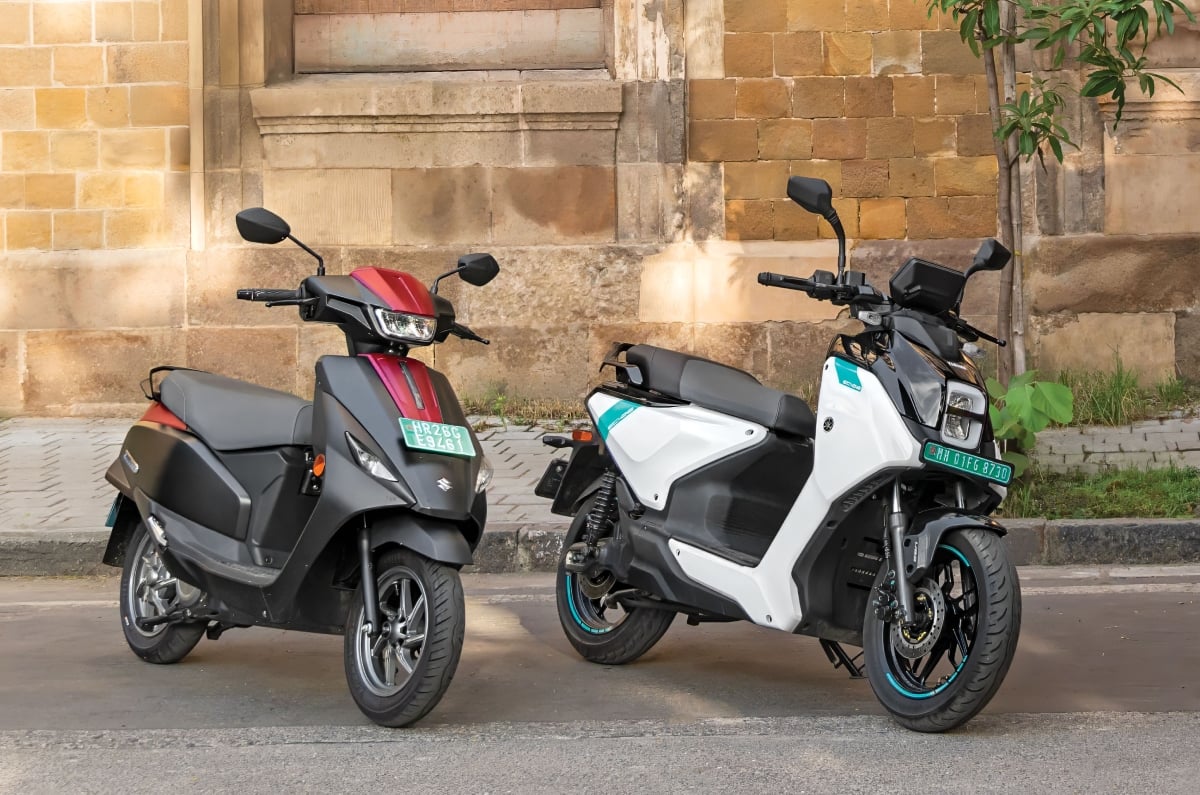
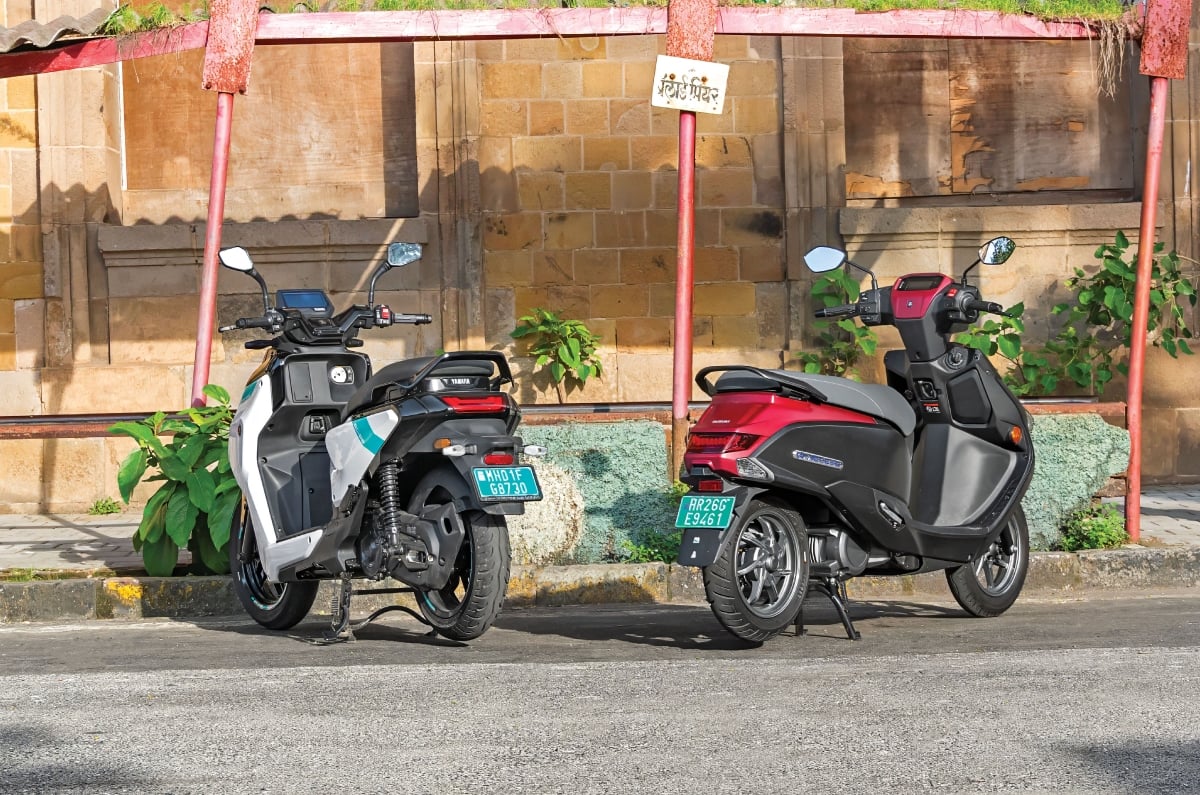
Suzuki, like Honda, chose to develop its own platform from scratch, but its e-Access appears expensive for what it offers. Yamaha, meanwhile, took a markedly different route for its more affordable offering and partnered with an Indian startup. The EC-06 is, in essence, a more expensive River Indie in sharper clothes.
So if you’ve been waiting for a Japanese e-scooter, you now have two choices, but like their very different inceptions, both also offer you two very different flavours of electric scooter. The question, then, is which one deserves your money – and whether either deserves it over the competition.
Not hiding in plain sight
Subtle, these scooters are not. Both take distinctly left-field approaches to styling and will stand out from the crowd. Over the fortnight we spent with them, the EC-06 consistently drew more positive attention thanks to its chunky, squared-off proportions. The e-Access found its niche too, though its double duck-bill nose, flowing front panels with a contrastingly boxy tail make it more of an acquired taste.
Yamaha EC-06
Suzuki e-Access
Kerb weight
132kg
122kg
Seat height
770mm
765mm
Underseat storage
24.5 litres
17 litres
Ground clearance
145mm (laden)
160mm (unladen)
Climb aboard and their personalities diverge further still. The e-Access feels more like a conventional scooter. Despite its compact dimensions, it never feels cramped, even for taller riders, while its 765mm seat height makes it instantly approachable for shorter ones.
The EC-06, by comparison, feels a size larger. Its riding triangle is noticeably roomier, which taller riders will appreciate in a segment that seldom caters to them. Yet, with a friendly 770mm seat height, it remains fairly unintimidating for shorter riders. In fact, tall riders will want a higher seat.
Different strokes
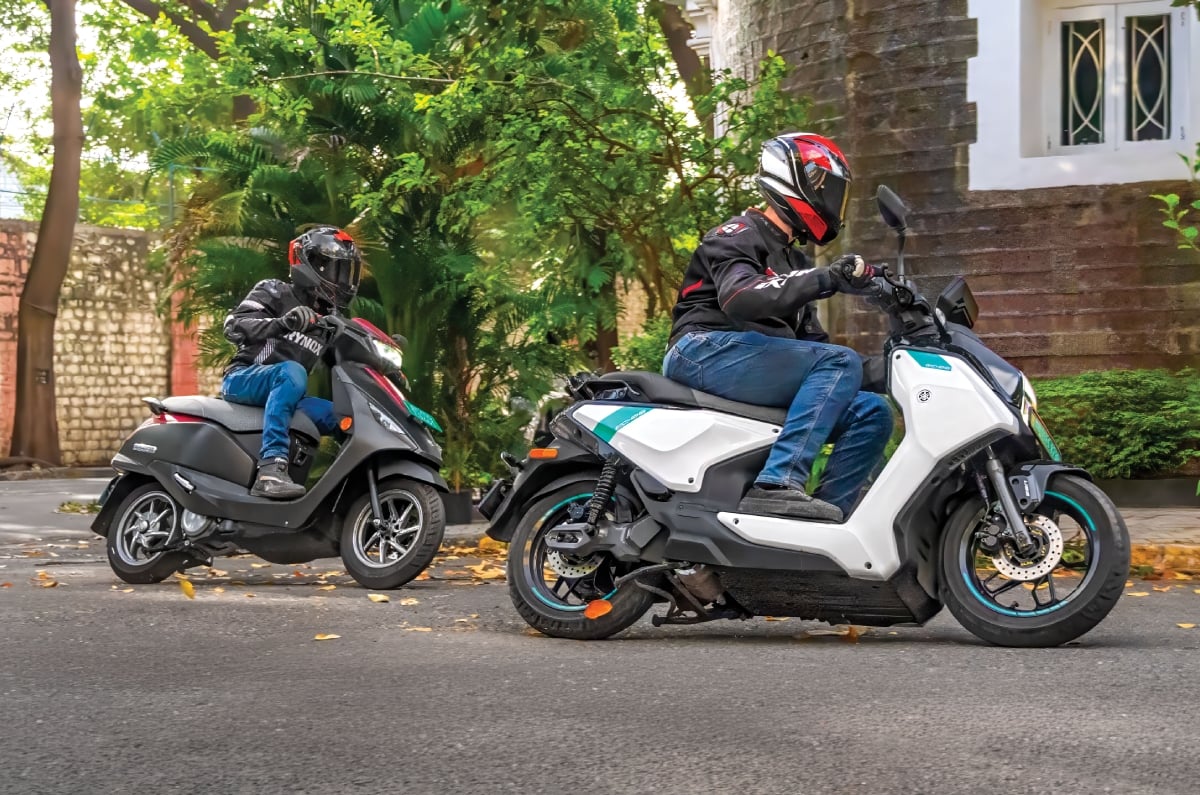
The riding experience of both also reflects two very different engineering philosophies. The 122kg e-Access feels exceptionally light on its feet; whether wheeling it around a parking space or flicking it into a bend, it responds eagerly – actually, a bit too eagerly. Some of that can be attributed to Suzuki mounting the battery pack vertically beneath the seat, a decision that, as you will read further on, has implications elsewhere too.
Yamaha EC-06
Suzuki e-Access
Battery capacity / chemistry
4kWh / NMC
3.072kWh / LFP
Motor
Permanent Magnet Synchronous
Permanent Magnet Synchronous
Power
6.7kW
4.1kW
Torque
26Nm
15Nm
Like the latest Burgman, its ride also errs towards the firmer side rather than the plush feel of a TVS iQube. It isn’t uncomfortable by any means, but it is something worth paying attention to on a test ride. Taller riders will also discover the Suzuki’s compactness during full-lock U-turns, where their knees will foul the handlebar.
On the flip side, the EC-06 is relatively heavier and slower to steer, but it’s a small tradeoff. That’s because its larger 14-inch wheels lend it greater stability at faster speeds and also help it dismiss broken roads with admirable composure. Its absorptive suspension also factors in here, though particularly sharp impacts can provoke a slight judder in the fork.
E-Access has the more flighty, energetic demeanour, whereas the EC-06’s handling is more sure-footed.
The Yamaha’s seat, however, leaves quite some room for improvement. Its forward-sloping shape constantly makes you slide forward, necessitating frequent shuffling about. The padding is also too soft, and after just 30 minutes or so, you find yourself sinking into the seat pan. This results in a gradually more knees-up riding position, which might sound like a trifling problem at first but one that becomes increasingly apparent over longer journeys.
Neither one gets ABS, which feels like quite an egregious oversight considering their price points. Nevertheless, the Yamaha’s brakes inspire greater confidence because they are powerful without being overly aggressive, and its wider tyres also provide better traction. The Suzuki’s brakes, conversely, are almost too sharp. On Mumbai’s slippery concrete roads, they demand a more measured touch when coming to a halt quickly.
Not that you’ll often rely heavily on them. That’s partly down to the well-calibrated regenerative braking system and partly because the e-Access’ performance is quite unremarkable. Not only is it much slower than the EC-06, but it also feels noticeably less eager than the petrol-powered Access. It’s perfectly usable in the city, but on faster roads, overtakes require planning. Unsurprisingly, the Yamaha feels considerably livelier. It accelerates with genuine enthusiasm in its top Power mode, the regenerative braking is seamlessly calibrated in all 3 modes (Standard and Eco being the other two) and, despite using chain drive, its drivetrain is remarkably silent – akin to a hub-mounted motor.
Feel Good (?) Features
Build quality on both is reassuringly solid and exactly what one expects from the Japanese. At these prices, however, there are a few omissions that are difficult to overlook.
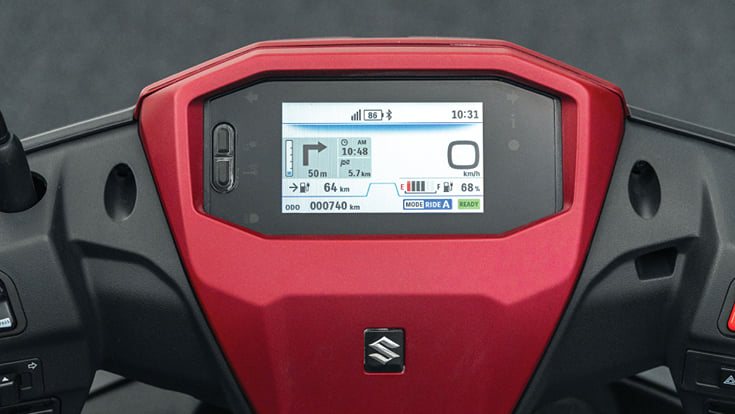
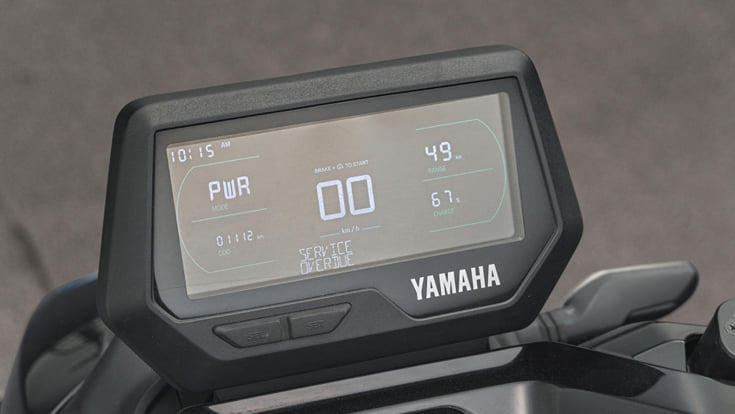
The e-Access employs the same TFT display found on the ICE Access 125 and Burgman, both of which cost substantially less. Yamaha, meanwhile, supplies only the slower 480W charger, despite the considerably more affordable River offering a faster 750W unit as a Rs 3,000 option.
Same TFT as ICE Access; EC’s negative LCD is simpler but well laid out.
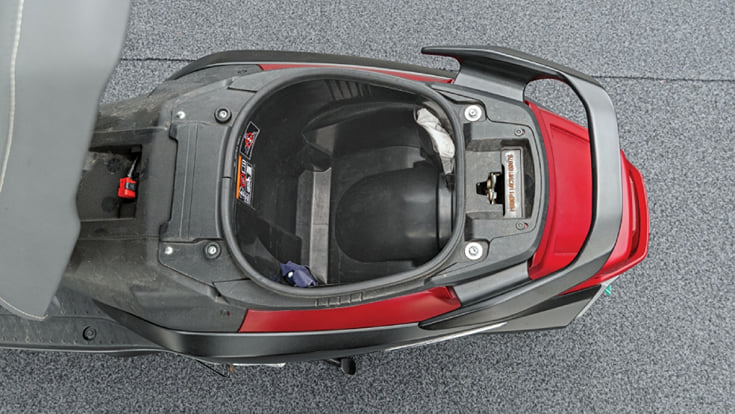
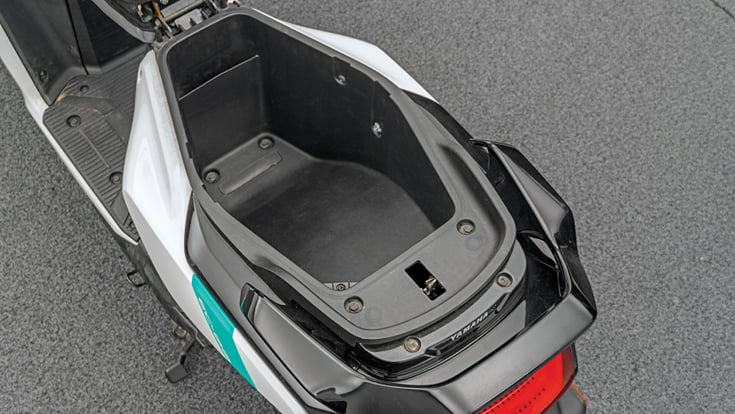
The EC-06 also sacrifices a lot of storage compared to the Indie. Its 24.5-litre under-seat boot is far short of the latter’s enormous 43-litre boot and trails established rivals such as the iQube, Rizta and Chetak. The River’s lockable 12-litre glovebox has been omitted too, though Yamaha has used this to reposition the charging port to a more convenient location.
e-Access’ 17L boot far too small and oddly shaped; Yamaha’s 24.5L boot is more usable but not segment-leading.
If the Yamaha’s storage is merely average, the Suzuki’s is positively outclassed. The battery’s position beneath the seat results in just 17 litres of bootspace – roughly half what you’ll find on rivals like the Rizta and Chetak. In fact, even the ICE Access 125 offers you quite a bit more storage space. The e-Access’ boot is also shaped quite awkwardly, and unless the charger’s cables are folded with almost Victorian precision, it simply refuses to fit.
Range Rovers?
An electric scooter ultimately needs to deliver one thing above all else – promising range to reduce your running costs. In Ride A mode, which delivers full performance and max regen, the e-Access covered a little over 88km in our range test. Given its smaller 3kWh battery and its use of safer, but less energy-dense, LFP chemistry, the result is respectable in isolation; however, compared to the market’s front-runners, it falls far short.
Yamaha EC-06
Suzuki e-Access
0-40kph
3.46s
4.94s
0-60kph
6.82s
11.93s
Roll-on Acceleration
20-50kph
3.31s
5.46s
30-70kph
7.34s
17.01s
50-80kph
10.96s
–
Our test on the EC-06 was conducted in its middle Standard mode, which retains full performance but softens throttle response compared to Power mode. It covered 114km, comfortably exceeding the distance initially predicted. Both scooters deserve praise here, as their range indicators proved refreshingly honest, not indulging in optimistic guesswork.
Yamaha EC-06
Suzuki e-Access
60-0kph
22.87m
24.64m
Using Eco mode will naturally extend the range on both, though with reduced acceleration and lower top speeds. Thankfully, neither becomes painfully slow. Even in Eco, both climb flyovers and keep up with city traffic without reducing themselves to rolling roadblocks.
While the Yamaha’s range is undoubtedly more impressive, its charging time is a rather different story. The supplied 480W charger requires a glacial ten hours to replenish a flat battery. Meanwhile, the Suzuki’s 600W unit requires around six hours to do the same, although its battery pack is also smaller.
One thoughtful detail both manufacturers deserve credit for is the inclusion of a dedicated charger bag. It is a small touch, but one that should help protect the charger from spending years rattling around inside the boot.THE BIGGER PICTURE
Judged purely against each other, the result is straightforward – the EC-06 clearly wins. It offers superior performance, greater comfort, longer range and also costs much less than the e-Access.
Yamaha EC-06
Suzuki e-Access
Price (ex-showroom, Bengaluru)
Rs 1.71 lakh
Rs 1.92 lakh
However, if you zoom out and look at the broader market, the context changes. At Rs 1.71 lakh, the Yamaha is hardly inexpensive, and the Suzuki, which is knocking on the door of Rs 2 lakh, is even worse off. When proven alternatives from TVS, Ather, Bajaj, Vida and River offer similar or even superior alternatives for substantially less money, the Japanese appear more like fringe players and less like mainstream contenders.
There will undoubtedly be a small demographic of buyers for whom a Japanese badge carries enough cachet to justify this big premium. However, for the rest of us, the more keenly priced and proven homegrown contenders are the better bet.
Honda QC3 Electric Scooter: Honda ने भारत में 1.35 लाख रुपये की कीमत पर QC3 इलेक्ट्रिक स्कूटर लॉन्च कर दिया है, जो उसकी बढ़ती EV रेंज में एक नया मॉडल है। QC3 में 3kWh की बैटरी और 145km की IDC रेंज के साथ-साथ सीट के नीचे 32-लीटर का स्टोरेज और 5-इंच का TFT डिस्प्ले दिया गया है। होंडा के लिए, यह नया स्कूटर ‘Activa e’ से अलग है क्योंकि इसमें स्वैपेबल सेटअप के बजाय फिक्स्ड बैटरी का इस्तेमाल किया गया है।
बता दें कि Honda QC3 को सबसे पहले पांच शहरों में पेश किया जा रहा है, इसलिए शुरुआत में इसकी उपलब्धता सीमित रहेगी। फिलहाल, QC3 की 5,000 रुपये में बुकिंग शुरू हो गई है, और कंपनी की योजना है कि इस स्कूटर की पहुंच को धीरे-धीरे बढ़ाया जाए।
Honda QC3 Electric Scooter: कीमत और उपलब्धता
Honda QC3 की कीमत 1.35 लाख रुपये (एक्स-शोरूम, नई दिल्ली) है। इसकी बुकिंग Honda की वेबसाइट और चुनिंदा RedWing डीलरशिप पर 5,000 रुपये में शुरू हो गई है। लॉन्च के समय, यह स्कूटर दिल्ली, आगरा, कटक, सूरत और कोल्लम में बेचा जाएगा। Honda ने कहा है कि इसे धीरे-धीरे और शहरों में भी उपलब्ध कराया जाएगा।
यानी QC3 को भले ही देश में लॉन्च कर दिया गया है, लेकिन इन पांच शहरों के बाहर रहने वाले ग्राहक फिलहाल Honda डीलरशिप पर जाकर इसे खरीद नहीं सकेंगे। शुरुआत में सीमित शहरों में उपलब्धता इस इलेक्ट्रिक स्कूटर की लॉन्चिंग का एक अहम हिस्सा है।
Honda QC3 Electric Scooter: 3kWh बैटरी, 145km रेंज
QC3 इलेक्ट्रिक स्कूटर में 3kWh का बैटरी पैक लगा है और इसकी IDC रेंज 145km बताई गई है। Honda का कहना है कि इसे 0 से 80% तक चार्ज होने में लगभग 2 घंटे 40 मिनट लगते हैं, जबकि पूरी तरह चार्ज होने में लगभग चार घंटे का समय लगता है।
Honda QC3 Electric Scooter: 32-लीटर स्टोरेज
QC3 की खासियतें काफी आसान और काम की हैं। इसमें सीट के नीचे 32 लीटर का स्टोरेज और स्मार्ट की (Smart Key) मिलती है। इसका इंस्ट्रूमेंट कंसोल 5-इंच का TFT यूनिट है, जिसमें Honda RoadSync कनेक्टिविटी और टर्न-बाय-टर्न नेविगेशन की सुविधा है। यह स्कूटर चार कलर ऑप्शन में उपलब्ध है। इनमें Matt Photon Gray Metallic, Pearl Precious White, Pearl Shallow Blue और Pearl Siren Blue शामिल हैं।
Honda QC3 Vs TVS iQube
Honda QC3 का मुकाबला शहरों में इस्तेमाल होने वाले इलेक्ट्रिक स्कूटर से होगा। इस सेगमेंट में TVS iQube के अलावा Bajaj Chetak और Ather Rizta जैसे मॉडल भी शामिल हैं। Honda QC3 की खास बातों में 1.35 लाख रुपये की कीमत, 3kWh बैटरी, 145 किलोमीटर की IDC रेंज और 32 लीटर का स्टोरेज शामिल है।
हालांकि, इलेक्ट्रिक स्कूटर खरीदते समय सिर्फ रेंज का आंकड़ा देखना काफी नहीं होता। चार्जिंग की सुविधा, रोजाना इस्तेमाल में मिलने वाली वास्तविक रेंज, स्टोरेज स्पेस, आपके शहर में उपलब्धता और ऑन-रोड कीमत जैसे कई दूसरे फैक्टर भी जरूरी होते हैं। इन्हीं चीजों के आधार पर ग्राहक Honda QC3 की तुलना TVS iQube और दूसरे इलेक्ट्रिक स्कूटरों से कर सकते हैं।
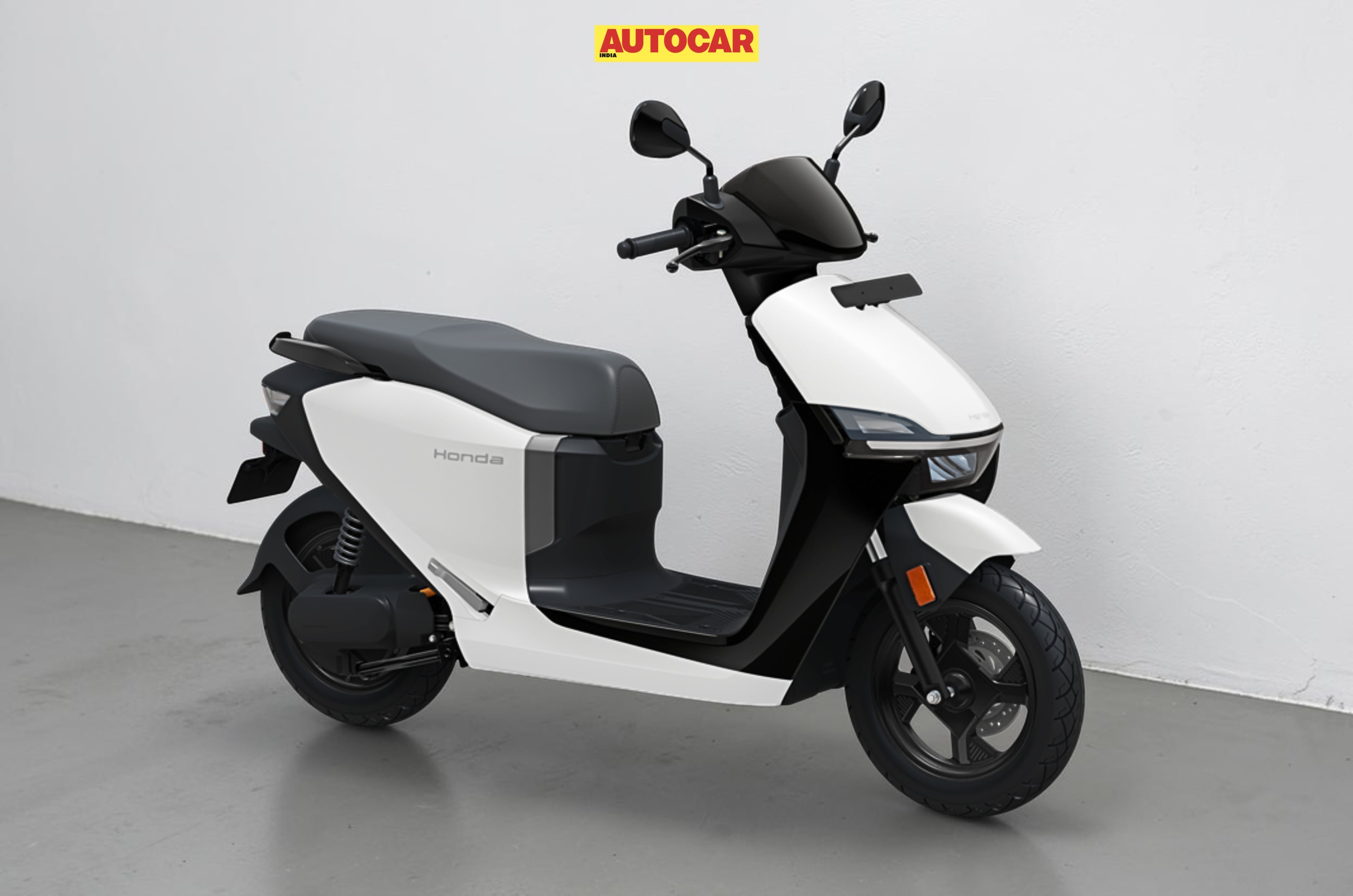
Honda has launched the QC3 at Rs 1.35 lakh, its third electric scooter for India after the QC1 and the Activa e:. The family EV scooter will have a 3kWh battery that can charge to full in approximately four hours, with a zero to 80 percent fill up taking 2 hours and 40 minutes. Honda has announced that the initial roll out of the QC3 will be limited to five cities across the country: Delhi, Agra, Cuttack, Surat, and Kollam with a nationwide rollout to follow in a phased manner.
Gets 32 litres of under seat storage
Has a hub-mounted motor, front disc brake
Honda QC3: What do we know so far?
QC3 will have the most range on any Honda e-scooter in India
Like we mentioned earlier, the QC3 will be Honda’s third EV product for India. Both the QC1 and the Activa e: were thought to be too under-equipped for their asking prices of Rs 90,408 and Rs 1.2 lakh, respectively. The QC3 aims to fix that with a bigger battery than the QC1’s 1.5kWh unit, and markedly more range than the Activa e:’s 102km (claimed, IDC).
Besides the charging times, we reported earlier that the QC3 will get a 5-inch TFT display capable of turn-by-turn navigation, via Honda Roadsync connectivity system. Honda has now revealed the under seat storage to be a respectable 32 litres, markedly higher than the QC1’s 26 litres. The Activa e:’s boot was almost completely occupied by its removable battery.
Thanks to local manufacturing, the QC3 is priced more competitively than Honda’s earlier EVs, at Rs 1.35 lakh, with four colours on offer: Matt Photon Gray Metallic, Pearl Precious White, Pearl Shallow Blue and Pearl Siren Blue. The price makes it a direct rival to the TVS iQube 3.1kWh at Rs 1.30 lakh, the Chetak C3502 at Rs 1.44 lakh, the Vida VX2 Plus 3.1 at Rs 1.03 lakh, and the newly launched Ather Konarc S 161 at Rs 1.45 lakh. All prices are ex-showroom, Delhi.
Honda hasn’t specified when deliveries will start at the time of writing. However, if you live in one of the five cities, bookings can be made at Honda’s website, or at your nearest RedWing dealership for Rs 5,000. With this, we now have prices for seven of the ten products Honda had announced in July, leaving the XR300L, XR300 Rally and the twin-cyl Rebel 500 as the only ones pending to be launched.
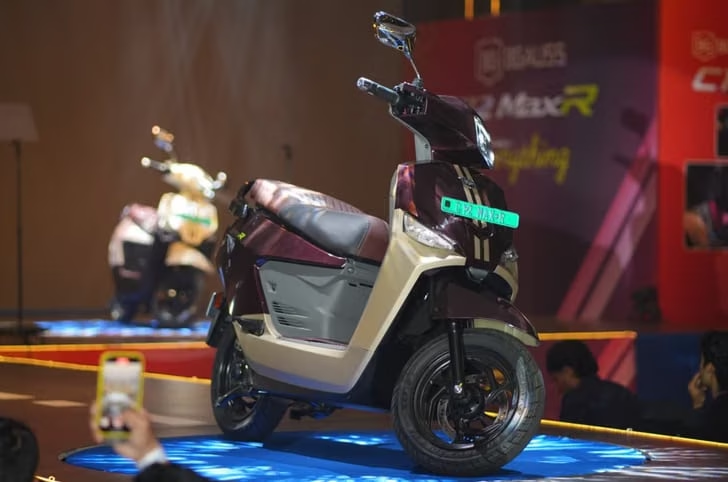
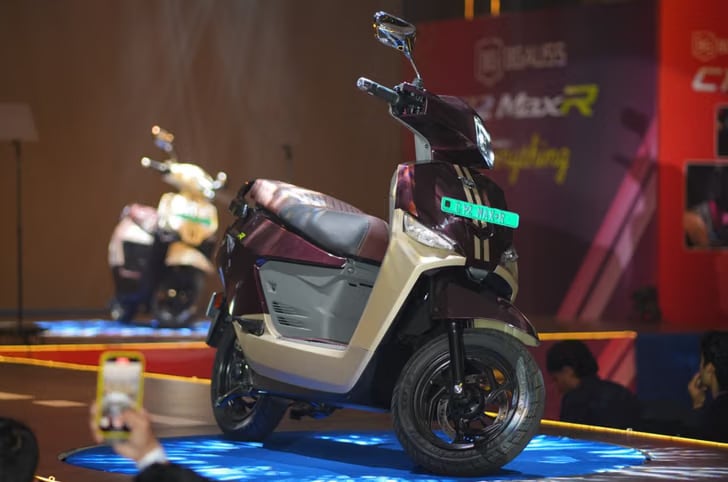
BGauss Auto has delivered over 10,000 electric scooters across July and August, with 5,560 units in July – its highest-ever monthly figure – followed by 5,045 units in August. Cumulative retail sales since its launch in August 2022 now stand at 91,373 units, with the 1 lakh milestone expected this year.
BGauss delivers 10,605 units in July and August combined
2026 already its best-ever year with 32,627 units
BGauss sales details
New flagship scooter, C12 MaxR, enters a competitive premium segment
The recently launched C12 MaxR is BGauss’s most premium product to date, priced at Rs 1.60 lakh (ex-showroom). The scooter is powered by a hub-mounted motor that produces 4.2kW of peak power, enabling a claimed top speed of 75kph. It comes with three ride modes – Eco, Ride and Sport – along with a reverse mode and cruise control. Its 3.8kWh LFP battery offers a claimed IDC range of 178km and, according to BGauss, is rated for a lifespan of up to 1.5 lakh kilometres.
At its price point, the C12 MaxR competes directly with the mid- and upper-end variants of the TVS iQube, Bajaj Chetak and Ather Rizta – the highest-selling scooters in our country. BGauss’s broader four-model portfolio of the RUV 350, Oowah, C12 Max and C12 MaxR is entirely priced above Rs 1 lakh, leaving the brand without an entry in the segment that houses newer, more affordable models like the base Ather Konarc.
That said, at its current monthly run rate, BGauss is on course to deliver around 46,000-47,000 units in 2026, which would be its best-ever annual figure. However, consistently crossing 7,000 units a month will be needed to make a meaningful move up the OEM rankings from its current position.
Axor helmets is the premium brand from Belagavi-based motorcycle helmet giant Vega. In existence since the early 1980s, Vega is one of India’s biggest motorcycle helmet manufacturers today, with an annual capacity of 9 million helmets a year across six manufacturing facilities.
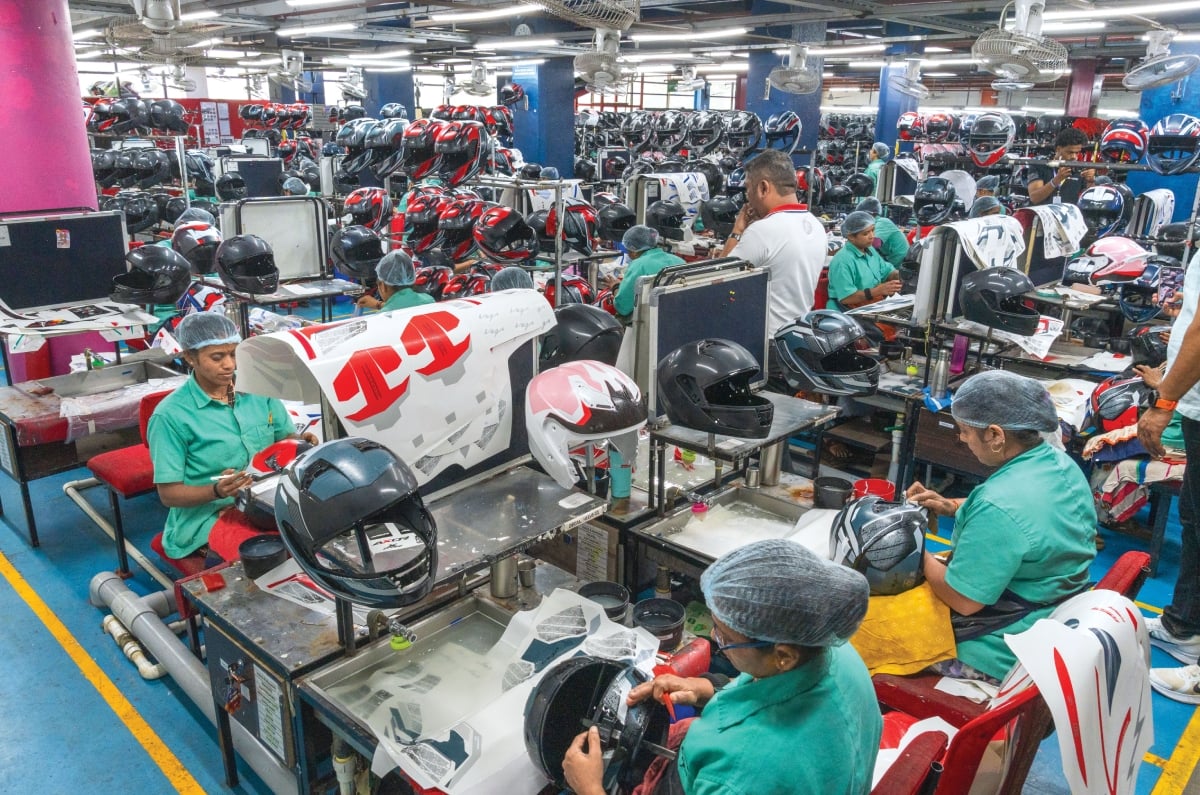
That translates to 25,000 units a day, and we got a sense of what an operation of this scale can look like by visiting one of the company’s production facilities in Belagavi, Karnataka. The facility we visited was one of Vega’s older units, which explained why many of the processes were more labour-intensive than I’d expected. What also came as a surprise was just how much of the manufacturing process is now in-house.
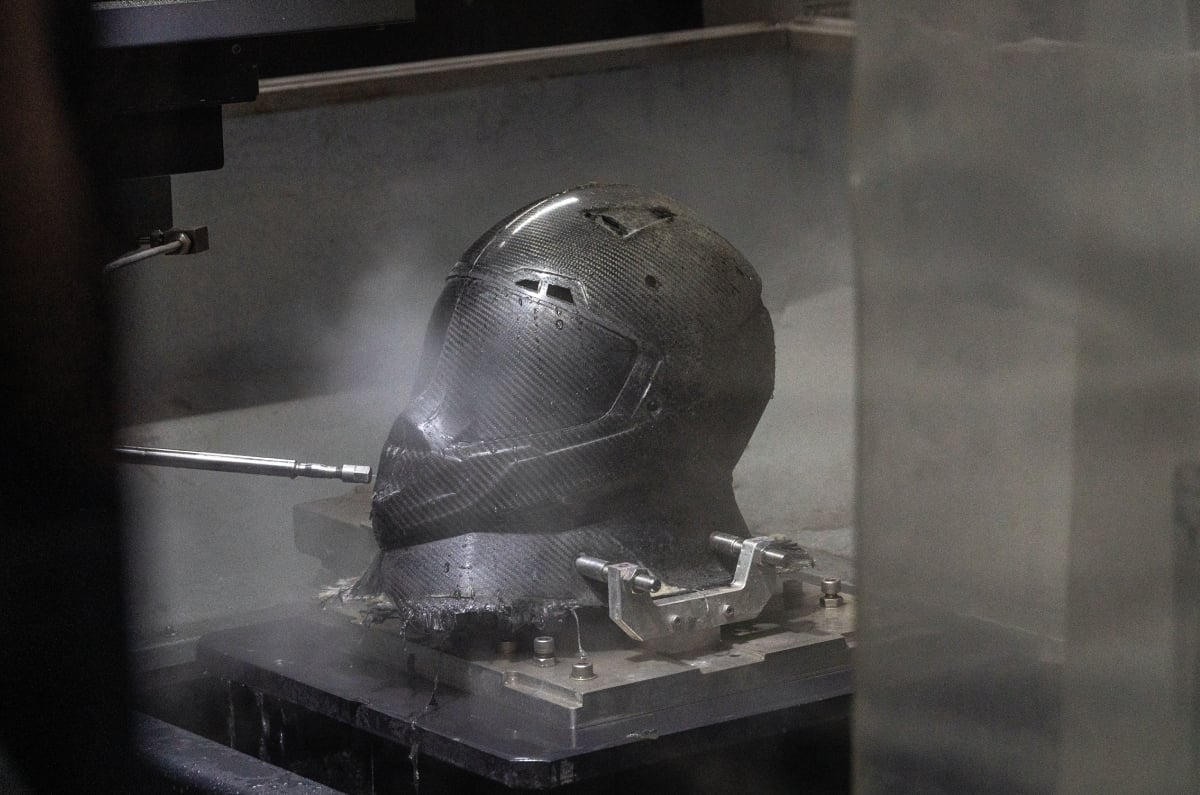
Tri-composite shell is moulded in-house and cut out using a CNC water jet.
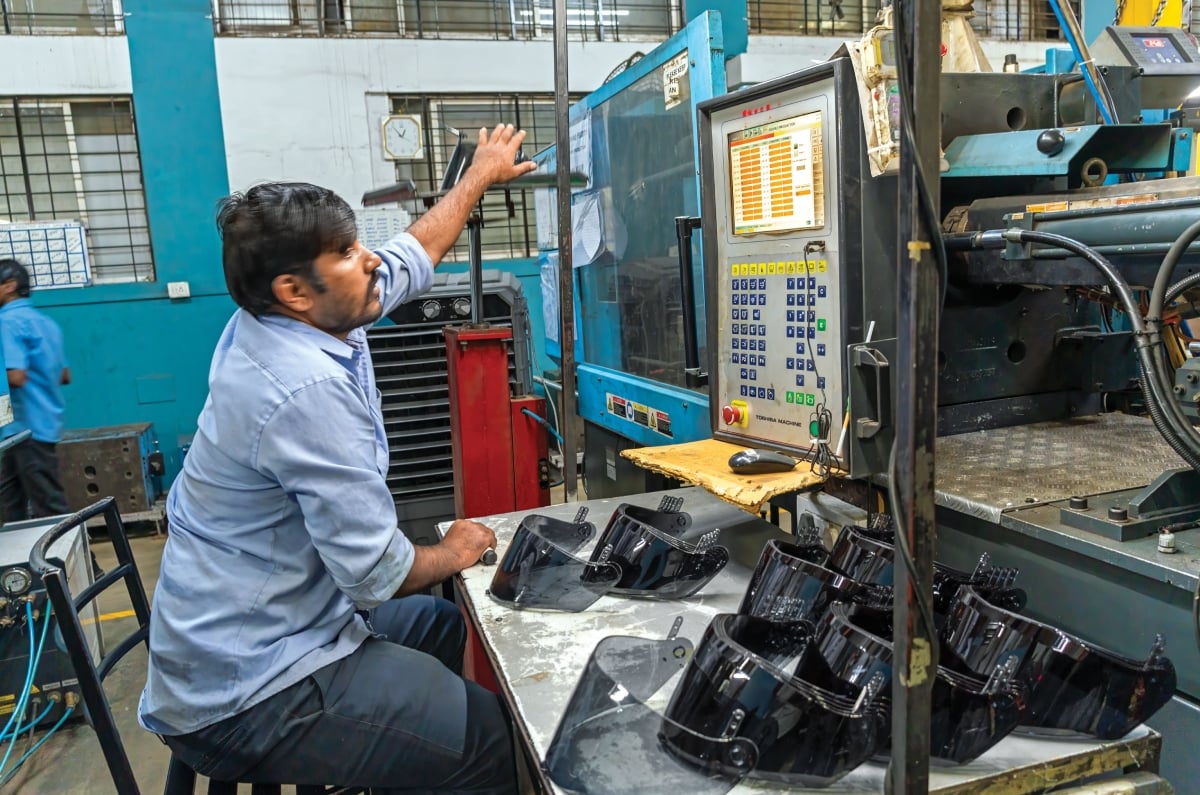
Everything from the plastic components for the vents to the EPS inner liner and even the polycarbonate visors is made by Vega. The company manufactures its own shells too, and the speed with which an ABS plastic shell can be made is what greatly contributes to being able to produce so many helmets in a day. It takes just 90 seconds for a bunch of plastic pellets to be melted and injection-moulded into a shell. The moulding posts are then cut off, and the shell slowly gets transformed into a helmet as it passes through various stages in the factory.
Once the ABS shell is processed, it is prepped for painting. The painting process in this plant was mostly manual, but there was an automated machine applying a clear coat. A separate UV chamber cures the clear-coated helmets (immediately for clear lacquer and about half an hour for matt lacquer). While some helmets stop with solid colours, many of them have complex water-transfer graphics that are applied to the helmet.
All plastic components, including the polycarbonate visors, are made in the same facility.
There are literally thousands of painted shells stacked on racks across the factory floor, waiting for assembly. We spotted helmets with KTM, TVS racing, Royal Enfield and Ather branding, which was a reminder of how many of India’s top manufacturers source their helmets from Vega.
With the painting process complete, components like vents, chin straps, EPS liner and comfort liner are all installed before the helmets are boxed and ready to ship. Watching it all come together was quite interesting, but the really fascinating part lay ahead when we were taken to the top floor of the factory.
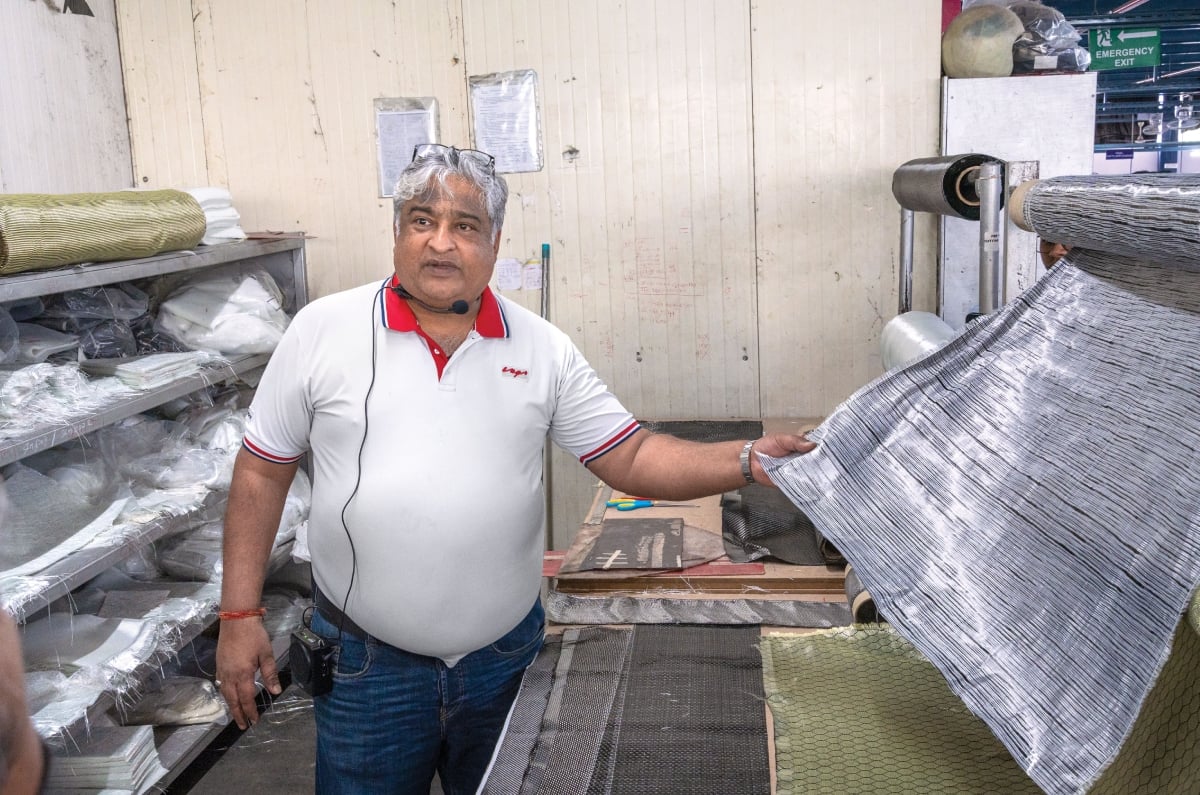
This is where Vega makes its fibreglass and carbon-fibre shells. Fibreglass helmets are still made today for international clients, and the company also has a long history of making carbon-fibre helmets as well. This goes all the way back to 1999, when it made its first pudding-bowl style carbon-fibre helmet for the American market under the Daytona Helmets brand.
Uttam Chandak, joint MD and R&D head, showcasing the composite materials.
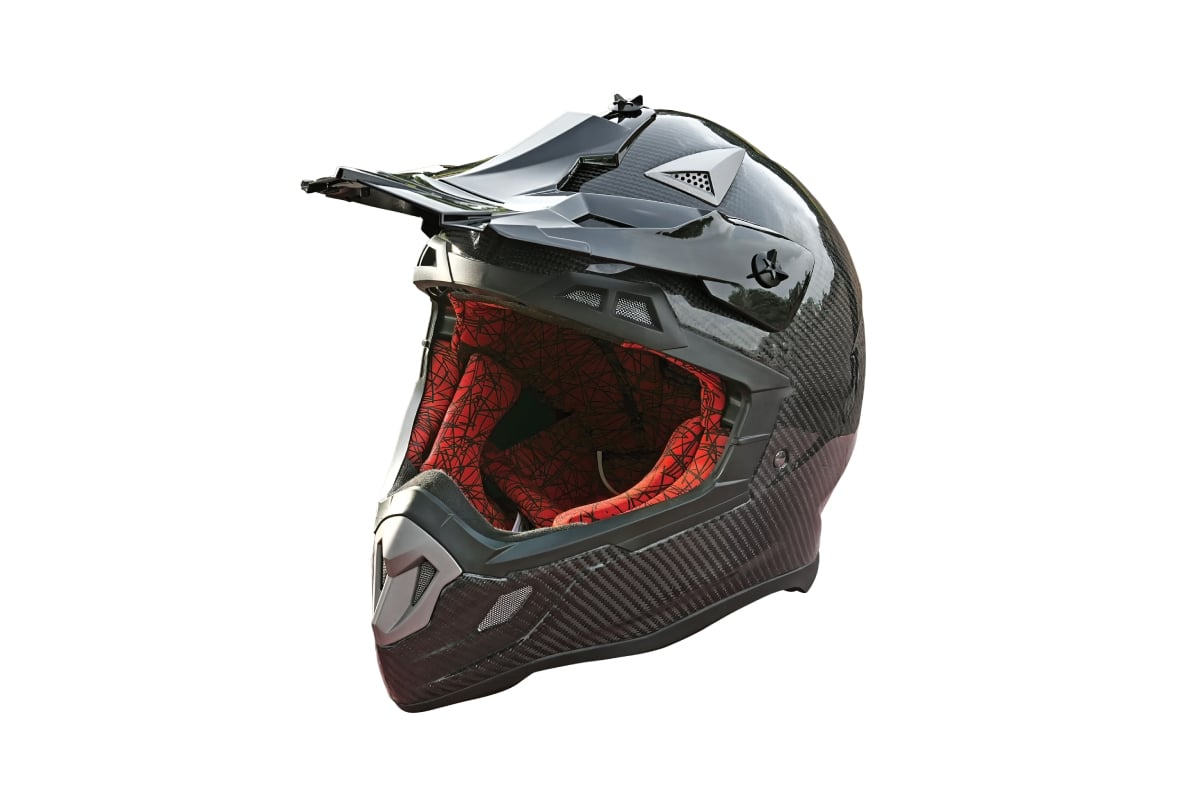
Vega uses balloon moulding technology to make its carbon-fibre shells, and it is based on the same process used for the fibreglass helmets. A tri-composite structure of carbon fibre, aramid and fibreglass enables the critical balance between lightness and impact absorption. The company used to hand cut out the visor aperture and vent holes in the CF shells post-moulding, but has now invested in a CNC water jet machine for the job. This enables much tighter tolerances and will help address customer complaints with excessive wind noise in current Axor carbon-fibre helmets.
The latest MX Carbon helmet uses new materials, which have raised the price to Rs 20,000, compared to its predecessor. The company says another reason behind the high price is the longer manufacturing time, with the company being able to currently produce up to 8 CF helmets a day.
With India’s premium two-wheeler market rapidly evolving, Vega is confident that there will be growing demand for such helmets, and has plans to bring out more models soon, including an ADV-style helmet. The company says it’s even working on making FIM-homologated and Snell-approved performance helmets, but that this could take a couple of years.
Having reasonably priced, fully locally manufactured carbon-fibre helmets isn’t something that many Indian motorcycle enthusiasts would have expected to be possible, but Vega Helmets is making that happen.
Experiencing the MX Carbon helmet
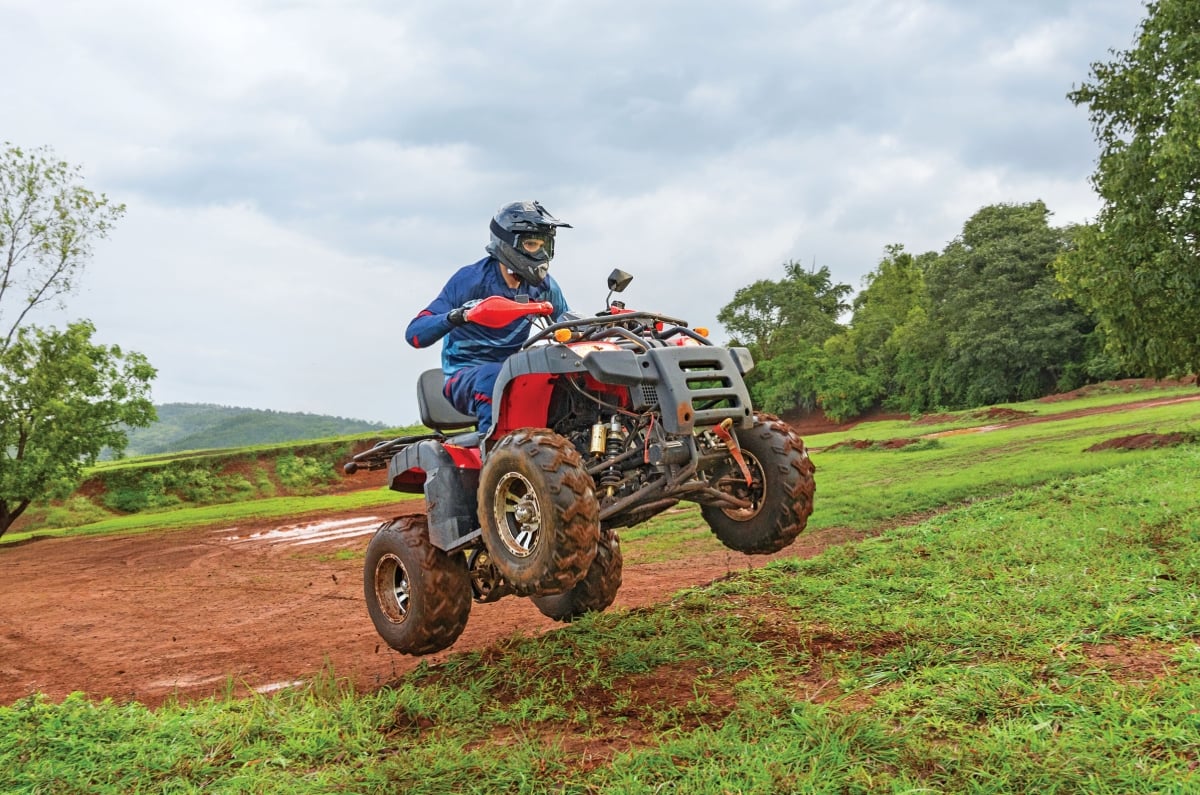
The Axor MX Carbon is certified to DOT, ISI and ECE 22 06 standards. It is available in three different shell sizes and weighs just 1,040g, plus or minus 50g, based on the shell size. We got to briefly try the helmet out at the Track 1 off-road facility in Belagavi on a number of vehicles, including an ATV, a buggy and a KTM 890 Adventure R.
Of course, the lack of weight was highly appreciated, but the helmet also felt nicely balanced. The inner liner material was also softer and more comfortable than expected. I usually wear a size S helmet, and that applies here as well. The fit was mostly very good, without any unusual or uncomfortable pressure points, but I did notice that the tips of my ears made contact with the inner liner.
The double D-ring closure system was easy to use, but the snap button to secure the strap could have had a more positive feedback when engaged. Overall quality is not bad for the price, but the finishing where the carbon-fibre panels join along the centre of the helmet was inconsistent across different units.
Long-standing scooter market leader Honda, who was outsold by TVS for the first time in July 2026, has bounced back into the lead in August. Honda dispatched 2.85 lakh units to showrooms across the country, posting 6 percent sales growth compared to August 2025. However, Honda’s market share has gone down by 6 percent compared to last year. The top 10 scooter manufacturers delivered a record 8.55 lakh units to their showrooms in August 2026, up by 24 percent compared to August 2025. This beats the previous best in October 2025 (8.24 lakh units), the only other time monthly scooter sales crossed 8 lakh.
One in every five TVS scooter sold is an e-scooter
River dispatched the highest number Indies so far in August 2026
Honda sold its highest number of e-scooters so far in August 2026
2026 cumulative sales so far have increased by 31 percent compared to 2025
Honda, TVS, Suzuki and Hero lead the charge
Month
CY2026
CY2025
Percentage change
January
7,50,580
5,48,201
37%
February
7,29,774
5,12,783
42%
March
7,61,422
5,86,485
30%
April
6,91,993
5,48,370
26%
May
7,39,669
5,80,696
27%
June
7,44,823
5,35,307
39%
July
7,98,190
6,45,022
24%
August
8,55,715
6,91,430
24%
Total
60,72,166
46,48,294
31%
Data: Society of Indian Automobile Manufacturers (SIAM)
That’s not the only news from August. At 60.7 lakh units, cumulative scooter sales for the first eight months of 2026 have registered a handsome 31 percent YoY growth (January-August 2025: 46.4 lakh units). TVS dispatched 2.56 lakh scooters last month, up by 24 percent compared to August 2025. This gives the Hosur-based manufacturer a 30 percent market share, unchanged from last year. TVS’ monthly sales continue to benefit from its two EVs – iQube and Orbiter – which added 57,523 units, up by 135 percent from last year.
Ranked third is Suzuki with 1.01 lakh scooters, up by 11 percent, and a 12 percent market share; the Access 125 remains its best-selling product. Suzuki sold 668 units of the eAccess in August 2026, its only EV at the moment.
Hero dispatched 72,150 scooters last month, up 49 percent from last year, giving it an 8 percent market share, up by one percent compared to August 2025. Like TVS, Hero is also benefiting from the sustained demand for its Vida EVs, which sold 25,558 units, up by 108 percent.
Bajaj, which produces the electric Chetak and Yulu models, sold 53,748 e-2Ws in August, up 279 percent YoY; the high growth is due to the company’s production and sales finally recovering from the supply chain issues it faced last year.
Yamaha registered 23 percent growth for a 4 percent market share. It was the last Japanese manufacturer to start selling EVs and dispatched 475 EC-06 e-scooter last month.
Manufacturer
Domestic market sales (in units)
Market share percentage
August 2026
August 2025
Percentage change
August 2026
August 2025
Honda
2,85,527
2,69,923
6%
33.36%
39.02%
TVS
2,56,442
2,06,598
24%
29.96%
29.87%
Suzuki
1,01,267
91,065
11%
11.83%
13.17%
Hero
72,150
48,304
49%
8.43%
6.98%
Bajaj
53,748
14,164
279%
6.28%
2.04%
Yamaha
34,279
27,944
23%
4.00%
4.04%
Ather
29,694
22,757
30%
3.47%
3.29%
Greaves Electric Mobility (GEM)
12,439
5,804
114%
1.45%
0.83%
River
6,567
2,229
195%
0.76%
0.32%
Piaggio (Aprilia and Vespa)
3,602
2,602
38%
0.42%
0.37%
Okinawa
0
40
-100%
0.00%
0.01%
Total
8,55,715
6,91,430
24%
100%
100%
Data: Society of Indian Automobile Manufacturers (SIAM)
Ather, which launched its mass-market family scooter Konarc on August 29, sold 29,694 units of the Rizta and 450 models in August, up 30 percent YoY, for a 3 percent overall scooter market share.
Greaves Electric Mobility – manufacturer of Ampere Electric scooters – is the newest SIAM member. The company has reported dispatches of 12,439 units last month, up 114 percent from August 2025. River, which currently only sells the Indie, dispatched a record 6,567 units in August, up 195 percent from last year and by 9 percent compared to July 2026. Piaggio, which markets the Aprilia and Vespa brands, wraps up the Top 10 scooter manufacturers list with wholesales of 3,602 units, up 38 percent compared to August 2025.
The stellar performance of the scooter segment last month ensured that overall 2W sales hit a new high for the month of August with 20 lakh units. With the festive season ahead, we can expect to see further increases in sales by the end of the year.
जियो यूजर्स अब बिना अतिरिक्त पैसे दिए Canva के प्रीमियम डिजाइन टूल्स इस्तेमाल कर सकेंगे। जियो और Canva ने साझेदारी की है, जिसके तहत पात्र ग्राहकों को 12 महीने तक Canva Pro या Canva Pro Lite मुफ्त मिलेगा। कंपनी के मुताबिक इस ऑफर की कीमत ₹4,000 तक है और इसे 16 सितंबर से MyJio ऐप के जरिए एक्टिव किया जा सकेगा।
किस ग्राहक को कौन-सा Canva मिलेगा, यह उसके जियो रिचार्ज प्लान पर निर्भर करेगा। ₹399 के प्लान पर Canva Pro मिलेगा, जबकि ₹349 और ₹349 से ऊपर के पात्र 2GB प्रतिदिन डेटा वाले प्लान पर Canva Pro Lite दिया जाएगा। ऑफर के लिए कोई अतिरिक्त शुल्क या छिपा हुआ चार्ज नहीं होगा।
इसका सीधा फायदा छात्रों, कंटेंट क्रिएटर्स, प्रोफेशनल्स और छोटे कारोबारियों को मिल सकता है। Canva की मदद से मोबाइल पर ही स्कूल प्रोजेक्ट, सोशल मीडिया पोस्ट, प्रेजेंटेशन, मार्केटिंग मटीरियल और फेस्टिवल ग्रीटिंग जैसे डिजाइन बनाए जा सकते हैं। हिंदी समेत कई भारतीय भाषाओं में भी कंटेंट तैयार किया जा सकेगा।
Canva Pro Lite में लाखों प्रीमियम टेम्पलेट, फोटो, वीडियो और फॉन्ट के साथ बैकग्राउंड रिमूवर, Magic Resize और 50GB क्लाउड स्टोरेज जैसे फीचर मिलेंगे। वहीं Canva Pro में इसके अलावा Canva AI, Content Planner, ज्यादा AI लिमिट और 100GB क्लाउड स्टोरेज जैसे अतिरिक्त फीचर होंगे।
रिलायंस इंडस्ट्रीज के प्रेसिडेंट किरण थॉमस ने कहा कि इस साझेदारी के जरिए जियो लाखों भारतीयों तक AI आधारित डिजाइन टूल्स मुफ्त पहुंचाना चाहता है, ताकि छात्र, क्रिएटर्स और छोटे कारोबारी अपनी पसंद की भाषा में सीख और काम कर सकें। ऑफर का लाभ लेने के लिए पात्र जियो यूजर को MyJio ऐप खोलकर Canva ऑफर पर टैप करना होगा। इसके बाद वह सीधे डिजाइन बनाना शुरू कर सकेगा।
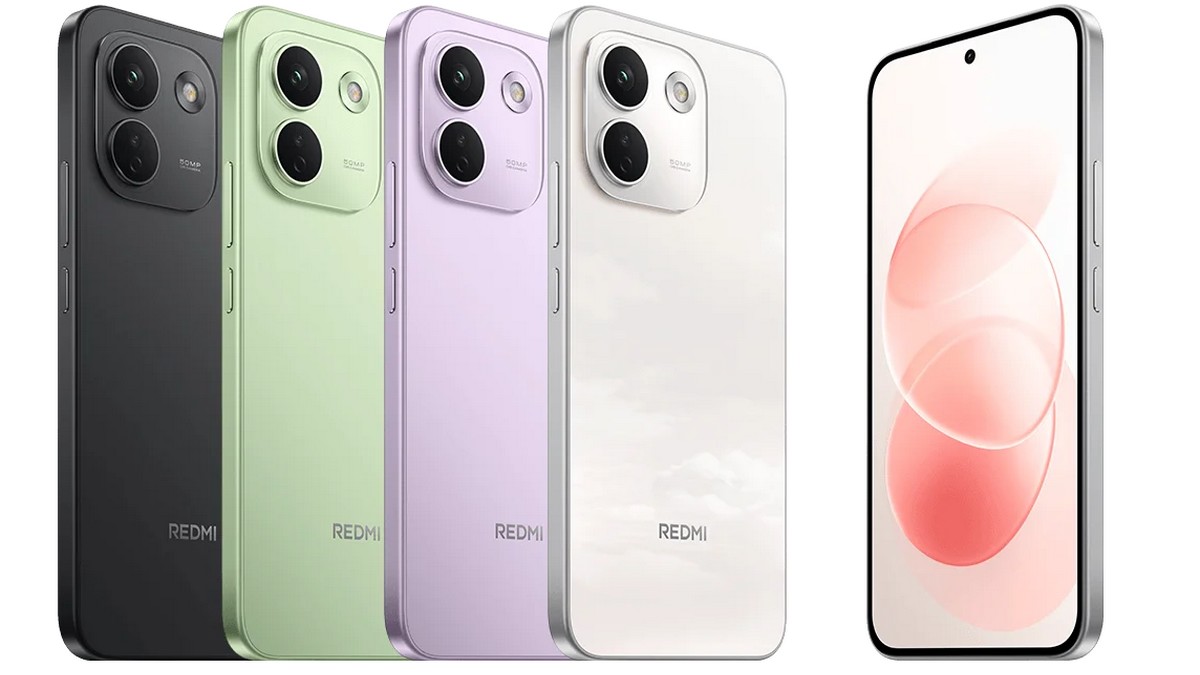
Xiaomi ने भारत में अपनी Redmi Note 17 सीरीज के दो नए स्मार्टफोन Redmi Note 17 Pro और Redmi Note 17 Pro Max लॉन्च कर दिए हैं। इनमें Pro Max को ज्यादा प्रीमियम मॉडल के तौर पर पेश किया गया है। इसकी सबसे बड़ी खासियत 10,000mAh की सिलिकॉन-कार्बन बैटरी है। वहीं Redmi Note 17 Pro में 9,000mAh की बैटरी दी गई है। दोनों फोन में 6.83 इंच का 1.5K AMOLED डिस्प्ले, 120Hz रिफ्रेश रेट और 3,500 निट्स तक की पीक ब्राइटनेस मिलती है। फोन Android 16 पर आधारित Xiaomi के HyperOS 3 पर चलते हैं।
Redmi Note 17 Pro को दो स्टोरेज वेरिएंट में लॉन्च किया गया है।
8GB RAM + 128GB: ₹33,999
8GB RAM + 256GB: ₹36,999
इस फोन की बिक्री 17 सितंबर से शुरू होगी।
Redmi Note 17 Pro Max की कीमत
Pro Max की कीमत ज्यादा है, लेकिन इसमें बड़ी बैटरी और ज्यादा पावरफुल फीचर्स मिलते हैं।
8GB RAM + 256GB: ₹44,999
12GB RAM + 256GB: ₹50,999
इसकी बिक्री 23 सितंबर से शुरू होगी।
कंपनी नए फोन पर बैंक ऑफर के तहत ₹5,000 तक की छूट भी दे रही है। दोनों स्मार्टफोन Amazon, Xiaomi के ऑनलाइन स्टोर और चुनिंदा ऑफलाइन रिटेल स्टोर्स के जरिए खरीदे जा सकेंगे।
3,500 निट्स की ब्राइटनेस वाला AMOLED डिस्प्ले
Redmi Note 17 Pro और Pro Max दोनों में 6.83 इंच का 1.5K AMOLED डिस्प्ले दिया गया है। इसका रिफ्रेश रेट 120Hz है, जिससे स्क्रॉलिंग और एनिमेशन ज्यादा स्मूद नजर आ सकते हैं।
डिस्प्ले में:
1.5K रेजोल्यूशन
120Hz रिफ्रेश रेट
3,200Hz टच सैंपलिंग रेट
3,500 निट्स तक पीक ब्राइटनेस
12-बिट कलर टेक्नोलॉजी
68.7 अरब तक कलर्स का सपोर्ट
मिलता है।
स्क्रीन को Corning Gorilla Glass Victus 2 से सुरक्षा दी गई है। दोनों फोन में Dolby Atmos सपोर्ट वाले स्टीरियो स्पीकर भी मिलते हैं। बैटरी में बड़ा अंतर, Pro Max में 10,000mAh
बैटरी इन दोनों फोन की सबसे बड़ी खासियतों में से एक है।
Redmi Note 17 Pro में 9,000mAh की सिलिकॉन-कार्बन बैटरी दी गई है, जो 67W फास्ट चार्जिंग सपोर्ट करती है। वहीं Redmi Note 17 Pro Max में 10,000mAh की सिलिकॉन-कार्बन बैटरी है और यह 100W फास्ट चार्जिंग सपोर्ट करता है।
Xiaomi के मुताबिक Pro Max की बैटरी 1,600 से ज्यादा चार्जिंग साइकल के बाद भी 80 प्रतिशत क्षमता बनाए रखने के लिए रेटेड है। इसमें 27W वायर्ड रिवर्स चार्जिंग का फीचर भी दिया गया है। यानी जो यूजर फोन को बार-बार चार्ज नहीं करना चाहते या लंबे समय तक गेमिंग, वीडियो और दूसरे काम करते हैं, उनके लिए Pro Max ज्यादा आकर्षक विकल्प हो सकता है।
दोनों स्मार्टफोन में डुअल रियर कैमरा सेटअप दिया गया है।
इसमें:
50MP मेन कैमरा
8MP सुपर-वाइड एंगल कैमरा
शामिल हैं।
हालांकि सेल्फी कैमरे में दोनों मॉडल अलग हैं। Redmi Note 17 Pro Max में 32MP फ्रंट कैमरा, जबकि Redmi Note 17 Pro में 16MP सेल्फी कैमरा दिया गया है। फोन में AI आधारित इमेजिंग फीचर्स भी मिलते हैं, जिनकी मदद से फोटो से ग्लेयर, रिफ्लेक्शन और अनचाही वस्तुओं को हटाया जा सकता है।
Pro और Pro Max में अलग-अलग प्रोसेसर
परफॉर्मेंस के लिए दोनों मॉडल में अलग चिपसेट दिए गए हैं। Redmi Note 17 Pro में Snapdragon 6s Gen 4 प्रोसेसर और 8GB तक RAM मिलती है। Redmi Note 17 Pro Max में Qualcomm Snapdragon 6 Gen 5 प्रोसेसर और 12GB तक RAM का विकल्प है। इसलिए दोनों में केवल बैटरी ही नहीं, बल्कि प्रोसेसिंग पावर और RAM के मामले में भी अंतर है।
HyperOS 3 और Android 16
दोनों फोन Xiaomi के HyperOS 3 पर चलते हैं, जो Android 16 पर आधारित है। कंपनी ने इन स्मार्टफोन के लिए 4 साल के OS अपडेट और 6 साल के सिक्योरिटी अपडेट देने का वादा किया है। लंबे समय तक फोन इस्तेमाल करने वाले ग्राहकों के लिए यह एक महत्वपूर्ण बात है।
पानी और धूल से सुरक्षा
Redmi Note 17 Pro सीरीज में मजबूत प्रोटेक्शन भी दिया गया है। दोनों फोन को IP66, IP68 और IP69K रेटिंग के साथ पेश किया गया है। Pro Max में एक फोटोक्रोमिक रियर पैनल का विकल्प भी मिलता है, जो सीधी धूप पड़ने पर अपना रंग/शेड बदल सकता है।
अगर आपका बजट करीब ₹34,000-₹37,000 है और आप बड़ी बैटरी के साथ AMOLED डिस्प्ले वाला फोन चाहते हैं, तो Redmi Note 17 Pro पर विचार किया जा सकता है। वहीं अगर आपका बजट ₹45,000 से ऊपर है और आपकी प्राथमिकता बड़ी बैटरी, 100W चार्जिंग, ज्यादा RAM और बेहतर सेल्फी कैमरा है, तो Redmi Note 17 Pro Max ज्यादा फीचर वाला विकल्प है। खास तौर पर 10,000mAh बैटरी और 100W चार्जिंग Pro Max को उन यूजर्स के लिए अलग बनाती है जो बैटरी बैकअप को सबसे ज्यादा महत्व देते हैं।